judge
Judge — June 27, 1931
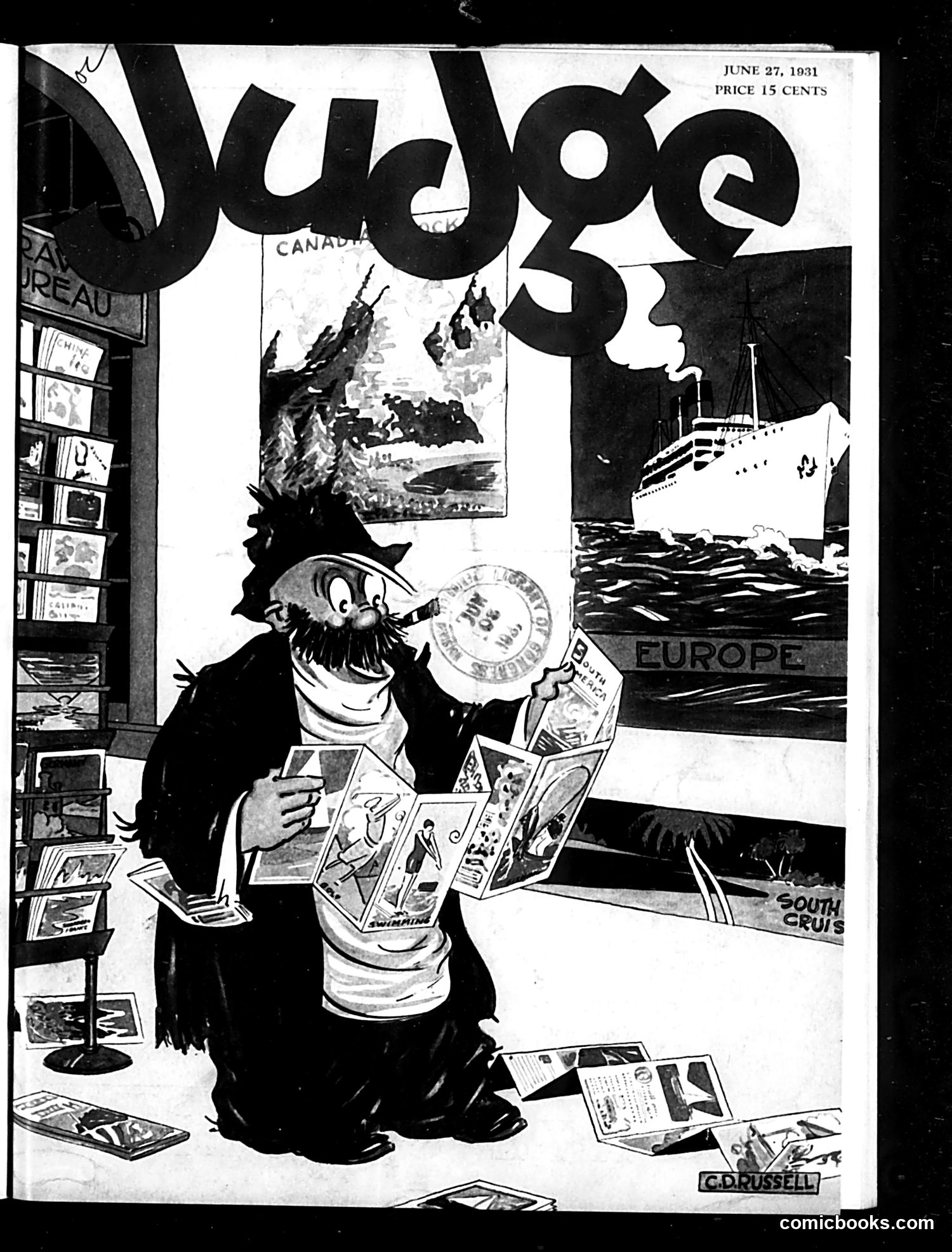
Explanation for Modern Readers This June 1931 *Judge* cover satirizes travel enthusiasm during the Great Depression. A disheveled character in worn clothing eagerly peruses travel brochures at a travel bureau, dreaming of European cruises and exotic destinations—visible through the window poster showing a luxury ocean liner labeled "EUROPE." The satire is clear: while ordinary Americans struggled with unemployment and poverty, travel companies aggressively marketed expensive vacations. The contrast between the character's shabby appearance and his yearning for luxury travel mocks both the absurdity of promoting expensive leisure during economic hardship and the allure of escapism that such advertising exploited during desperate times. The artist (signed "South Cruis") critiques consumerism and the disconnect between advertising promises and economic reality.
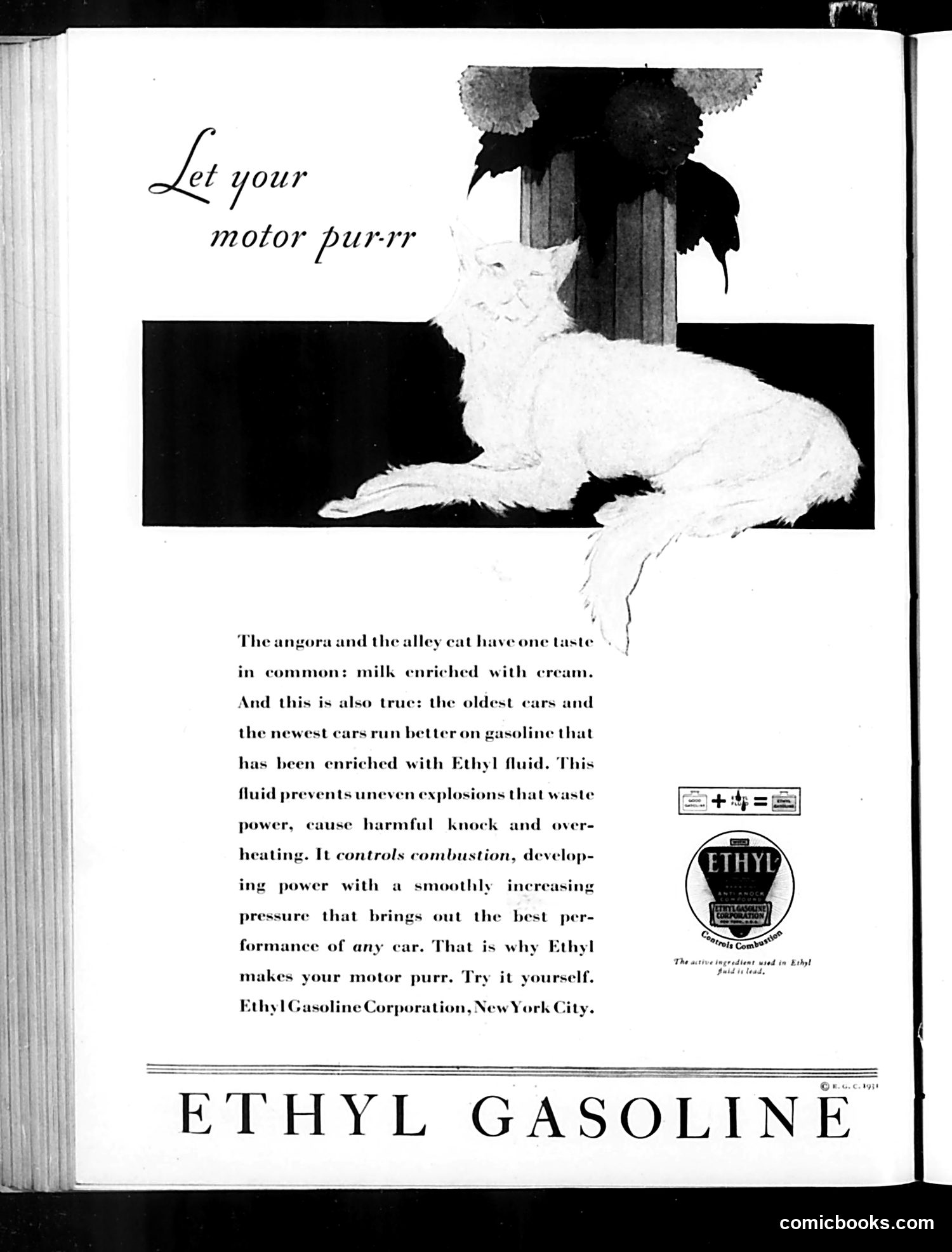
Analysis This appears to be a product advertisement rather than political satire. The page promotes Ethyl Gasoline, a commercial fuel product from the Ethyl Gasoline Corporation of New York City. The "cartoon" is actually a marketing illustration: a white cat lounging contentedly, with text claiming cats and cars share a common preference—enriched milk and gasoline with Ethyl fluid, respectively. The analogy attempts humor through an absurd comparison while pitching product benefits. The advertisement emphasizes that Ethyl fluid prevents engine knocking and "uneven explosions," controlling combustion for better performance. This was a genuine automotive innovation of the early twentieth century. There is no political commentary or social satire present—this is straightforward commercial advertising using a cute animal mascot for appeal.
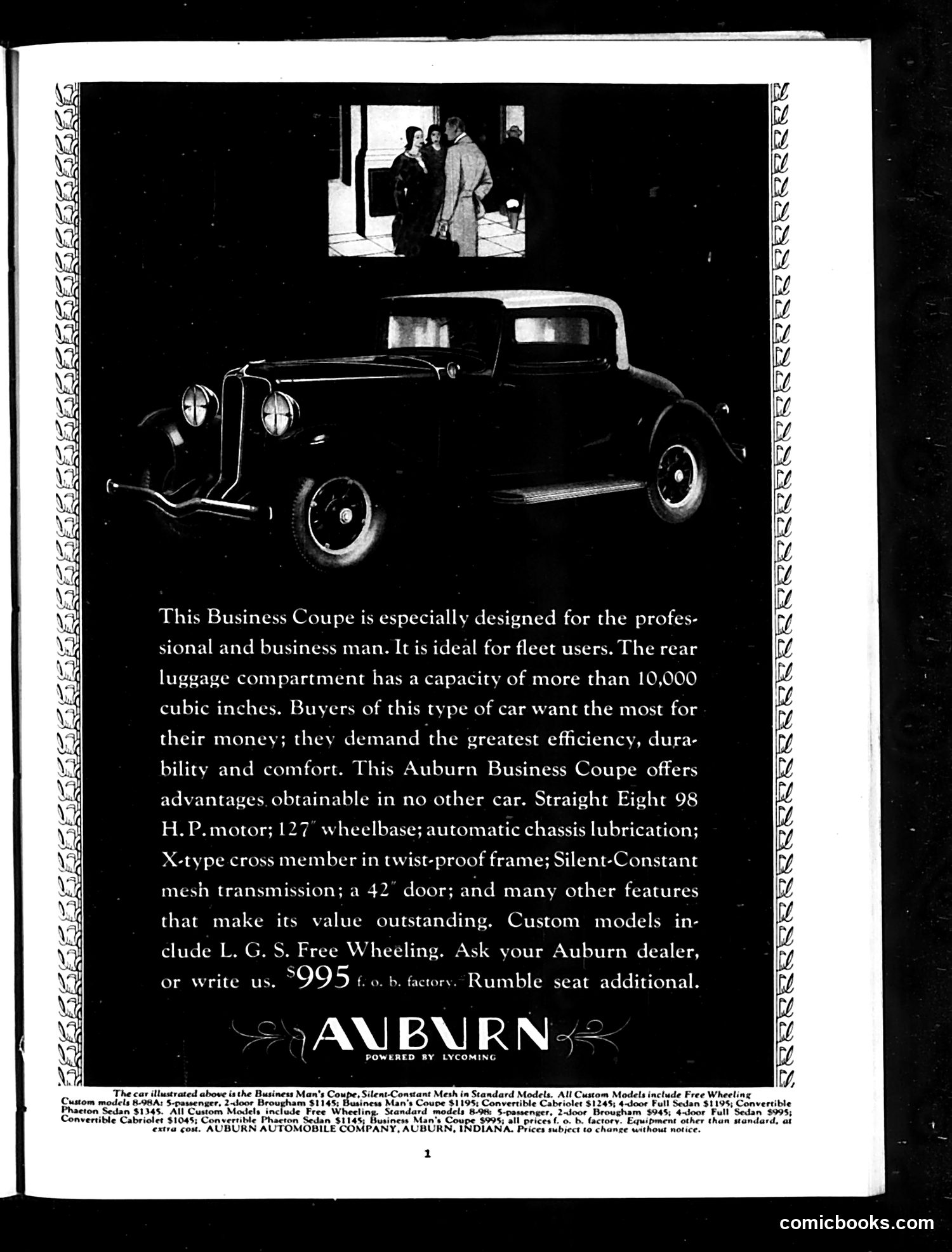
Analysis This page is not a cartoon or satire—it's a straightforward automobile advertisement for the Auburn Business Coupe. The image shows a sleek 1930s-era car with an inset photograph above depicting what appears to be a business scene with well-dressed men. The ad targets professional businessmen and fleet buyers, emphasizing practical features: a large rear luggage compartment (10,000+ cubic inches), an efficient Straight Eight 98 H.P. motor, and a 127-inch wheelbase. The tagline promises "advantages obtainable in no other car." The $995 price point (factory) reflects the vehicle's positioning as an upscale, practical business vehicle during the Depression era. This is pure commercial advertising, not satirical content.
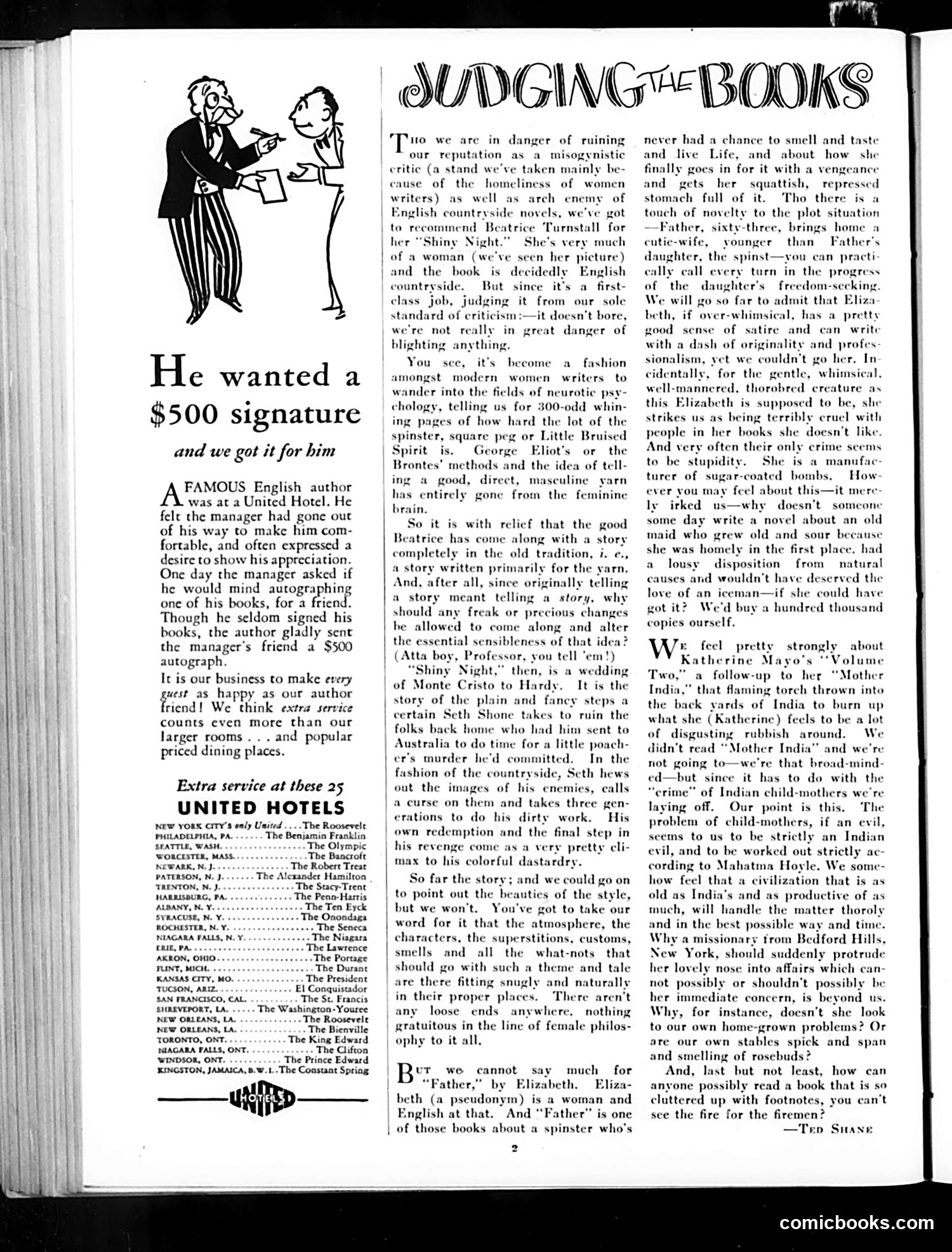
"Judging the Books" - A Publisher's Complaint This page satirizes modern literary criticism and publishing. The cartoon shows a man (apparently a publisher) complaining to a woman about the difficulty of pleasing contemporary critics. The article criticizes female literary critics who've become fashionable among "neurotic psychology" readers, claiming they write tediously about psychological themes rather than actual storytelling. The piece specifically targets the trend of misogynistic criticism toward female writers and English countryside novels. The humor lies in the ironic complaint: a publisher wanting a famous author's $500 signature—suggesting the real goal is profit, not literary merit. The satire mocks both pretentious modern criticism and the commercial book industry's opportunism, while also containing somewhat dismissive attitudes toward female authors and critics typical of the era.
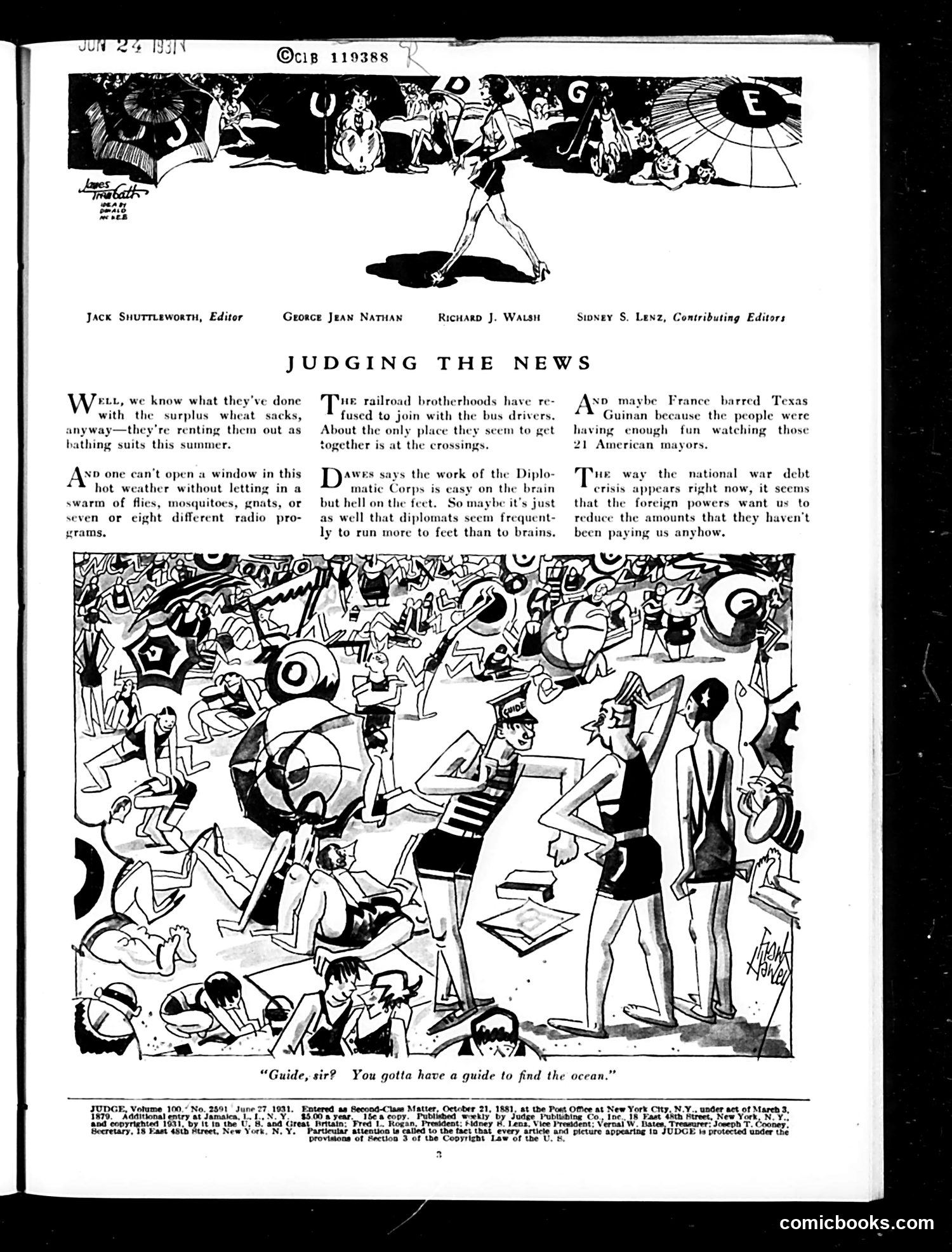
Analysis of "Judging the News" (Judge Magazine, June 27, 1931) This page satirizes contemporary social issues through brief commentary and a chaotic beach scene cartoon. The text mocks: 1. Summer heat complaints — people blaming weather rather than actual conditions 2. Diplomatic Corps — criticizing their ineffectiveness, suggesting they're all talk ("brains") with no practical results ("feet") 3. War debt crisis — referencing the ongoing international debt negotiations from WWI, suggesting foreign powers want debt forgiveness America won't grant The large cartoon below depicts a crowded, absurdly chaotic beach scene (likely referencing summer tourism during the Great Depression). The caption "Guide, sir? You gotta have a guide to find the ocean" suggests overwhelming crowds and confusion—satirizing either overcrowded public spaces or the bewildering complexity of contemporary life during economic crisis.
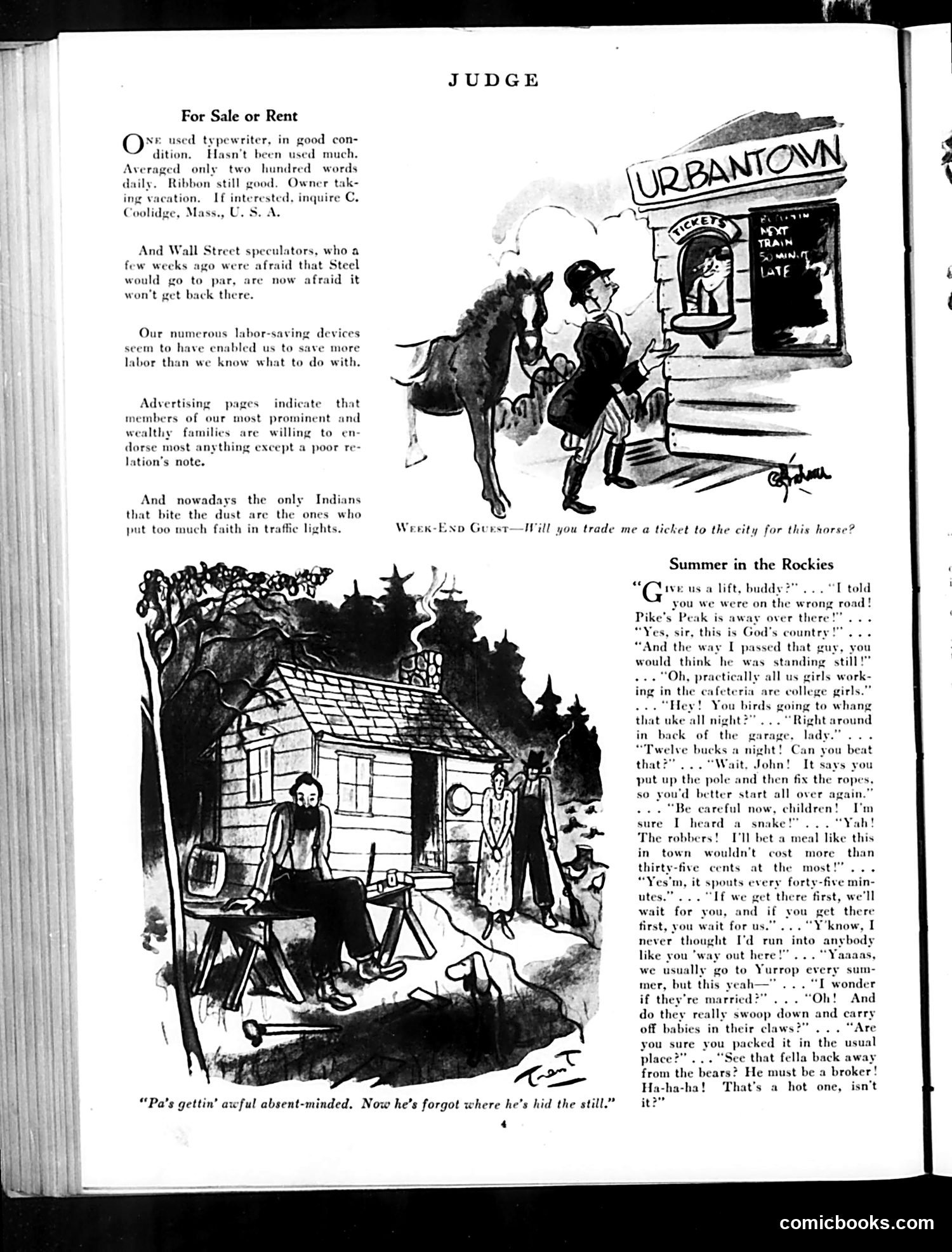
Analysis of Judge Magazine Page Top Cartoon ("Week-End Guest"): A man offers to trade his horse for a city train ticket at an "Urbantown" station. The joke satirizes the absurdity of rural visitors unfamiliar with urban life, stereotyping country people as simple-minded for valuing a horse over modern transportation—a common early 20th-century city/country divide trope. Bottom Cartoon ("Summer in the Rockies"): Depicts a cabin scene with dialogue capturing tourists' chaotic mountain vacation experience—lost directions, wildlife encounters, mechanical breakdowns, and exaggerated fears about bears and robbery. It mocks urban tourists' romantic notions of rustic adventure clashing with actual hardship and their nervous inexperience outdoors. Both cartoons mock early 1900s American urban-rural cultural gaps and tourist pretensions.
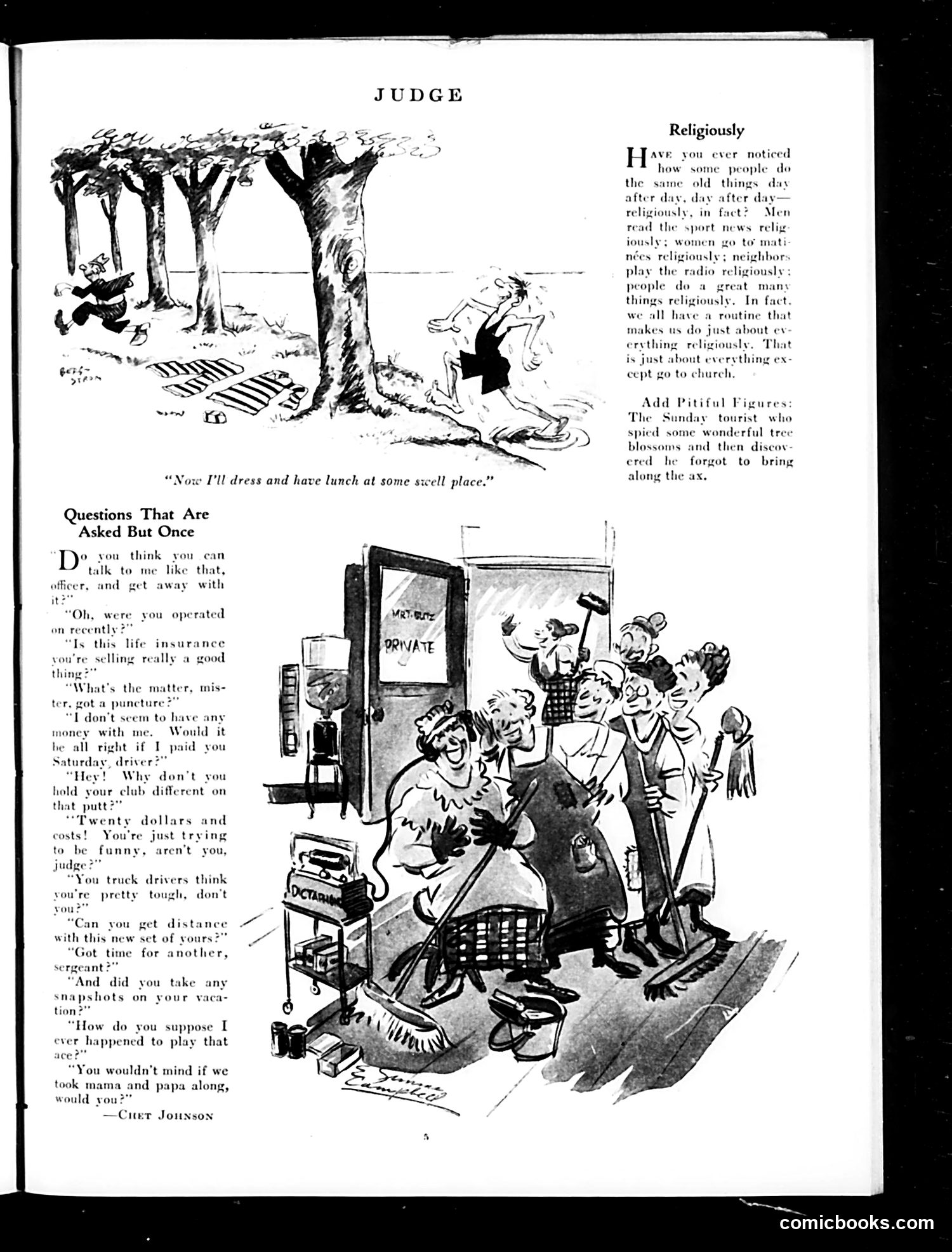
Analysis of Judge Magazine Page Top Section ("Religiously"): Satirizes how people perform routines "religiously" without genuine devotion—reading news, listening to radio, attending church—suggesting habit rather than sincere belief. The example of a Sunday tourist who admires tree blossoms but forgets to bring an ax is absurdist humor about selective attention. Bottom Section ("Questions That Are Asked But Once"): A cartoon showing a crowded taxi or car interior with multiple passengers. The dialogue satirizes repetitive, annoying questions taxi drivers receive from customers—about operations, insurance, accidents, money, and driving ability. The humor derives from the relatable irritation of hearing the same questions repeatedly. Chet Johnson is credited as the artist.
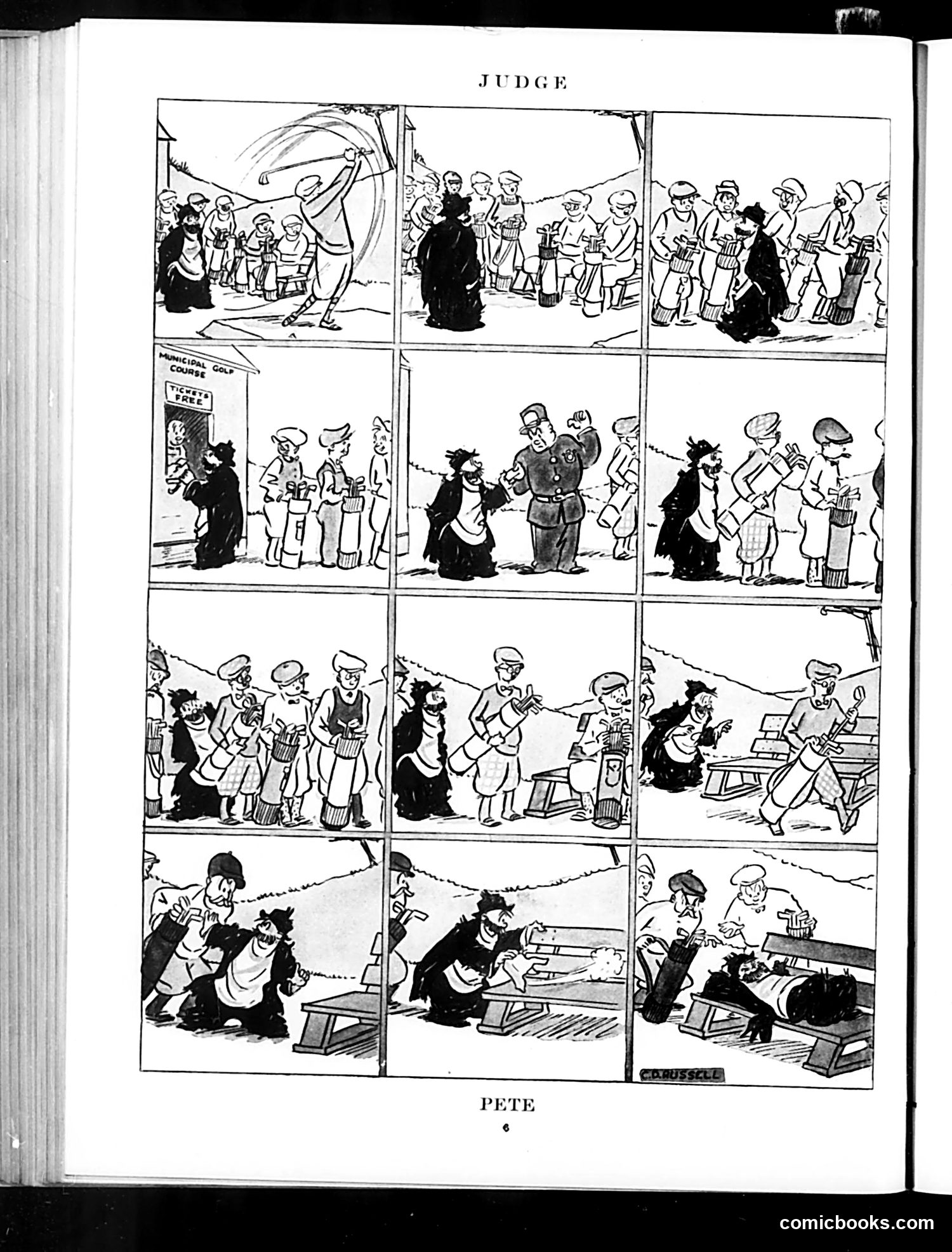
Judge Magazine Comic Strip Analysis This is a sequential comic strip titled "Judge" (with "Pete" credited at bottom) depicting what appears to be a judicial or authority figure (dressed in black, prominent in each panel) interacting with groups of working-class men in caps and work clothes, seemingly at a golf course (visible signage in one panel). The narrative progresses from the figure's arrival through increasingly physical interactions, culminating in the final panels where the figure appears to be knocked down or falling. The satire likely critiques judicial authority, corruption, or abuse of power—the repeated confrontations suggest either comeuppance for an arrogant official or commentary on class conflict. Without additional historical context or publication date, the specific political reference remains unclear, though the anti-authority tone is evident.
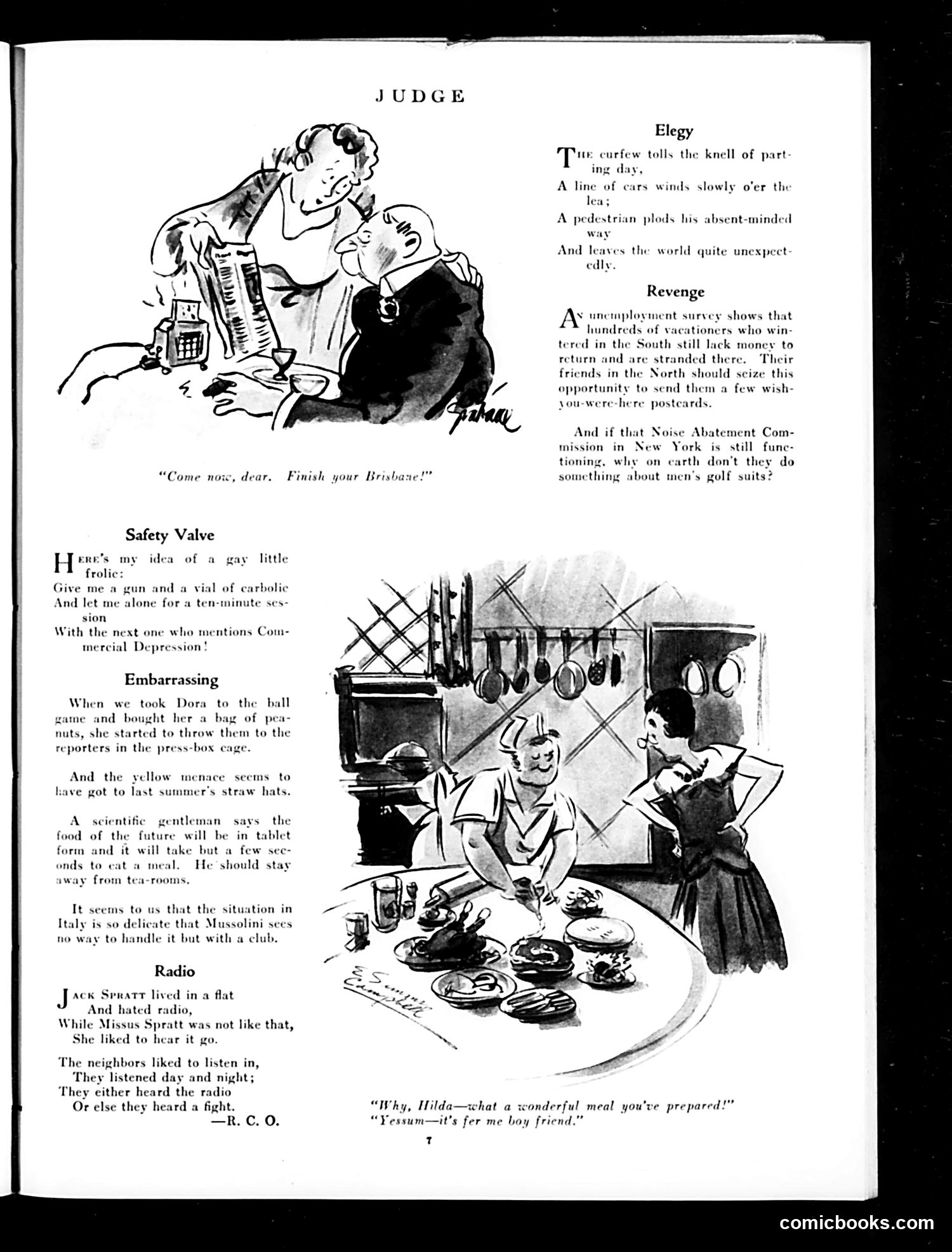
Judge Magazine Page Analysis This page contains several short humorous pieces satirizing 1920s-30s American life: "Elegy" mocks careless pedestrians struck by automobiles—a growing social problem as car traffic increased. "Revenge" jokes about Depression-era unemployment, suggesting stranded vacationers deserve sardonic postcards rather than help. "Safety Valve" expresses frustration with constant talk of the "Commercial Depression" (likely the Great Depression), fantasizing violent relief. "Embarrassing" contains racist imagery ("yellow menace") referencing Asian Americans, mocking a woman throwing peanuts at reporters. "Radio" satirizes the new technology's social disruption—families arguing over radio versus fighting neighbors. The bottom cartoon shows a woman serving food to her boyfriend, with social commentary about class and courtship rituals. The page reflects contemporary anxieties: automobile dangers, economic hardship, racial prejudices, and rapid technological change reshaping domestic life.
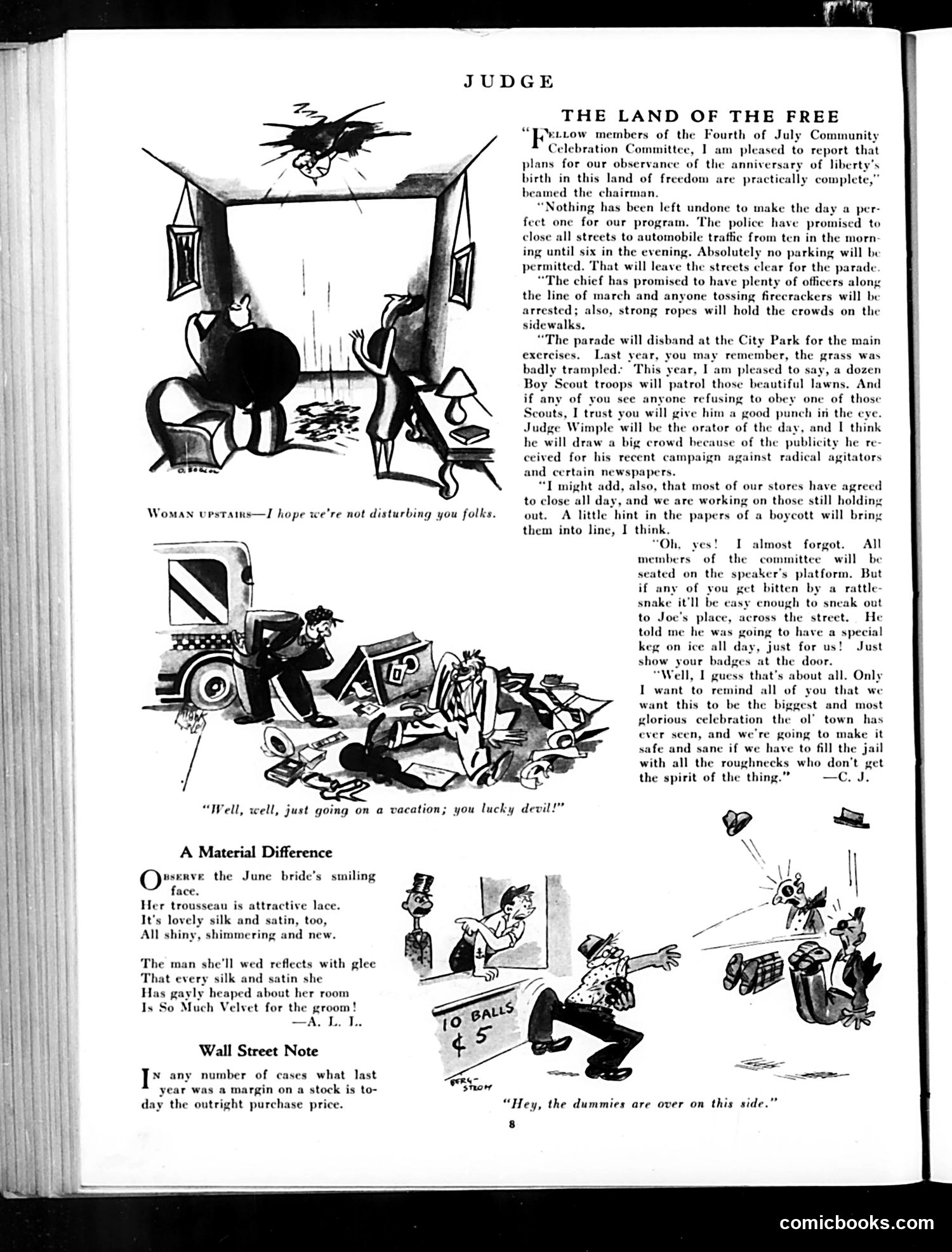
Analysis of Judge Magazine Page This page satirizes American civic hypocrisy around the Fourth of July celebration. The main article "The Land of the Free" presents a committee chairman listing preparations that contradict the holiday's promise of liberty: police will ban traffic and parking, arrest firecracker-throwers, restrain crowds with ropes, enforce Boy Scout patrols (with implicit threat of violence—"give him a good punch"), coerce store closures through boycott threats, and jail "roughnecks" who don't comply—all while claiming to celebrate freedom. The satire is heavy-handed: the chairman ironically promises to make the celebration "safe and sane" by filling "the jail with all the roughnecks," exposing the contradiction between proclaimed liberty and actual authoritarian control. The companion cartoons mock social pretense: "Woman Upstairs" shows domestic disruption, while "A Material Difference" jokes about marriage economics (the groom sees his bride's trousseau as personal wealth gain). The "Wall Street Note" references stock-market margin practices, unrelated to the freedom theme but typical of Judge's satirical mix.
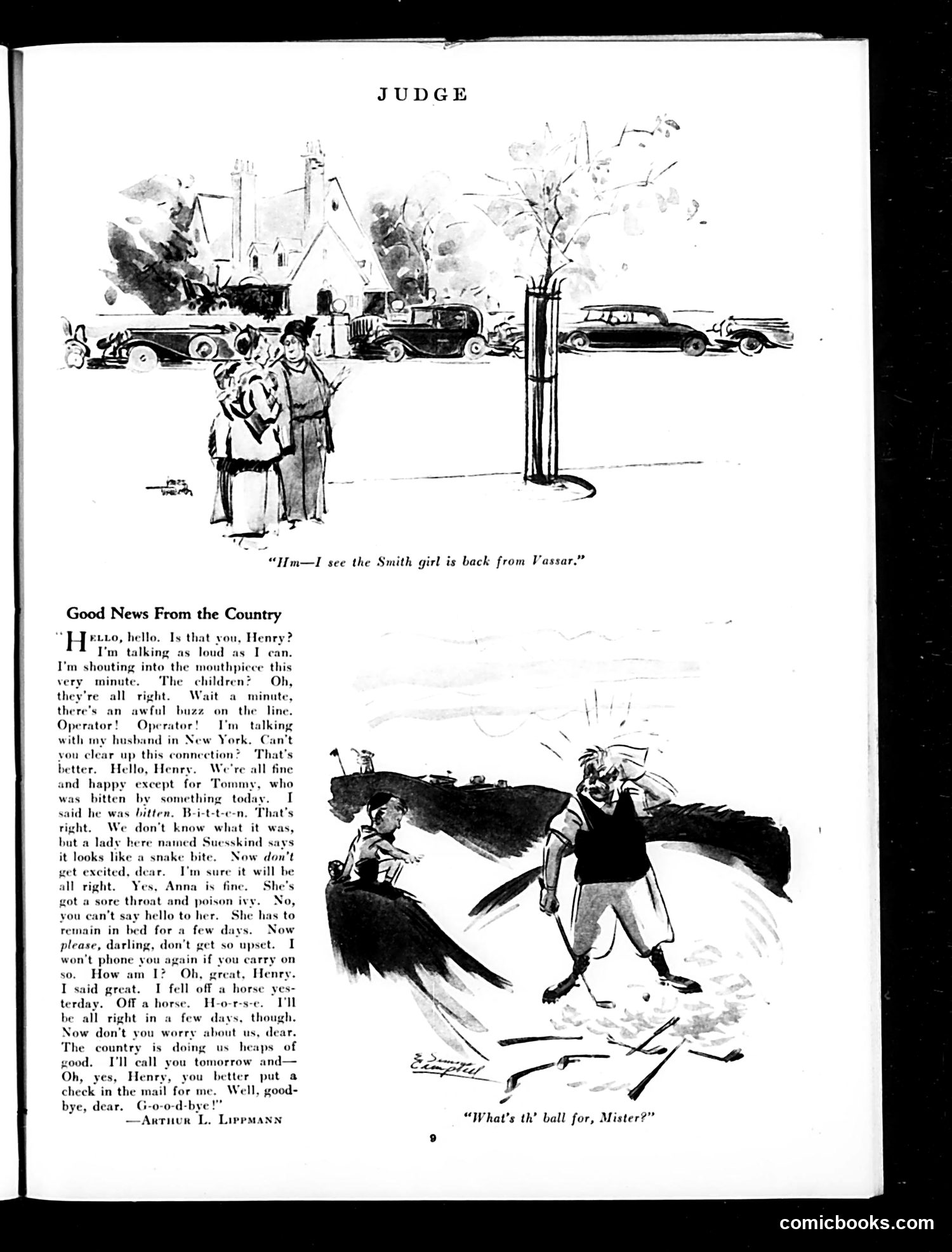
Explanation for Modern Readers This page contains two unrelated satirical pieces from *Judge* magazine: Top cartoon: A society joke about a young woman returning from Vassar College (an elite women's institution). The caption "I see the Smith girl is back from Vassar" appears to mock wealthy families' social pretensions—suggesting her return is notable gossip among the upper classes. Main story: "Good News From the Country" satirizes rural life and early telephone technology. A woman calls her husband in New York, struggling with poor phone connection while breathlessly reporting domestic disasters: a child bitten (possibly by a snake), another child with poison ivy, and she herself having fallen off a horse. The humor lies in her contradicting herself ("don't get upset") while describing catastrophes, and the absurdity of outdated telephone service. The author (Lippmann) mocks both rural incompetence and city-dwellers' anxiety about country living. Bottom cartoon: Shows a child asking about a ball in a snowy scene—likely commenting on winter sports or children's play, though context is unclear without the caption.
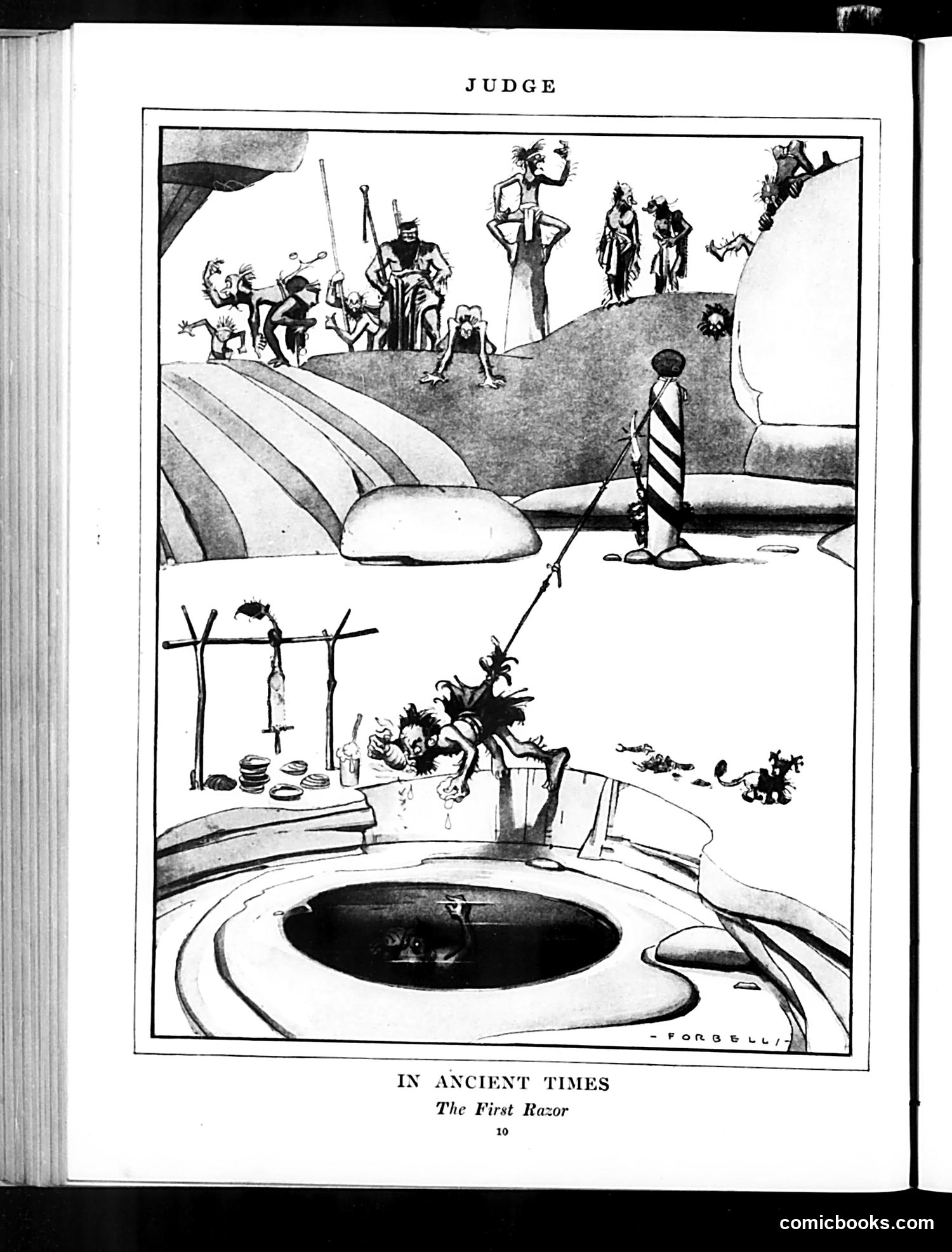
"The First Razor" - Judge Magazine Cartoon This cartoon satirizes humanity's invention of the razor in ancient times. The upper panel shows a primitive society with figures observing a central character demonstrating the first razor. The lower panel depicts the chaotic result: a figure bleeding profusely after apparently using it, suspended over a pit while others watch in alarm. The joke is straightforward slapstick humor: the "first razor" was likely dangerously crude and ineffective, causing the hapless user serious injury rather than a clean shave. By framing this as "ancient times," the cartoonist humorously suggests that even humanity's earliest attempts at personal grooming were disasters—a commentary on either primitive technology or human clumsiness with new inventions.
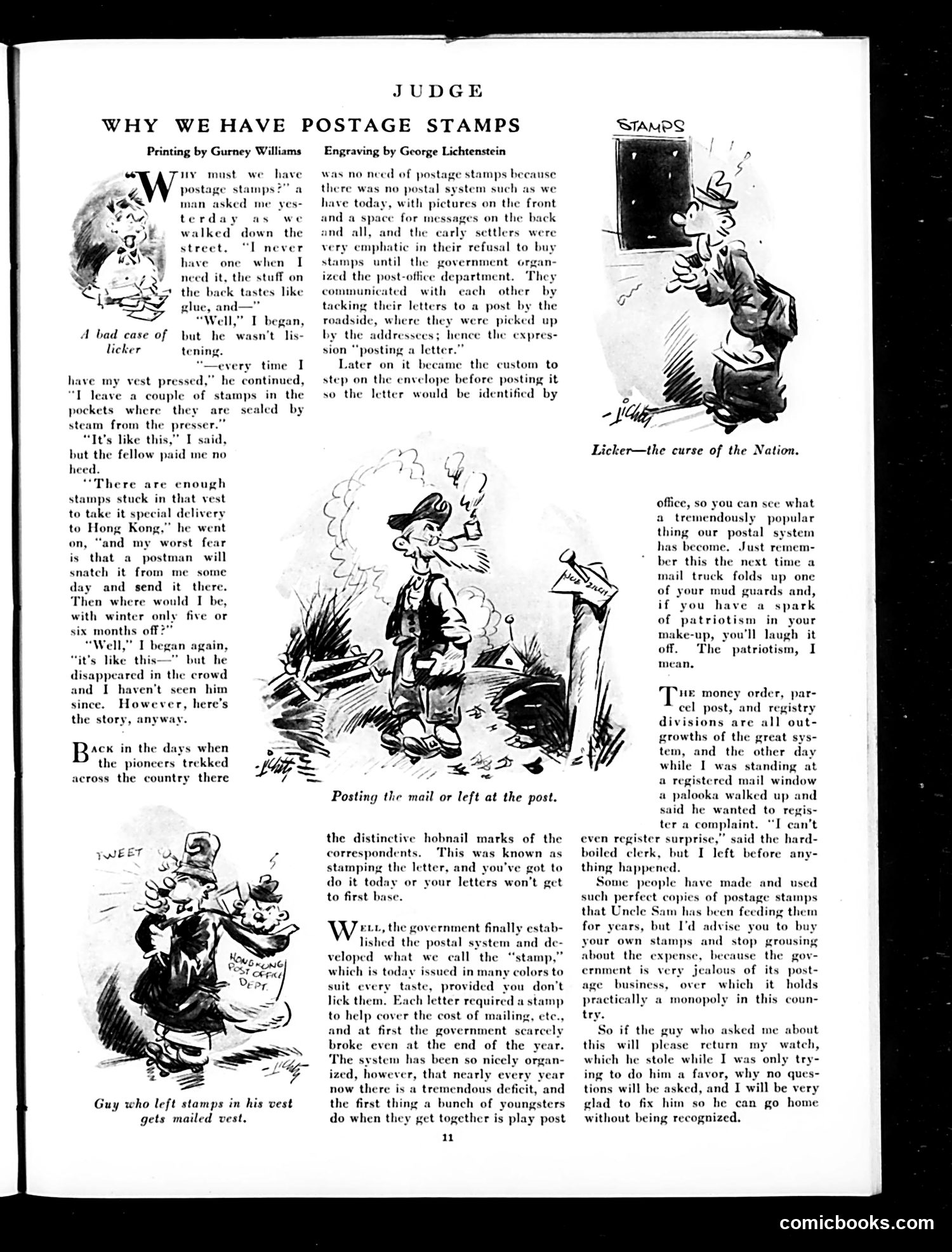
Explanation for Modern Readers This is a humorous Judge magazine article explaining postage stamps' origins. The author uses exaggerated anecdotes and cartoon illustrations to satirize Americans' complaints about postal costs and stamp inconveniences. The central joke involves a drunk man ("licker—the curse of the Nation") who complains about losing stamps in his vest during dry cleaning—so many he could send it to Hong Kong. The author attempts to educate him on why stamps exist, tracing their history from pioneer times (when letters were "posted" on roadsides) through government standardization. The satire targets public complaints about the postal system's deficits and inefficiency, while also mocking stamp counterfeiters. The ending twist—where the author hints the drunk man stole his watch while he was helping him—delivers a final joke: even explaining civic duty gets you robbed. The cartoons depict the drunk and chaotic postal scenarios for visual comic effect.
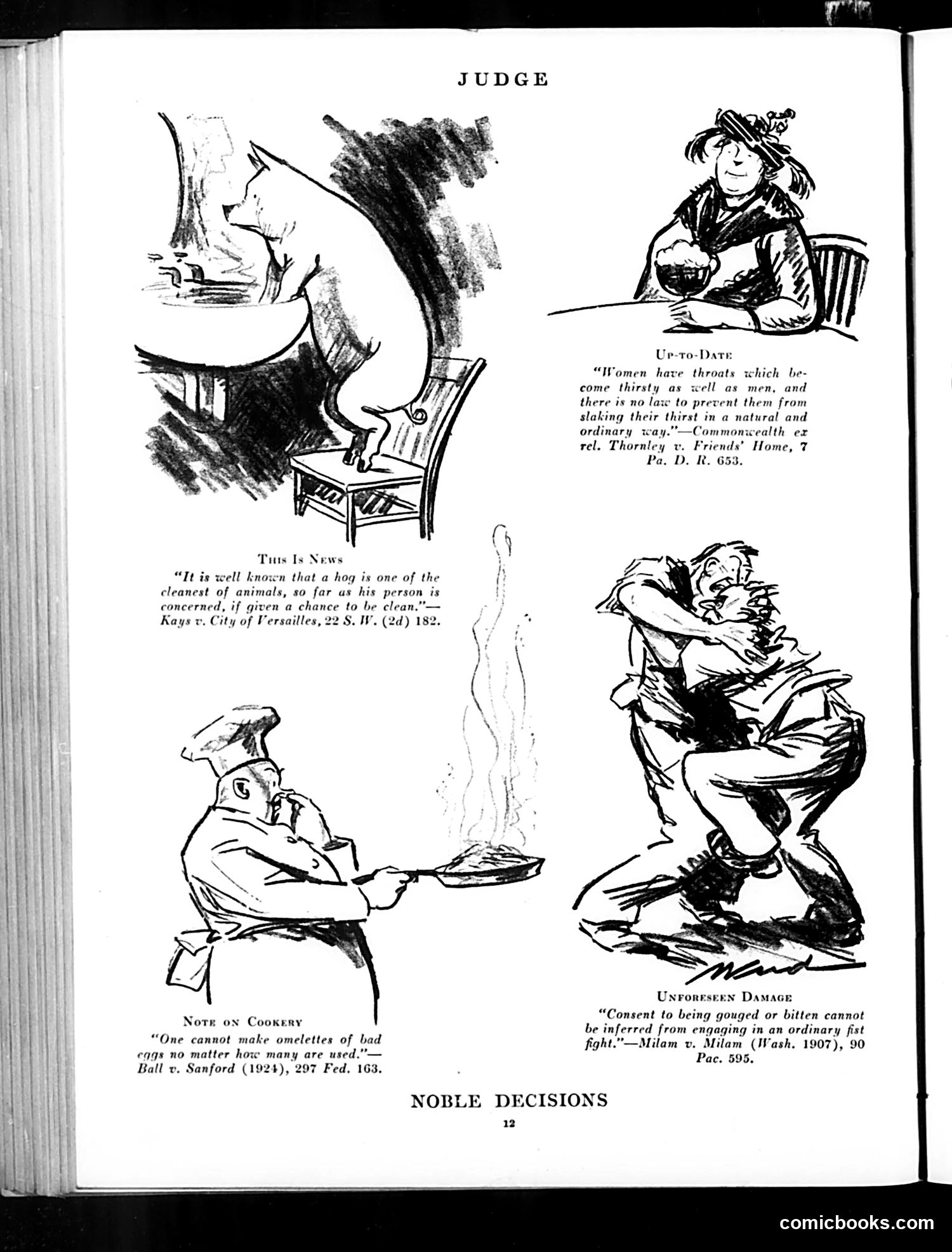
Explanation for Modern Readers This page from *Judge* magazine presents legal humor through absurdist court decisions. Each cartoon illustrates a ridiculous legal ruling meant to mock the pretentiousness of formal jurisprudence. "Up-to-Date" satirizes women's rights by quoting a serious court decision granting women the right to drink water—treating a basic human need as a revolutionary legal victory, highlighting the absurdity of women's limited legal status. "This Is News" mocks animal welfare by citing a court ruling that hogs deserve cleanliness, suggesting that basic decency toward animals was somehow newsworthy or surprising. "Note on Cookery" jokes that you cannot make bad omelets no matter the eggs used—a legal principle applied to cooking, the humor lying in treating culinary failure as a serious court matter. "Unforeseen Damage" presents a fight-related ruling as sarcasm: consent to being injured cannot be assumed from consensual boxing, protecting participants from legal liability. The page mocks how courts extract profound-sounding principles from mundane situations, treating trivialities with excessive legal solemnity.
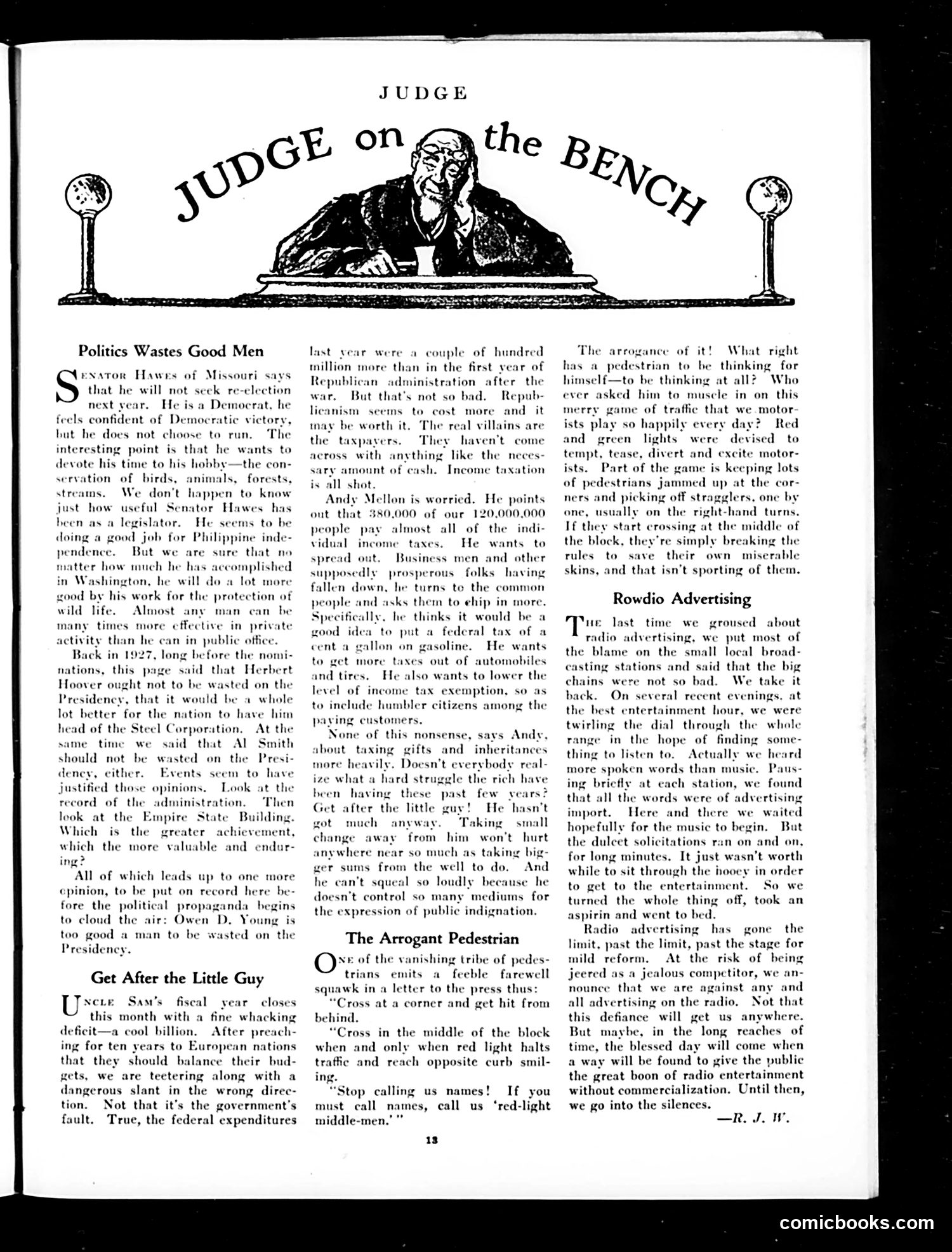
Judge Magazine Page Analysis This page from Judge satirizes three political/social issues: "Politics Wastes Good Men" criticizes that talented leaders like Senator Hawes abandon public service for private pursuits (wildlife conservation). The author argues even talented politicians might accomplish more outside government—citing Herbert Hoover's greater achievement building the Empire State Building than his presidency, and suggesting Owen D. Young shouldn't waste himself on the presidency. "Get After the Little Guy" mocks Treasury Secretary Andrew Mellon's tax proposals during economic crisis. Mellon wants to tax ordinary citizens (automobiles, gasoline, lower income exemptions) while protecting the wealthy from inheritance taxes. Judge ridicules this as punching down—the poor can't protest loudly because they lack media control. "The Arrogant Pedestrian" presents a letter from a pedestrian demanding respect while ironically violating traffic laws, mocking pedestrians who think independently rather than follow rules. The header illustration shows a judge on the bench—Judge magazine's satirical persona dispensing commentary on national affairs.
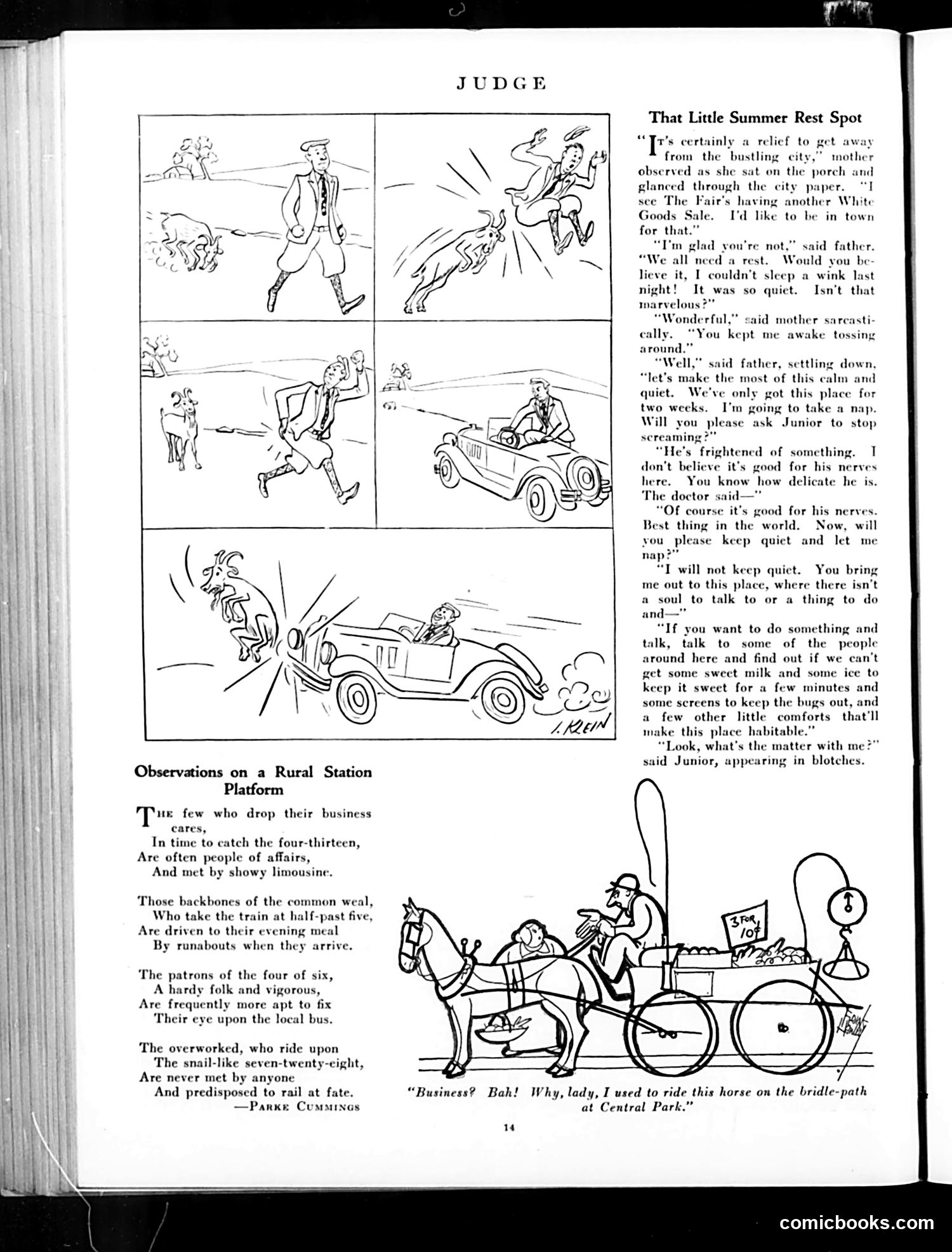
Analysis of Judge Magazine Page The page contains two separate satirical pieces: "Observations on a Rural Station Platform" (poem by Parke Cummings) mocks class distinctions in commuting. It describes how wealthy businessmen leaving at 4:13 PM arrive by "showy limousine," while middle-class workers at 5:30 take "runabouts," and the exhausted working poor boarding the 7:28 PM train receive no greeting at all—establishing a hierarchy of social worth based on departure time and means of arrival. "That Little Summer Rest Spot" depicts a family's failed vacation. Parents seek quiet rest at a country retreat, but their son Junior develops mysterious blotches (likely hives from stress or allergies), and mother demands entertainment and modern conveniences (ice, screens, socialization) that the rustic location cannot provide. The irony: the "restorative" vacation creates the opposite effect—anxiety and discomfort instead of relaxation. The bottom illustration jokes that even rural horse transport once served Manhattan's elite ("Central Park"). Both pieces satirize American class anxieties and the gap between vacation ideals and uncomfortable reality.
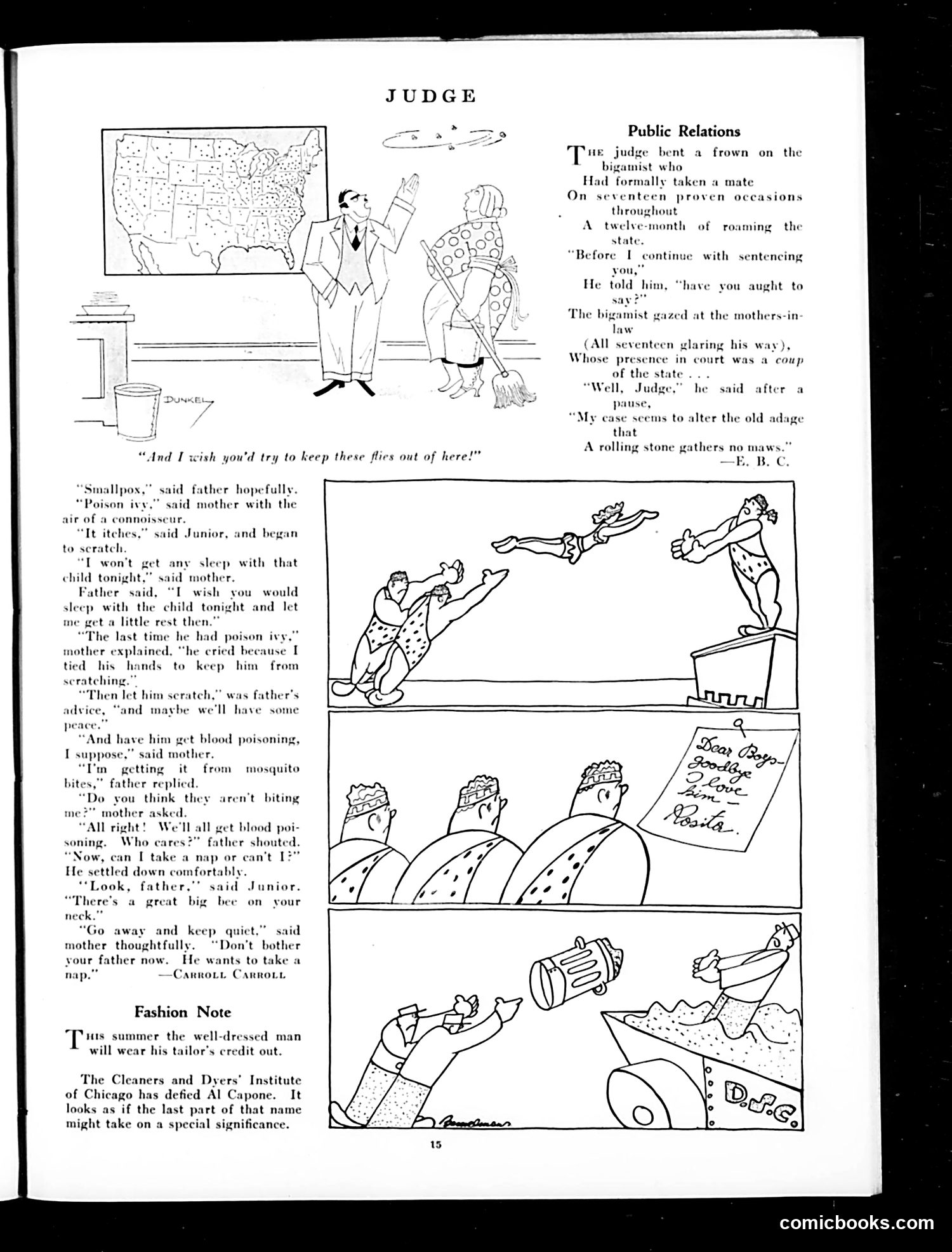
Analysis This page contains two distinct pieces: "Public Relations" (poem/cartoon): A satirical poem about a judge sentencing a bigamist who has married seventeen times over twelve months across different states. The humor lies in the absurdity: all seventeen mothers-in-law appear in court (described as "a coup of the state"), and the bigamist quips that his case disproves the saying "a rolling stone gathers no moss"—because he's gathered seventeen wives instead. It's social satire on both judicial lenience toward serial marriage and the man's shameless behavior. Domestic comedy sketch: A family arguing about their child's itching affliction (possibly smallpox or poison ivy). The father wants to nap while the mother and junior bicker about remedies and risks. The joke is mundane domestic frustration—typical period family humor about parental exhaustion. "Fashion Note": A brief comment that well-dressed men will exhaust their tailors' credit this summer; mentions Chicago's Cleaners and Dyers' Institute defying "Al Capone," likely a tongue-in-cheek reference to organized crime's reach into local businesses.
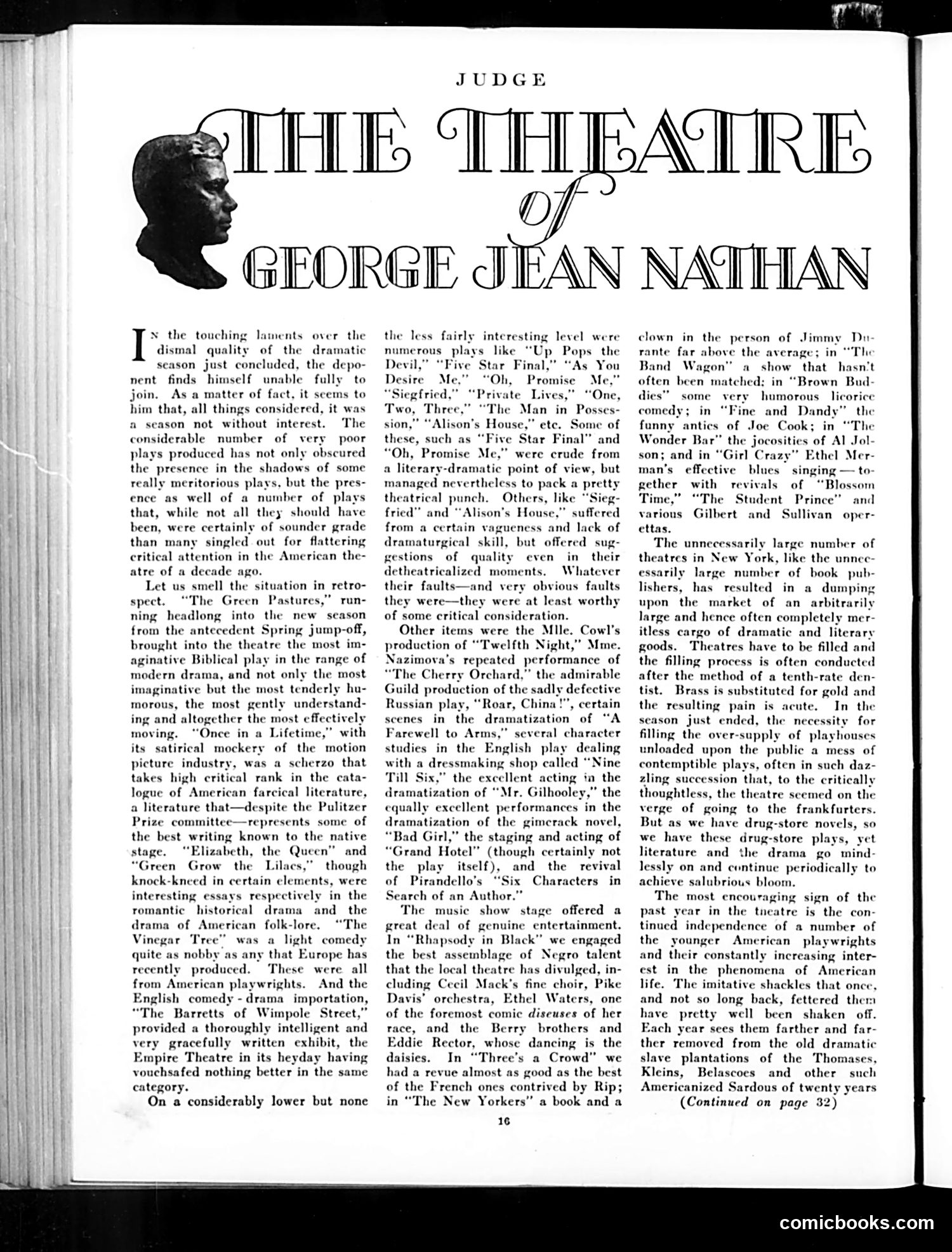
Analysis for Modern Readers This is a theater review essay, not a political cartoon. The author (identified as "Judge") defends the recently-concluded Broadway season against widespread criticism of its poor quality. The piece praises specific productions: *The Green Pastures* (a Biblical play), *Once in a Lifetime* (satirizing Hollywood), *Elizabeth, the Queen*, and *The Barretts of Wimpole Street*. It acknowledges lesser but still respectable plays like *Private Lives* and *Roar, China!* The satire targets American theater critics who unfairly dismiss entire seasons while overlooking genuinely meritorious work. The author argues that even mediocre plays sometimes succeed theatrically, and that the abundance of poor productions has simply obscured better work. Notable is the enthusiastic coverage of *Rhapsody in Black*, showcasing Black performers including Ethel Waters and the Berry Brothers—reflecting both the era's segregated entertainment landscape and Judge magazine's occasional progressive cultural commentary.
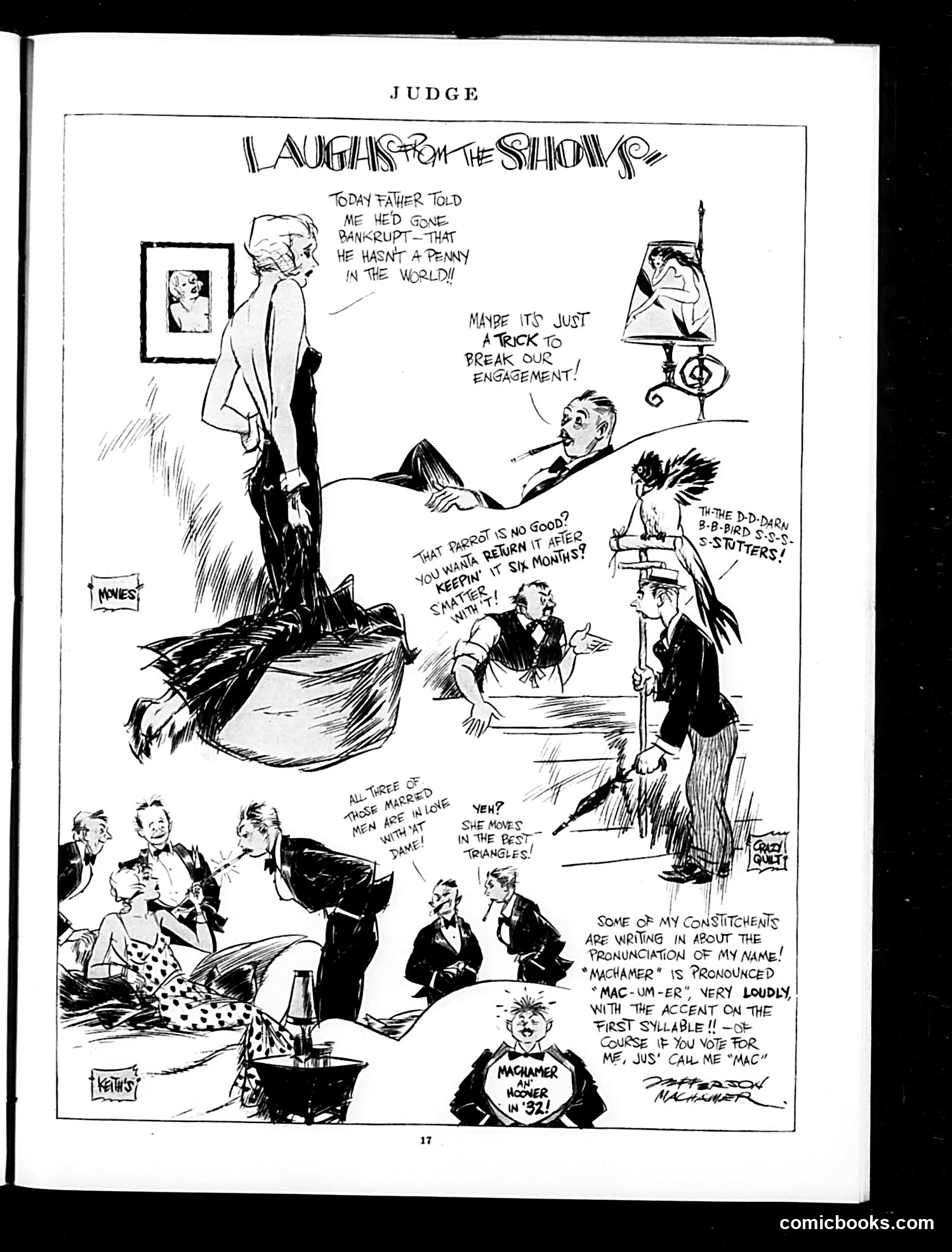
"Laughs from the Shadows" - Judge Cartoon Analysis This satirical cartoon mocks several social anxieties of its era. The central scene depicts a young woman dismissing her fiancé's bankruptcy announcement as a trick to escape their engagement—suggesting shallow materialism and broken trust in relationships during economic hardship. Lower panels show various characters, including what appears to be a political candidate (labeled "Machamer") obsessing over the pronunciation of his name for voters, satirizing political vanity and the performative nature of campaigning. The overall theme critiques superficiality: romantic partners prioritizing wealth over genuine commitment, and politicians prioritizing personal image over substance. The cartoon suggests these concerns reveal character flaws in both private and public spheres. The signature indicates this is by cartoonist Machamer, possibly making a self-deprecating joke about his own name pronunciation concerns.
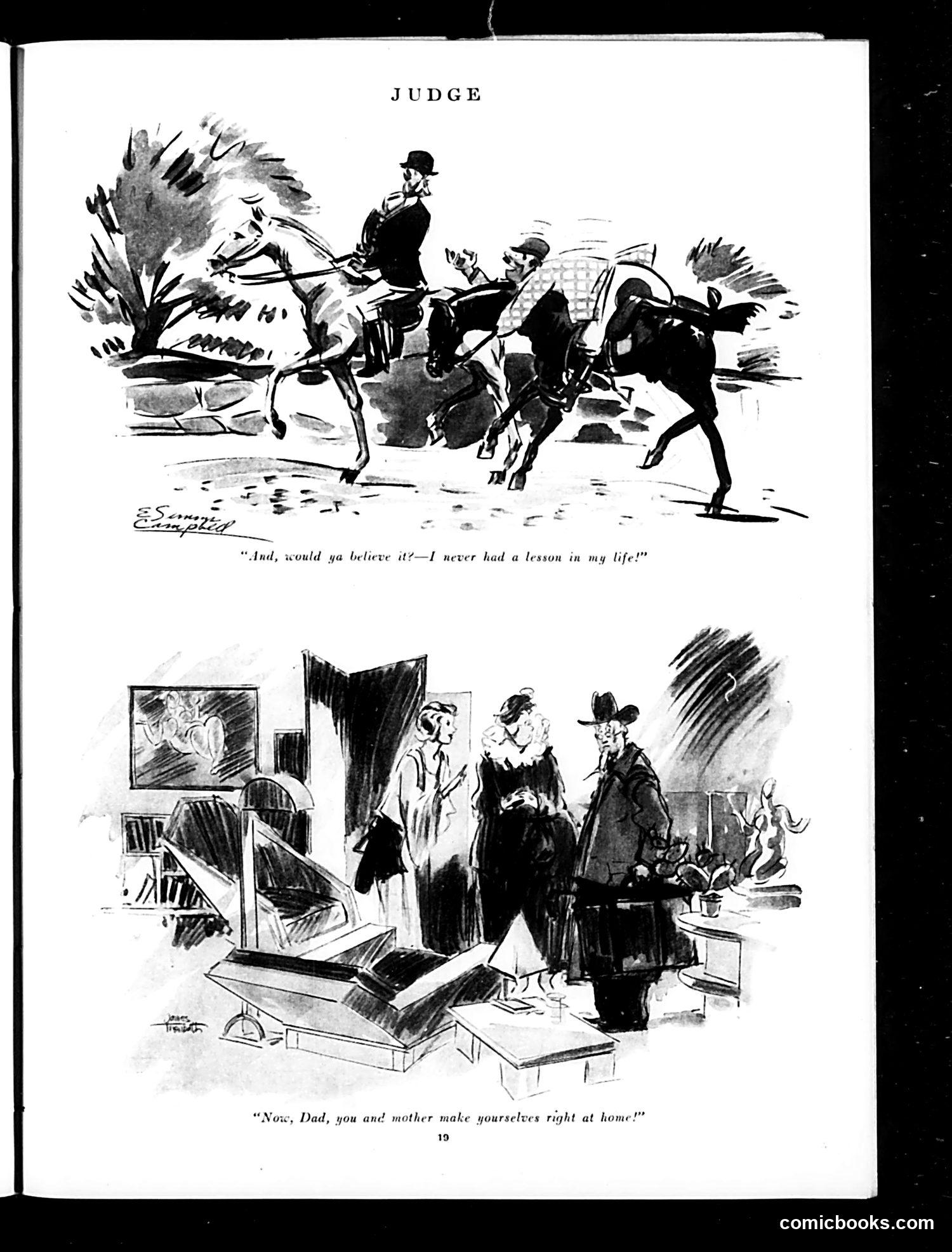
Judge Page Analysis This page contains two satirical cartoons about social hierarchy and domestic life. The top cartoon depicts a riding accident with the caption "And, would ya believe it?—I never had a lesson in my life!" It mocks someone of apparently lower social standing who has acquired wealth or status but lacks the refinement and training expected of the upper classes—specifically, horseback riding skill. The bottom cartoon shows what appears to be wealthy hosts telling their parents to "make yourselves right at home" in an elaborate interior. The satire targets newly rich individuals who condescend to or awkwardly entertain their working-class parents, implying discomfort with their origins despite newfound prosperity. Both cartoons satirize the pretensions and social anxieties of the newly wealthy, mocking their attempts to perform upper-class respectability while remaining disconnected from their humble origins.
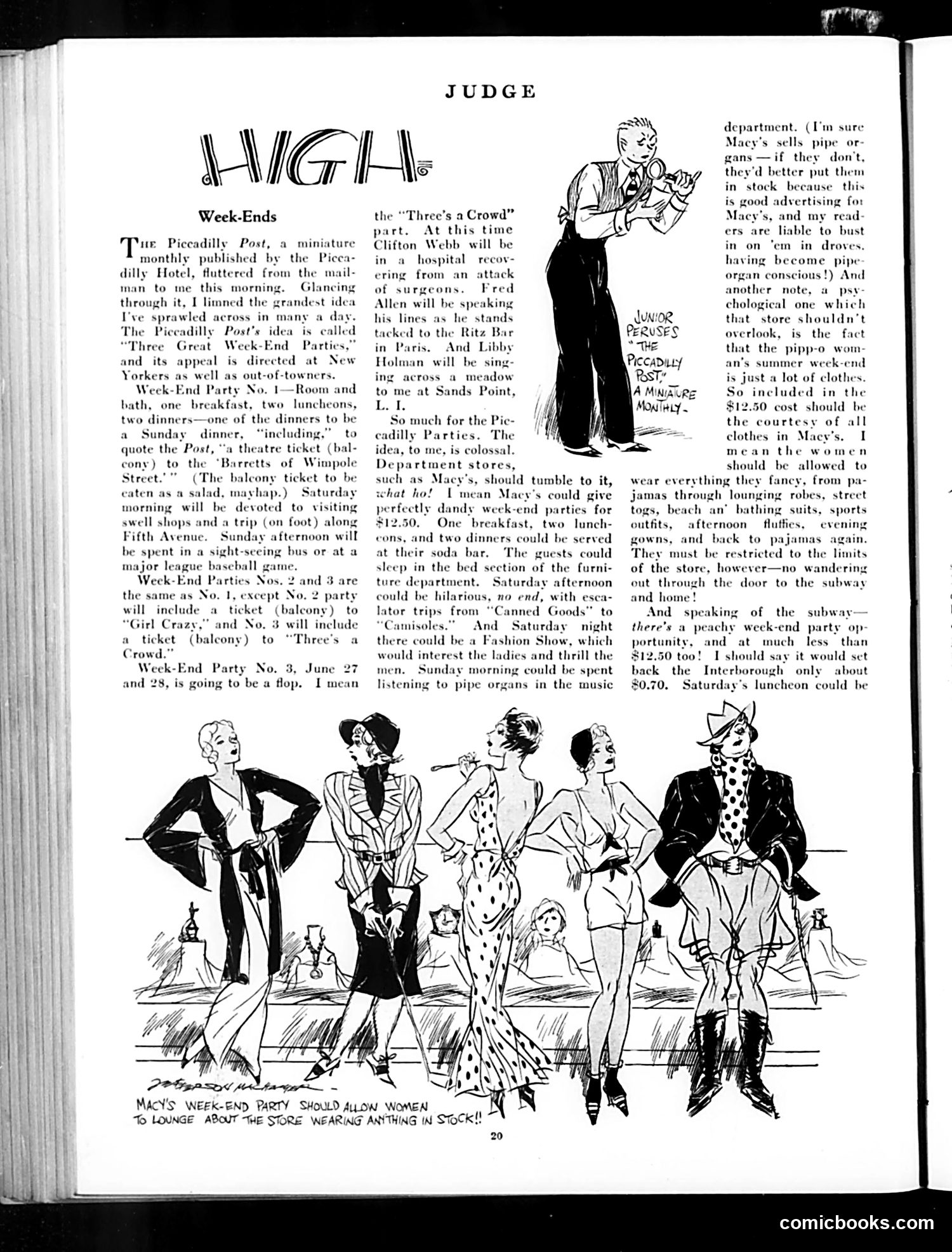
Analysis for Modern Readers This 1920s-30s satirical piece mocks luxury "week-end party" packages advertised by the Piccadilly Hotel. The columnist critiques their exclusivity and high cost ($12.50—expensive for the era), proposing instead that Macy's department store should offer competing packages at $0.70. The satire's key joke: women should be allowed to lounge in Macy's wearing any clothes from stock without purchasing them, trying on entire wardrobes for free under the guise of a "week-end party." The author argues this would be excellent advertising, as fashion-conscious women would "bust in on 'em in droves." References to Broadway shows ("Girl Crazy," "Barretts of Wimpole Street") and performers (Clifton Webb, Fred Allen, Libby Holman) ground the humor in contemporary entertainment culture. The accompanying illustration shows stylishly dressed women in various outfits—visualizing the proposal. The satire targets both luxury hotels' pretentiousness and suggests retailers' marketing opportunities by exploiting women's interest in fashion.
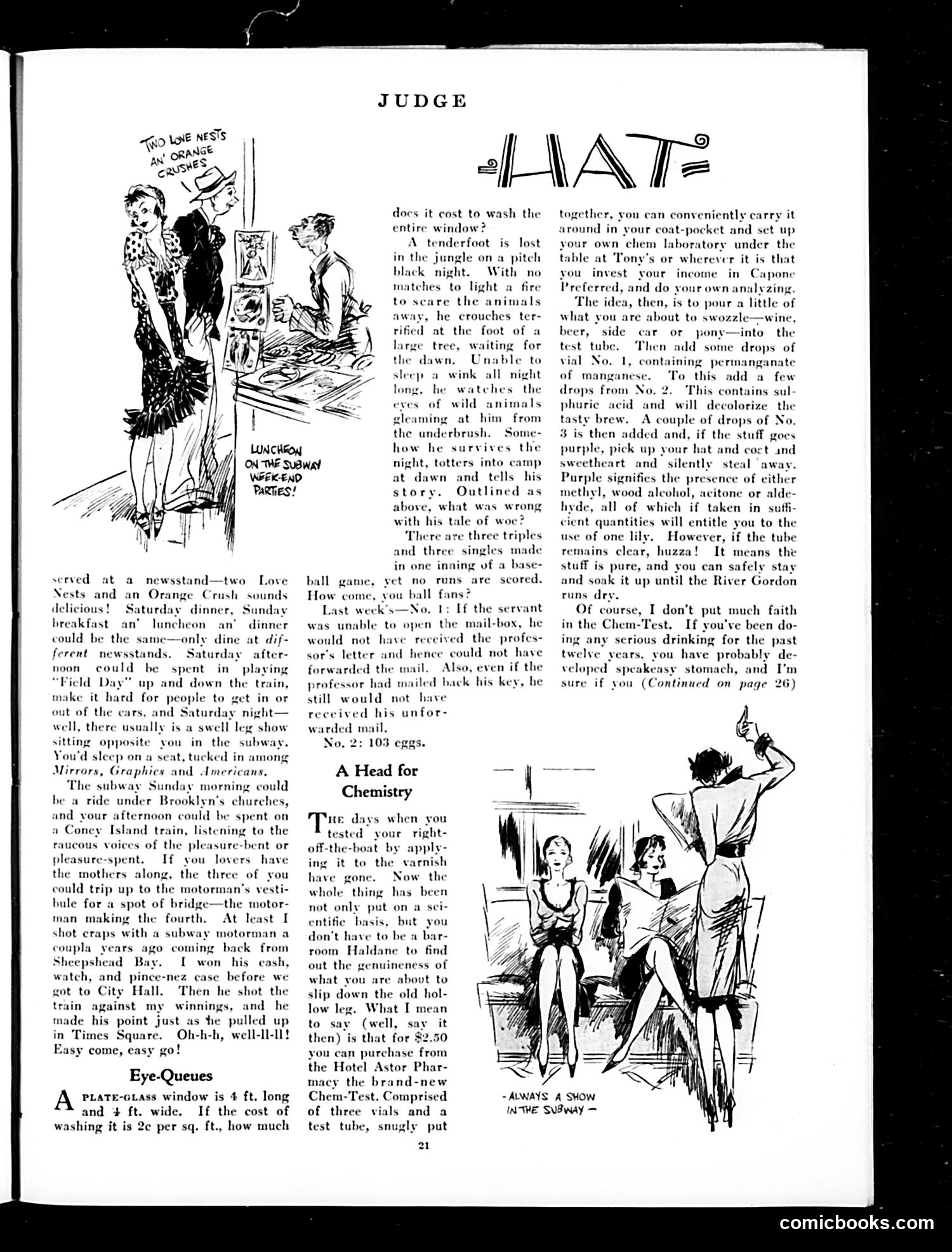
Judge Magazine Page Analysis This page from *Judge* satirizes Prohibition-era drinking culture. The main cartoon "A Head for Chemistry" mocks speakeasy patrons who use a portable "Chem-Test" kit to verify their illegal alcohol isn't poisoned or adulterated with dangerous substances like methyl alcohol or acetone—common contaminants in bootleg liquor during the 1920s-30s. The humor lies in the absurdity: sophisticated urbanites conducting amateur chemical tests at bars ("Tony's") to ensure their contraband is drinkable. The test involves vials and color changes—if liquid turns purple, it contains toxins; if it stays clear, it's "pure." The surrounding "Eye-Queues" section offers riddles and logic puzzles, typical *Judge* filler content. The overall satire critiques both the dangers of Prohibition (forcing people to drink unknown substances) and the era's casual attitude toward breaking the law—treating illegal drinking as a parlor game requiring amateur chemistry skills.
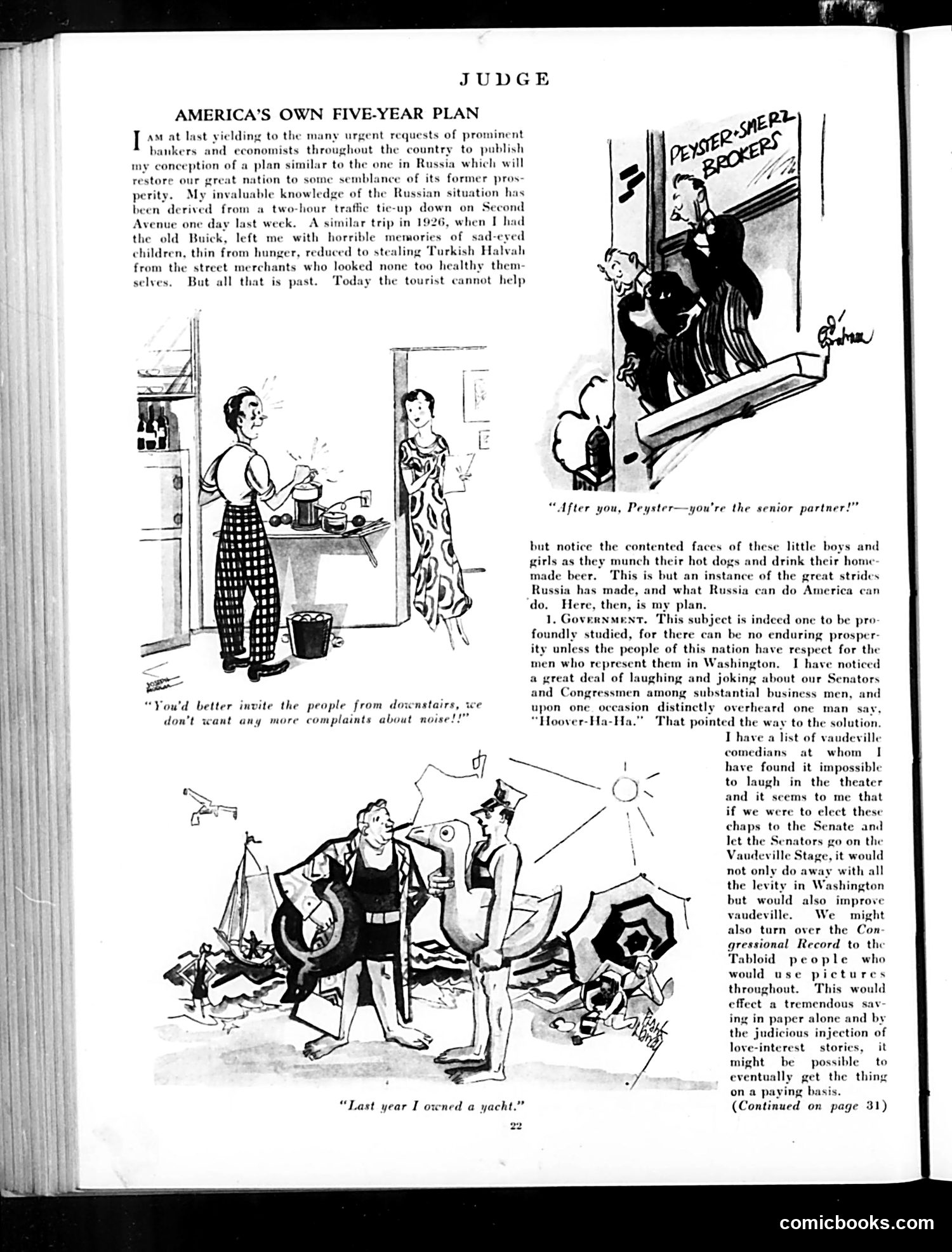
Judge Magazine Satire Analysis This 1920s-era piece satirizes both Soviet Russia's recent "Five-Year Plan" economic program and American politicians' credibility crisis. The author mockingly claims expertise in Russian affairs based only on a traffic jam on Second Avenue, immediately establishing the piece as absurdist commentary. The cartoons mock American capitalism and governance: one shows businessmen as greedy "penny-dreachers" (exploiters), another depicts a man bragging about owning a yacht—contrasting with Russia's supposed egalitarian prosperity. The central joke targets Congressional incompetence. The writer proposes replacing senators with vaudeville comedians, then converting the Congressional Record into a tabloid with pictures and love stories—implying Congress is already a joke and at least this would be honest entertainment and cost-effective. The piece uses ridicule to critique both American political dysfunction and the naive enthusiasm some Americans had for Soviet communism during this period.
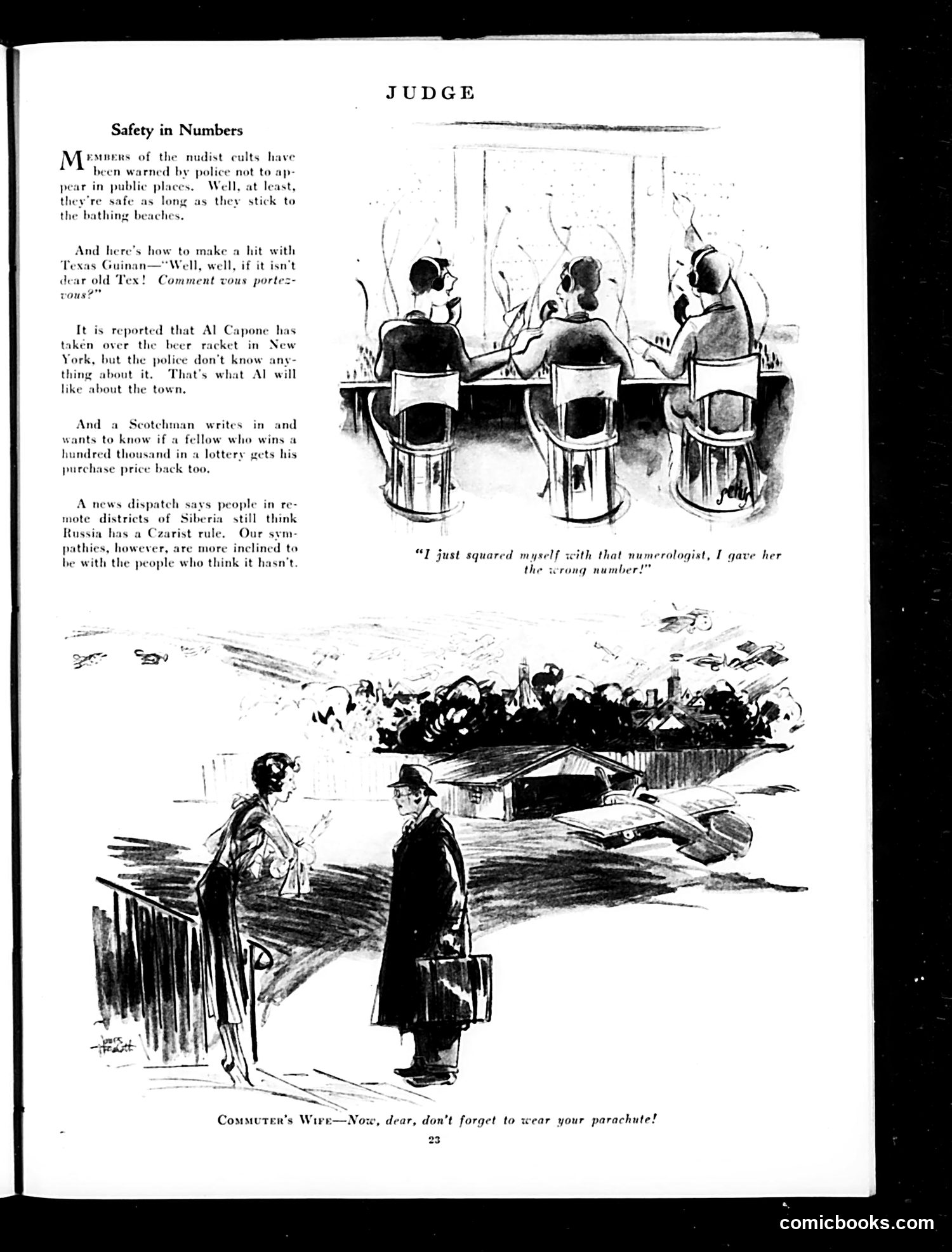
Judge Magazine Page Analysis This page contains two cartoons satirizing 1920s American life: Top cartoon ("Safety in Numbers"): Three men at a bar discuss romantic conquests. The joke references "Texas Guinan," a famous speakeasy hostess of the Prohibition era, known for her glamorous nightclub. The punchline mocks a man who consulted a numerologist (fortune teller using numbers) for dating advice but received wrong information—satirizing the era's fascination with pseudoscience and superstition among the wealthy seeking romantic success. Bottom cartoon ("Commuter's Wife"): A departing commuter's wife reminds him to wear a parachute, suggesting he commutes by airplane. This jokes about the novelty and danger of early aviation in the 1920s, when flying was still exotic and risky enough that such a warning seems absurdly routine. The text snippets mock Prohibition (Al Capone's beer operations), nudism movements, and Russian politics—typical Judge magazine commentary on contemporary scandals and trends.
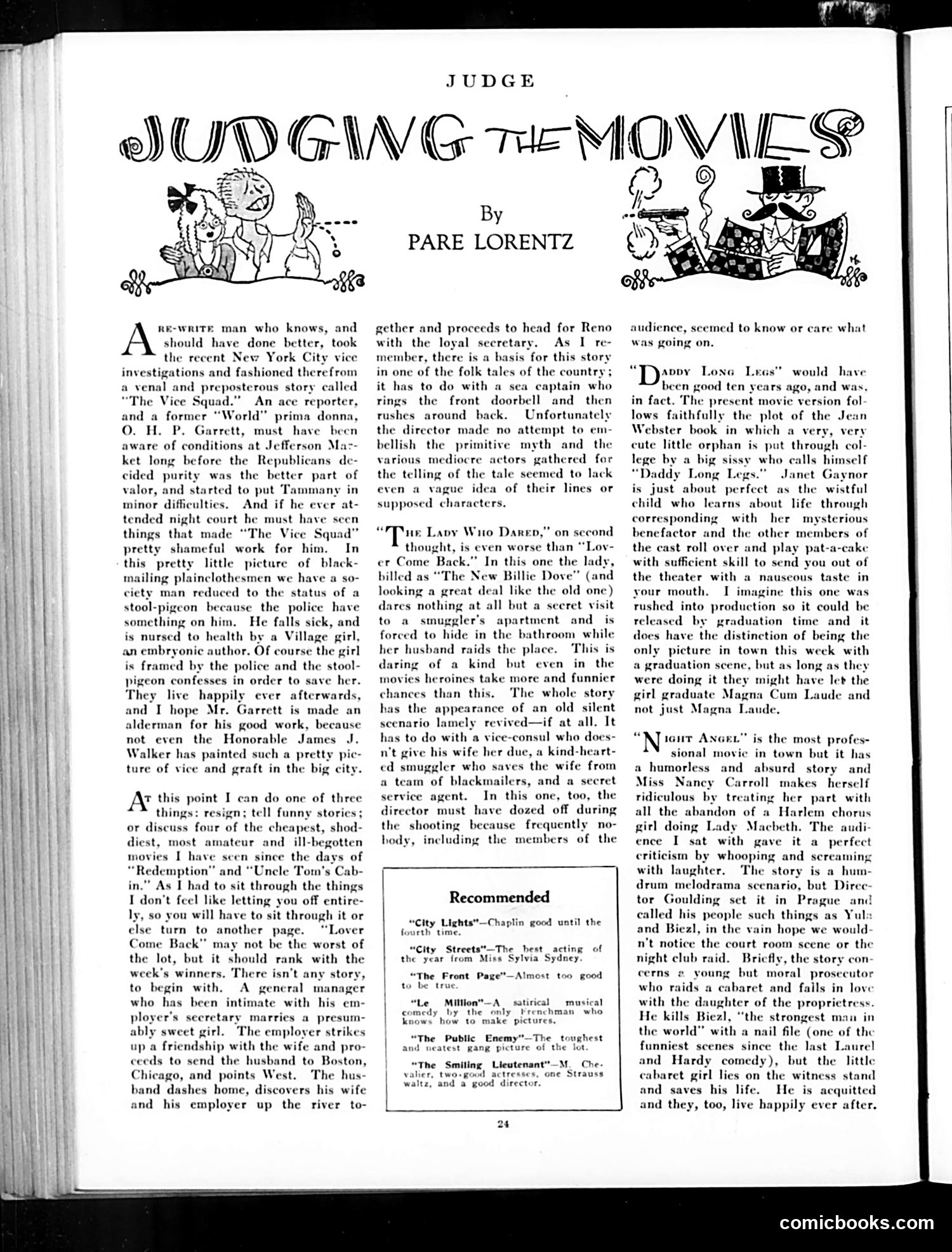
Judge Magazine Film Criticism: "Judging the Movies" by Pare Lorentz This is a film-review column critiquing recent Hollywood movies. Lorentz harshly dismisses several 1931 films as amateurish and poorly executed, despite their premises. He attacks "The Vice Squad" (about police corruption in New York City) as exploitative, noting that even Mayor Jimmy Walker—known for tolerating Tammany Hall graft—hasn't painted such an unflattering portrait of the city's vice and corruption. The irony cuts deep: if even the famously corrupt mayor thinks the depiction is exaggerated, the film's sensationalism is transparent. Other films criticized include "Lover Come Back," "The Lady Who Dared," and stories involving vice-consuls and smugglers—all deemed poorly directed and acted. The "Recommended" section praises Charlie Chaplin's "City Lights," Sylvia Sydney in "City Streets," and violent crime films like "The Public Enemy," suggesting contemporary audiences valued either slapstick comedy or gritty realism over melodramatic scandal narratives.
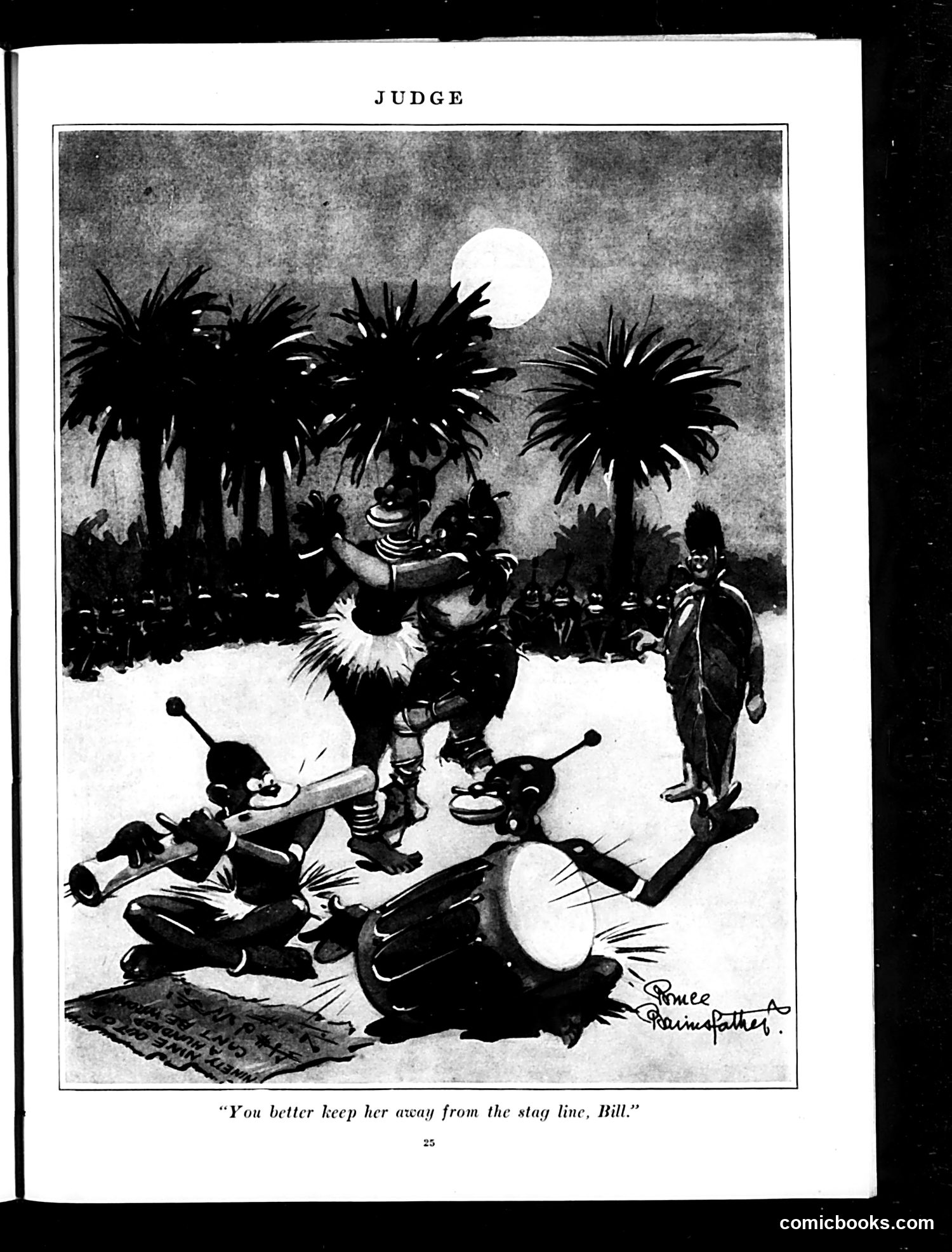
Judge Magazine Cartoon Analysis This cartoon depicts a humorous social situation at what appears to be a formal dance or party. A man named Bill is being warned to keep a woman away from the "stag line"—a group of unattached men waiting to cut in and dance with available partners. The cartoon's humor relies on the woman's appearance: she's drawn as an exaggerated, grotesque or unflattering figure, implying she's so unattractive that the stag line of men would avoid her entirely, making the warning absurd or ironic. The tropical setting with palm trees and moonlight suggests this may be set at a resort or vacation venue. The joke reflects early-to-mid 20th-century dating culture and social anxieties about attractiveness and social acceptance at dances.
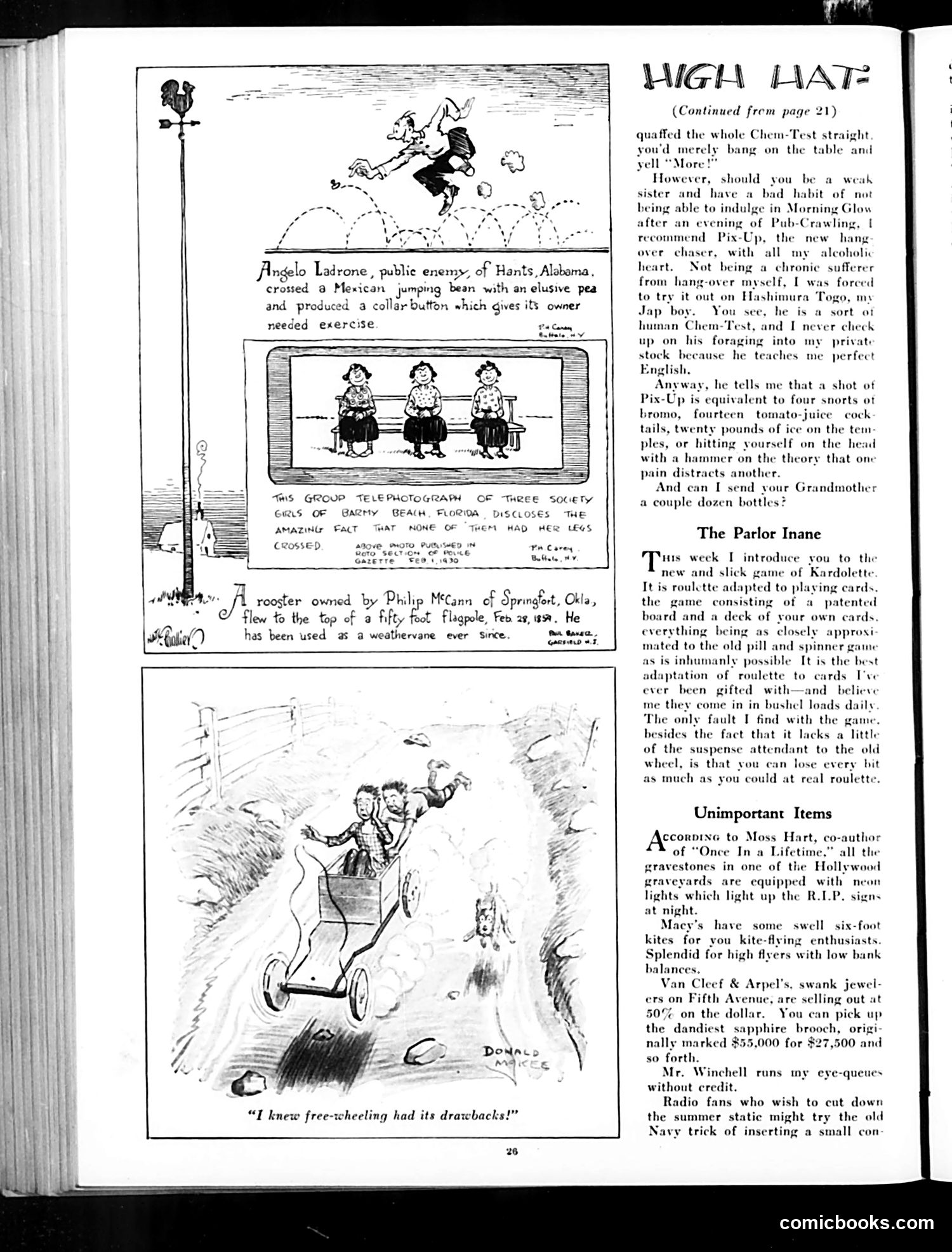
Judge Magazine Satire Analysis This page contains several humorous "news" items mocking absurd claims and products: Top cartoons: Fake stories about ridiculous inventions—a man crossing a jumping bean with a pea to create an exercise-inducing collar button; a rooster blown onto a flagpole and used as a weathervane; society women with no crossed legs (implying impropriety). These parody breathless tabloid reporting of the era. Right column: Advertisement-style satire promoting fake hangover remedies ("Pix-Up") and a card game called "Kardolette" (roulette adapted to cards). The author jokingly tests the hangover cure on his Japanese servant "Hashimura Togo," playing on ethnic humor common to 1920s-30s publications. Bottom section: Mock celebrity gossip and product endorsements, likely parodying gossip columnists and commercial hype. The satire targets consumer culture, sensationalist journalism, and the era's embrace of dubious patent medicines and schemes.
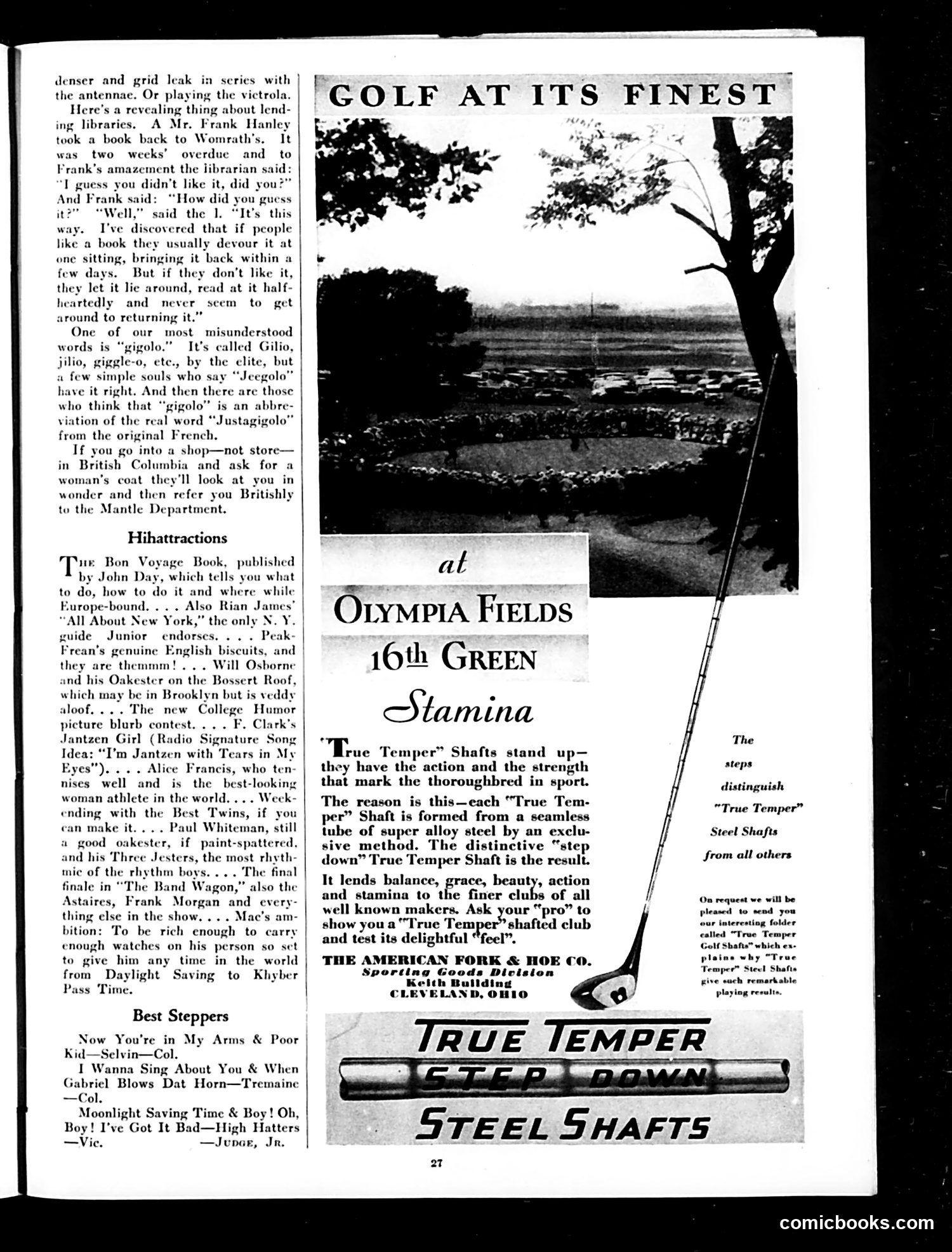
Analysis for Modern Readers This page is primarily advertising, not political satire. The main content is a full-page ad for "True Temper" golf club shafts (center-right), featuring a scenic golf course photograph labeled "Golf at Its Finest" at Olympia Fields' 16th green. The left column contains "Hihattractions"—brief entertainment gossip and cultural commentary typical of Judge magazine's light humor. References include radio personalities, Broadway shows ("The Band Wagon" with the Astaires), and 1920s-30s pop culture figures. These aren't satirical targets but rather the magazine's casual name-dropping of celebrities. The only sustained humor piece is a brief anecdote about library lending practices, explaining why people return books slowly if they dislike them. The "Best Steppers" section at bottom lists popular song titles of the era. This is essentially a magazine page mixing entertainment commentary with a sporting goods advertisement—representative of Judge's business model blending editorial content with paid promotions.
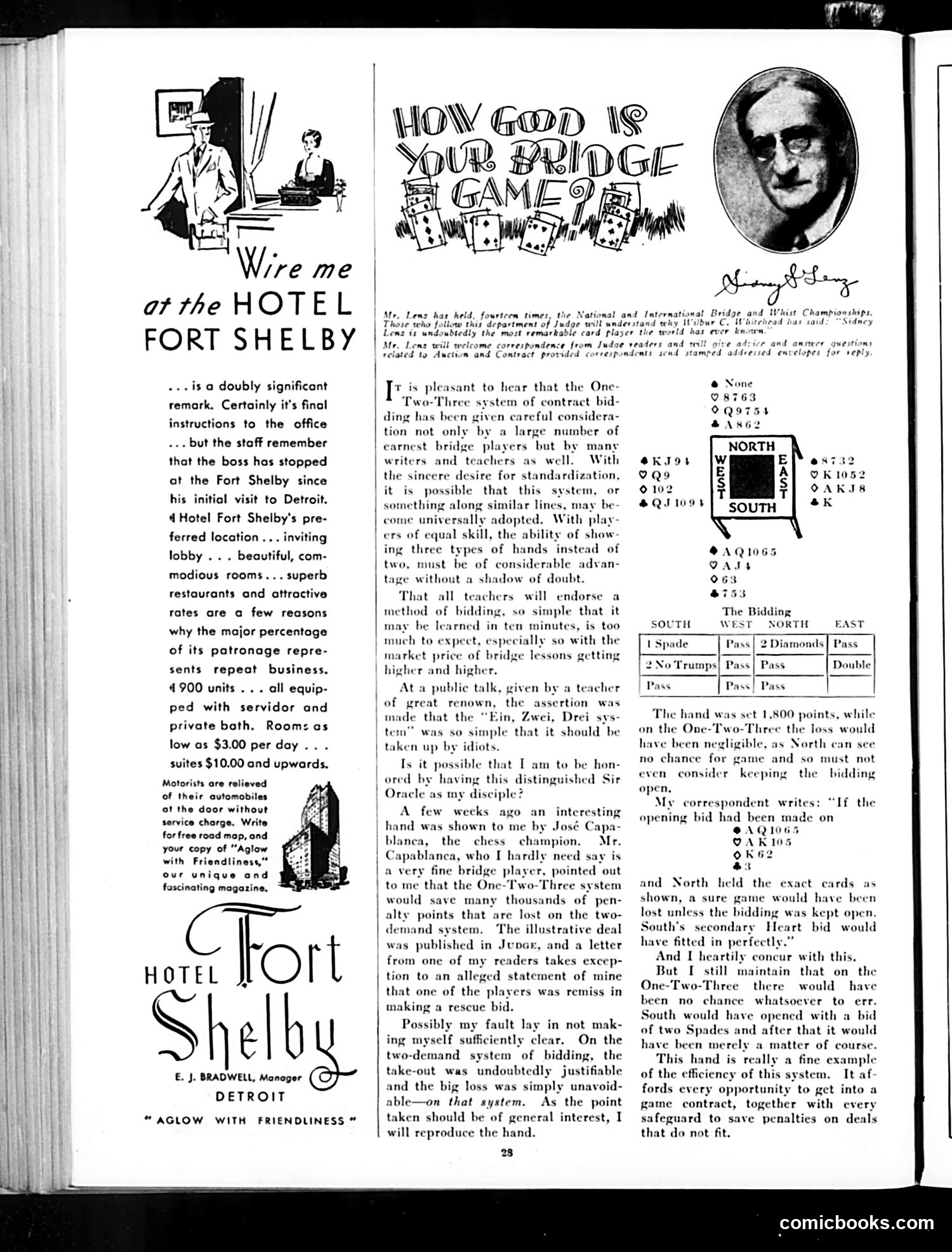
Analysis for Modern Readers This page mixes advertising with bridge card game instruction. The left side advertises the Hotel Fort Shelby in Detroit with a cartoon showing a businessman wiring the hotel—a period business reference establishing the hotel as a preferred destination for repeat clientele. The main content is a bridge column by someone identified as "Ely Culbertson" (visible in the masthead), discussing the "One-Two-Three" bidding system for contract bridge. The author defends this simplified bidding method against criticism, using a hand that José Capablanca (the famous chess champion, mentioned as also being "a very fine bridge player") allegedly showed him. The satire is gentle: the column playfully suggests that while the system is simple enough for "idiots" to learn in ten minutes, professional bridge teachers resist standardization because higher lesson fees depend on complexity. The bridge hand analysis and reader correspondence represent typical advice-column format of the era.
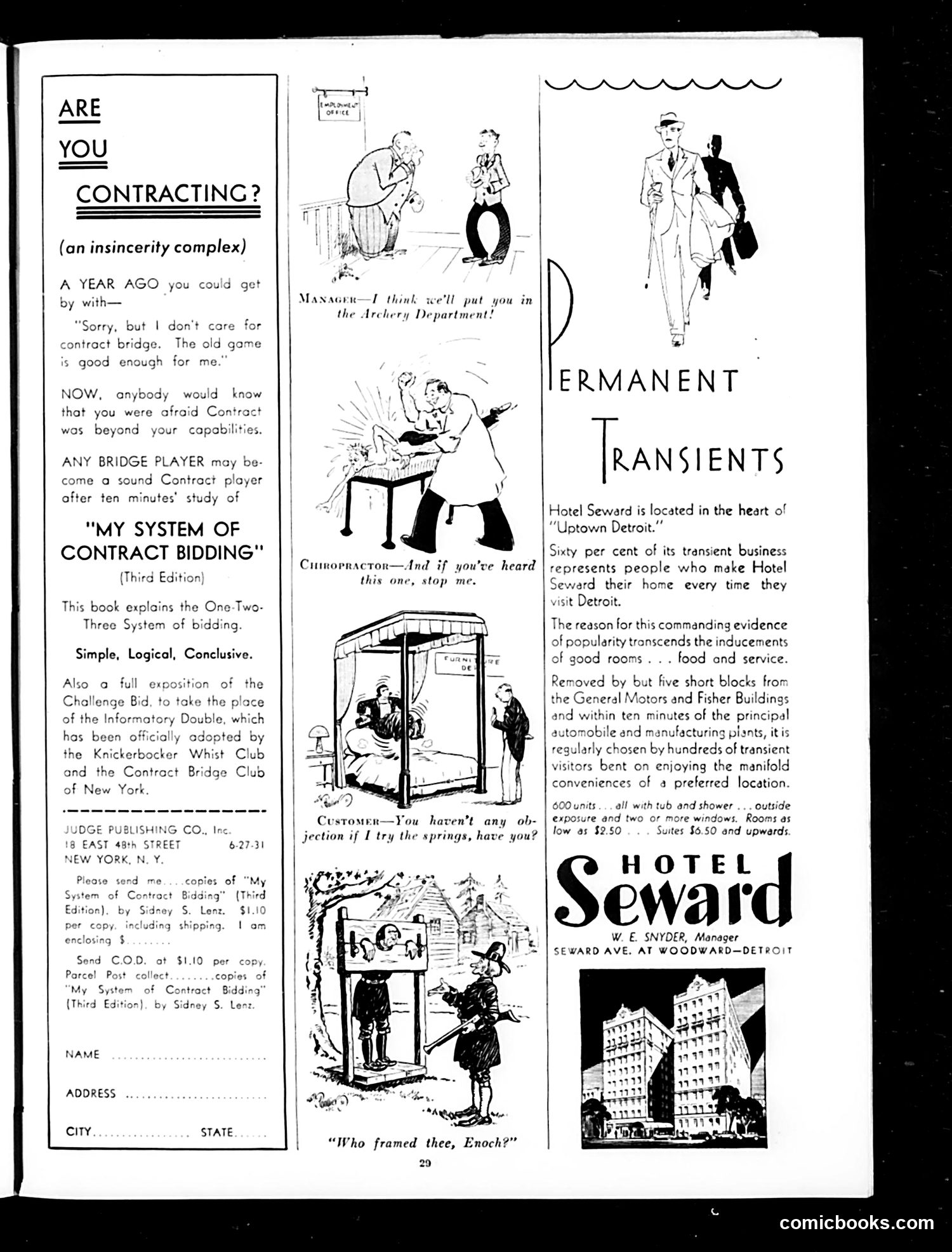
Judge Magazine Page Analysis This page combines social satire with advertising. The left side mocks the "insincerity complex" around Contract Bridge, a card game that became fashionable in the 1920s-30s. A year prior, people could dismiss bridge as uninteresting; now, claiming disinterest marks one as socially inadequate or fearful. The satire targets status anxiety—people feel pressured to master Contract Bridge to avoid appearing incompetent. The advertisement for "My System of Contract Bidding" exploits this anxiety, offering mastery through a simple system. The center cartoons humorously depict workplace situations involving misunderstandings or awkward moments (archery department placement, spring-testing, and "framing" someone named Enoch). The right page advertises the Hotel Seward in Detroit, emphasizing its appeal to regular transient visitors and proximity to major automotive manufacturing plants—targeting business travelers.
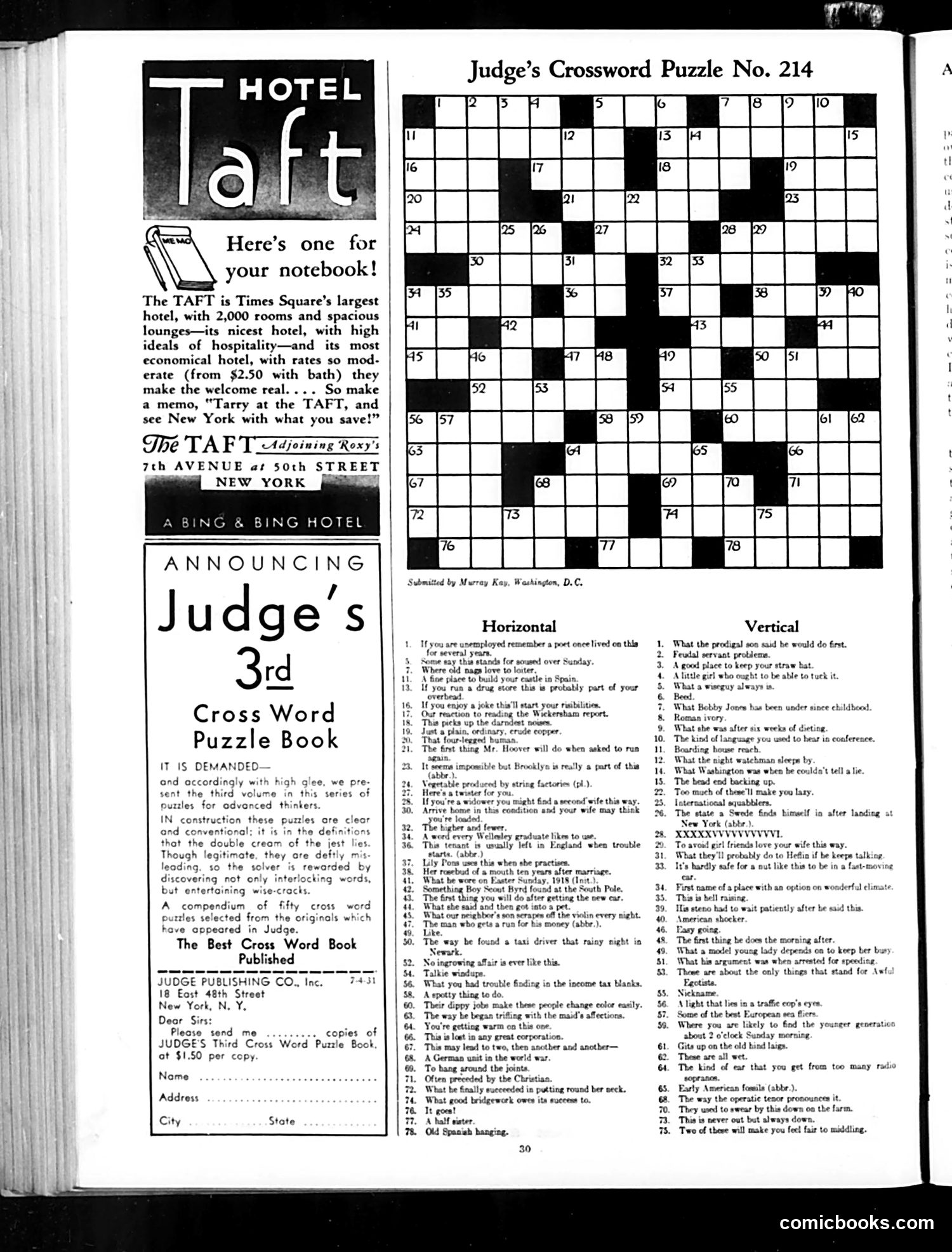
Judge Magazine Crossword Puzzle No. 214 This page is primarily advertising and puzzle content, not satirical cartoons. The top portion advertises the TAFT Hotel in Times Square, a 2,000-room establishment offering moderate rates ($2.50 with bath) during the economically conscious era—likely the 1930s Depression period. The main content is Judge's 3rd Cross Word Puzzle Book announcement, soliciting orders at $1.50 per copy. The puzzle itself uses wordplay and contemporary references typical of Judge's style: puns, cultural allusions, and witty definitions ("If you enjoy a joke this'll start your risibilities"). References include Prohibition-era humor ("soused over Sunday"), political figures (Hoover, Wickersham Report), and popular culture (Bobby Jones, Lily Pons). The puzzles were designed to be "entertaining wise-cracks" hidden within traditional crossword construction. This represents Judge's commercial expansion into puzzle books, capitalizing on the crossword craze's popularity.
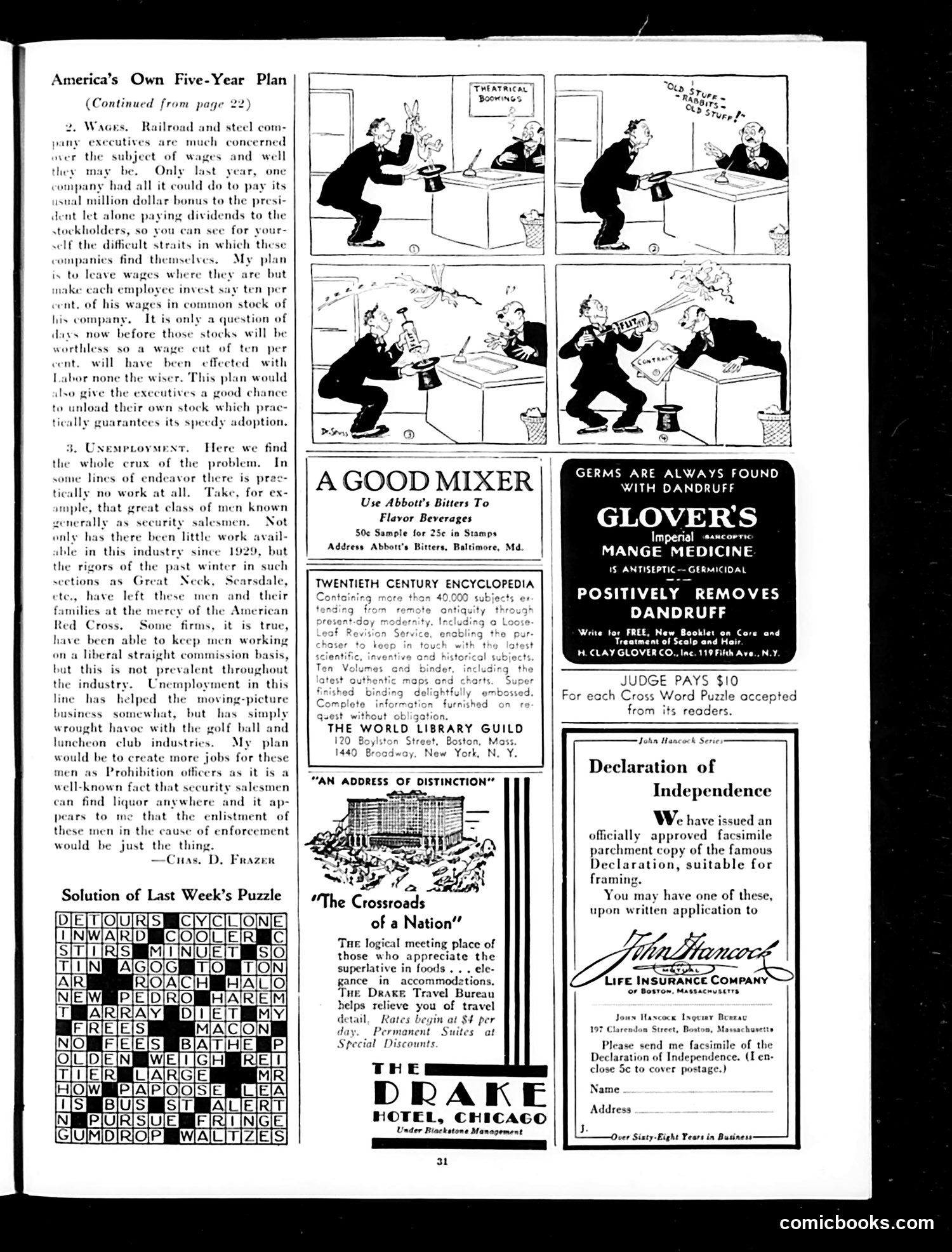
Political Satire: "America's Own Five-Year Plan" This multi-panel cartoon satirizes corporate executives' financial schemes during the Depression era. The title parodies Stalin's Soviet "Five-Year Plan," suggesting American capitalists employ equally dubious strategies. The scheme depicted: An executive proposes forcing workers to invest 10% of wages in company stock. The satire's point: the stocks will soon become worthless, effectively cutting wages by 10% while management unloads their own holdings at workers' expense. The cartoon shows the executive's gleeful realization that this will "guarantee speedy adoption" by other executives. Social context: The piece reflects 1930s anger at corporate malfeasance during economic collapse. It references the 1929 crash's aftermath, unemployment among "security salesmen" (stock brokers), and the hypocrisy of executives claiming poverty while paying themselves bonuses. The final section jokes that unemployed salesmen should become Prohibition officers—a cynical dig at the futility of Depression-era solutions and the ease of finding illegal alcohol despite Prohibition enforcement.
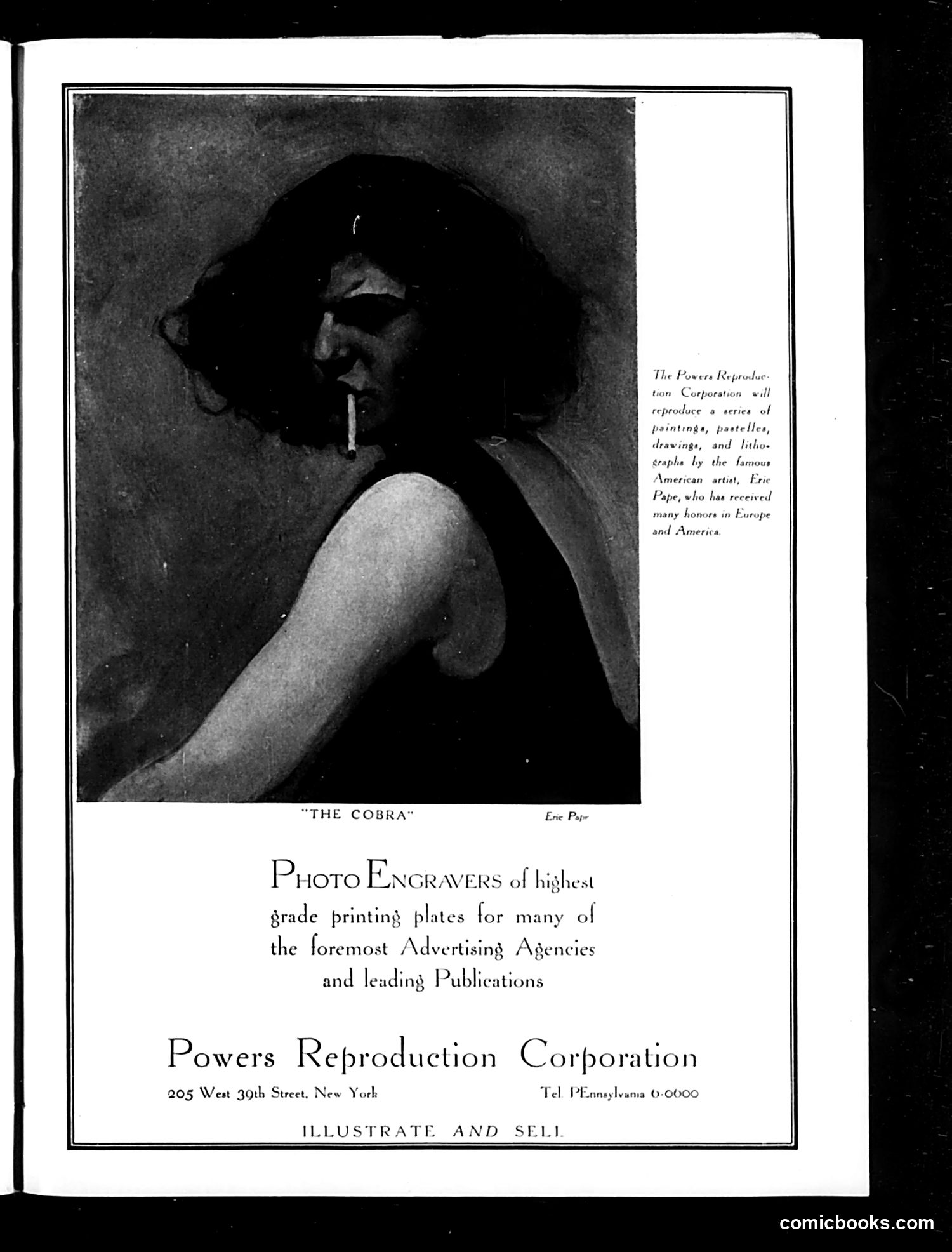
Analysis This page is primarily an advertisement, not editorial content. It showcases a dramatic artwork titled "The Cobra" by artist Eric Pape, depicting a woman in profile with a cigarette, wearing dark clothing against a shadowy background. The advertisement promotes the Powers Reproduction Corporation, a photo-engraving service that produced printing plates for advertising agencies and publications. The image serves as a sample of their reproduction quality—demonstrating their ability to capture fine detail and dramatic lighting in artwork for commercial use. There is no political satire on this page. It's a straightforward trade advertisement leveraging Pape's reputation as an accomplished American artist (noted as having "received many honors in Europe and America") to market their printing services to potential clients in the advertising industry.
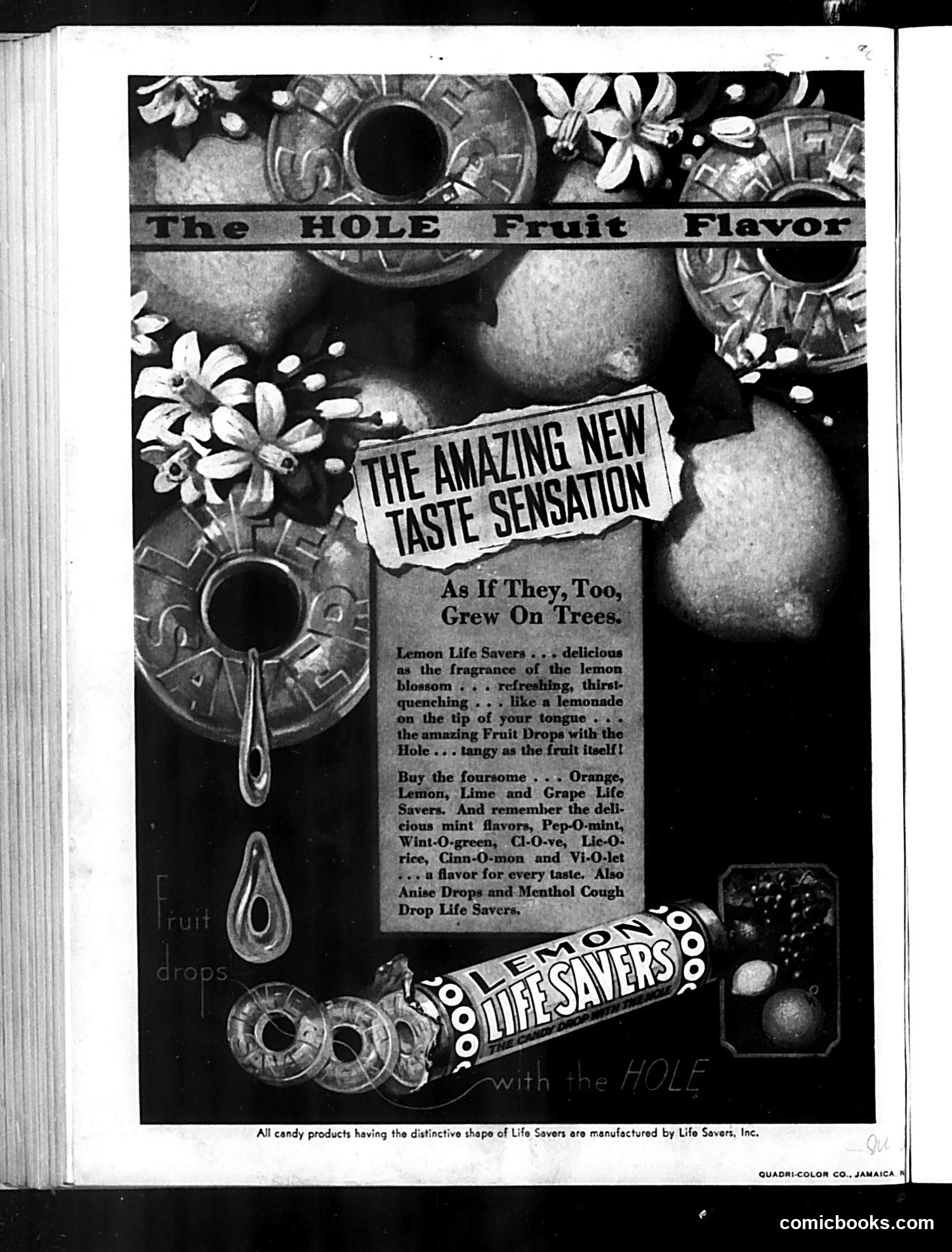
Analysis This is not a political cartoon or satirical content—it's a vintage advertisement for Life Savers candy, specifically promoting their "Hole Fruit Flavor" variant with the tagline "The Amazing New Taste Sensation." The ad emphasizes the candies' distinctive hole design and lists available flavors: Lemon, Orange, Lime, Grape, plus mint varieties (Pep-O-mint, Wint-O-green, Cl-O-ve, Lie-O-rice, Cinn-O-mon, Vi-O-let). It also mentions Anise Drops and Menthol Cough Drop Life Savers. The copy uses playful language ("As If They, Too, Grew On Trees") to suggest natural fruit flavoring. The page is primarily commercial content aimed at candy consumers, not political or social commentary.

I can see this appears to be a blank or nearly blank page from a Judge magazine issue, with only "comicbooks.com" visible at the bottom. The page contains no discernible cartoon imagery, text content, or satirical commentary that I can reliably identify. Without visible political figures, captions, or cartoon panels to analyze, I cannot determine what social or political references this page might contain. This could be a blank page, a title page, an advertisement page, or a scanning artifact where the original content did not reproduce clearly. To provide accurate historical context and explanation as requested, I would need a page with legible cartoon imagery or text content visible.