judge
Judge — July 4, 1931
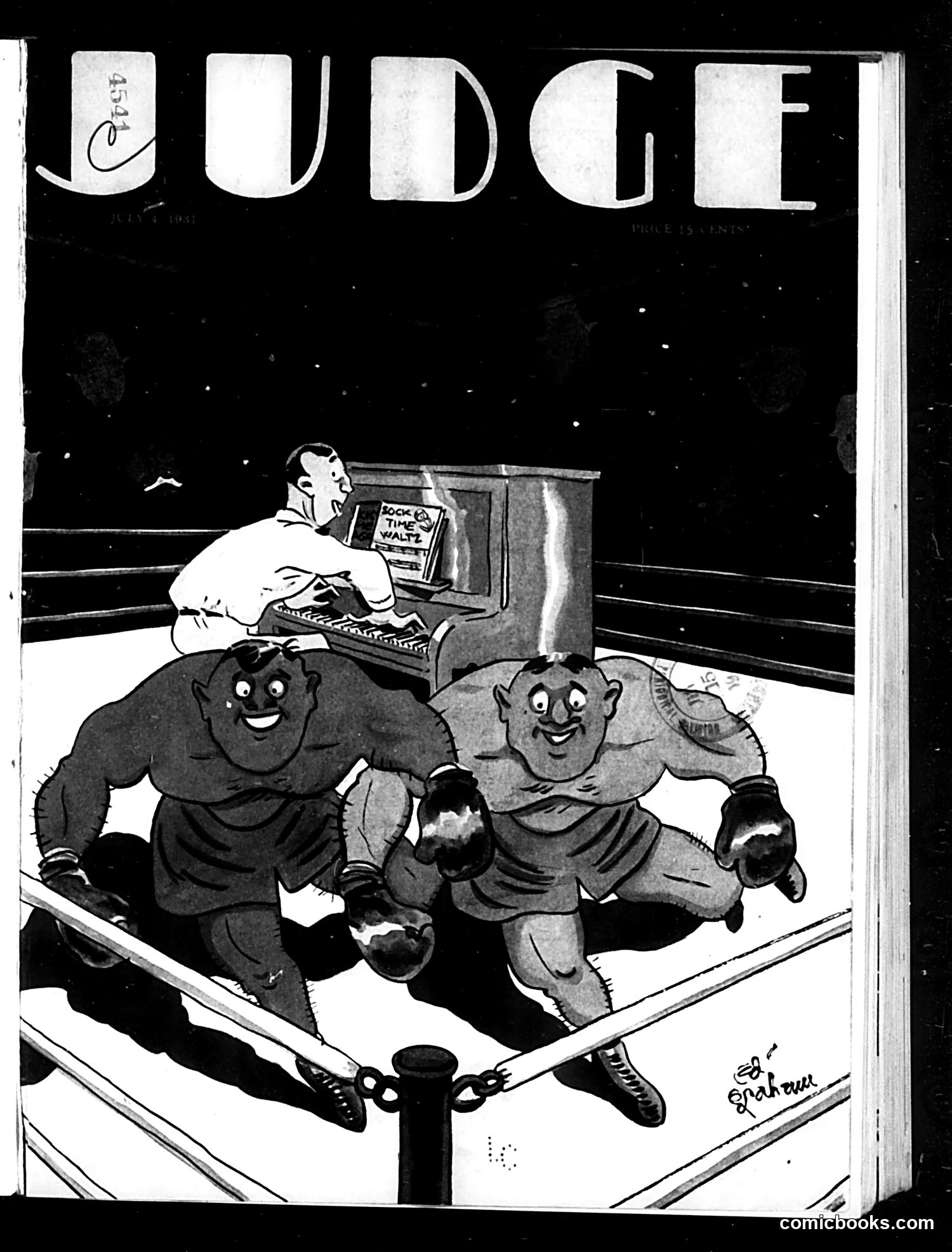
Judge Magazine Cartoon Analysis This cartoon depicts a boxing ring scene with two caricatured Black boxers in the foreground, grinning widely while holding boxing gloves. A white pianist sits at an upright piano labeled "ROCK & TIME WALTZ" in the background. The satire appears to comment on the novelty and spectacle of Black participation in professional boxing during the early-to-mid 20th century. The exaggerated facial features and the incongruous piano player suggest Judge magazine's satirical treatment of race and entertainment. The "rock and time waltz" likely references popular music trends of the era. The cartoon reflects period attitudes treating Black athletes as objects of entertainment and caricature rather than serious competitors—typical of Judge's satirical but often racially insensitive content.
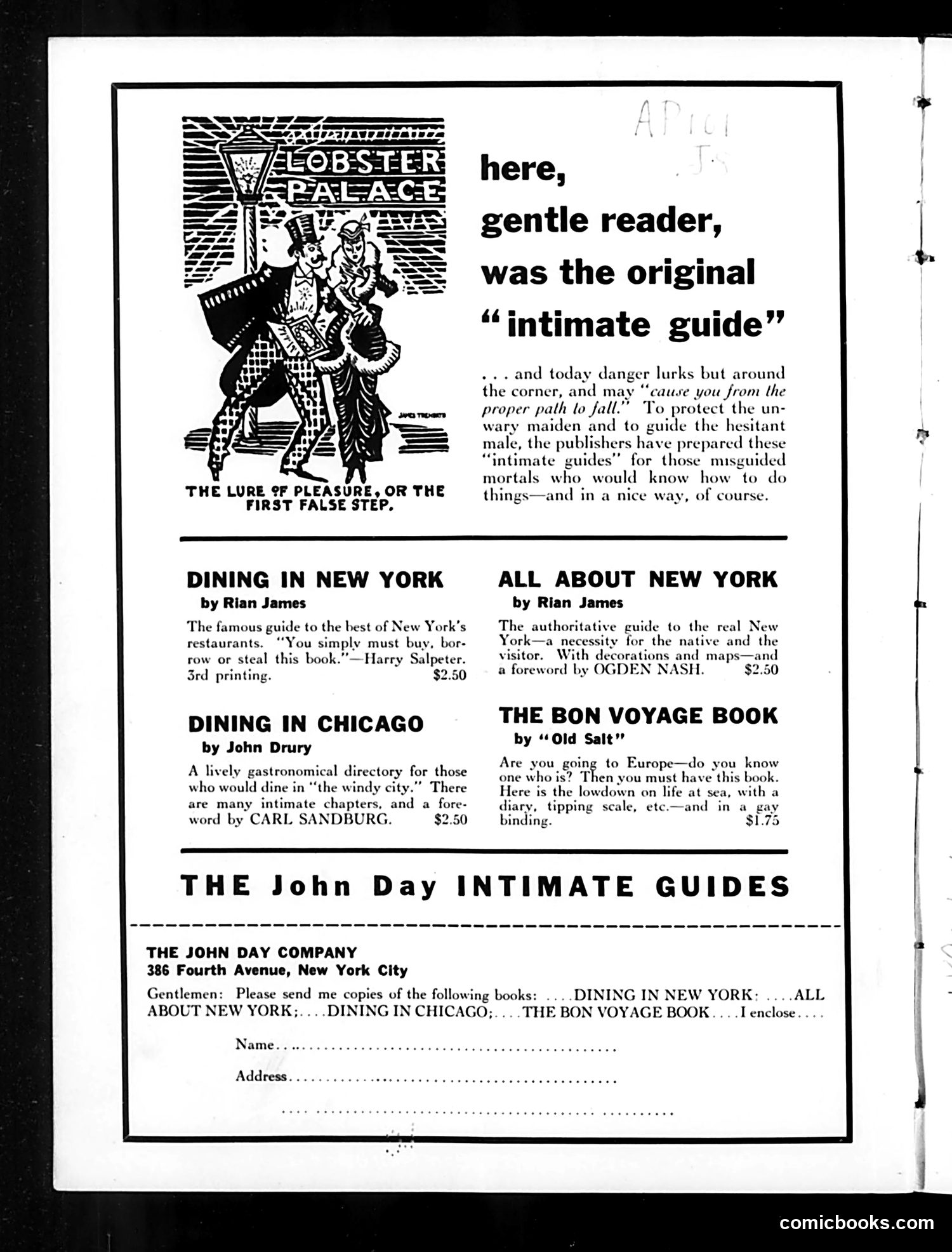
Analysis of Judge Magazine Page This page is primarily advertising for John Day Company's "Intimate Guides" book series, with minimal satirical content. The header illustration titled "The Lure of Pleasure, or The First False Step" depicts a moralistic scene of seduction—a well-dressed man and woman, likely representing vice and temptation. The accompanying text uses ironic language ("gentle reader," "wary maiden") to mock the prudish conventions of "intimate guides"—advice books marketed to warn young people about moral dangers. The ads below promote dining guides and travel books, suggesting these were practical reference works. The satire is subtle: Judge appears to be gently mocking the earnest, moralizing tone of these self-help publications that claimed to protect readers from "improper paths." The page reflects early-20th-century anxieties about urban vice and the market for cautionary literature.
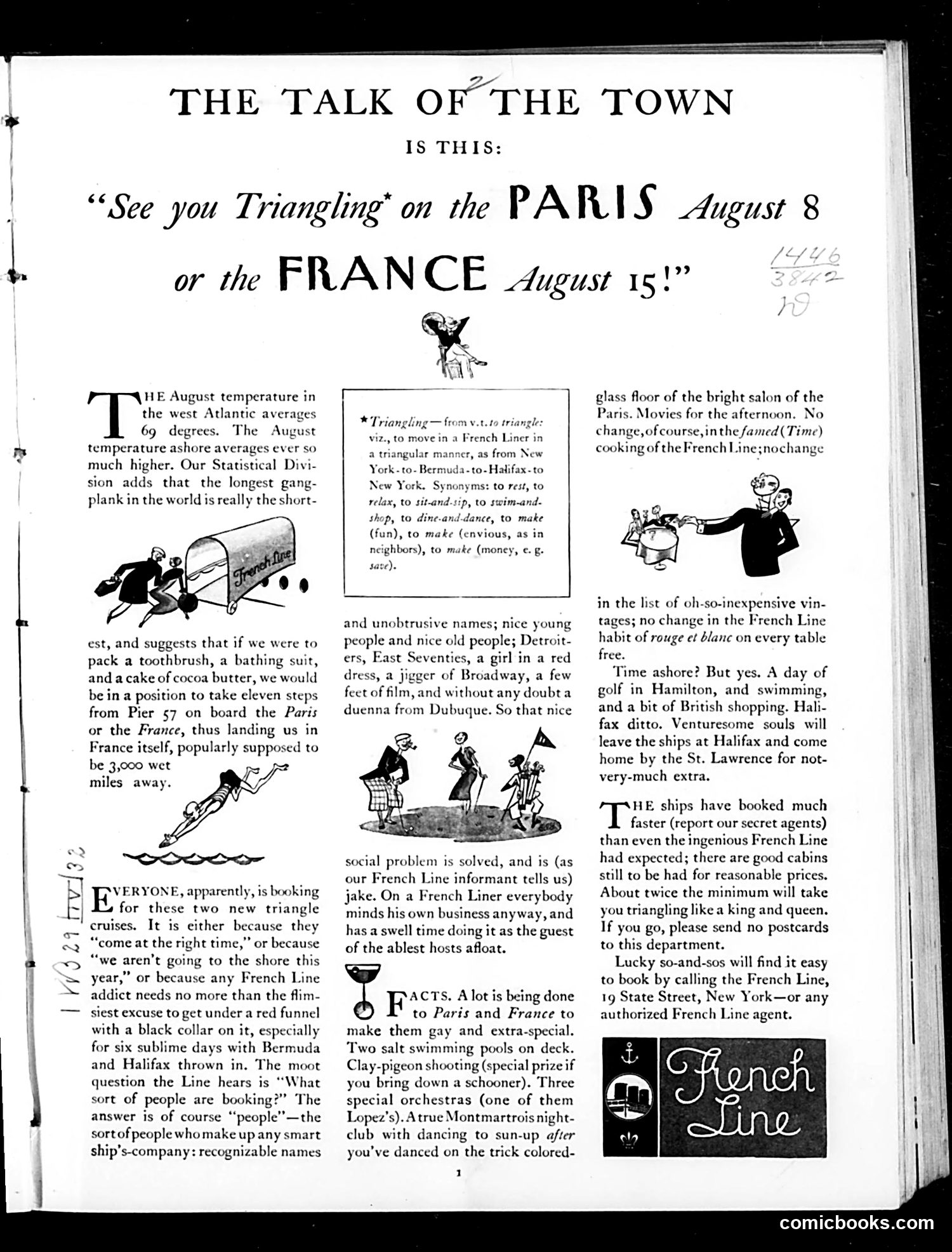
Analysis This page is primarily advertising for French Line cruise ships, not political satire. The headline promotes two new transatlantic cruises: the *Paris* (August 8) and *France* (August 15). The humor is light and promotional rather than satirical. The cartoons show: 1. A man being launched from a ship's cannon labeled "French Line"—joking that booking saves money versus other travel methods 2. Various passengers (tourists, businesspeople, a "jigger of Broadway") representing the diverse clientele 3. A couple dancing, illustrating onboard entertainment The "talk of the town" frames these cruises as fashionable and desirable social activities. The satire gently mocks people's eagerness to book passage and pokes fun at the ship's democratic mixing of social classes. This reflects 1920s-30s advertising that presented luxury travel as accessible leisure.
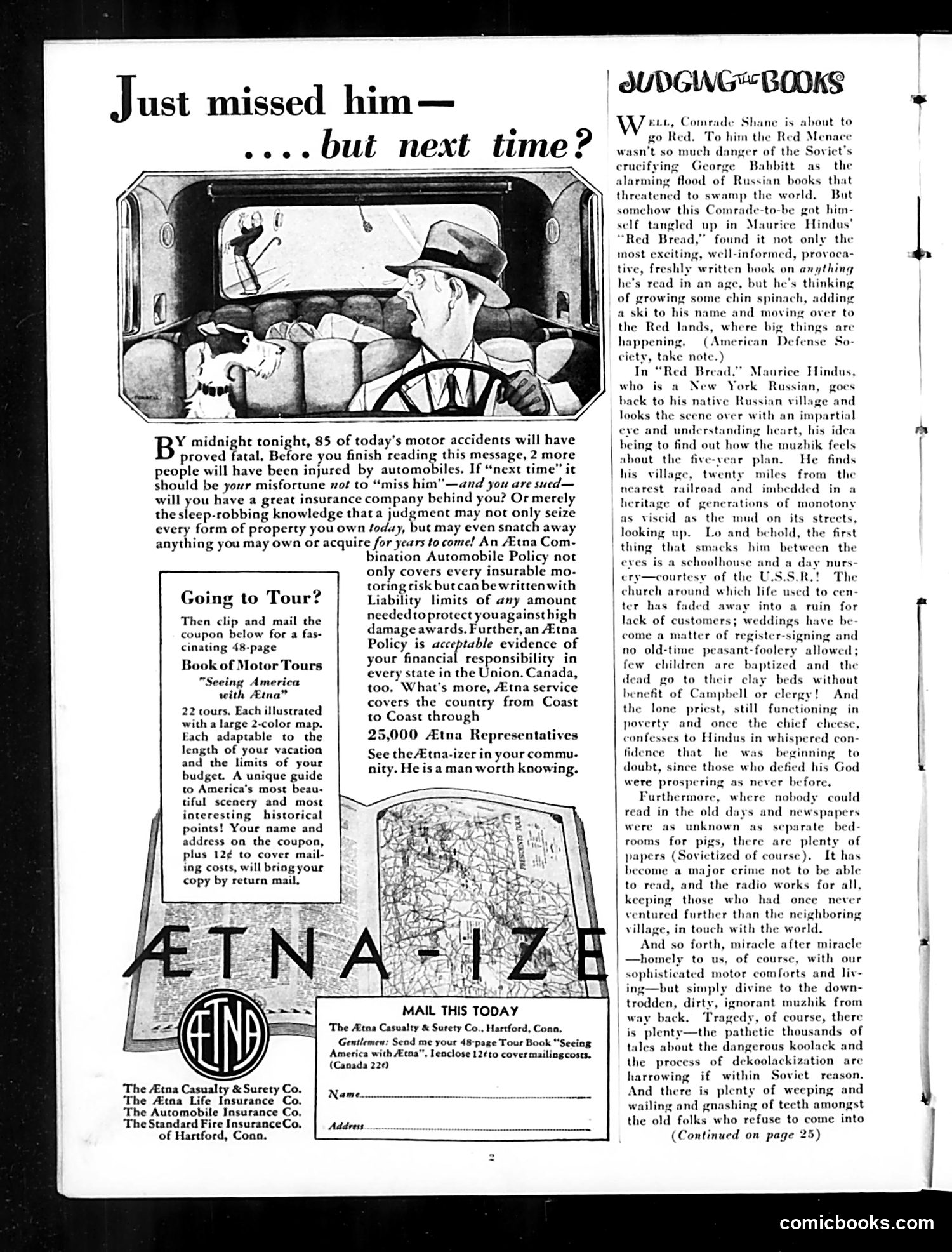
"Just Missed Him" - Judging the Books This page combines a traffic safety advertisement with a book review. The cartoon shows a car driver narrowly avoiding a pedestrian, illustrating the magazine's opening warning: "85 of today's motor accidents will have proved fatal" by the time readers finish the page. The "next time" you might not be so lucky—hence the pitch for Ætna automobile insurance. The book review critiques Maurice Hindus's *Red Bread*, praising it as an exciting, well-informed account of Soviet Russian life. The reviewer notes Hindus, a New York Russian, returns to his native village and discovers miraculous changes: schools, churches functioning, and radios connecting isolated communities to the wider world. The tone is cautiously optimistic about Soviet modernization, unusual for American anti-communist sentiment of the era.
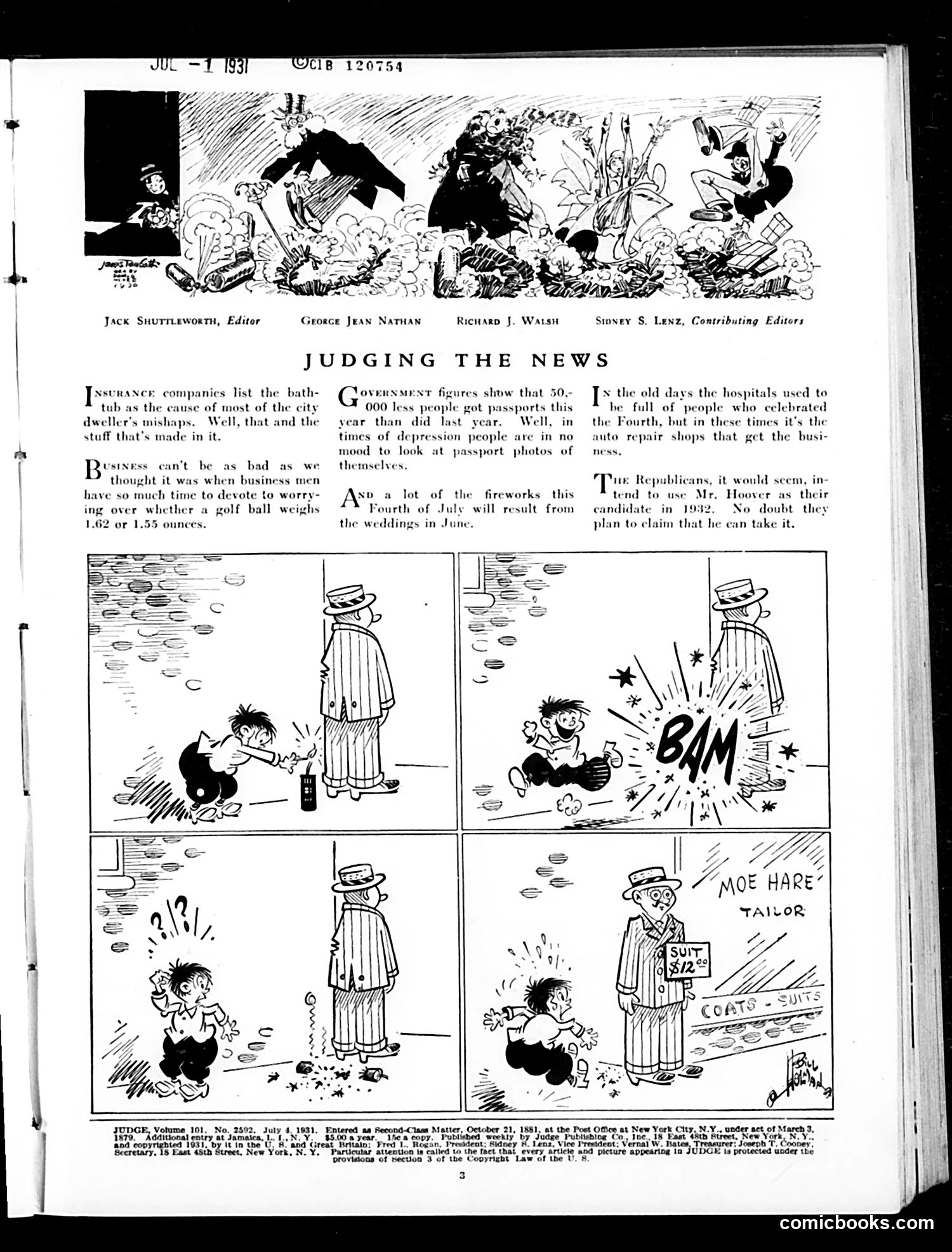
"Judging the News" - July 1, 1931 This page contains editorial commentary and a four-panel comic strip satirizing fireworks safety during Fourth of July celebrations. The comic depicts a small boy repeatedly igniting firecrackers near an unsuspecting tall man in a straw hat and striped suit. The sequence shows escalating explosions ("BAM") and the man's increasingly frantic reactions to being startled. The final panel shows the boy fleeing to "Moe Hare, Tailor" with the man pursuing, suggesting the explosions have damaged the man's clothing. The satire targets the dangerous practice of setting off fireworks indiscriminately near others—a recurring public safety hazard during holiday celebrations. The humor derives from slapstick physical comedy and the innocent-seeming boy's mischievous disregard for the man's wellbeing, highlighting a perennial social problem.
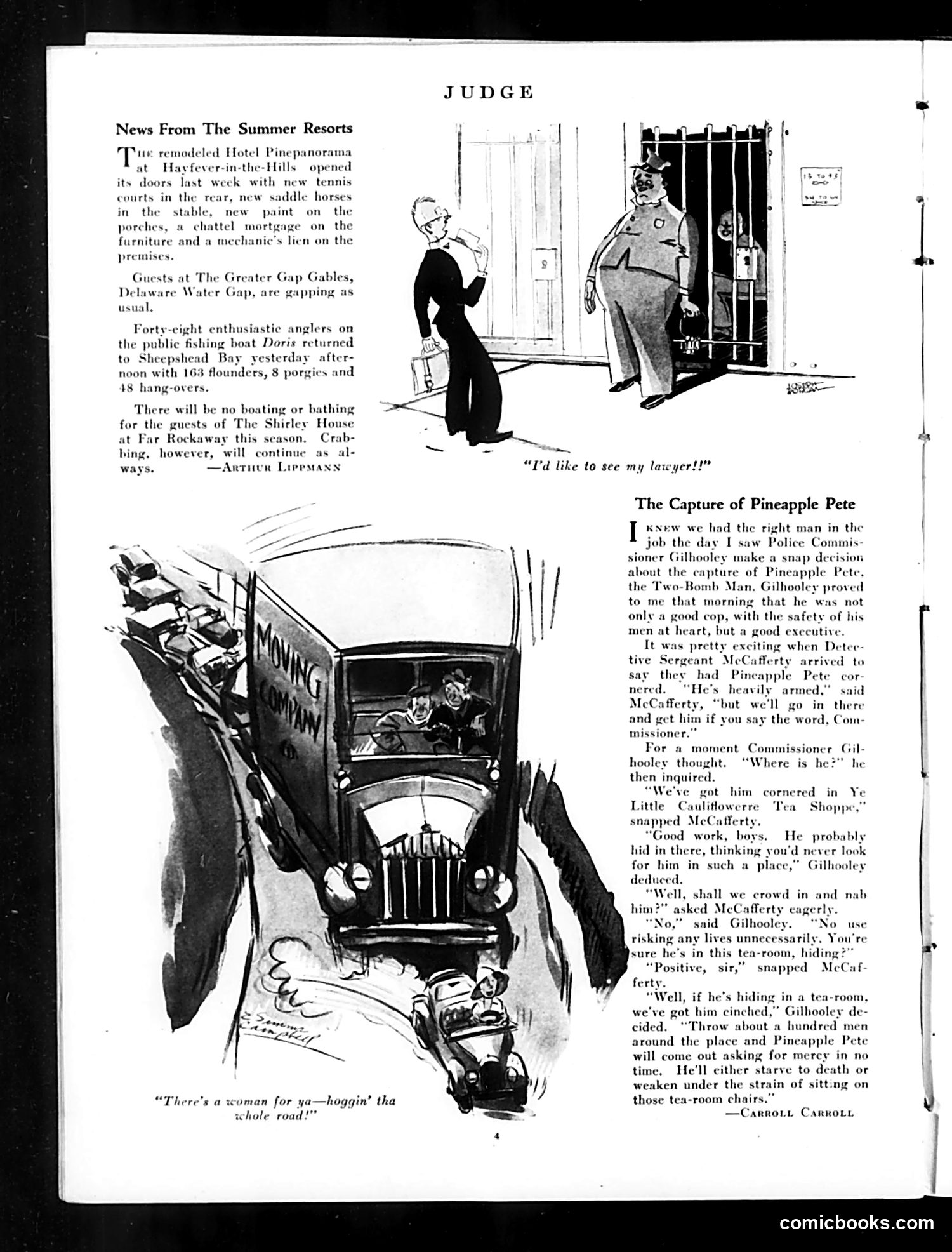
Analysis of Judge Magazine Page Top Cartoon: Shows a man with a fishing rod confronting a woman at a doorway, captioned "I'd like to see my lascert!" (likely "lascivious" or similar). The joke appears to satirize domestic conflict—a husband returning from fishing trips to face an angry spouse, commenting on marital tension. Lower Cartoon & Story: "The Capture of Pineapple Pete" depicts police pursuing a criminal in a moving van. The narrative describes Commissioner Gilhooley's strategy to capture "Pineapple Pete" (a criminal, apparently armed) by surrounding a tea room where he's supposedly hiding. The satire mocks police procedure—using overwhelming force against one hidden suspect in a public establishment—suggesting absurd over-policing tactics. Both pieces use domestic and crime scenarios for humorous social commentary.
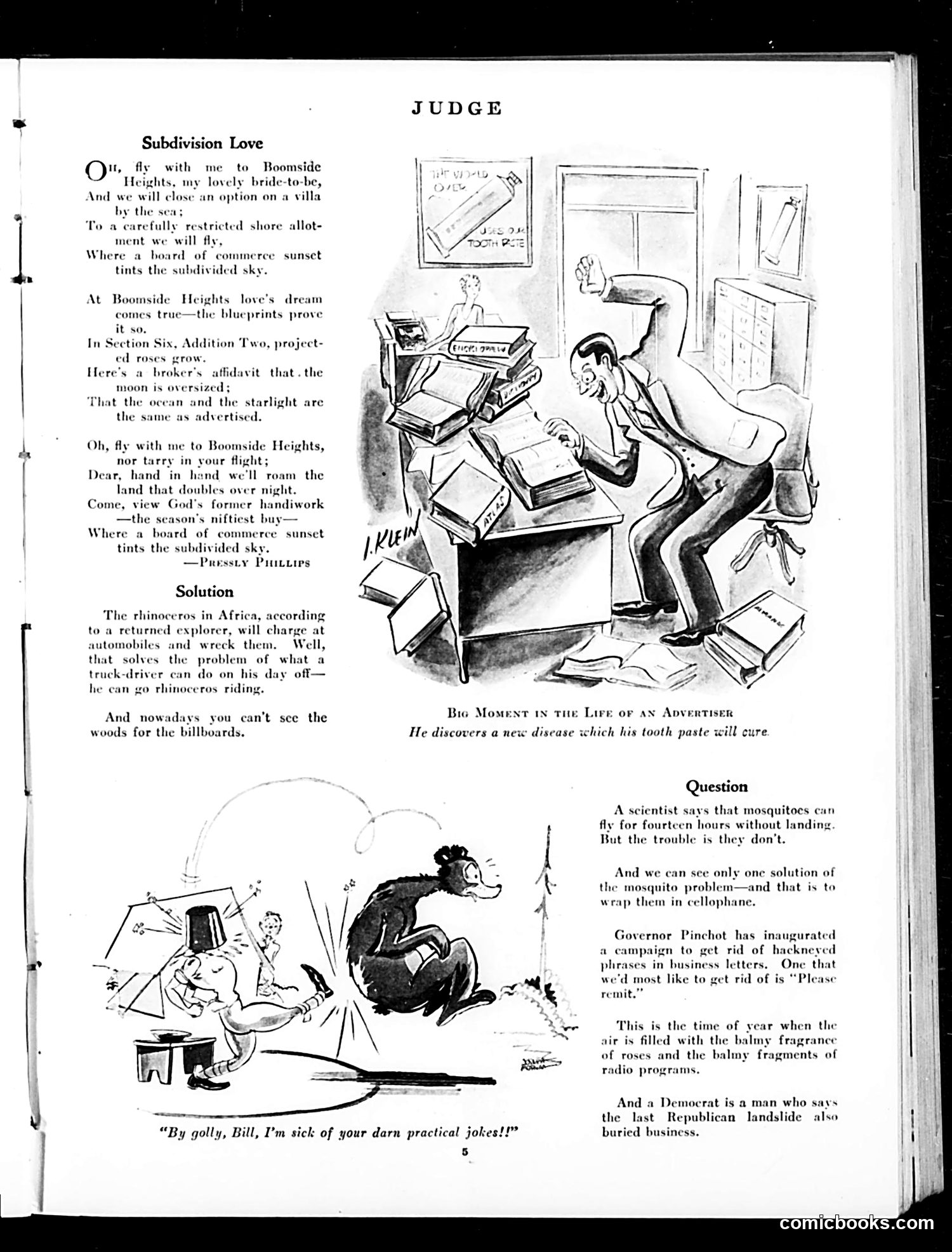
Analysis of Judge Magazine Page This page contains three distinct satirical pieces: 1. "Subdivision Love" (poem by Pressly Phillips): Mocks suburban real estate marketing, satirizing how developers oversell modest properties with grandiose language about "boards of commerce" and ocean views. 2. "Solution" (text joke): Makes fun of truck drivers by suggesting they solve the rhinoceros problem in Africa—a absurdist non-sequitur joke relying on the randomness of the punchline. 3. "Big Moment in the Life of an Advertiser" (cartoon): Shows an advertising professional surrounded by blueprints, apparently discovering his toothpaste can cure some ailment—mocking how advertisers exaggerate product claims. 4. "Question" (miscellaneous jokes): Various one-liners about mosquitoes, Governor Pinchot's campaign against hackneyed phrases, and Democrats—typical period political/social commentary. The overall tone satirizes American commercialism, advertising excess, and political rhetoric.
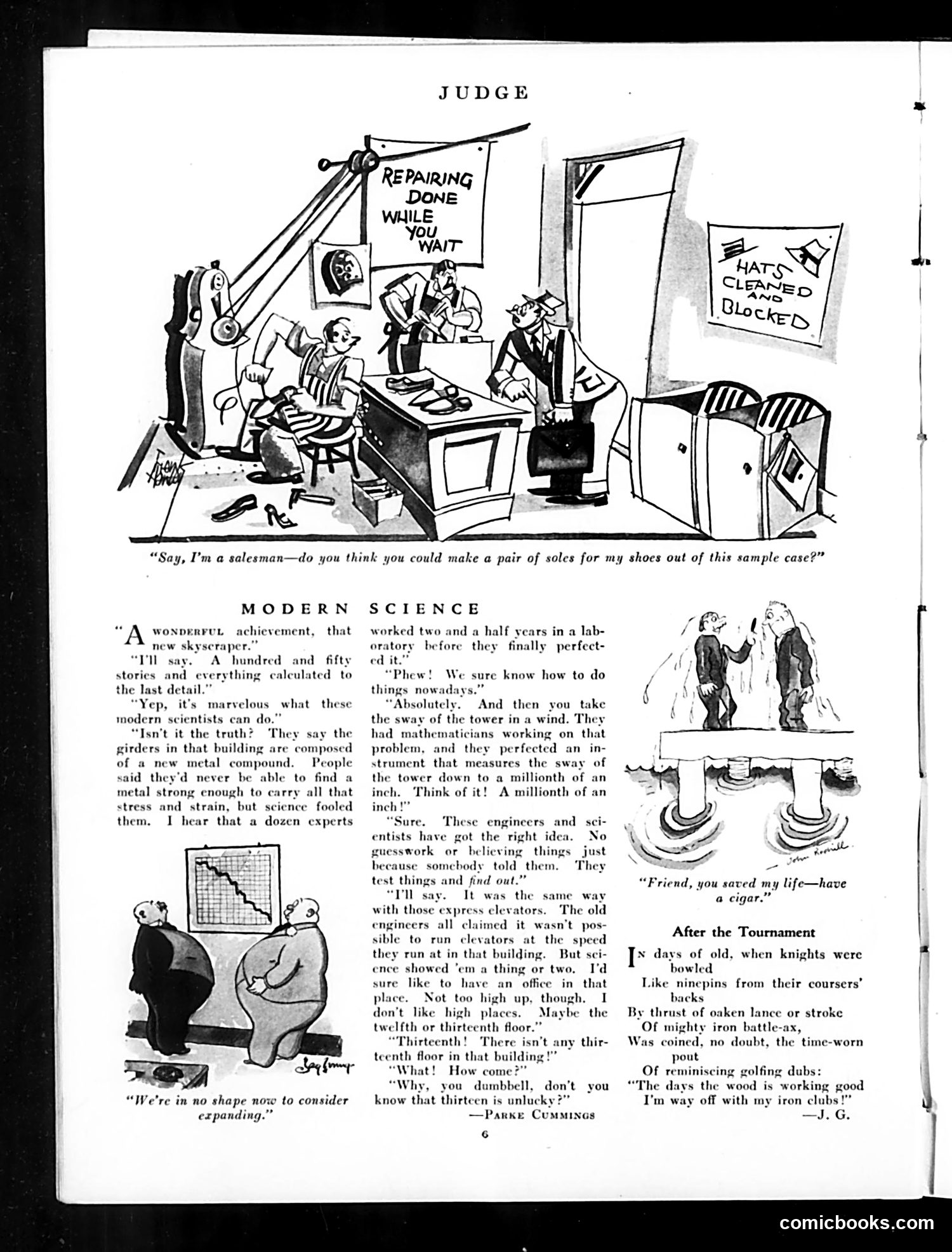
Judge Magazine Page Analysis "Judge" Cartoon (Top): A salesman pitches to a judge in his chambers, asking him to make "a pair of soles for my shoes out of this sample case." The cartoon satirizes legal inefficiency—the judge's office displays signs reading "Repairing Done While You Wait" and "Hats Cleaned and Blocked," mocking courts for their glacial pace. The joke is that a shoemaker could complete work faster than the judicial system resolves cases. "Modern Science" Section (Lower Left): Satirizes engineers' blind faith in scientific authority. The dialogue mocks how experts claim mathematical precision justifies impractical designs (like running fast elevators in tall buildings), yet fail to question whether the underlying premises actually work. It's a critique of technocratic overconfidence disconnected from practical reality.
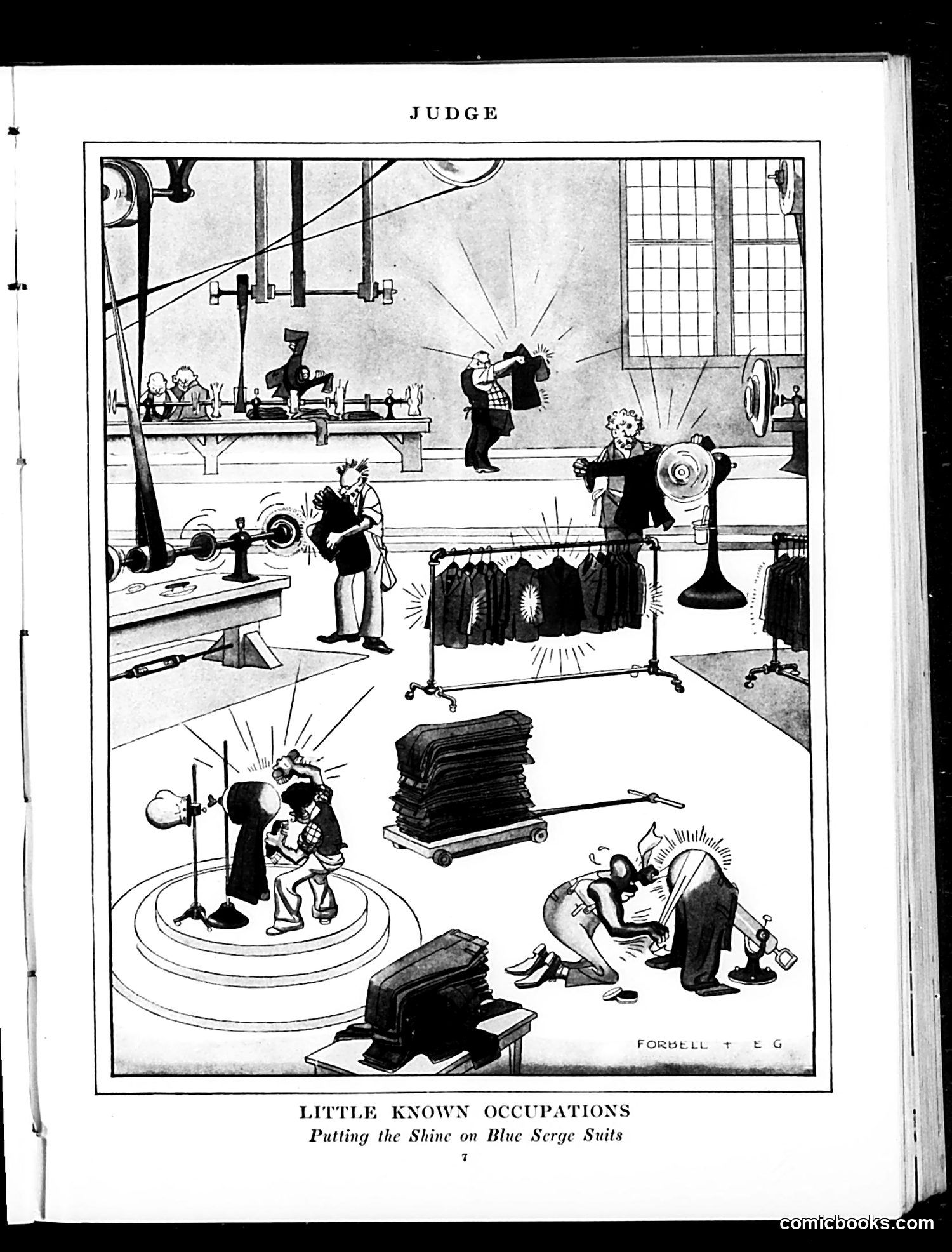
Analysis of "Putting the Shine on Blue Serge Suits" This cartoon satirizes an obscure but real occupational niche: professional suit shiners. The image depicts a factory-like workshop where workers use industrial equipment—overhead pulleys, spotlight mechanisms, and other machinery—to apply shine to blue serge suits (a common, affordable wool fabric of the era). The humor lies in depicting an mundane garment-care task as an elaborate industrial operation, complete with multiple workers, specialized tools, and factory infrastructure. The exaggerated machinery and theatrical lighting suggest the absurdity of commercializing a simple grooming service. This reflects early-20th-century American life when mass-produced blue serge suits were working-class standard wear, and various service industries emerged to maintain them. The satire gently mocks both the industrialization of everyday tasks and the entrepreneurial spirit of finding profit in humble niches.
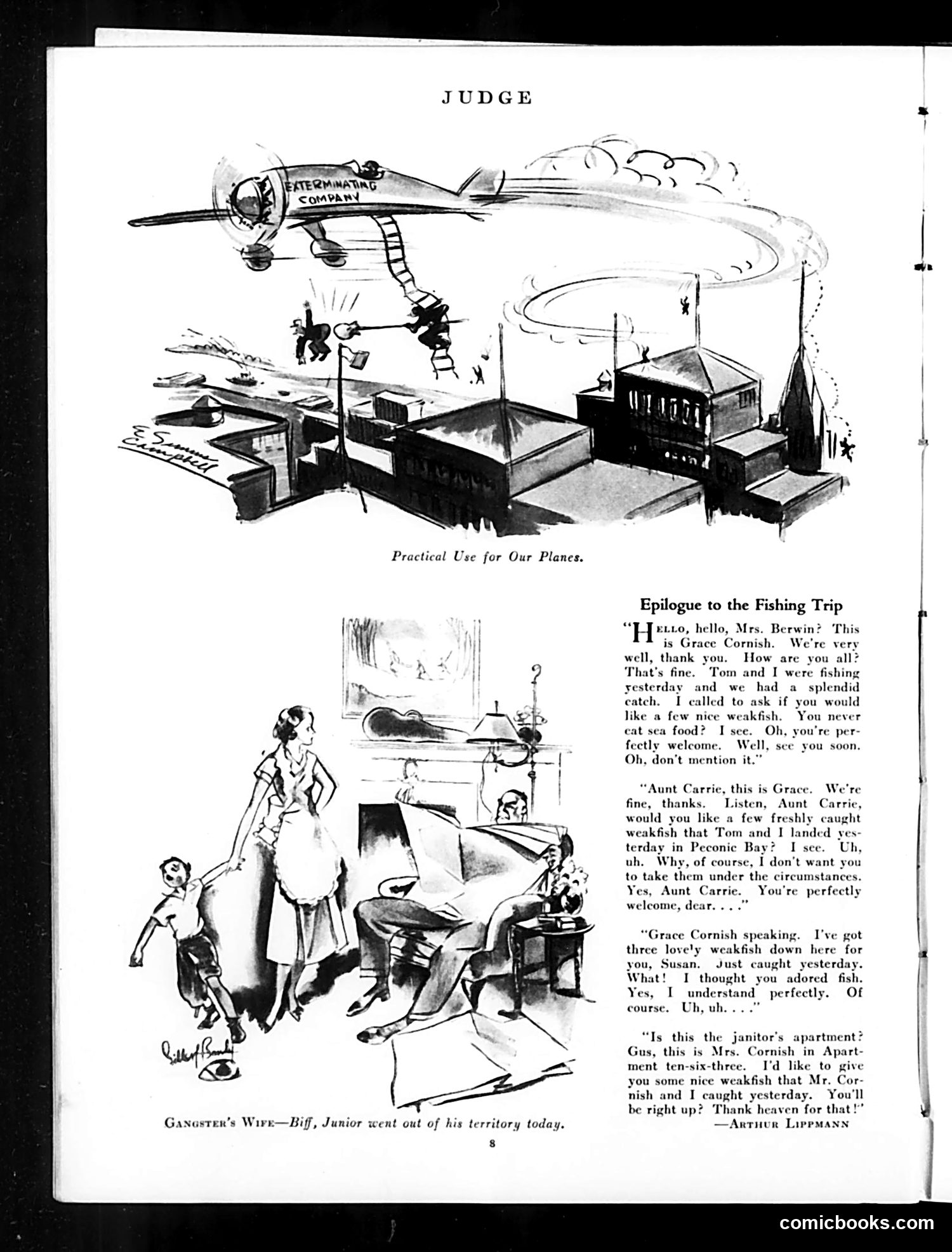
Analysis Top Cartoon ("Practical Use for Our Planes"): An airplane labeled "Exterminating Company" sprays what appears to be insecticide over buildings below. This is satirical commentary on a contemporary practical application for aircraft technology—using planes for pest control or crop dusting rather than purely military or passenger purposes. It reflects early-20th-century optimism about aviation's civilian uses. Bottom Cartoon & Text ("Epilogue to the Fishing Trip"): The joke concerns a woman (Grace Cornish) who caught weakfish and attempts to give them away by calling various acquaintances—Mrs. Berwin, Aunt Carrie, Susan, and finally a janitor. Each person politely declines or offers excuses. The satire mocks the social awkwardness of unwanted gift-giving and the difficulty of disposing of a successful fishing catch when nobody wants fish. The cartoon's caption about "Biff, Junior" leaving his territory suggests territorial humor, while the main story satirizes domestic social etiquette and persistence in forcing generosity on reluctant recipients.
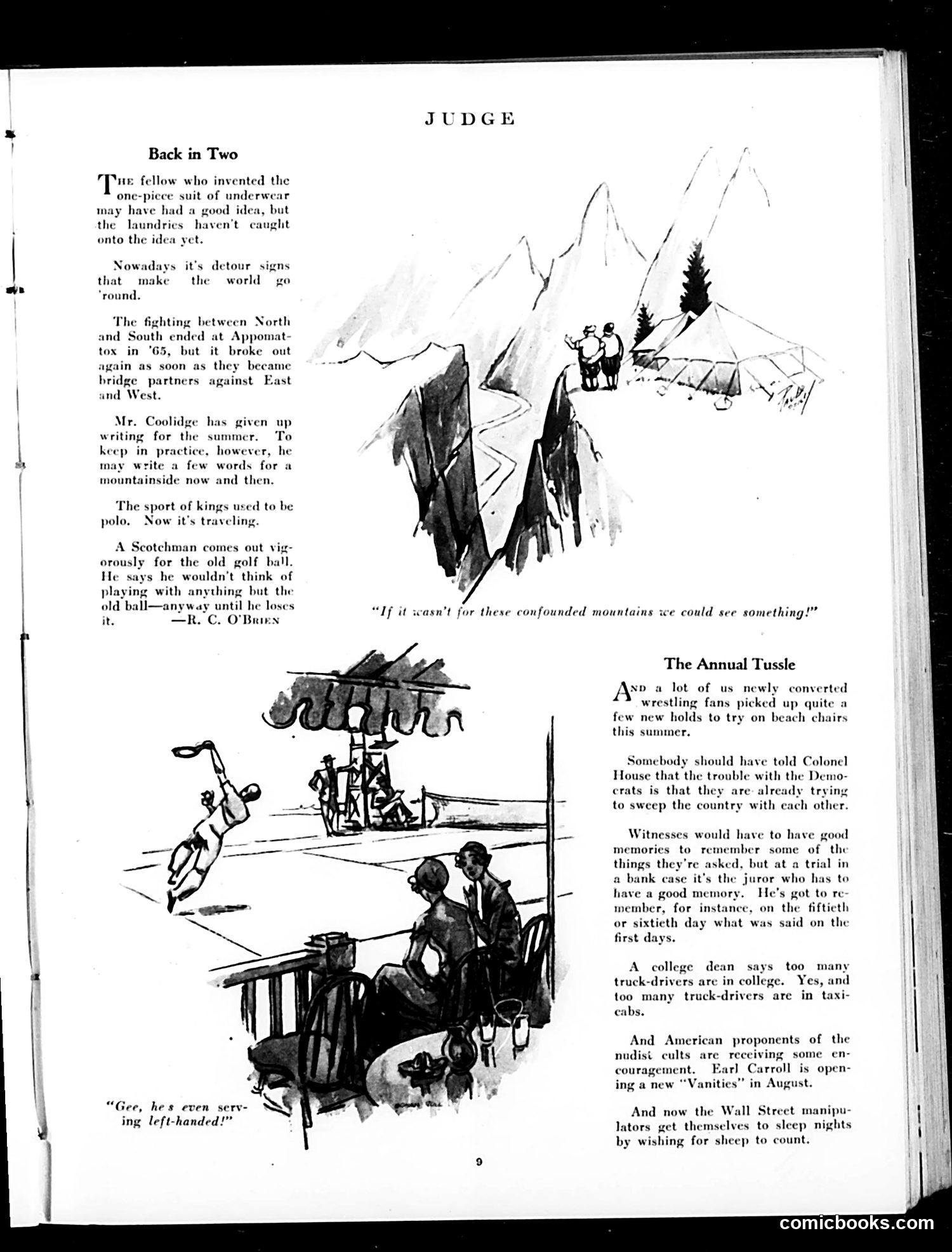
Judge Magazine Page Analysis This page from Judge (a satirical weekly) contains brief social commentary and cartoons mocking early 1920s American life. Top cartoon: Shows two figures in a mountain pass lamenting they can't see anything—likely satirizing tourist disappointment or the limits of travel advertising. Bottom cartoon: Depicts what appears to be a beach or recreational scene with people and a dog, captioned "Gee, he's even serving left-handed!"—a joke about unusual service or behavior at leisure activities. Text commentary targets: one-piece underwear (laundries slow to adapt), detour signs as modern inconvenience, bridge-playing rivalry replacing Civil War conflict, President Coolidge's writing habits, wrestling's newfound popularity, Colonel House and Democratic infighting, witness testimony challenges, college enrollments of truck drivers, nudist cults' growth, and Wall Street financiers' insomnia. The humor is light, topical observation rather than sharp political satire—reflecting post-WWI American consumer culture and social trends.
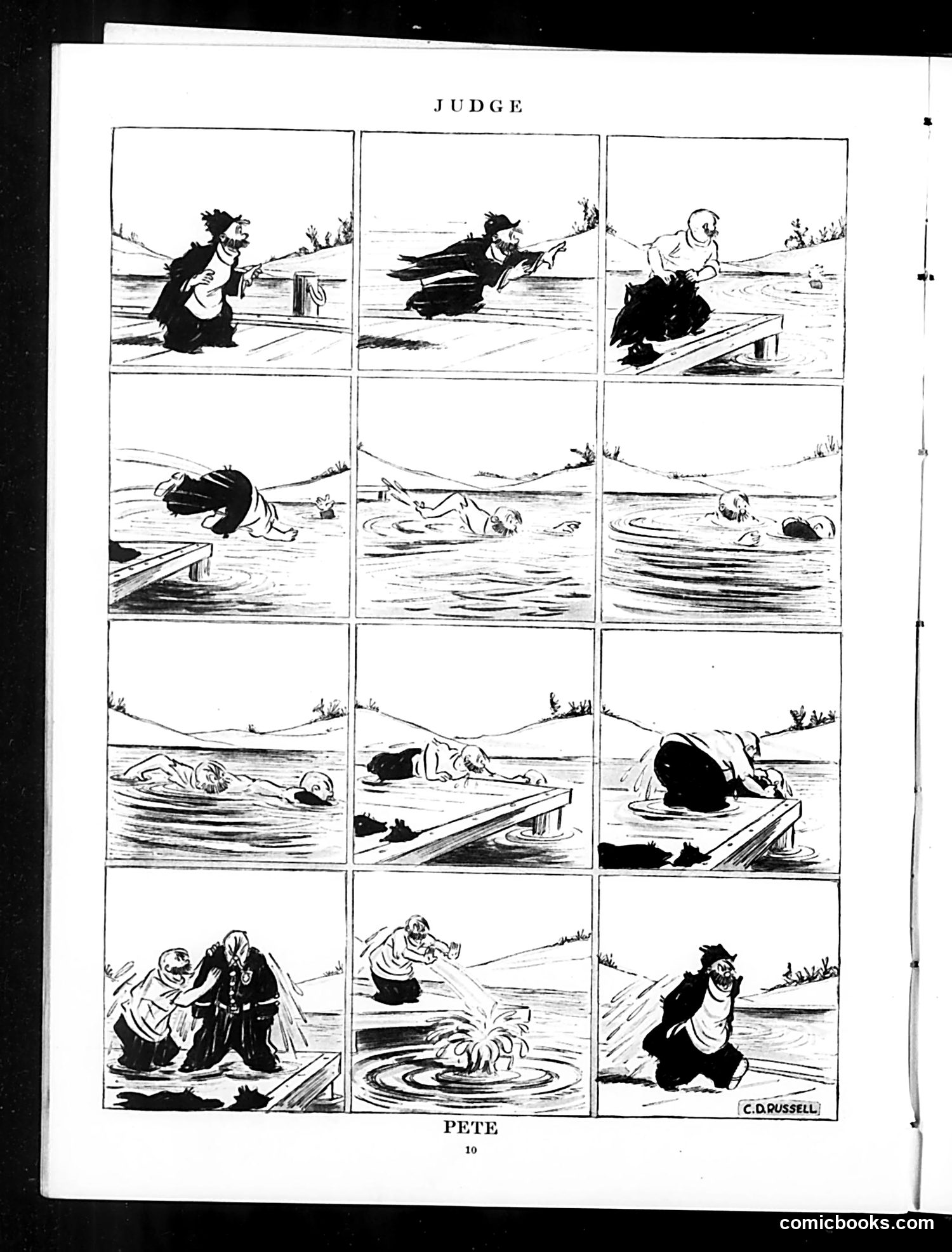
"Judge" Page Analysis: "Judge" and "Pete" This page contains two sequential comic strips by C.D. Russell. The top strip titled "JUDGE" depicts a man in formal attire repeatedly falling into water—progressing from attempting to fish, to stumbling, to drowning. The narrative suggests physical incompetence or bad luck at a waterside location. The bottom strip, "PETE," shows similar aquatic mishaps befalling what appears to be a different character, with rescue attempts and further water-related disasters. Both strips employ slapstick humor common to early Judge magazine content. Without additional context or visible date information, the specific satirical targets—whether political figures, social types, or contemporary personalities named "Judge" and "Pete"—remain unclear. The humor relies on physical comedy and repetitive pratfalls typical of early 20th-century comic strips.
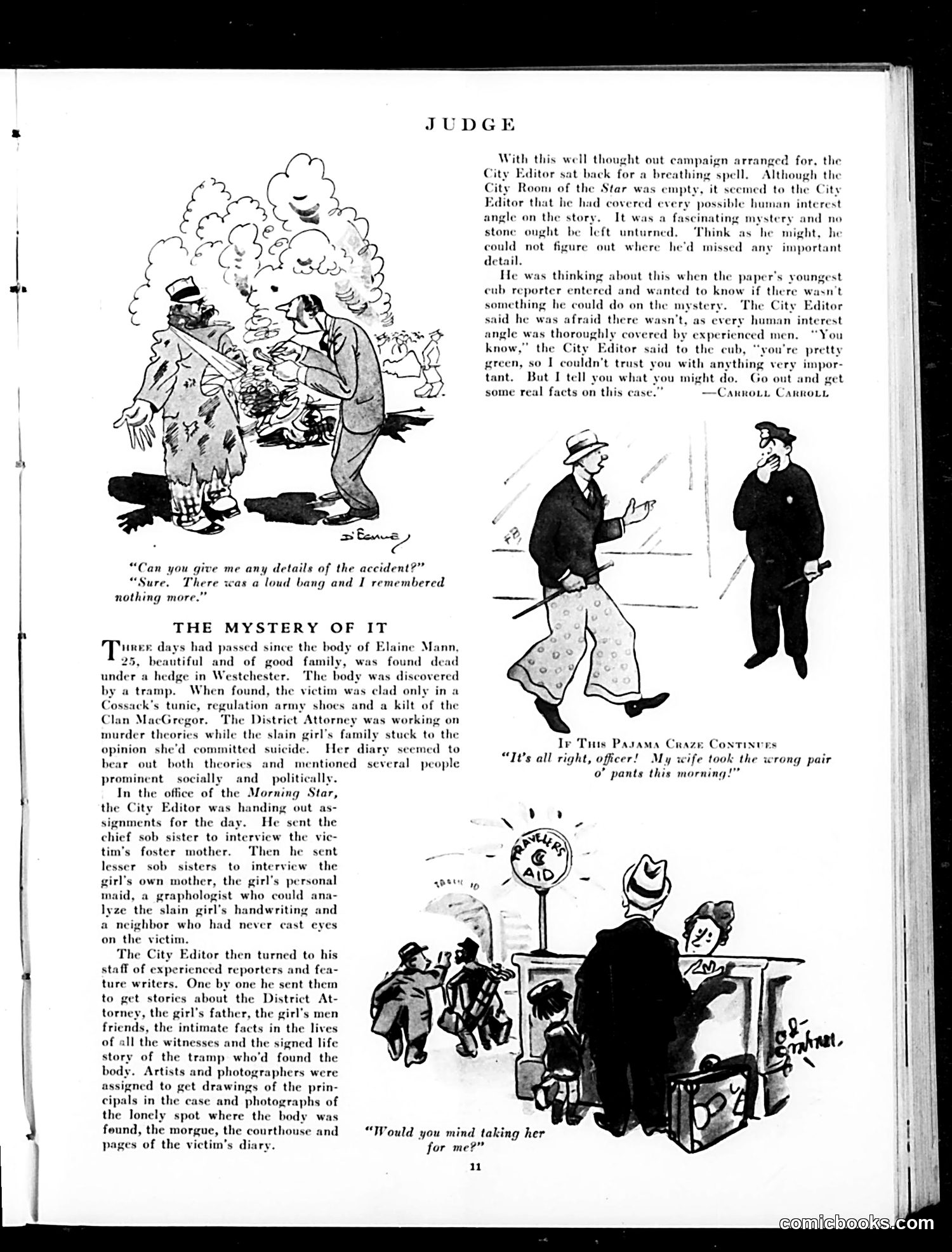
Explanation for Modern Readers This page satirizes sensationalist journalism through two separate pieces: "The Mystery of It" mocks newspaper coverage of a high-profile murder case involving a wealthy young woman (Elaine Mann) found dead in bizarre circumstances (wearing mismatched Scottish/Russian clothing). The City Editor obsessively assigns reporters to cover every conceivable angle—interviewing the victim's family, friends, servants, even a graphologist—yet remains convinced he's somehow missed something. The satire targets the era's yellow journalism: the exhaustive, often exploitative human-interest coverage that treats tragic crimes as entertainment spectacles. By having the editor send his inexperienced cub reporter to find those elusive "real facts," the piece suggests that thorough crime coverage is often performative rather than substantive. The cartoon above jokes about marital confusion: a man tells an officer his wife wore the wrong pants that morning—likely a reference to 1920s "pajama craze" fashion trends where women wore loose, pants-like garments. Both pieces reflect early 20th-century concerns about press sensationalism and changing social norms.
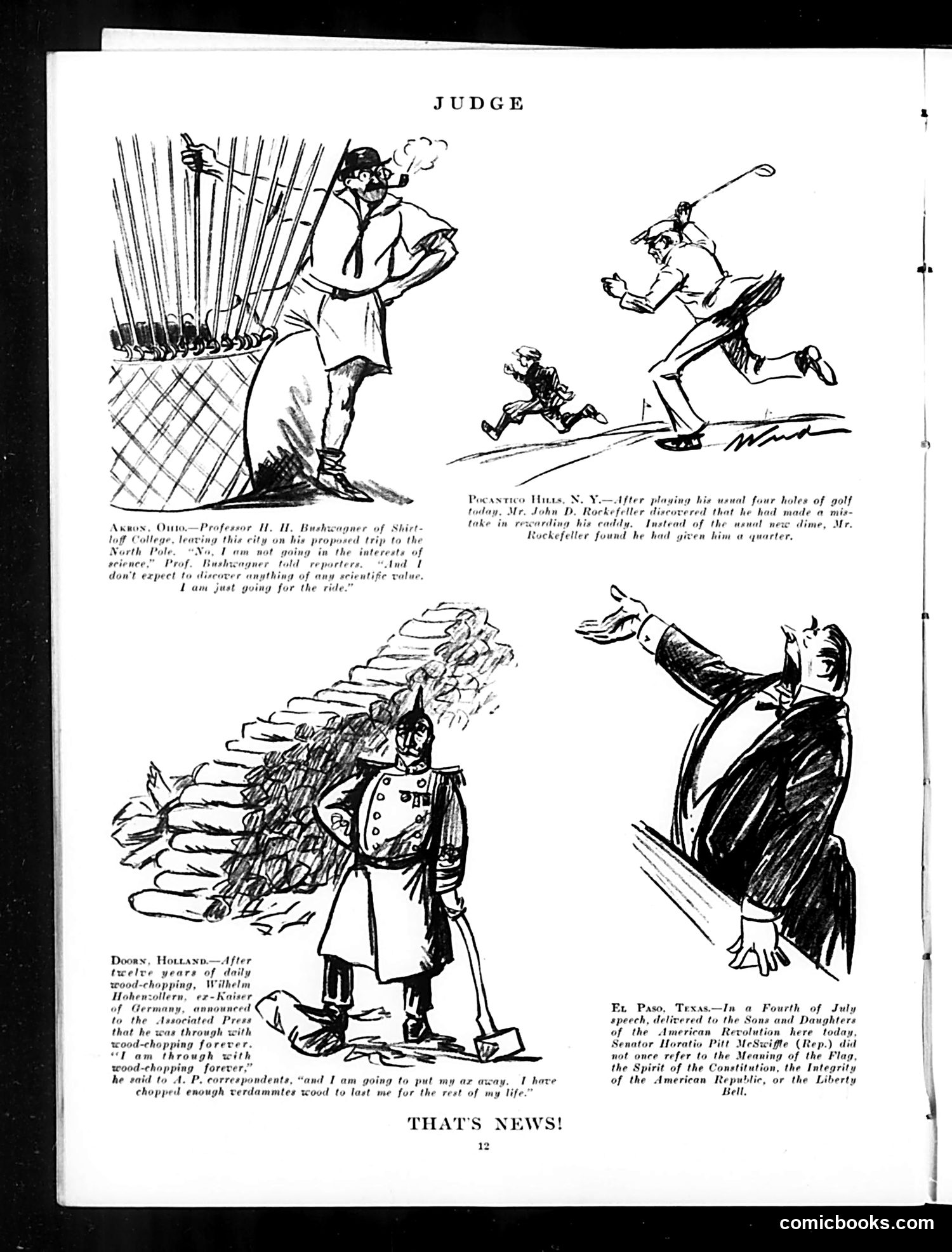
Political Cartoon Analysis: "Judge" Magazine This page contains four satirical cartoons mocking prominent figures of the era: 1. Top Left (Akron, Ohio): A college professor claims he's "just going for the ride" on a scientific expedition—satirizing academic pretension and lack of genuine commitment. 2. Top Right (Pocantico Hills): John D. Rockefeller mistakenly gives a quarter instead of a dime to a caddy, then blames the caddy for the error—mocking wealthy industrialists' stinginess and inability to admit fault. 3. Bottom Left (Doorn, Holland): Kaiser Wilhelm II, in exile, claims he's "through wood-chopping forever" after 12 years of manual labor—satirizing the deposed German emperor's diminished circumstances post-WWI. 4. Bottom Right (El Paso): Senator Horatio Pitt McSomething delivers a patriotic Fourth of July speech without mentioning the Constitution, Flag, or Liberty—criticizing hollow political rhetoric devoid of actual patriotic substance. The page's title "THAT'S NEWS!" underscores the absurdity of each scenario.
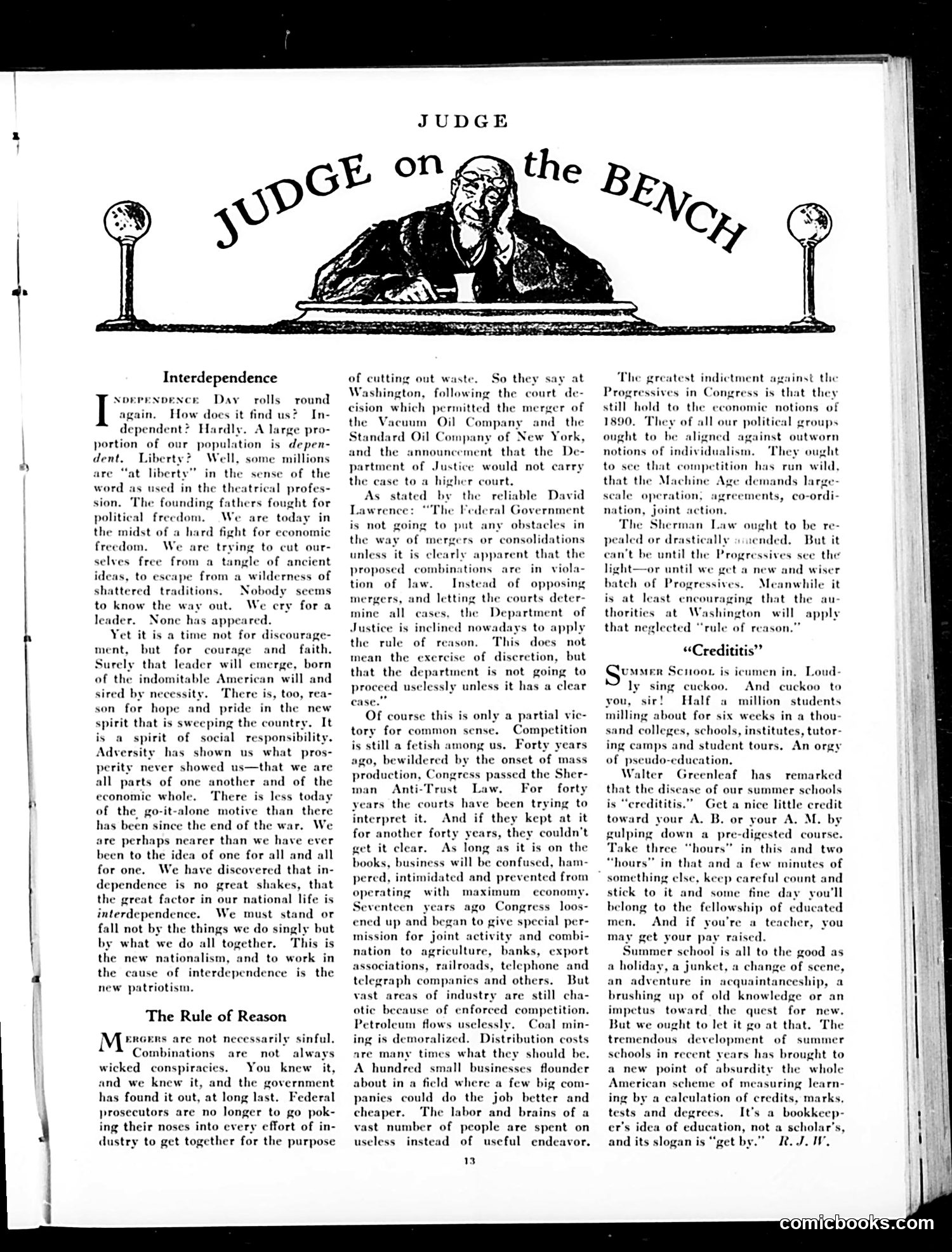
Judge Magazine Page Analysis This page contains editorial commentary rather than traditional political cartoons. The masthead features a judge figure at a bench, the magazine's signature icon. "Interdependence" argues that American independence is a myth—most citizens depend on others economically. The piece criticizes the founding fathers' ideals as outdated and calls for a new national leader embodying "social responsibility" rather than rugged individualism. It frames interdependence as patriotic. "The Rule of Reason" celebrates a recent court decision permitting the Vacuum Oil-Standard Oil Company merger. The author praises the Department of Justice for abandoning aggressive antitrust prosecution, arguing the 40-year-old Sherman Anti-Trust Law creates business confusion and inefficiency. He advocates allowing large corporations to consolidate for operational efficiency, citing agriculture and banking as precedents for exempting industries from competition requirements. Both pieces advocate corporate consolidation and centralized economic control as modern progress—positions Judge's Progressive readers would have actively debated during the trust-busting era.
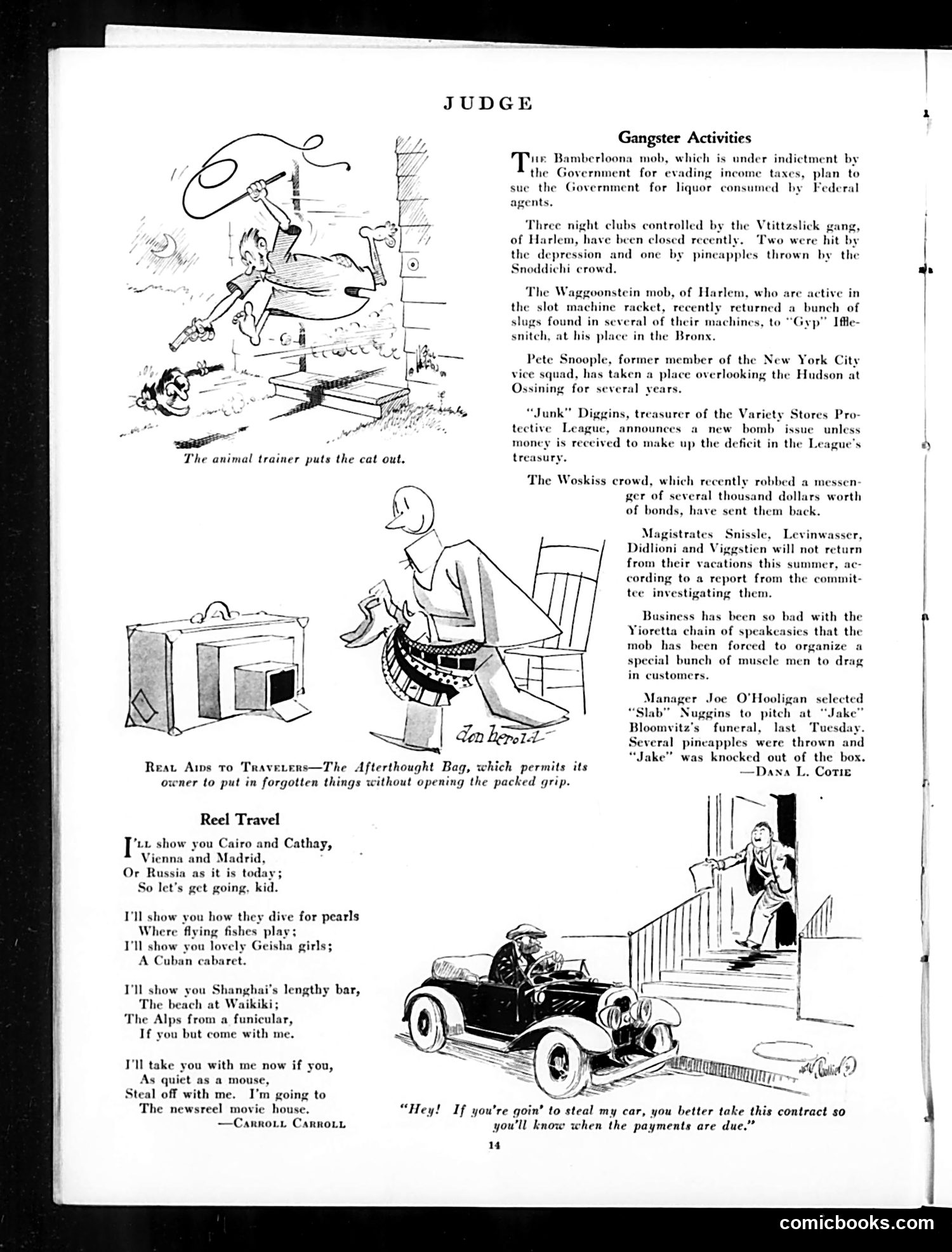
Judge Magazine Satire Explained This page satirizes 1920s-30s organized crime and Prohibition-era corruption through mock "news items" and cartoons. Gangster Activities Section: Judge presents fake crime-world gossip with invented gang names (Bamberloona, Vittzslick, Waggoonstein mobs). The jokes mock both criminals and authorities: gangsters sue the government over liquor consumed by federal agents; magistrates disappear before investigations; speakeasies require "muscle men" to drag in customers because business is so bad. The Cartoons: Top cartoon shows chaotic violence ("animal trainer puts the cat out"). The bottom cartoon depicts car theft—a would-be car thief is handed a payment contract, joking that if you're going to steal the car, you should at least know the payment schedule. This satirizes the absurdity of Prohibition-era lawlessness. Context: During Prohibition (1920-1933), organized crime flourished, corruption was rampant, and the contrast between criminal activity and official incompetence was widely mocked in satirical publications like Judge.
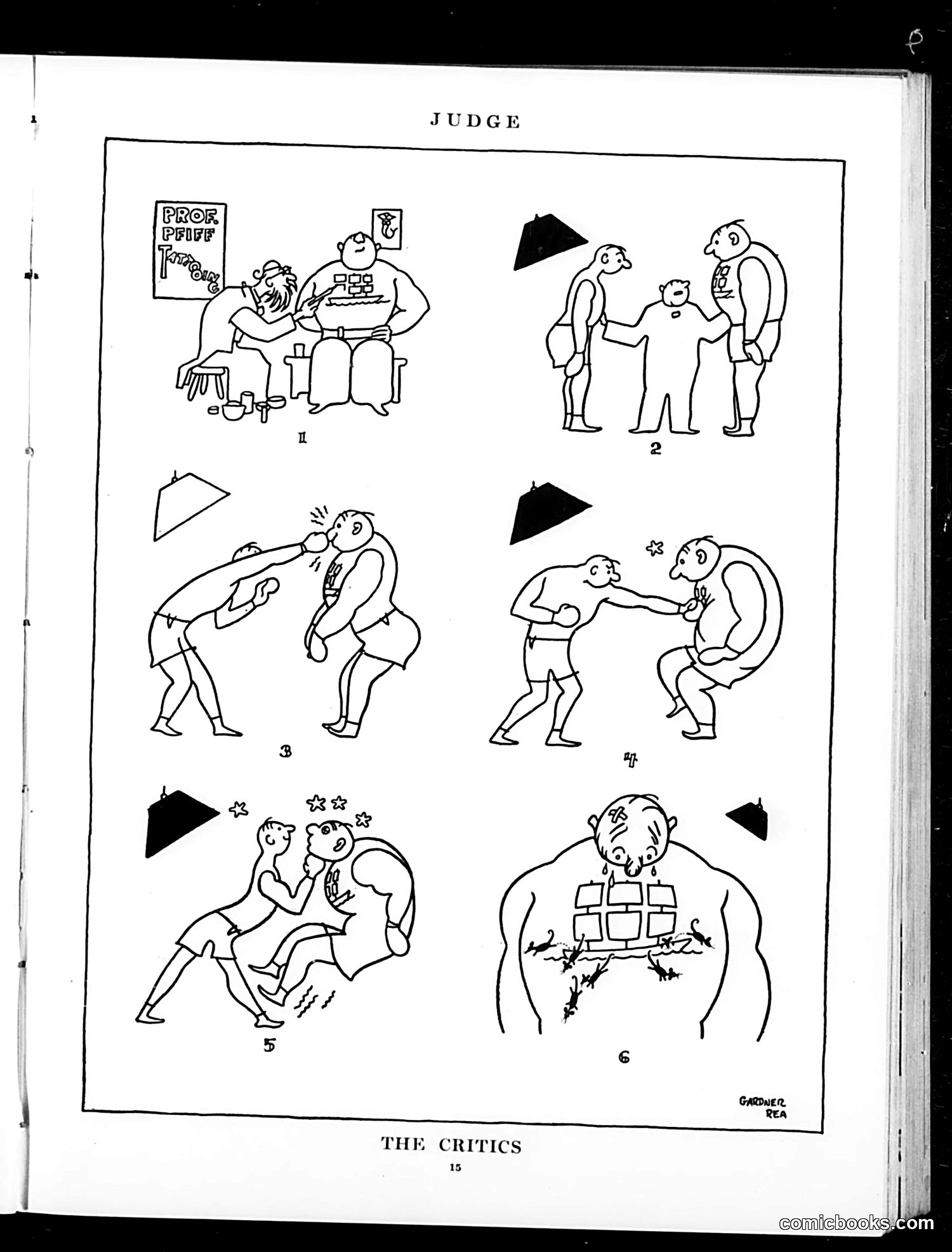
"Judge": "The Critics" - Explanation for Modern Readers This satirical page depicts six scenarios titled "The Critics," likely mocking different types of critical judges or reviewers. The cartoons show: 1. Panel 1: A "Prof. Pfiff" (possibly a pompous professor figure) being consulted by others 2. Panels 2-6: Various confrontational or judgmental scenarios—parents criticizing a child, people arguing, fighting, reconciling romantically, and a final image of someone with a cage on their back filled with broken items The satire appears to critique how people in authority positions judge others harshly while being hypocritical or destructive themselves. The visual progression suggests that "critics" cause damage (the broken items in the final panel) while claiming moral superiority. This reflects Judge magazine's tradition of social commentary through exaggerated caricature and visual metaphor.
Judge Magazine Theater Review Analysis This page contains a theater review by "Judge" (the magazine's critic) praising the Broadway revue *"The Band Wagon."* The critic uses the show as a teaching tool, suggesting producers of the inferior *"The Third Little Show"* should study it to learn proper revue construction. The review highlights the show's strengths: genuine gaiety rather than forced cheerfulness, witty sketches, and—importantly—performers like Frank Morgan, Tilly Losch, and the Astaires who bring refinement and "youthful good breeding" rather than the typical "brash" vaudeville style common in Broadway shows. The critic praises designer Albert Johnson's sets and composer Arthur Schwartz's music. The satire targets Broadway's reliance on tired clichés: "bedroom black-out sketches," ethnic stereotypes ("Irish tango dancers with Mexican names"), and crude showmanship—contrasting these with *The Band Wagon's* sophisticated elegance, even favorably comparing it to Paris revues. The review is essentially promotional, encouraging audiences to see the show while subtly mocking lesser Broadway productions.
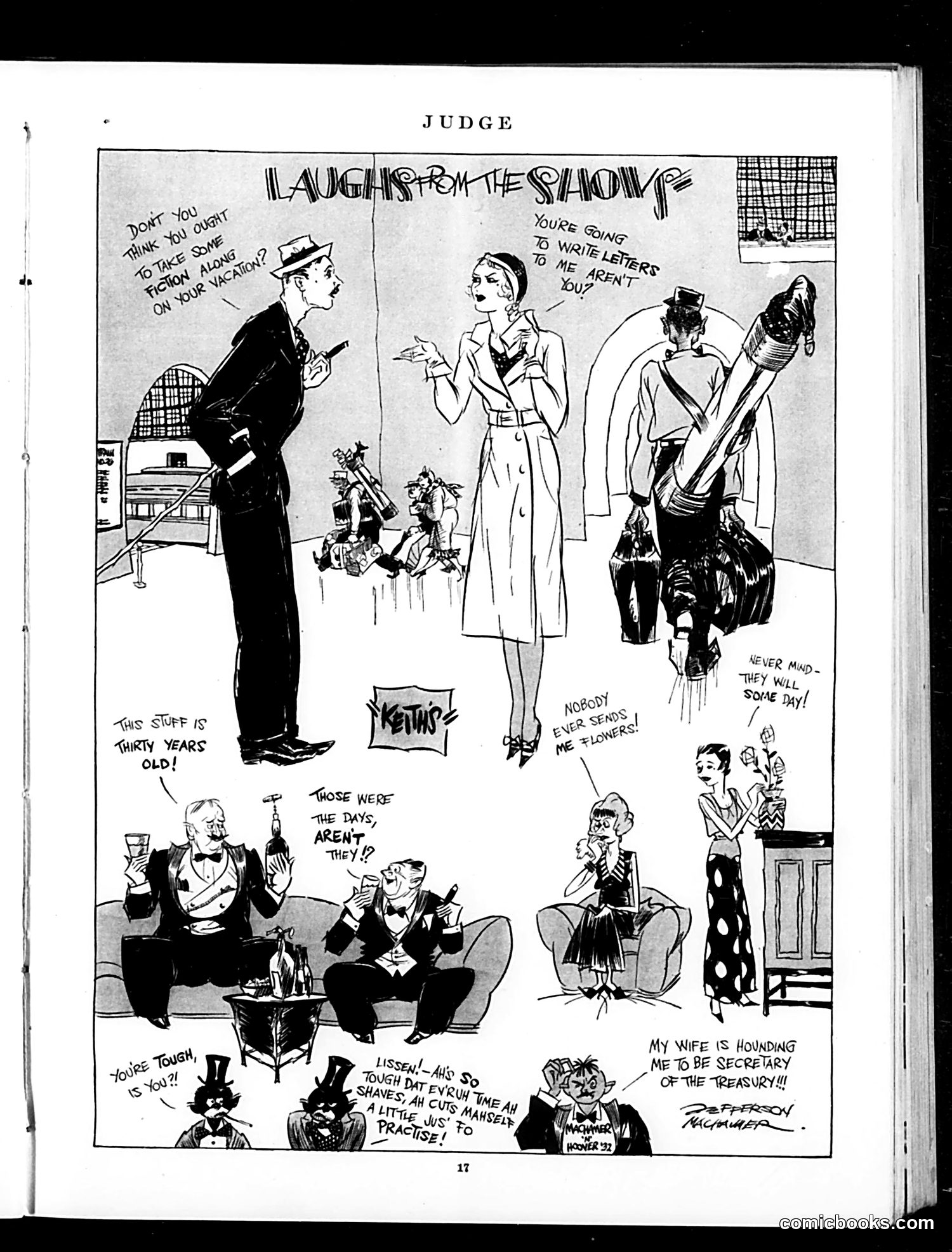
"Laughs from the Shoppe" This is a single-panel humor comic about nostalgia and domestic life. A man leaving for vacation is warned by colleagues not to take fiction along, as "this stuff is thirty years old." The comic then shows various scenes of him at home: his wife threatening to write letters to him, him singing with performers (suggesting he's in entertainment), colleagues reminiscing about "the days, aren't they?", and finally, his wife pressuring him to become "secretary of the treasury." The joke appears to satirize both outdated entertainment and domestic nagging—the wife using his vacation time to demand he pursue a government position. The humor targets mid-century American married life anxieties and workplace friendships.
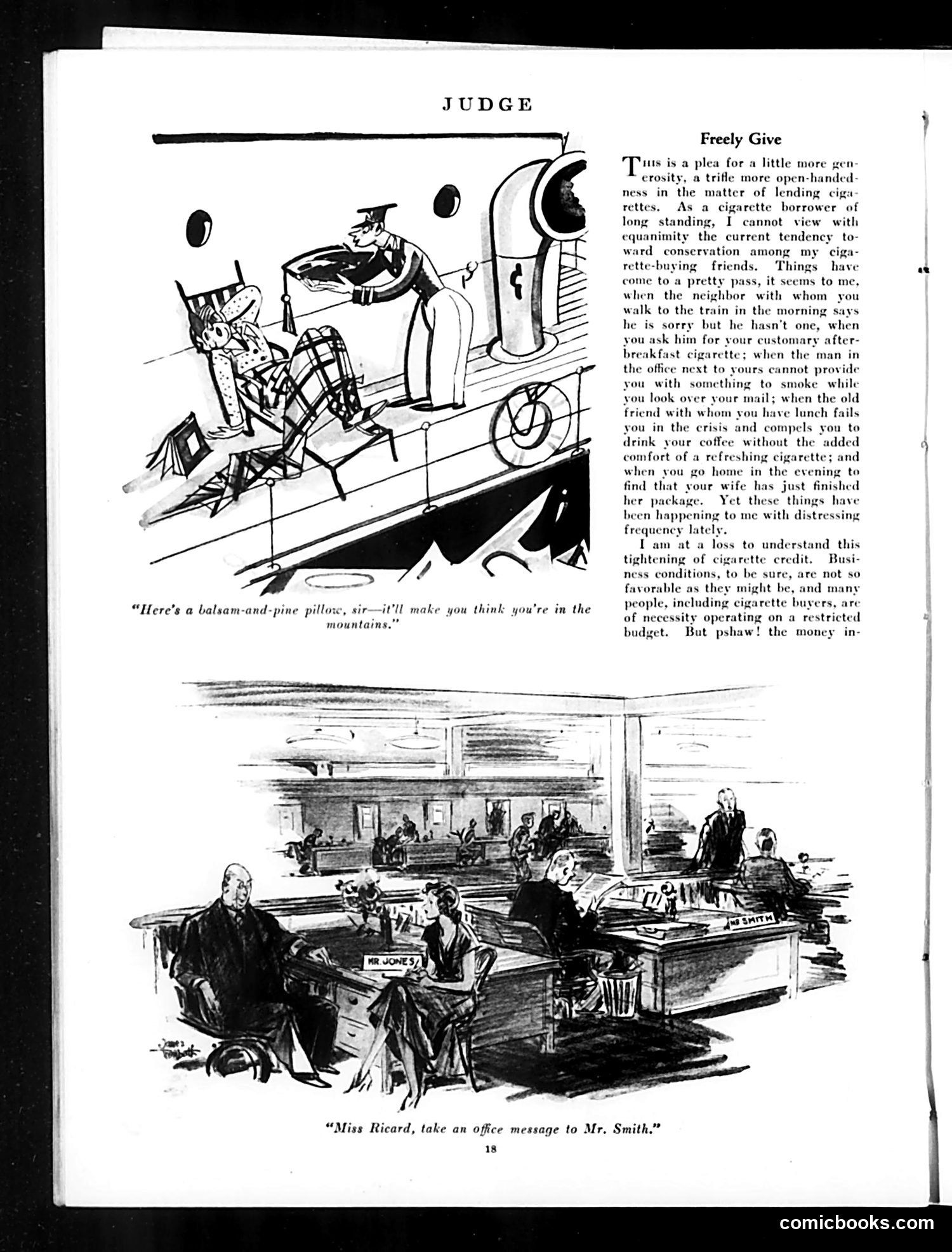
Explanation for Modern Readers This *Judge* page contains two cartoons satirizing social behavior during an economic downturn (likely the 1920s-30s). The top cartoon mocks false advertising and escapism: a con artist sells a man a pillow claiming it evokes mountain experiences, playing on desire to escape financial hardship through cheap substitutes. The bottom cartoon depicts an office scene illustrating the editorial's main point about cigarette "credit"—the practice of borrowing smokes from colleagues. The accompanying essay, titled "Freely Give," humorously argues for renewed generosity in lending cigarettes. The author laments how friends, office neighbors, and even his wife now refuse to share cigarettes due to economic pressures and "conservation." He acknowledges business conditions are tough but protests this penny-pinching stinginess, framing cigarette-sharing as a social norm that shouldn't disappear despite financial strain. It's satire of how economic anxiety erodes casual generosity among the middle class.
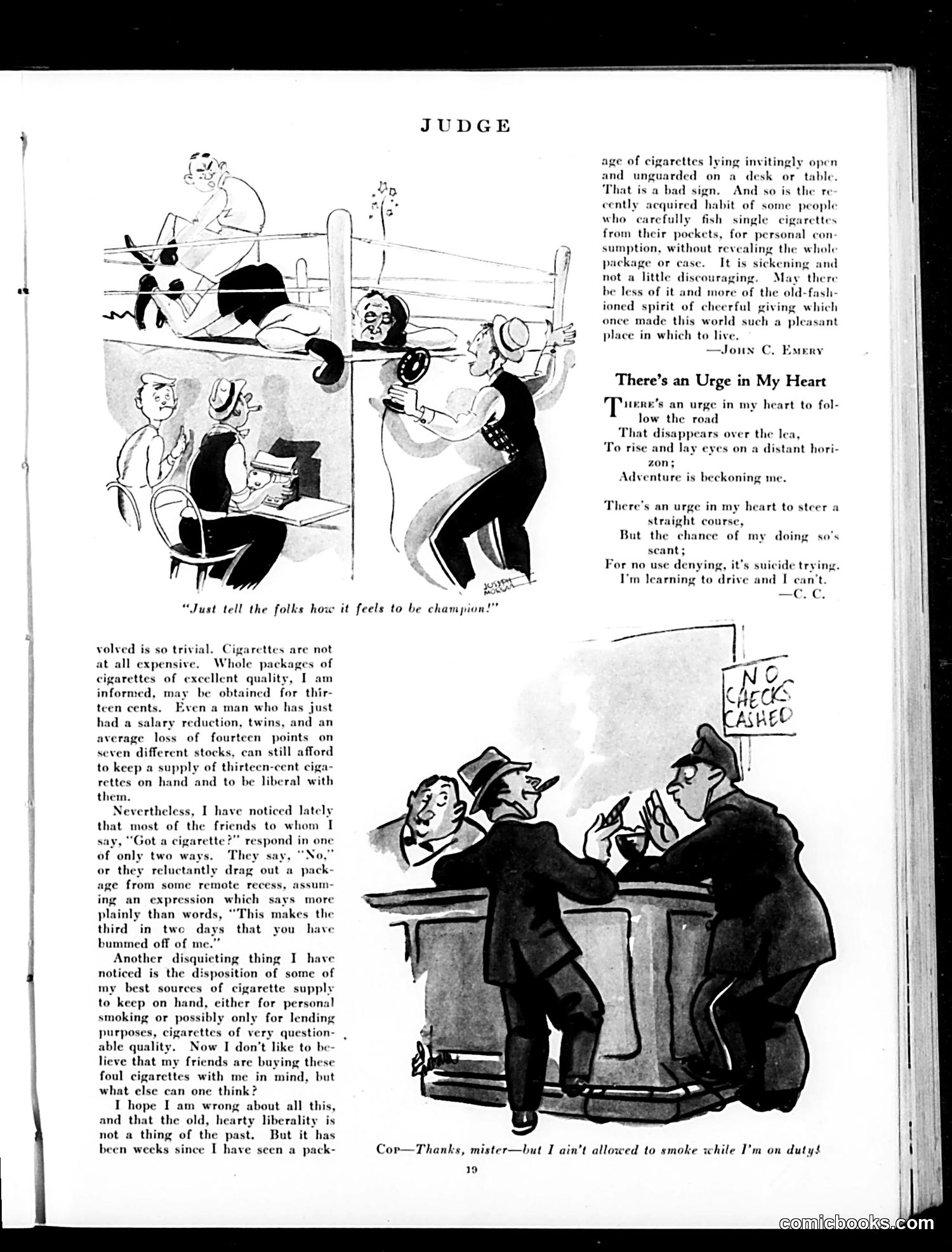
Analysis of Judge Magazine Page This page satirizes social stinginess during economic hardship. The main article by John C. Emery complains that friends have stopped generously offering cigarettes, now reluctantly refusing requests or grudgingly providing single smokes from their pockets rather than offering full packages. He notes this marks a decline in "old-fashioned" liberality and charitable spirit. The cartoon captioned "Just tell the folks how it feels to be champion!" depicts various figures in competitive or leisure scenarios, apparently illustrating themes of achievement and recreation. The poem "There's an Urge in My Heart" by C.C. expresses wanderlust and desire for adventure, while acknowledging personal limitations ("it's suicide trying"). The bottom cartoon shows a policeman stopping someone at a "No Cheek Cashed" sign, with the caption about not being allowed to smoke while on duty—a humorous workplace authority joke. The page reflects Depression-era anxieties about financial scarcity reshaping social customs and generosity.
"Judging the Movies" by Pare Lorentz This is a film criticism column reviewing recent "exploring and travel pictures"—documentary-style films showing exotic locations and adventures. The author praises *The Viking*, a film about seal hunting off Labrador's coast, for its authentic drama and compelling cinematography by Robert Flaherty. Lorentz contrasts such genuine, location-based films with cheap Broadway productions (*The Night Angel*, *Stark Love*). He argues that *The Viking* succeeds because it uses real landscapes and native actors rather than imported theatrical talent, and because its young producer died completing authentic scenes—lending tragic weight to the work. The satire targets Hollywood's reliance on re-written scripts and expensive stage actors when simple, truthful filmmaking of real places and people produces superior cinema. The column celebrates films made with artistic integrity over commercial calculation.
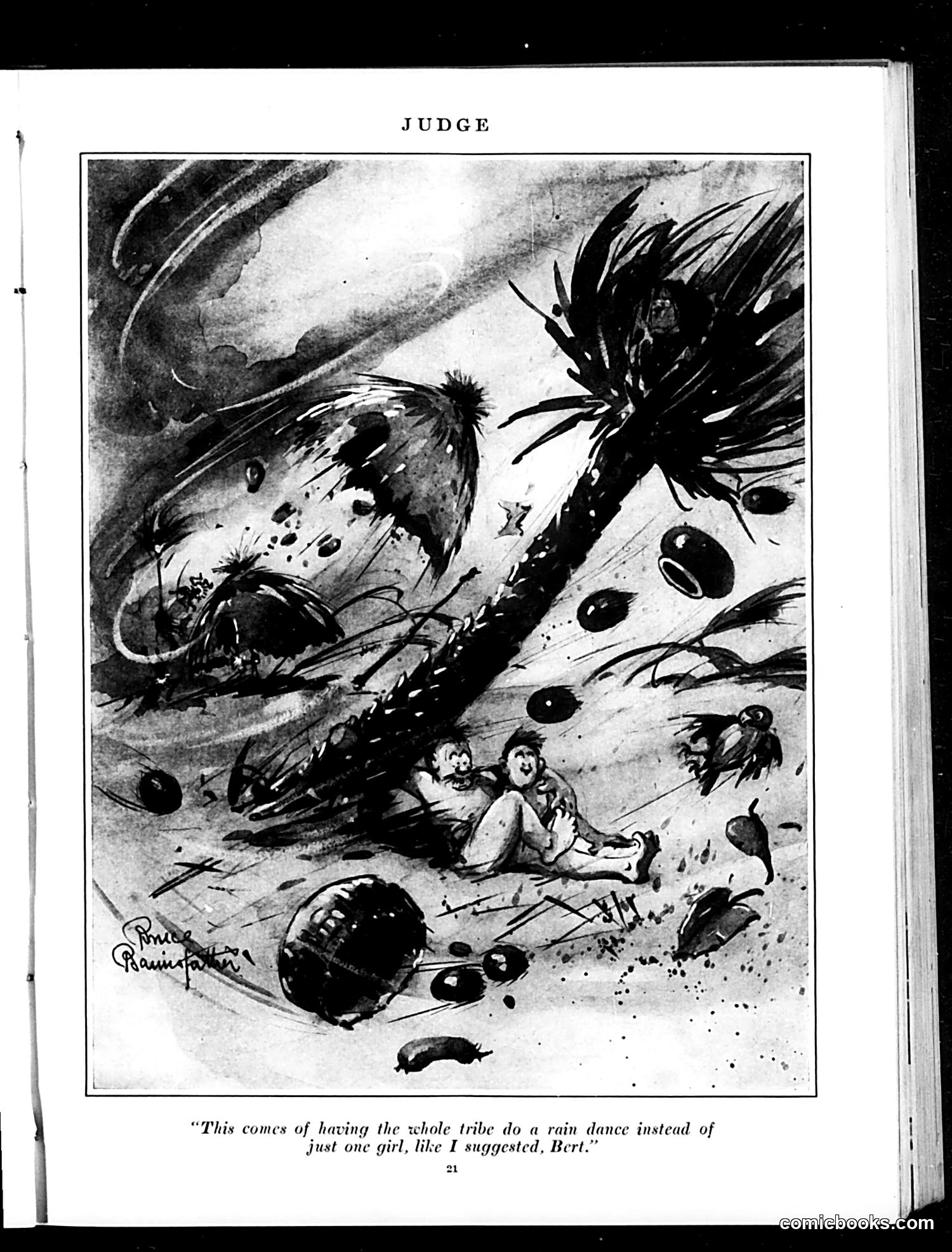
Analysis of Judge Cartoon This cartoon depicts a chaotic scene where two small figures huddle amid massive, swirling destruction—torrential rain and violent wind. The caption references "the whole tribe" doing a "rain dance," suggesting Native American ritual practices. The satire appears to mock the idea of group participation in superstitious practices. One character blames his companion "Bert" for suggesting the entire tribe participate in a rain dance rather than just one girl, implying the collective action produced catastrophic results—excessive rain and storms—when a single performer would have sufficed. The exaggerated, destructive imagery satirizes both blind faith in ritualistic practices and the consequences of mob participation versus individual action. The cartoon reflects early 20th-century attitudes toward indigenous practices as primitive superstition.
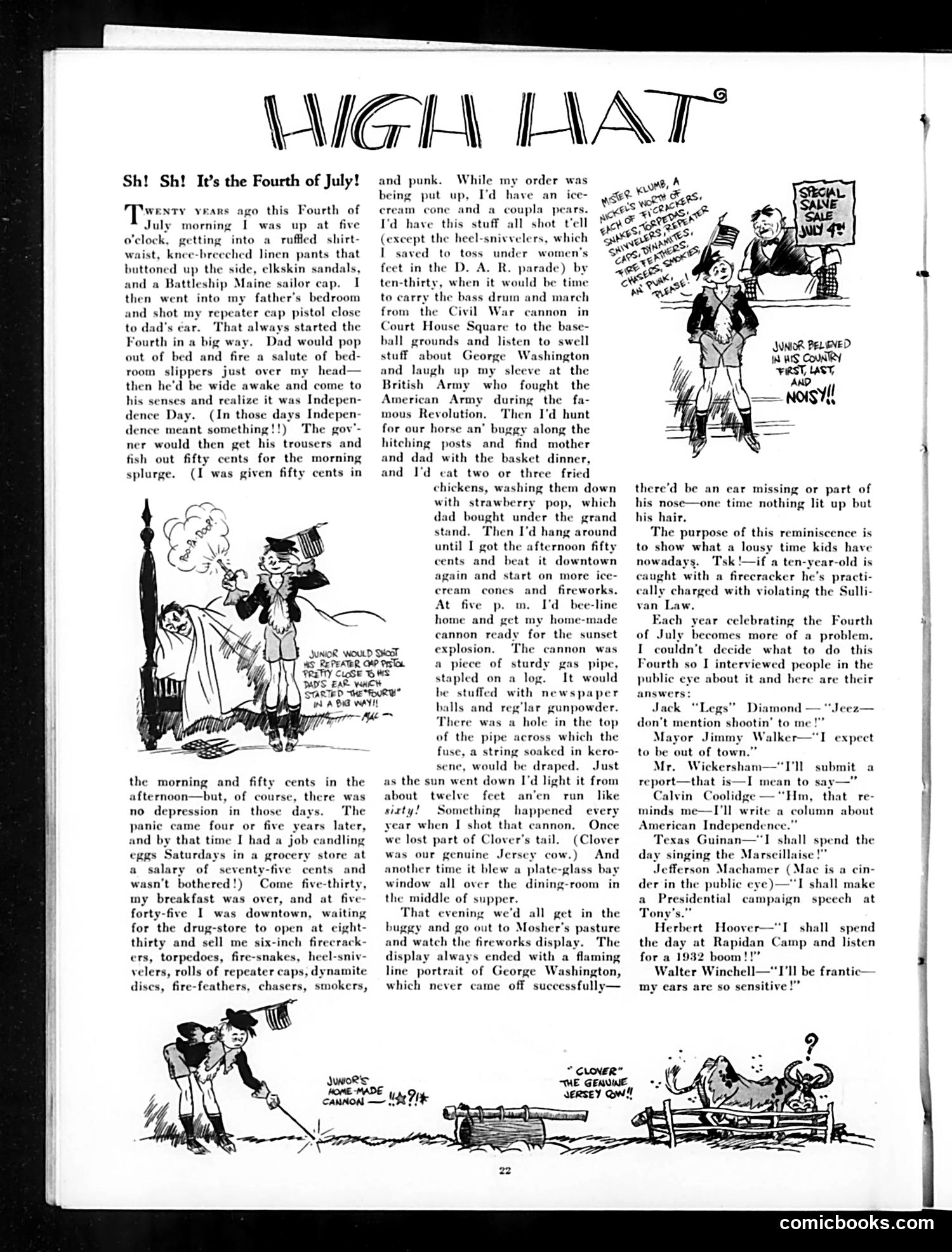
"High Hat" — Judge Magazine, Fourth of July Reminiscence This is a nostalgic essay with accompanying cartoons contrasting turn-of-the-century Fourth of July celebrations with 1930s restrictions. The author recalls boyhood freedom in the 1910s: buying firecrackers, shooting toy cap pistols, parading homemade cannons, and watching fireworks displays. The cartoons show a child gleefully firing a cap pistol at his sleeping father and operating a makeshift cannon — activities the author notes are now criminalized. The "Sullivan Law" reference (a New York gun-control statute) represents modern prohibitions. The closing indicates the author interviewed prominent contemporaries about Fourth of July observance. The satire's point: modern children lack the innocent wild freedom previous generations enjoyed; today's safety regulations and legal restrictions have rendered Independence Day "a lousy time" for youth. It's generational commentary lamenting lost Americana.
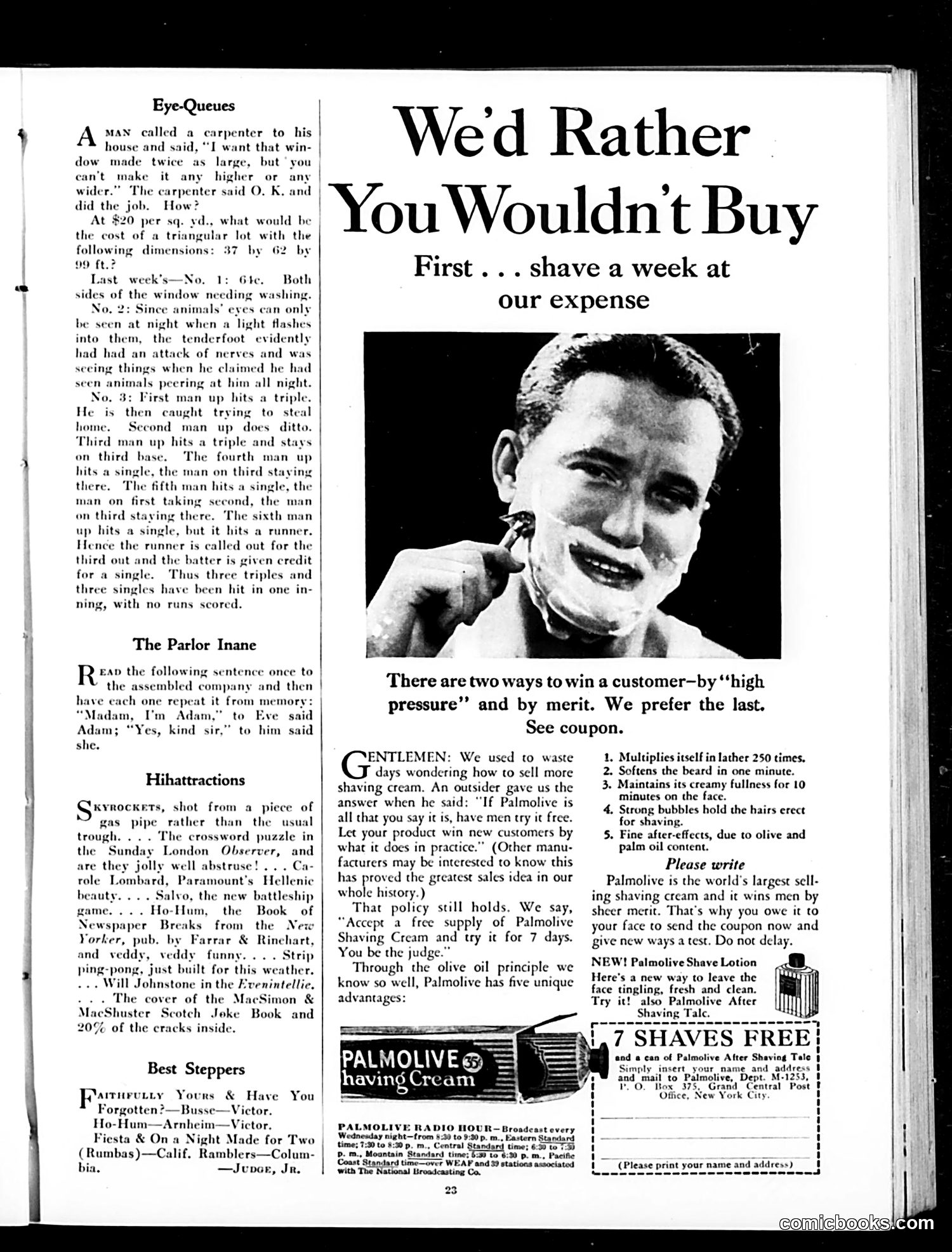
Explanation for Modern Readers This page consists primarily of advertising and humor columns, not political satire. The main content is a Palmolive shaving cream advertisement featuring a photograph of a man shaving. The ad's pitch is straightforward: Palmolive offers a free 7-day trial, arguing that merit (letting customers test the product) works better than "high pressure" sales tactics. The ad emphasizes the product's olive oil base and claims about lather multiplication and beard softening. The left column contains three separate humor sections: "Eye-Queues" (riddles/puzzles), "The Parlor Inane" (a memory game), and "Hihattractions" (brief cultural commentary on music, books, and entertainment). These are light, topical jokes typical of Judge magazine's humor content. There is no political cartoon on this page. The content reflects 1920s consumer culture and genteel humor rather than satirical commentary on current events or politics.
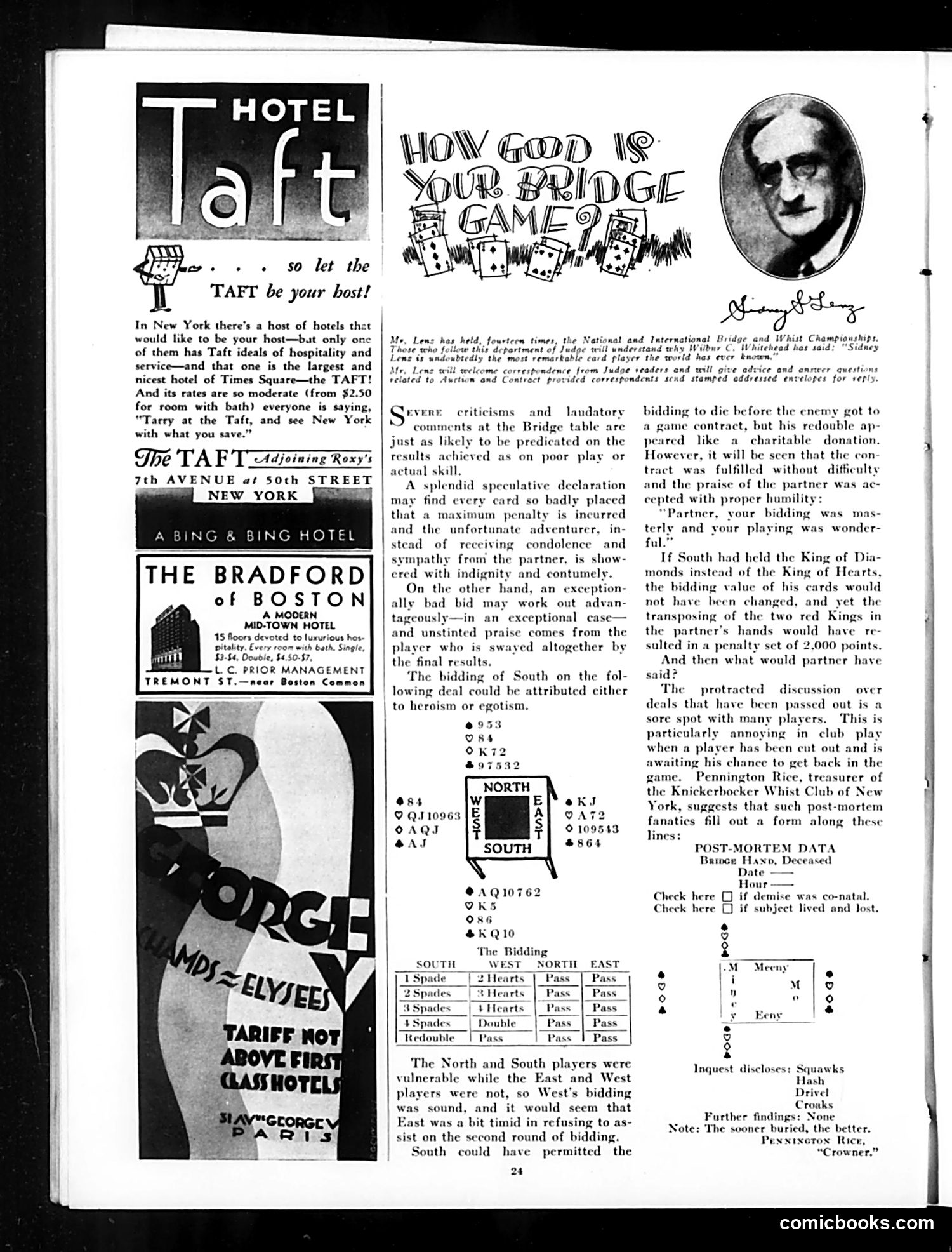
Content Analysis This page is primarily bridge card game instructional content with hotel advertising, not political satire. The main article discusses bridge bidding strategy, using a specific hand deal as example. It critiques how players often judge bids by results rather than quality of play—a bad bid that succeeds gets praised, while excellent bids that fail get condemned. The article references Ely Culbertson (visible as "Lenz" in OCR error), a famous bridge champion of the era, establishing credibility. The "POST-MORTEM DATA" form is satirical advice: Pennington Rice, treasurer of the Knickerbocker Whist Club of New York, humorously suggests post-game discussion forms to document complaints (squawks, hash, drivel) so they're documented properly—mocking how tediously bridge players rehash hands after play. Context: This reflects bridge's massive popularity in 1920s-30s America as both serious competitive game and social activity. The satire gently mocks the obsessive analysis culture among club players. The hotel advertisements (Taft, Bradford) are standard period advertising using "Taft" as hospitality brand reference.
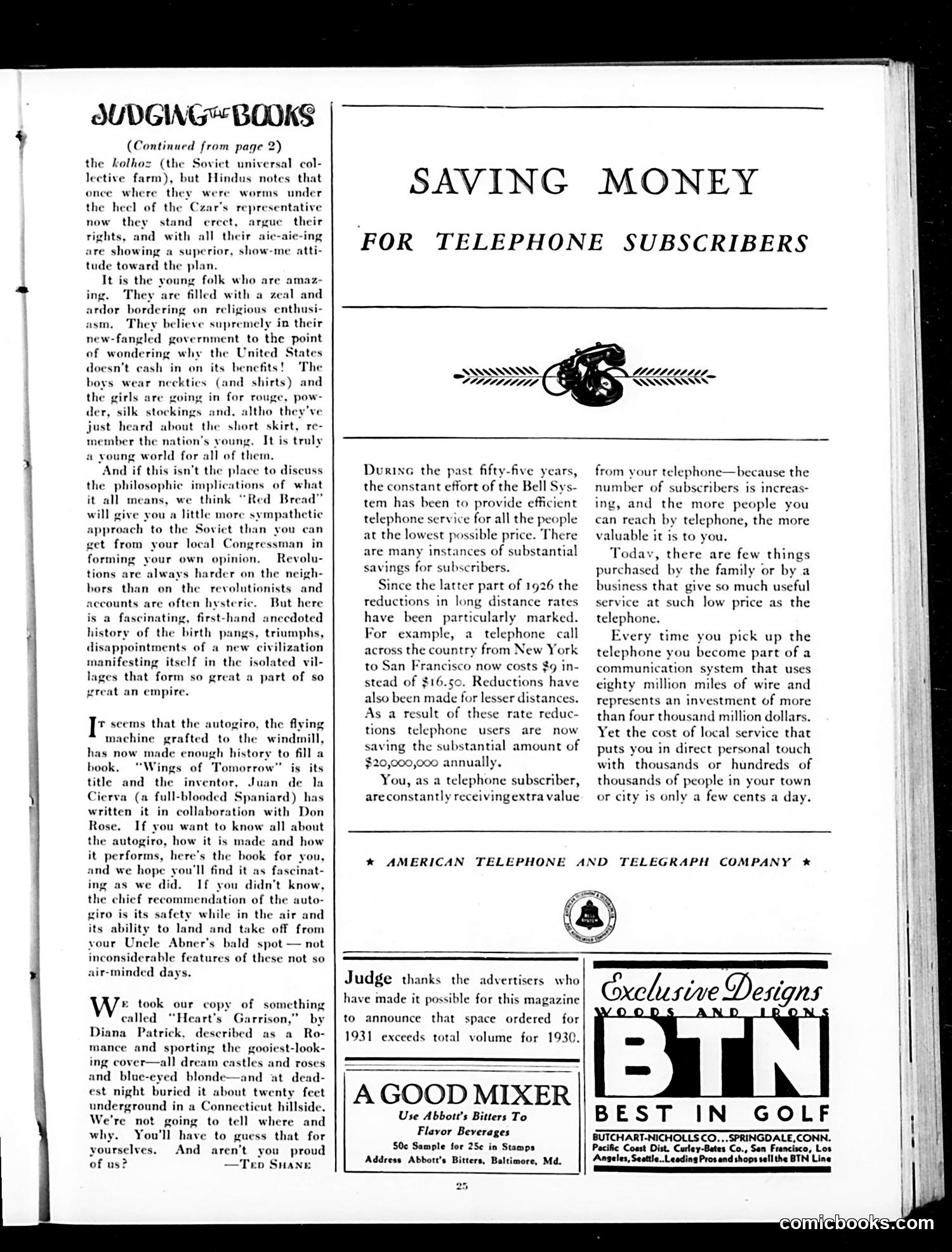
Analysis of This Judge Magazine Page This page consists primarily of advertisements and corporate messaging, not satirical cartoons. The main content is a Bell Telephone Company advertisement promoting the cost savings they've provided telephone subscribers over 55 years. It highlights specific reductions: a cross-country call from New York to San Francisco dropped from $16.50 to $9, and claims users collectively save $20,000,000 annually. The ad emphasizes that as more people subscribe, telephone service becomes more valuable to each user. The left column continues a book review section discussing Soviet Russia, noting young Russians' enthusiasm for their "new-fangled government" and comparing their attitudes to American perspectives—a typical 1930s satirical commentary on communist ideology. At page's bottom are additional advertisements, including one for Abbott's Bitters and BTN golf equipment. This is essentially a sponsored editorial page, not a satirical piece.
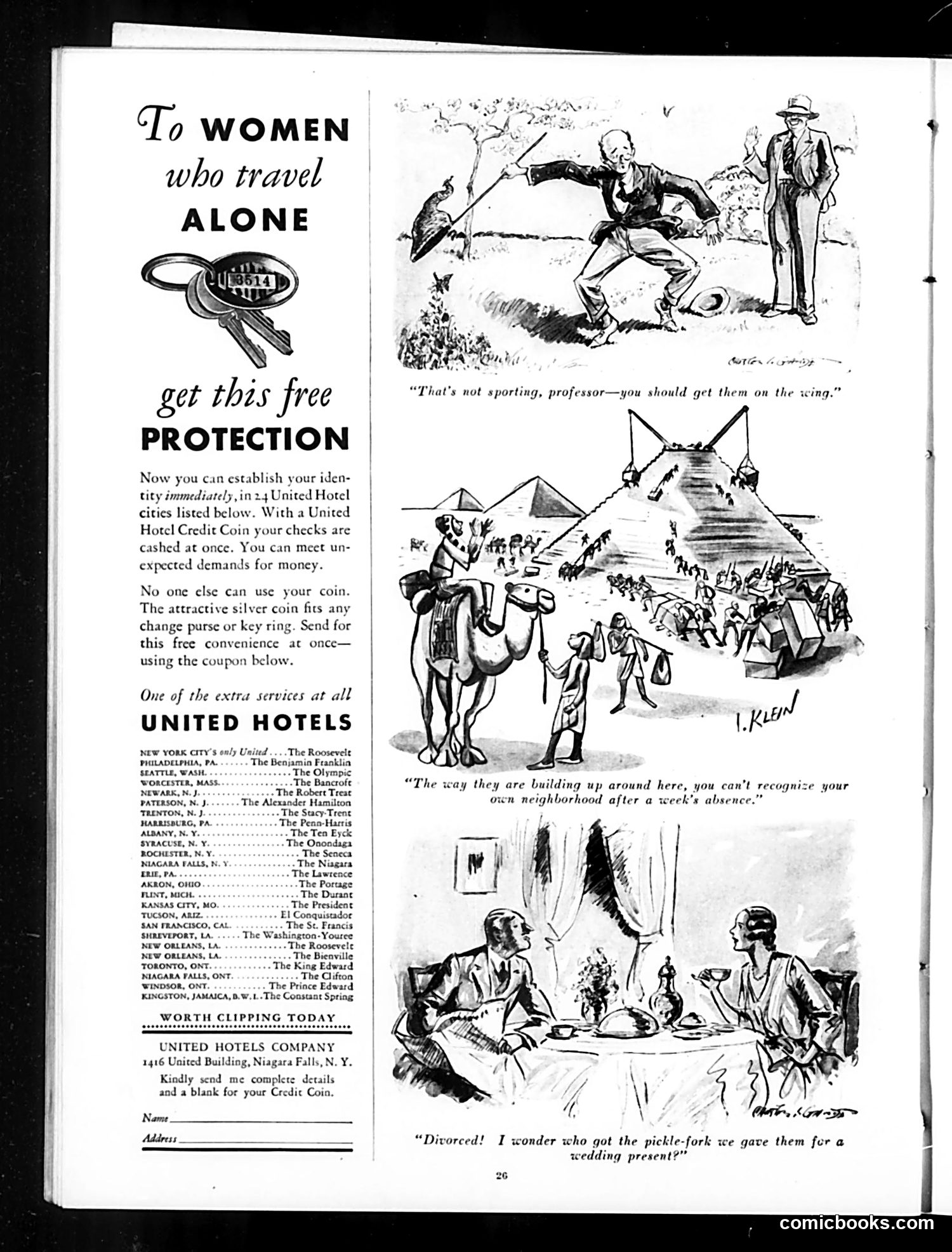
Analysis of Judge Magazine Page This page combines advertising with satirical cartoons about travel, identity, and social change. The left side is a United Hotels advertisement promoting a credit coin system for solo female travelers—positioning it as "protection" that allows women to cash checks immediately in 24 hotel cities without carrying large sums or using purses/rings (which could be stolen). This reflects early-20th-century concerns about women traveling unescorted. The right side contains three unrelated cartoon jokes: 1. A professor and man discussing cricket—the caption suggests catching birds with nets instead of sporting equipment (unclear satirical point). 2. Tourists viewing pyramids amid modern construction; commentary on how rapid urban development obscures familiar neighborhoods. 3. A divorced couple discussing a wedding gift (pickle fork), humorously questioning who retained it post-divorce. These cartoons appear standard Judge humor—observational satire about modern inconveniences and domestic situations—rather than political commentary. The page exemplifies how early-20th-century magazines mixed practical advertising with light social satire.
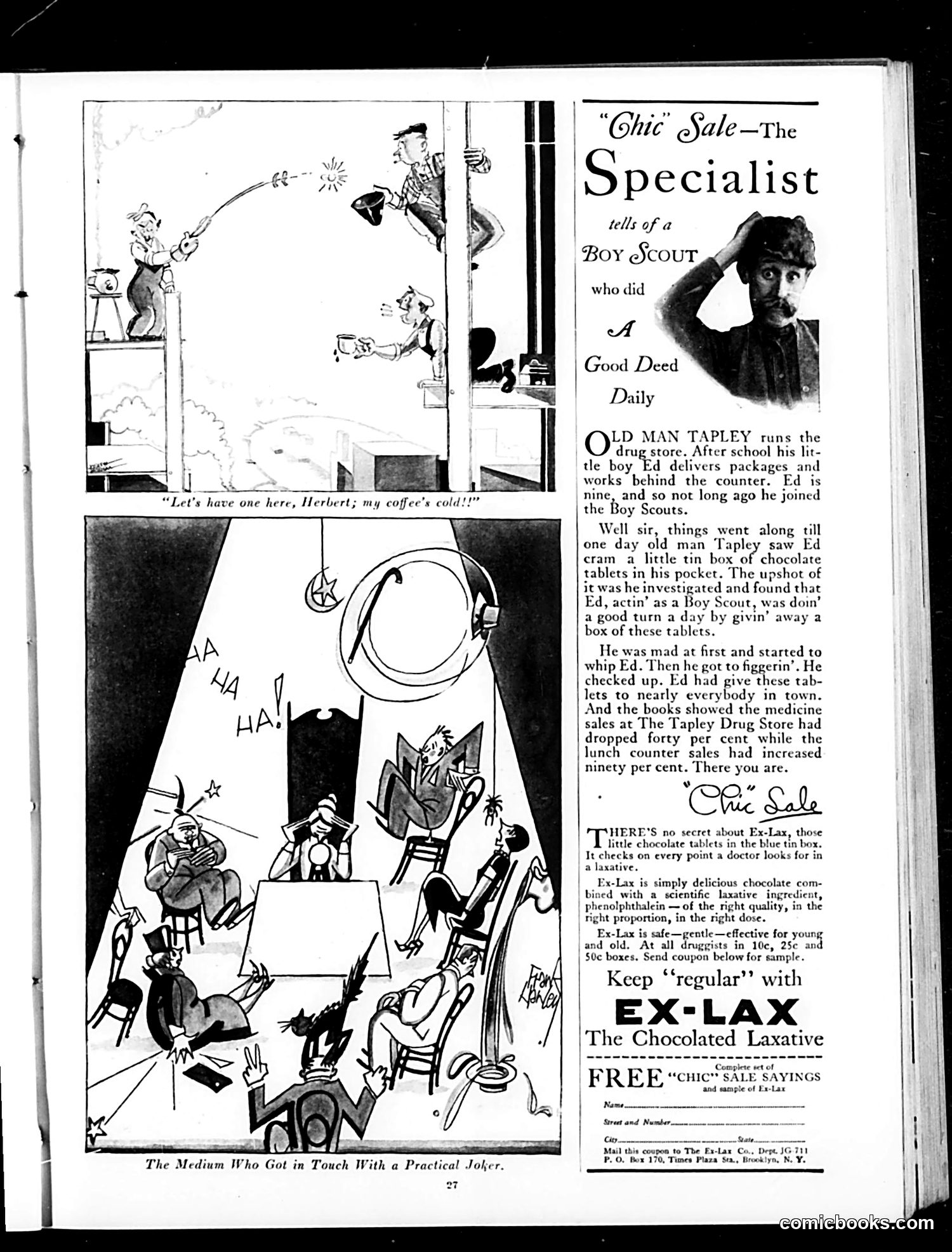
Analysis This page contains two distinct elements: a satirical story and an advertisement. The "Chic Sale" Story (Top Right & Left): "Chic Sale" was a popular humorist known for folksy American tales. This story describes young Ed, a nine-year-old Boy Scout working at his father's drug store, who discovers Ex-Lax chocolate tablets and begins distributing them as his daily "good deed" per Boy Scout principles. His father initially plans to punish him but then notices the drug store's medicine sales dropped 40% while lunch counter sales increased 90%—implying the laxative was working as intended. The satire mocks both the Boy Scout movement's earnestness about daily good deeds and the unexpected commercial consequences of Ed's well-meaning generosity. The Advertisement (Right & Bottom): An Ex-Lax laxative ad featuring a coupon. The advertisement emphasizes the product is a chocolate-based laxative safe for all ages, available in multiple sizes. The page blends editorial content with advertising, using humor to market the product while gently satirizing youth organizations and commercial enterprise.
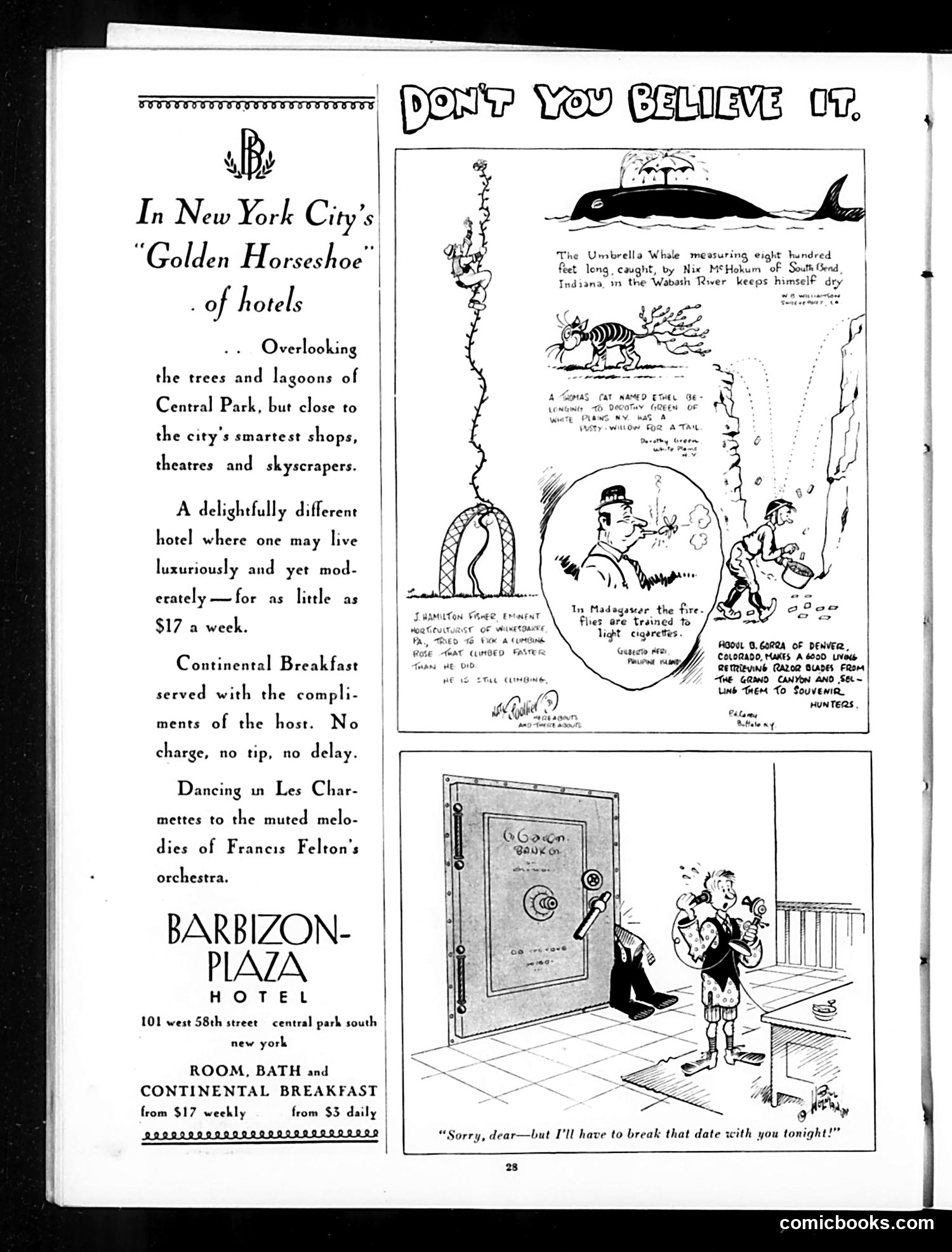
Page Analysis: Judge Magazine This page combines a hotel advertisement (left) with satirical content (right). The main advertisement promotes the Barbizon-Plaza Hotel, emphasizing luxury at modest rates ($17/week) near Central Park and Manhattan's attractions, with continental breakfast included. The cartoon section titled "DON'T YOU BELIEVE IT" presents absurdist tall tales—a common humor format of the era. It includes fabricated stories about: an implausibly enormous "umbrella whale" caught in Indiana; a Madagascan fire-ant trained to light cigarettes; and a Colorado man retrieving lost razor blades from the Grand Canyon. These mock exaggerated adventure narratives popular in contemporary media. The bottom cartoon shows a man emerging from a safe, telling his date "I'll have to break that date with you tonight!"—likely implying he's a burglar or safecracker caught mid-heist, using the excuse to abandon her. The satire targets gullible readers' appetite for sensational, false "human interest" stories in newspapers and magazines of the period.
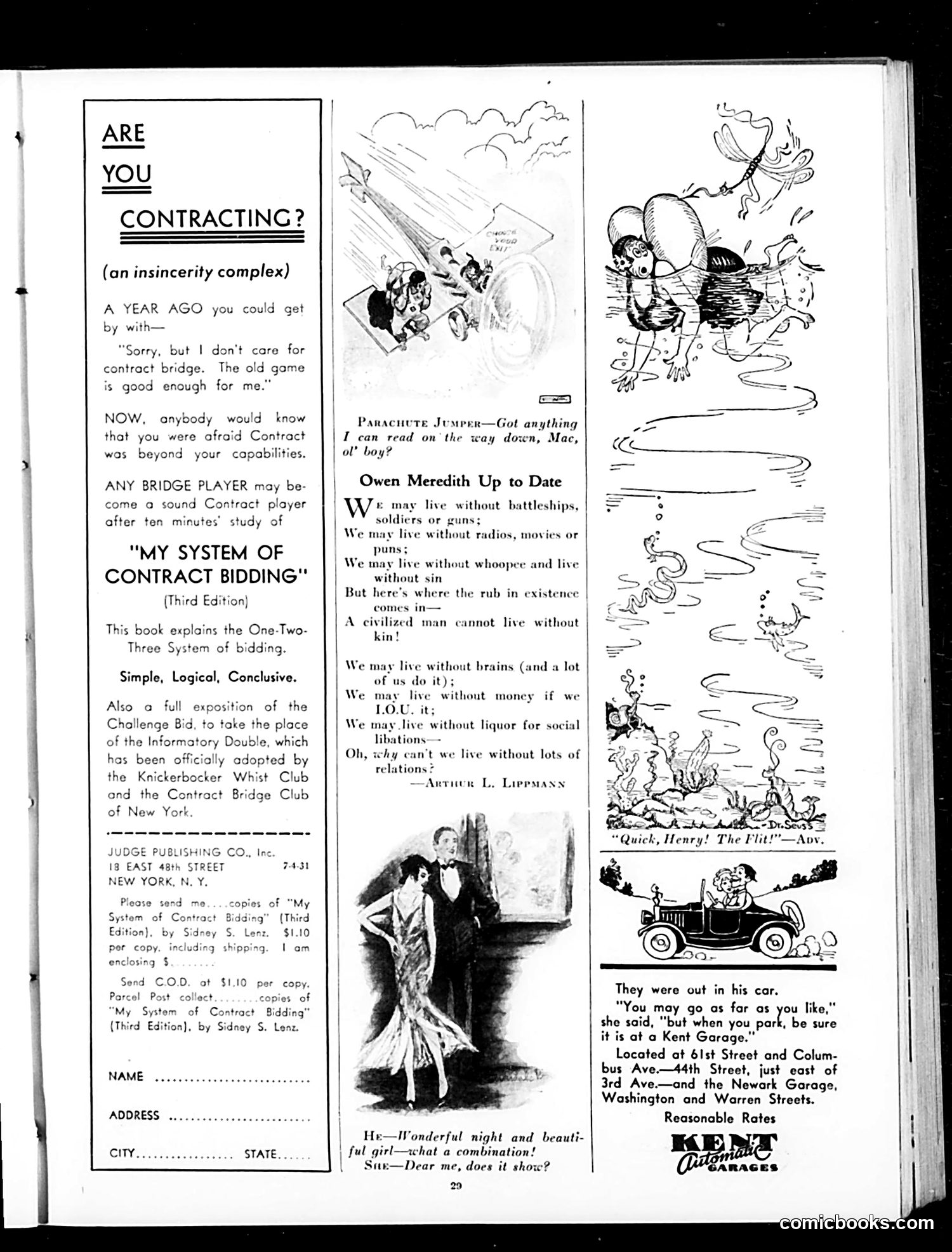
Analysis of Judge Magazine Page This page combines advertising with satirical content reflecting 1920s social anxieties. Main Advertisement: Promotes a bridge-bidding instruction book. The satire mocks social pretension—a year ago, claiming disinterest in "contract bridge" was acceptable; now it signals incompetence. The implication: contract bridge has become a fashionable status marker among the wealthy, and admitting ignorance is socially damaging. Cartoons & Humor: - A parachute jumper cartoon plays on the phrase "read on the way down"—gallows humor about a falling situation. - An Owen Meredith parody poem humorously lists things civilization can survive without (battleships, money, alcohol) before arriving at the punchline: family relations are inescapable and burdensome. - A flirtation scene about parking at a "Kent Garage" is mild sexual innuendo typical of the era—suggesting a young woman's concern about propriety even while allowing romantic liberties. Context: The page reflects Jazz Age anxieties about social climbing, family obligation, and courtship customs during the 1920s.
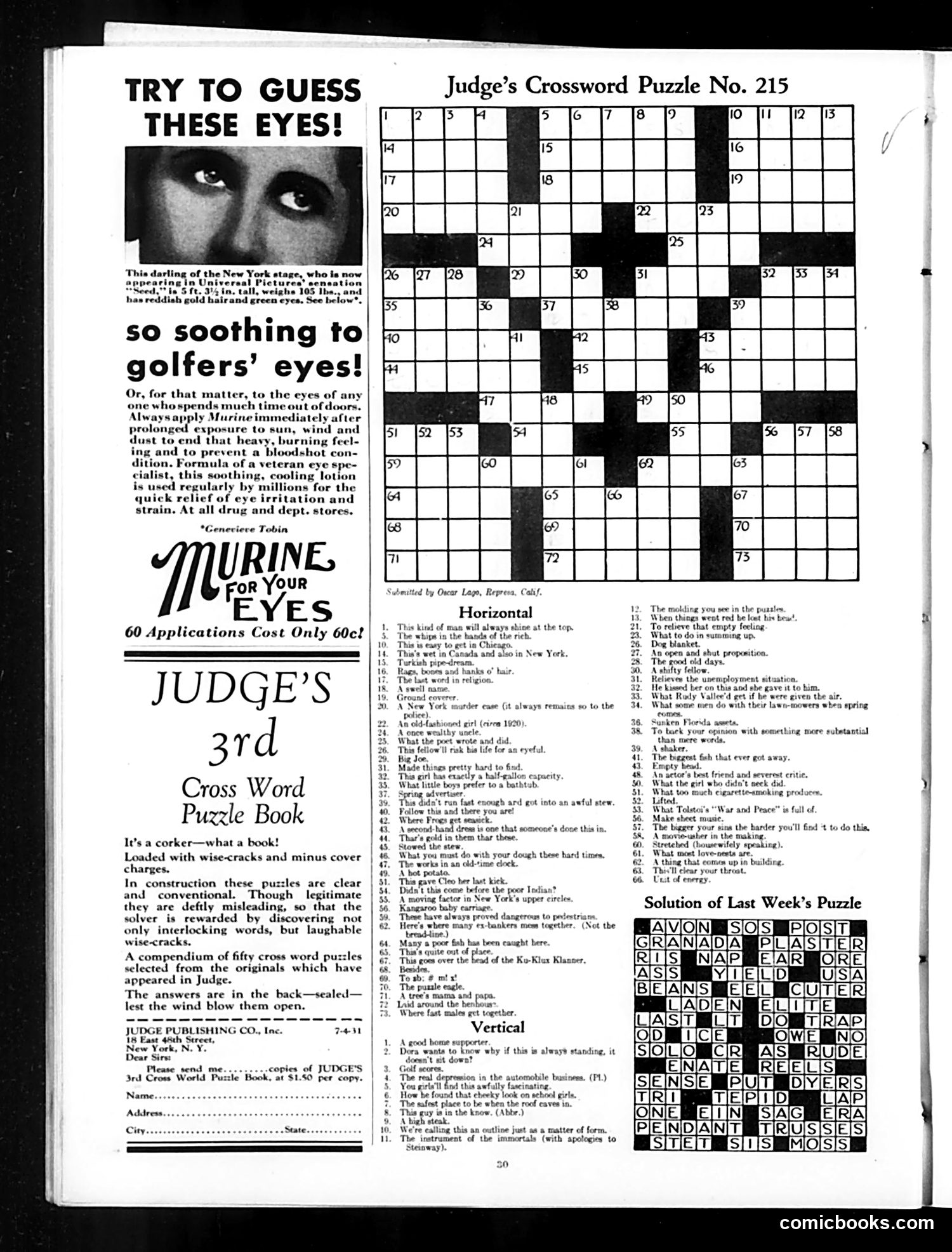
Judge Magazine, Page 50: Advertisement and Crossword Puzzle This page contains primarily advertising and a crossword puzzle, not political satire. The main content is an advertisement for Murine eye drops, featuring a photograph labeled "Try to Guess These Eyes!" The model is identified as Genevieve Tobin, described as "a darling of the New York stage" appearing in Universal Pictures films. The ad's joke is that her attractive green eyes are "so soothing to golfers' eyes"—a light pun suggesting the product relieves eye strain from outdoor activities. Below the ad is a promotion for Judge's 3rd Cross Word Puzzle Book, emphasizing that its puzzles are "deftly misleading" and contain hidden "laughable wise-cracks" alongside legitimate interlocking words. This was characteristic of Judge magazine's humor-focused crossword style. The page is largely commercial rather than satirical, typical of magazine interior pages from this era.
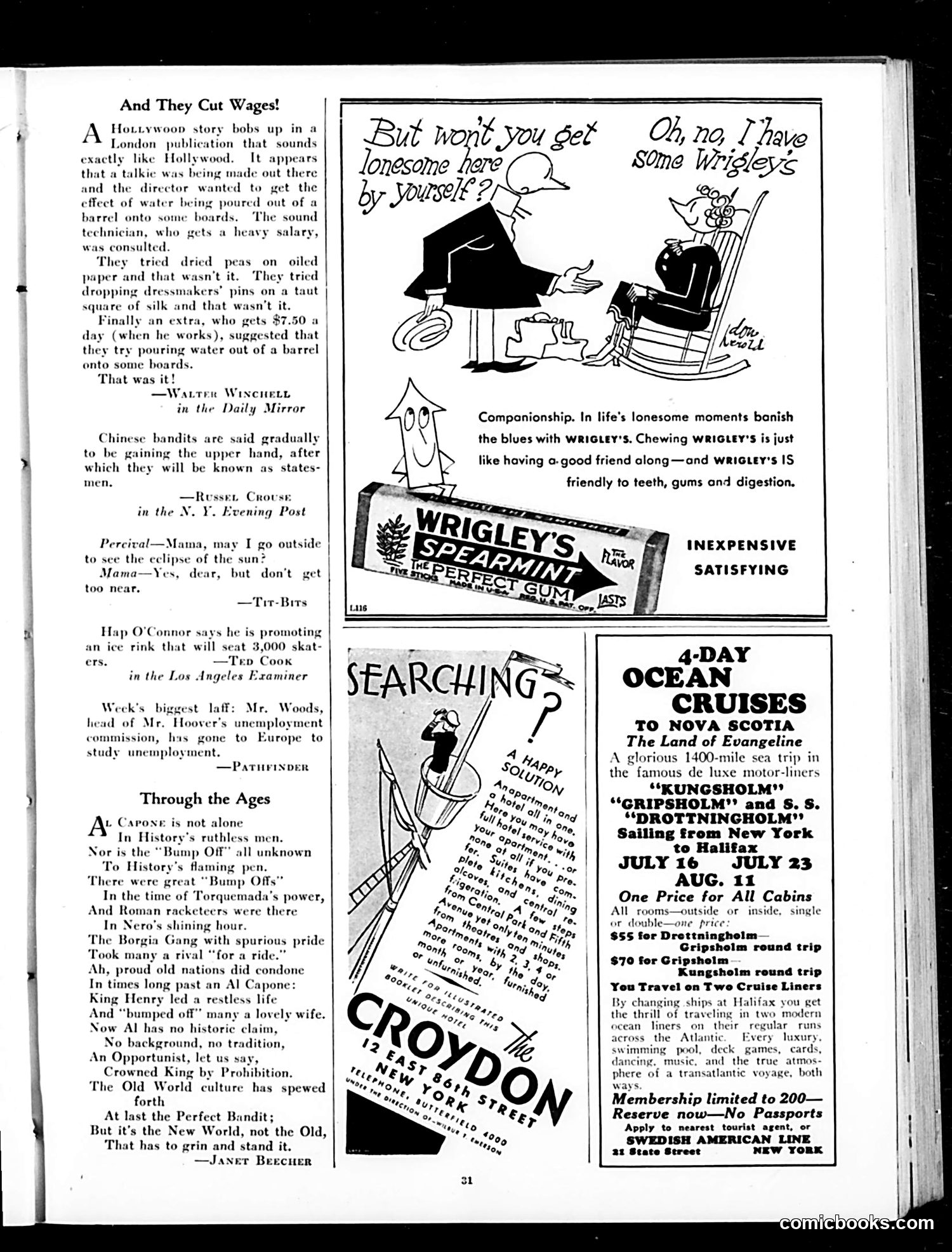
Judge Magazine Page Analysis This page mixes humor columns with advertisements. The main satirical content includes: "And They Cut Wages!" — A Hollywood anecdote mocking studio inefficiency: sound technicians exhausted expensive solutions (dried peas, pins on silk) to record water sounds, while a $7.50-per-day extra simply suggested pouring actual water. The irony: despite paying high salaries to specialists, the cheapest solution worked best—yet wages were being cut elsewhere. "Through the Ages" — A poem comparing Al Capone (the famous gangster) to historical villains like Torquemada, the Borgias, and King Henry VIII. The satirical point: America, the "New World," prides itself on civilization yet produces Capone, while the Old World's brutality at least has historical tradition to excuse it. Other brief jokes mock Chinese bandits becoming "statesmen," a child asking about a solar eclipse, and the absurdity of Hoover's unemployment commission chief studying unemployment *in Europe*. The page is otherwise dominated by advertisements (Wrigley's gum, ocean cruises to Nova Scotia), typical of Judge's format.
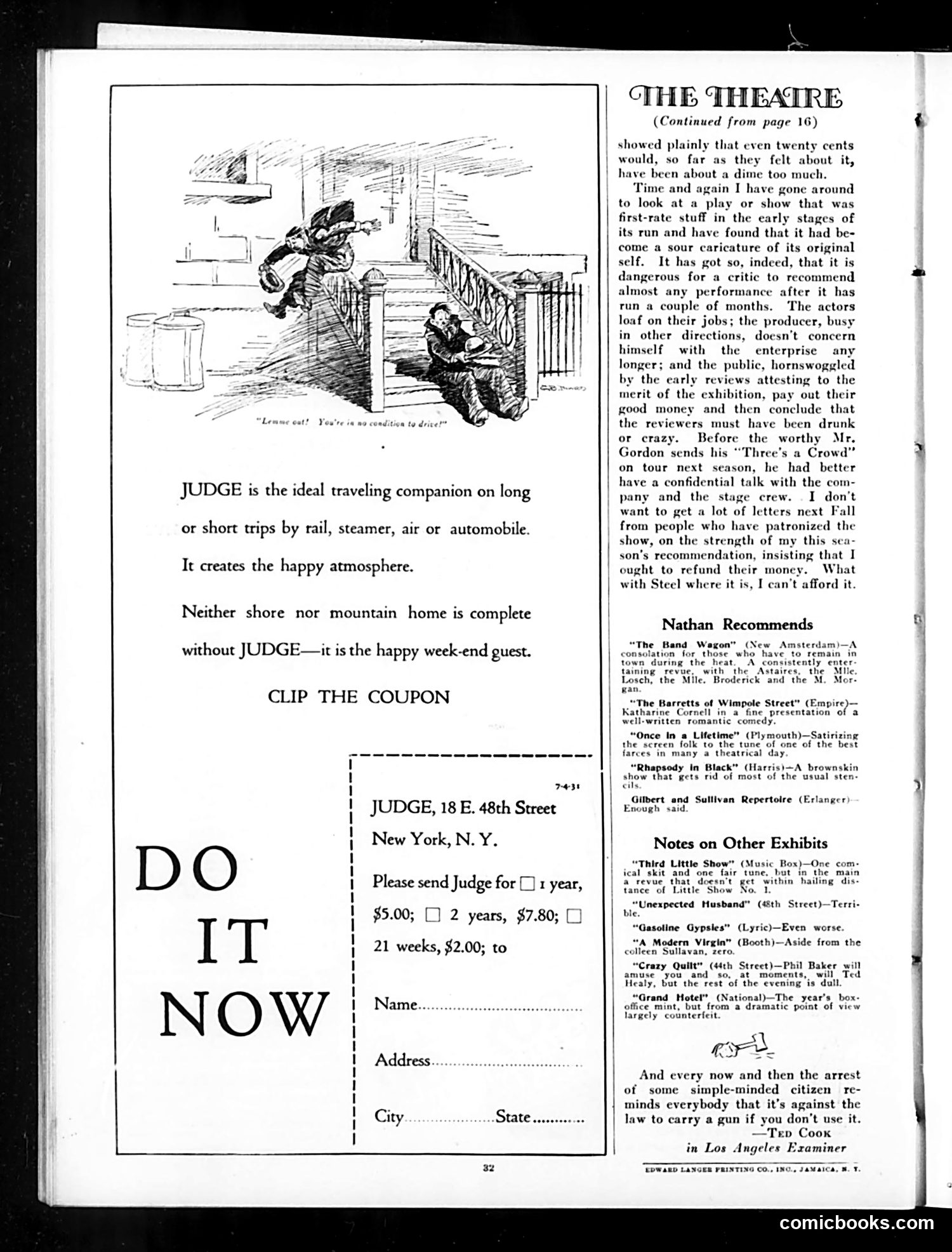
Judge Magazine Page Analysis This page is primarily advertising and promotional content, not satire. The left side features a Judge magazine subscription advertisement with a cartoon showing two figures—one appearing to tumble or fall while another watches from below. The caption reads "Excuse! You're in no condition to drive!"—a joke about intoxication affecting driving ability, which was relevant during Prohibition era. The accompanying text promotes Judge as an ideal travel companion for trips by various transportation modes, emphasizing it "creates the happy atmosphere." The right side continues theater criticism from a previous page, recommending specific Broadway shows (including Katharine Cornell's "The Barretts of Wimpole Street" and Fred Astaire's "The Band Wagon") while dismissively reviewing others. The bottom includes a brief Ted Cook commentary about gun laws. Overall: This is a magazine house ad and theater review page, not political satire.
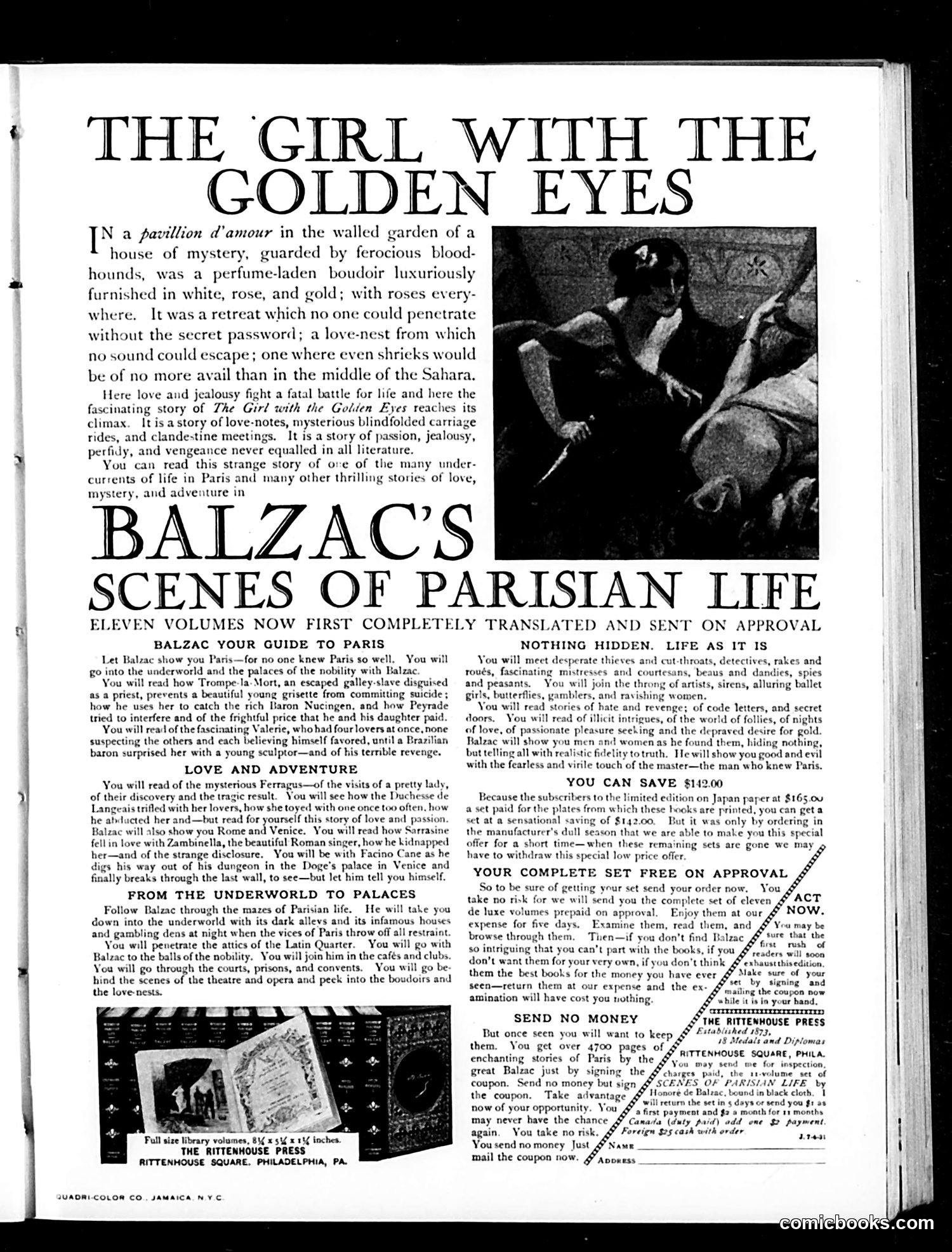
Analysis for Modern Readers This is primarily a book advertisement, not political satire. It promotes Balzac's *Scenes of Parisian Life* through a serialized novel excerpt, "The Girl with the Golden Eyes." The page uses dramatic imagery and lurid descriptions to market classic literature to early 20th-century American readers. The top illustration shows figures in shadowy, intimate circumstances—typical of the sensationalized marketing style of the era. The ad emphasizes "nothing hidden" and promises access to Parisian "underworld" and aristocratic life, appealing to readers' desire for sophisticated European literary content and scandalous stories of passion and revenge. The "Send No Money" offer with approval privileges was a common mail-order sales tactic. This is advertisement-as-content, not satire—though the breathless, over-the-top promises about what Balzac will "show you" might strike modern readers as self-parodic in tone.
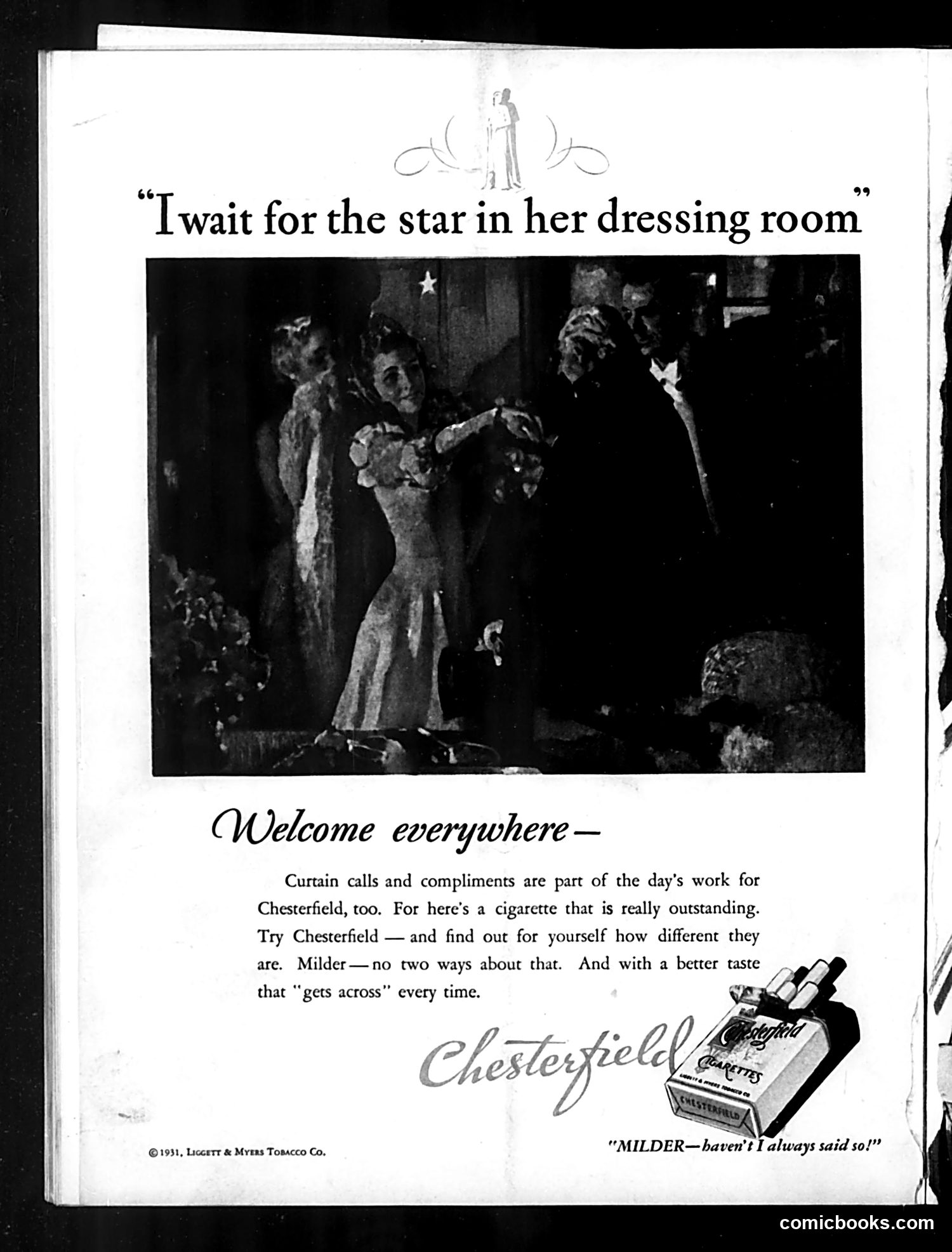
This is a cigarette advertisement, not political satire. It's a 1931 Chesterfield cigarettes ad using theatrical imagery to sell smoking. The ad depicts a glamorous actress in her dressing room receiving admirers after a performance—a scene meant to convey sophistication and social success. The headline "I wait for the star in her dressing room" suggests the cigarette itself is as essential and celebrated as the performer. The marketing message equates smoking Chesterfield cigarettes with elegance, popularity, and being "welcome everywhere." The tagline emphasizes the product is "milder" with better taste that "gets across"—standard cigarette advertising claims from this era. This reflects pre-regulation tobacco marketing that freely associated smoking with glamour, social acceptance, and success without health warnings.