judge
Judge — July 11, 1931
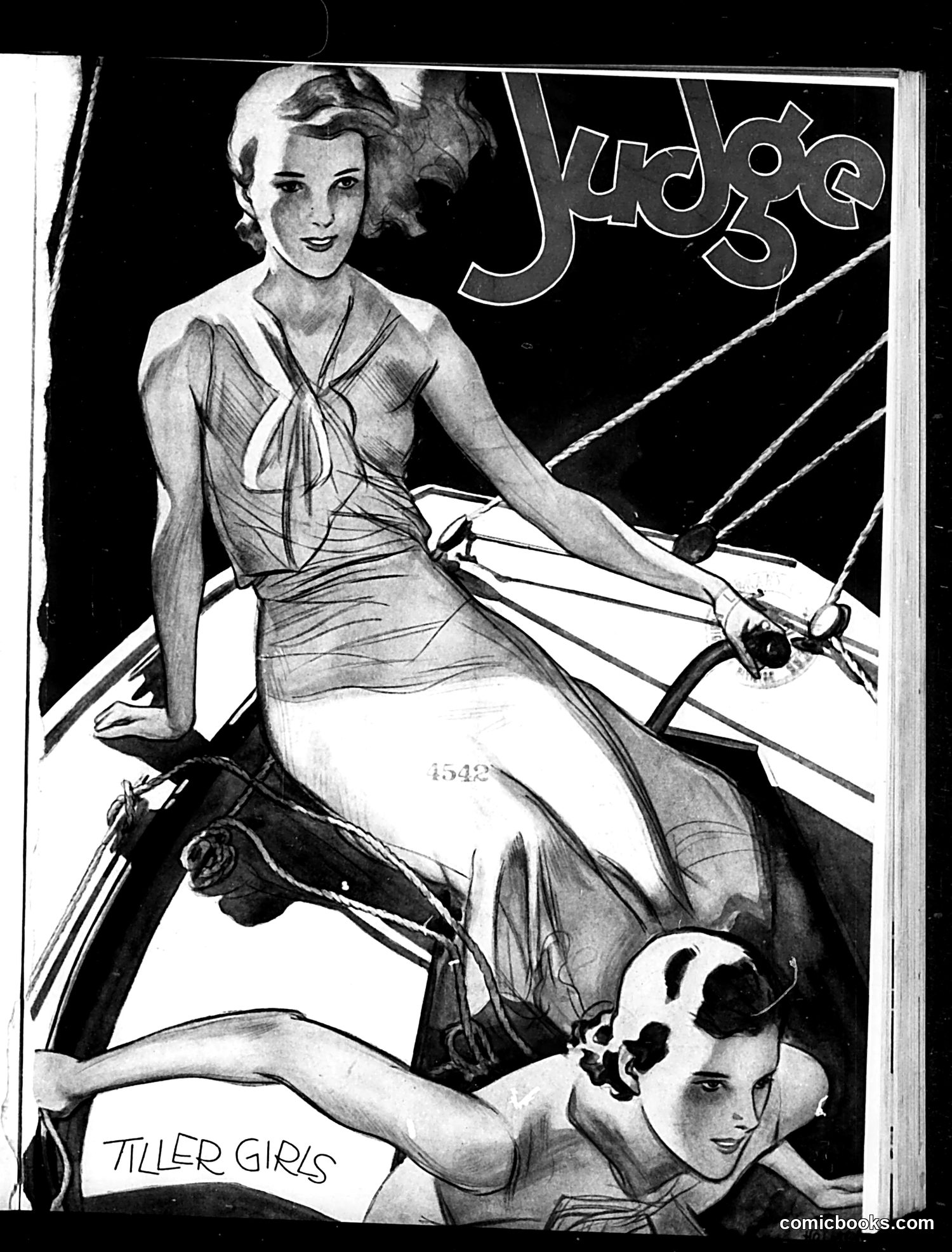
Analysis This appears to be a cover or advertisement page from *Judge* magazine featuring an illustration labeled "Tiller Girls." The image shows two women in 1920s-style clothing posed with what appears to be an airplane or aircraft in the background. The "Tiller Girls" were a famous precision dance troupe from the 1920s-1930s known for synchronized choreography. The satire likely plays on the contrast between the modern, somewhat risqué femininity of the dancers (shown in their fashionable, form-fitting dress) and the technical/mechanical world of aviation visible behind them. The specific satirical point—whether commentary on modern women, aviation, entertainment, or some combination—remains unclear without additional context or readable body text from the page.

Analysis This is a straightforward advertisement, not satire or political commentary. It's a vintage Dentyne chewing gum ad, likely from the 1920s-1930s based on styling and typography. The page features a smiling man's portrait endorsing Dentyne gum as a product that "keeps teeth white." The ad argues that white teeth are essential for success, claiming they win friends and charm. It emphasizes that Dentyne's special formulation helps maintain teeth whiteness while the gum's texture provides "healthful exercise" for gums. The tagline "Chew Dentyne...and smile!" is the core sales pitch. This represents typical early-20th-century advertising that linked personal grooming to social and professional success—a common marketing strategy of the era.
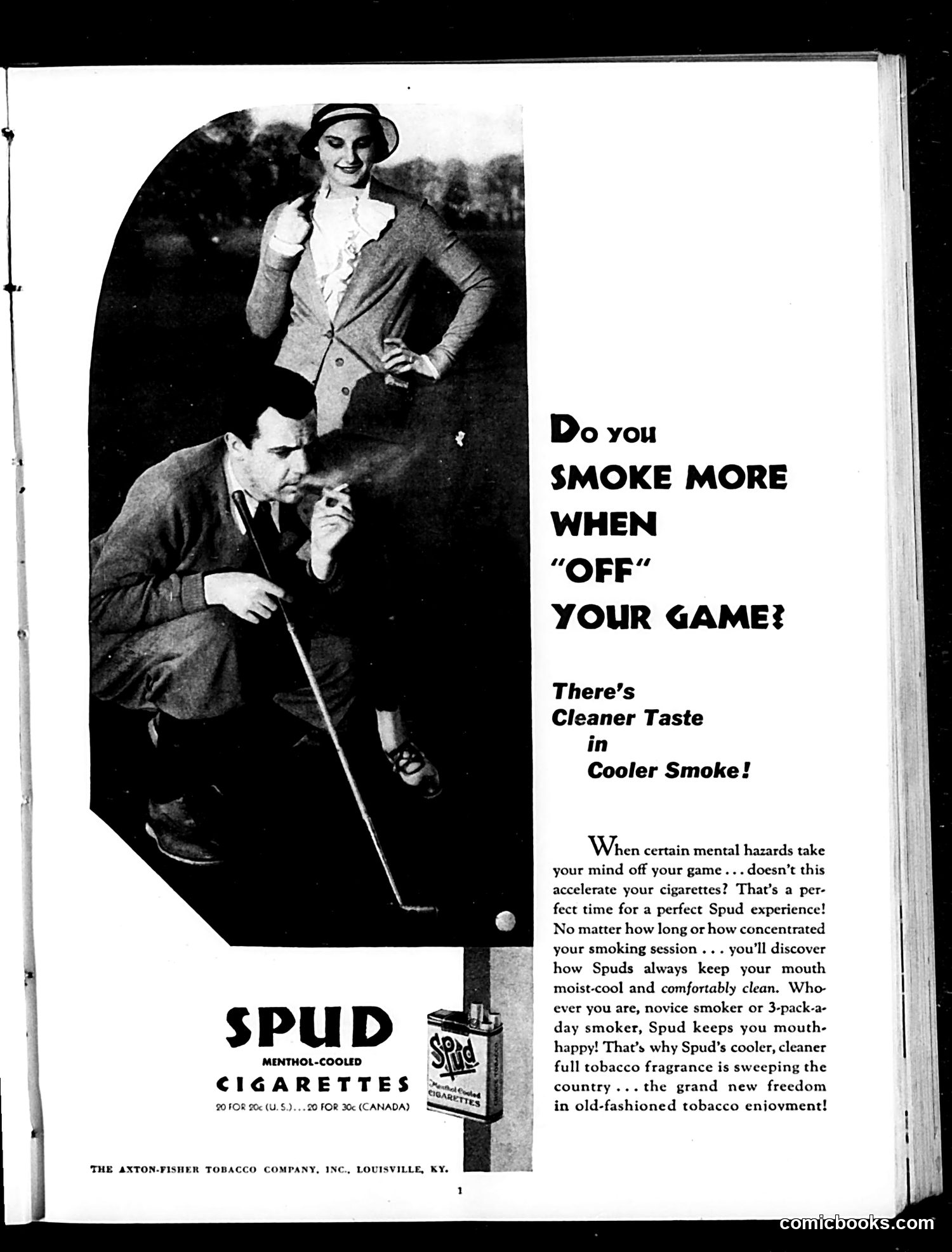
Analysis This page is primarily a cigarette advertisement, not satire or political commentary. It advertises Spud menthol-cooled cigarettes, made by the Axton-Fisher Tobacco Company in Louisville, Kentucky. The ad features two figures—a man playing golf and a woman watching—illustrating the marketing pitch: smokers consuming more cigarettes during stressful moments (like a poor golf game) should switch to Spud's "cooler" menthol cigarettes for a "cleaner taste" and "moist-cool" comfort. The claim that Spud's "full tobacco fragrance is sweeping the country" appears designed to position the brand as modern and popular. This reflects early-20th-century tobacco marketing before health warnings were required. The ad targets both "novice" and heavy smokers.
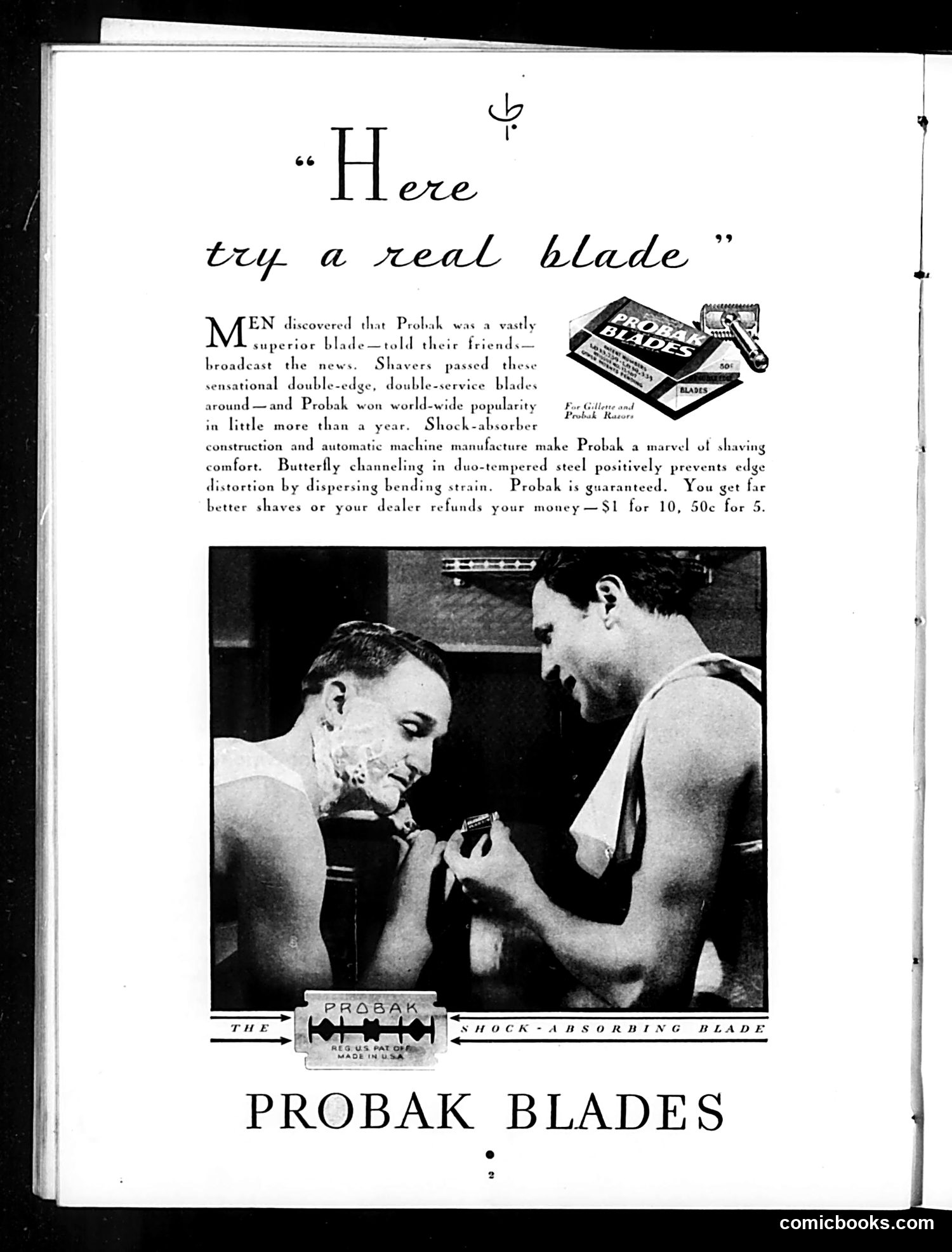
Analysis This page is primarily an advertisement, not satire or a political cartoon. It advertises Probak razor blades, a real brand that achieved commercial success around the early 1920s. The ad's headline—"Here try a real blade"—emphasizes the product's superior quality. The text claims Probak blades won "world-wide popularity in little more than a year" due to their shock-absorbing construction and machine manufacture, which prevented edge distortion. The photograph shows two men in a barbershop setting, demonstrating the blade's performance. The pricing ($1 for 10 blades, 50¢ for 5) and guarantee ("You get far better shaves or your dealer refunds your money") were typical sales tactics of the era. This is straightforward product marketing, not editorial content requiring historical context for modern readers.
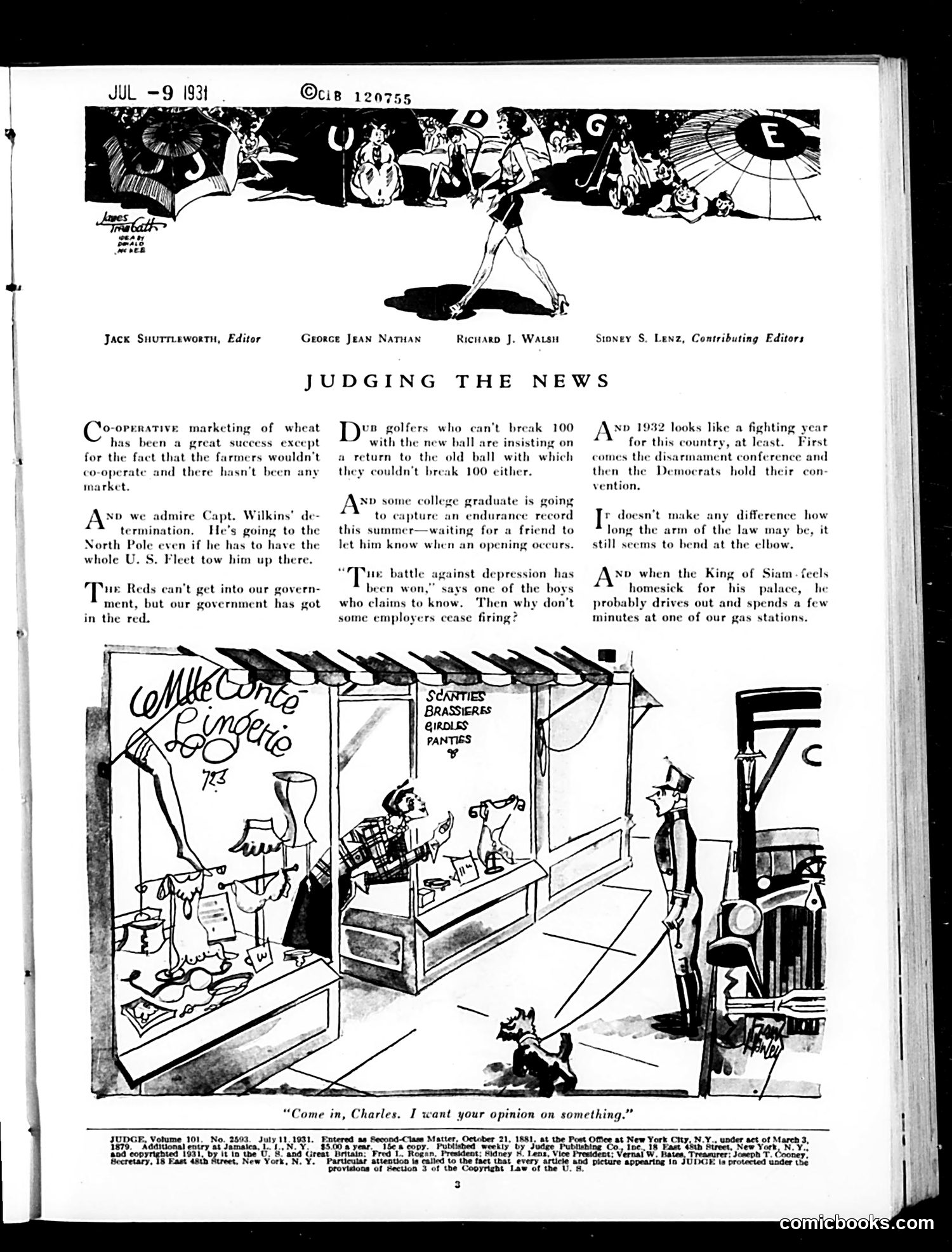
Analysis of Judge Magazine, July 9, 1931 The main cartoon depicts a street scene with shop windows displaying women's intimate apparel ("Corsets, Brassières, Girdles, Panties"). A well-dressed man in a top hat and monocle stands outside, addressing a dog, saying "Come in, Charles. I want your opinion on something." The satire targets the absurdity of seeking a dog's opinion on women's lingerie—likely mocking either male fashion commentators of the era who presumed expertise on women's clothing despite having no legitimate basis for it, or more broadly, ridiculous consumer advice culture. The figure's exaggerated formal dress and monocle suggest pretension. The surrounding editorial section "Judging the News" contains brief political commentary typical of Judge's satirical content from the Depression era.
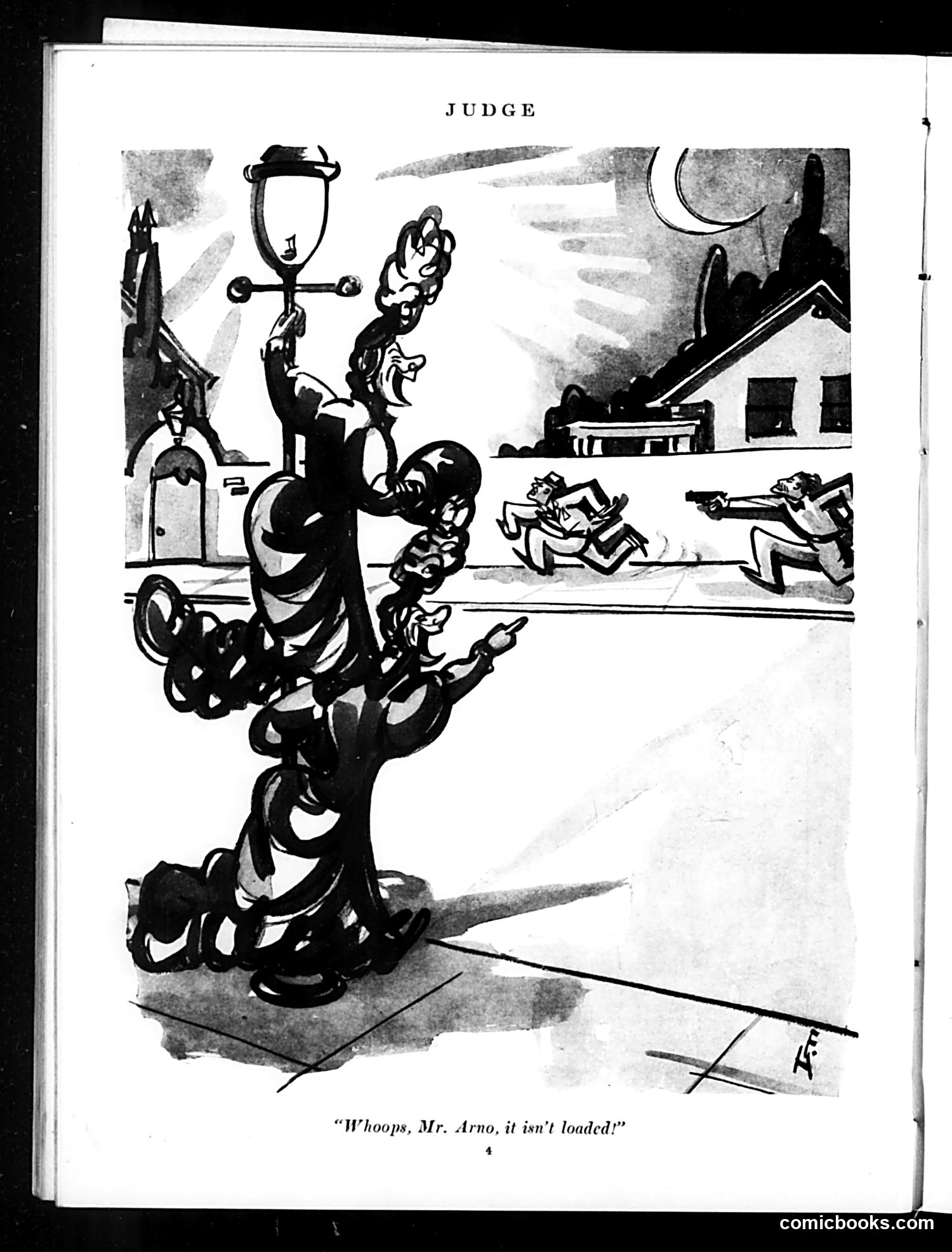
Analysis of "Judge" Cartoon Page This satirical cartoon depicts a judge character juggling various implements of justice—including scales, a gavel, and what appears to be legal documents or warrants. The caption reads: "Whoops, Mr. Arno, it isn't loaded!" The joke appears to satirize judicial incompetence or the precarious state of law enforcement. The juggling act suggests the judge is barely managing his responsibilities, while the reference to something not being "loaded" (likely a weapon or tool) implies he's unprepared or ineffectual in administering justice. In the background, small figures appear to be fleeing or in distress, suggesting criminals escaping due to judicial failure. This reflects common Progressive Era critiques of corruption or incompetence in the legal system. Without specific dating, the exact target remains unclear, though it likely comments on contemporary judicial scandals or reform debates.
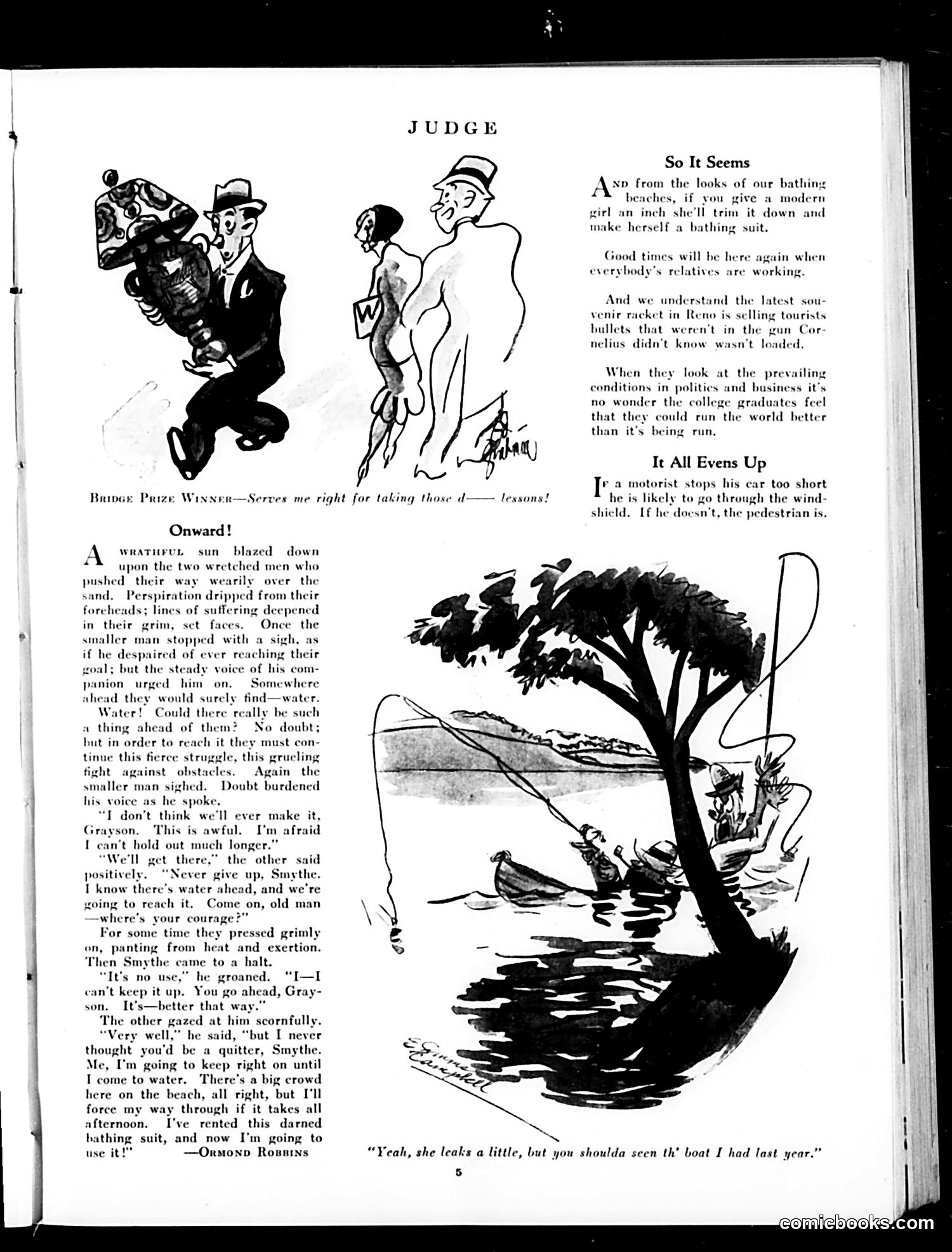
Judge Magazine Page Analysis This page contains three separate humorous pieces: 1. "Bridge Prize Winner" (top): A cartoon showing two men struggling across sand, one carrying what appears to be a heavy object. The caption references "lessons," suggesting satire about bridge (the card game) competitions or prizes—likely mocking competitive bridge culture. 2. "Onward!" (left): A story excerpt about two men in a desert struggling toward water. This appears to be satirizing overly dramatic or melodramatic adventure fiction popular in the era. 3. "It All Evens Up" and "So It Seems" (right): Brief satirical commentary pieces on modern life—bathing suits, business conditions, and motorist behavior—typical of Judge's social commentary style. The bottom illustration shows a beach/water scene with boats, accompanying a caption about someone's boat from "last year," likely satirizing vacation mishaps or boasting.
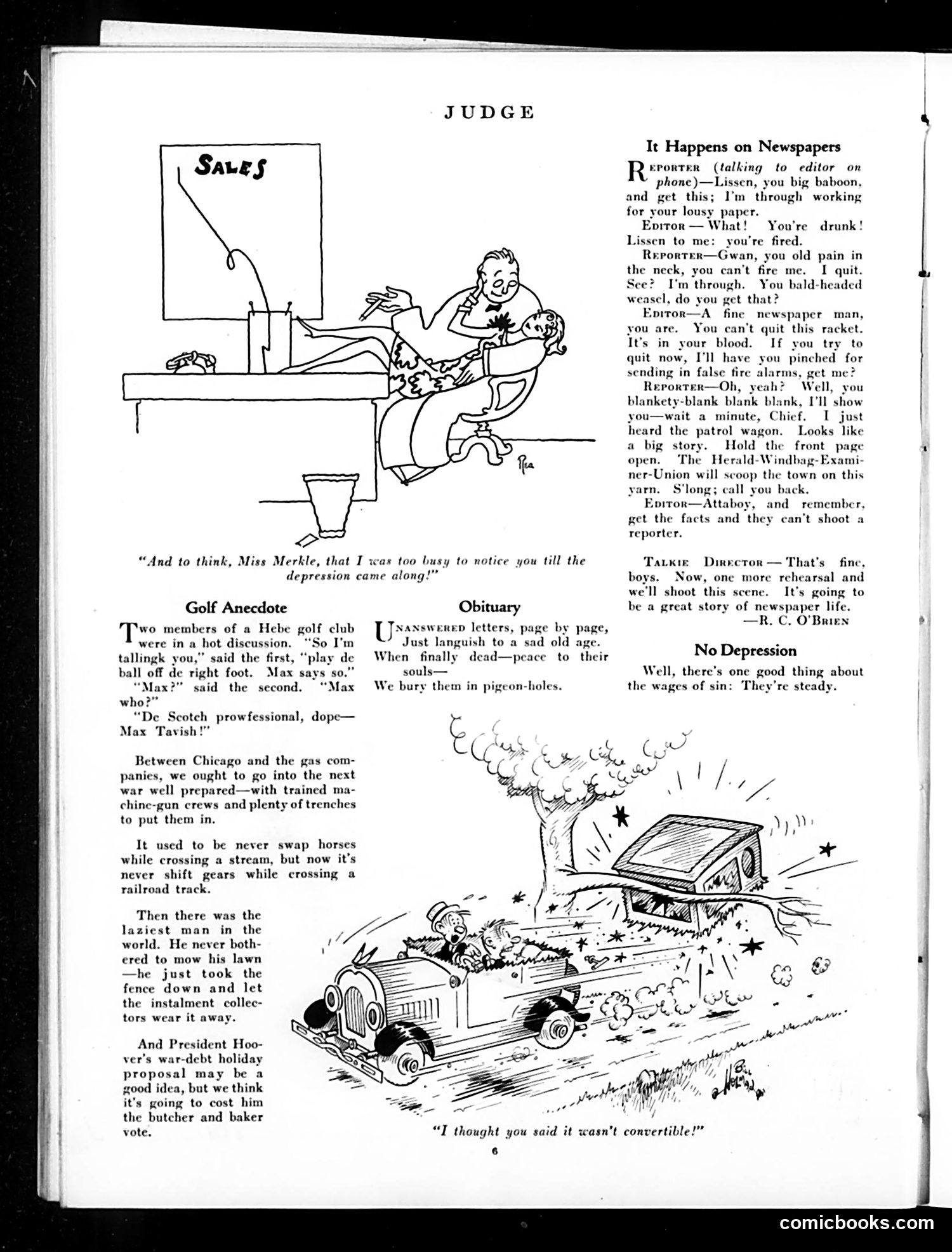
Analysis of Judge Magazine Page This page contains three separate humor pieces: "It Happens on Newspapers" depicts a confrontation between a newspaper editor and reporter. The editor fires the reporter for being drunk, but the reporter refuses to quit, claiming newspaper work is "in your blood" and threatening to expose the editor's misconduct (false fire alarms, etc.). The satire mocks the chaotic, ethically-questionable nature of early newspaper operations and the combative relationships between editors and staff. "Golf Anecdote" is a brief joke about two golfers discussing who's the better player—it references "Max Tavish," likely a known golfer of the era. "No Depression" shows a car crashing into a house after hitting a tree, with the caption "I thought you said it wasn't convertible!" The humor plays on the word "convertible" (a car with a removable roof) versus the literal conversion of a closed vehicle into an open one through disaster.
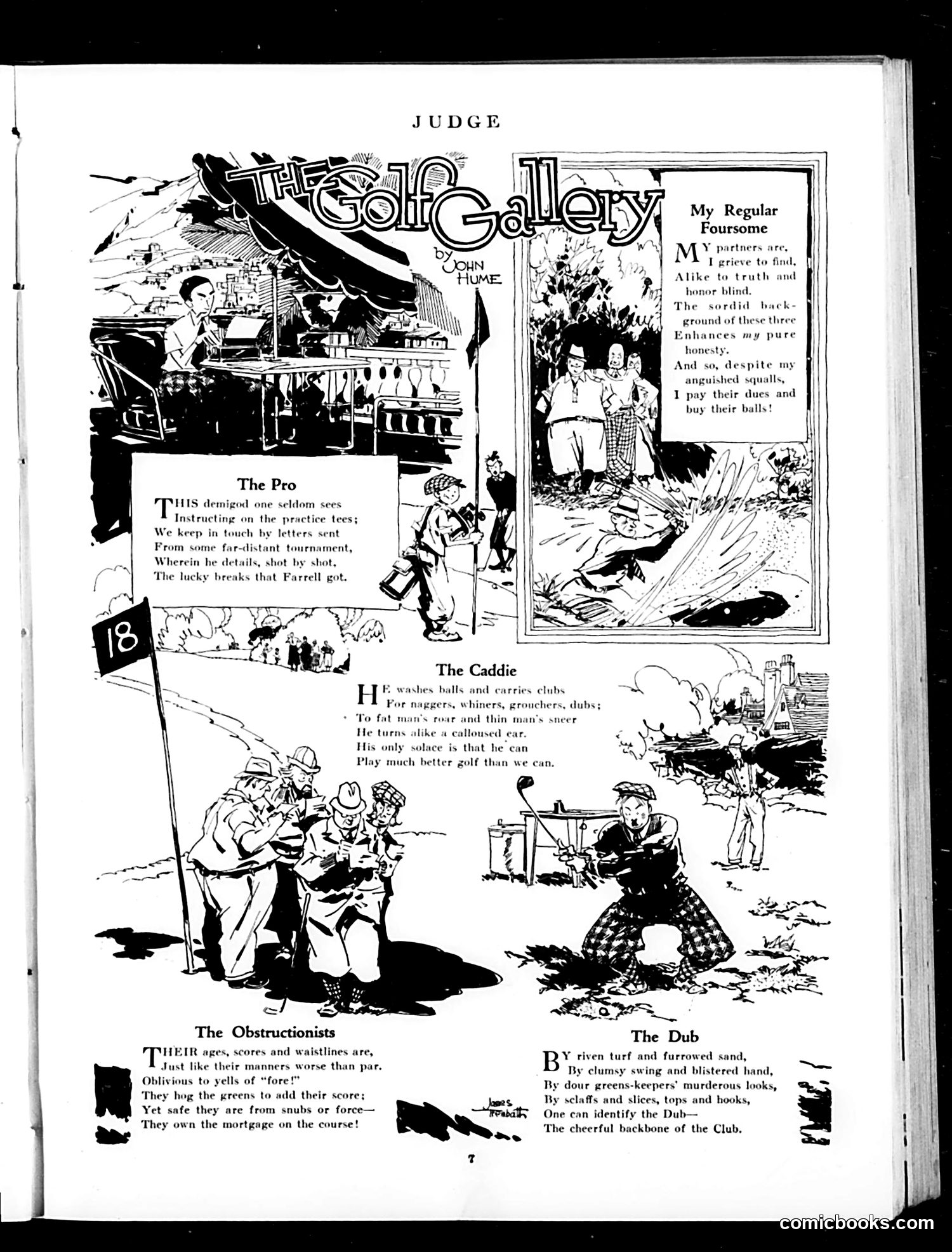
"The Golf Gallery" by John Hume This page satirizes different types of golfers through character sketches. "The Pro" depicts golf instructors who rarely play but profit from lessons. "The Caddie" portrays the long-suffering caddy who watches incompetent players yet plays better himself. "The Obstructionists" mocks slow players who hog the greens and complain loudly. "The Dub" stereotypes the poor golfer with bad technique but good humor. The sidebar "My Regular Foursome" presents a narrator who acknowledges his playing partners are dishonest and dishonorable, yet he subsidizes them anyway—suggesting satirical commentary on social obligation and class dynamics in early 20th-century golf clubs, where membership often involved tolerating unpleasant companions for social standing.
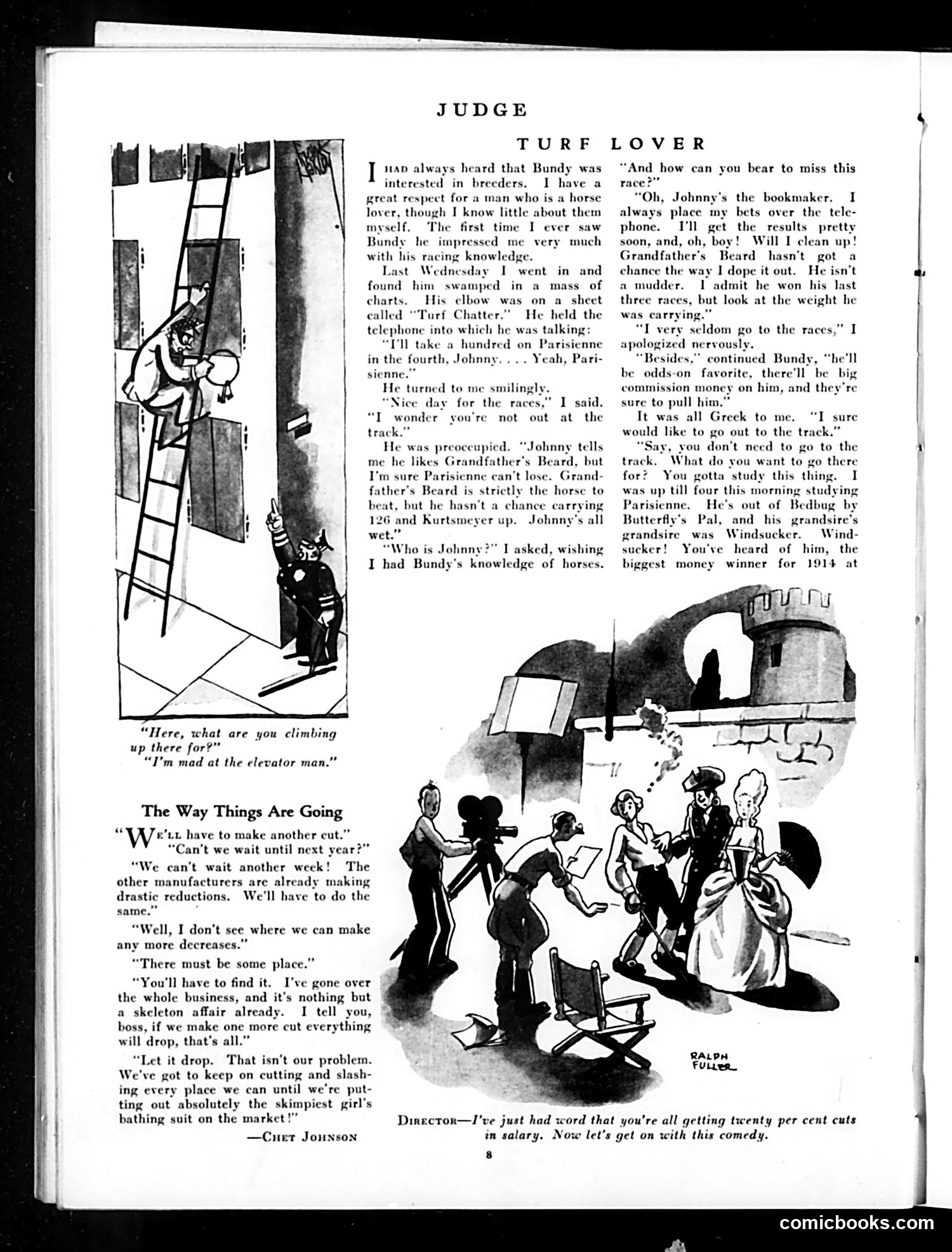
Judge Magazine Page Analysis This page contains two satirical pieces typical of early 20th-century Judge magazine humor. "Turf Lover" mocks horse racing obsession and gambling. A character named Bundy, presented as a horse breeding enthusiast, is revealed to be placing bets through a bookmaker ("Johnny") via telephone. The narrator—initially impressed by Bundy's supposed expertise—discovers Bundy's "knowledge" is actually gambling jargon about odds, weights, and suspicious practices ("they're sure to pull him" suggests race-fixing). The joke: Bundy's respectable horse-lover persona masks compulsive gambling addiction. "The Way Things Are Going" satirizes Depression-era cost-cutting in manufacturing. Executives demand relentless budget reductions despite already operating at skeleton crew levels. The punchline—they'll eventually produce "the skimpiest girl's bathing suit on the market"—suggests absurd, counterproductive downsizing: cutting costs so aggressively that products become worthless. This reflects real economic pressures of the 1920s-30s period when manufacturers competed through cost reduction rather than innovation. Both pieces critique contemporary American business culture: gambling addiction masquerading as expertise, and corporate short-sightedness.
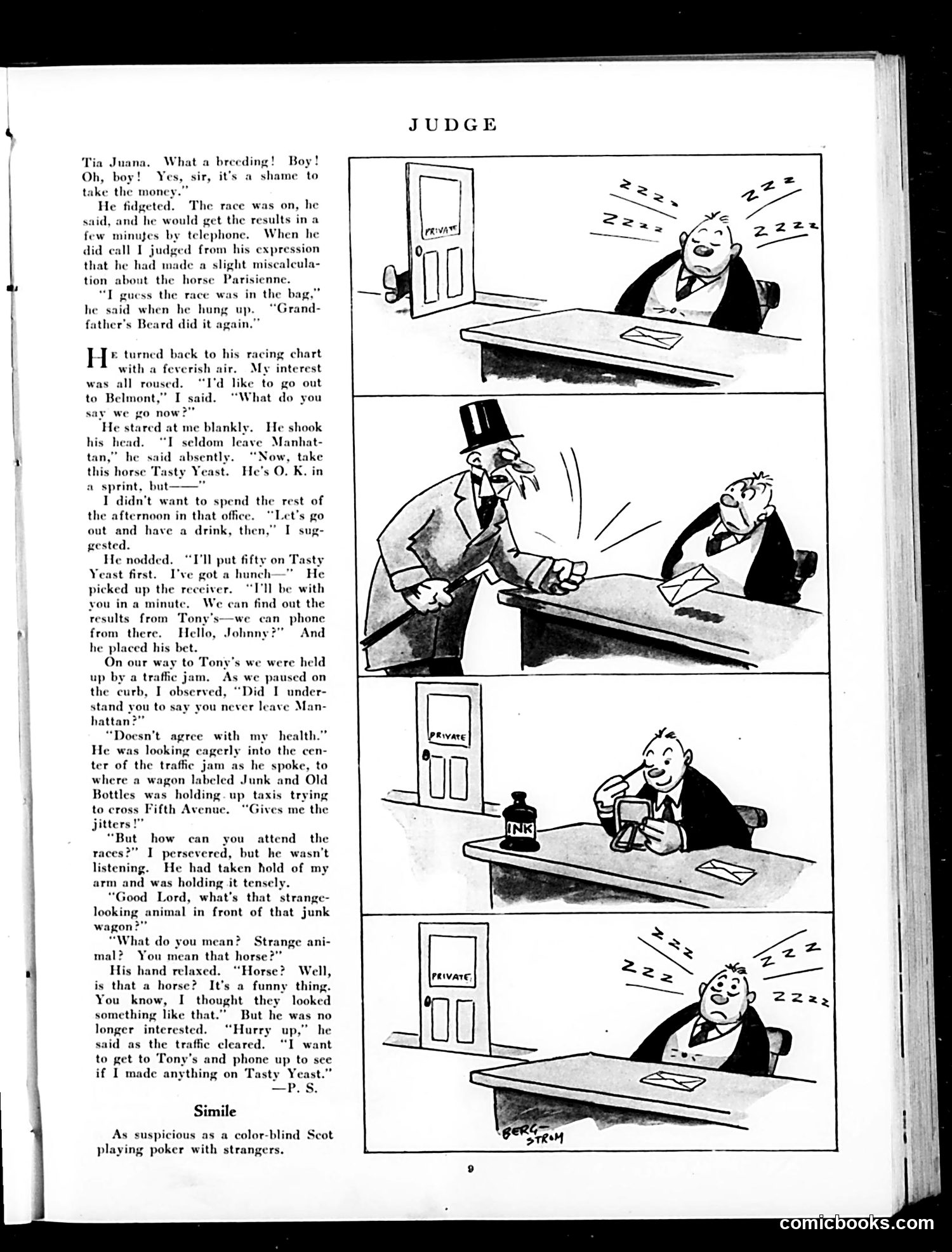
Judge Magazine: "Judge" (Betting Obsession Satire) This page satirizes a compulsive horse-racing gambler through a humorous narrative and accompanying comic strip. The unnamed protagonist is so addicted to placing bets that he claims never leaving Manhattan due to health concerns—yet is obsessively glued to racing results, constantly phoning in bets and checking outcomes. The joke culminates when a decrepit junk wagon horse appears in a traffic jam. The gambler, initially alarmed by the "strange animal," relaxes upon learning it's a horse, revealing his singular focus: *only* racehorses register as interesting to him. Real horses pulling actual work are invisible; only racing horses matter. The closing simile compares his suspicious anxiety to "a color-blind Scot playing poker with strangers"—a period ethnic stereotype suggesting paranoid irrationality. The satire mocks the era's widespread gambling culture and its dehumanizing effect on addicts, rendering them oblivious to ordinary reality.
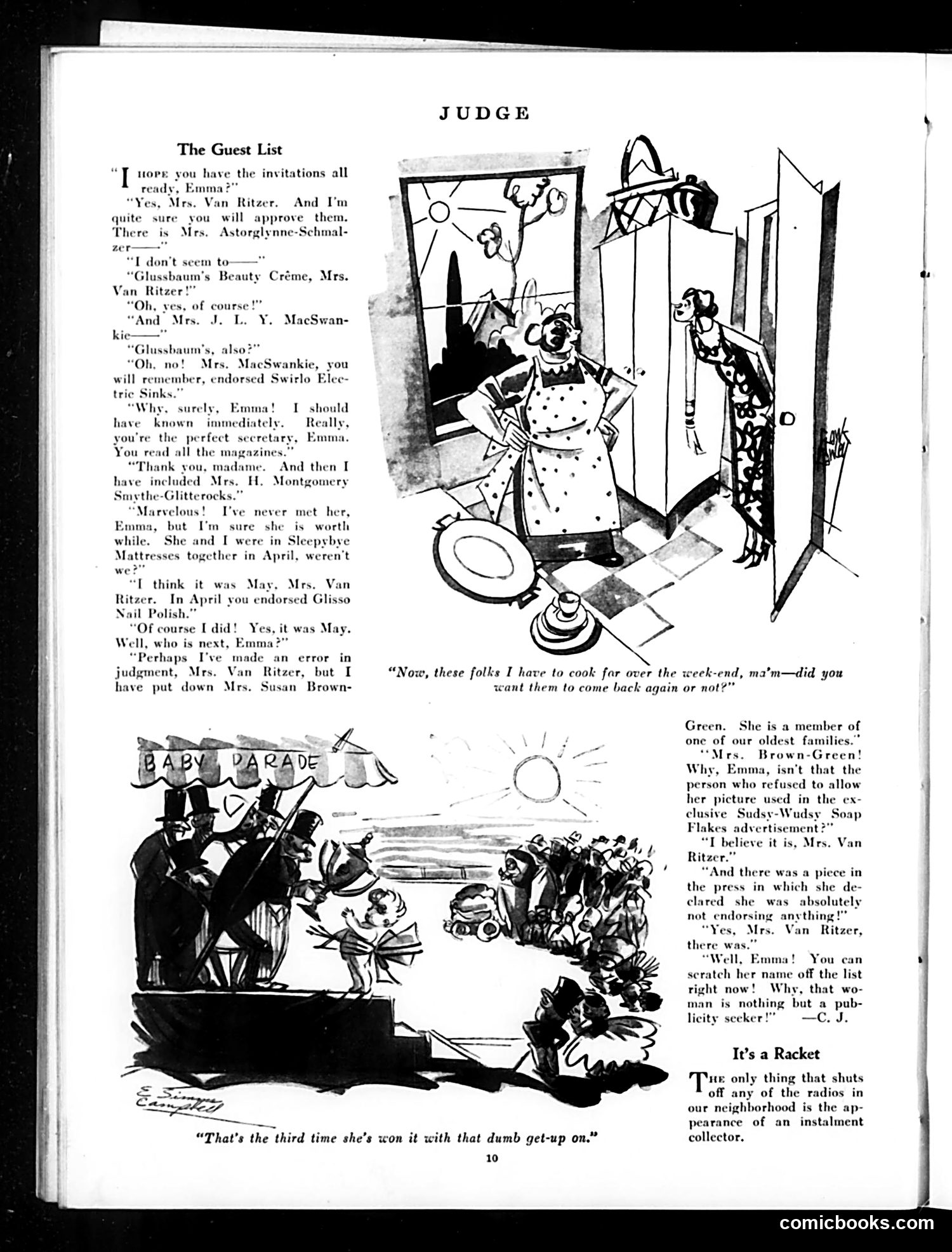
Judge Magazine Satire Analysis This page satirizes wealthy women's obsession with celebrity endorsements in the 1920s-30s advertising era. Main cartoon ("The Guest List"): Mrs. Van Ritzer, a society matron, reviews her dinner guest list with her maid Emma. The humor centers on Van Ritzer's discovery that every potential guest is a product endorser—Glussbaum's Beauty Créme, Sudsy-Wudsy Soap Flakes, etc. When she learns Mrs. Susan Brown-Green *refused* to endorse a product, Van Ritzer calls her a "publicity seeker" and removes her from the list—ironically revealing that Van Ritzer herself judges people by their commercial value, not character. Secondary cartoon ("Baby Parade"): Shows a parade of endorsing women with products, emphasizing how ubiquitous celebrity testimonials had become. "It's a Racket" sidebar: Comments on installment collectors—suggesting these endorsement-obsessed women are living beyond their means on credit. The satire critiques how advertising had colonized social life and status, reducing society women to walking advertisements.
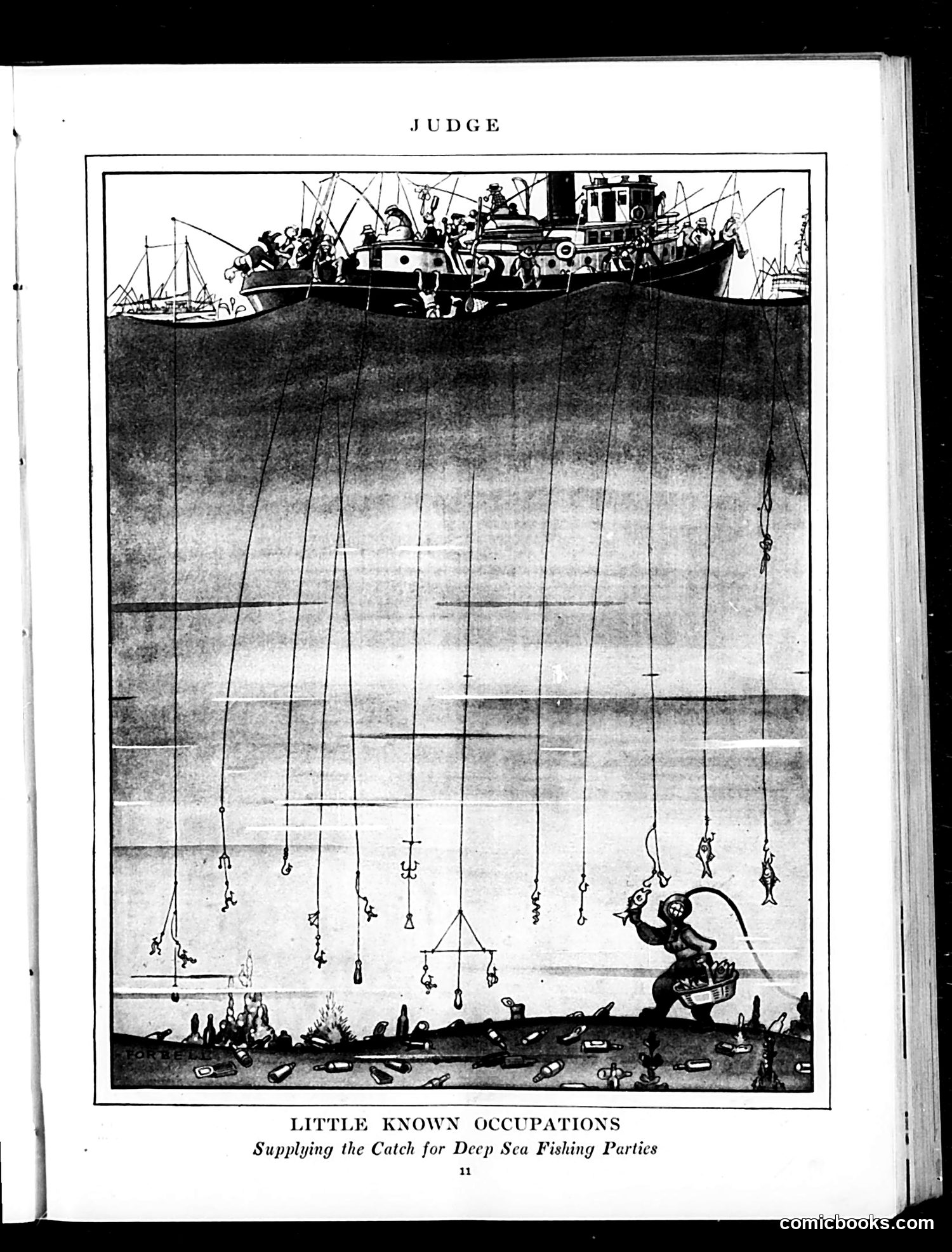
Analysis This satirical cartoon depicts an elaborate underwater scene showing how deep-sea fishing catches are actually "supplied." A steamship above uses pulleys and ropes to lower fish and other sea creatures to the ocean floor, where a diver arranges them to appear naturally caught. The satire mocks the deceptive practices of commercial fishing operations that catered to wealthy tourists and sportsmen. Rather than genuine deep-sea fishing experiences, these parties were apparently staged affairs where pre-positioned catches created the illusion of authentic sport fishing. The caption identifies this as a "little known occupation," implying that such fraudulent supply work was an unspoken industry secret. The cartoon exposes the gap between the marketed experience and the manufactured reality that wealthy customers actually received.
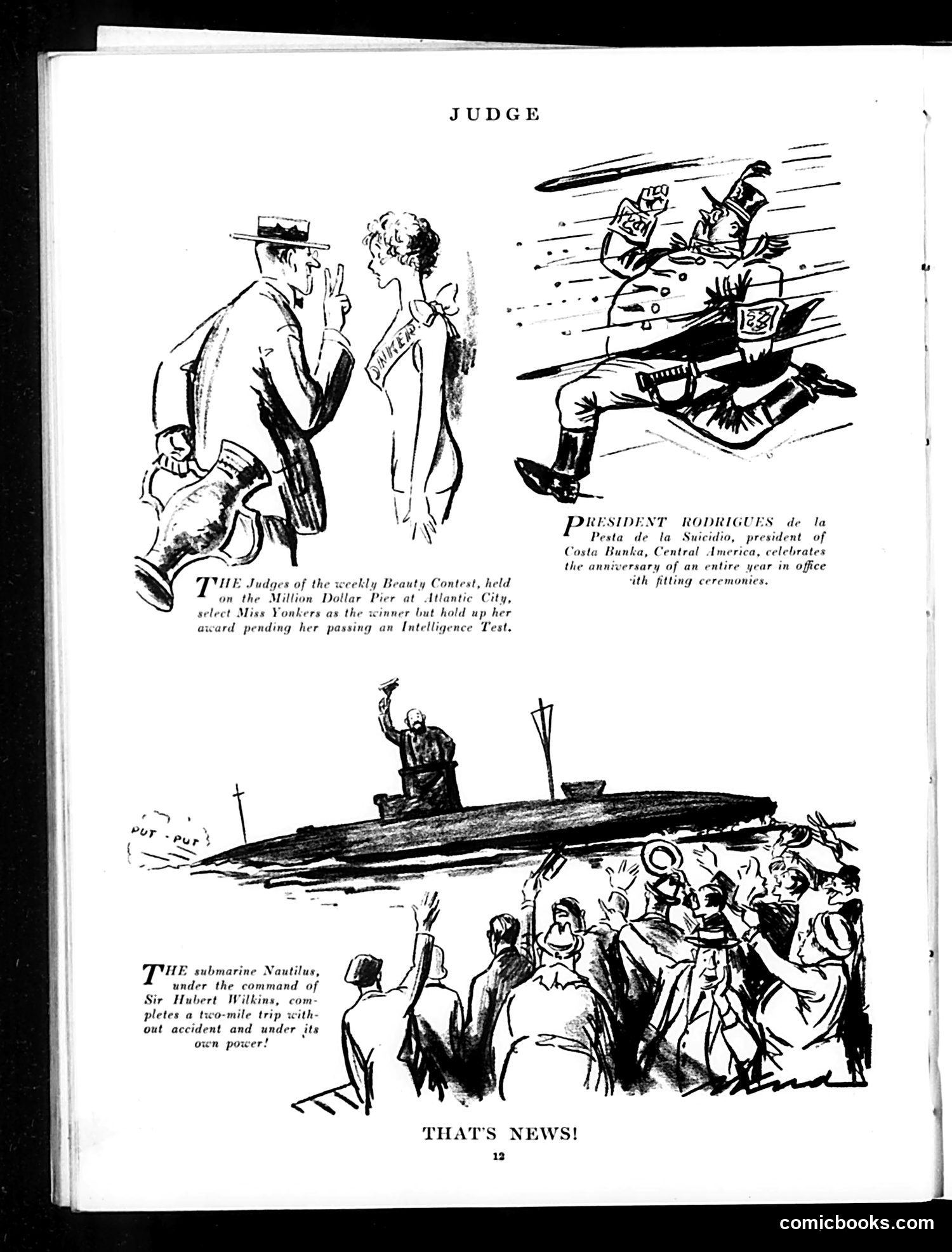
Judge Magazine Satire Analysis This page contains three satirical items: 1. Beauty Contest Judge: Mocks the contradiction between selecting a beauty pageant winner while requiring an "Intelligence Test"—suggesting beauty contestants aren't expected to be intelligent. 2. Central American Leader: Satirizes "President Rodrigues de la Pesta de la Suicidio" (a fictional name playing on "suicide") celebrating a year in office with "fitting ceremonies." This appears to mock Latin American political instability and the brief tenures of Central American leaders. 3. Submarine Nautilus: Praises Sir Hubert Wilkins' submarine completing a two-mile trip "without accident" under its own power—presented as remarkable "news." This likely sarcastically comments on the vessel's poor safety record or unreliability. The page satirizes American vanity (beauty pageants), foreign politics, and technological failures through mock-serious tone and exaggeration.
Explanation for Modern Readers This page satirizes President Hoover's defensive response to criticism of Soviet five-year economic planning. The text presents Dr. Charles Beard's proposal for an American economic plan—involving infrastructure, agriculture, housing, and public utilities—to counter accusations that planning is inherently communist or dictatorial. The satire targets Hoover's dismissal of planning as un-American while simultaneously proposing extensive government-coordinated development. The cartoon's "Judge on the Bench" header suggests the magazine is weighing these contradictions. Beard argues planning isn't new to America (citing F.W. Taylor's scientific management) and shouldn't require confiscating private property like prohibition did. The piece mocks how American politicians invoke "individualism" while rejecting planning concepts, even as capitalism increasingly relies on systematic organization. The satire highlights the ideological contradiction: rejecting Soviet methods while proposing functionally similar coordinated economic development.
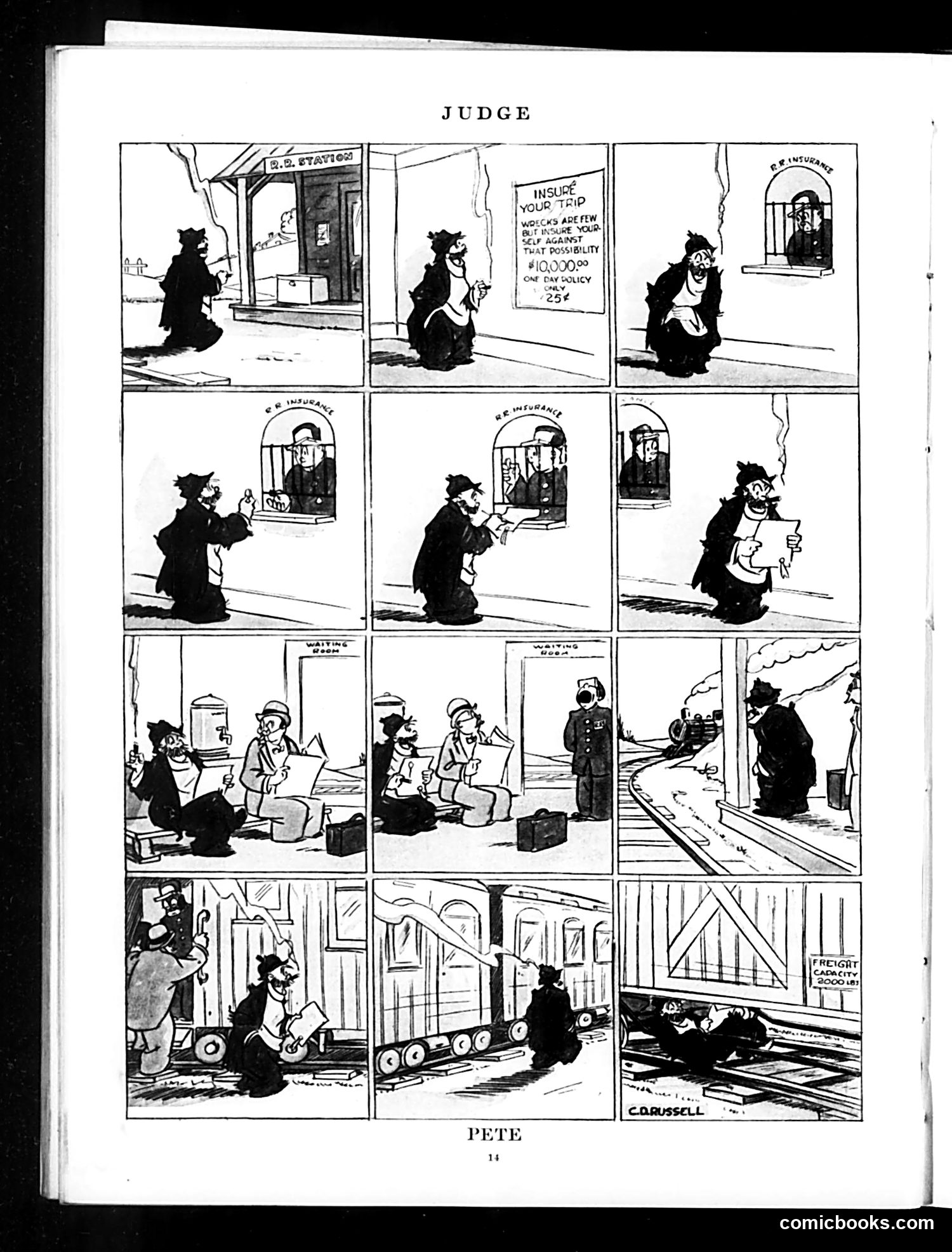
"Judge" Comic Strip: "Pete" This comic strip satirizes insurance fraud and dishonesty. The protagonist Pete appears to be a con artist attempting to defraud an insurance company. The sequence shows him: 1. Examining an insurance office and policy details 2. Repeatedly visiting the insurance window with claims 3. Eventually staging accidents (appearing in railway/freight scenarios) The satire targets both Pete's criminal scheming and, implicitly, insurance companies' vulnerability to fraud. The final panel shows Pete apparently hit by a train—suggesting karmic justice or that his fraudulent schemes literally backfire. The strip's moral lesson: dishonest attempts to profit from insurance lead to actual disaster. The humor derives from Pete's escalating desperation and the ironic conclusion where his fraud fantasy becomes reality.
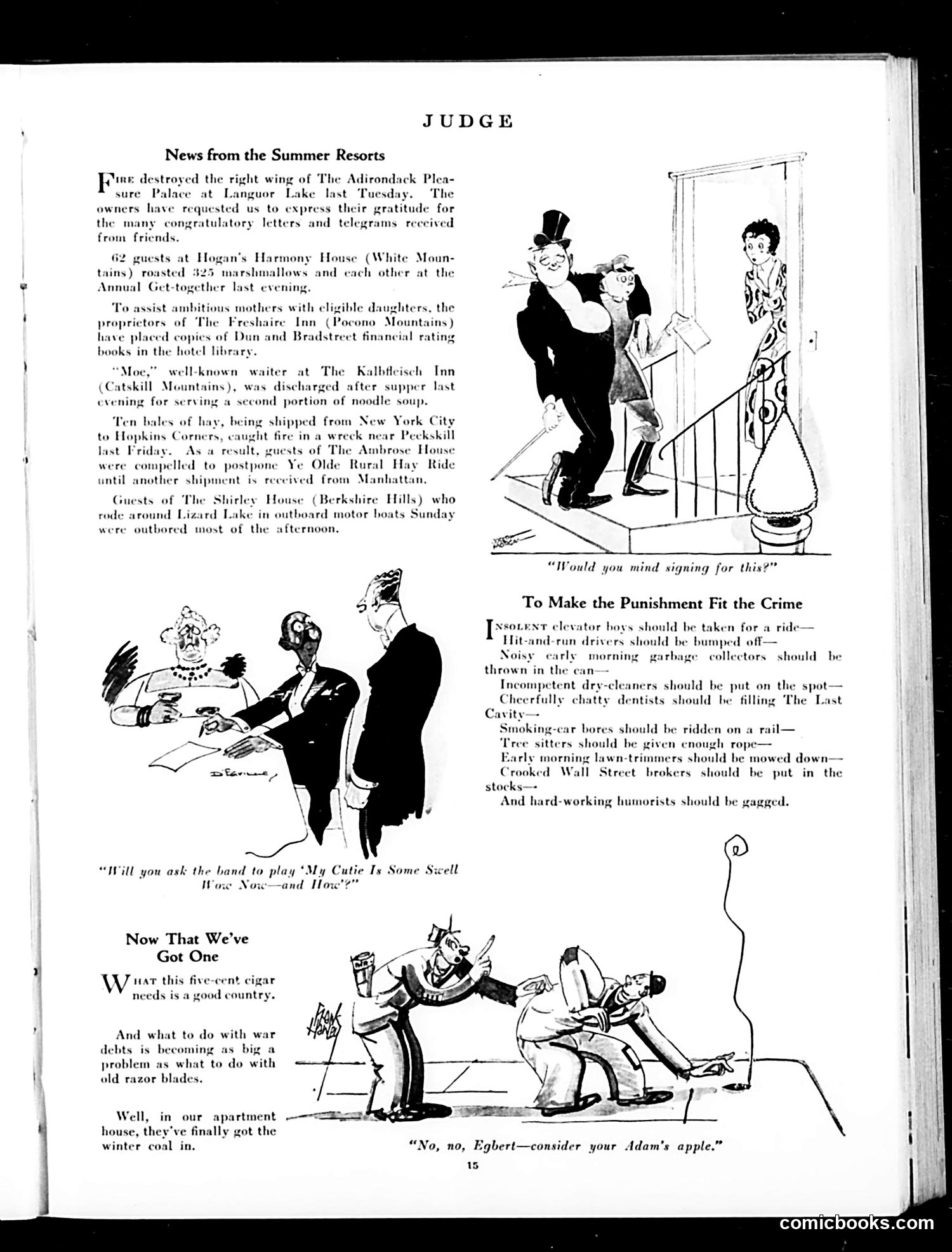
Judge Magazine Page Analysis This page from Judge (a satirical weekly) contains multiple jokes satirizing American life in the 1920s: "News from the Summer Resorts" mocks wealthy vacationers with absurdist humor—a hotel fire where owners are grateful for congratulations, a waiter fired for generosity, guests "outbored" by motorboats. "To Make the Punishment Fit the Crime" is a lighthearted list of modern annoyances deserving exaggerated punishments: rude taxi drivers, noisy garbage collectors, incompetent dry-cleaners, chatty dentists. It reflects post-WWI frustrations with urban inconveniences. "Now That We've Got One" addresses serious contemporary concerns—war debts (from WWI), razor blade disposal—juxtaposed with mundane apartment life (finally getting winter coal delivered). The final cartoon shows a couple where the woman warns her husband about his protruding belly ("Adam's apple" being a euphemism), satirizing domestic nagging and body consciousness. The overall tone is witty social commentary on American materialism, consumerism, and urban complaints.
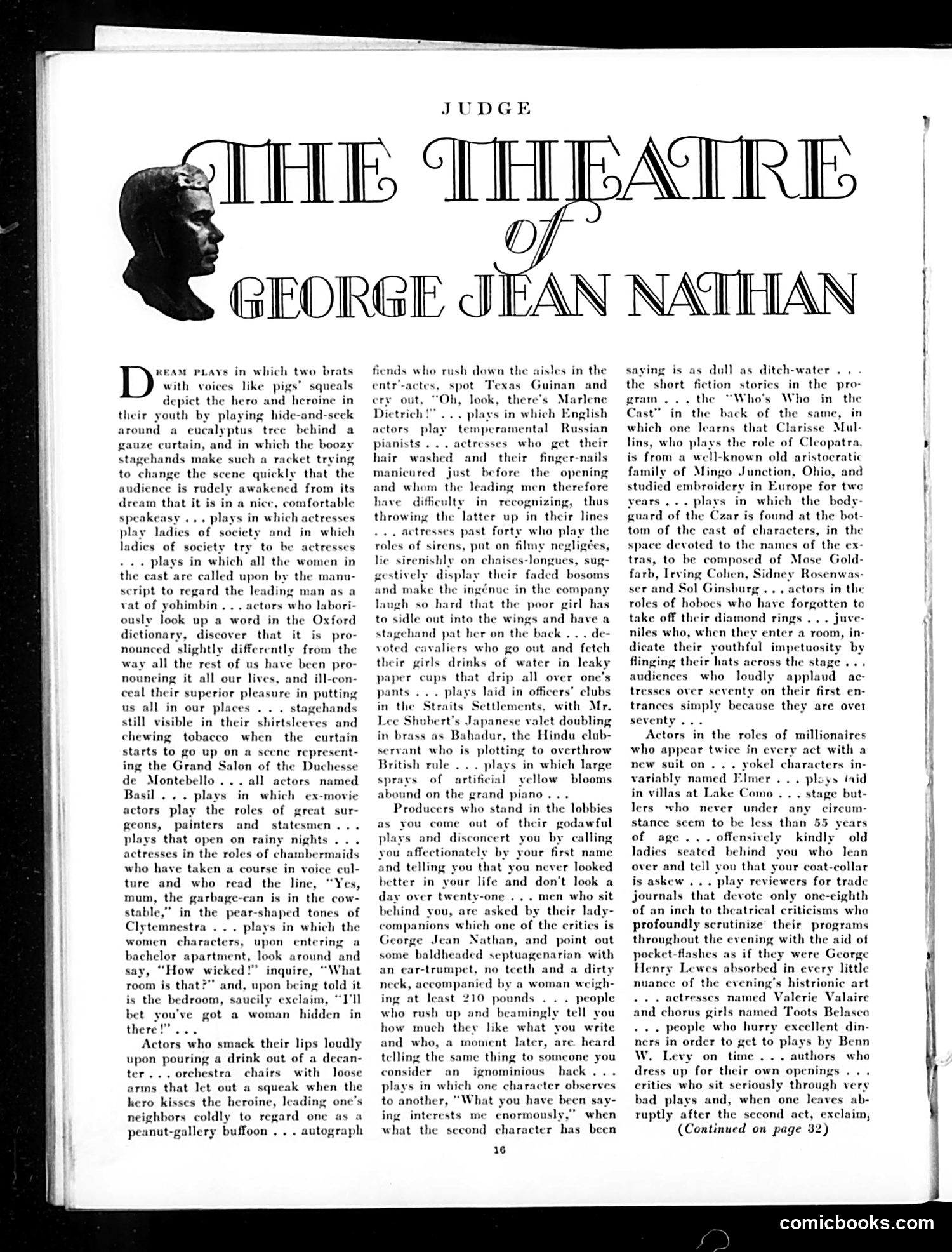
Judge Magazine Theatre Critique This is not a cartoon but a scathing theatrical review disguised as a list. The heading credits "Judge" (the satirical magazine) as "judge" of George Jean Nathan's theatre criticism. The text mocks theatrical incompetence across multiple targets: - Amateur productions: child actors ("brats with voices like pigs' squeals"), visible stagehands, poor scene changes - Pretentious actors: pronunciation pedants, ex-movie stars in "serious" roles, aging ingénues in negligées - Formulaic plots: predictable bedroom-farce reactions ("How wicked!") - Production failures: squeaky chairs during kisses, visible technical mishaps - Absurd casting: all actors named "Basil," temperamental Russians, Hindu servants plotting to overthrow British rule (likely mocking exotic/colonial theatre trends) - Padding and artifice: irrelevant program biographies, "pear-shaped" affected diction The satire targets theatrical mediocrity, pretension, and the gap between aspiring and competent theatre. It's essentially a complaint about Broadway's lower-quality productions circa the 1920s-30s.
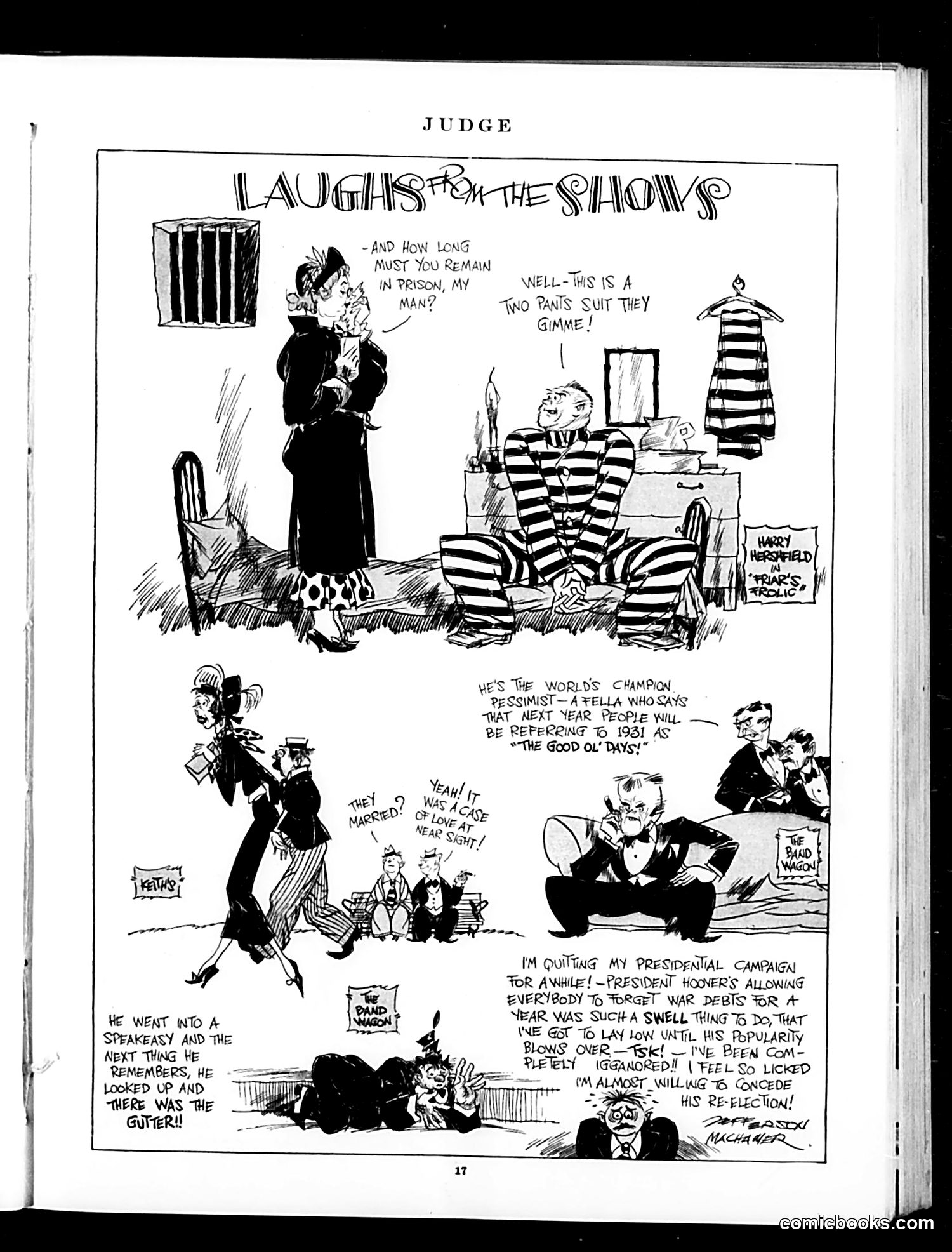
"Laughs at the Shows" - Judge Magazine Satire This page contains four unrelated satirical vignettes from Judge magazine, likely from the early 1930s (given Prohibition-era speakeasy reference and Depression context). Top panel: A prisoner in striped uniform jokes about a "two pants suit" — satirizing either prison conditions or the absurdity of fashion advice in dire circumstances. Middle panels: Various "World's Champion Pessimist" jokes about Depression-era gloom, with characters predicting people will nostalgically call 1931 "the good old days." Bottom section: A political figure (possibly a 1932 presidential candidate, given "Hoover" reference) announces quitting his campaign because Hoover's war debt forgiveness made him irrelevant—satirizing both the political irrelevance caused by Hoover's policy moves and the desperation of marginalized politicians during economic crisis. The cartoons mock pessimism, poverty, and political upheaval during the Great Depression's early years.
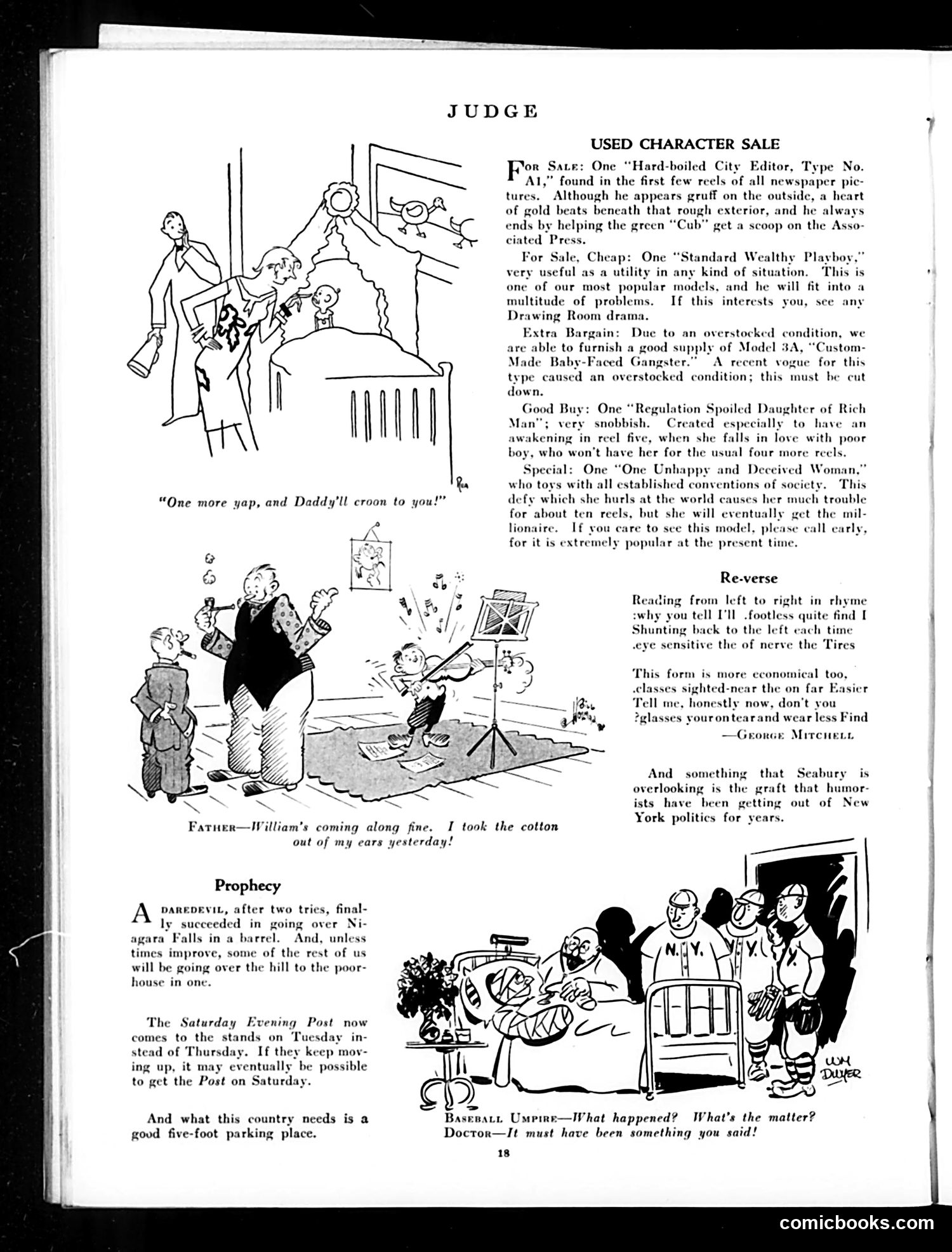
Judge Magazine Page Analysis This page satirizes Hollywood filmmaking conventions through a "Used Character Sale"—a mock inventory of stock character types recycled across films. The pieces lampoon predictable movie tropes: the gruff-but-golden-hearted newspaper editor, the wealthy playboy, the "Custom-Made Baby-Faced Gangster," and the "Unhappy and Deceived Woman" who eventually marries a millionaire. The cartoons below mock everyday absurdities: a father celebrating removing cotton from his ears as his son approaches (implying willful deafness to parental duties), and a baseball umpire blaming something a doctor said for a player's condition. Political/Social Context: The reference to "Seabury" likely alludes to Samuel Seabury's 1930s investigations into New York City corruption and graft—the satire suggesting humorists have long profited from exposing such scandals. The "Prophecy" section jokes about *Saturday Evening Post* publication timing shifting earlier, eventually arriving before its intended date—absurdist commentary on modern scheduling.
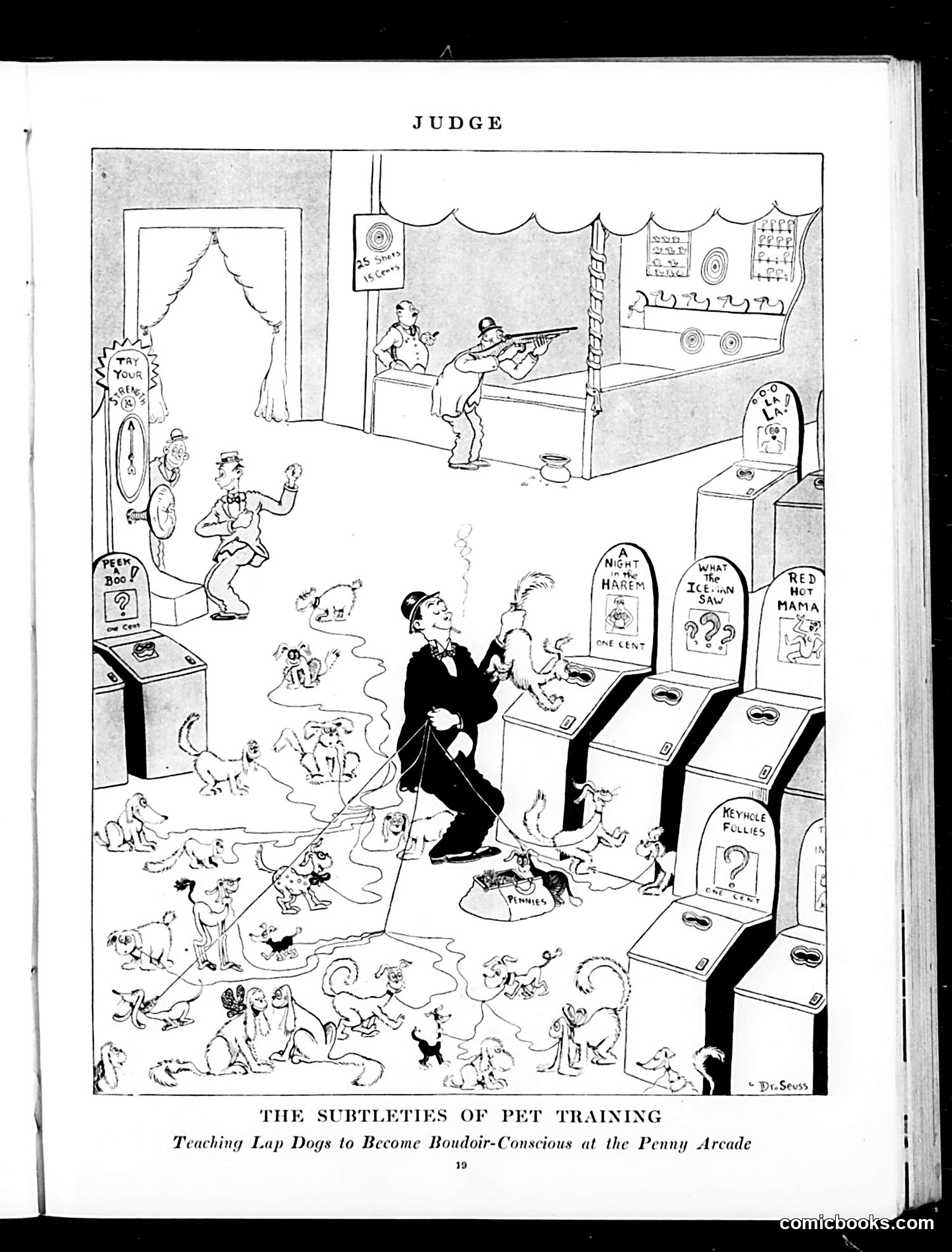
This Dr. Seuss cartoon satirizes the penny arcade—early 20th-century amusement venues with coin-operated machines. The title's wordplay suggests training lap dogs (small companion dogs, also slang for servile men) to become "boudoir-conscious" (aware of intimate/bedroom matters). The scene depicts a dignified gentleman surrounded by chaos: mechanical machines dispensing various entertainments ("A Night in a Harem," "What the Ice Man Saw," "Red Hot Mama," "Bicycle Follies"), with small figures and dogs everywhere. The arcade's chaotic environment and its suggestive machine titles mock both the venues' risqué content and patrons who frequented them. The satire targets the penny arcade's reputation as morally questionable establishments offering lowbrow entertainment, particularly to working-class audiences. The joke equates the machines' ability to entertain with "training" men like obedient pets.
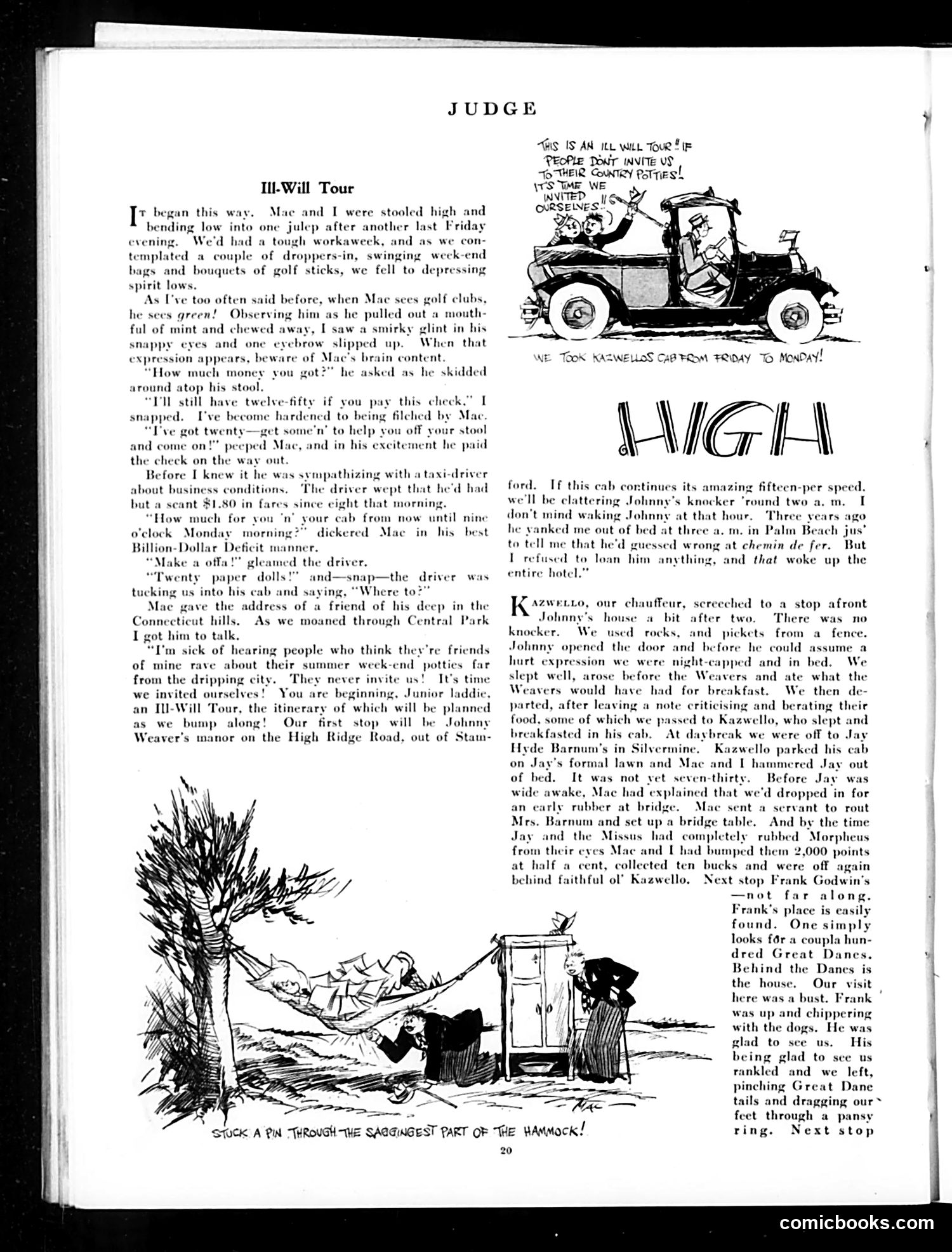
"Ill-Will Tour" - Judge Magazine Satire This story mocks the social pretension of wealthy weekend visitors to country estates. The narrator and his friend Mae—representing the excluded urban middle class—decide to impose themselves on friends' "country parties" without invitation, calling it an "Ill-Will Tour." The satire targets two groups: (1) wealthy suburbanites who boast about exclusive weekend retreats but never invite their city friends, and (2) the opportunistic visitors who retaliate by arriving unannounced, eating their hosts' food, winning money at cards, and leaving insulting notes. The cartoon at top shows them departing Friday through Monday in a taxi, emphasizing the presumption of the unannounced visit. The accompanying illustrations and text document their progressively obnoxious behavior—waking hosts at ungodly hours, refusing loans, winning card games, leaving before breakfast. The humor lies in the petty revenge fantasy: gate-crashing the pretentious rich and treating their hospitality with casual contempt. It reflects Jazz Age class tensions and the social jockeying between urban and suburban lifestyles.
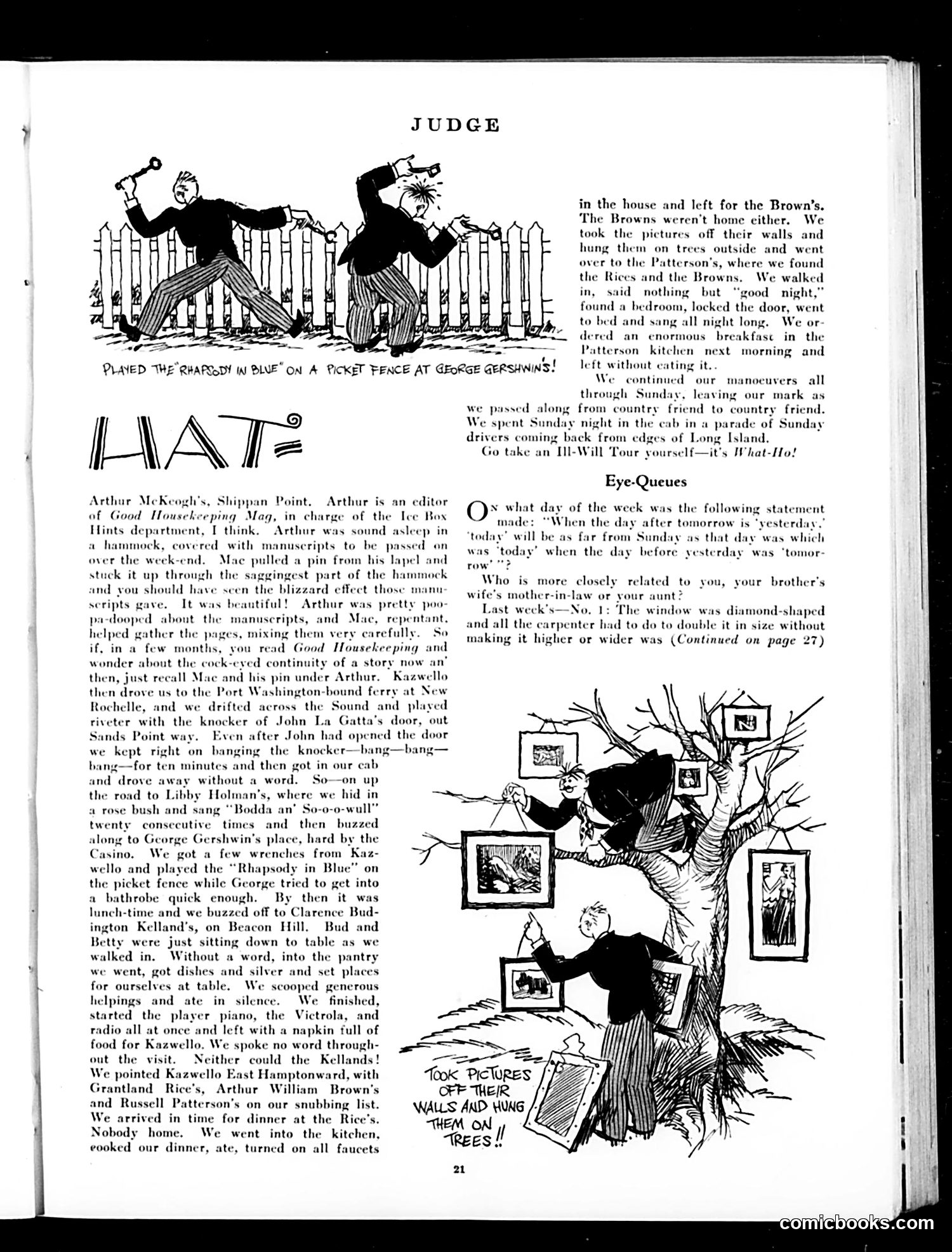
Judge Magazine Cartoon Analysis This page depicts a humorous account of a group's pranks around New York's wealthy enclaves (Shippan Point, Sands Point, Beacon Hill). The main cartoon shows figures playing Gershwin's "Rhapsody in Blue" on a picket fence at composer George Gershwin's home—a absurdist visual joke about treating a fence like a musical instrument. The accompanying text describes a series of coordinated pranks: appearing unannounced at various prominent residents' homes (including editor Arthur McKeogh and writer Clarence Budington Kelland), entering without invitation, preparing meals in strangers' kitchens, rearranging artwork, and leaving without speaking. The humor relies on the audacity of upper-class pranksters disrupting social norms with mock-polite silence and property disturbance. The "Eye-Queues" riddle section at bottom offers word puzzles for readers—typical Judge magazine filler content. The satire targets the entitled behavior and social presumptions of wealthy New Yorkers in this era, mocking their circles through exaggerated trespassing and disregard for property.
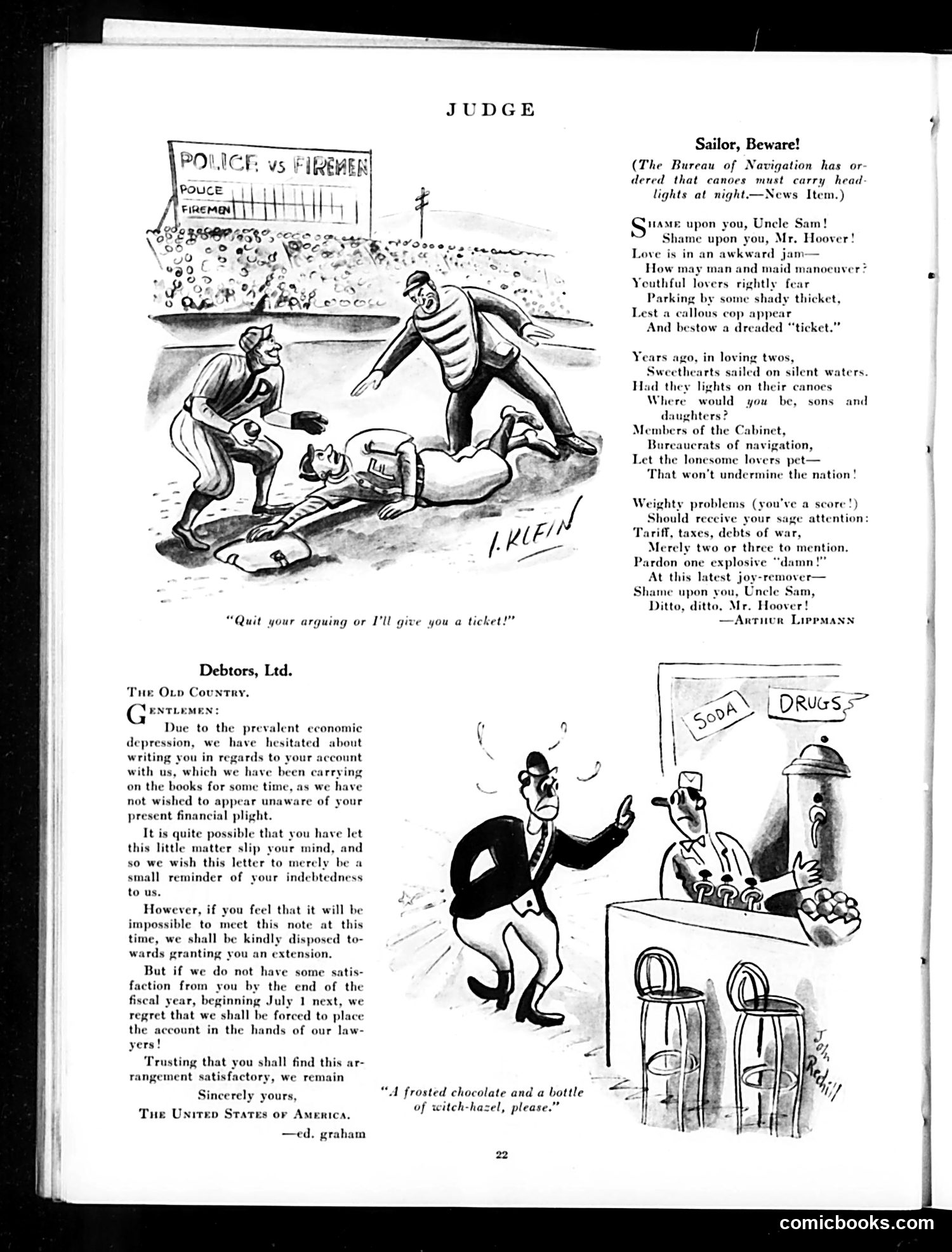
Judge Magazine Satire Explanation Top Cartoon: Police vs. Firemen compete for ticketing authority. The joke mocks a new Bureau of Navigation regulation requiring canoes to carry headlights at night—absurdly bureaucratic in an era of small recreational boats. The satire critiques government overreach: young couples parking in cars face police "tickets," yet the government now wants to regulate lovers' canoes with navigational equipment, suggesting ridiculous regulatory expansion into trivial matters. Bottom Section: "Debtors, Ltd." is a mock letter from "The United States of America" to citizens, apologizing for dunning them about unpaid debts during the Depression, yet threatening lawyers if payment isn't made. This satirizes the government's financial troubles and contradictory approach—simultaneously sympathetic and threatening toward broke citizens during economic crisis. The small cartoon of a man ordering soda and drugs while broke illustrates the broader joke about spending priorities during hard times.
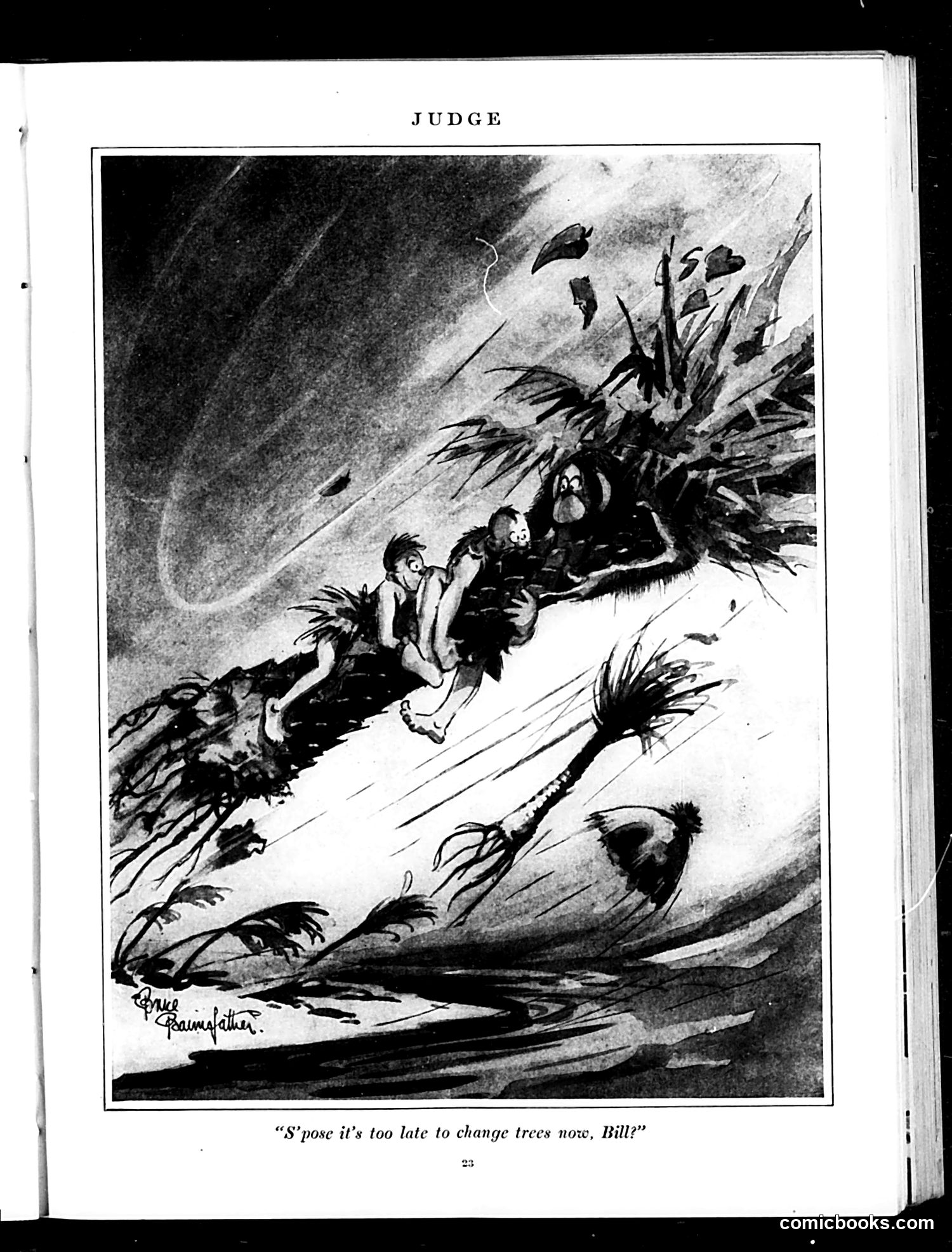
Analysis of Judge Magazine Cartoon This cartoon depicts two figures clinging to a falling tree amid a storm, with one asking the other whether it's too late to "change trees now, Bill?" The satirical point appears to be about being trapped in a bad situation with no escape—once you've committed to a course of action (represented by the tree), it's too late to reverse course, even as disaster approaches. The cartoon likely comments on political or social commitment during turbulent times. Without knowing the specific publication date, the context remains unclear, but the metaphor suggests criticism of those who've made poor choices and now must face consequences. The storm and falling tree represent crisis or upheaval beyond one's control.
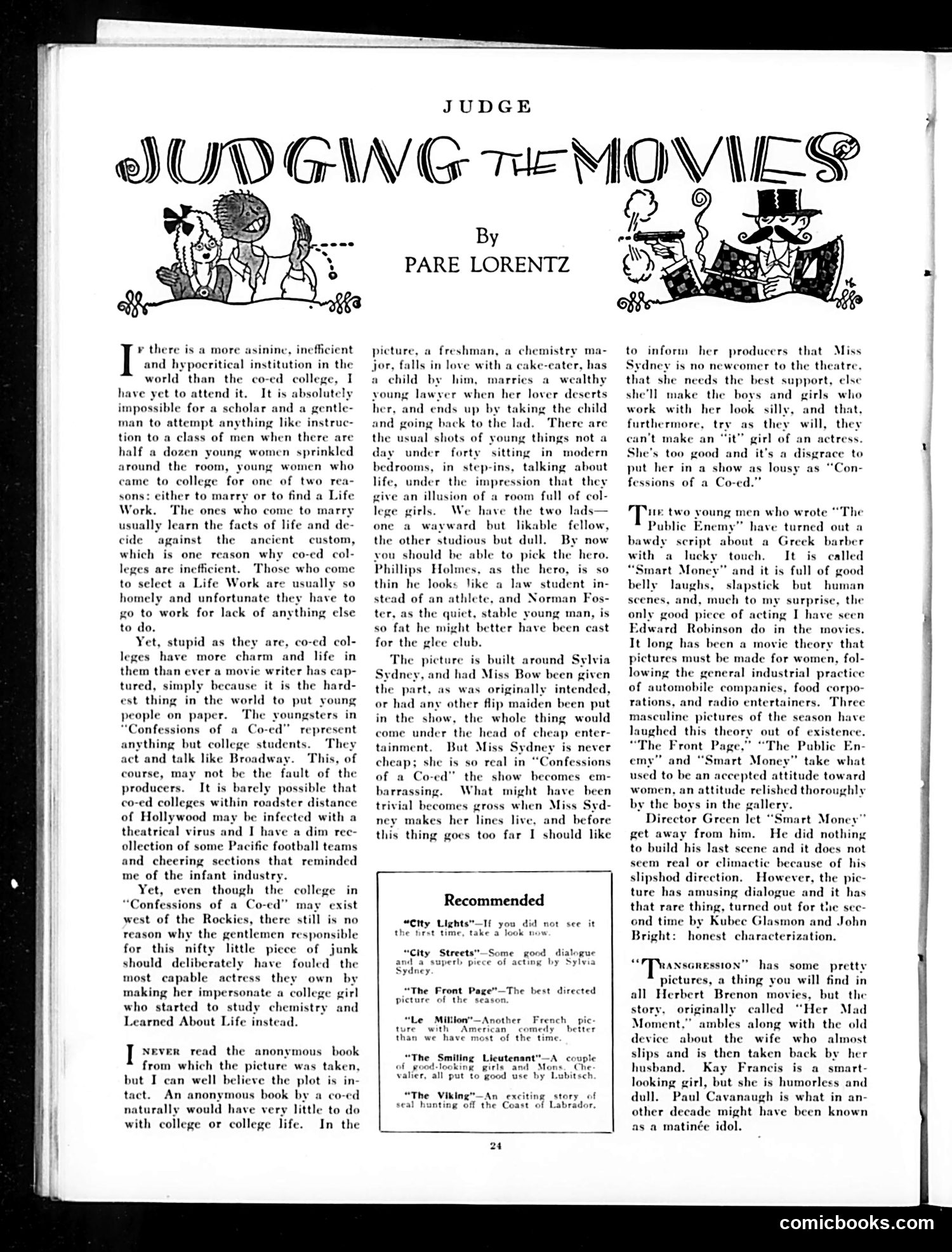
Judge Magazine Film Criticism: "Judging the Movies" by Pare Lorentz This page critiques the 1931 film "Confessions of a Co-ed," starring Sylvia Sydney. The reviewer attacks the film's portrayal of college life as unrealistic and morally problematic. He argues that co-ed colleges are already inefficient institutions, and the movie makes them worse by depicting students who behave like Broadway characters rather than actual collegians—glamorous, sexually loose, and divorced from real academic life. The core complaint: the film's plot (a chemistry student has a child out of wedlock, marries wealthy, then abandons her husband) is trashy melodrama. However, Lorentz praises Sydney's acting as so genuinely realistic that she elevates—and thereby exposes—the material's vulgarity. He criticizes the male leads (Phillips Holmes and Norman Foster) as physically miscast, and suggests the picture exploits Sydney's talent for cheap entertainment. The sidebar lists other film recommendations, typical of Judge's movie review section.
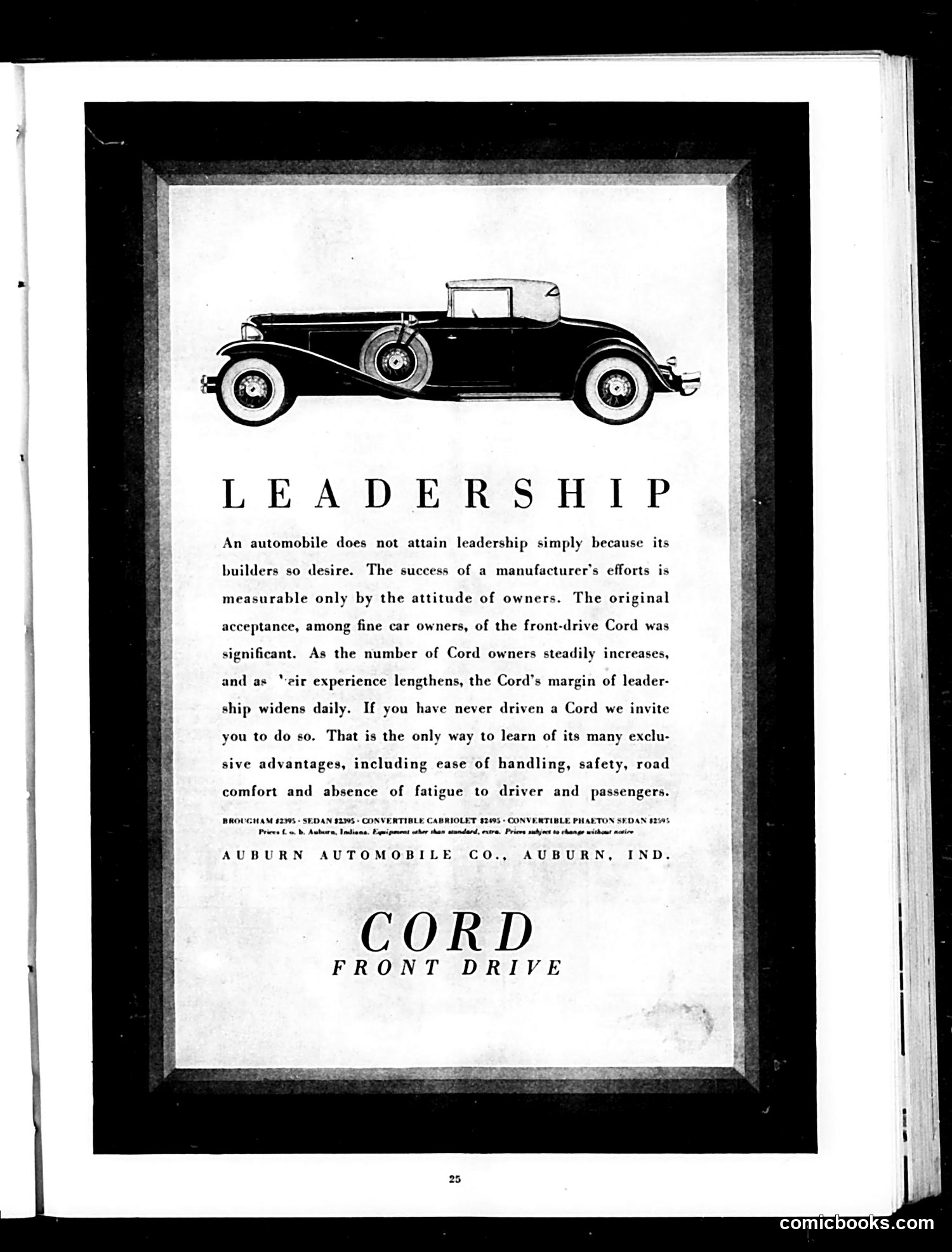
Cord Front-Drive Advertisement Analysis This is not a political cartoon but a full-page automobile advertisement for the Cord, manufactured by Auburn Automobile Co. of Auburn, Indiana. The ad uses the word "LEADERSHIP" as its central concept—arguing that a car's market dominance stems from owner satisfaction rather than manufacturer claims alone. It highlights the Cord's "front-drive" technology as an innovative feature that has earned acceptance among "fine car owners." The appeal emphasizes practical benefits: ease of handling, safety, road comfort, and reduced driver fatigue. The elegant line drawing of the convertible roadster at the top conveys luxury and sophistication. Historical context a modern reader would miss: Front-wheel drive was a cutting-edge innovation in the 1920s-30s, and the Cord was pioneering this technology. The ad's emphasis on customer "experience" and word-of-mouth approval reflects early automotive marketing strategies before mass-production standardization.
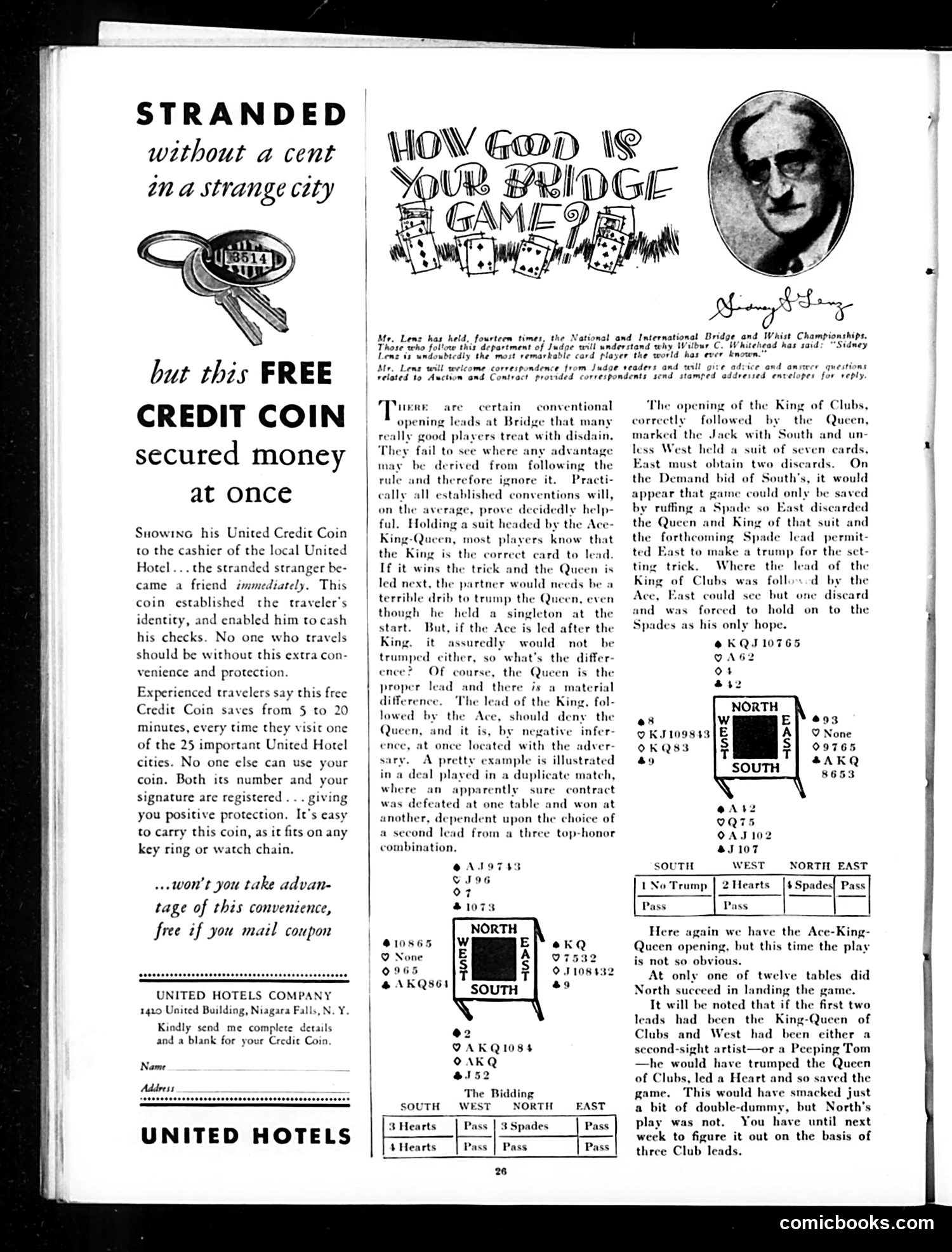
Analysis for Modern Readers This page combines advertising with bridge strategy content. The left side advertises the United Hotels Company's "Credit Coin"—a predecessor to modern credit cards. It's a promotional piece targeting traveling businessmen, promising the coin establishes identity and allows check-cashing at 25 hotel locations. The right side features bridge (card game) instruction by Sidney Lenz, identified as a fourteen-time holder of National and International Bridge championships. The text and diagrams analyze optimal card-playing strategy in specific bridge hands, teaching readers about conventional opening leads (playing the King before the Ace from certain card combinations) and how these conventions signal information to one's partner. The page reflects early 20th-century concerns: the novelty of credit systems for travelers and the popularity of contract bridge as an intellectual pursuit worthy of expert instruction in mainstream magazines. Lenz was apparently *Judge*'s authority on this subject.
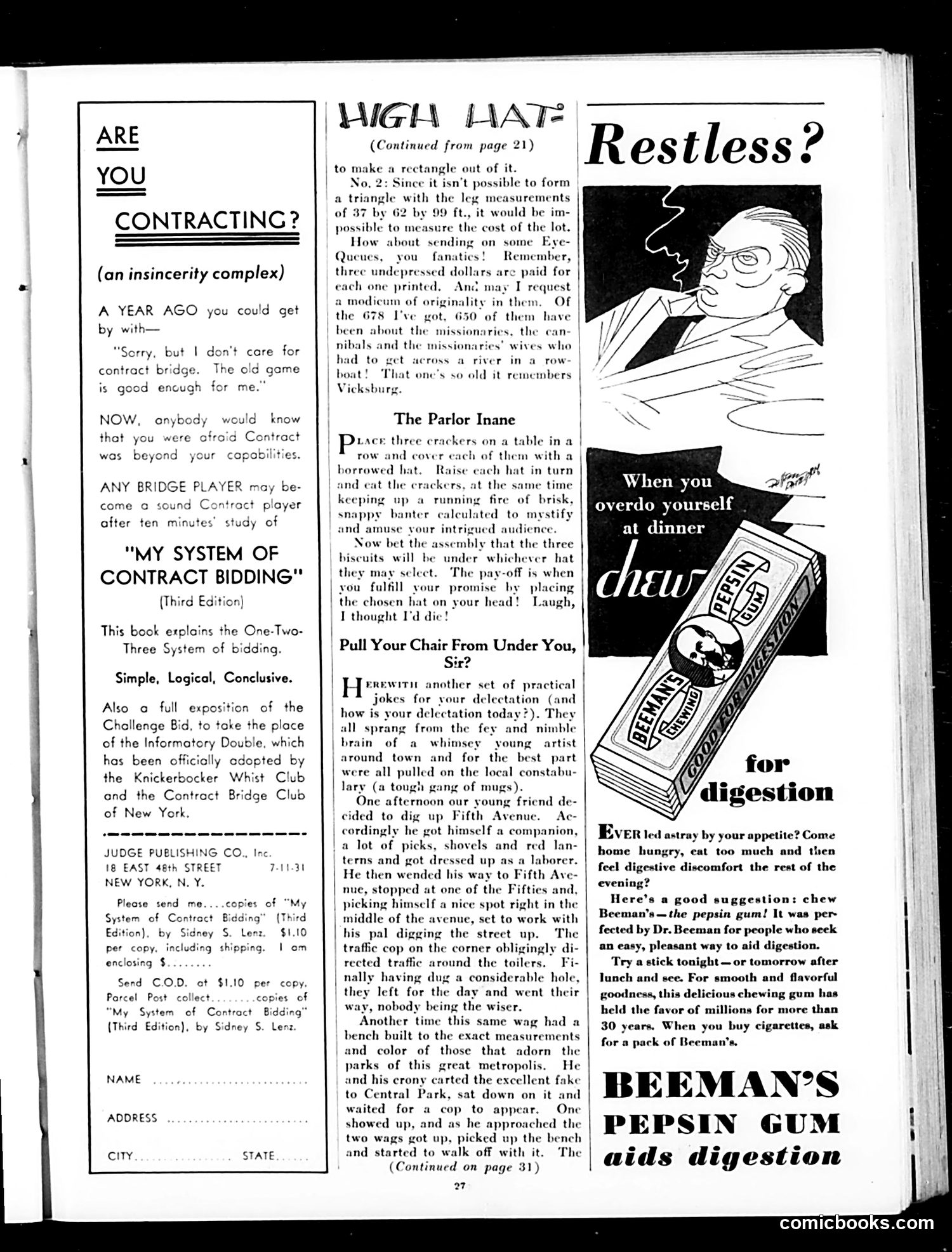
Judge Magazine Page Analysis This page primarily advertises "My System of Contract Bidding," a bridge instruction book by Sidney S. Lenz (Third Edition). The left column satirizes people who claim not to play contract bridge—the joke being they're actually afraid it's too complicated. By learning Lenz's "simple" system, such people can pretend they never objected to the modern game. The right side contains humorous anecdotes and period advertisements. "The Parlor Inane" describes party tricks. "Pull Your Chair From Under You, Sir?" recounts pranks involving two young men who impersonate street workers, digging up Fifth Avenue and later attempting to steal a park bench—pranks played on local police officers ("a tough gang of mugs"). The advertisements for Beeman's Pepsin Gum promise digestive aid—a common health claim for gum in this era. The page reflects 1930s social attitudes: bridge enthusiasm among the wealthy, harmless pranks against authority figures, and patent-medicine marketing through gum products.
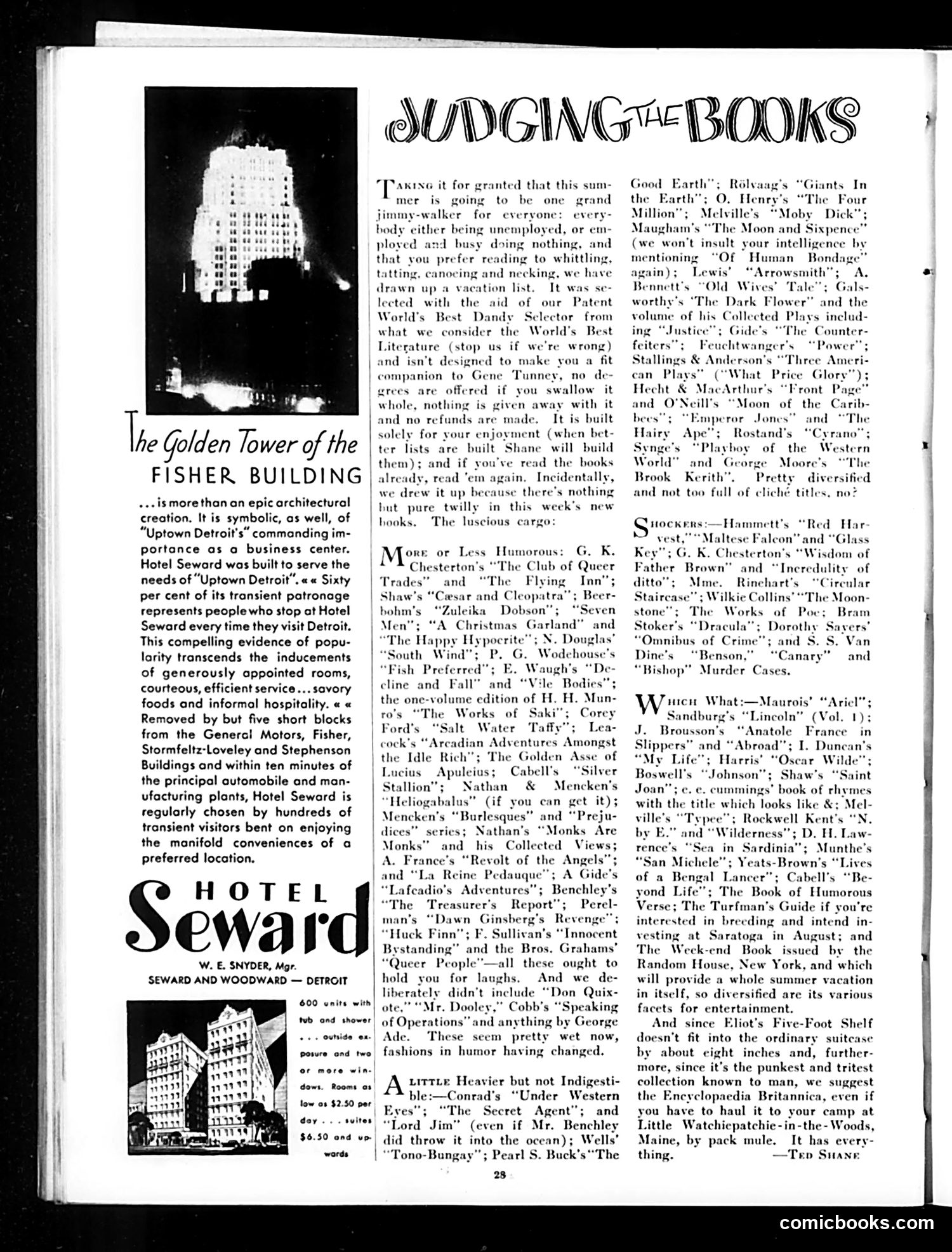
"Judging the Books" - A Summer Reading Guide This page is primarily advertising and editorial content, not political satire. It features Hotel Seward's prominent "Fisher Building" advertisement alongside a lighthearted book recommendation column. The "Judging the Books" section is a summer reading guide organized by humor level—from "More or Less Humorous" (listing Chesterton, Shaw, Wodehouse) to "Little Heavier but not Indigestible" works. The tone is casual and witty, poking fun at readers who might prefer "whittling" to reading. The references are literary, not political: canonical authors like Conrad, Wells, and Pearl S. Buck appear alongside contemporary humorists like Ring Lardner and Dorothy Parker. The author (signed "Ten Sharp") dismisses older favorites like "Don Quixote" and "Mr. Dooley" as now unfashionable—showing how literary tastes shift. This reflects 1920s-30s middle-class leisure culture during summer vacation season.
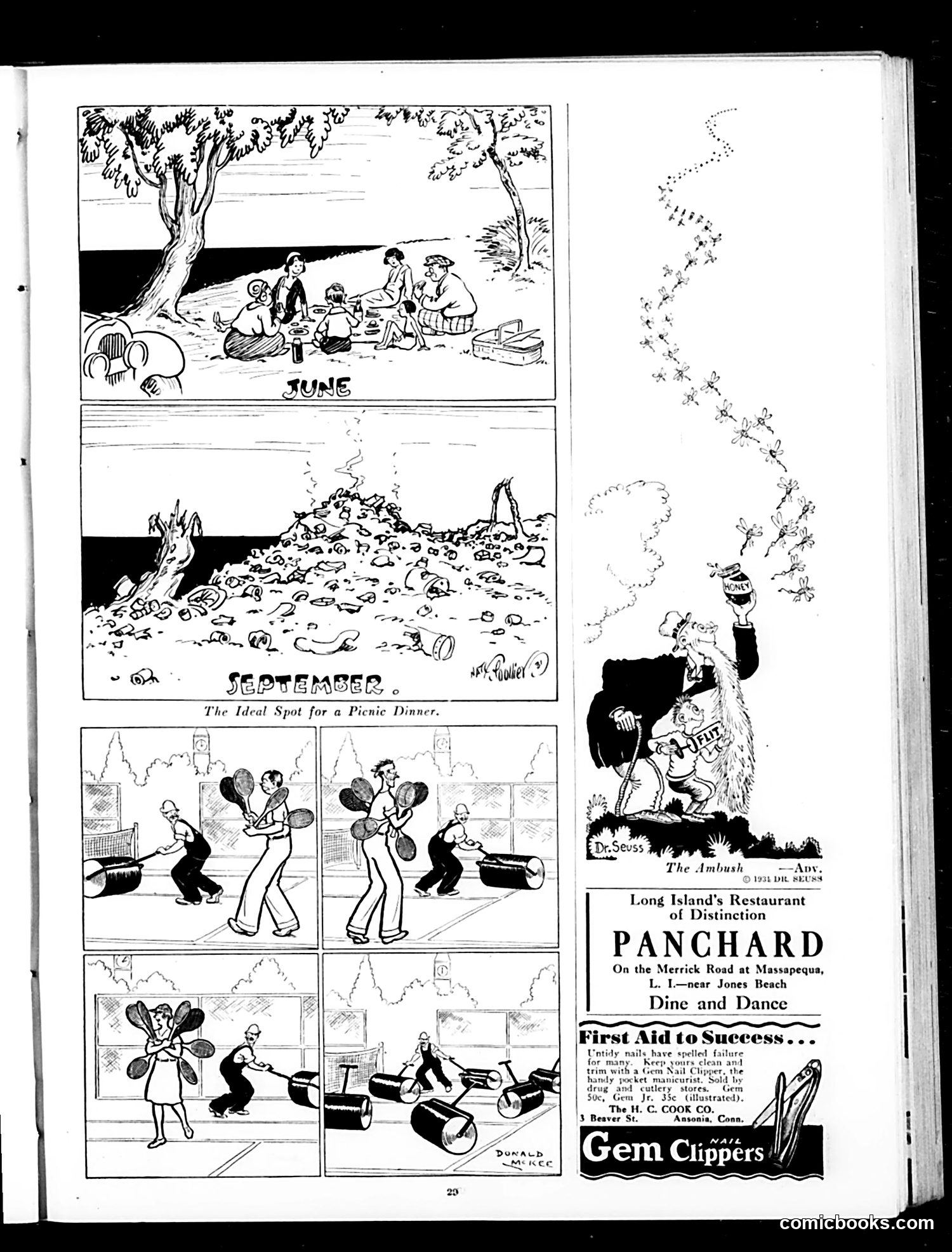
Judge Magazine Page Analysis This page combines seasonal humor with period advertising. The top section shows three cartoon panels illustrating months: June depicts an idyllic family picnic by a tree near water. September, titled "The Ideal Spot for a Picnic Dinner," presents satirical contrast: a garbage heap overflowing with refuse, tin cans, and debris—suggesting that by September, popular picnic areas have become littered dumping grounds. This is social commentary on environmental degradation and overcrowding of recreational spaces. The bottom panel shows a slapstick tennis sequence by artist "Dunlap and Mrice" (names unclear), depicting players with oversized rackets in comedic action poses. The right side features Dr. Seuss's "The Ambush" cartoon and advertisements for Panchard restaurant on Long Island and Gem Clippers grooming tools. The satire critiques how public outdoor spaces deteriorate through summer usage—a timely concern for 1920s-era readers enjoying new automobile access to beaches and parks.
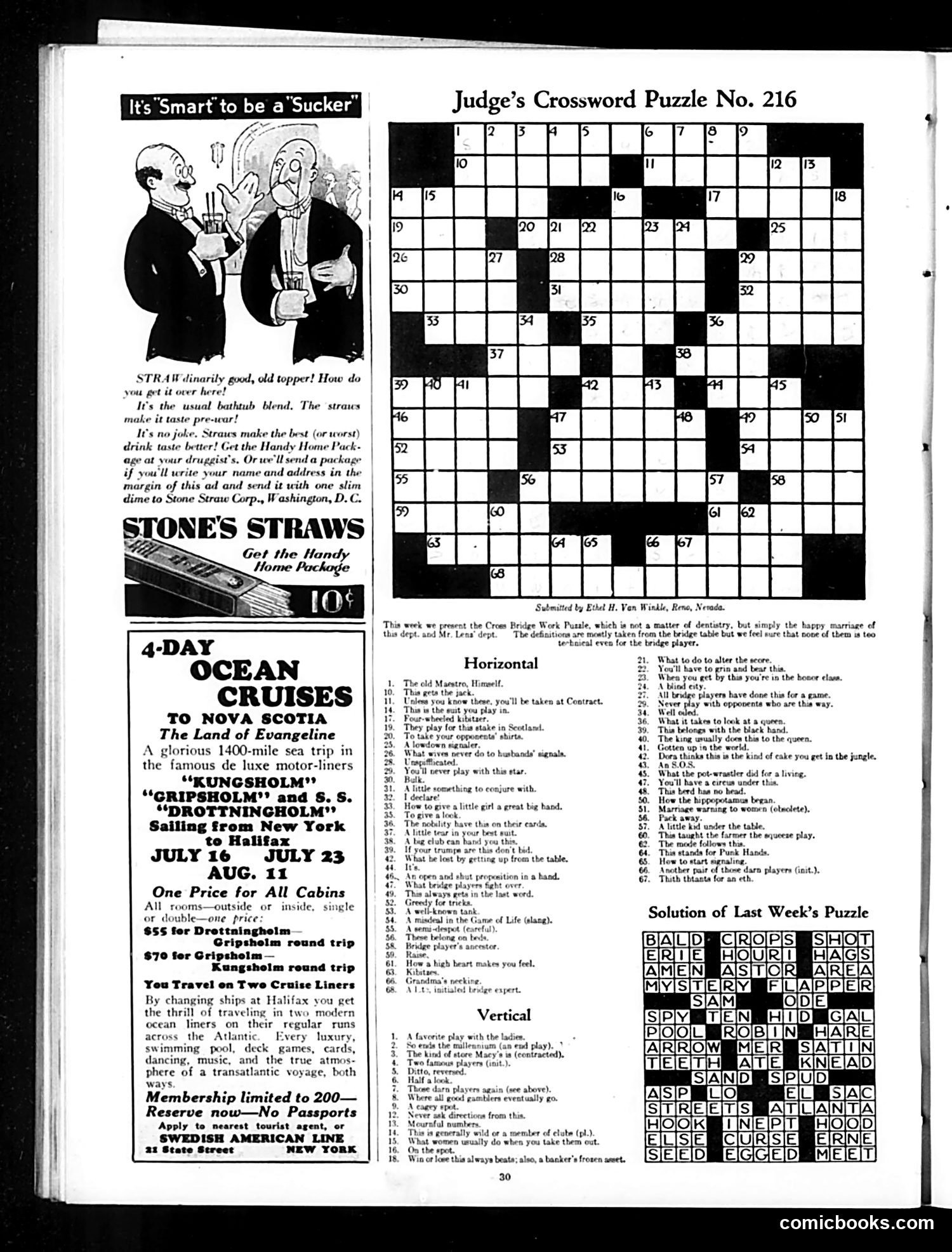
Judge Magazine Cartoon Analysis This page is primarily advertisements and a crossword puzzle, not political satire. The small cartoon at top ("It's 'Smart' to be a 'Sucker'") depicts two well-dressed men discussing Stone's Straws — a product meant to improve the taste of homemade alcohol during Prohibition. One man claims the straws make bathtub gin taste "pre-war" (better quality), clearly mocking the poor quality of illegally-produced liquor Americans consumed when alcohol was banned. The joke: calling consumers "suckers" for believing a straw could improve bathtub gin's notoriously awful taste. The satire targets both Prohibition-era drinking culture and false advertising. The page also advertises ocean cruises to Nova Scotia and a bridge-themed crossword puzzle, reflecting typical Judge content of the 1920s-30s era targeting affluent readers.
Explanation for Modern Readers This page is primarily advertising and publisher announcements, not a political cartoon. The main content is: 1. Judge's Self-Promotion: The "How It Happened" section humorously claims the magazine's editors stole a crossword puzzle idea from a man named "Mr. Ait J. Aloe" (wordplay on "idea"), jokingly suggesting they murdered him and buried his body. It's satirizing how publishers appropriate freelancers' work—a timeless complaint. They're announcing their 3rd crossword puzzle book for sale. 2. Brief Social Commentary: The "Unimportant Items" section offers lighthearted observations about 1920s-30s New York life: Park Avenue tenants not paying rent, newsboys' pricing practices, Central Park rowboat scams, women smoking rooms at Vassar, and changing literary tastes (mentioning the *New Yorker* magazine). 3. The rest is hotel and commercial advertising for Manhattan establishments. The satire is mild and self-referential rather than political.
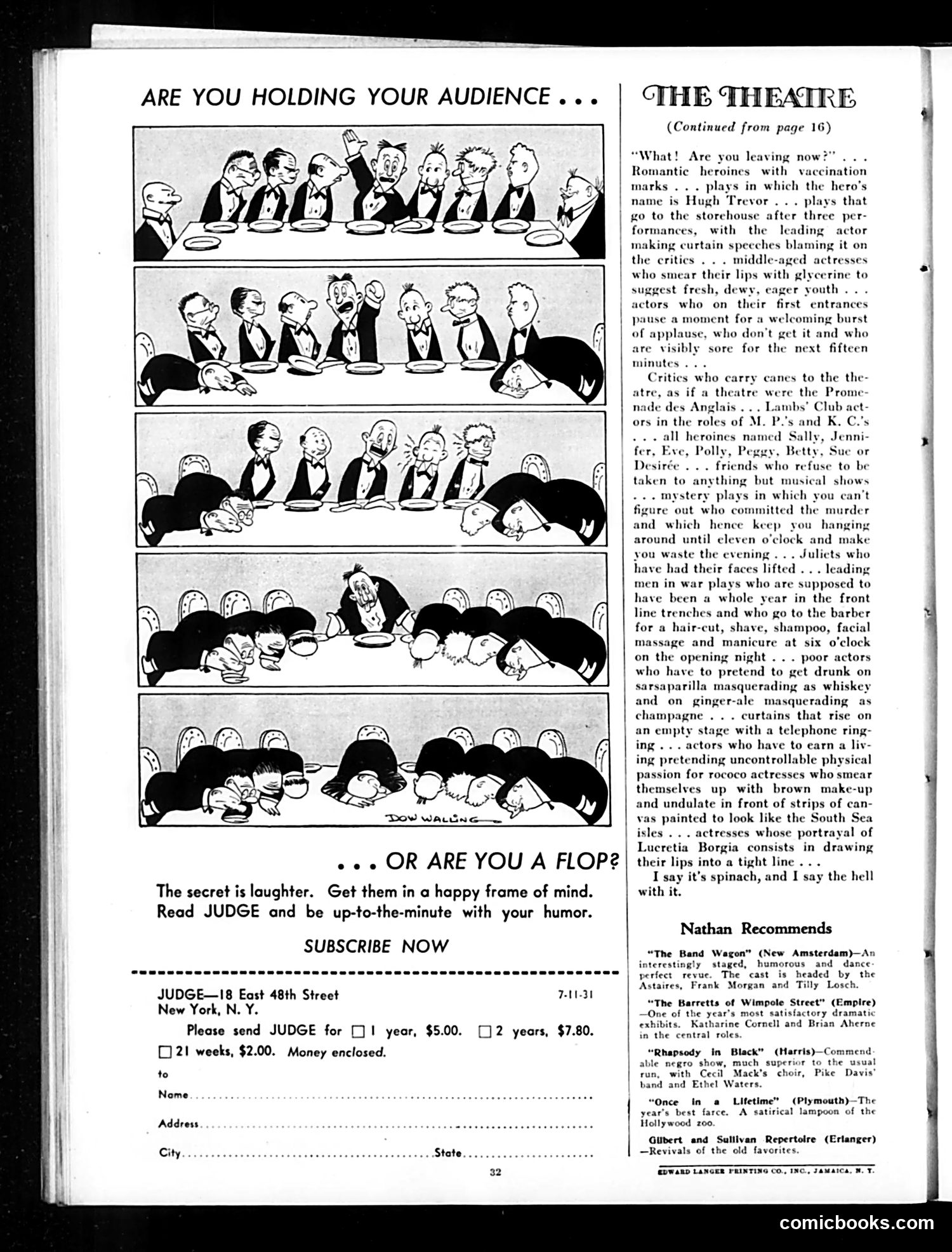
Judge Magazine Page Analysis This page combines advertising with theatre criticism. The top cartoon (by Doo Wallo) depicts a dinner scene where men progressively collapse face-first into their plates—a visual gag about "holding your audience" versus being "a flop." The joke: successful entertainment keeps viewers engaged; failure puts them to sleep. Below is a subscription advertisement for Judge magazine itself, promoting laughter and humor as essential reading. The right column contains a theatre review sarcastically cataloging Broadway clichés: poorly-reviewed plays closing after three performances, actresses with vaccination marks, actors blaming critics in curtain speeches, mystery plays that waste audiences' time, and unconvincing stage performances (actors faking drunkenness with sarsaparilla). The "Nathan Recommends" section praises current Broadway shows including *The Band Wagon*, *The Barretts of Wimpole Street*, and *Once in a Lifetime*—indicating this is from the early 1930s theatre scene. The tone mocks theatrical pretension while celebrating genuinely good productions.
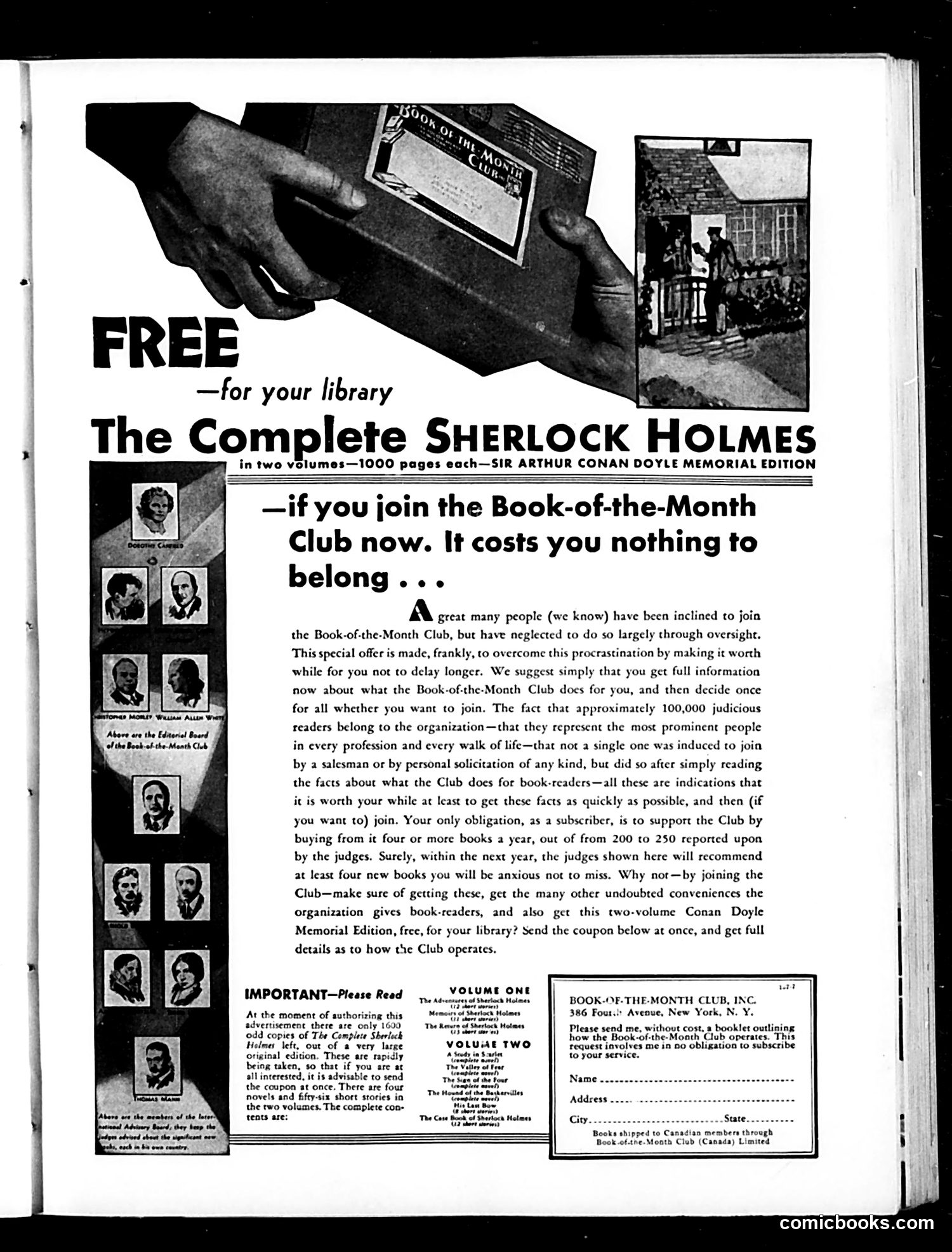
What This Page Means This is primarily a Book-of-the-Month Club advertisement, not a cartoon or satire. It appears in *Judge* magazine, likely as paid advertising rather than editorial content. The ad offers a free two-volume "Sir Arthur Conan Doyle Memorial Edition" of *Sherlock Holmes* as an incentive to join the club. The left side displays portraits of what appear to be the club's editorial board judges. The pitch emphasizes that membership is "free" to join and claims 100,000 members already participate—presenting this as proof of the club's prestige and selectivity. However, the small print reveals the actual obligation: members must purchase 4+ books yearly from 200-250 options the judges recommend. For modern readers: this represents early book-club marketing, using a desirable classic as a "loss leader" to recruit subscribers who'll then purchase selections. The abundance of reassurance about lack of "salesmen or personal solicitation" suggests the model was novel and potentially viewed with some skepticism by 1920s-30s consumers.
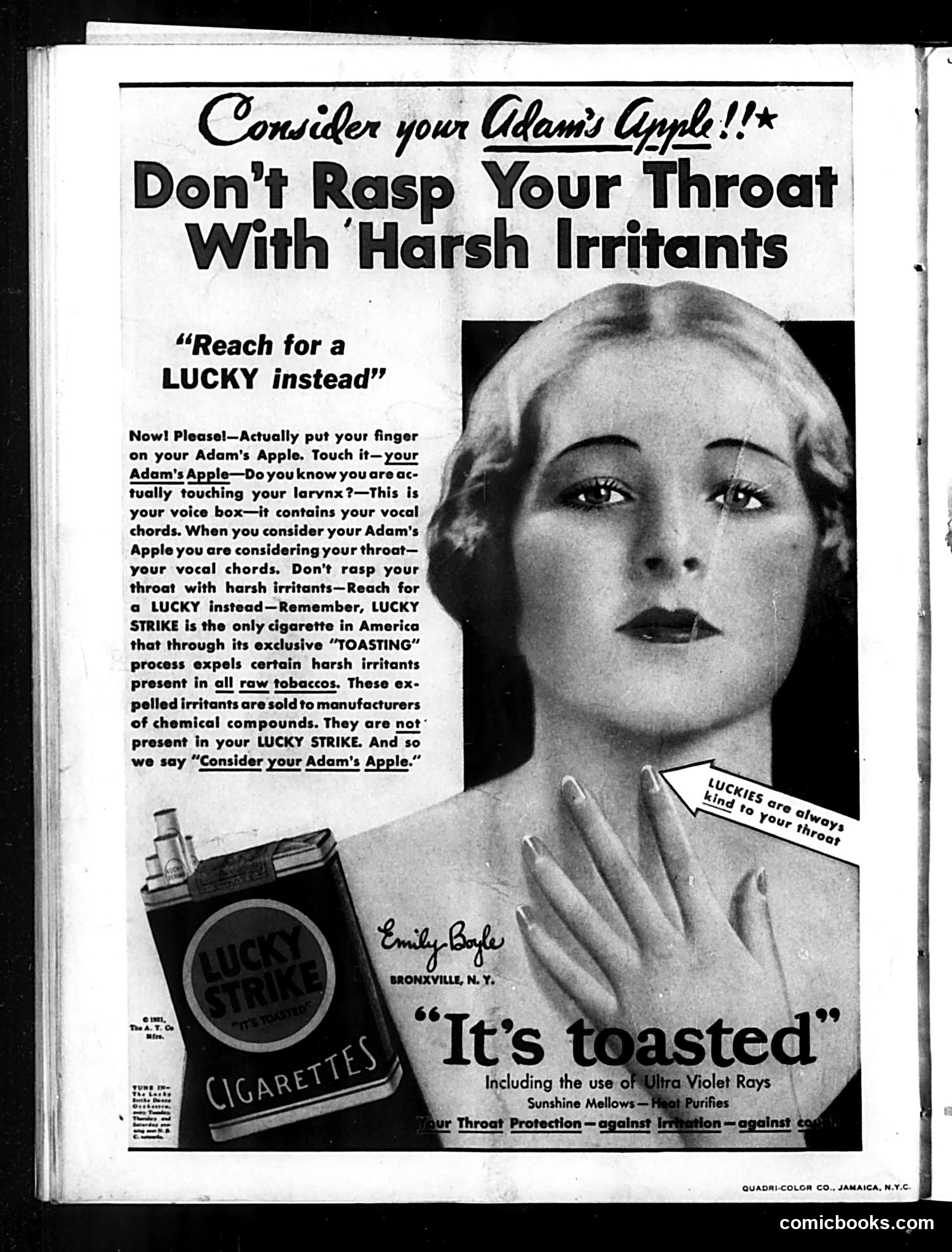
This is a cigarette advertisement, not a political cartoon. It's a Lucky Strike ad featuring actress Emily Brokaw (credited at bottom) promoting cigarettes by claiming they're gentler on the throat. The ad uses pseudo-scientific messaging: it instructs readers to touch their Adam's apple to "consider" their throat/larynx, then argues Lucky Strikes are superior because their "toasting" process removes harsh irritants present in other tobacco. It claims these irritants are expelled and sold to chemical manufacturers, implying Lucky Strikes are therefore safer. For modern readers: this represents pre-1950s cigarette marketing when health warnings didn't exist. The ad cynically weaponizes anatomy education and false health claims to sell a product now known to be carcinogenic. The phrase "It's toasted" became Lucky Strike's famous slogan, using manufacturing details as pseudo-health benefits—a marketing strategy that exploited consumer ignorance about tobacco's actual dangers.