judge
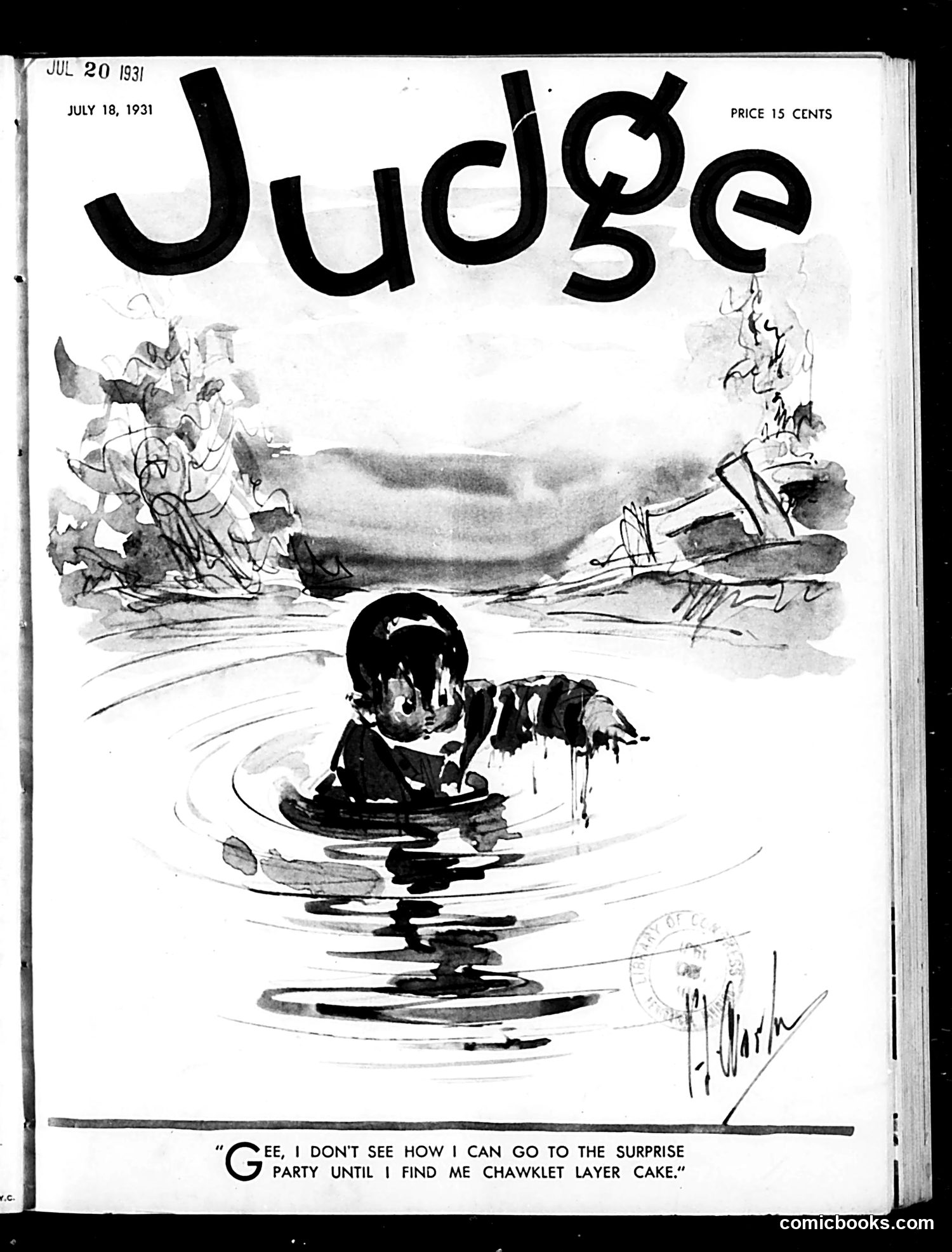
Judge — July 18, 1931
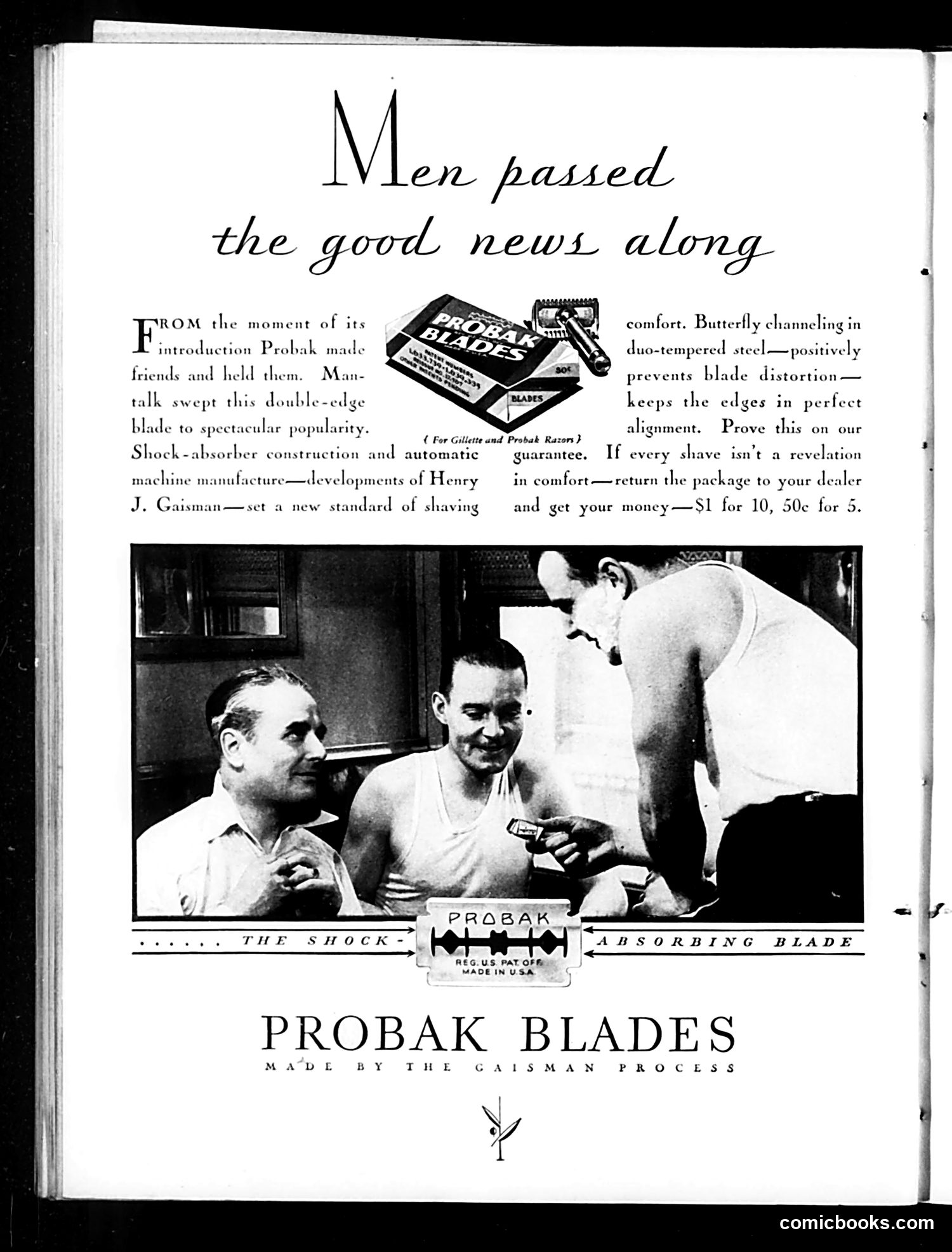
Analysis This is primarily a product advertisement, not satire or political commentary. It advertises Probak Blades, a razor blade brand made using the "Gaisman Process." The page's headline—"Men passed the good news along"—is a marketing claim suggesting the product's popularity spreads through word-of-mouth. The photograph shows men in a barber shop examining and discussing the blade, visually supporting this messaging. The ad emphasizes technical features: "shock-absorber construction," "automatic machine manufacture," and "duo-tempered steel" to prevent blade distortion. It includes a money-back guarantee ($1 for 10 blades, 50¢ for 5). This is straightforward vintage advertising with no apparent political or satirical content—simply a commercial pitch using social proof and technical specifications to market razor blades to male consumers.
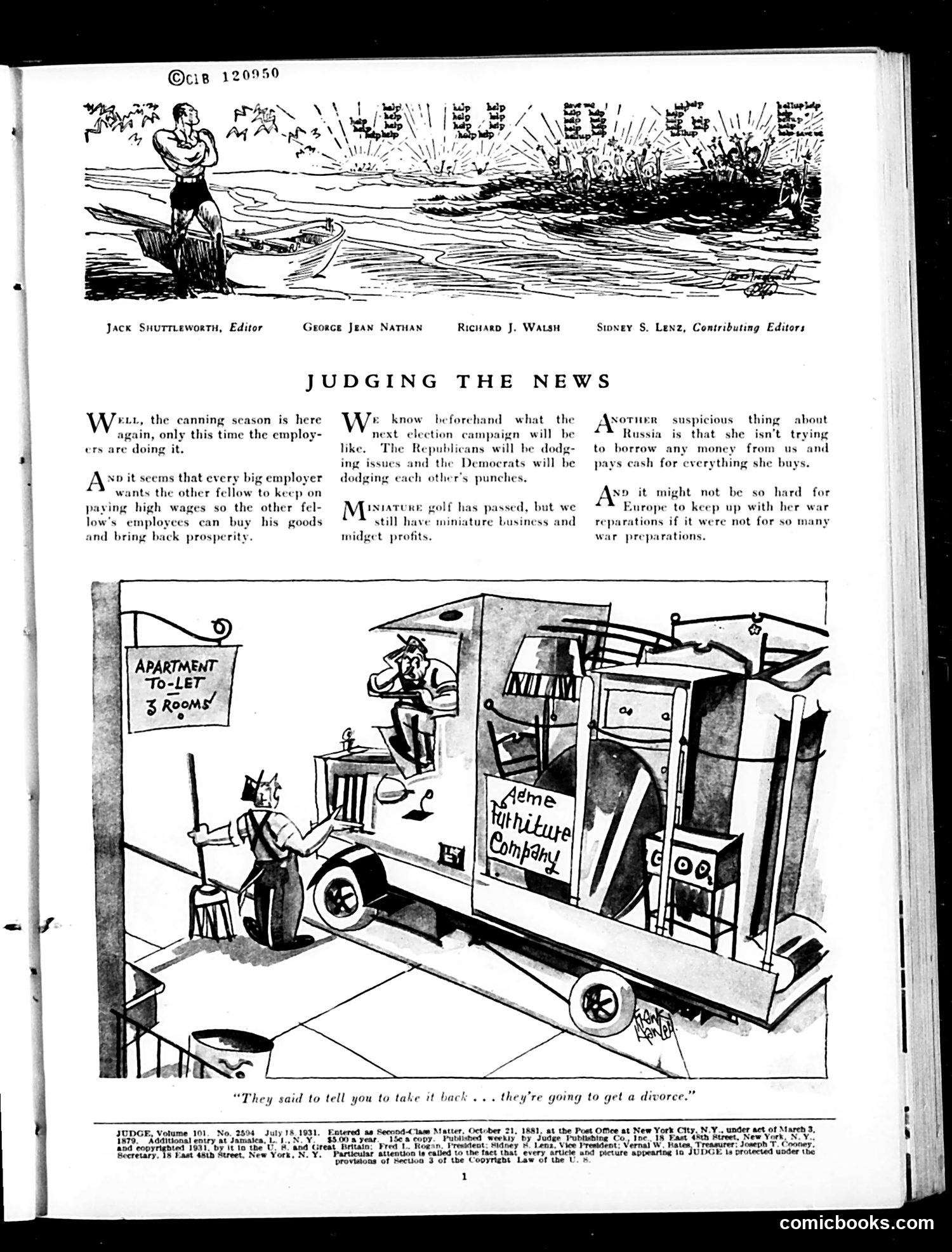
Analysis of Judge Magazine Page (July 13, 1931) The main cartoon depicts a moving van labeled "Acme Furniture Company" outside an apartment building advertising "3 Rooms to Let." Inside the van, a couple sits amid their belongings while a figure tells them: "They said to tell you to take it back... they're going to get a divorce." The satire: This reflects Depression-era anxieties about marriage instability and consumer debt. Newlyweds purchased furniture on credit, but economic collapse made payments impossible. The joke—being told to return the furniture because the marriage is ending—encapsulates the era's cascading failures: financial ruin leading to family breakdown. The editorial text above discusses election campaigns and Europe's war preparations, providing contemporary context for the magazine's serious undertones beneath the humor.
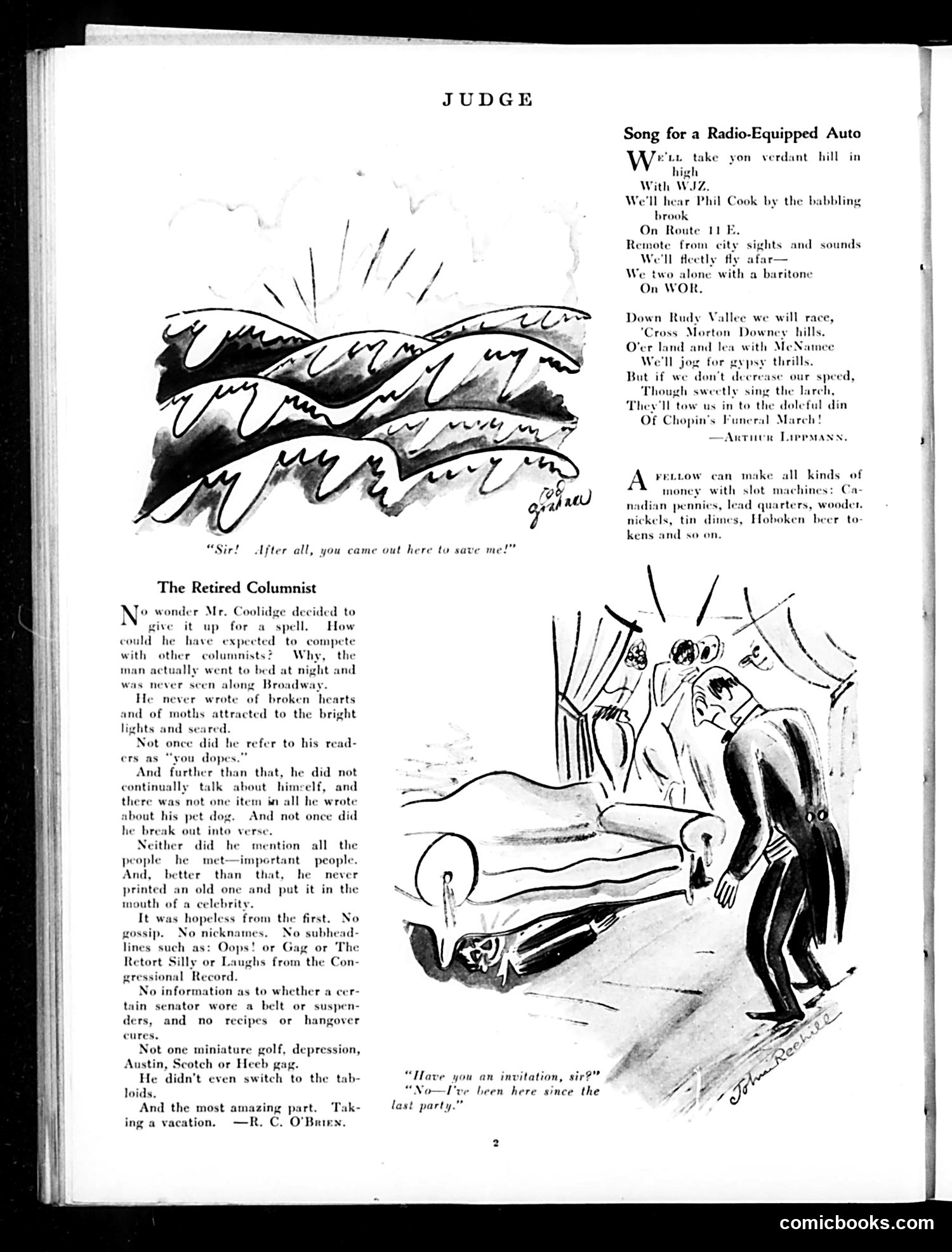
Analysis of Judge Magazine Page This page contains two distinct pieces: "Song for a Radio-Equipped Auto" (top right) is a humorous poem by Arthur Lippmann celebrating early automobile radio technology. It references specific radio stations (WJZ, WOR) and playfully suggests drivers might be so distracted by broadcasts that they'll ignore speed limits and traffic safety—a satirical jab at the novelty and allure of car radios in this pre-modern era. "The Retired Columnist" (left) praises an unnamed columnist (likely a real public figure) for his restraint and professionalism. The satire celebrates what he *didn't* do: he avoided gossip, celebrity scandals, personal complaints, and sensationalism. Instead, he simply took a vacation. This is gentle mockery of the gossip-column genre prevalent in 1920s-30s journalism. Both pieces reflect era-specific consumer technologies and media culture.
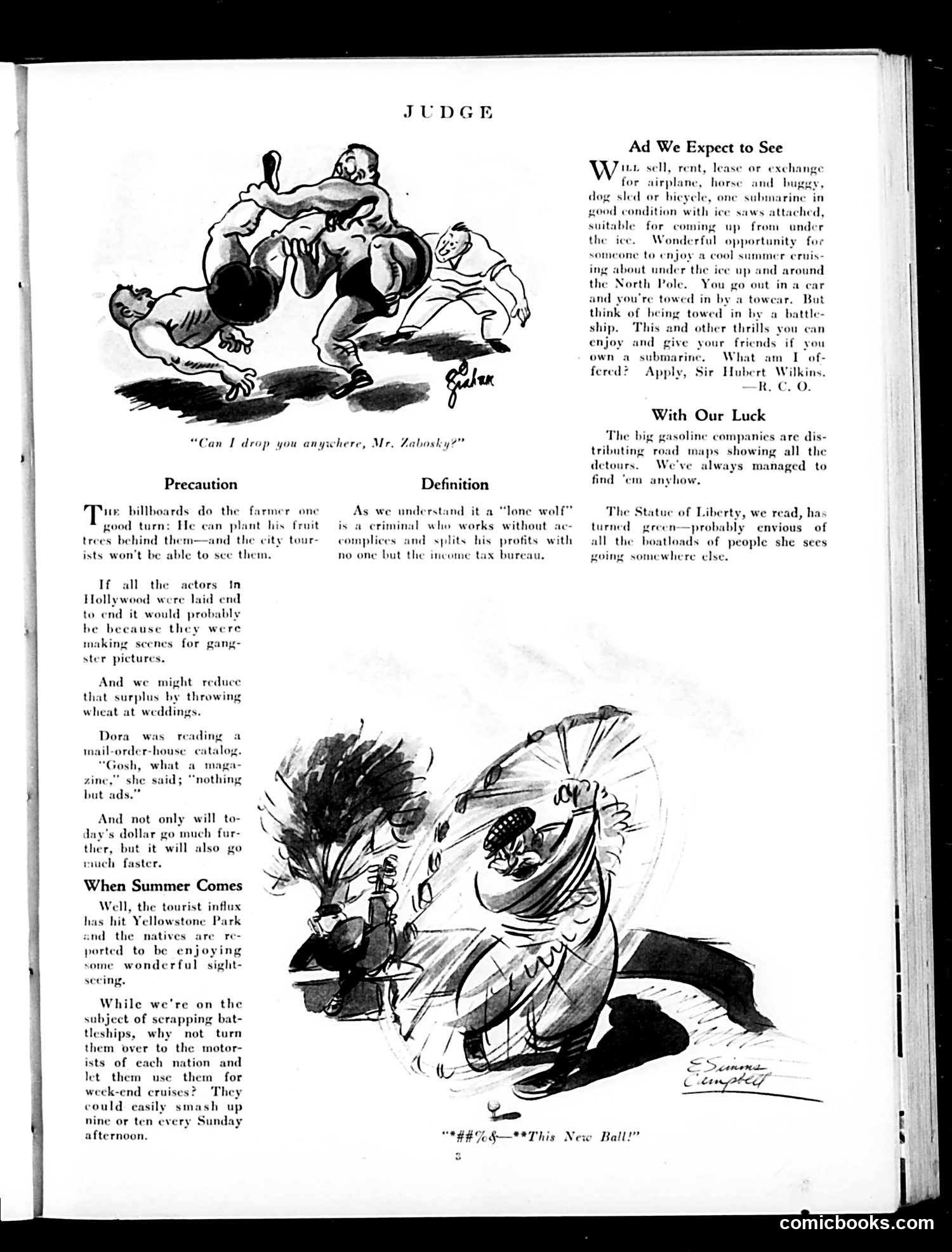
Analysis of Judge Magazine Page This page contains satirical commentary on 1920s American life and economics. The top cartoon, "Can I drop you anyplace, Mr. Zalozky?" depicts a chauffeur struggling to carry an overweight passenger, satirizing wealthy individuals who exploit workers. The "Precaution" section mocks billboard advertising's environmental impact and Hollywood's gangster films. The "Definition" section jokes that a "lone wolf" in criminal terms avoids paying taxes—a commentary on wealthy tax evasion. The bottom cartoon, "This New Ball!" shows a woman in a car accident, likely satirizing dangerous driving habits or poor automobile safety during the early automotive era. Overall, the page critiques wealth inequality, labor exploitation, tax avoidance, and new consumer culture problems emerging in Jazz Age America.
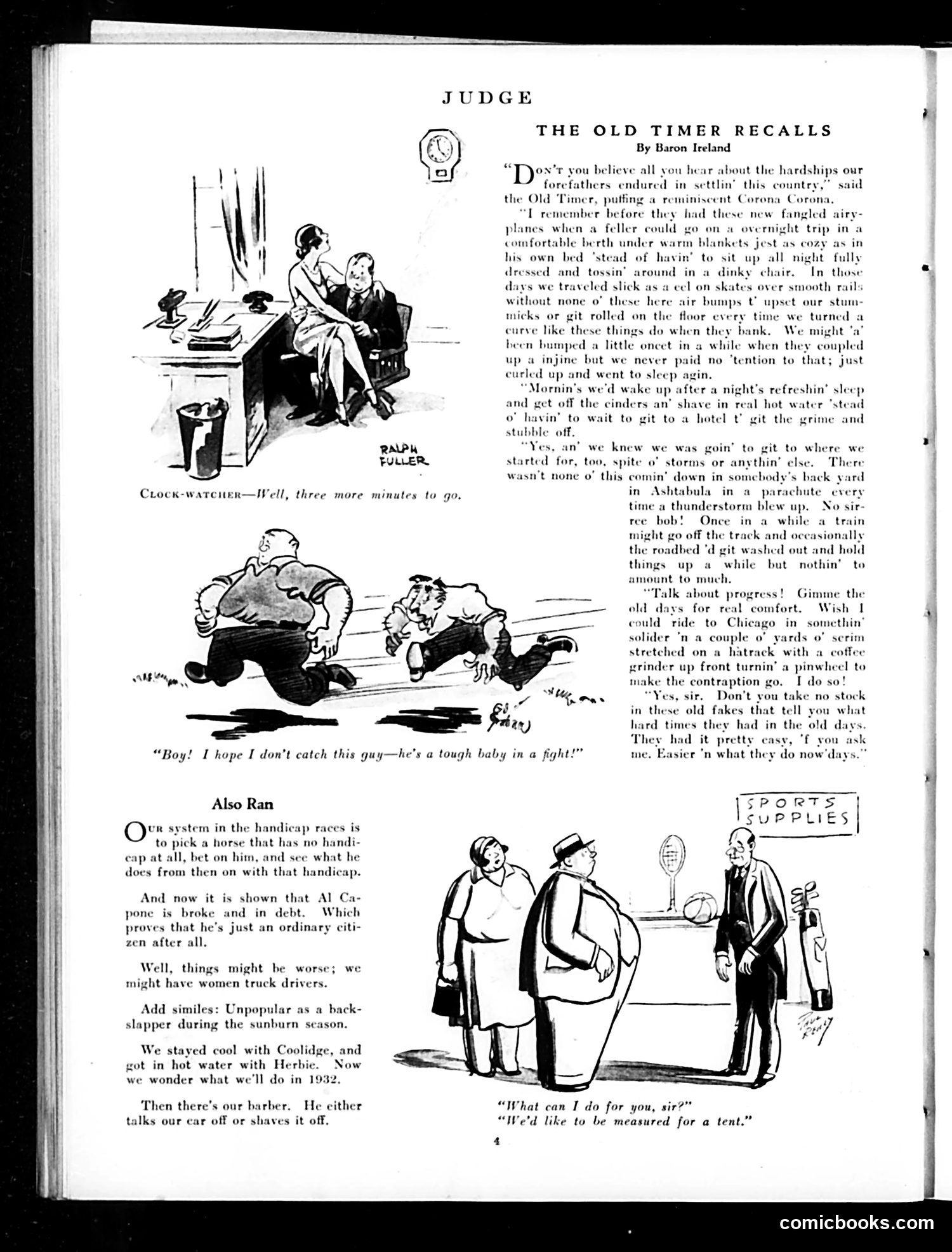
Analysis of Judge Page This page contains two distinct sections: "The Old Timer Recalls" (top): A nostalgic monologue where an elderly man reminisces about hardships of train travel in earlier eras—sleeping upright, rough conditions, derailments. The satire mocks romantic nostalgia for "the old days," suggesting modern comfort (like hotels) is preferable, despite people's tendency to idealize the past. "Also Ran" (bottom): A series of brief comic observations about contemporary issues. References include Al Capone (likely about his legal troubles), unpopular backslappers, and barbers. The sports supplies cartoon depicts two portly men requesting to be "measured for a tent"—mocking their large size. The overall theme: debunking sentimental myths about previous eras while satirizing current social and public figures.
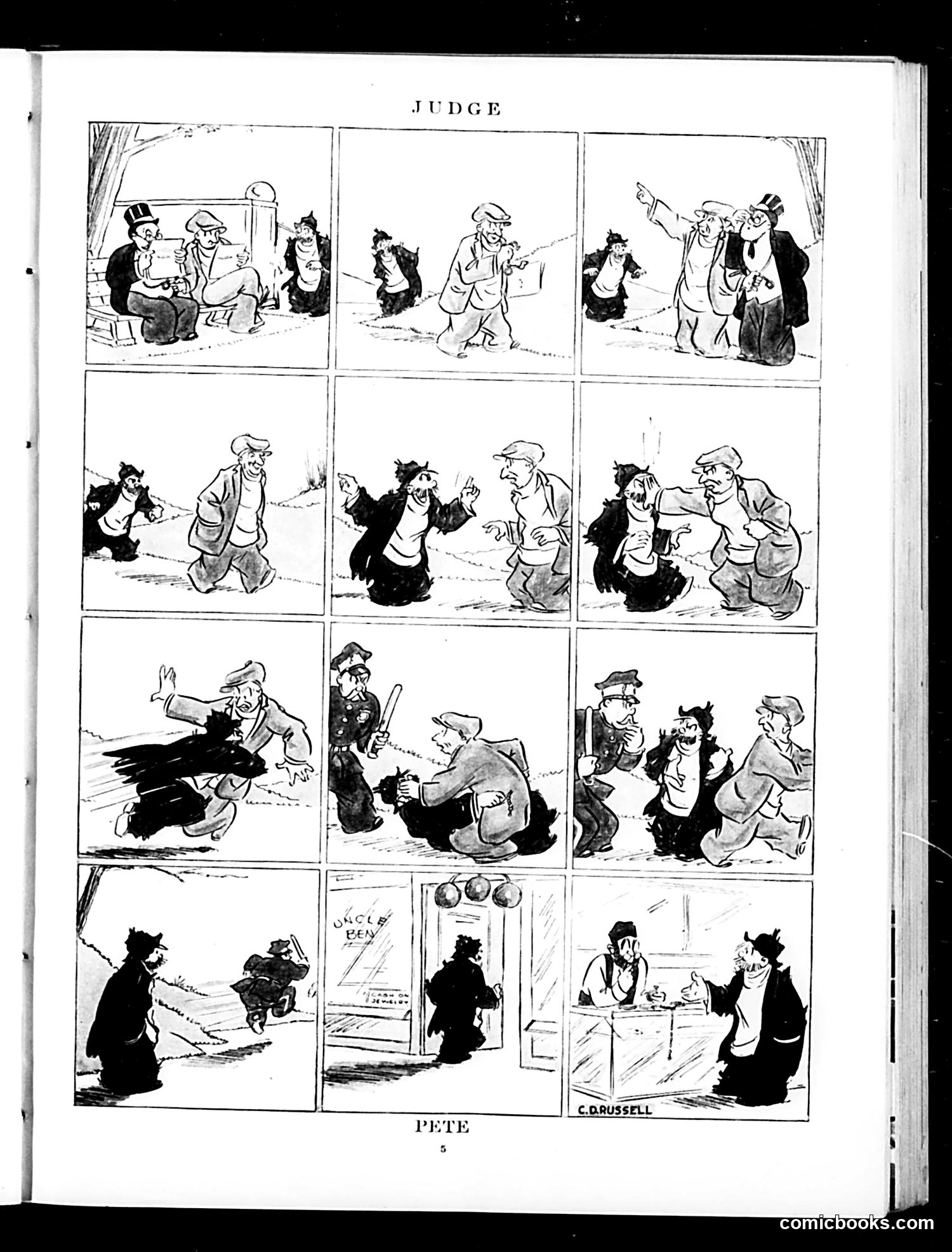
"Judge" Comic: "Pete" (Political Satire) This is a sequential comic strip titled "Pete" by C.D. Russell satirizing what appears to be judicial or legal proceedings. The narrative follows a character through various encounters with authority figures and law enforcement. The strip depicts Pete in conflict with officials—being questioned, arrested, or judged. The humor relies on slapstick physical comedy (characters falling, fighting) combined with commentary on legal systems or police conduct. Without clearer identifying marks or dates, the specific political target remains unclear. However, the repeated confrontations with uniformed authority and the final "Uncle Ben" reference suggest commentary on either crime, justice system corruption, or police abuse—common *Judge* magazine themes during the Gilded Age/Progressive Era.
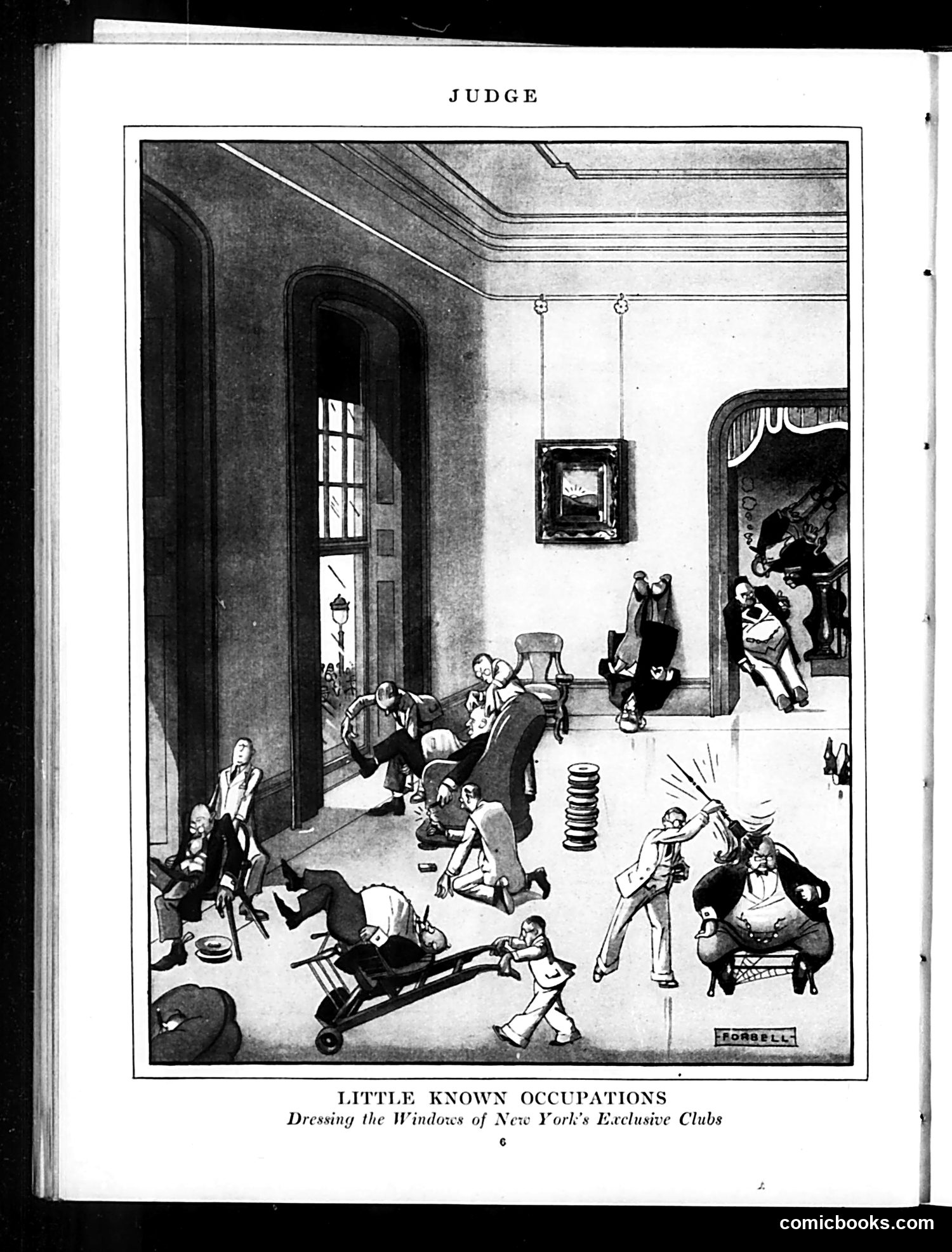
Analysis This is a satirical illustration titled "Little Known Occupations: Dressing the Windows of New York's Exclusive Clubs." The cartoon depicts an ornate interior—apparently a high-end club—where wealthy gentlemen are being arranged and dressed like mannequins in a shop window display by workers and servants. The satire mocks the artificiality and performative nature of exclusive New York club life. The "occupations" are ironic: the wealthy men aren't actually *doing* anything productive—they're being positioned and styled for display, suggesting their primary function is to exist as decoration within these prestigious institutions. This critiques the leisure class's lack of genuine employment or purpose, portraying them as ornamental rather than contributory to society. The signed work (Cesare) uses visual humor to expose social pretension.
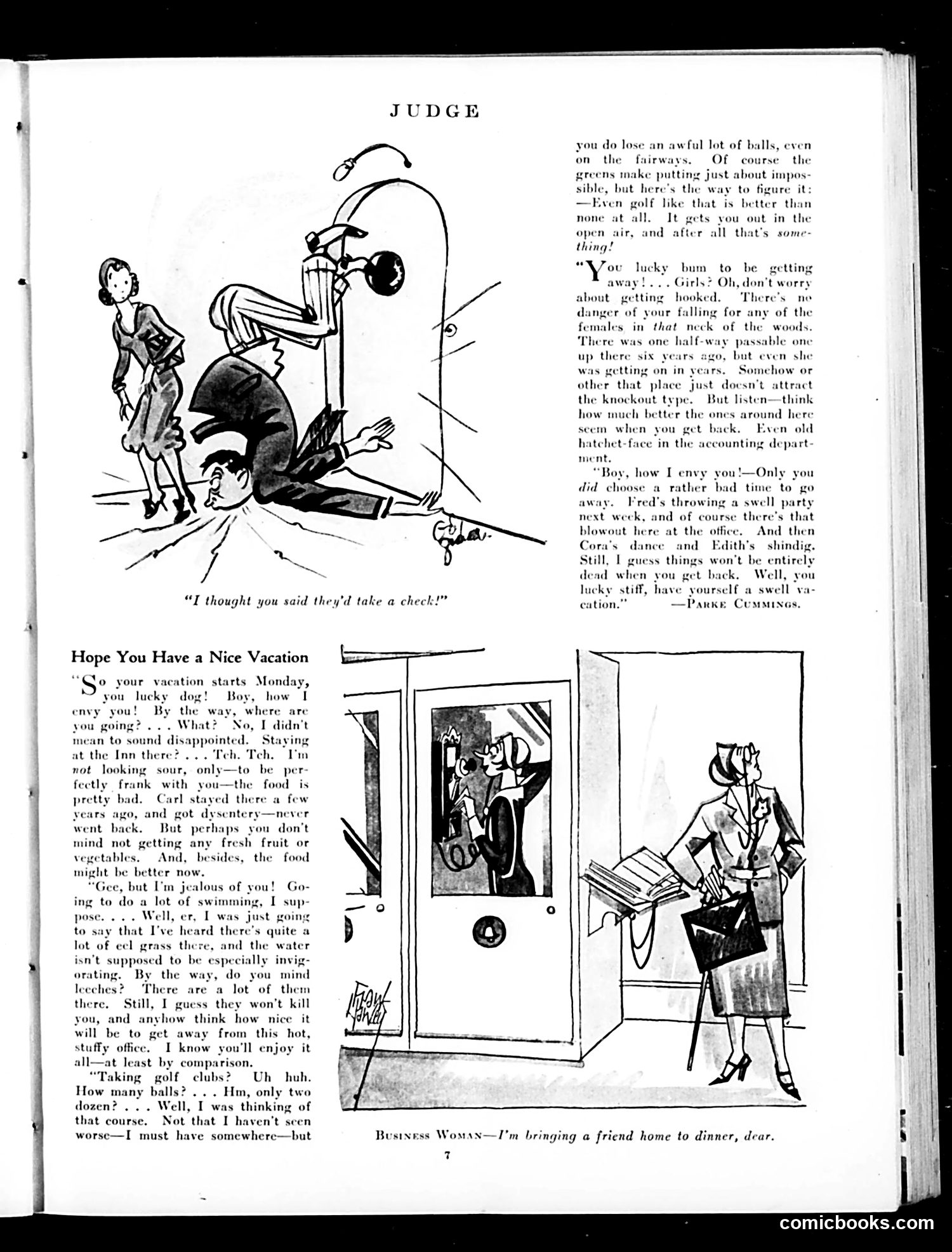
Analysis of Judge Magazine Page This page contains two separate pieces: "Judge" cartoon (top): Shows a man at a fishing rod caught up in equipment while a woman watches. The caption "I thought you said they'd take a check!" satirizes men's excuses about leisure activities—the fisherman claims fishing is affordable but is clearly disaster-prone and expensive in practice. It's social satire about masculine pastimes and financial dishonesty within relationships. "Hope You Have a Nice Vacation" (bottom): A workplace scenario where someone jealously discusses a coworker's vacation plans. The satire targets office dynamics and resentment of colleagues' time off, while the speaker remains stuck at work in the heat. The cartoon criticizes workplace jealousy and the gap between vacation fantasy and office reality. Both pieces use humor to mock everyday social situations and relationship dynamics.
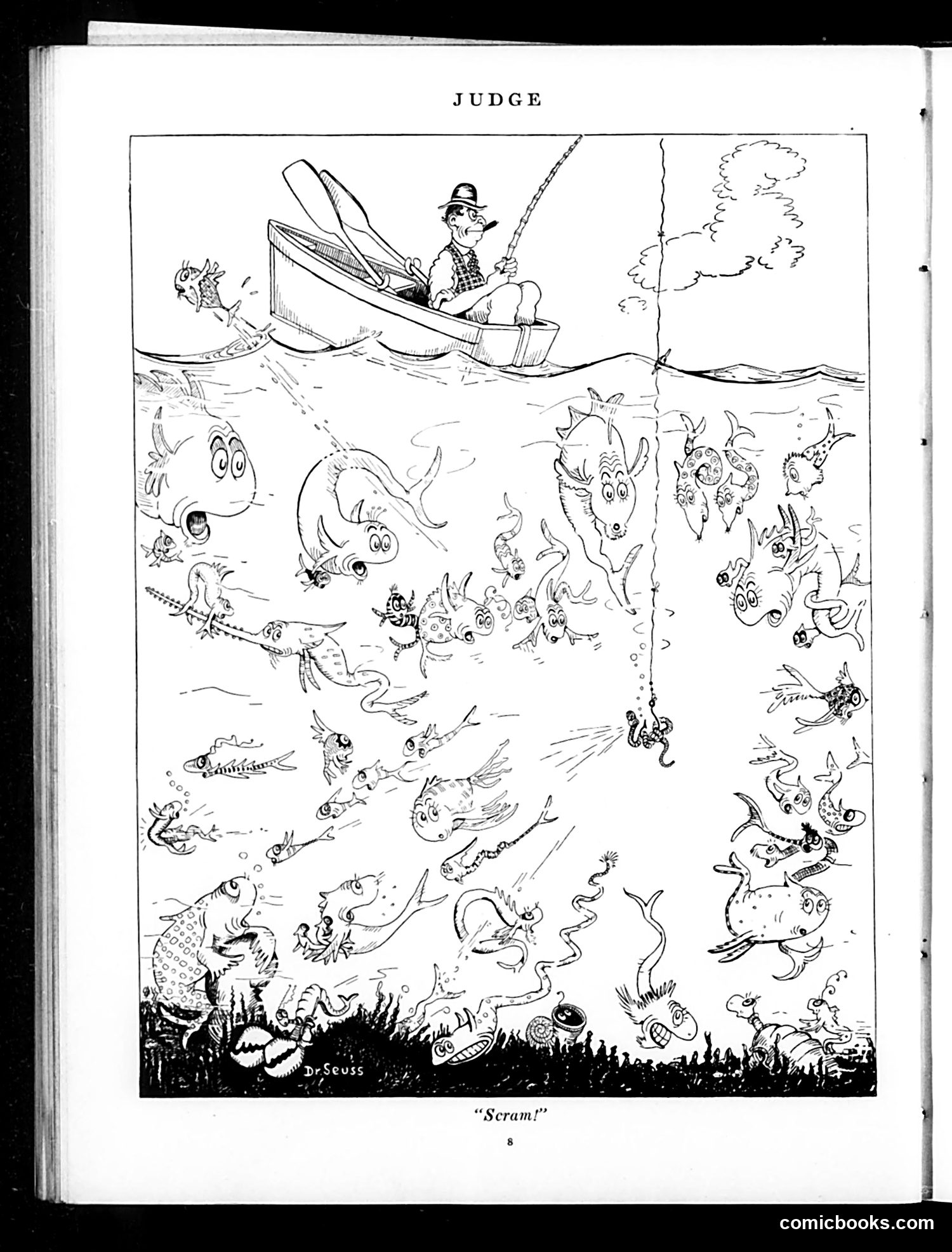
"Scram!" by Dr. Seuss This cartoon by Dr. Seuss depicts a fisherman in a boat above water, casting his line downward at a chaotic underwater scene. Below, dozens of fantastical sea creatures—fish with exaggerated features, tentacled beings, and other whimsical monsters—appear to be swarming or attacking the fishing line in a frenetic mass. The title "Scram!" suggests the creatures are being told to scatter or flee. The satire likely comments on either overfishing, the perceived chaos of marine life, or possibly serves as social commentary using the underwater scene metaphorically. The crowded, aggressive composition emphasizes disorder and mayhem beneath an innocuous surface activity. Without additional context about Judge magazine's issues from this period, the specific political or social target remains unclear.
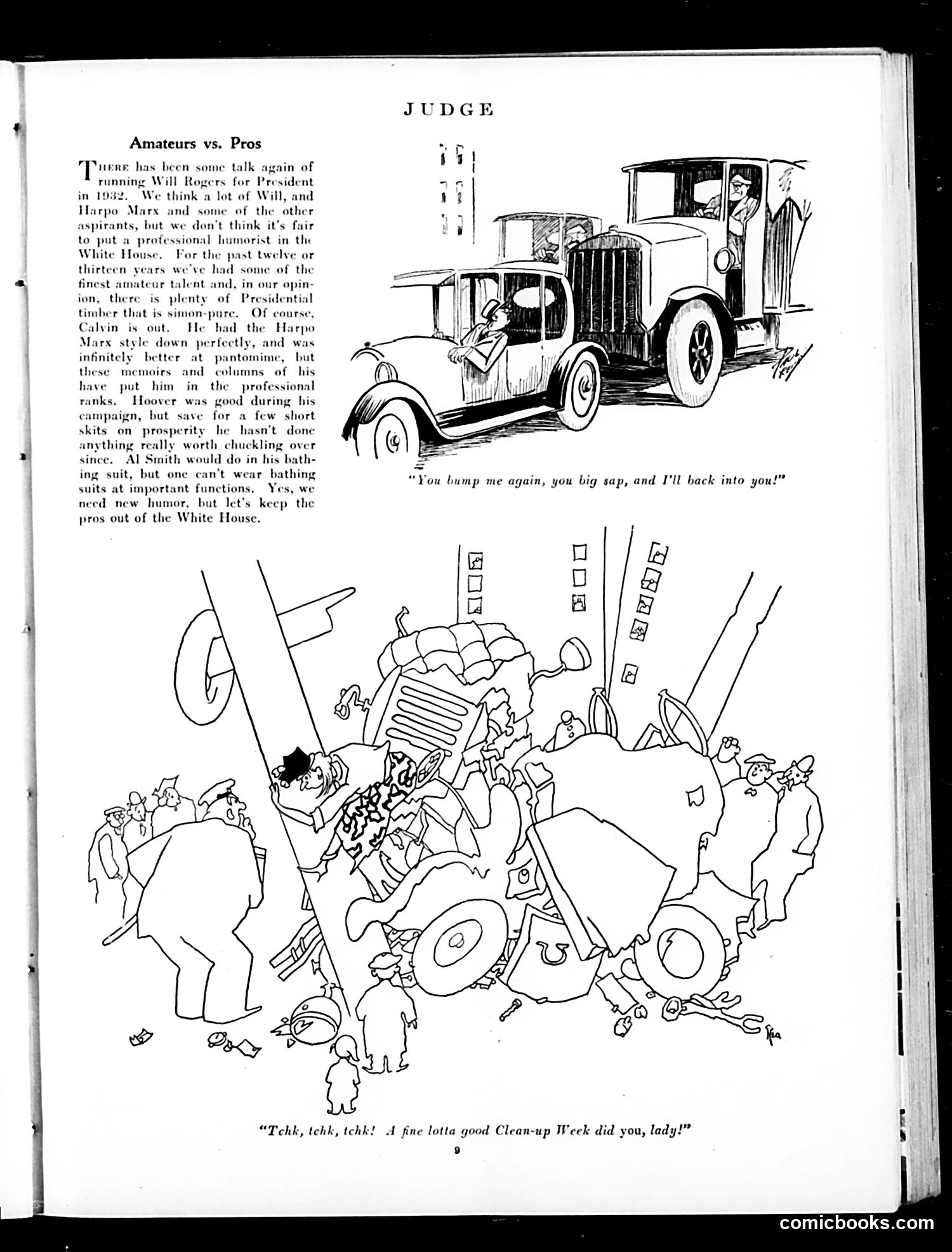
Political Satire Analysis This 1932 *Judge* page satirizes the idea of electing professional entertainers as president. The text mocks recurring proposals to run Will Rogers for president, alongside Harpo Marx and other comedians, arguing comedians shouldn't hold high office. The article uses ironic logic: it claims the U.S. has had "fine amateur talent" as president for years—clearly mocking Calvin Coolidge and Herbert Hoover as inadvertent comedians whose actual presidencies were farcical. Al Smith (likely the 1928 Democratic candidate) is dismissed as merely presentable. The cartoons illustrate this theme through slapstick: the top shows cars colliding with comedic dialogue; the bottom depicts massive traffic chaos and wreckage during "Clean-up Week," suggesting government incompetence creates disaster. The satirical point: current professional politicians are already running the country like comedians—so why hire actual entertainers? It's biting social commentary on 1930s economic failure and political dysfunction.
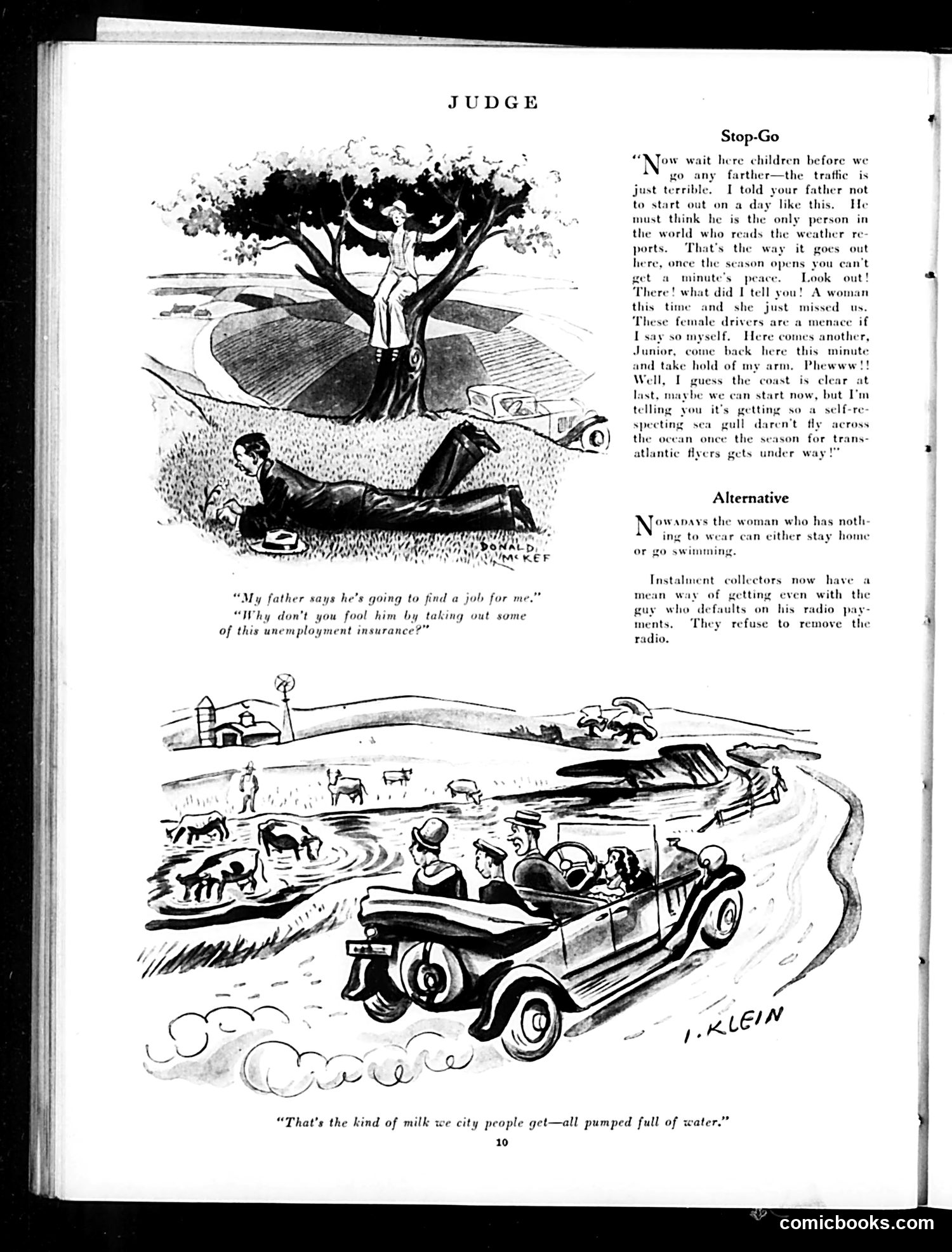
Explanation for Modern Readers This page from *Judge* magazine contains three separate satirical pieces reflecting Depression-era concerns: 1. Top cartoon ("Stop-Go"): Mocks suburban traffic congestion and anxious mothers during vacation season. The woman's complaint about female drivers and sea gulls reflects period stereotypes about women behind the wheel. 2. Middle cartoon: Satirizes economic desperation. A father promises to find his son employment, while another jokes about "unemployment insurance"—likely referencing New Deal programs. The "watered milk" joke suggests city people getting inferior products. 3. "Alternative" section: Brief satirical quips. One mocks women's fashion ("nothing to wear"). The second targets installment debt during the Depression—when someone defaults on radio payments, collectors' revenge is petty: they won't remove the radio, leaving it as a humiliating reminder of non-payment. Overall, these pieces capture working-class anxieties: job insecurity, consumer debt, and social embarrassment during economic hardship.
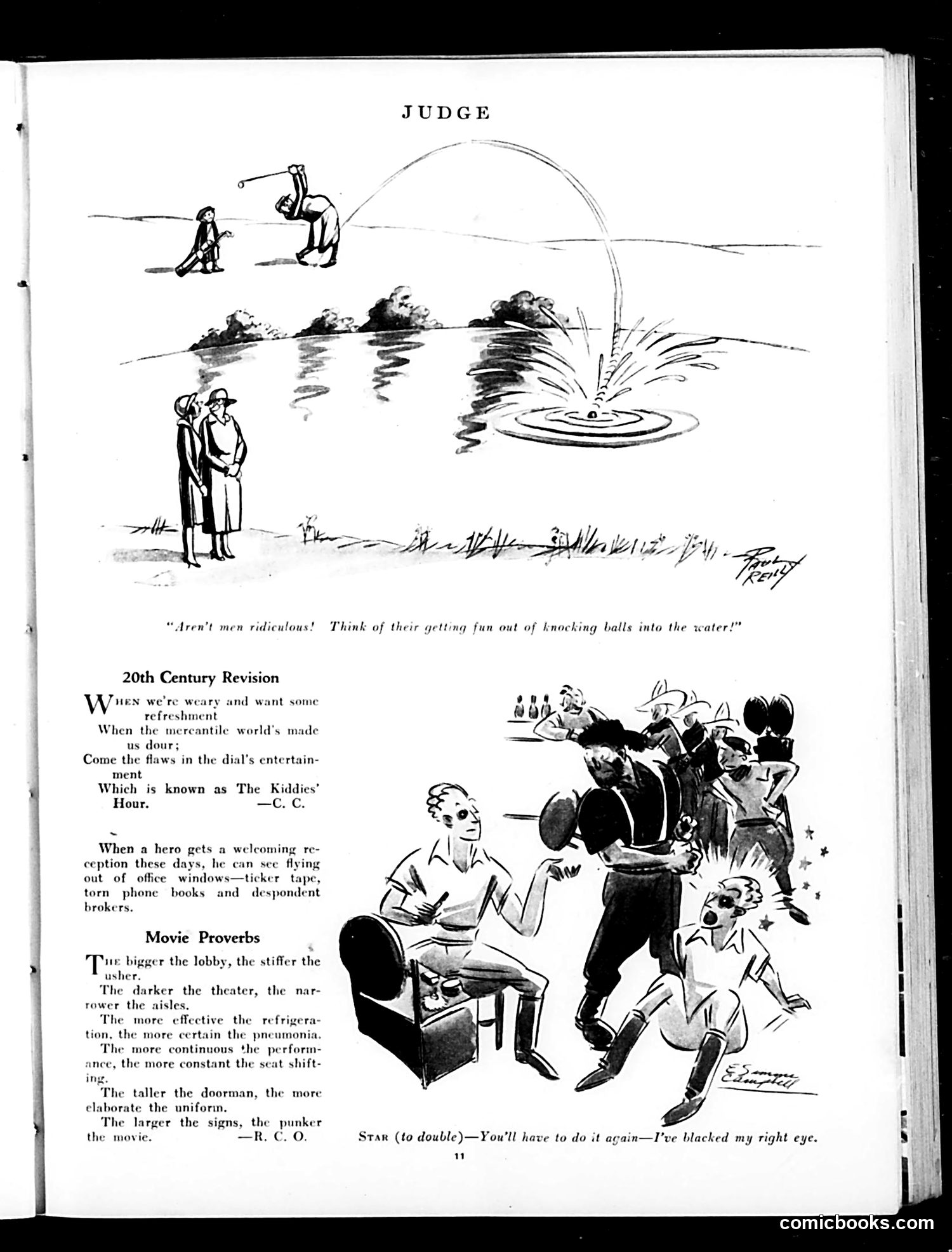
Judge Magazine Page Analysis This page contains three distinct satirical pieces: "Judge" cartoon (top): Shows a couple watching men at play—one fishing, another swinging a golf club that's launched a ball into water. The woman's caption mocks men for finding amusement in such seemingly pointless activity, satirizing masculine recreation and leisure pursuits. "20th Century Revision" (left): A poem contrasting past hospitality with modern rudeness. It suggests that when businessmen need entertainment/relief from commerce's demands, they get "The Kiddies' Hour"—implying adult entertainment has become childish or mediocre. The second stanza jokes that modern heroes receive ticker-tape parades but also flying debris from angry office workers. "Movie Proverbs" (center): Comic observations about cinema experiences—crowded lobbies with strict ushers, dark theaters with narrow aisles, over-refrigerated venues causing colds, continuous showings creating restlessness. These satirize movie-theater inconveniences as industry standards. Bottom cartoon: A film director tells an actor to reshoot a scene because he's "blacked" his eye, using crude slapstick humor about physical comedy in early cinema.
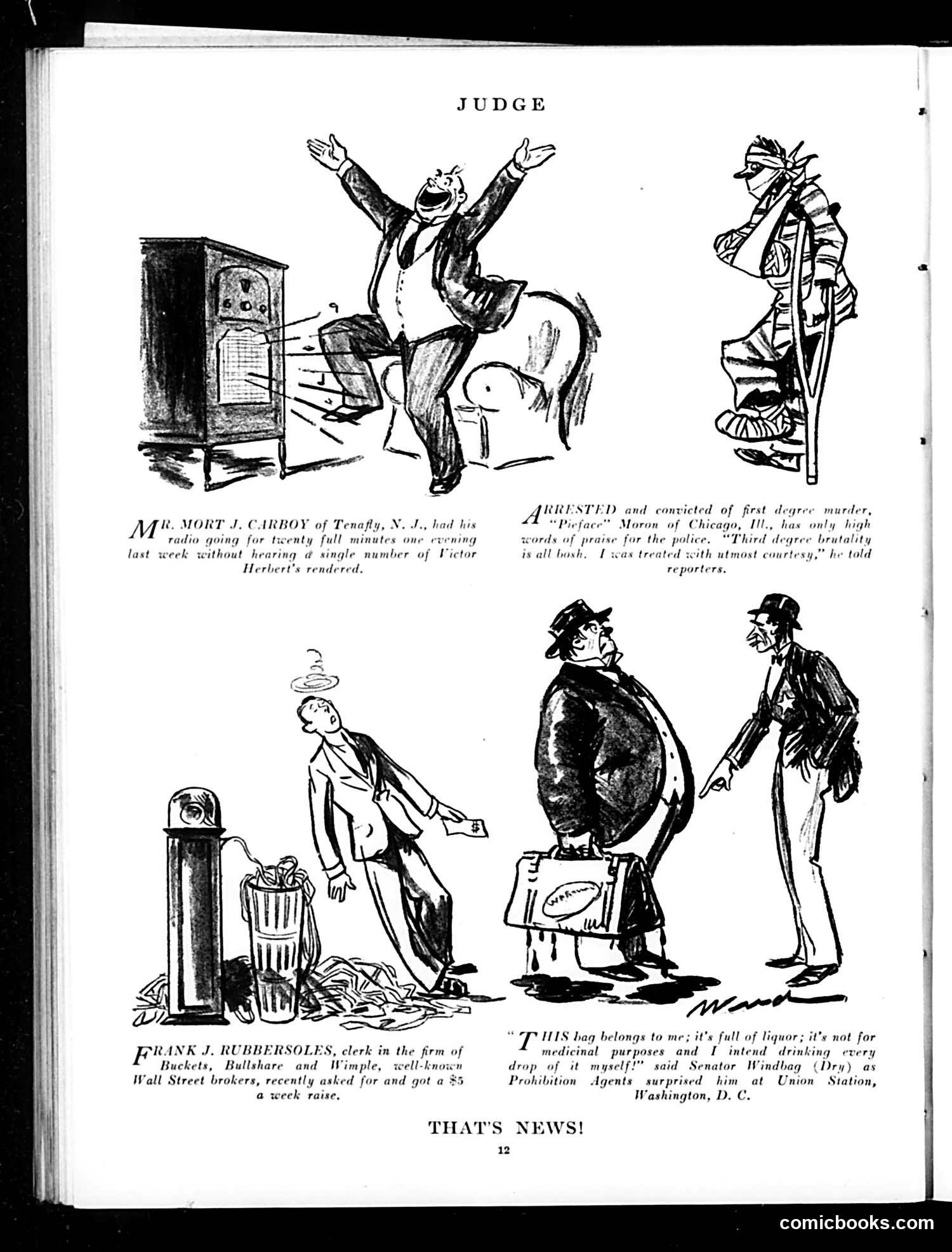
Judge Magazine Political Satire Page This page from Judge magazine satirizes three scandals or absurdities of the Prohibition era: 1. "Pieface Moron" — A Chicago murder convict praised police despite accusations of "third degree" (brutal interrogation), highlighting the era's police brutality and corruption. 2. Senator Windbag — A hypocritical Prohibition-supporting politician caught with illegal liquor by federal agents, mocking the widespread hypocrisy of Dry lawmakers who violated their own laws. 3. Frank Rubbersoles — A Wall Street clerk receiving a mere $5 weekly raise, likely satirizing wage stagnation or economic inequality among working people. The top cartoon shows a man ejected from his radio, mocking Victor Herbert's (a famous composer) radio broadcasts. The humor relies on exposing hypocrisy and corruption among elites while ordinary workers struggled—a common Judge theme during Prohibition's enforcement period.
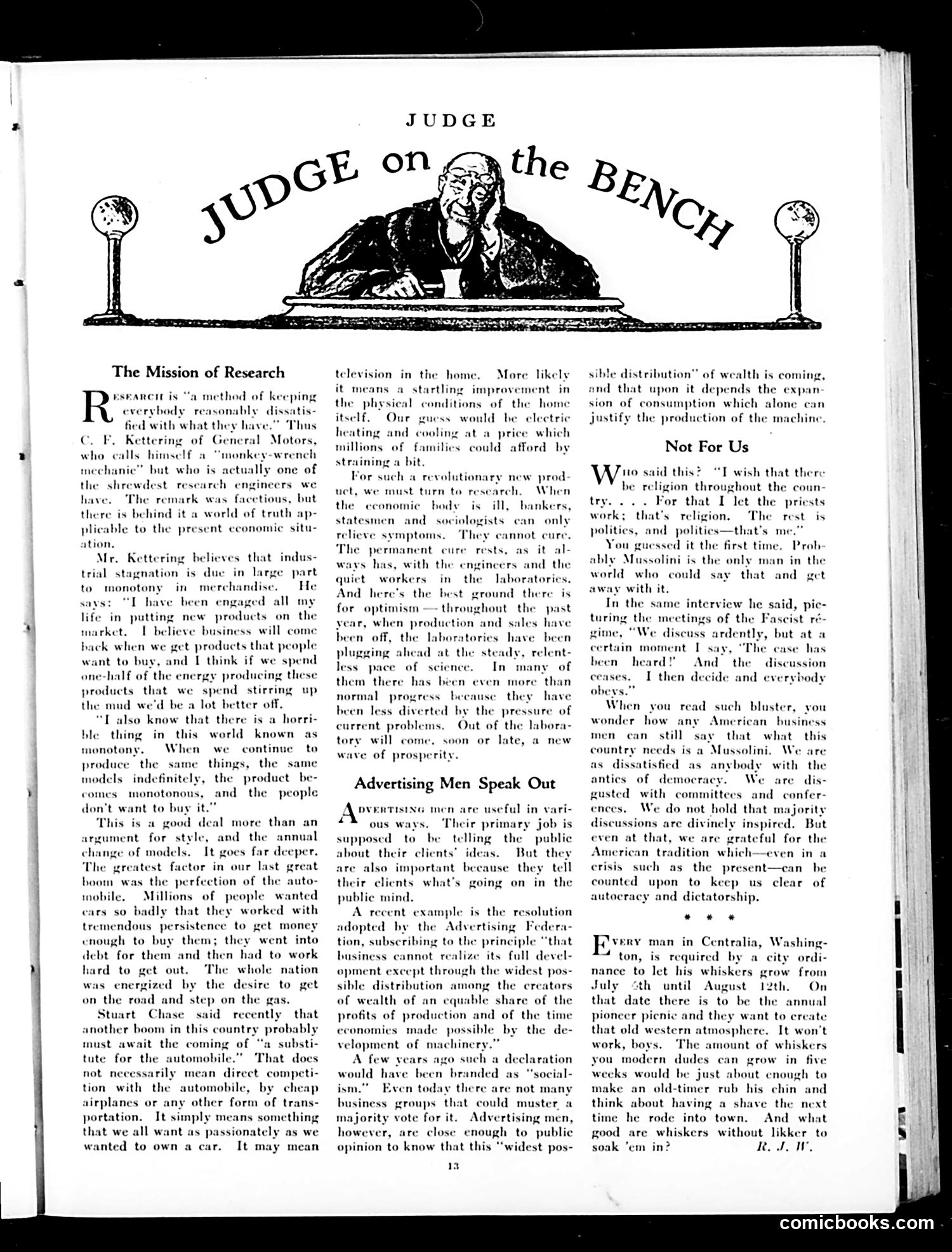
Judge Magazine Page Analysis This page from Judge magazine (a satirical publication) contains several opinion pieces on industrial and economic matters circa the 1920s. "The Mission of Research" quotes C.F. Kettering of General Motors, praising research as a method of keeping people dissatisfied with current products, thus spurring consumption and economic growth. The article argues that monotony in merchandise stagnates industry, and that new innovations (like improved home heating or television) will drive the next economic boom. "Advertising Men Speak Out" notes that advertisers serve dual purposes: promoting clients' ideas while telling clients what the public wants. It cites the Advertising Federation's recent adoption of a progressive resolution supporting "widest possible distribution" of wealth among workers—remarkable for a business group, suggesting advertisers are perceptive enough to recognize growing public demand for economic redistribution. The overall message: industrial progress requires perpetual innovation and consumption, and even business leaders recognize public sentiment favors broader wealth distribution.
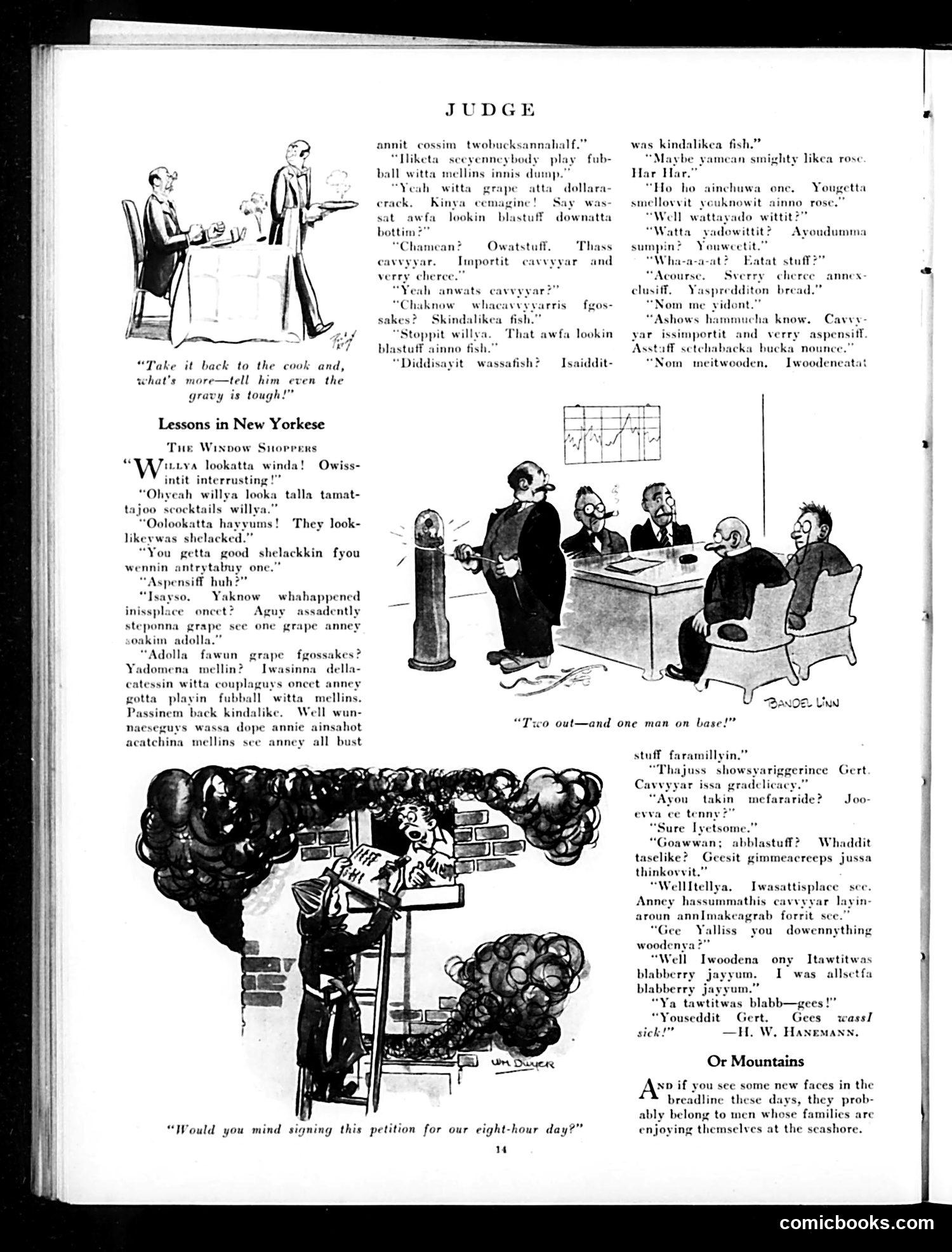
Explanation for Modern Readers This Judge magazine page contains two satirical features: "Lessons in New Yorkese" (top/middle): A phonetic comedy sketch mocking working-class New York accent and dialect. The dialogue depicts characters discussing food (melons, caviar, grapes) in exaggerated, misspelled dialect ("willya," "ainno," "yougetta"). The humor relies on ethnic/class-based caricature—portraying working-class New Yorkers as uneducated and funny-sounding. This was common early-20th-century American humor that wouldn't be considered acceptable today. "Two out—and one man on base!" (middle cartoon): Depicts office workers in what appears to be a baseball discussion, likely satirizing workplace culture or the intrusion of sports into business settings. "Would you mind signing this petition for our eight-hour day?" (bottom): A labor-related cartoon about workplace rights, showing a petition for an eight-hour workday—referencing actual labor movement demands of that era. The overall page mixes ethnic mockery with labor/social commentary typical of Judge's satirical approach.
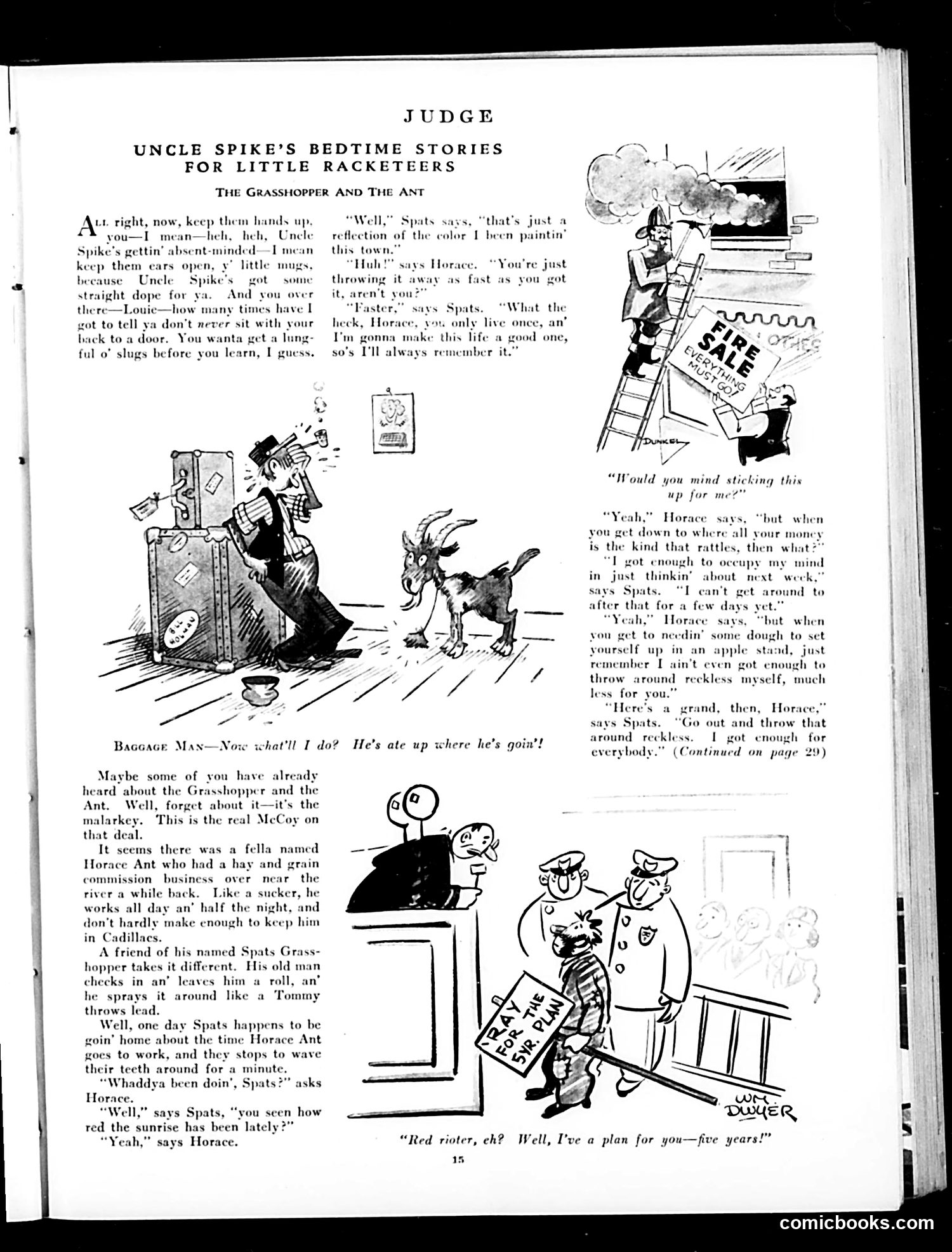
Judge Magazine: "Uncle Spike's Bedtime Stories for Little Racketeers" This page satirizes 1920s organized crime and racketeering by framing a moral fable as a gangster's bedtime story. "Uncle Spike" addresses children like street thugs ("keep them hands up," "don't sit with your back to a door"), then tells a twisted version of Aesop's "Grasshopper and the Ant." The characters are petty criminals: Horace Ant runs a legitimate business near the river; Spats Grasshopper is a young mobster living lavishly on inherited money ("a roll") and spending it recklessly ("like a Tommy throws lead"—referencing tommy guns). The satire mocks how crime corrupts traditional values. Instead of teaching thrift, the story celebrates criminal excess. The punchline—Spats offering Horace a "five-year plan"—appears to reference criminal sentences while inverting the fable's moral lesson entirely. The cartoons show slapstick mayhem, reinforcing the absurdity of presenting gangster life to children as entertainment.
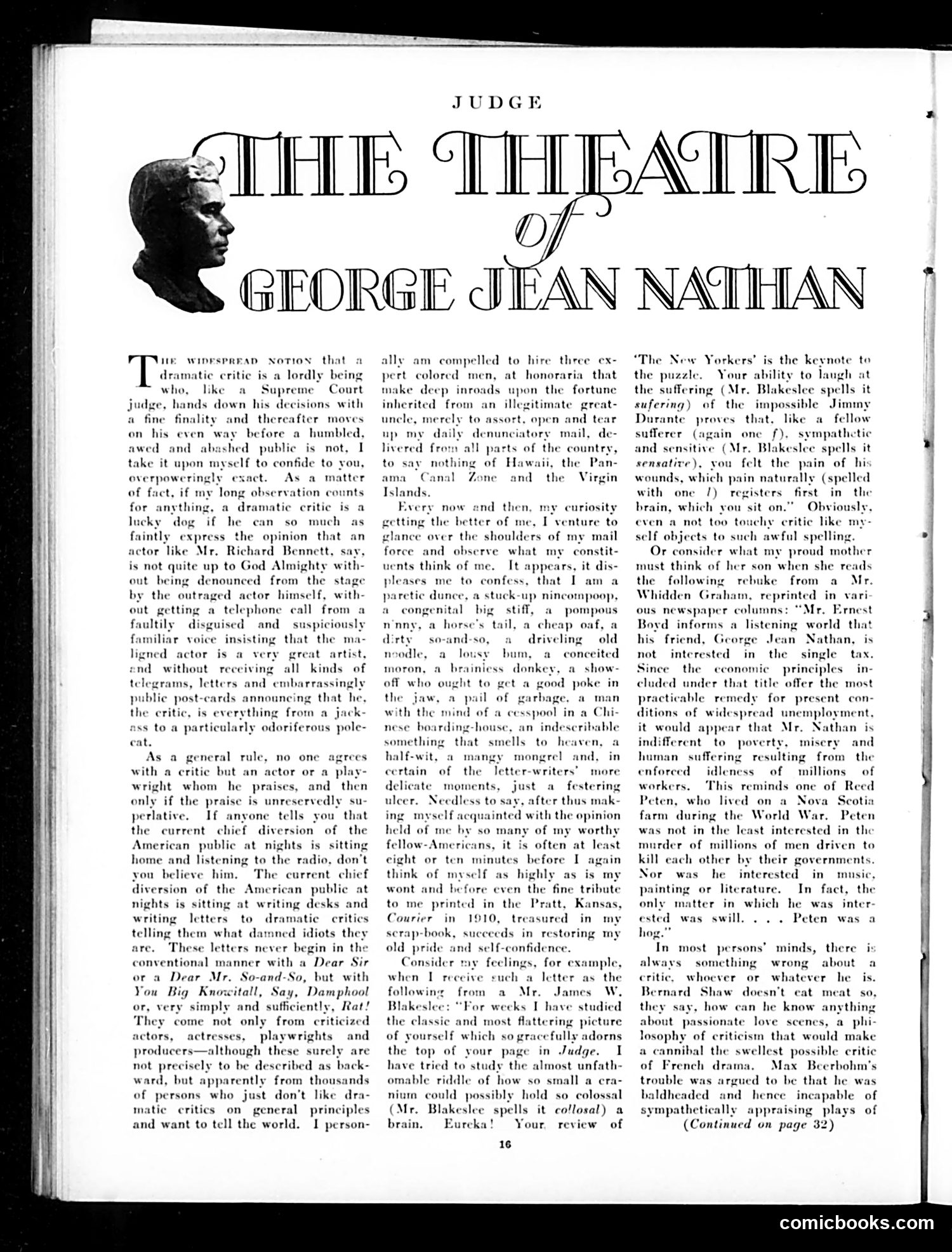
The Theatre of George Jean Nathan This is a satirical essay (not a cartoon) by Judge magazine's drama critic, mocking the hostile reception critics receive. The piece humorously catalogs the abuse Nathan endures from angry actors, playwrights, and theater-goers who resent his reviews. Nathan names Richard Bennett (a real actor) as an example of someone who might attack a critic for negative reviews. The satire highlights the absurd contradiction: while Americans claim their evening entertainment is radio, they actually spend nights writing furious letters to drama critics using creative insults—"nincompoop," "cesspool," "mangy mongrel." The joke is that Nathan must hire three assistants just to process his daily hate mail from across America (even Hawaii and the Canal Zone). Despite reading this avalanche of abuse, Nathan ironically claims he recovers his self-esteem by remembering a complimentary review from a small Kansas newspaper in 1910. The satire criticizes both theatrical figures' thin-skinned reactions to criticism and Americans' passionate investment in attacking critics.
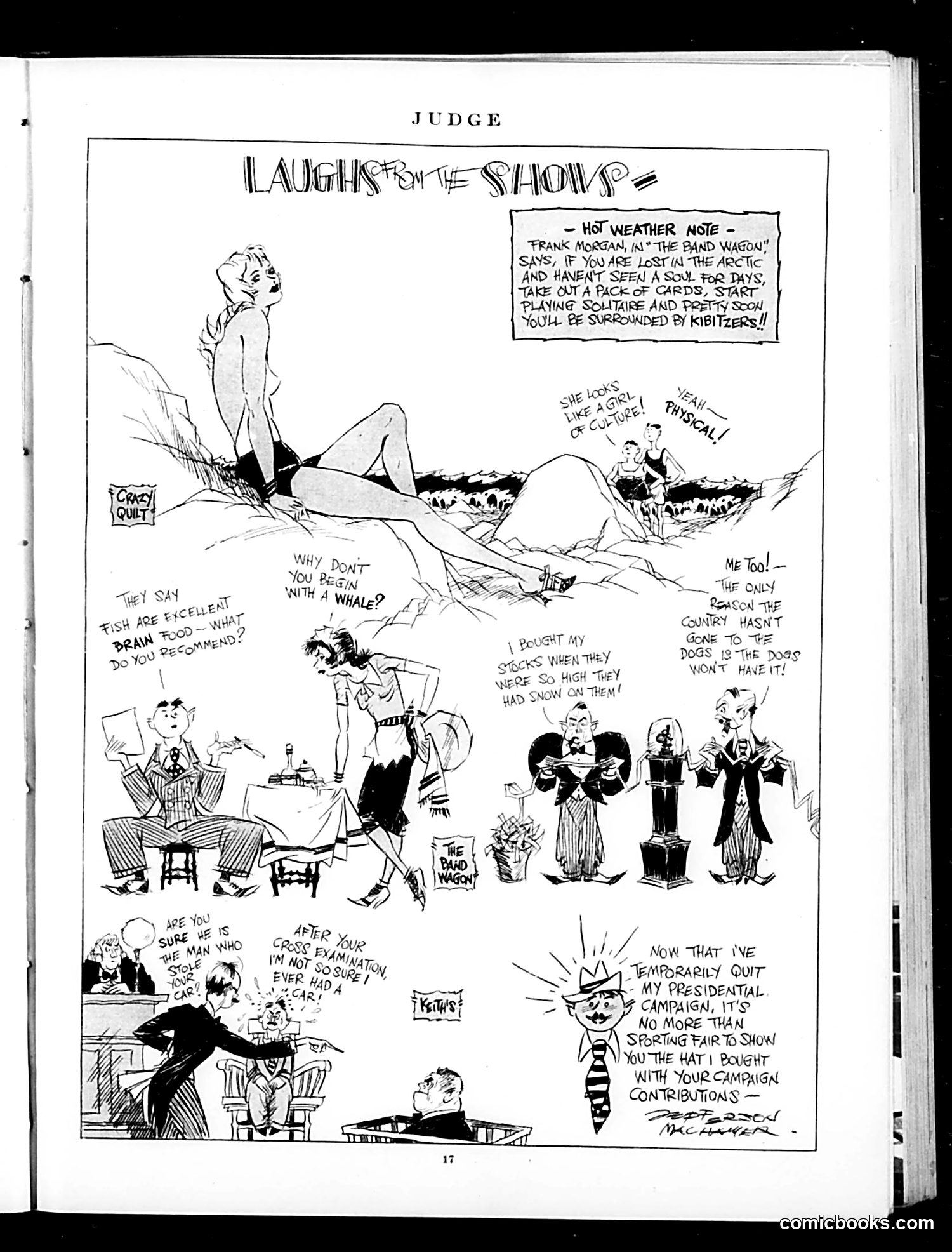
Political Cartoon Analysis: "Laughs for the Show" This Judge magazine page is a multi-panel satirical cartoon mocking various social pretensions and political hypocrisy of its era (likely 1930s-40s, based on style). The central figure is a woman in a bathing suit delivering absurd advice about Arctic survival and card games—satirizing vapid celebrity culture. Frank Morgan is referenced as "The Band Wagon," suggesting commentary on celebrity behavior. Lower panels ridicule wealthy social climbers: men bragging about exotic acquisitions (whale brains, high-priced stocks) they don't understand; a courtroom scene mocking dishonest examination testimony; and crucially, a politician claiming to abandon his presidential campaign out of "sportsmanship"—while clearly still accepting campaign contributions ("the hat I bought with your campaign contributions"). This final panel appears to satirize political corruption and hypocrisy: leaders claiming noble withdrawal while continuing self-enrichment. The overall message critiques American society's superficiality and moral compromises among elites.
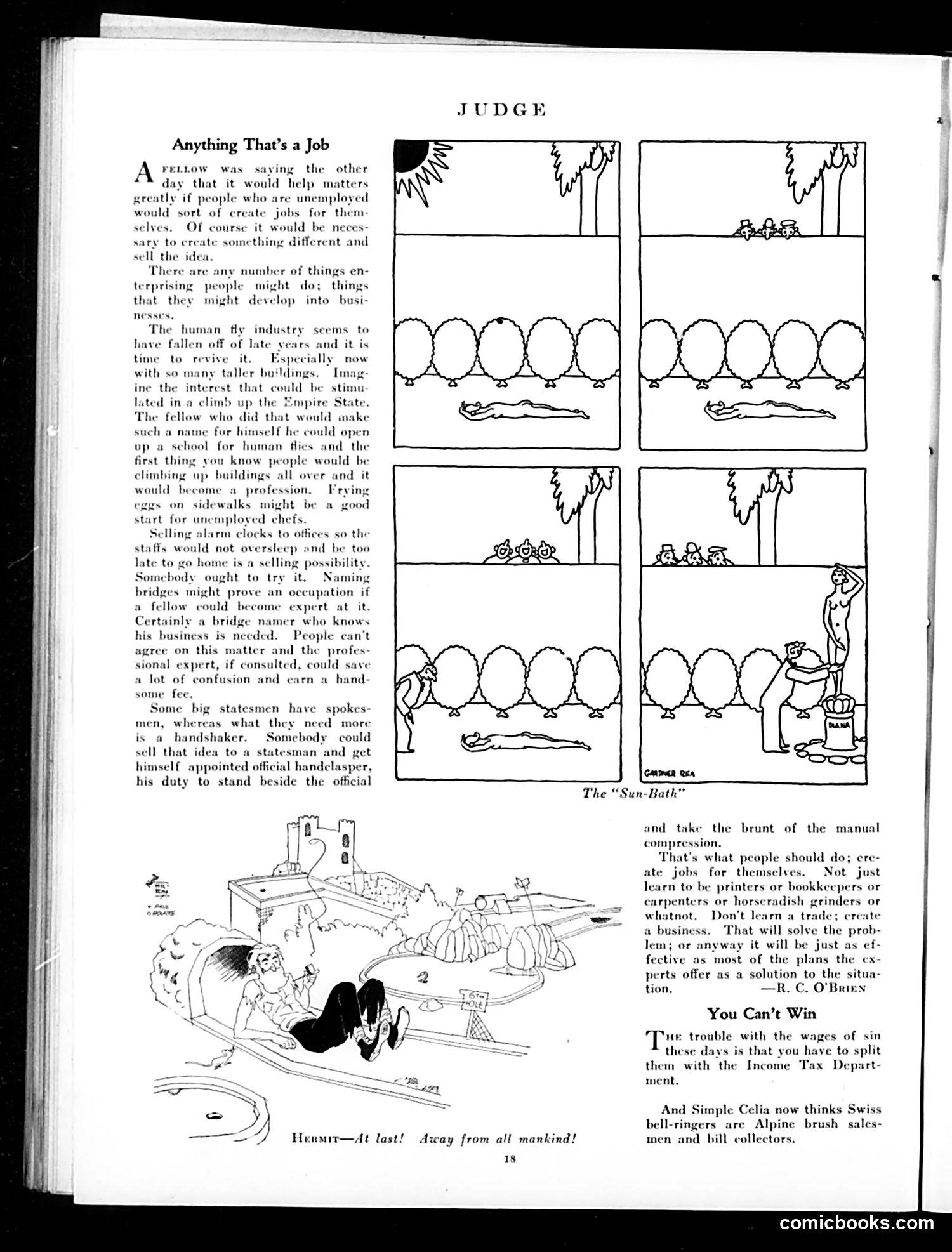
"Anything That's a Job" - Judge Magazine Satire This article mocks Depression-era solutions to unemployment by sarcastically proposing absurd "jobs" the jobless could create for themselves. The humor lies in suggesting impractical or ridiculous occupations: reviving the dangerous "human fly" profession (climbing skyscrapers), frying eggs on sidewalks, selling alarm clocks to prevent workers oversleeping, or becoming official "handclaspers" for politicians. The accompanying four-panel cartoon titled "The 'Sun-Bath'" depicts a comical scene where a figure lies horizontally while numerous large spheres (apparently sunlamps or heat sources) surround them, suggesting an absurdly overcomplicated self-care device. The satire critiques both unemployment "experts" offering ineffective solutions and the expectation that desperate workers should simply invent viable businesses from nothing. The author (R.C. O'Brien) argues people should actually *create real trades and businesses*, not follow impractical expert advice. The tone is darkly humorous about economic hardship.
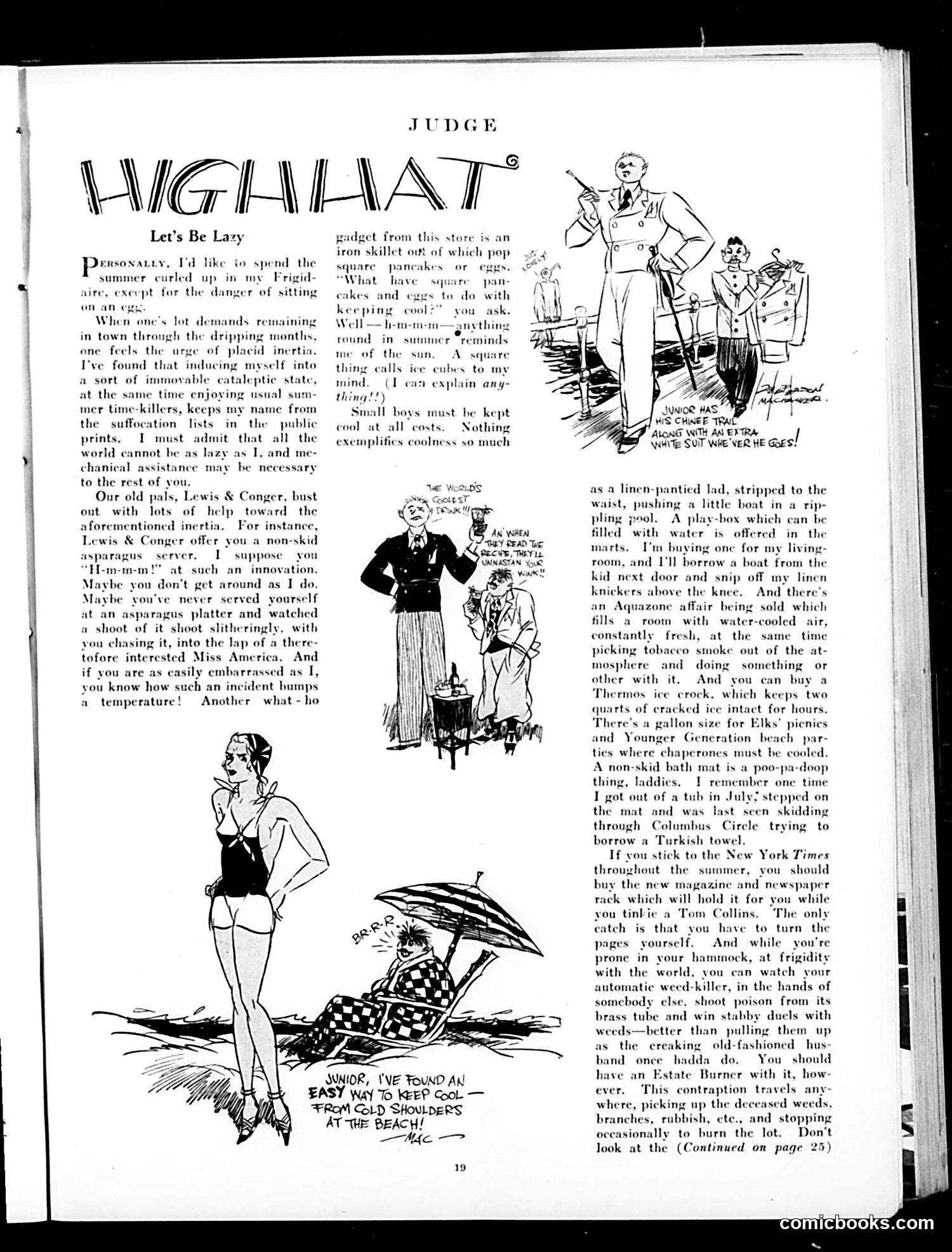
"Let's Be Lazy" – Judge Magazine Satire This is a humorous consumer-goods advertisement disguised as social commentary. The unnamed male author mocks the wealthy leisure class's pursuit of "laziness" through increasingly elaborate mechanical gadgets sold by Lewis & Conger, a high-end department store. The satire works by exposing the contradiction: these devices supposedly enable idleness but actually represent conspicuous consumption and technological excess. Examples include a "non-skid asparagus server" (absurdly specialized), water-cooled air systems, and automatic weed-killers—all presented as necessities for summer comfort. The cartoon illustrations show affluent figures enjoying beach leisure and domestic ease. The humor targets 1920s-30s consumer culture: wealthy Americans purchasing status symbols while claiming to simply "relax." The author's deadpan descriptions—like keeping cool by imagining square pancakes remind him of ice cubes—amplify the absurdity. This is ultimately promotional satire: mock the excesses of luxury goods while advertising them to Judge's affluent readership.
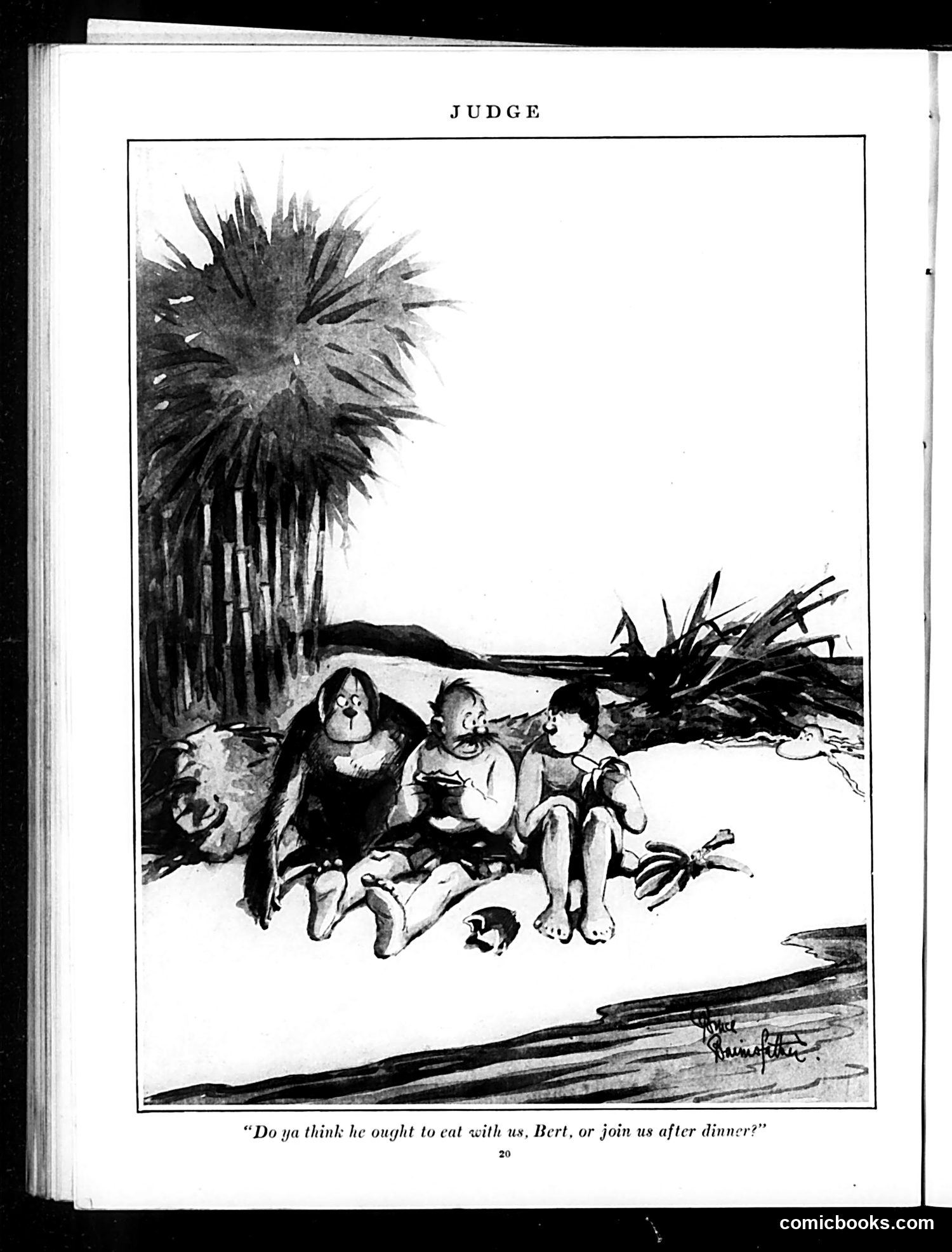
Judge Magazine Cartoon Analysis This cartoon depicts a group of ape-like figures on a beach with primitive surroundings (palm tree, driftwood). One figure asks another named "Bert" whether a newcomer should "eat with us" or "join us after dinner?" The satire appears to reference racial hierarchies and segregation, using caricatured ape imagery to mock prejudicial attitudes about social inclusion and dining segregation—likely commentary on early 20th-century American discrimination practices. The figures' primitive appearance and setting reinforce the racist pseudo-scientific theories popular at the time that attempted to justify racial hierarchies by associating certain groups with "lower" evolutionary stages. The joke's cruel premise—debating whether someone is "civilized" enough to dine with the group—targets the absurdity of such discriminatory social rules.
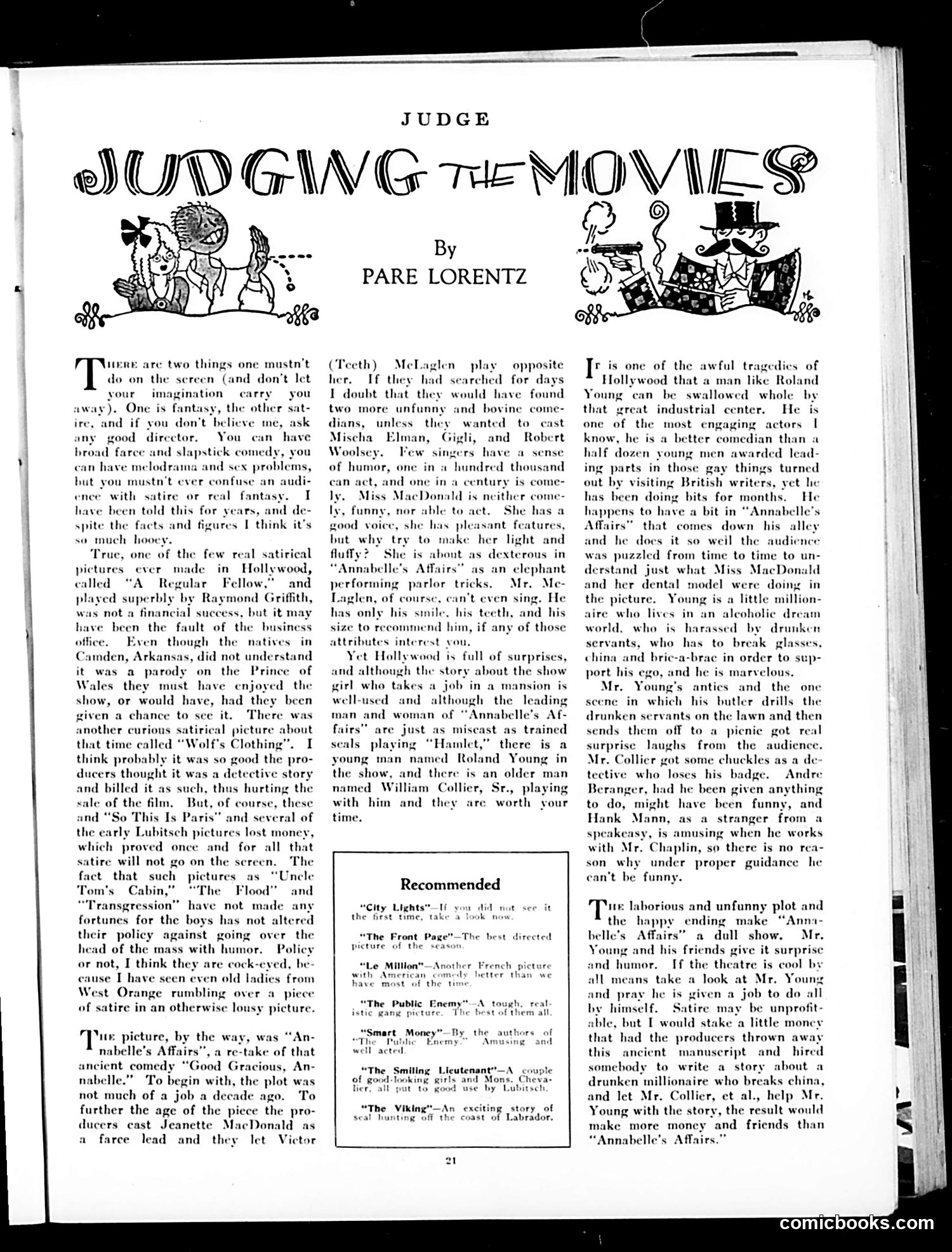
Analysis This is a film review column by Pare Lorentz titled "Judging the Movies." The text critiques *Annabelle's Affairs*, a 1930s comedy remake. The Main Point: Lorentz argues that Hollywood executives wrongly believe satire and fantasy cannot succeed commercially, citing past box-office failures to justify avoiding intelligent humor. However, he contends this policy is misguided—even unsophisticated audiences enjoy satirical content. The Specific Film: *Annabelle's Affairs* stars Jeanette MacDonald and Victor McLaglen as romantic leads in a show-girl-takes-mansion-job plot. Lorentz harshly judges both leads as unfunny and poorly cast for farce (MacDonald described as "about as dexterous as an elephant"). The Redeeming Element: The film's saving grace is Roland Young, whom Lorentz praises as genuinely talented—frustratingly underutilized by the studio system. Young and supporting actor William Collier Sr. provide the only entertainment value. The Broader Critique: This represents a common 1930s complaint: that Hollywood squanders intelligent talent by restricting actors to formulaic roles rather than material showcasing their actual abilities.
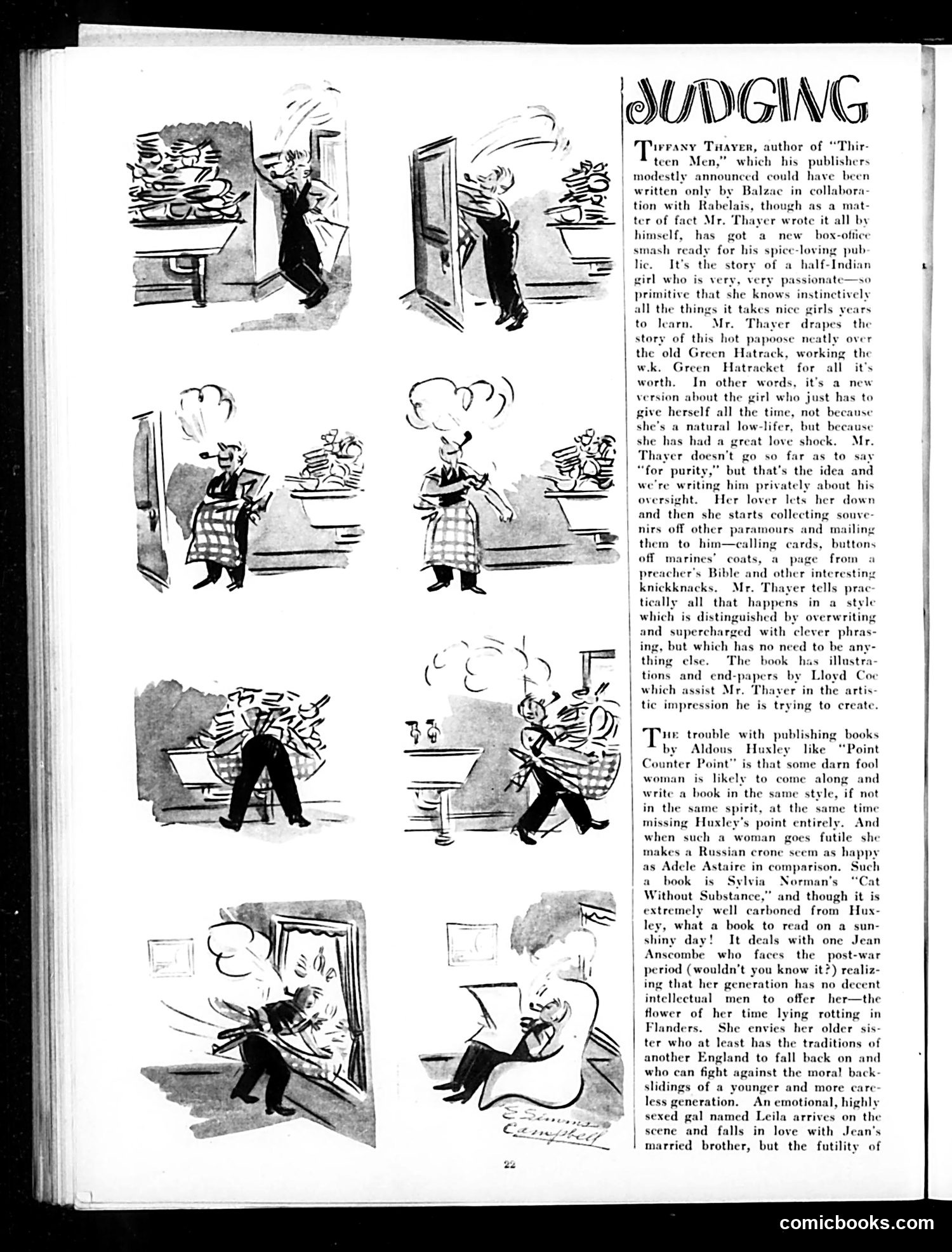
Explanation for Modern Readers This page from *Judge* magazine contains book reviews disguised as satirical commentary. The cartoons (left side) humorously illustrate the plots being reviewed. First review: Tiffany Thayer's new novel about a "half-Indian girl" who is sexually passionate and primitive. The satire mocks both the book's overwrought style and the publisher's absurd claim it rivals Balzac and Rabelais. The cartoons show the heroine in various domestic scenes, likely depicting her promiscuity. The reviewer sarcastically notes Thayer's overwrought prose and derivative recycling of "The Green Hat" (a scandalous 1924 novel about a sexually liberated woman). Second review: Sylvia Norman's "Without Substance," criticized as a failed imitation of Aldous Huxley's "Point Counter Point." The satire targets women writers attempting Huxley's intellectual style without understanding his purpose. The plot—a post-WWI woman envying older sisters who had "decent intellectual men" before they died in Flanders (WWI battlefields)—is dismissed as emotionally overwrought and derivative. Both reviews attack pretentious, sexually explicit fiction and female authors.
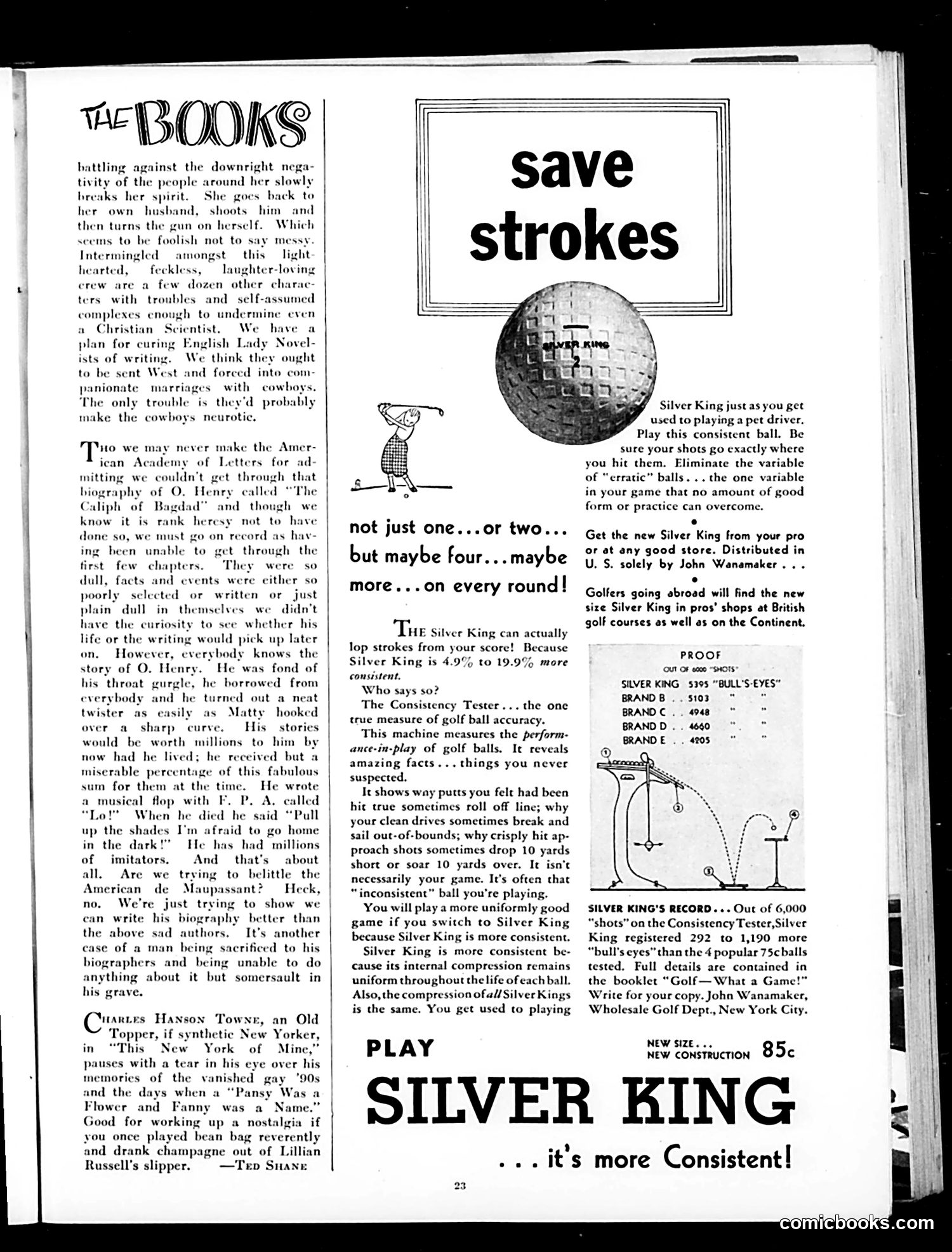
Analysis of Judge Magazine Page This page is primarily advertising copy for Silver King golf balls, not political satire. The left column contains book reviews criticizing contemporary novelists (O. Henry, English Lady Novelists) in Judge's characteristic caustic style—mocking their work as dull and derivative while making sweeping cultural judgments. The dominant right-side advertisement uses a humorous pitch: Silver King golf balls are "more consistent" than competitors, eliminating the variable of "erratic" balls from your game. The ad includes a crude diagram showing ball trajectory and references a "Consistency Tester" machine that supposedly measures ball accuracy. The cartoon element is minimal—just a simple line drawing of a golfer mid-swing. The satire here is light: the ad gently mocks golfers who blame their poor play on equipment rather than skill, while ironically positioning Silver King as the solution to inconsistency. This represents typical 1920s-30s magazine advertising blended with editorial content.
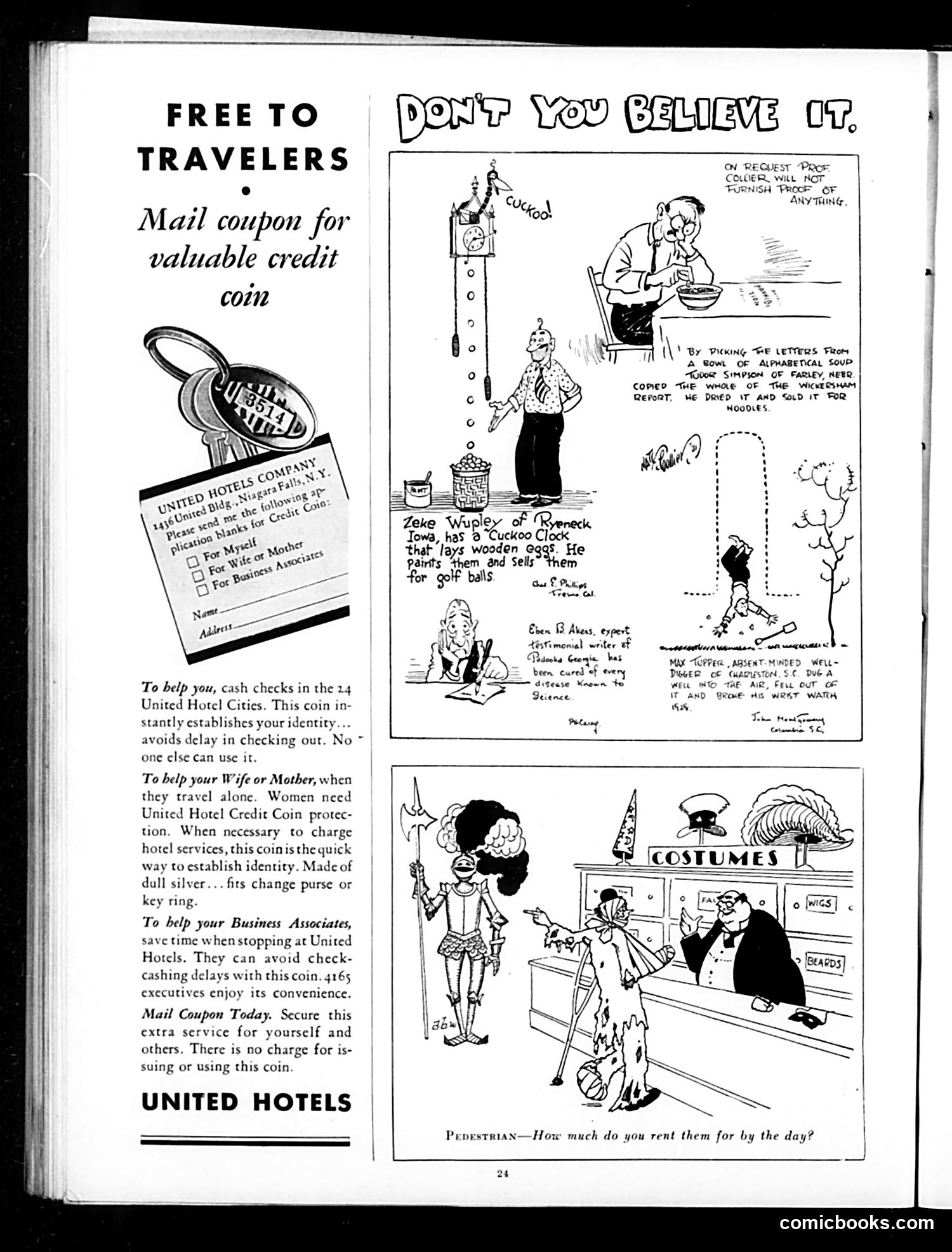
Analysis of Judge Magazine Page This page combines an advertisement with humorous cartoons typical of early 20th-century satirical magazines. The Advertisement (Left): United Hotels Company promotes a "credit coin" as an identity verification device for travelers, particularly emphasizing its utility for women traveling alone and business associates—reflecting period concerns about identity fraud and check-cashing delays. "Don't You Believe It" Cartoons (Right): These are tall tales satirizing exaggerated claims and dubious testimonials. They mock implausible stories: a man selling wooden eggs as "golf balls," a medical writer claiming to have cured every disease, soup letters dried and sold as "noodles," and an absent-minded man digging a well in an impossible location. The final cartoon shows someone renting costumes by the day. The satire targets credulous advertising and testimonial culture—the very trust-building mechanisms that the hotel advertisement relies upon. Judge's point appears to be skepticism toward extraordinary claims made in promotional materials.
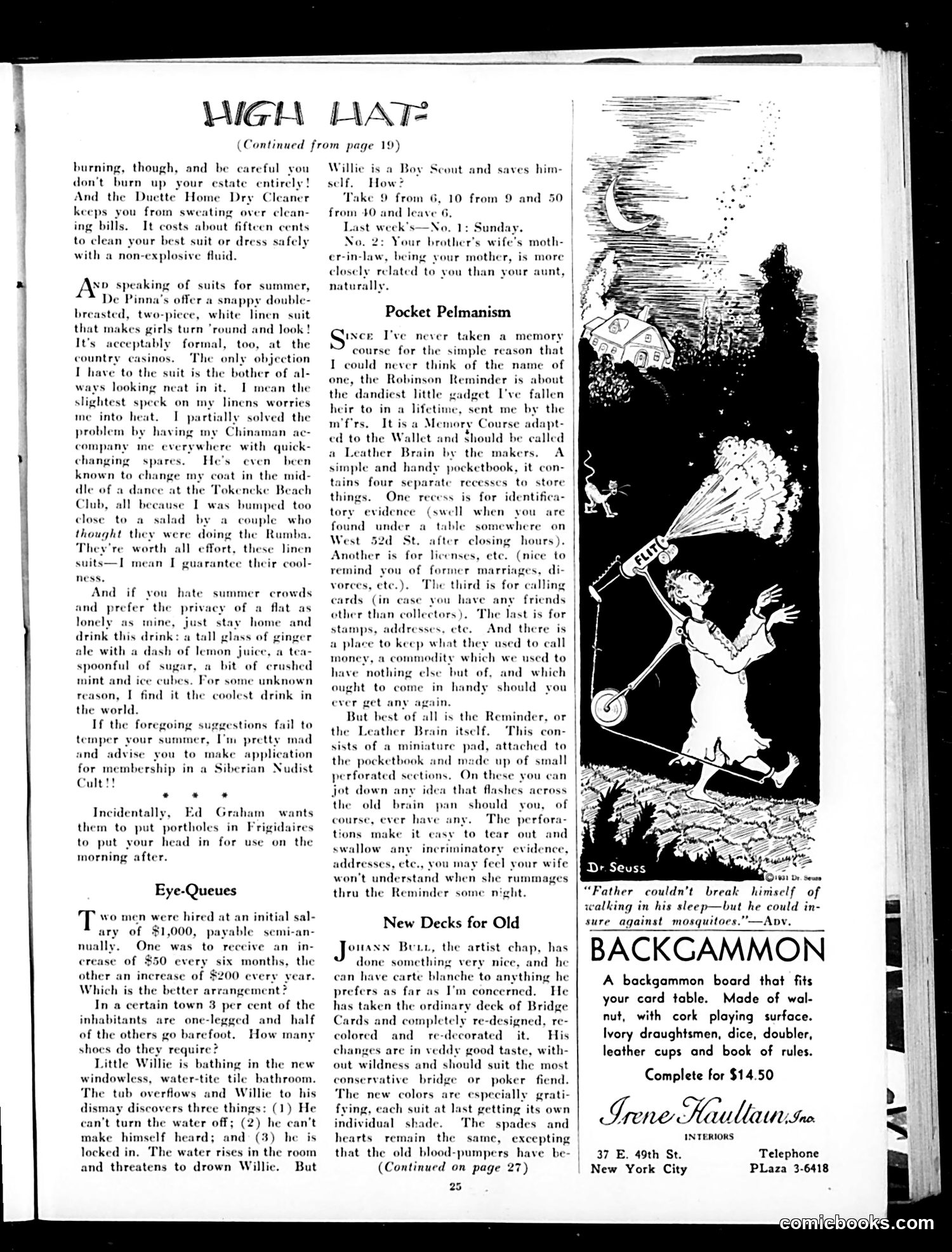
Analysis of Judge Magazine Page Content This page from Judge magazine (a satirical publication) contains primarily advertising and advice columns rather than political cartoons. The main content includes: "High Hat" column: Fashion and lifestyle advice about summer clothing, particularly De Pinna's linen suits and dry cleaning services. The humor is gentle social satire about maintaining appearance in summer heat. "Eye-Queues": A puzzle section with riddles and math problems for readers—typical magazine filler content. "Pocket Pelmanism": An advertisement disguised as editorial, promoting the "Robinson Reminder" or "Leather Brain"—a wallet-sized memory aid/organizer with compartments for documents, cards, and notes. The Dr. Seuss cartoon (bottom right) shows a mosquito attacking a sleeping man, captioned about lacking mosquito protection—a simple public health/product joke. The page reflects 1920s-30s consumer culture and advertising practices, with minimal political content. The satire is lifestyle-focused rather than political.
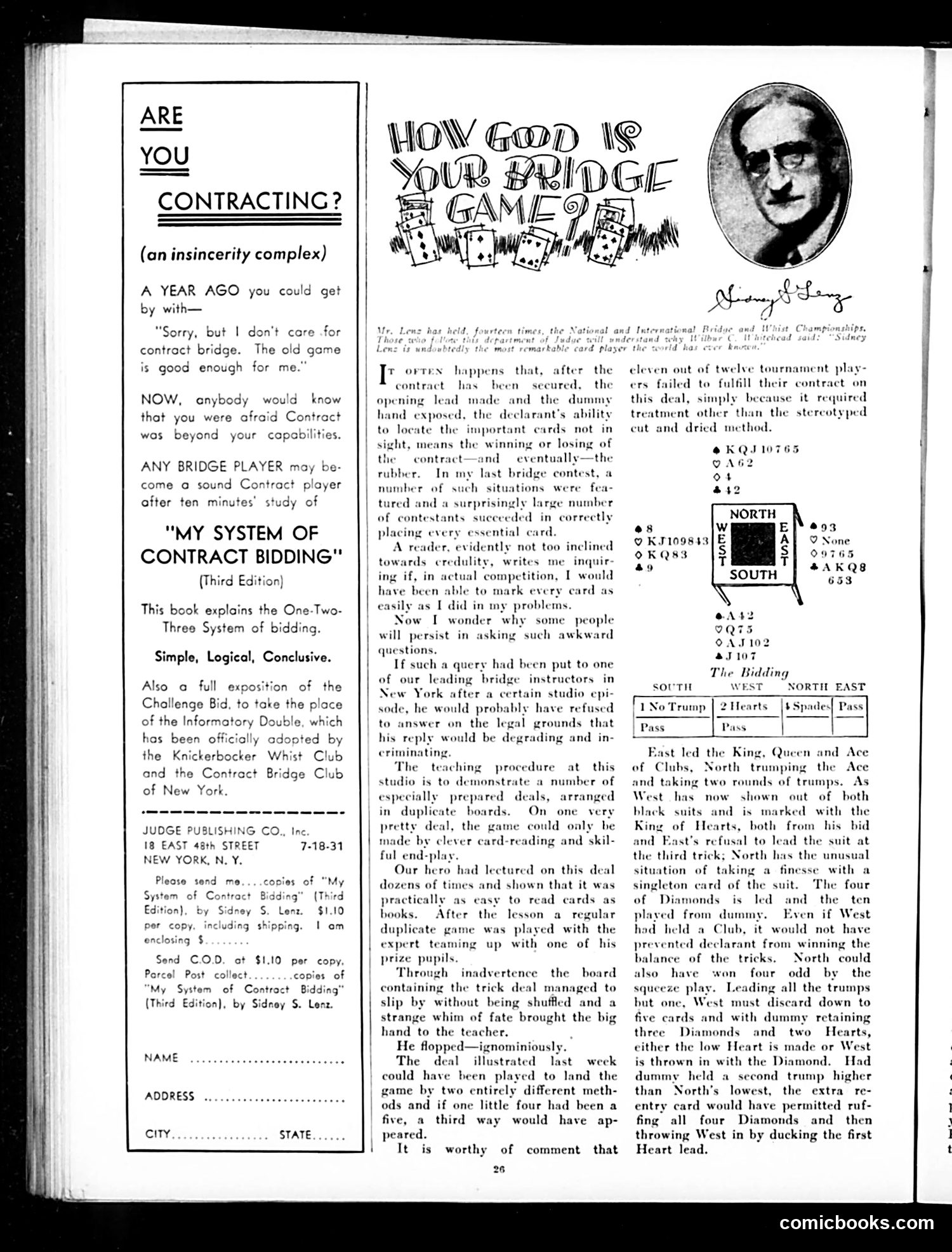
Analysis for Modern Readers This page combines advertising with a bridge instruction article by Sidney S. Lenz, a famous bridge expert. The satirical heading "ARE YOU CONTRACTING? (an insincerity complex)" mocks social anxiety about the newly popular game of Contract Bridge. The joke: a year ago, admitting you didn't like Contract Bridge was socially acceptable; now (1931), saying so reveals you're afraid you can't master it—making the excuse itself a tell of incompetence. The advertisement promotes Lenz's instruction book as the solution to this social embarrassment. The accompanying article demonstrates Lenz's teaching method using actual deal hands, showing how expert card-reading and unconventional play techniques separate skilled players from novices. The cartoon portrait (unclear who specifically) appears alongside the article, suggesting Lenz's authority on the subject. The overall satire targets 1930s status-anxiety around mastering fashionable pursuits—here, the newly standardized Contract Bridge rules.
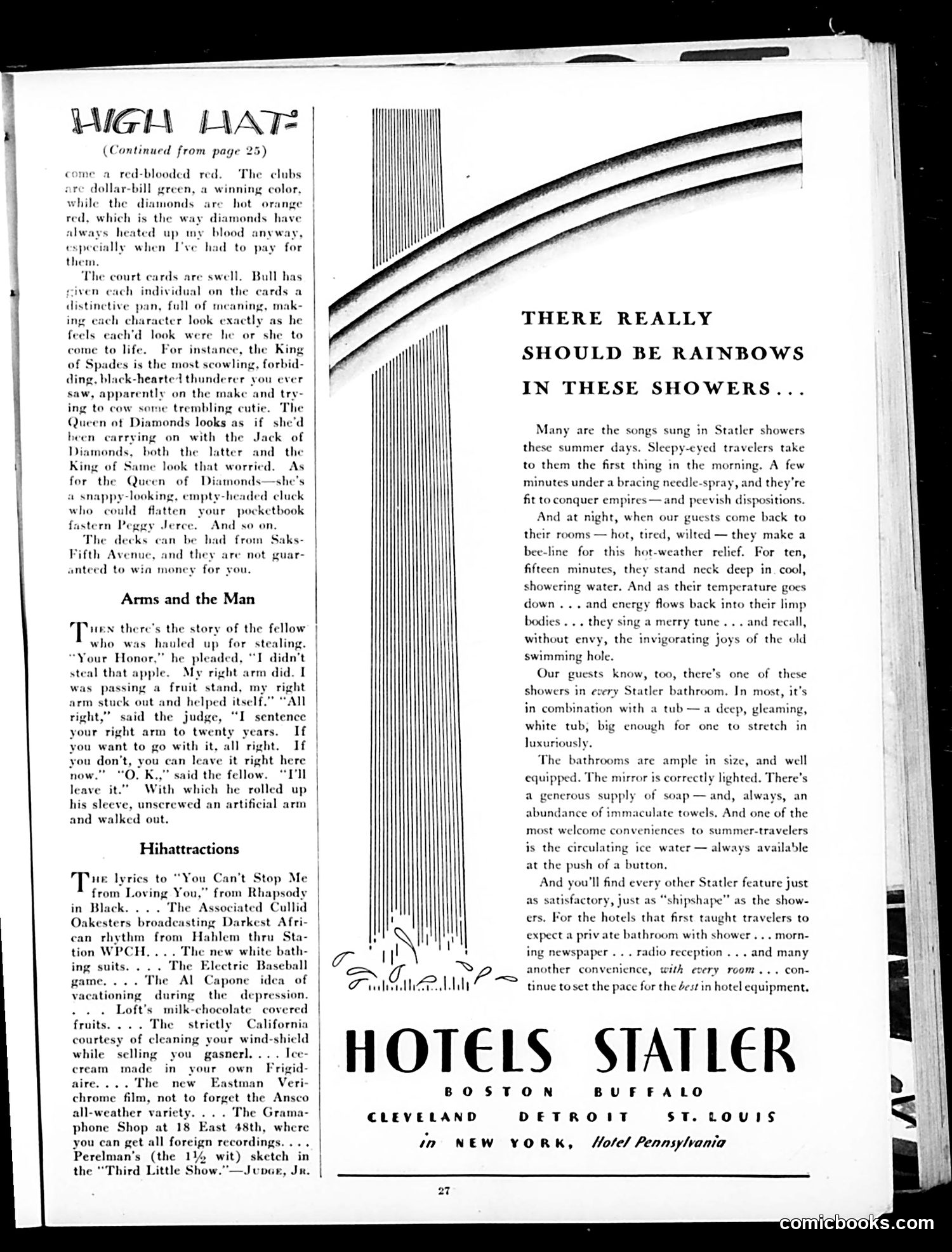
Judge Magazine Page Analysis This page contains two distinct sections: a humorous column and a hotel advertisement. The left side features two comic anecdotes. "Arms and the Man" satirizes criminal justice by depicting a defendant with a detachable artificial arm who, when sentenced to twenty years imprisonment, simply unscrews and abandons the limb—a absurdist joke about literal versus metaphorical punishment. Above this, "High Hats" (continued from page 25) discusses decorative playing cards designed by an artist named Bull, describing the court cards' personalities. The center column, "Hihattractions," lists cultural items Judge's editors find amusing or notable—radio broadcasts, fashion, products, and entertainment—typical of the magazine's satirical commentary on contemporary American culture. The right side is a full-page advertisement for Hotels Statler, promoting their modern bathroom amenities, particularly showers and hot water, as luxurious features appealing to traveling businessmen during summer. The copy emphasizes comfort and convenience as selling points.
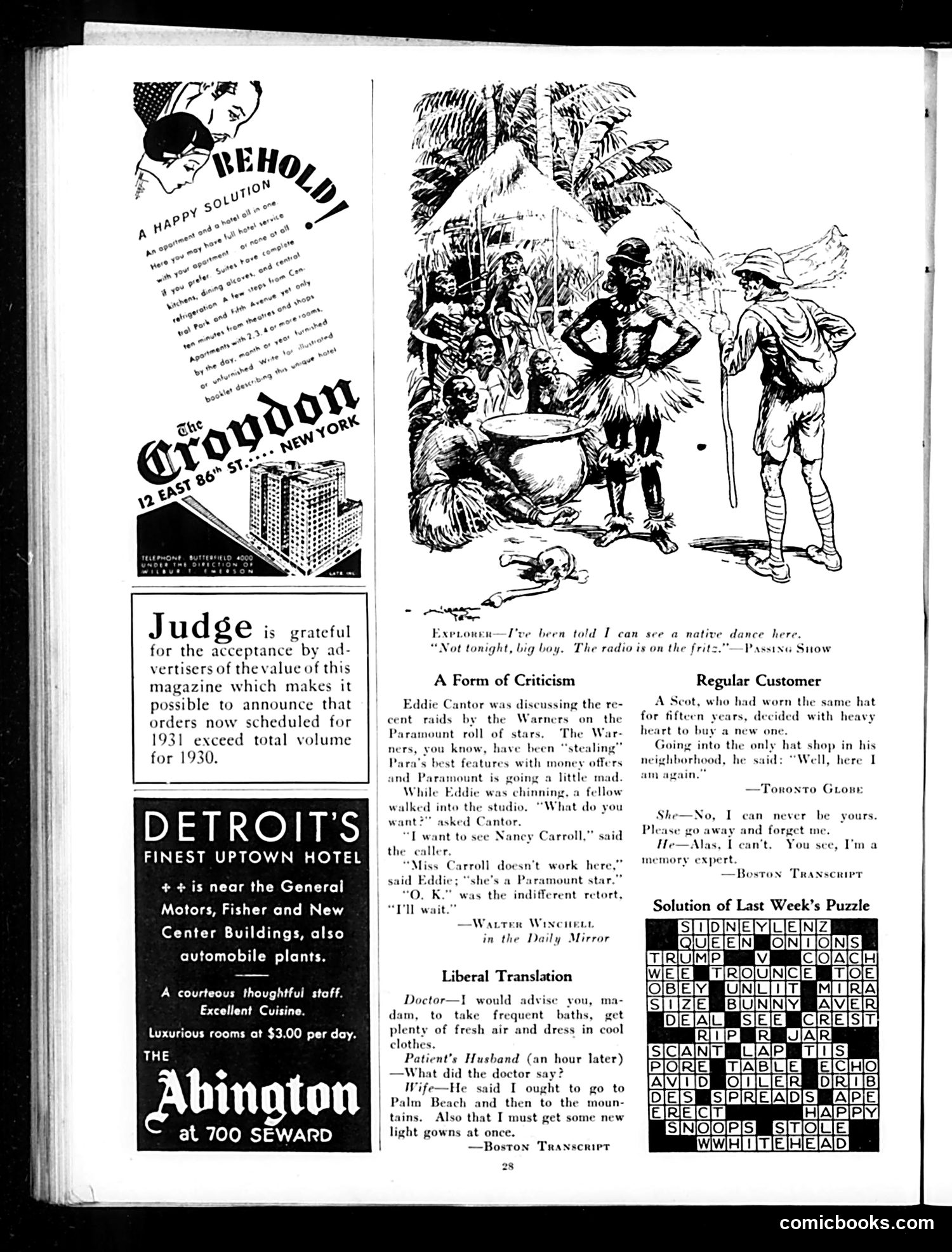
Explanation for Modern Readers This is primarily an advertising and humor page from Judge magazine (circa 1930). The main cartoon depicts colonial-era or "primitive" figures around a cooking pot, with the caption suggesting a tourist wants to see "a native dance" but complains the radio doesn't work—a joke about modern technology intruding on exotic/tourist expectations. The page includes three brief satirical anecdotes: 1. "A Form of Criticism": Hollywood studio raids—Warner Bros. was poaching Paramount talent with money offers. The joke mocks this competitive desperation. 2. "Liberal Translation": A husband misrepresents doctor's advice (take fresh air/cool clothes) as expensive vacation demands (Palm Beach, new gowns)—satirizing men's excuses to avoid their wives' spending. 3. "Regular Customer": A Scottish stereotype about frugality—a man wore the same hat 15 years before replacing it. The page is dominated by hotel and business advertisements, reflecting Judge's reliance on commercial revenue during the Depression era.
Analysis of This Judge Magazine Page This page contains a satirical story about organized crime during Prohibition. "Uncle Spike's Bedtime Stories for Little Racketeers" depicts a protection racket: character Spats approaches businessman Horace, claiming to represent the "Hay and Grain Merchants Benevolent and Protective Association," then explicitly threatens to bomb Horace's warehouses unless he pays membership dues. The satire targets organized crime syndicates that operated during the 1920s-30s, which used intimidation and violence to extort money from legitimate businesses under the guise of "protective associations." The author (Jack Dunn) frames this as a cynical bedtime story for children, sarcastically highlighting how criminal enterprises operated openly while authorities struggled to stop them. The moral stated at the end—"morals are a dime a dozen"—underscores the era's pervasive corruption and the futility of ethical resistance against organized crime. The page also includes period product advertisements (Wrigley's gum, corn remedies, an encyclopedia).
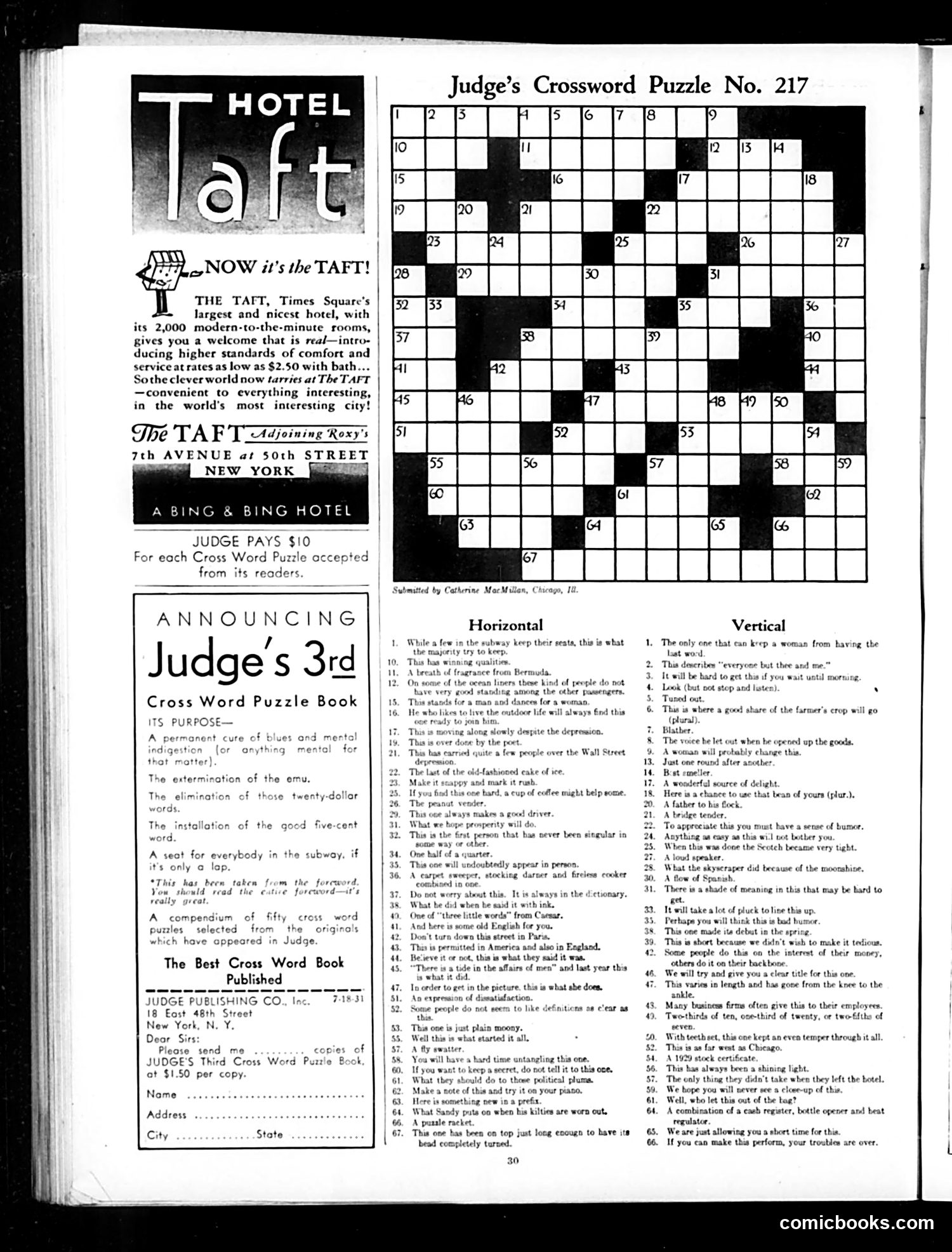
Judge's Crossword Puzzle No. 217 This page is primarily advertising and puzzle content, not political satire. The main elements are: The Advertisement: The Hotel Taft (Times Square, NYC) promotes itself with a pun on President William Howard Taft's name ("NOW it's the TAFT!"). This is straightforward commercial advertising leveraging a famous contemporary figure's name for brand recognition—a common early 20th-century marketing tactic. The $2.50 room rate and modern amenities are pitched as bargains. The Puzzle: Judge's third crossword puzzle book is announced, with clues presented in the traditional format. The clues are typical of the era—some reference current events, social observations, and wordplay common to 1920s-30s puzzle culture. No actual political cartoon or satirical commentary appears on this page. It's a practical mix of hotel marketing and puzzle entertainment typical of Judge magazine's commercial content.
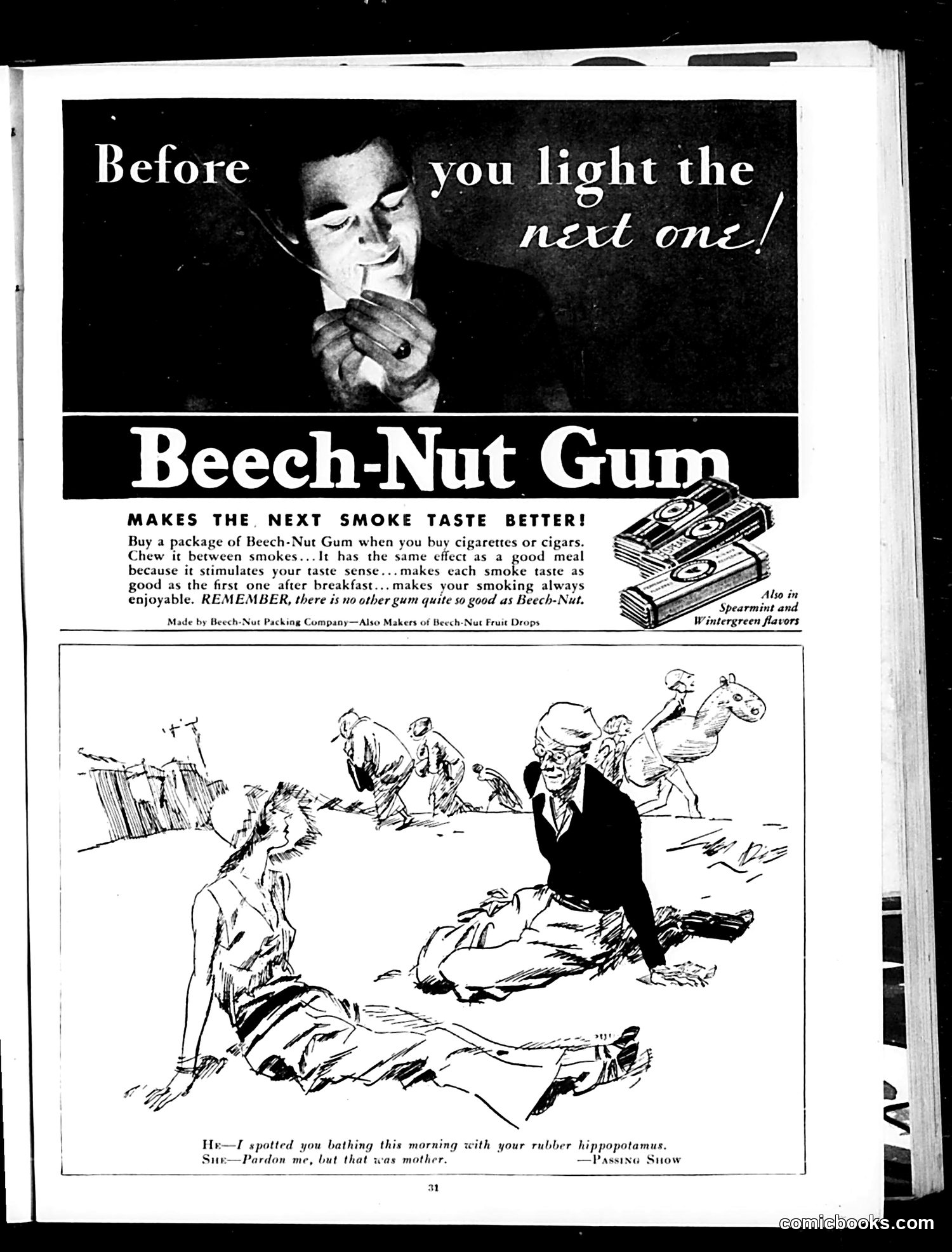
Page Analysis This page contains two distinct elements: Top Half: A Beech-Nut Gum advertisement featuring a photograph of a man smoking, with text promoting gum as enhancing cigarette enjoyment between smokes. The ad claims it "stimulates your taste sense" and makes each smoke taste "good as the first one after breakfast." Bottom Half: A cartoon joke by "Passing Show" depicting what appears to be a well-dressed gentleman with animals (including what looks like a hippopotamus), confronted by a woman. The humor derives from a misunderstanding: the man claims he saw the woman bathing with a rubber hippopotamus toy that morning, but she corrects him—it was actually her mother. The joke's crude implication is about the woman's mother's appearance or age. The page is primarily advertising, with the cartoon serving as filler content typical of Judge magazine's format.
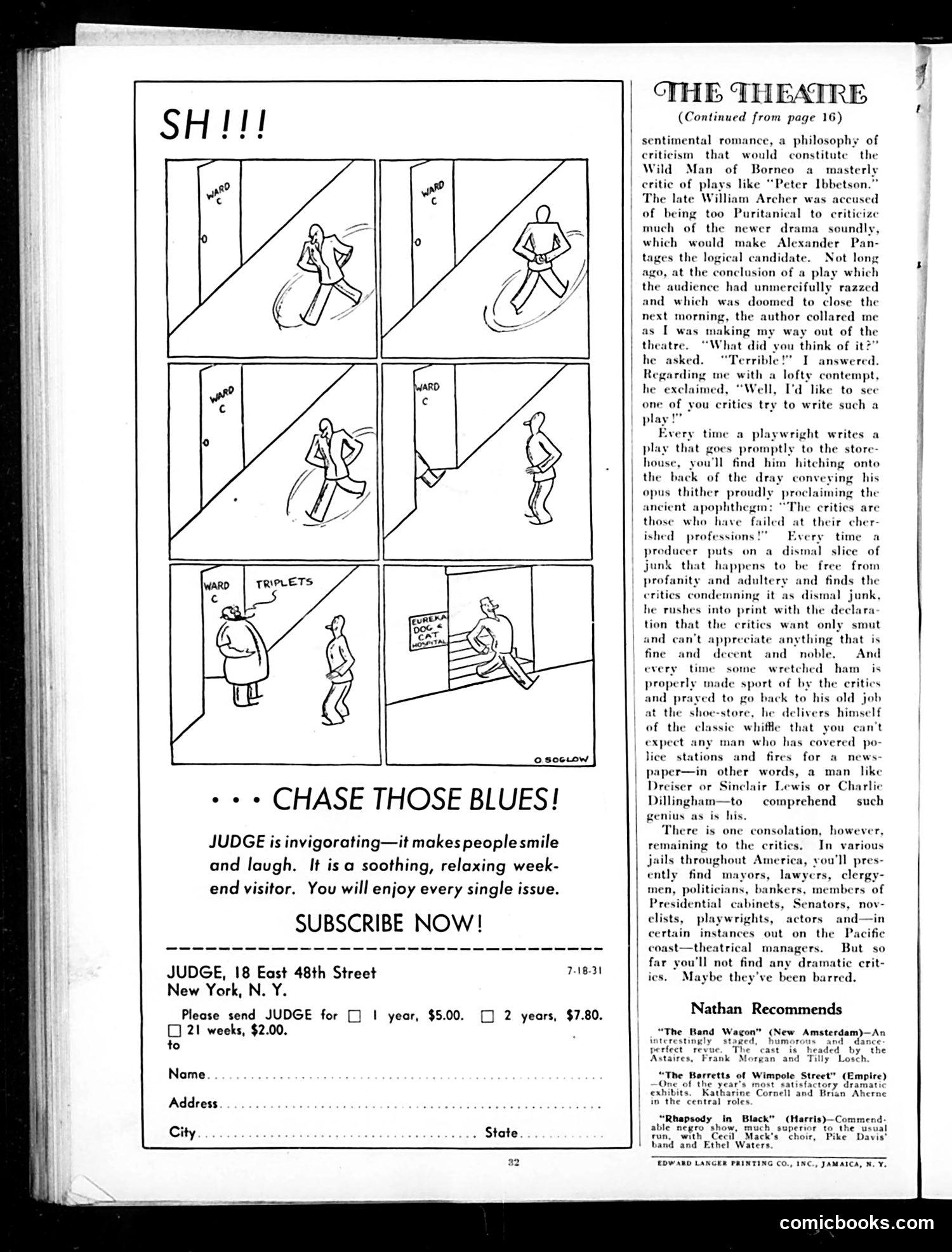
Analysis of Judge Magazine Page This page is primarily a subscription advertisement for Judge magazine, a satirical publication. The comic strip "SH!!!" depicts a figure attempting to hide from "Ward C" and "Ward" authorities while chasing "those blues"—likely a reference to pursuing entertainment or escapism. The accompanying text is a theatrical column discussing drama critics' relationship with playwrights. The author argues that critics are unfairly blamed by playwrights whose work receives poor reviews. The piece sardonically notes that whenever a bad play closes, the author boasts about ancient critics' failures; conversely, when critics pan mediocre work, producers claim critics only appreciate smut and depravity. The column concludes that while various professions—lawyers, politicians, clergy, actors—are represented in American jails, one group is conspicuously absent: drama critics, humorously implying they've been "barred" (imprisoned or excluded). The page reflects Judge's focus on satirizing American cultural institutions and human foibles through theater commentary.
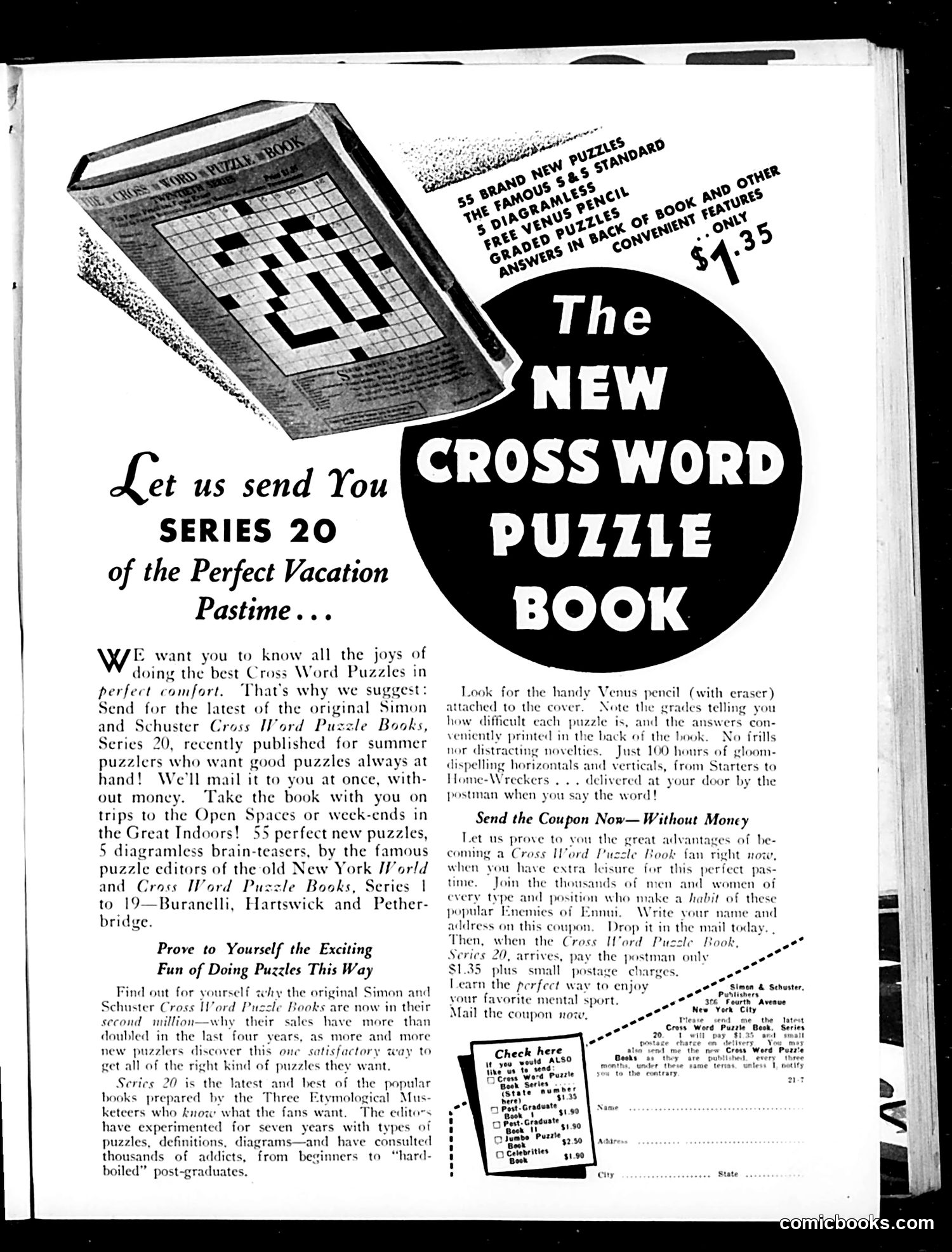
Analysis for Modern Readers This is primarily a mail-order advertisement, not a political cartoon. It promotes Simon & Schuster's "Cross Word Puzzle Book, Series 20" (priced at $1.35). Context for today: Crossword puzzles were a major cultural craze in the 1920s-30s. This ad capitalizes on that by marketing puzzles as the "perfect vacation pastime"—positioning them as both intellectual entertainment and a way to combat boredom ("Enemies of Ennui"). Notable elements: - The "Three Etymological Musketeers" refers to the famous puzzle editors (Buranelli, Hartswick, Petherbridge), playing on popular culture references - A Venus pencil comes attached—practical for solving - The coupon allows readers to order "without money," paying only upon delivery ($1.35 plus postage) - Marketing emphasizes this is Series 20 of a bestselling line The appeal: Positioned as sophisticated entertainment for leisure time, appealing to both casual and serious puzzle enthusiasts during an era when such pastimes signified education and refinement.
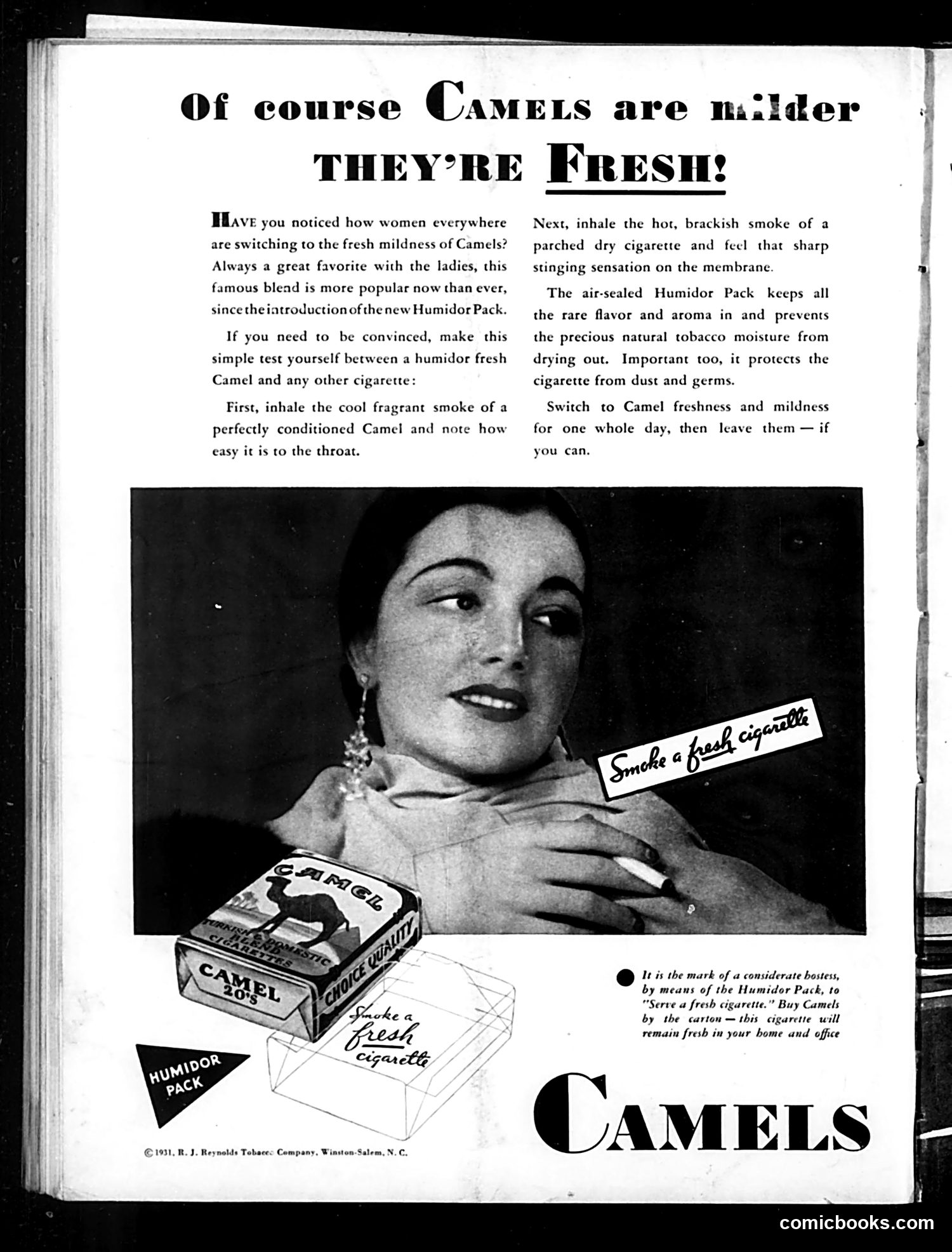
Analysis This is a cigarette advertisement, not satire or political commentary. It appeared in Judge magazine (circa 1931, per copyright). The page promotes Camel cigarettes' new "Humidor Pack"—a sealed packaging innovation claiming to keep cigarettes fresher. The advertisement: - Features a woman smoking, targeting female consumers ("how women everywhere are switching") - Emphasizes mildness and freshness as selling points - Instructs readers to compare Camels against competitors by taste-testing - Highlights the Humidor Pack's moisture-retention technology - Positions serving fresh Camels as a mark of a "considerate hostess" For modern readers: This represents an era when tobacco advertising was legal in mainstream publications and explicitly marketed to women—a practice now banned. The messaging about "mildness" was typical of early cigarette marketing, later revealed as deceptive (filtered cigarettes weren't actually safer). The woman's prominent, glamorous depiction normalized smoking as desirable and feminine.