judge
Judge — July 25, 1931
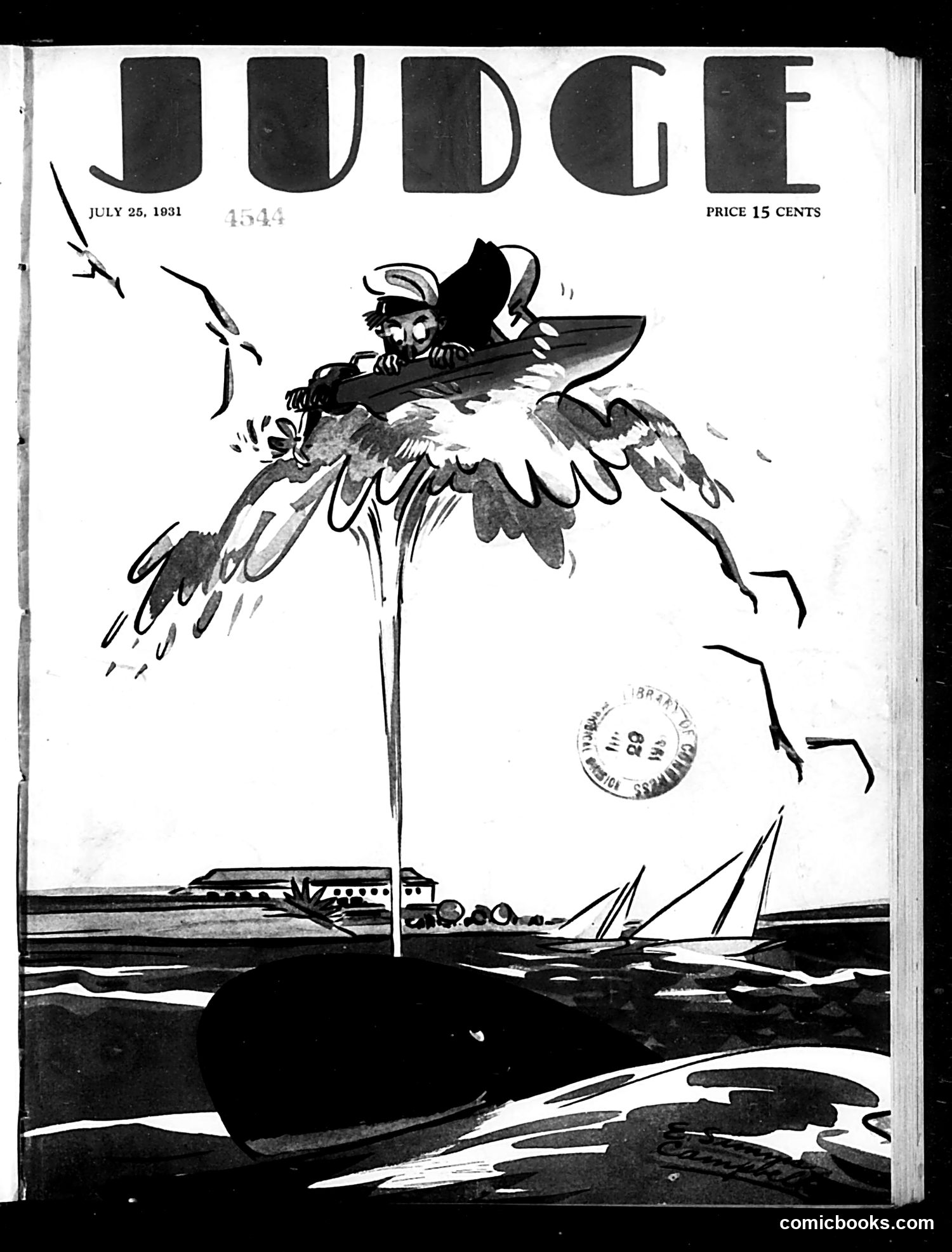
Judge Magazine Cover - July 25, 1931 This cover depicts a figure in aviator gear riding a giant bird (appears to be an eagle or similar) above a coastal landscape with sailboats and a building below. The bird's wings are rendered dramatically with strong shading. The most likely interpretation: this references aviation achievements or aviation-related news from summer 1931. The aviator figure suggests a famous pilot of the era, though without additional text visible, the specific identity remains unclear. The eagle symbolism combined with flight imagery suggests American achievement or heroism. The coastal setting with boats and buildings grounds the fantastical scene in a real location, possibly referencing a specific historical flight event or landing. The dramatic, triumphant composition celebrates aviation as modern American progress and daring.
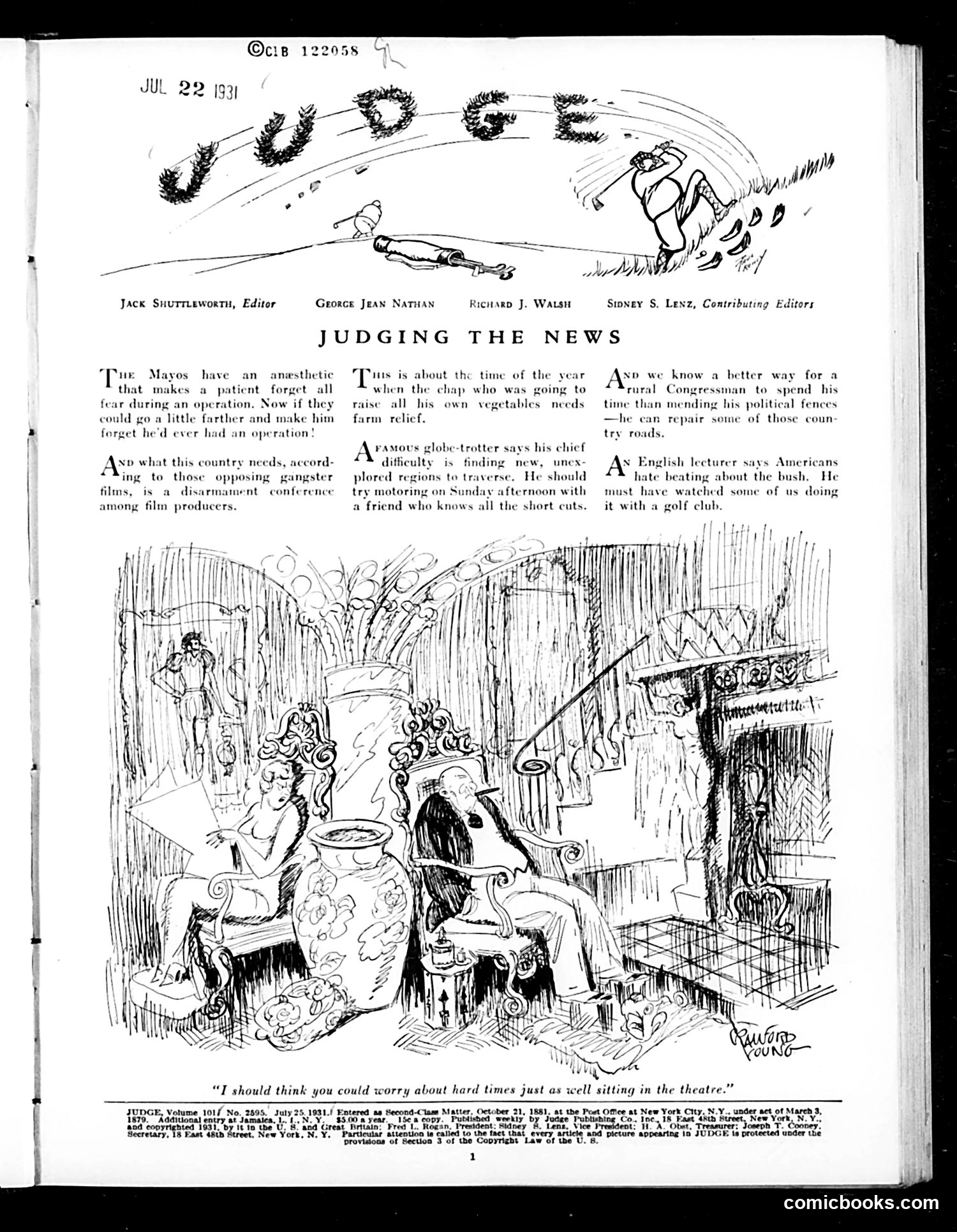
"Judging the News" - July 22, 1931 This editorial cartoon page satirizes contemporary news items through short commentaries and illustrations. The main cartoon depicts two wealthy individuals relaxing in an ornate interior, with one saying, "I should think you could worry about hard times just as well sitting in the theatre." The satire targets wealth inequality during the Great Depression (1931). While ordinary Americans faced economic devastation, the wealthy allegedly remained indifferent, continuing lavish entertainment and leisure activities without concern for national suffering. The accompanying text snippets mock other topics: politicians avoiding infrastructure repair, a Mayan farmer needing relief, and an English lecturer criticizing American leisure activities (golf). The overall message: the affluent elite's disconnect from Depression-era hardship and their continued frivolous spending while others struggled.
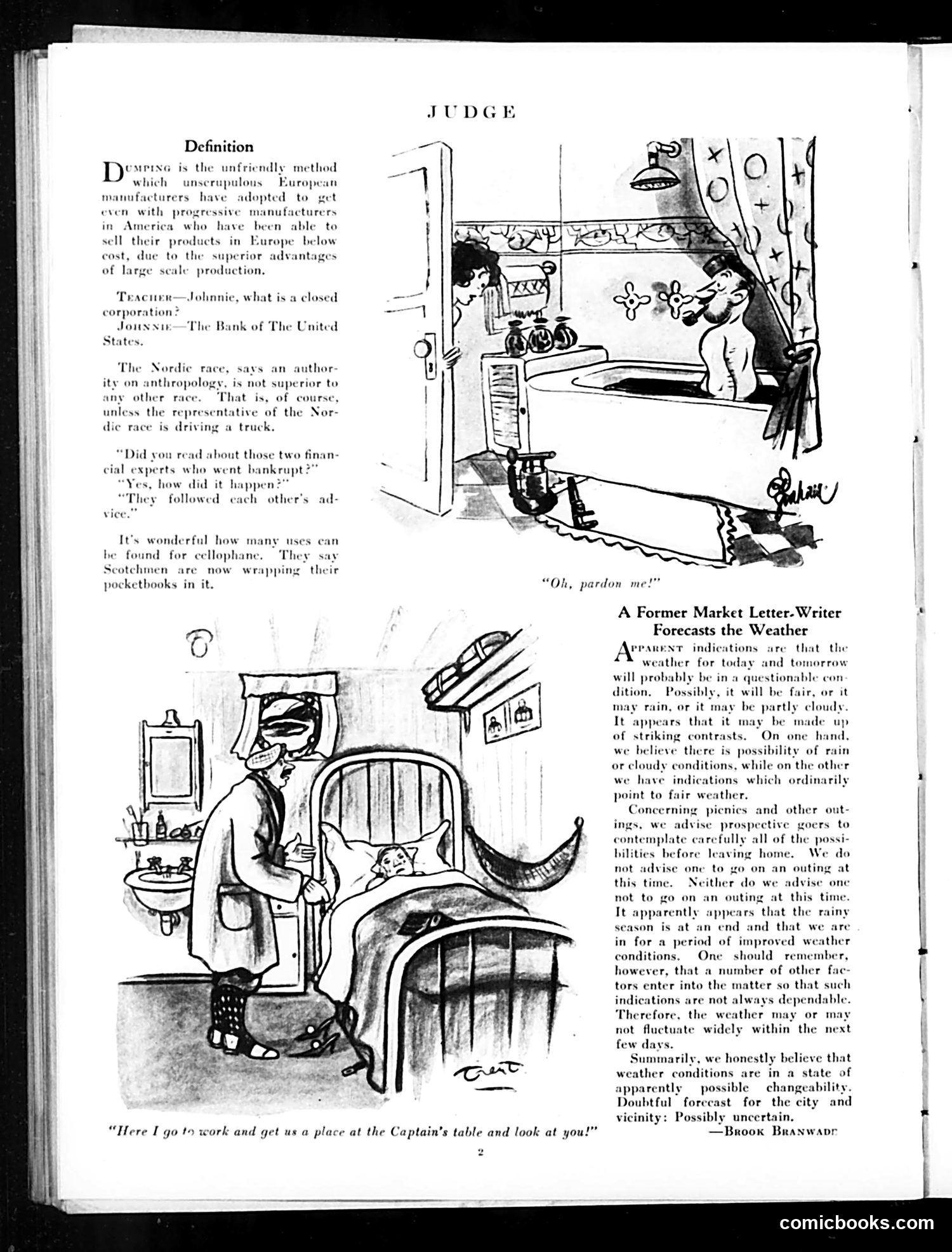
Content Analysis Top cartoon ("Oh, pardon me!"): A heavyset man at a desk appears startled as a woman enters his office. The satire likely mocks workplace dynamics or romantic/social awkwardness of the era—possibly commenting on changing gender roles in offices. Bottom cartoon ("Here I go to work..."): A domestic scene shows a woman preparing to leave home while her husband remains in bed. The caption suggests she's going to work to "get us a place at the Captain's table," satirizing either economic hardship (wives forced to work) or social climbing aspirations among the middle class. Text sections: Include definitions of "dumping" (trade practice), a teacher-student joke about corporations, commentary on Nordic racial superiority claims, and a humorous weather forecast mocking vague meteorological predictions. The page reflects early 20th-century anxieties about economics, gender roles, and social pretension.
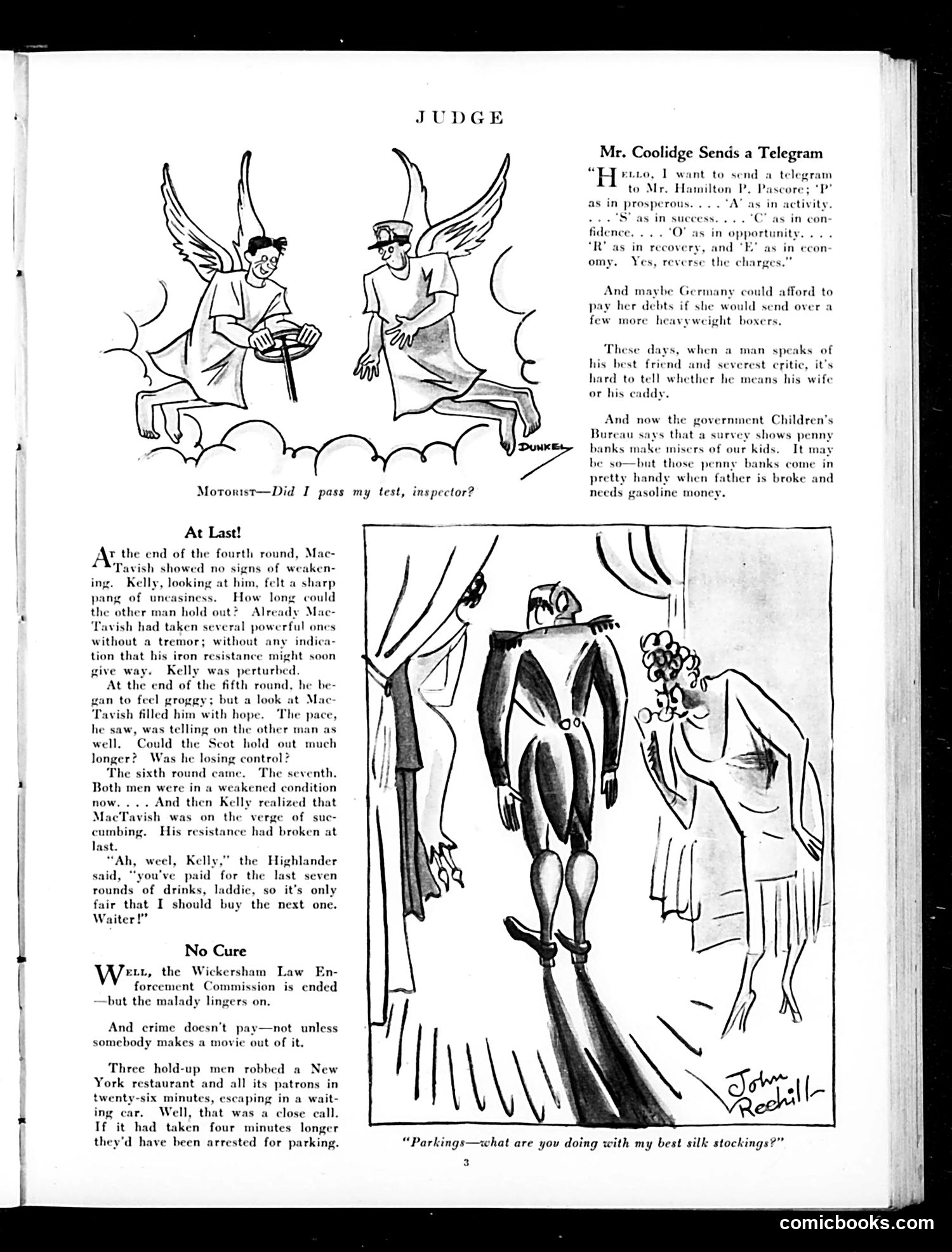
Analysis of Judge Magazine Page Top Cartoon ("Motorist—Did I pass my test, inspector?"): Two winged figures (angels) sit in clouds. One holds what appears to be a clipboard or test document. This satirizes driver's license testing, suggesting that passing a driving test is so difficult that only divine intervention—or luck—helps. The humor relies on the common experience of anxiety about motor vehicle examinations. Bottom Cartoon ("Partings—what are you doing with my best silk stockings?"): A man confronts a woman about silk stockings. This likely references 1920s concerns about women's independence and changing social norms—silk stockings were fashionable luxury items, and the cartoon suggests domestic tension over wives' spending or autonomy. The specificity of "silk stockings" suggests Depression-era economic worry.
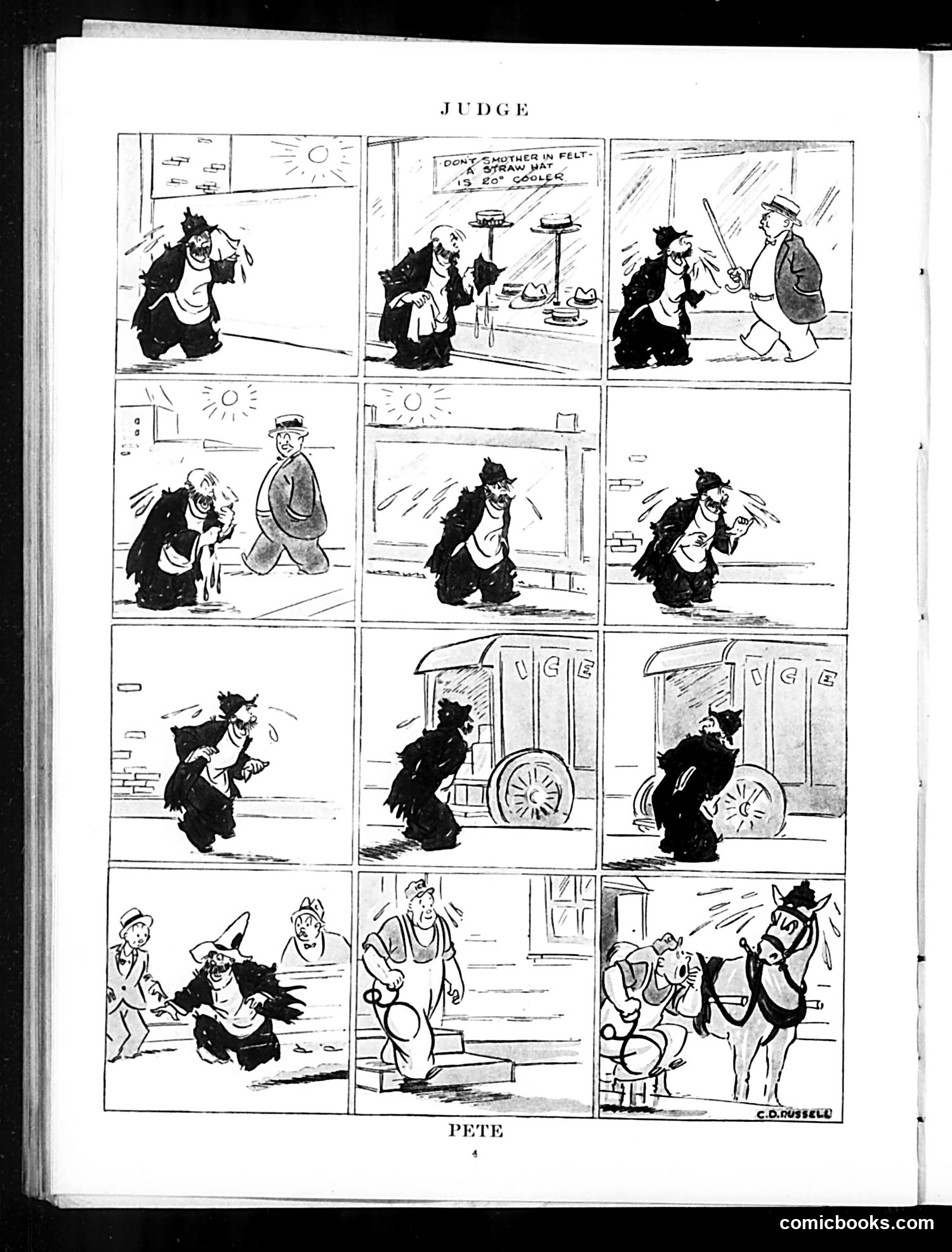
Analysis of "Judge" Comic Page: "Judge" and "Pete" This appears to be a two-part comic strip. The top section titled "JUDGE" shows a character (likely representing a judge or authority figure) being chased or pursued through various locations—a hat shop, streets, and eventually onto what appears to be a judge's bench or official setting. The repeated pursuit suggests comedic chaos. The bottom section "PETE" depicts a similar character in increasingly frantic situations, culminating in scenes with other people and a horse, suggesting physical comedy and slapstick humor. Without clearer historical context about specific Judge magazine issues or dated references visible in the artwork, I cannot definitively identify which political or social figures these represent. The humor appears rooted in physical comedy rather than specific satirical commentary, though the recurring character suggests an ongoing narrative.
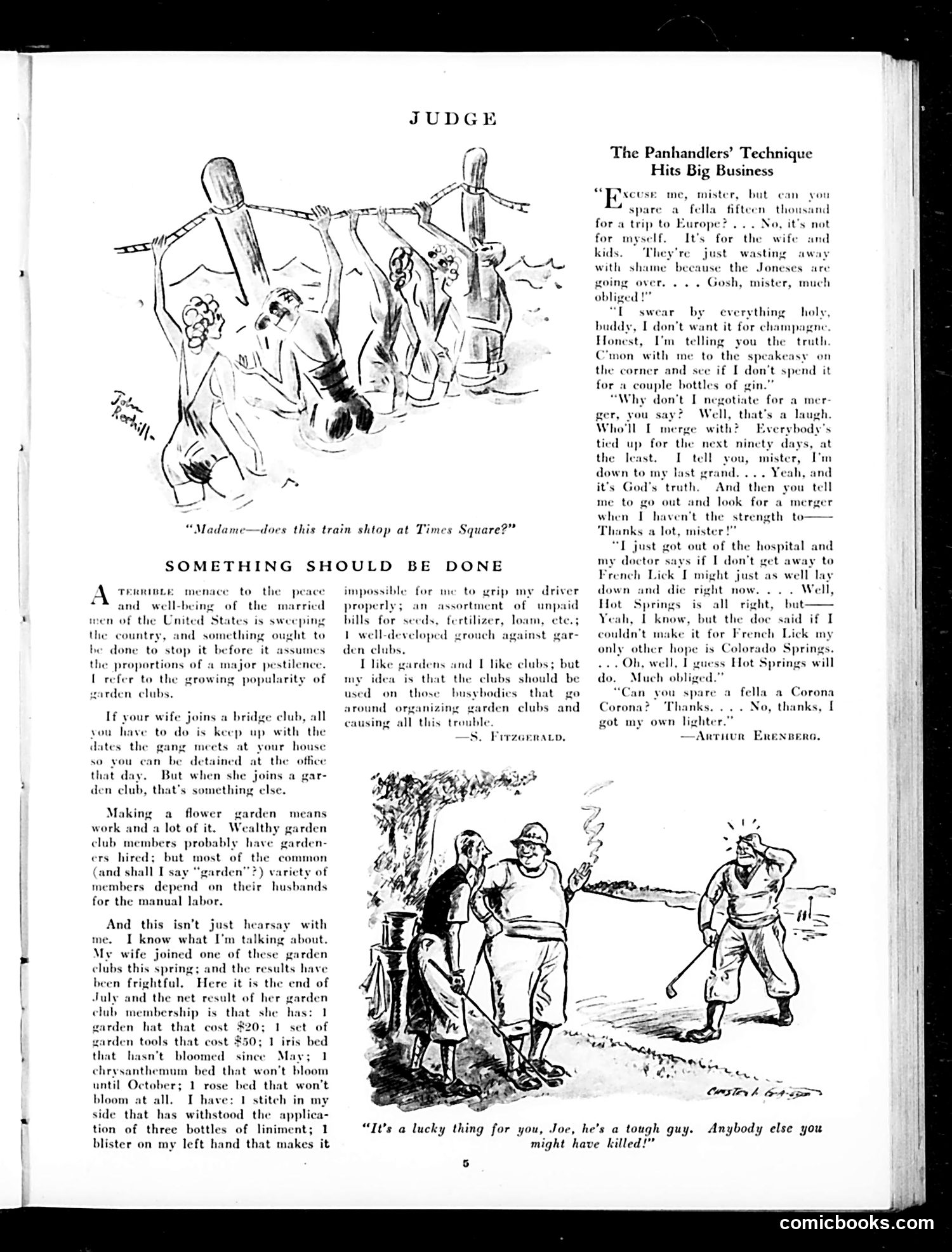
Page Analysis: Judge Magazine Satire This page contains two distinct pieces of social satire: "Something Should Be Done" (left): Criticizes the growing popularity of garden clubs, depicting them as an excessive expense and time commitment for wives. The writer humorously catalogs the financial burden—seeds, fertilizer, tools, and even a chrysanthemum bed that won't bloom. The satire targets the emerging trend of organized garden clubs among middle-class women in what appears to be the early 20th century. "The Panhandlers' Technique Hits Big Business" (right): A dialogue satirizing panhandlers' negotiation tactics when soliciting money. The humor contrasts a panhandler's aggressive pitch with a businessman's attempt to deny or minimize the request, reflecting Depression-era or post-war economic anxieties about poverty and aggressive street solicitation. Both pieces mock contemporary social trends through exaggerated complaint and dialogue.
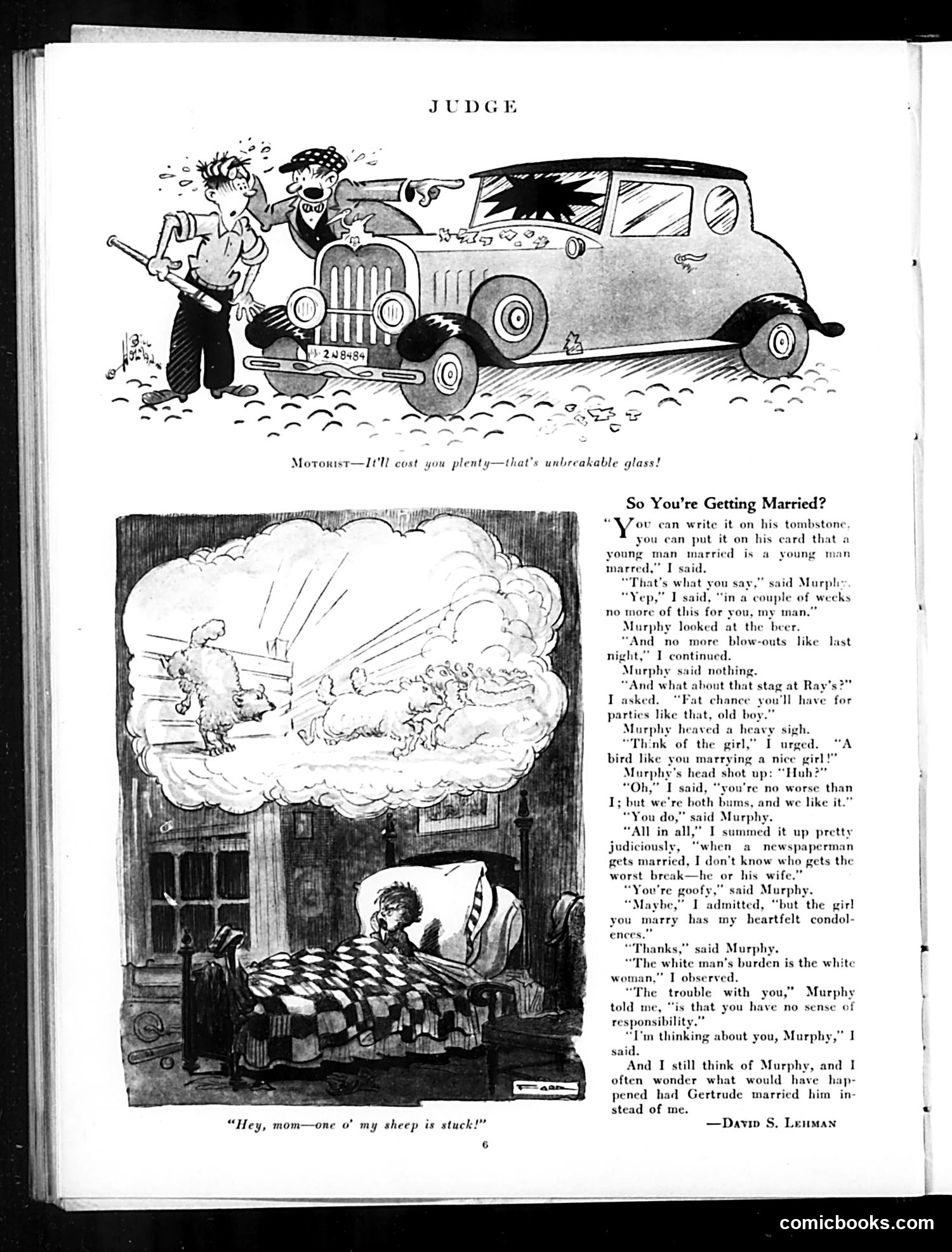
Analysis of Judge Page Top Cartoon ("Judge"): A motorist with a damaged car addresses a judge figure holding a gavel. The joke plays on the double meaning of "unbreakable glass"—the motorist's windshield is shattered, but the judge sarcastically suggests it's the *cost* that's unbreakable. This satirizes judicial decisions or insurance claims following automobile accidents, a growing concern as car ownership increased in early 20th-century America. Bottom Story ("So You're Getting Married?"): A narrative about Murphy's impending marriage, featuring his friend's skeptical advice against matrimony. The accompanying illustration shows a crowded domestic scene. The story humorously presents marriage as burdensome, with the narrator reflecting that his friend Murphy escaped marriage while he didn't—typical bachelor-humor satire common in Judge magazine.
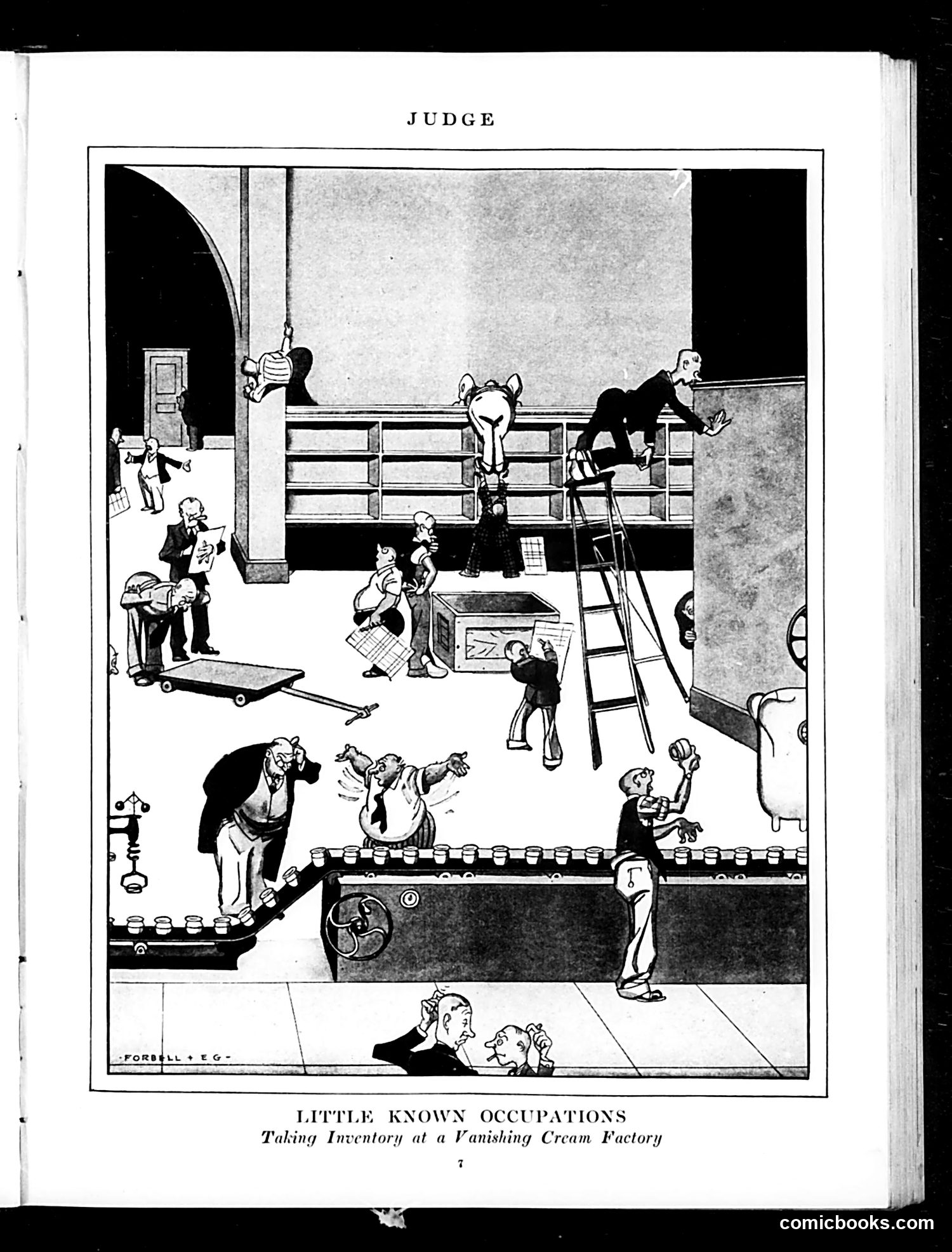
Analysis of the Cartoon This cartoon satirizes the absurdity of "vanishing cream" — a cosmetic product popular in the early 20th century marketed as making blemishes disappear. The joke is literal: the factory's inventory literally *vanishes*. The comic depicts workers attempting to count stock at the factory, but the cream products keep disappearing before their eyes. Men with clipboards, on ladders, and crouching down frantically try to document inventory that won't stay put. Two figures converse at the bottom, likely discussing the impossibility of the task. The satire mocks both the product's exaggerated advertising claims and the absurdity of trying to maintain business operations when your merchandise vanishes. It's a visual pun on the product name, playing on consumer skepticism toward beauty product marketing.
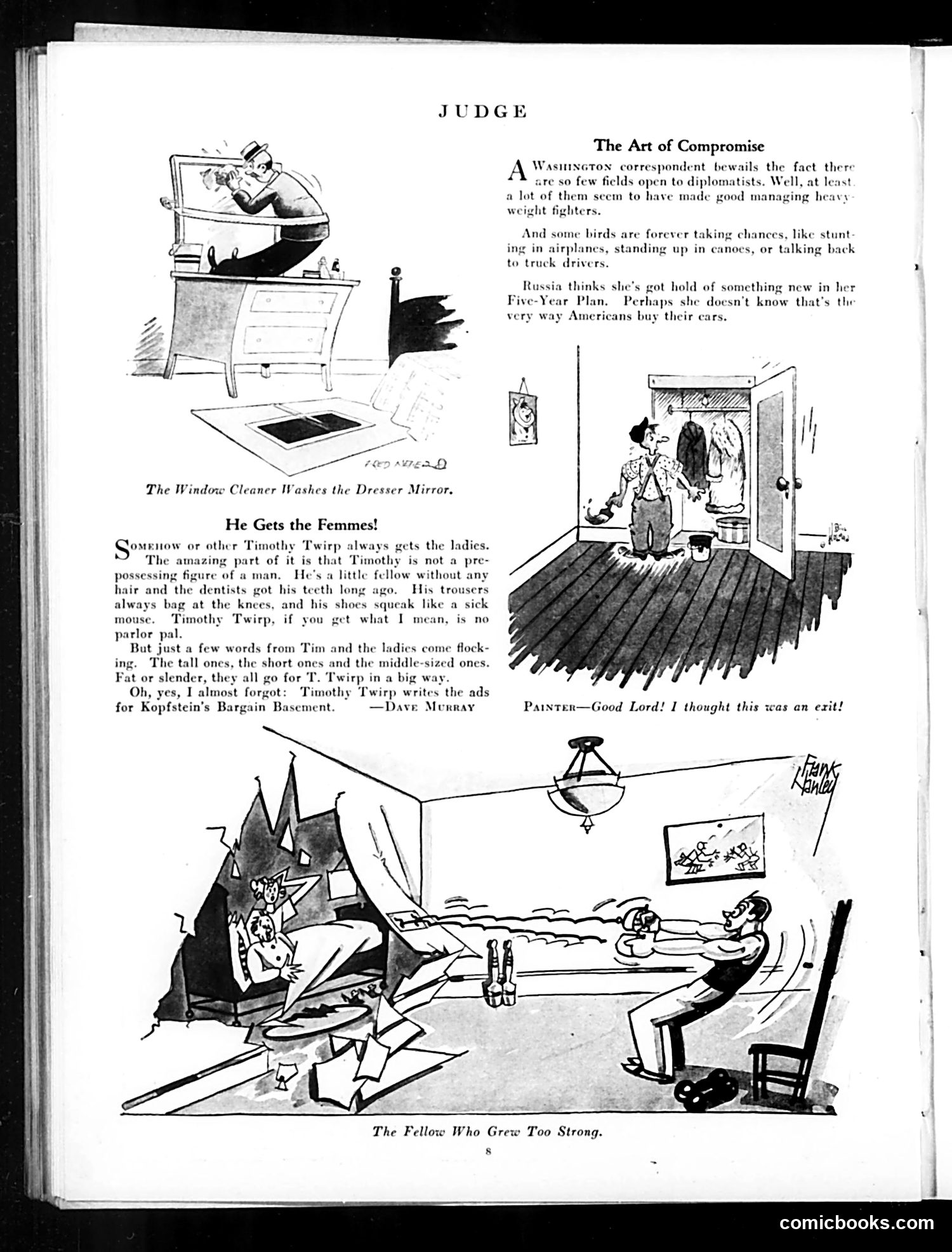
Judge Magazine Page Analysis This page contains three satirical pieces typical of 1920s-30s American humor: "The Art of Compromise" presents brief political jabs: diplomats apparently excel at boxing rather than negotiation; Russia's Five-Year Plan mirrors American car-buying practices (installment purchases); and various risky behaviors are mocked. "He Gets the Femmes!" satirizes Timothy Twirp, an unattractive, balding man with bad teeth and ill-fitting clothes who nonetheless attracts women—because he writes advertising copy for Kopfstein's Bargain Basement. The joke targets advertising's perceived manipulative power over (particularly female) consumers. "The Fellow Who Grew Too Strong" (illustrated) appears to depict someone whose strength or ambition has spiraled out of control, resulting in chaos—likely satirizing overreach or unchecked ego, though the specific reference is unclear. The page exemplifies Judge's satirical approach: political commentary, consumer culture critique, and character-based humor aimed at educated American readers.
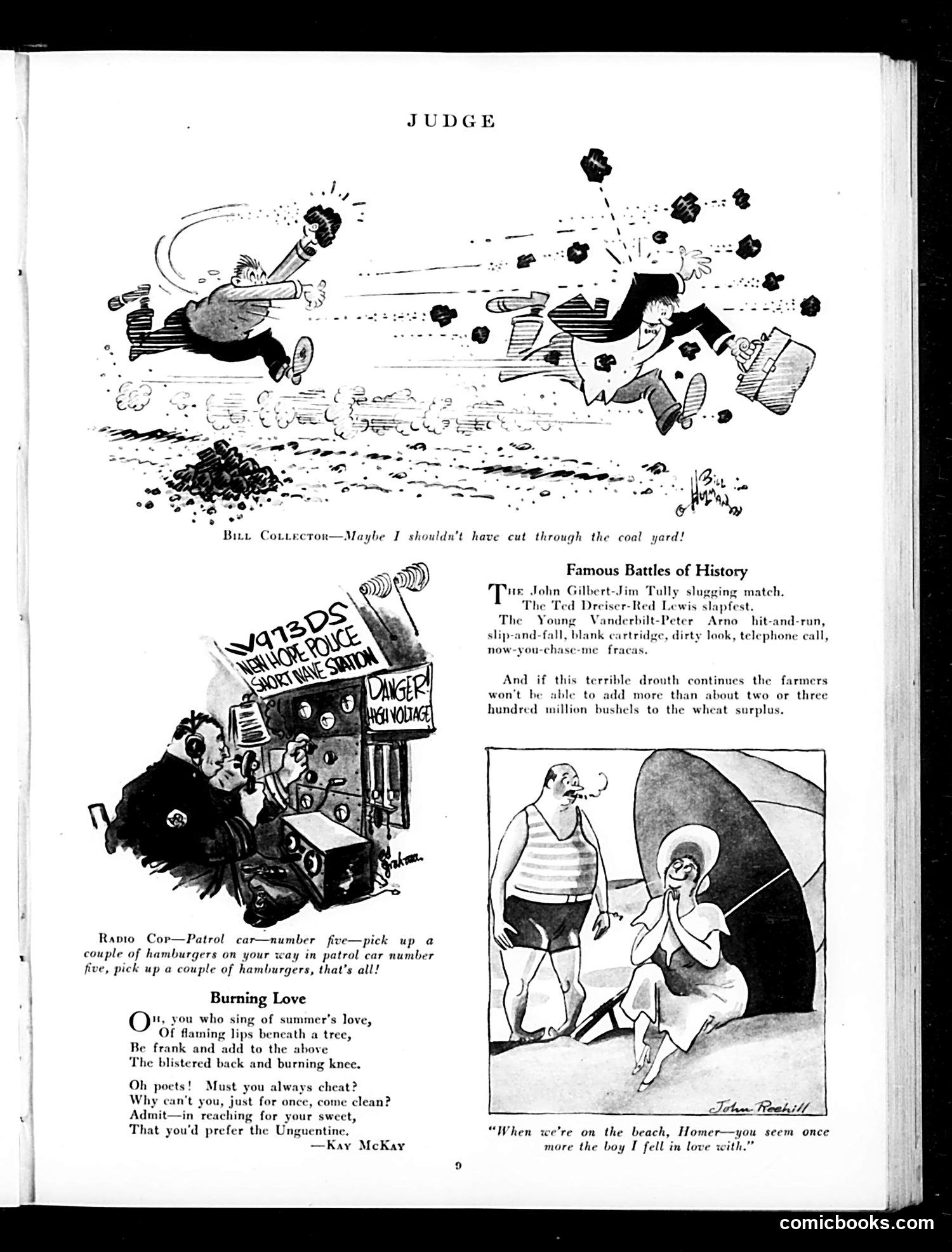
Judge Magazine Page Analysis This page contains three distinct satirical pieces: Top cartoon ("Bill Collector"): A slapstick scene of a bill collector being violently ejected, satirizing the uncomfortable confrontations between debt collectors and debtors—a common anxiety during economic hardship. "Famous Battles of History": Mockery of recent celebrity/literary feuds (Gilbert vs. Tully, Dreiser vs. Lewis, Vanderbilt vs. Arno are apparent references), presented as absurd "battles." The wheat surplus joke suggests farming crisis concerns of the era. "Radio Cop" gag: Satirizes radio patrol cars and dispatch communication, poking fun at the mundane (ordering hamburgers) amid serious-sounding police procedure. "Burning Love" poem: Kay McKay's verse mocks romantic poetry's sanitization of physical reality—poets ignore sunburned backs and knees while romanticizing summer love. The final cartoon illustration reinforces this: an aging couple on the beach, with the wife's nostalgic comment suggesting faded romance. The page reflects 1920s-30s concerns: economic hardship, emerging technology (radio patrol), and debunking sentimental idealism.
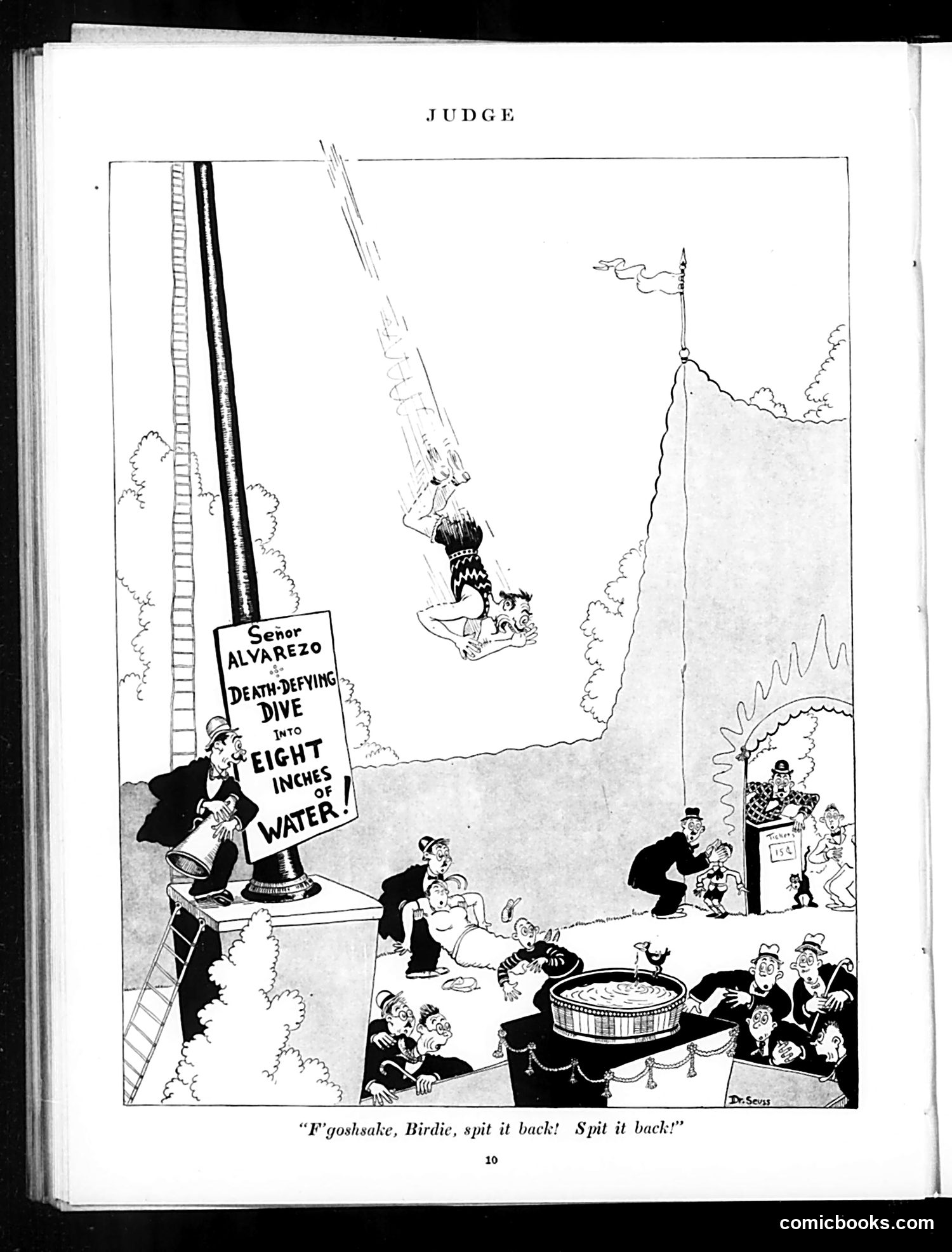
Analysis of "Judge" Cartoon Page This Dr. Seuss-illustrated cartoon satirizes a dangerous stunt performer, "Señor Alvarezo," who advertises a "death-defying dive into eight inches of water." The humor derives from the absurd contrast between the grand theatrical presentation—with crowds, elaborate staging, and dramatic signage—and the trivial, laughably shallow target pool. The cartoon mocks both the performer's audacity in marketing such a ridiculous feat and the public's gullible appetite for sensational entertainment. The spectators, drawn as eager audience members, represent society's enthusiasm for dubious spectacles. The caption's exclamation—"F'goshsake, Birdie, spit it back!"—suggests someone has swallowed water from this shallow pool, adding crude humor to the satire. This reflects early-to-mid 20th-century American fascination with carnival stunts and daredevil acts, while mocking both performers and audiences.
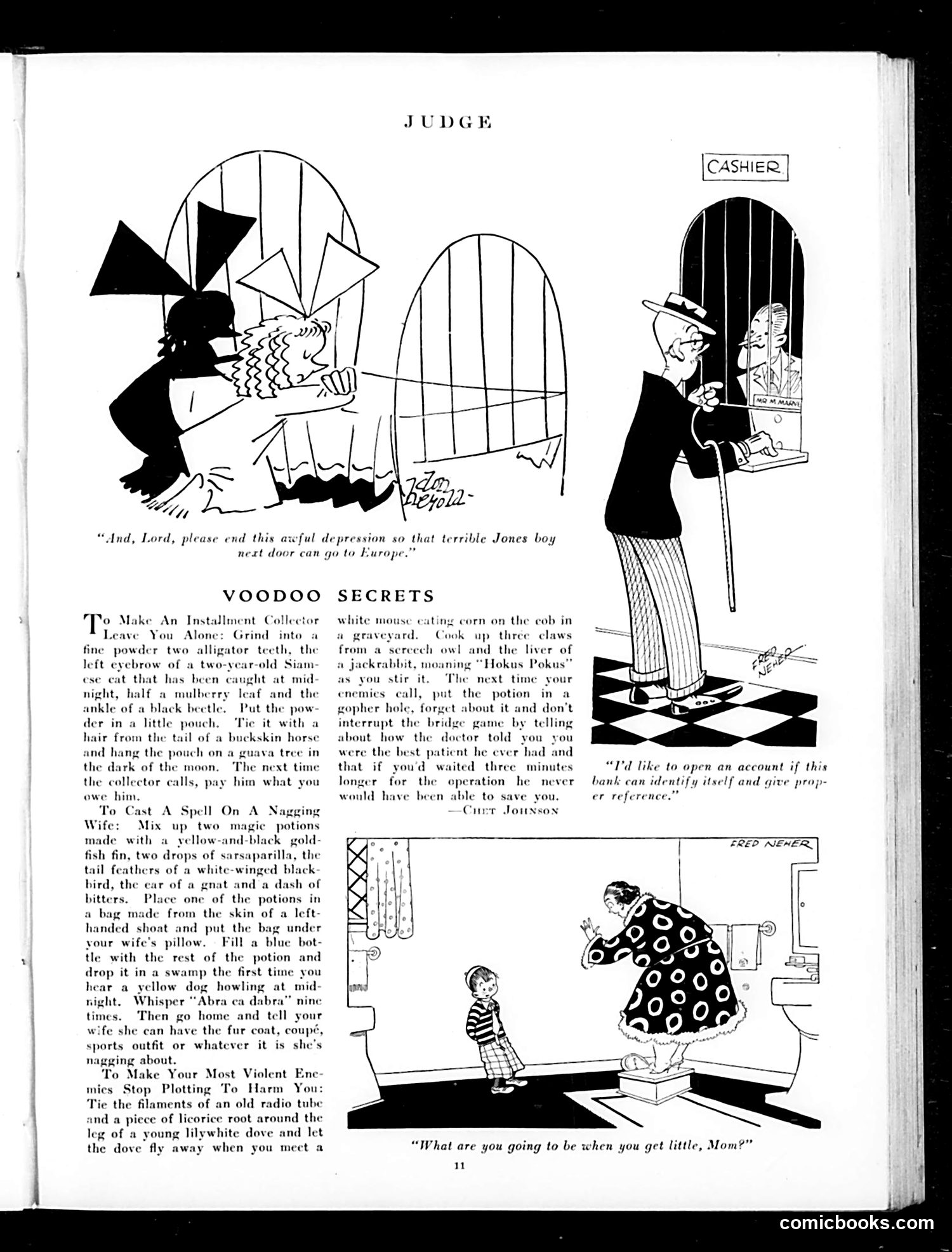
Analysis: Judge Magazine Page - Satire on Depression-Era Concerns This page satirizes American life during the Great Depression through three main elements: Top cartoon: A figure prays that the "terrible Jones boy next door" can afford a European trip—mocking how people judged their neighbors' relative prosperity during economic hardship. The irony: even during depression, status anxiety persisted. "Voodoo Secrets" section: This is mock-advice humor. It presents absurd, nonsensical "spells" (grinding alligator teeth, using beetle ankles, etc.) as solutions to real Depression problems: debt collectors, nagging wives demanding luxuries, and business rivals. The joke is that people were so desperate they might turn to superstition when rational solutions failed. Bottom cartoon by Fred Neber: A small child asks her mother "What are you going to be when you get little, Mom?"—reversing normal parent-child expectations. It darkly jokes that economic collapse might reduce even adults to childlike dependence. Overall, the page uses humor to cope with Depression anxieties about money, debt, class competition, and uncertain futures.
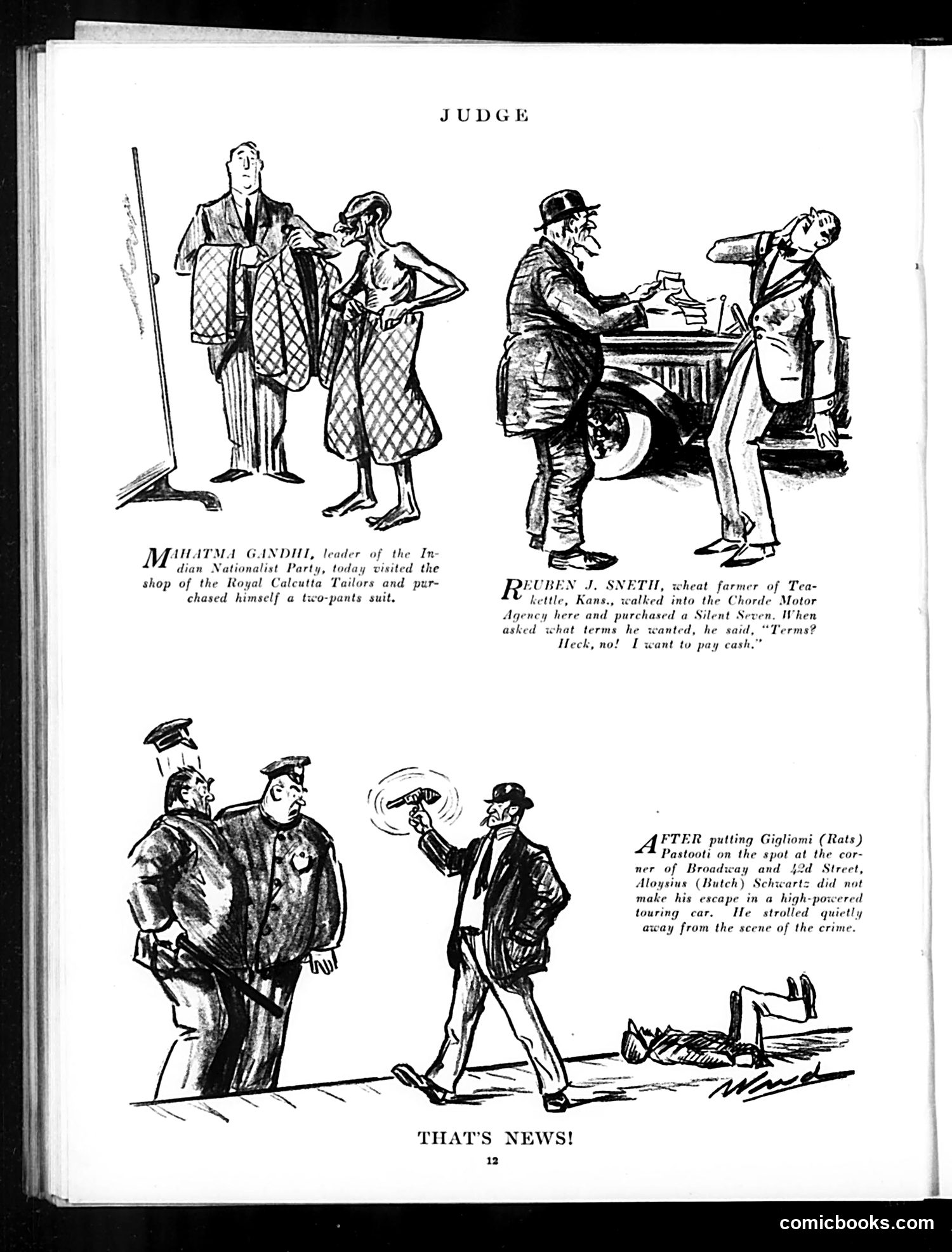
"That's News!" - Judge Magazine Satire This page mocks newsworthy figures through ironic "man bites dog" humor. The top left jokes that Gandhi, known for ascetic simplicity and homespun clothing as symbols of Indian independence, purchased a two-pants suit—contradicting his public image of deliberate modesty. The top right ridicules a Kansas farmer who paid cash for a car instead of financing it—presented as absurdly newsworthy behavior. The bottom panel appears to satirize crime reporting, suggesting that a gangland figure's *quiet* escape (rather than a dramatic high-speed chase) is the surprising "news." The page's title "THAT'S NEWS!" underscores the satire: these mundane or contradictory acts are treated as remarkable precisely because they subvert public expectations of these figures. Judge uses this format to deflate pretension and highlight hypocrisy.
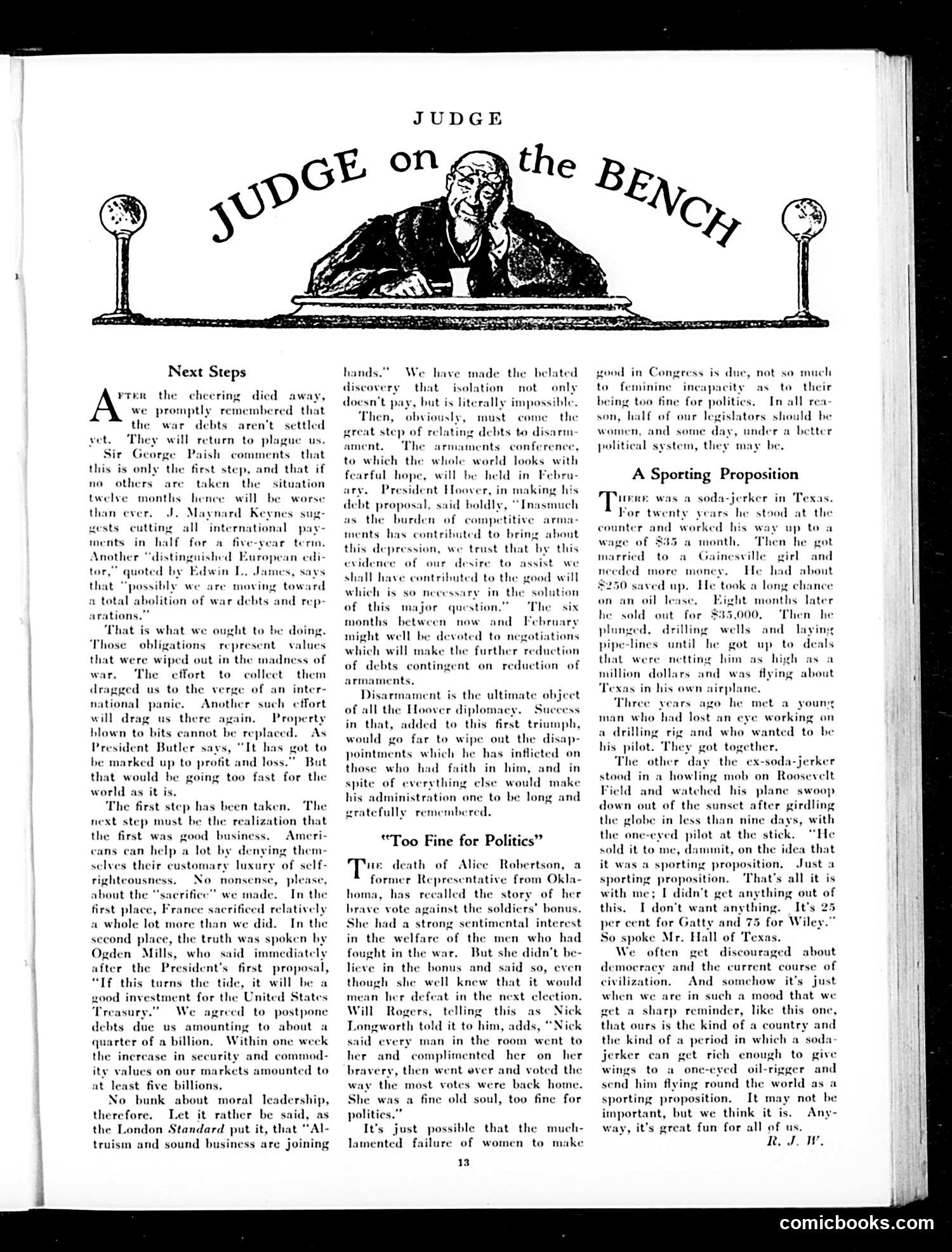
Judge Magazine Page Analysis This page from *Judge* (a major American satirical magazine) addresses post-World War I debt and disarmament negotiations, circa 1931-1932. The masthead cartoon shows a stern judge presiding—representing judicial authority overseeing national obligations. Main articles discuss: 1. War debt resolution: Various economists (Sir George Paish, Maynard Keynes, President Butler) debate whether Allied war debts should be forgiven or reduced. The satire argues Americans should stop self-righteous moralizing and recognize that forgiving debts is sound business—the U.S. stock market gained billions when debts were postponed. 2. "Too Fine for Politics": A tribute to Alice Robertson, former Oklahoma Representative, who voted against soldiers' bonuses despite knowing it would cost her re-election. Will Rogers is quoted praising her integrity as "too fine for politics"—implying principled politicians don't survive. The page advocates pragmatic internationalism over isolationism and moral self-superiority.
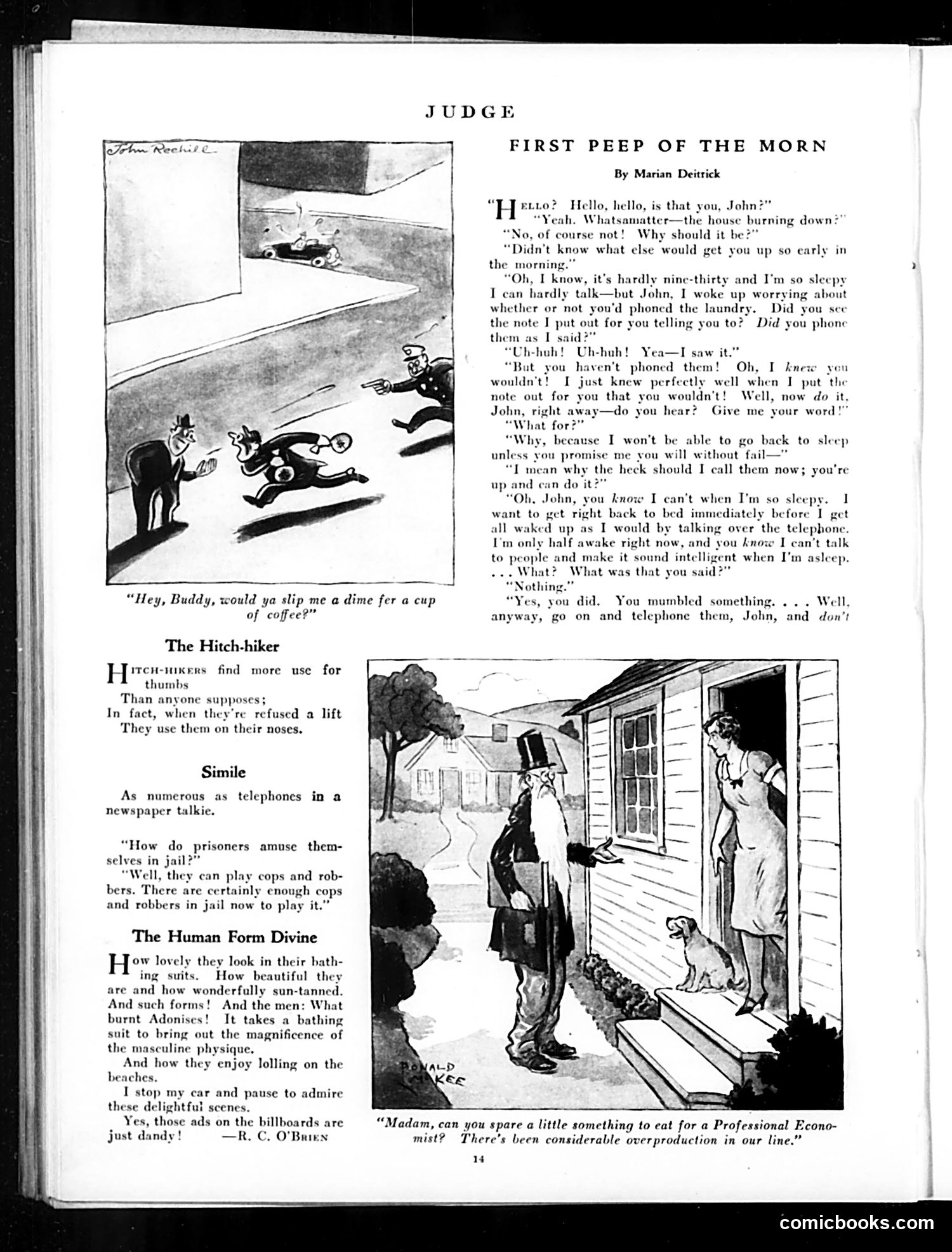
Explanation for Modern Readers This Judge magazine page contains three separate satirical pieces: "First Peep of the Morn" (main story): A wife calls her sleeping husband early to nag him about phoning the laundry. The satire targets nagging spouses and marital dynamics—she won't let him sleep but refuses to make the call herself, claiming she's too drowsy to "sound intelligent." It mocks both wife-nags and husbands' helplessness. "The Hitch-hiker" and other brief jokes are one-liners poking fun at hitchhikers, prisoners, and advertising. "The Human Form Divine": Critiques billboard advertisements (common roadside attractions of the era) showing bathing beauties and muscular men. The author sardonically admires these "lovely" ads, then ends with a cartoon of a homeless "Professional Economist" begging, suggesting ironic contrast between frivolous advertising imagery and real economic hardship—likely referencing 1920s-30s economic concerns. The bottom cartoon depicts class anxiety: while billboards celebrate leisure and beauty, real people starve.
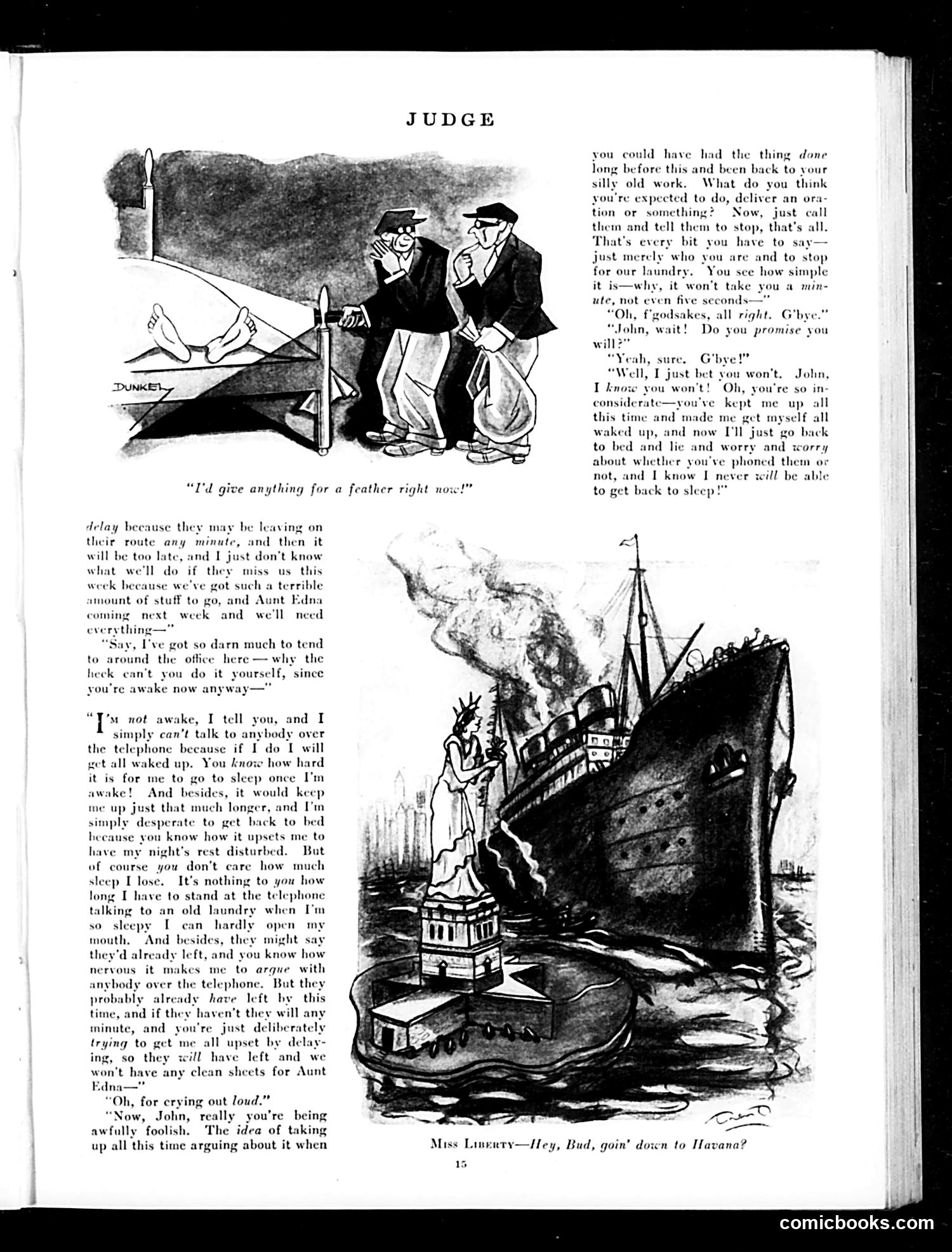
Analysis of Judge Magazine Page This page satirizes nagging wives and domestic telephone disputes through two cartoons. The upper cartoon shows a man on a fishing trip telling a companion: "I'd give anything for a feather right now!"—likely referring to needing a feather to sleep peacefully despite marital complaints. The main text is a domestic argument where a wife badgers her husband John (who appears to be trying to sleep) into calling the laundry to stop a delivery. She simultaneously insists he do it AND complains that talking will keep her awake, that the laundry has probably already left, that he's inconsiderate, and that she'll worry all night—creating circular logic designed to frustrate him. The satire mocks wives who create problems through contradictory demands while simultaneously blaming husbands for the chaos. The lower cartoon of "Miss Liberty" asking "Goin' down to Havana?" appears unrelated—possibly separate content or suggesting escape fantasies. The humor targets nagging domestic behavior and female irrationality, typical of early 20th-century gender satire.
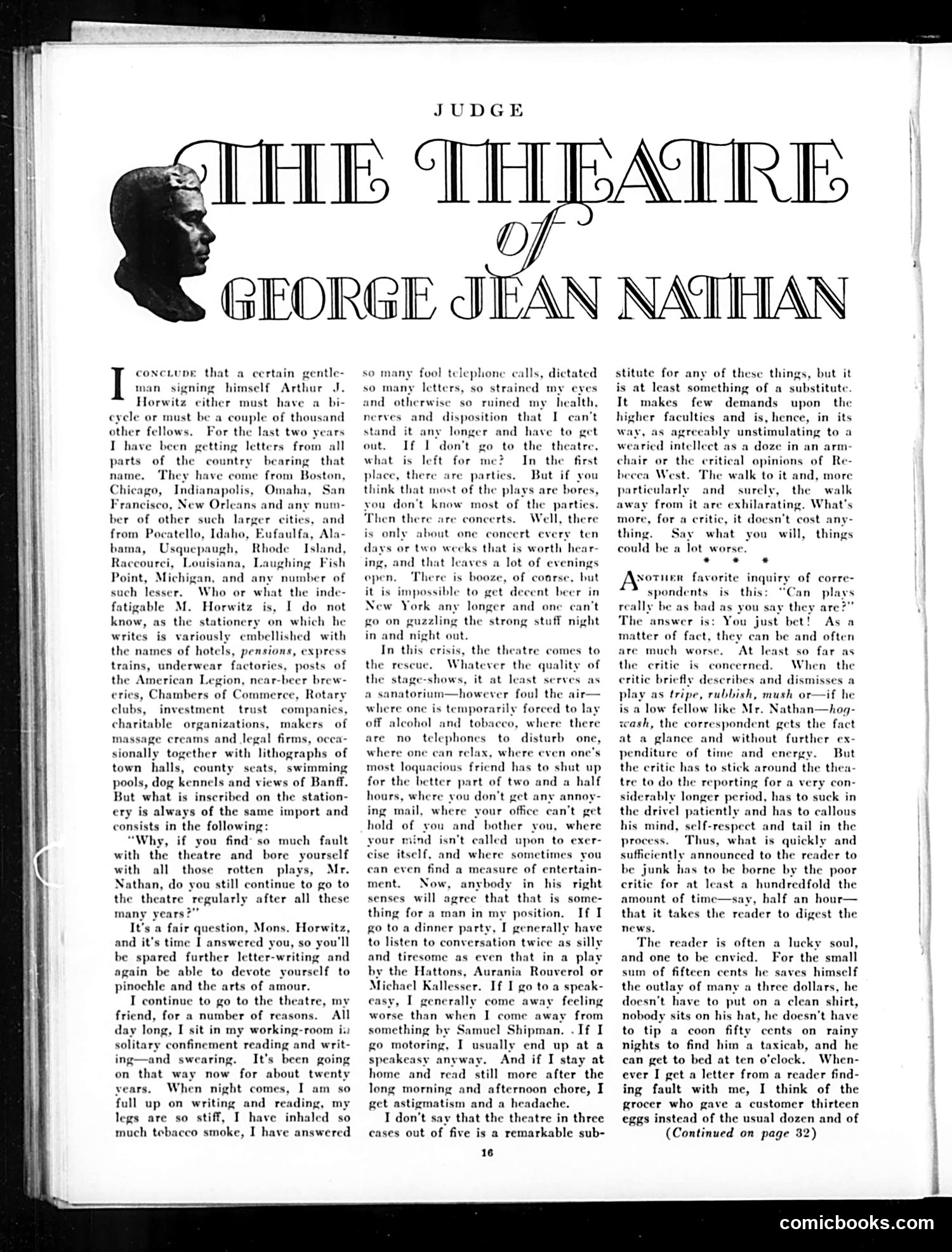
"The Theatre of George Jean Nathan" — Judge Magazine This page features theater critic George Jean Nathan defending his continued attendance at plays despite his frequent criticism of them. A correspondent named "Arthur J. Horwitz" (likely a fictional composite of multiple letter-writers) repeatedly asks: why does Nathan keep going to bad theater if he complains so much? Nathan's answer is essentially that the theater serves as an escape from his solitary, exhausting work life—a refuge where he can sit undisturbed for hours without phone calls, mail, or demanding conversation. He compares alternatives unfavorably: dinner parties have vapid conversation; speakeasies lead to drunkenness; motoring ends at speakeasies anyway; staying home means more reading and writing. The satire gently mocks Nathan's curmudgeonly reasoning while also critiquing 1920s social life: parties are boring, decent beer is unavailable (Prohibition era), and entertainment options are limited. The joke is that Nathan attends theater not for quality but as a necessary refuge from modern life's annoyances.
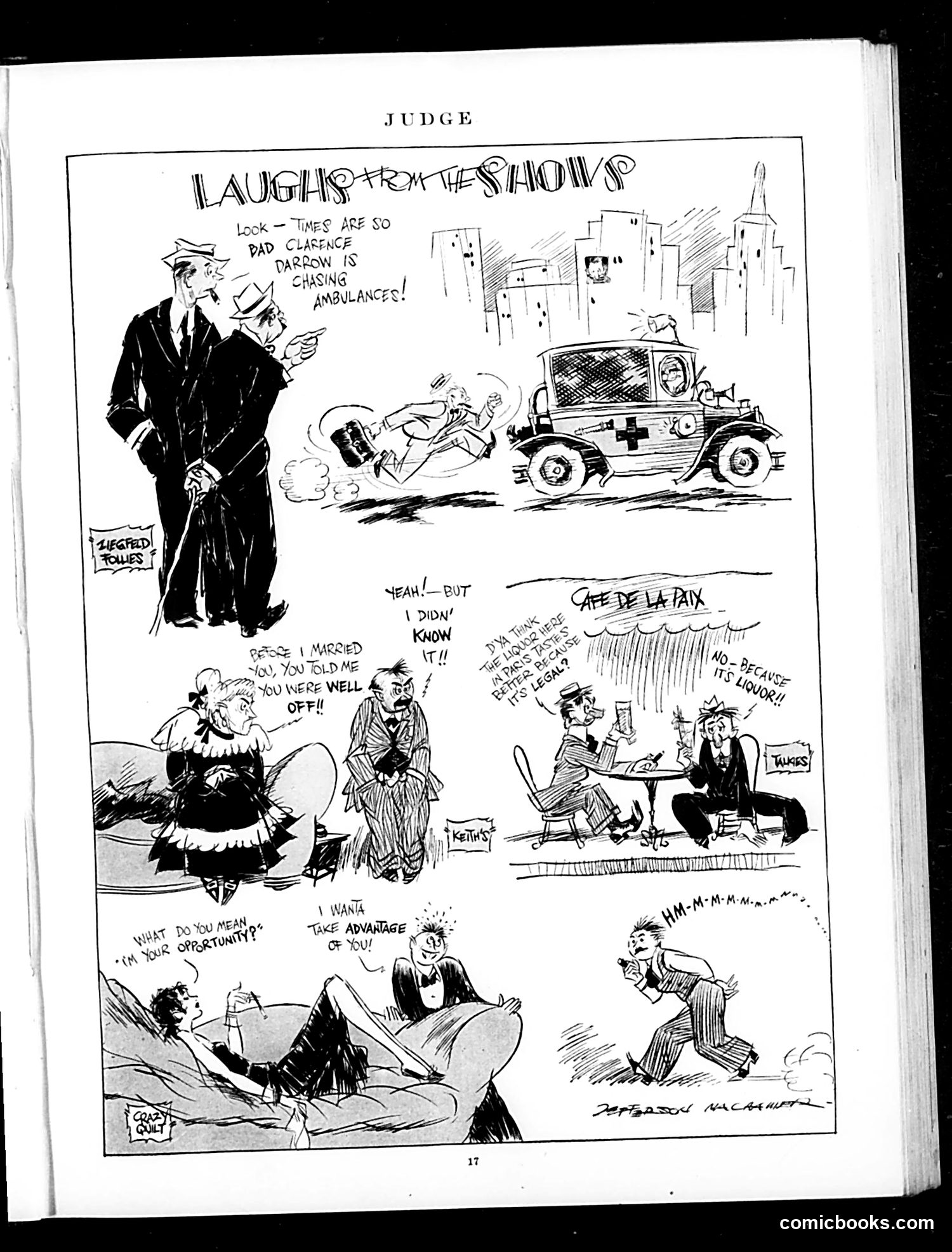
This political cartoon satirizes the famous 1924 Leopold-Loeb murder trial, where defense attorney Clarence Darrow defended two wealthy young men accused of killing a boy. The cartoon mocks the trial's circus atmosphere and Darrow's celebrity status. The top panel shows a judge observing that times are so "dad" (fashionable) that even "Darrow is chasing ambulances"—suggesting the renowned lawyer has become a publicity hound. The ambulance imagery references both the crime and the sensational media coverage. Lower panels depict marital conflict, with spouses complaining about the trial's dominance in public discourse. One figure says "I didn't know it!" while another warns "No—be practical!"—capturing how the scandal consumed American attention and conversation, even affecting ordinary relationships. The satire criticizes both the trial's sensationalism and society's obsession with it.
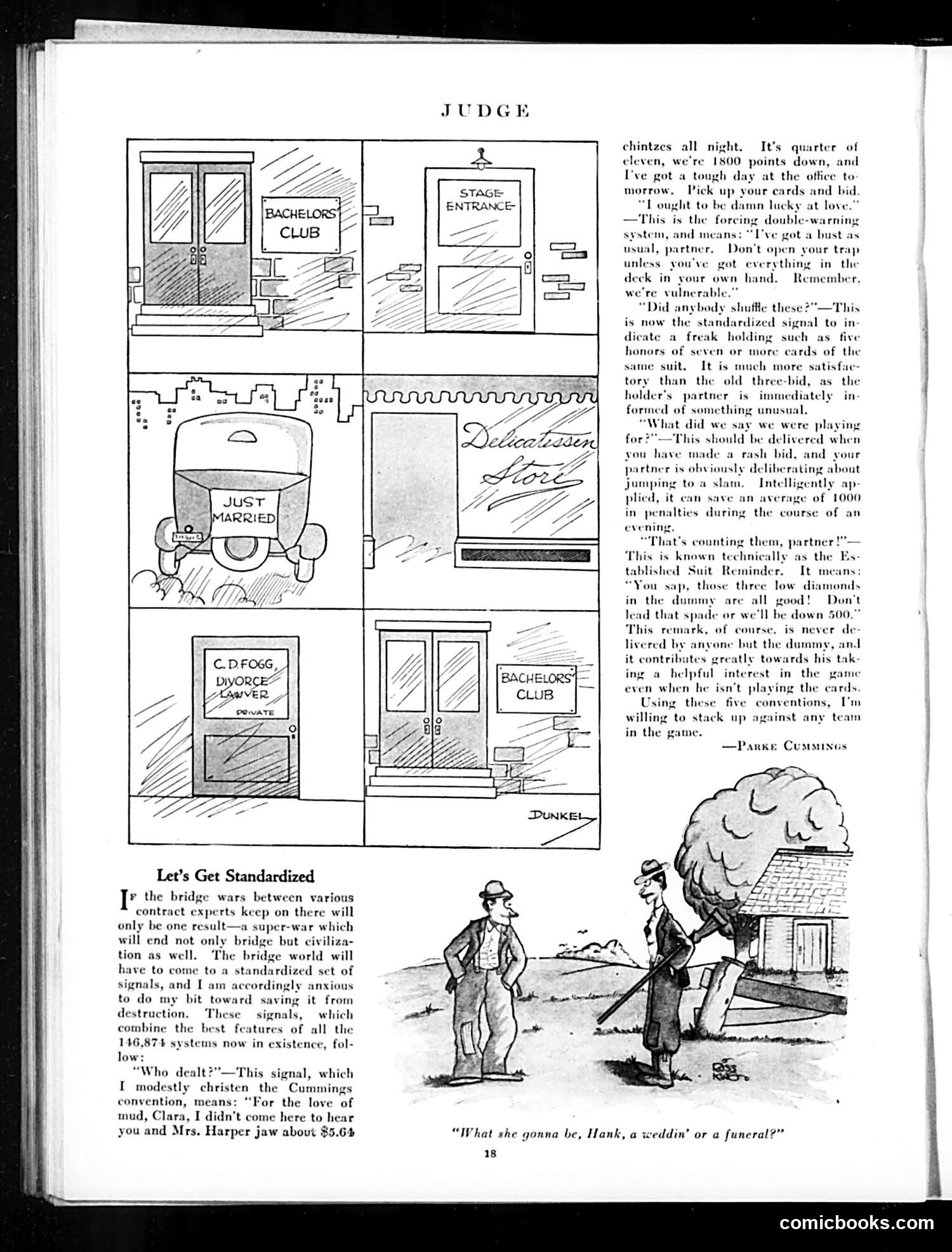
Judge Magazine Cartoon Analysis This page satirizes the chaos of Contract Bridge, a card game exploding in popularity during the 1920s-30s. The comic strips show the game's venues (Bachelors Club, divorce offices) and its social disruption—one car bears "JUST MARRIED," another advertises "C.D FOGG, DIVORCE LAWYER." Parke Cummings' article humorously proposes standardized "signals" for bridge players—coded phrases that communicate game strategy while disguising complaints. "Who dealt?" really means "stop socializing, we're losing badly." The signals mock both bridge's obsessive complexity (he references "146,874 systems") and players' passive-aggressive communication styles. The bottom cartoon shows two men discussing wedding versus funeral plans, likely implying bridge-playing marriages end in divorce—a running joke about the game's socially destructive nature. The satire targets bridge as dangerously addictive, consuming leisure time and threatening marriages and civility itself.
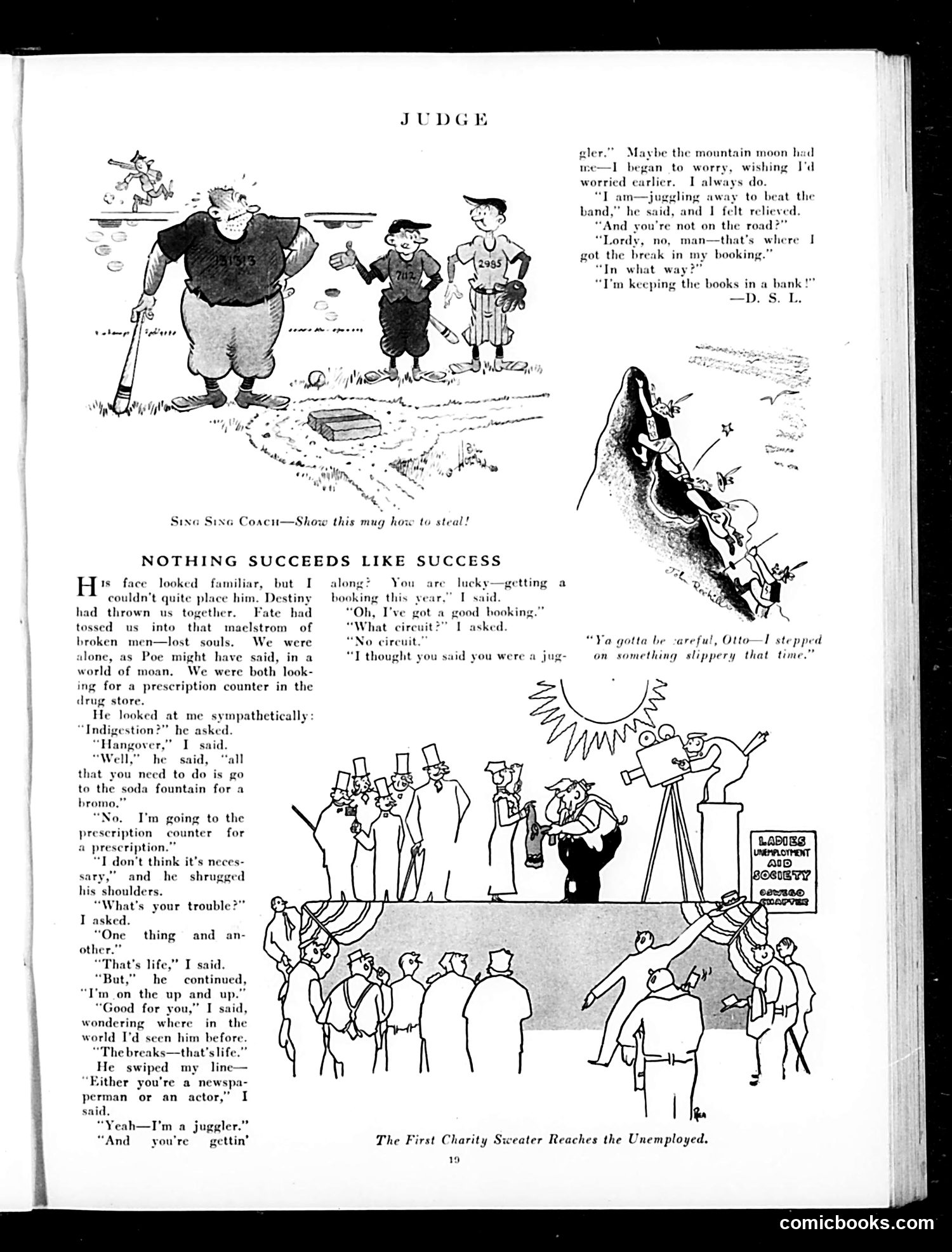
Analysis of Judge Magazine Page This page contains two separate satirical pieces about economic struggle during what appears to be a Depression-era context. "Nothing Succeeds Like Success" (main story): A dialogue between two down-on-their-luck men meeting in a drugstore. One claims he's "on the up and up" despite admitting he's a juggler without steady work. The irony is that he boasts of success while admitting his circumstances are dire—he's keeping his "books" (financial records) in a bank, meaning he has no money. The satire mocks those who maintain false optimism or pride despite obvious failure. "The First Charity Sweater Reaches the Unemployed" (bottom cartoon): Shows unemployed men receiving charity clothing. The caption's joke about stepping on "something slippery" likely references the precarious, degrading nature of accepting charity or relief during hard times. Both pieces satirize 1930s unemployment and economic desperation, mocking both the false pride of the struggling and the inadequacy of charitable efforts to address systemic poverty.
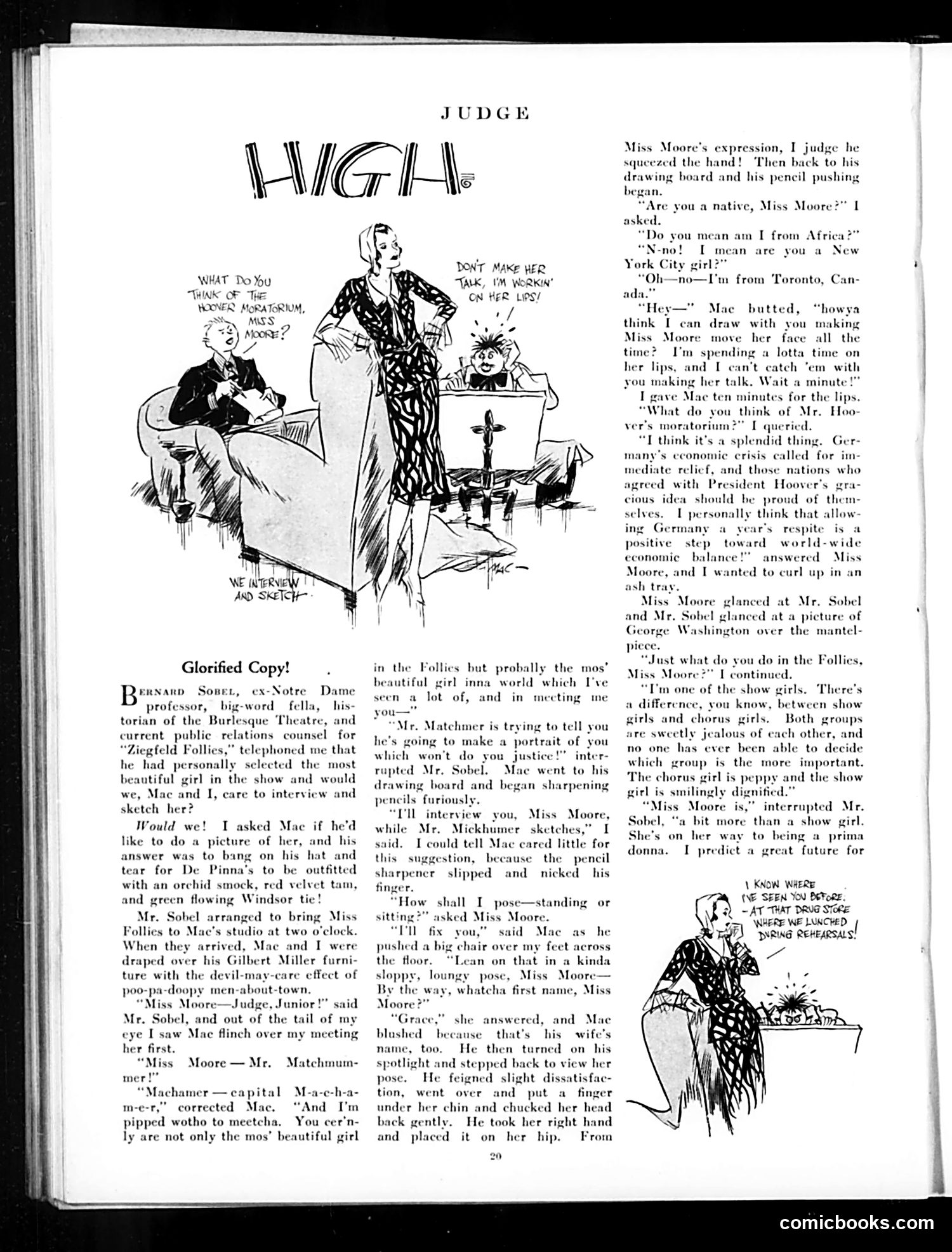
Judge Magazine Satire Explanation This 1920s Judge article satirizes the Ziegfeld Follies and artistic pretension. Bernard Sobel (a real theatrical publicist) arranges for cartoonist Mac (likely Mac Demarest or similar Judge artist) to sketch "Miss Moore," a Follies dancer. The humor operates on multiple levels: 1. The setup mocks theatrical self-importance: Sobel inflates the girl as "the most beautiful girl in the world" while she's merely a show girl. 2. The artist's vanity: Mac prioritizes "her lips" over her actual conversation, suggesting superficial male artist obsession. 3. Social commentary: When Miss Moore articulates sophisticated economic views about Hoover's moratorium (Depression-era debt relief), the narrator wants to "curl up in an ash tray"—the joke being that beautiful showgirls aren't expected to have intelligent opinions, yet she does. 4. Class distinction: She corrects assumptions about being African or American, establishing she's Canadian—suggesting contemporary racial/national stereotyping. The cartoon gently ridicules both artistic pretension and period gender expectations.
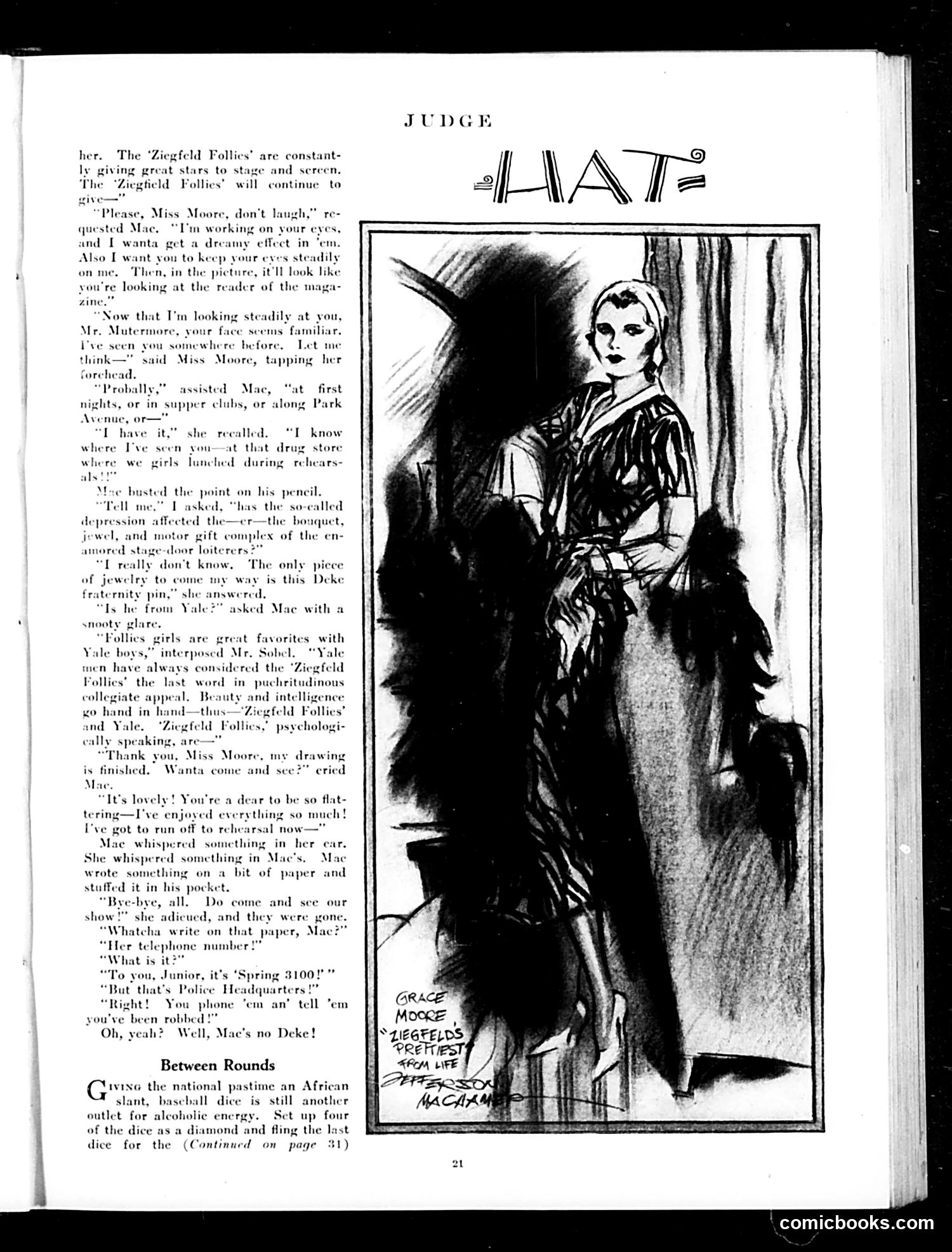
Analysis of This Judge Magazine Page This page contains a narrative comic strip titled "WHAT" depicting an interaction between "Mac" (an artist) and "Miss Moore" (a Ziegfeld Follies performer). The satire mocks several 1920s-30s social dynamics: The Setup: Mac is drawing Miss Moore's portrait for a magazine. He compliments her beauty and mentions the Ziegfeld Follies' appeal to wealthy Yale men. The Joke: Miss Moore reveals the Depression has devastated her financially—she's received only a fraternity pin as jewelry. Mac then obtains her phone number under false pretenses (claiming to finish his drawing), but actually intends to report *her* to Police Headquarters for robbery, implying she'd be desperate enough to steal. The Satire: The humor targets: - The contrast between glamorous performers' public image and financial desperation during the Depression - Male opportunism exploiting vulnerable women - Class tensions between wealthy college men and working women The punchline ("Well, Mac's no Deke!") suggests Mac, though ungentlemanly, isn't the elite Yale type who'd seduce her.
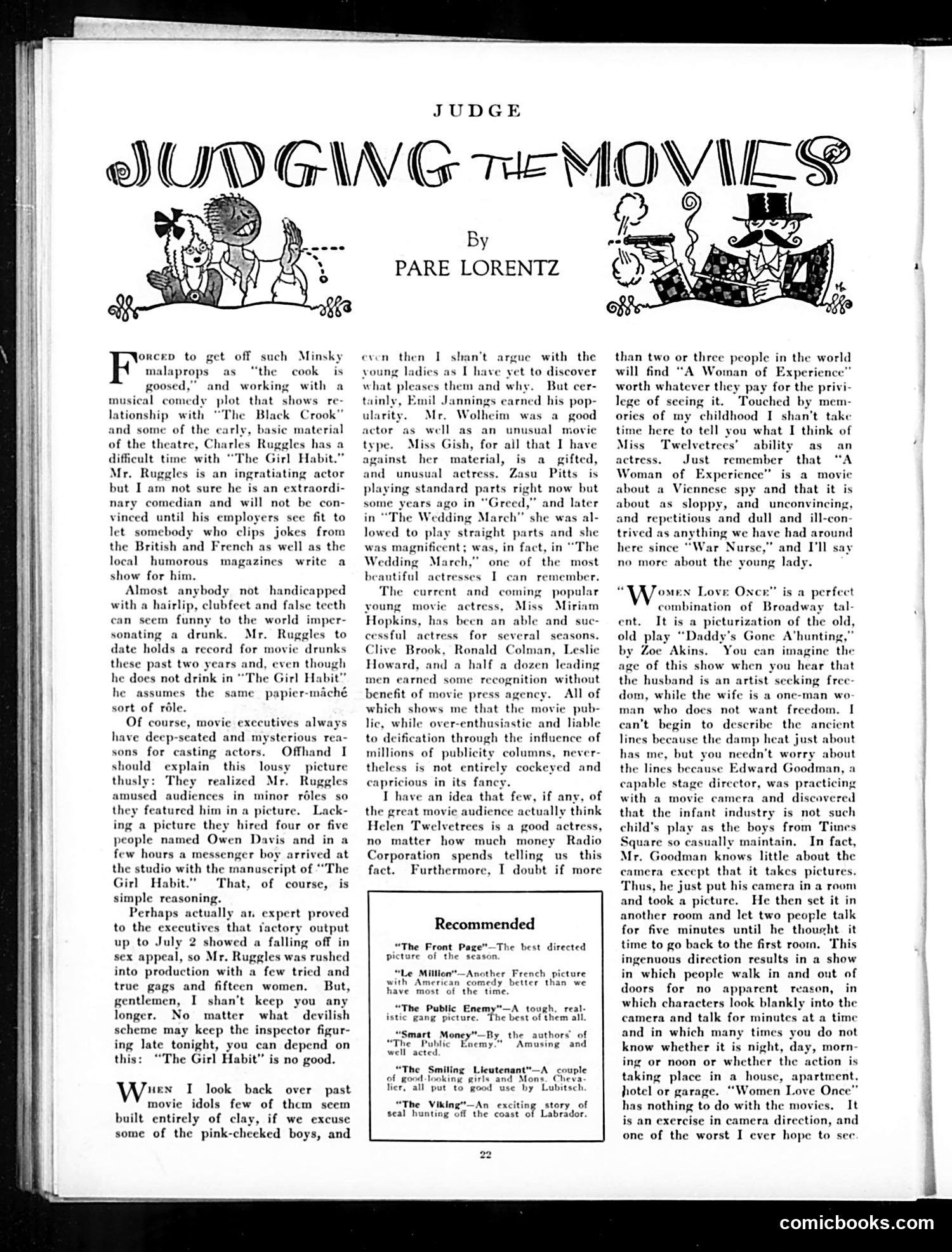
Judge Magazine Movie Review Analysis This page contains Pare Lorentz's film criticism column reviewing current movies, primarily criticizing "The Girl Habit" starring Charles Ruggles. The Main Critique: Lorentz dismisses the film as poorly constructed, arguing that Ruggles—though an "ingratiating actor"—has built a career playing drunk roles. He speculates executives rushed this picture into production with minimal script effort simply because Ruggles drew audiences in minor roles. The Broader Point: Lorentz contrasts Ruggles unfavorably with genuinely talented actors like Emil Jannings, Lillian Gish, and Ronald Colman, who earned recognition through actual skill rather than studio publicity. He argues the movie audience, while often swayed by publicity, ultimately distinguishes between real talent and manufactured appeal. The Satire: The underlying criticism targets Hollywood's cynical profit-driven casting decisions and lazy scriptwriting, contrasting them with legitimate theatrical craftsmanship. The boxed "Recommended" section lists contemporary films he considers worthwhile.
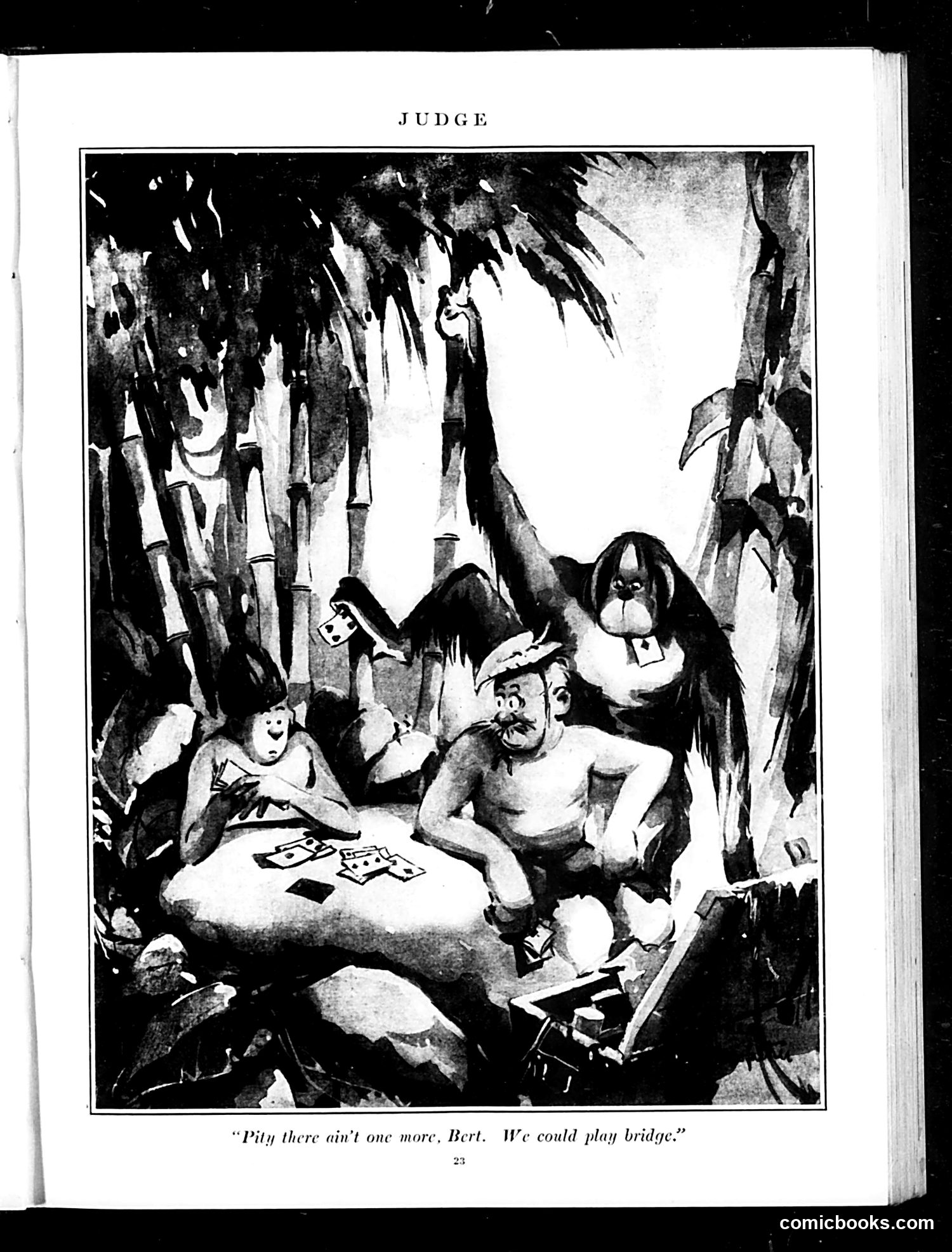
Judge Magazine Cartoon Analysis This cartoon depicts what appears to be leprechauns or fairy-tale creatures gambling with cards in a forest setting. The caption's reference to "Bert" and the complaint about lacking a fourth player for bridge suggests social commentary about gambling habits. The satire likely critiques either: 1. The prevalence of card games and gambling in American society 2. A specific contemporary figure or group known for gambling Without additional context about the specific Judge issue date or prominent "Bert" figures of the era, the precise political target is unclear. However, the whimsical illustration style contrasts humorously with the mundane activity of card-playing, suggesting Judge's typical approach to satirizing human behavior and social vices through fantastical scenarios.
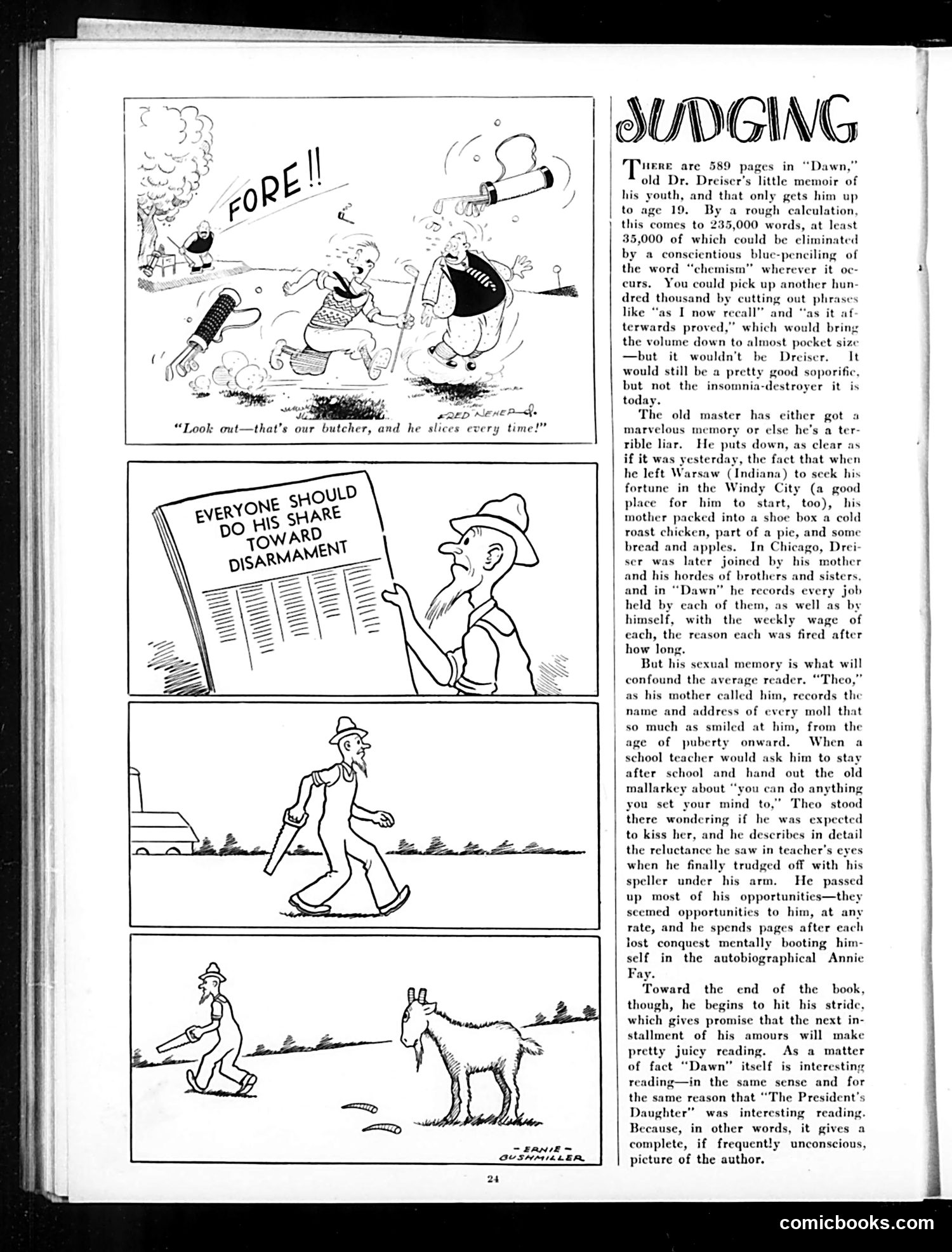
Analysis for Modern Readers This page contains two elements: editorial cartoons (top) and a book review of Theodore Dreiser's autobiography "Dawn." The Cartoons: The top cartoon mocks disarmament advocacy with a character labeled "FORE!!" (golf term), suggesting peace movements are naive or misguided. The subsequent panels show comedic situations unrelated to the satirical point. The Review: The critic judges Dreiser's 589-page memoir harshly, claiming it's bloated with repetition and could be cut significantly. The humor targets Dreiser's obsessive documentation of every job held by family members and—most pointed—his detailed cataloging of every woman who showed him attention, treating minor interactions as significant romantic moments. The reviewer suggests Dreiser mistakes sexual fantasy for autobiography, comparing the book's appeal to "The President's Daughter" (a 1927 scandal book)—implying both works interest readers primarily through salacious content rather than literary merit. The satire ultimately suggests Dreiser's "objectivity" about his own life is unconscious self-parody.
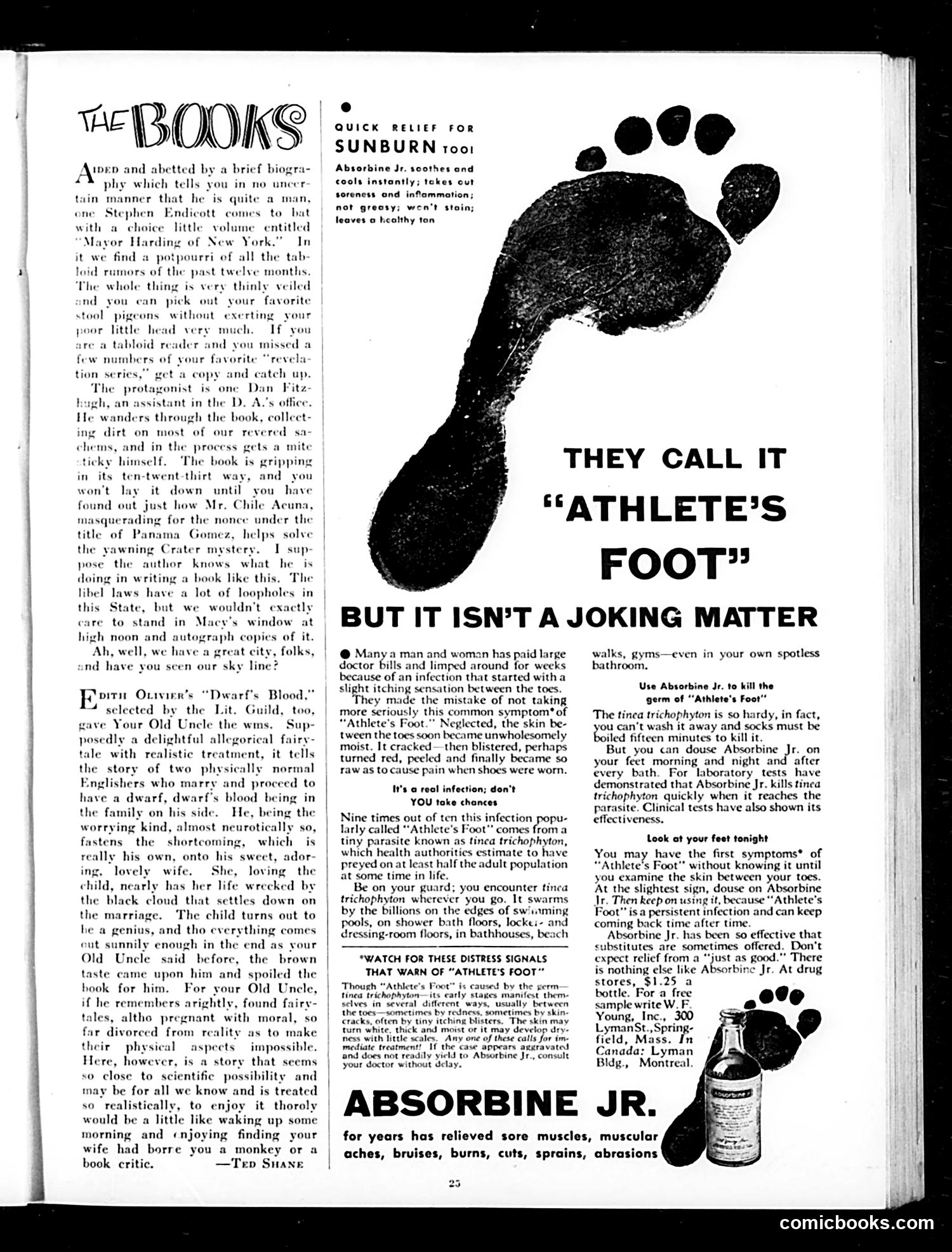
Judge Magazine Page Analysis This page combines book reviews with a medical advertisement. The "Books" section reviews three novels: *Mayor Harding of New York* (a thinly-veiled tabloid roman à clef about NYC politics), *Dwarf's Blood* (an allegorical fairy tale), and Edith Oliver's work. The reviews are sarcastically written—the critic praises the sensational gossip in the first book while joking about libel laws, and dismisses the second as overly divorced from reality. The substantial advertisement for Absorbine Jr. dominates the right side, addressing "Athlete's Foot" (a fungal infection). The ad uses dramatic language about infection and pain to market the product as a cure, emphasizing it kills the parasite *tinea trichophyton*. The page reflects 1920s American culture: tabloid scandal fiction was popular, and patent medicines were heavily advertised with exaggerated health claims—common before FDA regulations.
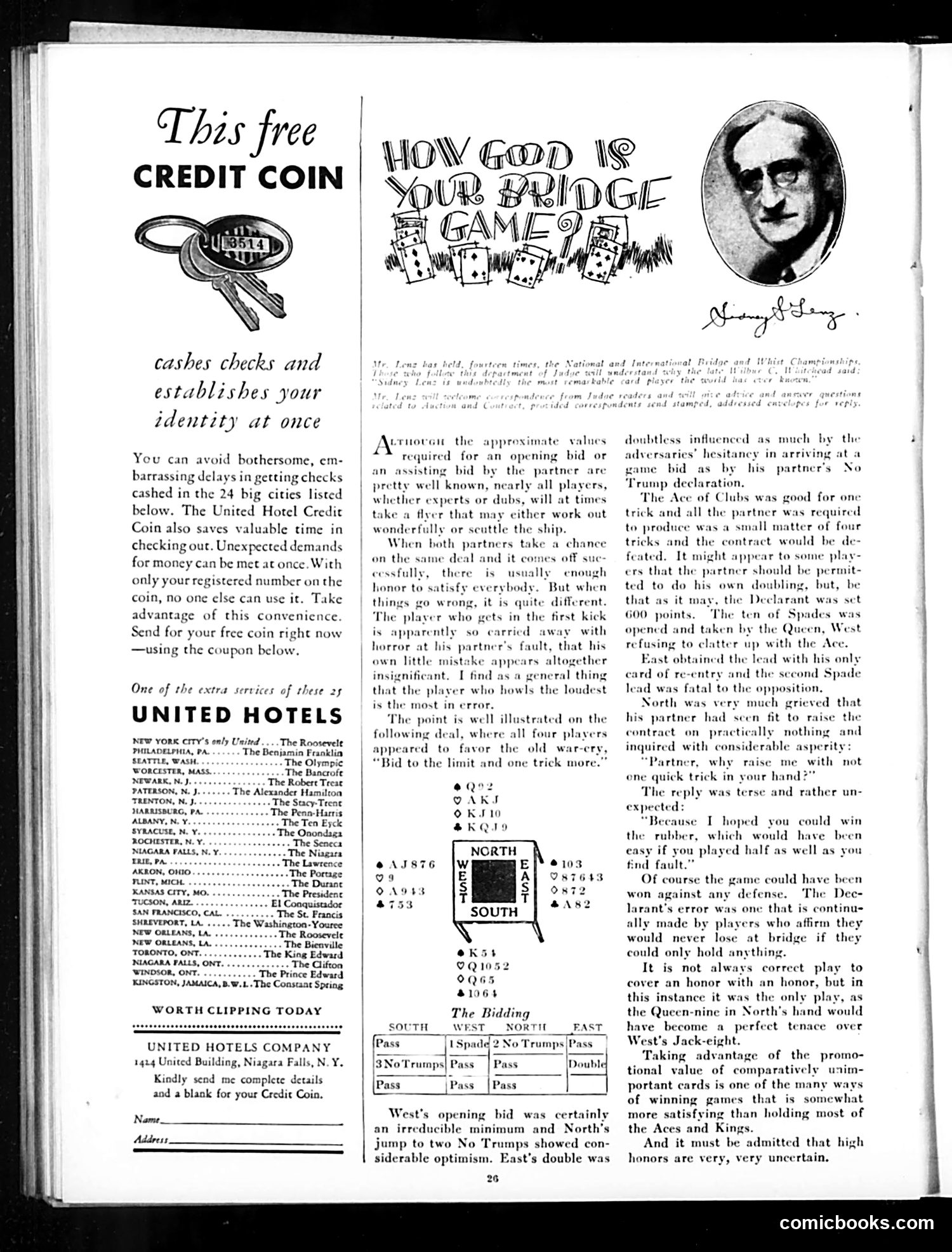
Judge Magazine Page Analysis This page is primarily advertising for United Hotels Company's promotional "Credit Coin" — a registered identity token allowing check-cashing at 25 hotel locations without embarrassing delays. The right side contains a bridge column by an uncredited expert, discussing a card game where partnership conflict erupted. When North aggressively bid based on honor cards, East doubled the contract. After the hand failed, North angrily asked his partner why he raised without quick tricks. The partner's terse reply — essentially "because I hoped you could actually play" — provides the satirical humor. The satire targets overconfident amateur bridge players who blame partners for failed bids while ignoring their own poor play. The column's title, "How Good Is Your Bridge Game?" reinforces this critique of self-deluding players. The photograph and signature (appears to be a bridge expert's endorsement) add authority to the instructional content, typical of period magazine formatting.
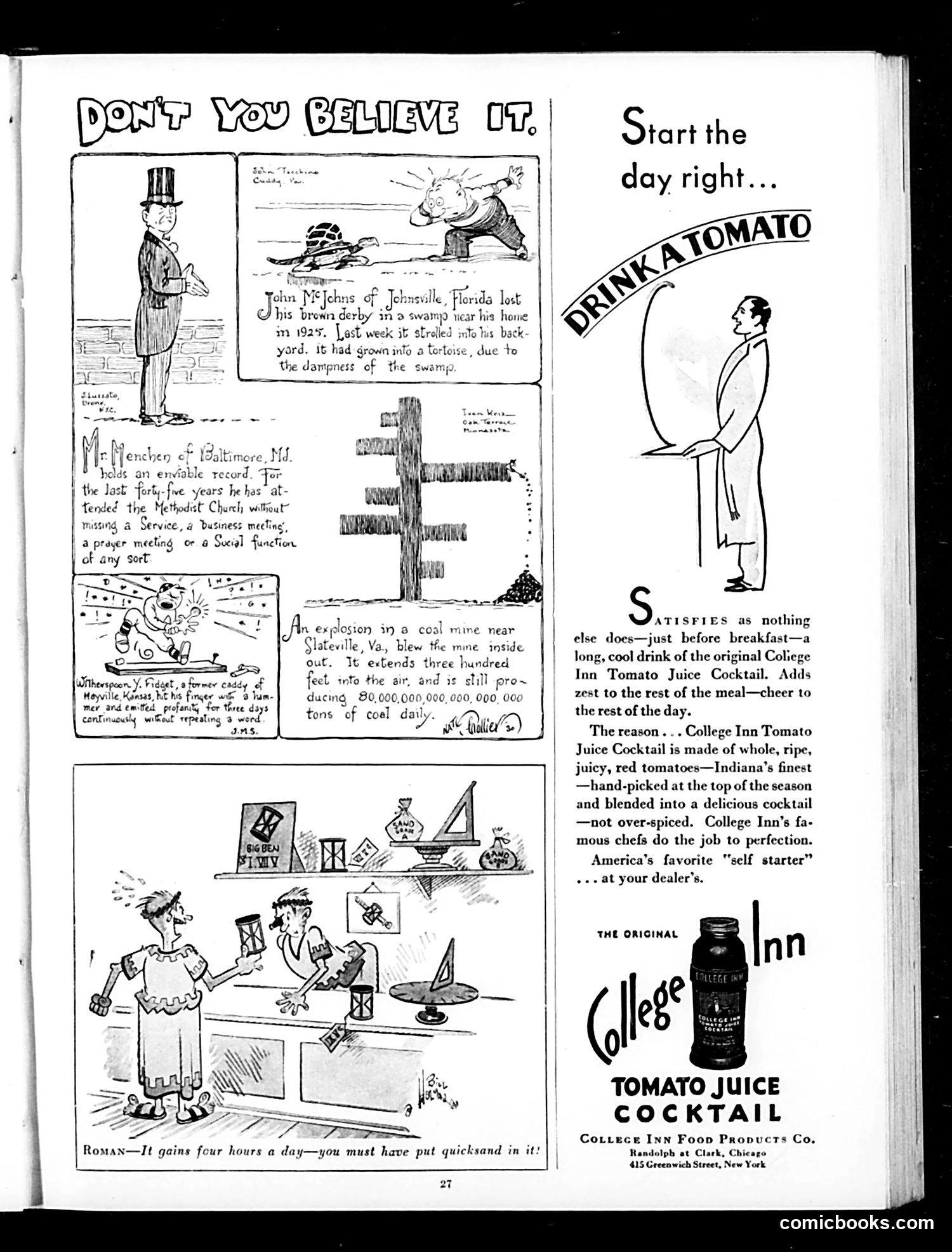
Analysis: "Don't You Believe It" - Judge Magazine Page This page combines satirical tall tales with a product advertisement for College Inn Tomato Juice Cocktail. The Left Side: Humorous Exaggerations "Don't You Believe It" presents absurd, impossible stories meant to amuse readers through obvious falsehoods—a common magazine humor format. Examples include a derby hat transforming into a tortoise from swamp moisture, a man attending 45 years of church without missing once, and a coal mine explosion projecting material 300 feet upward while producing an impossibly enormous daily output. The final cartoon shows a woman complaining a clock "gains four hours a day," suggesting her husband filled it with quicksand—pure nonsense humor. The Right Side: Advertisement The tomato juice ad uses the "start the day right" health angle, positioning the cocktail as a morning energizer—an "America's favorite self-starter." This reflects early 20th-century marketing emphasizing health benefits and morning vigor. The juxtaposition suggests readers should begin their day with this refreshing drink before encountering Judge's silly stories.
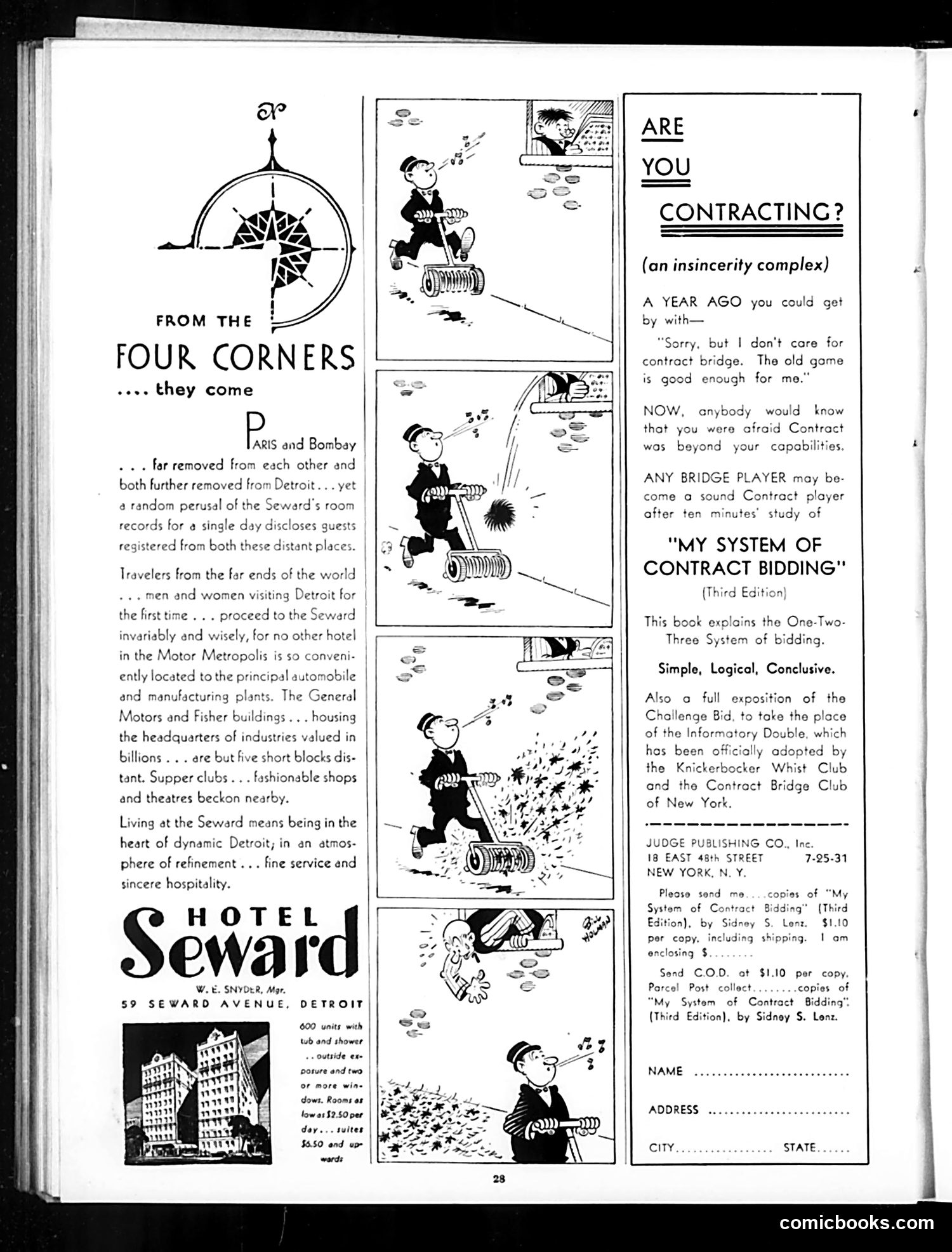
Analysis of Judge Magazine Page (July 25, 1931) This page mixes hotel advertising with social satire about Contract Bridge, a newly popularized card game in the 1930s. The Cartoon: The right panel mocks the "insincerity complex" of social pretense. It satirizes how, a year prior, people could admit disinterest in Contract Bridge without embarrassment. Now (1931), admitting you don't play signals social inadequacy—you're seen as fearful of appearing incompetent. The cartoon uses this as a humorous jab at how quickly fashionable games become mandatory for social acceptability. The Advertisement: Sidney Lenz's "My System of Contract Bidding" (Third Edition) is promoted as the solution—claiming anyone can master Contract in ten minutes of study. The ad ironically validates the satire's point: the book promises to eliminate the very social anxiety the cartoon just described. Context: Contract Bridge was indeed newly fashionable in early 1930s America, having recently replaced Auction Bridge. The page captures a moment when the game shifted from optional leisure activity to perceived social necessity among the middle/upper classes.
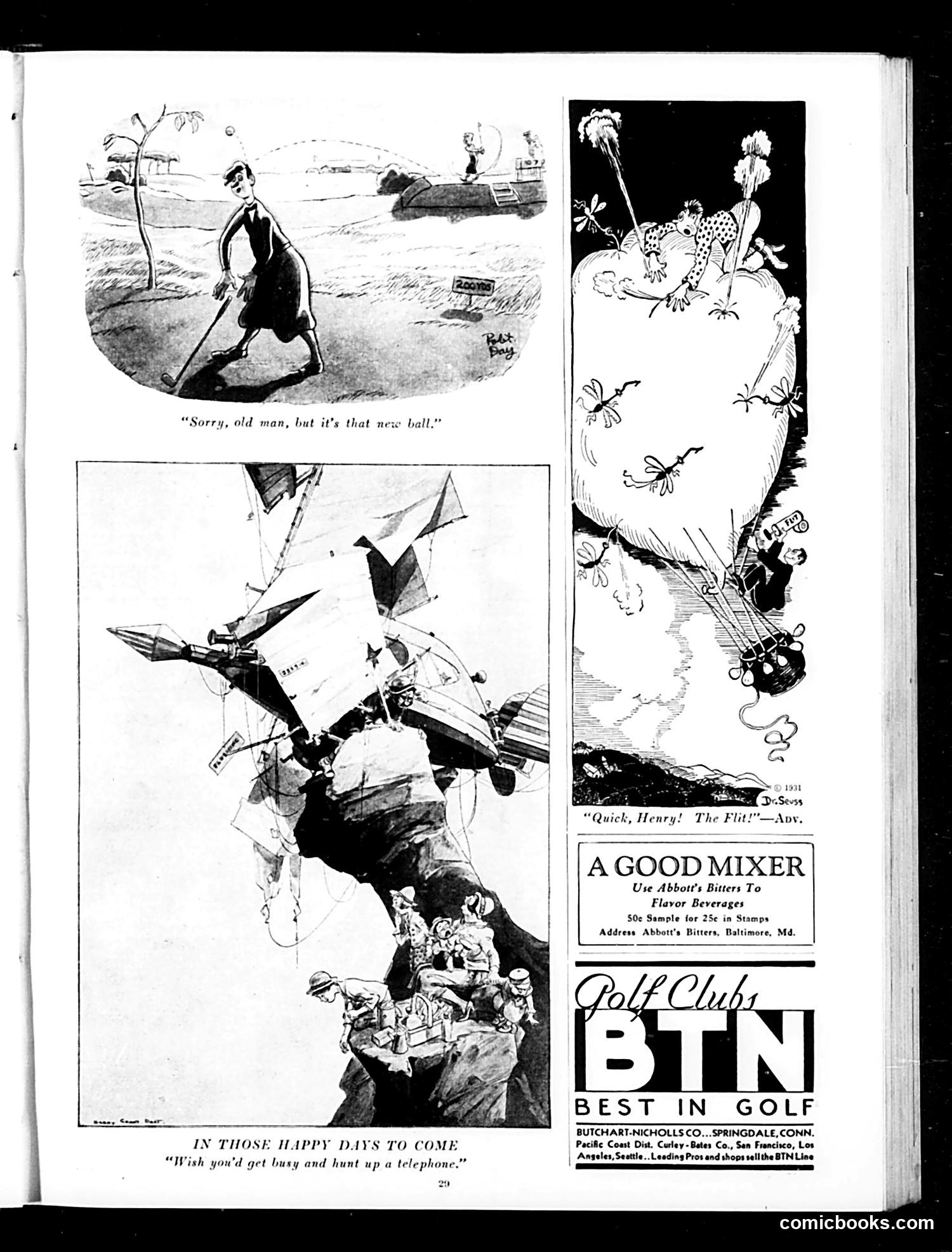
Analysis of Judge Magazine Page This page contains two distinct cartoons plus advertisements. Top cartoon: A man in formal dress apologizes to an elderly groundskeeper, saying "Sorry, old man, but it's that new ball." The joke references early golf ball technology—likely the introduction of the "Flit" golf ball (referenced in the ad caption), a newer design that behaves unpredictably compared to traditional balls. Bottom cartoon: Titled "In Those Happy Days to Come," it depicts a chaotic scene of a man tangled in telephone wires and debris, with the caption "Wish you'd get busy and hunt up a telephone." This appears to satirize predictions of future technological abundance—the irony being that instead of improving life, new technology creates comical disaster and entanglement. Context: Both cartoons mock emerging consumer technologies of the era, suggesting optimistic promises about modern innovations often failed in practice. The advertisements for golf clubs and beverage mixers anchor the satirical commentary in contemporary consumer culture.
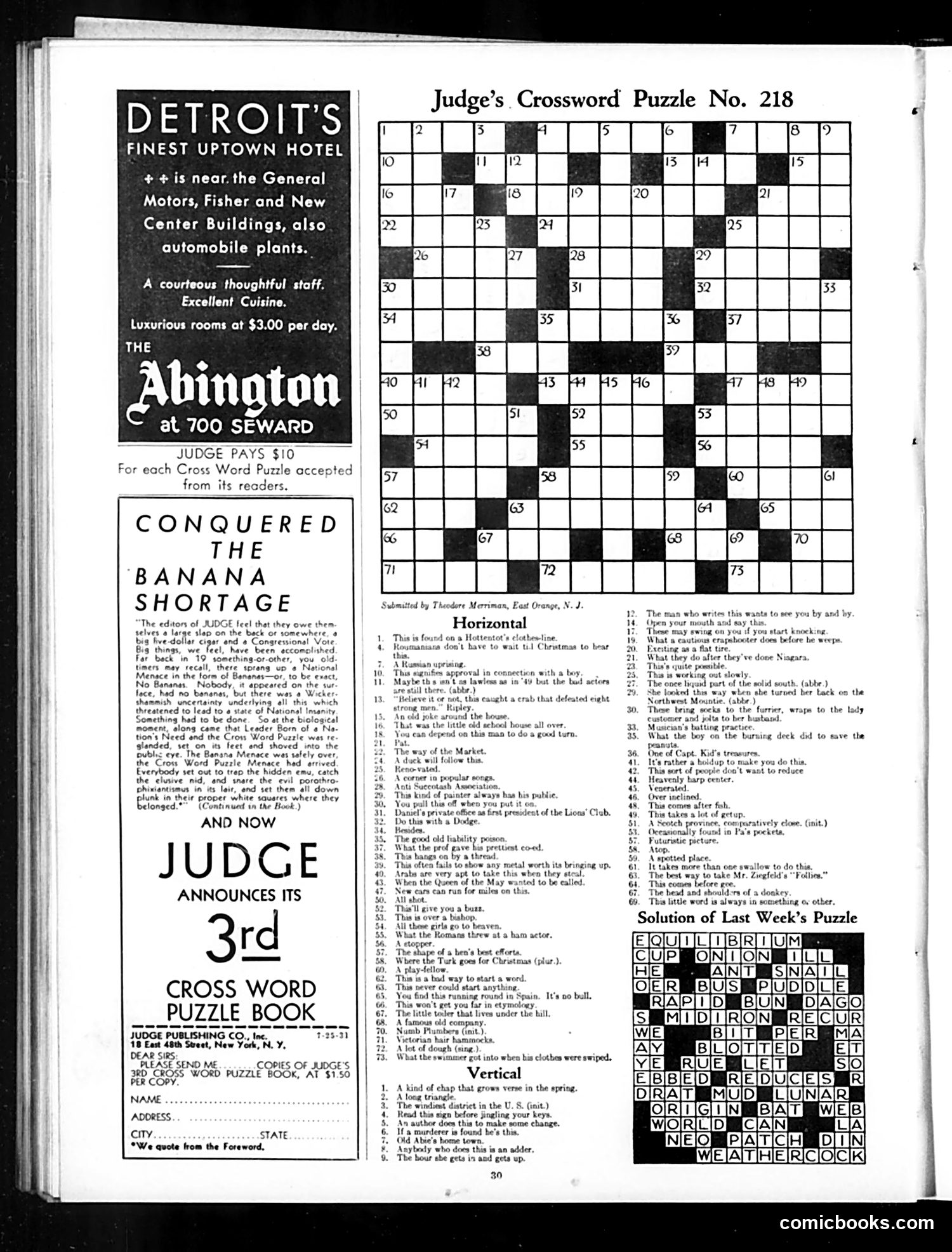
Judge Magazine, Page 50: Crossword Puzzle Issue This page is primarily advertising and puzzle content, not political satire. It features: Main Content: - Judge's third crossword puzzle book announcement, capitalizing on the 1920s crossword craze - A humorous editorial note claiming Judge "conquered the Banana Shortage" by distracting the public with crossword puzzles instead - The actual puzzle (#218) with clues and the previous week's solution Advertisements: - The Abington Hotel in Detroit (luxury rooms at $3.00/day, near auto industry sites) - Judge publishing company's pitch to sell their crossword book for $1.50 Historical Context: Crossword puzzles were a genuine 1920s fad. The "banana shortage" reference appears to be tongue-in-cheek commentary on how a trivial puzzle craze displaced serious national concerns from public attention—a mild satire on mass distraction and consumer culture rather than political commentary.
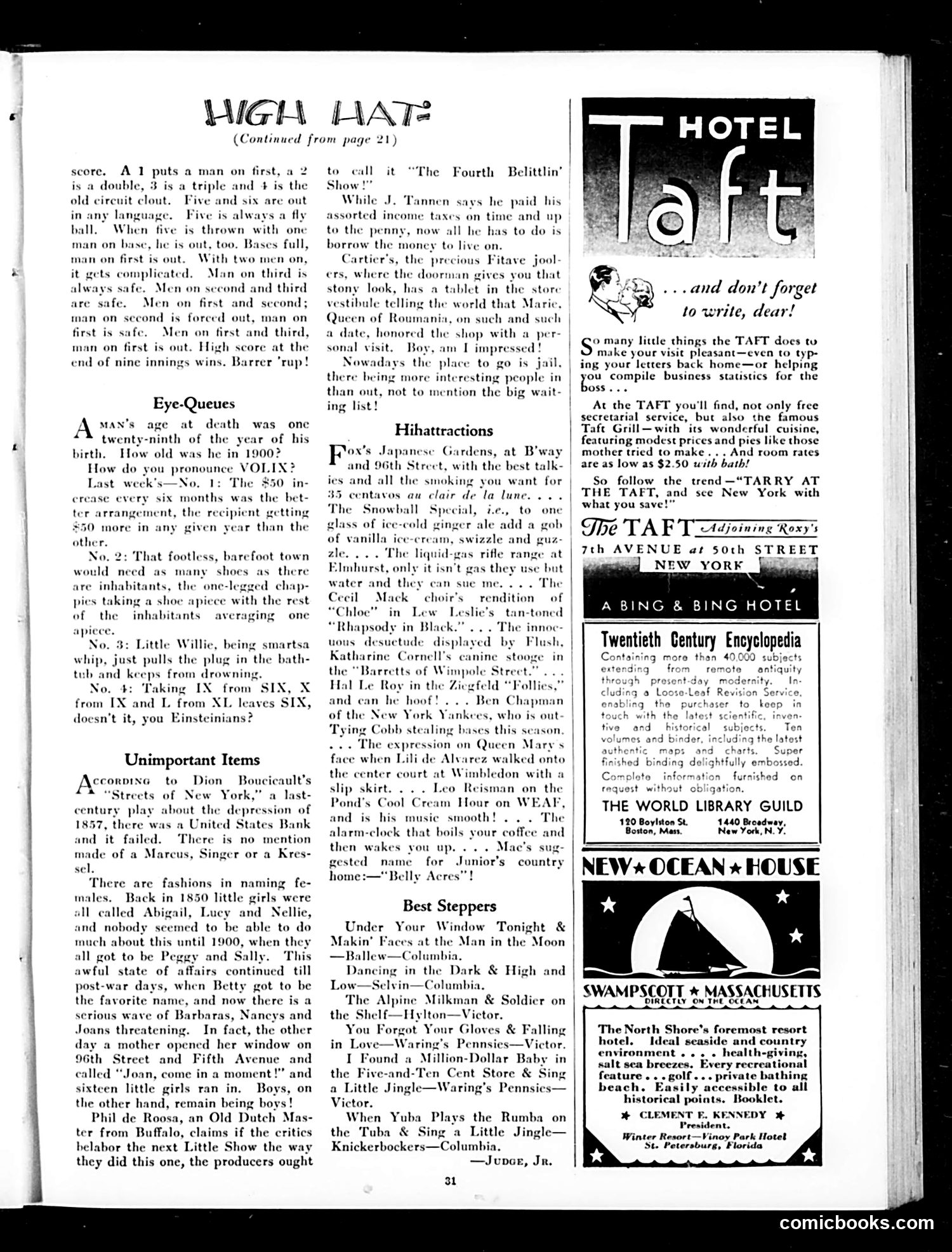
Explanation for Modern Readers This page is primarily text content and advertisements, not a political cartoon. It contains three separate sections: 1. "High Hat?" (continued): Baseball scoring rules explained humorously for readers unfamiliar with the sport. 2. "Eye-Queues" and "Unimportant Items": Math puzzles and trivial observations about social trends (like how girls' names changed from Abigail/Lucy in 1850 to Peggy/Sally by 1900, then to Betty post-war). 3. "Hihattractions": Entertainment reviews of Broadway shows, nightclubs, and performances—gossipy commentary on venues like Fox's Japanese Gardens and mentions of performers like Lew Leslie and Ben Chapman (a baseball player). The page reflects 1920s-30s magazine humor: wordplay, social snobbery, and insider entertainment gossip. The advertisements for the Taft Hotel and other establishments anchor it as period print media.
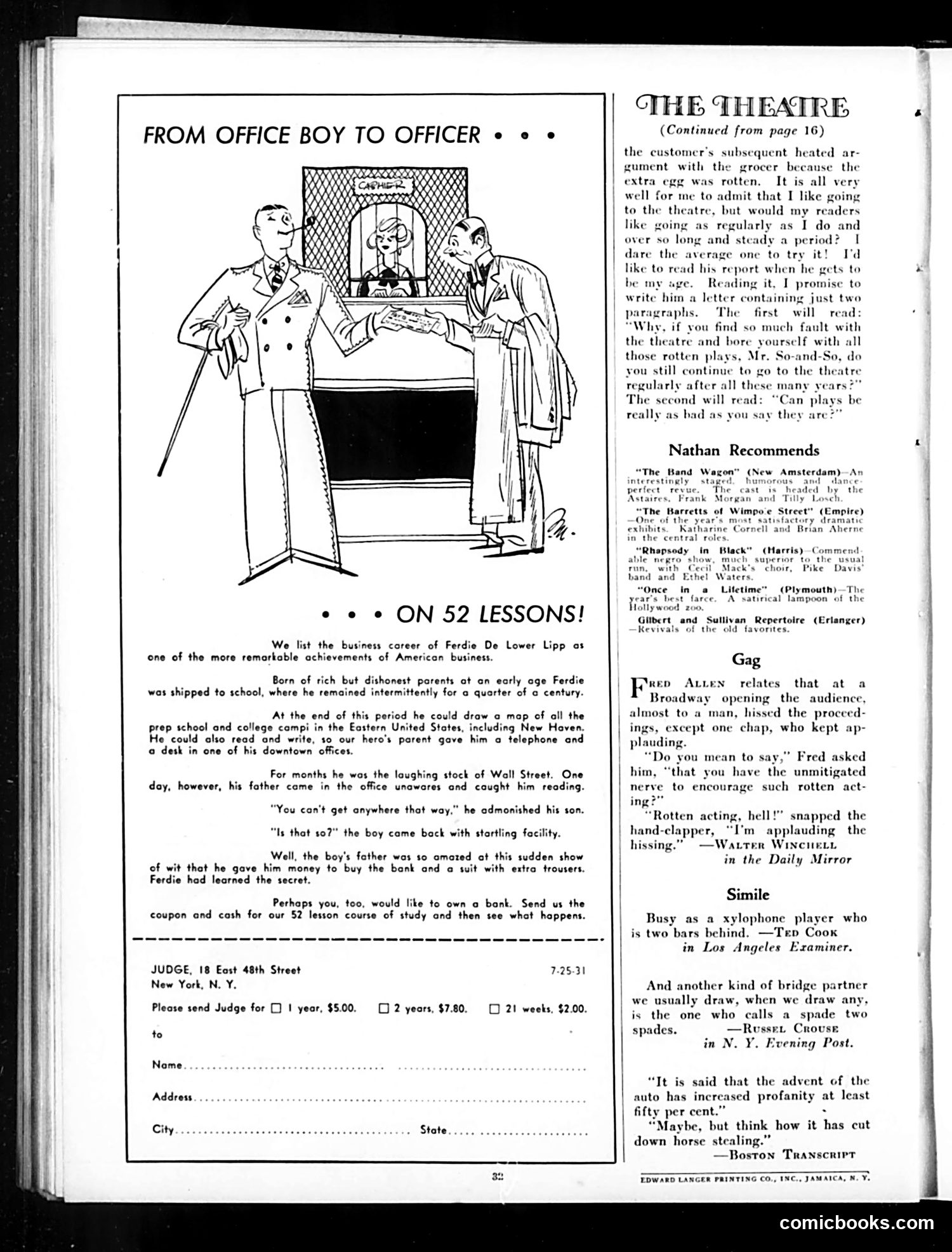
"From Office Boy to Officer" - A Satire on American Business Culture This cartoon satirizes the absurdity of American business success in the 1920s-30s. The protagonist, Ferdie De Lower Lipp, born to "rich but dishonest parents," receives an elite education but learns nothing useful. His father discovers him *reading* in the office—apparently the worst possible behavior for a businessman—and admonishes him. When Ferdie impudently retorts, his father is so impressed by this "wit" that he buys him a bank and new suit. The joke: real business success requires no actual knowledge or skill, only confidence and clever talk. The accompanying advertisement parodies self-help courses by offering "52 lessons" to teach readers how to similarly acquire banks through seemingly magical means (send money and "see what happens"). This reflects 1920s cynicism about Wall Street's superficiality and the era's get-rich-quick schemes.
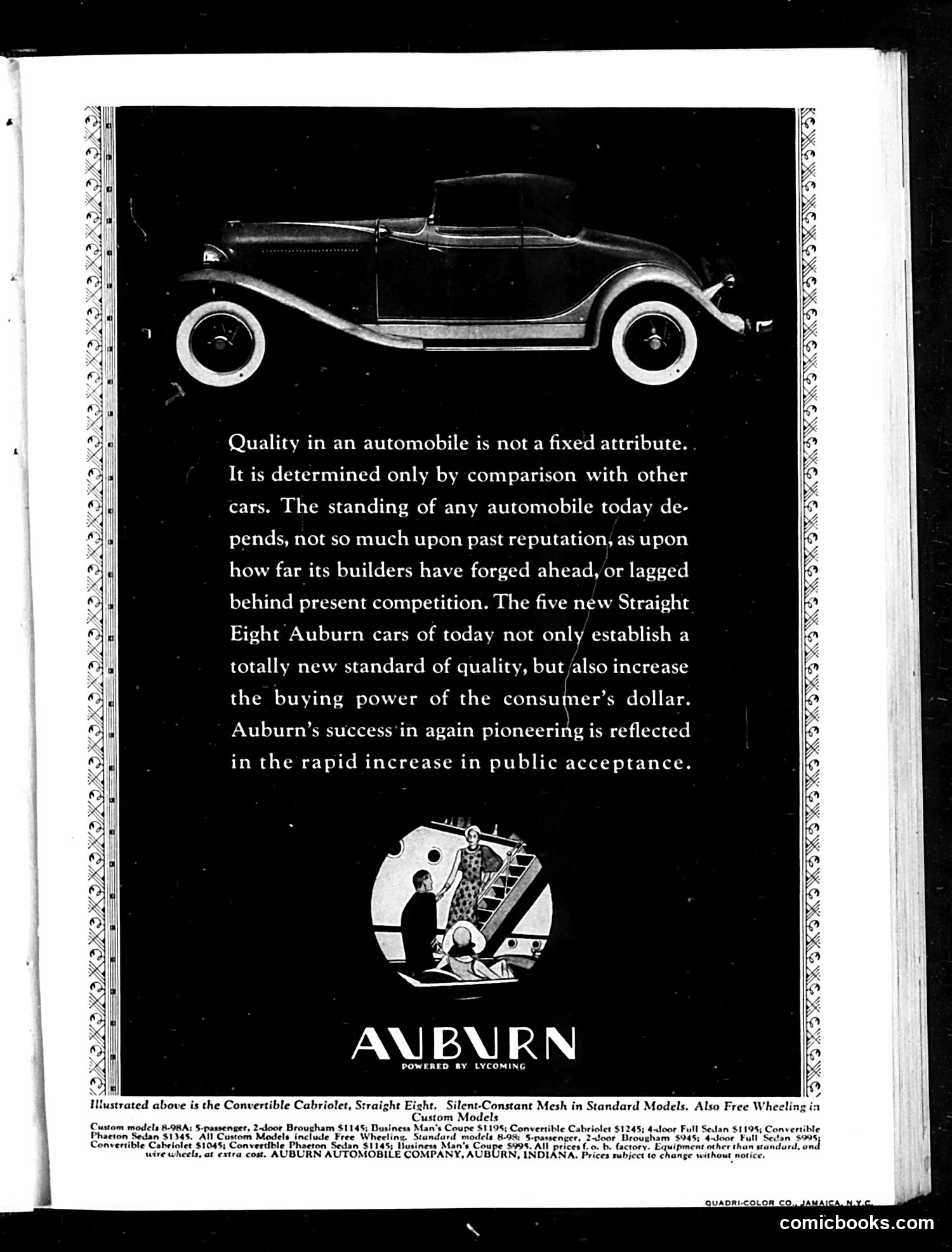
Auburn Automobile Advertisement This is not a cartoon or satire—it's a straightforward automobile advertisement disguised as editorial content in Judge magazine. The page promotes Auburn's new Straight Eight cars, claiming they establish "a totally new standard of quality" while offering better value than competitors. The rhetoric emphasizes Auburn's pioneering innovation and growing "public acceptance," framing car quality as relative rather than absolute—measured only against rival manufacturers. The image shows a sleek convertible cabriolet in profile, and detailed pricing for various models appears below. This appears to be paid advertising masquerading as magazine content, a common early 20th-century marketing practice. Auburn automobiles were a real American manufacturer (Indiana-based), and the Lycoming engine reference indicates the power source used in their vehicles.
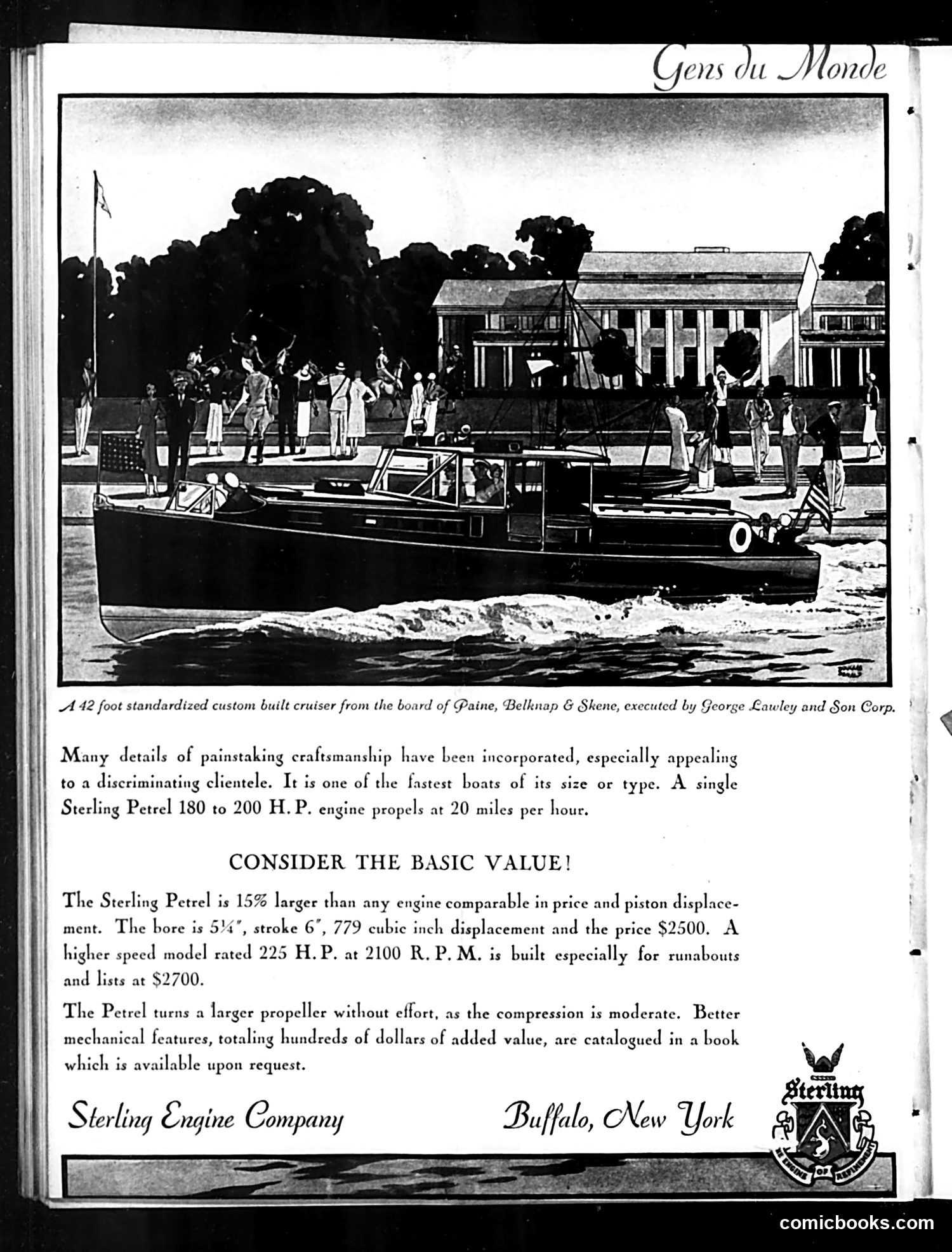
Analysis This page is not a political cartoon or satire—it's a straightforward advertisement, likely from the 1920s-1930s based on styling and typography. The image shows a 42-foot custom-built leisure cruiser at a waterfront, with well-dressed passengers and colonial-style waterfront buildings. The accompanying text promotes the Sterling Petrel engine, emphasizing engineering superiority ("15% larger than any engine comparable"), performance ("20 miles per hour"), and value proposition. The phrase "CONSIDER THE BASIC VALUE!" and detailed specifications (bore, stroke, displacement, pricing) are typical advertising rhetoric aimed at affluent buyers—the "discriminating clientele" mentioned. The Sterling Engine Company of Buffalo is simply marketing marine engines for recreational boating to wealthy Americans. There is no satire, political commentary, or joke intended here.