judge
Judge — August 1, 1931
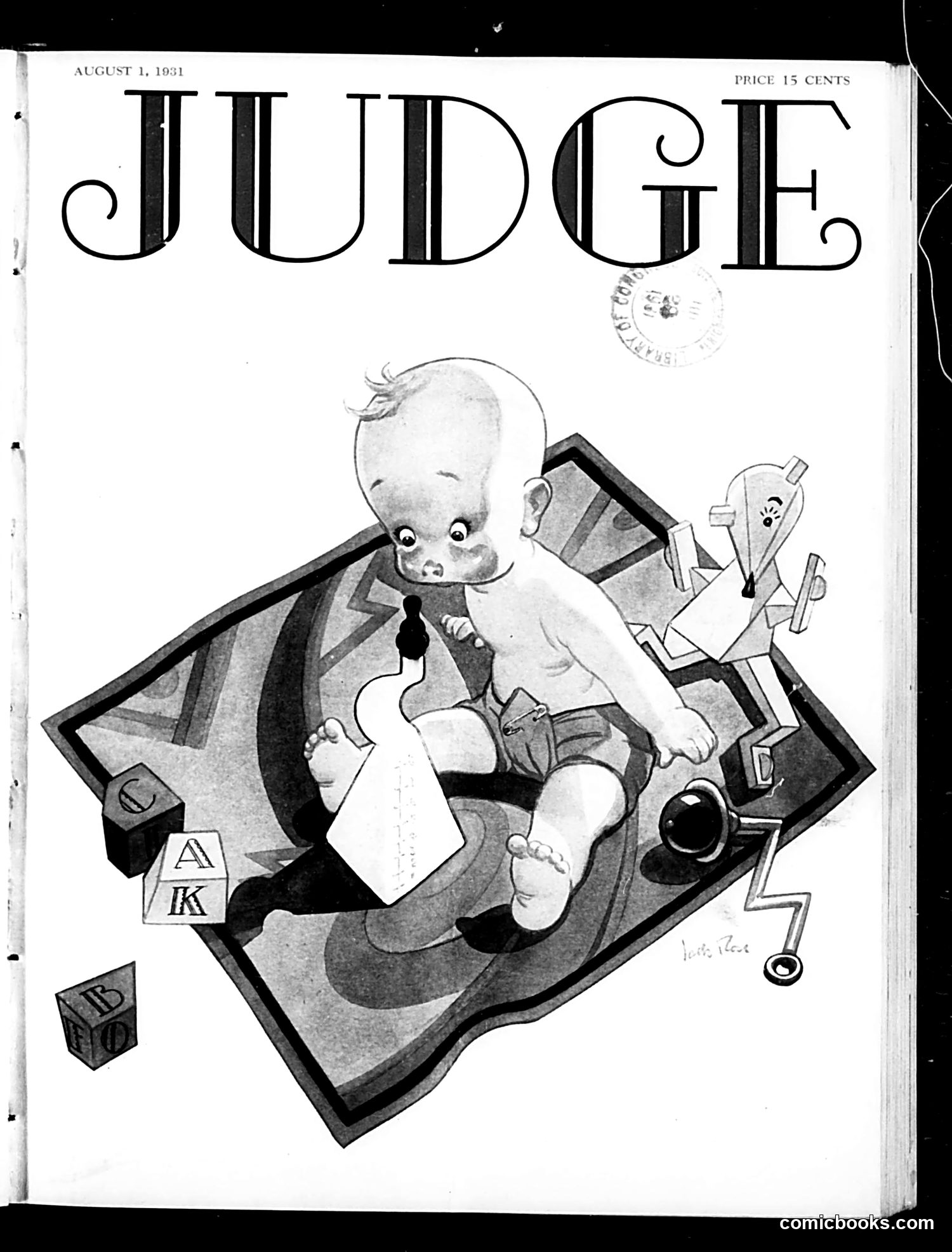
Judge Magazine Cover, August 1, 1931 This cover depicts a stylized baby surrounded by toys and blocks labeled with letters (A, K, B). The infant appears dressed like a businessman or adult—wearing a tie and suit jacket—while holding what looks like a handkerchief or document. The satire likely comments on infantilized leadership or political figures during the Great Depression era (1931). The juxtaposition of a baby in adult clothing suggests commentary on the immaturity or incompetence of politicians or businessmen supposedly managing the economic crisis. The toys and blocks reinforce the theme of childish, toy-like governance during serious economic turmoil. However, without identifying specific OCR text content, the exact political target remains unclear.
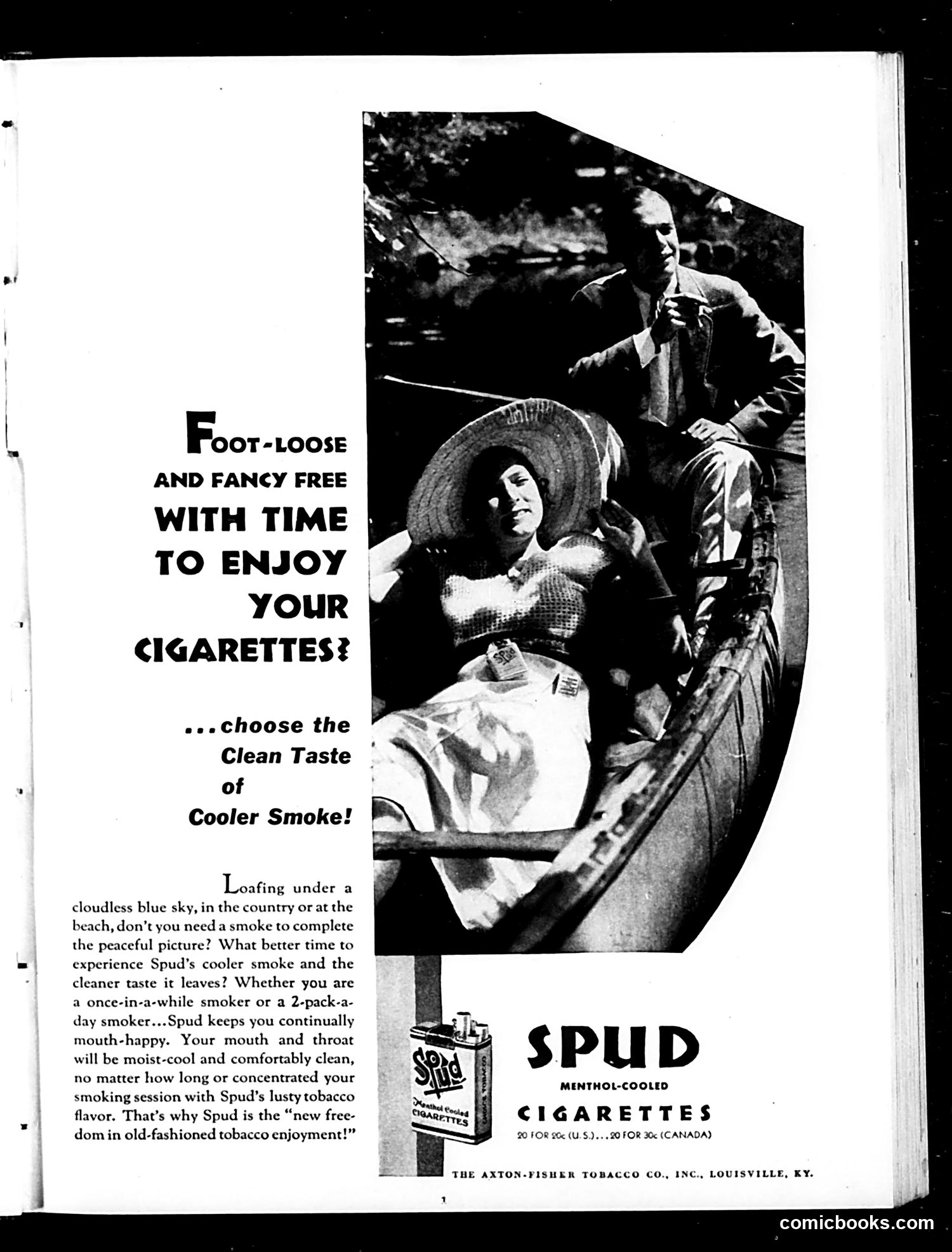
Analysis This is a cigarette advertisement, not satire or political commentary. It's a vintage Spud menthol cigarettes ad from the Axton-Fisher Tobacco Company (Louisville, Kentucky), pricing at 20 for 10¢ US / 20 for 3¢ Canada. The ad depicts a couple relaxing outdoors—a woman in a wide-brimmed hat and man in casual clothing—promoting smoking as a leisure activity. The marketing pitch emphasizes "clean taste" and "cooler smoke," claiming the product keeps one's "mouth and throat...comfortably clean" regardless of smoking frequency. This reflects mid-20th century tobacco marketing that normalized smoking and made unsubstantiated health claims. Modern readers would recognize this as historically significant evidence of aggressive cigarette promotion before health regulations and warnings were implemented.
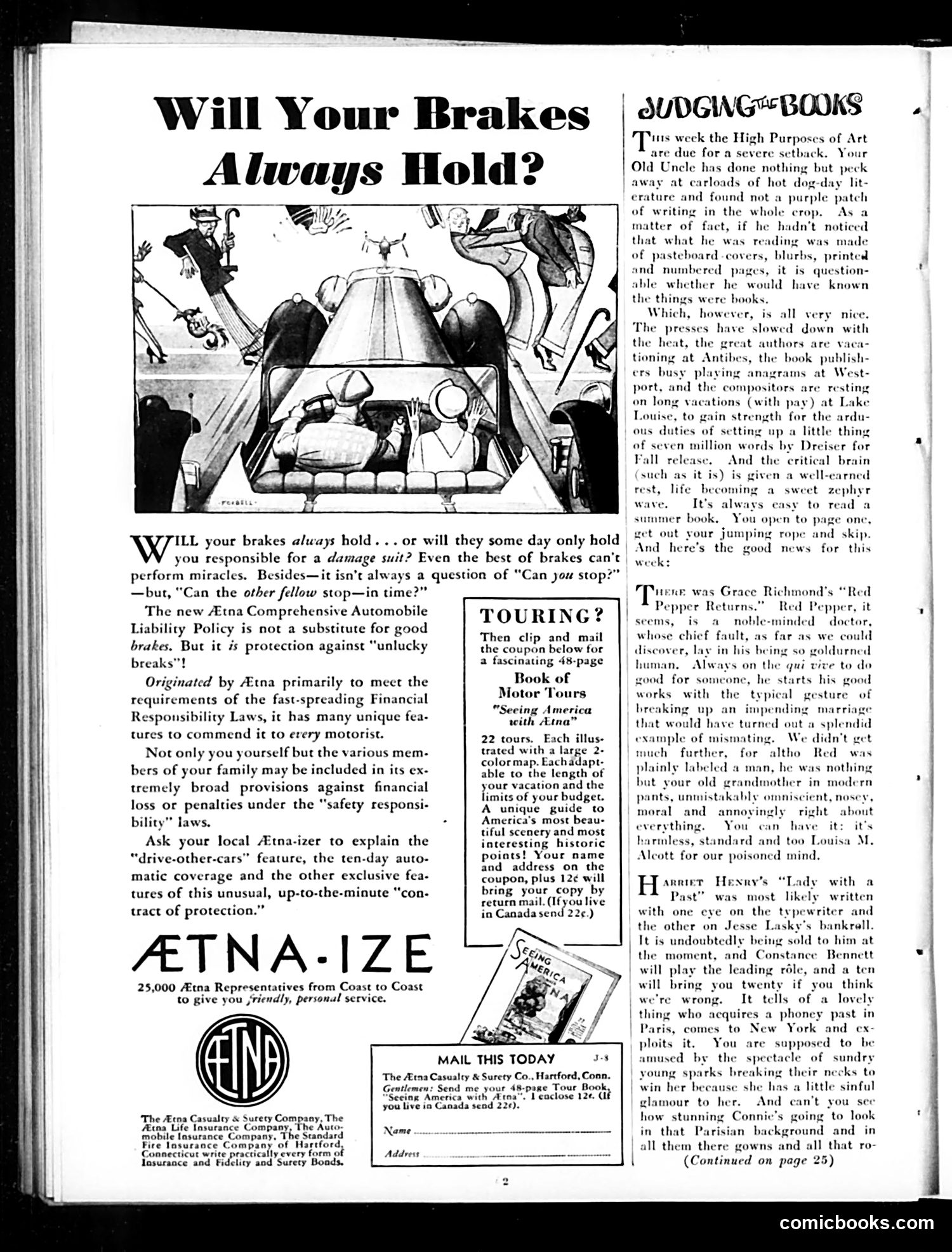
Analysis of Judge Magazine Page This page is primarily advertising-driven, featuring an Aetna Insurance advertisement for automobile liability coverage. The large cartoon depicts a dramatic car accident with passengers being thrown from a vehicle, illustrating the advertisement's message about brake failure and financial liability risks. The satire is implicit rather than explicit: the ad uses fear-based messaging about whether brakes will "always hold," positioning Aetna's "Comprehensive Automobile Liability Policy" as protection against unexpected accidents and lawsuits. The right column contains book reviews under "Judging the Books," offering literary commentary unrelated to the insurance messaging. Context for modern readers: This reflects early-20th-century concerns about automobile safety and the emerging need for liability insurance as cars became widespread.
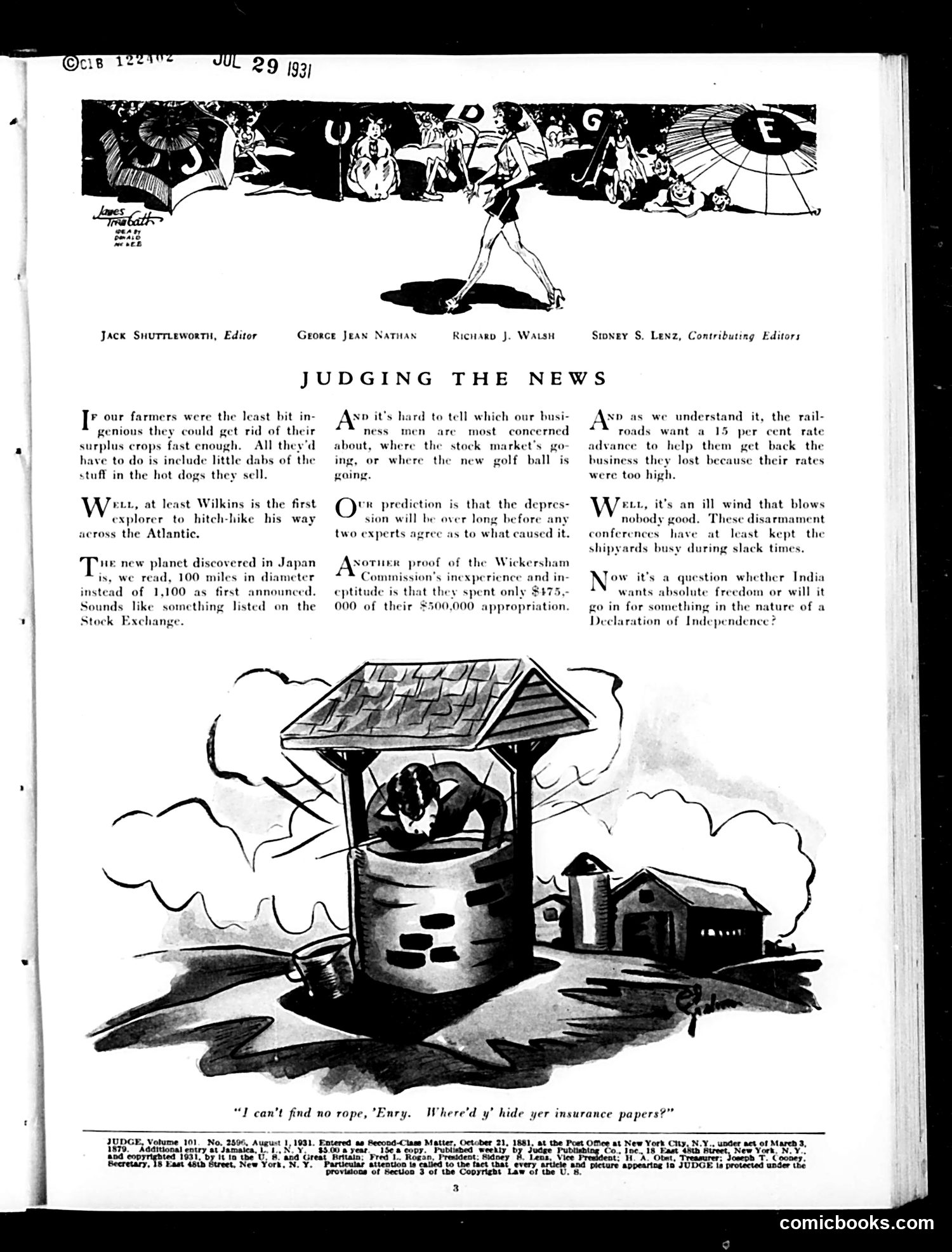
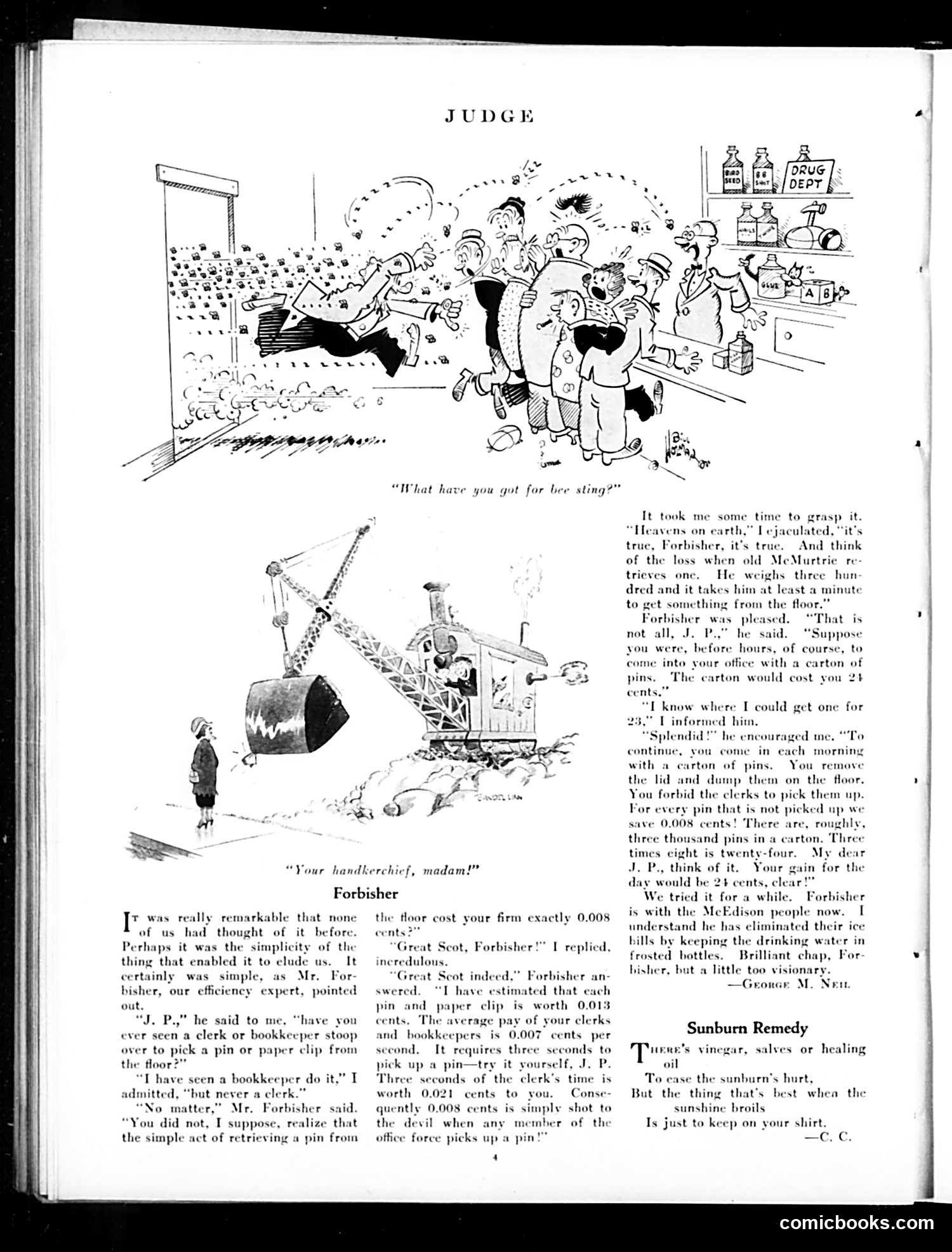
Explanation for Modern Readers The top cartoon satirizes workplace efficiency obsession. A judge observes someone being violently expelled from a drug store, captioned "What have you got for lice sting?" The accompanying story "Forbisher" mocks a boss's obsessive cost-cutting: calculating that retrieving dropped pins saves money (0.008 cents per pin). The satire targets early 20th-century industrial "scientific management" crazes, where employers nitpicked trivial savings while creating absurd workplace policies. The lower cartoon shows someone holding a large handkerchief, captioned "Your handkerchief, madam!" The bottom feature, "Sunburn Remedy," offers folk advice about treating sunburn with vinegar and staying indoors—light humor about summer complaints. The page satirizes American business culture's extreme cost-consciousness and managerial fads of the era.
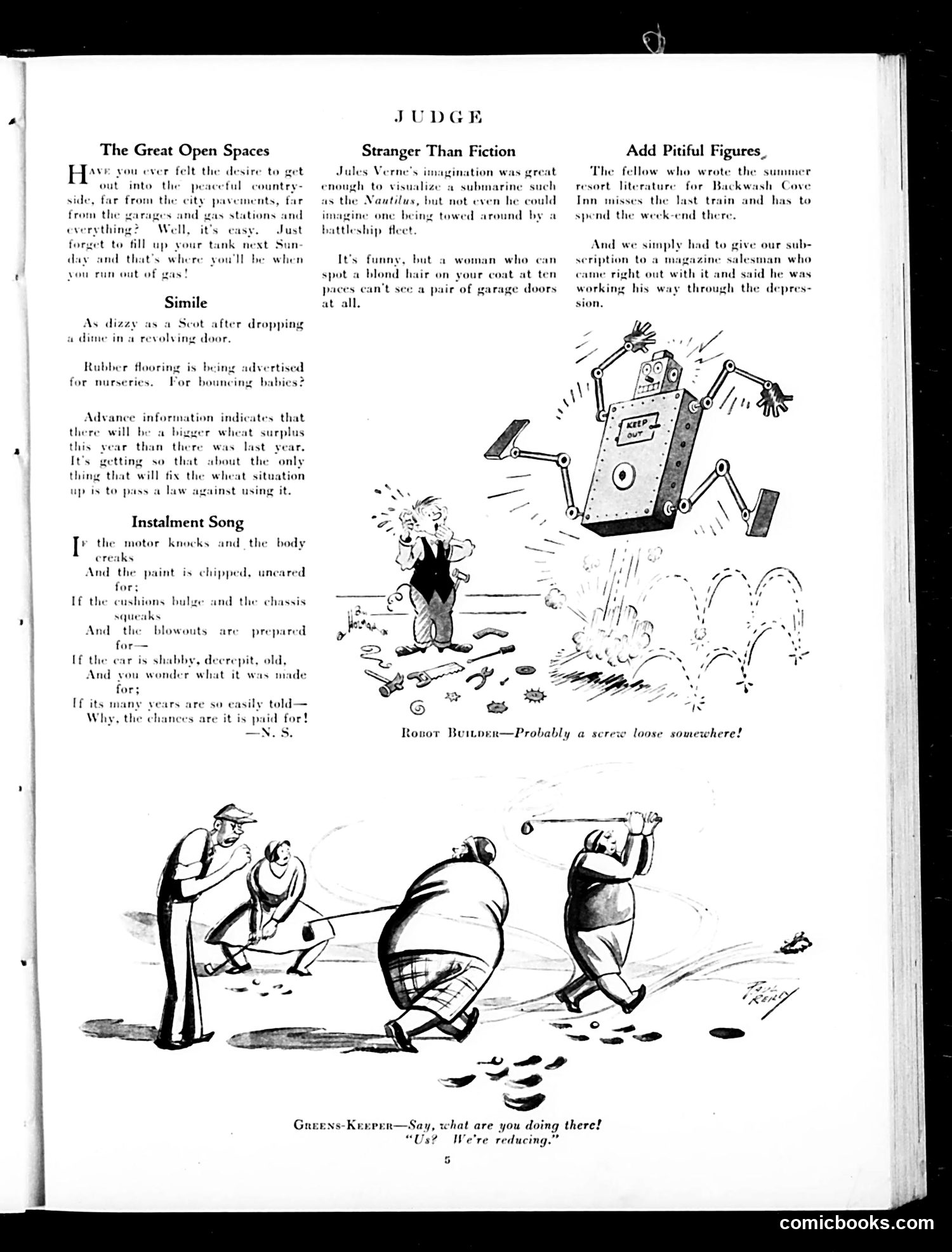
Judge Magazine Page Analysis This page contains three separate humor pieces: 1. "The Great Open Spaces" - A brief joke about running out of gas on a Sunday drive in the countryside. 2. "Instalment Song" - A poem by N.S. mocking the poor condition of cars purchased on installment plans, with worn motors, cracked bodies, and unreliable chassis. This satirizes both automobile quality and the economic practice of installment buying, likely reflecting Depression-era concerns about consumer debt. 3. Two cartoons: The "Robot Builder" shows mechanical chaos; the "Greens-Keeper" depicts golfers apparently reducing the course's grass to bare ground—likely satirizing either over-maintenance or careless play. The content reflects early-to-mid 20th-century concerns: automobile reliability, installment purchasing, and leisure activities.
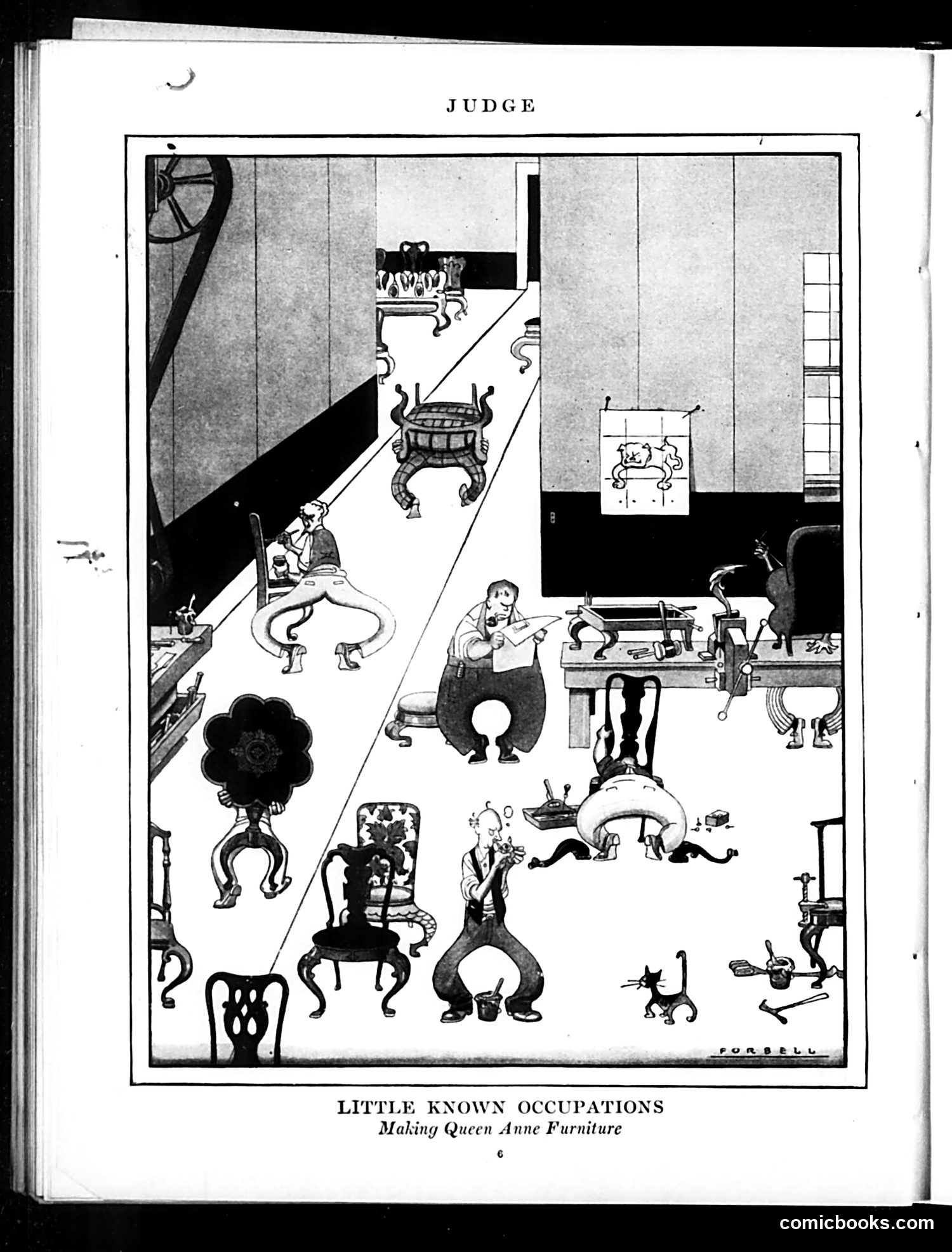
Explanation for Modern Readers This cartoon satirizes the furniture-making industry through the title "Making Queen Anne Furniture." The scene depicts a chaotic workshop where various grotesque, contorted human figures are themselves being used as furniture—serving as chairs, tables, and other pieces. The satire appears to critique exploitative labor practices in furniture manufacturing, suggesting workers are treated as mere objects or raw materials rather than people. The exaggerated, impossible body positions humorously illustrate the physical toll and dehumanization of factory work during the early 20th century. The "Queen Anne" style reference (an elegant furniture aesthetic) contrasts sharply with the grotesque scene, amplifying the joke: fine furniture supposedly comes from treating workers like disposable components. The signature indicates this was created by Forbell, a Judge magazine artist.
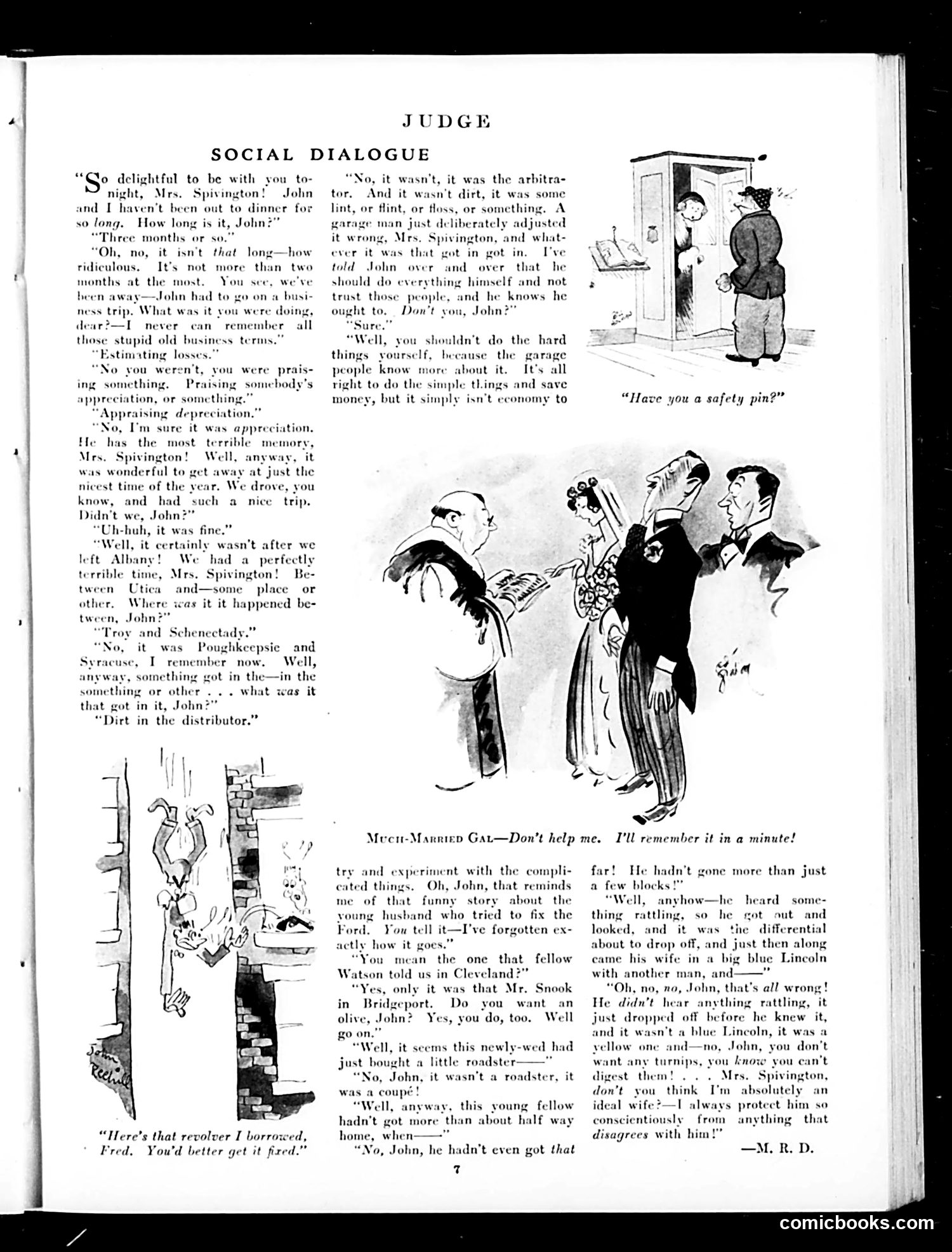
Judge Magazine Social Dialogue Cartoon This is a humorous domestic scene satirizing married couples' dinner conversations. Two couples (the Spivingtons and another pair) attempt to share anecdotes, but repeatedly interrupt and "correct" each other on trivial details—locations, car types, mechanical terms—while fundamentally agreeing on nothing. The satire targets: 1. Marital dynamics: The wife constantly corrects her husband's memory and details, claiming she's "protecting" him while actually dominating the conversation. 2. Social pretension: The characters discuss "appreciating depreciation" and other business jargon they barely understand. 3. 1920s automobile culture: The failed attempt to tell a story about a young husband fixing a Ford—a vehicle associated with ordinary people—becomes bogged down in contradictions about whether it was a roadster or coupe. The final caption reveals the joke: Mrs. Spivington's "corrections" aren't helpful—they're controlling behavior dressed as wifely devotion. The satire mocks both the mundane nature of such conversations and the power dynamics within marriage.
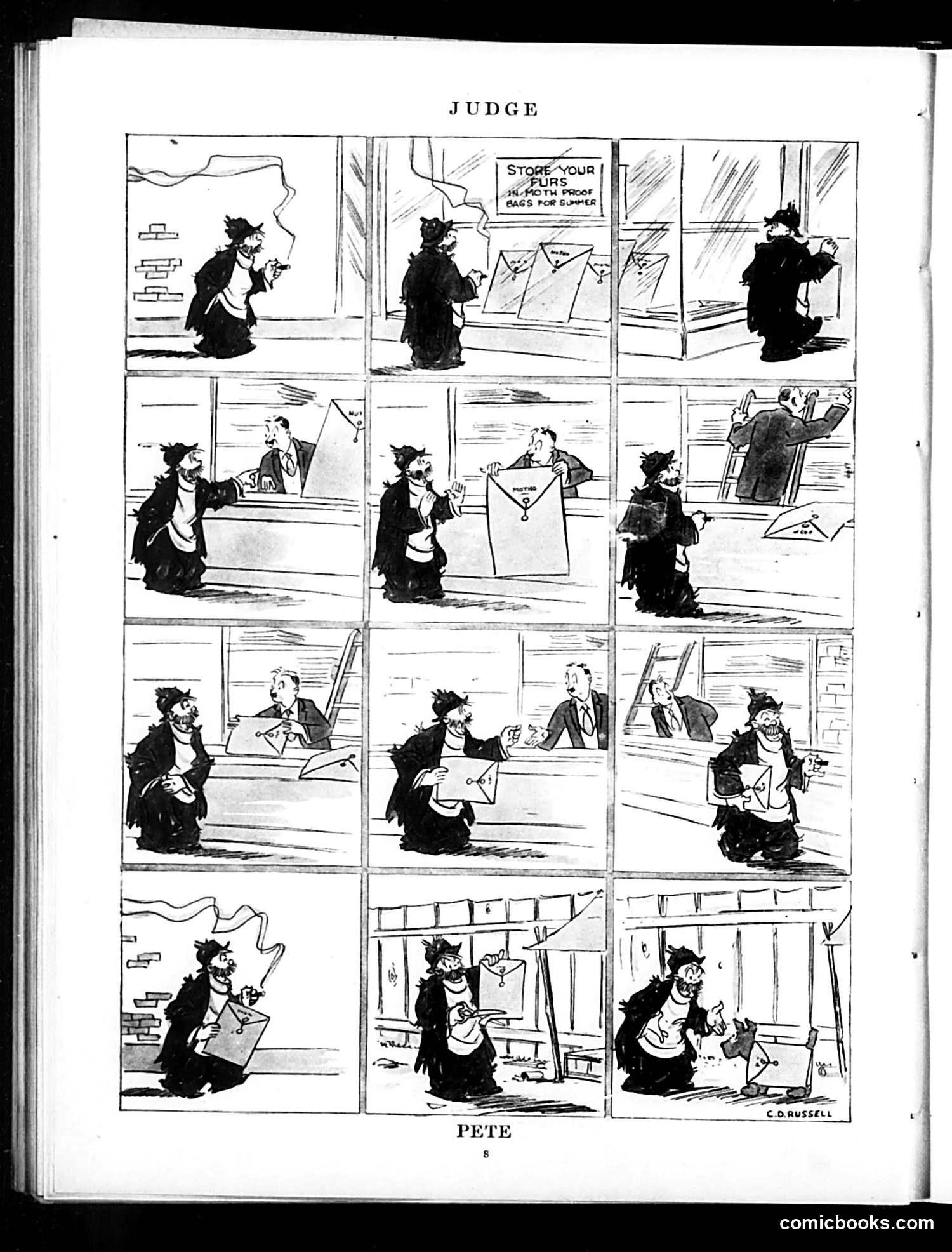
Analysis This is a comic strip titled "Judge" and "Pete" (credited to C.D. Russell) depicting a character repeatedly attempting to store furs and winter clothing for summer. The strip shows Pete visiting what appears to be a storage facility or business, presenting garments to be stored, and then retrieving them—with the joke escalating through repeated panels showing increasingly frantic or comedic interactions. The satire targets the seasonal storage industry and likely the expense or inconvenience of such services. The sign in the top panel reading "STORE YOUR FURS AND WINTER RAGS FOR SUMMER" suggests this mocks commercial practices of convincing consumers to pay for storage solutions. The humor derives from Pete's persistent efforts and the business's responses across multiple visits.
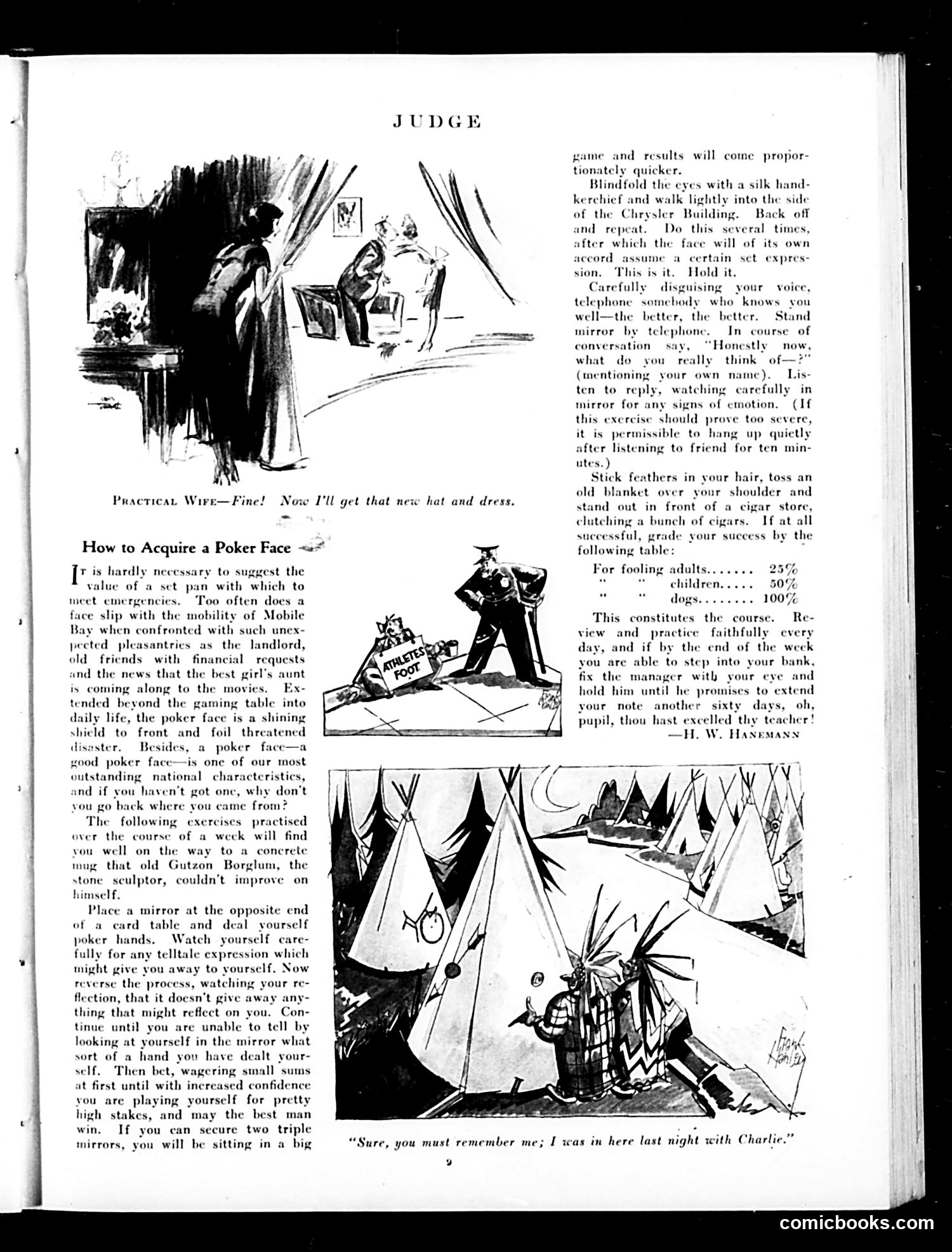
Judge Magazine Satire Analysis This page satirizes American masculine stoicism and emotional repression through absurdist humor. The main article, "How to Acquire a Poker Face," mocks the cultural ideal of the impassive, unreadable man—presented as a quintessential "outstanding national characteristic." The satire works by taking this social expectation to ridiculous extremes: practicing poker expressions in mirrors, walking blindfolded into buildings, disguising your voice to friends, and dressing as a Native American in front of cigar stores. The humor lies in treating emotional suppression as a learnable skill requiring systematic training, like developing a poker hand. The opening cartoon shows a "practical wife" announcing she'll acquire "that new hat and dress"—a domestic scene suggesting women's consumer desires contrasted with masculine restraint. The bottom cartoon depicts a camping scene with the caption about remembering "Charlie"—likely implying infidelity or compromising situations that a proper "poker face" would conceal. The underlying satire critiques American masculinity's demand for emotional opacity in both business (the banker scene) and personal life.
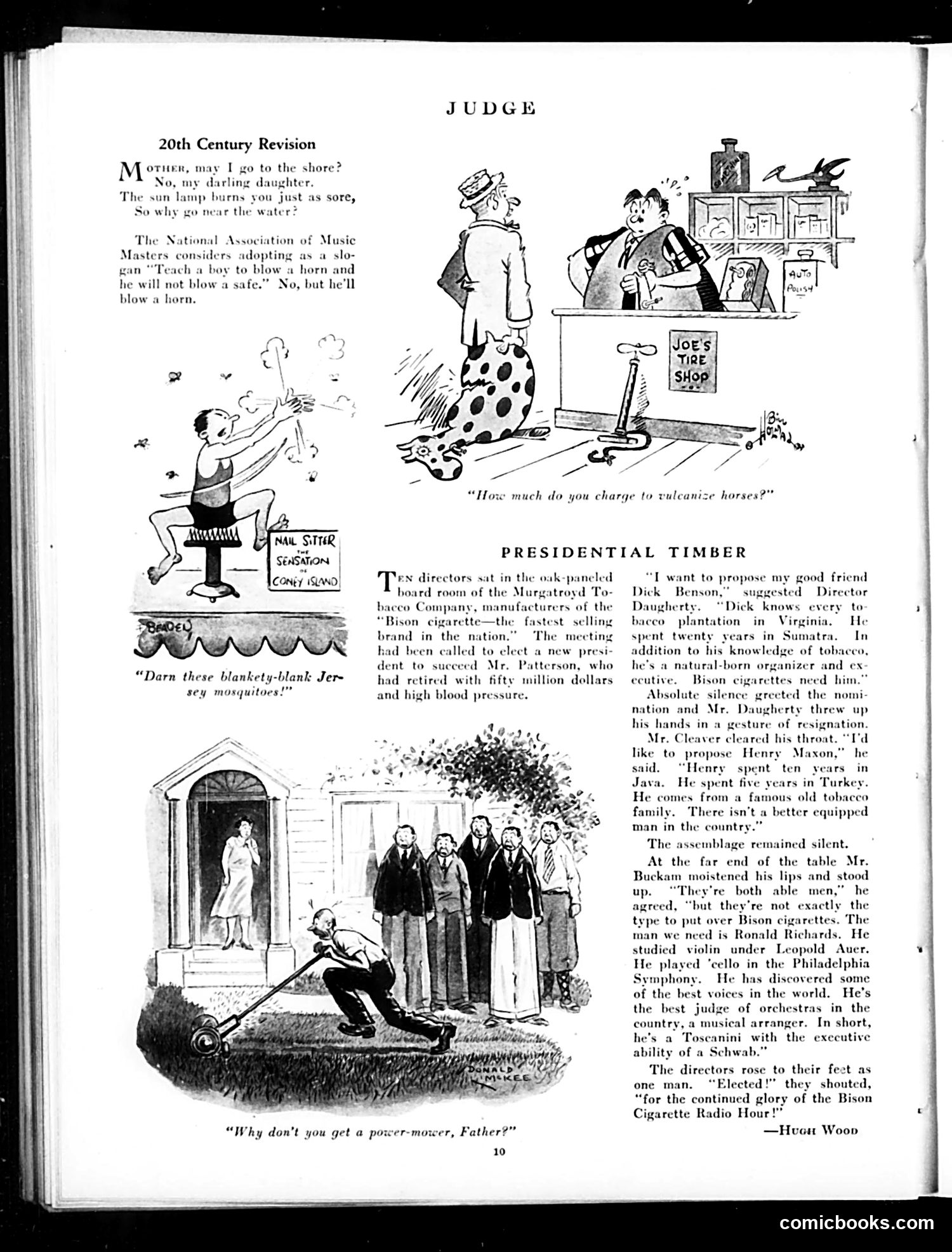
Explanation for Modern Readers This page contains three satirical pieces from *Judge* magazine: Top cartoons: Light social humor about sunlamps (newly fashionable), horn safety, and horse vulcanization—absurdist jokes with no deep political meaning. "Presidential Timber": The main satire mocks corporate cigarette marketing. Tobacco executives at Murgatroyd Company debate selecting a new president. They reject experienced tobacco men (Benson, Maxon) in favor of Ronald Richards—chosen solely because he's a classical musician and conductor with no tobacco expertise. The joke: This ridicules how corporations make foolish hiring decisions based on superficial qualities rather than actual qualifications. It also satirizes cigarette advertising's manipulation—suggesting a famous musician lends cultural prestige to an inherently dubious product. The irony is that a Toscanini-like figure somehow qualifies to lead a tobacco company, exposing the absurdity of modern advertising and executive recruitment.
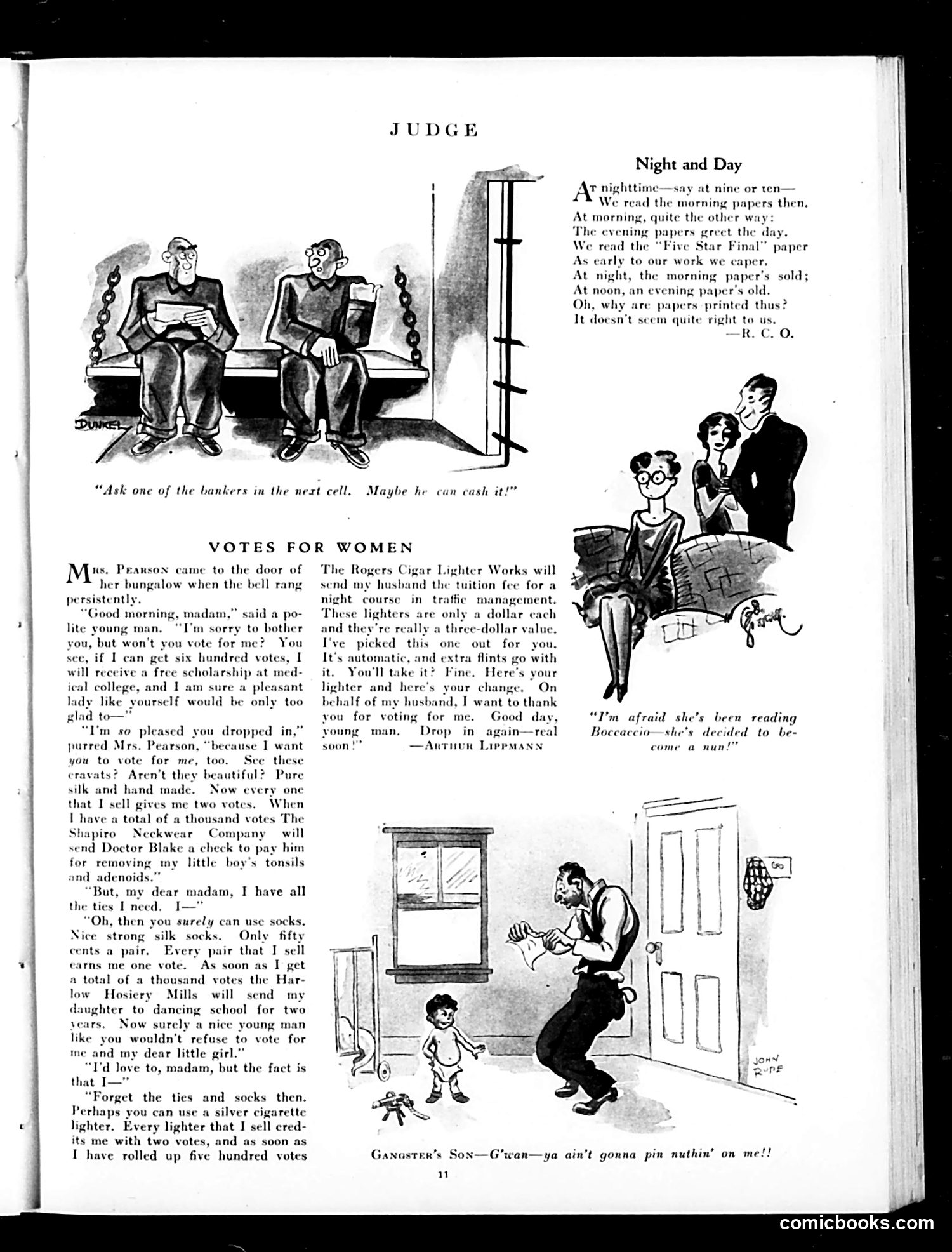
"Votes for Women" Satire This cartoon mocks women's newly gained voting rights (women gained the vote in 1920) by depicting a persistent saleswoman, Mrs. Pearson, who uses the voting system as a sales scheme. She leverages her own vote and pressures a young man to "vote for her" repeatedly—but each "vote" requires him to purchase merchandise (neckties, socks, cigarette lighters) from her. The scheme promises rewards: her husband gets tuition, her daughter gets dancing lessons, a doctor gets paid for her son's surgery—all funded by accumulated "votes" from sales. The satire suggests women voters are manipulative and self-interested rather than politically conscious. The joke hinges on conflating literal voting with commercial transactions, implying women would corrupt the democratic process for personal profit. The top cartoon about "bankers" in cells adds a corruption theme. The page's other content—"Night and Day" poem and "Gangster's Son" cartoon—are unrelated fillers typical of period magazines.
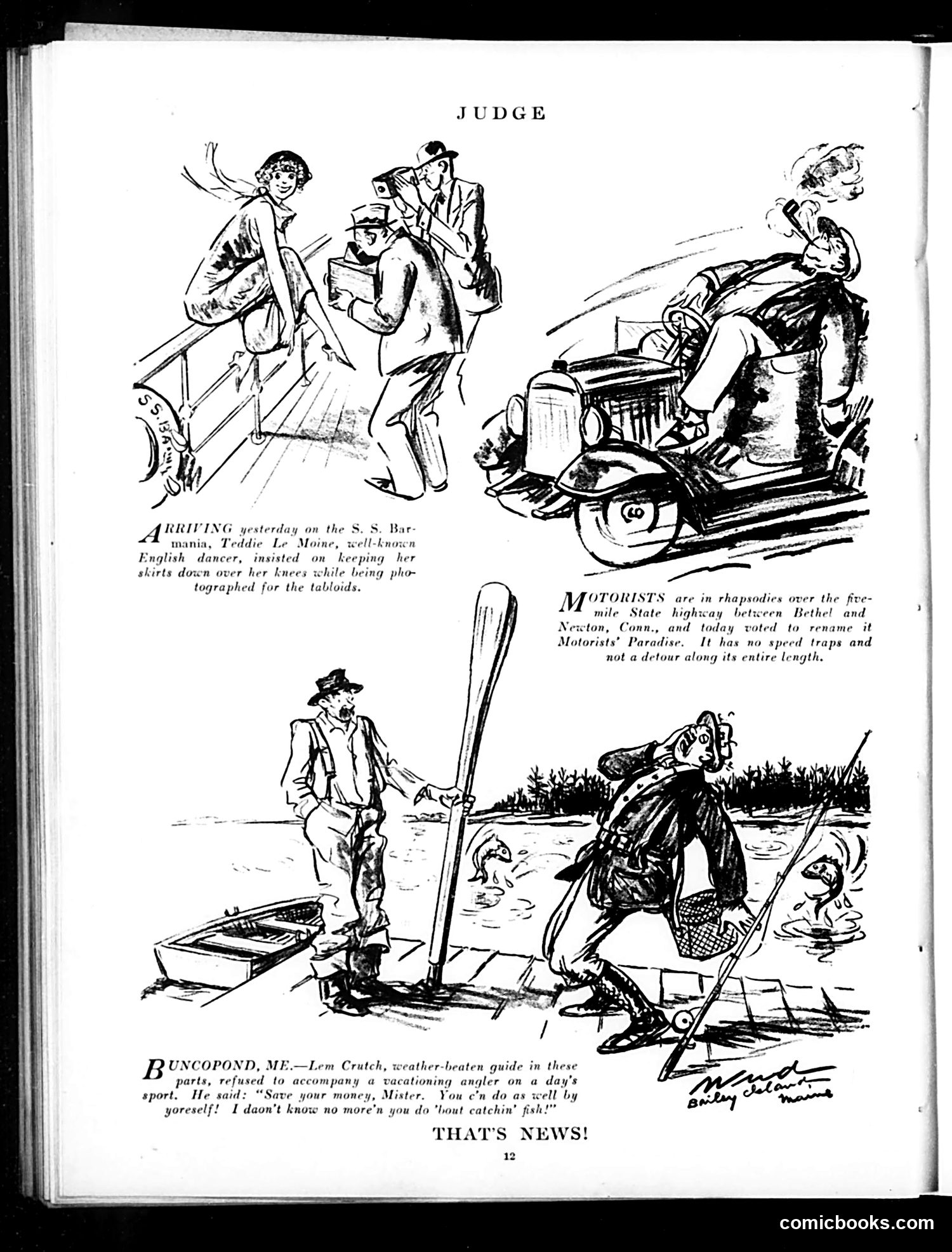
Analysis of Judge Magazine Page This page contains three separate satirical news items: 1. Top left: Mocks an English dancer (Teddie Le Moine) who insisted on modest photography despite being a public performer—satirizing the contradiction between her profession and sudden propriety for publicity. 2. Top right: Satirizes a newly completed highway between Connecticut towns that motorists celebrated as "Motorists' Paradise" specifically because it *lacks* speed traps and detours. The joke targets both reckless drivers and poorly-regulated roads—what motorists praised (no enforcement) represents unsafe conditions. 3. Bottom: A Maine fishing guide ironically admits his incompetence, claiming he knows no more about catching fish than his client. This self-deprecating humor mocks guides who overcharge tourists while providing little genuine expertise. All three items use irony to critique social pretension, poor civic infrastructure, and tourist exploitation—typical early-20th-century American satirical targets.
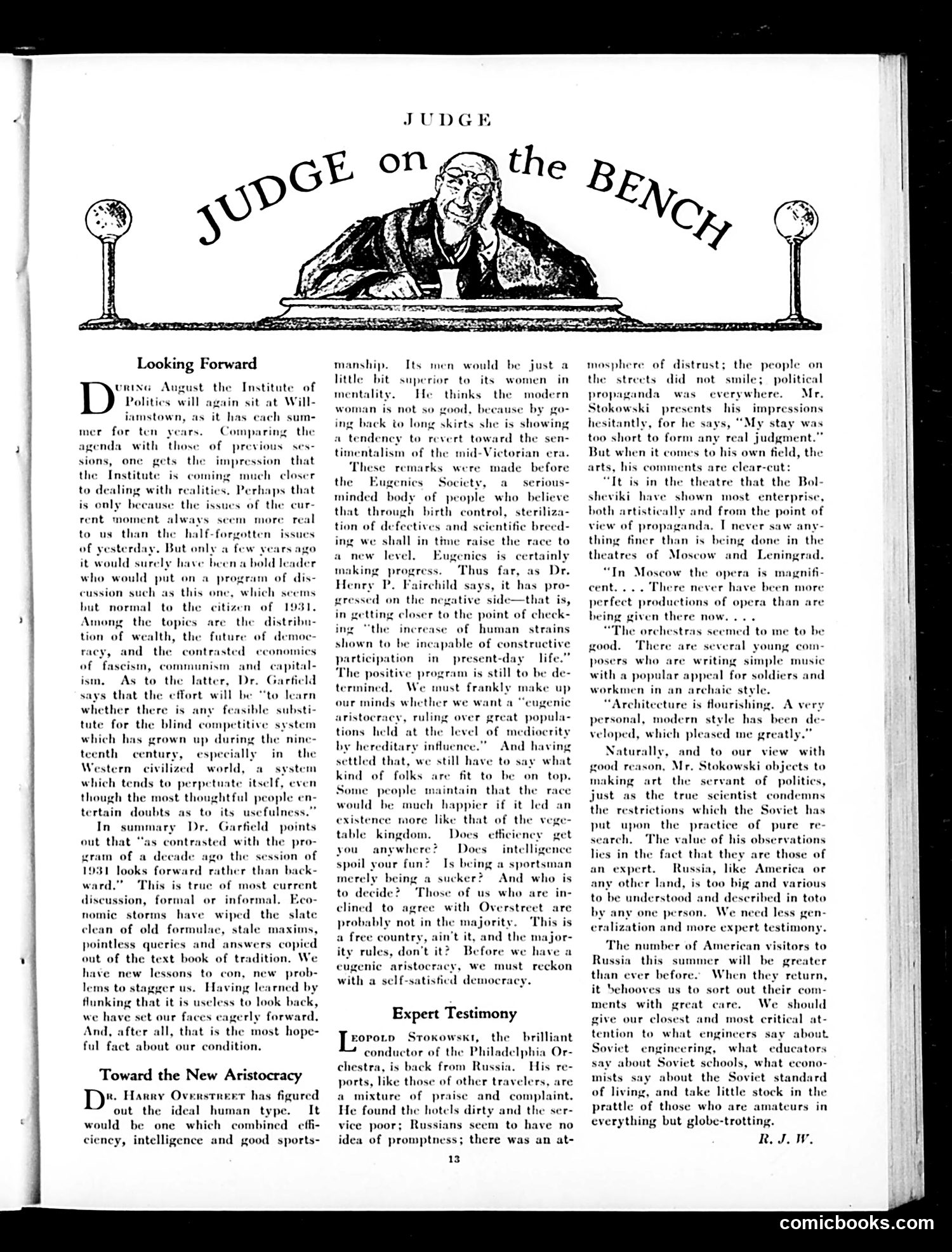
Judge Magazine: "Judge on the Bench" (Page 13) This page contains two opinion columns, not a cartoon. The masthead features a judge sitting at a bench—a visual framing device for satirical social commentary. "Looking Forward" discusses the Institute of Politics' August sessions, praising its shift toward addressing contemporary realities (wealth distribution, democracy, fascism, communism, capitalism) rather than outdated theories. The author celebrates this forward-thinking approach as hopeful. "Toward the New Aristocracy" satirizes Dr. Harry Overstreet's vision of an "ideal human type" combining efficiency, intelligence, and sportsmanship—with men slightly superior to women mentally. The piece mocks the Eugenics Society's related goals of "scientific breeding" and birth control to "raise the race." The satire targets both eugenics' pretensions and the tension between aristocratic ideals and democratic principles: who decides who's "fit to be on top"? Context: This reflects 1930s American anxieties about eugenics (then respectable among intellectuals) and competing ideological systems during the Depression era.
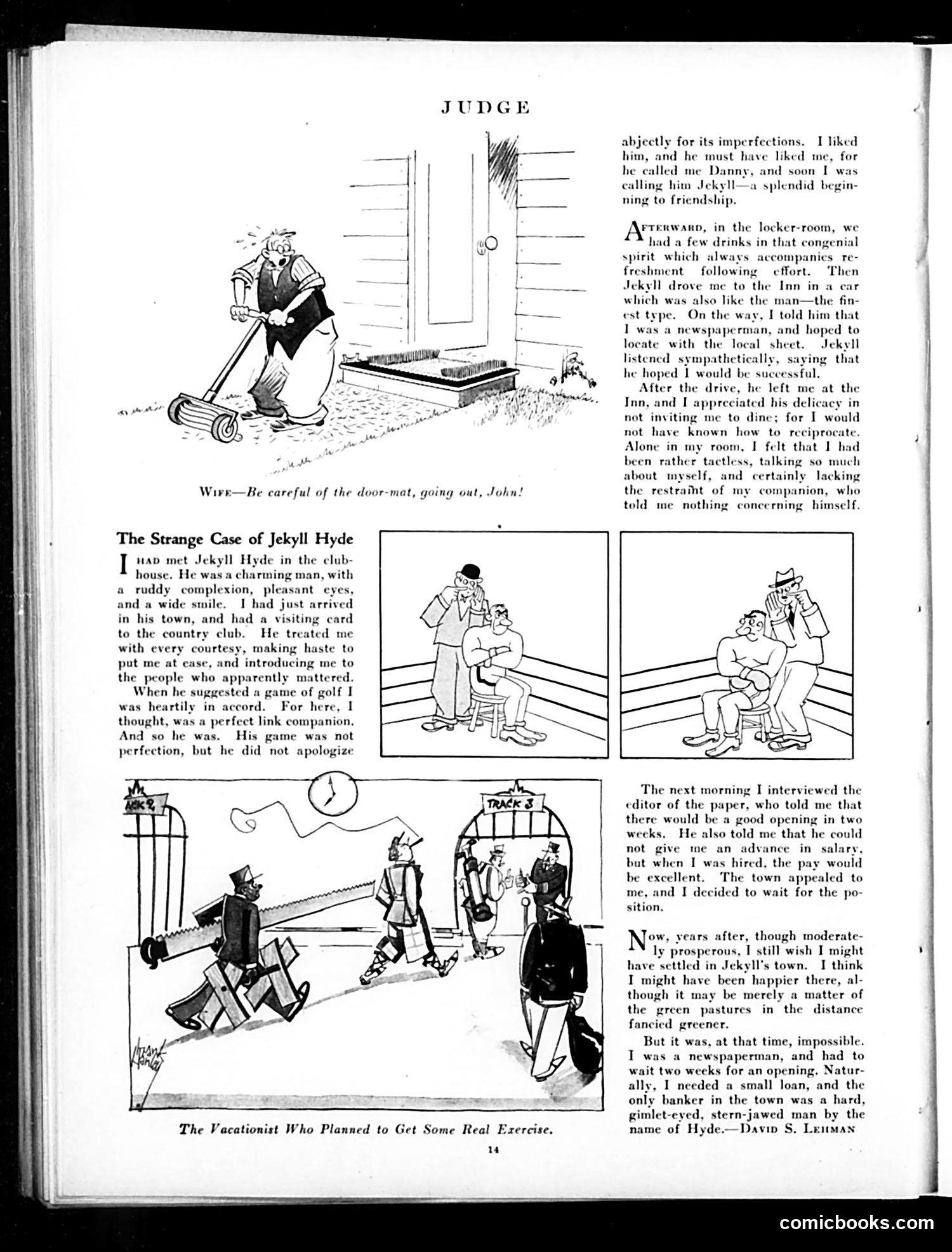
"The Strange Case of Jekyll Hyde" This is a satirical story playing on Robert Louis Stevenson's *Dr. Jekyll and Mr. Hyde* (1886). The narrator meets a charming, generous man named Jekyll Hyde in a small town and considers settling there. However, when he needs a loan, he discovers the town's banker is also named Hyde—described as "hard, gimlet-eyed, stern-jawed"—presumably a ruthless businessman. The satire contrasts Jekyll's pleasant public persona with Hyde's financial ruthlessness, suggesting that respectable small-town society harbored two-faced characters. The cartoons show Jekyll's generosity (inviting the narrator golfing, driving him around) and the financial obstacles the narrator faces when dealing with the banker Hyde. The humor targets both Stevenson's famous duality theme and early-1900s small-town hypocrisy—where surface charm masked cutthroat business practices.
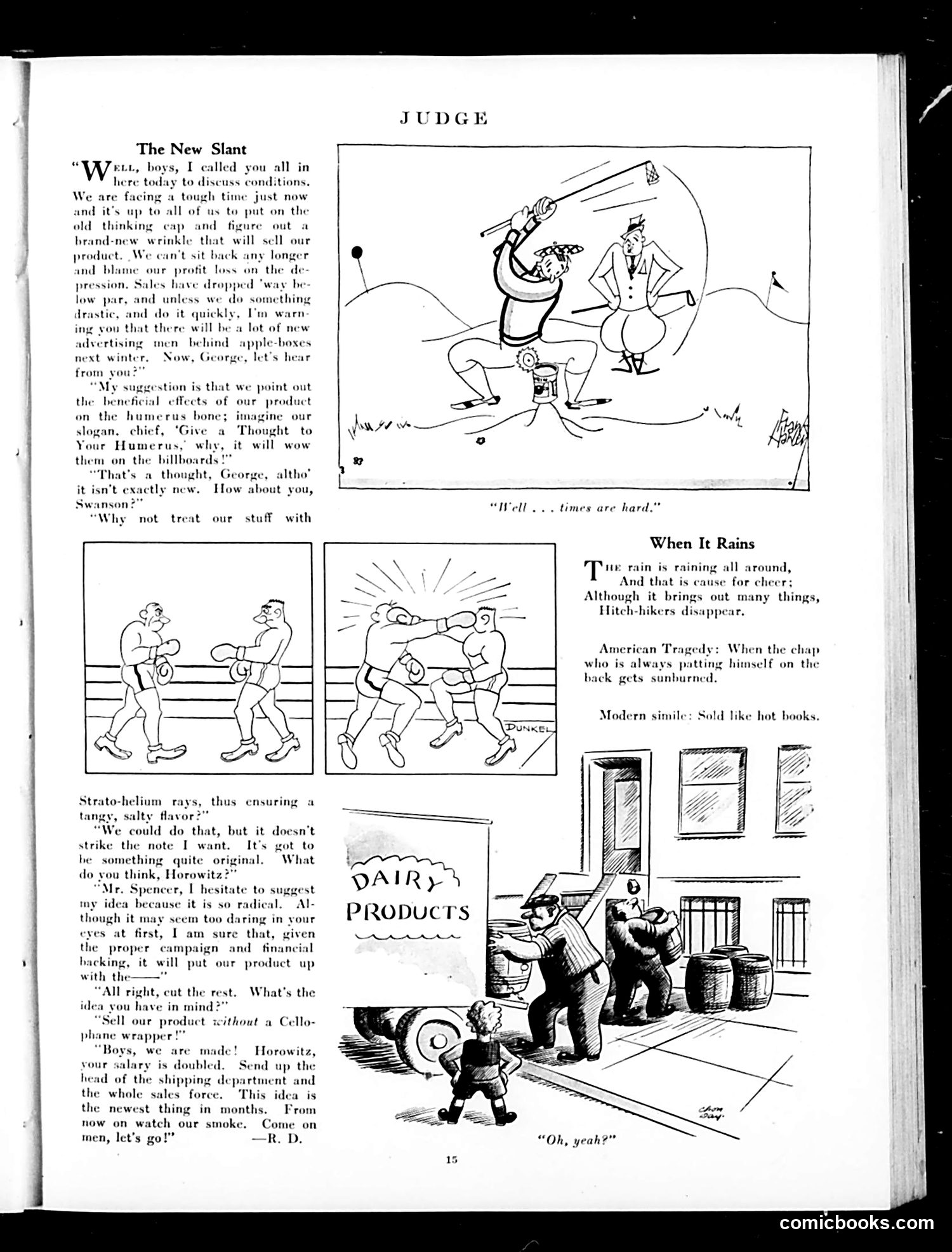
Analysis of Judge Page This page satirizes Depression-era business desperation. In "The New Slant," executives frantically brainstorm marketing gimmicks to boost sagging sales, dismissing each idea until someone suggests selling dairy products in cellophane wrappers—treated as revolutionary genius. The satire targets corporate absurdity: executives grasp at trivial innovations (adding strato-helium rays for "salty flavor," wrapping products differently) as salvation during economic crisis, when fundamentals have failed. The final cartoon shows workers hauling dairy products, with one's skeptical "Oh, yeah?" undercutting the executive's optimism. "When It Rains" offers lighter humor—poetic observations about rain bringing things out while hikers disappear, and jokes about sunburned men who brag. Context: This reflects early 1930s Depression anxiety, when businesses adopted any marketing strategy, however superficial, hoping novelty would restore profits.
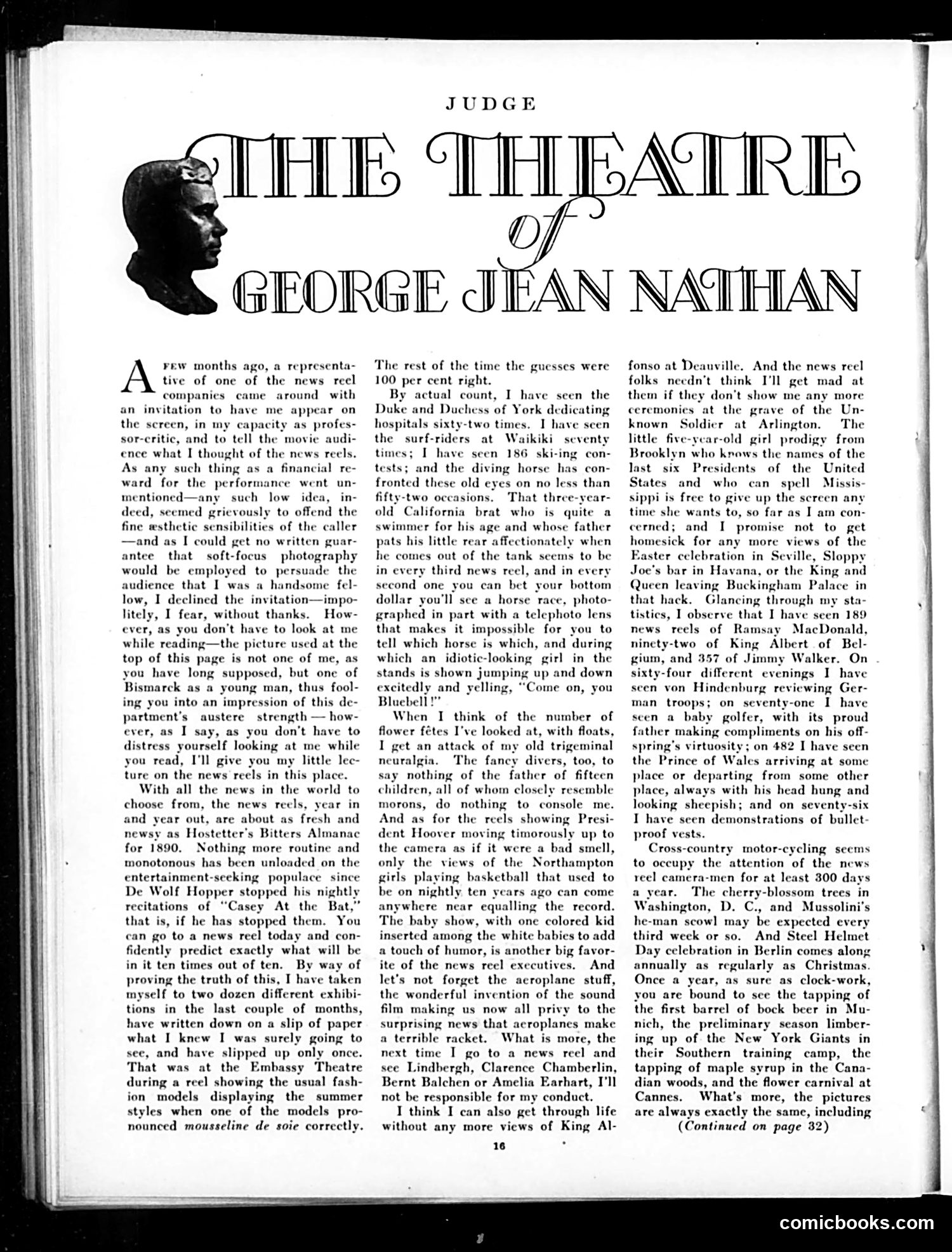
"The Theatre of George Jean Nathan" This is a humorous essay by Judge magazine's drama critic George Jean Nathan, not a political cartoon. Nathan satirizes the tedium of newsreel content — the short films shown before movies. His complaint: newsreels are relentlessly formulaic and repetitive. He lists the same tired subjects appearing constantly: the Duke and Duchess of York dedication ceremonies, surfers at Waikiki, ski competitions, a diving horse, a child swimmer, horse races, flower festivals, fancy divers, President Hoover, basketball games, and baby shows. Nathan mocks newsreel executives for recycling identical footage, claiming he can predict newsreel content with 100% accuracy by attending two dozen screenings. His only miscalculation: a fashion model correctly pronouncing "mousseline de soie." The portrait of Bismarck heading the piece is an ironic self-deprecating joke — Nathan uses it instead of his own photograph to avoid vanity. The satire targets 1920s-30s entertainment mediocrity and corporate laziness in the nascent newsreel industry.
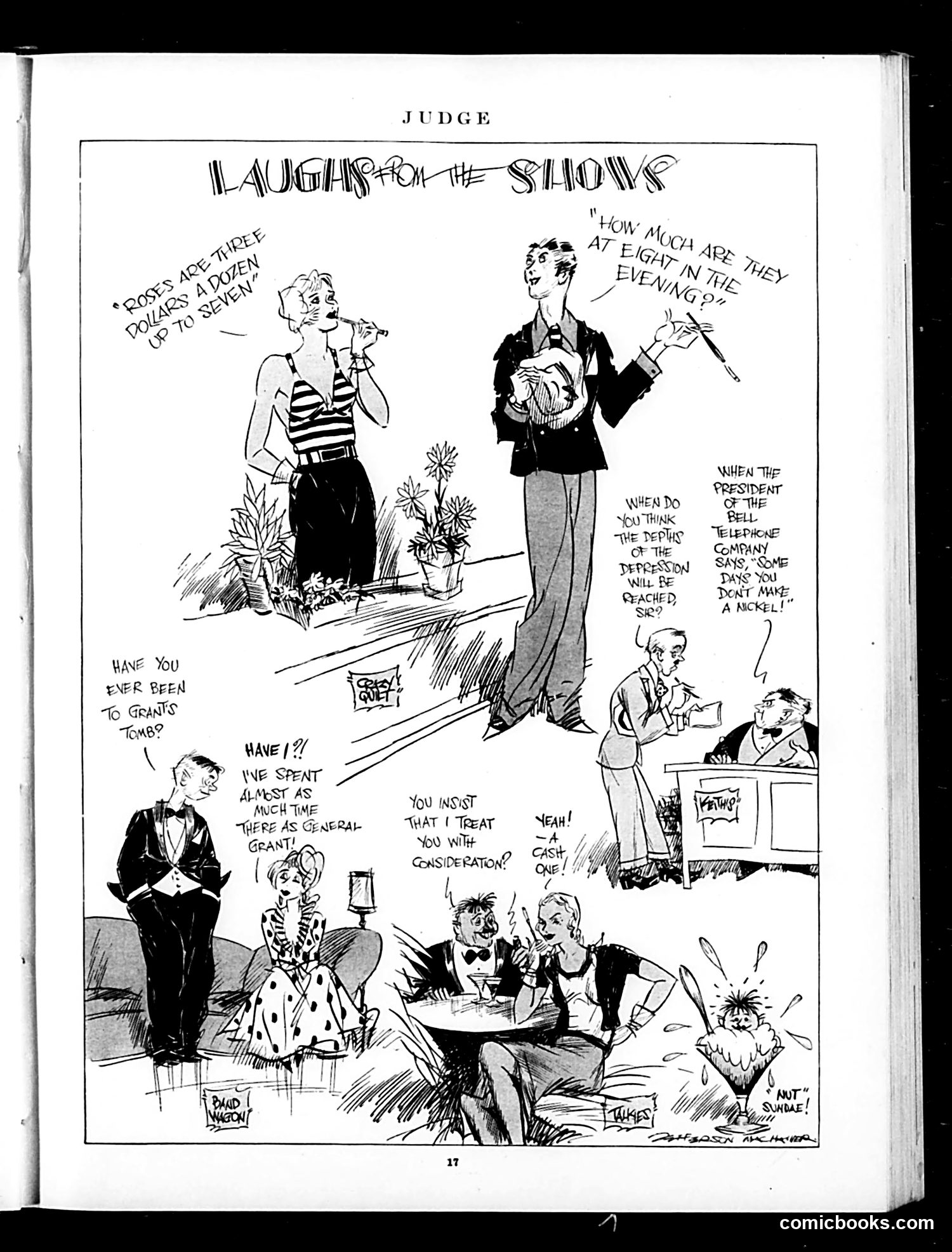
Judge Magazine Cartoon Analysis This single-panel cartoon satirizes wealthy socialites' obliviousness to economic hardship during what appears to be the Great Depression era. The scene depicts an elegant dinner party where guests discuss frivolous concerns—roses costing a dozen dollars, expensive evening wear, telephone company complaints—while seemingly indifferent to broader economic collapse. One figure asks when "the depths of the depression will be reached," treating the nation's financial crisis as casual dinner conversation rather than urgent crisis. The satire targets the upper class's disconnect from ordinary Americans' suffering. The joke is that these privileged people discuss Depression economics abstractly while maintaining lavish lifestyles, revealing the vast gap between wealthy society and struggling working people. The cartoon uses the contrast between their elaborate evening and their casual reference to national disaster to critique both their insensitivity and their immunity from economic consequences others faced.
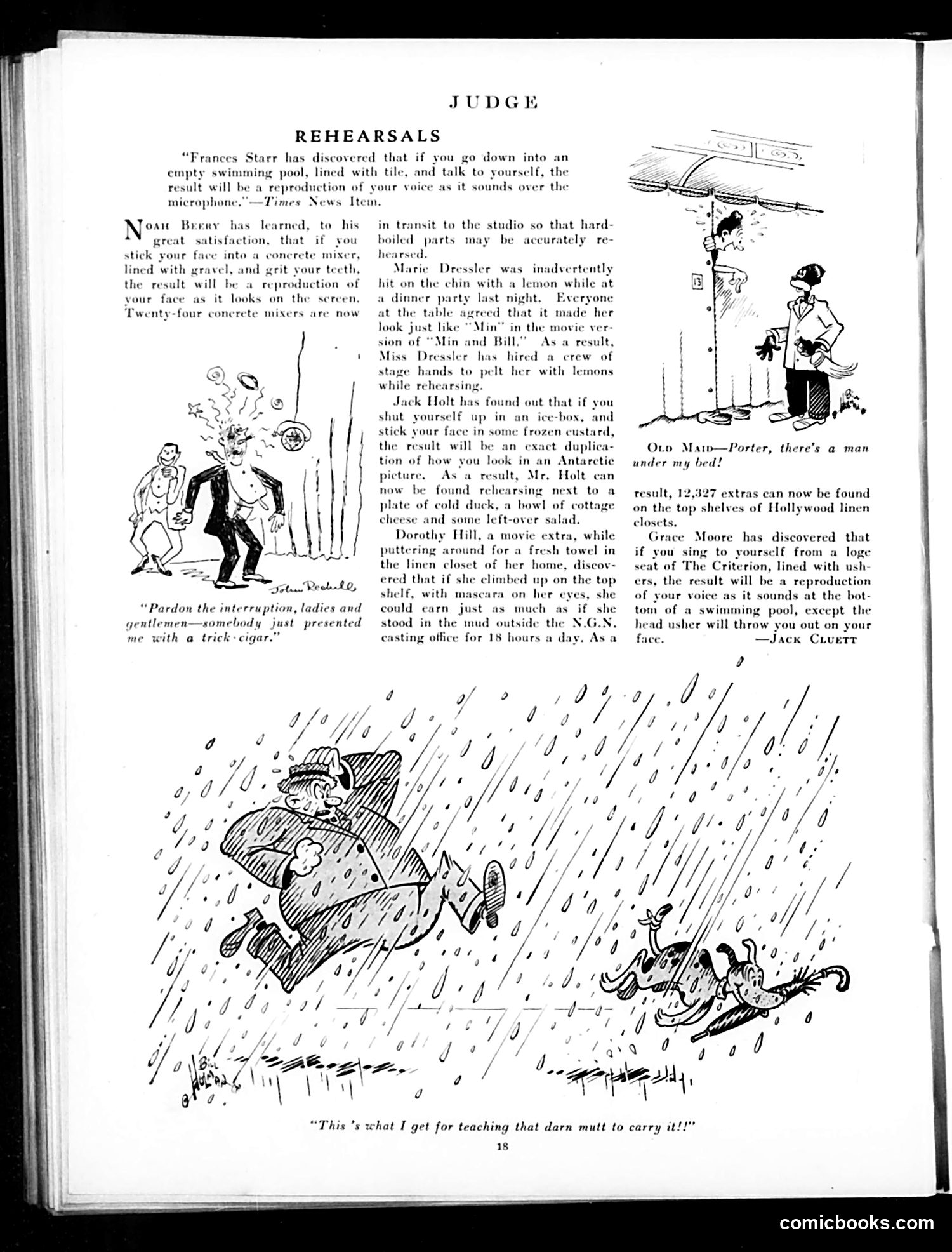
Judge Magazine Satire: "Judge Rehearsals" This page satirizes Hollywood actors' bizarre method-acting preparation techniques during the silent film era. The jokes mock famous performers—Noah Beery, Marie Dressler, Jack Holt, Dorothy Hill, and Grace Moore—by describing absurd "rehearsal methods" they allegedly use to achieve realistic performances. Each anecdote follows a formula: an actor performs an ridiculous physical act (stick face in concrete mixer, sit in ice box with frozen custard, climb into linen closets) supposedly to replicate how they'll appear on screen. The humor lies in the obvious absurdity—the results would obviously be terrible, not improved. The bottom cartoon shows a man in rain carrying a dog, presumably trained to carry things but now used impractically. This appears unrelated to the main satire. The overall point mocks both actors' pretentious devotion to "realism" in performance and the emerging mystique around Hollywood technique during the silent film period.
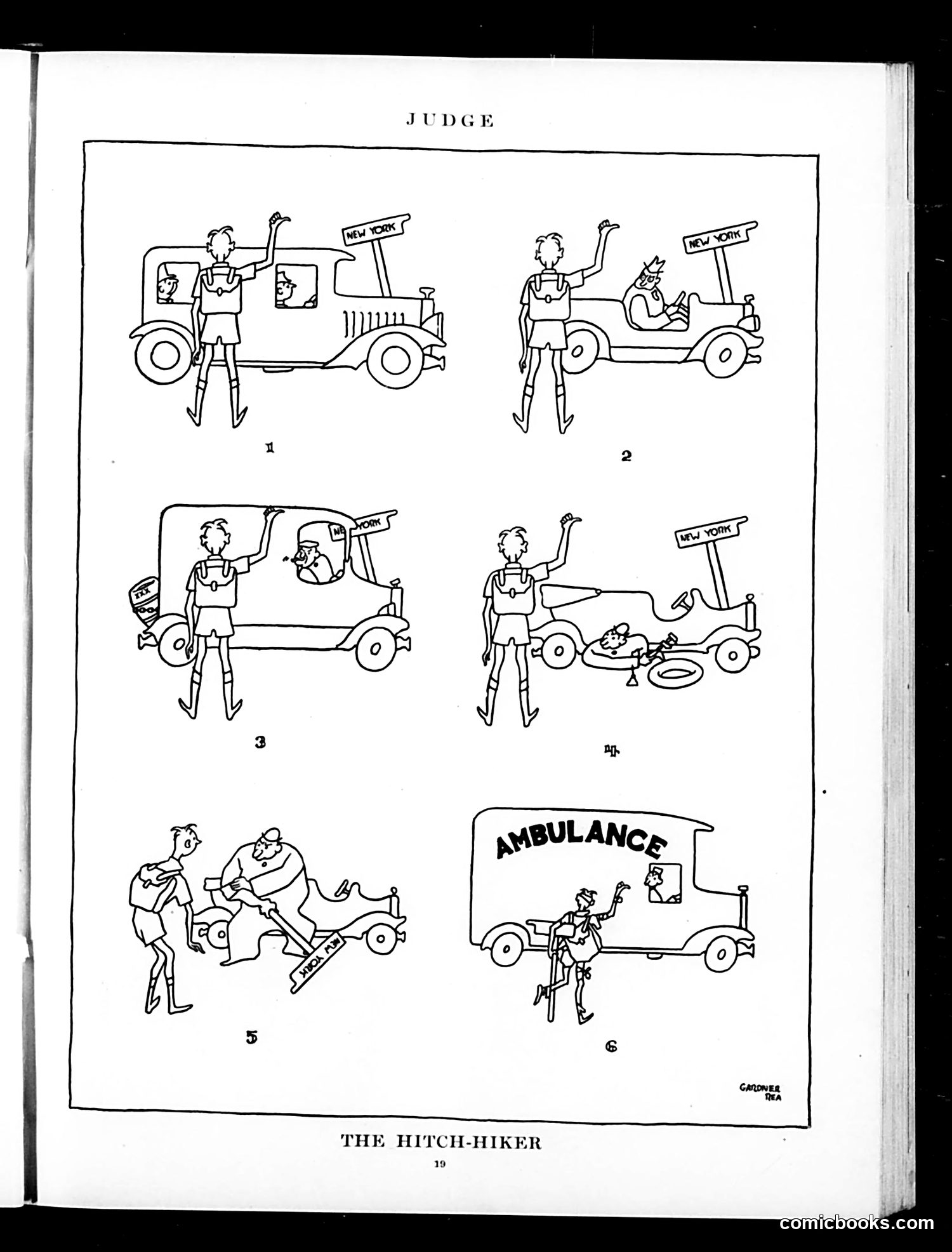
The Hitch-Hiker This Judge cartoon page depicts six sequential panels showing a woman judge making increasingly poor decisions while hitchhiking in New York vehicles. Panel 1 shows her properly judging two figures in a truck. By panel 2, she's judging while riding with a passenger. Panel 3 escalates with her judgment appearing distracted. Panel 4 shows her surrounded by toys and debris, judgment compromised. Panel 5 depicts an accident or collision. Panel 6 concludes with an ambulance. The satire critiques female judges as incompetent when distracted or "out of place"—the traveling/hitchhiking context suggests women judges lack focus or proper judgment. This reflects 1920s-era sexism questioning women's fitness for judicial authority. The deteriorating situations humorously "prove" this prejudiced premise through visual escalation.
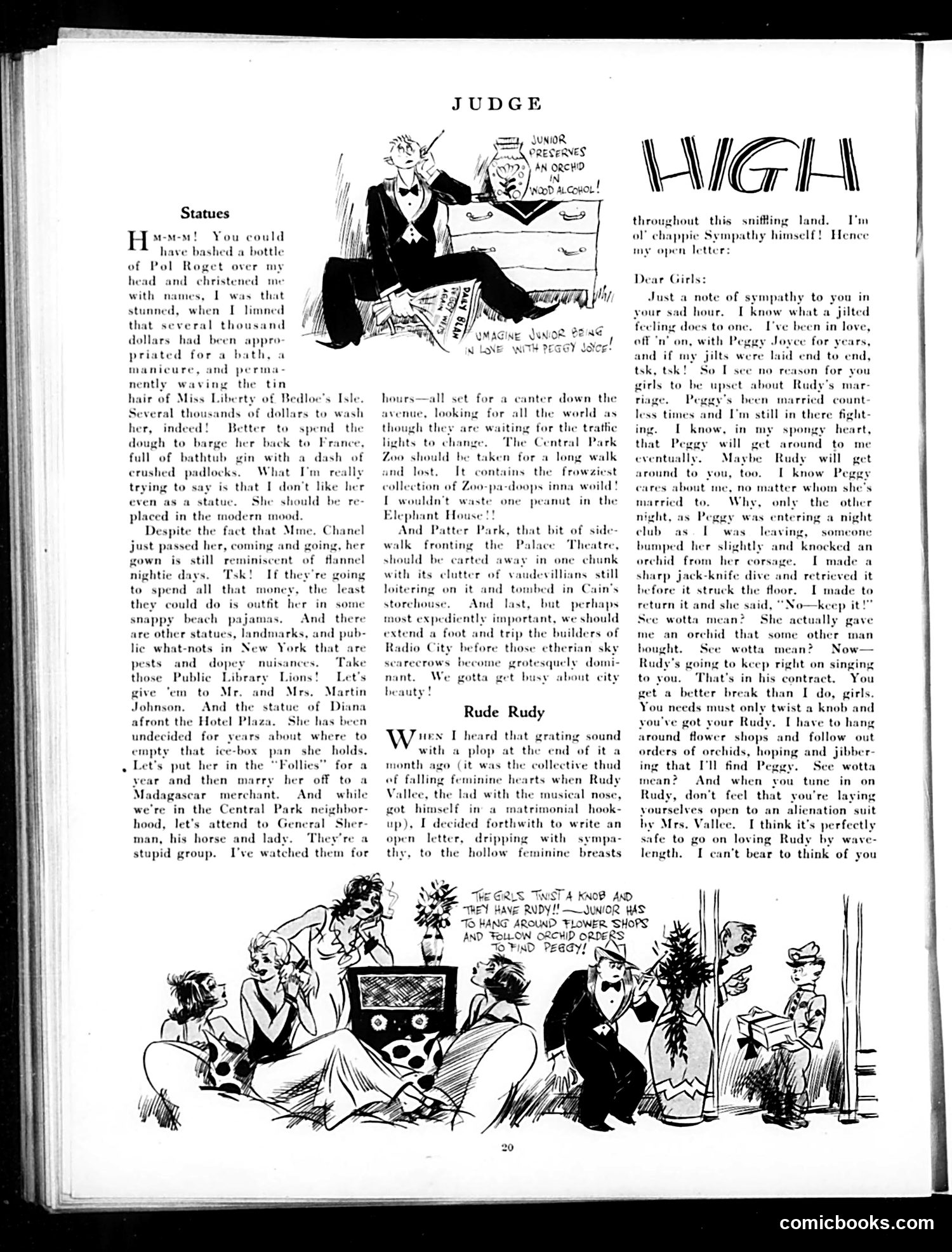
Judge Magazine Page Analysis This page satirizes two topics through commentary and cartoons: "Statues" section mocks the government spending thousands on restoring the Statue of Liberty—criticizing it as wasteful when the statue's outdated "flannel nightie" appearance needs complete redesign. The author sarcastically suggests returning Liberty to France or repurposing other NYC monuments (the Public Library Lions, General Sherman statue, Radio City buildings) as eyesores cluttering the city. "Rude Rudy" section responds to Rudy Vallée's recent marriage. Written as mock-sympathetic to lovelorn female fans, the author consolingly compares his own endless romantic disappointments—particularly with actress Peggy Joyce—to their loss. The humor lies in the narrator's self-absorbed "consolation," essentially saying his romantic failures dwarf theirs, so they should accept Vallée's marriage philosophically since he'll continue singing to them anyway (contractually obligated). Both sections exemplify Judge's typical 1920s-30s sardonic humor targeting contemporary events and celebrity culture.
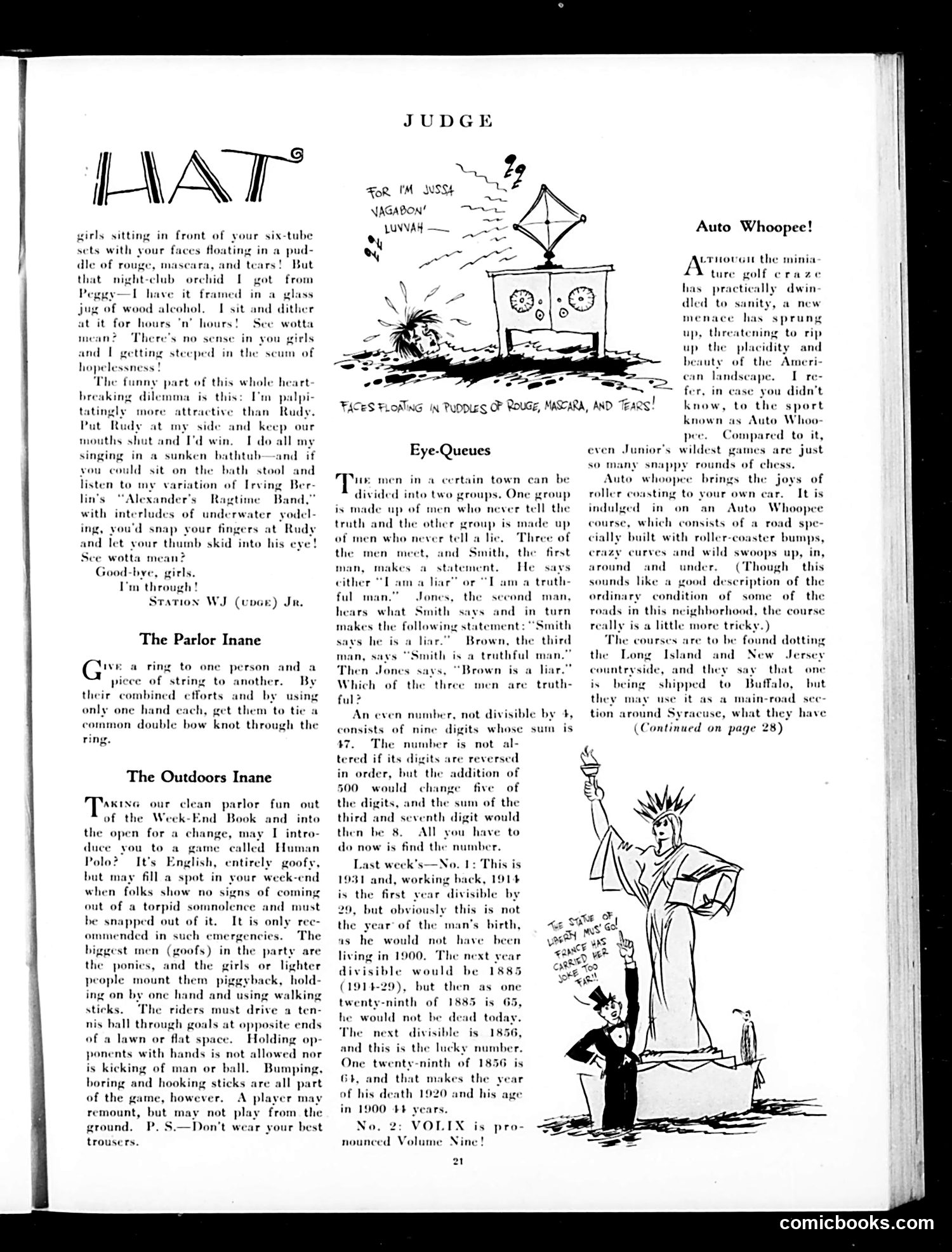
Analysis of Judge Magazine Page This page from Judge magazine contains several unrelated entertainment features typical of the publication's format. "Hat" is a humorous monologue by a radio station personality (WJ) complaining about romantic rejection—he's less attractive than a rival named Rudy despite his theatrical talents and charm. The satire targets radio personalities' self-importance and melodramatic self-pity. "Eye-Queues" presents logic puzzles: one involves truth-tellers versus liars (a classic logical paradox), and another asks readers to find a specific nine-digit number with particular mathematical properties. These were popular puzzle features in magazines of this era. "The Parlor Inane" and "The Outdoors Inane" describe party games—parlor tricks and "Human Polo" (people riding piggyback playing polo with walking sticks). These reflect 1920s-30s recreational trends. "Auto Whoopee!" begins describing a miniature golf fad that's apparently spreading to automobiles, positioning it as the latest recreational craze threatening the American landscape. The page demonstrates Judge's mix of comedy, puzzles, and social observation about contemporary leisure activities.
Judge Magazine Film Review by Pare Lorentz This page contains film criticism rather than political cartoons. Lorentz, a prominent documentary filmmaker and critic, reviews contemporary movies with sharp commentary on acting and cinema quality. He harshly criticizes actress Helen Twelvetrees for lacking genuine talent, arguing her physical attractiveness alone cannot substitute for skill—a notable stance since silent cinema had relied heavily on "doll-faces." He praises Peggy Shannon in "The Secret Call" as genuinely talented and worth studio investment. Lorentz mocks "The Mystery of Life" for its pseudo-scientific pretensions, featuring aging lawyer Clarence Darrow discussing evolution and social superstition. The recommended films section highlights contemporary hits: "The Public Enemy," "The Front Page," and French imports like "Le Million," reflecting early 1930s cinema tastes and Judge's sophisticated, cosmopolitan audience. The criticism demonstrates how film reviewing functioned as cultural arbitration during cinema's transition from silent to sound era.
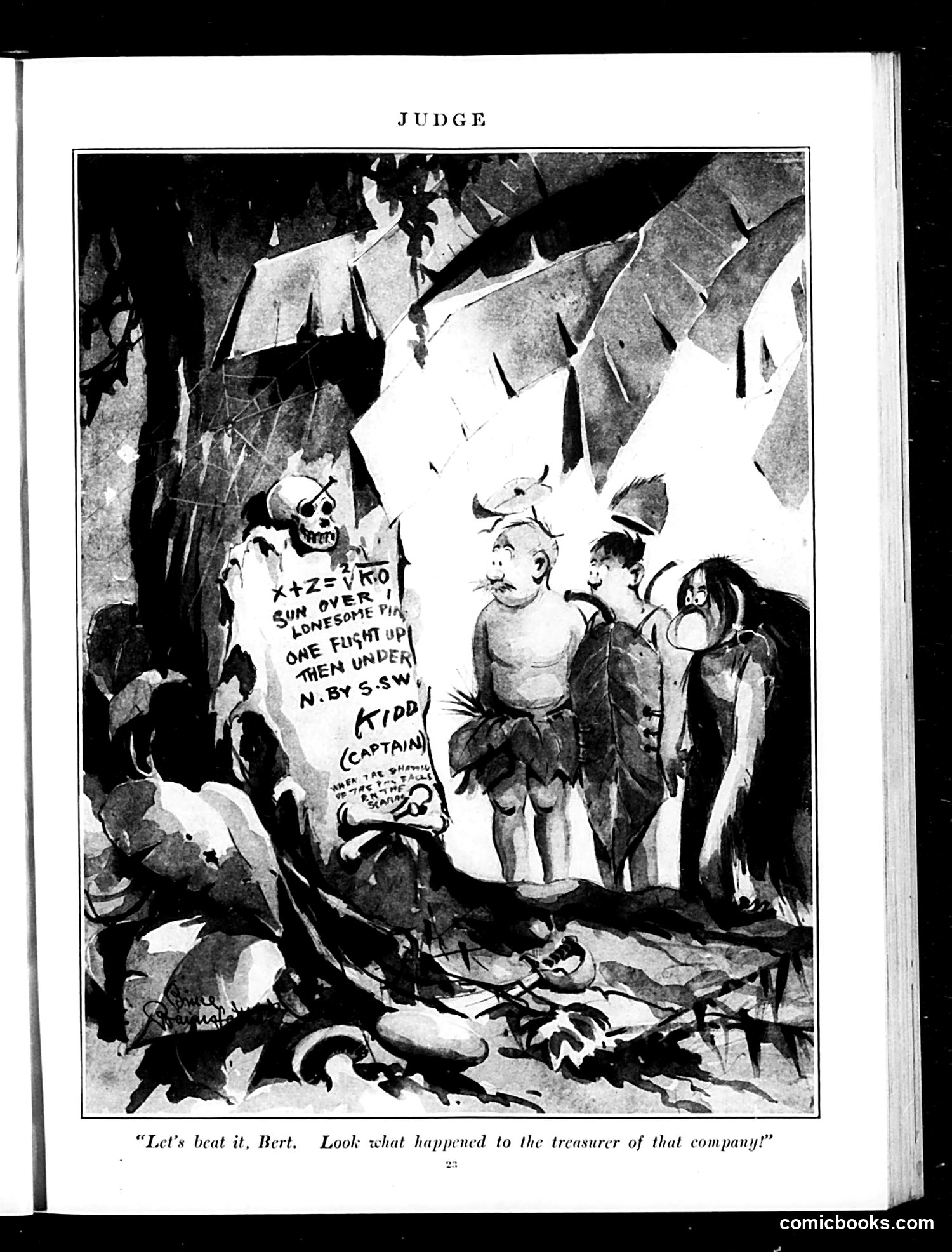
Analysis This single-panel cartoon satirizes corporate malfeasance and embezzlement. The scene depicts what appears to be Hell or an underworld setting, with demonic figures and flames. A skeleton labeled "TREASURER" holds a sign listing various financial crimes: "KID / SUNOVER / LONESOME PINE / ONE FIGHT UP! / THEN UNDER / N.B.S.W." Two men (likely businessmen named Bert and another character) observe the treasurer's fate, with one warning they should "beat it"—escape before suffering similar punishment. The satire targets corrupt company officials, particularly treasurers who embezzled funds or engaged in financial crimes. The cartoon warns that dishonest business practices lead to damnation. Without specific dates visible, the exact scandal referenced remains unclear, but this reflects Judge magazine's consistent critique of Gilded Age corporate corruption.
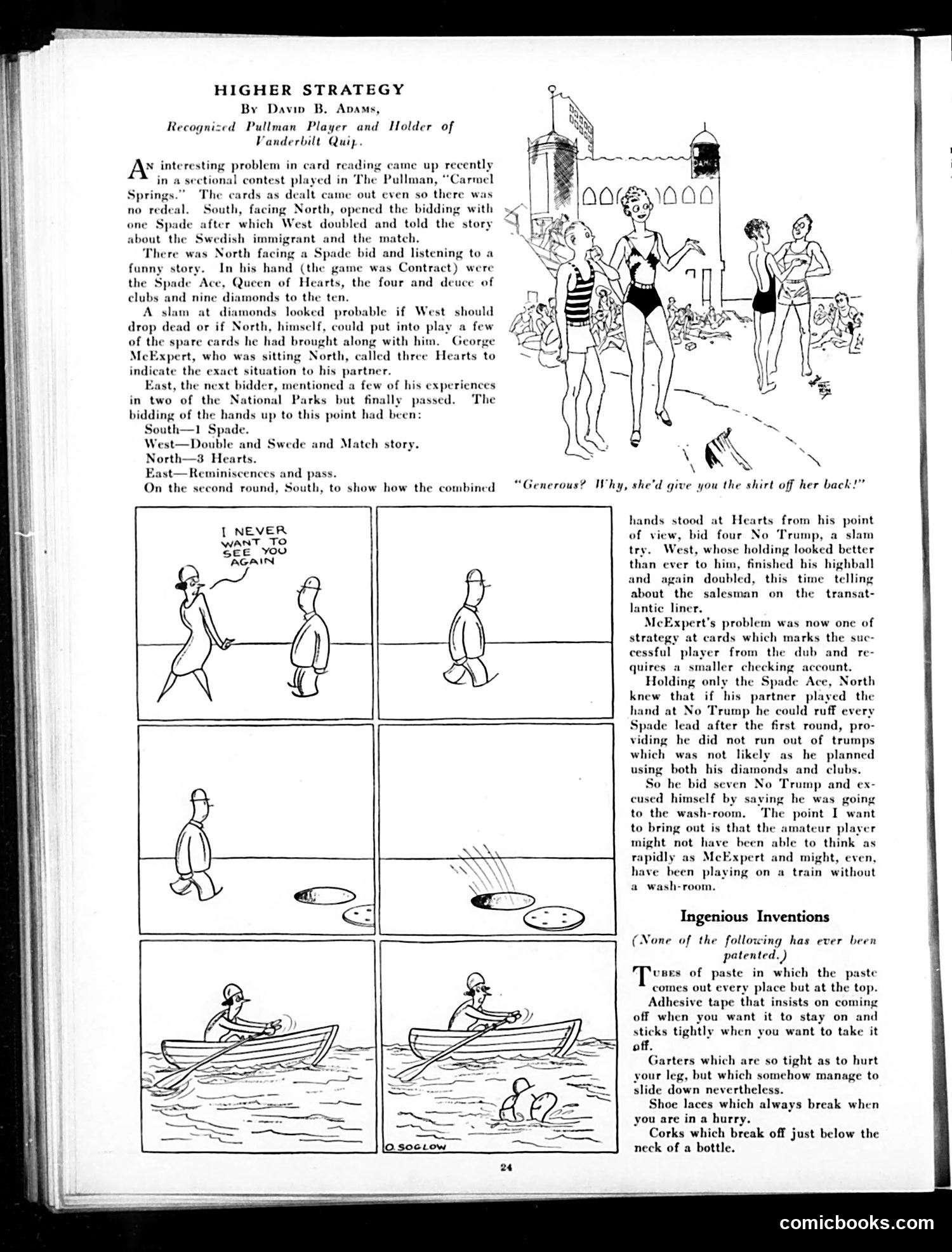
Analysis for Modern Readers This page contains two unrelated humor pieces from *Judge* magazine: "Higher Strategy" is a bridge card game anecdote by David B. Adams, a competitive bridge player. The joke revolves around McExpert's solution to a complex bidding problem: he excuses himself to the washroom, avoiding having to play a difficult hand. The satire mocks amateur players who lack McExpert's quick thinking—and humorously notes that such a convenient escape wouldn't work on a train without bathroom facilities. It's insider humor for bridge enthusiasts. "Ingenious Inventions" is a simple observational comedy list mocking everyday product design failures—paste tubes that don't dispense from the top, adhesive tape that won't stick when needed, garters that slip, shoelaces that break at inconvenient times, and corks that crumble. These are generic complaints about consumer goods, relatable across eras, requiring no historical context to understand.
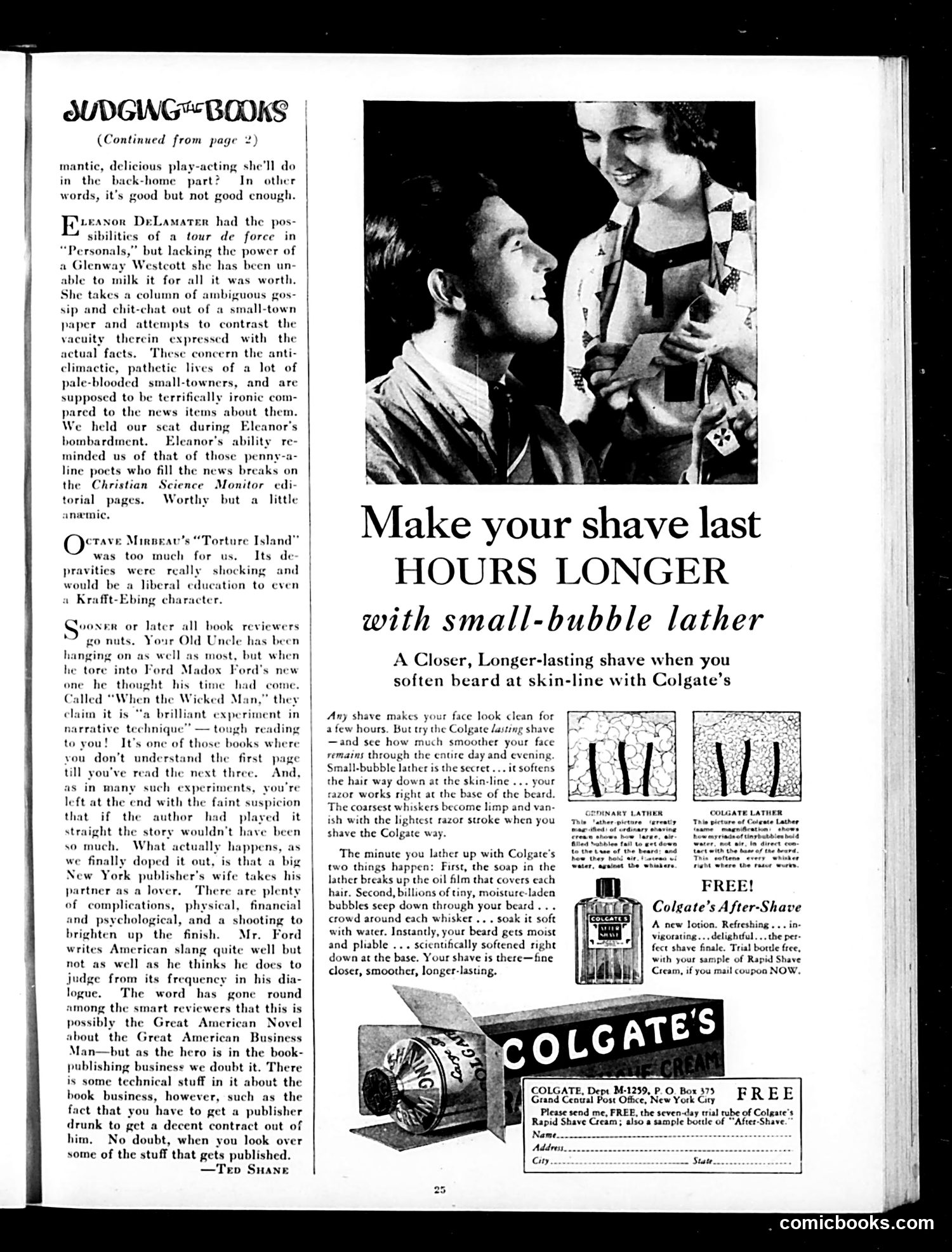
Content Analysis: Judge Magazine Page This page contains two distinct sections: Book Reviews (Left Column): Ted Shane critiques three novels, reviewing Eleanor DeLamater's "Personals," Octave Mirbeau's "Torture Island," and Ford Madox Ford's "When the Wicked Man." Shane's tone is dismissive—he praises DeLamater's acting ability but finds her writing "anemic," calls Mirbeau's work shockingly depraved, and criticizes Ford's experimental narrative style as needlessly obscure. The final anecdote about needing to get publishers drunk for decent contracts appears to be satire on publishing industry practices. Advertisement (Right Column): A Colgate shaving cream advertisement dominates the page, featuring product claims about "small-bubble lather" creating longer-lasting shaves. The ad includes before/after beard illustrations and offers a free trial of Colgate's After-Shave lotion. The page is primarily advertising-driven rather than satirical content, with book criticism serving as filler around the commercial material.
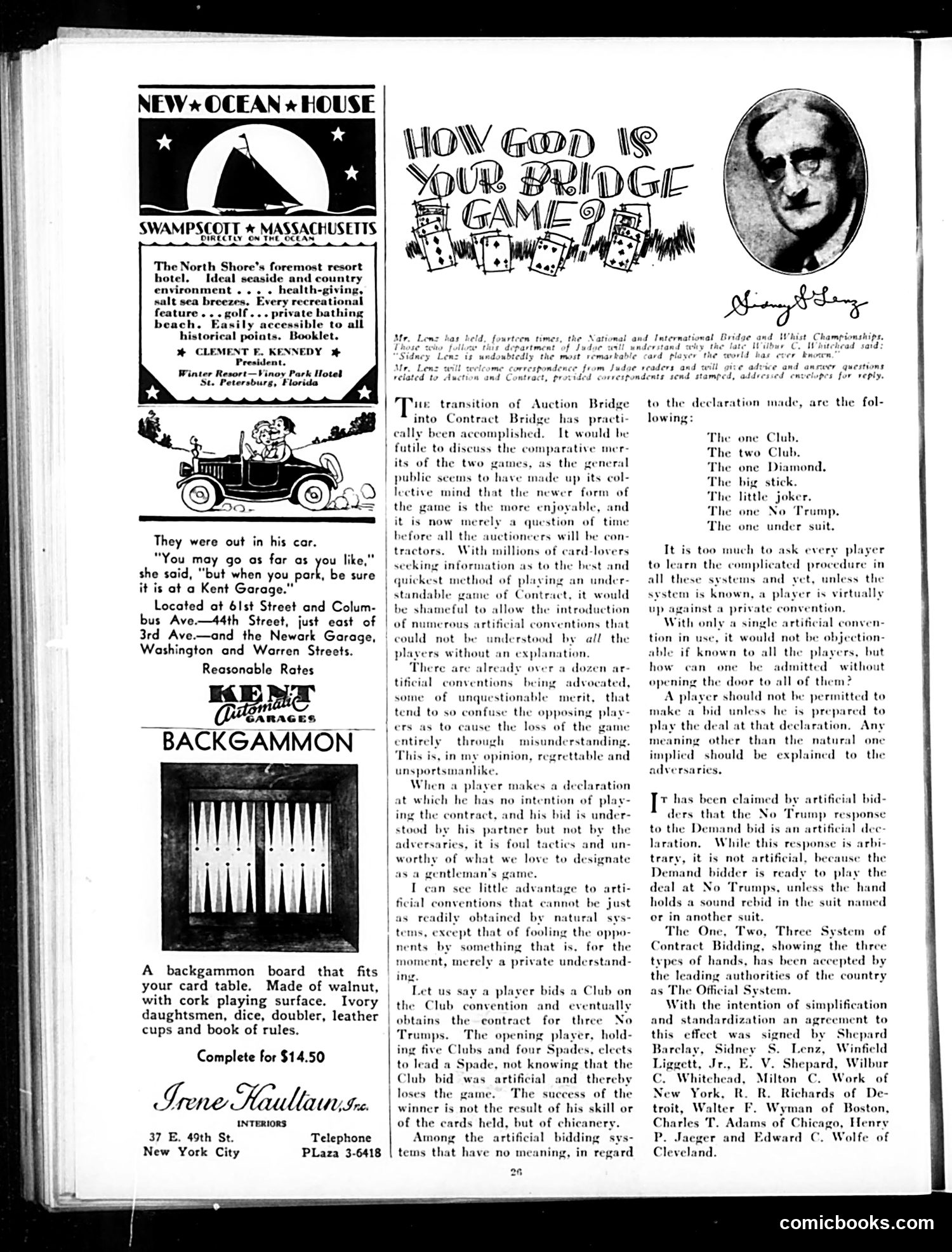
"How Good Is Your Bridge Game?" - Contract Bridge Conventions (Judge Magazine) This page features an article by Harold Vanderbilt (visible in the portrait) about Contract Bridge, the newly fashionable card game that had recently replaced Auction Bridge. The article criticizes the proliferation of "artificial conventions"—secret bidding codes that only certain players understand. Vanderbilt argues that these conventions are unsportsmanlike because they allow players to communicate hidden meanings to their partners while deceiving opponents. He uses a specific example: a player bidding "Club" under a secret convention, leading an opponent to misunderstand and lose the game through no fault of his own. His core complaint: artificial conventions contradict the spirit of gentlemanly play and create unfair advantages based on secret knowledge rather than skill. He advocates for standardized, transparent rules that all players know. The surrounding ads (Kent Garage, backgammon boards, resort hotels) reflect Judge's typical mix of editorial and commercial content.
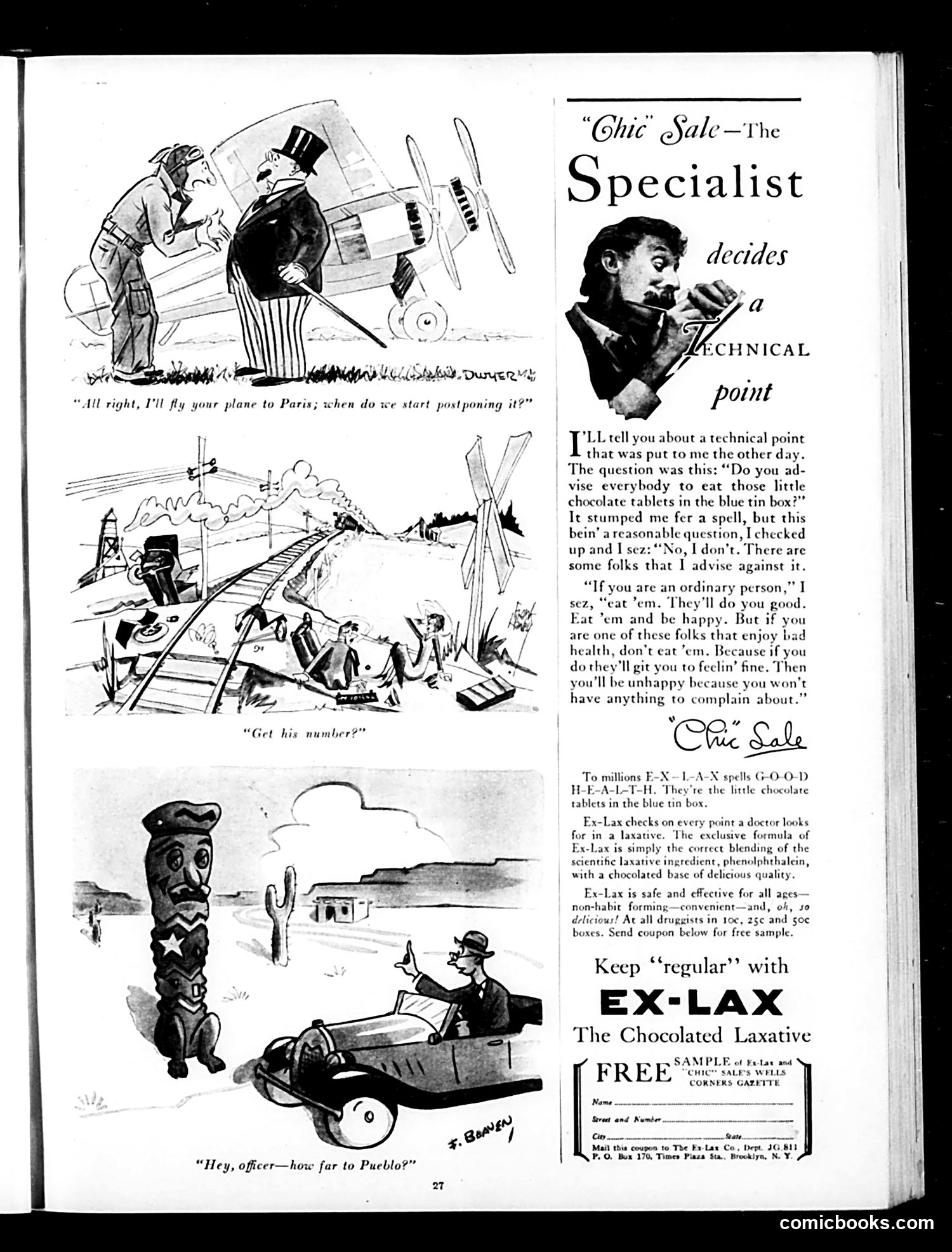
Analysis for Modern Readers This page combines satirical cartoons with an advertisement for Ex-Lax laxative. The top three cartoons appear to be unrelated humor pieces (airplane mishap, train accident, desert scene) typical of Judge magazine's style. The main content is an advertisement disguised as editorial advice from "Chic Sale"—likely a reference to a popular humorist or personality of the era. The "specialist" offers tongue-in-cheek commentary on Ex-Lax tablets: he humorously suggests healthy people shouldn't take them because they'd lose their favorite complaint ("nothing to complain about"). The satire is gentle and self-aware—the ad admits laxatives are for those with digestive issues while joking that chronically ill people rely on their ailments for conversation. This reflects early-20th-century attitudes toward constipation as a common, openly-discussed health concern worth advertising in mainstream magazines.
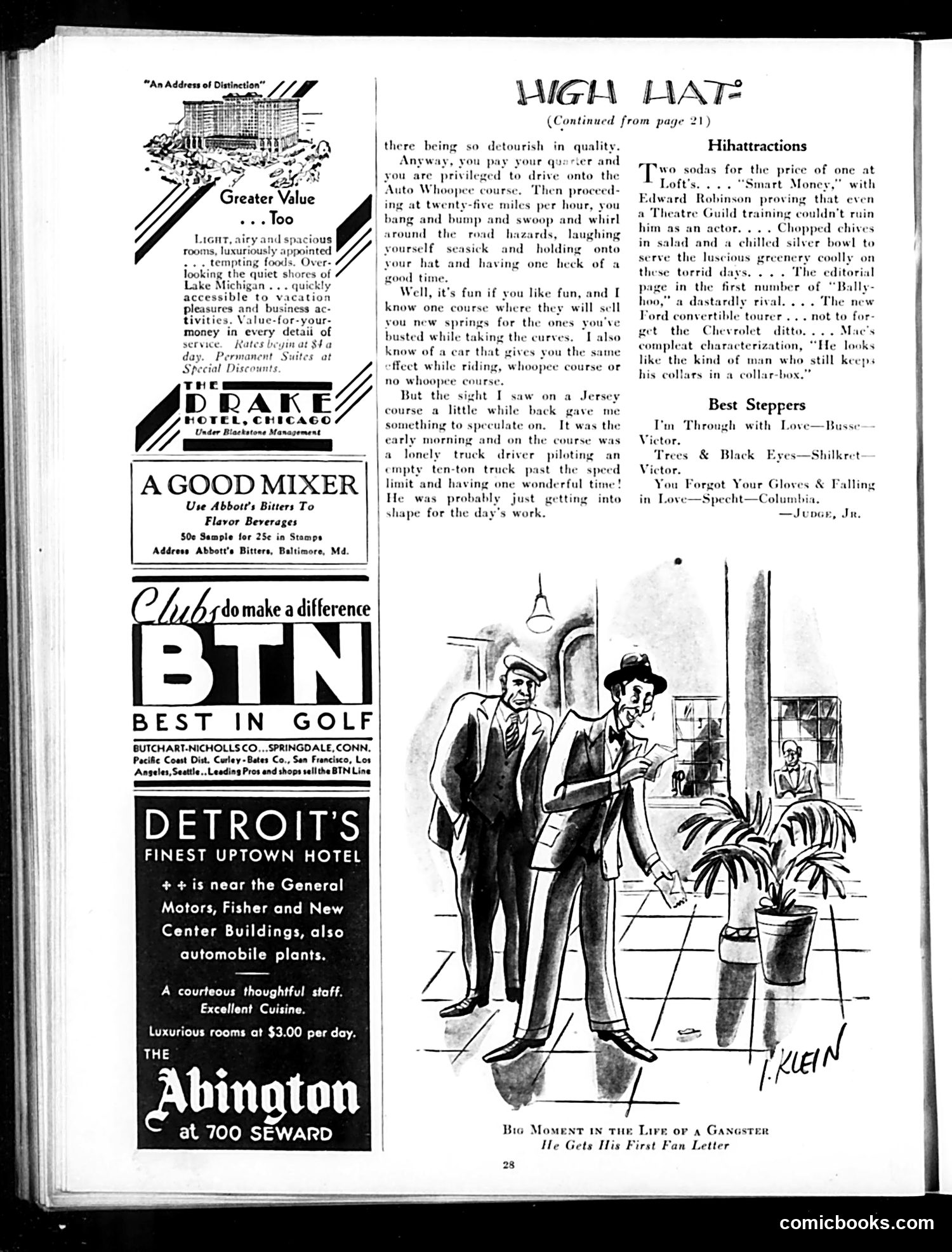
Cartoon Analysis: "Big Moment in the Life of a Gangster" This cartoon by Klein depicts a humorous scene of organized crime meeting celebrity culture. Two men in suits and fedoras—appearing to be gangsters based on their styling and the caption's reference to a "gangster"—stand in what looks like a hotel lobby or upscale establishment, examining mail. One holds an envelope, suggesting he's just received correspondence. The joke plays on the incongruity of tough criminals experiencing the mundane thrill of fan mail. The caption "He Gets His First Fan Letter" suggests that even criminals, despite their violence and illegality, crave the validation and fame associated with celebrity status. This reflects 1920s-30s public fascination with prohibition-era gangsters, who achieved a perverse celebrity status in American culture. The cartoon satirizes how even criminal figures desire mainstream recognition and admiration—a commentary on American celebrity worship and the glamorization of criminal life during this period.
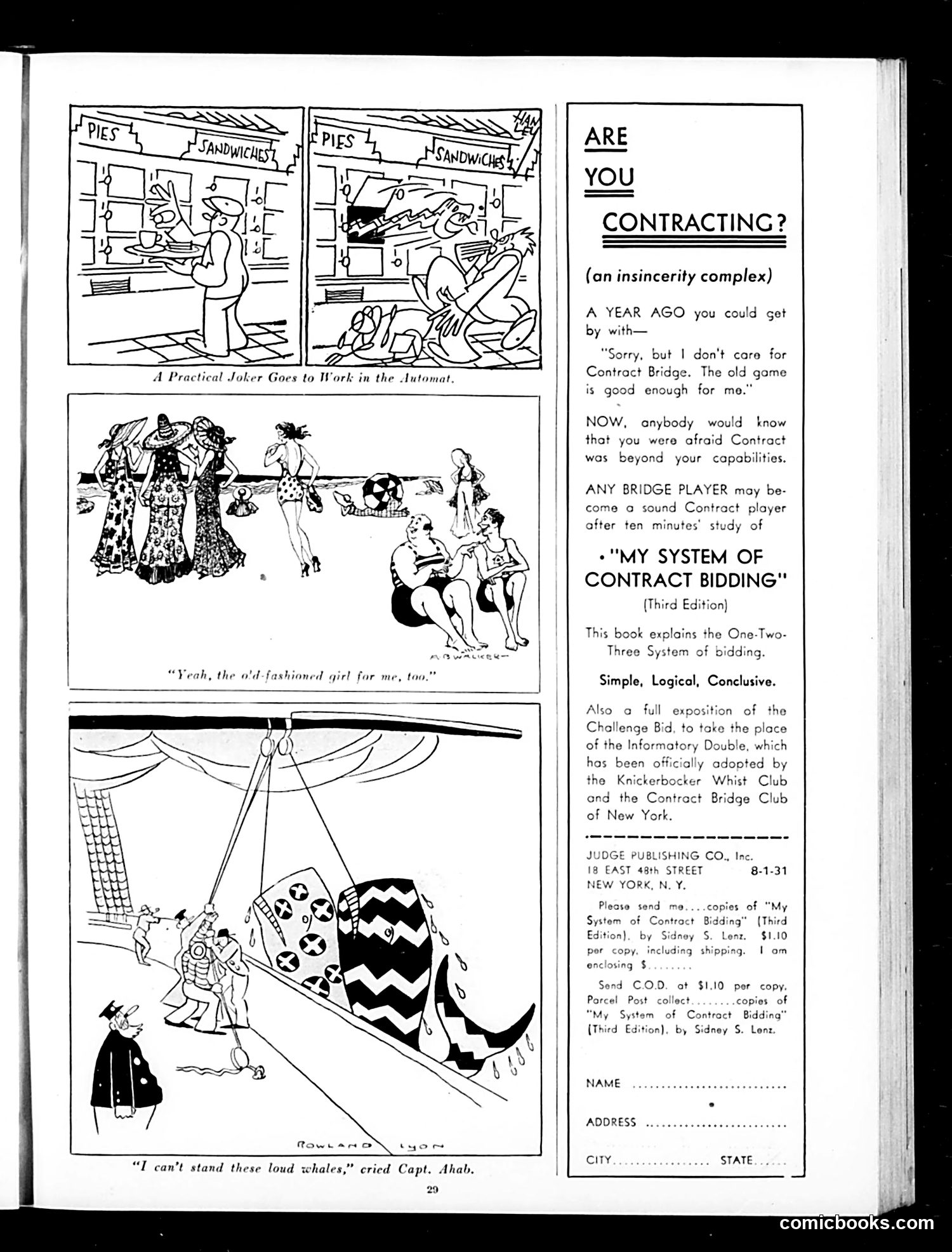
Analysis This page satirizes the social pressure around Contract Bridge, a card game variant that became fashionable in the 1930s. The humor targets social insecurity: a year prior, people could dismiss Contract Bridge as unfamiliar; now, admitting disinterest reveals you're simply *afraid* you can't master it—a social embarrassment. The cartoons mock Bridge obsession through exaggerated scenes: a worker neglecting his job at a deli counter, people lounging indolently on a beach, and sailors distracted mid-whaling. The message: Contract Bridge has invaded every aspect of life. The right side is an advertisement for Sidney S. Lenz's instructional book "My System of Contract Bidding," endorsed by prestigious New York clubs. The irony is sharp—the ad supposedly solves the insecurity the satire just exposed: learn the system in ten minutes and no one need know you were afraid. The bottom cartoon caption ("I can't stand these loud whales") appears unrelated, likely from a different feature.
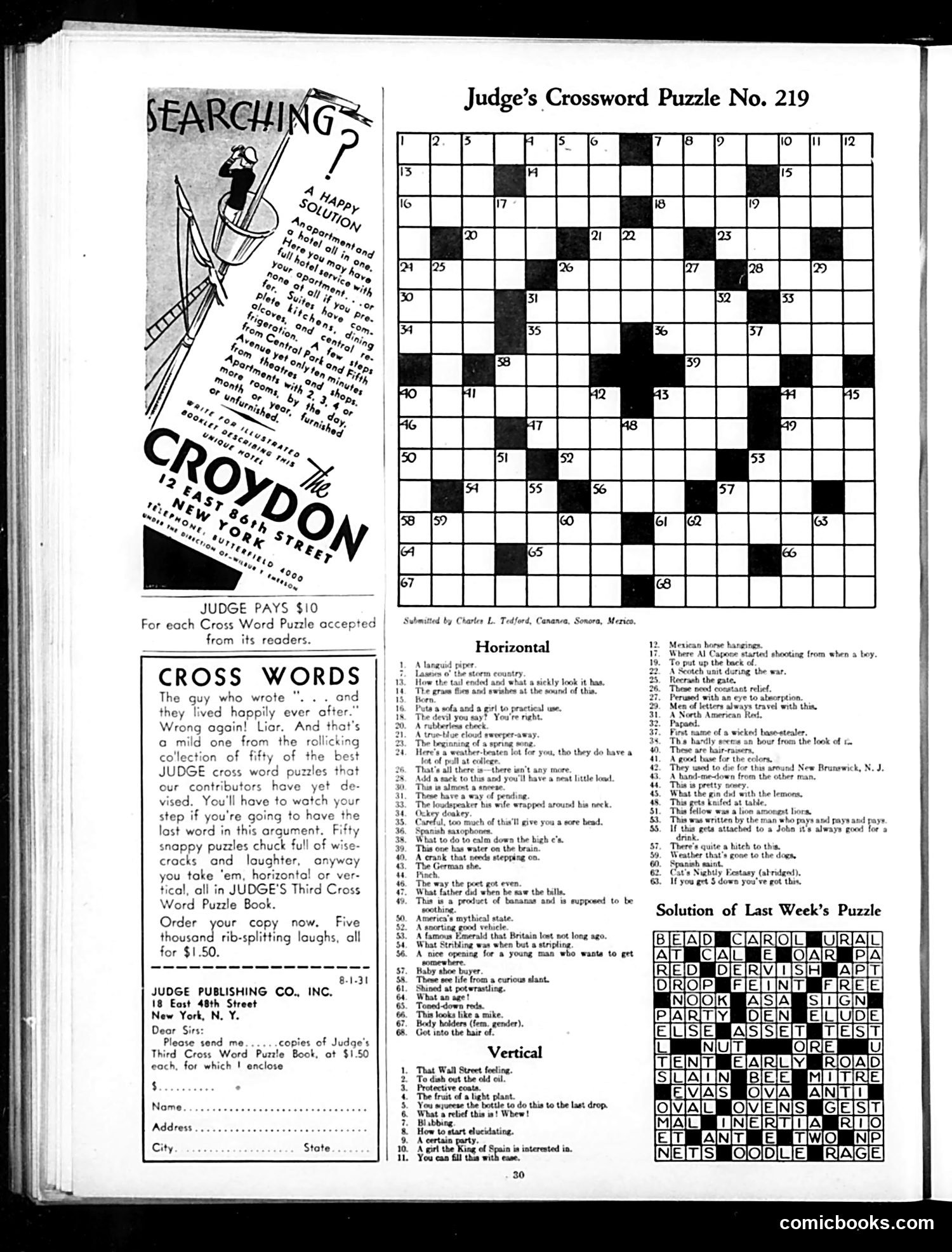
Judge Magazine Page Analysis This page is primarily advertising and puzzle content, not political satire. The main feature is a crossword puzzle advertisement for Judge's "Third Cross Word Puzzle Book," promoting a collection of fifty puzzles submitted by readers. Judge paid $10 per accepted puzzle, incentivizing reader contributions. The advertisement uses humor typical of 1930s advertising: it jokes that fairy tales promising "happily ever after" are lies, then positions crossword puzzles as entertainment offering honest laughs instead. The tagline promises "five thousand rib-splitting laughs" for $1.50. The actual crossword clues contain period humor and references—wordplay, contemporary slang, and mild jokes about marriage, drinking, and famous figures (Al Capone, Stribling the boxer appear in clues). The "Solution of Last Week's Puzzle" shows completed answers. There's also a Croydon advertisement (top left) for what appears to be a fashion or shipping service at a New York address. This is representative of Judge's format: satirical magazine using reader-submitted content and advertisements to drive subscriptions and product sales.
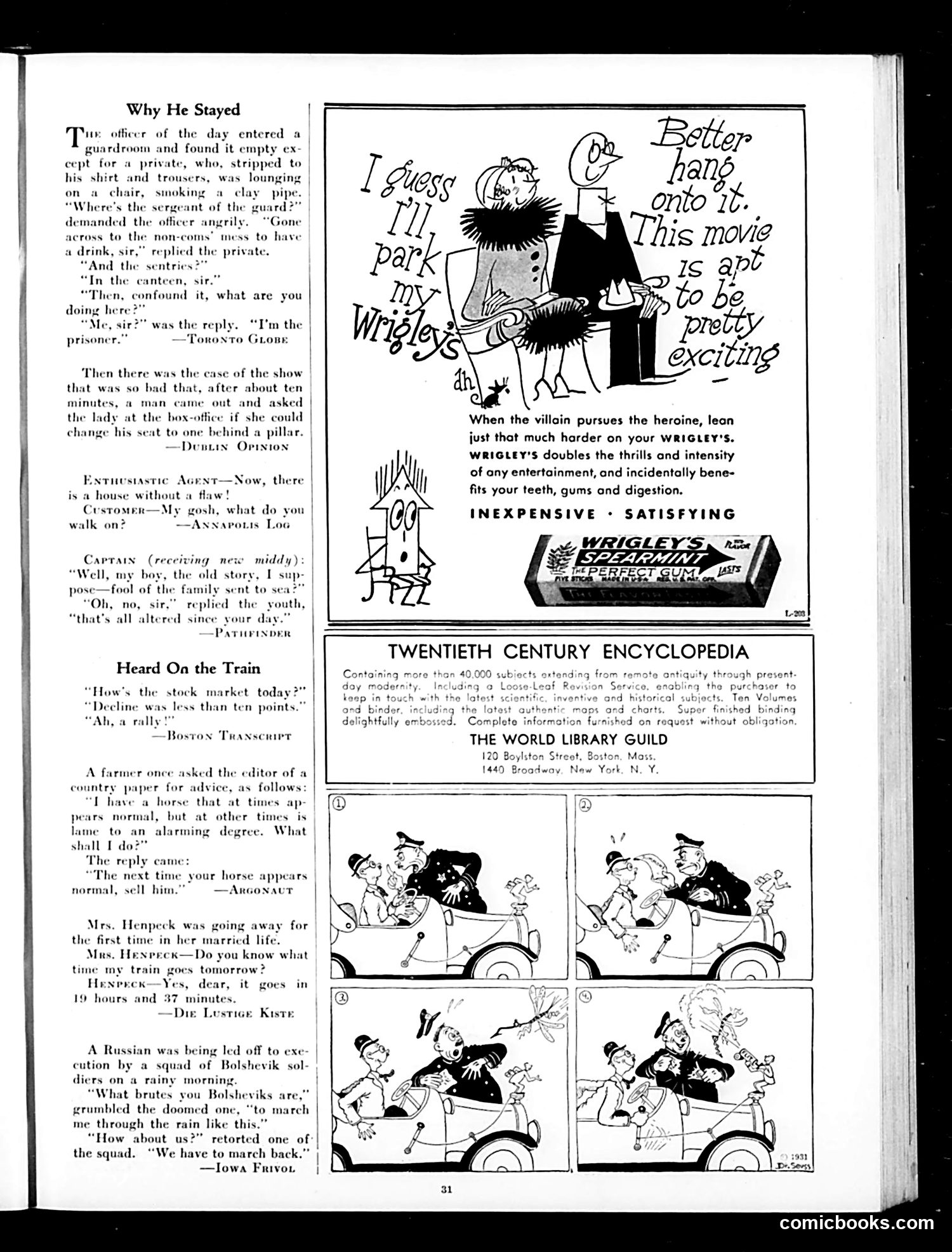
Analysis for Modern Readers This page contains humor columns and a Wrigley's gum advertisement rather than political cartoons. The jokes are brief anecdotes satirizing military discipline, real estate sales tactics, stock market volatility, and marital dynamics. For example, "Why He Stayed" mocks military bureaucracy—a private lounging while everyone else shirks duty claims to be "the prisoner." "Heard On the Train" plays on stock market jargon: a minimal decline is optimistically called "a rally." The Wrigley's ad (center-right) uses a comic strip showing a car chase scene, claiming their gum enhances movie excitement and aids digestion. This reflects 1920s-30s consumer culture marketing. The bottom section advertises the "Twentieth Century Encyclopedia" from The World Library Guild—a mail-order reference work. Most humor targets everyday absurdities (incompetent officers, pushy real estate agents, nagging wives) rather than specific political events. The Russian execution joke references Bolshevik brutality, reflecting anti-communist sentiment common in American publications of this era.
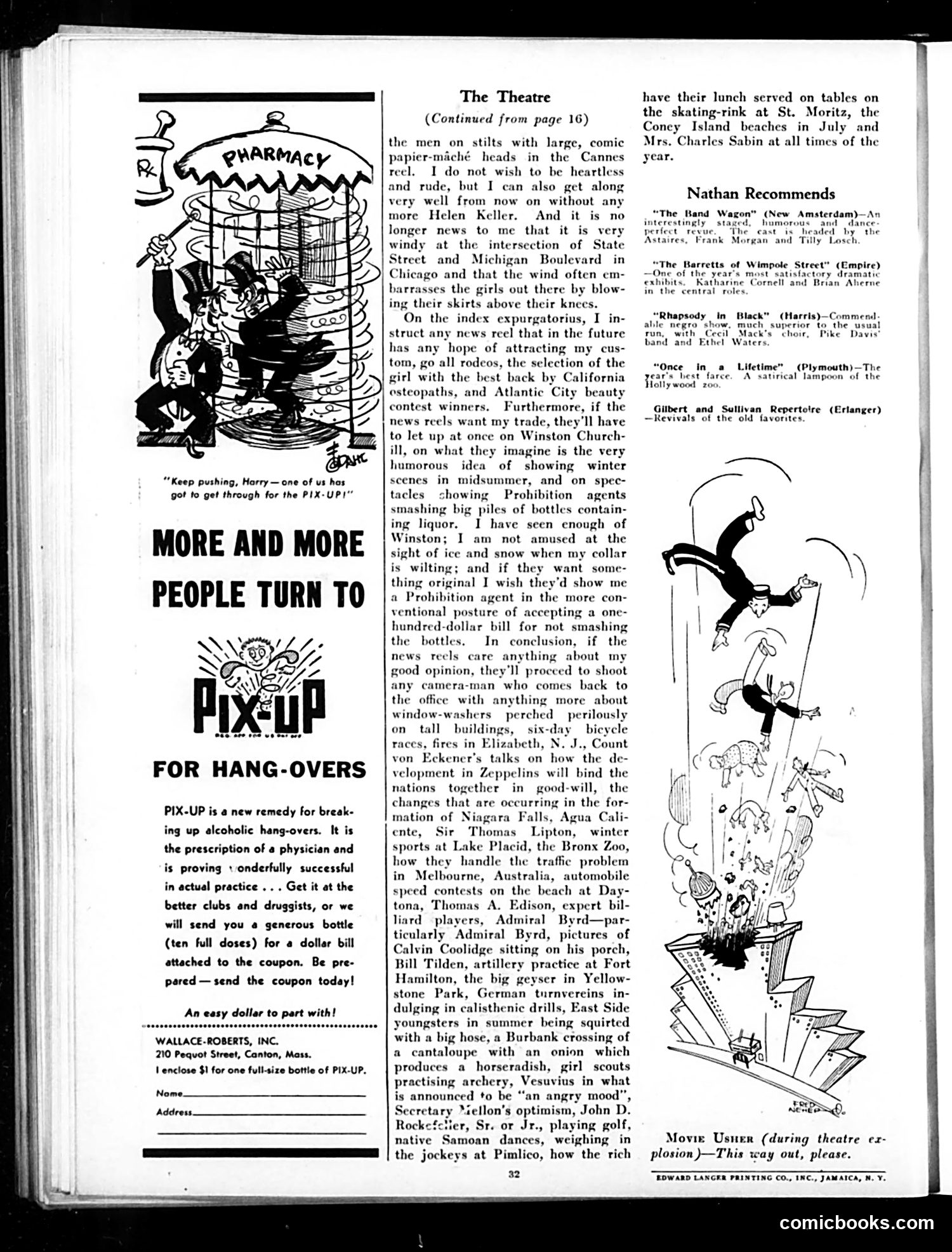
Judge Magazine Page Analysis This page combines theatrical criticism with a hangover-cure advertisement, typical of 1920s Judge content. The Main Cartoon (top left): A "Pharmacy" rotunda satirizes prohibition-era speakeasies disguised as legitimate businesses. The frantic figures pushing through illustrate how Americans circumvented alcohol bans. The Theater Critique: A lengthy complaint about newsreel content—the author ridicules repetitive footage: Winston Churchill appearances, Prohibition agents smashing bottles, Admiral Byrd, Calvin Coolidge, and trivial celebrity moments. This reflects post-WWI frustration with formulaic media and suggests newsreels pandered to mass audiences with recycled, unoriginal content. The Advertisement: "Pix-Up" remedy for hangovers—ironic placement given the article's prohibition-era context. The physician-endorsed remedy addresses widespread alcohol consumption despite legal bans, acknowledging the gap between law and actual practice. The Right Cartoon: Shows figures tumbling from a tall building—likely illustrating one of the newsreel clichés the critic despises (window-washers on tall buildings). The page critiques both entertainment predictability and the contradiction between prohibition law and social reality.
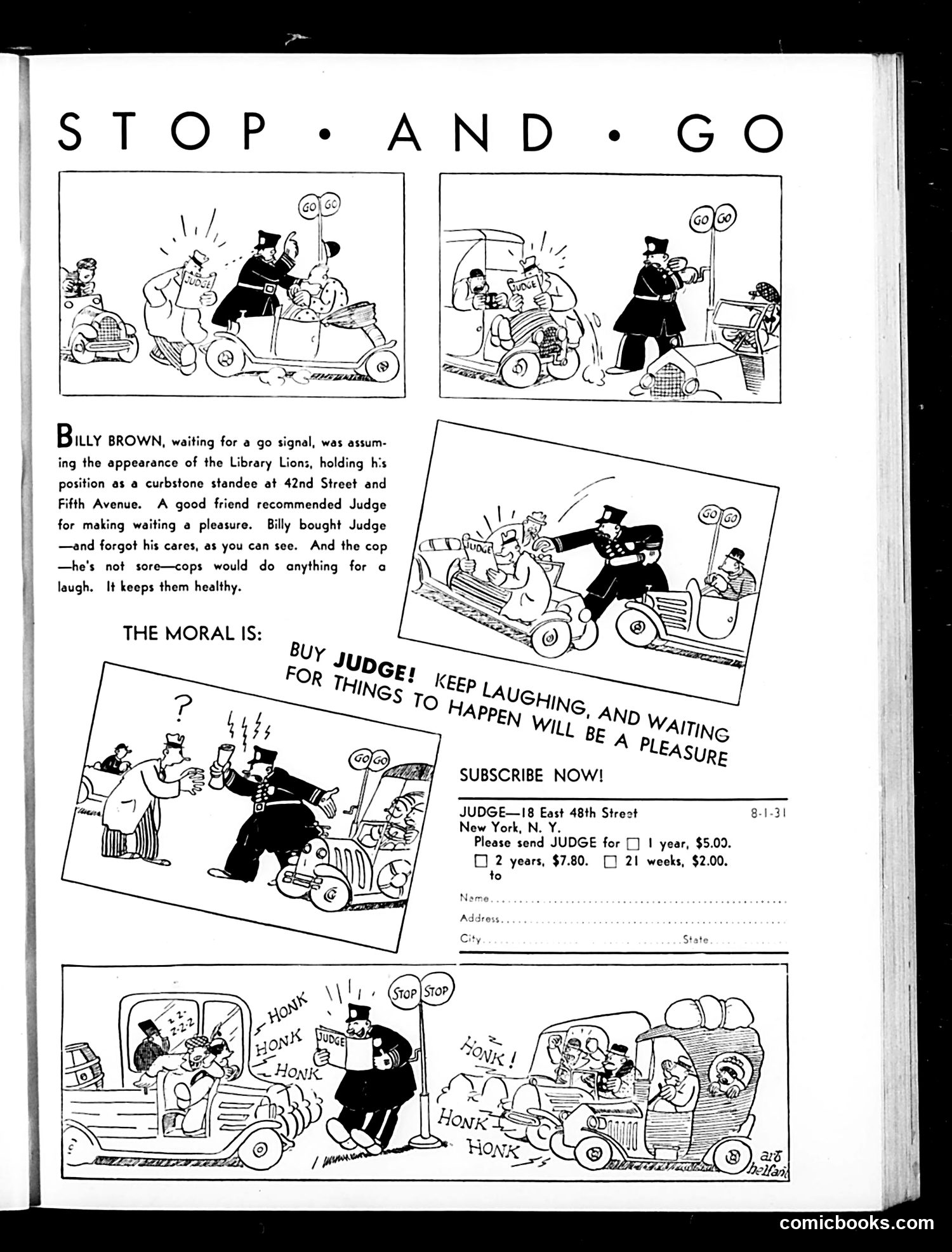
"Stop and Go" - Judge Magazine Advertisement This is a subscription advertisement for *Judge* magazine disguised as humorous content. The comic depicts "Billy Brown" waiting at a Manhattan street corner (42nd and Fifth Avenue, near the famous New York Public Library) for a traffic signal. The joke's premise: reading *Judge* makes waiting pleasurable enough that Billy forgets his cares entirely—so much so that a police officer (the "cop") finds his absorption amusing rather than problematic. The satire targets urban impatience and tedium. The "moral" pitch claims *Judge* provides such entertainment value that it transforms mundane city life. The traffic signals and honking cars frame urban congestion as a modern annoyance that *Judge* supposedly alleviates. This reflects 1930s advertising strategy: positioning the magazine as essential urban reading for busy, bored commuters. The tone assumes readers recognize the specific Manhattan location and relate to waiting-around frustration.
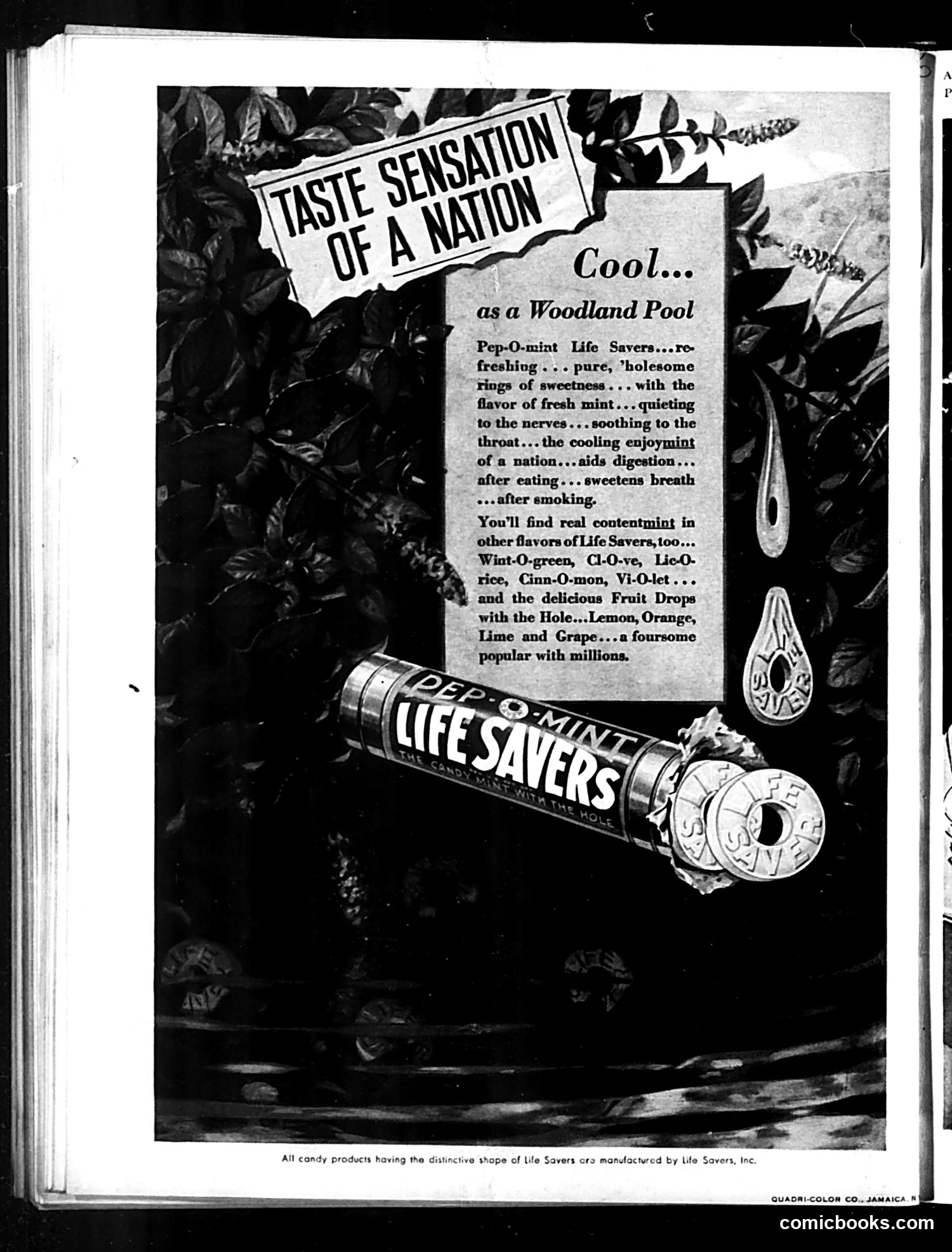
Analysis This is a Life Savers candy advertisement, not a political cartoon or satire. The page shows a vintage ad for Pep-O-mint Life Savers, styled as a full-page promotional piece. The "satire" is purely commercial wordplay: the headline "Taste Sensation of a Nation" uses patriotic language to market candy, while the body copy is filled with puns ("enjoymint," "contentmint") and exaggerated health claims typical of early 20th-century advertising. The product is surrounded by vegetation (suggesting freshness and nature), and the copy emphasizes mint's cooling properties and various supposed benefits: digestion aid, breath sweetening, and nerve-soothing. This reflects the era when candy manufacturers made health-adjacent claims without FDA regulation, and when such elaborate, pun-laden ad copy was considered clever entertainment rather than misleading marketing.