judge
Judge — August 8, 1931
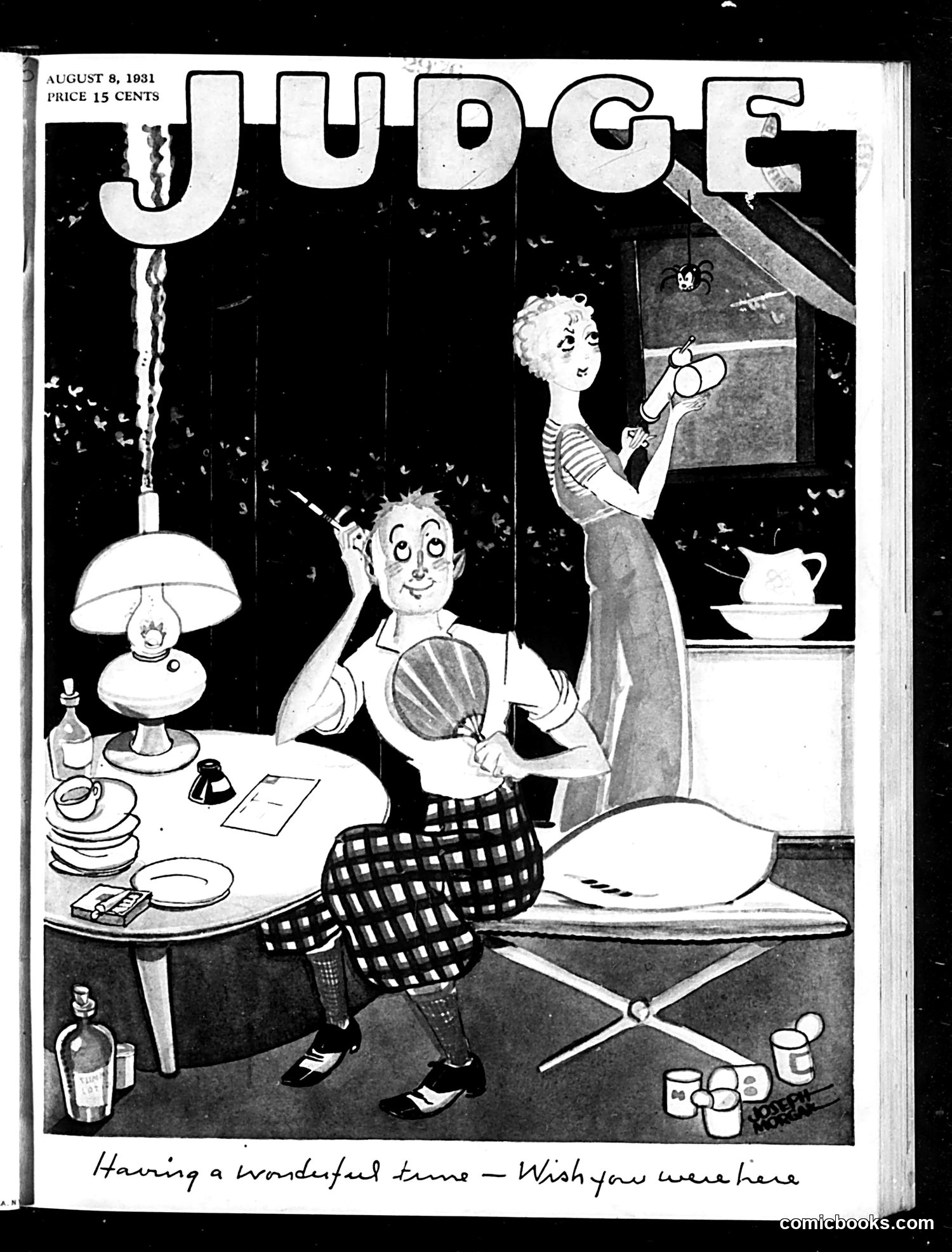
Judge Magazine Cover Analysis (August 8, 1931) This cover depicts a domestic humor scene typical of early 1930s Judge magazine. A man sits at a vanity mirror, admiring himself while holding what appears to be a hand mirror, wearing checkered pants. A woman stands nearby holding cosmetic items, seemingly preparing for grooming or beauty treatments. The scene satirizes vanity and personal grooming habits, likely poking fun at men's increasing attention to appearance and grooming products—a relatively newer phenomenon in the early Depression era. The caption reads "Having a wonderful time—Wish you were here," suggesting this is meant as a humorous postcard-style commentary on leisure activities and domestic life. The joke appears to target vanity and self-absorption during an era when such behavior might have been considered frivolous or amusing.
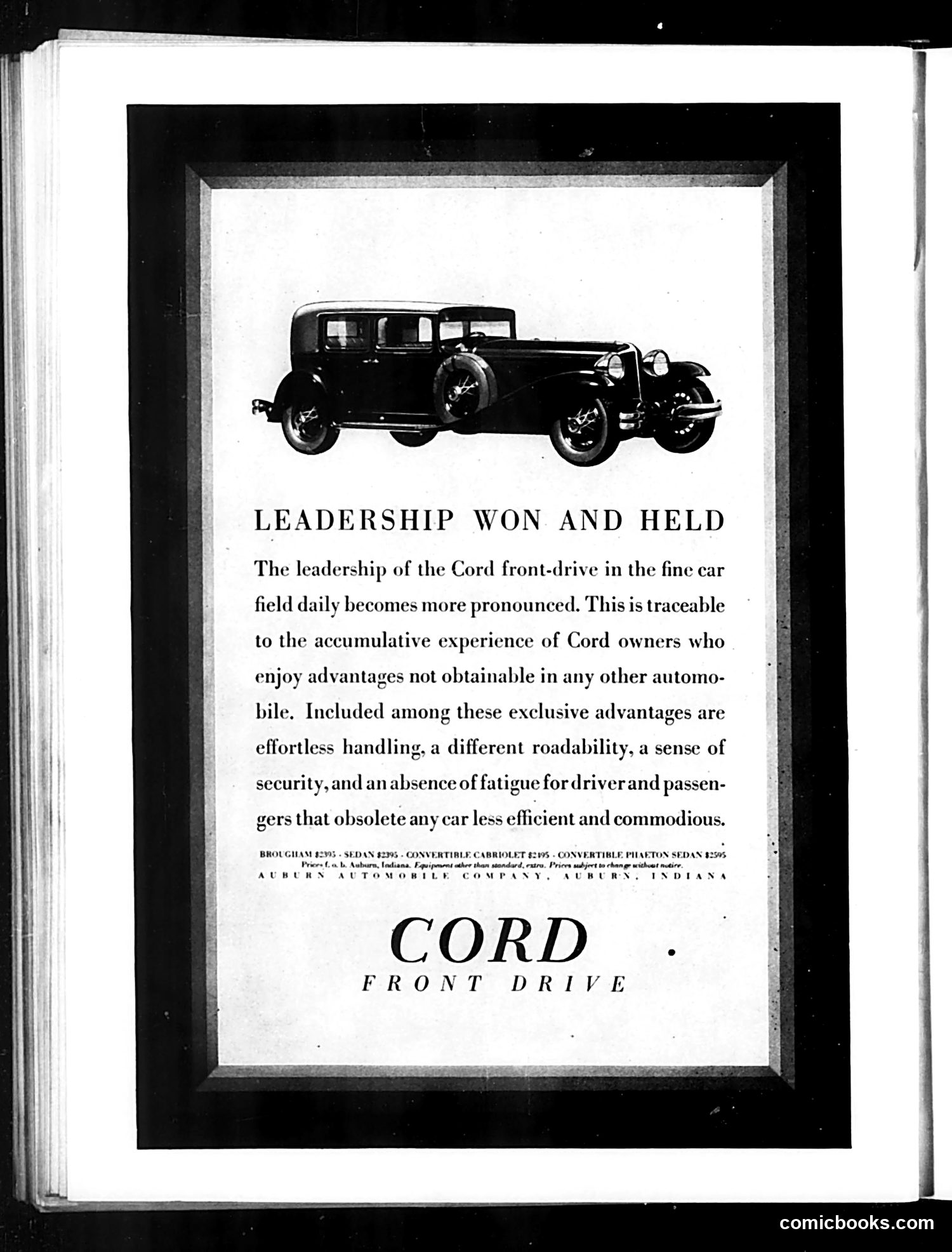
Analysis This page is not a cartoon or satirical content — it's a vintage automobile advertisement for Cord front-drive vehicles, placed in Judge magazine. The ad features illustrations of two Cord models and promotes the brand's "front-drive" technology as a market-leading innovation. The text claims Cord owners enjoy exclusive advantages: effortless handling, superior roadability, reduced driver fatigue, and passenger comfort unavailable in competing automobiles. The small print lists specific models (Brougham, Sedan, Convertible Cabriolet, Phaeton Sedan) and identifies the manufacturer as Auburn Automobile Company, Auburn, Indiana. This represents Judge's commercial content rather than editorial satire — a common revenue source for magazines of this era.
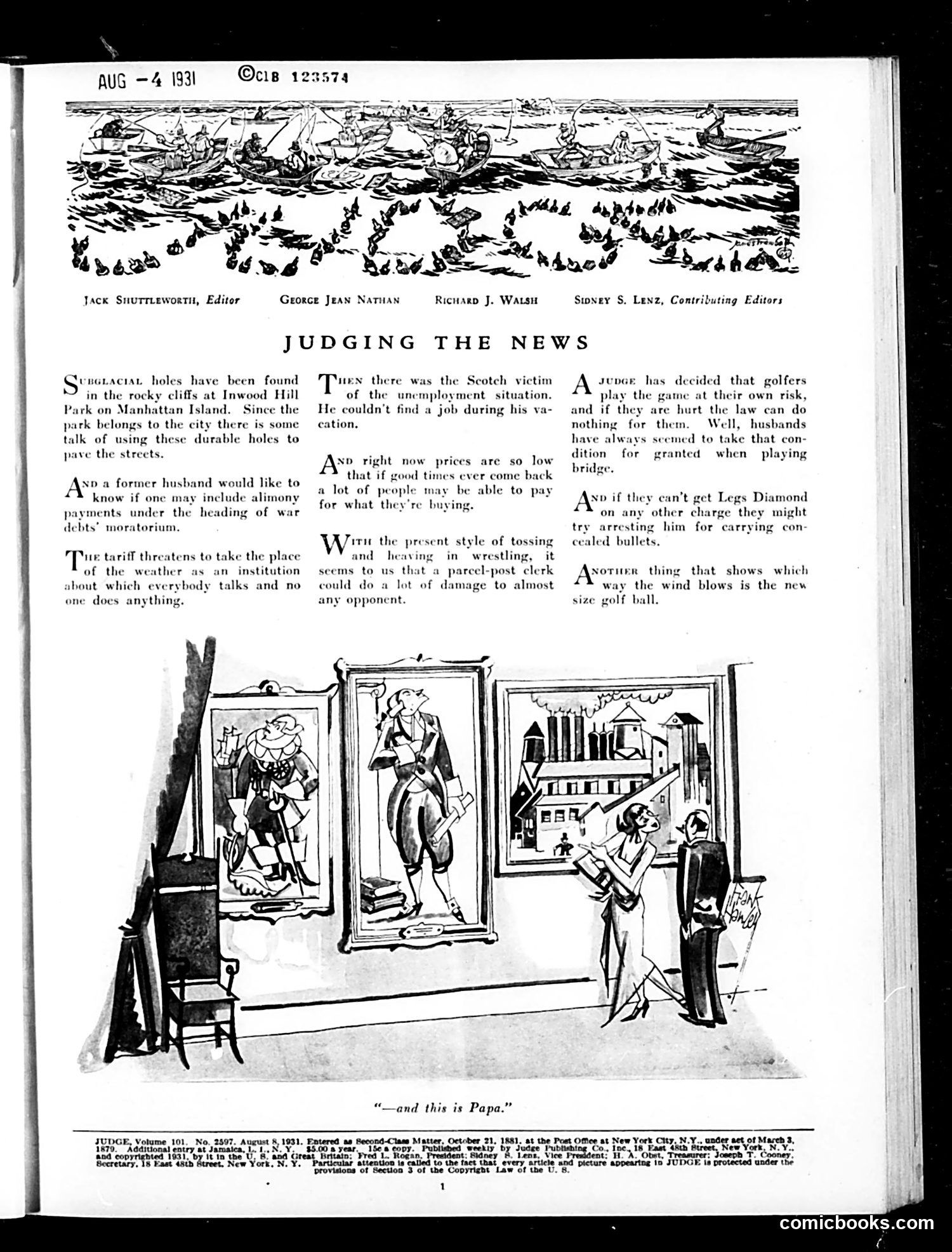
"Judging the News" - August 4, 1931 This page presents brief satirical commentary on current events alongside a cartoon titled "—and this is Papa." The cartoon depicts a museum or gallery scene where a man shows his young son various framed artworks. The joke appears to play on the phrase "and this is Papa"—suggesting the father is presenting himself as another artwork or exhibit, likely mocking paternal pride or the pretentiousness of art appreciation. The accompanying text comments on various topics: subglacial holes at Inwood Hill Park; unemployment and war debts; weather as conversation; wrestling techniques; low prices; golf; and a new size golf ball. These brief satirical notes represent Judge magazine's typical format of quick social and economic commentary on 1931 Depression-era concerns and contemporary absurdities.
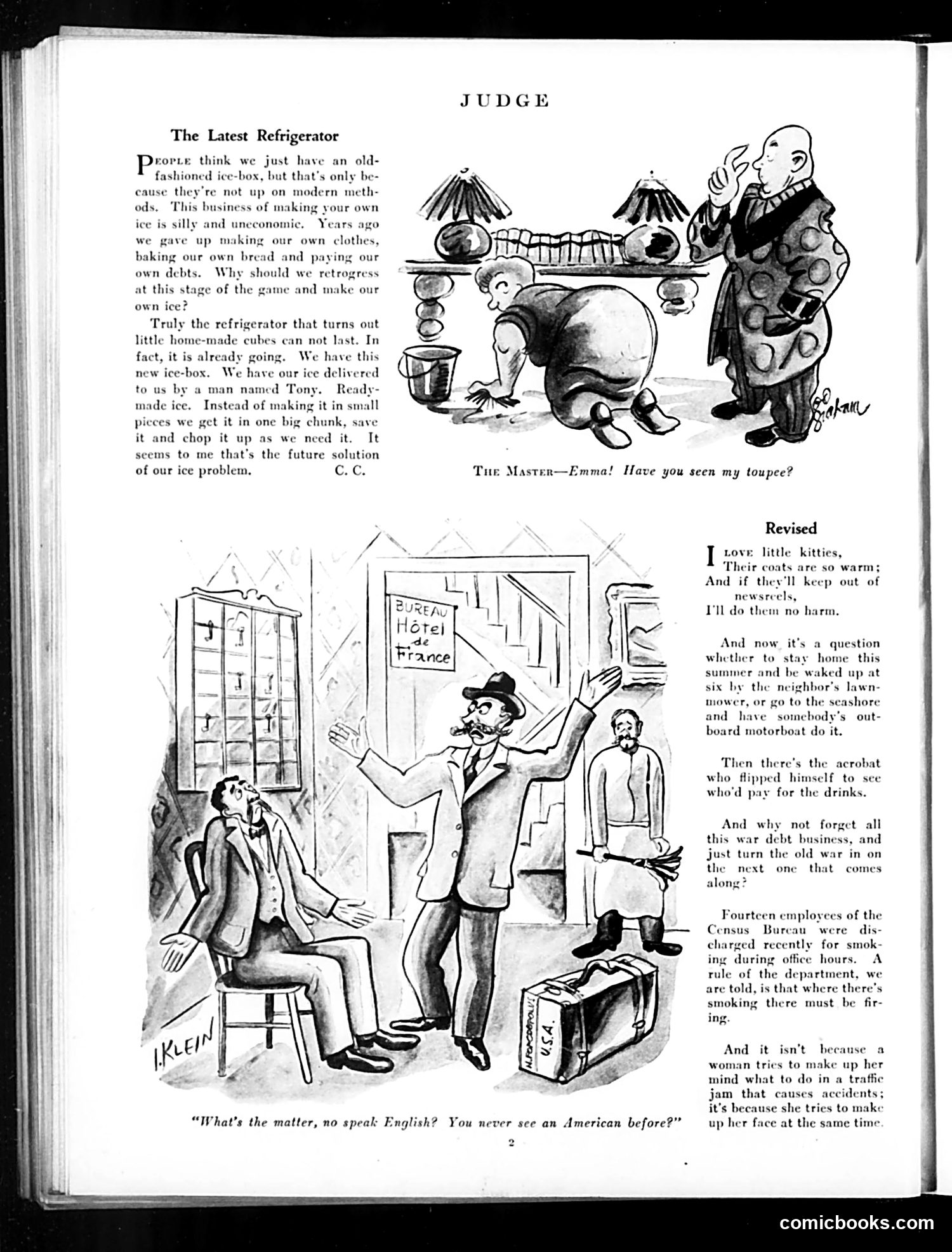
Analysis of Judge Page This page contains two distinct cartoons and commentary from an early 20th-century issue of Judge magazine. "The Latest Refrigerator" (top): Satirizes modern convenience culture. The cartoon shows a man proudly displaying a large block of ice as a "refrigerator," mocking people's embrace of new technology without questioning practicality. The accompanying text by C.C. argues this is silly—people should return to self-sufficiency like making their own ice rather than relying on modern delivery services. "Revised" (bottom cartoon and text): The sketch depicts a confused foreign hotel guest unable to communicate in English, captioned "What's the matter, no speak English? You never see an American before?" The sidebar commentary humorously lists summer annoyances (lawn mowers, motorboats, war debt) and office smoking violations, showing Judge's satirical take on contemporary American social irritations.
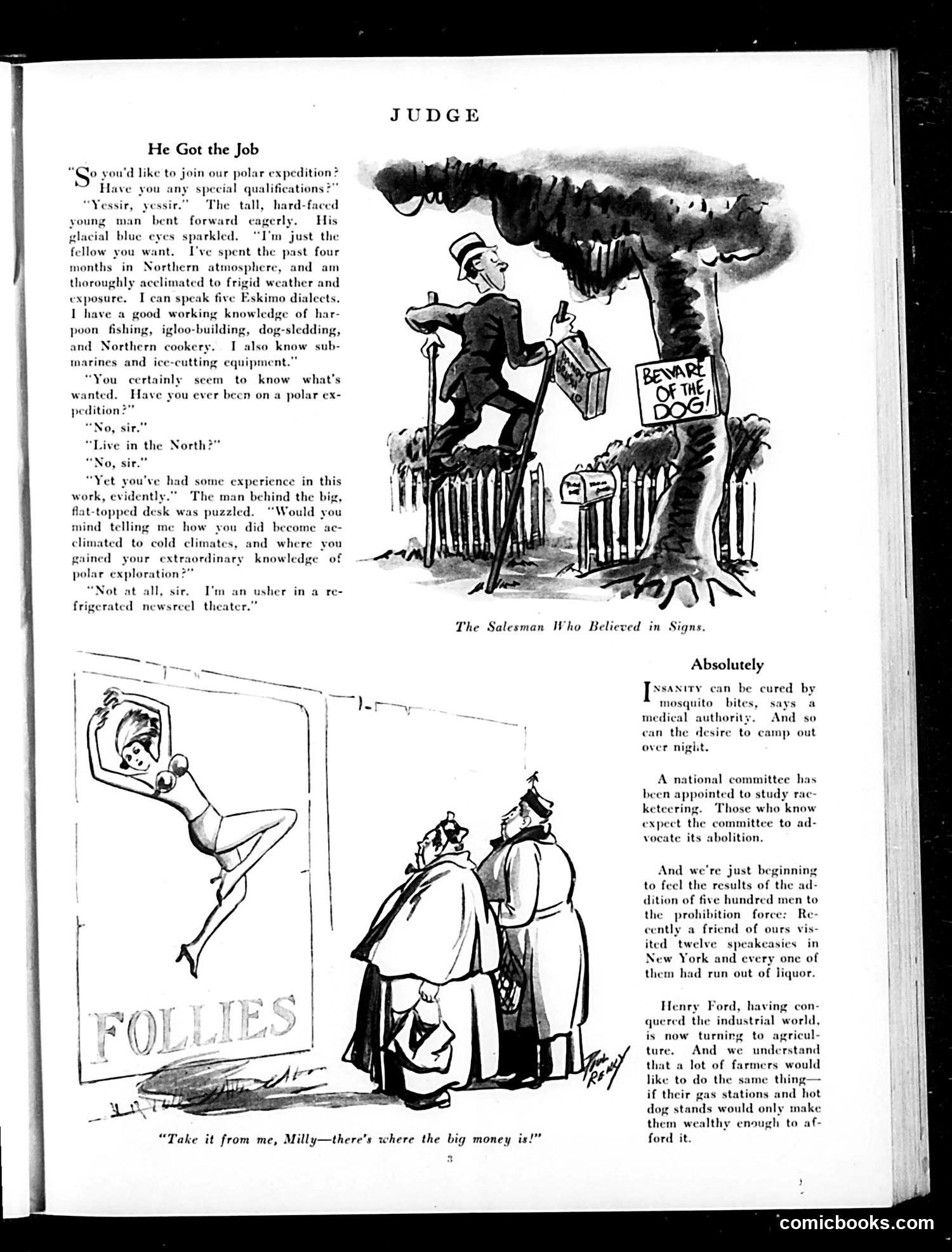
Analysis of Judge Magazine Page "He Got the Job" (top): A job applicant claims Arctic expedition experience—harpoon fishing, igloo-building, dog-sledding—to impress an expedition leader. The punchline reveals he's merely an usher in a refrigerated movie theater. The satire mocks exaggeration and bluffing in job interviews. "The Salesman Who Believed in Signs" (top right): A traveling salesman ignores a "Beware of the Dog" sign, apparently with negative consequences. This is straightforward visual humor about ignoring warnings. "Take it from me, Milly" (bottom): Two women discuss prohibition's effects—speakeasies and liquor scarcity. The cartoon satirizes Prohibition's failure, referencing the era's widespread black-market alcohol trade and social consequences following the 1920 ban.
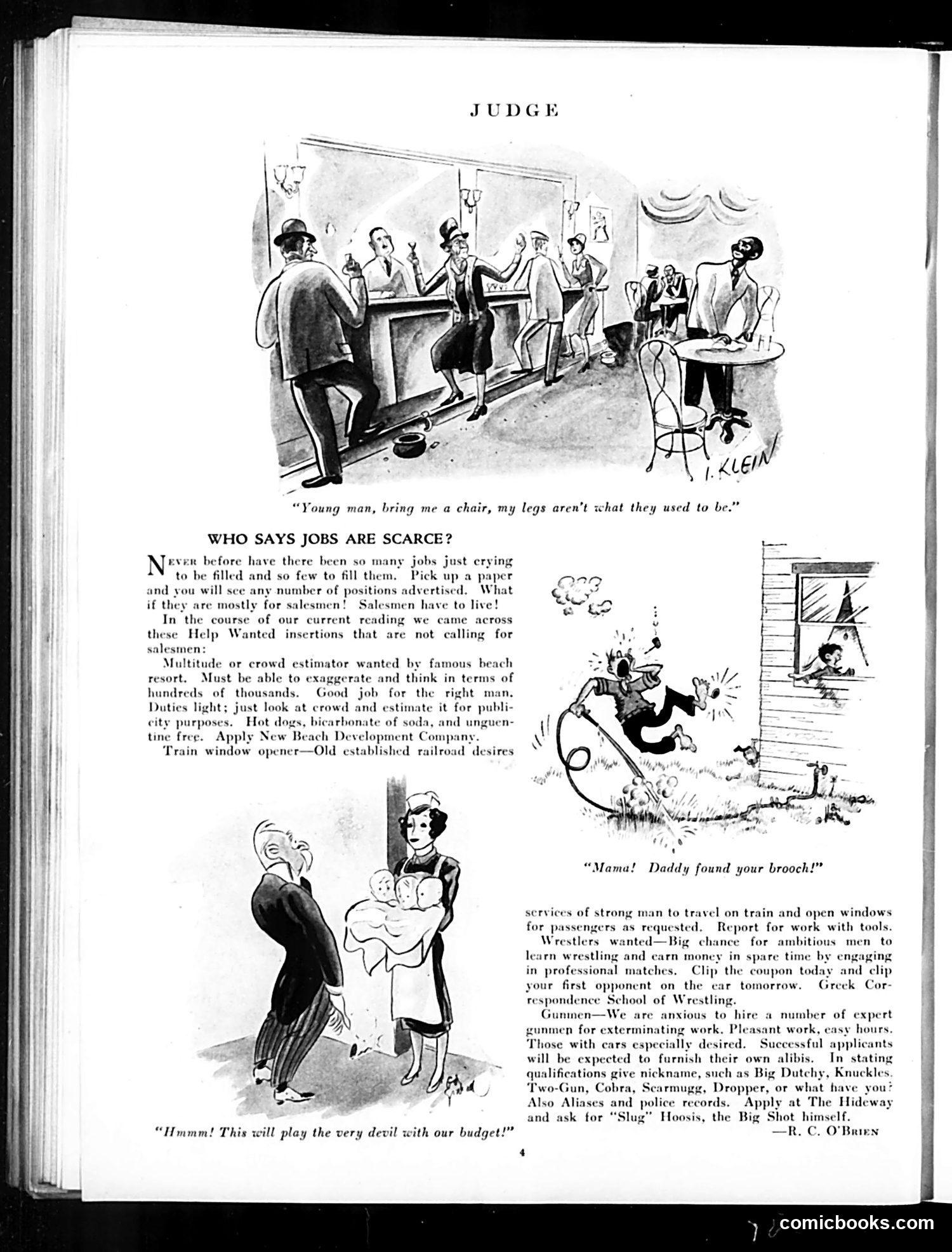
"Judge" Magazine Page: "Who Says Jobs Are Scarce?" This satirical page mocks job advertisements from the 1920s-1930s era. The top cartoon shows a courtroom scene titled "JUDGE," depicting absurd job listings as a form of justice. Below, the text presents real help-wanted ads with exaggerated, exploitative job descriptions: - A beach resort seeking a "crowd estimator" willing to exaggerate attendance - A railroad hiring a train window opener - A wrestling school offering to teach professionals - Gunmen wanted for "exterminating work"—applicants encouraged to provide aliases and criminal records The satire exposes how desperation during economic hardship drove people to accept dangerous, demeaning, or outright illegal employment. The accompanying cartoons show physical mishaps resulting from these ridiculous jobs, reinforcing how foolish and unsafe these "opportunities" actually were.
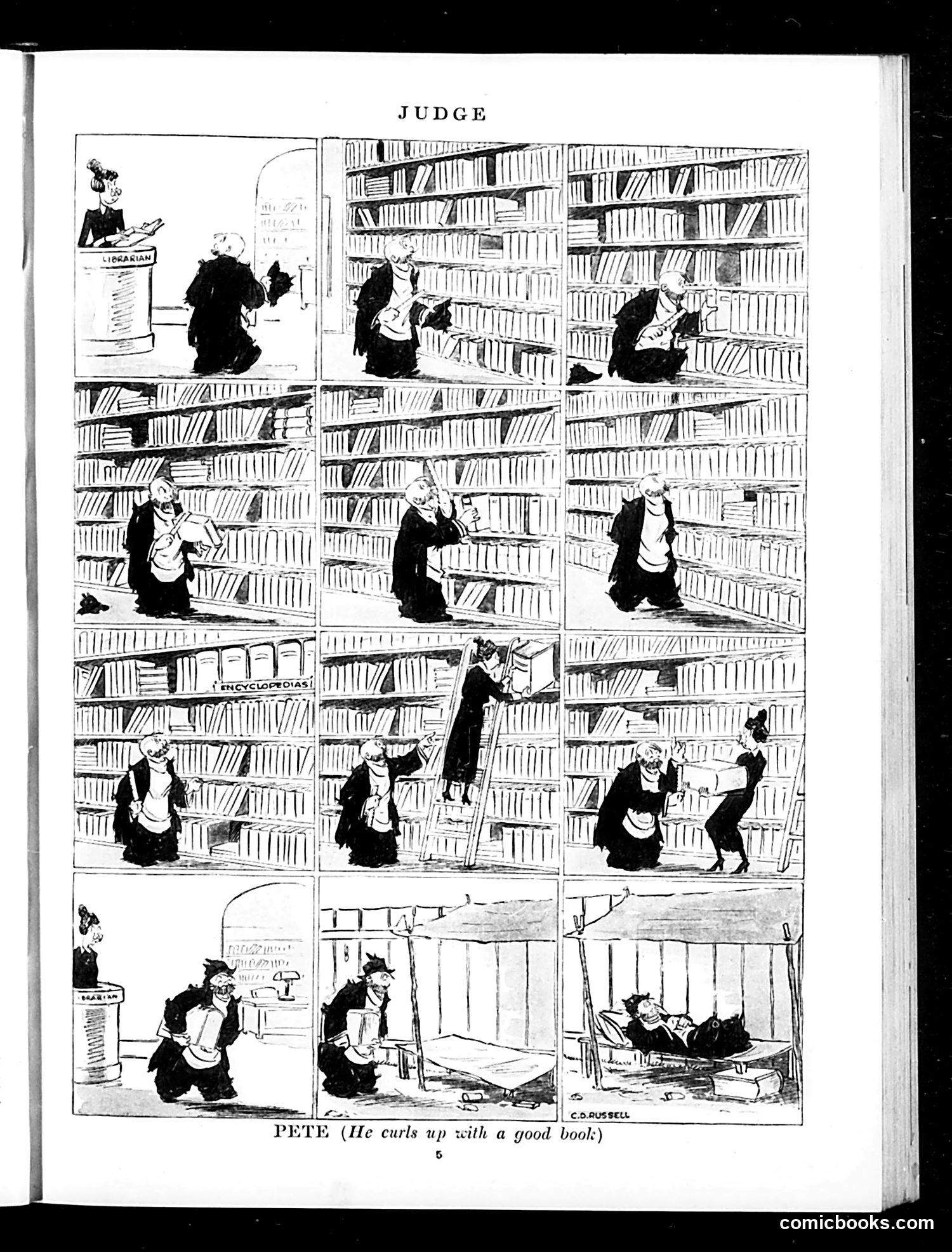
"Judge" Page Analysis This page contains a comic strip titled "PETE (He curls up with a good book)" by C.D. Russell, depicting a character's journey through a library. The strip shows Pete searching library shelves, struggling to select books, and eventually finding one that captivates him so thoroughly he becomes completely absorbed—curling up comfortably to read it. The final panels show him in a relaxed, reclined position, fully immersed in his book. The humor appears to center on the contrast between the effort of finding the *right* book in a vast library versus the reward of discovering an engrossing read that transports the reader. It's gentle satire about literary escapism and the comfort books provide—a relatable theme for *Judge* magazine's educated, literate audience.
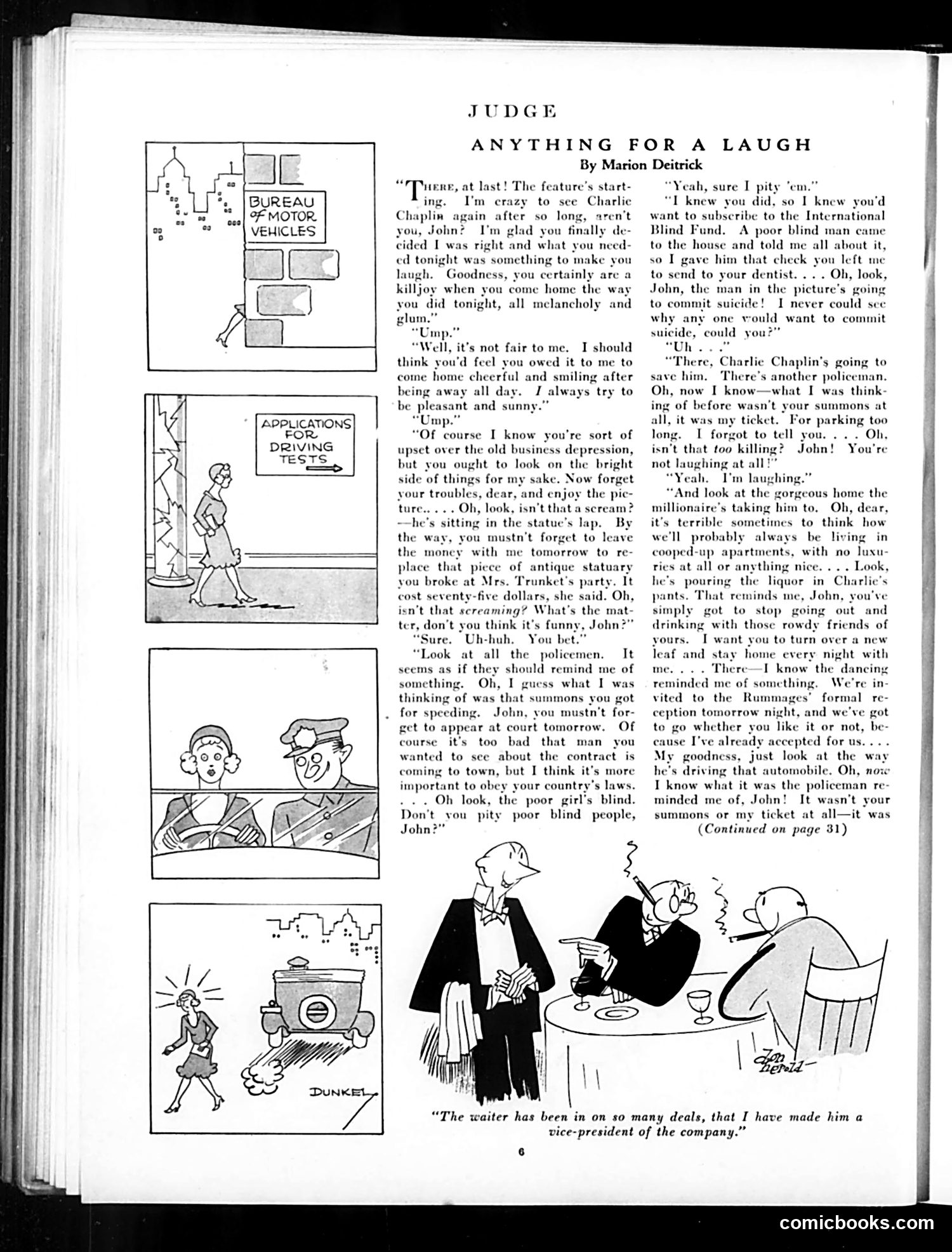
"Anything for a Laugh" — Judge Magazine Analysis This page satirizes wealthy society's indifference to social problems during economic hardship. The main story depicts a wealthy woman ("Charlie Chaplin" reference unclear) dismissing her husband's concerns about poverty and lawbreaking by focusing instead on trivial matters: a statuary purchase, social events, and superficial entertainment. The scattered comic panels mock bureaucratic absurdity (driving tests office) and working-class situations. The final illustration shows men in formal wear at dinner, with a caption about a waiter becoming "vice-president" through repeated dealings—satirizing both corporate nepotism and the notion that any exposure to wealth automatically elevates one's status. The overall message: society's upper classes ignore serious issues in favor of frivolous amusement.
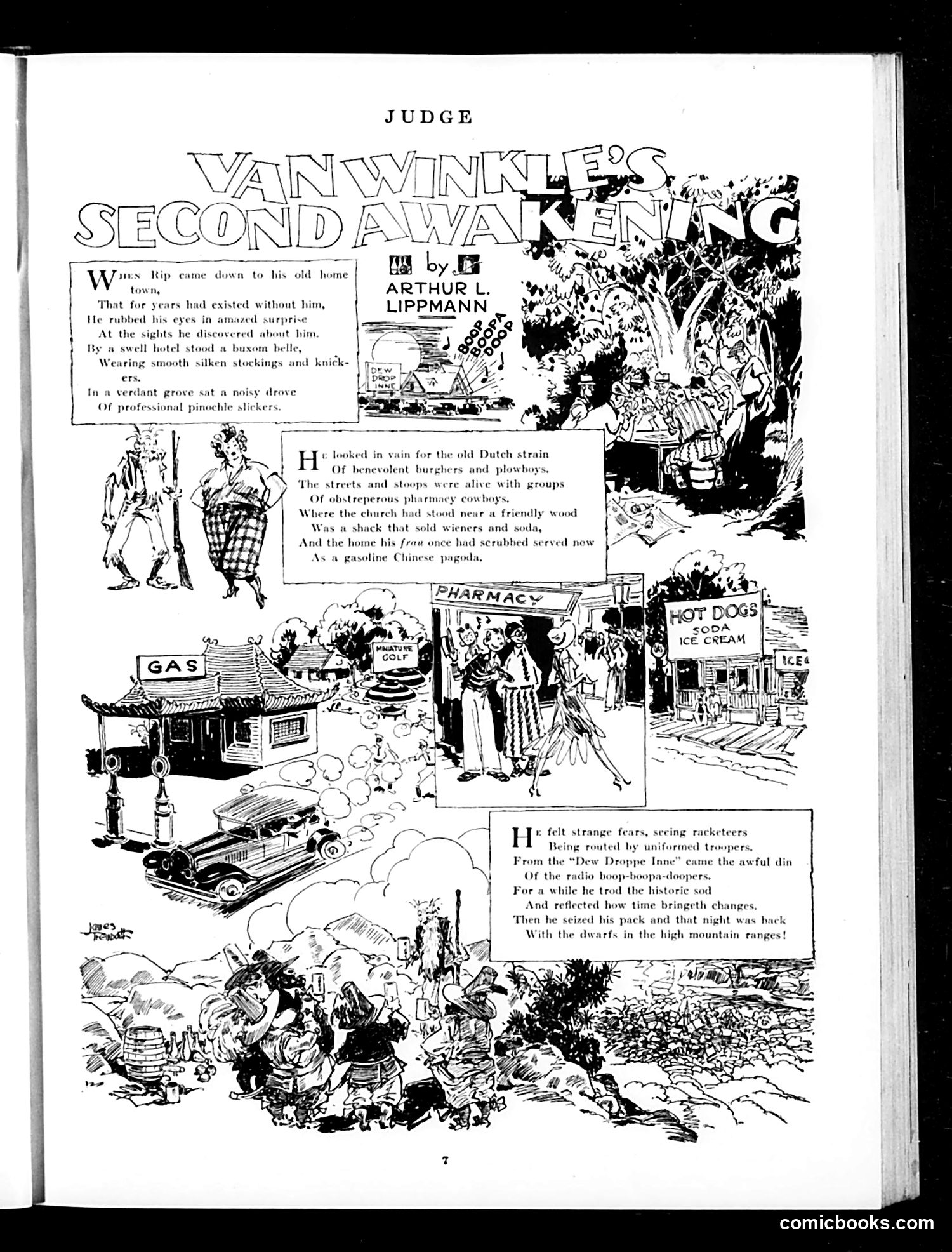
"Judge Vanwinkle's Second Awakening" Analysis This is a satirical story by Arthur L. Lippmann depicting a character (clearly referencing Rip Van Winkle) returning to his hometown after years away, only to find it utterly transformed by modernization and urban decay. The satire targets early 20th-century American social changes: the disappearance of traditional Dutch colonial character, replacement of churches and homes with commercial establishments (gas stations, pharmacies depicted as "cowboys," Chinese pagodas), the rise of organized crime ("racketeers"), and Prohibition-era concerns ("Dew Droppe Inn," radio references). The protagonist finds the changes so disturbing that he flees back to nature ("dwarfs in the high mountain ranges"). The comic's point: rapid modernization has destroyed America's pastoral past and replaced it with commercialism, vice, and lawlessness. It's fundamentally nostalgic criticism of contemporary urban America, lamenting what industrialization had cost.
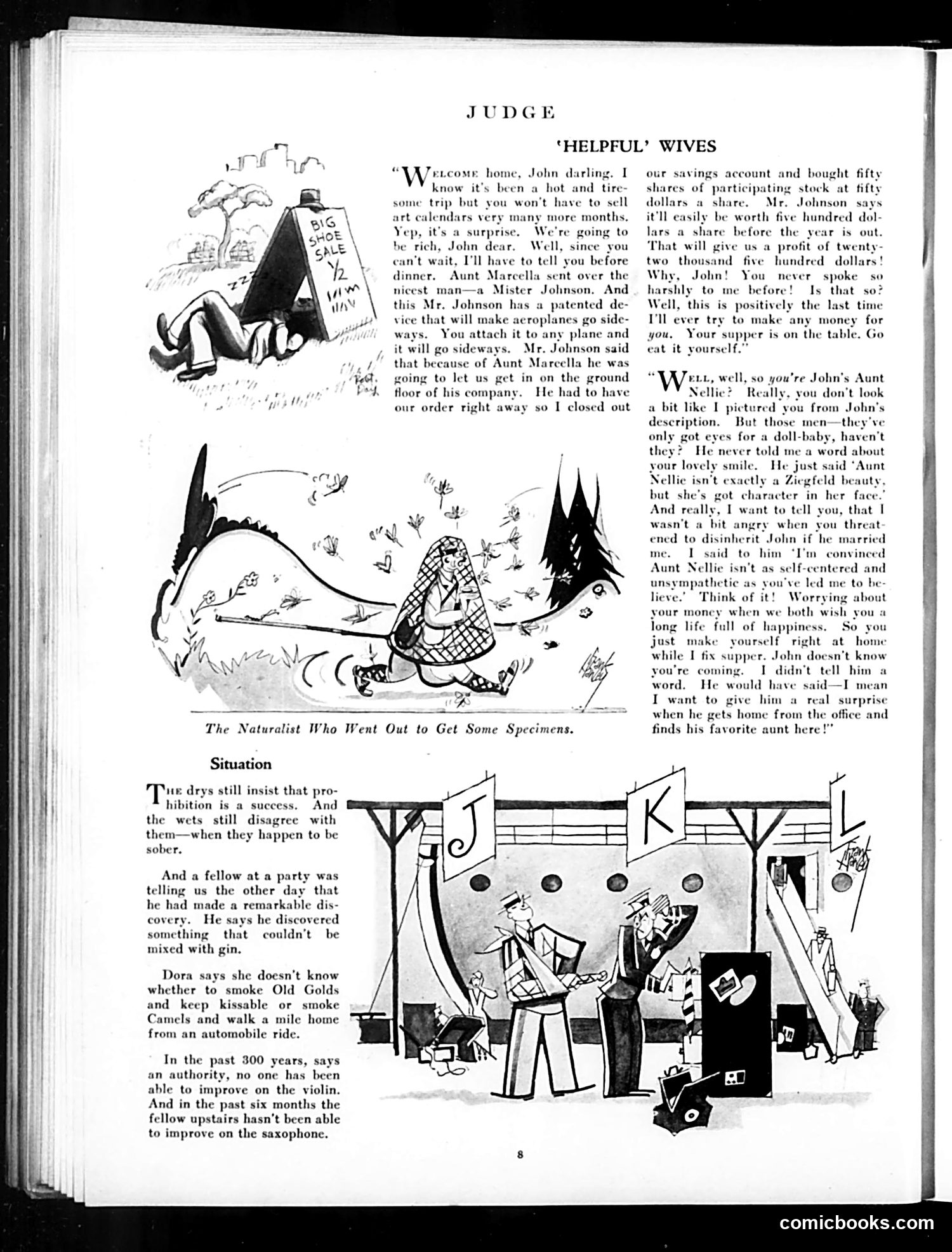
Judge Magazine Content Analysis This page contains two satirical pieces mocking wives' financial decisions and prohibition-era social hypocrisy. "Helpful Wives" depicts a wife who invested their savings in a dubious scheme: an "aeroplanes go sideways" device from a man introduced by her aunt. She excitedly announces they've bought stock expecting massive profits, oblivious to having made a foolish investment. John's angry response suggests the scheme is obviously fraudulent. The satire targets wives who make reckless financial decisions while believing themselves helpful. "Situation" section offers brief commentary on contemporary issues: prohibition's failure (drys claim success; wets disagree), a substance that "couldn't be mixed with gin" (likely mocking gin's ubiquity during Prohibition), cigarette advertising's sexual appeals ("kissable" vs. walking home), and instrumental music (the saxophone emerging as popular but unskilled players annoyed neighbors). The cartoons reflect 1920s anxieties about wives' newfound financial independence, Prohibition enforcement, and changing social customs.
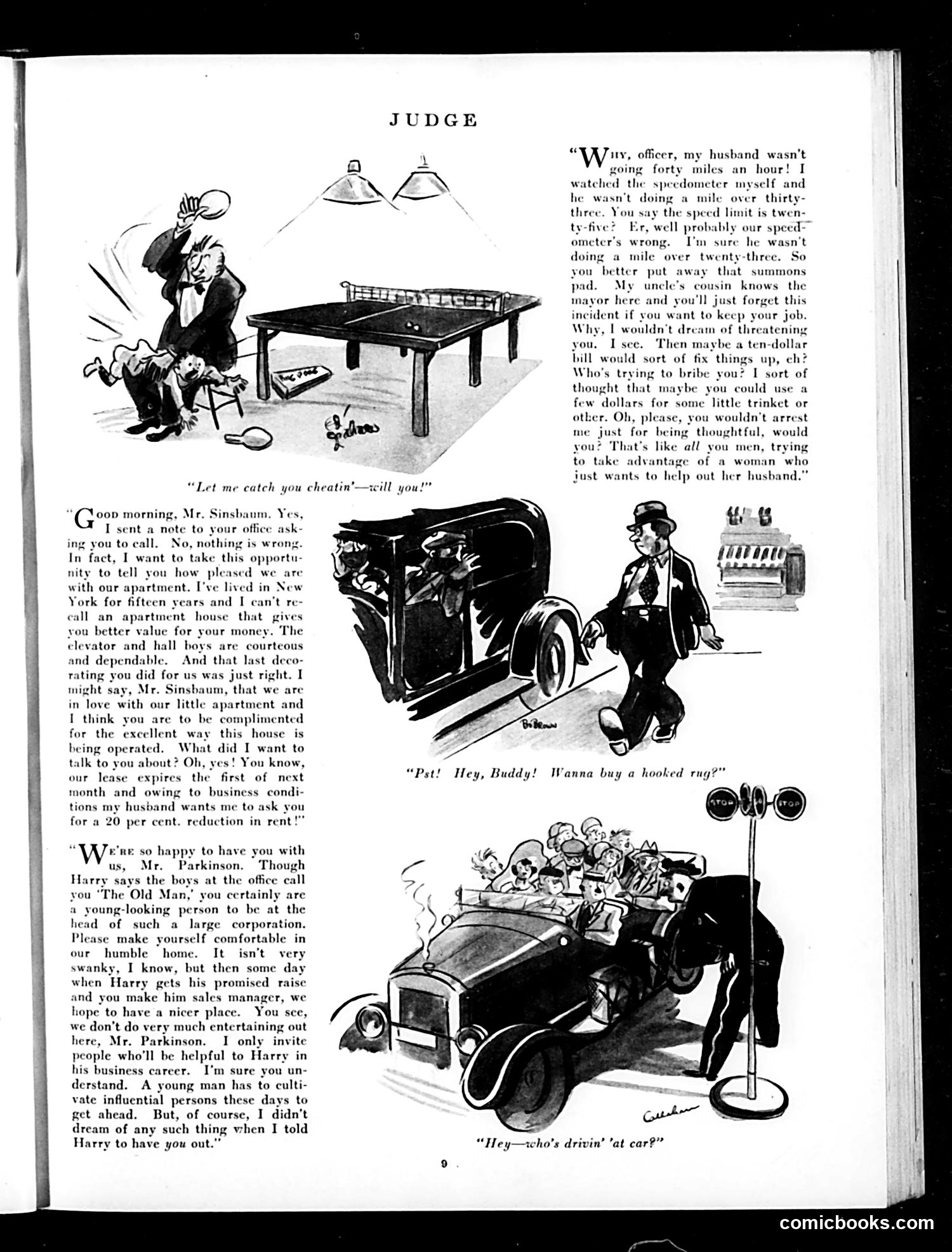
Judge Magazine Satire Analysis This page presents three interconnected satirical scenarios mocking social manipulation and hypocrisy: 1. The traffic stop (top): A woman caught speeding attempts to bribe a police officer by flattering him, claiming her speedometer is wrong, threatening his job through her uncle's connections, and finally offering money—all while maintaining she's "just being thoughtful." The satire targets women's perceived manipulation tactics and corruption of law enforcement. 2. The landlord visit (middle left): A tenant lavishes praise on her landlord's apartment management, then requests a 20% rent reduction. The satire exposes transparent flattery as a negotiation tactic—praising every detail before making a financial demand. 3. The boss dinner (bottom): A wife hosts her husband's boss while strategically complimenting his youth and position, subtly reminding him of promised raises and promotions. The satire reveals calculated social climbing disguised as innocent hospitality. Each scenario illustrates the same theme: people (particularly women, in Judge's perspective) using charm, flattery, and veiled threats to achieve selfish ends while maintaining false innocence.
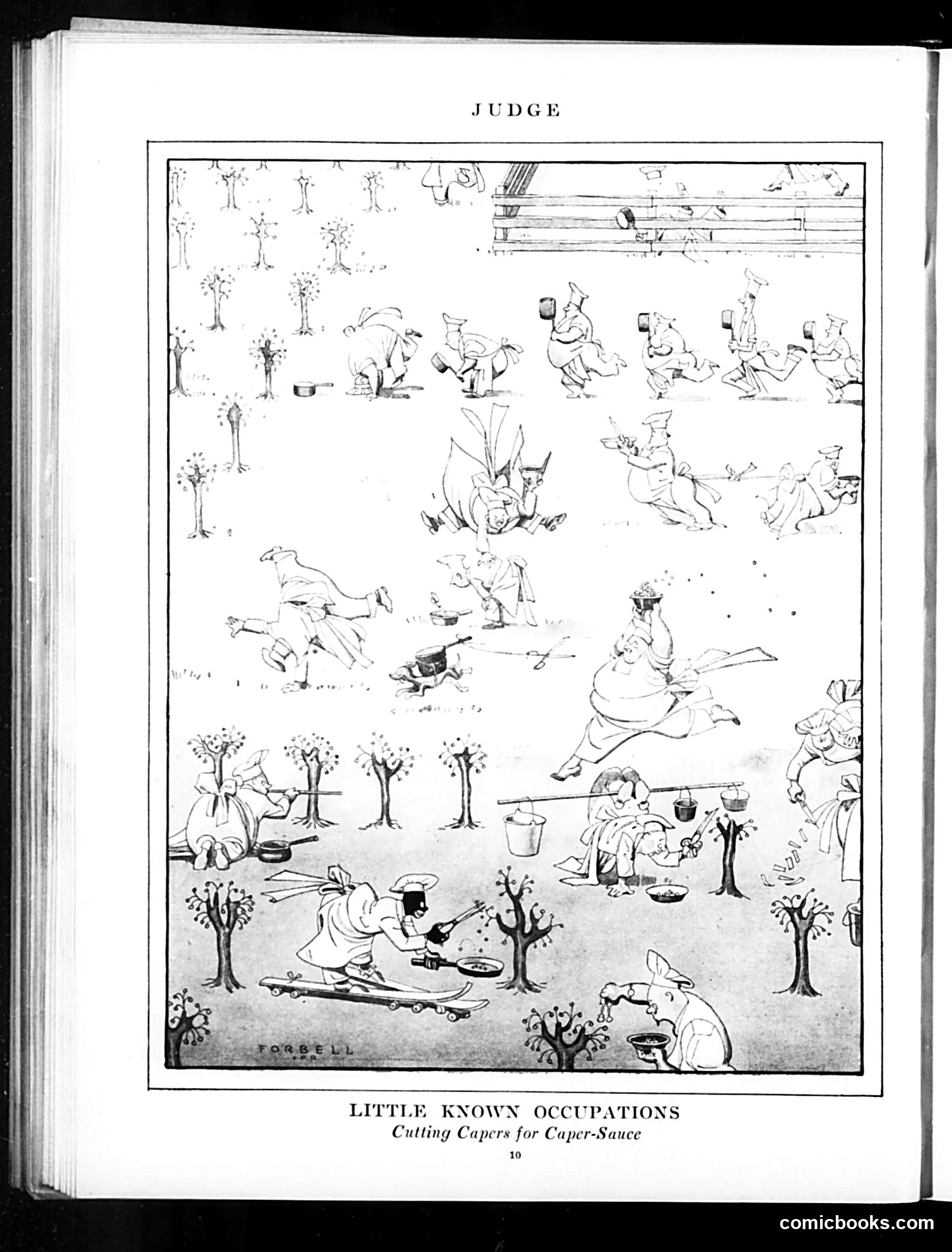
This Judge cartoon presents a visual pun on the phrase "cutting capers"—a idiom meaning to act playfully or mischievously. The illustration literally depicts people *cutting capers* (the plant used to make caper sauce, a condiment). The satire plays on the double meaning: various figures throughout a pastoral landscape are shown harvesting, preparing, and processing caper plants using exaggerated, comedic physical actions—chopping, carrying, cooking—as if engaged in an absurdly elaborate "occupation." The joke's appeal lies in the unexpected literalization of familiar language and the tongue-in-cheek suggestion that such a mundane agricultural task deserves recognition as a distinct, noteworthy profession. It's characteristic of early-20th-century magazine humor that relied on wordplay and visual puns.
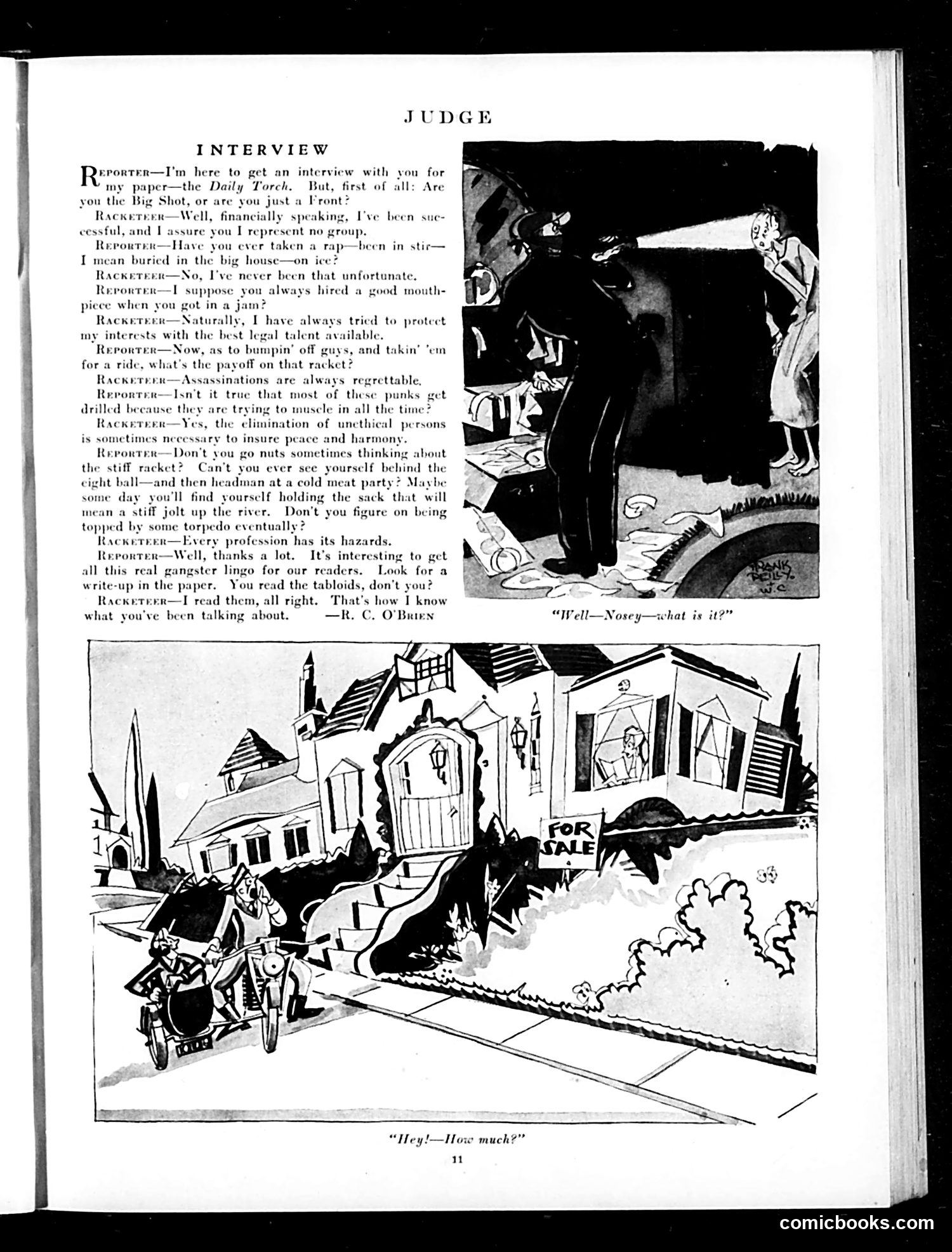
Judge Magazine Cartoon Analysis This 1920s-era satirical interview mocks organized crime and tabloid journalism. A reporter interviews a "Racketeer" (a gangster), using period slang: "Big Shot," "rap" (arrest), "the big house" (prison), "bumpin' off" (murder), and "taking for a ride" (killing). The racketeer speaks in euphemisms, calling assassinations "regrettable" and necessary eliminations of "unethical persons"—mocking how criminals justify violence with false legitimacy. The reporter goads him with dark humor, asking if he worries about being "topped by some torpedo" (shot by a hitman). The satire targets both criminals (their hypocrisy and violence) and tabloid sensationalism (the reporter explicitly seeks "gangster lingo" for readers). The cartoons below illustrate typical criminal activity: a motorcar getaway and a house robbery marked "For Sale." The humor relies on 1920s Prohibition-era organized crime being darkly comedic fodder—a commentary on public fascination with gangsters.
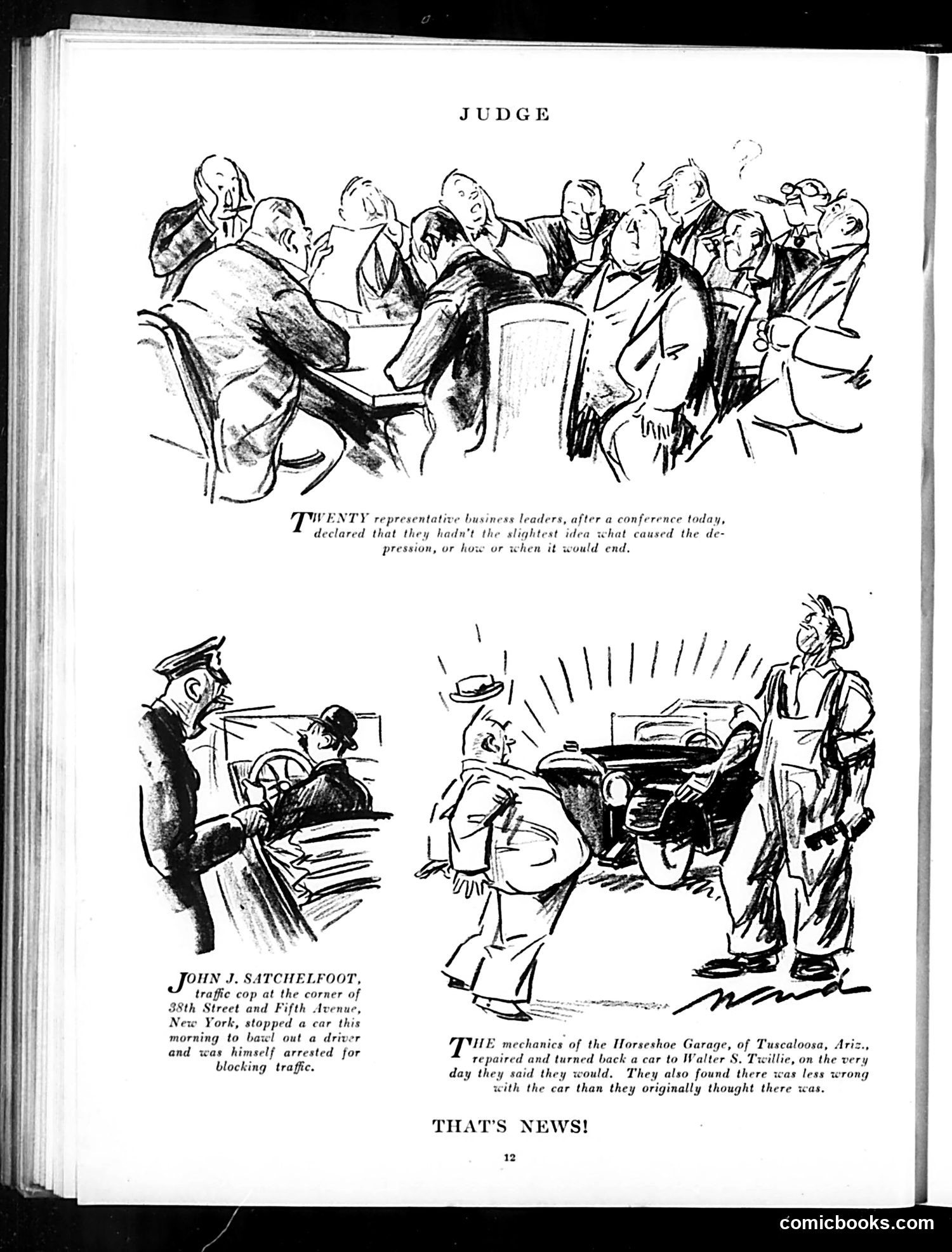
Judge Magazine Satire Analysis This page satirizes the Great Depression through three interconnected jokes: Top cartoon: Twenty business leaders confess complete ignorance about the depression's cause or duration—mocking the era's financial elite for lacking answers despite their supposed expertise. Bottom left: A traffic cop arrests himself for blocking traffic while trying to stop a driver—absurdist humor about bureaucratic inefficiency and circular logic. Bottom right: The punchline headline "THAT'S NEWS!" sarcastically frames three genuinely unusual occurrences: a cop arrested for blocking traffic, business leaders admitting incompetence, and—most pointedly—a garage actually completing repairs on time and finding *fewer* problems than expected. Each item represents something so contrary to normal experience it qualifies as newsworthy. The overall message: during economic chaos, institutional failures (government, business, even repair shops) were so routine that competence itself becomes remarkable. The satire critiques widespread dysfunction and public cynicism about authorities' ability to manage the crisis.
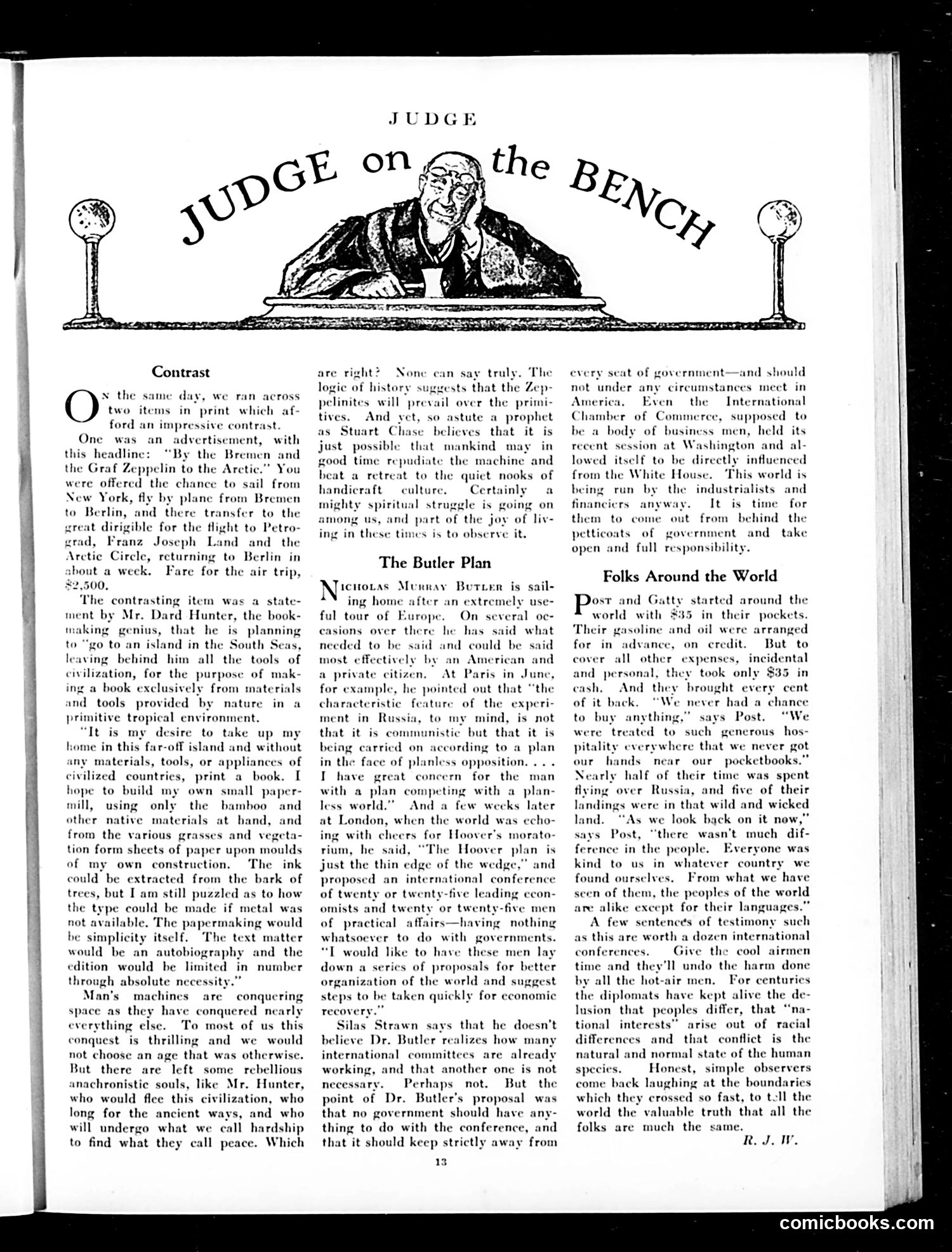
"Judge on the Bench" - Political Commentary Page This page from *Judge* magazine presents two contrasting editorial pieces satirizing different American attitudes toward modernity and governance. "Contrast" juxtaposes two news items: a luxury dirigible tour package ($2,500 for airship travel to the Arctic) versus bookmaker Dard Hunter's plan to abandon civilization entirely and handcraft a book on a South Seas island using only primitive materials. The piece muses philosophically on whether technological progress or retreat to handicraft represents humanity's true path—suggesting both impulses coexist in contemporary America. "The Butler Plan" discusses Nicholas Murray Butler's recent European tour, where he advocated for an international conference of economists and business leaders to coordinate post-war economic recovery plans. The satire notes that skeptic Silas Strawn dismisses Butler's proposal as redundant, claiming too many international committees already exist. The piece gently mocks the proliferation of planning committees while acknowledging Butler's influence as a respected public intellectual. Both pieces reflect 1920s anxieties about modernity, planning, and America's post-war role.
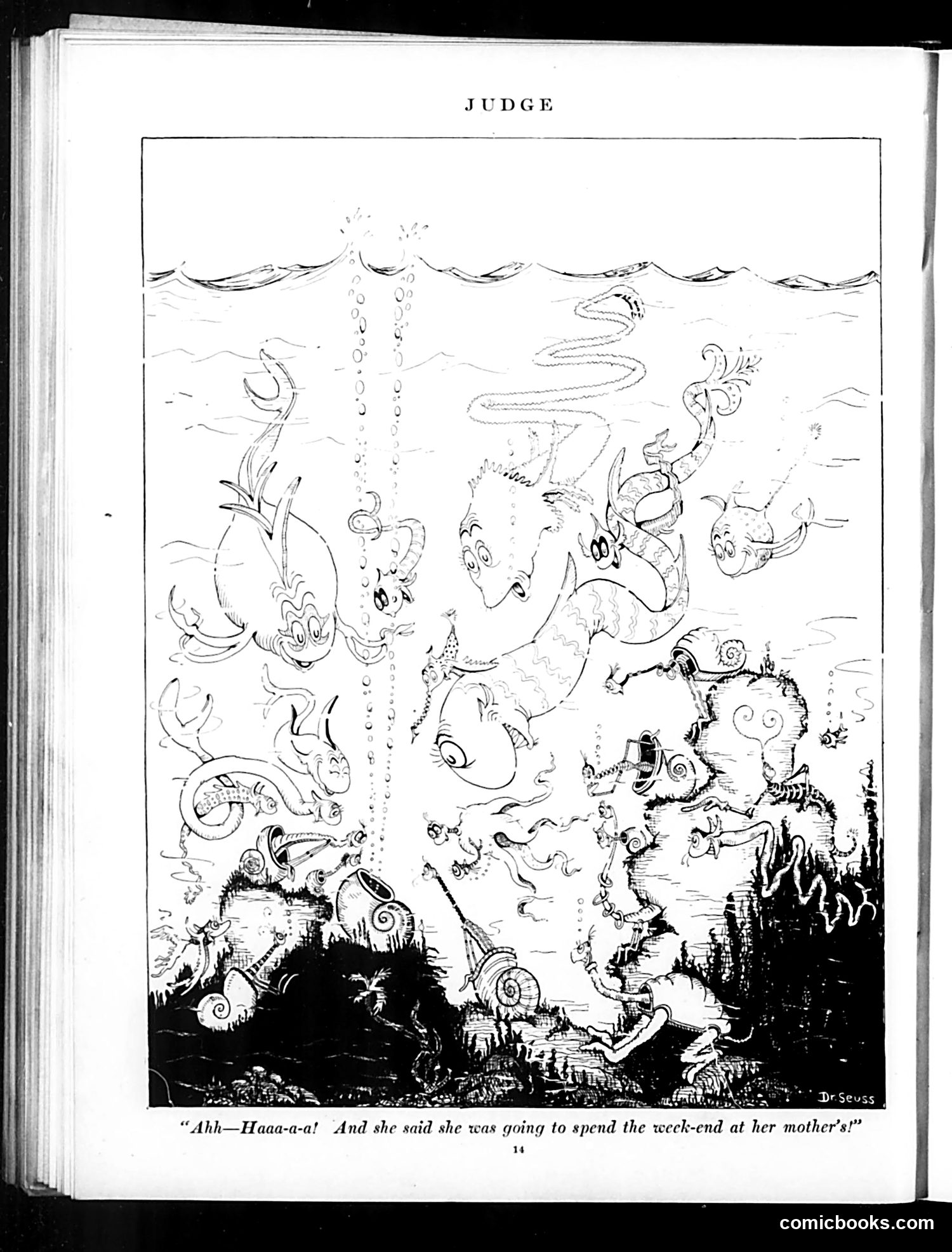
"Judge" Cartoon Analysis This Dr. Seuss cartoon depicts an underwater scene where a woman's stated excuse—spending the weekend at her mother's—has apparently caused chaos or distress to sea creatures below. The caption's exaggerated reaction ("Ahh—Haaa-a-a!") suggests the woman either lied about her destination or her absence created unexpected consequences. The satire likely targets infidelity or deception in relationships—a common Judge magazine theme. The absurdist underwater setting, populated with Seussian creatures in various states of agitation, transforms a mundane domestic lie into surreal comic disaster. The joke implies that the woman's false excuse (the conventional coverup for an affair) somehow affected even marine life, amplifying the social disruption caused by dishonesty and deception. The cartoon reflects mid-20th century anxieties about marital fidelity and gender relations.
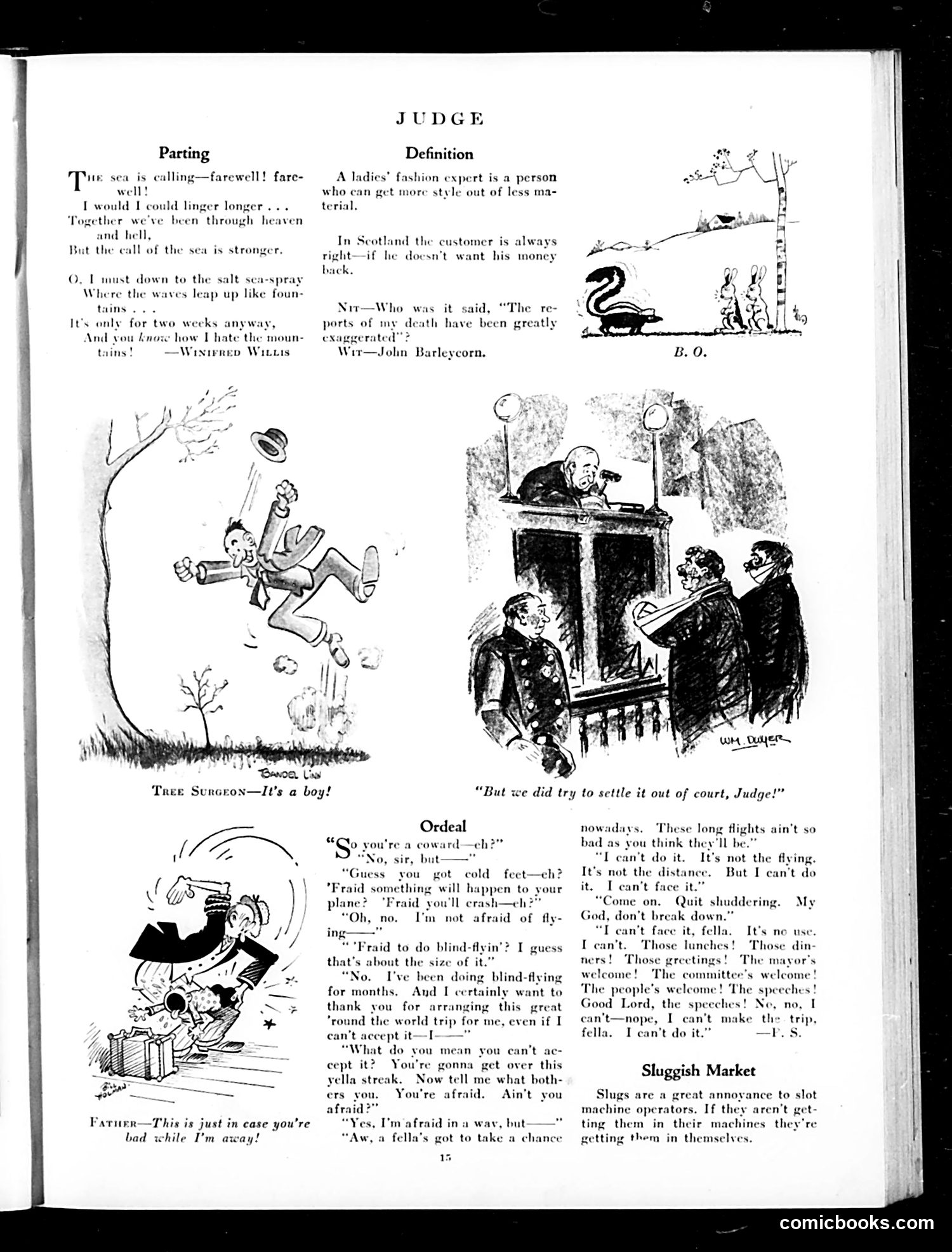
Judge Magazine Page Analysis This page contains several humorous sketches and brief comedic pieces typical of early 20th-century satirical magazines: "Parting" presents a sentimental poem about someone departing to sea, attributed to Winfred Willis, accompanied by a cartoon of a man being ejected into the air—likely illustrating the dramatic farewell theme through physical comedy. The "Definition" section offers short satirical quips about fashion experts, Scottish customers, and John Barleycorn (a personification of alcohol/whiskey). "The Ordeal" depicts a conversation between two men about a world flight. One man tries to convince a reluctant friend to undertake a round-the-world airplane trip. The friend's resistance centers not on flying itself but on the social obligations: dinners, speeches, greetings, and ceremonies he'd face—poking fun at the tedium of celebrity travel and public appearances. "Sluggish Market" offers a pun: "slugs" (the garden pests) jammed in slot machines are a nuisance. The page emphasizes wordplay, social observation, and physical comedy typical of Judge's humor.
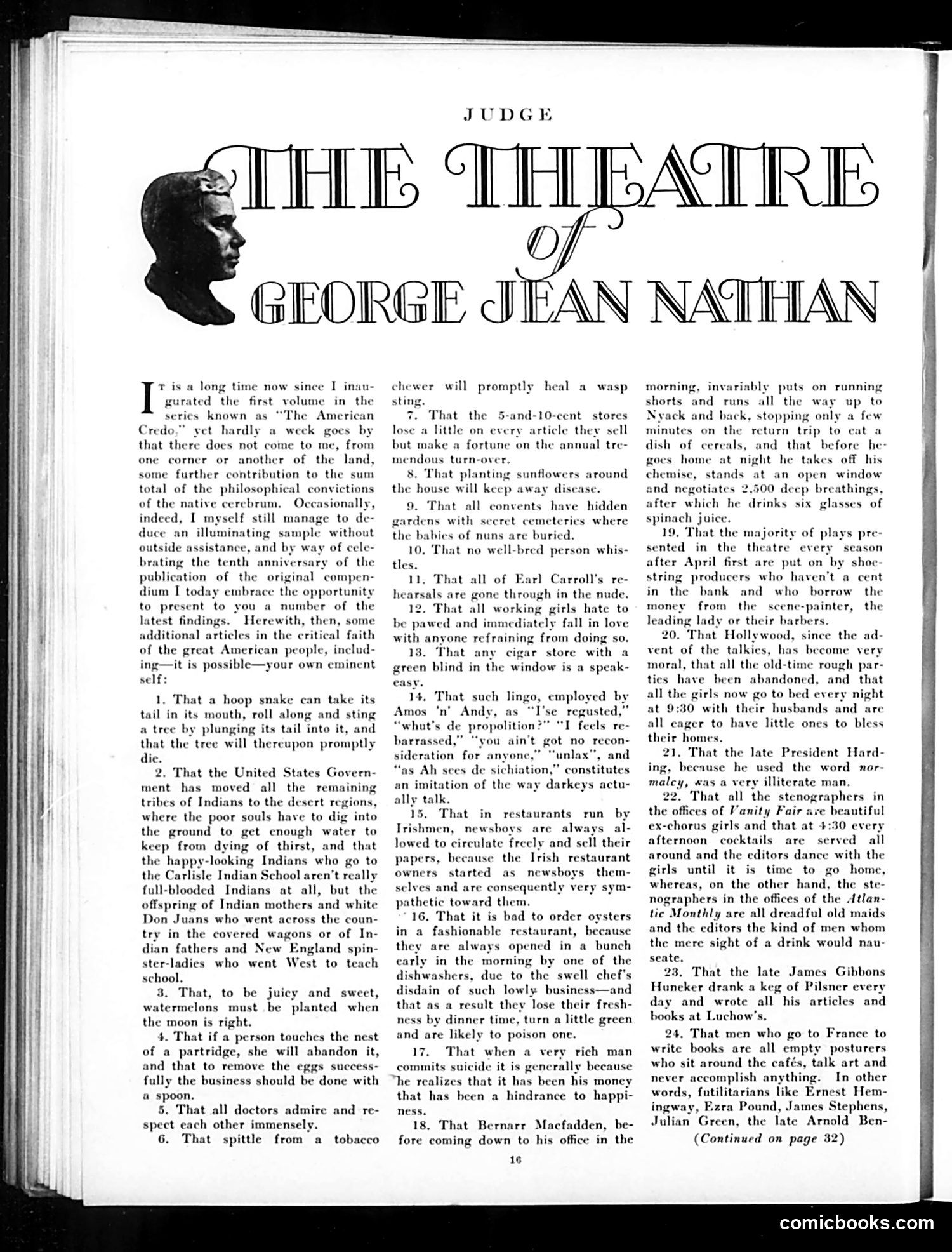
"The Theatre of George Jean Nathan" This page introduces a satirical column by prominent drama critic George Jean Nathan, framed as "The American Credo"—a running series cataloging absurd beliefs held by average Americans. The visible items mock widespread superstitions and cultural misconceptions: that tobacco spit heals wasp stings, that sunflowers prevent disease, that 5-and-10-cent stores lose money on individual items, and that convents hide secret cemeteries with babies of nuns. Notably, item 14 critiques the popular radio show "Amos 'n' Andy," claiming its dialect representation doesn't authentically capture Black speech patterns. Item 18 references physical culturist Bernarr Macfadden's eccentric morning running routine. The satire targets both naive folk beliefs and the gullibility of the American public—Nathan's intellectual weapon against mass credulity.
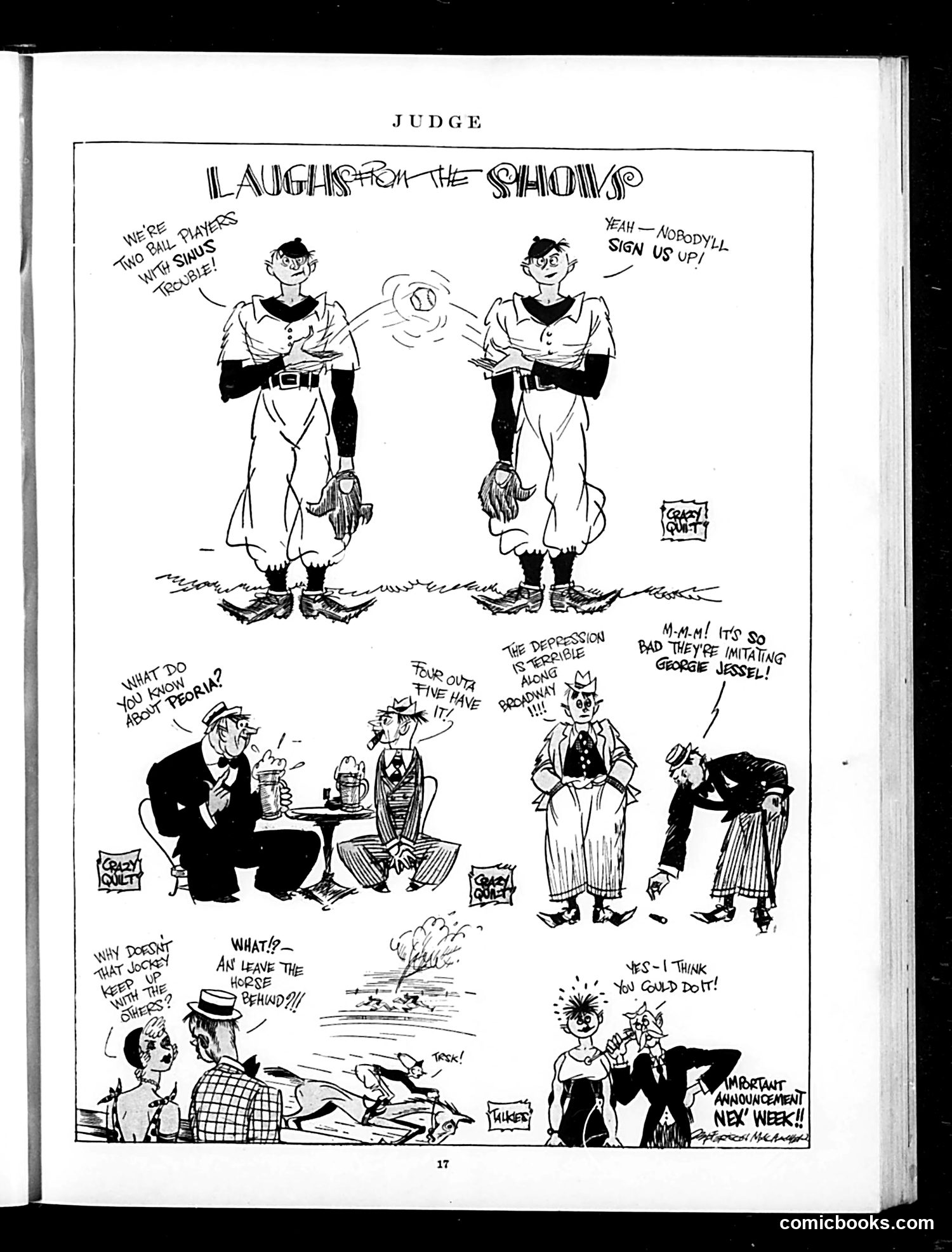
"Laughs from the Shows" This page satirizes theatrical performances, likely from early 20th-century Broadway or vaudeville. The comic depicts two baseball players discussing trouble with their "Sauce," followed by scenes of theatrical Depression-era performances and audience reactions. The humor plays on contrasts: earnest performers attempting sophisticated material ("imitating Georgie Jessel"), while audiences and critics react skeptically. References to "the Depression" and the horse ("What's an leave the horse behind?!") suggest economic hardship affecting entertainment quality. The final panel announces a "New Week!" of performances, implying cyclical theatrical seasons. The overall satire mocks both struggling performers overreaching artistically and the public's mixed reactions to vaudeville-era entertainment during economically difficult times.
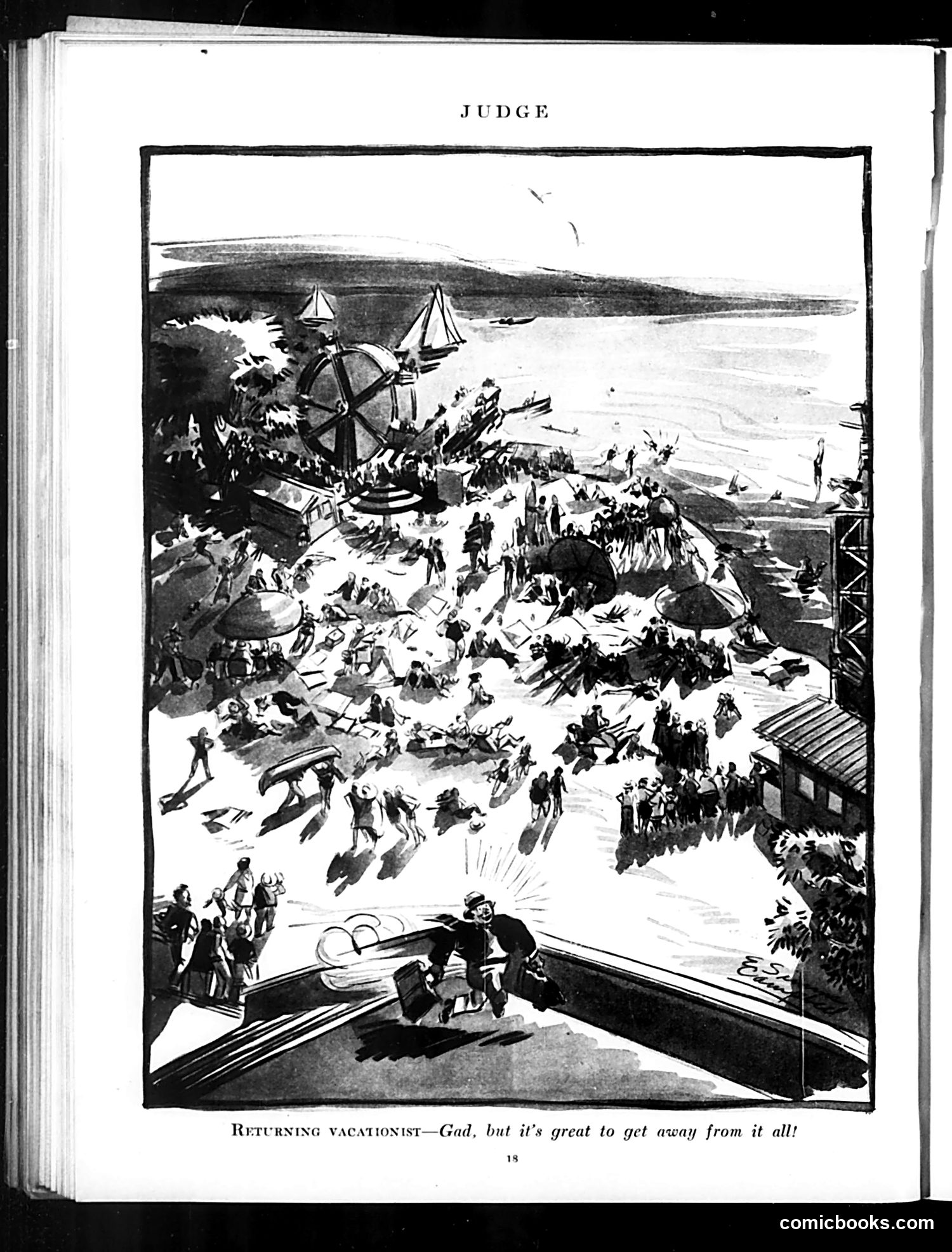
"Returning Vacationist" This Judge cartoon satirizes the irony of seeking vacation escape. The illustration shows a crowded beach scene packed with masses of people—the opposite of solitude. A well-dressed man in the foreground, apparently returning from holiday, exclaims "Gad, but it's great to get away from it all!" The joke targets upper-class vacationers who imagine peaceful retreats but instead encounter overwhelming crowds at popular seaside resorts. The dense, chaotic beach depicted visually contradicts his statement, suggesting he's deluded or being sarcastic about the actual crowded conditions. The cartoon mocks both the fantasy of vacation escape and the reality of commercialized leisure destinations in the early 20th century.
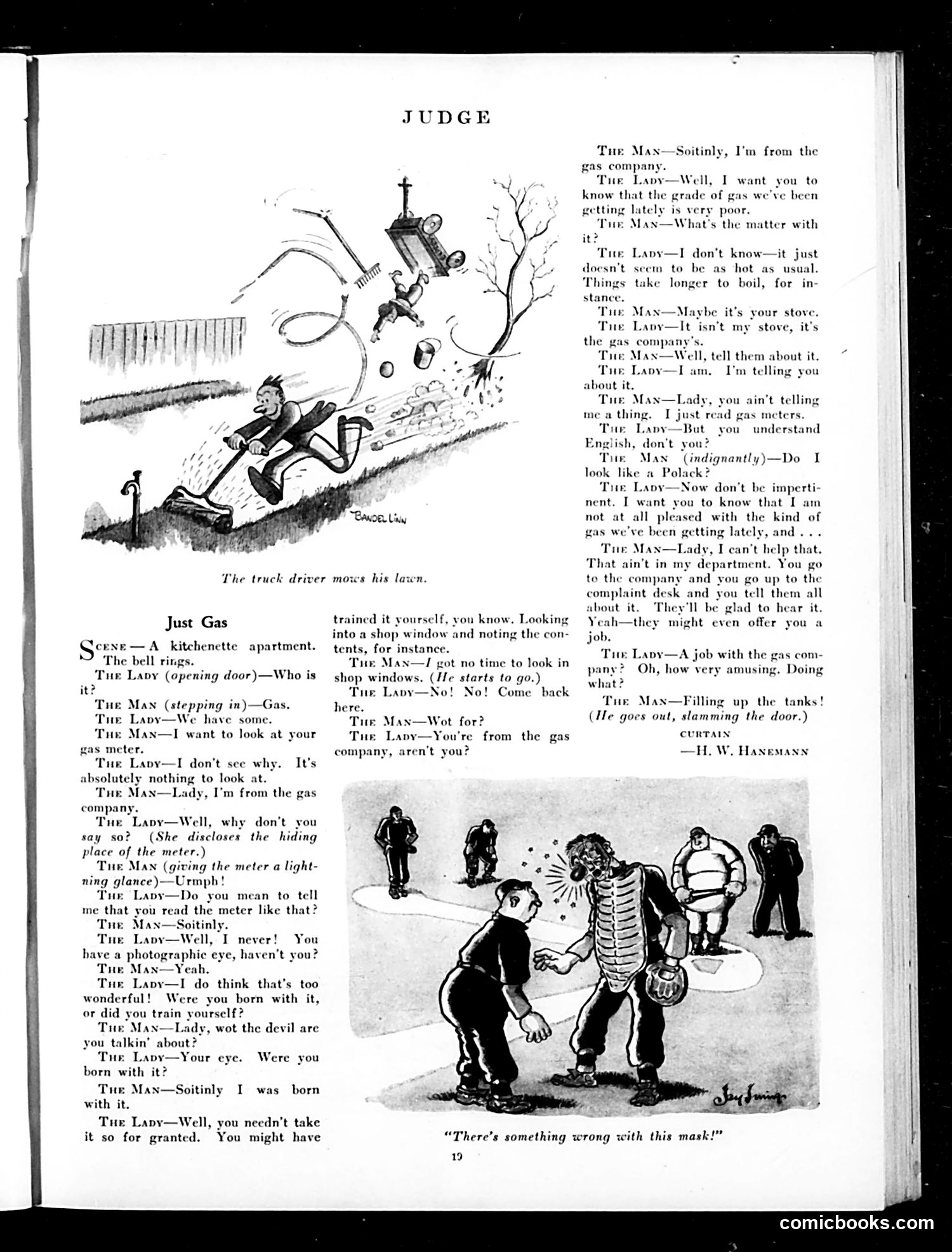
"Just Gas" - Judge Magazine Satire This two-part comic page satirizes the gas company's poor service and the disconnect between complainants and utility workers. The Sketch "Just Gas": A housewife complains to a gas meter reader about inferior gas quality—things boil slowly, the heat is weak. The worker, speaking in broad working-class dialect ("Soitinly"), dismisses her concerns, claiming he merely reads meters and has no authority over quality. When she insists on complaining, he sarcastically suggests she apply for a job "filling up the tanks." The humor targets both the worker's indifference and bureaucratic runaround—complaints get passed between departments endlessly without resolution. The Political Cartoon (below) shows a grotesque figure being examined by men in suits with "something wrong with this mask" caption, likely satirizing political deception or a public figure's false persona, though the specific reference is unclear without dating information. Both pieces mock institutional incompetence and worker apathy toward customer service—themes relevant to early 20th-century utility monopolies.
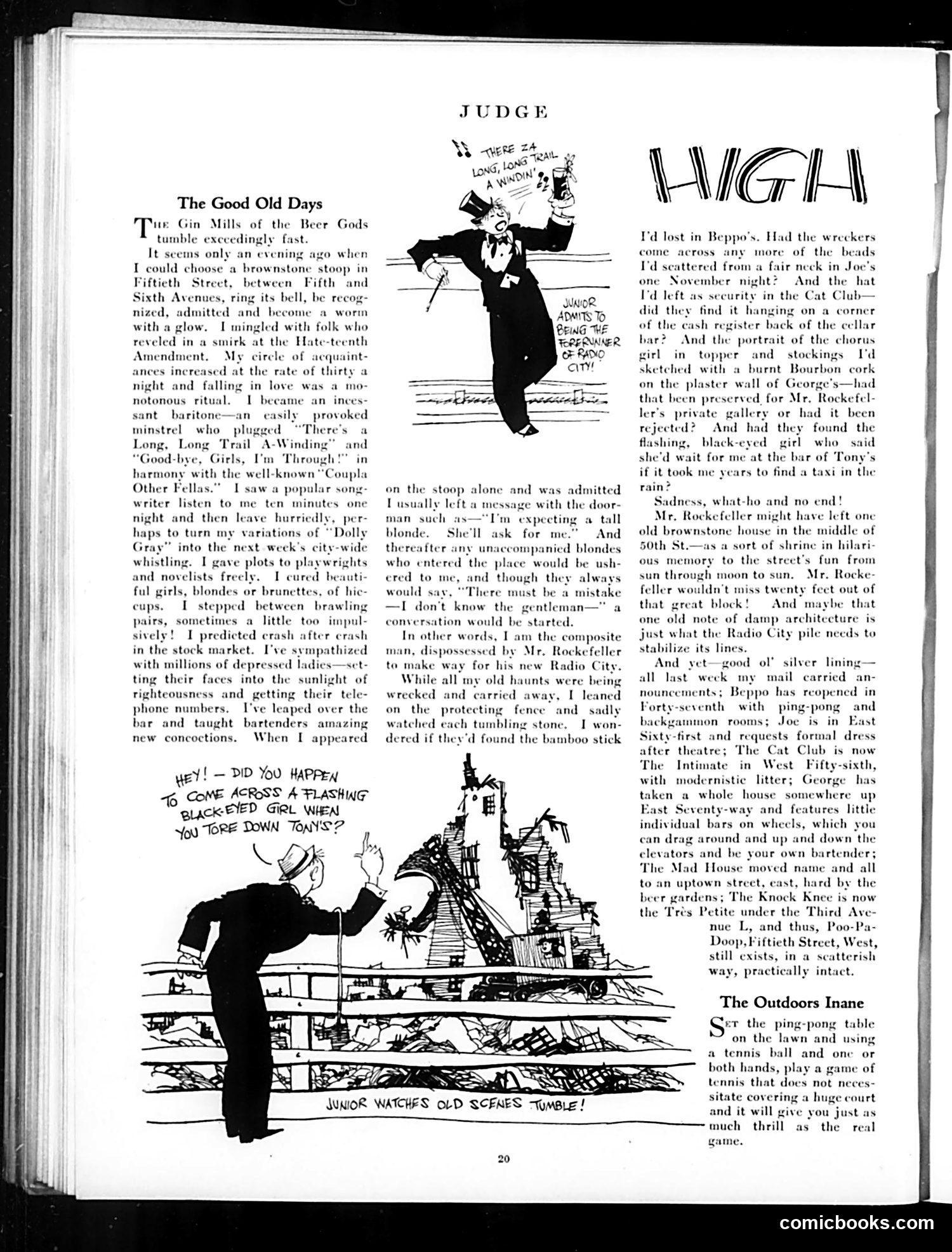
Political Cartoon Analysis: Judge Magazine Page This page nostalgically laments the destruction of New York speakeasies during Prohibition enforcement. The author recalls the "gin mills" of the 1920s—illicit bars on Fiftieth Street—where he was a regular patron and minor celebrity, flirting with women, singing, dispensing advice, and generally living a dissolute nightlife. The cartoons show a man discovering that these establishments are being demolished, apparently by Rockefeller's real-estate interests (likely the Radio City development project). The satire expresses regret at modernization destroying beloved vice dens, while ironically noting that the speakeasies have simply relocated uptown under new names—The Intimate, The Cat Club, etc. The piece mocks both the narrator's wasted youth and the futility of Prohibition enforcement. It's simultaneously self-deprecating social commentary and wistful nostalgia for pre-Depression urban decadence, treating the speakeasy closure as cultural loss rather than law-enforcement success.
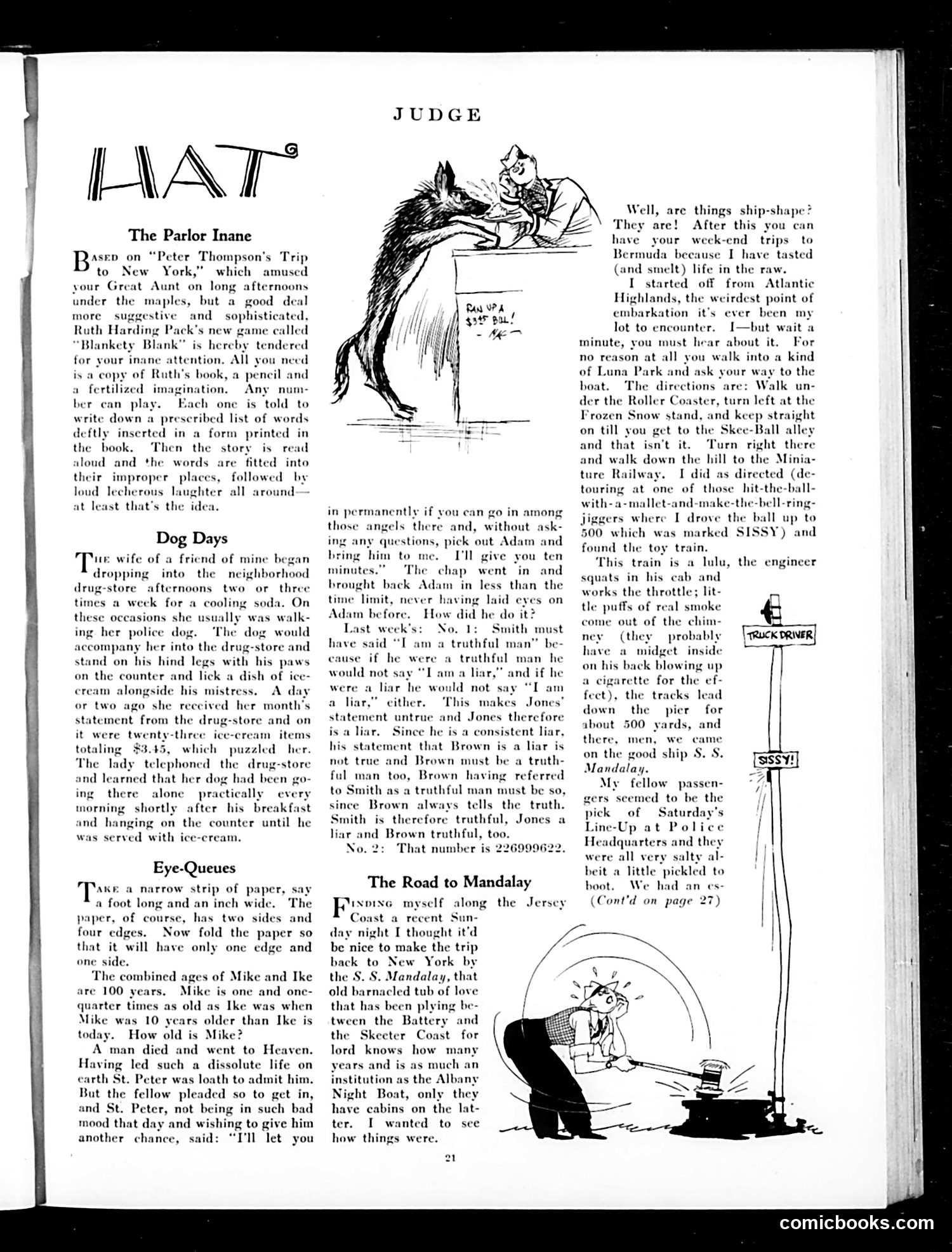
Analysis of Judge Magazine Page 21 This page contains several humor pieces typical of Judge magazine's content: "The Parlor Inane" advertises Ruth Harding Pack's word-game "Blankety Blank"—a parlor game where players insert prescribed words into a story template, creating unintentional double entendres for laughs. The satire mocks genteel entertainment and "fertilized imagination." "Dog Days" humorously describes a woman whose police dog has become an ice-cream addict, secretly visiting the drug store daily—an absurdist tale about pet misbehavior and consumer excess. "Eye-Queues" presents logic puzzles and brain-teasers for readers, a common Judge feature. "The Road to Mandalay" discusses a weekend steamship trip along the Jersey Coast on the S.S. *Mandalay*, comparing it to the Albany Night Boat. The accompanying cartoon shows a passenger at the ship's rail. This appears to be travel writing rather than political satire. The page emphasizes parlor games, consumer humor, and leisure activities—reflecting early 20th-century middle-class entertainment.
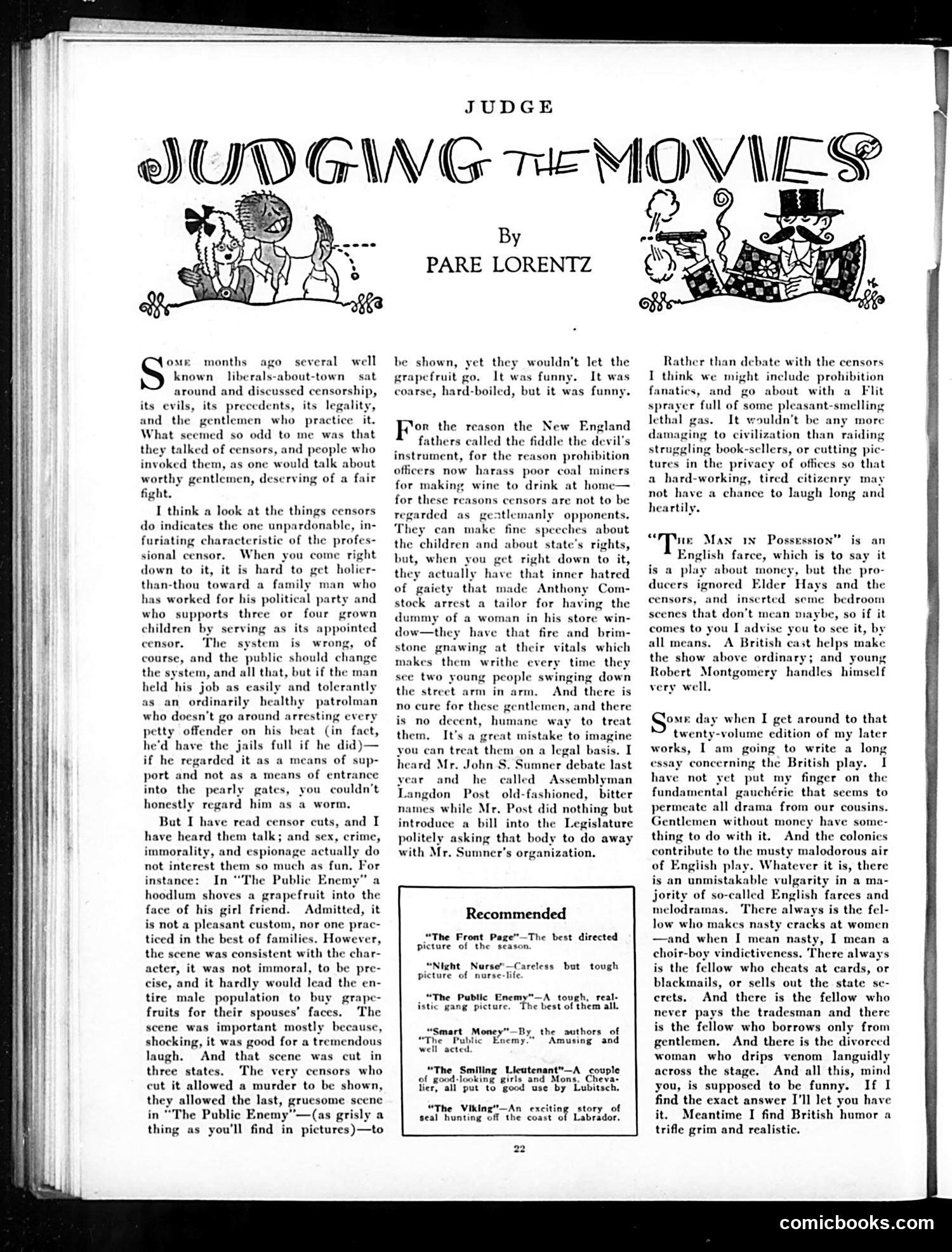
"Judging the Movies" by Pare Lorentz This essay attacks film censors' inconsistent priorities. Lorentz argues censors obsess over *fun* and *laughter* while tolerating serious moral violations. His primary example: censors in three states cut a famous scene from *The Public Enemy* where a gangster shoves a grapefruit in a woman's face—funny and character-appropriate—yet permitted the film's murders. Lorentz identifies the real motive: censors harbor puritanical *hatred* of pleasure and levity, echoing historical censorship of fiddles and alcohol (Prohibition). He references John S. Sumner, a real anti-vice activist, as an example of this joyless moralizing. The "Recommended" box lists contemporary films, endorsing *The Public Enemy* as realistic entertainment worth defending against censorial cuts. The satire mocks censors' claimed respectability as "gentlemen" with legitimate concerns, when they're actually killjoys suppressing harmless enjoyment.
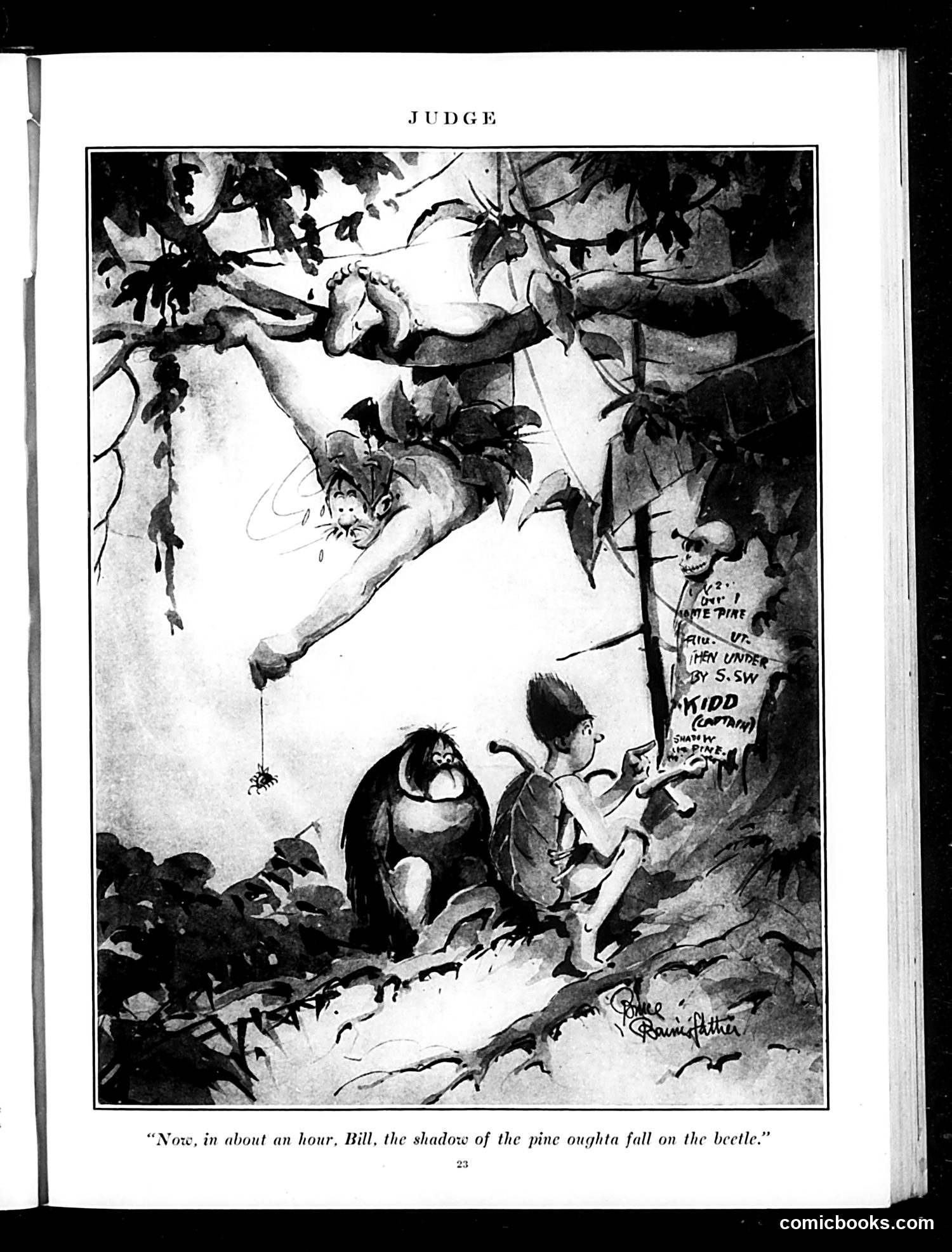
Judge Magazine Cartoon Analysis This illustration depicts a scene from a fable or moral tale. Two figures—apparently children or young people—observe a large beetle while standing near a tree. One character (Bill) is being instructed to wait for the tree's shadow to fall on the beetle, suggesting a lesson about patience, timing, or natural consequences. The cartoon's satirical intent is unclear from the image alone, though Judge magazine typically used such scenarios to mock human folly, superstition, or naive reasoning. The caption's matter-of-fact tone about an "hour" suggests irony—perhaps mocking someone's misplaced faith in a solution or belief in a convenient outcome. The artist appears to be S.W. Kidd (visible in the signature). Without additional historical context, the specific political or social reference remains uncertain.
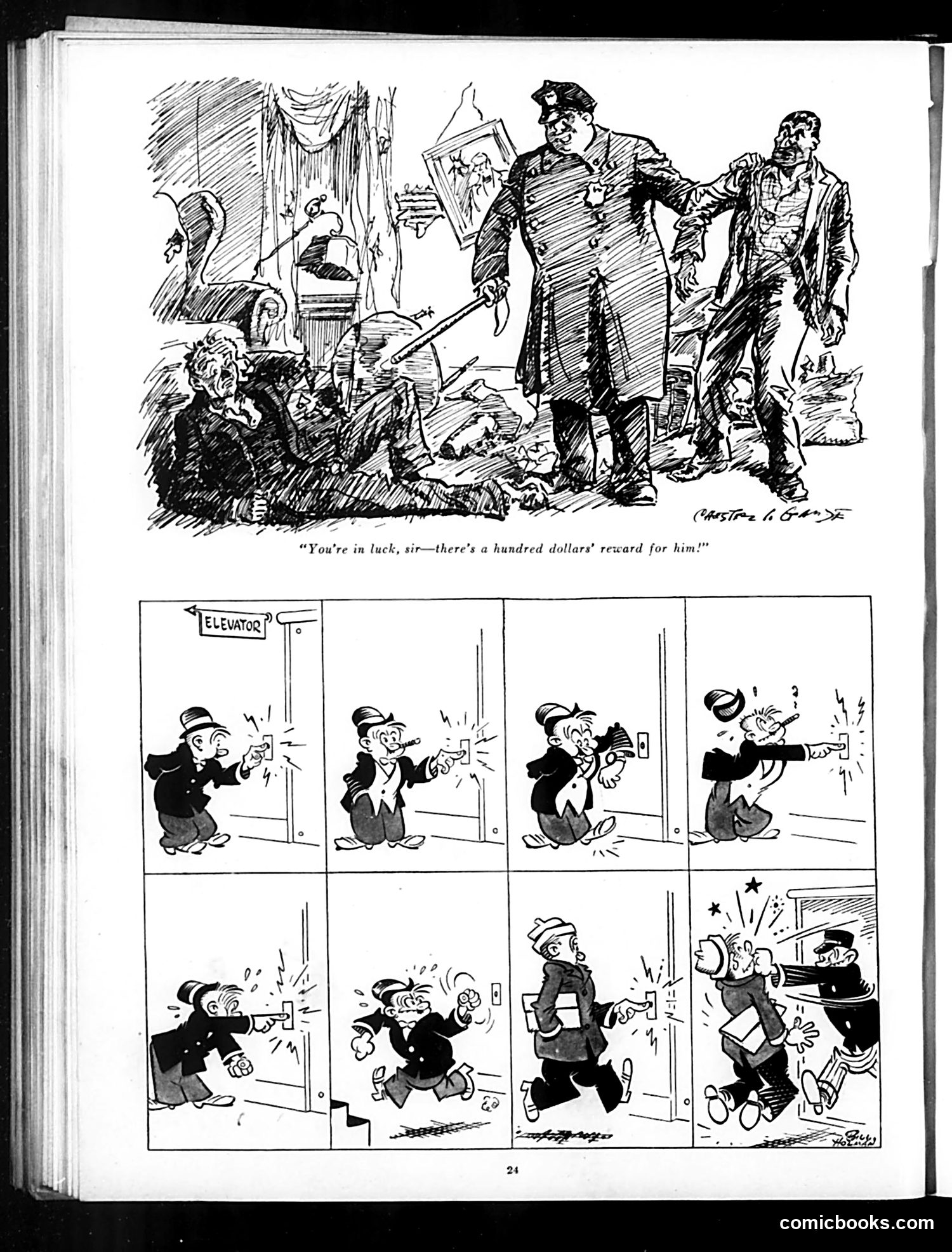
Analysis of This Judge Magazine Page The top cartoon depicts military officers awarding a reward to a ragged, disheveled person, with the caption "You're in luck, sir—there's a hundred dollars' reward for him!" This appears to satirize the practice of bounty hunting or reward systems, possibly commenting on police/military corruption or the absurdity of turning human misery into profit. The sequential comic strip below shows a small man repeatedly attempting to use an elevator, experiencing escalating chaos and mishaps with each attempt. The humor derives from slapstick physical comedy—the character's frustration mounting as the elevator malfunctions or fails him repeatedly. This likely satirizes the frustrations of modern urban technology or the incompetence of building management, relatable to early-20th-century readers encountering new mechanical conveniences.
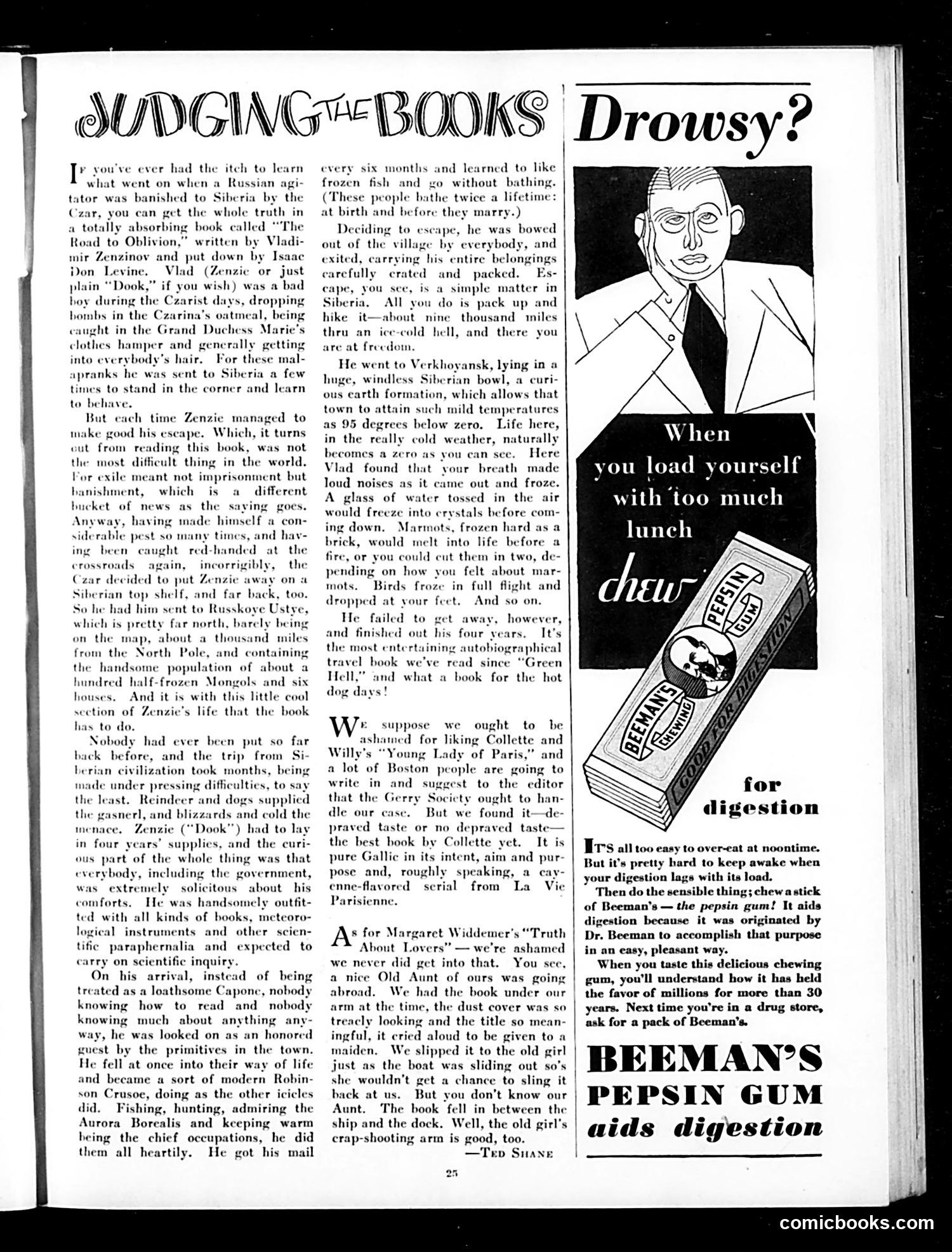
Analysis of "Judging the Books" Page This page reviews Vladimir Zenzinov's autobiography *"The Road to Oblivion,"* which recounts his exile to Siberia under Czarist rule. The subject matter: Zenzinov was a Russian revolutionary activist imprisoned and exiled by the Czar for political agitation (the text humorously notes he "dropped bombs in the Czarina's oatmeal"). His eventual banishment to Russkoye Ustye—an extremely remote Siberian settlement nearly a thousand miles from the North Pole—forms the book's core. The satire: The reviewer uses dark comedy to highlight the absurdity of Czarist exile practices: the government treats its dangerous political prisoner with "solicitous" comfort, providing scientific instruments and books. The escape itself proves comically simple—merely an enormous, freezing hike through hell. The broader point: This is implicit criticism of Czarist authoritarianism, presented through bemused American journalism. By framing Zenzinov's ordeal as entertaining adventure literature, the piece subtly indicts both the brutality and the incompetence of the system exiling him. The adjacent Beeman's Gum advertisement is unrelated commercial content.
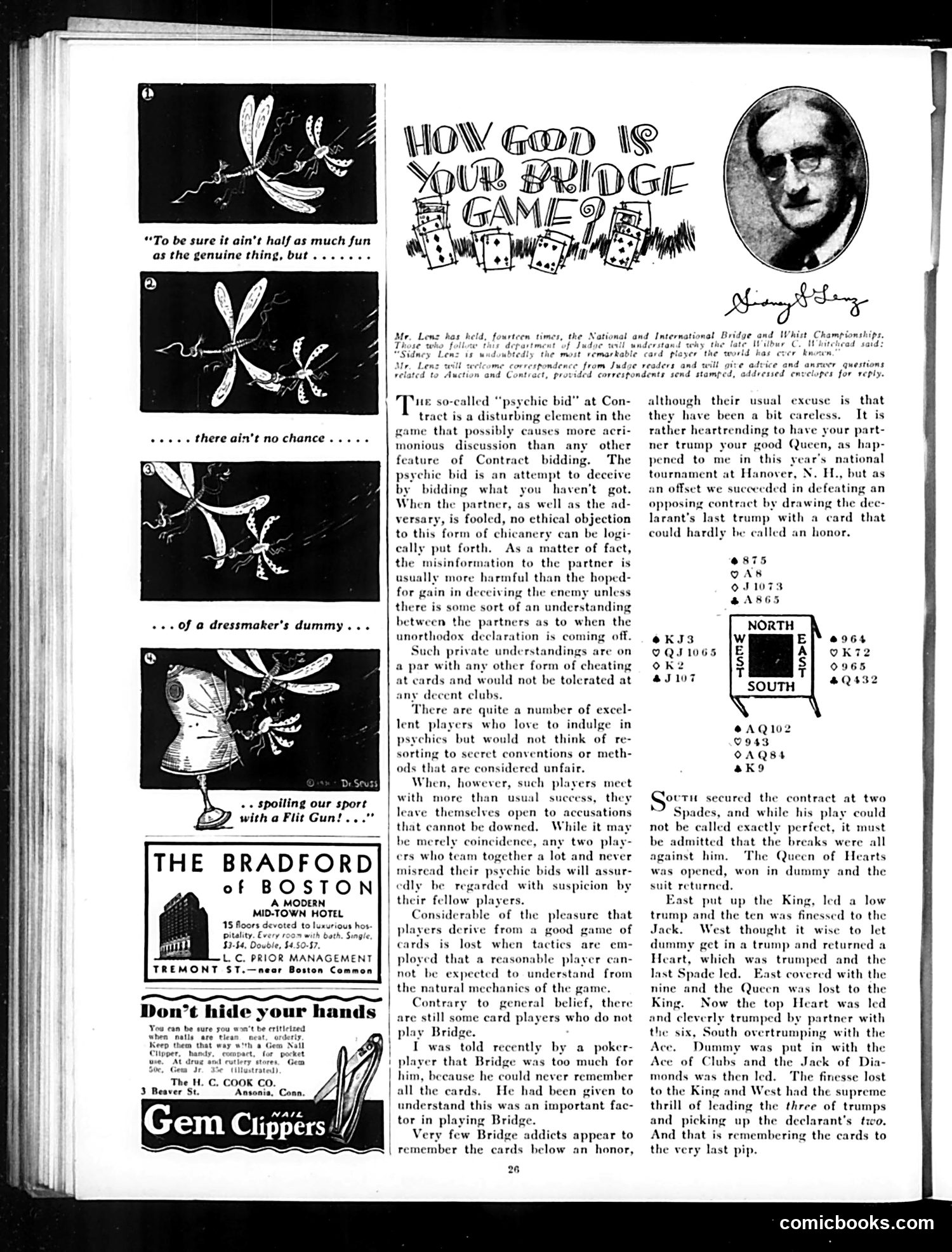
Understanding This Judge Magazine Page This page discusses the ethics of "psychic bidding" in Contract Bridge, a card game that was enormously popular among American leisure classes in the 1920s-30s. A psychic bid is deliberately misleading bidding—declaring cards you don't actually hold to confuse opponents. The article argues this creates ethical problems: while fooling enemies may seem acceptable, private understandings between partners about *when* psychic bids will occur constitutes cheating comparable to secret conventions, which "decent clubs" wouldn't tolerate. The author concedes some excellent players use psychics fairly but notes that frequent success at psychic bidding invites suspicion of collusion. The core tension: Bridge's appeal relies on players making decisions based on honest information about card holdings. Deceptive tactics, even if technically legal, undermine the game's integrity and "considerable pleasure." The page includes bridge-hand diagrams illustrating play strategy. Surrounding advertisements (Bradford Hotel, Gem Clippers, Flit Gun spray) are period commercial ephemera unrelated to the main content.
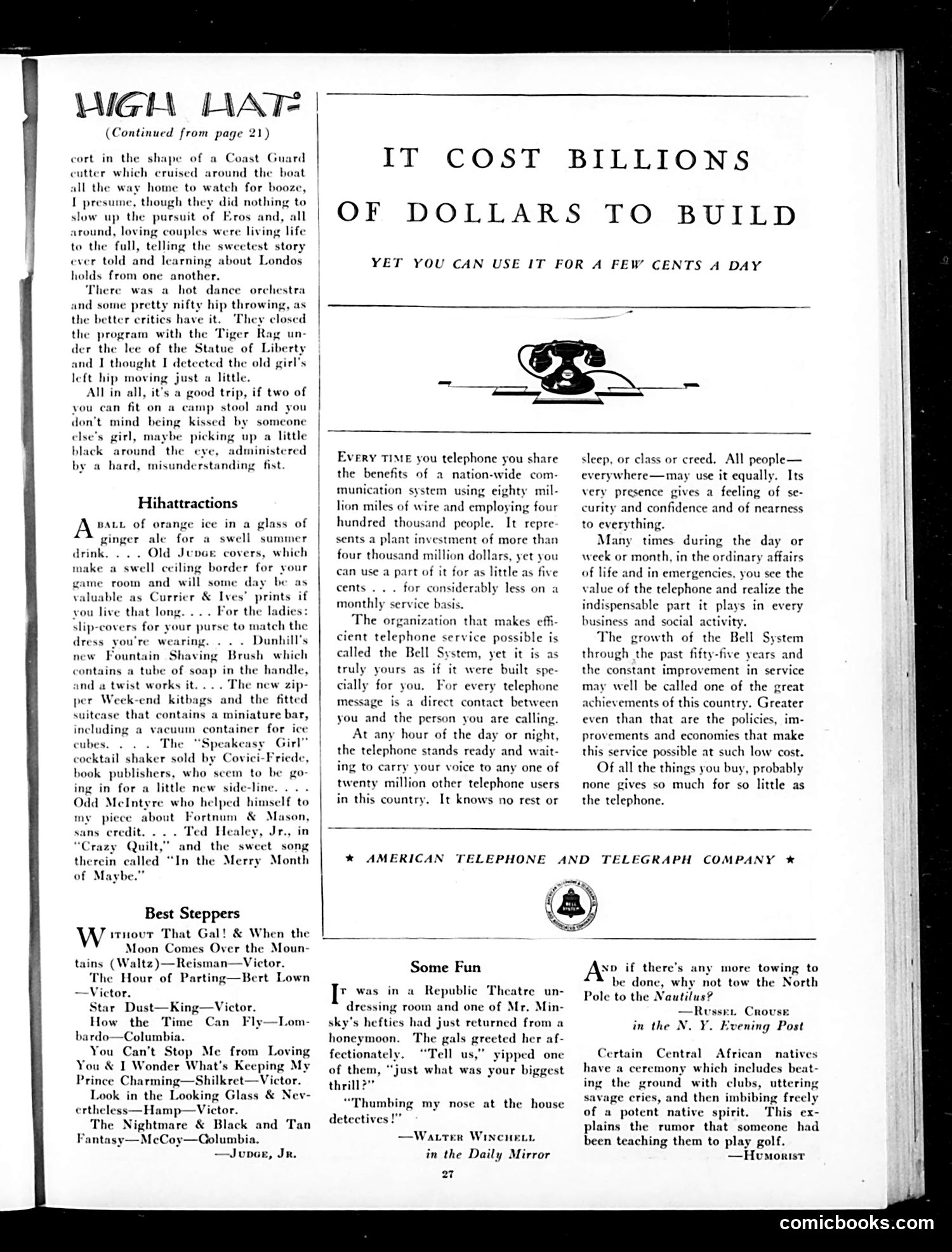
Explanation for Modern Readers This page contains primarily advertising content rather than political satire. The dominant feature is a Bell System (AT&T) advertisement emphasizing that telephone infrastructure—costing billions to build—serves ordinary people affordably at just a few cents daily. The ad stresses democratic access ("all people...may use it equally") and the telephone's indispensability to modern life. The remaining page content includes entertainment reviews and gossip columns ("High Hat," "Best Steppers," "Hihattractions") typical of Judge magazine's lifestyle coverage. These sections discuss dance bands, fashion accessories, and popular songs—standard 1920s-30s consumer culture commentary. There is no evident political cartoon or satirical commentary on this particular page. It represents Judge functioning as a general-interest magazine mixing light social commentary with paid advertising and entertainment news, rather than its better-known political satire work.
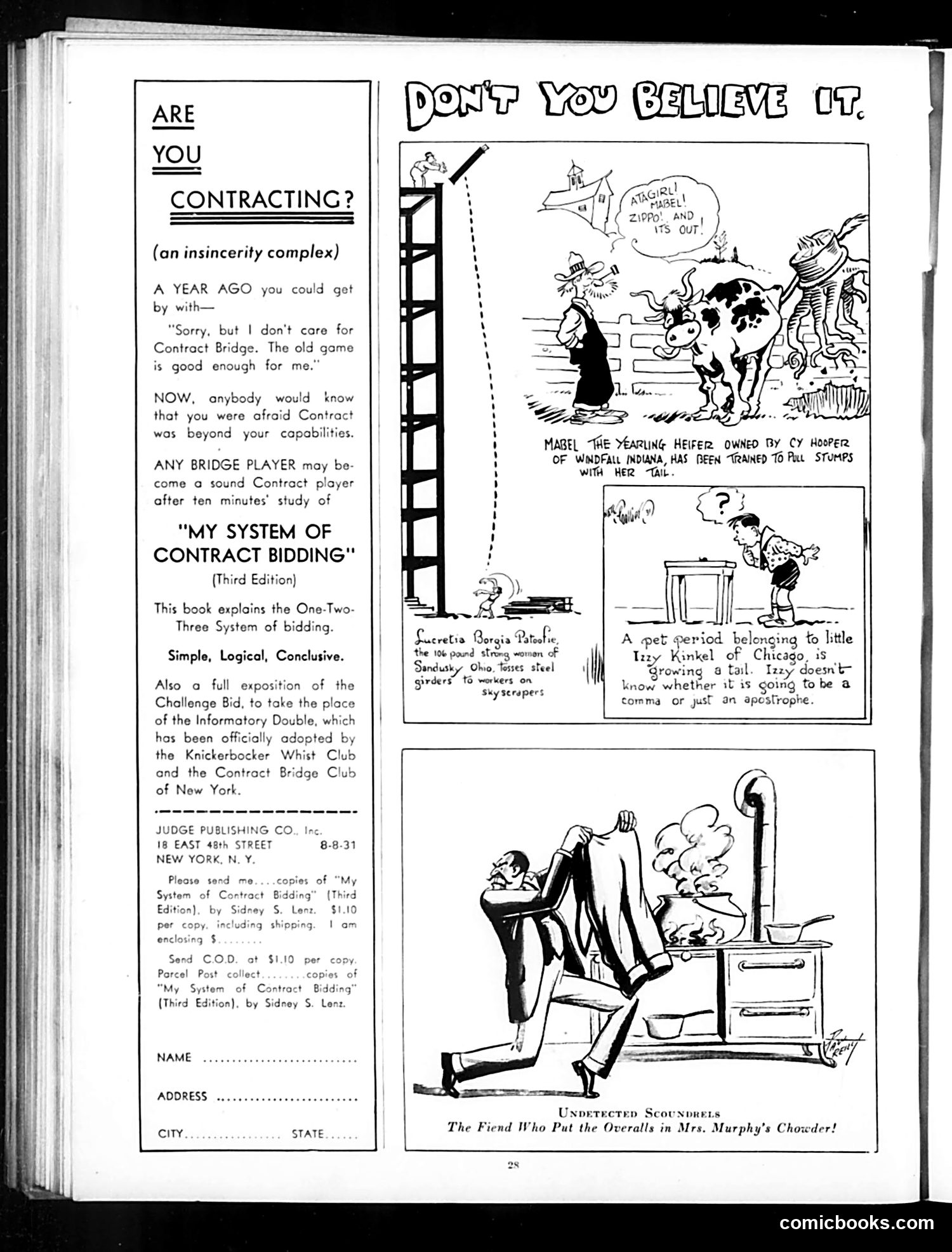
Judge Magazine Page Analysis This page combines advertisement with humorous social commentary about 1930s fad culture. Left side: An ad for Sidney S. Lenz's "My System of Contract Bidding" book mocks social pressure around Contract Bridge, a newly fashionable card game. The joke: a year ago, people could admit disinterest in Contract Bridge; now admitting this makes you seem intellectually inadequate. The ad satirizes how quickly Americans adopted trendy activities to avoid appearing outdated or incapable. Right side ("Don't You Believe It"): Three absurdist humor cartoons mock contemporary oddities—a trained heifer pulling stumps, a 106-pound strong woman, and a small dog with an ambiguous tail/punctuation mark. These appear to be gently mocking either exaggerated news stories or carnival attractions typical of the era. The overall message: American society anxiously chases fads and novelties, whether card games or peculiar animal acts, driven by social conformity rather than genuine interest.
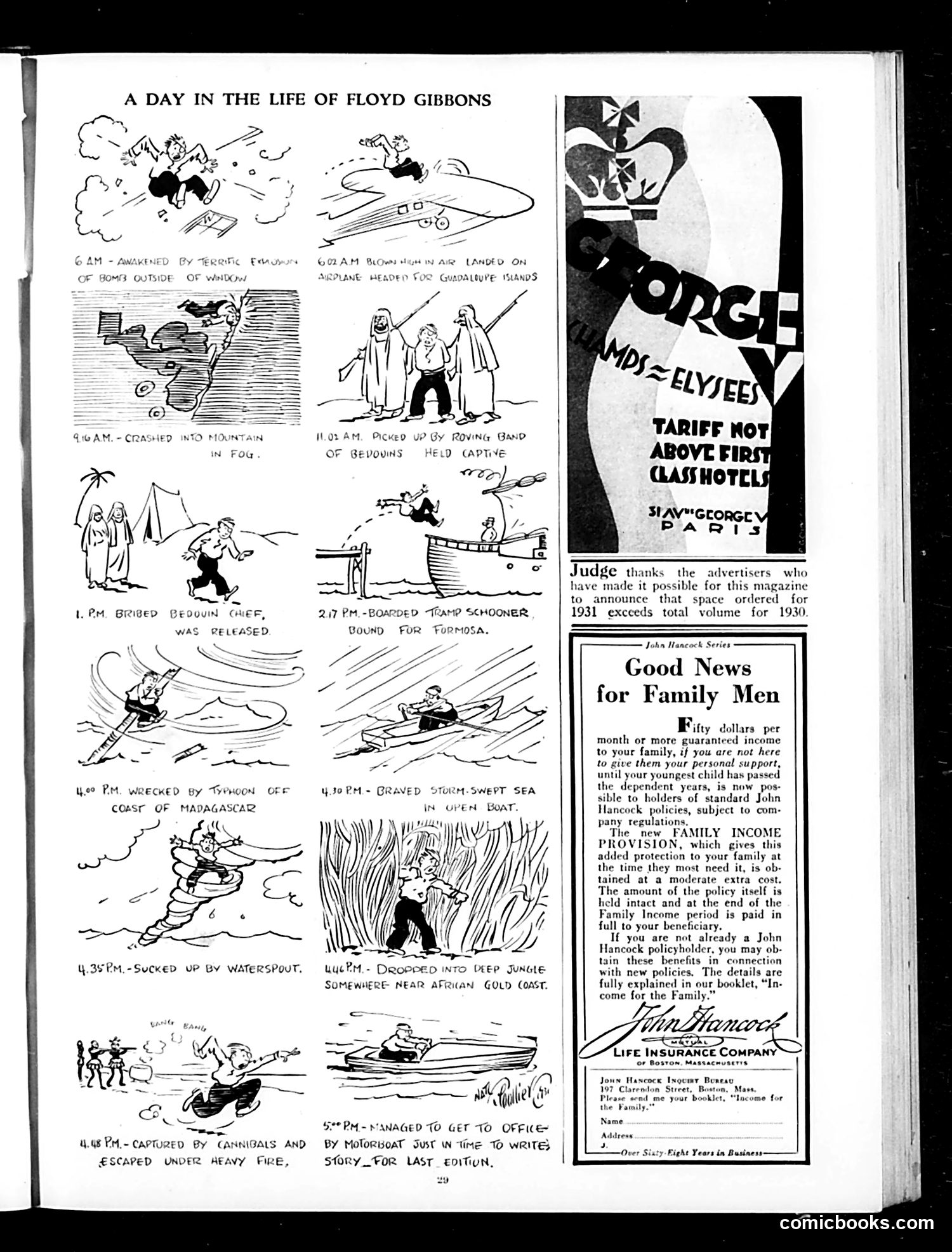
"A Day in the Life of Floyd Gibbons" This is a humorous comic strip about Floyd Gibbons, a real-life famous foreign correspondent and adventurer of the 1920s-30s known for covering dangerous assignments worldwide. The satire exaggerates his reputation for surviving extreme perils: he's shown being awakened by bombs, crashed into mountains, wrecked by typhoons, captured by cannibals and Bedouins, shipwrecked in storms, and dropped into jungles—yet somehow makes it back to the office in time to file his story for the evening edition. The joke mocks both Gibbons's actual daredevil exploits and the public's fascination with sensational foreign news reporting. His indestructibility becomes absurd through accumulation. The page also contains a John Hancock life insurance advertisement, creating ironic contrast: while Gibbons survives impossible disasters, ordinary readers should protect their families' financial security.
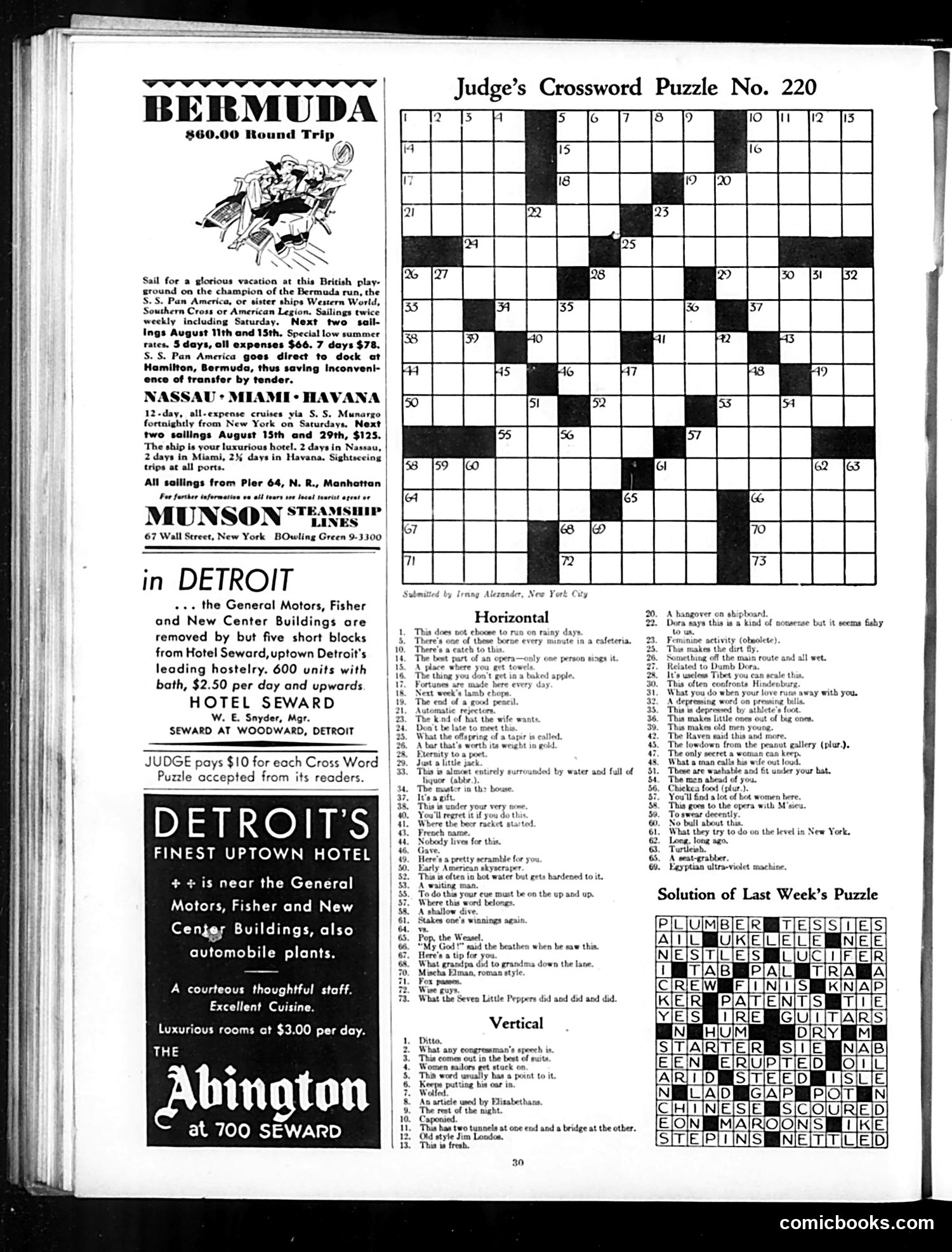
Judge Magazine Page Analysis This page is primarily advertising and puzzles, not satirical content. The main feature is Judge's Crossword Puzzle No. 220, with clues listed below and a solution grid shown for the previous week's puzzle. The page is dominated by travel and hotel advertisements typical of 1920s-30s Judge magazine: - Bermuda cruises via S.S. Pan America ($60 round trip) - Nassau/Miami/Havana cruises via S.S. Munargo ($125) - Detroit hotels: Hotel Seward and The Abington, promoting Detroit's new General Motors and Fisher Building developments The only quasi-humorous element appears in some crossword clue references (like "Pop, the Weasel" and "'My God!' said the heathen when he saw this"), but these are minor wordplay, not political satire. This is a typical Judge magazine interior page mixing entertainment (crosswords) with luxury travel and hospitality advertising aimed at affluent readers during the prosperous 1920s.
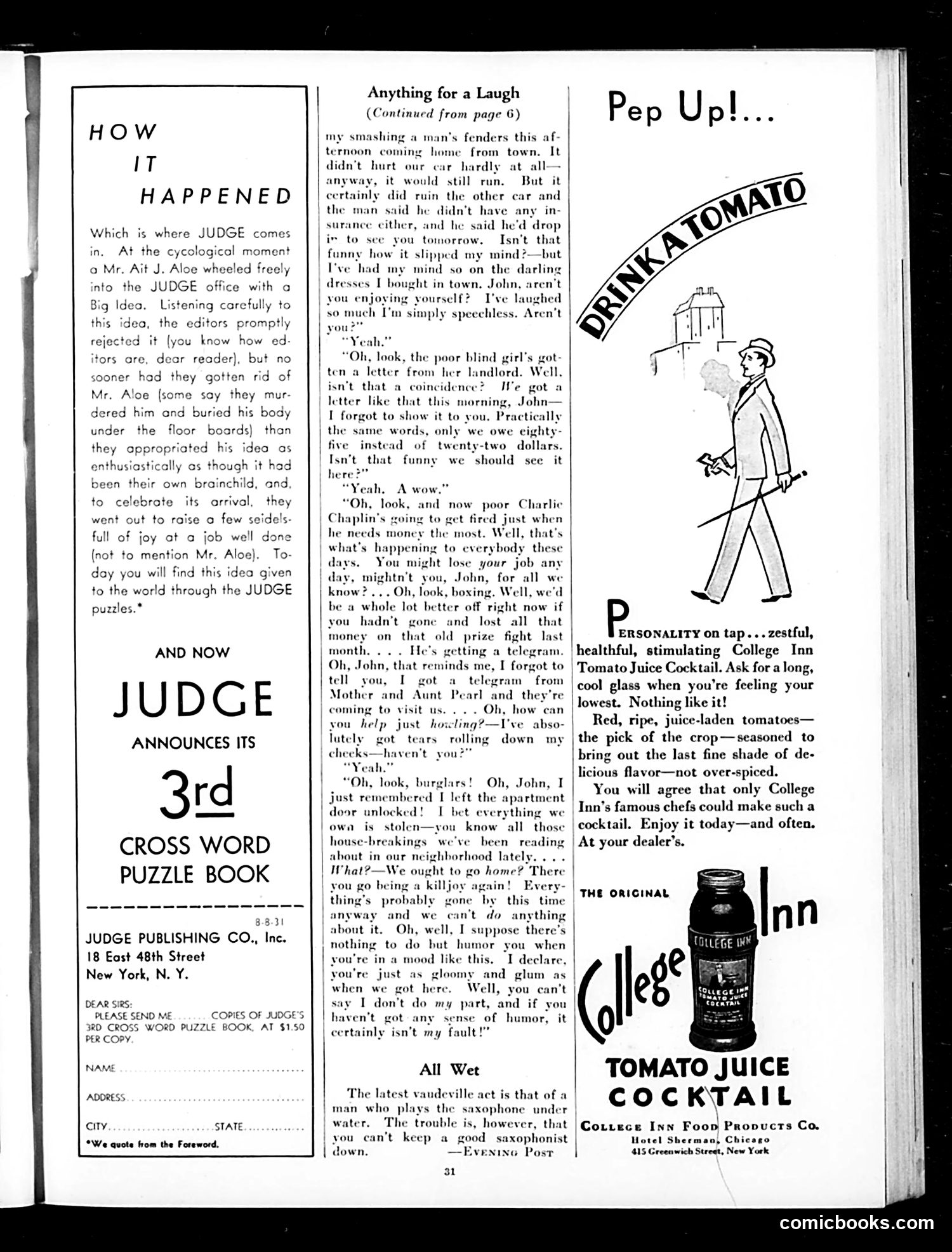
Judge Magazine Page Analysis This page satirizes idea theft in publishing. The left column's "How It Happened" mocks Judge's own editorial process: an unnamed man (Mr. Aloe) pitches a crossword puzzle idea to the magazine's editors, who reject it, then immediately appropriate and claim it as their own invention. The piece humorously admits that Judge is now profiting from stolen intellectual property, celebrating the theft with drinks ("seidels-full of joy"). The satire targets editorial dishonesty and corporate credit-claiming—common workplace abuses of the era. The center column continues a domestic comedy about a chatty wife annoying her husband John by finding humor in others' misfortunes (car accidents, job losses, robberies, burglaries), illustrated through escalating mundane disasters. The right side advertises College Inn Tomato Juice Cocktail—a commercial product marketed as sophisticated and healthful, typical of 1930s-era advertising promising wellness benefits.
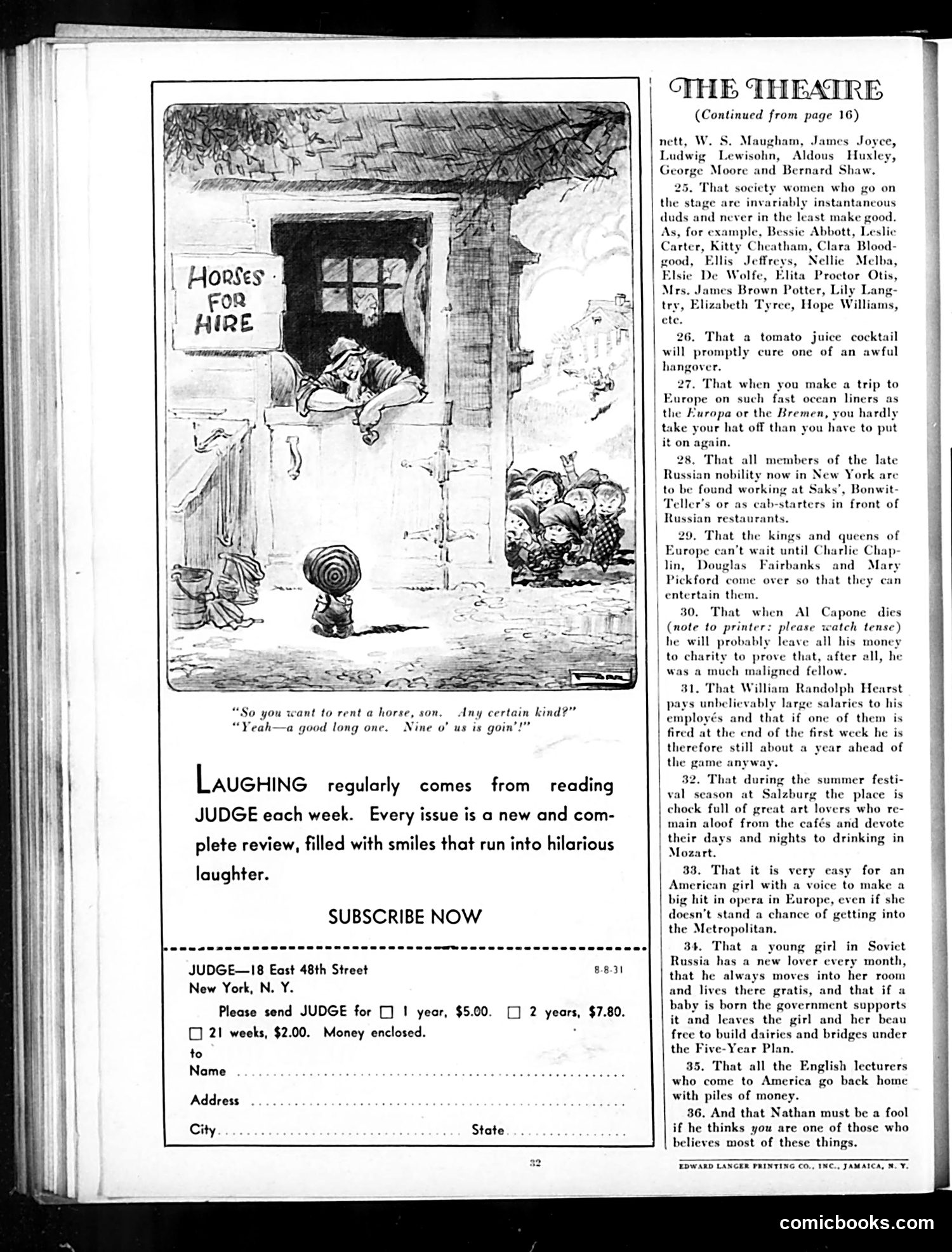
"Horses for Hire" Cartoon Analysis This cartoon satirizes Depression-era poverty and desperation. A shabbily dressed man seeks to rent a horse, and when asked what kind, replies he needs "a good long one. Nine o' us is goin'!"—meaning nine people will ride the same horse, suggesting extreme destitution where a family cannot afford individual transportation. The sign "Horses for Hire" and the run-down setting emphasize economic hardship. The joke's dark humor lies in the absurdity: the man's matter-of-fact acceptance that nine people might share one animal reflects the grinding poverty many Americans faced during the Great Depression (the magazine's date is 8-8-31, early in the crisis). The accompanying Judge advertisement promotes the magazine as a source of humor and escape during these difficult times, offering subscriptions as affordable entertainment.

This Page: Detective Stories Advertisement This is primarily advertising, not a political cartoon. It's a full-page promotion for "The World's 101 Best Detective Stories," a bound anthology being offered for 98 cents. The advertisement lists famous mystery authors—Poe, Conan Doyle, Voltaire, Dumas, Balzac, Kipling, and others—to establish prestige. It emphasizes the book's quality: thin paper, large readable type, and a decorative cloth binding. The sales pitch targets mystery lovers by stressing variety ("every phase of crime") and value ("less than 1¢ per story"). A key marketing strategy is the "send no money" offer: customers mail a coupon and pay the postman 98¢ upon delivery, with a one-week trial period before commitment. The left sidebar lists all 101 stories by title and author, functioning as a detailed table of contents. This was a common direct-mail advertising format in early 20th-century magazines like *Judge*.
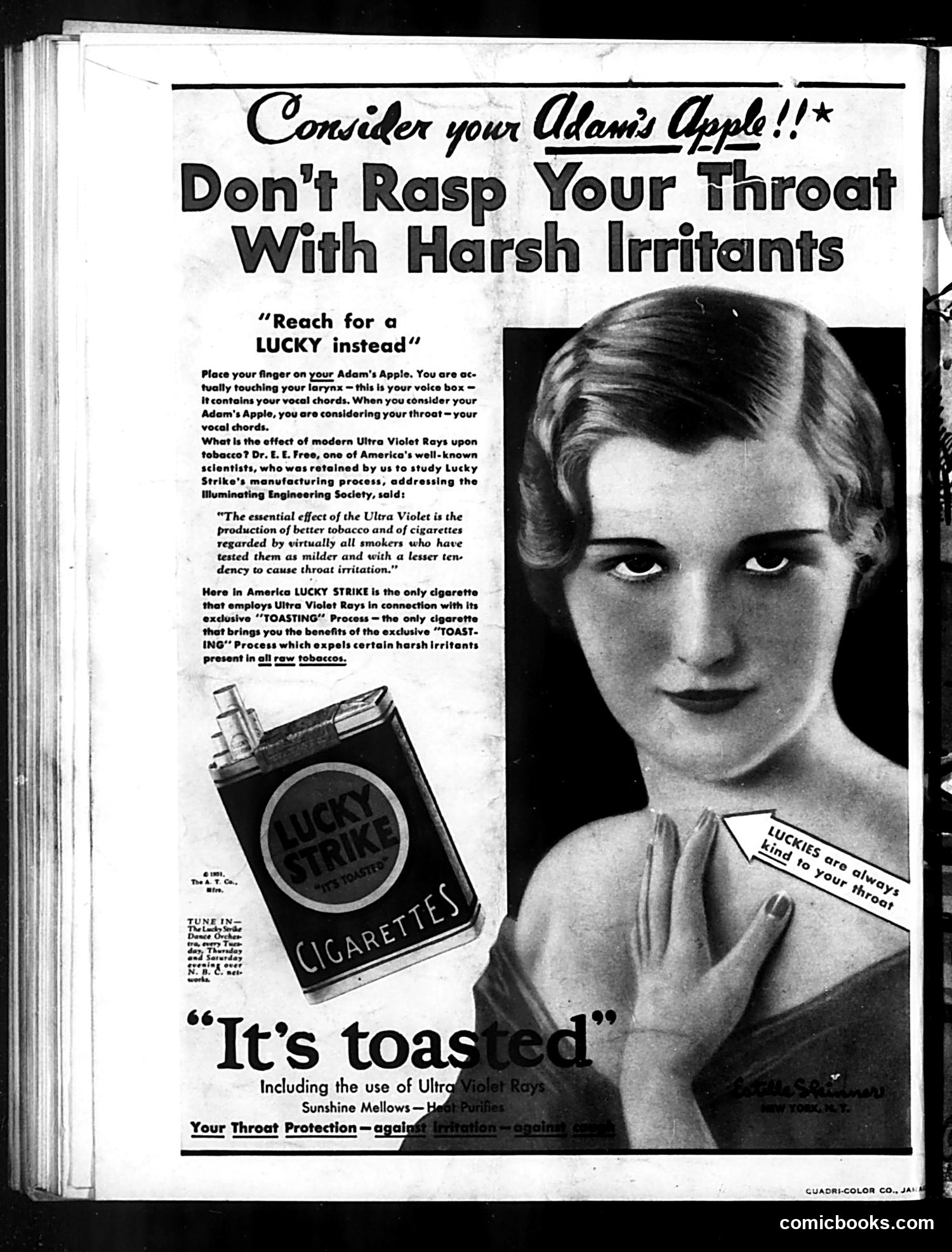
Analysis for Modern Readers This is a cigarette advertisement, not political satire. Lucky Strike markets itself as a throat-friendly smoking option by claiming its exclusive "Toasting" process—allegedly using ultraviolet rays—removes harsh irritants from tobacco. The ad features a woman touching her throat/Adam's apple, emphasizing that smoking affects the vocal cords. It cites "Dr. E. E. Free," a scientist allegedly retained to study Lucky Strike's manufacturing, lending pseudo-scientific credibility to health claims. The tagline "Reach for a LUCKY instead" suggests choosing Lucky Strikes over competitors' harsher cigarettes. Modern context: This reflects 1930s-40s marketing before cigarette health dangers were widely acknowledged. The pseudo-scientific endorsement and health claims would be illegal today. Judge magazine published such ads alongside satirical content, representing the era's advertising practices.