judge
Judge — August 15, 1931
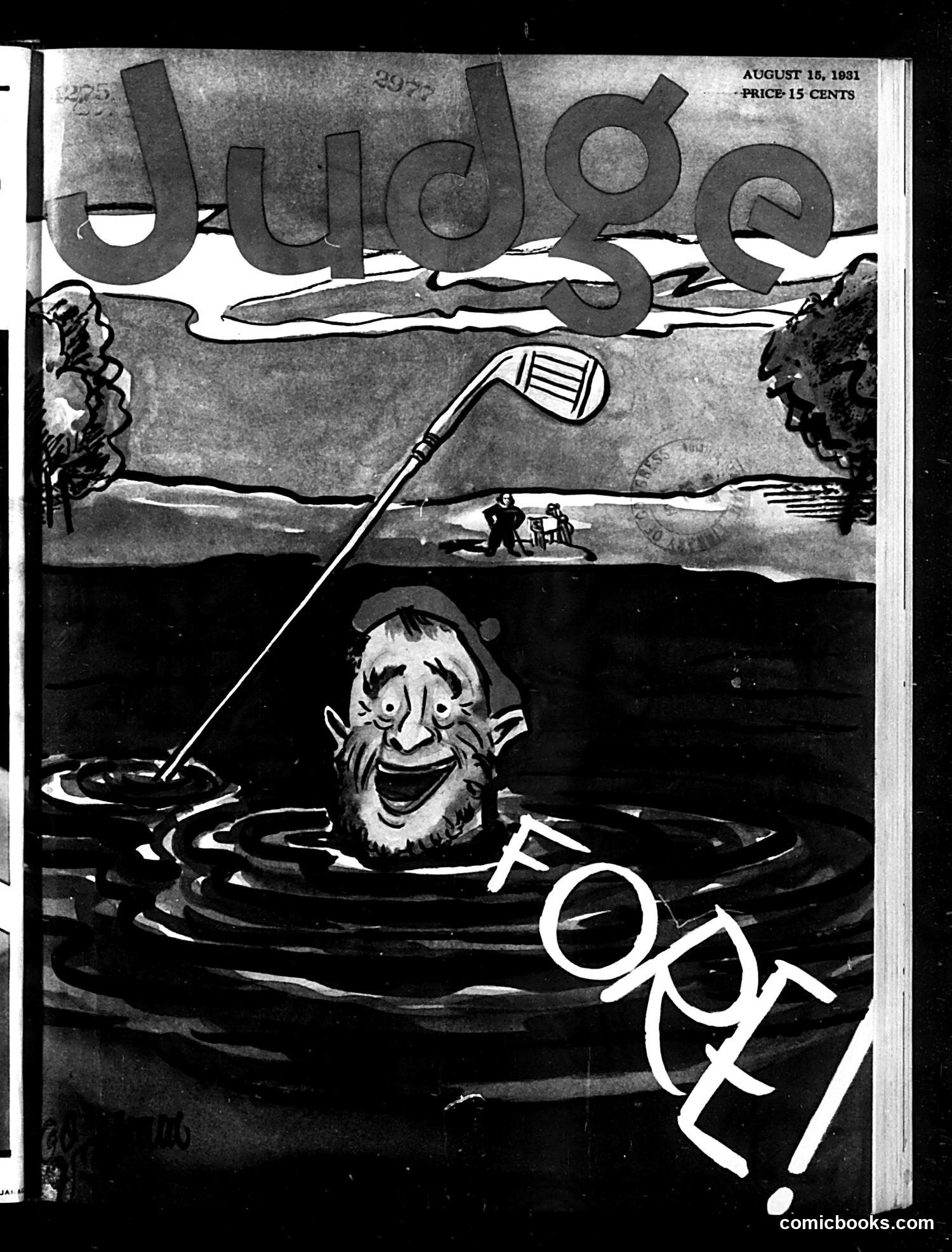
Analysis of Judge Magazine Cover, August 18, 1931 This cover depicts a grotesque caricatured figure in water, holding a golf club, with the large text "JUDGE" overhead. The figure appears to be a caricature of a wealthy or prominent person struggling or drowning, rendered in an exaggerated, unflattering style typical of satirical cartooning. Given the August 1931 date, this likely references the economic hardship of the Great Depression. The golf club—a symbol of leisure and wealth—combined with the struggling figure suggests satire about financial collapse or the plight of the previously wealthy during economic crisis. The grotesque facial features and body language convey mockery of someone facing downfall. The exact identity of the caricatured figure remains unclear without additional context.
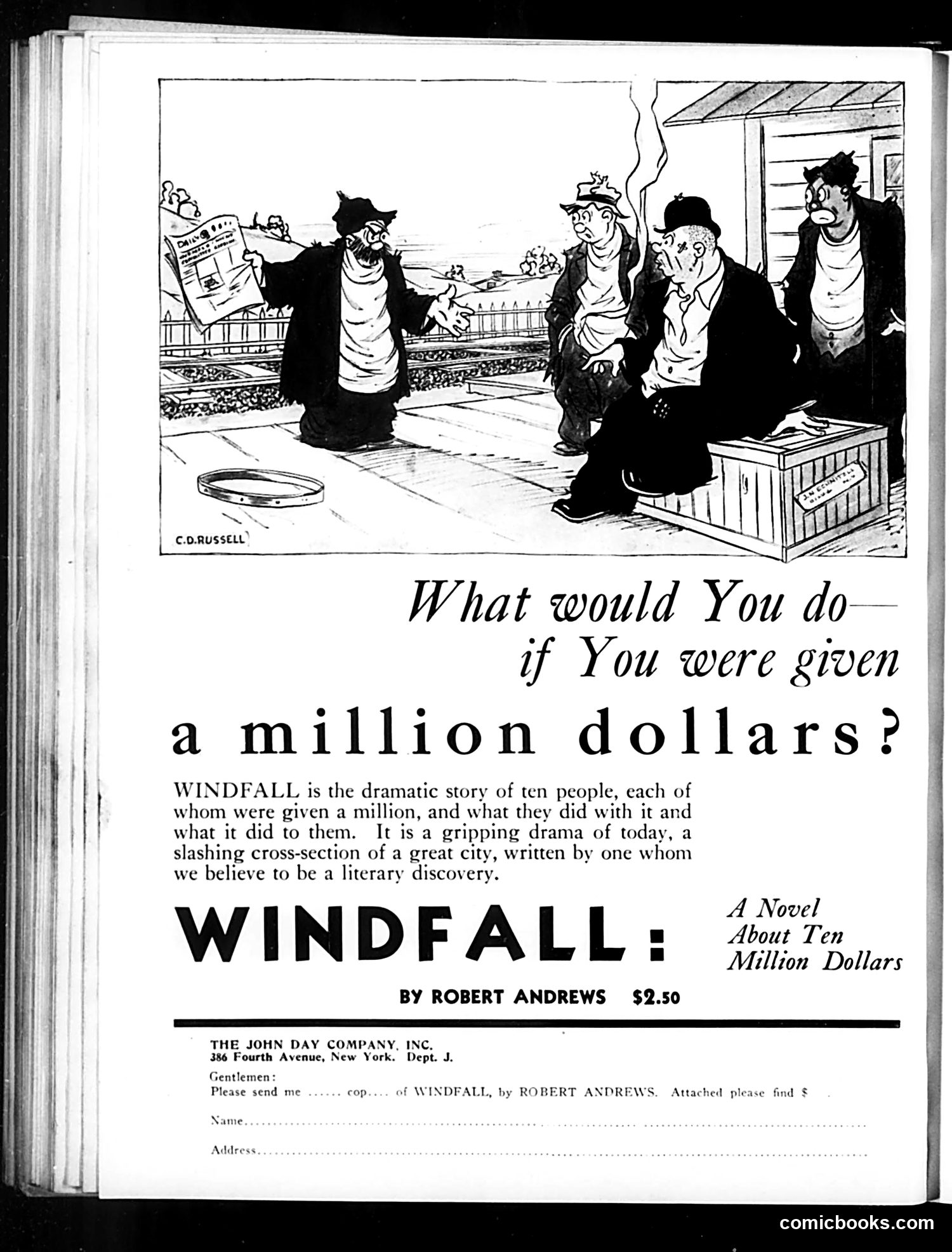
Analysis of "Windfall" Advertisement Page This page is primarily a book advertisement rather than editorial satire. It promotes *Windfall* by Robert Andrews ($2.50, published by John Day Company), described as "a novel about ten million dollars." The cartoon illustration by C.D. Russell depicts ten figures in dark coats and hats examining something on the ground—likely meant to represent people discovering sudden wealth. The advertisement's headline poses a rhetorical question to readers: "What would You do if You were given a million dollars?" The book itself appears to explore how different people handle sudden fortune—a common literary theme examining human nature and class dynamics. The advertisement aims to intrigue potential readers by suggesting the novel offers insight into how ordinary people behave when receiving enormous sums of money, positioning it as social commentary for the magazine's audience.
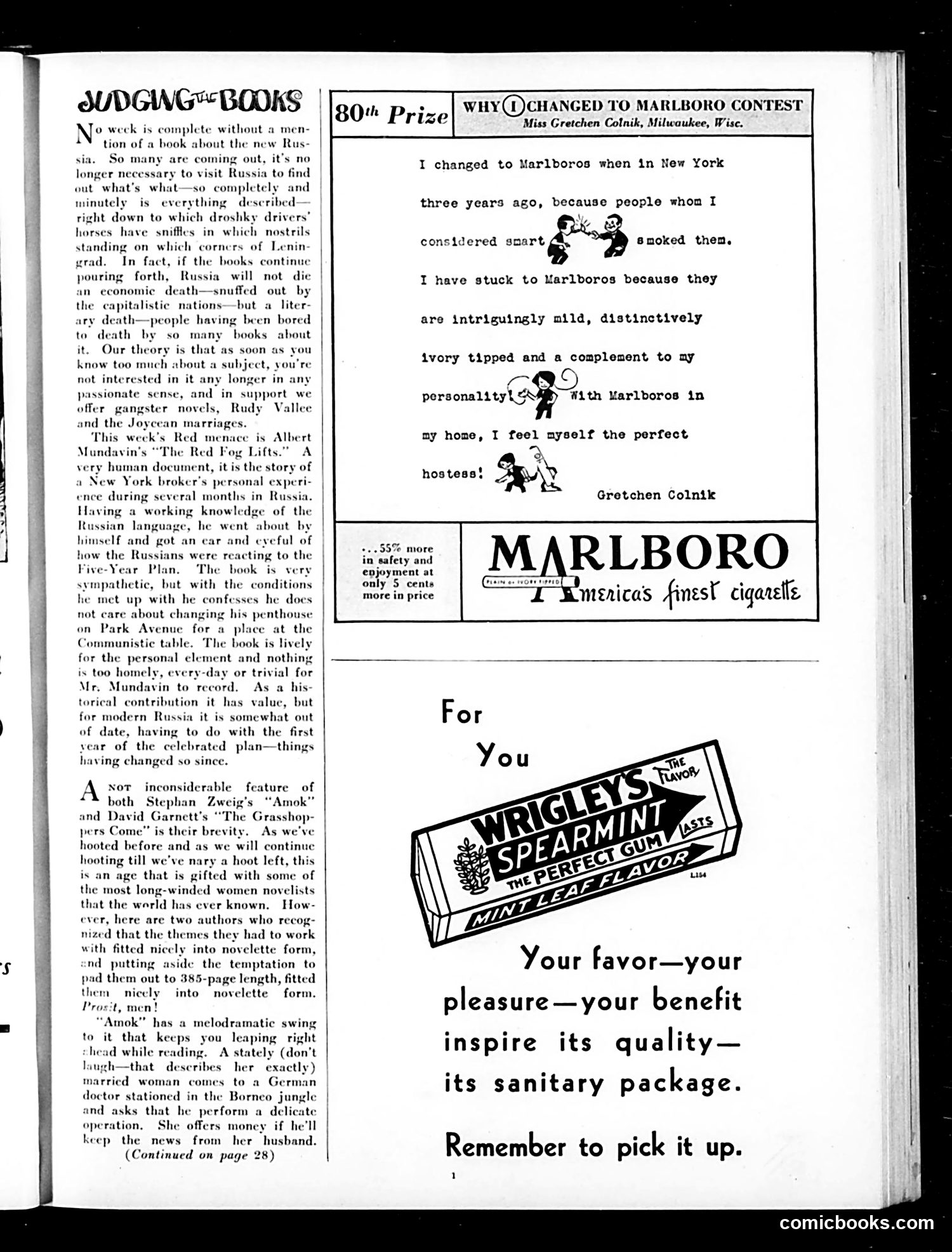
Analysis of Judge Magazine Page This page is primarily advertising and book reviews rather than political satire. The main content includes: "Judging the Books" - a literary column reviewing new Russian-themed novels, particularly Albert Mundavin's "The Red Fog Lifts" about a New York broker's experiences in Russia during the Soviet period. The reviewer notes the book reflects an earlier era of Russian history, now somewhat dated. The cartoon element is modest: a small illustrated testimonial from "Gretchen Colnik" explaining why she switched to Marlboro cigarettes, featuring cartoon figures. This is essentially an advertorial - advertising disguised as editorial content. The page also features Wrigley's Spearmint gum and Marlboro cigarette advertisements, typical of 1930s-40s magazine content. There is no significant political satire present.
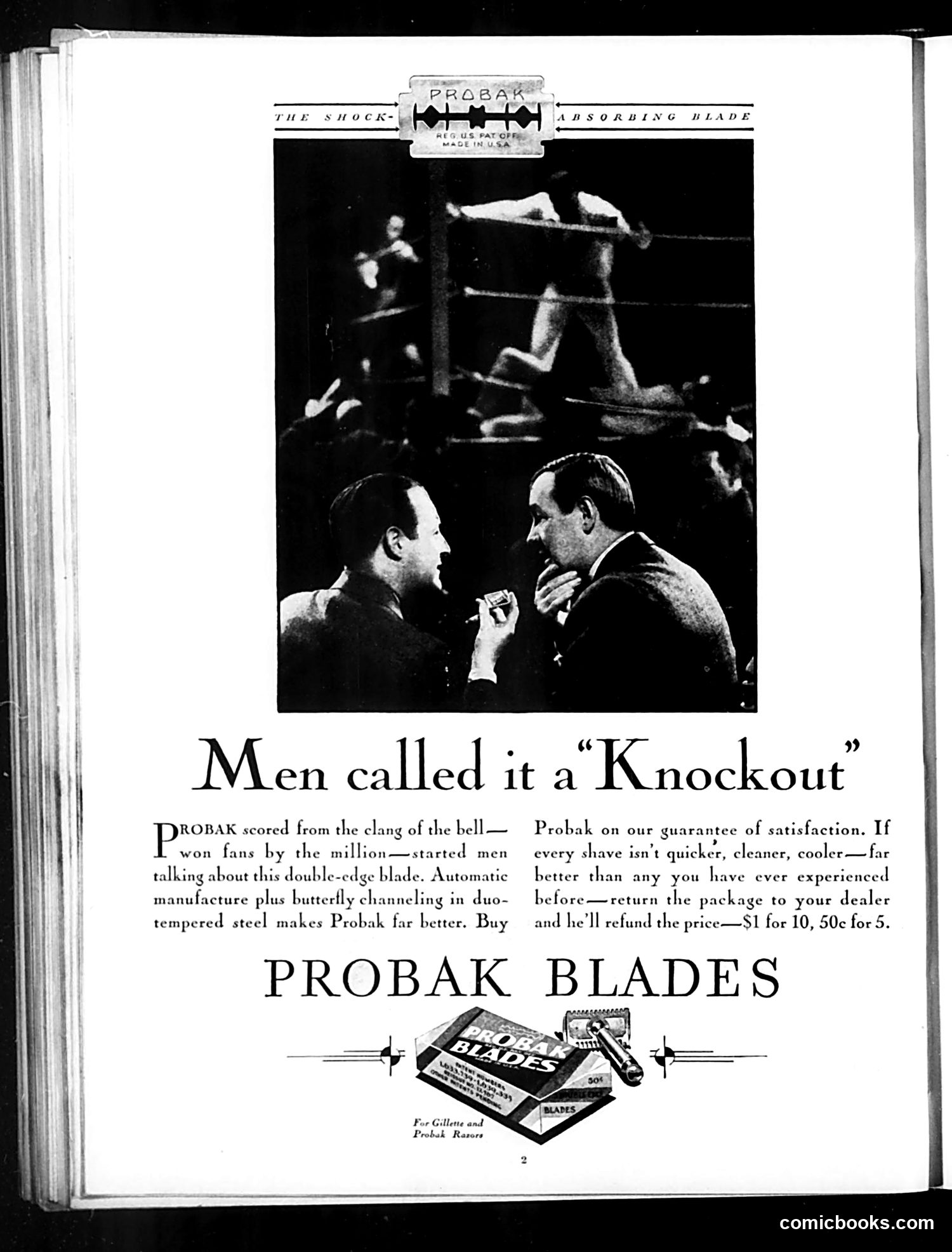
Analysis This page is primarily advertising, not satire. It's a Probak razor blade advertisement disguised as editorial content in Judge magazine. The ad uses a boxing match metaphor—"Men called it a Knockout"—comparing Probak blades' performance to a boxer's decisive victory. The photograph shows two men in conversation (likely meant to evoke boxing spectators or promoters) and a boxing match in the background. The copy emphasizes Probak's manufacturing superiority: "double-edge blade," "butterfly channeling," and "duo-tempered steel." It appeals to male vanity and shaving satisfaction, offering a money-back guarantee ($1 for 10 blades, 50¢ for 5). The "Judge" magazine placement lends credibility through the satirical publication's audience and brand association, though the content itself contains no political or social satire.
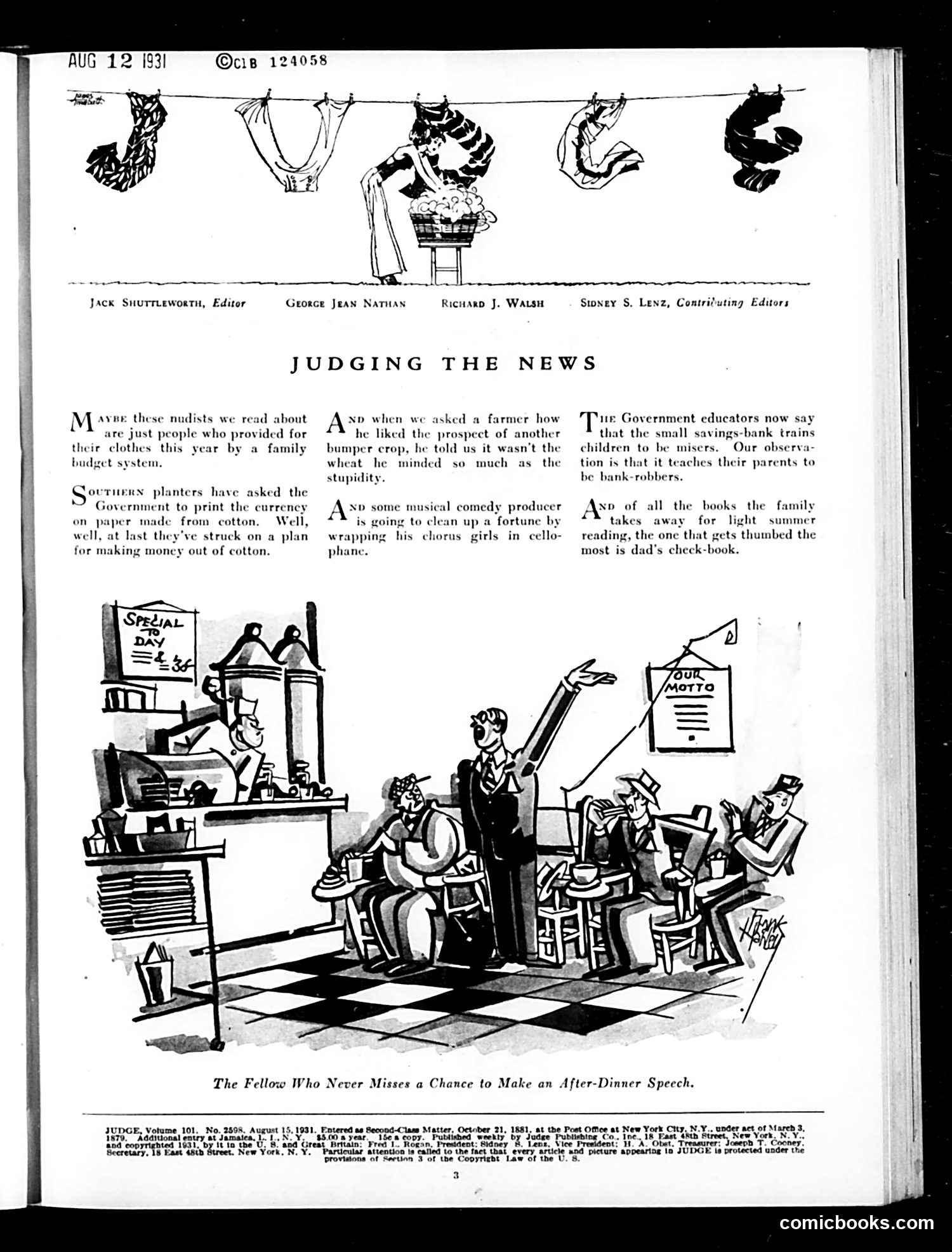
"Judging the News" - August 12, 1931 This satirical page mocks contemporary social commentary and economic anxieties during the Great Depression era. The main cartoon depicts "The Fellow Who Never Misses a Chance to Make an After-Dinner Speech"—a man standing amid what appears to be a social gathering, gesturing grandiosely while others sit reading. The satire targets verbose after-dinner speakers who monopolize social occasions. The text vignettes mock various absurdities: mutists (likely nudists) in fashionable clothing, Southern planters suggesting currency printed on cotton, farmers complaining about bumper crops, musical producers wrapping chorus girls in cellophane, government educators calling children "misers," and families treating the father's checkbook as light summer reading. The overall theme critiques pretension, foolish economic suggestions, and social affectation during Depression-era uncertainty.
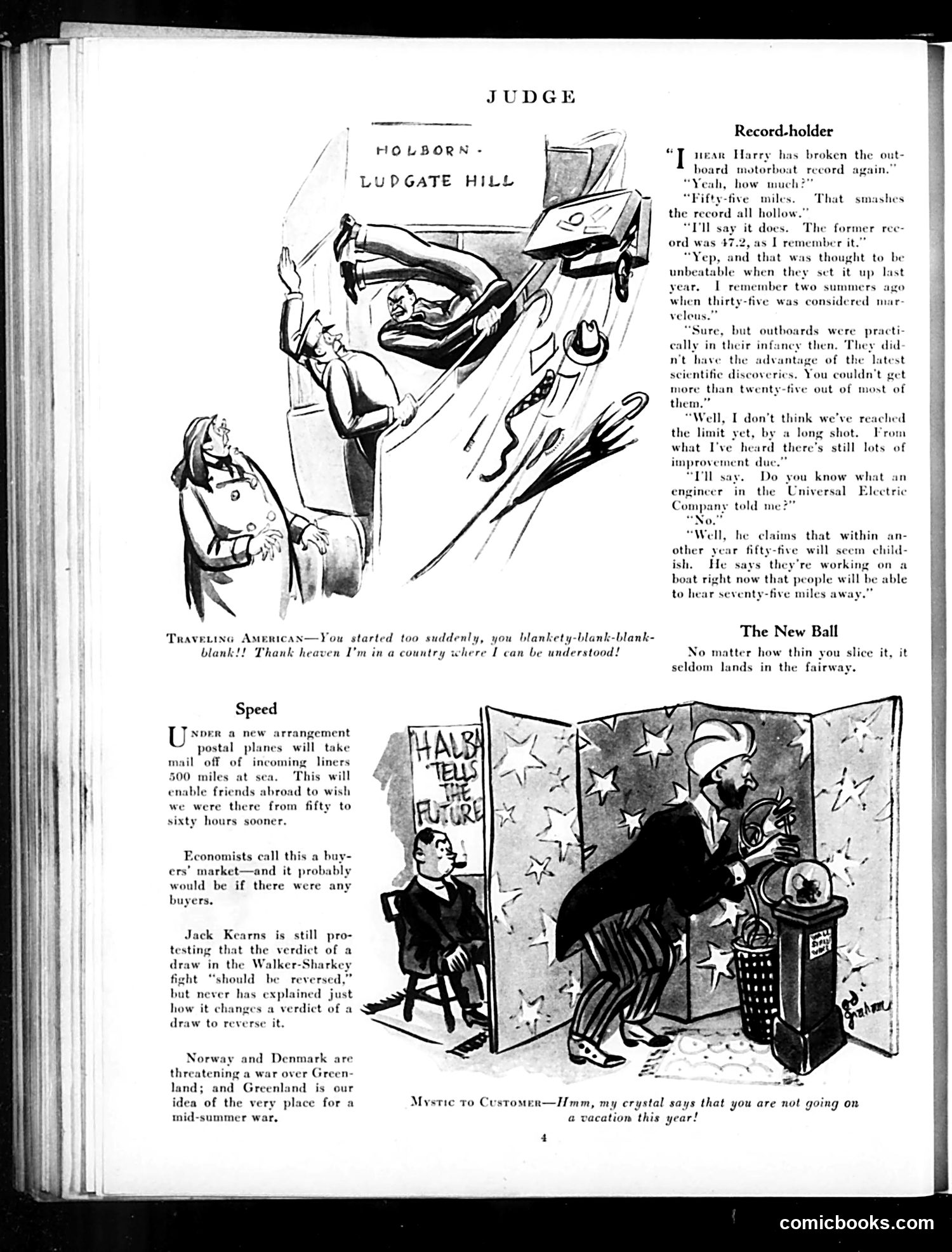
Analysis of Judge Magazine Page This page contains three satirical pieces: "Judge" (top): Mocks excessive motorboat speed records on Holborn-Ludgate Hill. A "traveling American" character expresses relief at being somewhere understandable, satirizing American tourists' bewilderment abroad. "Speed" (middle): Comments on postal delivery improvements and economic speculation, mentioning Jack Kearns and a Walker-Sharkey fight verdict dispute. References a potential war between Norway and Denmark over Greenland as absurdly unsuitable for conflict timing. "The New Ball" and "Mystic to Customer" (bottom): Two brief captioned cartoons. The first jokes about golf balls landing in fairways; the second shows a fortune teller's crystal ball predicting no vacation—likely reflecting post-WWI economic uncertainty or Depression-era concerns about leisure affordability. The overall tone reflects early-to-mid 20th century American concerns about technology, travel, and economic anxiety.
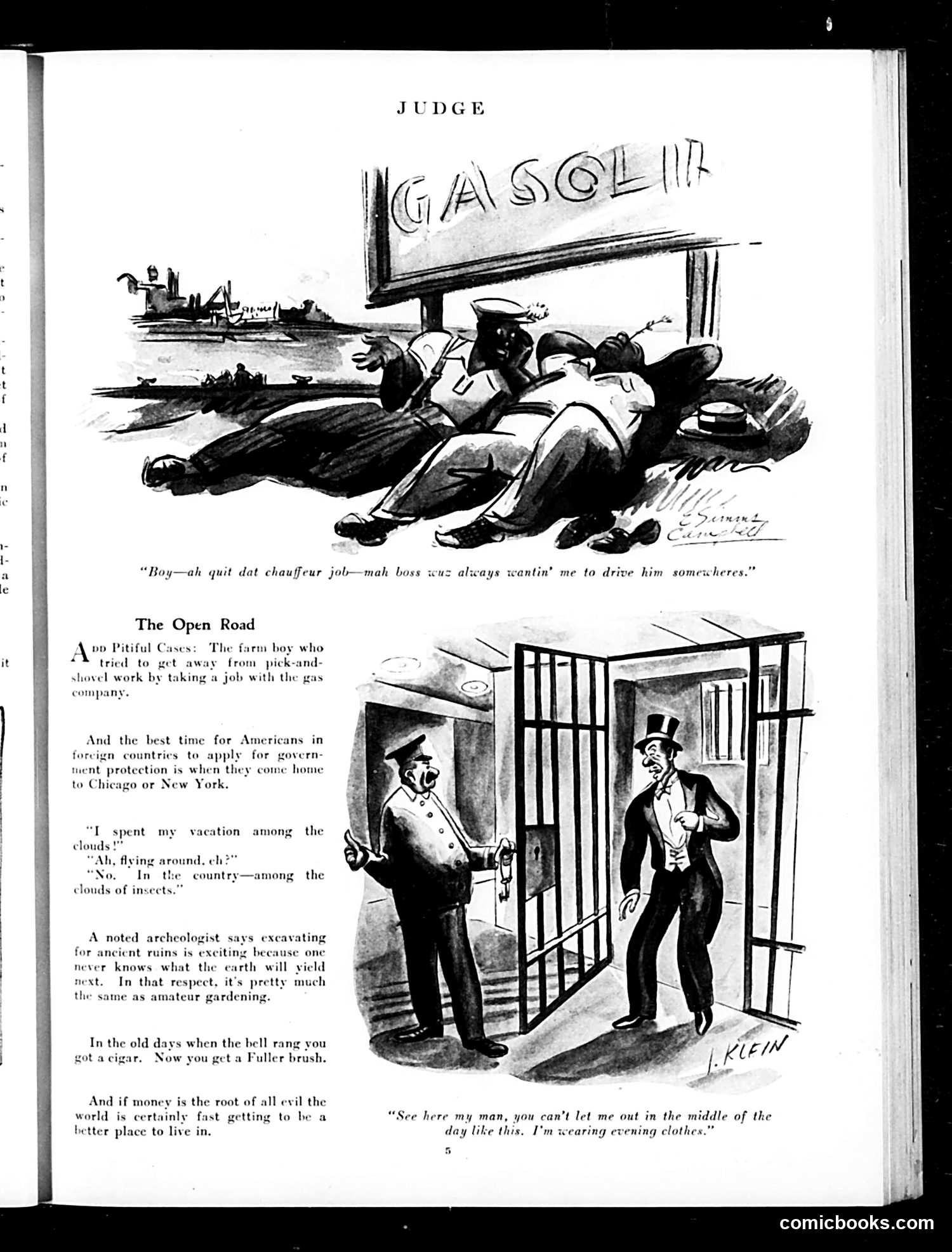
Analysis of Judge Page This page contains three separate satirical pieces: Top cartoon: Shows men collapsed under a "Gasoline" sign. The caption jokes about a chauffeur refusing to drive anywhere, suggesting gasoline prices or availability were so problematic that even paid drivers wouldn't work—likely referencing wartime fuel rationing or shortages. "The Open Road" section: Contains brief humorous observations about American life, including jokes about vacation travel, archaeology, and consumer goods (cigars, Fuller brushes). Bottom cartoon: A man in formal evening wear stands in a doorway while another man blocks him, saying he cannot go out "in the middle of the day like this." The joke appears to mock rigid social conventions about when formal attire should be worn—criticizing excessive formality or class pretension.
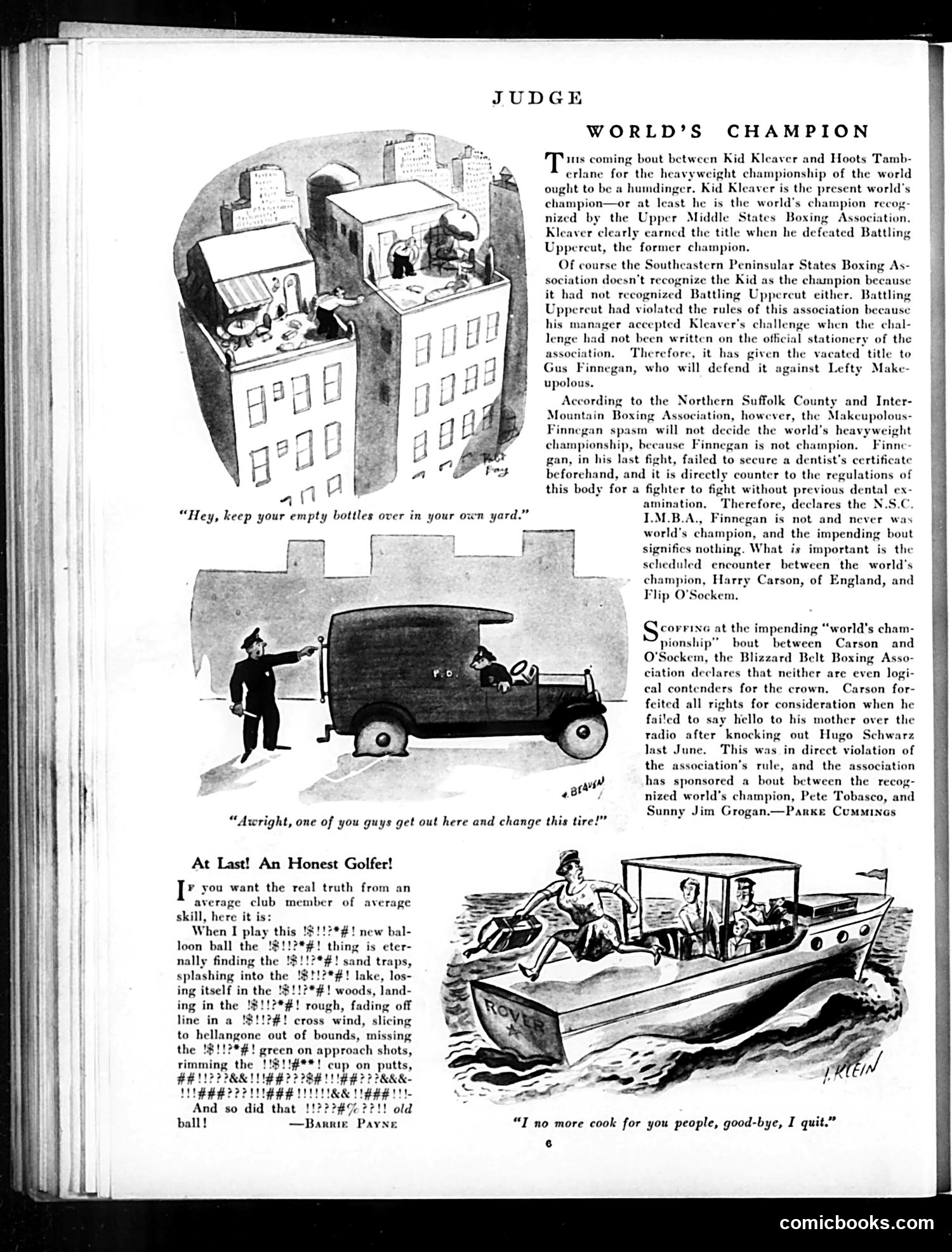
Judge Magazine Page Analysis This page satirizes competing claims to boxing titles and incompetent authority figures in 1920s boxing. Top Section ("Judge - World's Champion"): Mocks rival boxing associations' conflicting claims about heavyweight champion status. Kid Kleaver allegedly holds the "world's champion" title, but multiple organizations dispute this—the Southeastern Peninsular States Boxing Association, Northern Suffolk County and Inter-Mountain Boxing Association, and N.S.C.I.M.B.A. each claim different champions (Gus Finnegan, Pete Tobasco, Sunny Jim Grogan). The cartoon's illustration of buildings stacked absurdly emphasizes the ridiculous layer upon layer of competing, overlapping authorities. Lower Sections: Two brief humor pieces—one about golf excuses, another about a boat cook quitting. The satire targets boxing's fragmented governance and the absurdity of multiple organizations claiming exclusive title recognition.
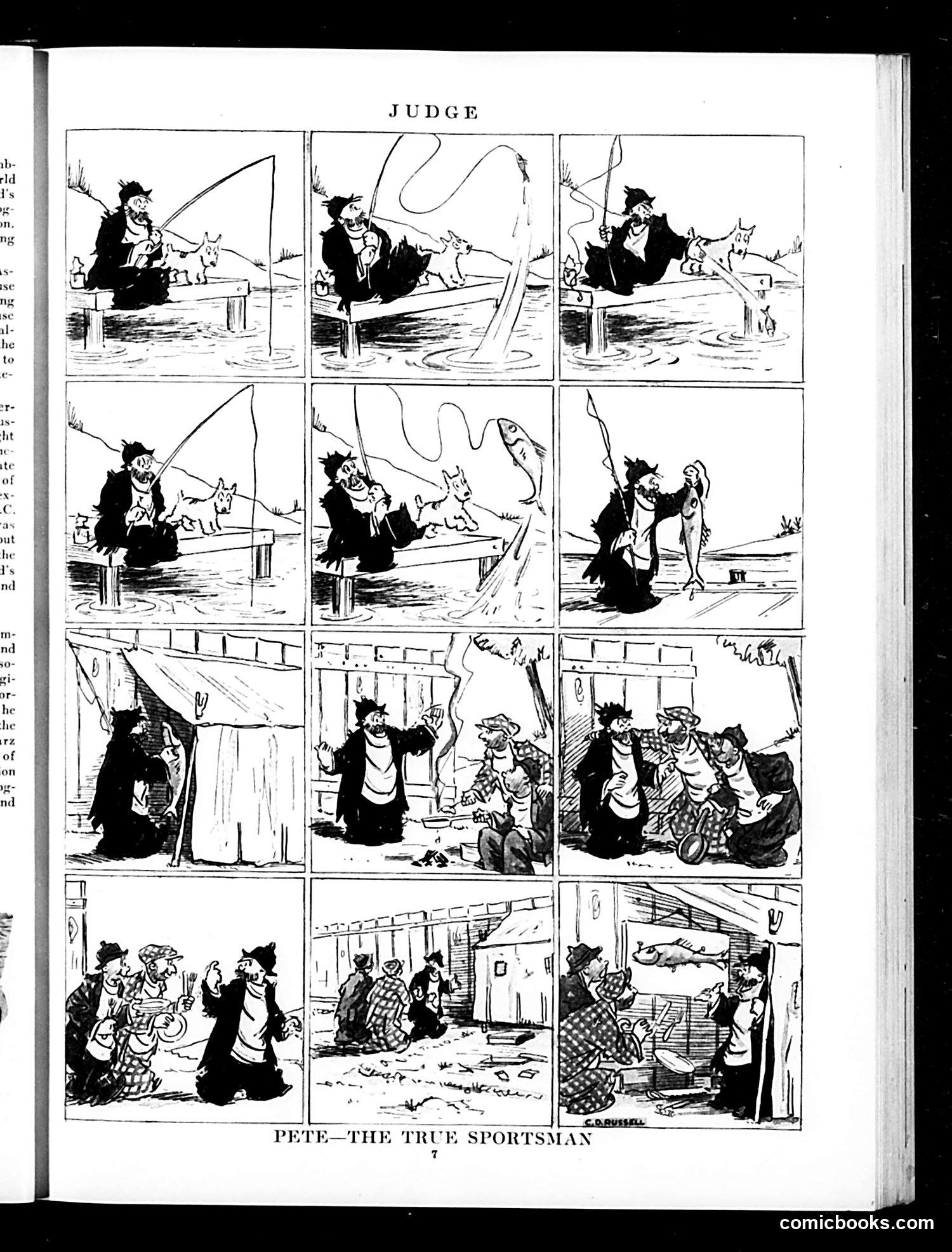
Judge Page Analysis: "Pete—The True Sportsman" This is a 12-panel comic strip following a character named Pete through a fishing expedition. The narrative begins with Pete fishing peacefully, then progresses through increasingly chaotic scenes: his catch appears to grow, he struggles with his line, and the later panels shift to what appears to be a courtroom or institutional setting with multiple figures. The title "The True Sportsman" suggests ironic commentary on sporting ethics. However, without additional context about Pete's identity or the specific historical moment, the exact satirical target remains unclear. The shift from fishing scenes to crowded indoor scenes implies the strip may be commenting on how someone's sporting conduct—or lack thereof—has legal or social consequences. The comic's point likely critiques either unsportsmanlike fishing practices or Pete's character more broadly.
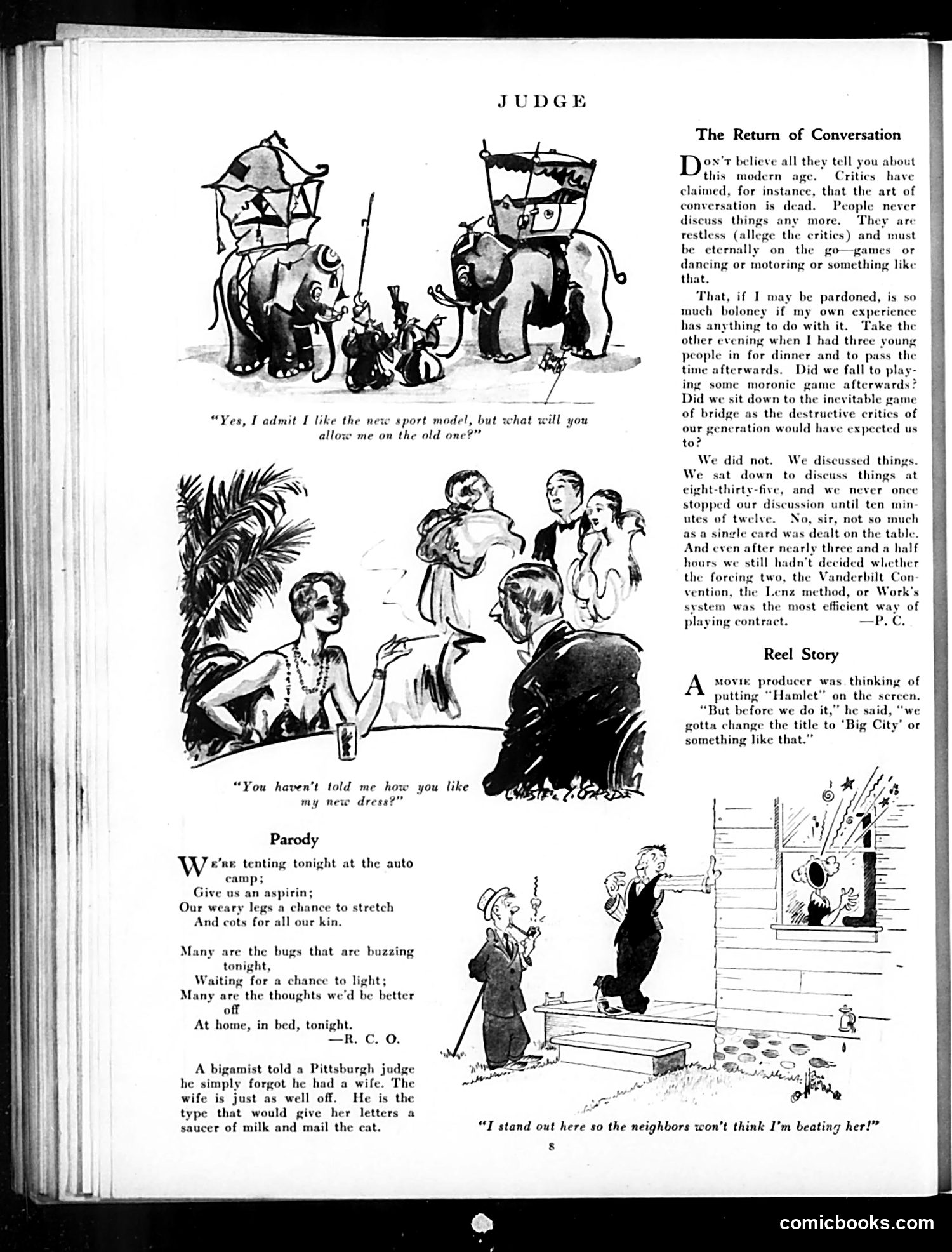
Judge Magazine Page Analysis This page from *Judge* contains several pieces of social satire typical of the 1920s-30s era: Top cartoons: Mock modern consumerism and changing gender dynamics. The first shows a couple negotiating trade-in value on an automobile (suggesting materialism); the second depicts a woman demanding compliments on her new dress—both gently ribbing contemporary consumer culture and evolving social roles. "Parody" poem: Satirizes the popular "auto camp" vacation trend, mocking the discomfort of camping (bugs, hard cots) versus home comfort. The aspirin reference suggests travelers' complaints. Bigamist anecdote: A crude joke about a man forgetting his wife, implying indifference to marriage and domestic responsibility. "Return of Conversation": Defends conversation as still alive, using a lengthy bridge-game discussion as evidence—ironically proving critics' point that "conversation" now means debating contract bridge rules rather than meaningful dialogue. Bottom cartoon: Darkly jokes about domestic violence, with a man standing outside to avoid *appearing* to beat his wife—satirizing both hypocrisy and social pretense. The overall tone reflects period anxieties about modernization, changing social norms, and moral decline.
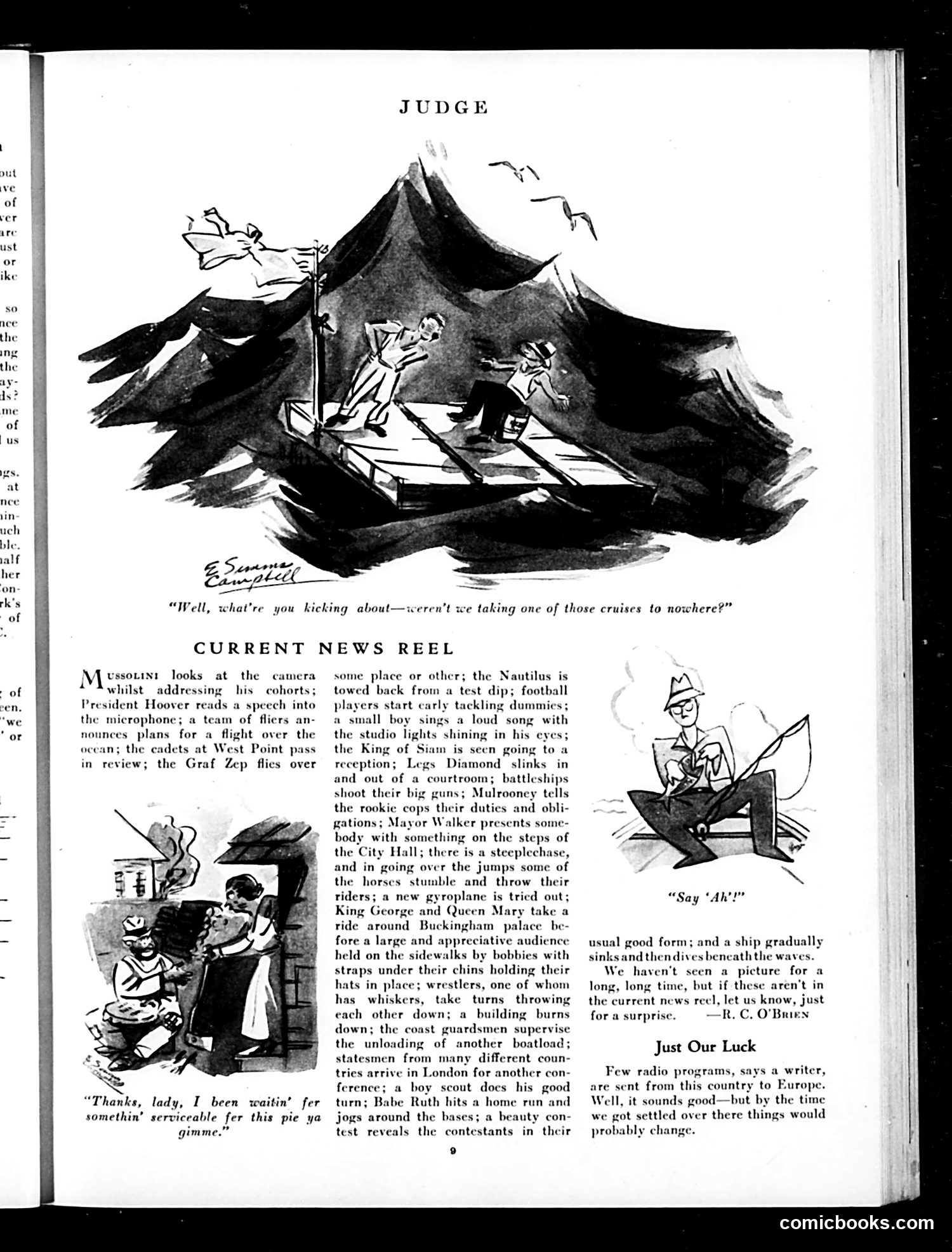
Judge Magazine Cartoon Analysis Top Cartoon ("Judge"): A couple argues in a rowboat during what appears to be rough seas. The husband dismisses his wife's concerns, sarcastically asking why she's complaining—after all, weren't they taking a cruise "to nowhere?" The joke satirizes the absurdity of Depression-era tourism: couples were taking pleasure cruises to literal "nowhere" (pointless destinations), yet still experiencing buyer's remorse and marital discord. "Current News Reel": This section is a rapid-fire satirical summary of contemporary news items from what appears to be the late 1920s or early 1930s, including Mussolini, President Hoover, the Graf Zeppelin airship, gangster Legs Diamond, King George, Babe Ruth, and various other celebrities and events. It's mocking the relentless, shallow parade of news stories that dominated the era's newsreels. "Just Our Luck": A brief joke about American radio programs being unavailable in Europe—suggesting America's cultural reach was limited internationally.
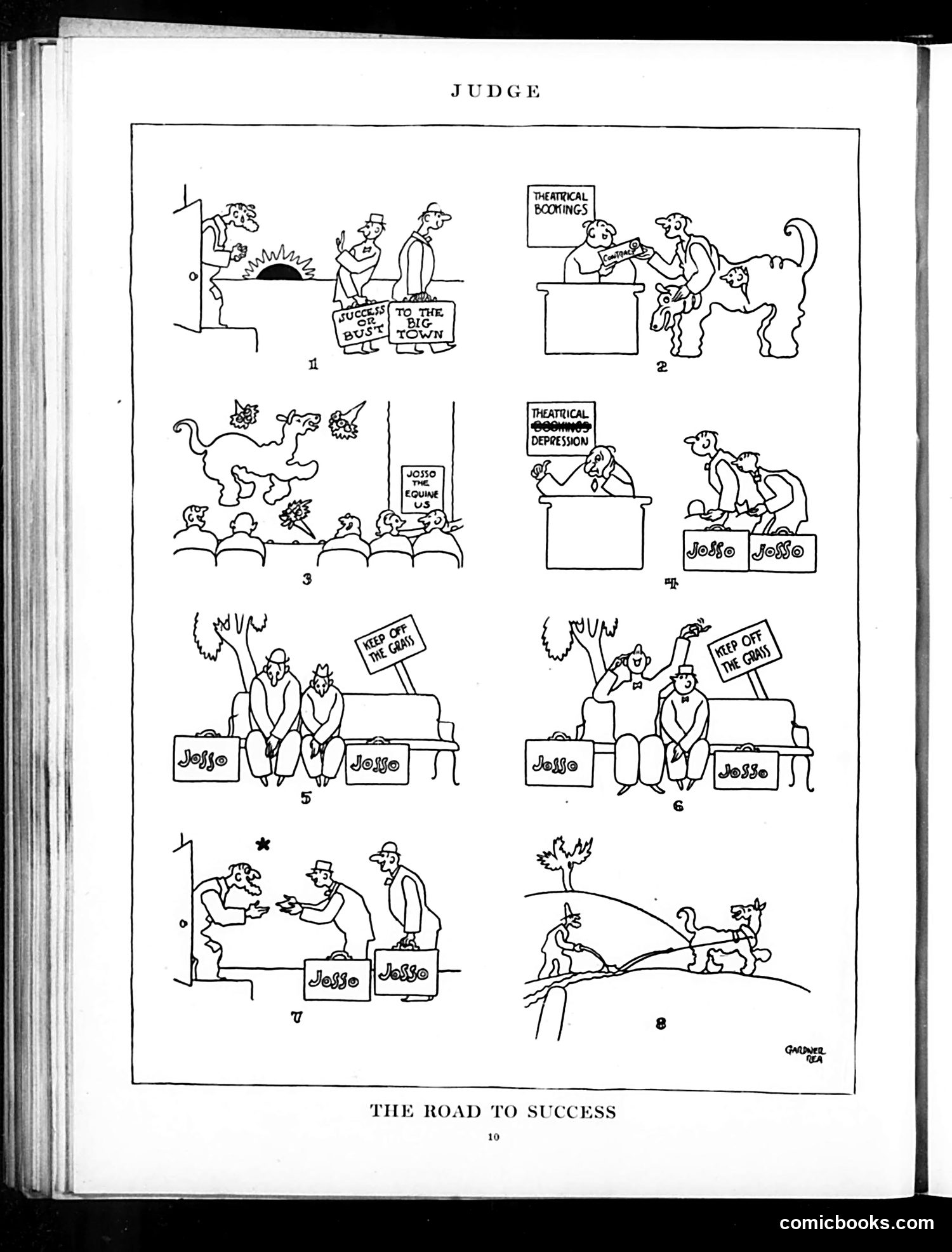
"The Road to Success" - Judge Magazine Cartoon This comic strip satirizes theatrical success through eight panels depicting the journey of aspiring performers. Panel 1 shows hopeful actors arriving in "the big town" with dreams. Panels 2-4 illustrate their struggles: theatrical bookings, economic depression, and chaotic auditions labeled "chaos at the theater." Panels 5-6 show dejected performers sitting on benches marked "Jello" (likely product placement or sponsorship), holding signs reading "Keep off the Grass." Panels 7-8 depict the final outcome: reduced circumstances, with performers apparently abandoned or in dire straits. The cartoon mocks the harsh realities facing theatrical hopefuls—the contrast between glamorous dreams and disappointing economic realities in show business. It critiques both the industry's exploitation and performers' naive optimism about achieving stardom.
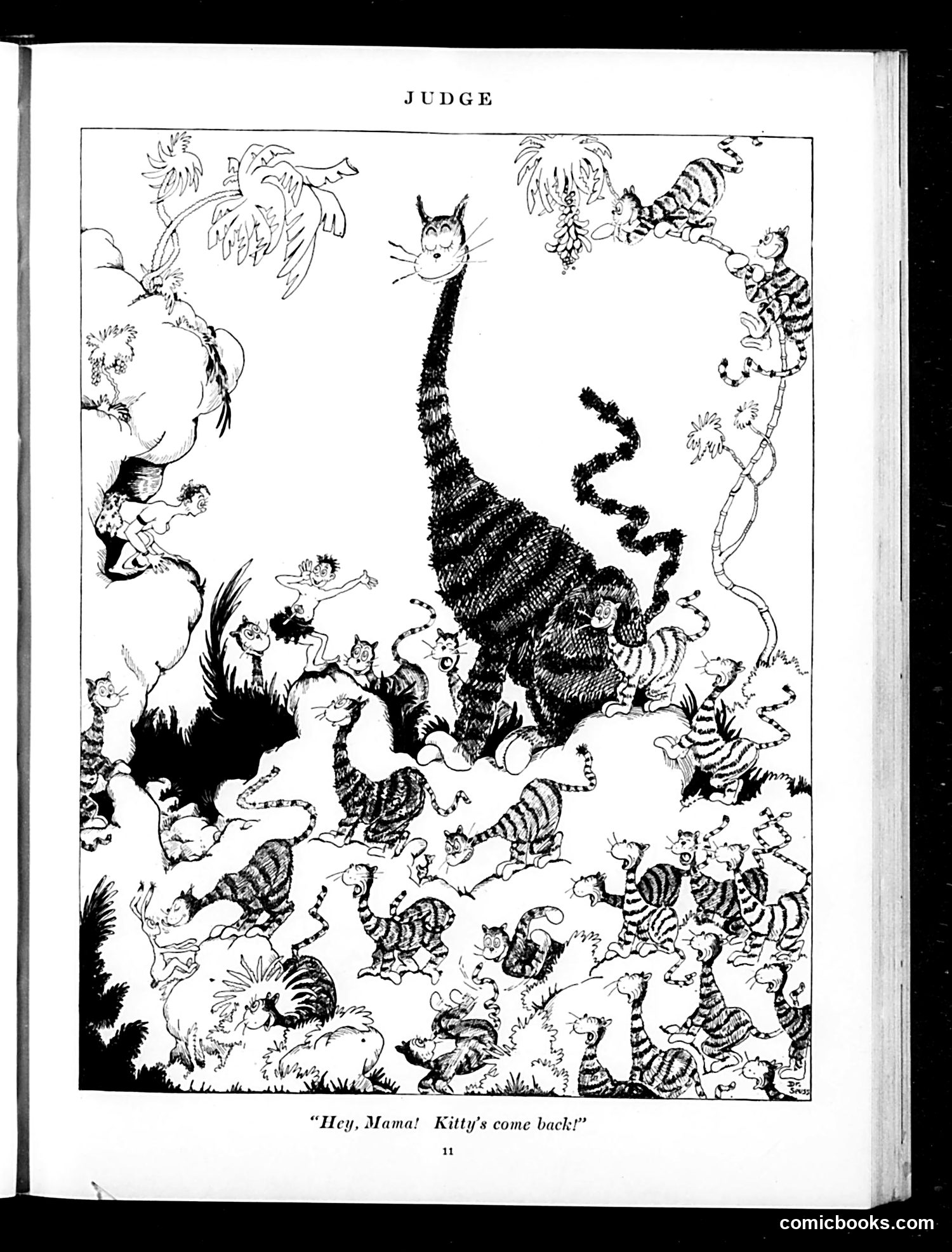
Judge Magazine Page Analysis This appears to be a single cartoon titled "Judge" showing a large, menacing cat surrounded by numerous small striped figures (likely cats or kittens). The caption reads "Hey, Mama! Kitty's come back!" The satire likely uses the cat as a metaphor for a threatening force or unwelcome return—possibly political or social commentary relevant to when Judge magazine published. The swarming smaller figures suggest either offspring, followers, or multiplication of a problem. Without knowing the specific publication date, the exact political reference remains unclear. However, Judge magazine (1881-1939) frequently used animal metaphors for political figures and social anxieties. The "mama" reference and the cat's return suggest a commentary on something returning to cause disruption or concern in American society during this period.
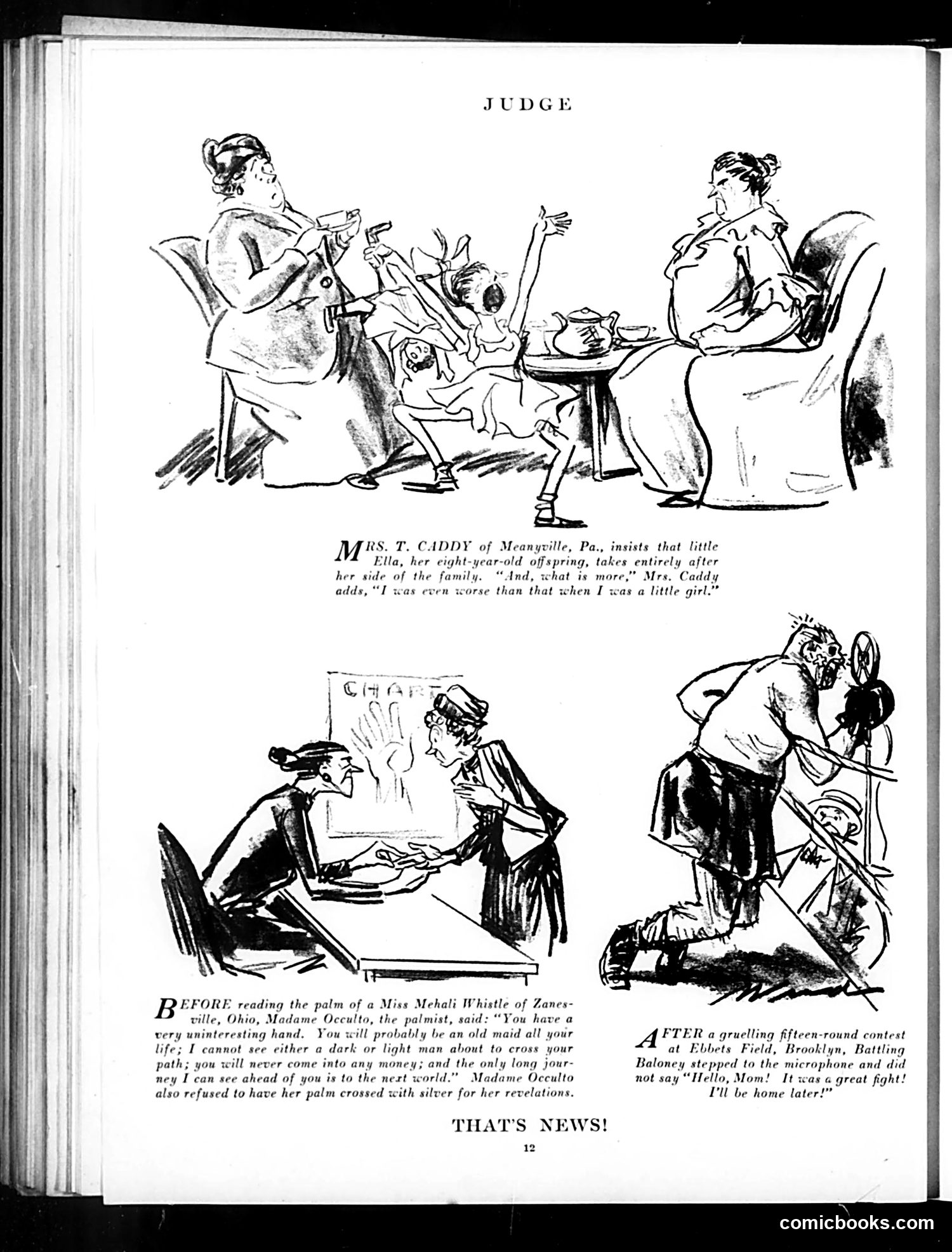
Judge Magazine Satire Analysis This page contains three separate humorous vignettes mocking contemporary social pretensions: 1. Mrs. Caddy's parenting: A mother defends her misbehaving daughter by claiming the child inherited bad behavior from her—satirizing parents who blame genetics rather than taking responsibility for discipline. 2. Madame Occulto's palmistry: A fake psychic gives deliberately terrible "predictions" to a client, then refuses payment—mocking the con-artist spiritualism and fortune-telling craze popular in early 20th-century America. The joke is that even a charlatan won't validate her future for money. 3. Battling Baloney's broadcast: After a boxing match, a fighter disappoints audiences by not shouting the expected sentimental greeting to his mother—satirizing the manufactured sentimentality of celebrity culture and boxing promotions that expected fighters to perform emotional authenticity for publicity. All three ridicule people's self-deception and the fraudulent performances embedded in everyday American life.
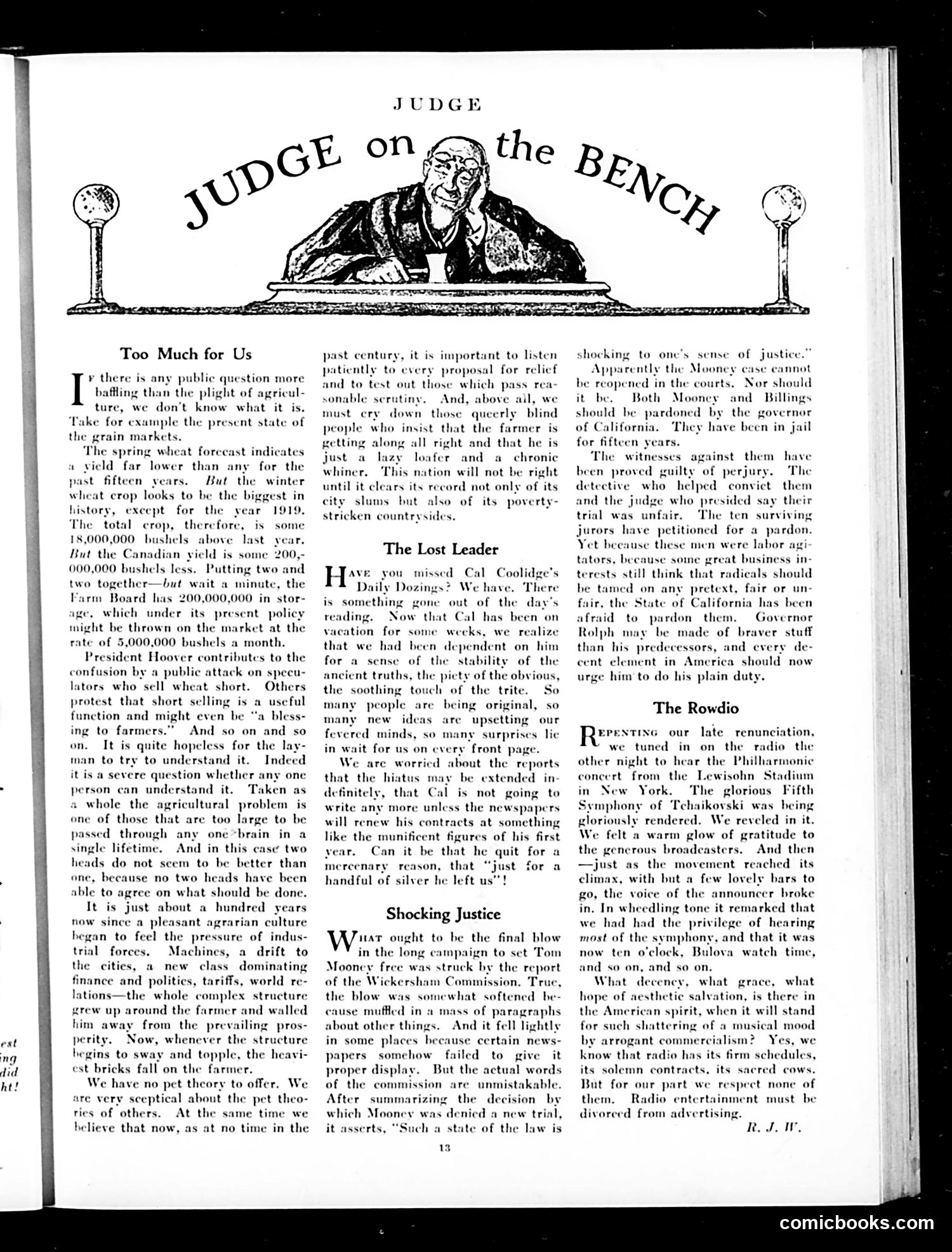
Judge Magazine Page Analysis This page from *Judge* satirizes three distinct issues: "Too Much for Us": Critiques the incomprehensibility of agricultural policy under President Hoover. The piece mocks conflicting farm forecasts, the Farm Board's grain storage policy, and debate over wheat speculation—concluding the problem is too complex for ordinary citizens to understand. "The Lost Leader": Humorously laments former President Calvin Coolidge's vacation from writing his newspaper column. The satire suggests Americans had grown dependent on Coolidge's "Daily Dozings" for reassurance and stability; his absence leaves people unsettled by new ideas and surprises. "Shocking Justice": Criticizes the Wickersham Commission's report on Tom Mooney's case. Mooney was a labor activist imprisoned on disputed bomb charges; the commission acknowledged the legal proceedings were "shocking" but newspapers downplayed this damning conclusion. The satire protests inadequate media coverage of injustice. All three pieces reflect *Judge*'s 1920s editorial perspective: skeptical of government competence, nostalgic for Coolidge's conservatism, and concerned about legal fairness.
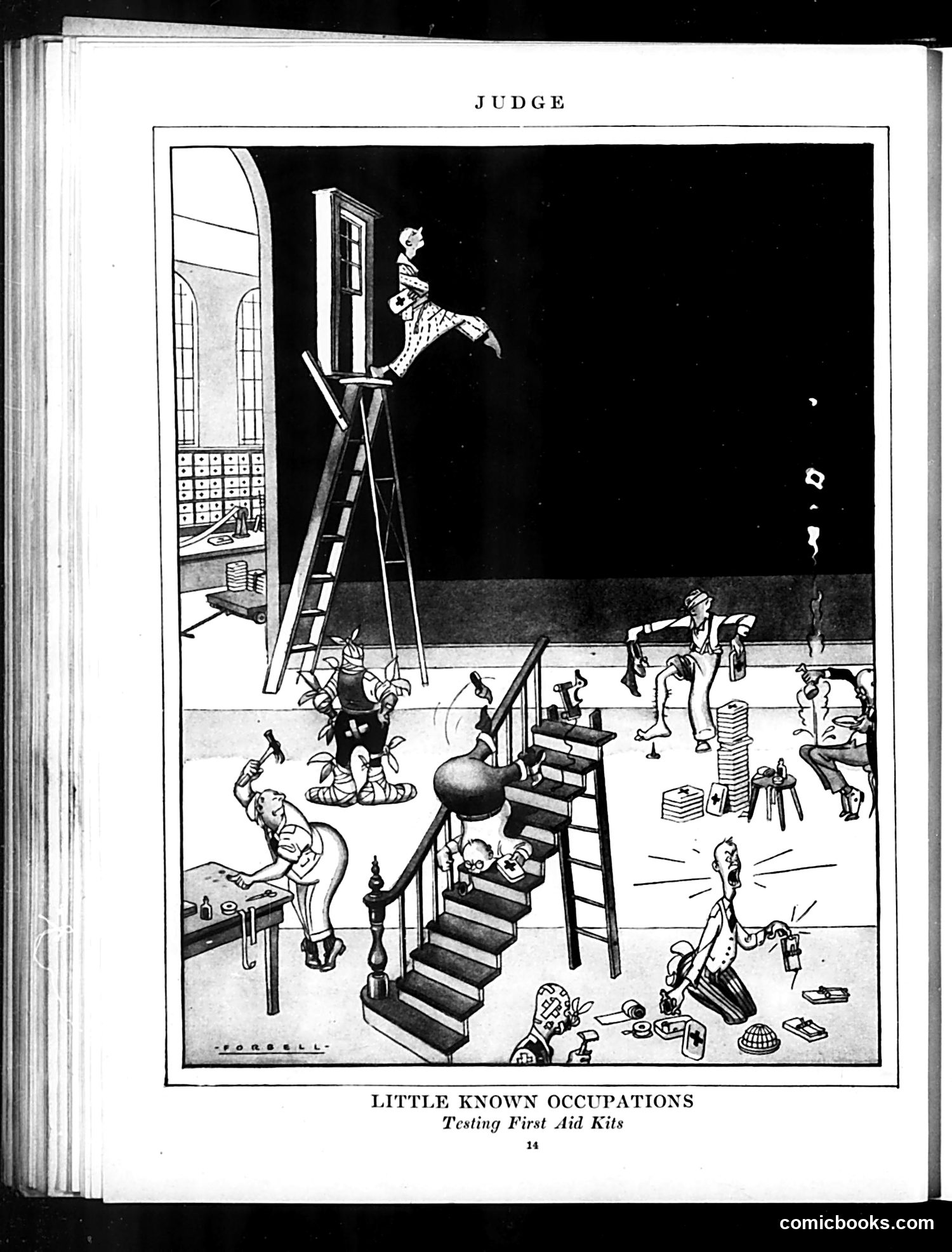
"Testing First Aid Kits" Cartoon Analysis This cartoon from *Judge* magazine satirizes the occupation of "testing first aid kits" by depicting a chaotic scene where multiple people are deliberately injuring themselves in creative ways—falling from ladders, getting struck by large balls, tripping down stairs, and otherwise creating accidents—all to test whether first aid supplies work. The humor is absurdist: the "occupation" is presented as legitimate work, when in fact it involves intentional self-harm. The cartoon mocks both the absurdity of needing to invent increasingly dangerous test scenarios and possibly pokes fun at workplace safety standards or insurance testing practices of the era. The exaggerated chaos and the matter-of-fact presentation of deliberate injuries create the satirical effect.
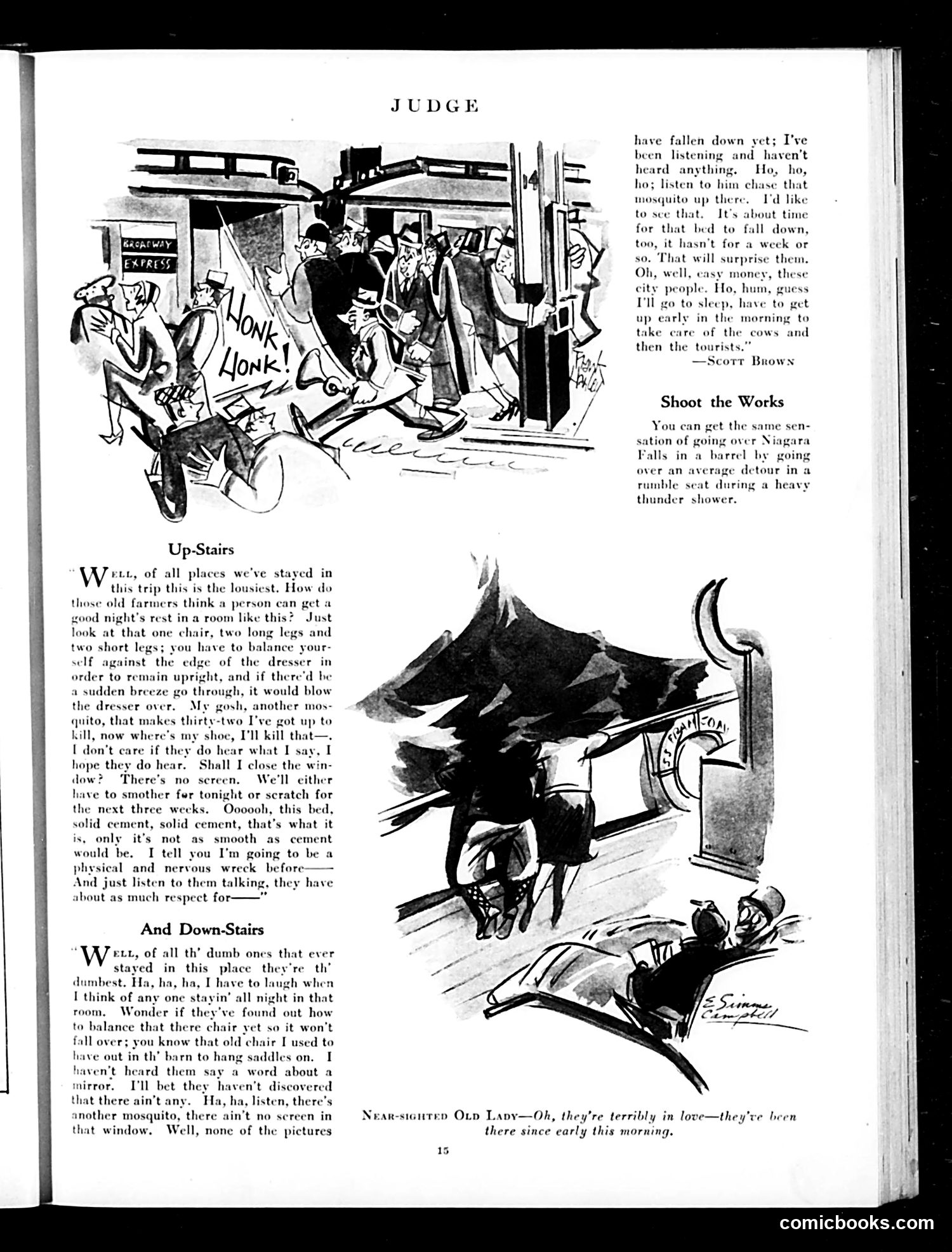
"Up-Stairs and Down-Stairs" - Judge Magazine Satire This two-part cartoon satirizes the vast gulf between city tourists and rural farmers. The upper section shows an urban visitor's miserable night in a ramshackle farmhouse—complaining about an unstable chair, mosquitoes, no window screens, and a concrete-hard bed. The lower section depicts the farmer's amusement at these "dumb" city people, who he assumes are helpless and entitled ("easy money"). The satire cuts both ways: it mocks tourists' lack of resilience and their entitled expectations, while also ridiculing the farmer's smug condescension and deliberate negligence toward his guests. The accompanying quips about "Niagara Falls" thrills and near-sighted elderly couples reinforce the theme of rural-versus-urban culture clash—a common early 20th-century Judge subject reflecting America's urbanization anxieties.
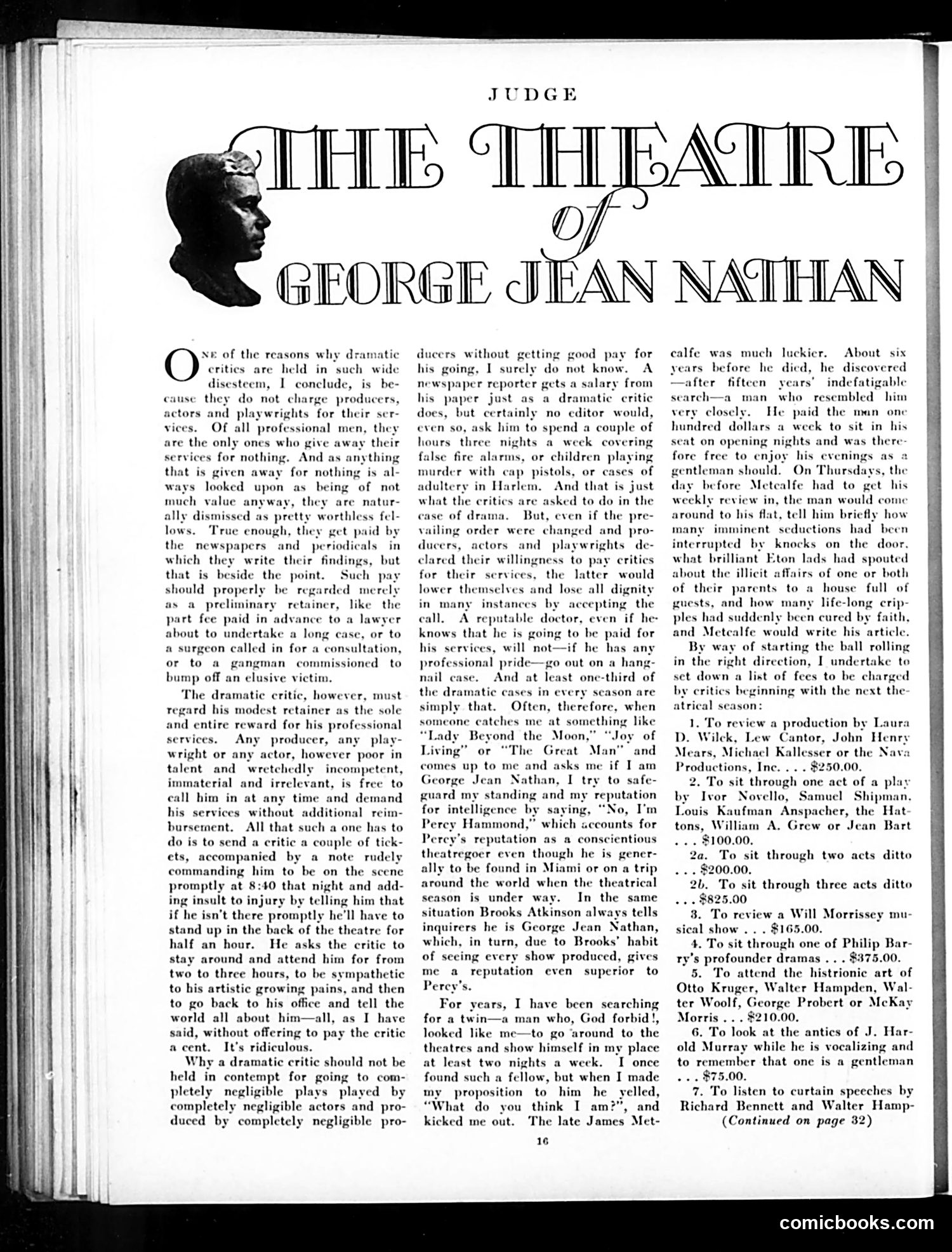
"The Theatre of George Jean Nathan" This is a theatrical gossip/opinion piece by Judge magazine's drama critic, not a political cartoon. The author (likely Nathan himself, given the byline) complains that dramatic critics are professionally disrespected because they work for free—producers and playwrights summon them with free tickets and demand their time and expertise without payment, while other professionals charge for services. Nathan satirizes the absurdity by noting that newspaper reporters covering fires or crimes get salaries, yet critics covering terrible plays with negligible actors receive nothing. He then jokes about the confusion between himself and other critics (Percy Hammond, Brooks Atkinson)—so frequent that he's considered hiring an imposter to attend shows in his place to improve his reputation through sheer volume of attendance. The piece reflects early 20th-century theater world dynamics and professional standards debates.
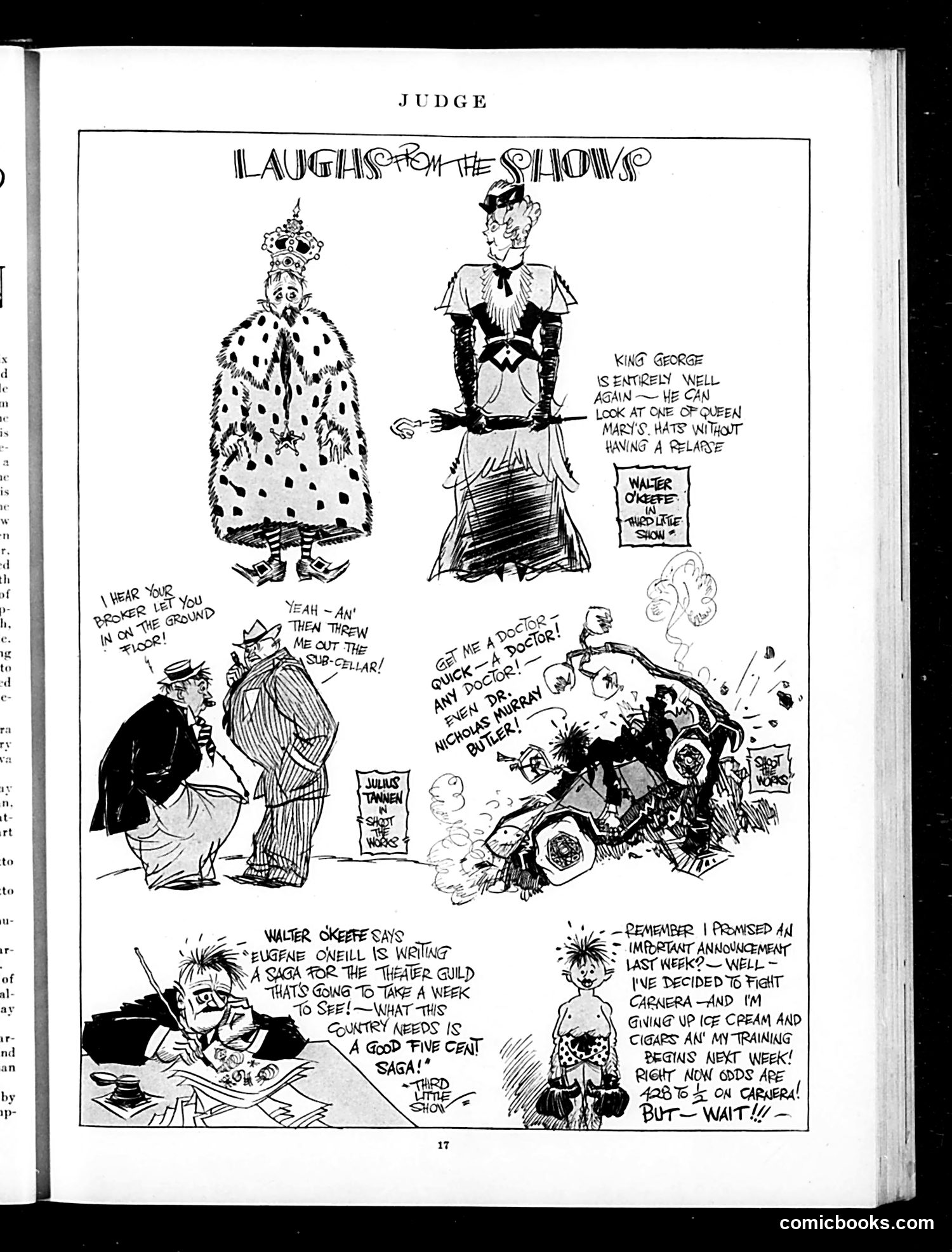
"Laughs for the Shows" This Judge page satirizes theatrical gossip and celebrity news. King George VI's recovery allows him to view Queen Mary's unflattering hats without relapse—mocking royal fragility and fashion absurdity. The main target is Walter Okeefe commenting on Eugene O'Neill writing a theatrical saga for the Theater Guild, sarcastically suggesting the country needs "a good five cent saga" rather than high art—critiquing pretentious theater. A secondary joke involves someone (likely a boxer or athlete, possibly Primo Carnera given the reference) abandoning training, ice cream, and cigars for a week to fight Carnera, but reconsidering due to unfavorable odds—poking fun at athletic overconfidence and poor decision-making. The cartoons mock entertainment industry self-importance and celebrity reasoning.
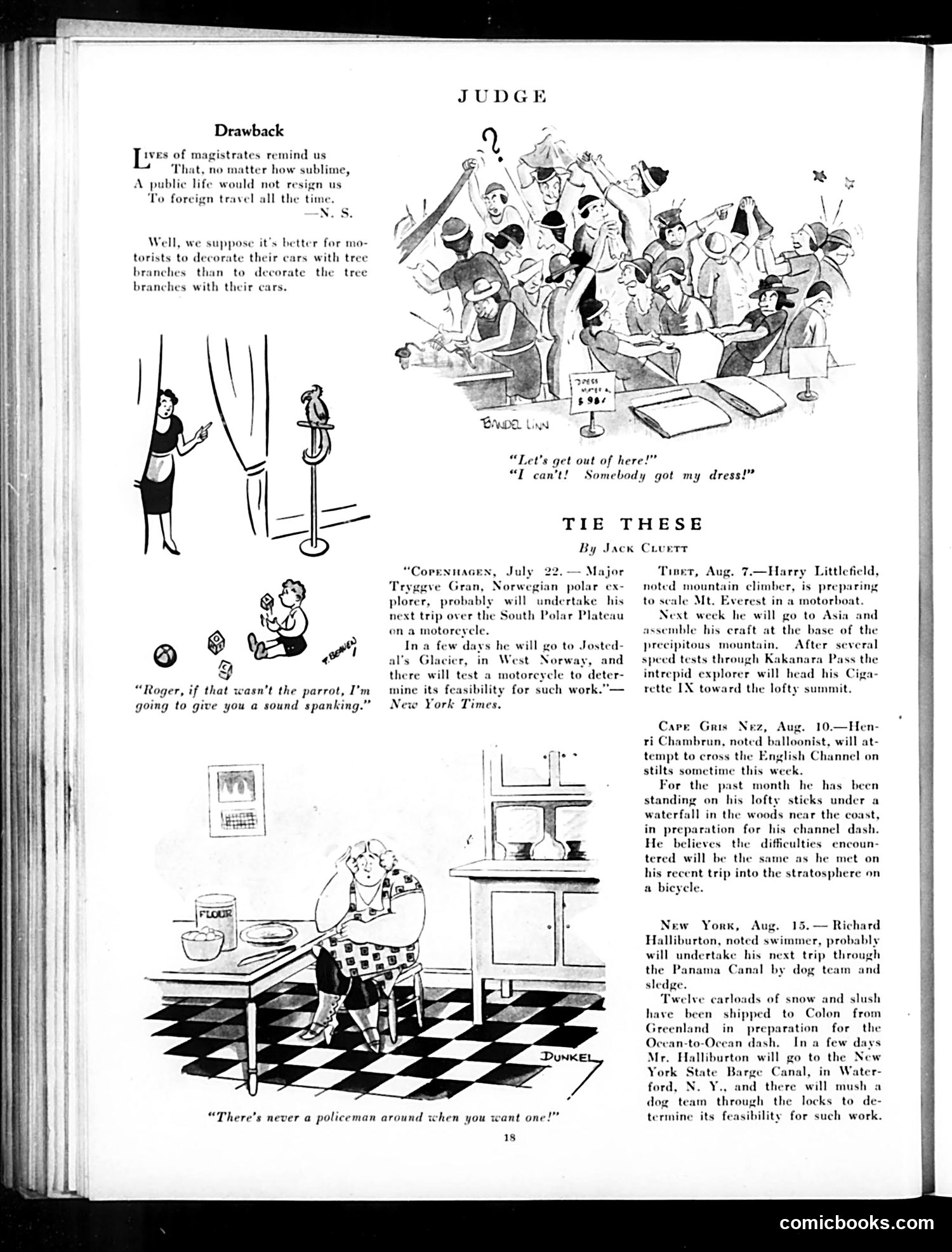
Judge Magazine Page Analysis This page satirizes adventurers and explorers of the 1920s who undertake absurdly mismatched expeditions. The column "Tie These" by Jack Cluett presents fictional news items about famous explorers (Tryggve Gran, Henri Chambrun, Richard Halliburton) attempting ridiculous feats: scaling Mt. Everest by motorboat, crossing the English Channel on stilts, and traversing the Panama Canal by dog sled. The humor mocks the era's celebrity adventurers and their publicity-seeking stunts. The cartoons above comment on everyday absurdities: motorists decorating cars with branches (ironic when cars crash into trees), and a chaotic scene where partygoers are trapped because someone's dress got caught. The bottom cartoon jokes about police unavailability—a timeless complaint. Overall, the page uses exaggeration and fake news items to ridicule both famous explorers' increasingly contrived expeditions and mundane modern life's frustrations.
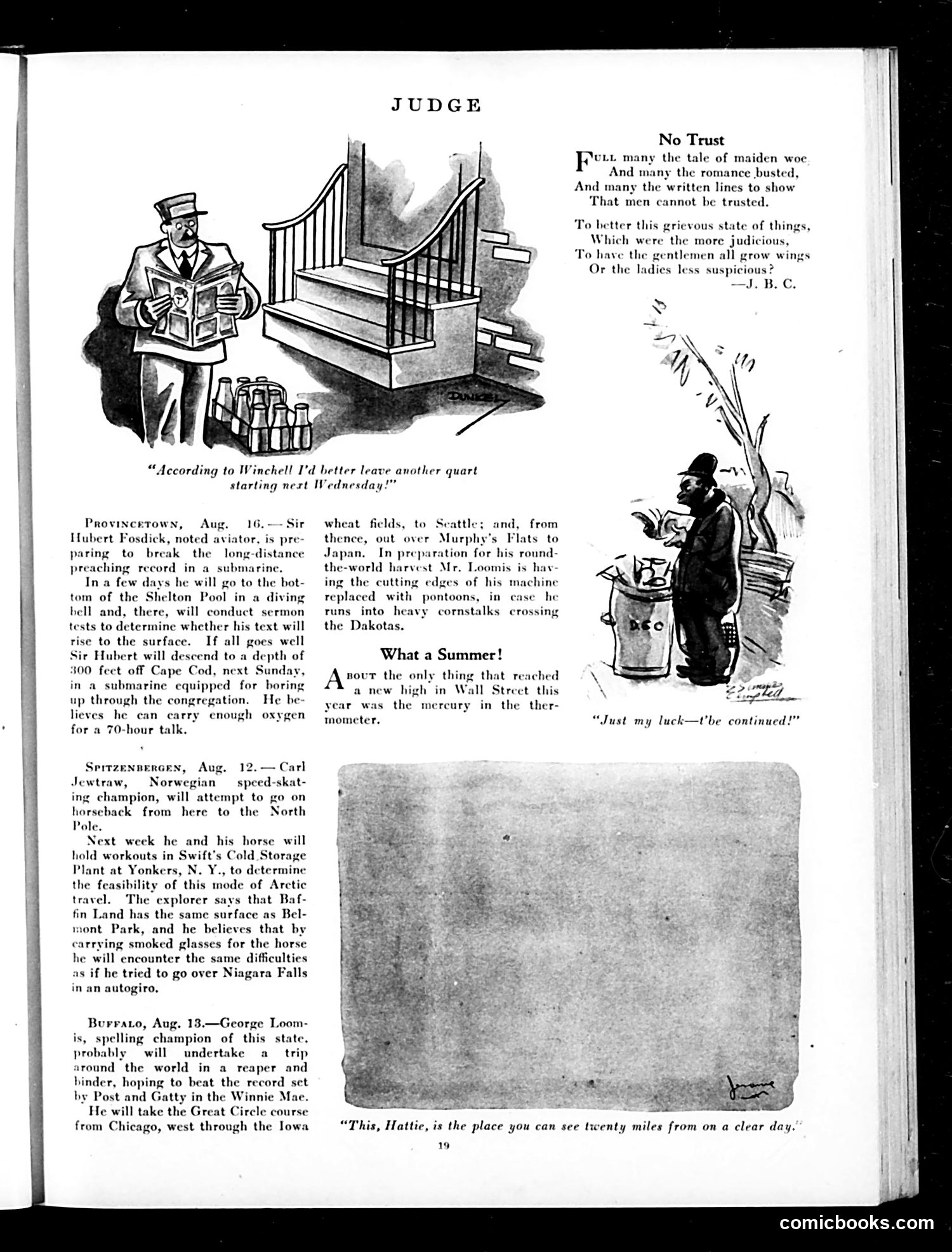
Judge Magazine Page Analysis This page from Judge magazine contains absurdist humor satirizing 1920s-30s celebrity culture and sensational news coverage. The main cartoon mocks advice columnist Walter Winchell (referenced in the caption) by depicting a man reading Winchell's column about drinking, interpreting it as personal instruction. The three short news items below parody breathless celebrity journalism: they describe ridiculous planned stunts by invented figures (an aviator preaching underwater, a speed-skater riding horseback to the North Pole, a spelling champion harvesting the world in a reaper). Each proposal grows progressively more absurd, satirizing both the era's obsession with breaking world records and the press's credulous coverage. The "No Trust" poem on the right, attributed to J.B.C., offers cynical commentary on romantic betrayal—a separate editorial feature lampooning modern relationships. The cartoons mock how newspapers amplified minor celebrity gossip and outlandish stunt announcements into major news stories.
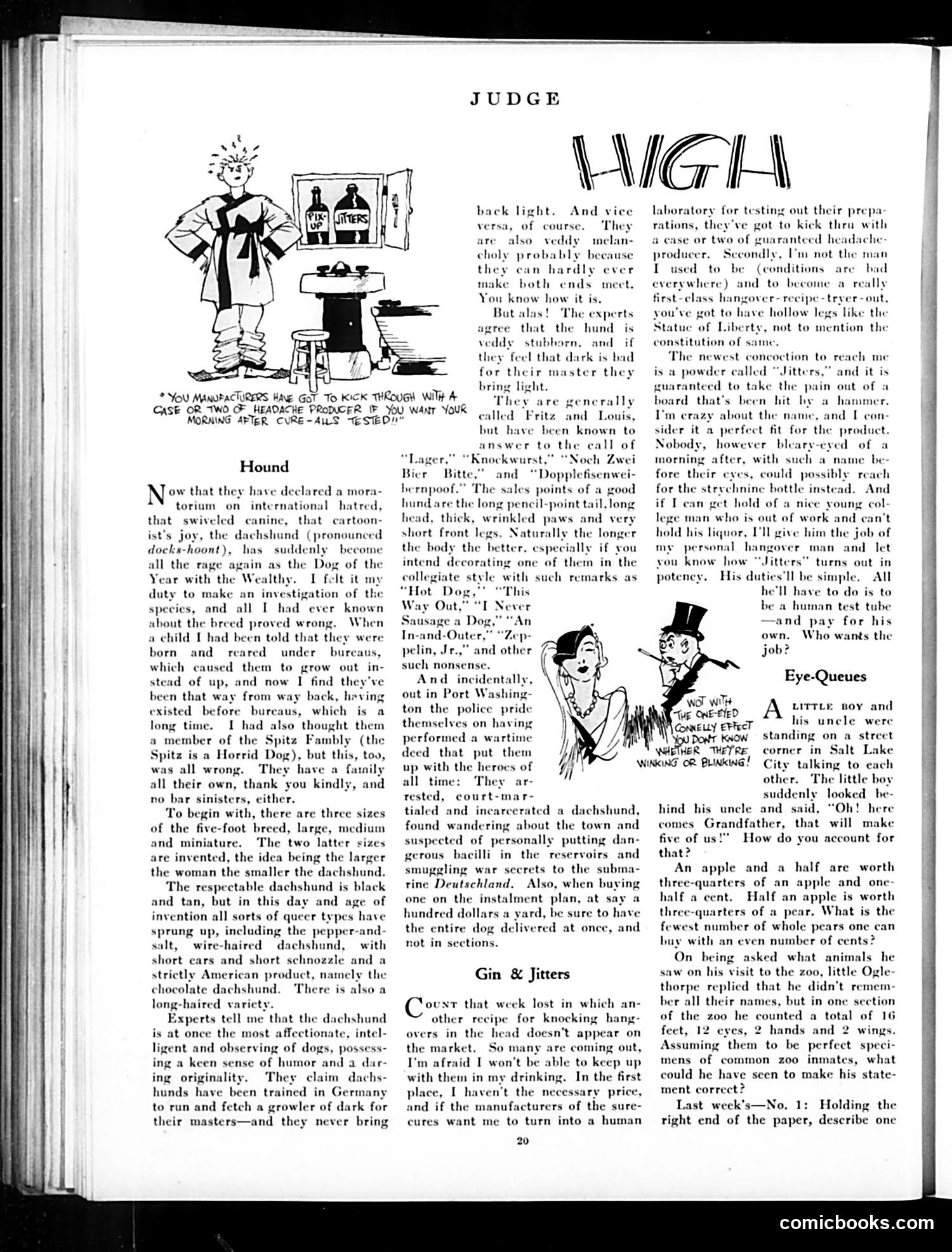
Judge Magazine Page Analysis This page contains three satirical pieces typical of Judge magazine's humor: "Hound" discusses dachshunds, which had become fashionable despite (or because of) anti-German sentiment during WWI. The author humorously debunks myths about the breed—that they were born under bureaus causing their shape, or belonged to the Spitz family. He notes their affectionate nature but "veddy stubborn" temperament, and their German-derived names (Fritz, Knockwurst, etc.). A darkly humorous anecdote describes Port Washington police arresting and court-martialing a dachshund suspected of espionage and poisoning reservoirs—satirizing wartime hysteria and paranoia about German connections. "Eye-Queues" presents a math puzzle about apples and pears. "Gin & Jitters" satirizes the proliferation of hangover "cures" flooding the market, with the author complaining he can't afford to test them all and lacks the constitution he once had. He mockingly suggests manufacturers provide free samples if they want him as a guinea pig. The overall tone reflects post-WWI American anxieties and consumer culture.
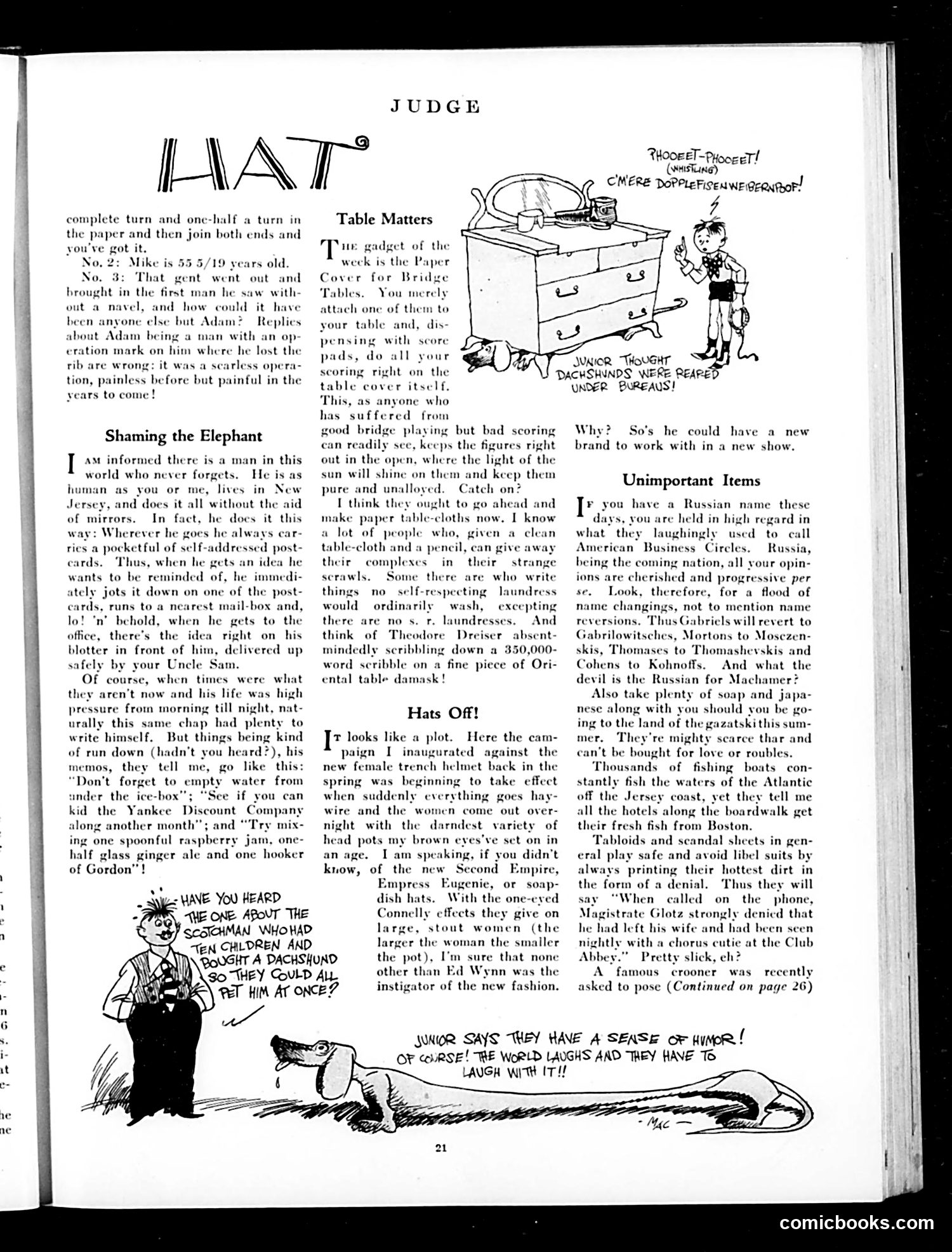
Judge Magazine Page Analysis This page from *Judge* satirical magazine contains several humor pieces and cartoons: "Shaming the Elephant" mocks a man with an extraordinary memory who uses self-addressed postcards to remind himself of ideas—but whose memos have devolved into trivial notes like "empty water from ice-box" and measuring ginger ale, suggesting his life has become mundane and unimportant. "Table Matters" jokes about a novelty paper table cover for bridge games that lets players score directly on it. The satire extends to suggesting paper tablecloths could help people unconsciously reveal their psychological complexes through doodles—and imagines Theodore Dreiser absent-mindedly writing a 350,000-word novel on fine Oriental damask. "Hats Off!" criticizes new "Second Empire" women's hats inspired by Empress Eugenie, which the author attributes to comedian Ed Wynn. The joke is that these small, pot-like hats look especially ridiculous on larger women. The bottom cartoon shows a dachshund with a child, playing on the breed's popularity and long shape. Overall, the page offers light social satire on 1920s fashions, gadgets, and manners.
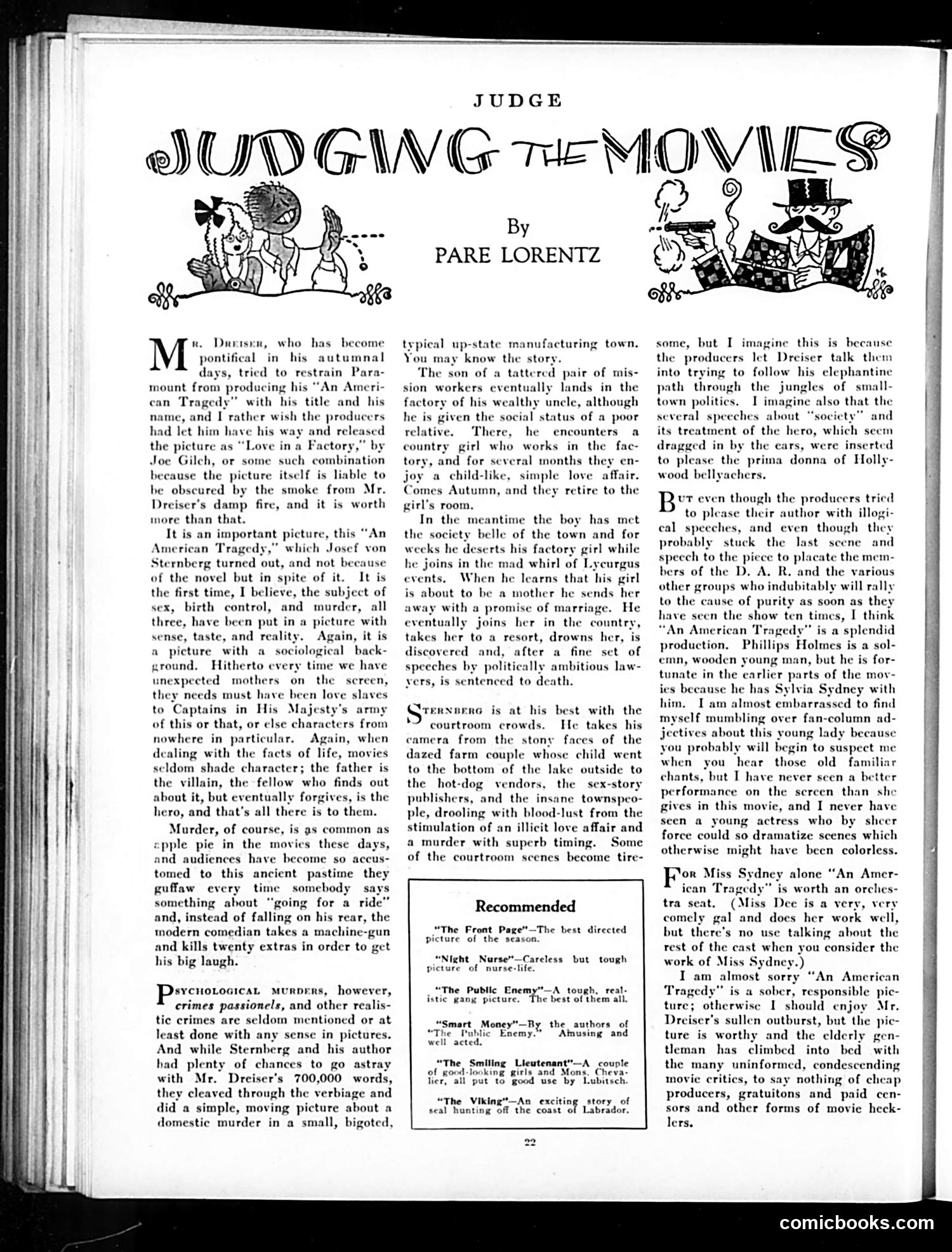
Judge Magazine: "Judging the Movies" by Pare Lorentz This is a film review column, not a political cartoon. Lorentz critiques Josef von Sternberg's *An American Tragedy*, adapted from Theodore Dreiser's novel about a factory worker who murders his pregnant girlfriend. Lorentz praises Sternberg for handling mature subjects—sex, birth control, murder—with sociological realism rather than melodrama. He criticizes how films typically portray such themes: villainous seducers, forgiving heroes, or comic violence treated as slapstick. The review particularly commends Sternberg's courtroom scenes, showing crowds of vendors and townspeople "drooling with blood-lust"—capturing sensationalism authentically rather than sentimentally. Lorentz also dismisses Dreiser's attempt to prevent production, calling the author "pontifical in his autumnal days." The sidebar lists other current film recommendations including *The Public Enemy* and *Night Nurse*.
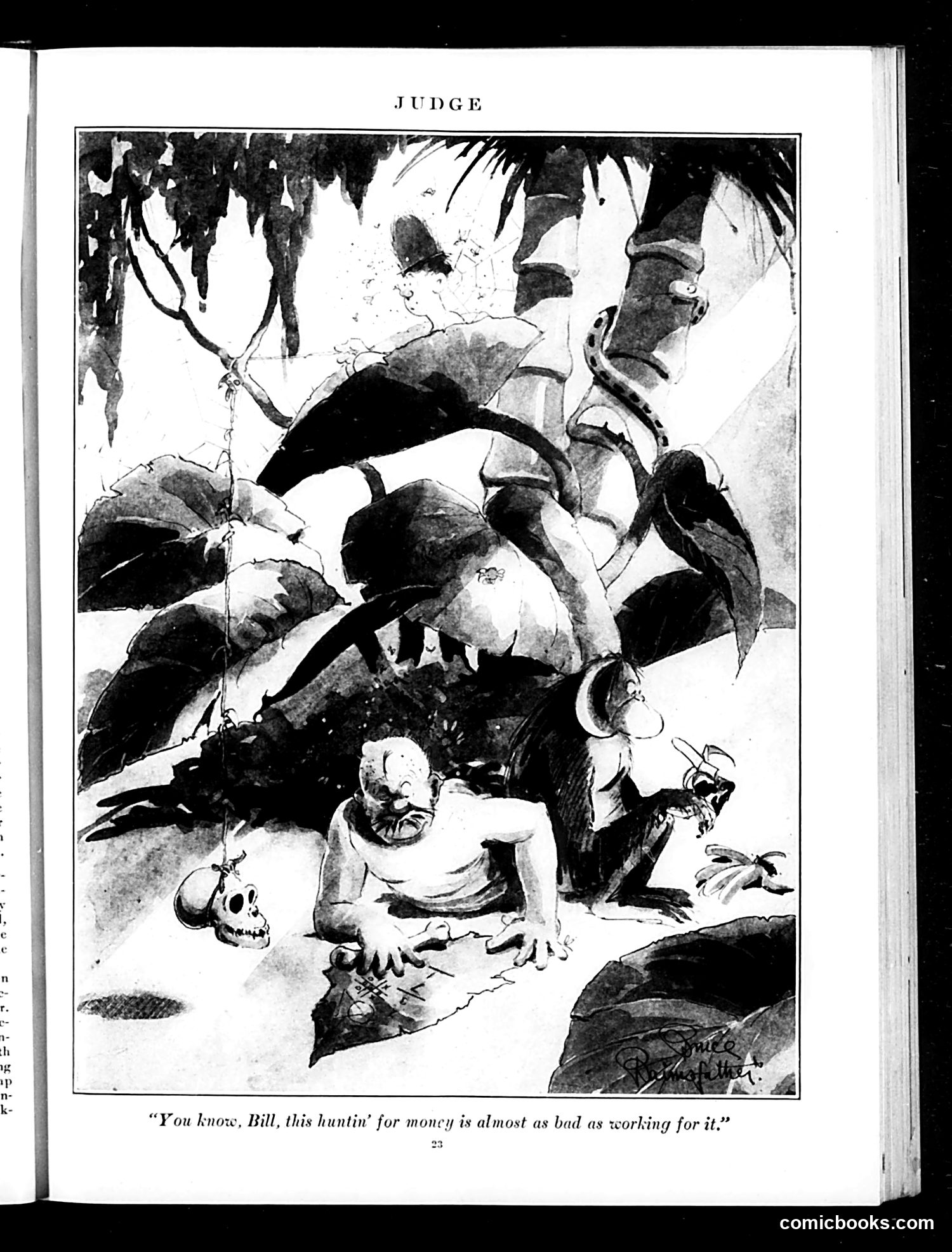
Analysis This cartoon satirizes the pursuit of wealth through illicit means. Two figures—apparently criminals or outlaws named "Bill"—are depicted in a dark, cave-like setting surrounded by skulls and skeletal imagery, suggesting danger and death. The dialogue critiques the false economy of crime: hunting for money (through theft, robbery, or other illegal activity) is presented as equally exhausting and morally compromising as honest labor. The cartoon's humor lies in the paradox it exposes: criminals imagine they're taking a shortcut to wealth, but the effort, risk, and moral cost make their scheme scarcely better than working legitimately. The gothic imagery—skeletons, demonic figures in the background—emphasizes that criminal pursuits lead only to destruction. This appears to be social commentary warning against crime as a path to prosperity.
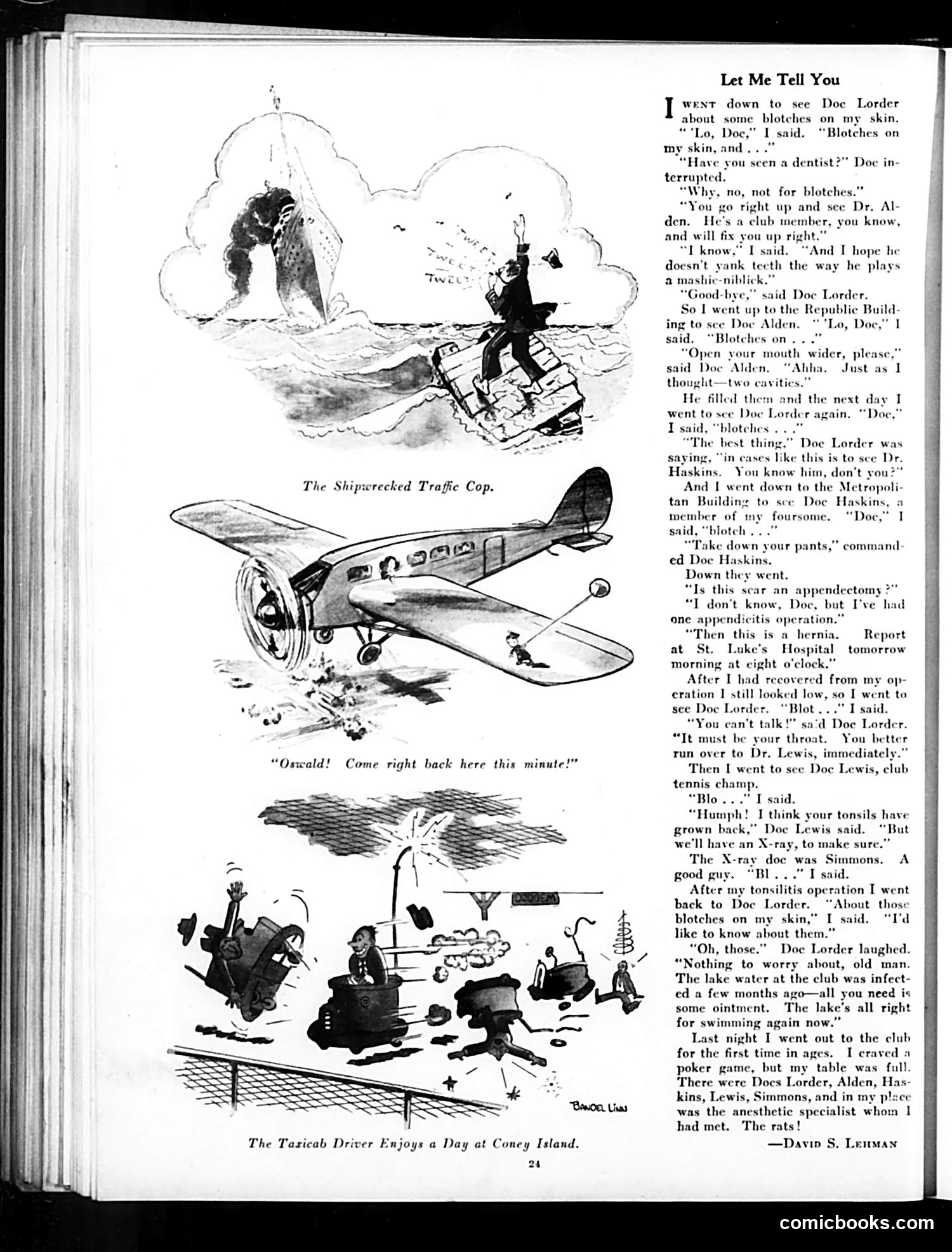
Analysis for Modern Readers This 1920s satirical story mocks the clubby, self-referential world of wealthy professionals. The narrator seeks treatment for skin blotches but gets shuttled between "Doc" friends—a dentist, general practitioner, surgeon, and tennis instructor—each diagnosing unrelated ailments (cavities, hernia, tonsils) while ignoring the original complaint. The satire targets: - Professional nepotism: doctors recommending fellow club members regardless of specialization - Medical overtreatment: unnecessary procedures (appendectomy, X-rays, tonsil removal) justified by doctor-friends' recommendations - Class insularity: wealthy men helping each other profit while dismissing actual ailments The punchline reveals the blotches were merely lake-water infection—easily treatable—yet the narrator underwent multiple surgeries. The final joke shows even the anesthesiologist replaced him at poker, suggesting these doctors prioritize socializing and profit over patient care. The accompanying cartoons depict slapstick traffic accidents, typical period Judge humor.
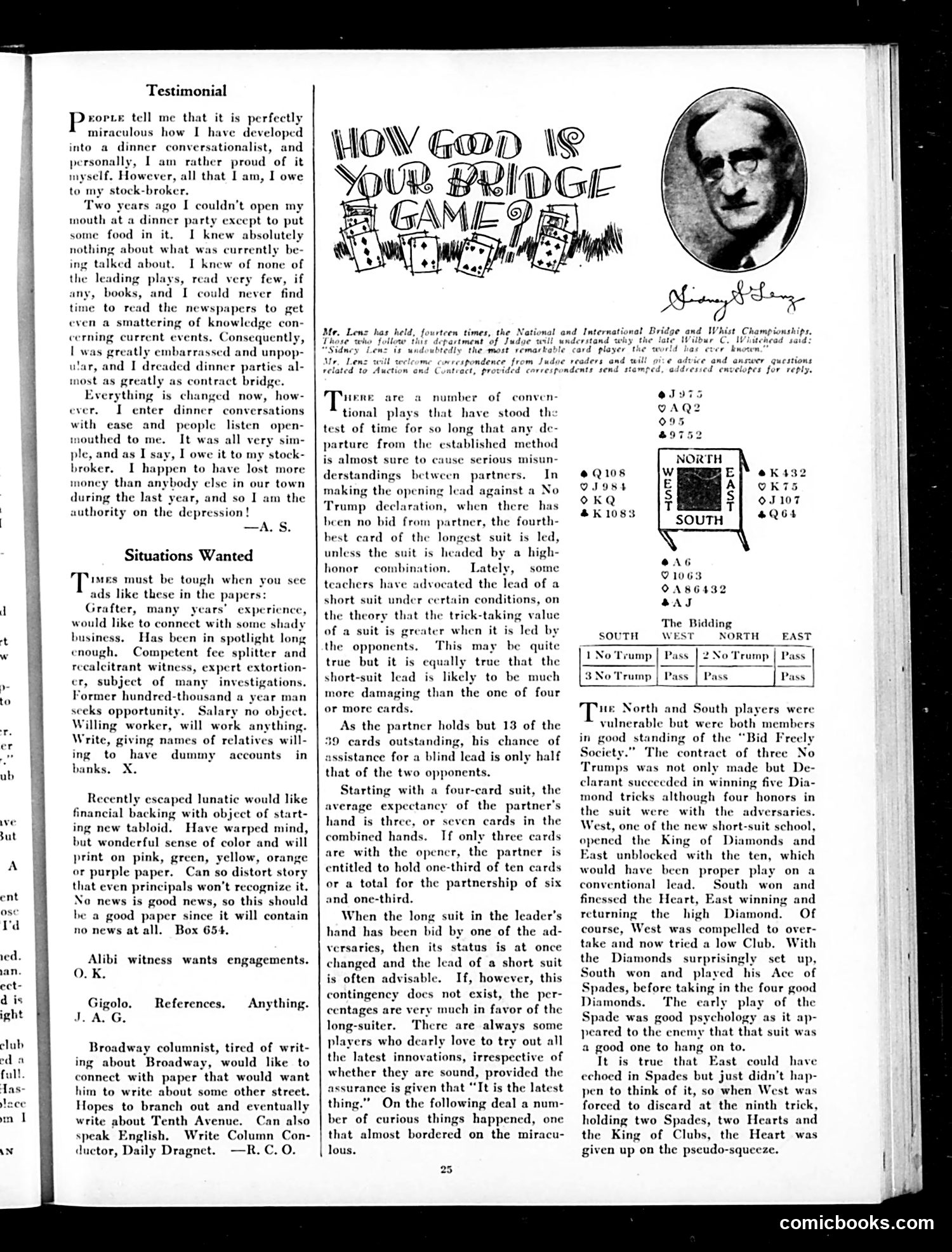
Analysis for Modern Readers This page from *Judge* magazine contains satirical commentary on 1930s American life during the Great Depression. The Testimonial: A humorous piece where someone credits their newfound dinner-party wit to financial ruin. The joke: having lost more money than anyone else in town during "the depression" makes them the local authority on economics—their misfortune paradoxically elevates their social status and conversational credibility. It's dark satire about Depression-era anxieties and how financial catastrophe ironically confers a twisted kind of expertise. "Situations Wanted": A parody classified ads section mocking corrupt professionals and criminal types seeking employment—grafters, extortionists, witnesses willing to commit perjury, and escaped lunatics. The satire targets widespread corruption, suggesting such characters are common enough to advertise openly. Bridge Strategy Section: Unrelated instructional content about card game bidding conventions—filler material typical of *Judge*. The page reflects Depression-era cynicism about corruption, financial collapse, and social dysfunction.
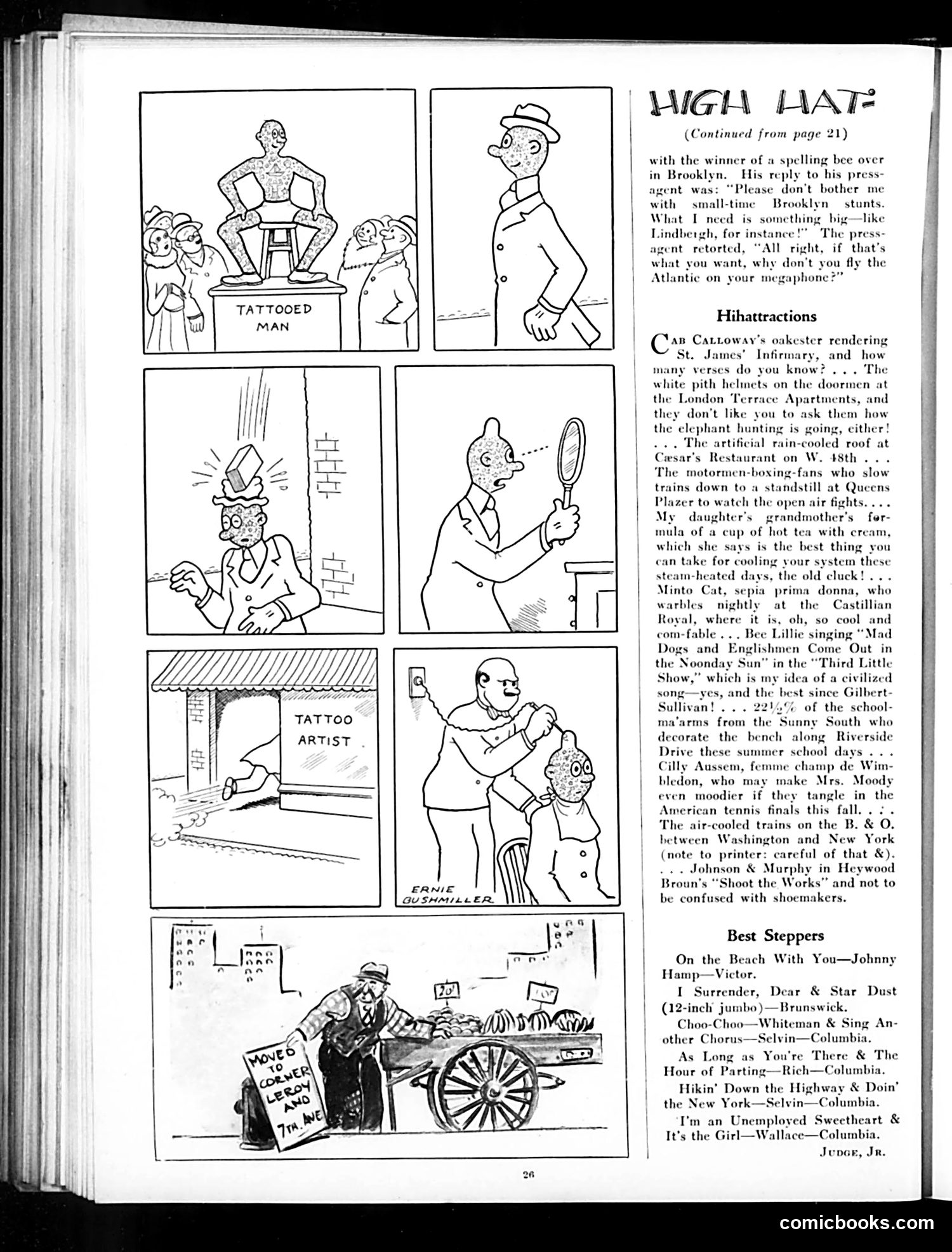
Analysis of Judge Magazine Page The left side contains a comic strip about tattooing, satirizing carnival attractions and sideshow culture. It depicts a "Tattooed Man" displayed to crowds, a man with visible tattoos, someone being struck (suggesting pain during tattooing), a man examining his reflection, and a "Tattoo Artist" shop. The humor appears to mock both the spectacle of human oddities for entertainment and the painful process of tattooing. The right column, titled "High Hate" (continued from page 21), contains gossip and social commentary about New York City celebrities and trends of the era—including references to Charles Lindbergh's Atlantic flight, restaurant fashions, and radio performers. It critiques both high society pretension and popular entertainment fads. The bottom cartoon shows a man with a cart and sign about "love's old sweet song" and "tin pan," likely mocking Tin Pan Alley (the music industry) and commercialized sentimentality in popular music. The page primarily reflects 1920s-era urban American culture, celebrity gossip, and entertainment industry satire.
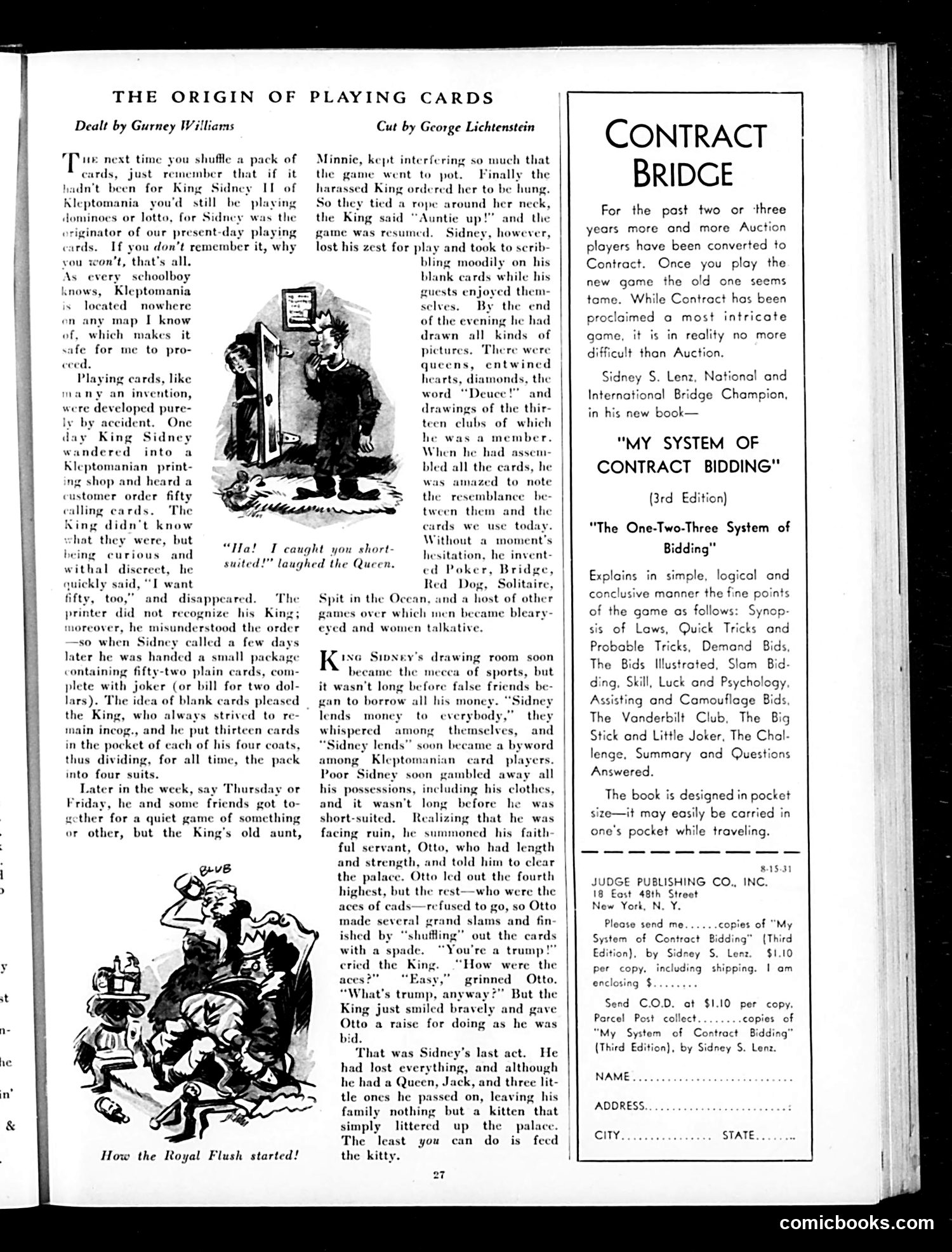
"The Origin of Playing Cards" — Judge Magazine This humorous origin story satirizes the arbitrary nature of card game rules and social conventions. The fictional "King Sidney II of Kleptomania" invents playing cards through accident and whimsy—a foundling king orders fifty calling cards, receives fifty-two blank cards instead, then distributes them into four pockets, thereby creating the four suits. The satire escalates: Sidney's aunt Minnie interferes with a card game, so he casually orders her hanged ("Auntie up!"), then doodles card designs while his guests enjoy themselves. Later, when Sidney loses everything gambling, his servant Otto removes his creditors by "shuffling out the cards" with violence. The joke mocks how arbitrary rules become tradition. Card games, social hierarchies, and even morality are presented as accidents of history rather than rational systems—perfectly embodied in a king from a nonexistent country inventing the games we take seriously today. The casual violence and the kitten ending add dark absurdist humor typical of Judge's satirical style.
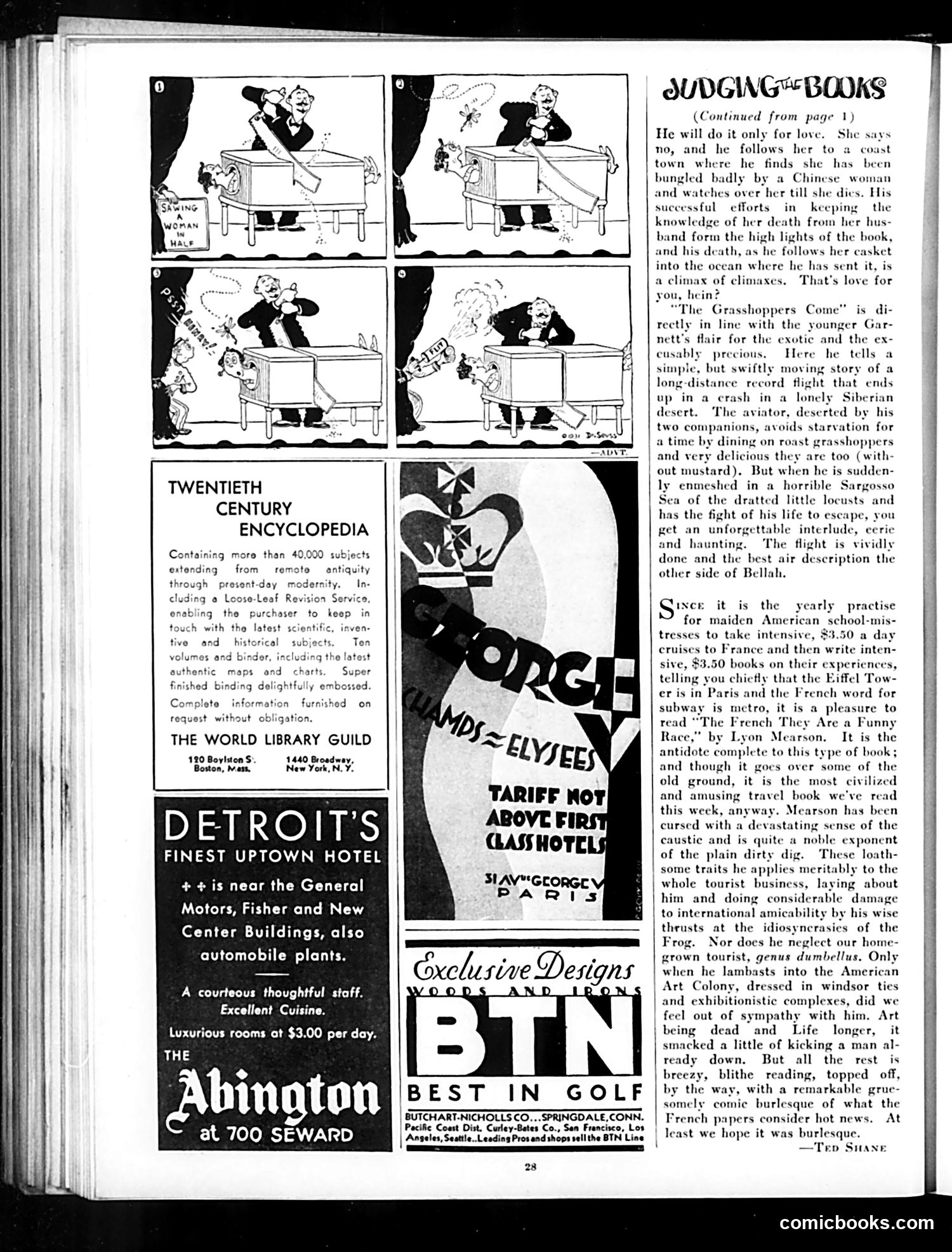
Explanation for Modern Readers This page is primarily advertising and book reviews, not political satire. The top section contains a four-panel comic strip (artist unclear) depicting slapstick humor—a man repeatedly getting knocked around by a woman at a table, labeled "Saving a Woman from a Man." The main content is Ted Shane's book review column "Judging the Books," critiquing recent novels: one about a man's devotion to a woman ending in ocean tragedy; "The Grasshoppers Come," an aviation adventure in Siberia; and "The French They Are a Funny Race" by Lyon Mearson, which Shane praises as witty satire mocking American tourists in Paris and their superficial travel writing. The page also contains vintage advertisements for the Twentieth Century Encyclopedia, Detroit's Abington Hotel, and golf equipment—typical of Judge magazine's revenue model. The cartoons and reviews reflect 1920s literary tastes and tourist culture, not contemporary political commentary.
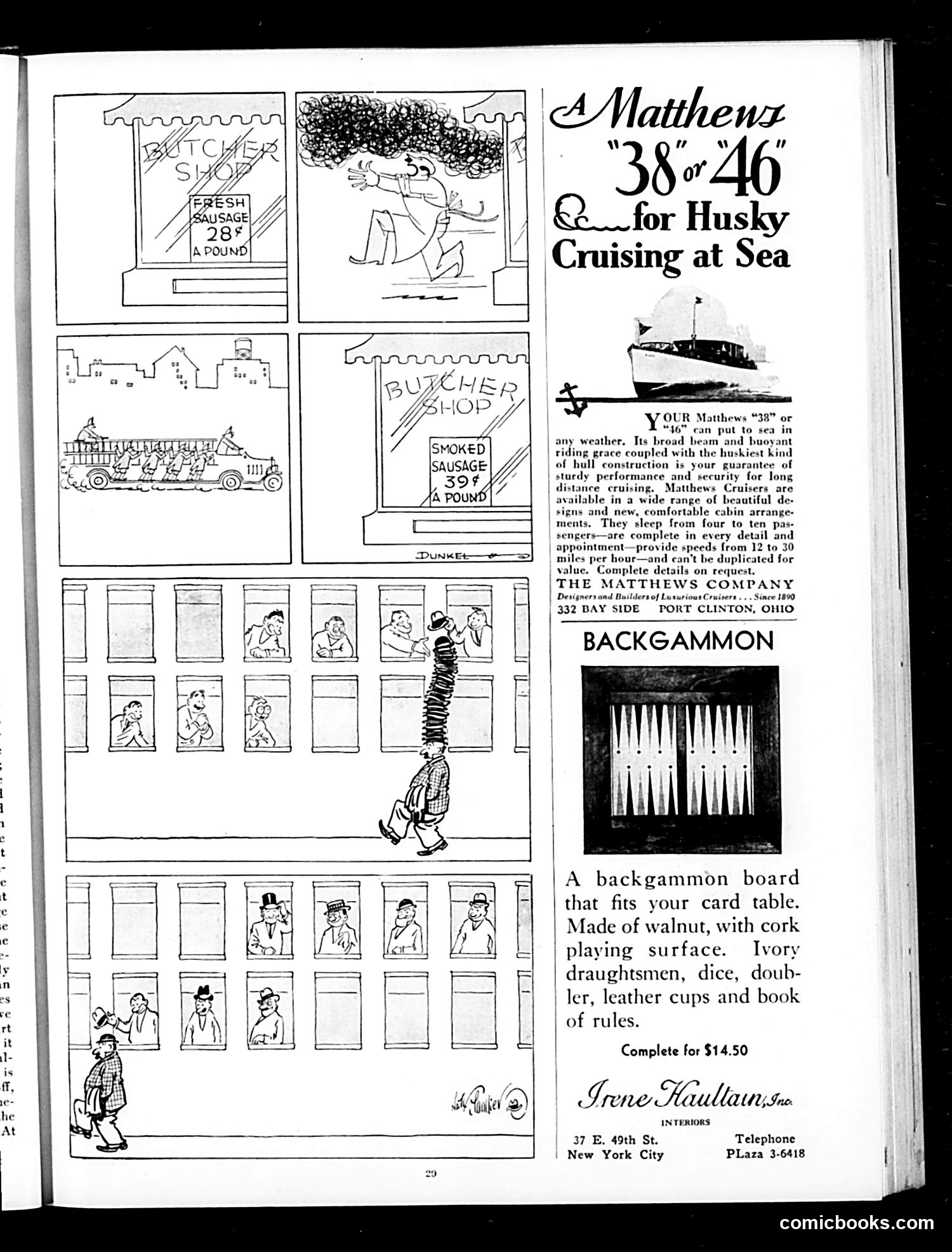
Explanation for Modern Readers This page is primarily advertising, not political satire. The left side contains a humorous cartoon about apartment living—showing tenants stacking increasingly high in a building, with one man carrying an enormous stack of people on his shoulders. The joke appears to be about overcrowding or the absurdity of urban housing density, rendered as visual exaggeration. The right side advertises two luxury products: a Matthews motorboat (38 or 46 feet) marketed for wealthy recreational cruising, and an expensive backgammon board ($14.50—substantial money in this era) for card-table entertainment. There's no apparent political message. Instead, this reflects 1920s-30s consumer culture aimed at affluent readers—leisure activities, recreational boating, and parlor games for the wealthy. The cartoon's humor is simply visual gag-based rather than socially pointed satire.
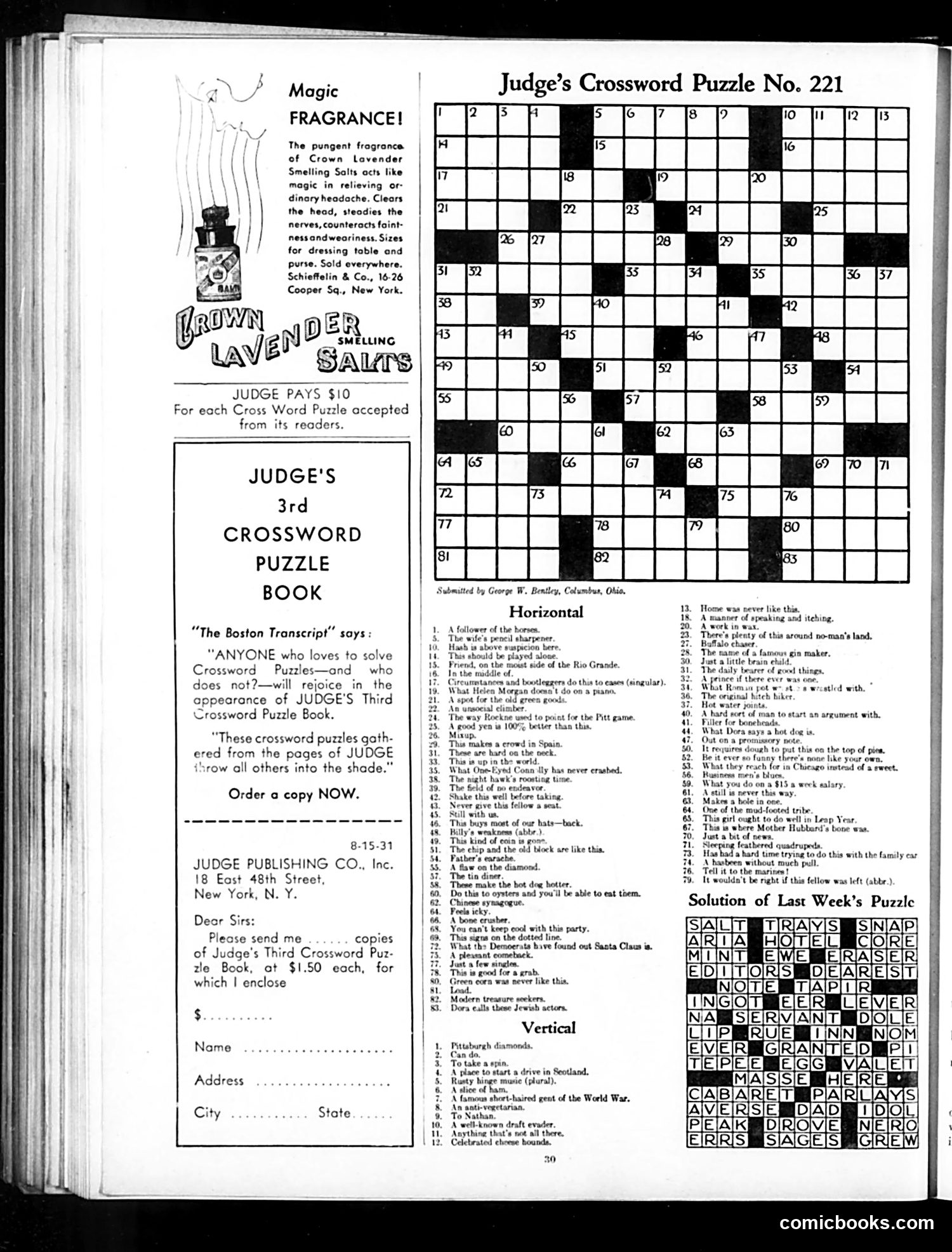
Judge Magazine Crossword Puzzle Page (circa 1931) This page is primarily advertising and puzzle content rather than editorial satire. The main elements are: 1. Crown Lavender Smelling Salts ad (top left): A period product marketed as relief for headaches and nerves—typical early 1930s patent medicine advertising. 2. Judge's Third Crossword Puzzle Book promotion: The magazine is selling its crossword puzzle collection for $1.50, emphasizing their popularity. The Boston Transcript quote suggests crossword puzzles were a cultural phenomenon at this time. 3. The actual crossword puzzle: A substantial grid with horizontal and vertical clues, featuring wordplay typical of the era (references to "Rio Grande," "Pitt game," Chinese culture stereotypes, etc.). The clues occasionally attempt humor. 4. Reader submission incentive: Judge paid $10 per accepted puzzle—an early reader-engagement marketing strategy. The page reflects 1930s popular culture: widespread enthusiasm for crossword puzzles as entertainment, period advertising styles, and casual stereotyping in puzzle content.
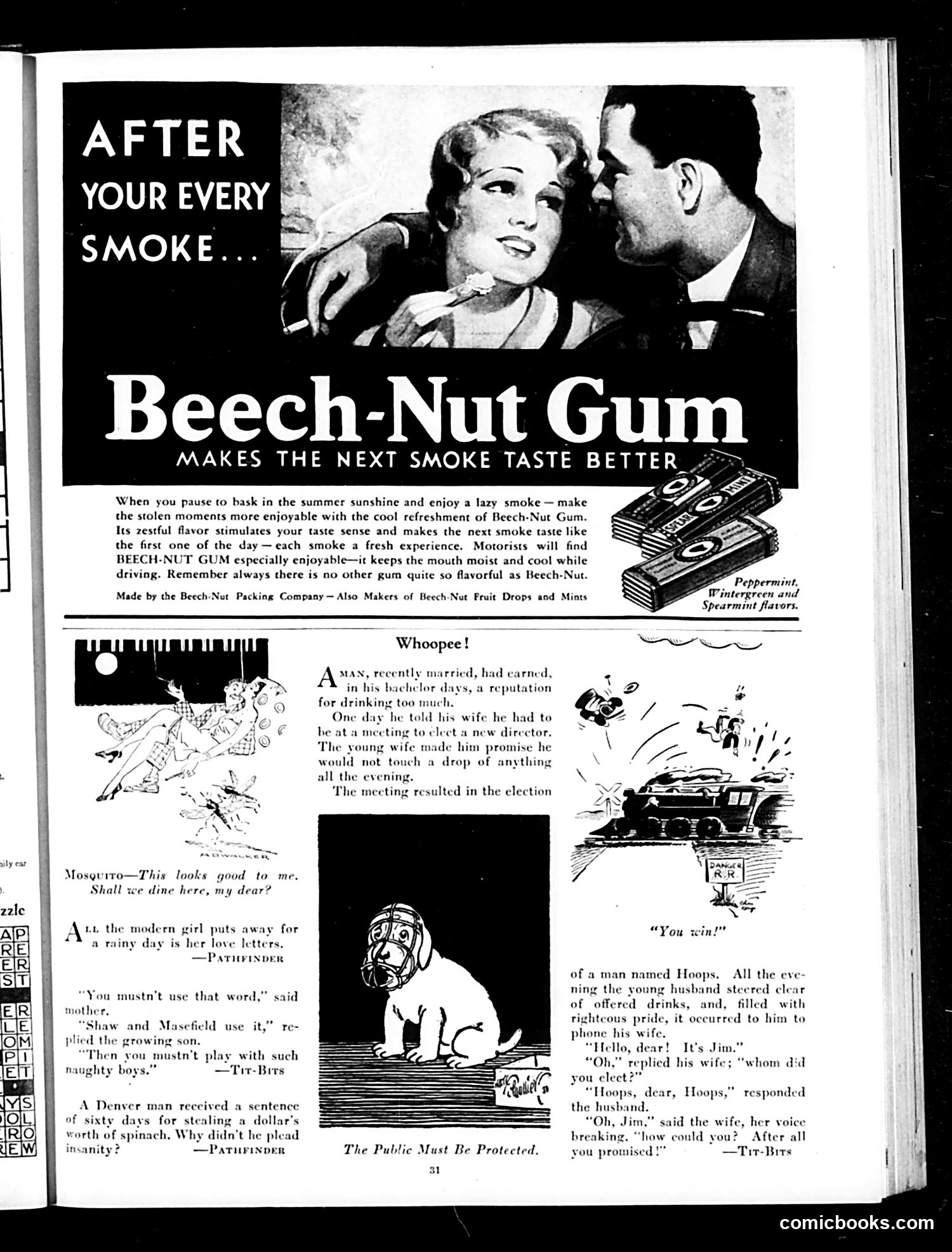
Page Analysis: Judge Magazine This page is primarily advertising for Beech-Nut Gum, featuring a romantic couple and copy claiming the gum refreshes one's palate between cigarettes—reflecting the era when smoking was socially normalized and unregulated. Below the ad are several brief humorous anecdotes typical of Judge's satirical filler content: - A joke about a reformed drinker elected director while staying sober - A quip about modern girls saving love letters instead of money - Language humor and a dog illustration labeled "The Public Must Be Protected" - A crime story noting absurdly harsh sentencing for petty theft These short jokes reflect early-20th-century sensibilities: concerns about drinking and morality, gender stereotypes about women, and social commentary on criminal justice. The page demonstrates Judge's mix of advertising revenue and light satirical humor rather than focused political cartooning.
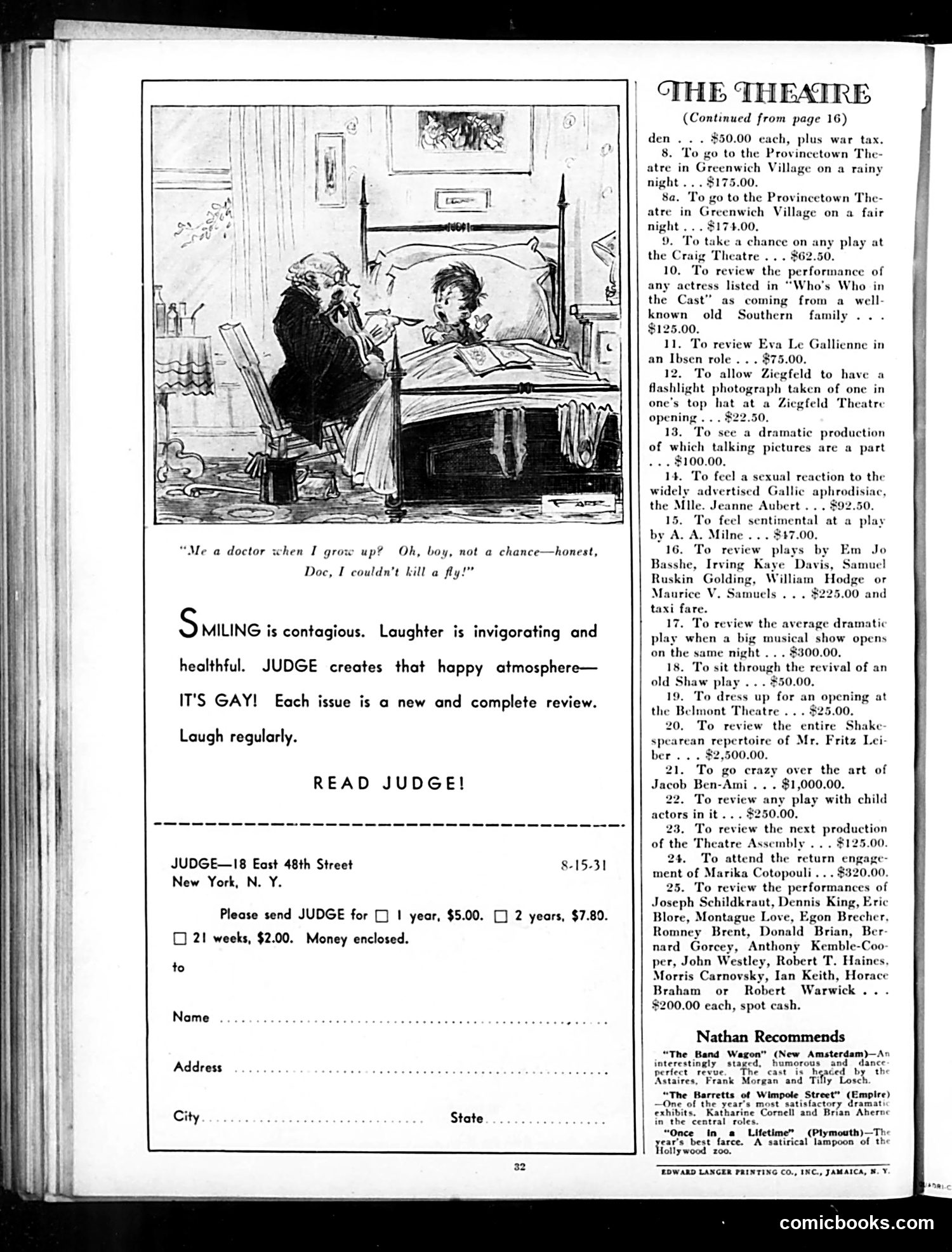
Judge Magazine Page: Theater Review Pricing List This page from *Judge* magazine presents a satirical pricing guide for various theater-going experiences in New York, likely from the 1920s-30s. The humor targets the pretensions and absurdities of Broadway theater culture. The cartoon depicts a doctor at a patient's bedside; the child says he couldn't become a doctor because he "couldn't kill a fly"—a dark joke about medical squeamishness. The main content lists tongue-in-cheek costs for theater activities: attending Provincetown Theatre productions, seeing famous actresses (especially those claiming "old Southern family" pedigrees), watching Florenz Ziegfeld productions, and reviewing plays by contemporary stars like Eva Le Gallienne and Jacob Ben-Ami. Some items cost $1,000+. The satire mocks theatergoers' social climbing, the industry's self-importance, and the obsessive documentation of Broadway's stars. The accompanying *Judge* promotional text emphasizes that laughter is "healthy" and encourages readers to "read Judge" regularly—ironically positioning the magazine itself as therapeutic entertainment amid the theater world's pretension.
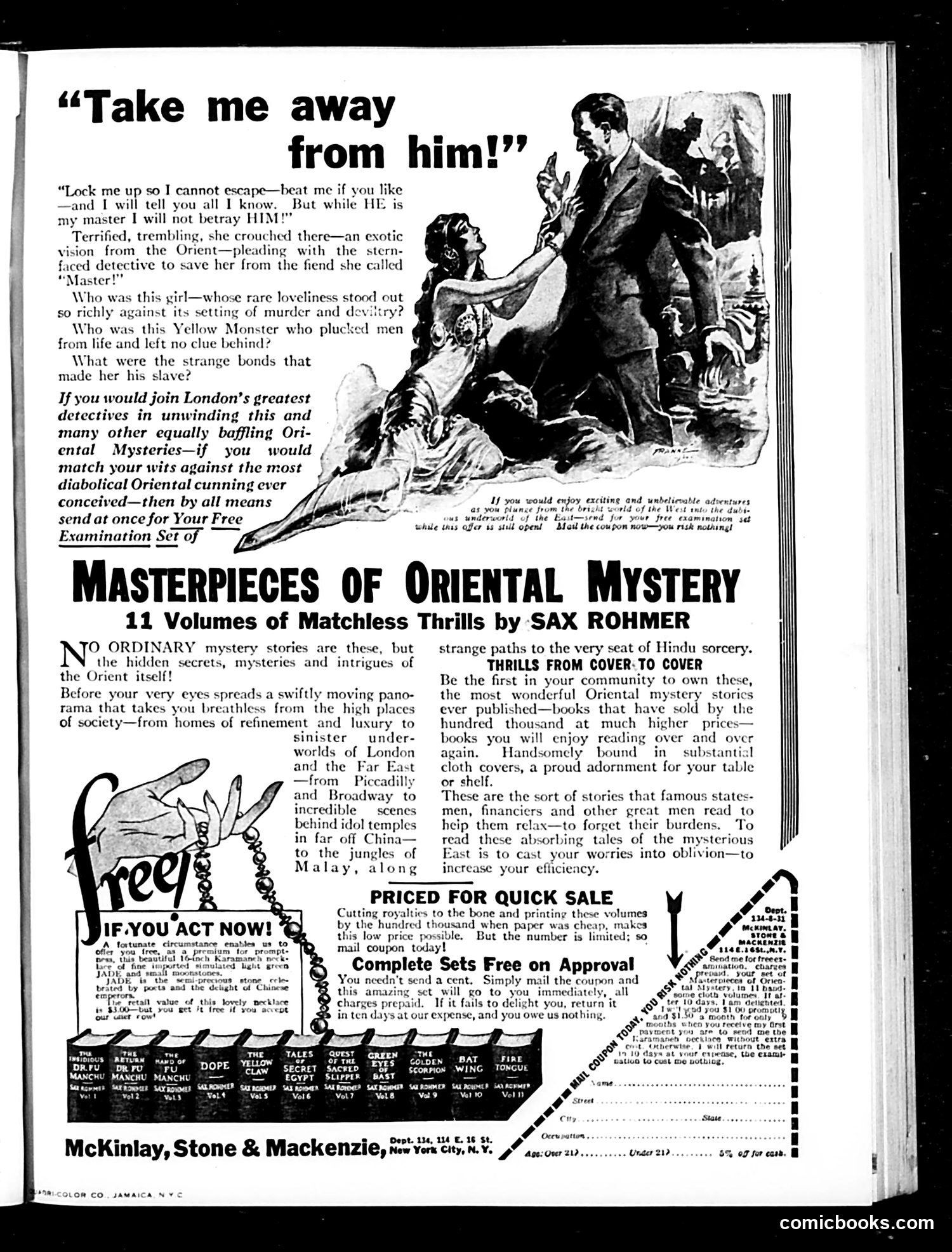
"Masterpieces of Oriental Mystery" Advertisement This is primarily a book advertisement, not political satire. It promotes Sax Rohmer's 11-volume mystery series featuring the "Yellow Peril" villain Dr. Fu Manchu—a character embodying early 20th-century Western anxieties about Asian threat and exoticism. The dramatic illustration depicts a terrified woman pleading with a detective to save her from an Oriental "Master" who controls her through mysterious bonds. The text emphasizes lurid appeals: "Hindu sorcery," "diabolical Oriental cunning," underground temples, and sinister "underworlds." This reflects period racial stereotypes—portraying Asia as dangerous, mysterious, and sexually thralling. The "Yellow Monster" language and emphasis on Eastern "cunning" versus Western detective rationality reinforces colonial-era prejudices common in pulp fiction. The ad uses fear-based marketing: purchase these books to experience thrills and match wits against exotic villainy.
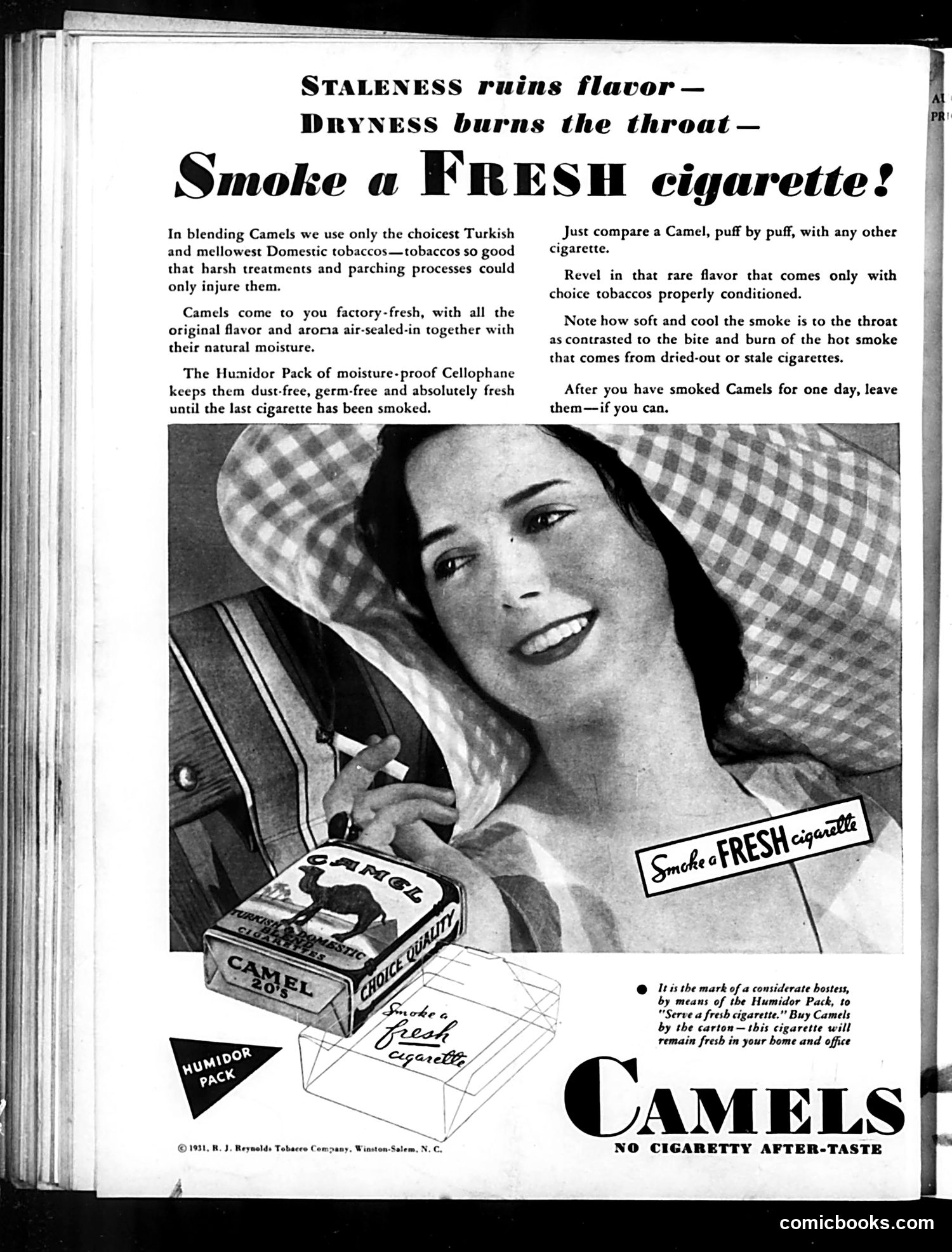
Analysis This is not a cartoon or satire, but rather a straightforward cigarette advertisement from 1931 for Camel cigarettes, placed in Judge magazine. The page features a photograph of a smiling woman in a sun hat holding a pack of Camels, alongside marketing copy emphasizing product freshness. The "Humidor Pack" (moisture-proof cellophane packaging) is presented as a key selling point that preserves flavor and prevents staleness. The ad makes health-adjacent claims typical of early tobacco advertising—emphasizing "soft and cool" smoke versus "bite and burn" from stale cigarettes, and promoting "no cigaretty after-taste." It also frames buying Camels as a mark of being a "considerate hostess." For modern readers: This represents pre-regulation tobacco marketing, when such ads appeared in mainstream publications and made durability and freshness claims without health warnings—an era now prohibited by law.