judge
Judge — August 22, 1931
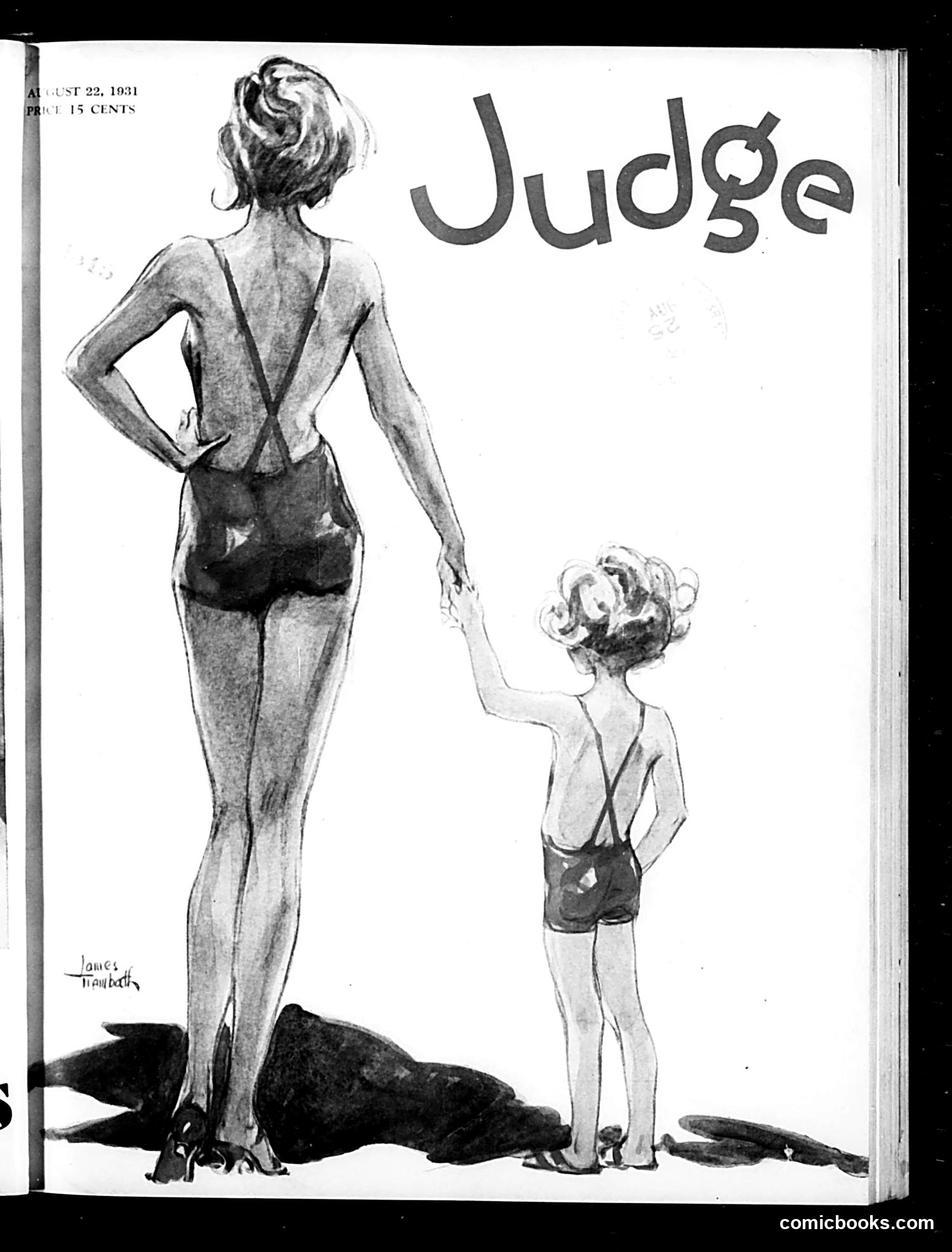
Judge Magazine Cover Analysis (August 22, 1931) This cover depicts an adult woman and child in swimwear, holding hands on a beach. The title "Judge" appears prominently. The illustration is signed by James Montgomery Flagg, a renowned commercial illustrator. Without accompanying text or captions visible on this page, the specific satirical message is unclear. However, given the 1931 date during the Great Depression, this likely comments on contemporary social themes—possibly contrasting wealth/leisure, parenting styles, or beach culture of the era. The page appears to be primarily a cover illustration rather than containing multiple cartoons or substantial text-based satire typical of Judge's interior pages. Additional context from the magazine's accompanying articles would be needed to determine the precise satirical intent.
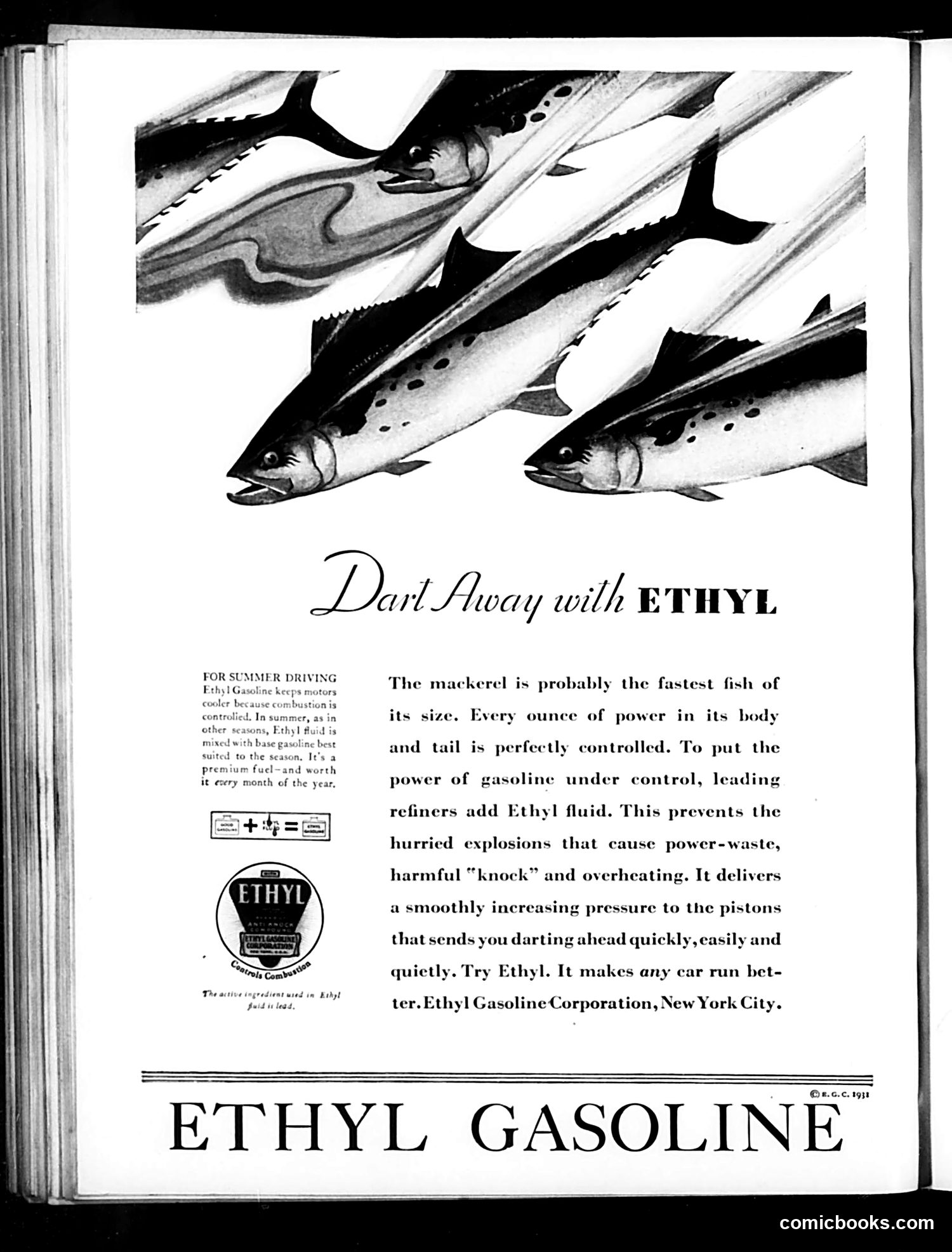
Analysis This page is primarily an advertisement, not a political cartoon. It advertises Ethyl Gasoline, a fuel additive product from the Ethyl Gasoline Corporation in New York City. The "Dart Away with ETHYL" headline uses a mackerel illustration as a metaphor for speed and control—comparing the fish's perfect body control and power to how Ethyl fluid controls gasoline combustion in engines. The ad claims Ethyl prevents engine "knock" and overheating while delivering smooth, quick acceleration. This represents 1920s consumer advertising, where companies used vivid imagery and scientific-sounding claims to market automotive products during the early automobile era. The page contains no political satire or social commentary—it's straightforward product promotion in a magazine context.
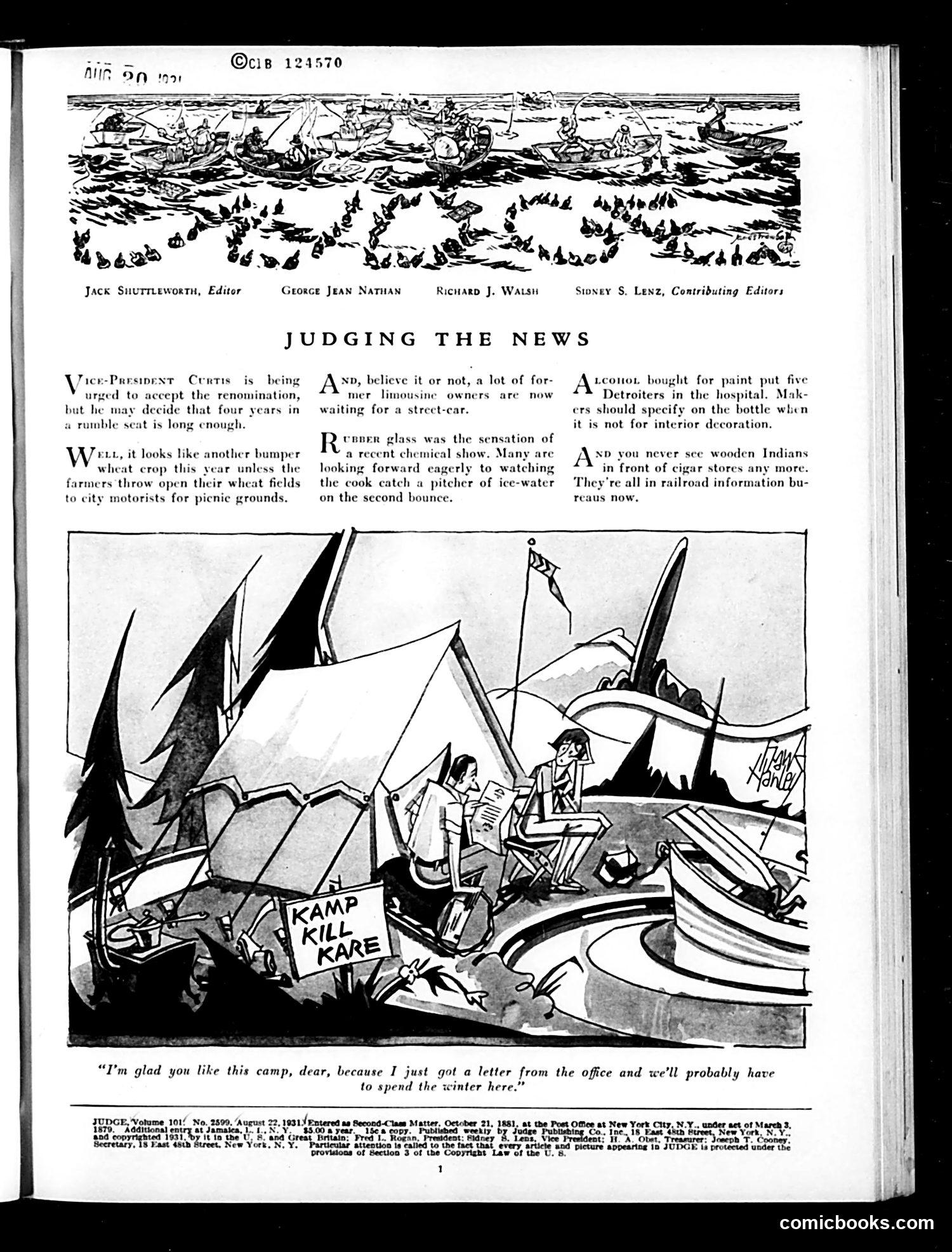
Analysis of Judge Magazine Page The main cartoon depicts a military camp scene labeled "KAMP KILL KARE," showing soldiers in a recreational setting with tents and flags. A woman tells a man: "I'm glad you like this camp, dear, because I just got a letter from the office and we'll probably have to spend the winter here." The satire likely targets military camp conditions or logistics during wartime (possibly WWI era, given the magazine's date). The joke suggests that what appears to be a pleasant temporary camping situation will become a permanent, uncomfortable winter encampment—mocking either military inefficiency or soldiers' misplaced optimism about deployment duration. The "KAMP KILL KARE" pun plays on both military terminology and the ironic contrast between leisurely camping and harsh winter conditions ahead.
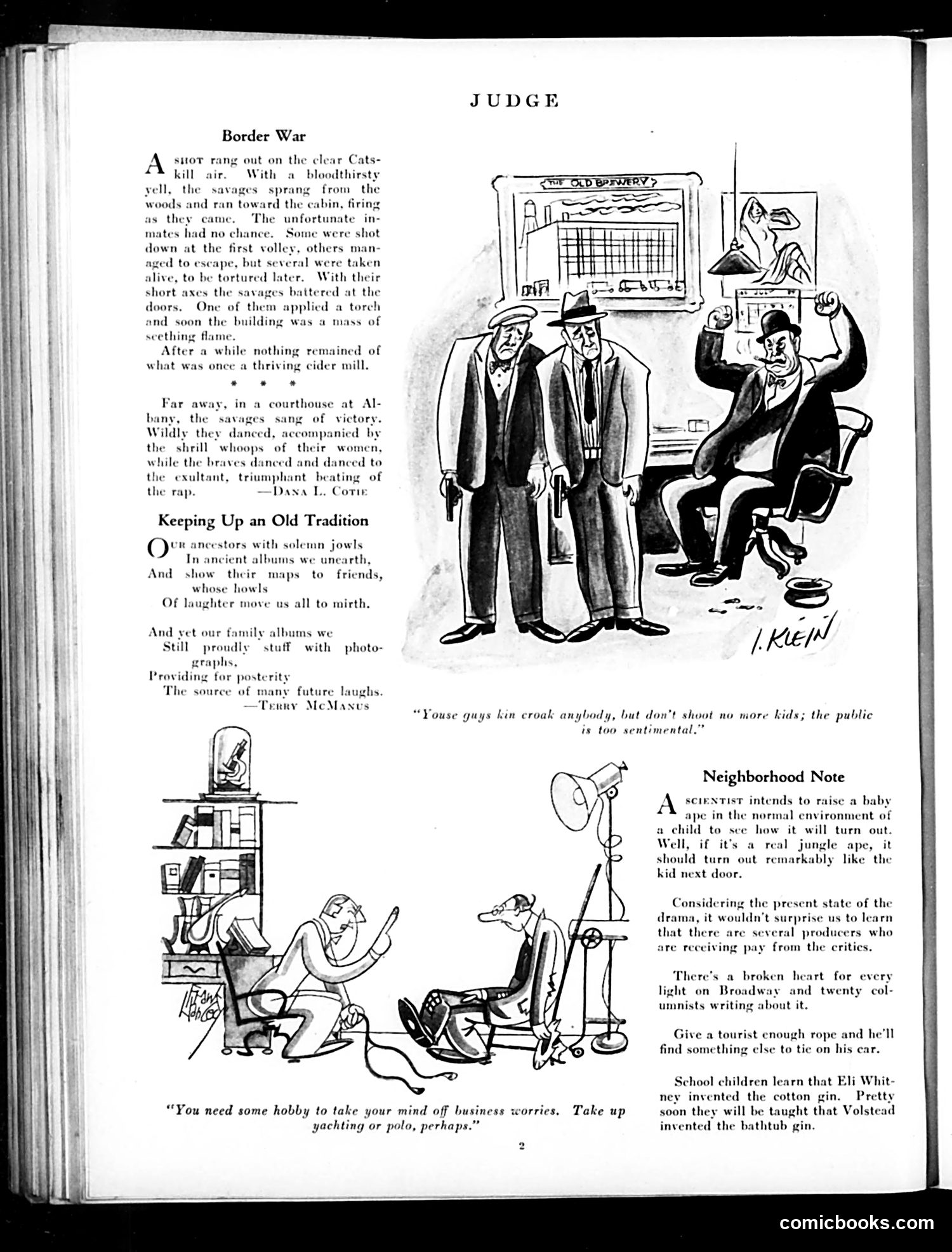
Analysis of Judge Magazine Page This page contains three distinct pieces: "Border War" — A prose poem about frontier violence, likely referencing Prohibition-era bootlegging conflicts or border skirmishes. "Keeping Up an Old Tradition" — Humorous verse by Tunny McManus about family photo albums, with no obvious political content. Top cartoon (by I. Klein) — Three men in coats view sketches on a wall. The caption satirizes censorship: "Your guys kin croak anybody, but don't shoot no more kids; the public is too sentimental." This appears to critique film industry self-censorship regarding violence, particularly violence against children. Bottom cartoon — A man on exercise equipment, captioned about taking up hobbies like "yachting or polo" to escape business worries. This satirizes wealthy individuals' leisure pursuits. "Neighborhood Note" — Gossip items mocking pretentiousness, including jabs at aspiring scientists and tourists. The page dates to the Prohibition/early-talkie era, roughly 1920s-1930s.
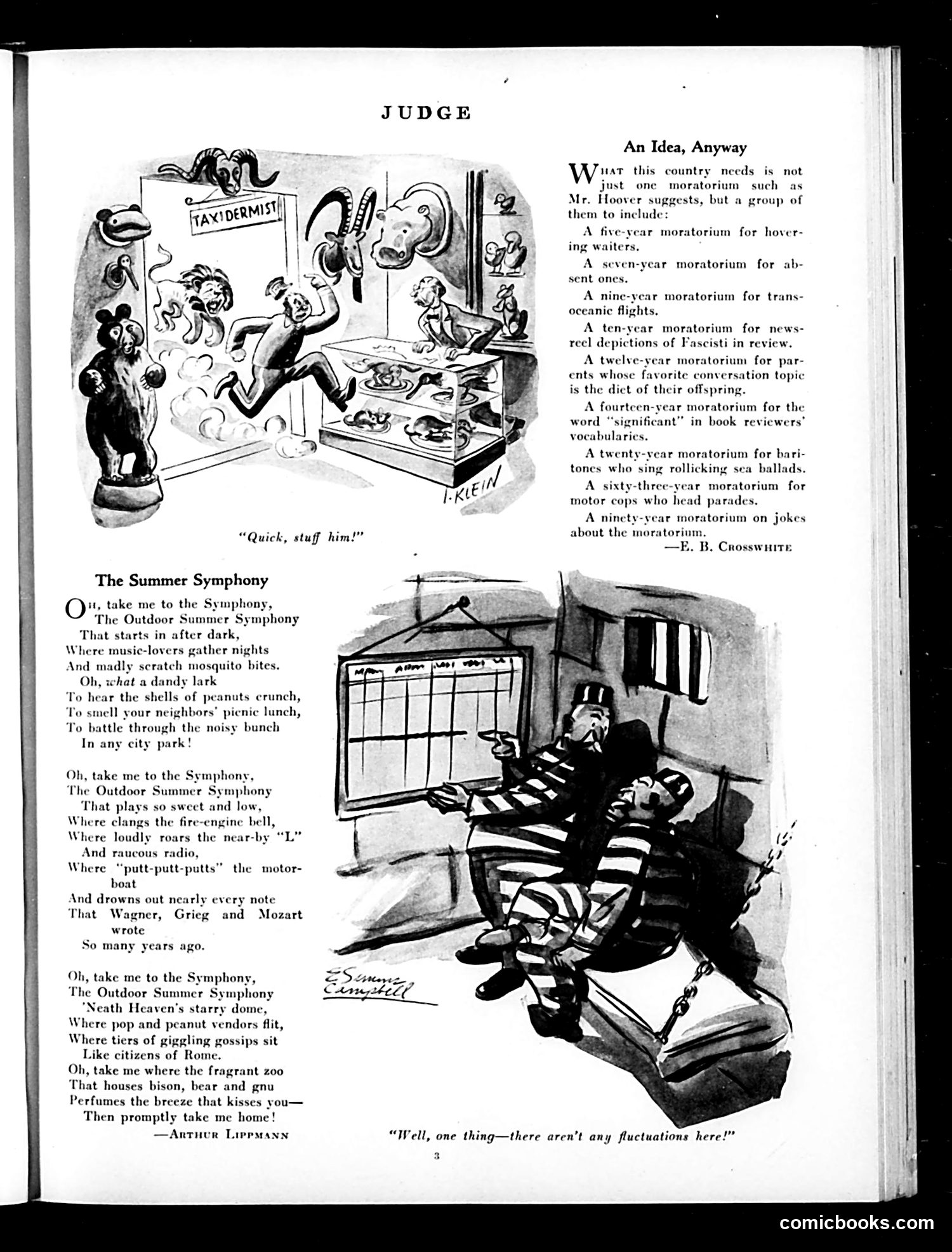
Analysis of Judge Page Top Cartoon ("Quick, stuff him!"): This appears to be political satire about taxidermy or preservation. A figure labeled "TAXIDERMIST" is stuffing what looks like an animal or creature, while chaos erupts around a display case. The joke likely critiques someone or something being artificially "preserved" or kept alive artificially—possibly referencing a political figure or outdated ideology being propped up rather than allowed to naturally decline. "The Summer Symphony": This is lighthearted social satire about attending outdoor symphonies in city parks. Arthur Lipmann's poem humorously describes the disruptions: mosquito bites, peanut shells, noisy crowds, sirens, and zoo odors overwhelming the classical music experience. The accompanying cartoon shows two people trying to enjoy music while surrounded by urban noise and chaos, making the poem's point visually.
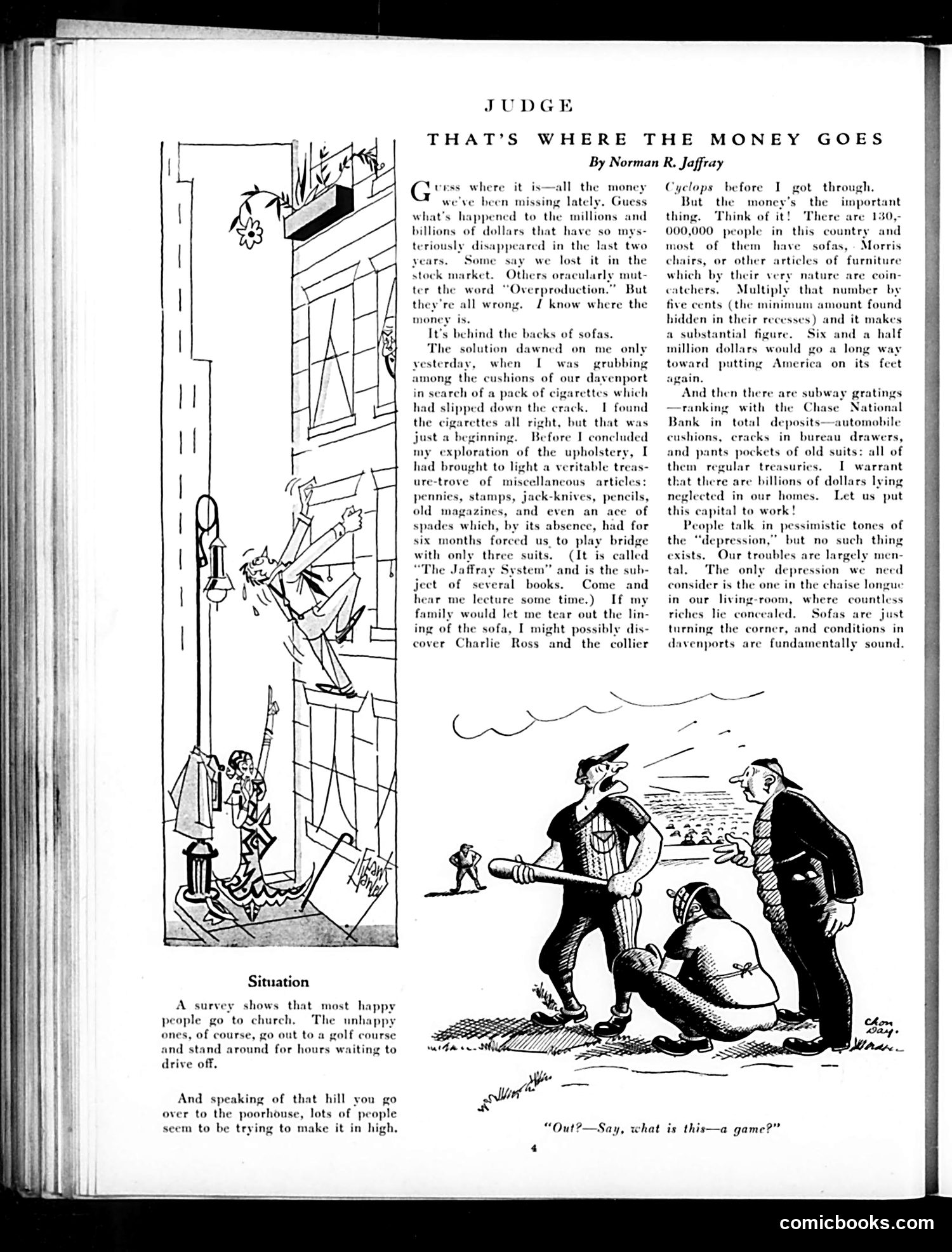
Judge Magazine Satire Analysis This page satirizes wealth inequality and hidden consumer spending during economic hardship. The article "That's Where the Money Goes" by Norman Hapley uses humor to explain where America's "missing" money went—not lost in stock markets or overproduction, but hidden in household goods. The left cartoon shows a person discovering accumulated possessions (furniture, goods, magazines) crammed behind a sofa—a visual metaphor for frivolous consumer spending. The bottom cartoon depicts wealthy businessmen playing baseball while a small figure (likely representing common workers or the poor) struggles with the game, captioned "Out?—Say, what is this—a game?" This suggests the economic system is rigged or unfair for ordinary people. The satire critiques both conspicuous consumption by the wealthy and structural economic inequality of the era.
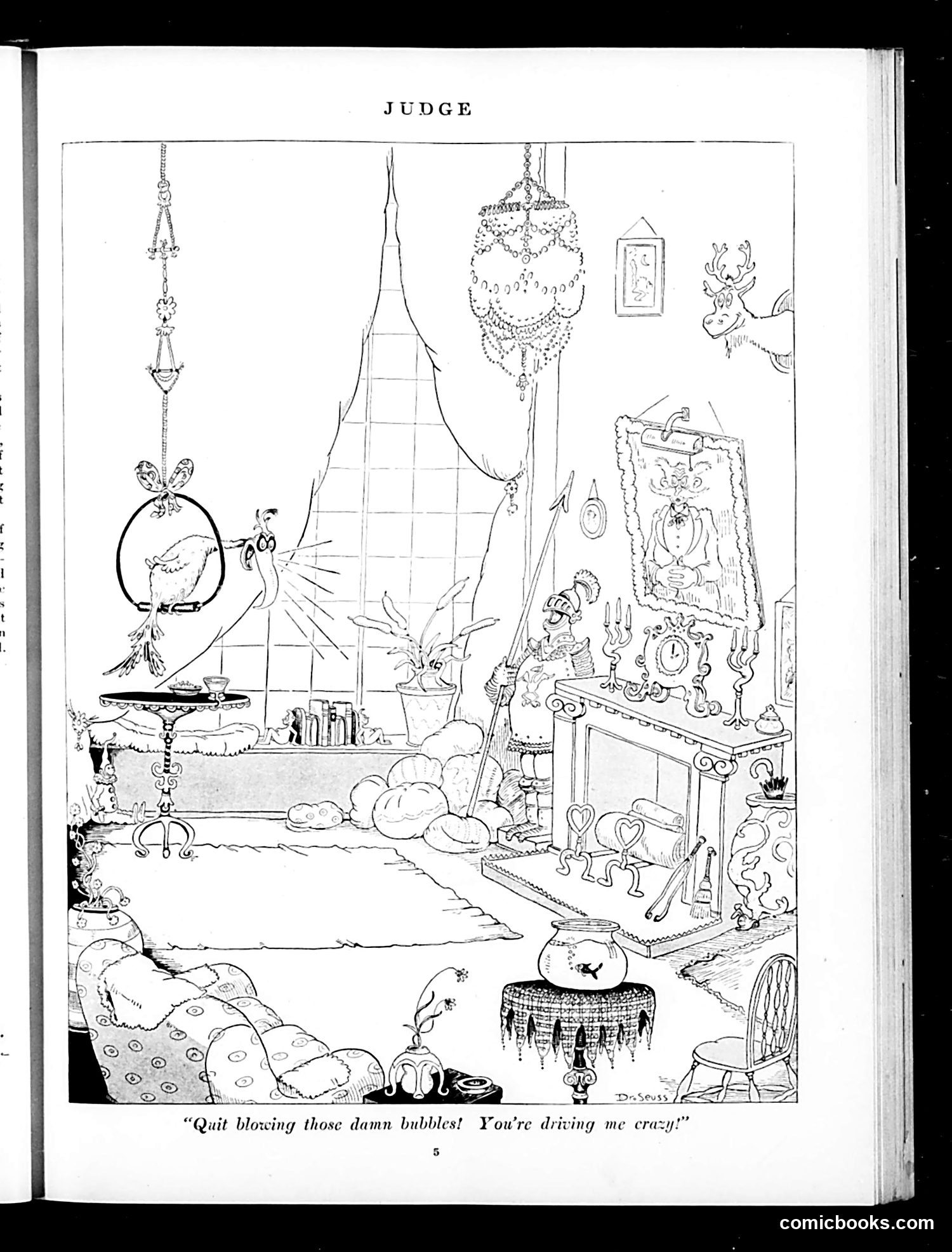
Explanation for Modern Readers This is a single-panel cartoon by Dr. Seuss (signed lower right) depicting an elaborate, fantastical interior space filled with surreal decorative objects—hanging ornaments, potted plants, decorative furniture, and whimsical creatures. The caption reads: "Quit blowing those damn bubbles! You're driving me crazy!" The humor appears to target excessive interior decoration or collecting—a common satirical theme in Judge magazine. Someone is blowing bubbles amid an already overstuffed, chaotic room, and the frustrated complaint suggests that even minor additions to cluttered spaces become maddening. This likely satirizes 1920s-30s consumer culture, ostentatious home decoration, or perhaps complaints about household habits. Without additional context, the specific social target remains somewhat unclear, though the absurdist visual style is characteristically Seussian.
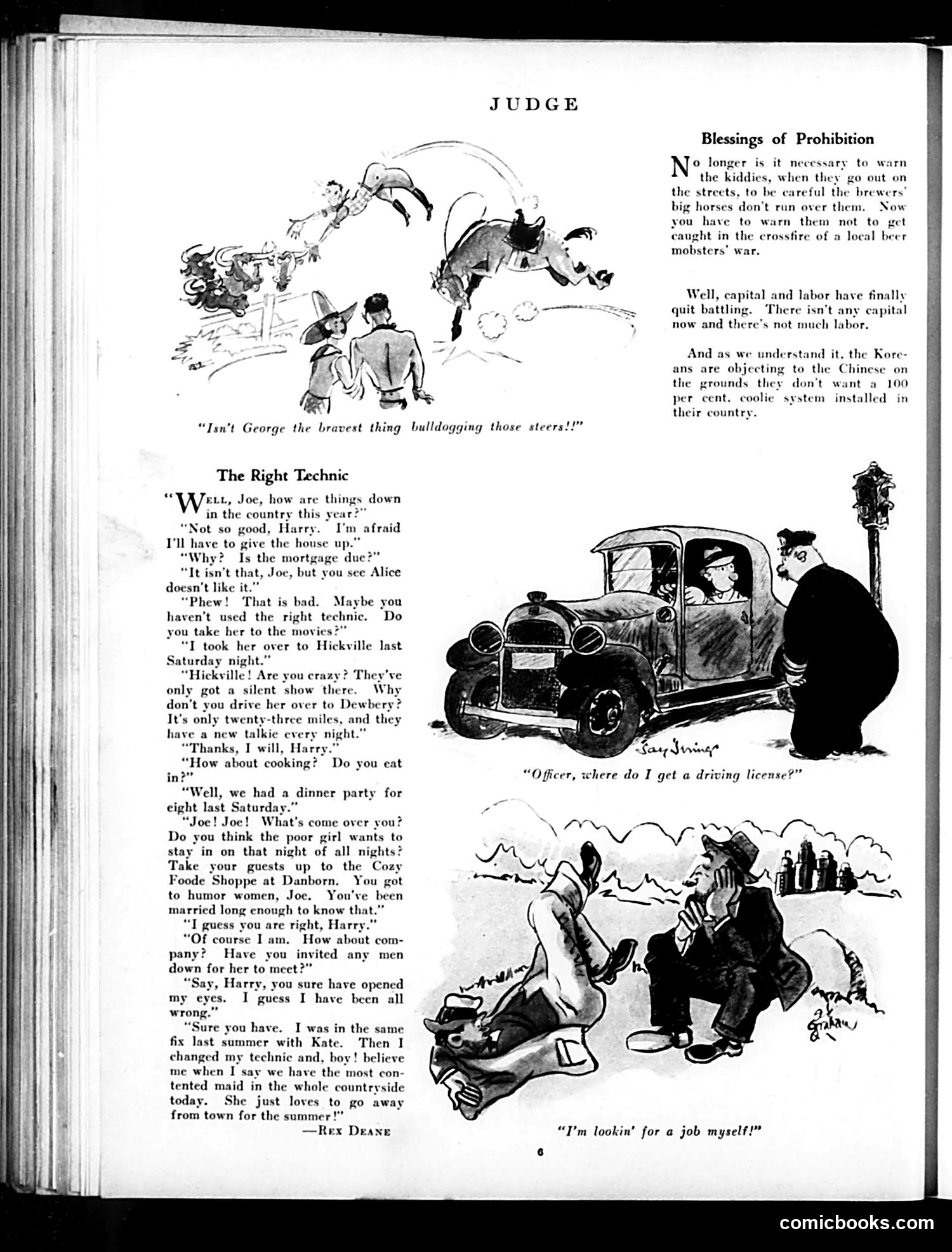
Analysis of Judge Magazine Page This page contains satirical commentary on Prohibition's effects and workplace social dynamics. "Blessings of Prohibition" (top) mocks how Prohibition supposedly eliminated street hazards—now children needn't fear drunk drivers or "beer monsters' wars." The satirist suggests capital and labor have stopped fighting, and references Korean objections to a "coolie system" (indentured labor practices). "The Right Technic" (main feature) is a dialogue between characters discussing marital/social advice. A man named Joe is told his wife Alice dislikes their home situation. Harry advises taking her to movies, dinner parties, and social outings with other couples. The implication: proper "technique" for keeping a wife satisfied involves entertainments and social engagement. The accompanying cartoons illustrate modern social scenarios: obtaining a driving license and job-hunting.
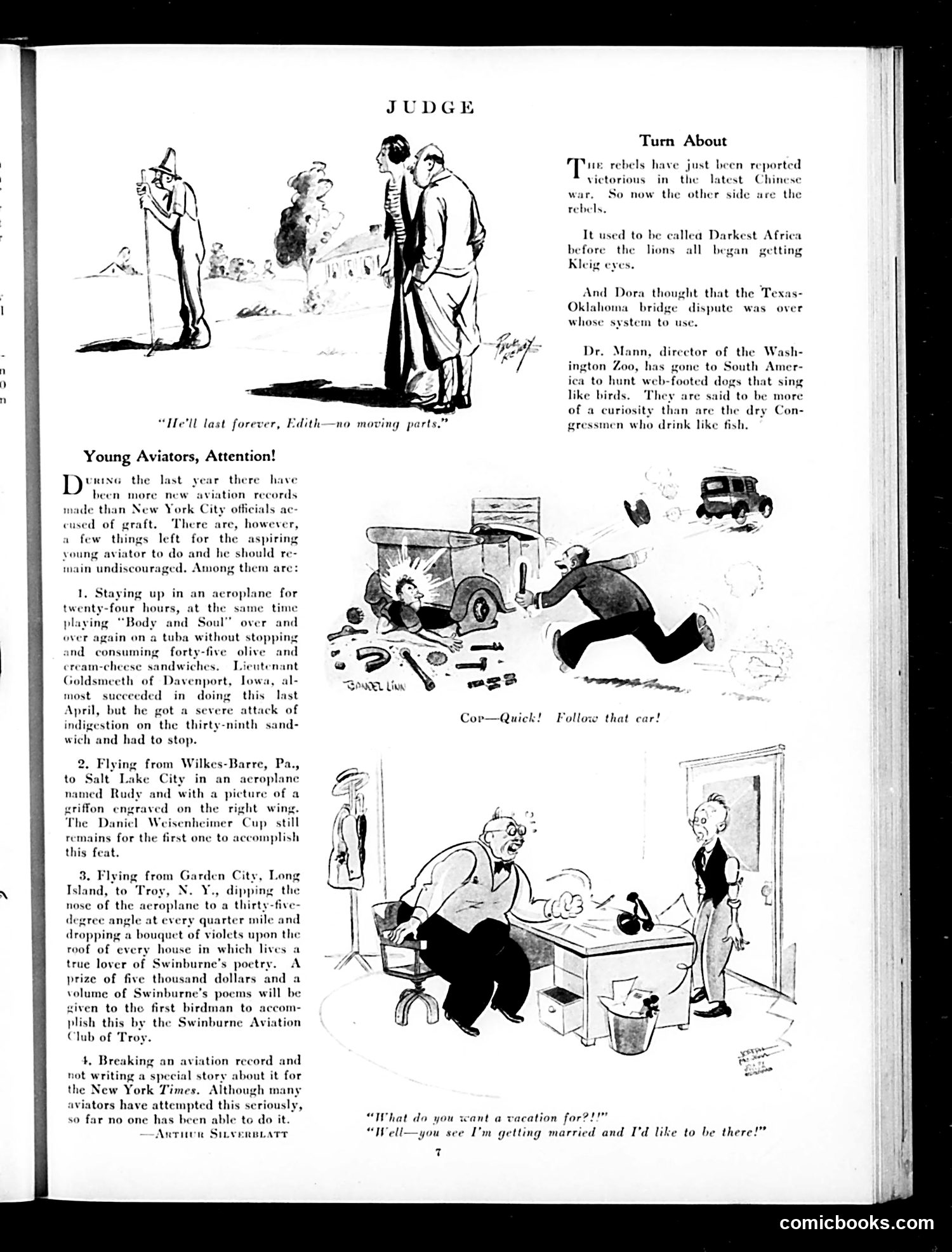
Judge Magazine Satire Analysis This page contains several brief satirical items mocking contemporary absurdities: "Turn About" jokes about the Chinese civil war's shifting sides, African wildlife acquiring "Kleig eyes" (stage lights) from film production, and a Texas-Oklahoma bridge dispute. The humor lies in treating serious issues trivially. The top cartoon depicts a couple with a skeleton, captioned "He'll last forever, Edith—no moving parts"—satirizing mechanical/soulless relationships or products. "Young Aviators, Attention!" parodies aviation's rapid progress by listing deliberately ridiculous aviation challenges: staying aloft 24 hours while playing tuba and eating sandwiches, flying a plane named "Rudy," or dropping violets on Swinburne fans' roofs. The jokes mock both aviation's trendy status and the absurd record-chasing competitions of the era. Lower cartoons show slapstick scenes of a cop chasing a car and a couple's vacation conversation about marriage—generic humor rather than topical satire. The page represents Judge's typical blend of political commentary and light domestic humor.
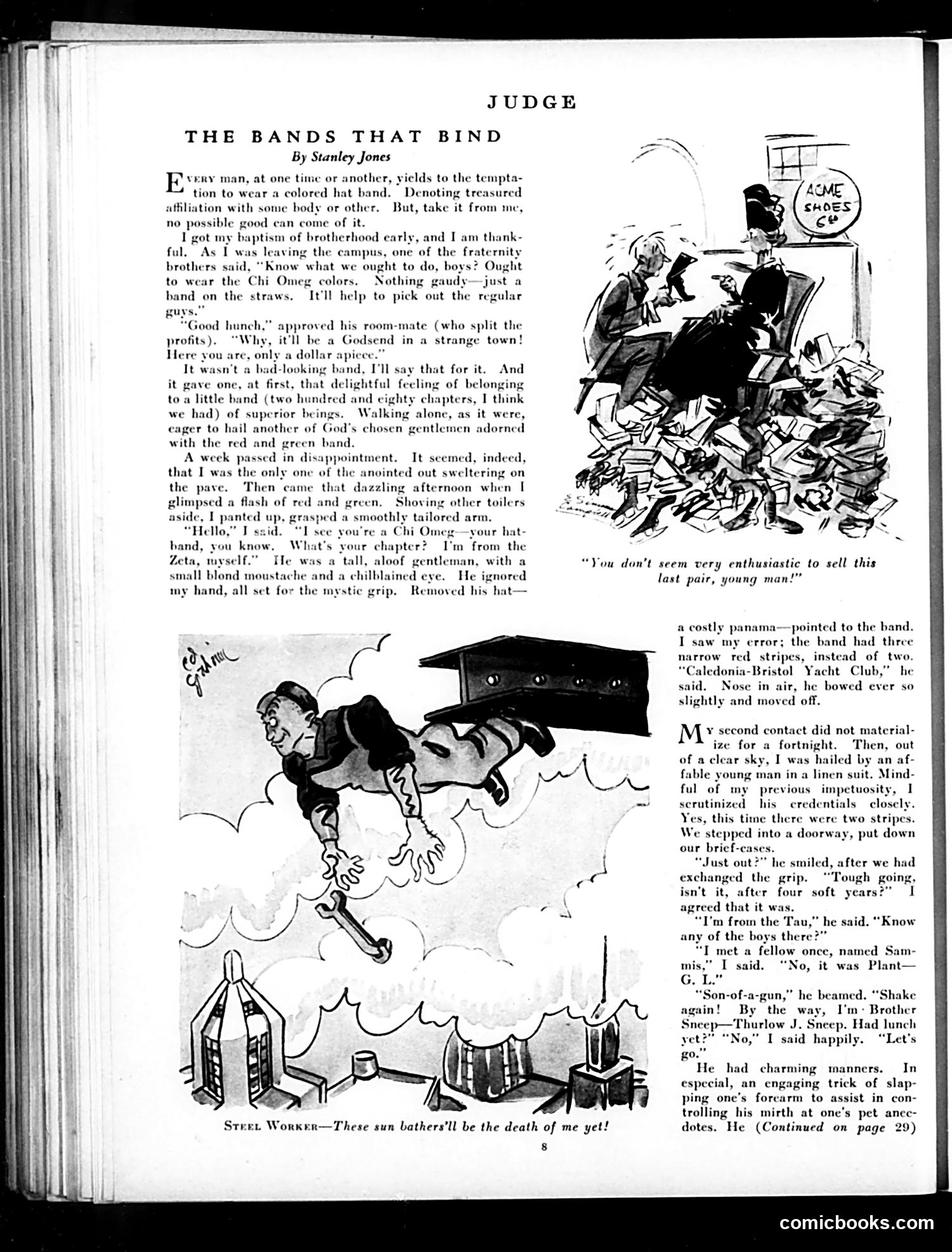
"The Bands That Bind" - Judge Magazine Satire This satirical story mocks fraternity culture and the superficial bonds created by Greek-letter organizations. The narrator purchases a Chi Omega fraternity hatband as a symbol of belonging to an "elite" group, expecting camaraderie with fellow members. The joke centers on the absurdity of these "bands that bind": the narrator's first encounter reveals his band has the *wrong number of stripes*—it's actually a Yacht Club band—causing an embarrassing rejection. His second encounter with a "real" fraternity brother appears more promising, but the humor suggests the connection is hollow; these men bond over mere credentials rather than genuine friendship. The accompanying cartoon (bottom left) shows a worker being literally bound, parodying how such affiliations symbolically "bind" men together. The satire critiques how young men naively believe fraternity membership grants them superior status and meaningful brotherhood, when it actually reduces human connection to costume and ritual.
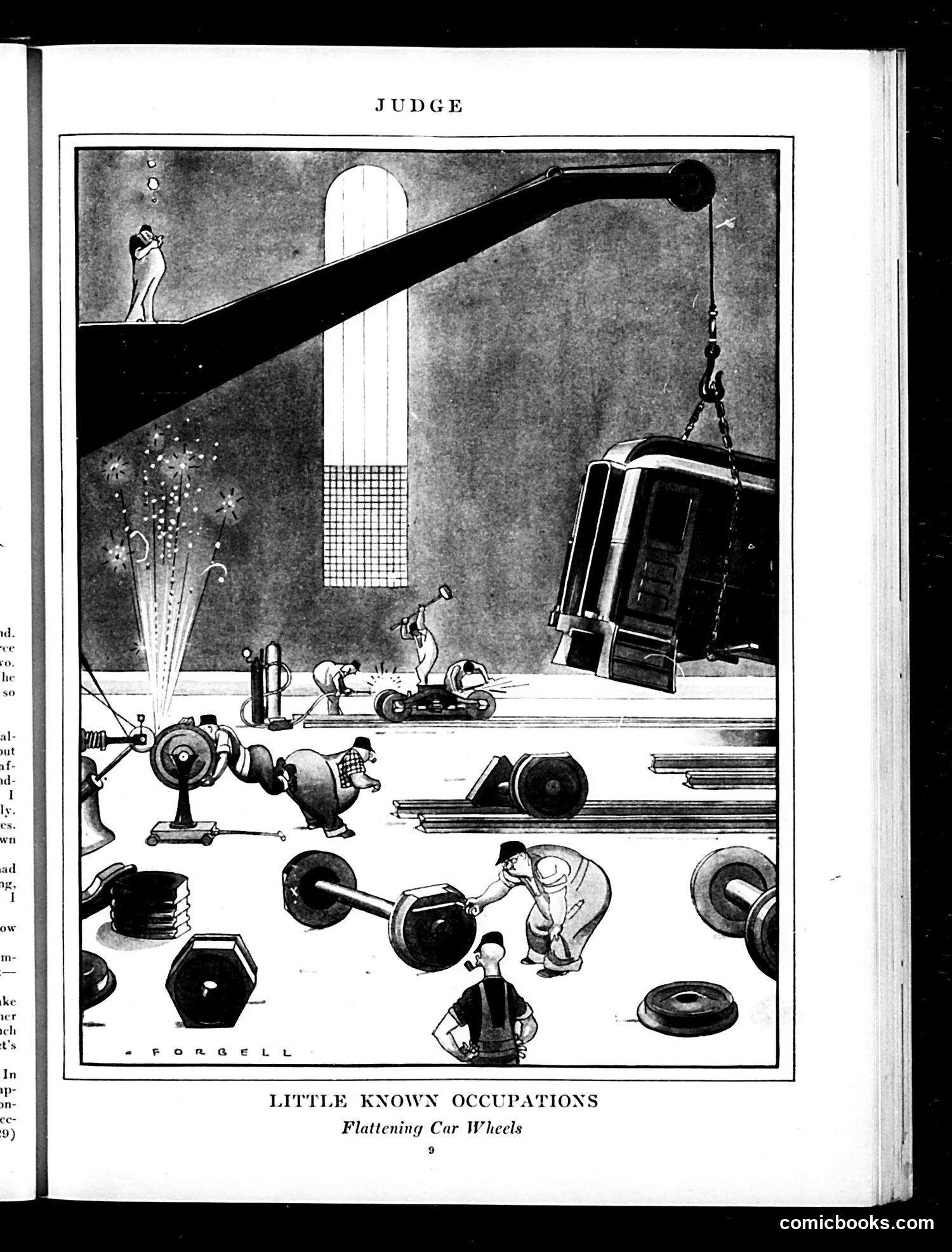
Analysis This is a satirical illustration titled "Little Known Occupations: Flattening Car Wheels." The cartoon depicts an absurd industrial scene where workers use a large crane to flatten automobile wheels and other car parts on the ground floor of what appears to be a factory or workshop. The satire likely mocks either: 1. Inefficient industrial practices of the era, suggesting ridiculous methods of manufacturing or recycling 2. Wasteful or destructive business practices — intentionally damaging goods rather than properly repairing or repurposing them 3. Labor absurdities — workers engaged in pointless, dangerous work The "little known occupations" framing suggests this is commentary on real but absurd jobs that actually existed during the industrial period. The illustrated crane crushing materials is deliberately exaggerated for comedic effect, making what might be a real (if wasteful) practice appear laughably inefficient.
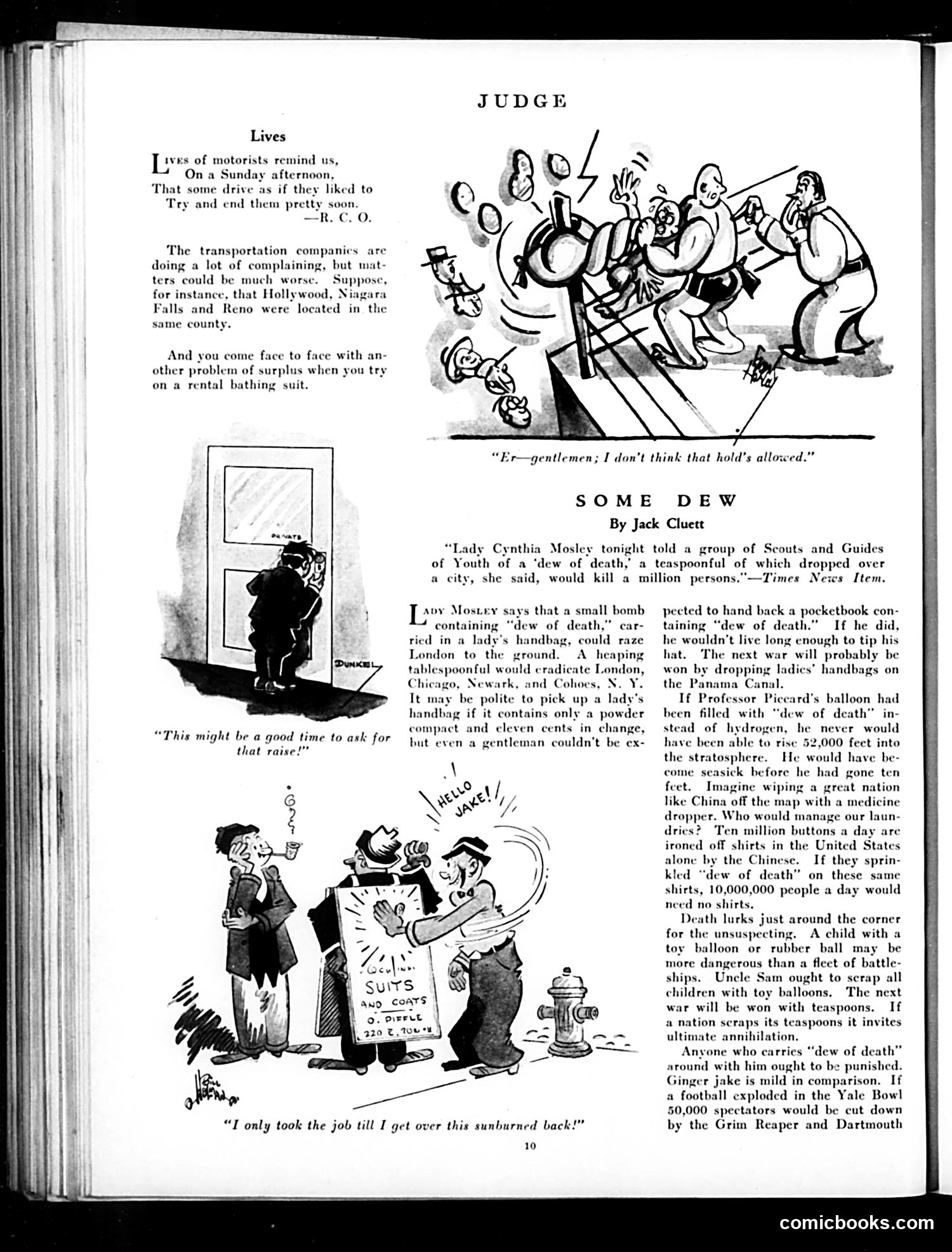
"Some Dew" by Jack Cluett This satirical piece mocks Lady Cynthia Mosley's alarming public statement about a hypothetical "dew of death"—a weapon so potent that a teaspoonful could kill a million people. Cluett uses absurdist humor to expose the ridiculousness of her claims by extrapolating to ridiculous extremes: a powder bomb in a lady's handbag could destroy cities; Professor Piccard's balloon filled with it would wipe China off maps; ten million buttons ironed daily by Chinese laundries would kill millions; toy balloons become weapons of mass destruction. The cartoons accompanying the text show everyday anxiety (motorists, swimmers, sunburned workers) contrasted with this imagined catastrophic threat. Cluett's point: Mosley's scaremongering about a fictional weapon creates irrational panic while ignoring actual social problems. The satire criticizes both her inflammatory rhetoric and public credulity.
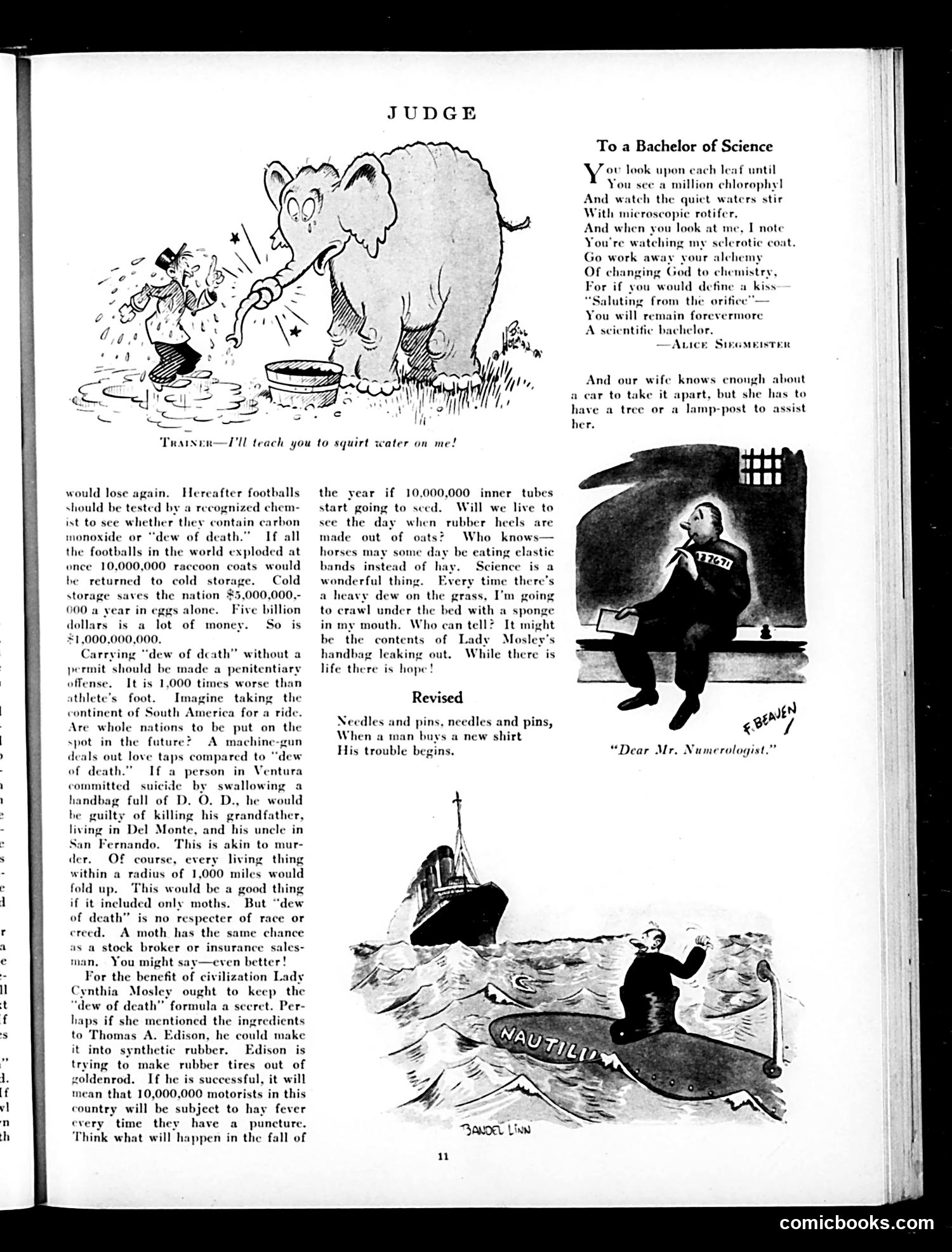
Judge Magazine Satire Analysis This page satirizes 1920s scientific anxieties and social pretension through absurdist humor. Top cartoon: A circus trainer teaches an elephant to spray water, captioned "I'll teach you to squirt water on me!" — a simple slapstick joke. Main article: Mocks hysteria over "dew of death" (likely referencing chemical weapons or dangerous substances), suggesting its dangers are absurdly exaggerated. The writer sarcastically proposes ridiculous consequences—raccoon coats flooding storage, entire continents destroyed, synthetic rubber from goldenrod causing hay fever epidemics. It references Lady Cynthia Mosley, a real British socialite and fascist sympathizer of the era, treating her as carelessly dangerous. Right sidebar: Poetry mocking pretentious bachelor scientists who obsess over microscopic details while missing life's human pleasures. Bottom cartoon: Titled "Dear Mr. Numerologist," depicts a man and woman in a sinking ship labeled "NAUTILUS"—likely satirizing gullible belief in numerology and fortune-telling. The overall tone ridicules both scientific over-seriousness and public credulity toward pseudoscience and sensationalism.
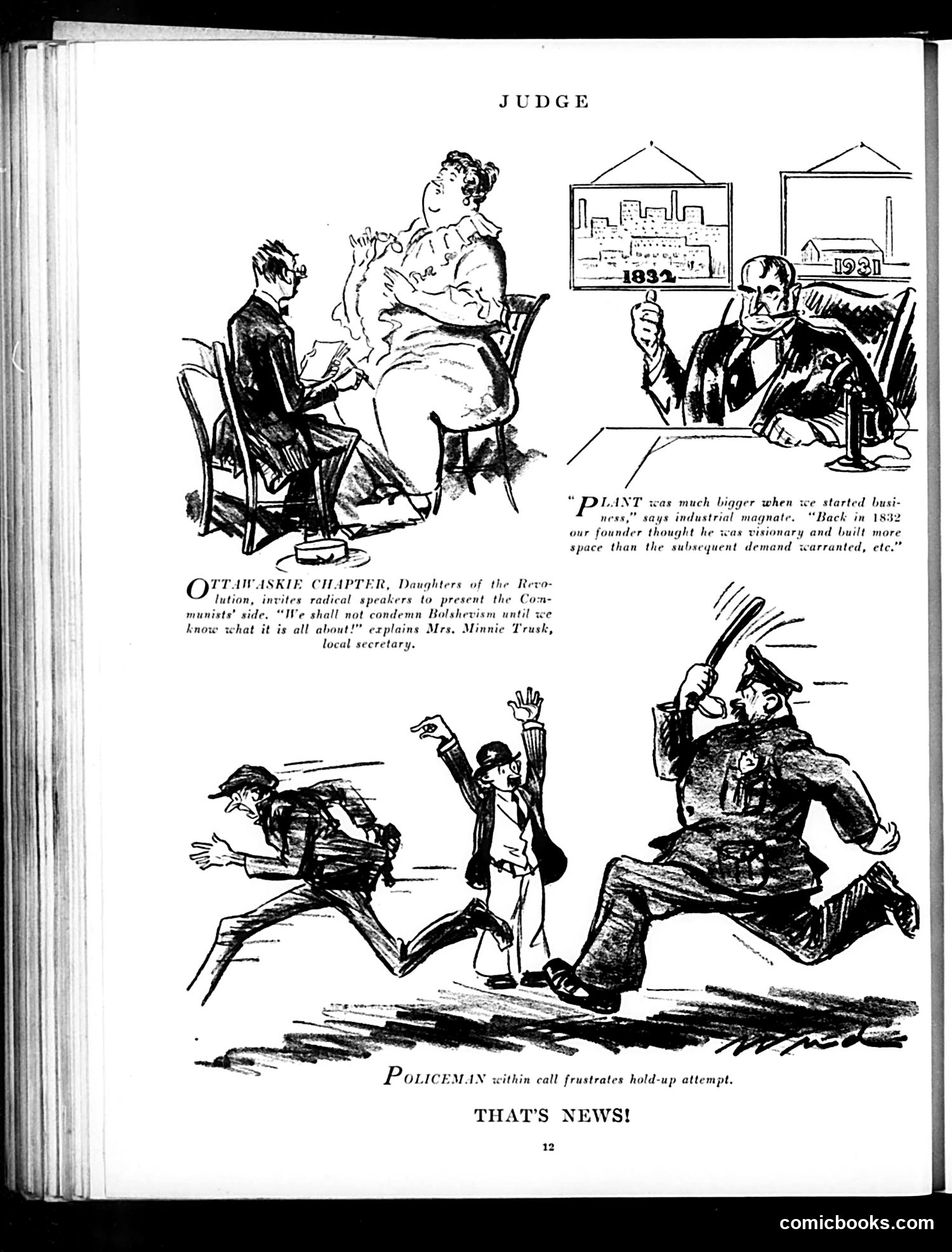
Judge Magazine Satire Analysis This page contains three separate satirical cartoons mocking 1920s American society: Top cartoon: An industrial magnate complains to a judge that his factory was oversized when built in 1832—blaming the founder's excessive "vision" for current problems. This satirizes businessmen deflecting responsibility for economic difficulties onto past decisions rather than acknowledging present mismanagement. Middle cartoon: The Ottawaskie Chapter of the Daughters of the Revolution (a patriotic women's organization) invites communist speakers to present their ideology, claiming they won't condemn Bolshevism until hearing the argument. This mocks upper-class women's naive flirtation with radical politics and their claim to open-mindedness about communism—a serious concern in 1920s America. Bottom cartoon: A policeman stops a robbery in progress. The caption "That's News!" sarcastically suggests that competent law enforcement is so rare it qualifies as newsworthy—critiquing widespread police corruption or ineffectiveness of the era.
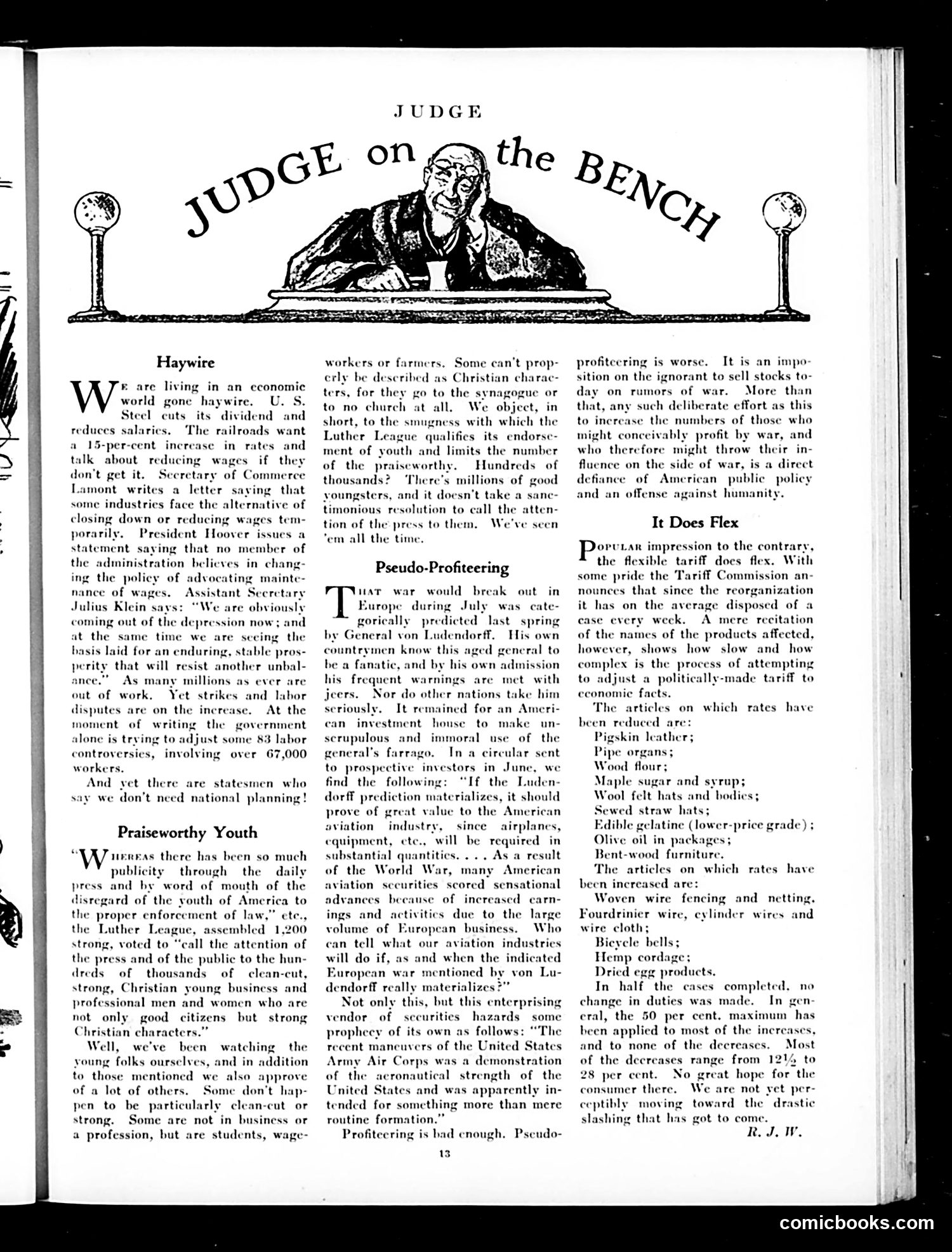
Judge Magazine Page Analysis This page from Judge magazine (appearing to be from the early 1930s depression era) contains three satirical editorials: "Haywire" critiques the contradictory economic messaging from the Hoover administration. While officials claim recovery is underway, steel companies cut dividends, railroads demand rate increases, and unemployment rises. The satire targets the gap between optimistic government statements and grim economic reality. "Praiseworthy Youth" mocks the Lutheran League's self-congratulatory resolution praising "clean-cut, Christian" youth. Judge's editor sarcastically agrees but expands the definition to include non-Christian workers, farmers, and students—deflating the League's sanctimonious exclusivity. "Pseudo-Profiteering" exposes an investment firm's unethical marketing: they circulate General von Ludendorff's (dubious) predictions of European war to pitch aviation stocks, exploiting war rumors for profit. The satire condemns exploiting public anxiety for financial gain. All three pieces attack hypocrisy and manipulation during depression-era uncertainty.
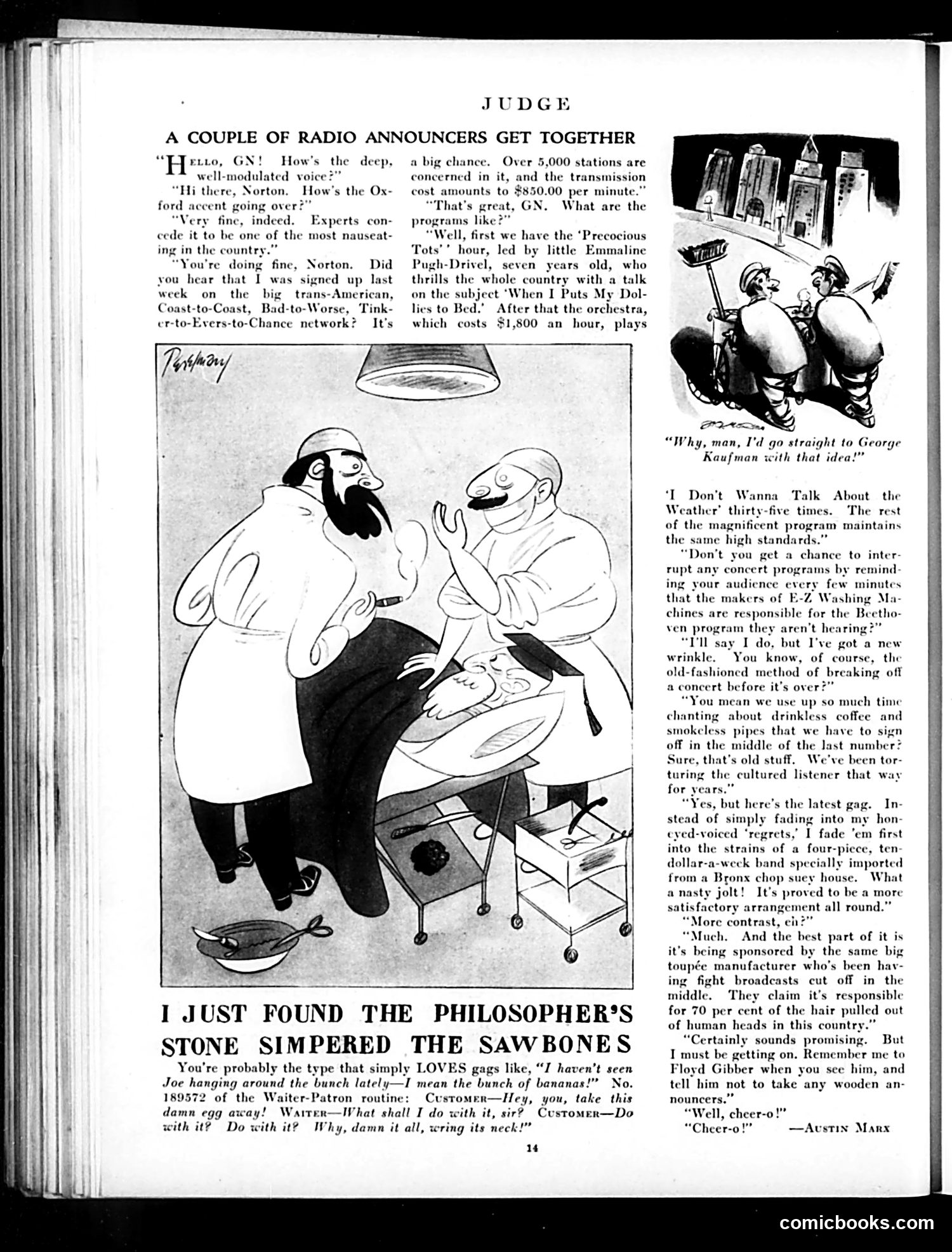
Analysis for Modern Readers This page satirizes early radio broadcasting and its commercialization. The main cartoon depicts two radio announcers discussing their programs with dark humor about low quality content. The Satire: The announcers boast about programs featuring a seven-year-old child ("Precocious Tots" hour) and an orchestra costing $1,800/hour, while acknowledging that their content is "nauseating." They joke about interrupting concerts with ads for washing machines and coffee, then cutting off broadcasts mid-song to force advertisements. One brags his sponsor (a toupee manufacturer) causes so much listener stress that it accounts for "70 per cent of the hair pulled out of human heads." The Point: Judge mocks radio's rapid commercialization—how stations prioritized ad revenue and cheap filler content over actual quality programming, interrupting cultural broadcasts to maximize sponsor exposure. The exaggeration exposes how absurd and listener-hostile these practices were becoming in early radio's golden age. The bottom section contains unrelated waiter-patron jokes typical of the era.
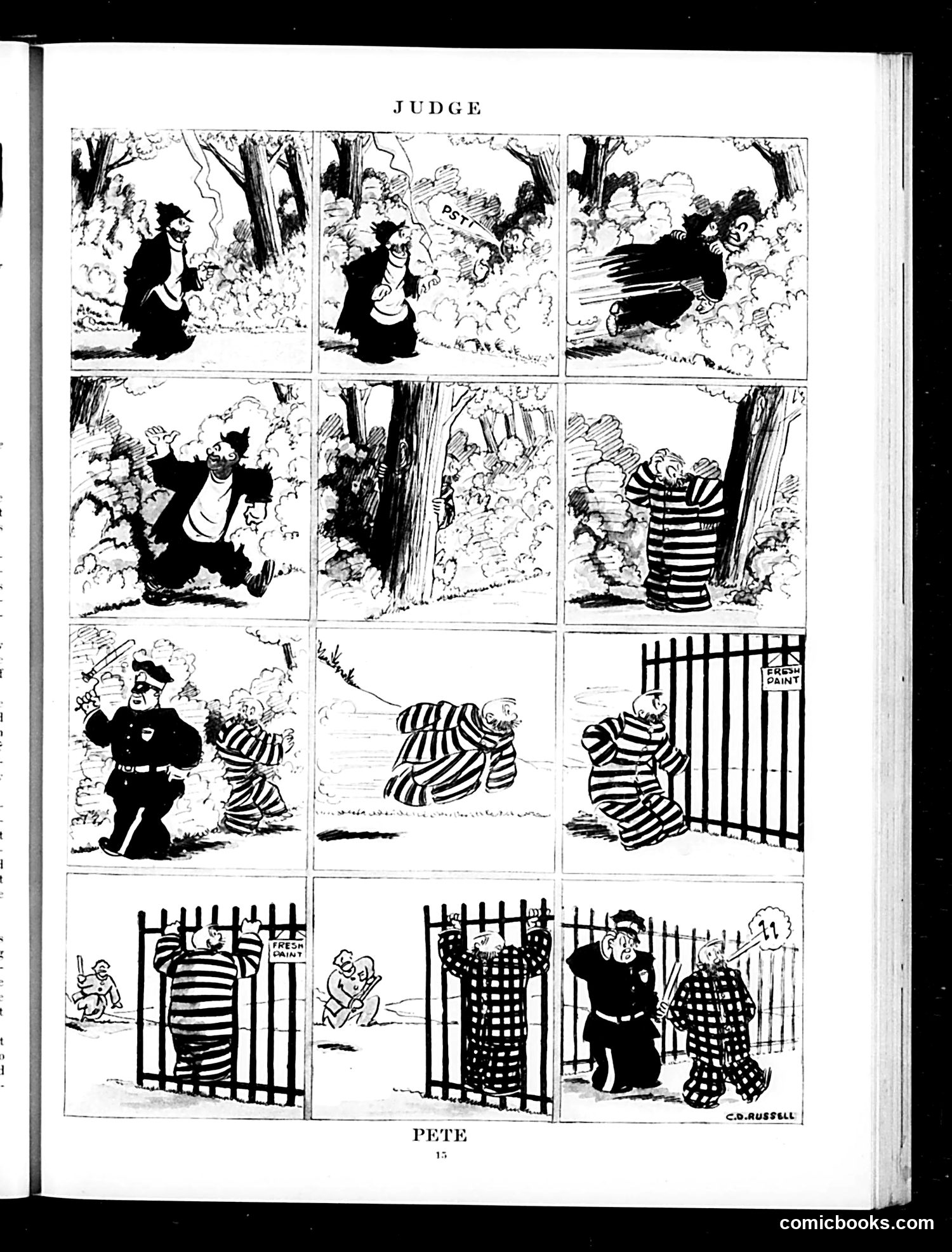
"Judge" Page: "Judge" and "Pete" This page presents two sequential comic strips. The top strip, titled "Judge," depicts a man in formal attire being chased through woods by what appears to be a striped convict or prisoner, escalating into physical comedy. The bottom strip, "Pete," shows a similar scenario: a striped prisoner repeatedly escaping from and being recaptured at a jail cell, ultimately ending with what appears to be a judge or authority figure present. The cartoons likely satirize the criminal justice system's ineffectiveness—specifically, the difficulty of containing or controlling prisoners. The repeated escape-and-recapture cycle suggests commentary on inadequate incarceration practices or judicial failure. The artist is credited as C.D. Russell. Without publication date context, the specific target remains unclear, though the theme addresses systemic criminal justice issues.
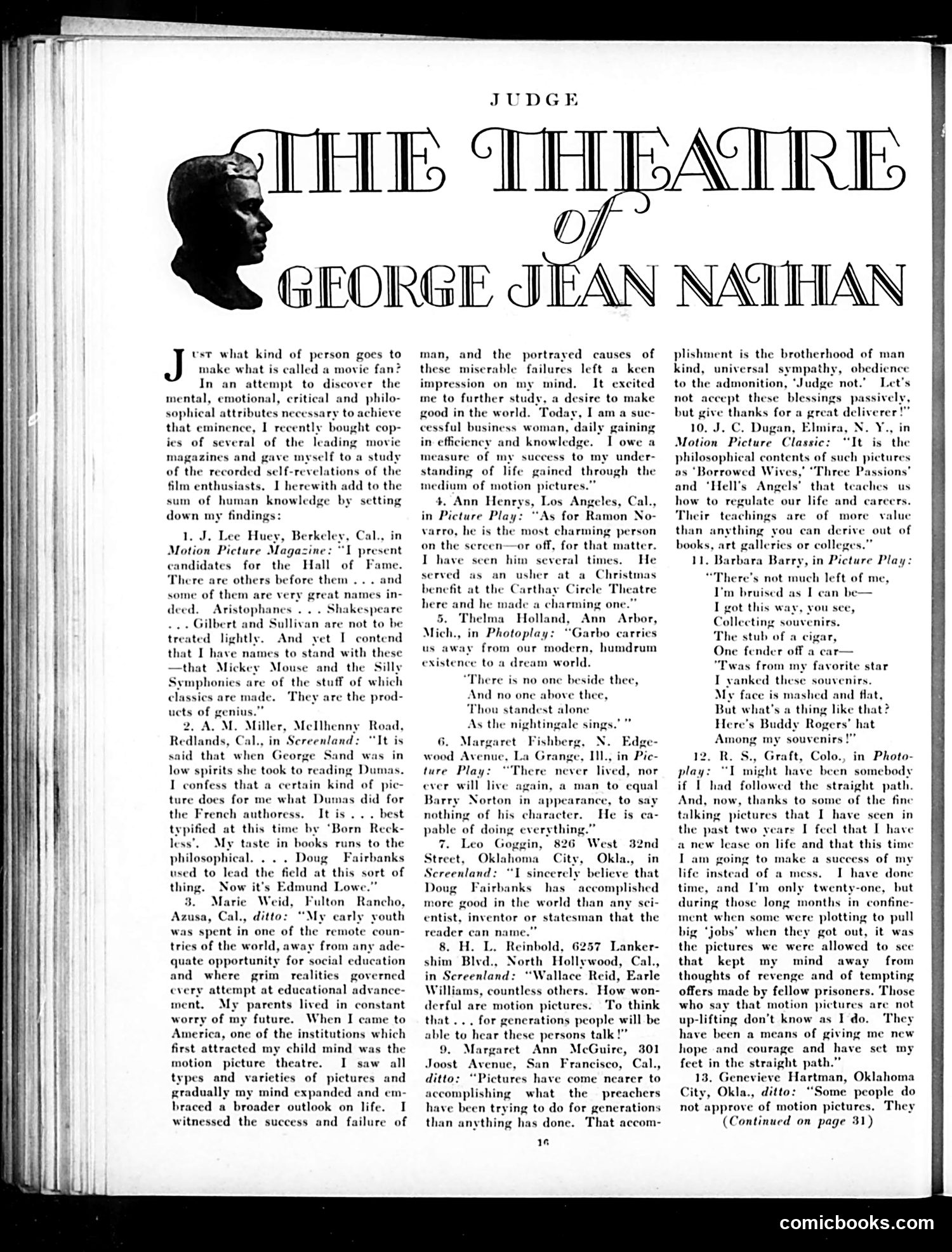
"The Theatre of George Jean Nathan" - Judge Magazine Article This is the opening page of a satirical essay by drama critic George Jean Nathan, mocking the breathless devotion of movie fans to Hollywood stars. The "cartoon" here is conceptual rather than visual—Nathan ridicules film enthusiasts who submitted gushing testimonials to movie magazines. Nathan collects absurd fan letters praising actors like Ramon Novarro, Greta Garbo, and Douglas Fairbanks with quasi-religious fervor. One fan claims Fairbanks has done more good than any scientist or statesman; another suggests motion pictures better accomplish Christian brotherhood than preachers. The satire targets 1920s fan-magazine culture and cinema's perceived corrupting influence on audiences. Nathan suggests these devoted fans lack critical thinking, confusing screen personalities with genuine moral guidance. The piece exemplifies *Judge*'s intellectual skepticism toward popular entertainment and mass culture enthusiasm—a common conservative position among educated elites during cinema's golden age.
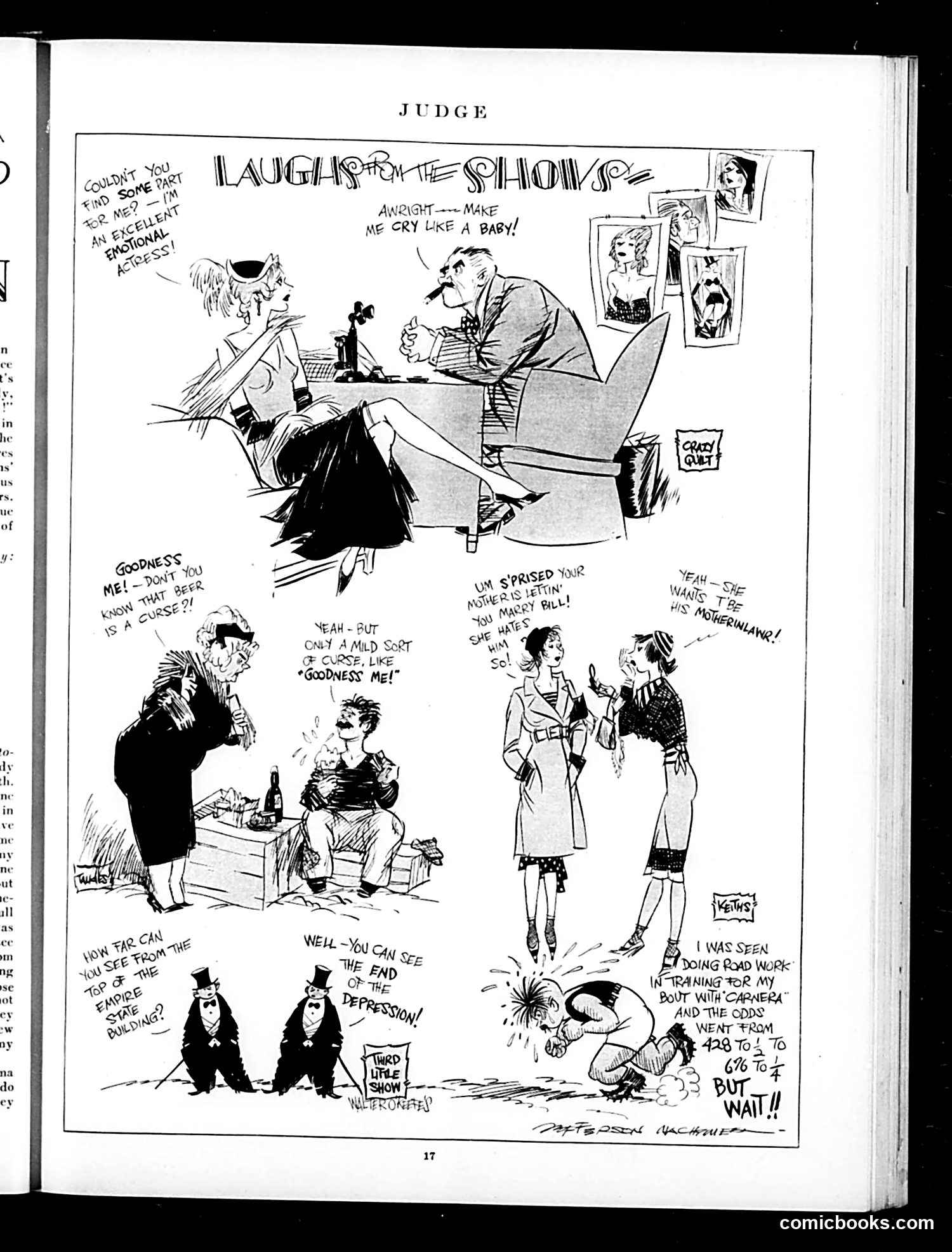
"Laughs at the Shows" This Judge magazine page presents multiple comic vignettes satirizing theatrical entertainment and celebrity culture. The title panel shows a stage director pressuring an actress to deliver more emotional performance. Below are separate scenes mocking: - An older woman's theatrical cursing habits - A child's exposure to adult entertainment (labeled "Goodness Me") - Two figures discussing depression economics - Women gossiping about boxing odds related to a "Carnera" bout (likely Primo Carnera, 1930s heavyweight boxer) - A final scene about road work training The satire targets showbiz pretension, generational conflicts over propriety, and the public's obsession with celebrity boxing matches. The page reflects 1930s-era Judge magazine's focus on middle-class social anxieties and entertainment-world absurdities, using exaggerated character types and physical comedy typical of the period's satirical cartooning.
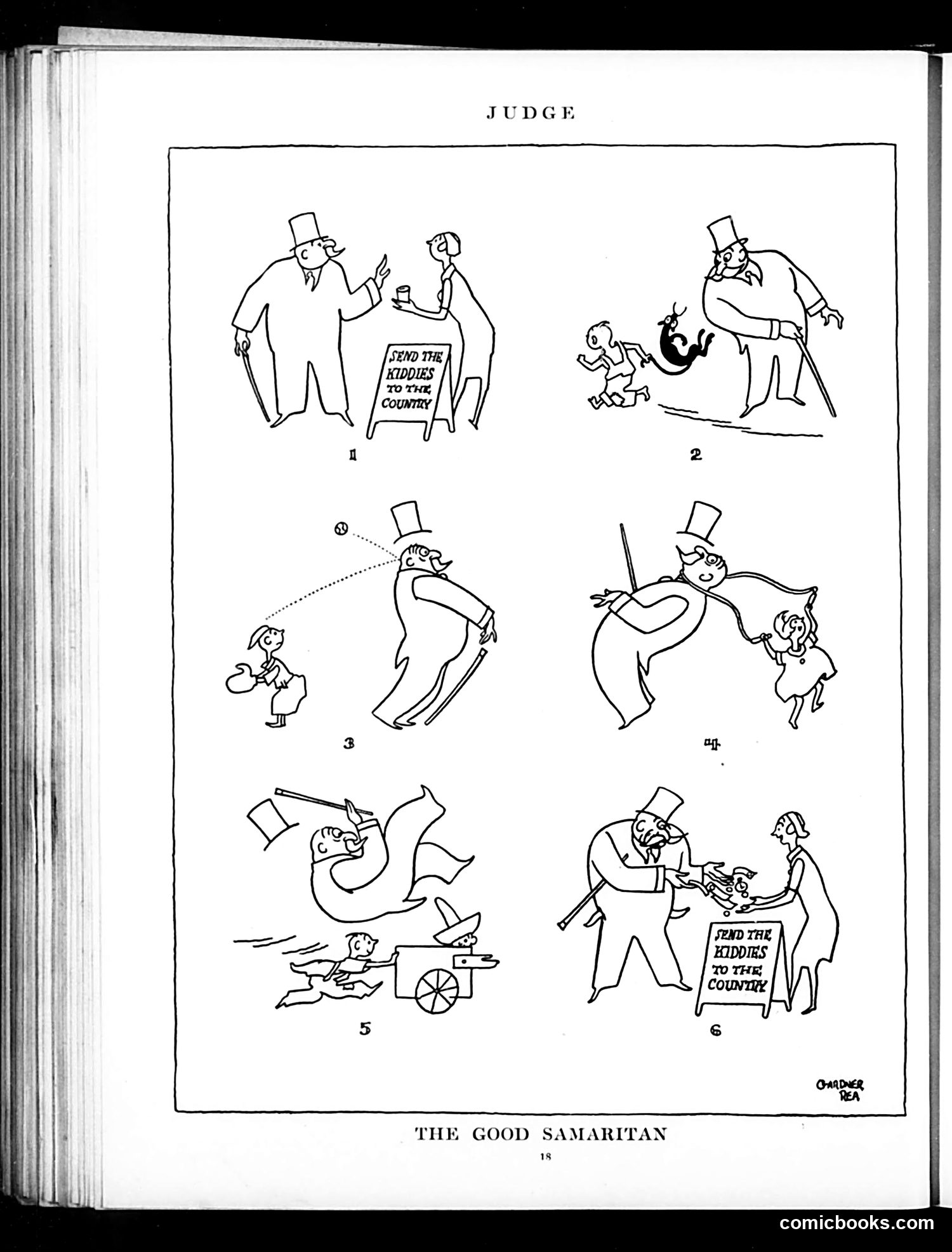
"The Good Samaritan" - Judge Magazine This six-panel cartoon satirizes wealthy industrialists and philanthropists of the Gilded Age. Top-hatted "judges" (likely representing the wealthy elite) are shown confronting poverty and hardship among children and families. The repeated sign "SEND THE KIDDIES TO THE COUNTRY" references a real reform movement providing poor urban children temporary country relief. The satire suggests these wealthy men pay lip service to charity (the Biblical "Good Samaritan" reference) while remaining largely indifferent to suffering around them—they judge rather than help. Panels show contrasts: the wealthy dismissing or ignoring desperate families and children, while occasionally appearing to participate in charitable gestures. The cartoon critiques performative philanthropy and class indifference during America's industrial era.
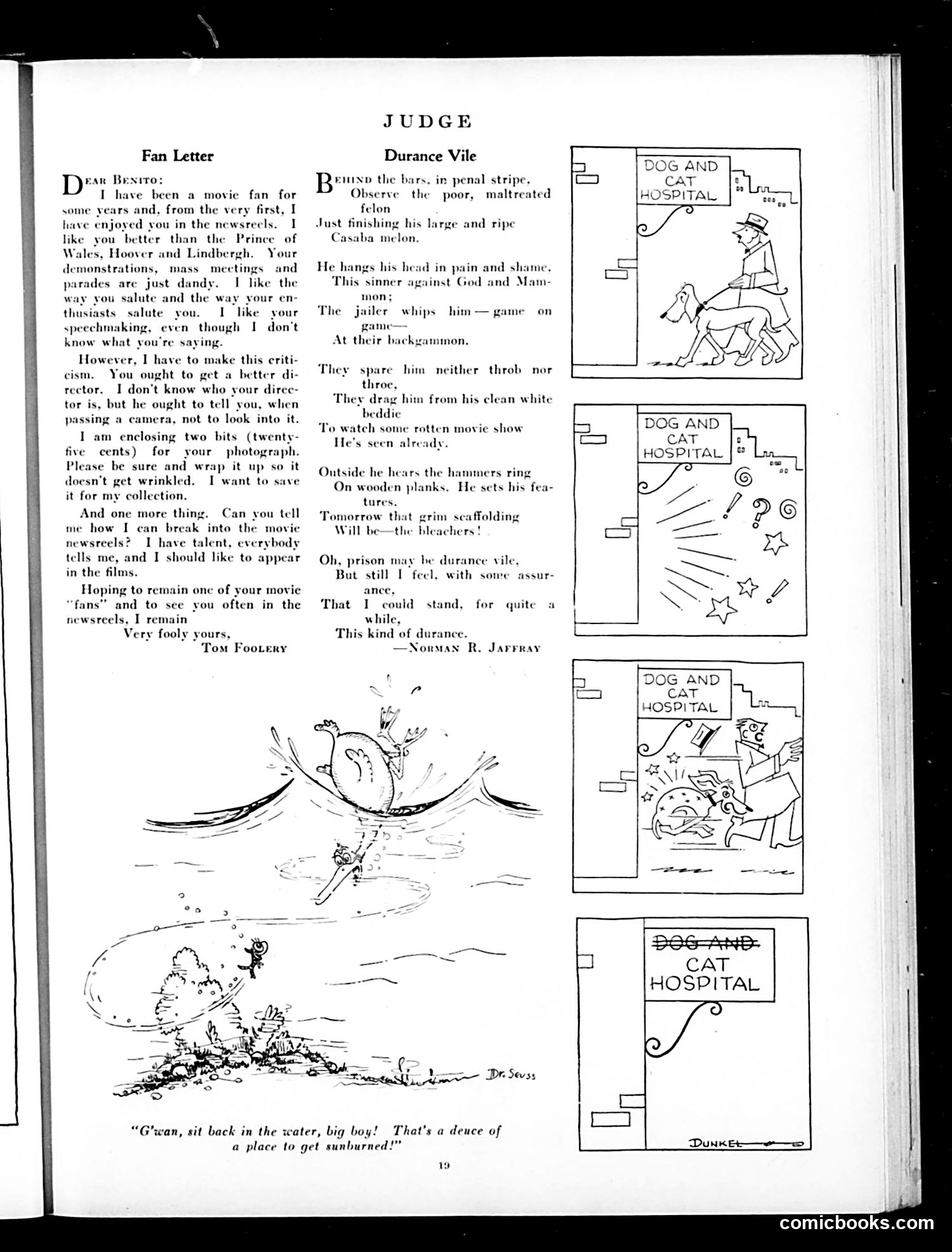
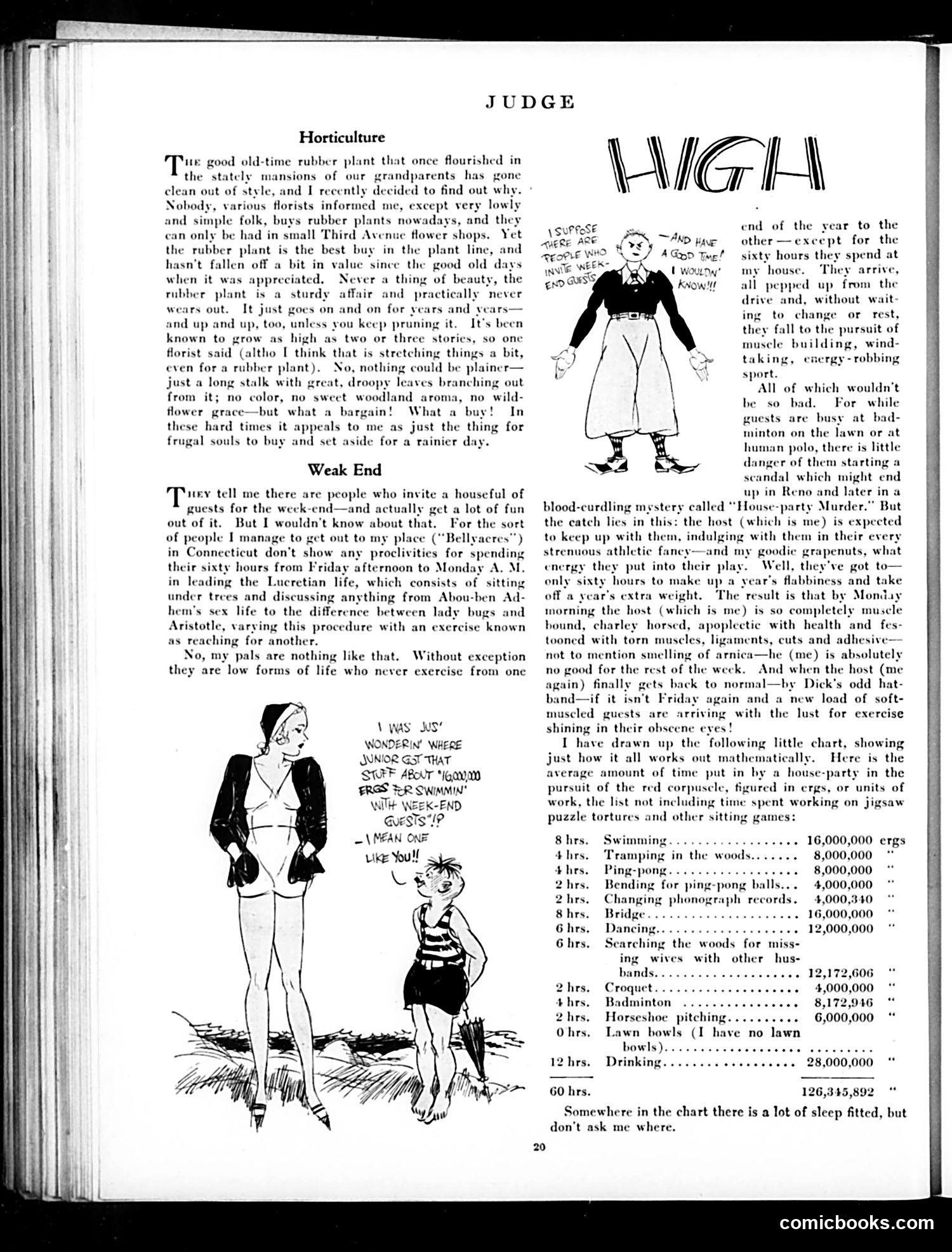
Explanation for Modern Readers This Judge magazine page satirizes two leisure-class activities of the 1920s-30s era. The "Horticulture" section mocks fashion-conscious wealthy people who've abandoned rubber plants—once status symbols in "stately mansions"—as outdated. The author ironically praises rubber plants as practical, durable, and economical during "hard times," appealing to "frugal souls." The "Weak End" section lampoons exhausting house-party weekends. The author's Connecticut guests ("low forms of life") arrive for 60 hours of relentless athletic activity—swimming, badminton, ping-pong, dancing—attempting to shed accumulated flabbiness. He includes a humorous chart quantifying this exertion in "ergs" (work units). The joke: the host must keep pace with his guests' manic exercise despite being wrecked by the previous week's guests, creating a punishing cycle that leaves him useless until Friday when new guests arrive. The cartoons show a fashionable woman and child, illustrating the leisure lifestyle being satirized.
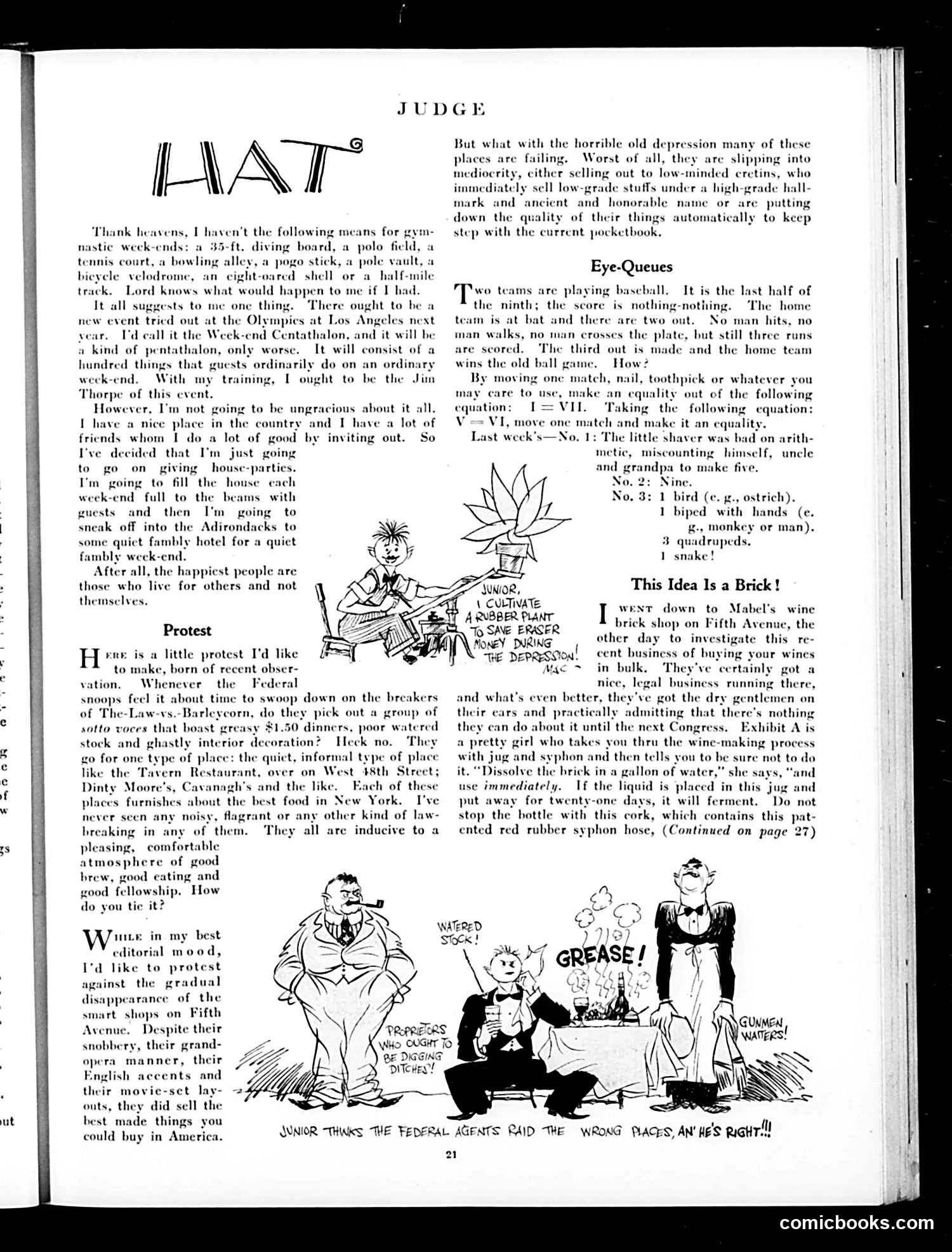
Judge Magazine Page Analysis This page from Judge contains three distinct satirical pieces: "HAT" mocks the wealthy's obsession with weekend recreation. The author humorously lists luxuries (diving boards, polo fields, tennis courts) he lacks, then proposes a "Week-end Cathalon" combining ordinary activities. The satire targets the leisure class's self-congratulatory attitude about athletic pursuits. "Protest" defends modest taverns and restaurants (Dinty Moore's, Cavanagh's) against Prohibition-era federal raids. The author argues these establishments—serving "good food" and "good fellowship"—are unfairly targeted, while fancier places escape scrutiny. This reflects Depression-era frustration with arbitrary law enforcement during Prohibition. "Eye-Queues" presents riddles/puzzles for readers. "This Idea Is a Brick!" discusses a wine bulk-buying business during Prohibition, suggesting legal loopholes allowing wine sales. The cartoon shows federal agents raiding the wrong establishments—satirizing enforcement incompetence. All three pieces mock authority, class hypocrisy, and Depression-era economic hardship.
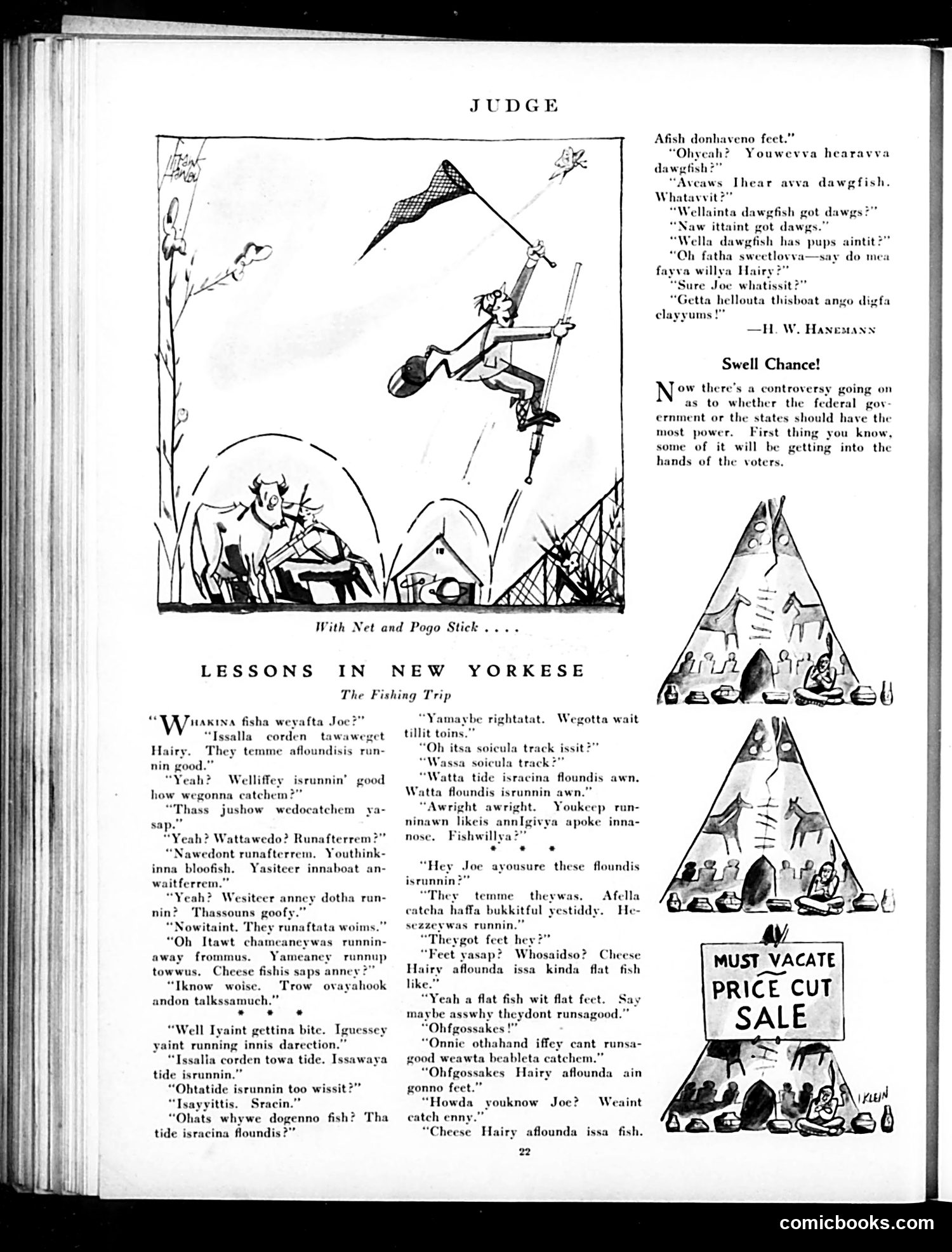
"Lessons in New Yorkese" This page satirizes the distinctive dialect and speech patterns of working-class New York fishermen. The main cartoon depicts two men fishing, with their dialogue rendered entirely in exaggerated New York accent/slang—dropping g's, collapsing words, using malapropisms ("Cheese" for "Jeez," "Afella" for "A fellow"). The humor relies on the contrast between the phonetic spelling of their heavy accent and the mundane subject matter (fishing logistics, fish behavior). Judge presents this dialect as comically impenetrable, almost a foreign language requiring "lessons" to understand. The small "Swell Chance!" political cartoon critiques federalism debates—suggesting that once power distribution between federal and state governments gets sorted out, it will inevitably fall into "the hands of the voters," implying common people are unfit stewards of political power.
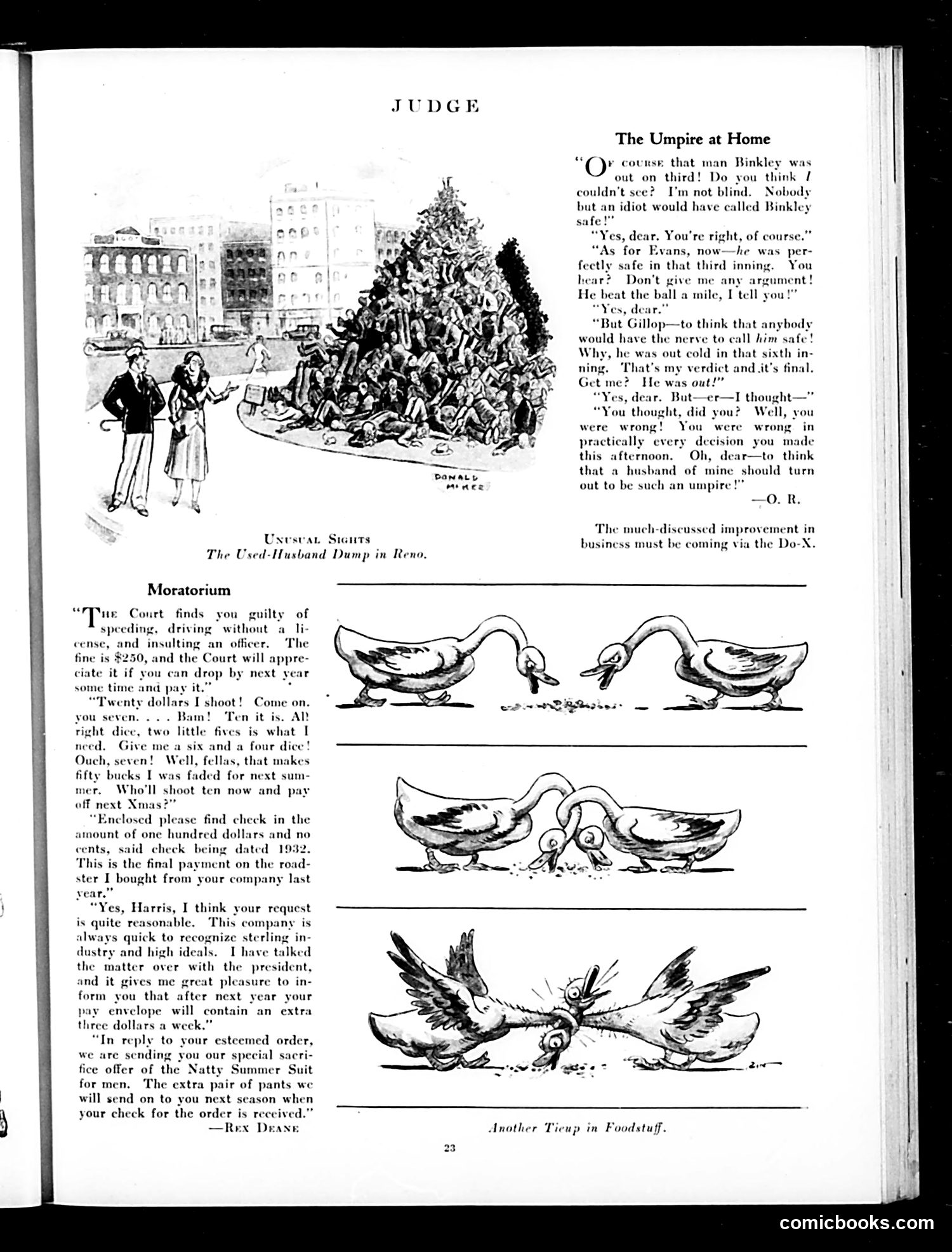
"The Umpire at Home" This cartoon satirizes marital dynamics through baseball language. A husband confidently declares baseball calls (players "out" or "safe") while his wife listens, then she turns the tables: she's been an "umpire" of his own decisions all afternoon, pronouncing him wrong "practically every decision you made this afternoon." The joke inverts power dynamics—the husband acts authoritative about sports, but the wife asserts domestic authority, questioning whether he should be an "umpire" at all. The reference to "The Used-Husband Dump in Reno" (visible in the cartoon caption) alludes to Reno, Nevada, which was notorious as a divorce destination due to lenient residency laws. The satire mocks both husbands' overconfidence and the era's marital tensions, with wives threatening divorce ("dump") over men's arrogance.
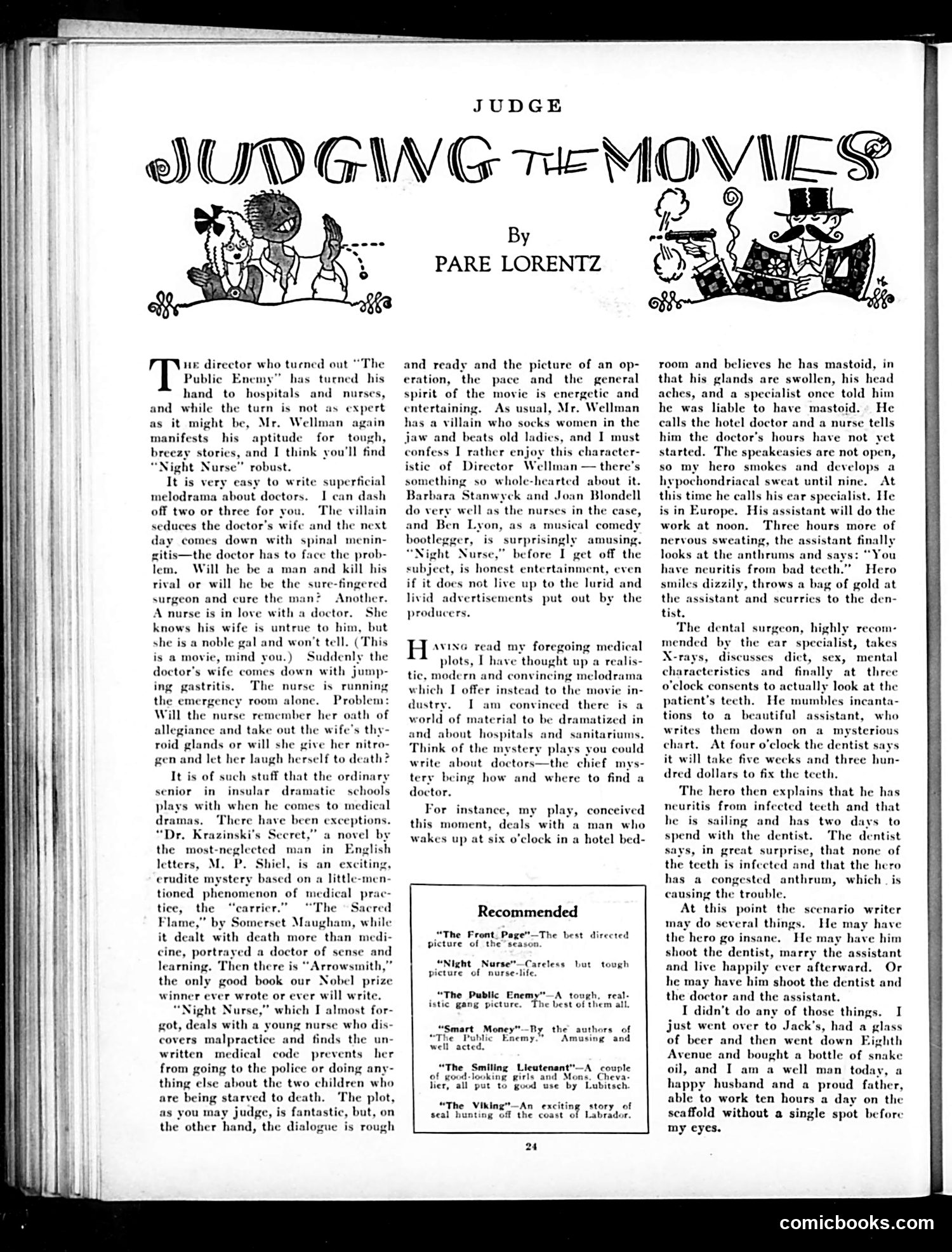
Understanding "Judging the Movies" by Pare Lorentz This is a film critic's essay reviewing medical melodramas, particularly Director William Wellman's "Night Nurse" (starring Barbara Stanwyck and Joan Blondell). The satire: Lorentz mocks how easily superficial doctor-and-nurse plots can be manufactured—he rattles off absurd scenarios (a doctor choosing between revenge and professional duty; a nurse deciding whether to sabotage her rival's surgery) to show the genre's predictability. The point: Despite criticizing formulaic hospital dramas, Lorentz defends "Night Nurse" as honest entertainment, praising Wellman's villain (who "socks women" and "beats old ladies") for its whole-hearted shamelessness and the leads' capable performances. The accompanying illustrations show vaudeville-style comedic characters—fitting for a satirical magazine mocking melodramatic conventions. The "Recommended" sidebar lists quality films of the period for comparison. The essay exemplifies Judge's irreverent, witty critique of popular culture entertainment.
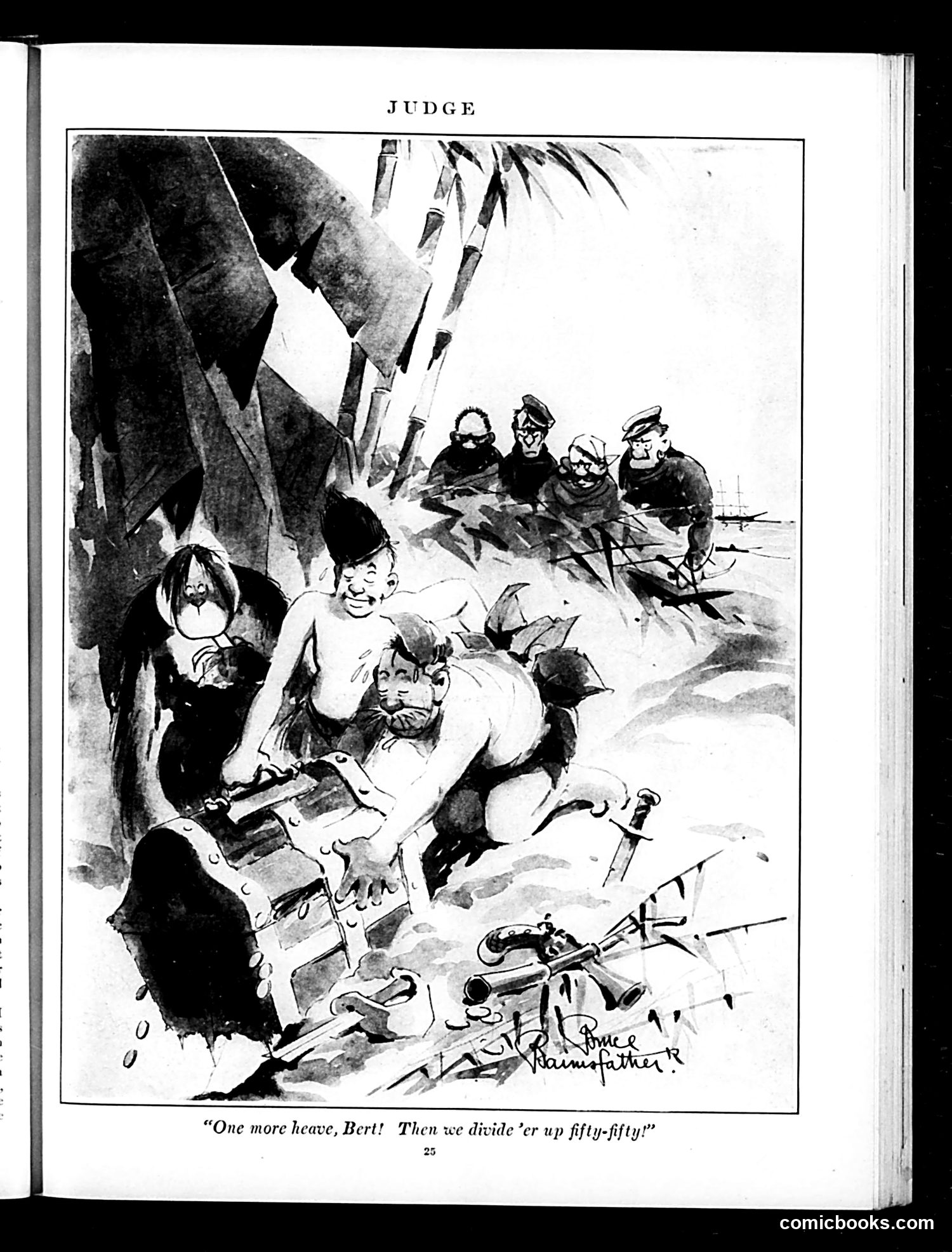
Analysis This is a satirical cartoon from *Judge* magazine depicting what appears to be a pirate or criminal scenario. The caption reads: "One more heave, Bert! Then we divide 'er up fifty-fifty!" The image shows caricatured figures (some with exaggerated animal-like features) working together to haul or divide treasure/plunder. The satire likely comments on political or business corruption—specifically, the irony of criminals or unethical figures claiming they'll divide spoils "fairly" while engaged in dishonest activity. The specific political or historical context remains unclear without dating information. The cartoon's point appears to be mocking those who engage in corrupt dealings while maintaining pretenses of honesty or equal treatment. The animal caricatures may reference specific contemporary political figures, but I cannot identify them with certainty from the image alone.
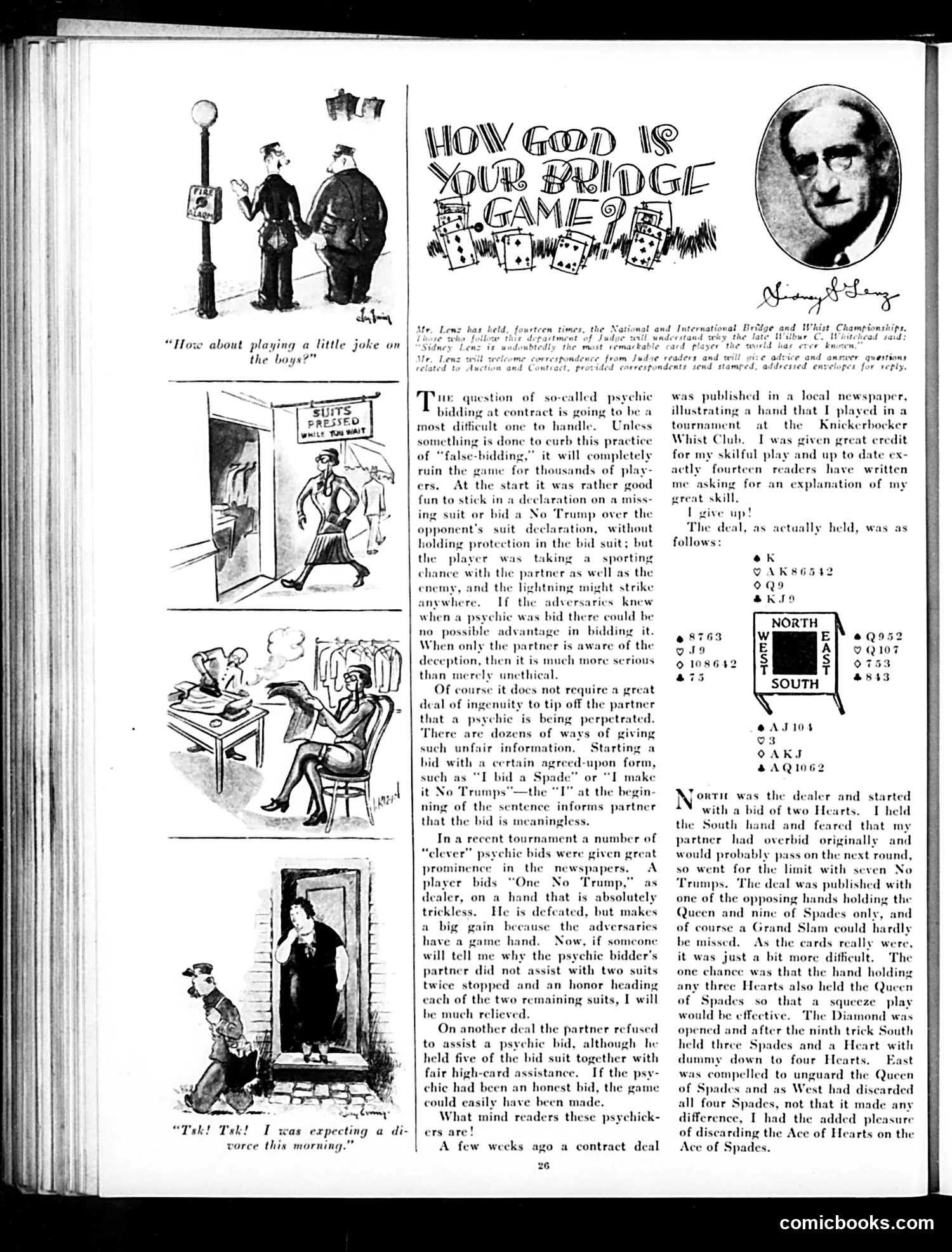
Judge Magazine Page Analysis This page satirizes "psychic bidding" in Contract Bridge, a card game popular among the wealthy in the early 20th century. The term refers to deceptive bidding strategies where players make false bids to mislead opponents. The cartoons mock this practice through domestic humor: wives joke about "playing tricks" on husbands, and a woman quips about expecting a divorce—suggesting the game causes marital discord. The lengthy article criticizes psychic bidding as unfair and unethical, particularly when partners use coded signals to communicate that a bid is false. The author argues this practice ruins the game by allowing cheaters to gain advantage through deception rather than skill. The bridge hand analysis at bottom appears designed to expose a famous player's claimed "skillful play"—suggesting the publicized deal was misleading about the actual difficulty, a direct parallel to the article's broader critique of deception in bridge society.
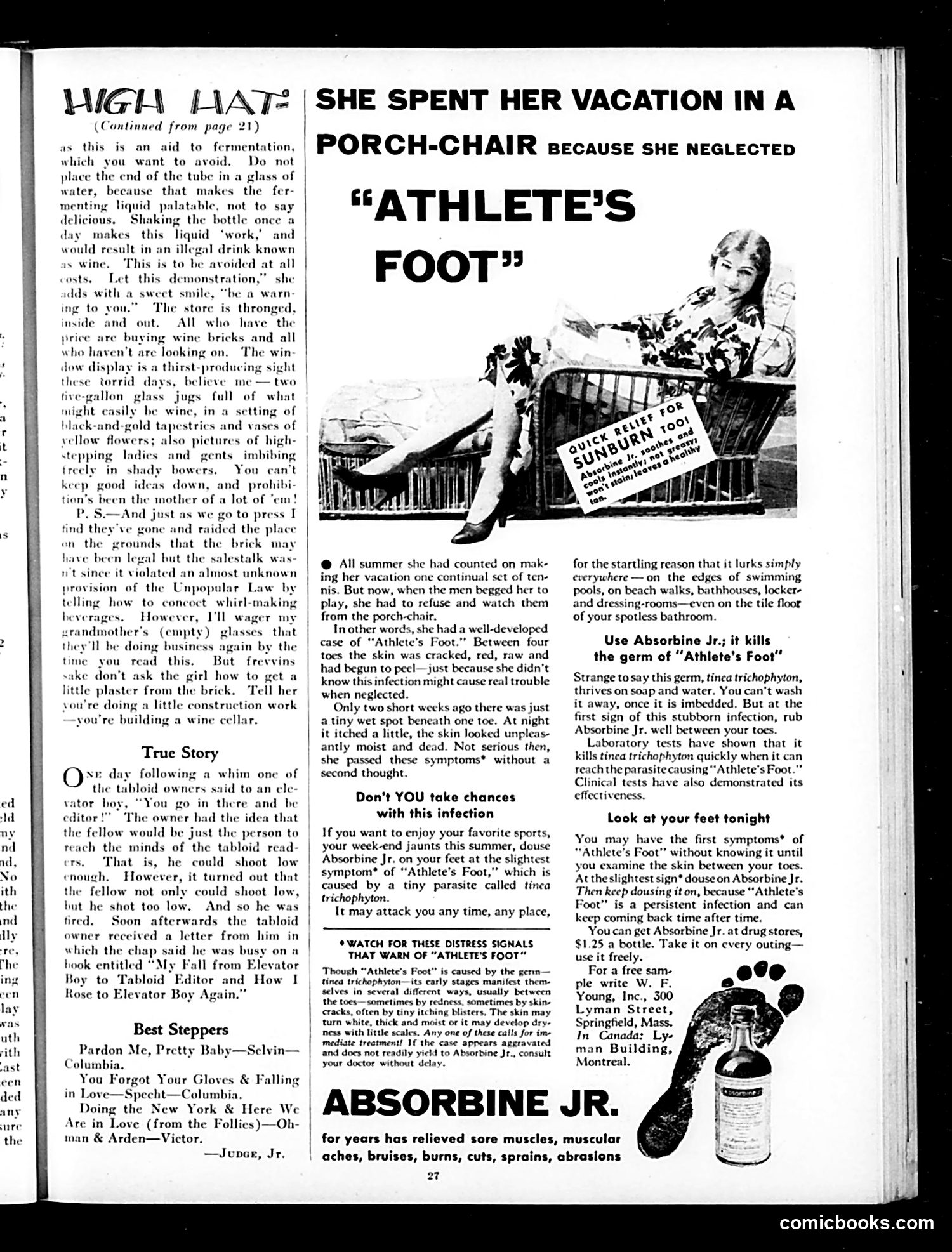
Analysis of Judge Magazine Page This page contains a mix of editorial content and advertising, with the dominant feature being a full-page advertisement for Absorbine Jr., a patent medicine. The Advertisement The main visual is a satirical cartoon showing a woman confined to a porch chair during vacation because she neglected to treat "athlete's foot" — a fungal infection. The humor lies in the ironic contrast: she anticipated an active vacation with tennis and socializing but is instead immobilized by a trivial-seeming but real medical condition. The accompanying text emphasizes that early symptoms (redness, moisture, itching between toes) shouldn't be ignored, as they indicate *tinea trichophyton*, a parasitic infection requiring treatment. The ad warns readers not to "take chances" with this infection and directs them to use Absorbine Jr. as preventative and curative. Historical Context This reflects 1920s-era consumer advertising that combined humor with health anxiety—a common marketing tactic. Patent medicines like Absorbine Jr. occupied a gray zone before modern FDA regulation, making broad curative claims. The "athlete's foot" framing suggests this condition was relatively newly categorized and named during this period.
Judging the Books: Political Satire on 1930s Washington This is a book review column criticizing two satirical works about Washington politics during the Great Depression. The reviewer ("Uncle Shane") discusses *"The Washington Merry-Go-Round"* and *"The Mirrors of 1932,"* anonymous books that viciously lampoon government figures. The primary target is President Herbert Hoover, depicted as an ineffectual "orphan stepson" of Uncle Sam who bears the public's blame for economic disaster. The books allegedly spare no dignitary—mocking "stuffed political shirts" in office—but reserve their harshest treatment for Hoover, portrayed with "devastating meanness." The review notes Hoover allegedly complained to the Justice Department about the books' attacks. The satire reflects Depression-era public anger: citizens seeking scapegoats for financial ruin seized on Washington politicians as targets for mockery and vitriol. These anonymous works offered cathartic "purgative reading" through political character assassination.
"The Bands That Bind" — A Judge Magazine Story This page contains a serialized fiction story (continued from page 8) about fraternity or club "bands"—literal armbands or insignia worn by members to identify each other. The narrative describes a narrator's experience with brothers who exploit these identifying bands for personal gain, borrowing money and possessions under false pretenses of brotherhood. The story's satire targets the hypocrisy of fraternal organizations: members use their "bands" as credentials to solicit favors and loans from fellow members, then disappear without repayment. The climax shows two band-wearers spotting each other and racing to claim advantage, illustrating how the symbol of brotherhood becomes merely a tool for manipulation. The surrounding advertisements (hotels, backgammon sets, tomato juice cocktails) are period commercial content unrelated to the satire, typical of Judge magazine layout from this era.
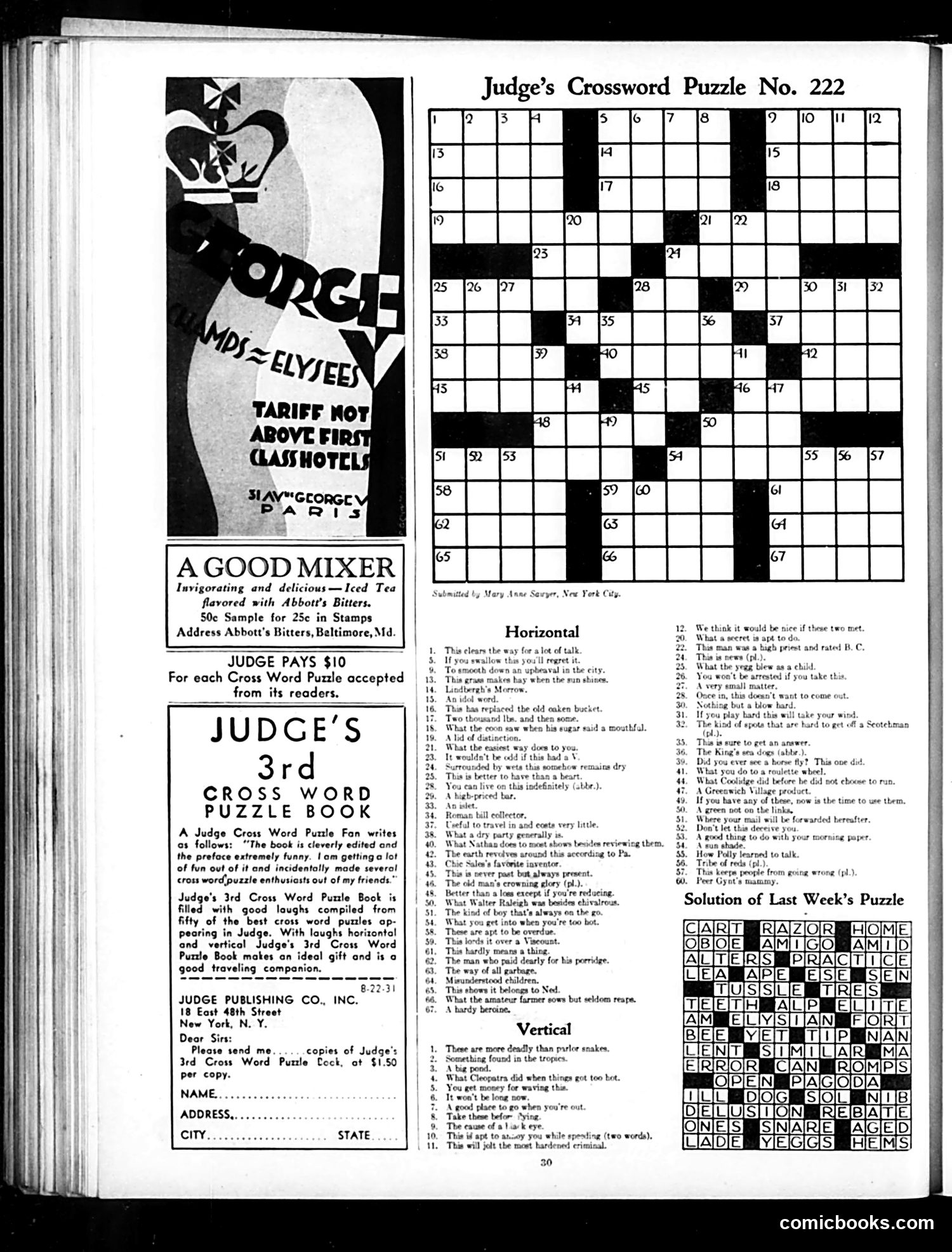
Judge Magazine Page Analysis This page is primarily advertising and puzzle content rather than political satire. The main visual element is a vintage advertisement for Abbott's Bitters (an alcoholic digestive tonic), featuring a stylized female figure in art deco style promoting "A Good Mixer"—iced tea flavored with the product. The bulk of the page showcases Judge's 3rd Cross Word Puzzle Book, promoting it as an ideal gift. The publication paid $10 for accepted puzzles from readers. The page includes the actual crossword puzzle (No. 222) with clues and the solution to the previous week's puzzle. The only satirical element appears in brief puzzle clues referencing contemporary life—references to "Scotchman," "the King," and general social observations—but these are too fragmentary to identify specific targets or decode their satirical intent without additional context. This is essentially a product promotion and entertainment page typical of Judge magazine's commercial content.
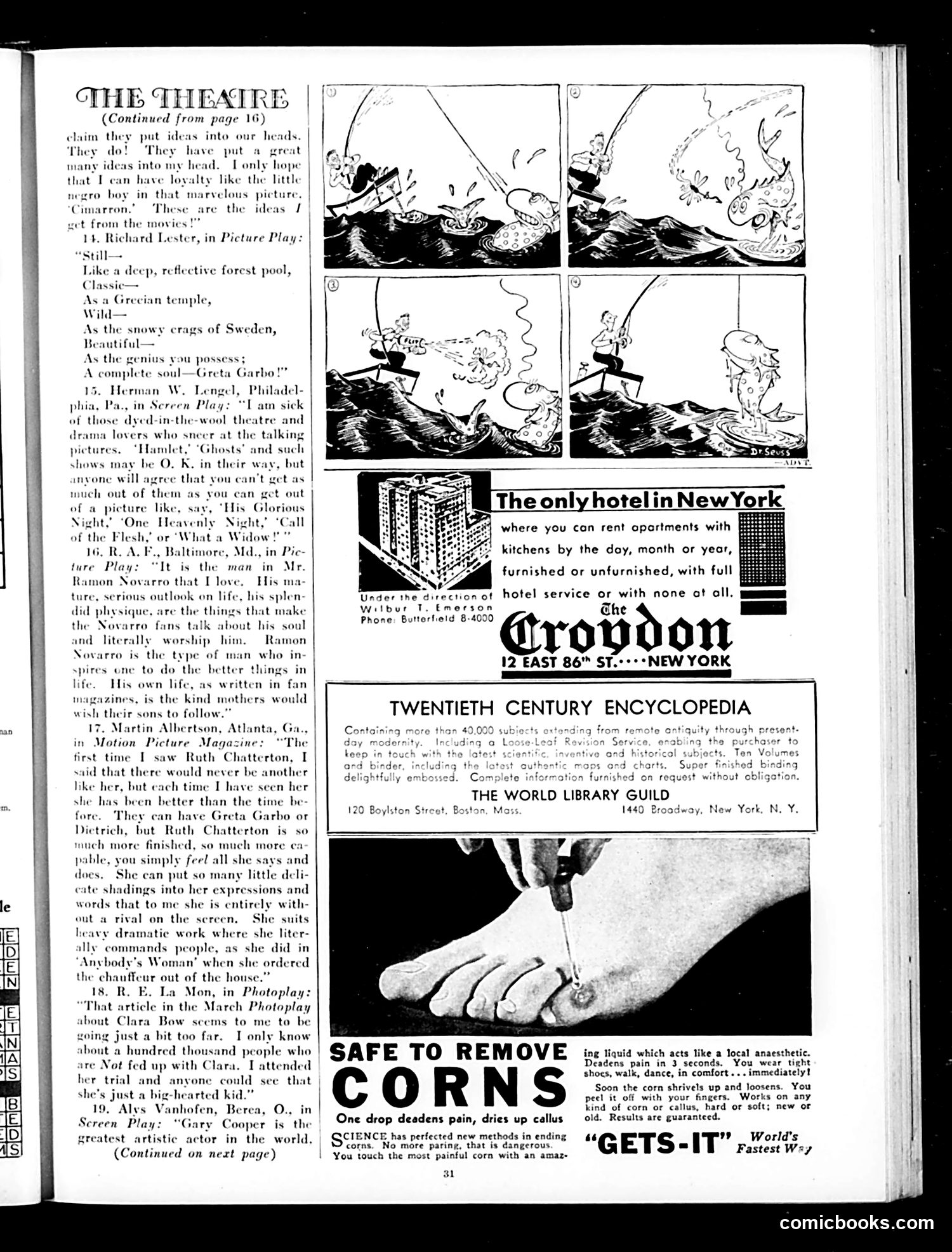
This page is primarily advertising and reader letters, not political satire. The bulk of the content consists of: "The Theatre" section: Reader testimonials praising film stars—particularly Ramon Novarro, Greta Garbo, Ruth Chatterton, and Clara Bow. Letters defend these actors against critics, emphasizing their artistic merit and moral influence. One writer defends moviegoing against "dyed-in-the-wool" theatre snobs who prefer stage classics like *Hamlet*. Key context for modern readers: This reflects 1920s-30s "fan culture" anxieties—the debate over whether cinema was legitimate art or mere entertainment, and whether movie stars were worthy role models. The passionate defenses suggest movies faced ongoing criticism from cultural elites. The page also contains advertisements for the Croydon hotel and "Gets-It" corn remover. No political cartoon is present. The page represents Judge magazine functioning as both satirical publication and venue for entertainment industry promotion and fan discourse.
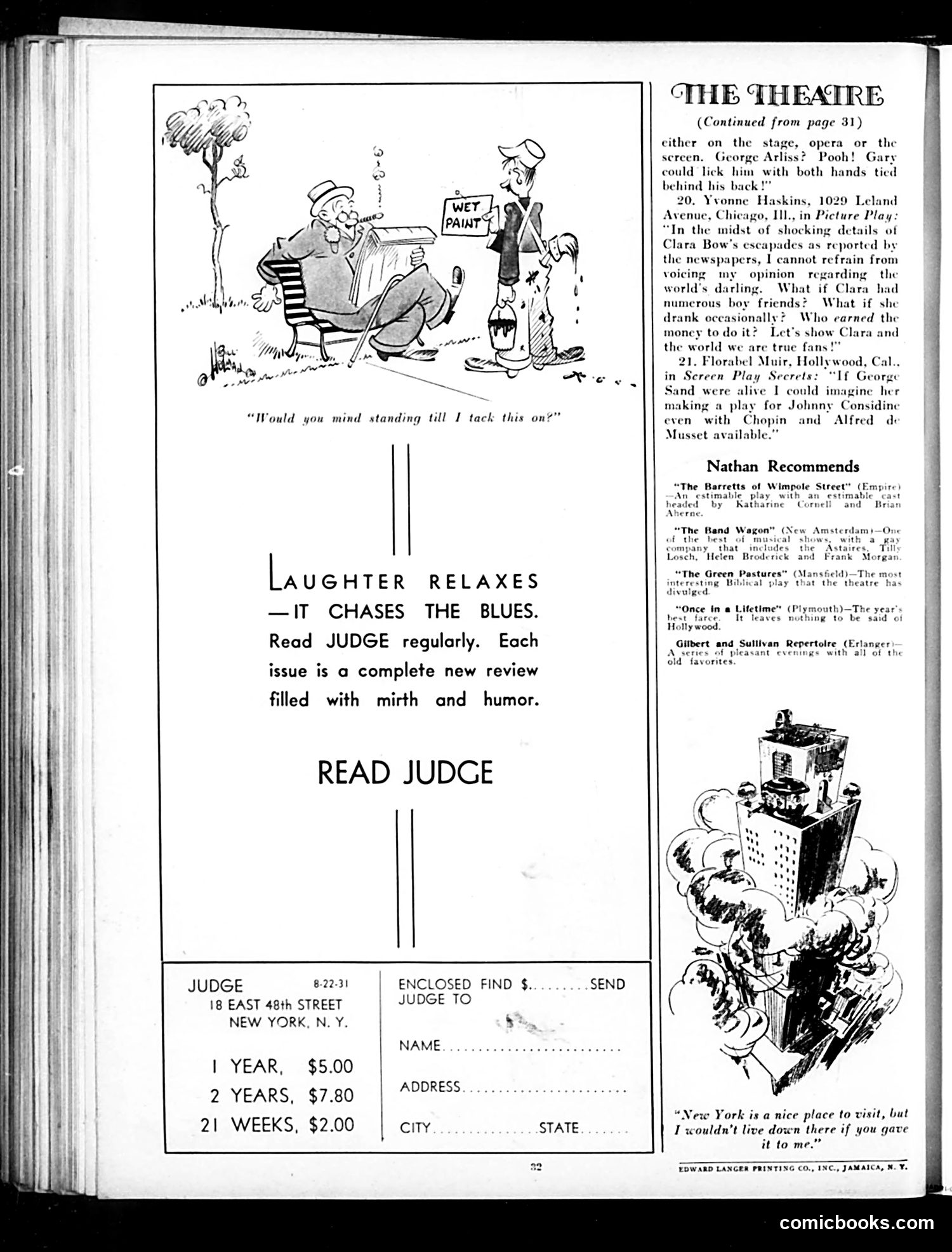
Page Content Explanation This page contains a cartoon and theater reviews from Judge magazine (dated 8-22-31, so August 1931). The Cartoon: Shows a painter standing on a ladder with a "WET PAINT" sign, asking someone to hold still while he applies paint to their back. It's a straightforward visual gag about an awkward situation. The Theater Section: Features reader letters debating Hollywood star Clara Bow's personal conduct and romantic life. One writer defends Bow against scandal-sheet gossip; another makes a literary reference comparing her to George Sand. The section also includes brief positive reviews of stage productions ("The Barretts of Wimpole Street," "The Green Pastures," etc.). The Advertisement: Promotes Judge magazine subscriptions ($5/year) using the tagline "Laughter Relaxes—It Chases the Blues," appealing to Depression-era readers seeking humor and escapism. A small cartoon mocks New York City living conditions. The page reflects 1930s popular culture: Hollywood celebrity gossip, theatrical entertainment, and humor as recession-era relief.

Analysis This is primarily a book advertisement, not a political cartoon. It promotes "The World's 101 Best Detective Stories," a single-volume collection priced at 98 cents. The page lists 101 classic mystery tales by renowned authors (Boccaccio, Voltaire, Tolstoy, and others) across various settings—France, England, Spain, Arabia, Portugal, and America. The marketing emphasizes value: hundreds of hours of entertainment condensed into one affordable, beautifully-printed volume using thin paper to keep it manageable. The "no money" offer—mail the coupon and pay upon delivery—was a common direct-mail sales tactic of the era, designed to lower barriers to purchase. Historically relevant: This reflects early 20th-century American consumer culture and the popular appetite for detective fiction, a then-thriving literary genre. The collection targets middle-class readers seeking affordable access to prestigious literature.
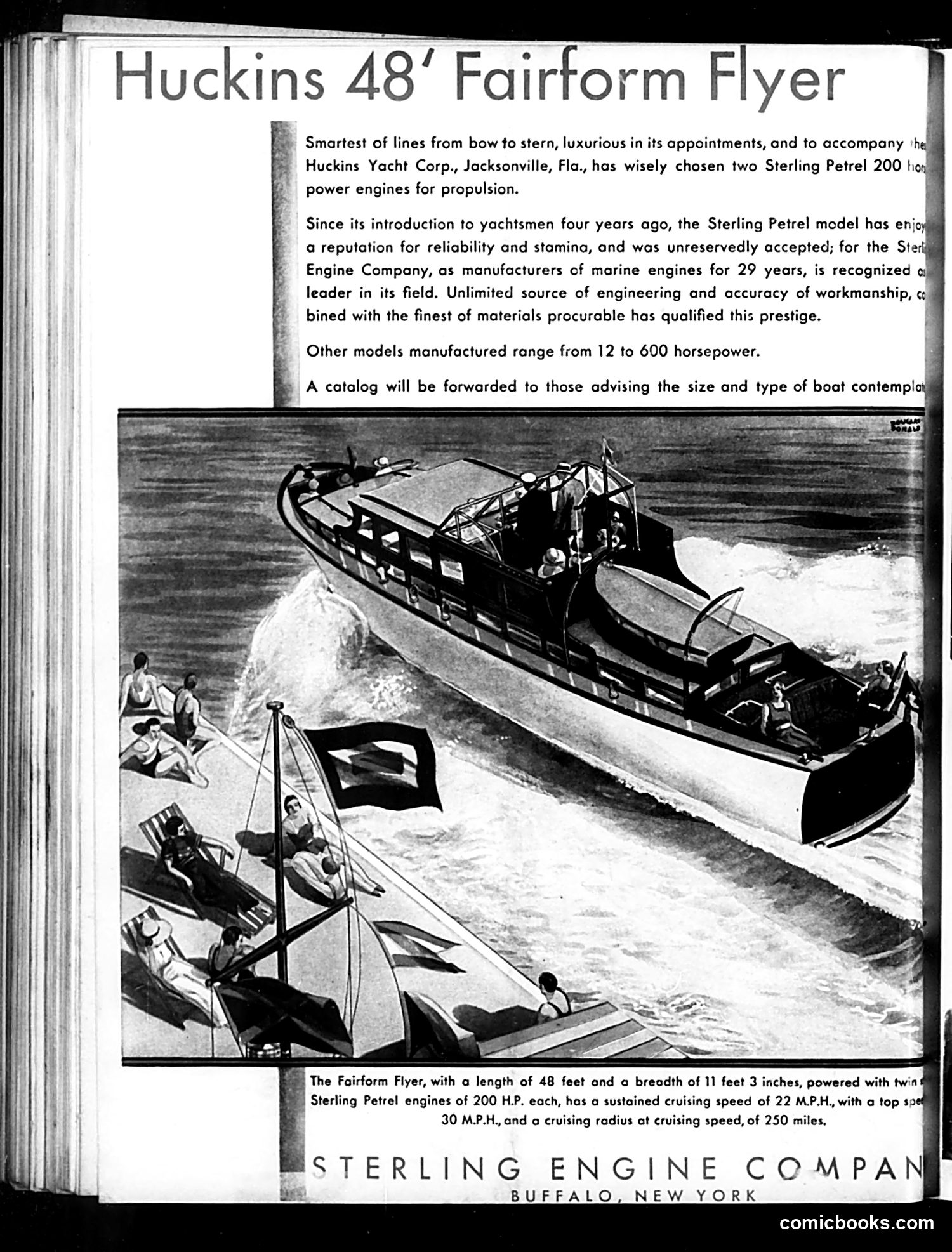
This is a full-page advertisement, not satirical content. It promotes the Huckins 48' Fairform Flyer yacht, manufactured by Huckins Yacht Corp. in Jacksonville, Florida. The ad emphasizes luxury features and highlights the boat's twin Sterling Petrel 200-horsepower engines. The photograph shows the yacht beached near bathers and beach umbrellas, depicting an idealized leisure scenario. The copy stresses Sterling Engine Company's 29-year manufacturing reputation for reliability and precision engineering. Specifications include a 48-foot length, 11-foot-3-inch beam, cruising speed of 22 mph, top speed of 30 mph, and 250-mile cruising range. This represents typical interwar advertising targeting wealthy consumers—positioning both the yacht and engines as premium, reliable products for affluent buyers seeking recreational boating.