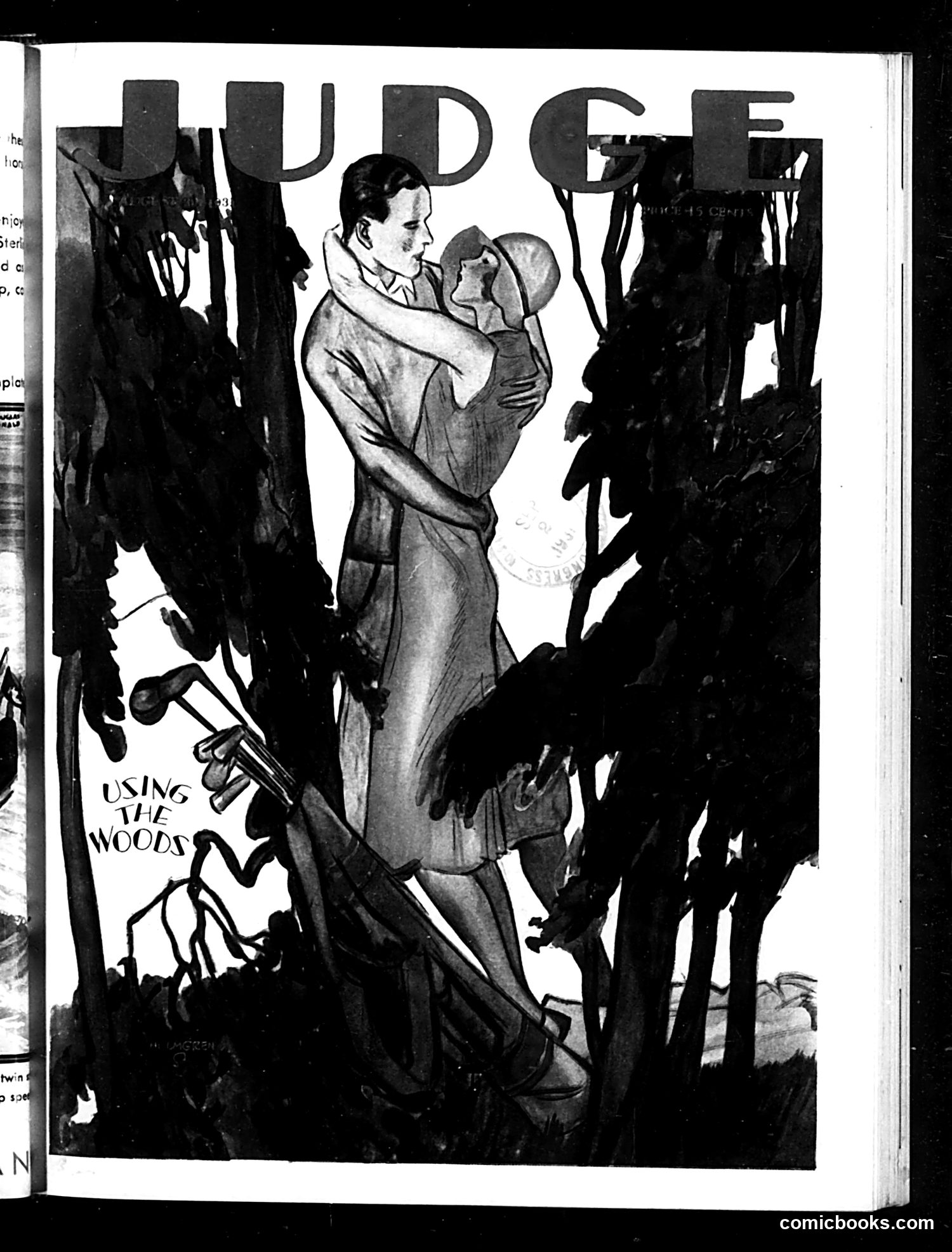
judge
Judge — August 29, 1931
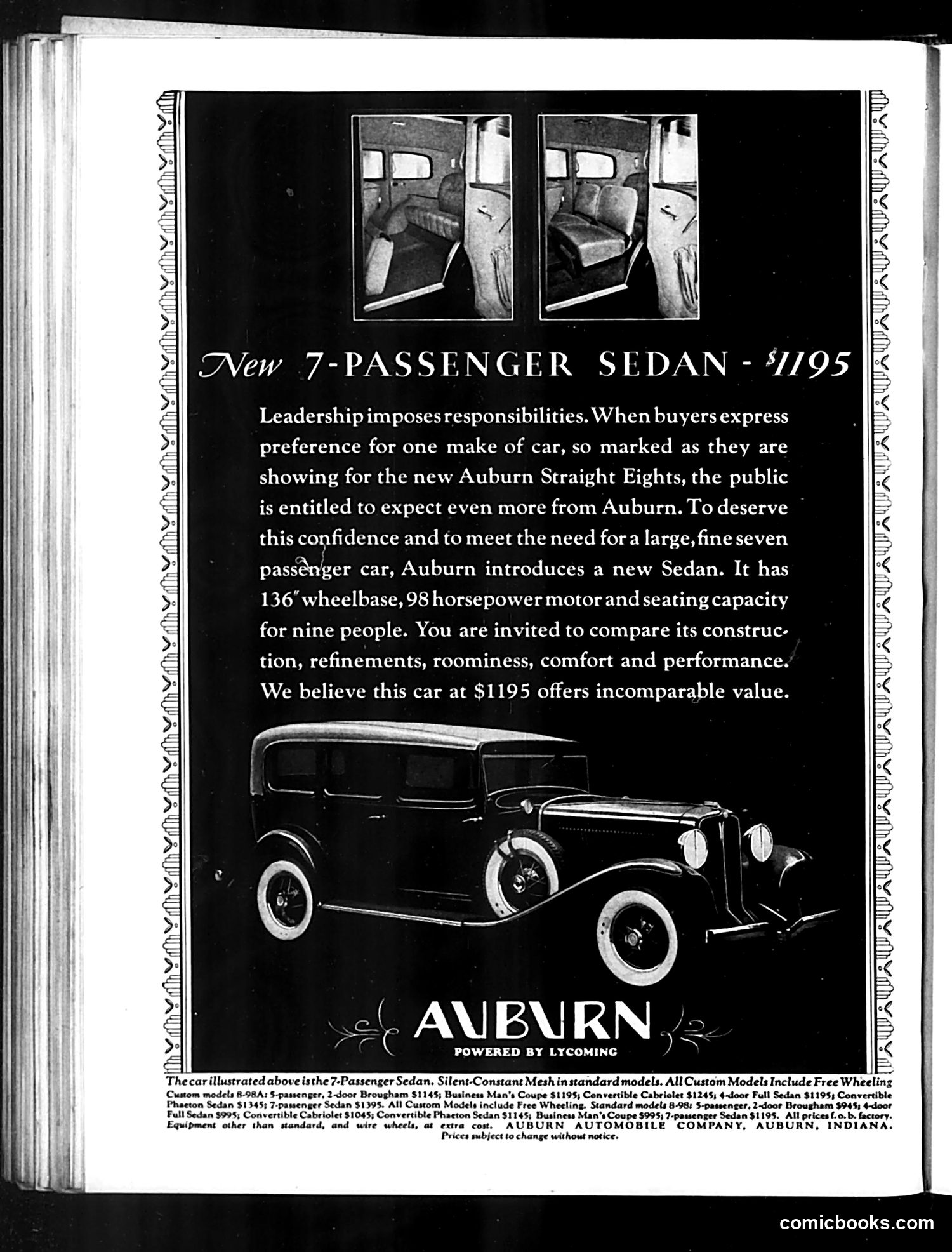
Analysis This page is not a cartoon or satirical content — it's a straightforward automobile advertisement, not a satirical piece. Judge magazine frequently included paid advertisements alongside humor content. The ad promotes Auburn's new 7-passenger sedan priced at $1,195. The copy emphasizes Auburn's market leadership ("leadership imposes responsibilities") and positions the car as a quality competitor to other popular makes. It highlights specifications: 136-inch wheelbase, 98 horsepower, and capacity for nine people. The two interior photos at top show the car's spacious seating. The lower illustration displays the sedan's sleek profile. This appears to be from the late 1920s or early 1930s based on the car's design and price point. The advertisement simply aims to convince Judge readers that Auburn offers superior value in the luxury sedan market.
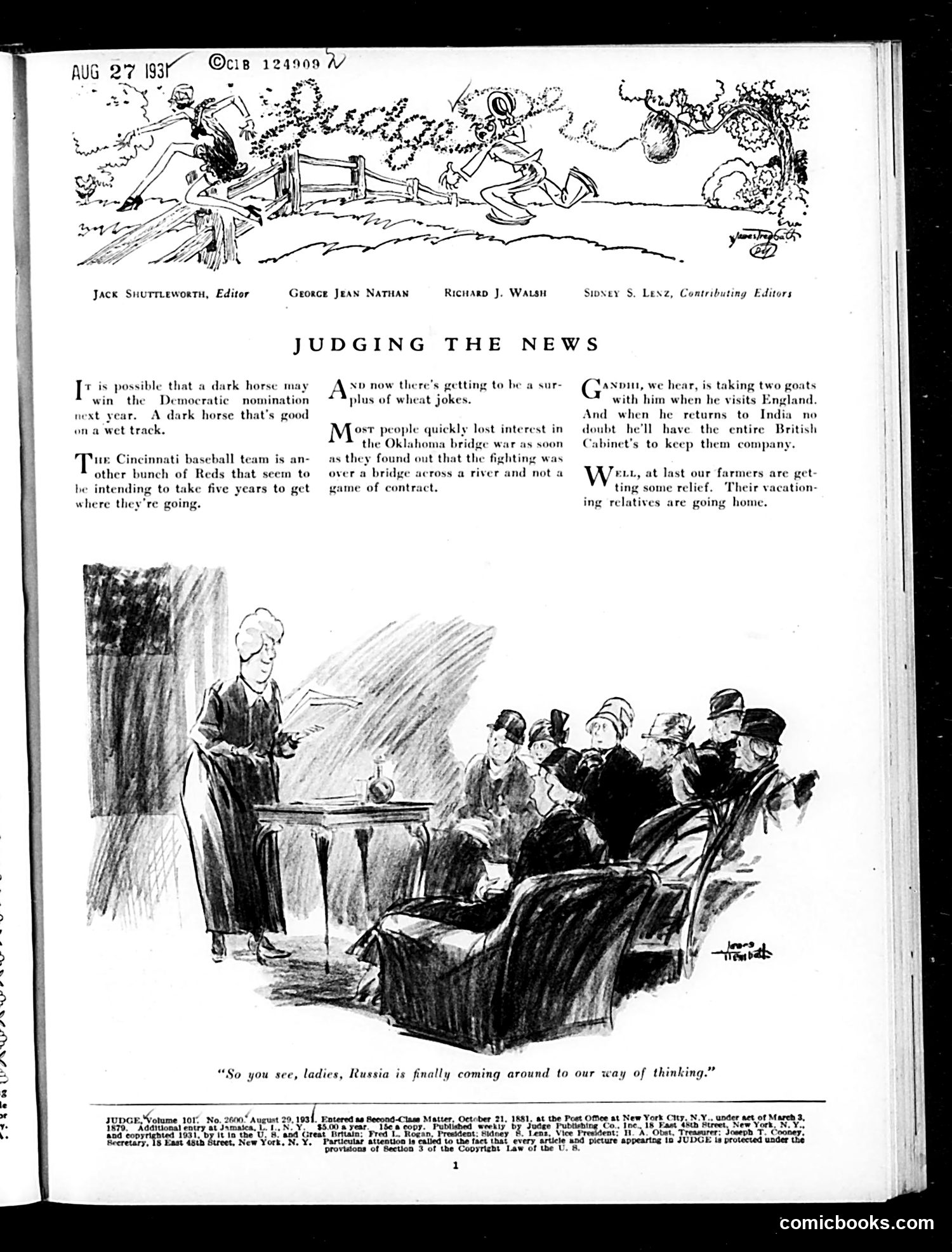
"Judging the News" - August 27, 1931 This page presents satirical commentary on current events. The main cartoon shows a woman lecturer addressing an audience of well-dressed attendees, with the caption: "So you see, ladies, Russia is finally coming around to our way of thinking." The joke appears to satirize Western assumptions about Soviet policy shifts. During the early 1930s, the USSR was undergoing significant ideological and economic changes. The cartoon mocks the notion that Russia was adopting Western capitalist or democratic values—suggesting naive Western wishful thinking about Soviet intentions. The brief text snippets above the cartoon offer lighter satirical items: comments on Democratic politics, the Oklahoma bridge controversy, and the Cincinnati Reds baseball team—typical Judge magazine fare mixing political and social humor.
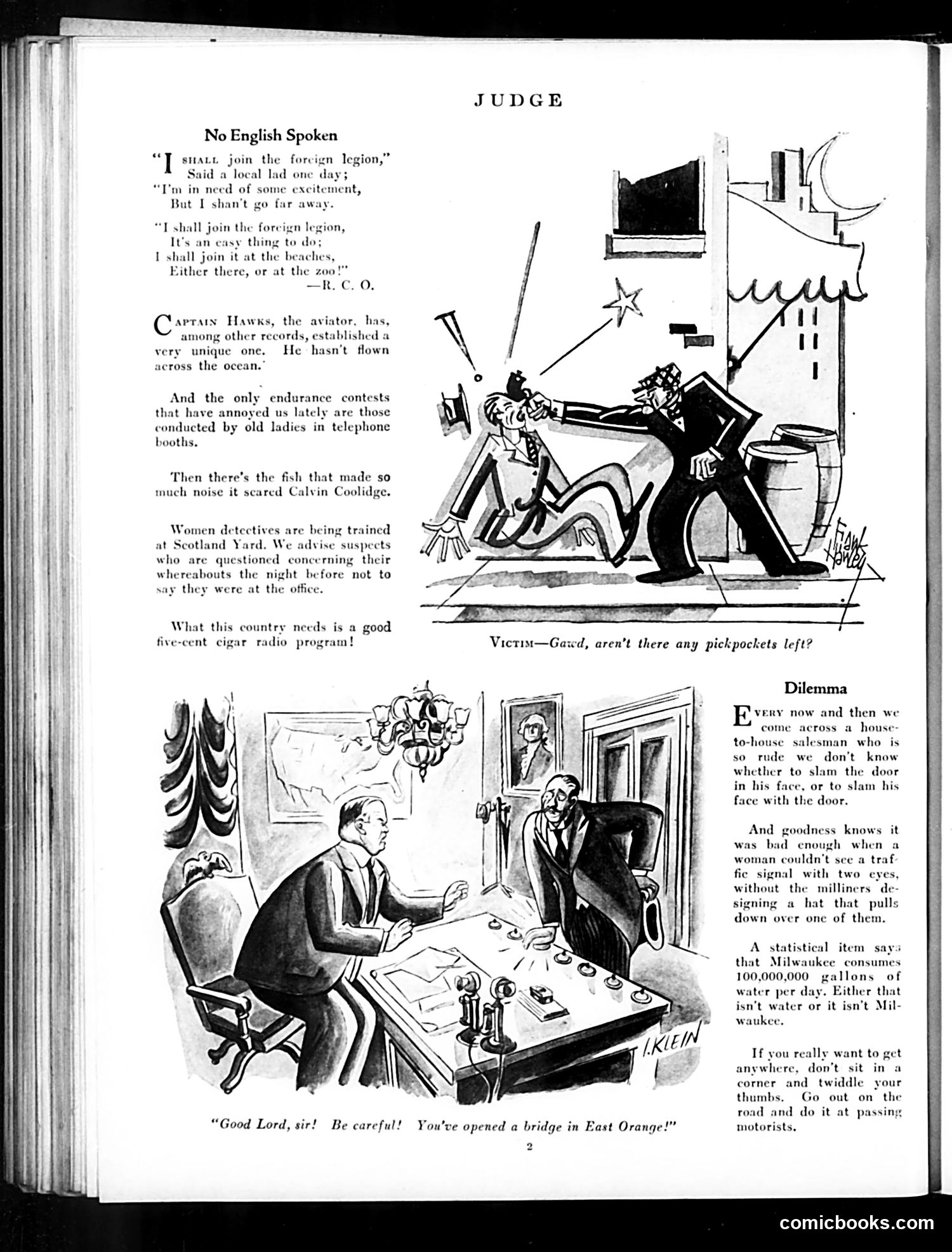
Analysis of Judge Magazine Page This page contains three separate satirical pieces: 1. "No English Spoken": A poem mocking young men's desire for excitement, referencing the Foreign Legion as an adventure fantasy. 2. Top cartoon: Shows a chaotic street scene where a disheveled man confronts a well-dressed gentleman, asking about pickpockets. The satire targets petty crime and urban disorder. 3. Bottom cartoon titled "Dilemma": A house-to-house salesman awkwardly confronts a homeowner at his door. The accompanying text humorously discusses the etiquette problem of whether to slam the door in a salesman's face—satirizing the nuisance of aggressive door-to-door sales, a common 1920s-era complaint. The page's miscellaneous items mock contemporary annoyances: water consumption statistics about Milwaukee, and advice about reckless motorists.
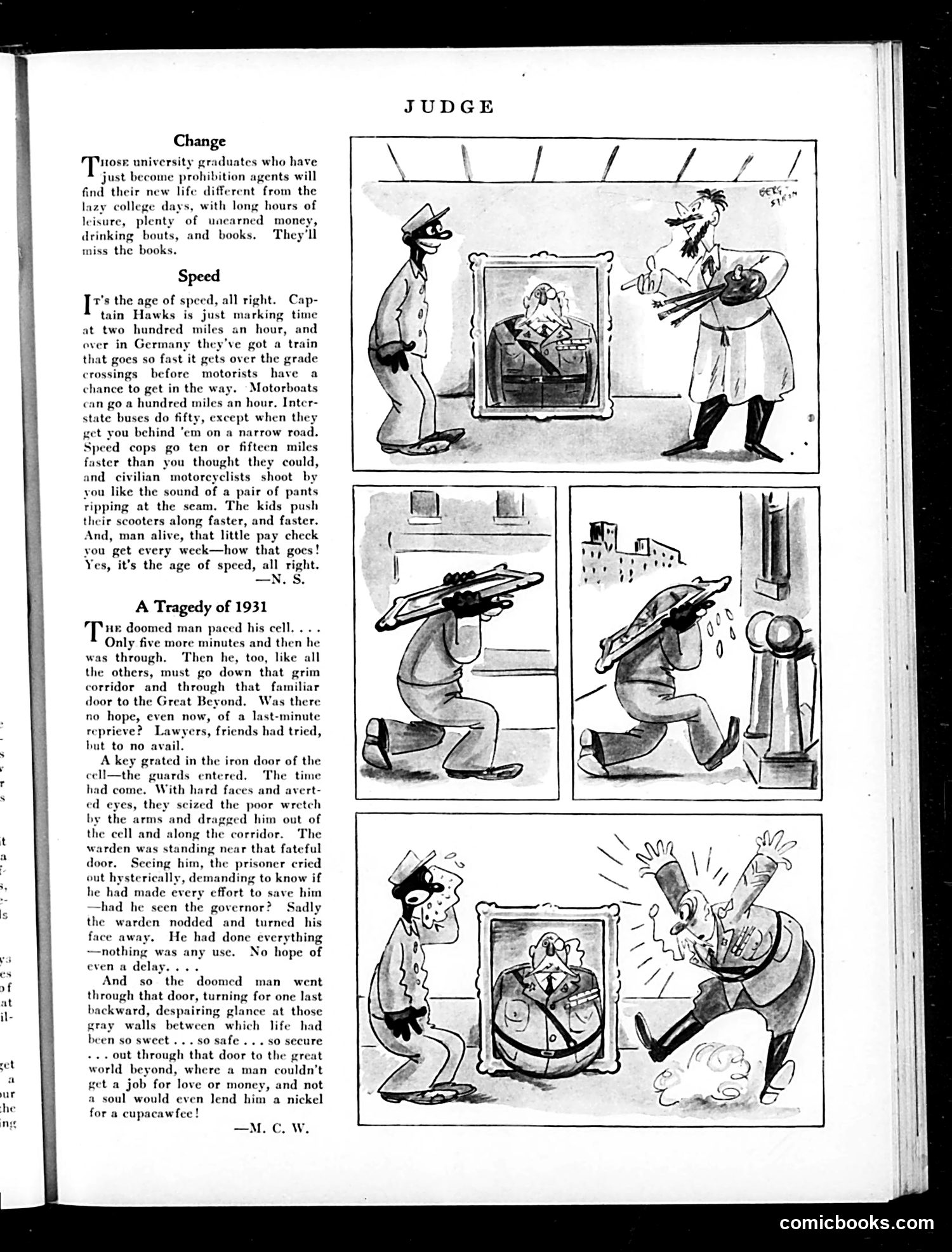
Judge Magazine Page Analysis This page contains three distinct satirical pieces: "Change" mocks newly-appointed prohibition agents, suggesting they'll miss the leisure of college life. "Speed" critiques dangerous driving trends of the era. It references Captain Hawks setting speed records in Germany and complains about motorists driving recklessly at 100+ mph on American highways. The satire highlights how speed competitions inspired civilian drivers to drive dangerously, killing pedestrians and children. "A Tragedy of 1931" is a darker comic strip depicting an execution. It shows a condemned prisoner's final moments—dragged from his cell, greeted by the warden, and ultimately executed—ending with commentary on the prisoner's despair about finding employment or money, suggesting economic hardship (likely referencing the Great Depression) drove him to crime.
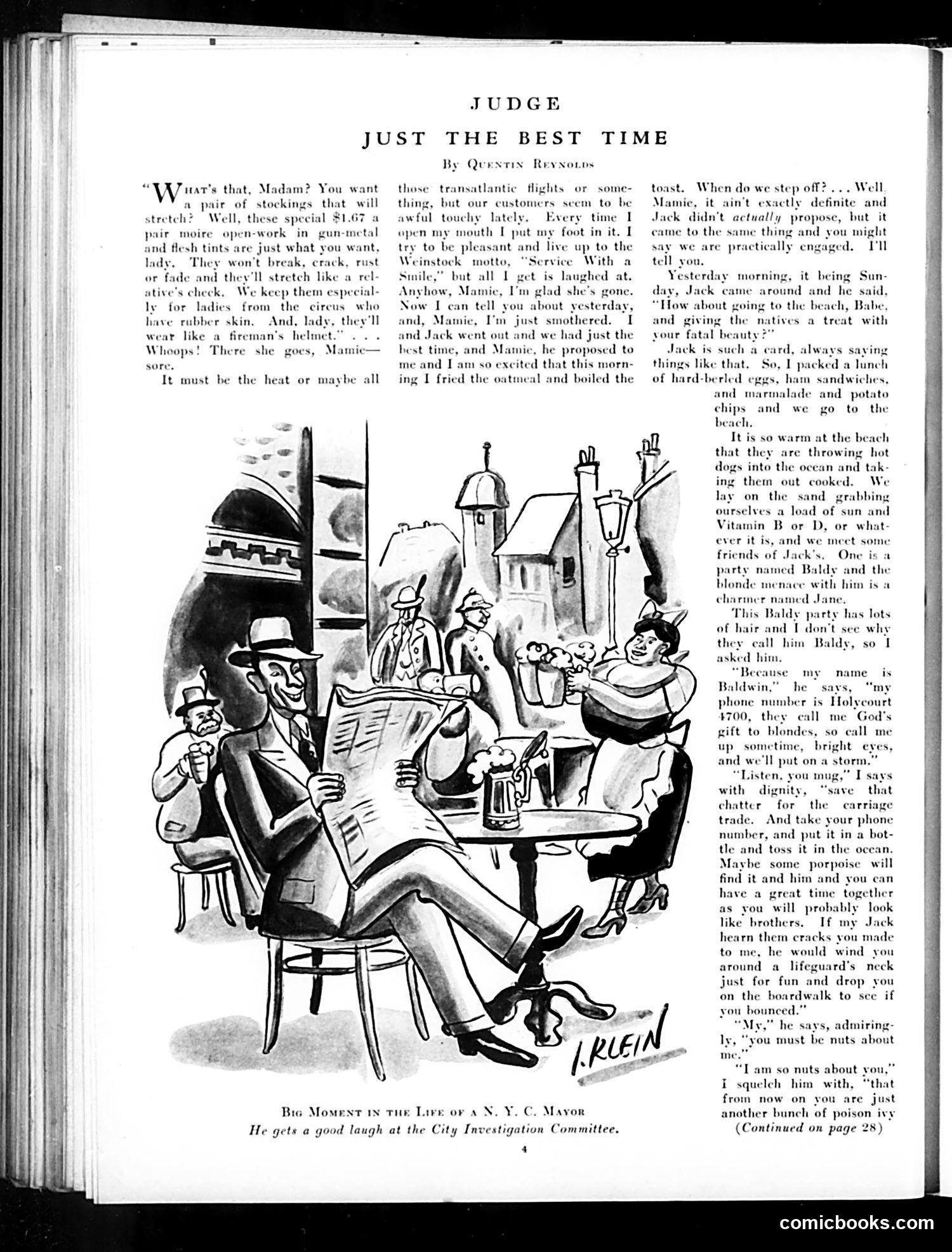
"Judge: Just the Best Time" This page features a humorous story about a NYC mayor's casual beach outing. The illustration shows a well-dressed man lounging at the beach with companions, labeled "Big Moment in the Life of a N.Y.C. Mayor—He gets a good laugh at the City Investigation Committee." The satire targets the mayor's apparent indifference to civic duties. While he relaxes at the beach eating hot dogs and socializing, the City Investigation Committee—presumably investigating municipal corruption or mismanagement—continues its work. The joke suggests the mayor treats serious governance with levity, prioritizing leisure and socializing with friends (including someone named Baldy) over addressing the committee's concerns. The cartoon mocks official negligence and the casual attitude of public servants toward accountability.
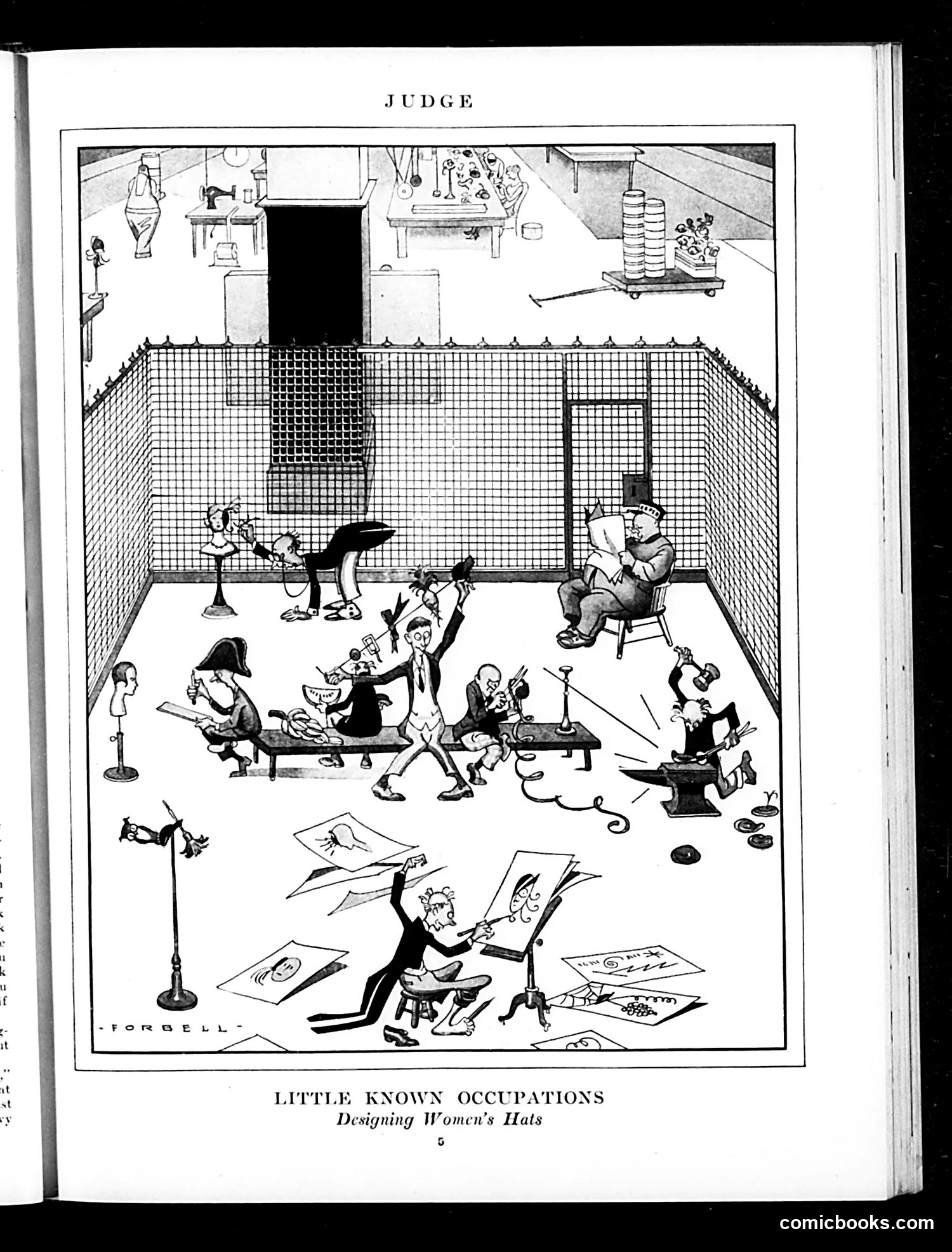
Analysis This Judge magazine cartoon satirizes the profession of women's hat design. The image depicts a chaotic workshop where designers work frantically on women's hats, surrounded by sketches, materials, and design tools. The satire targets the seemingly absurd nature of hat fashions—the elaborate, impractical creations women were expected to wear. The frenetic activity and exaggerated poses suggest designers treated hat-making as serious, intense work despite the frivolous end product. The scattered sketches and frantic energy mock both the fashion industry's pretensions and women's supposed obsession with elaborate headwear. This reflects early 20th-century skepticism toward women's fashion trends, portraying hat design as comically overwrought labor producing unnecessary luxury items—a common satirical target of the era.
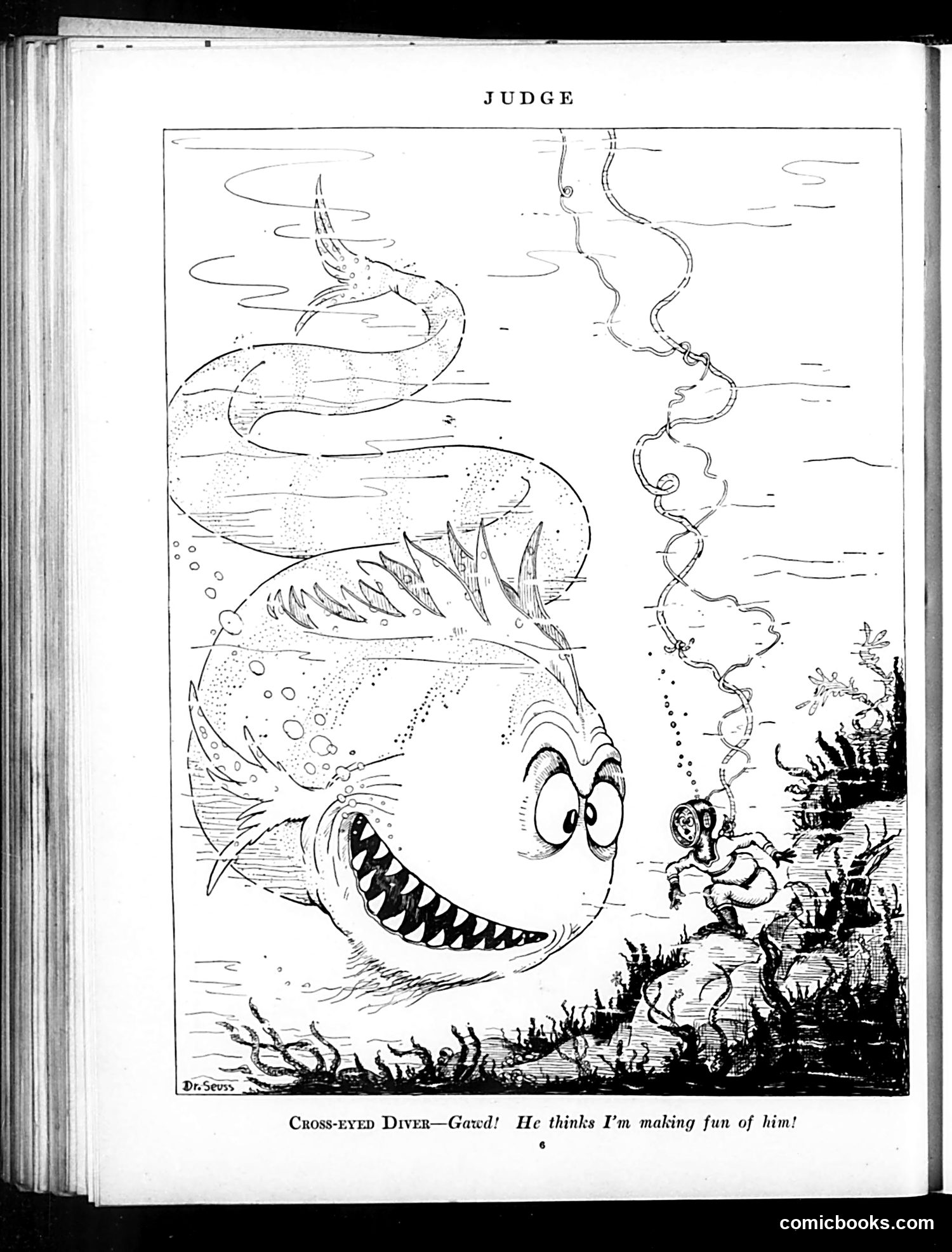
Political Cartoon Analysis: "Cross-eyed Diver" This Dr. Seuss illustration depicts an underwater scene with a grotesque, menacing fish confronting a small human diver. The fish has an exaggerated grin with prominent teeth, cross-eyes, and a serpentine body—characteristic of Seuss's surreal style. The caption reads: "CROSS-EYED DIVER—Gawl! He thinks I'm making fun of him!" The joke appears to rely on the absurdity of the situation: the fish's paranoid interpretation of the diver's presence. The "cross-eyed" detail suggests the fish misperceives the diver's intentions. This is likely satirizing paranoia, misunderstanding, or perhaps a contemporary political figure or situation where someone interprets neutral actions as mockery or offense—though the specific reference is unclear without additional context from Judge magazine's publication date.
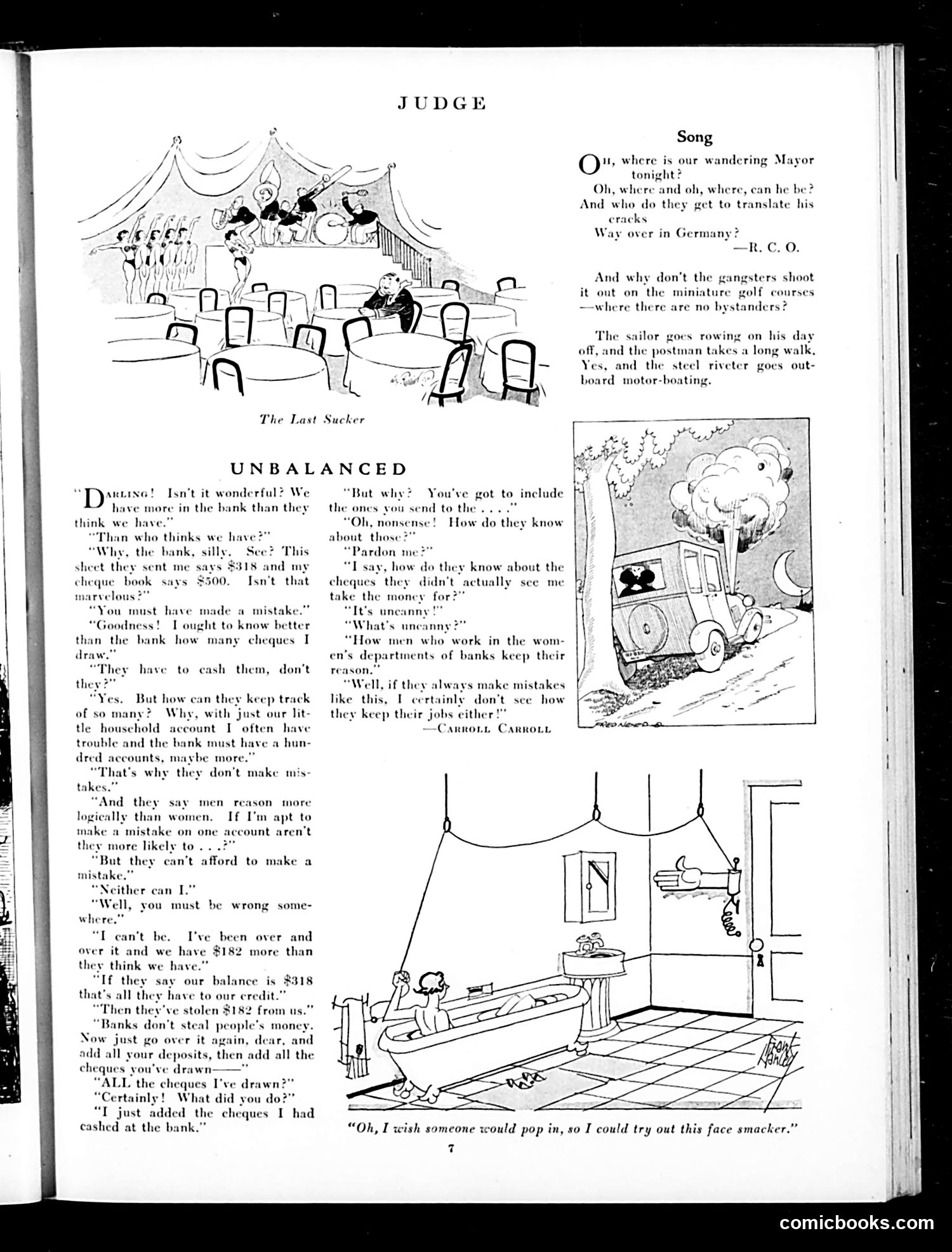
Explanation of Judge Page Content "Unbalanced" satirizes gender stereotypes about logic and financial competence. A woman discovers her bank account shows $182 more than the bank's records, but when her husband instructs her to recount, she realizes she only tallied checks she *cashed*, not all checks written. Rather than admitting error, she questions the bank's competence—suggesting women are illogical with money. The irony is deliberate: the joke proves the opposite of its premise, showing her reasoning failure while she claims men think *more* logically. "The Last Sucker" appears to mock a nightclub or entertainment venue patron surrounded by diners. The "Song" humorously questions where the Mayor is nightly and jokes about gangsters shooting on a miniature golf course instead of real locations. The bottom cartoon depicts someone in an unusual suspended contraption, captioning their desire to test a "face smasher"—likely absurdist humor about an impractical device. All reflect 1920s-era Judge humor: domestic comedy, urban observations, and physical slapstick.
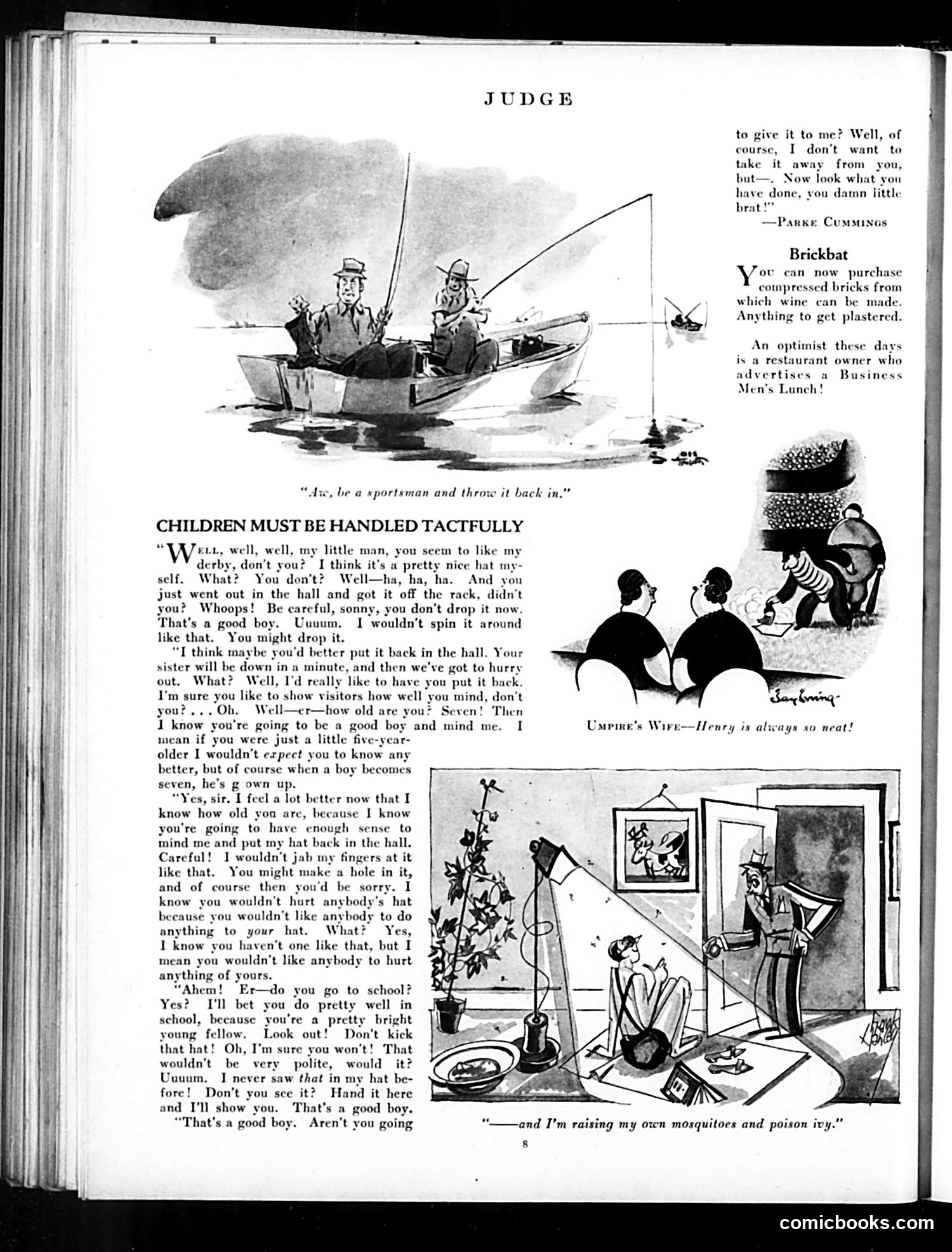
Judge Magazine Page Analysis This page contains two satirical pieces reflecting early-20th-century American concerns: "Children Must Be Handled Tactfully" presents an adult's exhausting attempt to manipulate a child into returning a stolen derby hat through excessive flattery and psychological appeals. The satire mocks adults who employ complicated reasoning and false praise rather than simple discipline—suggesting modern parenting overcomplicated "psychology" was already seen as ridiculous. The "Brickbat" section includes three brief jokes: - A reference to Prohibition-era ingenuity (making wine from compressed bricks to get "plastered") - Commentary on Depression-era optimism (restaurant owners advertising business lunches despite economic hardship) - A cartoon captioned "and I'm raising my own mosquitoes and poison ivy," satirizing someone's misguided attempts at self-sufficiency or complaint-making The fishing cartoon at top appears to satirize sportsmanship or fair play principles. Overall, the page ridicules pretentious parenting methods, Prohibition-era desperation, and false optimism during economic hardship.
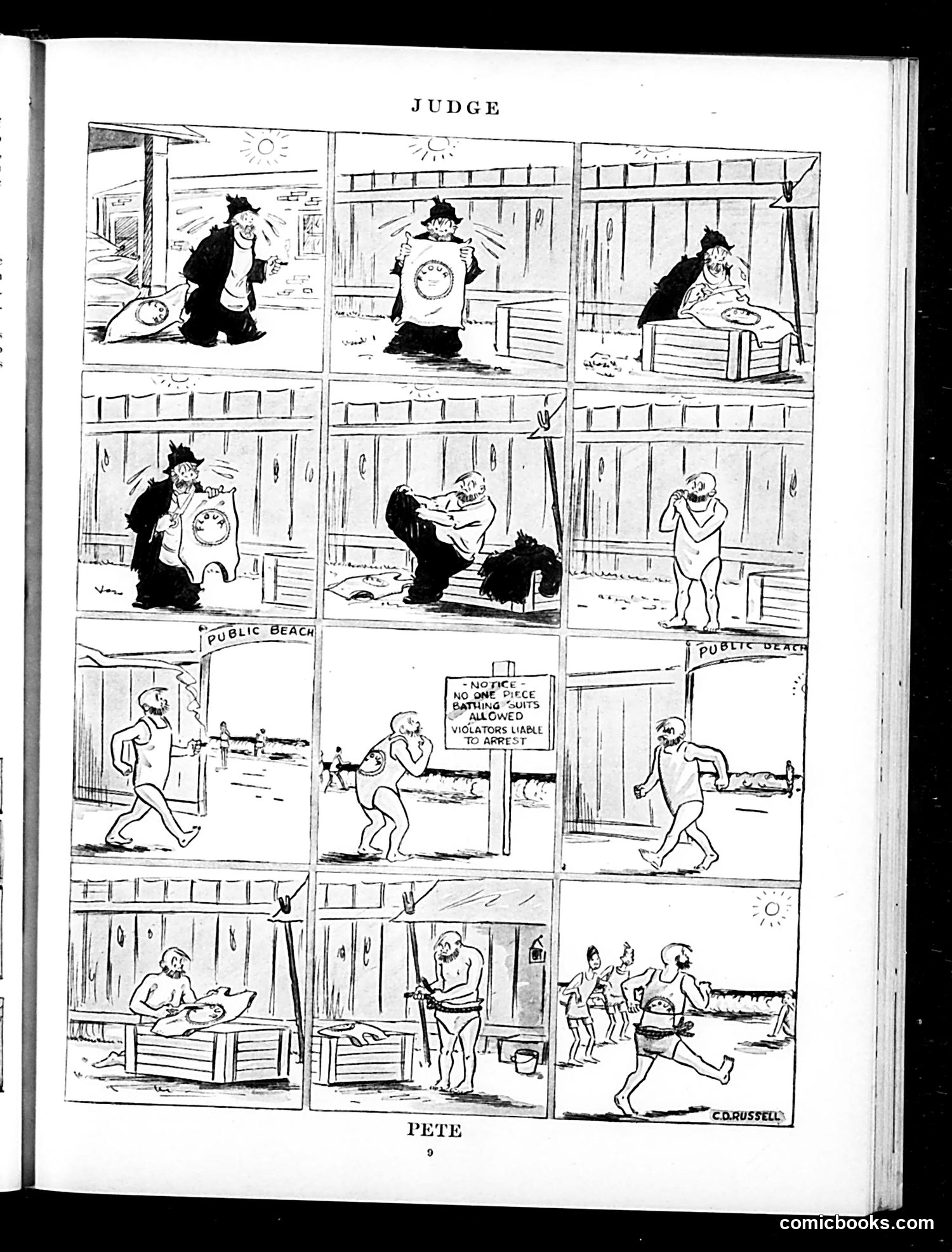
"Judge" Comic: "Judge" and "Pete" at the Beach This two-part satirical comic contrasts a stern authority figure ("Judge") enforcing bathing suit regulations with an ordinary man ("Pete") enjoying beach freedom. The top panels show a judgmental official inspecting beachgoers' swimming attire, appearing scandalized by exposure. The sign reads "No one piece bathing suits allowed—violators liable to arrest," establishing absurd authority. The bottom panels depict "Pete" happily swimming and playing at the beach without concern for such rules. The satire targets rigid social enforcement of modesty standards and government overreach in regulating private behavior. The contrast between the uptight "Judge" and carefree "Pete" mocks Puritanical attitudes toward the human body, suggesting such prudish regulations are ridiculous and unenforceable. This likely reflects early-to-mid 20th century debates over beach attire and bodily freedom.
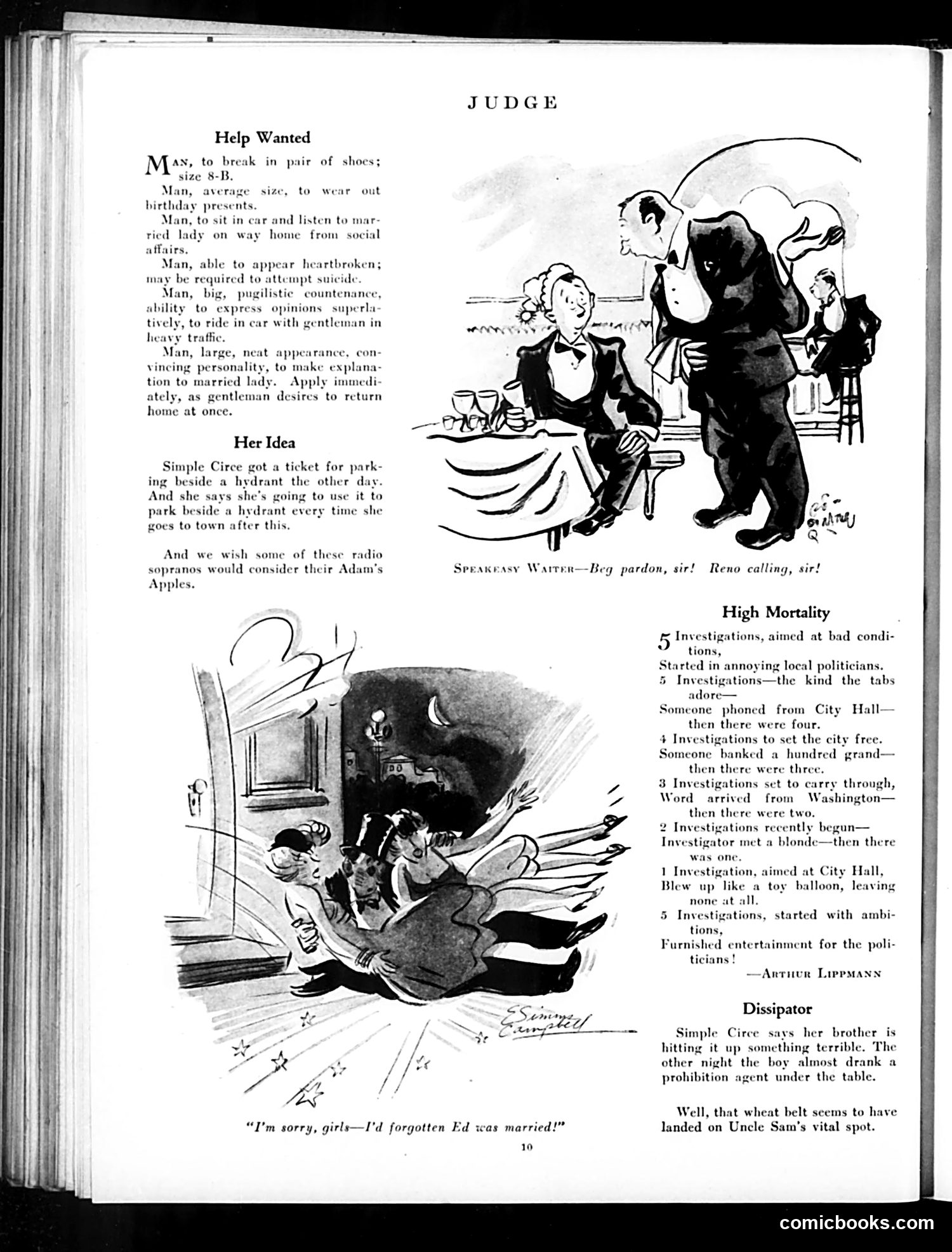
Judge Magazine Page Analysis This page contains satirical humor typical of Judge's 1920s-era content: "Help Wanted" mocks relationship dynamics of the era—listing absurd job requirements for men to serve women's romantic needs, including breaking in shoes, appearing heartbroken, even attempting suicide. The satire targets both gender relations and the frivolous demands placed on suitors. "Her Idea" jokes about a woman (Circe, a classical seductress reference) who received a parking ticket and now intentionally parks illegally repeatedly—satirizing petty rule-breaking and spite. "High Mortality" by Arthur Lippmann uses dark humor about government investigations into corruption. Each investigation spawns scandals that reduce subsequent ones—one investigator was distracted by "a blonde," another investigation "left none at all." The satire mocks the cyclical, ineffectual nature of corruption probes in city/federal politics. "Speakeasy Waiter" and "Dissipator" reference Prohibition-era bootlegging and drinking culture—the waiter deflects suspicion; a man drinks a prohibition agent "under the table." The cartoons satirize 1920s social issues: gender relations, government corruption, and Prohibition enforcement.
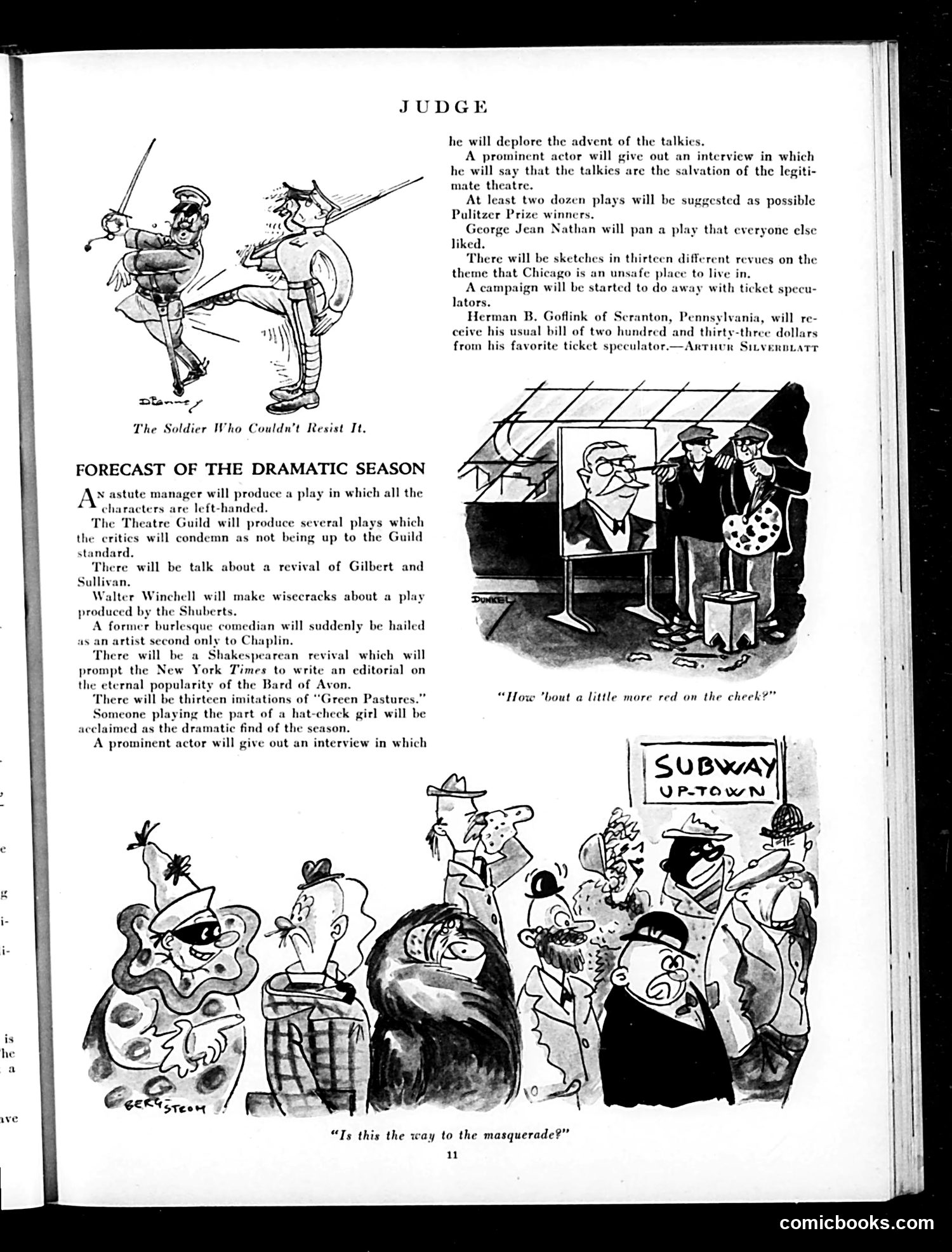
Judge Magazine Page Analysis This is a satirical "forecast" of the upcoming Broadway theatrical season, likely from the late 1920s (references to "talkies" suggest the transition to sound films). The text mockingly predicts recurring theater-world patterns: critics will condemn Theatre Guild productions, there will be multiple Pulitzer Prize contenders, George Jean Nathan (a famous theater critic) will pan a popular play, and thirteen revues will all satirize Chicago as unsafe. It also jokes about ticket speculators—Herman B. Goflink from Pennsylvania will predictably pay his speculator $233, as he does every season. The cartoons below illustrate theater-goers: one shows theatergoers applying makeup ("How 'bout a little more red on the cheek?") and another depicts subway passengers confused about directions to a masquerade, suggesting the chaotic theater district experience. The satire targets predictable Broadway cycles, critic pretension, and theater's persistent social problems—none of which appear to have changed much.
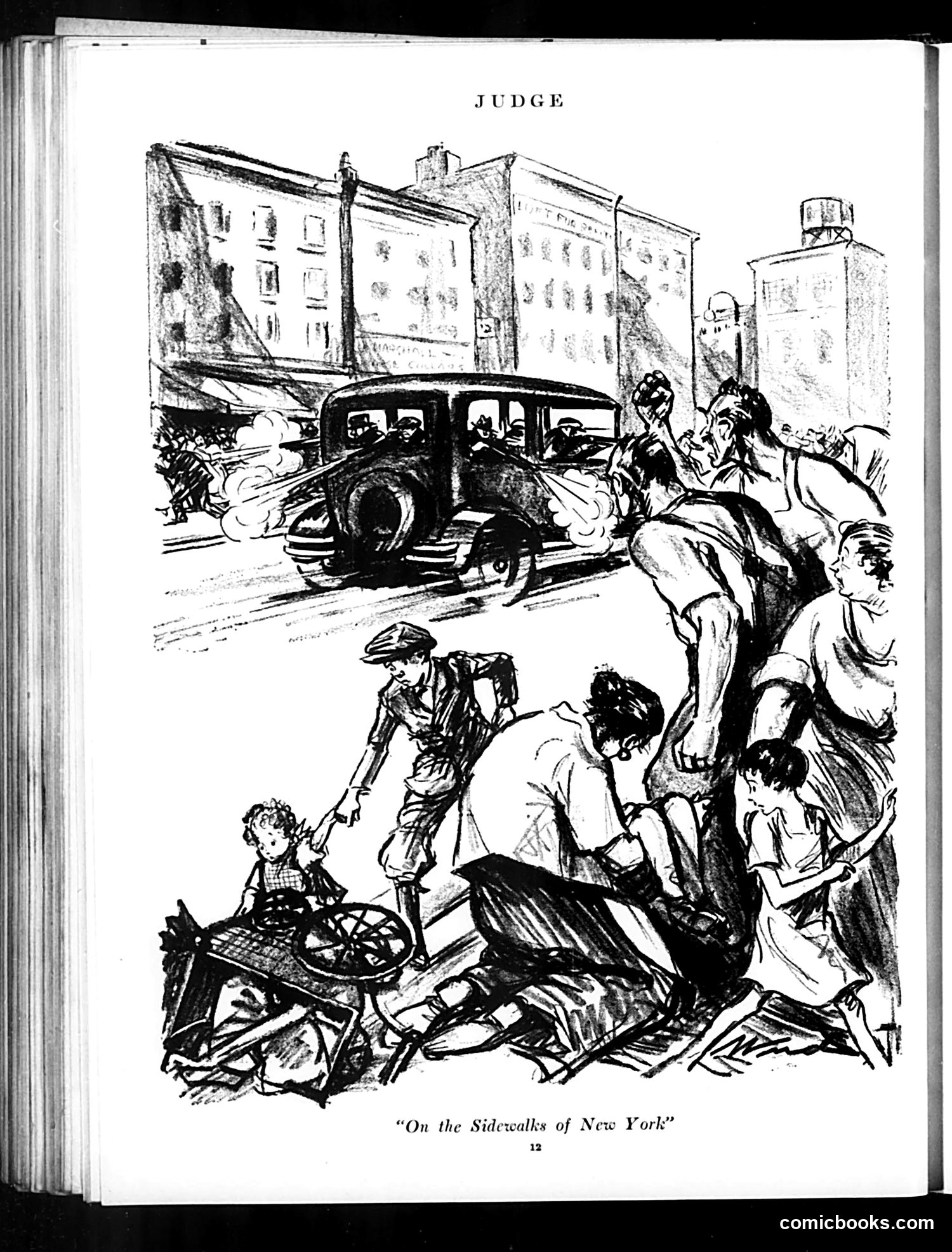
Analysis of "Judge" Page: "On the Sidewalks of New York" This satirical cartoon depicts urban street chaos in New York City. The scene shows a crowded sidewalk where a car has struck or narrowly missed pedestrians, including children and adults. A woman appears injured or in distress on the ground, while bystanders react with alarm. The satire likely critiques the dangerous conditions created by automobile traffic in crowded urban areas—a growing concern in early 20th-century American cities. The juxtaposition of vulnerable pedestrians (women, children) against the powerful motorcar suggests social commentary about modern technology's threat to public safety and traditional street life. The title emphasizes this is happening on New York's own sidewalks, making the danger immediate and relatable to contemporary readers concerned about automotive hazards in their own cities.
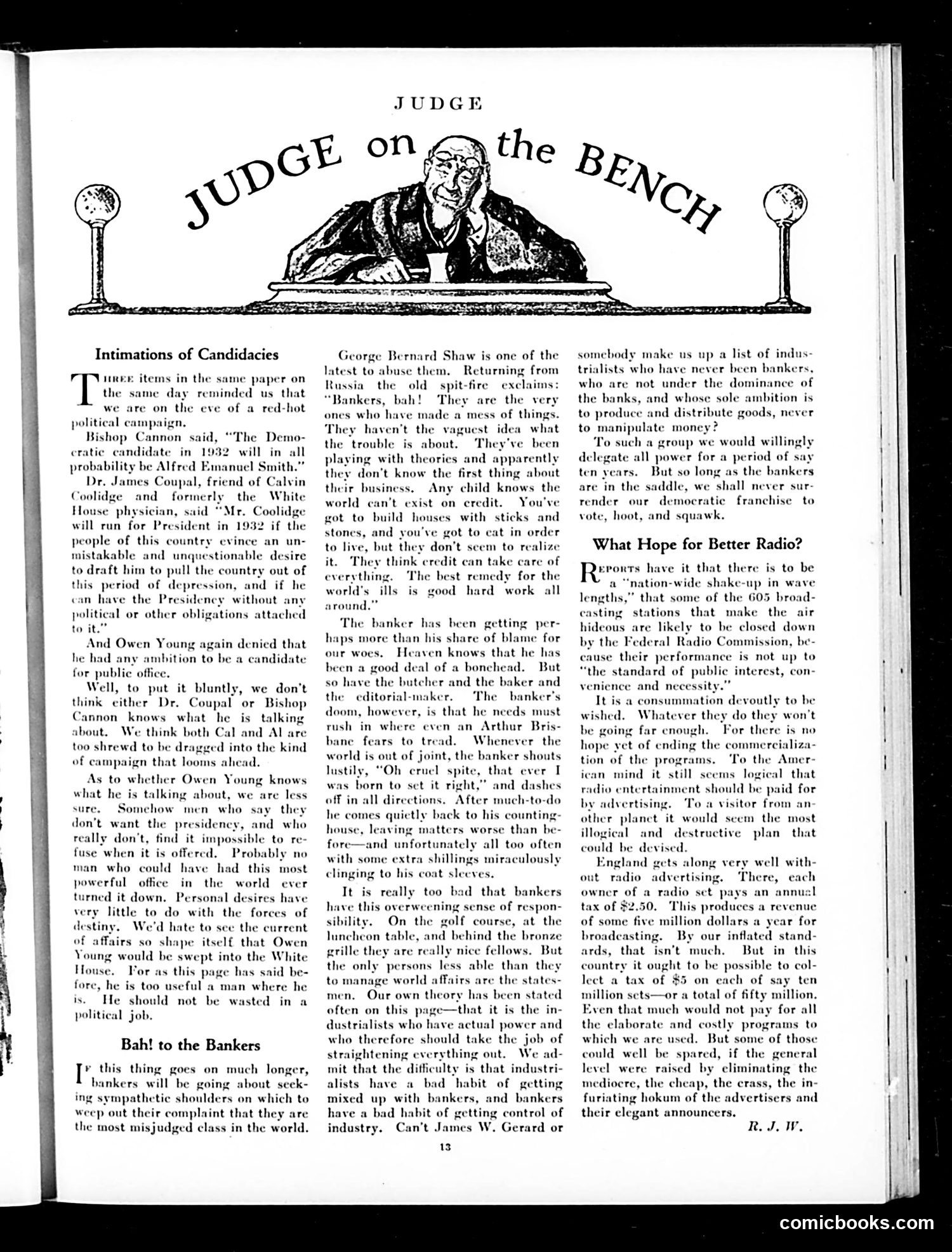
Judge Magazine: Political Commentary on the 1932 Election This page from Judge satirizes American political and economic leadership during the Depression era (circa 1932). Political Section: The top articles mock candidates hinting at presidential runs—Alfred Emanuel Smith (Democratic), Calvin Coolidge, and Owen Young. Judge dismisses their coy denials as transparent posturing, suggesting ambitious politicians inevitably accept nominations despite claiming reluctance. "Bah! to the Bankers": The main satire attacks bankers' self-pity and overreach. Referencing George Bernard Shaw's recent criticism of bankers, Judge argues bankers bear responsibility for Depression-era economic collapse but lack understanding of real production (houses, food). The piece ridicules bankers' tendency to meddle in world affairs despite their incompetence, noting they're "less able" managers than industrialists. The irony: bankers and industrialists are so entangled that neither can solve problems without the other. The cartoon header shows a judge figure—representing moral authority—surveying these follies. The satire reflects 1930s frustration with financial elites' role in economic disaster.
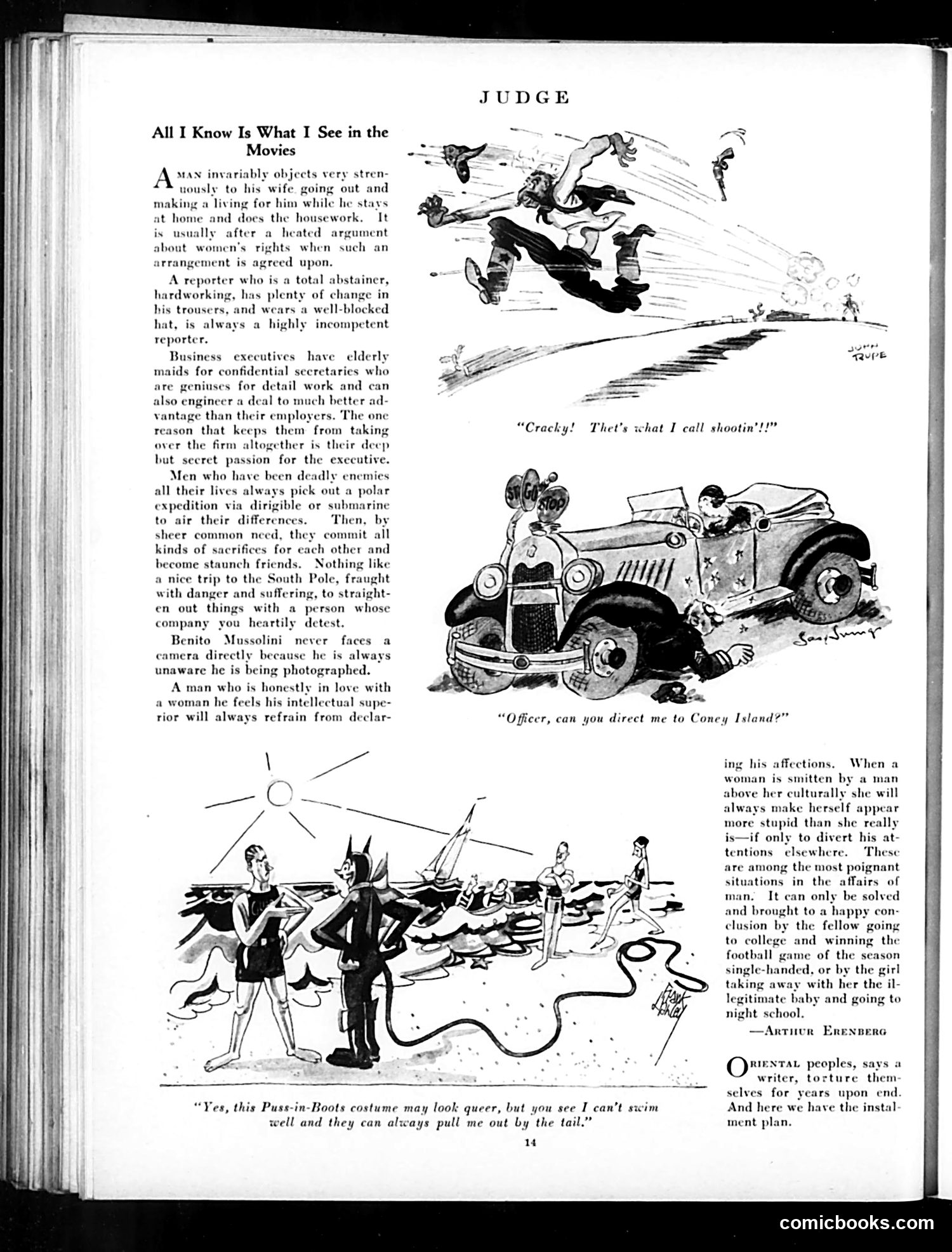
Judge Magazine Satire Analysis This page satirizes Hollywood movie tropes and their absurd logic. The article lists ridiculous cinematic conventions presented as fact: men object to wives working; incompetent reporters are always teetotalers; elderly secretaries run companies; enemies become friends after polar expeditions; Mussolini avoids cameras; intellectually mismatched couples play stupid games. The cartoons illustrate these conventions literally—one shows slapstick car chaos ("Cracky! That's what I call shootin'!!"), another depicts a man in Puss-in-Boots costume relying on his tail for rescue because he can't swim. The humor lies in exposing how movies present ridiculous, illogical situations as normal human behavior. The Mussolini reference suggests this predates his dictatorship or mocks propaganda. Overall, Judge ridicules cinema's lazy storytelling and disconnect from reality.
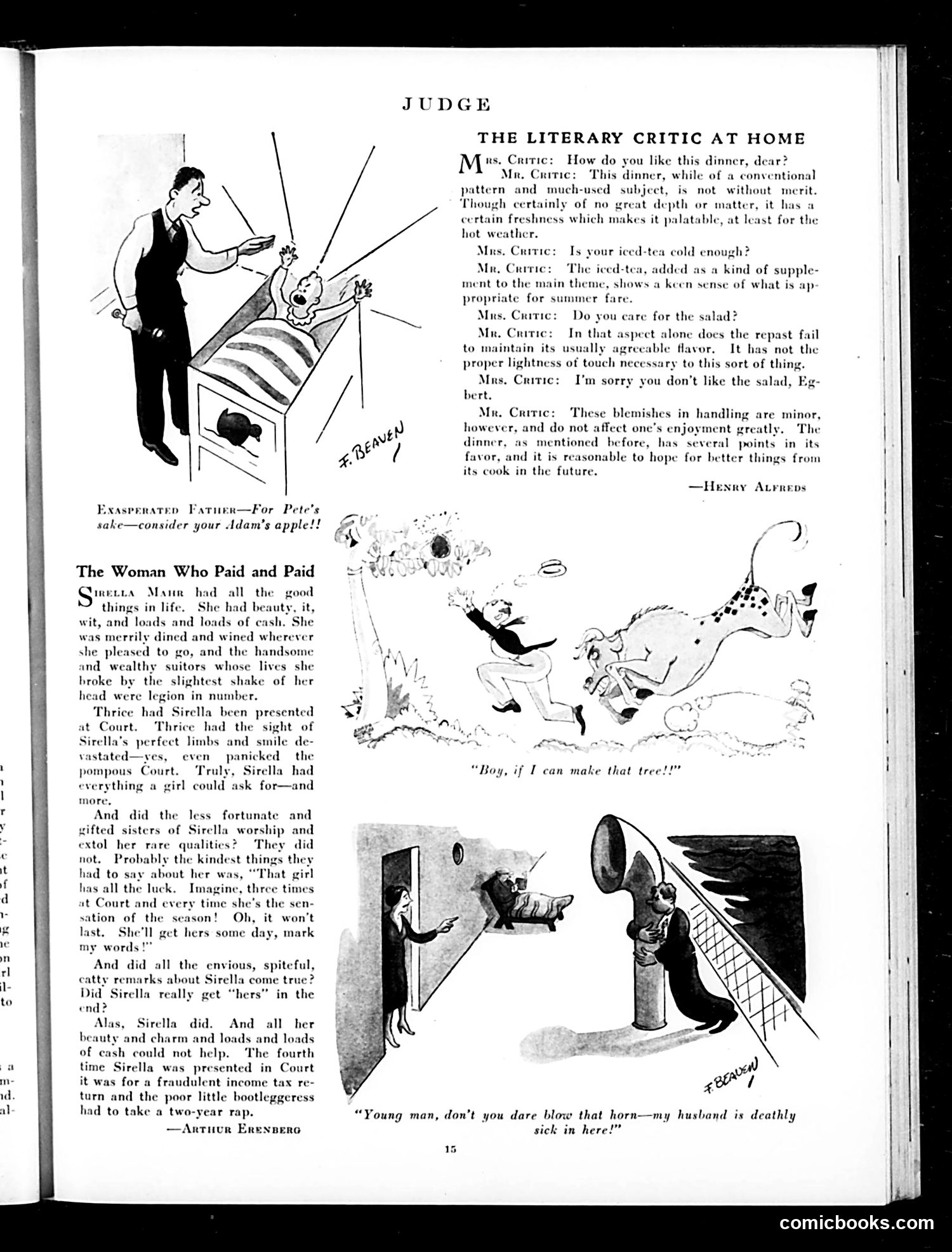
Analysis for Modern Readers "The Literary Critic at Home" satirizes pretentious intellectuals who over-analyze everything. A husband applies literary criticism jargon to ordinary dinner—praising the meal's "freshness" and "palatable" qualities while critiquing the salad's lack of "proper lightness of touch." The joke is that he's pompously reviewing his *wife's cooking* as if it were a novel, reducing genuine domestic effort to aesthetic theory. This mocks intellectuals who cannot simply enjoy simple pleasures without elaborate critical frameworks. "The Woman Who Paid and Paid" tells a darker story about a beautiful, wealthy woman named Sirella who faces envious gossip from less-fortunate women. Despite her charm and success (presented at Court three times), her luck doesn't last. She ultimately faces arrest for tax fraud related to bootlegging—a reference to Prohibition-era illegal alcohol manufacturing. The final irony: all her beauty and money couldn't protect her from legal consequences. The accompanying cartoons illustrate absurd mishaps, emphasizing how circumstances can humiliate even the privileged.
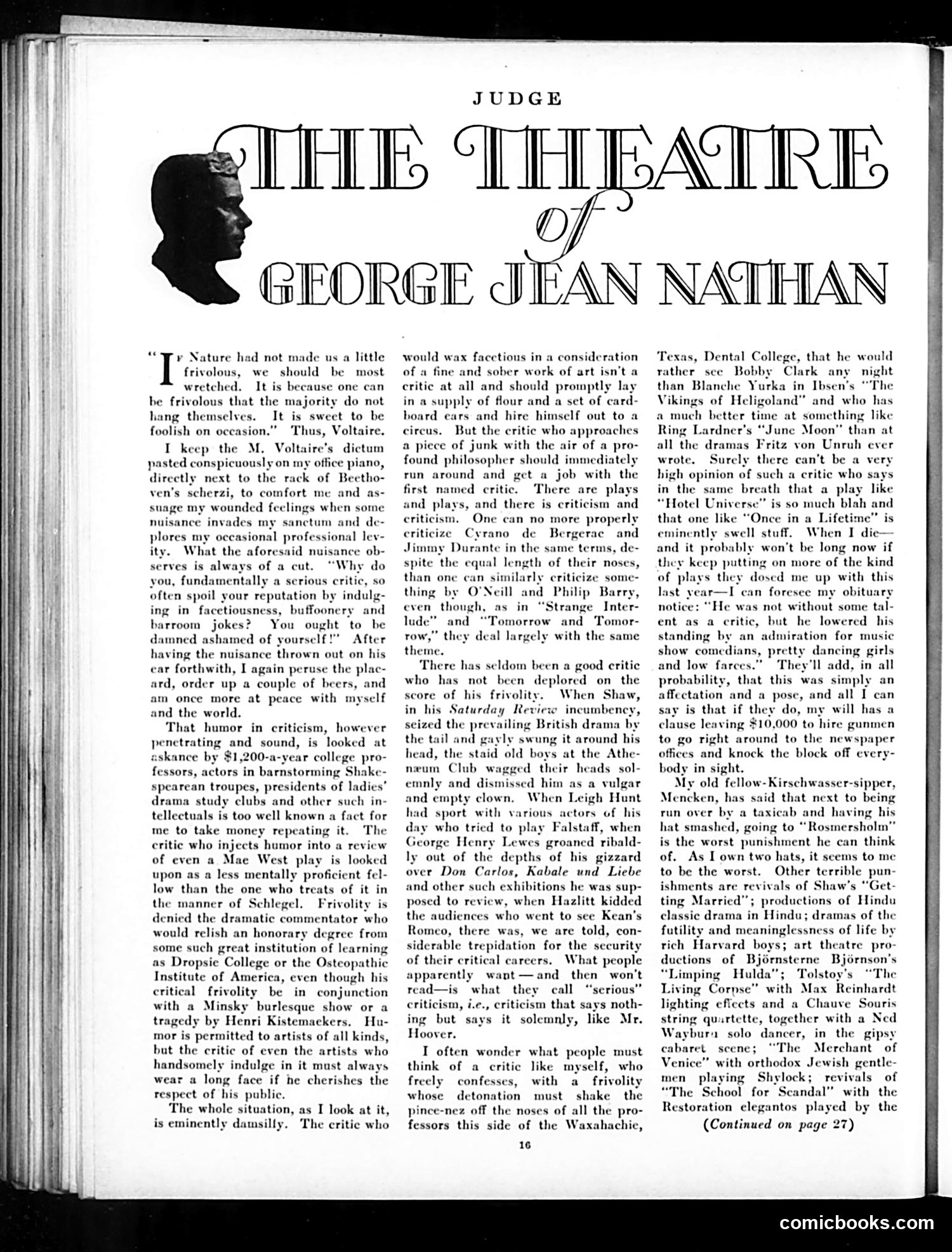
"The Theatre of George Jean Nathan" This is a critical essay by Judge magazine's theater critic George Jean Nathan defending the use of humor and frivolity in dramatic criticism. Nathan argues that serious critics are wrongly dismissed for injecting wit into reviews, citing historical examples like George Bernard Shaw and William Hazard Lewes who faced professional disapproval for their playful approaches. He contends that different theatrical works—serious drama versus vaudeville or burlesque—warrant different critical tones, and that humorless "solemn" criticism (he sarcastically references Mr. Hoover) is actually intellectually lazy. The essay mocks academic pretension: college professors and drama study clubs who demand dry analysis to appear scholarly. Nathan's core point: frivolity in criticism isn't lowbrow—it's honest evaluation matching the subject matter's tone.
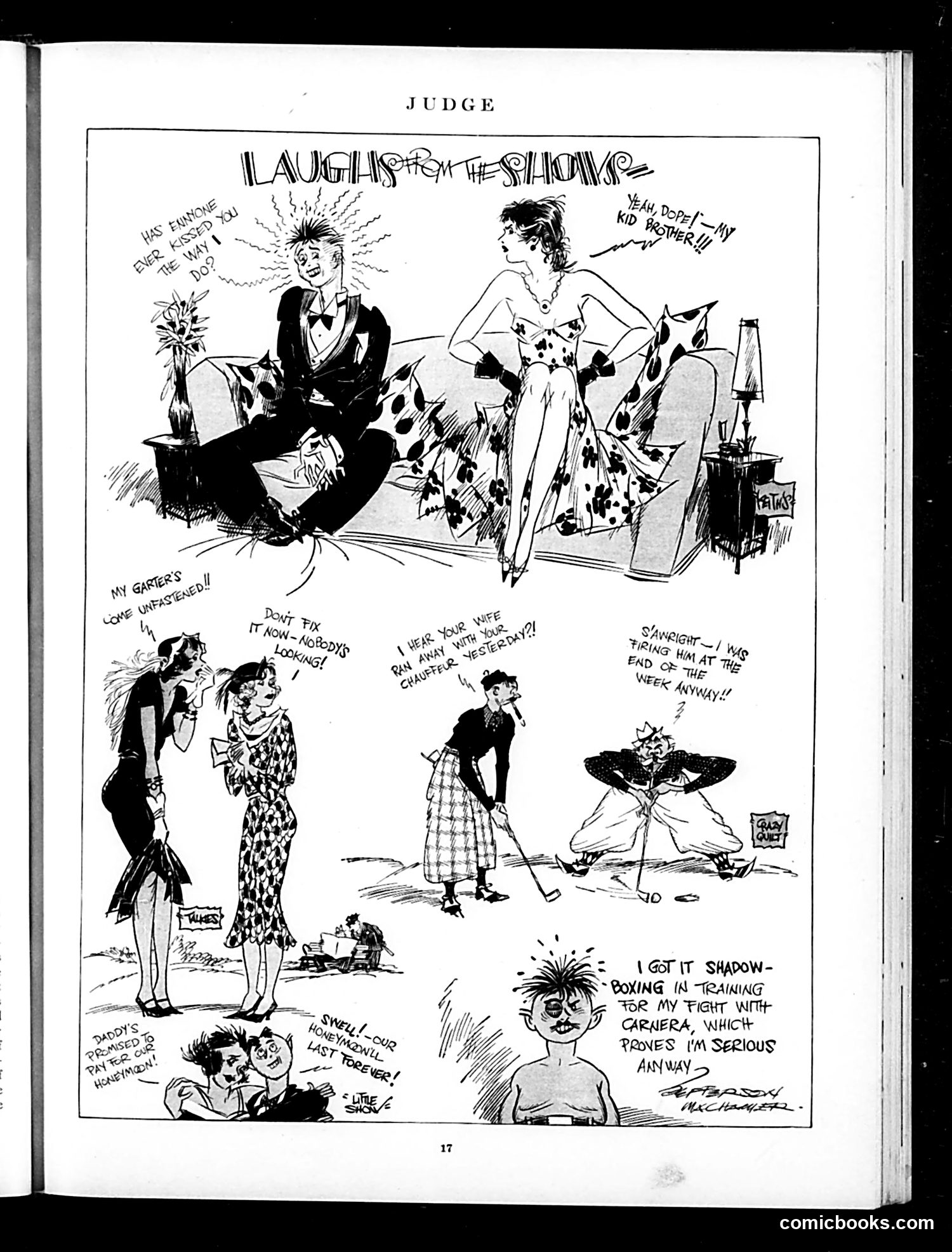
This page from *Judge* magazine features a multi-panel comic titled "Laughs at the Shops" satirizing domestic life and marital disputes. The cartoons depict various couple conflicts: a husband praising flowers he's given (top), wives complaining about unfaithful husbands and neglect, a woman golfing while her husband objects, and a man shadow-boxing while referencing training for a fight with "Carnera" (likely boxer Primo Carnera, a 1930s heavyweight). The satire targets typical marriage frustrations—infidelity, financial irresponsibility, neglected housework, and husbands' obsessive sports interests—through exaggerated scenarios. The humor relies on recognizable domestic tension and contemporary boxing celebrity references that would resonate with *Judge*'s middle-class readership.
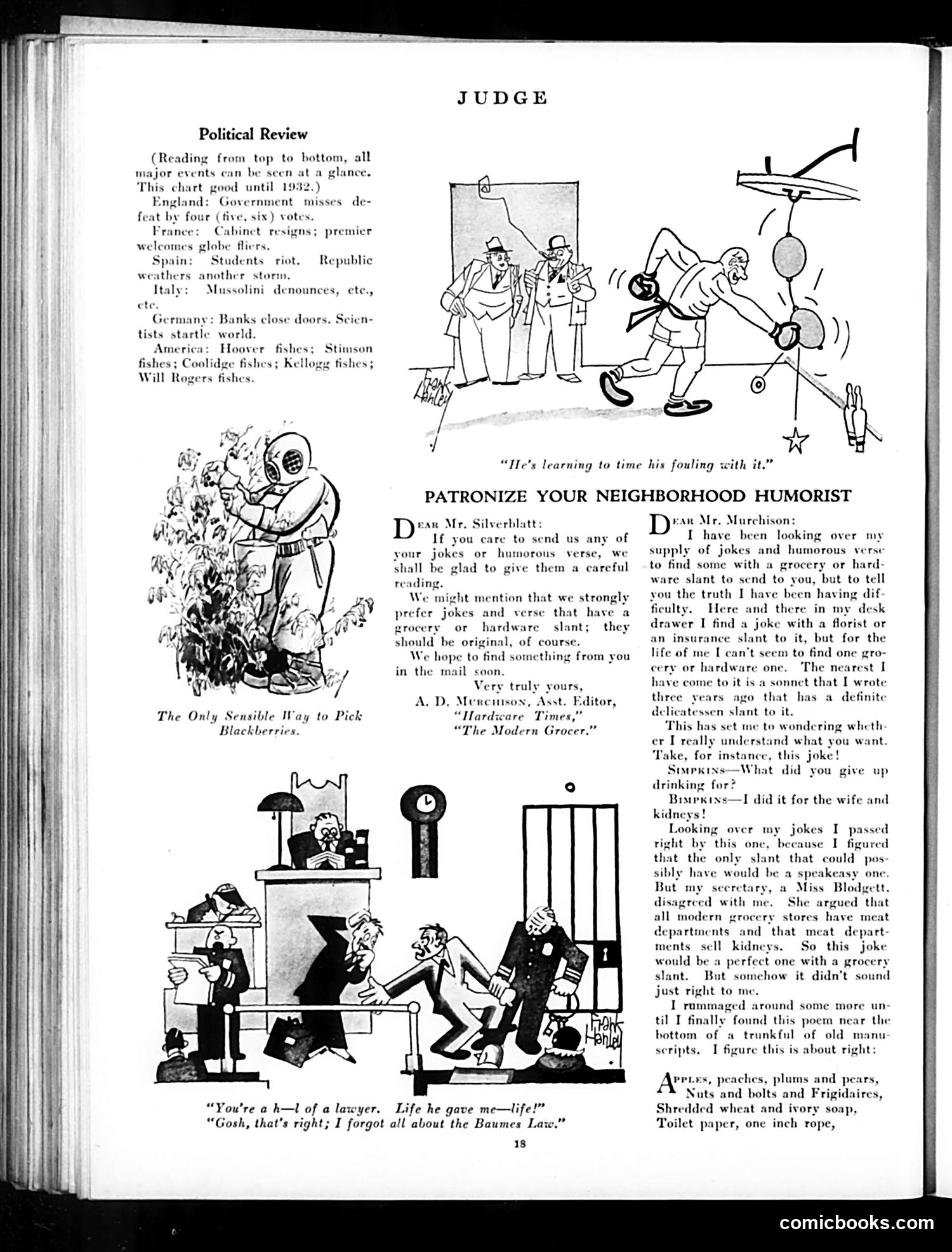
Political Satire and Editorial Humor from Judge Magazine This page satirizes early 1930s politics and editorial practices. The "Political Review" chart mocks world leaders during economic crisis: England's government instability, France's cabinet turmoil, Spain's unrest, Italy's Mussolini, Germany's banking collapse, and America's leadership doing nothing ("fishes"). The joke implies these leaders are idle during serious times. The "Patronize Your Neighborhood Humorist" section is meta-satire about Judge magazine itself, showing editors requesting jokes with "grocery or hardware slants"—absurdly specific commercial angles. The cartoons mock this editorial desperation and a struggling humorist's frustration finding appropriate material. The Baumes Law reference (likely regarding criminal sentencing) appears in a lawyer cartoon, suggesting the legal system's complexity. Overall, the page satirizes both incompetent governance and commercialized humor-writing during economic hardship.
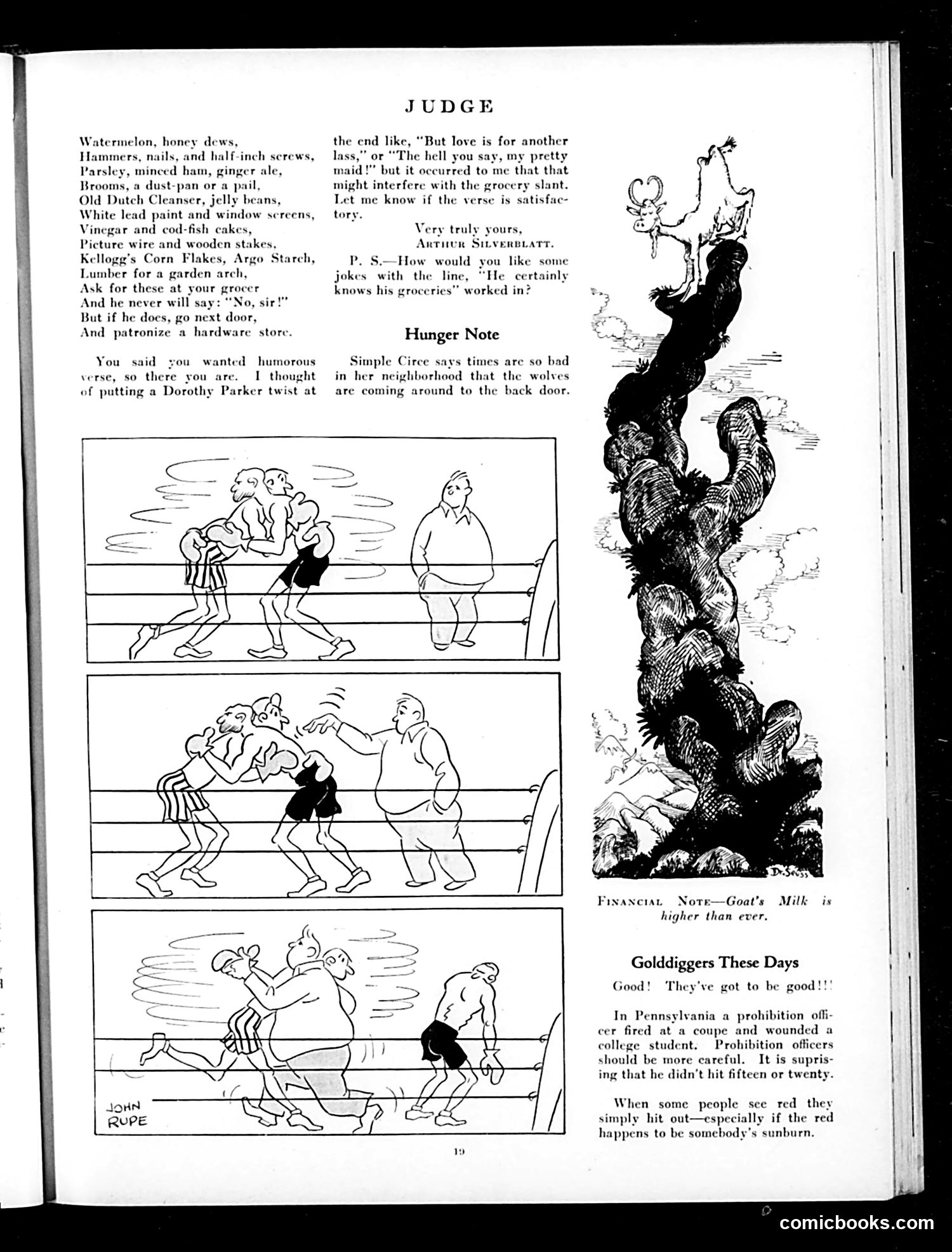
Understanding This Judge Magazine Page This page contains satirical content from Judge, an early 20th-century American humor magazine. The main cartoon by John Rupe depicts a boxing match with increasingly chaotic action across three panels—likely mocking either a specific prize fight or the general spectacle of boxing matches. The surrounding text consists of humorous editorial notes and reader correspondence. A grocery-themed poem jokes about consumer goods and merchant reliability. The "Hunger Note" sardonically references economic hardship ("wolves at the back door"). The "Golddiggers These Days" section mocks prohibition enforcement, sarcastically suggesting a Pennsylvania officer should have aimed better—a pointed jab at both prohibition's unpopularity and police incompetence during that era. The final quip about people "seeing red" and hitting out plays on the colloquial expression for anger.
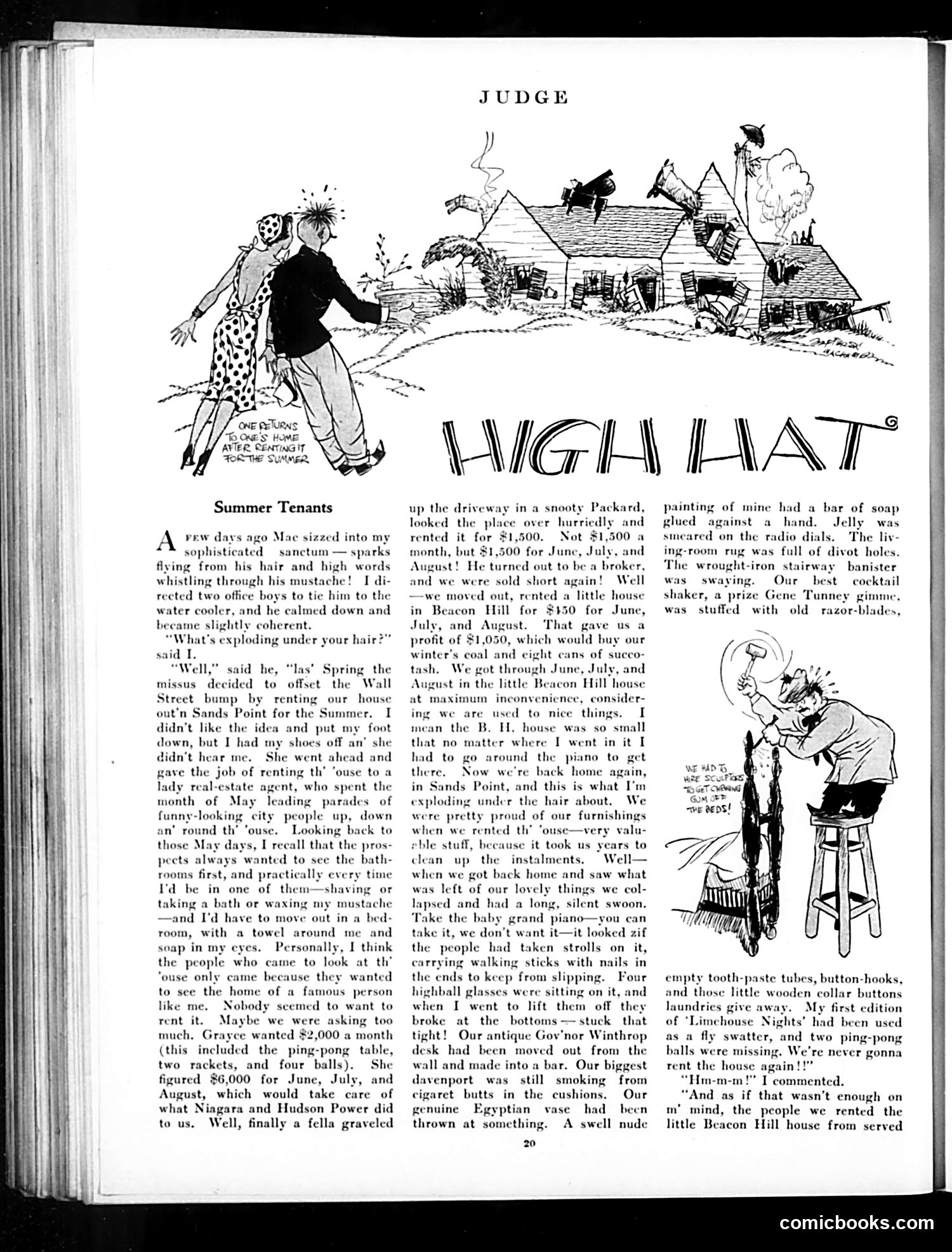
"Summer Tenants" — Judge Magazine Satire This humorous article mocks the common Depression-era practice of wealthy homeowners renting their suburban properties to make money. The narrator's wife rents their Sands Point house for $1,500 total—far below their asking price—to a broker who then resells it short, leaving them financially worse off despite the rental income. The satire targets upper-middle-class pretensions: the couple is so eager to profit they move into a cramped "Beacon Hill" rental, enduring maximum inconvenience to save money. Upon returning home, they discover their prized possessions—a baby grand piano, antique desk, davenport, Egyptian vase, and fine art—have been destroyed by the renters. The absurd catalog of damages (cigarette butts, soap on paintings, nailed walking sticks on the piano) lampoons both the carelessness of renters and the owners' naive belief that city people would respect their belongings. The joke: their profit-seeking scheme backfired completely.
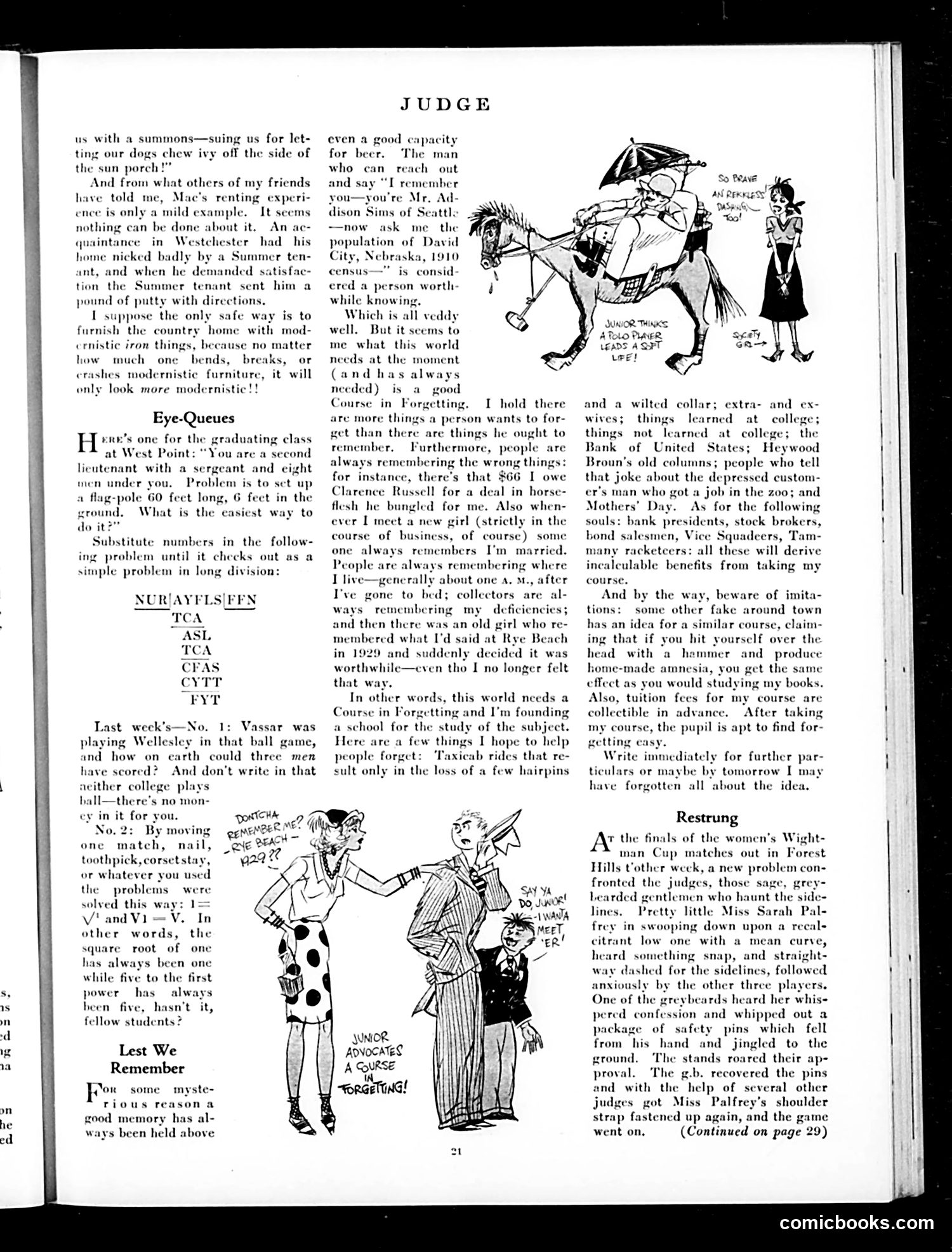
Judge Magazine Page Analysis This page from *Judge* contains several satirical pieces mocking American social conventions and modern life (circa 1920s-30s): "Eye-Queues" ridicules West Point's pretentious culture and academic pedantry through trick math problems. "Lest We Remember" satirizes selective memory—people remember useless trivia (census data, old gossip) while forgetting important debts and personal commitments. The author humorously proposes founding a "School for Forgetting," mocking how memory serves social embarrassment rather than practical needs. The illustrations show exaggerated characters in awkward social situations. "Restrung" describes tennis court mishaps during a women's tournament, satirizing competitive sports culture and the minor dramas that emerge. The cartoons throughout mock materialism, pretension, and the gap between what society values remembering versus what actually matters. The tone is lighthearted social criticism typical of *Judge*'s satirical approach to American life.
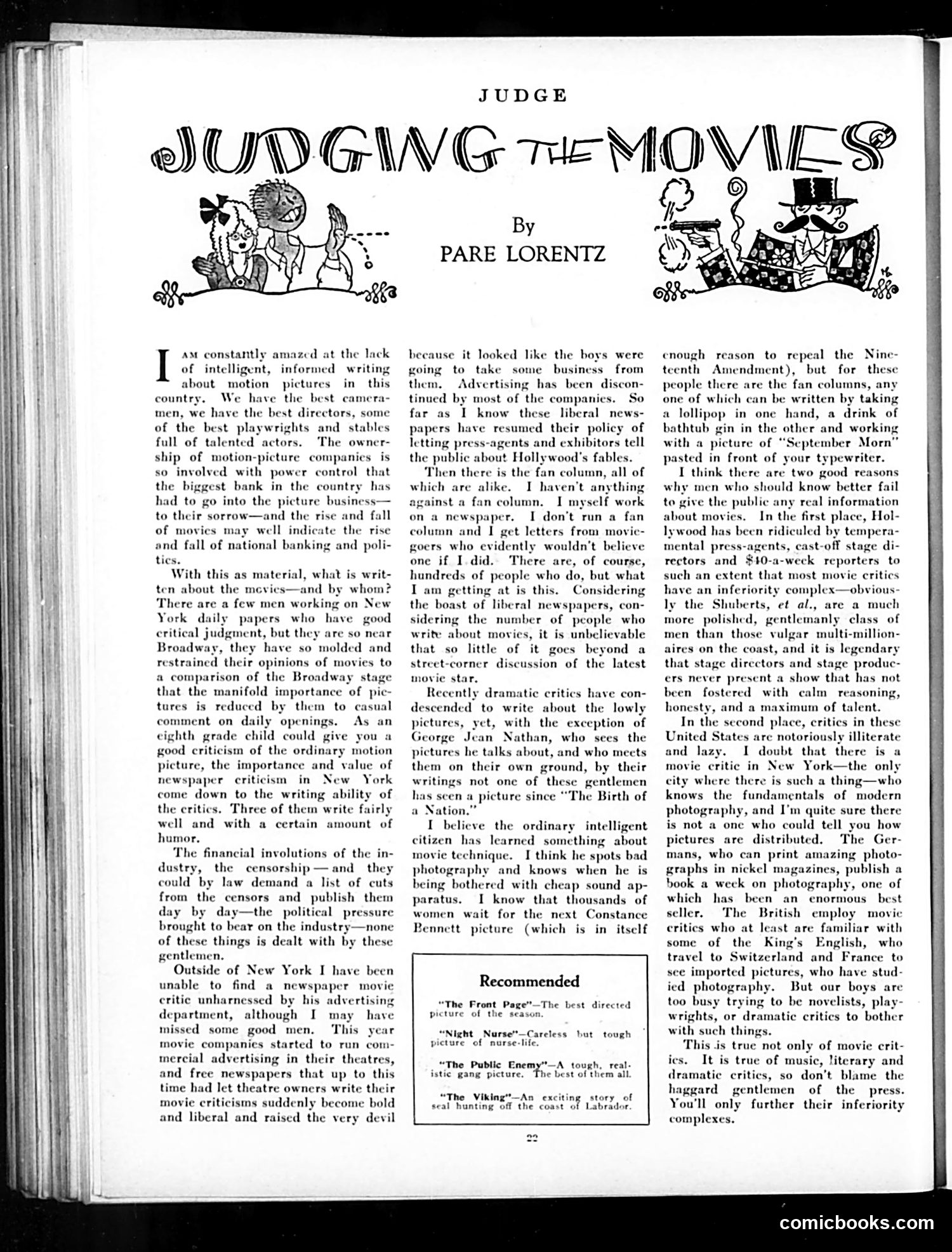
Judge Magazine: "Judging the Movies" by Pare Lorentz This article critiques American newspaper film criticism as intellectually shallow and compromised. Lorentz argues that despite motion pictures' importance to banking and national politics, critics—particularly those in New York near Broadway—treat movies as casual entertainment rather than serious art. He accuses them of avoiding substantial topics like industry censorship, political pressure, and financial manipulation. Lorentz also attacks newspapers' hypocrisy: when studios briefly stopped advertising to protest unfavorable coverage, papers suddenly became "bold and liberal," then resumed letting press-agents control narratives once ads returned. He contrasts this with George Jean Nathan, who actually *watches* films before critiquing them—apparently unusual among dramatic critics of the era. The article reflects 1920s-30s tensions between emerging film as serious medium versus entertainment commodity, and press independence versus advertising revenue dependency.
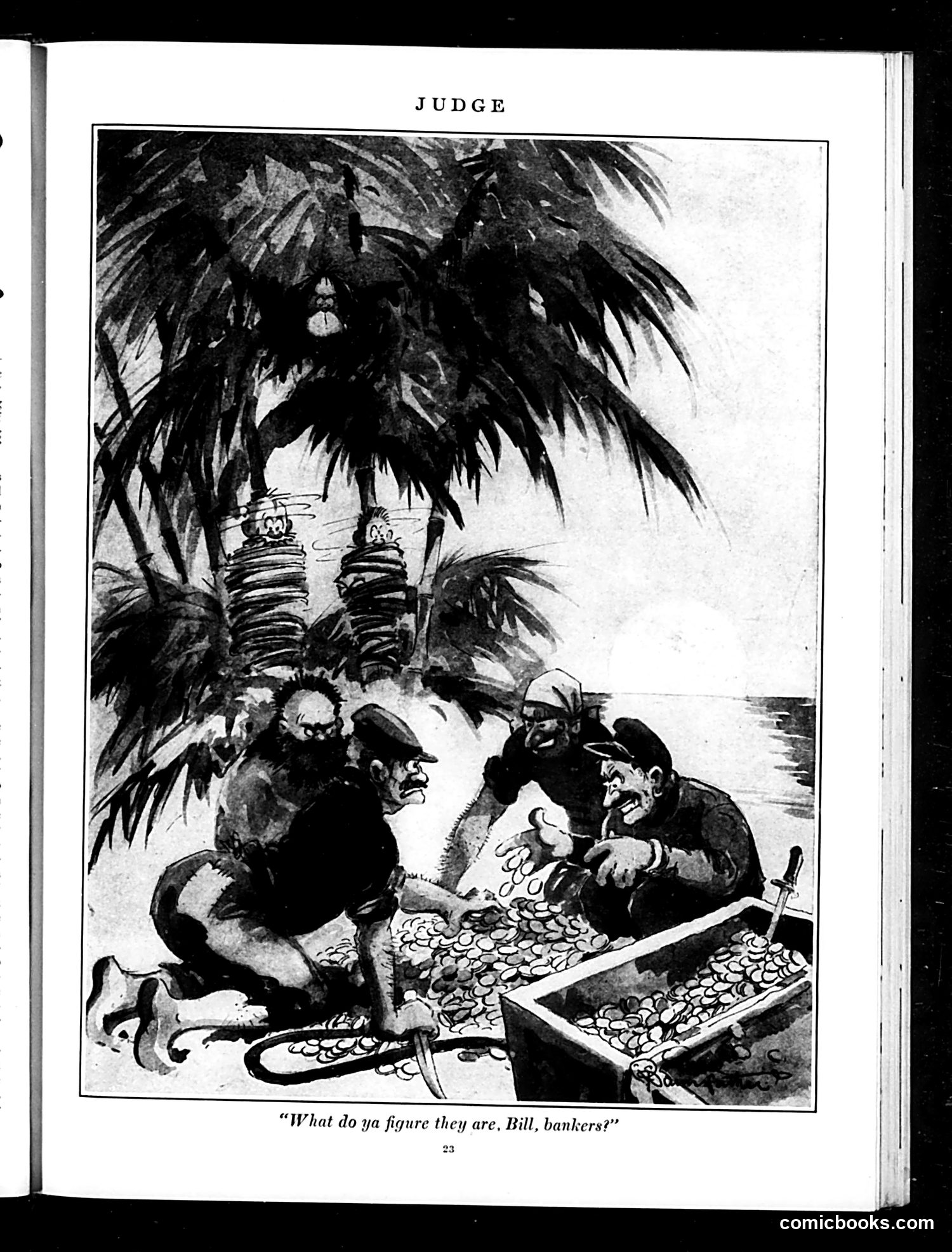
Political Cartoon Analysis: "Judge" Magazine This cartoon satirizes wealthy financiers or bankers through exaggerated caricature. Two grotesque figures huddle over overflowing boxes of coins beneath a palm tree, with what appears to be a third figure or creature looming above them. The caption—"What do ya figure they are, Bill, bankers?"—uses sardonic humor to suggest these creatures embody bankers themselves, implying they're barely human or are monstrous in nature. The satire likely critiques banking practices, possibly hoarding wealth or exploitative financial behavior. The tropical setting and primitive appearance of the figures may suggest colonial exploitation or suggest these "bankers" are predatory outsiders. Without a specific date visible, the exact historical event referenced is unclear, but this reflects Judge magazine's typical Progressive-era mockery of wealthy financial institutions and their perceived greed.
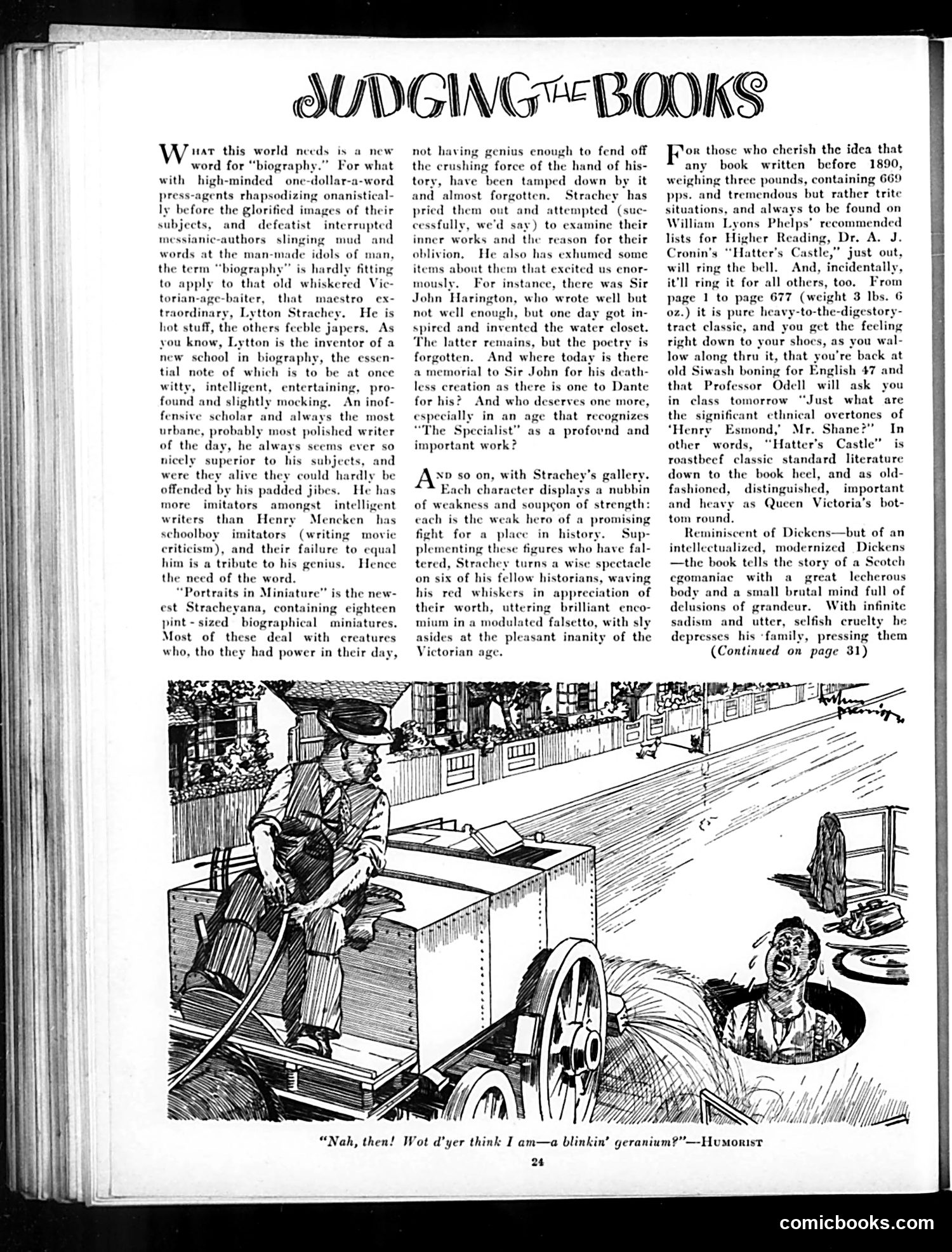
"Judging the Books" - Judge Magazine Book Review Page This is a book review column discussing Lytton Strachey's biographical work "Portraits in Miniature." The main text praises Strachey as an innovative biographer who examines historical figures with wit and intelligence, rescuing forgotten people from obscurity—like Sir John Harington, inventor of the water closet, who deserves commemoration equal to Dante. The illustration depicts a humorous scene of someone being transported in a cart labeled with books, captioned "Nah, then! Wot d'yer think I am—a blinkin' geranium?" This appears to be satirizing something about books or literature (unclear exactly what without more context). The page also briefly reviews A.J. Cronin's "Hatter's Castle," dismissing it as conventional Victorian-style heavy literature—the kind assigned in college English courses—while acknowledging it will appeal to traditional readers seeking substantial, serious novels.
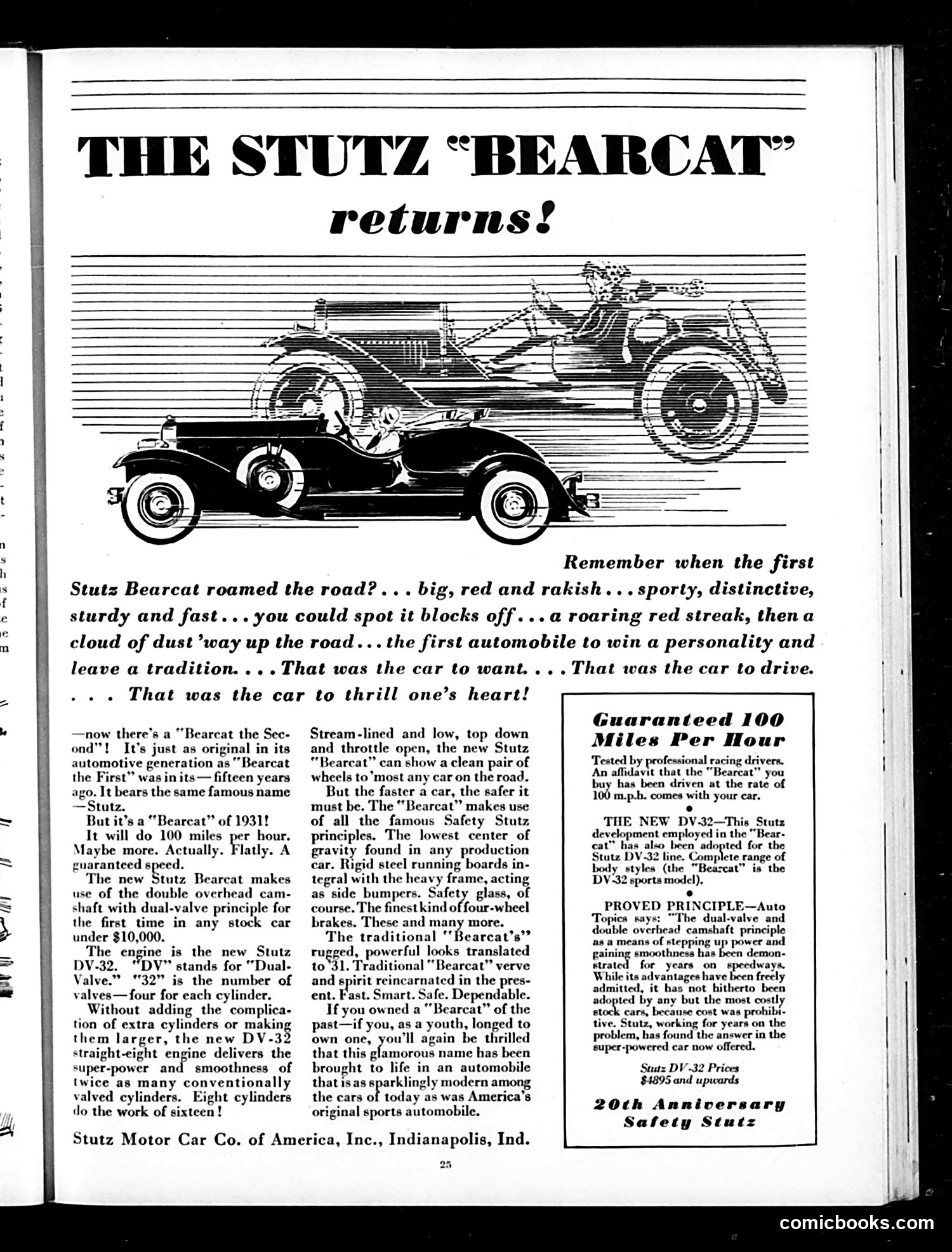
The Stutz "Bearcat" Returns This is a full-page automobile advertisement, not political satire. It promotes the 1931 Stutz Bearcat, a sports car marketed as the successor to the famous original Bearcat from approximately 16 years earlier. The ad uses nostalgic appeals, asking readers to "Remember when the first Stutz Bearcat roamed the road?"—describing it as distinctive, fast, and personality-defining. The new model is positioned as equally revolutionary for its generation, featuring a dual-valve, straight-eight engine (DV-32) that delivers power equivalent to sixteen conventional valves while remaining under $10,000. The advertisement emphasizes both performance (guaranteed 100 mph, tested by professional racers) and safety features (steel reinforcement, safety glass, four-wheel brakes). Three sketched automobiles illustrate the vehicle's streamlined, modern design. This represents marketing typical of the 1930s American automotive industry, targeting affluent consumers seeking prestige and performance.
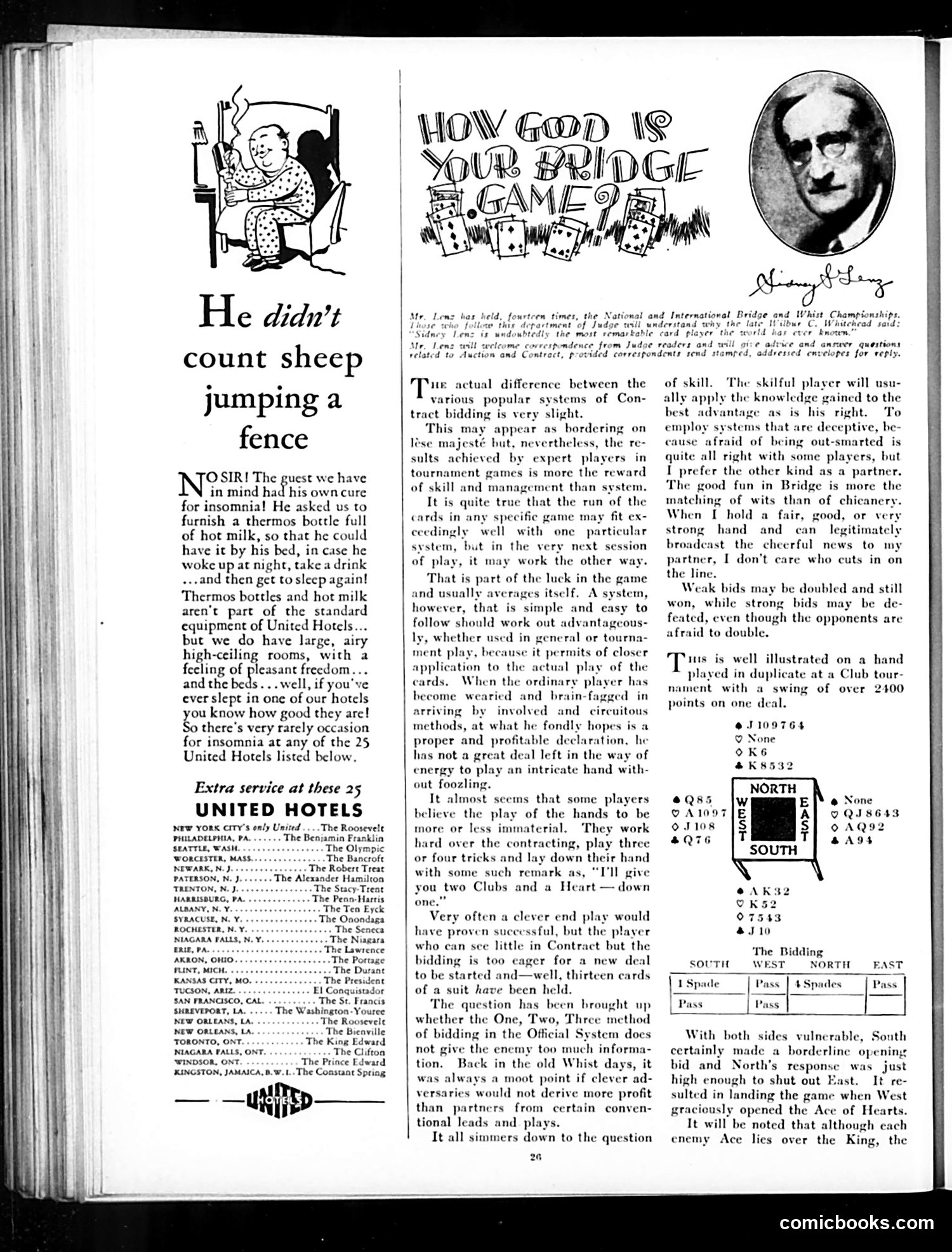
Analysis for Modern Readers This Judge magazine page combines advertising with bridge strategy content—two seemingly unrelated topics. The cartoon at top-left mocks insomnia cures: a figure tries counting sheep jumping a fence (the traditional remedy), but the real solution, according to United Hotels' advertisement below, is simply a comfortable bed and thermos of hot milk. The bulk of the page features a bridge column by Sidney Lenz (photo, top-right), a famous contract bridge player of the era. The article discusses whether different bidding systems in contract bridge (a hugely popular card game in the 1920s-30s) actually matter, concluding that player skill matters more than system complexity. Lenz criticizes players who over-complicate bidding then play carelessly. The bridge diagram shows an actual hand played at a tournament with over 2,100 points at stake—illustrating bridge's competitive, high-stakes nature during this period when it was a major American pastime and status symbol. The page reflects Judge's blend of humor, lifestyle advertising, and serious leisure-culture content for its educated, affluent readership.
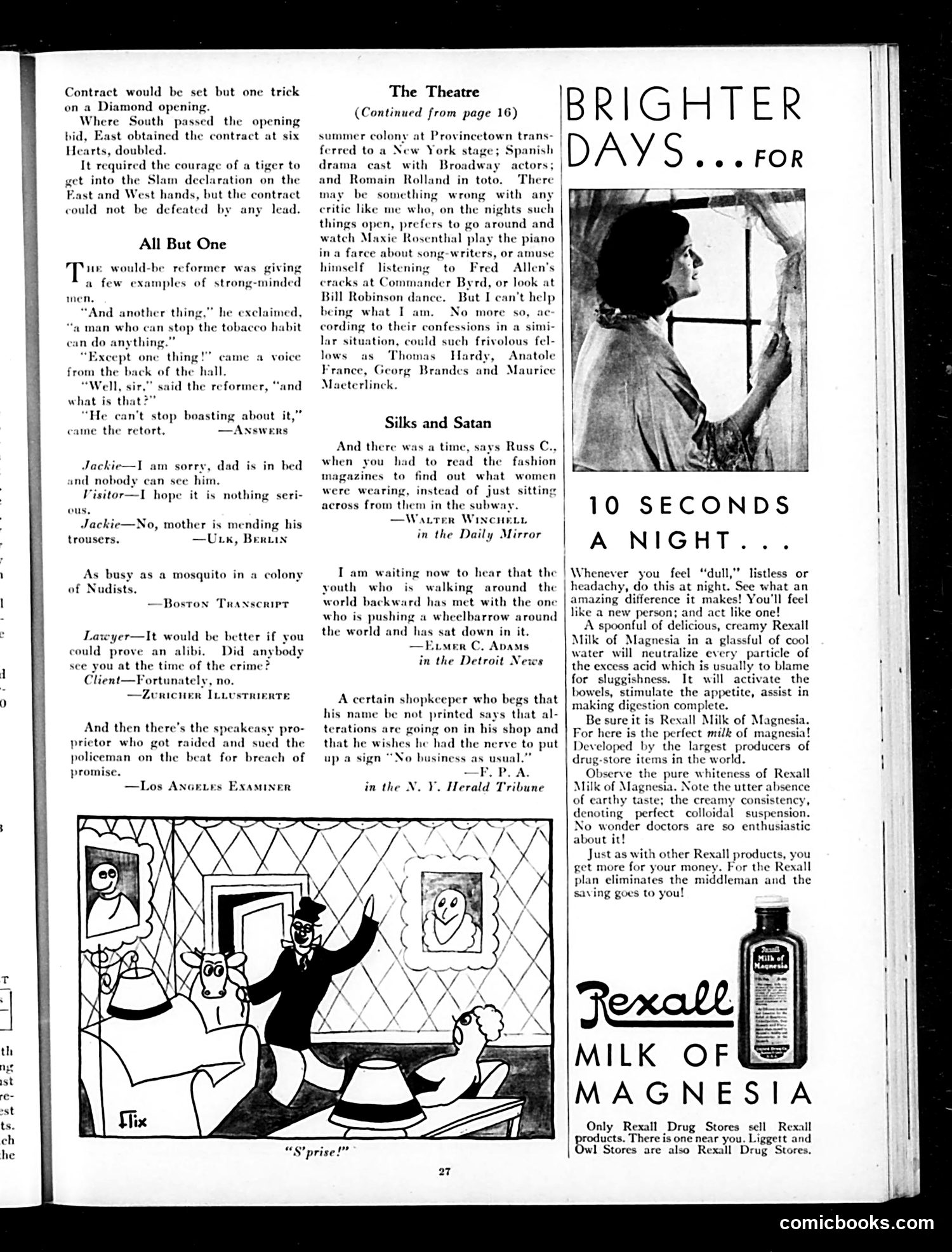
Page Analysis: Judge Magazine This page from *Judge* contains mostly humor columns and a major advertisement rather than political cartoons. The text content consists of brief jokes and witticisms typical of 1920s-30s magazines—short quips about bridge games, tobacco habits, speakeasies, and social observations. One cartoon ("Surprise!") depicts a magician performing for an audience, illustrating a generic magic trick scenario. The dominant feature is a Rexall advertisement for "Milk of Magnesia," a commercial laxative product. The ad occupies the right half of the page and uses health-marketing language common to the era, promoting digestive benefits and claiming superiority over competitors. Historical context: This reflects the era's widespread marketing of patent medicines and laxatives as cure-alls, before strict FDA regulations. The casual references to speakeasies indicate this is from Prohibition era (1920s-early 1930s). The page demonstrates how satirical magazines relied heavily on advertising revenue, mixing editorial humor with commercial content.
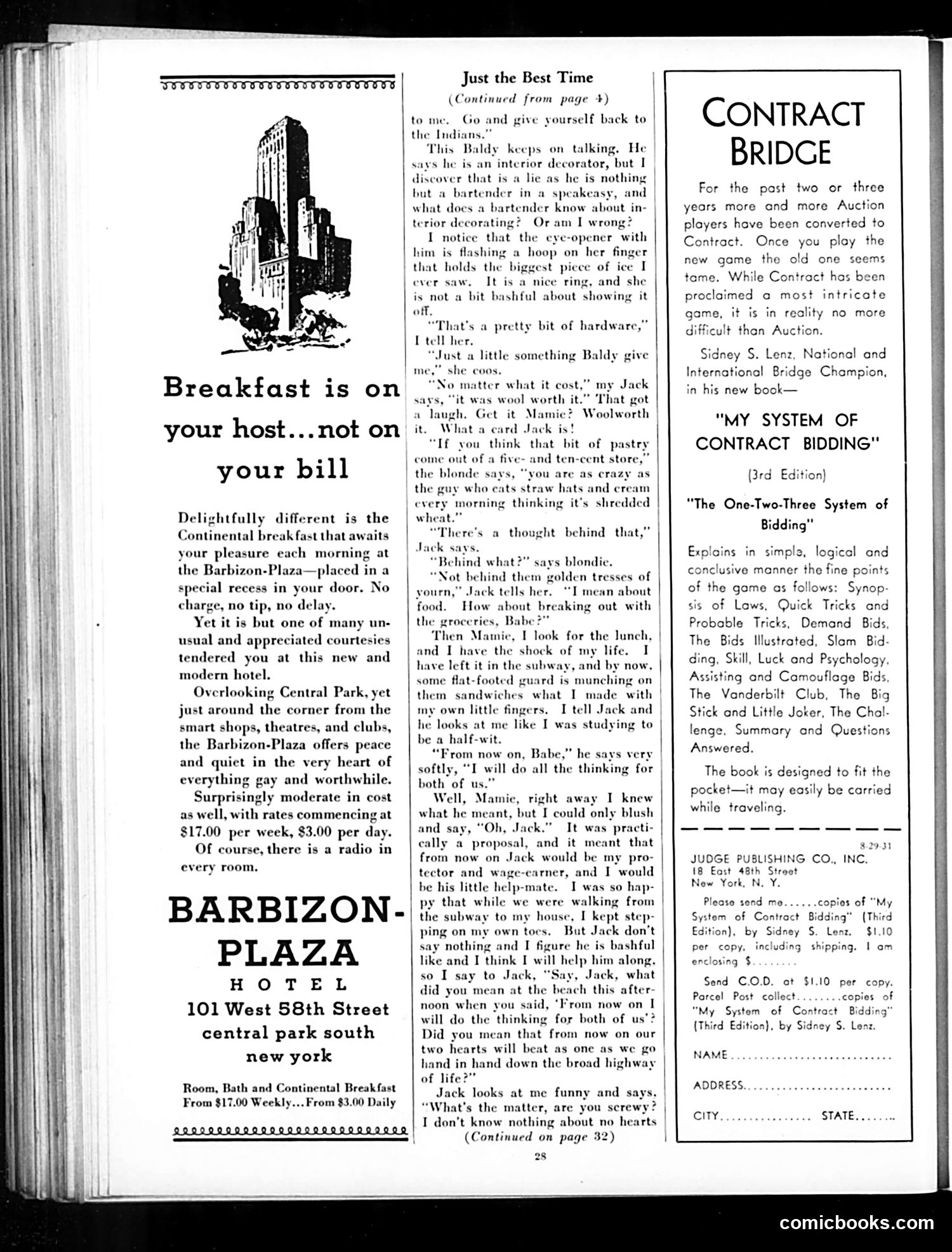
Page Analysis: Judge Magazine This page contains mostly advertisements and book promotions, with a serialized fiction piece ("Just the Best Time") continued from an earlier page. The main content includes: 1. Barbizon-Plaza Hotel ad (left): Promotes a luxury Manhattan hotel near Central Park, emphasizing modern amenities (radio in every room, complimentary continental breakfast) at relatively moderate rates ($3-$17/day). This reflects 1920s-30s hotel marketing targeting affluent travelers. 2. Fiction excerpt (center): A gossipy, colloquial narrative about working-class New Yorkers—mentions speakeasy bartenders and women with jewelry. The tone is satirical about materialism and romance. 3. Contract Bridge book ad (right): Promotes Sidney S. Lenz's instructional guide on the card game, noting Contract Bridge's recent popularity over Auction Bridge among players. The page reflects Depression-era publishing: advertising leisure activities (hotels, card games) to readers with disposable income, while serialized fiction provided entertainment. No significant political satire is evident on this particular page.
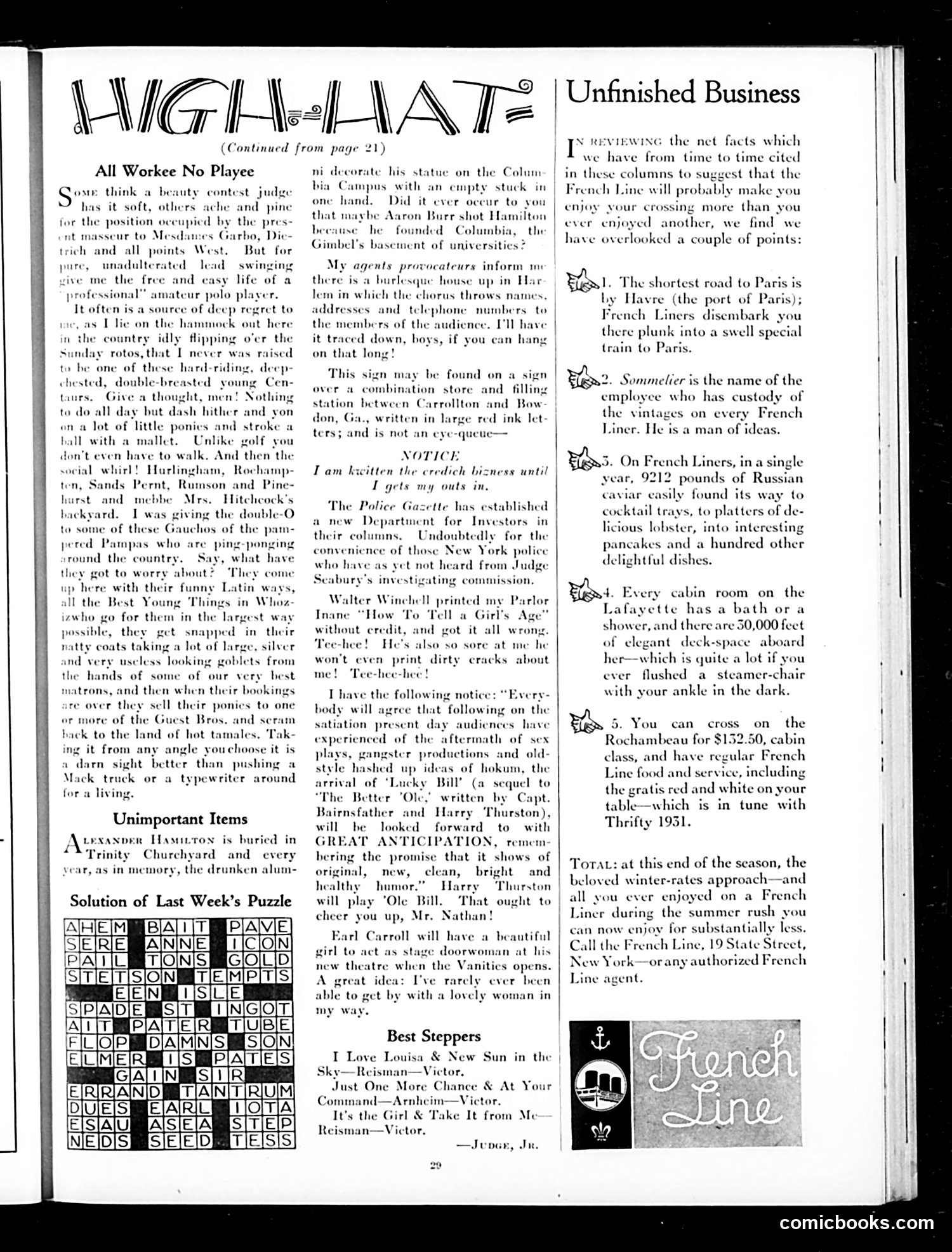
Analysis of Judge Magazine Page This page from *Judge* is primarily advertising and entertainment content rather than political satire. The main elements are: "All Workee No Playee" - A humorous first-person essay defending amateur polo as the ideal leisure pursuit, mocking the effort required in other activities (beauty contest judging, professional sports). The title's broken English ("workee," "playee") is comic affectation. "Unimportant Items" - Brief gossip items, including a dig at Walter Winchell for printing the author's column without credit, and commentary on theatrical productions. "Best Steppers" - Music recommendations (titles like "I Love Louisa & New Sun"). The page includes a crossword puzzle solution and advertisements for French Line steamship travel, emphasizing luxury amenities. The satire here is gentle, targeting leisure-class obsessions and press rivalries rather than political figures or movements. This reflects *Judge*'s focus on entertainment and lifestyle humor for an affluent readership.
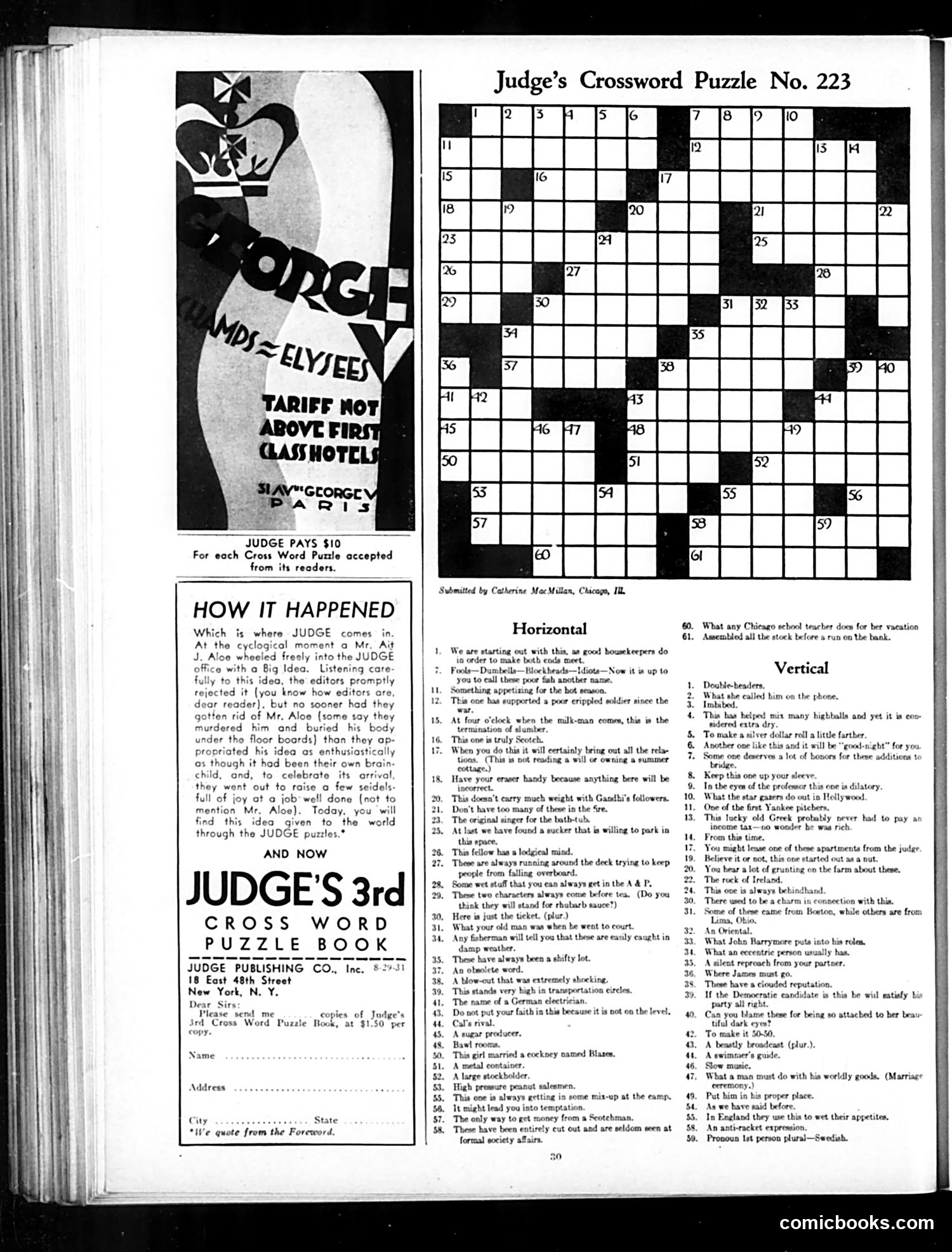
Judge Magazine Crossword Puzzle Page Analysis This page is primarily advertising and a crossword puzzle, not a political cartoon. It announces Judge's third crossword puzzle book (selling for $1.50) and includes Puzzle No. 223. The humorous "How It Happened" section satirizes editorial theft: it describes an unnamed man ("Mr. Aloe") pitching the crossword puzzle idea to Judge editors, who initially reject it, then immediately appropriate the concept "as though it had been their own brain-child." The joke jokingly suggests they even "murdered him and tied his body under the floor boards"—darkly mocking how publications steal ideas from contributors. The editorial note offers $10 per accepted crossword puzzle from readers, presumably to monetize crowd-sourced content while appearing generous. The crossword clues themselves reflect 1920s-30s popular culture and humor—references to Gandhi, bathtub singers, Chicago schoolteachers, and Greek mythology—but the page's primary function is advertising Judge's puzzle book to capitalize on the crossword craze then sweeping America.
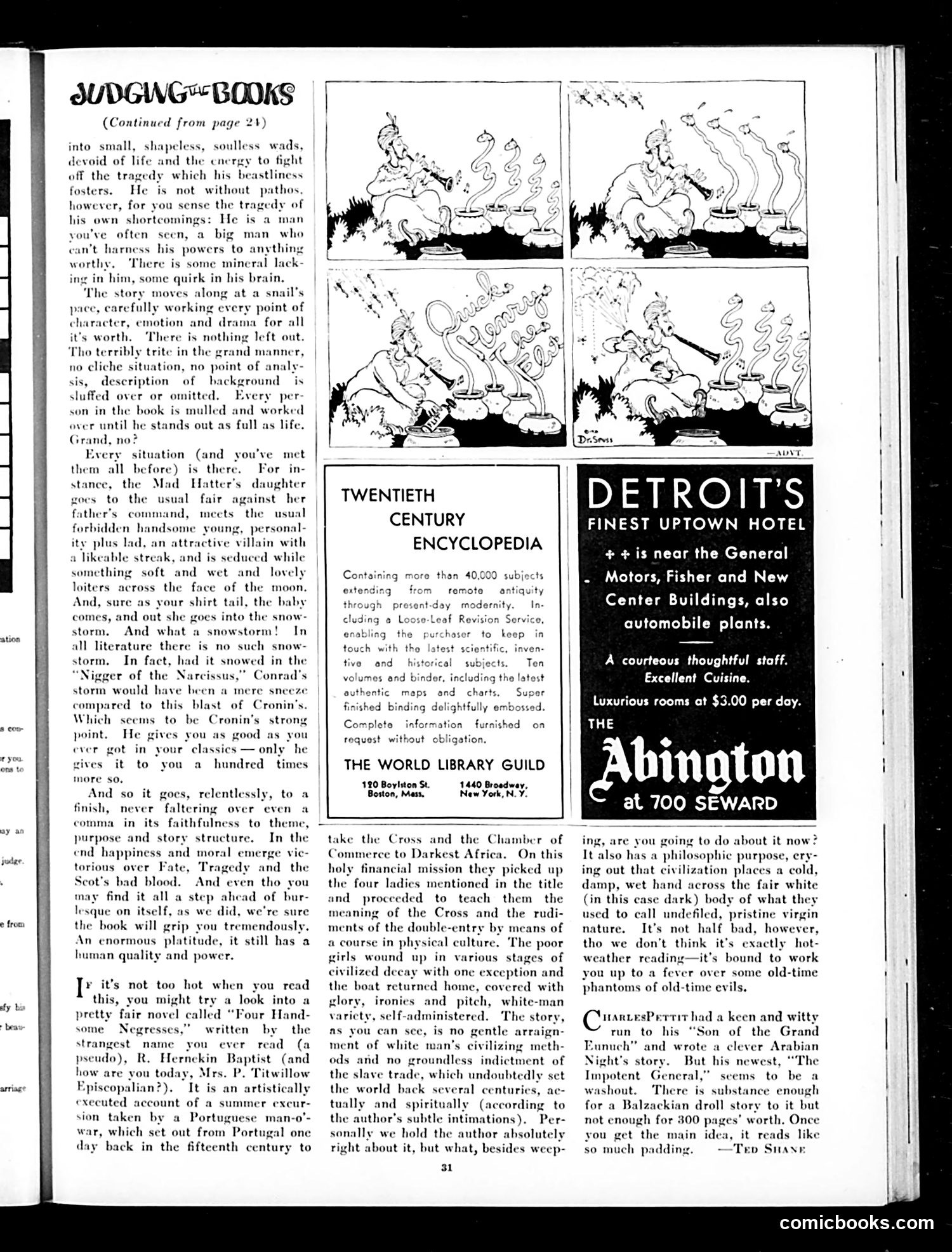
Judging the Books Page Analysis This page from *Judge* magazine contains book reviews rather than political cartoons. The four comic panels at top illustrate a story review (likely A.J. Cronin's work), depicting dramatic scenes with exaggerated action and weather effects. The substantive content critiques three books: Cronin's novel praised for emotional depth despite melodramatic plotting; "Four Handsome Negroes," a satirical pseudo-review mocking white colonial attitudes toward Africa and the slave trade through absurdist description (a Portuguese man-o'-war teaching "civilization" via physical education); and Charles Petit's "Son of the Grand Eunuch," deemed lightweight. The satire targets sentimentality in literature and European imperial hypocrisy—particularly the racist "civilizing mission" justification for colonialism. The advertisements (encyclopedia, hotel) fill remaining space. Without specific publication date visible, the colonial critique suggests early-to-mid 20th century sensibilities.
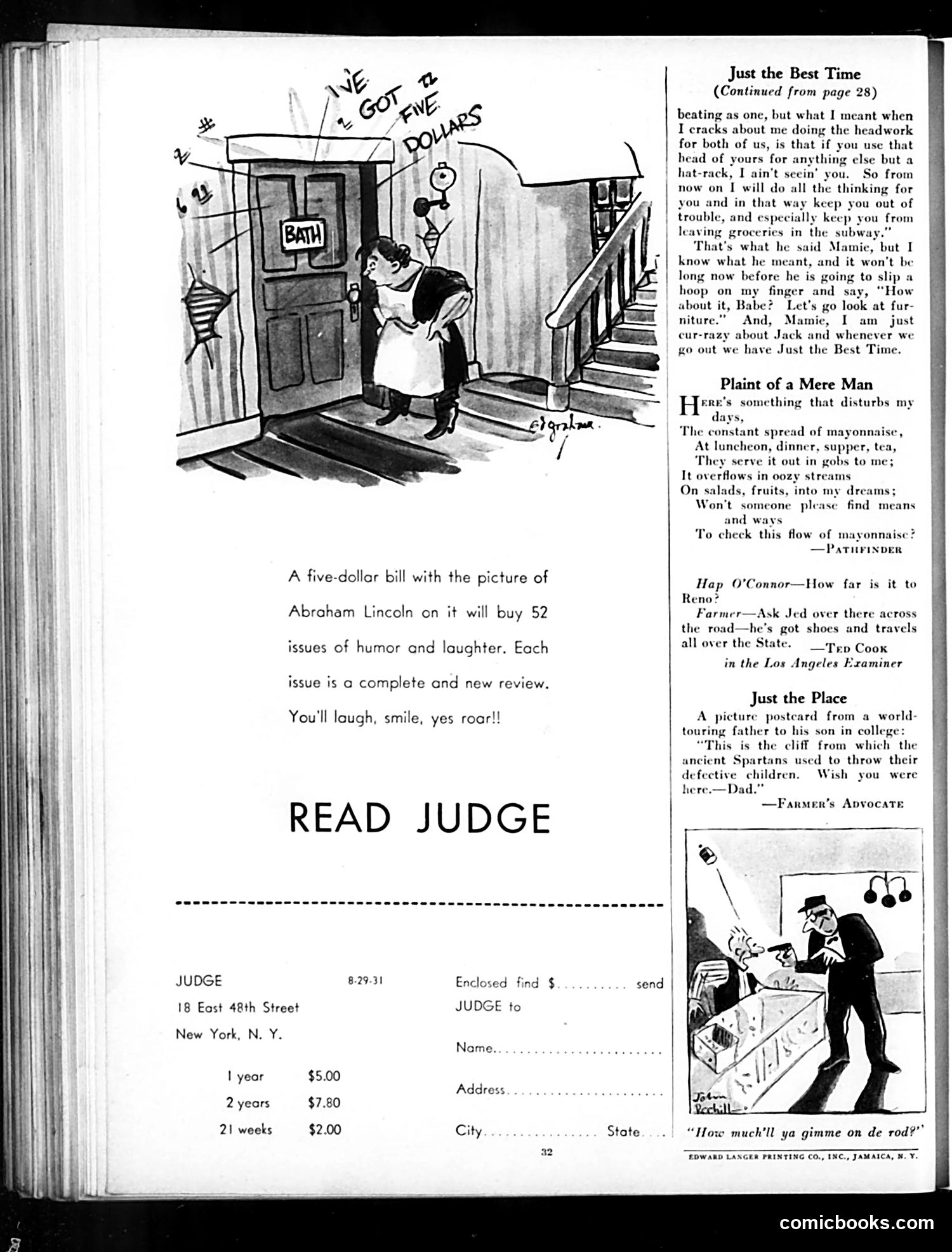
Explanation for Modern Readers This is primarily a subscription advertisement for *Judge* magazine (a satirical humor publication), with several unrelated humor pieces below it. The main cartoon shows a man at his bathroom door discovering he only has five dollars—depicted with Lincoln's face and the caption "I GOT FIVE DOLLARS." The joke appears to be that five dollars (circa 1931, based on the date 8-29-31) can buy 52 issues of *Judge*, making it excellent value for entertainment. Below are brief humorous columns: - "Plaint of a Mere Man" satirizes the overuse of mayonnaise in 1930s restaurant food - "Hap O'Connor" references Reno, Nevada—then famous as a divorce destination (relevant context: Nevada had lenient divorce laws) - "Just the Place" is a dark joke about ancient Sparta allegedly killing disabled infants, darkly wishing a college-bound son were there instead The bottom cartoon shows a man negotiating over a car ("rod"), typical 1930s slang humor about haggling.
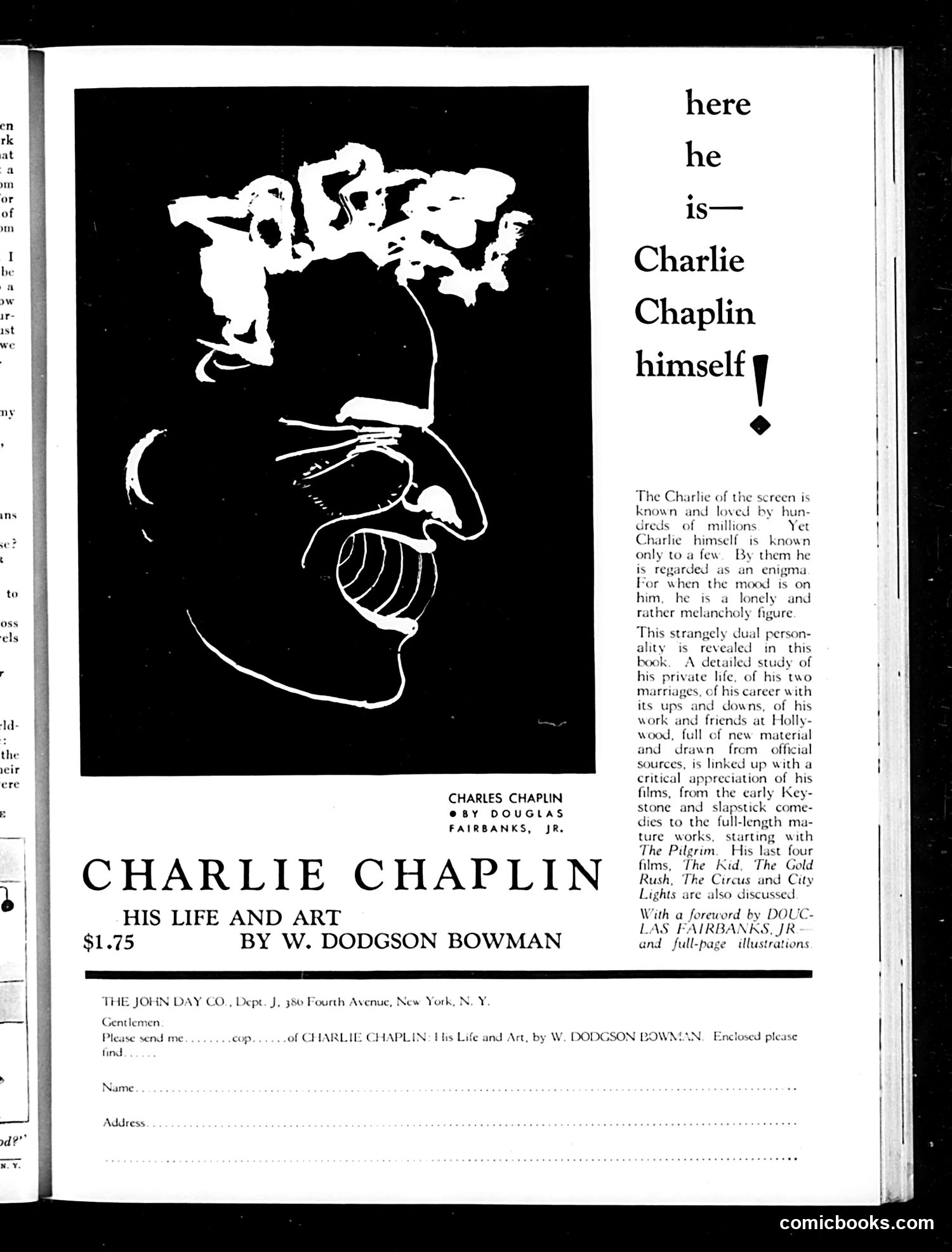
Charlie Chaplin Book Advertisement This is primarily a book advertisement rather than satirical content. It promotes "Charlie Chaplin: His Life and Art" by W. Dodgson Bowman ($1.75), published by The John Day Co. The page features a stylized portrait of Chaplin in his famous "Tramp" character—identifiable by the bowler hat, cane, and mustache. The accompanying text emphasizes the paradox between Chaplin's public persona (beloved by "hundreds of millions") and his private mystery: he's described as "a lonely and rather melancholy figure" known only to a few, regarded as "an enigma." The book promises to reveal this dual personality through biographical details about his marriages, Hollywood career, and a critical survey of his films from early Keystone comedies through mature works like *The Pilgrim*, *The Kid*, and *City Lights*. This reflects genuine public fascination with Chaplin during the silent film era, when his on-screen character was globally famous but his private life remained largely unknown.
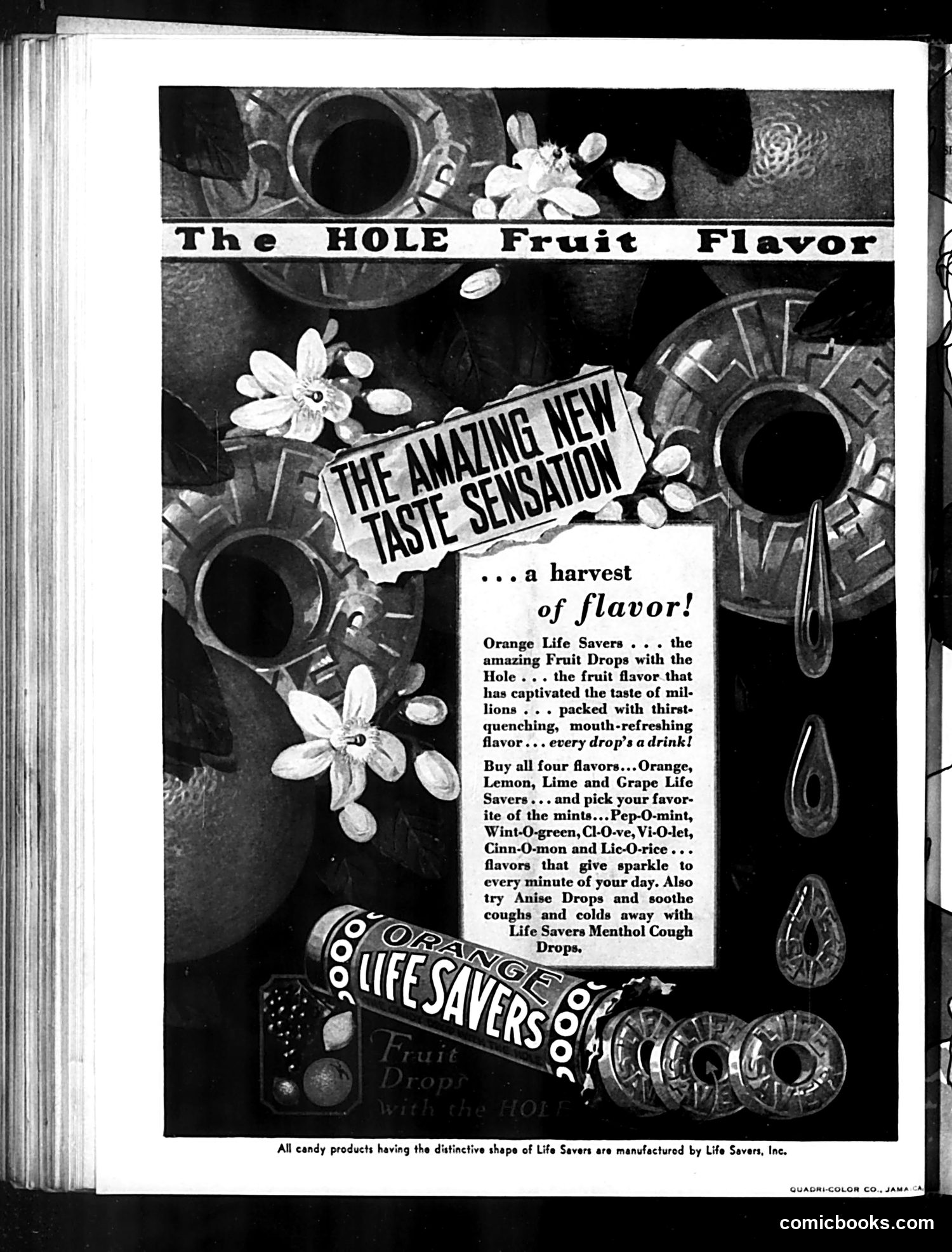
This is a Life Savers candy advertisement, not political satire. The page is a commercial advertisement for Life Savers candies, featuring their signature "hole" fruit drops. The headline "The HOLE Fruit Flavor" plays on the product's distinctive ring shape with a center hole—the candy's defining feature since its invention. The ad promotes four fruit flavors (Orange, Lemon, Lime, Grape) and multiple mint varieties with whimsical names using the "-O-" pattern (Pep-O-mint, Wint-O-green, etc.). It also advertises Life Savers Menthol Cough Drops for medicinal use. The decorative elements—flowers, teacups, and candy imagery—are typical period advertising aesthetics. This is purely commercial content, not editorial cartoons or political commentary. The phrase "amazing new taste sensation" reflects standard mid-century advertising hyperbole.