judge
Judge — September 5, 1931
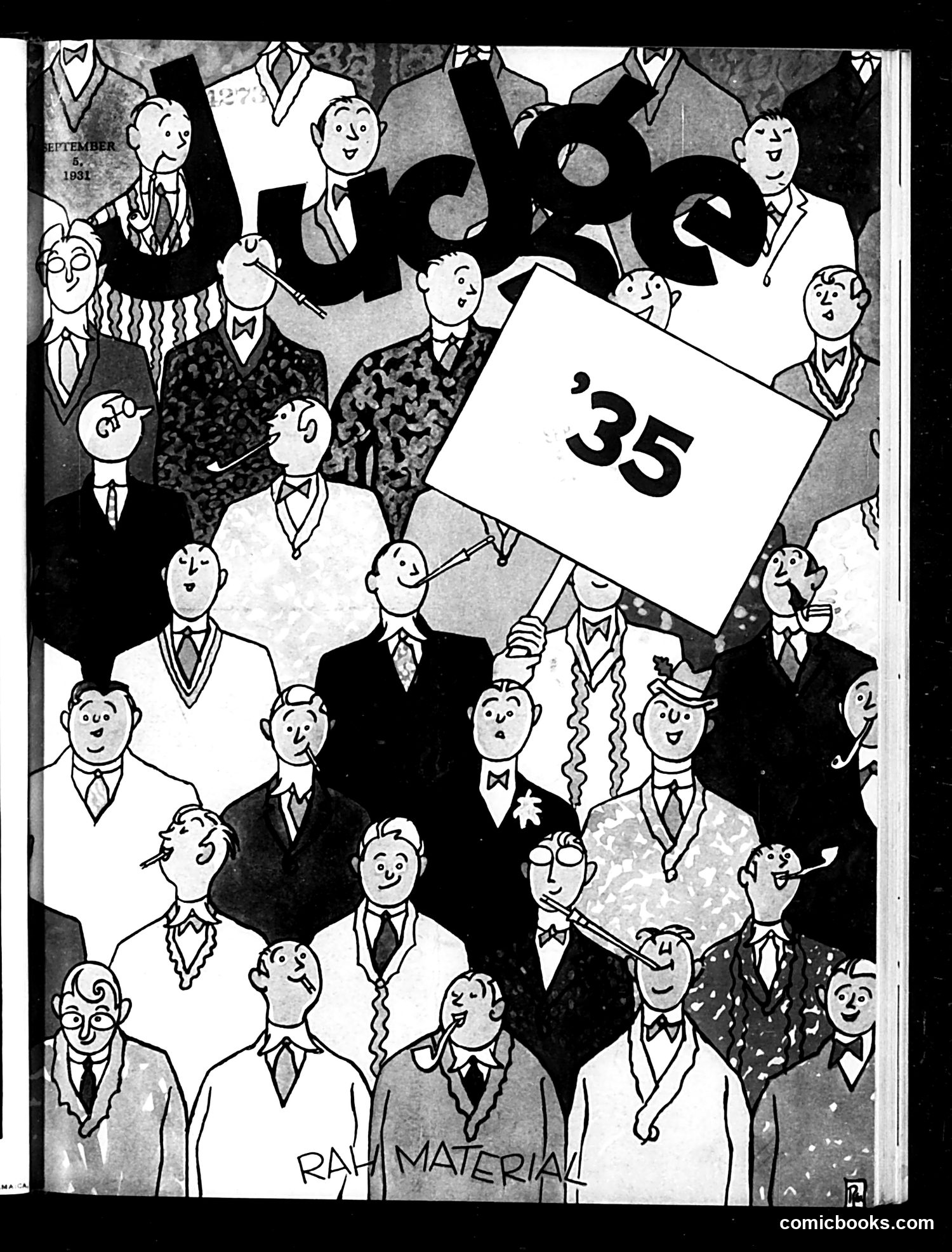
Analysis of Judge Magazine Page (September 1931) This satirical cartoon depicts a crowd of men celebrating around large numbers "1931" and "'35" with a sign reading "RAH MATERIAL." The context appears to be economic commentary from September 1931—shortly after the October 1929 stock market crash that triggered the Great Depression. The "RAH MATERIAL" likely refers to cheering or enthusiasm for economic recovery prospects. The "35" may reference optimism about conditions improving by 1935, or possibly reference to a specific economic plan or prediction circulating at that time. The caricatured, cheerful faces suggest satirical mockery—the cartoon appears to be ridiculing unfounded optimism about economic recovery during genuine economic hardship, a common Judge magazine theme during the Depression era.
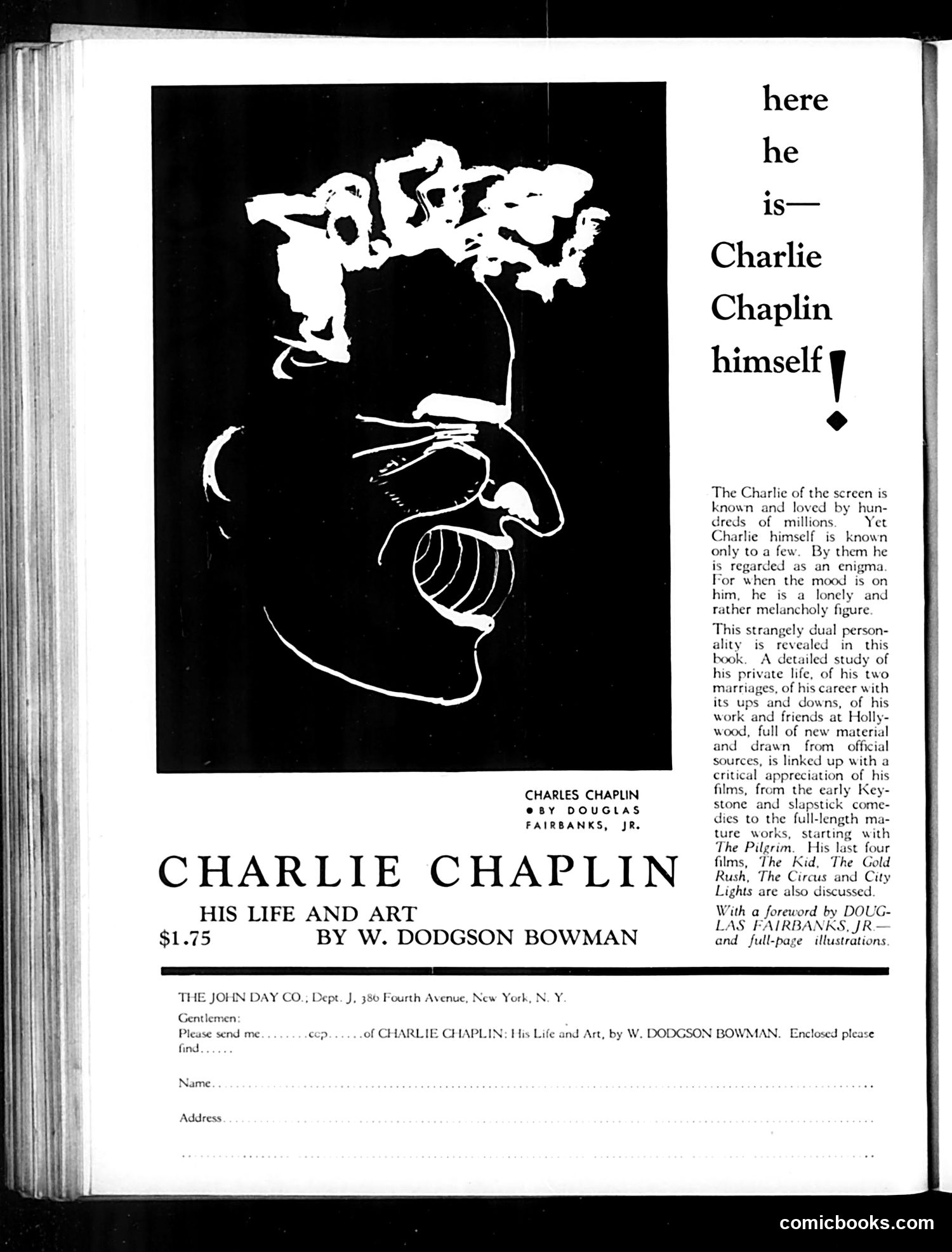
Analysis This page is primarily advertising for a biography book rather than satirical content. It promotes "Charlie Chaplin: His Life and Art" by W. Dodgson Bowman, published by John Day Company for $1.75. The illustration is a stylized portrait of Charlie Chaplin's iconic character—the "Tramp"—rendered in stark white lines against black, showing the bowler hat, cane, and baggy suit silhouette he famously wore. The accompanying text describes the contrast between Chaplin's screen persona (beloved by millions) and his private life (known only to few), portraying him as an "enigma"—a "lonely and rather melancholy figure." The book promises detailed coverage of his personal life, two marriages, Hollywood career, and film analysis from his Keystone comedies through full-length features like "The Pilgrim."
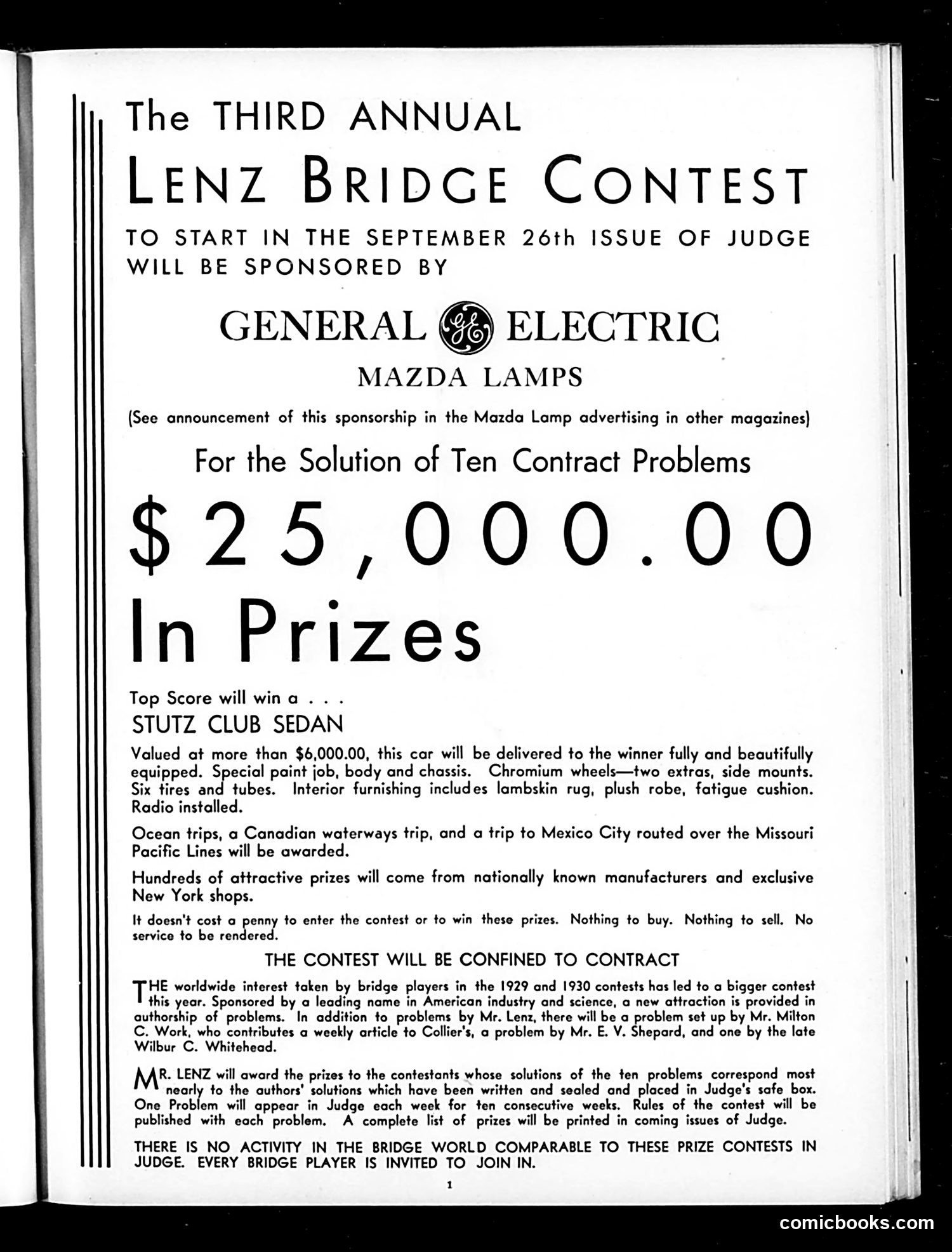
This page is primarily advertising copy, not satirical content. It announces the Third Annual Lenz Bridge Contest, sponsored by General Electric's Mazda Lamps division. The contest offers $25,000 in prizes for solving ten contract bridge problems. The grand prize is a Stutz Club Sedan (valued over $6,000), plus ocean trips and a Mexico City journey. Additional prizes come from "nationally known manufacturers and exclusive New York shops." The text emphasizes the contest requires "Nothing to buy. Nothing to sell. No service to be rendered" and is "confined to contract" bridge—indicating this targets the serious bridge-playing community. The contest appears designed to generate brand awareness for both Mazda Lamps and the Lenz bridge problem-setting tradition among educated, affluent Americans.
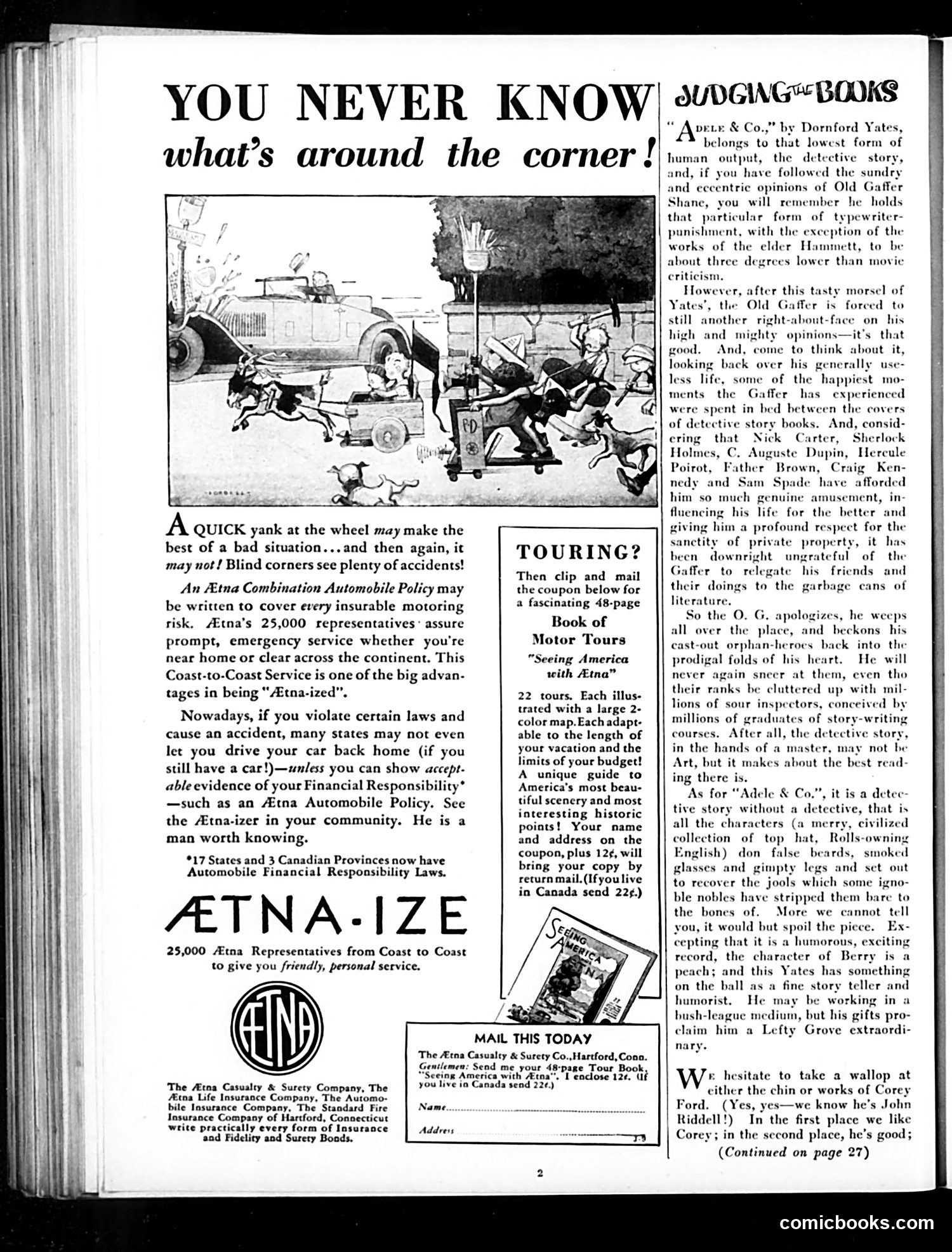
"You Never Know What's Around the Corner" This page is primarily an Ætna insurance advertisement disguised as editorial content. The cartoon depicts a chaotic car accident with multiple vehicles colliding and people flying through the air, illustrating the unpredictability of traffic dangers. The ad's message: reckless driving causes accidents, and many states now legally require drivers to prove "Financial Responsibility" through insurance. Ætna positions itself as essential protection, offering 25,000 representatives nationwide for emergency service. The right column reviews "Adèle & Co." by Dornford Yates—a detective story. The reviewer humorously dismisses it as forgettable genre fiction, though praising Yates's storytelling skill. Bottom line: This is advertising-as-content, using fear of accidents to sell liability insurance to motorists.
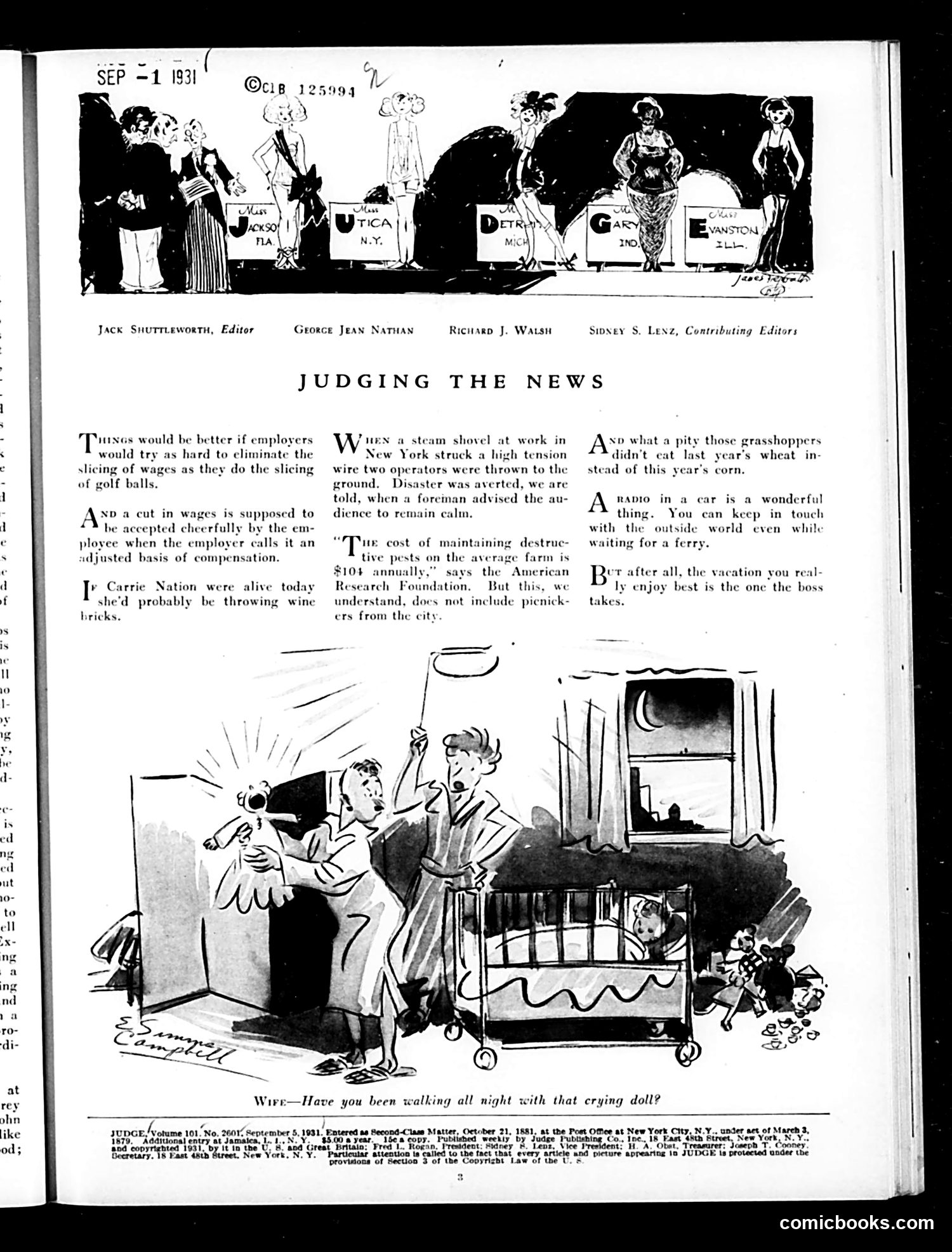
"Judging the News" - September 1, 1931 This page satirizes contemporary social and economic issues during the Great Depression era. The editorial commentary addresses: Labor disputes: A steam shovel accident in New York where workers were injured, critiquing management's response. Agricultural hardship: Grasshoppers destroying wheat crops, blamed on farm practices. Modern conveniences: Radio technology enabling people to stay connected while traveling. Vacation dynamics: A humorous observation about workplace hierarchy and leisure time. The main cartoon depicts a domestic scene where a husband, reading a newspaper, asks his wife if she's been "walking all night with that crying doll"—suggesting marital tension over her nighttime caregiving of their infant. The satire reflects 1930s anxieties about economic hardship affecting family life and domestic arrangements.
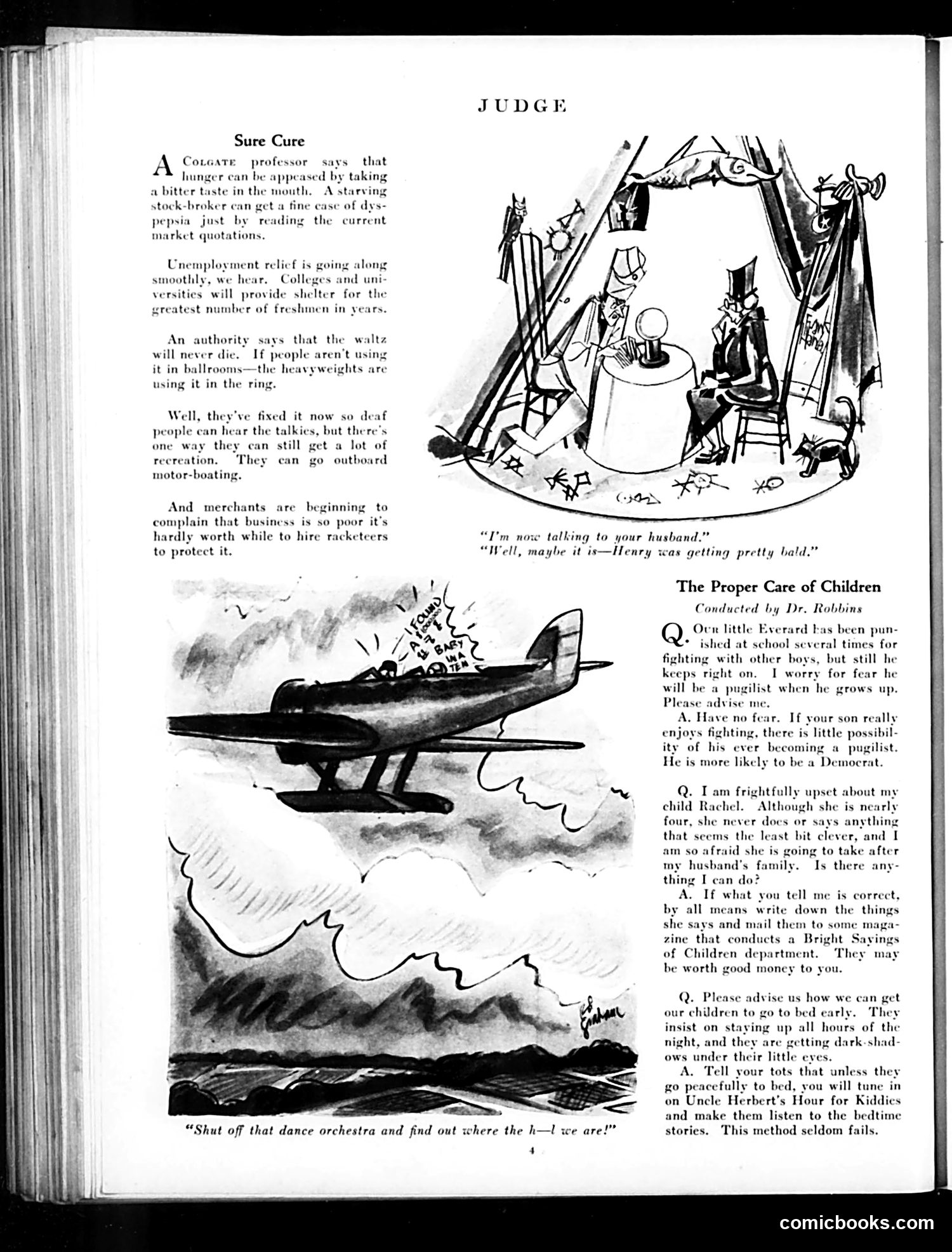
Judge Magazine Page Analysis This page contains two distinct sections: "Sure Cure" Column (top left): Satirical quips about Depression-era problems—hunger, unemployment, dyspepsia, and the "waltz" (possibly radio broadcasts). The humor relies on absurd "solutions" (tasting butter for hunger, reading market quotes for indigestion). Political Cartoon (center-left): An airplane crashes into turbulent waves with the caption "Shut off that dance orchestra and find out where the h—l we are!" This appears to mock someone relying on radio entertainment while losing situational awareness—likely satirizing government or business leaders ignoring economic warning signs during the Depression. "The Proper Care of Children" (right): An advice column by Dr. Robbins addressing parental concerns about children's behavior—fighting, shyness, and bedtime resistance. The responses offer practical guidance, reflecting period parenting advice. The page blends political satire with practical domestic advice.
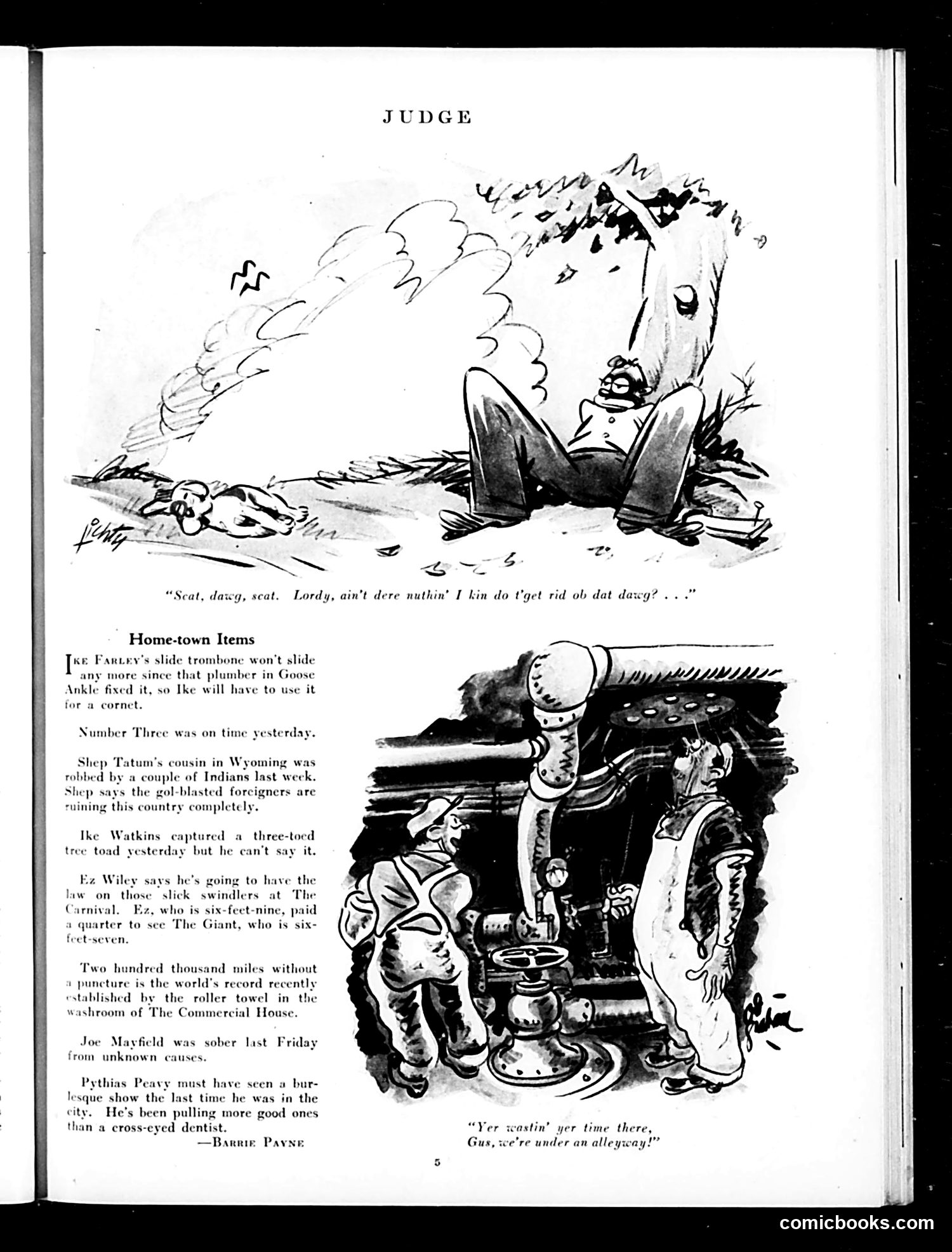
Analysis of Judge Page Top Cartoon ("Scat, dawg, scat"): A judge sits elevated, apparently being pestered by a dog. The caption suggests the judge is frustrated with persistent legal matters—likely representing how trivial cases clutter the court docket. The dog represents nuisance lawsuits or frivolous complaints. "Home-town Items" Section: This column of local gossip includes anecdotes about townspeople: a broken trombone, a punctual train, a stolen sheep, a tree toad sighting, and various character sketches. These are humorous small-town stereotypes. Bottom Cartoon ("Yer wastin' yer time there"): Unclear from context alone, but appears to depict workers or mechanics in an industrial setting, with dialogue suggesting someone is wasting time on an impossible or futile task. The page blends judicial satire with Americana humor typical of Judge magazine's early 20th-century sensibility.
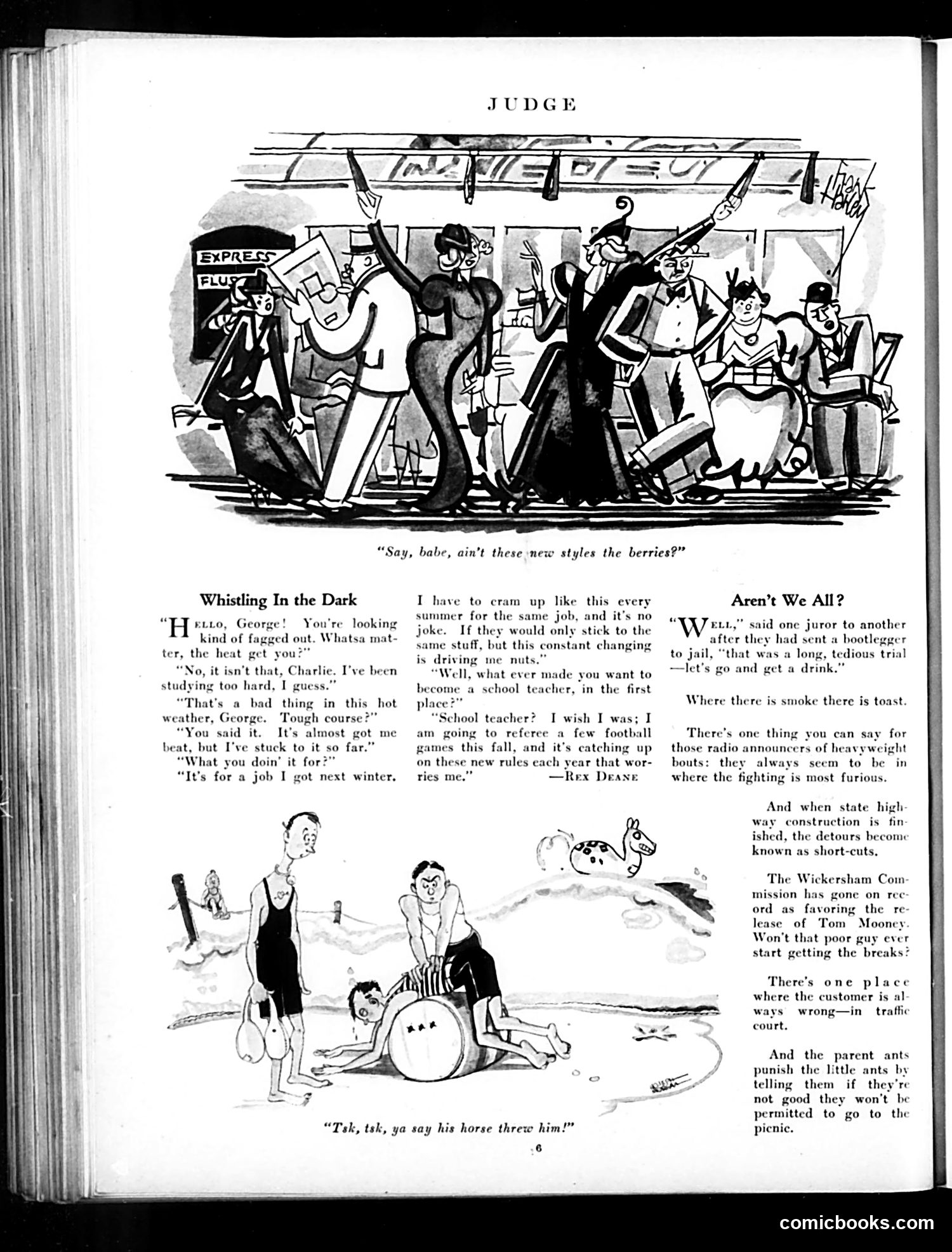
Judge Magazine Page Analysis This page contains three separate humorous pieces satirizing American life and institutions: "Whistling in the Dark" depicts a conversation between two men during a heat wave, where one complains about his repetitive summer job and considers becoming a school teacher—only to be warned by his friend that teaching involves constant rule changes that "drive me nuts." "Aren't We All?" makes a brief joke about jurors wanting to escape jury duty to get a drink instead. The bottom cartoon shows children at a beach, with the caption "Tsk, tsk, ya say his horse threw him!"—appearing to humorously reference some incident involving a horse. The satire targets workplace monotony, institutional frustration (teaching), and judicial evasion. The pieces reflect early-20th-century American social concerns about labor and civic duty.
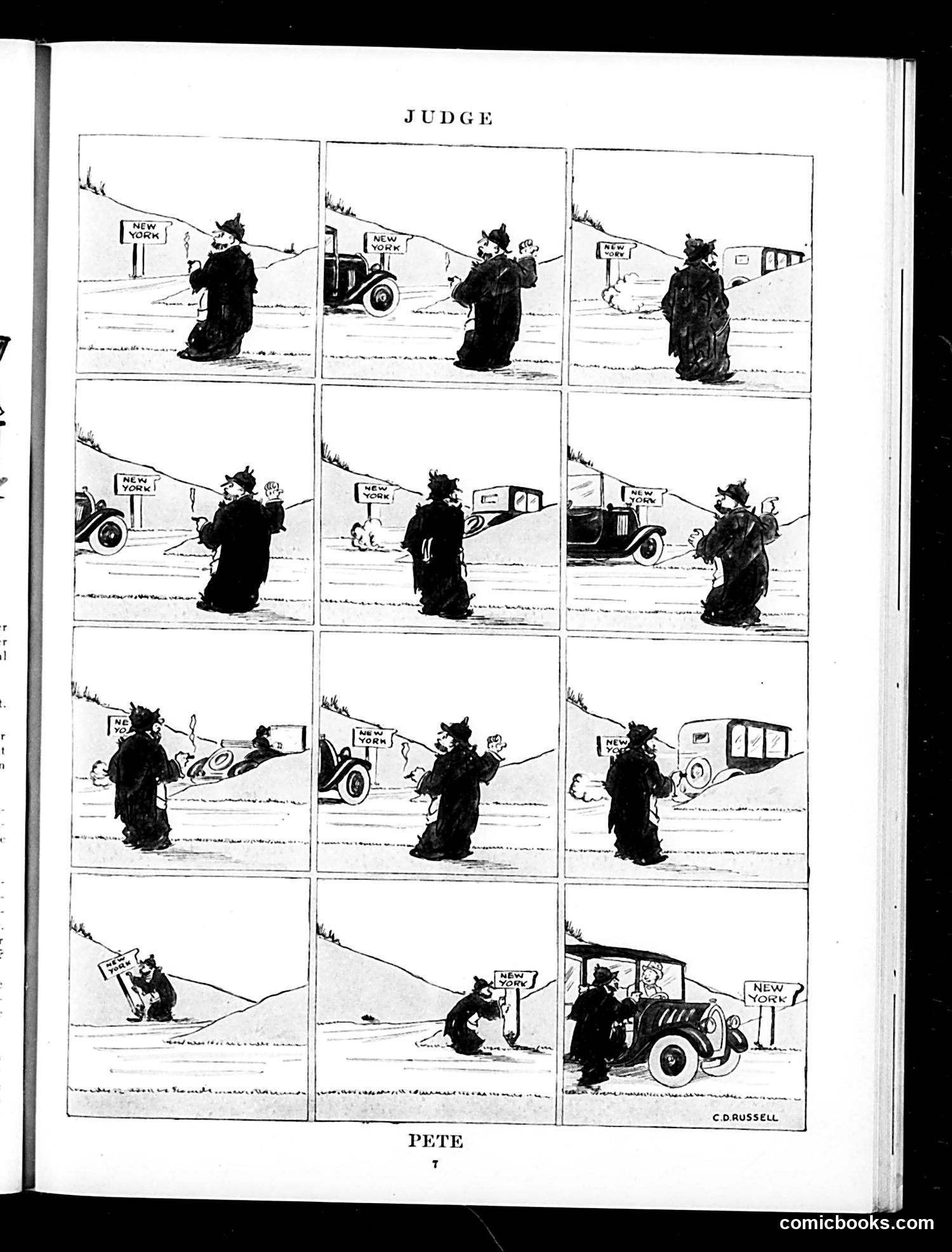
"Judge" Comic: "Judge" and "Pete" This is a sequential comic strip by C.O. Russell showing a character (presumably "Judge," the titular figure) repeatedly encountering a "New York" sign while attempting to hitchhike or travel. The strip progresses through twelve panels as Judge encounters various vehicles and situations along a roadside. The satire appears to mock someone's futile attempts to reach or leave New York, with each panel showing fresh frustration or comedic setback. The "New York" signs function as visual anchors emphasizing the location's significance or the character's stuck situation. Without additional context about the specific historical moment Judge magazine published this, the exact political target remains unclear, though it likely satirizes contemporary travel difficulties, urban congestion, or perhaps specific New York City politics or characters recognizable to 1920s-1930s readers.
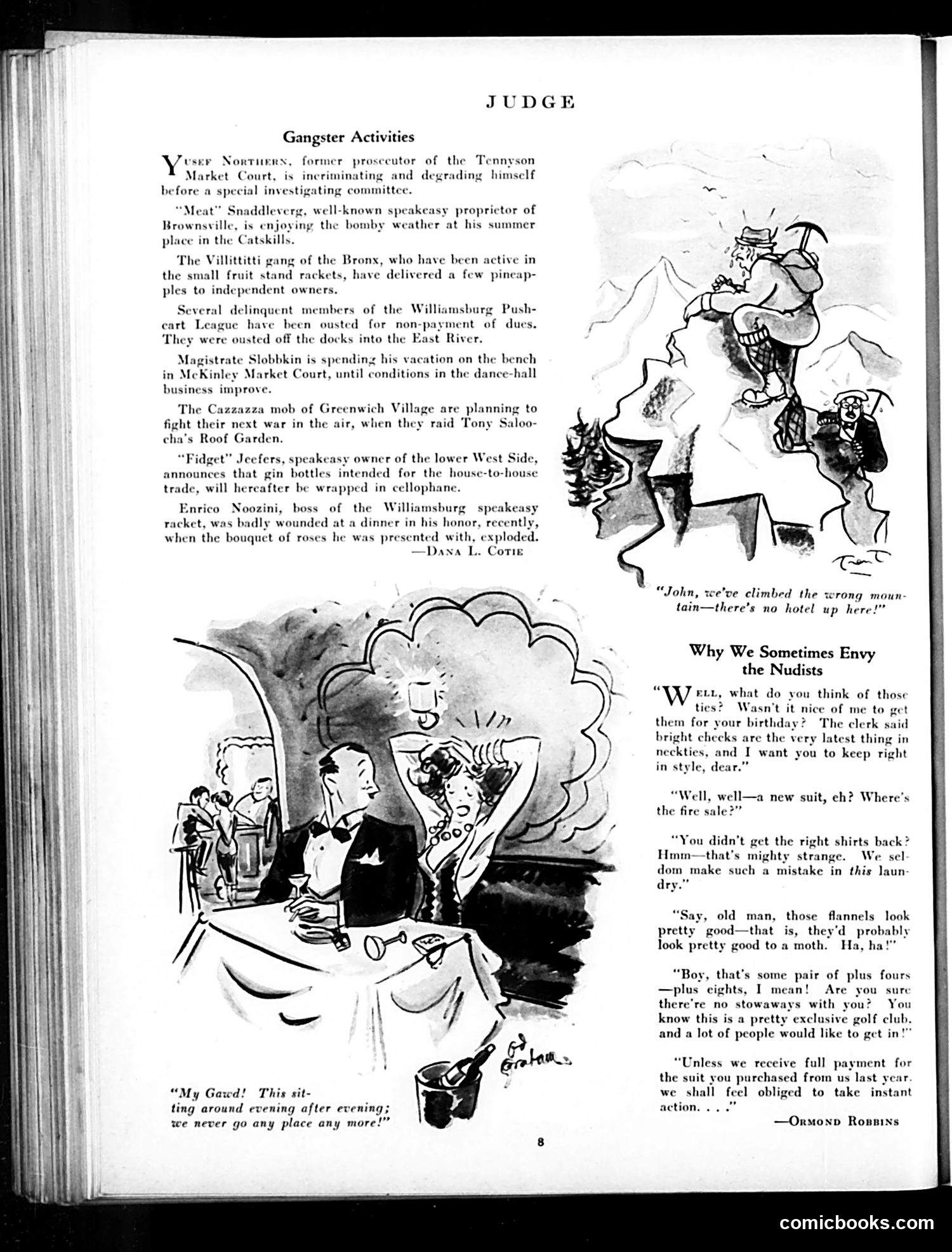
Judge Magazine Page Analysis This page contains two distinct satirical pieces: "Gangster Activities" (top): A mock crime report listing New York organized crime figures and their recent exploits—speakeasy operators, fruit-stand racketeers, pushcart league members. The humor relies on treating brutal criminal activity (murder, extortion, dumping bodies in rivers) with deadpan bureaucratic tone, as if reporting minor business infractions. This satirizes Prohibition-era gangsterism that was rampant in 1920s New York. "Why We Sometimes Envy the Nudists" (bottom): A series of domestic complaints about clothing—bad laundry service, unfashionable gifts, weight gain, exclusive clubs, unpaid bills. The joke is that nudists avoid all these clothing-related marital and social annoyances. This pokes fun at middle-class anxieties about fashion, status, and domestic friction in the Jazz Age. Both pieces use exaggerated scenarios to satirize contemporary urban life—one targeting organized crime, the other consumer culture and social pretension.
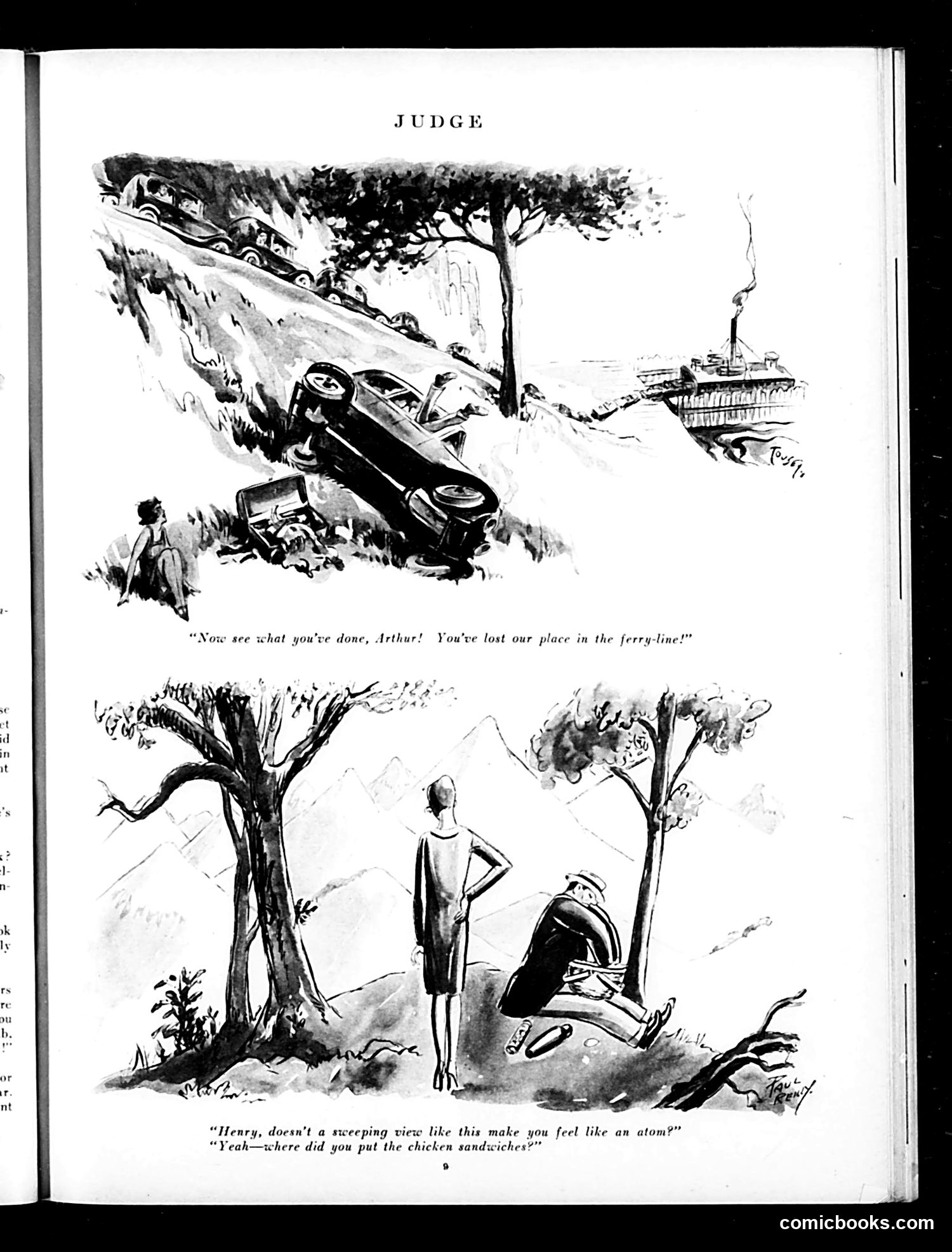
Judge Page Analysis This page contains two satirical comic panels about American leisure and romance, likely from the early-to-mid 20th century. Top panel: A car has crashed down a cliff near a ferry dock. The caption mocks a couple's outing gone wrong—they've lost their place in the ferry queue due to the accident, treating the disaster as merely an inconvenience to their travel plans. Bottom panel: A man attempts romantic philosophy ("doesn't a sweeping view make you feel like an atom?"), but his female companion dismisses his poetic sentiment, responding pragmatically about the chicken sandwiches. Both cartoons satirize the gap between romantic ideals and mundane reality—the disconnect between what people claim to value (scenic beauty, emotional connection) versus their actual priorities (schedules, food). The humor targets middle-class aspirations and the failure of romance in everyday American life.
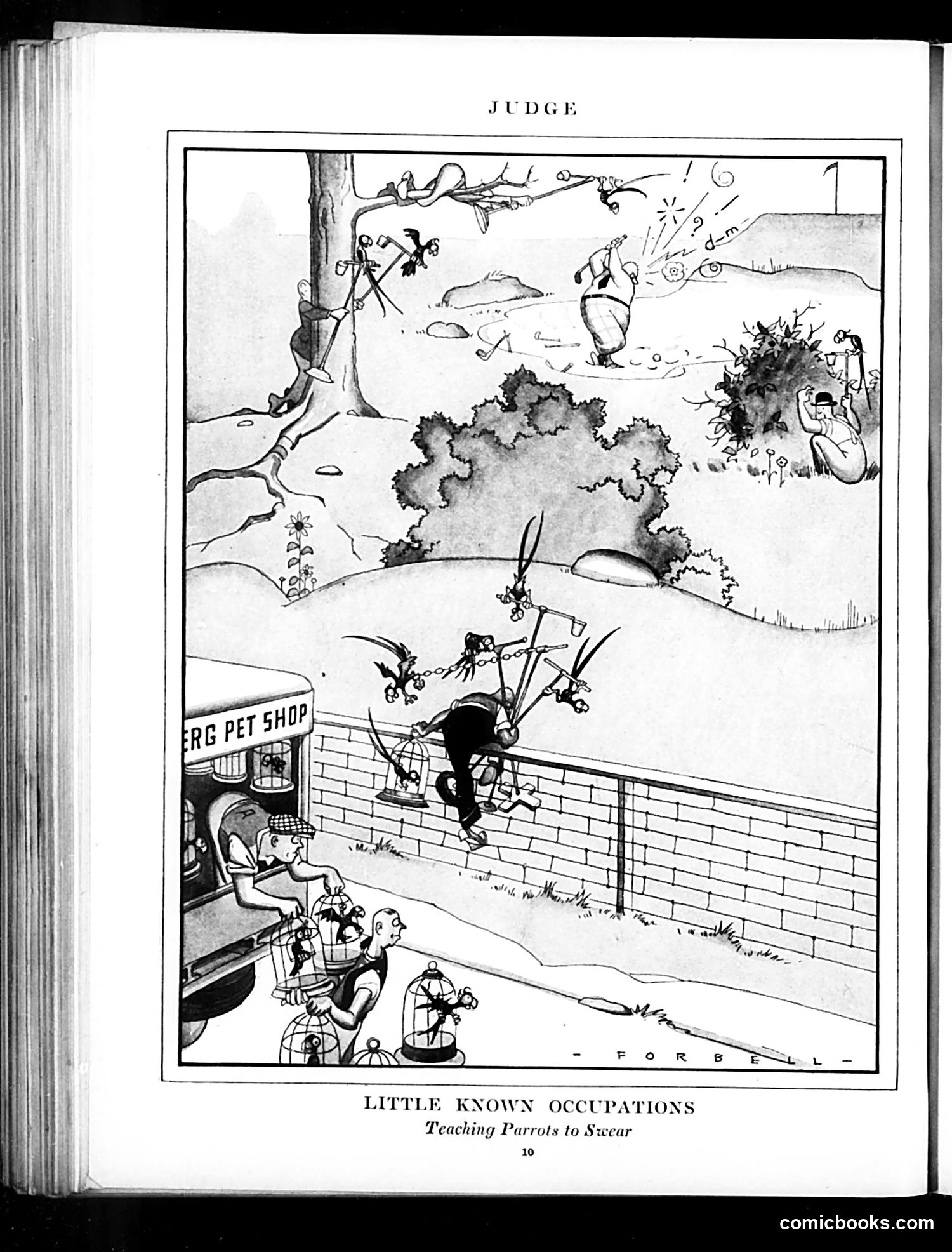
Analysis This satirical cartoon depicts an absurd "little-known occupation": teaching parrots to swear. The scene shows a pet shop operator perched on a fence near a brick wall, apparently instructing parrots (visible in cages at ground level) in profanity. The image is surreal—featuring flying figures and exaggerated gestures suggesting chaotic instruction. The humor lies in the contradiction: parrots naturally mimic sounds, so "teaching" them to swear inverts the normal relationship between teacher and student, making the occupation ridiculous. This appears to be gentle, observational humor about odd professions rather than pointed political satire. The cartoon mocks the mundane absurdity of specialized, impractical work.
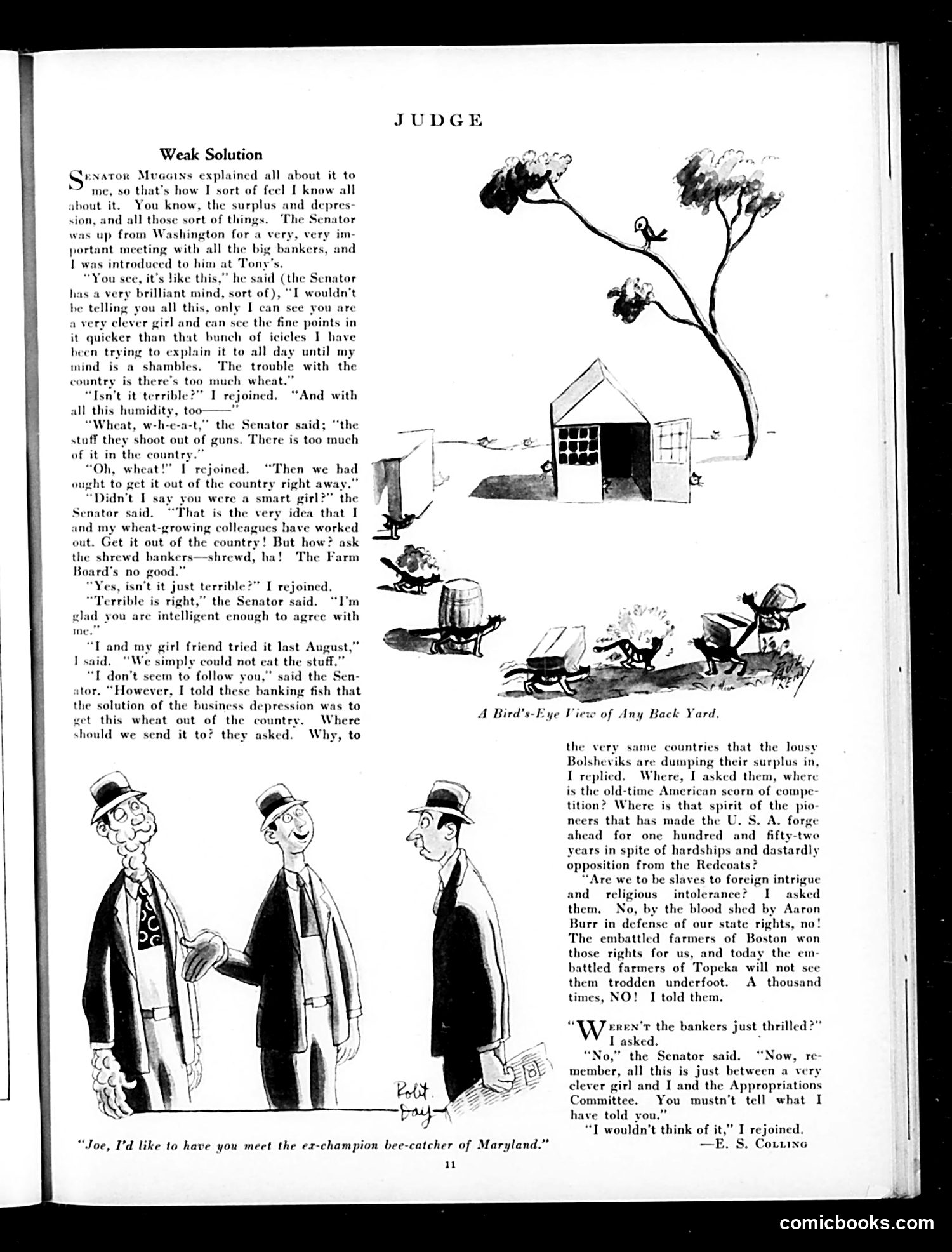
"Weak Solution" - Judge Magazine Satire This page satirizes Senator Muggins's absurd explanation of Depression-era agricultural policy to an unnamed woman. The senator claims the solution to economic crisis is exporting surplus wheat to foreign countries—specifically where "lousy Bolsheviks" dump their surplus, invoking nationalist rhetoric about American pioneer spirit and state rights. The satire works on multiple levels: the senator patronizes the woman while admitting he can't convince actual bankers; his grandiose historical references (Aaron Burr, Boston farmers) are comically misapplied to a mundane farm problem; and his "solution" is incoherent—he never answers *how* to actually export the wheat. The woman's naive agreement ("We simply could not eat the stuff") exposes the impracticality of the entire scheme. The cartoons of three businessmen reinforce the theme of clueless authority figures. This mocks both political posturing during the Farm Crisis/Great Depression and the disconnect between government rhetoric and actual policy solutions.
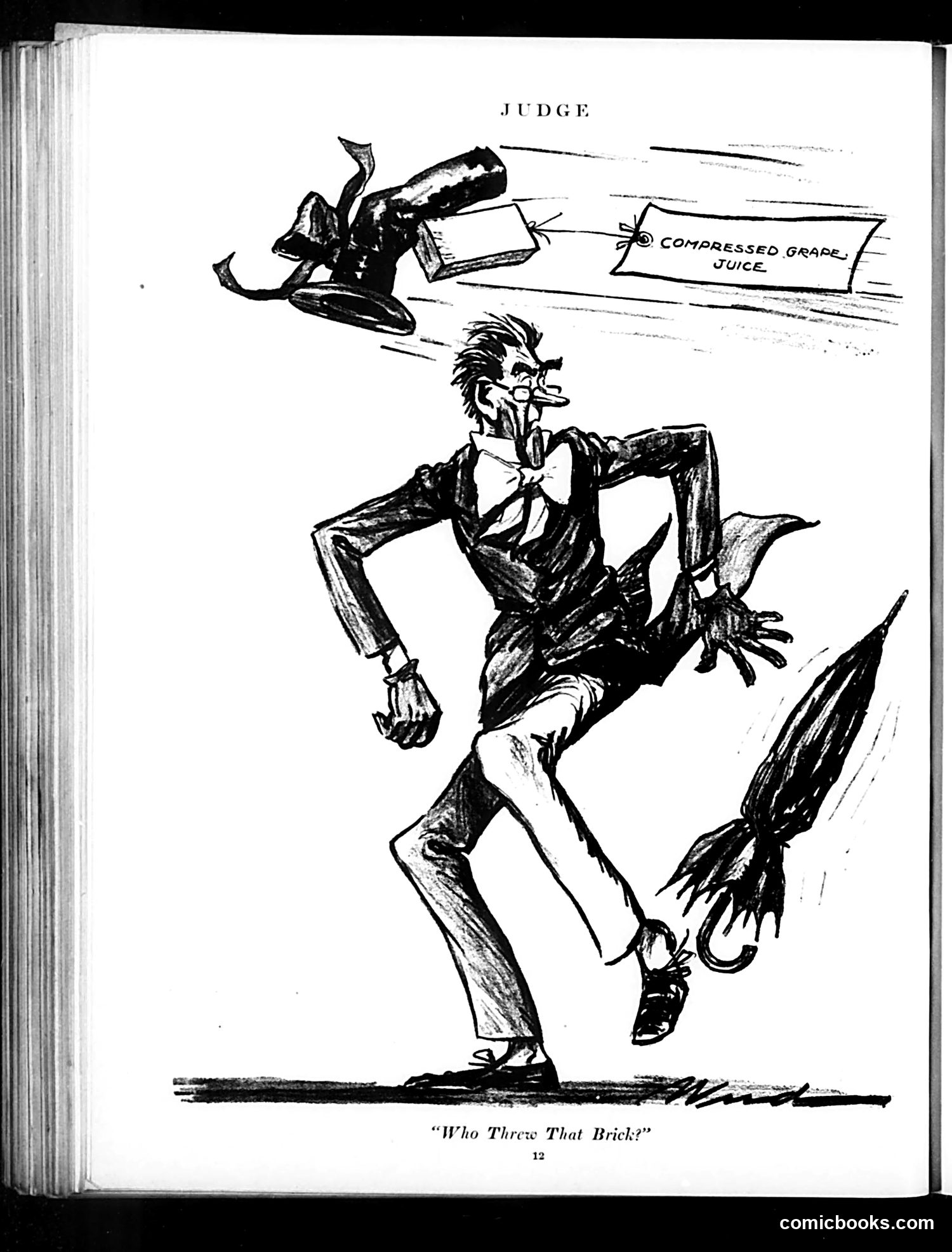
"Who Threw That Brick?" - Judge Magazine Cartoon This political cartoon depicts a disheveled judge being struck by a brick labeled "Compressed Grape Juice." The exaggerated caricature and chaotic pose suggest satirical commentary on judicial hypocrisy regarding Prohibition-era enforcement. The "compressed grape juice" is a transparent euphemism for illegal alcohol—a common term bootleggers and drinkers used to mock Prohibition laws. The cartoon likely critiques judges who publicly upheld alcohol prohibition while privately consuming illegal liquor, or judges caught in corruption scandals involving bootleggers. The title's indignant tone ("Who Threw That Brick?") emphasizes the judge's feigned innocence despite his obvious complicity. This reflects Judge magazine's satirical stance on Prohibition's widespread hypocrisy and the judiciary's failure to enforce it fairly.
"Judge on the Bench" - Satire on Stalin's Industrial Policy This page satirizes Stalin's 1930s industrial policy shift. The headline article discusses Stalin's announced move away from strict communism toward individual economic incentives—paying workers by skill rather than equally, inviting bourgeois intellectuals and engineers to participate, and promising better living conditions. The satire's target appears to be American intellectuals (like Dr. George Counts, cited favorably) who embraced this as evidence of Soviet pragmatism and reason to improve US-Soviet relations. Judge seems skeptical of this optimism, viewing the policy as a "retreat from communism" masked as visionary leadership. The secondary article on "Other Intoxication" uses medical discussion of dietary poisoning to mock excessive eating as dangerous (referencing William Jennings Bryan), possibly extending the satire to critique American excess and moral hypocrisy regarding intoxication.
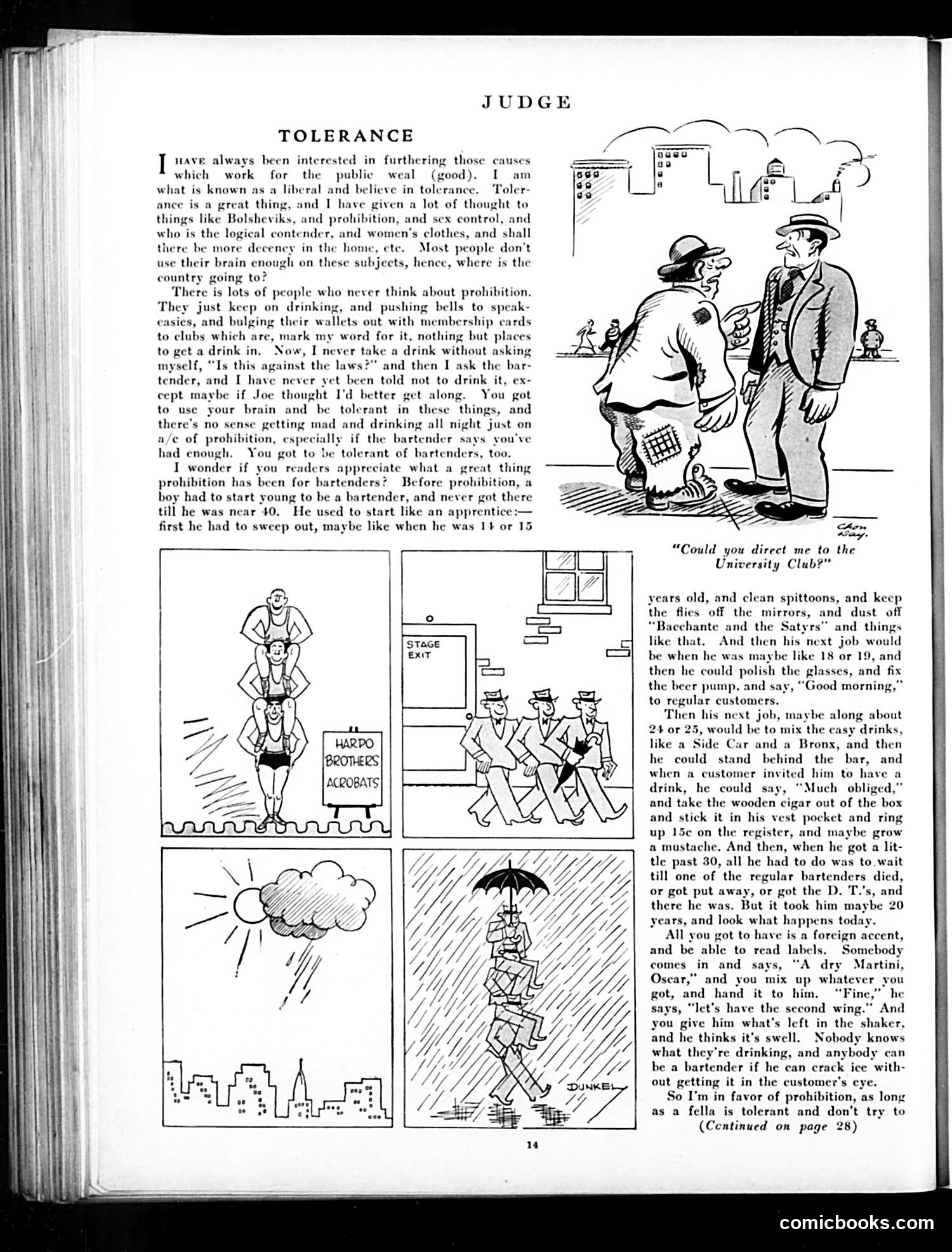
Analysis for Modern Readers This 1920s satirical piece, titled "Tolerance," mocks Prohibition-era hypocrisy. The author claims to support "tolerance" on modern issues (Bolsheviks, prohibition, sex control, women's clothing) while discussing bartenders. The central irony: he advocates for tolerance regarding prohibition—meaning people should calmly accept the law banning alcohol—yet he himself frequents speakeasies (illegal bars requiring "membership cards") and drinks regularly. He rationalizes this by saying one must "ask the bartender" if drinking is acceptable, demonstrating absurd self-deception. The accompanying cartoons show speakeasy life: acrobatic bartenders ("Bolzano Brothers Acrobats"), patrons in rain seeking the "University Club" (coded language for illegal drinking establishment), and chaos. The satire highlights how Prohibition created widespread lawbreaking while people maintained facades of respectability—pretending they're being "tolerant" and law-abiding while actively violating Prohibition. The piece criticizes both the hypocrisy and how Prohibition allegedly lowered bartending standards by eliminating the apprenticeship system.
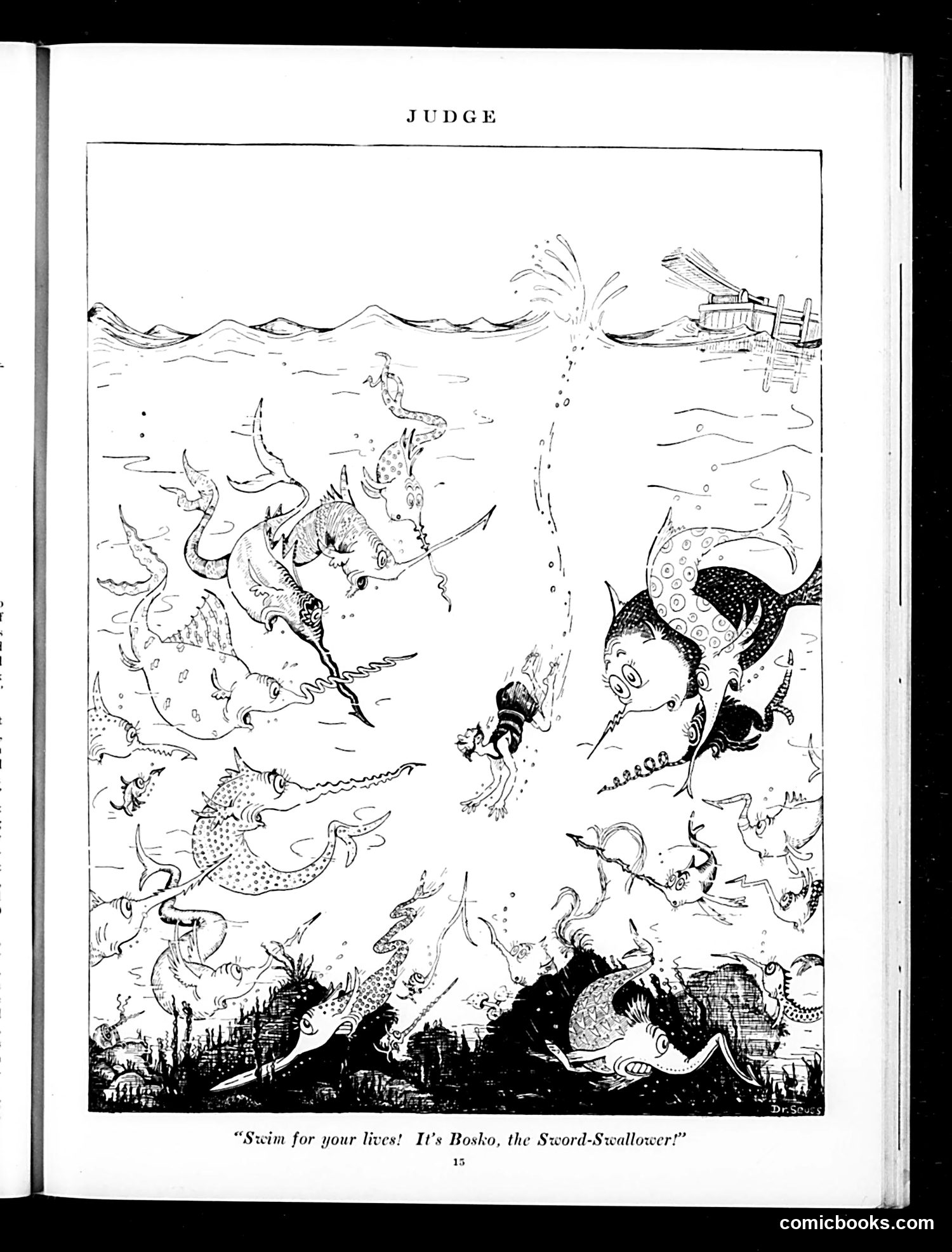
"Swim for Your Lives! It's Bosko, the Sword-Swallower!" This underwater scene depicts panic among sea creatures as they flee from "Bosko, the Sword-Swallower"—a figure shown at bottom center in dark silhouette, apparently a circus or carnival performer. The satire appears to mock either a specific performer named Bosko or use the name as a stand-in for a threatening public figure. The humor lies in the absurdist premise: sword-swallowing, a human circus act, becomes terrifying to sea life. The vast assembly of fish and sea creatures scattering in fear creates comedic exaggeration. Without additional context about the magazine's publication date or contemporary events, the specific satirical target remains unclear, though it likely referenced a notable public figure or entertainer of the era.
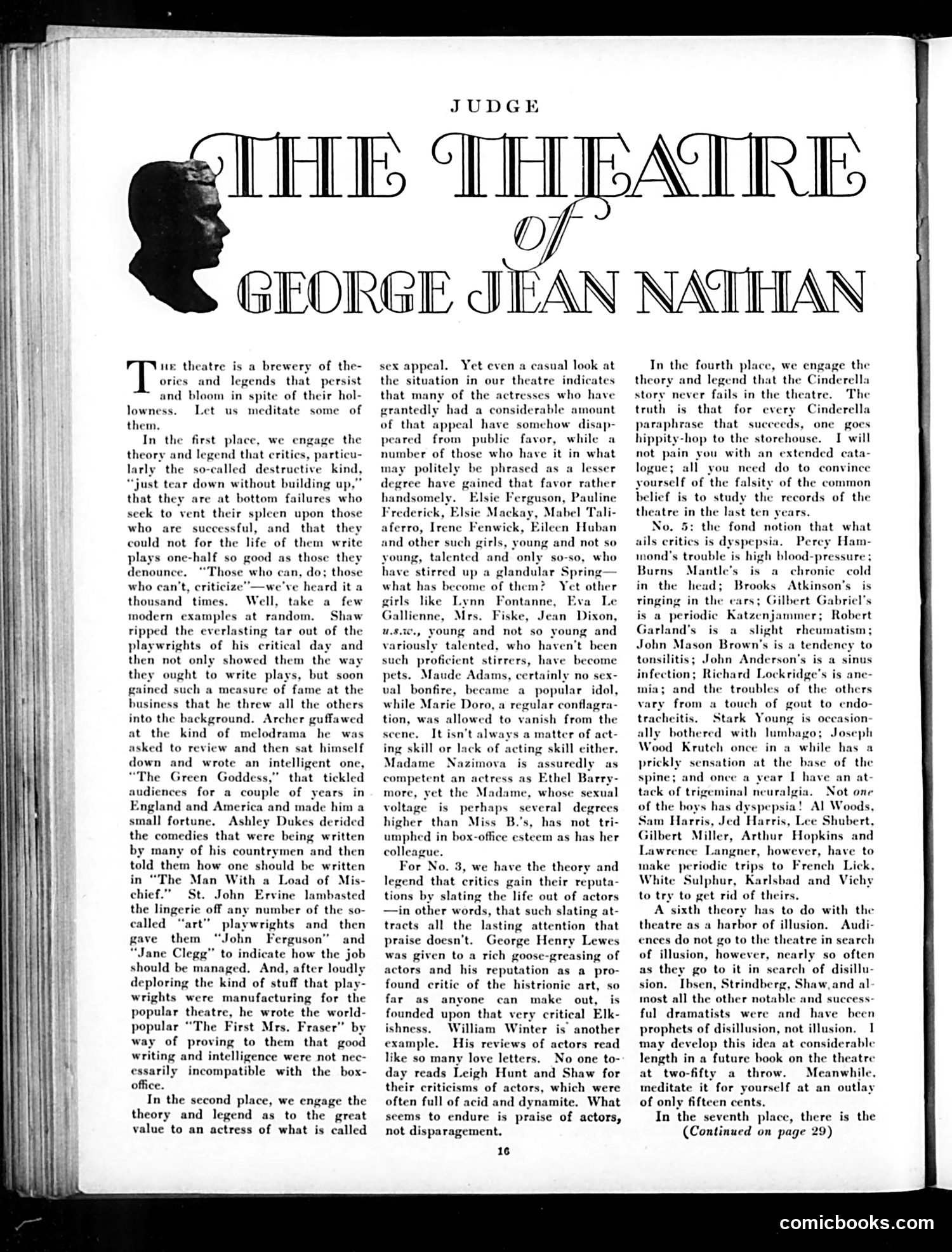
"The Theatre of George Jean Nathan" This is a critical essay by Judge magazine examining theatrical myths. The author (likely the famous drama critic George Jean Nathan, whose silhouette appears at left) debunks three popular beliefs about theatre: 1. "Critics can't create": He refutes the "those who can't, criticize" maxim by listing playwrights—Shaw, William Archer, Ashley Dukes, St. John Ervine—who were both fierce critics *and* successful dramatists. 2. "Sex appeal guarantees stardom": He argues many actresses with considerable physical appeal (Elsie Ferguson, Marie Doro) faded from favor, while less conventionally appealing actresses (Lynn Fontanne, Eva Le Gallienne, Mrs. Fiske) thrived. Talent and longevity matter more. 3. "Harsh reviews build reputations": He suggests influential critics like George Henry Lewes and William Winter actually built their legacies on *praising* actors, not savaging them. This is sophisticated theatre criticism disguised as satire, targeting prevailing assumptions about the entertainment industry circa the 1920s.
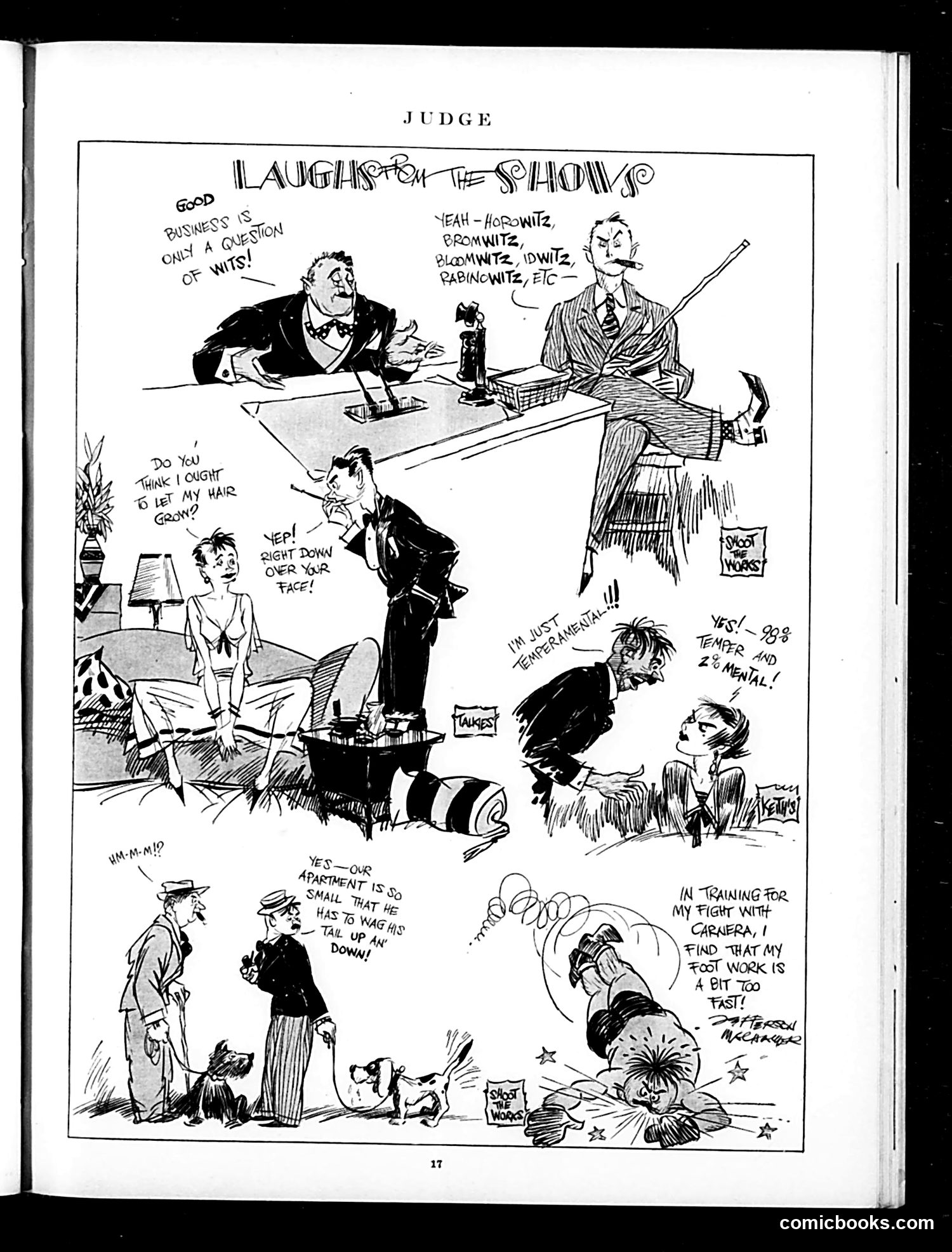
"Laughs at the Show" - Judge Magazine Cartoon This page satirizes theatrical performance and physical comedy. The main panel depicts a courtroom scene where a judge critiques a performer's "business" (theatrical routine), noting it relies solely on "wits." The surrounding vignettes show various slapstick and comedic scenarios—people falling, getting hit, physical mishaps—illustrating different comic styles. The reference to "Carnera" (likely Primo Carnera, a famous heavyweight boxer of the 1930s) in the bottom-right panel jokes that even in training for serious boxing, a performer finds their footwork "too fast"—a pun suggesting their comedic timing interferes with athletic performance. The names listed (Horowitz, Bromowitz, Bloomowitz, Rabinowitz) appear to reference Jewish comedians or performers, suggesting satire of vaudeville entertainment's ethnic comedy tradition. The overall message critiques both the quality and nature of contemporary theatrical humor.
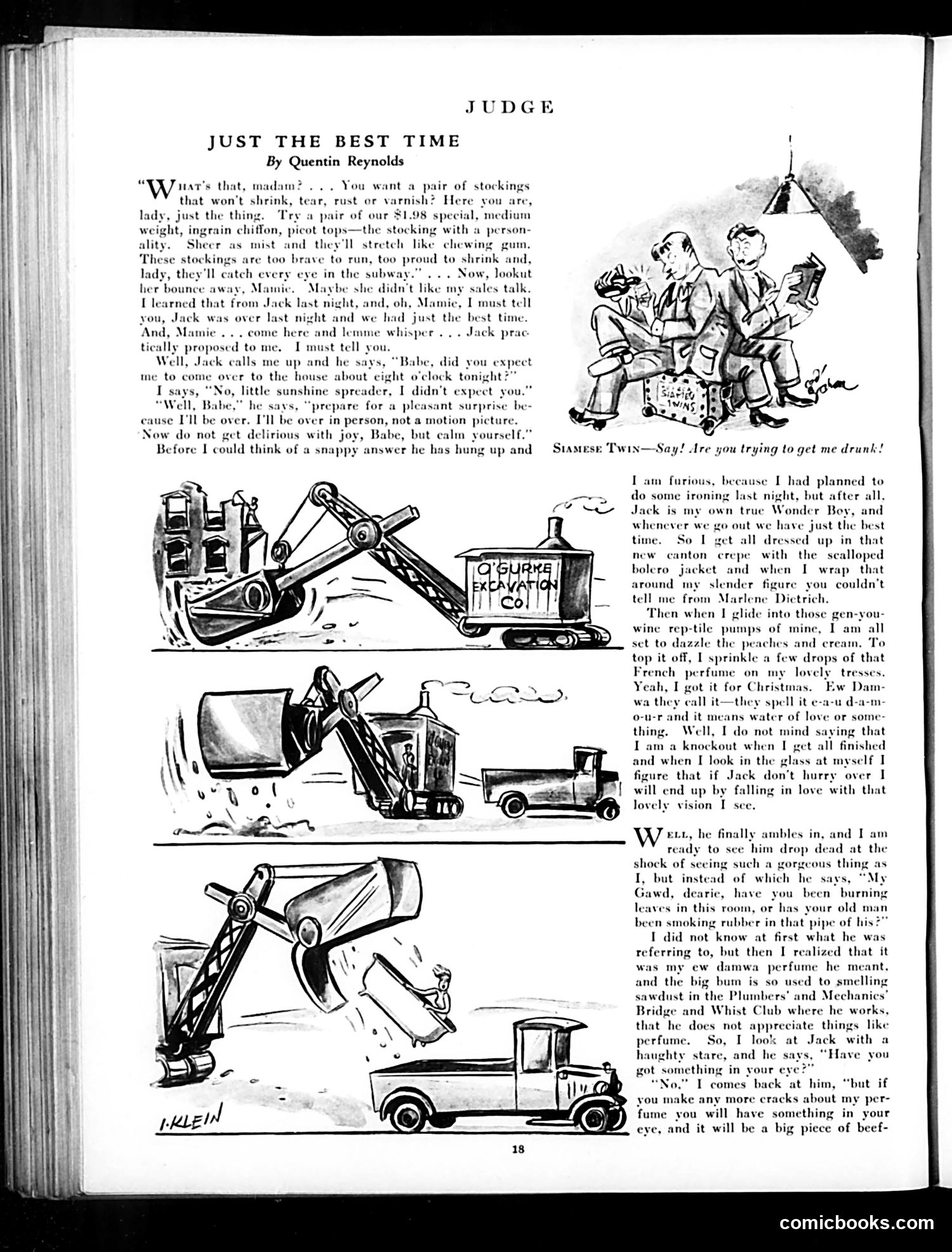
"Just the Best Time" by Quentin Reynolds This is a humorous domestic narrative about a woman preparing for a date with her boyfriend Jack. The story satirizes working-class romance and female vanity in what appears to be the 1920s-30s era. The plot: A saleswoman pitches stockings while daydreaming about Jack's surprise visit. She frantically prepares—donning her best dress, French perfume ("Eau d'Amour"), and heels—imagining herself glamorous as Marlene Dietrich. When Jack arrives, he immediately insults her perfume, comparing it unfavorably to sawdust and rubber smoke from his working-class social club (the "Plumbers' and Mechanics' Bridge and Whist Club"). She threatens him with violence. The satire: The gap between her romantic fantasy and his crude, unappreciative reality; the irony that her elaborate self-improvement goes completely unnoticed; and the implicit critique of working-class male indifference to feminine effort. The cartoon illustrations showing construction equipment reinforce the masculine, industrial world Jack inhabits.
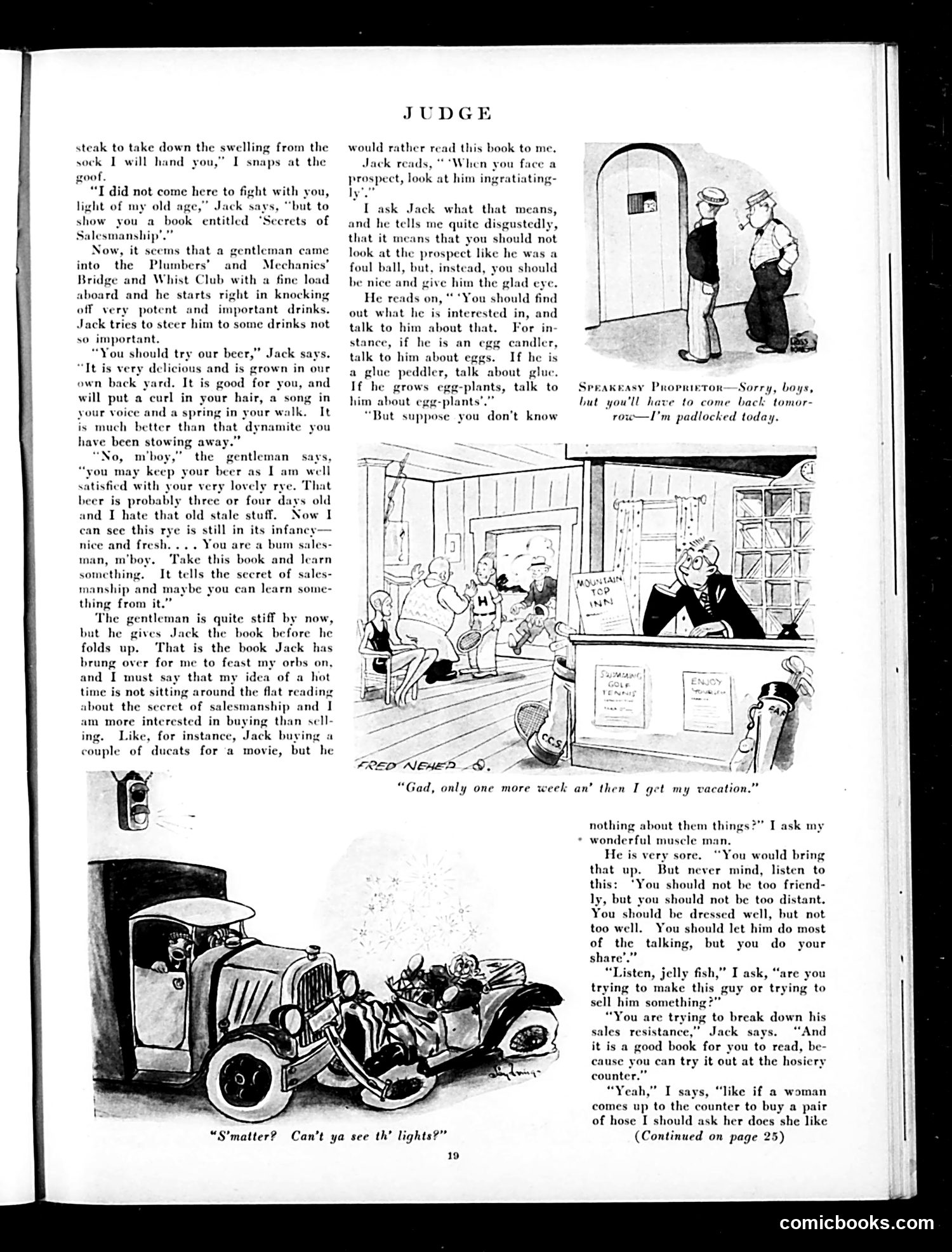
Judge Magazine Page Analysis This page satirizes salesmanship advice through a narrative featuring two men at a club. A drunk gentleman lectures Jack, a bartender, about poor sales technique using a book called "Secrets of Salesmanship." The gentleman criticizes Jack for trying to sell him beer when he wants whiskey—demonstrating that effective salesmen should understand customer preferences rather than push predetermined products. The cartoons illustrate related sales failures: The top cartoon shows a "speakeasy proprietor" turned away customers due to Prohibition enforcement ("padlocked"), and the bottom depicts a car crash, captioned "S'matter? Can't ya see th' lights?"—likely mocking oblivious or inattentive salesmen. The humor targets naive sales training and incompetent salespeople. The narrator's final quip about asking a female customer if she "likes" hosiery suggests the absurdity of applying generic relationship-building advice to actual commerce—a critique of overly theoretical business advice disconnected from reality.
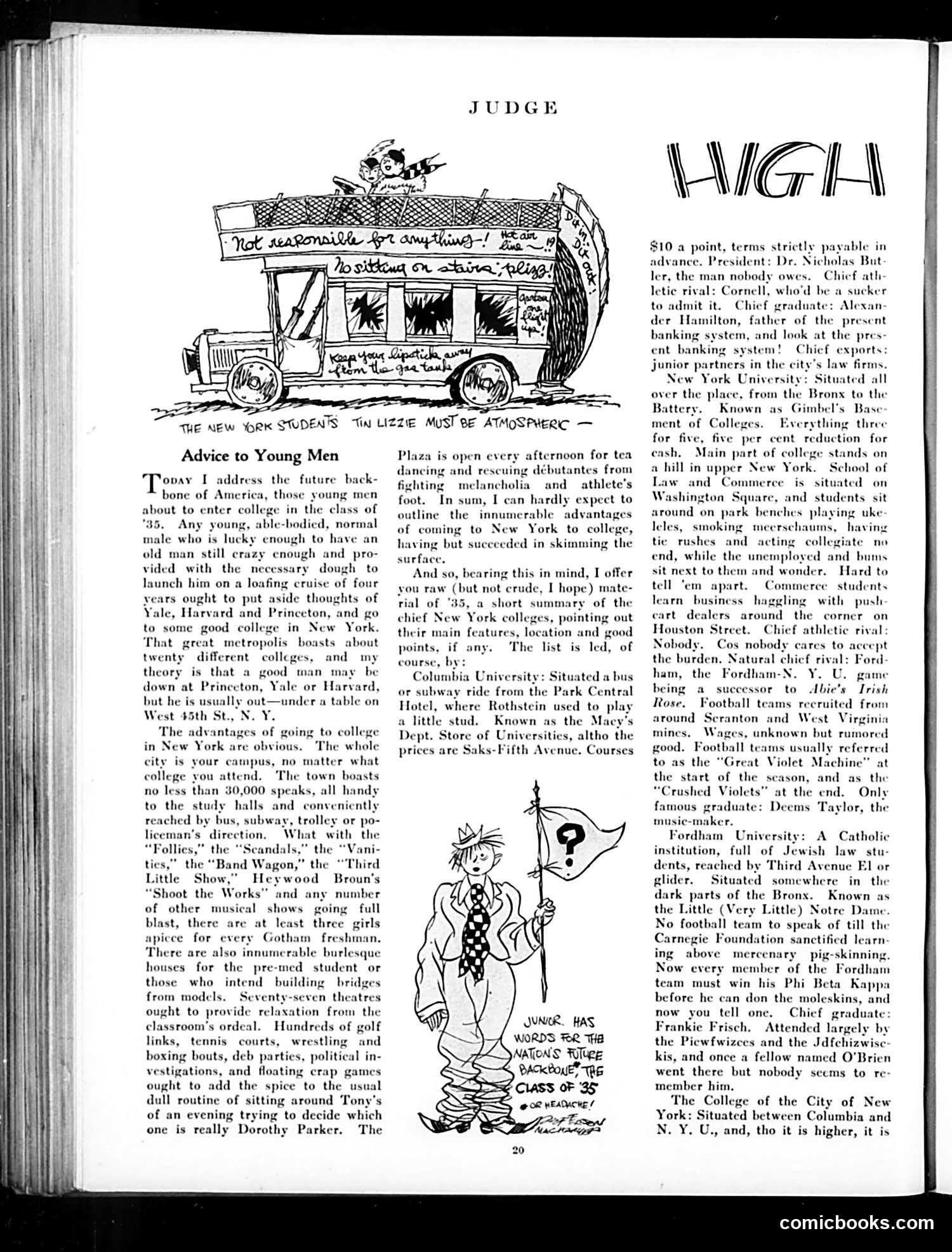
Satirical Guide to New York Colleges (1920s) This page from *Judge* magazine presents a humorous "Advice to Young Men" about attending college in New York City rather than prestigious institutions like Princeton or Harvard. The author's joke is that New York colleges offer superior non-academic attractions: speakeasies (illegal bars—this is Prohibition era), Broadway shows, burlesque houses, and abundant social opportunities, rather than serious study. The cartoon at top depicts a ramshackle vehicle labeled "The New York Students' Tin Lizzie Must Be Atmospheric"—satirizing students' focus on entertainment over education. The text mockingly describes specific institutions: Columbia University (compared to Macy's department store), NYU (called "Gimbel's Basement of Colleges"), and Fordham. References like "Rothstein" (a famous gangster) reinforce the seediness of 1920s New York nightlife being presented as college life. The satire targets both the frivolous priorities of young men and the chaotic, commercialized nature of urban college culture during the Jazz Age.
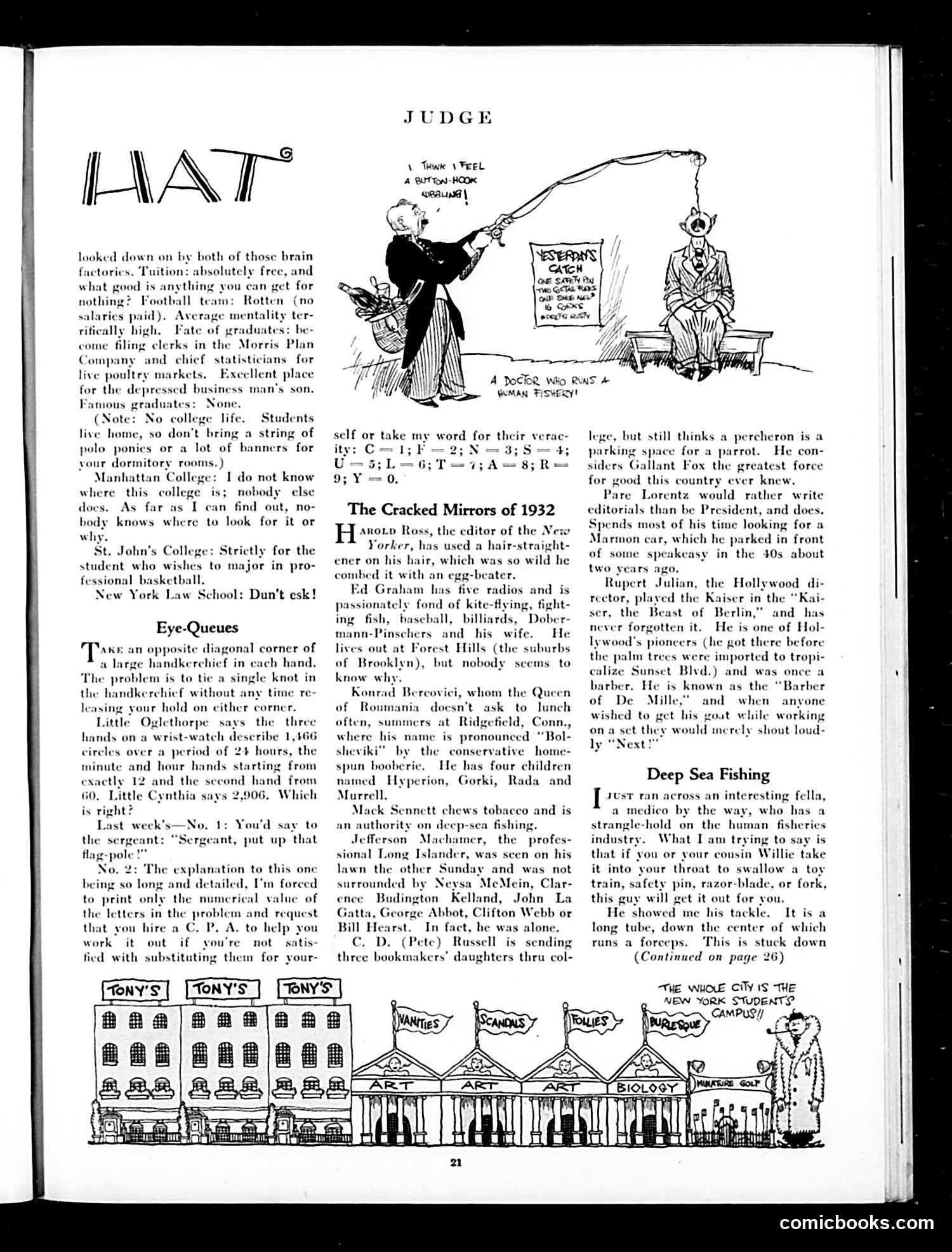
What This Judge Magazine Page Means This page from Judge (1932) contains satirical college rankings, celebrity profiles, and humor pieces typical of the magazine's content. "HAT" section: Mocks various New York colleges with dismissive stereotypes—Columbia and NYU graduates become filing clerks; Manhattan College students are wealthy but ignorant; St. John's attracts basketball players; New York Law School is incomprehensible. "The Cracked Mirrors of 1932": Brief, gossipy profiles of notable 1932 figures (Harold Ross of *The New Yorker*, artist Ed Graham, writer Konrad Bercovici, etc.). The humor lies in odd details revealing their quirks—eccentric hobbies, suspicious absences from social circles, or mistaken assumptions about their tastes. Other items: Brain teasers and wordplay puzzles typical of Judge's humor. The bottom cartoon: Shows New York City buildings labeled as various college departments, mocking how the entire city functions as a student campus—satirizing the dominance of student culture in NYC. The overall tone is urbane, gossipy, and gently mocking of New York's institutions and celebrities.
"Judging the Movies" by Pare Lorentz This is a film criticism column reviewing recent movies for a general audience. Lorentz critiques three films with characteristic sarcasm: "A Holy Terror": He mocks the tired Western formula—the taciturn hero from the East, the wild horse, the convenient Chinese martial arts training, the climactic fistfight. He notes the hero now crashes a monoplane into a bathroom, a modernization that doesn't improve the predictable plot. "Murder by the Clock": He dismisses the film's murder mystery as illogical. The plot hinges on a half-wit son inheriting an old lady's money, yet the crime happens in a cemetery with painted backdrops. Lorentz sarcastically notes that even Miss Tashman's "tight-fitting clothes" can't convince him the murders make sense. The column concludes with brief recommendations for other current films ("The Front Page," "The Public Enemy," etc.), suggesting Lorentz preferred grittier, more realistic pictures over contrived melodramas.
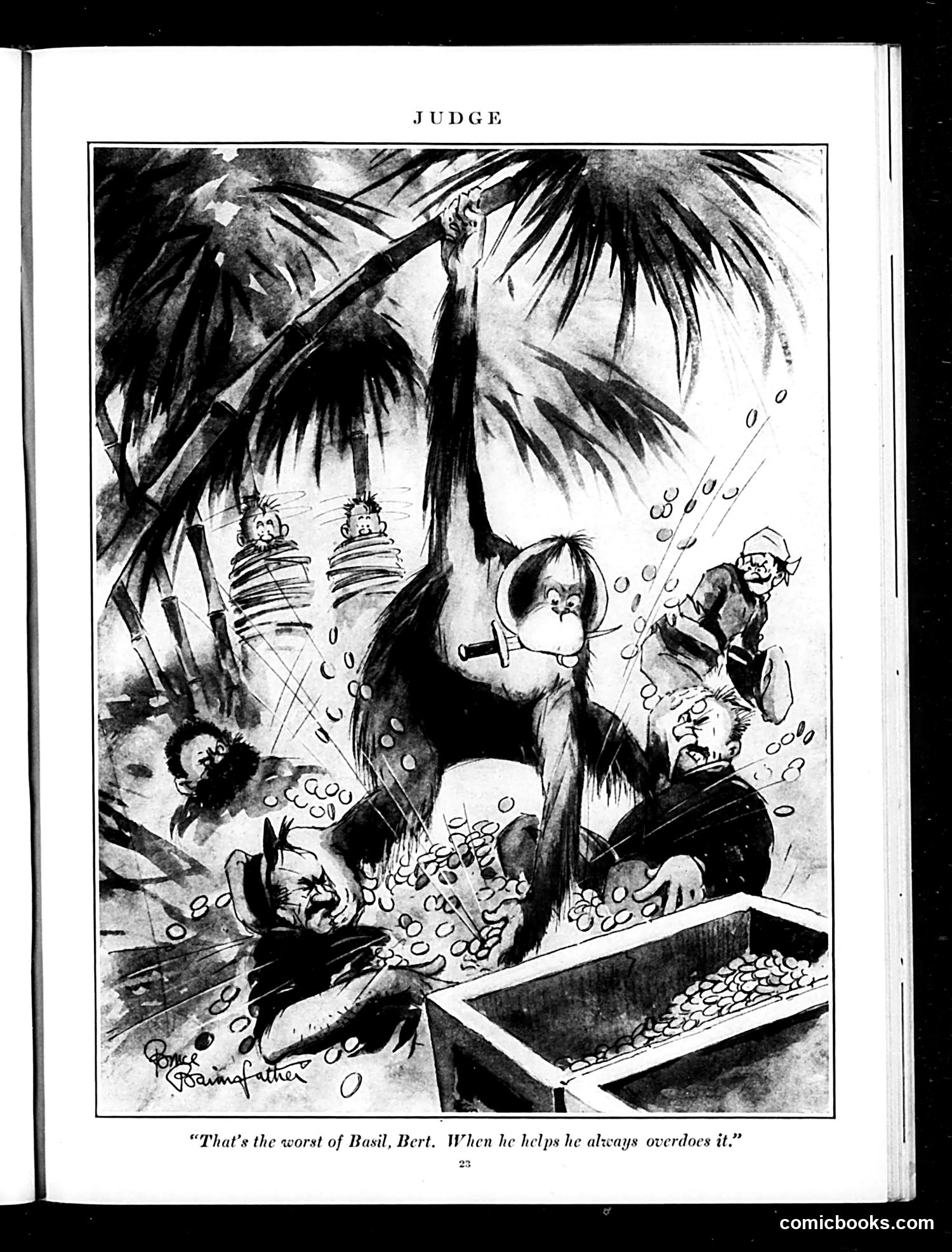
Analysis of "Judge" Page 23 This political cartoon, titled "That's the worst of Basil, Bert. When he helps he always overdoes it," depicts a central figure labeled "Basil" (appearing to represent a political or public figure) engaged in some form of excessive intervention or "help." The cartoon shows chaos erupting—money or coins scatter everywhere from what appears to be a distribution box. Multiple smaller figures surrounding Basil react with distress to his over-zealous assistance. The tropical setting with palm fronds suggests this may reference colonial or imperial policy. The satire criticizes well-intentioned but misguided intervention that causes more harm than good—a common theme in early 20th-century American political commentary. However, without additional context, the specific historical figure and situation referenced remain unclear.
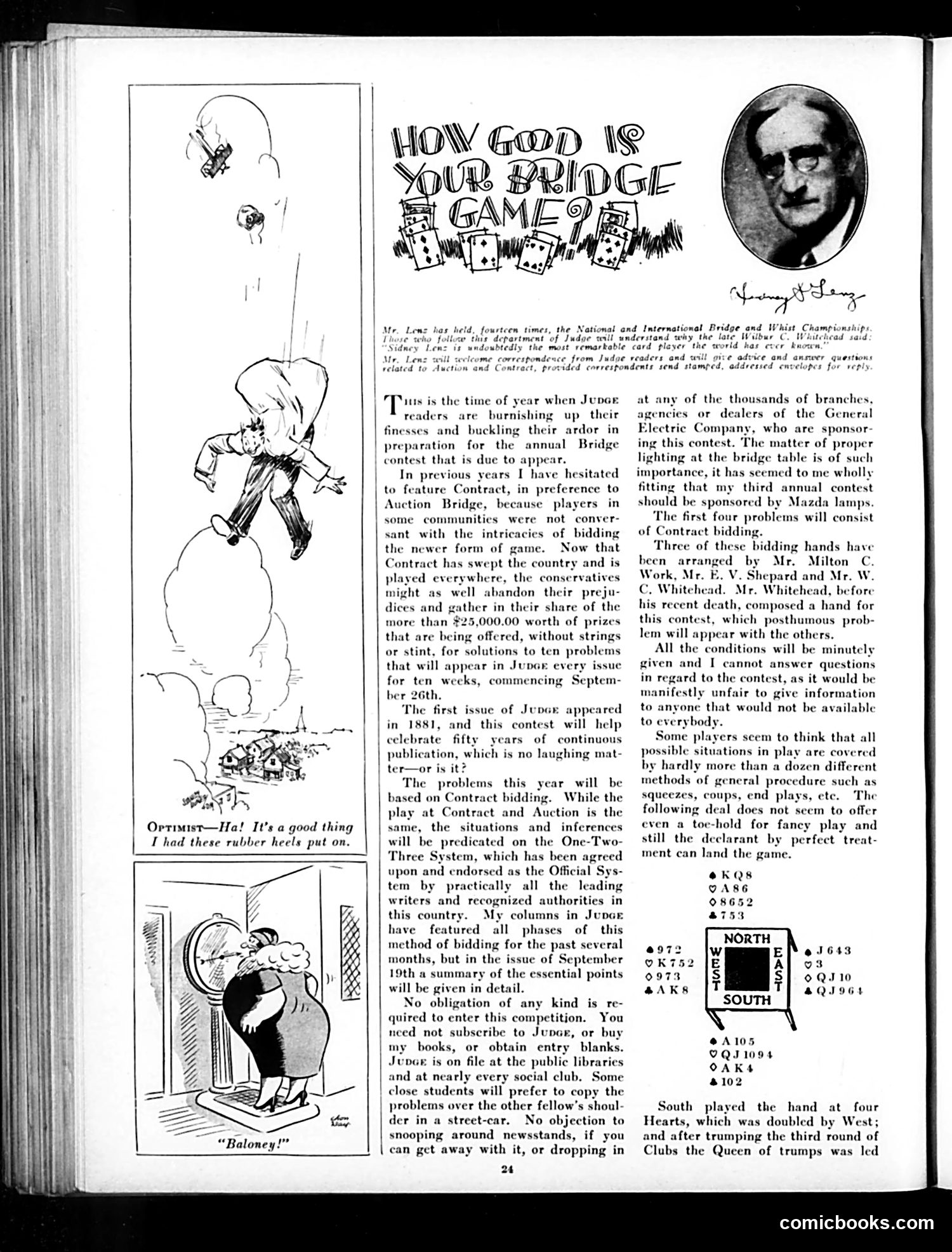
Explanation for Modern Readers This page combines cartoons with a bridge card game competition announcement. The Cartoons: The left side shows two humorous sketches. The top depicts someone falling down stairs with the caption "Optimist—Ha! It's a good thing I had these rubber heels put on," mocking blind optimism. The bottom cartoon, labeled "Baloney!", shows a rotund man at a mirror, likely satirizing self-deception about appearance or reality. The Main Content: The bulk of the page announces Judge magazine's sponsorship of a bridge card competition offering $25,000 in prizes. The author (likely the card expert Sidney Lenz, whose photograph appears top-right) explains they're featuring "Contract Bridge"—a relatively new bidding variant that had recently become popular nationwide—rather than older "Auction Bridge." The competition will run for ten weeks starting September 26th, celebrating Judge's 50th anniversary. The text includes actual bridge hands and technical bidding problems for readers to solve. The page reflects bridge's status as a major American leisure activity in the 1930s.
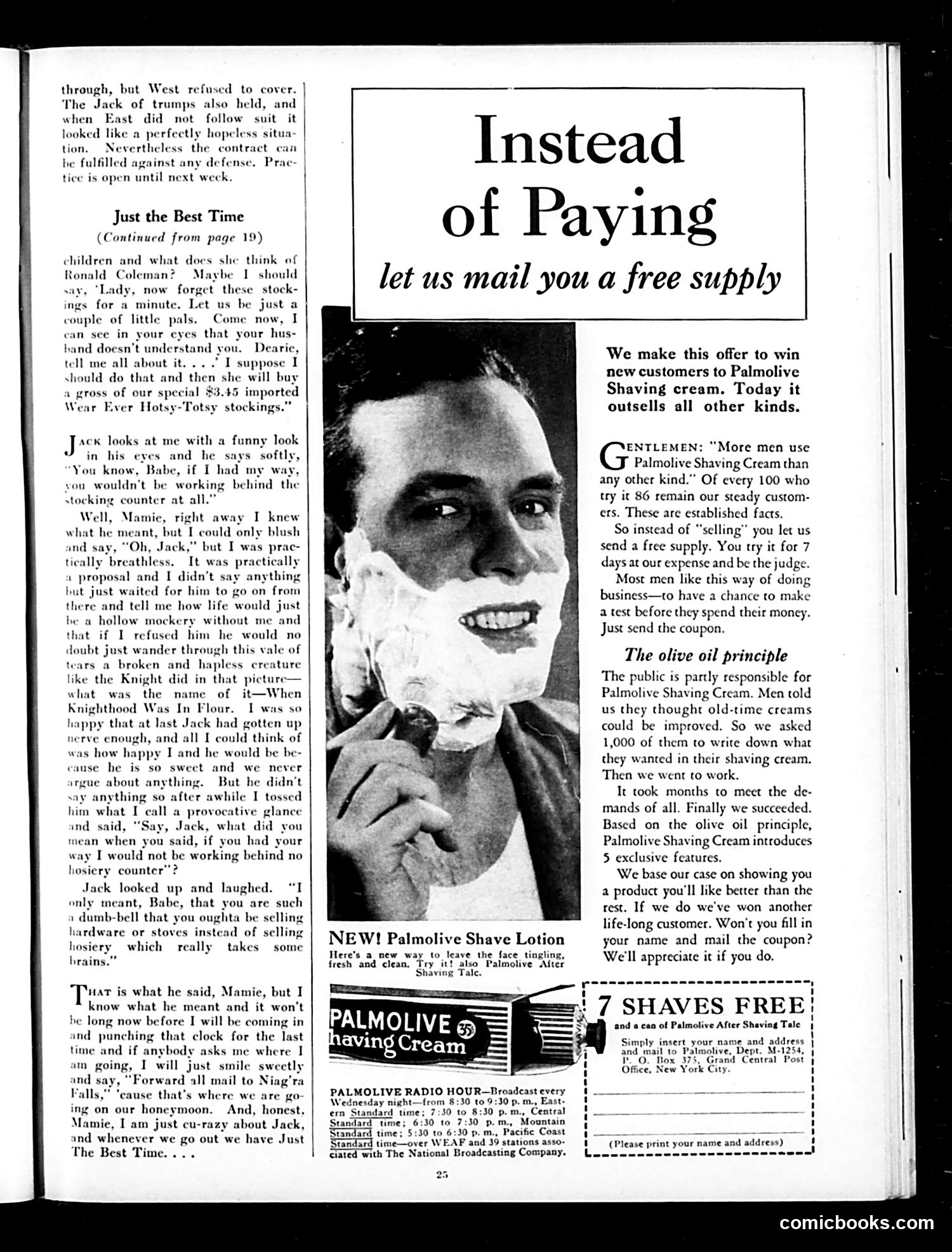
Analysis of Judge Magazine Page This page contains two distinct elements: a serialized romantic fiction story ("Just the Best Time") and a Palmolive shaving cream advertisement. The Story: A female narrator describes a romance with a man named Jack who works at a hosiery counter. When Jack proposes, she's thrilled, but his comment—"if I had my way, you wouldn't be working behind the stocking counter"—disappoints her. She interprets his words as a romantic proposal, though Jack's actual meaning (calling her a "dumb-bell" unfit for the job) is insulting. The satire mocks both sentimental romance fiction and workplace dynamics of the era. The Advertisement: Palmolive offers free samples of shaving cream to potential customers rather than selling directly, using the "olive oil principle"—based on customer feedback about desired product features. The approach emphasizes consumer choice and confidence-building through trial. This appears to be a 1920s-era magazine page mixing entertainment content with early marketing psychology.
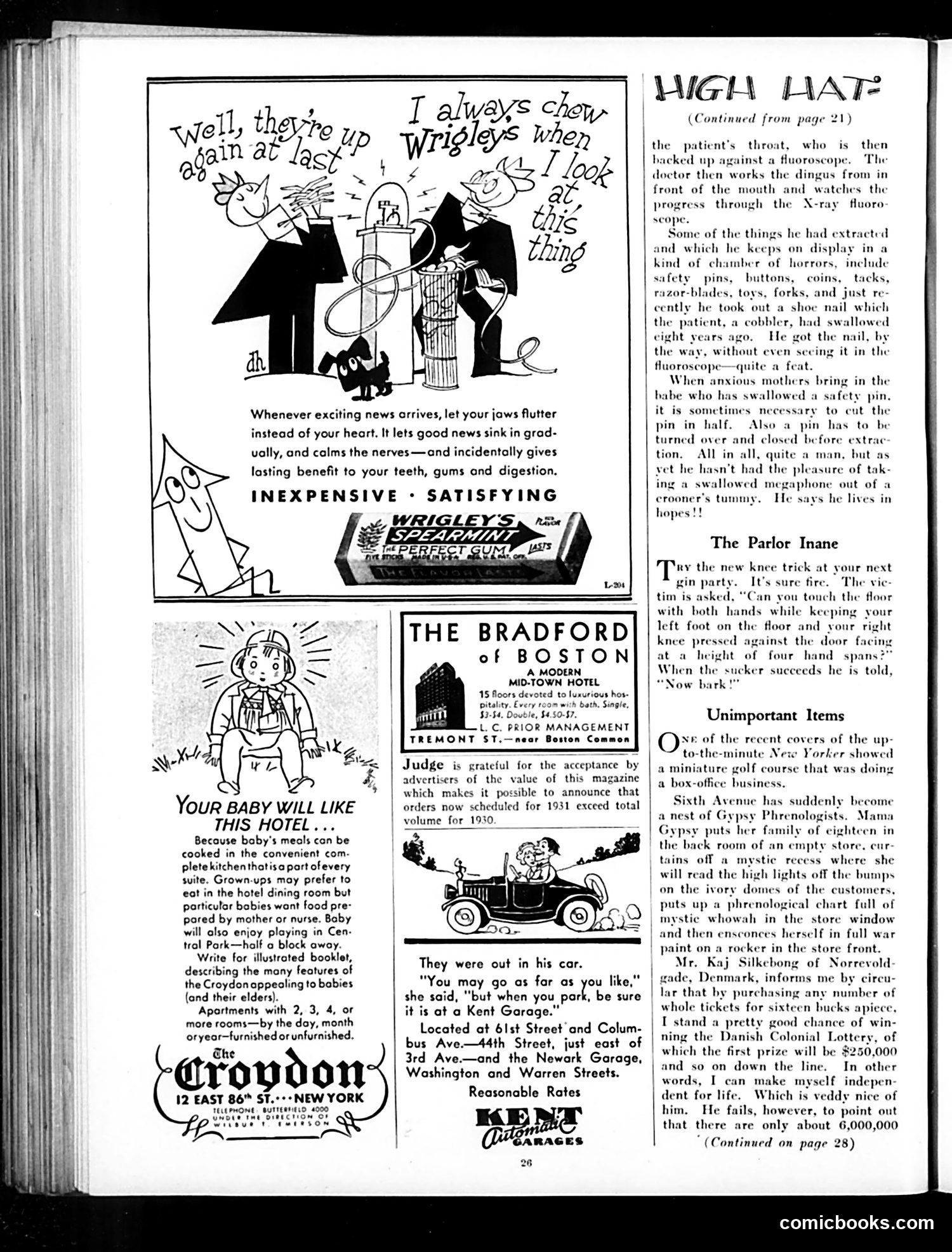
Explanation for Modern Readers This page is primarily advertisements and miscellaneous magazine content rather than political satire. The main cartoon at top shows two men with exaggerated facial expressions chewing gum, illustrating a Wrigley's advertisement claiming that chewing gum calms nerves when receiving exciting news—a now-quaint product claim about digestion and dental health. Below are hotel and garage advertisements (The Bradford, Craydon apartments, Kent Garage) typical of 1930s publications. The text sections include brief humorous anecdotes: one about a doctor extracting swallowed objects via fluoroscope (including a shoe nail swallowed eight years prior), and another about a parlor trick involving touching the floor while maintaining an awkward body position. A final "Unimportant Items" section contains gossipy observations about New York trends—miniature golf courses, phrenology parlors on Sixth Avenue, and a mention of a Danish lottery scheme. The content reflects 1930s urban culture and advertising rather than political commentary.
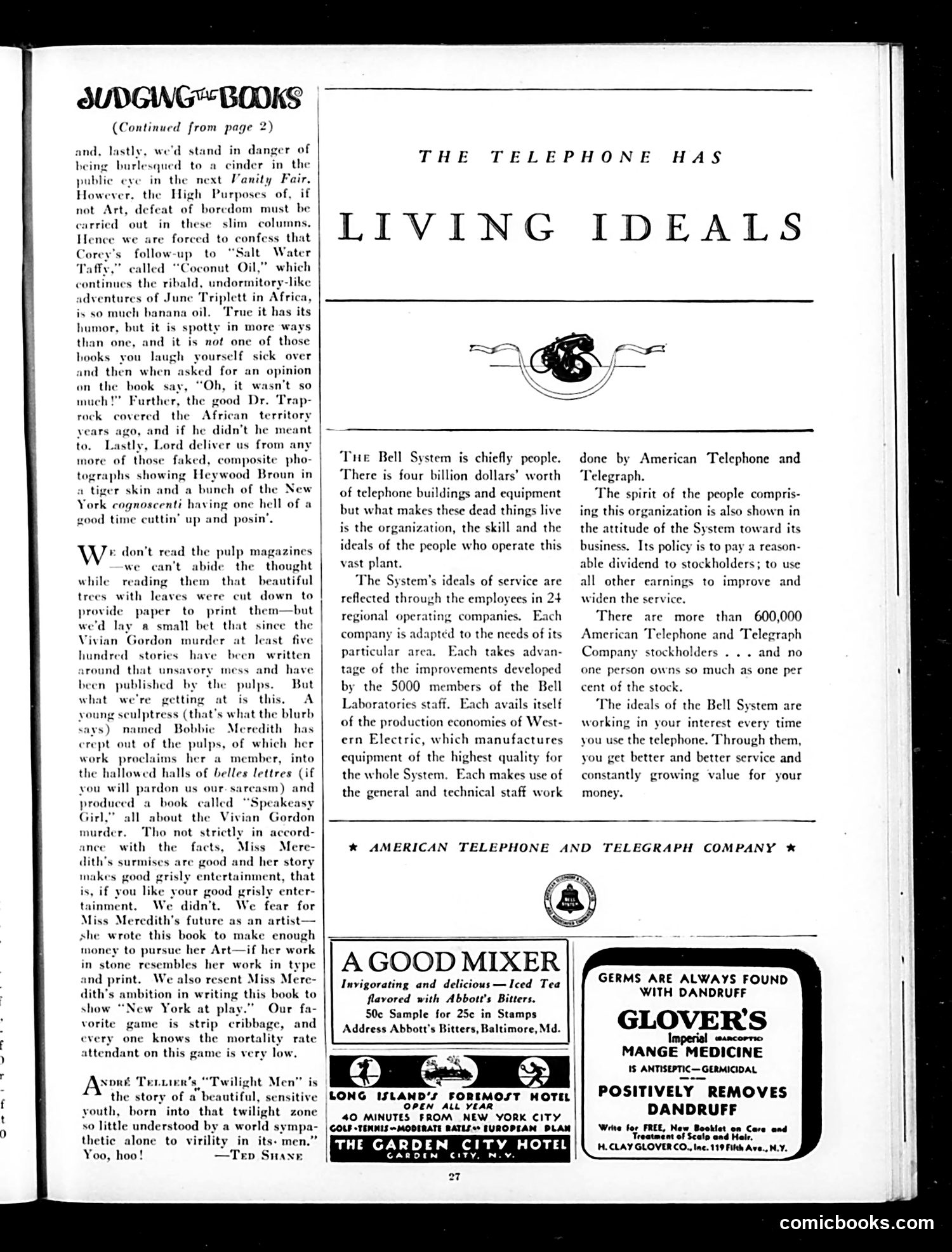
Analysis of Judge Magazine Page Content This page from *Judge* contains a book review section ("Judging the Books") and a substantial advertisement for the American Telephone and Telegraph Company. The Book Reviews: The critic dismissively reviews several novels, including works about African adventures and the Vivian Gordon murder case (a real 1931 New York scandal involving a murdered woman and police corruption). The tone is satirical and caustic—the reviewer mocks pulp fiction sensationalism and questions whether serious artists should exploit true crimes for money. The Advertisement: The AT&T ad presents the telephone system as ideologically driven by workers' "ideals of service" rather than profit. It emphasizes democratic ownership (600,000+ shareholders, no single large owner) and reinvestment of earnings into service improvement—essentially corporate propaganda positioning the Bell System as a public good rather than a monopoly. This reflects 1930s corporate image-management during the Depression era. The page is primarily advertising-driven, with minimal visual satire beyond the text itself.
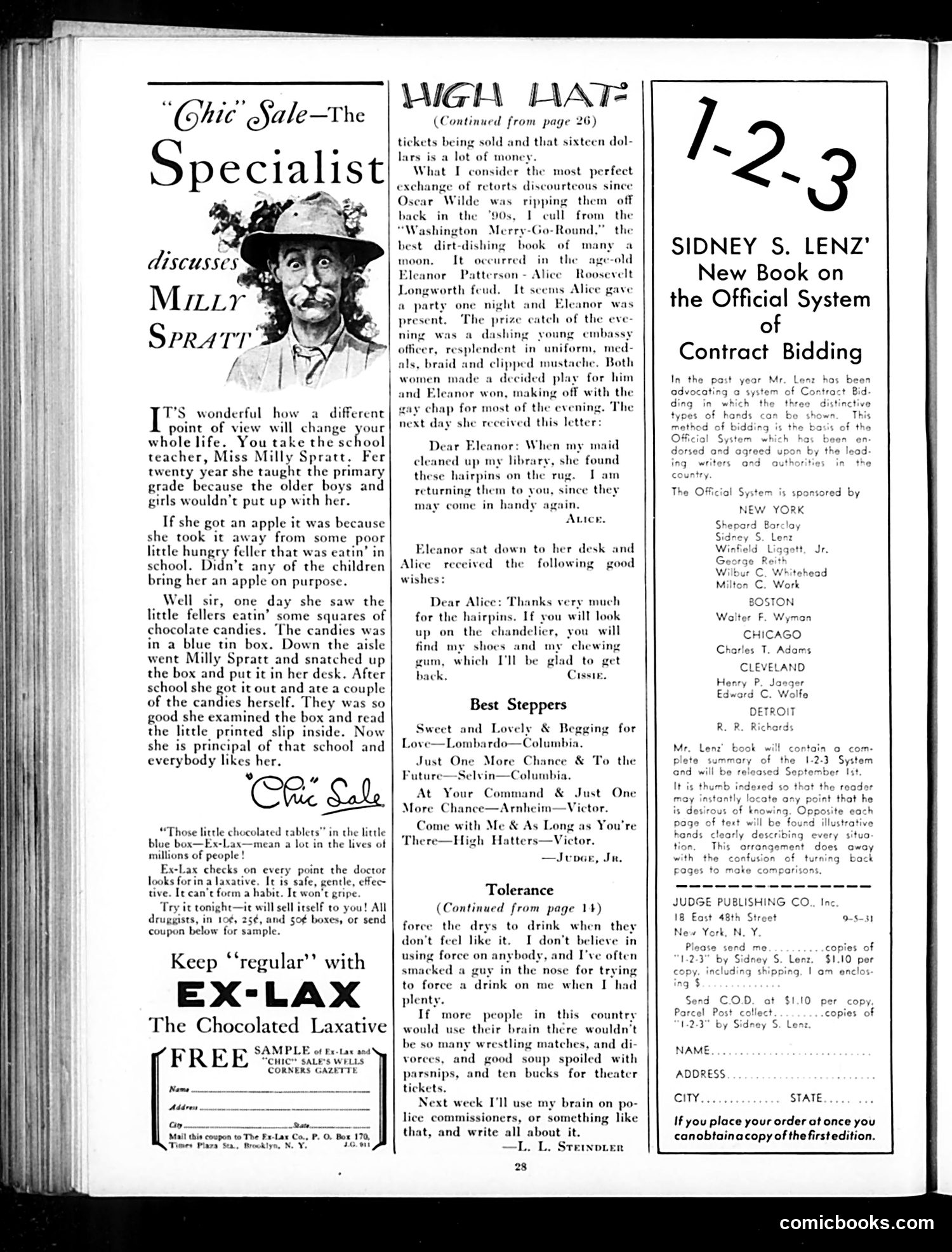
"Chic Sale's Specialist" - Historical Context This page contains humorous fiction by "Chic Sale" (a popular early-20th-century humorist), not political cartoons. The main story, "Miss Milly Spratt," is a gentle character sketch playing on social irony: a strict, unpopular schoolteacher discovers Ex-Lax chocolates meant to be laxatives and suddenly becomes beloved by her students and colleagues. The joke turns on the medicinal laxative literally and figuratively "changing her outlook"—the product inadvertently produces personality improvement. The page primarily functions as advertising, with Ex-Lax (a commercial laxative) using the charming fiction to sell the product. The illustration shows a stern-faced woman, presumably Spratt. The sidebar references Eleanor Patterson and Alice Roosevelt Longworth's documented 1920s feud, presenting witty, flirtatious exchanges between them—a genuine historical scandal Judge's readers would recognize. The "1-2-3" book advertisement and other content are standard period magazine filler. There's no political satire here—mainly commercial entertainment.
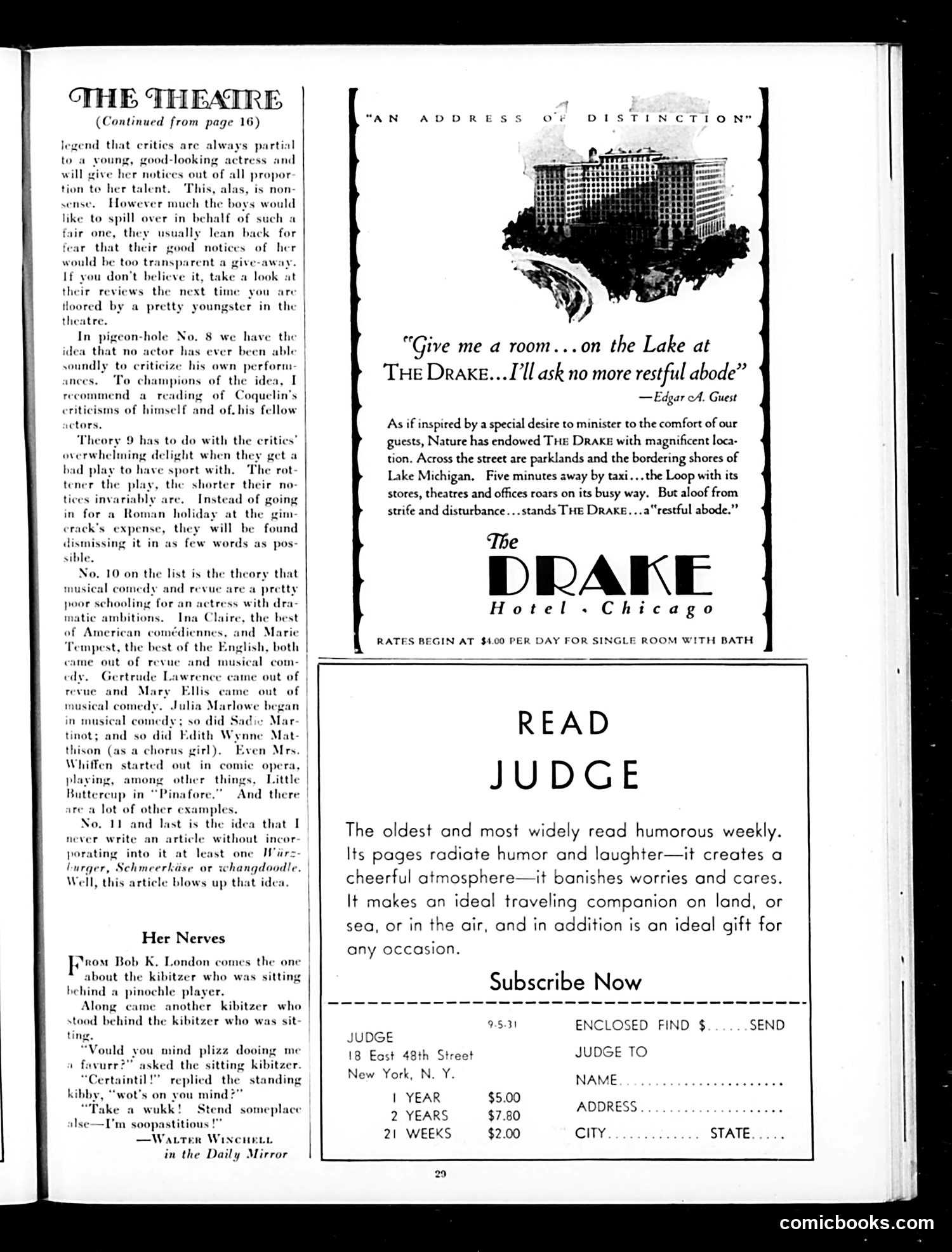
Judge Magazine Page Analysis This page from *Judge* magazine combines theatrical criticism with advertising and humor. The main editorial content critiques theater critics' biases—arguing they favor attractive actresses disproportionately and struggle to objectively assess their own performances. The piece debunks theories about musical comedy being poor training for serious actresses, citing examples like Ina Claire and Gertrude Lawrence. The "Her Nerves" section presents a Yiddish-inflected joke about superstitious pinochle players and kibitzers (onlookers), typical of early 20th-century American humor mining ethnic dialects for comedy. The advertisements promote The Drake Hotel in Chicago and *Judge* magazine itself as a humorous weekly subscription—positioned as ideal leisure reading. This appears to be page 29 from a 1931 issue, blending theatrical commentary with period advertising and ethnic humor conventions.
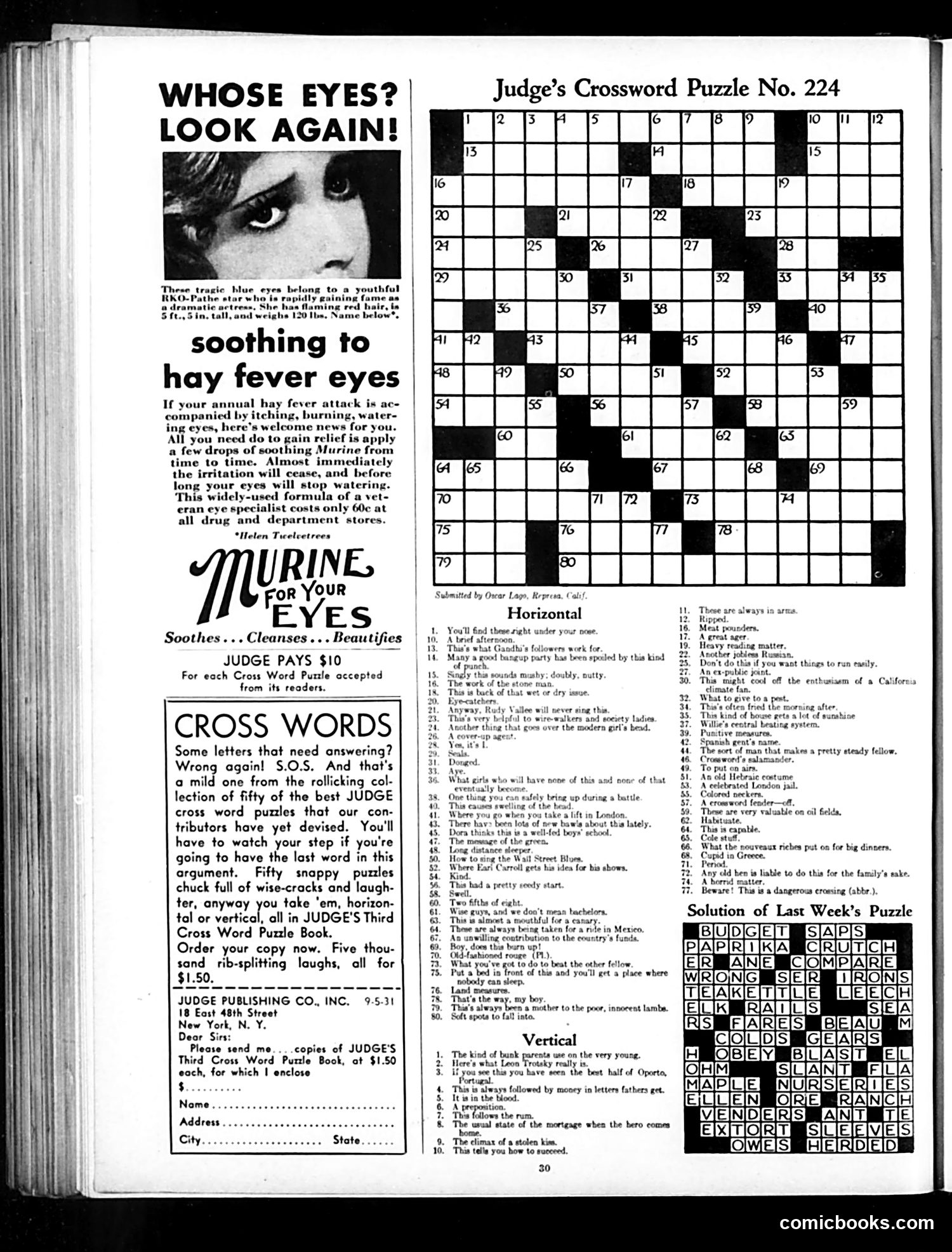
Judge Magazine Page Analysis This page is primarily advertising and a crossword puzzle rather than political satire. The main content features an advertisement for Murine eye drops, using a photograph identified as actress Helen Twelvetrees (a 1920s-30s silent film star gaining fame). The ad promotes Murine as relief for hay fever-related eye irritation—a common seasonal ailment of the era. Below the ad, Judge magazine offers its Third Cross Word Puzzle Book for $1.50, promoting fifty puzzles with humorous clues. The puzzle clues themselves contain contemporary references (Earl Carroll, Trotsky, Wall Street) typical of Judge's satirical humor, though the actual puzzle grid dominates the page. The page reflects Judge's dual purpose as both satirical humor magazine and commercial publication, mixing product advertising with entertainment content aimed at middle-class readers of the interwar period. There is no specific political cartoon or unified satirical message—it's a standard magazine layout mixing ads, puzzles, and promotional content.
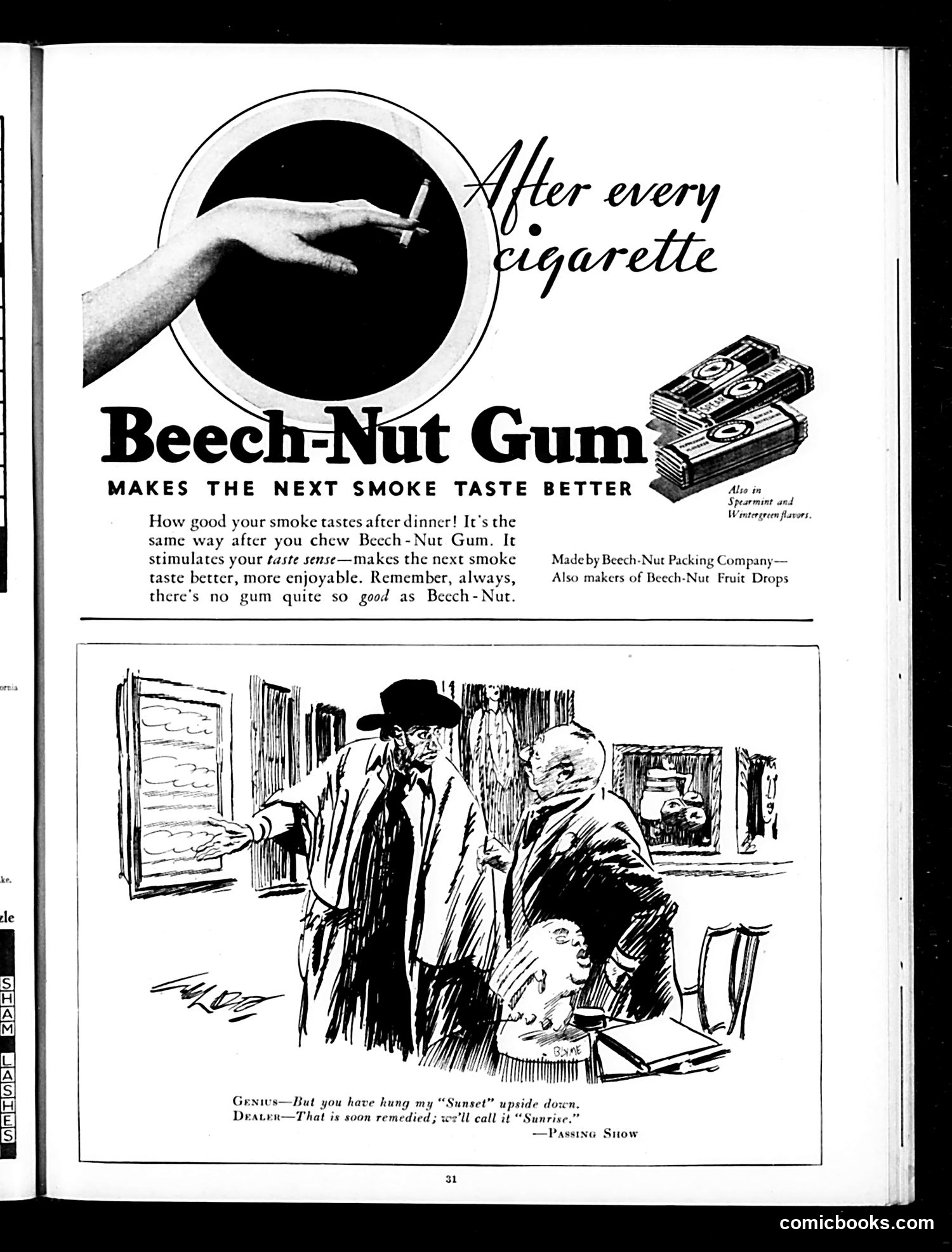
Beech-Nut Gum Advertisement with Cartoon This page is primarily a Beech-Nut Gum advertisement from Judge magazine. The top half promotes the gum's appeal to smokers, claiming it stimulates taste and makes subsequent cigarettes more enjoyable—a direct marketing pitch to the smoking demographic. The bottom half contains an unrelated cartoon joke from "Passing Show": A art dealer has hung a painting upside down. When a genius points out the error with his "Sunset," the dealer dismissively solves the problem by simply renaming it "Sunrise." The humor satirizes art world pretension—the suggestion that dealers can pass off mistakes as intentional artistic choices through clever rebranding. The cartoon mocks both the flexibility of modern art interpretation and commercial dishonesty in galleries.
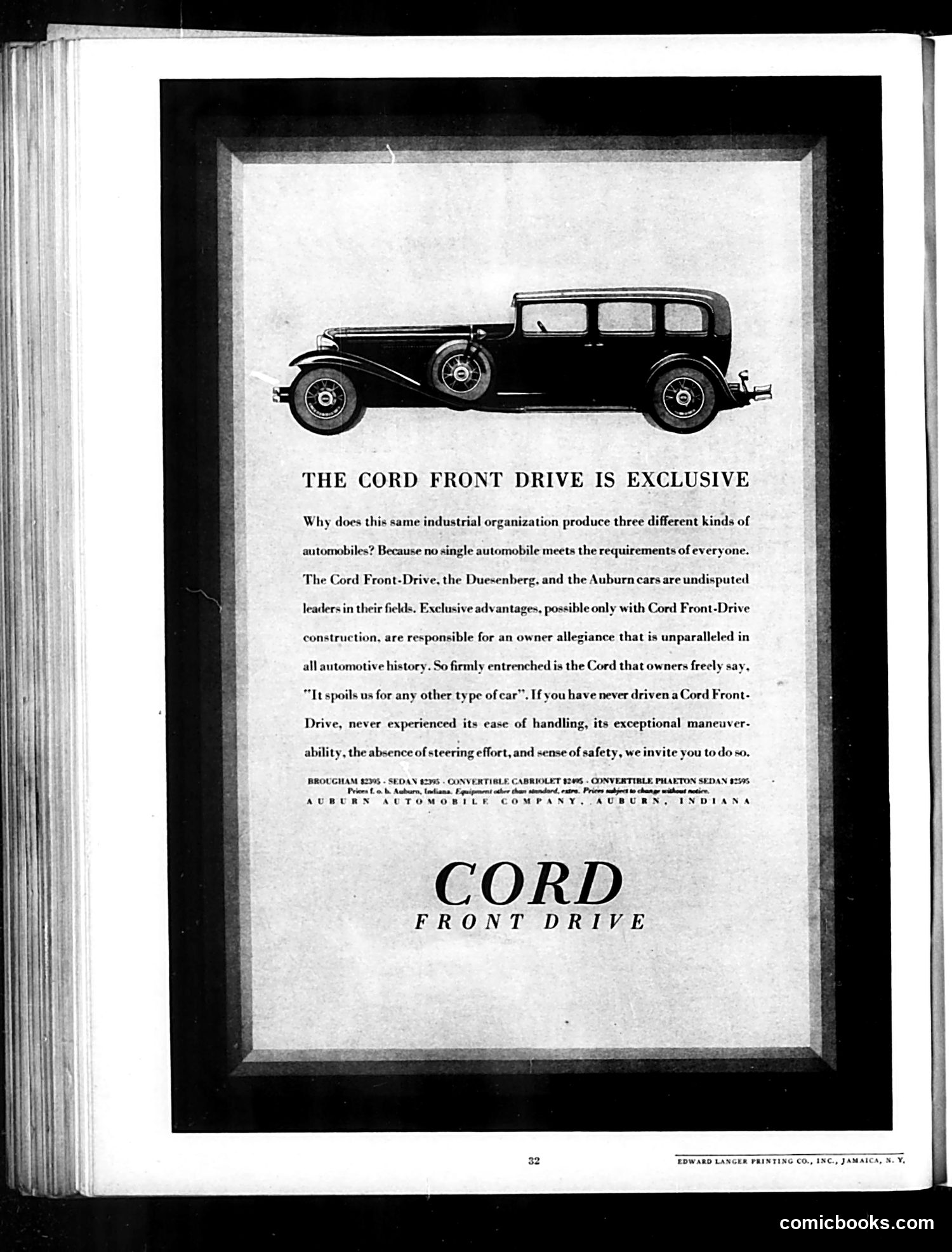
Cord Front Drive Advertisement This is not a cartoon or satire — it's a straight automobile advertisement from Judge magazine. The page promotes the Cord Front Drive automobile, manufactured by Auburn Automobile Company in Indiana. The ad argues that one company produces three different car lines (Cord, Duesenberg, Auburn) because "no single automobile meets the requirements of everyone." It emphasizes the Cord's exclusive front-wheel-drive technology and claims owner loyalty is "unparalleled in all automotive history," with satisfied customers saying it "spoils us for any other type of car." The image shows a side profile of a 1930s-era luxury sedan. Prices listed range from $2,095 to $2,995. This represents typical 1920s-30s automotive marketing: luxury brands competing on technical innovation and owner prestige rather than affordability.
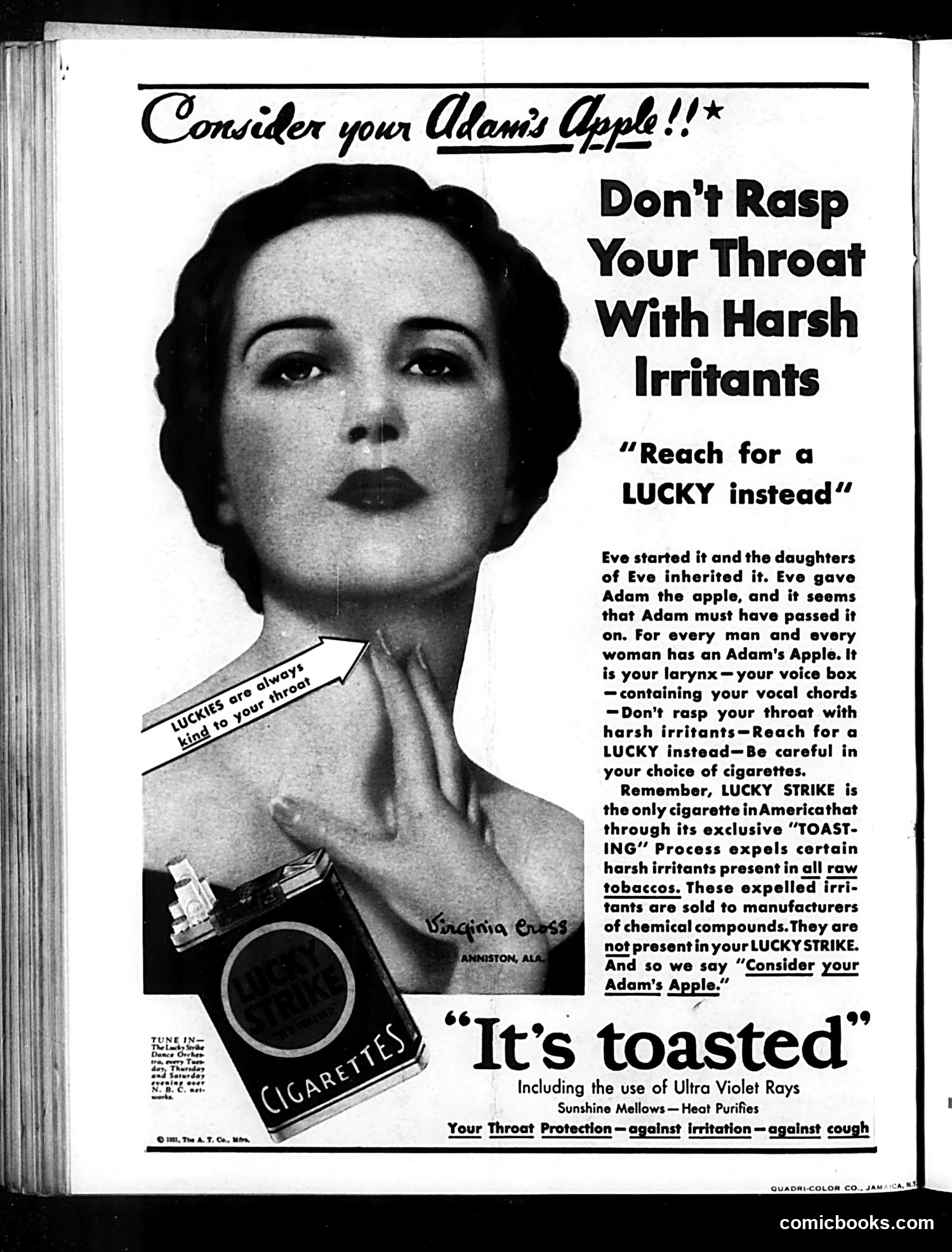
Lucky Strike Cigarette Advertisement This is a cigarette advertisement, not political satire. It promotes Lucky Strike cigarettes using a pseudo-scientific health appeal. The ad exploits the anatomical term "Adam's Apple" (the larynx) as a marketing hook, claiming Lucky Strike's "Toasting" process removes "harsh irritants" present in competing cigarettes. The copy promises throat protection against irritation and cough. The image shows a woman's face and neck with the larynx highlighted—typical mid-20th-century advertising that uses anatomy to legitimize health claims. For modern readers: This represents tobacco industry marketing before widespread knowledge of smoking's dangers. The "toasting" and "Ultra Violet Rays" claims appear designed to sound scientifically sophisticated while making unsubstantiated health benefits. The tagline "Consider your Adam's Apple" attempts to make cigarette choice seem medically prudent—a strategy now recognized as deceptive advertising.