judge
Judge — September 12, 1931
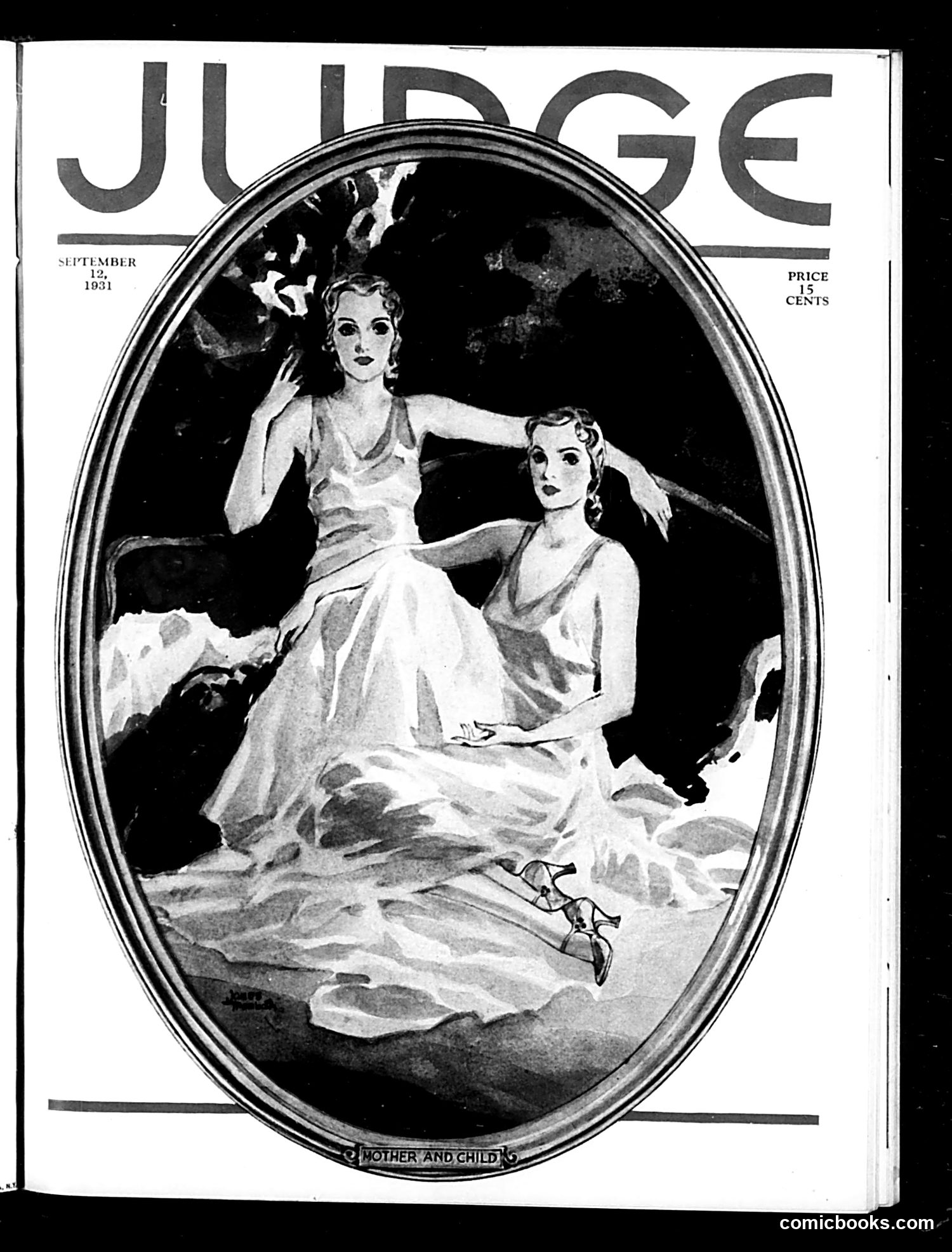
Judge Magazine Cover Analysis This September 12, 1931 Judge cover features an illustration titled "Mother and Child" showing two elegantly dressed women in flowing gowns reclining together in an intimate pose against a dark background. The image appears to be primarily decorative rather than satirical—a sophisticated artistic rendering typical of Judge's high-end aesthetic covers from this era. The stylized Art Deco presentation and the classical "mother and child" theme suggest this is lifestyle/entertainment content rather than political commentary. Without additional OCR text from the page's interior or explicit captions identifying specific figures, the exact satirical intent remains unclear. The cover likely references contemporary society, fashion, or entertainment topics of 1931, but determining the specific reference would require additional textual evidence.

Analysis This is not a political cartoon or satire — it's a straightforward advertisement for Dentyne chewing gum, appearing in Judge magazine. The page features a glamorous portrait of a smiling woman (likely a celebrity or model of the era, though unidentified here) demonstrating the product's appeal. The ad's messaging emphasizes that white teeth enhance one's social impression and romantic success — a common advertising strategy of the 1920s-30s era. The copy claims Dentyne gum whitens teeth and keeps gums firm through "extra healthful exercise." The product package is prominently displayed. This represents Judge's commercial content rather than editorial satire. Such advertisements were standard revenue sources for magazines of this period.
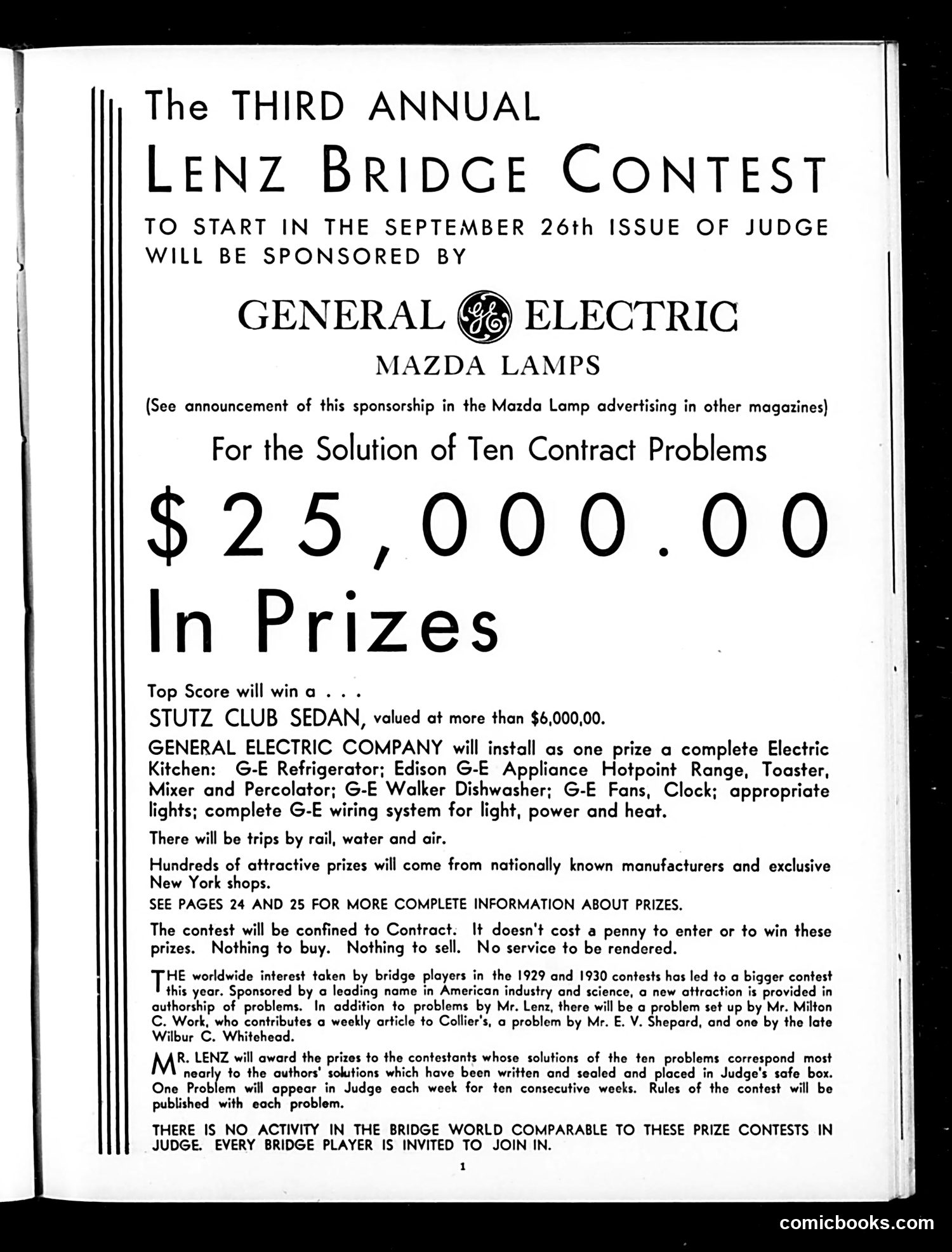
Analysis This page is primarily advertising, not editorial content or satire. It announces the Third Annual Lenz Bridge Contest sponsored by General Electric (Mazda Lamps), offering $25,000 in prizes for solving ten contract bridge problems. The contest promises significant prizes including a Stutz Club Sedan (valued at $6,000+) for the top score, plus a complete General Electric kitchen installation with refrigerator, range, and appliances. Additional prizes from "nationally known manufacturers" are mentioned. The contest is open to all bridge players—"nothing to buy, nothing to sell, no service to be rendered." Problems will appear in Judge weekly for ten consecutive weeks. This represents corporate sponsorship of editorial content, using an intellectual game contest to promote both the magazine and General Electric products to readers.
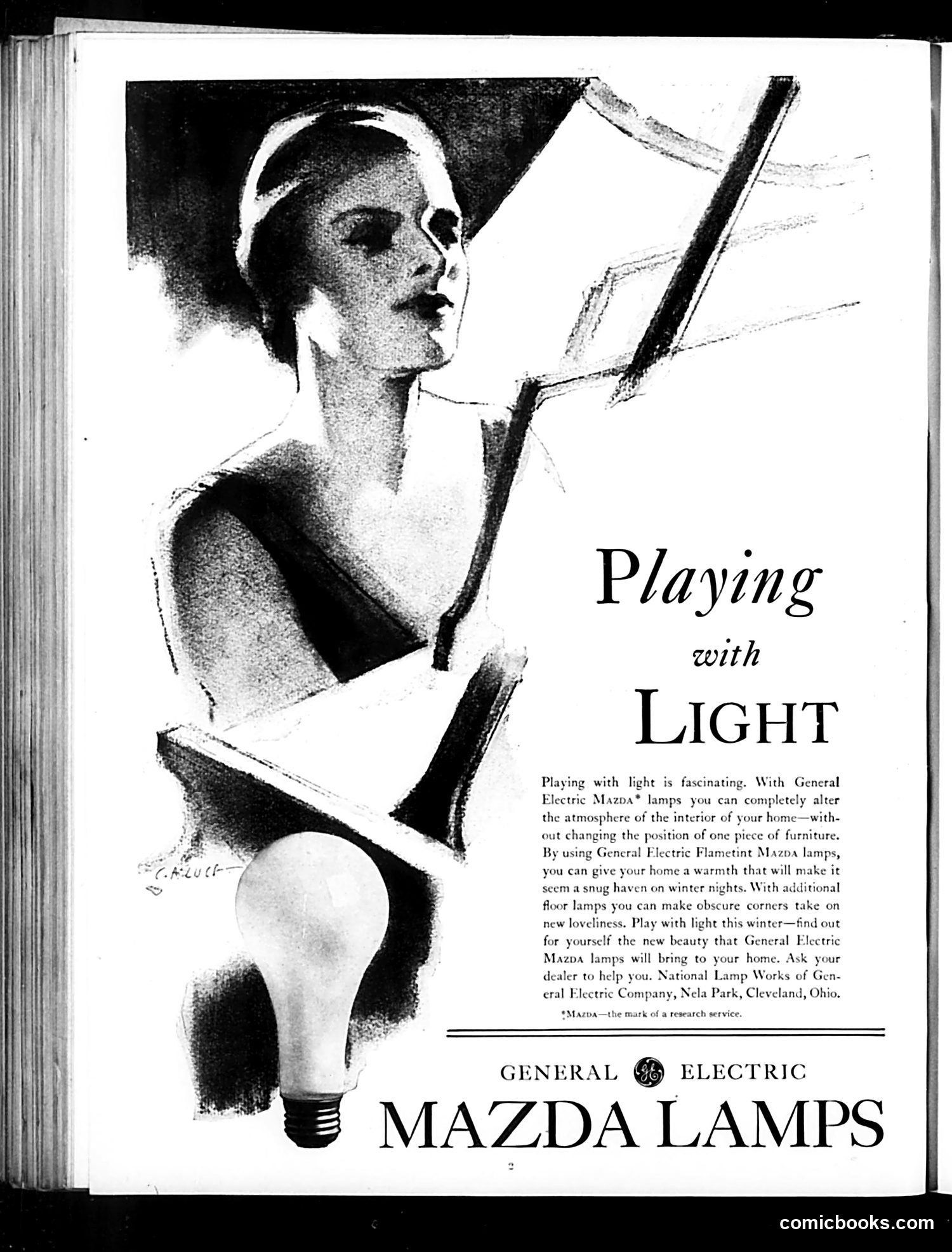
Analysis This page is not a political cartoon or satirical content—it's a General Electric advertisement for Mazda lamps, circa early 20th century. The image shows a stylized woman in 1920s aesthetic (headband, sleek profile) artistically posed with illuminated light bulbs. The copy emphasizes how Mazda lamps can transform home interiors, creating warmth and ambiance through strategic lighting placement. The advertising appeal targets homeowners seeking modern domestic comfort and aesthetic sophistication. The artistic presentation and emphasis on "playing with light" suggests this is lifestyle marketing positioning electric lighting as both practical and elegantly decorative—a luxury amenity for homes during the early electrical age. There is no political satire present on this page.
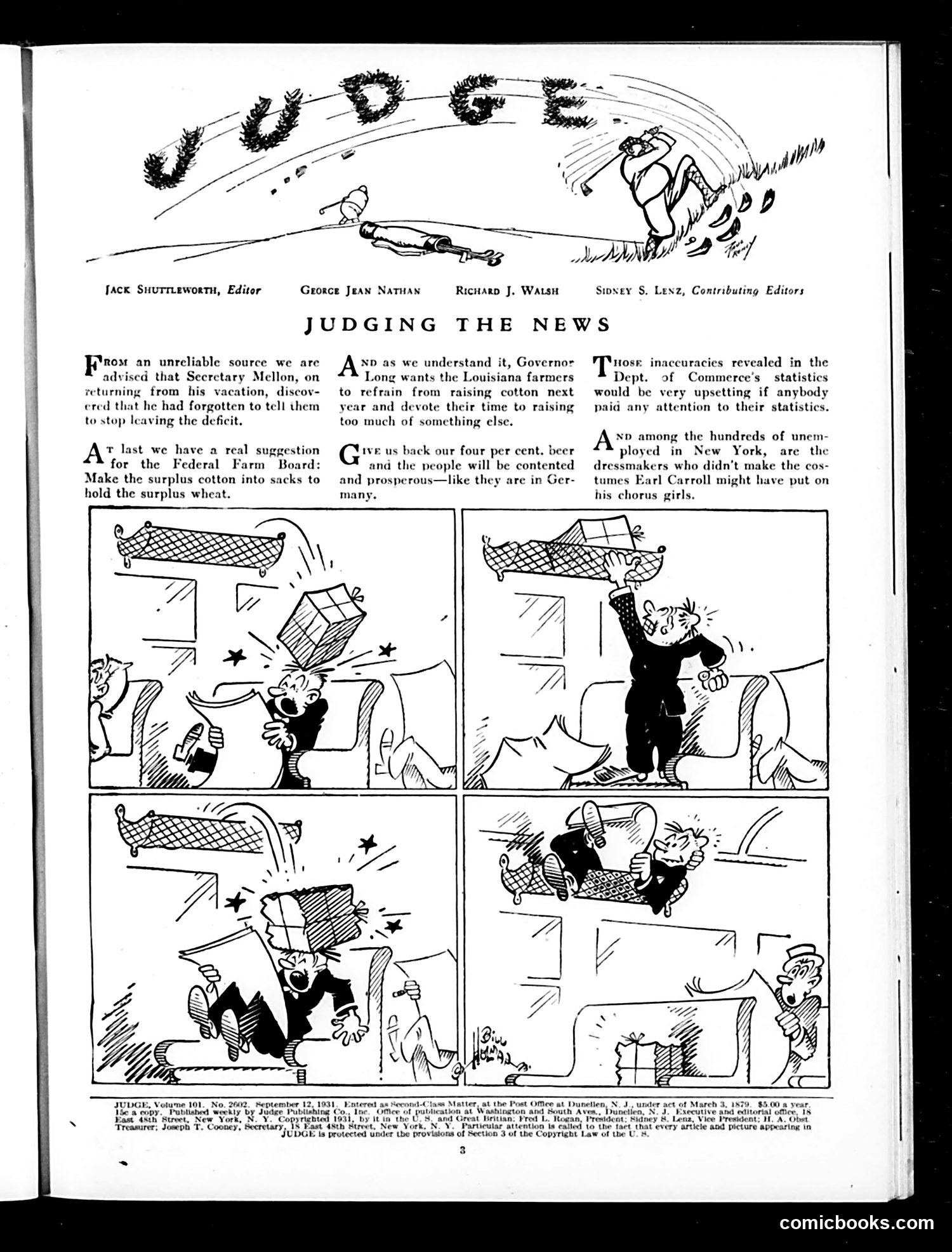
Explanation of "Judging the News" (September 17, 1931) This editorial cartoon page satirizes three contemporary issues: 1. Cotton surplus problem: A suggestion to make surplus cotton into sacks to hold surplus wheat—mocking the federal government's inability to manage agricultural overproduction during the Great Depression. 2. Beer legalization debate: A jab at Governor Louis (likely referencing Louisiana politics) about restoring the 4% beer tax, satirizing ongoing debates over Prohibition repeal with a German prosperity comparison. 3. Unemployment and fashion: A quip about dressmakers among unemployed New Yorkers, referencing Earl Carroll's chorus girls—suggesting frivolous entertainment during economic hardship. The comic strip panels illustrate domestic chaos from falling objects, depicting the period's economic anxieties through physical comedy.
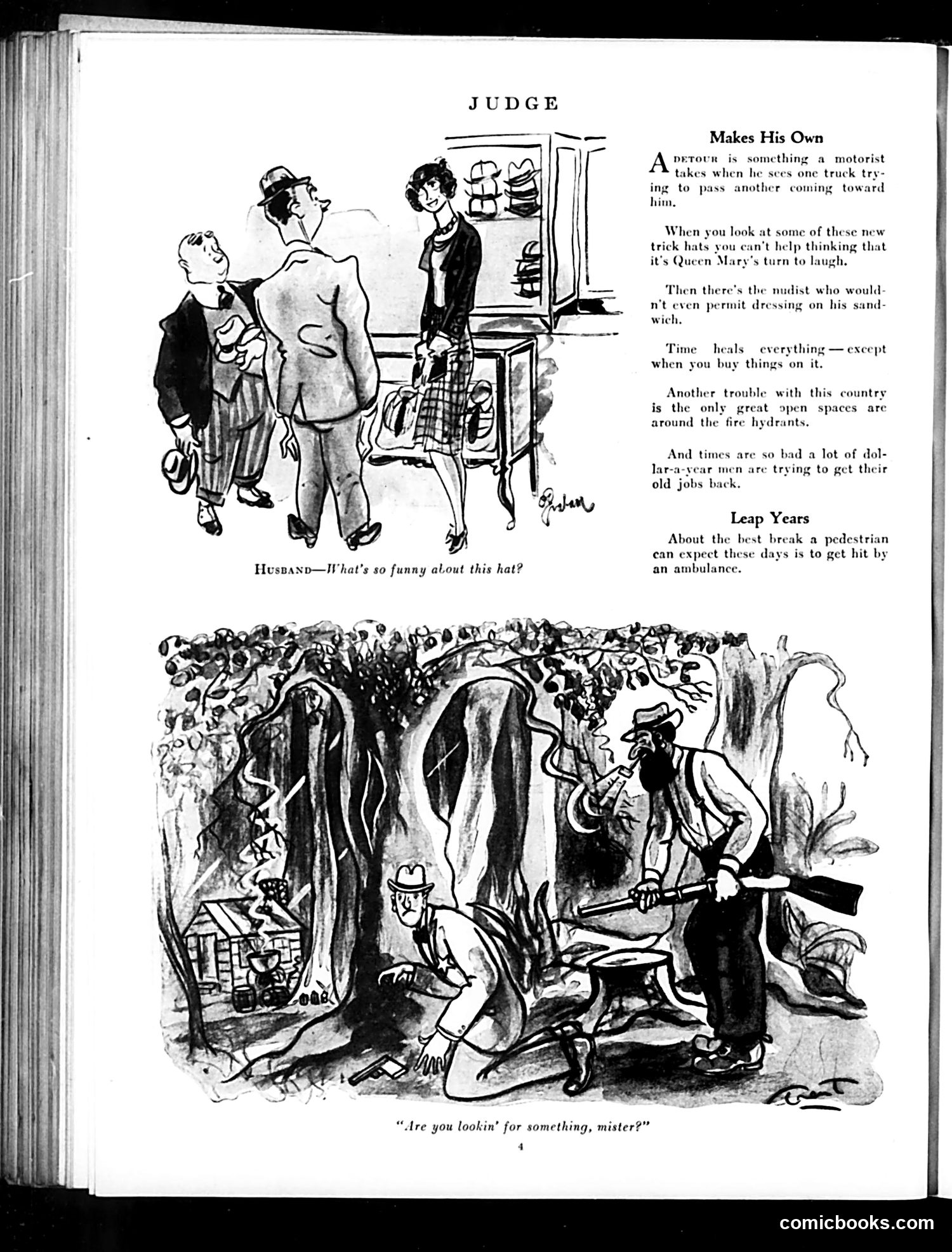
Analysis of Judge Page Top Cartoon: A husband shows his wife a peculiar hat, asking "What's so funny about this hat?" The satire targets women's fashion absurdities of the era—Judge frequently mocked exaggerated or impractical women's styles. The wife's amused reaction suggests the hat's ridiculousness is self-evident. Right Column: Brief humorous observations on contemporary life: detour detours ("Queen Mary's turn to laugh"), a prudish person ("wouldn't even permit dressing on his sandwich"), financial hardship, traffic congestion near fire hydrants, and job scarcity. "Leap Years" Section: A dark joke about pedestrian safety, suggesting the best way to avoid being hit by vehicles is "to get hit by an ambulance" instead—satirizing reckless driving or traffic dangers. Bottom Cartoon: Miners in a cave; context unclear without additional information.
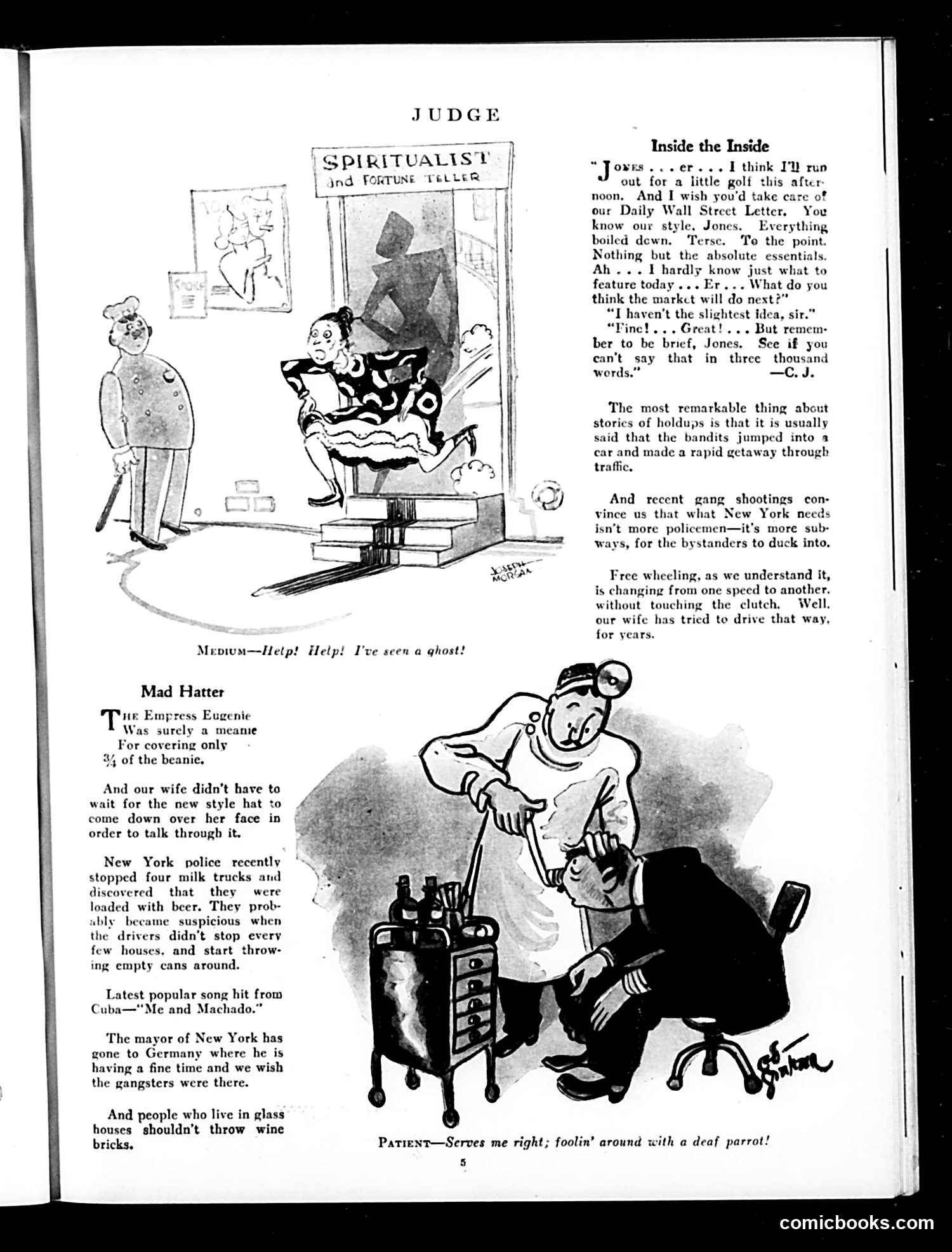
Explanation for Modern Readers This Judge magazine page contains two satirical cartoons about contemporary urban life and social absurdities. The top cartoon mocks a "spiritualist and fortune teller" con artist, with a client seeking predictions. The joke plays on gullibility and the era's fascination with spiritualism. The bottom "Mad Hatter" section satirizes various New York City happenings: police discovering beer-loaded milk trucks, popular Cuban music ("Me and Machado"), the mayor's trip to Germany, and absurd social observations. The final cartoon shows a patient with a deaf parrot—the humor resting on the parrot's uselessness as a companion. These pieces exemplify Judge's approach: mocking contemporary follies, urban crime, commercial fraud, and the era's fads through illustrated gags and witty commentary targeting educated readers aware of current events and social pretensions.
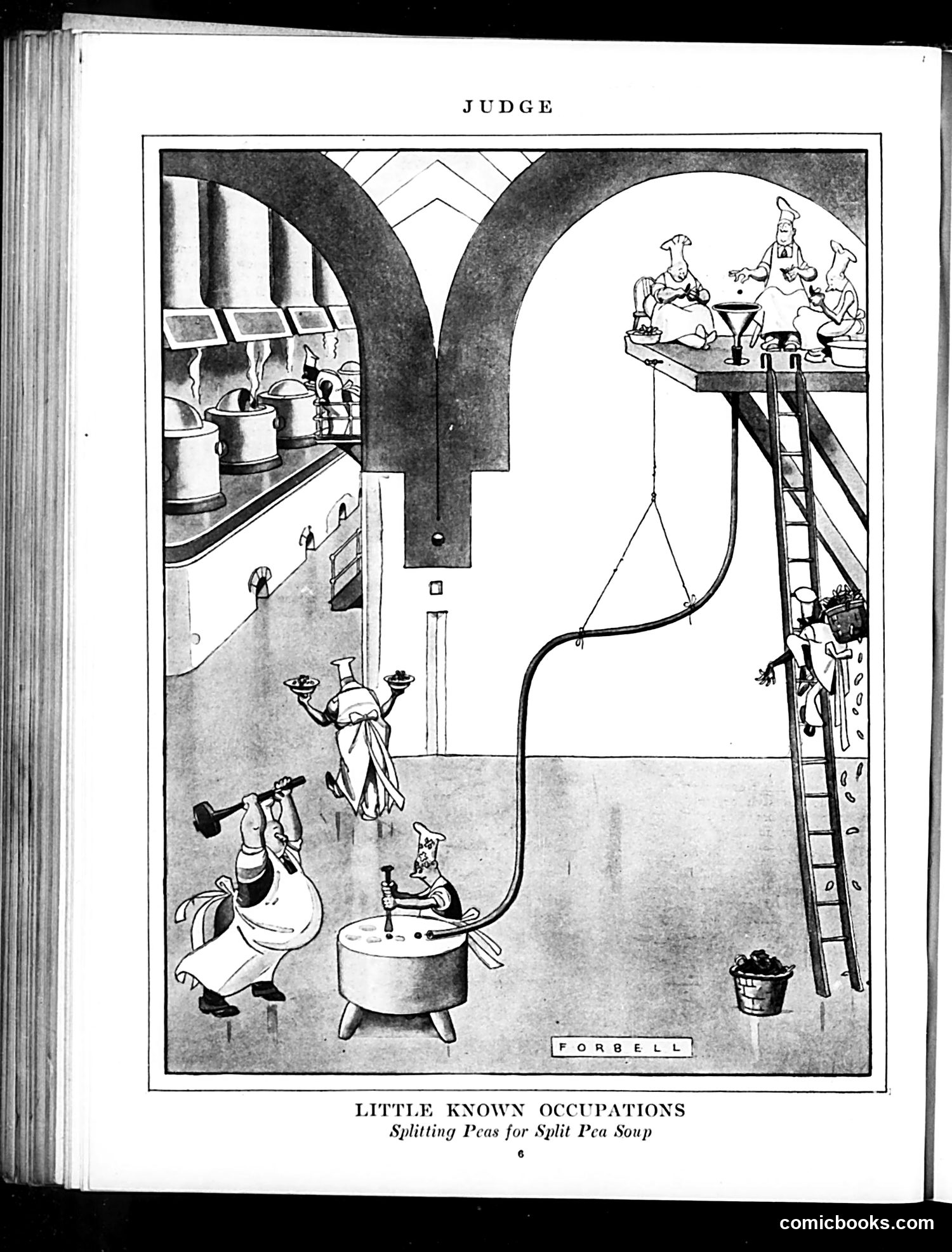
"Splitting Peas for Split Pea Soup" This cartoon satirizes the judicial system as an absurdly complex bureaucracy. The title "Judge" and the architectural design suggest a courthouse or legal institution, yet the entire elaborate operation exists solely to produce split pea soup—a mundane, trivial product. The cartoon depicts multiple workers and judges at different levels of an ornate building, performing specialized tasks (cooking, supervising, climbing ladders) to accomplish something requiring far less ceremony. The satire mocks how institutions create unnecessary hierarchy, formality, and specialization for simple matters. Each "judge" or official appears self-important despite handling basic kitchen work. The joke critiques bureaucratic bloat and the legal system's tendency to overcomplicate straightforward tasks through excessive structure and pomposity.
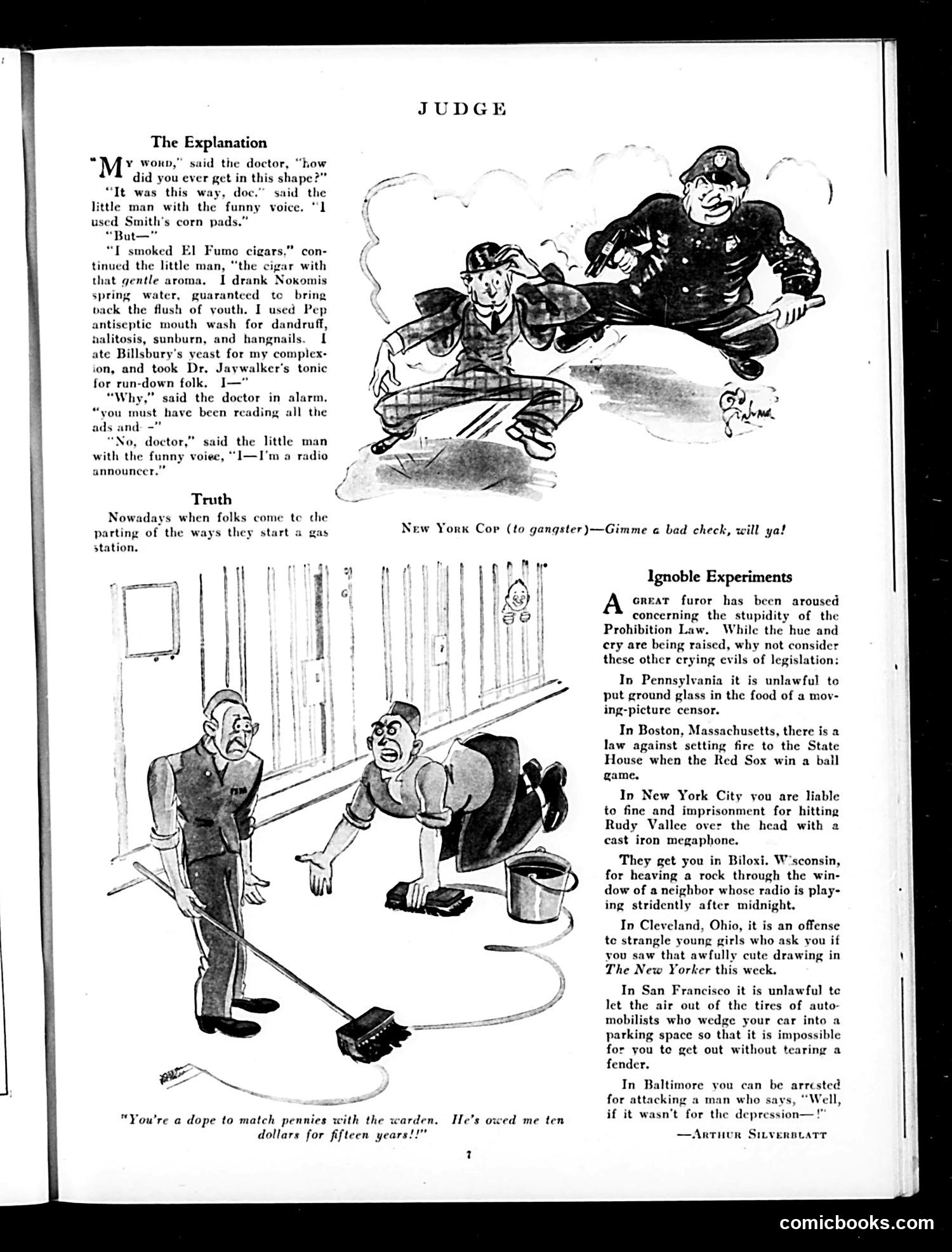
Judge Magazine Page Analysis "The Explanation": A radio announcer explains his deteriorated appearance by listing every product advertised on air—corn pads, cigars, spring water, mouthwash, yeast, tonics. The joke satirizes the absurdity of radio advertising's exaggerated health claims and suggests that listening to constant product pitches has literally worn him down. Radio was still relatively new in this era, making broadcast advertising a fresh target for satire. "Ignoble Experiments": This section mocks Prohibition-era lawmakers by listing absurdly specific state laws—Pennsylvania forbidding ground glass in movie censors' food, Boston banning arson at the State House during Red Sox games, New York criminalizing hitting Rudy Vallee with a megaphone. The satire suggests legislators waste time on ridiculous laws while ignoring serious issues like Prohibition itself. These appear to be invented examples highlighting legislative overreach and absurdity.
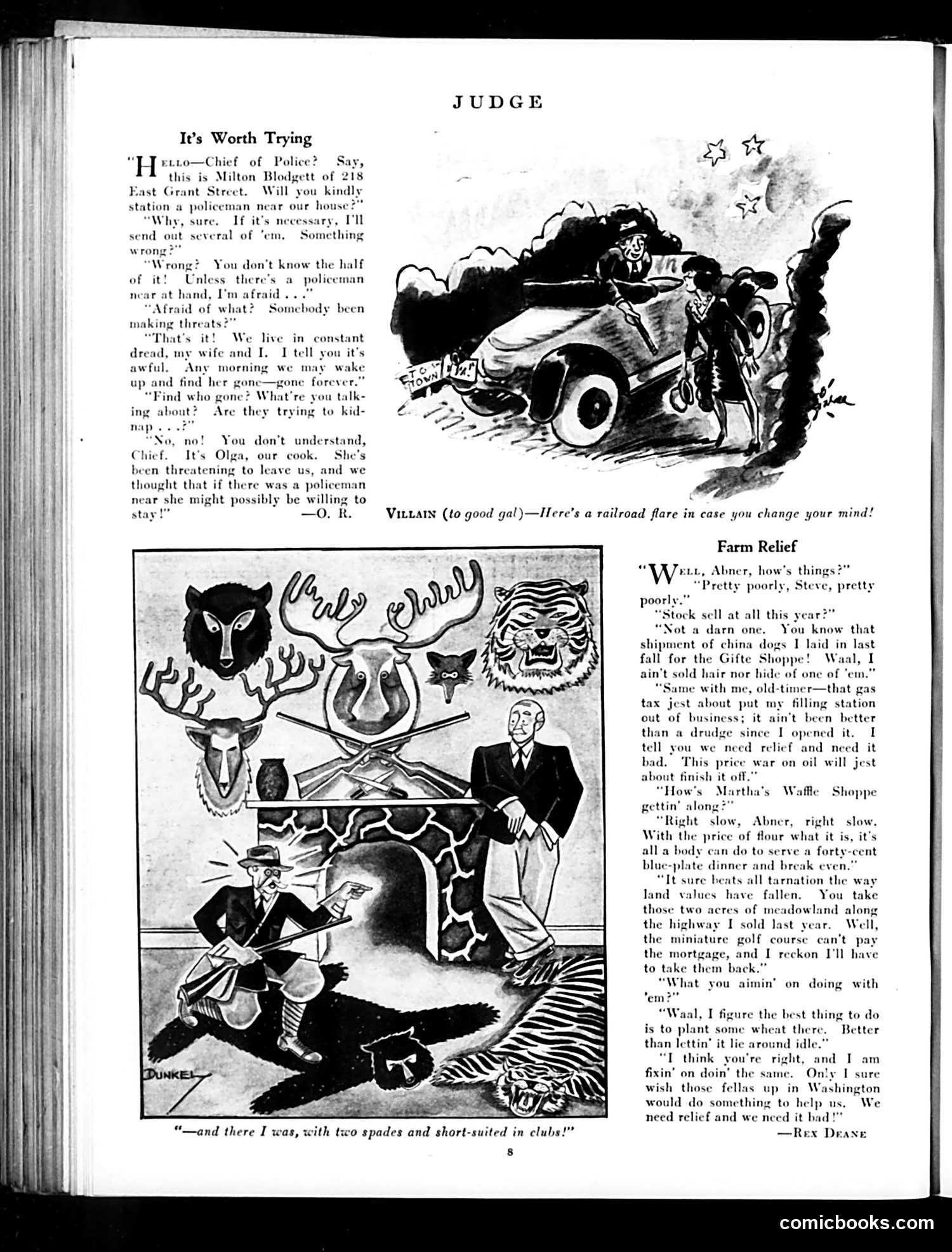
Judge Magazine Page Analysis "It's Worth Trying": A domestic humor piece where a man calls police requesting an officer station near his house to prevent his cook Olga from leaving. The joke plays on the servant labor crisis of the era—he's so desperate to keep household help that he hopes police presence might intimidate her into staying. The "railroad flare" caption suggests she'll flee anyway. "Farm Relief": A conversation between struggling rural businessmen (Abner and Steve) depicting Depression-era economic collapse. They discuss unsold inventory (china dogs), failed small businesses (filling station, waffle shop), plummeting land values, and failed ventures (miniature golf course). Their solution—planting wheat—reflects farmers' hopes that agriculture might recover. The dialogue critiques government inaction, with characters appealing for federal "relief" programs. This likely references early 1930s New Deal debates, when agricultural aid was contested. Both pieces use vernacular humor to address economic hardship and labor shortages affecting ordinary Americans.
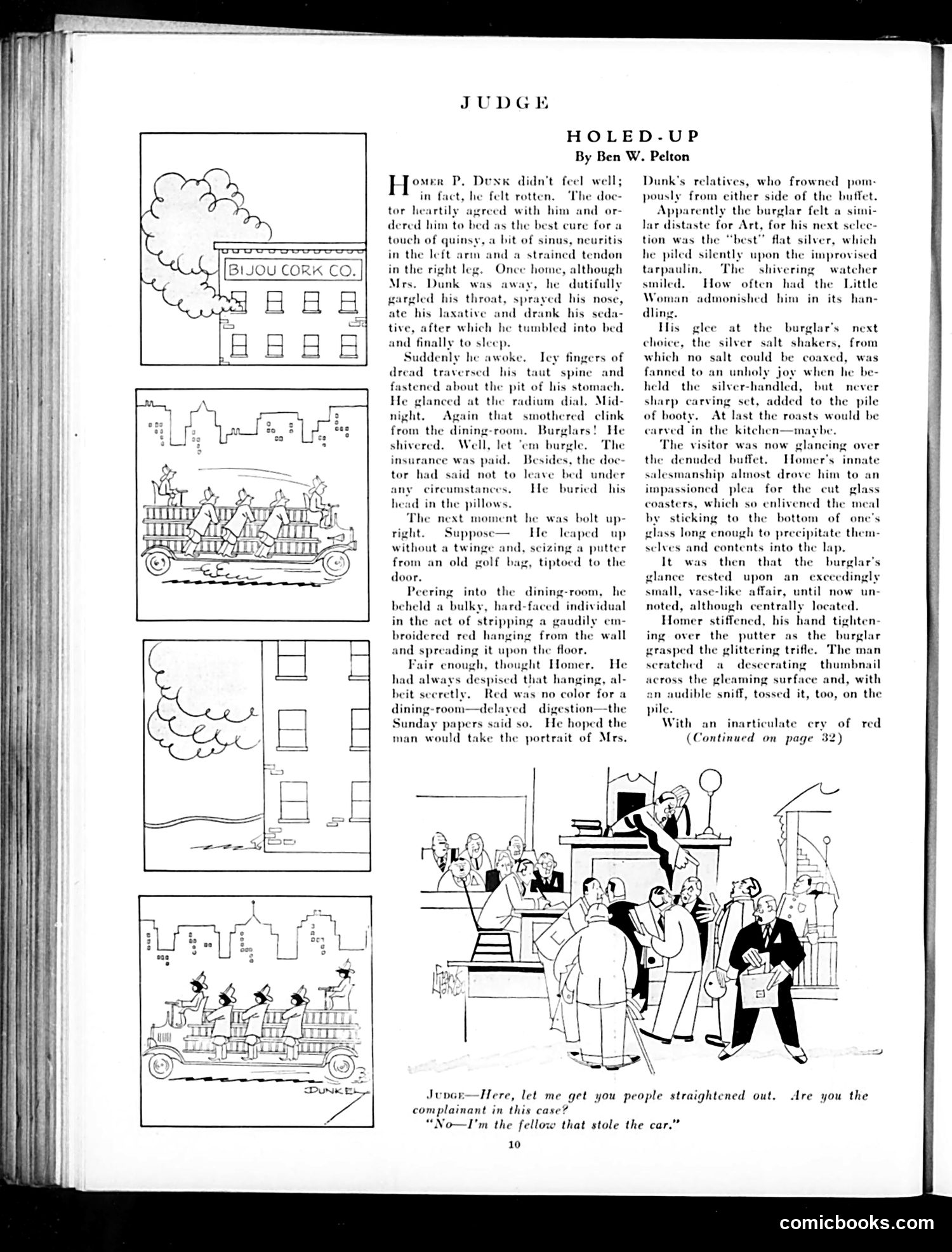
"Holed-Up" by Ben W. Pelton — Judge Magazine This is a humorous short story illustrated with cartoons about Homer P. Dunk, a sickly man confined to bed with various ailments (quinsy, neuritis, sinusitis). When a burglar breaks in downstairs, Homer is torn between his doctor's orders to stay in bed and his desire to protect his home. The joke's irony: Homer is secretly *pleased* by the burglar's selections. The red hanging he "despised," the problematic family portraits, the defective silver and salt shakers, the carving set that won't cut—all items Homer's wife ("the Little Woman") has annoyed him with get stolen. Only when the burglar reaches for an apparently worthless small vase does Homer finally cry out in protest, suggesting it holds sentimental value his wife treasures. The accompanying courtroom cartoon (bottom) is a separate joke about mistaken identity: a judge asks who the complainant is, only to be told "I'm the fellow that stole the car"—a simple mix-up for comedic effect.
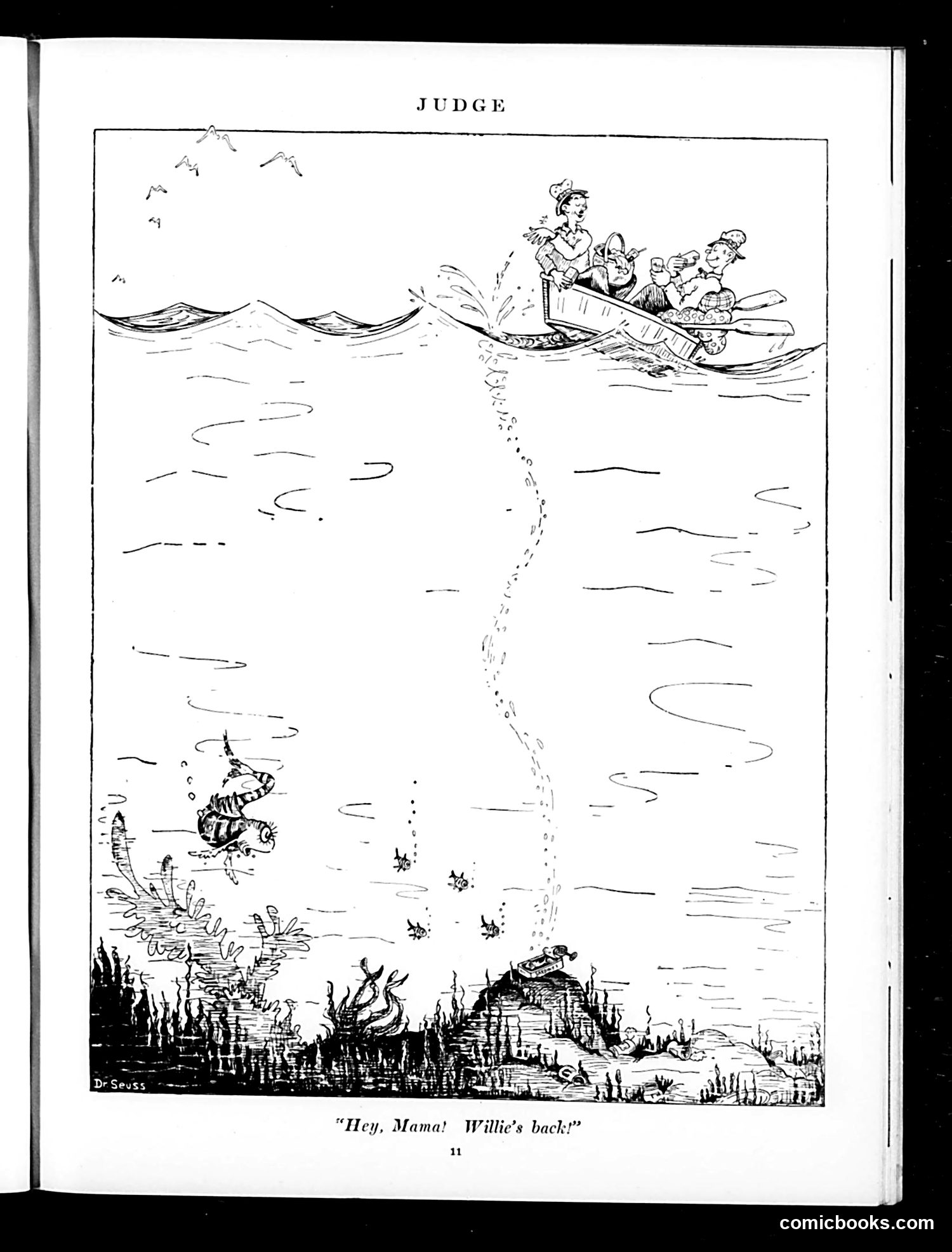
Analysis of "Judge" Page This is a Dr. Seuss underwater cartoon titled "Hey, Mama! Willie's back!" The image depicts a boat full of people at the surface dropping something into the water below, while a figure labeled "Willie" appears underwater wearing what looks like military attire. Without additional context about the publication date, I cannot definitively identify who "Willie" represents or what specific political event this satirizes. However, the cartoon likely comments on a contemporary military or naval matter—possibly relating to a returning soldier, submarine warfare, or naval operations. The caption's excited tone ("Hey, Mama!") suggests public interest in someone's return or arrival. The underwater setting and Seuss's characteristic style are present, but the specific historical reference requires knowing when this was published.
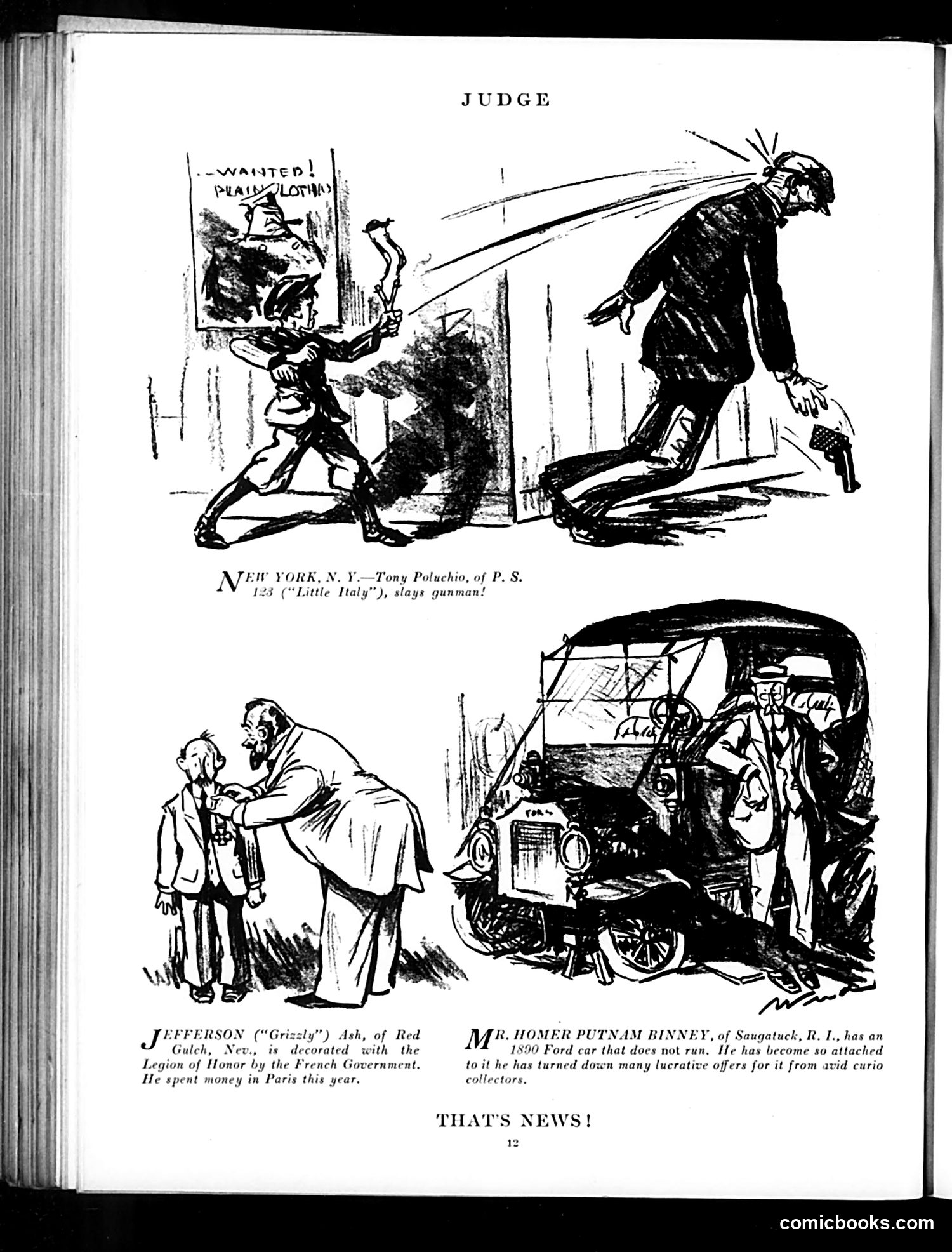
JUDGE Magazine Satire Explanation This page presents three satirical news items mocking absurd or trivial occurrences treated as noteworthy: Top cartoon: A small man (Tony Poluchio from "Little Italy") dramatically confronts a judge over a "wanted" poster, apparently claiming credit for apprehending a gunman—satirizing immigrant communities' sensationalized crime narratives. Middle item: "Grizzly" Ash receives France's Legion of Honor solely for spending money in Paris—mocking both French materialism and American wealthy travelers' self-importance. Bottom item: A man refuses lucrative offers for his broken 1890 Ford automobile—ridiculing sentimental attachment to worthless possessions and the emerging American nostalgia for early automobiles. The page's title "THAT'S NEWS!" signals heavy irony: these trivial, absurd events shouldn't constitute real news. The satire targets contemporary obsession with sensationalism, status-seeking, and misplaced values in American society.
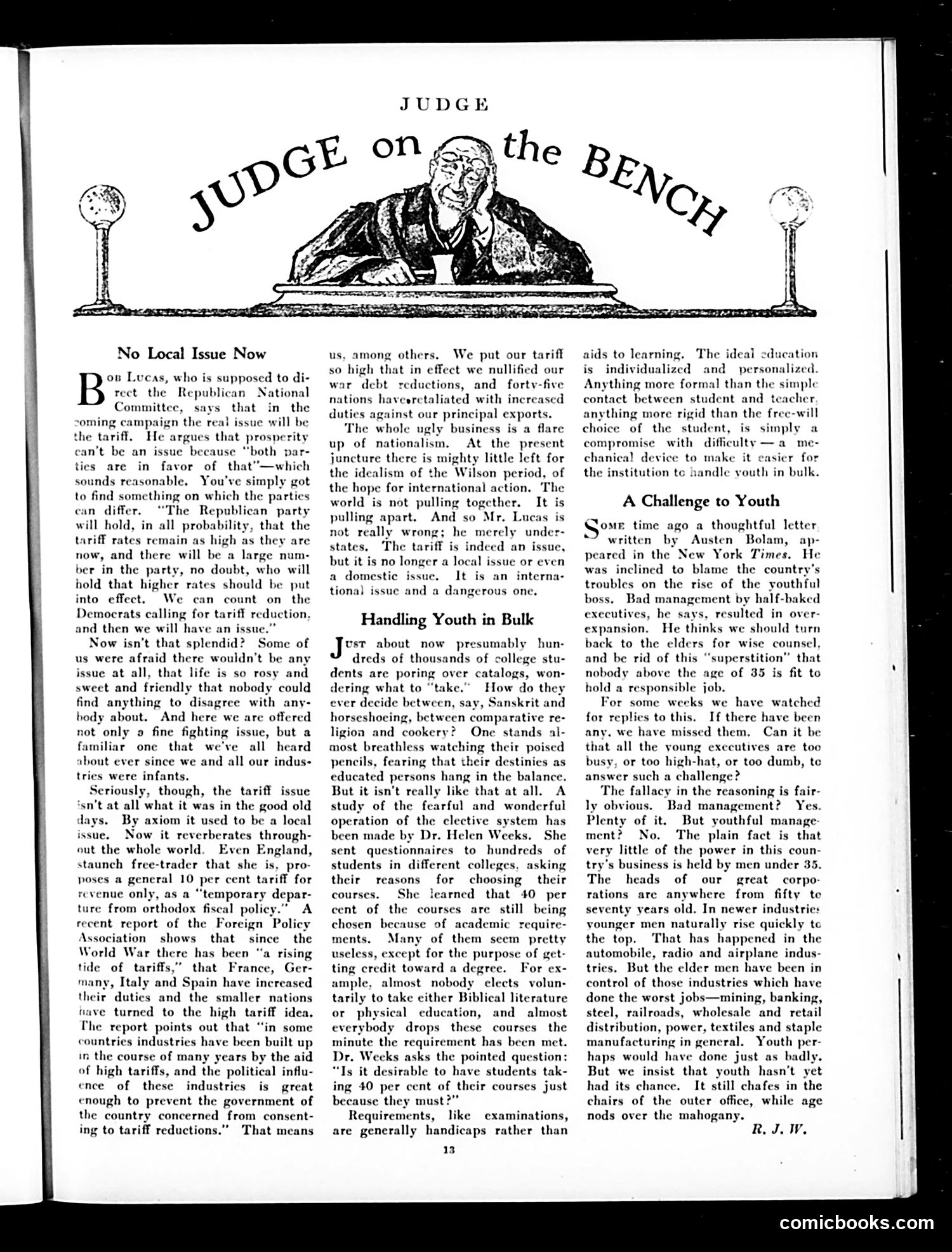
"Judge on the Bench" - Judge Magazine Editorial Page This is an editorial page from *Judge*, a satirical magazine, featuring commentary on two contemporary issues. The Masthead: The judge illustration identifies this as the magazine's "opinion" section. Main Content: The first article critiques Republican National Committee director Bob Lucas for claiming the tariff is the key campaign issue. The author sarcastically notes that since both parties favor prosperity, they've conveniently settled on tariffs as their point of disagreement. However, the piece argues tariffs are no longer merely domestic—post-WWI nationalism has made them an international problem, with nations retaliating against high American duties. "Handling Youth in Bulk": The second article discusses Dr. Helen Weeks's study of college course selection. It notes students often choose courses based on requirements rather than genuine interest, with 40% of selections driven by degree requirements rather than educational value. The piece criticizes this "bulk handling" of youth education, arguing for more personalized, individualized learning. Both articles critique American institutions for addressing symptoms rather than underlying problems.
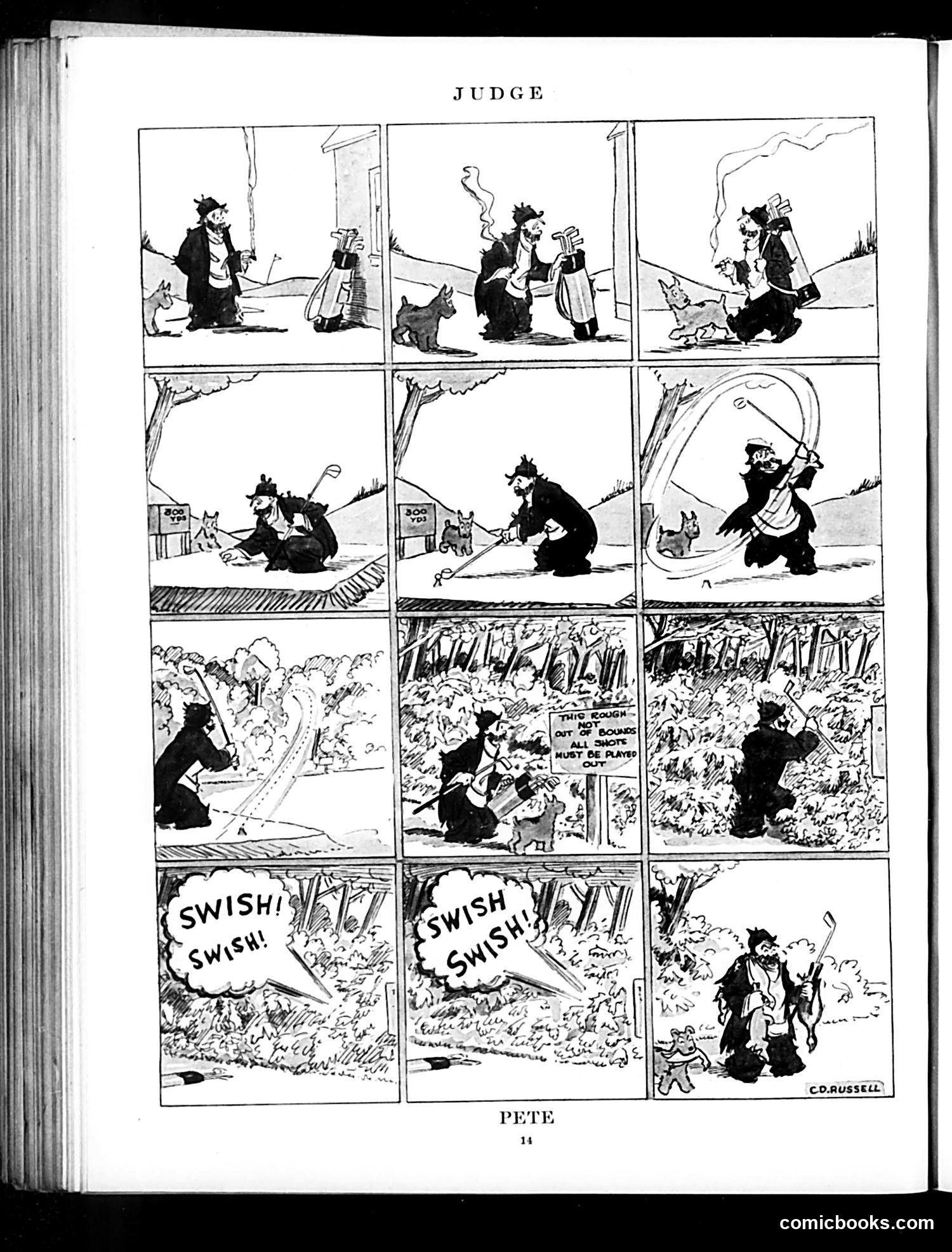
"Judge Pete" Cartoon Analysis This comic strip, signed by C.D. Russell, depicts a judge character (likely a caricature of a specific public figure, though the identity isn't clear from the page alone) engaged in fishing. The narrative shows him attempting to catch fish using progressively more aggressive methods—from standard fishing rod to what appears to be dynamite or explosives in later panels, accompanied by "SWISH! SWISH!" sound effects. The satire appears to criticize the judge's heavy-handed or excessive approach to his duties. Rather than subtle, measured justice, he's portrayed as using crude, destructive force. This likely comments on aggressive judicial practices or court decisions from the era when this Judge magazine issue was published, though the specific political context remains unclear without additional dating or attribution information.
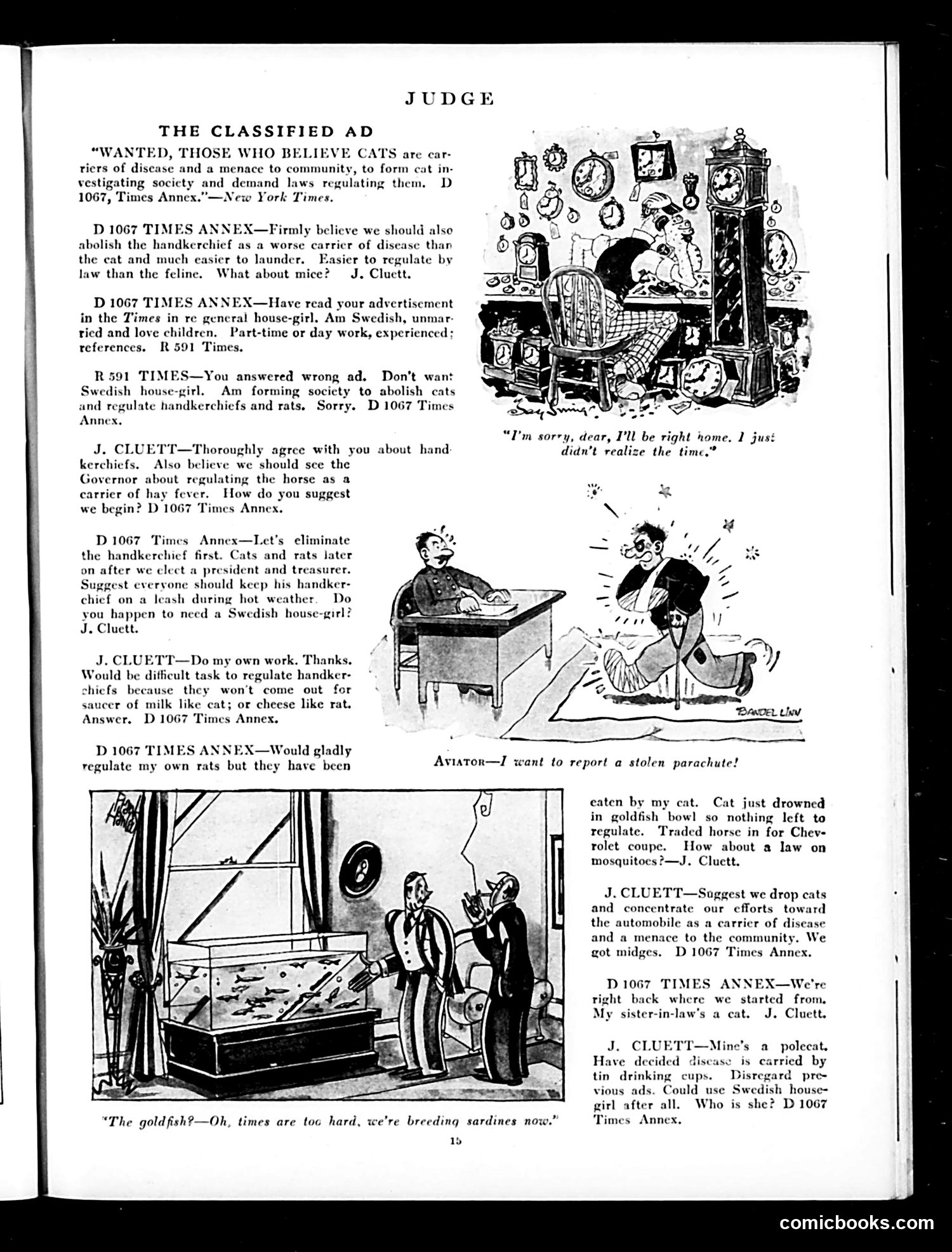
Explanation for Modern Readers This page satirizes early 20th-century public health anxiety and absurd regulatory impulses. The central joke: a Times classified ad proposes forming a society to regulate cats as disease carriers, sparking a ridiculous chain of responses. Correspondents (primarily "J. Cluett") mock the idea by suggesting increasingly absurd targets for regulation—handkerchiefs, horses, rats, automobiles, mosquitoes, and tin cups—each presented as equally valid disease vectors. The satire escalates as contributors propose leashing handkerchiefs and breeding sardines instead of goldfish due to hard economic times. The cartoons reinforce this absurdity: one shows a man and woman with a clock (he's late because he lost track of time), another depicts someone reporting a stolen parachute to an aviator. The humor targets both public health hysteria and bureaucratic overreach—the implication that if we regulate one animal, logical consistency demands regulating everything. It's period satire on how far people will go with regulatory schemes when they start with questionable premises.
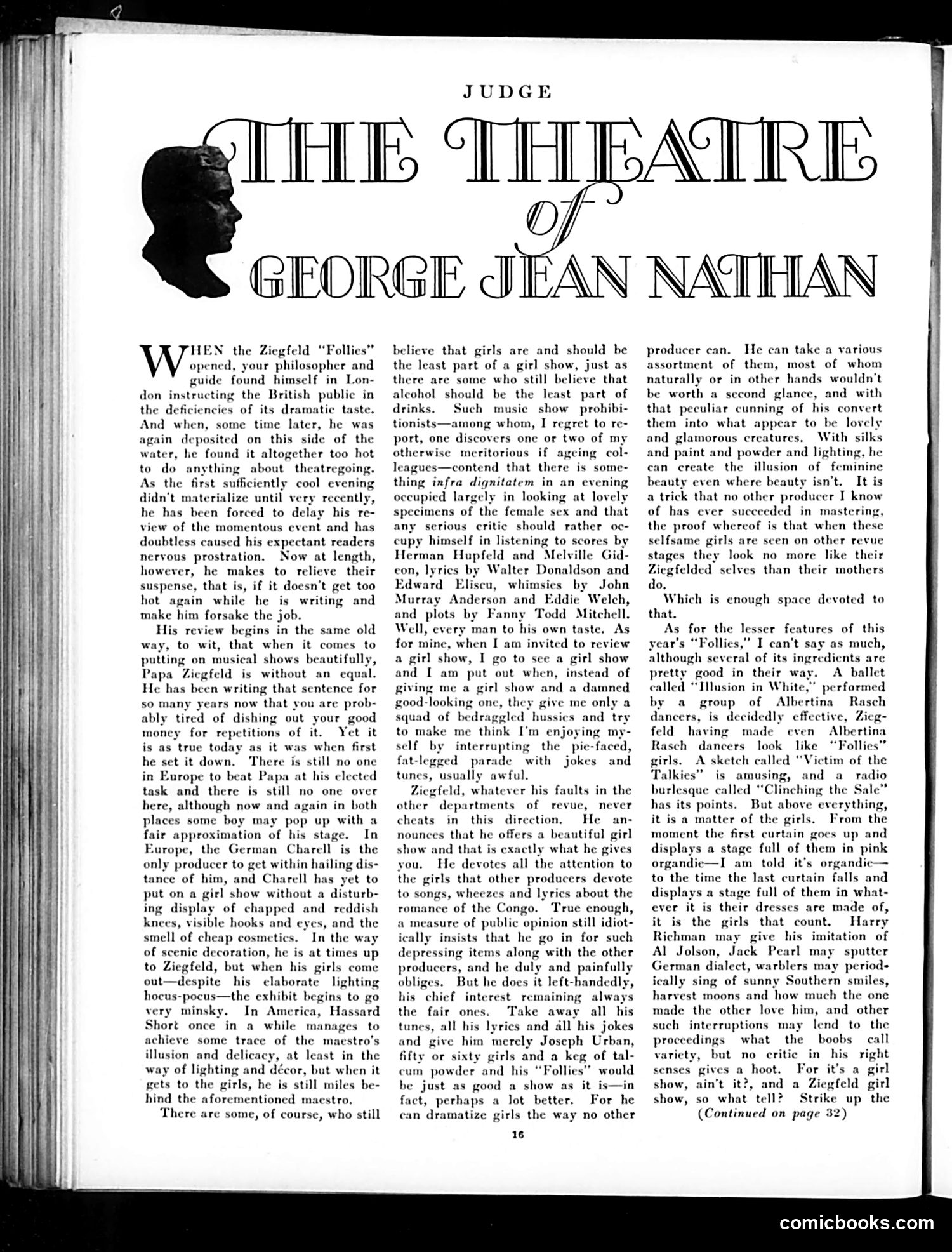
Judge Magazine: "The Theatre of George Jean Nathan" This is a theater review column by Judge's drama critic, not a political cartoon. The illustration shows a profile portrait of George Jean Nathan, the influential theater critic being quoted. Nathan argues that Florenz Ziegfeld is the supreme producer of musical revues because he prioritizes beautiful girls above all else—contrary to critics who believe music, lyrics, and plot should matter more. Nathan dismisses such "prohibitionists" as pretentious. He compares Ziegfeld favorably to European producers like Charell (German impresario) and American competitors like Hassard Short, claiming only Ziegfeld truly delivers on the promise of a girl show without cheap compromises. The satire targets theater snobs who insist on artistic merit over spectacle, while defending Ziegfeld's unapologetic focus on female performers as entertainment. This reflects 1920s attitudes about Broadway's commercial priorities and gender.
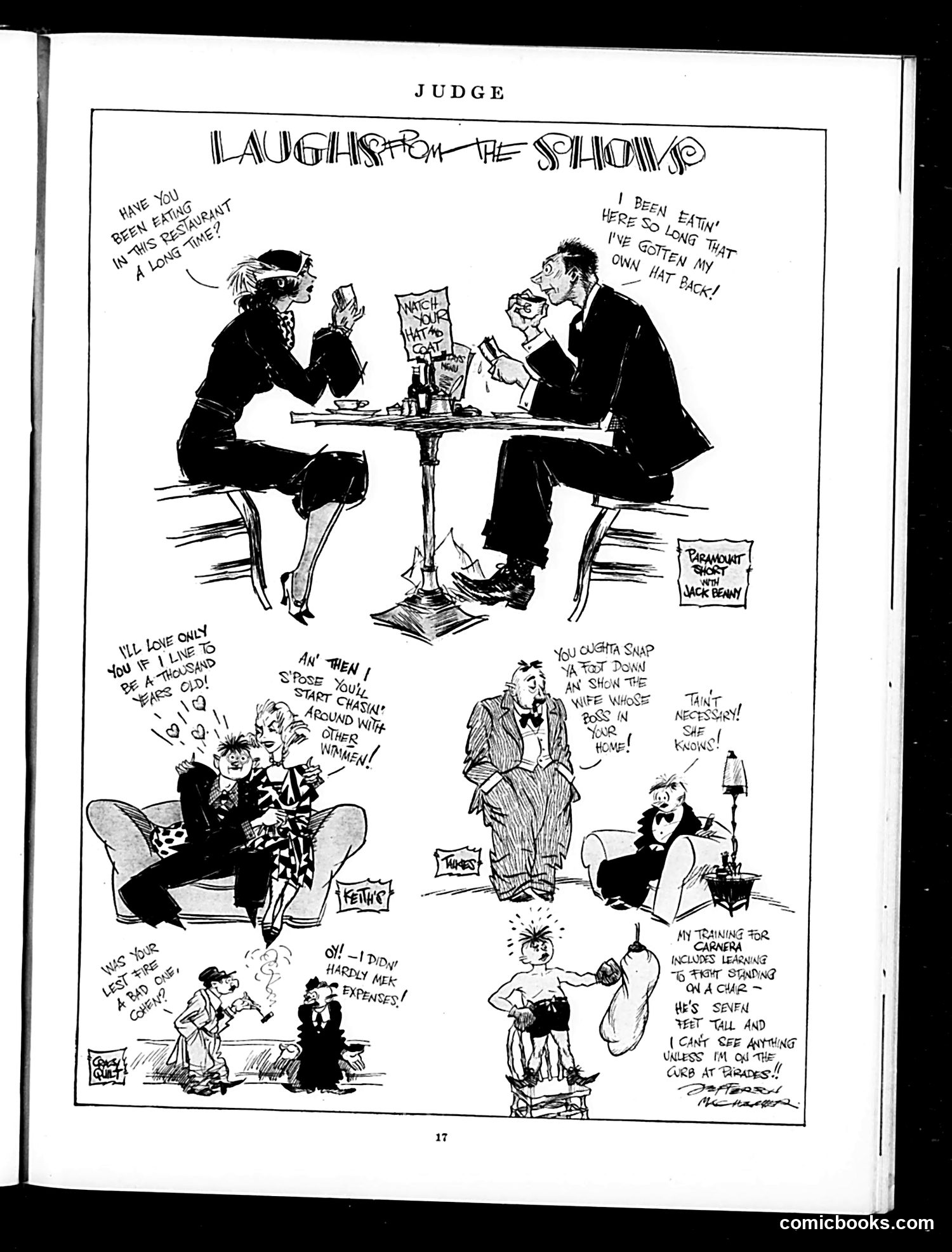
This page satirizes men making excuses for infidelity and poor behavior. The title "Laughs for the Shame" frames multiple domestic comic scenarios where husbands justify questionable conduct to their wives. The cartoons depict men caught in lies—one claims he's been eating at a restaurant for years, another invents "training for Carnera" (likely boxer Primo Carnera) as cover for suspicious activities, and another makes absurd excuses about vision problems to justify inappropriate behavior. The satire targets masculine excuses and self-serving justifications in marriage, mocking how men fabricate elaborate stories rather than admit wrongdoing. It reflects period attitudes about domestic deception and marital discord through comedic exaggeration.
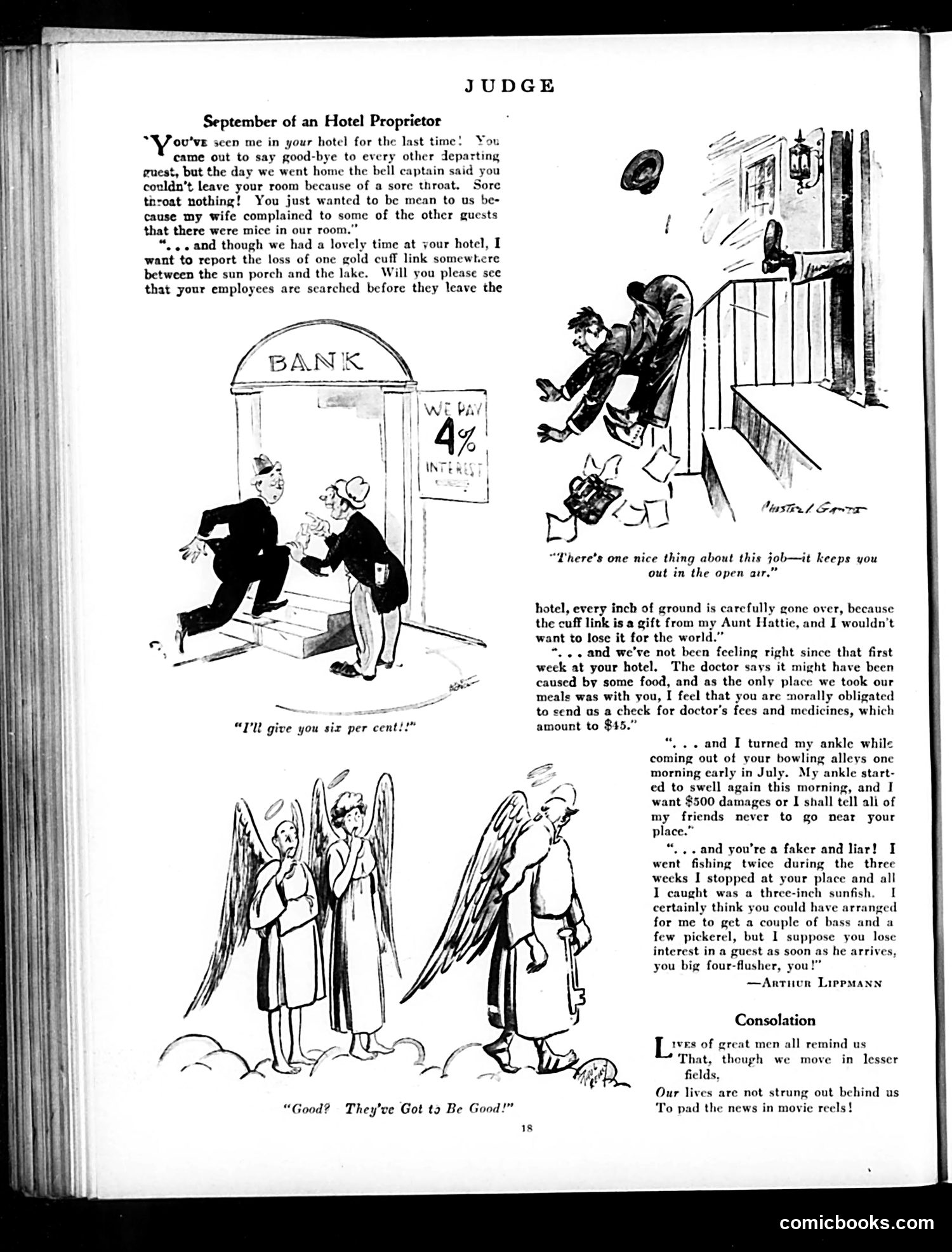
"September of an Hotel Proprietor" — Judge Satire This multi-panel cartoon satirizes the unreasonable complaints and demands guests lodge against hotel proprietors. The central scene shows a bank manager offering 6% interest, illustrating how complaints have become a "currency" — guests demand compensation as readily as financial transactions. The surrounding vignettes, attributed to Arthur Lippmann, depict absurd guest grievances: mice in rooms, lost cuff links (demanding staff searches), illness blamed on hotel food, injury lawsuits over bowling alleys, and complaints the proprietor didn't arrange better fishing. Each complaint escalates in pettiness and entitlement. The headline quote "I'll give you six per cent!" suggests the hotel owner must "pay off" complaints with interest to survive. The final illustration of departing figures captioned "Good? They've Got to Be Good!" reinforces the satire: hotels must exceed all expectations or face litigation and reputation damage from impossible customer demands. The satire targets early 20th-century consumer entitlement and frivolous lawsuit culture.
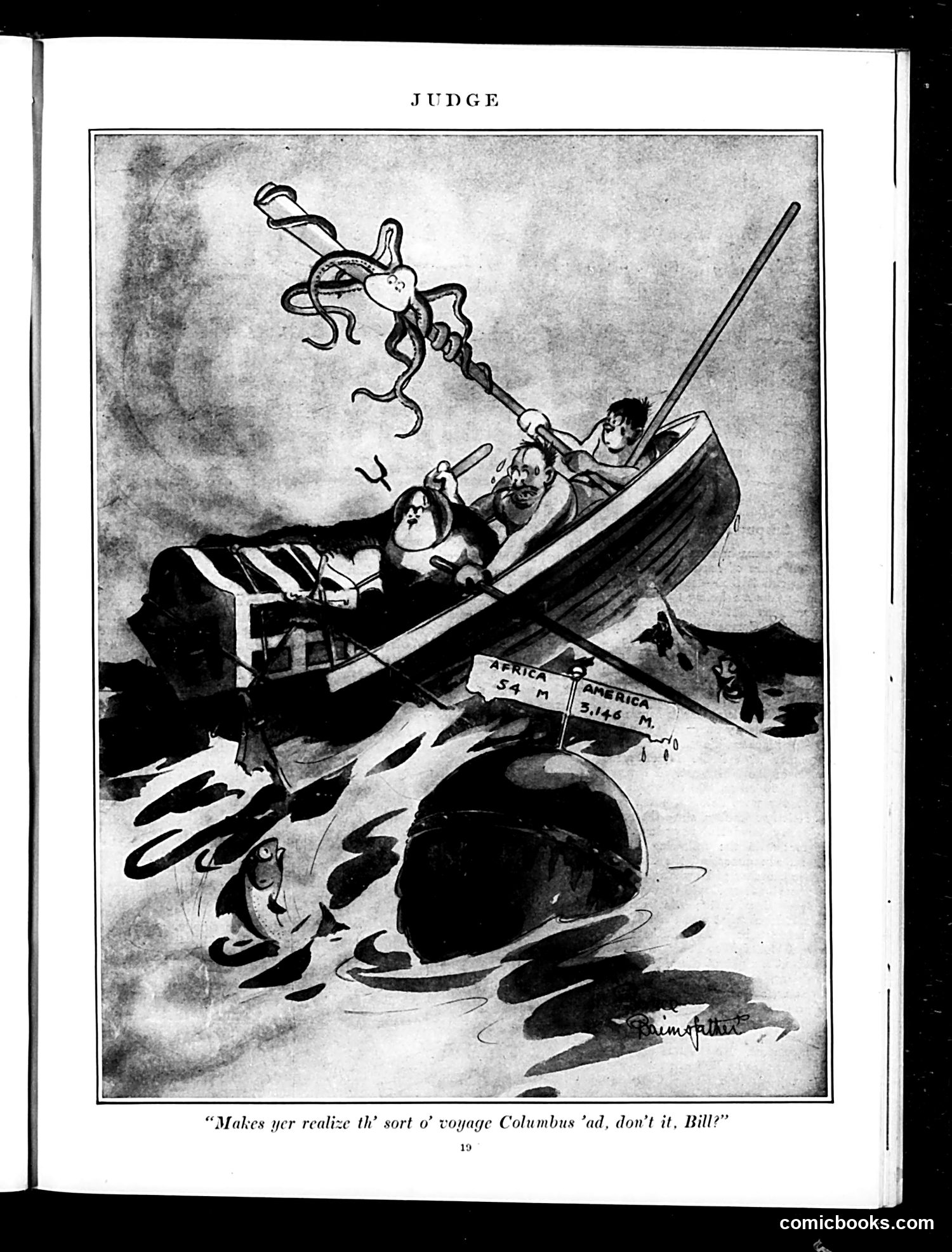
"Judge" Cartoon Analysis This political cartoon depicts three men in a small, damaged boat being attacked by an octopus, with labels indicating "Africa" and "America" visible on the vessel. The caption references Columbus's voyage in colloquial dialect. The satire appears to criticize American imperialism and colonial ventures, particularly regarding Africa and America. The octopus likely represents foreign threats or the dangers of overseas expansion. The comparison to Columbus's voyage suggests the cartoonist is commenting on the perils and difficulties of American colonial ambitions—characterizing them as chaotic, perilous, and perhaps foolish expeditions. The working-class dialect of the caption adds mockery to the endeavor, suggesting ordinary people recognize the venture's absurdity.
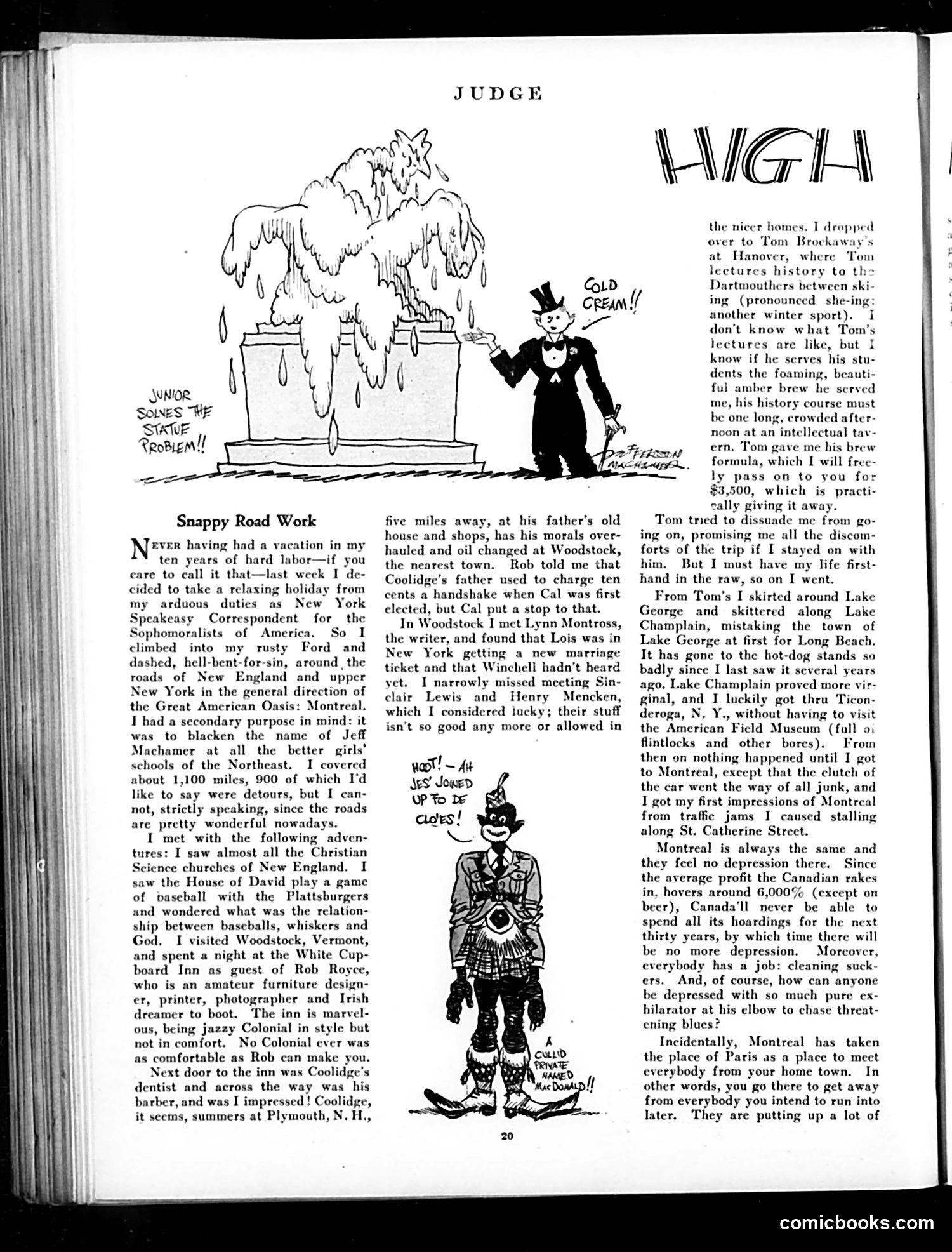
Explanation for Modern Readers This page contains a humorous travel essay with two cartoons illustrating the author's New England road trip. The top cartoon shows a man in formal attire praising "cold cream" beside what appears to be an icy statue—likely satirizing the popularity of beauty products or perhaps mocking pretension. The bottom cartoon depicts a figure labeled with references to "Junior Statue Problem"—appearing to mock someone's youthful appearance or status. The essay itself is a satirical account of visiting literary and political figures. The author mentions meeting writer Lynn Montross and nearly encountering Sinclair Lewis and H.L. Mencken (famous intellectuals of the 1920s). There's a jab at Calvin Coolidge, who apparently summers nearby and charges for handshakes. The piece also contains Prohibition-era references (speakeasy correspondent, "foaming amber brew"), mocking both the illegality of alcohol and people's desperation to consume it despite laws. The commentary on Montreal's economic prosperity during the Depression-era (6,000% profit margins) is sarcastic social criticism. Overall, Judge magazine's typical satirical style targeting contemporary celebrities, politicians, and social conditions.
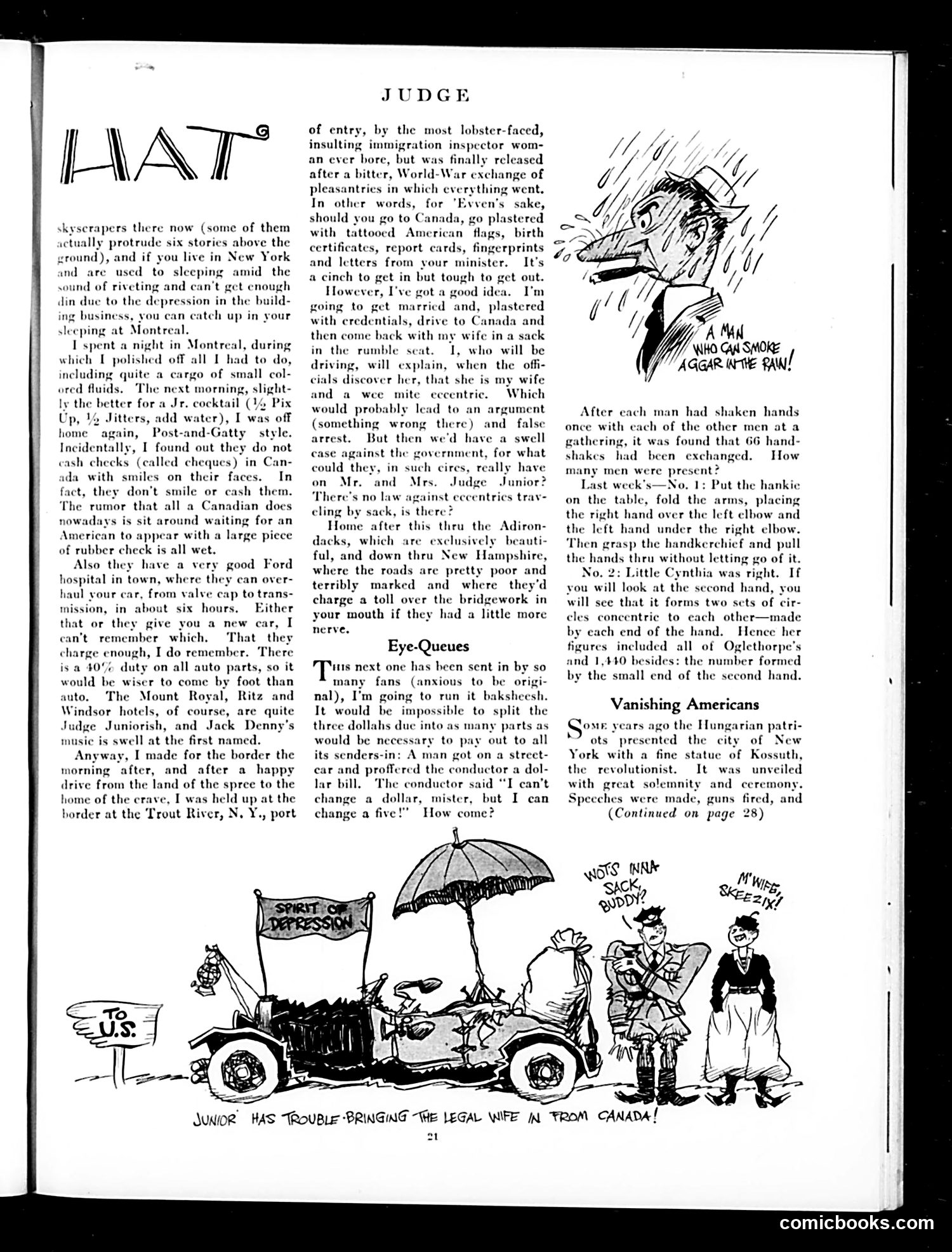
Explanation for Modern Readers This page from *Judge* magazine features two main satirical pieces: "Hat" (top narrative): A humorous account of the author's trip to Montreal and Canada. The satire targets Canadian border bureaucracy—specifically a difficult immigration inspector. The author jokes that Canadians are unsmiling, unhelpful, and that entering Canada requires absurd documentation (tattoos, fingerprints, minister's letters). He proposes a scheme: marry someone eccentric, sneak her back in the rumble seat claiming she's "a wee mite eccentric," and sue the government. The humor mocks both Canadian rigidity and American smugness. Bottom cartoon: Illustrates someone attempting to bring a wife from Canada—a visual gag about border trouble. The caption reads "Junior has trouble bringing the legal wife in from Canada!"—implying that even a legitimate spouse creates complications. "Eye-Queues" (puzzle section): Brain teasers for readers, presented as a regular feature. The overall tone reflects 1920s-30s American attitudes: treating Canadian neighbors as quaint, overly formal, and easy targets for mockery.
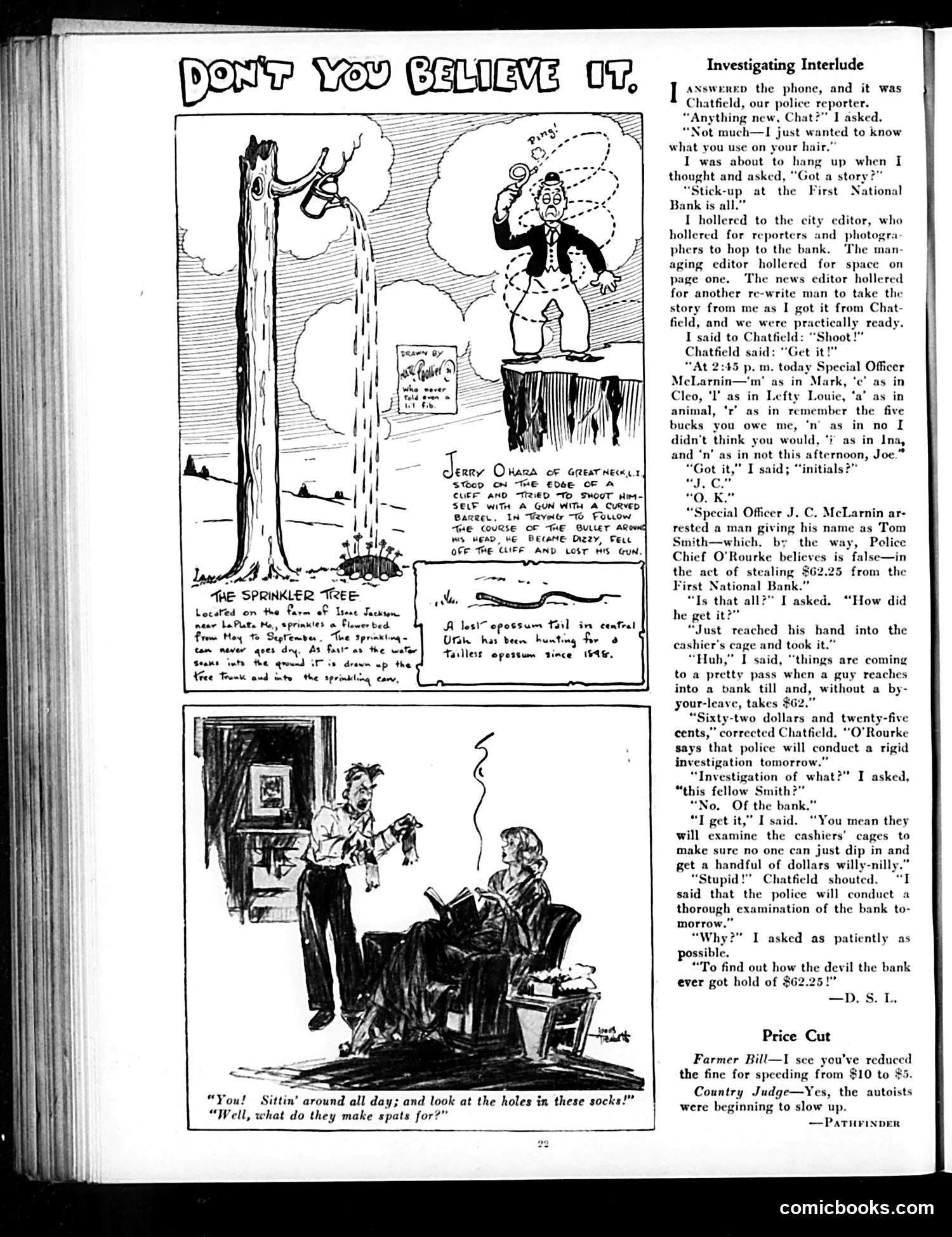
"Investigating Interlude" Page Analysis This page contains two distinct satirical pieces from Judge magazine: Main Article/Comic Strip: A humorous dialogue between a newspaper reporter and police reporter Chatfield about a bank robbery. The joke satirizes bureaucratic absurdity—a man named Tom Smith steals $62.25 from the First National Bank by reaching into a cashier's cage. When police announce they'll conduct a "rigid investigation," the reporter assumes they'll examine security measures. Instead, Chatfield reveals they're investigating how the bank itself obtained the stolen money—a nonsensical response that mocks police incompetence and circular logic. Supporting Elements: - "The Sprinkler Tree" cartoon depicts an amusing natural phenomenon - "Price Cut" quip mocks rural traffic enforcement, suggesting judges lowered speeding fines because they were actually slowing automobiles down—satirizing the ineffectiveness of penalties The page targets institutional incompetence and the automobile's emerging cultural impact during the early 20th century.
"Judging the Books": A Critique of Stuart Chase's Mexico Writing This book review satirizes writer Stuart Chase, known for critiques of industrial capitalism and mechanization. The satire targets Chase's romantic primitivism: he traveled to Mexico seeking an "ideal" civilization untainted by modern industry, contrasting a depressed American "Middletown" (likely referencing the famous sociological study) against an idealized Mexican village. Chase's flaw, the reviewer argues, is his naive nostalgia. He celebrates Mexico's poverty as authentic living—wooden plows, absence of modern conveniences—while ignoring genuine hardship. The satire mocks his tendency to inspire readers toward retrograde solutions rather than pragmatic reform. The review's tone is sympathetic but exasperated: Chase's facts may be accurate, but his romantic conclusion—that pre-industrial life is preferable—is dangerously impractical. This reflects 1930s intellectual debates about modernization, industrialization, and whether mechanized civilization represented genuine progress or exploitation.
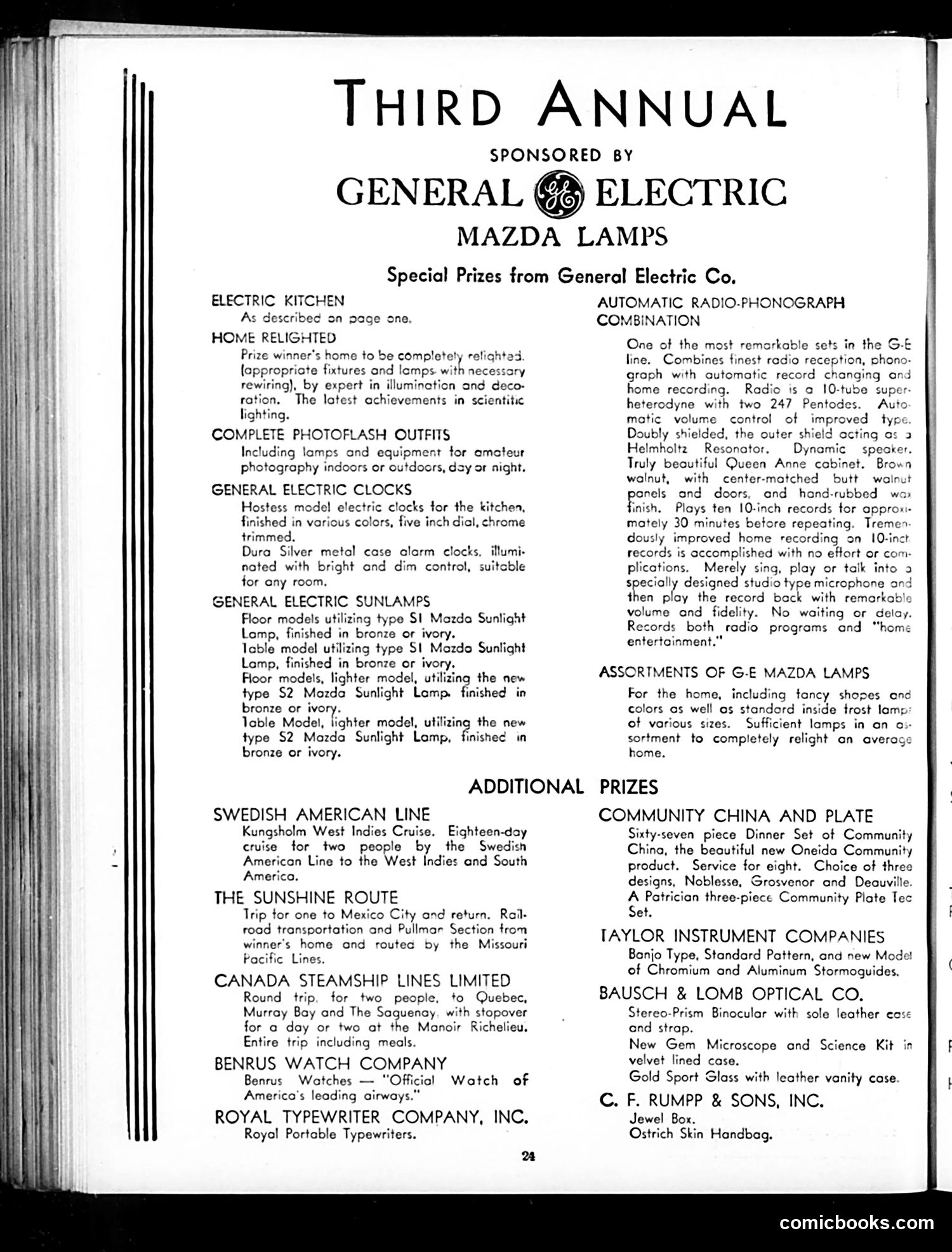
What This Page Shows This is not a cartoon page—it's an advertising/prizes page from Judge magazine's "Third Annual" competition sponsored by General Electric's Mazda Lamps division. The page lists prizes contestants could win, sponsored by various companies: General Electric offers home electrical upgrades and a radio-phonograph combination; travel companies provide cruises and trips; watch, typewriter, and optical companies contribute merchandise; dinnerware and luxury goods round out the offerings. Context for modern readers: This reflects 1930s consumer culture and corporate sponsorship. The prominence of electrical home goods (sunlamps, clocks, relighting) shows how novel and prestigious electric home technology was. The exotic travel prizes (Caribbean cruises, Mexico City trips) suggest aspirational leisure. This was typical Depression-era promotional content—contests and giveaways helped companies advertise while generating consumer interest and magazine readership.
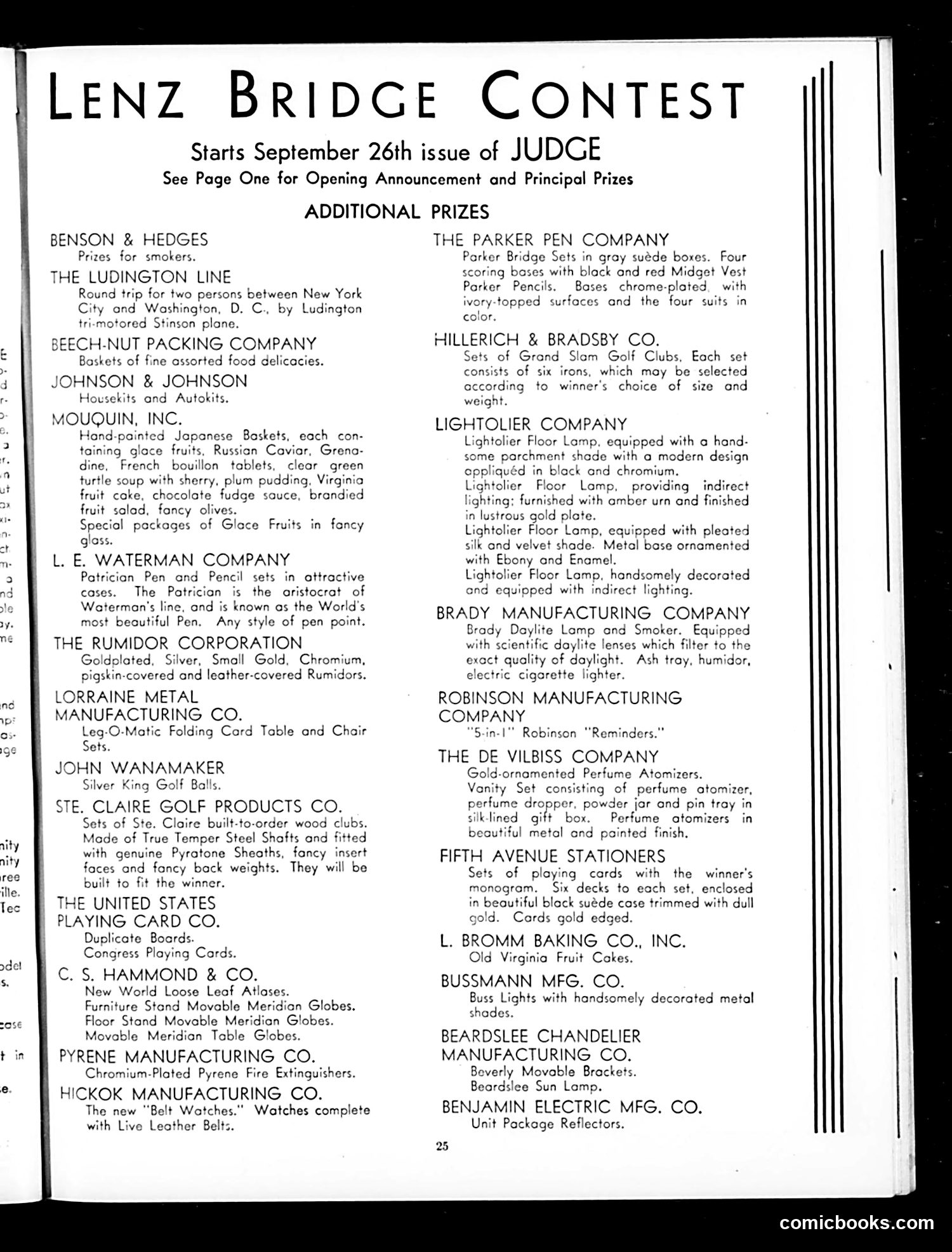
Lenz Bridge Contest Advertisement Page This is primarily an advertising page, not a satirical cartoon. It announces Judge magazine's "Lenz Bridge Contest" (starting September 26th) and lists numerous corporate prize donations. The page reflects 1920s-30s consumer culture and advertising trends. Companies competed for prestige by sponsoring contests in popular magazines. The prizes reveal era-specific luxuries: golf equipment, fountain pens, decorative lamps, playing cards, and gourmet foods (caviar, turtle soup, fruit cakes). High-end brands like Waterman pens, Parker pens, and Johnson & Johnson sought association with the contest's audience. Key context for modern readers: This represents pre-Depression advertising, when manufacturers viewed magazine contests as prime marketing. The lavish prizes and emphasis on quality goods reflect economic optimism and consumer aspirations of the period. The "Lenz Bridge Contest" likely involved bridge—the card game—given multiple playing card and bridge set prizes listed. This is essentially a sponsor directory, not satirical content.
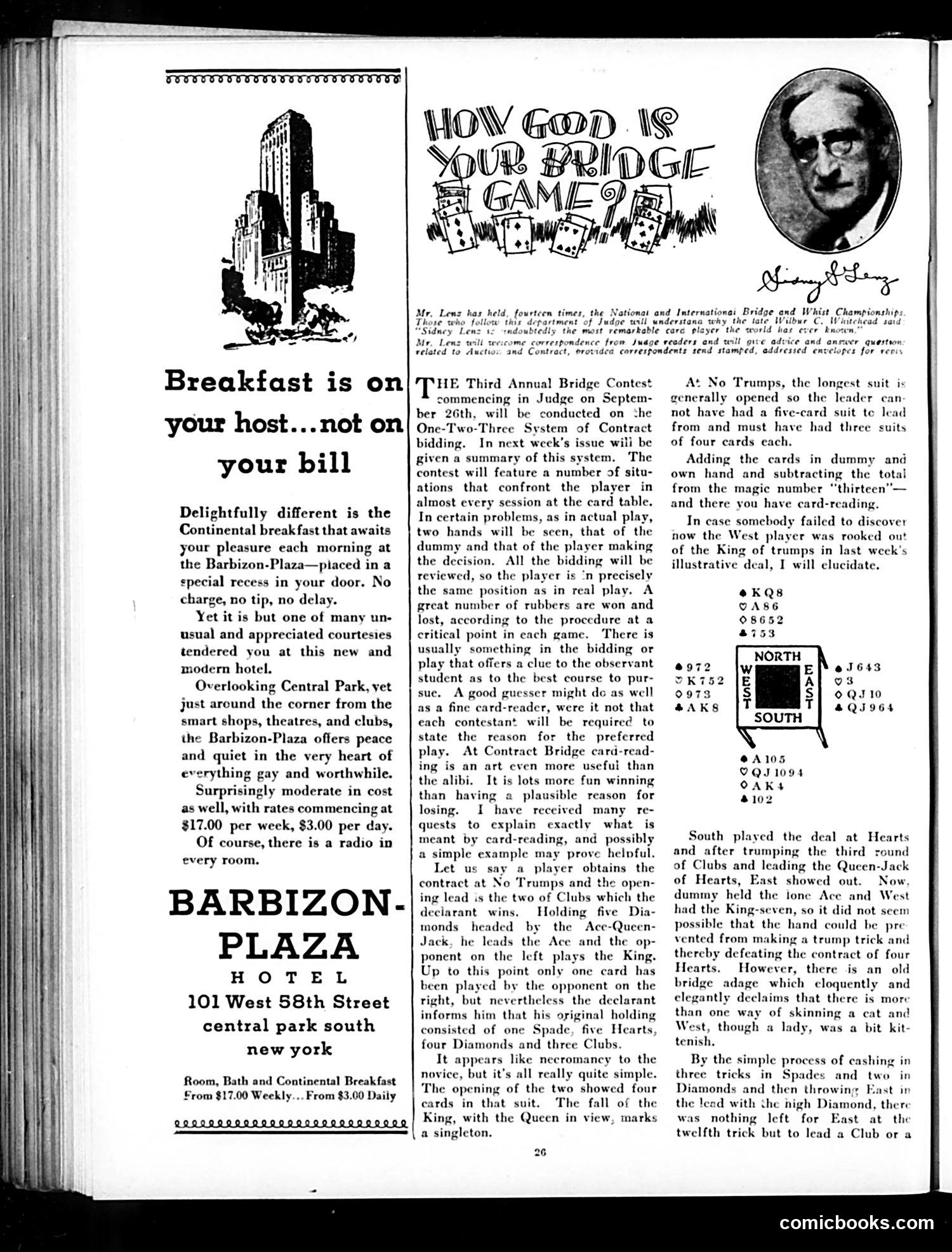
Judge Magazine Page Analysis This page contains a bridge card game instructional article alongside a hotel advertisement. The main content explains "card-reading" in Contract Bridge—a technique where players deduce opponents' hidden cards from bidding and play patterns. The article uses a concrete example: if an opponent opens with two Clubs (indicating four in that suit) and later plays a King, the declarant can calculate their exact hand composition by process of elimination using the magic number "thirteen" (total cards in a suit). The illustration at top shows a portrait of a man (likely the bridge expert referenced), with the title "How Good Is Your Bridge Game?"—introducing Judge's Third Annual Bridge Contest for readers. The left side is a Barbizon-Plaza Hotel advertisement, emphasizing its modern amenities, central location near Central Park, and surprisingly affordable rates ($3/day). The pitch: "Breakfast is on your host...not on your bill." Context for modern readers: Bridge was enormously popular entertainment in 1920s-30s America. Judge magazine mixed serious instructional content with advertising, treating card games as worthy of detailed analysis for its educated, leisure-class readership.
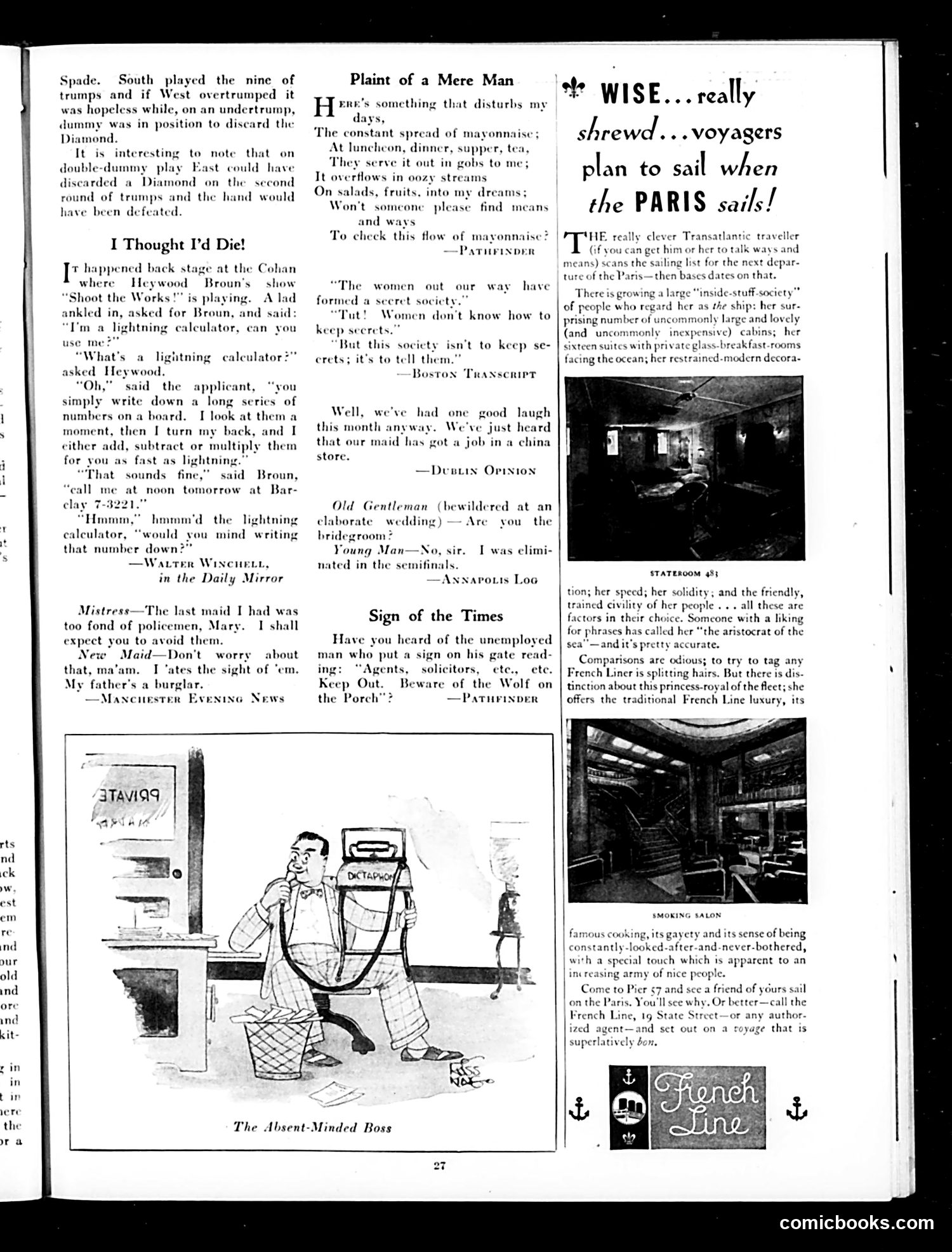
Explanation for Modern Readers This page contains humor pieces and advertisements from *Judge* magazine. The main cartoon, "The Absent-Minded Boss," depicts a distracted businessman who has written a large check but forgotten to include the amount—a visual gag about workplace incompetence. The text pieces are brief, punchy anecdotes exploiting common stereotypes: a woman employer warning a maid about policemen (implying working-class women's romantic entanglements); a lightning calculator offering his services; complaints about mayonnaise overuse at meals; and jokes about secret societies and unemployed men posting gate signs. The page's bulk consists of French Line shipping company advertising, promoting luxury ocean travel on the SS *Paris*. The ads emphasize elegant dining rooms, private cabins, and exclusive service—targeting wealthy travelers. The overall tone reflects 1920s-30s *Judge* sensibilities: mild class humor, domestic comedy, and sophisticated marketing aimed at affluent readers considering transatlantic voyages.
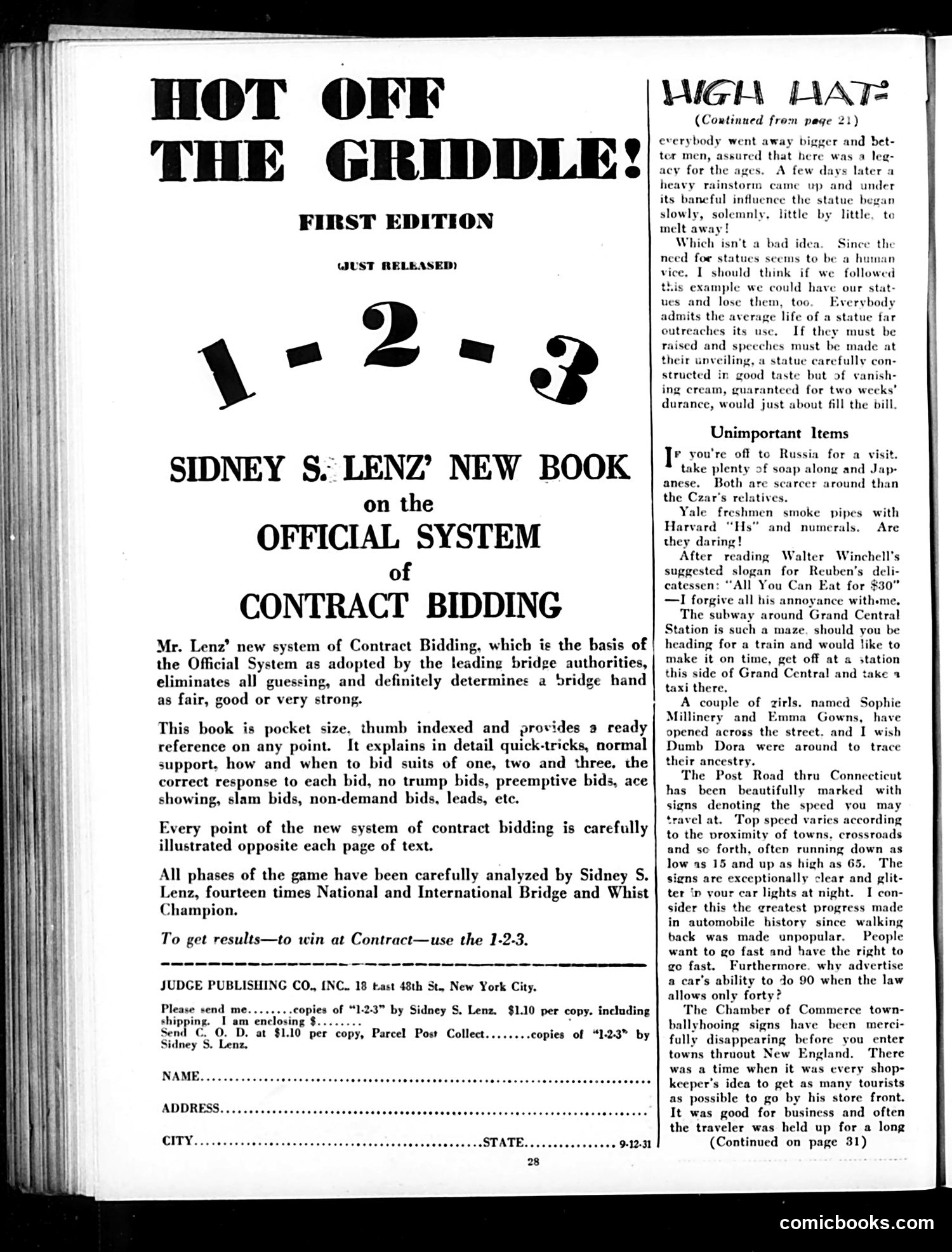
This page is primarily a book advertisement and order form, not a political cartoon. It advertises Sidney S. Lenz's instructional book on contract bridge bidding—a card game system claiming to eliminate guessing through a simplified "1-2-3" method. Lenz is identified as a fourteen-time bridge champion. The right column contains "Unimportant Items," a humor section with brief satirical observations about contemporary life: Russian travel tips, Yale freshman stereotypes, New York subway navigation, road signs advertising speed limits, and Chamber of Commerce tourism tactics. These are light social commentary rather than pointed political satire—poking fun at modern conveniences, bureaucratic signage, and small-town boosterism. None references specific politicians or major events.
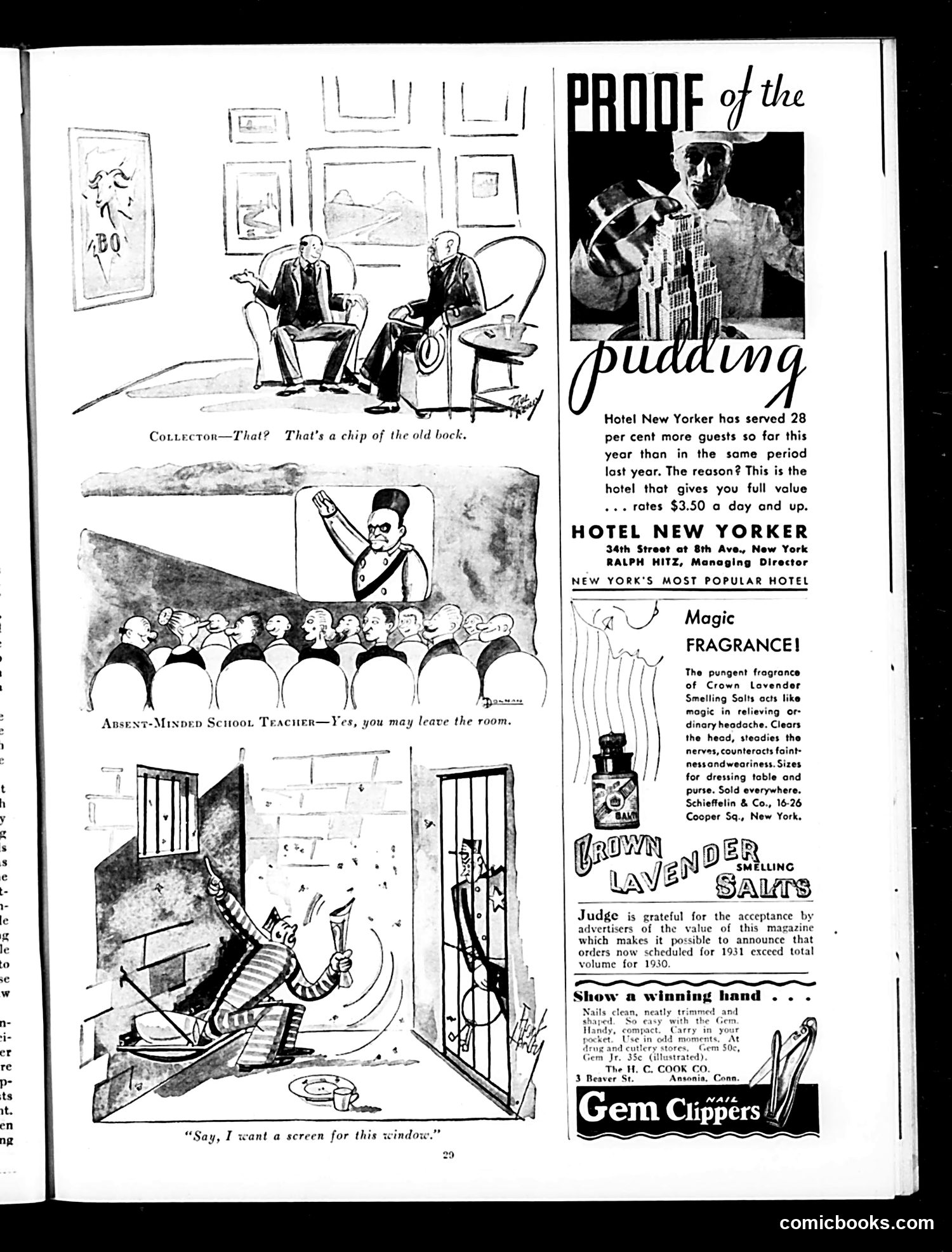
Judge Magazine Page Analysis This page contains three cartoon jokes plus advertisements: 1. "That's a chip of the old block": Two men discuss an art collection. The joke plays on the phrase "chip of the old block" (meaning a child resembles their parent)—here, literally referring to a small artwork as a fragment from a larger piece. 2. "Absent-Minded School Teacher": A teacher, apparently forgetting students are present, stands at a pulpit-like podium while children sit below. The caption "Yes, you may leave the room" suggests the teacher doesn't realize they're conducting a class, not a formal meeting. 3. "Say, I want a screen for this window": A person dangles from an exterior window/ledge in distress while requesting a "screen"—a darkly humorous double meaning, as they need rescue but use the mundane term for a window covering. The remaining content is advertising: Hotel New Yorker, Crown Lavender smelling salts, Gem Clippers, and other products. Judge notes increased 1931 advertising orders, indicating economic optimism despite the Depression's onset.
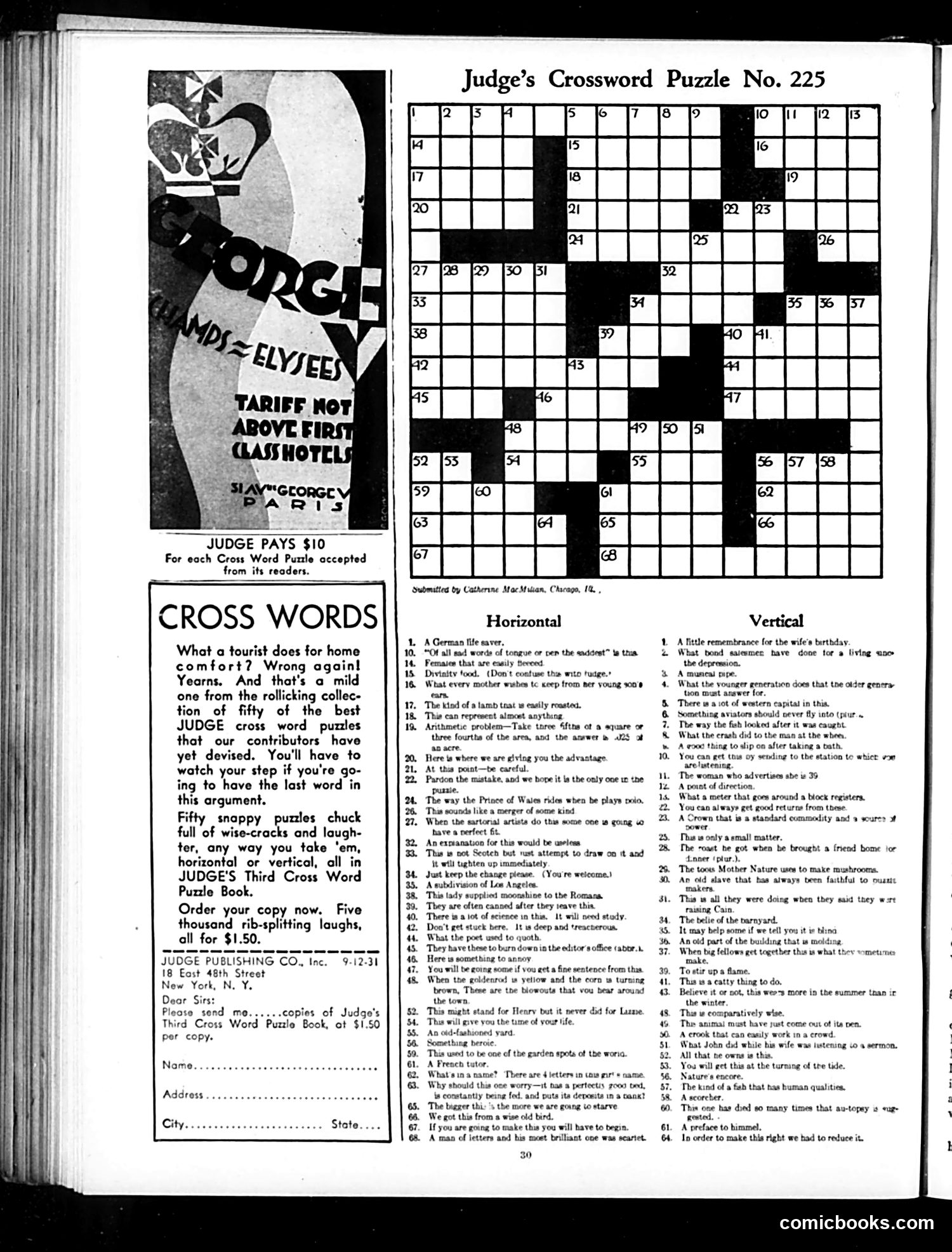
Judge Magazine Crossword Puzzle (1931) This page features Judge magazine's promotional advertisement for its "Third Cross Word Puzzle Book," offering 50 original puzzles contributed by readers. The magazine paid $10 per accepted puzzle—a notable incentive during the Depression era. The sample crossword puzzle (No. 225) uses humorous clues reflecting contemporary 1931 concerns: references to Prohibition ("moonshine"), the stock market crash ("the crash did to the man at the wheel"), economic depression ("returns from these"), and modern technology (aviators, meters). The cartoon advertisement (upper left) shows a tourism poster, likely satirizing travel industry marketing during economic hardship. The puzzle book itself cost $1.50—positioning crosswords as affordable entertainment during financially difficult times. Judge positioned these puzzles as witty, accessible humor for ordinary readers, democratizing puzzle-solving while generating reader-submitted content for the magazine.
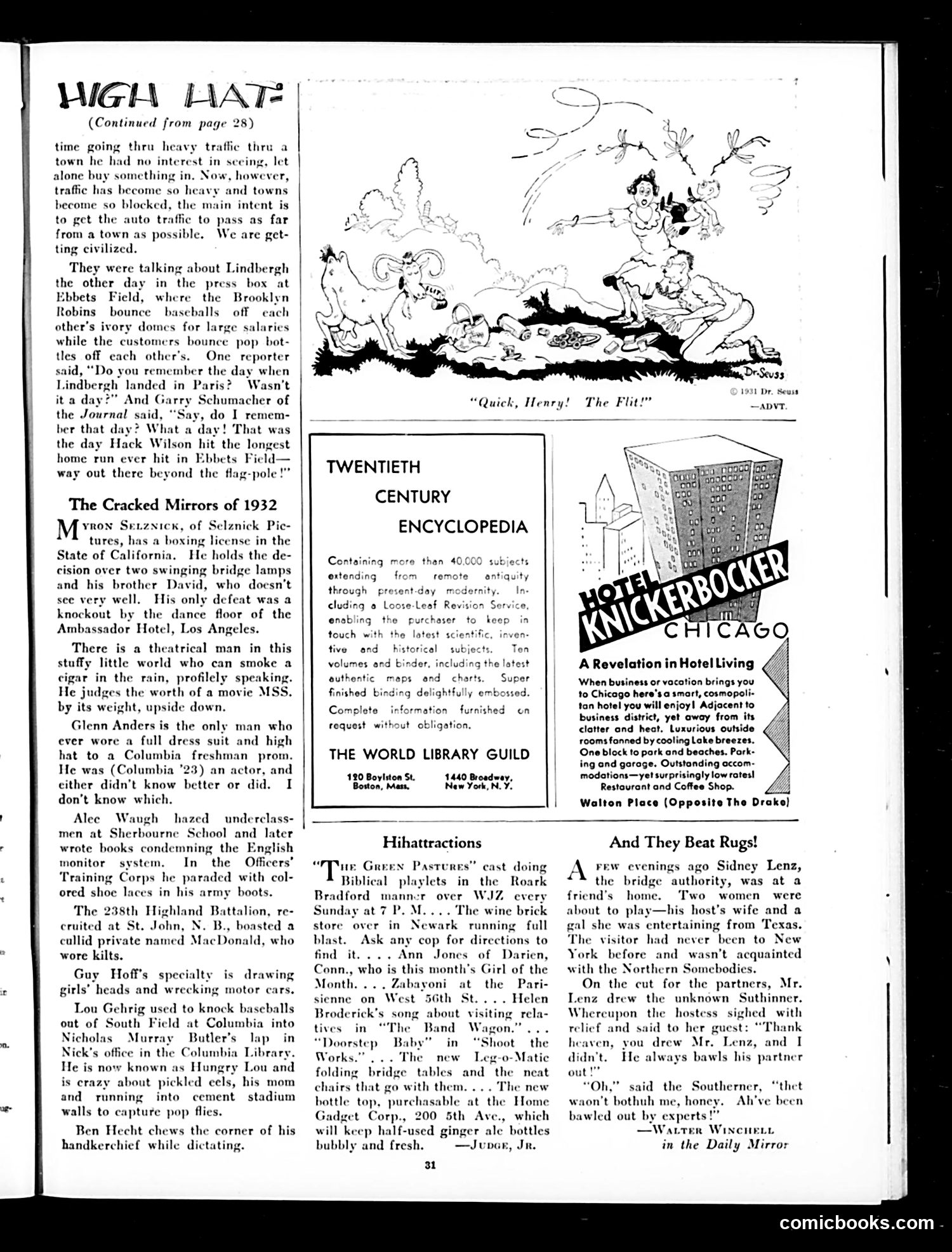
Analysis of This Judge Magazine Page This page from Judge magazine (circa 1932) contains several distinct elements: Main Cartoon (top): Dr. Seuss's "Quick, Henry! The Flit!" depicts a chaotic picnic scene. The humor plays on *Flit* insecticide advertisements popular in the era—the joke being someone urgently calling for bug spray during what appears to be a disastrous outdoor meal. "High Hat" Column: Continues gossipy anecdotes about celebrities and public figures (Lindbergh, Hack Wilson, etc.), using sarcastic, irreverent observations about their quirks—typical Judge satire mocking the famous. "The Cracked Mirrors of 1932": Similar gossipy vignettes about theatrical and sports personalities, presented as humorous character studies. Advertisements: Include encyclopedia and hotel promotions typical of 1930s publications. "Hihattractions": Entertainment listings and brief reviews. The page reflects Judge's style: celebrity mockery, absurdist humor, and advertising-supported content aimed at educated, urbane readers.
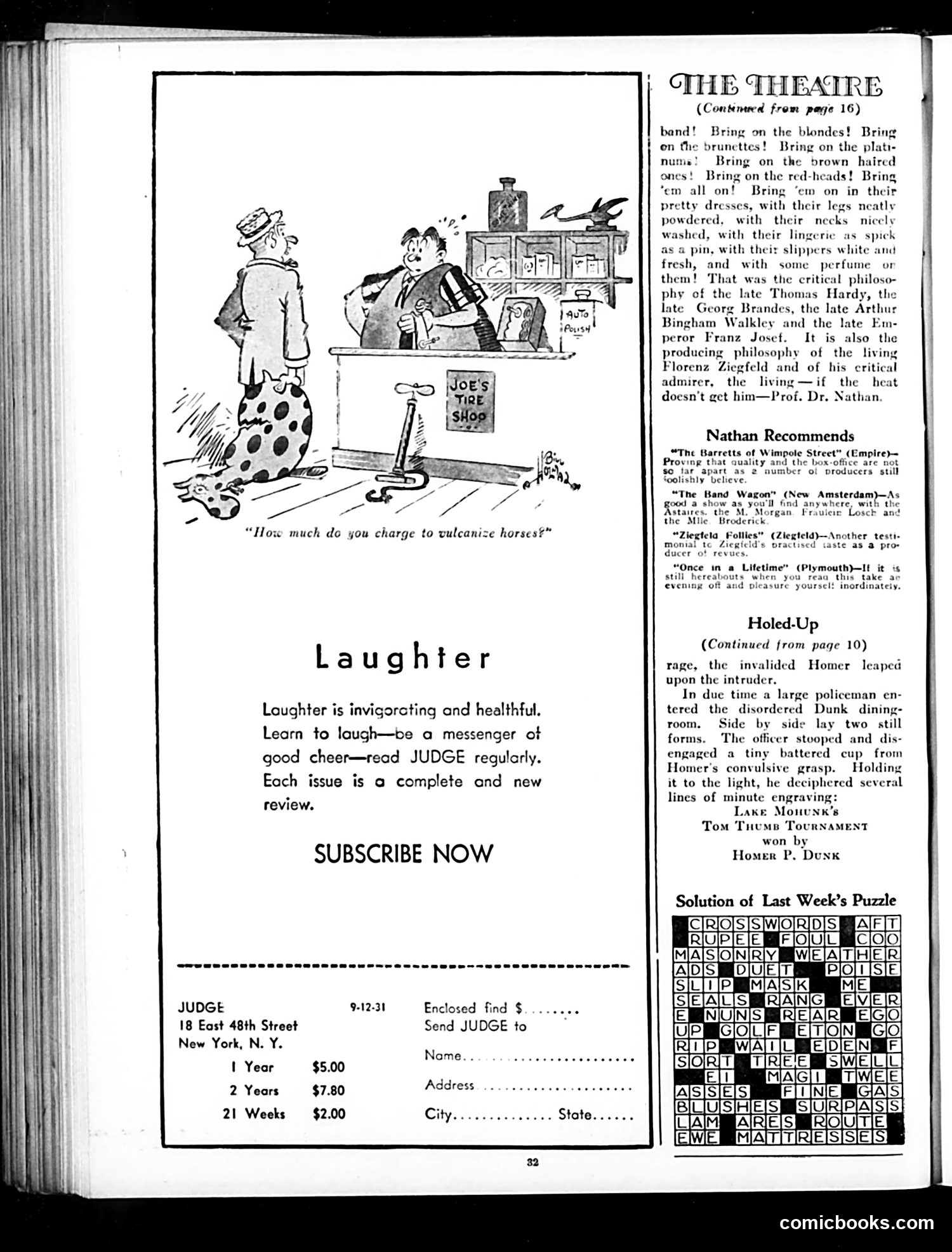
Judge Magazine Page Analysis (9-12-31) The main cartoon depicts a humorous misunderstanding: a man with a spotted cow approaches a tire shop, asking "How much do you charge to vulcanize horses?" The joke plays on "vulcanize"—a tire-repair process—being mistaken for something related to horses. The absurdity lies in applying industrial tire terminology to animal care. The page is primarily advertising and subscription material for Judge magazine itself, promoting laughter as "invigorating and healthful." Subscription rates range from $2.00 for 21 weeks to $5.00 annually. The right column contains theater reviews by "Nathan," likely Alexander Woollcott or similar contemporary critic, recommending Broadway shows including "The Barretts of Wimpole Street" and "The Band Wagon." Below is a completed crossword puzzle solution and a serialized story fragment titled "Holed-Up" involving characters Homer and Dunk. The page reflects 1930s Judge content: light humor, theater criticism, and serialized fiction typical of the satirical weekly.
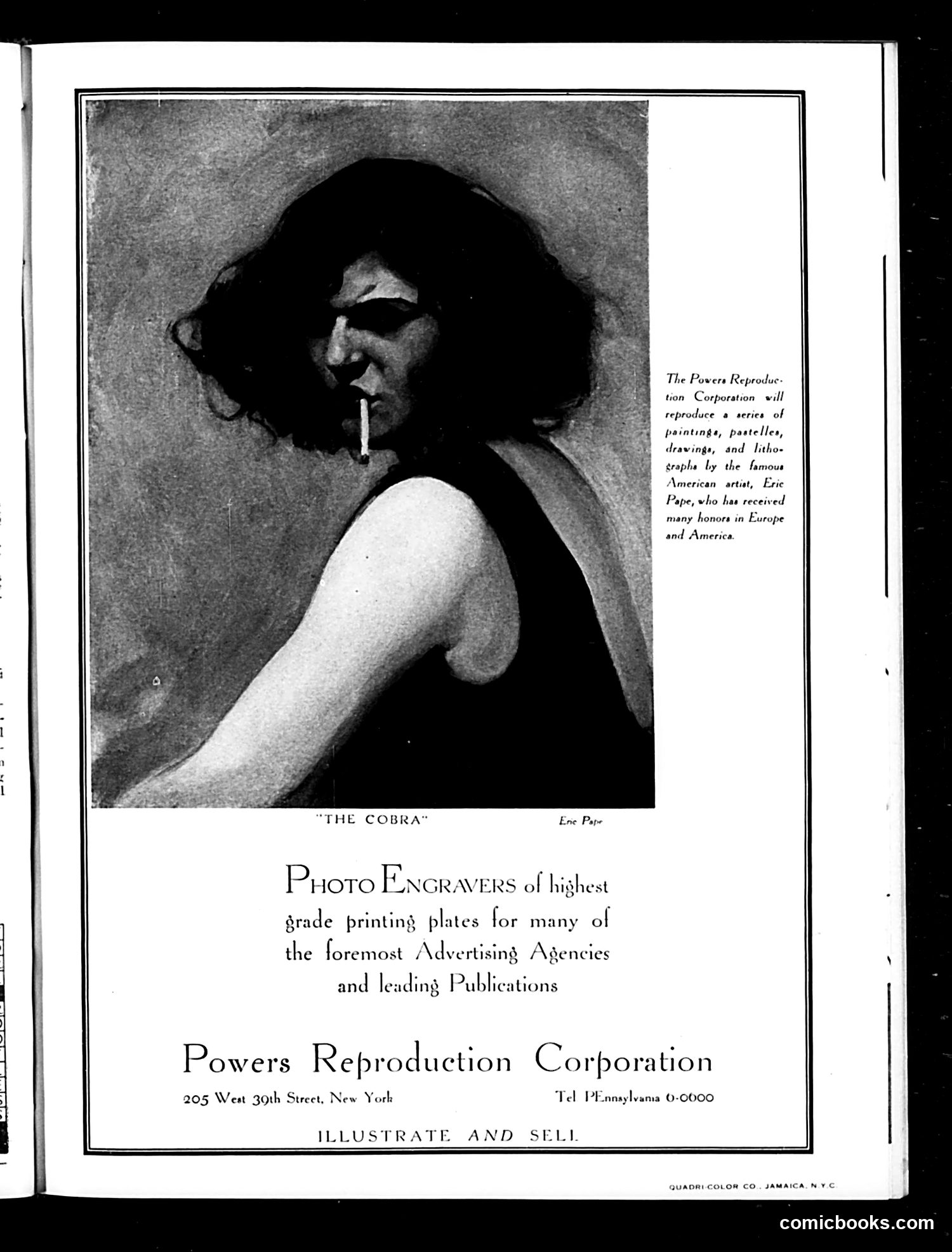
Analysis of the Judge Magazine Page This is primarily an advertisement, not a political cartoon. The page promotes the Powers Reproduction Corporation, a photo-engraving company specializing in high-quality printing plates for advertising agencies and publications. The image labeled "THE COBRA" by Erie Pape shows a figure in profile wearing sunglasses and smoking a cigarette—styled as a bohemian or artistic type. The artwork demonstrates the sophisticated reproductive capabilities Powers offered: the ability to faithfully reproduce fine art (paintings, pastels, drawings, lithographs) into printing plates. The page essentially showcases Pape's work as an example of what Powers could reproduce. Erie Pape was indeed a recognized American artist, though this advertisement doesn't satirize him—rather, it uses his reputation to market the corporation's technical printing services to potential clients in advertising and publishing.
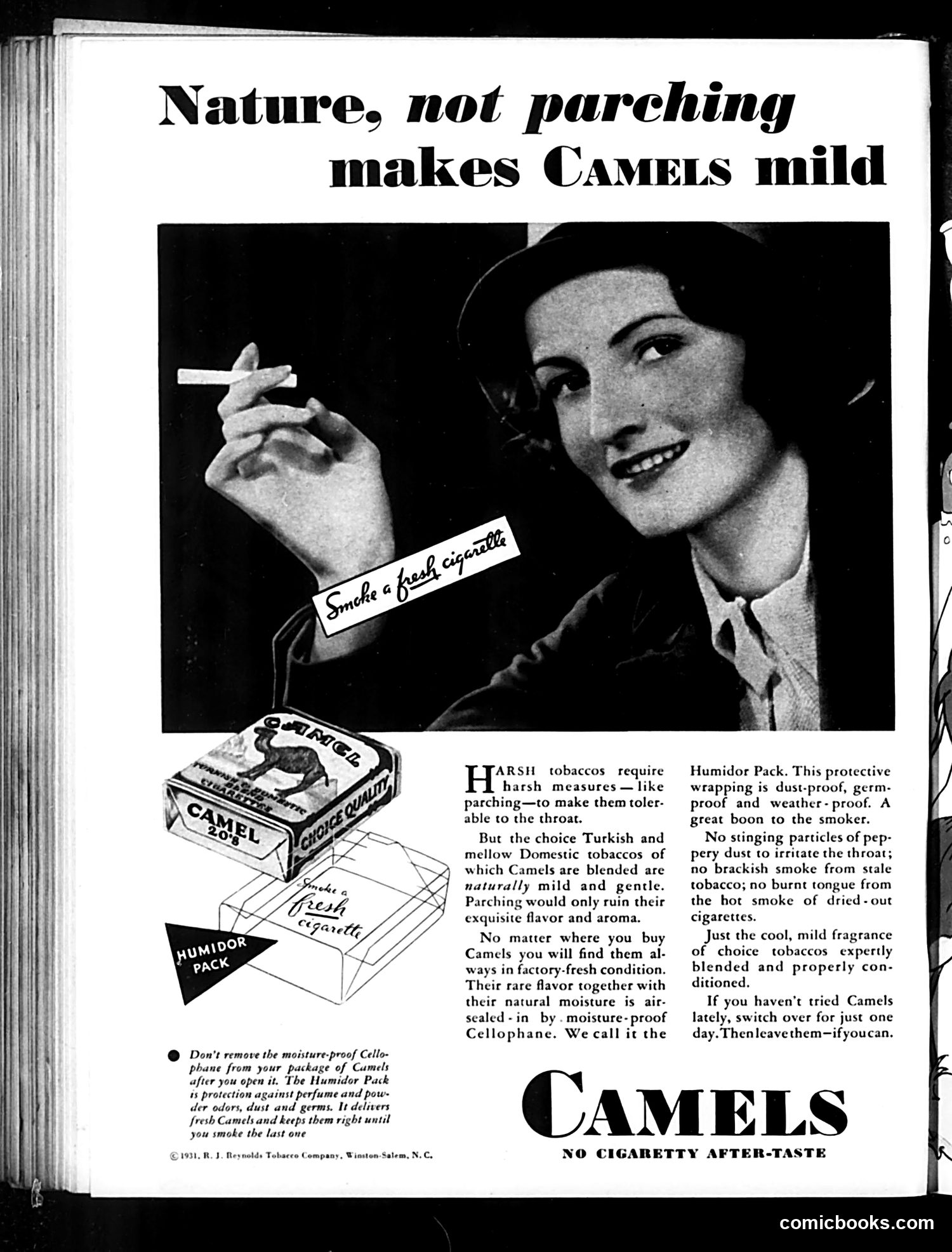
Analysis This is a cigarette advertisement, not a political cartoon or satire. It appeared in *Judge* magazine but is a paid commercial for Camel cigarettes. The ad features a smiling woman holding a lit cigarette, promoting Camels' "Humidor Pack" — a moisture-proof cellophane wrapper. The advertisement's argument is that Camels need no "parching" (a heat treatment competitors used) because their Turkish and Domestic tobacco blend is "naturally mild." For modern readers: This represents pre-1964 tobacco advertising when cigarettes were openly promoted in mainstream publications without health warnings. The ad uses pseudo-scientific language ("moisture-proof," "germ-proof") and lifestyle imagery (an attractive woman) to market cigarettes as a safe, even beneficial product. The claim "no cigaretty after-taste" and appeals to freshness reflect mid-20th-century marketing tactics before the surgeon general's warning era. The page simply shows how normalized cigarette promotion was in early 20th-century American media.