judge
Judge — September 19, 1931
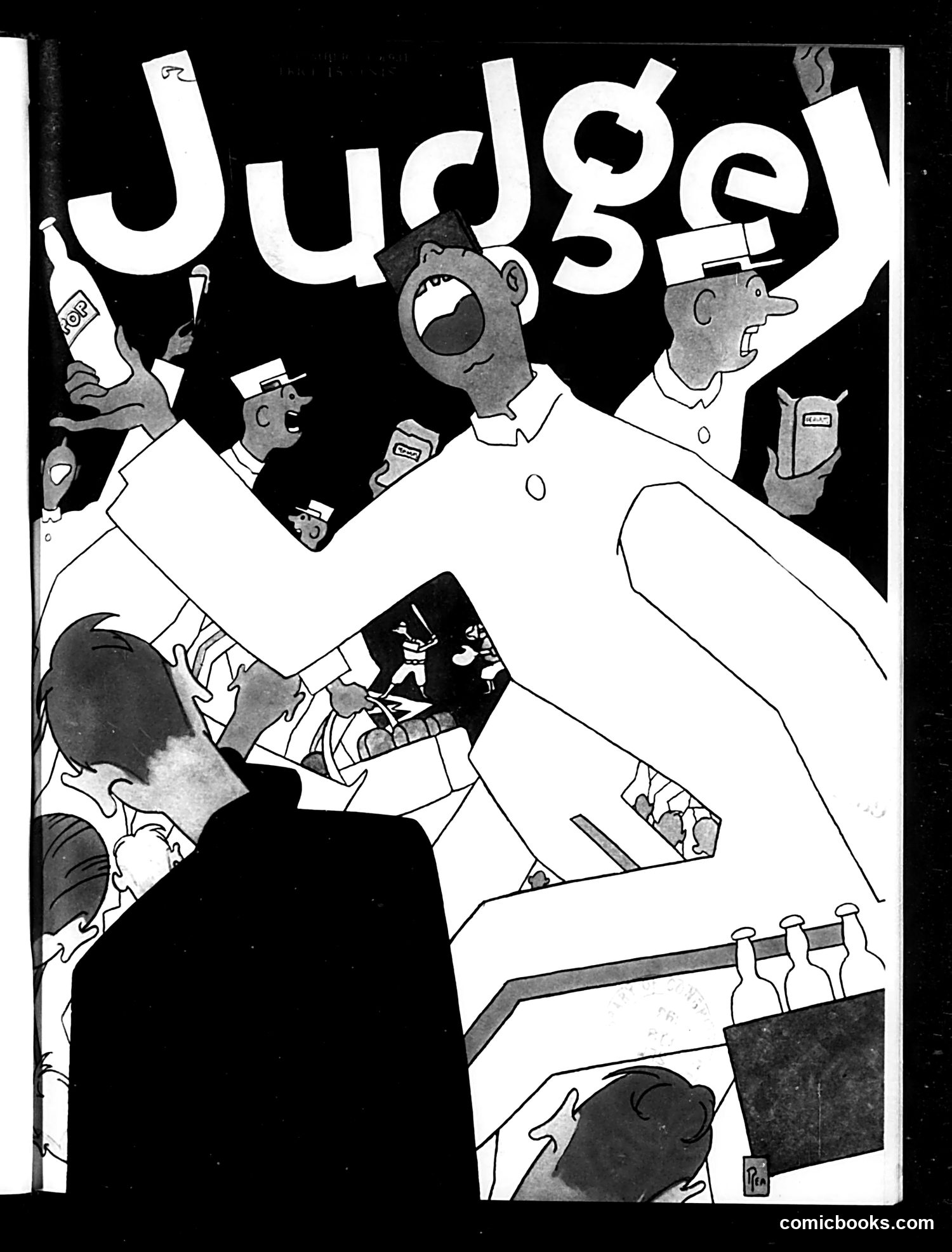
"Jungley" This page from *Judge* magazine appears to be a satirical cartoon about urban chaos or wild behavior, suggested by the title "Jungley" and the frenzied scene depicted. The central figure—a large man in business attire with an exaggerated expression—is surrounded by smaller figures in what seems to be a chaotic indoor setting, possibly a bar or restaurant (bottles visible in lower right). The satire likely mocks either: - Excessive urban nightlife/entertainment culture - Unrestrained consumer behavior or "jungle-like" conduct in civilized settings - Specific contemporary social chaos Without clearer identifying details or caricature marks pointing to specific politicians or public figures, the exact political target remains unclear, though the "civilized" versus "wild" contrast suggests commentary on modern social behavior.
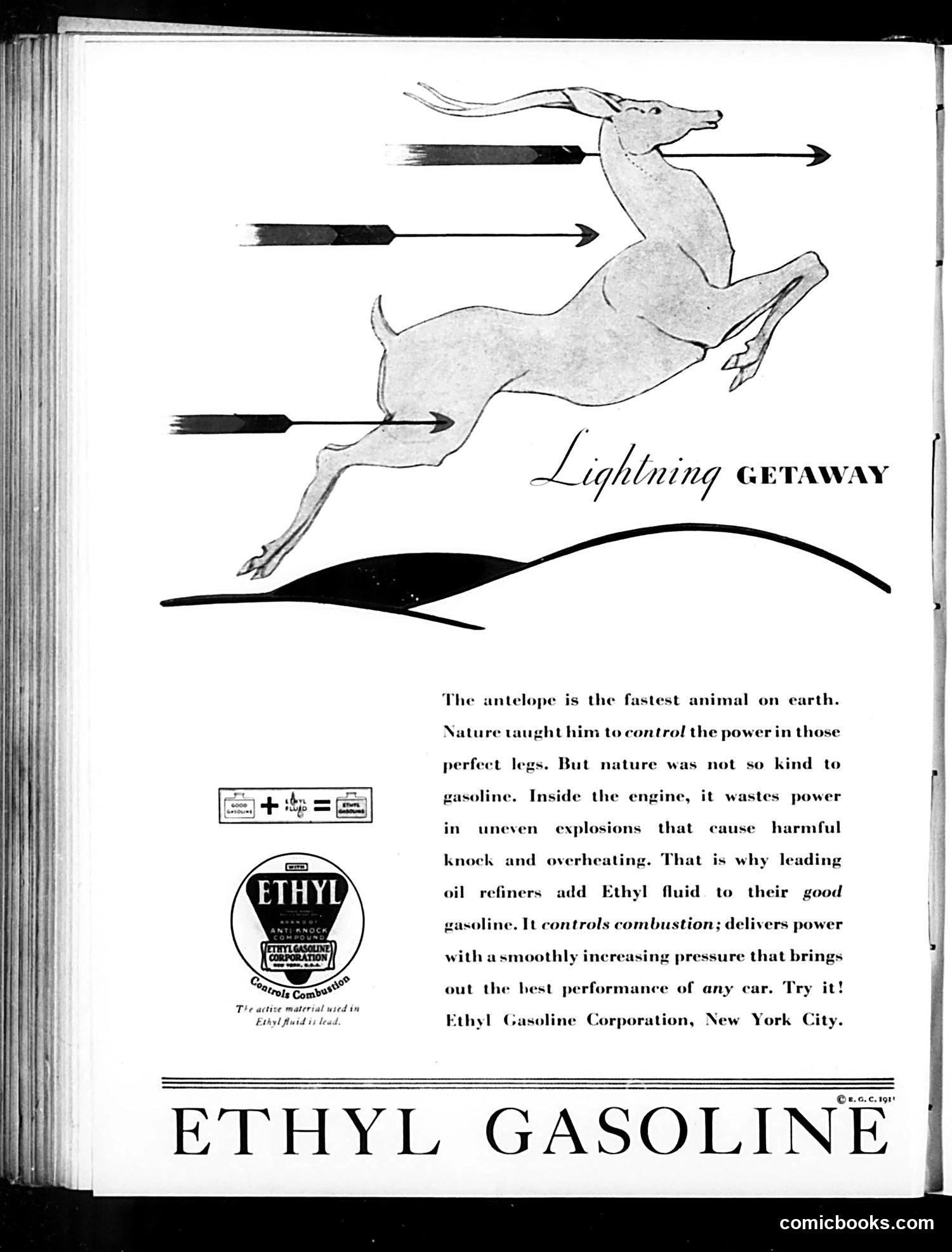
Analysis This page is primarily an advertisement, not satire or political commentary. The "Lightning Getaway" illustration shows an antelope in mid-leap, used as a metaphor for speed and control. The ad compares the antelope's natural ability to "control" its powerful legs to what Ethyl gasoline supposedly does for engines. Just as nature gave the antelope perfect leg control, Ethyl fluid allegedly controls gasoline combustion, preventing "knock and overheating" and delivering smooth power. The comparison is purely commercial rhetoric — using an animal metaphor to sell a fuel additive by associating it with natural perfection and power. There is no political satire or social commentary present. This reflects 1920s advertising techniques emphasizing technological solutions to mechanical problems.
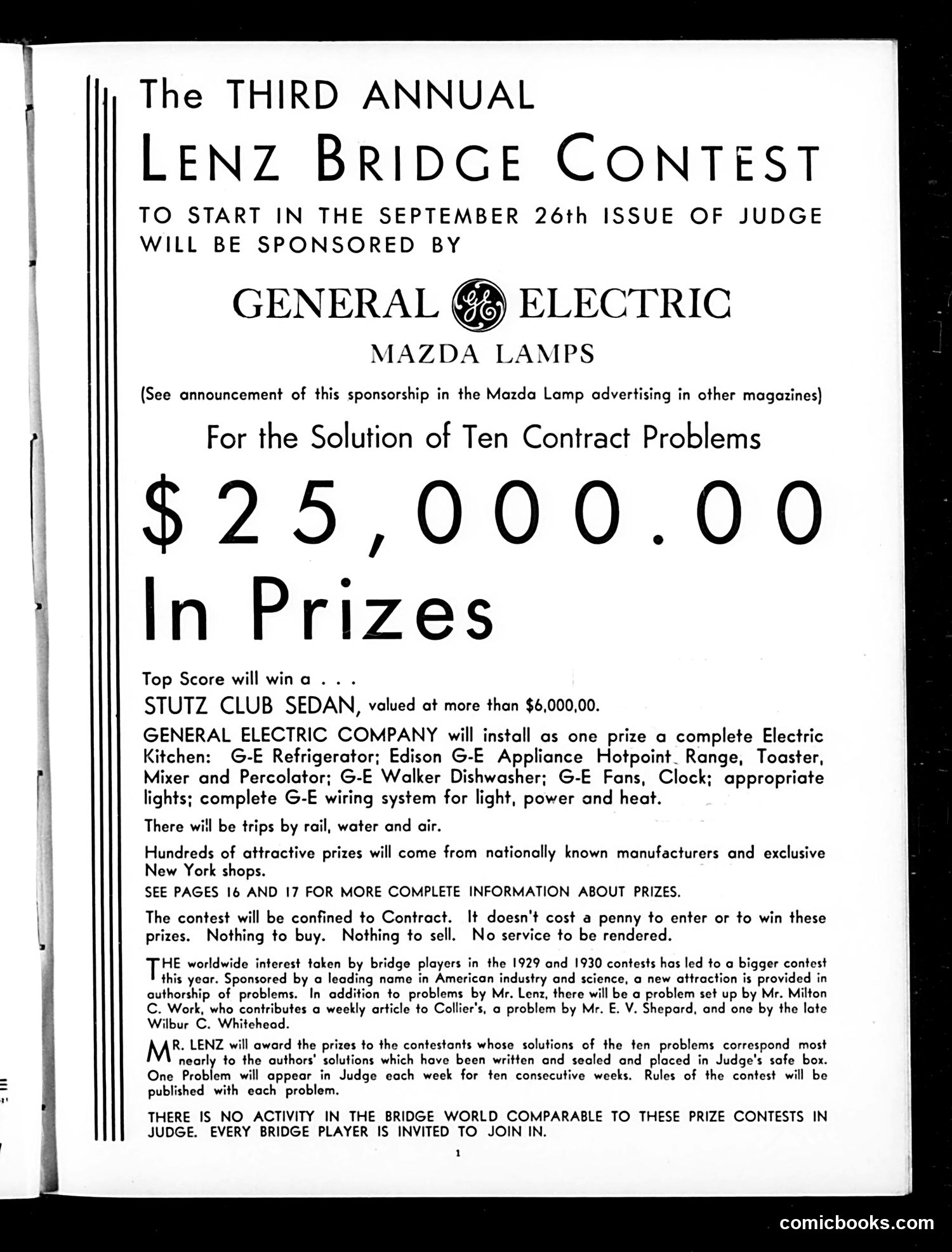
Analysis This page is primarily advertising, not satire or cartoon content. It announces the Third Annual Lenz Bridge Contest, sponsored by General Electric (Mazda Lamps), offering $25,000 in prizes for solving ten contract bridge problems. The contest details indicate this was a significant promotion: the top prize was a Stutz Club Sedan (valued over $6,000), plus a complete electric kitchen from General Electric. Additional prizes came from "nationally known manufacturers." The text notes that bridge player interest from 1929-1930 contests inspired this larger competition, with problems contributed by bridge experts of the era. There are no identifiable political figures or satire present—this is straightforward commercial promotion leveraging the bridge game's popularity during the early Depression era.
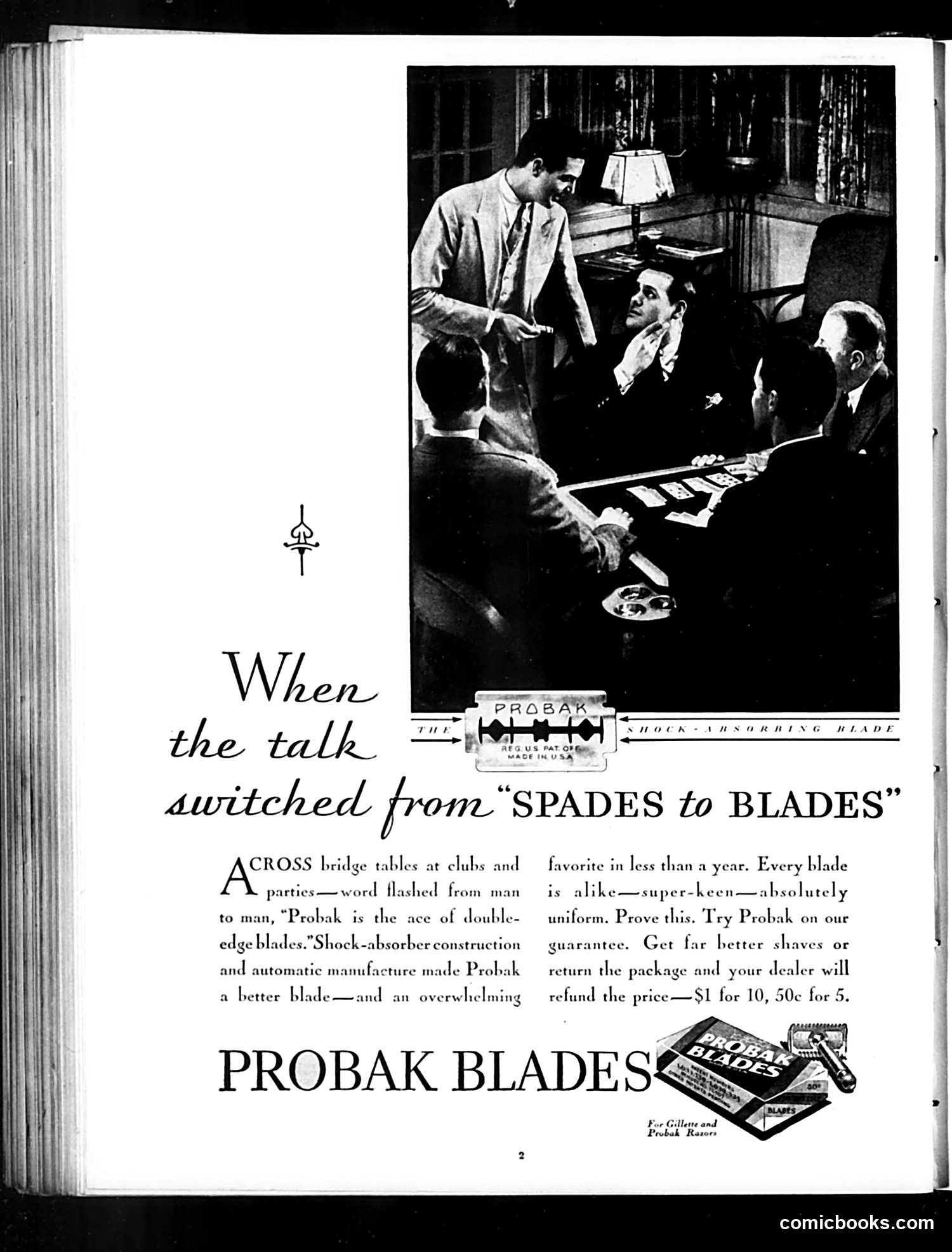
Analysis This is primarily advertising, not satire. The page promotes Probak razor blades, using a social scene to advertise the product. The image shows men in formal attire at what appears to be a bridge game or social gathering. The headline "When the talk switched from 'SPADES to BLADES'" is a pun—playing on the card game "spades" to introduce discussion of razor blades. The advertisement claims Probak blades became "the favorite in less than a year" and emphasizes their "shock-absorber construction" and uniform quality. It includes a money-back guarantee: "$1 for 10, 50¢ for 5." There is no political satire here—this is straightforward commercial copy using a relatable social scenario to market a consumer product to Judge magazine's male readership.
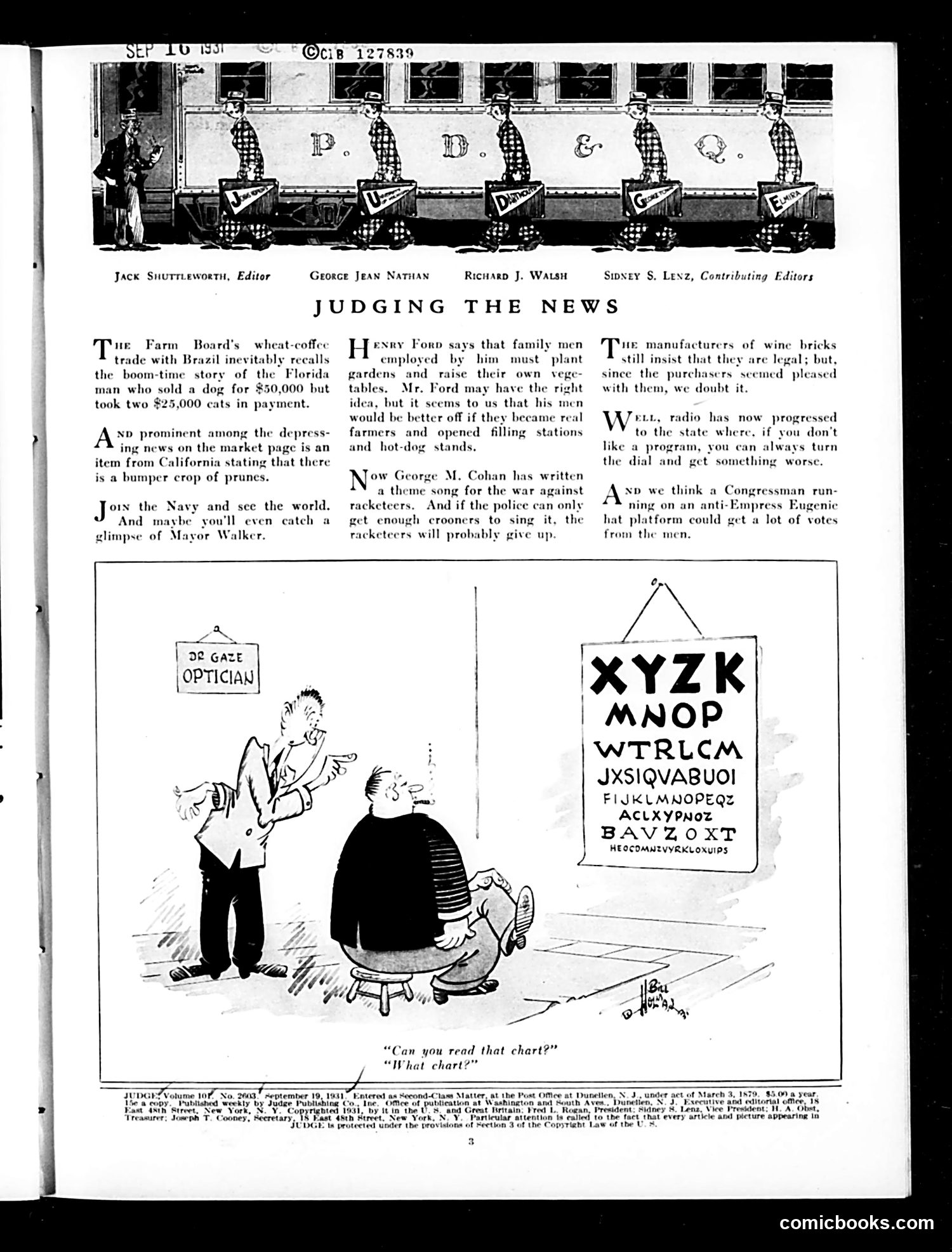
"Can You Read That Chart?" This cartoon satirizes vision problems and optometry. An optician displays an eye chart to a patient who cannot read it, with the man gesturing in frustration. The joke relies on irony: the eye chart itself is rendered in deliberately illegible, jumbled letters (XYZK MNOP, etc.), making it impossible for anyone—patient or reader—to actually read. The cartoon appears to mock either incompetent opticians or the absurdity of vision testing itself. The sign "DE GAZE OPTICIAN" may be a play on words related to looking/gazing. This was likely humorous to 1931 readers familiar with visiting eye doctors, poking fun at a common, slightly uncomfortable medical experience.
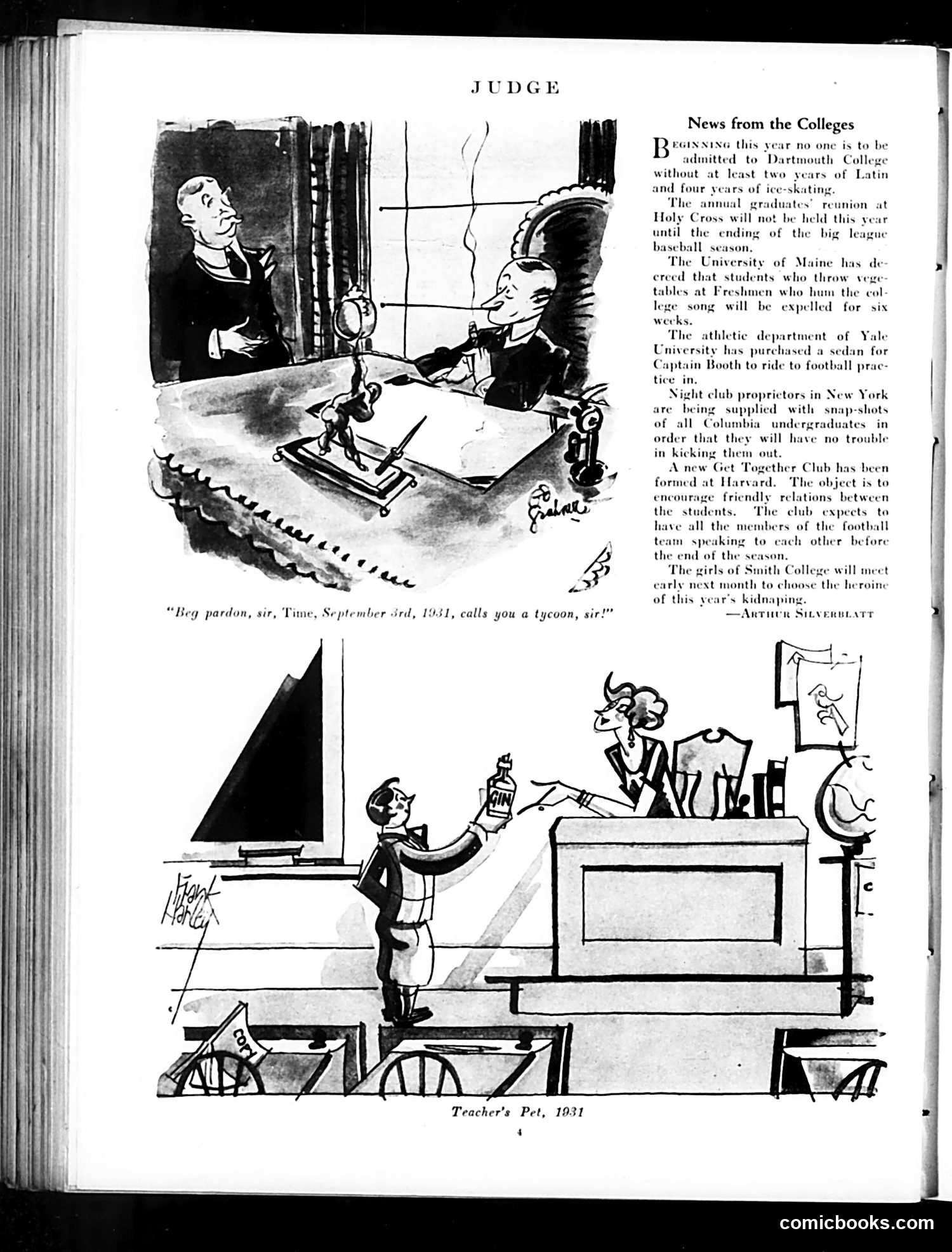
Cartoon Analysis: Judge Magazine, 1931 The top cartoon satirizes college admissions standards. A stern authority figure (likely a college dean) calls a young man a "tycoon," mocking him for apparently gaining admission through wealth or connections rather than merit. The caption references "Time, September 3rd, 1934," suggesting a contemporary scandal about preferential college admissions. The bottom cartoon depicts a teacher's pet scenario in 1931—a student offers a bottle (likely alcohol, given Prohibition-era context) to an authority figure at a desk, while other students watch from below. This satirizes corruption and favoritism in education, showing how students attempt to gain advantage through bribery rather than academic performance. Both cartoons critique institutional integrity during the Depression era.
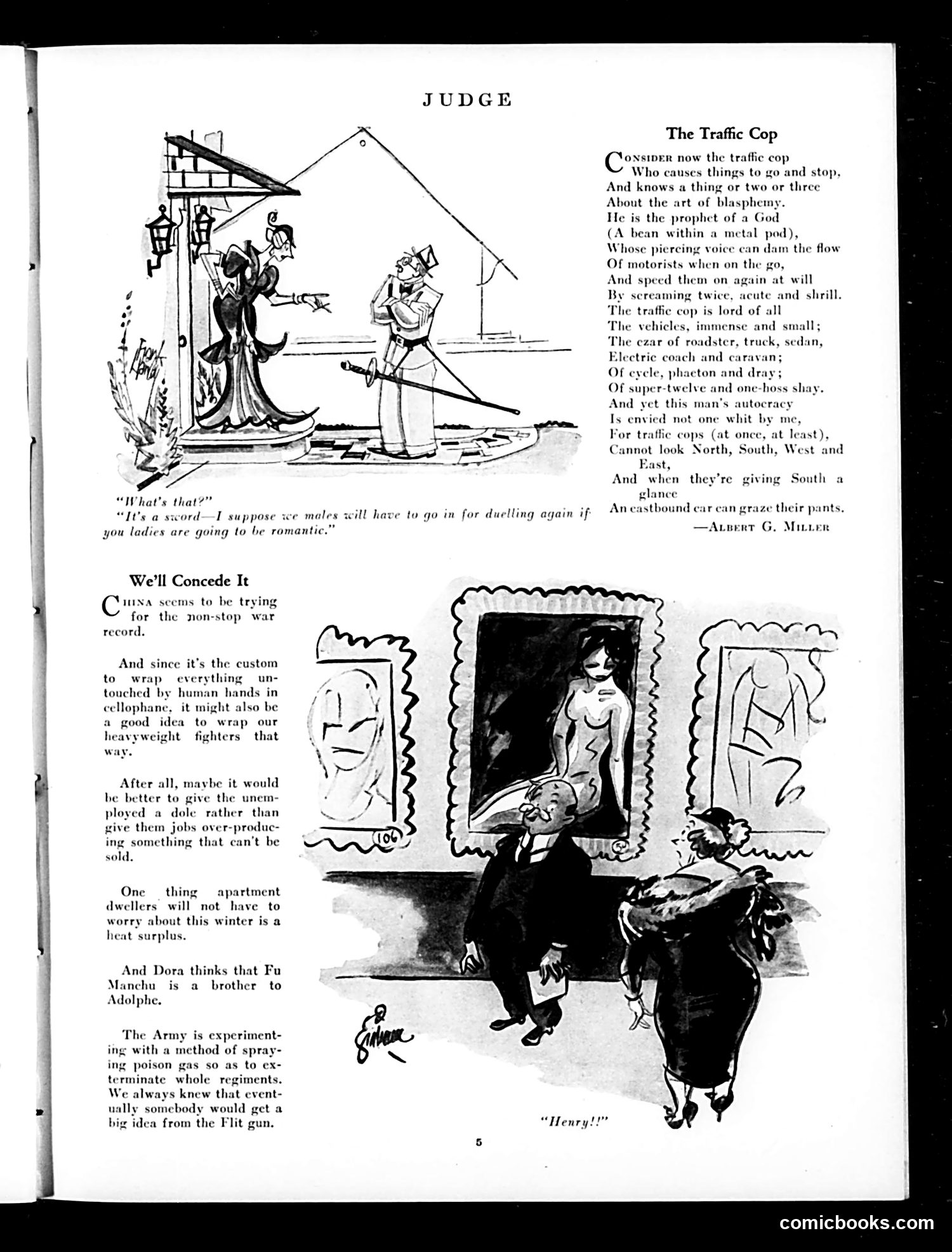
"The Traffic Cop" and "We'll Concede It" "The Traffic Cop" satirizes the absolute authority of traffic police, who control vehicle flow with imperious hand gestures. The poem mocks their petty autocracy—they command cars in all directions yet "cannot look North, South, West and East" simultaneously. The joke suggests their power is absurdly limited despite their imperious demeanor. The cartoon caption jokes about "dueling" traffic violations, playing on their authority to issue citations. "We'll Concede It" comments on China's seemingly endless warfare and suggests wrapping fighters in cellophane like boxing matches to prevent casualties. The accompanying cartoon shows a man viewing nude paintings, possibly satirizing art appreciation or moral standards. Both pieces employ absurdist humor typical of Judge's satirical style, mocking contemporary institutions and social conventions.
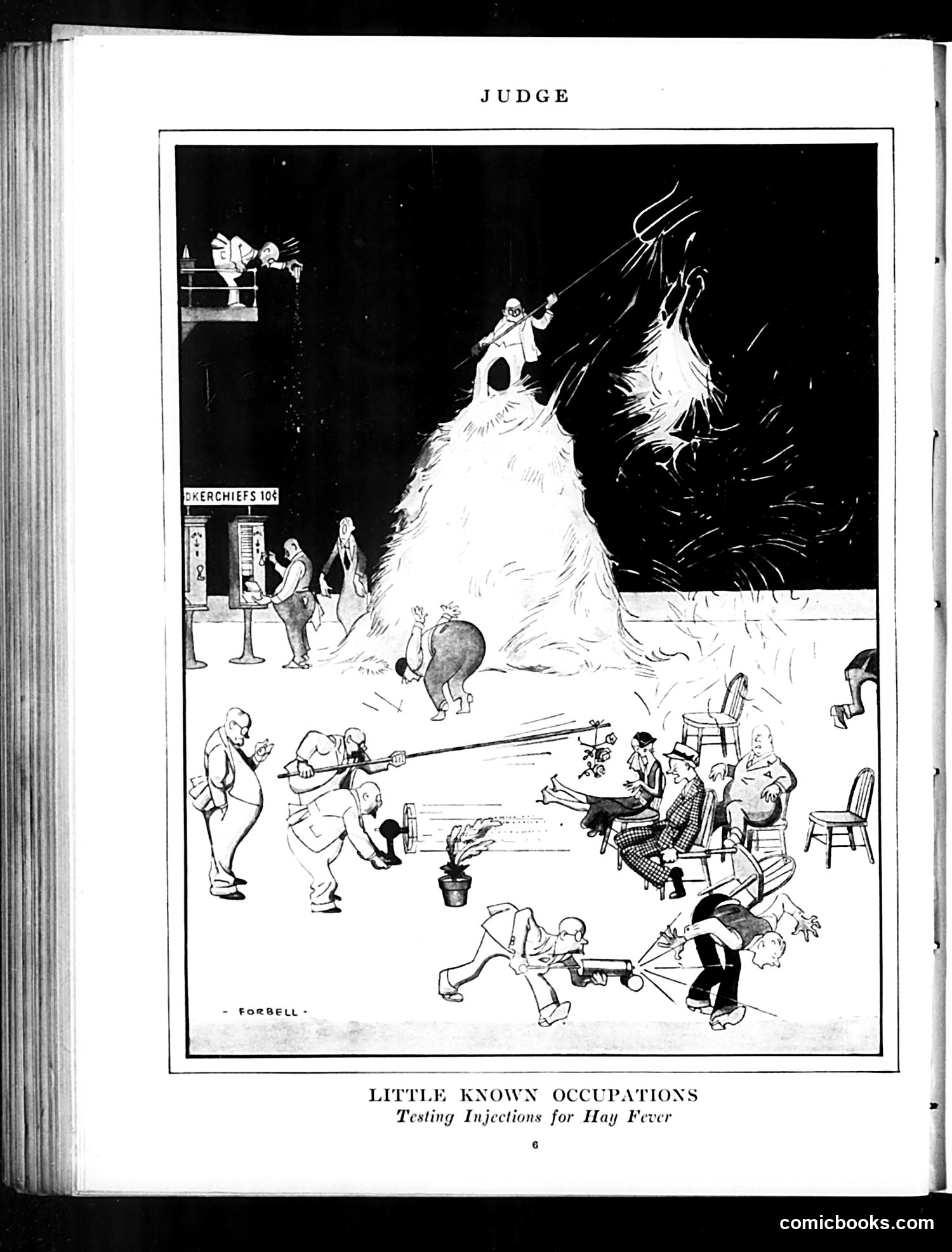
"Little Known Occupations: Testing Injections for Hay Fever" This Judge cartoon satirizes the emerging medical practice of allergy treatment through injections. The scene depicts a chaotic "testing" scenario where various people are being injected with hay fever treatments—some willingly, others coerced or tricked into participation. The humor derives from the absurdity and danger of unregulated medical experimentation. The giant ghost-like figure looming overhead (likely representing hay fever itself or its effects) emphasizes the desperation driving these treatments. The "Little Known Occupations" framing suggests this is an undignified, questionable profession—essentially professional test subjects or unwilling guinea pigs for dubious medical procedures. This reflects early-20th-century skepticism toward experimental medicine and the wild west of unregulated pharmaceutical testing before modern safety standards existed.
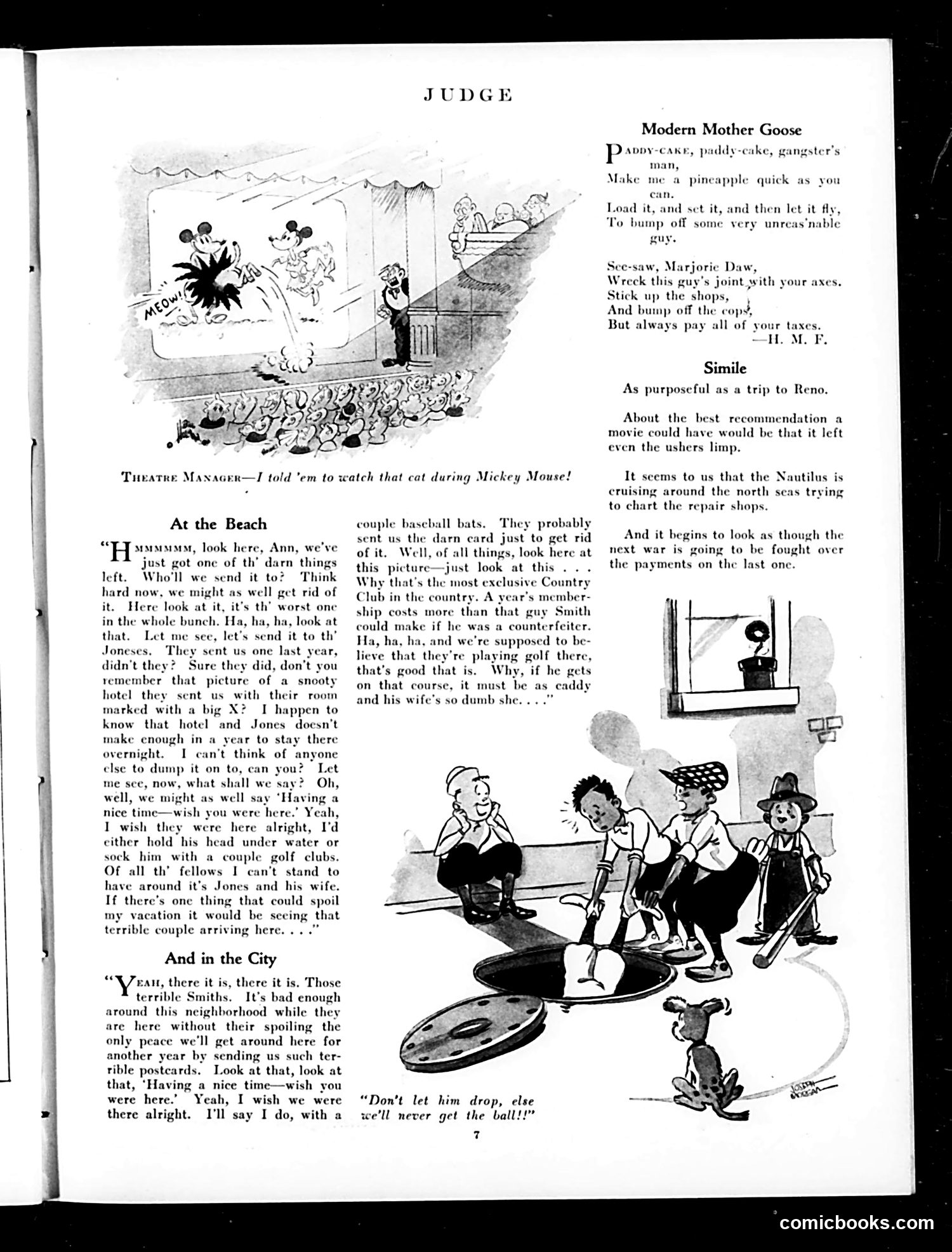
Analysis: Judge Magazine Page This page contains three satirical pieces targeting 1920s American social behavior and culture. "At the Beach" and "And in the City" mock the hypocrisy of vacation postcards. Neighbors exchange insulting, boastful postcards—claiming to visit exclusive country clubs and resorts they likely cannot afford—while privately despising each other. The satire targets both the pretense of aspirational leisure and the passive-aggressive social ritual of vacation greetings. References to "the Joneses" invoke the era's familiar phrase about keeping up appearances. "Modern Mother Goose" parodies nursery rhymes with 1920s criminal slang ("bump off," "stick up the shops"). It's dark humor mocking Prohibition-era gangsterism and bootlegging violence, presenting organized crime as casually as children's verse. The theater cartoon references Mickey Mouse, indicating this is from the late 1920s when the character debuted. The overall tone reflects Judge's satirical approach: ridiculing middle-class pretension, organized crime, and social conformity through exaggerated dialogue and absurdist humor.
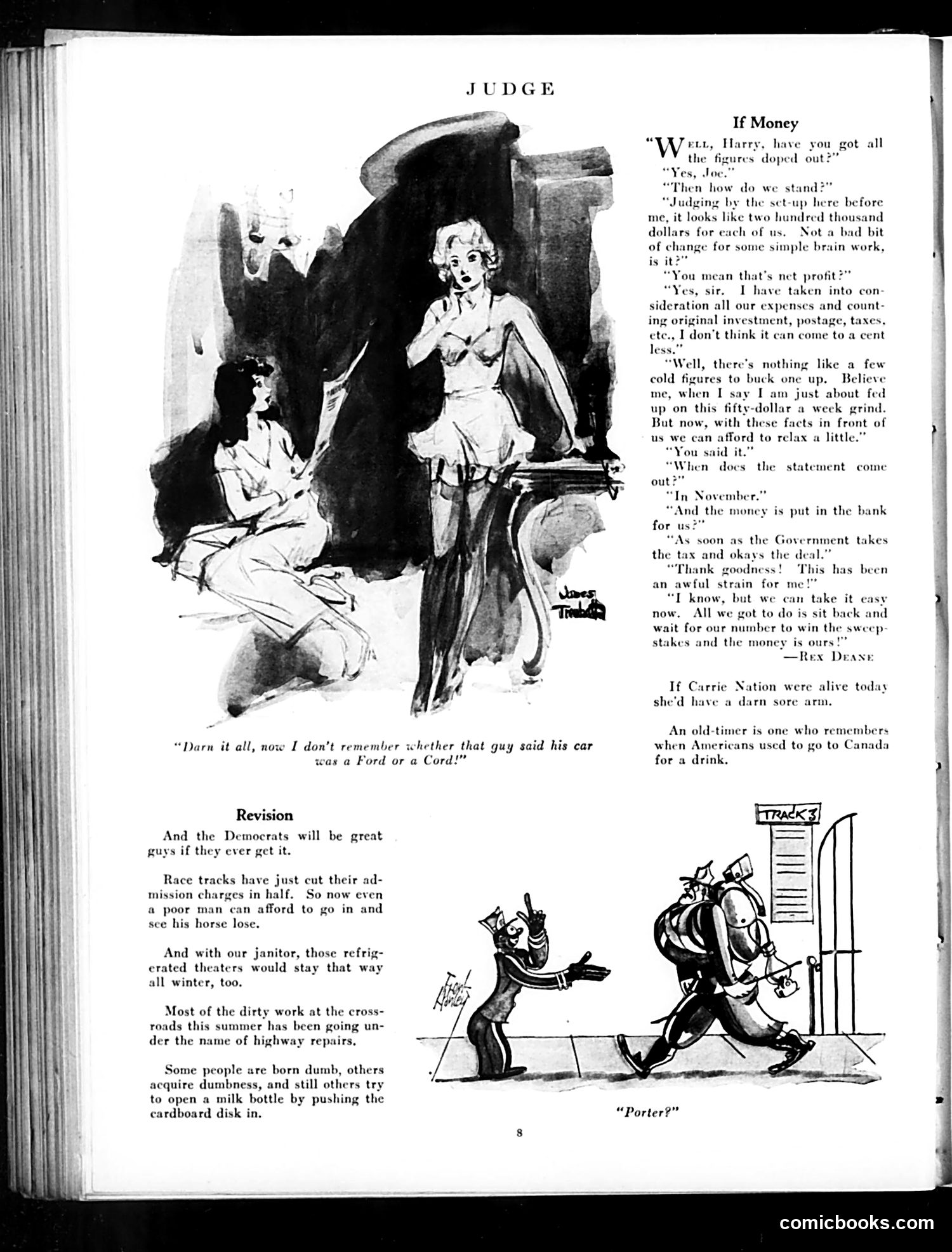
Analysis of Judge Magazine Page This page contains satirical commentary on 1920s American life: Main Cartoon ("Judge"): Two men discuss splitting $200,000 in profits from what appears to be an illicit scheme—likely bootlegging or stock manipulation. They plan to hide money in banks and wait for government approval, suggesting either prohibition-era liquor dealing or financial fraud. The satire mocks their casual criminality and naive belief they'll avoid legal consequences. Secondary Jokes ("Revision"): Brief satirical quips targeting: - Democrats' political incompetence - Economic hardship (poor men gambling away money at race tracks) - Government road work as disguised public spending - General human stupidity Carrie Nation Reference: References the famous temperance crusader (1846-1911), suggesting increased drinking in the modern era would exhaust even her zealous activism. The overall tone reflects post-Prohibition cynicism about widespread lawbreaking and corruption in 1920s America, presented as darkly comedic observations.
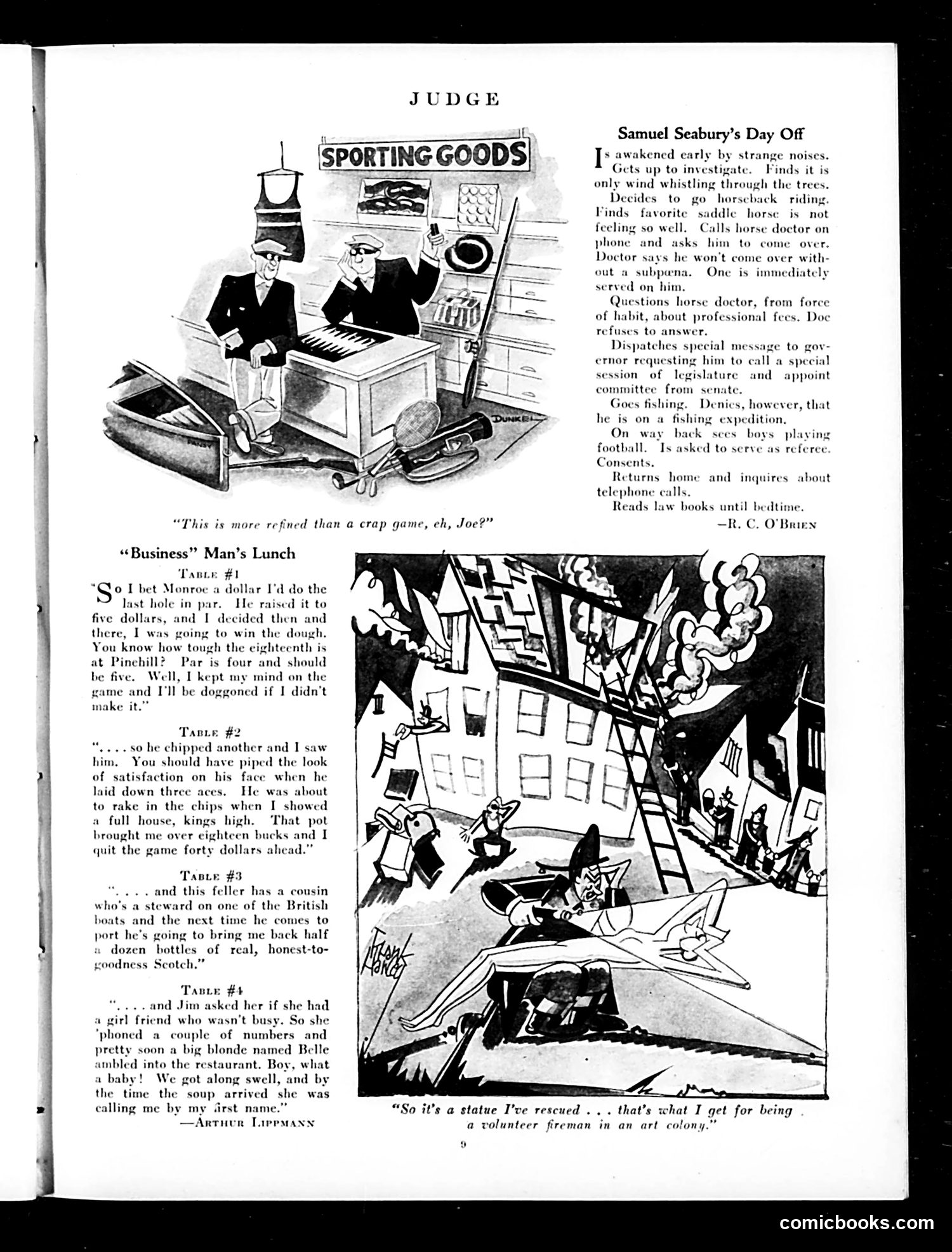
Analysis for Modern Readers "Samuel Seabury's Day Off" satirizes Judge Samuel Seabury, a prominent New York prosecutor famous for investigating corruption in the 1930s. The joke shows him obsessively applying his prosecutorial habits to everyday life: he subpoenas a horse doctor about fees, demands a special legislative session over minor issues, and insists his fishing trip isn't actually a "fishing expedition"—playing on his famous investigations where officials claimed innocence while clearly guilty. "Business Man's Lunch" presents four anecdotes of male boasting at a restaurant, where businessmen recount gambling wins, romantic conquests, and smuggling schemes. The satire mocks masculine bravado and the era's casual attitude toward illegal activities like bootlegging (alcohol smuggling during Prohibition). The sporting goods cartoon caption—"more refined than a crap game"—suggests the men's stories, while framed as respectable business talk, are essentially as frivolous and chance-based as gambling.
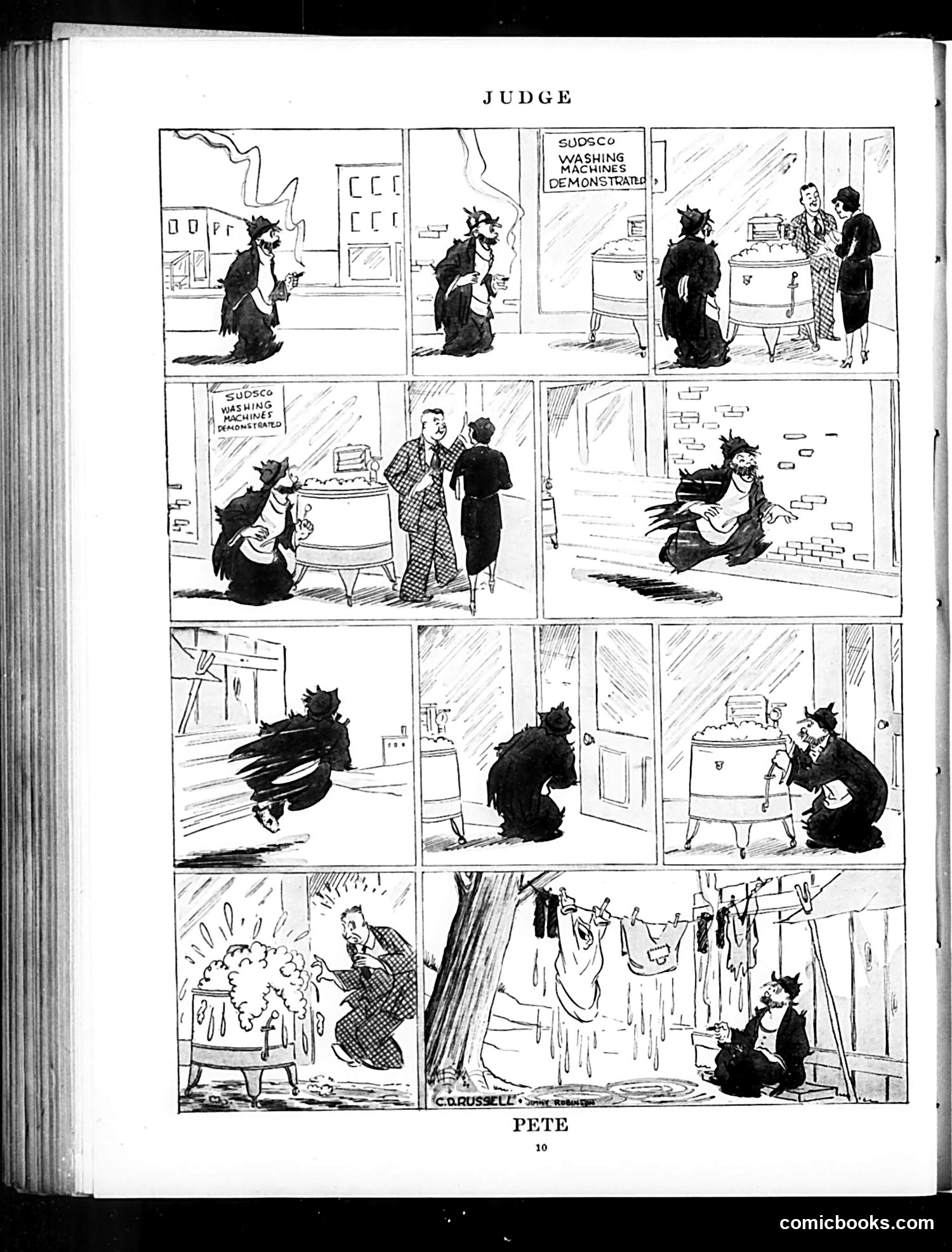
"Judge Pete" Comic Strip Analysis This is a multi-panel comic strip titled "Judge Pete" (credited to C. Rosselli) depicting a domestic comedy about a Sudsco washing machine demonstration. The narrative follows a woman's escalating frustration: she attends a product demonstration, becomes intrigued by the appliance, purchases it, then struggles with its operation and the resulting chaos—water overflow, flooding, and escaped laundry. The satire targets early 20th-century "labor-saving" appliance marketing that promised to simplify housework. The joke is that this new technology actually creates more work and domestic disasters than traditional methods. It mocks both the overpromising of modern conveniences and women's supposed incompetence with mechanical devices—a common trope in period humor.
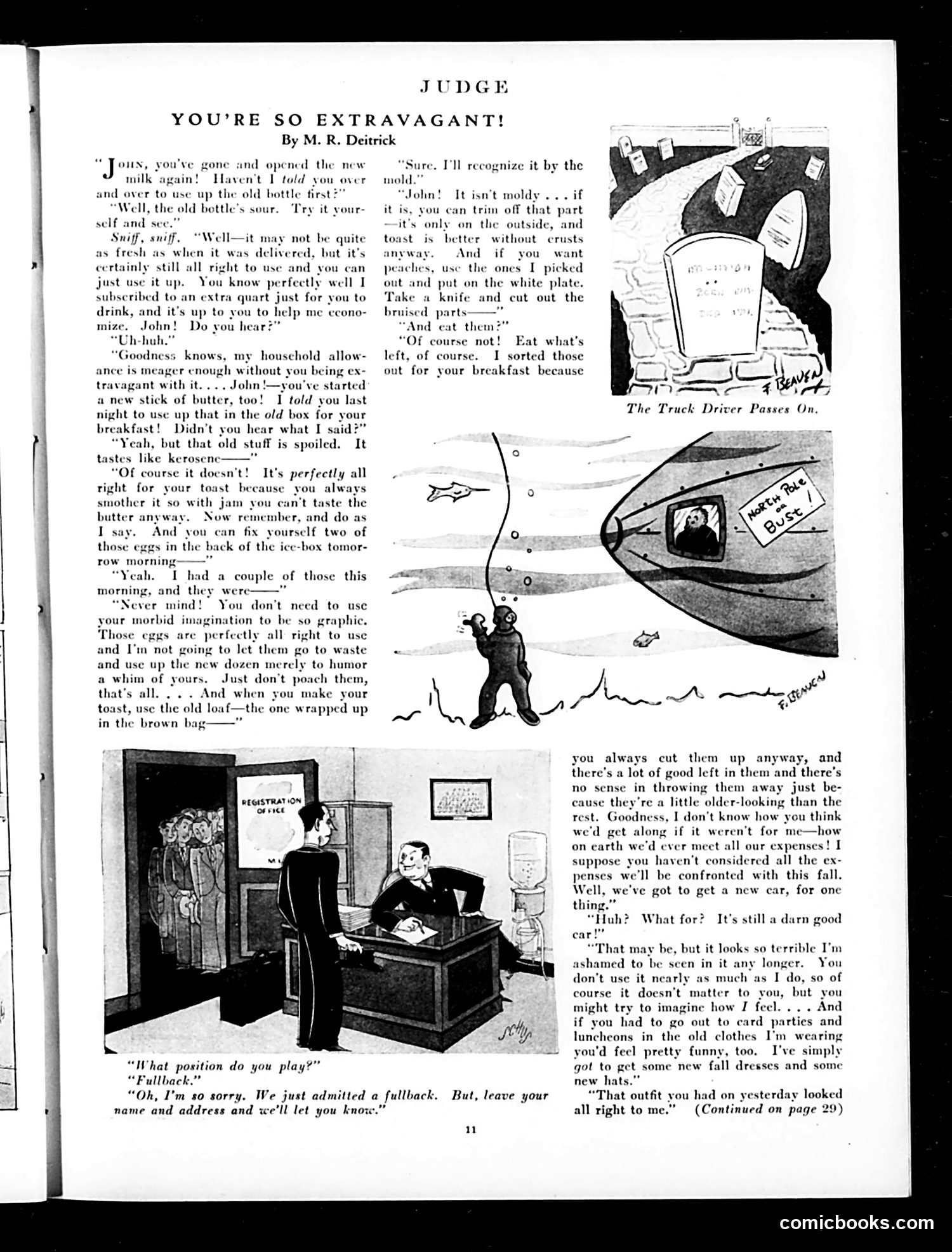
"You're So Extravagant!" — A Satire on Wartime (or Economic) Rationing This single-panel comic by M.R. Deitrick satirizes a wife's aggressive cost-cutting measures while her husband is portrayed as wasteful. The wife obsessively reuses spoiled food (sour milk, moldy bread, stale eggs), patches worn items, and stretches her household budget—yet simultaneously demands a new car and fall wardrobe, claiming *he* is the extravagant one. The joke targets female hypocrisy during economically tight times (likely WWI-era rationing or Depression-era scarcity). The wife practices penny-pinching domesticity with spoiled groceries while justifying her own luxury purchases as necessities. Her complaint that the old car "looks so terrible" contradicts her claims of economic hardship. The satire mocks both wartime resource-consciousness and the perceived disconnect between women's professed frugality and actual spending habits.
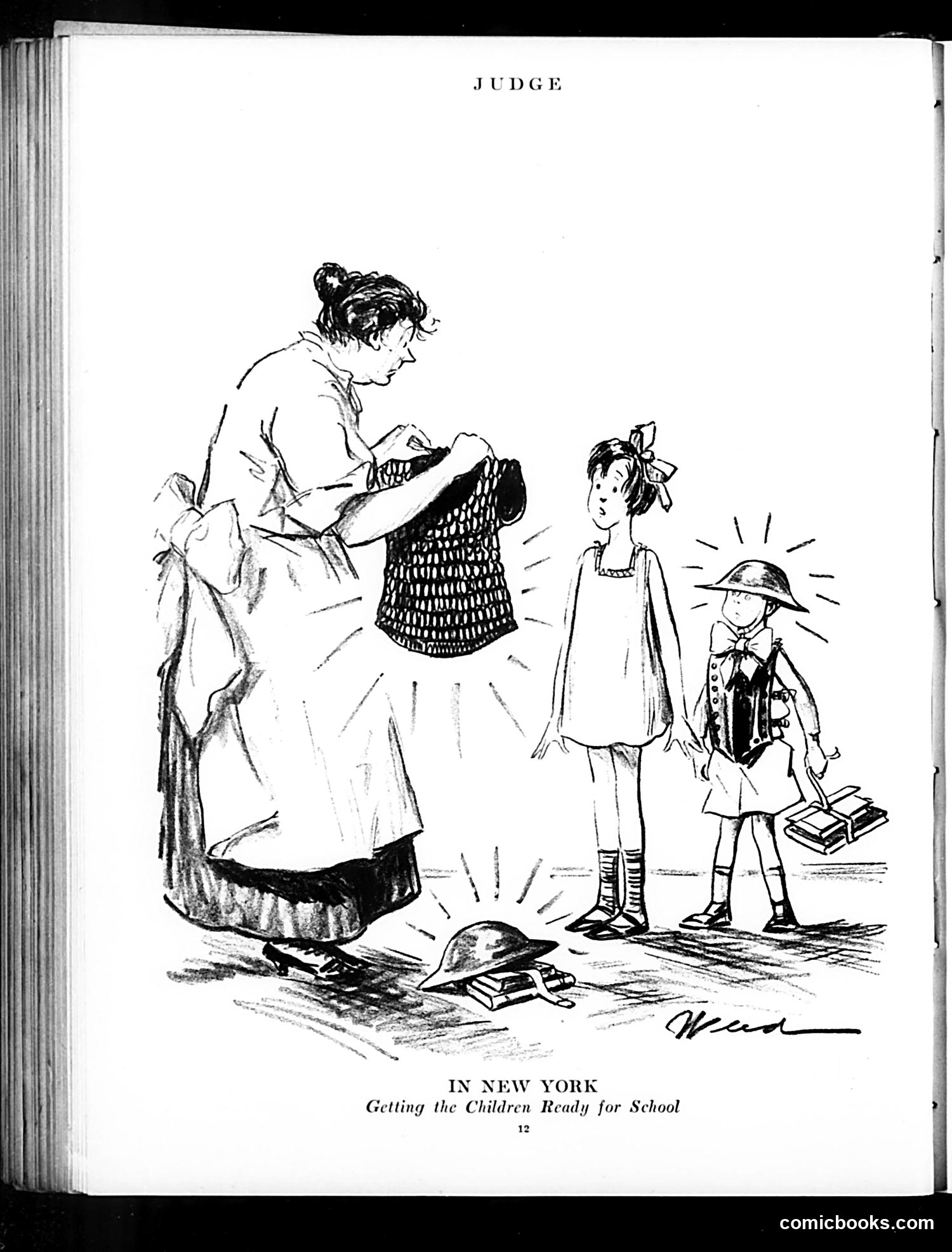
"Judge in New York: Getting the Children Ready for School" This cartoon satirizes the back-to-school preparation process in New York. An adult woman (likely a mother or caretaker) examines children's clothing—particularly a dark, heavily-patched garment she holds up critically. Two children stand before her with school supplies (books visible), appearing somewhat anxious or uncertain about her judgment. The satire appears to target the economic realities of urban families preparing children for school, mocking either: the shabby state of children's clothing due to poverty, the excessive scrutiny parents apply to garments, or the general chaos of school preparation. The "judge" in the title suggests the adult is making harsh assessments of the children's readiness or appearance for school. The cartoon reflects early 20th-century urban American social commentary about working-class family life.
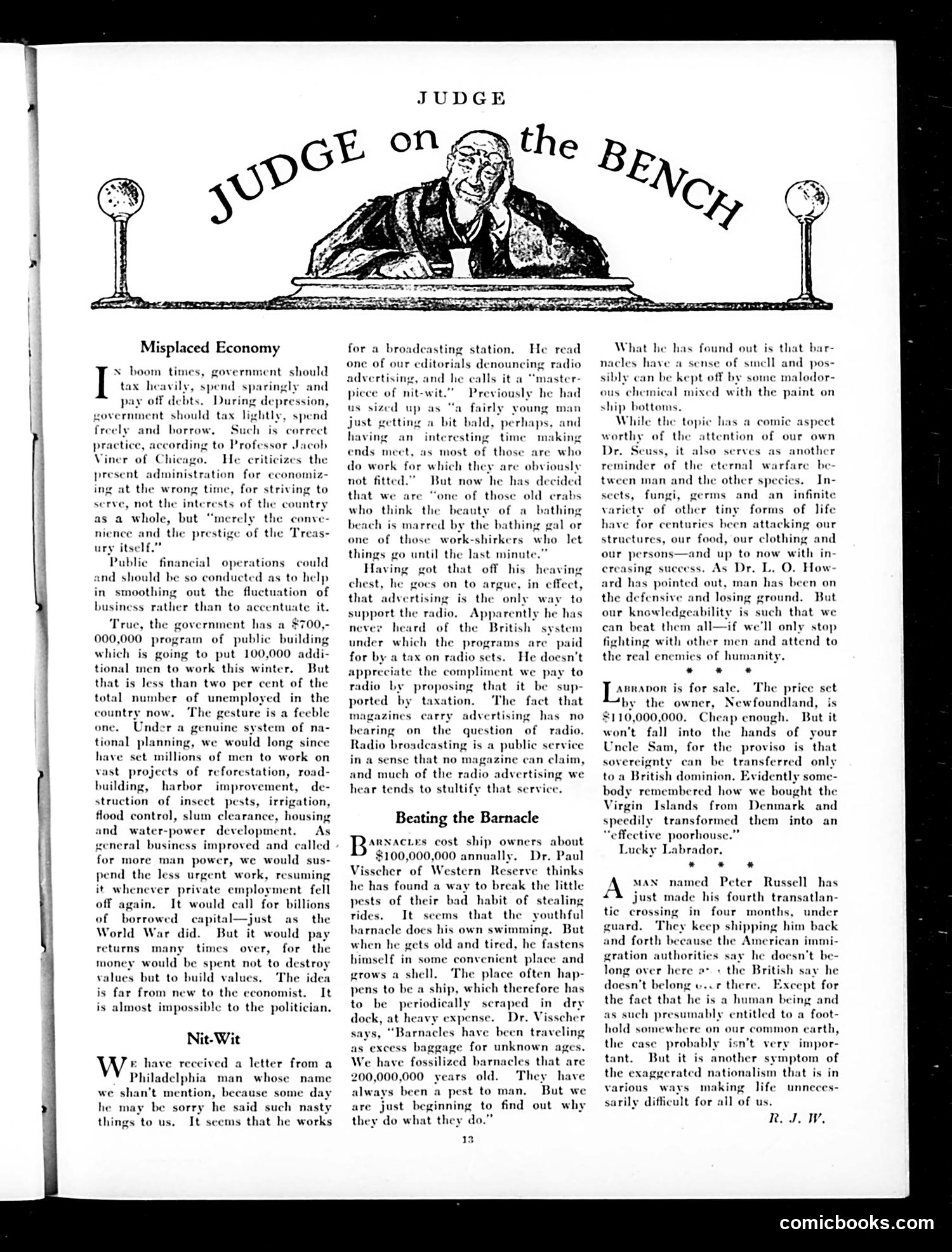
Judge Magazine Page Analysis This page contains three separate opinion pieces rather than cartoon illustrations: "Misplaced Economy" critiques government fiscal policy during the Depression, arguing that while a $700-million public works program exists, it's inadequate—affecting less than 2% of the unemployed. The author advocates for massive national planning projects (reforestation, roads, flood control) funded by borrowing, similar to World War financing. "Nit-Wit" satirizes a radio broadcaster who denounced the magazine's criticism of radio advertising as "nit-wit," then contradictorily praised the magazine while insulting its staff. Judge uses this to argue that radio broadcasting, as a public service, shouldn't rely on advertising (unlike magazines), and proposes taxation-based funding—citing the British system. "Beating the Barnacle" reports on Dr. Paul Visscher's research into preventing barnacles from attaching to ships, costing owners $100 million annually. The piece humorously notes barnacles' ancient history (200-million-year-old fossils exist) while suggesting Visscher's discovery about their sense of smell may explain their behavior. The page is primarily text-based commentary rather than illustrated satire.
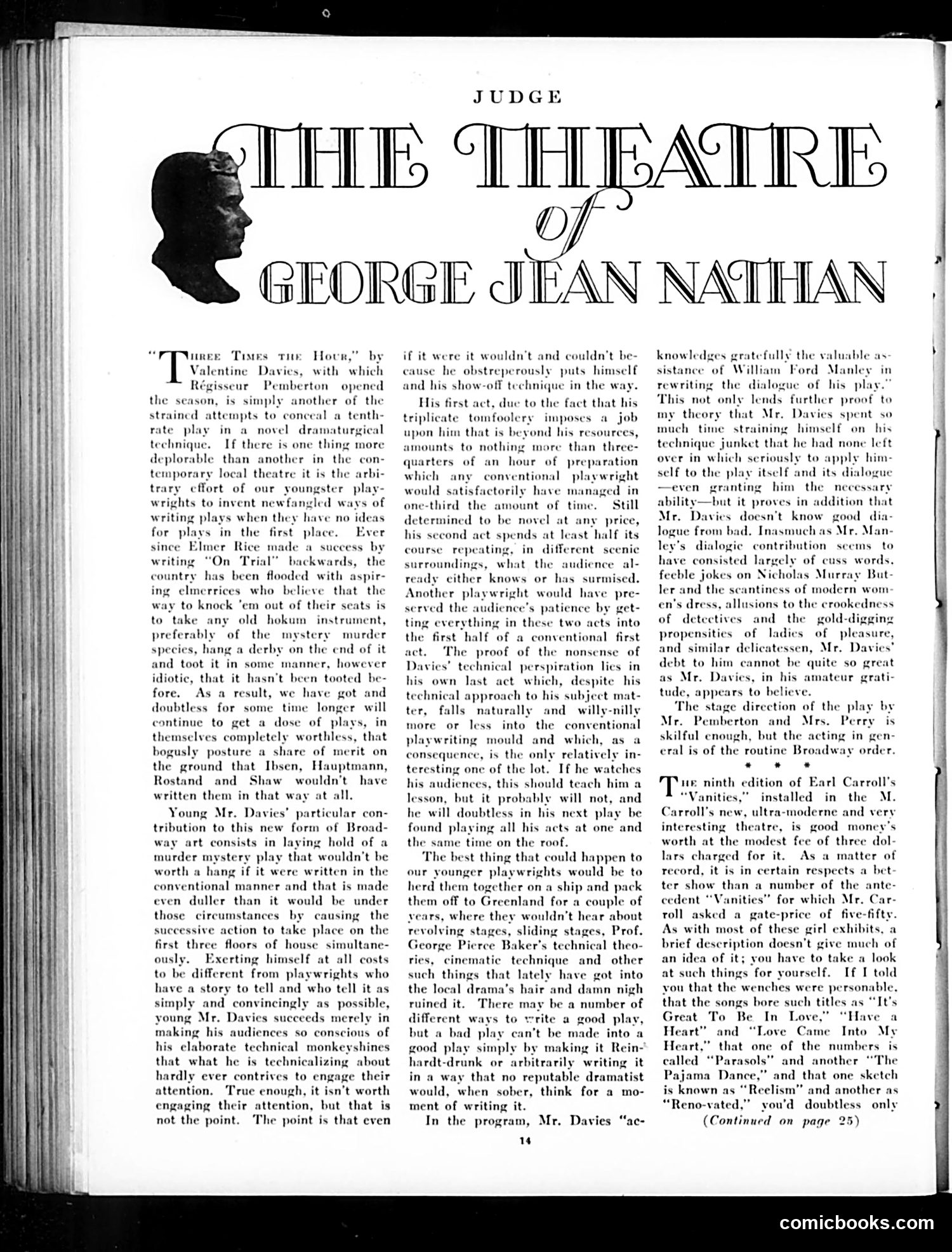
"The Theatre of George Jean Nathan" - Judge Magazine Review This page is a theater review by prominent critic George Jean Nathan, critiquing Valentine Davies' play "Three Times the Hour," directed by Régisseur Pemberton. The Satire: Nathan mocks the contemporary Broadway trend of young playwrights using gimmicky technical innovations to disguise mediocre stories. He references Elmer Rice's success with "On Trial" (a play told in reverse chronological order), which spawned imitators attempting increasingly absurd theatrical tricks. Davies' Specific Crime: His play unfolds simultaneously on three building floors—a needless complication that wastes time and obscures rather than enhances the narrative. Nathan argues the second act merely repeats information already established, padding runtime artificially. The Point: Technical novelty cannot compensate for weak material. Nathan suggests exiling young playwrights to Greenland to escape fashionable theatrical theories and learn to tell stories simply and effectively. Only Davies' final act, abandoned for conventional structure, succeeds—proving his experimental approach actively harms the work.
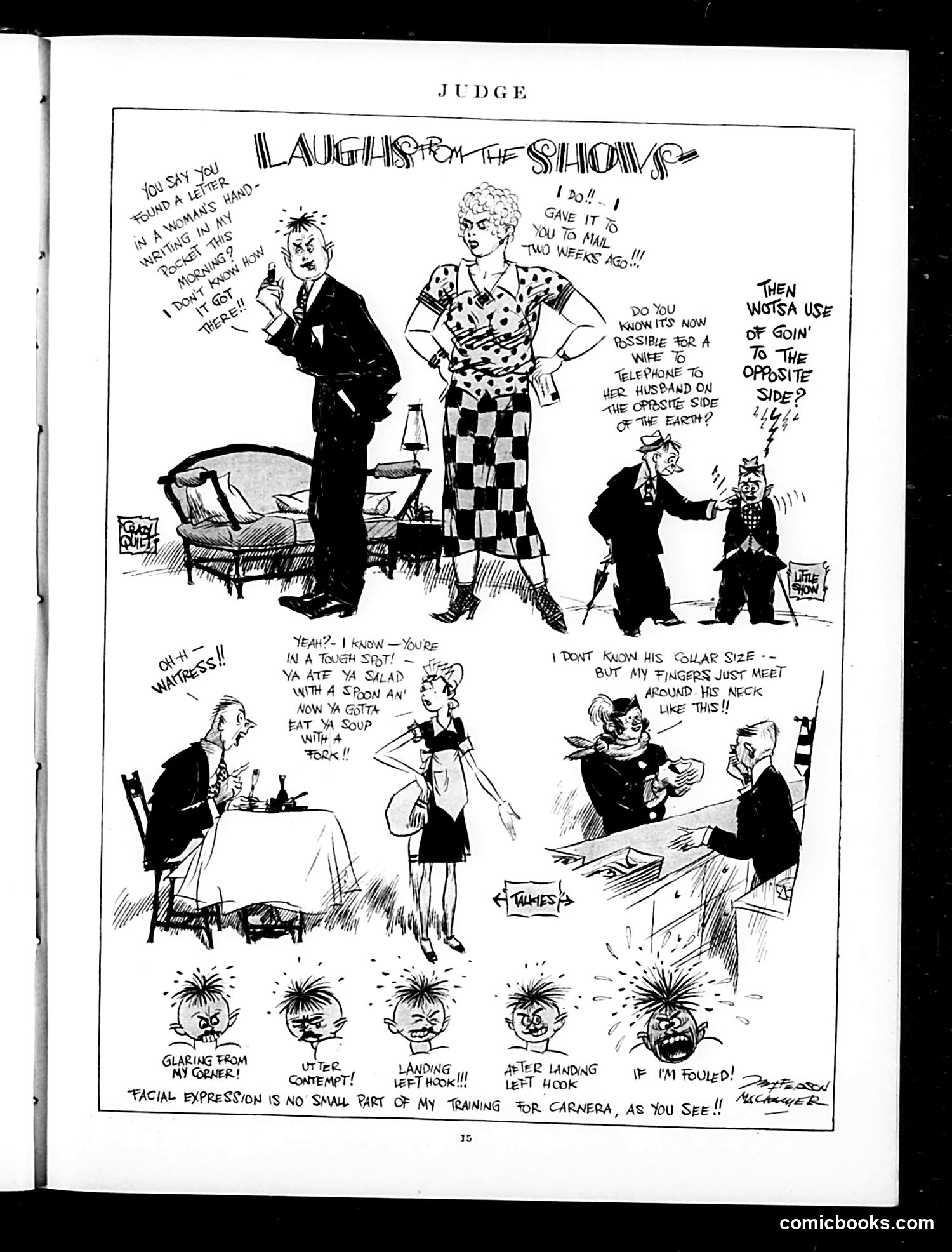
"Laughs from the Shows" - Judge Magazine Cartoon This is a multi-panel satirical comic about acting training for film, specifically referencing an appearance or role involving someone named Carnera (likely boxer Primo Carnera, a massive Italian heavyweight popular in 1930s American media). The humor centers on an actor being trained in exaggerated facial expressions and physical comedy for the camera. Various panels show: - A husband complaining about his wife's theatrical behavior at home - Dining scene mishaps caused by overdone expressions - A physical altercation demonstration where someone's "fingers just meet around his neck"—satirizing both the actor's small stature and Carnera's massive build - Bottom row: Five progressively extreme facial expressions labeled as training steps ("Glaring from my corner," "Utter contempt," "Landing left hook," "After landing left hook," "If I'm fouled") The satire mocks method acting and how stage/film performers bring their exaggerated techniques into ordinary domestic life, making them insufferable spouses and dinner companions.
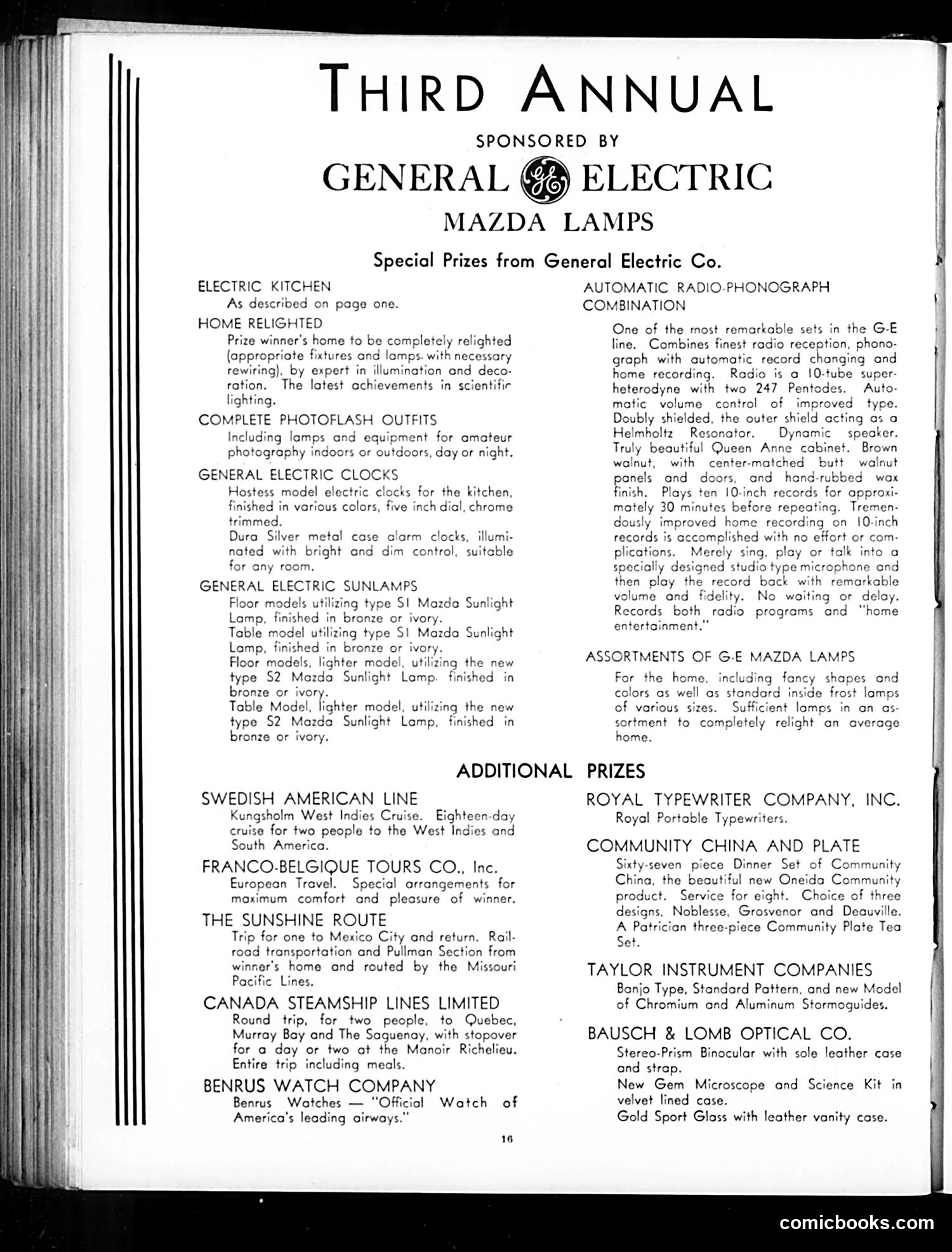
Analysis This page is primarily advertising and contest prize listings, not editorial content with cartoons or satire. It documents the "Third Annual" contest sponsored by General Electric's Mazda Lamps division. The page lists special prizes from GE (electric kitchen, relighted home, clocks, sunlamps, radio-phonograph) and additional prizes from other companies—cruise lines, travel agencies, typewriters, china, optical equipment, and watches. The content reflects 1920s-30s consumer culture and technological optimism: electric lighting as a luxury home improvement, radio-phonographs as cutting-edge entertainment, and exotic travel as aspirational prizes. The emphasis on modern electrical conveniences and leisure travel suggests this targets middle-to-upper-class readers. There are no political cartoons or satirical commentary visible on this page—it is straightforward prize advertising, likely promoting a reader contest or drawing.
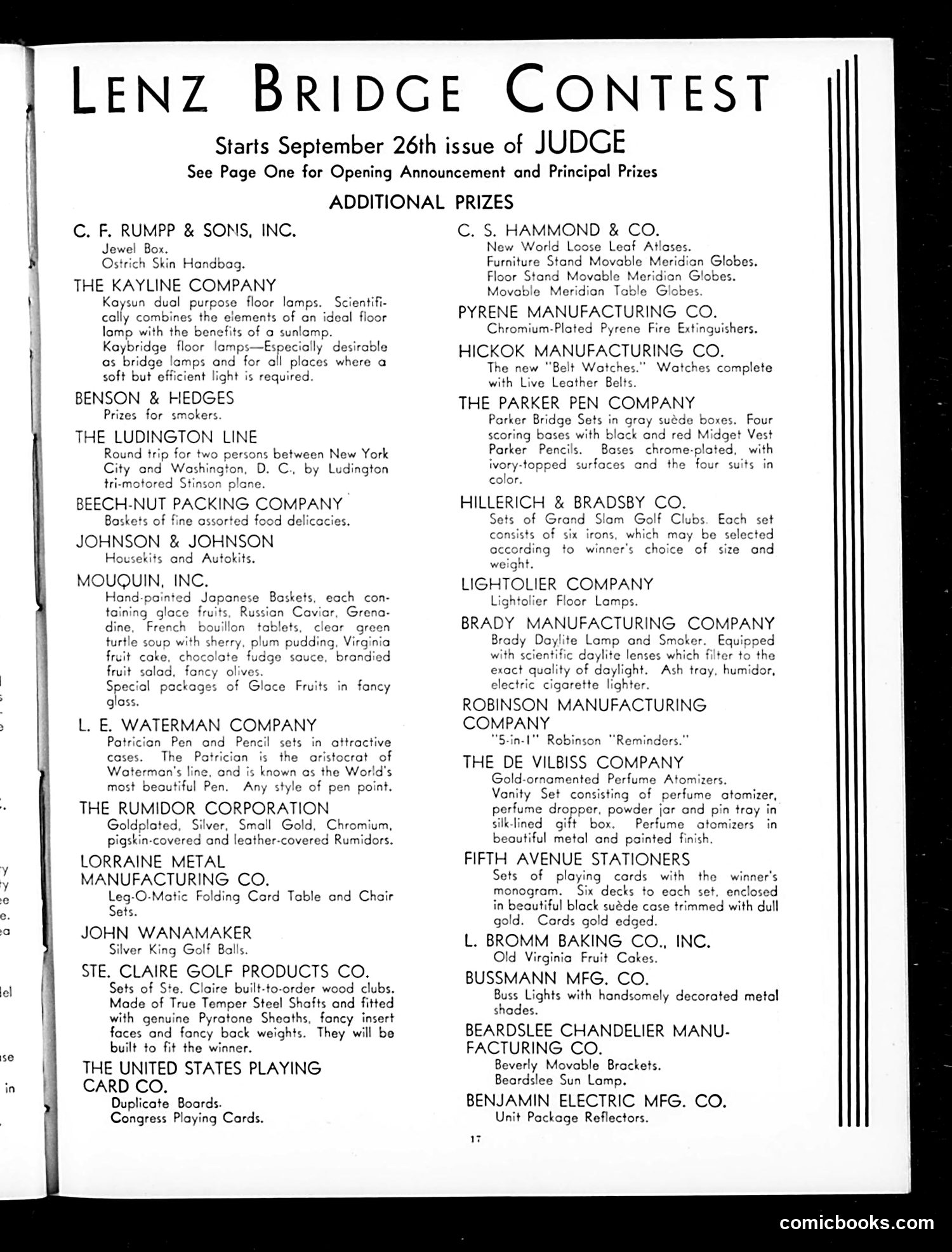
Lenz Bridge Contest Advertisement Page This is primarily an advertising page, not a cartoon or satirical content page. It announces Judge magazine's "Lenz Bridge Contest," launching September 26th, and lists dozens of corporate prize donations. The page reflects 1920s-30s consumer culture: luxury goods (ostrich handbags, Japanese baskets, caviar), emerging technologies (daylite lamps, belt watches, floor lamps), and leisure items (golf clubs, playing cards, fountain pens). Many prizes target bridge players specifically—appropriate since bridge was a wildly popular parlor game among middle and upper-class Americans during this era. The prominence of brand names and manufacturers suggests Judge's readership was affluent and aspirational. The contest itself—offering prizes from major corporations—served as both reader engagement and advertising for Judge's commercial sponsors. No political satire or caricature appears on this page.
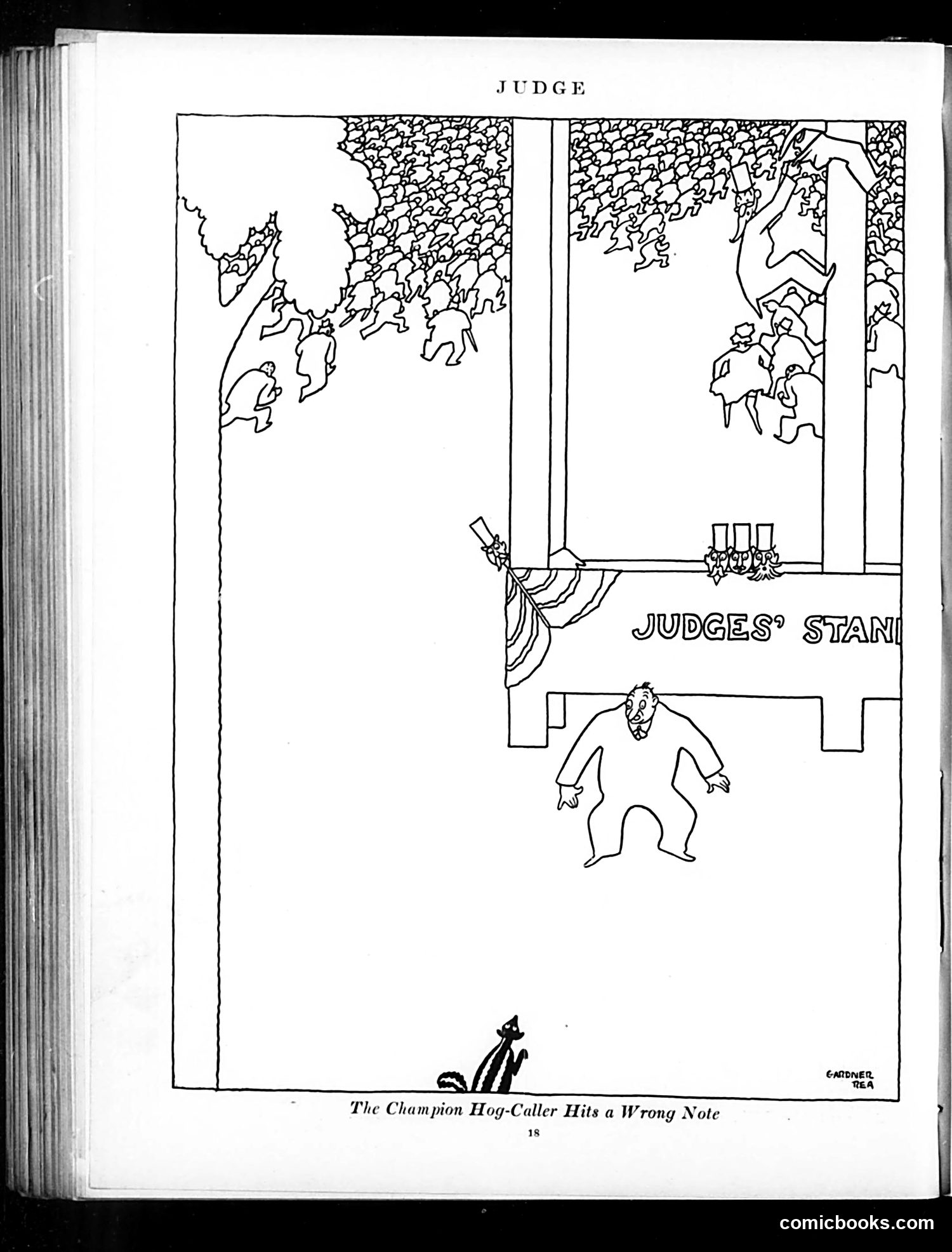
"The Champion Hog-Caller Hits a Wrong Note" This is a satirical cartoon from Judge magazine showing a courtroom scene labeled "Judges' Stand." A rotund man in the judge's position appears flustered or distressed, while above him crowds of people are visible—some appearing to flee or react with alarm. The caption's reference to a "hog-caller" hitting a "wrong note" is a play on words. The cartoon appears to mock a judge who has made an unpopular or improper legal ruling, comparing his authority to that of a hog-caller (someone who summons pigs). The "wrong note" suggests his decision provoked unexpected negative reaction from the public or courtroom observers visible above. The satire critiques judicial authority and public response to controversial court decisions, using barnyard imagery to deride the judge's performance.
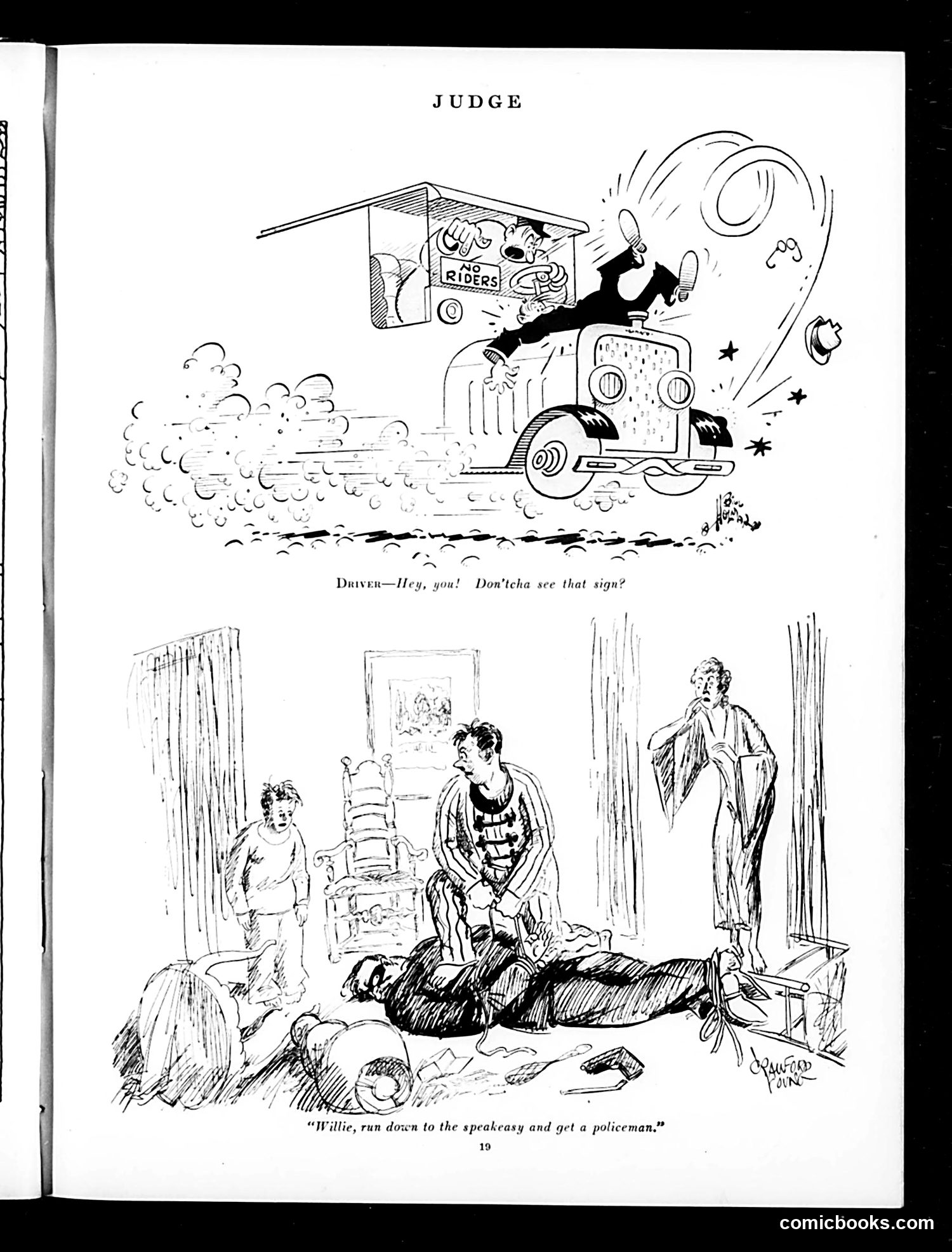
Judge Magazine Page Analysis This page contains two cartoons titled "JUDGE" satirizing reckless driving and law enforcement. Top cartoon: A speeding car driven by a judge (identifiable by his formal attire) flies past a "Speed Riders" sign while a passenger protests. The satire targets judicial hypocrisy—a judge who enforces traffic laws while violating them himself. Bottom cartoon: Shows the aftermath: a man lies injured on a floor while concerned onlookers gather. The caption reads "Willie, run down to the speakeasy and get a policeman," satirizing Prohibition-era corruption. The joke suggests that during Prohibition, finding a policeman required going to an illegal speakeasy, implying widespread police involvement in bootlegging operations and moral compromise. Both cartoons critique authority figures—judges and police—as hypocritical enforcers of laws they themselves break.
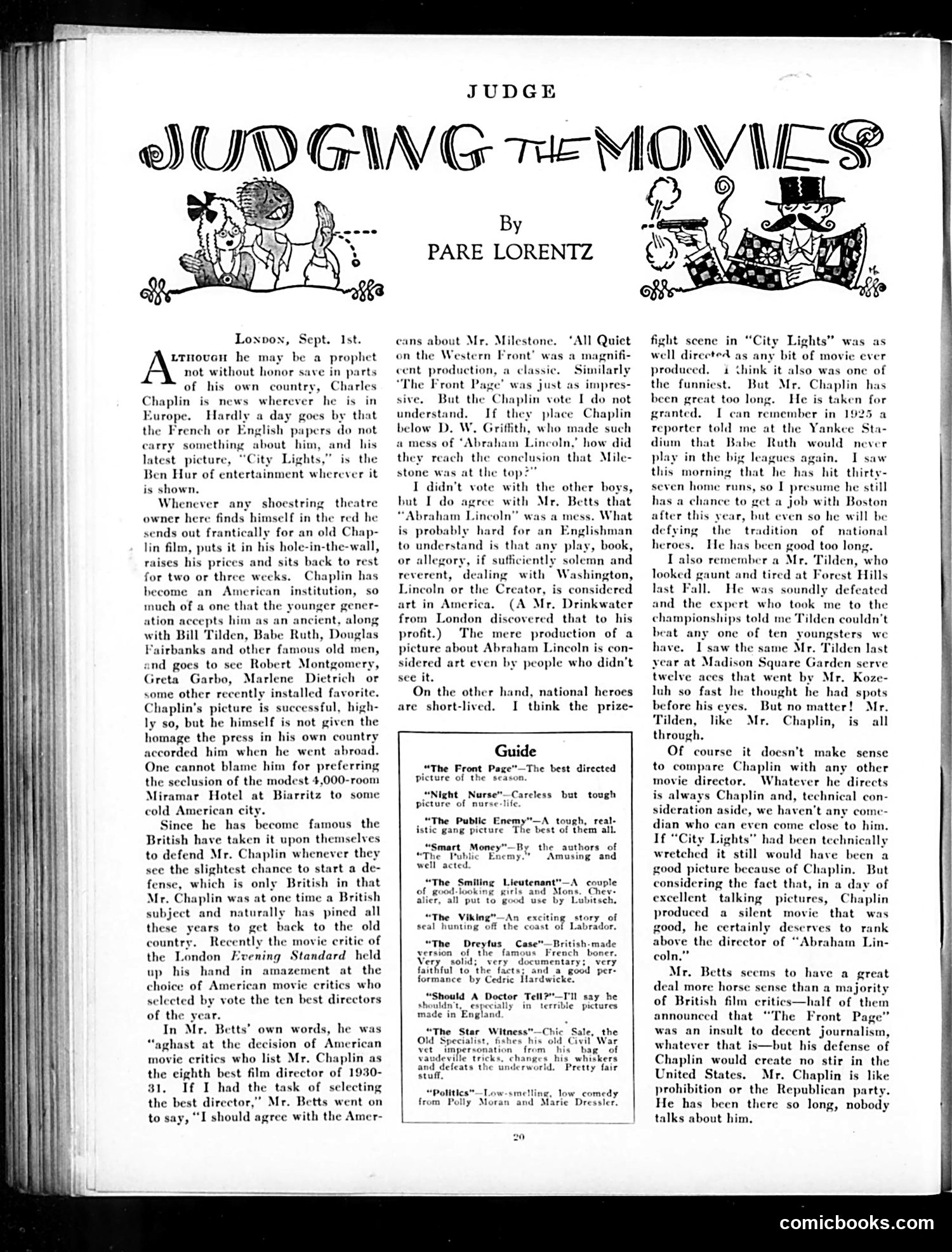
Judge Magazine: "Judging the Movies" by Pare Lorentz This column critiques 1930-31 film directors and Charlie Chaplin's standing in cinema. The satirical point: a British film critic (Mr. Betts from the London *Evening Standard*) was "aghast" that American critics ranked Chaplin eighth among directors, below D.W. Griffith—whose Lincoln film Betts calls a "mess." Lorentz (the author) agrees the Lincoln picture was poor, but explains that in America, any solemn, reverential film about Lincoln, Washington, or "the Creator" is automatically considered art, regardless of quality. The satire mocks American audiences' reflexive respect for patriotic subjects. The irony: Chaplin, though hugely famous internationally and a proven filmmaker, receives less critical deference in his adopted country than reverent but mediocre "serious" films. A sidebar guide rates recent films, emphasizing technical direction over subject matter—supporting Lorentz's argument.
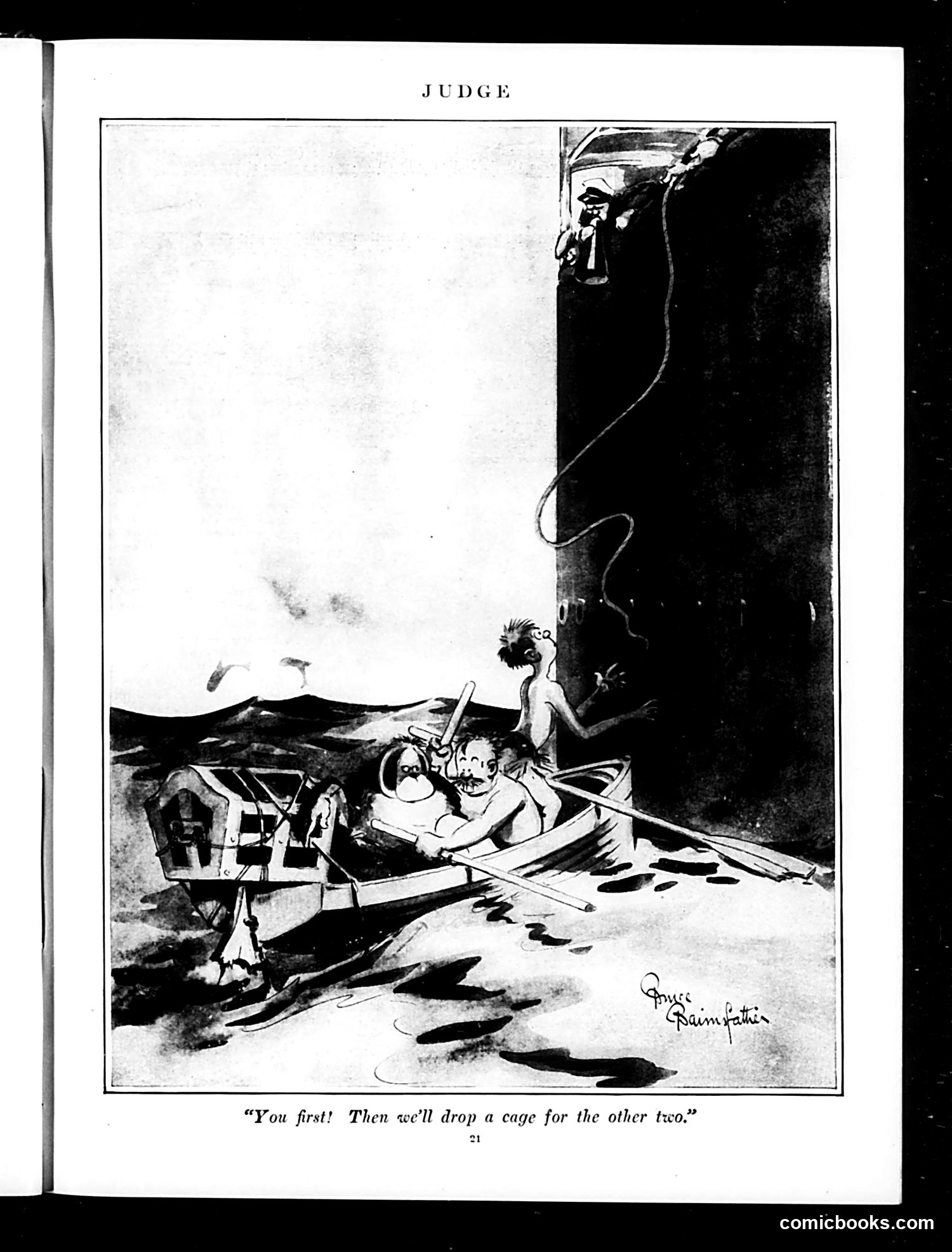
Analysis of Judge Magazine Cartoon This cartoon depicts a dark scene where figures in a boat are being lowered into what appears to be a deep, treacherous chasm or cave. The caption "You first! Then we'll drop a cage for the other two" suggests a perilous situation where people are being sent into danger sequentially. The cartoon likely satirizes a political or social scenario involving risk or sacrifice—possibly commenting on sending people into dangerous situations (military deployment, hazardous work, or political/legal jeopardy) where individuals are expendable. The ominous setting and hierarchical command structure suggest commentary on leadership decisions that put subordinates at risk. Without additional context about the specific date or issue, the exact political reference remains unclear, though the tone is decidedly critical.
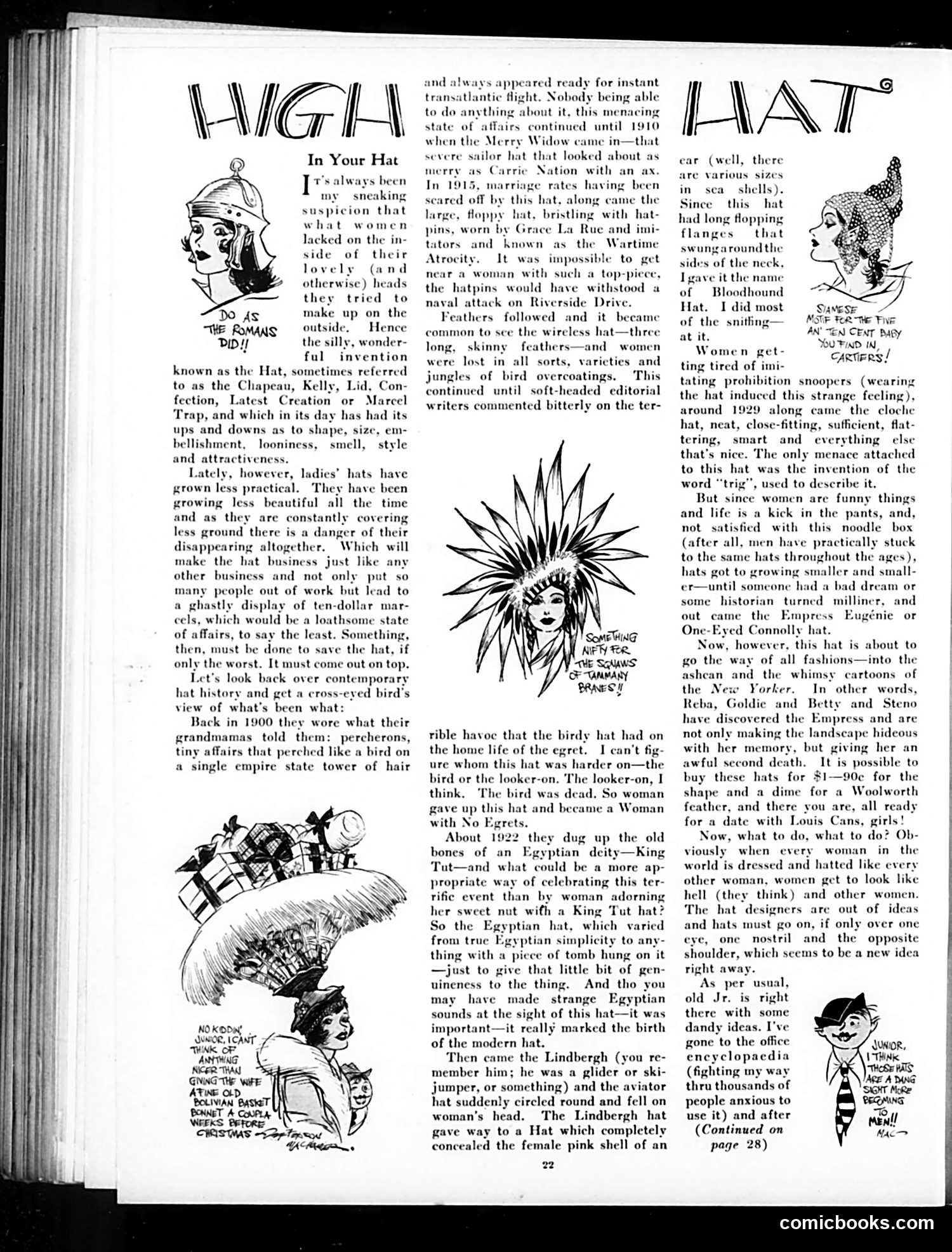
"High Hat" - Judge Magazine Fashion Satire This article satirizes the evolution of women's hat fashion from 1900 onward, treating hat trends as a humorous historical narrative. The piece mocks the impracticality and excess of ladies' headwear, particularly the enormous feathered hats of the 1910s (exemplified by the "Merry Widow" hat), which featured such large plumage that women allegedly couldn't approach each other—even naval attacks on "Riverside Drive" couldn't penetrate them. The satire targets the absurdity of hat-pins, the "wireless hat" with three long feathers, and subsequent shrinking styles (the "cloche" hat) that ultimately disappear entirely. The cartoons illustrate various ridiculous hat styles alongside their era. The author facetiously suggests hats are now becoming extinct, while women continue cycling through fashions seeking novelty. The tone is lighthearted social commentary on women's fashion vanity and the hat industry's commercial exploitation of style trends.
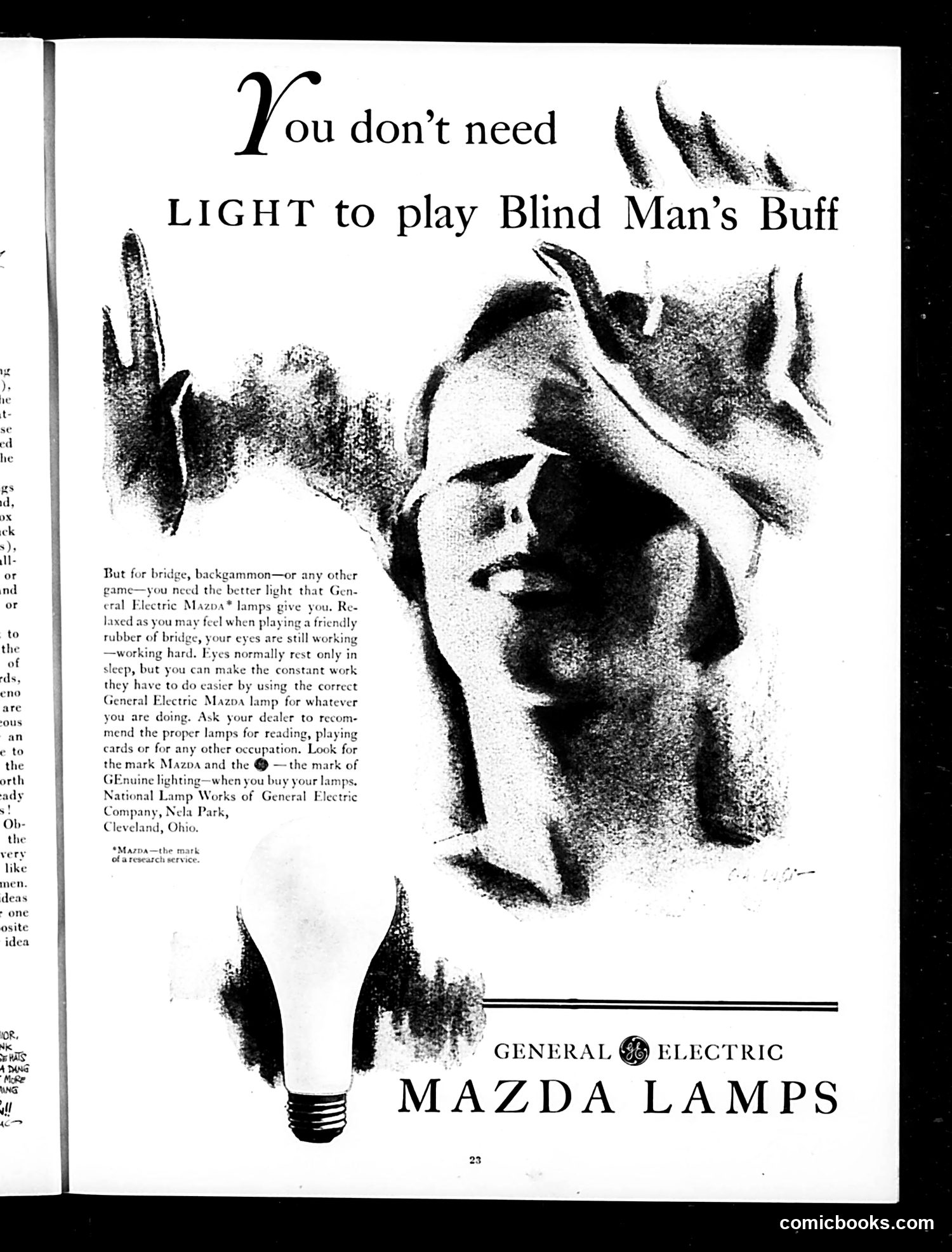
Analysis This is primarily an advertisement for General Electric's Mazda lamps, not a political cartoon. The large illustration shows a man's face in profile, blindfolded, playing what appears to be a parlor game ("Blind Man's Buff"). The commercial message: The ad paradoxically claims you *don't* need good lighting for the children's game Blind Man's Buff (since you're blindfolded anyway), but *do* need proper General Electric Mazda lamps for serious activities like bridge, backgammon, reading, and card-playing. The point is that better lighting reduces eye strain during focused work and games. Historical context: This appears to be early-to-mid 20th century advertising, when electric lighting quality was a selling point and eye health concerns were genuine marketing angles. The ad instructs readers to look for the Mazda brand mark when purchasing lamps from General Electric's National Lamp Works in Cleveland, Ohio. There is no political satire or social commentary on this page—it is straightforward consumer advertising.
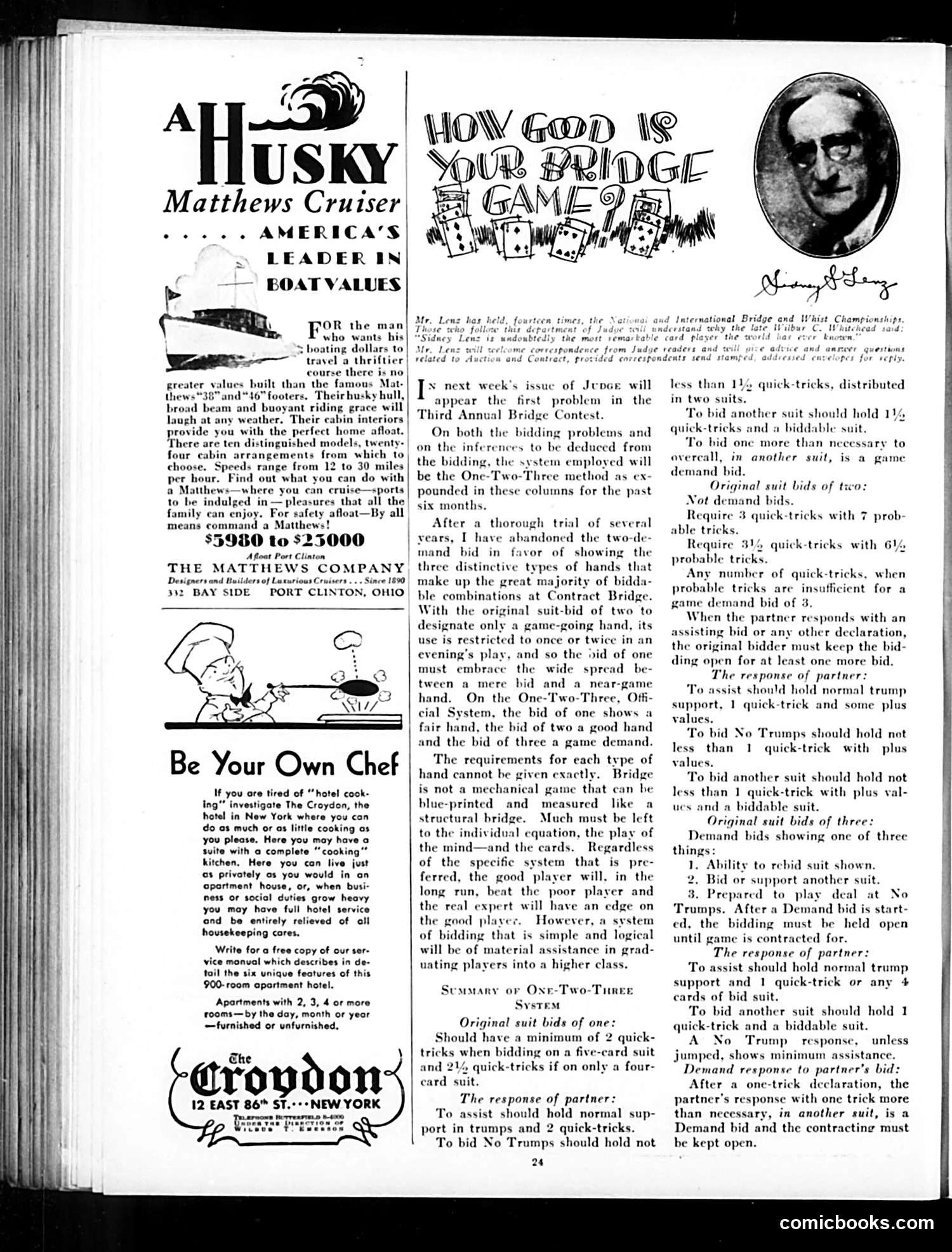
Analysis of Judge Magazine Page This page is primarily advertising and instructional content rather than political satire. The visible content includes: 1. Matthews Cruiser boat advertisement - promoting luxury motorboats ($3,980-$253,000), positioning them as "America's leader in boat values" 2. The Croydon hotel advertisement - a New York apartment-hotel offering flexible residential arrangements with optional cooking facilities 3. "Be Your Own Chef" section - promoting apartment living with kitchen access as an alternative to hotel dining 4. Bridge card game instruction - the main editorial content, detailing bidding strategies for Contract Bridge, with a portrait of what appears to be the author/expert (signature visible but unclear) The Bridge article announces an upcoming contest and explains the "One-Two-Three" bidding system. For modern readers: This reflects 1920s-30s leisure culture—luxury boating and flexible urban living arrangements for affluent readers. The Bridge content shows the period's fascination with Contract Bridge as a serious, strategic game worthy of detailed instruction in a major magazine.
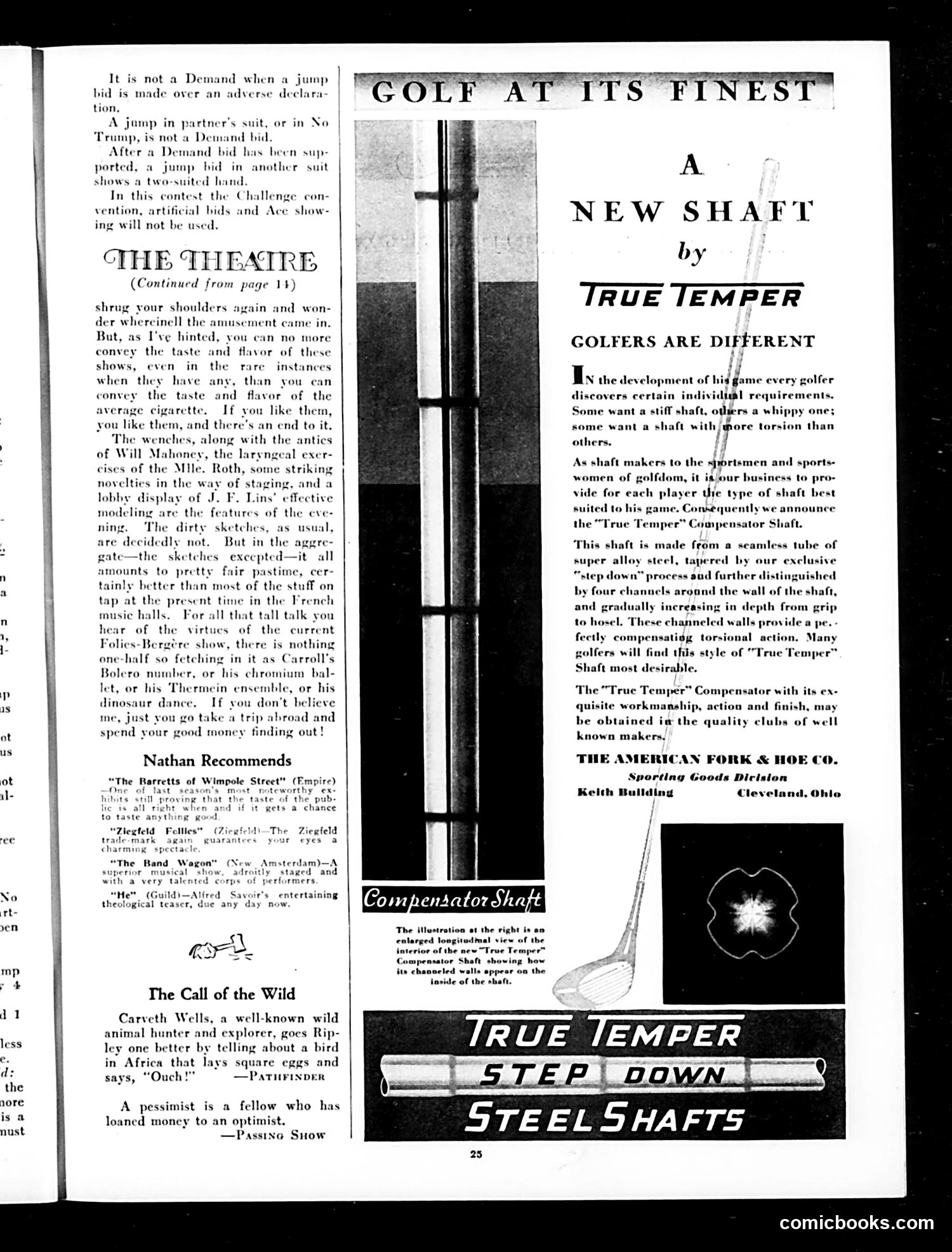
Page 25 of Judge Magazine: Content Analysis This page is primarily advertising and theatrical reviews, not political satire. The left column contains theater criticism by "Nathan" reviewing Broadway shows, including *The Barretts of Wimpole Street* and *The Hand Wagon*. The tone is dismissive of French music halls, comparing them unfavorably to American theatrical novelties. A brief joke appears about Carveth Wells, a real wildlife explorer and Ripley's Believe It or Not competitor, humorously claiming he encountered an African bird laying square eggs. The right side is a full-page advertisement for True Temper golf shafts by the American Fork & Hoe Company. It emphasizes that golfers have different preferences (stiff vs. whippy shafts) and promotes the "Compensator Shaft" with its channeled walls, featuring technical diagrams and a close-up photograph of the shaft's interior. The page reflects early 20th-century consumer advertising and entertainment commentary rather than political commentary.
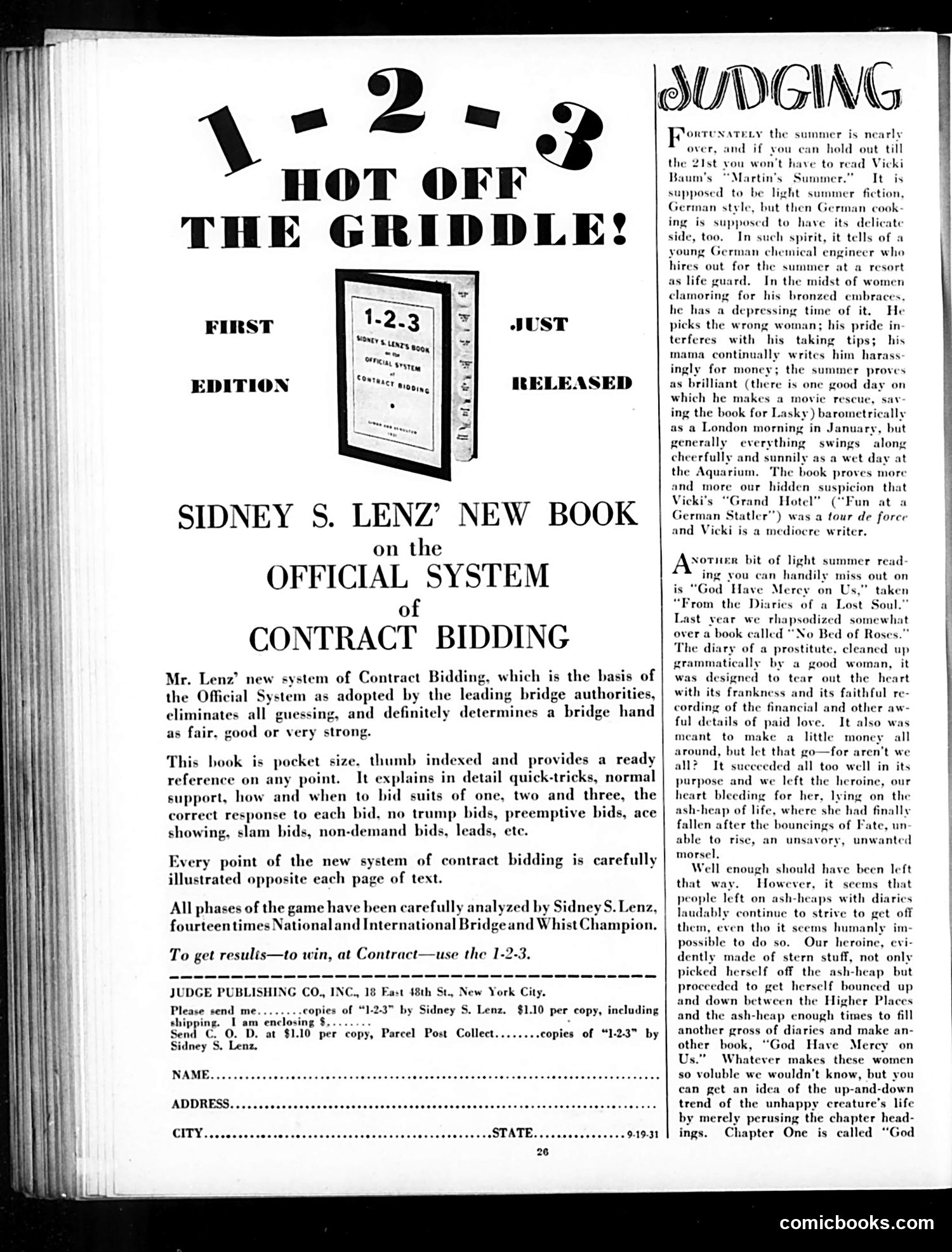
Judge Magazine Page Analysis This page is primarily advertising and book reviews rather than political satire. The dominant feature is an advertisement for Sidney S. Lenz's contract bridge instruction book, "1-2-3," promoting his system for bidding in the card game. Lenz is identified as a "fourteen times National and International Bridge and Whist Champion." The ad emphasizes the book's practical utility for players. The right column contains book reviews under "Judging," discussing summer fiction. These include brief critiques of works like Baum's "Martin's Summer" (about a German life guard) and "God Have Mercy on Us" (apparently a sequel about a reformed prostitute's continued struggles). The reviewer's tone is gossipy and dismissive—suggesting these are lightweight summer reads featuring melodramatic plots. The page reflects Judge's typical format: mixing consumer advertisements with literary commentary aimed at educated, middle-class readers. There is no evident political satire or caricature on this particular page.
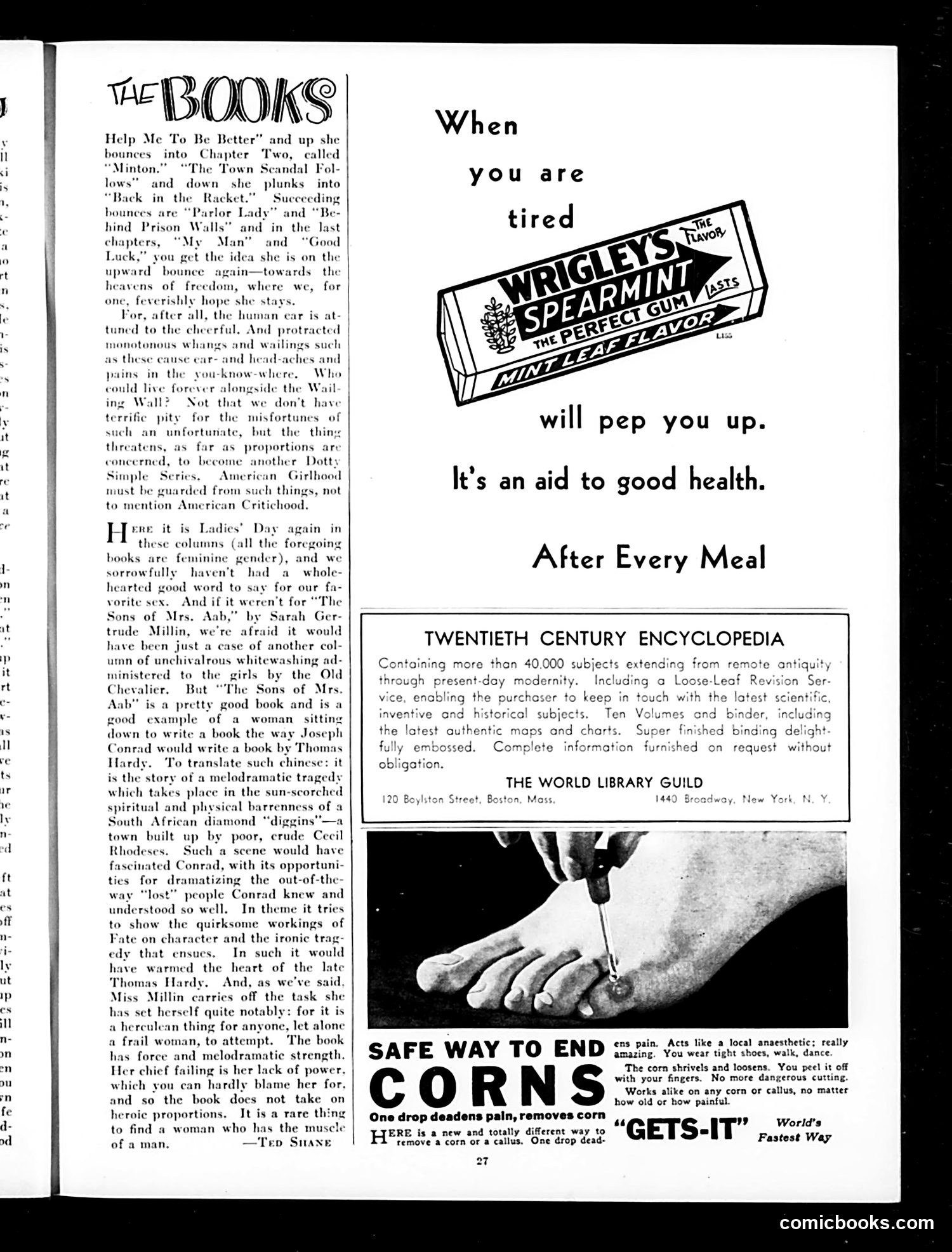
Analysis of Judge Magazine Page This page mixes book reviews with vintage advertisements. The main content discusses novels targeting female readers, including a favorable review of Sarah Gertrude Millin's *Sons of Mrs. Aab*, praising her literary ambition despite noting her lack of "power" (physical vigor/forceful style)—a gendered critique suggesting women writers lack the muscular prose of male authors like Conrad or Hardy. The advertisements are period pieces revealing early-20th-century consumer culture: Wrigley's Spearmint gum promises energy for the tired; the Twentieth Century Encyclopedia sells self-improvement; and "Gets-It" corn remover uses pseudo-medical language ("local anaesthetic") to market a dubious product. The satire lies in the juxtaposition: serious literary criticism alongside snake-oil advertising, all targeting the same audience—readers seeking modern solutions to life's problems, whether intellectual or physical.
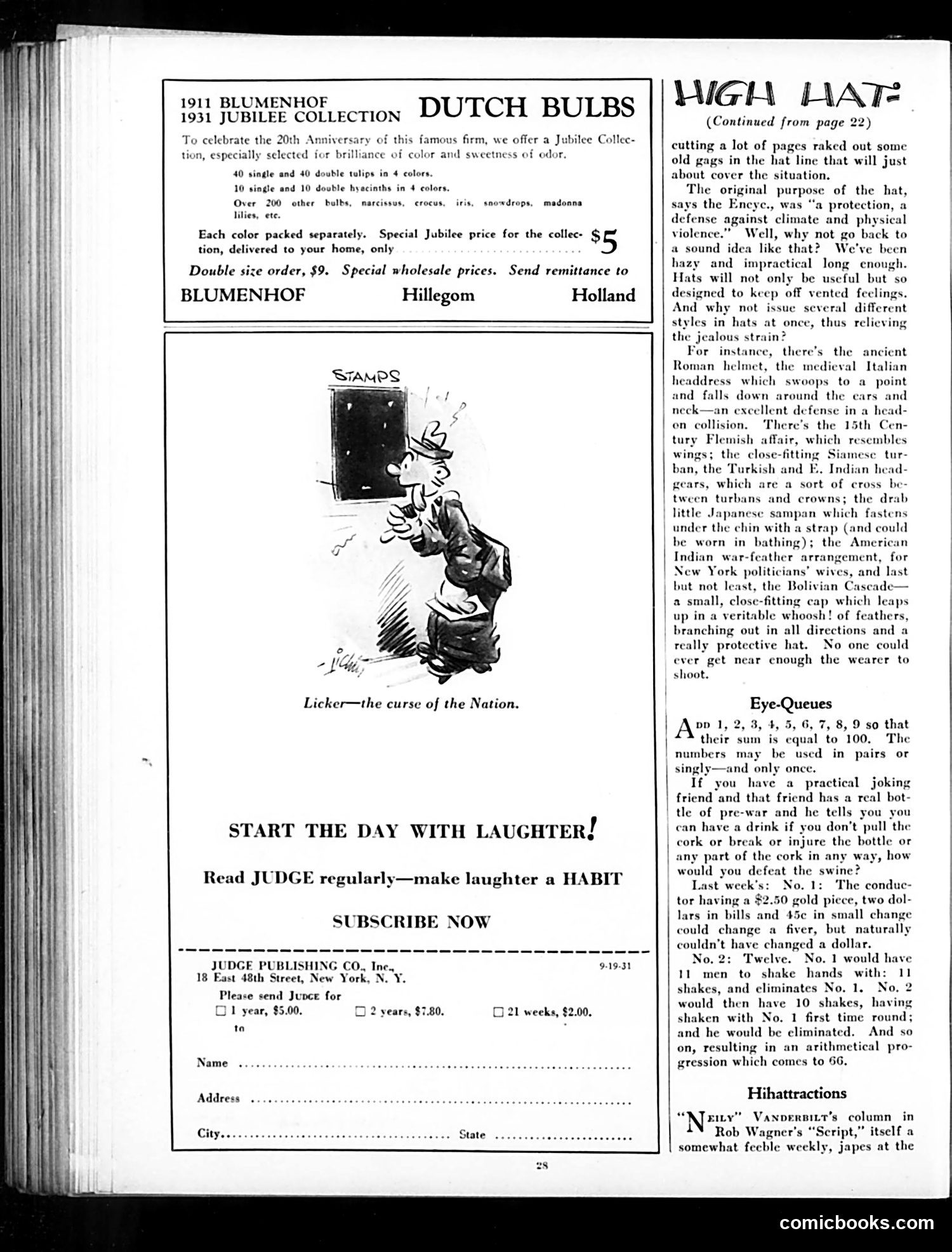
Judge Magazine Page Analysis This page is primarily advertising and subscription material rather than political satire. The dominant content includes: 1. Blumenhof Dutch Bulbs ad (top): A straightforward commercial for a flower bulb company's 20th-anniversary jubilee collection. 2. "Licker—the curse of the Nation" cartoon (center): A small satirical drawing showing a figure struggling with what appears to be a liquor bottle or stamp, likely referencing Prohibition-era concerns about alcohol as a social problem. 3. Judge subscription pitch (bottom): An advertisement encouraging readers to subscribe to Judge magazine for regular humor. 4. "High Hat" article (right column): Fashion/lifestyle commentary about hat styles, including historical references (Roman helmets, medieval headdresses, etc.) presented humorously. 5. "Eye-Queues" and "Hihattractions" (right): Puzzle and humor columns. The page reflects 1931 content: Prohibition's final year, consumer goods marketing, and leisure reading culture.
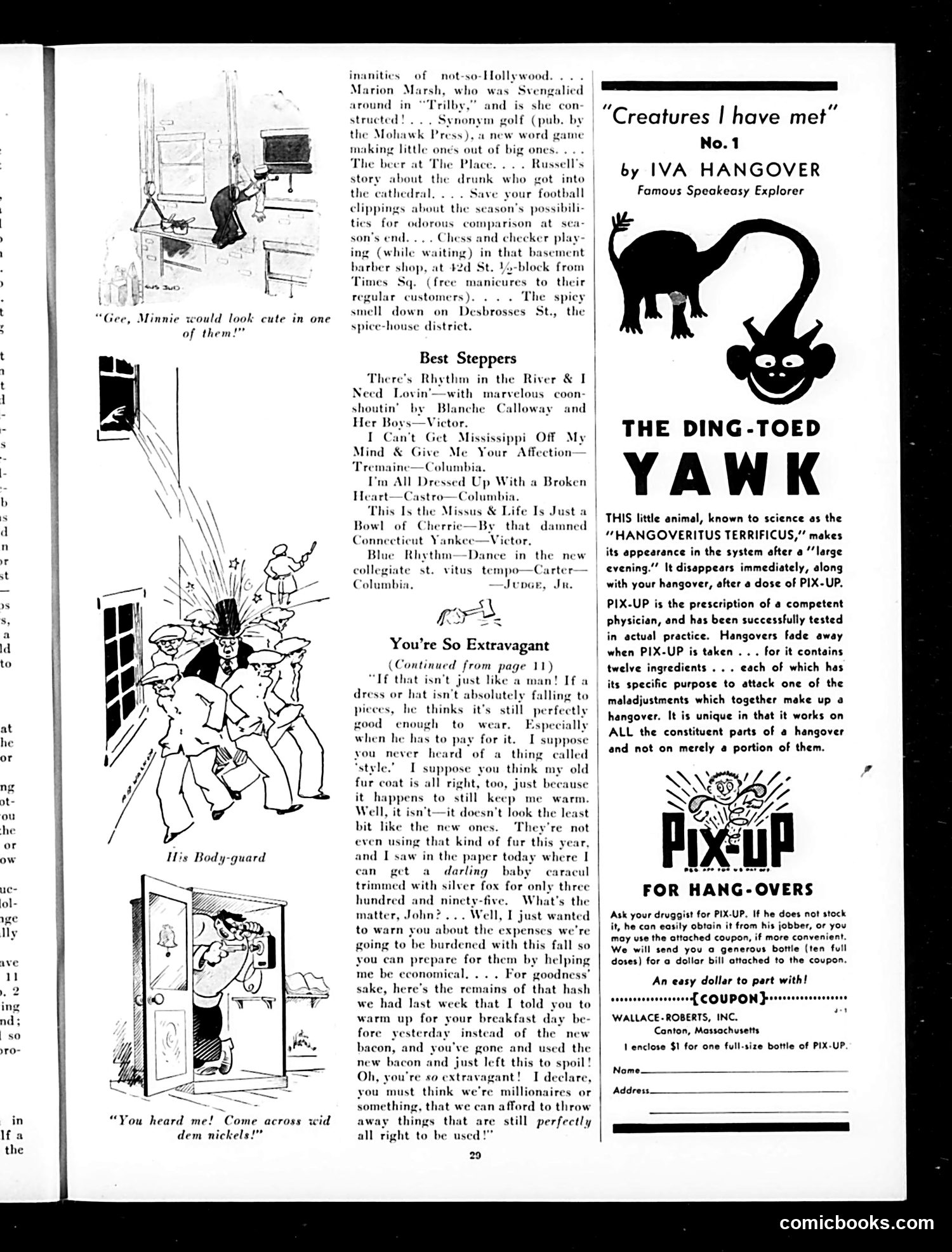
Analysis of Judge Magazine Page This page mixes entertainment gossip with advertisements. The left side contains humorous commentary on 1920s-30s Hollywood and social life—references to actress Marion Marsh, word games, and New York speakeasy culture. The cartoons depict everyday scenes: a woman admiring fashionable clothing, a man harassing someone for money, and a couple arguing about household expenses. The main content is an ad for PIX-UP, a hangover remedy. The humor plays on the magazine's speakeasy audience: the fictional creature "Hangoveritus Terrificus" satirizes the regular hangovers readers would experience from Prohibition-era drinking. The ad claims PIX-UP's twelve ingredients target all hangover symptoms. The coupon offers "an easy dollar to part with"—a knowing joke about readers' willingness to pay for relief from self-inflicted morning-after suffering. This is straightforward commercial satire targeting a specific market.
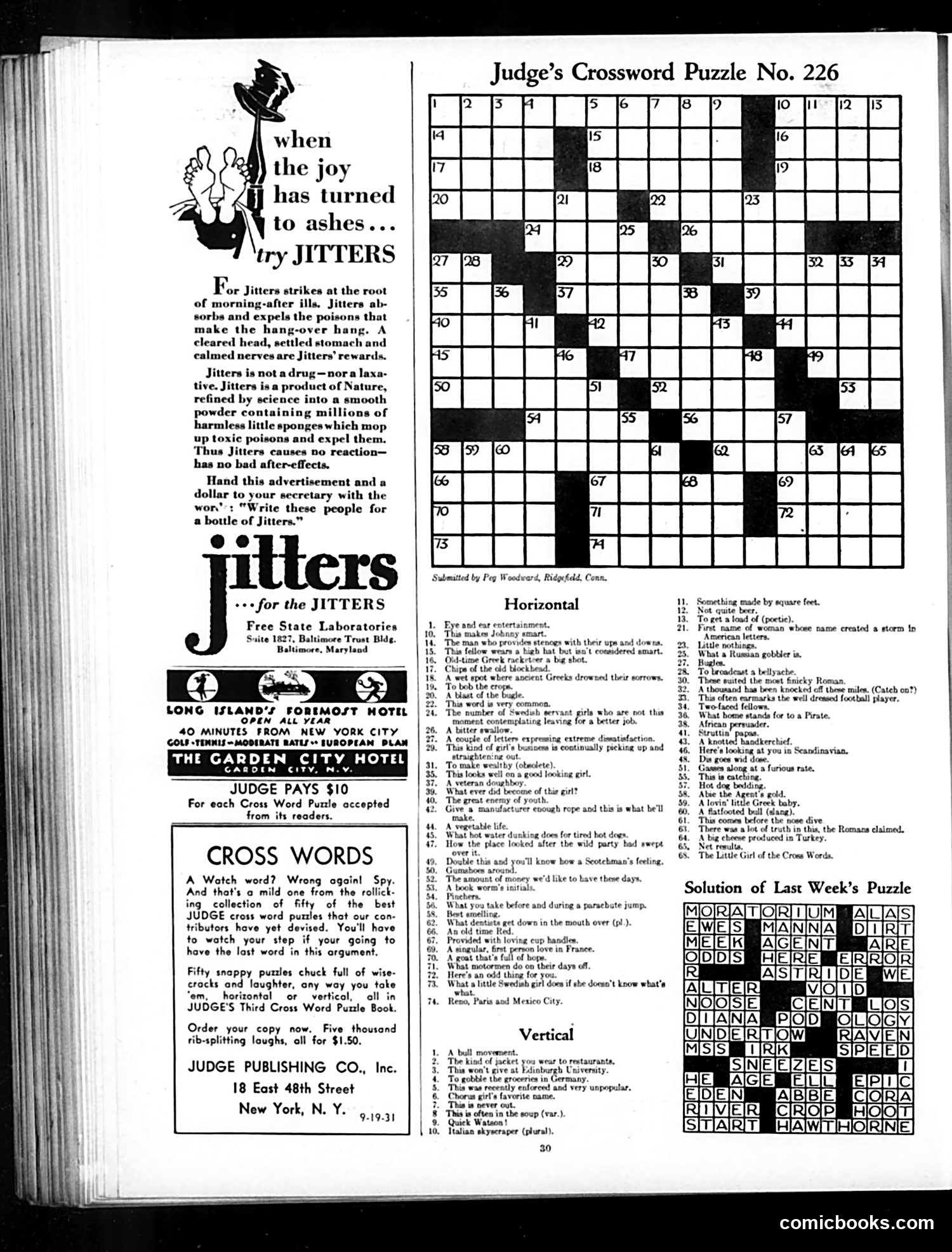
Judge Magazine Crossword Puzzle Page (circa 1931) This page is primarily a crossword puzzle (No. 226) with accompanying advertisements—not a political cartoon. The main content is a word puzzle submitted by Peg Woodward, with clues both horizontal and vertical. The advertisements are noteworthy for historical context: they promote "Jitters," a patent medicine claiming to cure hangovers by absorbing "toxic poisons." The copy explicitly frames it as a hangover remedy—notable because this page appears from Prohibition era (references to "morning-after ills"). The ad's frank discussion of alcohol's aftereffects suggests either pre-Prohibition dating or post-Prohibition era publishing. Other ads promote Judge Publishing's crossword puzzle books and a Long Island hotel, typical period magazine advertising. The crossword clues themselves contain period slang and social references (Swedish servant girls, Greek history, French romance terminology) reflecting 1920s-30s Judge magazine culture—satirical, urbane, and somewhat snobbish.
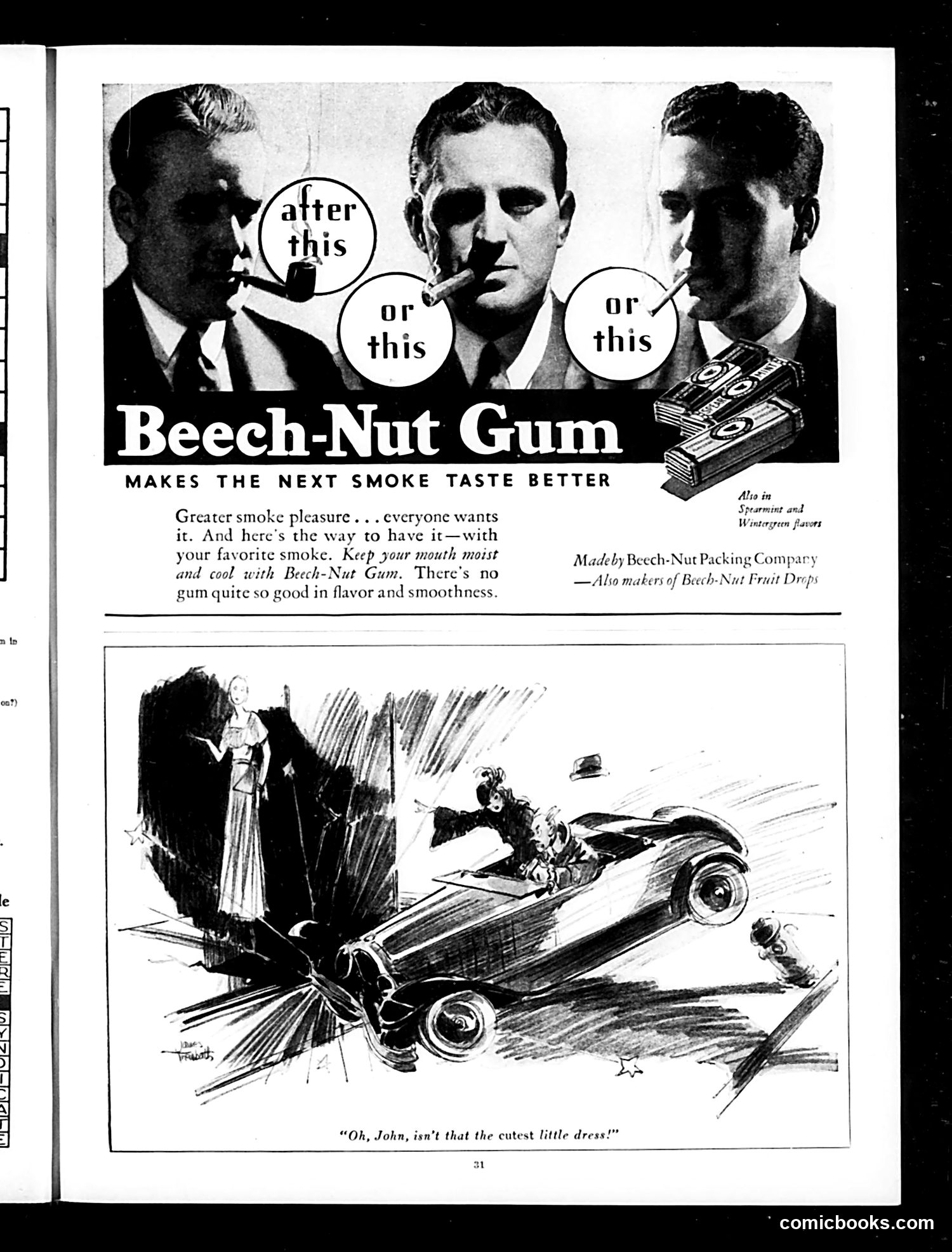
Beech-Nut Gum Advertisement This page is primarily a product advertisement for Beech-Nut Gum, not political satire. The top section shows three men smoking pipes with text bubbles offering choices—a marketing device suggesting the gum improves the smoking experience by keeping the mouth "moist and cool." The bottom illustration is a separate humorous domestic scene: a woman admires a child's dress while a man drives recklessly in a speeding car, nearly causing an accident. The caption "Oh, John, isn't that the cutest little dress!" creates ironic contrast between her casual comment and the dangerous driving happening simultaneously—a gentle joke about domestic distraction or masculine recklessness. This appears to be a standard magazine page mixing advertisement with unrelated comic illustration, typical of early-to-mid 20th century *Judge* magazine format.
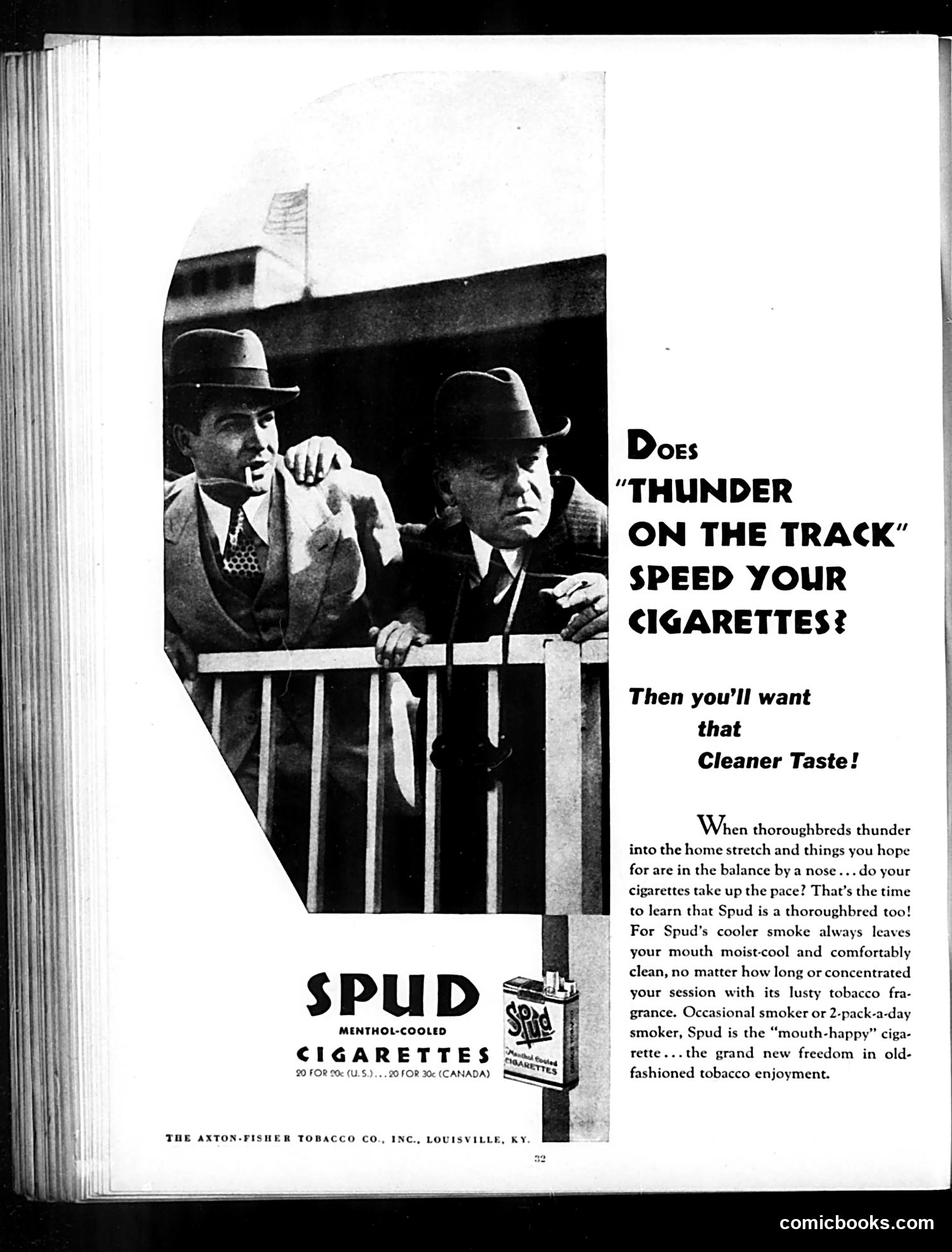
Analysis This is primarily a cigarette advertisement, not political satire. It appears in Judge magazine but uses the publication's space for commercial purposes. The ad features two men in fedoras watching a horse race from what appears to be a viewing box, with an American flag visible. The image metaphorically connects horse racing excitement to smoking speed—the headline asks if "Thunder on the Track" speeds your cigarettes, then pivots to promoting Spud menthol cigarettes for their "cleaner taste." The copy emphasizes that during tense moments (like a close horse race), Spud cigarettes keep your mouth "moist-cool and comfortably clean," marketing the menthol cooling sensation as a desirable feature for frequent smokers. By modern standards, this is a straightforward (if now-shocking) tobacco ad using aspirational imagery—horse racing and sophisticated gentlemen—to sell cigarettes. There's no apparent political or social satire, just mid-century advertising marketing menthol as a premium smoking experience.
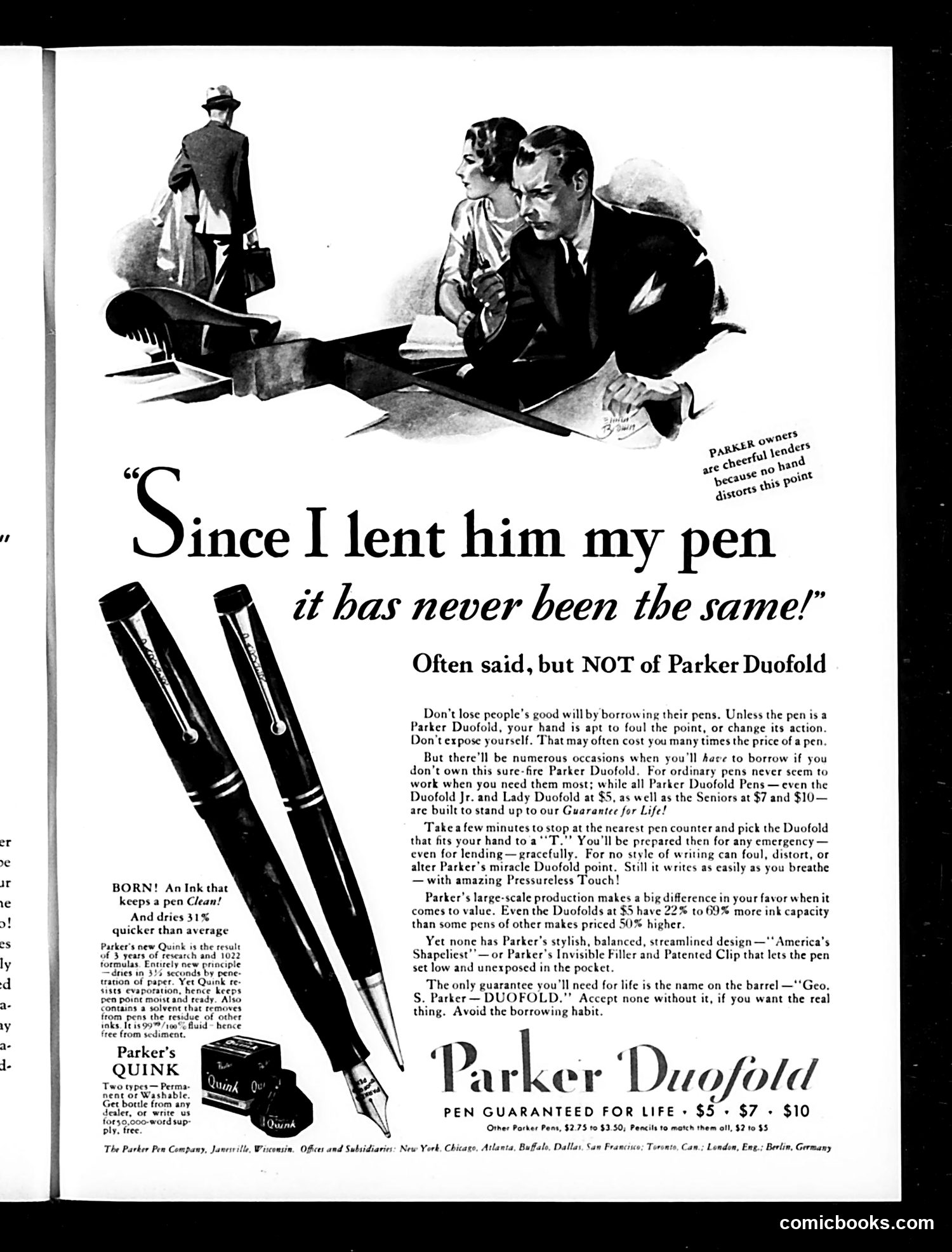
Parker Duofold Pen Advertisement This is primarily a pen advertisement, not political satire. The page depicts a common social anxiety of the era: lending a pen to someone who damages or ruins it. The cartoon shows three figures examining a ruined pen with disappointment—illustrating the humorous complaint "Since I lent him my pen, it has never been the same!" The ad's pitch is that ordinary pens fail when borrowed, but Parker Duofold pens are so well-made they'll survive lending, backed by a "Guarantee for Life." The page also advertises Parker's new "Quink" ink, which dries quickly and keeps pens clean. The ad emphasizes durability, value (more ink capacity than competitors), and stylish design to justify the $5-$10 price point—premium for the era. This reflects 1920s-30s consumer culture and anxieties about personal property and social obligations. No political figures or references are present.
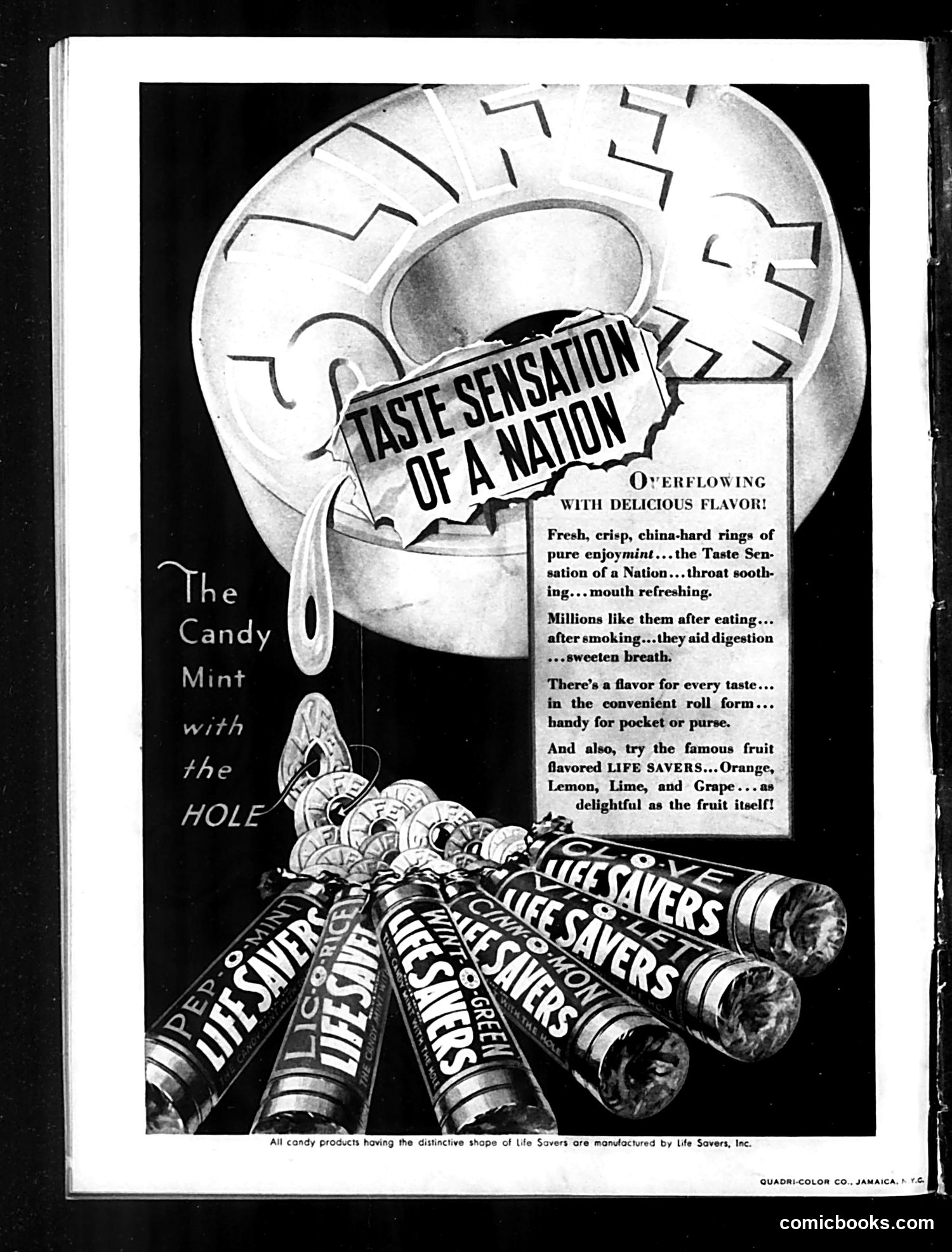
Life Savers Candy Advertisement This is primarily a commercial advertisement, not political satire. It promotes Life Savers candy, particularly the mint variety with the distinctive hole, and Life Savers fruit-flavored candies. The visual imagery uses a large donut-shaped mint candy as the dominant graphic element, with the text "The Candy Mint with the HOLE" emphasizing the product's recognizable feature. Below are arranged Life Savers rolls in cylindrical packages. The advertisement employs hyperbolic marketing language typical of early-to-mid 20th century candy promotion: claims about digestive aid, breath sweetening, and being a "Taste Sensation of a Nation." The copy targets convenience ("pocket or purse") and variety of flavors. There is no political cartoon or satire present on this page—it is straightforward product advertising for Life Savers, Inc.