judge
Judge — September 26, 1931
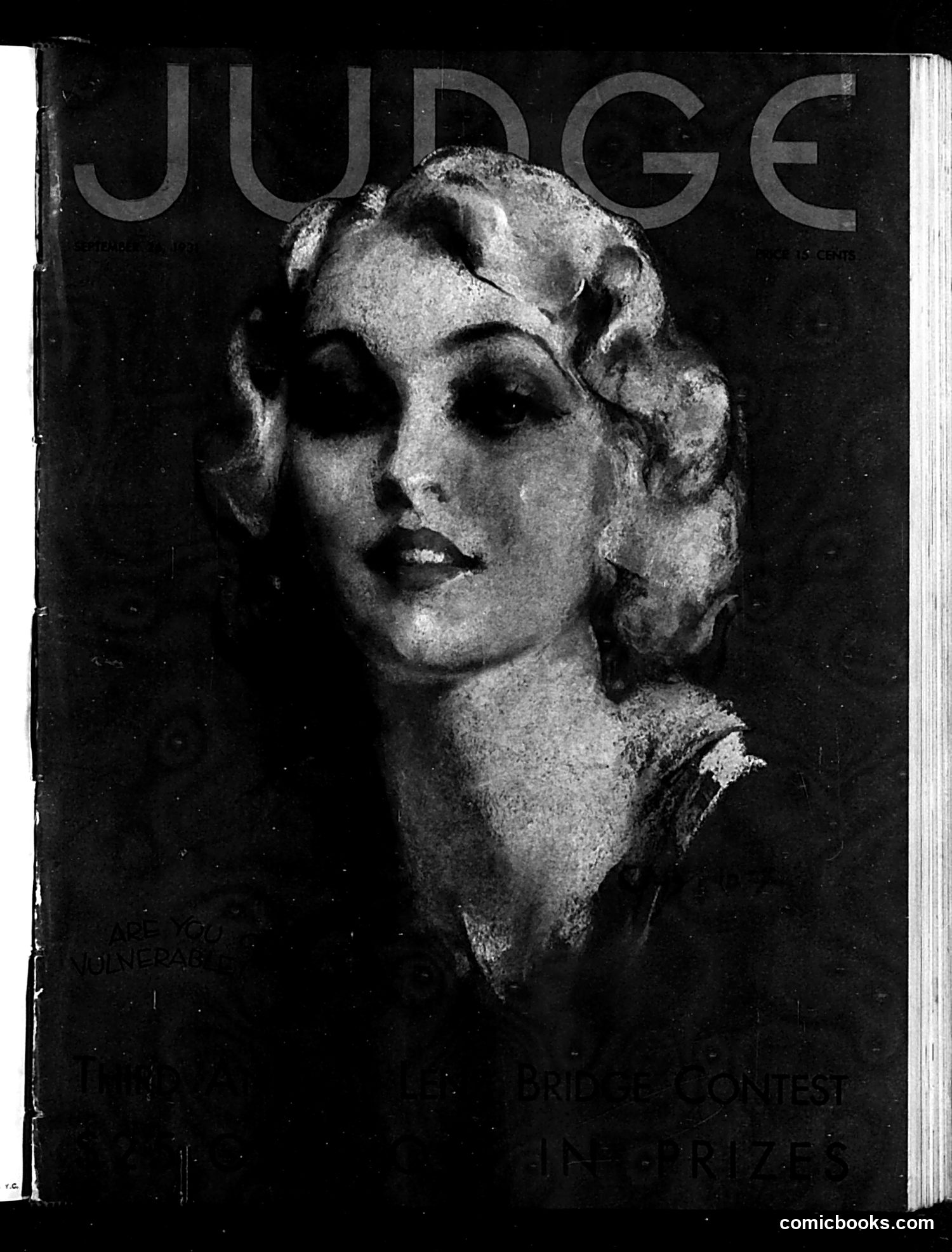
I can see this is a *Judge* magazine cover featuring a black and white portrait photograph of a woman with wavy blonde hair styled in what appears to be 1920s-30s fashion. The word "JUDGE" appears at the top, and there's partial text visible mentioning "CONTEST" and what appears to be "PRIZE" at the bottom. However, I cannot confidently identify the specific woman pictured or definitively explain the satirical point without clearer text. The OCR'd text provided is too fragmentary to establish context—I can see references to "contest" and "prizes" but cannot determine what event or social commentary this page addresses. To accurately explain this cartoon's meaning to a modern reader, I would need either a clearer image of the accompanying text or additional context about the specific *Judge* issue.
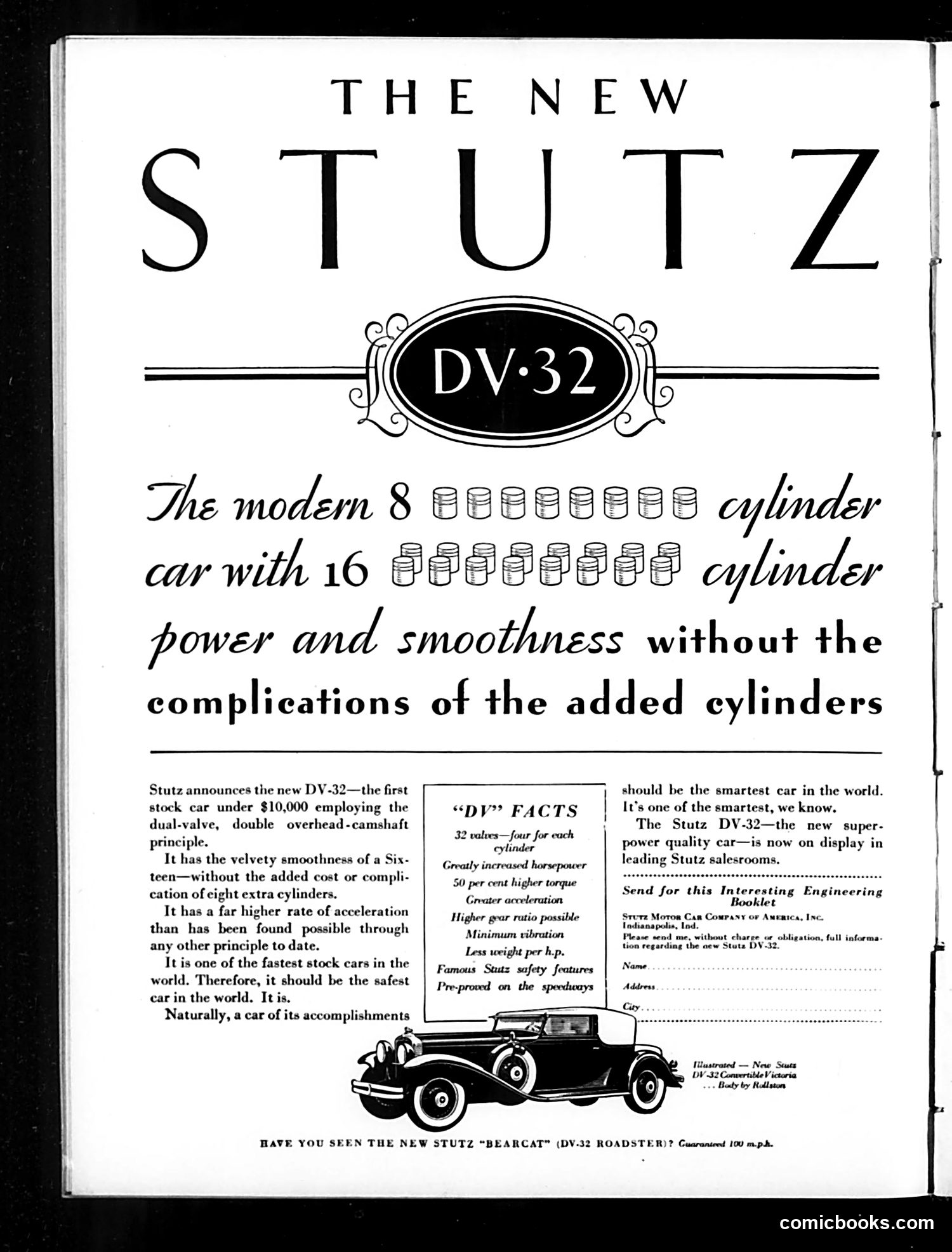
Content Analysis This page is primarily an advertisement, not satirical content. It promotes the new Stutz DV-32 automobile, emphasizing its innovative 8-cylinder engine with 16-valve technology. The ad claims the car delivers "16-cylinder power and smoothness without the complications of the added cylinders"—a marketing pitch highlighting engineering efficiency. Key selling points listed include increased horsepower, higher torque, greater acceleration, and minimal vibration. A small illustration shows a 1920s-30s era automobile. The page includes a tear-out coupon inviting readers to request an "Interesting Engineering Booklet" about the vehicle. No political satire or caricature is present. This represents Judge magazine's commercial advertising content rather than its satirical editorial function.
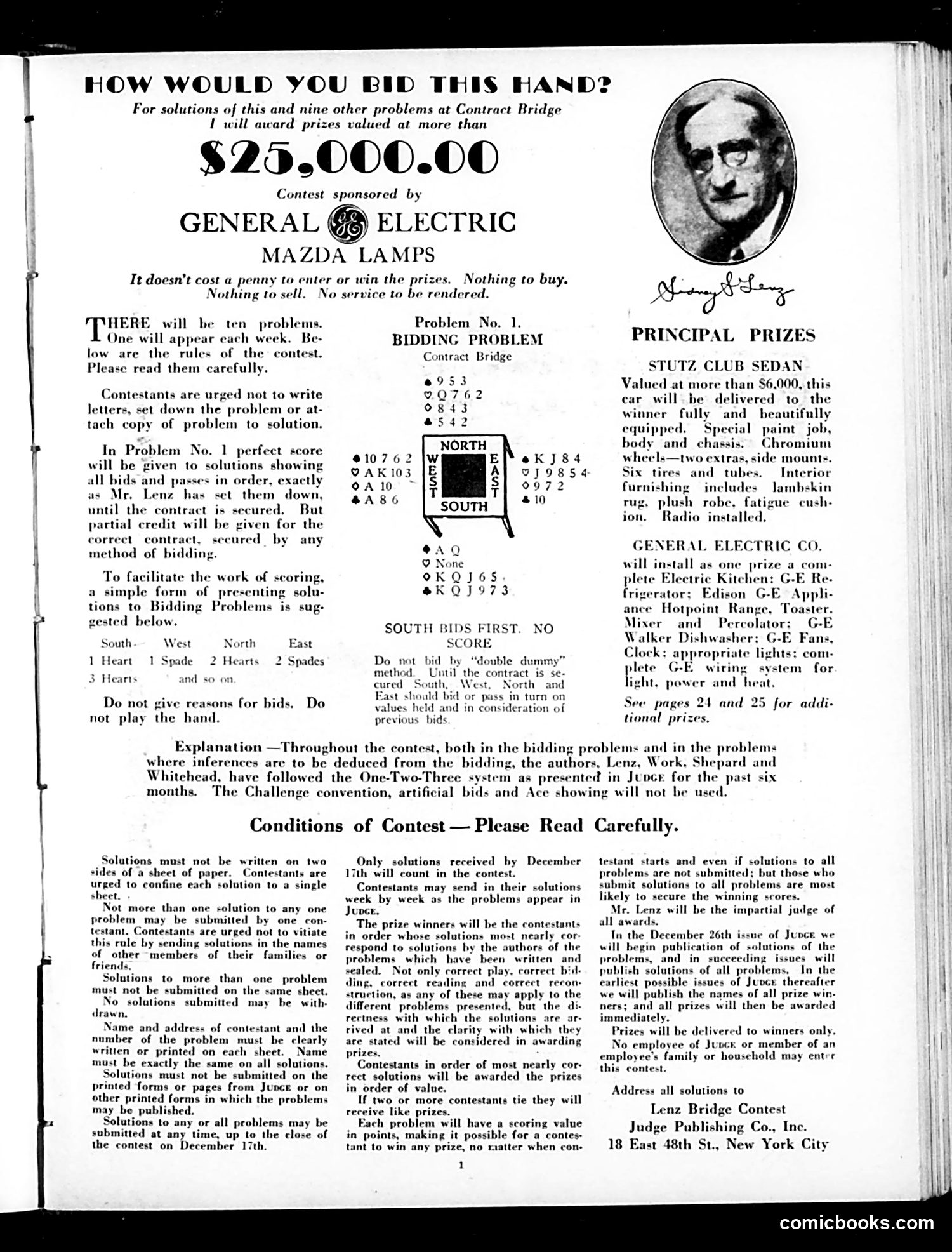
Page Content Analysis This page is primarily advertising and contest material, not political satire. It announces a bridge-bidding puzzle contest sponsored by General Electric (Mazda Lamps), offering $25,000 in prizes including a Stutz Club Sedan automobile. The content includes: - A bidding problem for Contract Bridge (a card game) - Contest rules and submission instructions - A photograph of a man (identity unclear from image alone) whose signature appears present - Lists of prizes from General Electric appliances The page reflects 1920s-30s commercial culture: major corporations sponsoring public contests to build brand engagement. Bridge was a popular leisure activity among middle and upper-class Americans during this era. There is no discernible political satire or social commentary on this particular page.
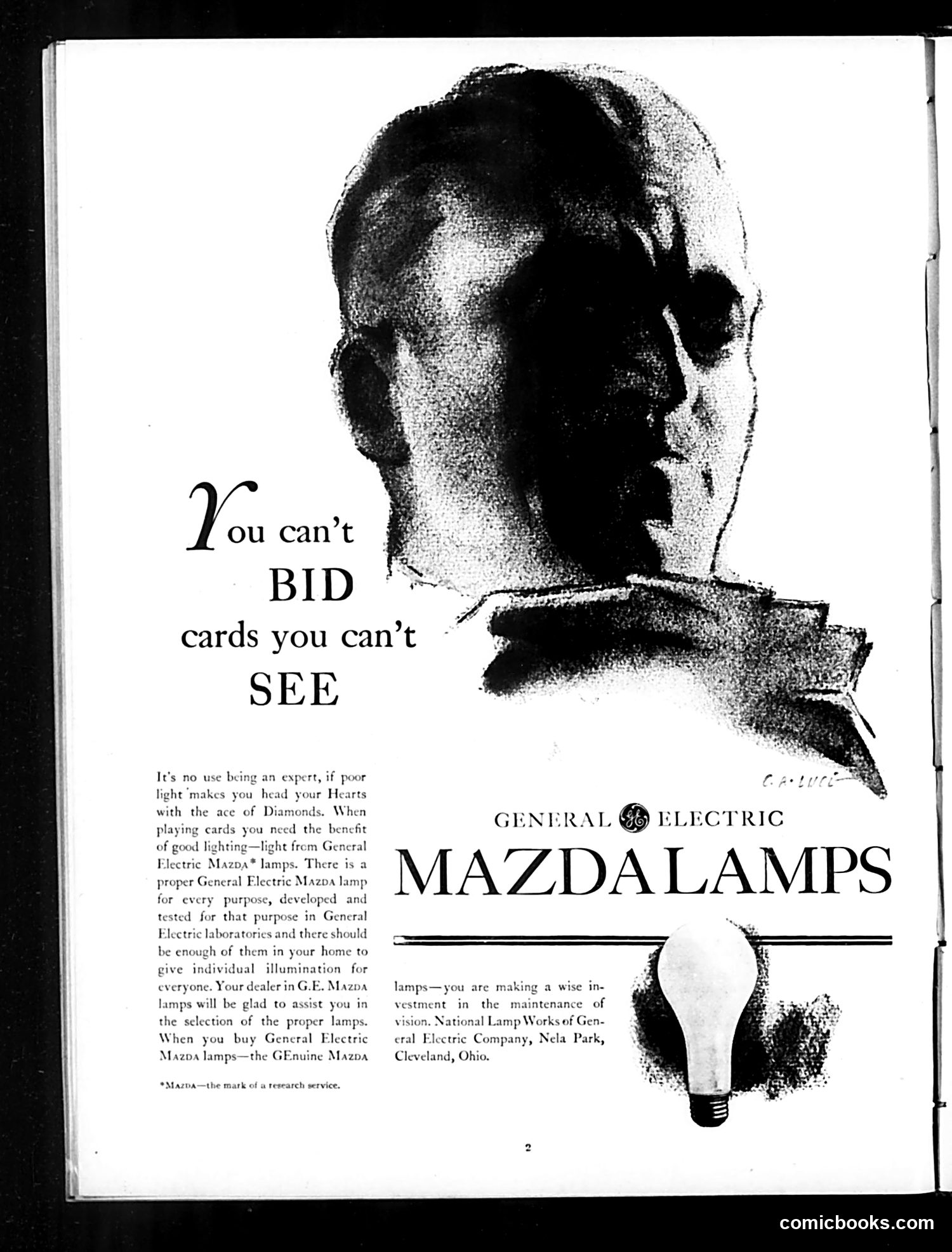
Analysis This page is primarily a General Electric advertisement for Mazda Lamps, not political satire. The headline "You can't BID cards you can't SEE" uses a card-playing reference to promote proper lighting for home use. The image shows a man's face in profile, partially shadowed, illustrating the advertisement's point: poor lighting creates shadows that obscure details—just as inadequate light makes playing cards difficult to read. The ad argues that General Electric's Mazda lamps provide "good lighting" necessary for various household activities. While published in *Judge* magazine (known for satire), this particular page functions as commercial advertising rather than political or social commentary. The "satire" is purely commercial—a clever visual pun about visibility and product utility.
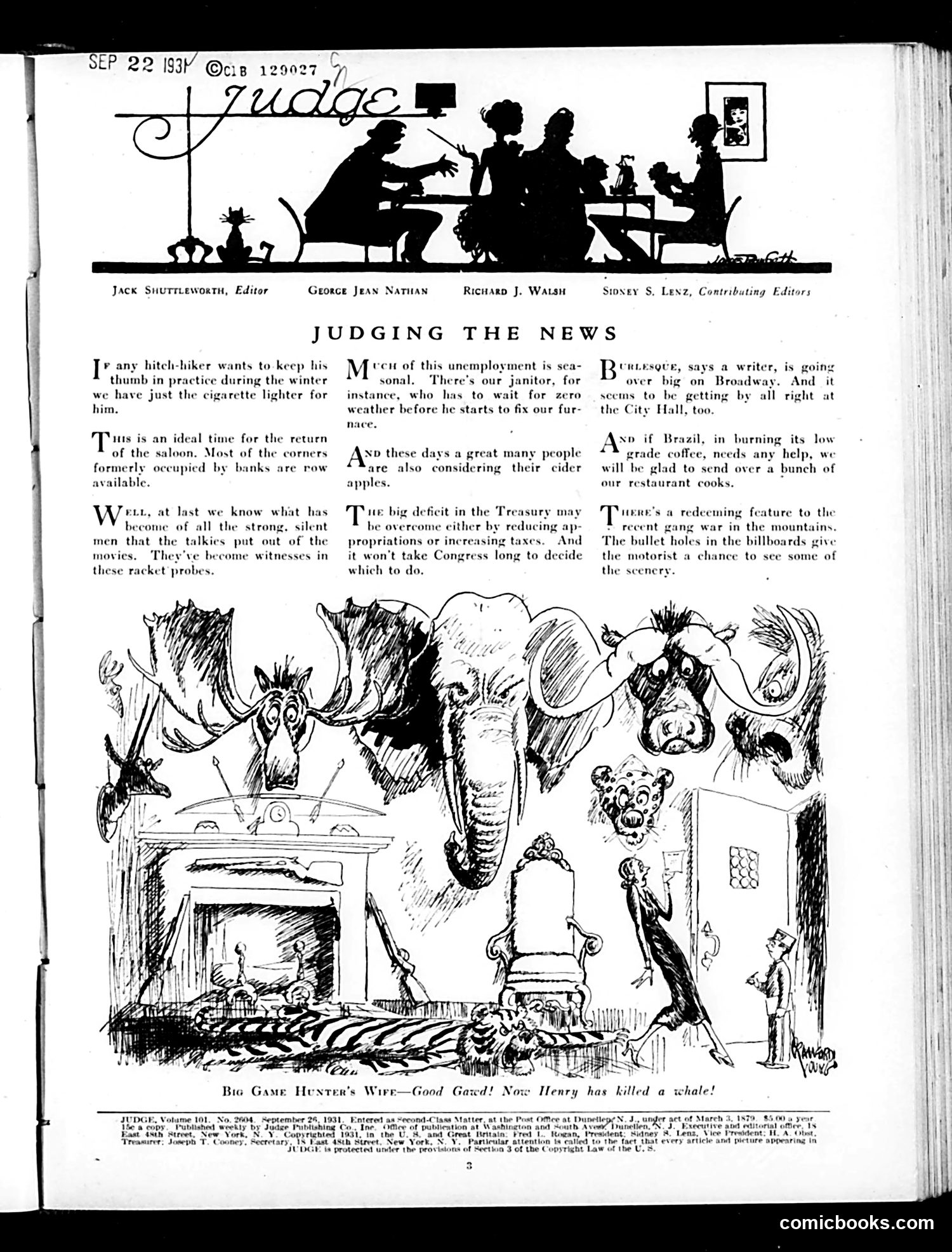
"Judging the News" - September 22, 1931 This page satirizes contemporary 1931 issues through brief commentary and a large cartoon. The text discusses unemployment, the saloon's return (likely referencing Prohibition's repeal), Treasury deficits, and Broadway's resilience. The main cartoon, titled "Big Game Hunter's Wife—Good Gawd! Now Henry has killed a whale!", depicts a hunting-room trophy wall featuring fantastical creatures alongside what appears to be an elephant or large game animal. The joke likely mocks either an overly ambitious hunter's exaggerated claims or, more probably, satirizes wealthy individuals' excess during the Depression—the irony of conspicuous consumption (trophy hunting) amid economic hardship. The wife's shocked exclamation underscores the absurdity or wastefulness of the pursuit.
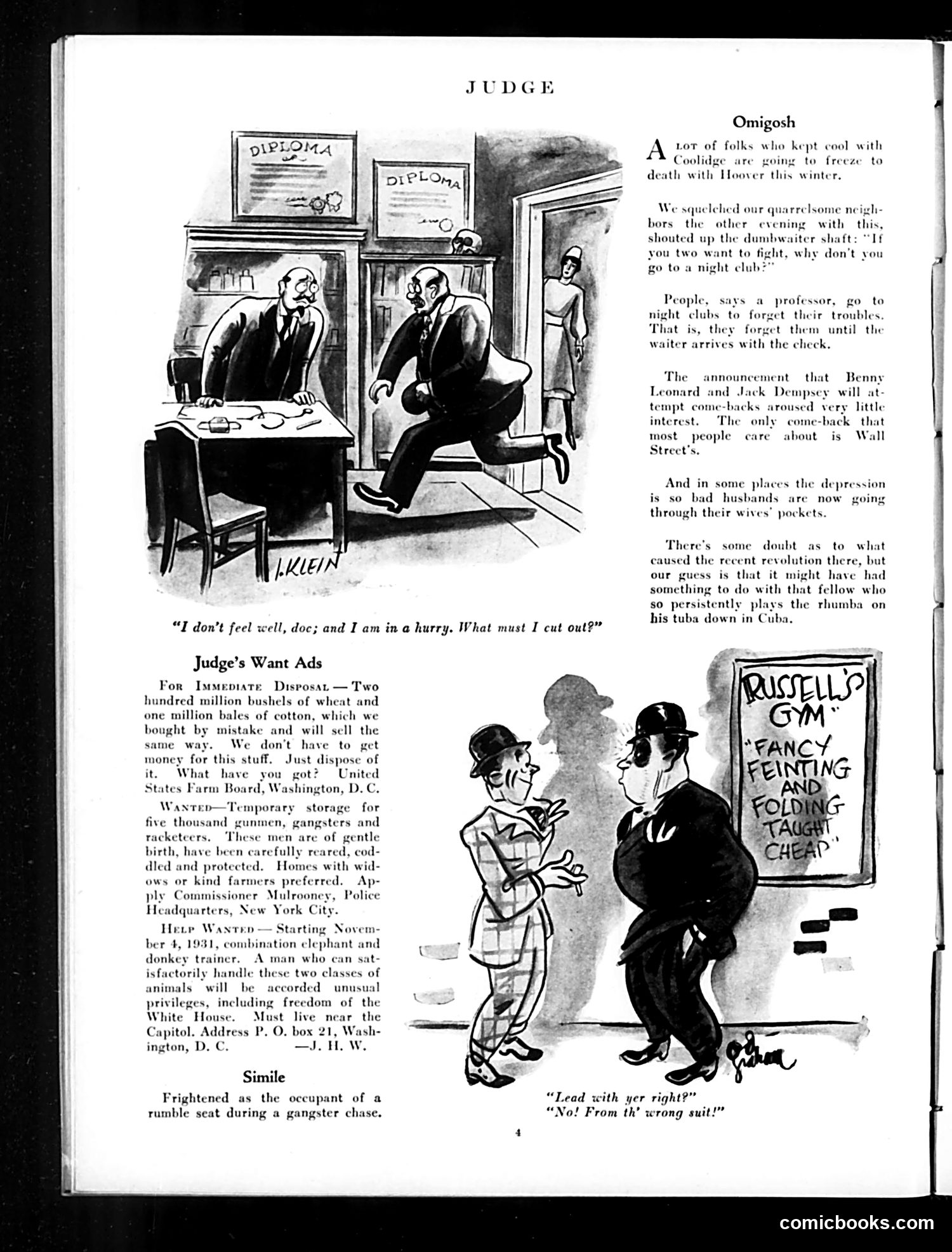
Analysis of Judge Magazine Page Top Cartoon: Two men in an office with diplomas on the wall debate cutting expenses. One says "I don't feel well, doe; and I am in a hurry. What must I cut out?" The joke satirizes how during economic hardship (likely the Depression era), even educated professionals look for ways to economize—the implication being he should cut something unnecessary, perhaps his own salary or position. Bottom Cartoon: Two men argue outside "Russell's Gym" advertising "Fancy Feinting and Footwork Taught Cheap." The dialogue "Lead with yer right!" / "No! From th' wrong suit!" appears to mock either boxing instruction or the gym's dubious teaching methods. Both cartoons use working-class vernacular and economic anxiety as their comedic framework.
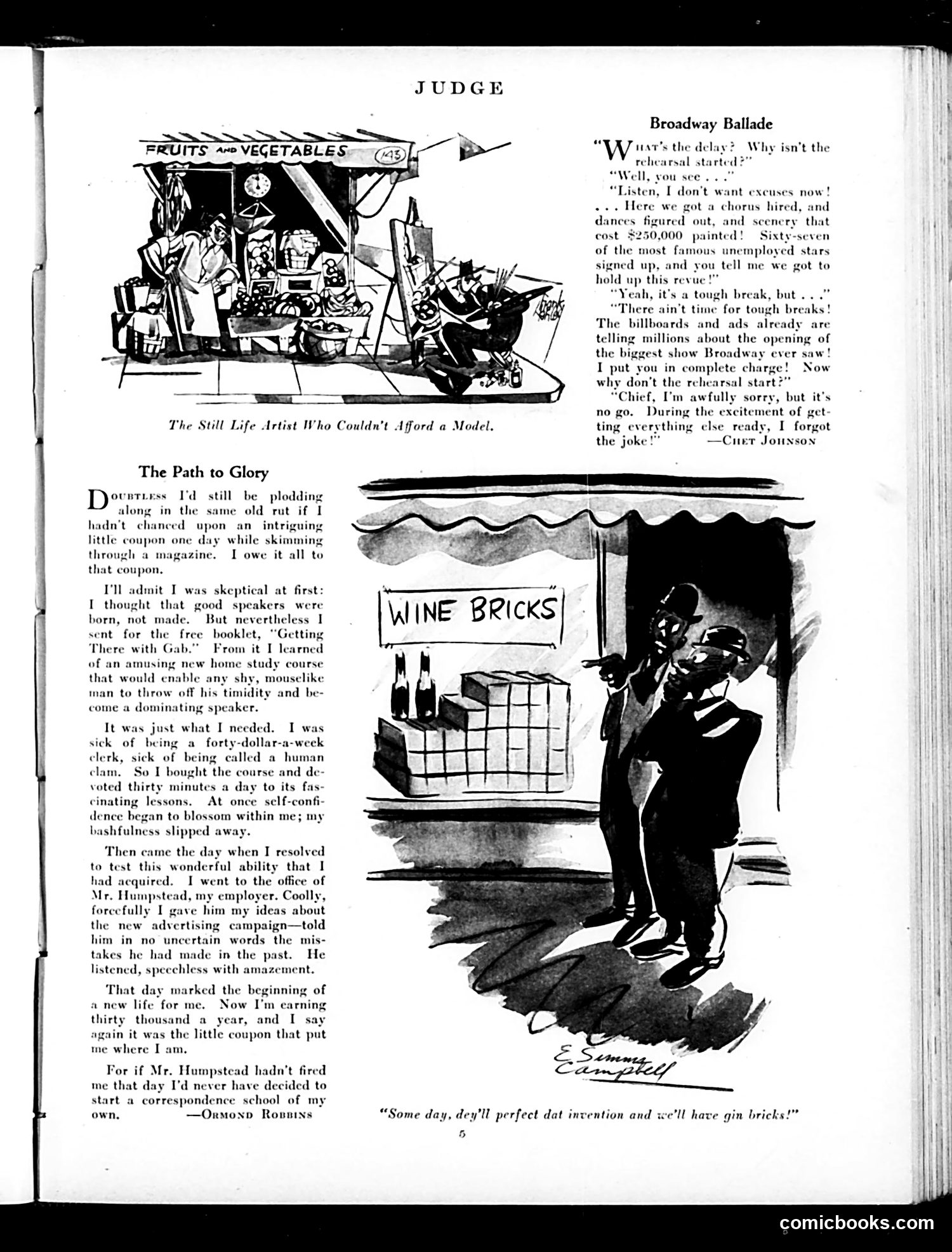
Analysis of Judge Magazine Page Top Cartoon ("The Still Life Artist Who Couldn't Afford a Model"): Satirizes struggling artists during economically difficult times (likely the Great Depression era). The chaotic fruit and vegetable stand scene mocks an artist forced to use cheap produce as still-life subjects instead of hiring human models—a commentary on poverty within the arts community. "The Path to Glory" Article: A personal essay about self-improvement through a mail-order public-speaking course, tracing the author's transformation from timid clerk to confident speaker after taking "Getting There with Gab." "Wine Bricks" Cartoon: References Prohibition-era prohibition enforcement. The illustration appears to mock a commercial product marketed to circumvent alcohol laws, showing two men examining wine bricks—a real product sold during Prohibition purportedly for "educational purposes."
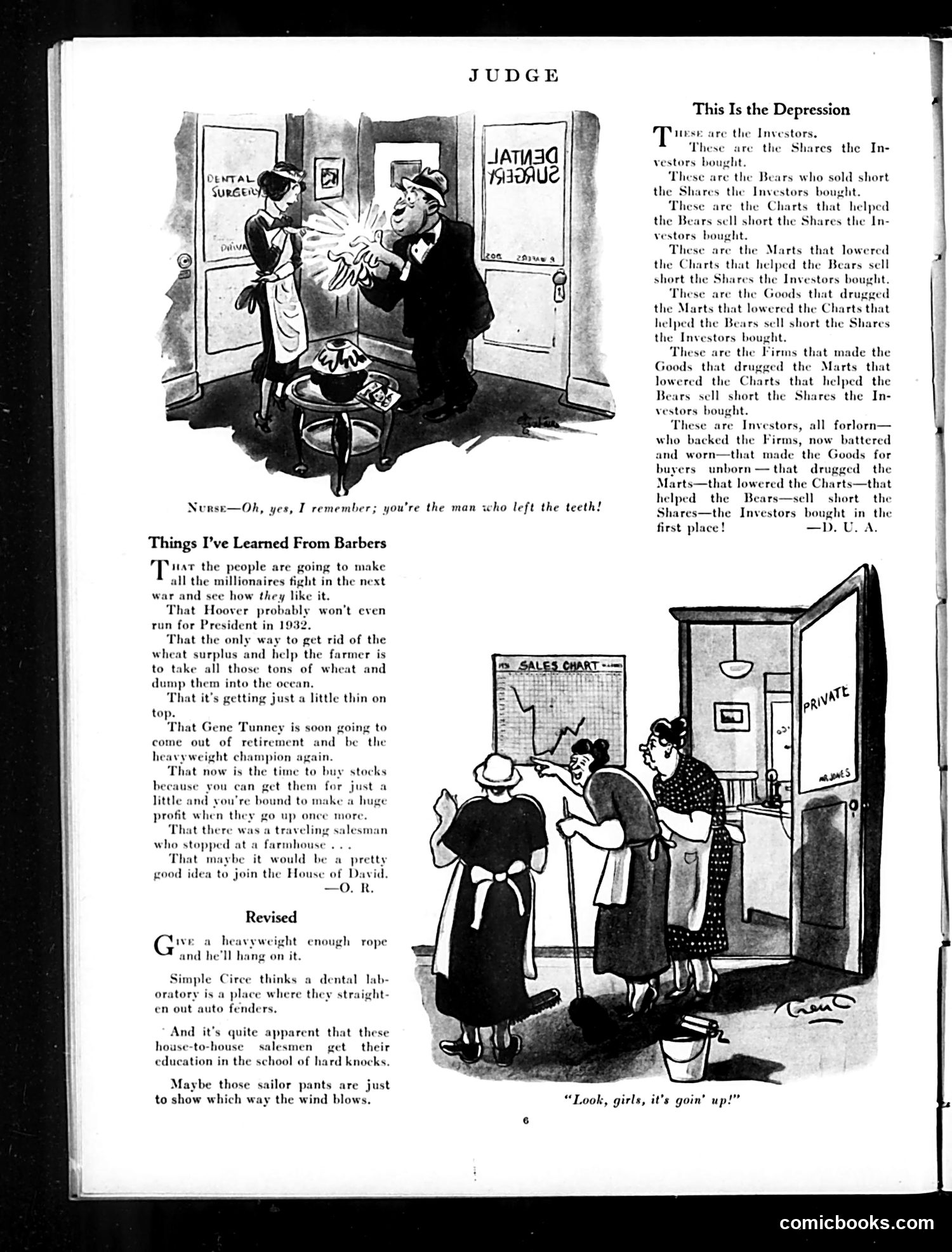
Analysis of Judge Magazine Page This page contains two satirical cartoons about the Great Depression era. Top cartoon: A dental surgeon operates on a patient while a nurse says "Oh, yes, I remember; you're the man who left the teeth!" This jokes about financial ruin—someone so impoverished they literally cannot afford dental work. Bottom cartoon: Two women peer into a "Private" office, saying "Look, girls, it's goin' up!" while viewing a sales chart. This satirizes stock market speculation and false optimism during economic crisis. Text section "This Is the Depression": Uses repetitive, tongue-in-cheek language to blame various financial actors—investors, bears, firms, and chart manipulators—for the economic collapse, suggesting systemic failures rather than individual responsibility. The overall message critiques both personal economic devastation and the financial establishment's role in causing the Depression.
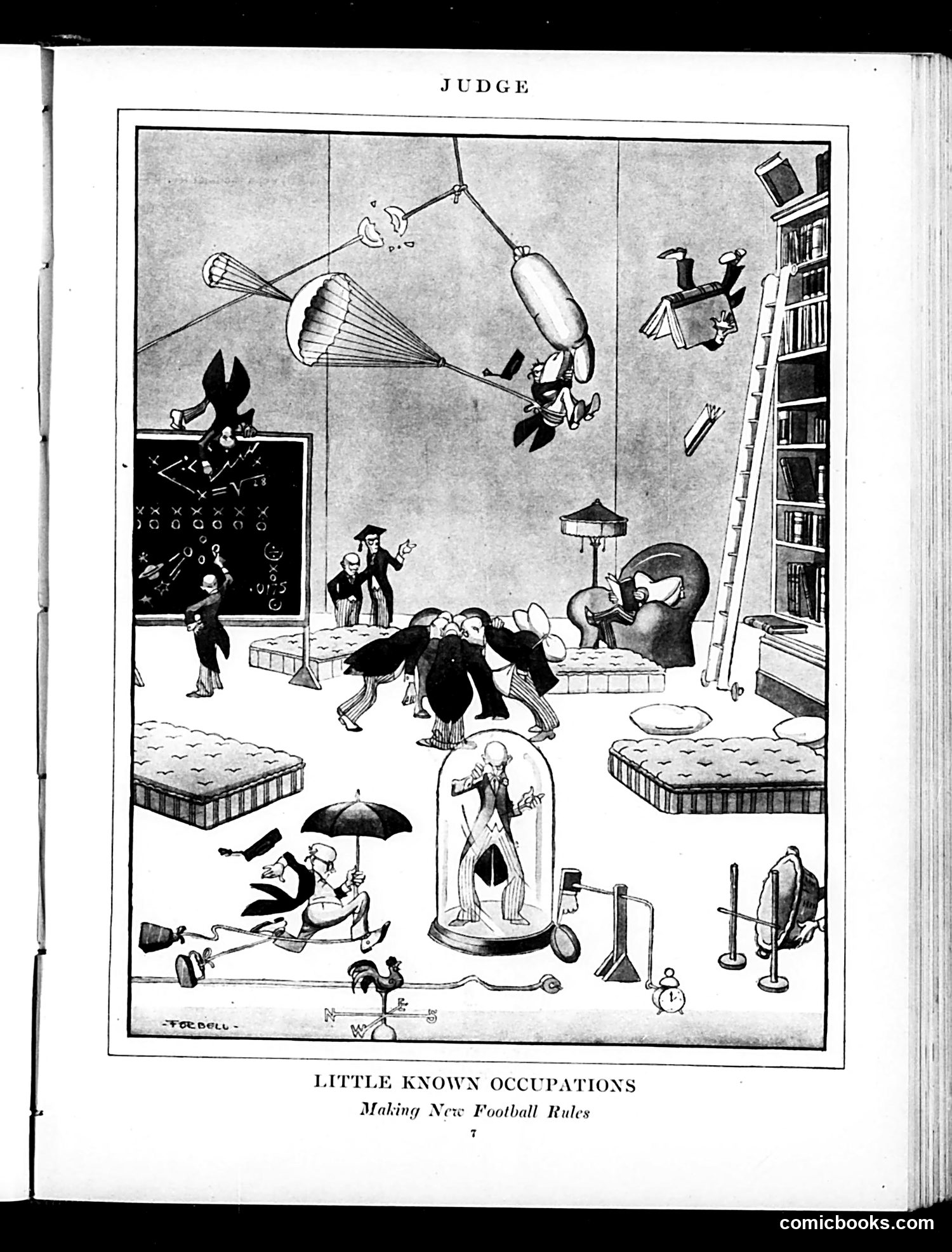
"Little Known Occupations: Making New Football Rules" This satirical cartoon mocks the absurdity of football rule-making by depicting it as chaotic pandemonium rather than serious governance. The scene shows various figures in a surreal laboratory-like space engaged in absurd activities: men suspended from impossible contraptions, others consulting a blackboard of equations, figures in jars, people tugging at each other, and scattered sporting equipment. The joke appears to be that football rule committees operate with no logic or order—more like a madhouse than a rational deliberative body. The elaborate, nonsensical machines and confused figures suggest that creating football rules is less about legitimate decision-making and more about arbitrary, incomprehensible bureaucratic chaos. This likely reflects early 20th-century frustrations with the complexity and frequent changes in American football regulations during its formative years.
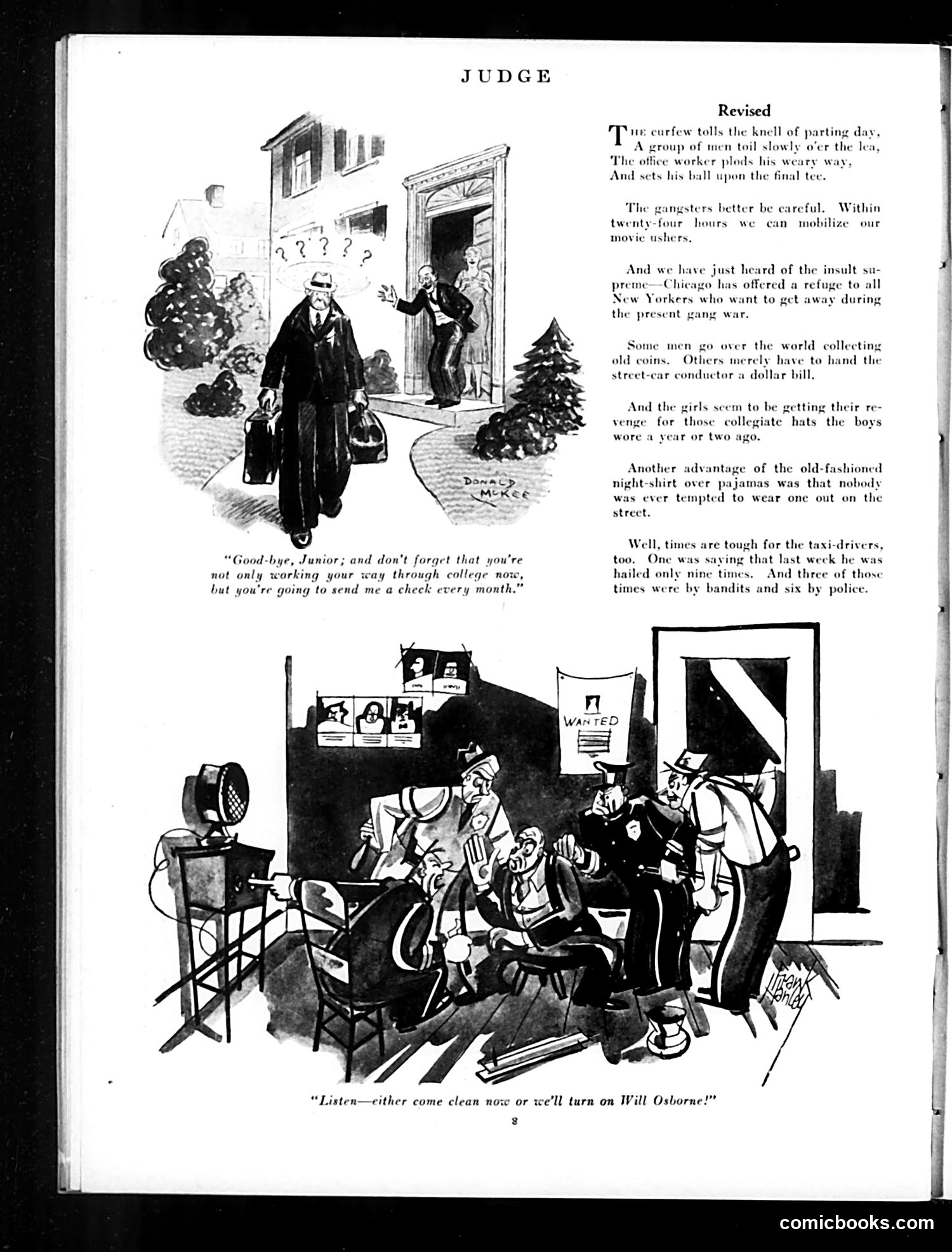
Judge Magazine Satire Analysis This page contains two cartoons satirizing 1920s American social conditions during Prohibition and the era of organized crime. Top cartoon: A father sends his son off to college, emphasizing that despite working his way through, the son must still send home monthly checks—satirizing economic hardship and parental expectations during what appears to be the post-WWI recession. Bottom cartoon: Gangsters threaten someone, invoking "Will Osborne" as a threat. The "WANTED" posters and police presence suggest this mocks the era's gang violence. The caption references Chicago offering refuge to New Yorkers fleeing gang wars, while other text jokes about taxi drivers being robbed by both bandits and police—satirizing the chaos and lawlessness of Prohibition-era organized crime and police corruption. The poem above provides commentary on modern life's anxieties: golf, gang violence, poverty, and changing fashion—all contemporary concerns of the 1920s reader.
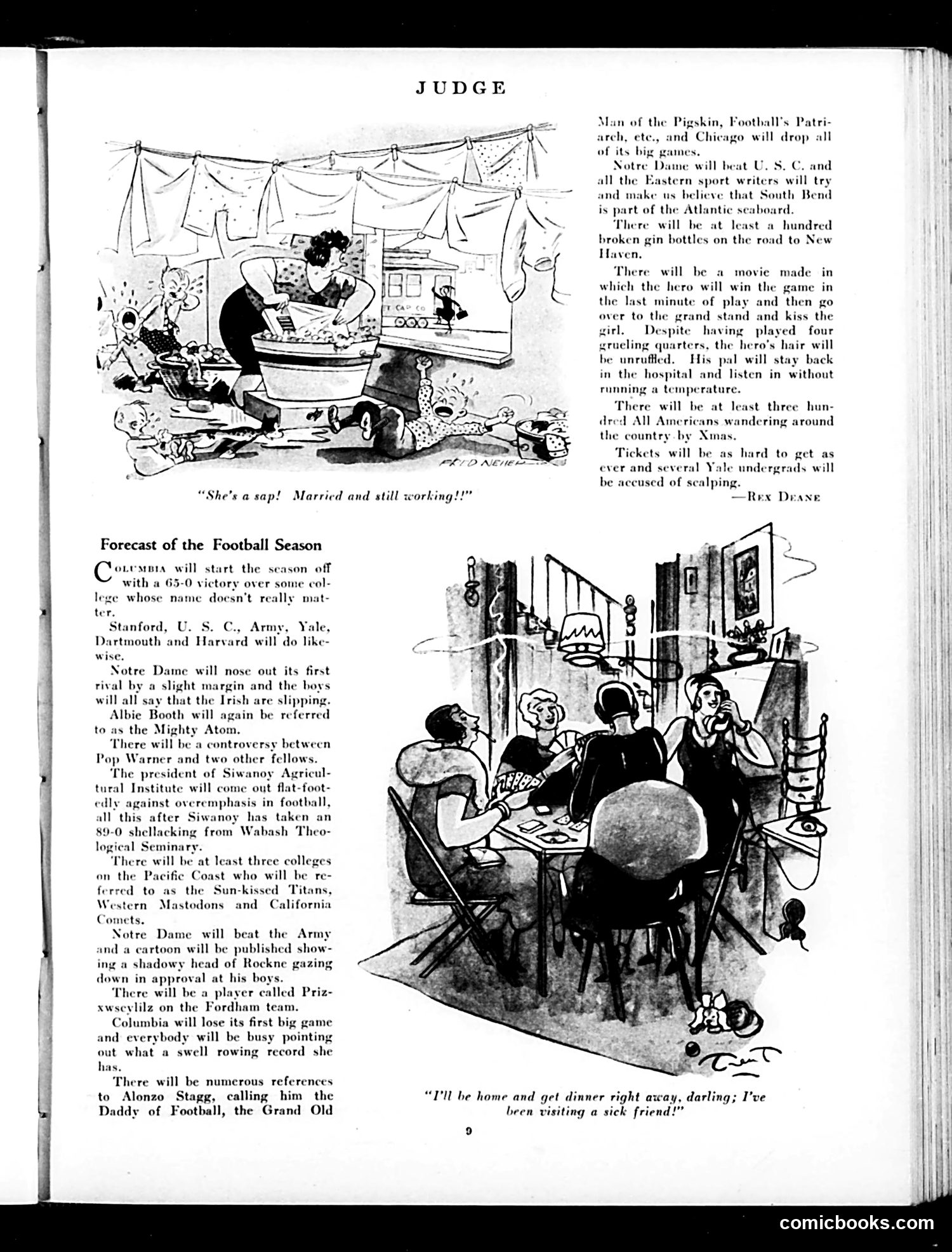
Judge Magazine Football Satire Analysis This page contains two satirical pieces about American college football culture circa the 1920s-30s. Top cartoon: A woman in domestic attire manages household chores while holding a football, captioned "She's a sap! Married and still working!!" This mocks the era's gender expectations—the joke being that a married woman should have quit her job, yet she's still active/involved (here represented by football interest). "Forecast of the Football Season": Rex Deane's column satirizes predictable football season tropes: dominant teams winning by enormous scores, Notre Dame's consistent strength, coach Rockne's prestige, Columbia's unrelated rowing success, references to "Daddy" Alonzo Stagg, Hollywood's inevitable football hero film, scalped Yale tickets, and the mass production of "All American" players. The satire skewers sports media clichés, institutional hypocrisy (colleges condemning "overemphasis" after lopsided wins), and cinema's formulaic sports narratives—all presenting football season as a predictable, manufactured spectacle rather than genuine competition.
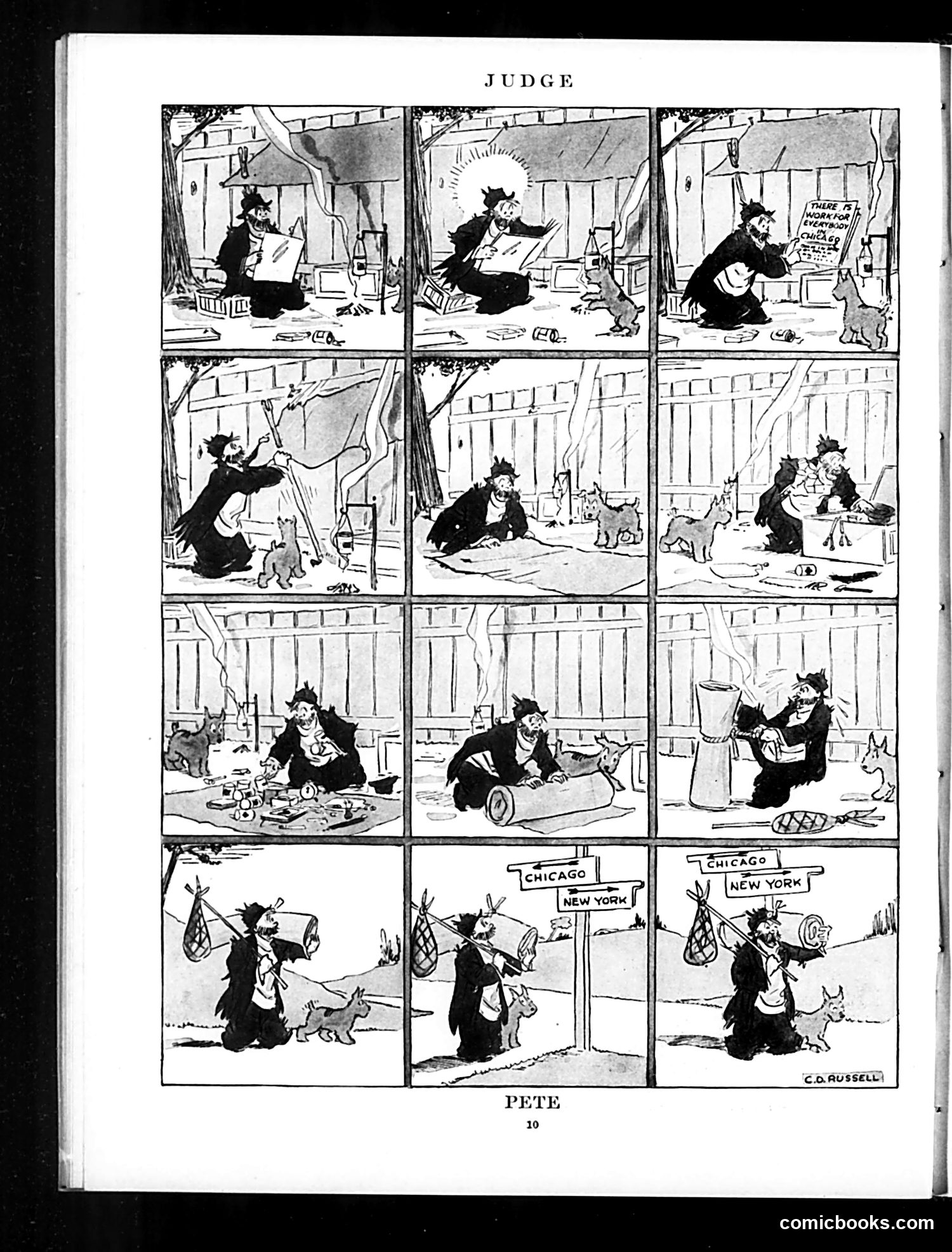
Judge Comic: "Pete" by C.D. Russell This is a sequential comic strip titled "Pete" showing a judge character working in his chambers with a small dog. The narrative follows the judge's deteriorating focus as he attempts legal work: he begins studying documents seriously, grows increasingly distracted by the dog's antics, and eventually abandons his judicial duties entirely to play with the pet. The final panels reveal the joke's punchline—the judge has apparently decided to relocate, packing up his belongings and traveling from Chicago to New York with the dog, suggesting he's abandoned his judicial position altogether. The satire likely critiques judicial negligence or corruption of the era, using the comedic device of a judge's complete dereliction of duty, reduced to an absurd extreme. The specific Judge character referenced remains unclear from the page alone.
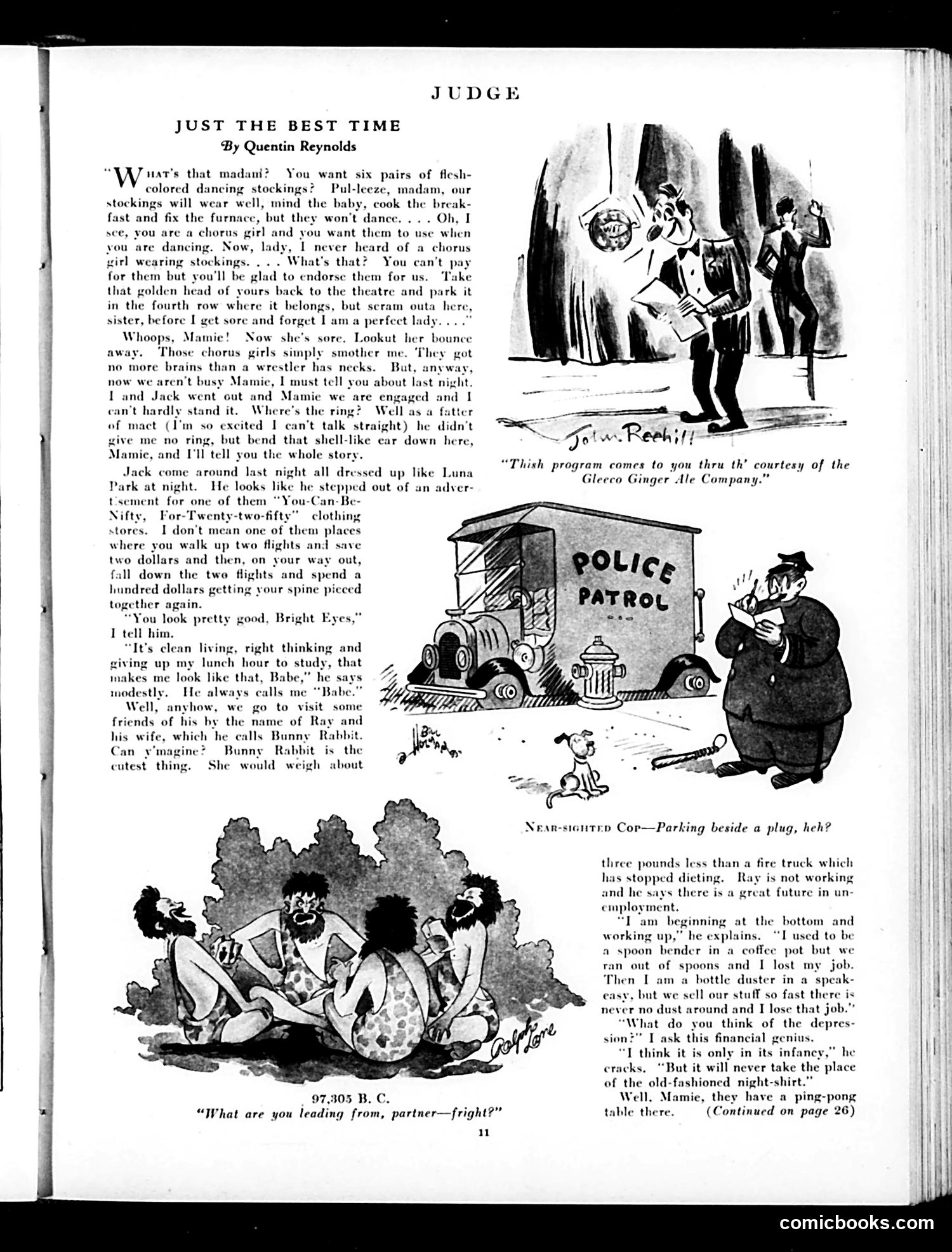
"Just the Best Time" - Judge Magazine Satire This is a humorous short story by Quentin Reynolds satirizing 1920s social attitudes and economic conditions. The narrative voice—a gossipy woman—describes encounters with a chorus girl (mocking her as brainless) and a man named Jack who's dressed expensively but unemployed, proud of "starting at the bottom." The satire targets: 1. Class pretension: Jack shops at cheap "You-Can-Be-Nifty" stores but dresses flashily 2. Economic absurdity: Ray braags about unemployment as a career path and invents ridiculous job histories (spoon-bender, bottle-duster) 3. Depression-era delusion: Characters dismiss the serious economic crisis as temporary or minor The accompanying cartoons—a police officer near a plug, and figures around a tree—appear to be unrelated Judge magazine humor. The overall piece mocks how people rationalized joblessness and financial struggle during this period, using exaggeration and the narrator's dismissive tone for satirical effect.
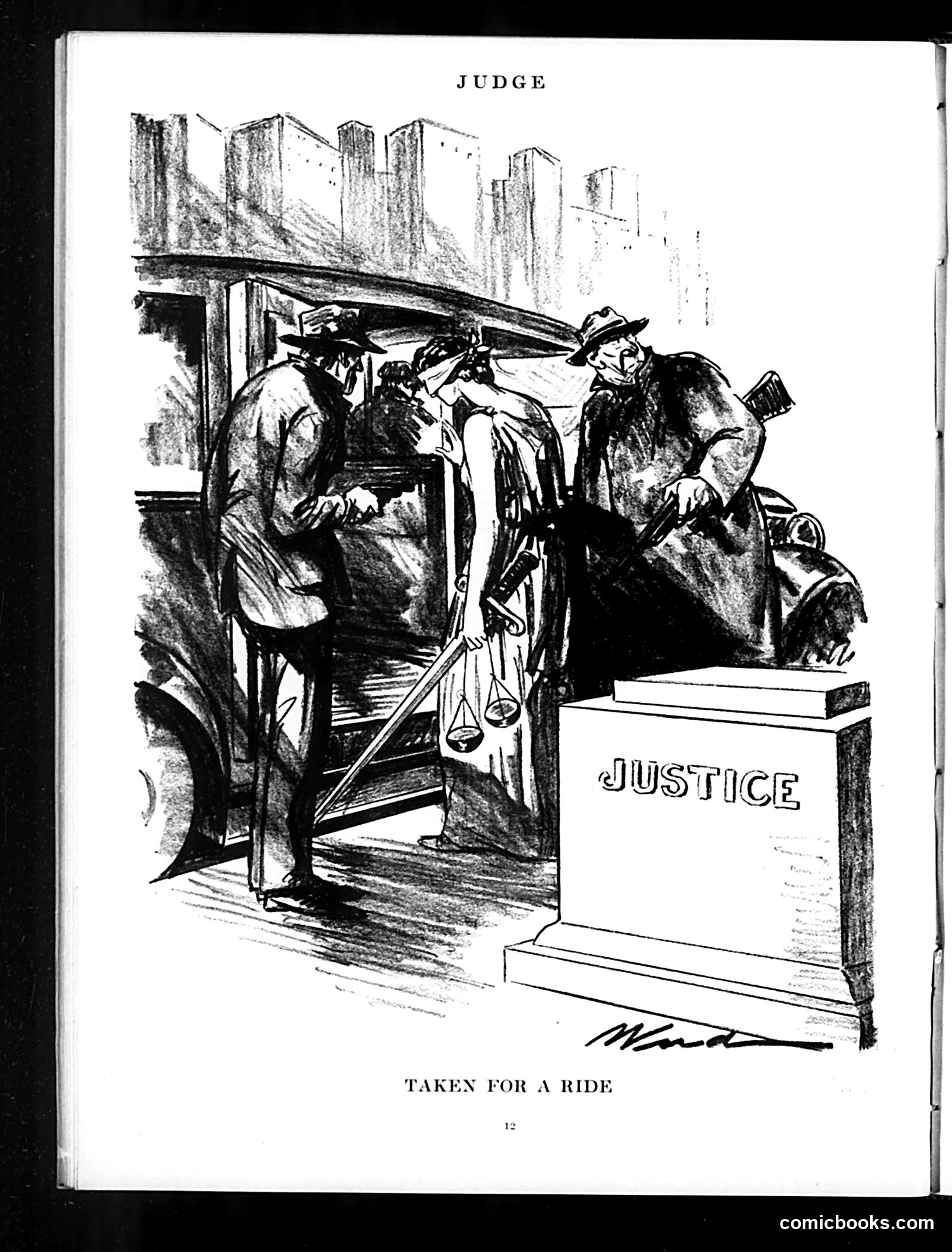
"Taken for a Ride" - Judge Magazine Cartoon This political cartoon depicts corruption in the justice system. Lady Justice (center, holding scales) is being forcibly removed by what appear to be corrupt officials or gangsters in a car or vehicle. The "Justice" pedestal sits abandoned on the right. The phrase "taken for a ride" was a period expression meaning to be murdered or eliminated—often by organized crime. The cartoon satirizes how justice is being literally abducted from the courtroom, suggesting that corrupt forces are removing or corrupting the judicial system itself. The heavy-handed figures, urban setting with tall buildings, and the violent removal of Justice symbolize systemic corruption undermining the legal process. This likely critiques mob influence, bribery, or political interference in courts during the Prohibition era or comparable period of widespread organized crime.
"Judge on the Bench" - Political Commentary Page This page contains two satirical opinion pieces on American politics and social issues, likely from the 1920s-1930s based on references and style. "The Stark Contrast" critiques wealth inequality, praising the Federal Council of Churches for denouncing vast fortunes coexisting with breadlines. It notes 10% of Americans own 64% of wealth while masses suffer "under-consumption." The piece challenges churches to abandon their historical alliance with the wealthy and demand economic justice—a radical position for religious institutions. "Dilemma of the Progressives" discusses confusion among progressive politicians about campaign strategy, referencing Norman Thomas (Socialist candidate) and John Dewey's League for Independent Political Action. The three proposed paths—third-party Congress focus, endorsing Thomas, or independent candidacy—are each criticized as weak, difficult, or hopeless given America's two-party electoral system. Both pieces use biting satire to mock institutional timidity while advocating systemic reform.
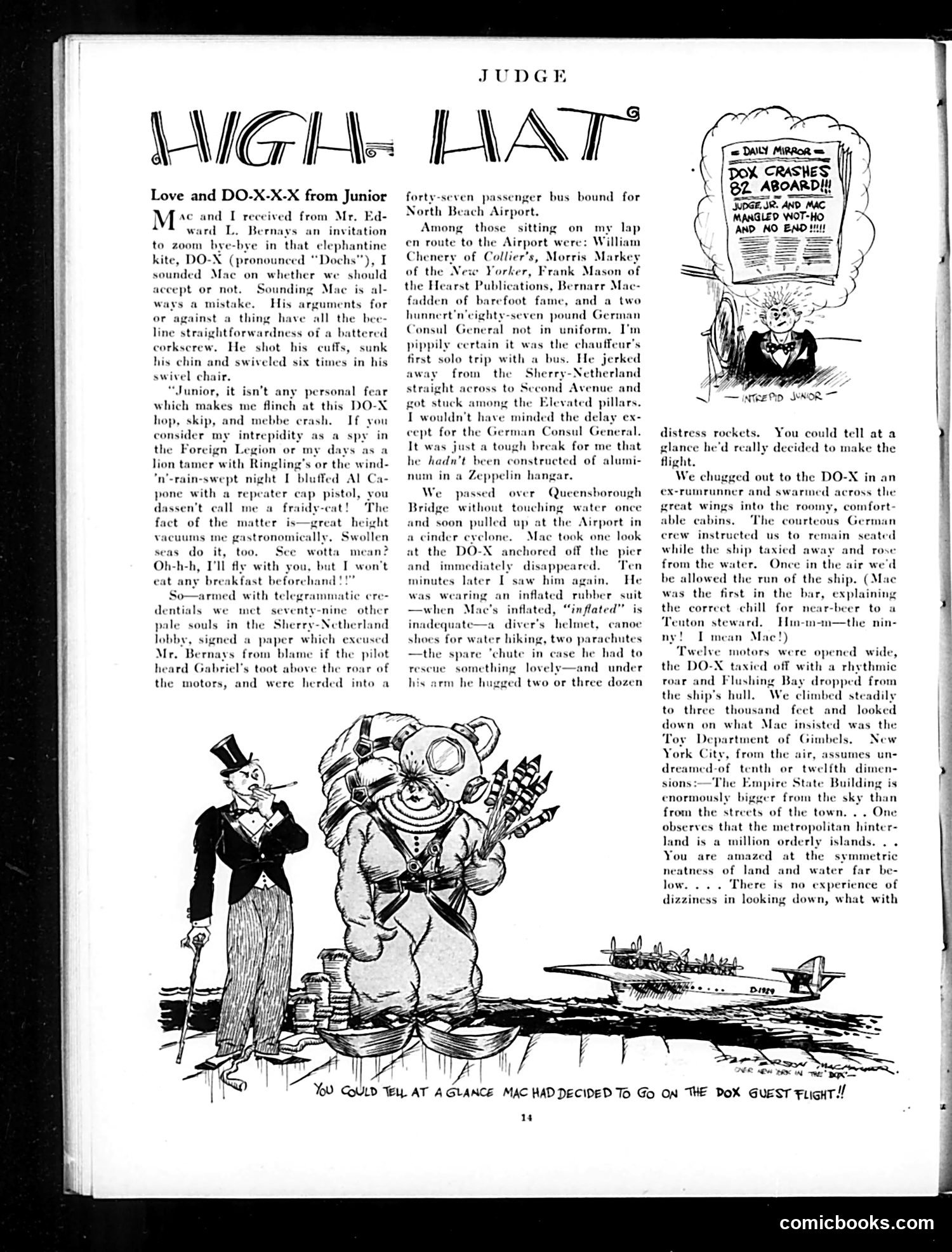
"High Hat" - Judge Magazine Satire This 1930s piece satirizes a joy flight aboard the DO-X, a famous German flying boat. The author (identified as "Junior" from Judge) and his colleague "Mac" accept an invitation from Edward Bernays (a prominent public relations pioneer) to fly this massive aircraft. The satire targets Mac's contradictory bravado: he boasts of fearlessness (comparing himself to a Foreign Legionnaire and lion tamer) while simultaneously claiming the altitude makes him nauseous—he won't eat breakfast beforehand. The humor lies in his obvious terror masked by bluster. The cartoon illustrates Mac's panic: fully equipped with diving suit, parachutes, and life-saving gear despite flying over land and water, he's absurdly over-prepared. The newspaper headline about "DOX CRASHES" adds ironic timing. The piece also gently mocks the era's fascination with technological marvels and the celebrity culture surrounding aviation—gathering journalists and socialites for a publicity stunt.
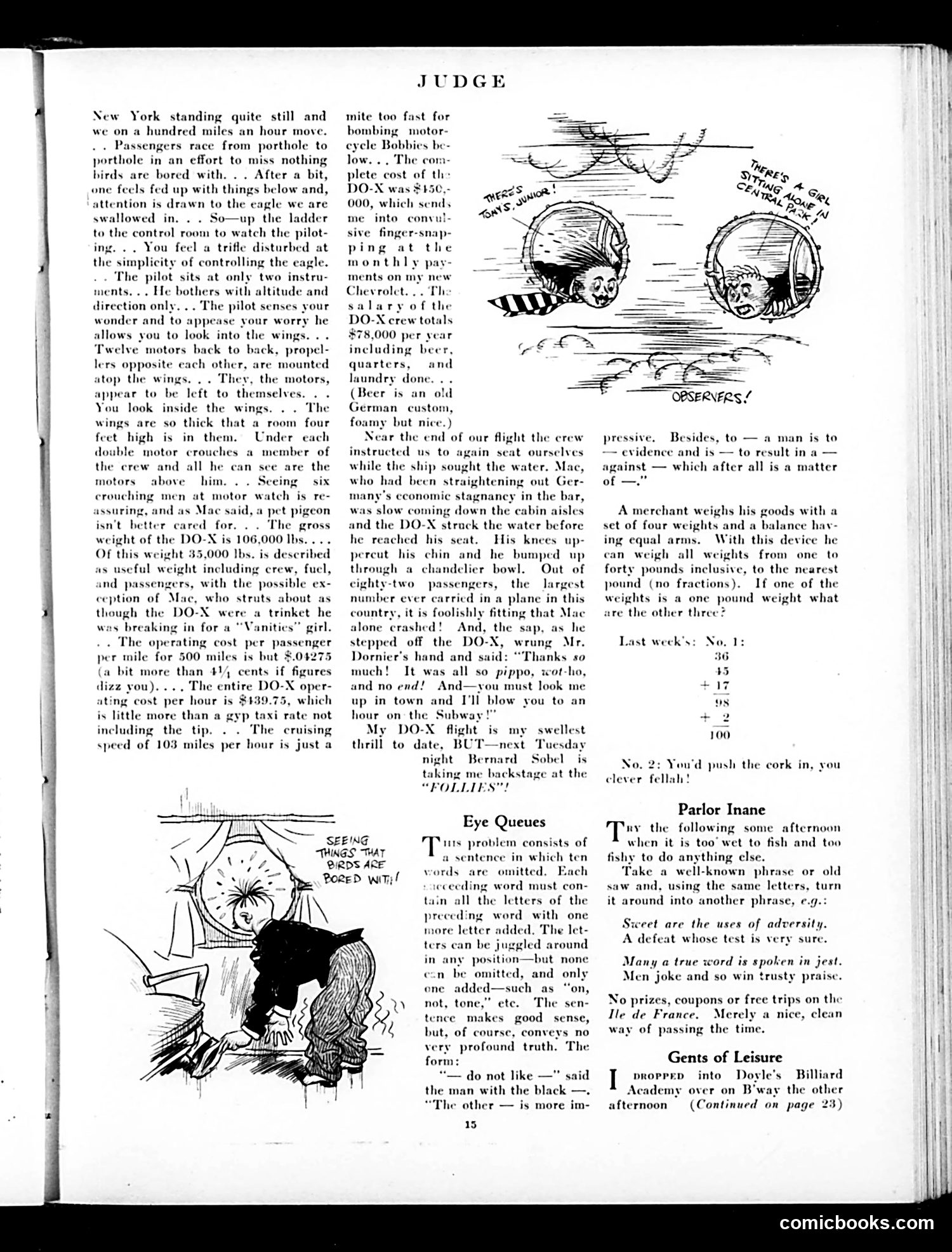
Explaining This Judge Magazine Page to Modern Readers This page showcases the DO-X, a real German luxury flying boat from the late 1920s that impressed contemporaries. The article describes a passenger flight with humorous observations: the massive aircraft (106,000 lbs) carries 12 motors requiring constant crew supervision, yet costs only about 4 cents per passenger-mile—cheaper than a Chevrolet. The satire mocks both the aircraft's engineering complexity and class pretension. One passenger, described as a pompous Englishman ("wot-ho"), survives a crash landing by pure accident, then praises the plane effusively—satirizing upper-class obliviousness. The joke's punch: his next thrill isn't aviation but attending a Broadway show's backstage. The cartoons illustrate passenger wonder at the plane's mechanics. The page also includes unrelated word puzzles ("Eye Queues" and "Parlor Inane"). The implicit satire: advanced German engineering is impressive, yet human folly remains unchanged.
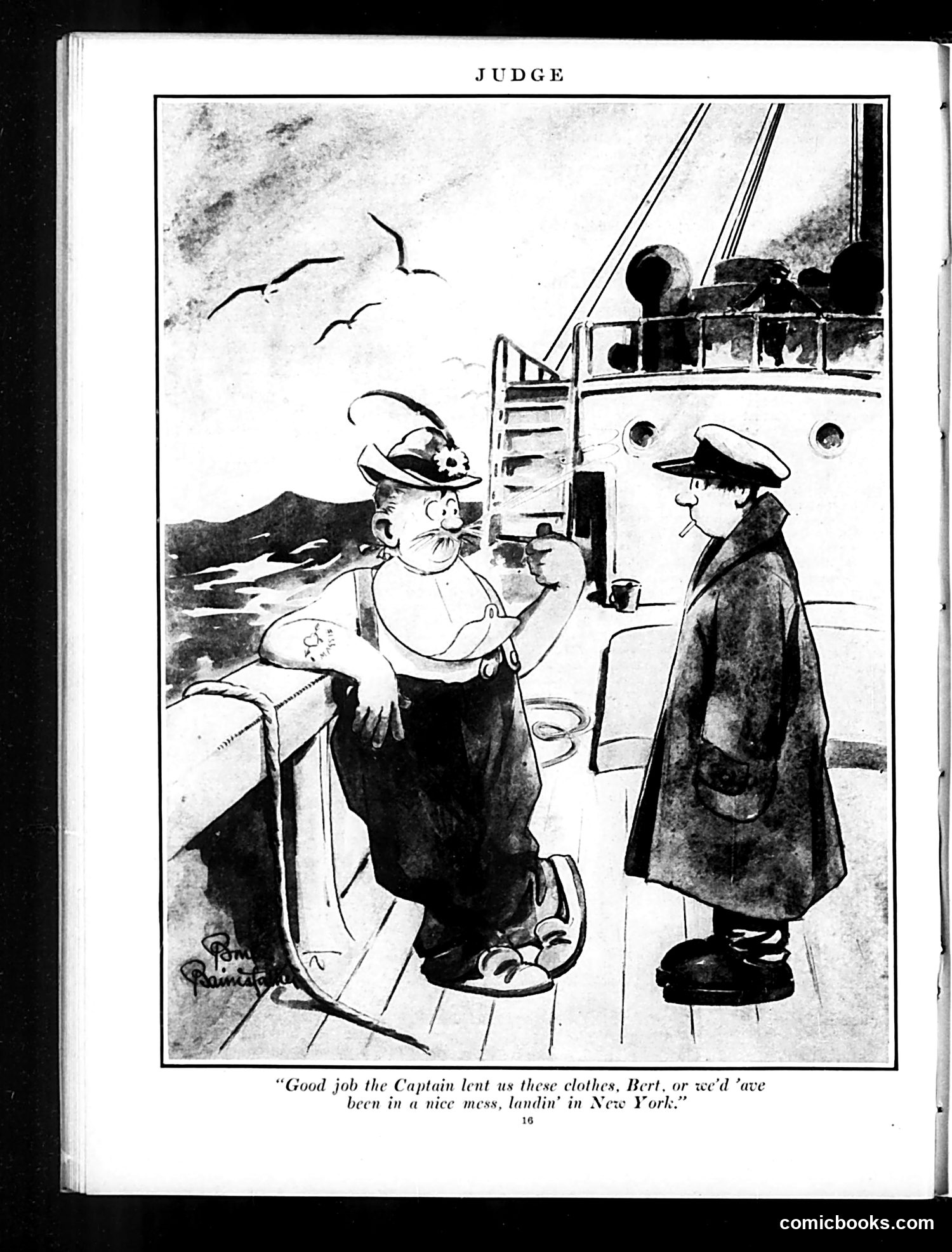
Judge Magazine Cartoon Analysis This cartoon depicts two working-class men on a ship's deck, dressed in borrowed clothes. The dialogue references borrowing garments from "the Captain" to avoid arriving in New York in poor condition. The satire likely targets immigration and class anxiety. The working-class accents ("'ave," "landin'") suggest these are British laborers or immigrants arriving in America. The joke appears to mock the notion that proper clothing could disguise one's working-class status upon arrival in New York—implying that appearances matter for making a good impression in a new country, yet borrowed finery wouldn't fool anyone about their true social standing. This reflects early 20th-century anxieties about immigration and social mobility in America.
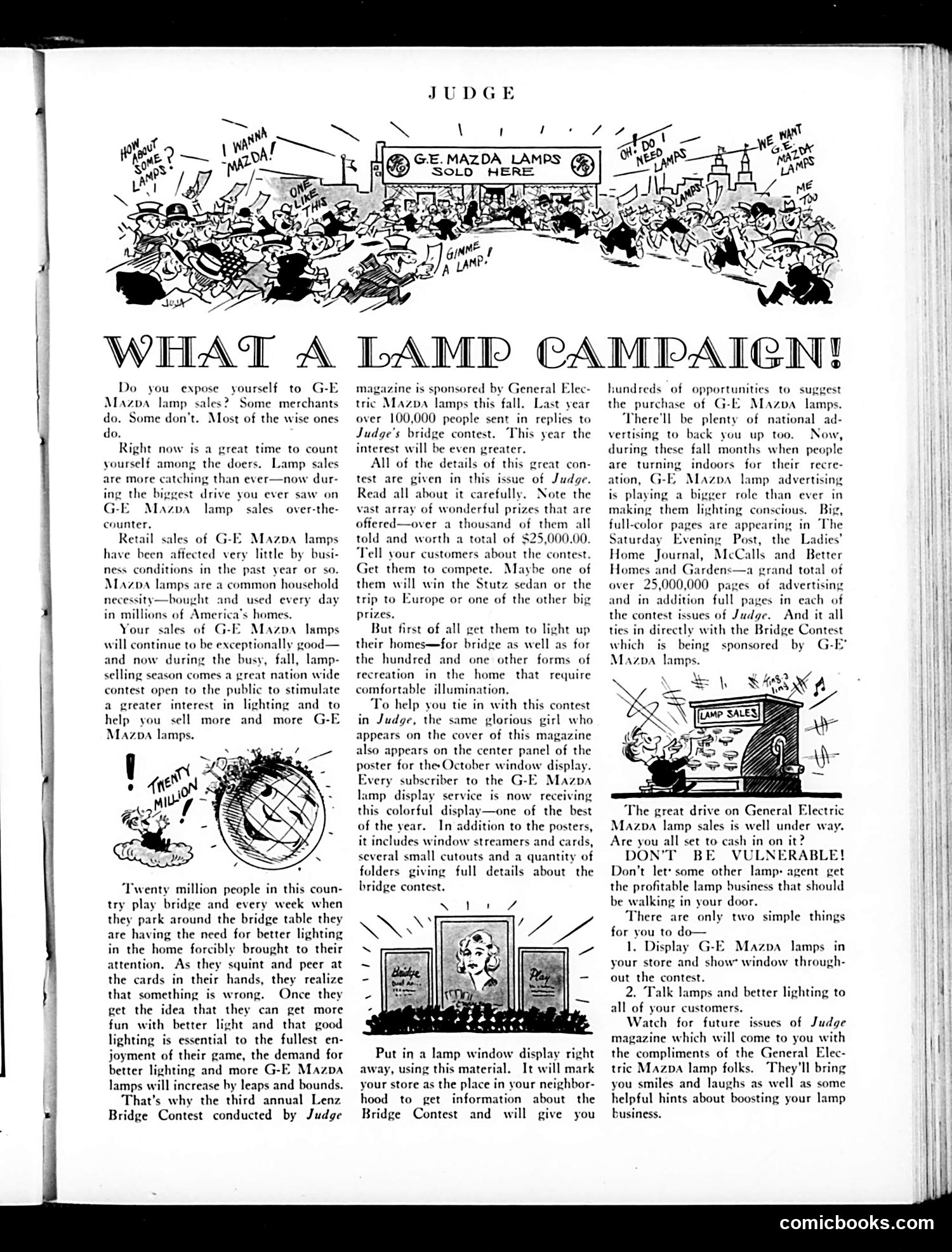
Analysis This page is primarily advertising content, not satire or political commentary. It's a promotional article for General Electric's Mazda lamp sales campaign, disguised as editorial content in *Judge* magazine. The cartoon at the top depicts a crowd of people around a storefront banner advertising "G.E. MAZDA LAMPS SOLD HERE"—illustrating the sales push the article promotes. The text describes a national "Bridge Contest" (appealing to the 20 million Americans who played bridge weekly) designed to drive lamp sales by associating better home lighting with improved card-game enjoyment. The campaign offers $25,000 in prizes and coordinated advertising across major publications. The smaller cartoon shows a store window display promoting lamp sales. This represents early 20th-century advertorial practice: corporations paid magazines like *Judge* to publish what appeared to be editorial content promoting commercial products. Modern readers would recognize this as native advertising or sponsored content—though the practice was largely undisclosed then.
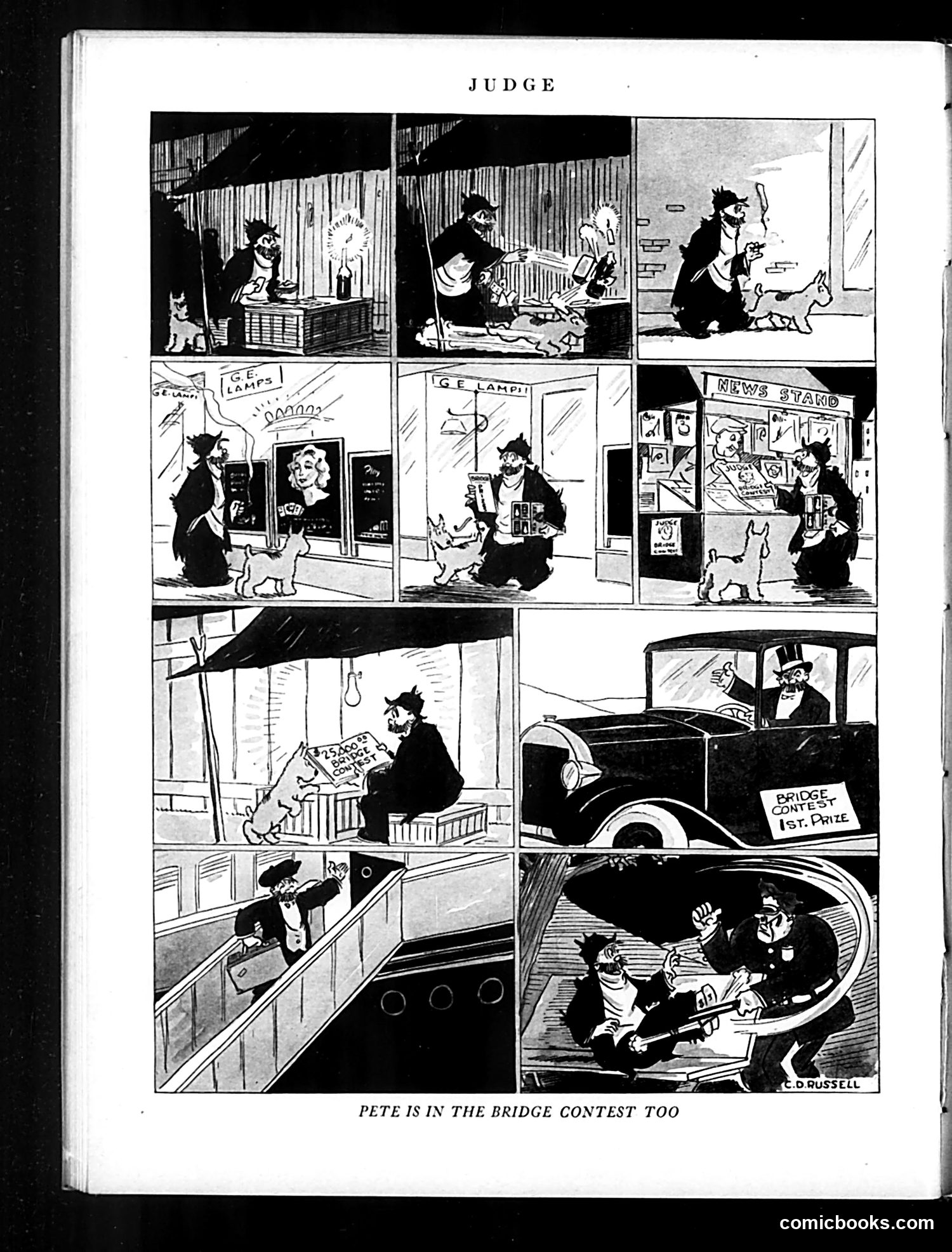
"Pete Is in the Bridge Contest Too" This comic strip from *Judge* magazine follows a small dog named Pete through a "bridge contest" scenario. The narrative shows Pete entering what appears to be a G.E. Lamps store, then progressing through various indoor and outdoor scenes involving a car marked "BRIDGE CONTEST 1ST PRIZE." The satire appears to target commercial advertising and consumerism of the era—specifically how product placement and brand contests infiltrate everyday life. The joke likely hinges on Pete the dog inadvertently participating in or winning a bridge tournament contest, with commercial products (G.E. Lamps, the automobile) prominently featured throughout. Without additional context about the specific historical moment or "Pete" character, the exact satirical target remains unclear, though it seems to mock how businesses exploited popular contests for marketing purposes.
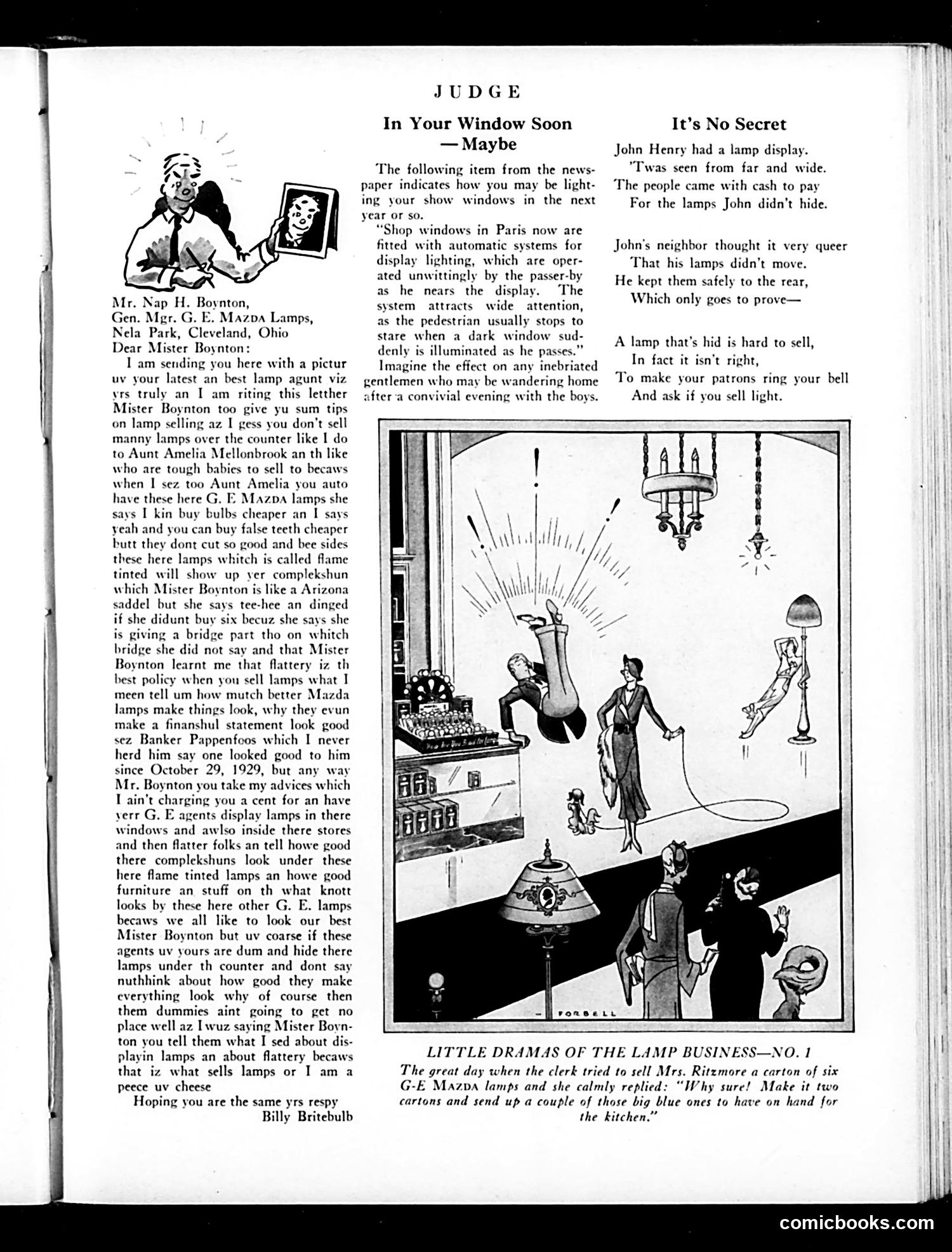
Analysis: Judge Magazine Lamp Advertisement Page This page combines advertising content for G.E. Mazda lamps with satirical commentary on sales techniques, presented as humorous letters and cartoons. The main pieces: 1. "Billy Britebulb's" letter uses deliberately misspelled, colloquial language to mock salesmen while actually promoting lamps. The humor lies in the crude writing style contrasting with business advice—Billy suggests flattery works ("tell um how mutch better Mazda lamps make things look"). 2. "In Your Window Soon" sarcastically comments on Parisian automatic window displays, joking that drunk men would be confused by lights activating as they pass. 3. "It's No Secret" is a poem arguing that *displaying* lamps (not hiding them) is essential to selling them. 4. The cartoon shows a successful lamp sale to wealthy "Mrs. Ritzmore," illustrating effective sales strategy through appealing window displays and customer engagement. The satire's point: During the Depression (note the 1929 reference), this magazine gently mocks outdated sales methods while ironically promoting modern display techniques—all wrapped in folksy humor to make advertising entertaining.
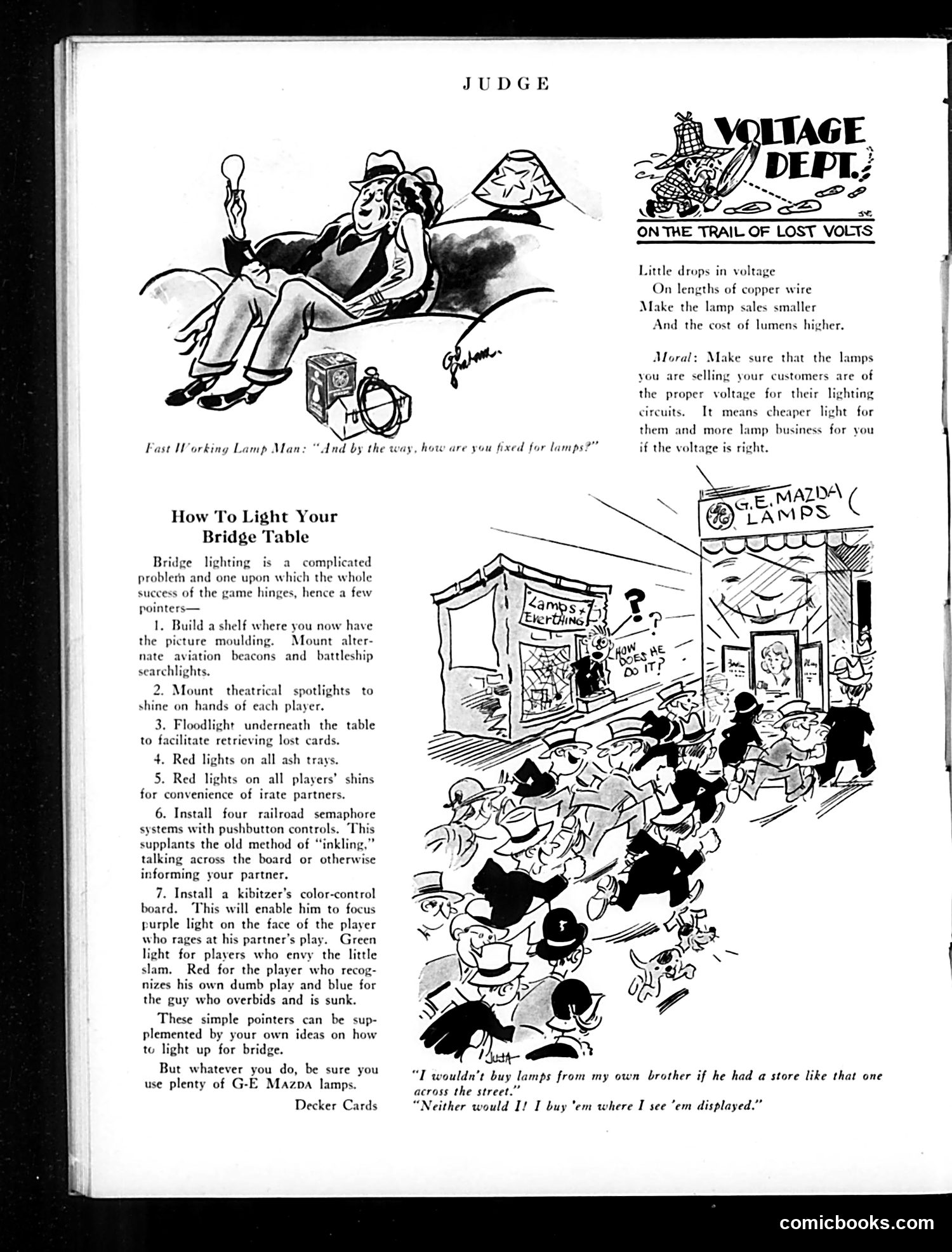
Judge Magazine Page Analysis This page contains two distinct pieces: "Voltage Dept." (top right): A brief advertisement disguised as consumer advice for G-E Mazda lamps. It warns that voltage drops waste money and reduce lamp sales, positioning proper voltage selection as beneficial to both customers and lamp sellers. The cartoon shows a frustrated "Fast Working Lamp Man" being questioned about voltage. "How To Light Your Bridge Table" (main content): A humorous instructional article satirizing the obsessive complexity Americans were bringing to the popular card game bridge during this era. The joke escalates from practical suggestions (theatrical spotlights on players' hands) to absurd ones (railroad semaphores for partner communication, colored lights to shame bad players). The accompanying cartoon ridicules a lamp store's poor display practices, with customers sarcastically rejecting even family members' products because they won't shop where lamps aren't properly showcased. Both pieces are essentially advertisements for G-E Mazda lamps disguised as humorous content, targeting 1920s-era middle-class bridge enthusiasts and retailers.
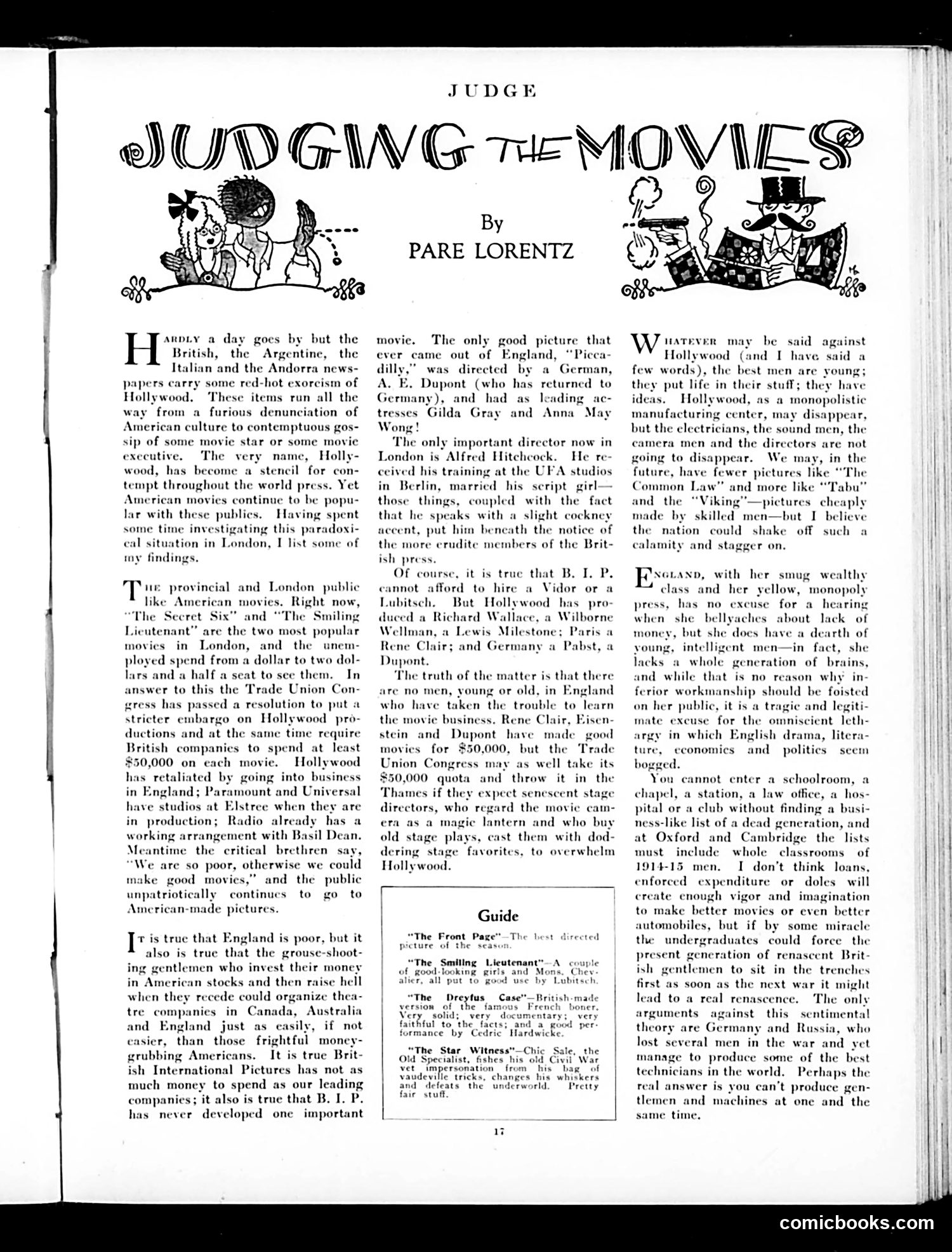
"Judging the Movies" by Pare Lorentz This article critiques British film industry complaints about Hollywood's dominance. Lorentz argues that while British and European papers routinely denounce American movies as culturally corrupting, British audiences continue watching them enthusiastically—paying substantial admission fees. The satire targets British hypocrisy: wealthy British investors happily fund American stocks and Canadian/Australian ventures while complaining about American film competition. Lorentz contends British studios fail not from lack of funding but from lack of talent and vision. He notes Alfred Hitchcock is London's only important director, yet is disrespected by the British press for his "slight cockney accent." The piece argues that German directors (Dupont, Pabst) and French ones (Clair) succeed by investing in talent, while British producers rely on aging stage actors and recycled theatrical material. The implication: British cultural snobbery masks industrial incompetence.
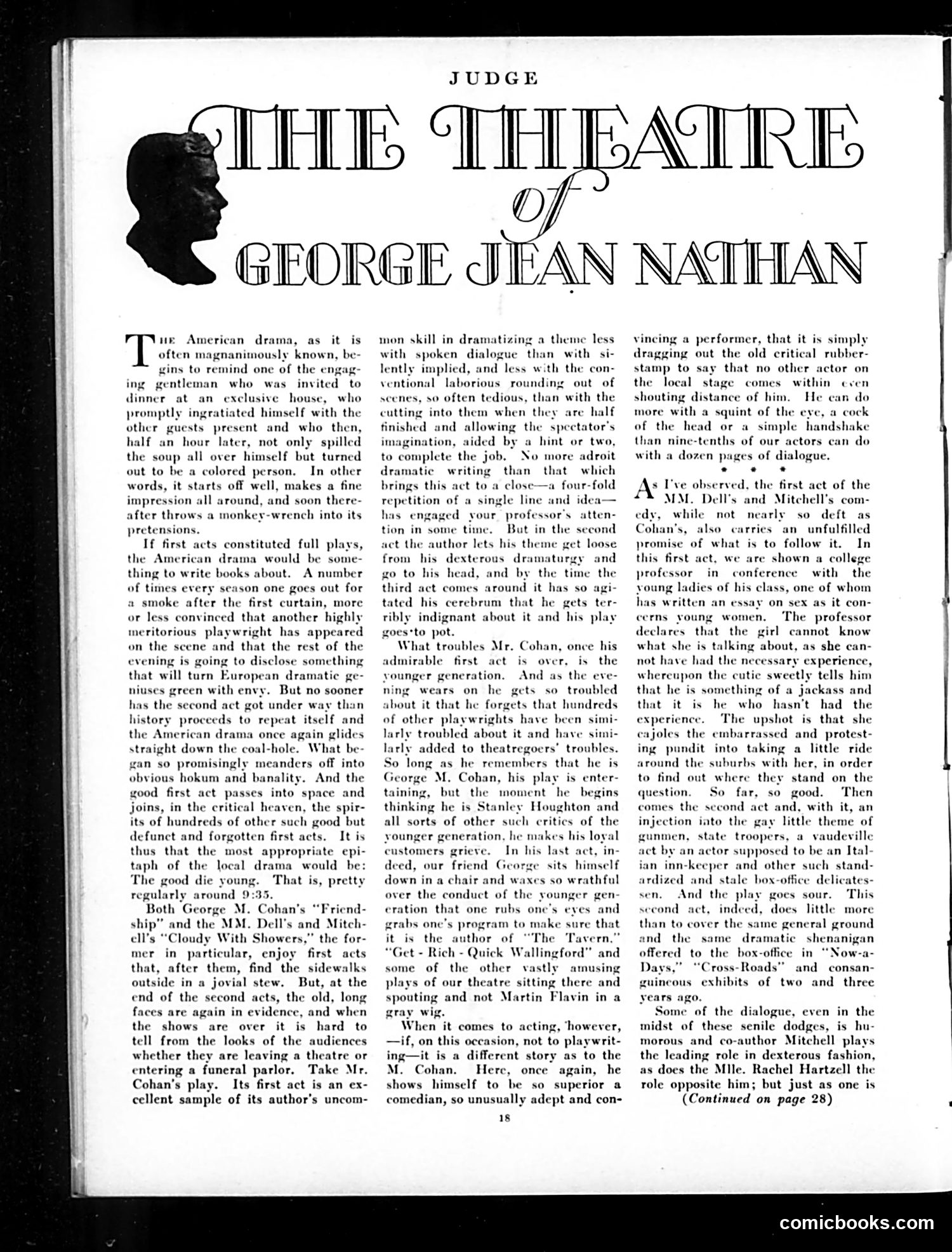
"The Theatre of George Jean Nathan" This is a theater review/critique by Judge magazine's drama critic, not a political cartoon. The piece satirizes American drama's structural weakness: strong first acts that promise excellence, followed by disappointing second and third acts that collapse into hokum. The critic uses George M. Cohan's recent play as his primary example. Cohan excels at the first act—using implied action and sparse dialogue rather than laborious exposition. However, the review argues, once Cohan moves past act one, he loses control of his theme and becomes self-indulgent, particularly regarding his obsession with criticizing "the younger generation." The satire mocks not Cohan personally but the pattern: American playwrights consistently deliver promising openings, then squander them with overwrought moralizing and conventional plotting. The funeral parlor comparison captures the audience's disappointed exit—they leave as if attending a death rather than celebrating theatrical success.
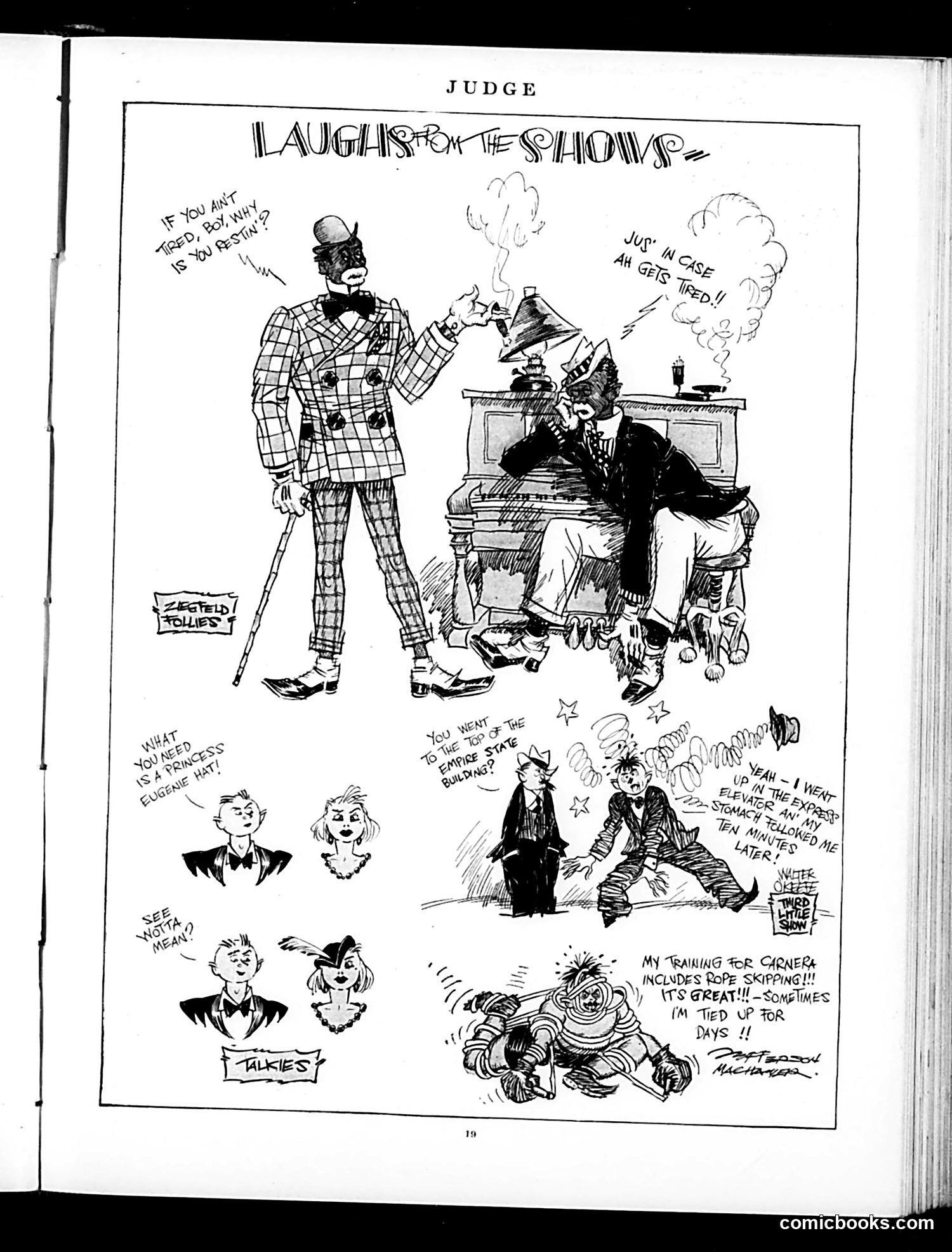
Analysis of "Laughs for the Shows" This Judge magazine page satirizes early 20th-century vaudeville and theater performers. The central figure is a clown or entertainer in an outlandish checkered suit demonstrating his act to two seated figures (likely producers or theater managers). The dialogue mocks theatrical training methods and performance anxieties—someone asks if the performer is "tired, bored, or rustin'," while another warns about getting tired during shows. The bottom panels show "Talkies" (early talking pictures), reflecting the contemporary entertainment industry shift from silent to sound films. The rope-skipping training reference humorously suggests physical comedy preparation methods used by vaudeville performers. Overall, the cartoon satirizes the competitive, sometimes absurd aspects of show business and the various entertainment formats competing during the silent-to-talkie transition period.
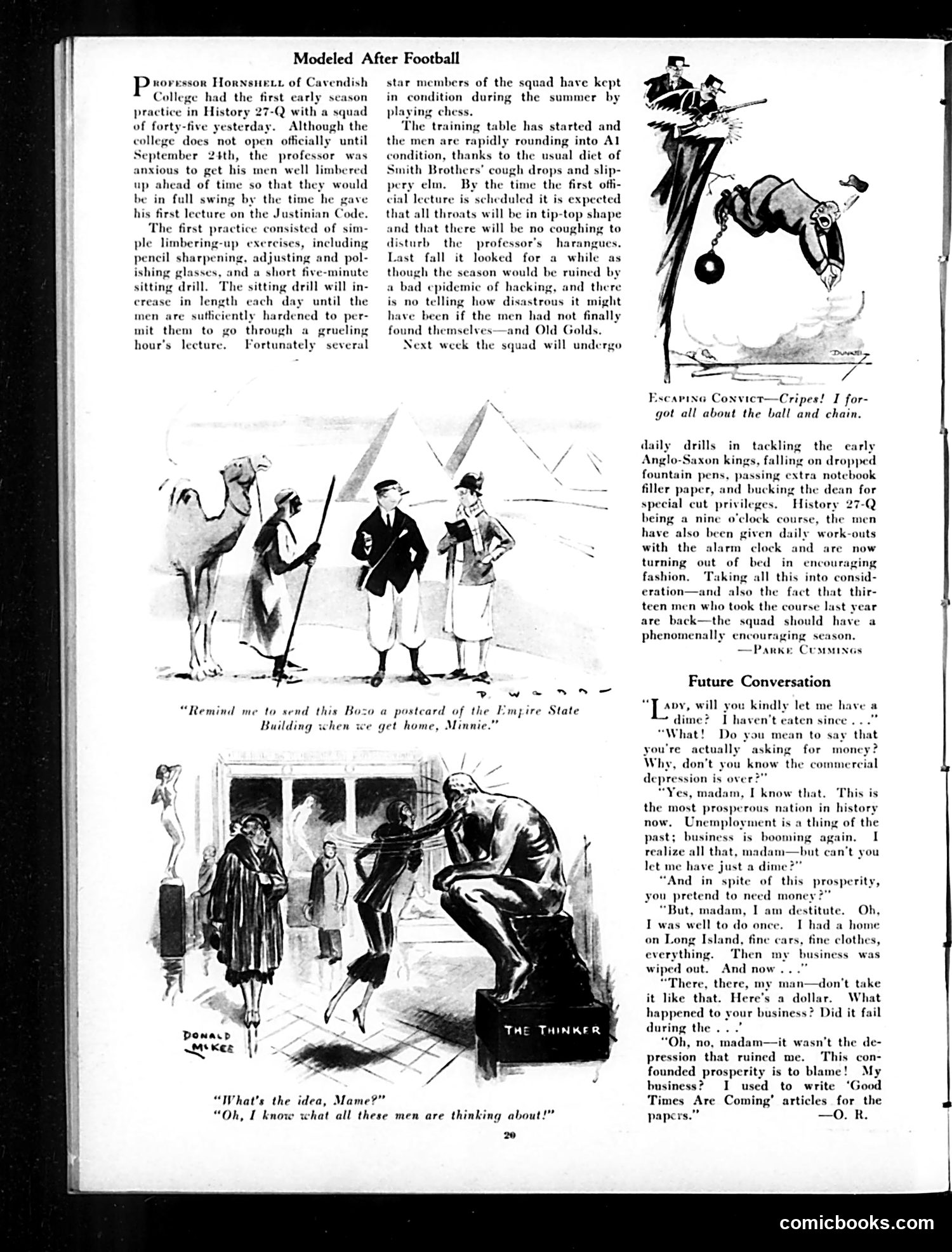
Analysis for Modern Readers "Modeled After Football" satirizes academic rigor by comparing a History professor's course preparation to athletic training. The joke: Professor Hornshell treats his lecture class like a football team, with "limbering exercises" including pencil-sharpening and a "sitting drill" to condition students to endure his grueling lectures. The text mockingly references cough drops and "Old Golds" (cigarettes) as student nutrition, and jokes about preventing epidemic "hacking" (coughing) during lectures—suggesting his lectures are so punishing they'd cause illness. The cartoons depict tourists/travelers and an escapee ("Escaped Convict—Cripes! I forgot all about the ball and chain"). "Future Conversation" satirizes the era's economic contradictions: despite prosperity claims, a destitute man begs for money. The punchline: he became poor writing optimistic "Good Times Are Coming" newspaper articles—his job became obsolete once prosperity allegedly arrived. It's social commentary on Depression-era economic anxiety masked by official cheerfulness.
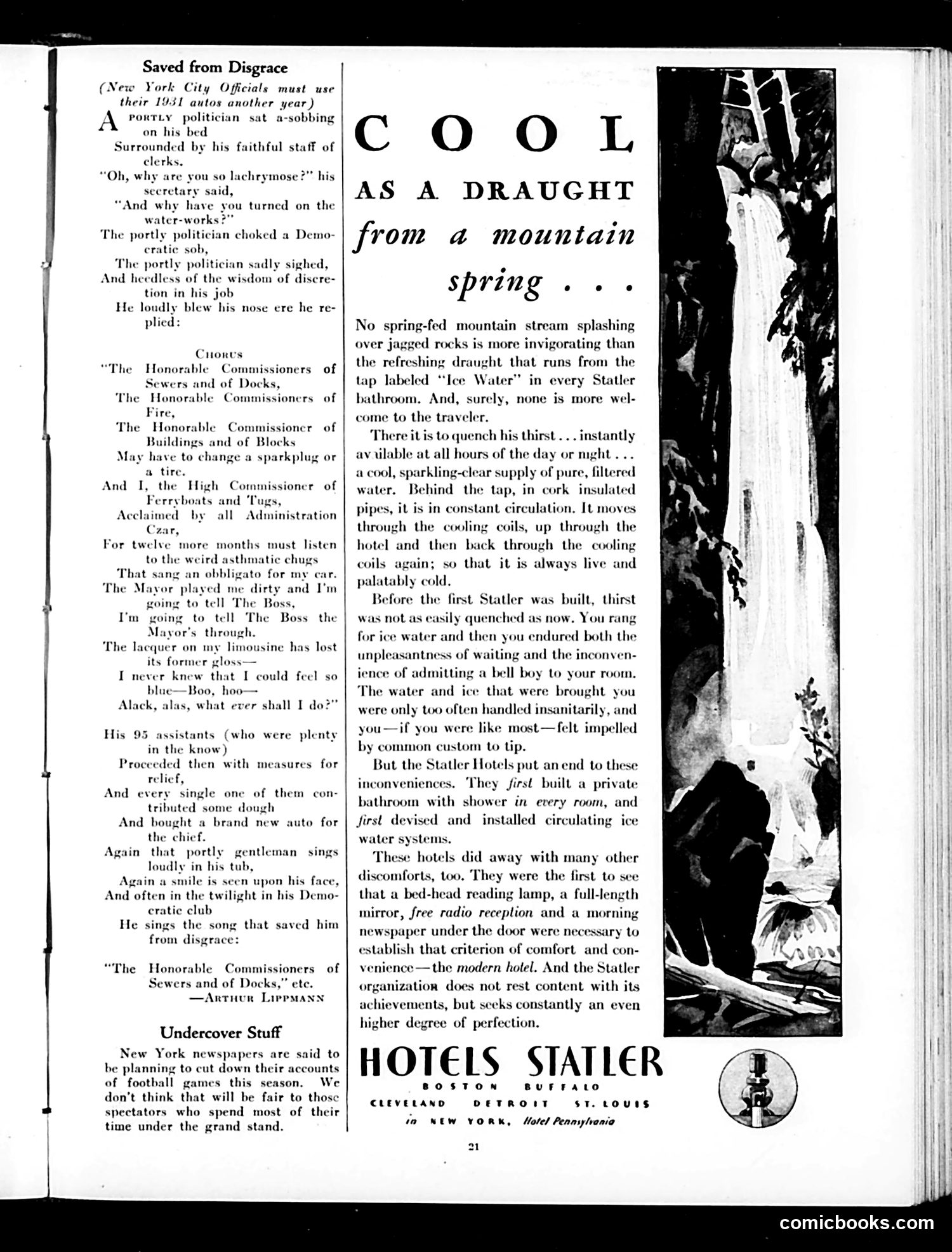
"Saved from Disgrace" - Political Satire on NYC Officials' 1931 Auto Restrictions This cartoon mocks New York City officials forced by budget constraints to keep using their 1931 automobiles rather than purchase new ones. A portly, weeping politician—depicted as a stereotypical corrupt bureaucrat—laments to his staff that he must endure his limousine's declining condition: the lacquer is losing its gloss, and various commissioners must "change a sparkplug or a tire." The satire ridicules both the officials' entitlement and their theatrical self-pity over minor inconveniences. His 95 assistants solve the crisis by pooling money to buy him a new car anyway—mocking the casual corruption and financial impropriety endemic to Tammany Hall-style machine politics. The accompanying "Undercover Stuff" joke about football spectators hiding "under the grand stand" is a separate, unrelated gag about illicit activity at games.
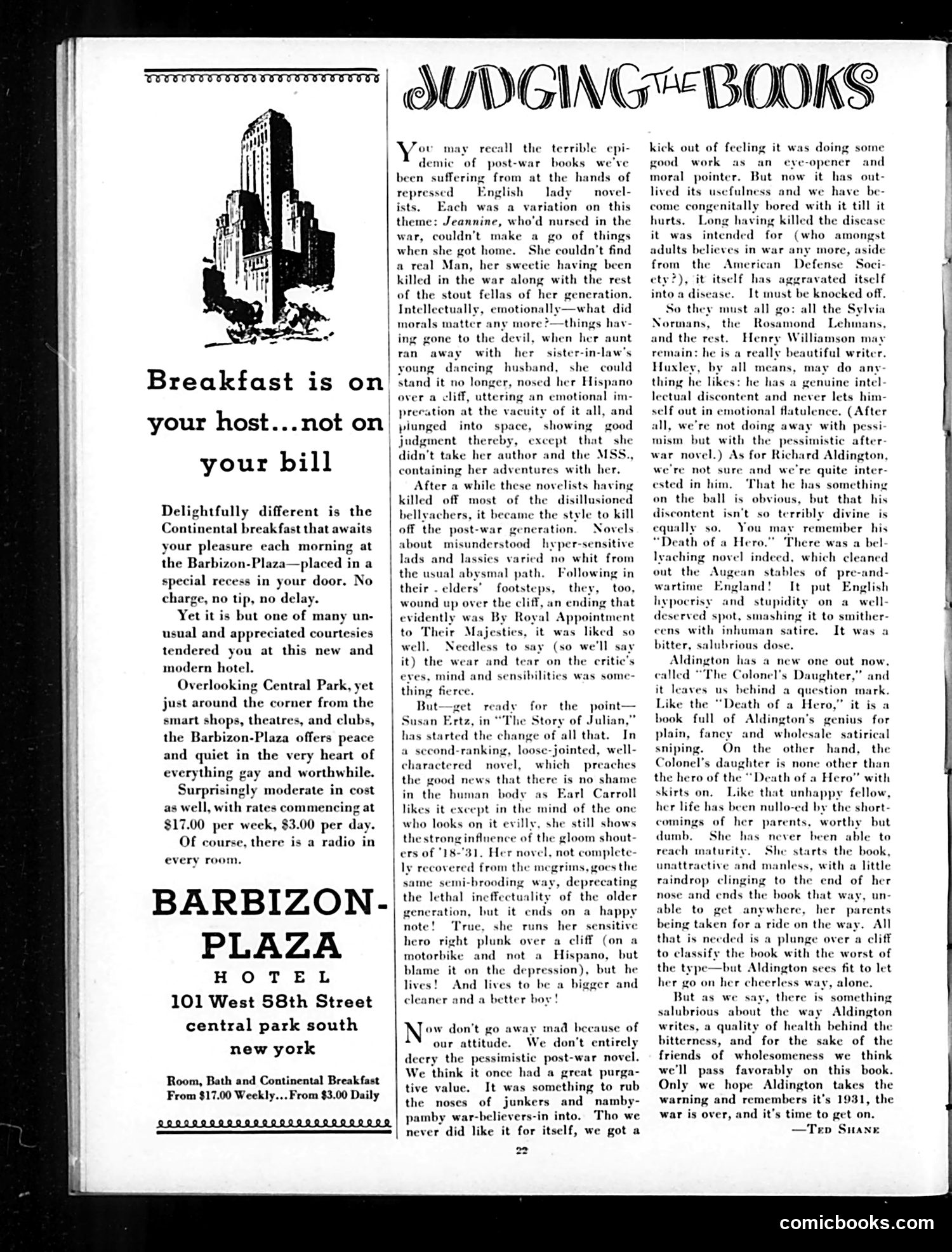
Analysis of "Judging the Books" Column This page is primarily an advertisement for the Barbizon-Plaza Hotel (left side) and a book review column (right side). There is no political cartoon visible. The book review critiques post-WWI literature trends. The author discusses how 1920s-30s British novels—featuring traumatized characters like "Jeannine," a nurse unable to adjust after the war—became formulaic: sensitive protagonists would inevitably drive off cliffs in despair. The reviewer acknowledges these books initially served a purpose as "moral pointer[s]" exposing war's futility to a gullible public. However, by the time of writing (appears to be early 1930s), the reviewer argues this pessimistic genre has outlived its usefulness. The war is over; adults no longer need convincing that war is destructive. Susan Ertz's novel "The Story of Julian" is praised for breaking the pattern—her protagonist still drives a motorcycle off a cliff but *survives*, offering hope rather than despair. The satire targets the tired repetitiveness of disillusionment literature and suggests audiences are ready to move past post-war gloom.
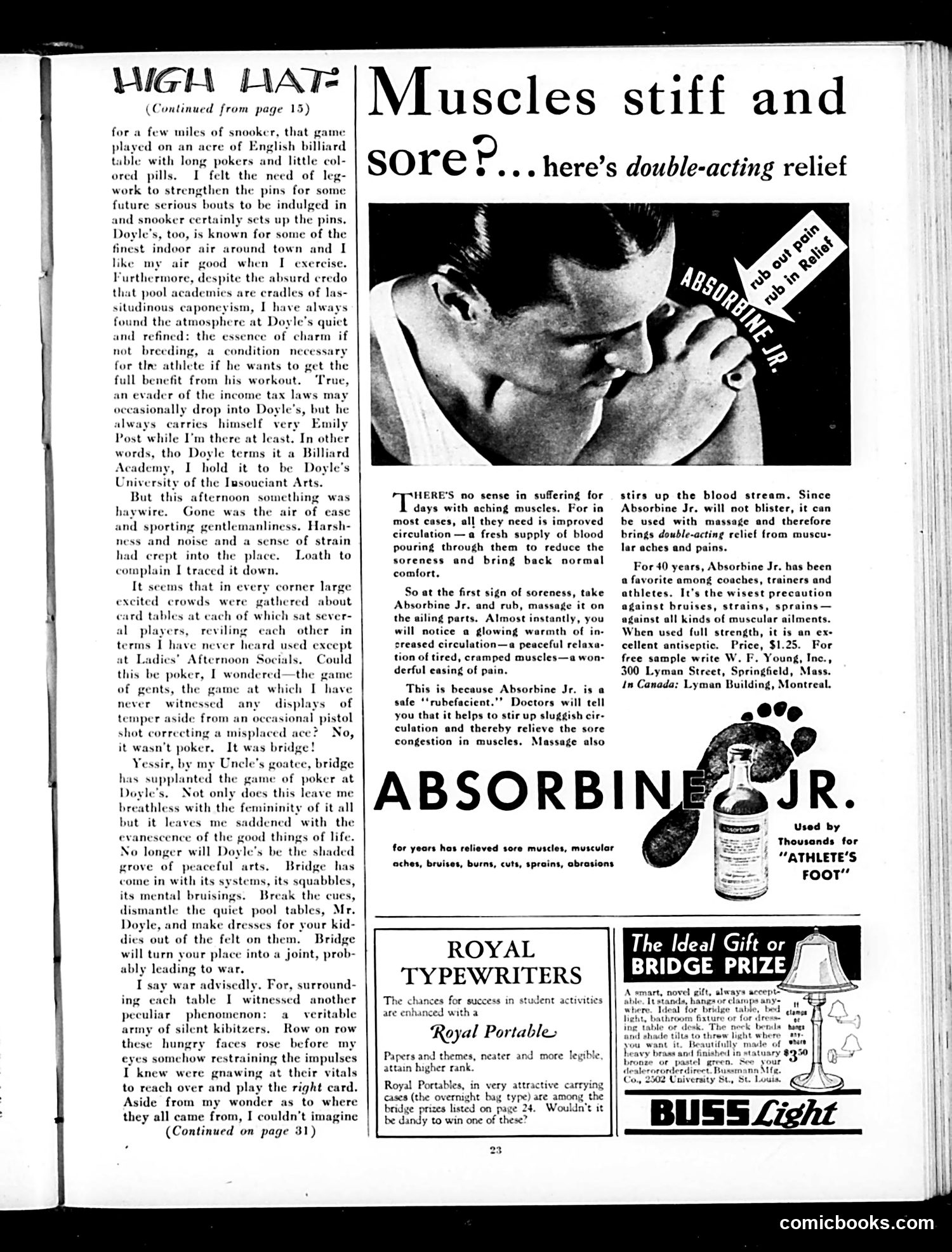
Analysis This page is primarily advertising content rather than political satire. The dominant feature is a large advertisement for Absorbine Jr., a commercial liniment/rubefacient product marketed for muscle soreness relief. The text column on the left appears to be a humorous essay (continued from page 15) about visiting Doyle's billiard hall/pool academy in what seems to be New York. The author laments that the genteel atmosphere has been disrupted by the arrival of bridge — the card game — which has brought argumentative crowds and "kibitzers" (onlookers) to the previously peaceful establishment. The piece uses comedic exaggeration, noting bridge players' heated disputes would "lead to war." The Absorbine Jr. ad uses the muscle-soreness theme as a hook, emphasizing the product's "double-acting relief" through improved blood circulation via massage. Supporting advertisements include Royal Typewriters and a Buss Light lamp (gift item). There is no political cartoon visible on this page — it's a typical magazine layout mixing editorial content with commercial advertisements.
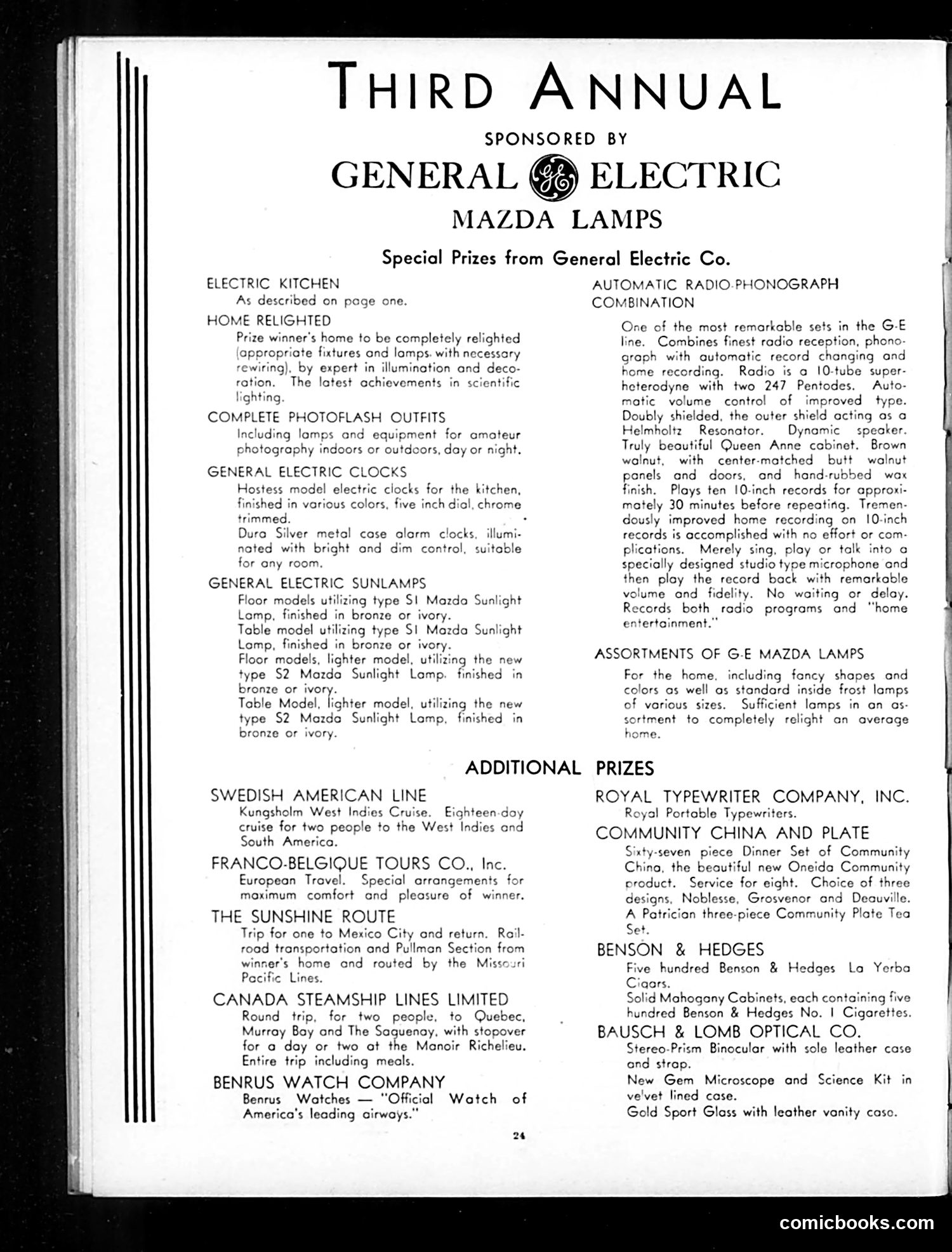
This page is primarily an advertising supplement, not editorial content with cartoons or satire. It lists prizes for the "Third Annual" contest sponsored by General Electric's Mazda Lamps division, published in *Judge* magazine. The page showcases luxury prizes reflecting 1920s-30s aspirations: cruise vacations (Swedish American Line, Canada Steamship), home modernization (electric kitchens, sunlamps, clocks), and consumer goods (Royal typewriters, Oneida china, Bausch & Lomb optics). The emphasis on electrical appliances and "scientific lighting" reflects GE's corporate messaging about modernization and domestic convenience. The "Home Relighted" prize—where an expert would rewire a winner's home with appropriate fixtures—exemplifies how corporations marketed electricity as a status symbol and marker of progress. This is corporate propaganda dressed as entertainment, typical of *Judge*'s advertising-heavy format during this era.
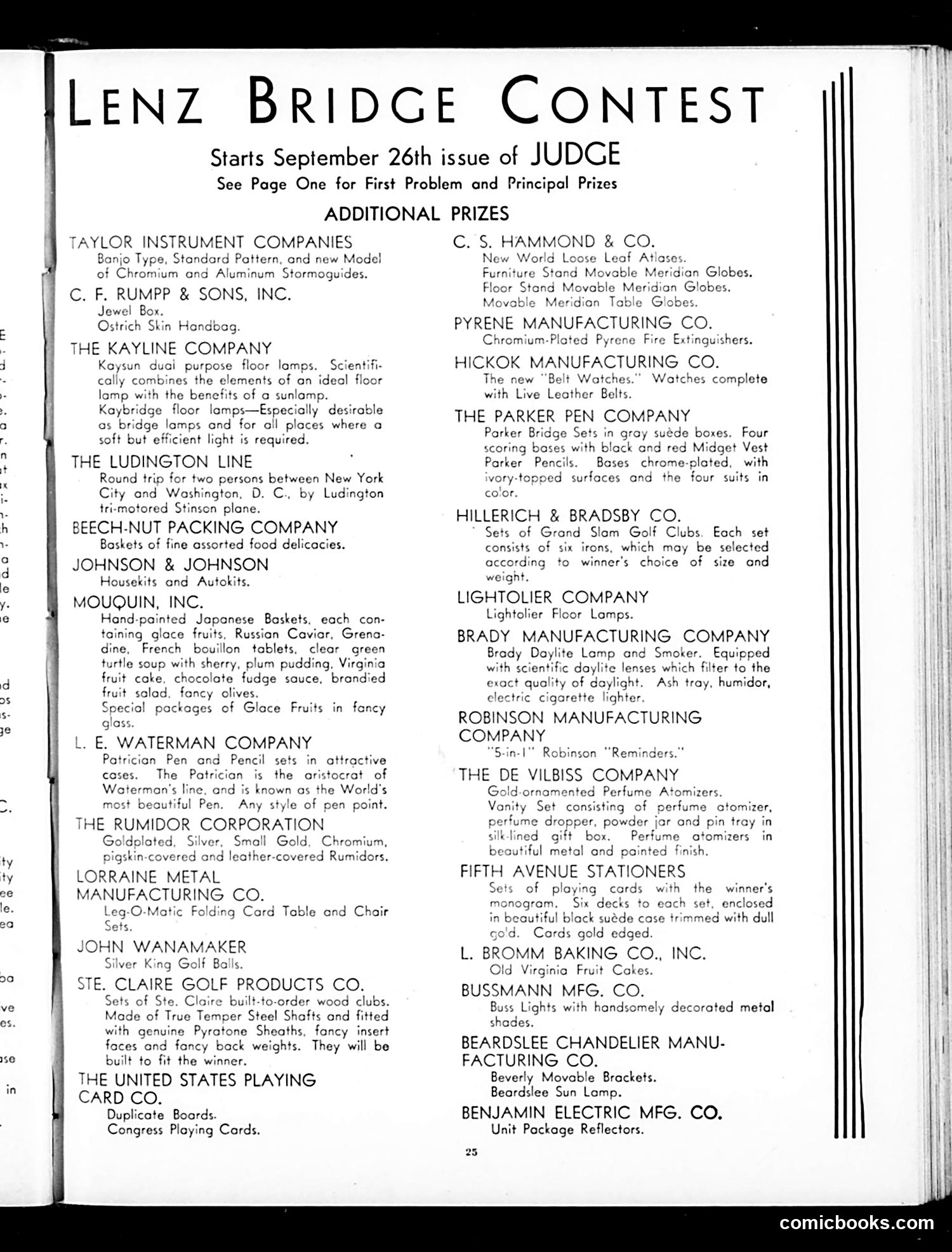
This page is primarily advertising, not satirical content. It lists additional prizes for the "Lenz Bridge Contest," a bridge-playing competition that Judge magazine is sponsoring (with the main problem appearing on page one). The prizes offered represent luxury goods and services typical of 1920s-30s American consumer culture: golf clubs, writing instruments, lamps, food delicacies, perfume atomizers, playing cards, and even a round-trip airplane flight between New York and Washington. The variety reflects Judge's affluent readership. There is no cartoon or satire visible on this page—it functions as a straightforward promotional listing for sponsoring companies seeking brand exposure through the contest. The emphasis on high-end merchandise (Waterman pens, Parker pens, Wanamaker goods) indicates the contest targeted wealthy readers interested in bridge, a popular leisure activity among the upper classes during this era.
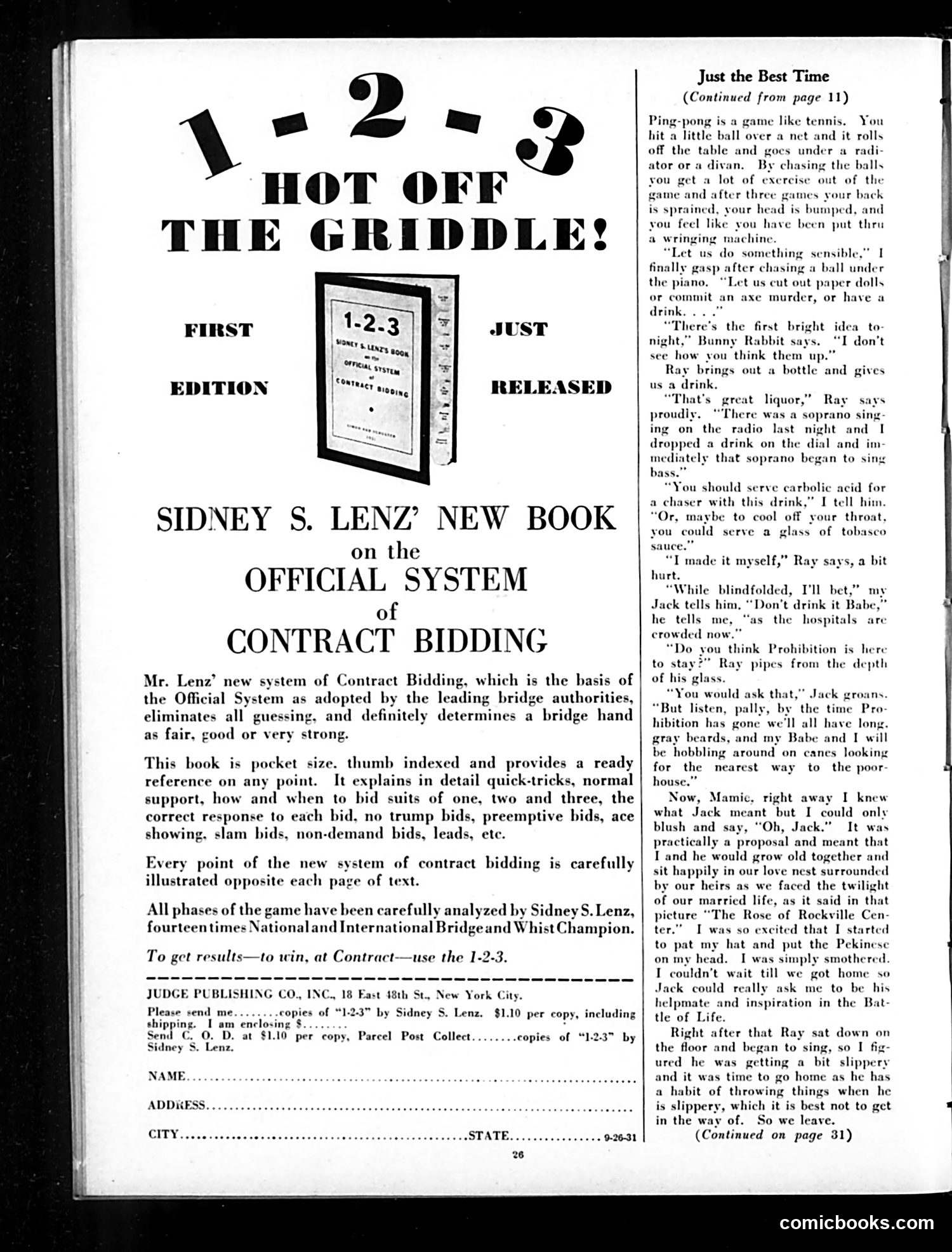
Analysis This page is primarily advertising, not editorial content. The left side promotes Sidney S. Lenz's new book on contract bridge bidding—a legitimate instructional manual for the card game. Lenz was a genuine bridge champion (the text claims "fourteen times National and International Bridge and Whist Champion"). The right column continues a serialized short story titled "Just the Best Time," a romantic comedy about young people drinking during Prohibition. The narrative involves characters named Jack, Ray, Bunny Rabbit, and the narrator (apparently female), discussing alcohol consumption and hinting at a marriage proposal. The story includes period-appropriate Prohibition-era humor—references to hospitals being "crowded" from bad homemade drinks and joking about Prohibition's duration. There is no political cartoon on this page. It's a typical Judge magazine layout mixing advertisements with serialized fiction, both representative of 1920s leisure culture and social attitudes.
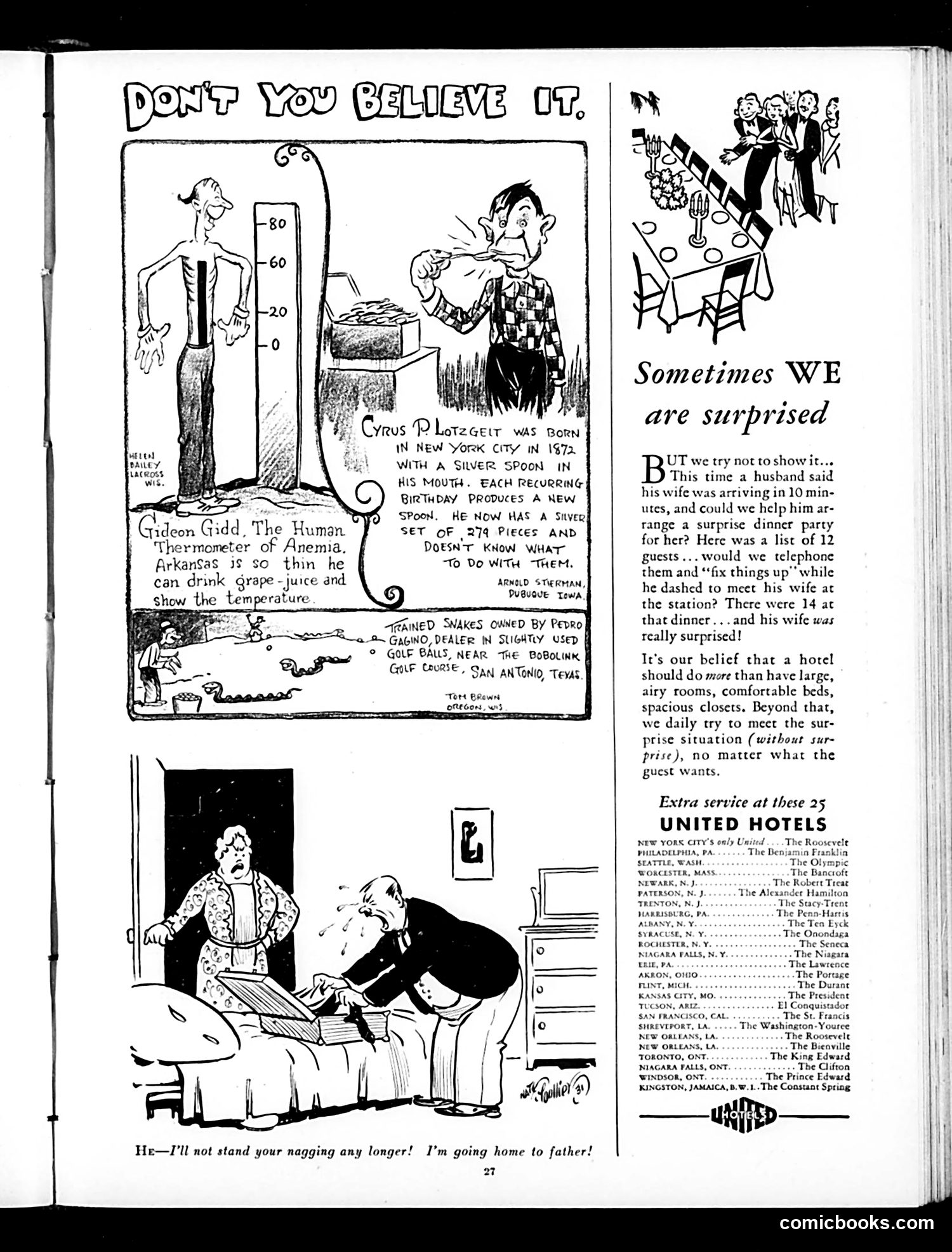
"Don't You Believe It" - Judge Magazine Page Analysis This page combines two unrelated items: Top Left - "Believe It or Not" Style Oddities: The cartoon mocks curiosity pieces, featuring "Gideon Gidd," an absurdly thin man who can drink grape juice and show his body temperature through his skeleton. The accompanying text describes Cyrus Plotzgeit, a wealthy New Yorker born in 1872 who receives a silver spoon annually as birthday gifts—he now owns 274 pieces with no use for them. This satirizes wealthy eccentricity and useless accumulation of luxury items. Bottom Left - Comic Strip: A domestic quarrel shows a nagging wife and exasperated husband declaring he'll leave to his father's house—a common trope mocking marital discord and henpecked husbands, popular humor of the era. Right Side - Hotel Advertisement: United Hotels chain advertises "extra service" and surprise party coordination, listing 25 affiliated hotels across North America. The preceding anecdote illustrates their service philosophy. The page reflects early 20th-century magazine format: novelty items, domestic comedy, and advertising presented as editorial content.
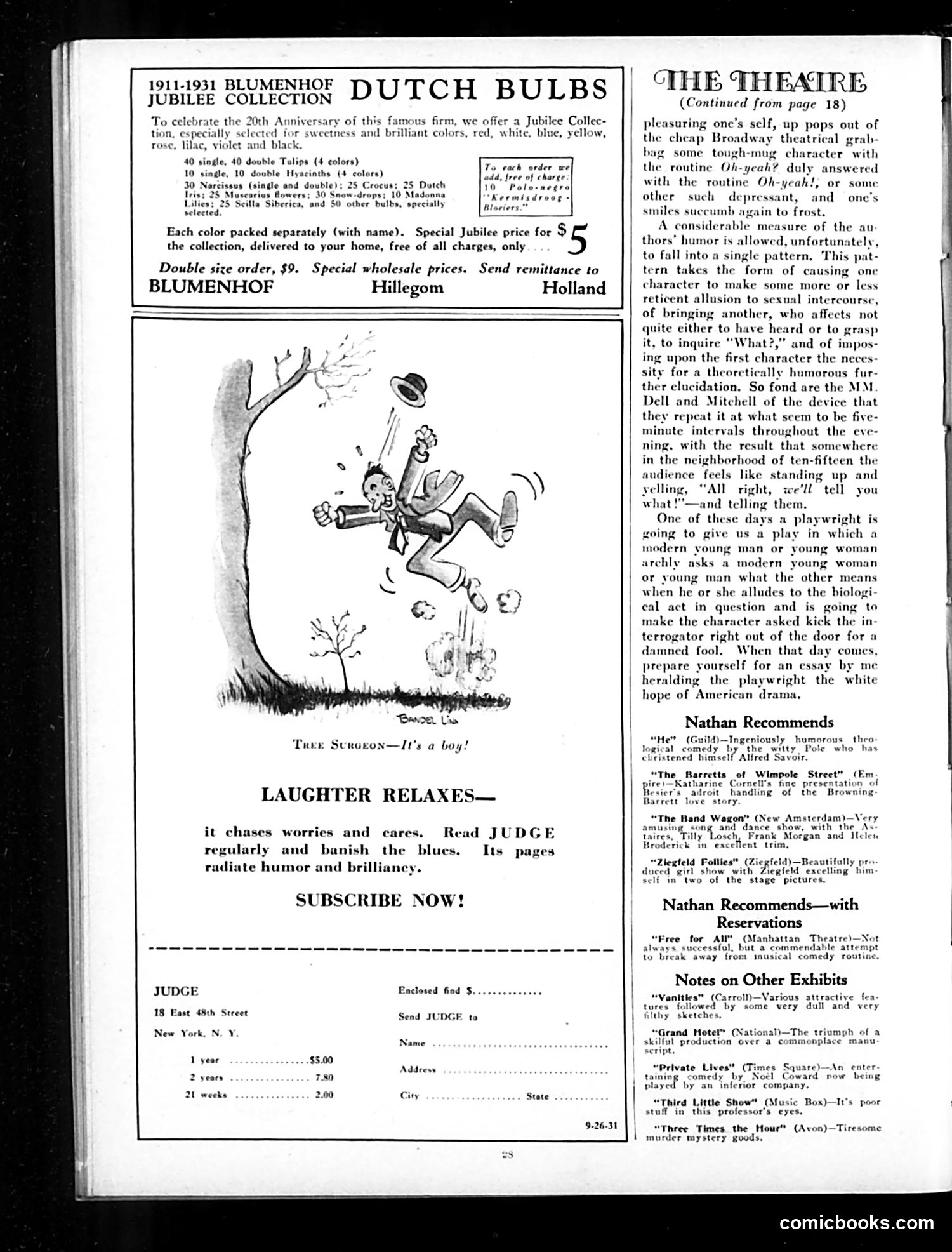
Analysis of Judge Magazine Page This page is primarily advertising and theater reviews, not political satire. The main content includes: Left side: A 1911-1931 Blumenhof Dutch Bulbs jubilee collection advertisement, featuring a cartoon illustration of a figure being thrown or jumping from a tree, captioned "Tree Surgeon—It's a bag!" The humor is visual/pun-based: the "surgeon" is literally bagging something from a tree. Right side: Theater criticism by Nathan (likely drama critic George Jean Nathan), reviewing Broadway shows including "He," "The Barretts of Wimpole Street," "The Band Wagon," and others. The text discusses modern comedic conventions—specifically the repetitive "Oh-yeah?" comedic device used by playwrights Dell and Mitchell, which Nathan finds tiresome. He humorously predicts that eventually an audience will rebel against this formula. The page reflects 1930s theater culture and advertising aesthetics rather than political commentary. The cartoon's humor relies on visual wordplay rather than social critique.
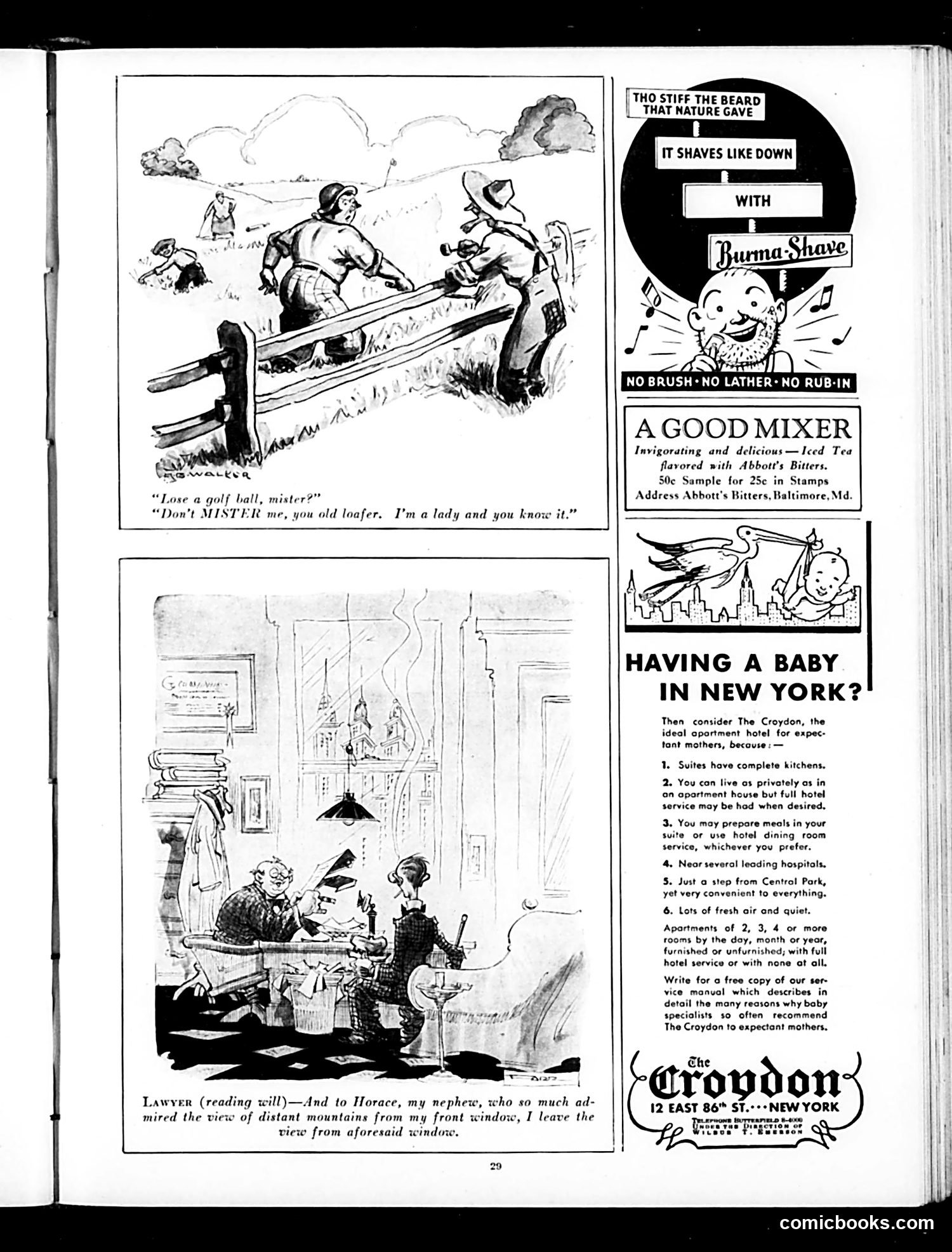
Analysis of Judge Magazine Page Top Cartoon: A woman golfer confronts a male golfer who called her "mister." She asserts herself as a lady who knows her own identity—satirizing early-20th-century gender assumptions and the still-novel presence of women in traditionally male spaces like golf. Bottom Cartoon: A lawyer reads a will leaving his nephew "the view" from a window rather than the window itself—a joke about miserly relatives and absurd literal interpretation of bequests, poking fun at legal pedantry and familial stinginess. Advertisements: The page includes ads for Burma-Shave (shaving product), Abbott's Bitters (iced tea mixer), and The Croydon apartment hotel in New York, which specifically marketed to expectant mothers—reflecting early 20th-century consumer culture and evolving attitudes toward pregnant women's comfort and independence. The page primarily serves satirical humor alongside commercial content typical of Judge's format.
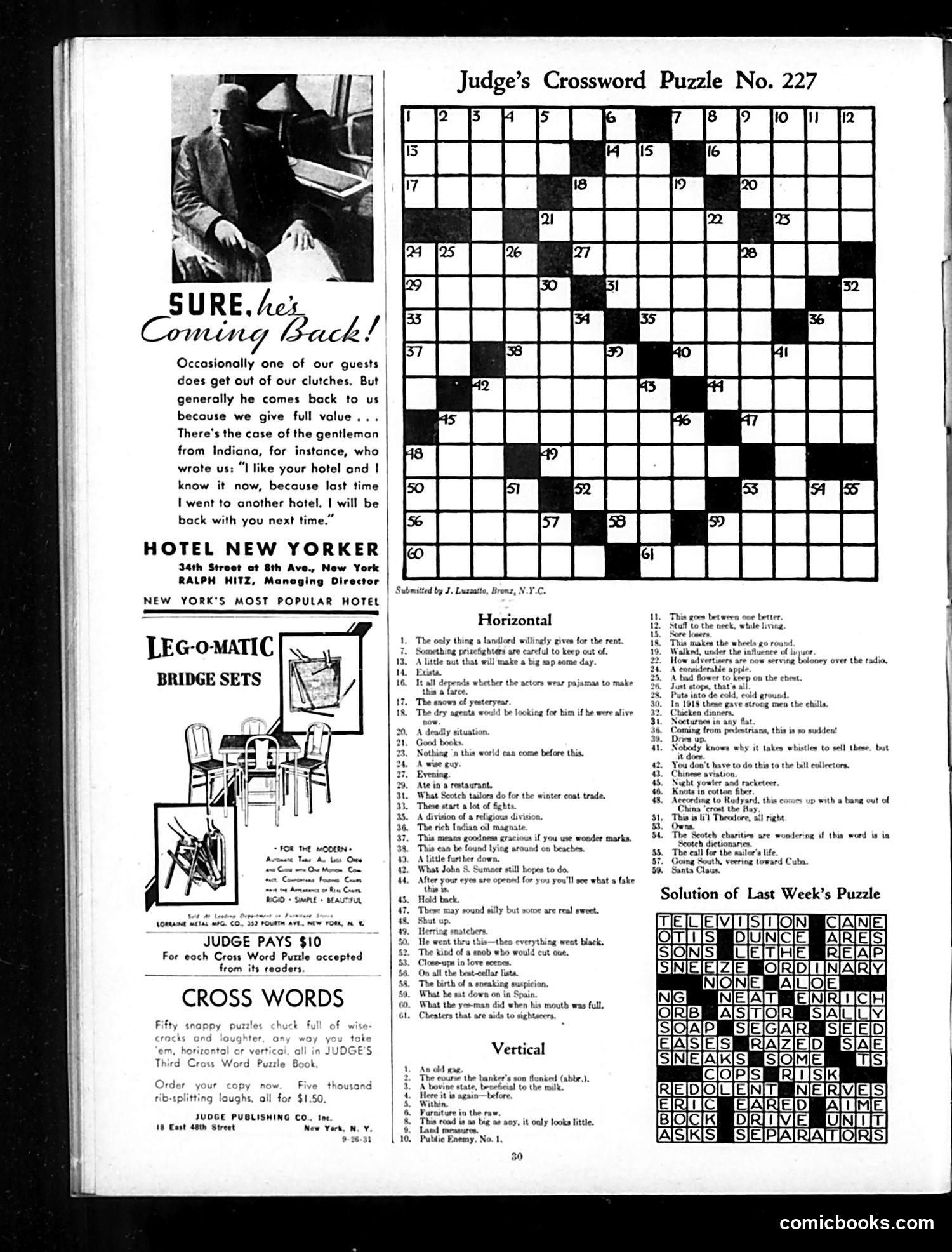
Judge Magazine Page Analysis This page is primarily advertising and puzzle content, not political satire. The main elements are: Hotel New Yorker Advertisement: A brief anecdote about a satisfied guest from Indiana who returned to the hotel after trying competitors. This is straightforward hospitality marketing with no satirical content—just a testimonial framed as a humorous observation about customer loyalty. Leg-O-Matic Bridge Sets Advertisement: A furniture ad promoting collapsible bridge tables for modern homes. Crossword Puzzle No. 227: The bulk of the page features a crossword puzzle with clues and the solution to the previous week's puzzle. Judge Pays $10: A call for reader-submitted crossword puzzles. The page contains no political cartoons or social satire. It's a typical magazine interior page mixing advertisements with recreational content (crosswords). The references to "Scotch tailors," "ball collectors," and "Public Enemy No. 1" are merely crossword clue material, not satirical commentary.
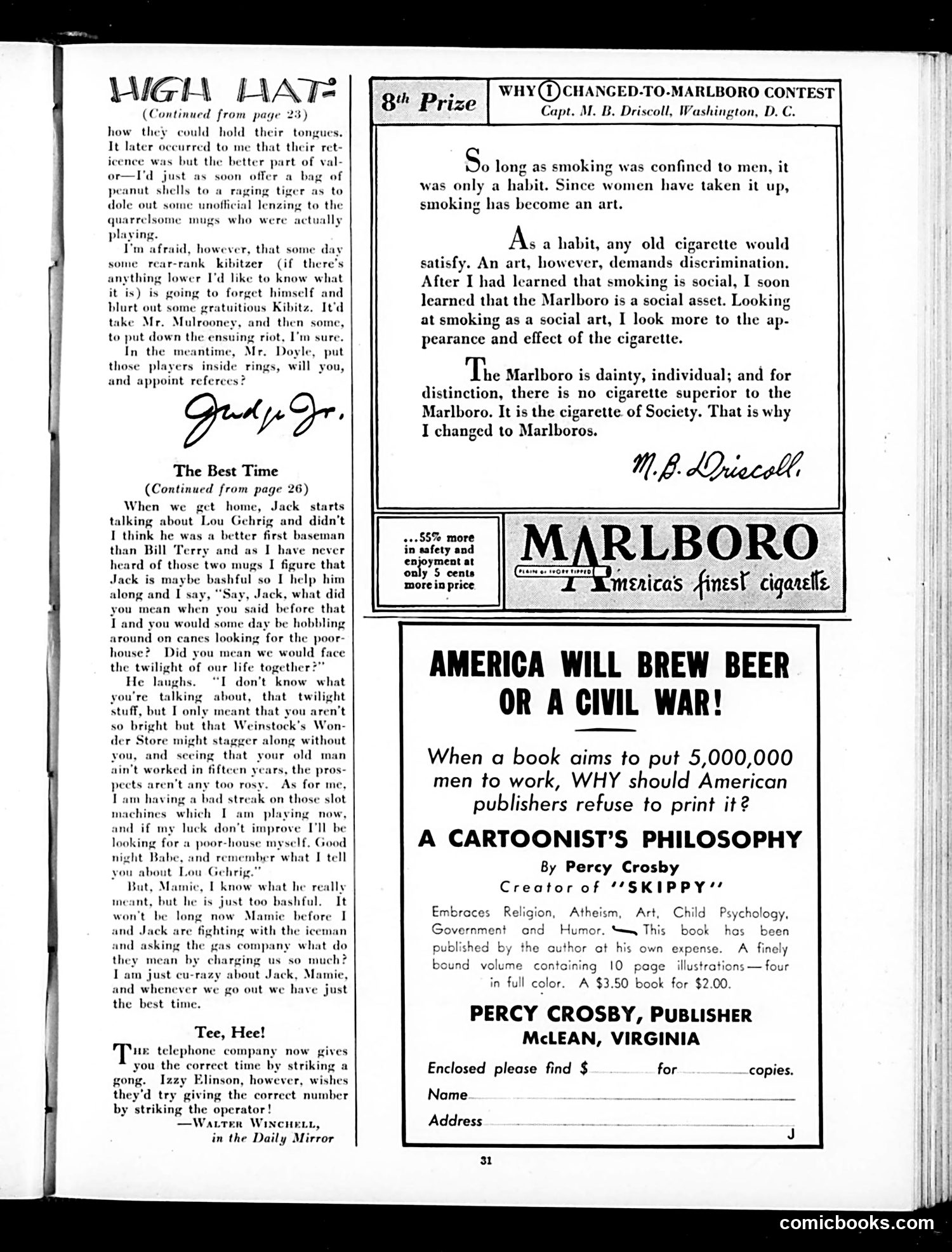
Judge Magazine Page Analysis This page contains primarily advertisements and short humor pieces, not political cartoons requiring historical context. The Marlboro cigarette ad is notable historically: it features a woman smoking, framed as women having elevated smoking "from habit to art." This reflects 1920s-30s social anxieties about changing gender roles—women's newfound public smoking was controversial and marketed as a sign of sophistication and social status. The "America Will Brew Beer or Civil War" heading advertises a book claiming 5 million jobs depend on its publication, likely referencing Depression-era anxieties about unemployment and government intervention. The Percy Crosby advertisement promotes his cartoon philosophy book; Crosby was the creator of the "Skippy" comic strip. The remaining content consists of reader-submitted humor about everyday situations (baseball, phone operators, domestic life)—typical Judge filler material with no specific political or historical references requiring explanation.
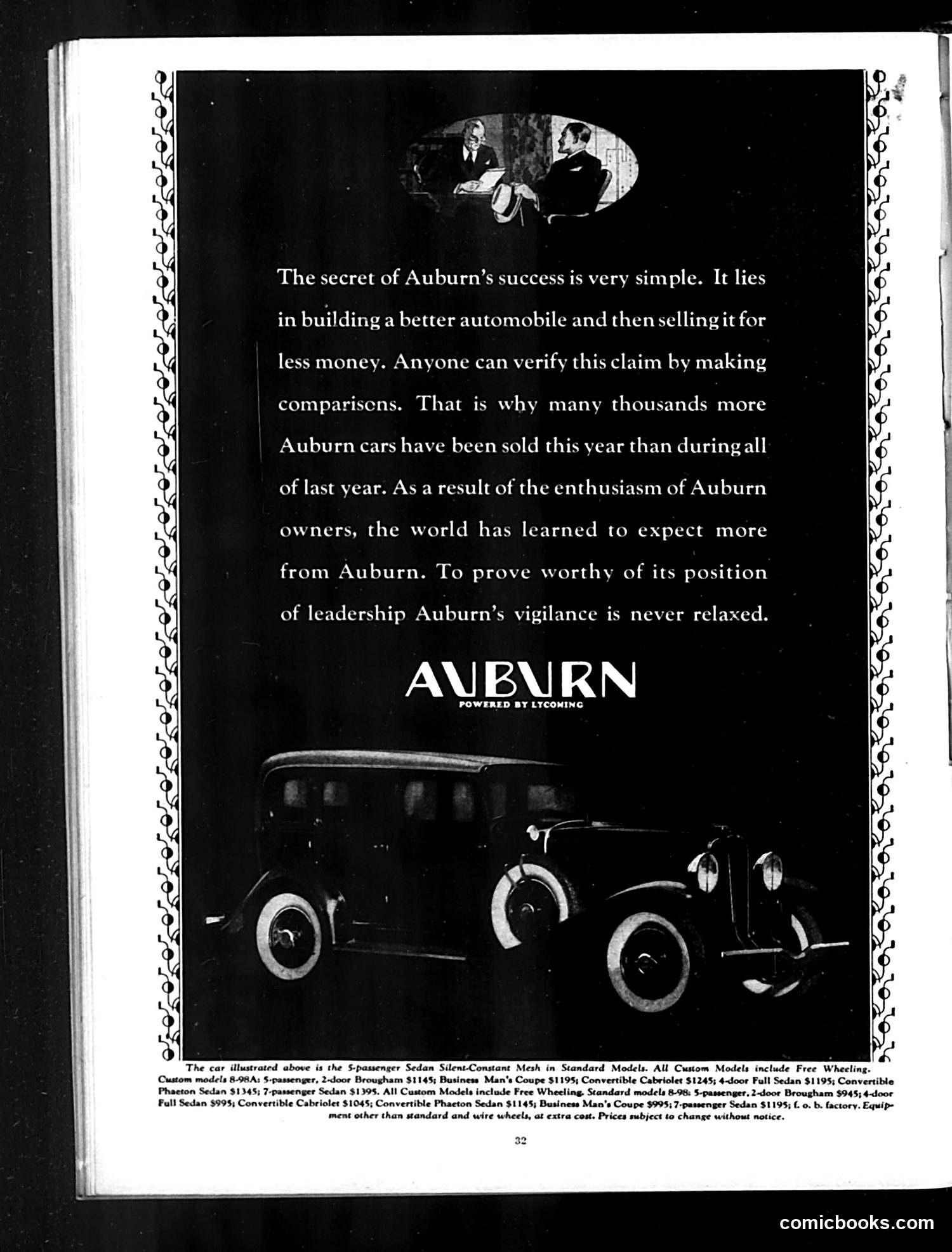
Auburn Automobile Advertisement This is not satire or political commentary—it's a straightforward automobile advertisement from Judge magazine. The page promotes Auburn cars, emphasizing their value proposition: superior quality at lower prices than competitors. The small vignette at top shows two businessmen in conversation, likely representing satisfied Auburn owners or dealers discussing the car's merits. The text boasts that Auburn's sales have increased dramatically year-over-year due to this simple formula of better engineering at competitive pricing. The bottom half displays Auburn sedan models with detailed pricing information (ranging from $945-$1395), highlighting features like "Free Wheeling" as selling points. "Powered by Lycoming" references the engine manufacturer. This represents typical 1920s-30s magazine advertising—promotional content placed in publications like Judge to reach affluent readers. There is no apparent satire or hidden meaning; it's direct marketing copy.
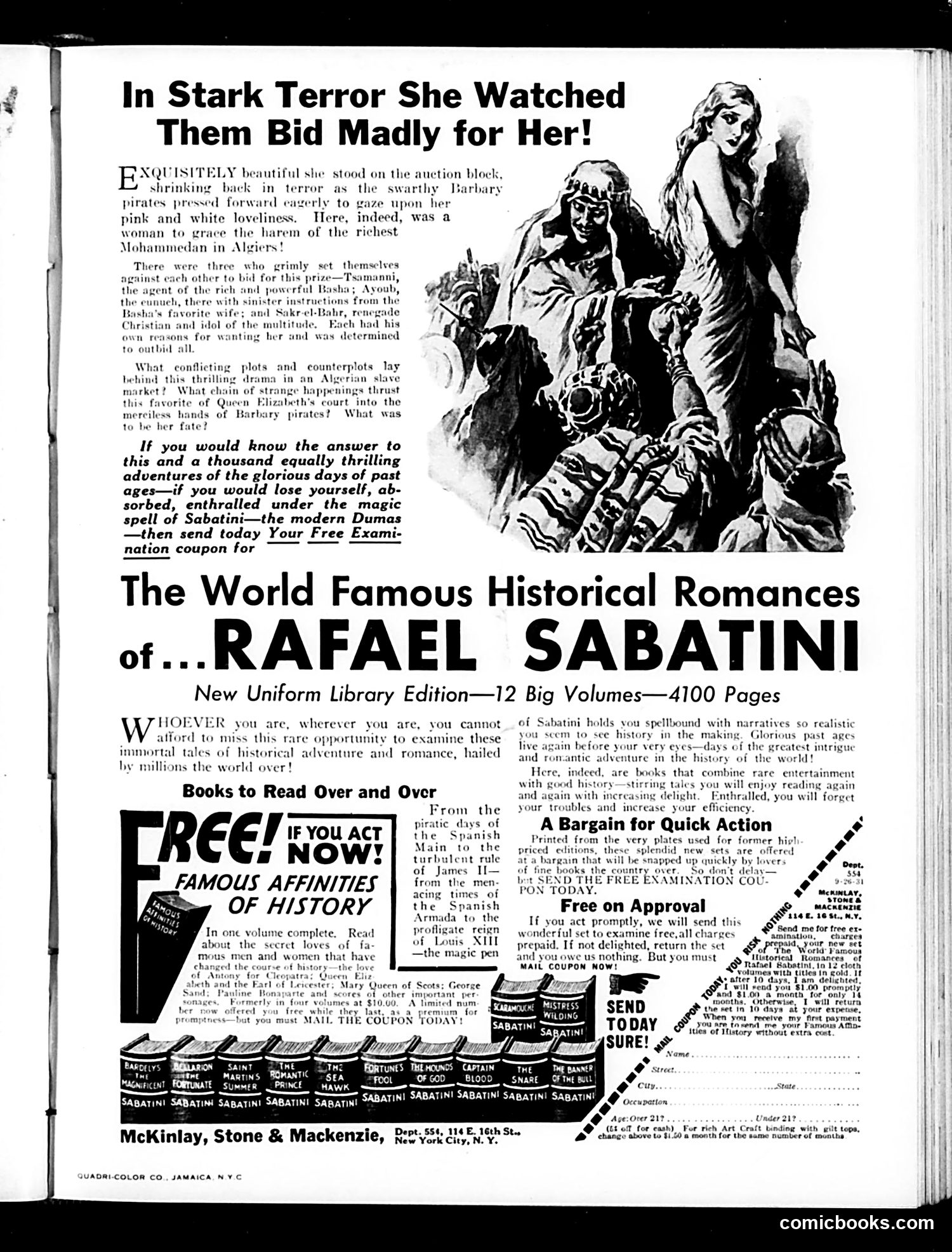
Analysis This is primarily a book advertisement, not a political cartoon. It promotes Rafael Sabatini's collected historical romances through McKinlay, Stone & Mackenzie publishers. The illustration depicts a dramatic scene: a beautiful woman on an auction block, surrounded by what appear to be Barbary pirates bidding for her. The text emphasizes "stark terror" and harem slavery—exoticized imagery typical of early-20th-century adventure fiction marketing. The advertisement exploits Orientalist fantasies popular at the time, using sensationalized depictions of "swarthy" pirates and Muslim harems to sell books. It positions Sabatini as "the modern Dumas," emphasizing historical authenticity while actually peddling romantic melodrama with troubling racial and sexual stereotypes. The "free examination coupon" offer was a standard mail-order sales tactic. There is no discernible political satire here—this is straightforward (if morally problematic by modern standards) period advertising that normalized exoticized depictions of non-European peoples and women in peril as entertainment.
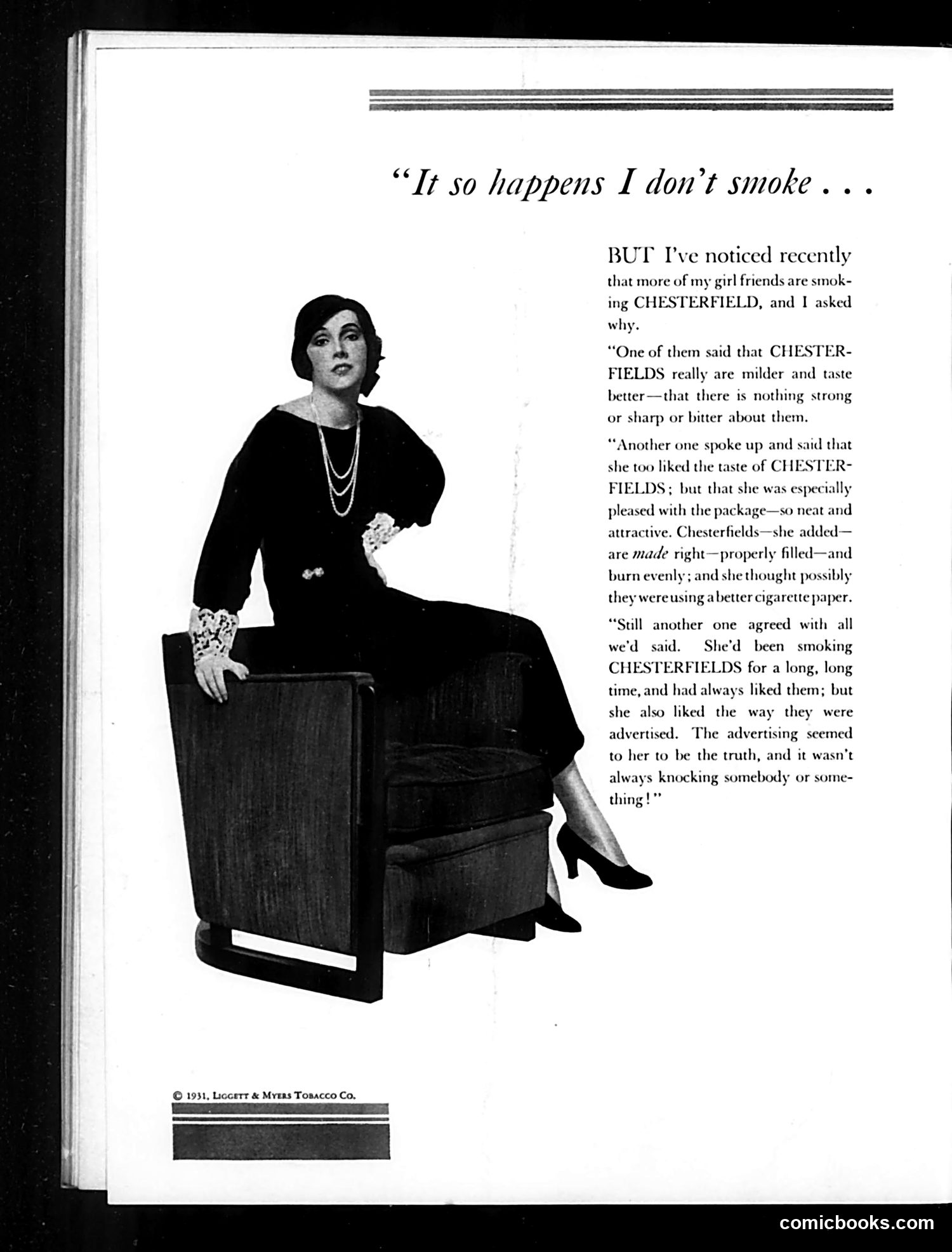
Chesterfield Cigarette Advertisement (1931) This is a cigarette advertisement, not political satire. It features a well-dressed woman seated elegantly, presented as a non-smoker who reports what her female friends say about Chesterfield cigarettes. The ad uses a testimonial strategy common to 1930s marketing: the narrator relays reasons other women smoke Chesterfields—mildness, taste, attractive packaging, even construction quality and "truthful" advertising. The final point subtly criticizes competitor ads for "knocking somebody or something" (likely referring to rival brands' comparative advertising). The appeal targets women smokers during an era when female smoking was still somewhat controversial, positioning Chesterfields as refined and honest rather than harsh or deceptive. The elegant fashion and jewelry emphasize sophistication and modernity.