judge
Judge — October 3, 1931
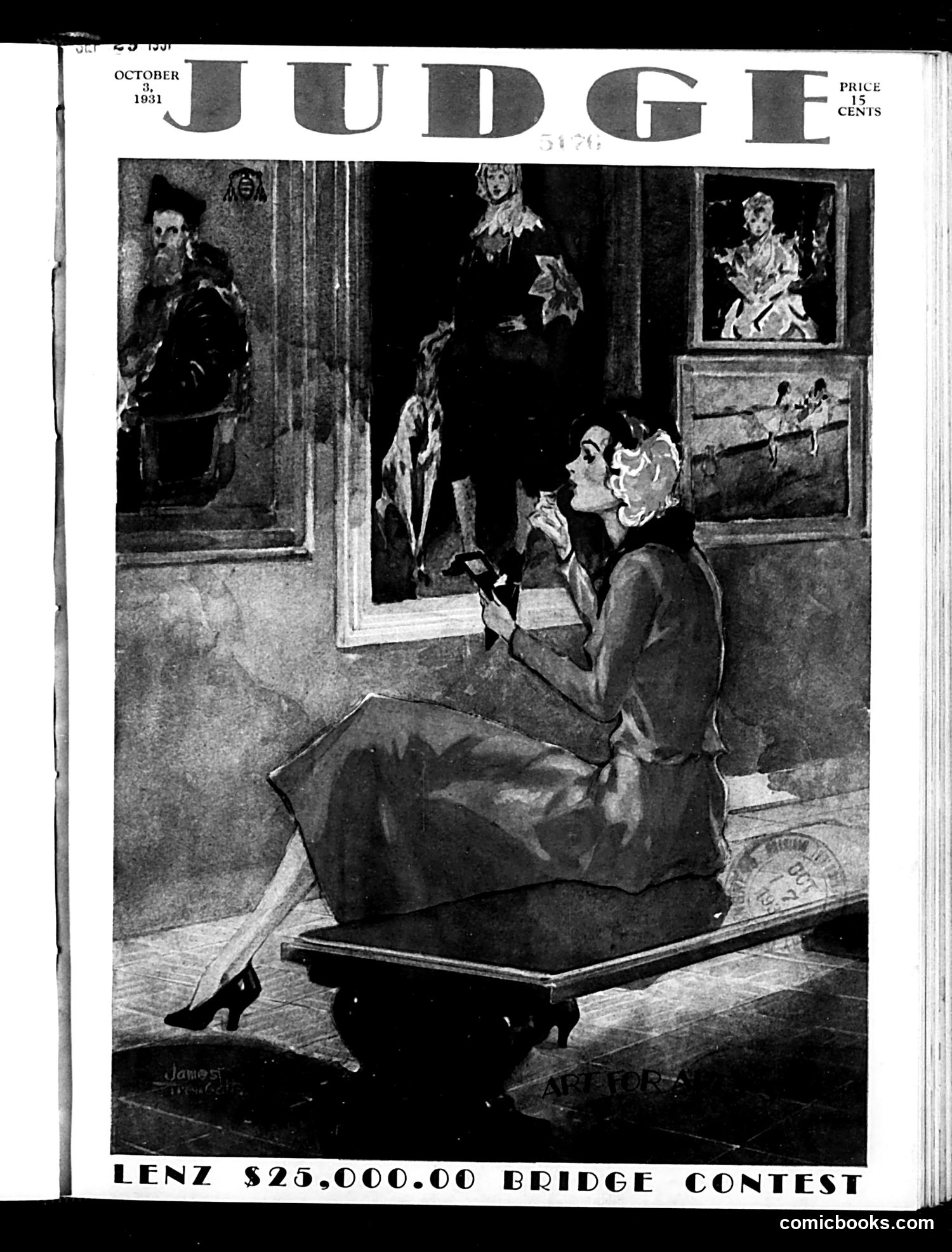
Judge Magazine Cover - October 3, 1931 This cover satirizes the "Lenz $25,000.00 Bridge Contest," advertising a competition offering substantial prize money. The cartoon depicts a woman at what appears to be a gaming table or bridge game, viewing portraits on a wall behind her. The imagery suggests the satirical point: that bridge—the card game—had become such a popular gambling pastime that it warranted major contests and prize money. The 1931 date places this during the Great Depression, making the $25,000 prize particularly striking. The satire likely mocks both the popularity of bridge as a leisure activity and the irony of significant money being offered for card games while many Americans faced financial hardship. The woman's animated expression emphasizes the game's appeal and excitement.
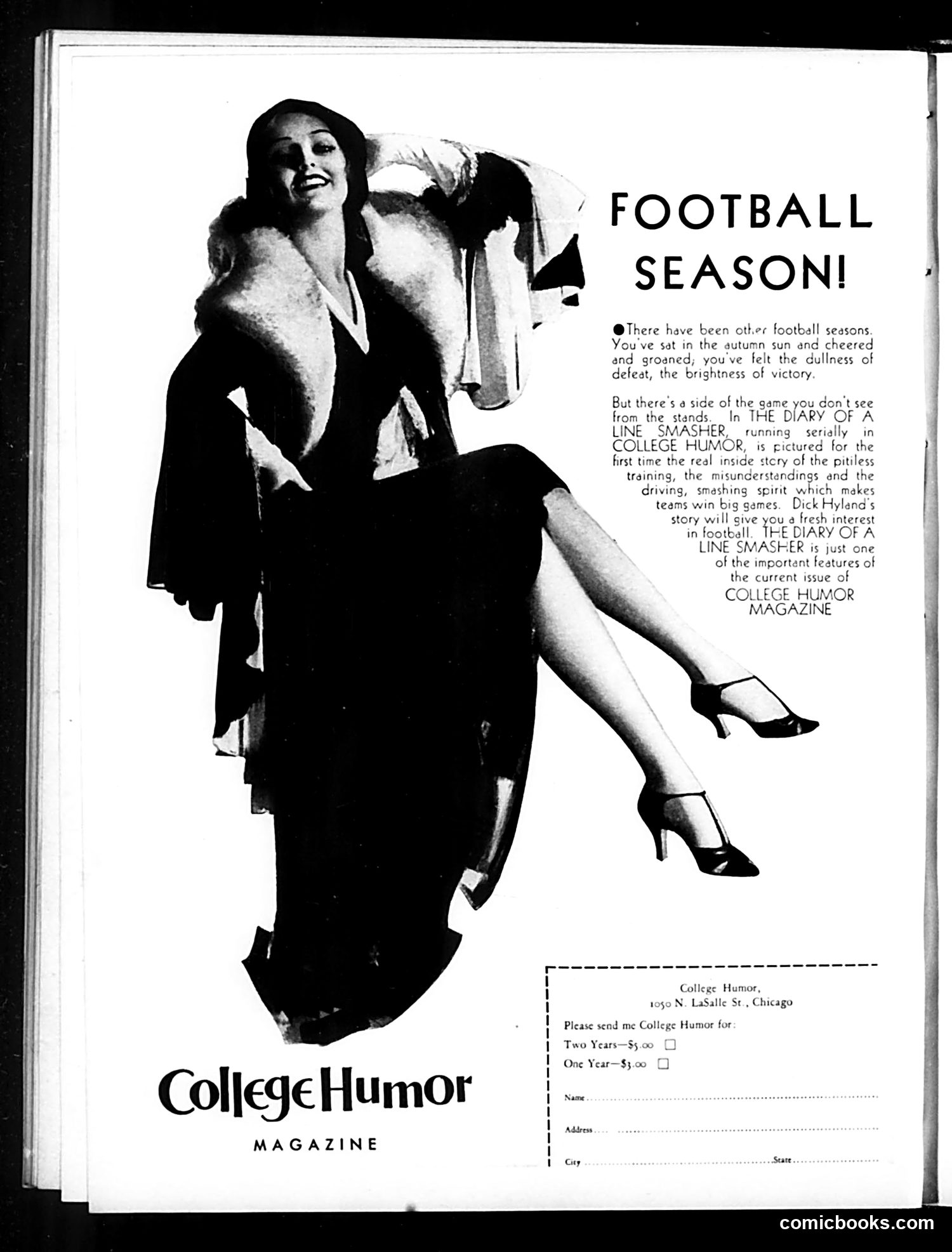
Analysis This page is primarily advertising for College Humor Magazine, not political satire. The advertisement announces an upcoming feature: "The Diary of a Line Smasher," a humorous account by Dick Hyland about college football training and team dynamics. The image shows a stylized woman in 1920s-30s attire being lifted or tossed, likely representing the energetic, playful tone of college life that College Humor magazine targeted. The ad emphasizes that readers will get "the real inside story" of football beyond what stadium crowds see—the "pithless training, misunderstandings and driving, smashing spirit" behind victories. This reflects College Humor's appeal to college-age readers seeking entertainment focused on campus life, sports, and youth culture rather than political commentary.
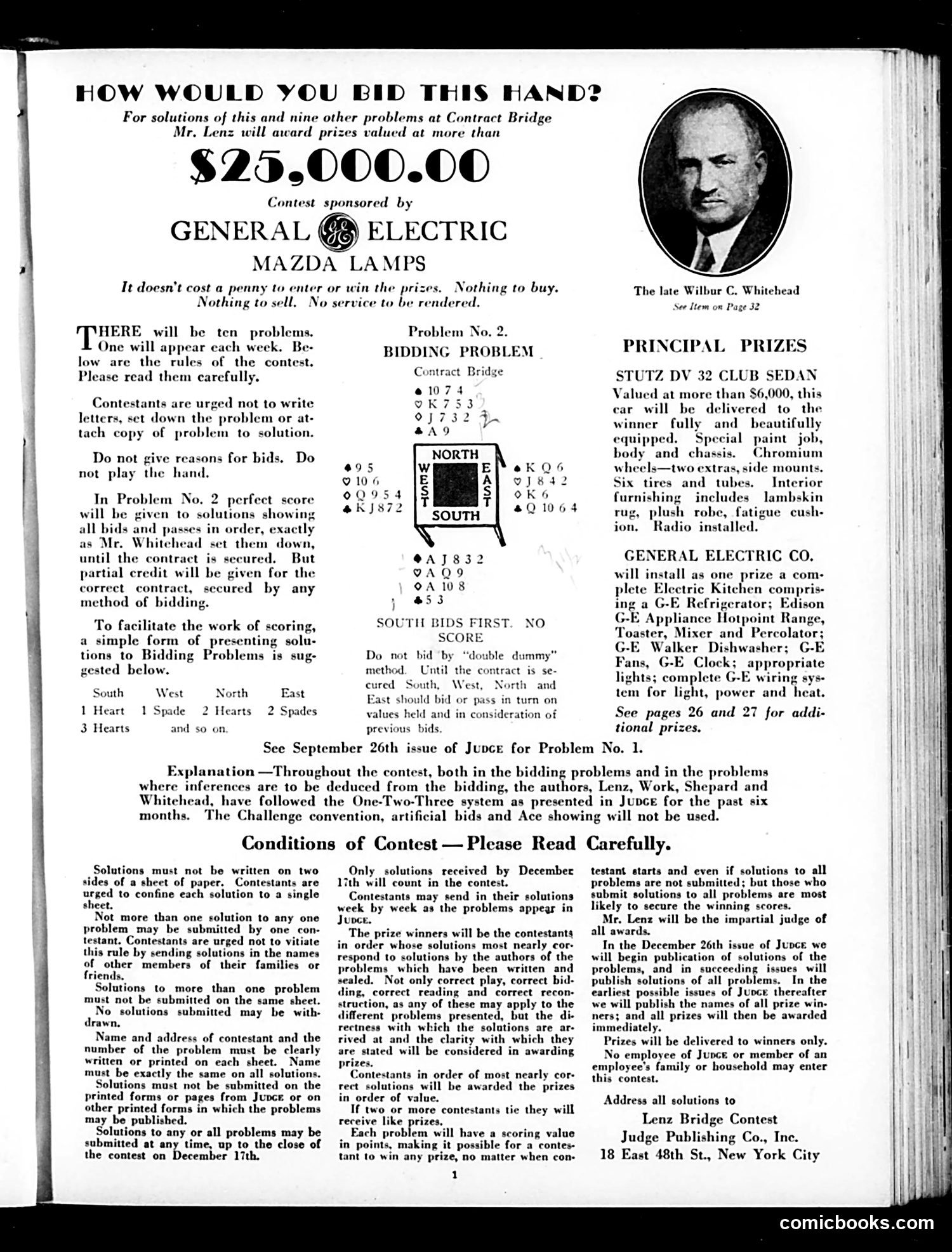
Analysis This page is primarily advertising and contest material, not satirical content. It announces a bridge contract bridge problem-solving contest sponsored by General Electric's Mazda Lamps division, offering $25,000 in prizes (including a Stutz DV 32 automobile valued at $6,000). The portrait shows Wilbur C. Whitehead, referenced as "the late" (deceased), though the context for his inclusion isn't explained on this page. The contest rules dominate the layout, addressing how to submit solutions to weekly bridge bidding problems. While this appears in *Judge* magazine, the page functions as a commercial promotion rather than political satire—typical of how magazines of this era mixed editorial content with substantial advertising revenue.
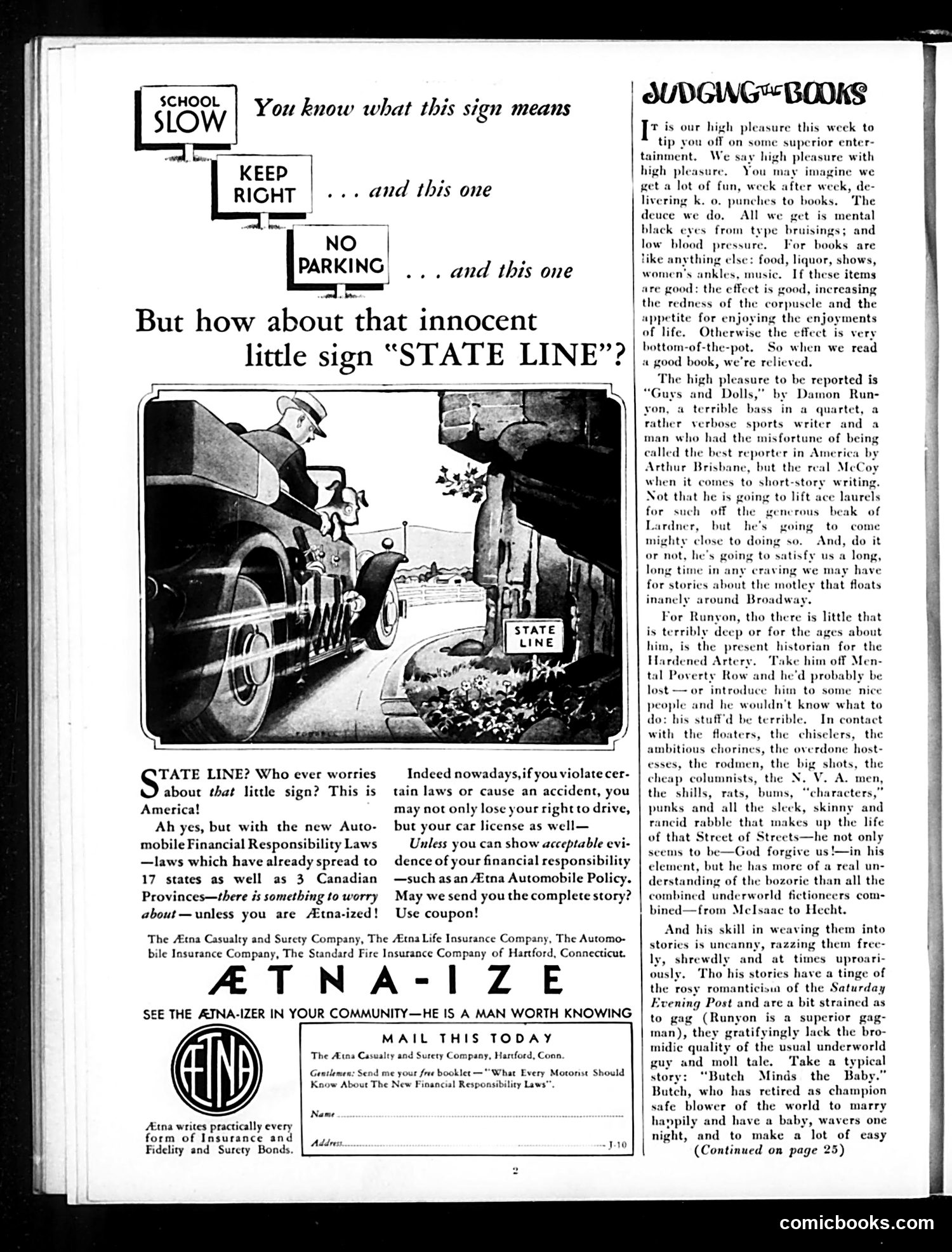
Explanation for Modern Readers This page satirizes the "STATE LINE" sign—a boundary marker between states. The cartoon jokes that while everyone understands traffic signs like "SCHOOL SLOW," "KEEP RIGHT," and "NO PARKING," nobody worries about the STATE LINE sign, despite its legal significance. The satire's point: Under new Automobile Financial Responsibility Laws spreading across 17 U.S. states and Canadian provinces, crossing a state line could have serious consequences. If you caused an accident, you might lose your driving privileges or car license unless you could prove financial responsibility—such as an Aetna automobile insurance policy. The cartoon warns drivers that this "innocent little sign" now carries real legal weight, making insurance essential for interstate travel.
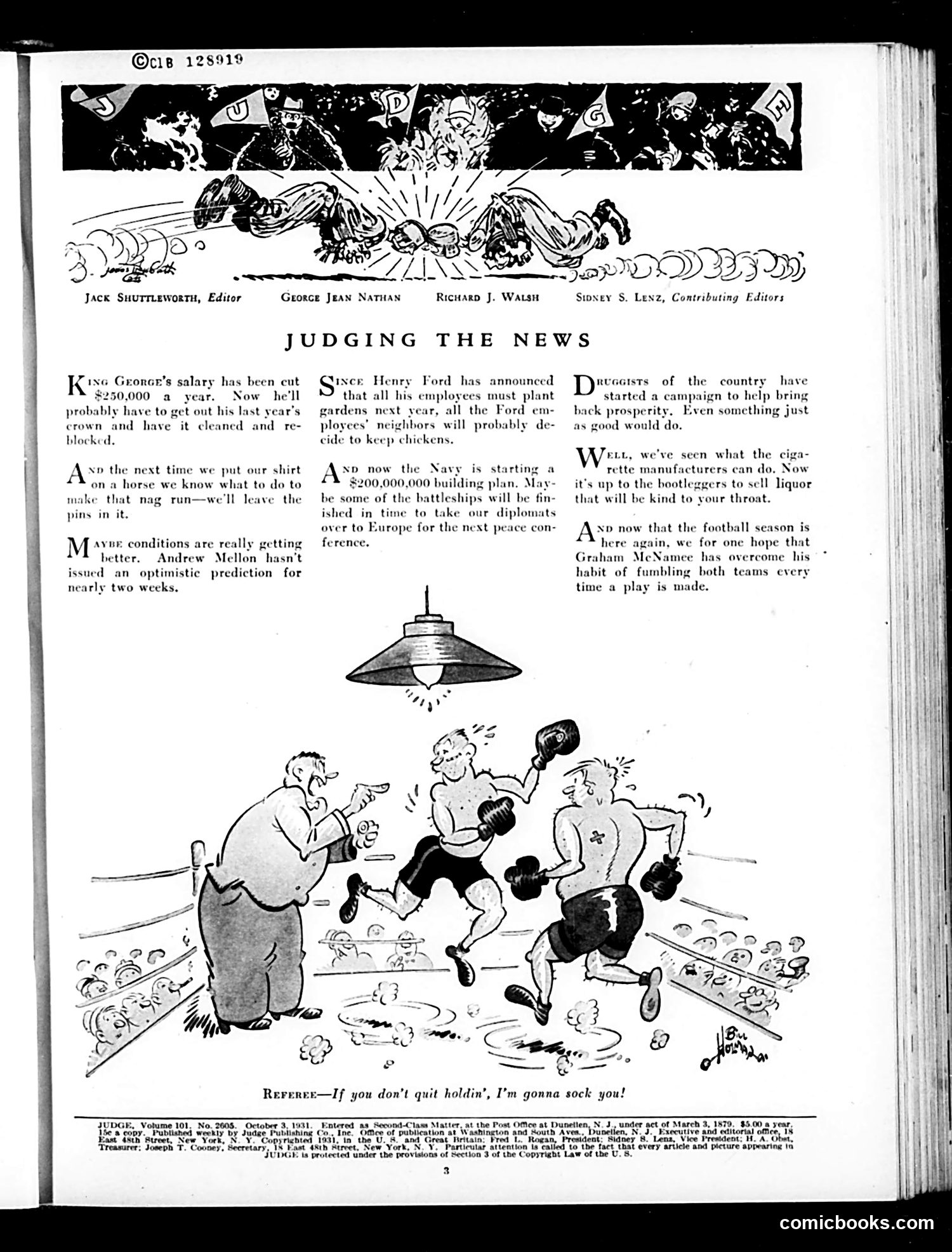
"Judging the News" - October 3, 1931 This editorial cartoon page satirizes contemporary news events through brief commentary and a boxing cartoon. The main illustration depicts a boxing referee threatening to "sock" a boxer who won't "quit holdin'"—a visual pun on holding/clinching in boxing. The surrounding text commentary addresses: - King George's salary cut ($250,000/year reduction) - Henry Ford's employee gardening requirement - Navy's $200 million battleship building plan during peace negotiations - Druggists' campaign against bootleg liquor - Football season: hoping coach Graham McNamee improved his fumbling habit The cartoon uses humor to mock current events—economic hardship, labor practices, military spending, and prohibition-era bootlegging—reflecting Depression-era public concerns.
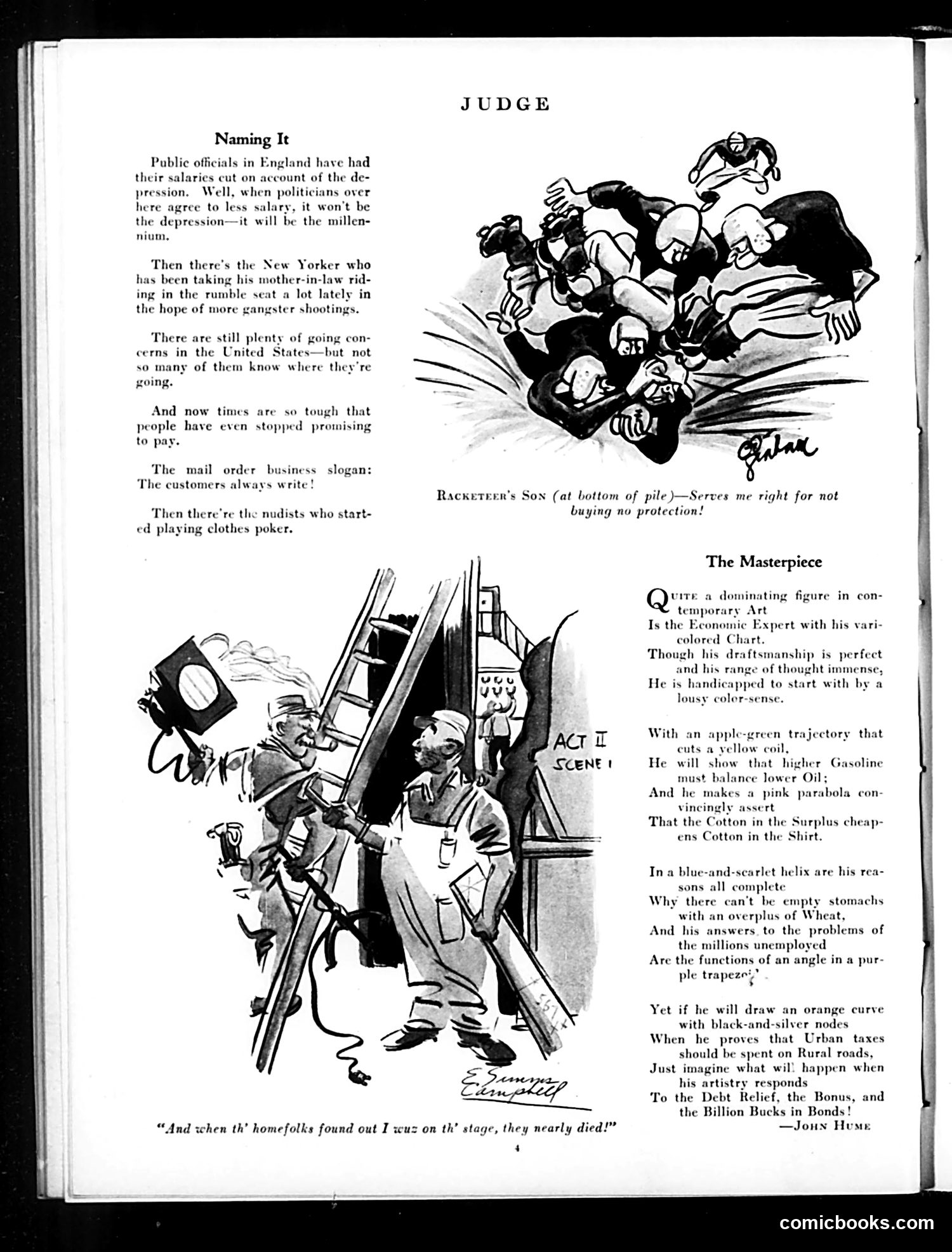
Analysis of Judge Page The page contains two satirical cartoons mocking contemporary problems during an economic depression. The upper cartoon depicts a "Racketeer's Son" complaining about not buying "protection"—a direct reference to organized crime extortion rackets that plagued American cities in the 1920s-1930s. The joke is that even criminals' offspring expect payoffs. The lower cartoon shows a stage scene captioned about "homefolks" discovering someone "was on th' stage," suggesting social scandal around theatrical work. The right-side poem "The Masterpiece" satirizes economists and their charts predicting economic solutions during hard times—mocking their abstract theories as useless when faced with real unemployment, food shortages, and poverty. The "Economic Expert" represents the perceived failure of expert analysis to address the Depression's actual human suffering.
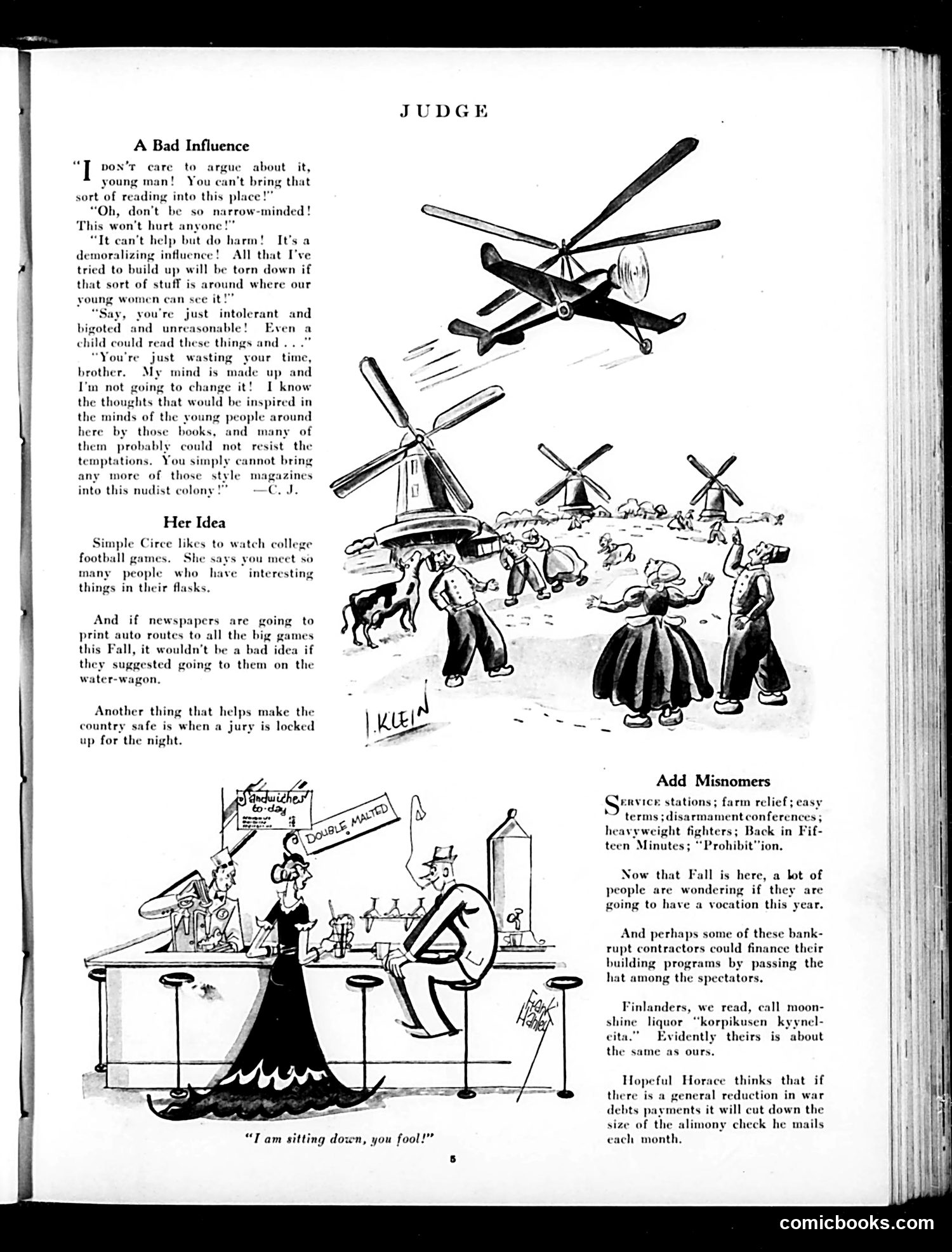
Judge Magazine Page Analysis This page contains three satirical pieces criticizing various social trends of the era: "A Bad Influence" argues that controversial literature ("that sort of reading") corrupts young people and threatens social values—a common censorship debate of the early 20th century. "Her Idea" mocks a woman's suggestion to watch college football games and attend auto races, satirizing women's emerging interest in previously male-dominated activities and public spaces. The lower cartoon depicts a bar scene with the caption "I am sitting down, you fool!"—likely satirizing alcohol consumption and Prohibition-era debates, showing a woman at a bar in defiance of traditional gender norms. "Add Misnomers" lists contemporary concerns: farm relief, disarmament conferences, and "Prohibition"—suggesting anxiety about post-WWI social and political changes.
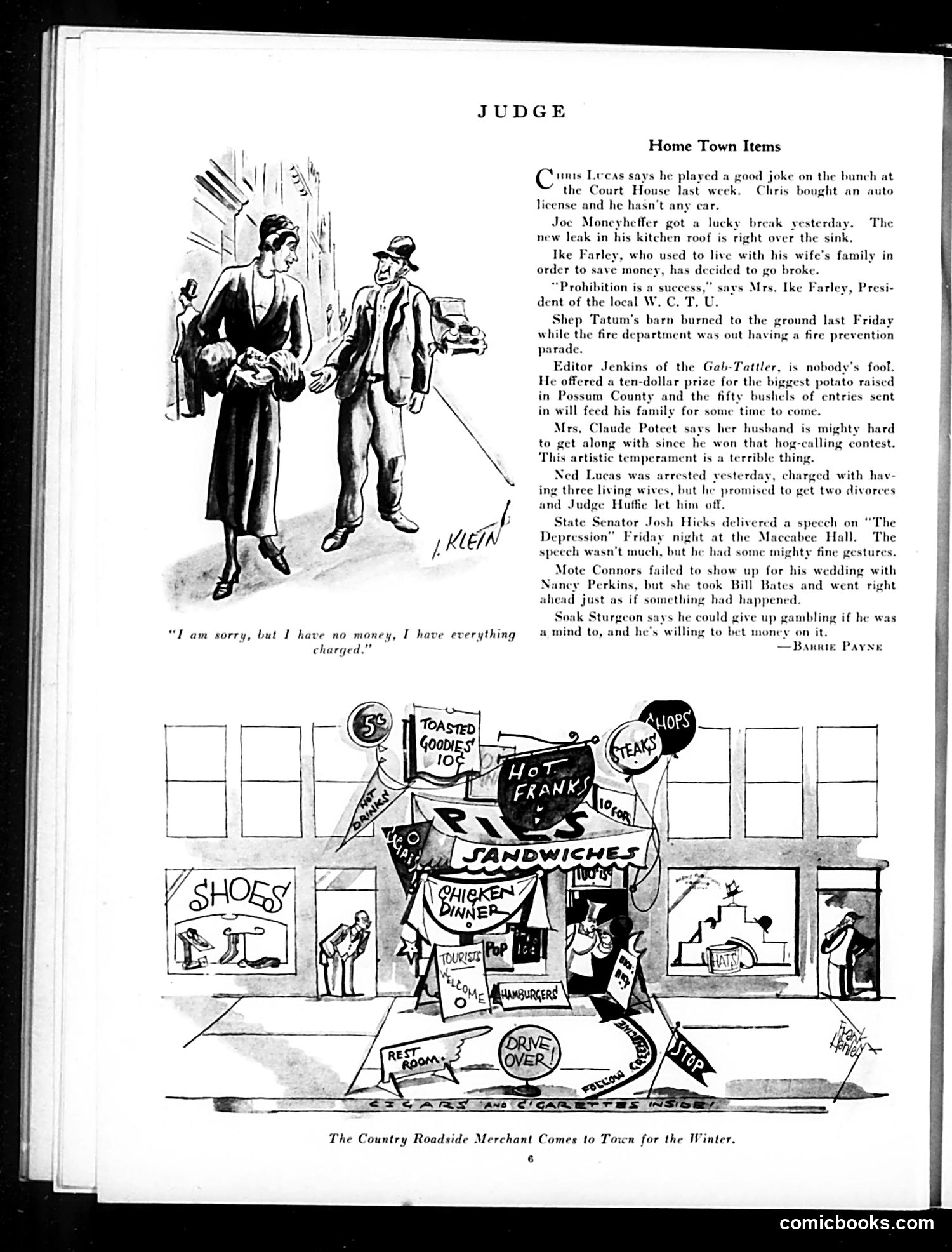
Explanation for Modern Readers This page contains two distinct sections: Top cartoon: A man tells a judge "I am sorry, but I have no money, I have everything charged." This satirizes the emerging consumer credit culture—buying goods "on charge" (credit) rather than with cash. The joke is ironic: despite claiming poverty, he's acquired substantial possessions through debt. Bottom cartoon: "The Country Roadside Merchant Comes to Town for the Winter" depicts a roadside stand exploding with commercial signage (hot franks, sandwiches, chicken dinner, shoes, rest rooms, drive-over). This satirizes the proliferation of tacky roadside tourist attractions and commercialization of American highways—a phenomenon that accelerated in the 1920s-30s with automobile travel. The chaotic visual metaphor suggests this commercialism is overwhelming and somewhat ridiculous.
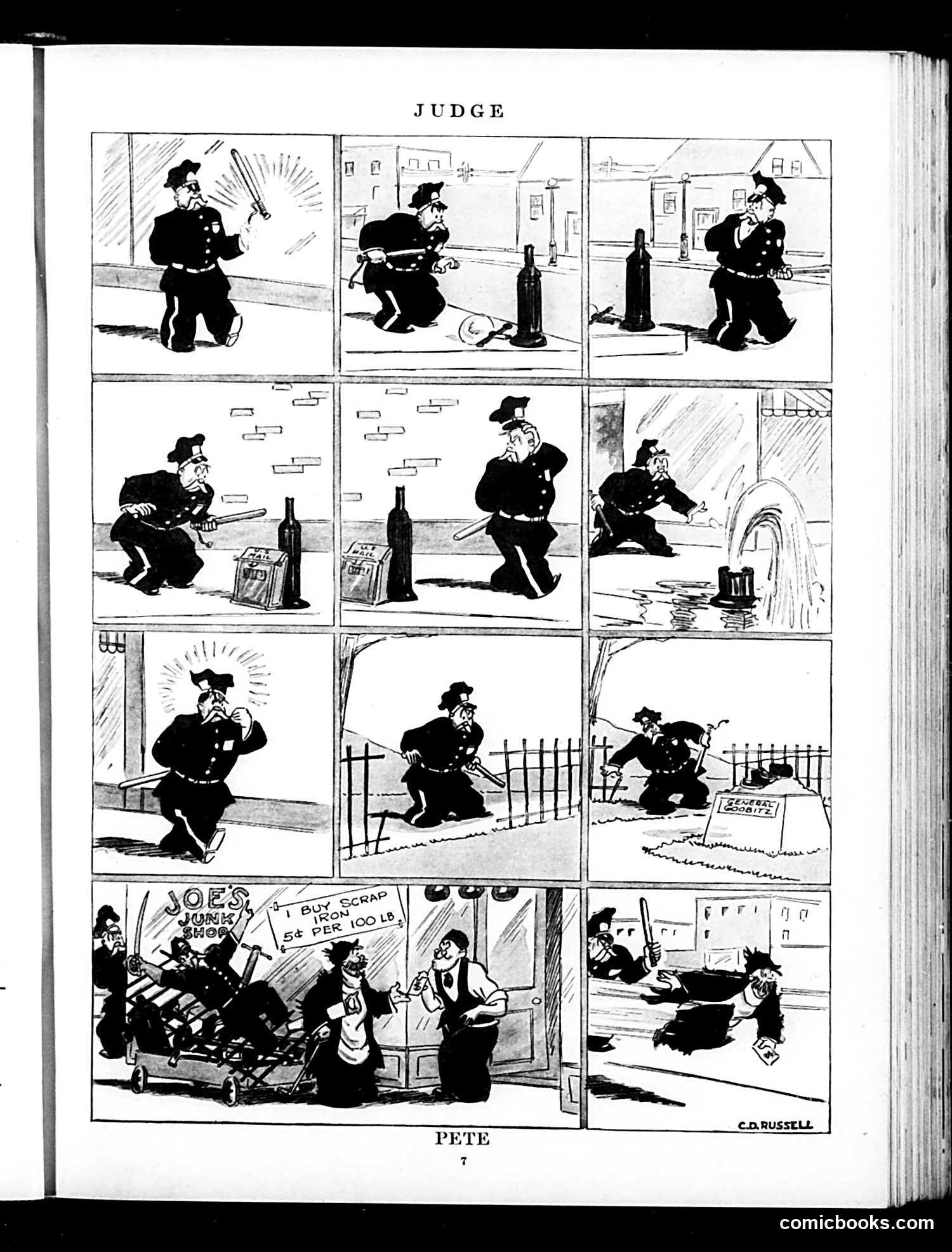
"Judge Pete" Comic Strip Analysis This is a sequential comic strip titled "Judge Pete" by C.A. Russell, depicting a police officer or judge character navigating various urban situations. The narrative follows Pete through encounters involving: - Confiscated alcohol bottles (suggesting Prohibition-era enforcement) - Scrap metal collection and sales ("Buy scrap 5¢ per 100 lbs") - Interactions at what appears to be "Joe's Pawn Shop" The humor appears satirical toward law enforcement and civic authority during Prohibition, mocking Pete's attempts to maintain order while dealing with black-market activities and petty commerce. The strip suggests corruption or the absurdity of enforcing unpopular laws. Without additional context about the magazine's date, the specific political targets remain unclear, though the Prohibition references and street-level crime scenarios are evident.
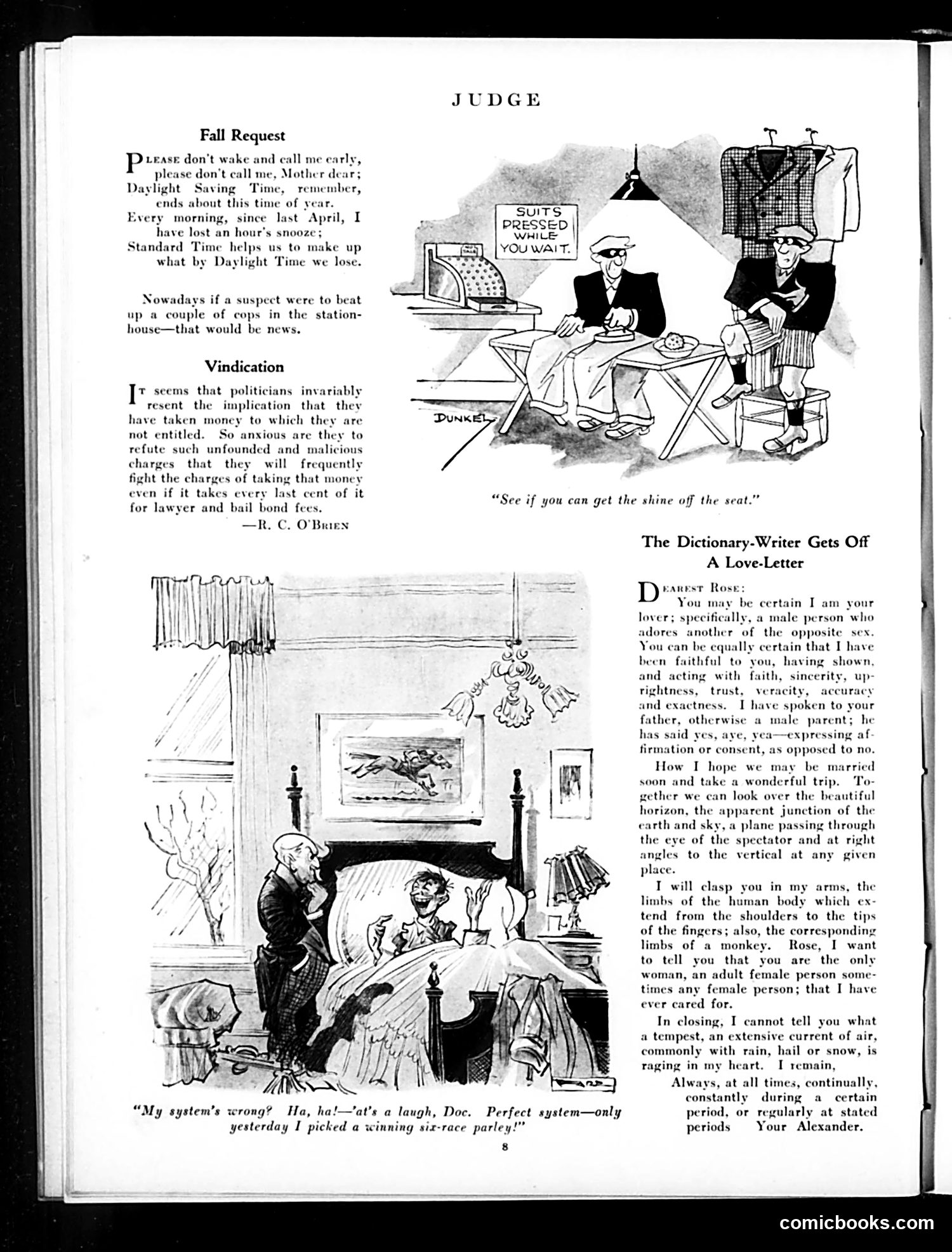
Judge Magazine Page Analysis This page contains three distinct satirical pieces: "Fall Request" mocks Daylight Saving Time's end in autumn, complaining about lost sleep since April when it began. "Vindication" satirizes corrupt politicians who spend enormous sums on lawyers and bail bonds defending themselves against bribery accusations—ironically proving guilt through their desperate denials. "The Dictionary-Writer Gets Off A Love-Letter" parodies pedantic writing by presenting a love letter where every emotion is replaced with dictionary definitions. The lover describes Rose using technical language ("limbs of the human body which extend from the shoulders to the tips of the fingers") instead of romantic language. The cartoon below shows a doctor and patient, with the caption joking about a "perfect system" for winning horse races—a parallel mockery of absurd certainty. The satire targets pretentious, overcomplicated language and the gap between how things should be expressed versus how pedants actually express them.
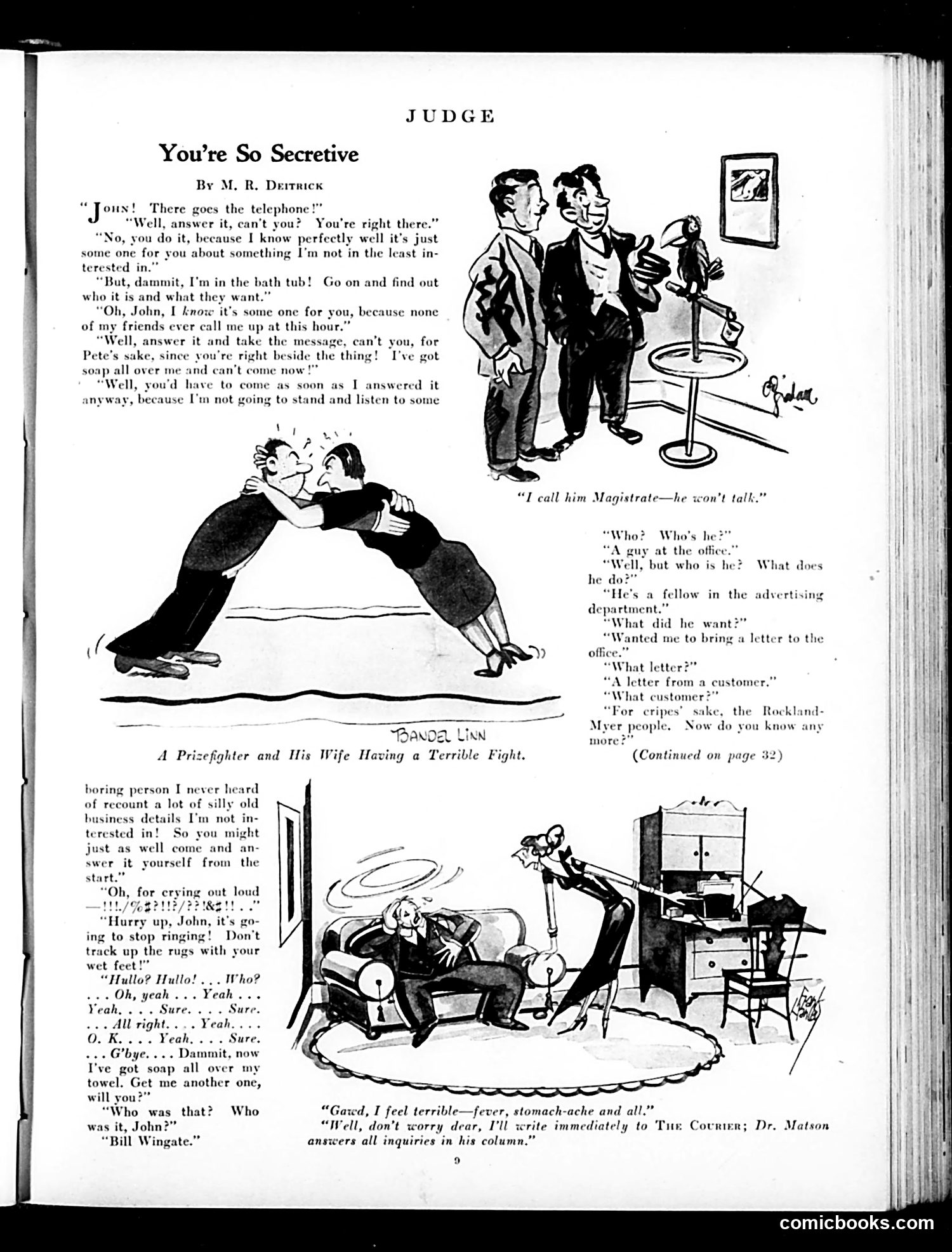
"You're So Secretive" - Judge Magazine This domestic comedy depicts a married couple's petty argument over answering a ringing telephone. The husband, in the bathtub, refuses to answer; the wife insists it's for him. When she finally answers, it's a business call from "Bill Wingate" at the advertising department regarding a letter for Rockland-Myers customers—details the wife finds boring and resents. The satire mocks 1920s-30s married life: the passive-aggressive buck-passing, gender dynamics around domestic duties, and husbands' reluctance to take work calls at home. The wife's resentment at being treated as a secretary mirrors period anxieties about women's domestic servitude. The lower cartoon shows the couple's quarrel escalated into physical comedy—the "terrible fight" of the title—suggesting marital discord over trivial matters.
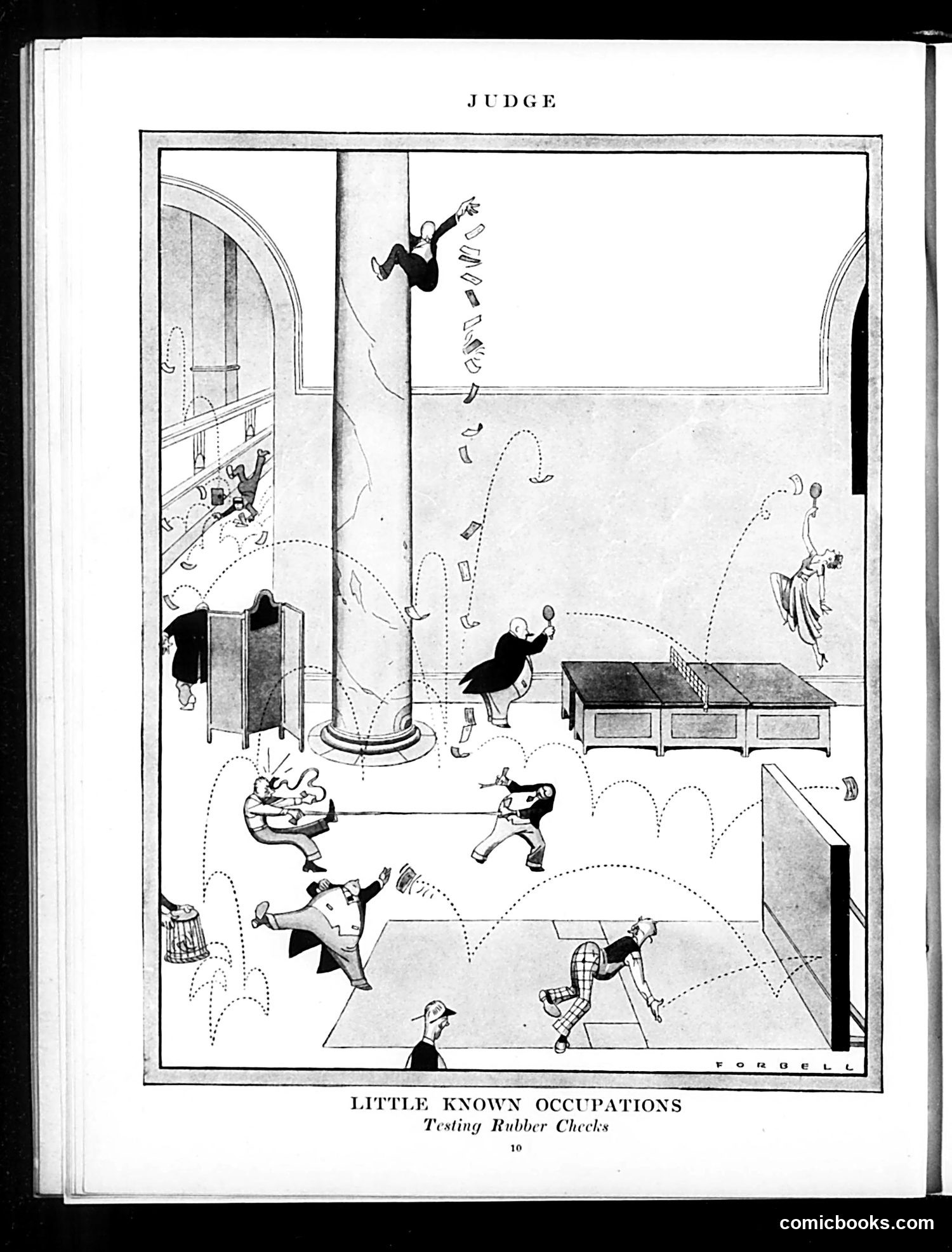
"Testing Rubber Checks" - Judge Magazine Cartoon This cartoon satirizes the occupation of testing rubber checks—checks that "bounce" or fail due to insufficient funds. The illustration shows a chaotic courtroom or institutional setting where various figures are literally testing the elasticity of rubber checks depicted as dotted-line trajectories bouncing around the room. The humor derives from the double meaning: "rubber check" is slang for a bad check, but the cartoon depicts them as actual rubber objects with physical bounce properties. The scene parodies both the absurdity of having such an occupation and the frustration of financial fraud. Multiple figures are shown in exaggerated poses reacting to these bouncing checks, suggesting the widespread problem of check fraud in early 20th-century commerce.
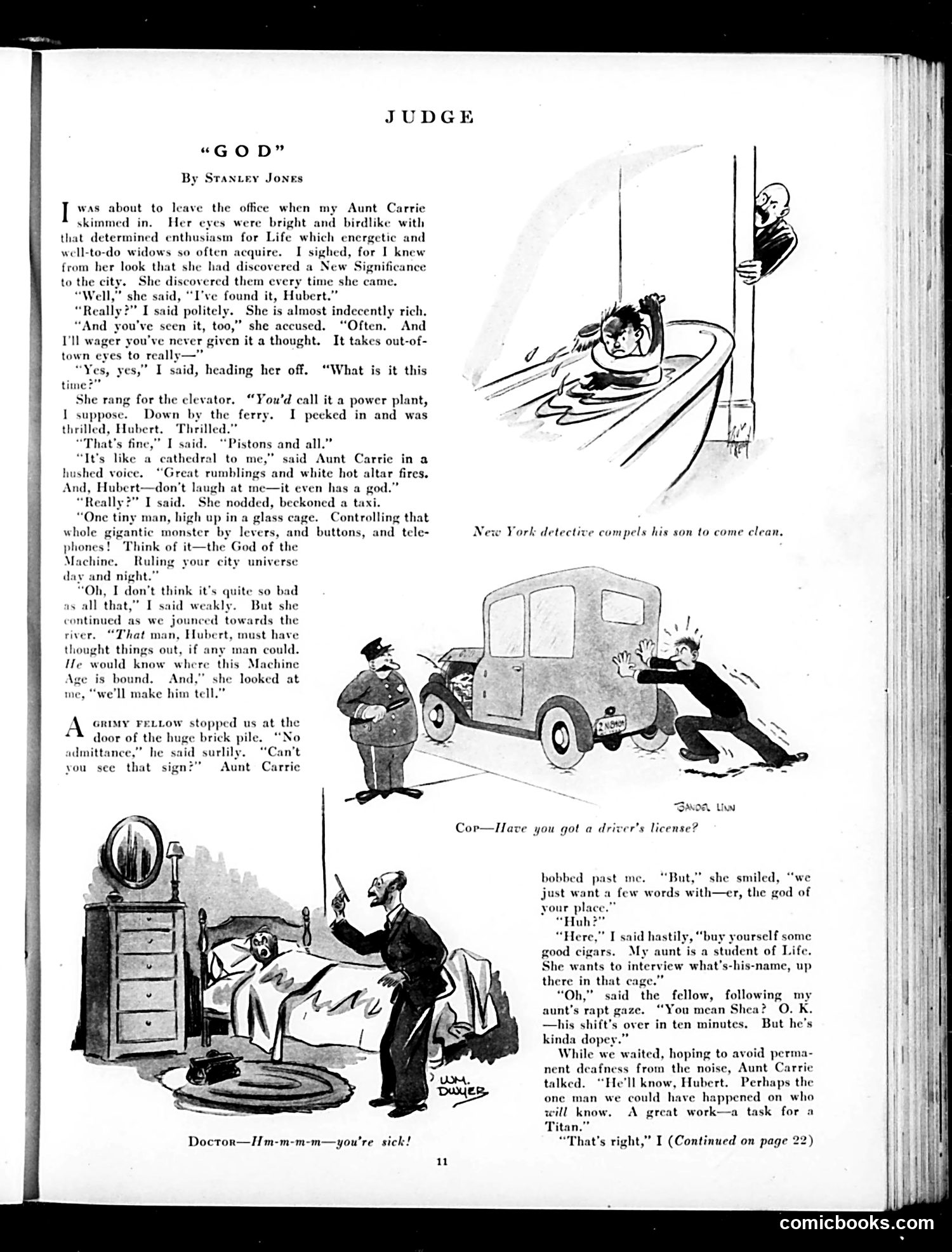
"God" by Stanley Jones - Judge Magazine This is a humorous short story with accompanying cartoons satirizing early 20th-century American enthusiasm for industrialization and technological progress. The Setup: A wealthy, well-meaning widow (Aunt Carrie) discovers a power plant and becomes fascinated by its operator—a lone man in a glass booth controlling massive machinery. She treats him with quasi-religious reverence, calling him "the god of the Machine," embodying what she sees as the divine wonder of modern industry ruling "your city universe." The Satire: The piece mocks the romantic idealization of industrial progress and the working man. Aunt Carrie's breathless wonder at industrial machinery—comparing it to a cathedral with "altar fires"—reflects a broader cultural fascination with modernity that glosses over the reality: the operator is described as "kinda dopey" and merely tends machines by levers and buttons. The Cartoons illustrate related themes of urban life—a detective compelling his son to confess, and a driver's license confrontation—all treating ordinary modern situations with exaggerated seriousness, reinforcing the story's mockery of overwrought contemporary attitudes.
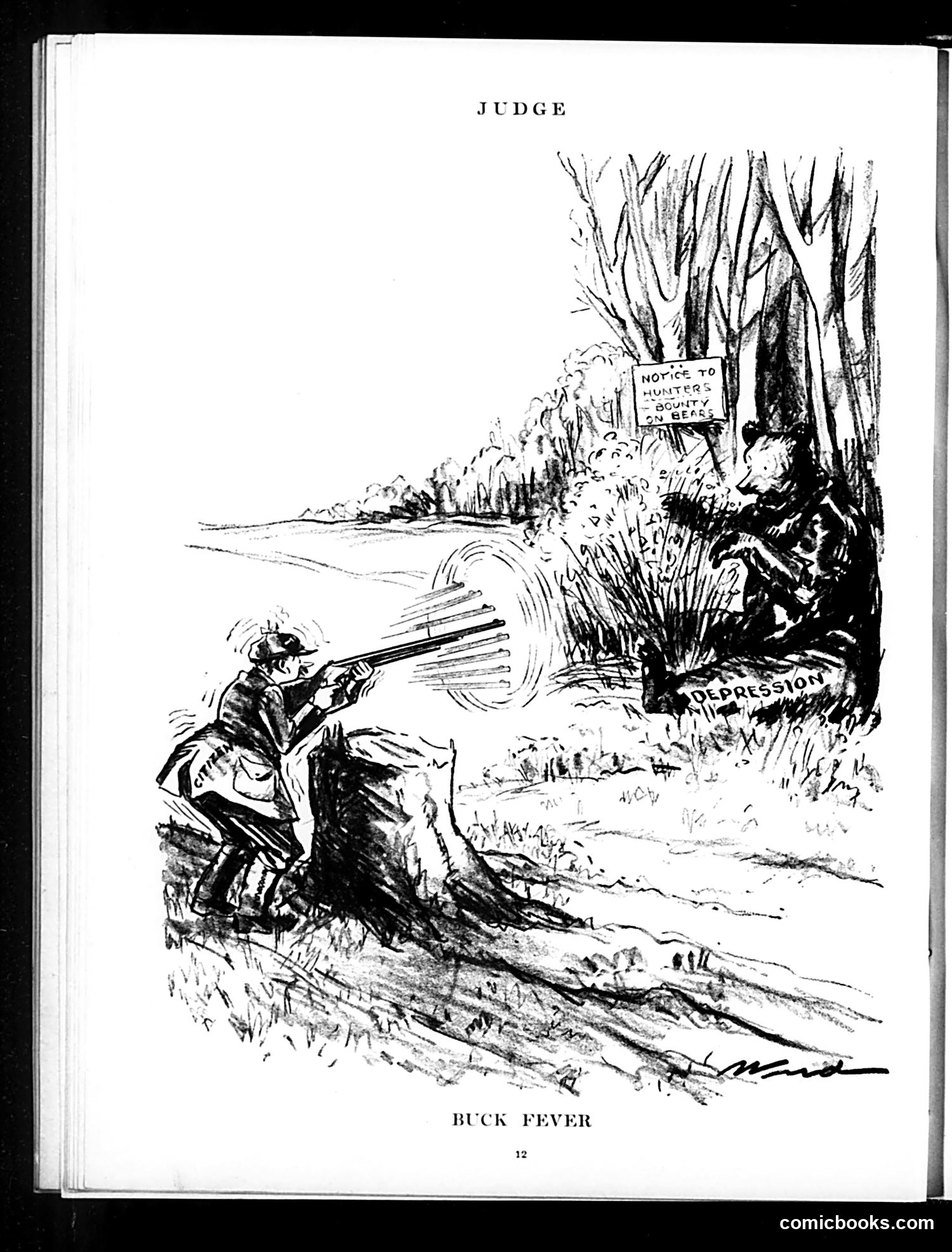
"Buck Fever" - Judge Magazine Cartoon This political cartoon depicts a hunter aiming a rifle at a large buck (deer) labeled "Expression" near a tree marked "Notice to Hunters - Bounty So cBeR" (likely "Sobriety"). The title "Buck Fever" plays on the hunting term for nervous excitement that causes poor aim. The satire appears to critique overzealous enforcement of Prohibition-era laws targeting alcohol ("sobriety bounty"). The hunter, representing likely a federal agent or law enforcer, is wildly firing at the target of "expression"—suggesting that aggressive anti-alcohol measures were infringing on free speech or personal liberty. The deer represents the elusive goal of enforcing sobriety through legal means. The cartoon mocks the chaotic, misguided nature of Prohibition enforcement during this period.
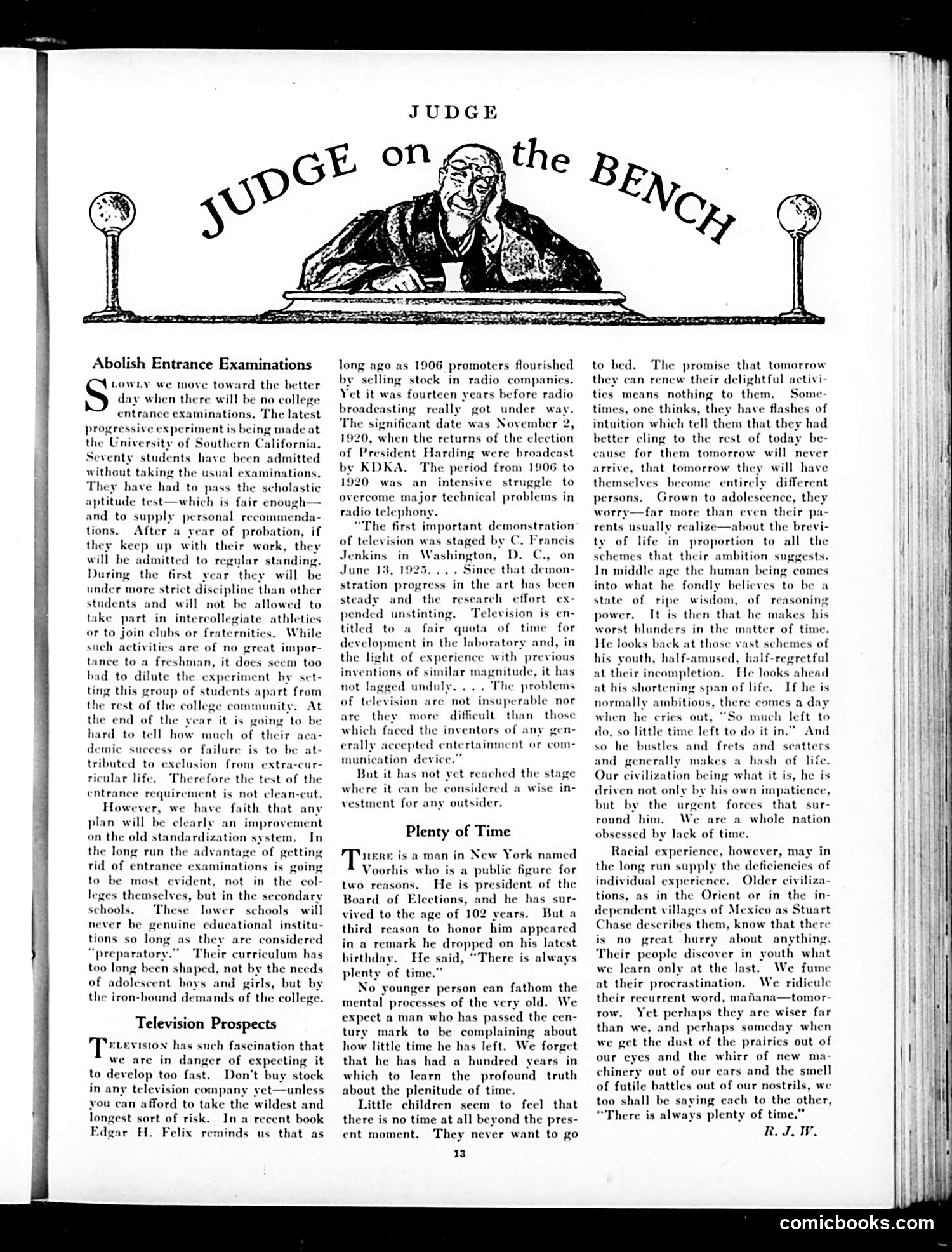
"Judge" Magazine Page Analysis This page from Judge magazine contains three editorial columns addressing early 20th-century concerns: "Abolish Entrance Examinations" argues for eliminating college entrance exams, citing an experiment at the University of Southern California. The writer supports the change but criticizes the experimental group's exclusion from extracurricular activities, which muddies the results. "Television Prospects" warns against investment speculation in television technology. Drawing parallels to early radio stock promotions (1906), the author notes that while television shows promise, it remains in the laboratory phase—too risky for ordinary investors. "Plenty of Time" celebrates a New York elections official named Voorhis, age 102, who reportedly said "there is always plenty of time." The piece philosophizes that only the very elderly truly understand time's abundance, contrasting their perspective with children's impatience. The masthead features a judge figure, fitting Judge magazine's satirical purpose of social commentary and critique.
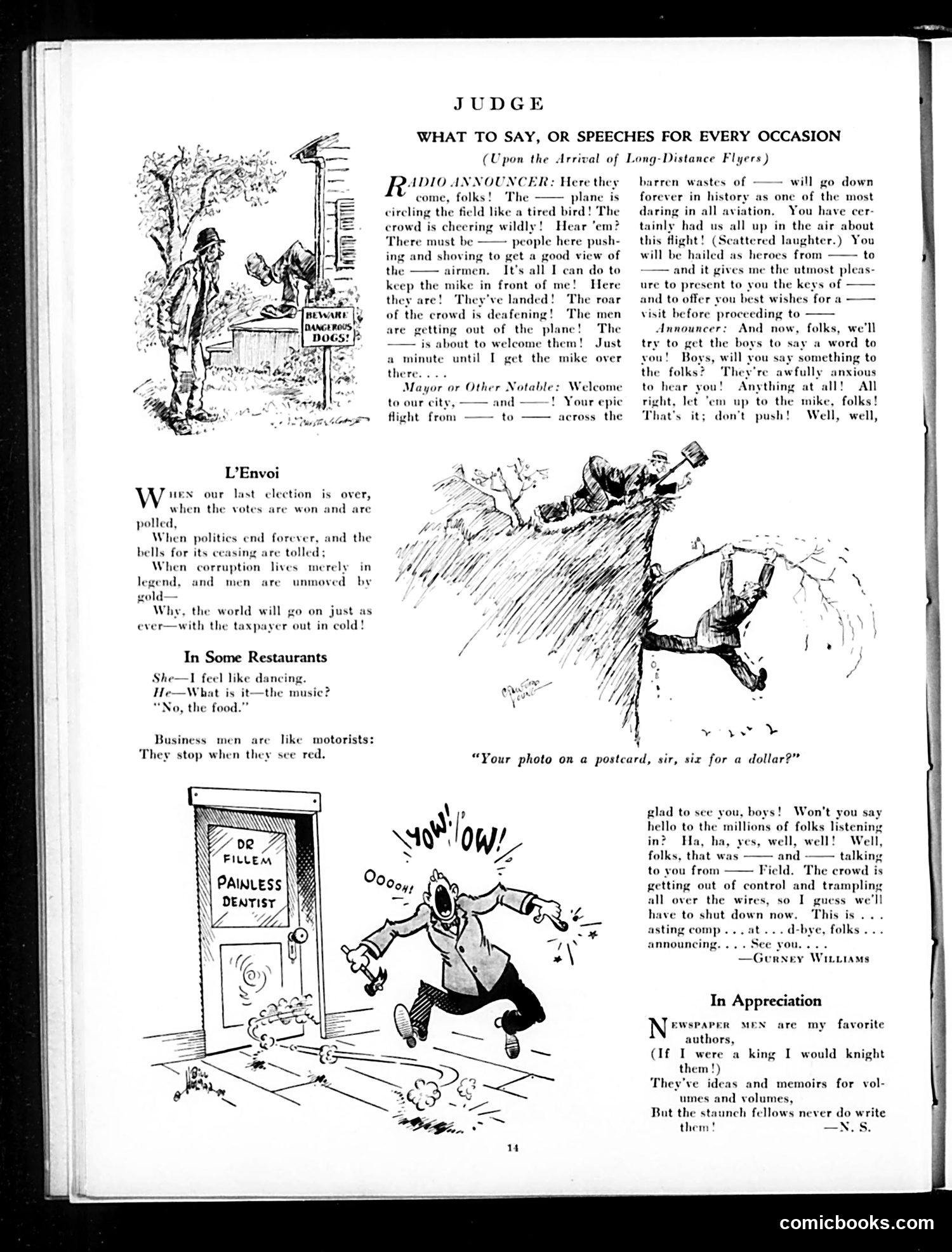
Page Analysis: Judge Magazine Satirical Content This page contains several humorous pieces typical of Judge's social satire: "Upon the Arrival of a Long Distance Flyer" mocks the radio announcer's breathless coverage of aviation achievements, showing the disconnect between media hype and actual events—the announcer struggles to keep the microphone positioned while crowds push chaotically. "L'Envoi" is a cynical poem about elections and corruption, suggesting that despite democratic processes, taxpayers remain perpetually burdened. "In Some Restaurants" presents quick jokes about dining culture and business behavior. The "Painless Dentist" cartoon shows a patient violently ejected from a dental office, satirizing false advertising—dentists claiming painless procedures while delivering anything but. The overall tone reflects 1920s-30s American skepticism toward institutions, technology hype, and consumer deception.
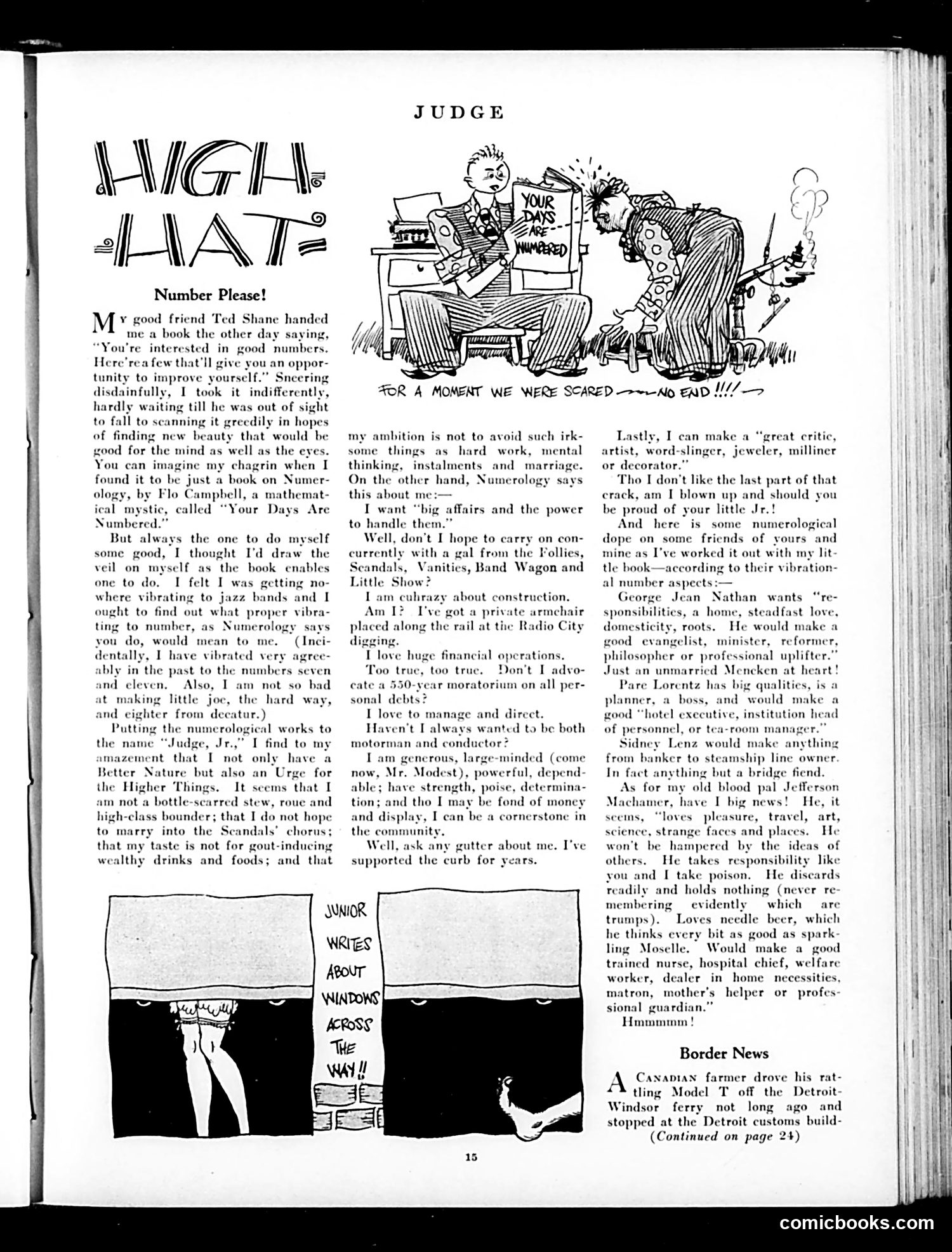
Explanation for Modern Readers This page from *Judge* magazine features "High Hat," a humorous column using numerology—a pseudo-mystical practice claiming numbers reveal personality traits—as satire. The author, identifying himself as "Judge, Jr.," receives a numerology book and applies it to himself, finding it hilariously contradicts his actual behavior. The joke: numerology claims he's ambitious, moral, and community-minded, when he admits to supporting "the curb for years" (vagabondry) and wanting affairs with Follies dancers. He then applies numerology to real people, likely theater/arts figures: George Jean Nathan (drama critic), Pare Lorentz (filmmaker), Sidney Lenz, and Jefferson Machamer (cartoonist). Each reading produces absurdly inaccurate character assessments—the humor mocking both numerology's pretensions and these men's actual reputations. The cartoon shows a "Judge" character frightening two people with papers, illustrating numerology's alarming claims. The satire targets 1920s-30s pseudoscience fads and celebrity culture.
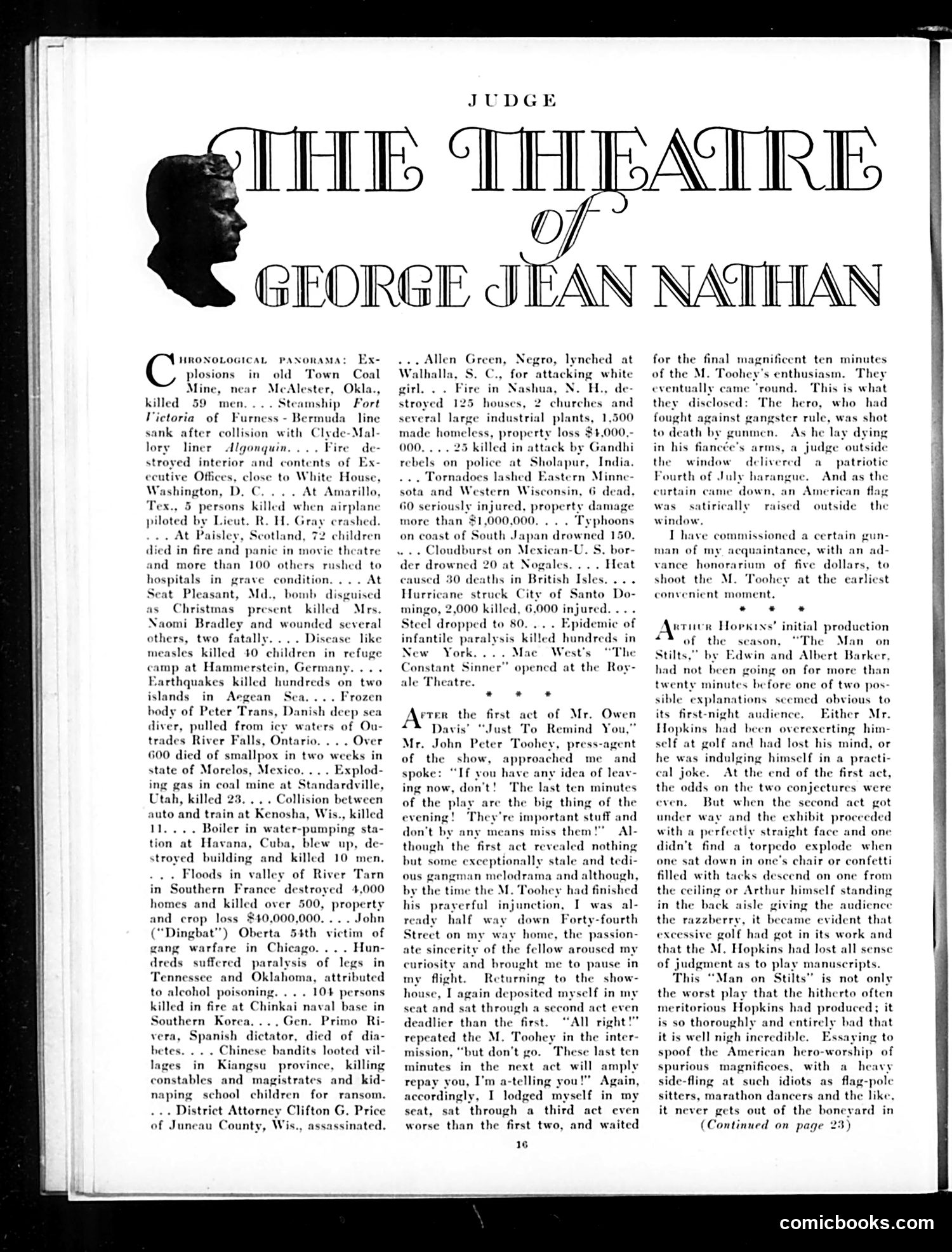
Analysis for Modern Readers This page contains two distinct elements: Top Section - "The Theatre of George Jean Nathan": A masthead for a theater criticism column by the prominent drama critic George Jean Nathan, featuring his profile portrait. Main Content - A Satirical Review: Nathan recounts attending Owen Davis's play "Just To Remind You." The satire targets press agents and theatrical hype: The theater's press agent, John Peter Toohey, repeatedly pressures Nathan not to leave, insisting each act's finale will be exceptional—despite Nathan finding the play tedious. The joke is that Nathan stays through all three acts out of curiosity, only to find each successive act worse than the last. The satire mocks the theatrical industry's manipulative marketing tactics and critics' susceptibility to aggressive promotion. It also pokes fun at Nathan himself as willing to waste his evening based on a press agent's enthusiastic but ultimately empty promises. The surrounding text consists of a "chronological panorama" of disasters and tragedies from recent news—a typical Judge feature contrasting with the lighter theater criticism.
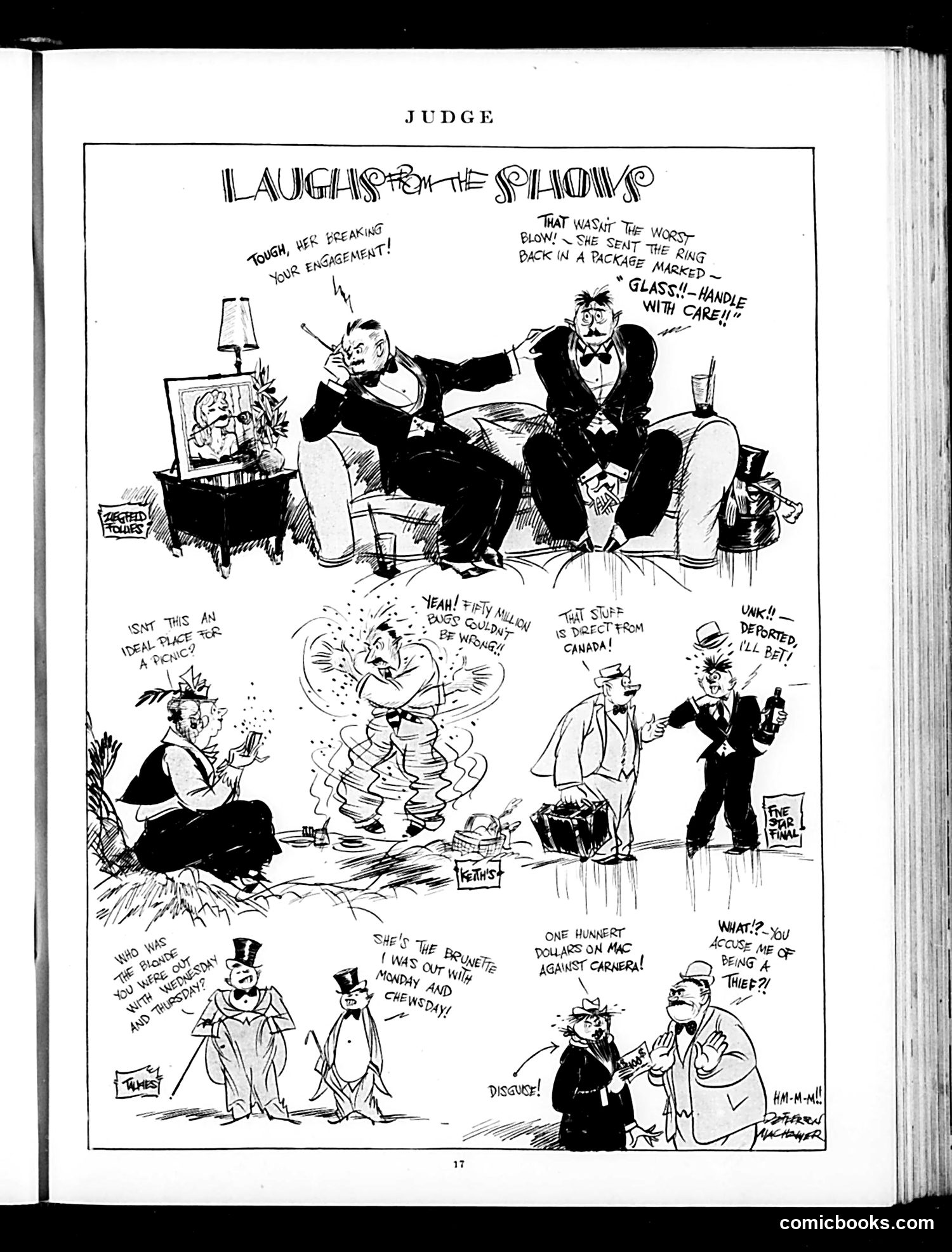
"Laughs in the Shows" - Judge Magazine Cartoon This satirical comic strip mocks wealthy socialites and their scandals. The top panel depicts two men in formal wear discussing a broken engagement, with one complaining about receiving a ring back in damaged packaging—a commentary on careless wealth and materialism. The subsequent panels lampoon various high-society mishaps: a woman's extramarital affair, references to Canadian imports (likely bootleg liquor during Prohibition), and what appears to be a betting reference to "Carnera" (likely boxer Primo Carnera), suggesting wealthy people gambling recklessly. The final panels depict characters as thieves and debtors, with dialogue about deflowering and theft—crude humor about moral corruption among the privileged class. Overall, the satire ridicules the hypocrisy, frivolity, and moral failings of the wealthy elite, presenting them as shallow and ethically bankrupt.
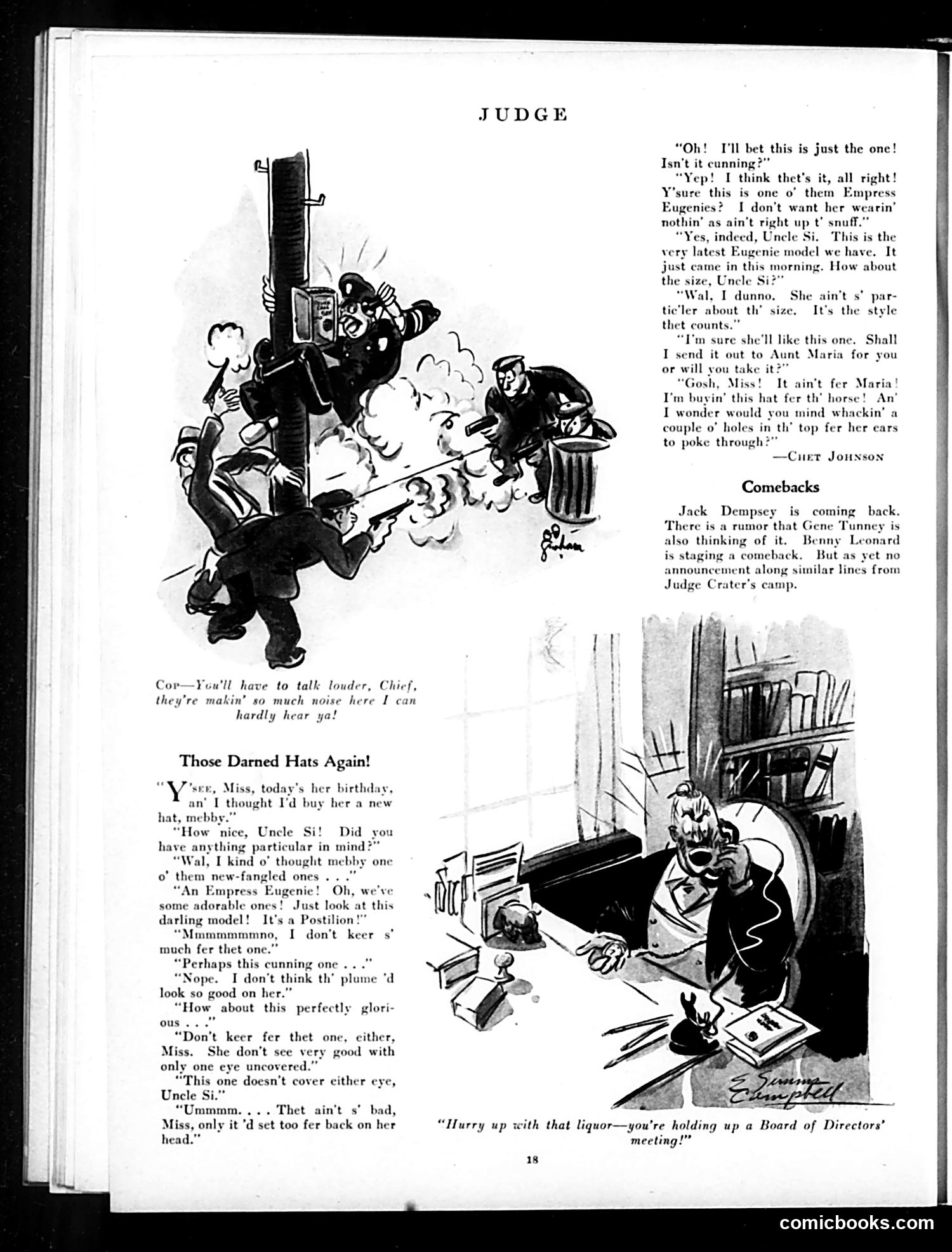
Judge Magazine Page Analysis This page contains two satirical pieces: "Those Darned Hats Again!" mocks the absurdity of 1920s women's fashion, specifically "Empress Eugenie" hats. An elderly rural man (Uncle Si) buys an elaborate hat for his horse, not realizing he's in a millinery shop. The joke lampoons both the impracticality of high-fashion women's hats—which obstruct vision and vision—and the pretentious naming conventions ("Postilion," "Eugenie") that salespeople use to justify expensive, ridiculous designs. "Comebacks" is a brief satirical note comparing celebrity comebacks (boxer Jack Dempsey, boxer Gene Tunney, boxer Benny Leonard) to the mysterious disappearance of Judge Crater, a prominent judge who vanished in 1930, implying he won't be making a "comeback." The bottom cartoon shows a drunk man interrupting a Board of Directors meeting, treating the meeting's importance as secondary to obtaining liquor—satirizing Prohibition-era hypocrisy and the casual disregard some showed for official proceedings.
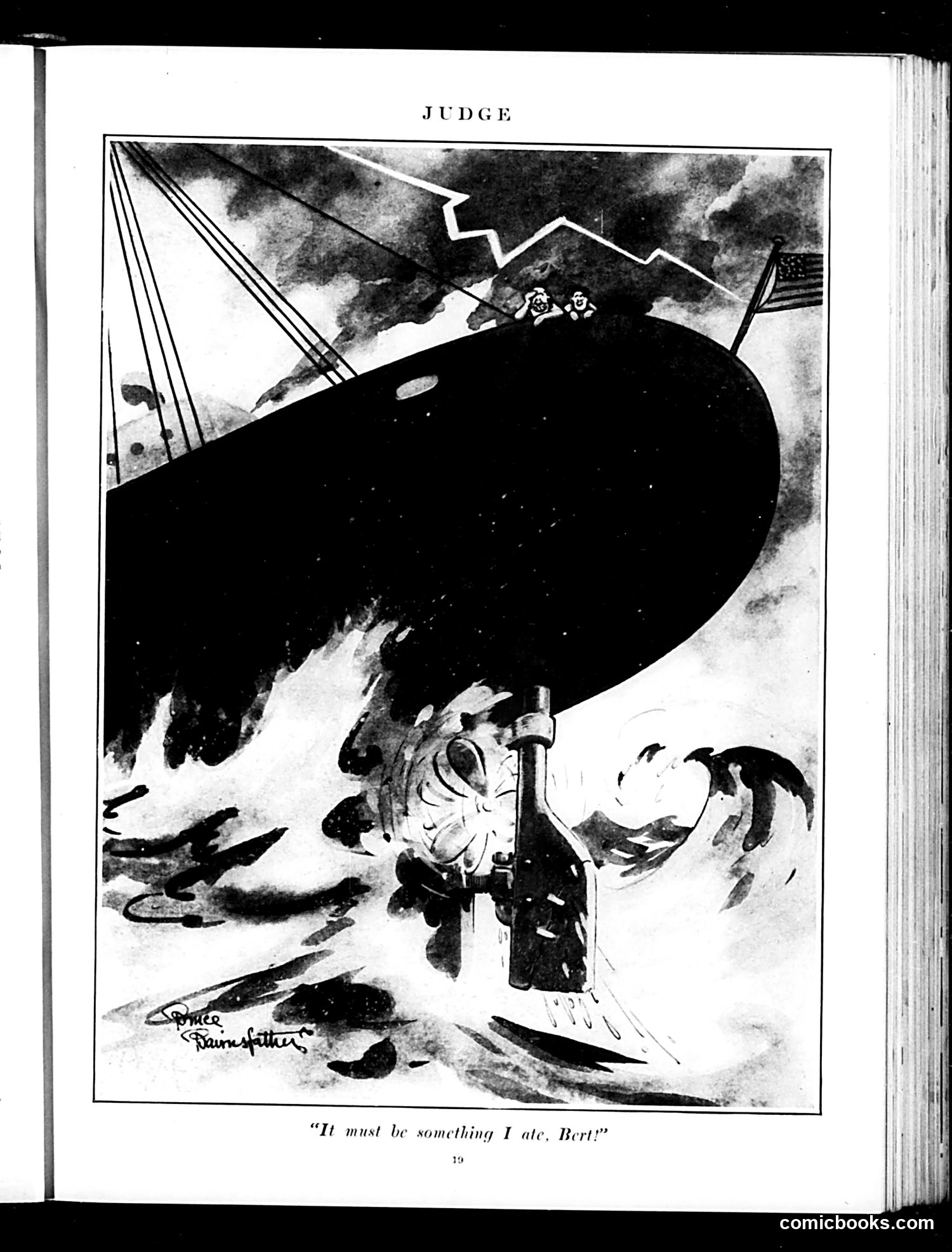
Judge Magazine Cartoon Analysis This political cartoon depicts a dramatic maritime disaster with a sinking ship. Two figures appear at the vessel's rail as it goes down amid turbulent waters and explosions. The caption—"It must be something I ate, Bert?"—suggests dark humor about the ship's fate. The cartoon likely comments on a specific early 20th-century shipping disaster, possibly referencing incompetence, negligence, or corruption in maritime safety. The character's absurd attempt to rationalize catastrophe as indigestion satirizes either leadership failures or public denial about a serious incident. Without additional context about Judge's publication date and contemporary events, the specific disaster or political figures referenced remain unclear, though the tone mocks those responsible for the tragedy.
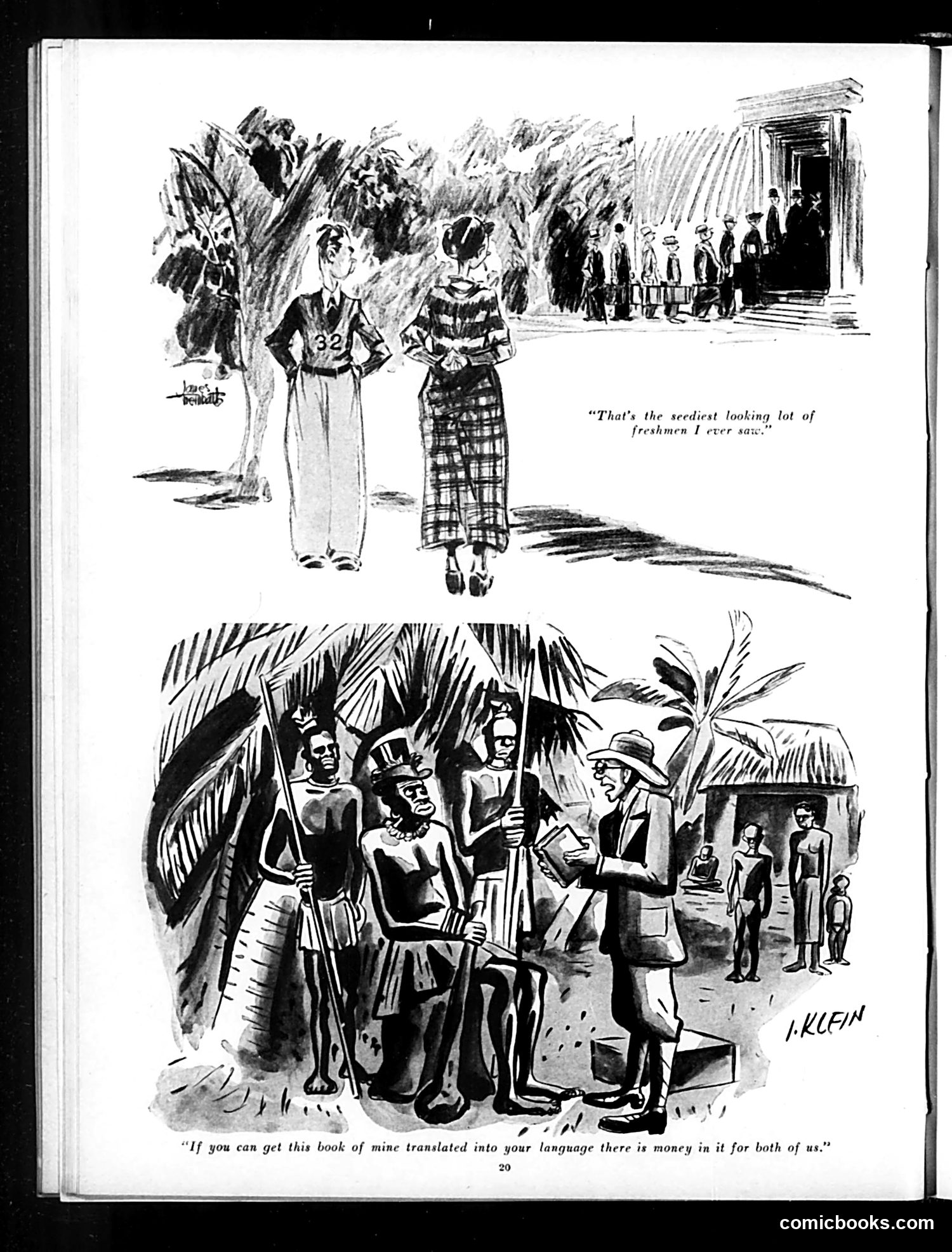
Two Cartoons from Judge Magazine Top cartoon: Two young women in 1920s attire stand by a tree observing a crowd entering a building. One comments that the entering group represents "the seediest looking lot of freshmen I ever saw." This satirizes college freshman orientation, mocking the appearance or demeanor of new students. Bottom cartoon: Set in a tropical location (indicated by palm fronds), a man in colonial dress addresses indigenous people, offering to have "this book of mine translated into your language" for profit-sharing. This satirizes colonial exploitation and cultural appropriation—specifically mocking Western businessmen seeking to profit from colonized peoples by commodifying their languages and cultures under the guise of mutual benefit.

Analysis This page is primarily a General Electric advertisement, not satire or political commentary. It promotes Mazda brand light bulbs through an appeal to vanity and domestic consumption. The image shows a woman's portrait with dramatic lighting that flatters her features—the advertisement's central argument: proper lighting enhances beauty. The accompanying text encourages readers (particularly women) to purchase Mazda lamps for various rooms, claiming they provide "soft, restful light" that showcases appearance attractively. The humor, if any, is gentle and self-aware: the ad acknowledges that people care about looking good under lighting and suggests GE has scientifically studied this concern. This reflects early-20th-century marketing that merged commercial products with aspirational lifestyle messaging. There is no political satire or caricature here—this is straightforward (if somewhat manipulative by modern standards) consumer advertising leveraging beauty standards to drive sales.
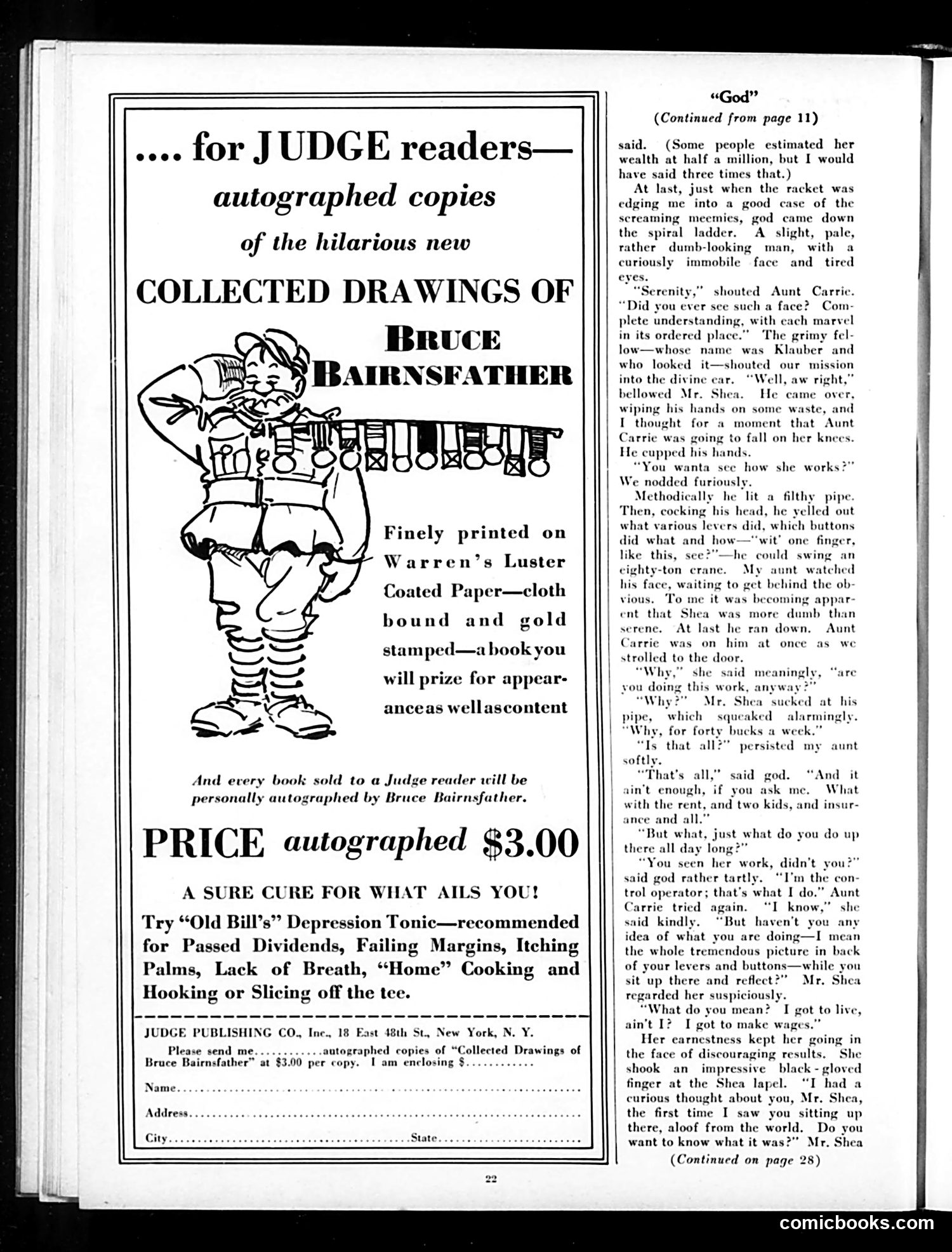
"God" Satirical Story Page from Judge Magazine This page contains advertising for Bruce Bairnsfather's collected drawings alongside the continuation of a satirical story titled "God." The narrative appears to be a social commentary on labor and class division during the Depression era. The story excerpt describes a wealthy woman ("Aunt Carrie") visiting an industrial site where she observes a crane operator nicknamed "god" who controls massive machinery. The satire mocks her detached curiosity about working-class life—she asks naïvely what he does "all day long" while he works forty hours weekly for modest wages. The operator's weary responses highlight the gap between her leisured inquiry and his grinding economic necessity. The humor lies in exposing the absurdity of upper-class tourists treating workers' lives as curiosities, while Bairnsfather's cartoons (advertised at $3.00 autographed) offered Depression-era readers affordable humor about their own struggles. The fake "cure" advertisement below parodies patent medicines while listing actual Depression hardships.
What This Page Shows This is a theater review and criticism page from Judge magazine, combined with a Bell Telephone advertisement. The text reviews recent Broadway productions harshly—particularly criticizing a play sponsored by A. Hopkins (likely theater producer Arthur Hopkins) and a musical called "Free For All." The critic uses sarcastic, dismissive language typical of early 20th-century theater reviewing, employing classical references ("As Sophocles grunted") to mock the productions' poor quality. The visual element—a simple illustration of a telephone—accompanies an advertisement celebrating the telephone's value, arguing that while costs are minimal, the service's worth is "infinite" because it enables human connection and business efficiency. This positions the Bell System as essential infrastructure. The juxtaposition is typical of Judge's format: entertainment criticism alongside advertising. The page reflects 1930s-era attitudes about modern technology as a progressive social good.
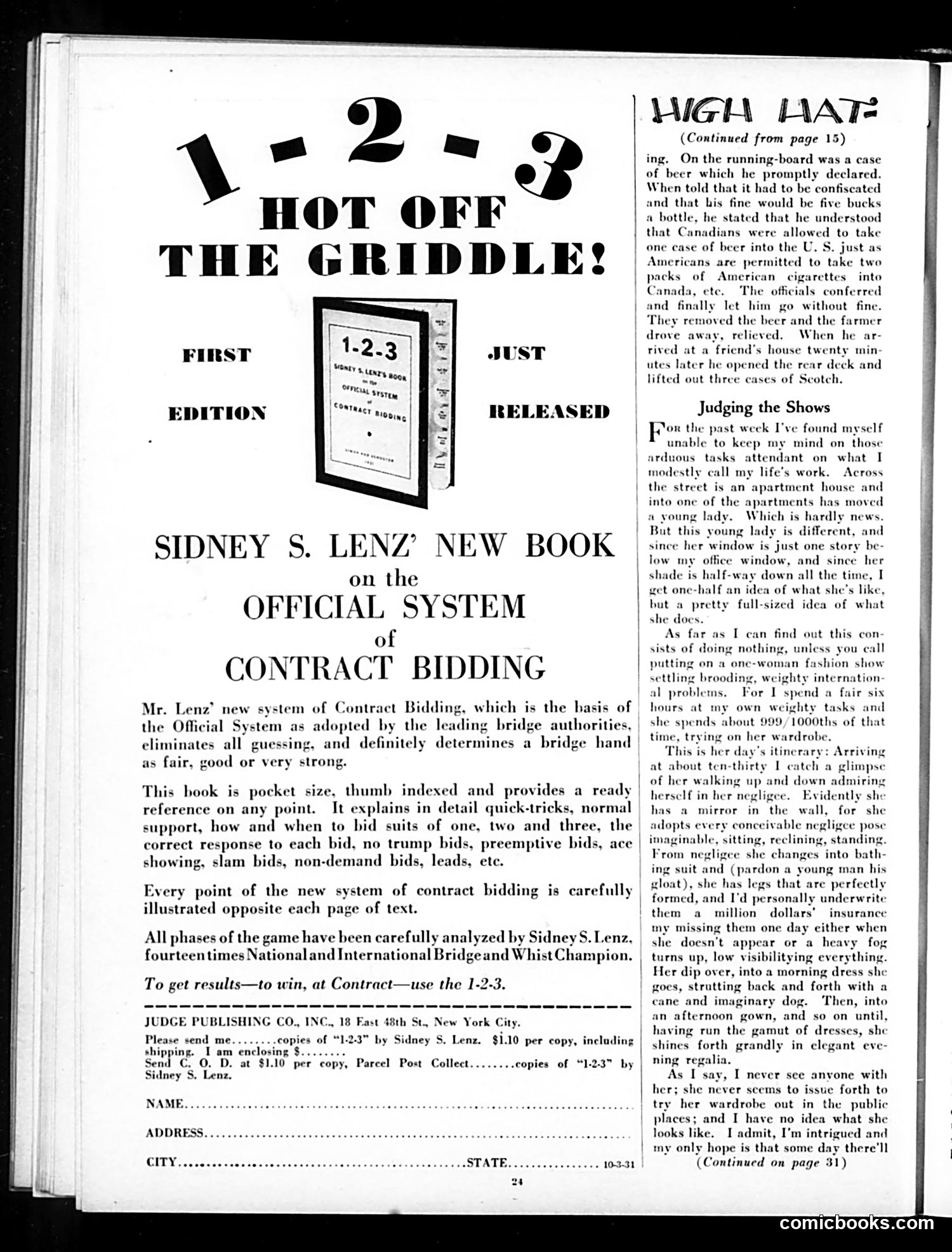
Analysis for Modern Readers This page is primarily advertising, not political satire. The main content advertises Sidney S. Lenz's instructional book on contract bridge bidding—a card game system he developed as a fourteen-time national and international champion. The "Hot Off the Griddle" masthead is Judge magazine's standard column header for miscellaneous content. The right-hand article, "Judging the Shows," is unrelated commentary about a neighbor—a humorous personal essay about a young woman in an adjacent apartment whom the writer observes through her window trying on clothes repeatedly throughout the day. The piece is voyeuristic humor typical of the era, depicting the woman as vain and idle, spending her day admiring herself in mirrors while the writer works diligently. There is no political content on this page. It represents Judge's typical mix of advertising and light, domestic humor rather than the satirical political commentary the magazine was known for.
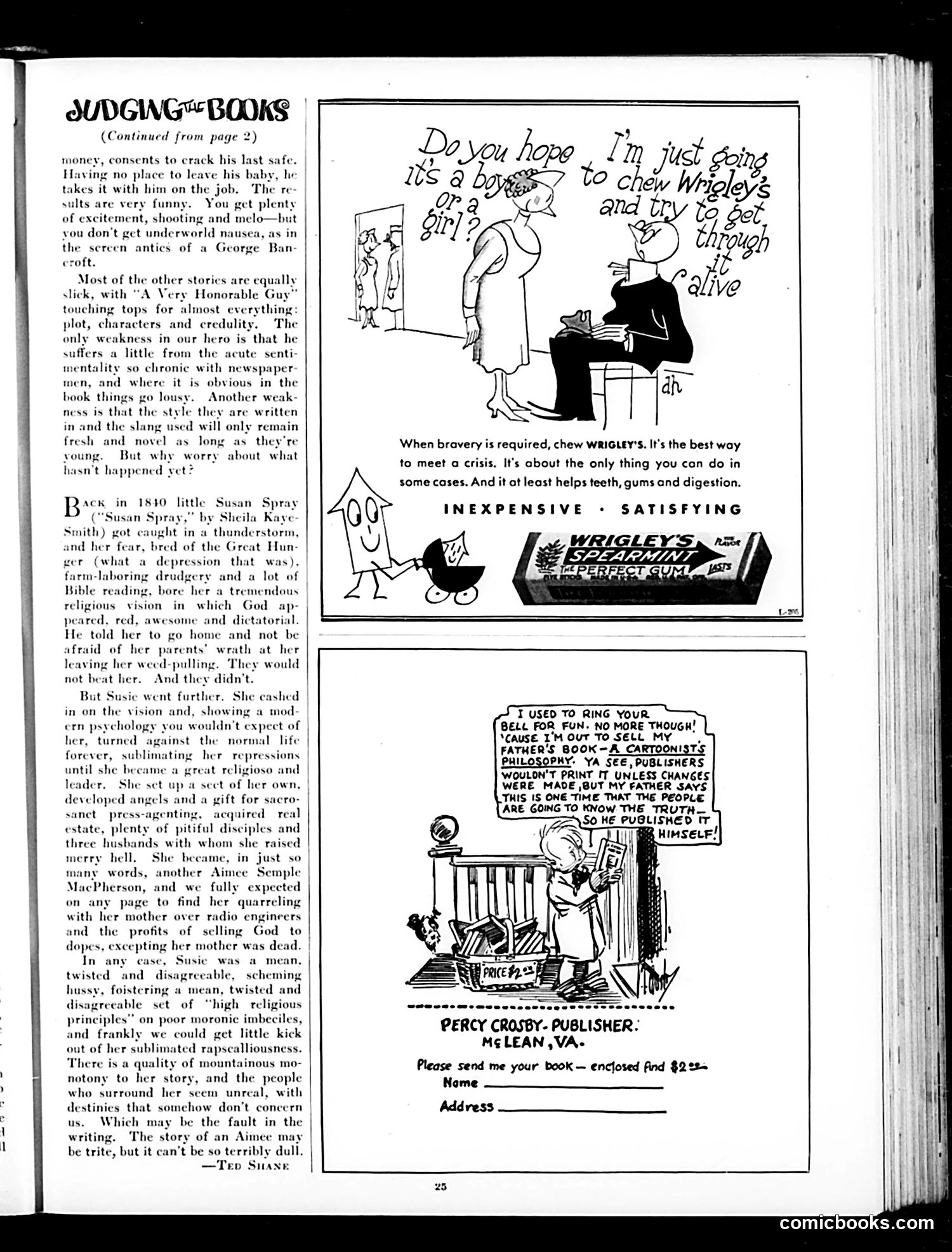
Explanation for Modern Readers This page contains a book review column and advertisements from a vintage satirical magazine. The main review critiques "Susan Spray," a novel about a woman who experiences a religious vision during a thunderstorm in 1840s Ireland and becomes a charismatic cult leader—essentially a historical parallel to Aimee Semple McPherson, a famous 1920s-30s evangelist known for theatrical religious performances and scandals. The reviewer finds the protagonist (Susie) unlikeable: a manipulative, scheming woman who exploits poor followers while sublimating her own psychological repression into religious authority. The advertisements include a Wrigley's gum ad depicting someone nervously chewing gum during a crisis, and a Percy Crosby self-promotional cartoon about selling his father's unpublished cartooning philosophy book—using humor to market the publication. The satire targets both manipulative religious figures and 1920s consumer culture's anxious marketing tactics.
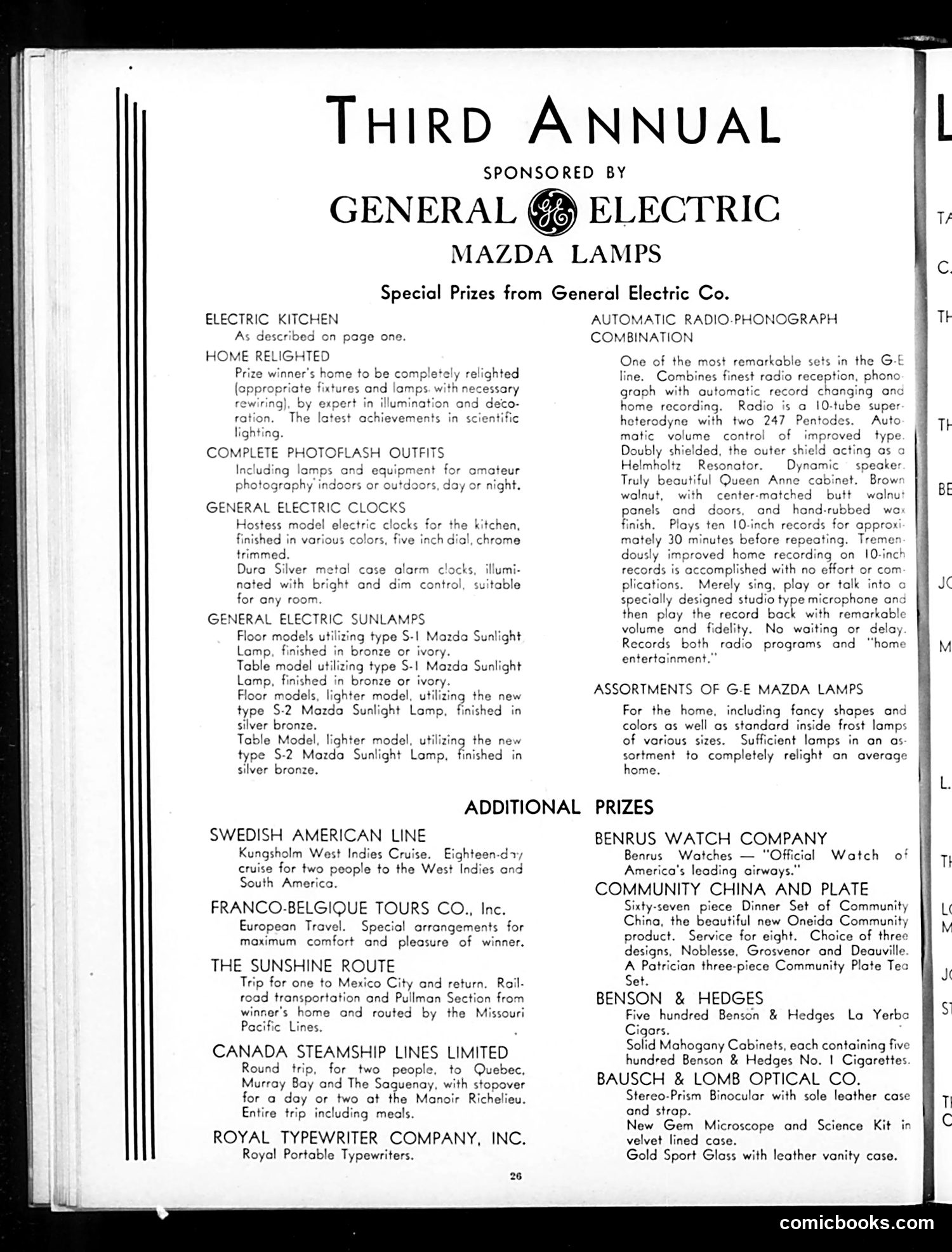
Content Analysis This page is primarily advertising content, not editorial cartoon or satire. It announces Judge magazine's "Third Annual" contest sponsored by General Electric, promoting Mazda lamps. The page lists prize categories: GE-sponsored prizes include home rewiring/relighting, photoflash equipment, electric clocks, and sunlamps—all emphasizing modern domestic electrification, a significant luxury in the era. Additional prizes from travel companies (Swedish American Line, Franco-Belgique Tours, Canadian Steamship Lines) and consumer goods brands (Benrus watches, Community China, Benson & Hedges cigars, Royal typewriters, Bausch & Lomb optics) reflect upper-middle-class aspirations of the interwar period. The contest mechanics aren't visible on this excerpt, but the prize diversity suggests readers could win anything from kitchen modernization to exotic Caribbean cruises—appeals to both practical domestic improvement and leisure travel fantasy during economically uncertain times.
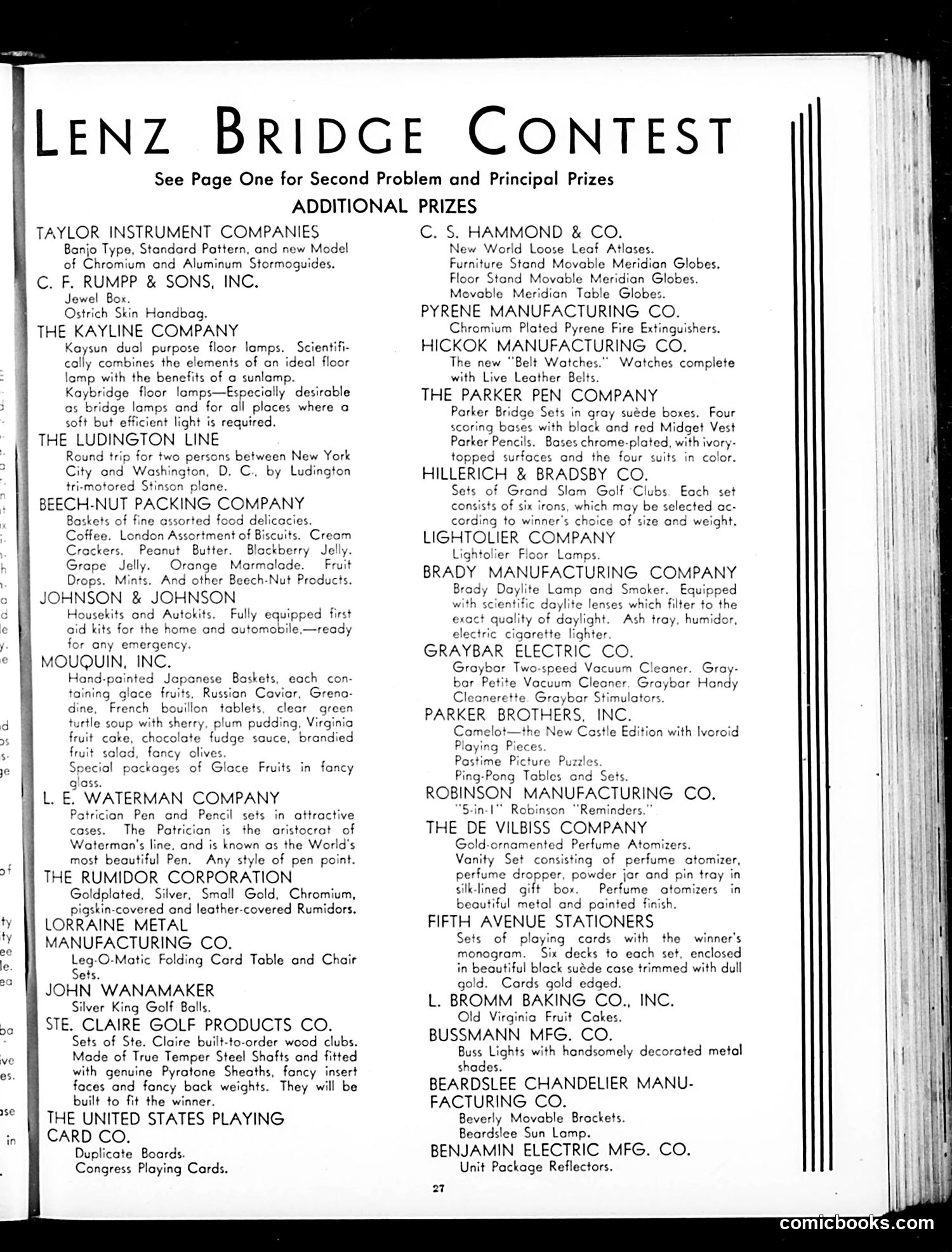
Analysis This page is not a cartoon or satirical content—it's an advertisement section from Judge magazine announcing prizes for a "Lenz Bridge Contest." The page lists dozens of companies offering merchandise as prizes for what appears to be a bridge (the card game) competition. Prizes range from luxury items (ostrich skin handbags, caviar baskets, golf clubs) to practical goods (floor lamps, vacuum cleaners, office supplies, pens). The contest itself is referenced as continuing from "Page One." This reflects 1920s-1930s consumer culture and corporate sponsorship practices. Bridge was enormously popular among middle and upper-class Americans during this era, making it an ideal vehicle for companies to advertise premium products to their target demographic. The breadth of sponsoring companies—from lamp manufacturers to pen makers to food companies—indicates bridge's broad appeal as a genteel pastime worthy of substantial prize support.
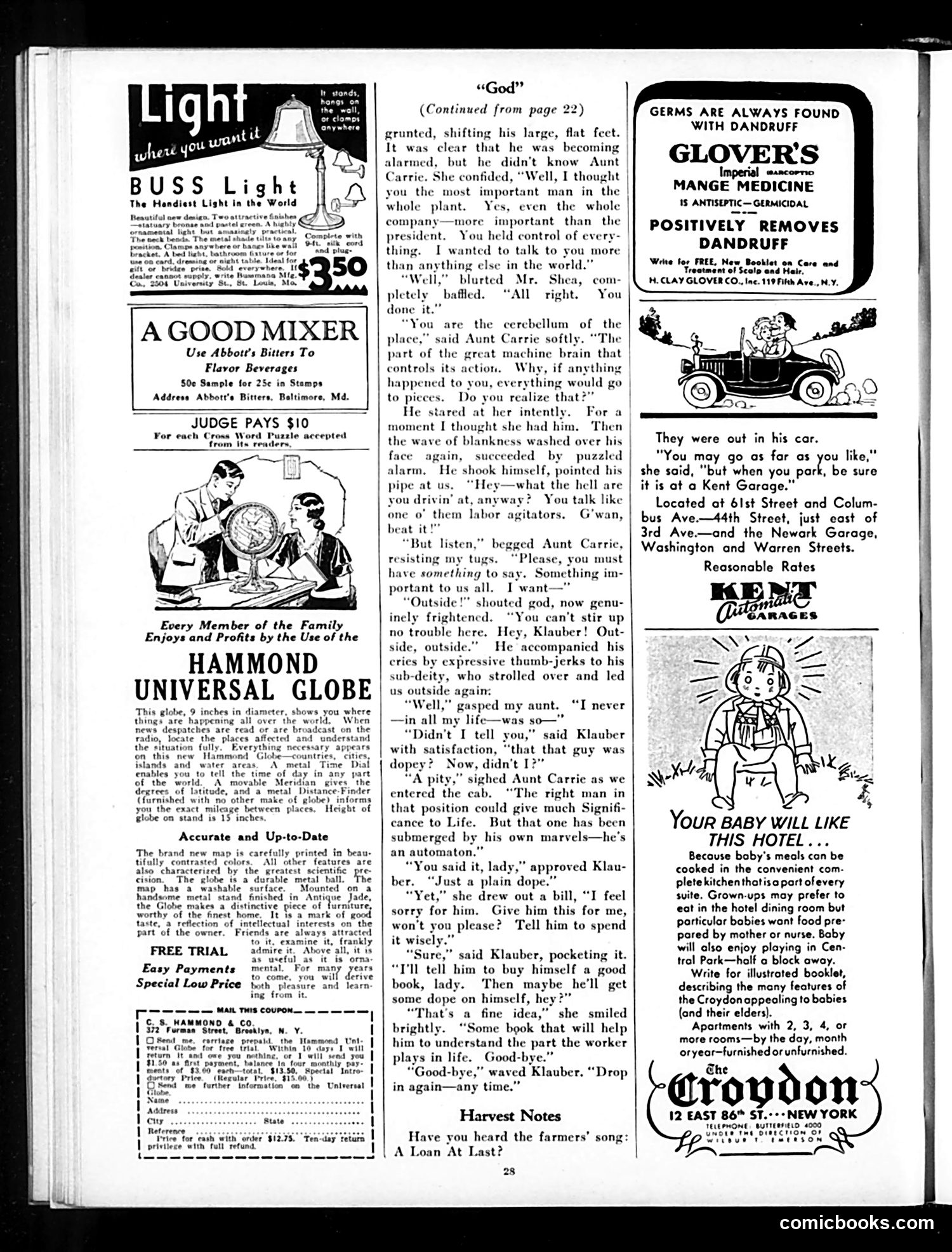
Analysis of This Judge Magazine Page This page is primarily advertisements and serialized fiction, with minimal political satire. The main content is a continued story titled "God" featuring Aunt Carrie attempting to convince a factory foreman (Mr. Shea) of his importance to the operation. She uses flattery—calling him "the cerebellum" controlling the machine—to manipulate him into social consciousness. However, Shea remains unmoved, suspicious she's a labor agitator, and ejects her. The satire targets working-class resentment of labor organizing: Shea's reflexive hostility to anyone praising workers' significance, viewing such talk as dangerous radicalism. The story mocks both his intransigence and Aunt Carrie's naive persuasion tactics. The surrounding ads (Hammond Globe, Abbott's Bitters, Glover's Dandruff Cure) represent typical 1920s-era consumer products marketed to middle-class readers. Historical context: This reflects post-WWI American anxiety about unionization and labor activism.
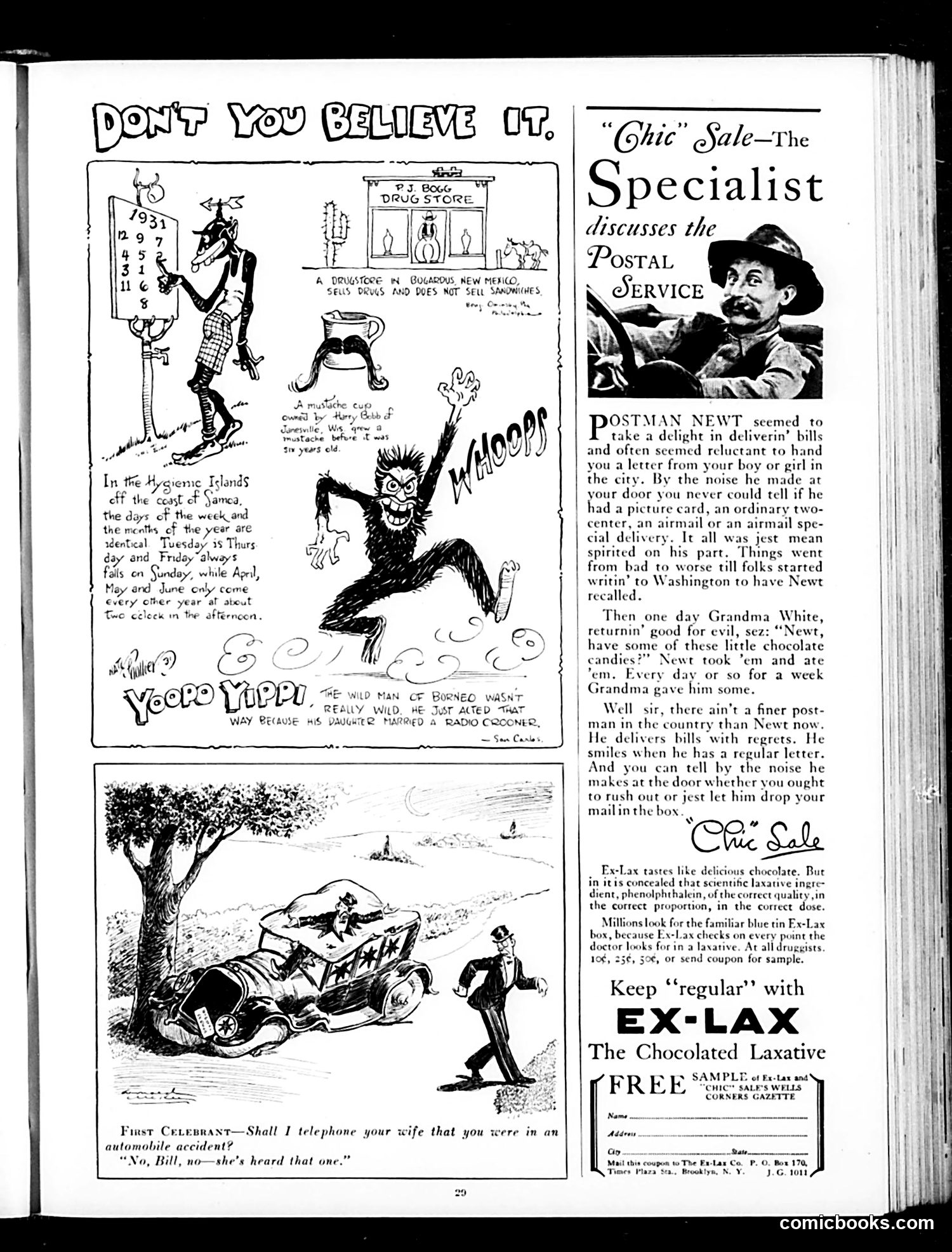
Analysis of Judge Magazine Page This page from Judge magazine combines humor about exotic locales and modern American life with period advertising. The left column features absurdist humor: "The Hygiene Islands" jokes about a fictional place where days and months are meaningless ("Tuesday is Thursday"), and "Vocpo Yuppi" makes a dark joke about the "Wild Man of Borneo" actually being a normal man driven mad by his daughter marrying a radio crooner—a swipe at popular entertainment culture. The bottom cartoon depicts a car accident, with one man asking another to call his wife, who responds she's already heard this excuse—satirizing marital infidelity or dishonesty. The right side features "Chic Sale," a real popular humorist known for rural dialect stories. This article depicts "Postman Newt," a mail carrier who deliberately delivered bad news dramatically but reformed after receiving chocolate kindness from "Grandma White"—a folksy morality tale typical of Sale's work. The page concludes with an Ex-Lax advertisement, promoting the laxative as a chocolate treat.
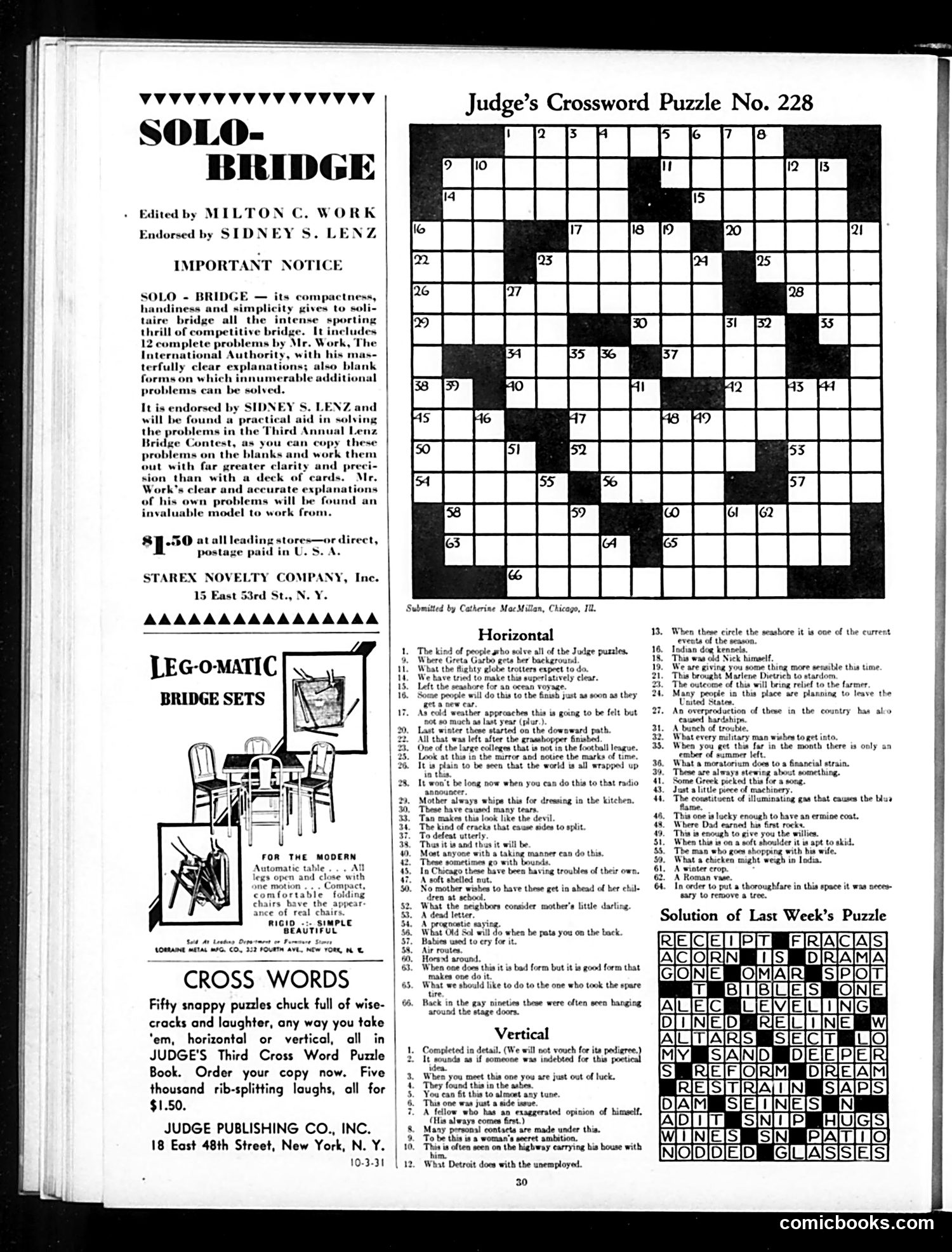
Judge Magazine, Page 30 (October 3, 1931) This page is primarily advertising and puzzle content, not political satire. It features: Main Content: - Advertisement for "Solo-Bridge," a card game instruction book edited by Milton C. Work and endorsed by bridge expert Sidney S. Lenz - Advertisements for "Leg-o-Matic" bridge table sets (folding furniture for playing bridge) - A crossword puzzle (#228) with bridge-related clues - Advertisement for Judge's crossword puzzle book Historical Context: Bridge was an enormously popular parlor game during the 1920s-30s among middle and upper-class Americans. These ads reflect that craze. The "Leg-o-Matic" furniture ad emphasizes modern convenience—compact, automatic folding tables suited to apartment living. The crossword puzzle clues reference contemporary 1931 concerns (economic hardship, unemployment in Detroit, the Depression-era stock market) but in lighthearted wordplay rather than sharp satire. This is a commercial/entertainment page rather than editorial content.
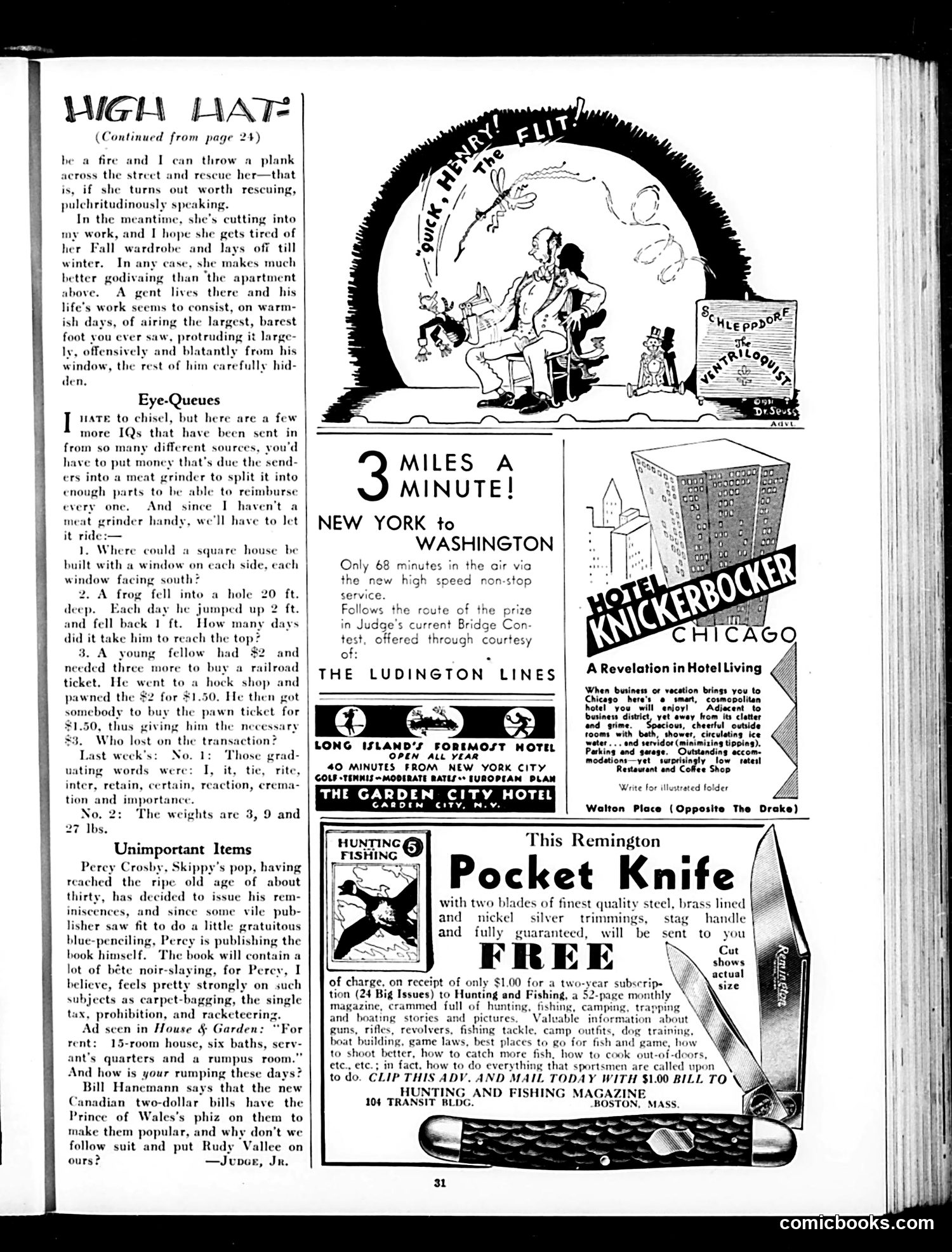
Analysis of Judge Magazine Page (Content & Advertisements) This page is primarily advertising and filler content rather than political satire. The main elements include: "High Hat" Column: A continuation of society gossip about a woman doing calisthenics on a fire escape—trivial upper-class commentary typical of Judge's humor. "Eye-Queues" Section: Readers' submitted IQ puzzles and riddles, presented as humorous brain-teasers. Transportation & Hotel Ads: Multiple advertisements for airlines (Ludington Lines: NYC to Washington in 68 minutes), hotels (Long Island's Foremost Hotel, Garden City Hotel, Knickerbocker Chicago), emphasizing modern convenience and leisure travel. Remington Pocket Knife Offer: A promotional giveaway—free knife with magazine subscription. Hunting and Fishing Magazine Ad: Cross-promotion for a sportsmen's publication. The page reflects 1920s-30s concerns: modern transportation speed, leisure tourism, consumer goods, and outdoorsman culture. There's no discernible political satire—this appears to be a typical advertisement-heavy magazine filler page aimed at affluent urban readers.
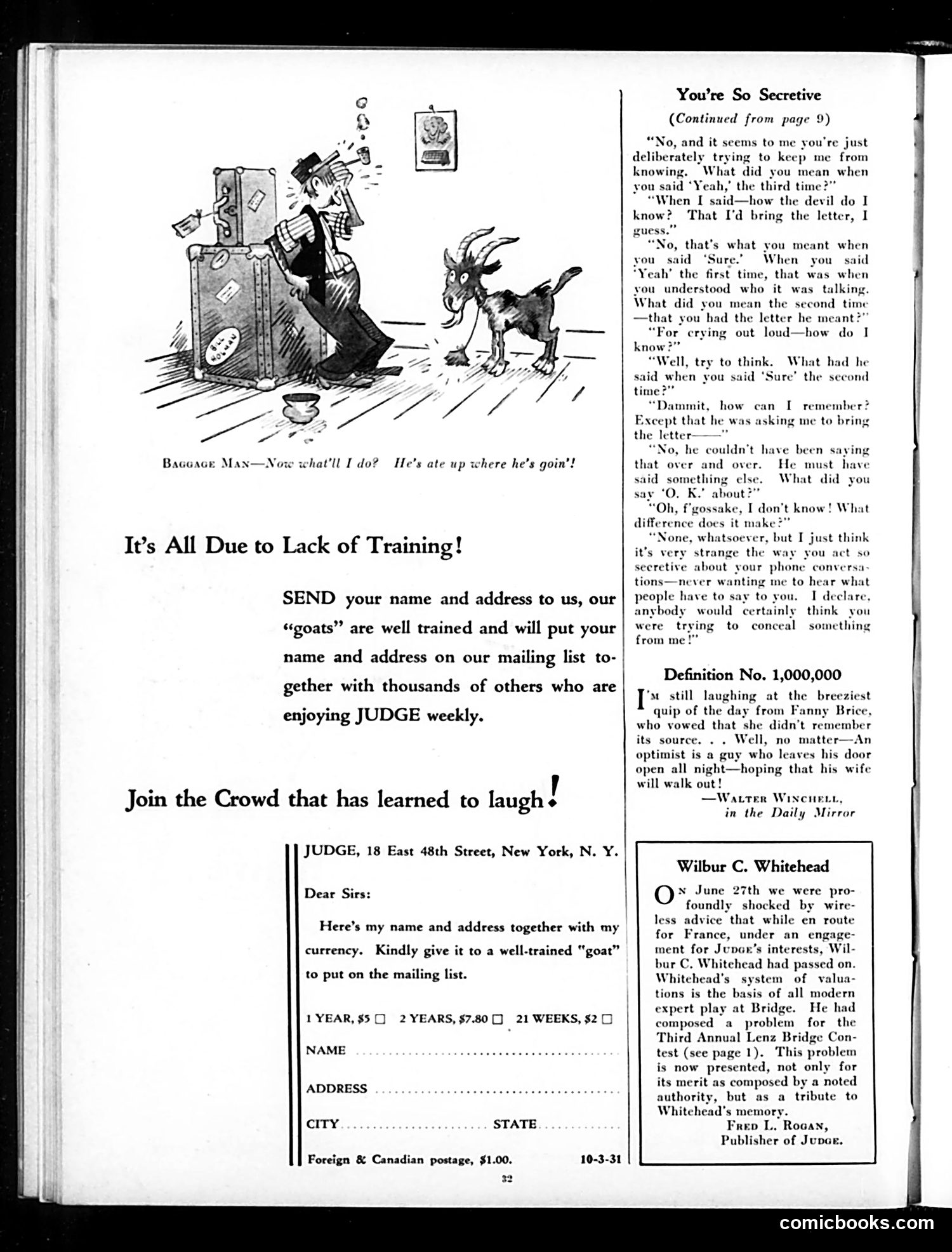
Cartoon Analysis: "Baggage Man" The main cartoon depicts a "Baggage Man" overwhelmed by overstuffed luggage, with a goat eating his belongings. The joke plays on the phrase "well-trained goats"—a self-referential joke about Judge magazine's subscription drive. Judge is humorously offering to put subscribers' names on its mailing list, calling their administrative staff "goats" (implying they're not particularly intelligent or refined). The cartoon warns that these untrained "goats" will bungle the job: the goat is literally consuming the baggage rather than handling it properly. It's a self-deprecating advertisement—Judge admits its own incompetence while simultaneously inviting readers to subscribe. The humor relies on the double meaning of "well-trained goat" as both farm animal and derogatory term for a bumbling employee.
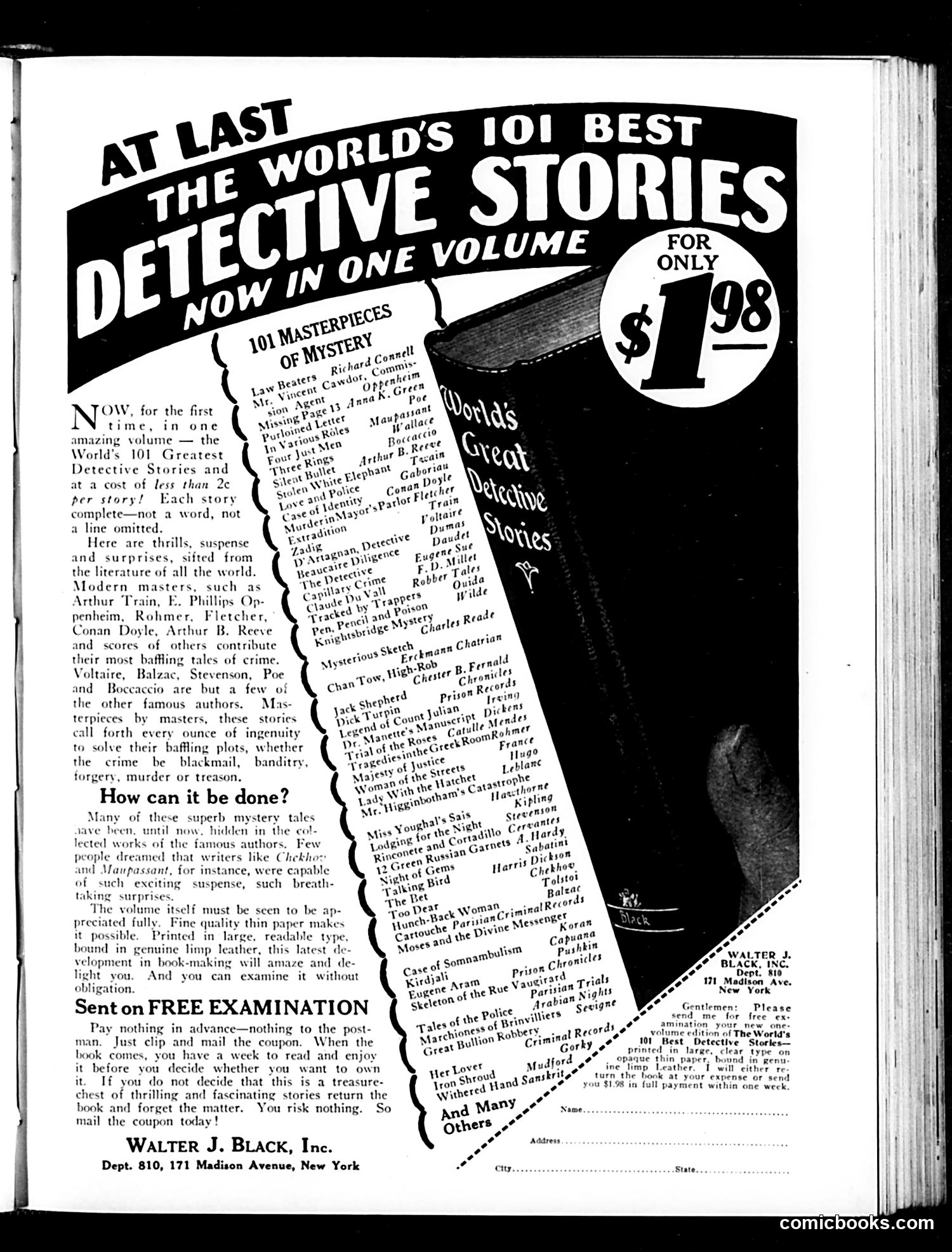
What This Page Shows This is a book advertisement, not a cartoon or satirical content. It appears in Judge magazine but contains no political or social satire. The page advertises "The World's 101 Best Detective Stories," a compilation volume published by Walter J. Black, Inc. The ad lists famous mystery writers—Conan Doyle, Arthur B. Reeve, E. Phillips Oppenheim, Poe, Balzac, Voltaire, and others—to establish credibility and appeal to readers seeking classic detective fiction. The sales pitch emphasizes value: 101 complete stories for $1.98 (less than 2 cents per story), printed on quality paper in readable type, bound in leather. It offers free examination—readers could request the book, examine it for a week, then decide whether to purchase, "risk[ing] nothing." This is straightforward commercial advertising typical of early-20th-century magazine back pages, using author prestige and affordable pricing as marketing hooks.
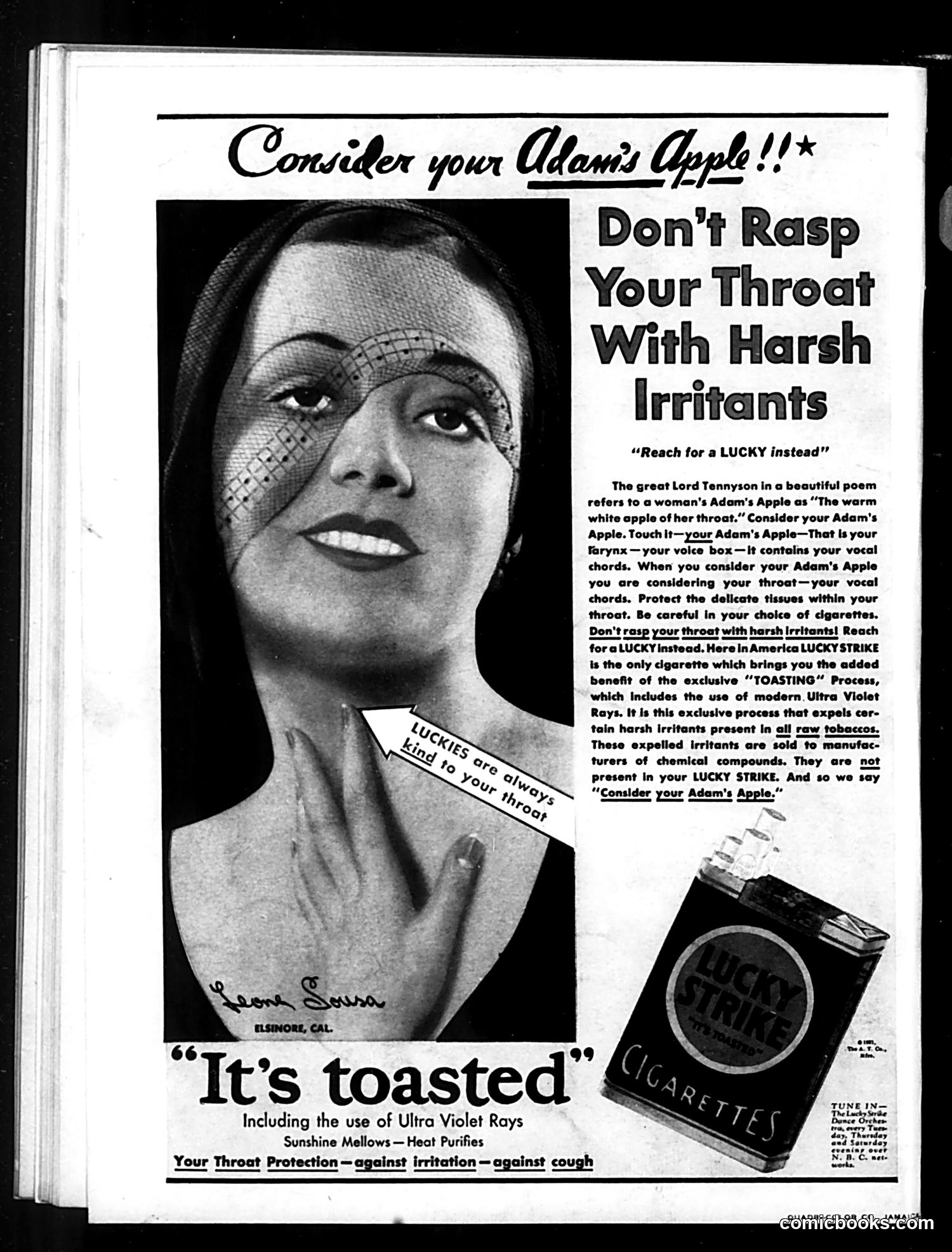
Advertisement Analysis This is a Lucky Strike cigarette advertisement, not political satire. It uses pseudo-scientific and anatomical language to market cigarettes as "throat-protective." The ad references Lord Tennyson's poetry to dignify smoking, then employs pseudo-medical reasoning: it instructs readers to "consider your Adam's Apple" (larynx) as justification for choosing Lucky Strikes specifically. The claimed "TOASTING" process with "Ultra Violet Rays" allegedly removes "harsh irritants" from tobacco. The deception: The ad claims Lucky Strikes are safer than competing brands because they remove irritants—a marketing claim made without evidence. The "expelled irritants are sold to manufacturers of chemical compounds" suggests they're harmlessly repurposed, adding false legitimacy. This reflects 1930s-40s tobacco marketing: manufacturers made unsubstantiated health claims before the surgeon general's warnings. The pseudo-scientific language exploited consumers' lack of knowledge about tobacco's actual dangers.