judge
Judge — October 10, 1931
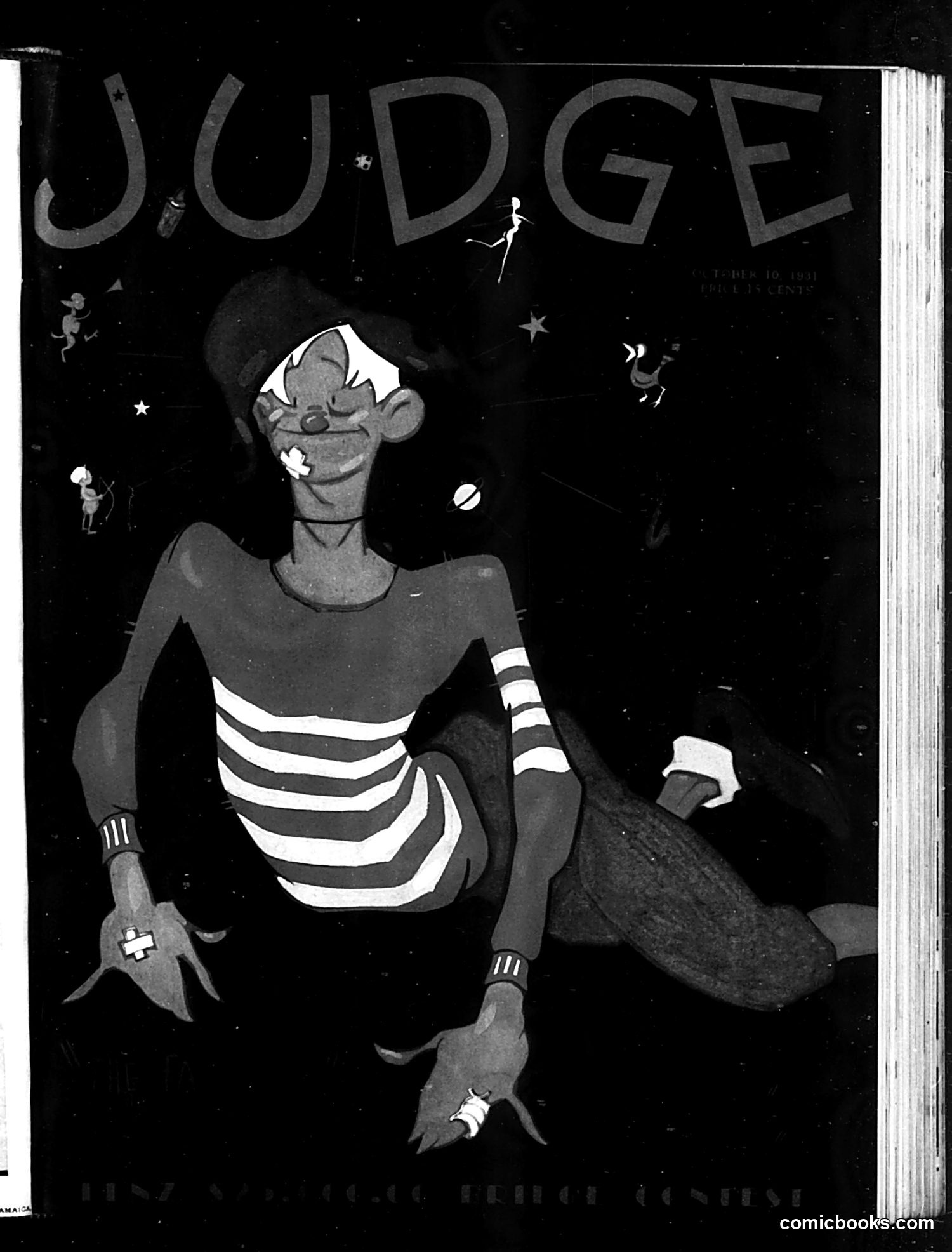
Analysis of Judge Magazine Page This appears to be a cover illustration from Judge magazine featuring a stylized caricature of a Black woman in a striped bathing suit, surrounded by small figures floating in a starry space. The large title "JUDGE" dominates the top. The exaggerated facial features and caricatural style reflect the racist visual conventions common in early-to-mid 20th century American satirical publications. Without clearer text or date information visible, I cannot definitively identify the specific political or social reference intended by this illustration. The surrounding small figures and space theme suggest this may be satirizing contemporary entertainment, fashion, or cultural trends, but the exact subject and satirical point remain unclear from the image alone. The degrading visual treatment reflects the problematic racial attitudes prevalent in that era of American media.
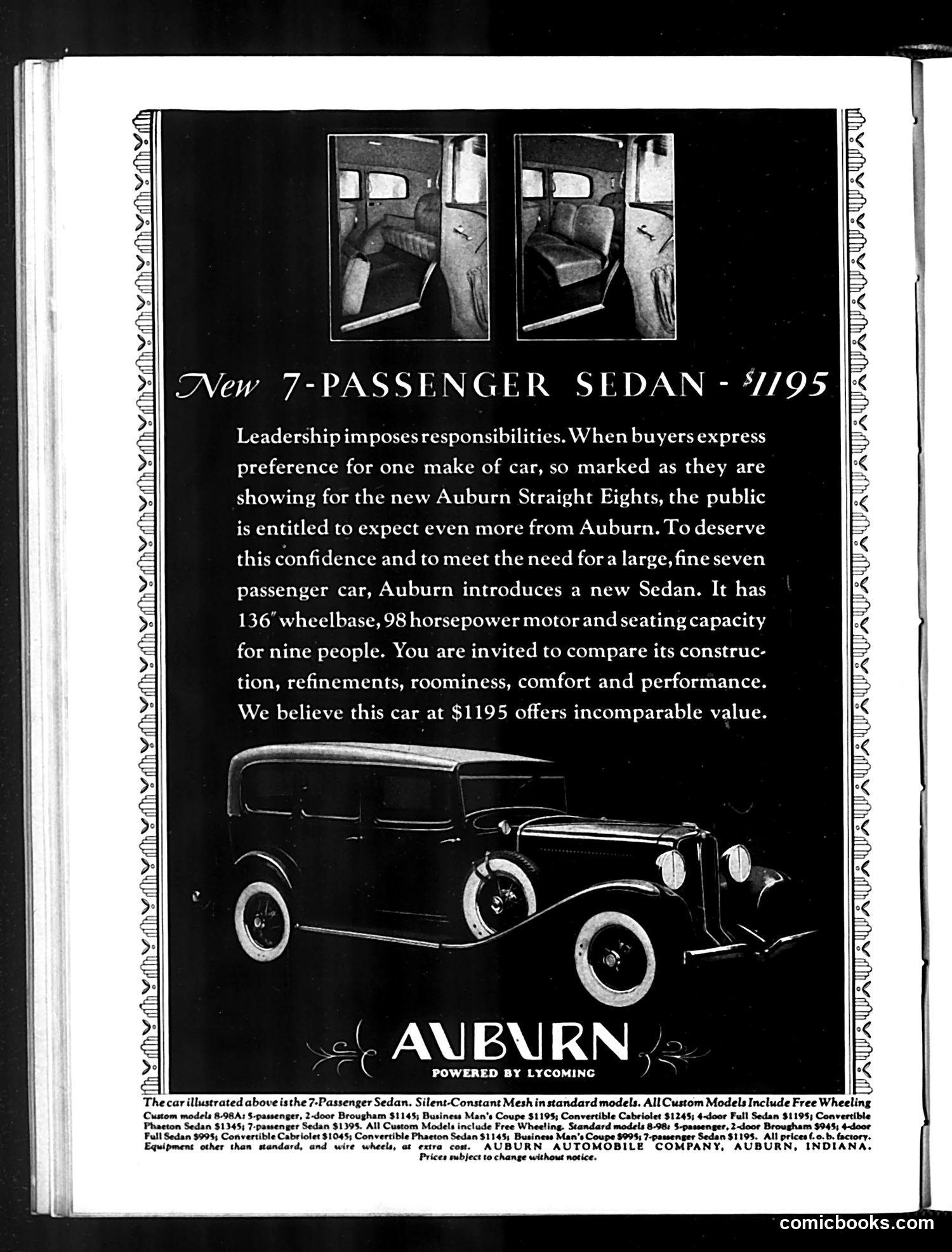
Analysis This page is not a political cartoon or satire—it's a straightforward automobile advertisement for the Auburn 7-Passenger Sedan, priced at $1,195. The ad emphasizes Auburn's market leadership, arguing that buyers' preference for Auburn vehicles justifies introducing this larger sedan model. It highlights specifications (136-inch wheelbase, 98 horsepower, seating for nine) and appeals to buyers to compare its construction and value against competitors. Two interior photographs show the sedan's spacious cabin. The lower illustration depicts the car itself in profile. The small text at bottom lists various Auburn models and pricing. This represents standard magazine advertising from the automobile industry, not editorial satire or political commentary.
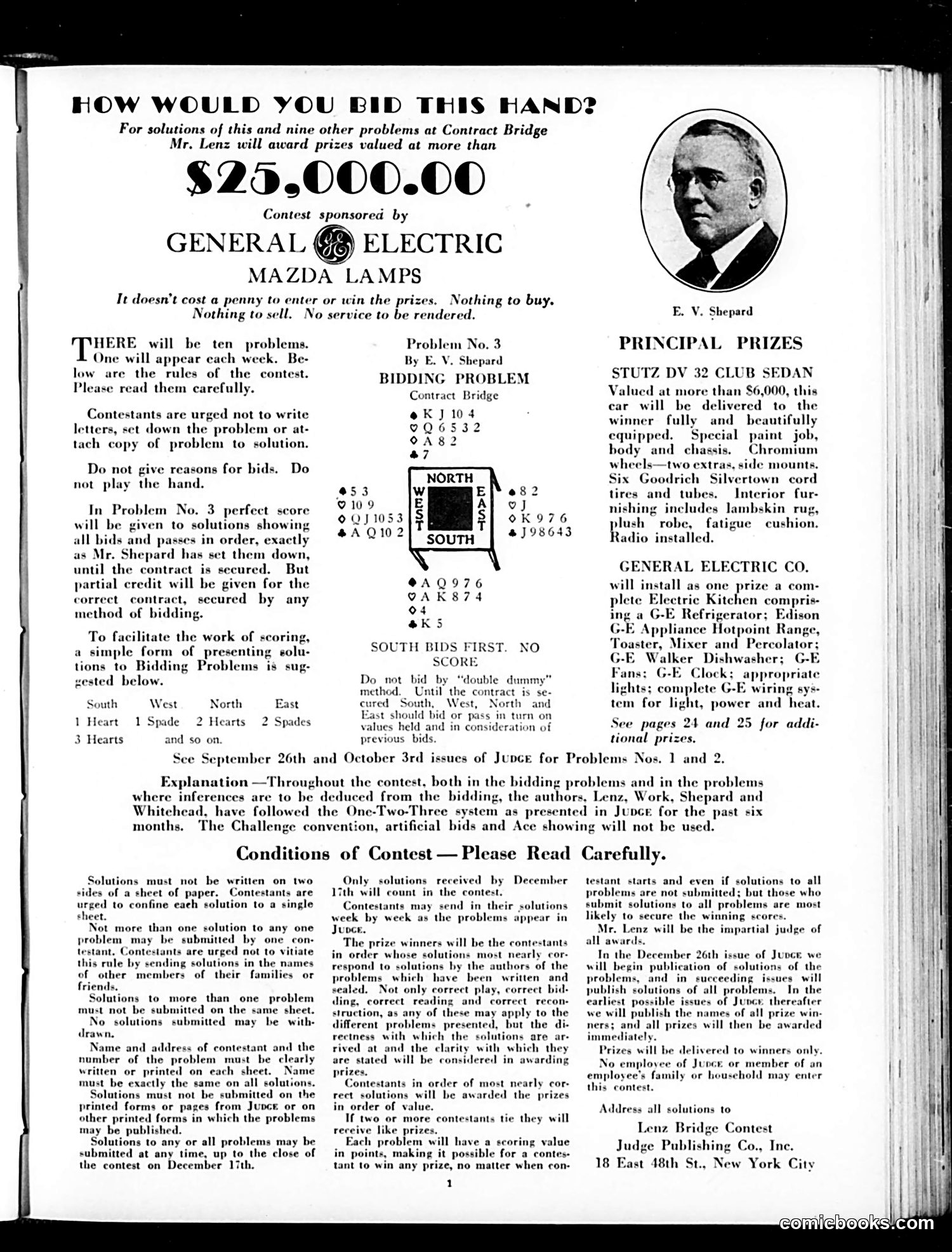
Analysis This page is primarily advertising, not satire or political commentary. It features a bridge-bidding contest sponsored by General Electric and Mazda Lamps, offering $25,000 in prizes. The portrait shows E. V. Shepard, who appears to be associated with the contest (likely the judge or organizer). The "How Would You Bid This Hand?" headline presents Contract Bridge problems for readers to solve—a popular pastime in 1930s America. The contest rules and conditions occupy most of the page's text. The only substantive content is the bridge puzzle itself and advertisement for General Electric products (refrigerator, appliances, etc.) as prizes. There is no political satire or social commentary visible. This represents Judge magazine's commercial content rather than its typical satirical function.
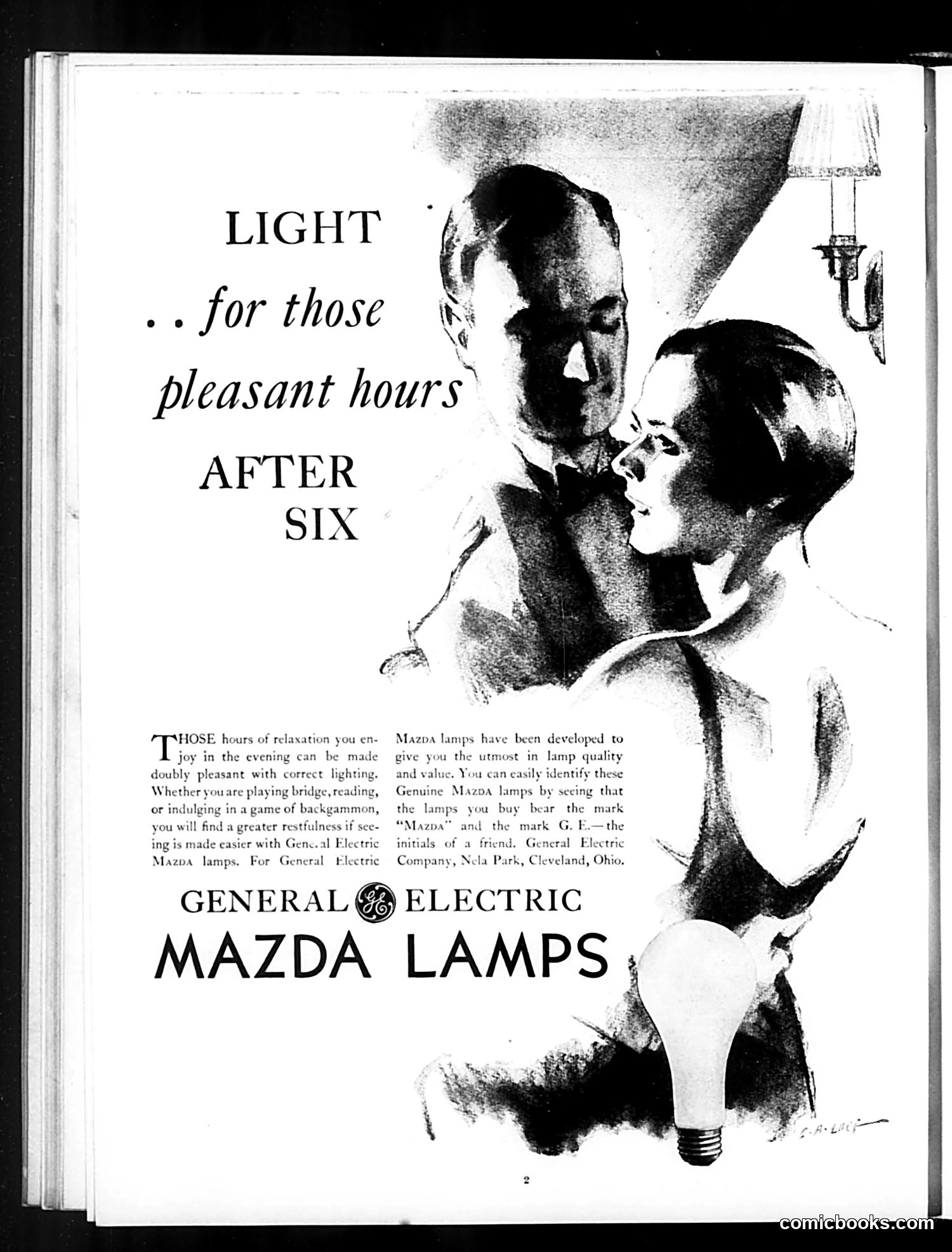
Analysis This is primarily a product advertisement, not satirical content. General Electric's Mazda lamp division is marketing their lightbulbs to evening leisure activities—bridge, reading, backgammon. The imagery shows an intimate couple in soft lighting, emphasizing how proper illumination enhances relaxation and romance "after six" (evening hours). The advertisement appeals to middle-class domestic comfort and leisure. The text promises that Mazda lamps provide superior "lamp quality and value," identifiable by the "Mazda" mark and G.E. initials. General Electric manufactured these lamps at their Nela Park facility in Cleveland, Ohio. This represents typical early-twentieth-century consumer advertising targeting home improvement and domestic contentment—not political satire.
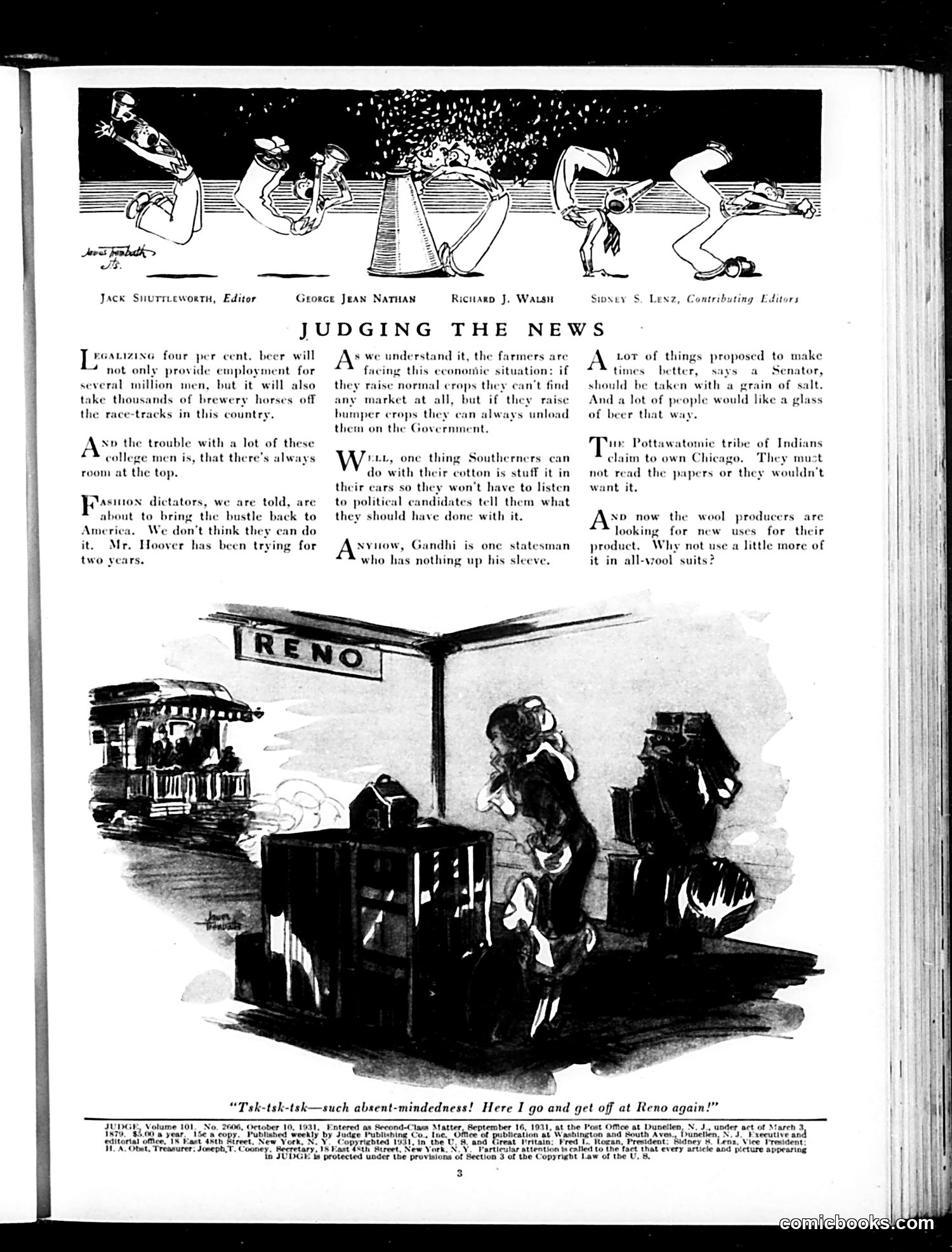
"Judging the News" - October 10, 1931 This page contains editorial commentary on current events rather than a political cartoon. The main illustrated cartoon shows a train station scene at Reno, Nevada, with the caption "Tsk-tsk-tsk—such absent-mindedness! Here I go and get off at Reno again!" The reference: Reno was famous as a divorce destination where people obtained quick divorces during this era. The joke satirizes how casually someone keeps ending up there—implying repeated divorces or that it's become such a common destination people almost absent-mindedly get off there. The text sections mock various targets: beer legalization providing employment, farmers' economic hardship, college graduates lacking ambition, fashion trends, political candidates, Gandhi, and woolens industry competition. Typical satirical commentary on Depression-era politics and social issues.
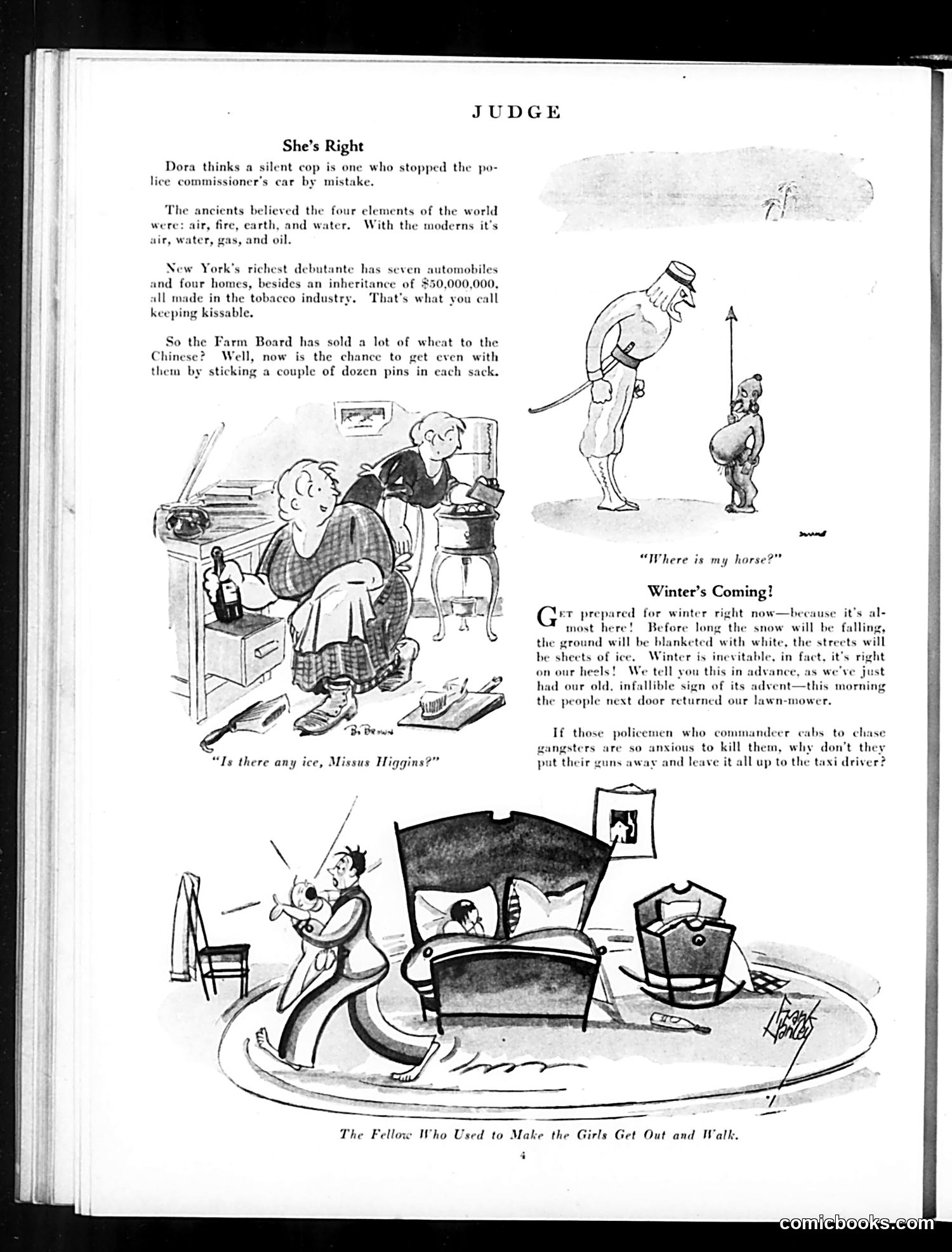
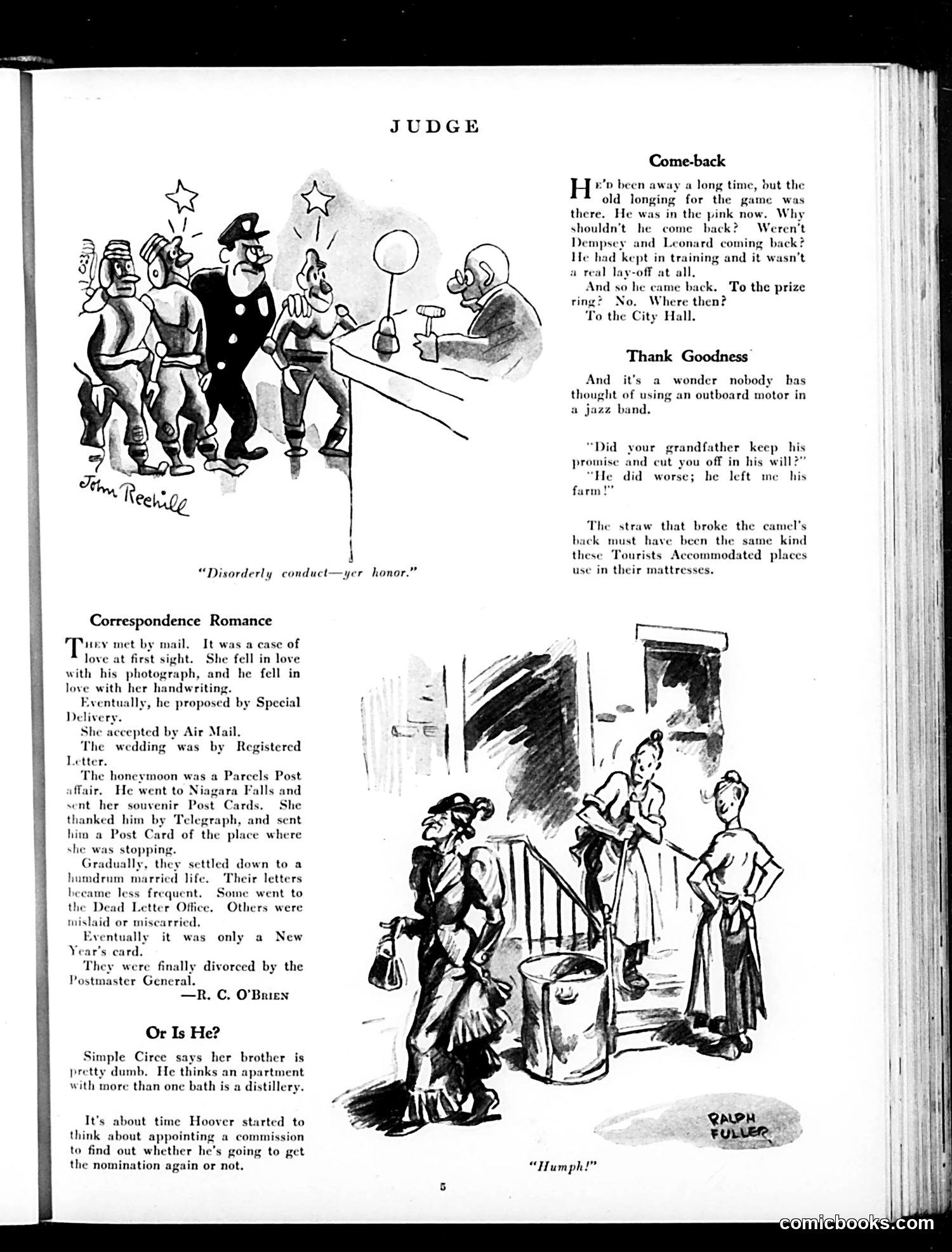
Page Analysis: Judge Magazine Satirical Content This page contains three unrelated humorous pieces typical of Judge magazine's format: 1. "Disorderly conduct—yer honor" (top): A courtroom cartoon by John Reakill showing what appears to be a jazz band being prosecuted, satirizing concerns about jazz music and "disorderly conduct" — reflecting 1920s moral panic about jazz as crude and socially dangerous. 2. "Correspondence Romance" (middle): A text piece by R.C. O'Brien mocking mail-order courtship and marriages conducted entirely through postal service, playing on the absurdity of romance conducted via letters and postcards rather than in person. 3. "Or Is He?" (bottom): A brief piece questioning whether someone's apartment setup indicates he's foolish, likely satirizing Prohibition-era assumptions about hidden distilleries. The cartoons reflect 1920s-era social anxieties: jazz, mail romance, and Prohibition enforcement.
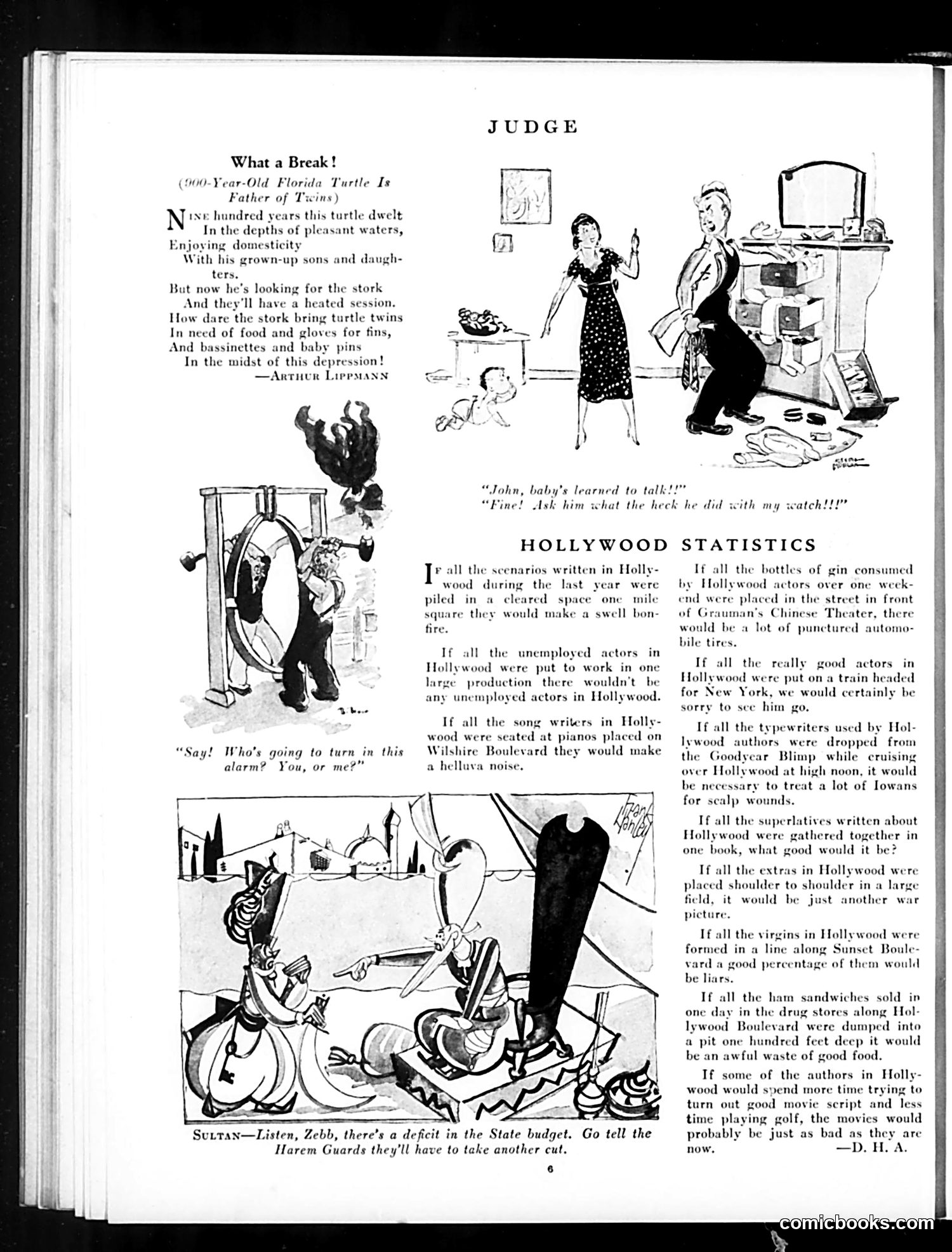
Judge Magazine Page Analysis This page contains three satirical pieces from Judge magazine (likely 1930s based on style): 1. "What a Break!" — A poem by Arthur Lippmann mocking a 900-year-old Florida turtle expecting twins during the Depression. The joke: even animals shouldn't reproduce when resources are scarce and unemployment is high. 2. Top cartoon — A domestic scene where a baby learned to say an expletive, with the mother blaming the father's "scotch" (whiskey). The satire targets Prohibition-era drinking and masculine irresponsibility. 3. "Hollywood Statistics" — A humorous list of hypothetical scenarios about Hollywood excess (gin consumption, unemployed actors, typewriters, superlatives, extras, virgins, and ham sandwiches). It satirizes Hollywood's wastefulness and overproduction during economic hardship. The cartoons collectively mock Depression-era social problems through exaggeration and absurdist logic.
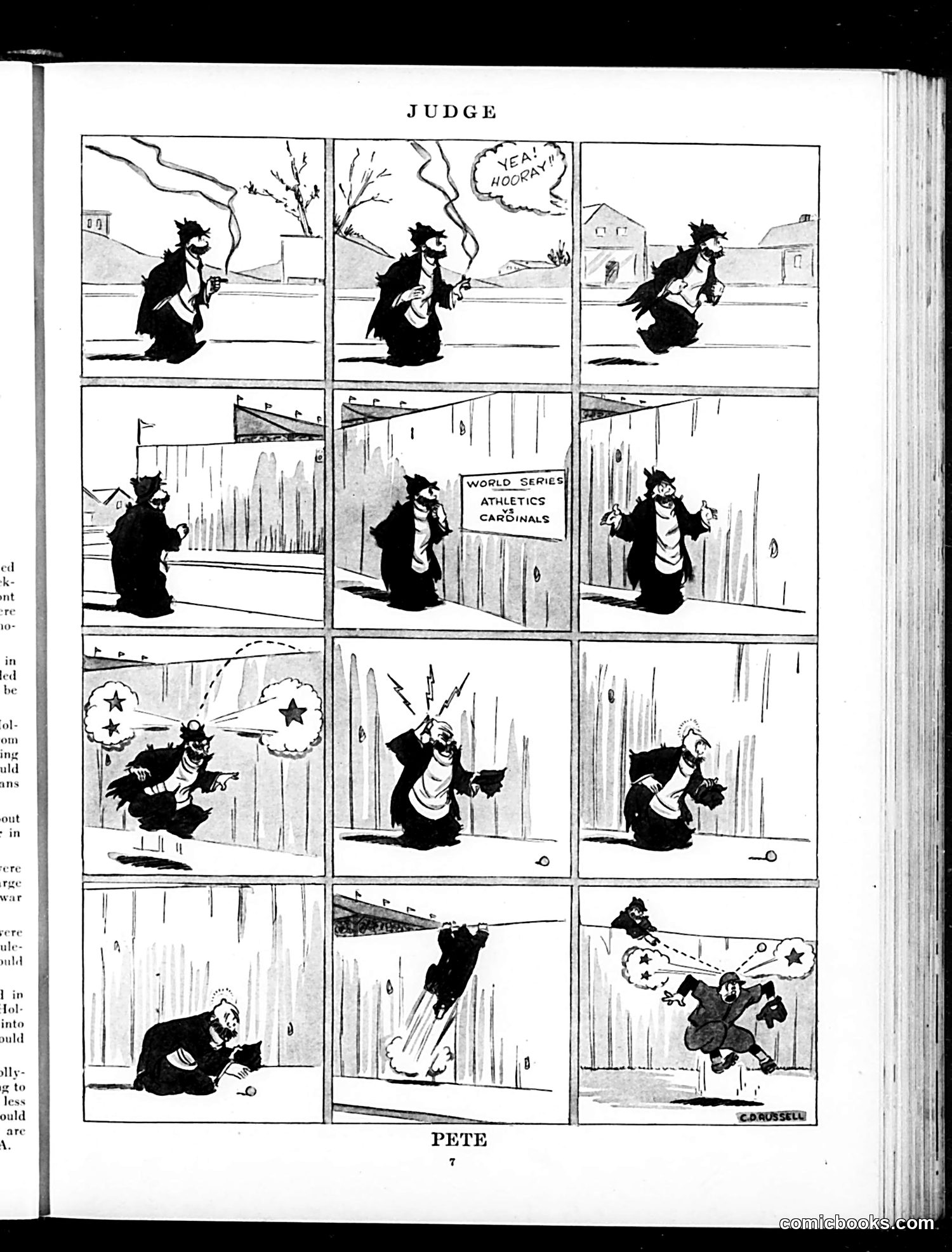
"Judge" Comic: "Judge" and "Pete" This two-panel comic strip satirizes the 1919 World Series between the Athletics and Cardinals (visible on a sign in the middle panel). The top strip titled "JUDGE" shows a character enthusiastically celebrating ("Yeah! Hooray!") while running and jumping. The bottom strip "PETE" depicts the same or similar character experiencing increasingly chaotic consequences—being knocked around, falling, and ending with explosive results. The satire appears to mock overzealous sports fans whose exuberant celebrations at a World Series game lead to physical mishaps and embarrassment. It's a humorous commentary on fan behavior during major sporting events, showing how enthusiasm can spiral into comic disaster.
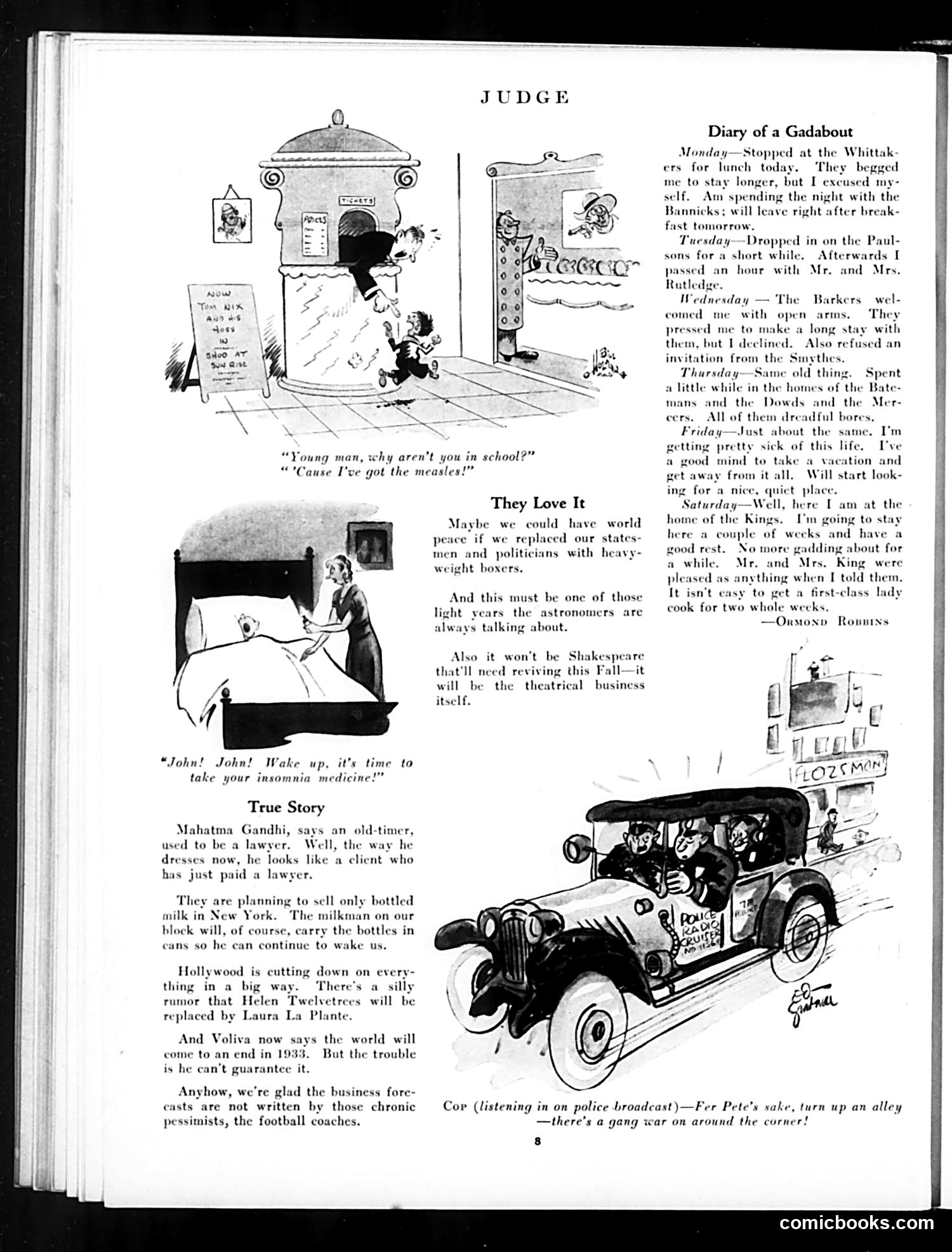
Judge Magazine Page Analysis This page contains multiple satirical pieces targeting 1920s American society: "Diary of a Gadabout" mocks the idle wealthy who spend their time visiting acquaintances out of social obligation rather than genuine interest, finding everyone "dreadful bores." "They Love It" offers two brief social commentaries: one suggesting replacing politicians with boxers for world peace, and another joking about the vast distances astronomers discuss. "True Story" includes three unrelated quips: one about Gandhi's appearance after paying lawyers (mocking legal fees), one about milkmen's noise-making despite bottled milk delivery, and Hollywood gossip about actress replacements. The cartoon at bottom depicts a police officer on a broadcast warning of gang violence, reflecting 1920s concerns about organized crime and urban danger—likely Prohibition-era gang activity. The overall tone reflects Judge's satirical stance on contemporary politics, social pretension, entertainment industry absurdities, and urban crime concerns of the era.
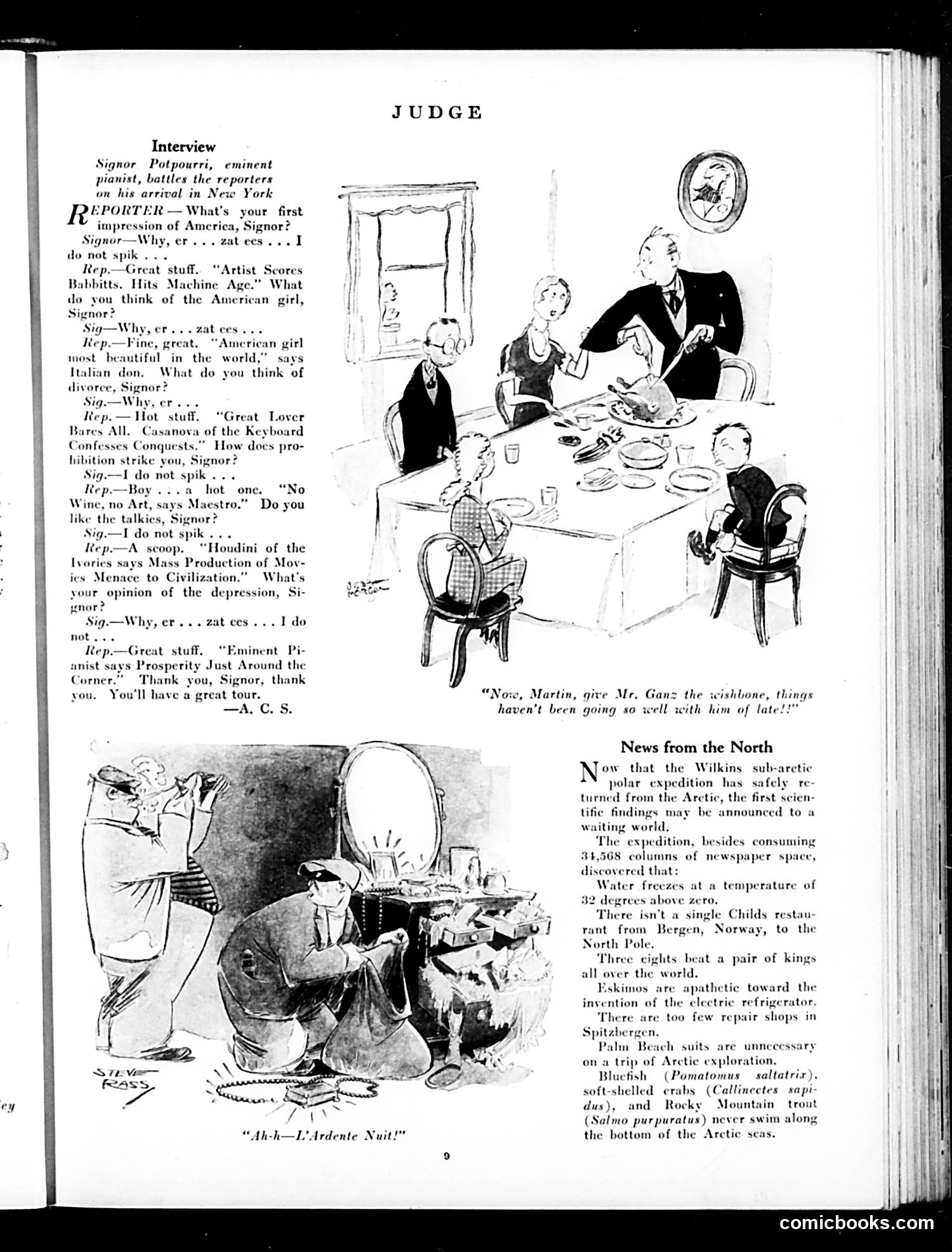
Judge Magazine Page Analysis Top Cartoon - "Interview": This satirizes sensationalist journalism. A reporter interviews Signor Potpourri (an Italian pianist arriving in New York), but the pianist speaks minimal English ("zat ees," "do not spik"). The reporter manufactures inflammatory headlines anyway—twisting bland answers into scandal stories about "Artist Scores Babbitts," "Great Lover Bares All," and claims about the depression. The joke: journalists fabricate sensational narratives regardless of what subjects actually say. The byline "—A.C.S." credits the cartoonist. Bottom Cartoon - "Ah-h—L'Ardente Nuit!": Depicts what appears to be a theatrical or operatic scene with exaggerated figures, likely mocking overwrought European dramatic performance. "News from the North": A humorous commentary on the Wilkins Arctic expedition's media coverage. It satirizes newspapers devoting enormous space (34,568 columns) to expedition "findings" that are absurdly obvious or irrelevant—water freezes, no restaurants exist in the Arctic, poker hand rankings don't change, etc. The satire targets both the expedition's self-importance and media's hunger for exotic adventure stories.
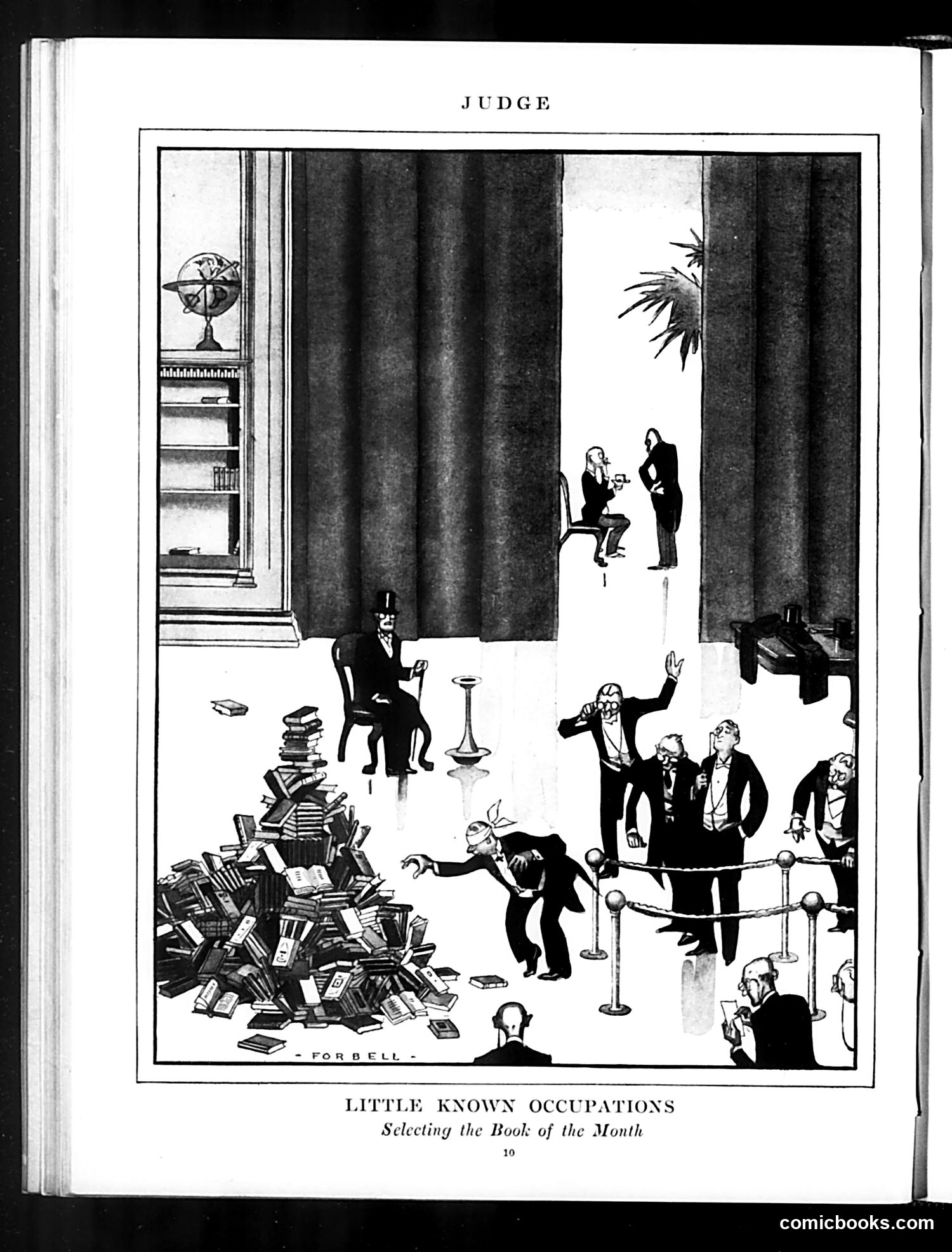
Analysis This is a satirical cartoon titled "Little Known Occupations: Selecting the Book of the Month," credited to Forbell. It depicts a judge's chambers where a large pile of books has accumulated on the floor. Well-dressed men in suits—appearing to be members of a book selection committee or judges—stand around examining and debating the volumes, some gesturing animatedly. The satire mocks the process of selecting a "Book of the Month," suggesting it's a chaotic, overwhelming endeavor where supposedly serious literary judges are comically swamped by the sheer volume of submissions. The cartoon implies the selection process is less about genuine literary merit and more about bureaucratic struggle and pretentious posturing among the evaluators.
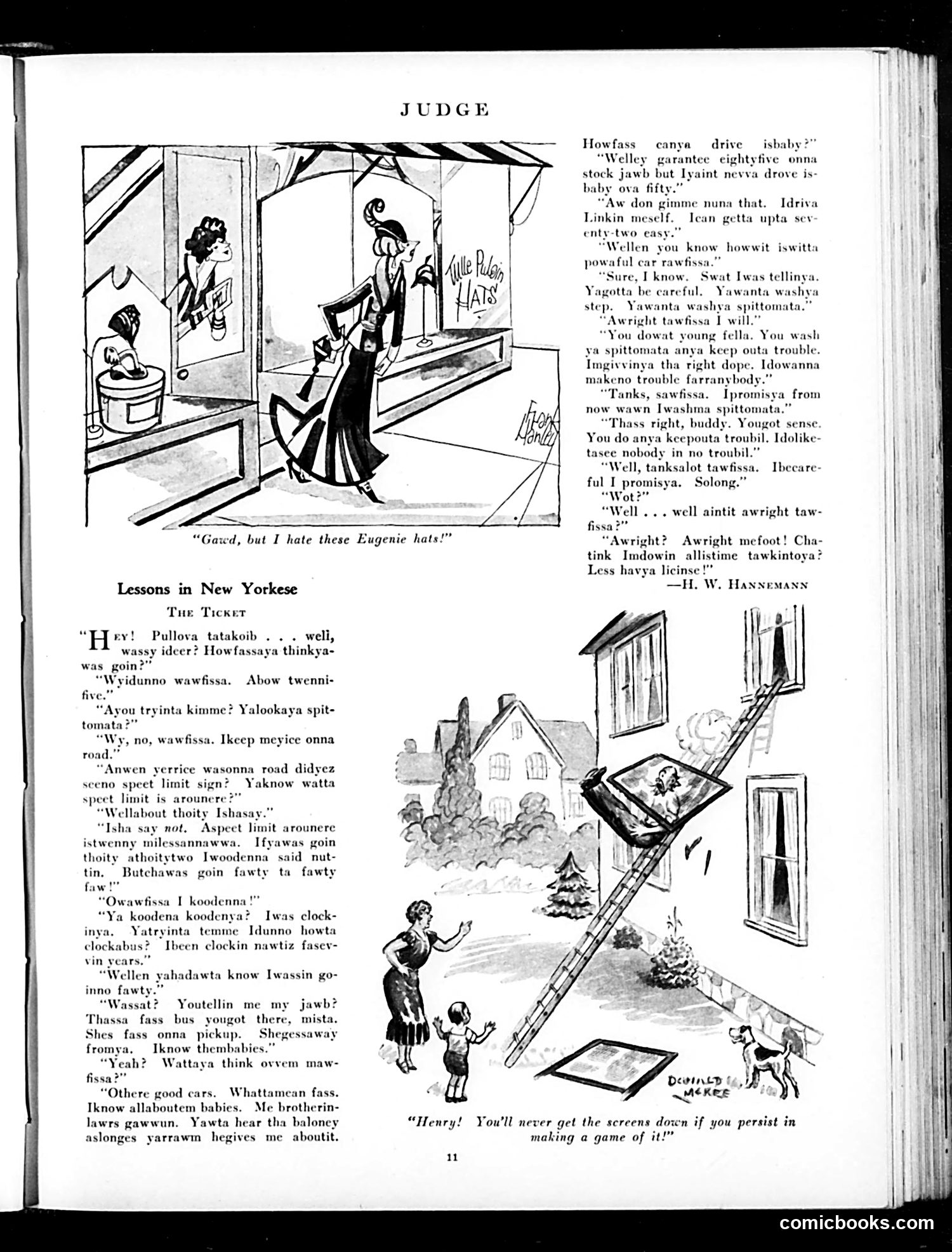
Judge Magazine Page Analysis This page contains two satirical pieces mocking early 20th-century American urban culture. Top cartoon: A woman in an elaborate "Eugenie hat" (a fashionable wide-brimmed style of the era) complains to a milliner. The satire targets excessive women's fashion—specifically the impracticality and absurdity of oversized hats that were status symbols among wealthy women. "Lessons in New Yorkese": A humorous dialogue between two working-class New York men using heavy ethnic-coded dialect and slang ("jawb," "fassa," "spittomata"). The piece satirizes: 1) New York's distinctive working-class accent and speech patterns, 2) reckless driving culture and traffic violations, and 3) male posturing about automobiles and speed. The conversation parodies how drivers boasted about ignoring speed limits (originally 20-30 mph). Bottom cartoon: A domestic scene of parents struggling with window screens while children play—gentle humor about household management and parenting challenges. The page reflects 1920s-era anxieties about modernization, immigration (coded through dialect), and changing urban life.
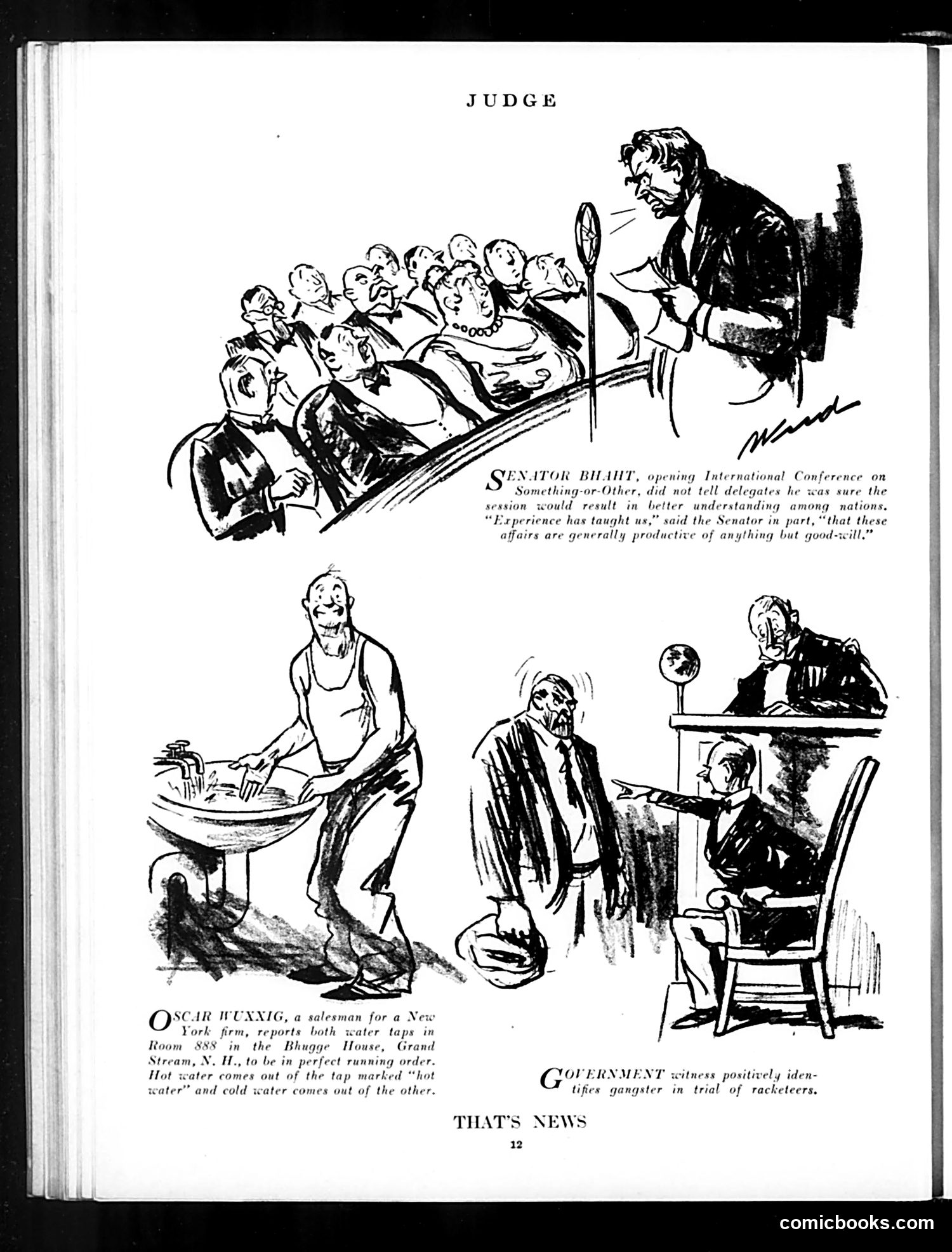
Understanding "Judge" Page 12 This satirical page mocks three absurdities: Top cartoon: Senator Bhaut addresses an international conference, cynically telling delegates that such gatherings produce "anything but good-will"—contradicting diplomacy's stated purpose. The joke is his brutal honesty about international conferences being performative failures. Bottom left: Oscar Wuxxig, a salesman, boasts that hotel room taps work correctly—hot water from the "hot" tap, cold from the "cold" tap. This parodies sensationalist journalism by treating basic functionality as newsworthy ("That's News"), mocking how newspapers report trivial non-events. Bottom right: A government witness "positively identifies" a gangster in court. The satire likely comments on unreliable testimony or the comedy of the justice system during Prohibition-era organized crime trials, where witnesses conveniently make clear identifications. All three segments ridicule institutions—diplomacy, journalism, law enforcement—by highlighting their failures or absurdities.
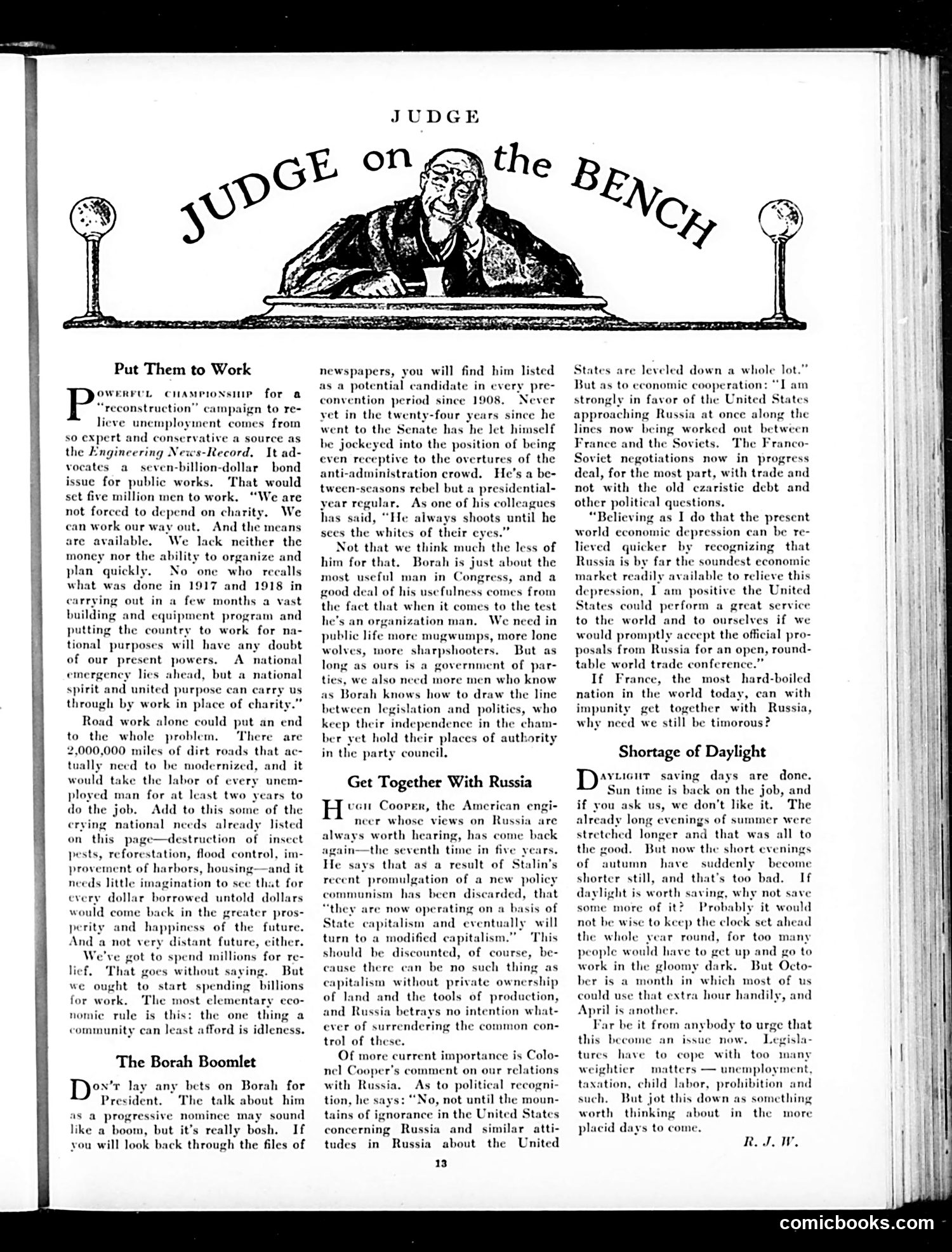
Judge Magazine Page Analysis This page from Judge magazine presents three opinion pieces addressing American economic and political issues of the Depression era. "Put Them to Work" advocates a $7 billion public works program to combat unemployment, citing successful WWI-era mobilization as proof the nation can organize large-scale projects. The argument: work (not charity) is the solution. "The Borah Boomlet" dismisses speculation that Senator William Borah might run for President. The writer notes Borah has been periodically touted as a presidential candidate since 1908 but always remains a party loyalist when it matters—useful as an independent voice but reliable when needed. "Get Together With Russia" discusses engineer Hovey Coover's recent visits to the Soviet Union. It notes Soviet claims of abandoning communism for "State capitalism," which the writer correctly identifies as impossible without private property. The piece suggests diplomatic recognition requires resolving fundamental disagreements about economic systems. The page reflects Depression-era debates over employment solutions and Cold War anxieties about Soviet intentions.
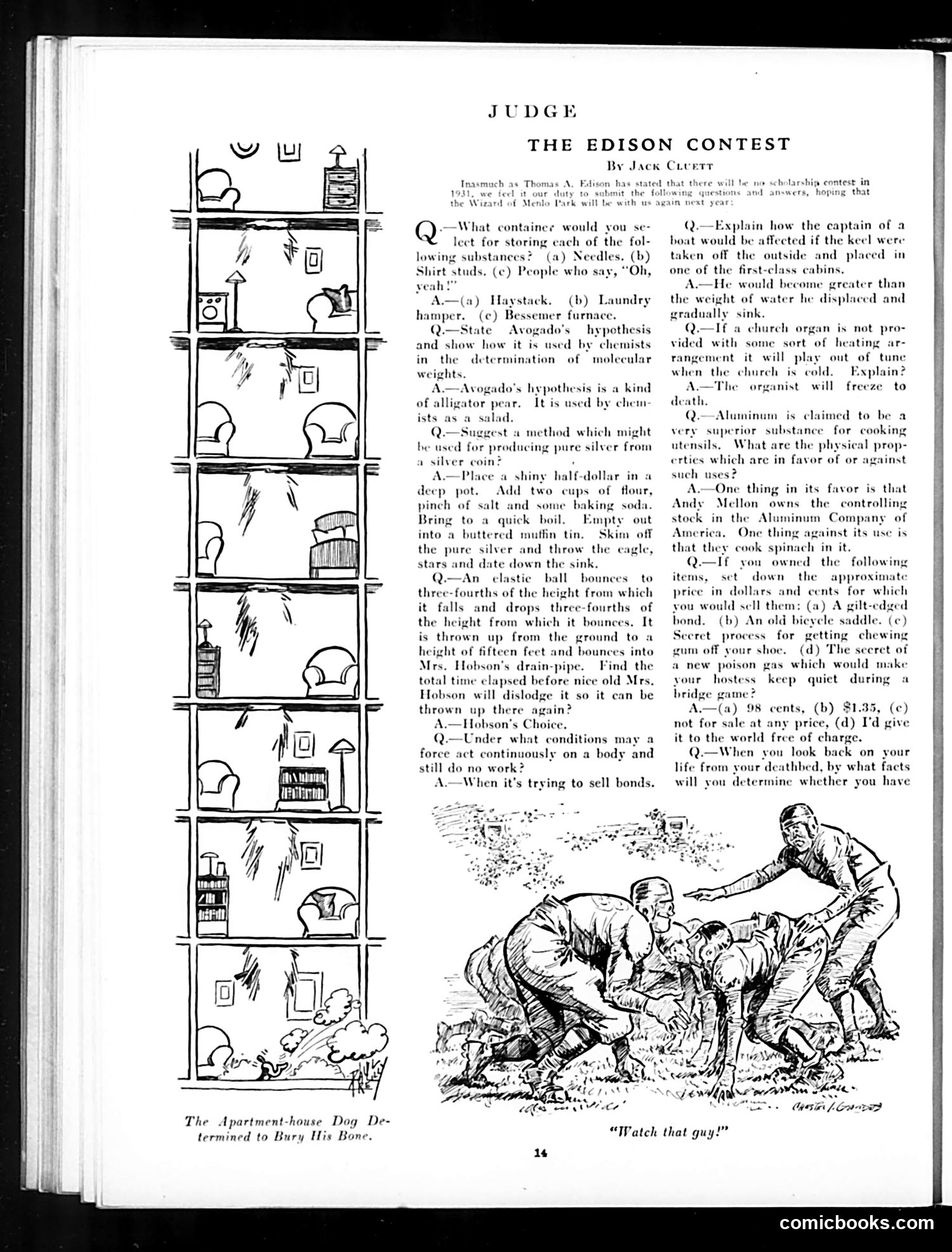
"The Edison Contest" - Judge Magazine Satire This page from *Judge* presents "The Edison Contest," a satirical quiz that mocks educational testing and contemporary issues through absurdist humor. The left cartoon shows a multi-story apartment building with a dog attempting to bury a bone—a visual joke about urban living constraints and animal instincts meeting civilization. The quiz itself parodies school science contests (likely referencing Thomas Edison's stated scholarship contest mentioned in the header). The answers deliberately provide wrong, ridiculous solutions: making "silver" by baking a coin in a muffin tin; calculating impossible physics problems; claiming aluminum cookware's value depends on Andrew Mellon's stock ownership. The satire targets: corporate influence on supposedly objective science, the absurdity of standardized testing, and the era's tendency to commercialize everything—even education and innovation. The final question about life review sardonically suggests material success (bonds, bicycles, poison gas) represents life's meaning, mocking both consumerism and the contest's superficiality. The humor relies on readers recognizing the contrast between legitimate scientific inquiry and corporate/commercial corruption of knowledge.
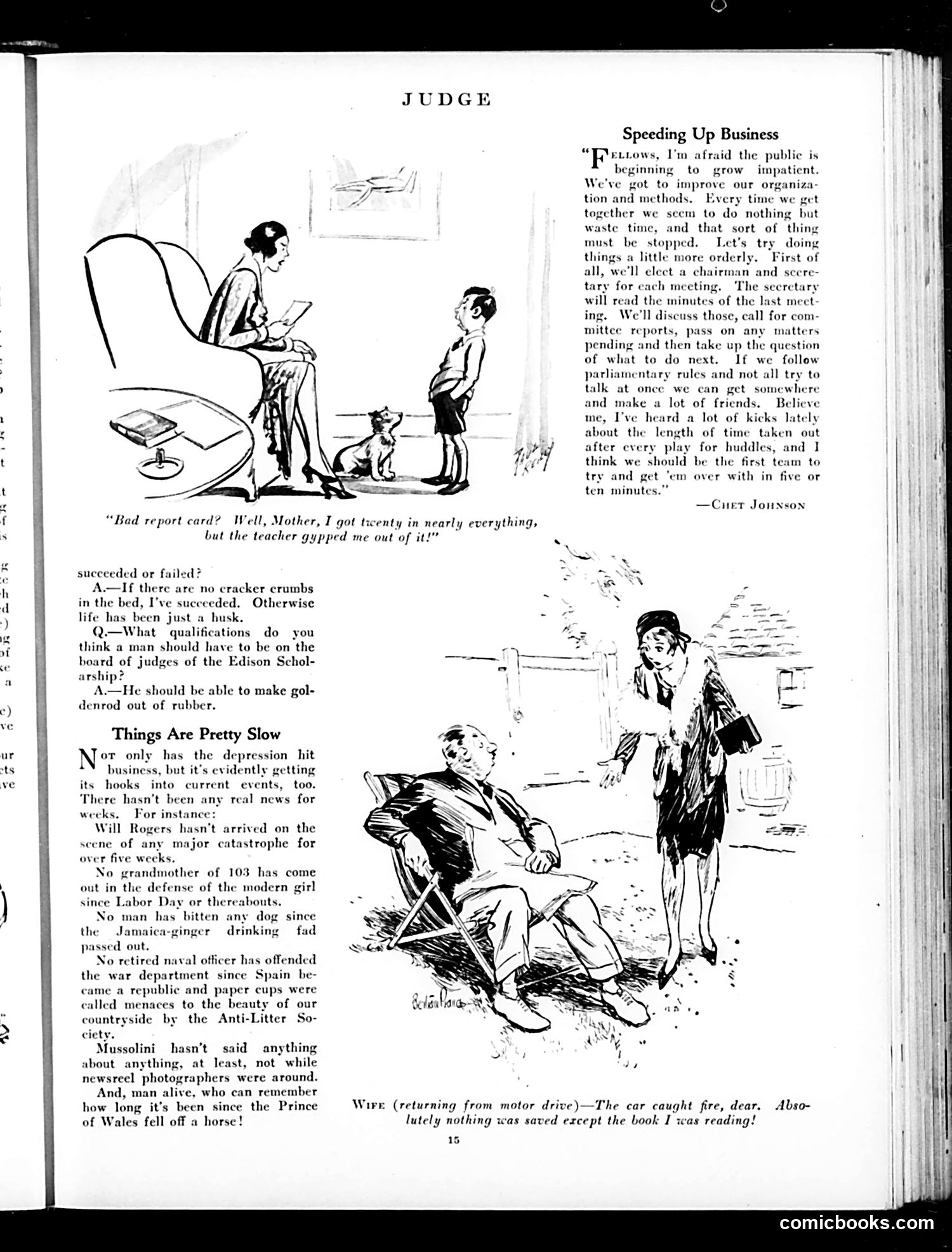
Judge Magazine Page Analysis This page contains three distinct satirical pieces typical of Judge's content: "Bad Report Card" (top): A child claims he scored "twenty in nearly everything" but the teacher "gypped" him. The joke plays on the child's misunderstanding—likely he means 20% grades, not 20 out of some higher scale—revealing both his poor performance and his amusing rationalization. "Things Are Pretty Slow" (left): A commentary on the Depression-era news drought. The piece satirizes how slow current events have become, listing absurd examples: Will Rogers hasn't witnessed a catastrophe in weeks, no centenarian has defended modern girls, and even Mussolini hasn't made statements (when cameras are present). It's observational humor about economic stagnation affecting even the news cycle. "Wire" (bottom right): A domestic cartoon where a wife reports their car caught fire during a motor drive, but consolingly notes that "absolutely nothing was saved except the book I was reading!"—suggesting her reading matter mattered more than any possessions. It's wry humor about prioritizing intellectual pursuits.
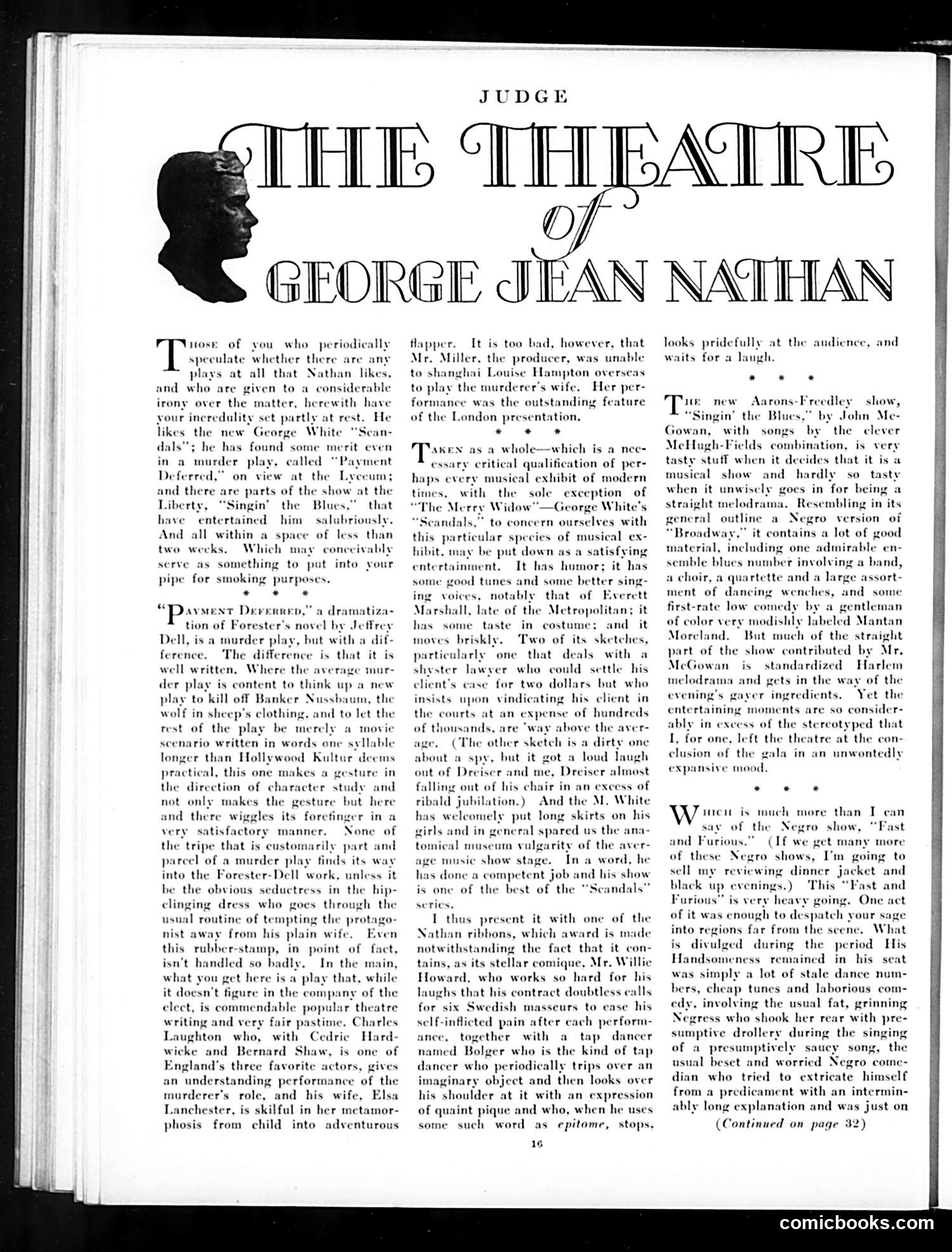
Judge Magazine Theatre Review: George Jean Nathan This is a theatre review page by critic George Jean Nathan, not a political cartoon. The silhouette portrait at top left identifies the author. Nathan reviews three Broadway productions: "Payment Deferred" (a murder play starring Charles Laughton and Elsa Lanchester), "Singin' the Blues," and George White's "Scandals" (a musical revue). The satire targets theatrical conventions: Nathan mocks standard murder-play formulas, praises the "Scandals" for avoiding excessive female nudity typical of music shows, and jokes about Willie Howard's comedic routines wearing out performers. A sketch satirizing a shyster lawyer who over-litigates cases for profit gets particular praise. Nathan's tone is witty, sophisticated commentary on 1930s Broadway entertainment—balancing genuine appreciation for well-crafted theatre against mockery of formulaic commercial productions. The "ribbons" mentioned appear to be Nathan's critical awards system.
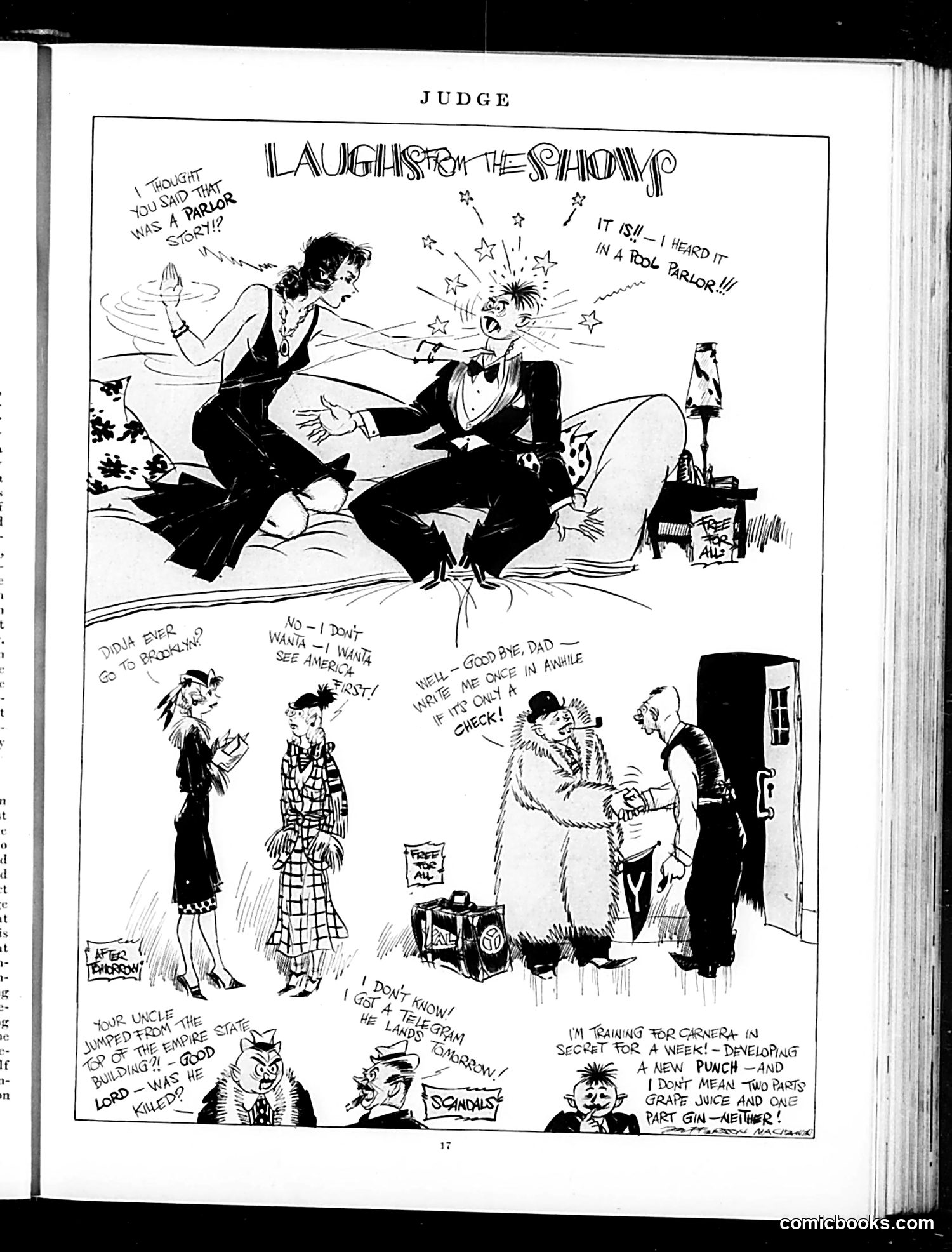
"Laughs at the Show" - Judge Magazine Cartoon This is a satirical comic depicting theatrical chaos, likely from the 1920s-30s based on style and references. The central scene shows two men on a bed engaged in physical comedy while other characters react dramatically around them. Key elements include: - "A Taylor story" reference (top left) - appears to invoke a theatrical scandal - "Carnera" mention - likely referring to boxer Primo Carnera, suggesting boxing-themed entertainment - Multiple characters expressing shock at domestic/theatrical disruption - References to developing a "new punch" (both physical comedy and a cocktail joke) The satire mocks theatrical melodrama and scandals of the era, with characters overreacting to bedroom farce scenarios. The "punch" wordplay (fighting move vs. alcoholic drink) was typical Judge humor. Without definitive dates or clearer figure identification, the specific theatrical reference remains unclear, but the page ridicules contemporary show business sensationalism and moral outrage.
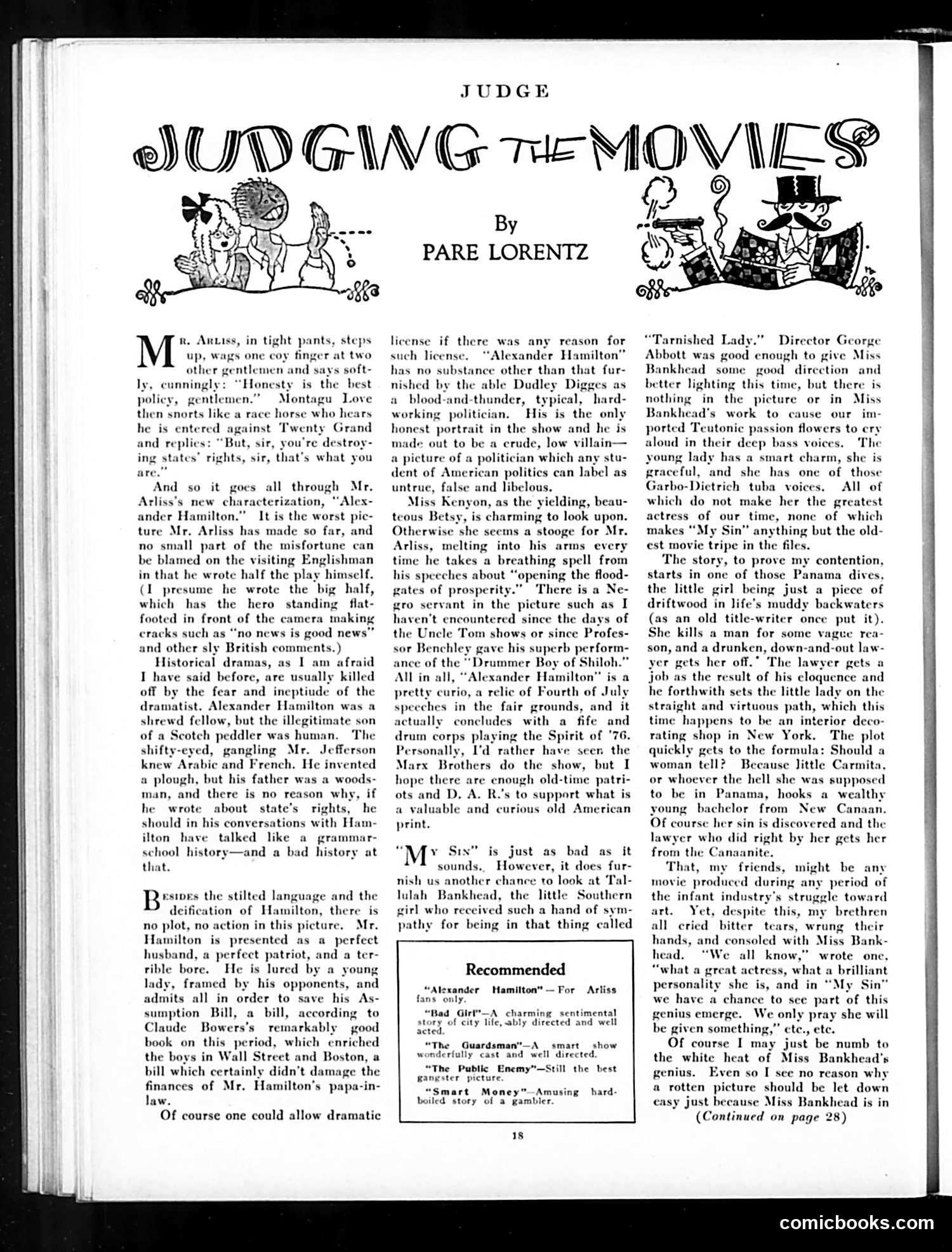
Judging the Movies: Pare Lorentz on "Alexander Hamilton" This film review criticizes the recent George Arliss vehicle "Alexander Hamilton." Lorentz argues the film fails because it sanitizes historical figures into boring cardboard—presenting Hamilton as a perfect patriot and husband rather than a shrewd, flawed human being. The satire targets both Hollywood's fear of authentic drama and the film's distortion of history. Lorentz notes Arliss (the English star, visible in the cartoon) essentially rewrote the play, adding stilted speeches about "opening the floodgates of prosperity" that no historical figure would actually deliver. The reviewer mocks the film's patriotic clichés (ending with a drum corps playing "Spirit of '76") and suggests the Marx Brothers could do better. The accompanying recommendations box reviews other current releases, positioning "Alexander Hamilton" as inferior to gangster films like "The Public Enemy"—a pointed critique suggesting Hollywood's formulaic biopics underperform compared to grittier, more honest storytelling.
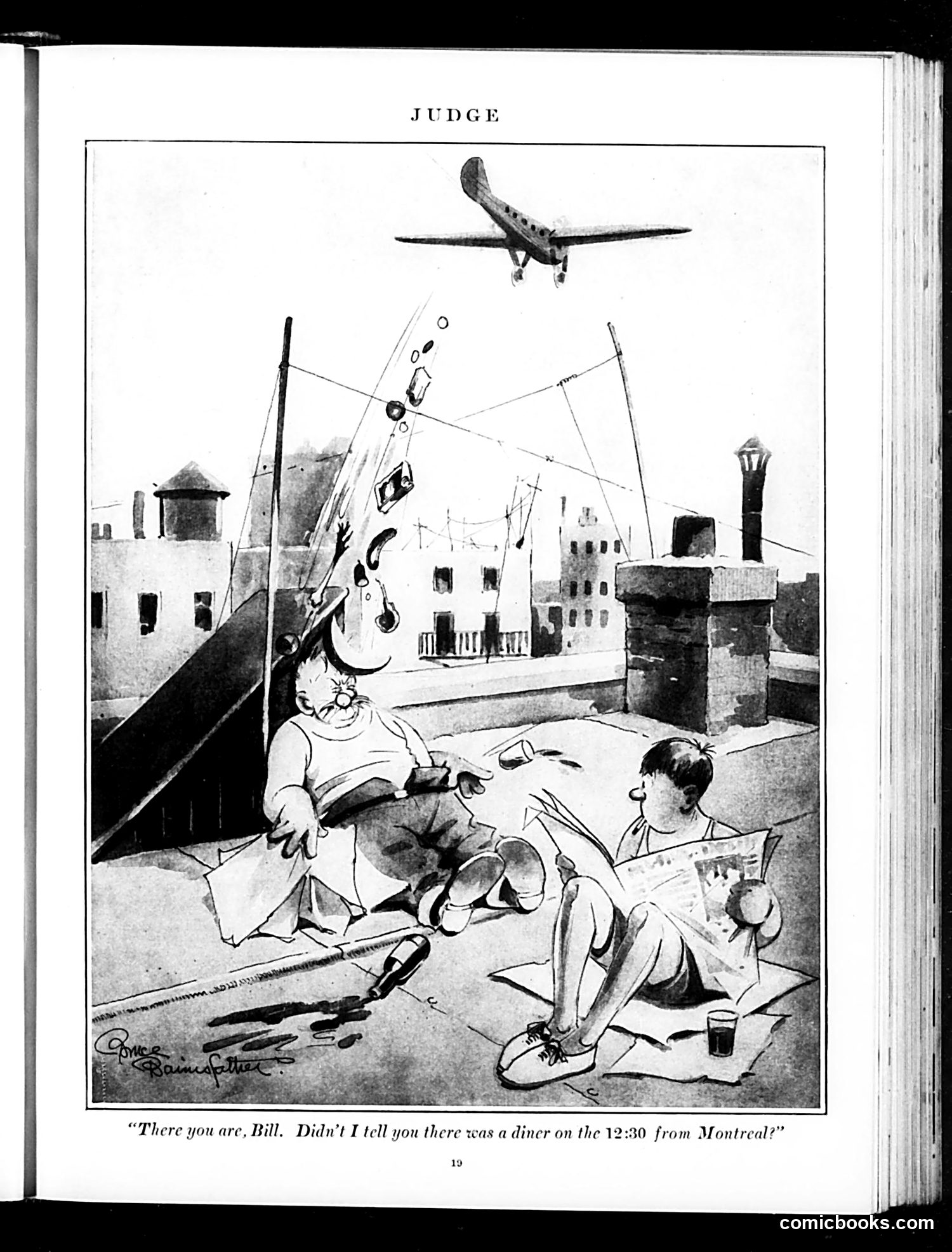
Explanation of "Judge" Cartoon: "Judge" This cartoon satirizes air travel's emerging role in early 20th-century life. An aircraft flies overhead while a rotund man and boy sit on a rooftop with tools and materials scattered around them. The caption reads: "There you are, Bill. Didn't I tell you there was a diner on the 12:30 from Montreal?" The joke targets the novelty and disruption of aviation. The man appears to be doing repairs or construction when an airplane unexpectedly passes by—apparently so regularly that he can identify specific flights and predict their schedules, treating them casually as one might a bus route. The satire mocks how quickly commercial air service was normalizing everyday life, making even rooftop workers aware of flight schedules.
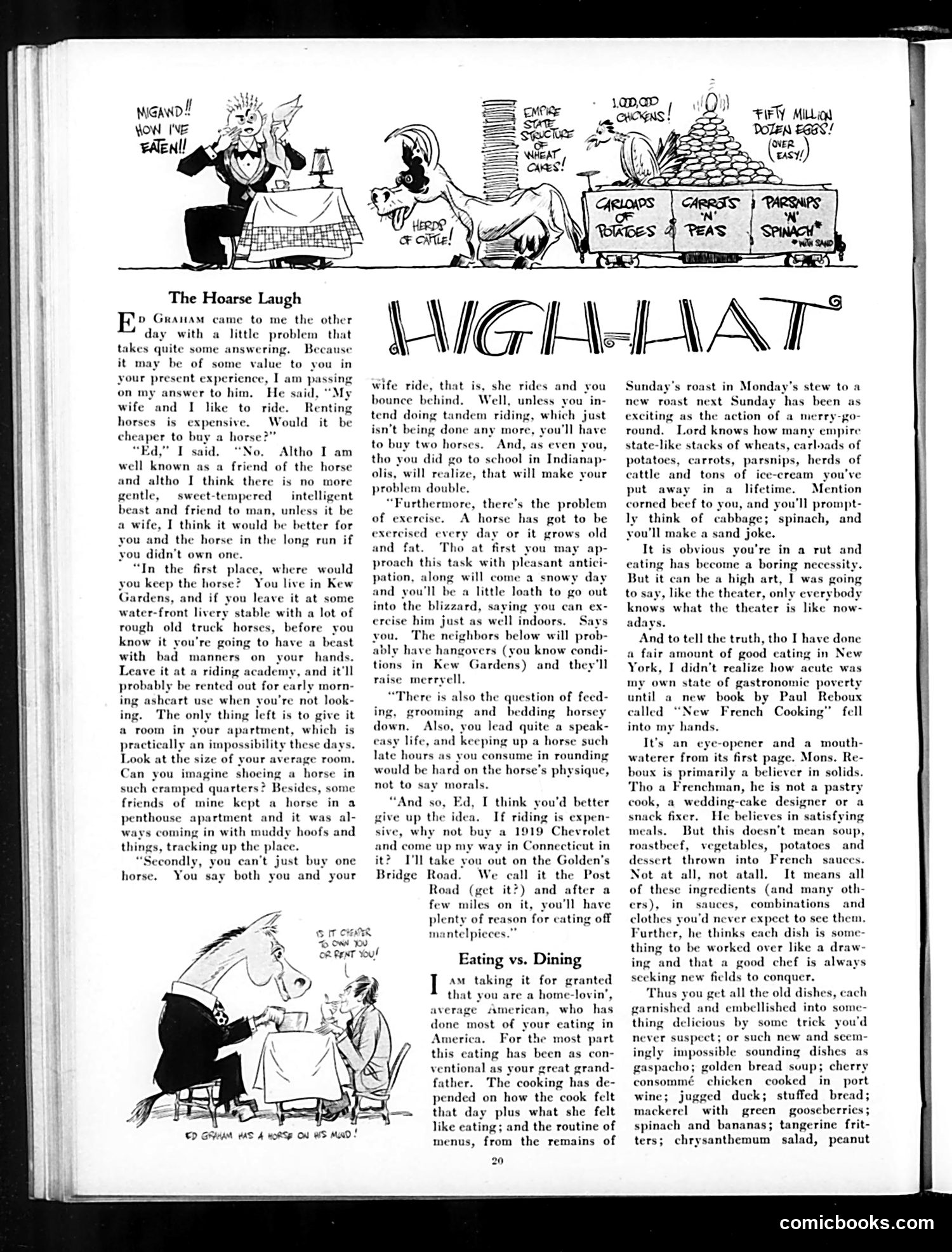
"The Hoarse Laugh" - Judge Magazine Page Analysis This page contains two articles by "Ed" (likely a regular columnist) offering practical advice about 1920s American life. Top cartoon and "Hoarse Laugh" article: A man asks whether he and his wife should buy a horse for riding, given rental costs. Ed's lengthy rebuttal humorously catalogs ownership obstacles: apartment storage impossibility, the need for *two* horses (since his wife rides while he "bounces behind"), daily exercise obligations, feeding/grooming demands, and a horse's incompatibility with their late-night "speakeasy life." The joke culminates in recommending a 1919 Chevrolet instead—a car advertisement disguised as advice. "Eating vs. Dining" section: Ed argues that average Americans eat monotonously (corned beef and cabbage, spinach "sand jokes")—routine rather than art. He suggests dining can become "a high art" like theater. Context for modern readers: Both pieces reflect 1920s post-WWI prosperity, automobile culture's ascendancy over horses, and emerging consumer leisure debates. Speakeasy references date this to Prohibition era (1920-1933).
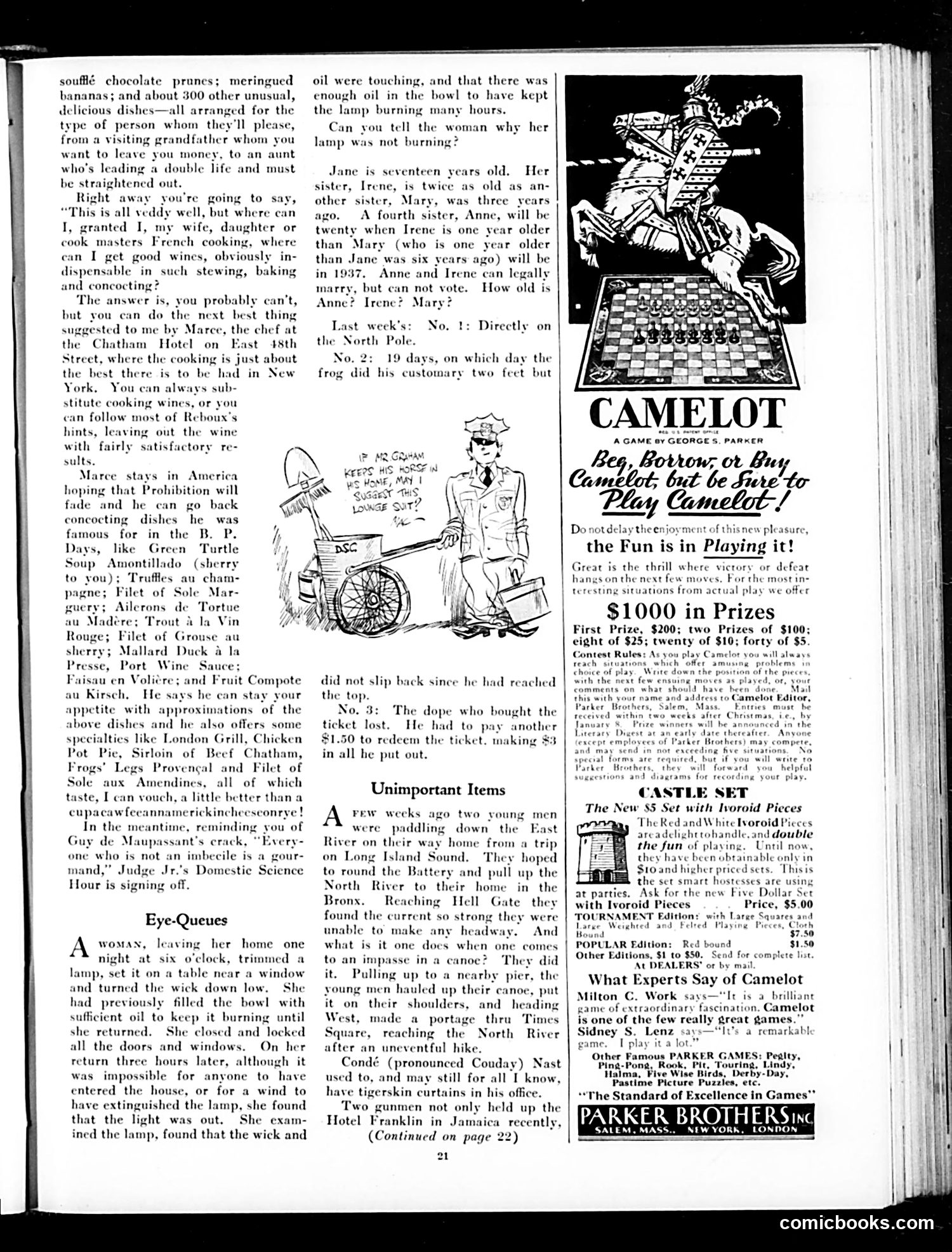
Analysis of Judge Magazine Page This page primarily contains advice columns and puzzle content rather than political satire. The main elements are: "Eye-Queues" Section: Presents logic puzzles for readers, including a riddle about a lamp that won't stay lit (the wick and oil weren't touching) and an age calculation problem about sisters. "Unimportant Items": A humorous anecdote about two young men canoeing home from Long Island who encounter strong currents at Hell Gate in New York. Rather than paddling further, they carry their canoe overland through Times Square to reach the North River—a comical solution to urban geography. Food Column: Discusses French cooking and Prohibition-era wine substitutes, mentioning Chef Marce at the Chatham Hotel. Advertising: The right side features ads for "Camelot" board game and Parker Brothers games, promoting "$1,000 in Prizes." The page reflects 1920s concerns: Prohibition's impact on fine dining, urban recreation, and leisure entertainment. There's no apparent political cartoon or sustained satirical target—this is lifestyle content typical of Judge's broader editorial mix.
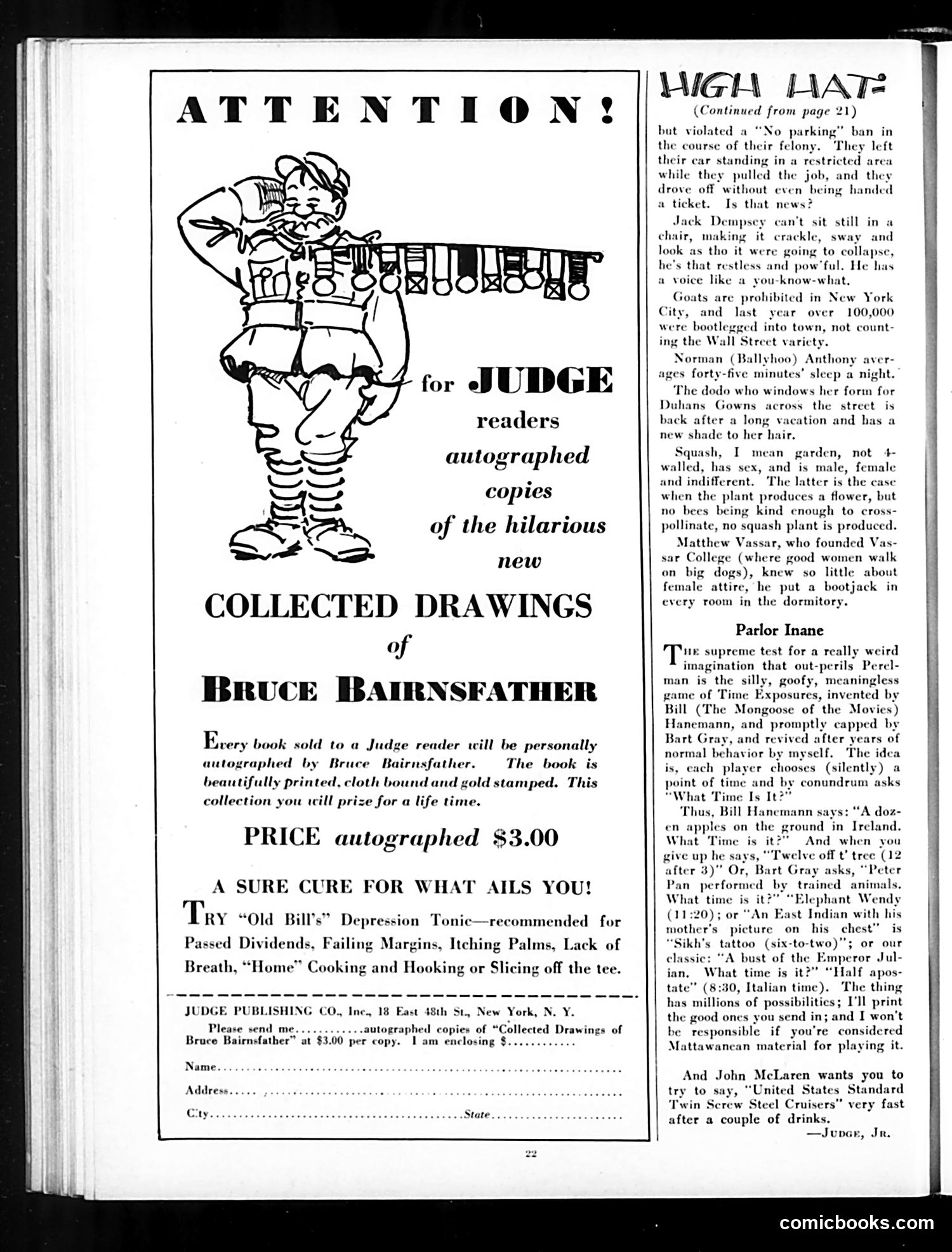
Explanation for Modern Readers This is primarily an advertisement page for Bruce Bairnsfather's collected drawings, a popular cartoonist of the era. The top features a cartoon soldier character ("Old Bill") that appears to be Bairnsfather's signature creation—likely a WWI-era character known for comedic military humor. The ad plays on Depression-era anxieties, sarcastically marketing the book as a "cure" for financial troubles ("passed dividends," "itching palms"). The right column contains miscellaneous gossip and humor items unrelated to the main ad, including anecdotes about Jack Dempsey, New York City goat regulations, and a parlor game called "Time Exposures" where players guess what time it is based on absurd scenarios. The overall tone reflects Judge magazine's satirical approach: combining consumer advertising with irreverent social commentary and wordplay typical of 1920s-30s humor magazines.
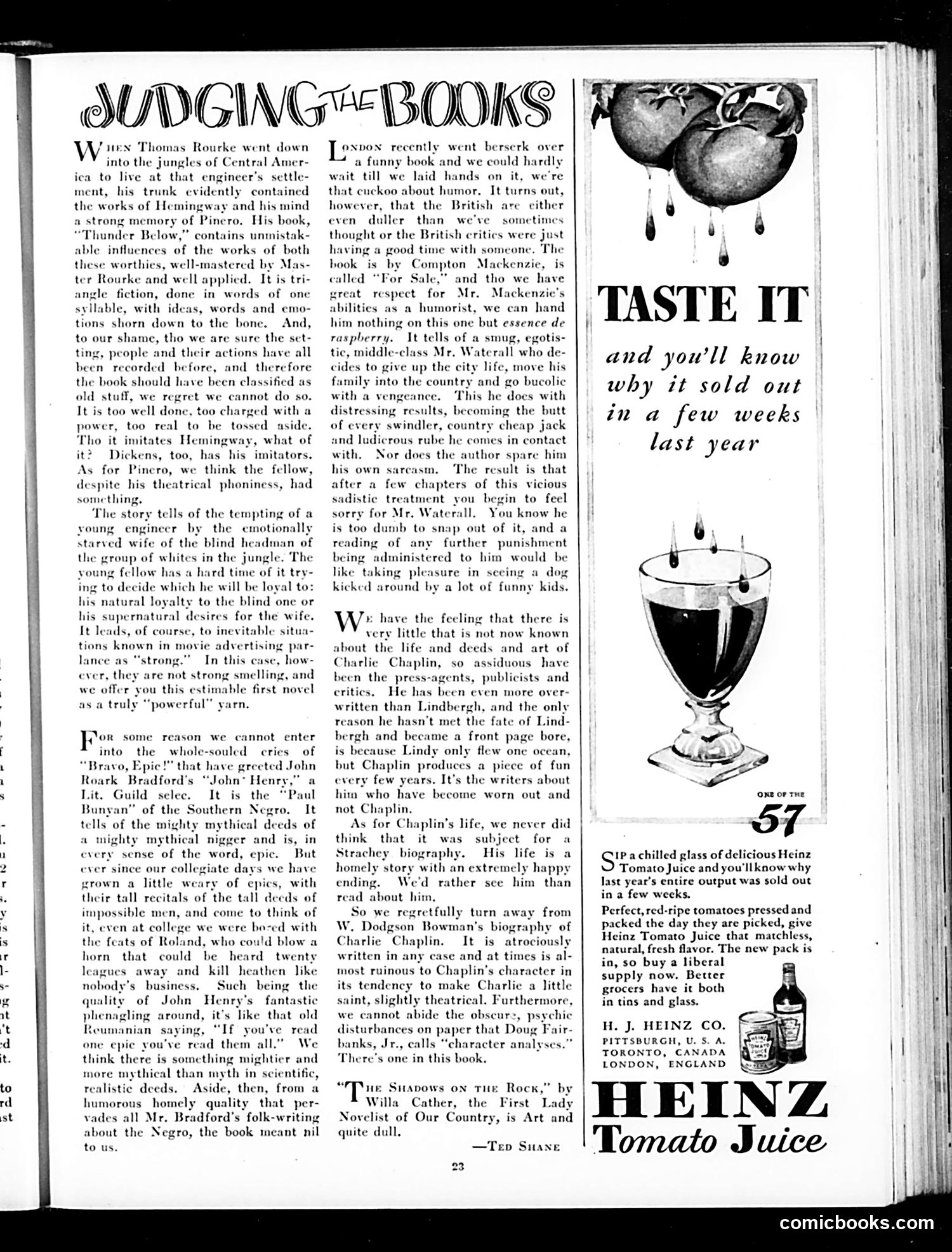
Analysis: "Judging the Books" Book Review Page This page features literary criticism rather than political cartoons. The reviewer discusses three recent books: 1. "Thunder Below" by Thomas Rourke—praised despite imitating Hemingway and Pinero, set in Central American jungle adventure involving emotional temptation. 2. "John Henry" by John Roark Bradford—a folk epic about a mythical Black hero. The reviewer dismisses it as tedious, claiming epics bore them regardless of subject matter (referencing medieval legends like Roland). 3. A British comedy by Compton Mackenzie—criticized as unfunny, about a middle-class man ("Mr. Waterall") attempting rural life and becoming a laughingstock. The reviewer finds the protagonist's punishment excessive and unpleasant to read. The right side contains a Heinz Tomato Juice advertisement ("Taste It"). The tone is sophisticated, somewhat curmudgeonly criticism typical of Judge magazine's literary commentary for educated readers.
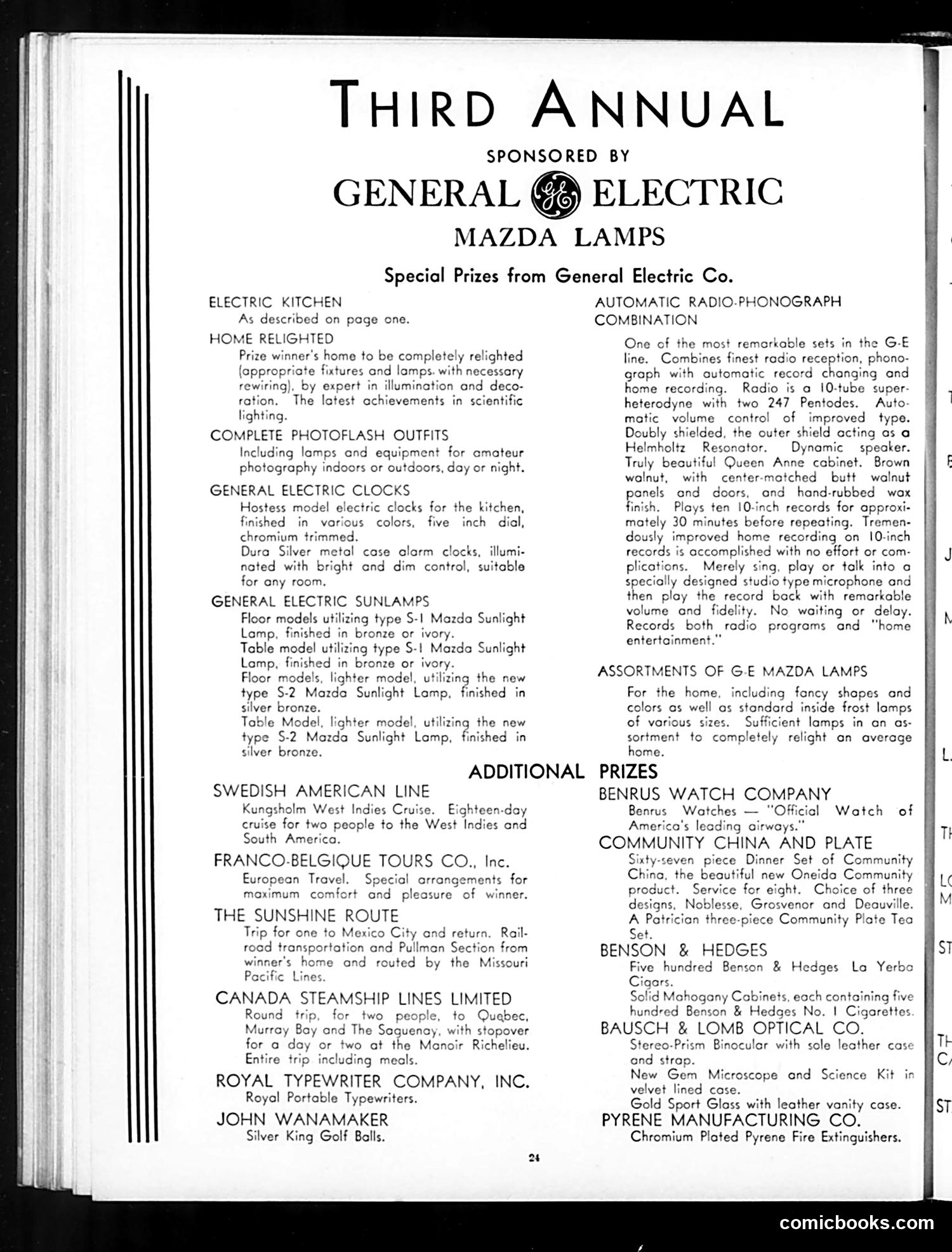
Analysis of Page Content This page is not a cartoon or satirical content—it's a title page and prize list from Judge magazine's Third Annual contest, sponsored by General Electric's Mazda Lamps division. The page lists prizes offered to contest winners, including: - G-E products: Electric kitchens, clocks, sunlamps, and a radio-phonograph combination - Travel prizes: Cruises to the West Indies, Europe, Mexico, and Canada - Luxury goods: Watches (Benrus), fine china (Oneida Community), cigars and cigarettes (Benson & Hedges), optical equipment (Bausch & Lomb) The lavish prizes reflect 1930s-era aspirational consumerism and corporate sponsorship of media contests. This appears to be an advertisement/promotional page rather than editorial content, showcasing products contemporary readers would have considered desirable status symbols.
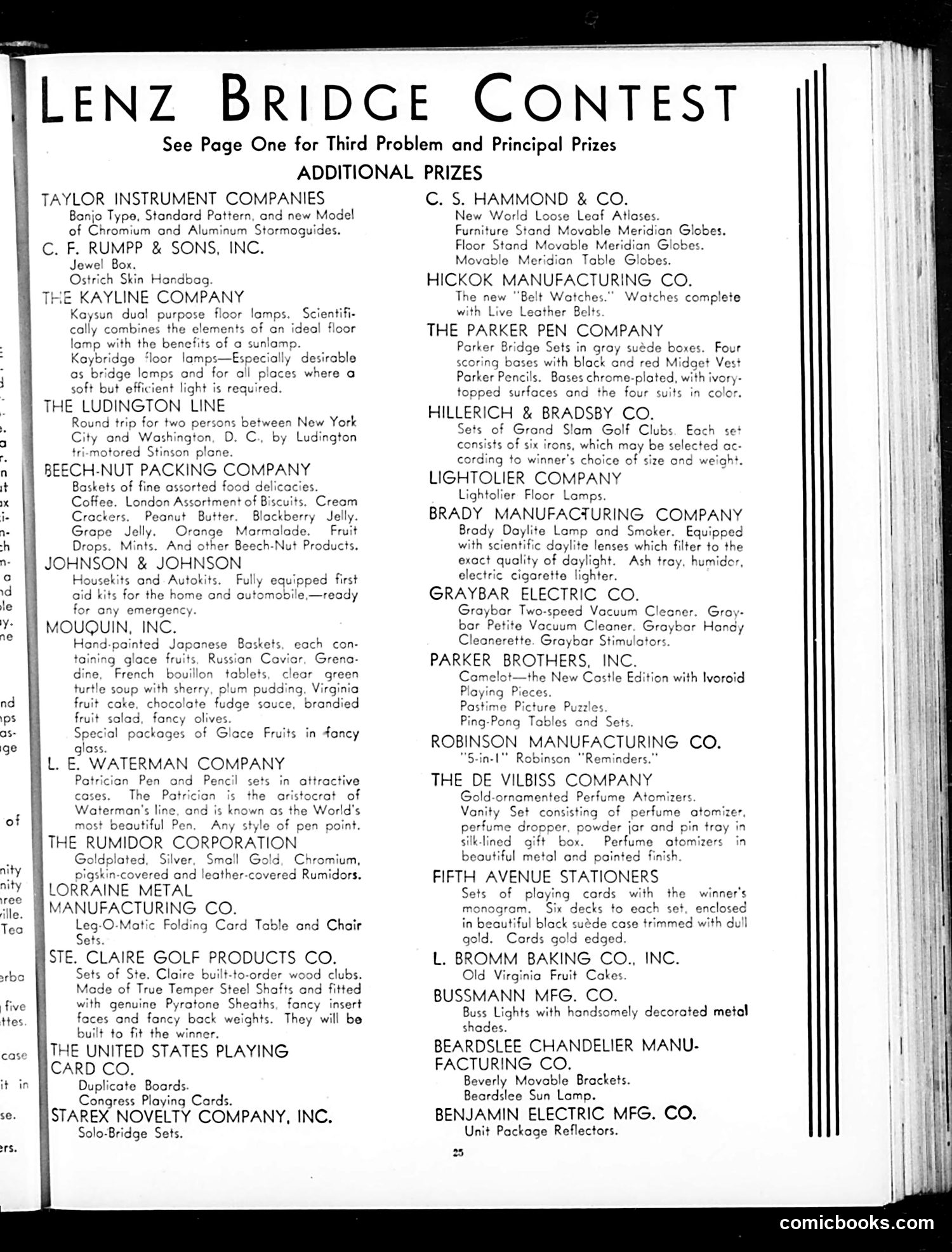
Content Description This page from *Judge* magazine is primarily advertising, not editorial cartoon content. It lists "Additional Prizes" for a "Lenz Bridge Contest" (a puzzle competition), featuring dozens of commercial products and companies offering prizes. The prizes range from luxury goods (Japanese baskets with caviar, fine pens, golf clubs) to practical household items (vacuum cleaners, lamps, card tables). Companies like Parker Pen, Johnson & Johnson, and Beech-Nut are represented. Historical context for modern readers: This reflects 1920s-30s consumer culture when *Judge* used prize contests to boost readership. The specific products—"daylite lamps," "belt watches," folding card tables—document period lifestyle and technology. The prominence of bridge-related prizes (card sets, tables) shows bridge was a fashionable leisure activity among the middle and upper classes during this era. There are no political cartoons or satirical commentary visible on this page—it's purely a promotional/advertising section.
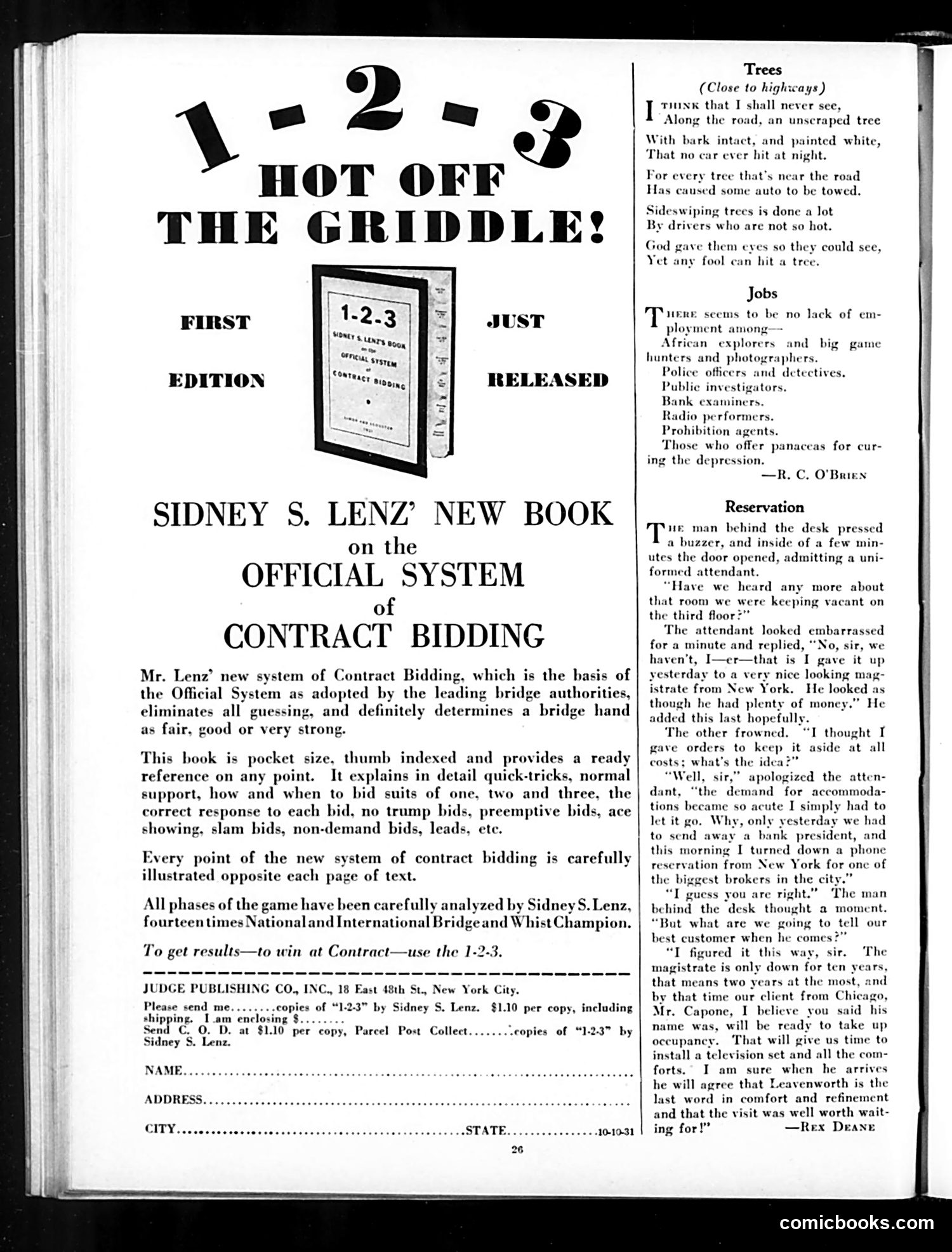
Judge Magazine Page Analysis This page is primarily advertising and light humor rather than political satire. The main content advertises Sidney S. Lenz's new bridge-bidding instruction book ("1-2-3"), promoted as an official system for the card game Contract Bridge. Lenz was a legitimate bridge champion. The page includes three pieces of accompanying humor: 1. "Trees" — a parody of Joyce Kilmer's sentimental poem "Trees," satirizing roadside tree damage from careless drivers. 2. "Jobs" — a brief list noting employment opportunities persist despite the Depression, mentioning "Prohibition agents" (timely, as Prohibition ended in 1933). 3. "Reservation" — A darkly humorous short story about a hotel clerk giving away a reserved room, then explaining the magistrate staying there will only occupy it "ten years," while their actual best customer (implied to be Al Capone, serving time at Leavenworth) will reclaim it later. This satirizes organized crime and prison sentences. The page reflects early 1930s concerns: the Depression, Prohibition's end, and organized crime's prominence.
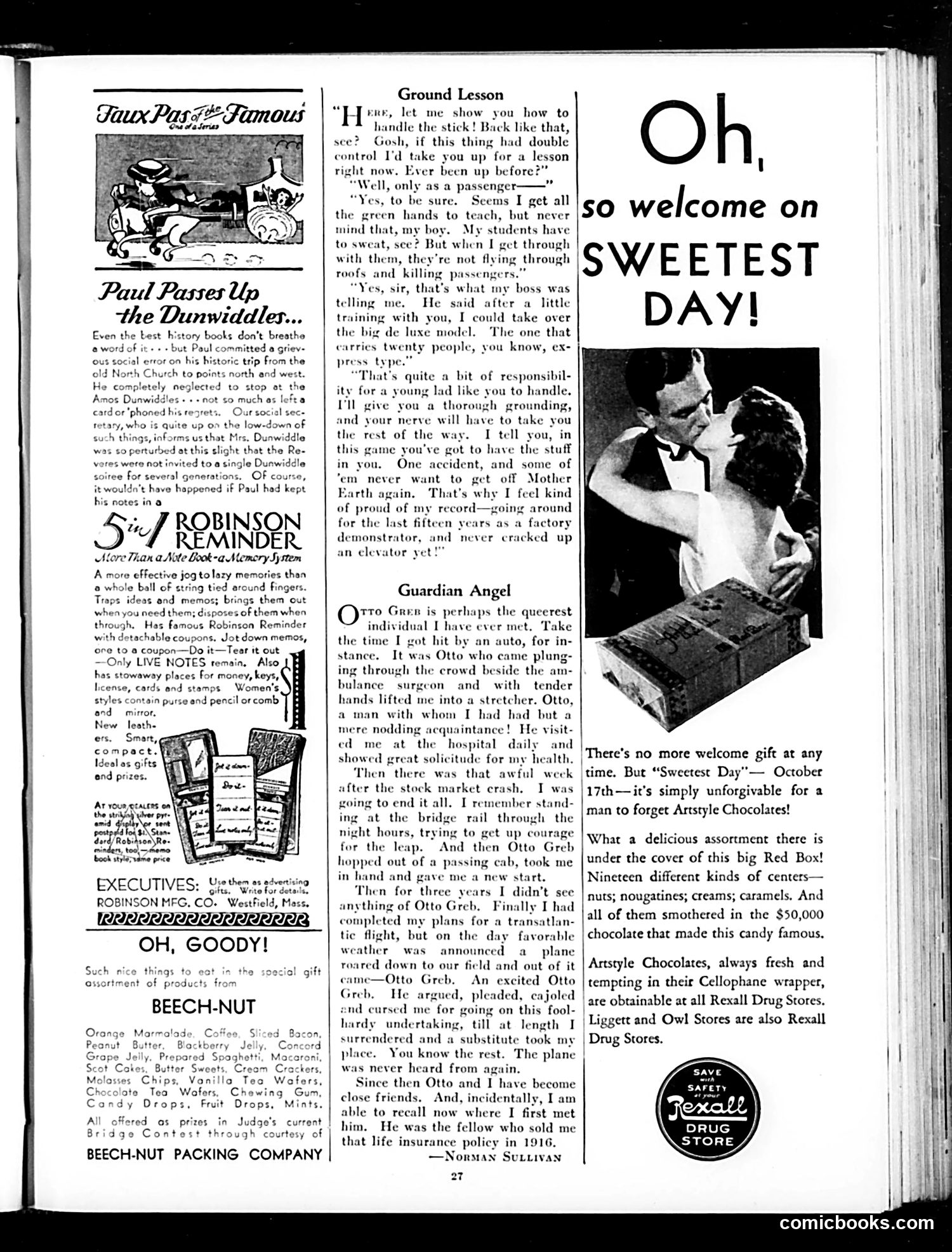
Analysis of Judge Magazine Page This page contains early aviation-themed humor and advertisements. The "Ground Lesson" cartoon depicts a flight instructor warning a young student pilot about the responsibilities of piloting a passenger aircraft carrying twenty people—a significant concern in the early aviation era when flying was still dangerous and novel. The "Guardian Angel" story describes Otto Greb as an uncanny figure who repeatedly appears at crucial moments in the narrator's life, ultimately preventing him from taking a transatlantic flight that crashes, killing everyone aboard. The narrative suggests Greb is a providential force or "guardian angel" saving the protagonist. The page also features period advertisements for Robinson Reminders (organizational systems), Beech-Nut candies/snacks, and a Rexall Drug Store ad. The "Paul Passes Up the Dunwiddles" item references Paul Revere's historical ride, humorously suggesting he committed a social error by not informing the Dunwiddle family. The content reflects early 20th-century attitudes toward aviation as both exciting and perilous.
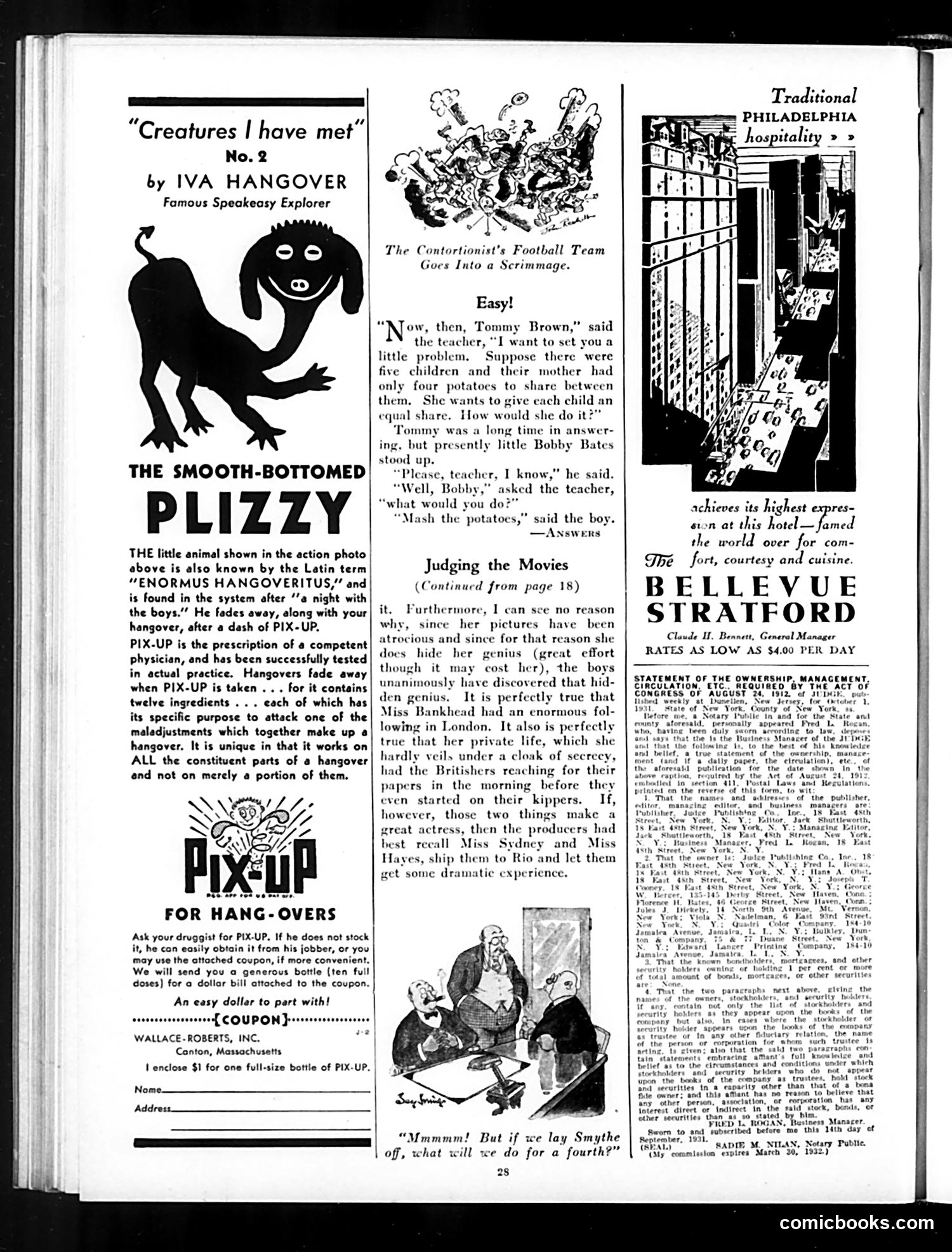
Analysis of Judge Magazine Page Content This page mixes advertisements with light humor typical of 1920s-30s Judge magazine. Main Content: The "Smooth-Bottomed Plizzy" is a satirical creature invented by "Iva Hangover, Famous Speakeasy Explorer"—a pseudonym poking fun at Prohibition-era drinking culture. The absurd Latin name and fantastical drawing mock both pretentious scientific language and the hangovers that resulted from illegal speakeasy visits. This is advertising for PIX-UP hangover remedy, disguised as editorial humor. The "Easy!" math puzzle is a children's joke about resourcefulness: when five people must share four potatoes equally, the solution is to mash them (making division practical). Context: The speakeasy reference and hangover focus directly reference Prohibition (1920-1933), when alcohol was illegal yet widely consumed in underground bars. The satire gently mocks both the drinking culture and the patent medicines marketed to cure its consequences. The remaining content includes movie criticism and a Philadelphia hotel advertisement.
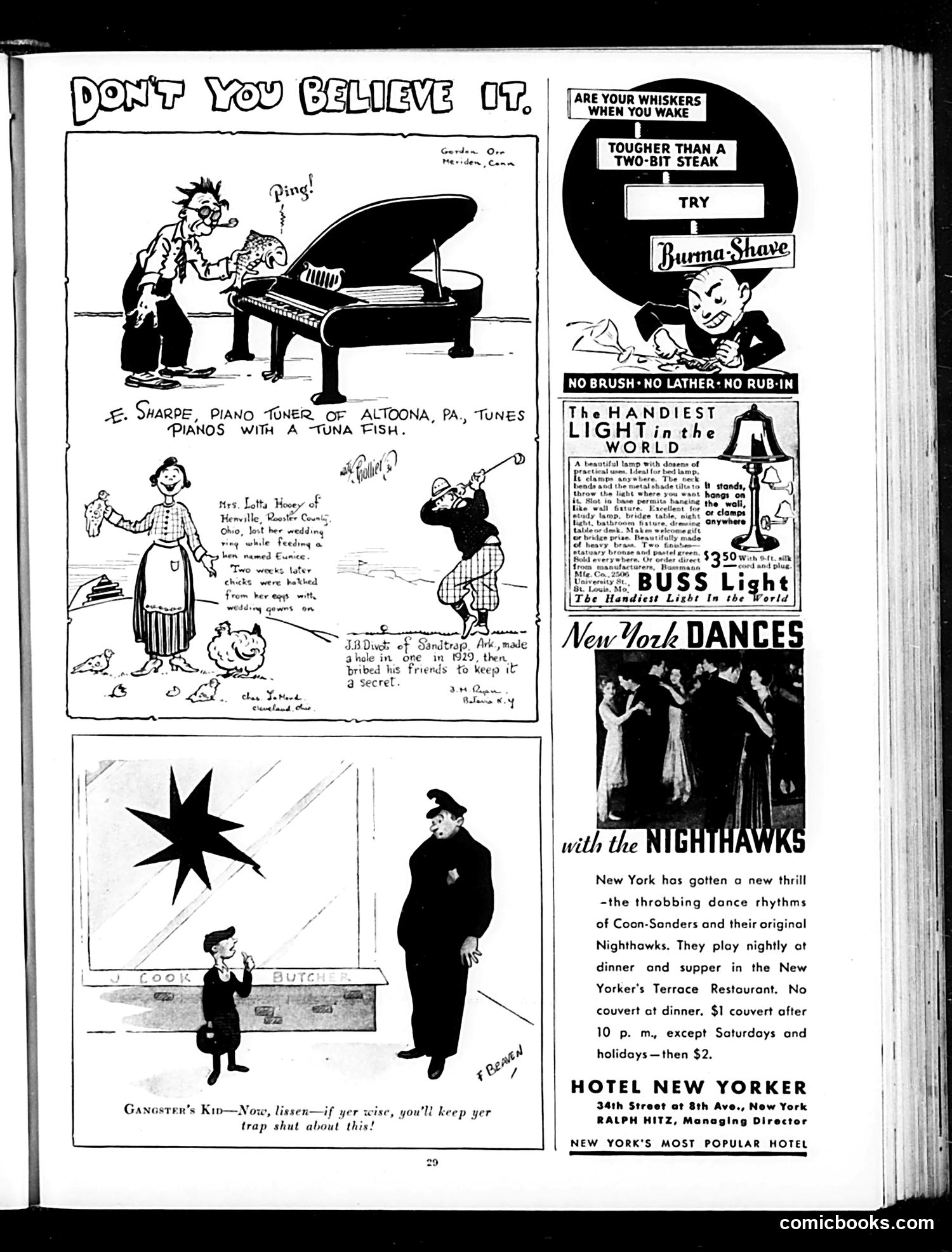
"Don't You Believe It" — Judge Magazine Humor Page This is a humor page featuring four unrelated jokes typical of 1920s-30s satirical magazines: 1. Piano Tuner with Tuna Fish: Absurdist humor mocking a supposedly real piano tuner from Altoona, PA, who allegedly tunes pianos using a tuna fish—a nonsensical premise presented as fact. 2. Domestic Mishaps: Three brief anecdotes about ordinary people in ridiculous situations (a woman losing her wedding ring while feeding chickens, golfers hiding hole-in-ones). 3. Gangster's Kid: A cartoon showing a young boy threatening silence to an adult, captioned as a "gangster's kid"—satirizing 1920s-30s organized crime culture by imagining children adopting criminal behavior. The page mixes absurdist jokes, domestic comedy, and references to contemporary crime culture. The advertisements (Burma-Shave, hotel, nightclub) occupy roughly half the page, reflecting how vintage magazines blended editorial and advertising content.
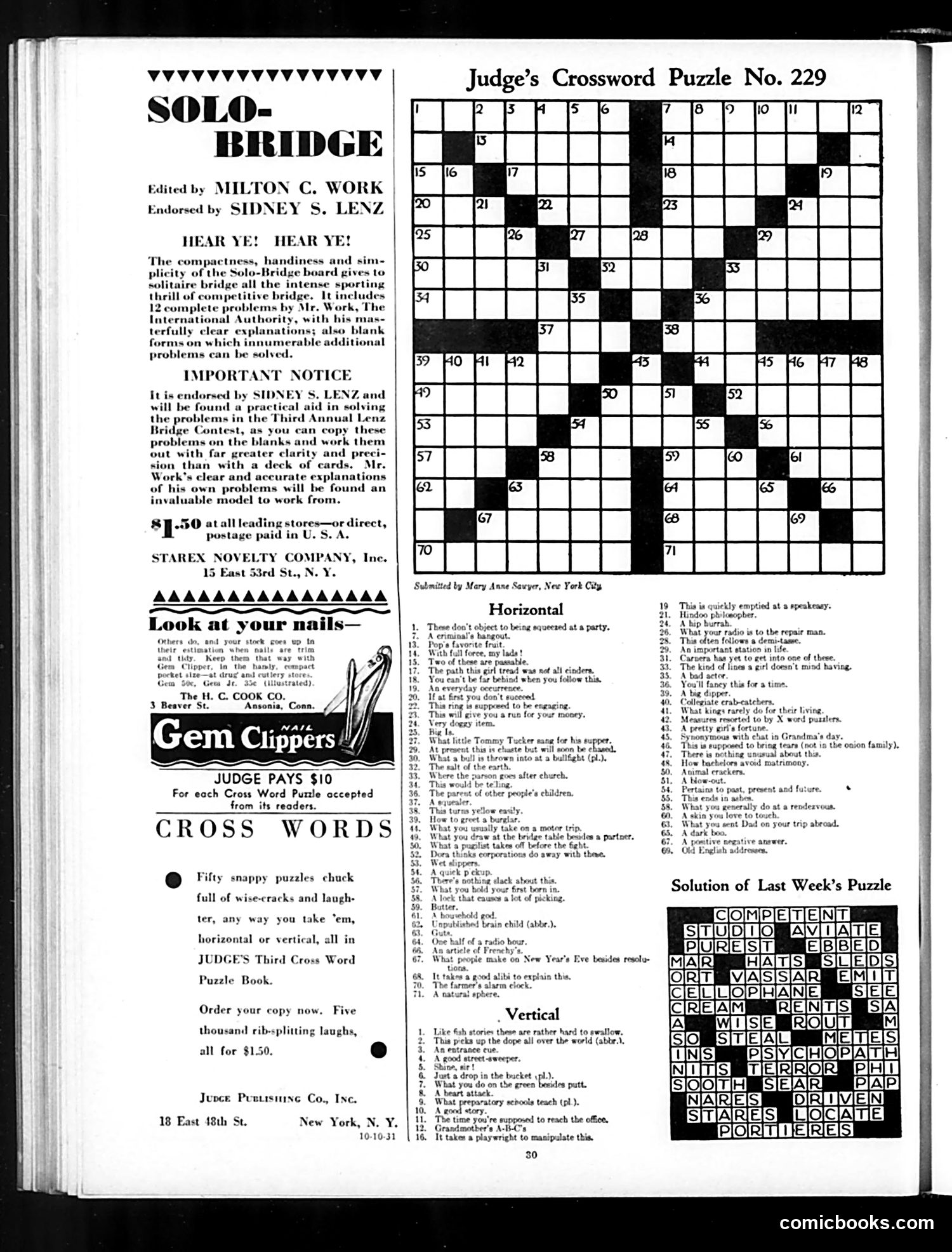
Judge Magazine Page Analysis This page is primarily advertising and puzzle content, not a political cartoon. It showcases: Main Content: - A "Solo-Bridge" card game advertisement, edited by Milton C. Work and endorsed by Sidney S. Lenz—promoting a solitaire bridge variant with instructional problems - A crossword puzzle (#229) with clues - A nail clipper advertisement ("Gem Clippers") - Promotional material for Judge's crossword puzzle book ($1.50) Historical Context: Judge magazine, a satirical publication, used its pages to advertise games and products while maintaining its puzzle section. The bridge game promotion reflects 1930s leisure culture. The crossword puzzle craze was at its peak in this era—hence Judge offering $10 per accepted puzzle from readers and selling puzzle books. No political satire appears on this particular page. It's a commercial/entertainment section typical of period magazines, mixing editorial content with advertising to generate revenue.
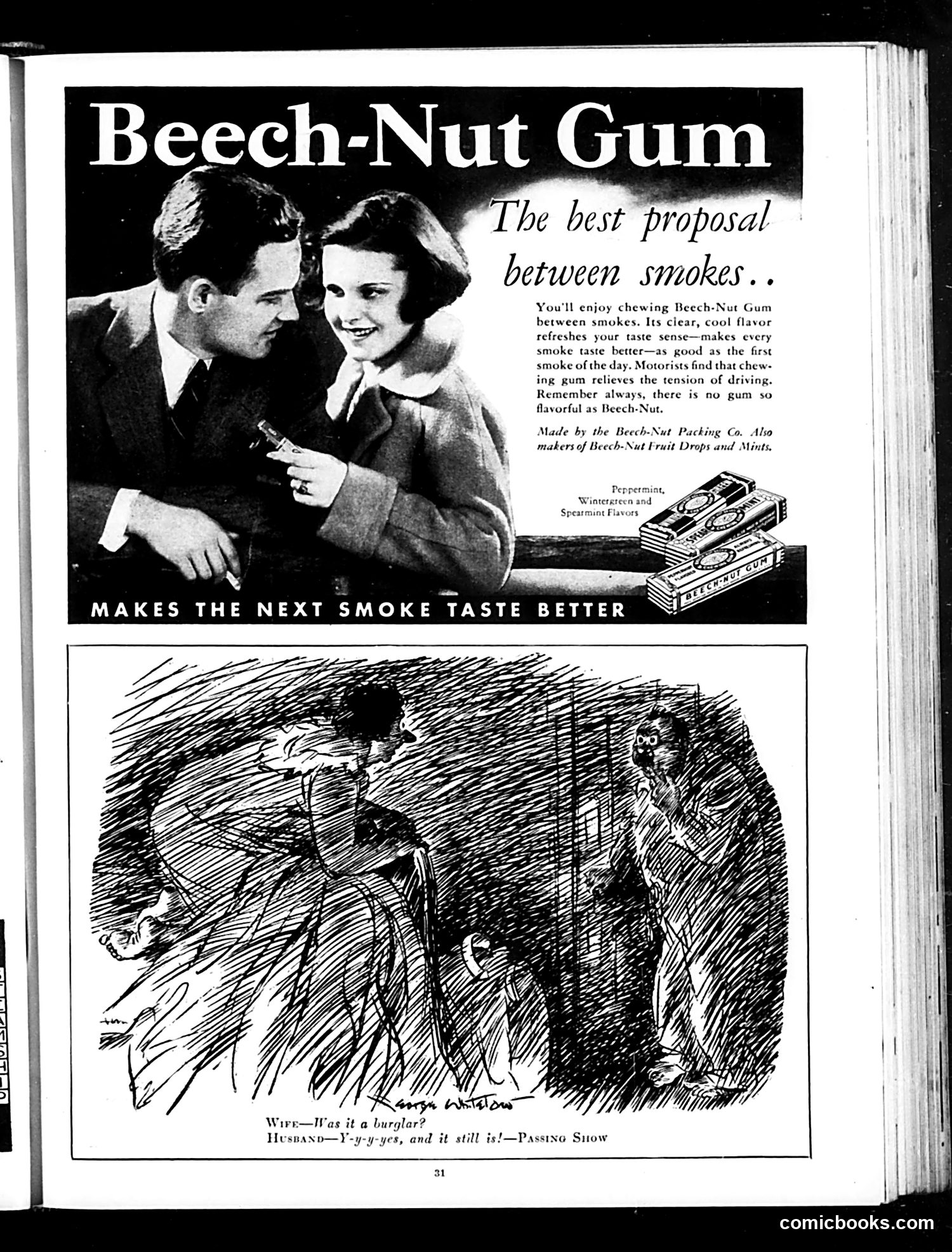
Analysis This page is primarily a cigarette gum advertisement, not political satire. The top half features a Beech-Nut Gum ad with a romantic couple, promoting the product as "the best proposal between smokes" — positioning gum-chewing as a pleasant interlude during smoking. The bottom half is a single-panel cartoon labeled "Passino Show." It depicts a domestic scene where a wife asks her husband "Was it a burglar?" while he responds "Y-y-yes, and it still is!" The joke appears to involve a burglar's ongoing presence or repeated intrusions, playing on the husband's stammering response. The cartoon relies on physical comedy and wordplay typical of early 20th-century Judge humor. There are no identifiable political figures or references—this is entertainment advertising and lighthearted domestic humor aimed at middle-class readers.
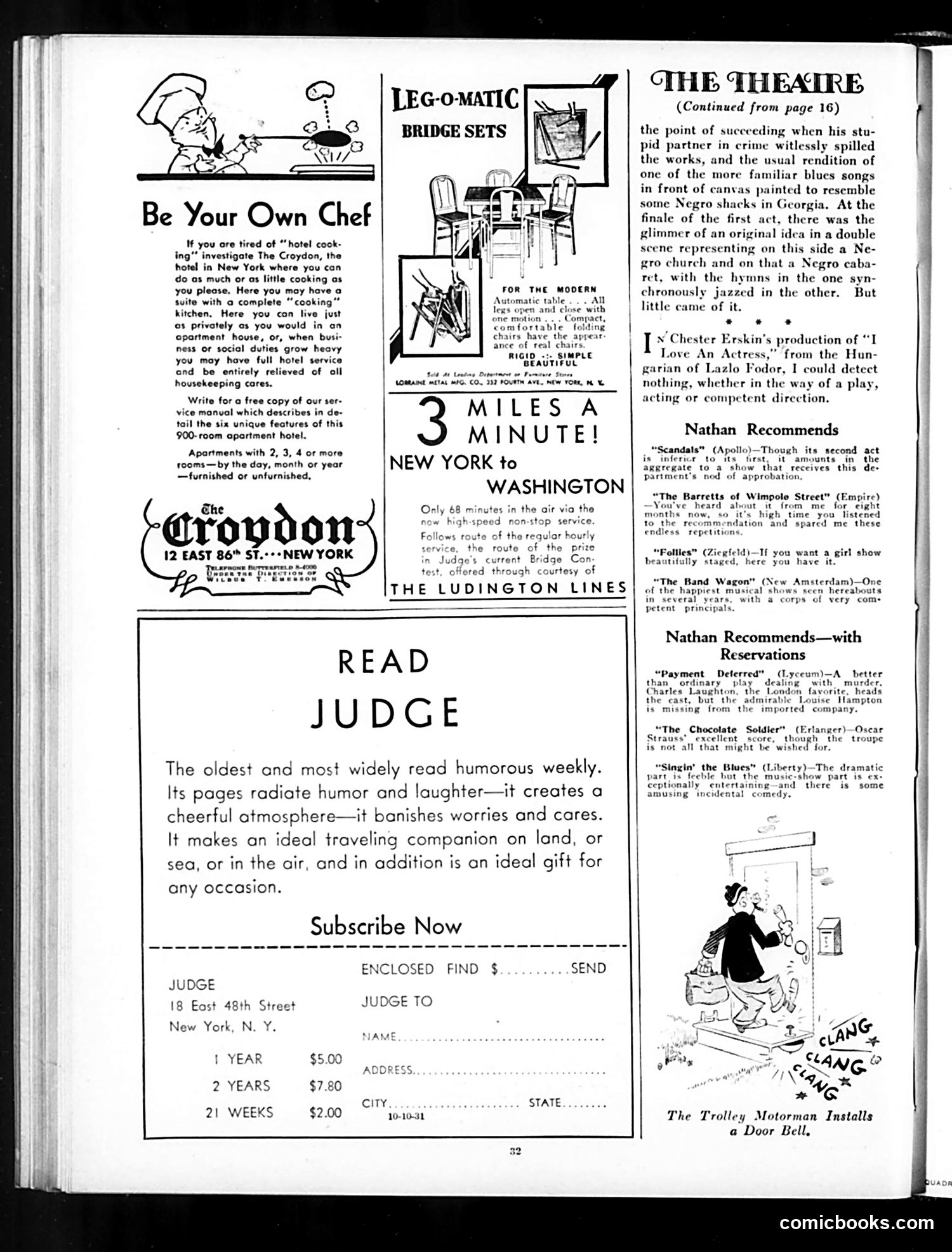
Judge Magazine Page Analysis This page (dated 10-10-31) is primarily advertising and theater reviews, not political satire. The advertisements promote: The Croydon hotel's apartment-style living, Ludington Airlines' fast air service (New York to Washington in "3 miles a minute"), Judge magazine itself, and Leg-o-matic bridge table sets. The theater section contains Nathan's (the magazine's drama critic) reviews of Broadway shows, using period-appropriate language. References include Chester Erskin's production of "I Love An Actress" and several shows now obscure to modern readers. Notable: One review mentions a show featuring "Negro shacks in Georgia" and a "Negro church" contrasted with a "cabaret"—reflecting 1931 theatrical depictions that would be considered deeply offensive today, presented without critical comment. The page's sole cartoon (bottom right) shows a "Trolley Motorman" installing a doorbell—a simple sight gag unrelated to major political events.
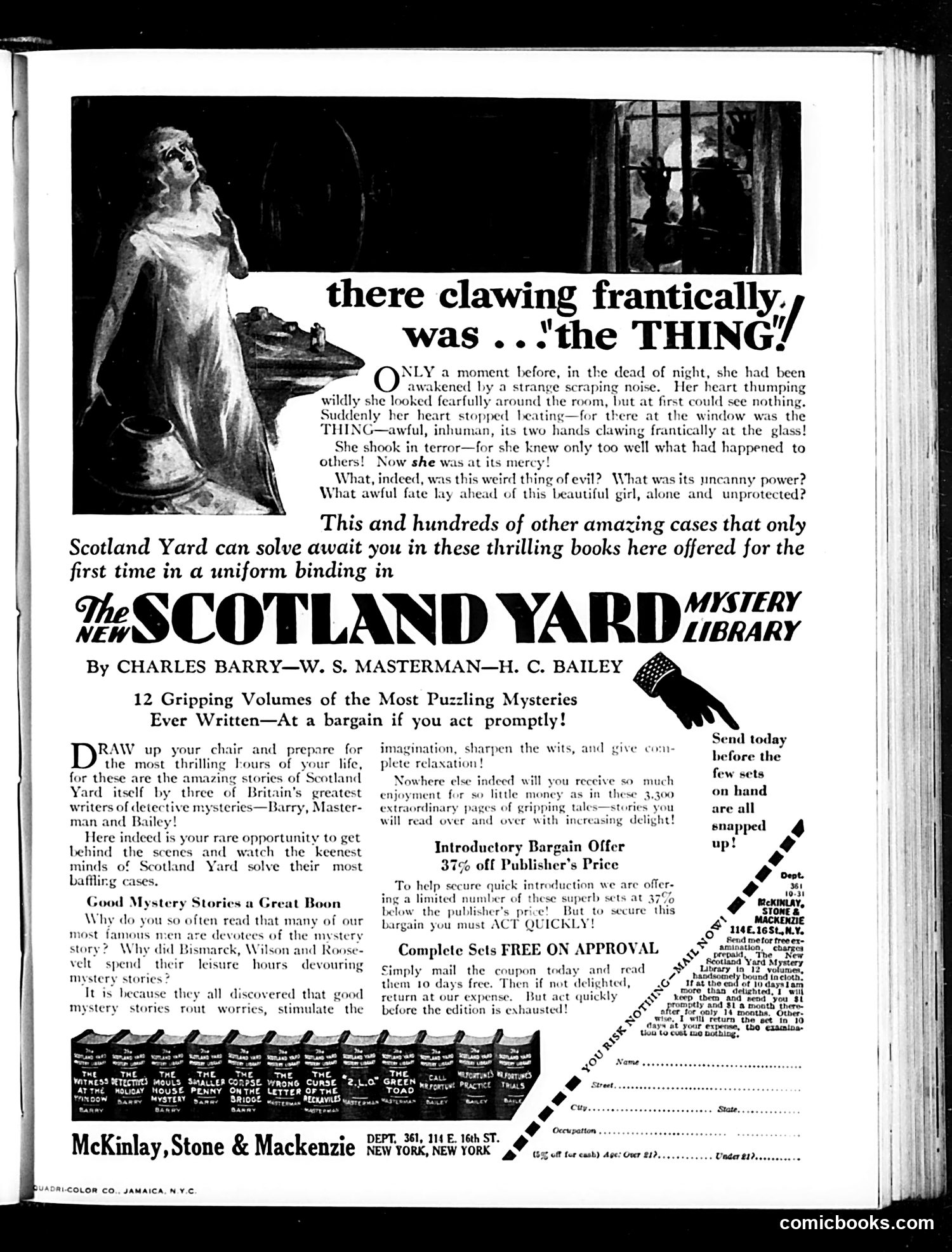
Analysis of This Magazine Advertisement This is primarily a book club advertisement, not a political cartoon. It promotes "The Scotland Yard Mystery Library"—a 12-volume collection of detective stories by Charles Barry, W.S. Masterman, and H.C. Bailey, published by McKinlay, Stone & Mackenzie. The advertisement uses sensationalist copy to sell the books: it features a dramatic illustration of a frightened woman confronted by a mysterious creature clawing at her window ("the THING"), accompanied by breathless prose describing her terror. This melodramatic tone reflects popular mystery and horror fiction of the era. The sales pitch emphasizes that mystery stories are intellectually stimulating ("sharpen the wits") and appeals to readers' desire for affordable entertainment. The "37% off" introductory offer and "free on approval" terms reflect common early-20th-century direct-mail marketing tactics. This appears to be an ordinary commercial advertisement rather than satirical content, using the conventions of pulp fiction to drive book sales.

Analysis This page is not a cartoon or satire—it's a cigarette advertisement for Camel brand, placed in Judge magazine circa 1931. The ad features a smiling woman holding a pack of Camels and promotes the new "Humidor Pack" (moisture-proof cellophane wrapper) that allegedly keeps cigarettes fresh. The copy emphasizes quality Turkish and domestic tobacco blends, claims of mildness, and freedom from "peppery dust" and harsh smoke. The advertisement also references the "Camel Quarter Hour," a radio program featuring performers Morton Downey and Tony Wons, broadcast on CBS—an early example of sponsored radio entertainment. For modern readers: this represents pre-regulation tobacco advertising that made health and quality claims now prohibited. The "considerate hostess" tagline reveals period gender marketing, while the emphasis on freshness addresses a genuine problem before packaging improvements.