judge
Judge — October 17, 1931
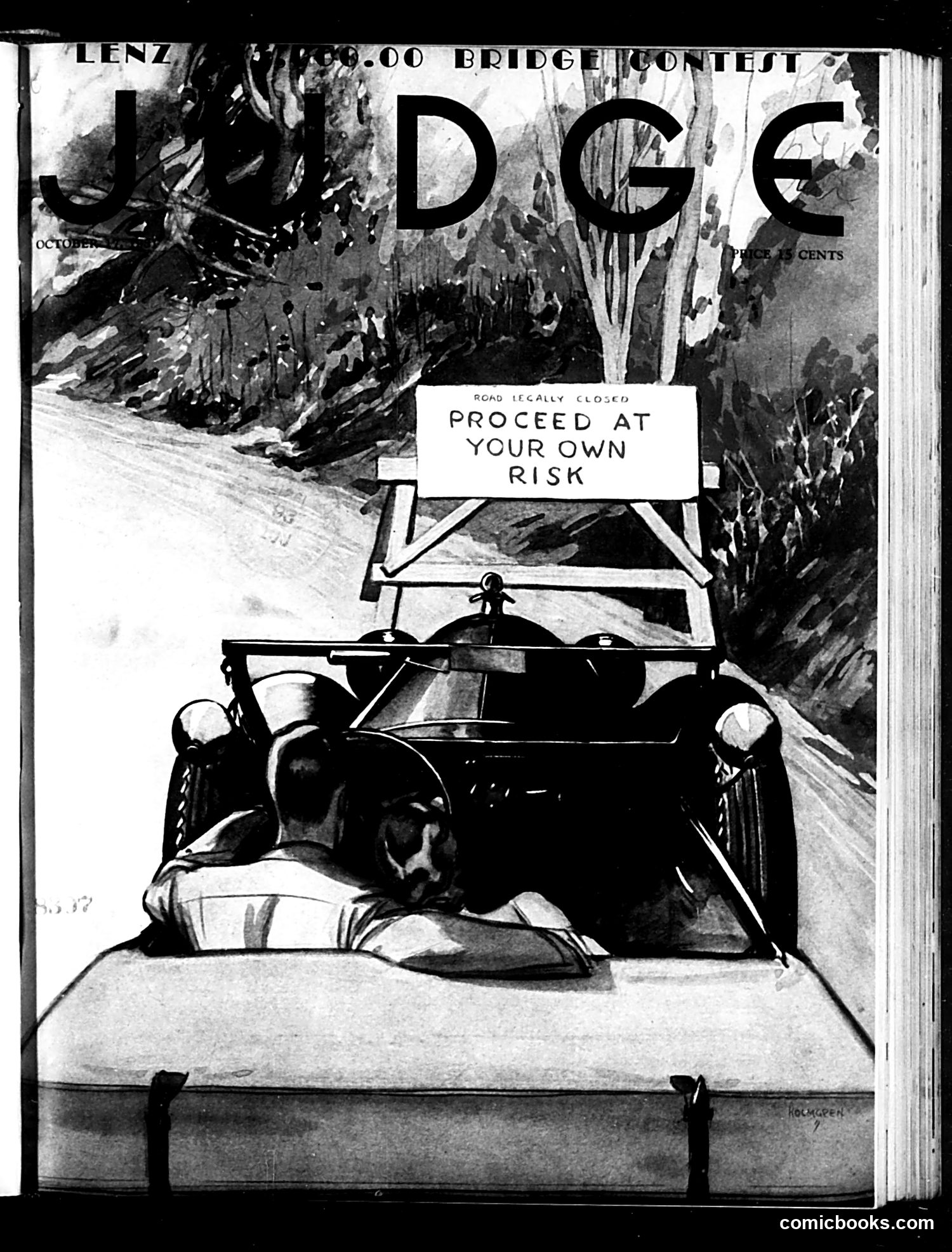
Judge Magazine: "Bridge Contest" Cartoon This appears to be a cover or full-page illustration from Judge magazine's "Bridge Contest" feature, dated October (year unclear from image). The main image shows a convertible automobile approaching a narrow, dramatically carved mountain pass or tunnel with a warning sign reading "ROAD LOCALLY CLOSED / PROCEED AT YOUR OWN RISK." The satire seems to reference reckless driving or taking unnecessary risks on dangerous roads—a commentary on automotive hazards of the era. The large "JUDGE" text overlays the scene, suggesting this illustrates the magazine's humorous take on contemporary driving behavior and the growing automobile culture's dangers. Without additional context, the specific "bridge contest" being referenced remains unclear, though it likely involved some publicized driving challenge or stunt.
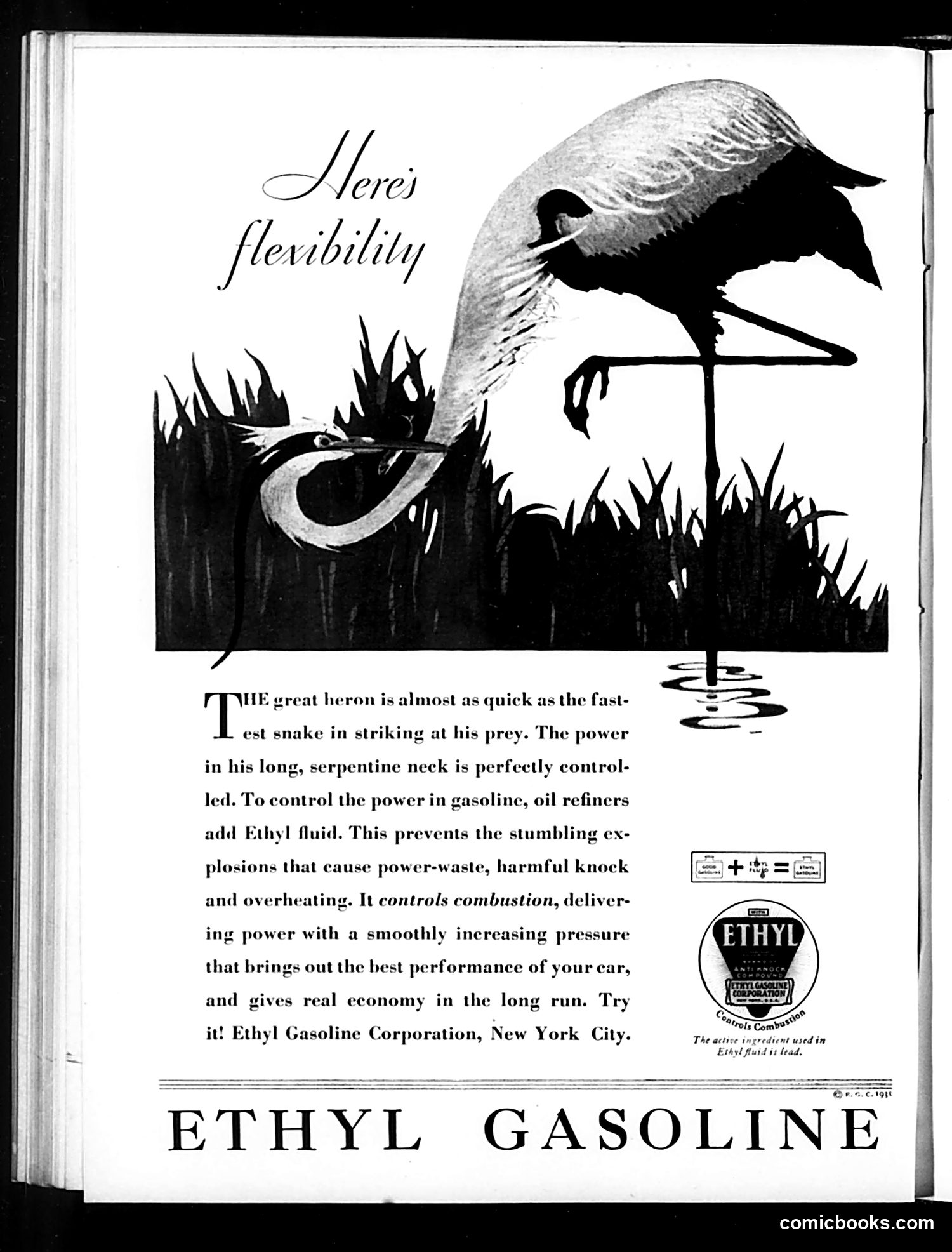
Analysis This page is primarily advertising for Ethyl Gasoline, not satire or political commentary. The illustration shows a great heron with a long, flexible neck striking at prey in marsh grass. The ad uses the heron's controlled neck flexibility as a metaphor for the gasoline's combustion control. Just as the heron's "power in his long, serpentine neck is perfectly controlled," Ethyl Gasoline controls fuel combustion through added Ethyl fluid, preventing engine problems like "stumbling explosions" and "knock." The "Here's flexibility" headline reinforces this parallel between animal physiology and mechanical performance. This is a creative marketing approach from the Ethyl Gasoline Corporation of New York City, using nature imagery to convey technical product benefits to automobile owners.
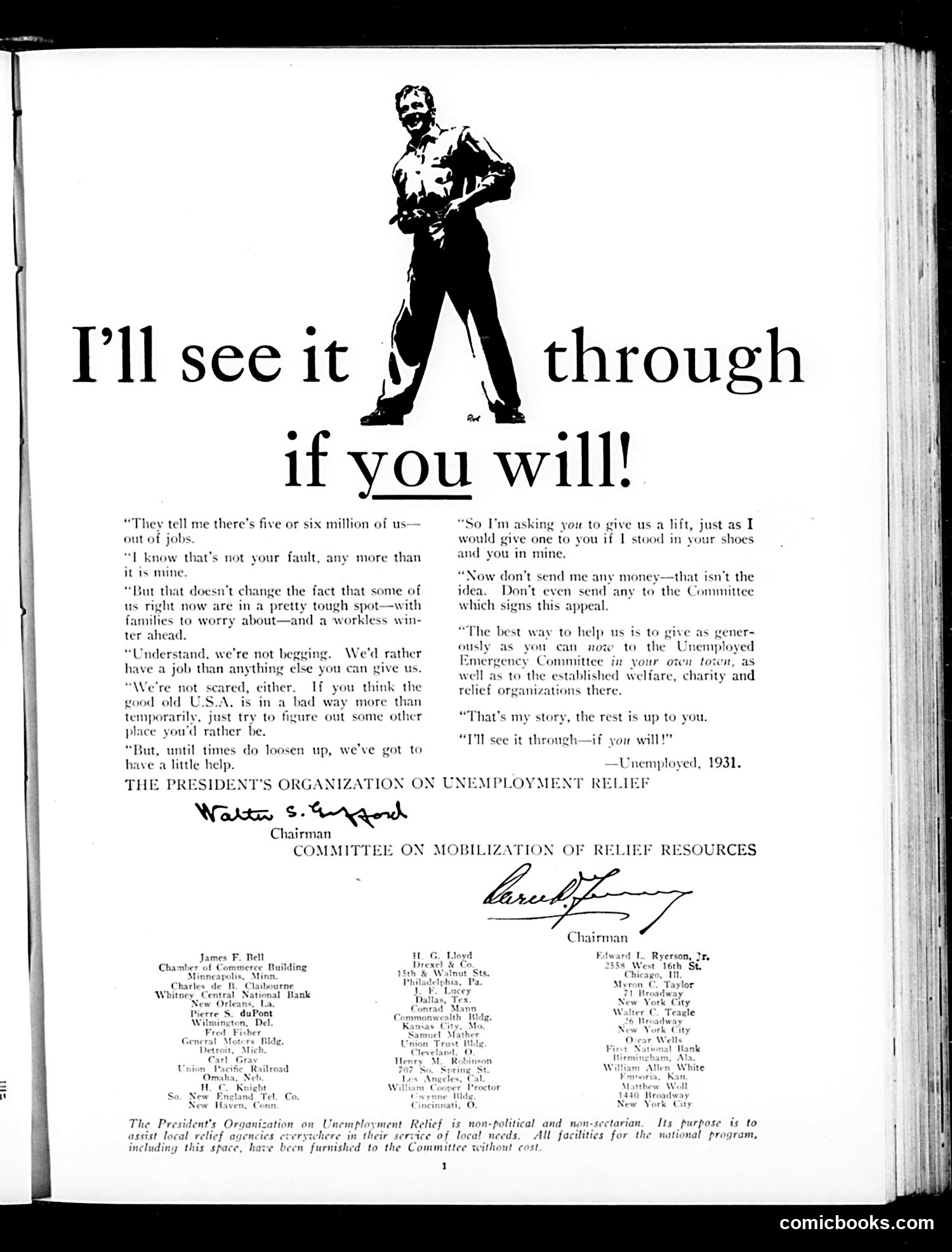
Analysis This is not satirical content but rather a public service appeal from 1931. The confident male figure represents an unemployed worker making a direct appeal to readers during the Great Depression. The message asks Americans to support unemployment relief—not through money donations, but by: - Giving generously to local unemployment committees - Supporting established welfare and charity organizations - Helping mobilize relief resources in their communities The quote "I'll see it through if you will!" frames relief as a shared civic responsibility. The appeal is signed by Walter S. Gifford, Chairman of the President's Organization on Unemployment Relief (established under Hoover), emphasizing this was an official government-endorsed campaign to encourage private charitable giving and community action during the economic crisis.
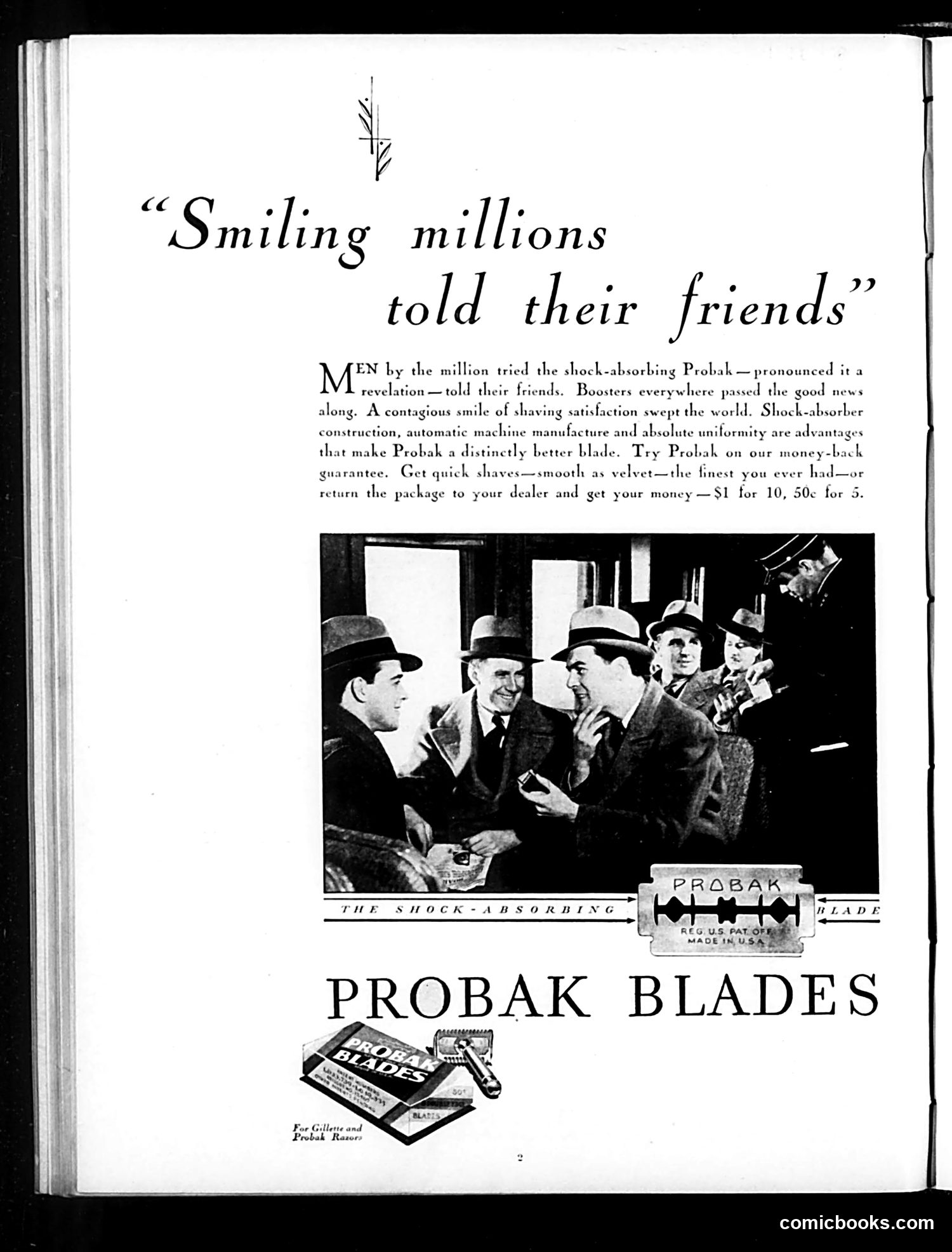
Analysis of Probak Blades Advertisement This is primarily a commercial advertisement, not political satire. The page promotes Probak razor blades with the headline "Smiling millions told their friends." The image shows five men in suits and hats (typical 1920s-30s business attire) apparently discussing or recommending the product to one another. The caption suggests this represents word-of-mouth marketing—satisfied customers spreading positive news about the blades. The ad emphasizes the product's features: shock-absorbing construction, automatic manufacturing, and uniformity. It includes a money-back guarantee and pricing ($1 for 10, 50¢ for 5). The small product image at bottom shows the Probak blade package and razor. This appears to be standard advertising copy leveraging social proof and peer recommendation as a marketing strategy.
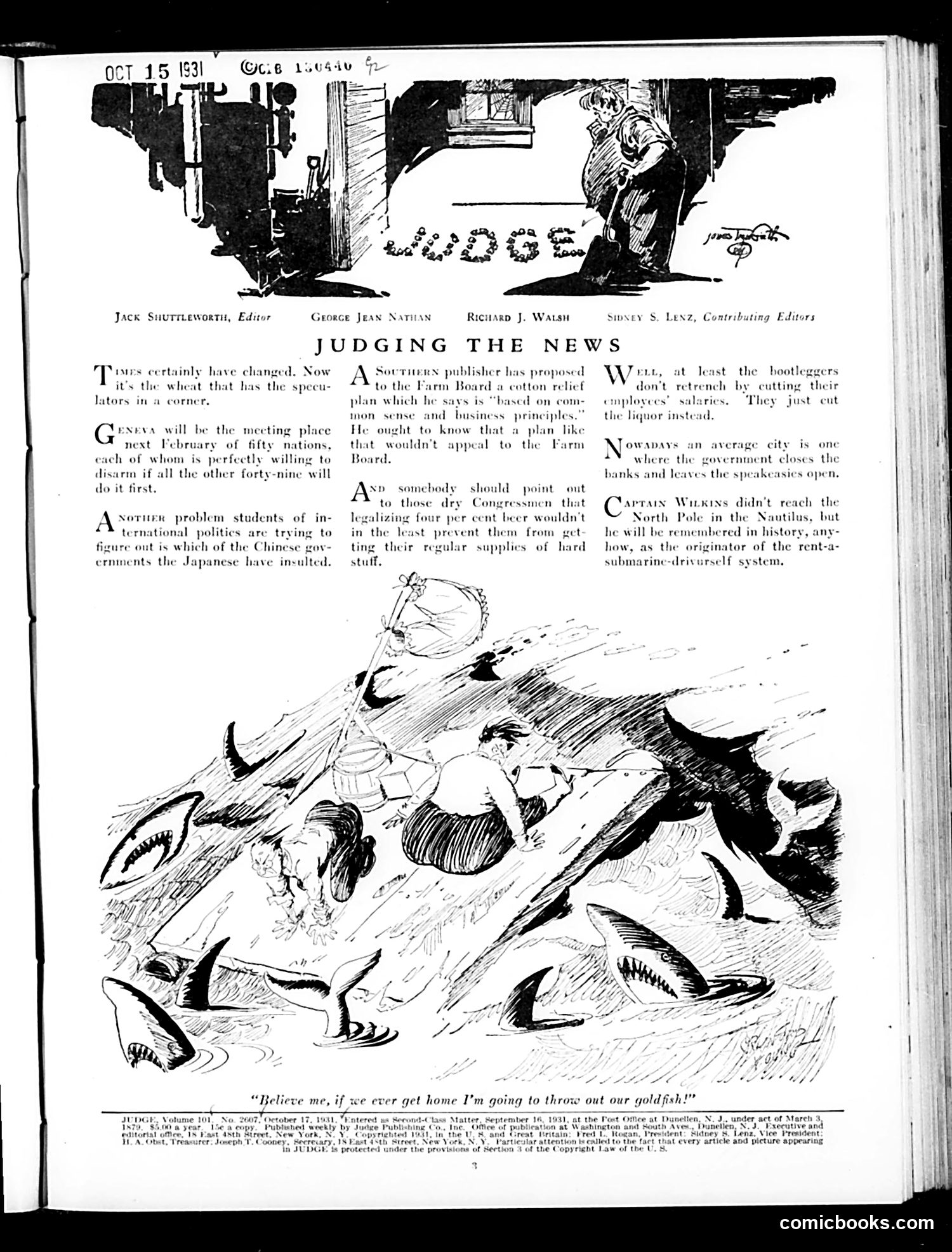
"Judging the News" - October 15, 1931 This editorial cartoon satirizes American economic and political failures during the Great Depression. The large fish with sharp teeth represent predatory economic forces or loan sharks. The drowning figures—businessmen and ordinary citizens—illustrate ordinary people being destroyed by financial collapse and exploitation. The surrounding commentary mocks various targets: Southern publishers proposing inadequate farm relief, Congress's inability to prevent bootleggers from accessing alcohol during Prohibition, cities that close banks while keeping speakeasies open (revealing misplaced priorities), and references to Captain Wilkins and submarine technology. The overall message: while politicians debate trivial matters, ordinary Americans drown in economic catastrophe. The cartoon indicts institutional failure to address Depression suffering with urgency.
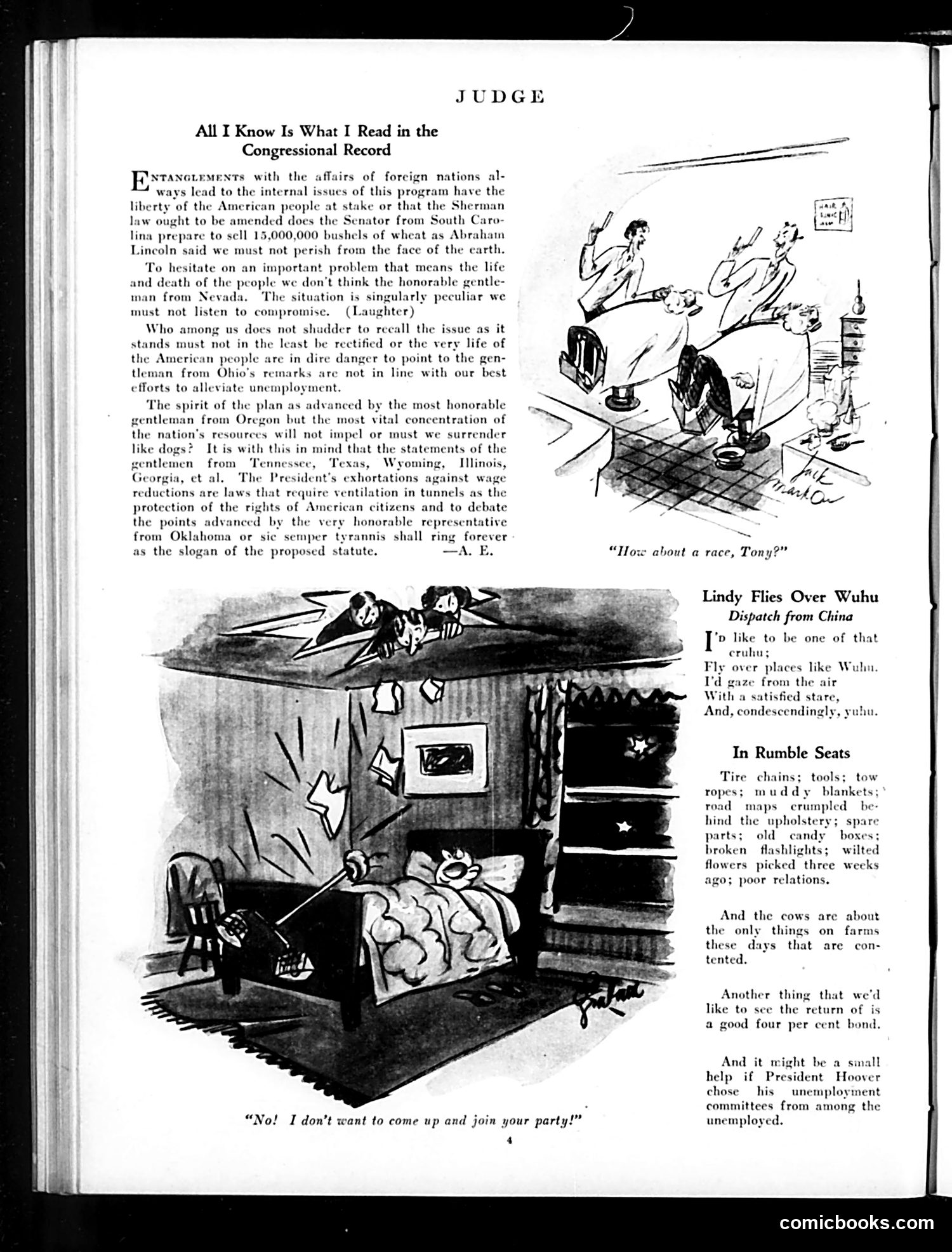
Judge Magazine Page Analysis This page contains political commentary and cartoons, likely from the 1930s era based on references to President Hoover and unemployment. Top Cartoon: "How about a race, Tony?" depicts what appears to be a political debate about wage reductions and labor rights, with the speaker defending American workers' interests against compromise positions. Bottom Cartoon: "No! I don't want to come up and join your party!" shows someone in bed refusing an invitation—likely satirizing reluctance to participate in social activities during economic hardship. Right Column: Includes a poem about flying over Wuhu, China, and "In Rumble Seats" listing Depression-era hardships (broken tools, wilted flowers, poor relations). The final section critiques President Hoover's unemployment committee selection, suggesting he should choose unemployed people themselves. The overall theme addresses economic depression, labor disputes, and government response to unemployment.
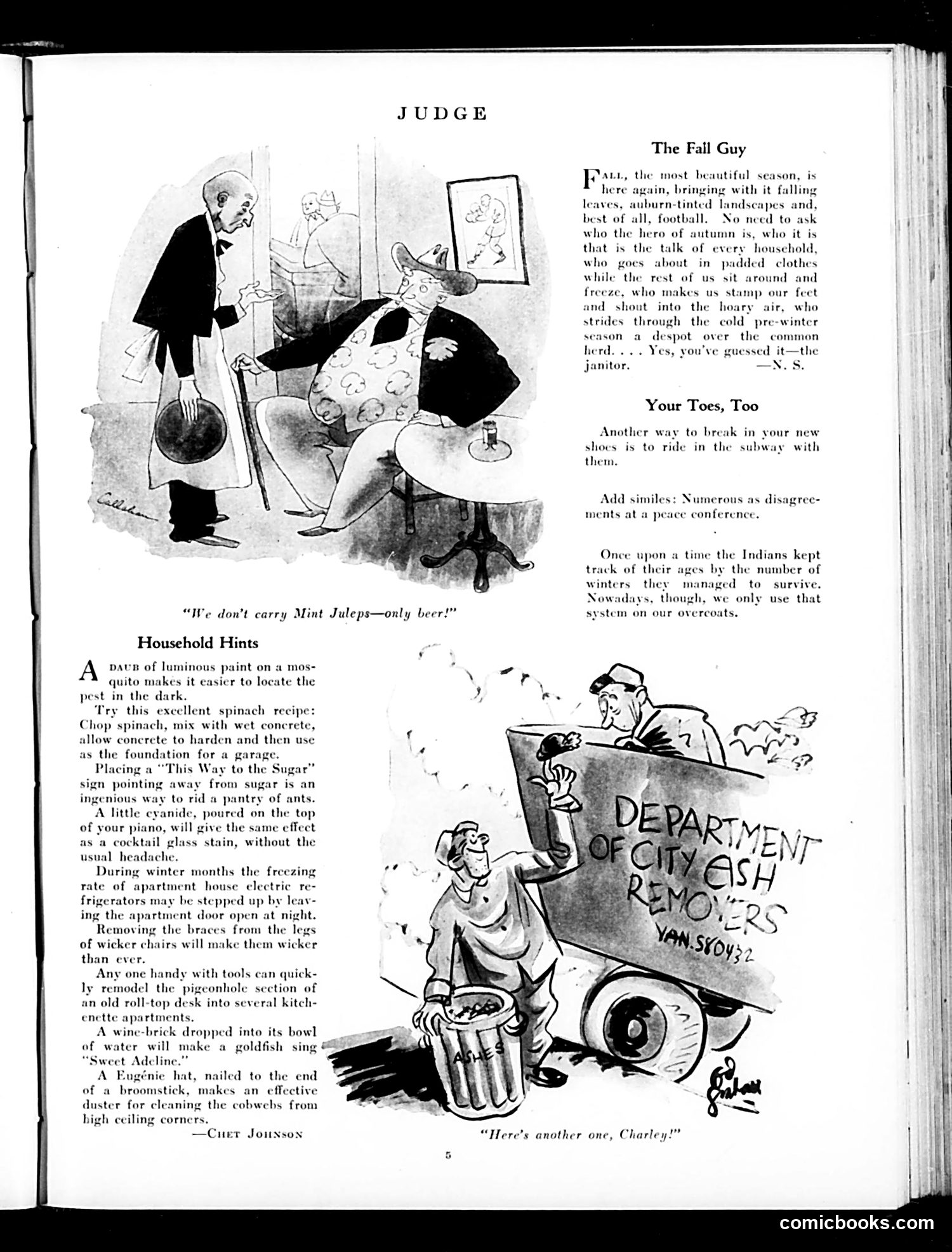
Analysis of Judge Magazine Page This page contains satirical humor and household hints rather than political cartoons. The main cartoon shows a man confronting a woman about carrying "Mint Juleps," a Southern alcoholic drink—likely satirizing Prohibition-era concerns about hidden alcohol consumption. The "Household Hints" section offers absurdist practical advice (using spinach as garage foundation paint, cyanide on pianos) that appears intentionally ridiculous rather than genuine. The bottom cartoon depicts the "Department of City Fish Demos" dumping fish, with the caption "Here's another one, Charley!"—likely mocking inefficient city government or some contemporary municipal scandal, though the specific reference is unclear without additional context. Overall, this represents Judge's typical mix of domestic humor and gentle institutional satire from the early 20th century.
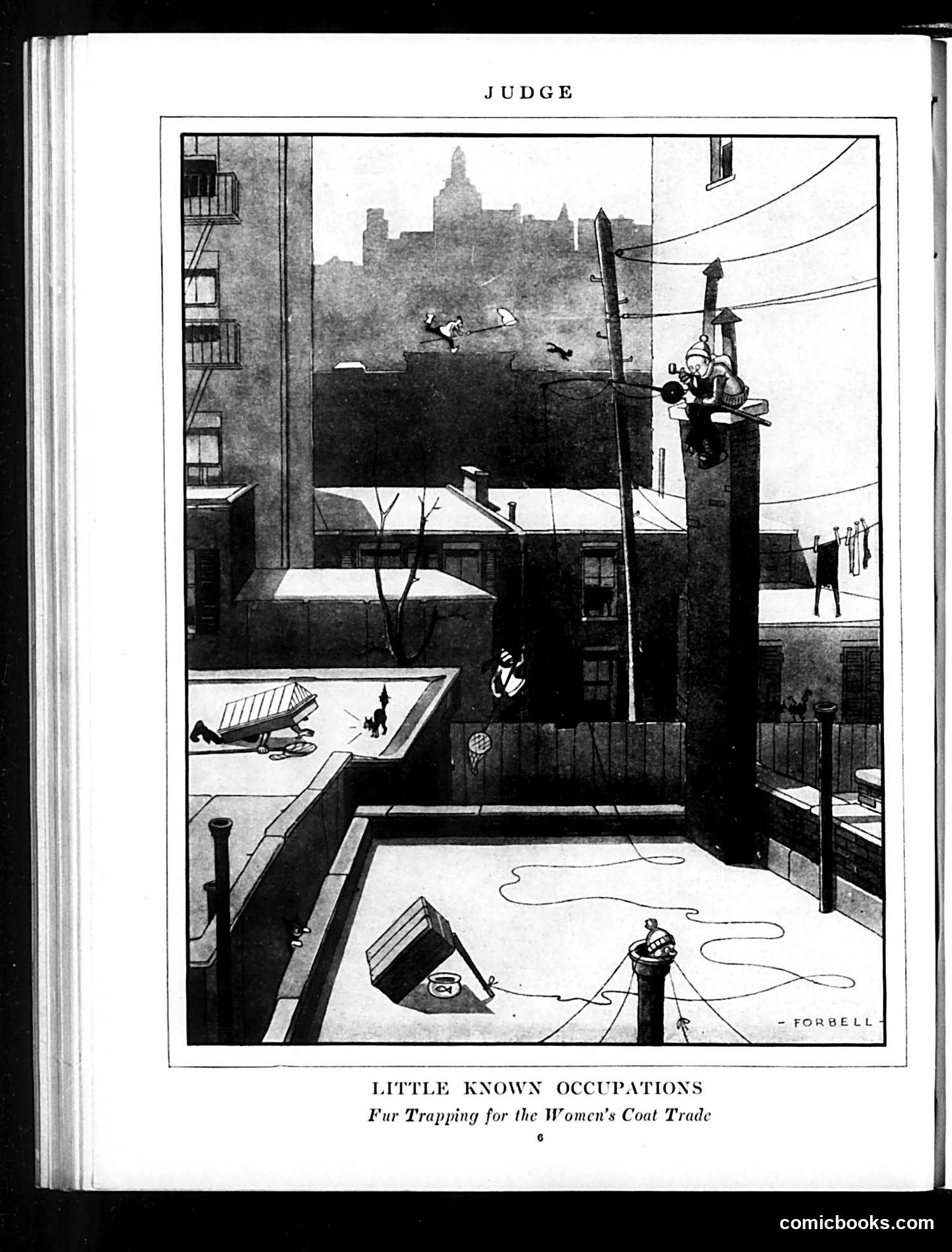
Analysis This is a satirical cartoon titled "Little Known Occupations: Fur Trapping for the Women's Coat Trade." The illustration depicts an urban rooftop scene where figures appear to be catching rats or other small animals in traps and snares strung across the space. The satire mocks the fur industry's supply chain by suggesting that women's fur coats—luxury items—are sourced through crude, undignified urban "trapping" rather than legitimate hunting or farming. The rooftop setting, with clotheslines and modest urban architecture visible, emphasizes the contrast between the supposed elegance of fur fashion and the shabby reality of its procurement. The cartoon likely critiques both the fur trade's practices and the vanity of wealthy women who purchase these coats, presenting their fashion choices as dependent on unsavory, lower-class labor.
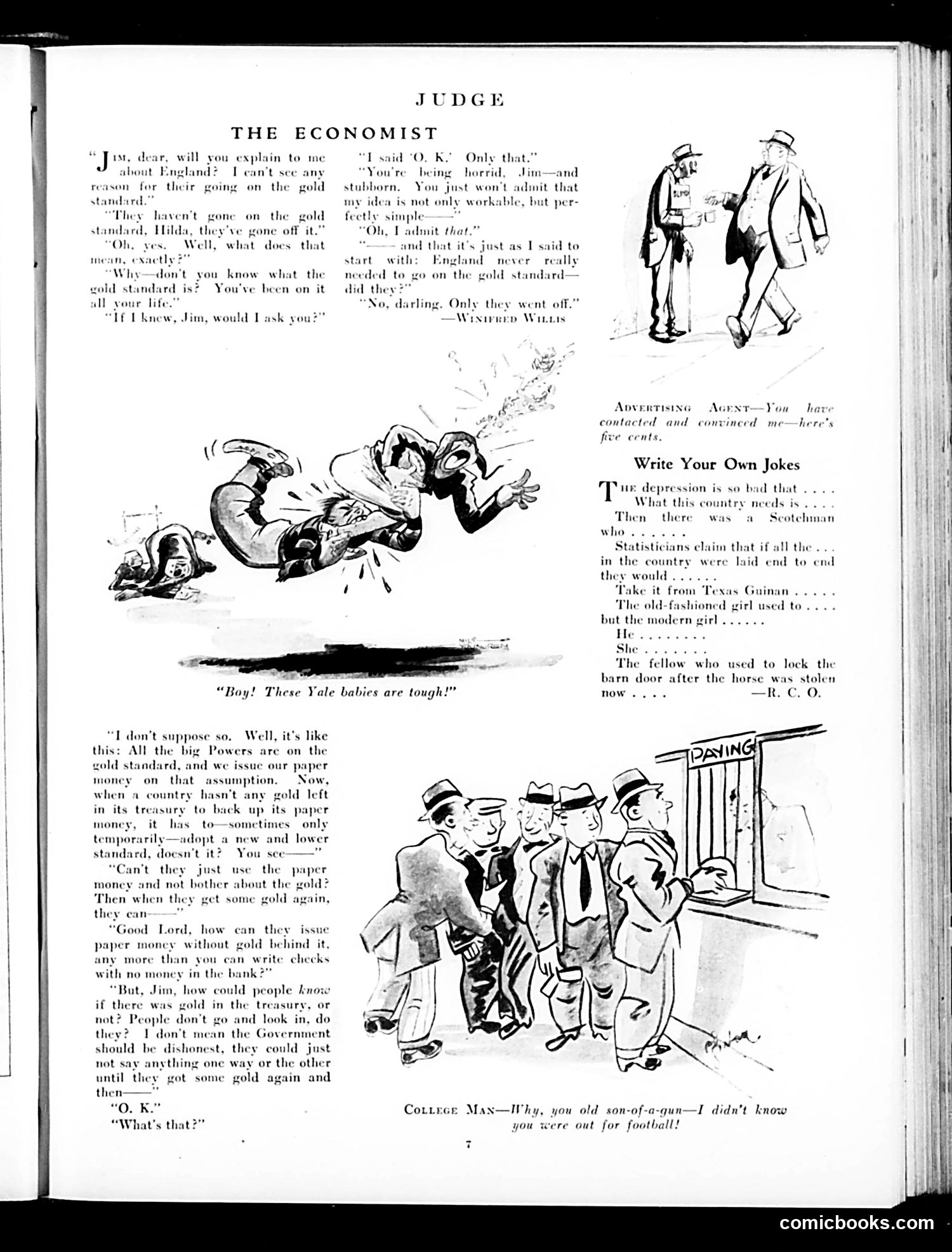
"Judge" Page: Gold Standard Economics Satire This page satirizes public confusion about the gold standard during the Great Depression era. The main cartoon depicts a dialogue between "Jim" (apparently an economist or informed man) and "Hilda" (an average woman), where he struggles to explain why countries abandoned the gold standard—the monetary system backing paper currency with physical gold reserves. The satire targets both parties: Hilda's willful ignorance ("If I knew, Jim, would I ask you?") and Jim's condescending, circular explanations that ultimately fail to clarify anything. The joke is that even experts couldn't adequately explain economic policy to ordinary citizens. The secondary cartoon shows three men entering a "Dancing" establishment, with a college man quip about football, offering lighter relief. The "Write Your Own Jokes" section provides depression-era humor prompts, reflecting Judge's satirical response to 1930s economic crisis and social anxiety.
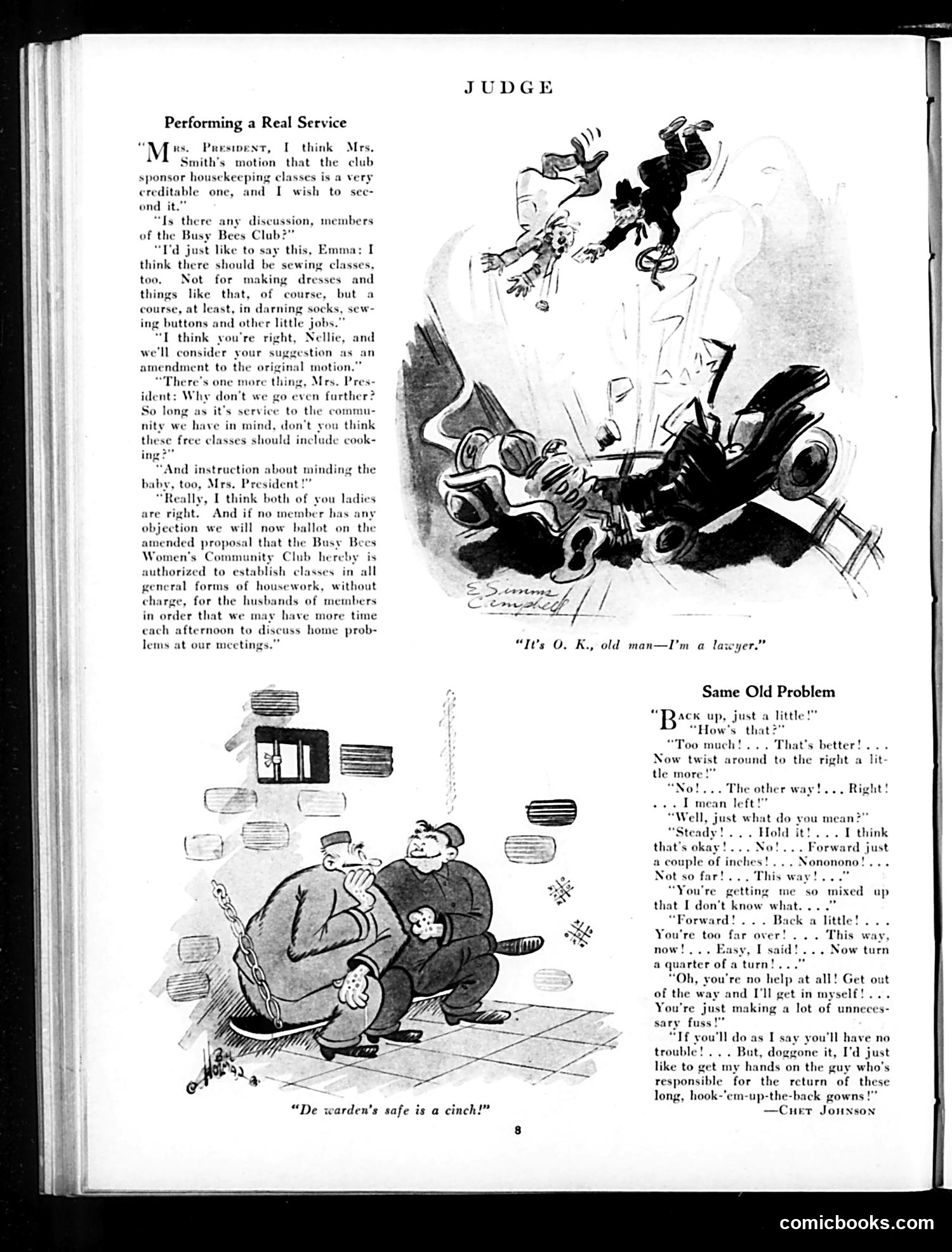
"Performing a Real Service" and "Same Old Problem" Top cartoon: A women's club debates expanding their housekeeping classes. The satire targets early 20th-century women's organizations and gender roles—the women propose teaching domestic skills (sewing, darning) to community members, but one member suggests the *real* service would be offering free housework classes to members' husbands, freeing the women for afternoon club meetings. The joke exposes the contradiction: women's clubs ostensibly exist for community service, but the actual priority is female leisure time away from domestic duties. Bottom cartoon: A couple struggling with a woman's dress—likely a "hook-em-up-the-back" gown requiring fastening assistance. The humor lies in the contradictory, confusing directions the woman gives ("Back up... No, the other way... I mean left"), frustrating the man. The caption blames dress designers for the impractical garment. This satirizes contemporary fashion design as illogical and burdensome, making even simple dressing impossible without help.
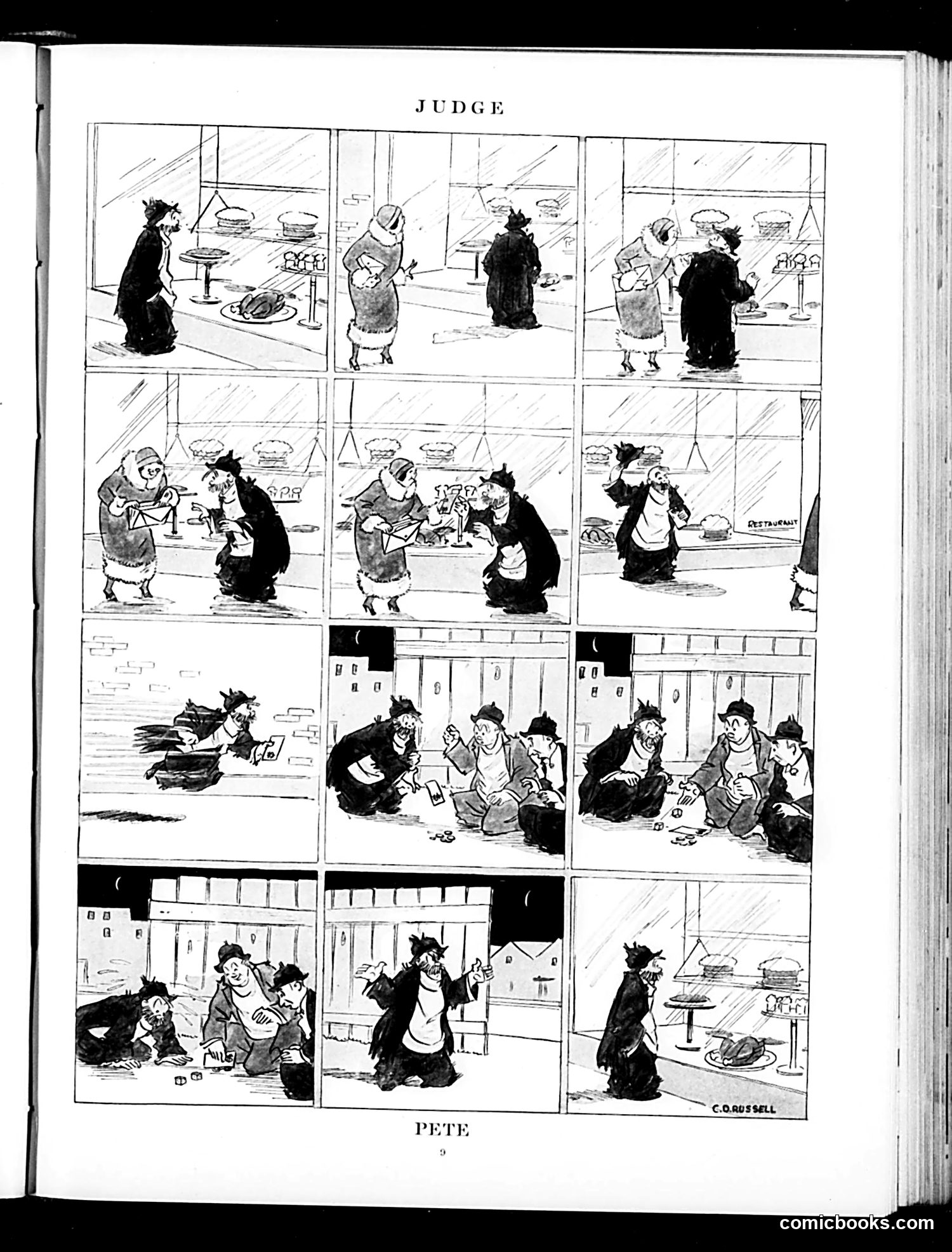
"Judge" Page: "Judge" and "Pete" Comics This page contains two comic strips by C.D. Russell satirizing urban social dynamics, likely from the early 20th century. "Judge" (top): Shows wealthy diners at an upscale restaurant observing homeless or poor people outside windows. The satire contrasts comfortable, well-fed patrons with hungry outsiders—commenting on economic inequality and indifference of the wealthy. "Pete" (bottom): Depicts what appears to be vagrants or homeless men gambling or socializing in alleyways and street corners, shown in increasingly chaotic scenes. The strip likely satirizes urban poverty, street life, or criminal underworld activity. Both strips use exaggerated caricature typical of Judge's satirical style, critiquing either class disparities or social problems of urban America. The exact historical moment remains unclear without publication date context.
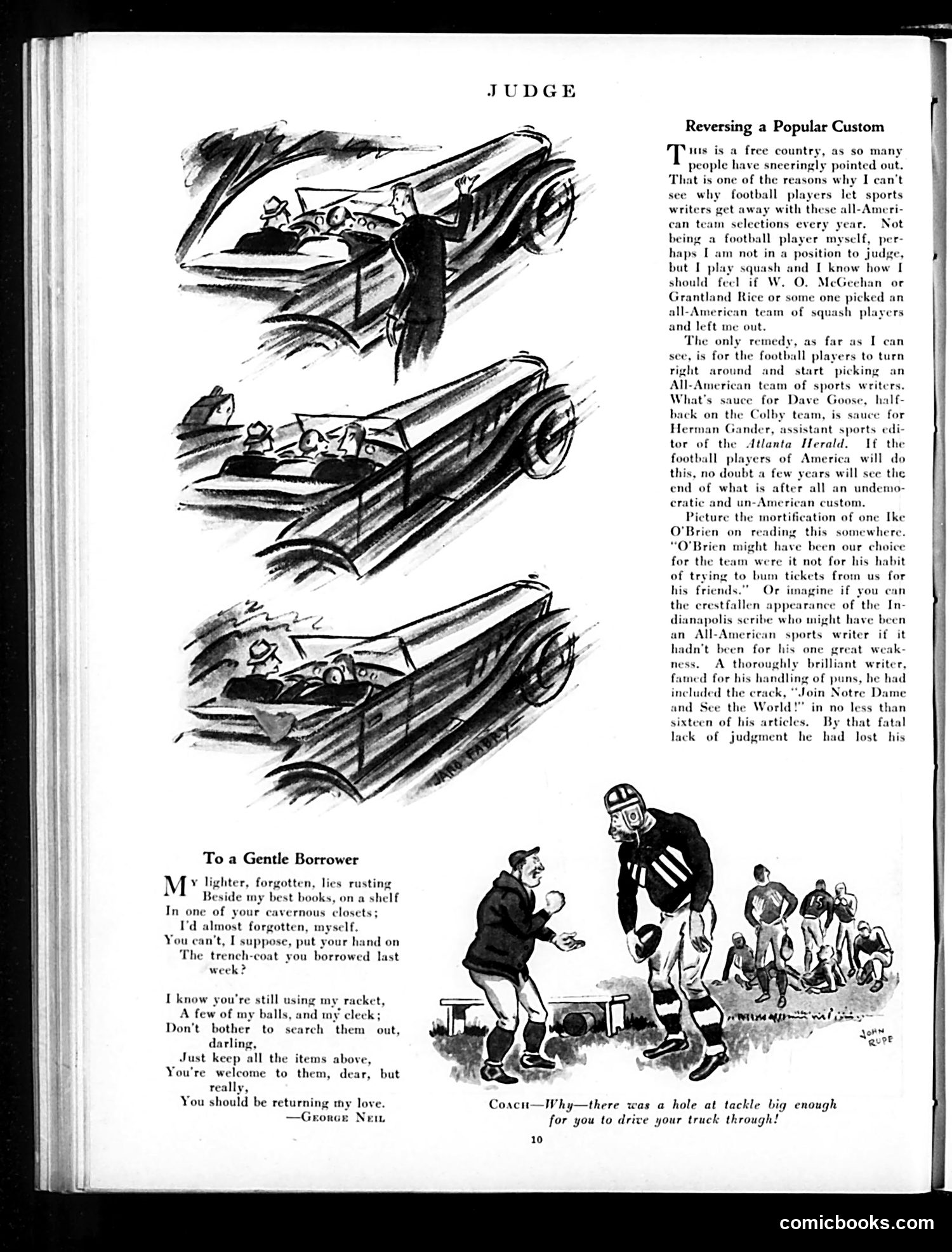
Satire Analysis: Judge Magazine Page This page contains two distinct pieces of social commentary: "Reversing a Popular Custom" (main article with car illustrations): The author critiques sportswriters' power to select "All-American" football teams annually, arguing this is undemocratic. He proposes football players reciprocate by selecting an All-American team of sportswriters, then humorously imagines which writers would be excluded—like Dave Goose for bumming tickets, or an Indianapolis scribe for overusing a tired pun about Notre Dame. The satire mocks both the arbitrary nature of these selections and sportswriters' influence over athletics. "To a Gentle Borrower" (poem by George Neil): A lighthearted complaint about a friend who borrowed the author's lighter, books, racket, balls, clock, and trench coat—but hasn't returned them or "my love." The humor lies in cataloging increasingly absurd borrowed items, culminating in the romantic plea. "Coach" cartoon: Shows a football coach reproaching a player for tackling so aggressively he drove through the opposing team like a truck through a hole. All three pieces use gentle humor about contemporary social customs and interpersonal dynamics.
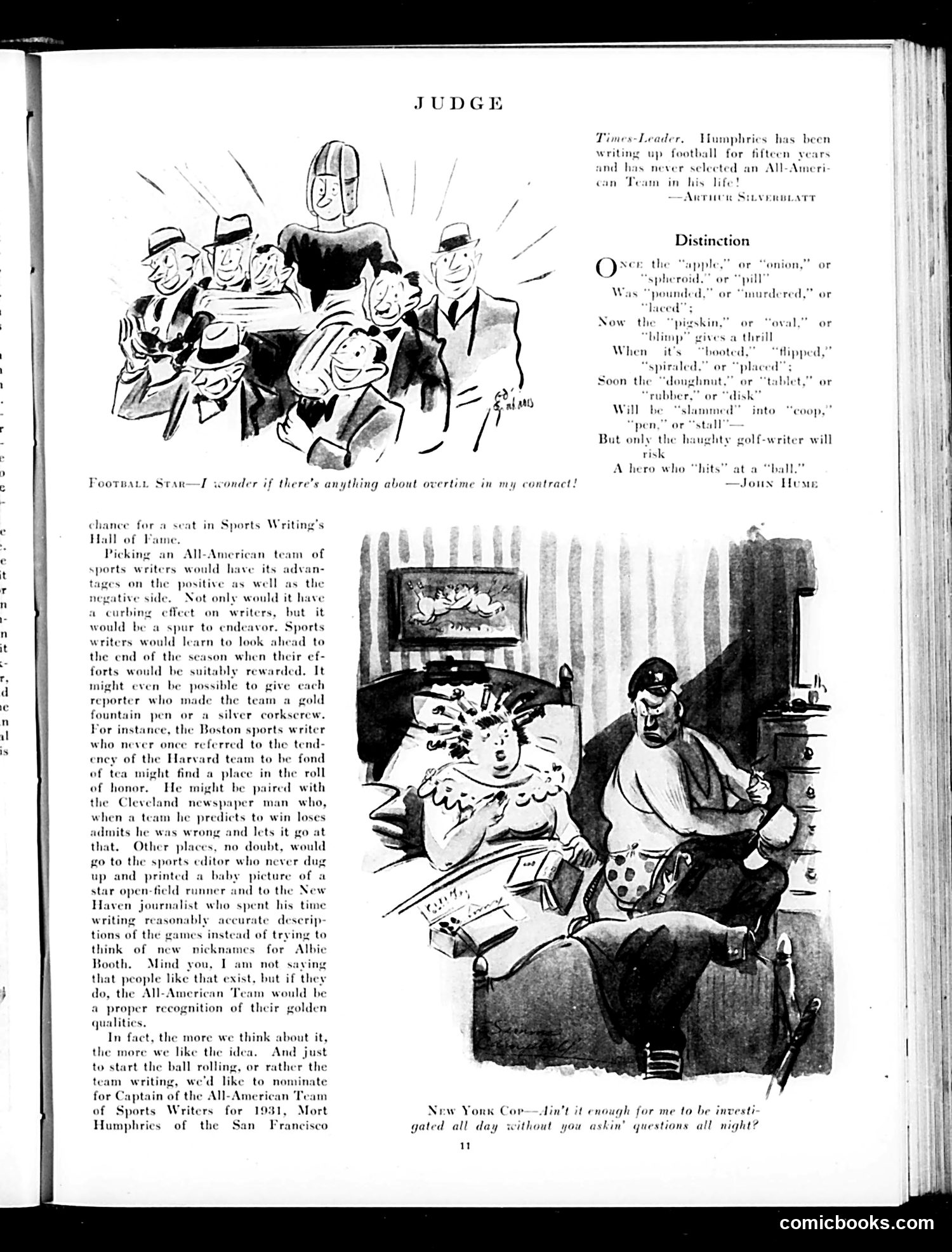
Explanation for Modern Readers This page satirizes sports journalism through two angles: "Football Star" cartoon (left): A coach/manager surrounded by reporters, complaining about overtime pay—a jab at how sports writers obsess over contract details rather than actual game coverage. Main article: Proposes an "All-American Team" of sports *writers* (not players), rewarding journalistic integrity. It mocks sportswriters' lazy clichés: inventing nicknames for players (referencing "Albie Booth," a real Yale football star), printing irrelevant personal details, and making unfounded predictions. The satire peaks by nominating Mort Humphries of the San Francisco Times-Leader as captain *precisely because* he's never selected an All-American team in 15 years—suggesting most writers construct these teams recklessly. "New York Cop" cartoon (right): A detective complains about interrogating someone "all day" without the subject asking questions back—unrelated humor about police procedure. The overall message: sportswriters should focus on accurate reporting rather than flowery language and sensationalism.
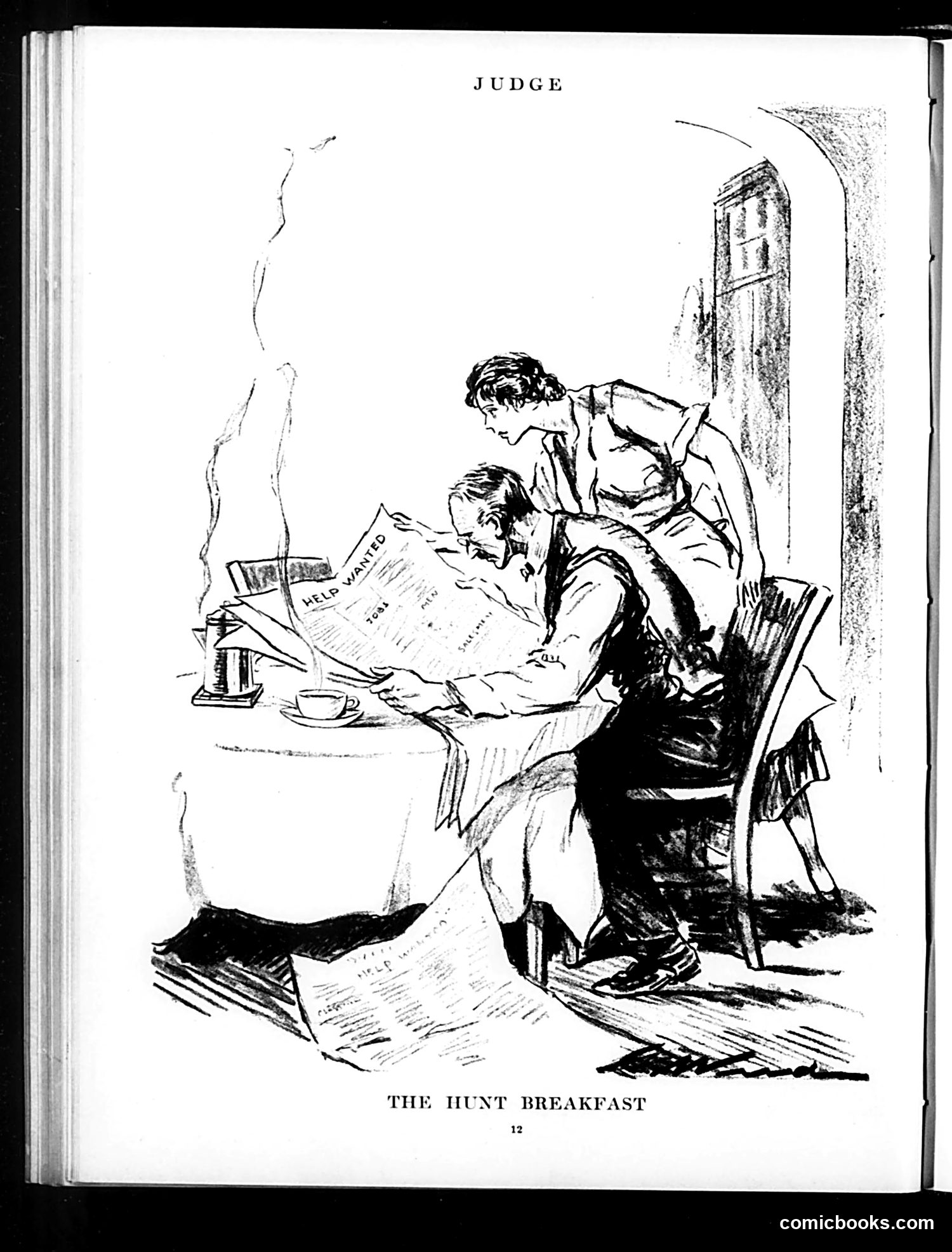
"The Hunt Breakfast" - Judge Magazine This cartoon depicts three figures examining a "Help Wanted" newspaper at a table during breakfast. The scene appears to satirize job-hunting during economically difficult times. The three people—likely representing different classes or demographics—are intently studying employment listings, suggesting widespread unemployment or job scarcity affecting multiple segments of society. The title "The Hunt Breakfast" plays on the aristocratic term for a pre-hunt meal, but here the "hunt" is for employment rather than sport. The scattered papers on the floor and casual domestic setting emphasize how pervasive job-seeking has become, even at breakfast tables. The cartoon likely comments on economic hardship, though the specific historical period is unclear without additional context.
Judge Magazine Page Analysis This page contains two satirical articles reflecting early 20th-century American anxieties: "Too Much Competition" argues that American industry's weakness stems from excessive competition. The piece reports that bankers and executives surveyed blamed "excessive competition" for economic problems, advocating for the repeal of antitrust laws (likely the Sherman Act) to enable industry consolidation and "deliberate, united national planning of production." "A Modern Crusoe" recounts a Brooklyn radio shop owner who, after his wife sells his inventory while he's stranded on an island, abandons his family to live permanently as a castaway—finding freedom from marital and commercial responsibilities. The judge author sympathizes with this escape fantasy, noting how many middle-aged men regret lost adventures. Together, these pieces reflect 1920s-30s tensions: corporate desire for monopolistic consolidation versus individual yearning for autonomy from both family and industrial society. The satire critiques both managerial efficiency schemes and the domestic constraints ordinary men endured.
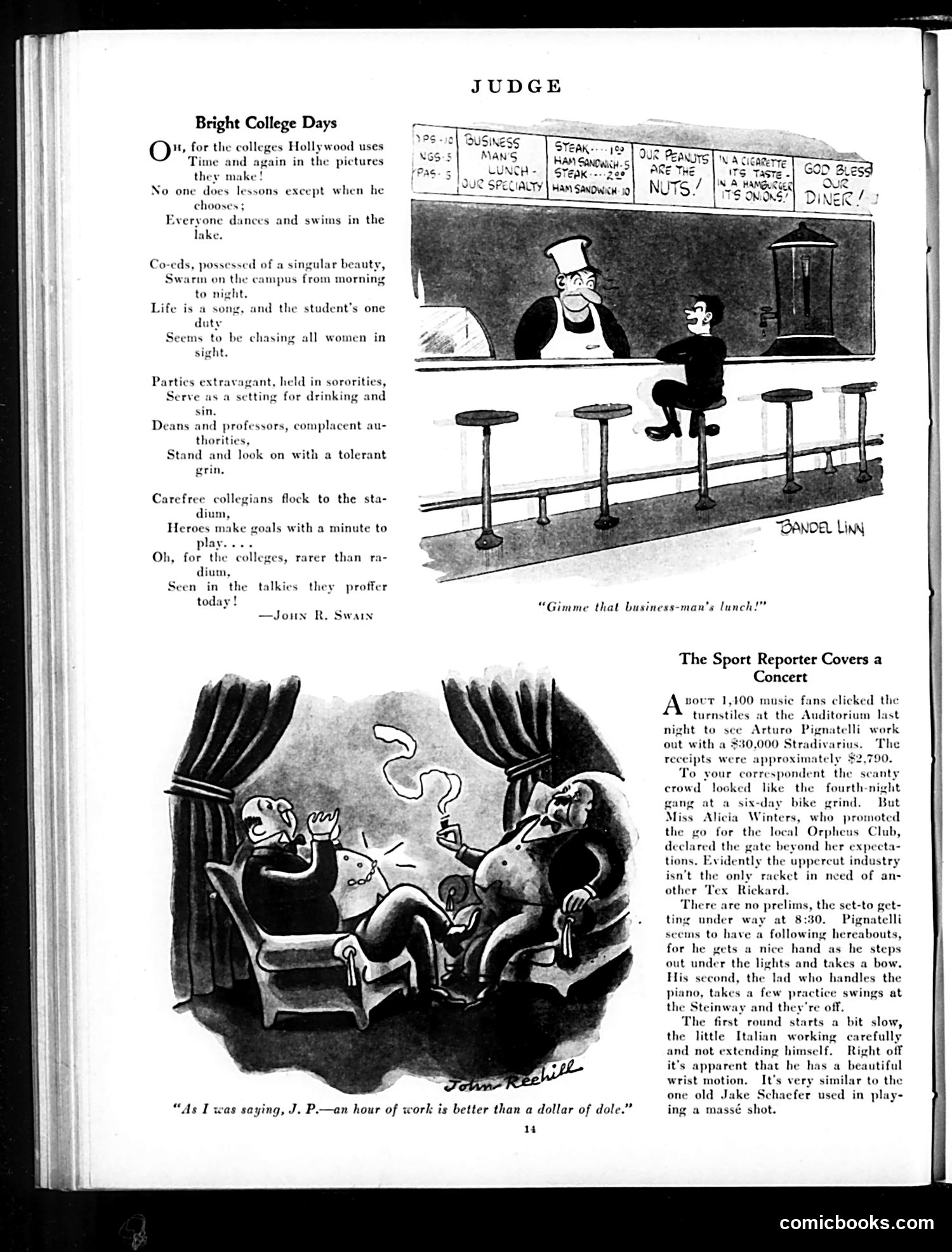
Explanation for Modern Readers This page from *Judge* contains two satirical pieces: "Bright College Days" (poem by John R. Swain) mocks Hollywood's romanticized portrayal of college life. It contrasts the sanitized movie version—carefree students, parties, tolerant administrators—with implied reality. The satire suggests Hollywood depicts colleges as hedonistic playgrounds where actual studying never happens and authority figures enable excess. "The Sport Reporter Covers a Concert" ridicules sports journalism's invasion of cultural coverage. A sports reporter attends classical pianist Arturo Pignatelli's performance but reports it like a boxing or bicycle race ("six-day bike grind," "uppercut industry," comparing the promoter to fight promoter Tex Rickard). The joke: the reporter can only describe serious music through sports vocabulary and metrics (attendance, receipts), revealing both his ignorance of classical music and the absurdity of applying sports-reporting conventions to concert criticism. Both pieces satirize 1920s-30s American popular culture's lowbrow sensibilities and media superficiality.
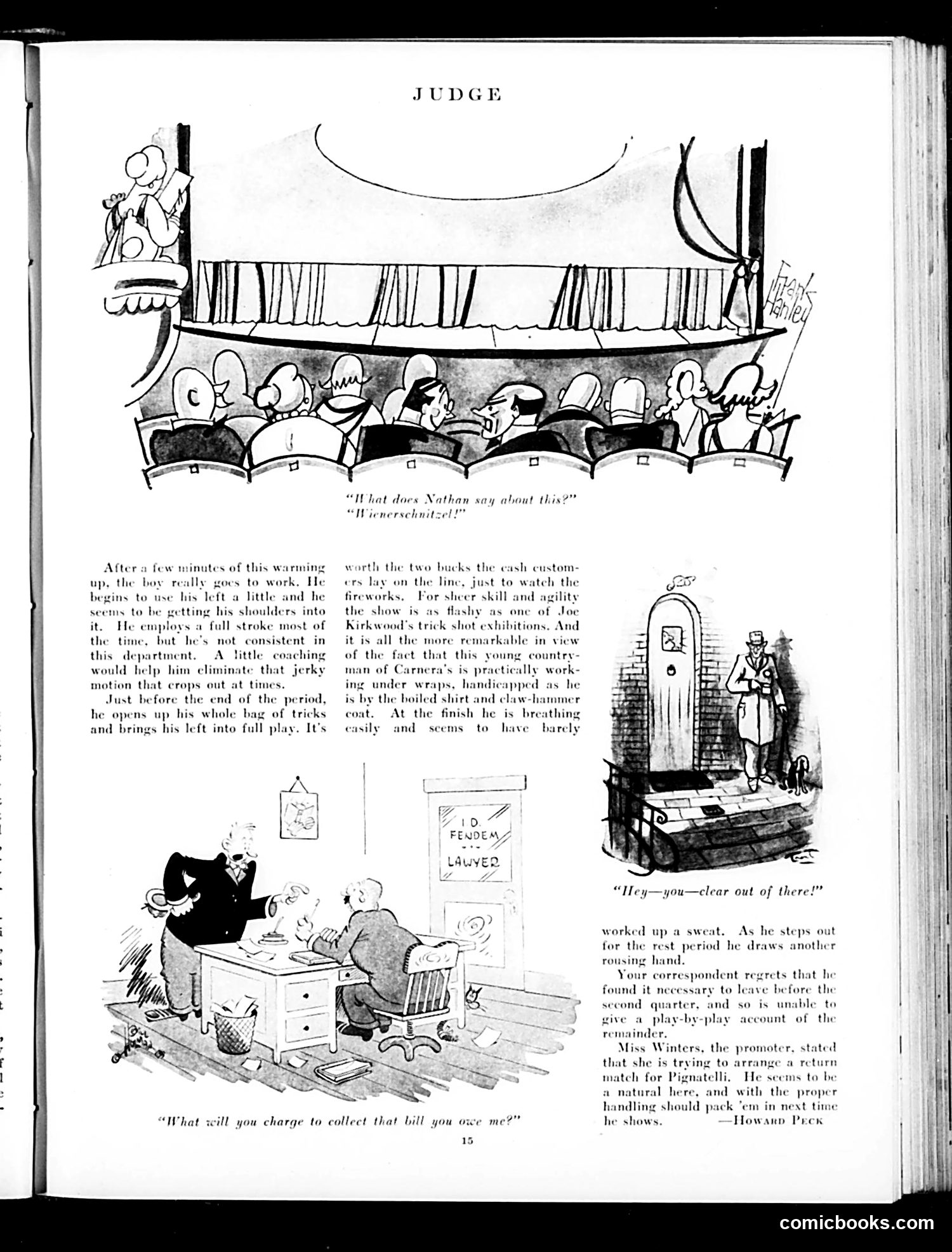
Judge Magazine Page Analysis This page contains sports humor and a legal joke from an early 20th-century American satirical magazine. Top cartoon: Shows a boxing match viewed from the judge's bench perspective. The dialogue "What does Nathan say about this?" / "Wienerschnitzel!" appears to be ethnic humor—likely referencing a Jewish or German-American spectator's enthusiastic response to the boxing action. Main article: Reviews a boxing match, praising a young fighter's skill and technique, comparing him favorably to trick-shot golfer Joe Kirkwood. The commentary notes the fighter works "practically under wraps, handicapped" by formal attire (boiled shirt and tails), suggesting he's fighting while overdressed. Bottom cartoon: Shows a lawyer's office scene where someone demands "clear out of there!" A sign reads "J.D. FENDEMZ - LAWYER," playing on the homophone "Fen Dem's" or similar word-joke about legal practice. The page mixes sports reporting with visual gags typical of Judge's satirical approach to American culture.
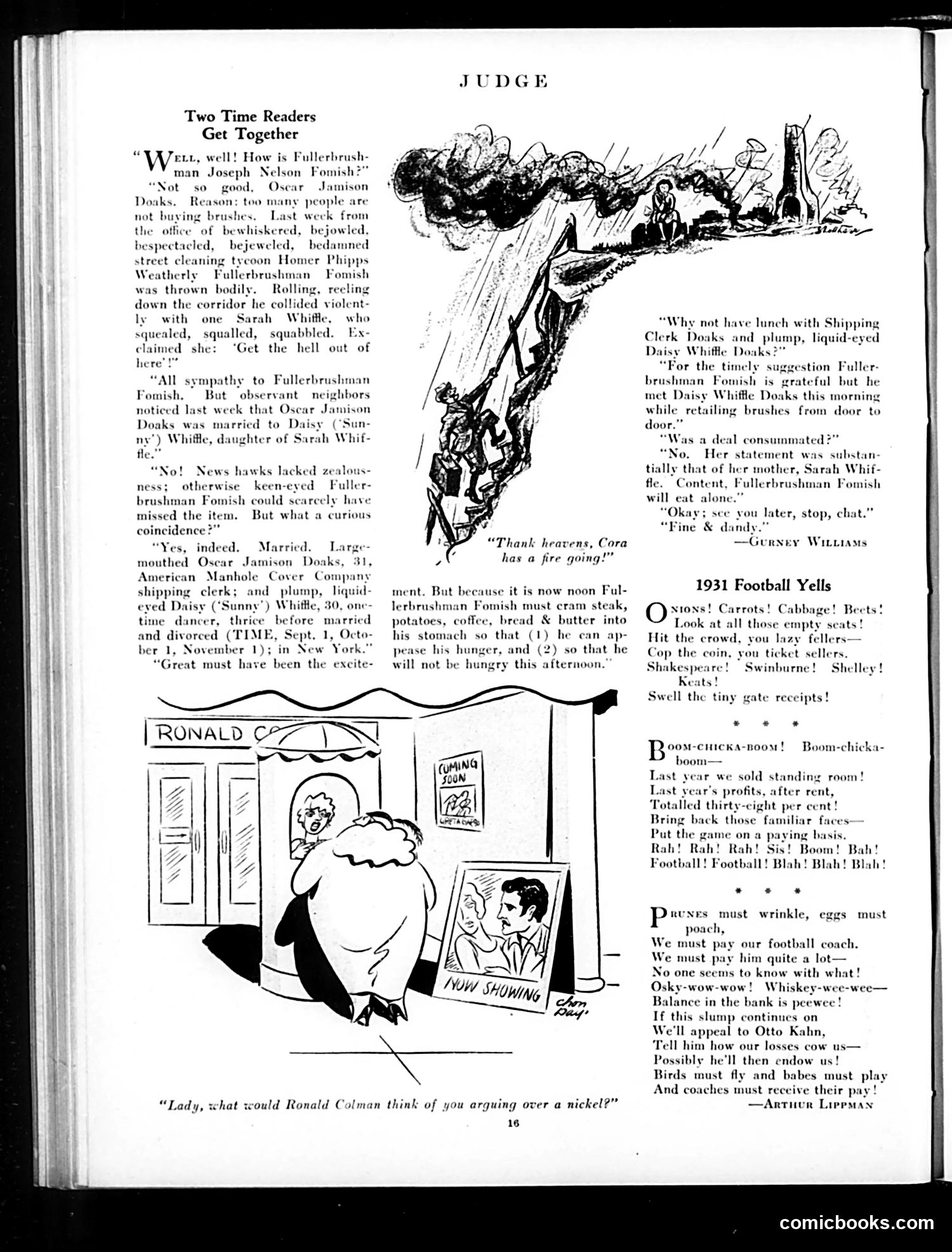
Judge Magazine Page Analysis This page from Judge (circa 1931) contains two distinct satirical pieces: "Two Time Readers Get Together" is a gossipy anecdote mocking coincidence and the tabloid obsession with minor scandals. A Fuller Brush salesman named Fomish collides with Sarah Whiffle—who happens to be the mother of his acquaintance Oscar Doaks's new wife, "Daisy" Whiffle. The humor lies in the contrived "small world" narrative and sarcastic commentary that news reporters somehow missed this trivial connection. "1931 Football Yells" satirizes college football's commercial desperation during the Depression. The verses mock: - Empty stadium seats despite ticket-selling efforts - Inflated profits from previous years (38% after expenses) - Schools' financial dependence on gate receipts - The absurd necessity of wealthy donors like Otto Kahn to fund coaches' salaries - The disconnect between athletic spending and actual education Both pieces use exaggeration and cynicism typical of Judge's satirical style, targeting petty social pretension and economic realities of early 1930s America.
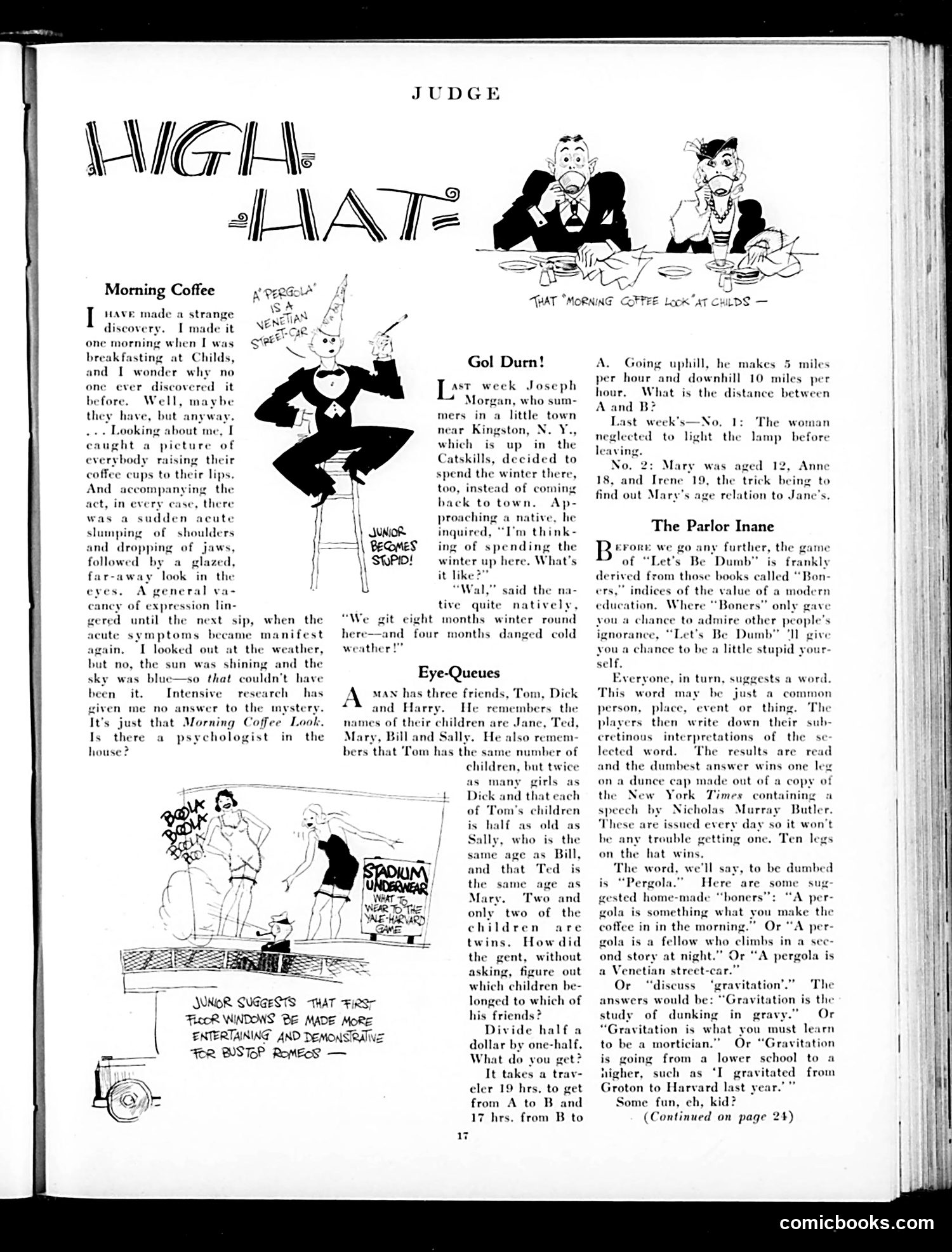
Judge Magazine Page Analysis This page from *Judge* presents three unrelated humor pieces typical of the magazine's satirical format: "Morning Coffee Look": A lighthearted observation about the supposedly universal "glazed" expression people adopt while drinking morning coffee at Childs (a popular American restaurant chain). The humor lies in the mundane observation treated as a mysterious discovery. "Gol Durn!": A rural dialect joke contrasting a city visitor's (Joseph Morgan's) expectations about spending winter in upstate New York Catskills with a native's blunt assessment that winter lasts eight months with four more months of "danged cold weather"—satirizing rural pessimism and the exaggeration of harsh winters. "Let's Be Dumb" and "Eye-Queues": Word games and logic puzzles presented as entertainment, with "Let's Be Dumb" mocking modern education by celebrating intentional stupidity and rewarding the "dumbest answer." The page reflects *Judge*'s mix of social observation, regional humor, and intellectual games—typical early-20th-century magazine fare targeting educated readers who appreciated both clever wordplay and gentle mockery of American life.
Judge Magazine: "Judging the Movies" by Pare Lorentz This page contains film reviews, not political cartoons. The decorative header features whimsical theatrical illustrations but no specific political satire. Lorentz, a film critic, reviews several movies: 1. "Karamazov" — A German adaptation of Dostoevsky's novel. Lorentz criticizes it as a poor choice for adaptation, though he praises the musical score and a child actress named Sten. 2. "The Spider" — Directed by William Cameron Menzies (a New Haven-born production designer). Lorentz praises Menzies's Gothic set design and argues he deserves recognition alongside great German filmmakers, despite being American and Hollywood-based. 3. "East of Borneo" — A melodrama involving a white woman, her drunken husband, and romantic complications. The reviews reflect 1920s-30s cinema culture, where German filmmaking was considered artistically superior to American work. The page concludes with a "Recommended" box listing other films like "Alexander Hamilton" and "The Public Enemy."
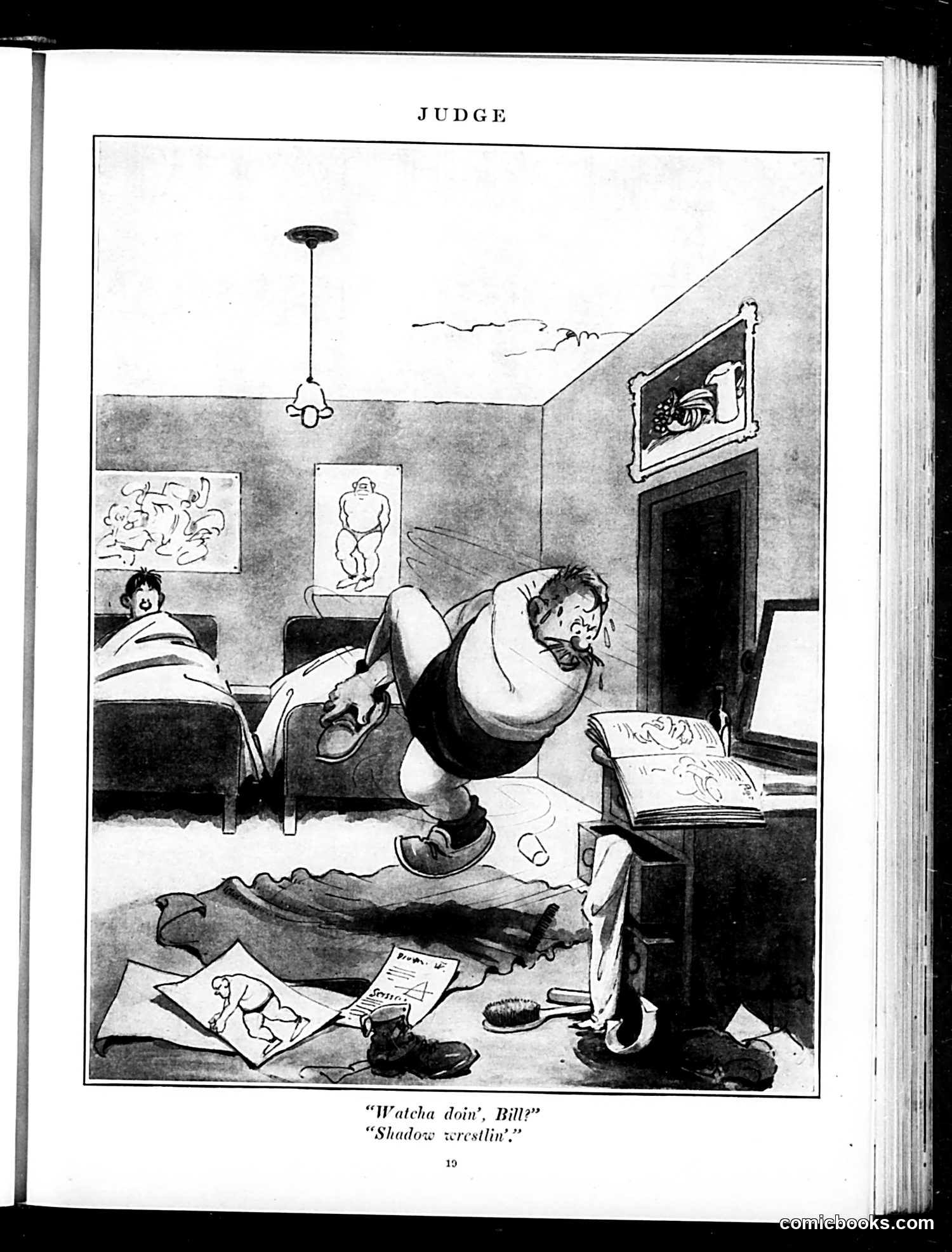
"Judge" Cartoon Analysis This single-panel cartoon depicts a man engaged in shadow wrestling—literally grappling with his shadow cast on the floor. The setup is a bedroom with artwork on the walls and another person in bed observing. The humor relies on a visual pun: the man is literally "shadow wrestling" rather than engaging in the conventional wrestling activity. The dialogue ("Watcha doin', Bill?" / "Shadow wrestlin'") plays on this literalism for comedic effect. Without additional context, the cartoon appears to be simple physical comedy rather than political satire. It likely targets general absurdist humor typical of early-to-mid twentieth century Judge magazine—the joke being the ridiculousness of wrestling one's own shadow as a nighttime activity. The specific reference or satirical intent, if any, remains unclear.
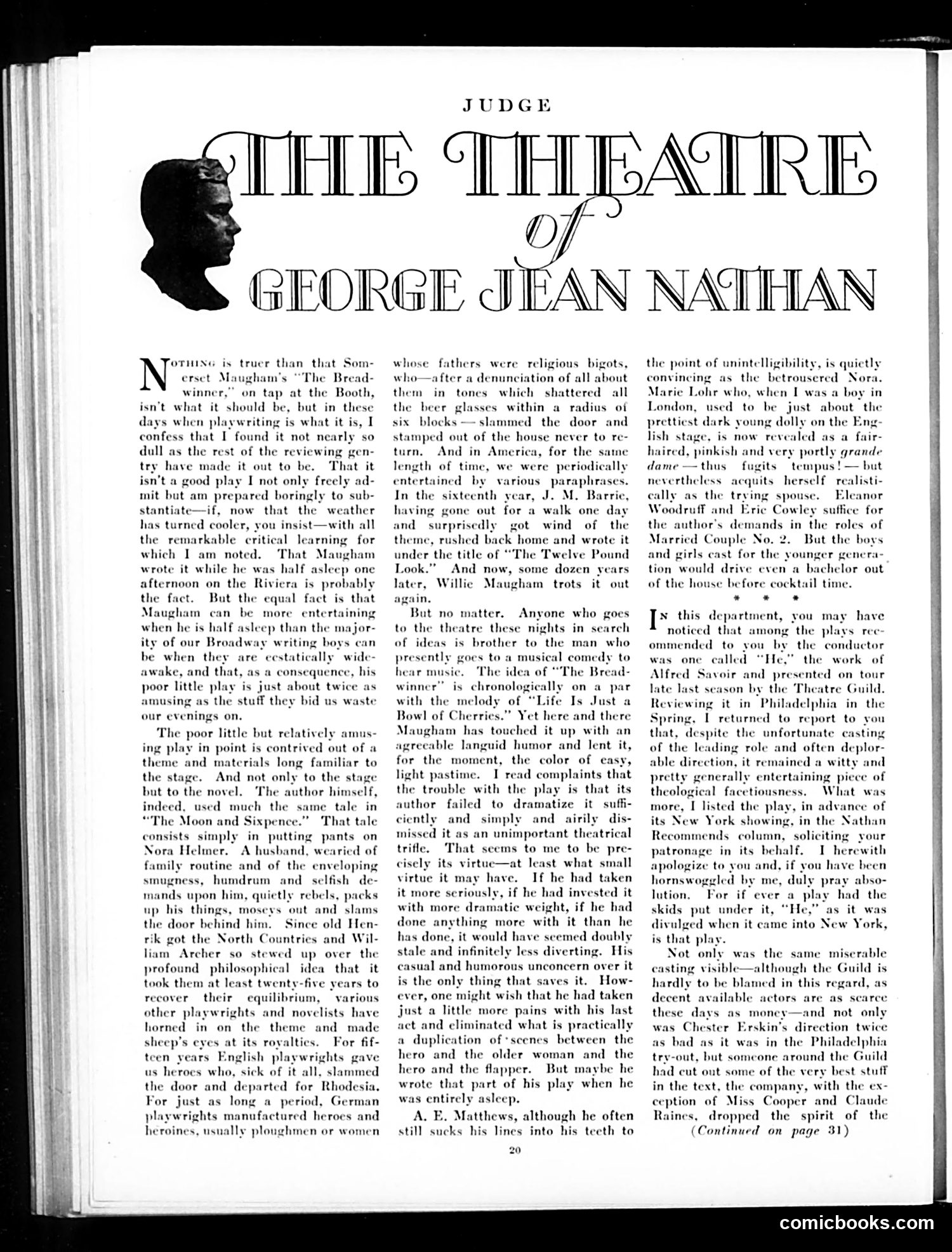
Analysis of "The Theatre of George Jean Nathan" This is a theater review column by Judge's drama critic George Jean Nathan, discussing Somerset Maugham's play *The Breadwinner* at the Booth Theatre. The satire: Nathan defends Maugham's admittedly mediocre play by arguing that even a half-asleep Maugham writes better comedy than wide-awake Broadway writers. He notes the play recycles a tired theatrical theme—a husband abandoning family life—that's been exhausted since Ibsen's *A Doll's House* (via Nora Helmer reference). English, German, and American playwrights have all mined this "man slams door and leaves" premise for decades. The joke: Nathan's point is that *The Breadwinner*'s very laziness and lack of seriousness actually saves it—its "casual and humorous unconcern" prevents it from being as stale as it would be if treated earnestly. He's defending artistic competence over earnestness. The column mocks both hack playwrights and overly solemn critics who miss that entertainment value matters more than originality.
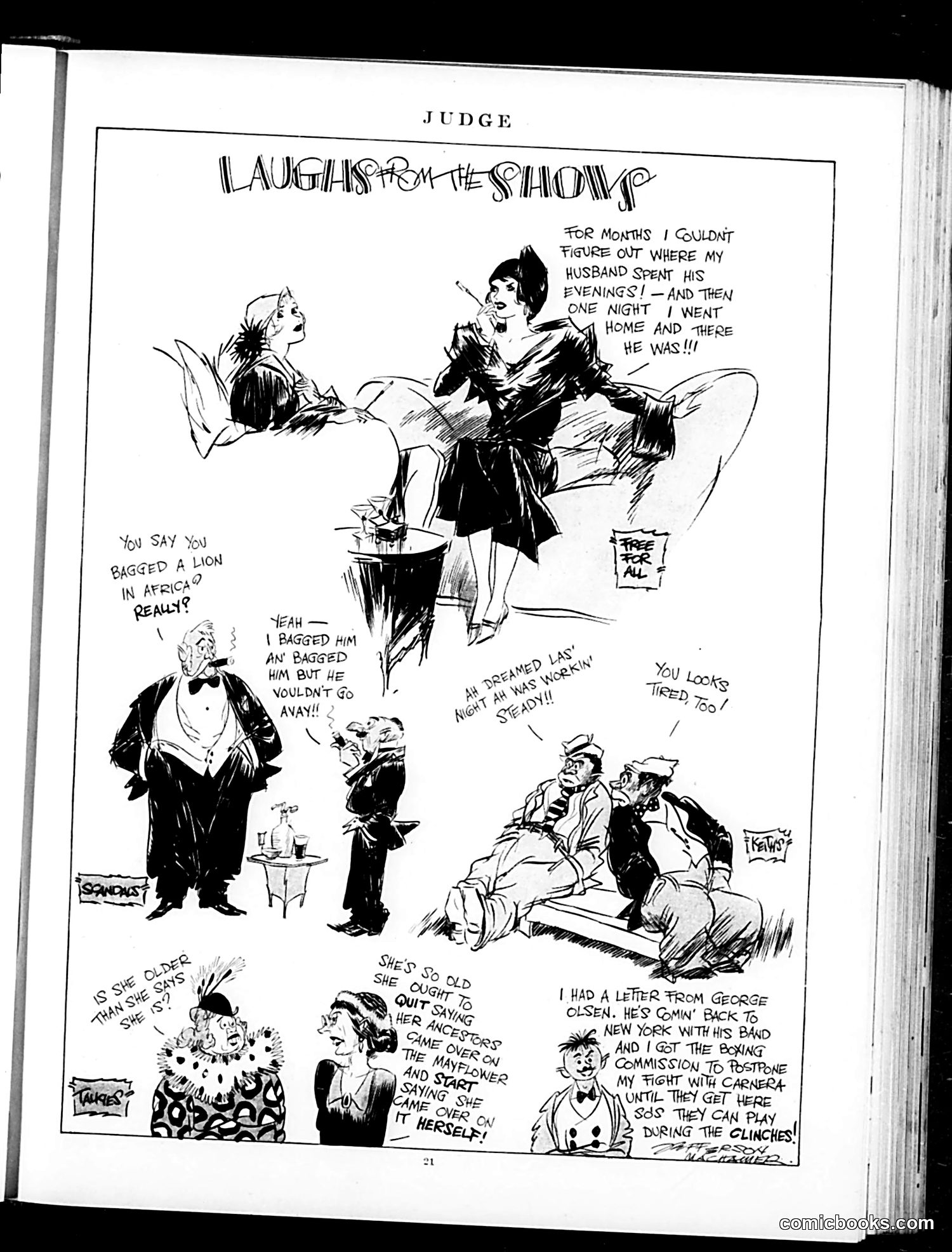
"Laughs from the Shadows" This Judge magazine comic satirizes marital infidelity and 1930s entertainment culture. A wife suspects her husband of secret evening activities. The humor unfolds through interconnected vignettes: A man boasts about "bagging a lion in Africa" but admits he actually caught and released it—a transparent metaphor for marital escapades. The wife's discovery that he was "home" all along suggests he was attending boxing matches or nightclub entertainment rather than having an affair. References to boxer George Olsen (likely a boxer/bandleader of that era) and "Carnera" (appears to be boxer Primo Carnera) ground the joke in 1930s sports celebrity. The final panel jokes about postponing a boxing match "during the clinches"—a double entendre suggesting intimate moments. The satire targets both husbands' deceptive excuses and the era's fascination with celebrity boxing and entertainment as alternative attractions to domestic life.
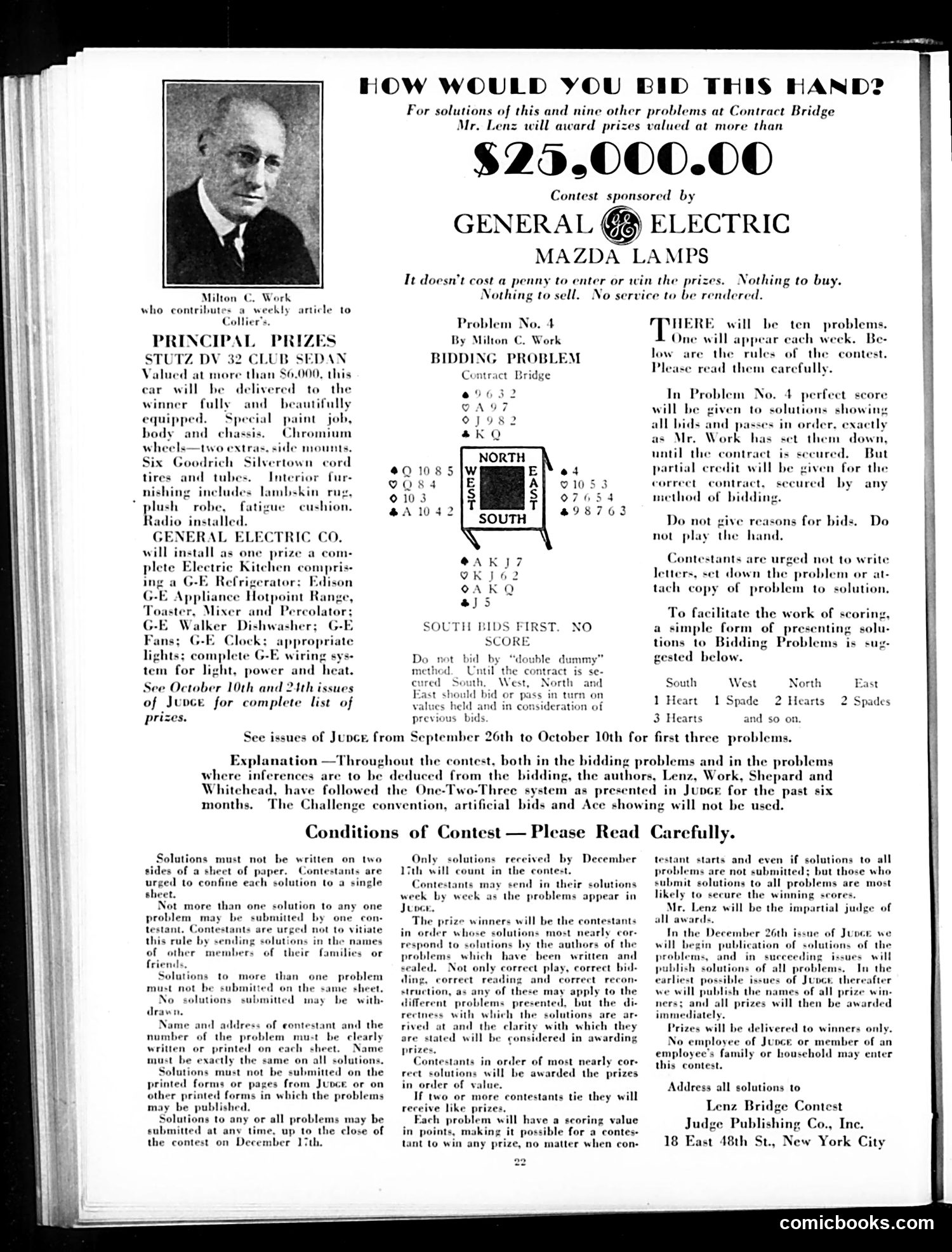
Judge Magazine Bridge Contest Page This is primarily an advertisement and contest announcement, not a satirical cartoon page. The content announces a Contract Bridge bidding contest sponsored by General Electric (Mazda Lamps), offering prizes totaling $25,000, including a Stutz DV-32 Club Sedan automobile worth $6,000. Milton C. Work (photographed at left) was a renowned bridge authority who contributed weekly articles to Judge. He, along with bridge experts Lenz, Shepard, and Whitehead, authored ten bidding problems contestants would solve for prizes. The page emphasizes this costs nothing to enter and requires no purchase—a common contest format of the 1930s era. Contestants submitted solutions to increasingly difficult bridge hands, judged on bidding accuracy. No political satire is present—this is a straightforward commercial promotion using Judge's platform to reach leisure-class readers interested in bridge, automobiles, and General Electric appliances.
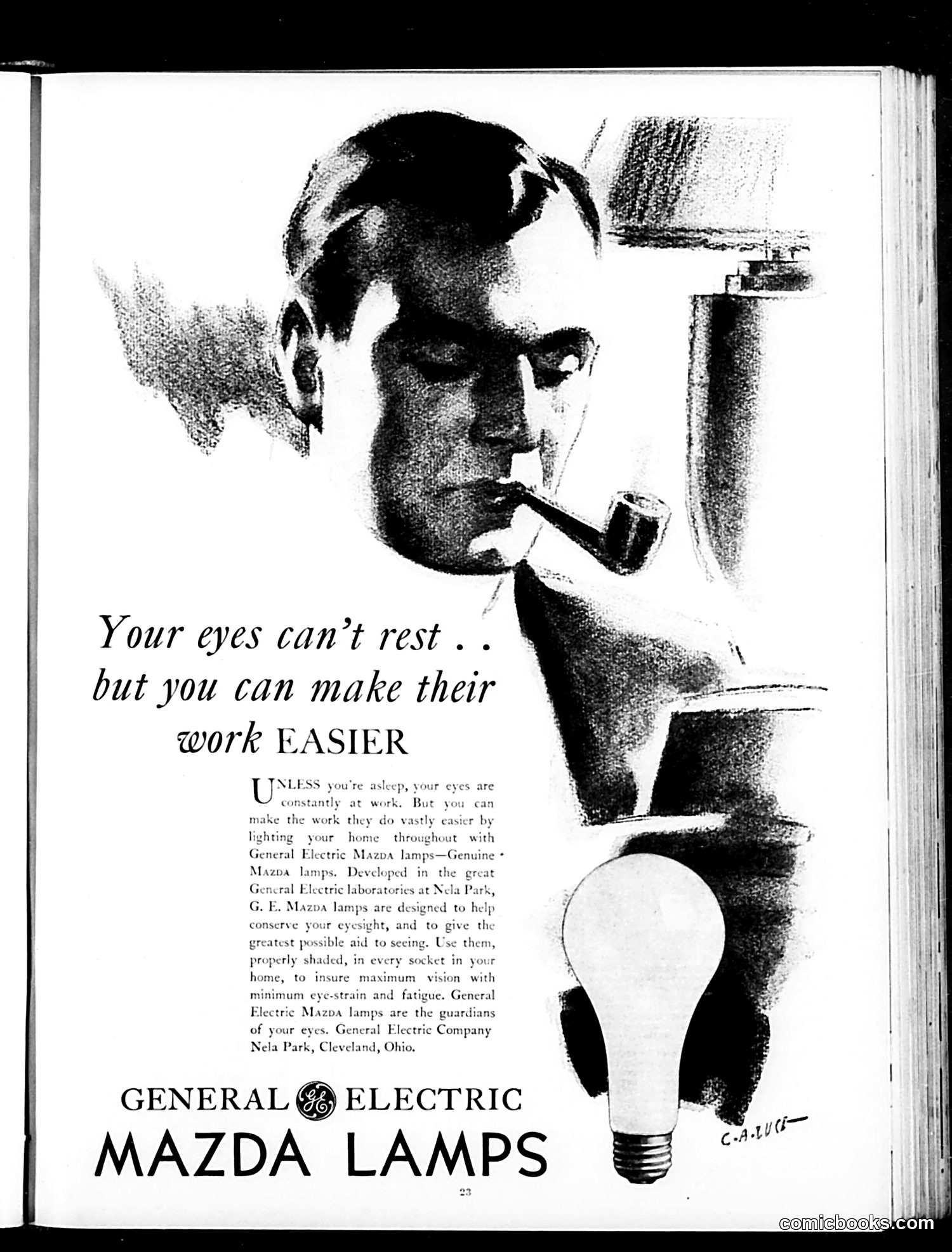
Analysis This page is not a political cartoon or satire—it's a straightforward advertisement for General Electric Mazda lamps, likely from the 1920s-1930s. The illustration shows a man's face in profile, smoking a pipe, with an oversized lightbulb positioned below to suggest proper home lighting. The ad's message is literal: while eyes work constantly (even during rest), consumers can ease eyestrain by using GE's Mazda lamps throughout their homes. The copy emphasizes health benefits—reducing eye fatigue and conserving eyesight through proper, shaded lighting in every room. This reflects genuine early-20th-century concerns about electric lighting's effects on vision, positioning GE's product as scientifically developed ("Nela Park laboratories") and beneficial. There is no political content or satire present on this page.
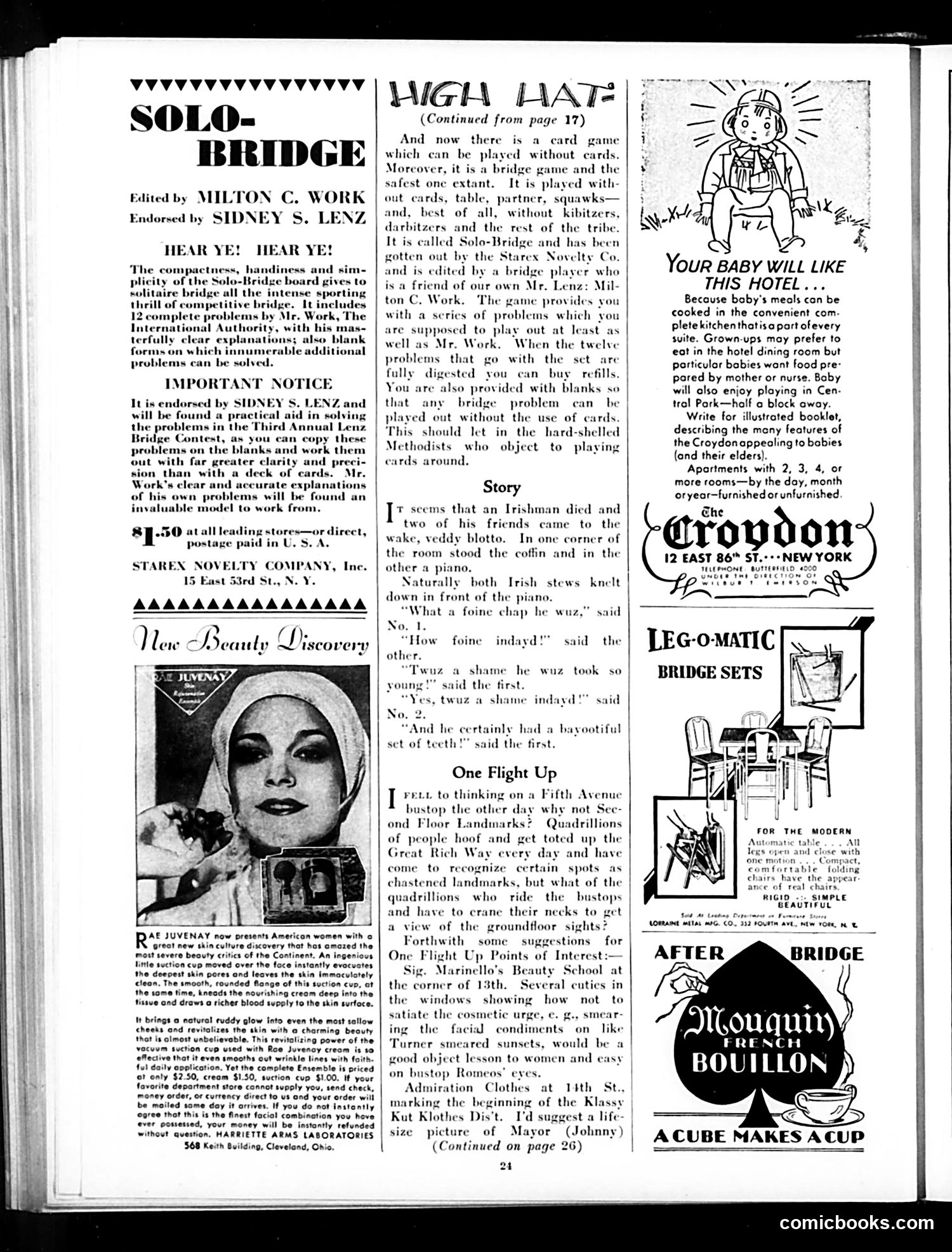
Analysis of This Judge Magazine Page This page primarily showcases advertisements and bridge game content, not political satire. The main feature is an advertisement for "Solo-Bridge," a card game variant edited by bridge expert Milton C. Work and endorsed by Sidney S. Lenz. The pitch emphasizes it can be played "without cards, table, partner, squawks—and, best of all, without kibitzers," appealing to Methodists who objected to card-playing on religious grounds. A humorous "story" section includes an Irish wake joke (ethnic humor typical of the era) about two drunk Irishmen mistaking a piano for a coffin. The "One Flight Up" section humorously suggests overlooked Fifth Avenue landmarks visible from the second floor, such as a beauty school window. Other advertisements include beauty products (Juvenay skin treatment) and bridge furniture sets. Context for modern readers: This reflects 1920s-30s America's recreational interests, religious attitudes toward cards, and casual ethnic stereotyping in mainstream publications.
Analysis This is primarily a product advertisement, not satirical content. It appears in *Judge*, a satirical magazine, but functions as a straight commercial pitch for Phillips' Milk of Magnesia. The ad employs a rhetorical strategy: it acknowledges the era's "Law of Good Living" (moderation in eating, smoking, drinking), then immediately undercuts that message. Rather than encouraging restraint, it suggests that overindulgence is inevitable—and that science offers an easy pharmacological fix. The product will neutralize acid reflux "within 15 minutes," allowing readers to disregard health warnings. This reflects early 20th-century patent medicine marketing, which frequently promised quick chemical solutions to the consequences of excess. The ad's framing—"millions are learning this, millions are doing it"—uses social proof to normalize both overindulgence and dependency on the remedy. The irony (likely unintentional) is that an advertisement in a *satire magazine* peddles a message contrary to responsible living—precisely what satirists typically mock.
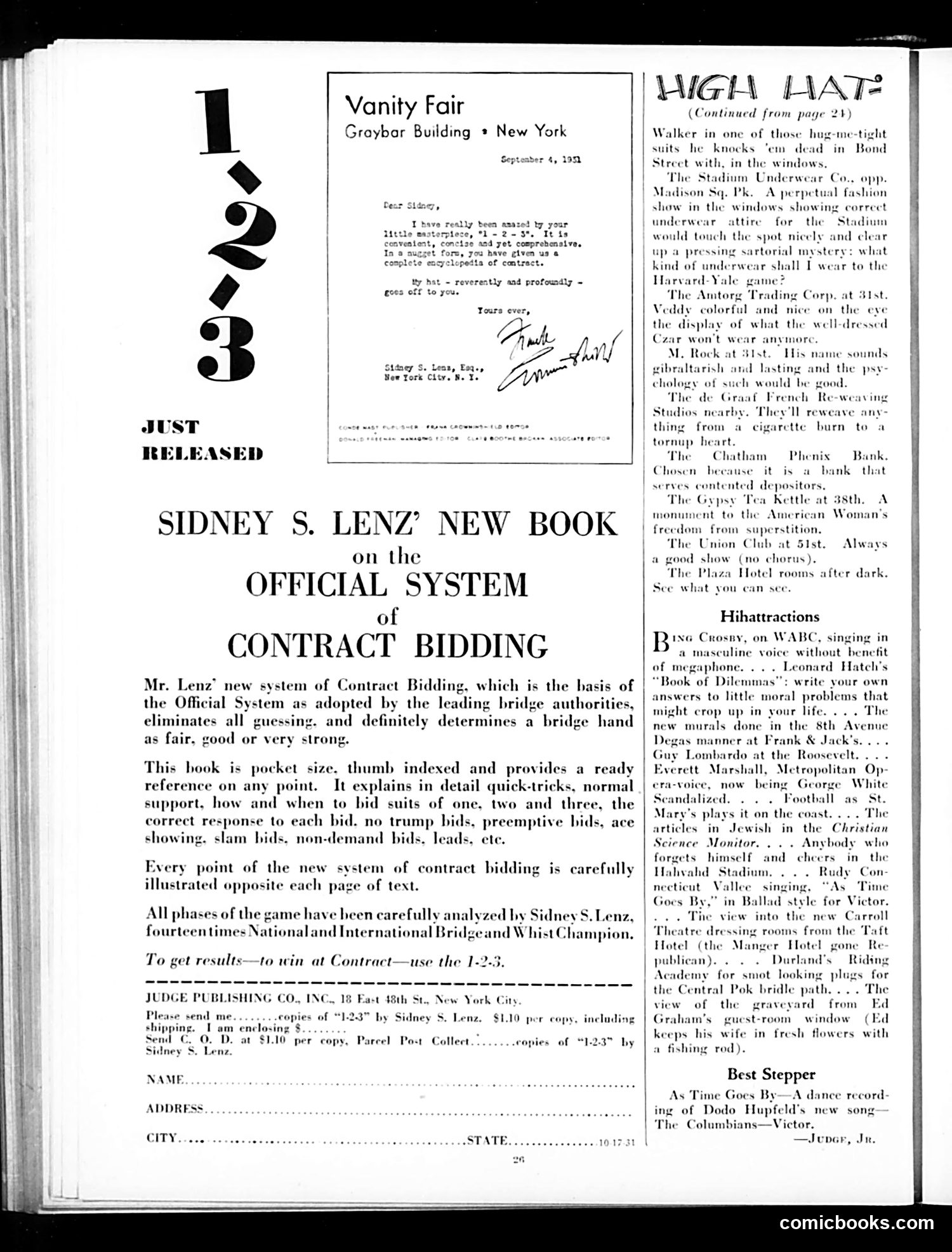
Analysis This page is primarily advertising for Sidney S. Lenz's new bridge instruction book, "1-2-3," promoting his contract bidding system. Lenz was a famous bridge champion (noted as "fourteen times National and International Bridge and Whist Champion"), and the ad emphasizes his system eliminates guessing and provides pocket-sized reference material for players. The top includes a brief letter from Vanity Fair (dated September 4, 1923) endorsing the book. The right column contains brief social commentary and entertainment reviews typical of Judge magazine—gossipy observations about New York venues, performers, and fashionable activities (nightclubs, hotels, radio singers). These are lighthearted cultural notes rather than satire. There are no political cartoons on this page. It's essentially a commercial/advertising page mixed with entertainment gossip—representative of how magazines financed themselves through advertising while maintaining editorial content.
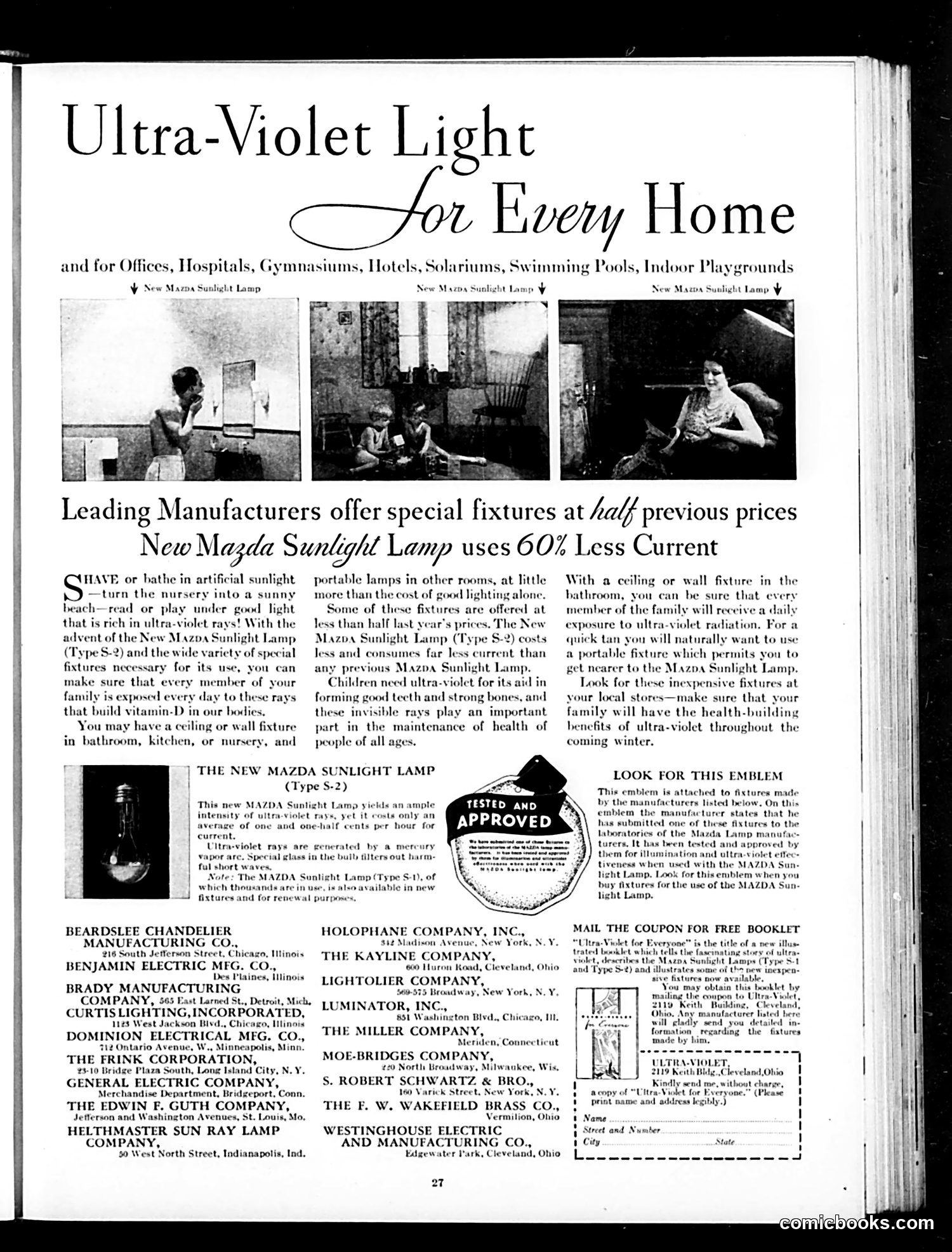
Analysis This page is entirely an advertisement, not a cartoon or satirical content. It promotes the "New Mazda Sunlight Lamp"—an ultraviolet light fixture marketed for homes, offices, hospitals, and public spaces. The ads feature three black-and-white photographs showing women using or positioned near the UV lamps in domestic settings (nursery, living room, bathroom). The marketing emphasizes health benefits: vitamin D production, strong bones and teeth in children, and tanning. This reflects 1920s-30s optimism about ultraviolet radiation as medicinal. Before the dangers of UV exposure were understood, these lamps were genuinely promoted as health products. The "Tested and Approved" emblem and manufacturer listings (General Electric, Westinghouse, etc.) lent credibility. For modern readers, this is historically interesting primarily as evidence of outdated medical beliefs and aggressive health-marketing practices, not as satire. Judge magazine simply sold advertising space to manufacturers.
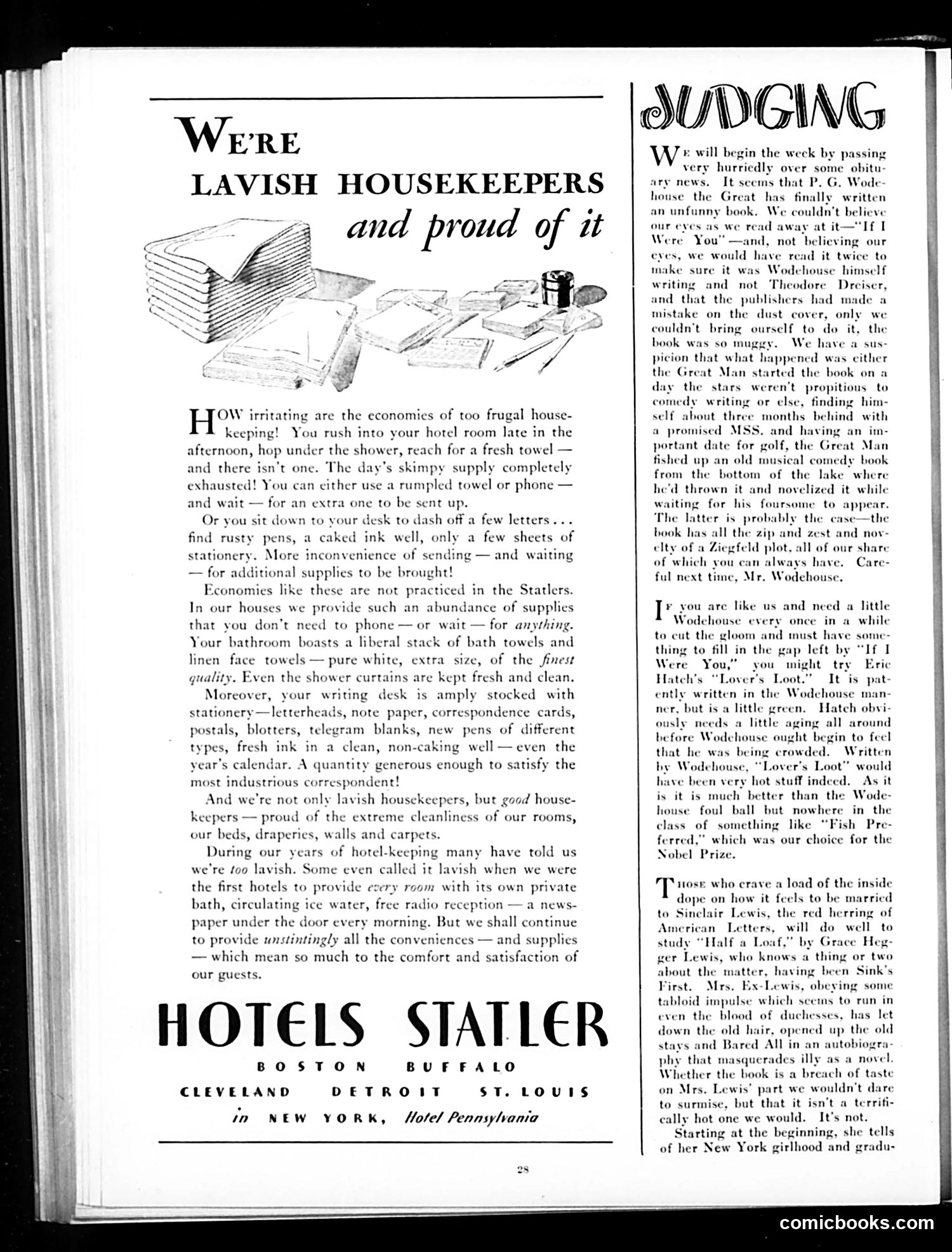
Explanation for Modern Readers This page is primarily a hotel advertising campaign for the Statler Hotel chain, not a political cartoon. The left side is a full-page advertisement arguing that Statler Hotels practice "lavish housekeeping"—providing abundant supplies (towels, fresh pens, stationery, etc.) rather than economizing. It positions this as a luxury selling point: guests won't need to call for extras or wait for basic amenities. The right side, labeled "JUDGING," is a book review column critiquing P.G. Wodehouse's novel *"If I Were You."* The reviewer claims it's uncharacteristically unfunny for Wodehouse, speculating he either wrote it on an unlucky day or recycled old material while distracted by golf. The reviewer recommends Eric Hatch's *"Lover's Loot"* as an alternative, though still inferior to Wodehouse's best work. There is no political satire or caricature on this page—it's a mix of commercial advertising and literary criticism typical of Judge magazine's content.
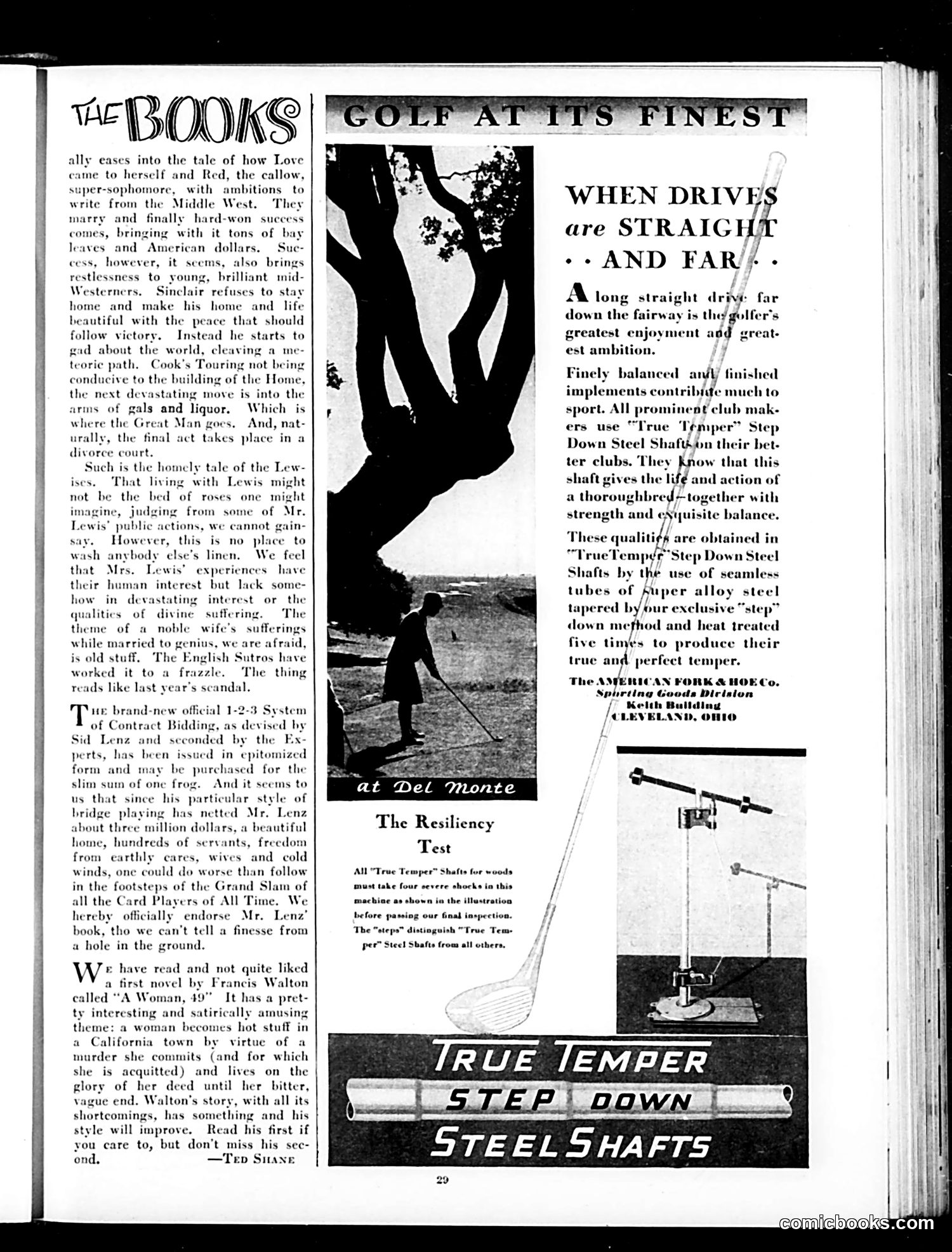
Judge Magazine Page Analysis This page mixes book reviews with advertising and contains no political cartoons. Book Reviews: The left column reviews three works: a novel about a woman named Love and her husband Red (a writer from the Middle West who achieves success but becomes restless, eventually divorcing); commentary on bridge player Sid Lenz's new contract bridge instruction manual; and Francis Walton's debut novel about a California woman who gains social prominence after committing (and being acquitted of) murder. The reviews are gossipy and satirical—the first particularly reads like thinly veiled commentary on real scandal, with the critic dismissing the "noble wife married to genius" theme as "old stuff." Advertisement: The right side features a full-page ad for "True Temper Step Down Steel Shafts" (golf clubs), with a photograph of a golfer mid-swing at Del Monte and technical specifications about the product's durability testing and manufacturing process. The page reflects 1920s-30s magazine culture: literary gossip alongside luxury product advertising targeting affluent readers.
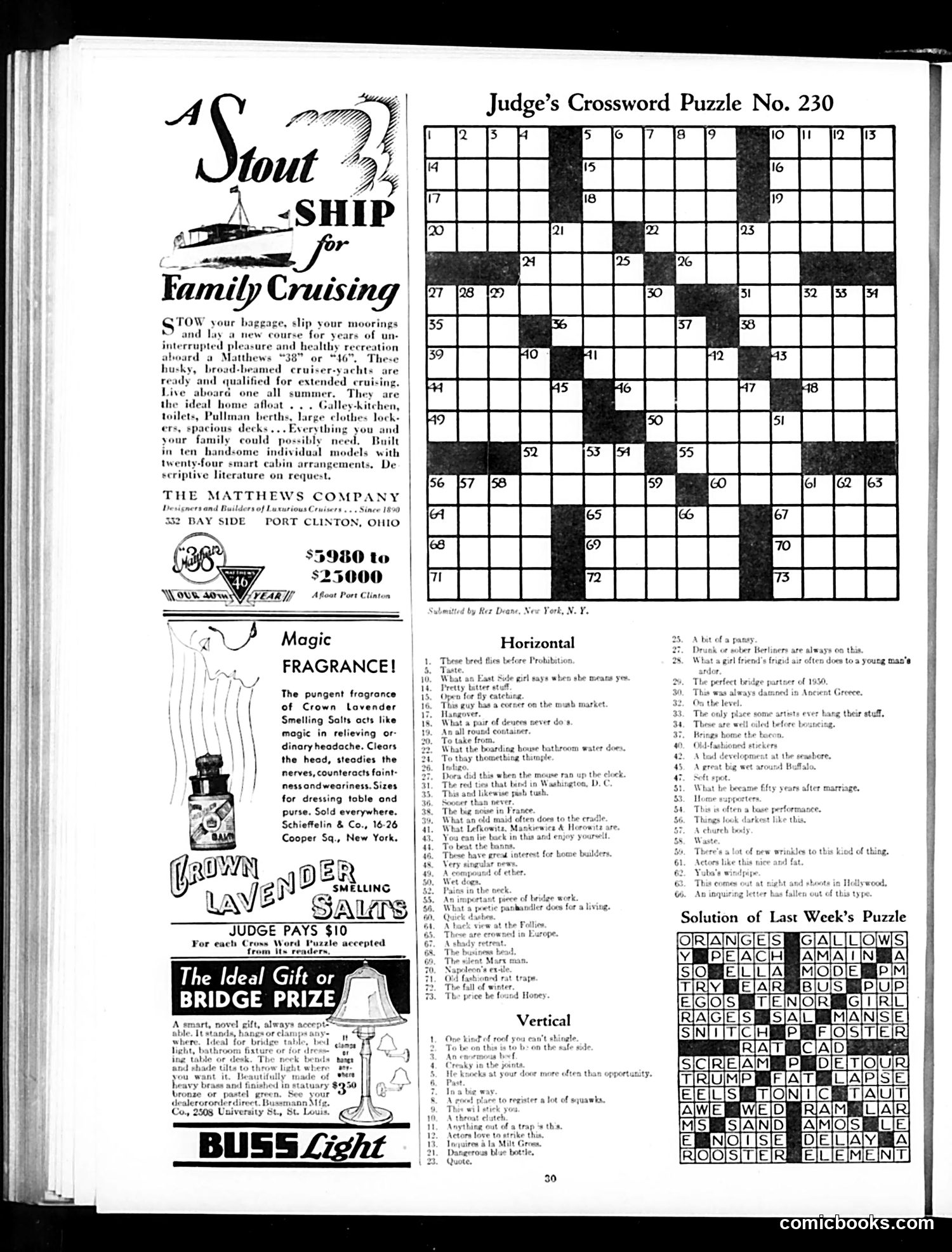
Judge Magazine Page Analysis This page is primarily advertising and puzzles, not political satire. It contains: Advertisements: - Matthews Company cruise ships for "family cruising" (leisure boats, $3,980-$25,000) - Crown Lavender Smelling Salts for headaches - Buss Light (appears to be a lighting product) - "The Ideal Gift or Bridge Prize" (a bell, likely for bridge games) Content: - Judge's Crossword Puzzle No. 230 with clues and a solved example puzzle below - A note that Judge pays $10 for accepted crossword puzzles Historical Context for Modern Readers: This reflects 1920s-30s leisure culture: recreational cruising was becoming accessible to middle-class families, bridge was a popular parlor game, and crossword puzzles were a major publishing phenomenon following their 1920s debut. The page shows how magazines monetized reader engagement through puzzle contests. There is no political cartoon or satire visible on this page—it's a standard editorial/advertising spread typical of the era.
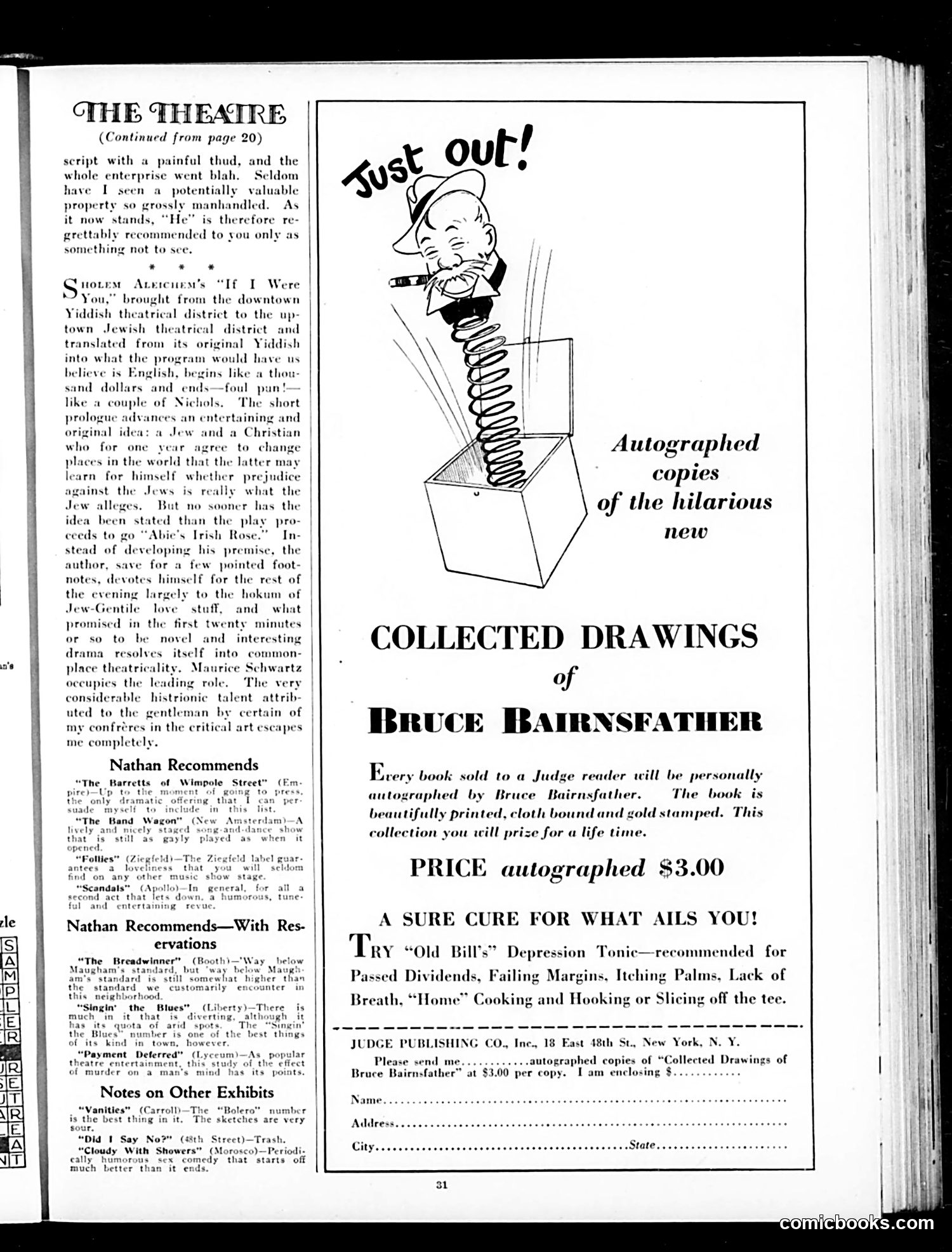
Analysis of Judge Magazine Page This page primarily consists of theater reviews and advertising rather than political cartoons. Content: Theater Reviews (left column): Critic "Nathan" reviews contemporary Broadway productions, including dismissals of "He" and "If I Were You" (a Yiddish play translated to English). The reviews mock plays for relying on shallow sentimentality—notably, one play promising to explore Jewish-Christian prejudice devolves into clichéd romance, compared unfavorably to "Abie's Irish Rose." Advertisement (right side): Promotes collected drawings by Bruce Bairnsfather, a British cartoonist famous for WWI satirical comics. The ad humorously positions his work as a "Depression Tonic" for economic woes ("Passed Dividends, Failing Margins"), suggesting the book offers escapist humor during the 1930s economic crisis. Each copy would be autographed for $3.00. The page reflects Judge's dual identity: serious cultural criticism alongside commercial promotion aimed at Judge's educated, affluent readership.
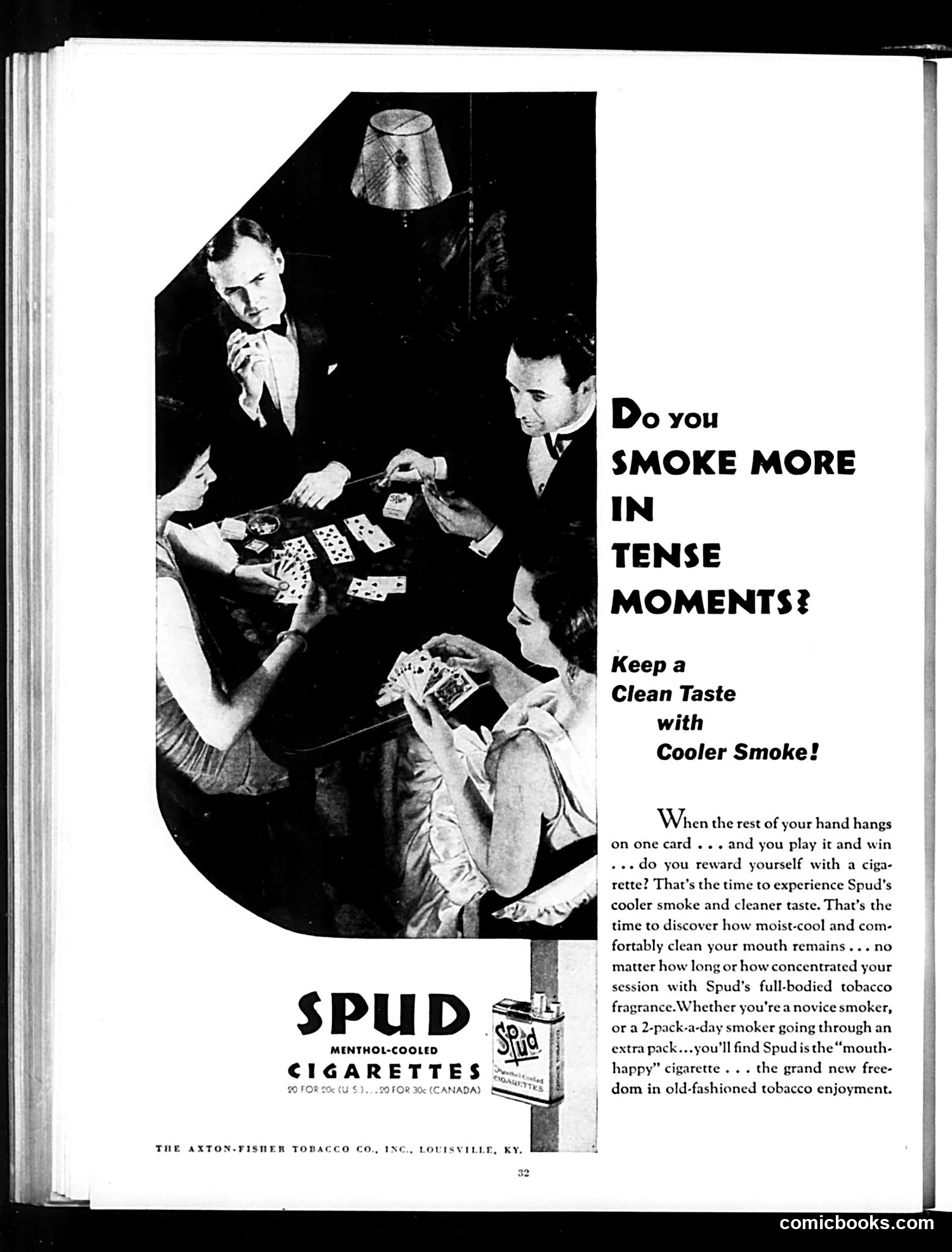
Analysis This is a cigarette advertisement, not a political cartoon or satire. It promotes Spud menthol-cooled cigarettes made by Axton-Fisher Tobacco Co. in Louisville, Kentucky. The image shows men playing poker around a table under a lamp, depicting a "tense moment" of gambling. The ad's hook asks whether smokers increase cigarette consumption during stressful situations, then pitches Spud cigarettes as a solution—claiming their menthol cooling and "clean taste" make them ideal for high-stress moments. The marketing strategy targets smokers seeking relief during tension. The phrase "mouth-happy cigarette" and promises of keeping one's mouth "moist-cool and comfortably clean" reflect mid-20th-century tobacco advertising's now-discredited claims about cigarette quality and health benefits. This represents the era when cigarette ads ran freely in mainstream publications without health warnings.
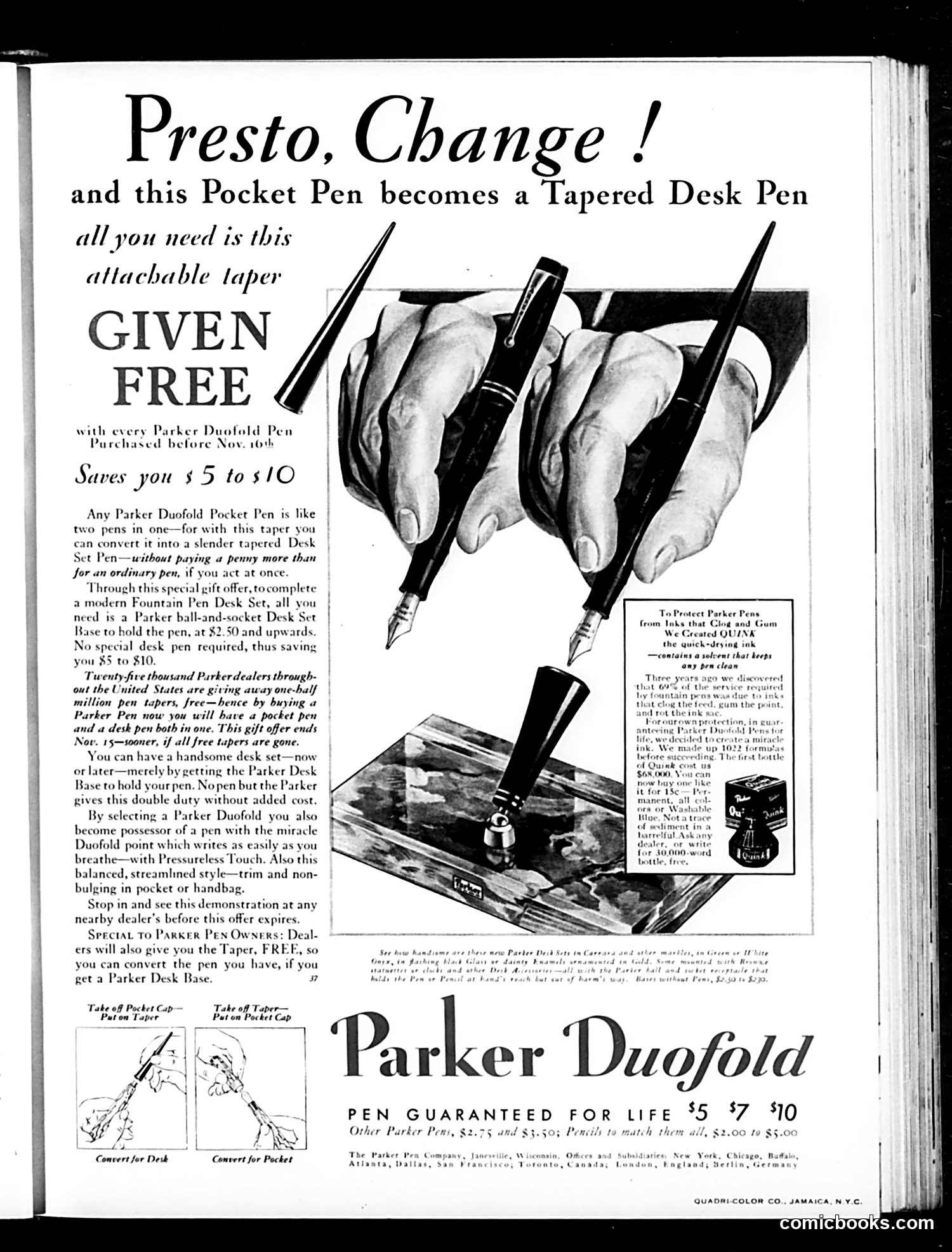
Analysis This is not a political cartoon but a product advertisement for Parker Duofold fountain pens, likely from the 1920s-early 1930s based on styling and pricing. The page promotes a sales gimmick: purchasing a Parker Duofold pocket pen before November 16th includes a free attachable taper that converts it into a desk pen. The central image shows hands demonstrating how the same pen functions in both contexts—practical versatility marketed as innovative convenience. The appeal targets middle-class consumers seeking value: one pen serves dual purposes, saving $5-$10 versus buying separate models. Text emphasizes the pen's quality features (Pressureless Touch, streamlined design) and the company's confidence ("guaranteed for life"). The bottom diagrams illustrate the simple conversion process. This is straightforward commercial marketing with no satirical content—Judge magazine carried paid advertisements alongside its humor content.
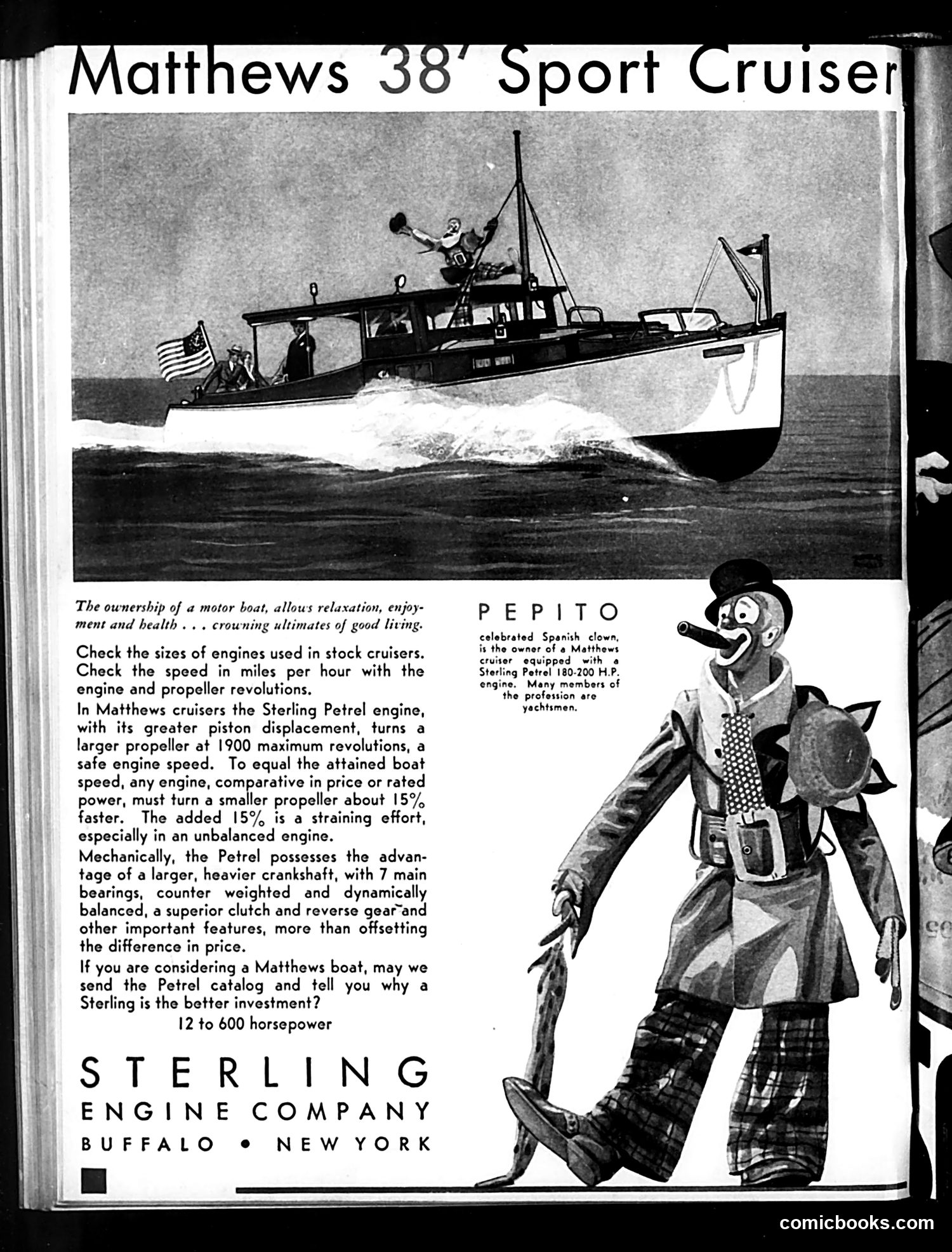
Analysis: Matthews 38' Sport Cruiser Advertisement This is primarily a product advertisement, not a political cartoon. The page promotes Matthews boats and Sterling Petrel engines to Judge magazine's wealthy readers. The "cartoon" element is minimal: Pepito, a celebrated Spanish clown character, appears as a celebrity endorser. His inclusion suggests that even entertainers and performers own Matthews cruisers—a status symbol appeal to aspirational readers. The clown figure, dressed in traditional costume, represents leisure, wealth, and the "good life" the boat promises. The bulk of the page is technical copy comparing engine specifications, arguing Sterling Petrel engines are superior investments because they operate safely at lower RPMs while achieving comparable speeds. The message: buying a Matthews boat with Sterling engines represents wise, sophisticated purchasing—not wasteful extravagance. The satire, if any, is gentle: the implication that boat ownership equals "good living" reflects Depression-era or post-war aspirational marketing to an upscale audience.