judge
Judge — October 24, 1931
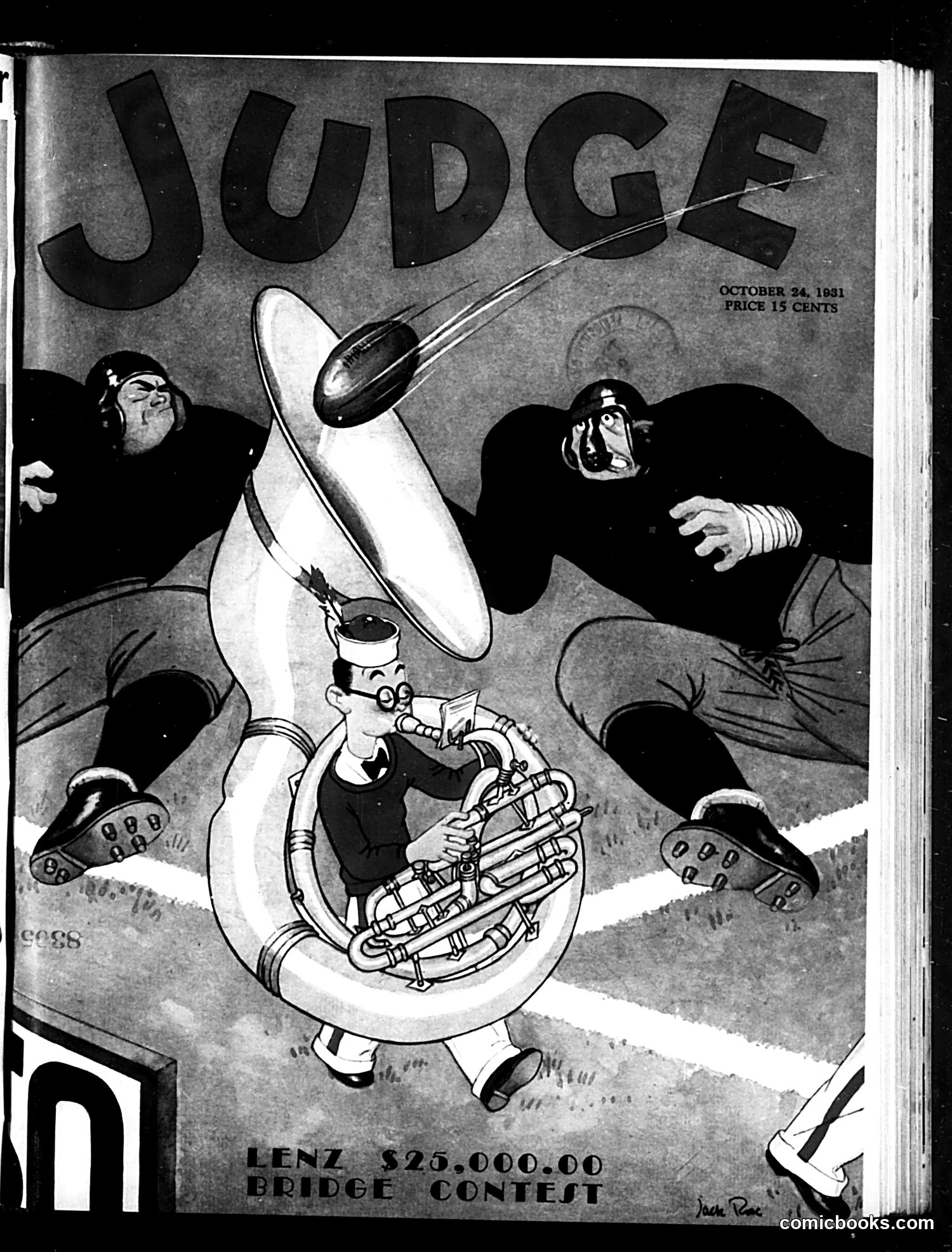
Judge Magazine Cover Analysis - October 24, 1931 This satirical cover depicts a character (appearing to be a conductor or musician) trapped inside a large tuba, being held aloft by two menacing figures. The imagery suggests entrapment or manipulation by powerful forces. The reference is to the "Lenz $25,000 Bridge Contest"—a real 1931 event where businessman Lenz sponsored a high-stakes bridge competition. The cartoon satirizes this spectacle as frivolous excess during the Great Depression. The tuba may symbolize the "noise" or distraction of such entertainment, while the threatening figures flanking the musician suggest darker forces (possibly financial interests or hucksterism) profiting from public fascination with the contest. The overall message criticizes wealthy indulgence amid widespread economic suffering.
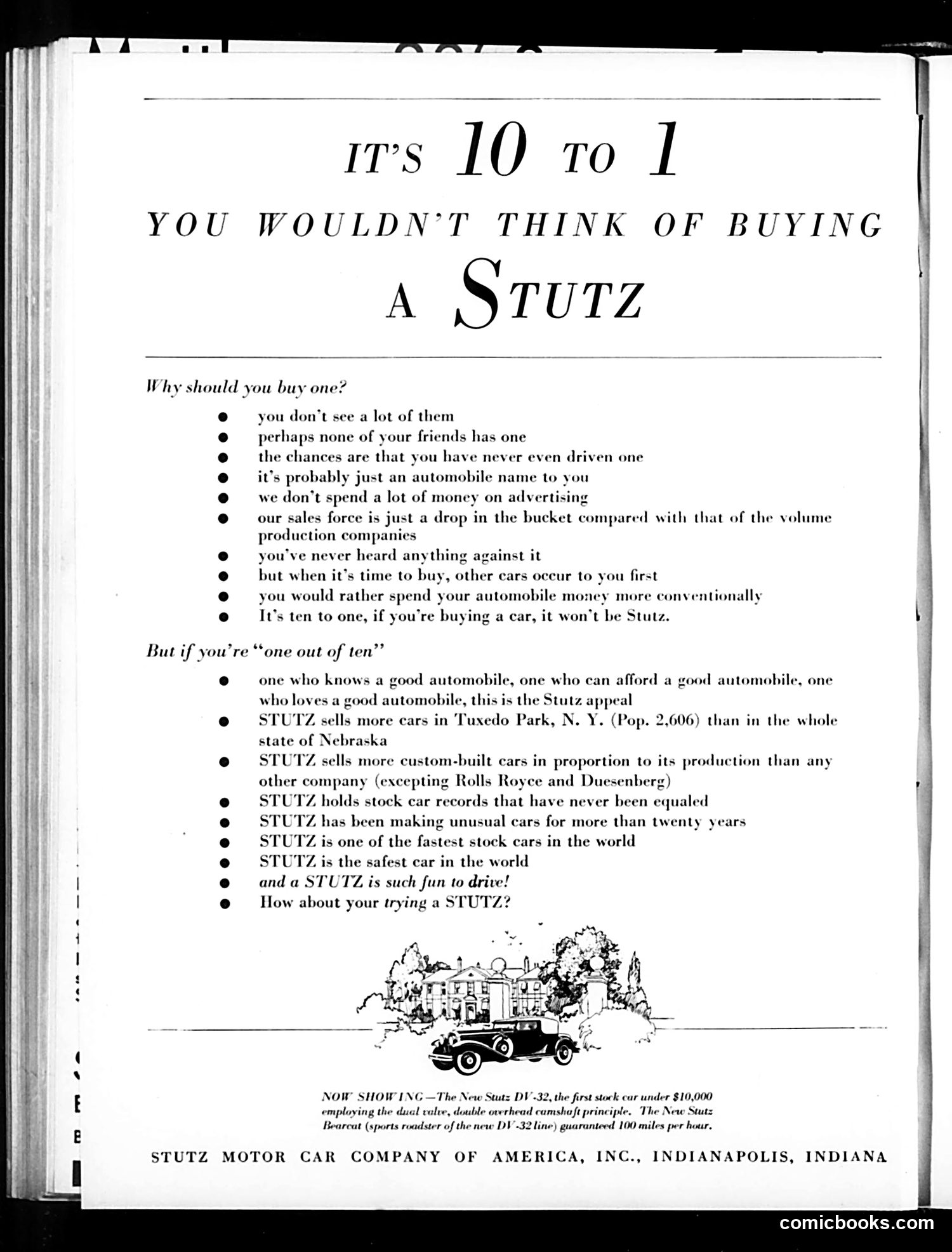
Stutz Motor Car Advertisement This page is primarily a advertisement for Stutz automobiles, not political satire. It uses humor to market the brand to an elite audience. The ad employs reverse psychology: it lists ten reasons *not* to buy a Stutz (obscurity, expense, unfamiliarity), then pivots to argue that if you're "one out of ten"—someone wealthy, discerning, and adventurous—a Stutz is perfect for you. The copy emphasizes exclusivity and performance: Stutz cars are rare, custom-built, fast, safe, and fun. It boasts about Stutz's heritage (twenty years making "unusual cars") and claims superiority in stock car records and production-to-sales ratios. The small illustration shows a vintage roadster near a mansion, reinforcing the luxury positioning. This targets Judge's affluent readers as aspirational buyers.
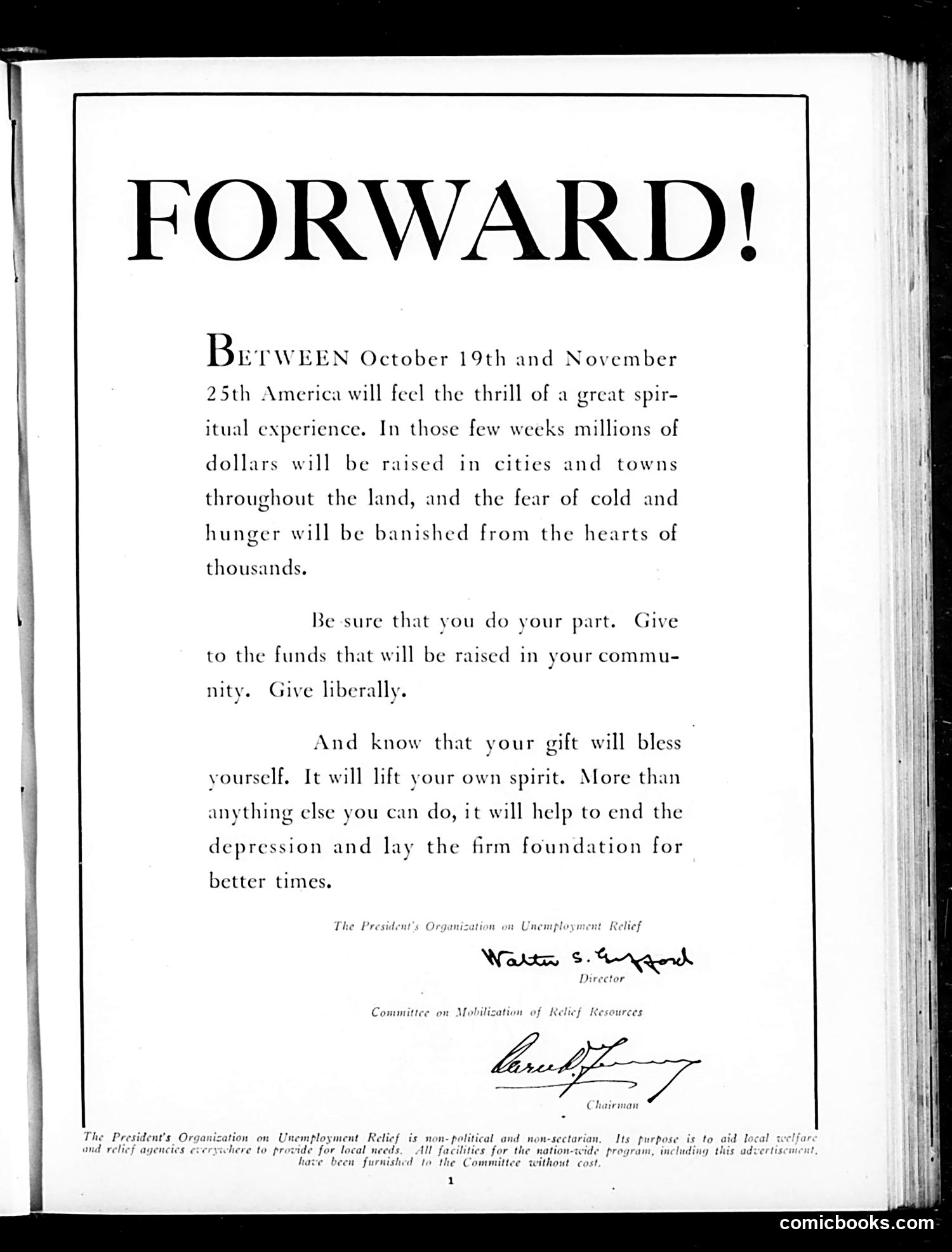
Analysis This is not a satirical cartoon page, but rather a public service announcement from the President's Organization on Unemployment Relief. The page urges Americans to donate to relief funds between October 19th and November 25th to combat poverty and hunger during the Great Depression. The document appears to reference Depression-era relief efforts, likely from the early 1930s. Two officials have signed it—Walter S. Gifford (Director) and an unnamed Chairman of the Committee on Mobilization of Relief Resources. The "FORWARD!" headline is a motivational call to action, not satire. The message emphasizes that charitable giving will "help to end the depression" and "lay the firm foundation for better times," appealing to Americans' civic duty and self-interest during economic crisis.
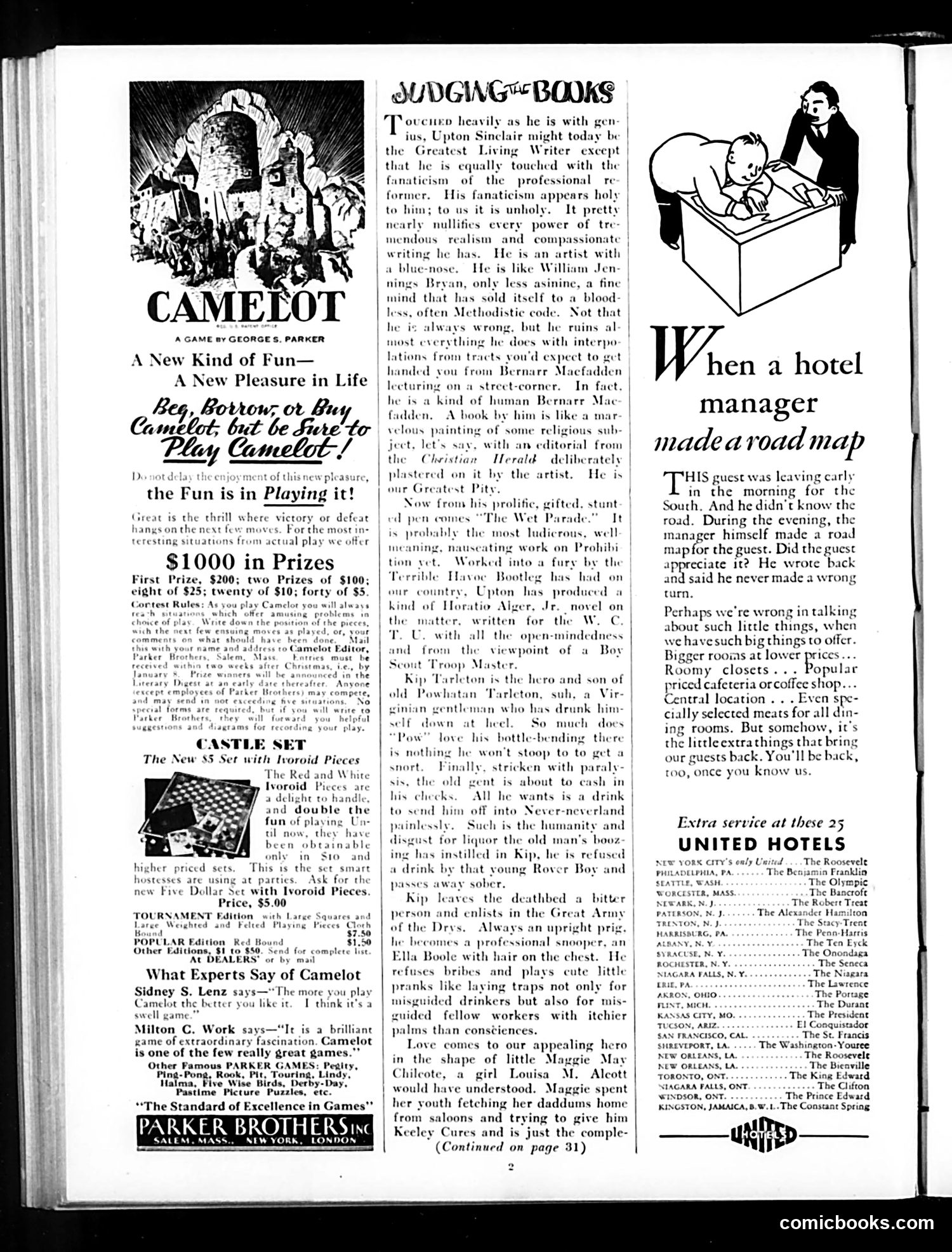
Analysis of Judge Magazine Page This page is primarily advertising and book reviews rather than political satire. The main content includes: "Judging the Books" section reviews Upton Sinclair's novel *Camelot*, praising his writing while critiquing his fanaticism and tendency toward overwrought interpretations. The reviewer compares him to William Jennings Bryan—a reference to the populist politician known for passionate but sometimes extreme rhetoric. "When a Hotel Manager Made a Road Map" is a humorous anecdote about a guest's complaint regarding poor directions. The page also advertises Parker Brothers games (including *Camelot*) and United Hotels, listing various establishments across America. There is no significant political cartoon or satire present on this page.
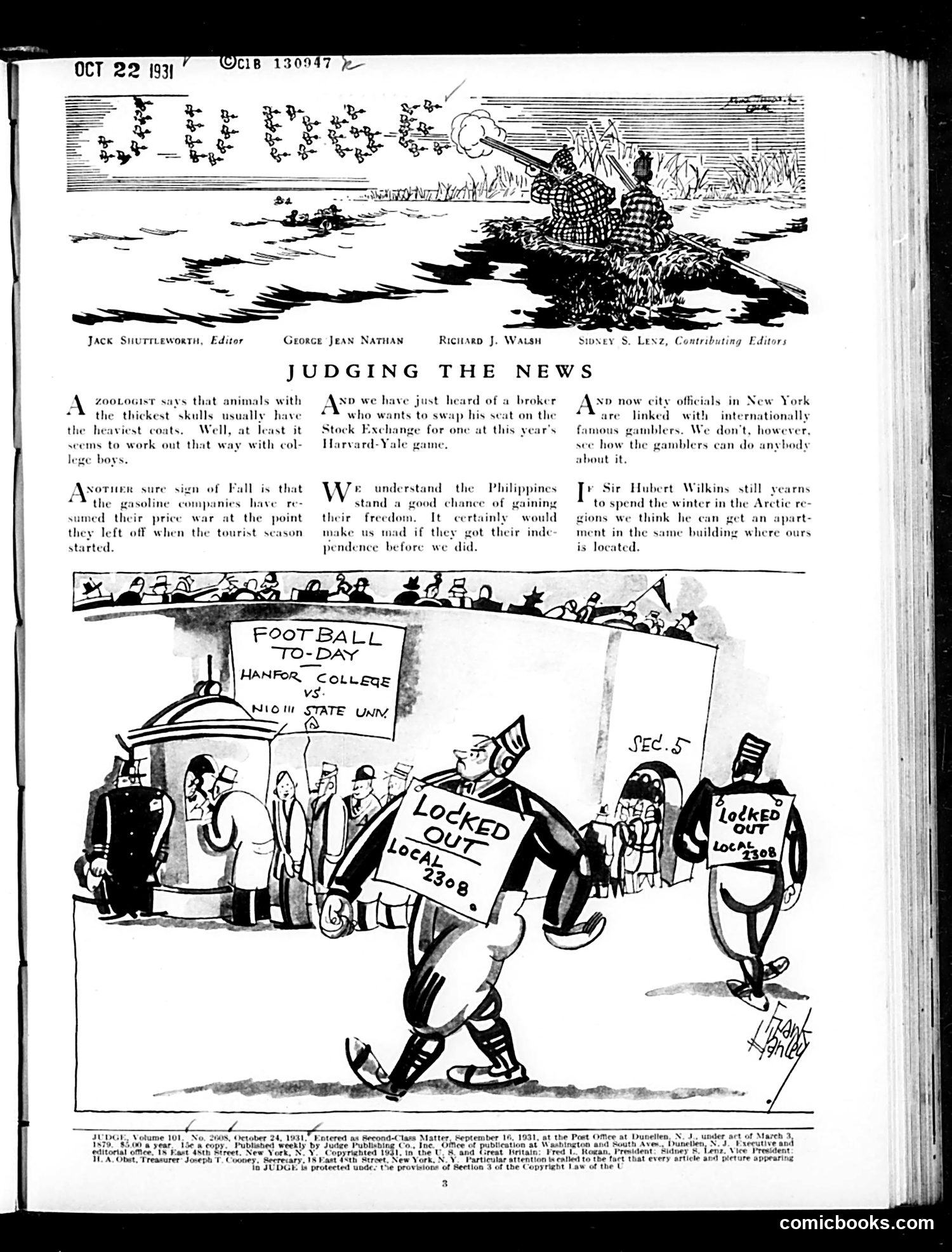
Analysis of Judge Magazine Page (October 22, 1931) The main cartoon satirizes labor unrest at a college football game. A stadium lockout is depicted, with union workers (marked "Local 2308" and "Locked Out") blocking entrance while officials and spectators gather. The sign advertises "Hanford College vs. N.I.O. State Univ." The cartoon critiques how labor disputes were disrupting American public events during the Great Depression. The workers appear as obstacles to entertainment, while crowds remain oblivious or impatient—suggesting tension between labor rights and public convenience. The smaller "Judging the News" section above offers editorial commentary on current events, including references to Wall Street gambling and Arctic exploration. Overall, the page reflects 1931's economic crisis and growing labor activism.
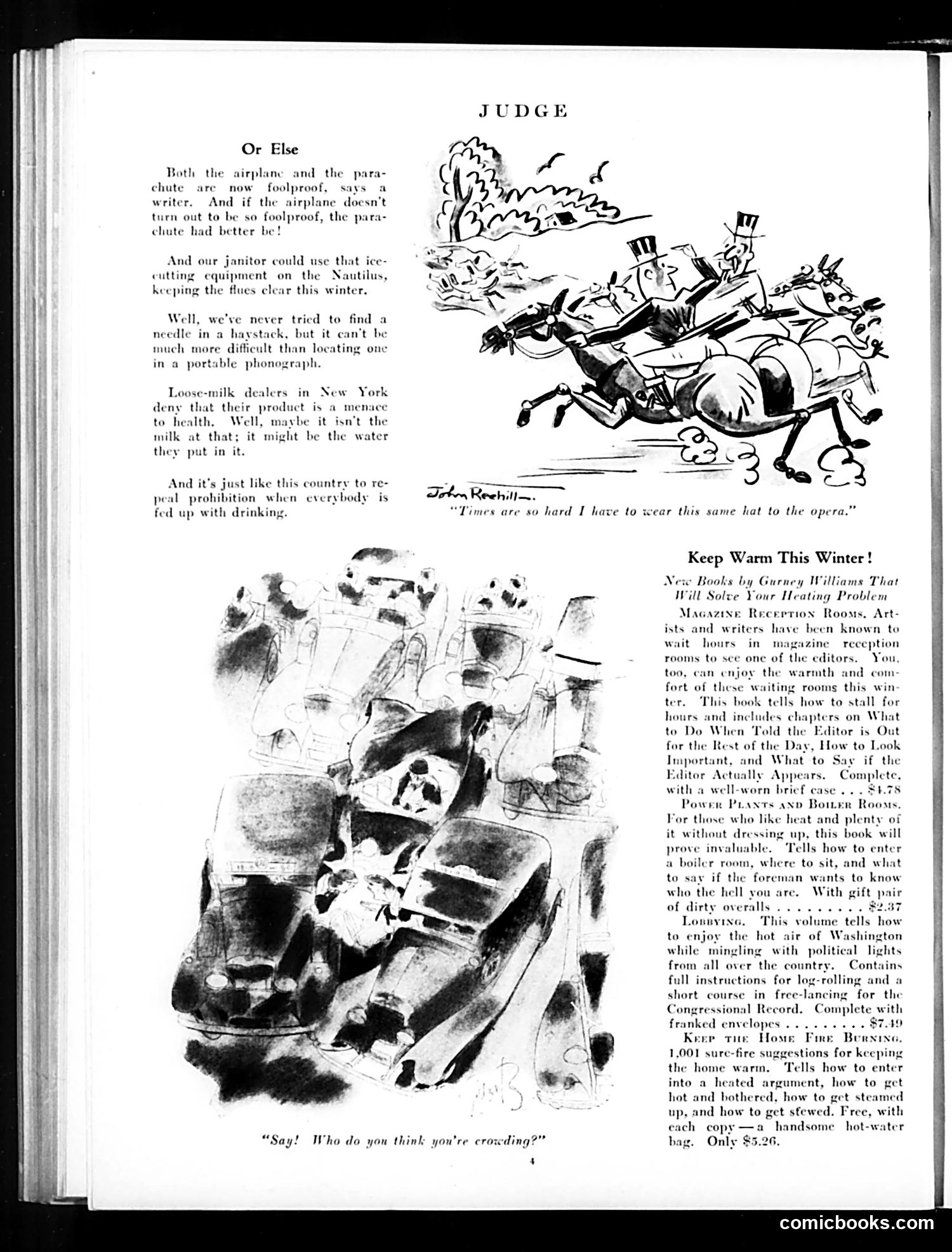
Analysis of Judge Magazine Page This page contains two satirical cartoons: Top cartoon ("Judge"): depicts a chaotic accident involving a car, horses, and what appears to be a judge or formal figure being thrown about. The caption "Times are so hard I have to wear this same hat to the opera" suggests the cartoon satirizes economic hardship—even the wealthy must economize during difficult financial times. Bottom cartoon: shows someone crowded among many others in what appears to be a packed room or vehicle. The caption "Sag! Who do you think you're crossing?" mocks overcrowding and rudeness in public spaces. The page is primarily advertising for books about keeping warm in winter and maintaining home comfort—practical concerns reflecting the era's heating challenges.
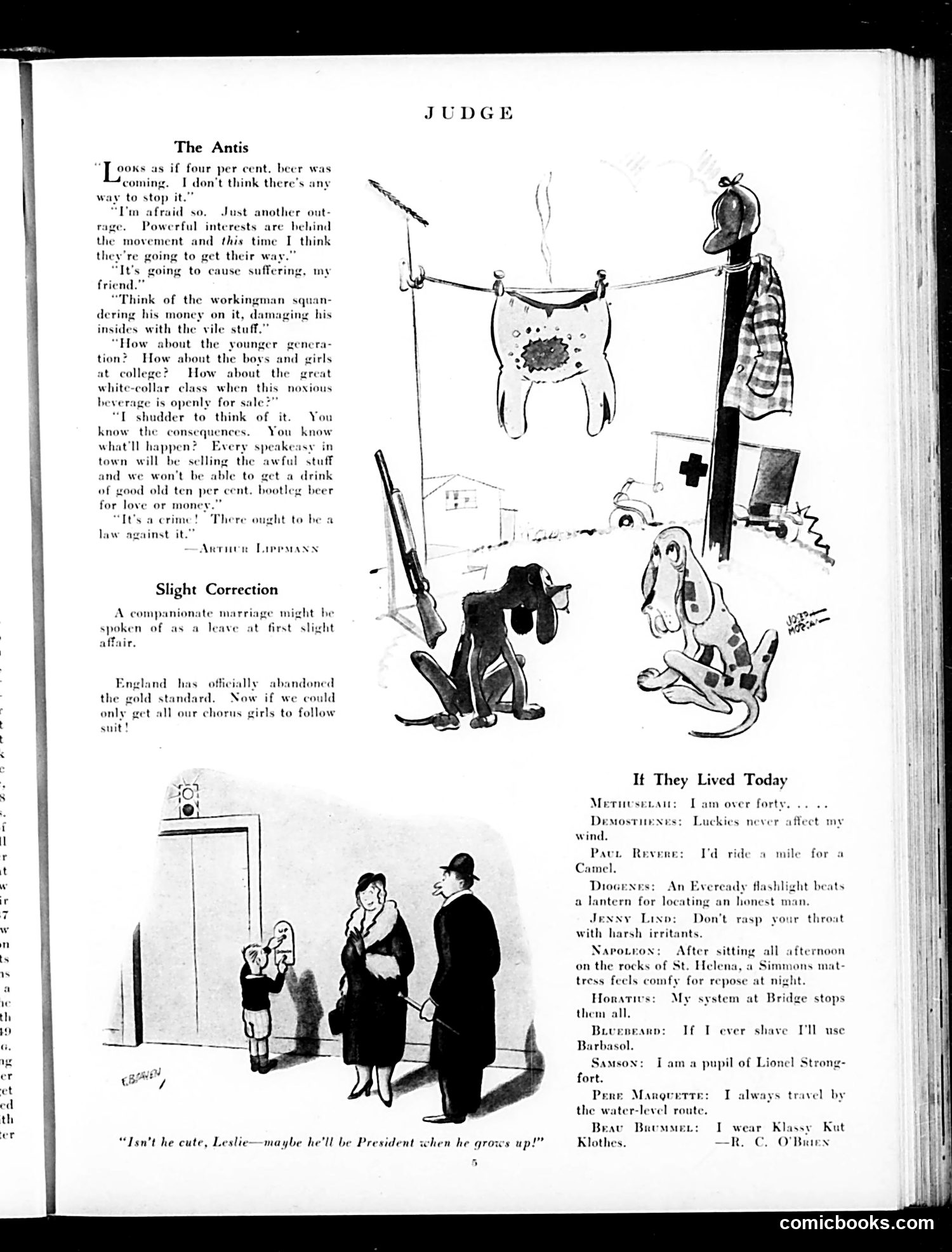
Analysis of Judge Magazine Page This page contains three distinct satirical pieces: "The Antis" discusses beer prohibition, with Arthur Lippmann arguing against anti-alcohol legislation. He warns that powerful interests backing Prohibition will succeed despite public opposition, and jokes about abandoning the "gold standard" so "chorus girls" might follow suit. "Slight Correction" is a brief quip about marriage and affairs. "If They Lived Today" pairs historical figures (Methuselah, Paul Revere, Napoleon, etc.) with modern witticisms—a humor format contrasting past and present. The main cartoon depicts figures on a clothesline or gallows-like structure, likely commenting on social issues, though its exact meaning is unclear without additional context. Context: This appears to be from the Prohibition era (1920s-1930s), when debate over alcohol legislation dominated American politics and satirical magazines.
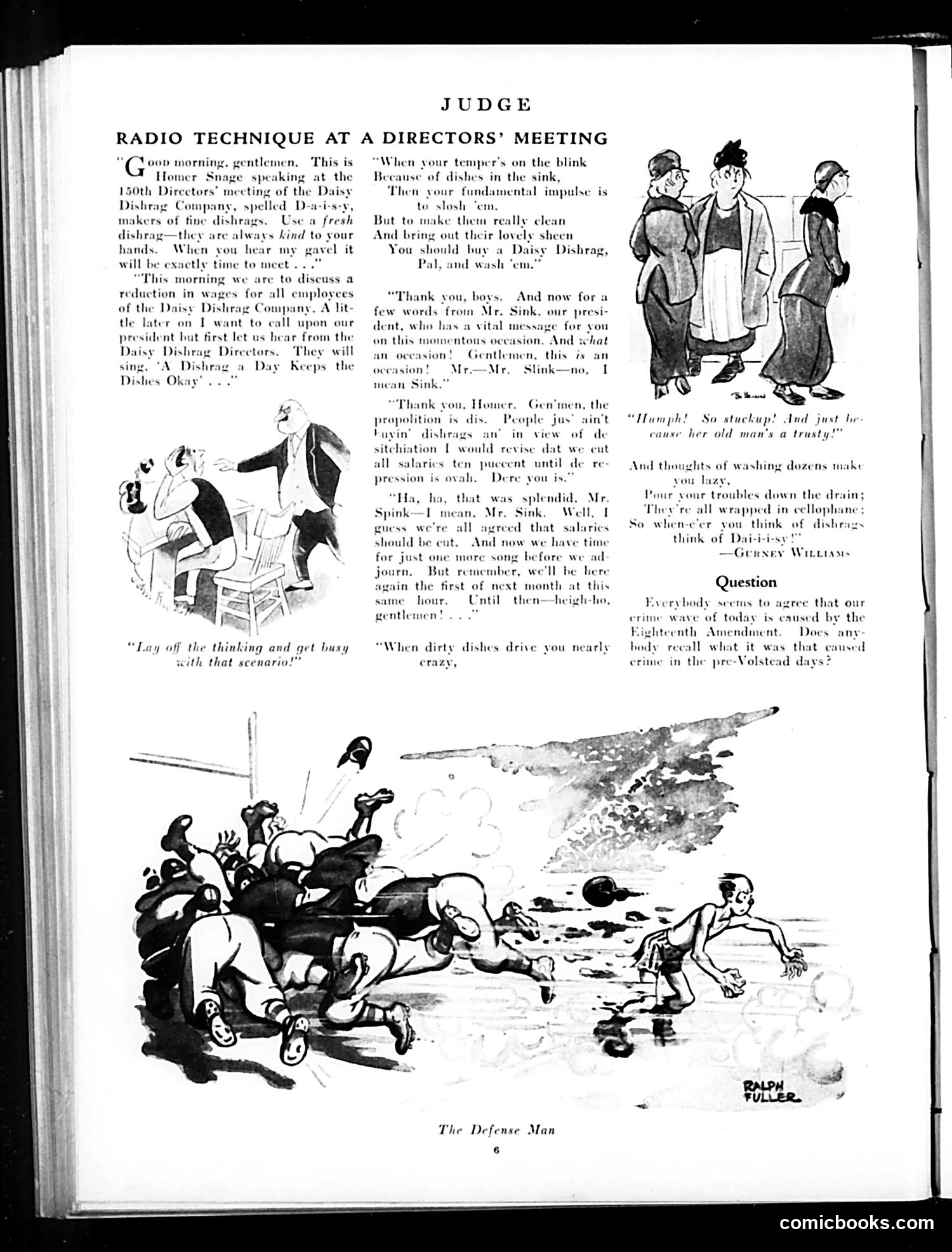
Analysis of Judge Page This page satirizes corporate cost-cutting during a directors' meeting at the Daisy Dishrag Company. The dialogue mocks the absurdity of management obsessing over minor expenses (dishrag sales) while ignoring larger problems. Homer Snage, a company director, suggests cutting salaries—a common Depression-era executive tactic that prioritized shareholder interests over workers' welfare. The cartoon "The Defense Man" at bottom (by Ralph Fuller) depicts a man overwhelmed by piles of dirty dishes on a beach, satirizing the advertising slogan about Daisy Dishrags keeping dishes clean. The contrast between the company's optimistic promises and the actual domestic burden illustrates the gap between corporate marketing and consumer reality—a frequent Judge target.
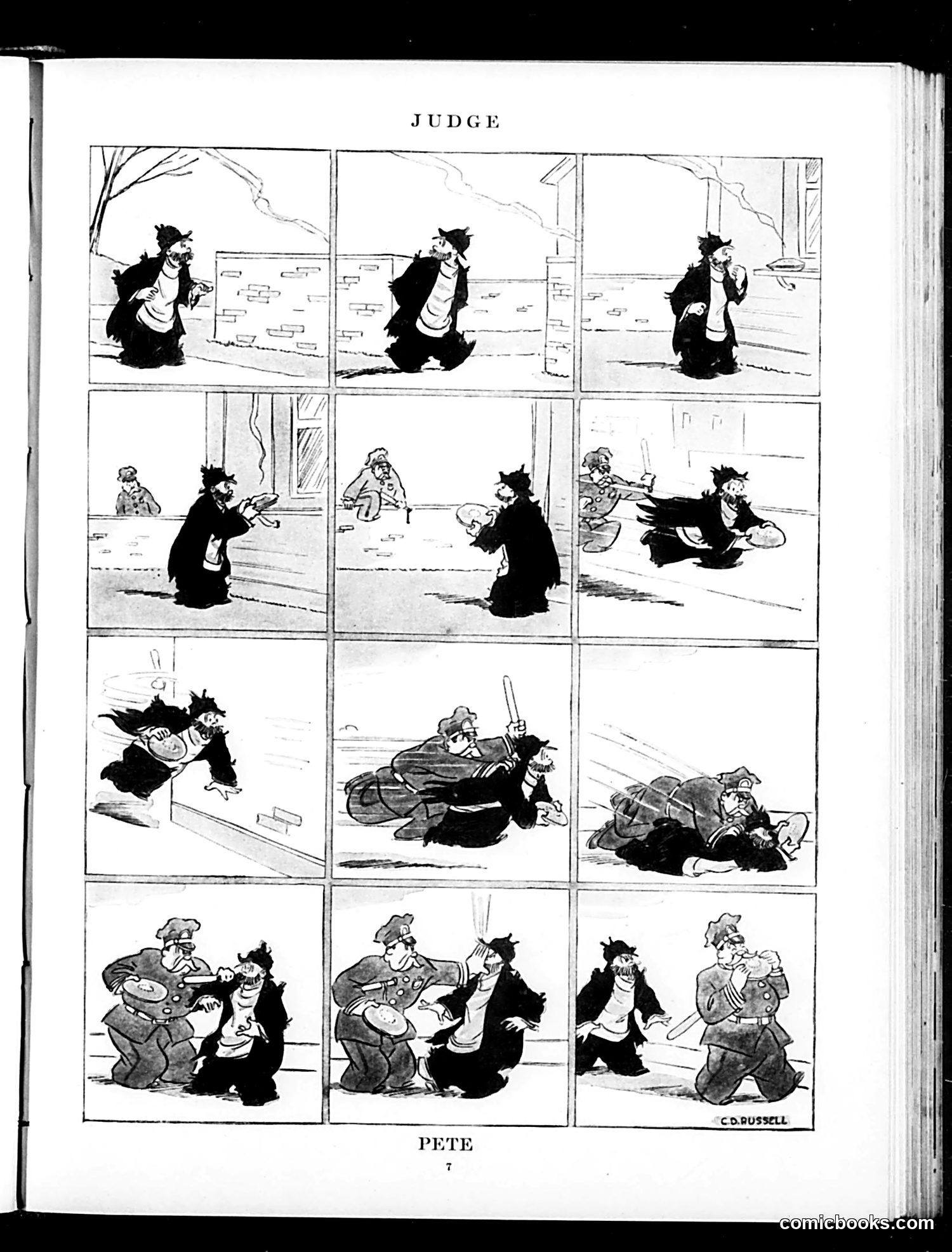
"Judge" - "Judge" and "Pete" Comic Strip Analysis This appears to be a sequential comic strip titled "Judge" (top) and "Pete" (bottom) by C.D. Russell (signed, lower right). The narrative follows a figure in black formal wear through various scenes of physical comedy and mishaps. The "Judge" strip shows a character repeatedly encountering trouble outdoors—appearing to slip, fall, and struggle through multiple panels. The "Pete" strip depicts similar slapstick comedy where the character interacts with what appears to be a rotund gentleman, involving falling, struggling, and comedic violence with objects. Without additional context about the specific publication date or political figures of the era, the exact satirical targets remain unclear, though the slapstick humor appears typical of early 20th-century comic magazine content.
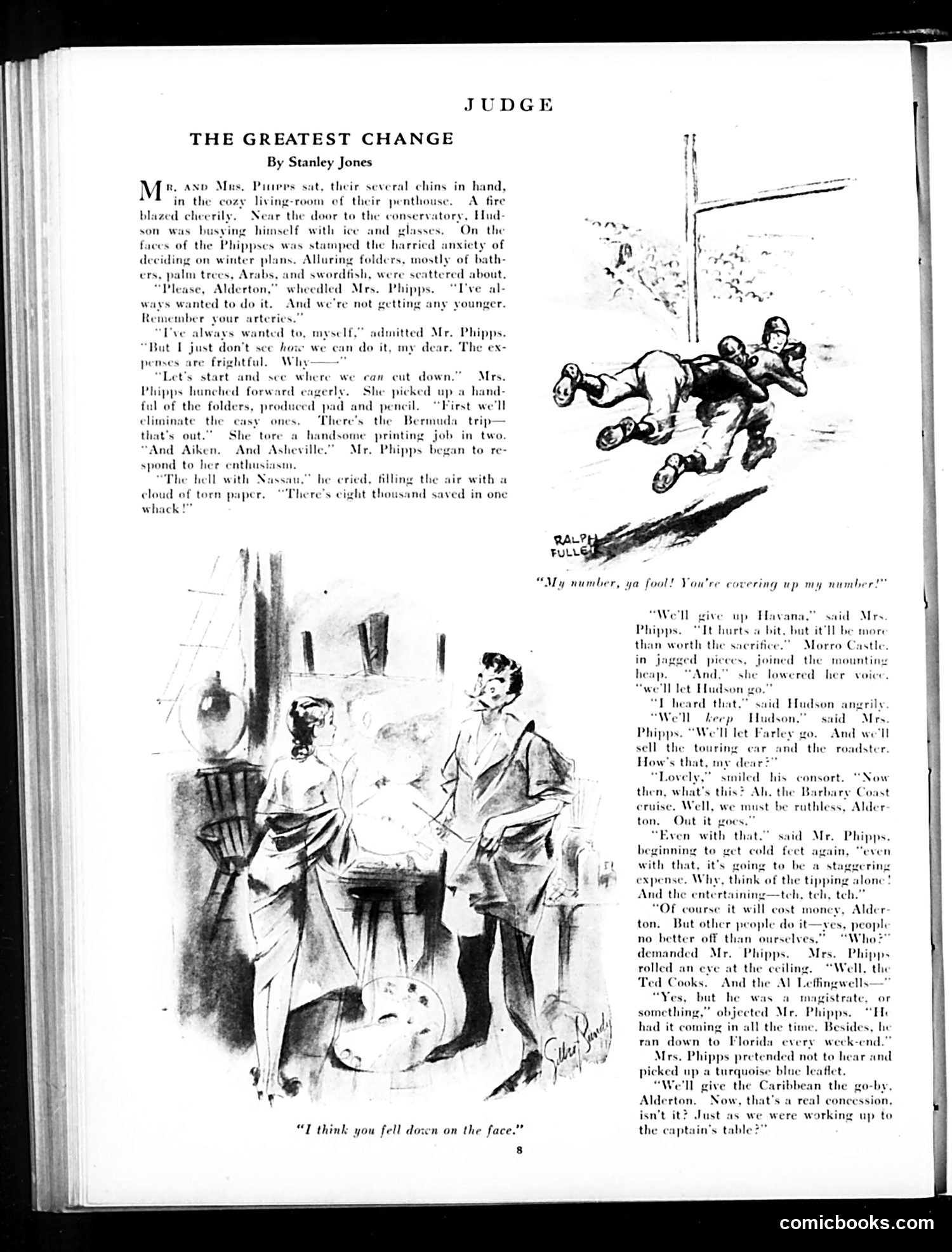
"The Greatest Change" - Judge Magazine Analysis This is a domestic satire about wealthy upper-class couples wrestling with budget cuts during what appears to be the post-WWI or 1920s era. Mr. and Mrs. Phipps sit in their penthouse, planning winter vacations while trying to economize. The joke targets the absurdity of their "sacrifice": they're dramatically cutting travel plans to exotic locations (Bermuda, Nassau, Havana, Caribbean cruises, the Barbary Coast) while still contemplating expensive trips. Their proposed "economies" include eliminating servants (Hudson) and selling cars—yet they're agonizing over "tipping" costs and still eyeing Caribbean voyages. The satire mocks how the wealthy define financial hardship. Mrs. Phipps cites neighbors like "the Ted Cooks" and "Al Leffingwells" as precedent, suggesting even they manage such trips. The couple's hand-wringing over genuine luxury expenses reveals their disconnection from actual economic constraints ordinary people face. The cartoons illustrate their dramatic gestures while planning these supposedly painful cutbacks.
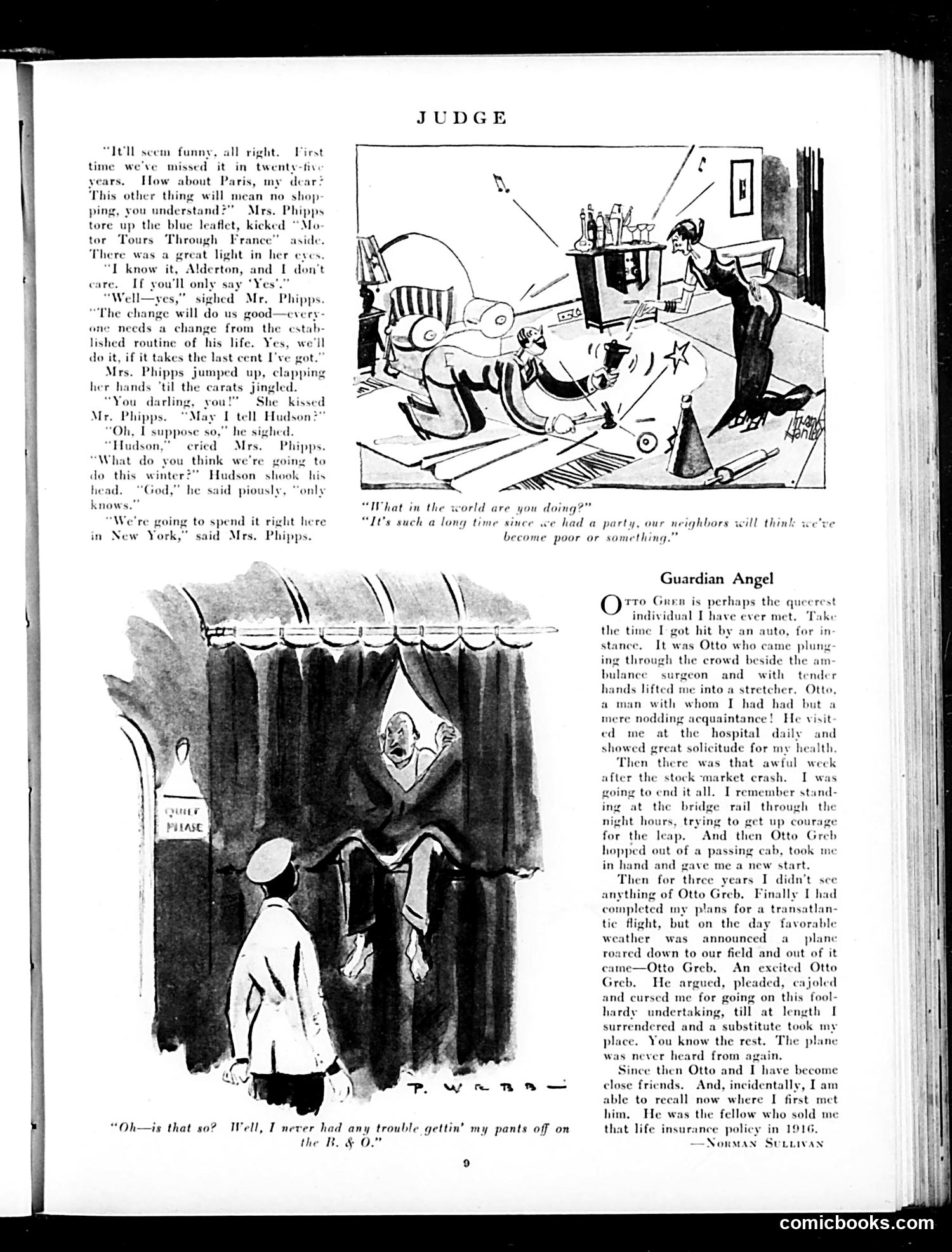
Judge Magazine Page Analysis This page contains two distinct stories satirizing wealthy American leisure during the prosperous 1920s. "Judge" (top cartoon): Mr. and Mrs. Phipps cancel their planned European tour ("Motor Tours Through France") to instead spend lavishly *in New York*. The satire targets nouveau riche anxieties about appearing poor—the couple throws an extravagant home party to signal they haven't lost wealth, reasoning that neighbors might otherwise suspect financial decline. The servant Hudson's sardonic comment about the railroad closing mocks their performative consumption. "Guardian Angel" (bottom story): Otto Greb repeatedly appears providentially in the narrator's life—rescuing him from an auto accident, preventing suicide after the stock market crash, and ultimately stopping him from a doomed transatlantic flight. The twist ending reveals Otto sold him life insurance in 1916, suggesting his interventions were self-interested. The story gently satirizes coincidence and providence while poking fun at insurance salesmanship disguised as friendship. Both pieces reflect Jazz Age concerns about wealth, social status, and luck.
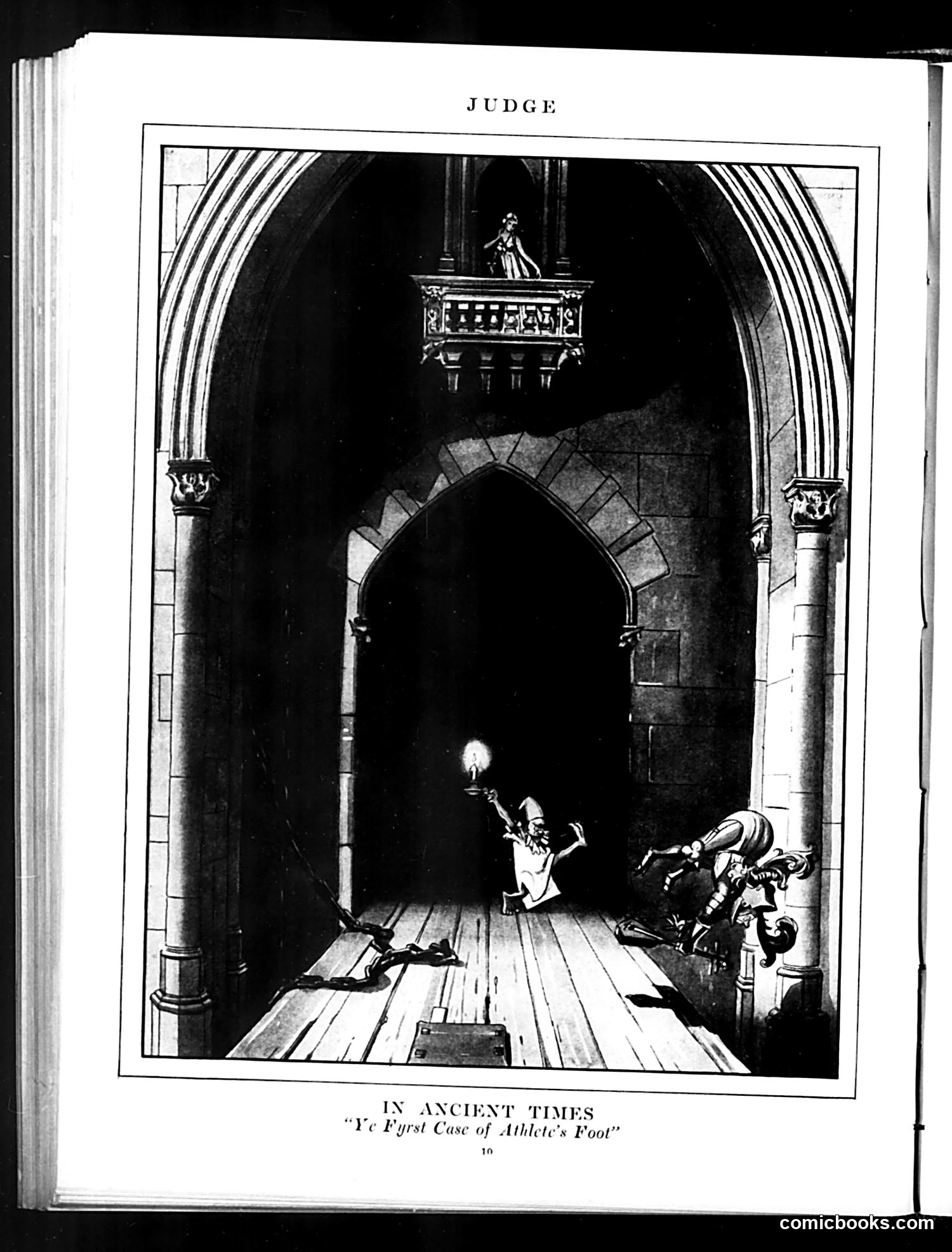
Judge Magazine Cartoon Analysis This is a satirical cartoon titled "In Ancient Times: Ye First Case of Athlete's Foot." The image depicts a medieval cathedral courtroom scene where a judge presides from an elevated bench. In the center, a figure appears to be presenting or defending themselves before the court, while other medieval-dressed figures observe. The satire jokes that "athlete's foot" (a fungal infection) is being treated as if it's an ancient legal matter, complete with formal court proceedings. The humor relies on anachronism—applying modern medical terminology and legal formality to medieval times, suggesting the condition was so common or serious it warranted judicial attention. The cartoon likely mocks either contemporary medical anxiety about minor ailments or the tendency to formalize trivial matters through bureaucratic processes. Without additional context, the specific topical reference remains unclear.
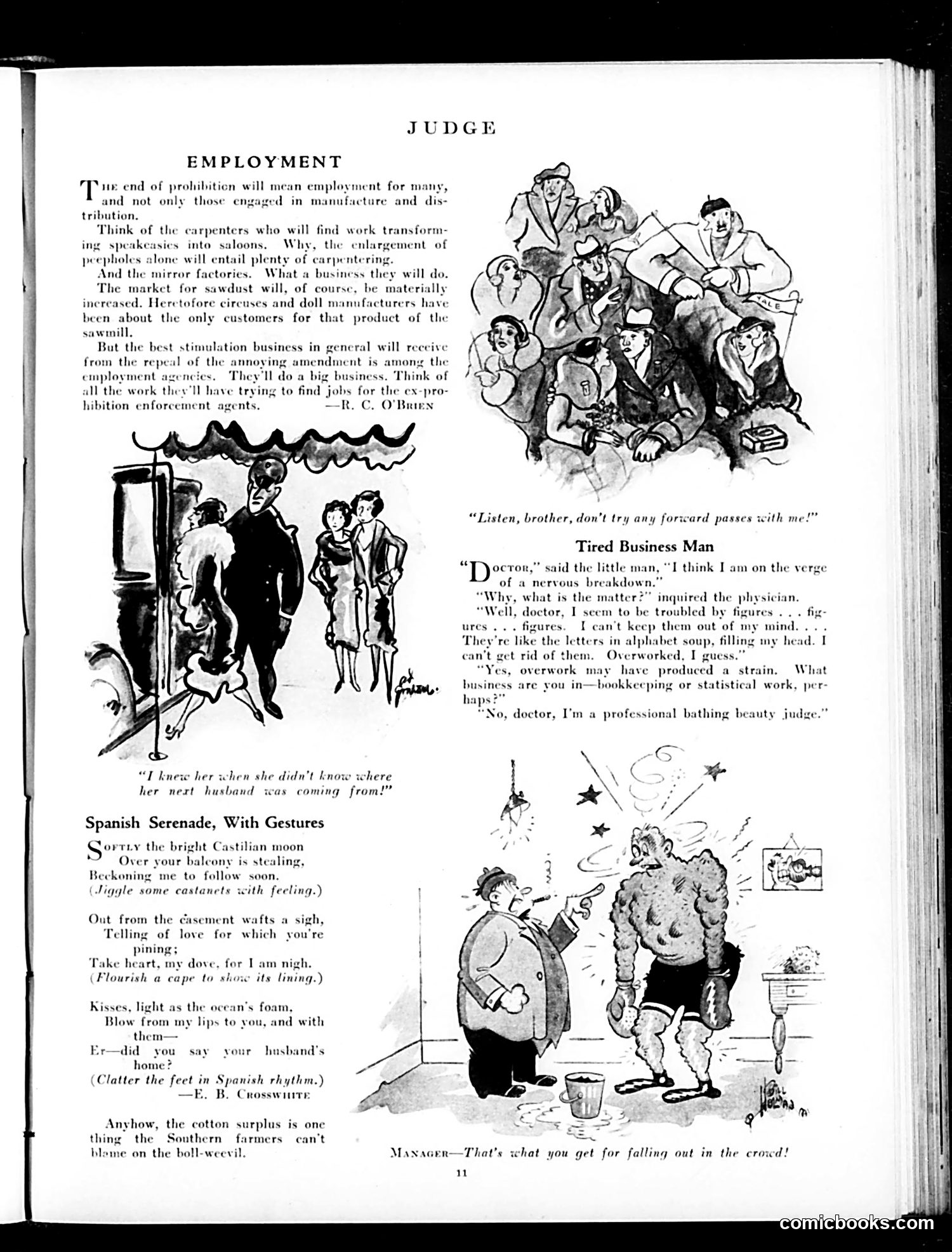
Judge Magazine Page Analysis This page satirizes Prohibition's impending repeal through multiple pieces: "Employment" (top): The editorial by R.C. O'Brien ironically celebrates job creation from ending Prohibition—converting speakeasies back to legitimate businesses, manufacturing sawdust for saloons, and crucially, employing former Prohibition enforcement agents. The joke: these agents will need jobs since their enforcement work disappears, making the repeal itself solve an employment problem. "Tired Business Man" (center): A physician treats an overworked accountant/bookkeeper overwhelmed by numbers and figures. The satirical point critiques how capitalist work culture—particularly in accounting and statistics—causes nervous breakdowns through relentless mental labor. "Spanish Serenade, With Gestures" (bottom): A comedic poem mocking romantic Spanish stereotypes with stage directions for exaggerated gestures and dancing. The cartoons collectively mock both labor exploitation under capitalism and the complex social/economic shifts surrounding Prohibition's end.
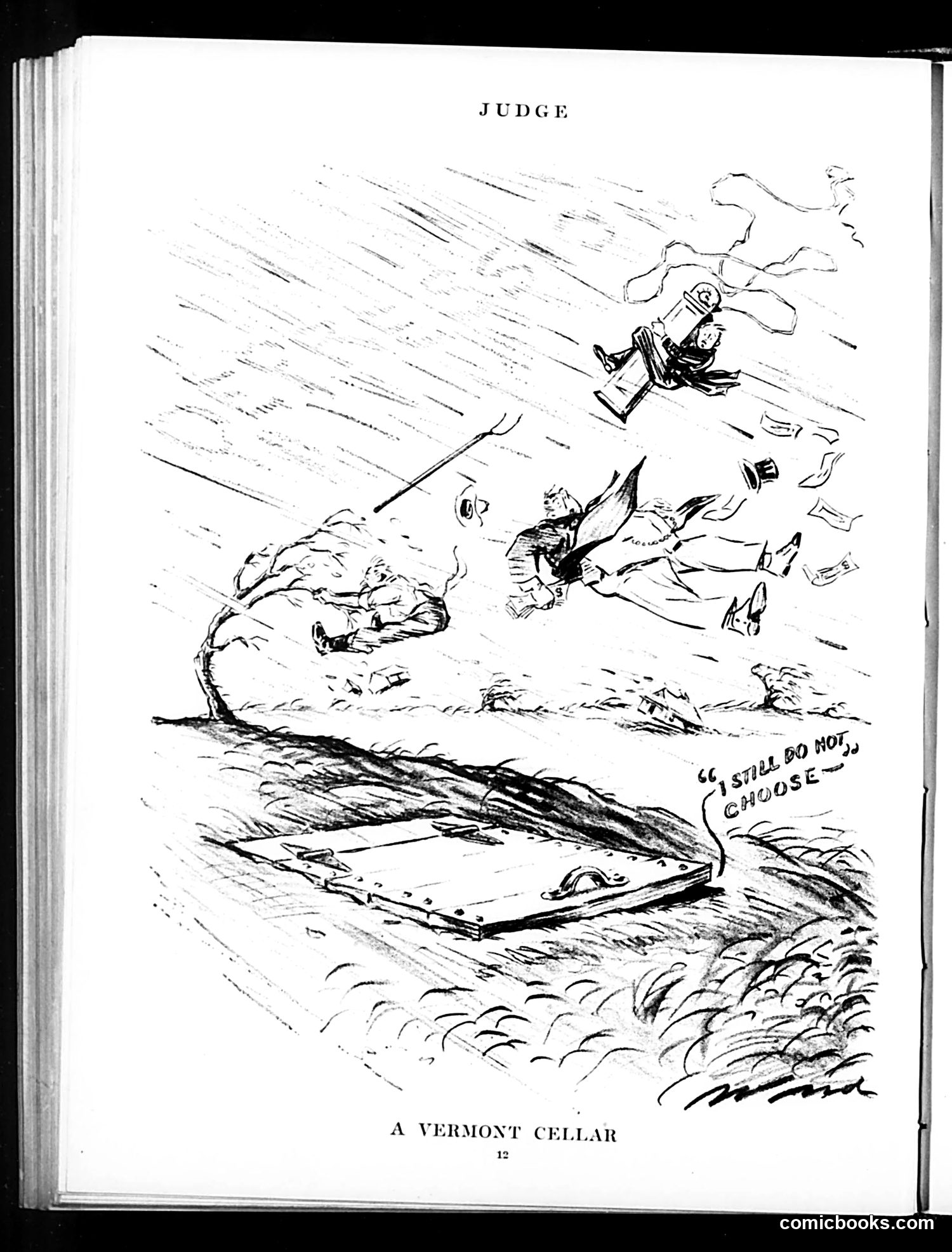
"Judge on the Bench" — Page Analysis This page contains three satirical pieces from Judge magazine (date unclear from image): "High Time to Listen" criticizes American arrogance toward France. The author argues Americans have spent twelve years lecturing France while ignoring French wisdom. With the Depression ravaging America and Britain's economy collapsing, France—well-armed, unified, and prosperous—now has valuable advice. The satire targets American presumption: we should actually listen for once. "Pullman Car Wisdom" mocks Henry Stevens, new American Legion commander, for claiming Pullman smoking cars reveal "the people's pulse." The piece argues Pullmans serve only wealthy travelers (salesmen, producers, tourists)—not ordinary Americans. To understand real public opinion, one must visit diners, subways, farms, and tenements where actual working people congregate. "Hell to Pay" satirizes conflicting wage-reduction arguments. Commerce officials warn of disaster if wages drop, yet wages have already fallen (through layoffs and hour-cuts) without catastrophe. The piece highlights how both business and labor endlessly argue past each other without resolution. All three pieces critique American leadership's disconnect from ordinary citizens' reality during the Depression era.
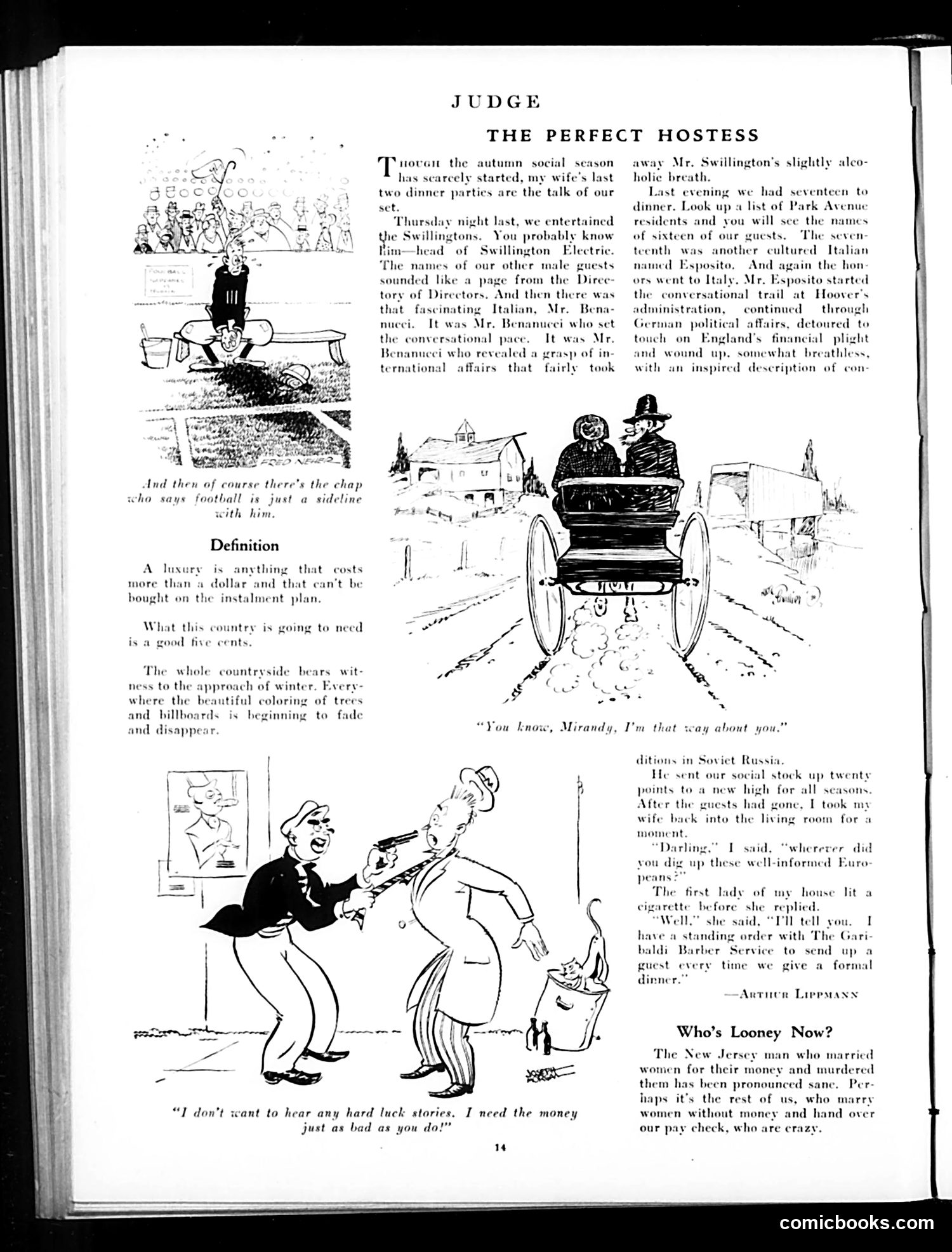
Analysis for Modern Readers This page contains three distinct satirical pieces from Judge magazine: 1. "The Perfect Hostess" (main story): A husband brags that his wife's dinner parties are socially successful because she hires well-informed Italian men (Benanucei and Esposito) to elevate conversations about international affairs, politics, and economics. The satire mocks wealthy Park Avenue hosts who rely on hired sophistication rather than genuine knowledge. 2. "Definition" (sidebar): Brief satirical definitions mocking 1920s-30s consumer culture—particularly "luxury" as anything unaffordable and needing installment plans, and a jab at economic conditions ("country needs a good five cents"). 3. "Who's Looney Now?" (bottom): References a New Jersey man who murdered his wife for money; the satirist suggests perhaps *he's* sane and the rest of us are crazy for marrying women without money or financial sense. All reflect Depression-era anxieties about wealth, status, and economic instability.
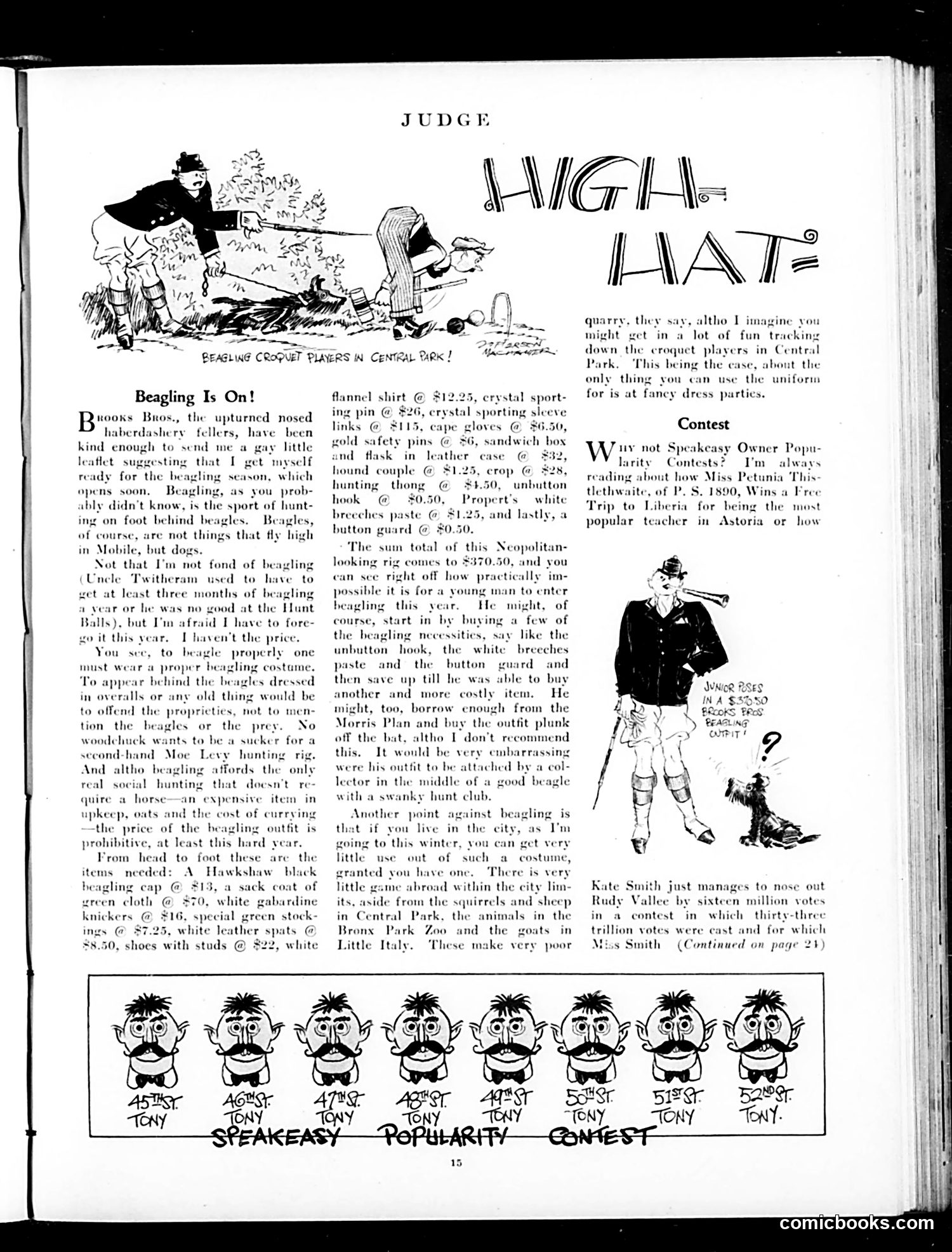
"High Hat" and "Speakeasy Owner Popularity Contest" Main Cartoon ("Beagling Is On!"): A satirical piece mocking the expensive outfit required for beagling—a fox-hunting sport using small hounds. The author (Judge's columnist "Uncle Twitheram") catalogs the absurdly costly gear (totaling $370.50 in Depression-era money), making the sport inaccessible to ordinary people. The joke targets wealthy hobbyists and their pretentious dress codes. He notes the outfit's only practical use is as a fancy-dress costume, and jokes that beagling in Central Park would mean hunting croquet players instead of actual game. "High Hat" Contest Box: References a popularity contest—likely spoofing real contests of the era (like those determining "most popular teacher"). The caption jokes that Miss Smith's win involved "thirty-three trillion votes," mocking the inflated, nonsensical voting numbers in contemporary publicity stunts. Date/Context: This appears to be from the 1930s (Depression era, given cost complaints and "Morris Plan" credit references).
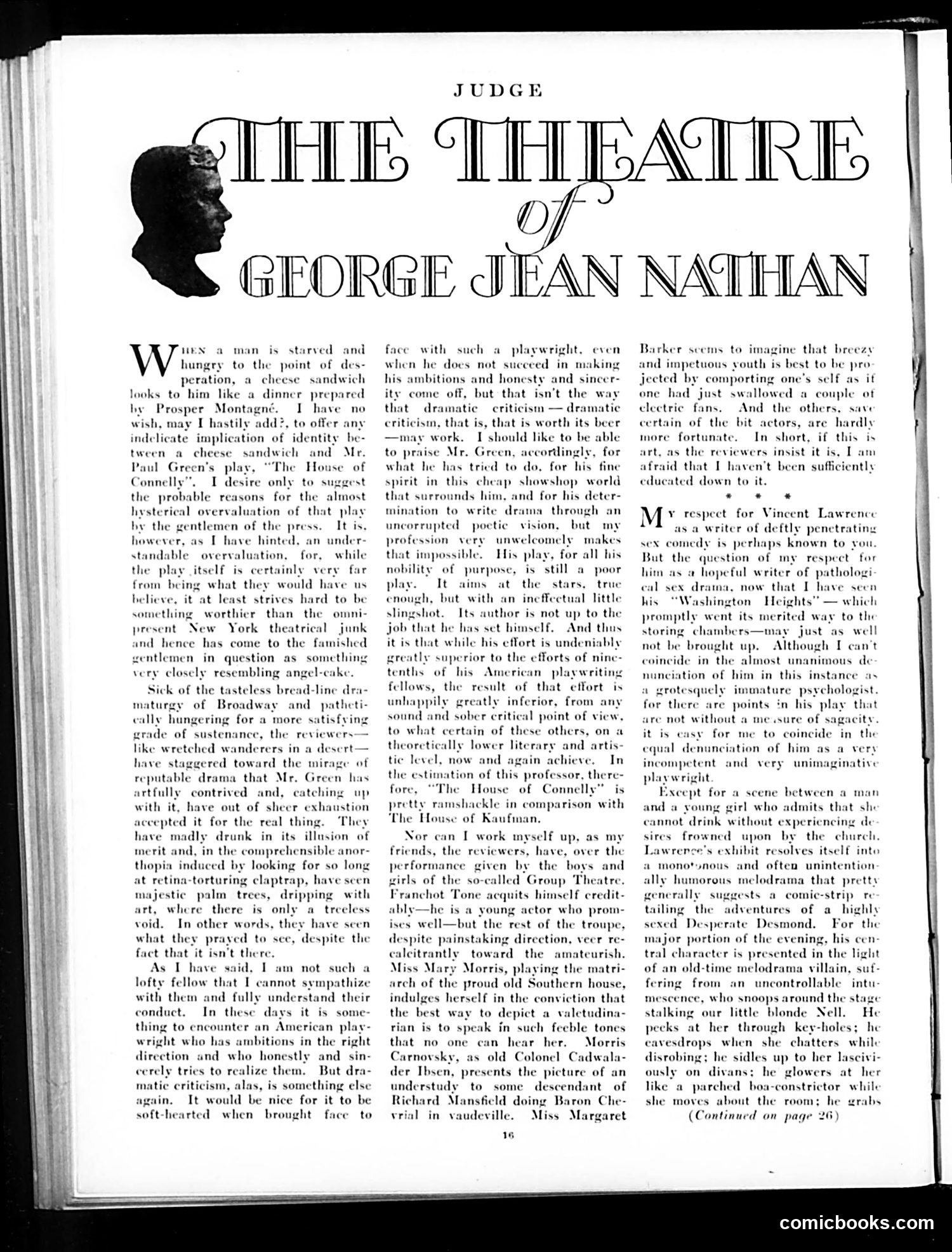
"The Theatre of George Jean Nathan" This is a theater criticism column by Judge magazine's drama critic George Jean Nathan. The piece attacks critics' overly enthusiastic reception of Paul Green's play *"The House of Connelly,"* comparing their response to a starving man mistaking a cheese sandwich for fine cuisine. Nathan argues that while Green's play shows admirable artistic *intent*—striving for serious drama in a commercial theatrical wasteland—the execution remains poor. Critics, he suggests, are so desperate for quality theater that they've deluded themselves into seeing merit that isn't there, praising effort over actual achievement. He contrasts *"The House of Connelly"* unfavorably with *"The House of Kaufman"* (likely a Kaufman & Hart play), and criticizes the Group Theatre's performance as amateurish despite their earnest direction. Nathan's satire targets critical hunger overshadowing honest judgment.
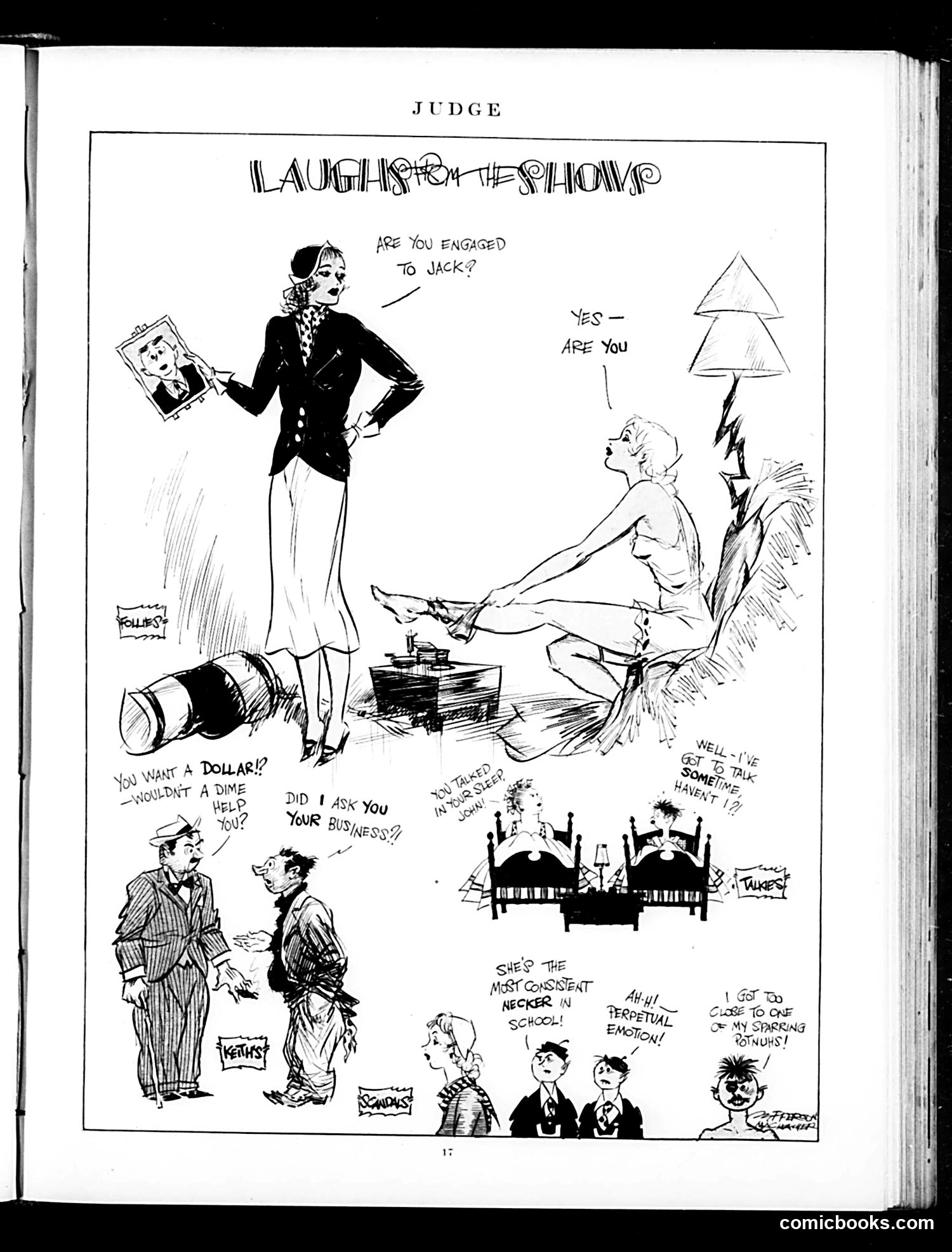
"Laughs at the Plow" - Judge Magazine Cartoon This page satirizes various social inconsistencies and character flaws through multiple vignettes. The central scene depicts a well-dressed woman interrogating a seated figure about an engagement to "Jack," while displaying his photograph—mocking women's materialistic or superficial concerns about romantic prospects. Lower scenes mock "inconsistent necking in school" and depict street-level characters engaged in petty disputes over money ("a dollar," "a dime"), contrasting sharply with the upper-class woman's concerns. The title "Laughs at the Plow" appears corrupted by OCR but likely references rural or working-class perspectives. The overall satire targets social hypocrisy: contrasting wealthy women's romantic preoccupations with working-class people's survival concerns, while mocking various moral inconsistencies across social classes.
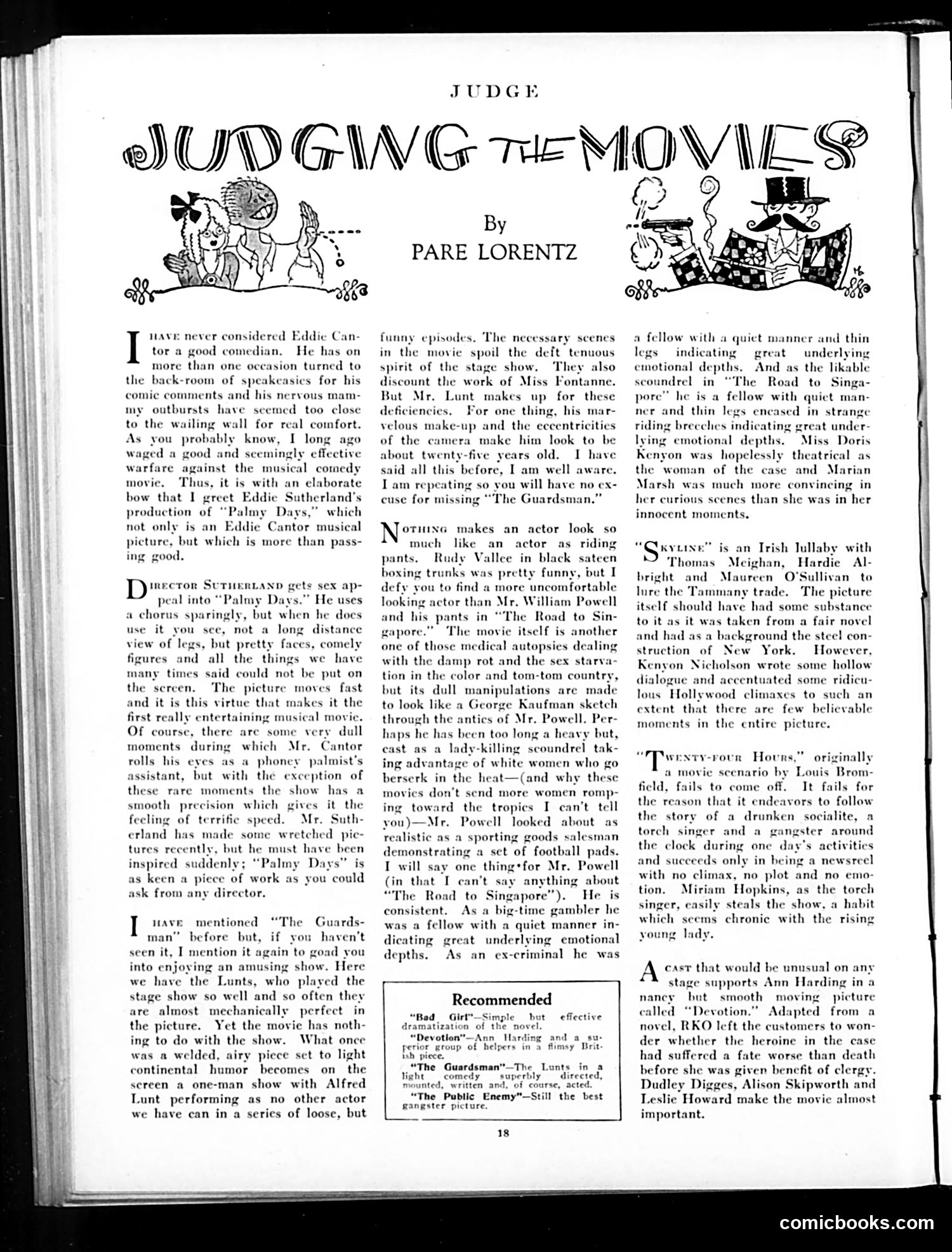
Judge Magazine Film Review Analysis This is a film criticism column reviewing current movie releases. The reviewer discusses several pictures: "Palmy Days" stars Eddie Cantor, whom the critic previously disliked but now praises director Eddie Sutherland's handling of the musical comedy. The review notes Cantor's physical comedy—rolling his eyes as a "phoney palmist's assistant"—while crediting Sutherland with maintaining fast-paced, entertaining direction. "The Guardsman" features the Lunts (prominent stage actors) in a film adaptation that disappoints because it becomes a one-man show highlighting Alfred Lunt's performance while diminishing his wife Lynn Fontanne's role. "The Road to Singapore" criticizes William Powell's unconvincing performance, finding his costumes and demeanor unrealistic—comparing him unfavorably to "a sporting goods salesman." The column includes a "Recommended" box listing films worth seeing. The tone is that of a knowledgeable but somewhat cranky critic evaluating 1920s-era cinema production quality and acting performances.
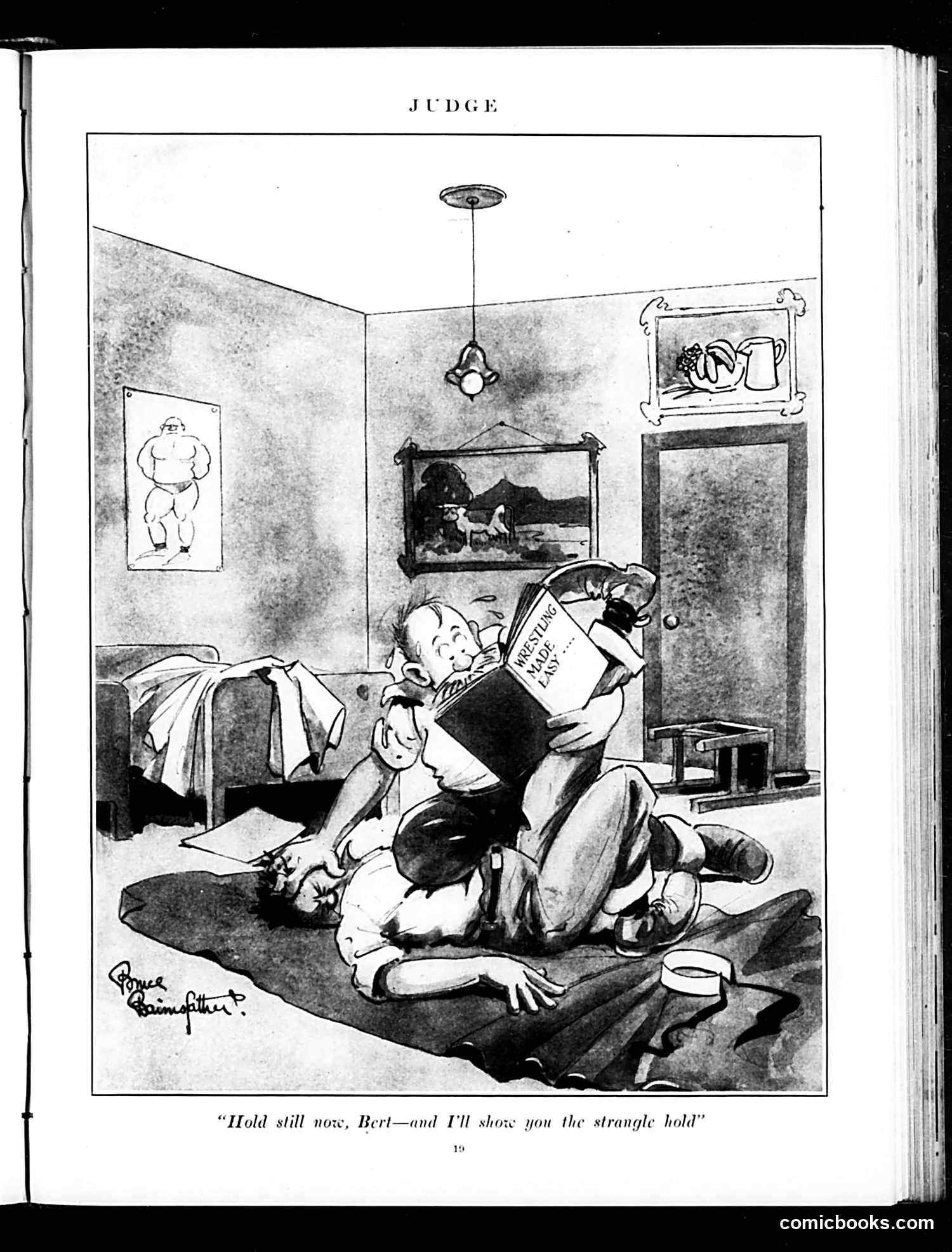
Analysis This cartoon satirizes physical violence disguised as instruction or entertainment. Two figures are shown wrestling on a bedroom floor—one pinning the other from behind while holding what appears to be an instruction manual labeled "WRESTLING HOLD" (or similar). The humor relies on the contrast between the stated purpose (teaching a wrestling technique) and the actual violence occurring. The bedroom setting with its domestic furnishings, artwork, and clothing scattered about suggests this is happening in an inappropriate context—possibly depicting either marital discord played for laughs, or a scenario where someone is being violently attacked under the pretense of giving a "lesson." The cartoon's satirical point is unclear without additional Judge magazine context, but it appears to mock either domestic violence normalization or the absurdity of violent "instruction" in intimate settings.
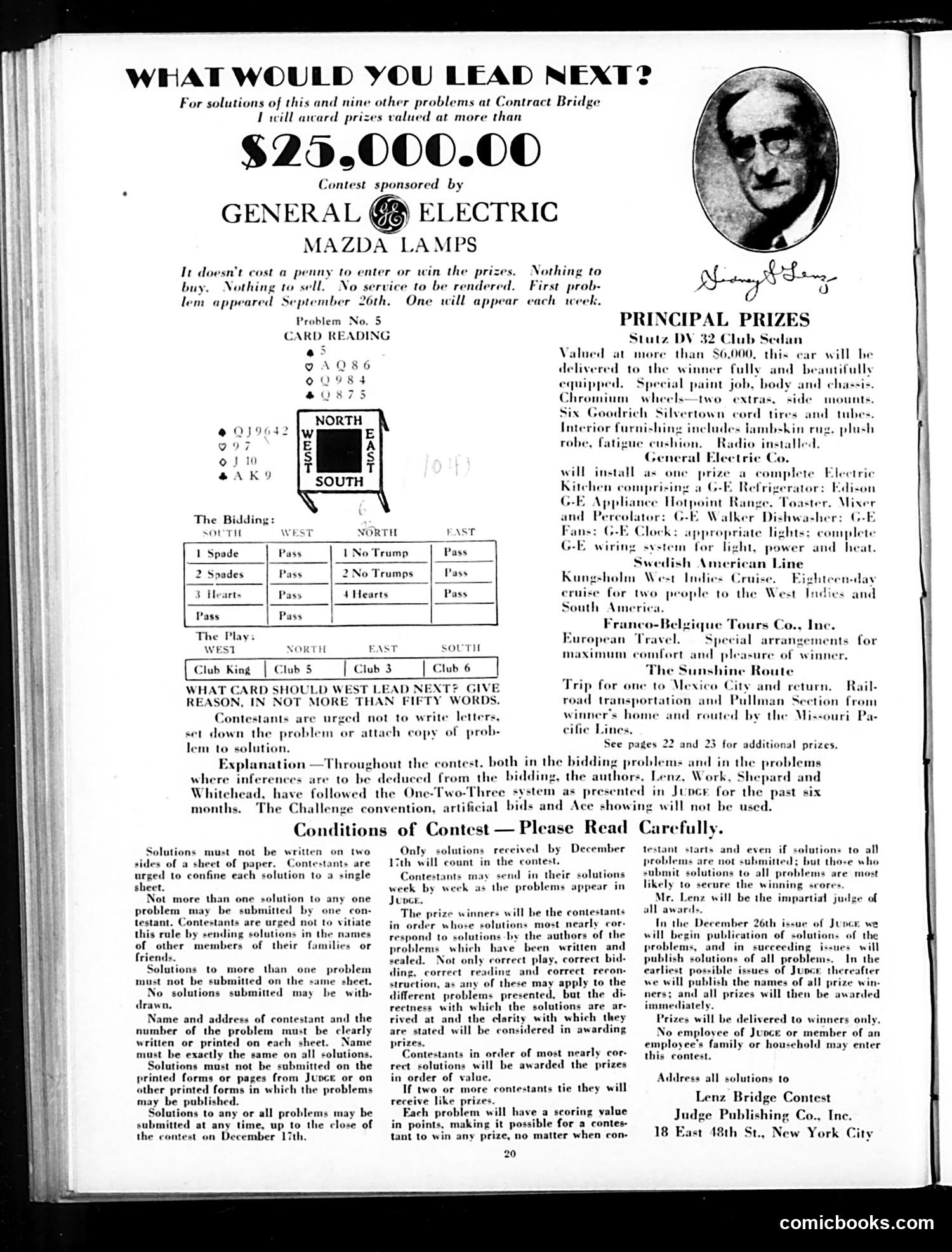
Judge Magazine Bridge Contest (Circa 1930s) This page announces a contract bridge puzzle contest sponsored by General Electric's Mazda Lamps division, offering over $25,000 in prizes—substantial money during the Depression era. The contest presents "Problem No. 5," a bridge card-playing scenario asking readers: "What card should West lead next?" Contestants submit solutions (max 50 words) explaining their reasoning. Principal prizes include a Stutz DV 32 Club Sedan (valued at $6,000+), a complete General Electric kitchen with refrigerator and appliances, and luxury travel packages (Swedish American Line cruise, Mexico City trip). This reflects bridge's immense popularity in 1930s American culture—it was the dominant parlor game among middle and upper classes. The contest leveraged this obsession to promote GE products and Judge magazine readership. The emphasis on "no cost to enter" and substantial prizes made it accessible entertainment during economically difficult times, while the complex bidding scenarios appealed to intellectually engaged readers.
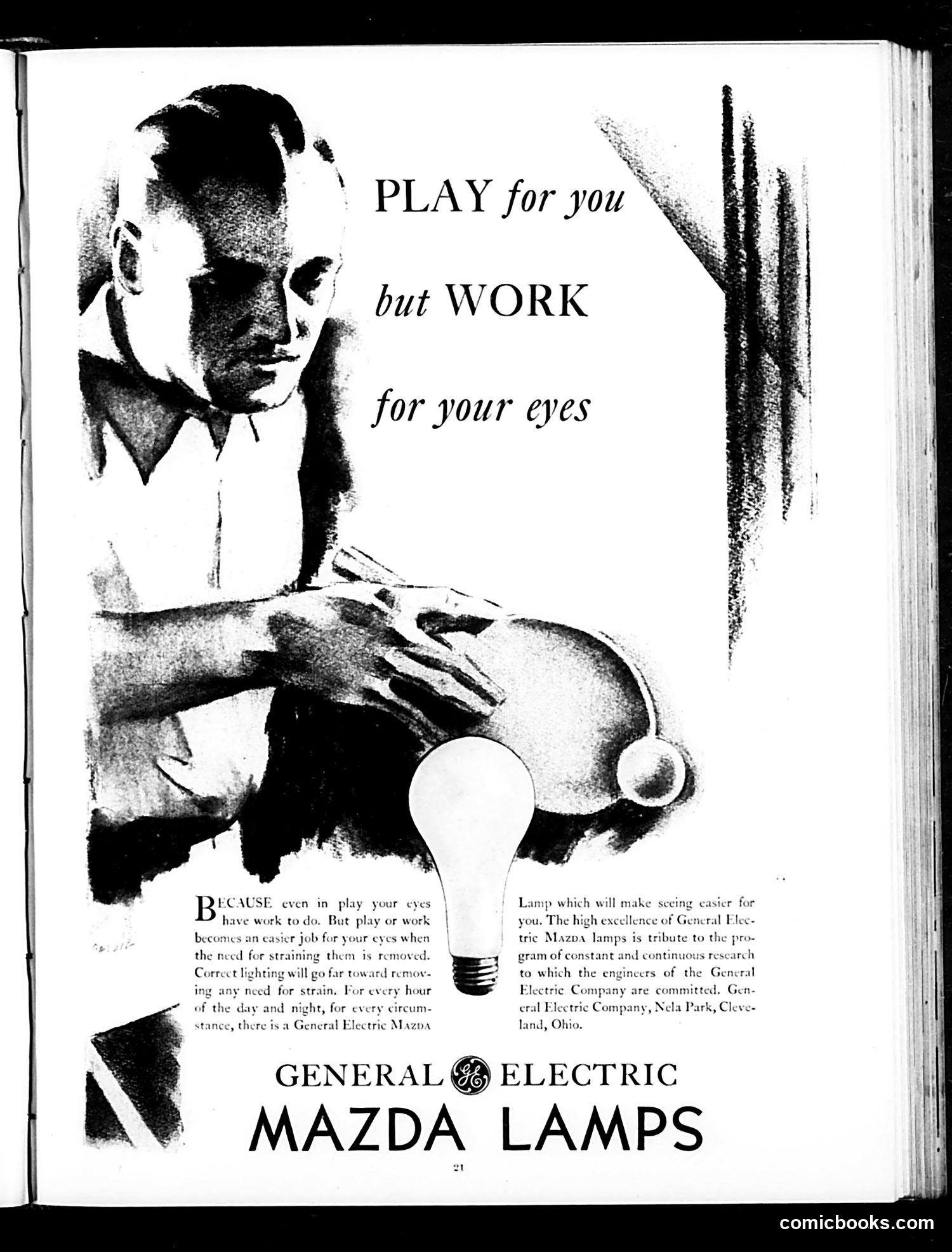
Analysis This is a General Electric advertisement, not political satire. It promotes Mazda brand light bulbs by addressing eye strain—a modern concern in the early 20th century. The image shows a man's face in profile alongside a glowing lamp bulb. The headline "PLAY for you but WORK for your eyes" uses wordplay to argue that while leisure activities feel effortless, eyes still require proper lighting to function without strain. The advertisement's message is straightforward: correct lighting reduces eye fatigue during both work and recreation. It emphasizes GE's research commitment to lamp quality and positions Mazda lamps as a solution for every circumstance and hour. There is no political or satirical content here—this is standard commercial messaging emphasizing consumer health benefits and industrial reliability during an era when electric lighting was increasingly prevalent in American homes and workplaces.
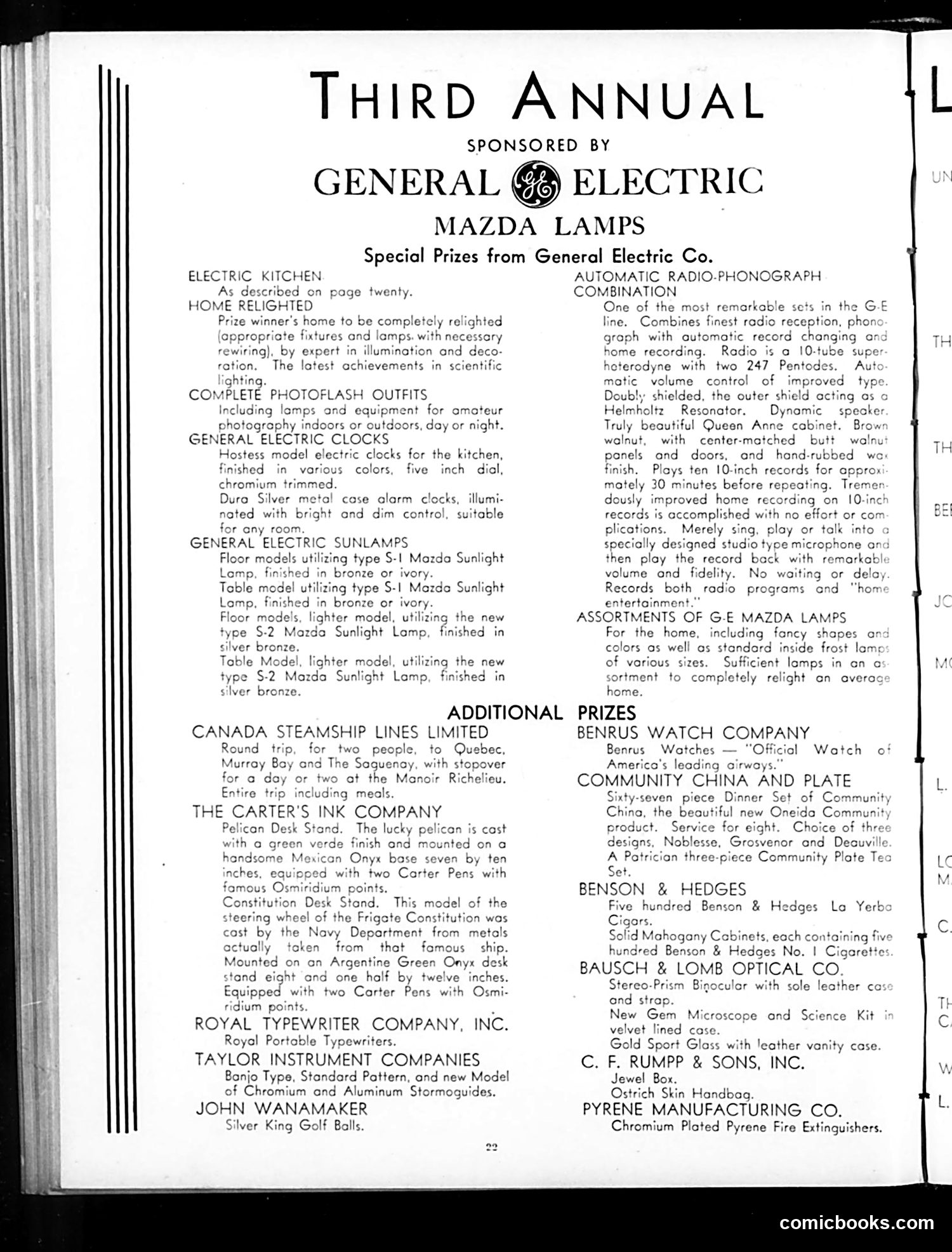
Analysis of This Judge Magazine Page This is primarily a prize list for a General Electric advertising contest rather than a cartoon or satirical content page. The "Third Annual" competition, sponsored by GE's Mazda Lamps division, announces prizes for what appears to be a home-lighting design or photography contest. The prizes reveal 1930s consumer aspirations: electric kitchen appliances, radios, typewriters, watches, fine china, and luxury items like steamship cruises. These reflect Depression-era desires for modern conveniences and leisure. The page itself contains no visible cartoon or political satire—it's essentially advertising copy disguised as editorial content, a common Judge magazine practice. The elaborate prize descriptions (ornate desk stands, mahogany cabinets) and brand names (Benrus, Community Plate, Wanamaker) suggest the magazine's affluent readership. The satire, if any exists, is subtle: promoting consumer goods as aspirational prizes during economically uncertain times.
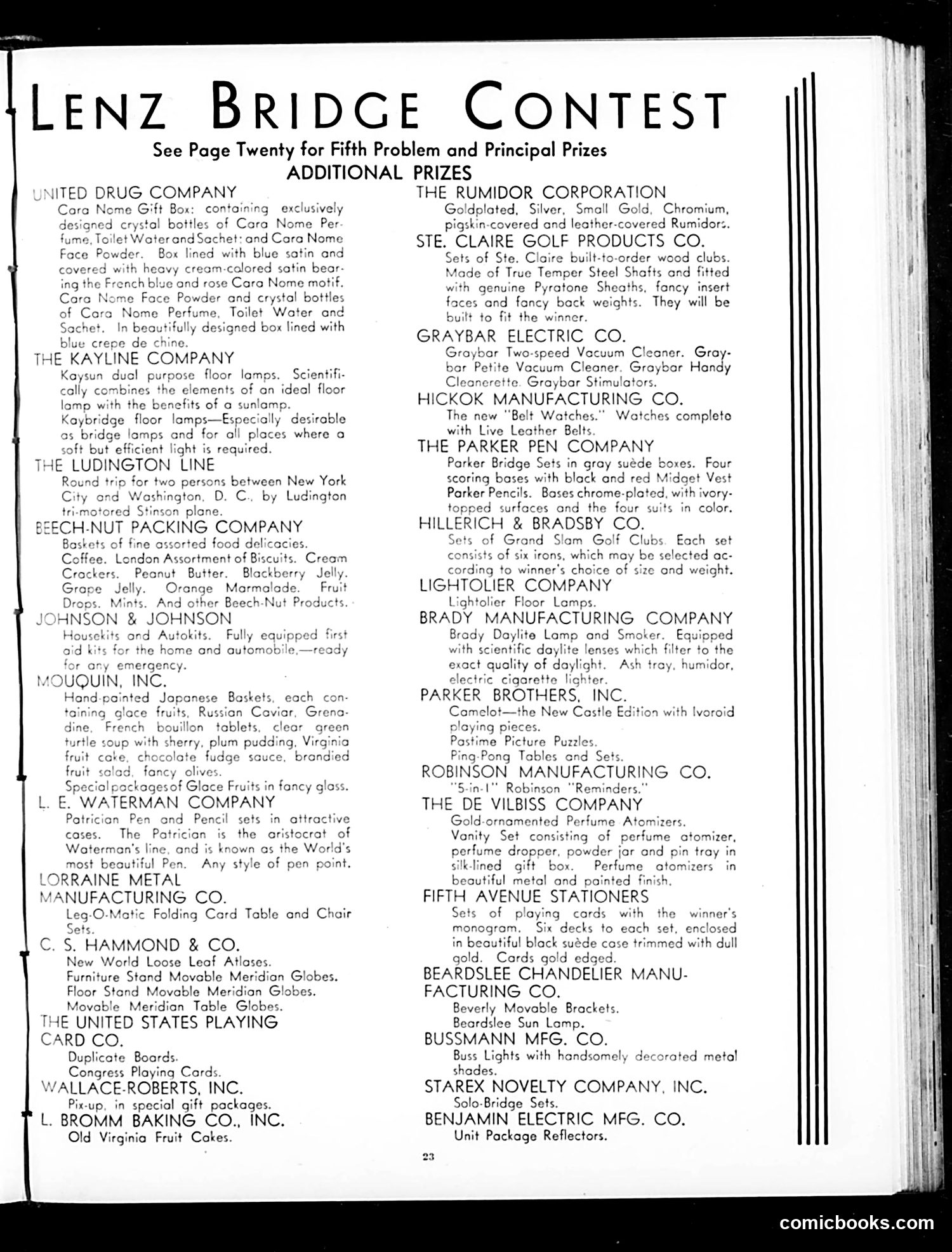
Lenz Bridge Contest Additional Prizes Page This page is primarily advertising content, not a political cartoon. It lists prizes for a bridge-playing contest sponsored by *Judge* magazine (see reference to "Page Twenty for Fifth Problem and Principal Prizes"). The page showcases luxury consumer goods from the 1920s-30s era: high-end pens, golf clubs, vacuum cleaners, perfume atomizers, playing cards, and home furnishings from companies like Parker Pen, L.E. Waterman, and Graybar Electric. These prizes reflect the aspirational lifestyle of affluent readers—targeting educated, middle-to-upper-class Americans who played bridge and could afford luxury goods. The contest itself appears to have been a popular feature in *Judge*, using a mental puzzle (bridge) to engage readers while showcasing commercial products. No political satire is evident on this particular page.
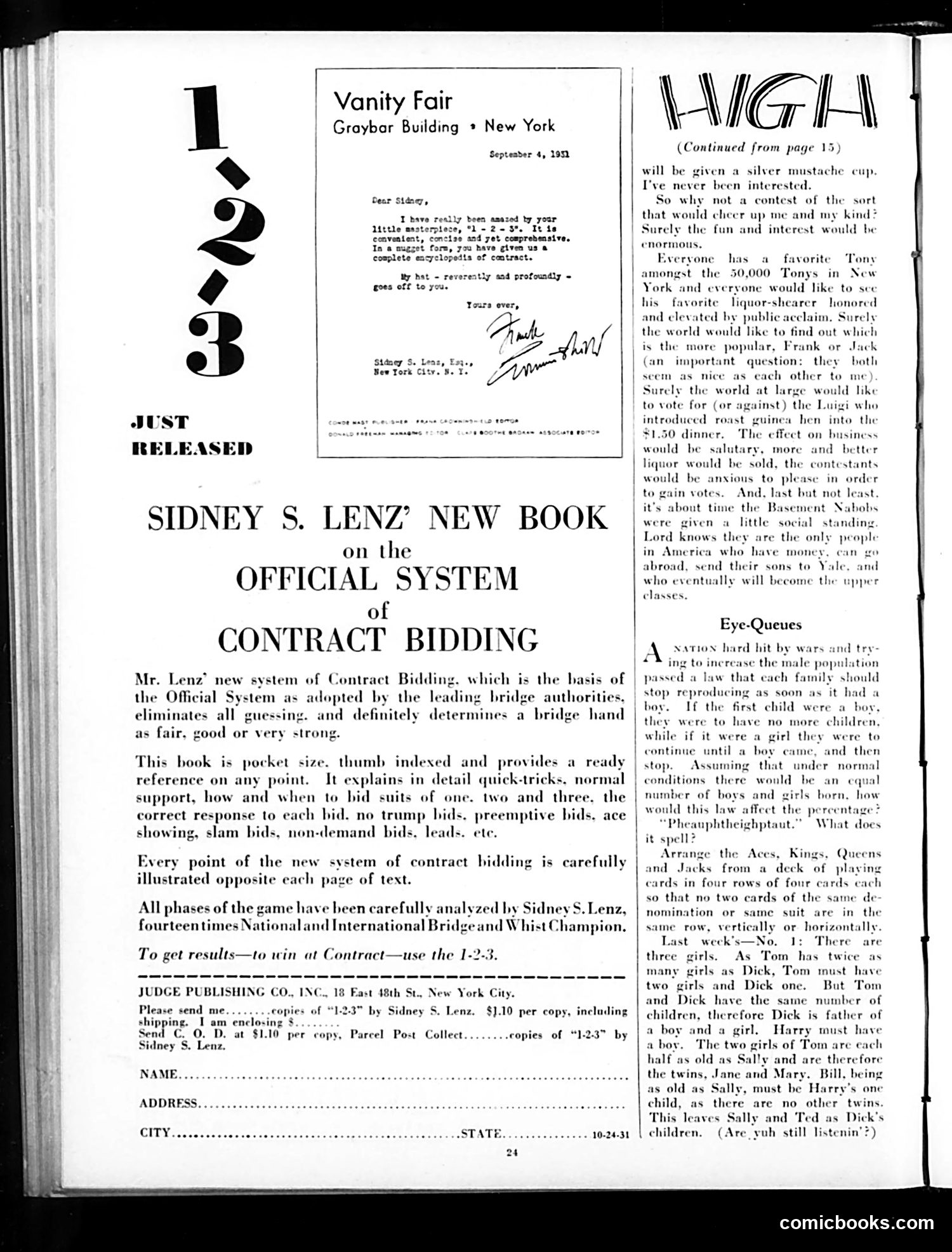
Explanation for Modern Readers This page contains two distinct elements: a book advertisement and puzzle/humor content. The Book Advertisement promotes Sidney S. Lenz's guide to contract bridge bidding—a card game strategy manual. The letter from "Vanity Fair" magazine endorses it as a comprehensive reference. This reflects bridge's popularity in the 1920s-30s as an intellectual parlor game among educated audiences. The Right-Side Content includes social commentary and word puzzles. "Eye-Queues" appears to be a humorous puzzle column. One puzzle references a fictional nation's population law (likely satirizing real eugenics policies of the era), asking readers to calculate demographic effects. Another puzzle involves card arrangement logic. The tone is typical of Judge magazine's mix of light satire and entertainment for educated readers, blending practical instruction with intellectual games. The reference to "Basement Nabobs" suggests humor about wealthy but socially unstable elites—a recurring Judge theme mocking nouveau riche pretension.
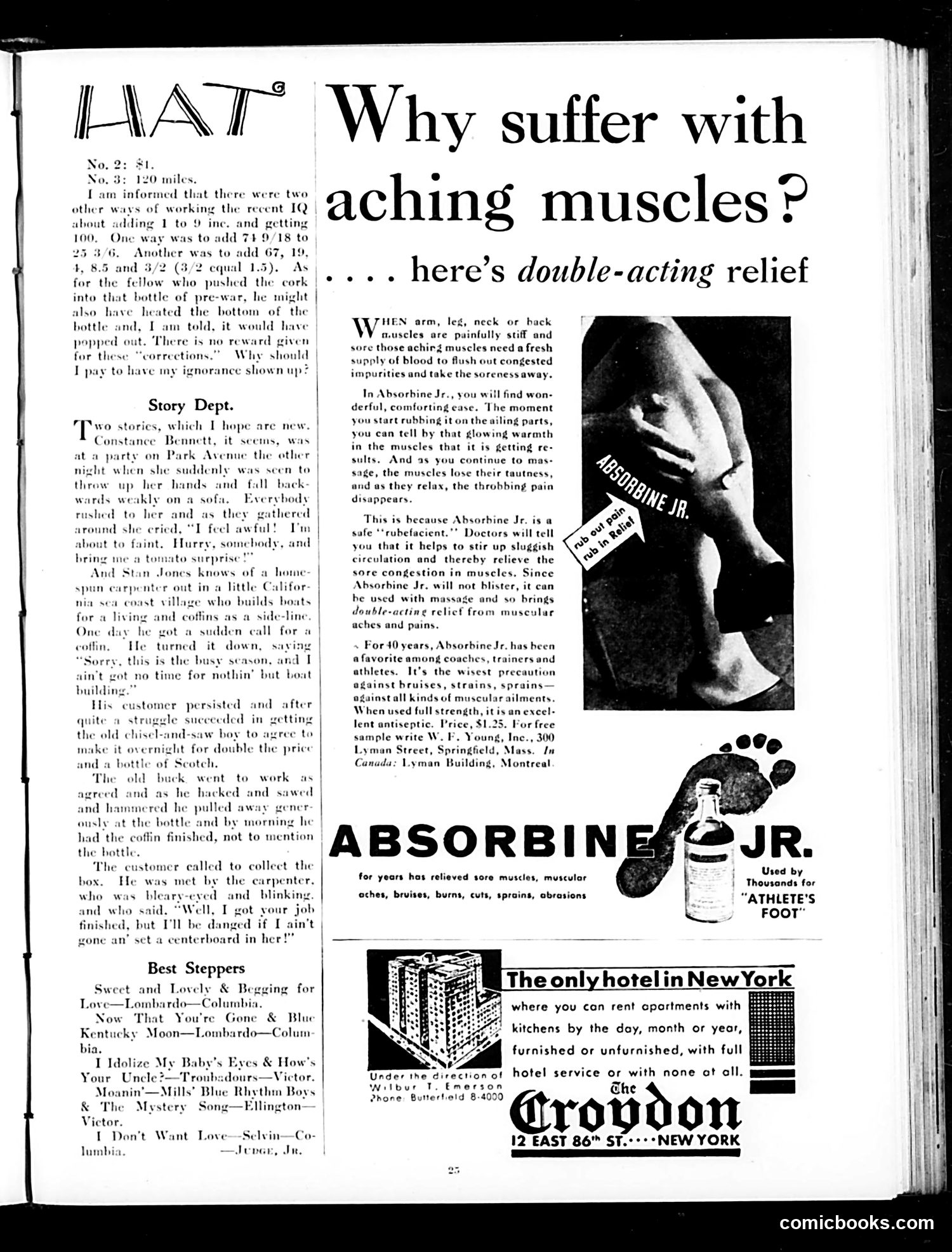
Analysis for Modern Readers This page is primarily advertising, not political satire. It contains three main elements: 1. "HAT" column (left): Humorous anecdotes and puzzle solutions—miscellaneous light content typical of Judge magazine's filler material. 2. Absorbine Jr. advertisement (center/right): The dominant content. This is a patent medicine ad for a liniment claiming to relieve sore muscles through "rubefacient" (warming) action. The visual shows a muscular arm/leg being rubbed. The ad emphasizes 40 years of use by "coaches, trainers and athletes" and notes it treats bruises, sprains, and notably "Athlete's Foot"—revealing the product's actual broad medicinal claims typical of early 20th-century remedies. 3. Hotel advertisement (bottom right): For the Gordon Hotel in New York, promoting furnished apartments with kitchen access. Historical context: This reflects an era when unregulated patent medicines made expansive health claims. The Absorbine ad's reference to "double-acting relief" and its quasi-medical language (mentioning doctors and "rubefacient") represents marketing practices that would later face FDA scrutiny.
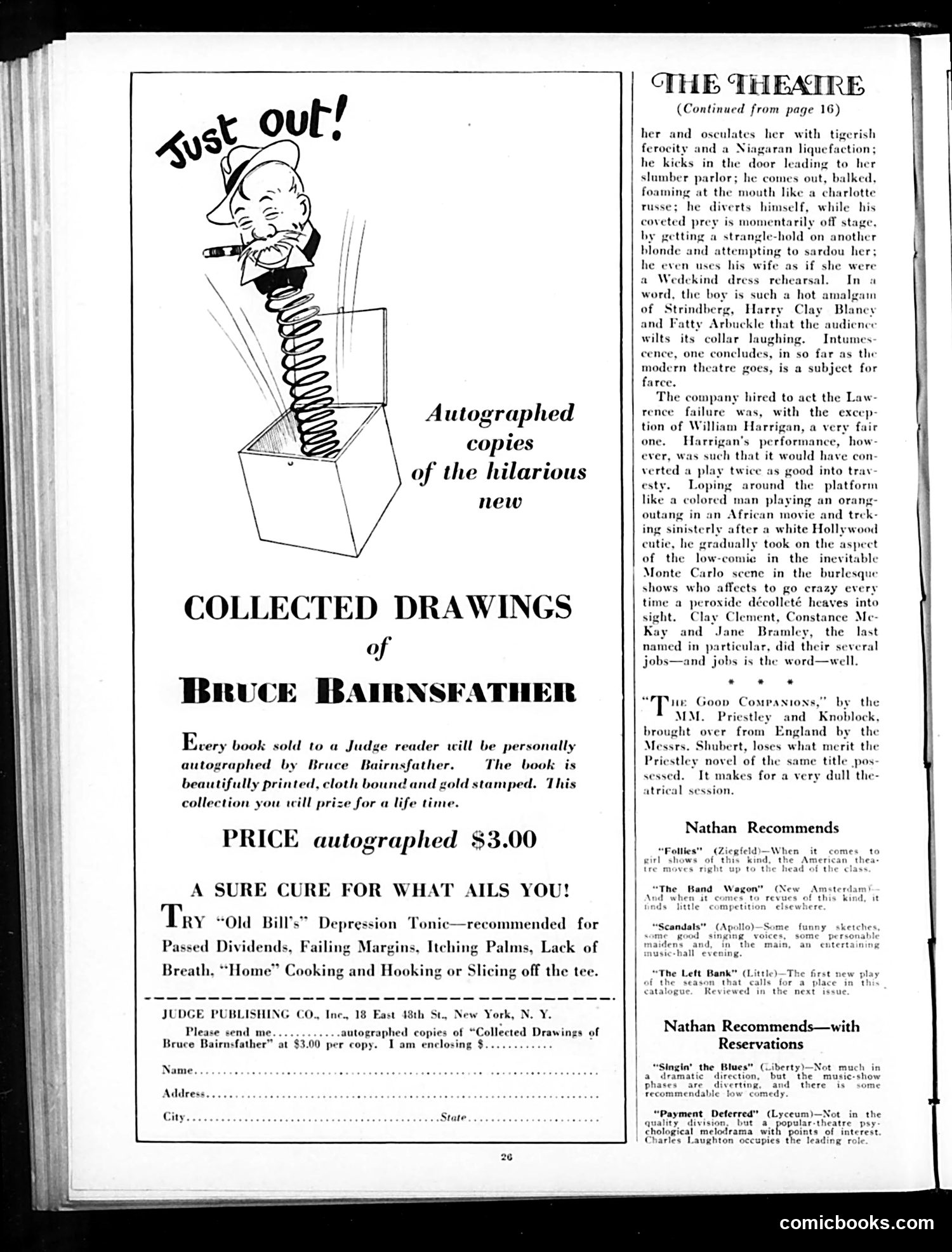
"Old Bill's Depression Tonic" Advertisement This page is primarily advertising for Bruce Bairnsfather's collected cartoon drawings, priced at $3.00 autographed. The satire is straightforward: the ad markets the book as a cure for economic hardship ("Depression Tonic") during what appears to be the 1920s economic downturn, joking that Bairnsfather's humor will remedy "Passed Dividends, Failing Margins, Itching Palms, Lack of Breath" and domestic/leisure troubles. "Old Bill" was Bairnsfather's famous cartoon character—a gruff British soldier known from WWI-era satire. The spring-loaded caricature on the left depicts this character bursting forth with comedic energy. The right column contains theatre reviews unrelated to the cartoon advertising. The page demonstrates how Judge magazine combined humor, advertising, and arts criticism.
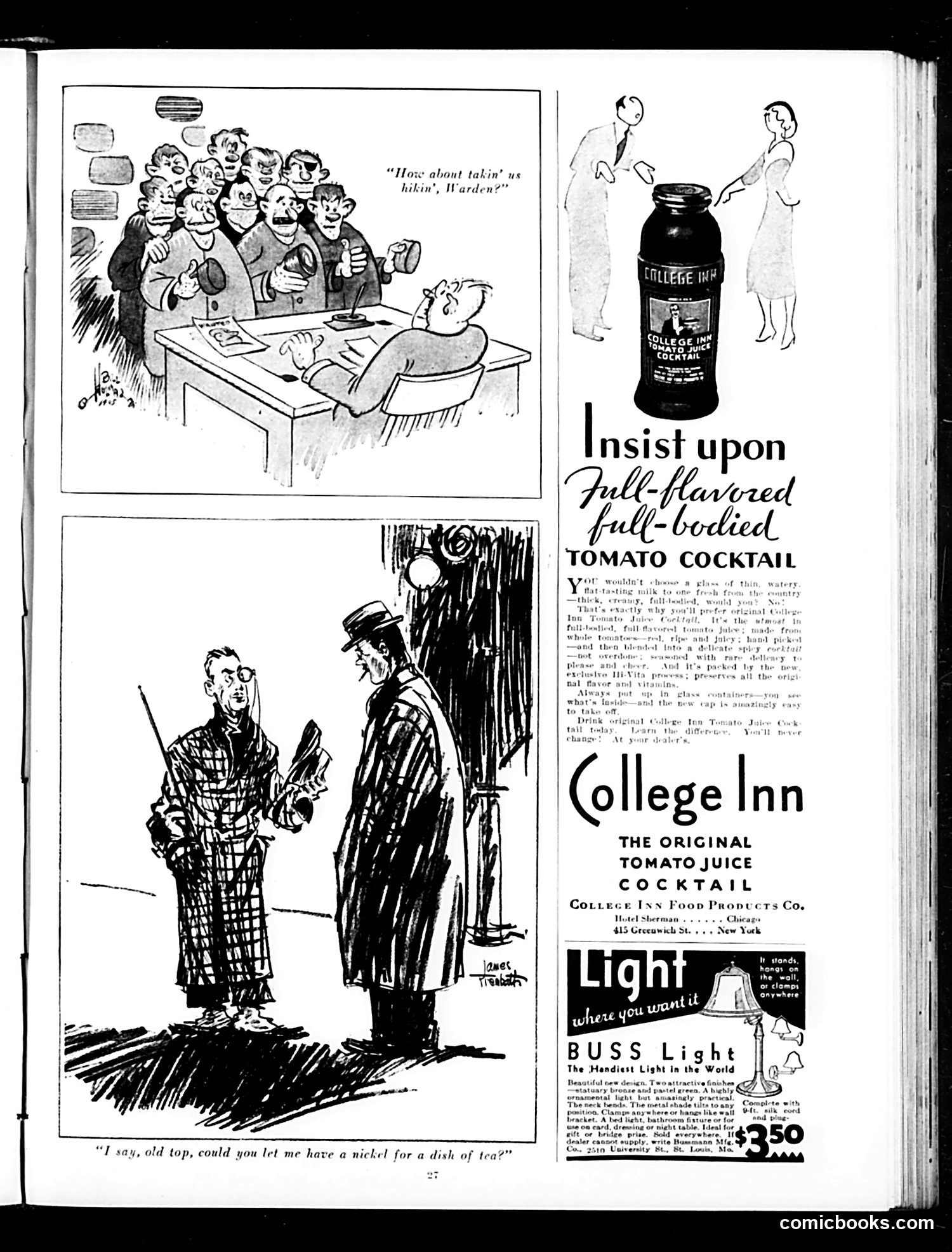
Analysis of Judge Magazine Page This page contains two editorial cartoons and advertisements. Top cartoon: A group of men crowd around a warden's desk, asking "How about takin' us hikin', Warden?" The satire targets prison inmates seeking leisure activities—mocking either their audacity in making demands or contemporary debates about prison conditions and rehabilitation. Bottom cartoon: A shabby man asks a well-dressed figure, "I say, old top, could you let me have a nickel for a dish of tea?" This depicts vagrancy or homelessness, satirizing either the panhandler's affected speech or the social problem of destitution. Both cartoons use humor to comment on contemporary social problems: incarceration and poverty. The page also contains advertisements for College Inn tomato cocktail and Buss Light, indicating this is from an era before modern consumer awareness—ads ran freely alongside editorial content.
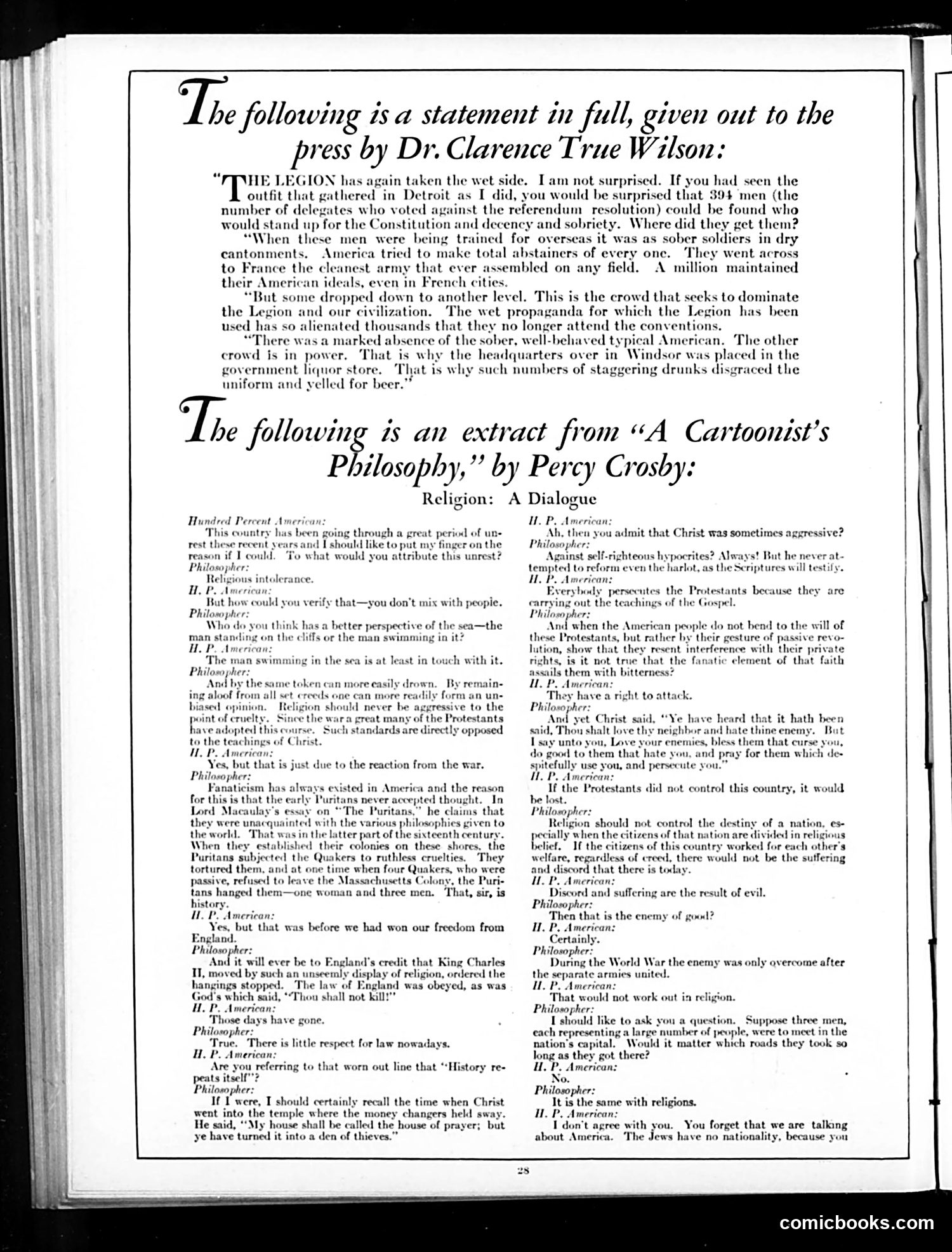
Analysis of Judge Magazine Page This page contains two separate pieces critiquing American religious and civic institutions in the post-WWI era. Dr. Clarence True Wilson's Statement attacks the American Legion for supporting alcohol legalization ("the wet side"). Wilson argues that during military training, soldiers were kept sober, but after the war, some Legion members adopted dissolute behavior. He claims "wet propaganda" has alienated decent members and that drunkenness now disgraces the organization. This references the Prohibition debate of the 1920s—Wilson supported temperance while opposing forces in the Legion favored repealing dry laws. Percy Crosby's "Cartoonist's Philosophy" is a dialogue between "Hundred Percent American" (H.P. American) and a Philosopher debating religious tolerance. The Philosopher argues that Protestant intolerance historically (citing Puritan persecution of Quakers) mirrors modern religious persecution. H.P. American defends America's progress, while the Philosopher warns that intolerance persists. The dialogue satirizes Americans who claim moral superiority while ignoring historical religious hypocrisy and contemporary intolerance. Both pieces reflect 1920s anxieties about morality, religious authority, and national character.
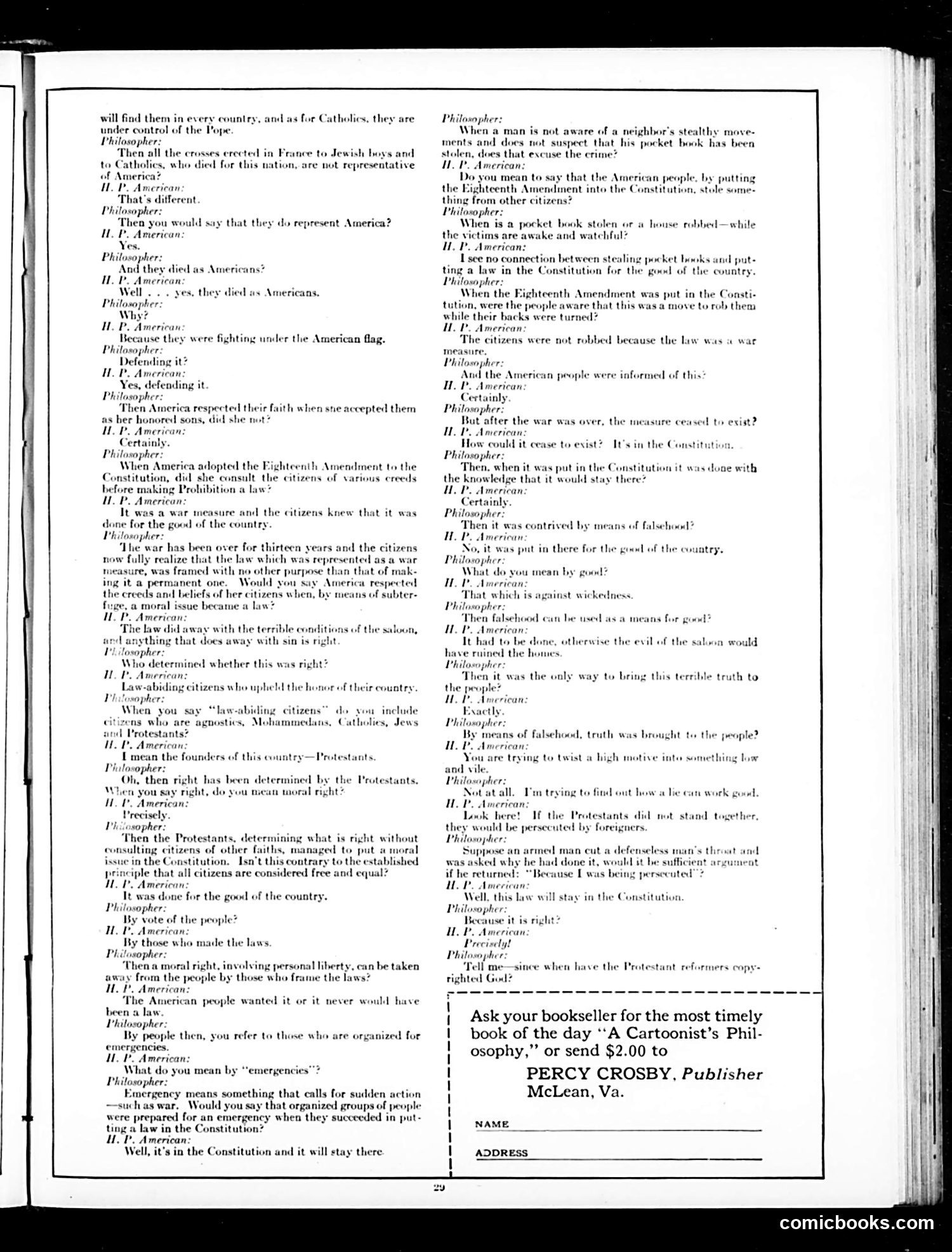
Analysis for Modern Readers This page presents a Socratic dialogue between a "Philosopher" and an "H.P. American" debating Prohibition (the 18th Amendment). The Satire's Point The Philosopher uses logical questioning to expose contradictions in the American's defense of Prohibition: - The American claims the law represents "the people," yet only Protestant founders determined it - He admits it was sold as a temporary "war measure" but is now permanent - The Philosopher highlights the hypocrisy: citizens weren't consulted, their religious freedoms were overridden, and the government essentially "robbed" them while their backs were turned Historical Context This attacks Prohibition (1920-1933), which many saw as Protestant moral imposition on Catholic, Jewish, and immigrant communities. The satire questions whether a law imposed by one religious group without genuine popular consent truly represents American democracy or freedom. The cartoon mocks the "emergency powers" argument used to justify this constitutional amendment as temporary wartime legislation that became permanent.
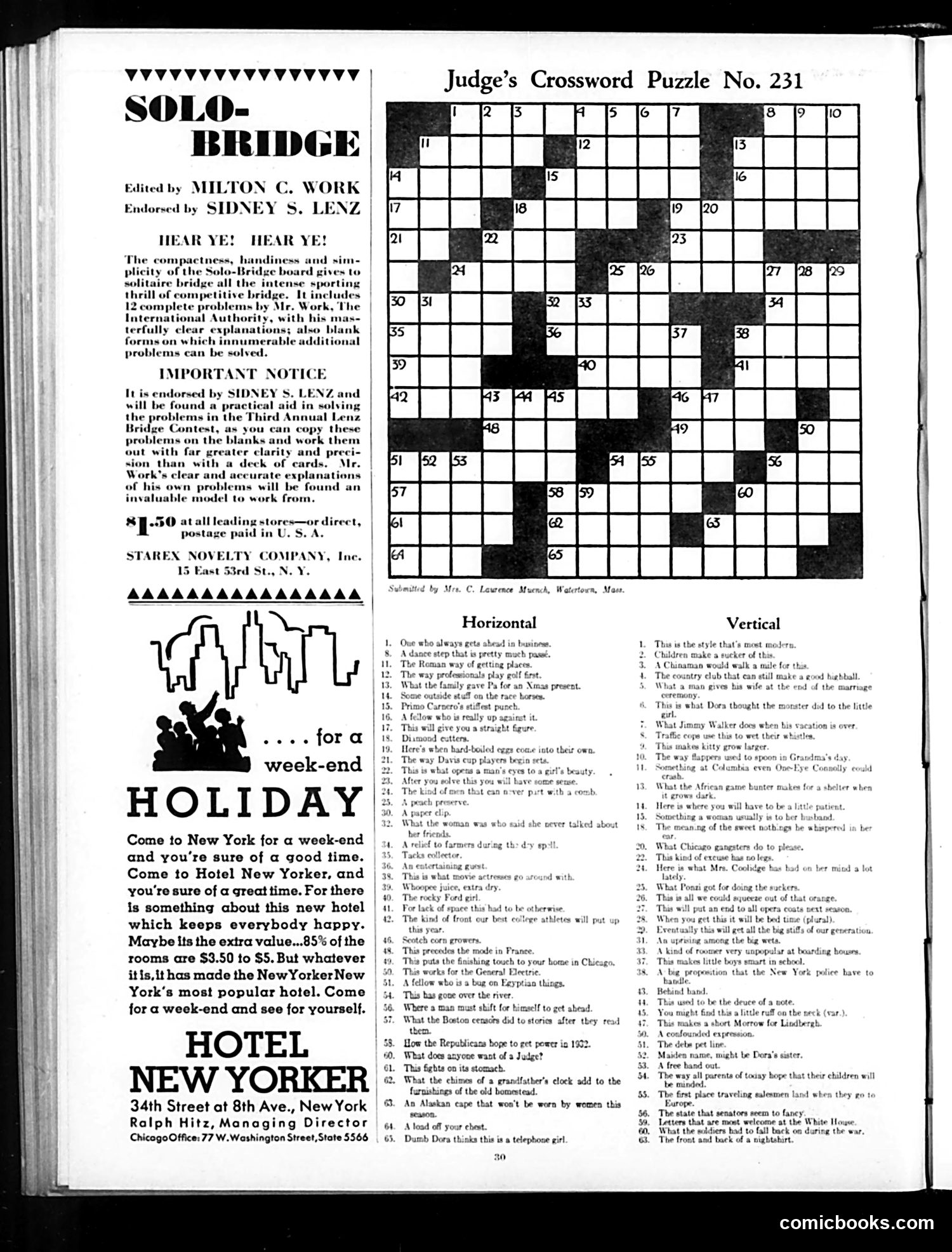
Judge Magazine Crossword Puzzle No. 231 This page is primarily advertising and puzzle content, not political satire. The main feature is a Solo-Bridge crossword puzzle endorsed by bridge authorities Milton C. Work and Sidney S. Lenz—reflecting bridge's popularity as an elite parlor game in the 1920s-30s. The dominant advertisement promotes the Hotel New Yorker on 34th Street, emphasizing affordability ($3.50-$5 rooms) and luxury as a "week-end holiday" destination. This suggests Depression-era marketing to middle-class urbanites seeking accessible leisure. The crossword clues themselves contain period humor: references to "Dumb Dora" (a popular comic character), Boston censors, Republican politics (1920s), and social conventions (spooning, traveling salesmen). These reflect contemporary popular culture and attitudes rather than hard-hitting satire. The page demonstrates Judge's shift toward lifestyle content and advertising rather than sharp political commentary.
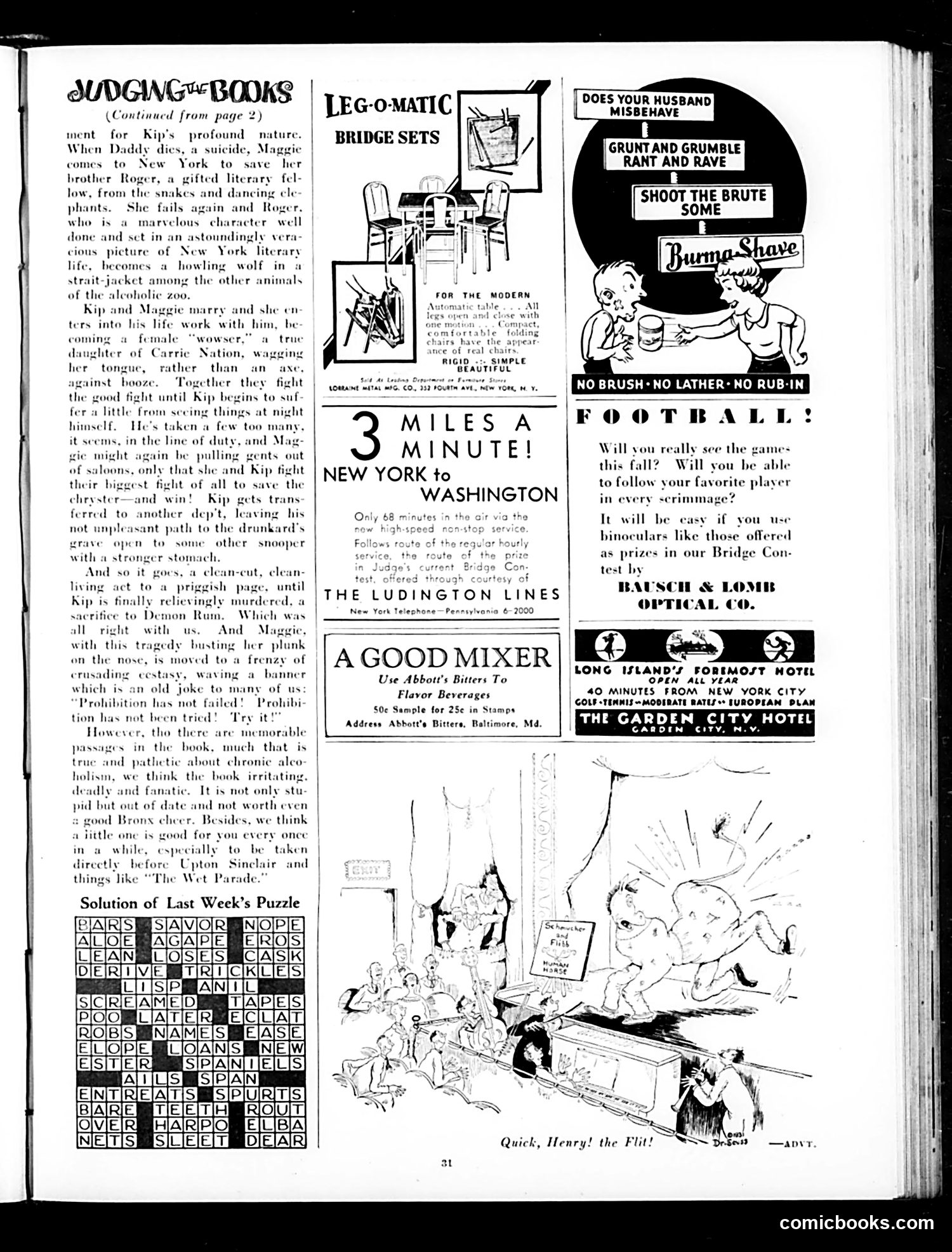
Analysis of Judge Magazine Page This page is primarily advertising and book review, not political satire. The book review critiques a novel about Prohibition-era moralism. The reviewer mocks a preachy story where a character named Kip fights alcoholism and his wife becomes a crusading "wowser" (temperance zealot) after his death. The reviewer finds the book "irritating, deadly and fanatic"—outdated moralizing that's "not worth even a good Bronx cheer." The satire is anti-Prohibition. The phrase "Prohibition has not failed! Try it!" is sarcastic mockery of temperance advocates' failed claims. The reviewer suggests such preachy literature is as tedious as Upton Sinclair's social novels. The surrounding advertisements are period-typical: bridge sets, Abbott's Bitters (an alcohol mixer), a shaving product, and hotels—nothing satirical. The cartoon at bottom ("Quick, Henry! the Flit!") is unrelated domestic humor, appearing to be standard comic filler.
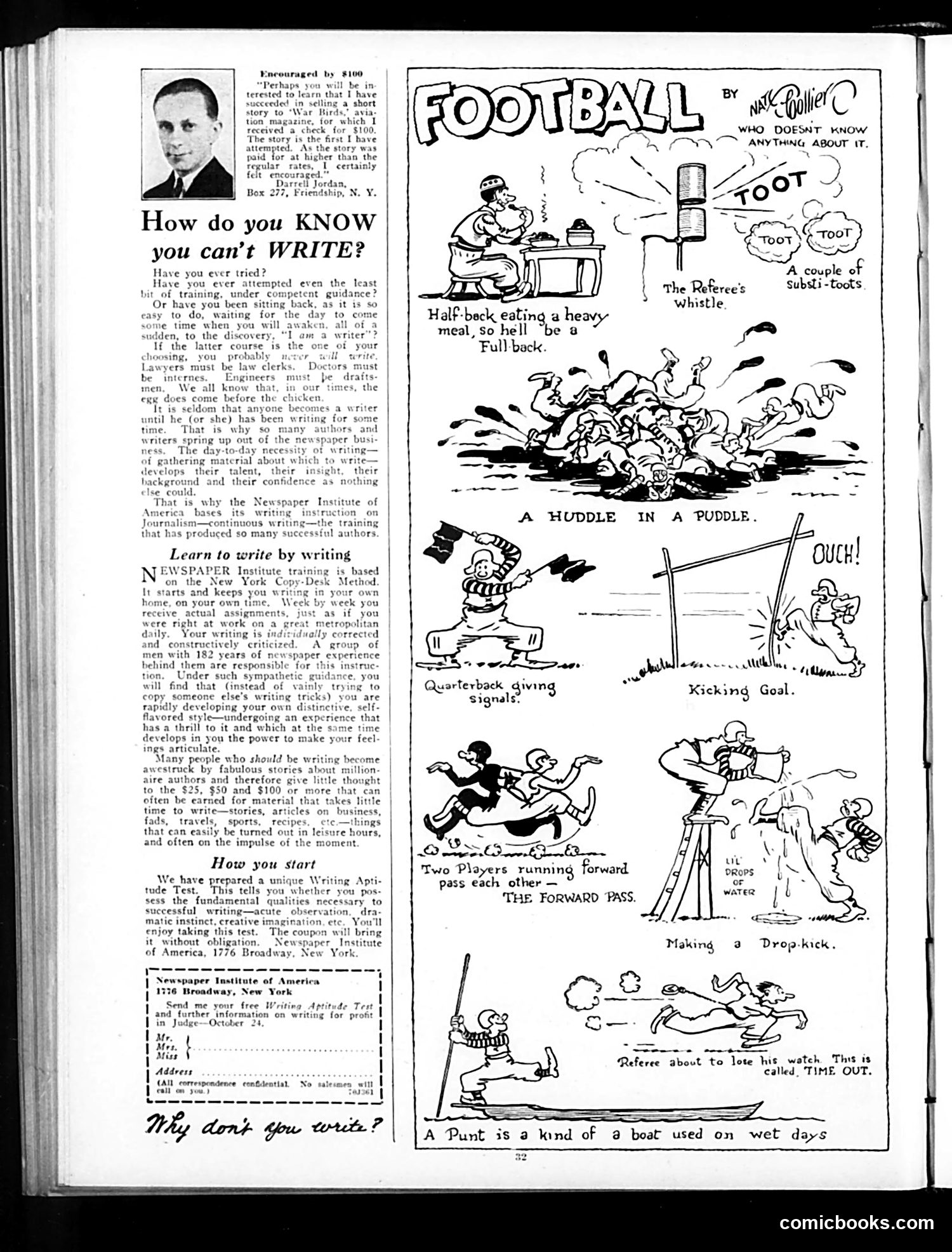
Analysis of This Judge Magazine Page This page combines two unrelated content streams typical of early 20th-century magazines: Left side: An advertisement for the Newspaper Institute of America's writing courses. It encourages would-be writers by citing a success story (Darrell Jordan earning $100 for an aviation story) and argues that anyone can learn to write through their correspondence program. The pitch emphasizes that professional writers received training and that writing ability develops through practice—not innate talent. Right side: A humorous instructional cartoon titled "Football for Those Who Don't Know Anything About It," credited to an artist (signature unclear). It's a satirical guide to football terminology using crude comic drawings: "subsli-toots" (substitute foots?), the referee's whistle, a "huddle in a puddle," the forward pass, drop kicks, and time-outs. The jokes mock both football's complexity and the reader's presumed ignorance of the sport. The page essentially markets writing instruction while simultaneously poking fun at specialized jargon and expertise—an ironic pairing.
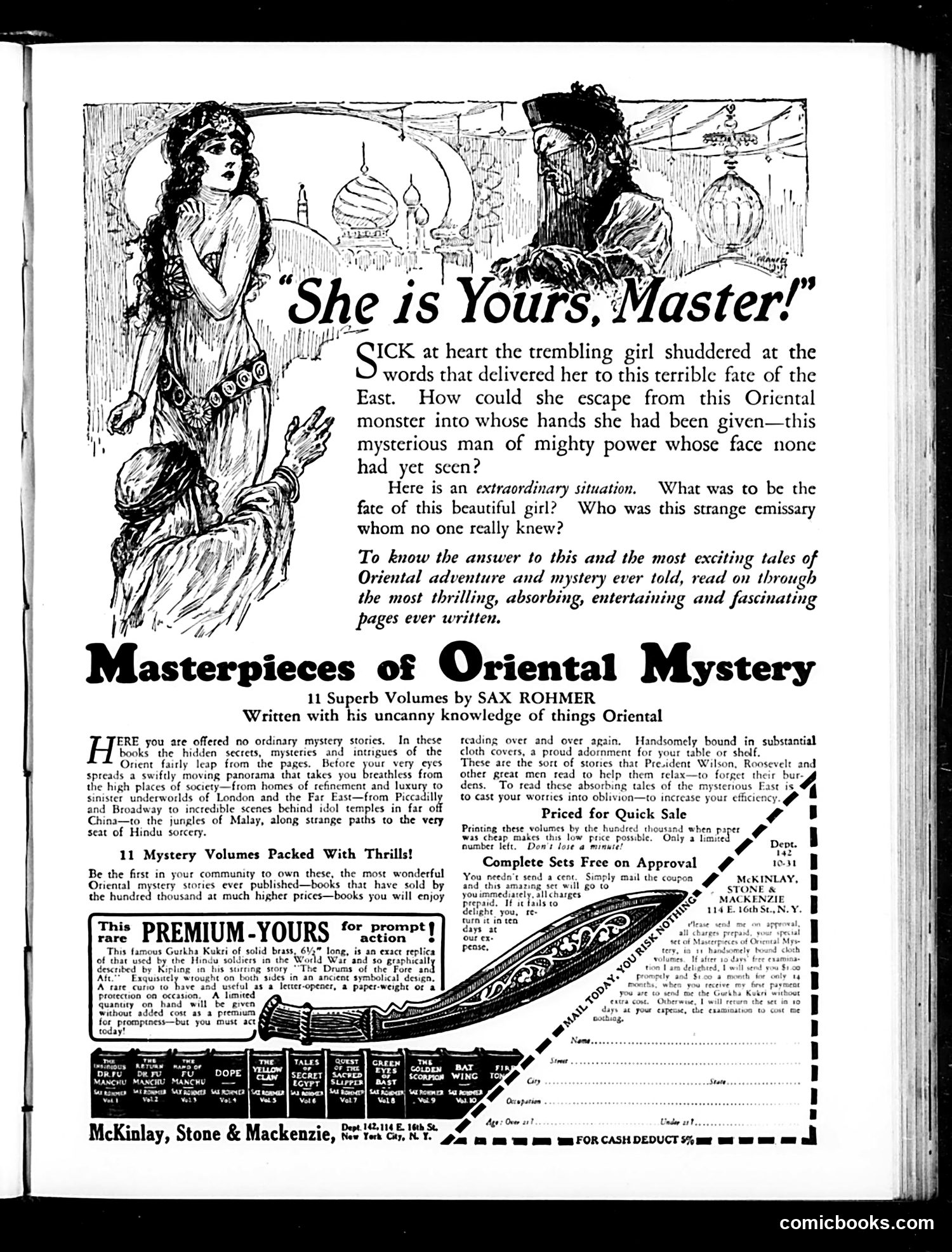
Analysis for Modern Readers This is a book advertisement, not a political cartoon. It promotes Sax Rohmer's "Masterpieces of Oriental Mystery"—an 11-volume series featuring tales of the East. The imagery reflects early 20th-century "Yellow Peril" anxieties: a trembling Western woman delivered to a mysterious, powerful Oriental man whose face remains hidden. This capitalized on widespread fears about Eastern influence and exoticism popular in Western entertainment. The ad emphasizes exotic adventure—from London underworlds to Hindu temples and Malayan jungles—appealing to readers' fascination with mysterious, dangerous non-Western cultures. The premium offer (a replica Gurkha Kukri knife) reinforced this orientalist appeal. Key context: Rohmer's Fu Manchu series embodied stereotypical "Oriental villain" tropes common in period fiction. The ad's language ("terrible fate of the East," "Oriental monster") and imagery reveal how such entertainment packaged racial anxieties as thrilling mystery.
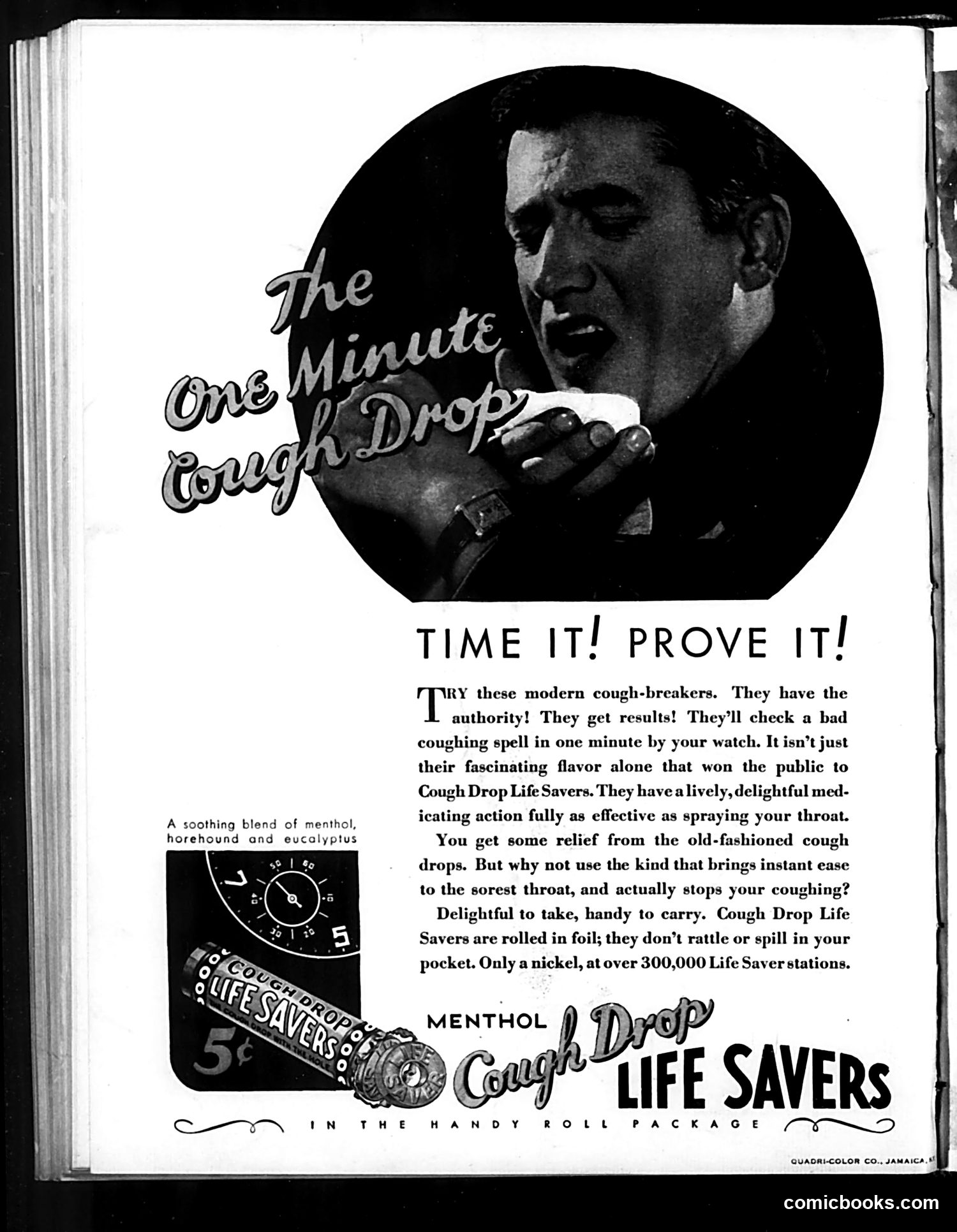
This is a vintage advertisement, not political satire. This appears to be a 1920s-1930s advertisement for Cough Drop Life Savers, not a cartoon or satirical piece. The page features a well-dressed man in formal attire holding the product, with the tagline "Time It! Prove It!" challenging consumers to test the product's one-minute effectiveness claim. The ad emphasizes the product's superiority over traditional cough drops through its "lively, delightful medicating action" containing menthol, horehound, and eucalyptus. It highlights practical benefits: foil packaging prevents rattling or spillage, costs only a nickel, and is available at over 300,000 retail locations. The appeal is straightforwardly commercial—targeting consumers skeptical of remedy claims by inviting them to literally time the product's results. There is no political content or social commentary visible on this page.