judge
Judge — October 31, 1931
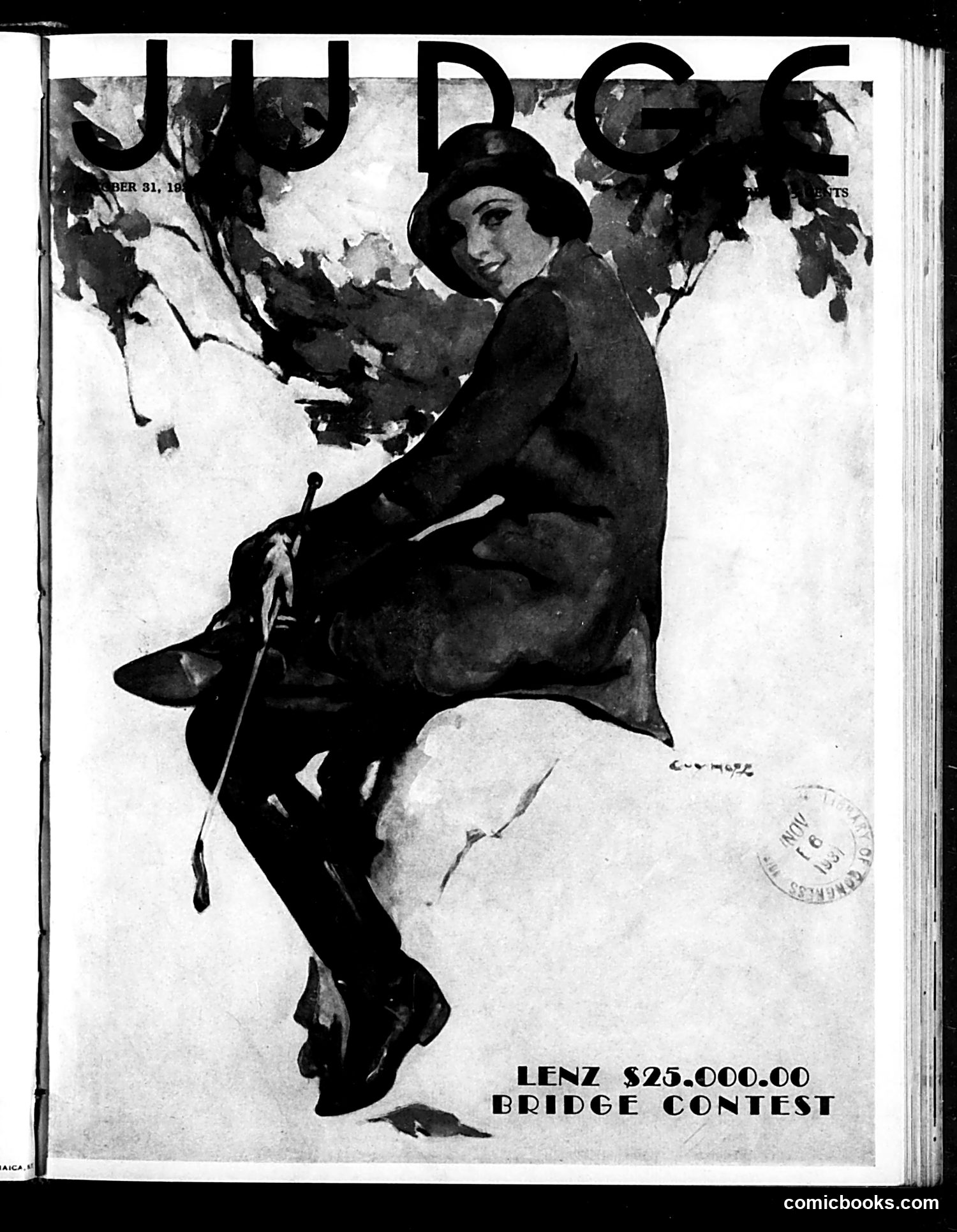
Analysis of Judge Magazine Page This page appears to be primarily advertising rather than political satire. The main content promotes a "Lenz $25,000.00 Bridge Contest" — a competition likely offering substantial prize money for bridge players, the popular card game of that era. The illustration shows a fashionably dressed woman in 1920s-30s attire (cloche hat, elegant coat) in a playful pose with playing cards, clearly designed to attract readers' attention to the contest announcement. The date visible in the header ("DECEMBER 31, 19__") suggests this is a year-end issue, possibly promoting holiday entertainment or New Year's activities. Without additional context about the Lenz organization, the specific historical significance of this contest remains unclear, though such high-prize competitions were notable leisure-time events during this period.
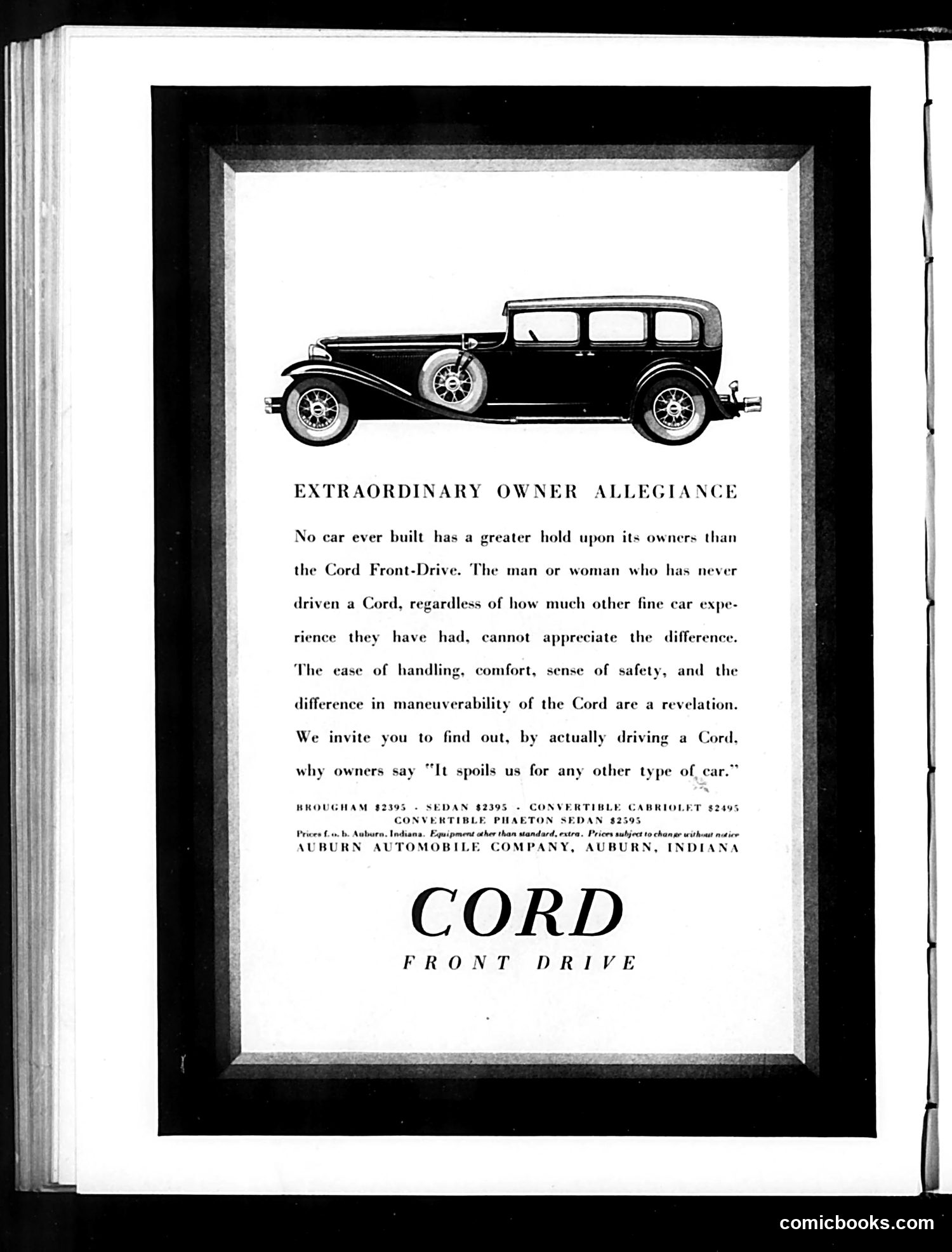
Analysis This page is not a cartoon or satire — it's a straightforward automobile advertisement for the Cord Front-Drive, manufactured by Auburn Automobile Company in Auburn, Indiana. The ad uses persuasive marketing language claiming the Cord has "extraordinary" appeal to owners and superior handling, comfort, and safety compared to other cars. It invites potential buyers to test-drive a vehicle to experience the difference. The illustration shows a sleek, black luxury sedan in profile, typical of 1930s automotive design. This represents Judge magazine's revenue model: selling advertising space to major manufacturers. No satirical commentary or political reference is present — it's purely commercial content.
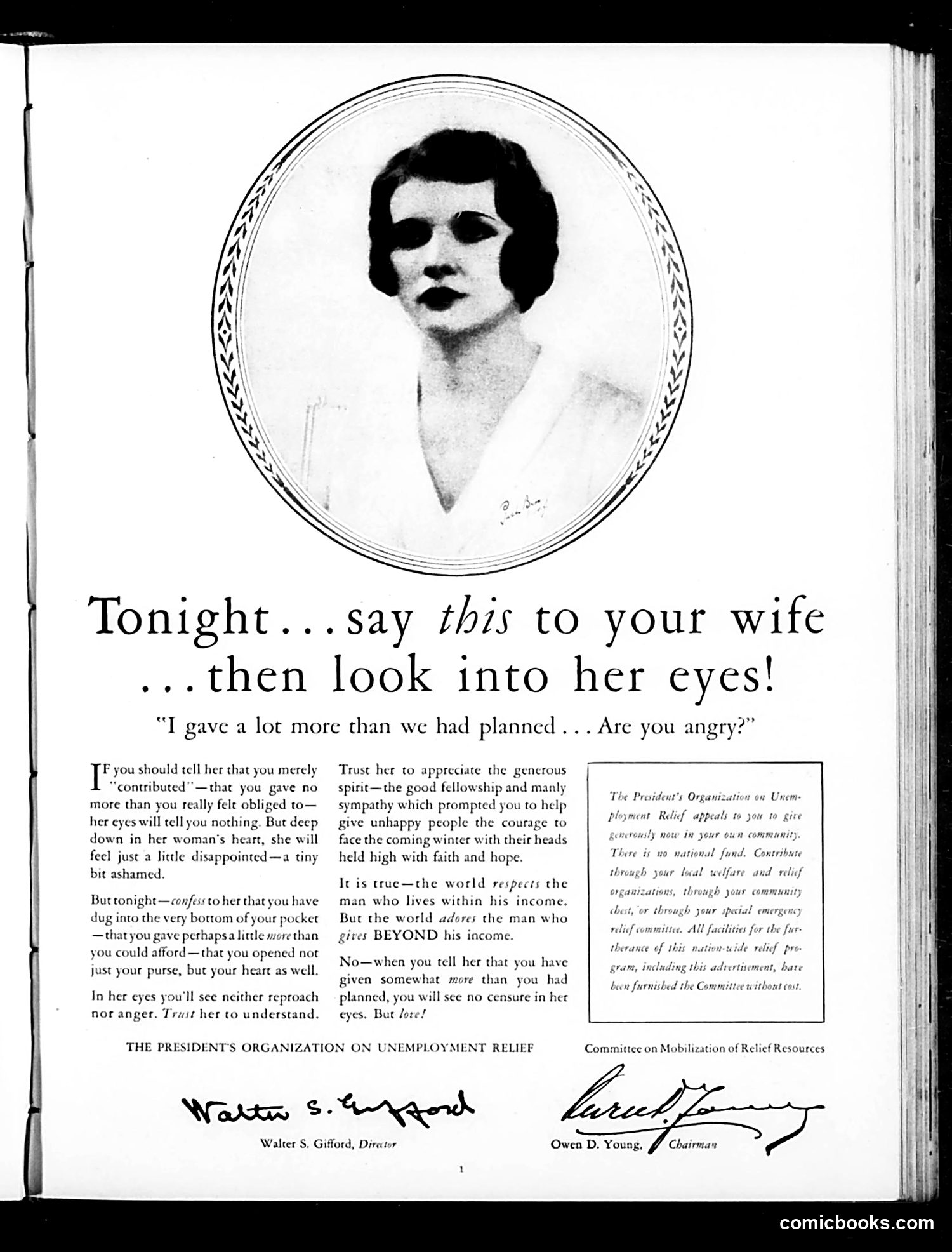
Analysis of This Judge Magazine Page This is a public service advertisement, not satire. It promotes the President's Organization on Unemployment Relief during the Great Depression era. The ad urges men to confess to their wives that they've overspent beyond their means—giving more charity than planned. Rather than anger, the message encourages trust and understanding, appealing to wives' "generous spirit" and "manly sympathy." The underlying message is that voluntary charitable giving (rather than government assistance) should address unemployment relief. The ad asks readers to contribute through local welfare organizations, emphasizing private, community-based solutions. The formal oval portrait and earnest tone reflect Depression-era appeals for personal responsibility and domestic harmony amid economic hardship.
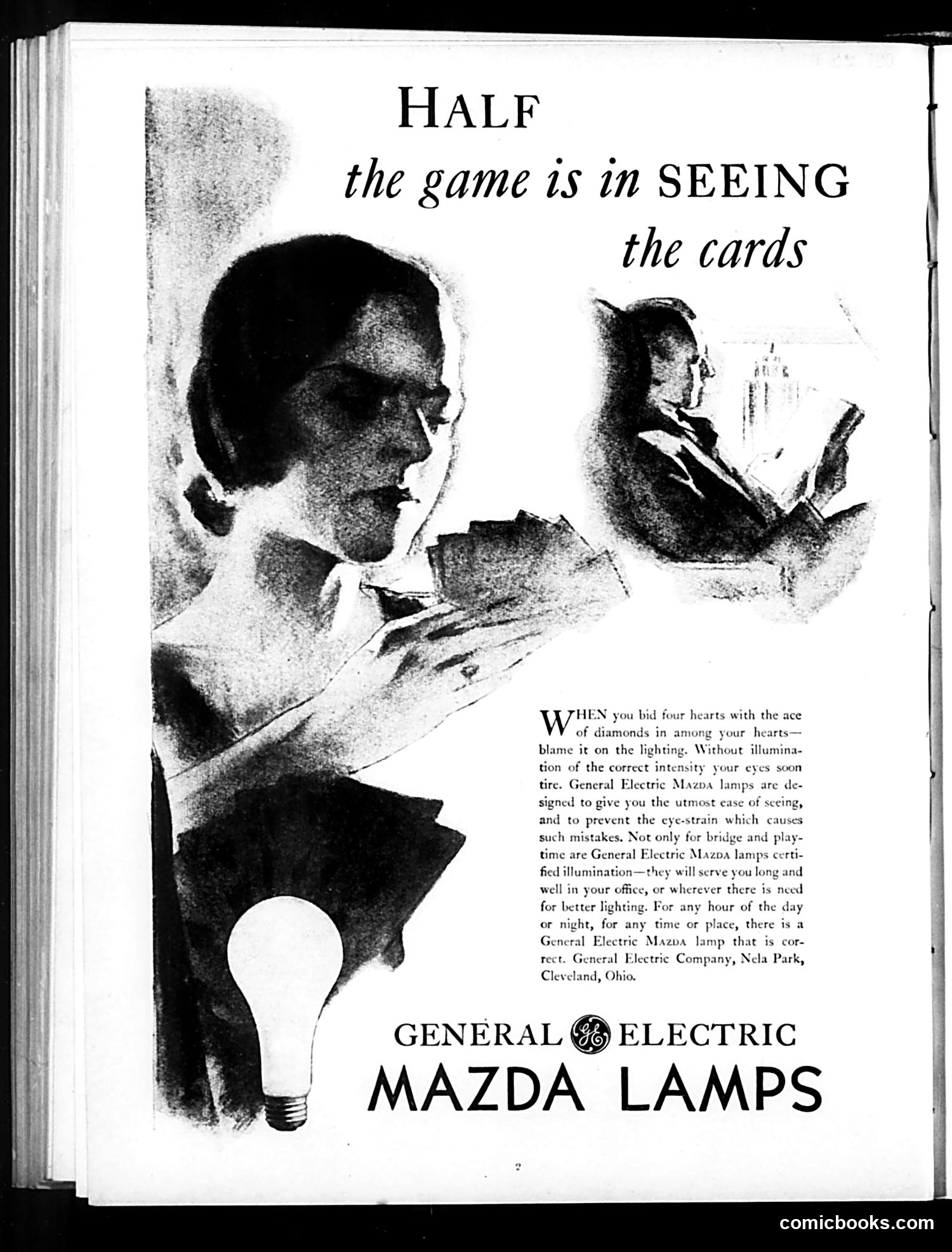
Analysis This page is primarily an advertisement, not political satire. It's a General Electric Mazda Lamps ad from Judge magazine. The illustration shows two figures playing bridge (a popular card game), with the headline "HALF the game is in SEEING the cards." The ad uses this relatable scenario to pitch improved lighting for better visibility during card play and other activities. The body text emphasizes that General Electric Mazda lamps provide "correct intensity" illumination to prevent eye strain—a practical advantage for bridge players and office workers alike. The ad concludes with a company address in Nela Park, Cleveland, Ohio. The "satire" here is gentle and commercial rather than political: the joke is simply that poor lighting ruins card games, and GE has the solution.
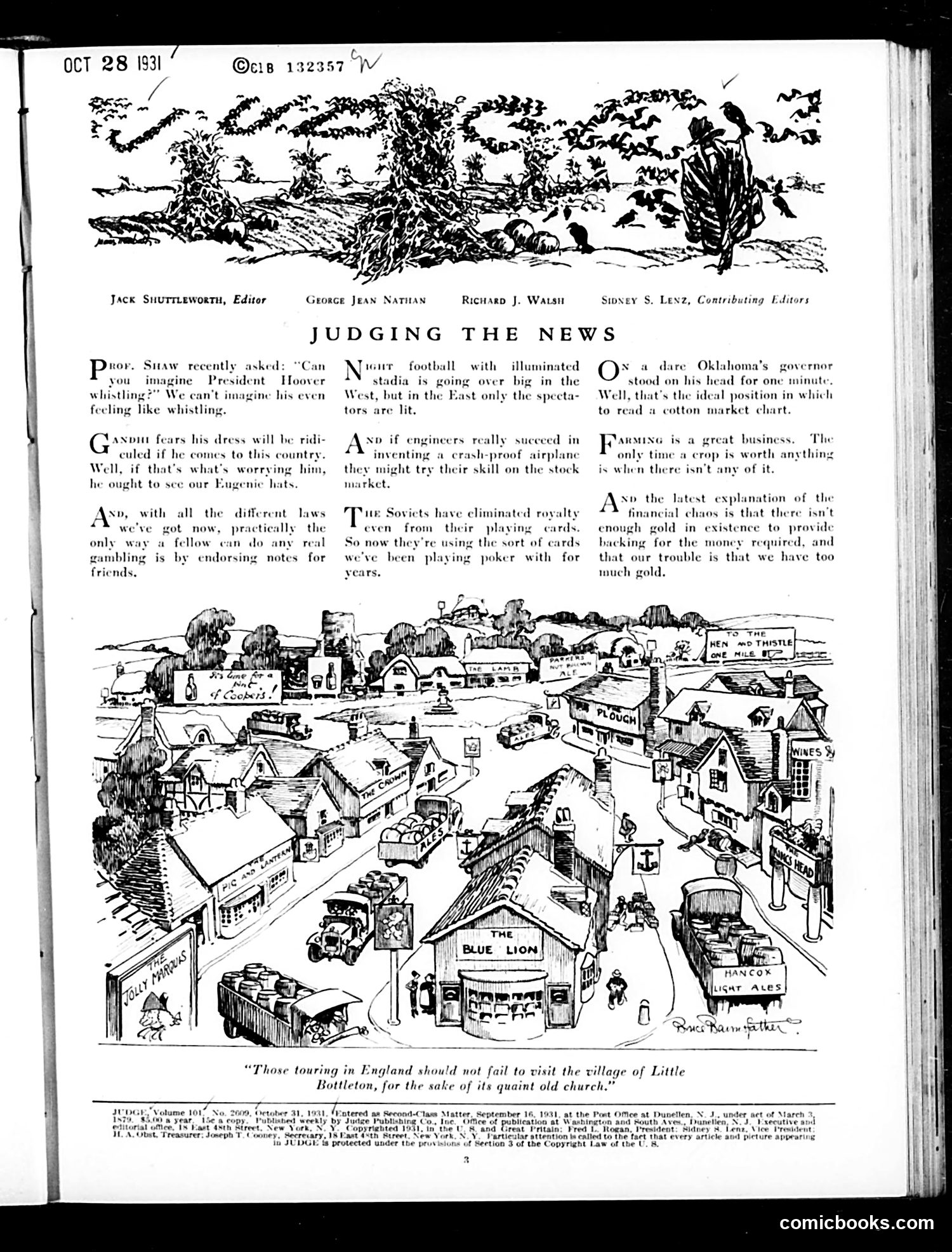
Analysis of "Judging the News" - October 28, 1931 This editorial commentary page features several brief satirical quips about contemporary issues, accompanied by a detailed illustration of an English village ("Little Bottleton"). Key references: - Hoover whistling: References President Herbert Hoover's apparent optimism during the Great Depression - Gandhi's dress: Mocks Indian independence leader Gandhi's traditional attire - Soviet playing cards: Satirizes the USSR eliminating royalty from card decks - Airplane crash-proofing: Jokes about engineers' confidence in aviation safety - Financial chaos commentary: Critiques the Depression-era economic crisis, suggesting America has "too much gold" The village illustration appears promotional rather than satirical, likely advertising English tourism or cultural content. The overall tone reflects Judge magazine's characteristic blend of political mockery and social commentary during the Depression era.
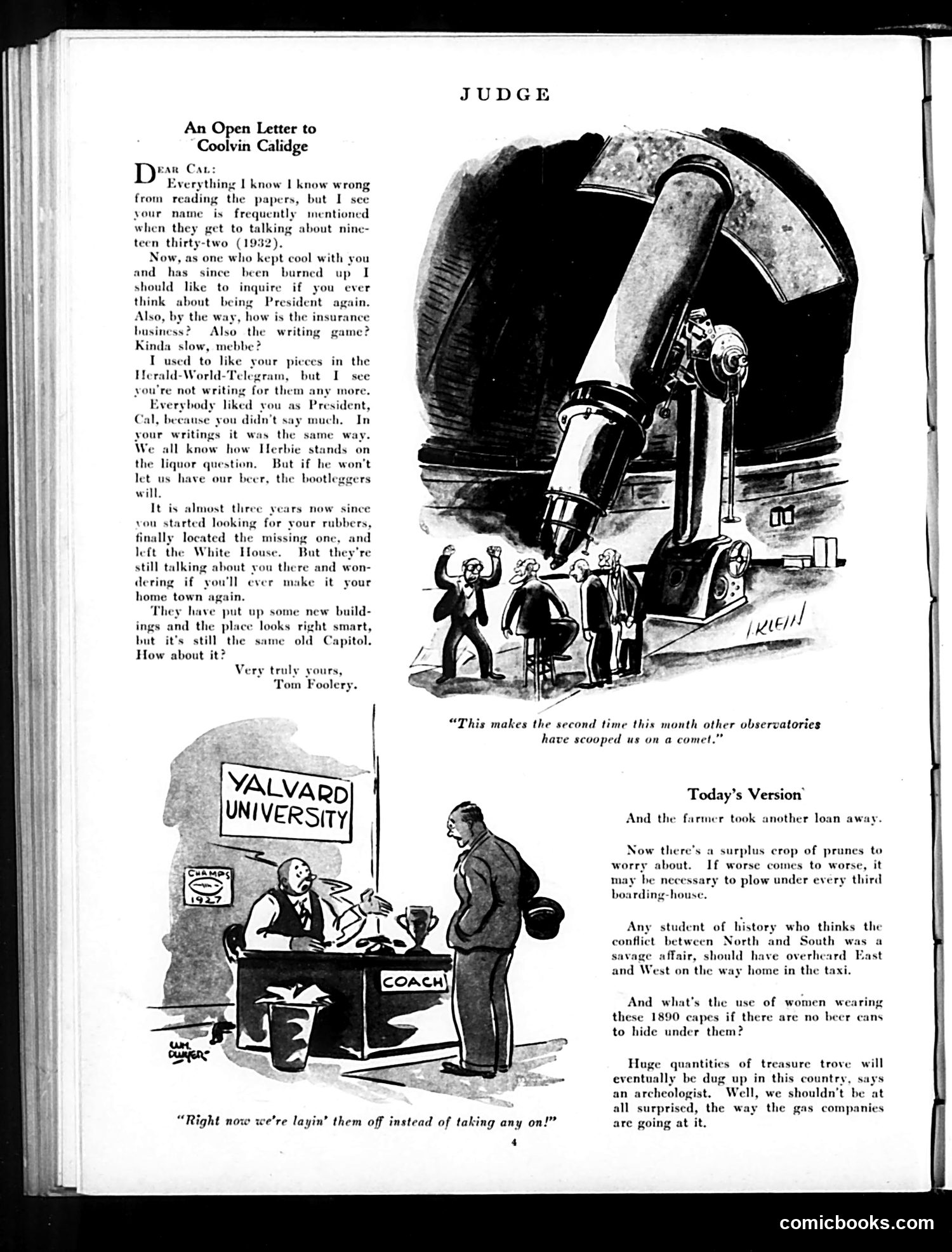
Analysis of Judge Magazine Page This page contains two satirical cartoons and commentary mocking Coolidge-era politics and social issues. The top cartoon depicts an observatory with officials, captioned about being "scooped on a comet"—likely referencing contemporary scientific competition or institutional embarrassment. The bottom cartoon shows a Valvard University coach discussing loans rather than athletics, with the caption about "layin' them off instead of taking any on"—satirizing how educational institutions managed finances during economic uncertainty. The "Open Letter to Coolvin Calidge" (Calvin Coolidge, president 1923-1929) jokes about his quiet public persona, his failed 1932 presidential aspirations, and Prohibition's effects. The humor targets Coolidge's taciturn nature, the persistence of bootlegging despite the alcohol ban, and general post-Prohibition era anxieties about social change and surplus agricultural products.
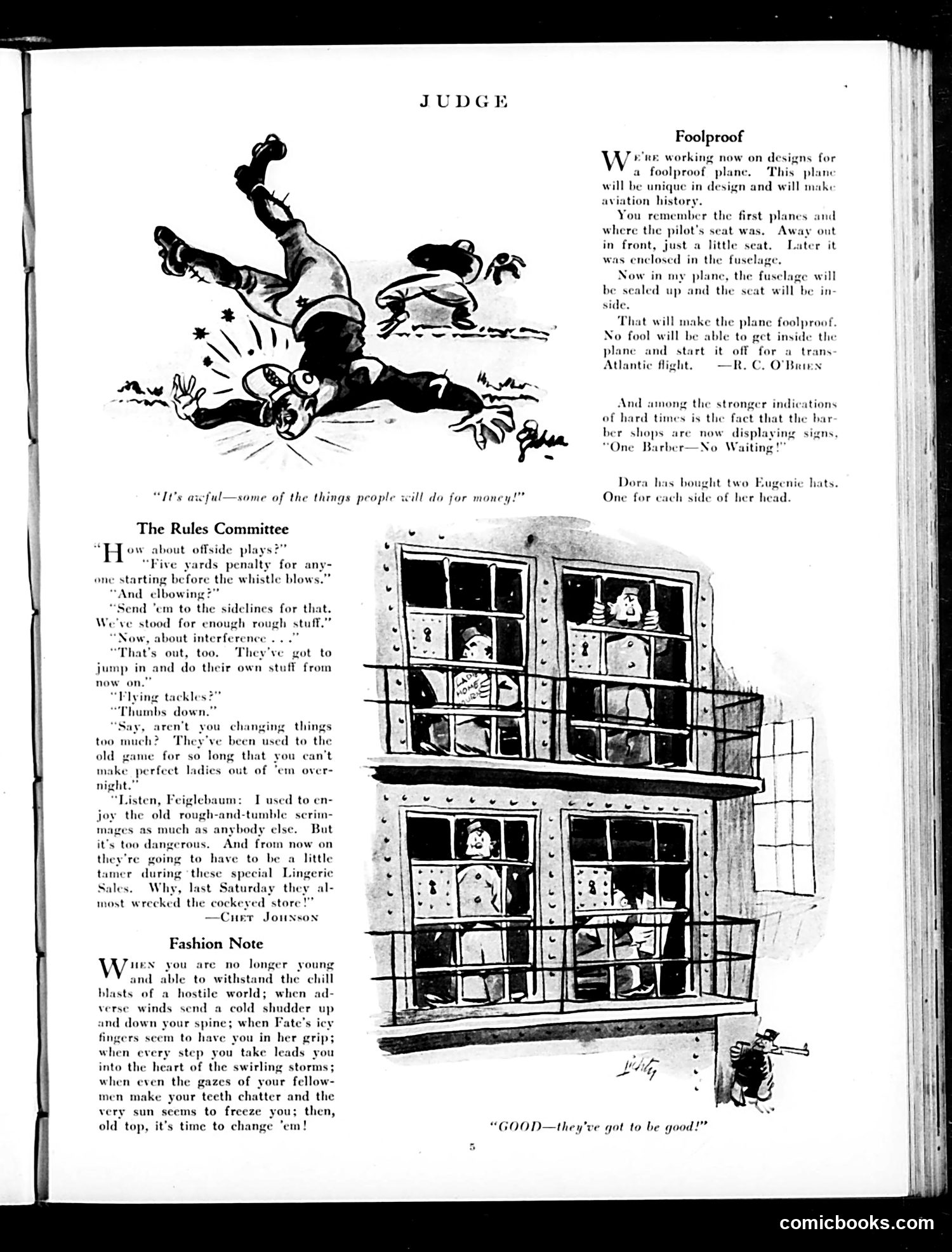
Analysis of Judge Magazine Page This page contains three distinct pieces: 1. "It's awful—some of the things people will do for money!" - A political cartoon depicting people being thrown about violently, likely satirizing dangerous or undignified acts performed for financial gain during hard economic times. 2. "The Rules Committee" - A dialogue satirizing baseball rule changes, with characters debating penalties and modifications to the game. The satire appears to critique how sports governing bodies constantly alter rules, making the game difficult to follow. 3. "Fashion Note" - A humorous essay about winter clothing, advising readers to change their wardrobes when cold weather arrives—presenting practical advice in comedic, exaggerated language about harsh winter conditions. 4. Building illustration - Shows a multi-story apartment building with residents visible in windows, captioned "GOOD—they've got to be good!" The meaning remains unclear without additional context.
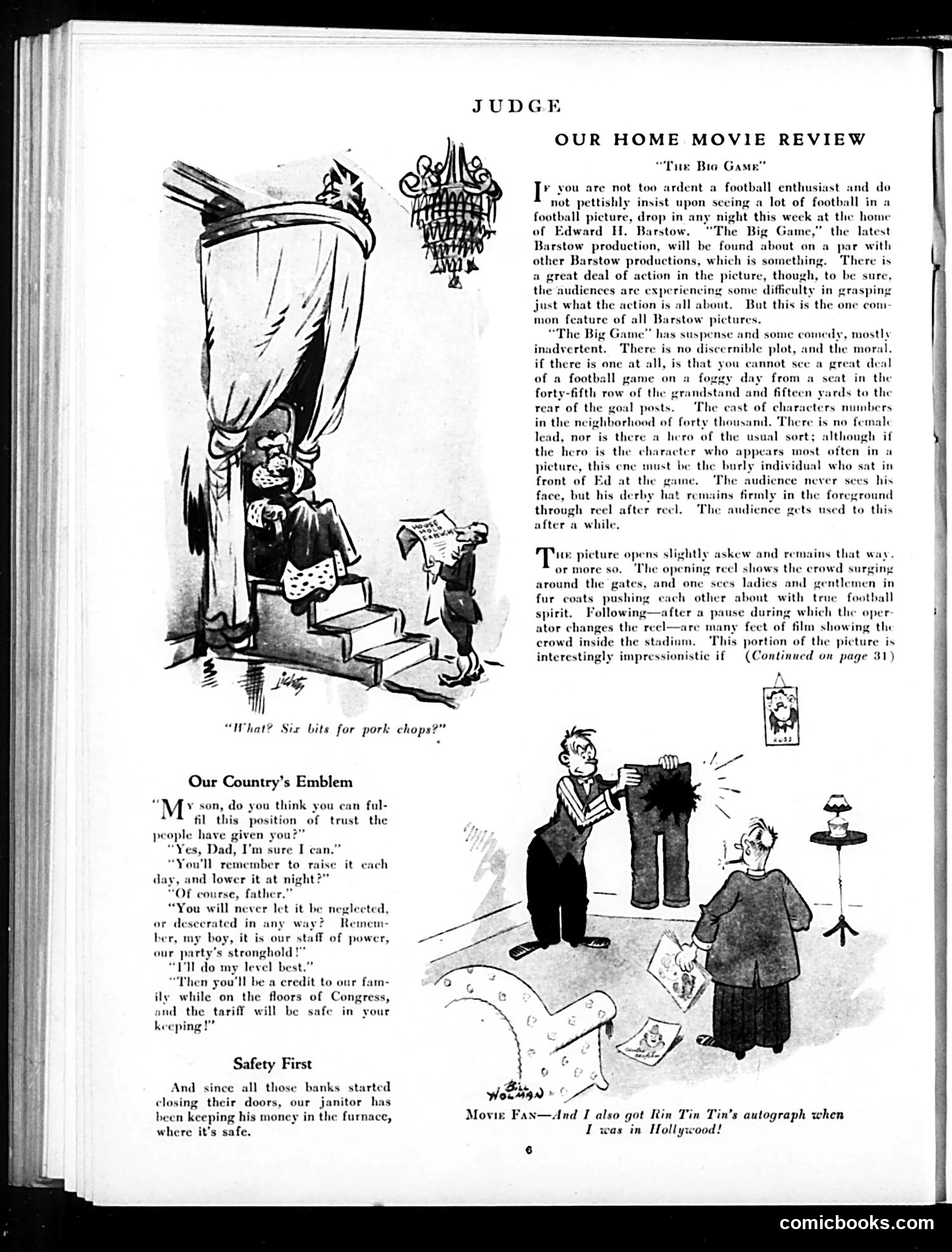
Analysis of Judge Magazine Page This page contains three separate items: 1. "The Big Game" movie review: A critique of an Edward H. Barstow film about football. The review notes the picture lacks clear plot and moral instruction—common complaints about movies of this era. 2. "What? Six bits for pork chops?": A cartoon showing a figure (appears to be Uncle Sam, based on the hat) shocked at prices, reflecting post-WWI inflation concerns that affected American consumers. 3. "Our Country's Emblem" and "Safety First": A dialogue between father and son about patriotic duty and financial responsibility, alongside a cartoon about citizens keeping money "safe" in furnaces during bank closures—referencing the financial anxiety of the 1920s banking crisis period. The page reflects early 1920s American concerns: entertainment standards, economic inflation, and financial instability.
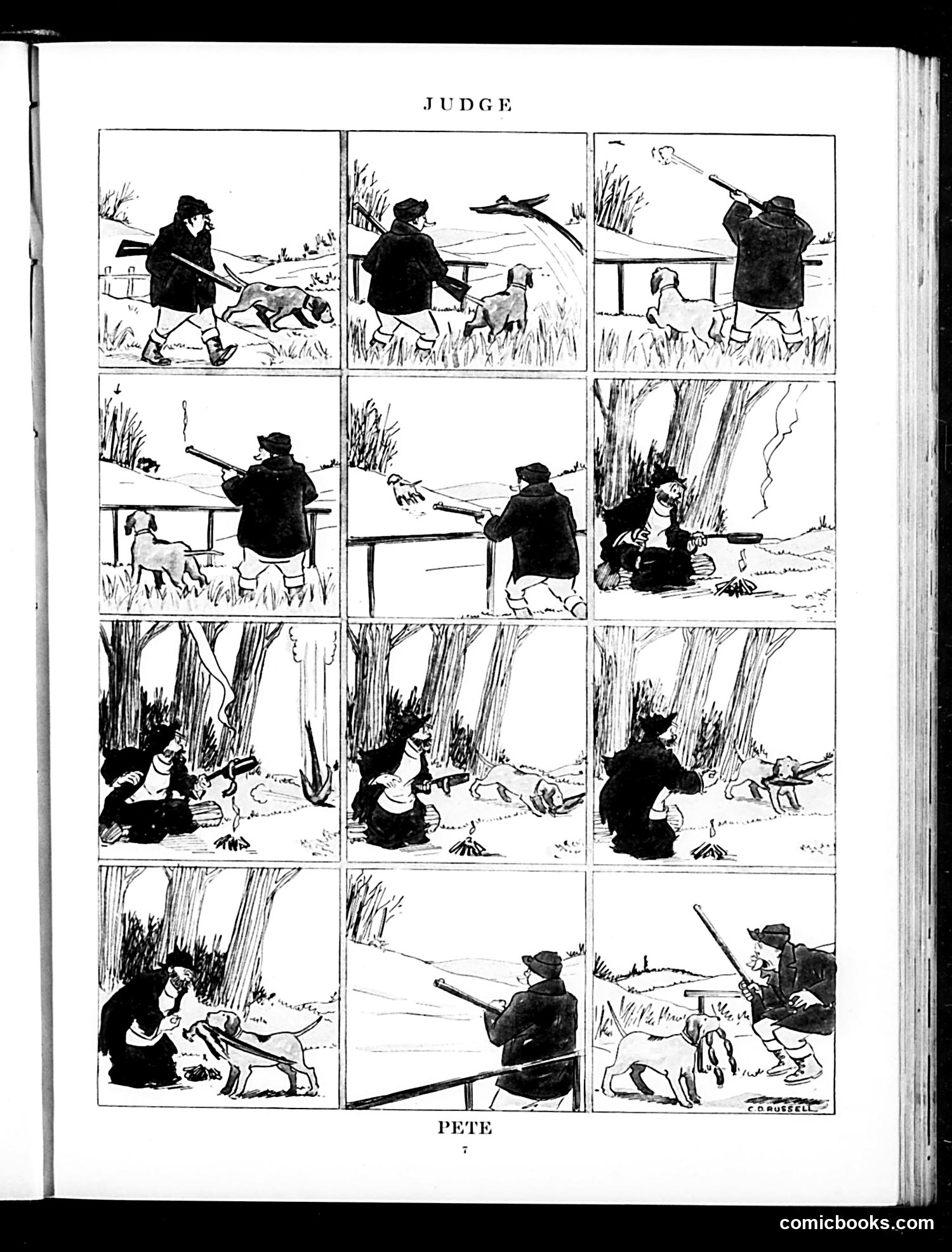
"Judge and Pete" - A Hunting Comic Strip This is a sequential comic strip titled "Judge" (top) and "Pete" (bottom), depicting a hunting scene. The narrative shows a judge character attempting to shoot at game birds, while his hunting dog repeatedly retrieves the birds he misses. The satire appears to mock judicial incompetence or hypocrisy—the "Judge" is ineffectual and relies entirely on his dog "Pete" to actually catch anything. The judge's fumbling attempts contrast sharply with Pete's competent retrievals, suggesting the judge receives undeserved credit for Pete's work. The strip likely satirizes how authority figures take credit for subordinates' labor, or how the judicial system operates through others' actual effort. The crude, energetic line work is typical of Judge magazine's style.
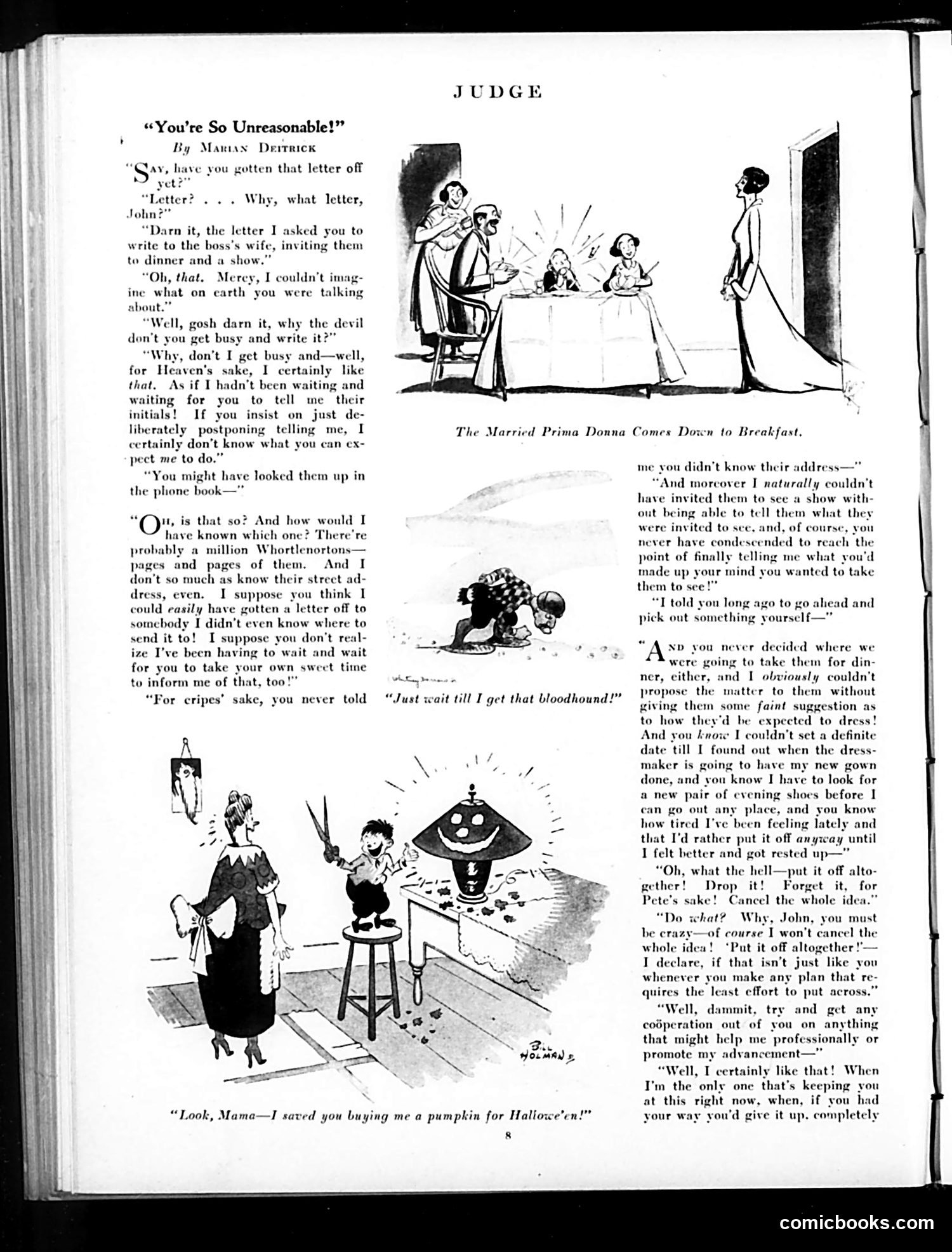
"You're So Unreasonable!" This marital satire by Manas Dettrick depicts a husband's frustration with his wife's elaborate excuses for not writing a dinner invitation to his boss. The humor lies in the wife's escalating, circular logic: she can't invite them without knowing their address, can't suggest a show without knowing what they'll wear, can't pick a show without a dinner date, can't set a date until her dressmaker finishes her gown, and must wait for new evening shoes—all while claiming exhaustion. The cartoon mocks a particular 1920s-era marital dynamic: the wife as self-absorbed "prima donna" (referenced in the illustration caption) who weaponizes elaborate domestic complications and personal grooming needs to avoid tasks, while the exasperated husband becomes the unreasonable one for requesting simple assistance. The satire targets both the wife's performative helplessness and the husband's inability to manage her.
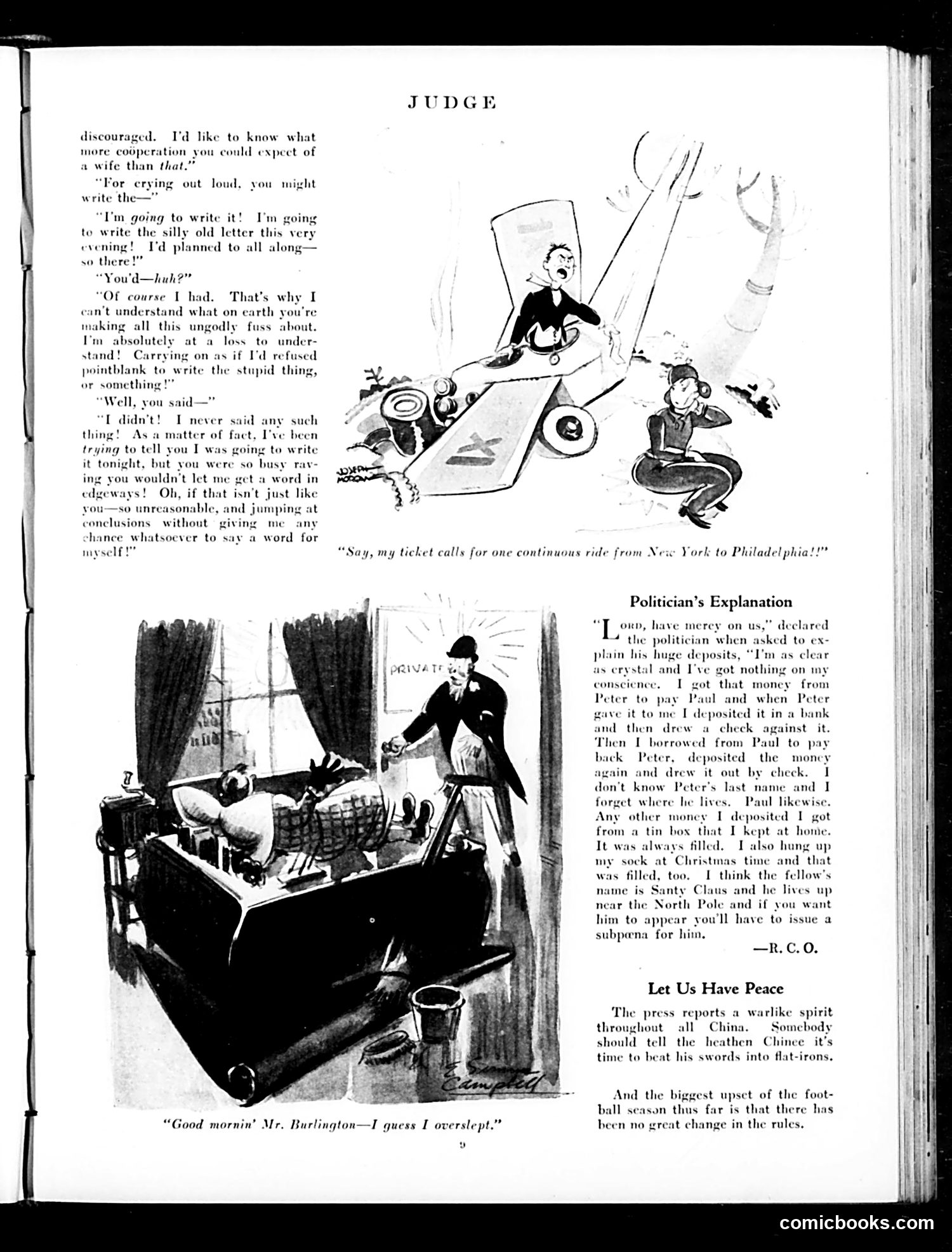
Judge Magazine Page Analysis This page contains three satirical pieces: Top cartoon: A domestic argument where a husband accuses his wife of refusing to write a letter, but she insists she already planned to write it. The satire mocks marital miscommunication—he's upset about something she never actually refused, just poorly communicated. Middle cartoon: "Politician's Explanation" satirizes corrupt political fundraising. A politician caught with suspicious deposits claims the money came from "Peter to pay Paul"—circular transactions between unnamed sources (including one "Santy Claus"). The humor lies in the obviously circular logic and implausible explanations designed to evade accountability while technically claiming transparency. Bottom cartoon: "Good mornin' Mr. Burlington—I guess I overslept" shows a disheveled man arriving late, likely an office worker's excuse. The page demonstrates *Judge*'s typical targets: domestic absurdity, political corruption, and everyday comedic situations. The politician piece is the sharpest satire, mocking both corruption and the elaborate non-answers politicians gave when questioned about finances.
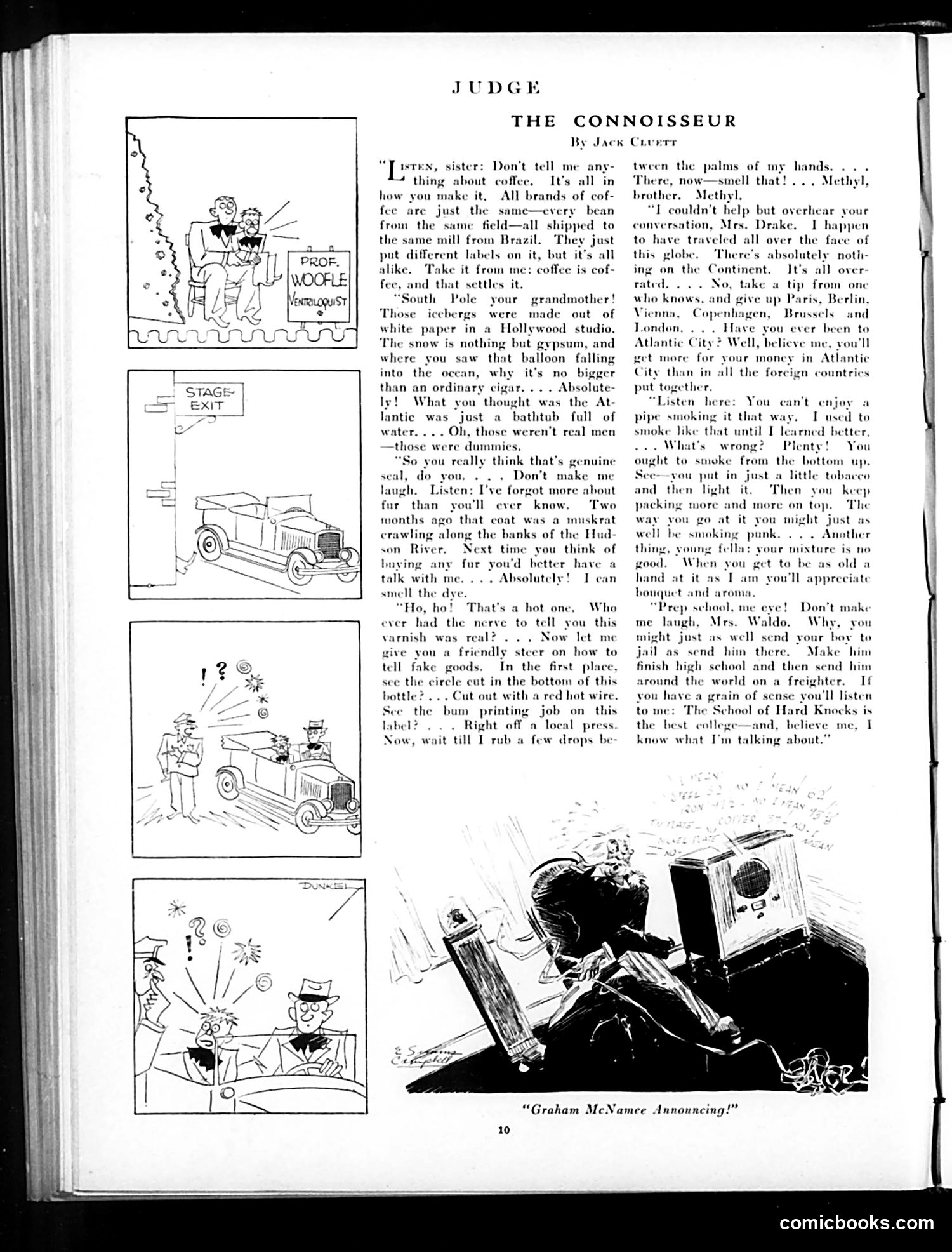
"The Connoisseur" by Jack Cheerr This satirical piece mocks the "know-it-all" type who pontificates about subjects he claims expertise in while actually dispensing dubious or cynical advice. The comic shows a man lecturing "Mrs. Drake" and "Mrs. Waldo" on various topics: coffee, Hollywood films, fur coats, varnish, pipe smoking, and education. The humor derives from his contradictions and pretension—he dismisses authentic experiences (Atlantic icebergs, real actors) as fakes while revealing his "knowledge" is actually jaded cynicism. He debunks products through chemical analysis ("Methyl"), yet simultaneously boasts of fooling people. His final advice—that prep school is worthless and the "School of Hard Knocks" superior—epitomizes the persona: someone who mistakes worldly disillusionment for wisdom. The title references Graham McNamee, a famous radio announcer, suggesting this character announces his opinions with similar authoritative pomposity.
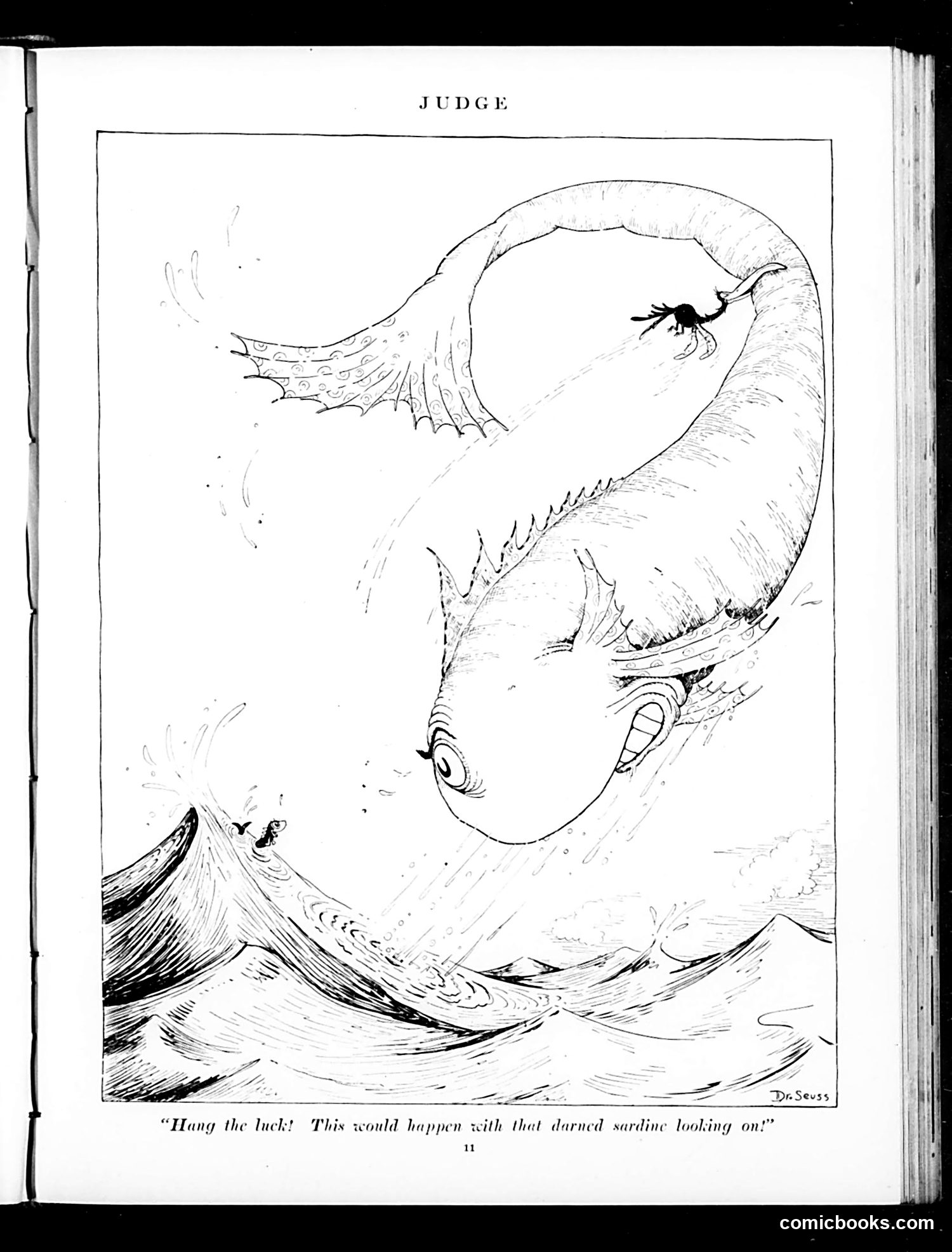
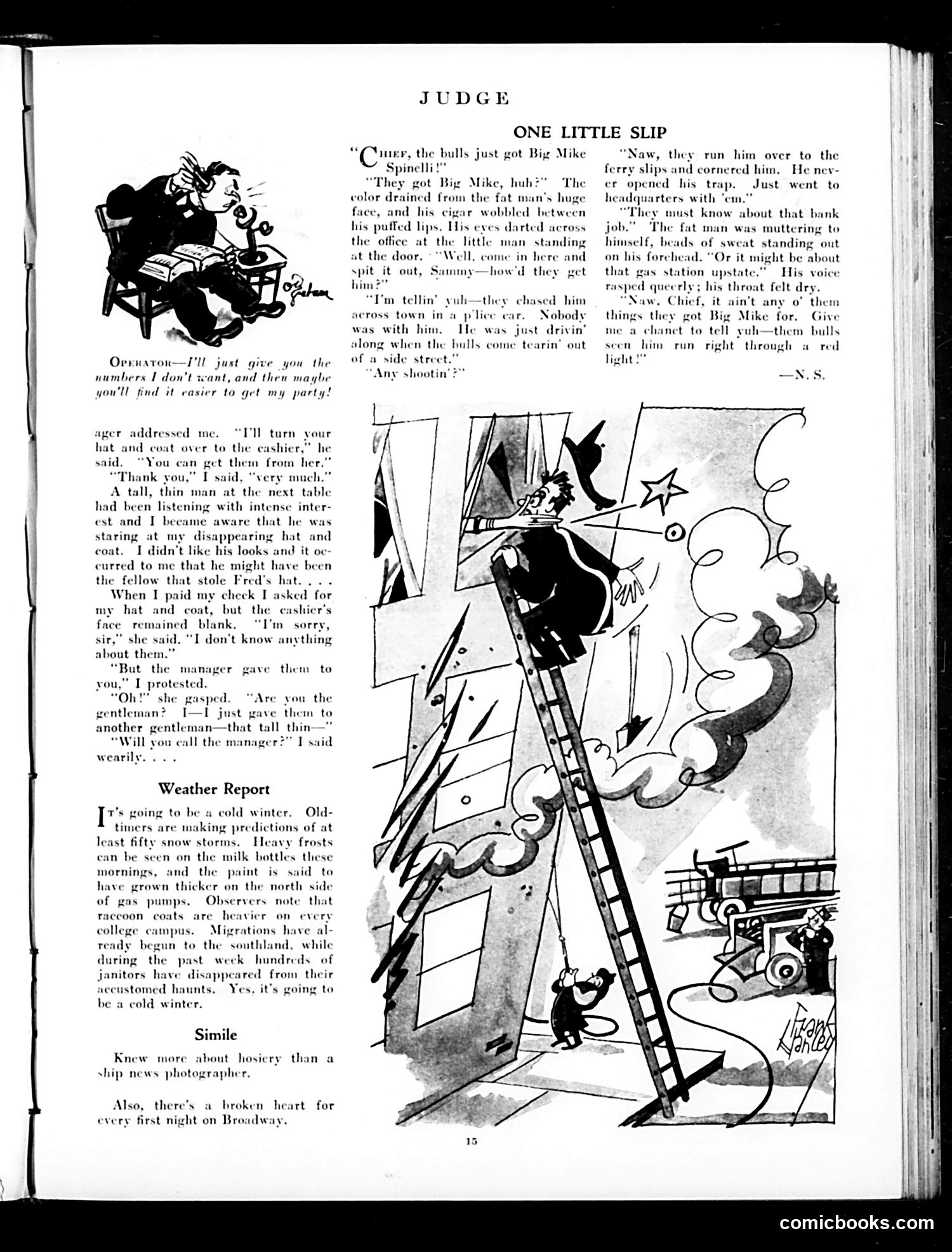
Analysis This is a Dr. Seuss cartoon from *Judge* magazine titled "Judge." The image shows a large whale or sea creature with an exaggerated, grotesque face looking downward at what appears to be a tiny sardine. A small fly or insect sits on the whale's curved back. The caption reads: "Hang the luck! This would happen with that darned sardine looking on!" The satire appears to be about disproportionate consequences or observation—the whale's problem or misfortune is somehow blamed on the presence of an insignificant sardine "looking on." This likely mocks how people blame minor or powerless observers for their troubles, or how someone uses a convenient scapegoat for their bad luck. The humor lies in the absurd disparity between the massive whale and the tiny sardine, suggesting the blame is equally ridiculous. The specific historical or political reference, if any, remains unclear without additional context.
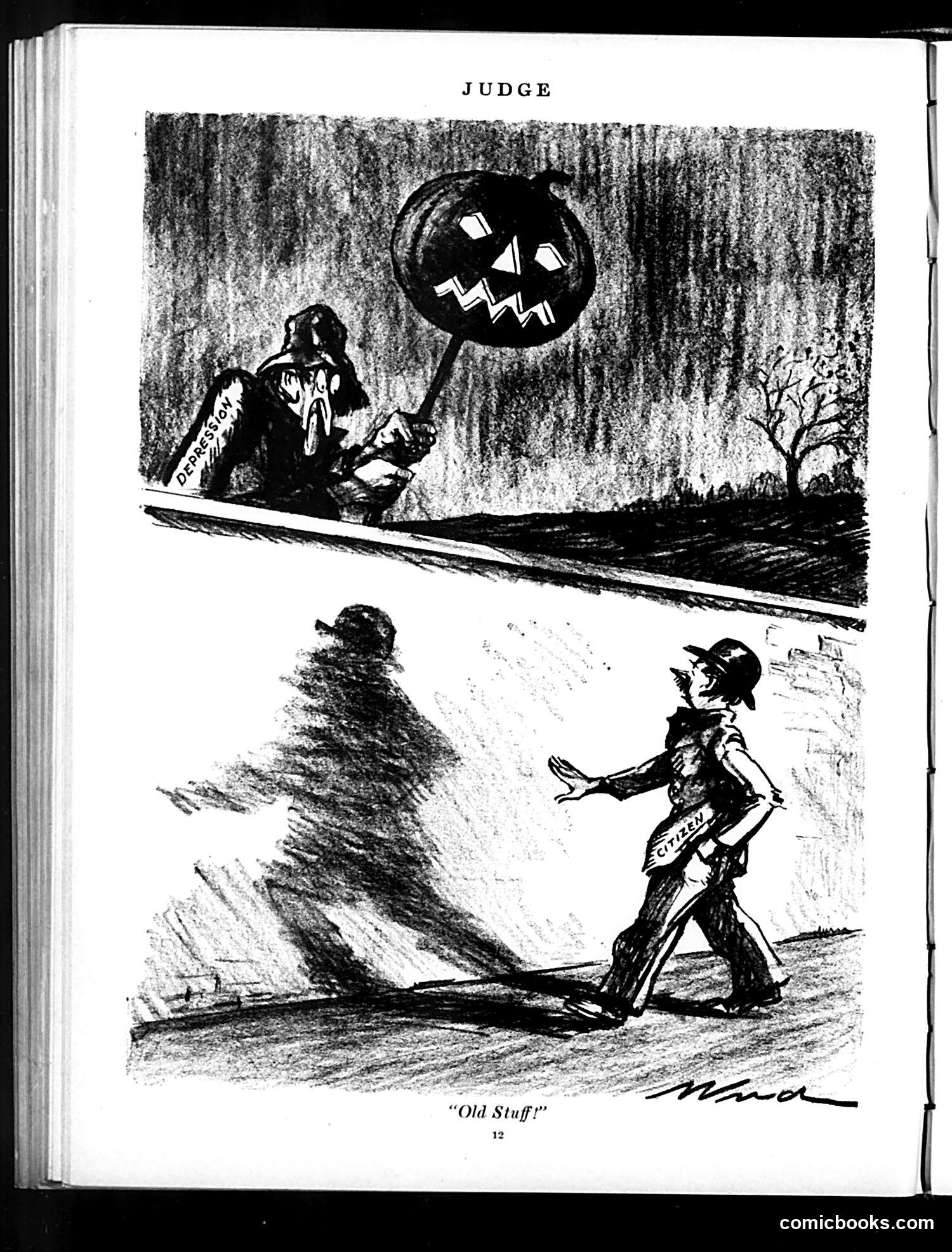
Analysis of "Old Stuff" Cartoon This Judge magazine cartoon depicts a figure labeled "JUDGE" (visible on the left character's sash) confronting what appears to be a witch or goblin holding a jack-o'-lantern. The title "Old Stuff" suggests the cartoon is satirizing outdated or obsolete ideas. The composition shows the Judge figure in a confrontational stance, gesturing dismissively at the supernatural creature and its "old" Halloween imagery. This likely represents Judge magazine's editorial position mocking antiquated political arguments, superstitions, or worn-out political rhetoric circulating at the time. Without a visible date, the specific target remains unclear, but the satire criticizes something the magazine deemed tired, irrelevant, or deserving ridicule through the "old stuff" metaphor.
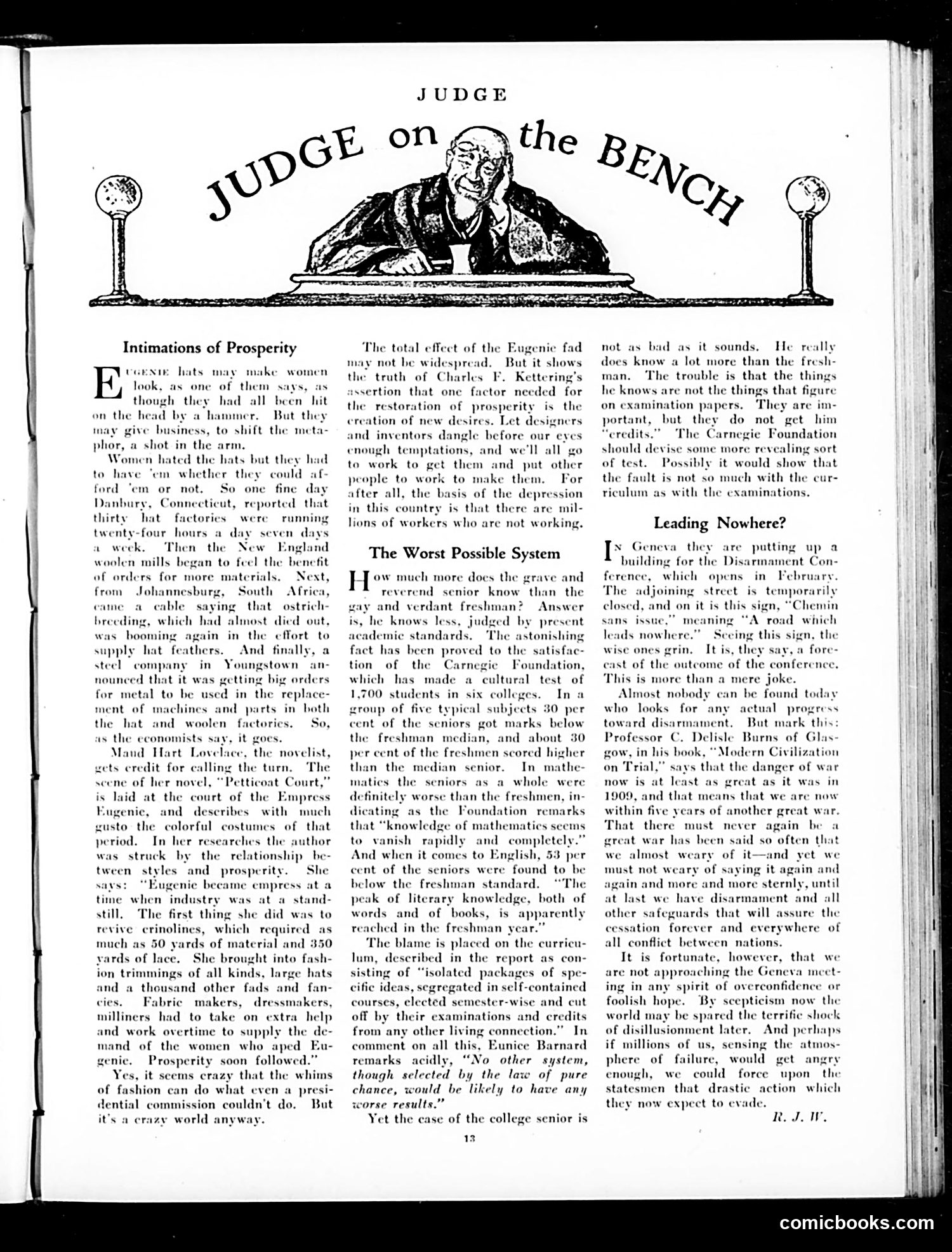
"Judge on the Bench" - Analysis This page contains two satirical pieces: "Intimations of Prosperity" discusses how women's fashion—specifically the craze for elaborate hats requiring ostrich feathers, materials, and trimmings—stimulates economic activity across multiple industries (textiles, steel, etc.). The author argues that creating new consumer desires drives prosperity and employment, using Empress Eugénie's fashion influence as a historical example. "The Worst Possible System" reports on a Carnegie Foundation study showing college seniors perform worse than freshmen on standardized tests in math and English. The satire critiques the fragmented college curriculum (elective "self-contained courses") as pedagogically backwards, allowing students to forget knowledge as they progress. The columnist sardonically notes no system "selected by the law of pure chance" could produce worse results. Both pieces reflect 1920s-30s concerns: economic recovery methods and educational reform.
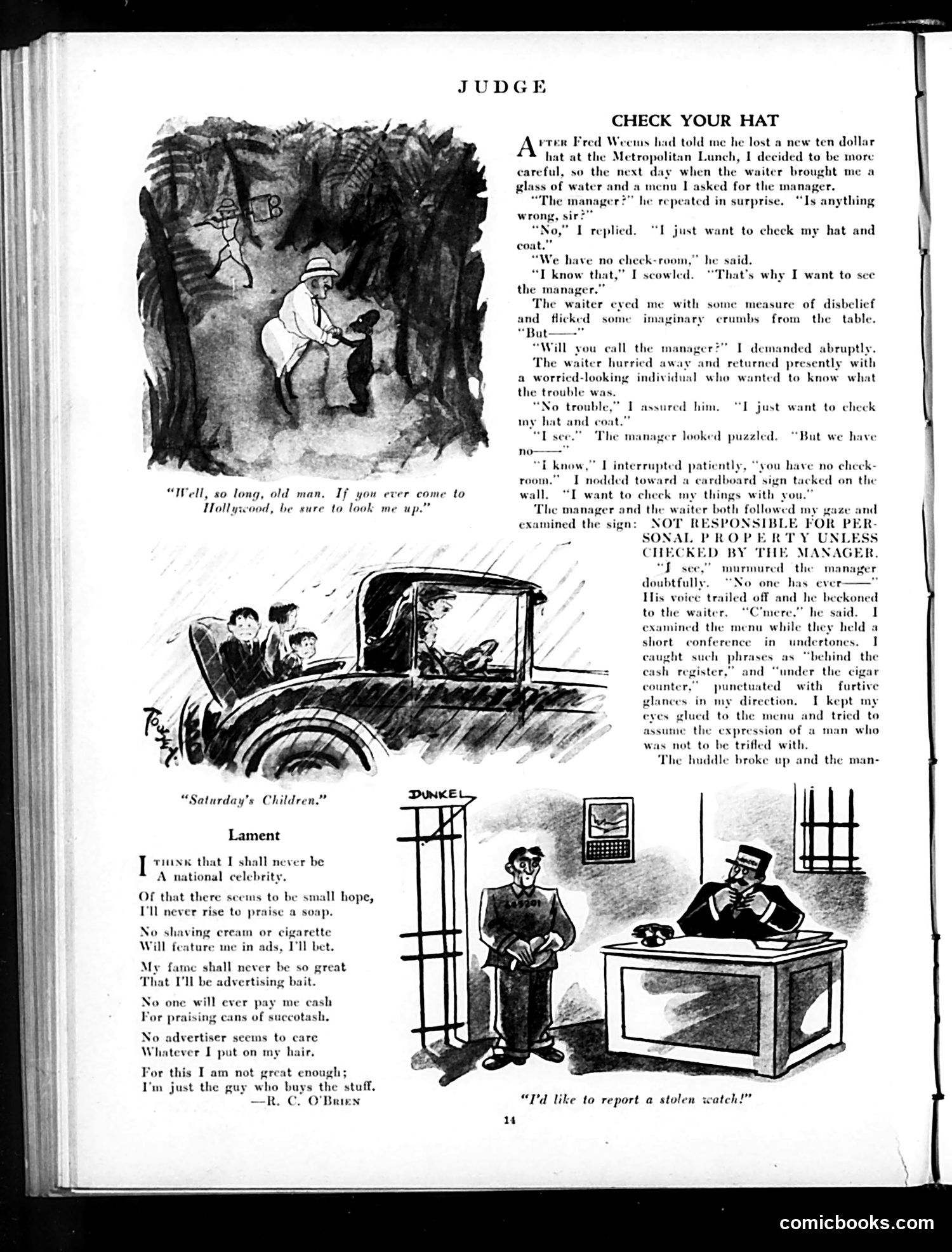
Judge Magazine Page Analysis This page contains two distinct pieces of satire: "Check Your Hat" is a humorous anecdote about a diner's absurd request. The narrator, having heard someone lost a hat at a restaurant, demands to "check" his hat and coat—using the phrase literally rather than as a request for coat-check service. The restaurant has no coat-check facility, yet the narrator insists, pointing to a liability sign. The joke satirizes both the narrator's pedantic literalism and the restaurant's bureaucratic helplessness: they cannot accommodate a reasonable request because they lack the proper system, yet the sign ironically warns against loss of personal property. "Lament" is a poem by R.C. O'Brien lamenting that ordinary people like himself will never achieve celebrity or wealth through advertising endorsements. It reflects 1920s anxieties about consumer culture and mass marketing, where celebrities could earn fortunes simply by lending their names to products. O'Brien's speaker resignedly accepts his role as a mere consumer rather than a celebrity pitchman—satirizing both advertising's growing influence and the cultural aspiration it created.
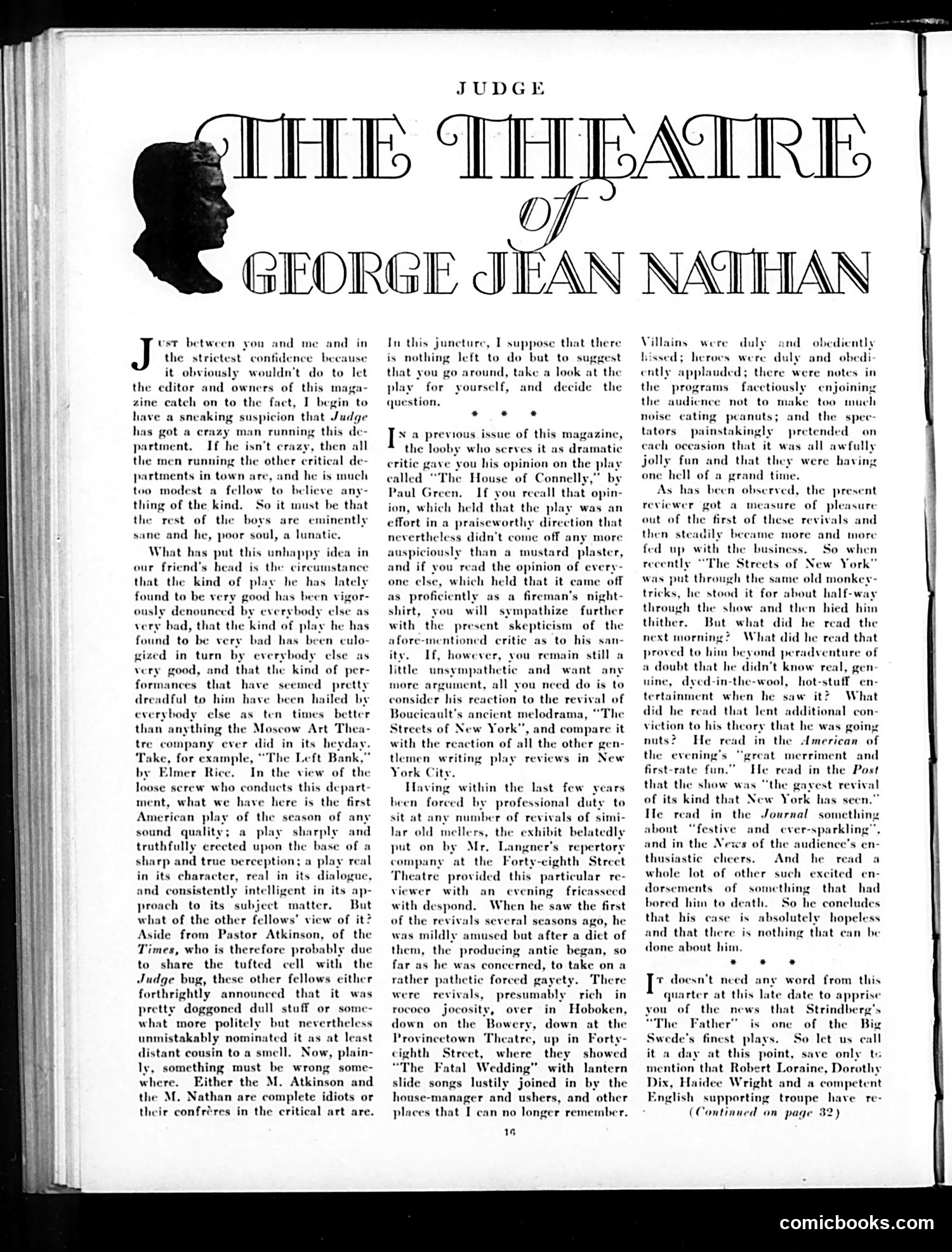
Judge Magazine Theater Critique (Page 16) This page contains a theater review column titled "The Theatre of George Jean Nathan," identified by the bust portrait on the left. The anonymous author humorously suggests Nathan is "a crazy man" running Judge's drama department because his critical opinions consistently contradict those of other New York theater critics. The piece cites specific examples: Nathan praised Elmer Rice's "The Left Bank" (which others called dull) and gave mixed reviews to revivals like "The House of Connelly" and "The Streets of New York"—plays other critics either praised or dismissed differently. The satire mocks the subjectivity of theater criticism itself: no objective standard exists to determine who's right. Nathan is portrayed as the lone dissenting voice, leaving readers uncertain whether he possesses superior judgment or genuine insanity. The author ironically suggests readers see plays themselves rather than trust any critic's opinion. This reflects early 20th-century theater criticism's contentious nature and professional rivalries among New York reviewers.
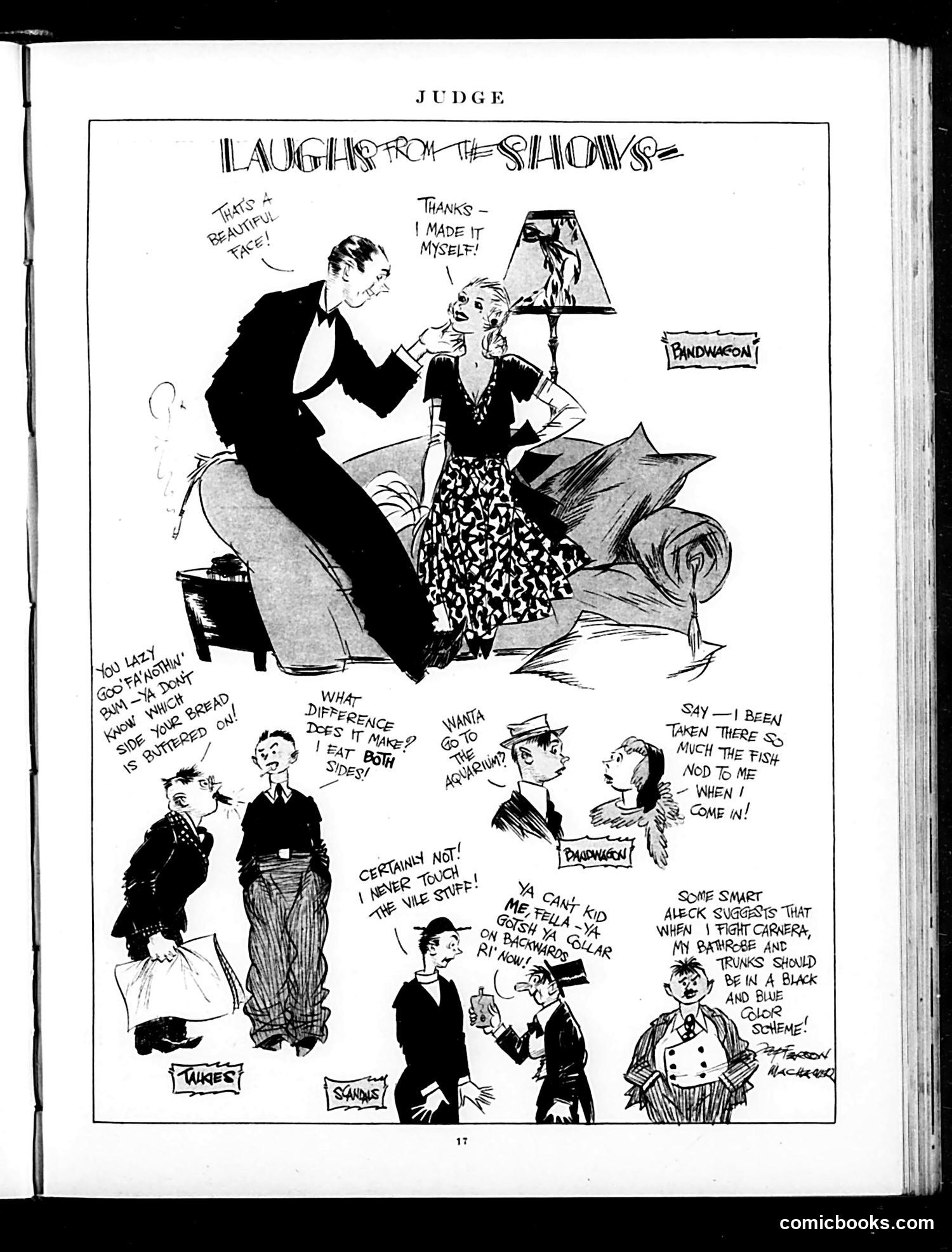
"Laughs from the Shows" This Judge page features theatrical humor sketches. The main panel shows a well-dressed man complimenting a woman on her decorative lampshade, which she proudly claims to have made herself—likely satirizing amateur home decoration trends. Below are vignettes mocking various characters' speech patterns and mannerisms, typical of stage comedy: references to "turkeys" and "saps" suggest theatrical types discussing show business. One character discusses fighting and trunks "in black and blue"; another mentions "the fish" and coming in late. The overall tone satirizes Broadway/vaudeville culture and the pretensions of both performers and theater-goers. The sketches capture period dialect humor and social climbing—common Judge magazine fare for mocking urban sophistication and theatrical life in the early-to-mid 20th century.
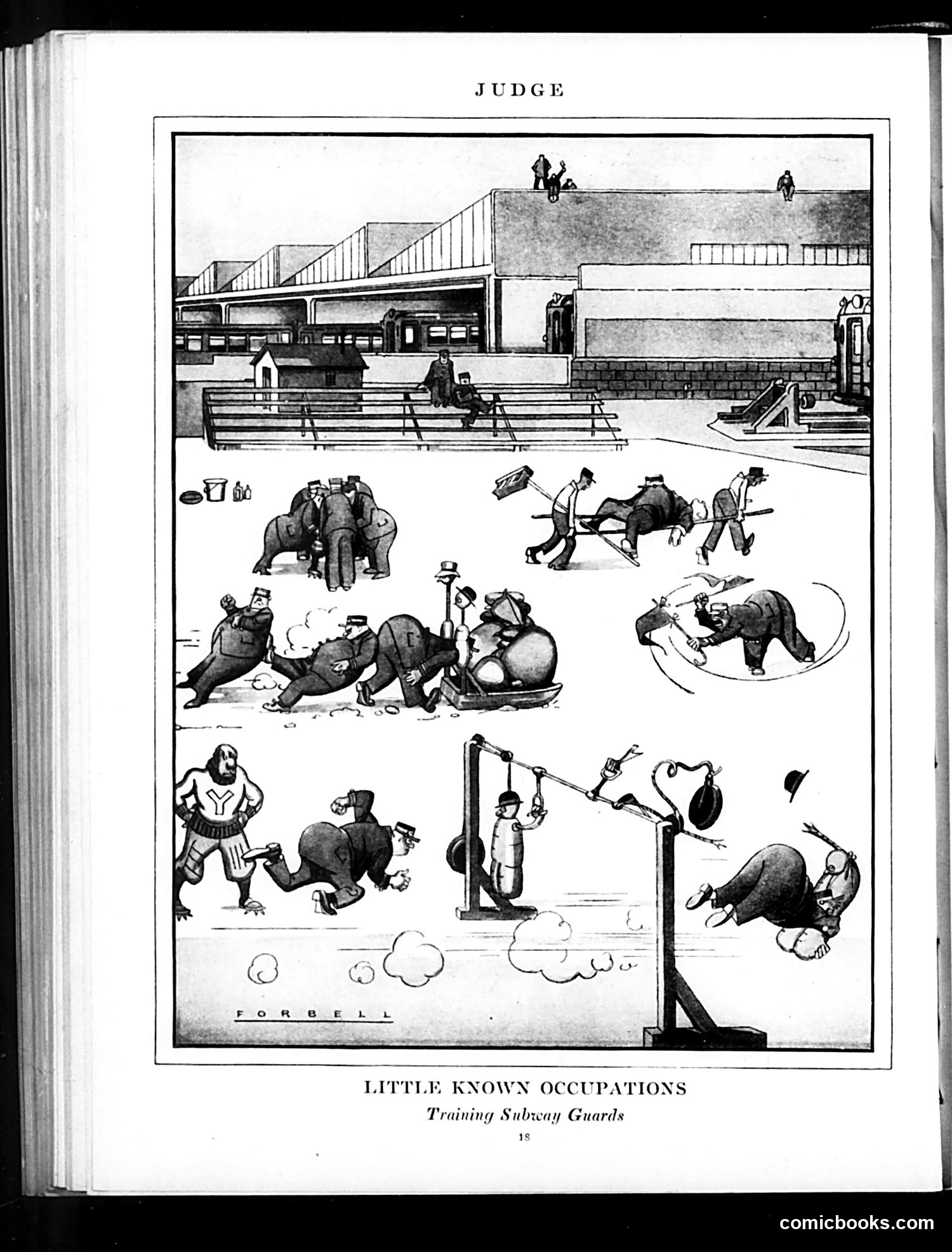
"Training Subway Guards" - Judge Magazine Satire This satirical cartoon depicts the "training" of New York City subway guards through a series of slapstick scenes. The humor comes from showing trainees being physically assaulted—struck, knocked down, and thrown about by various attackers and obstacles. The joke targets the dangerous, chaotic conditions subway workers actually faced, particularly the violence they encountered from rowdy passengers and the general hazards of the job. By presenting guard "training" as literally getting beaten up, the cartoonist satirizes how inadequately the transit system prepared workers for these occupational hazards. The industrial architecture in the background establishes the urban transit setting. This is early-20th-century social commentary on labor conditions and public safety through exaggerated visual humor—typical of Judge's satirical style.
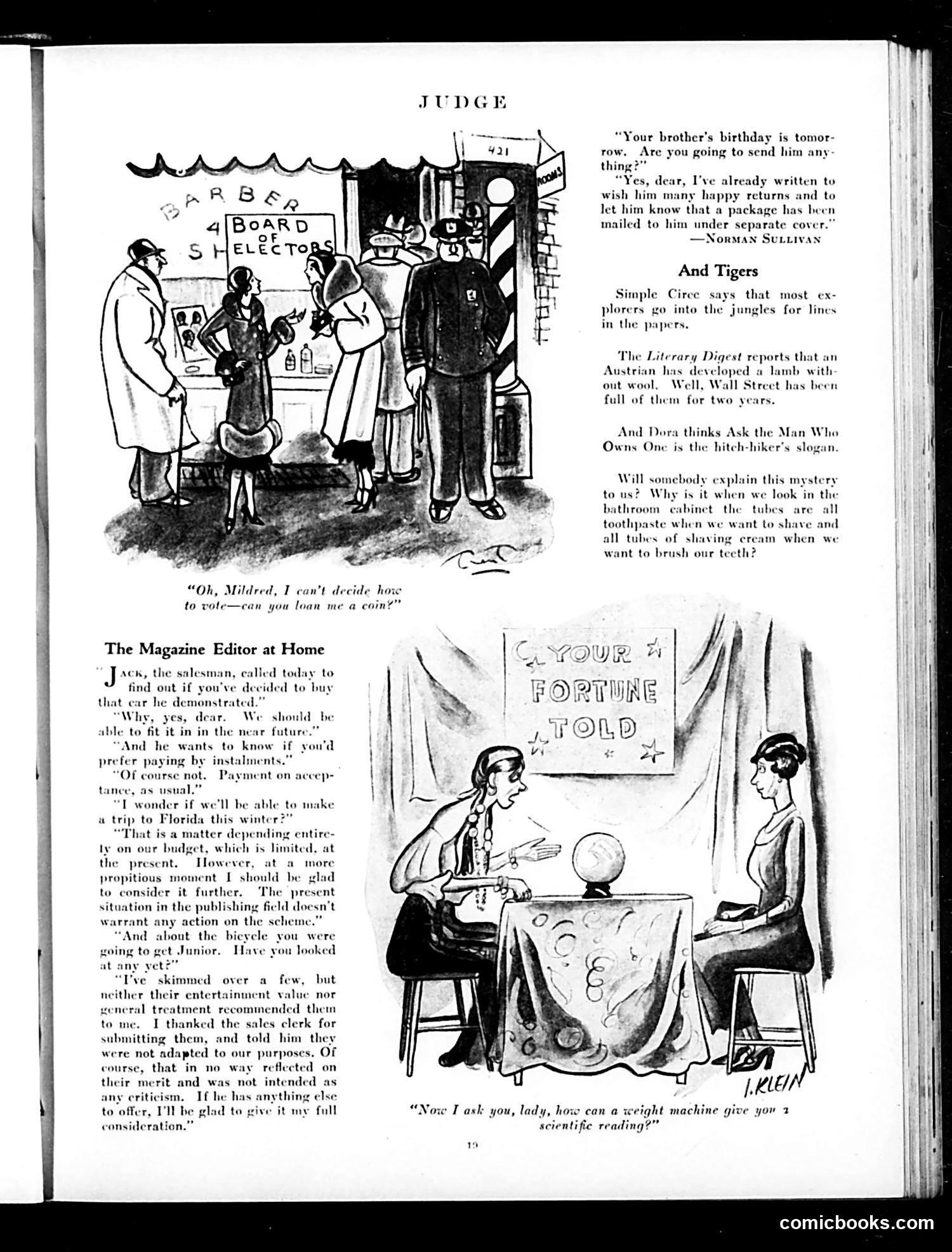
Judge Magazine Page Analysis This page contains three distinct satirical pieces mocking 1920s American life: Top cartoon: A barber shop scene where a voter asks a woman to "loan me a coin" to decide how to vote—satirizing voter indecision and the triviality with which some citizens approached elections. Middle section ("And Tigers"): Brief quips mocking contemporary trends: explorers seeking newspaper headlines; an Austrian woolless lamb compared to Wall Street "sheep"; the phrase "Ask the Man Who Owns One" (likely a car advertisement slogan) reapplied as a hitch-hiker's request. Bottom cartoon and text ("The Magazine Editor at Home"): A salesman pitches a car to Jack; his wife responds with deliberately formal, pretentious language rejecting it. The satire targets middle-class affectation—using overly elaborate speech ("propitious moment," "not adapted to our purposes") to avoid straightforward "no." The fortune-teller cartoon below continues the theme of Americans seeking easy answers. The page satirizes voter apathy, commercial advertising culture, and middle-class pretension masquerading as sophistication.
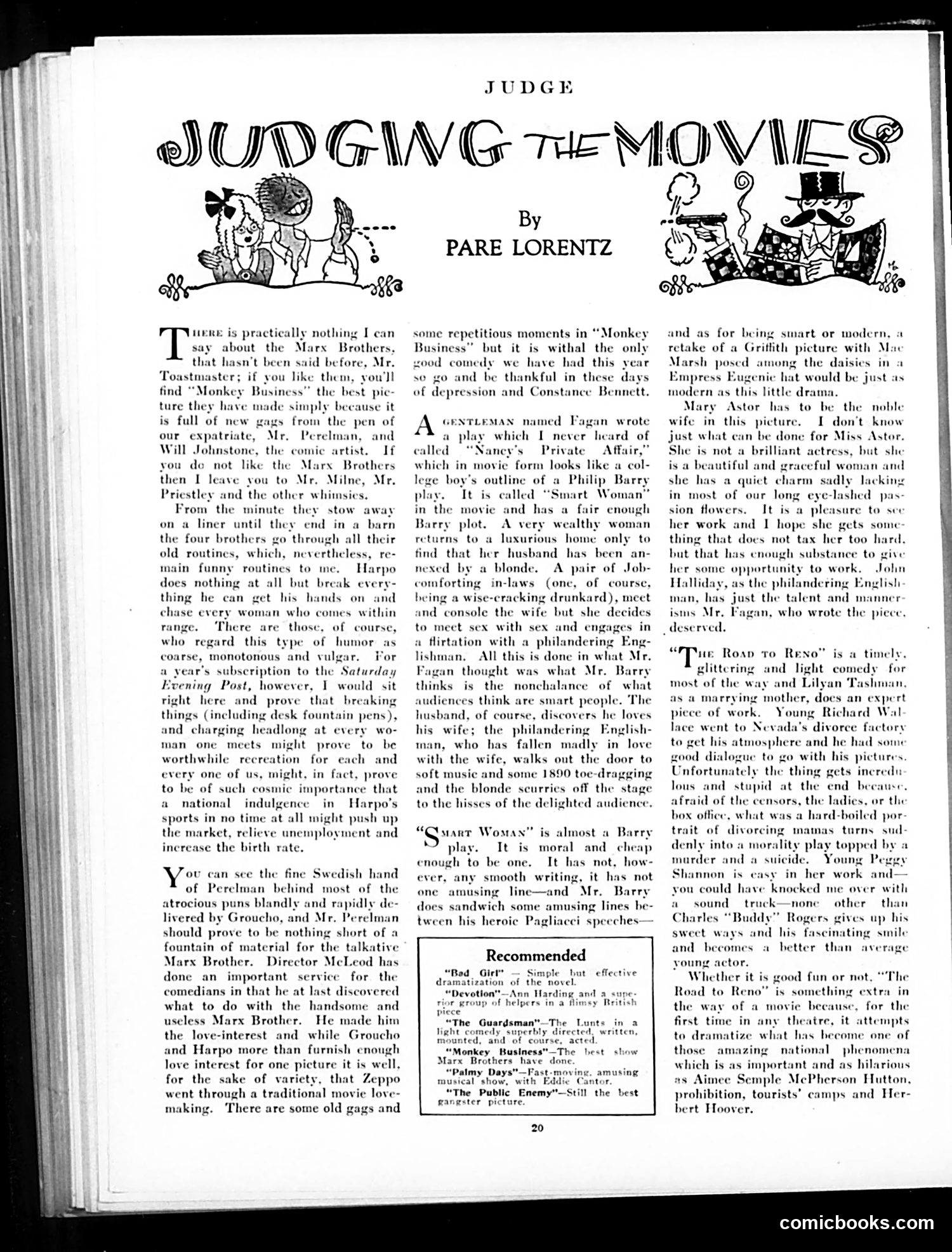
Judge Magazine Movie Review Analysis This page reviews recent films, primarily focusing on the Marx Brothers' "Monkey Business." Critic Pare Lorentz praises it as the year's best comedy, crediting writer S.J. Perelman's material. He defends Harpo's anarchic physical humor—destroying property and chasing women—as potentially valuable social therapy during the Depression. The reviews also cover "Nancy's Private Affair" (retitled "Smart Woman"), which Lorentz dismisses as a cheap imitation of Philip Barry's sophisticated comedy style, lacking Barry's wit despite similar plot mechanics about marital infidelity and romantic entanglement. The satirical angle targets both 1930s film production and contemporary tastes: Lorentz suggests audiences mistakenly view conventional infidelity plots as "smart" while genuinely enjoying Marx Brothers' mayhem. The "Recommended" section briefly lists other current releases for comparison.
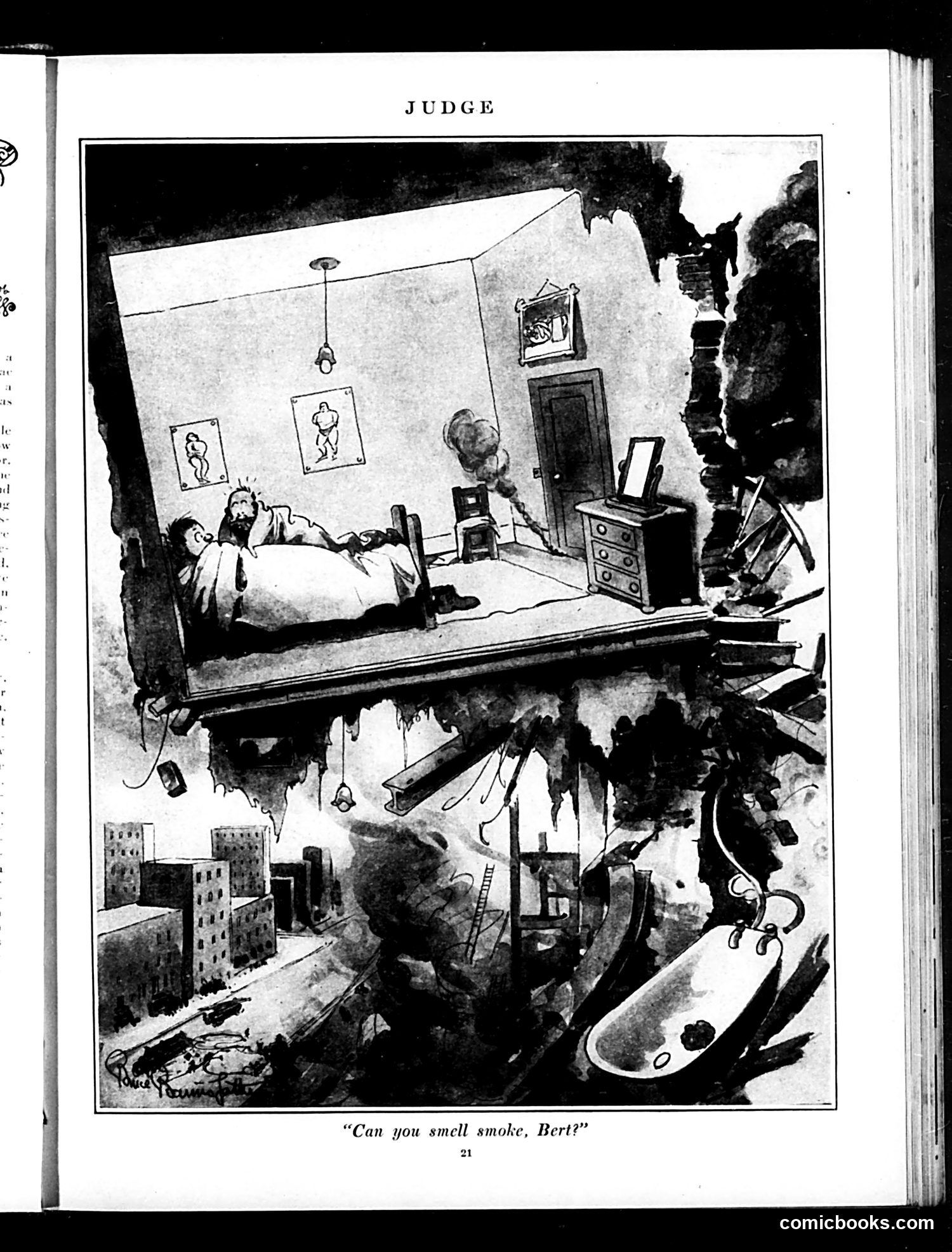
Analysis This is a surreal cartoon titled "Can you smell smoke, Bert?" The image shows a bedroom scene positioned impossibly above a cityscape and bathroom fixtures. A couple in bed appears oblivious while smoke or fire surrounds them below. The composition suggests they're literally elevated above urban chaos and domestic dangers. The satire likely comments on middle-class complacency or denial—the couple remains detached from crisis occurring beneath them. The "smoke" reference could reference fire hazards, but more likely refers to scandal, danger, or social problems that affluent urbanites ignore. The absurdist perspective emphasizes how disconnected privileged people are from real-world consequences happening in the city below. The specific reference to "Bert" remains unclear without additional context.
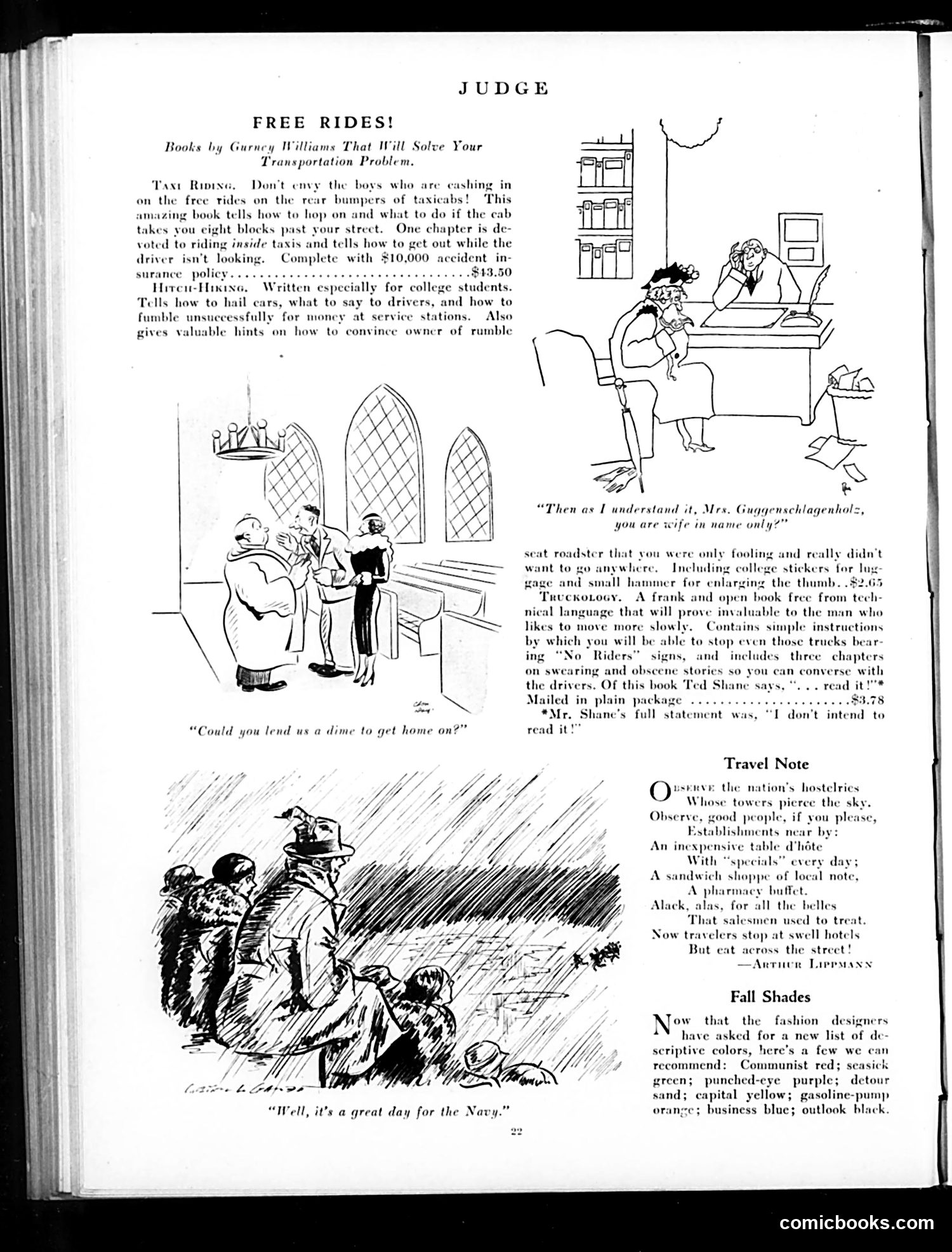
Judge Magazine Page Analysis This page satirizes American transportation problems of the era through humorous book advertisements. Garney Williams' fictional titles mock practical transportation concerns: "Taxi Riding" jokes about poor people bumming free rides on taxi bumpers and sneaking out without paying—reflecting Depression-era economic desperation and petty fare-dodging. "Hitchhiking" satirizes college students' need to bum rides and their schemes to avoid paying drivers, suggesting youth were chronically broke. "Tuckology" mocks slow drivers with absurdist humor about stopping trucks. The cartoons show working-class desperation (a man begging a dime for cab fare) and marital tension (a judge questioning a wife about a "marriage in name only"). The "Travel Note" poem satirizes how travelers stay at fancy hotels but eat at cheap diners across the street—mocking false pretense and economic hypocrisy during harder times. The "Fall Shades" section uses darkly comedic color names (Communist red, gasoline-pump orange, outlook black) to satirize contemporary social anxieties about politics and economic collapse.
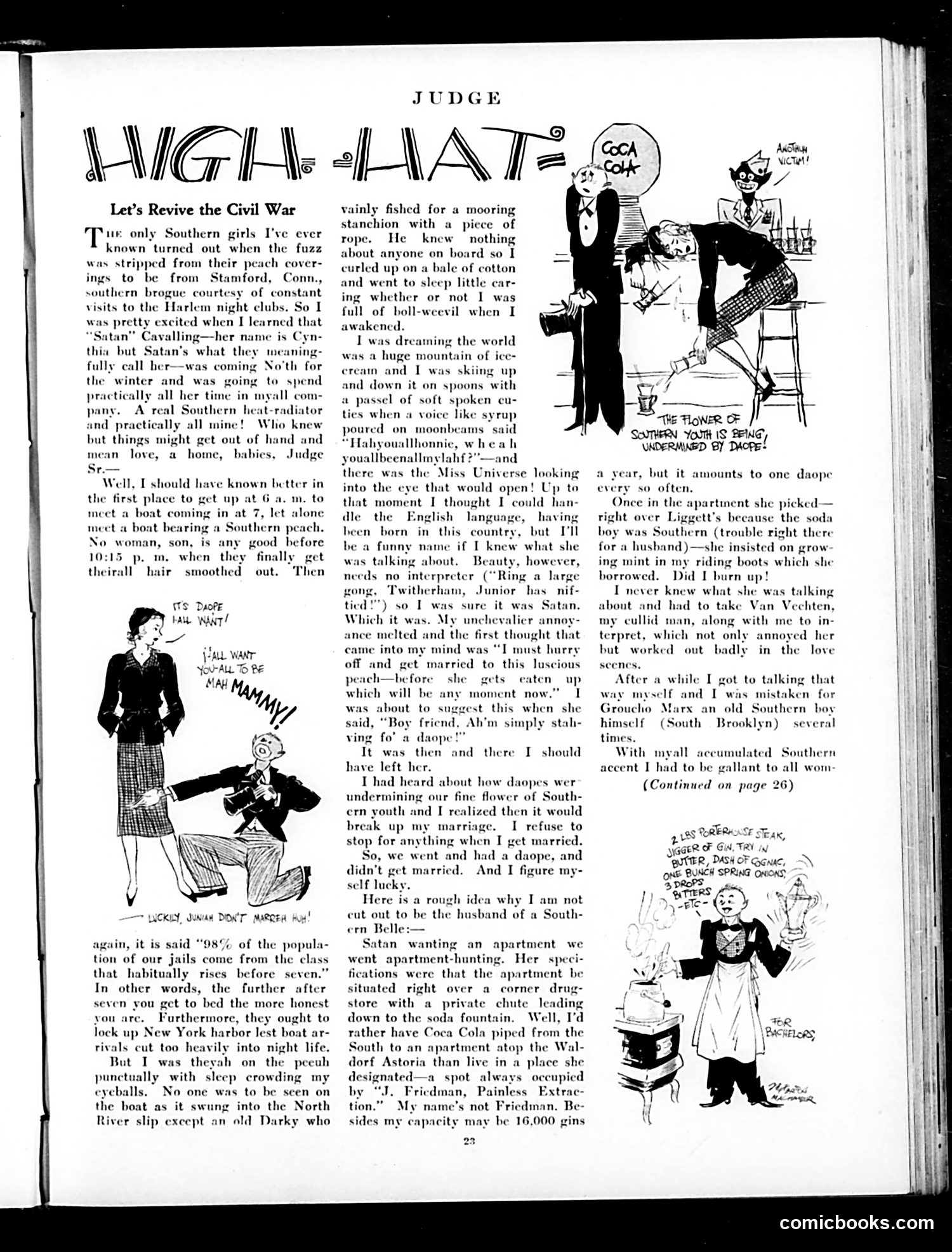
Analysis This is a satirical article mocking both Southern stereotypes and Jazz Age dating culture. The narrator describes meeting "Satan" Cavalling, a woman presented as authentically Southern (though the text reveals she's actually from Connecticut). The satire operates on multiple levels: it mocks the narrator's romantic naiveté, Southern affectations adopted by Northerners, and the "corrupting" influence of modern urban life on traditional values. The repeated term "daope" (likely "dope"—slang for drugs or illicit pleasures) represents the vice threatening American youth, particularly those from the South. The cartoon illustrations show exaggerated 1920s fashion and social interactions. A secondary illustration at bottom left depicts the anxiety about dating and marriage conventions of the era. The humor relies on period-specific concerns: the Jazz Age's perceived moral decay, regional stereotypes, and anxieties about courtship and urban temptation. Modern readers would miss the specific slang and the era's genuine moral panic about Jazz Age corruption of youth.
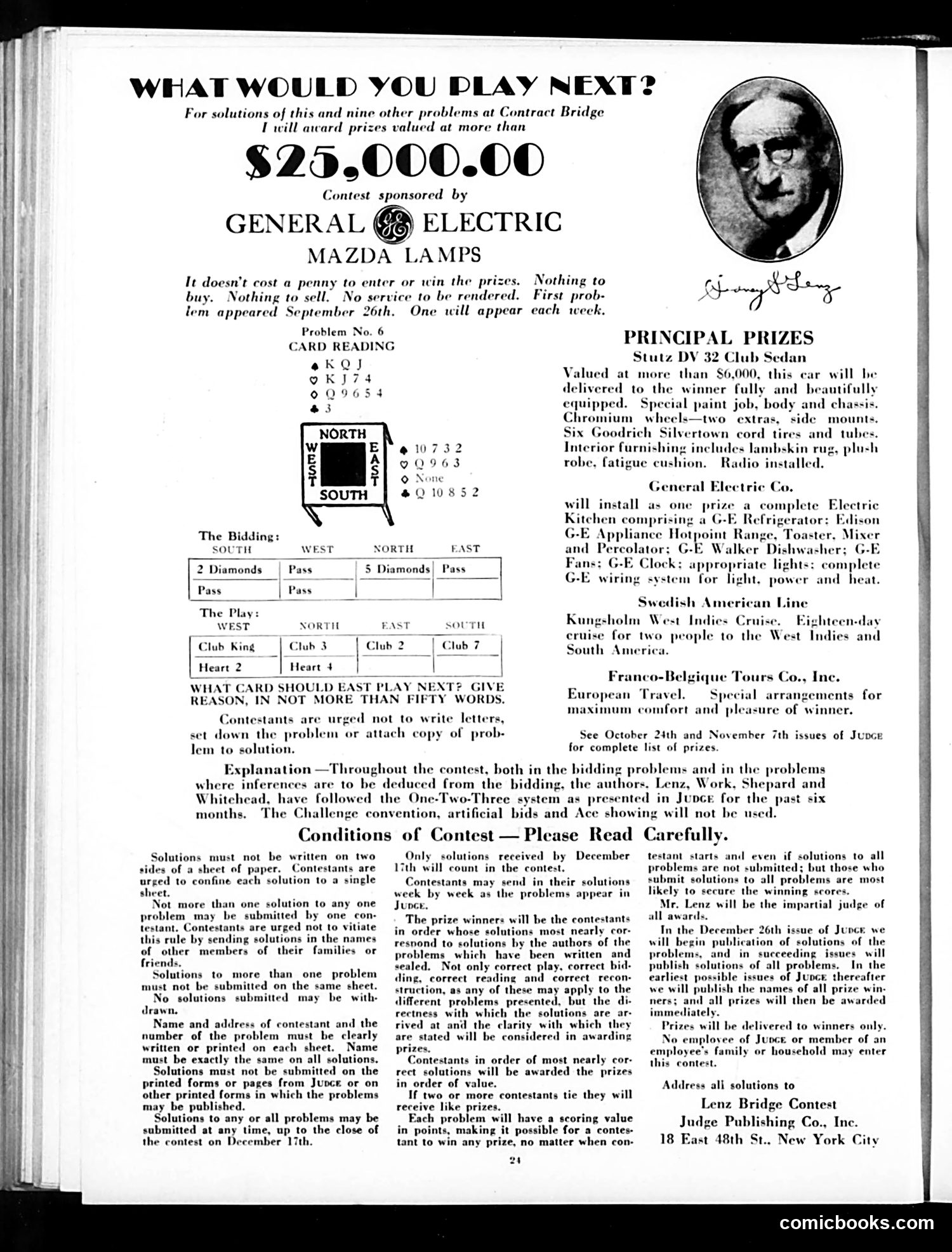
What This Page Means This is primarily a bridge card game contest advertisement, not political satire. Judge magazine is running a sponsored competition where readers solve contract bridge problems for prizes valued at $25,000—including a Stutz automobile, General Electric appliances, and a Caribbean cruise. The page includes a bridge problem with card layouts and bidding sequences, asking "What card should East play next?" Contestants must submit written solutions explaining their reasoning (in 50 words maximum) by December 17th. The contest is sponsored by General Electric (Mazda Lamps), suggesting this is 1920s-era advertising. The small portrait appears to be Ely Culbertson or another bridge authority, though the OCR makes the name unclear. This represents how magazines monetized content through sponsored contests—engaging readers while promoting corporate brands. The emphasis on "no cost to enter" made it accessible to mass audiences.
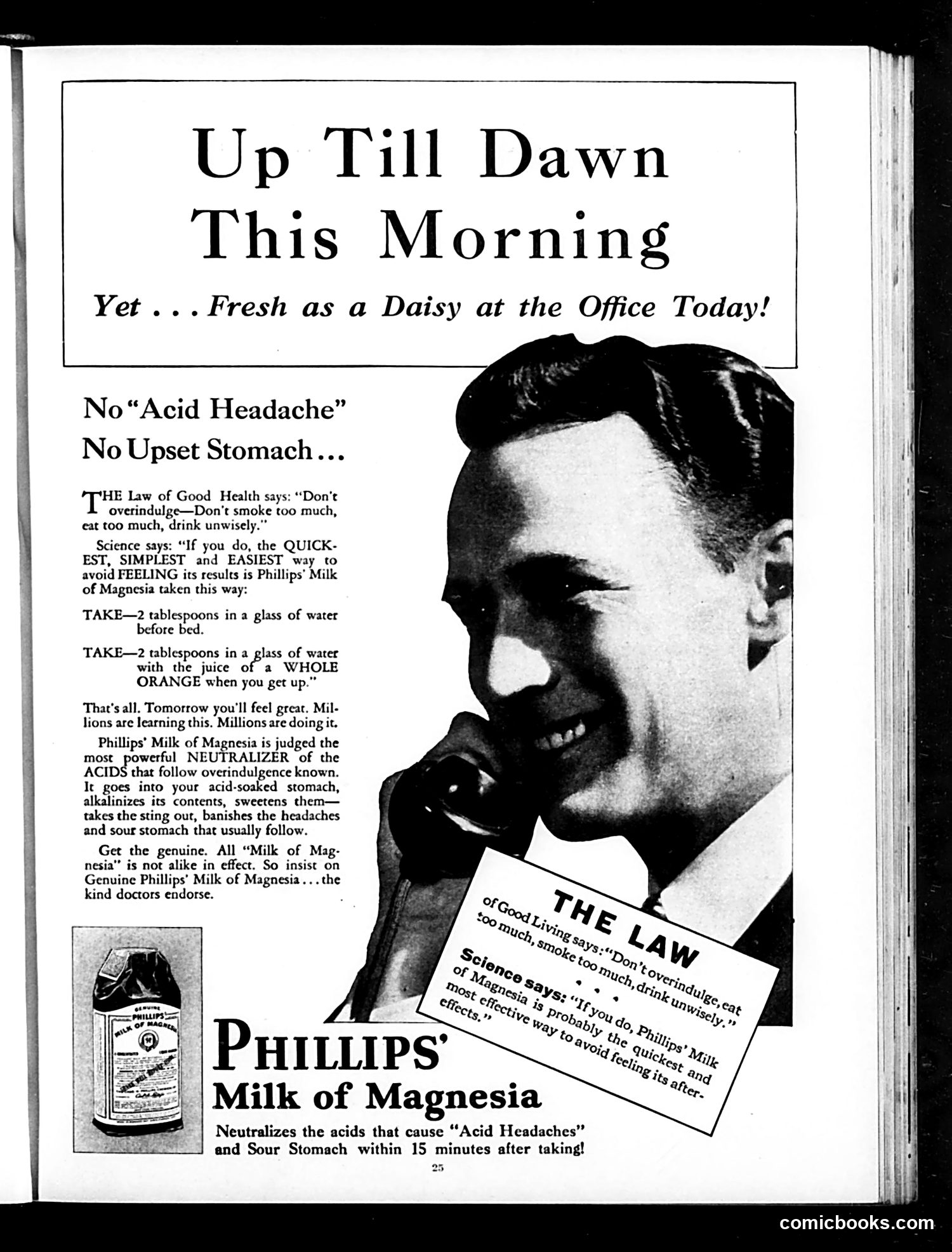
Analysis This is primarily a product advertisement rather than a political cartoon or satire. It promotes Phillips' Milk of Magnesia as a hangover remedy. The page depicts a man who has stayed up late partying ("Up Till Dawn This Morning") yet appears fresh and well-groomed at work the next day. The joke is that Phillips' Milk of Magnesia allegedly eliminates the physical consequences of overindulgence—acid headaches and upset stomach—allowing him to function normally despite excess. The advertisement frames this as scientific advice, referencing "The Law of Good Health" and "Science," positioning the product as the solution to inevitable consequences of overindulging in food, alcohol, and tobacco. The implied message: you can behave recklessly if you use this product. This reflects early-20th-century advertising tactics that made exaggerated medical claims for patent medicines before FDA regulations restricted such practices.
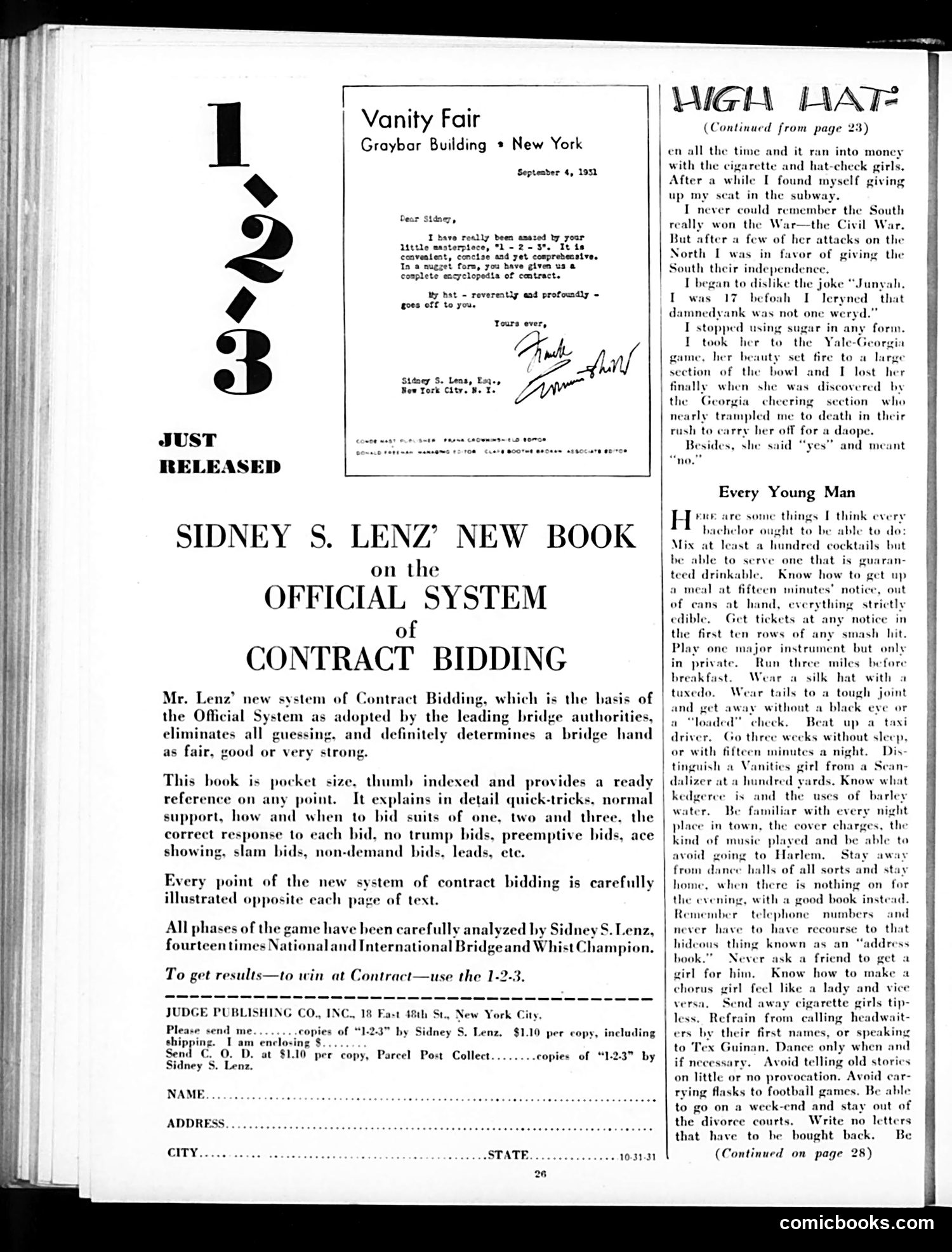
Explanation for Modern Readers This page is primarily advertising and editorial content rather than political satire. It contains: 1. A letter from Vanity Fair (dated September 4, 1932) praising Sidney S. Lenz's bridge instruction book—a endorsement that appears genuine rather than satirical. 2. A book advertisement for Lenz's "Official System of Contract Bidding," promoting it as a guide to the card game bridge. Bridge was a popular leisure activity among educated, affluent Americans in the 1930s. 3. An advice column titled "Every Young Man" offering humorous etiquette tips for bachelors: how to mix cocktails, cook quickly, impress women, and navigate social situations (speakeasies, dance halls, taxis). References to "Tex Guinan" (a famous nightclub hostess) and "Harlem" reflect 1930s nightlife culture. The satire here is mild social commentary—gently mocking pretentious bachelor sophistication rather than critiquing politics. The page reflects Depression-era middle-class anxieties about appearing refined and worldly.
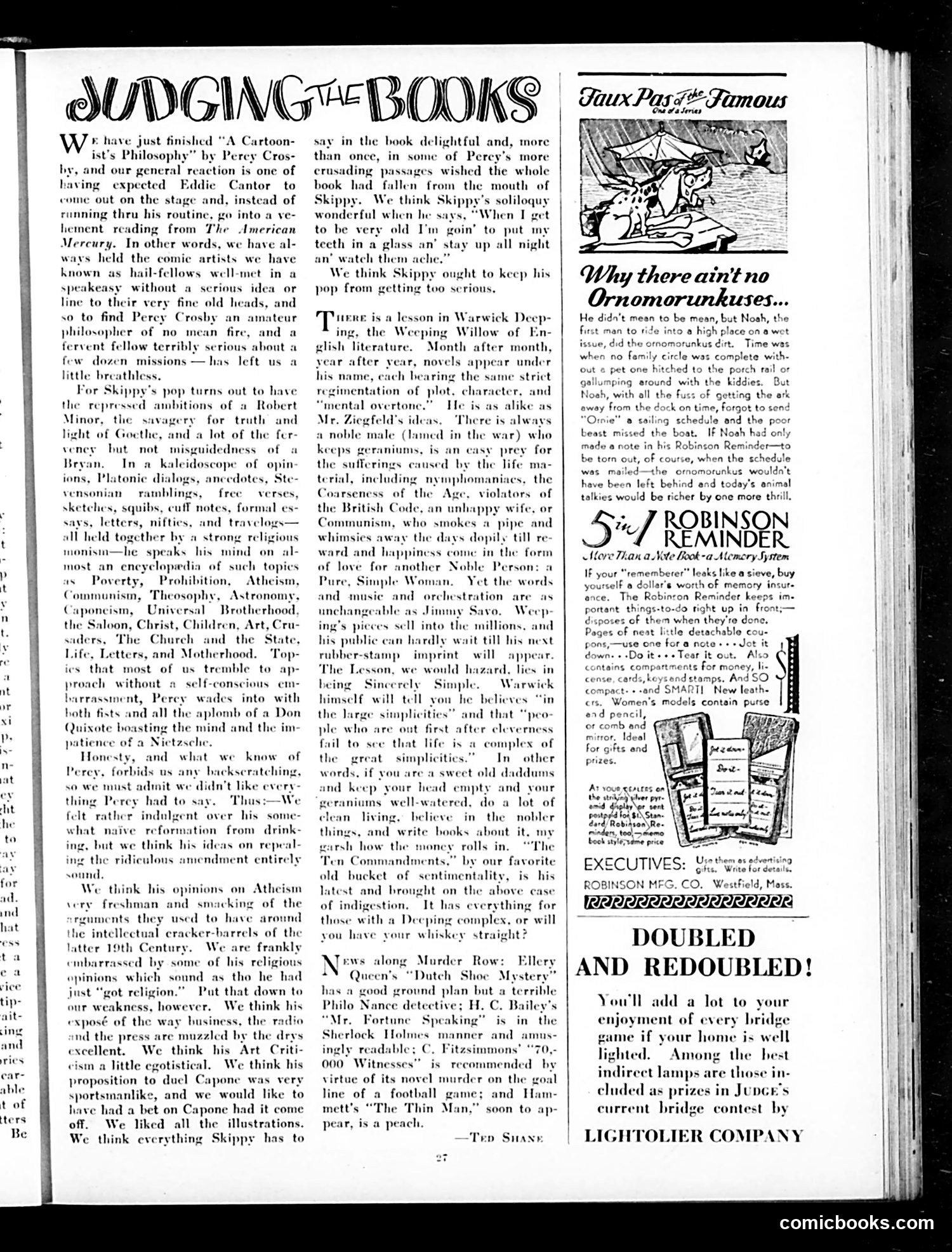
Analysis of This Judge Magazine Page This page from Judge magazine contains a book review column titled "Judging the Books." The main subjects are: 1. Percy Crosby's "A Cartoonist's Philosophy" — The reviewer praises Crosby (creator of the comic strip *Skippy*) for being unexpectedly serious and philosophical, tackling topics like Prohibition, Atheism, Communism, and religion. The reviewer finds his earnestness surprising given Crosby's reputation as a lighthearted comic artist. 2. A critique of formulaic fiction — The second review mocks repetitive English novels with identical plot structures: noble male war veterans, nymphomaniacs, and simple women characters. The satire targets the gap between artists' public personas and private intellectual ambitions, and criticizes the predictable mediocrity of commercial literature. The page also includes period advertisements (Robinson Reminder, Lightolier Company).
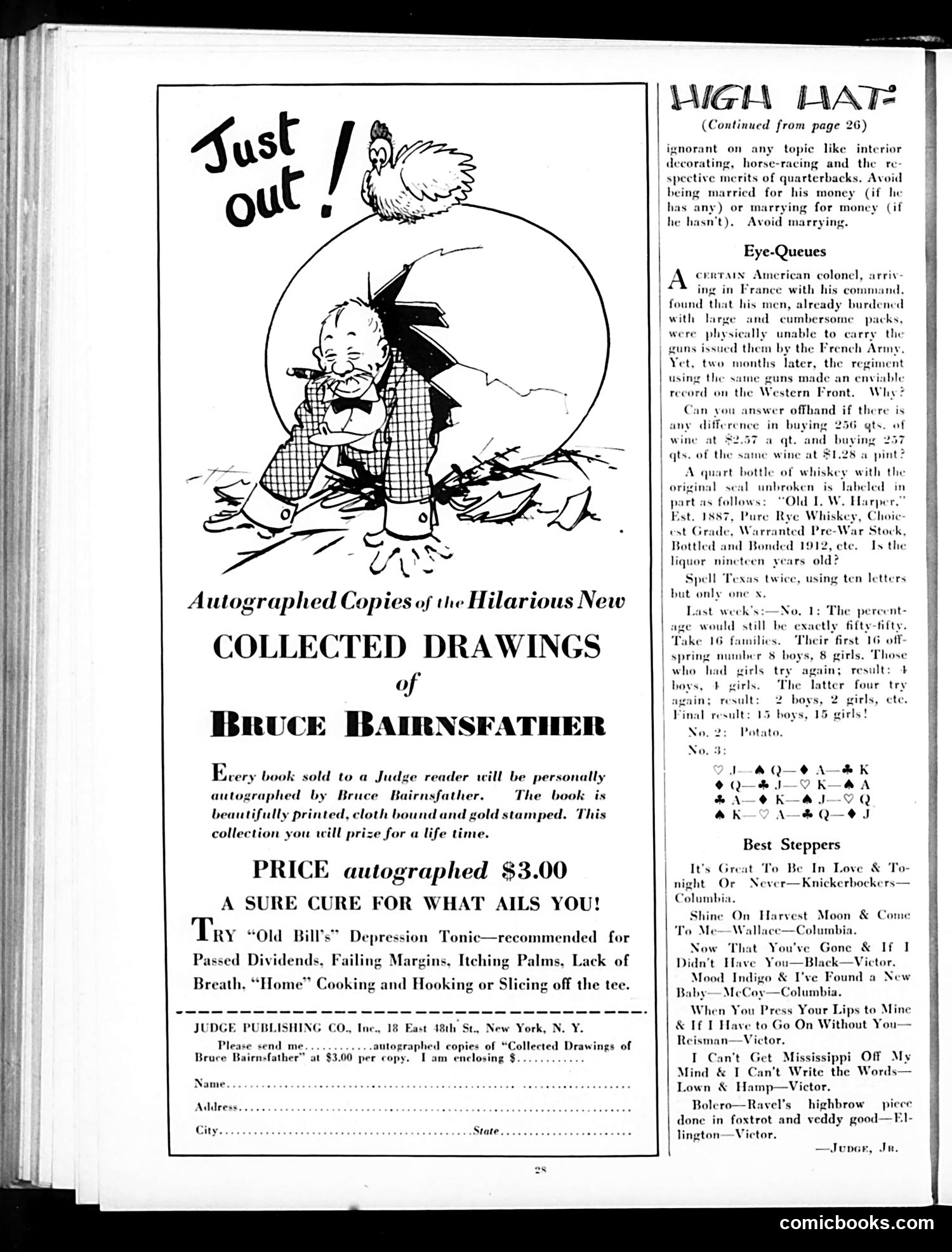
Analysis of This Judge Magazine Page This page is primarily advertising and puzzle content rather than political satire. The main feature is an advertisement for Bruce Bairnsfather's collected drawings—a popular cartoonist known for WWI-era military humor. The "Just Out!" cartoon shows a baby emerging from an egg, illustrating Bairnsfather's humorous style. The bulk of the page consists of: 1. Puzzle section ("Eye-Queues") with logic problems and riddles 2. "Old Bill's Depression Tonic" ad—a tongue-in-cheek remedy for 1920s financial troubles (Passed Dividends, Failing Margins, Itching Palms), suggesting post-WWI economic anxiety 3. Song recommendations ("Best Steppers")—likely popular recordings of the era The only satirical element is the faux-medicine pitch, which uses Depression-era financial woes as comedic fodder. This reflects Judge's typical format: mixing cartoons, jokes, puzzles, and advertisements targeting educated, middle-class readers.
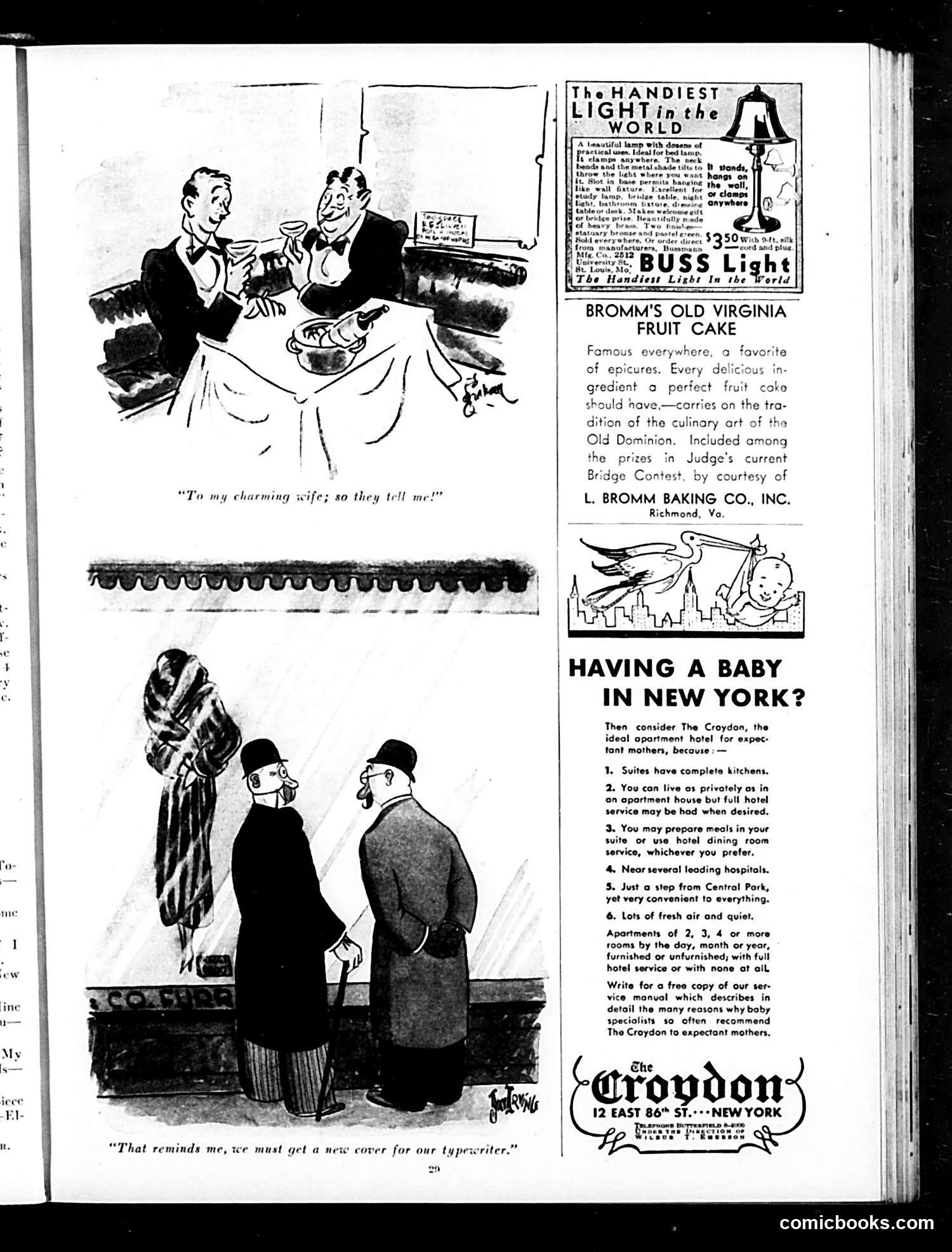
Judge Magazine Page Analysis This page from *Judge* contains two cartoon jokes and several advertisements. Top cartoon: Two men in formal dinner attire share a meal. One compliments the other's wife, saying "To my charming wife; so they tell me!" The humor relies on a mild insult—the speaker is sarcastically suggesting the wife's charms are only hearsay or exaggerated, not personally verified. Bottom cartoon: Two men in coats and hats observe a woman carrying a large bundle, with one saying "That reminds me, we must get a new cover for our typewriter." The joke appears to mock the woman's appearance or shabby clothing by comparing her to worn typewriter equipment needing replacement—crude satirical humor typical of the era. The advertisements include a Buss Light fixture, Bromm's Fruit Cake, and The Croydon hotel (marketing maternity accommodations in New York). These ads suggest the magazine's middle-class readership and era (likely 1920s-1930s).
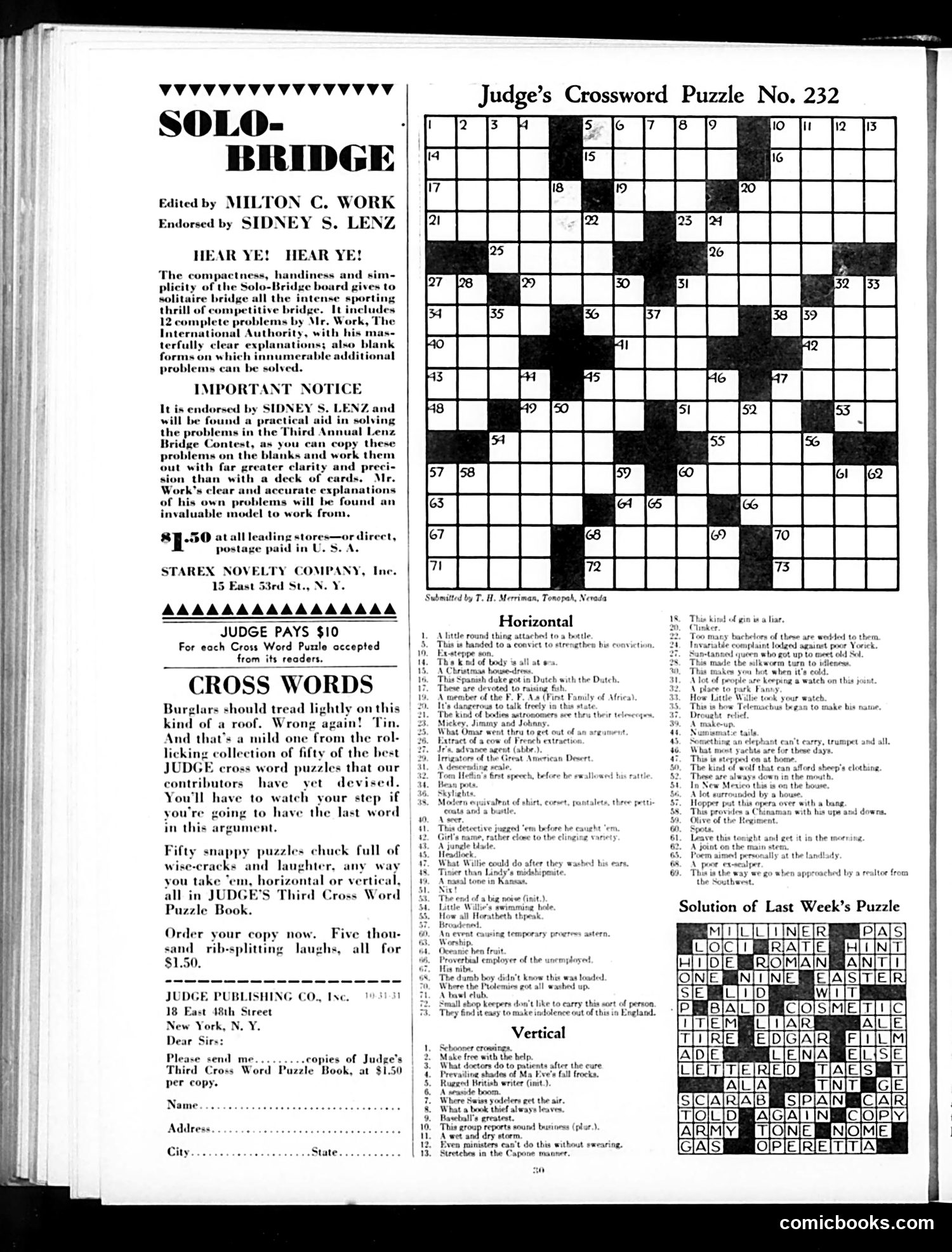
Judge Magazine Page Analysis This page is primarily advertising and puzzle content, not a political cartoon. It features: Main Content: - Advertisement for "Solo-Bridge," a bridge card game instructional booklet edited by Milton C. Work and endorsed by Sidney S. Lenz - A crossword puzzle (No. 232) with clues - Promotion for Judge's "Third Cross Word Puzzle Book" ($1.50) - Order form for the puzzle book - Solution to the previous week's crossword Notable Elements: The copy uses playful language ("Burglars should tread lightly on this kind of a roof") to market the puzzles, suggesting they're challenging and entertaining. The page emphasizes that Judge publishes quality puzzles by its contributors. Context: This reflects Judge magazine's role in the 1920s-30s as a venue for both satirical humor *and* commercial entertainment products. The crossword puzzle craze was a major cultural phenomenon during this era, making this advertising commercially valuable. There are no political cartoons or satirical commentary on this particular page.
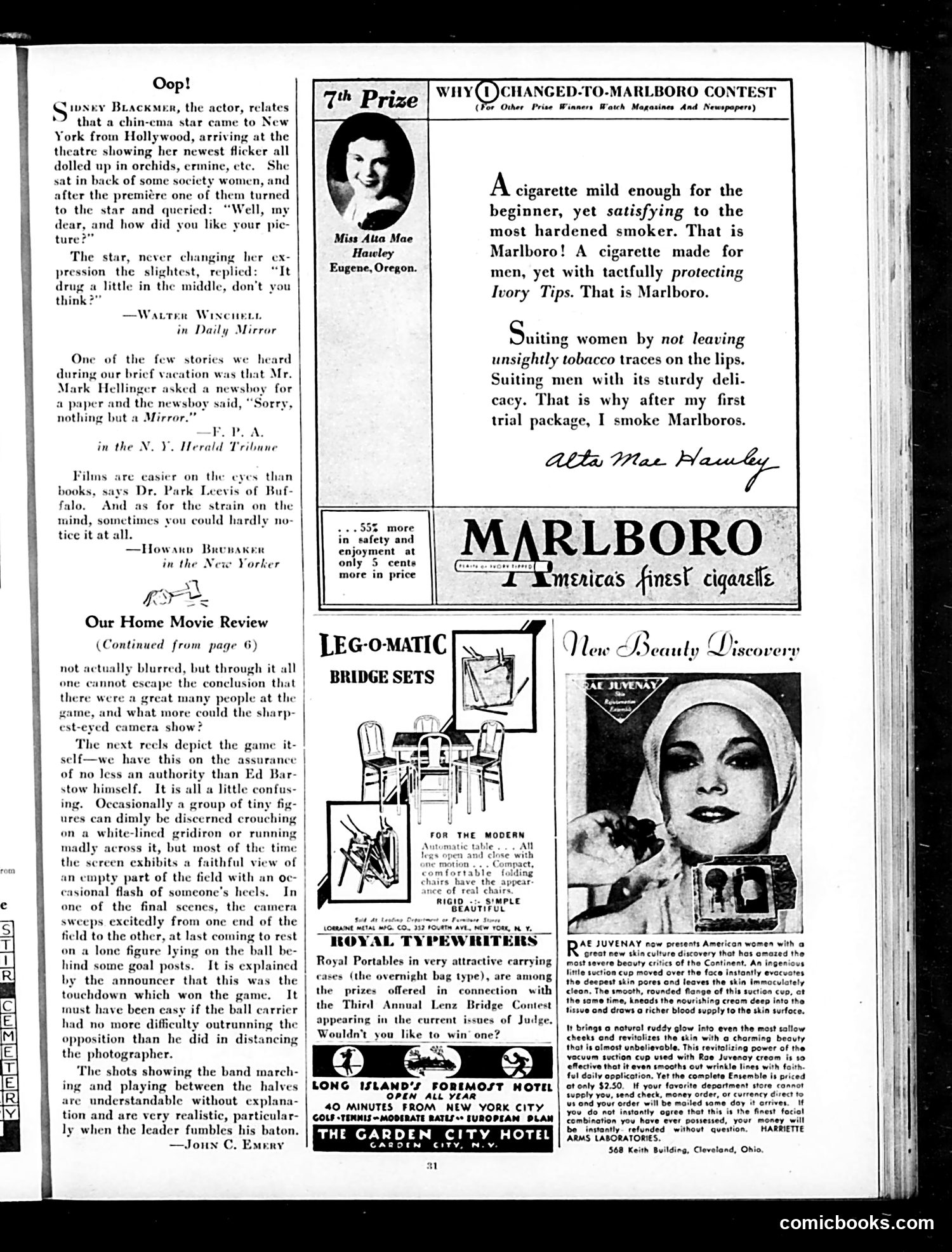
Analysis for Modern Readers This page is primarily advertising, not political satire. The dominant content is a Marlboro cigarette advertisement featuring actress Alta Mae Hawley, promoting cigarettes as mild yet satisfying, with "Ivory Tips" to prevent tobacco stains on lips—targeting both male and female smokers. The page also includes: - "Oop!" anecdotes: Brief celebrity gossip items (Sidney Blackman, Mark Hellinger) with no apparent satirical point—just Hollywood trivia. - "Our Home Movie Review": A genuine film critique discussing camera work and crowd scenes. - Product advertisements: Leg-O-Matic bridge sets, Royal typewriters, and Juvenay beauty cream. Modern context: This reflects 1920s-30s advertising norms when cigarette marketing to women was novel and unregulated. The emphasis on keeping lips clean reveals contemporary anxieties about feminine propriety. No political satire is evident; Judge magazine here functions as a general-interest publication monetized through advertising rather than purely satirical content.
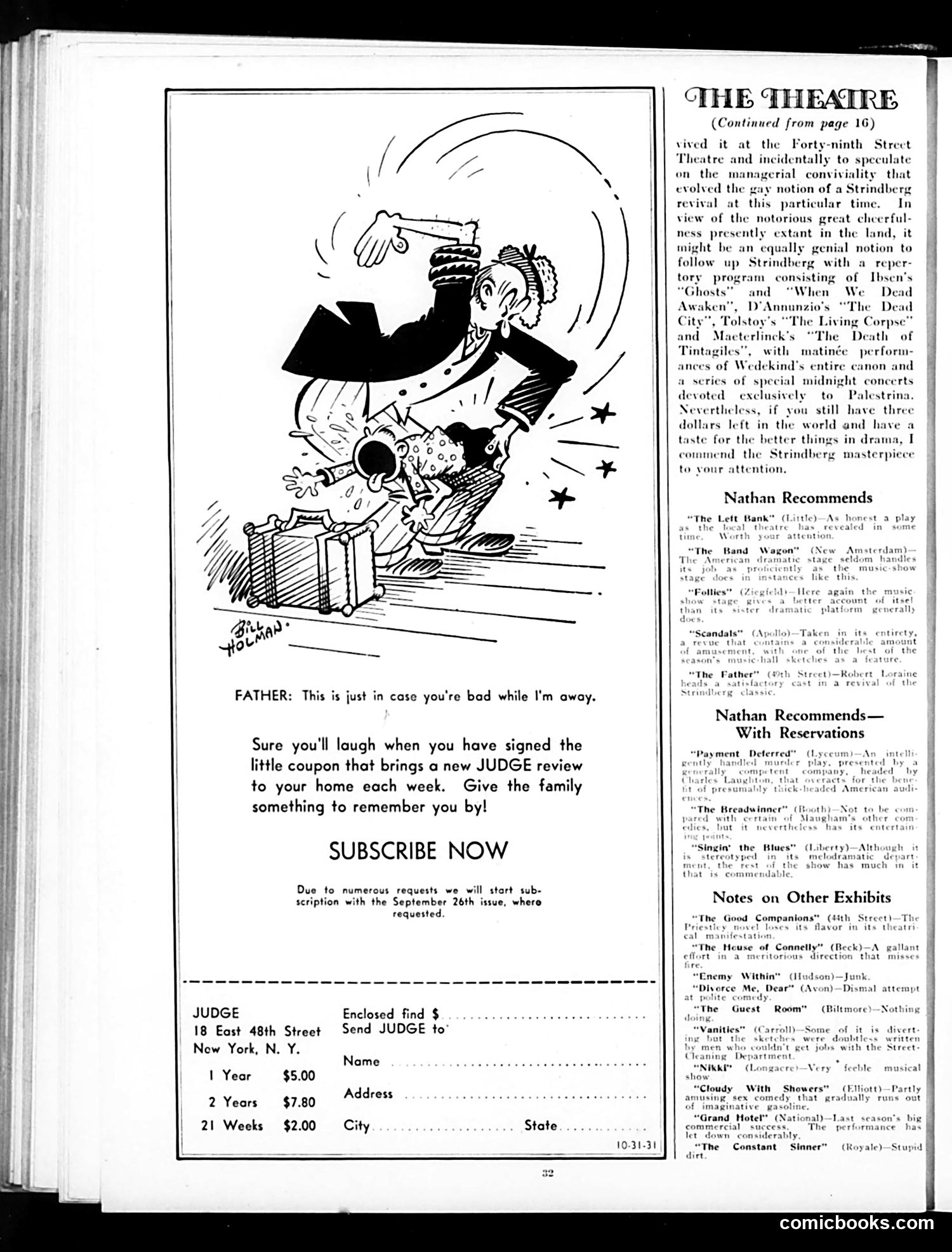
This page is primarily a subscription advertisement for Judge magazine, not a political cartoon analysis piece. The main illustration shows a father figure jovially tossing money in the air to a child, with the caption "This is just in case you're bad while I'm away." The joke plays on parental discipline: instead of leaving punishment instructions, he's leaving money—suggesting either that bribing the child is easier than enforcing rules, or satirizing Depression-era parental anxiety about providing for their families even during absences. The right column contains theater reviews by "Nathan" (likely drama critic George Jean Nathan), recommending various Broadway productions including Strindberg's work and musicals like "Scandals" and "Singin' the Blues." The advertisement itself invites readers to subscribe to Judge for weekly satirical content, offering pricing from $2.00 for 21 weeks to $7.80 for two years. The date notation "10-31-31" suggests October 1931, during the Great Depression, when such affordable humor publications were popular diversions.
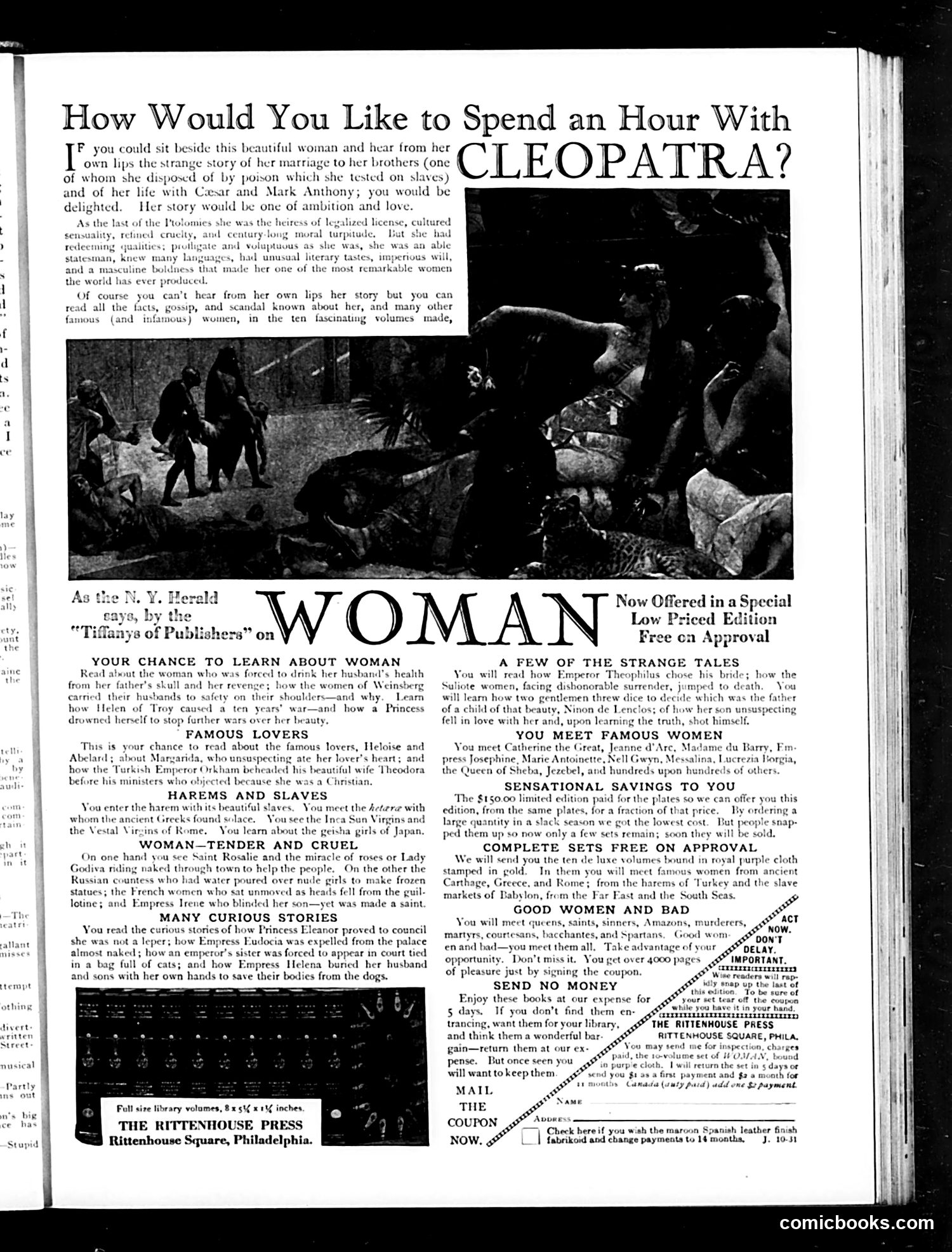
Explanation for Modern Readers This page is primarily advertising, not political satire. It promotes a ten-volume book set called "Woman" published by The Rittenhouse Press, featuring historical accounts of famous women. The advertisement uses sensationalism to attract buyers, emphasizing lurid stories: Cleopatra (depicted in the dark image), women who poisoned husbands, those forced into harems, and figures like Helen of Troy. The text highlights "curious stories" of cruelty alongside tales of virtue—positioning women as exotic, dangerous, or morally extreme. The pitch exploits early 20th-century fascination with "forbidden" knowledge about female sexuality, power, and transgression. Phrases like "tenderness and cruelty," references to harems and slaves, and emphasis on "famous lovers" suggest the books offered voyeuristic historical gossip presented as educational. This reflects period attitudes: women's history reduced to scandalous narratives, presented for male consumption as entertainment rather than serious study.
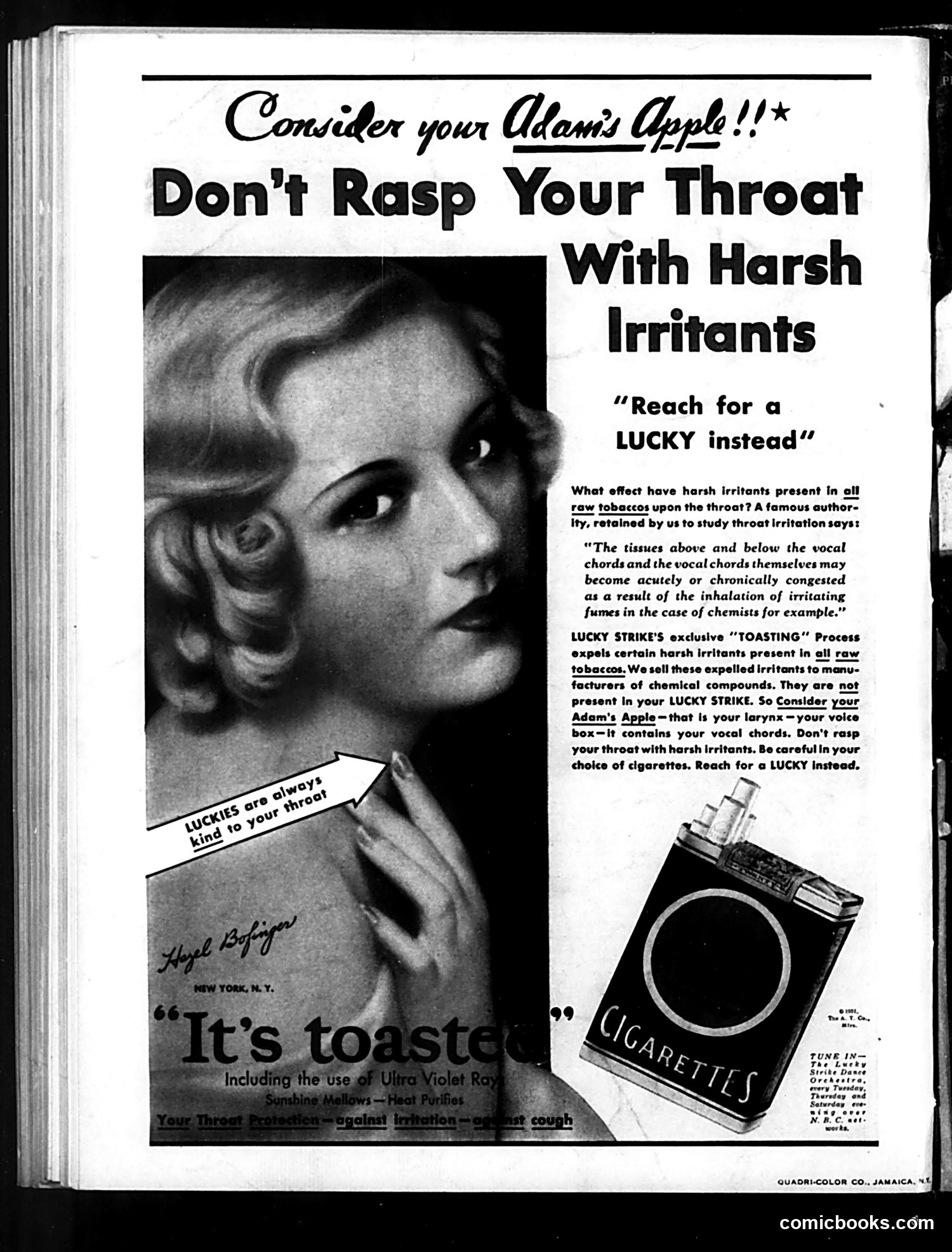
Lucky Strike Cigarette Advertisement This is primarily a cigarette advertisement, not satire. It promotes Lucky Strike cigarettes using pseudo-scientific health claims. The ad features a woman's portrait (likely a celebrity endorsement, though unsigned here) alongside marketing copy claiming Lucky Strike's "Toasting" process removes harsh irritants found in other raw tobaccos. The campaign uses anatomical language—referencing the larynx and vocal cords—to suggest health benefits. Context for modern readers: This represents the era before tobacco regulation (pre-1960s), when cigarette companies made unsubstantiated medical claims. The "toasting" process was marketing fiction. Lucky Strike's famous slogan "Reach for a Lucky instead" implied health advantages over competitors. Such ads exploited public health anxieties while selling a harmful product—tactics later prohibited by law.