judge
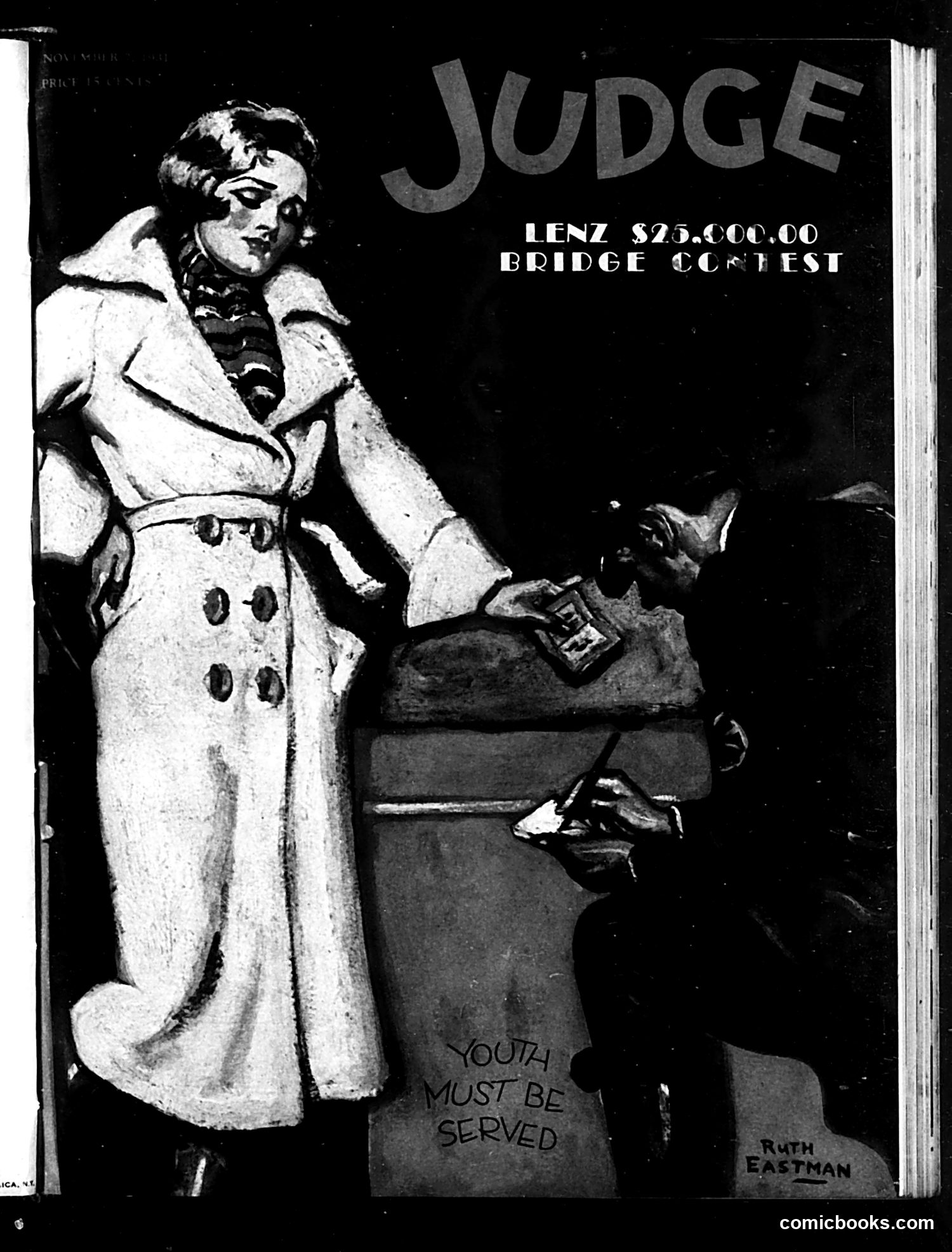
Judge — November 7, 1931
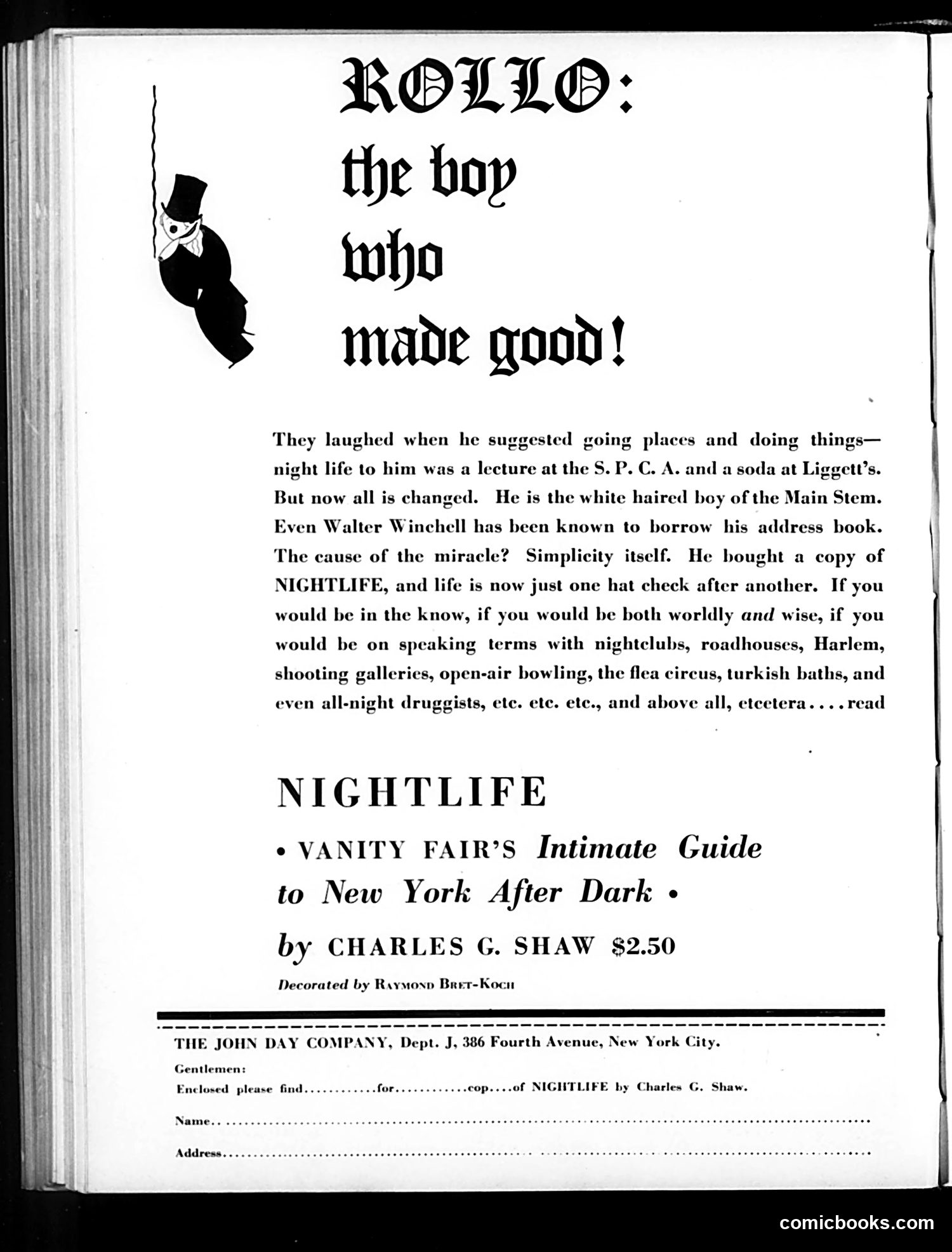
Analysis This page is primarily an advertisement for a book, not a political cartoon. The small illustration shows a stylized figure in formal attire hanging from a rope—a visual metaphor suggesting the book's subject matter. The ad promotes *Nightlife: Vanity Fair's Intimate Guide to New York After Dark* by Charles G. Shaw (illustrated by Raymond Bert-Koch), priced at $2.50. The satirical text mocks a naive young man ("the boy who made good") who was once considered dull, boring only with YMCA lectures and sodas. After reading this book about nightclubs, roadhouses, Harlem venues, and other establishments, he's transformed into someone socially sophisticated and worldly. The humor lies in suggesting that simply reading about nightlife—rather than actual experience—can create an appearance of cosmopolitan knowledge.
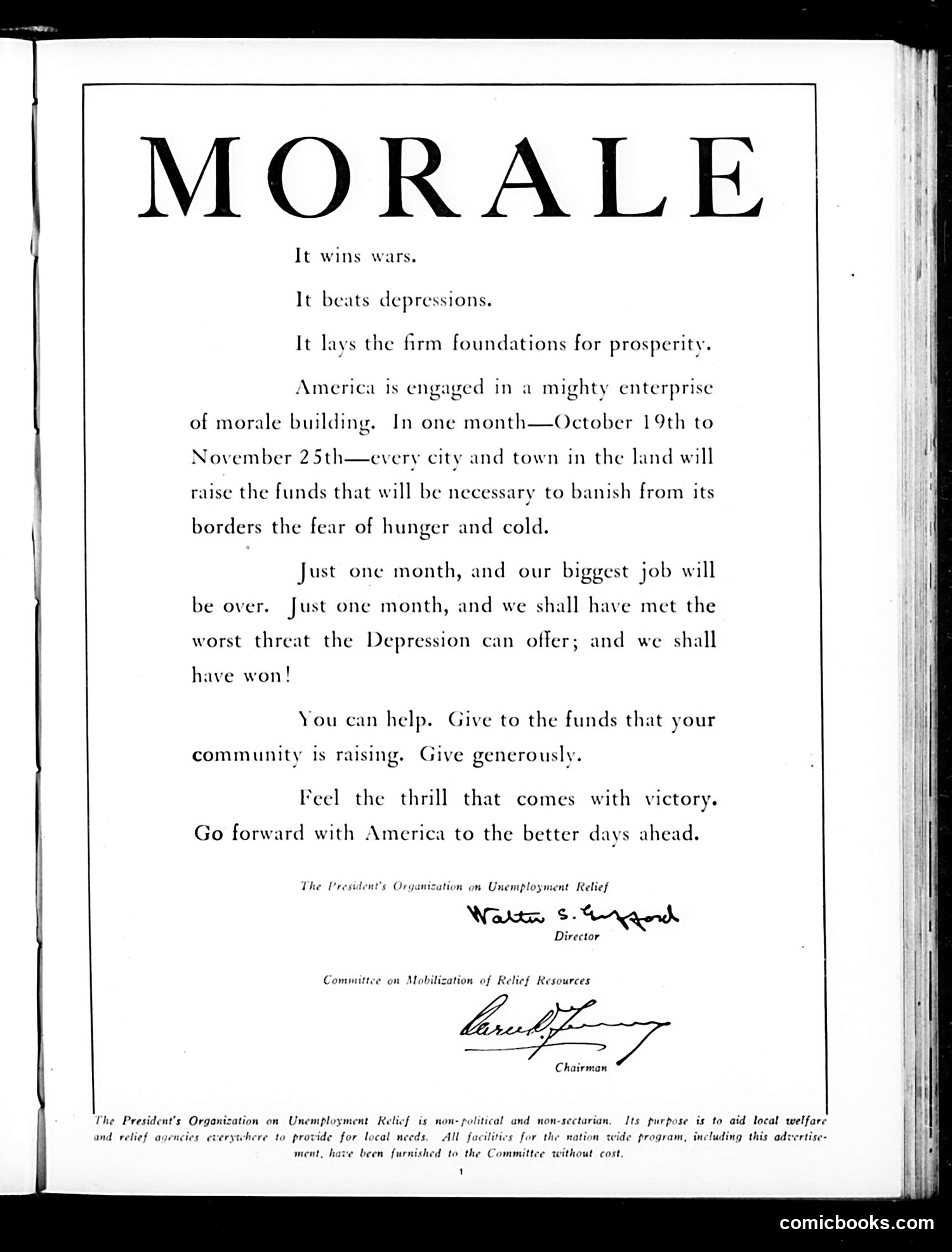
Analysis This is not a satirical cartoon, but rather a genuine public service advertisement from Judge magazine. The page promotes "MORALE" as essential to American victory and prosperity during what appears to be the Great Depression era. The ad urges citizens to donate to community relief funds during a specific campaign period (October 19th to November 25th). It's signed by officials from the President's Organization on Unemployment Relief, presenting this as a patriotic duty. The text emphasizes moral strength as a weapon against economic hardship, appealing to American optimism and collective action. This represents Depression-era rhetoric promoting volunteerism and community fundraising as solutions to widespread poverty and unemployment.
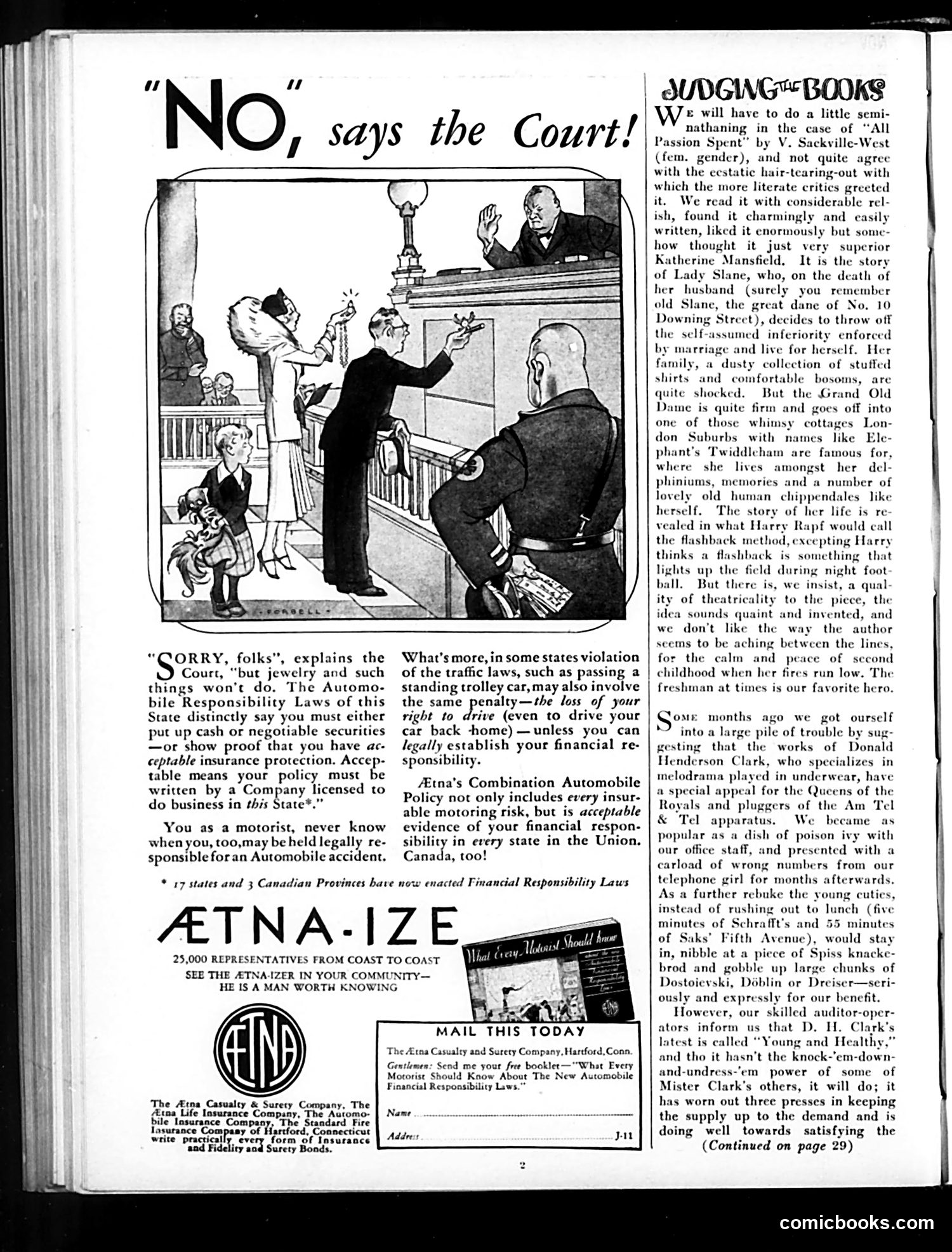
Analysis of Judge Magazine Page The main cartoon satirizes automobile liability laws. A judge in court declares "NO" to a defendant's argument, explaining that motorists cannot escape financial responsibility for accidents simply by citing traffic law violations. The Aetna insurance advertisement below reinforces this point: drivers must carry liability insurance because they're legally responsible "in every state in the Union." The satire targets motorists who believed traffic laws or technical violations could absolve them of accident liability. The cartoon's judge character represents judicial authority firmly rejecting such loopholes. The "Judging the Books" column reviews *Passion Spent* by V. Sackville-West—a literary sidebar unrelated to the automotive liability theme. This page reflects 1920s-30s concerns about establishing automobile accident responsibility and insurance standards.
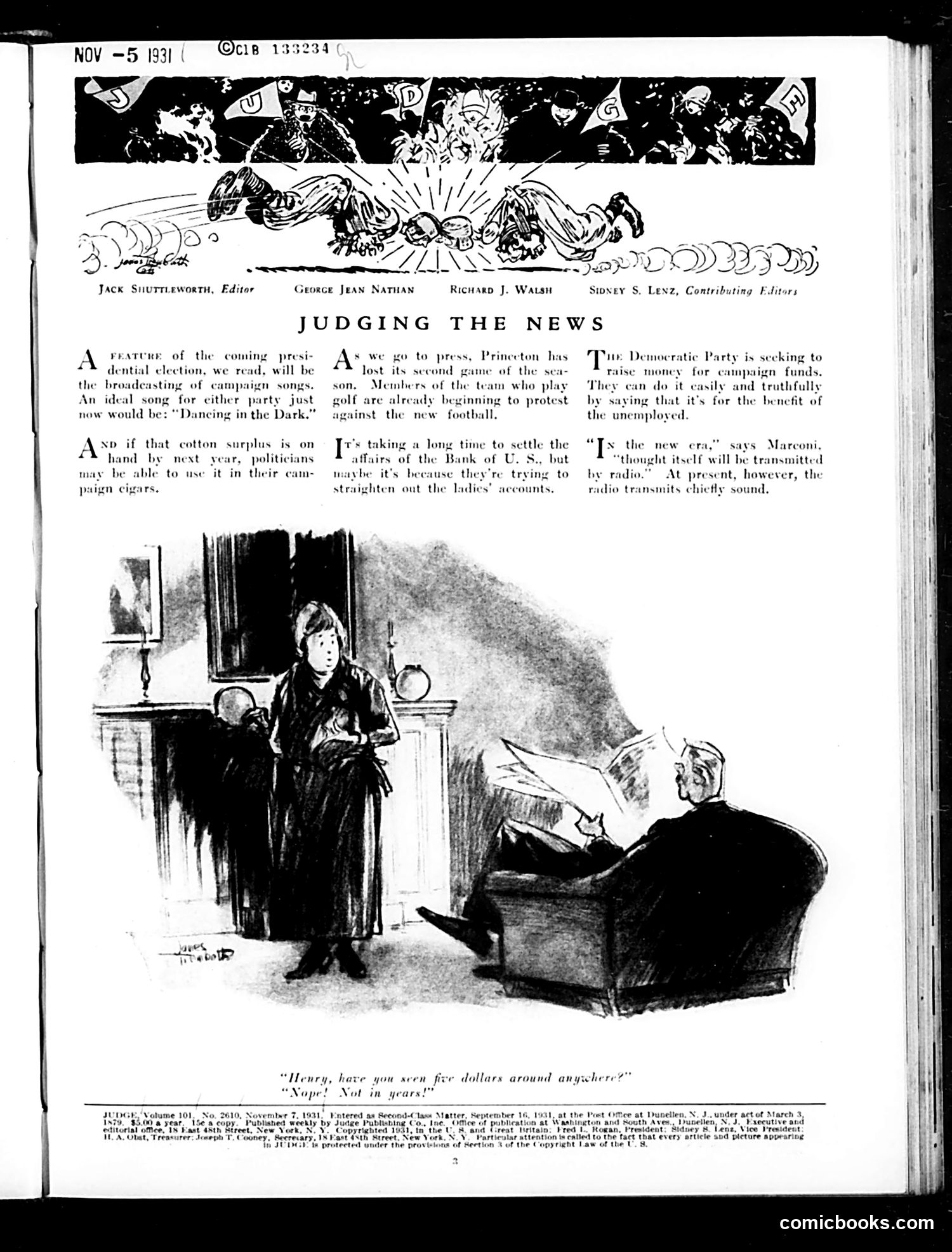
"Judging the News" - November 5, 1931 The main cartoon depicts a domestic scene where a man reads a newspaper while a woman stands nearby asking, "Henry, have you seen five dollars around anywhere?" He responds, "Nope! Not in years!" This joke reflects the Great Depression's financial hardship on ordinary American households. The satire targets economic devastation—by 1931, widespread unemployment and poverty made even finding five dollars seem impossibly difficult. The woman's desperate search and the man's resigned "not in years" response humorously underscores how completely depleted family finances had become. The accompanying "Judging the News" column contains brief political commentary, including references to Princeton's football struggles and Bank of U.S. financial troubles, typical of Judge's satirical news commentary from this period.
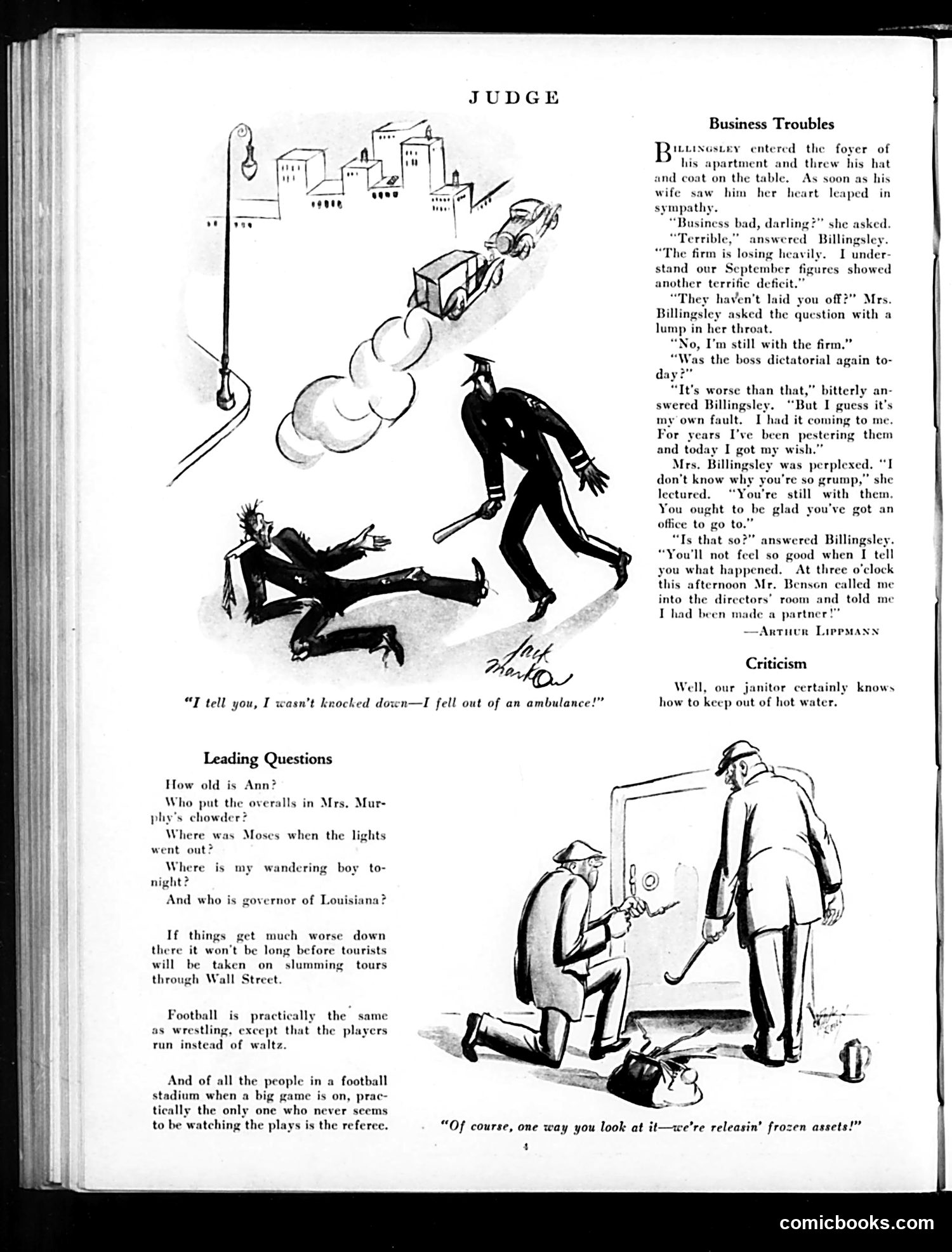
Page Analysis: Judge Magazine This page contains three distinct satirical pieces: "Business Troubles": A dialogue between Mr. and Mrs. Billingsley about the firm's financial crisis and potential layoffs. The satire targets business anxiety and masculine grumpiness during economic hardship—Billingsley resents his wife's sympathy and later learns he's been made a partner, inverting his self-pity into awkward pride. "Leading Questions": Observational humor about current events (references to "Ann," Moses, Louisiana's governor) and football culture, mocking the referee as the only inattentive observer. "Criticism": A cartoon showing a janitor appearing to assault someone, with the caption about "releasing frozen assets"—likely wordplay on Depression-era financial terminology, treating the janitor's roughness as inadvertent economic commentary. The overall tone reflects early-to-mid 20th-century anxieties about business, masculinity, and social hierarchy.
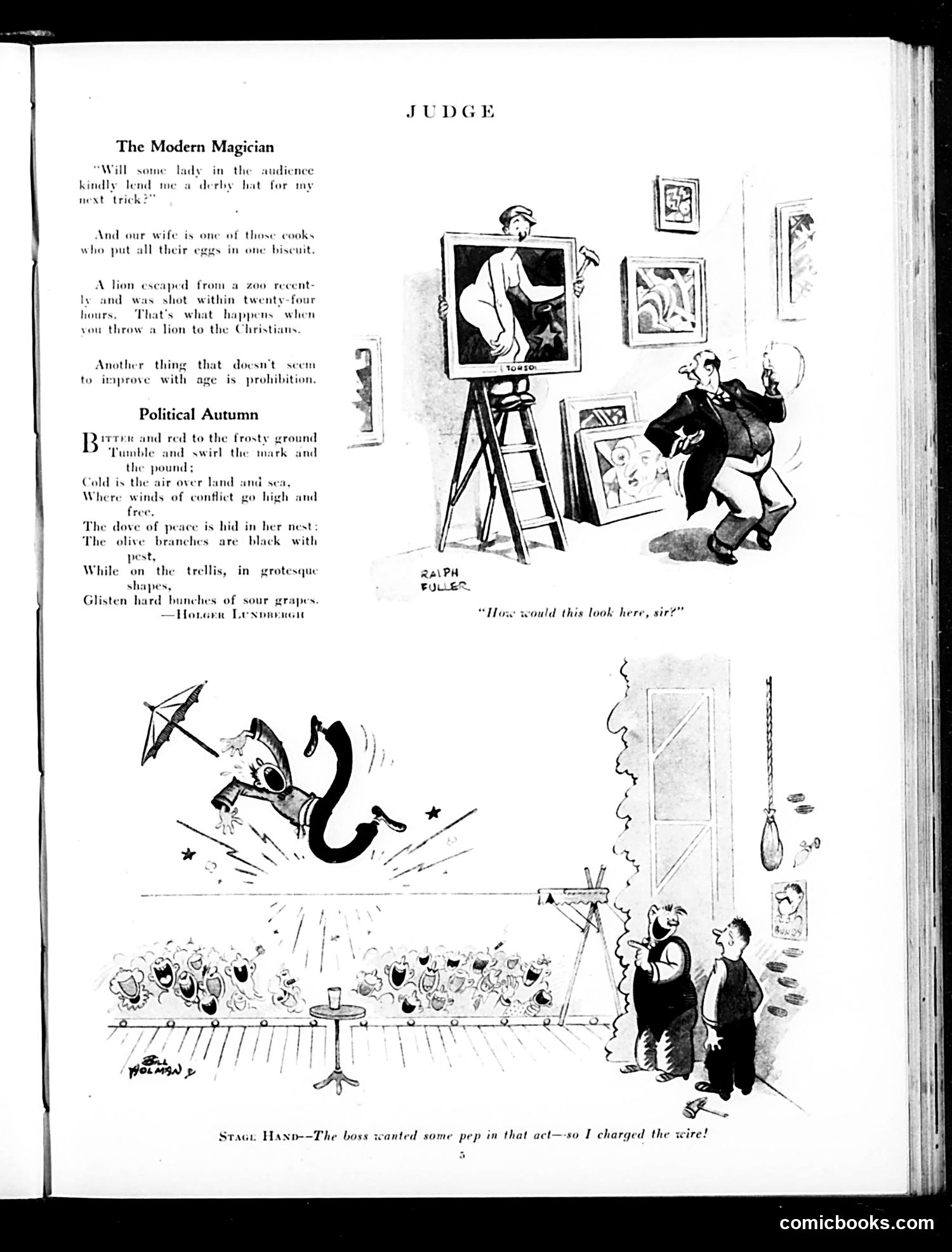
Analysis of Judge Magazine Page This page contains humorous commentary and cartoons typical of early 20th-century satirical journalism. "The Modern Magician" depicts an artist or charlatan performing magic tricks. The jokes mock domestic life ("wife...puts all their eggs in one biscuit") and make a dark religious reference about "throwing a lion to the Christians." "Political Autumn" is a poem by Hugh Loughborough using seasonal metaphors—likely commentary on political turbulence, though the specific political context is unclear without dating information. "Stage Hand" shows a theatrical manager or producer dealing with audience demands, referencing backstage chaos when "the boss wanted some pep in that act—so I charged the wire!" This suggests electrifying stage effects as entertainment. The cartoons satirize modern entertainment, domestic absurdity, and theatrical performance through visual exaggeration typical of Judge's satirical style.
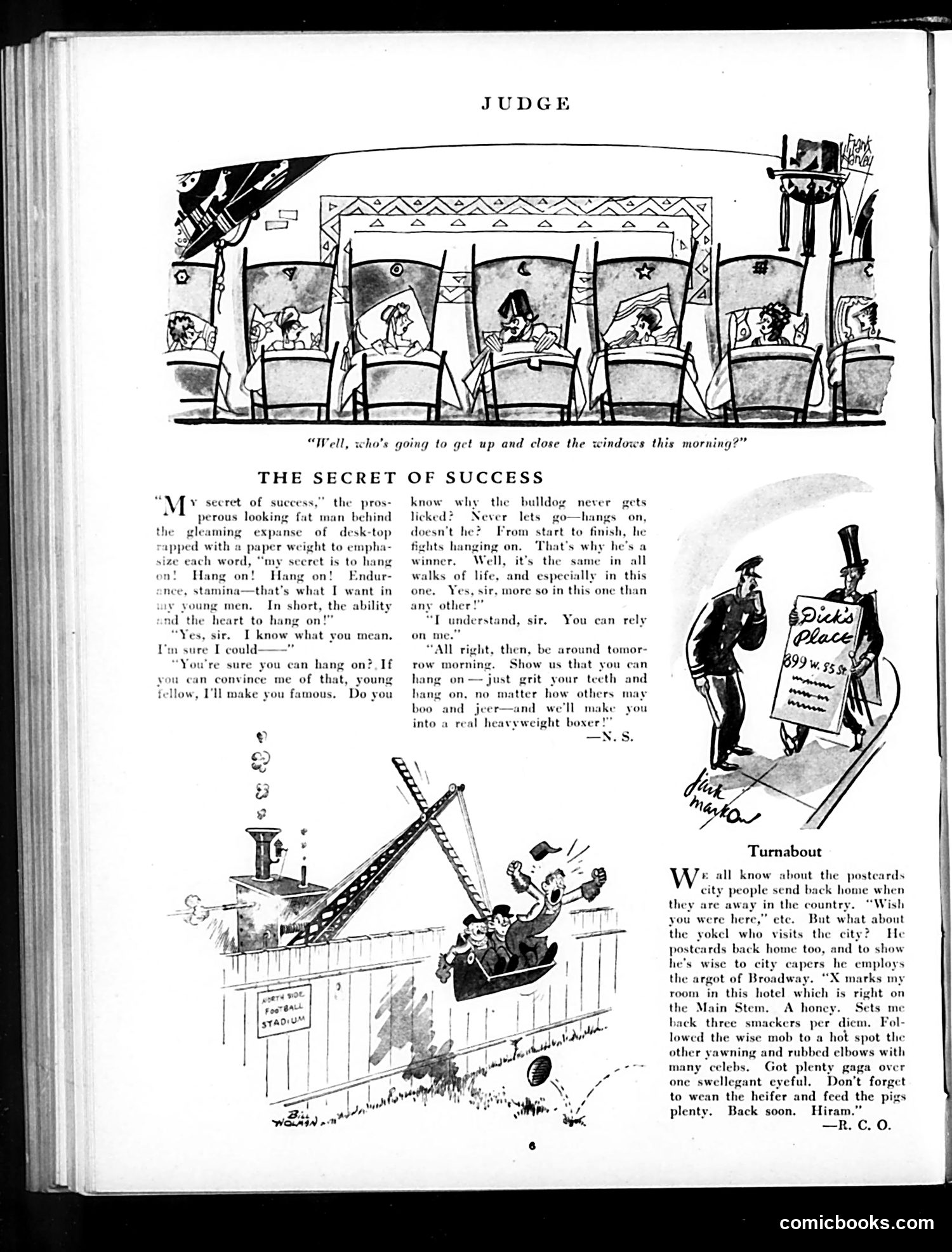
"Judge" Page Analysis: The Secret of Success Top Cartoon: A judge addresses courtroom spectators about closing windows. The caption quotes the judge explaining his "secret of success"—persistence. He uses a bulldog metaphor: the dog succeeds because it never lets go; similarly, one must "hang on" through life's struggles to achieve success. Bottom Cartoon: Depicts a amusement park ride malfunction with people being thrown about. The accompanying text, "Turnabout," humorously describes postcards tourists send home, contrasting pleasant wishes with chaotic reality. The joke satirizes the gap between vacation expectations and actual experiences—particularly the yokel's discovery that city attractions aren't always pleasant. Both pieces employ humor to comment on perseverance and expectations.
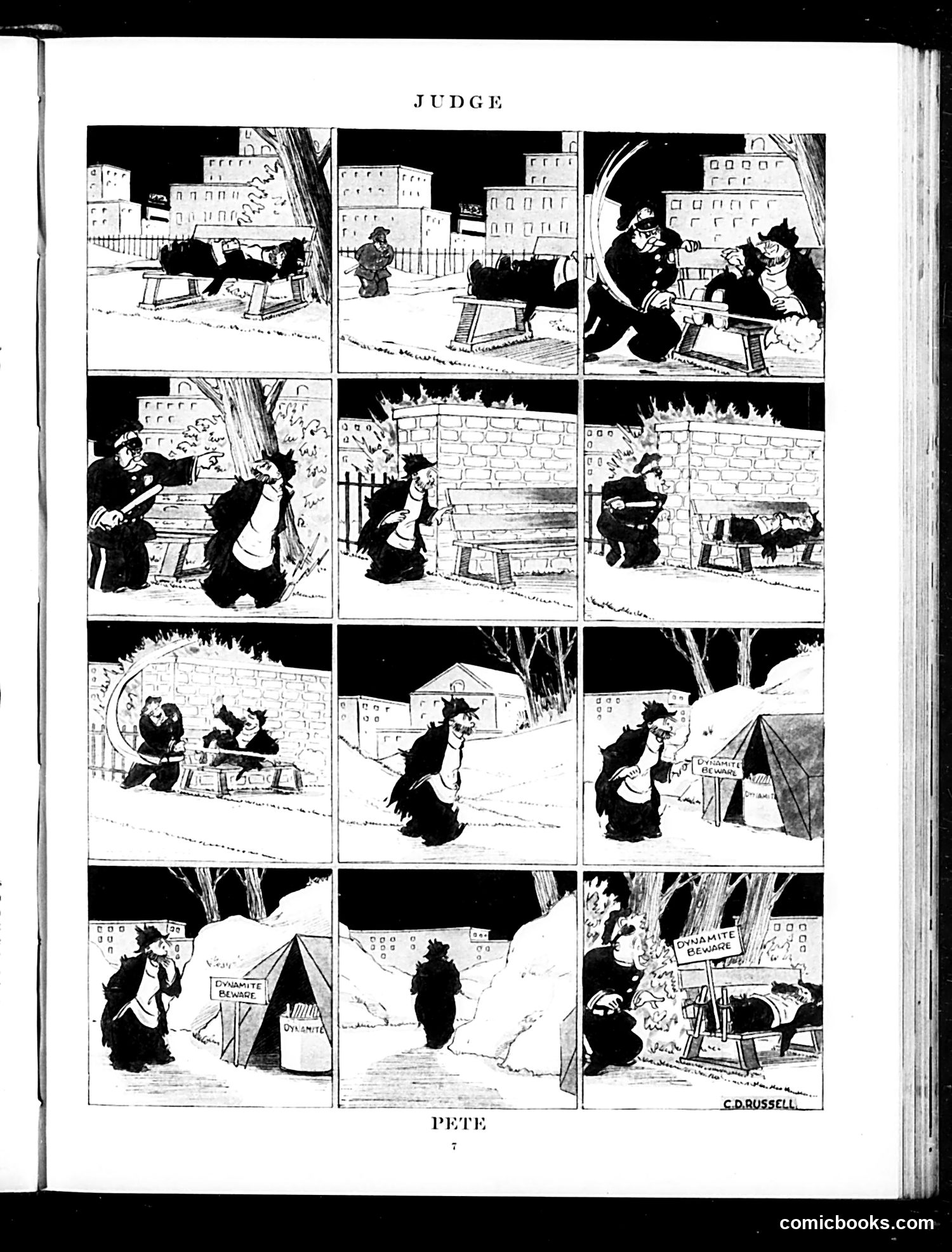
Analysis of "Judge" Comic Page This page contains a sequential comic strip titled "Judge" (credited to C.D. Russell) depicting what appears to be a homeless or displaced person in winter conditions. The narrative follows a figure moving through snowy urban scenes, including encounters near buildings and eventually setting up a makeshift tent or shelter. The satirical point likely critiques poverty and homelessness in urban America, using the character as social commentary. The final panels show the figure establishing temporary shelter, suggesting themes about economic hardship and survival. Without additional historical context or clearer facial details, specific political figures remain unclear, but the strip appears to comment on class inequality and urban conditions typical of early-to-mid 20th century American satirical cartooning.
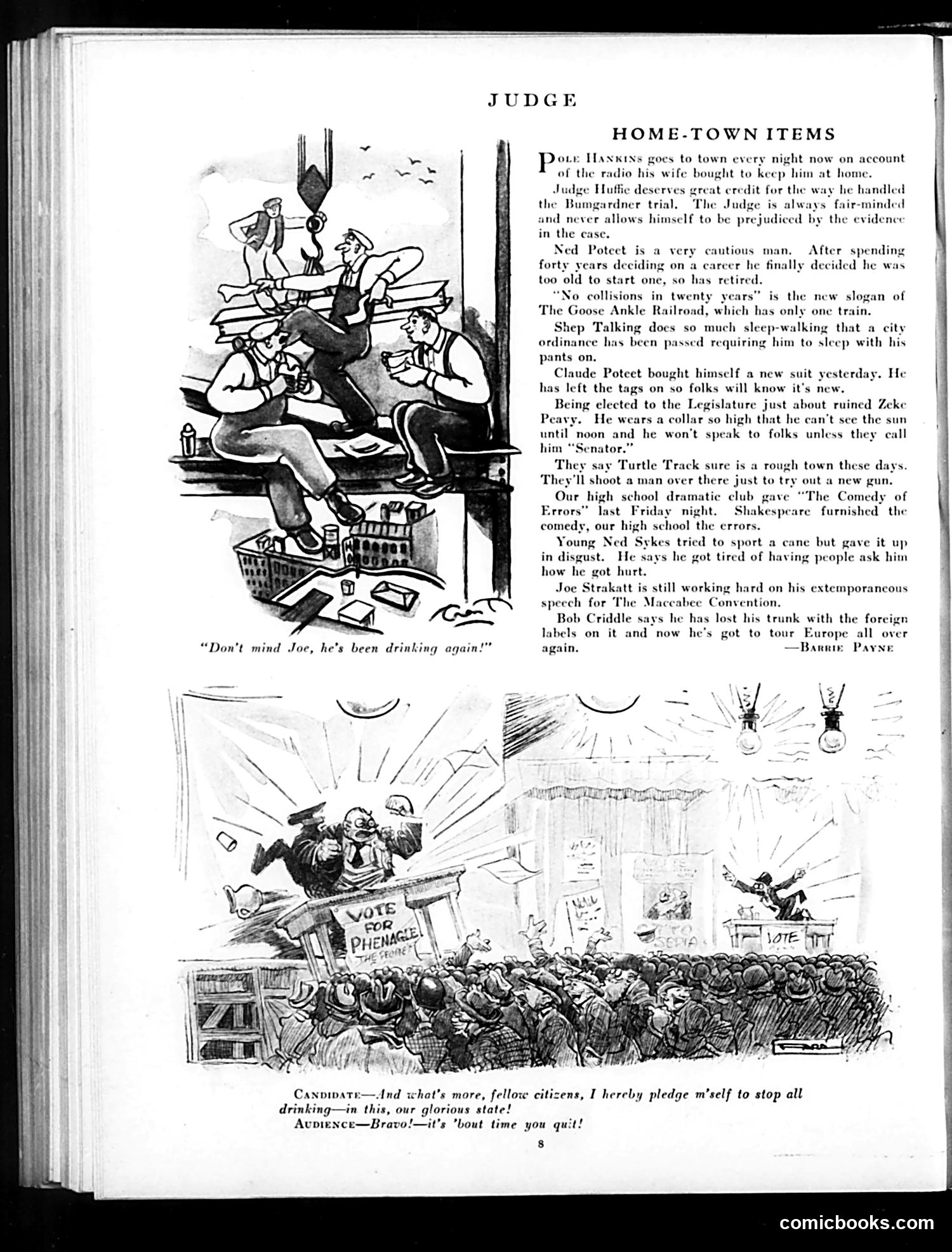
Explanation for Modern Readers This page from *Judge* magazine contains two types of satirical content: Top Section: "Home-Town Items" — A series of humorous small-town gossip pieces mocking local characters. Examples include a judge who's biased despite claims of fairness; a cautious man who spent forty years deciding on a career before retiring; and a politician (Zeke Peavy) elected to the Legislature who now wears an absurdly high collar and demands to be called "Senator," becoming insufferable. These are gentle, provincial jokes about small-town pretension and human folly. Bottom Cartoon — Shows a political candidate on a platform pledging to "stop all drinking—in this, our glorious state!" while the audience sarcastically shouts "Bravo!—it's 'bout time you quit!" This is clearly Prohibition-era satire (likely 1920s-early 1930s), mocking politicians who made grand temperance pledges while audiences knew such promises were hollow and unenforceable. The joke: the candidate's obvious hypocrisy and the public's cynical recognition of it.
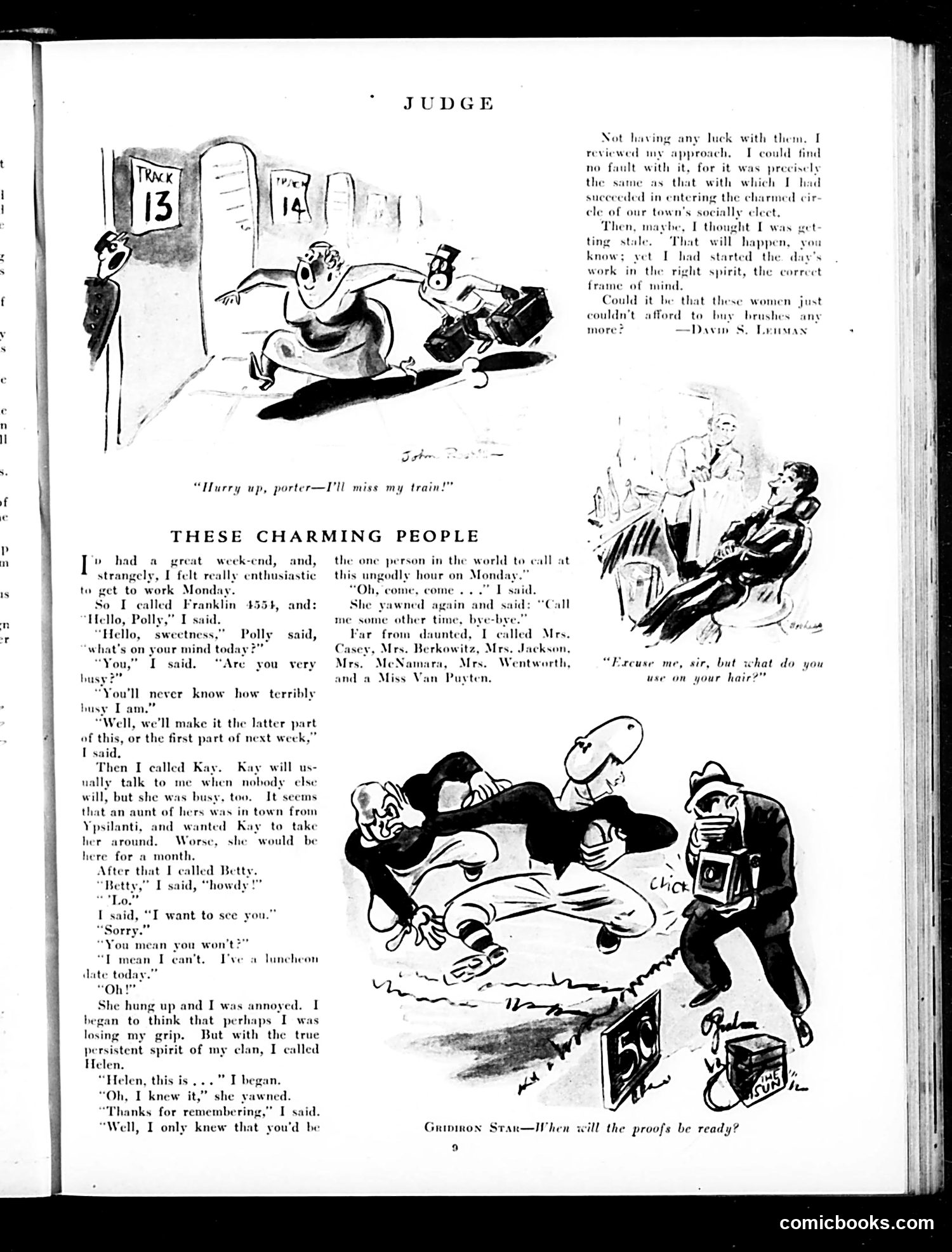
Analysis of Judge Magazine Page This page contains two separate satirical pieces typical of Judge's humor. "These Charming People" (main story) mocks the social frustrations of a persistent salesman or social climber repeatedly calling women for appointments on a Monday morning. Each woman deflects with excuses—busy with relatives, lunch plans, yawning indifference—suggesting either genuine disinterest or the social pretense of unavailability among the leisured class. The satire targets both the pushy caller's lack of social awareness and the affectations of women feigning busyness to maintain elite status. Top cartoon: A harried porter carries luggage while a passenger rushes, captioned "Hurry up, porter—I'll miss my train!" Simple visual humor about travel chaos. Bottom cartoon ("Common Stare"): Appears to satirize commercial or artistic proof-checking delays, with figures examining photographs or proofs and asking when they'll be ready—likely mocking slow production or client impatience in publishing/advertising work. The overall tone is gently mocking of middle-class social pretense and workplace frustrations.
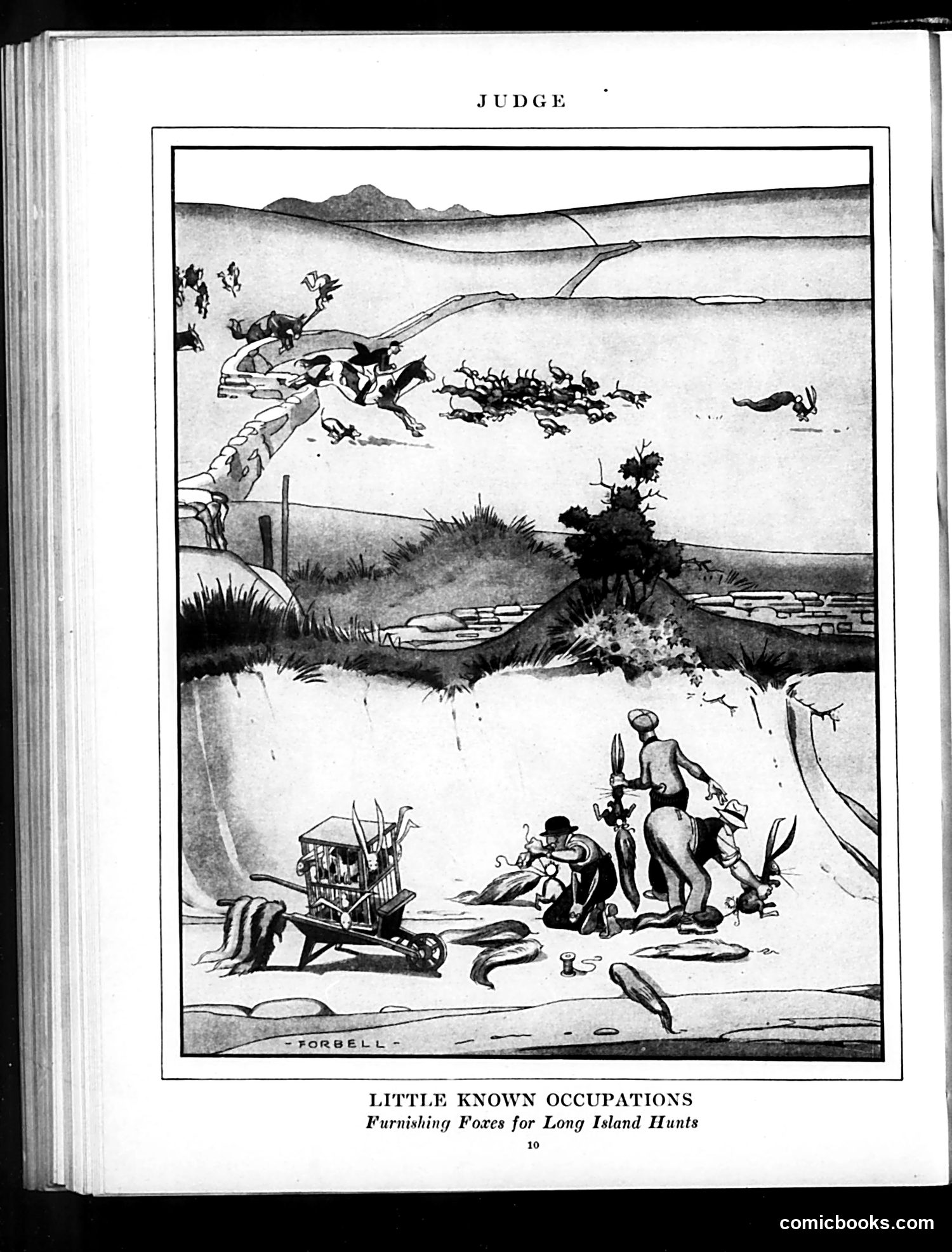
"Furnishing Foxes for Long Island Hunts" This cartoon satirizes the wealthy leisure practices of Long Island's elite during the early 20th century. The image depicts a humorous "occupation" where foxes are apparently bred or captured to supply fox hunts—a fashionable sport among the affluent. The cartoon shows workers in a rural setting managing foxes (visible in cages and loose), suggesting this was an actual commercial enterprise catering to wealthy hunters. The satire targets the artificiality of these "hunts"—rather than genuine hunting, the wealthy were purchasing pre-arranged sporting events with supplied foxes. The title's tone ("Little Known Occupations") treats this dubious livelihood as a legitimate trade, mocking both the occupational pretension and the leisure-class culture that created demand for such services. This reflects Judge magazine's satirical critique of Gilded Age excess and upper-class absurdities.
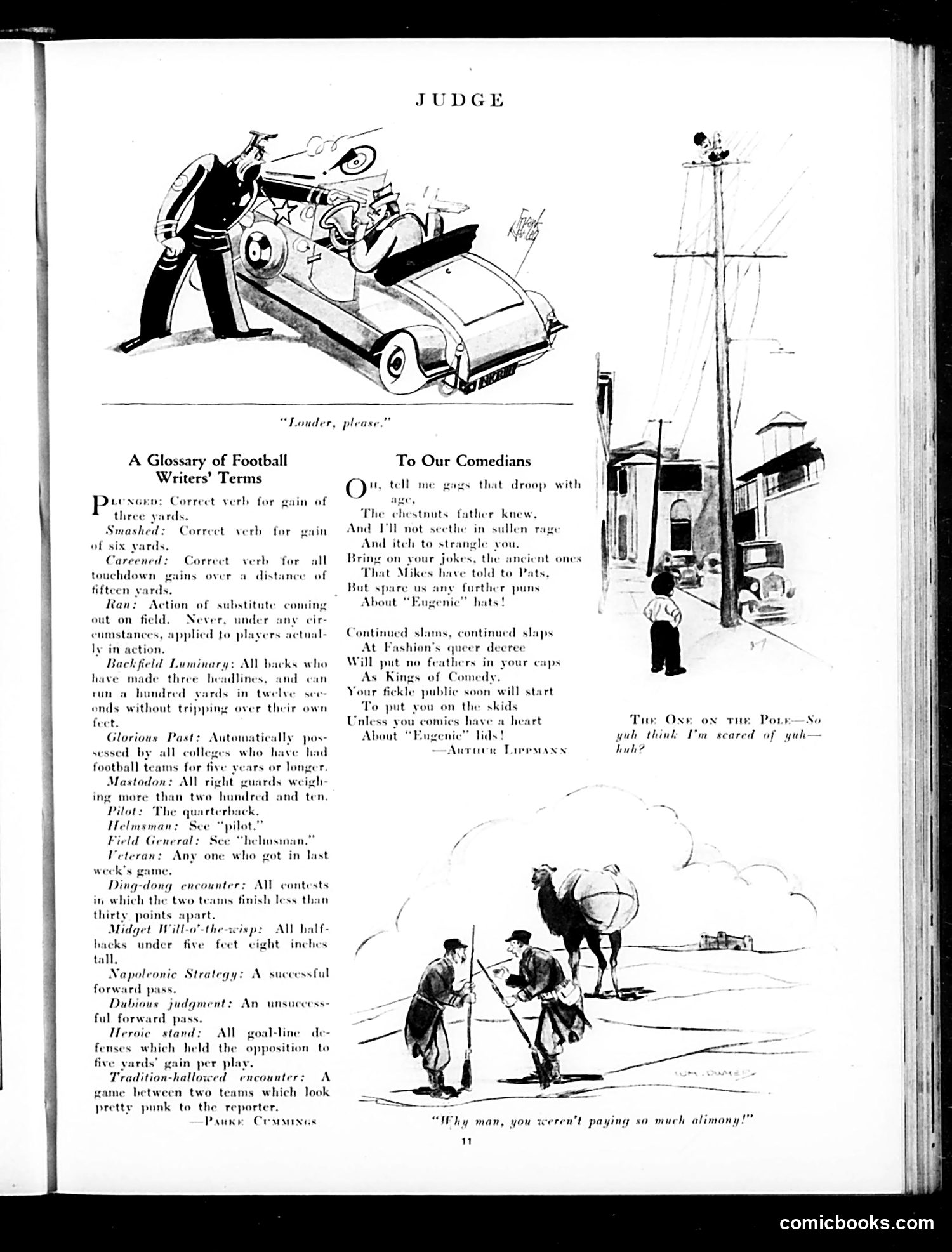
Judge Magazine Page Analysis This page contains two distinct sections: Left side: A satirical "Glossary of Football Writers' Terms" mocking sportswriters' clichéd vocabulary. It humorously defines overused phrases like "smashed" (six-yard gain), "careened" (touchdown), and "Napoleonic Strategy" (successful forward pass). The satire targets how sports journalism relies on flowery, repetitive language rather than precise description. The accompanying cartoon shows a judge examining a wrecked car, captioned "Louder, please"—likely commenting on how loudly sportswriters exaggerate mundane plays. Right side: Two unrelated cartoons. The top depicts someone on a telephone pole with the caption about being scared. The bottom shows two men at a beach with a third figure, one saying "Why man, you weren't paying so much alimony!"—a joke about marriage costs and infidelity. The page primarily satirizes sports journalism conventions rather than addressing specific political events.
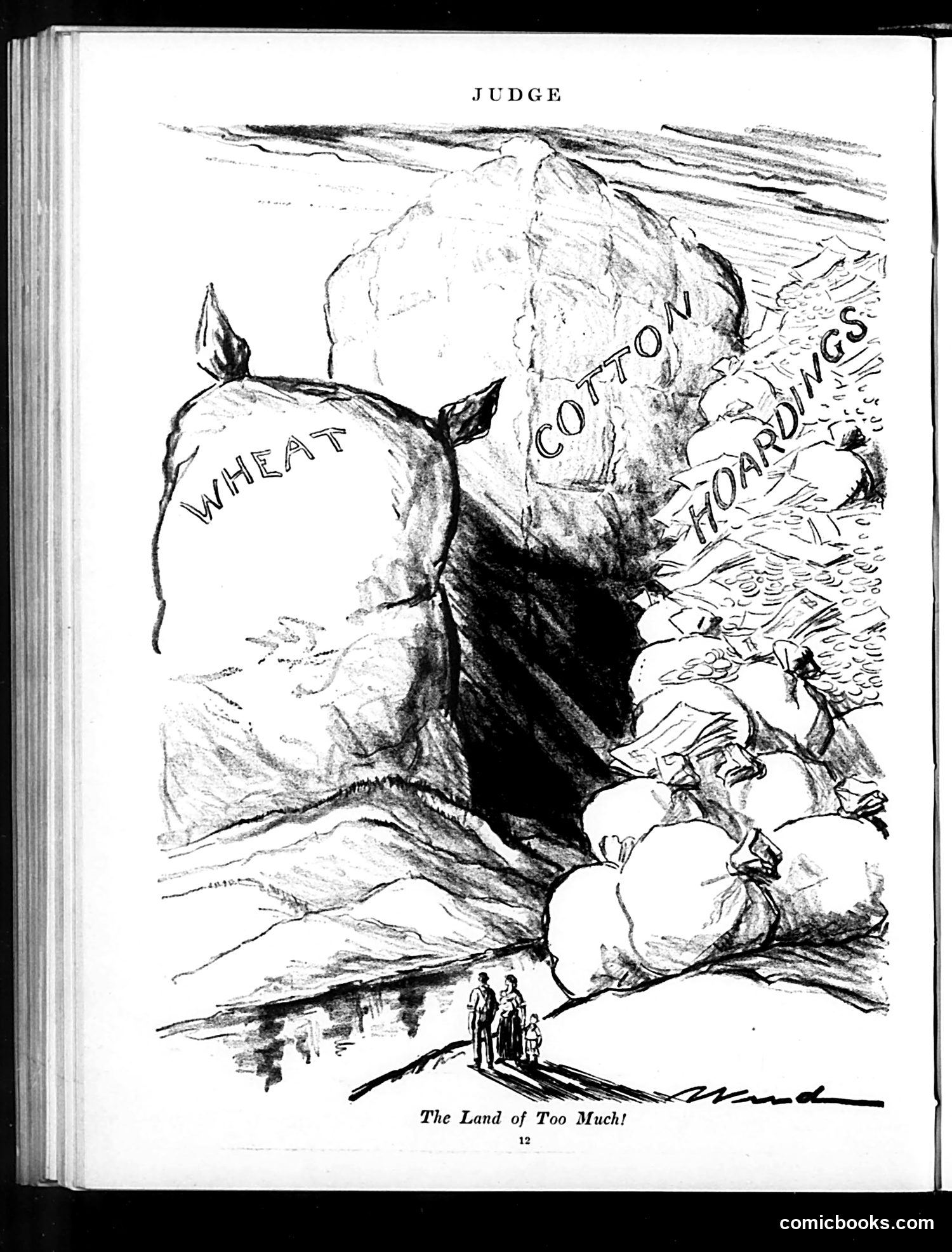
"The Land of Too Much!" - Judge Magazine Cartoon This political cartoon depicts an oversized donkey (symbolizing the Democratic Party) labeled "WHEAT," "COTTON," and "HOARDING" - representing agricultural overproduction and price-fixing during what appears to be the World War I or post-war era. The donkey carries massive sacks of produce while small human figures at the bottom observe the scene. The satire criticizes Democratic agricultural policies for creating surplus that drove prices down, harming farmers. "The Land of Too Much" suggests ironic abundance becoming a burden rather than a blessing. The cartoon likely advocates for Republican approaches to managing agricultural supply and pricing—a major political issue in early 20th-century American politics when farm economics significantly influenced electoral outcomes.
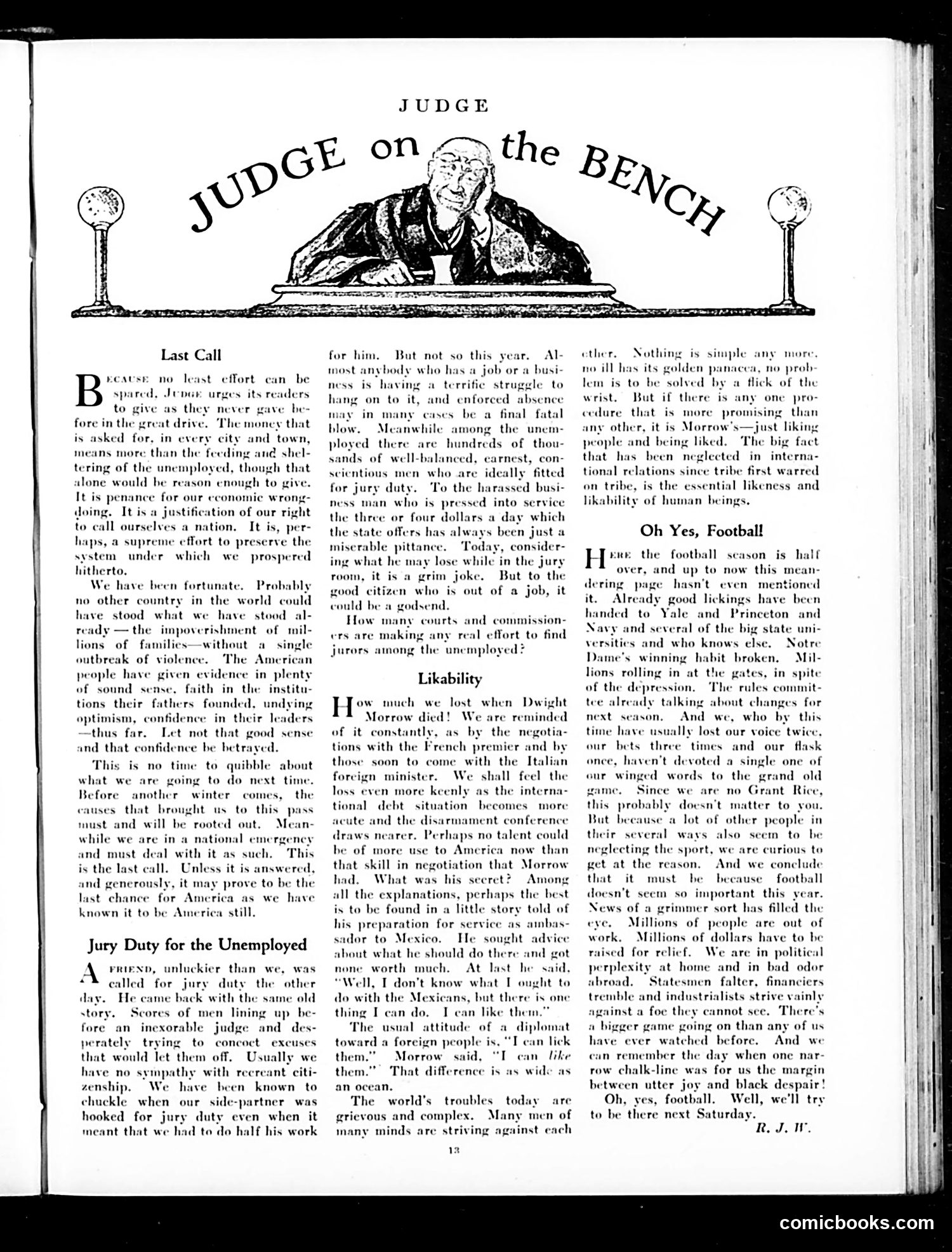
Judge Magazine Page Analysis This page from Judge magazine contains three opinion pieces addressing Depression-era concerns: "Last Call" urges charitable giving to the unemployed, framing it as both moral duty and economic necessity to preserve the capitalist system that enabled American prosperity. "Jury Duty for the Unemployed" argues that courts should recruit jobless citizens for jury duty instead of forcing employed people to serve. The writer notes that while unemployment is economically devastating for most, the small daily jury fee ($3-4) would be meaningful to the jobless, who are often "well-balanced, earnest, conscientious men." "Likability" mourns diplomat Dwight Morrow's death, arguing his diplomatic success stemmed from genuinely liking foreign peoples rather than merely pretending to. The piece suggests this attitude could help resolve international conflicts. The page reflects early Depression anxieties: economic crisis, government response inadequacy, and international instability. The "Judge on the Bench" header illustration shows a stern judge presiding over social commentary rather than courtroom proceedings.
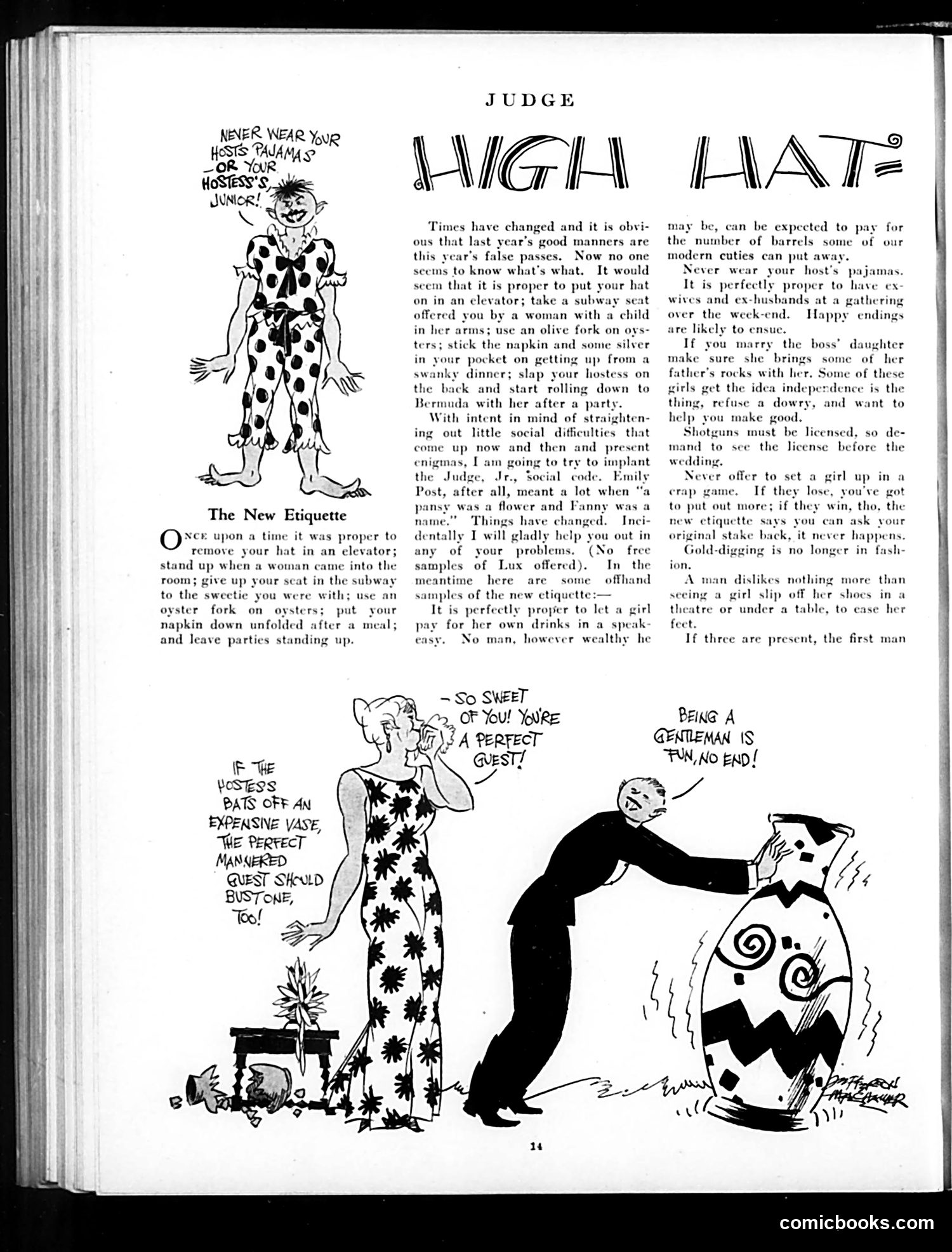
Analysis: "Judge High Hat" - The New Etiquette This satirical article mocks changing social conventions of the era (likely 1920s-1930s). "Judge, Jr." presents deliberately absurd "rules" that invert traditional etiquette to ridicule modern behavior. The humor targets: Social role reversals: Women now pay for drinks in speakeasies; they offer subway seats to men. This reflects post-WWI women's newfound independence and social mobility. Relaxed morality: References to "ex-husbands," women's financial independence, and the casual mention of "speakeasies" (illegal bars during Prohibition) suggest jazz-age looseness that conservative readers found shocking. Materialism: The joke about marrying the boss's daughter for her "rocks" (jewelry/wealth) satirizes gold-digging and mercenary marriages. The cartoons illustrate absurd guest behavior—breaking expensive vases, treating hosts disrespectfully—embodying the article's theme: modern people have abandoned proper decorum. The satire defends traditional etiquette while acknowledging it's already obsolete.
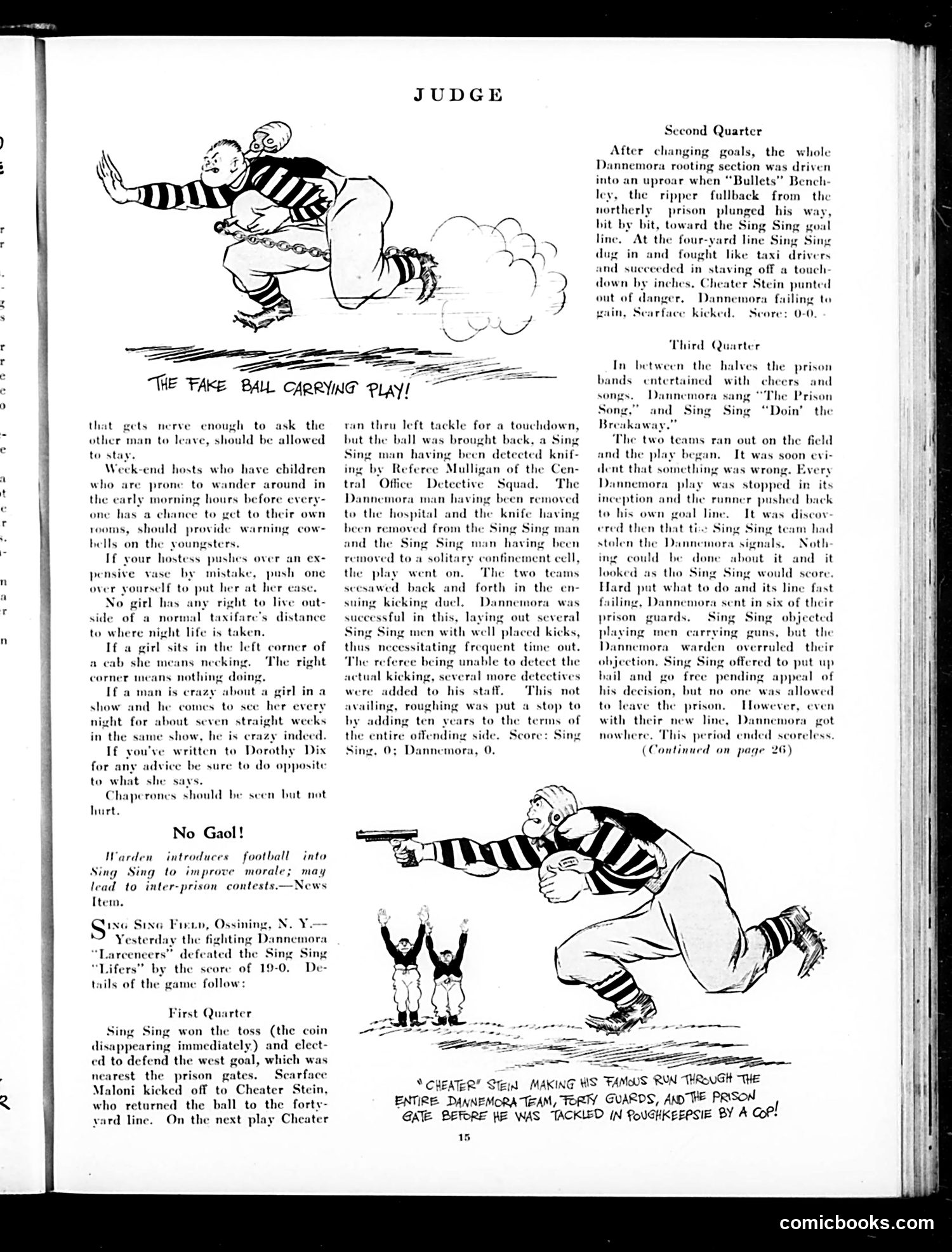
Judge Magazine Football Satire Explanation This 1920s Judge magazine page satirizes prison life through a mock sports article about a football game between Dannemora and Sing Sing—two actual New York prisons. The satire functions on multiple levels: The Joke: Prison inmates playing football is treated as legitimate sports reporting, complete with detailed play-by-play commentary. The "penalties" are absurd: a player stabbing another during the game, resulting in both the attacker's hospitalization *and* added prison time; stolen signals requiring prison guards as players; and attempts to escape during the game. Social Commentary: The piece mocks both prison conditions (casual violence, escape attempts) and sports journalism's breathless coverage of games. References to notorious inmates like "Cheater" Stein and "Bullets" Benchley suggest real criminals given colorful nicknames. The Cartoons: Illustrations show guards tackling players and the "fake ball carrying play"—visual humor emphasizing the absurdity of organized sports in a prison setting. The overall effect critiques both the prison system's brutality and the public's fascination with criminals and sensational crime reporting.
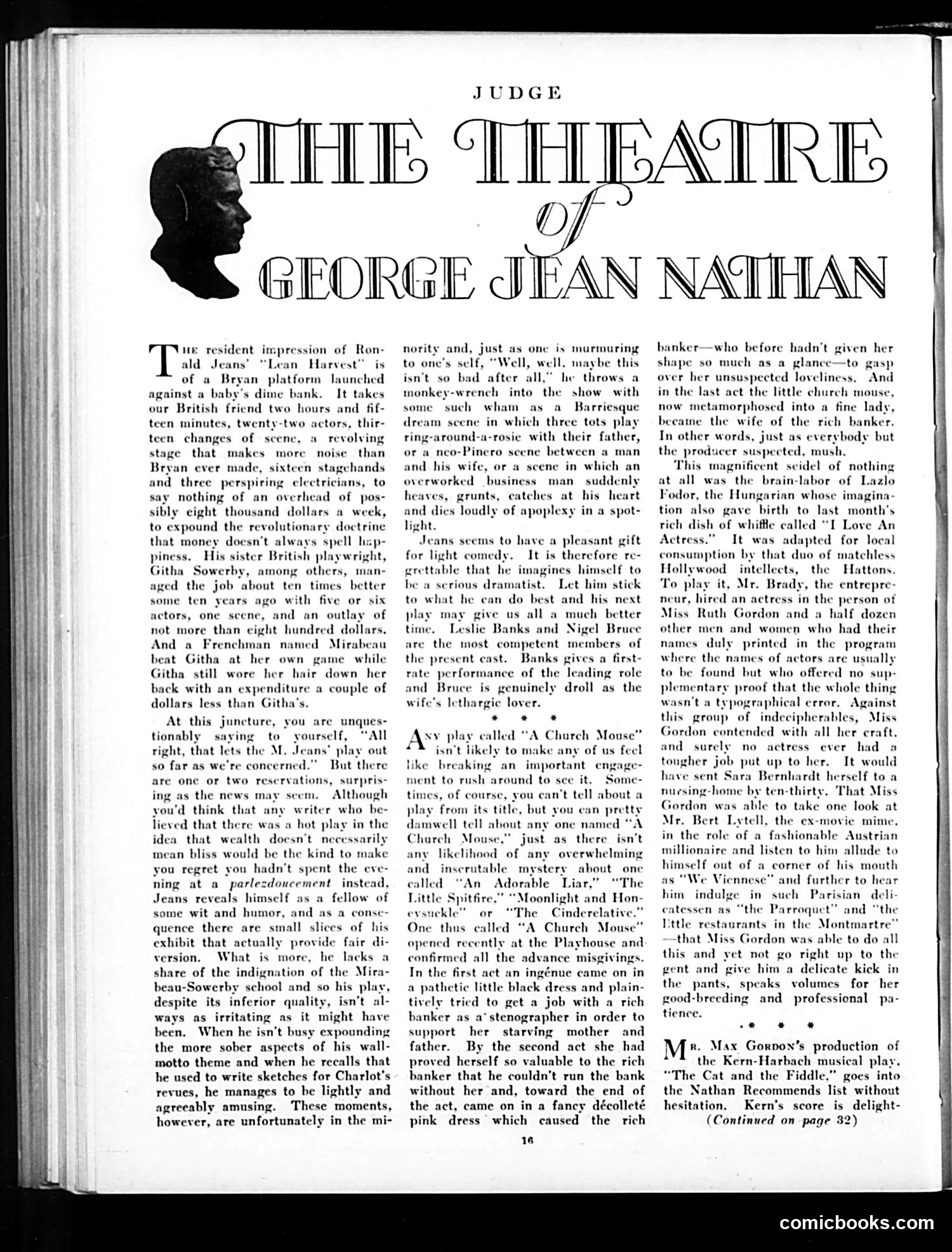
Judge Magazine Analysis: "The Theatre of George Jean Nathan" This page features theater critic George Jean Nathan's review of Ronald Jeans' play "Lean Harvest." The illustration shows Nathan's profile in caricature form. Nathan critiques Jeans for mounting an overly elaborate production (with extensive cast, crew, and overhead costs) to convey a simple anti-capitalist message: that money doesn't guarantee happiness. Nathan argues this same point was made more efficiently by earlier British and French playwrights using minimal resources. The satire targets Jeans' pretentiousness and inefficiency—he produces a technically complex, expensive spectacle when simpler theatrical approaches had already proven the concept. Nathan acknowledges Jeans has comedic talent but laments he wastes it attempting serious drama instead of focusing on what he does well: light comedy. The reviews of other plays ("A Church Mouse") continue this pattern of mocking overwrought or clichéd theatrical premises, suggesting Nathan was a sharp, dismissive critic of contemporary Broadway productions.
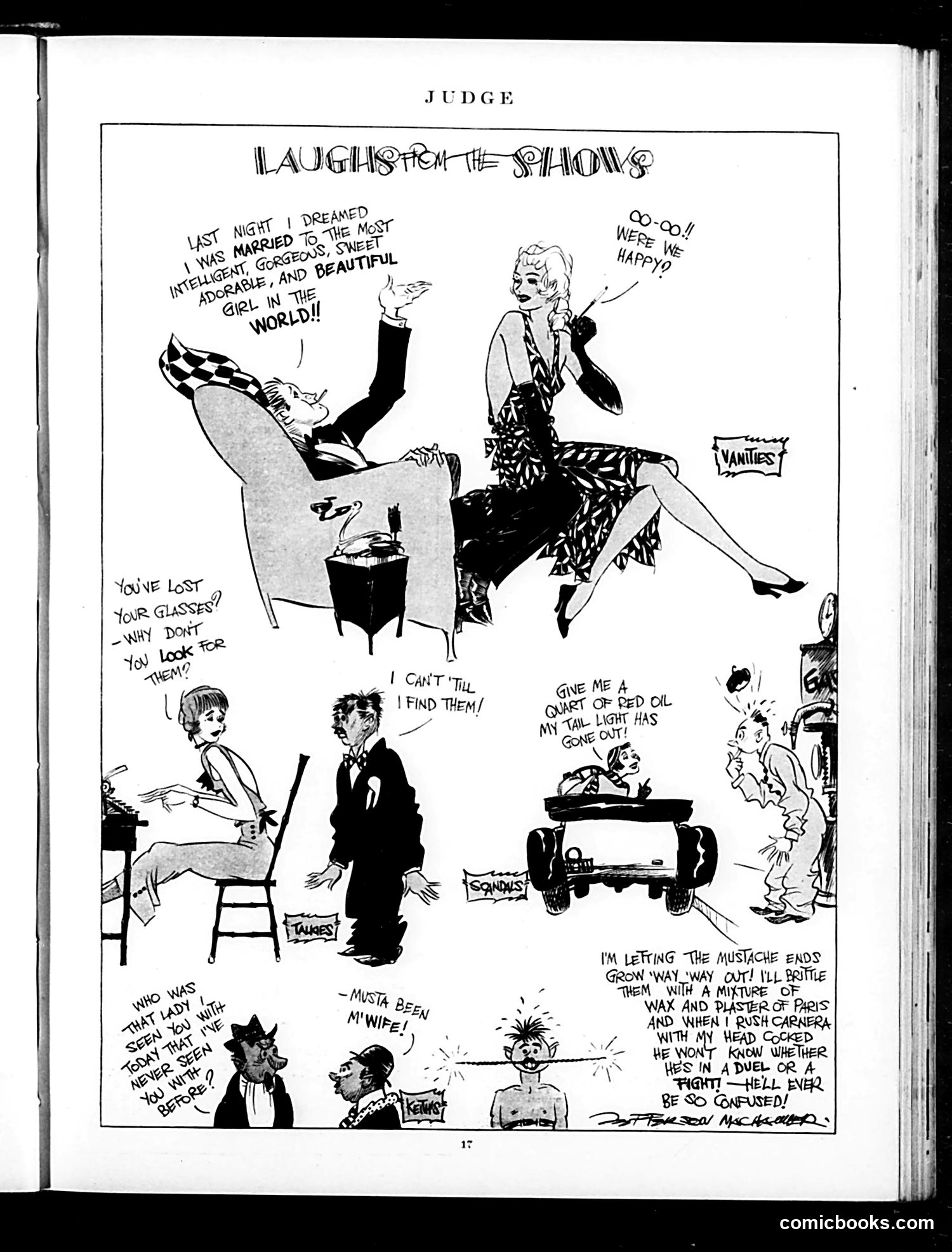
"Laughs the Shows" - Judge Magazine Satire This is a multi-panel comic satirizing early 20th-century domestic chaos and vanity. The central joke involves a man describing an absurdly elaborate dream where he married "the most intelligent, gorgeous, and beautiful girl in the world," while his actual wife sits nearby stating "Were we happy?"—the ironic contrast being their clearly miserable reality. The surrounding panels mock various domestic crises: lost eyeglasses, a stalled automobile requiring "red oil," a man sporting an outrageous mustache he maintains with "wax and plaster of Paris," and general household pandemonium. The satire targets masculine vanity, marital disappointment, and the emerging automobile age's mechanical frustrations. The cartoonist uses exaggerated expressions and slapstick scenarios to highlight the gap between romantic ideals and domestic reality—a recurring Judge magazine theme.
"Judging the Movies" by Pare Lorentz This is a film review column in *Judge* magazine (a satirical publication). Lorentz critiques recent movies, primarily discussing "The Spirit of Notre Dame," a football film featuring the late coach Knute Rockne. Key points: - Lorentz praises the Notre Dame film as surprisingly good despite low expectations, noting it avoids typical sports-movie clichés (no last-minute touchdown romance subplot) - He commends actor J. Farrell MacDonald's portrayal of Rockne as authentic - He criticizes "The Song of Life," a German film, for excessive camera work and unclear objectives, though acknowledges its ambition - The "Recommended" box lists other current releases with brief assessments Context for modern readers: This represents pre-television film criticism when movies were major entertainment. The column assumes readers familiar with recent releases and Hollywood conventions. Lorentz values authenticity and intelligent filmmaking over sentimentality—positions that established his later reputation as a serious documentary filmmaker.
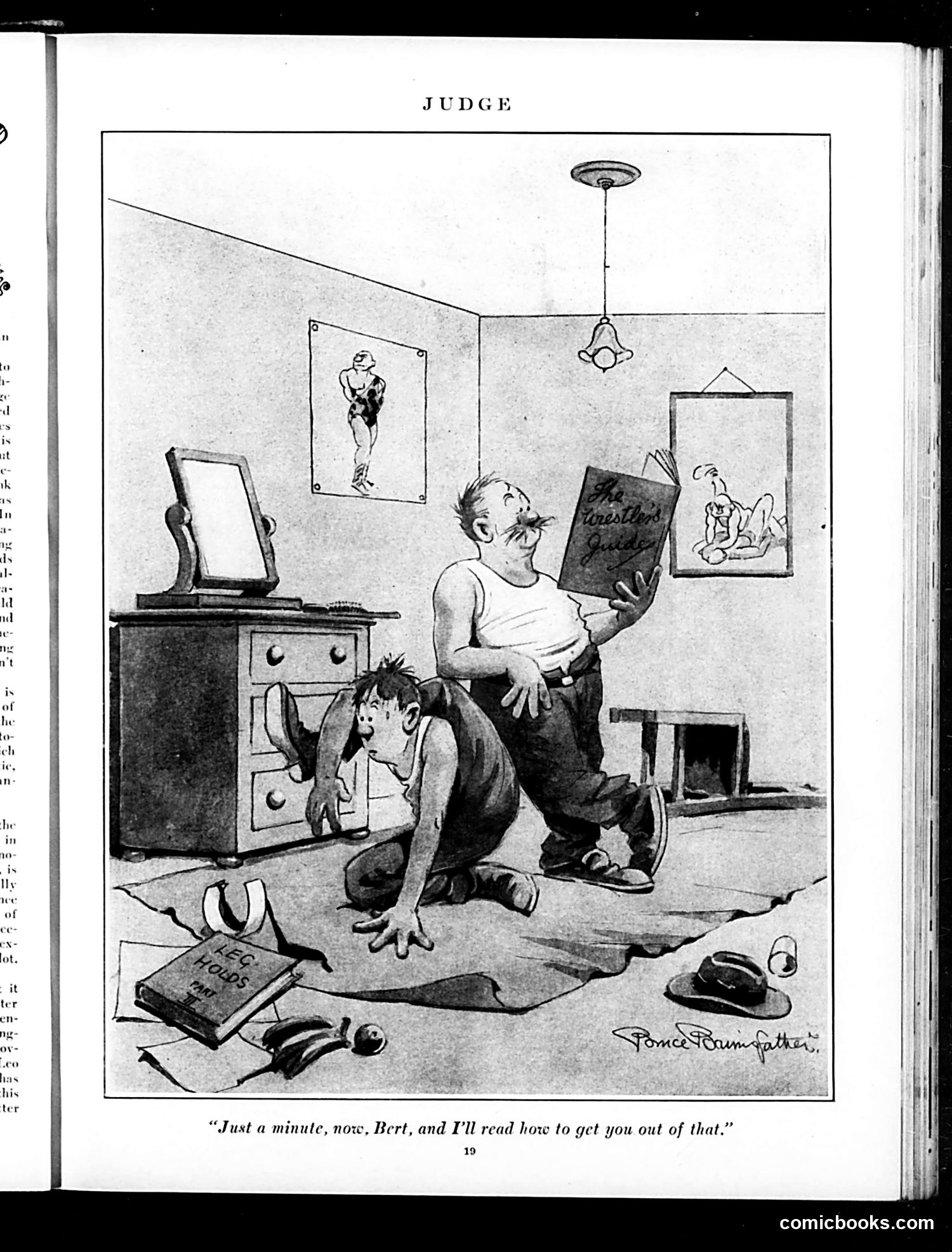
"Judge" Cartoon Analysis This cartoon titled "Judge" depicts a domestic scene where an adult male (addressed as "Bert") is in some kind of trouble or predicament on the floor, while another man sits reading what appears to be a "Wrestling Guide" or similar instructional book. The caption reads: "Just a minute, now, Bert, and I'll read how to get you out of that." The humor relies on the absurdity of consulting a reference book to solve an immediate physical problem rather than using common sense or experience. The scattered items on the floor (possibly sports equipment or toys) and the room's furnishings suggest this may satirize American reliance on instruction manuals or guidebooks for everyday situations—a theme common in early-to-mid 20th century satire about modern life and over-systematization. The cartoon appears to mock impractical problem-solving methods.
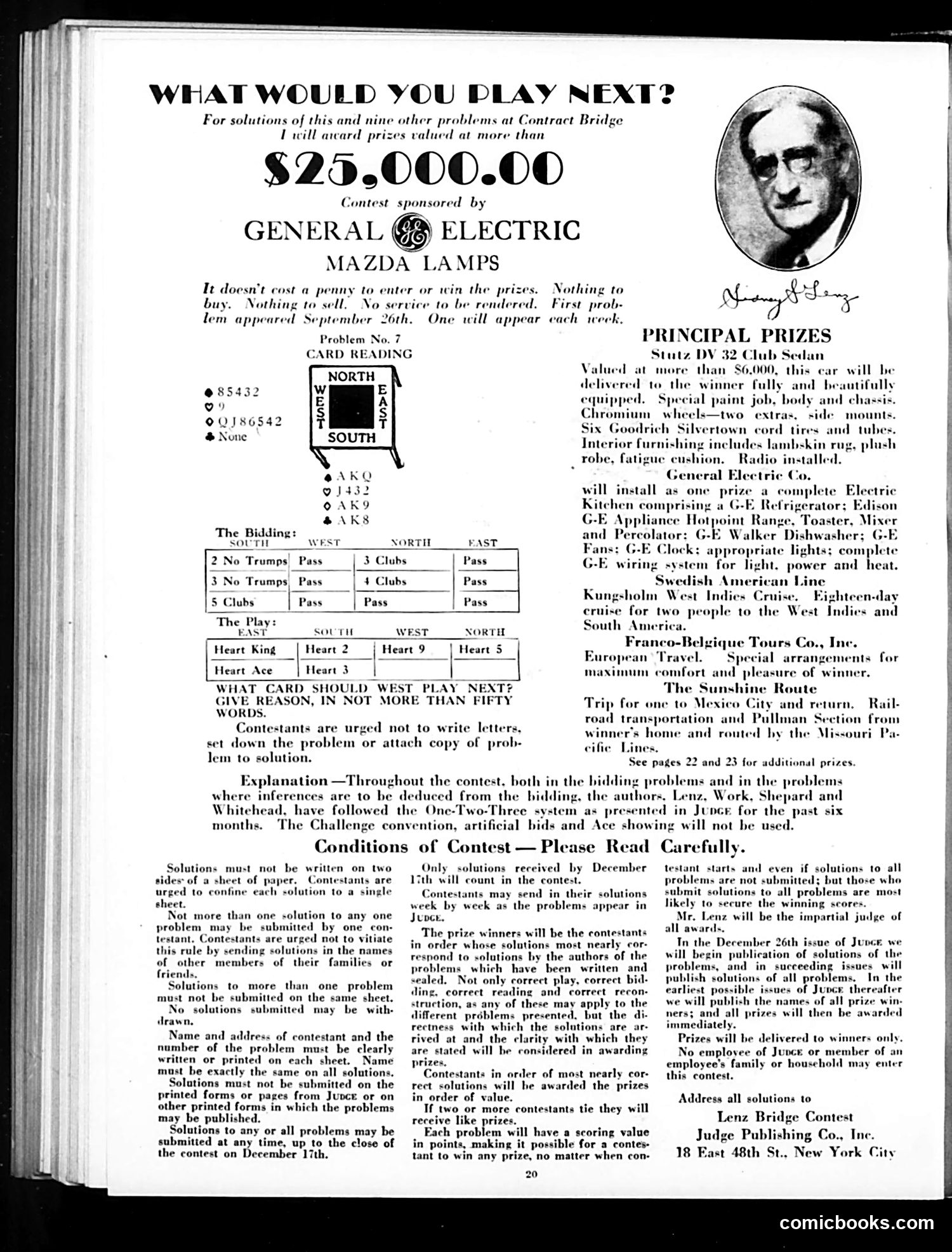
What This Page Means for Modern Readers This is primarily an advertisement disguised as editorial content—a common practice in early 20th-century magazines. General Electric and Mazda Lamps sponsored a bridge card game contest offering $25,000 in prizes (substantial money in that era). The page presents "Problem No. 7," a contract bridge puzzle readers could solve by mail. The appeal was twofold: bridge was enormously popular among middle and upper-class Americans during this period, and the prizes—a Stutz automobile, GE appliances, luxury cruises—were genuinely valuable incentives. This represents sponsored content marketing: GE embedded their brand throughout (appliances, wiring systems, lamps) while appearing to offer readers entertainment and prizes. The bridge problems themselves were legitimate; several notable bridge authorities are mentioned. The contest reflects the era's fascination with both bridge and consumer goods as markers of sophistication and wealth.
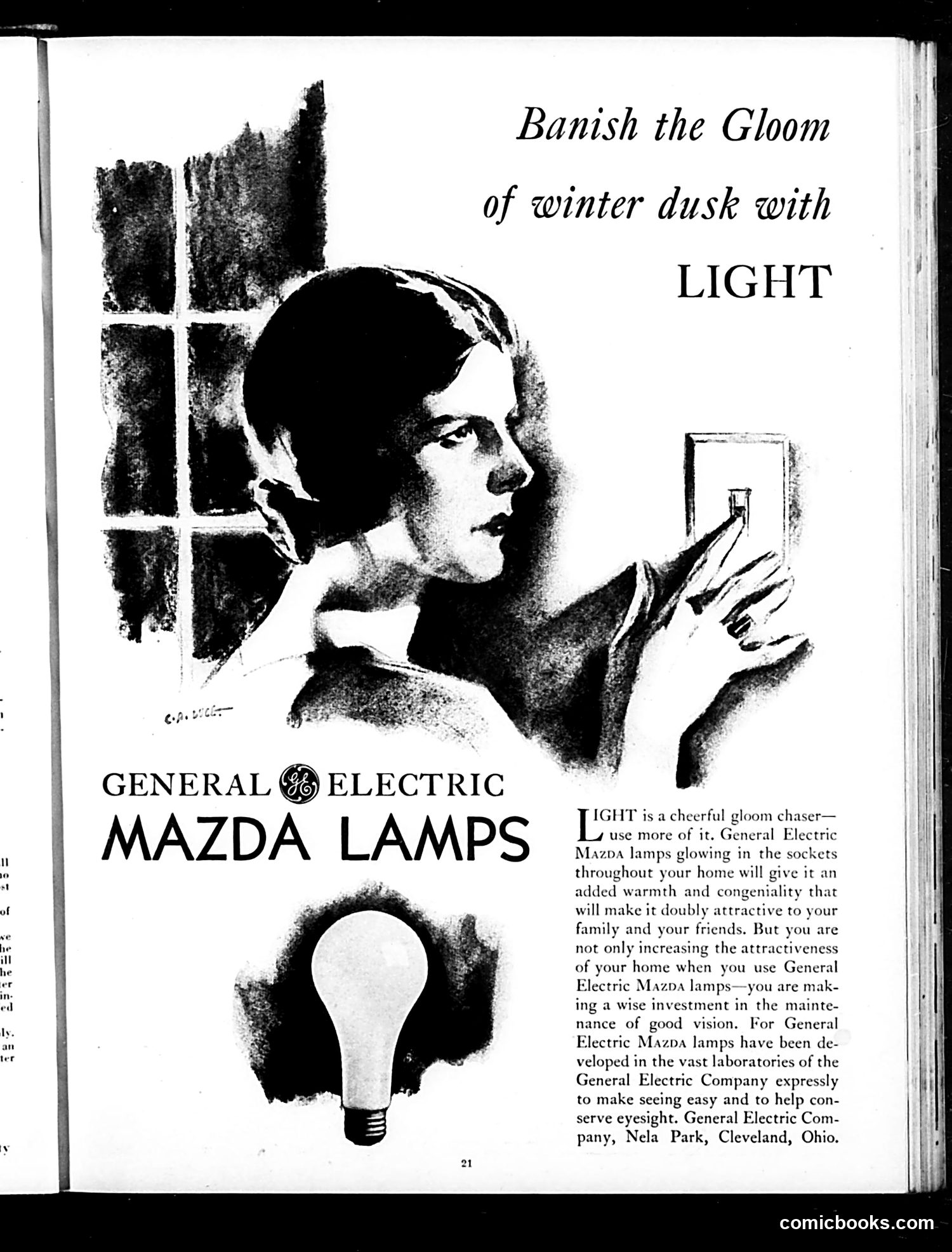
Analysis This is primarily a General Electric advertisement, not satire or political commentary. It promotes Mazda lamps (a GE brand) with the slogan "Banish the Gloom of winter dusk with LIGHT." The page features: - An illustration of a woman gazing pensively out a winter window at dusk - A lightbulb below her - Marketing copy emphasizing that electric lighting creates warmth, attractiveness, and good vision For modern readers: This reflects early-20th-century anxieties about seasonal darkness and the marketing of electric home lighting as a solution to both practical (eyesight) and emotional (winter gloom) problems. The gendered imagery—a woman as the domestic consumer—was typical of era advertising targeting homemakers. There is no political satire visible here. This appears to be a straightforward, if aesthetically polished, product advertisement placed in *Judge* magazine's pages.
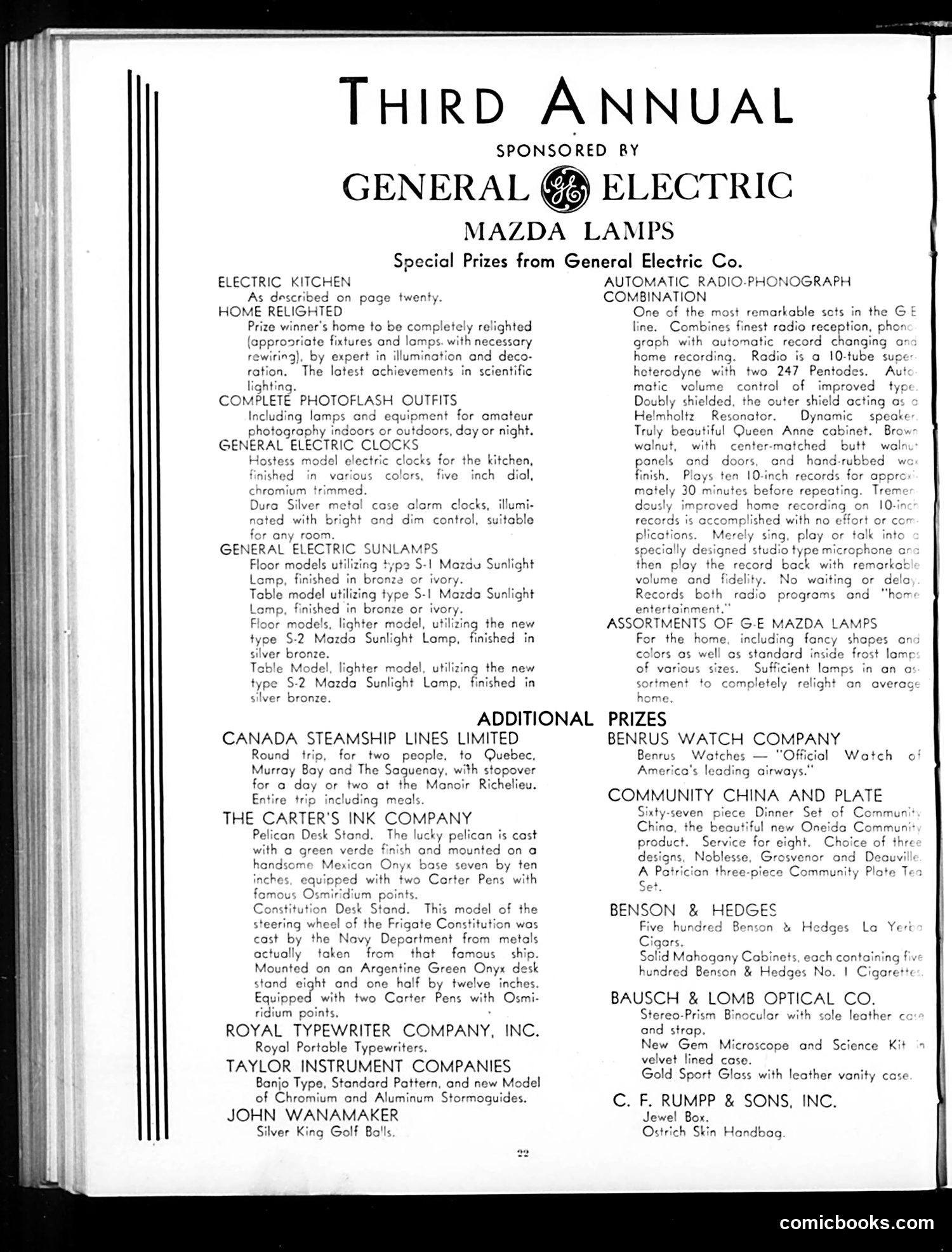
Analysis of This Judge Magazine Page This is primarily a title page and advertisement, not a political cartoon. It announces the "Third Annual" contest or competition sponsored by General Electric and Mazda Lamps. The page lists prizes from various companies, ranging from major appliances (electric kitchens, radio-phonographs) to luxury goods (Canada Steamship cruises, Benrus watches, fine china). The emphasis reflects 1920s-1930s consumer culture and what upper-middle-class Americans aspired to own. Notable: the prizes reveal period priorities—radio-phonograph combinations were cutting-edge technology, electric home lighting was still a luxury feature, and travel to Quebec resorts represented prestige. Brand names like Wanamaker (department store), Benson & Hedges (cigars), and Bausch & Lomb (optics) signal affluence. No satire is evident here—this appears to be straightforward promotional content, likely announcing a sweepstakes or contest for Judge readers.
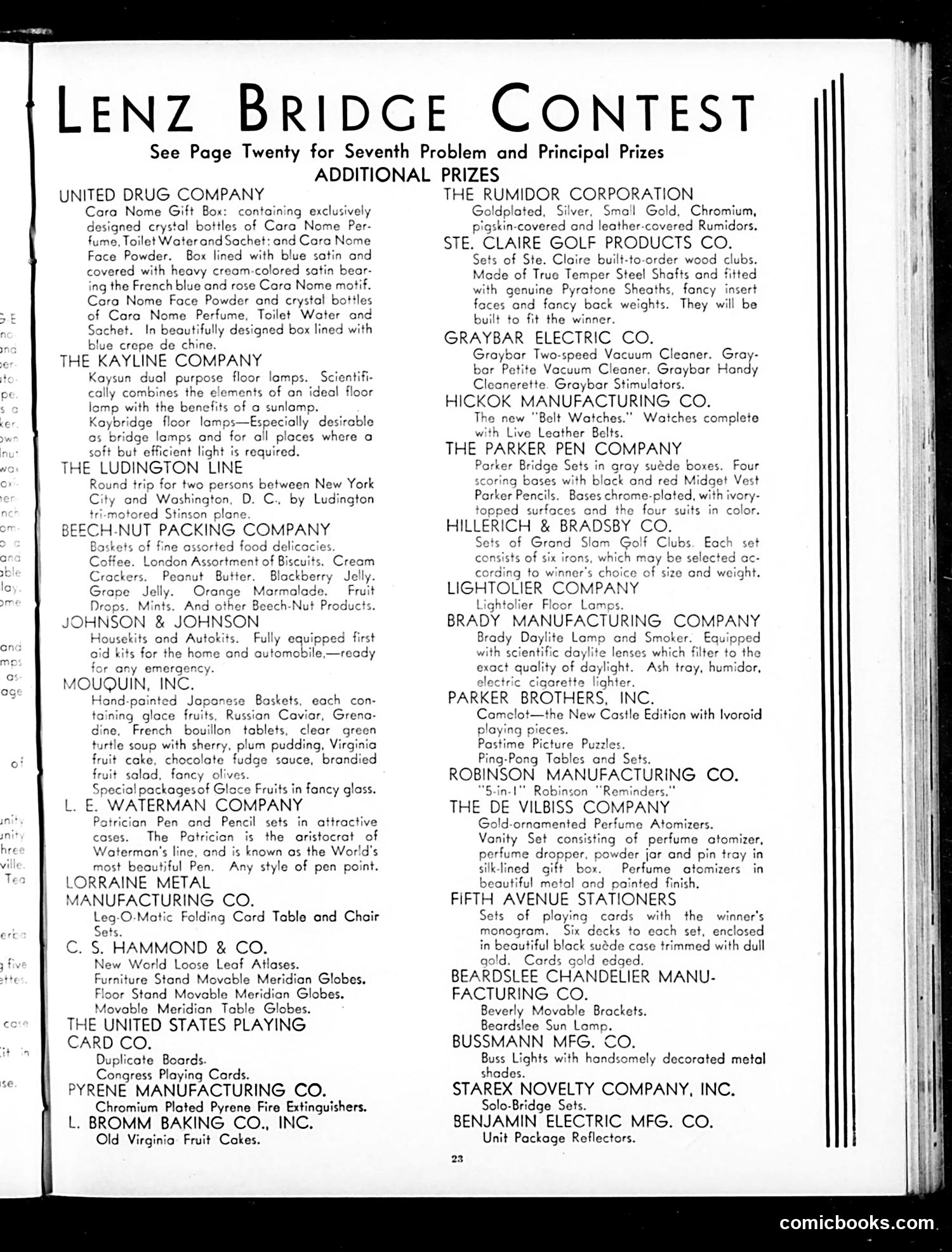
Analysis of Page Content This page is primarily advertising, not editorial content or cartoons. It lists prize offerings for the "Lenz Bridge Contest," a bridge (card game) competition featured in Judge magazine. The prizes reflect 1920s-30s consumer goods and luxury items: perfumes, golf clubs, vacuum cleaners, lamps, pens, playing cards, and travel vouchers. Companies like Johnson & Johnson, Parker Pen, and Waterman sought brand visibility by sponsoring the contest. Notable context for modern readers: The prominence of items like "Bridge Sets," golf equipment, and luxury goods reflects the aspirational consumer culture of the interwar period. References to "Rumidors" (humidifiers for cigars) and multiple cigarette lighters suggest tobacco use was normalized and heavily marketed. The contest itself (details referenced on "Page Twenty") was typical of Judge's reader engagement strategy—offering prizes to subscribers who solved bridge problems, combining entertainment with product promotion.
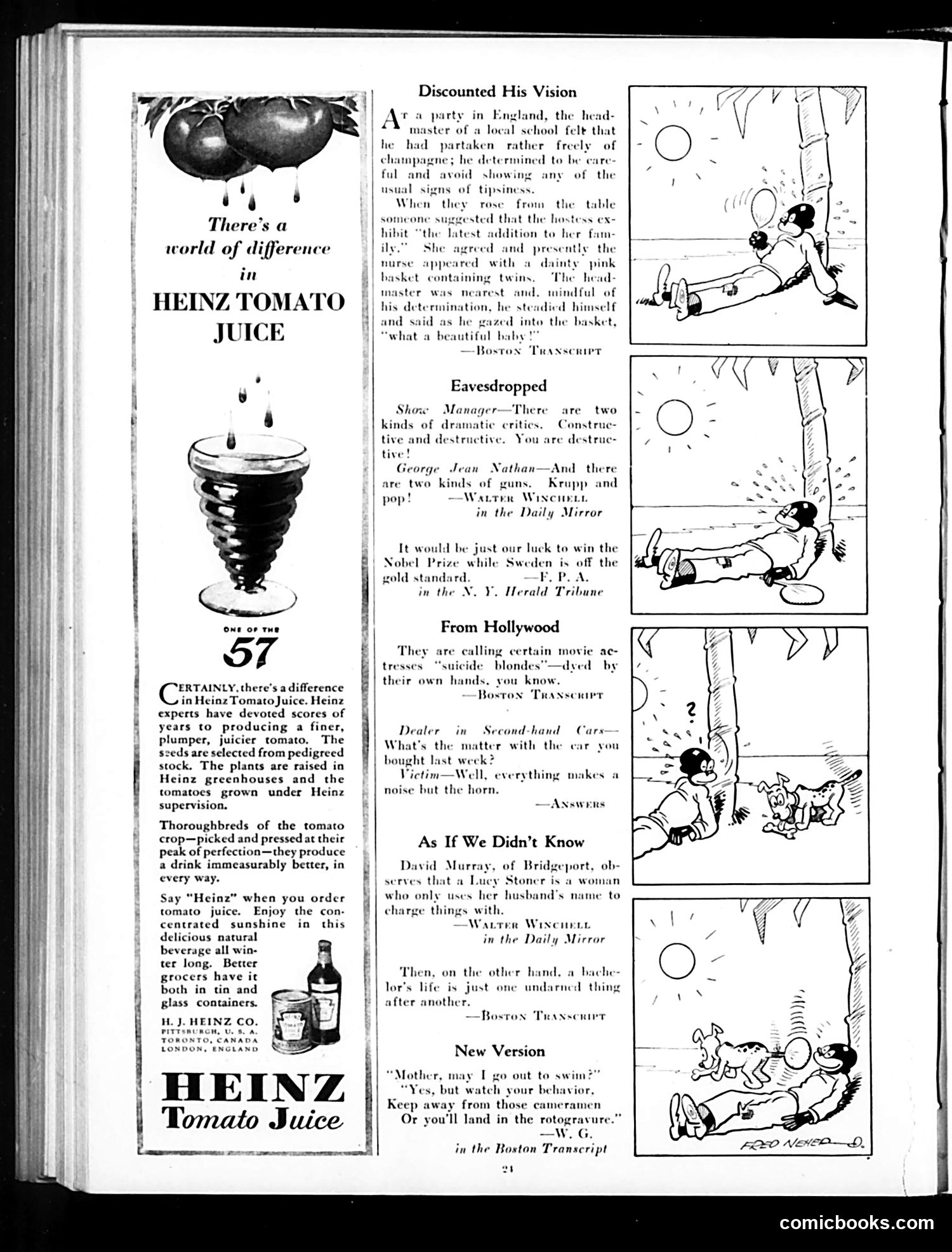
Judge Magazine Page Analysis This page combines a Heinz Tomato Juice advertisement with several short satirical quips typical of Judge magazine's humor section. The left side is a full-page ad emphasizing Heinz's quality control—"thoroughbreds of the tomato crop"—positioning the product as superior through scientific breeding and supervision. The right side contains four brief jokes: 1. "Discounted His Vision": A drunk English headmaster tries hiding his intoxication while viewing newborn twins, complimenting them despite impaired judgment—satire on social pretense. 2. "Eavesdropped": Theater critic George Jean Nathan quips that drama critics are either constructive or destructive, like guns (Krupp artillery vs. toy "pop" guns)—mocking critical pomposity. 3. "From Hollywood": A pun on "suicide blondes"—actresses who dye their own hair, playing on the term's dark connotations for humor. 4. "As If We Didn't Know" / "New Version": Jokes about women using husbands' names for purchases, bachelors' messy lives, and modern "rotogravure" photography in newspapers—gentle domestic satire. The cartoons on the right appear to illustrate children's mishaps, likely accompanying these quips.
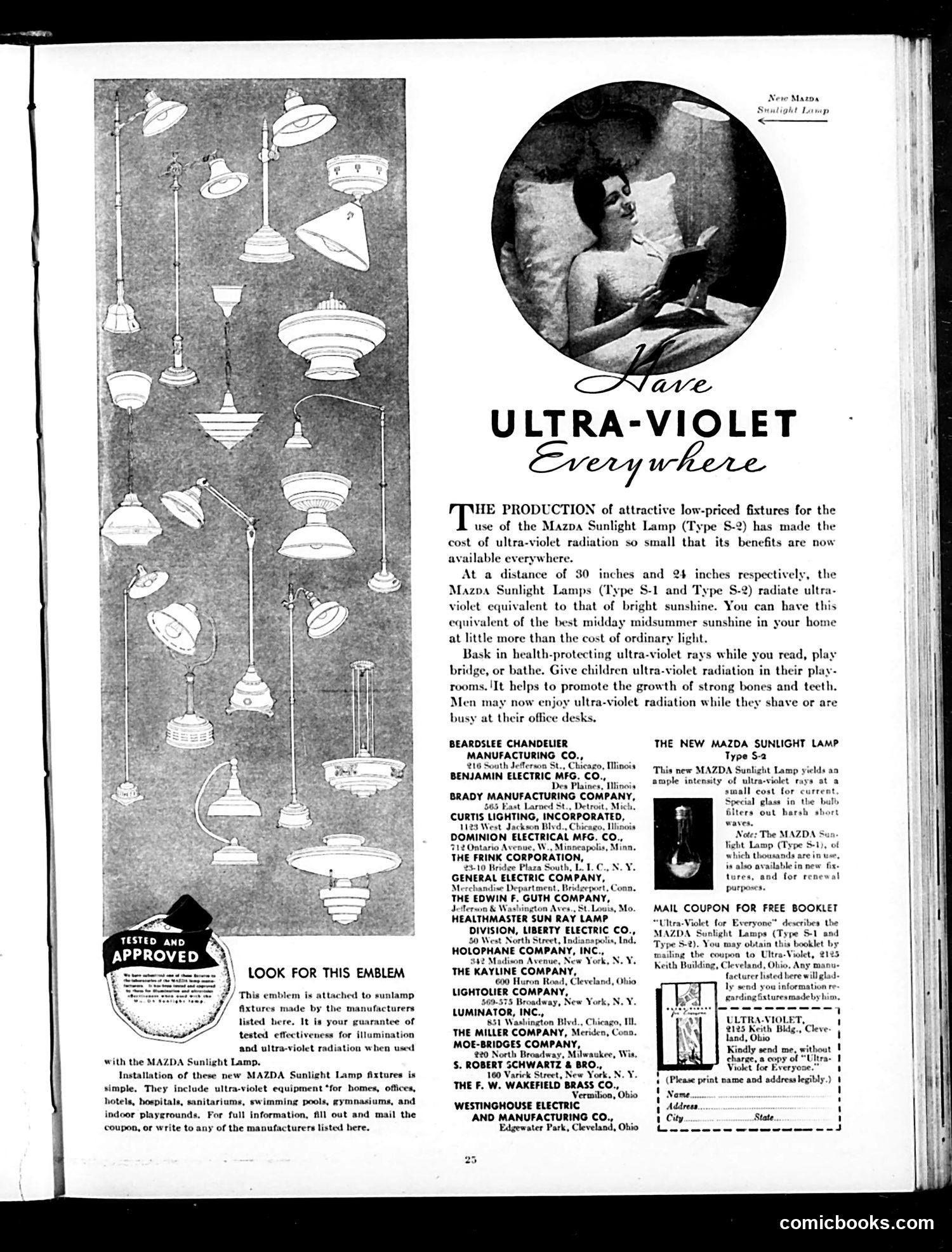
This Page Is Advertisement, Not Political Satire This is a full-page advertisement for Mazda Sunlight Lamps—ultraviolet lighting fixtures—disguised within Judge magazine's format. There are no political cartoons or satirical content here. The page promotes newfangled UV lamps as affordable home and commercial lighting that mimics midday sunshine, claiming health benefits: stronger bones and teeth in children, sterilization properties, and general wellness. The "circular vignette" showing a man reading in bed illustrates the product's domestic convenience. The "Tested and Approved" emblem and extensive manufacturer list (General Electric, Westinghouse, etc.) lend credibility. A mail coupon offers a free booklet. This reflects early-20th-century enthusiasm for UV radiation as a cure-all—before widespread understanding of its dangers. The advertisement's presence in Judge suggests the magazine carried commercial content alongside humor.
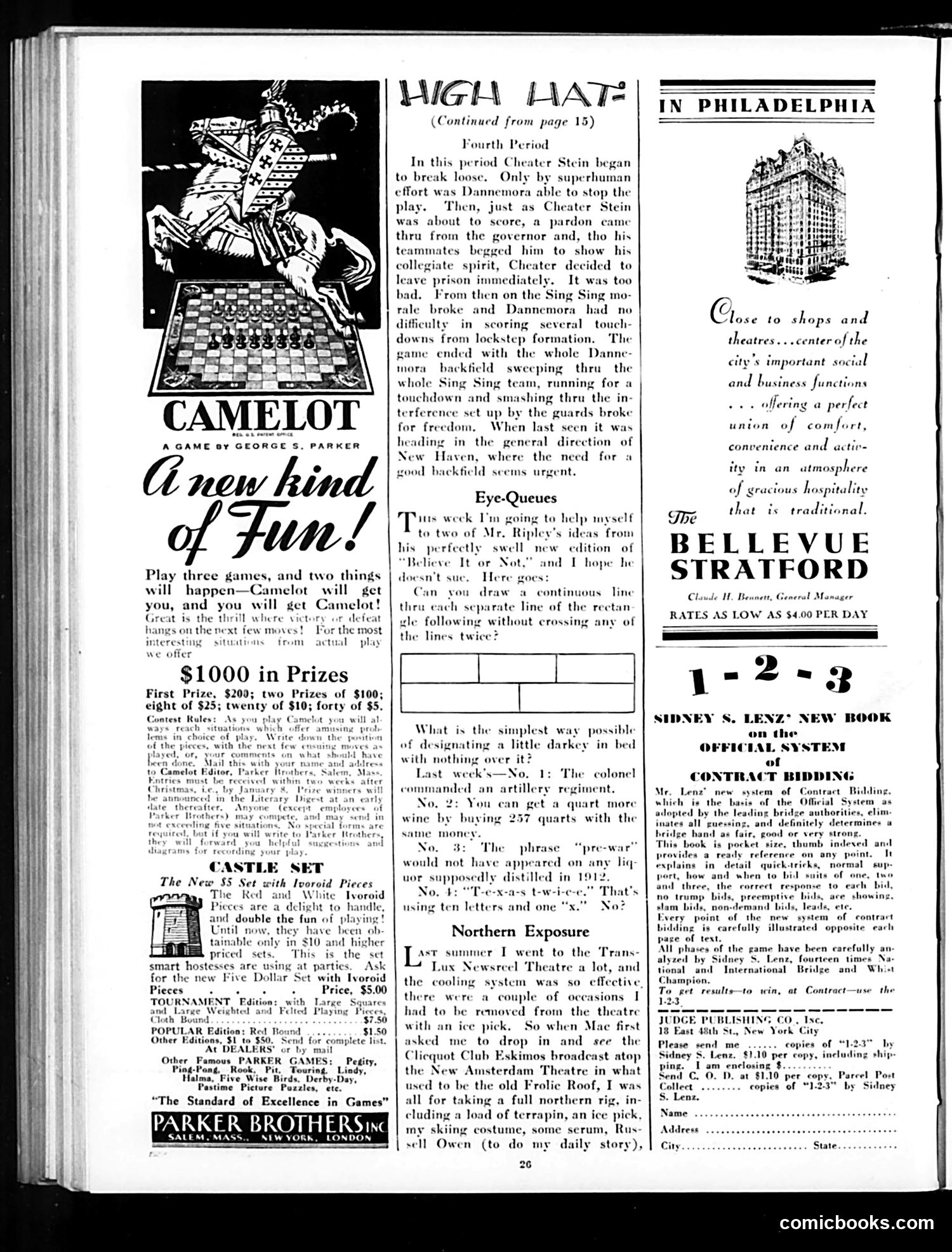
Analysis of "High Hat" Page This page from Judge magazine is primarily advertisements and game promotions, with satirical content in the margins. Main Content The left side features an ad for Camelot, a chess-like board game by Parker Brothers. The "High Hat" column (continued from previous page) appears to be a sports satire comparing a football game between Dannemora and Sing Sing prisons—likely a humorous reference to actual prison football rivalry, with colorful descriptions of "lockstep formations" and players breaking "for freedom." The Satire The prison football metaphor itself is the joke: Judge is satirizing competitive sports enthusiasm by treating a match between two prisons as legitimate sporting drama, complete with dramatic plot twists (a pardon from the governor). Additional Features The "Eye-Queues" section includes visual puzzles, and the right side advertises The Bellevue Stratford hotel in Philadelphia and Sidney S. Lenz's contract bridge instruction book. Overall: This is primarily a merchandise and advertising page with embedded humor rather than editorial political satire.
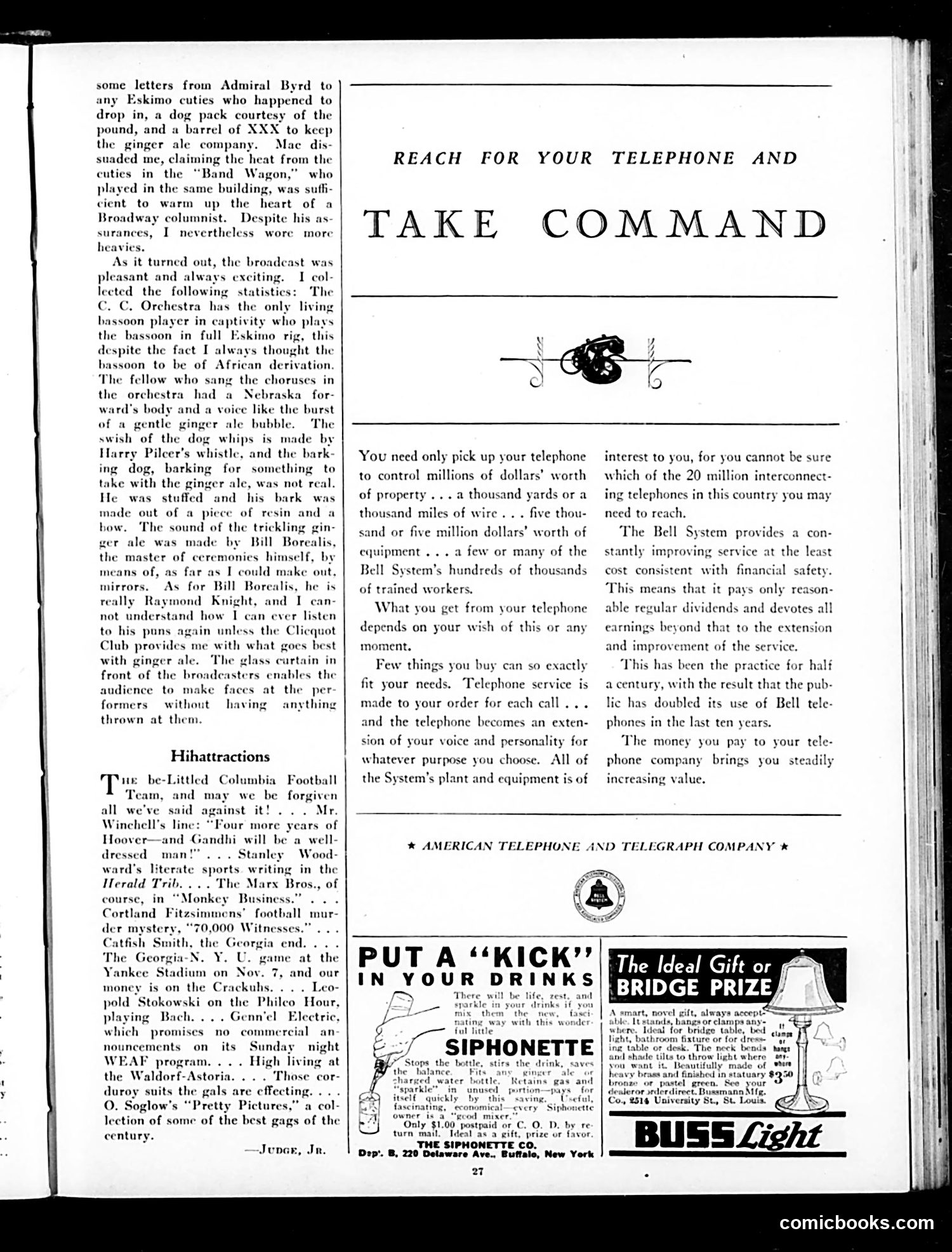
Judge Magazine Page Analysis This page mixes entertainment commentary with corporate advertising. The left column contains "Hihattractions"—a humorous recap of Broadway and media personalities of the era, including references to the Marx Brothers, radio personalities, and sports figures. It's gossipy entertainment criticism typical of Judge's satirical style. The dominant content is a Bell Telephone System advertisement disguised as editorial content under "REACH FOR YOUR TELEPHONE AND TAKE COMMAND." The ad uses grandiose language about controlling "millions of dollars' worth of property" through telephone service, presenting the telephone as a tool of personal power and convenience. Below are smaller ads for a Siphonette drink mixer and Buss Light lamps—typical Depression-era consumer products. The page reflects 1920s-30s media where advertising and editorial content blurred considerably.
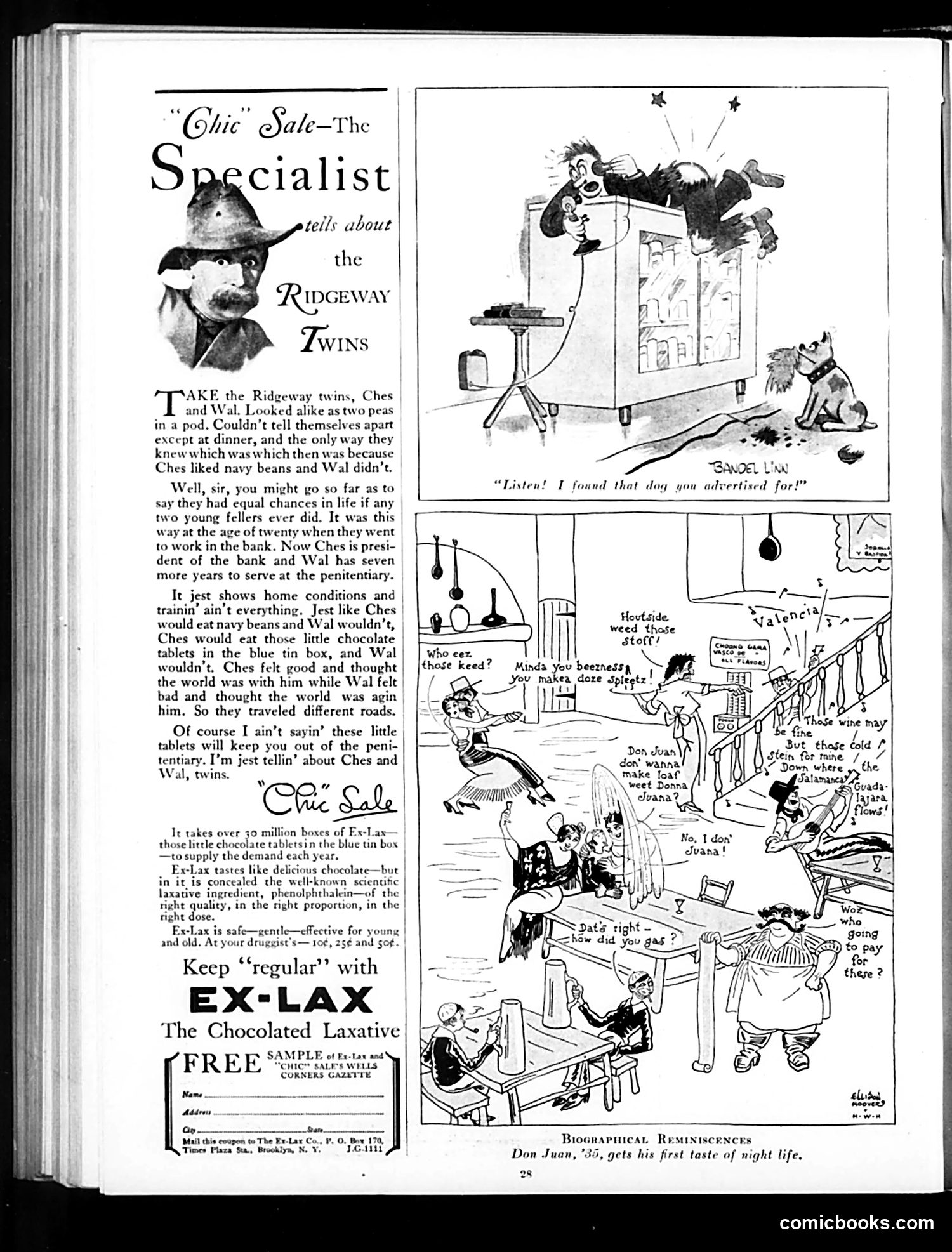
Judge Magazine Page Analysis This page combines advertising and satirical content typical of 1920s-30s Judge magazine. "Chic Sale" Article & Cartoon: The text presents a morality tale by humorist Chic Sale about identical twins—Ches and Wal Ridgeway—who took divergent life paths despite identical circumstances. Ches became a bank president; Wal serves time in penitentiary. The ostensible lesson: character and personal choices matter more than opportunity. This is actually a *setup* for the advertisement below. The Satire: The article uses this contrived moral fable to advertise Ex-Lax laxative tablets (the "little chocolate tablets in the blue tin box" mentioned repeatedly). The joke is crude but clear: good digestion/regularity supposedly leads to good character and success, while constipation leads to crime. The absurd causation is intentional humor—using an obviously ridiculous premise to sell a product. Right Panel Comic: "Biographical Reminiscences: Don Juan, '35, gets his first taste of night life" shows a chaotic domestic scene with multiple figures. This appears to be unrelated satirical social commentary on modern youth culture, though specific references are unclear.
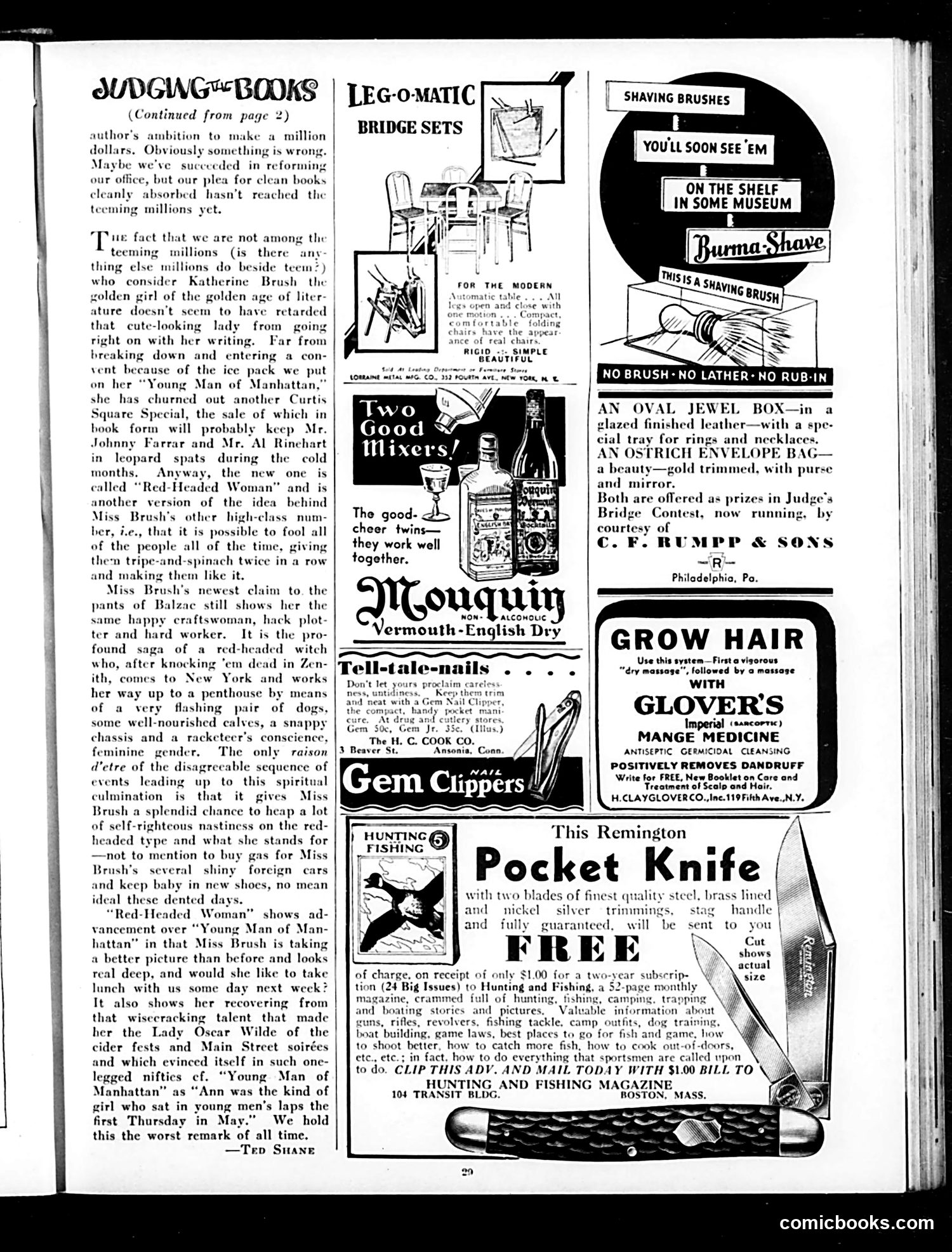
Judging the Books: Magazine Page Analysis This is primarily a book review column continued from page 2, not a political cartoon. The critic (Ted Shane) satirizes author Katherine Brush, dismissing her popular novels as formulaic hack work. He mocks "Red-Headed Woman" (her latest book) as recycled plot mechanics—a "red-headed witch" using looks, sex appeal, and casual morality to climb from small-town America to Manhattan penthouses. Shane views her as catering to mass taste with "tripe-and-spinach," yet complains her success proves millions lack critical judgment. He notes her new film adaptation looks polished, contradicting his literary disdain, and sarcastically invites her to lunch. The page is primarily advertisements for household goods (bridge table sets), grooming products (shaving brushes, hair treatments), and magazines. One ad offers a free Remington pocket knife for subscription to *Hunting and Fishing*. The satire targets commercial literary success and audience taste, not political figures or events.
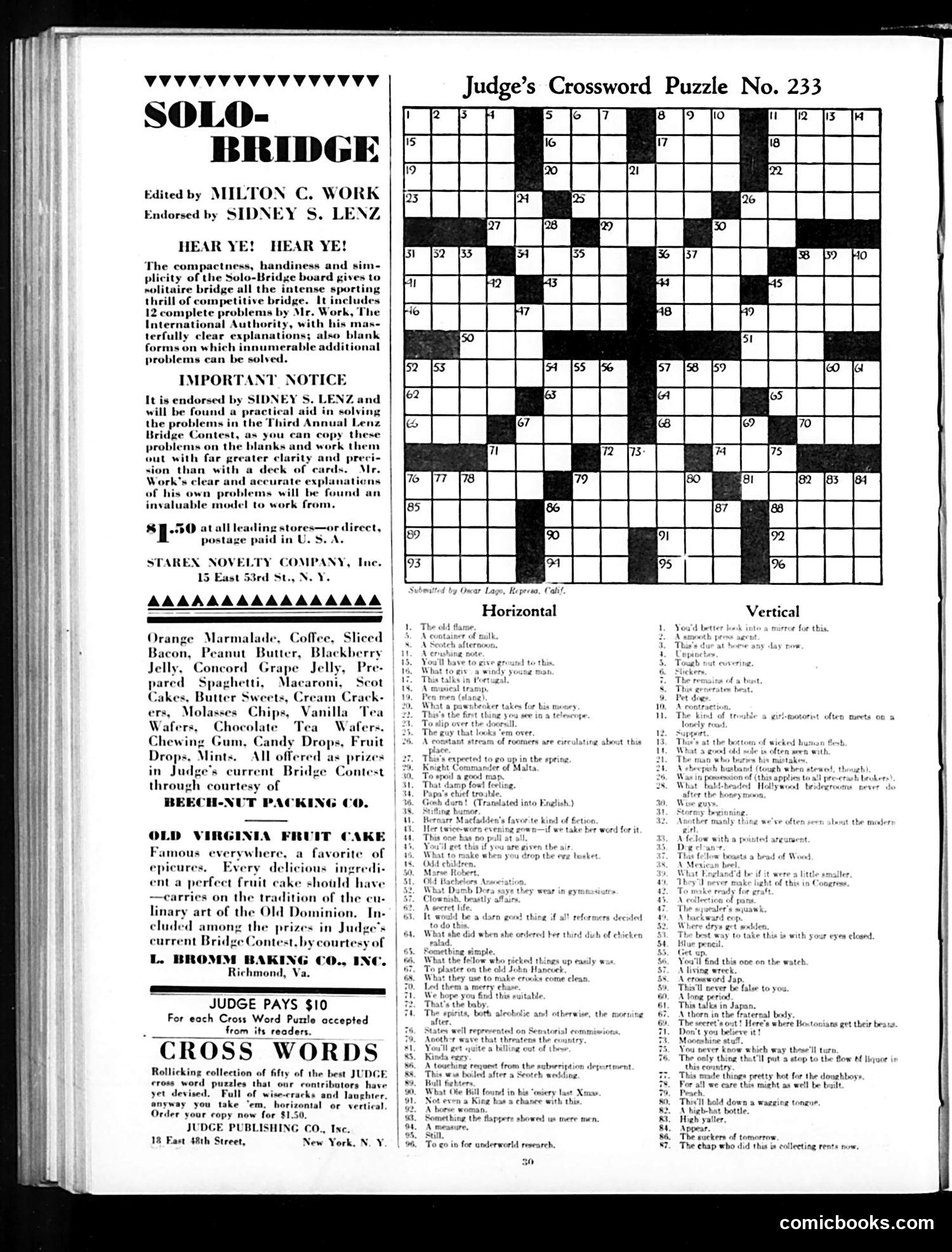
Judge Magazine Page Analysis This page is primarily advertising and promotional material rather than political satire. It promotes "Solo-Bridge," a bridge card game product edited by Milton C. Work and endorsed by Sidney S. Lenz, prominent bridge authorities of the era. The page includes endorsements claiming the product aids in solving bridge problems with "clear explanations." The bulk of the content consists of product advertisements for various food items (marmalade, bacon, jelly, tea wafers) and Old Virginia Fruit Cake, typical of Judge magazine's revenue model. At the bottom, Judge advertises its own offerings: it will pay $10 for accepted crossword puzzles from readers and promotes a collection of 50 crossword puzzles "Full of wise-cracks and laughter." There is no discernible political cartoon or social satire on this page—it's a commercial advertising section interspersed with a crossword puzzle grid. The "satire" references are limited to the crossword clues themselves, which contain mild jokes typical of 1920s wordplay.
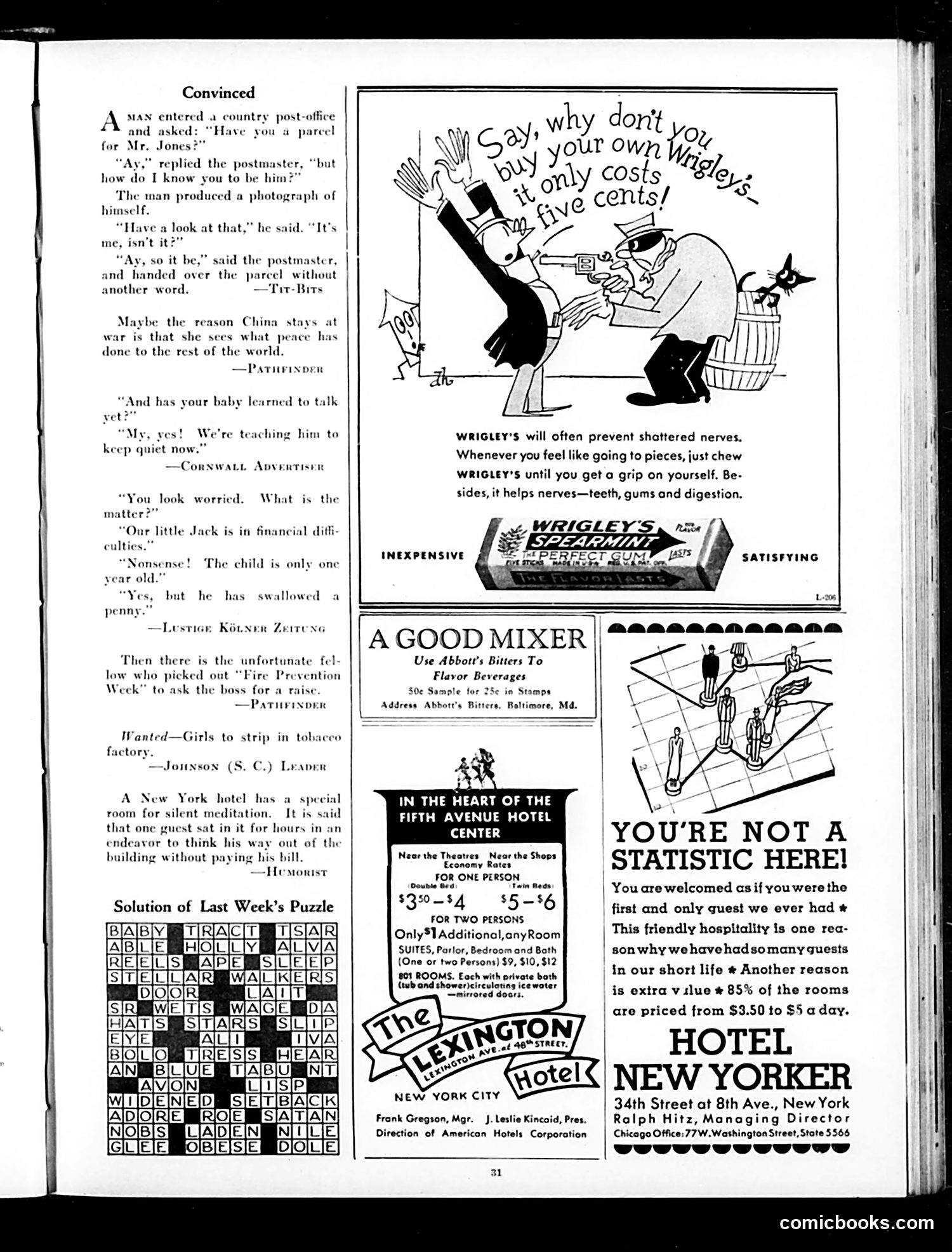
Judge Magazine Page Analysis This page contains short humorous anecdotes rather than political cartoons. The jokes satirize early 20th-century social anxieties: 1. Post-office identity verification: Mocks bureaucratic absurdity—a man proves his identity with a photograph, which the postmaster accepts without question, despite the obvious flaw in this logic. 2. Child swallowing a penny: Dark humor about working-class financial desperation; parents worry about pennies so much that even a child swallowing one causes alarm. 3. Hotel meditation room: Satirizes wealthy guests' dishonesty—someone uses "meditation" as an excuse to avoid paying their bill. 4. China staying at war: Cynical commentary suggesting peace has harmed other nations so badly that war seems preferable. The page is primarily advertising (Wrigley's gum, Abbott's Bitters, the Hotel New Yorker, the Lexington Hotel), which dominated Judge's revenue. The humor reflects pre-Depression anxieties about money, class, and social propriety.
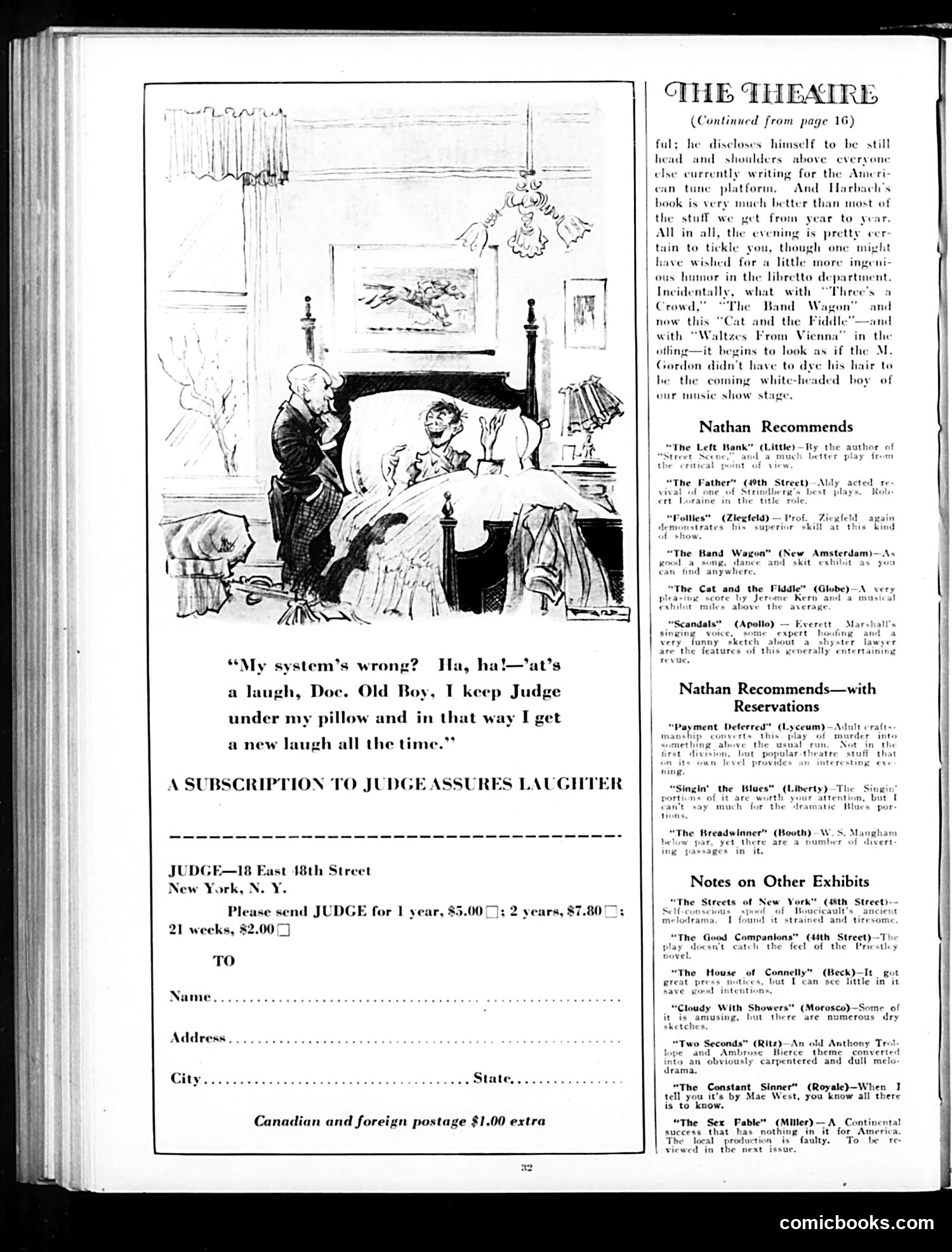
Understanding This Judge Magazine Page This page combines theatrical criticism with a subscription advertisement. The main cartoon depicts a doctor and patient, where the patient jokes that he keeps *Judge* magazine under his pillow—implying reading it provides constant laughter and cures his ailments ("my system's wrong?"). The right column contains theater reviews by "Nathan" (likely Alexander Woollcott, a famous theater critic of the era), recommending Broadway shows like "The Father," "Follies," and "The Cat and the Fiddle." These brief, punchy reviews showcase the witty, opinionated style *Judge* employed to appeal to sophisticated urban readers. The satire here is gentle: the cartoon suggests *Judge's* humor is medically therapeutic, while the reviews demonstrate the magazine's cultural authority in evaluating entertainment. Together, they advertise *Judge's* value to educated New Yorkers as both entertainment and arbiter of taste—a selling point for middle-class readers.
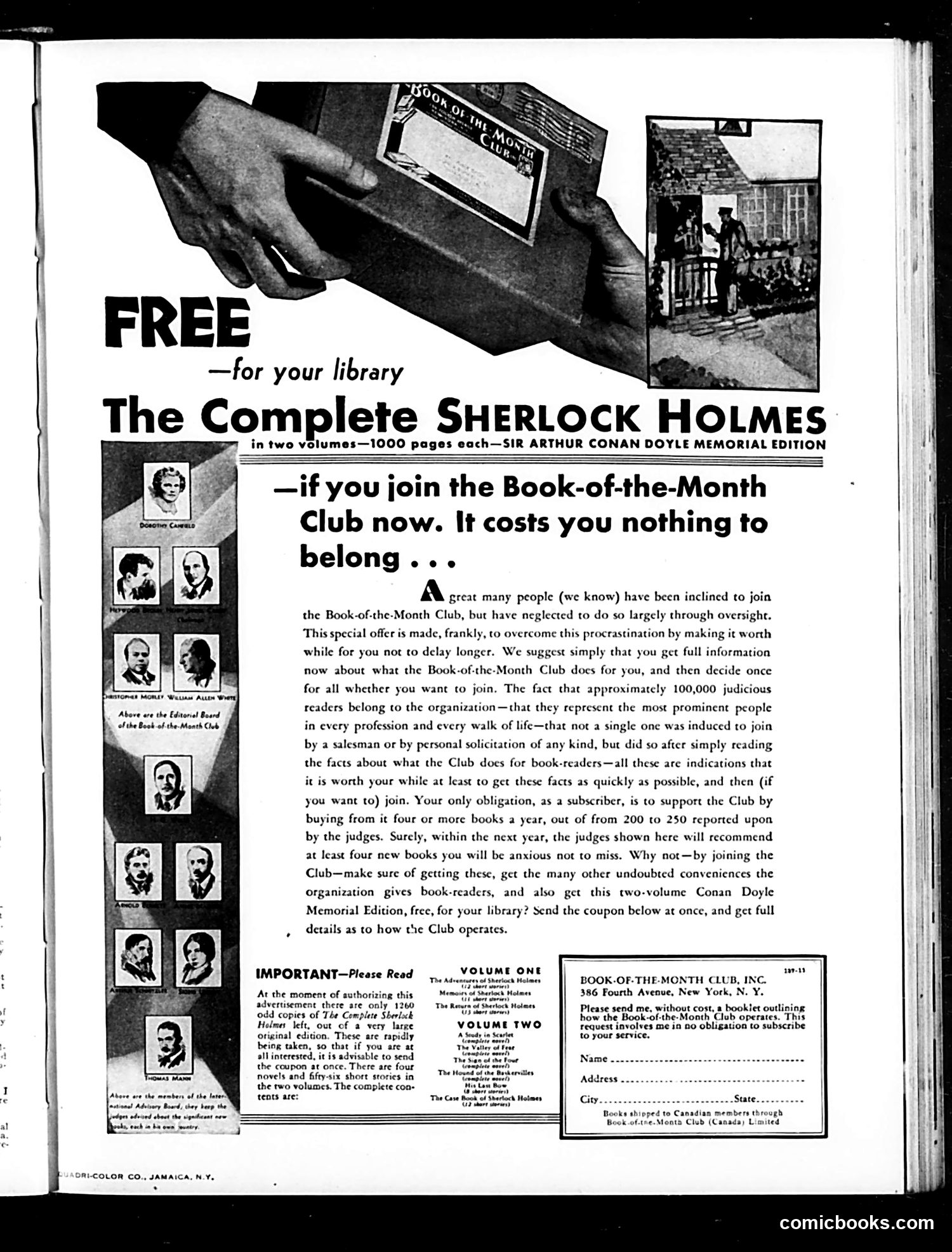
Analysis of This Judge Magazine Page This is primarily advertising, not political satire. It promotes the Book-of-the-Month Club's offer of a free two-volume Sir Arthur Conan Doyle *Complete Sherlock Holmes* Memorial Edition to new members. The page features portraits of what appear to be the Club's "judges"—prominent literary figures of the era whose selections guided members' reading choices. The advertisement emphasizes the Club's prestige by noting "approximately 100,000 judicious readers" belong, representing "the most prominent people in every profession." The appeal exploits mild social psychology: overcoming procrastination by offering a free premium, while implying membership signals membership among the culturally elite. The "IMPORTANT" note warns that only 1,260 copies of this edition remain, creating artificial scarcity to prompt action. No satire is evident—this is straightforward commercial persuasion dressed in genteel language about literature and self-improvement.
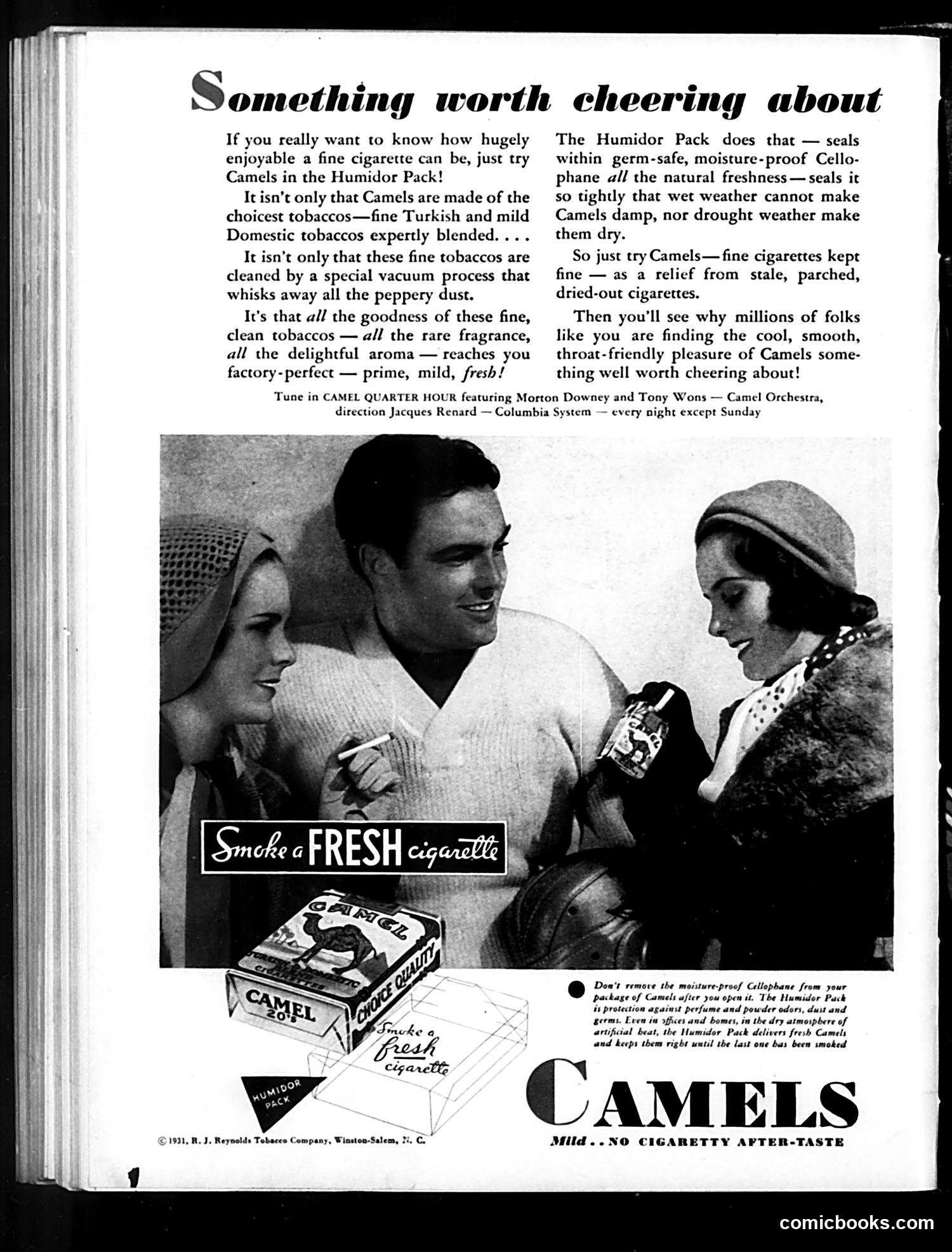
Camel Cigarettes Advertisement (1931) This is a Camel cigarette advertisement, not political satire. The page promotes Camels' "Humidor Pack"—a moisture-proof cellophane wrapper designed to keep cigarettes fresh. The photograph shows three fashionably dressed people examining a Camel package, illustrating the product's appeal to modern consumers. The ad emphasizes the packaging's technical superiority: it protects against humidity, dust, and odors better than competitor cigarettes. The text highlights Turkish and domestic tobacco blends, a vacuum-cleaning process, and the sealed packaging as selling points. There's also a reference to the "Camel Quarter Hour" radio program (Columbia System), indicating the brand's multimedia marketing strategy. For modern readers: this represents 1930s cigarette advertising before health warnings, when such products were promoted as premium consumer goods with no acknowledgment of health risks.