judge
Judge — November 14, 1931
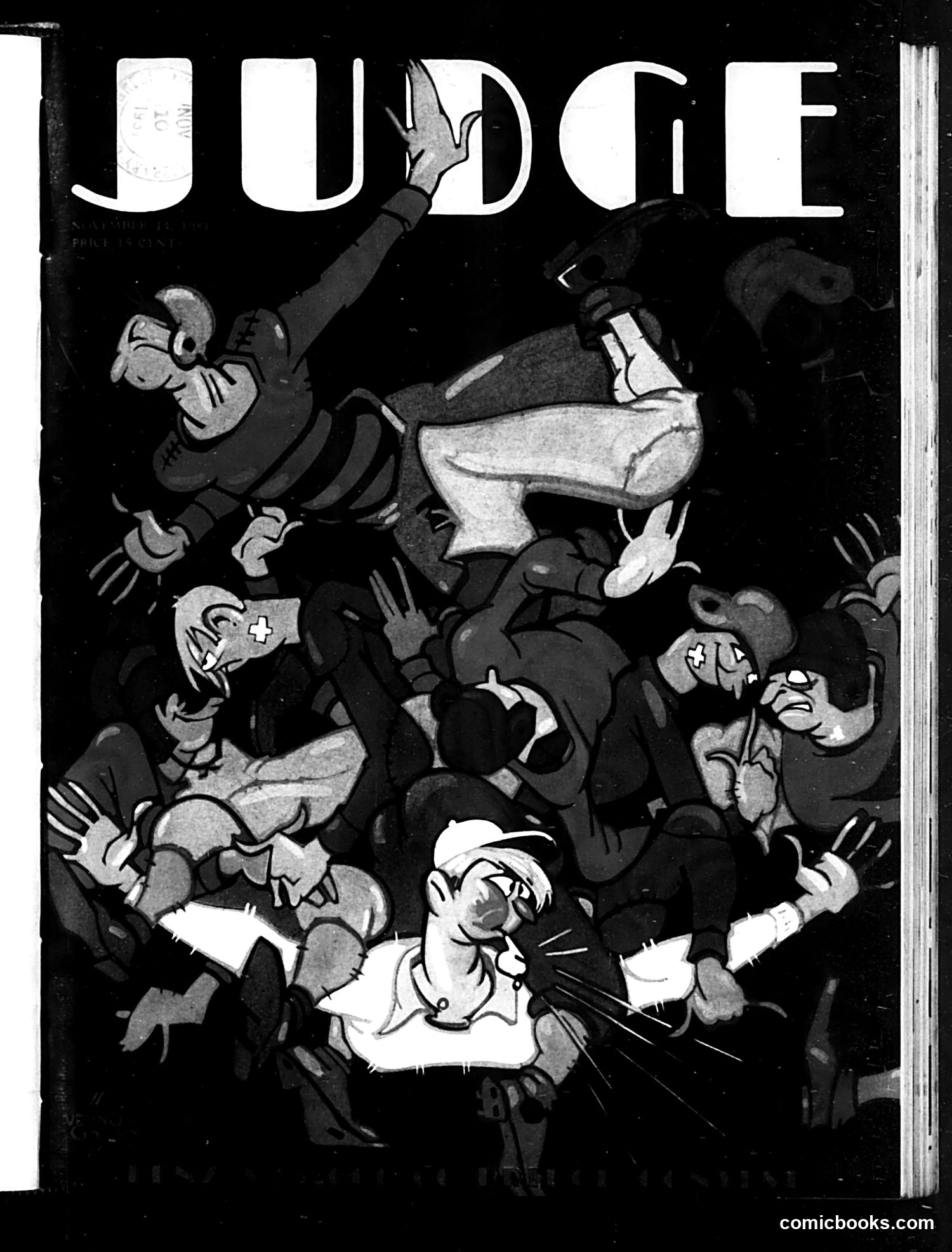
Judge Magazine Cartoon Analysis This appears to be a Judge magazine cover depicting a courtroom scene with anthropomorphic animals as judges and defendants. The central figure—a large animal in judicial robes—presides over what seems to be a trial or hearing involving smaller animal characters. Without additional OCR text or clearer identifying marks, I cannot definitively name the specific political figures or events being satirized. The cartoon likely comments on a contemporary legal proceeding or judicial decision from Judge's publication period (likely early-to-mid 20th century), using animal caricatures as a common satirical device. The composition suggests critique of court proceedings, possibly highlighting corruption, absurdity, or partisan justice—typical targets of Judge's political satire. The energetic staging and exaggerated expressions emphasize the magazine's humorous intent, though the specific reference remains unclear without additional context.
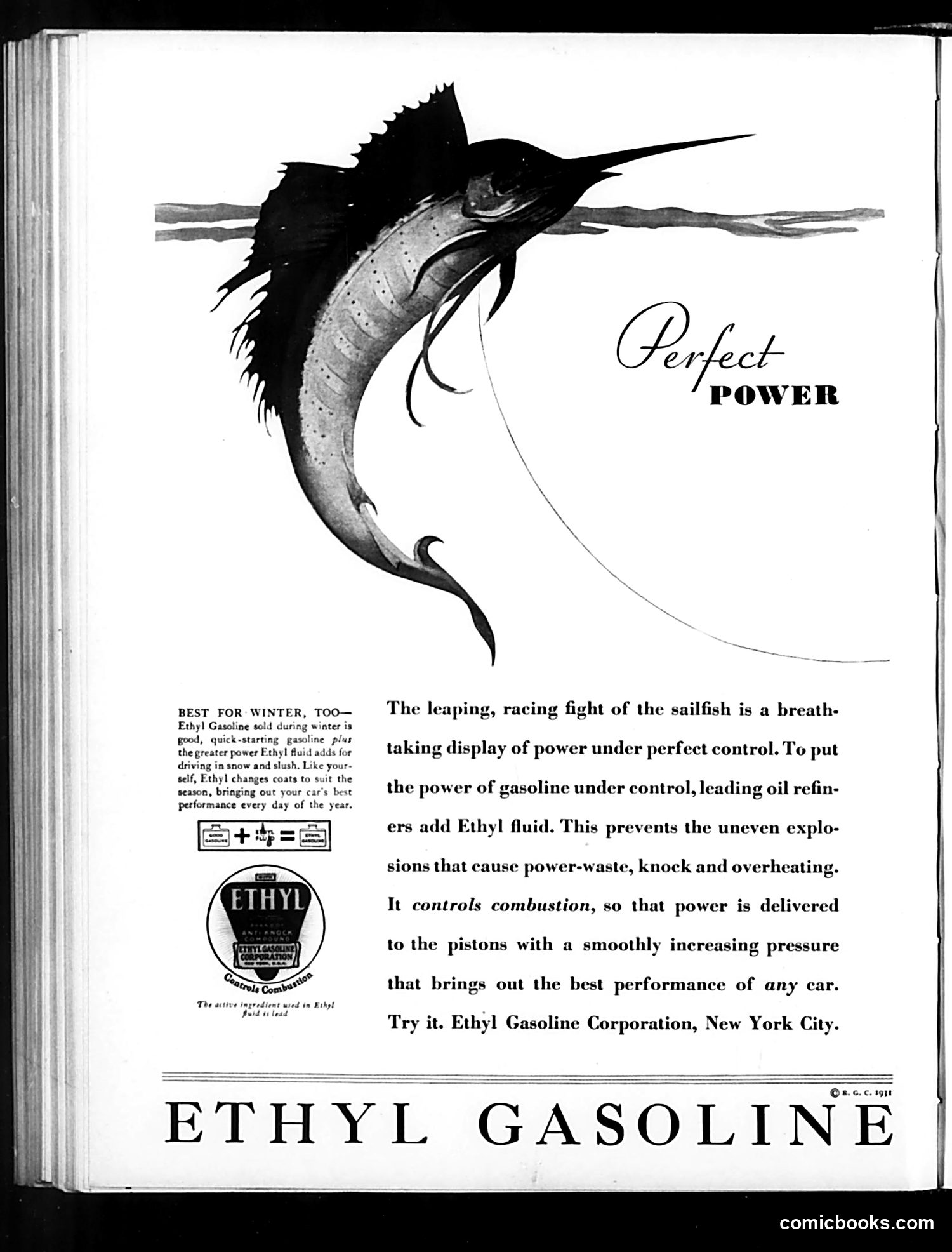
This page is primarily advertising, not satire. It's a full-page ad for Ethyl Gasoline from the Ethyl Gasoline Corporation (New York City), likely from around 1931 based on the copyright mark visible. The centerpiece is an illustration of a sailfish leaping dramatically, used as a metaphor for power and control. The ad copy compares the "perfect power" of a sailfish's controlled leap to gasoline enhanced with Ethyl fluid additive, which supposedly prevents engine knock, overheating, and uneven combustion. The small left sidebar references winter driving conditions, suggesting this ran during colder months. The Ethyl logo and circular badge appear as branding elements. This represents early automotive advertising using nature imagery to market fuel additives as performance enhancers.
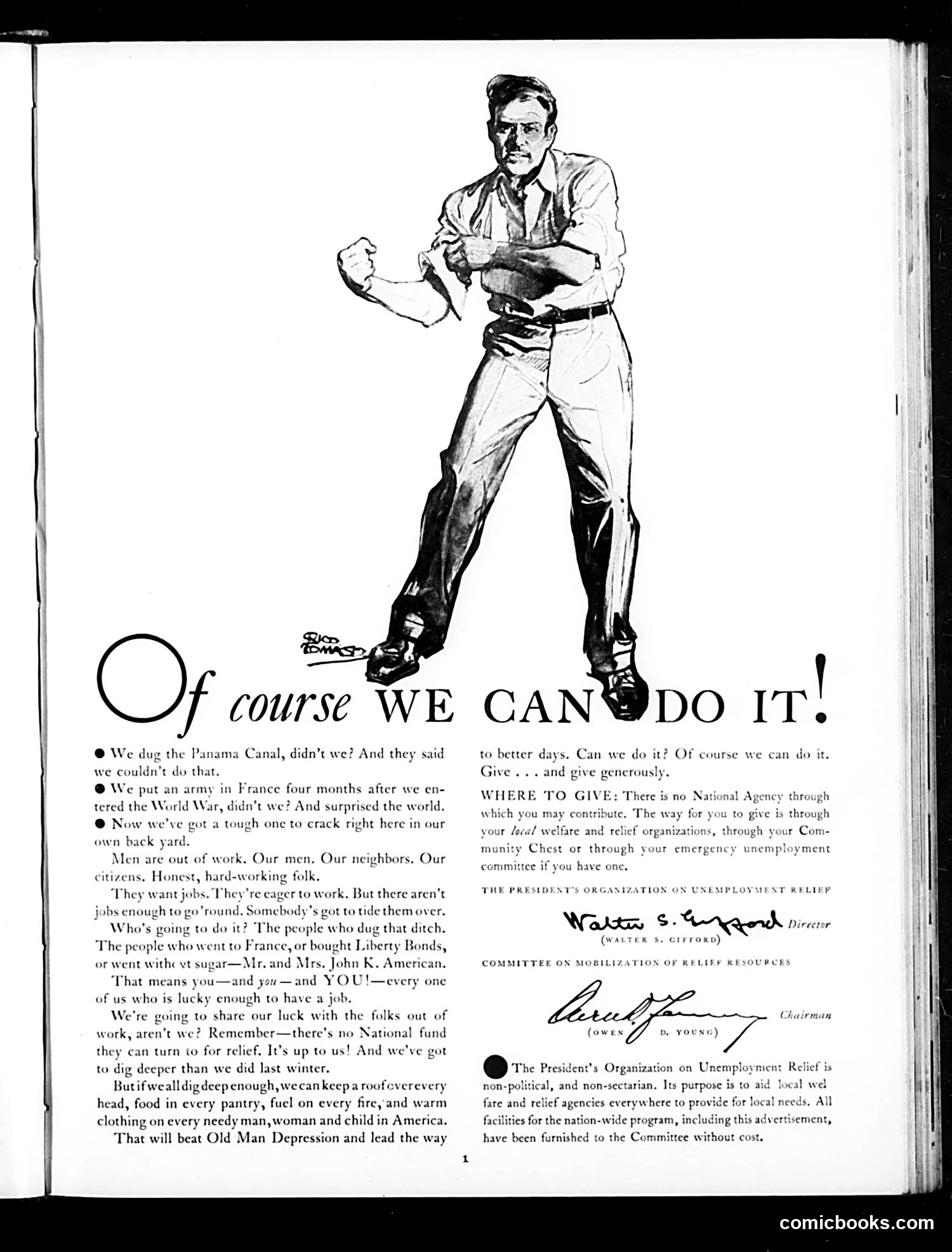
"Of Course We Can Do It!" - Public Works Relief Advertisement This is a Depression-era public service announcement, not satire. The illustration shows a confident working man in fighting stance, accompanying text that appeals to American optimism and shared sacrifice to address unemployment. The message references past national achievements (Panama Canal, WWI mobilization) to argue Americans can solve current joblessness through collective effort. It emphasizes that ordinary citizens—"honest, hard-working folk"—need employment and deserve government support. The ad directs people to contribute through welfare and relief organizations, and notes the President's Organization on Unemployment Relief coordinates the effort. Signed by what appears to be leadership, this represents Depression-era messaging promoting both civic responsibility and government relief programs as patriotic duty.
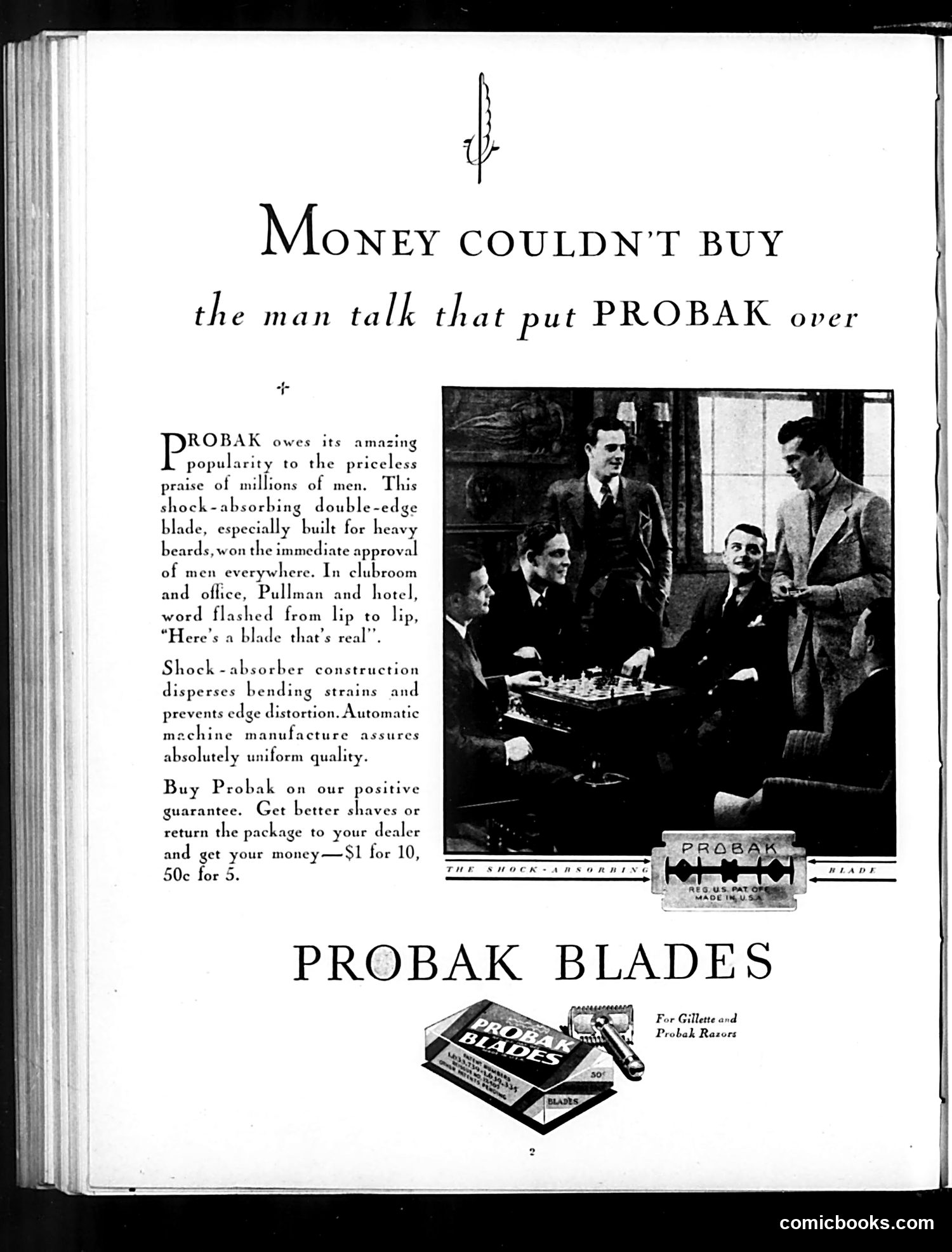
Analysis This page is primarily a Probak razor blade advertisement, not political satire. The headline "Money couldn't buy the man talk that put Probak over" uses a common advertising trope: claiming a product's popularity stems from word-of-mouth praise rather than paid promotion. The photograph shows men in an office or clubroom discussing the razor blade—a staged scene meant to suggest authentic masculine endorsement. The text emphasizes the blade's "shock-absorbing" double-edge design and "uniform quality" from automatic manufacturing. The ad concludes with pricing ($1 for 10 blades, 50¢ for 5) and a money-back guarantee. This is straightforward commercial content typical of Judge magazine, which carried substantial advertising alongside satirical editorial material. There is no political cartoon or social satire present on this page.
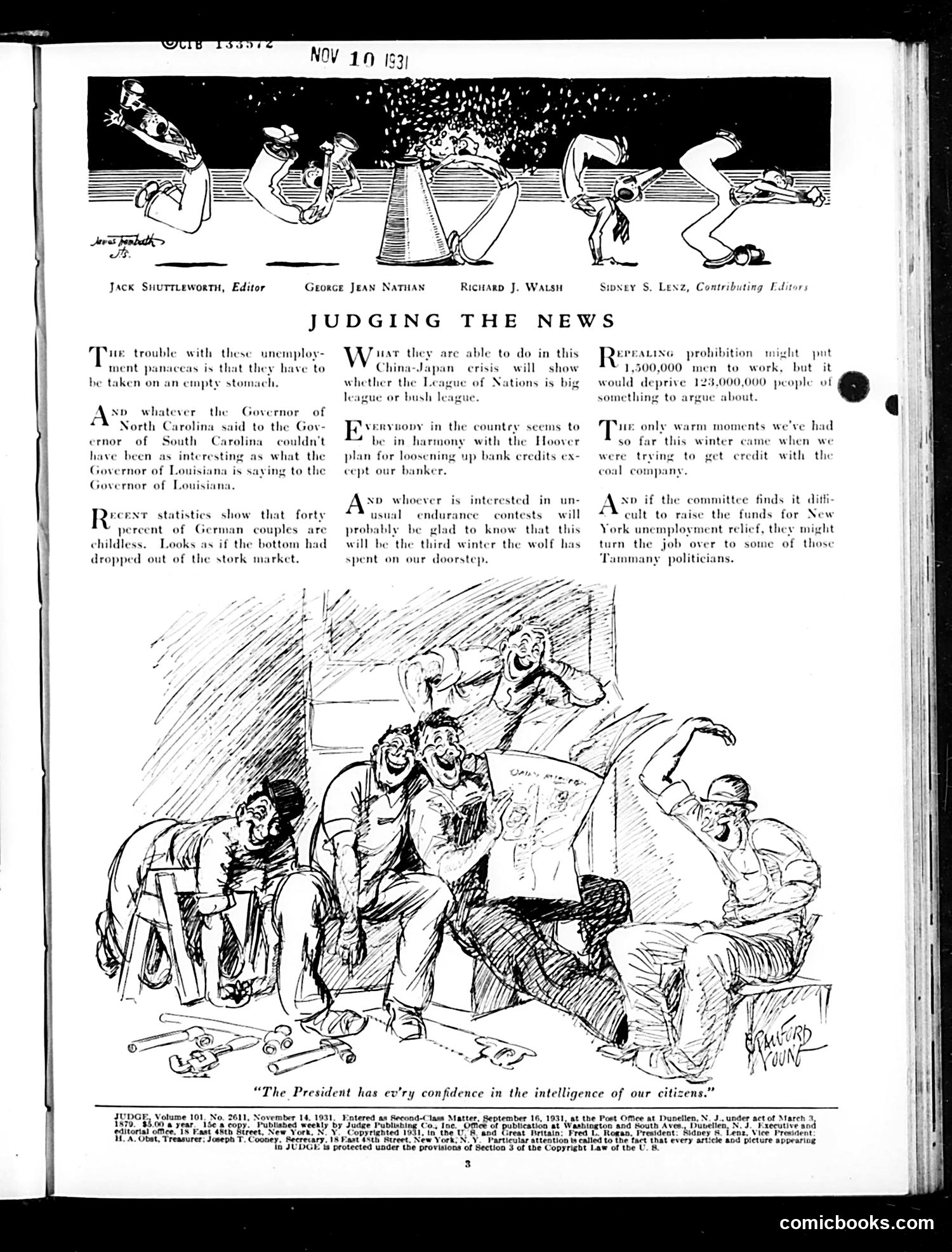
"Judging the News" - November 10, 1933 This page from Judge magazine satirizes early 1930s Depression-era politics and policy debates. The main cartoon depicts citizens in apparent poverty or hardship, with the caption "The President has every confidence in the intelligence of our citizens." The satire appears to mock President Franklin D. Roosevelt's optimistic rhetoric about public intelligence during the economic crisis, contrasting his confidence with the visible suffering shown in the illustration. The page's editorial snippets discuss unemployment relief, the League of Nations, banking credits, and prohibition repeal—all major Depression-era issues. The cartoon suggests cynicism about whether the public truly understood or could solve the economic problems they faced, despite presidential assurances.
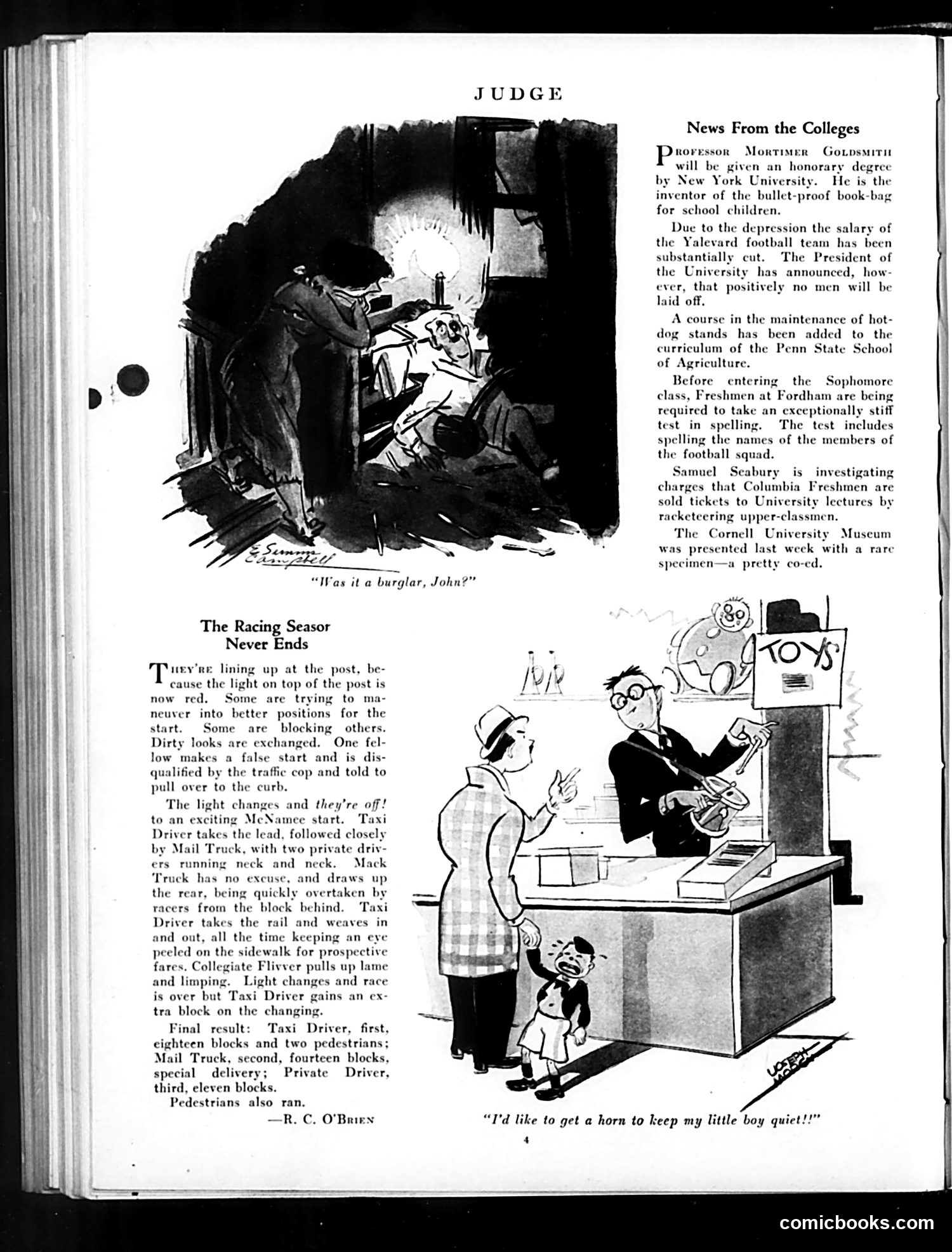
Analysis of Judge Magazine Page Top Cartoon ("Was it a burglar, John?"): A humorous domestic scene showing a woman discovering her husband at night. The joke relies on the ambiguous situation—she's asking if an intruder is present, but the actual scenario appears to be a marital misunderstanding, likely playing on period anxieties about home security and spousal awkwardness. "The Racing Sensor Never Ends": A satirical piece by R.C. O'Brien critiquing traffic management at what appears to be a horse race or sporting event. It mocks various drivers (taxi, mail truck, private driver) and pedestrians attempting to navigate through a race with changing traffic lights, highlighting the chaos and poor coordination of urban transportation during this era. Right Cartoon: A toy store scene depicting a father attempting to purchase a horn to quiet his child, satirizing parenting frustrations and consumer culture.
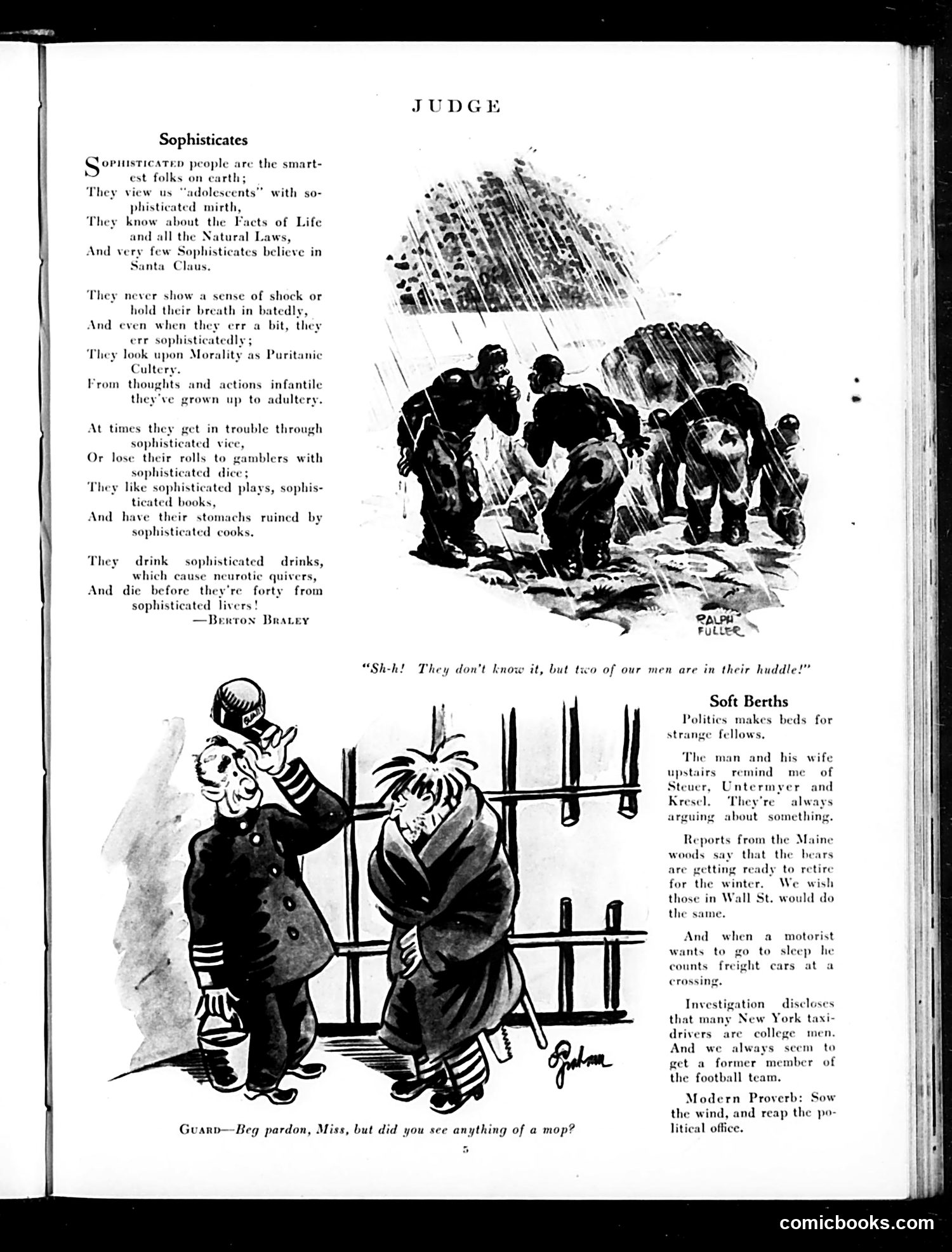
Analysis of Judge Magazine Page "Sophisticates" poem (top left): Satirizes wealthy, educated people who reject traditional values like Santa Claus and morality. The poem, attributed to Burton Braley, mocks their pretentiousness—their sophisticated drinks, books, and cynicism—suggesting this lifestyle leads to early death and ruin. Top illustration: Shows people huddled in rain, with the caption "Sh-h! They don't know it, but two of our men are in their huddle!" This appears to mock either political spies or undercover operatives infiltrating a group. Bottom cartoon: A guard questions a woman about a mop, captioned "Guard—Beg pardon, Miss, but did you see anything of a mop?" The joke's specific reference is unclear without additional context. "Soft Berths" column (right): Brief social commentary on politicians' cushy jobs and various amusing observations about bears, motorists, and taxi drivers.
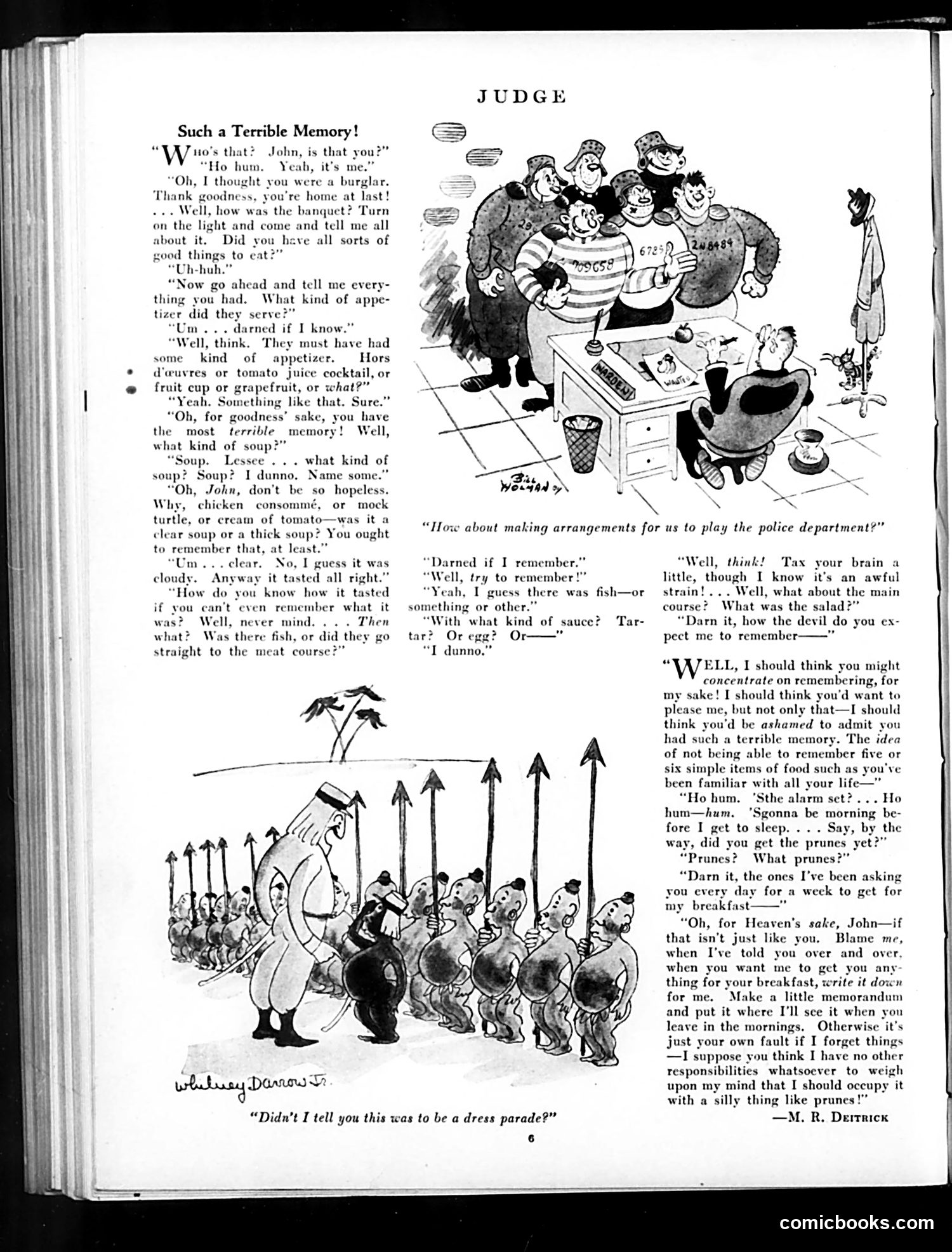
"Such a Terrible Memory!" - Judge Magazine Cartoon This page satirizes a wife's frustration with her husband John's poor memory. The dialogue shows her attempting to extract details about a fancy dinner he attended, but he can barely recall what he ate—vaguely remembering "soup" and "fish" without specifics. The cartoon's humor targets the stereotypical absent-minded husband, while the wife's escalating exasperation is played for comedy. The bottom cartoon, titled "Didn't I tell you this was to be a dress parade?" appears to reference confusion over social expectations or formality. The satire gently mocks domestic life and gender dynamics of the era, where wives expected husbands to remember social details while men were portrayed as comically forgetful about domestic matters.
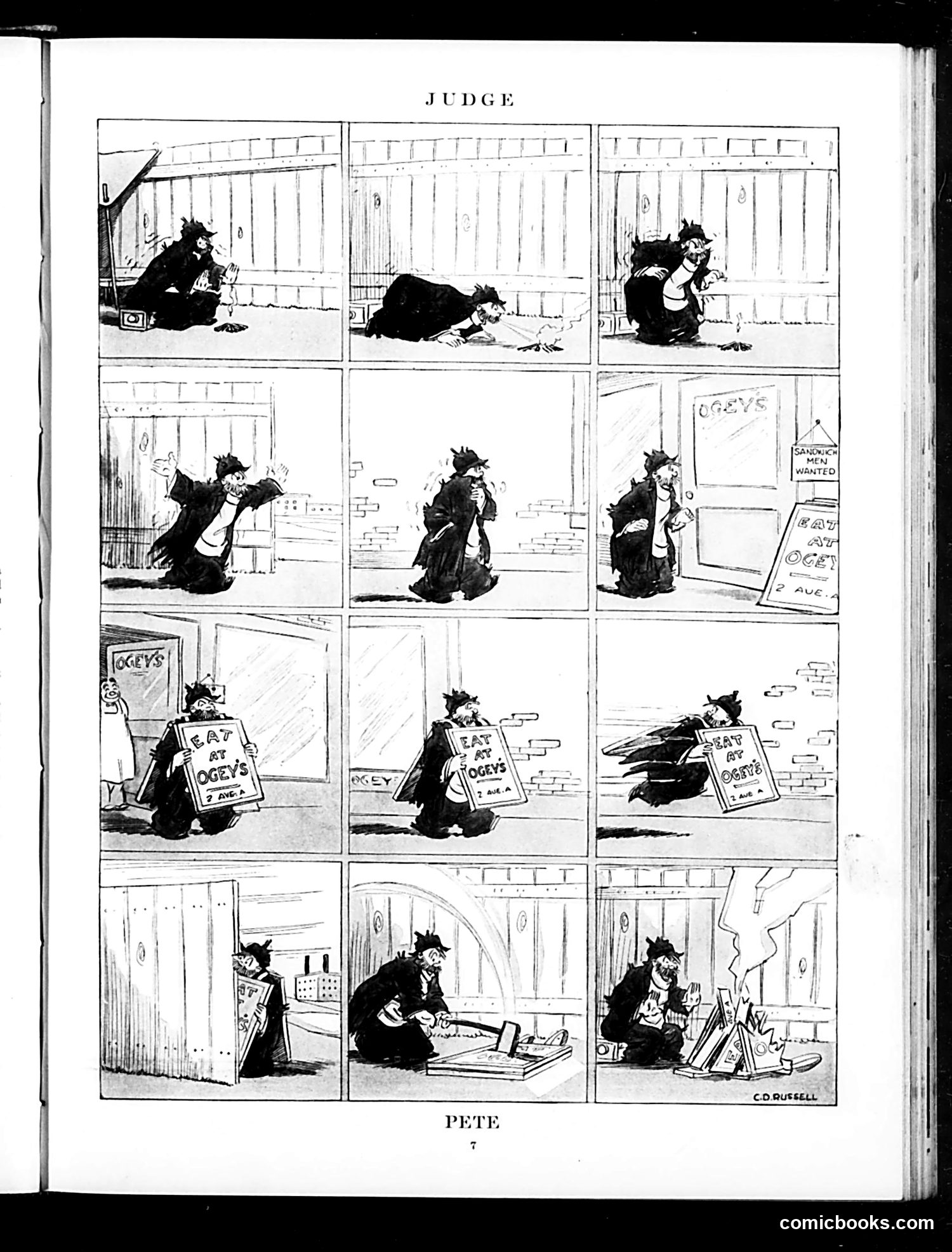
"Judge" - "Judge Pete" Comic Strip This is a multi-panel comic strip by C.D. Russell titled "Judge Pete." The protagonist appears to be a judge or authority figure in dark robes who encounters various street situations. The narrative follows Pete as he confronts what looks like vagrants or street people advertising "Eat at Ogey's" (possibly a cheap restaurant). In subsequent panels, Pete becomes increasingly frustrated with the advertisements and street hustlers, eventually escalating to physical confrontation and destruction of the signs. The satire likely mocks either overzealous municipal enforcement against street vendors, or conversely, Pete's disproportionate judicial/authoritarian response to minor street commerce. Without knowing Judge magazine's specific political stance or the publication date, the exact target of ridicule—whether Pete or the street vendors—remains somewhat unclear.
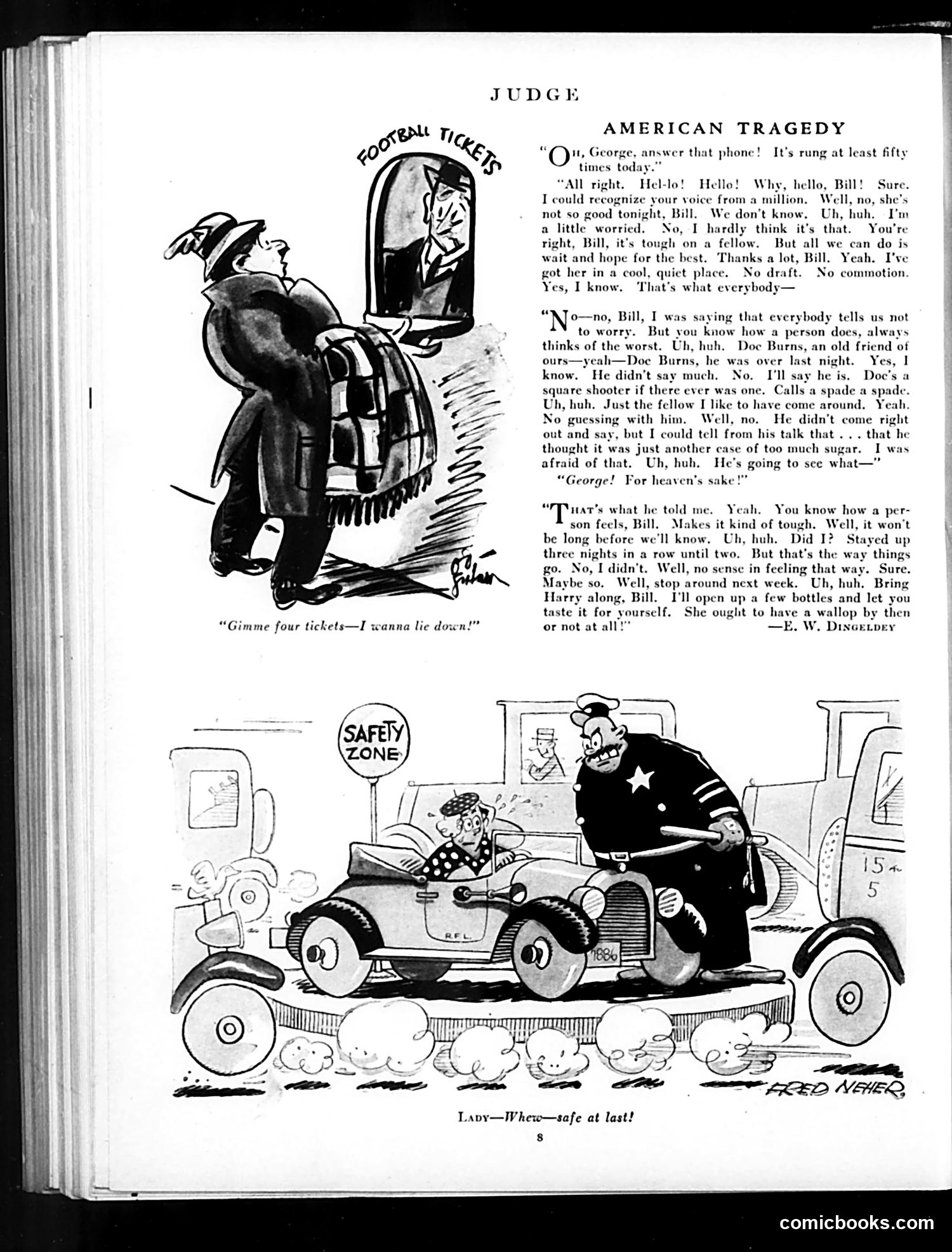
"American Tragedy" - Judge Magazine This page satirizes American anxious domesticity during what appears to be the early 20th century. The top cartoon shows a man fielding repeated phone calls about an unnamed crisis—his dialogue reveals worry, superstition ("too much sugar"), and dependence on male friends' reassurance. The cryptic conversation suggests illness or injury in the household, likely a child or spouse, generating the frantic phone activity. The bottom cartoon by Fred Neher shows a traffic-safety message: Uncle Sam stands guard in a "Safety Zone," protecting a child in a toy car from oncoming traffic. The caption "Lady—Where—safe at last!" ironically comments on urban dangers. Together, the page contrasts private domestic anxiety with public safety concerns, suggesting American life's precarious nature. The wealthy gentleman's nervous reliance on social networks mirrors the era's growing middle-class dependency on expert advice and community reassurance during medical or safety crises.
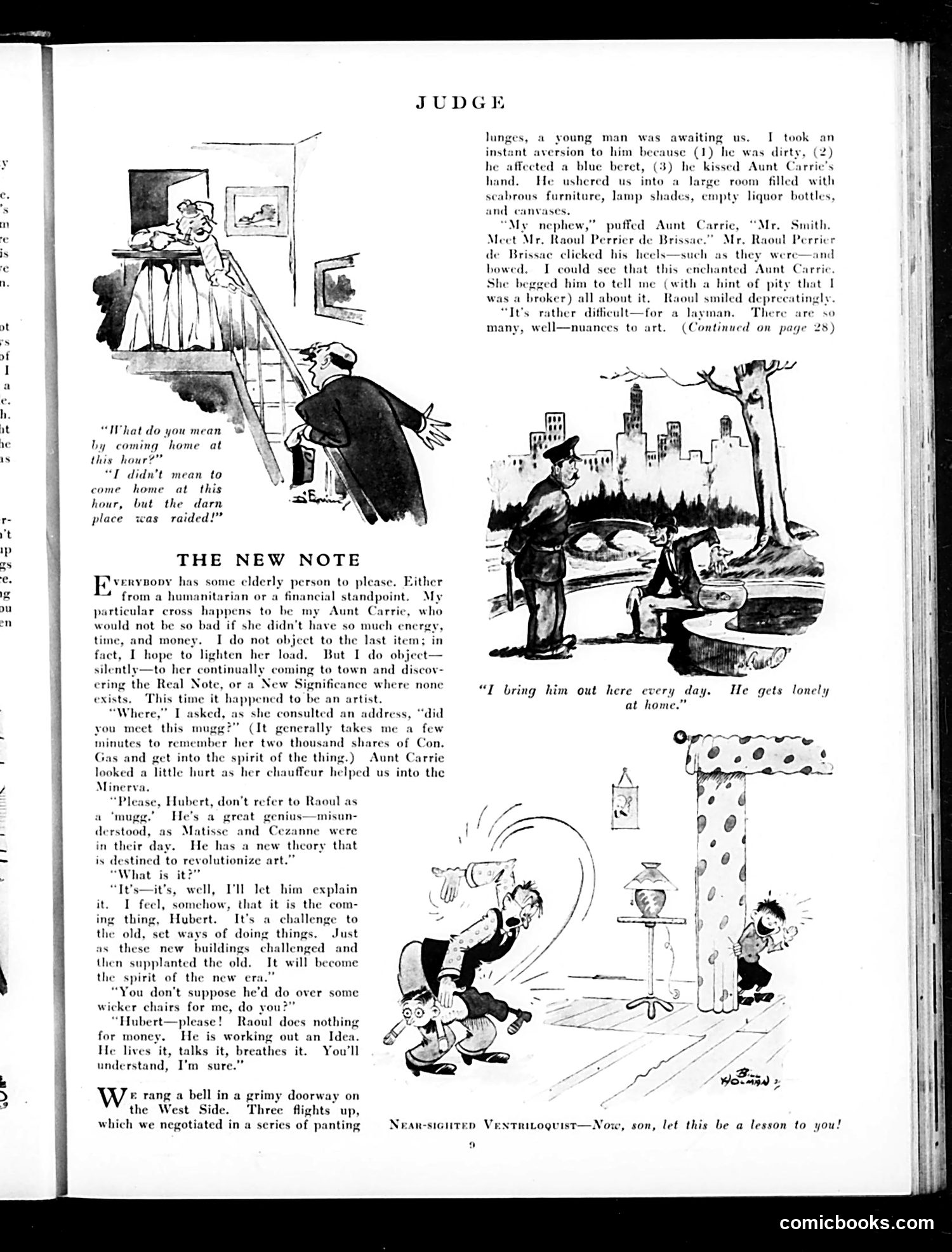
Judge Magazine Satire Analysis This page satirizes wealthy Americans' fashionable embrace of modern art and bohemian artists during the early 20th century. The main story mocks Aunt Carrie, a wealthy woman patronizing "Raoul Perrier de Brissac," a pretentious artist living in squalid conditions on the West Side. The satire targets how wealthy dilettantes romanticize struggling artists as geniuses while the artists exploit this admiration. Raoul affects the stereotypical "artiste" pose—beret, hand-kissing, pseudo-intellectual talk about "nuances"—while living in poverty surrounded by "scabrous furniture" and empty liquor bottles. The narrator (Hubert), presented as sensible, finds the whole enterprise absurd, particularly Aunt Carrie's need to discover "the Real Note" or latest artistic trend. The bottom cartoon about a "Near-sighted Ventriloquist" appears unrelated social commentary, likely mocking misguided authority figures. The joke: wealthy patrons' gullible enthusiasm for avant-garde art and bohemian lifestyle is ridiculous posturing that primarily serves artists' financial interests, not genuine artistic revolution.
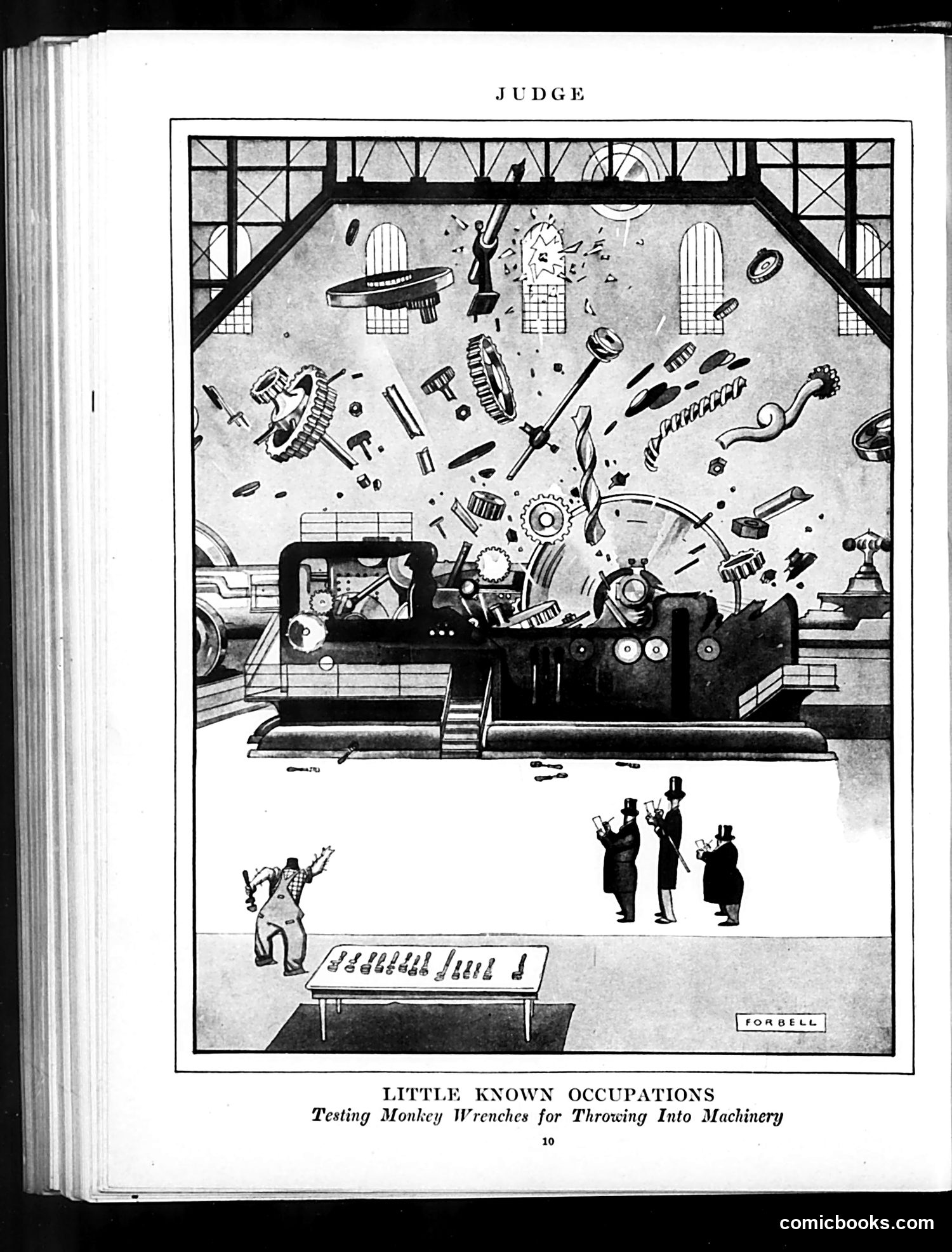
"Testing Monkey Wrenches for Throwing Into Machinery" This cartoon satirizes labor sabotage and industrial unrest. The "little known occupation" is a monkey wrench tester—a darkly humorous reference to "throwing a monkey wrench into the works," a phrase meaning to deliberately disrupt operations. The image shows factory workers in the foreground observing a chaotic scene above: machinery exploding with parts flying everywhere, while figures operate the destruction. This mocks the period's labor disputes and sabotage tactics employed during industrial conflicts. The satire targets both labor unrest and management's paranoia about worker sabotage—presenting saboteurs as having an actual job title and testing procedures, absurdly formalizing what was genuinely feared as workplace violence. Judge magazine, conservative and pro-business, used this to ridicule labor activism as destructive and organized.
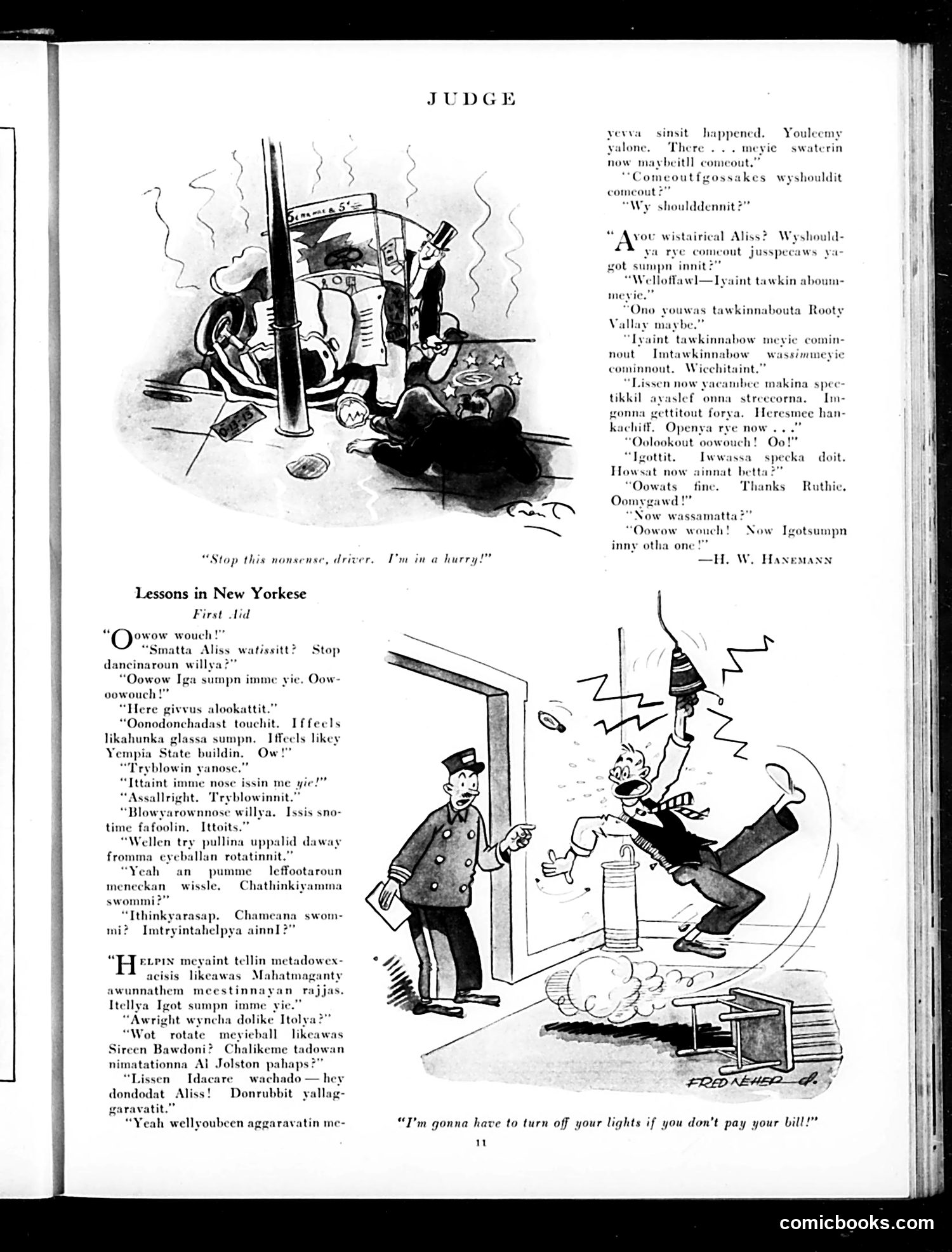
Explanation for Modern Readers This page from *Judge* contains two satirical pieces about New York City dialect and urban life. "Stop this nonsense, driver. I'm in a hurry!" (top cartoon): A chaotic car accident scene mocking the frantic pace of New York City traffic and impatient drivers demanding speed despite dangerous conditions. "Lessons in New Yorkese" (lower section): A humorous dialect lesson satirizing working-class New York accent and speech patterns. The exaggerated phonetic spellings ("Oowow wouch," "Smatta Aliss") mock how New Yorkers (likely Italian and Eastern European immigrants) pronounced English. The sketches show someone getting an eyelash removed using crude methods—a comedic "first aid" lesson demonstrating both the accent and the resourceful, no-nonsense attitude stereotypically associated with New Yorkers of that era. "I'm gonna have to turn off your lights...": A utility company threat about unpaid bills, satirizing the city's modern infrastructure and collection practices. The satire targets urban working-class culture and immigrant speech patterns.
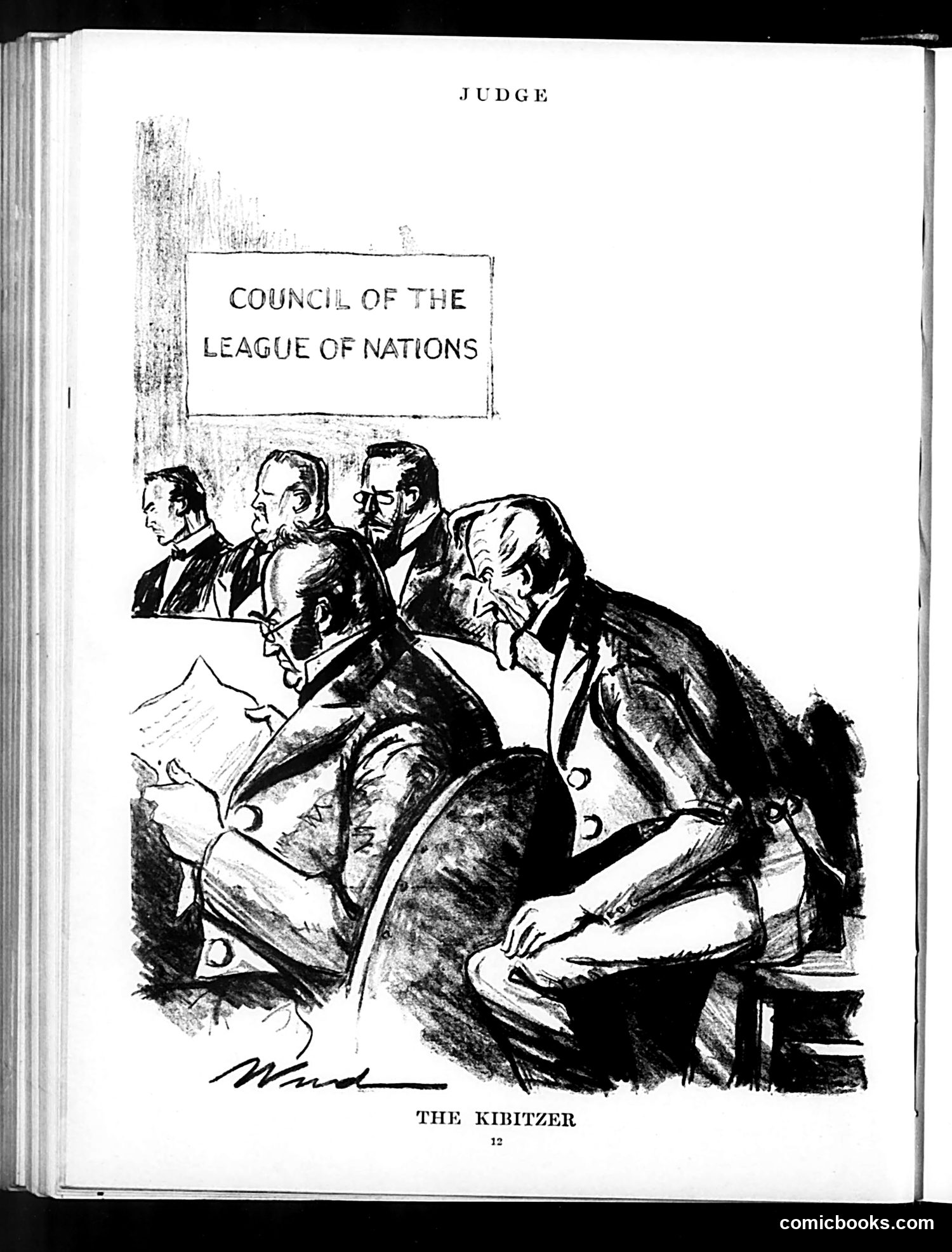
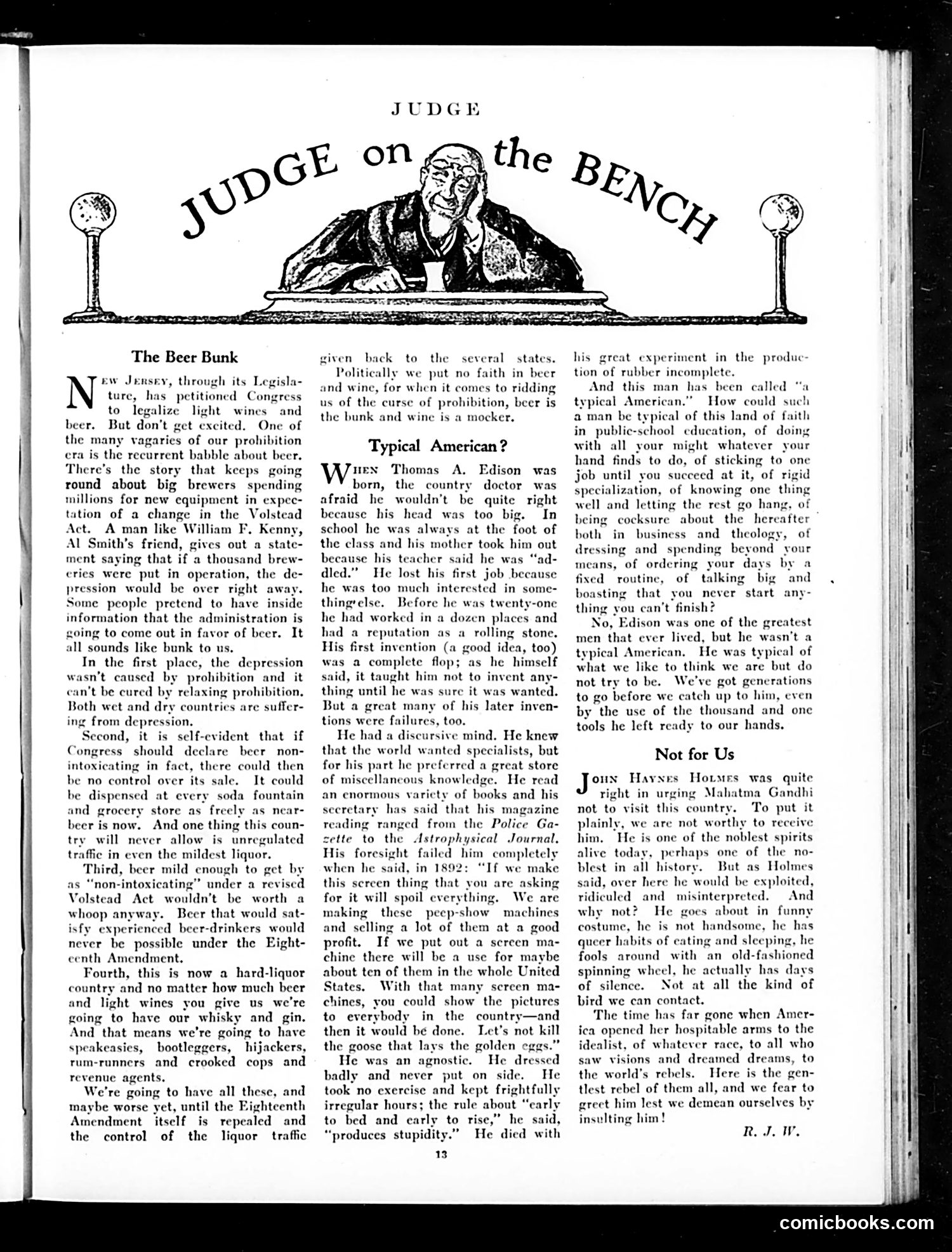
Judge Magazine: "Judge on the Bench" - Prohibition Era Commentary This page contains two distinct pieces of satire from Judge magazine during Prohibition. "The Beer Bunk" (main article): The editorial mocks New Jersey's petition to legalize light beer, dismissing it as false hope. The author argues Prohibition didn't cause the Depression and can't cure it; that "non-intoxicating" beer would be unenforceable at retailers; and that Americans will continue demanding whisky and gin regardless. The satire targets naive wet advocates (including politicians like Al Smith) who believe beer legalization offers economic relief—calling their hopes mere "bunk." "Typical American?" (right column): This celebrates Thomas Edison, presenting him as distinctly American through his unconventional path: a "big-headed" student who failed traditionally, worked many jobs, initially invented failures, and possessed wide miscellaneous knowledge rather than narrow specialization. Edison embodies American pragmatism and persistence over formal credentials. Both pieces use humor to critique contemporary assumptions—one debunking Prohibition repeal myths, the other celebrating self-made American innovation.
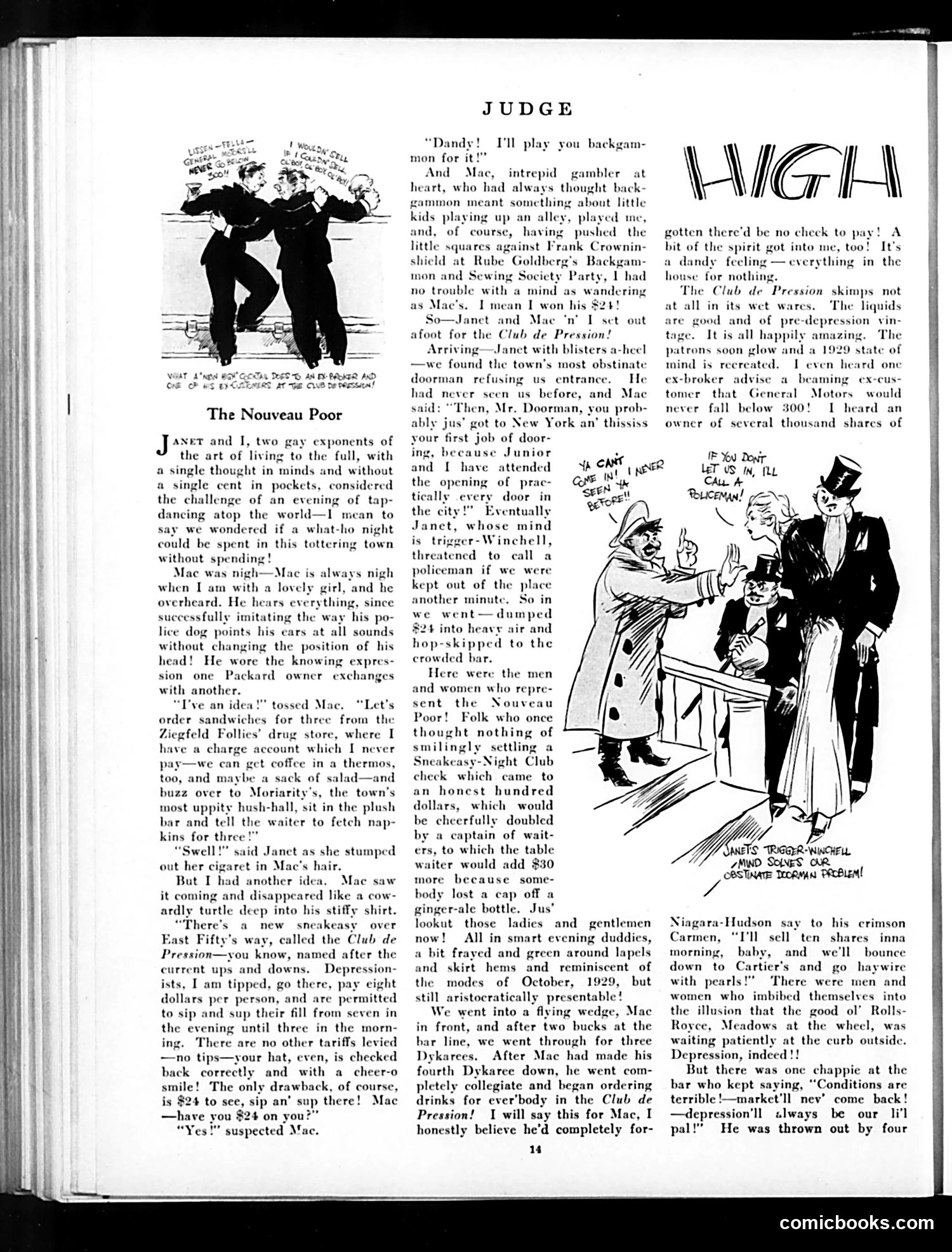
"The Nouveau Poor" - Judge Magazine Satire This humorous story mocks the newly impoverished wealthy during the Great Depression (post-1929 crash, referenced explicitly in the text). The narrative follows two protagonists and their friend Mac attempting an evening out without money, exploiting credit and social connections. They visit the "Club de Pression"—a speakeasy named after the economic downturn—where they encounter formerly rich people now "aristocratically presentable" but wearing frayed, outdated 1929 clothing. The satire targets: - Class pretension: The wealthy maintaining airs despite financial ruin - Prohibition-era culture: Speakeasies as gathering places for the desperate - Credit abuse: The protagonist's unpaid Ziegfeld Follies charge account - Generational foolishness: Mac's collegiate drinking spree despite poverty The illustration (right) shows the speakeasy scene with patrons in formal wear. The joke is that even financial catastrophe cannot humble these people—they continue spending lavishly on drinks despite being broke.
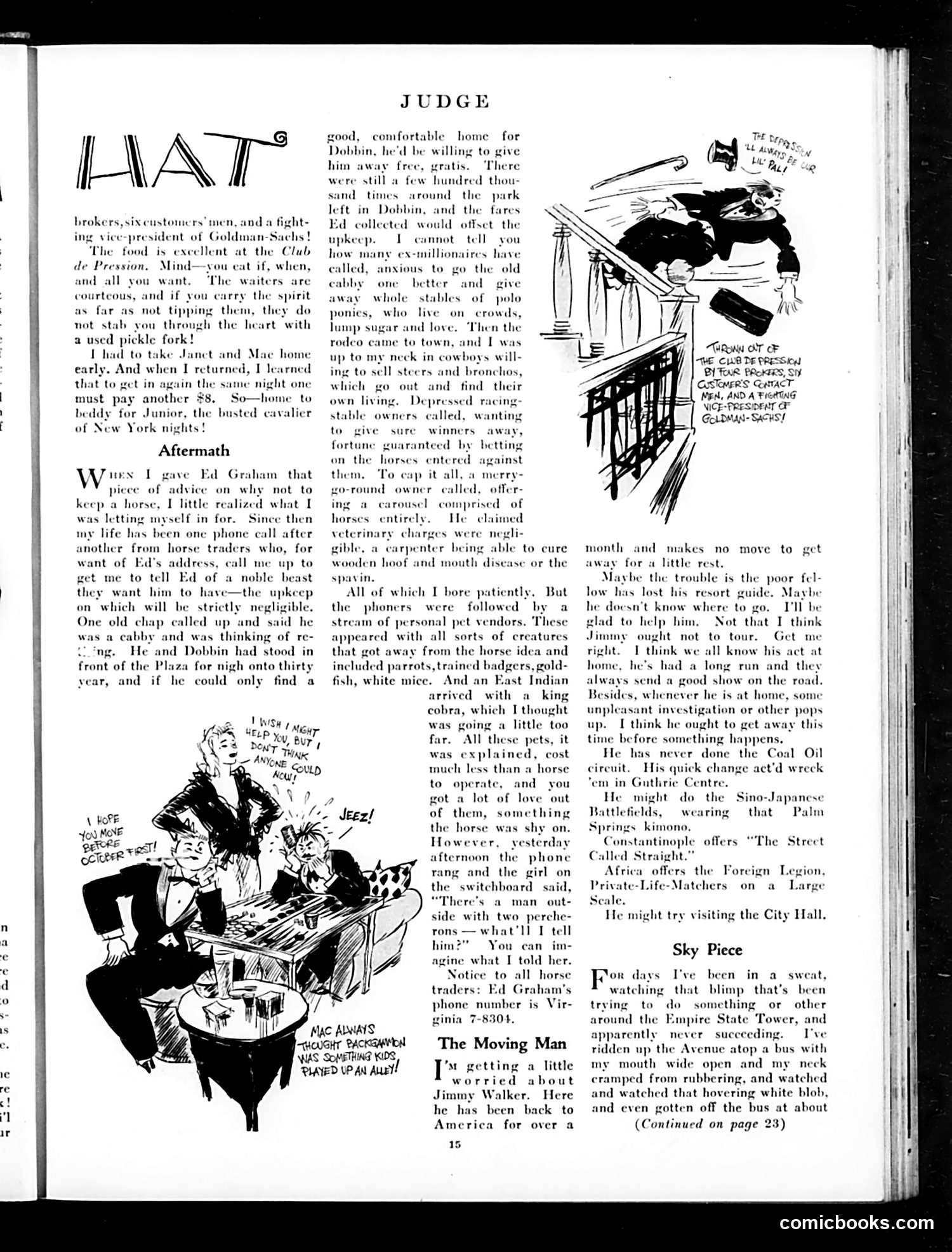
Analysis of Judge Magazine Page This page contains humorous essays mocking New York's wealthy elite and their absurd problems, illustrated with cartoons. "Hat" section: A society club member complains about expensive dining and the indignity of paying $8 re-entry fees—satirizing the frivolous concerns of the rich. "Aftermath": The main piece ridicules a man who carelessly gave away advice about keeping horses. He's now besieged by phone calls from desperate horse traders, ex-millionaires, depression-era stable owners, and bizarre pet vendors (including a cobra) trying to unload animals. The satire targets both those naively giving unsolicited advice and the economic desperation of those trying to offload unwanted animals and expenses. "The Moving Man": A brief jab at Jimmy Walker (likely NYC's mayor), suggesting he should travel more to avoid "unpleasant investigations"—implying corruption or scandal. The cartoons feature exaggerated facial expressions and busy compositions typical of 1930s Judge satire, mocking upper-class obliviousness during economically difficult times.
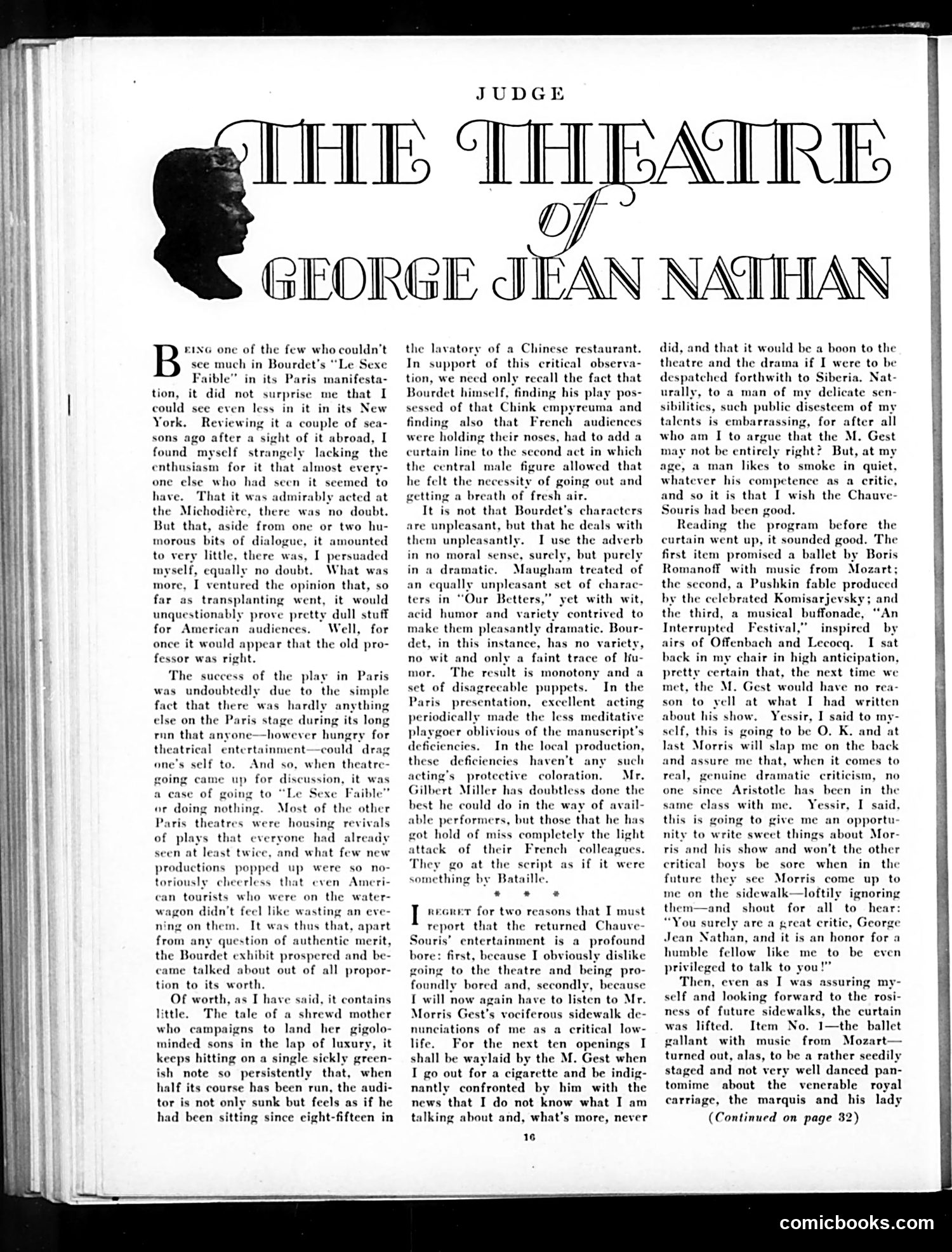
"The Theatre of George Jean Nathan" - Judge Magazine Review This page is a theater review by prominent critic George Jean Nathan, examining a Broadway production of Édouard Bourdet's French play "Le Sexe Faible" ("The Weak Sex"). The Satire/Critique: Nathan argues the play succeeded in Paris only because alternatives were worse—rival theaters showed revivals or "notoriously cheerless" productions. He claims the script itself is monotonous and unpleasant, with characters treated without wit or variety, unlike Maugham's similar work. The famous anecdote about Bourdet adding a scene where an actor exits for "fresh air" becomes a joke about the play's suffocating tedium—even the playwright acknowledged audiences needed escape. For Modern Readers: Nathan's complaint that excellent French acting masked the script's deficiencies, while Gilbert Miller's American cast exposes them, reflects early 20th-century anxieties about whether European sophistication translated to American theaters, or whether American audiences simply lacked Continental taste.
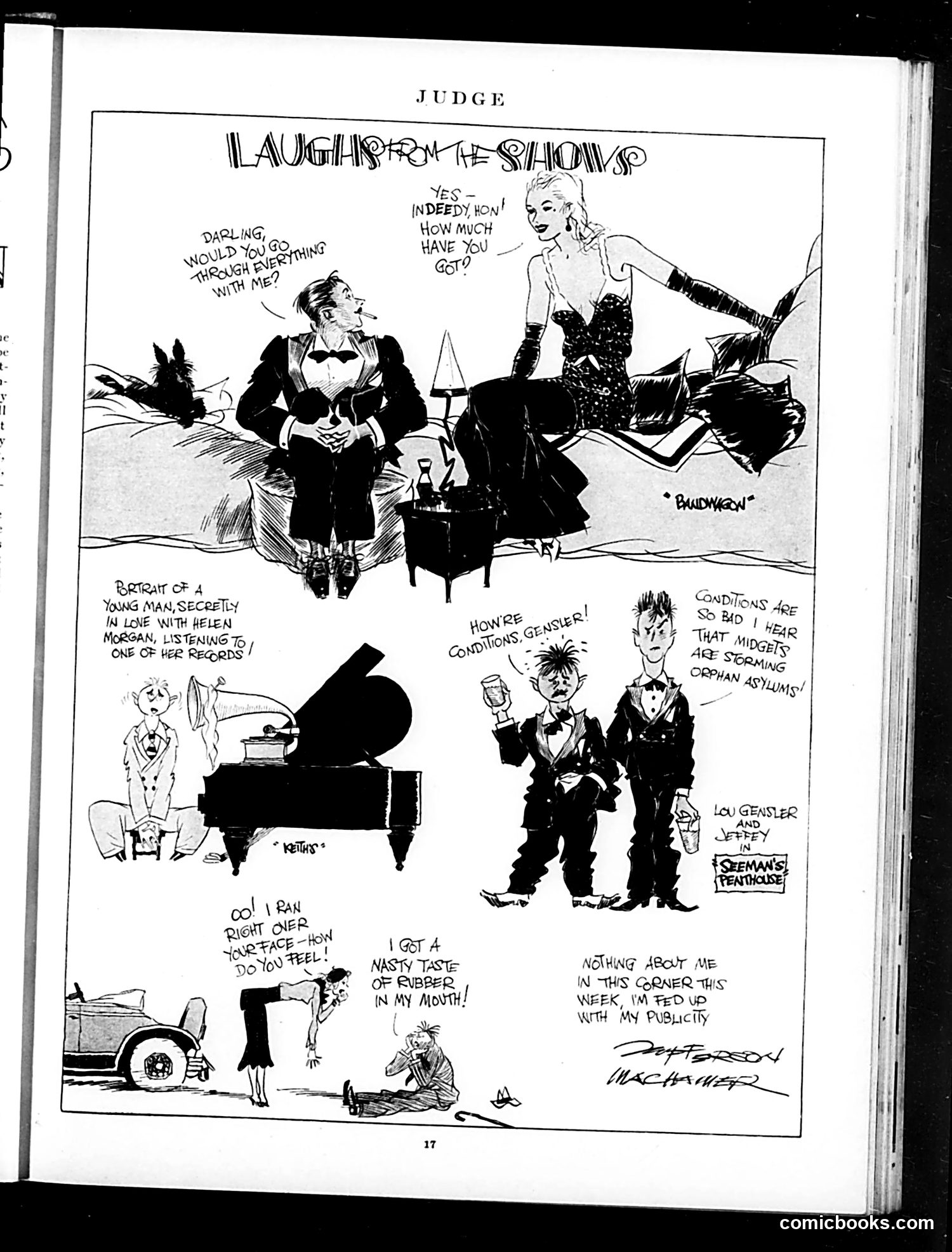
Analysis of "Laughs from the Shows" This is a satirical cartoon about Broadway entertainment and showbiz personalities. The page depicts scenes from theatrical productions, likely referencing Helen Morgan, a famous 1920s-30s torch singer known for dramatic stage performances. The top scene shows a man and woman in formal attire, with dialogue about financial arrangements typical of romantic comedies. The middle panels reference specific theatrical productions and performers, including what appears to be Lou Gesler (mentioned in text) and references to "Iceman's Penthouse." The bottom sketches show various comedic scenarios—a car accident, someone tasting rubber (possibly a slapstick gag), and complaints about publicity. The overall satire mocks the pretensions and drama of Broadway performers, the superficiality of show business relationships, and the constant self-promotion required of entertainers. The cartoonist is poking fun at theatrical excess and the gap between performers' public images and private concerns.
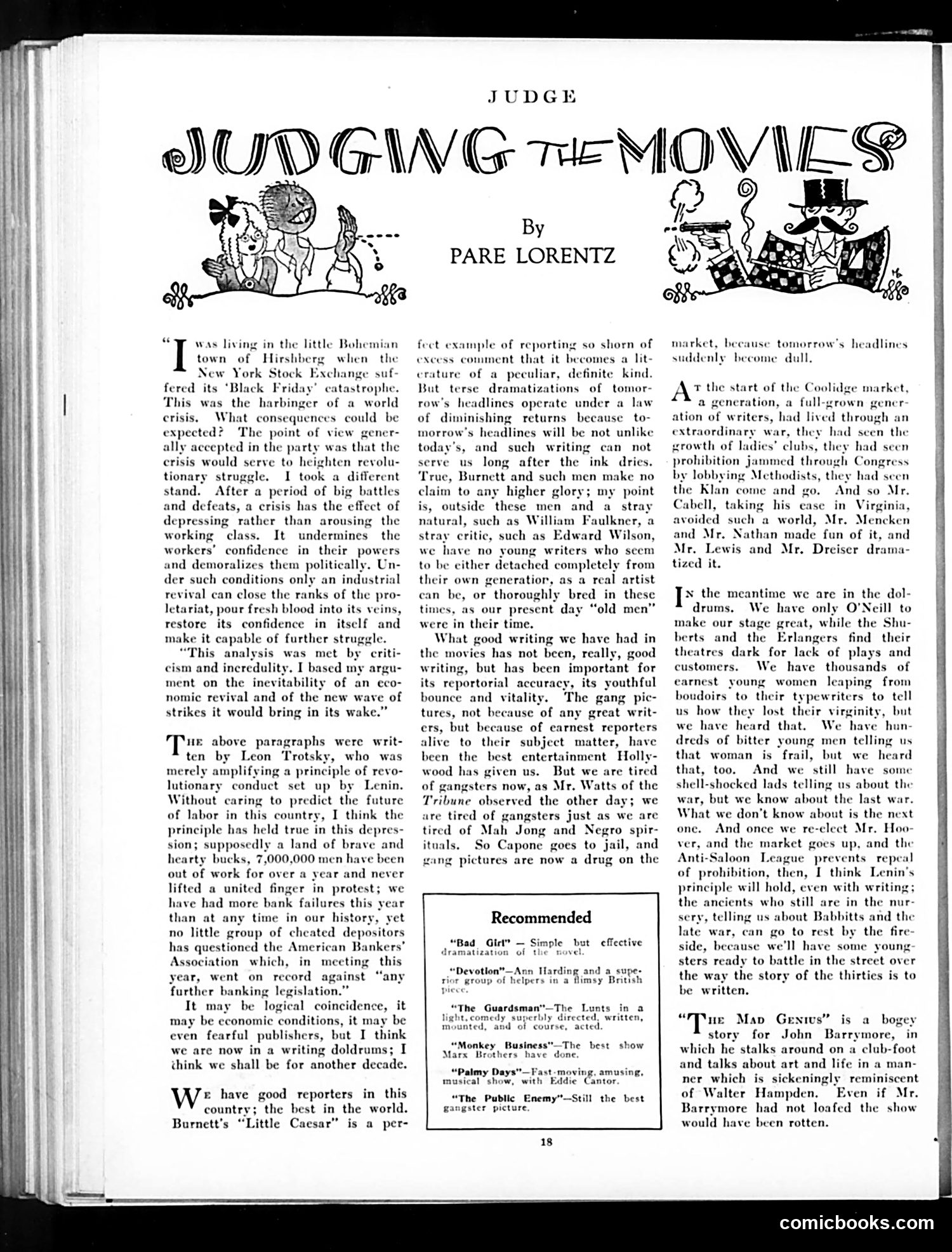
Analysis for Modern Readers This page features a film criticism essay by Pare Lorentz titled "Judging the Movies." The piece argues that American cinema lacks genuinely artistic writing, despite having competent reporters documenting contemporary life. Key Context: - Lorentz critiques "gang pictures" (gangster films) as having become tired entertainment, referencing Al Capone's recent imprisonment - He contrasts earnest reportorial accuracy with true artistic merit - The essay invokes Leon Trotsky's analysis of economic depression and worker demoralization—Lorentz uses this Marxist framework to explain why American culture has entered a creative "doldrums" - He notes 7 million unemployed workers haven't united in protest, suggesting social passivity The Point: Despite excellent reporters, American writers and filmmakers remain either detached from their times or trapped within them—lacking the artistic independence needed for enduring work. Even successful gang films succeed through journalistic accuracy rather than literary quality. The sidebar recommends current films including Marx Brothers comedies and plays featuring theatrical stars like the Lunts, representing Judge's entertainment coverage.
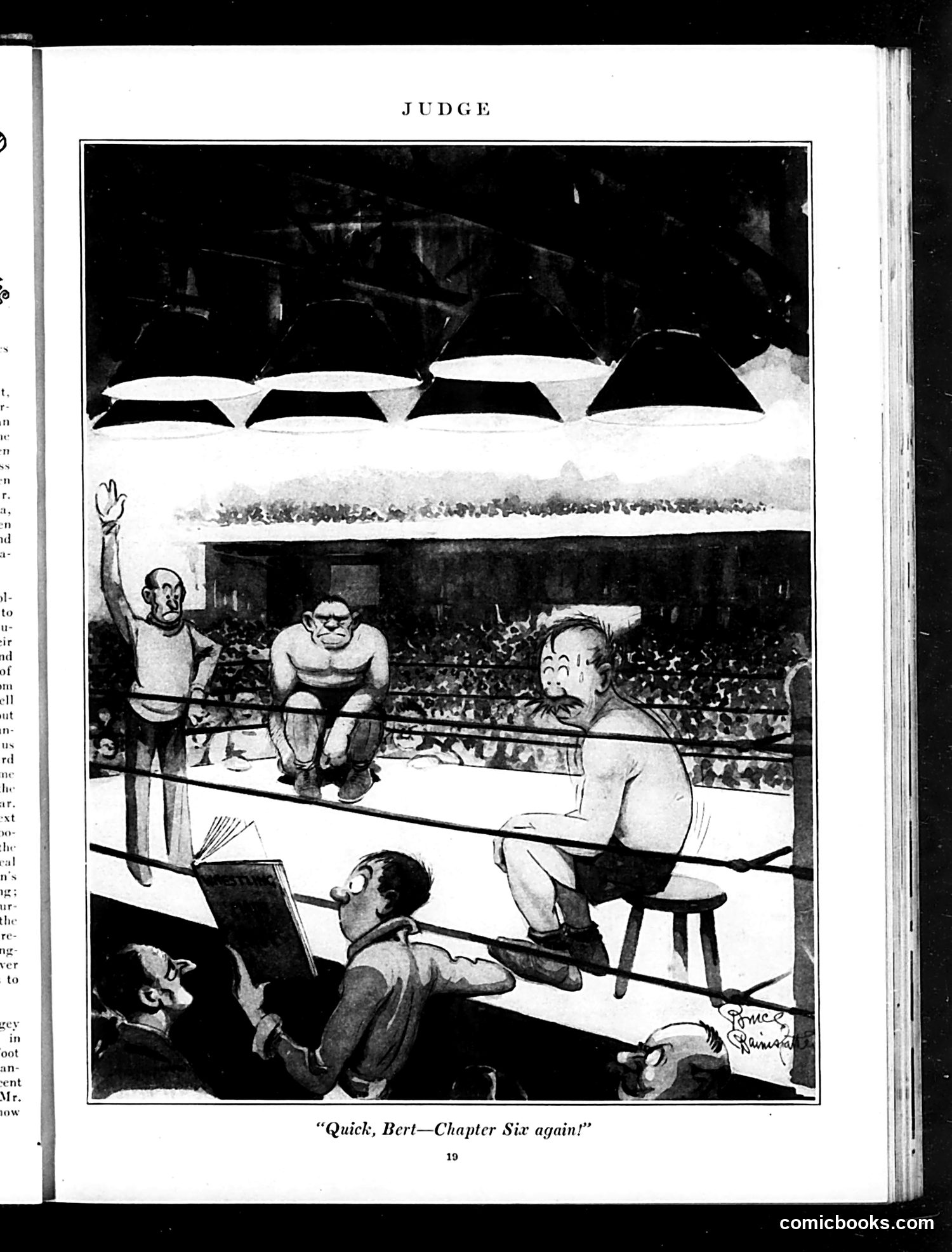
Analysis This cartoon depicts a wrestling match before a packed stadium. The caption "Quick, Bert—Chapter Six again!" suggests the bout is being repeated or staged for entertainment purposes, satirizing professional wrestling as scripted theater rather than genuine sport. The figure in the foreground appears to be a referee or judge (matching the magazine's title), while wrestlers are shown in the ring. The exaggerated caricature style typical of Judge magazine suggests the cartoonist is mocking wrestling's theatrical nature—treating each bout like chapters in a serialized story that audiences demand repeated viewings of. This likely comments on early-20th-century professional wrestling's dubious legitimacy, exposing it as predetermined entertainment rather than authentic athletic competition—a common satirical target during this era.
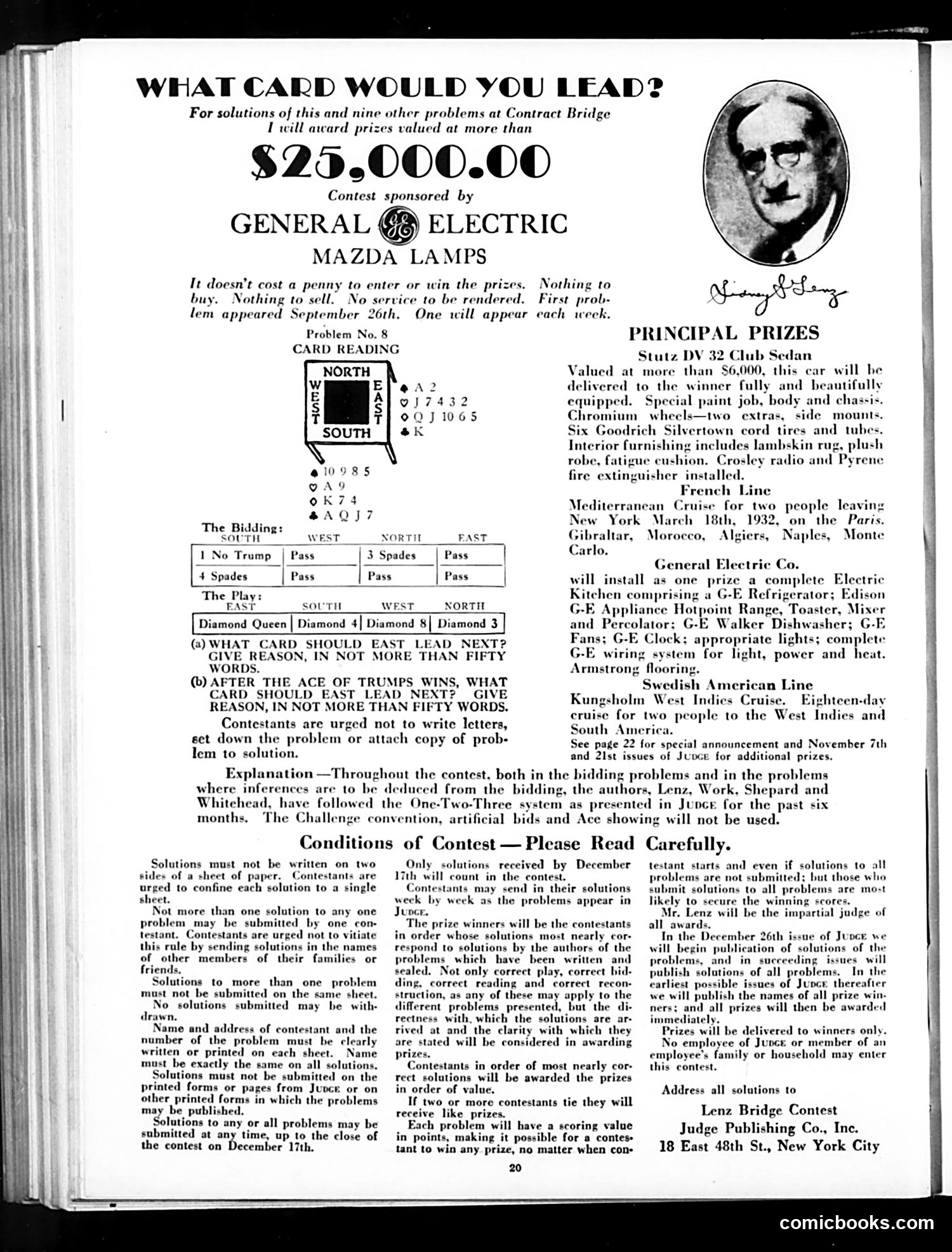
What This Page Means This is primarily a contest advertisement, not political satire. Judge magazine is sponsoring a Contract Bridge (card game) puzzle competition with $25,000 in prizes, underwritten by General Electric and Mazda Lamps. The page presents "Problem No. 8"—a bridge hand diagram asking solvers which card to lead and why. Winners receive substantial prizes: a Stutz automobile ($6,000+), a Mediterranean cruise, a complete G-E electric kitchen, and a Caribbean cruise. The small photograph appears to be a bridge expert or celebrity endorser (signature illegible in this reproduction), lending credibility to the contest. This reflects 1930s commercial sponsorship strategies: major corporations funded intellectually challenging competitions to build brand prestige and consumer engagement. The detailed contest rules emphasize fairness and prevent fraud—indicating these were taken seriously as legitimate promotional events during the Depression era.
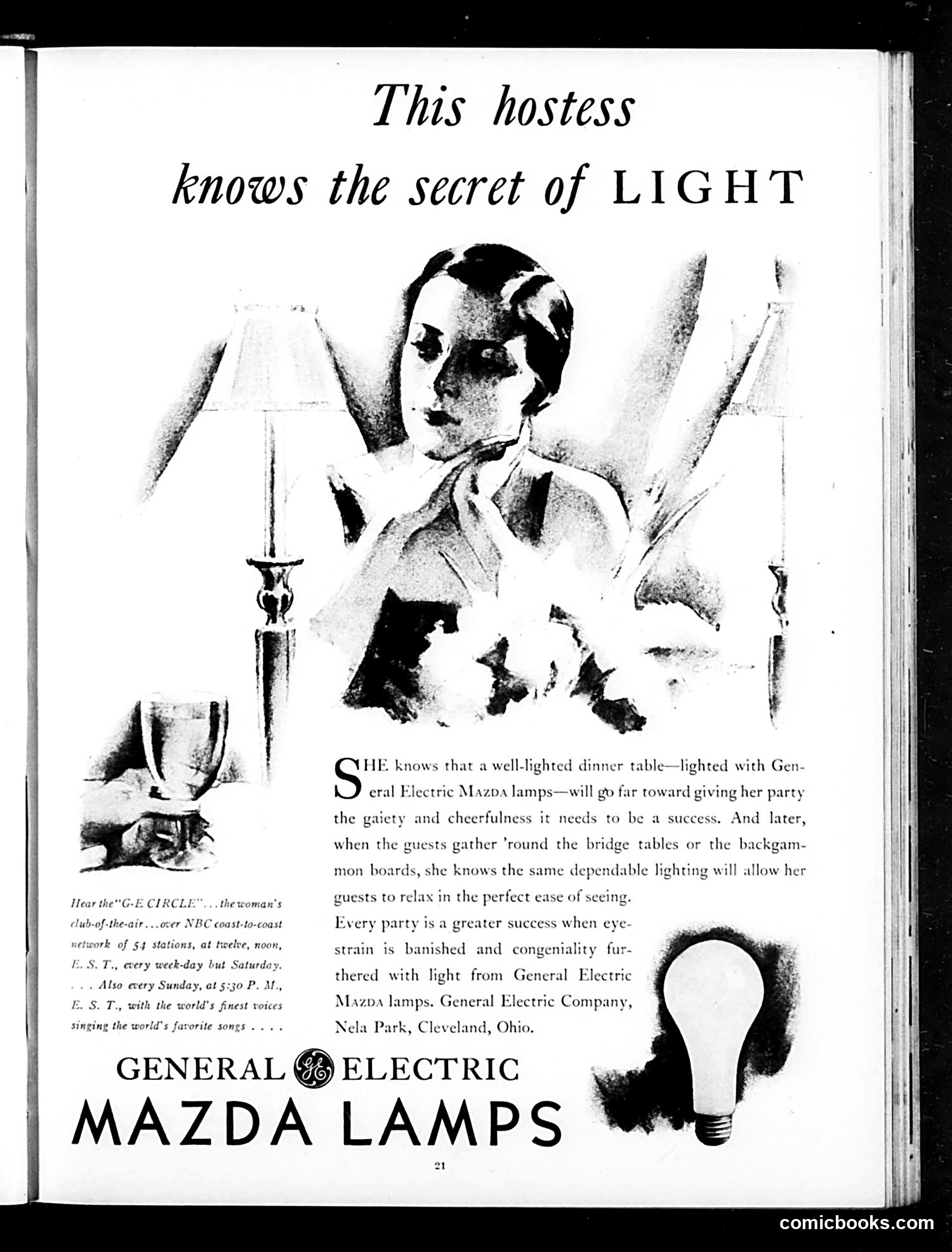
Analysis This is primarily a General Electric advertisement, not a political cartoon. It promotes Mazda lamps to women by positioning good lighting as essential to successful entertaining. The central image shows an elegant woman hostess at a dinner party, surrounded by candlelight and lamps. The ad's message appeals to female readers by suggesting that proper electric lighting—specifically GE Mazda bulbs—ensures party success by creating an attractive atmosphere and reducing guest eye strain during activities like bridge and backgammon. The sidebar mentions "G-E CIRCLE," a radio program broadcast weekdays and Sundays, indicating this advertisement also promotes GE's media presence and brand loyalty across multiple platforms. The appeal is fundamentally about domestic aspiration: a well-lit home signals sophistication and hostess competence. There is no satire here—it's straightforward consumer marketing targeting middle-to-upper-class women in the pre-WWII era.
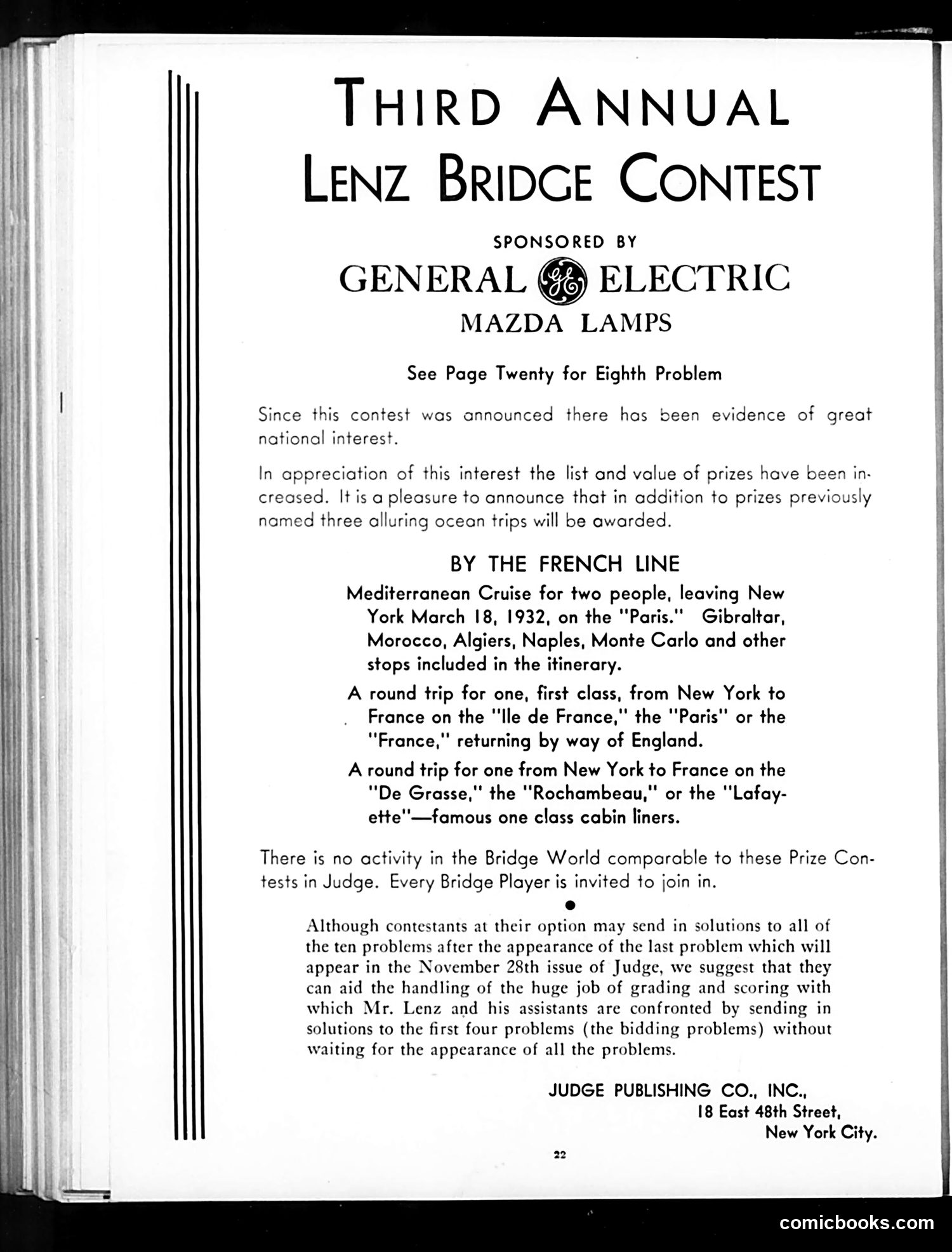
Third Annual Lenz Bridge Contest This is a title page/advertisement, not a cartoon. It announces Judge magazine's bridge competition, sponsored by General Electric's Mazda Lamps division. The contest, organized by "Mr. Lenz" (likely the bridge expert), invites readers to solve ten problems with substantial prizes—notably luxurious French ocean liner cruises departing March 1932. For modern readers: Bridge was a wildly popular card game among educated Americans in the 1920s-30s. Judge capitalized on this craze by running problem-solving contests. The elaborate French cruise prizes (mentioned repeatedly) reflect the era's fascination with transatlantic luxury travel and "Continental" sophistication. The General Electric sponsorship shows how major corporations used magazine tie-ins for brand promotion. The text suggests earlier contests generated "great national interest," indicating bridge's genuine cultural prominence before it declined mid-century.
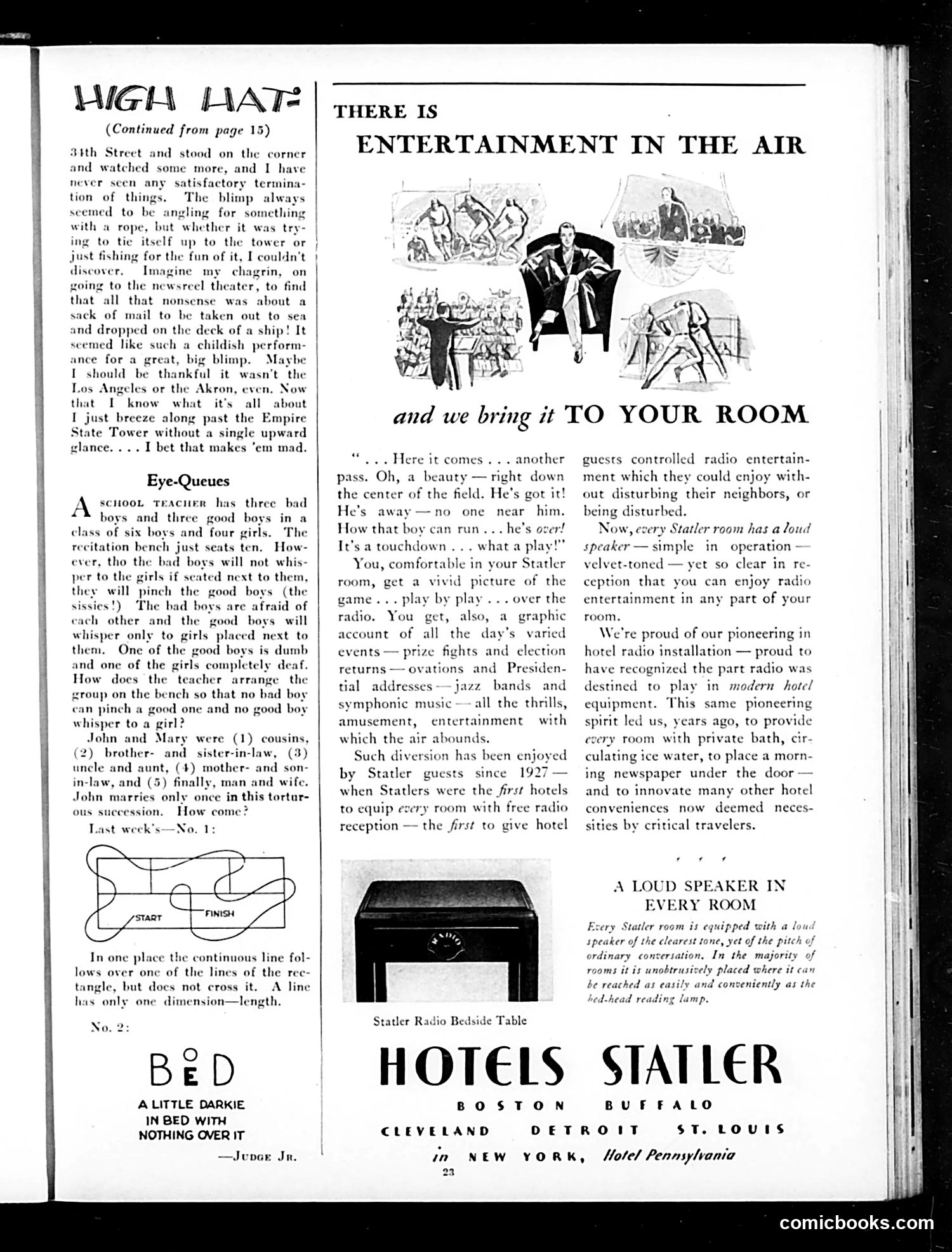
Analysis for Modern Readers This page combines humor columns with hotel advertising. The "High Hat" and "Eye-Queues" sections are satirical puzzles and observations typical of Judge magazine's comedic style. The main content is a Statler Hotels advertisement promoting their pioneering radio service (circa 1927). The illustration shows a man relaxing while enjoying broadcast entertainment—sports commentary, music, speeches—delivered directly to his hotel room via a bedside speaker. The satire's point: this was genuinely innovative technology at the time. Hotels installing in-room radios was a luxury amenity, and Statler positioned themselves as industry pioneers. The ad emphasizes you could enjoy entertainment "without disturbing neighbors"—addressing a real concern when radio was novel and shared spaces were common. The "loud speaker in every room" heading underscores how remarkable private audio entertainment was. Combined with other Statler innovations (private baths, circulating ice water, newspapers), the ad targets wealthy travelers impressed by modern conveniences. This reflects pre-television America when radio was the primary home entertainment medium.
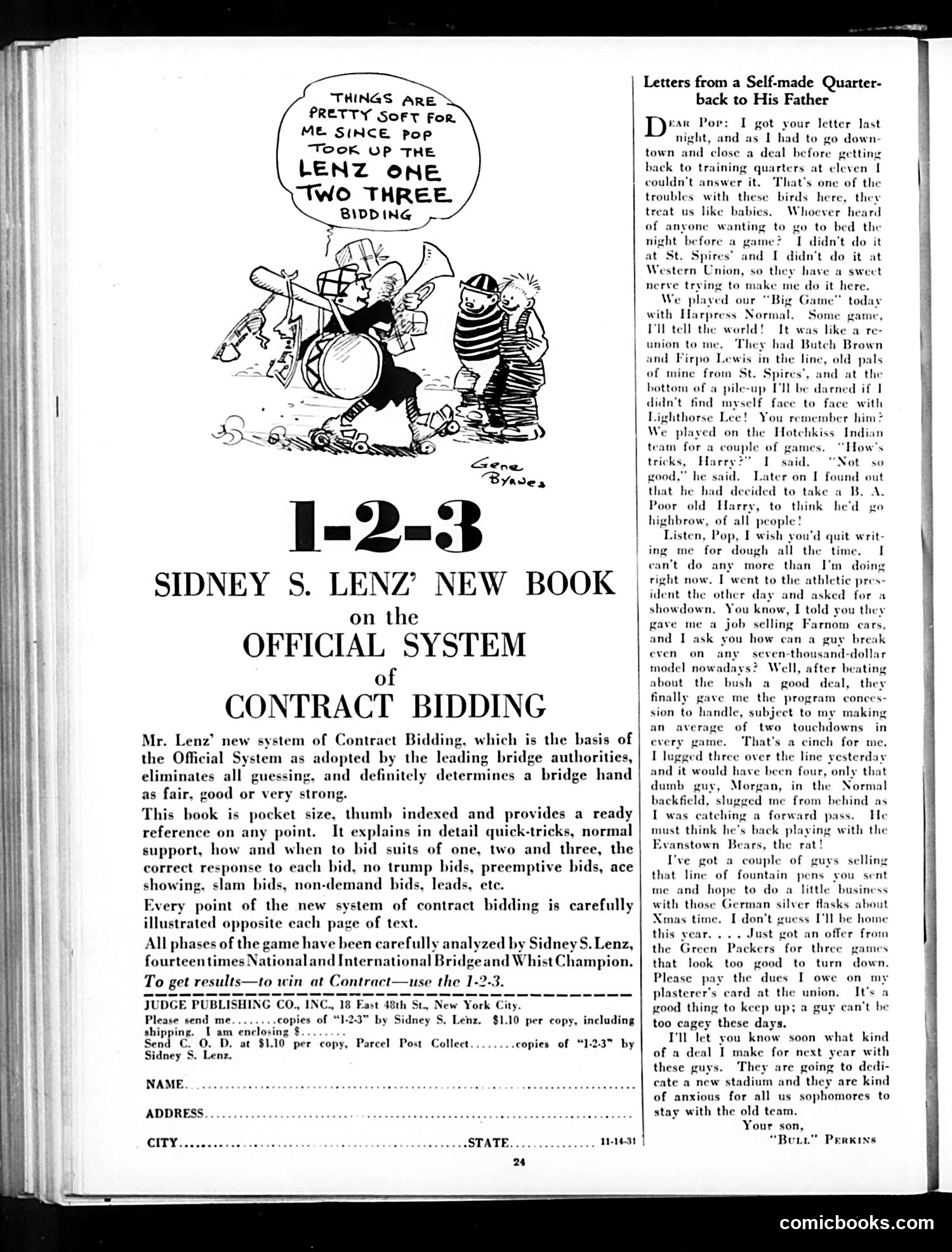
Context for Modern Readers This page contains two distinct elements: an advertisement for Sidney S. Lenz's bridge card game instruction book (center/bottom) and a humorous letter column (right side). The Letter: "Bull" Perkins writes to his father, a self-made quarterback, describing college football life with comedic exaggeration. The joke is that despite his athletic prominence, Perkins constantly asks his father for money while bragging about his achievements. He mentions selling cars and fountain pens as side hustles, getting offers from professional teams (the "Green Packers"), and union dues—treating college football as a lucrative business rather than an amateur sport. The satire mocks both collegiate athletics' commercialization and entitled young athletes who exploit their status. The Cartoon: The small illustration at top-left shows a child playing drums, referenced in the letter's opening joke about how "things are soft" since his father learned contract bridge—suggesting the father now ignores parental duties for card games. The advertisement itself is straightforward product promotion with no satirical intent.
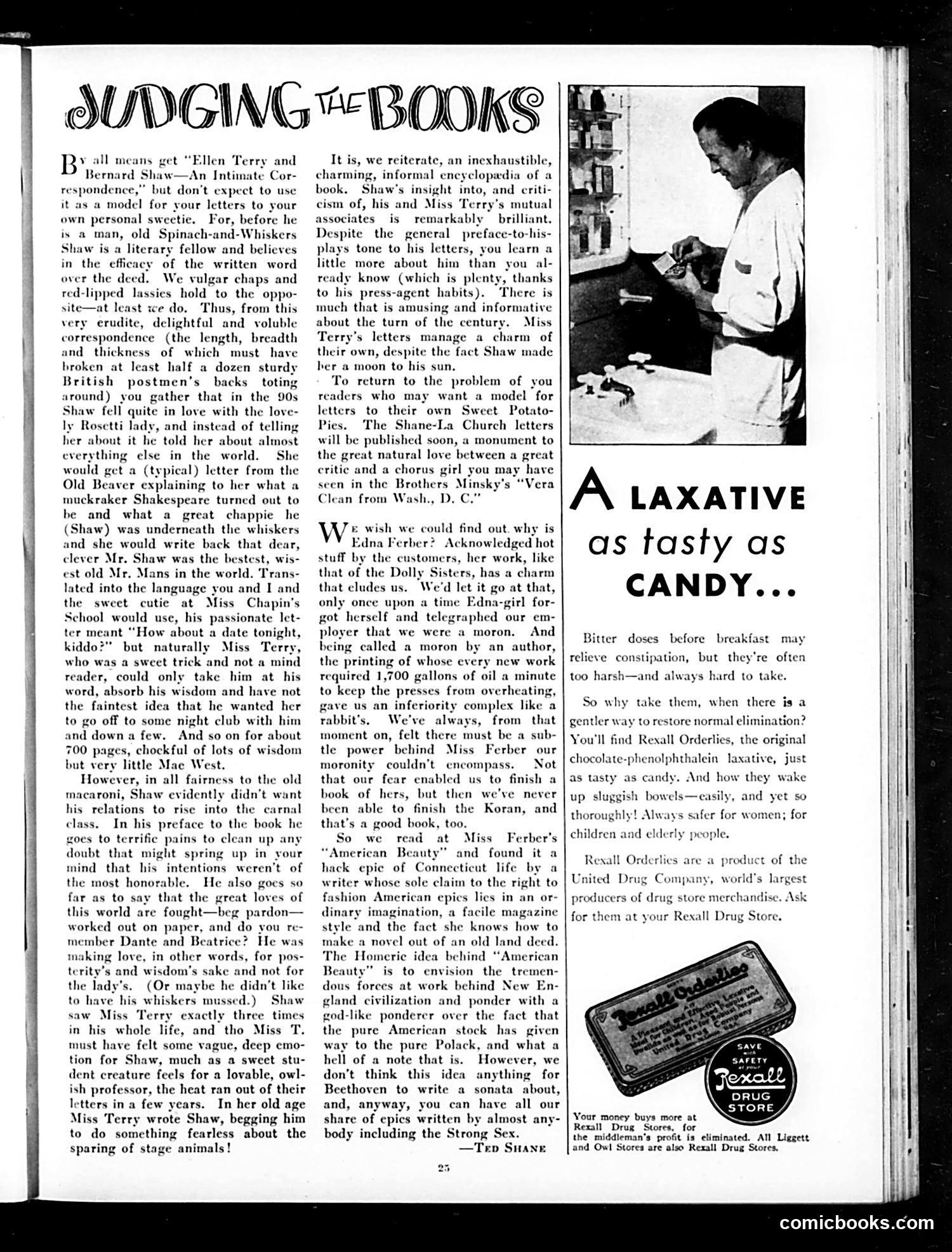
Judging the Books: A Book Review Column This page contains a book review column titled "Judging the Books," not a political cartoon. The reviewer discusses a published correspondence between George Bernard Shaw (referred to mockingly as "old Spinach-and-Whiskers") and actress Ellen Terry. The satire centers on Shaw's verbose, intellectual love letters that discuss everything *except* romantic action—a contrast the reviewer highlights by translating Shaw's flowery language into plain speech: his passionate declarations merely mean "how about a date tonight, kidd." The joke is that Shaw spent 700 pages of correspondence with Terry theorizing about love rather than acting on it, seeing their exchange as "wisdom's sake" rather than genuine romance. The reviewer suggests Shaw's elaborate preface defending his honorable intentions only proves he had none. The page also includes an advertisement for Rexall Orderlies laxative and brief commentary on author Edna Ferber.
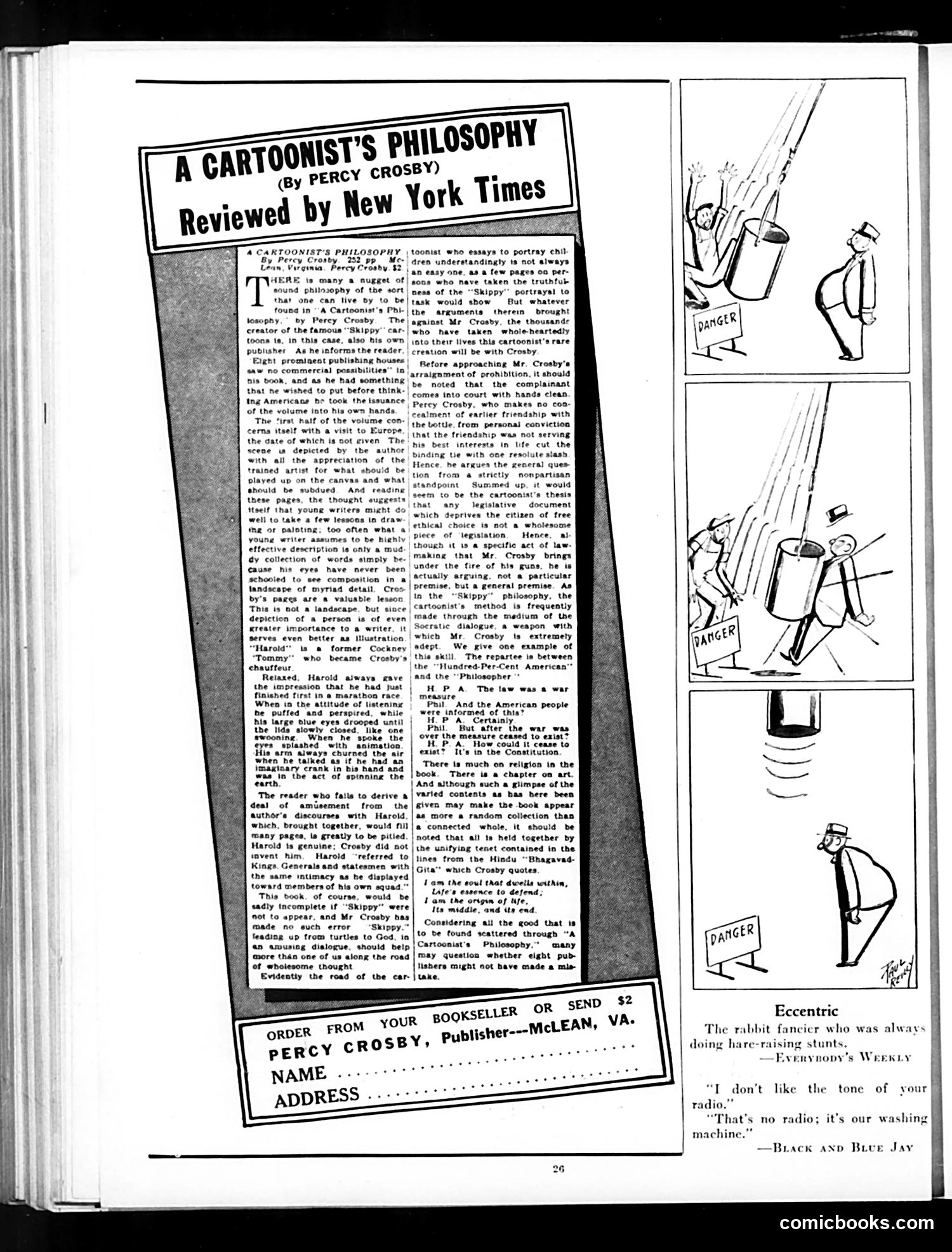
"A Cartoonist's Philosophy" by Percy Crosby - Judge Magazine Review This page reviews Percy Crosby's book about cartooning philosophy. The left side contains a New York Times review discussing Crosby's arguments against prohibition and his philosophy of artistic freedom and ethical choice. The review notes that eight publishers rejected the book before Crosby self-published it. The right side shows Crosby's cartoons illustrating his philosophy—simple line drawings of figures with danger signs and bottles, appearing to satirize prohibition-era concerns. One caption mentions "the rabbit fancier who was always doing hare-raising stunts." Context for modern readers: This reflects 1920s Prohibition debates. Crosby argues that laws restricting personal freedom (like alcohol bans) violate ethical choice—a libertarian position. The cartoons visually reinforce this stance. The book's self-publication reflects Crosby's frustration with commercial publishers unwilling to challenge mainstream views on prohibition.
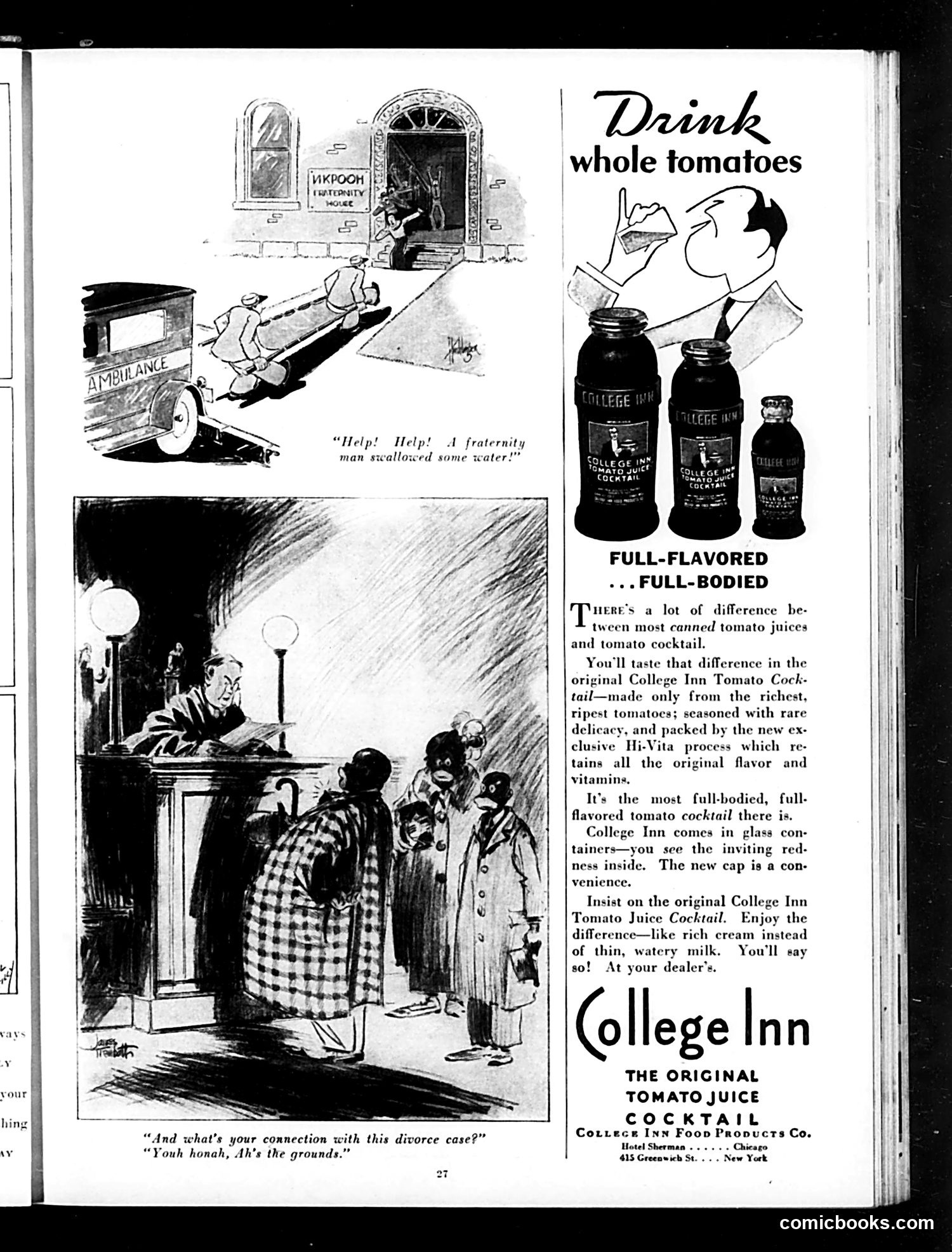
Explanation for Modern Readers This page combines two unrelated items: satirical cartoons (left) and product advertising (right). The top cartoon mocks fraternity hazing rituals, showing an ambulance at a house with the caption "Help! Help! A fraternity man swallowed some water!"—implying fraternities were so dangerous that even drinking water required emergency response. The bottom cartoon is a legal joke. When asked his connection to a divorce case, a man replies "Ah's the grounds"—a pun on "grounds" meaning both dirt (he's the groundskeeper) and legal justification for divorce. The right side advertises College Inn Tomato Cocktail, emphasizing it's superior to regular canned tomato juice—"full-flavored" and "full-bodied" rather than "thin, watery." The ad copy compares it to "rich cream" versus cheap milk, targeting middle-class consumers seeking quality products. The bottles shown are distinctively packaged to convey premium status.
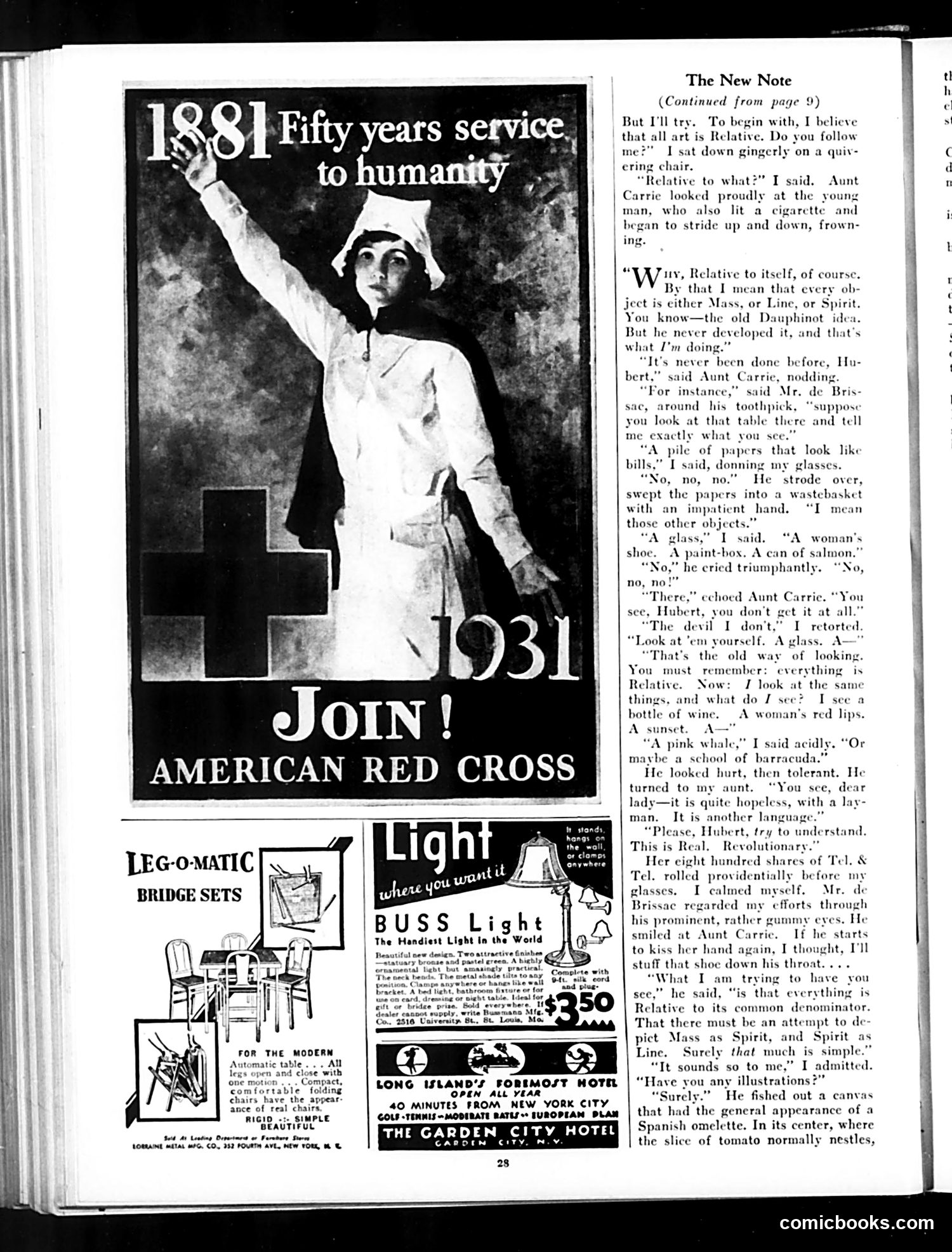
Analysis of Judge Magazine Page This page is primarily advertisements (bridge sets, lighting fixtures, hotels) with a serialized story continuation titled "The New Note." The story satirizes pretentious modern art criticism and pseudo-intellectual aesthetics of the 1930s era. A character named Mr. de Brissac, presented as an affected artist or theorist, lectures about art being "Relative"—dividing all objects into "Mass, Line, or Spirit." He references an obscure figure called "Dauphinot" and claims revolutionary originality. The narrator (the story's protagonist) mocks this by pointing out everyday objects—papers, glasses, shoes—while de Brissac insists he's seeing wine bottles, sunsets, and women's lips in the same things. The satire targets art world pretension: the impenetrable jargon, false profundity, and self-important posturing of modernist artists who claimed radical innovation while producing work (his canvas described as resembling "a Spanish omelette") that was incomprehensible or ridiculous. This reflects Judge's consistent mockery of artistic and intellectual affectation.
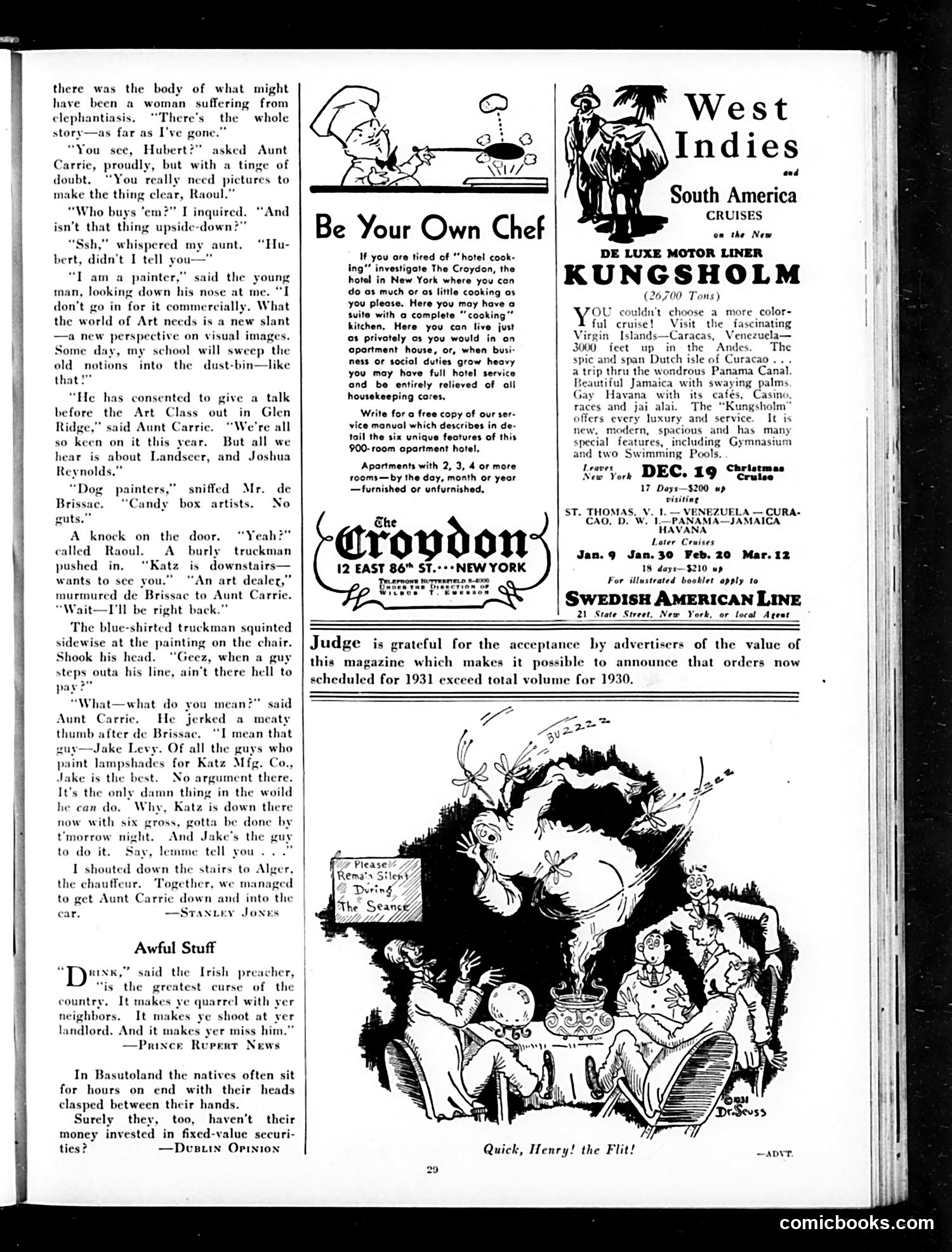
This page is primarily advertisements and short stories with minimal political cartooning. The main illustrated content is a cartoon titled "Quick, Henry! the Flit!" at the bottom—a humorous domestic scene depicting people reacting comedically to something, likely advertising the "Flit" insecticide brand. The phrase "Quick, Henry!" was a famous advertising slogan of the era. The page's prominent content consists of advertisements for luxury cruises, apartment hotels, and travel services. There is also story text about an aspiring but pretentious modernist artist ("Raoul de Brissac") whose abstract work is mocked by a blunt truckman, satirizing the gap between artistic pretension and practical reality. The humor lies in the contrast between the artist's grandiose talk about revolutionizing art and the truckman's straightforward assessment that the artist's real talent is painting lampshades commercially.
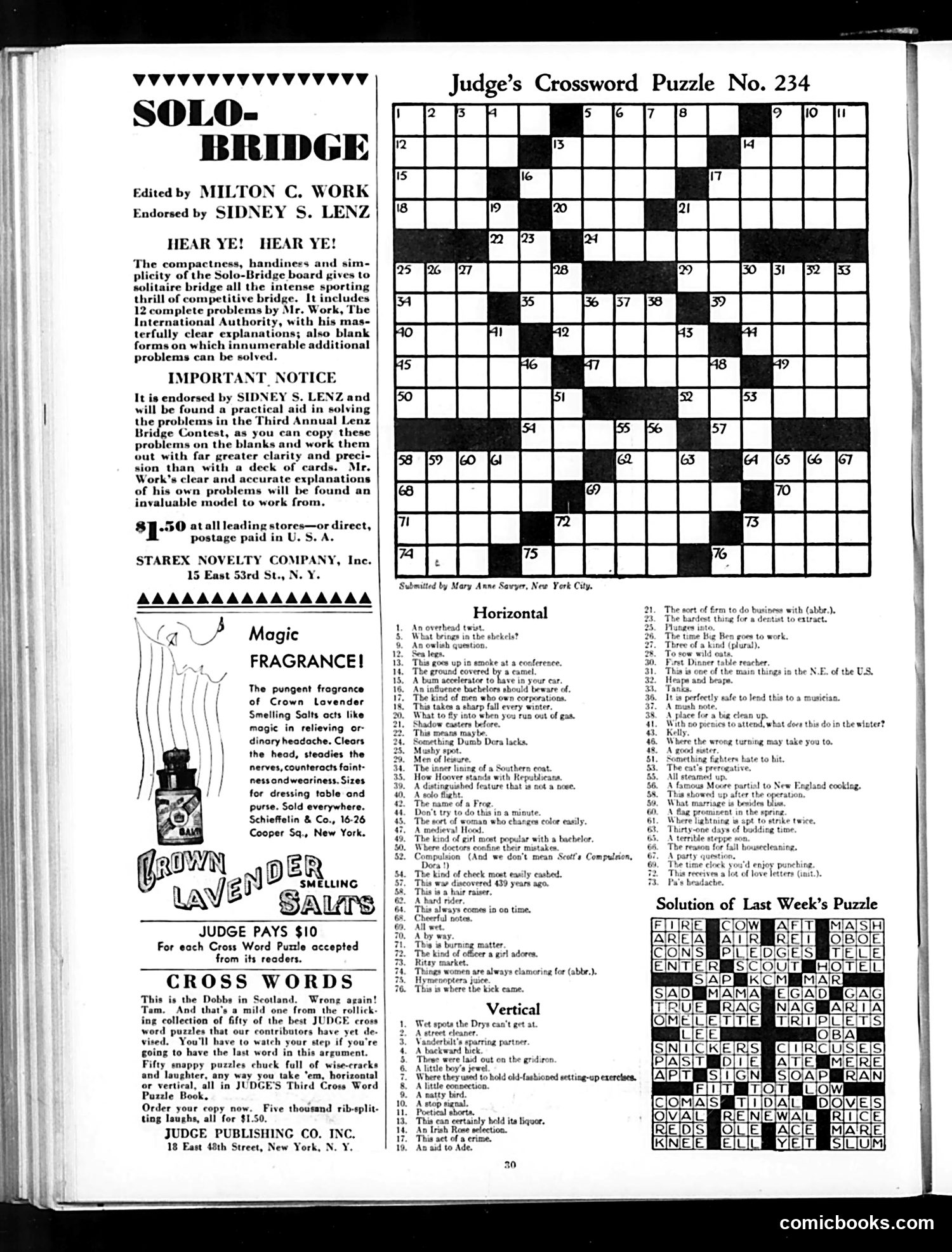
Judge Magazine Page Analysis This page is primarily advertising and puzzles, not political satire. The main content consists of: 1. Solo-Bridge Game Advertisement: Promotes a solitaire bridge game endorsed by bridge authorities Milton C. Work and Sidney S. Lenz, marketed as competitive entertainment. 2. Crown Lavender Smelling Salts Ad: A vintage medicinal product claimed to relieve headaches and nervousness through fragrance. 3. Judge's Crossword Puzzle No. 234: The centerpiece—a standard crossword puzzle with bridge-themed and general wordplay clues. Judge magazine paid readers $10 for accepted puzzles, encouraging submissions. 4. Cross Words Book Advertisement: Promotes Judge's "Third Cross Word Puzzle Book" ($1.50), describing it as containing fifty puzzles "chuck full of wise-cracks." The page reflects 1920s-30s popular culture: the craze for crossword puzzles, bridge as fashionable entertainment, and patent remedies. There is no visible political cartoon or satire—this is a commercial/entertainment page typical of Judge's content during this era.
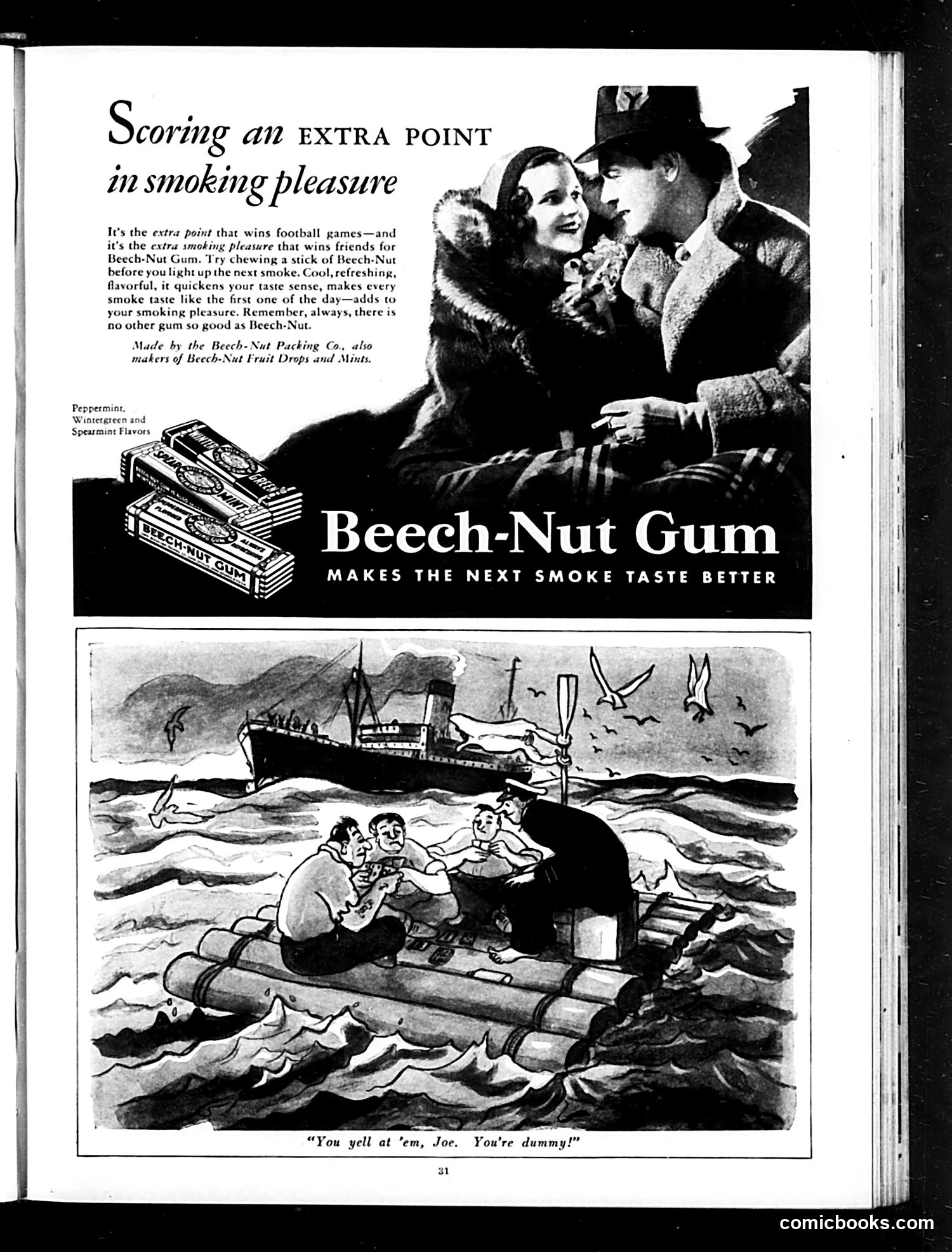
Analysis This page is primarily a Beech-Nut Gum advertisement rather than political satire. The ad uses a sports metaphor ("scoring an extra point") to market gum as enhancing the smoking experience. The upper image shows a couple in winter clothing—likely a romantic scenario meant to appeal to consumers. The lower cartoon depicts what appears to be a shipwreck or maritime disaster, with figures on a raft. The caption "You yell at 'em, Joe. You're dummy!" suggests a humorous domestic dispute during crisis—one person telling another to signal the ship while calling them incompetent. This cartoon-within-the-ad uses situational comedy (couples arguing even in emergencies) to create memorable, relatable humor that makes the product more engaging to readers. There's no clear political reference—it's entertainment-driven marketing typical of 1920s-30s advertising in *Judge* magazine.
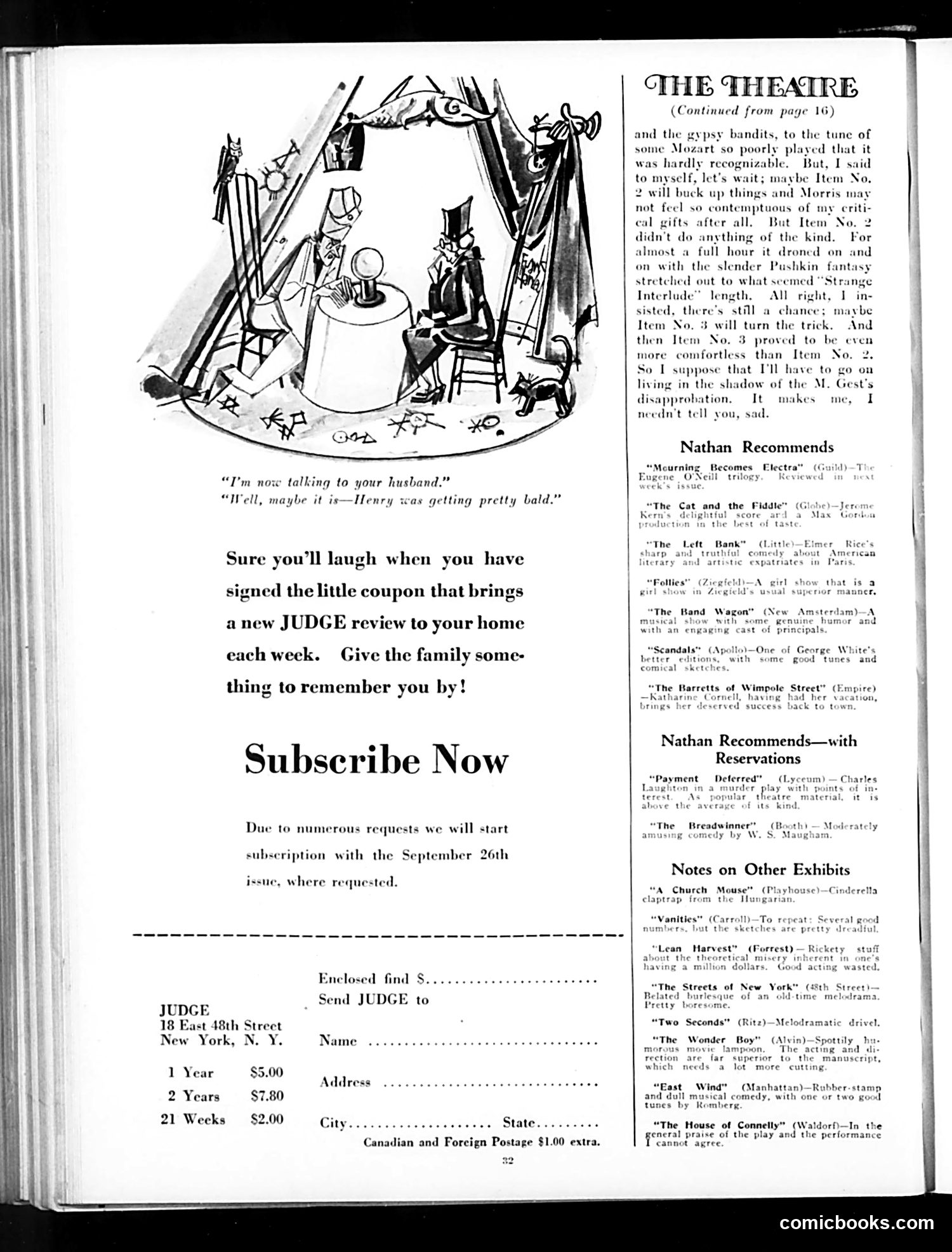
Explaining This Judge Magazine Page This page is primarily a subscription advertisement for Judge magazine, with theatre reviews as secondary content. The cartoon at top shows a woman examining a bald man, saying "I'm now talking to your husband" / "Well, maybe it is—Henry was getting pretty bald." The joke is a gentle domestic gag: the wife can barely recognize her husband because he's going bald, implying his appearance has deteriorated significantly. It's meant to be humorous rather than harsh. The main text pushes Judge subscriptions, promising readers will "laugh" at the reviews brought weekly to their homes. The theatre section by critic Nathan lists contemporary Broadway shows (Eugene O'Neill's "Mourning Becomes Electra," "The Band Wagon," etc.) with brief assessments—some recommended, others criticized as dull or melodramatic. For modern readers: This is essentially a vintage magazine's marketing strategy, using humor and entertainment content to drive subscriptions. The bald-husband joke reflects period attitudes about aging and appearance.
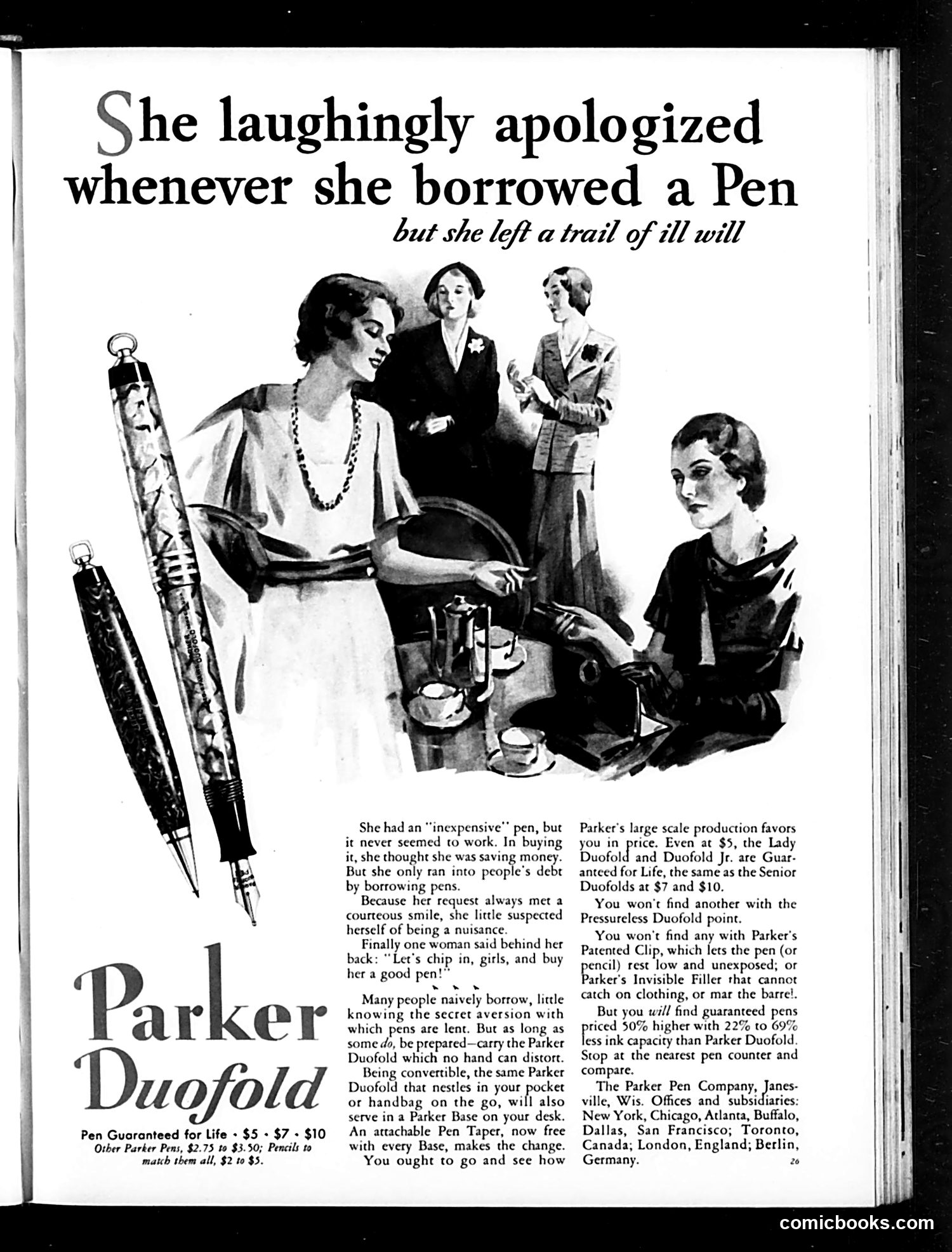
Parker Duofold Pen Advertisement This is primarily a pen advertisement, not political satire. It uses a social humor scenario to sell Parker Duofold pens. The narrative depicts a woman who constantly borrows pens from colleagues because her cheap pen doesn't work. Though she apologizes cheerfully, she creates resentment—her coworkers secretly resent the repeated requests. The ad's tagline: "she left a trail of ill will." The moral: buy a reliable, quality pen (Parker Duofold at $5-$10) to avoid becoming a social burden. The illustrated women represent office workers of the era who would recognize this everyday annoyance. The ad emphasizes Parker's features—durability, the patented clip, and lifetime guarantee—as solutions to the embarrassment of being a chronic pen-borrower. It's salesmanship framed as social etiquette advice: a good pen is an investment in your reputation and others' goodwill.
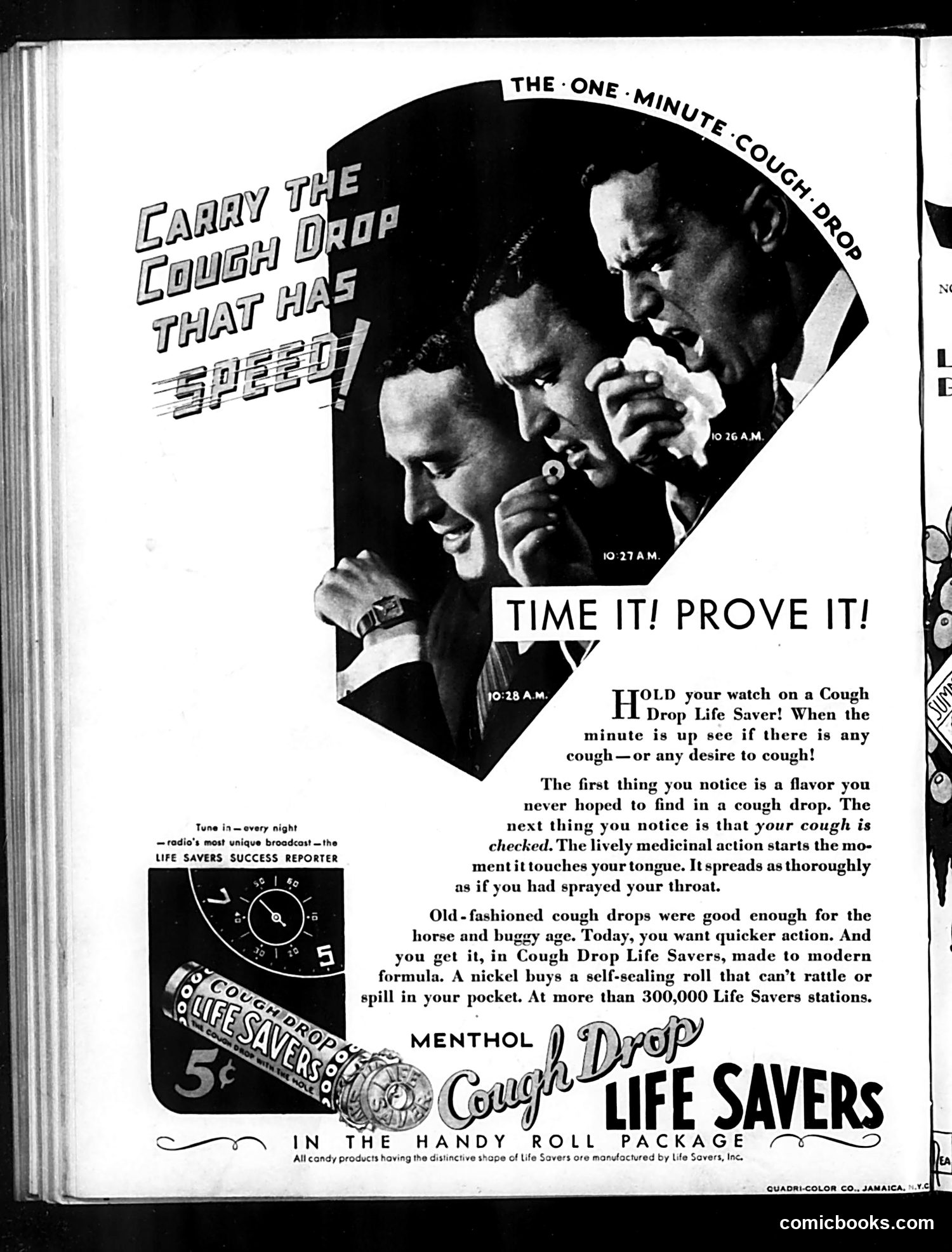
Analysis This is not a political cartoon or satire—it's a commercial advertisement for Cough Drop Life Savers candy, appearing in Judge magazine. The page shows three men in profile checking their watches during a one-minute test of the product's effectiveness. The advertisement uses a pseudo-scientific "proof" gimmick: consumers are encouraged to time whether their cough stops within one minute of taking the drop. The copy contrasts "old-fashioned cough drops" with this modern, faster-acting formula, appealing to 1920s-30s consumer desires for speed and efficiency. It emphasizes convenience (a self-sealing roll that won't rattle) and availability (300,000+ retail stations). There's a sidebar reference to a radio broadcast called "Life Savers Success Reporter," suggesting multimedia marketing. This represents typical period advertising that blended product claims with entertainment and lifestyle aspirations—no political or satirical content is present.