judge
Judge — November 21, 1931
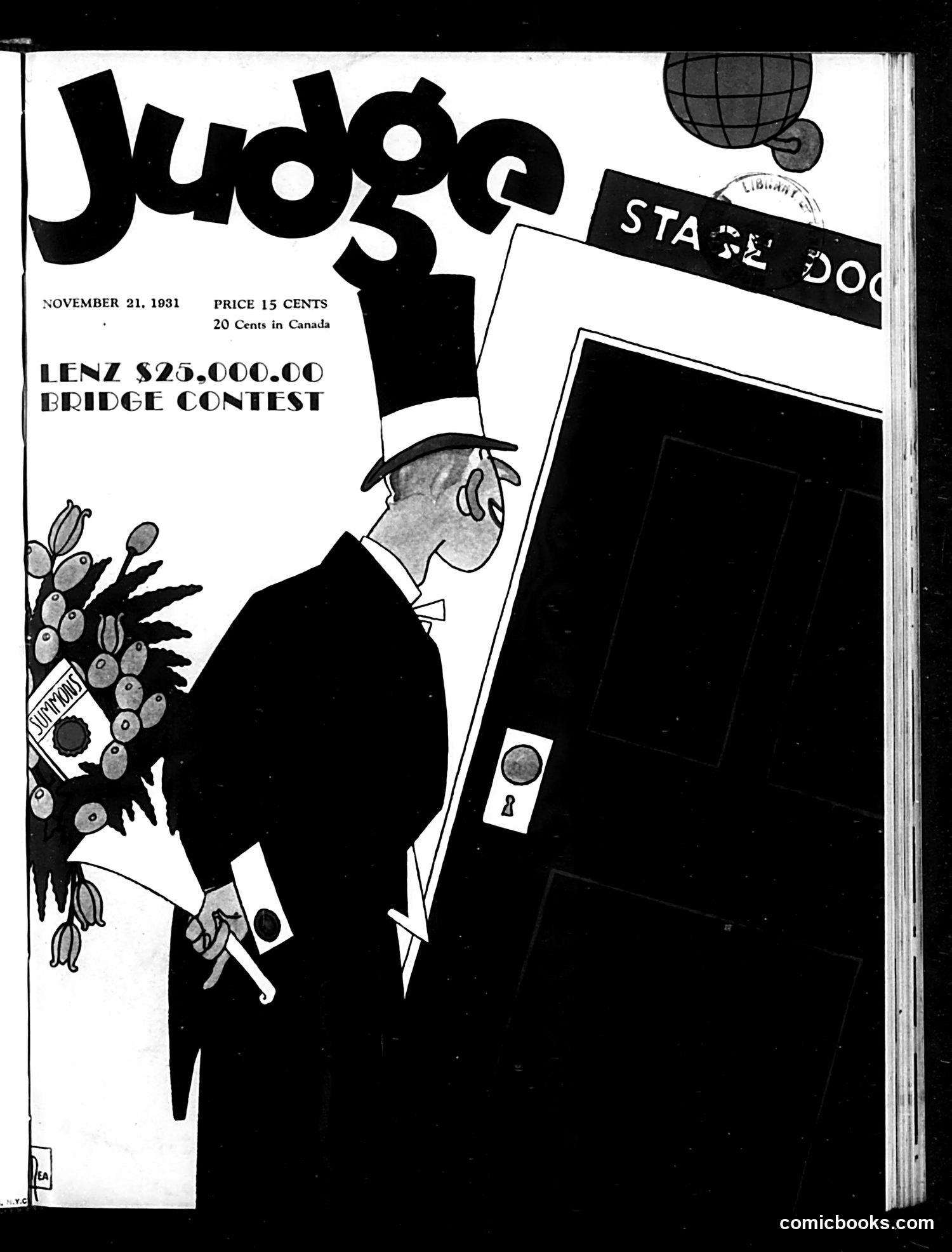
Judge Magazine Cover Analysis - November 21, 1931 This cover advertises a Lenz $25,000 Bridge Contest, referencing what appears to be a prominent bridge-building or engineering competition of that era. The illustration shows a well-dressed man in formal attire holding flowers, standing before a large door marked "State Door" (or similar). The art style and composition suggest romantic or comedic anticipation—the man appears to be about to enter or propose something significant. The satire likely plays on the contrast between the substantial prize money ($25,000 during the Depression) and either the difficulty of winning it or the absurdity of the contest's requirements. Without additional context about the specific Lenz competition, the exact target of ridicule remains unclear, though the formal dress and flowers suggest mock-gallant behavior toward what may be a bureaucratic or challenging endeavor.
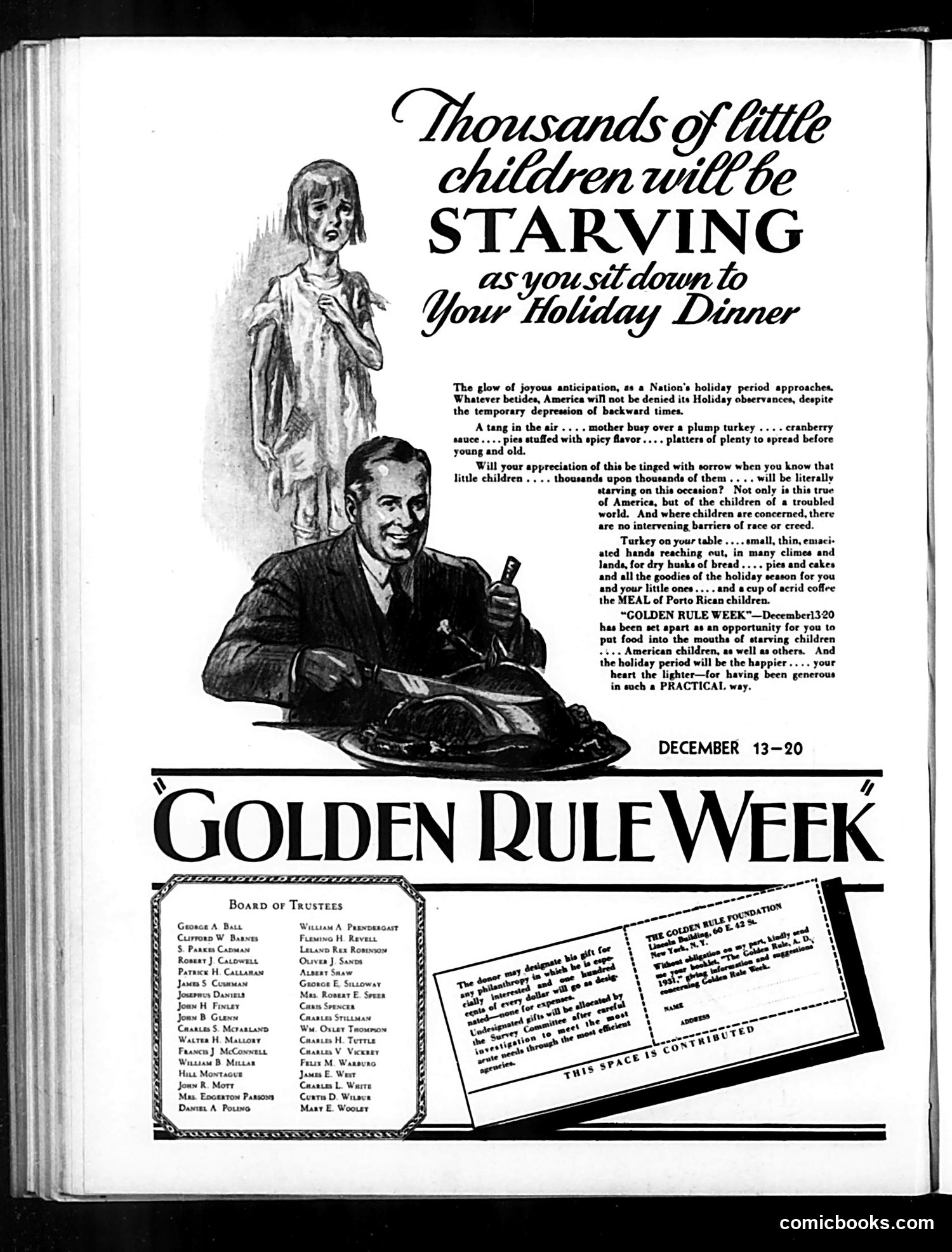
"Golden Rule Week" Charity Appeal (Judge Magazine) This is a charity advertisement for "Golden Rule Week" (December 13-20), not political satire. The imagery deploys emotional persuasion: a starving child gazes at a well-dressed man enjoying a holiday dinner, juxtaposing wealth and deprivation. The appeal asks affluent readers to donate food to impoverished children during the holiday season, specifically mentioning "Porto Rican children" and "American children" in need. The "Golden Rule" reference invokes Christian charity ethics. The "Board of Trustees" lists prominent citizens, suggesting this is a legitimate civic organization. Rather than mocking anyone, the advertisement shames wealthy readers into charitable action by contrasting their plenty with others' hunger—a common philanthropic strategy of that era.
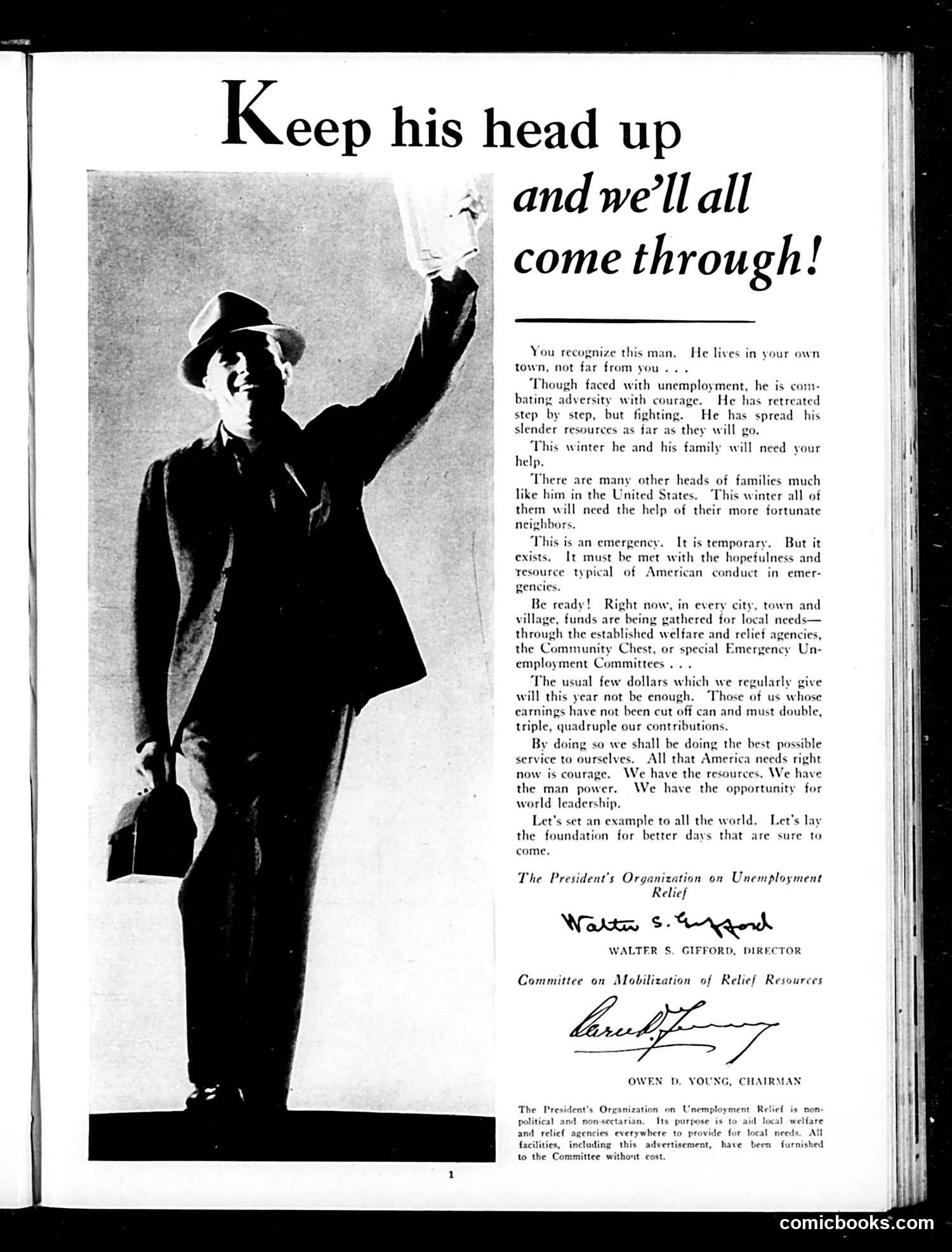
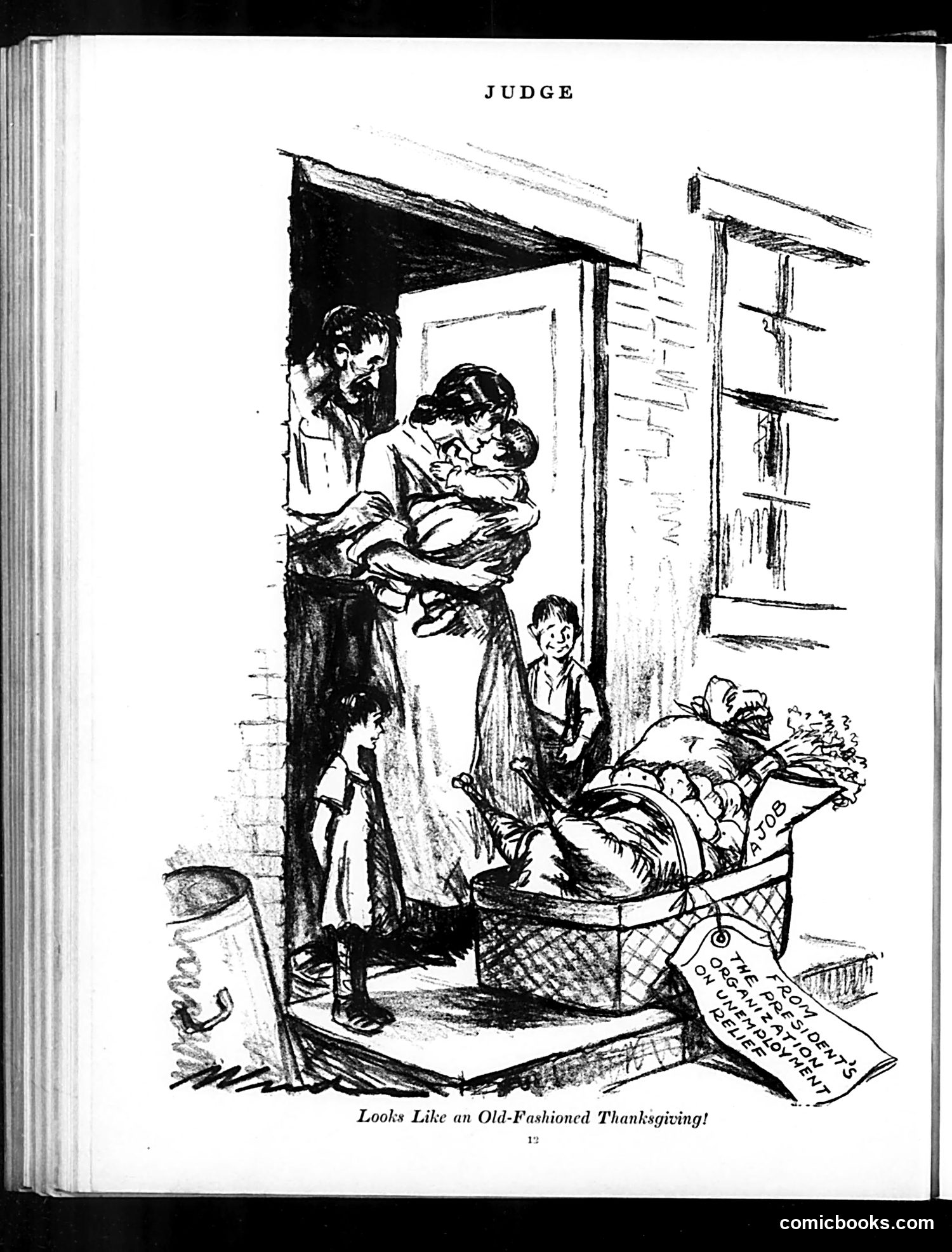
Analysis This is not satire but rather a sincere public service appeal—unusual for Judge magazine, which typically featured political cartoons and humor. The page promotes The President's Organization on Unemployment Relief, signed by Walter S. Gifford (Director) and Owen D. Young (Chairman). It urges Americans to contribute money to help unemployed families during what appears to be the Great Depression era. The illustration shows an everyman figure with fist raised in determination—"Keep his head up and we'll all come through!" The text appeals to donors' sense of civic duty and American resilience, asking citizens to double or triple their usual charitable contributions for emergency local relief efforts. This represents Depression-era mobilization of private charitable giving before extensive federal welfare programs.
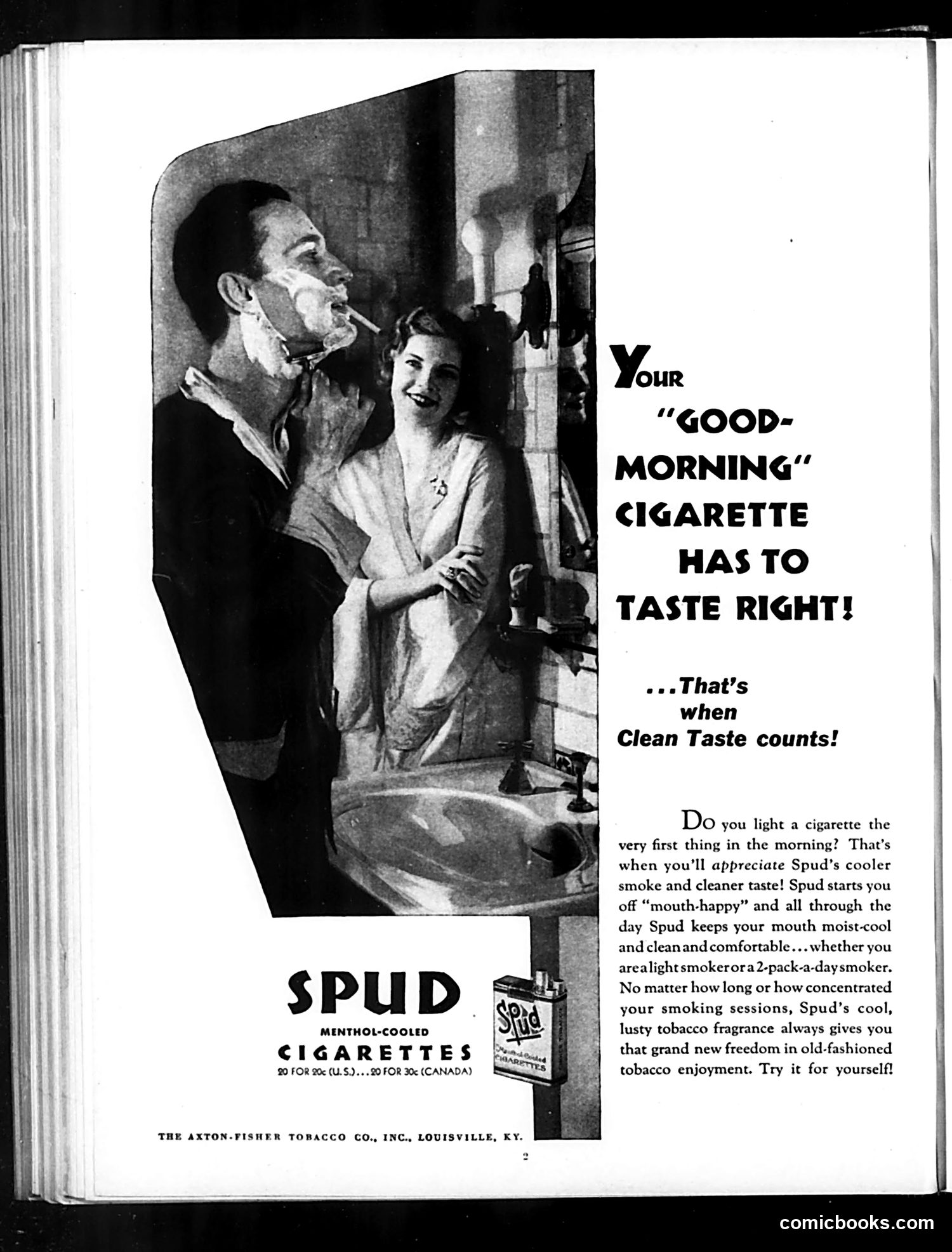
Spud Cigarettes Advertisement This is a straightforward cigarette advertisement, not political satire or editorial content. It's from Judge magazine but functions as a paid commercial for Spud menthol-cooled cigarettes by Axton-Fisher Tobacco Co. (Louisville, Kentucky). The ad features a domestic morning scene—a man smoking while a woman smiles approvingly—to market cigarettes as a pleasant daily habit. The copywriting emphasizes "clean taste" and mouth freshness as selling points, claiming menthol provides "cooler smoke." By modern standards, this is striking primarily for its casual normalization of morning smoking and the gendered domestic framing that presents cigarettes as enhancing everyday life. The health claims ("clean," "comfortable") reflect pre-warning-label advertising standards, before cigarettes' serious health risks became public knowledge.
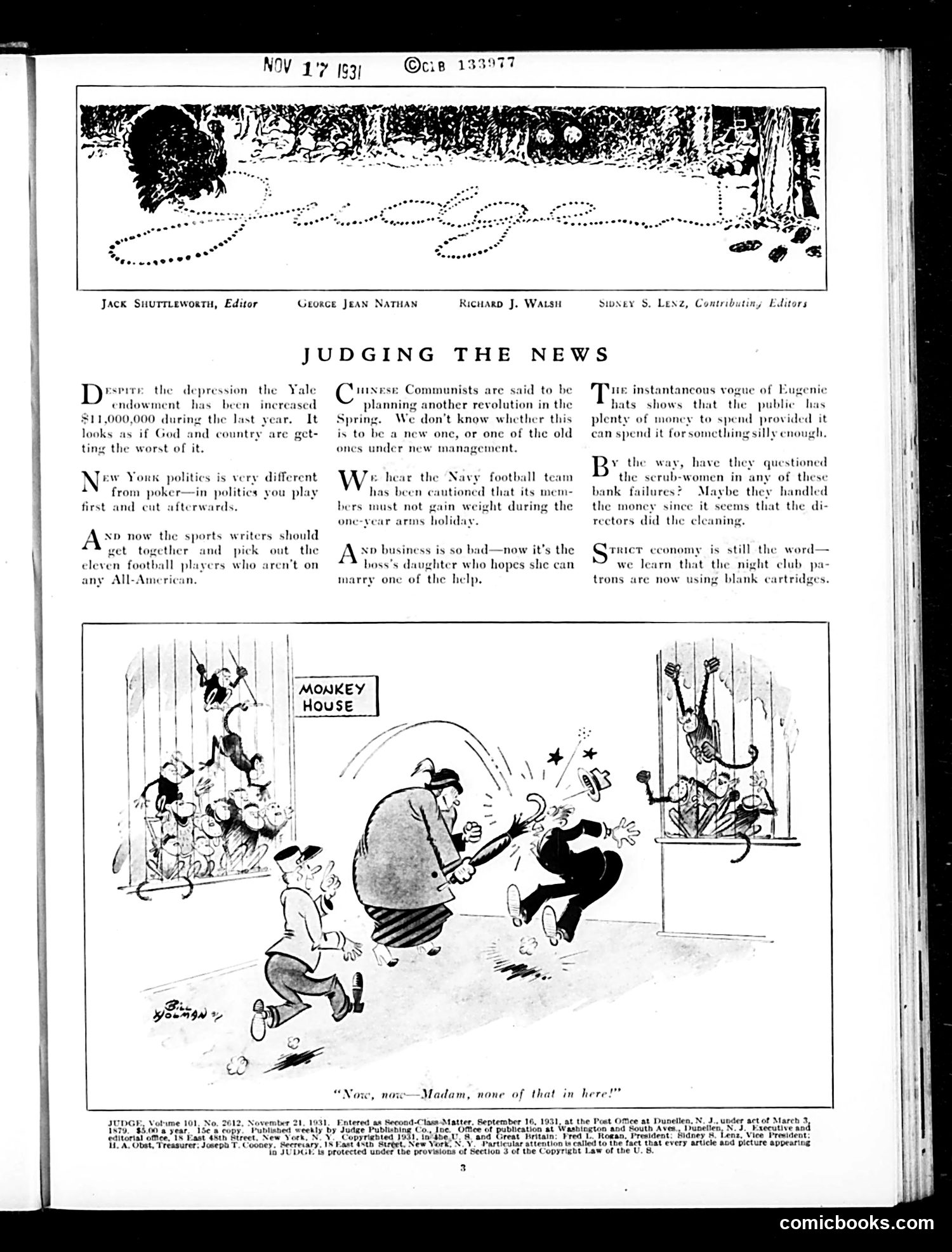
"Judging the News" - November 17, 1931 This page satirizes current events through brief editorial commentary paired with a cartoon. The main cartoon depicts a "Monkey House" scene where a large man (representing authority/management) attempts to control chaos—monkeys swinging from windows and fixtures while a figure in black (likely representing labor or the working class) confronts him with a club. The caption reads, "Now, now—Madam, none of that in here!" The satire appears to reference labor unrest and economic turmoil during the Great Depression (1931). The monkey imagery suggests the chaos of workers' protests or strikes, while the authority figure's attempt at control represents management or government efforts to suppress dissent. The humor lies in portraying labor disputes as absurd "monkey" antics rather than legitimate grievances.
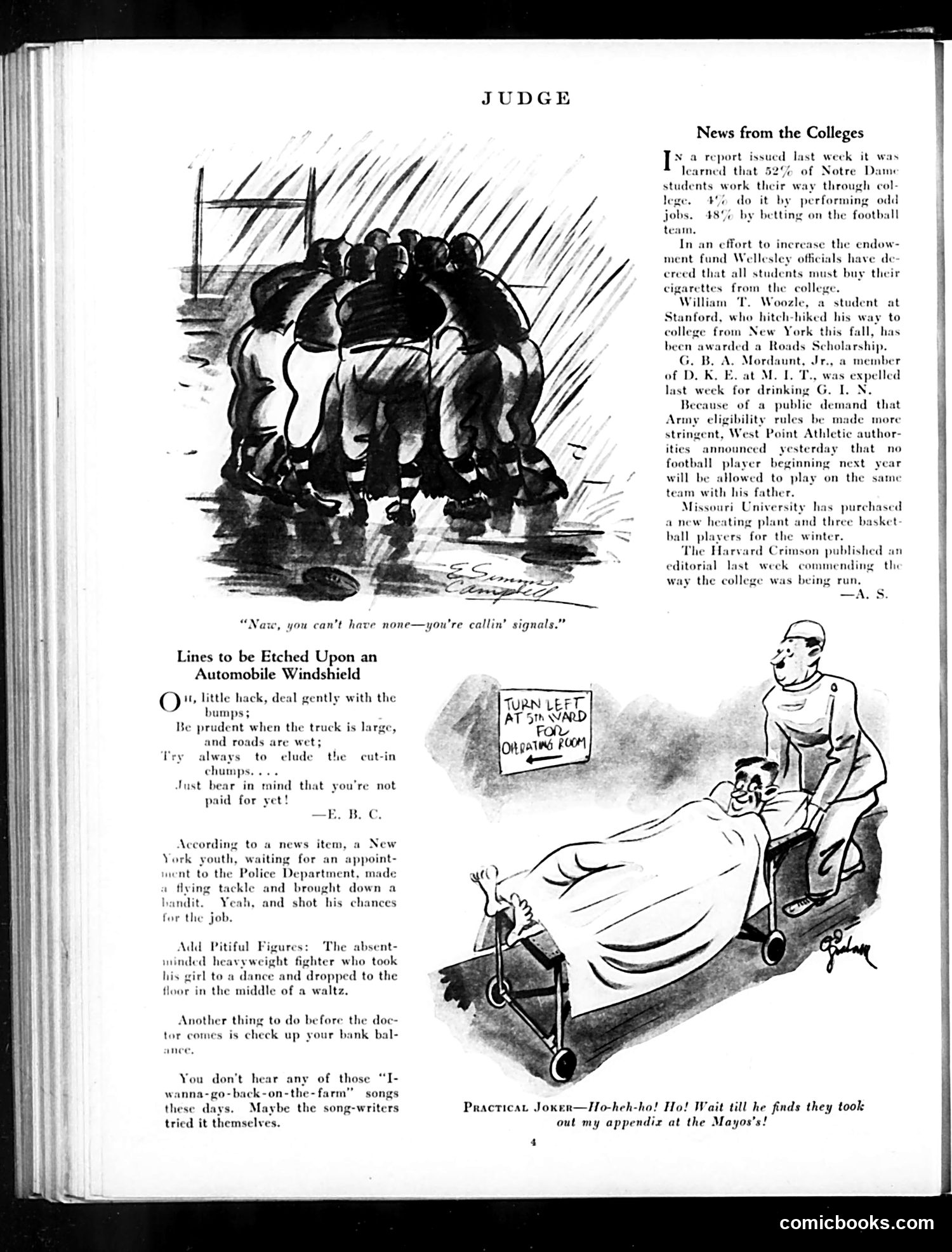
Analysis of Judge Magazine Page The top cartoon depicts a football huddle with the caption "Now, you can't have none—you're callin' signals," satirizing college football's recruiting practices. The accompanying "News from the Colleges" section mentions Notre Dame students working their way through college, a Stanford hitch-hiker receiving a Roads Scholarship, and West Point enforcing rules against players having family on the same team—suggesting concerns about nepotism and commercialization in collegiate athletics. The lower cartoon, titled "Practical Joker," shows someone being transported on a wheeled stretcher with a sign reading "Turn left at 5th and Fox for operating room," mocking someone's misfortune as a cruel prank. The humor relies on the victim's confusion and delayed realization of the joke's severity.
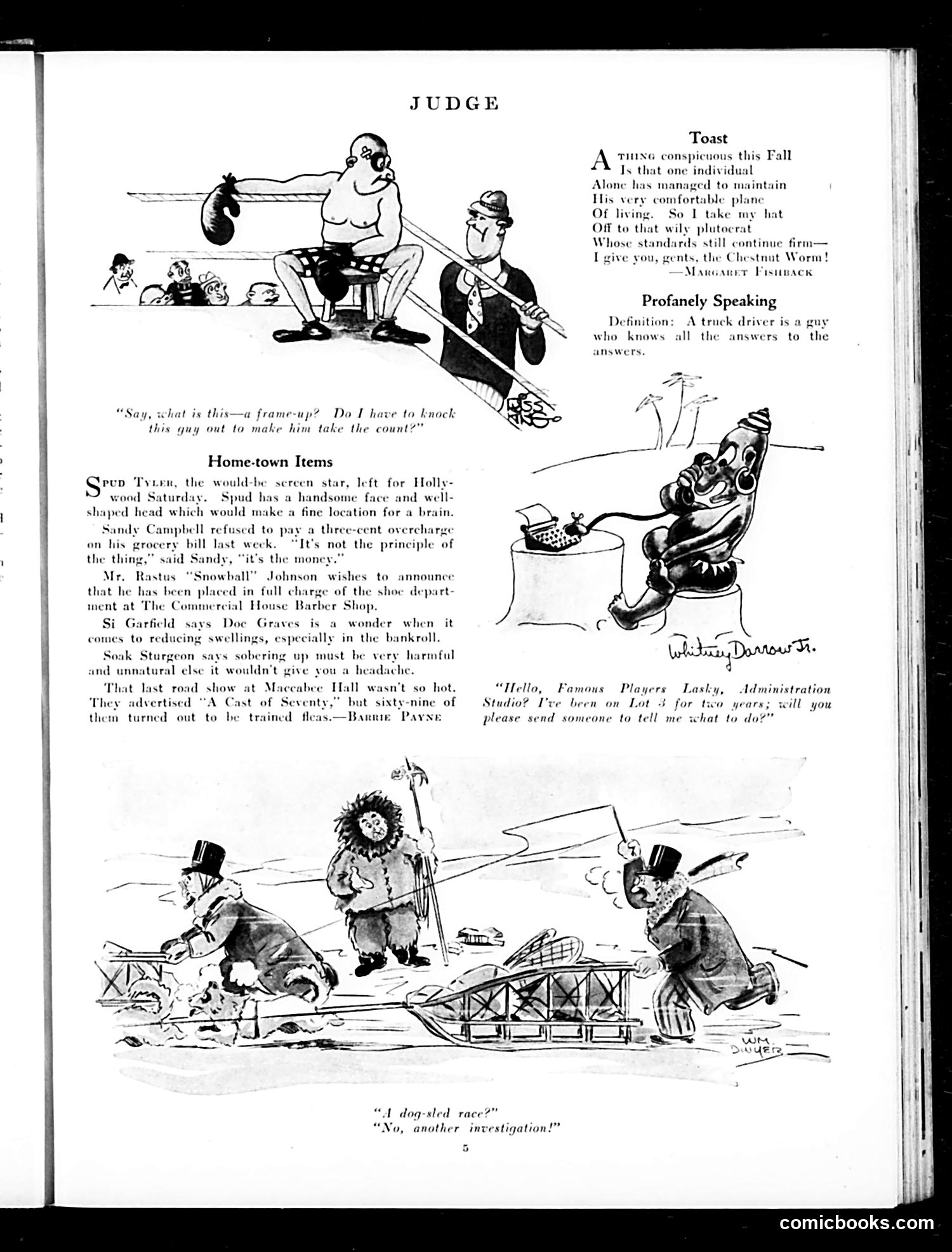
Analysis This page from *Judge* magazine contains several satirical items and cartoons: Top cartoon: A corpulent judge sits between a small man and woman, with the caption asking about a "frame-up" and whether knocking someone out is necessary for court. This appears to be satire about judicial corruption or questionable legal proceedings. "Home-town Items": Brief gossip about local figures—a would-be screen star, a grocer's overcharge dispute, a shoe department announcement, and claims about reducing swellings. These mock small-town scandals and advertising pretensions. "Profanely Speaking": A humorous definition equating truck drivers with omniscience. Bottom cartoon: Three men in top hats investigate something, captioning a "dog-sled race" as "another investigation"—likely satirizing government investigations or inquiries of the era. The overall tone mocks small-town life, legal absurdity, and bureaucratic investigations.
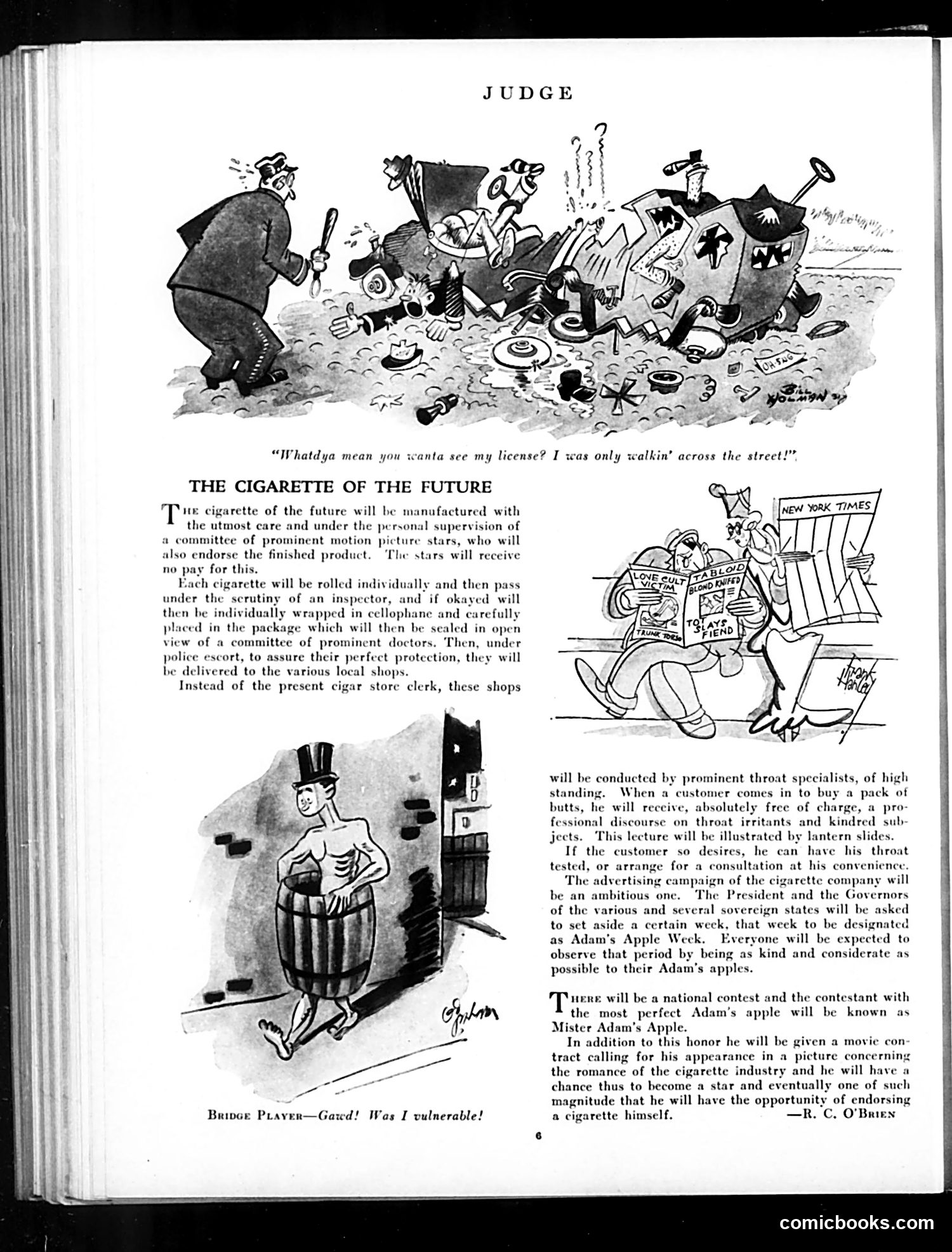
Analysis This satirical piece titled "The Cigarette of the Future" mocks early 20th-century regulatory impulses and celebrity culture. The top cartoon shows a judge confronting what appears to be a chaotic street scene, with the caption "What d'ya mean you wanta see my license? I was only walkin' across the street!"—satirizing excessive bureaucratic licensing requirements. The main article parodies a proposed future where cigarette manufacturing would be overseen by prominent motion picture stars and throat specialists, with elaborate inspections and "Adam's Apple Week" promotions. The illustrations show exaggerated medical supervision and celebrity endorsement culture. The satire targets both progressive-era regulation (seen as absurdly intrusive) and the emerging celebrity endorsement industry, suggesting these "improvements" would become ridiculous when applied to everyday commerce.
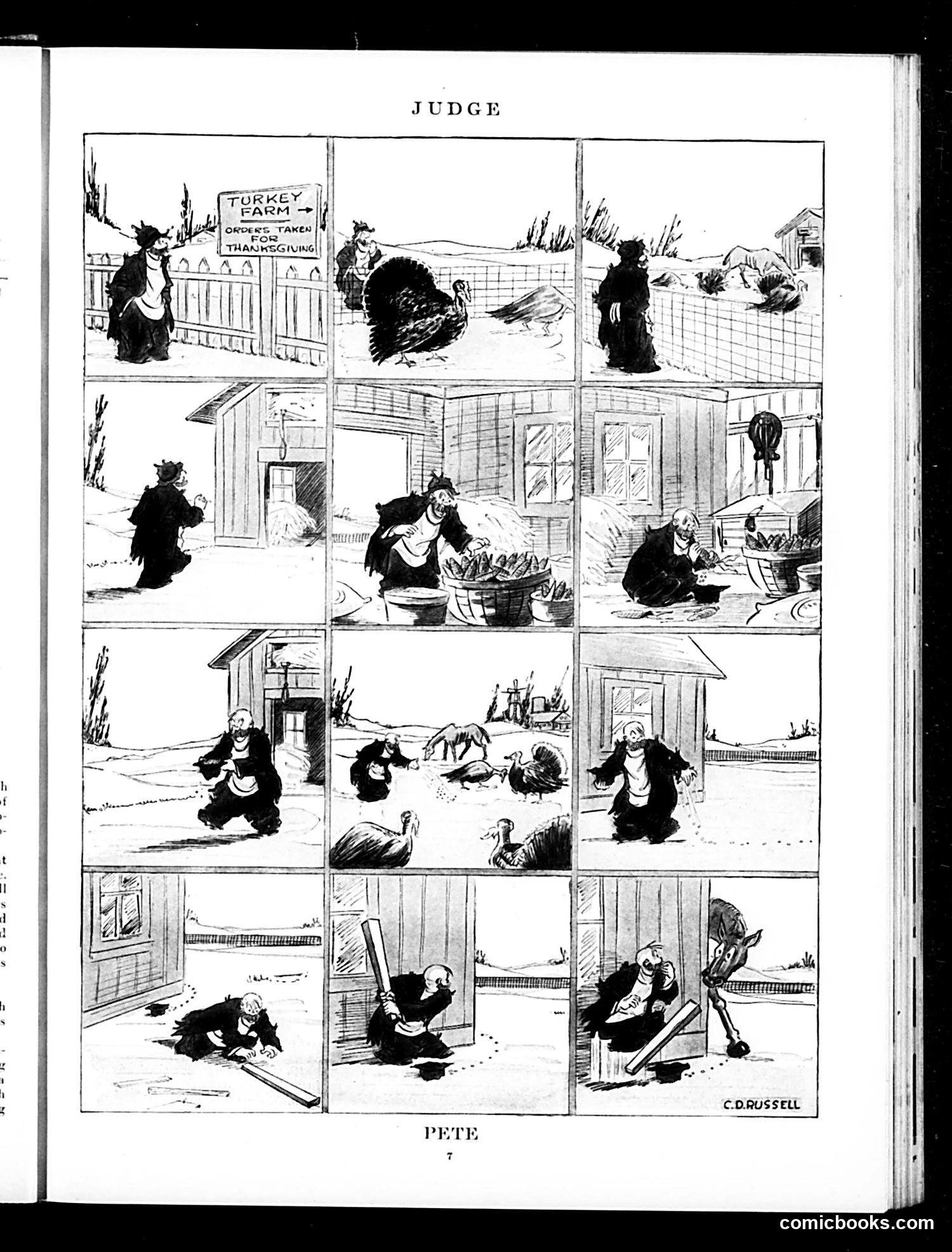
"Judge Pete" Comic Strip Analysis This two-panel comic strip by C.D. Russell depicts a darkly humorous sequence at a turkey farm. The top panels show a figure in formal attire ("JUDGE") inspecting the farm and its operations. The lower panels show "PETE," apparently a farm worker, engaging in increasingly violent and chaotic interactions with the turkeys—chasing, striking at, and wrestling with them. The satire appears to mock judicial authority or a specific judge character ("Judge Pete"), suggesting corruption, incompetence, or hypocrisy through slapstick misadventure. The turkey farm setting and the contrast between the judge's formal position and Pete's crude farmyard chaos likely comment on social pretension or abuse of power. Without additional context about contemporary figures, the specific target remains unclear.
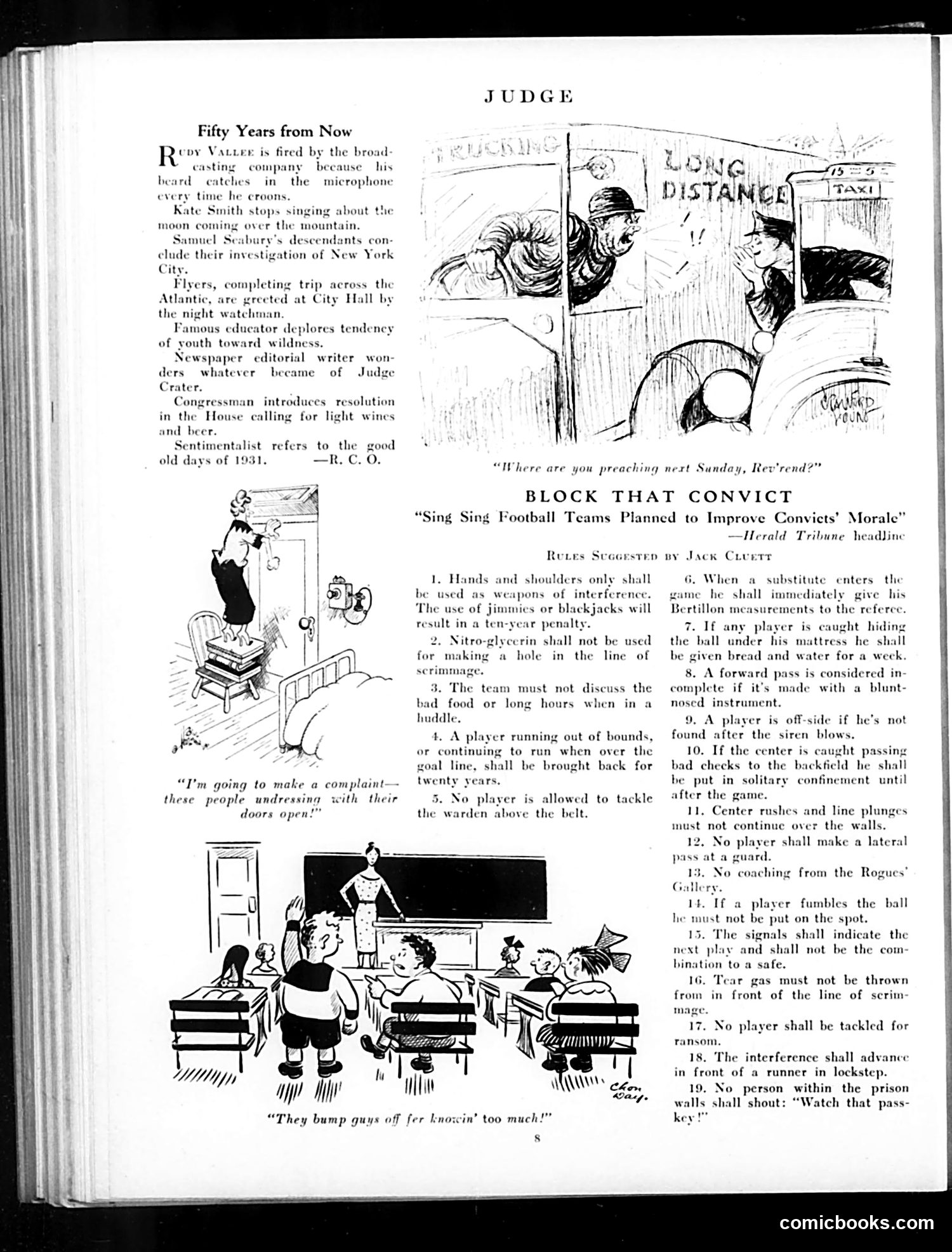
"Block That Convict" — Judge Magazine Satire This page satirizes a 1930s Herald Tribune headline about Sing Sing prison organizing football to improve inmates' morale. The satire presents mock "rules" that blur prison discipline with football regulations, exposing the absurdity of the scheme. The humor lies in rules that reference prison realities: players "hiding the ball under mattresses," "passing bad checks," being "put on the spot," or tackled "for ransom." References to "tear gas," "lockstep," and the "warden above the belt" treat convicts as both players and prisoners simultaneously. The cartoons above mock broader 1931 topics: Ruby Vallee's microphone feedback, Kate Smith's famous song, Judge Crater's unsolved 1930 disappearance, and youth delinquency. The "Fifty Years from Now" conceit satirizes contemporary trends by imagining their ridiculous future consequences—typical Judge editorial humor combining social commentary with absurdist comedy.
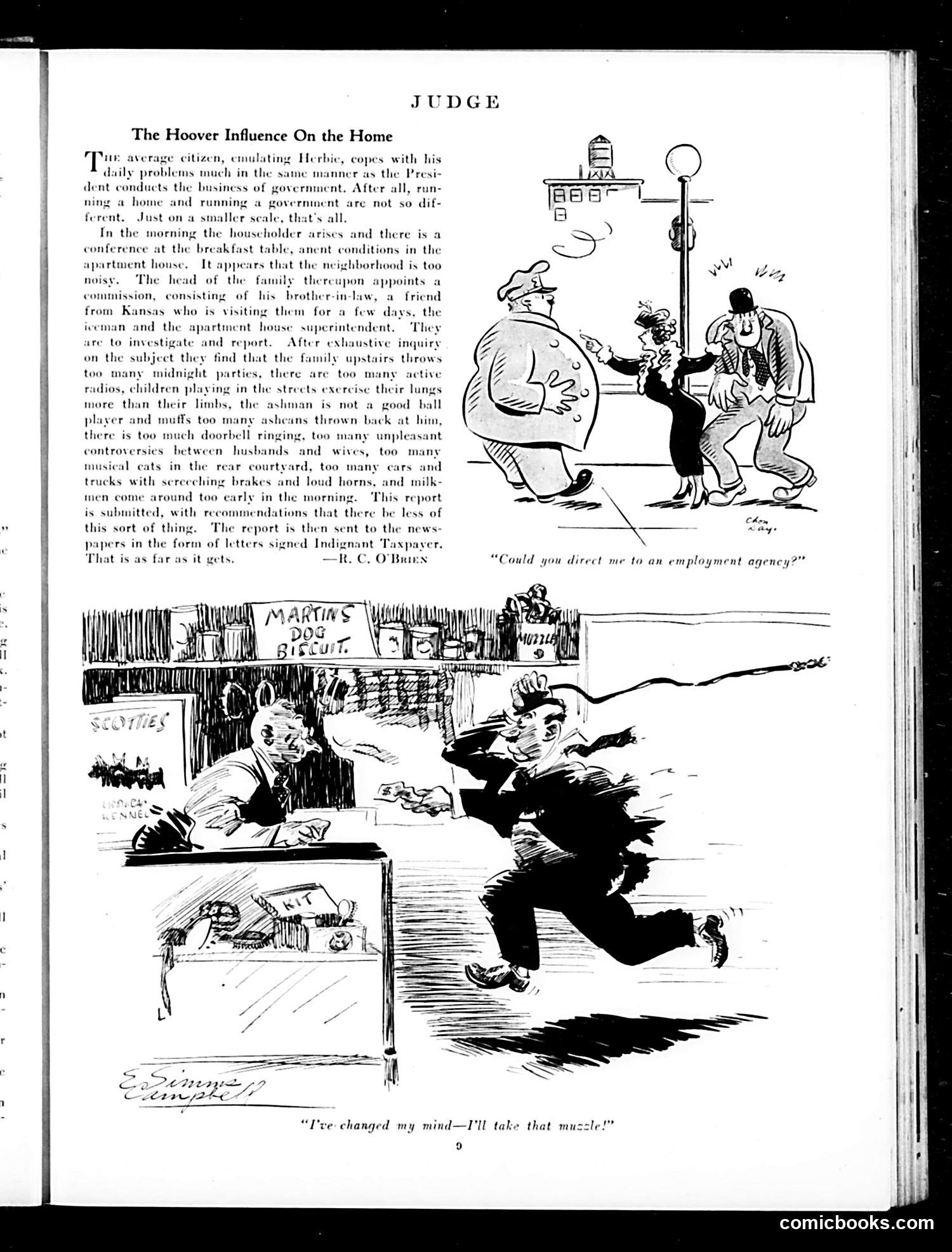
Analysis of Judge Magazine Page This page satirizes President Herbert Hoover's administrative style applied to household management. The article's conceit compares running a home to running government "on a smaller scale." The satire: The head of household creates a commission (mimicking Hoover's preference for committees and commissions) to investigate neighborhood noise. After exhaustive inquiry, they produce a detailed report listing grievances—loud parties, radios, children, ashmen, doorbells, cats, cars, milkmen. The punchline: "That is as far as it gets"—the report goes nowhere, merely submitted to newspapers as signed letters from "Indignant Taxpayer." The political point: This mocks Hoover's ineffectual approach to governance through commissions that investigate and recommend but lack enforcement power. The implication is that his administration produces endless reports while problems remain unsolved. The cartoons (illustrating the concept) show a man being directed to an employment agency, and another fleeing with a muzzle he's changed his mind about buying—visual jokes about solving domestic problems.
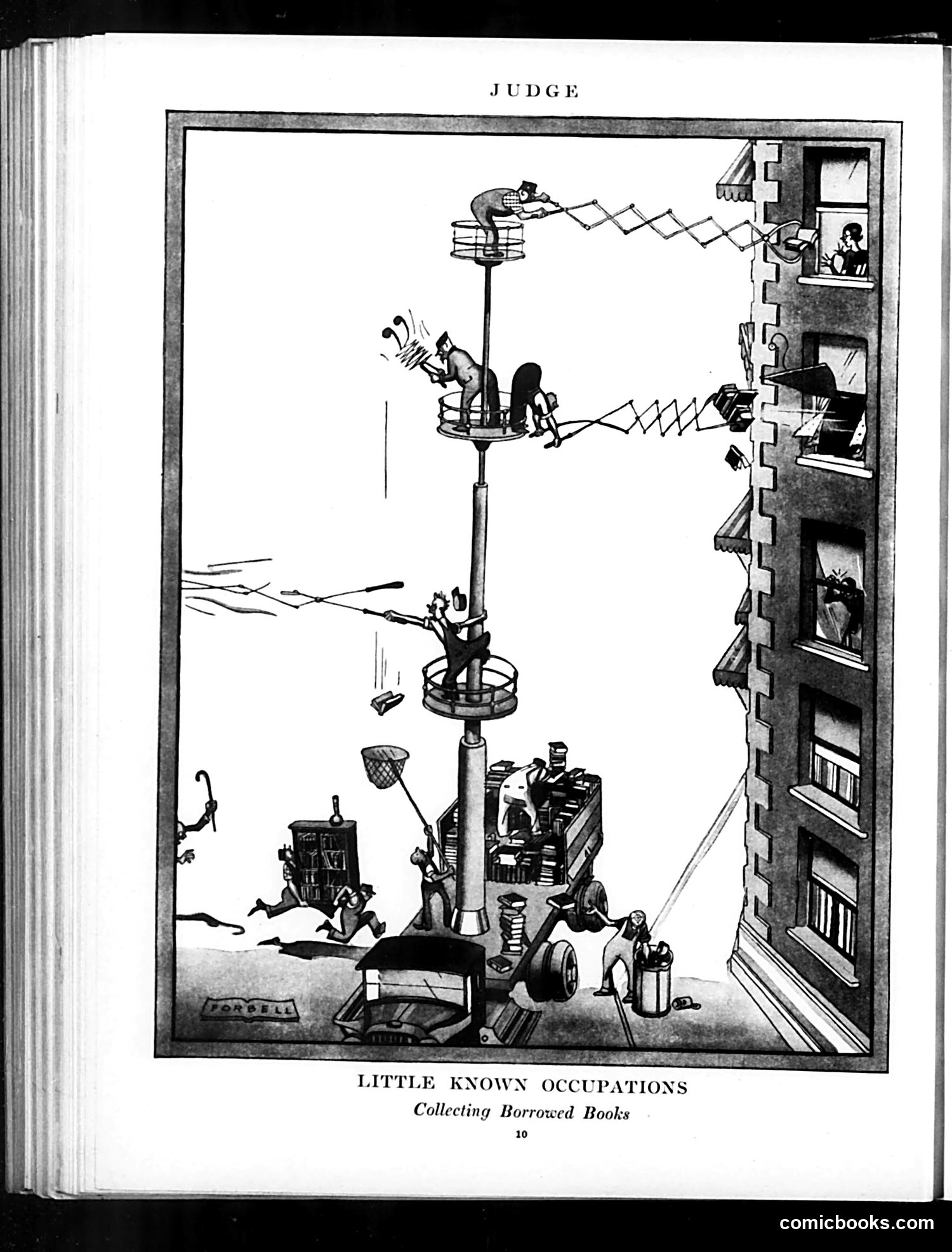
"Judge" Cartoon Analysis: "Little Known Occupations - Collecting Borrowed Books" This satirical cartoon depicts the humorous "occupation" of retrieving loaned books from neighbors. The central pole serves as a mechanical contraption with figures at various heights operating pulleys and nets to capture books from a multi-story apartment building on the right. The joke satirizes the common social frustration of never getting borrowed books returned. Rather than asking politely, the cartoon imagines an elaborate, industrial-scale apparatus—complete with vehicles, operators, and mechanical systems—as the only effective method to recover borrowed volumes. The cartoon comments on both human nature (people's reluctance to return borrowed items) and the absurdity of treating a minor domestic annoyance as worthy of serious mechanical engineering. The "little known occupation" framing humorously suggests book-collecting might warrant professional status given how difficult the task appears.
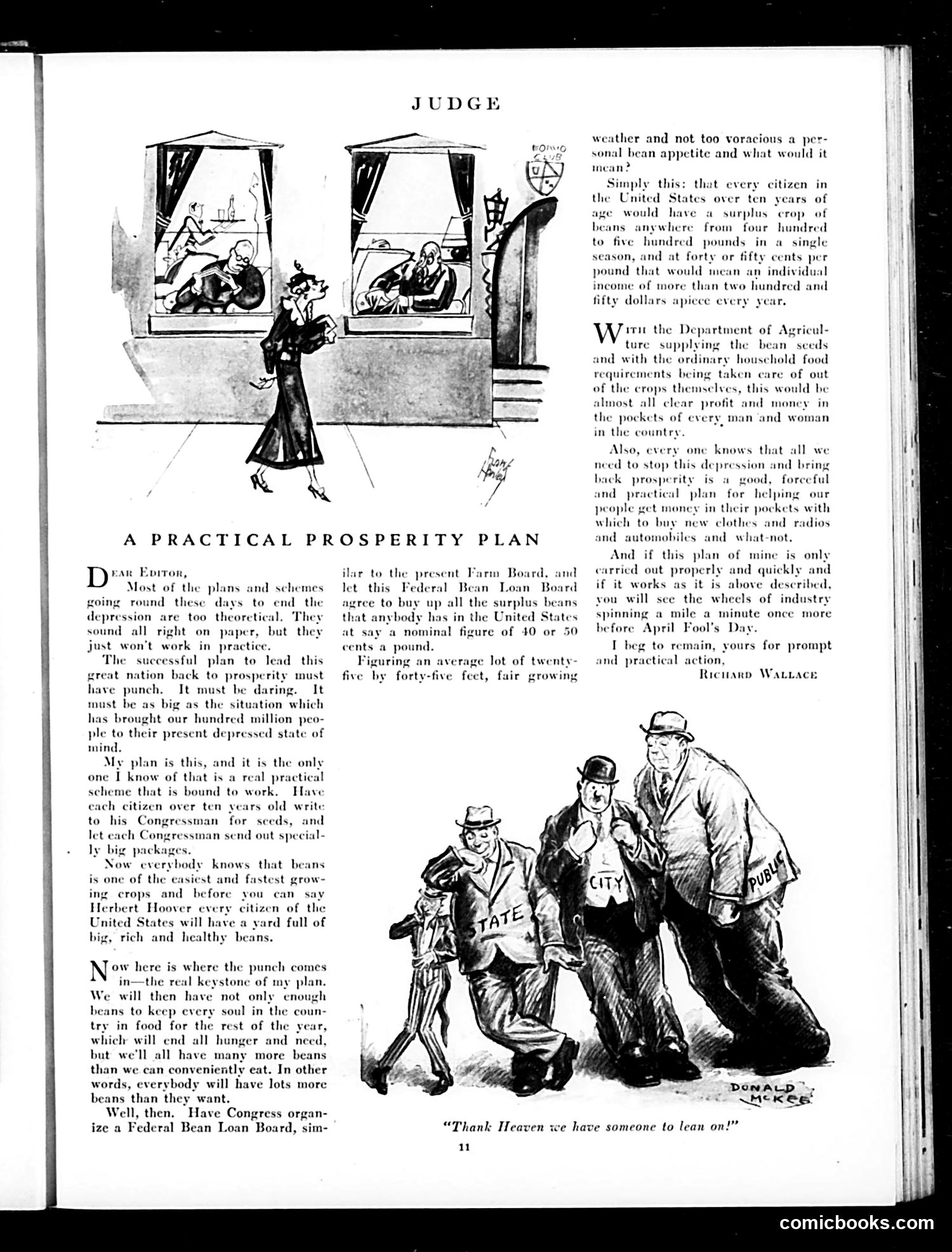
"A Practical Prosperity Plan" - Judge Magazine This is satirical commentary on Depression-era relief proposals. Richard Wallace's letter proposes that Congress distribute bean seeds to all citizens, who would grow massive surpluses. The government would then create a "Federal Bean Loan Board" to buy surplus beans at 40-50 cents per pound, supposedly giving every American $250+ annual income. The satire mocks overly simplistic, impractical schemes promoted during the economic crisis—particularly those from the Hoover administration. The bottom cartoon shows figures labeled "State," "City," and "Public" literally leaning on each other, with the caption "Thank Heaven we have someone to lean on!" This suggests that unrealistic plans like Wallace's leave citizens dependent and unstable rather than genuinely solving the depression. The piece ridicules both the naïve optimism of certain proposals and their failure to address real economic problems.
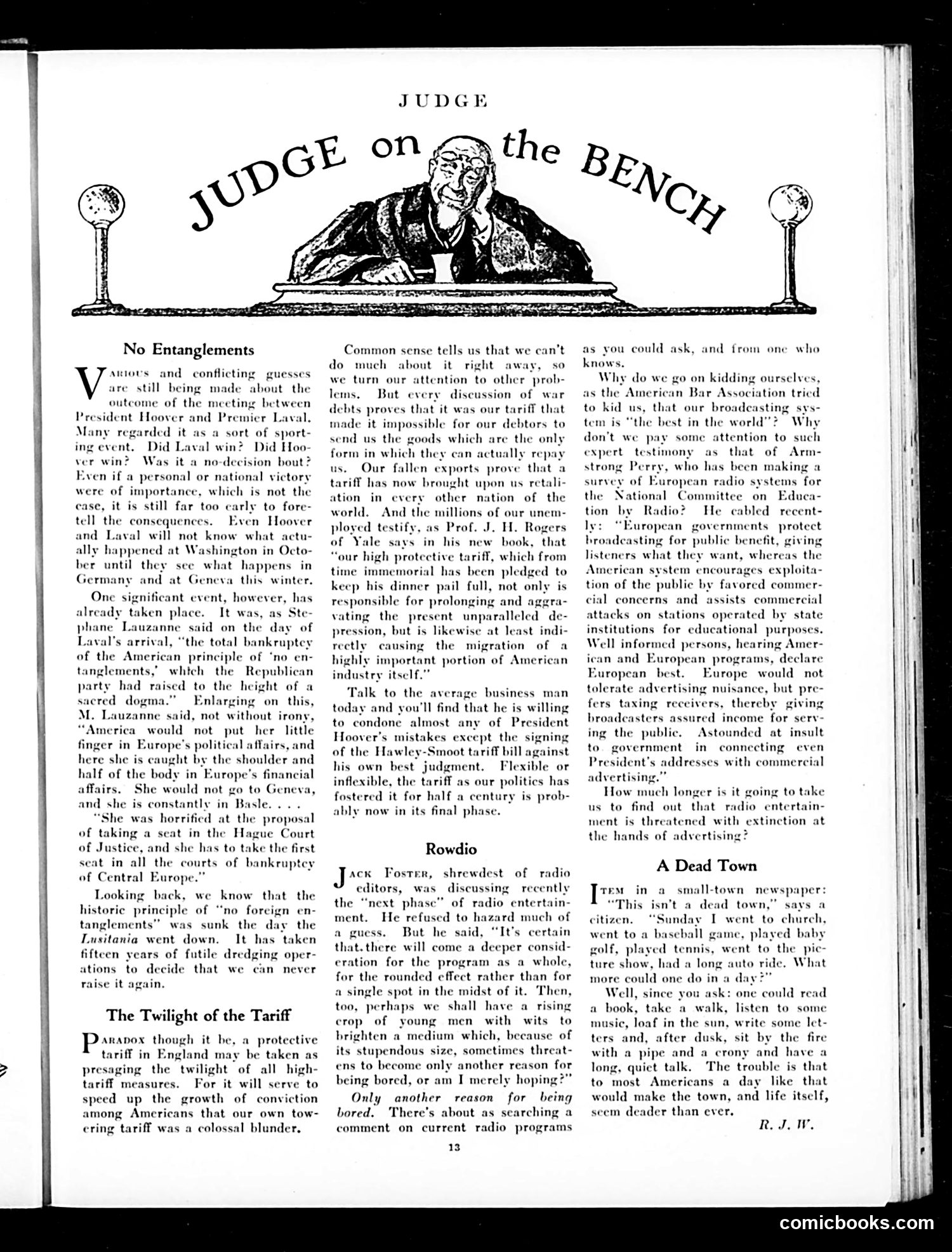
Analysis of Judge Magazine Page This page from *Judge* magazine (appears early 20th century, likely 1930s based on references) contains political commentary on three topics: "No Entanglements" critiques President Hoover's meeting with French Premier Laval, satirizing America's claimed policy of non-involvement in European affairs while actually being deeply entangled in post-WWI debt and diplomatic negotiations. The piece argues America abandoned isolationism after the Lusitania sinking. "The Twilight of the Tariff" attacks America's high protective tariff policies, arguing they caused economic depression, prevented war debts repayment (since other nations couldn't export goods to America), and triggered retaliatory tariffs abroad. It suggests even businessmen now recognize tariffs as failures. "Rowdio" humorously critiques radio programming quality, quoting radio editor Jack Foster's sardonic observation that entertainment prioritizes individual "spots" over coherent programming—reducing the medium to "another reason for being bored." The satire assumes readers familiar with Hoover-era economic and foreign policy debates.
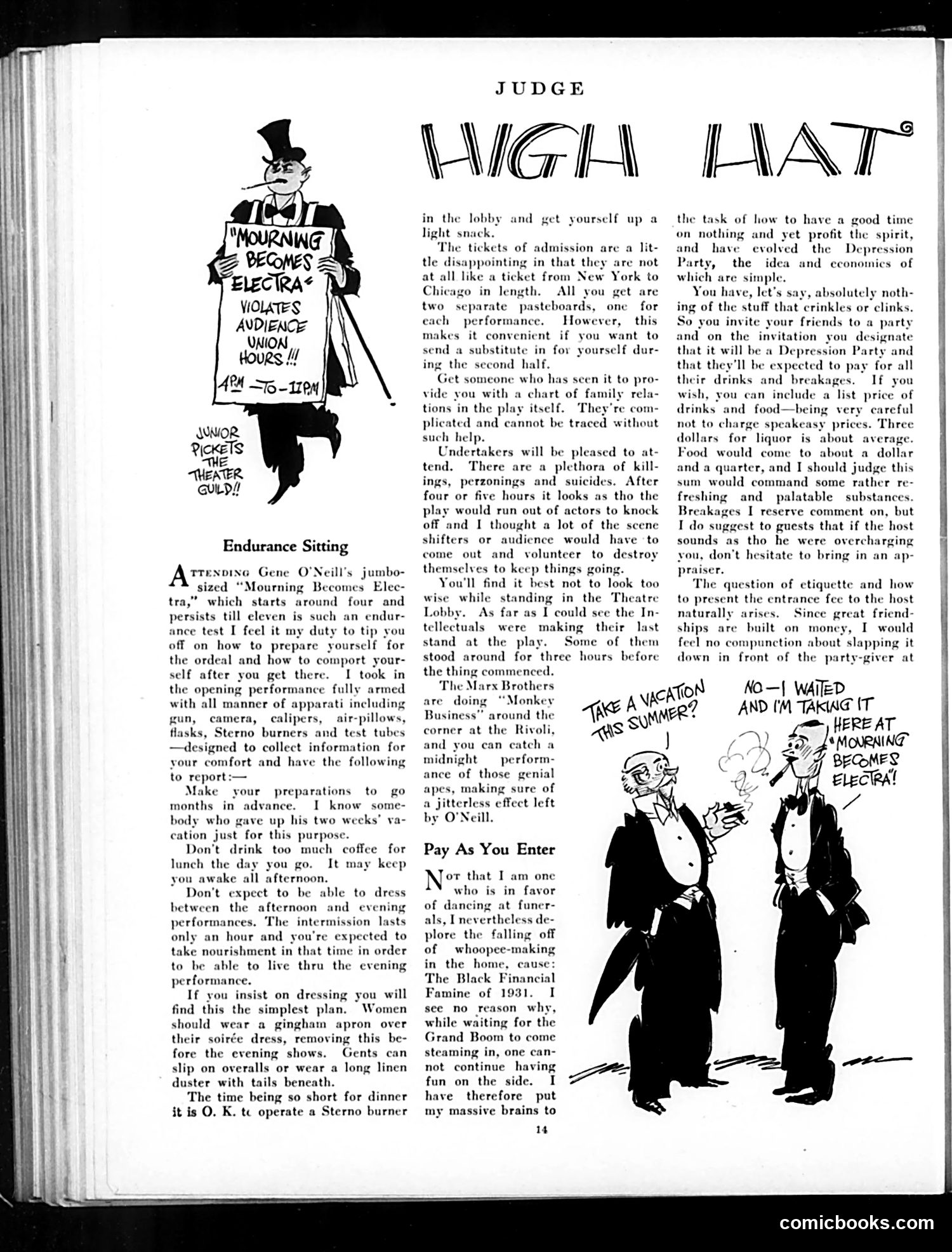
"Judge" Magazine Page Analysis This page satirizes two contemporary entertainments and social anxieties of the early 1930s. "Mourning Becomes Electra" (top): A scathing review of Eugene O'Neill's famously long theatrical production, mocking its marathon length (4 PM to 11 PM). The satire exaggerates preparation advice—bringing camping equipment, undertakers (due to "killings, perzonings and suicides"), and dressing in overalls. The cartoon shows a figure with a banner protesting that the play "violates audience union hours." The joke: attending requires industrial-level endurance. "Pay As You Enter" (bottom): A cartoon about Depression-era "cheap parties" where guests pay for their own drinks and food while pretending to attend a free event. Two men discuss taking a vacation, with one saying he's taking it "here at mourning becomes electra"—conflating the two entertainments as equally exhausting ordeals. The page reflects 1931-era anxieties about economic hardship and leisure activities becoming burdensome rather than enjoyable.
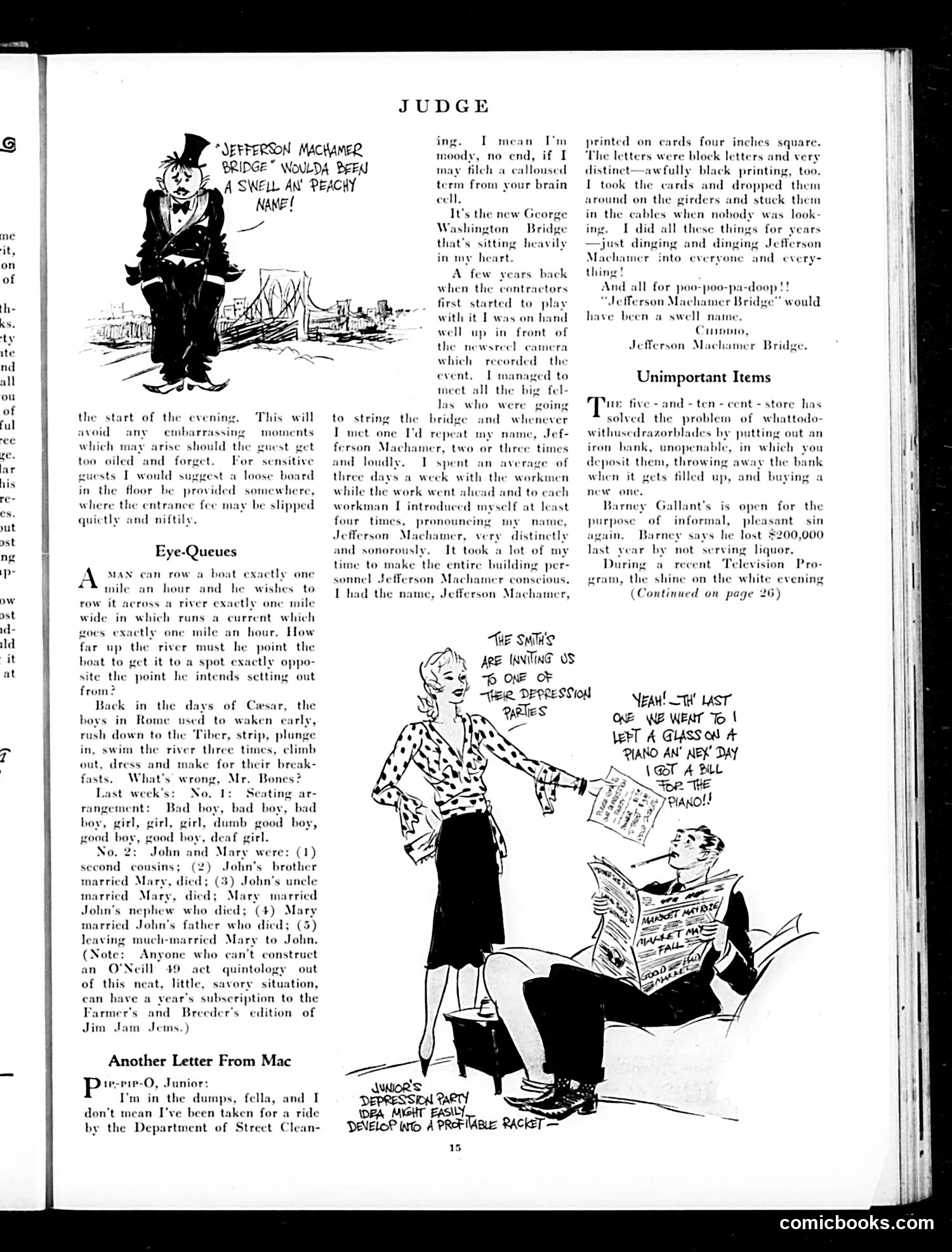
Political Cartoon Analysis: Judge Magazine Page This page satirizes Jefferson Machamer's self-promotion efforts surrounding the George Washington Bridge construction (early 1930s). The main cartoon depicts Machamer obsessively introducing himself to bridge workers and contractors, distributing business cards, and trying to get the structure named after him—his vanity project backfiring into absurdity. The satire targets social climbing and name-dropping: despite weeks of effort pronouncing his name "very distinctly" to workers, the bridge became famous as the "George Washington Bridge," not the "Jefferson Machamer Bridge." His reward for shameless self-promotion was complete obscurity. The page includes unrelated sections: "Eye-Queues" (math puzzles), "Unimportant Items" (trivial observations about five-and-dime stores and nightclubs), and a cartoon about a couple at a Depression-era party lamenting they can't afford a piano. These reflect typical Judge magazine miscellany—light satirical commentary on everyday life and consumer culture during the 1930s economic crisis.
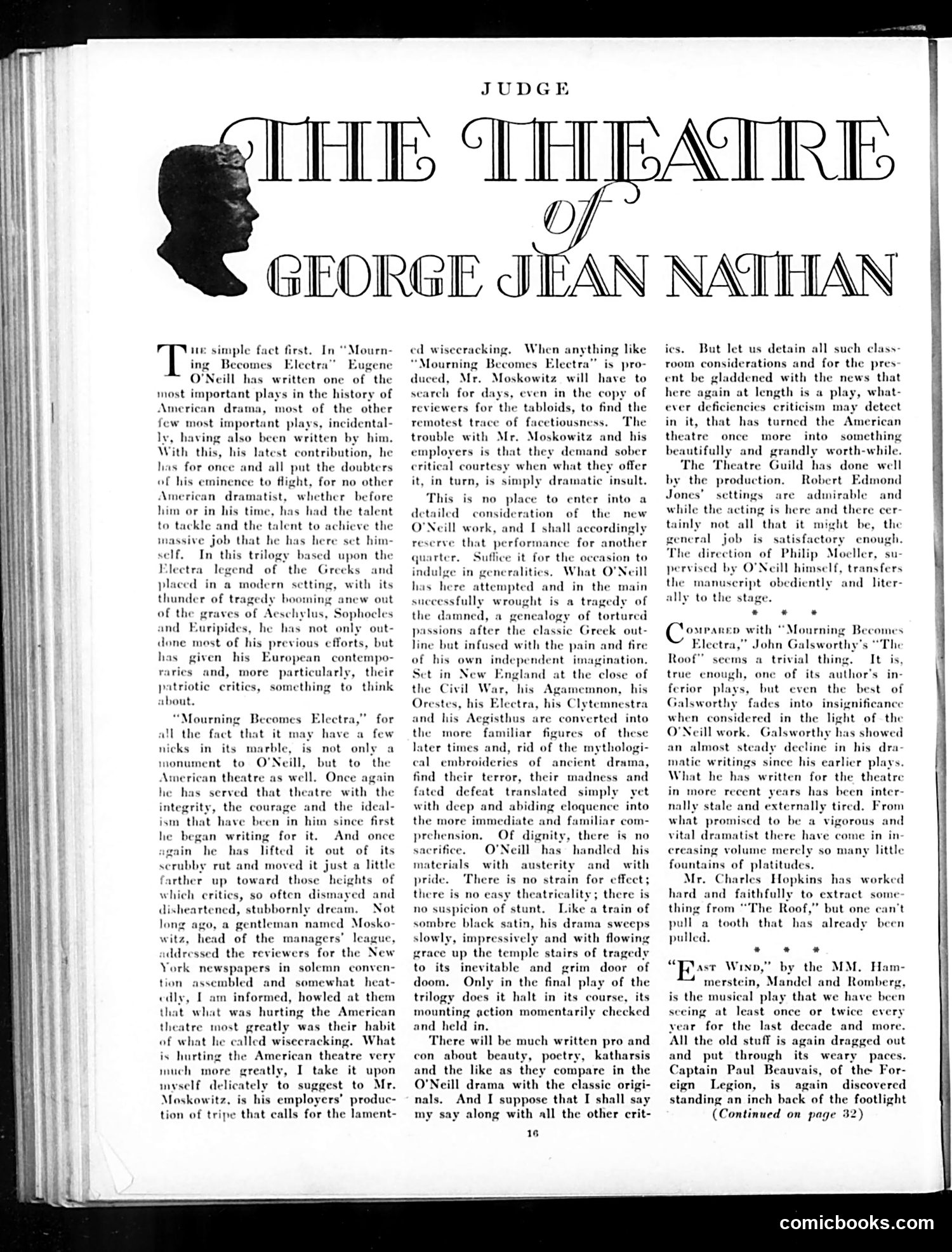
Analysis: "The Theatre of George Jean Nathan" This is a theater review column by Judge magazine's drama critic, not a political cartoon. The page features a silhouette portrait of critic George Jean Nathan at the top. Nathan praises Eugene O'Neill's new play "Mourning Becomes Electra," calling it one of the most important works in American drama history. He argues O'Neill has elevated American theater through integrity and courage. The review includes social criticism of a man named Moskowitz (likely a theater manager or newspaper executive) who complained that American theater's problem is "wisecracking" critics. Nathan sarcastically counters that the real problem is theater producers offering mediocre material ("tripe") that *invites* sarcasm. He argues when quality work like O'Neill's appears, critics have nothing to mock. The piece defends O'Neill's adaptation of the Greek Electra legend to a Civil War-era New England setting, praising its dignity and emotional power without theatrical gimmickry. This reflects 1930s intellectual theater culture and debates about American dramatic standards.
Judging the Movies: Pare Lorentz's Film Criticism This is a film review column, not a political cartoon. Critic Pare Lorentz savagely attacks Ronald Colman's "The Unholy Garden," calling it incompetent trash with a nonsensical plot involving a blind baron, desert castle, international criminals, and a detective-turned-love-interest. Lorentz argues the film's writers (appears to reference Ben Hecht and Charles MacArthur) produced work beneath their talent, and blames either their disinterest, employer interference, or Hollywood fatigue. He's particularly scathing about painted backdrops replacing authentic California desert locations—a cost-cutting measure he suggests reflects industry hard times. The column includes a "Recommended" sidebar praising other films like the Marx Brothers' "Monkey Business" and praising Italian cinema's superior photography, while mocking Hollywood's typical mediocrity.
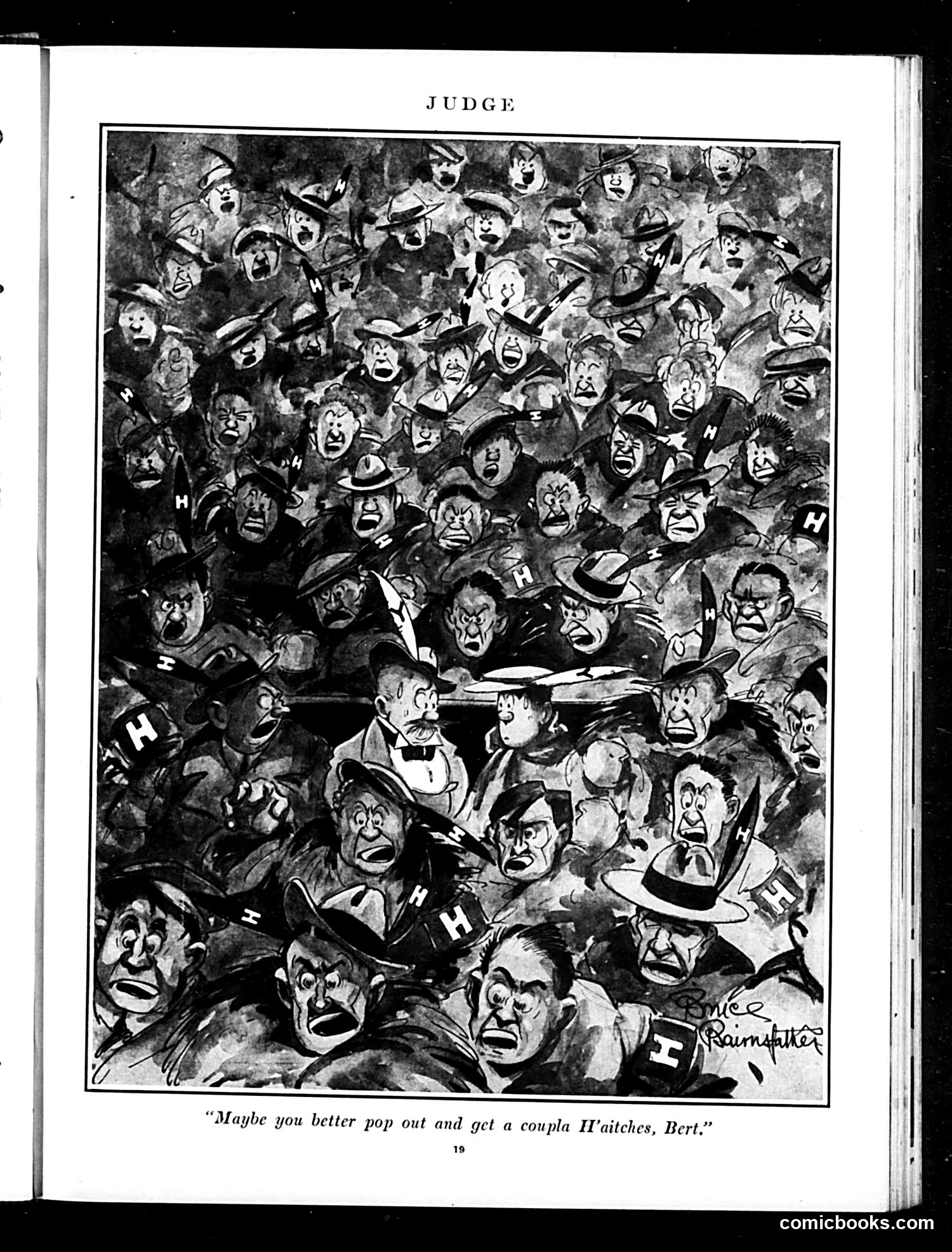
Judge Magazine Cartoon Analysis This is a crowded courtroom scene titled "Judge," depicting what appears to be a legal proceeding. The cartoon shows numerous exaggerated caricatured faces of men wearing hats marked with "H," suggesting they represent a specific group or organization—possibly police or law enforcement officials. The caption's dialogue—"Maybe you better pop out and get a coupla Haitches, Bert"—suggests "Haitches" refers to these "H"-marked figures. The implication appears to be satirizing corruption or the need to secure officials (possibly through bribery or influence) to affect a legal outcome. Without a visible date or clearer context, the specific case or scandal being referenced remains unclear, but the satire targets judicial or law enforcement corruption.
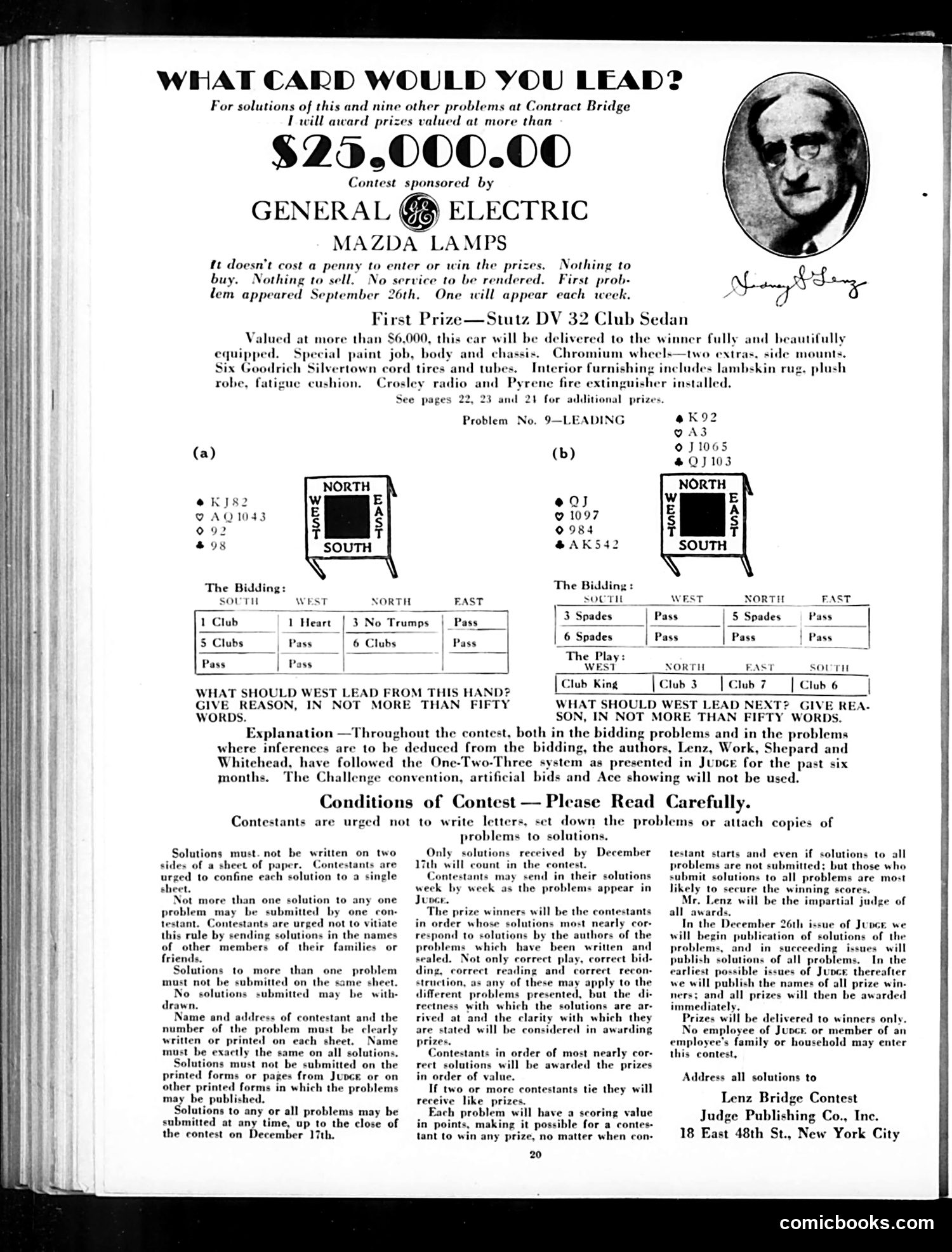
What This Page Means to Modern Readers This is a bridge card game contest advertisement, not political satire. Judge magazine is sponsoring a Contract Bridge problem-solving competition with substantial prizes (valued at over $25,000, including a Stutz automobile worth $6,000—considerable money in the 1930s). The page presents two bridge "hands" (cards dealt to players) and asks readers to determine what card "West" should lead. Solvers must explain their reasoning in fifty words or fewer. Historical context: Contract Bridge was enormously popular in 1930s America among educated, wealthy audiences. Judge positioned itself as a highbrow publication for this demographic. The competition leveraged this popularity while serving as a vehicle for General Electric's Mazda Lamps advertising. The named authors (Lenz, Work, Shepard, Whitehead) were prominent bridge authorities of the era, lending credibility. There is no political cartoon here—it's primarily advertising and a legitimate game puzzle.
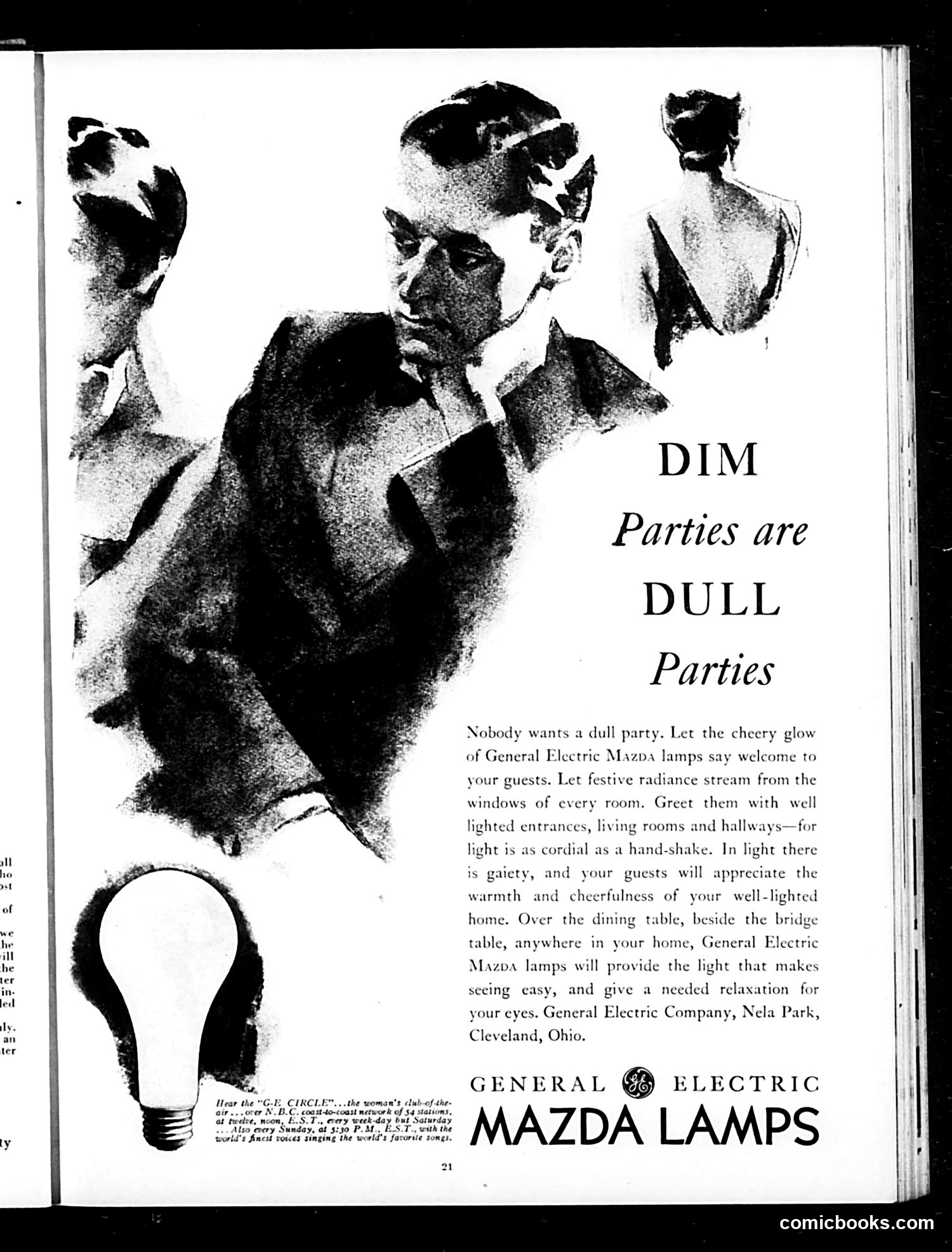
Analysis This page is primarily a General Electric advertisement for Mazda lamps, not a political cartoon. It uses a visual play on the phrase "dim parties are dull parties"—showing shadowy, indistinct figures alongside a bright lightbulb. The advertisement's humor is commercial rather than satirical: it presents a social problem (boring parties) and sells the solution (better lighting). The artistic style contrasts dim, barely-visible party guests with a luminous lightbulb, arguing that good lighting creates cheerfulness and hospitality. A small note at the bottom references "G.E. Circle" on NBC radio, suggesting General Electric's broader media presence during this era. For modern readers: this represents vintage consumer advertising using lifestyle messaging—the idea that a product improves not just function but social experience and happiness.
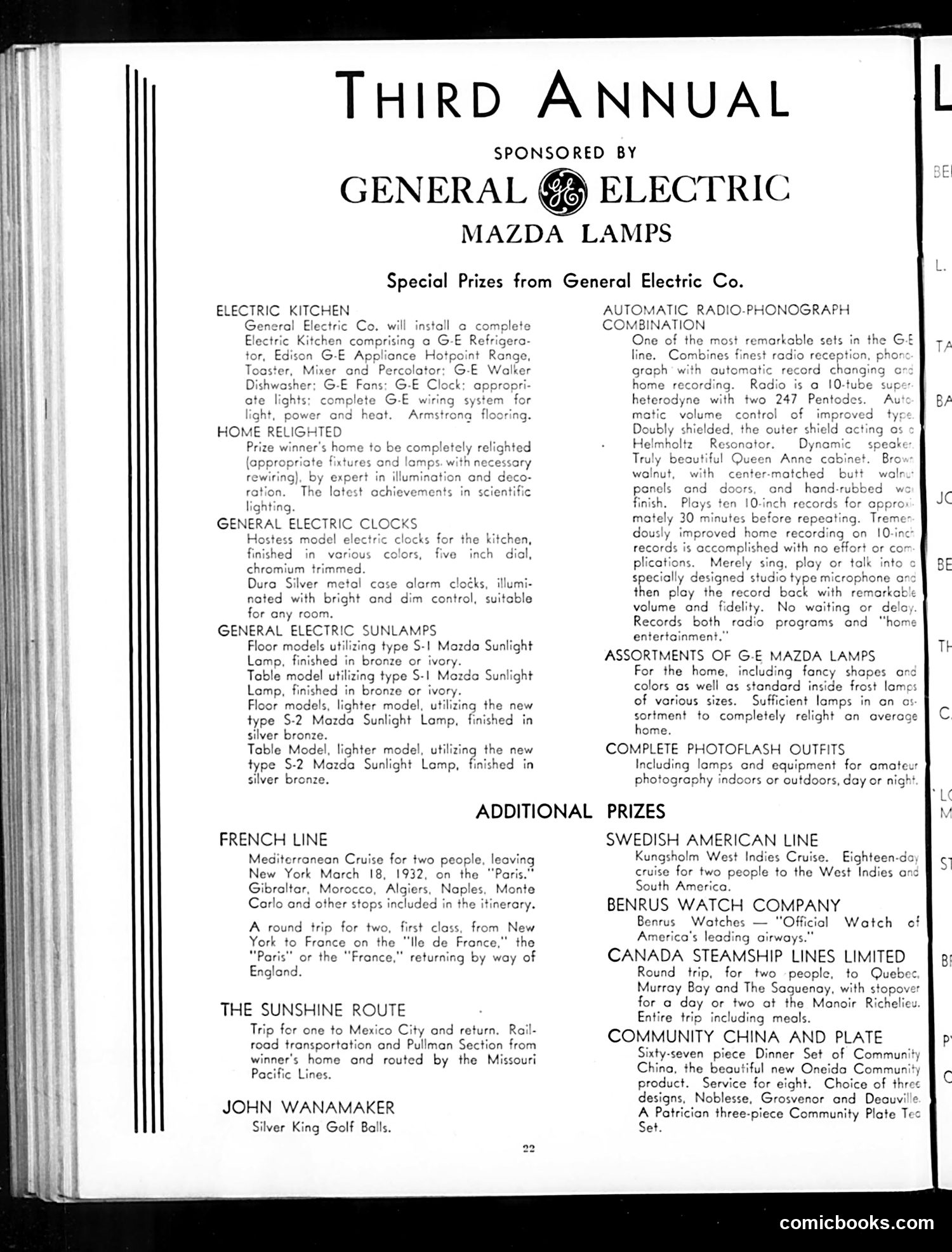
Analysis: Third Annual General Electric Mazda Lamps Contest Page This is not a cartoon or satirical content—it's a prize advertisement page from Judge magazine's Third Annual contest, sponsored by General Electric. The page lists prizes offered to contest winners, showcasing luxury goods and travel popular in the early 1930s (the 1932 dates visible suggest Depression-era timing). Prizes include: - Appliances: Electric kitchens, radios, clocks, and lamps—representing modern domestic convenience - Travel: Mediterranean cruises on French liners, trips to Mexico and the West Indies - Luxury goods: Watches, golf balls, fine china dinnerware The page reflects aspirational consumerism during economic hardship—offering ordinary Americans fantasy prizes of leisure travel and electrified homes. General Electric positioned itself as purveyors of modern, comfortable living through consumer products and electrical technology. No political satire or caricature is present; this functions as straightforward commercial promotion masked as entertainment/contest content in Judge's pages.
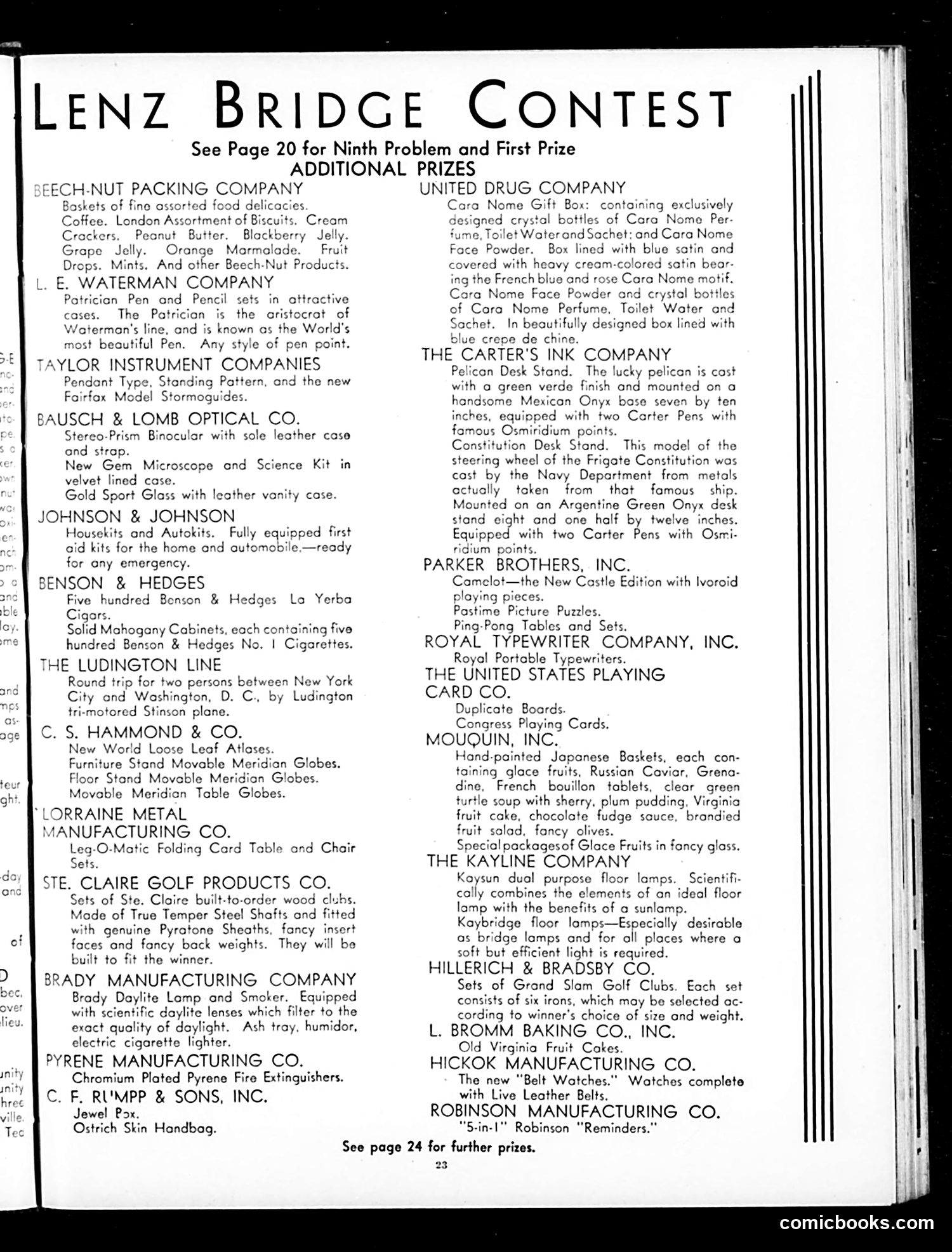
This page is entirely advertising content, not a cartoon or satirical piece. It lists prize offerings for the "Lenz Bridge Contest"—a puzzle competition Judge magazine was running (with the ninth problem and first prize details referenced on page 20). The ads showcase luxury and aspirational goods typical of the 1920s-30s: fine foods (caviar, fruit cakes), writing instruments (Waterman pens), optical equipment, golf clubs, typewriters, board games, and home furnishings. Many prizes emphasize quality craftsmanship and status symbols—reflecting the era's consumer culture and the magazine's affluent readership. The breadth of corporate sponsors (from pharmaceutical companies to airline services) indicates Judge's reach among American businesses seeking upscale audiences. This is essentially a sponsored contest page, not editorial satire.
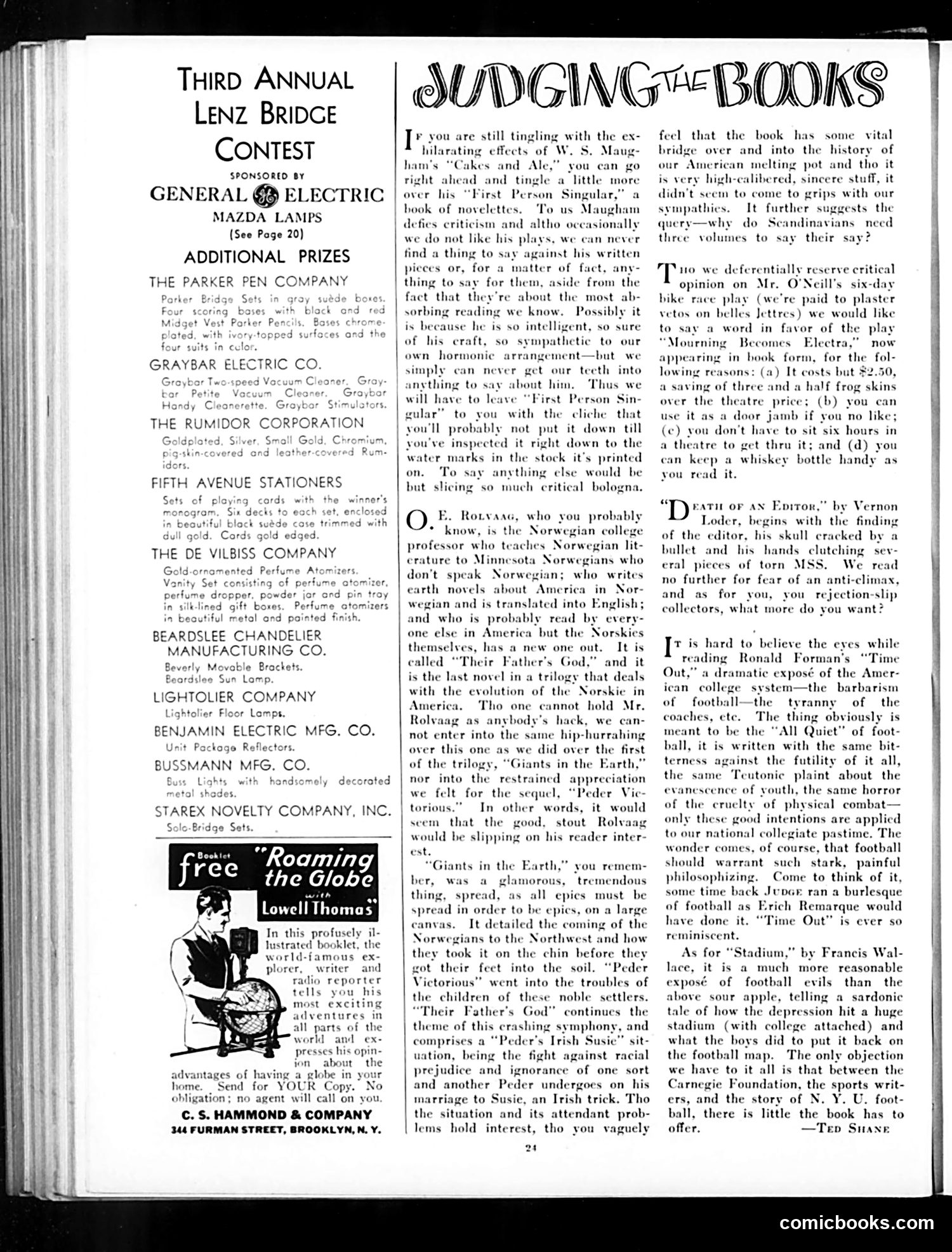
"Judging the Books" - Judge Magazine Book Reviews This page contains literary reviews rather than political cartoons. The main content discusses W.S. Maugham's *First Person Singular*, O.E. Rolvaag's *Their Father's God* (final novel in a Norwegian-American trilogy), and Eugene O'Neill's bike-race play. The reviews employ satirical tone typical of Judge's literary criticism: the Maugham review praises him as intelligent yet admits finding nothing substantive to say about his work—a backhanded compliment. The Rolvaag review questions why Scandinavian authors need multiple volumes to tell their stories, suggesting artistic excess. The page is primarily advertising for the "Third Annual Lenz Bridge Contest" sponsored by General Electric, with prizes from various manufacturers (Parker Pens, Beardslee Chandeliers, etc.). A side advertisement features explorer Lowell Thomas promoting his illustrated travel book with a globe. This reflects 1920s-30s magazine format: literary content interspersed with sponsorships and consumer goods advertising.
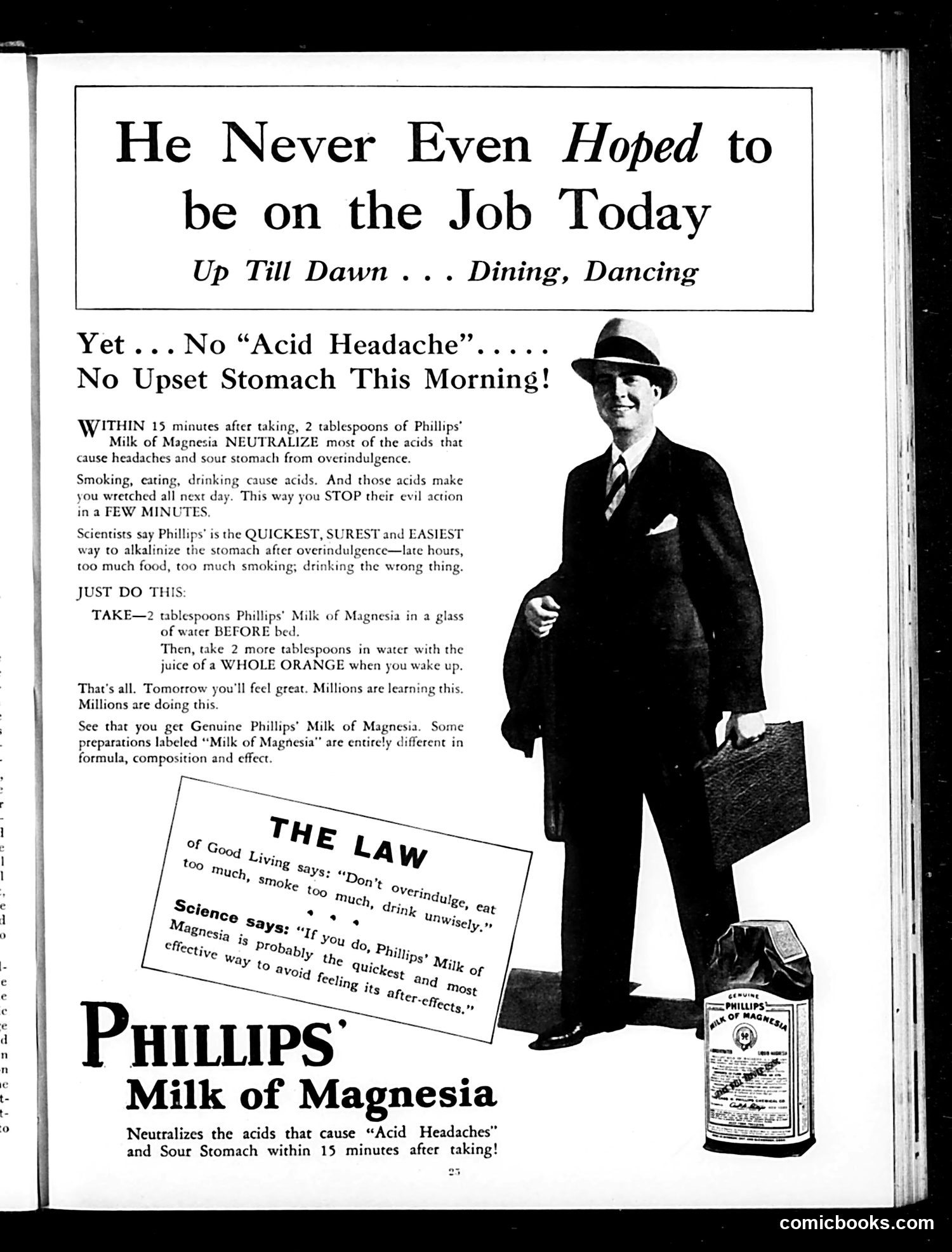
Phillips' Milk of Magnesia Advertisement This is a full-page advertisement, not political satire. It depicts a well-dressed businessman who stayed out late "dining, dancing" and drinking—activities that caused acid indigestion in the pre-modern digestive culture. The ad's humor relies on the relatable scenario: he "never even hoped" to work today due to a hangover, yet Phillips' Milk of Magnesia allegedly cured his headache and upset stomach within 15 minutes. The appeal targets white-collar workers concerned about productivity and respectability. The product was marketed as a scientific solution to overindulgence—smoking, eating, and drinking—common 1920s-30s social activities. The boxed "Law of Good Living" reinforces the moral messaging: moderation prevents suffering, but Phillips' offers quick chemical redemption for those who overindulge. This reflects pre-antibiotic era medicine's faith in patent remedies.
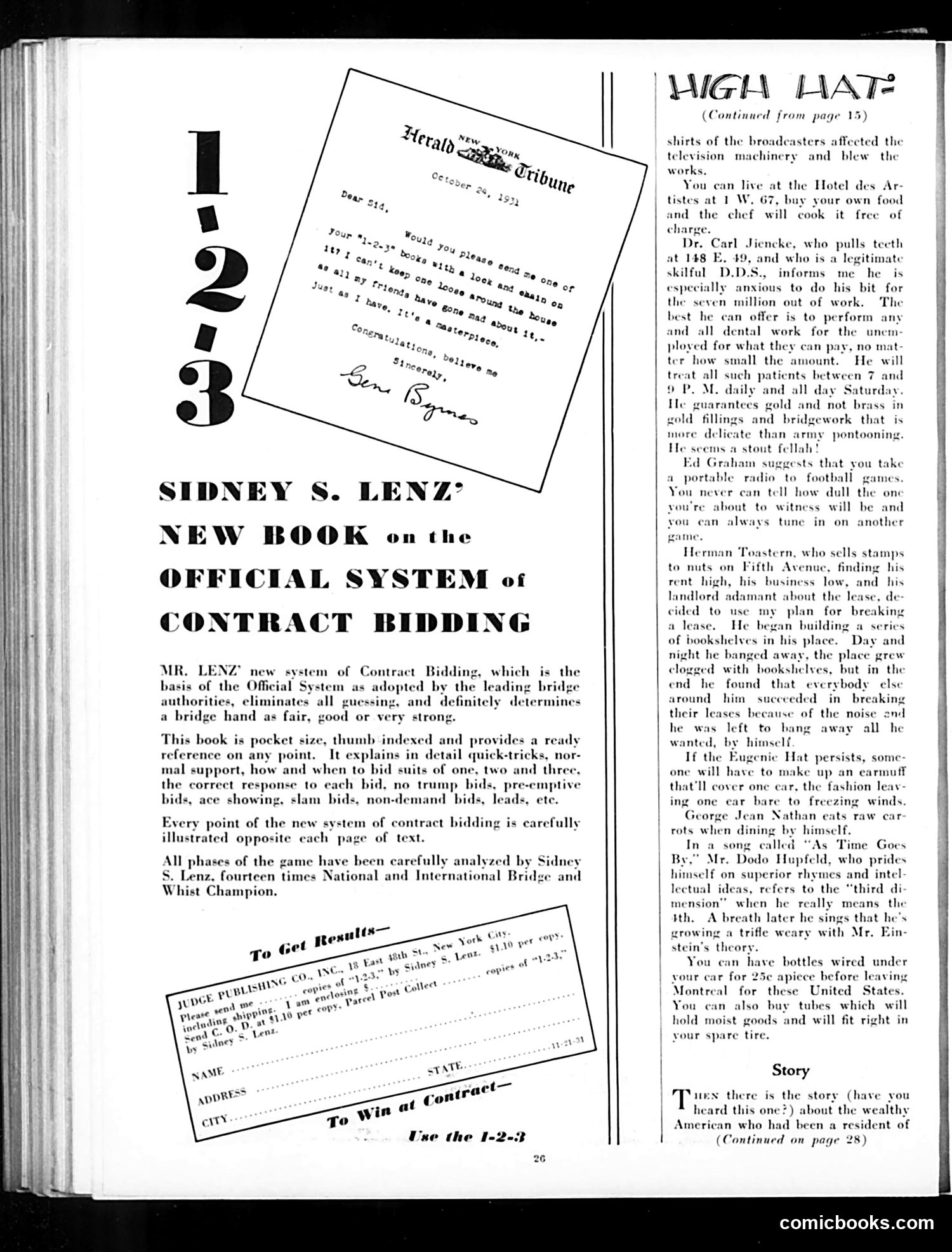
Analysis of Judge Magazine Page This page is primarily advertising and filler content rather than political satire or cartoon commentary. The main feature advertises Sidney S. Lenz's new book on contract bridge bidding—a technical manual for the card game. Lenz is identified as a "fourteen times National and International Bridge and Whist Champion," and the ad emphasizes the book's pocket size and indexed reference system. The right column, titled "HIGH HAT," appears to be a gossip or humor column documenting minor NYC figures during what seems to be the Great Depression era (references to "seven million out of work"). It humorously profiles various characters—a dentist offering free work, a stamp seller, someone breaking a lease with bookshelves—and includes anecdotes about radio at football games and composer Dodo Hupfeld. The satire is light and social rather than political: gentle mockery of Depression-era hustle culture and eccentric New Yorkers, not partisan commentary. The page serves primarily as filler between substantive articles, typical of Judge's format.
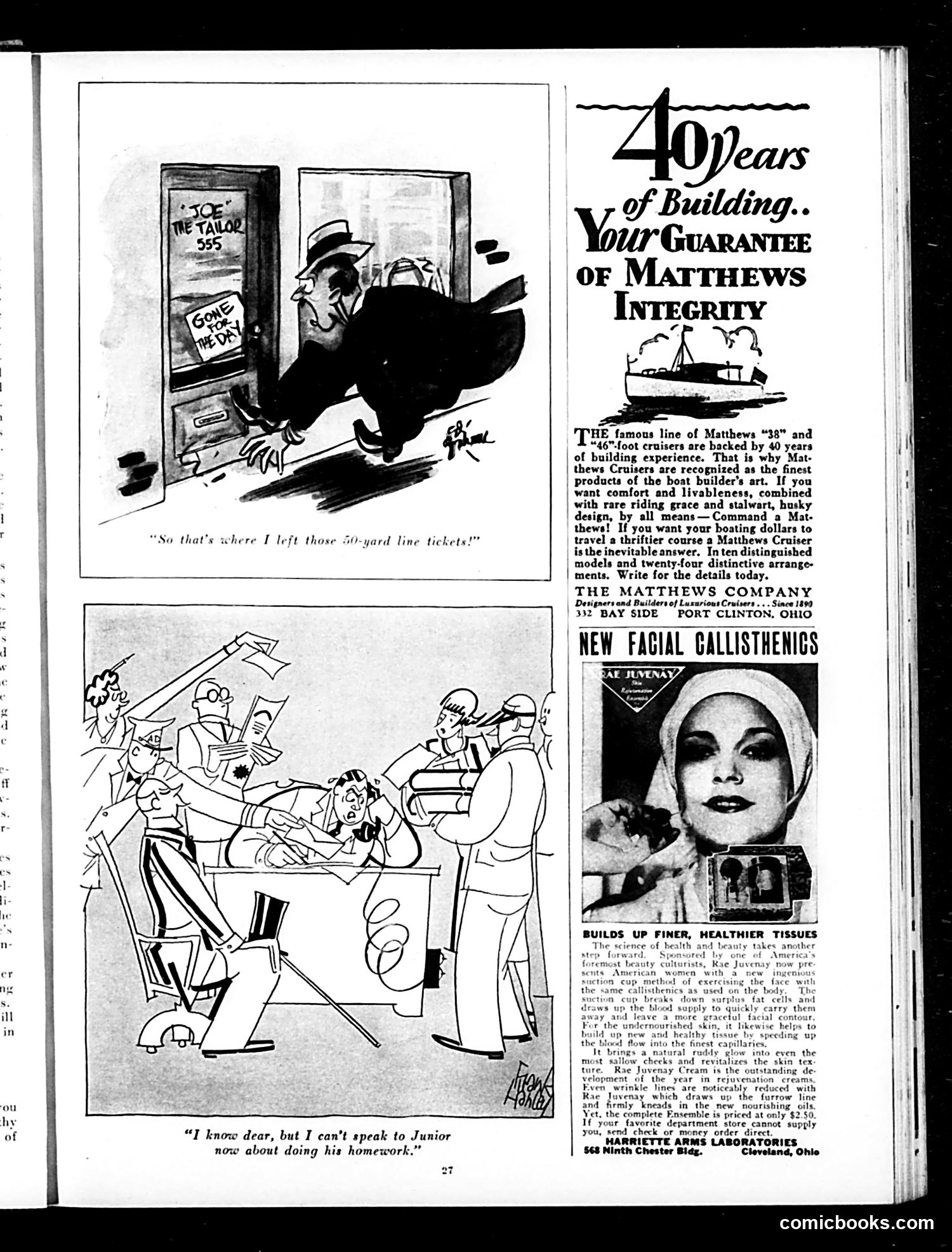
Judge Magazine Page Analysis This page contains two satirical cartoons and advertisements from an early-to-mid 20th century issue. Top cartoon: A man rushes frantically into a tailor shop labeled "Joe the Tailor" with a sign reading "Gone to the Devil." The caption reads, "So that's where I left those 50-yard line tickets!" The satire mocks a husband's priorities—he's more concerned about lost sports tickets (to football's 50-yard line seats, highly coveted) than visiting his tailor or attending to domestic responsibilities. It's a commentary on male frivolousness and the era's sports obsession. Bottom cartoon: A woman tells her husband, "I know dear, but I can't speak to Junior now about doing his homework." The scene depicts a chaotic domestic gathering. The joke plays on marital dynamics and parenting—the implication being she's preoccupied or her husband is preventing her from disciplining their son. The page also features advertisements for Matthews boat cruisers and "Juvenay Cream" beauty product, typical of period magazine monetization.
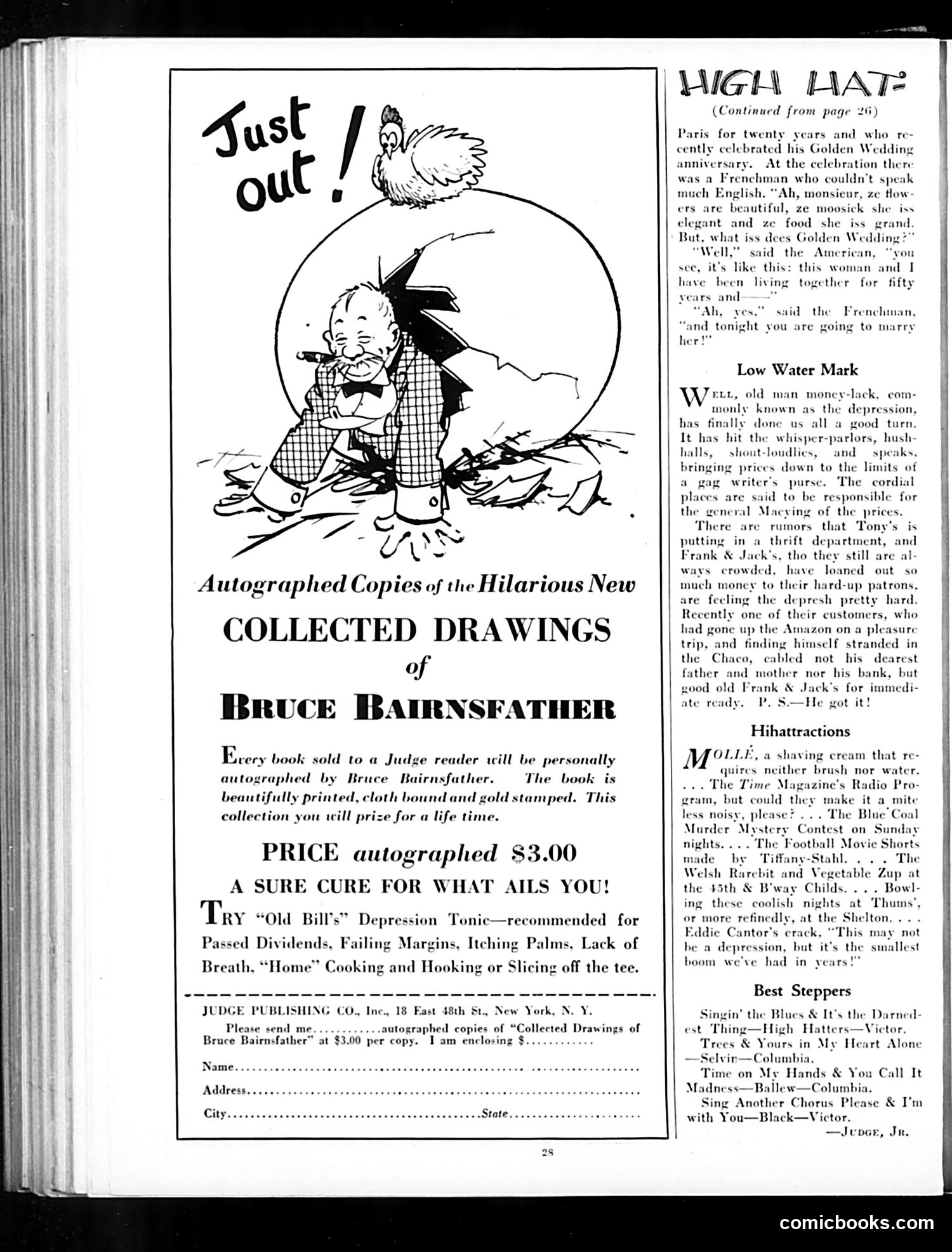
Analysis of Judge Magazine Page This page is primarily advertising for Bruce Bairnsfather's "Collected Drawings," a book of cartoons by the famous British wartime cartoonist. The main visual joke shows a baby bursting from an egg labeled "Just out!"—promoting the new publication. The advertisement's humor plays on Bairnsfather's most famous character, "Old Bill," a working-class British soldier from World War I. The "Depression Tonic" pitch sarcastically "recommends" the book as a cure for 1920s economic problems (failed investments, job losses), suggesting laughter is the best medicine. The surrounding page content includes gossip items, product recommendations, and a brief joke about a Frenchman's misunderstanding of "Golden Wedding" anniversaries—typical light humor for Judge magazine's satirical style. Context for modern readers: This reflects post-WWI America, when Bairnsfather's soldier cartoons were still popular, and the Great Depression's early economic anxieties.
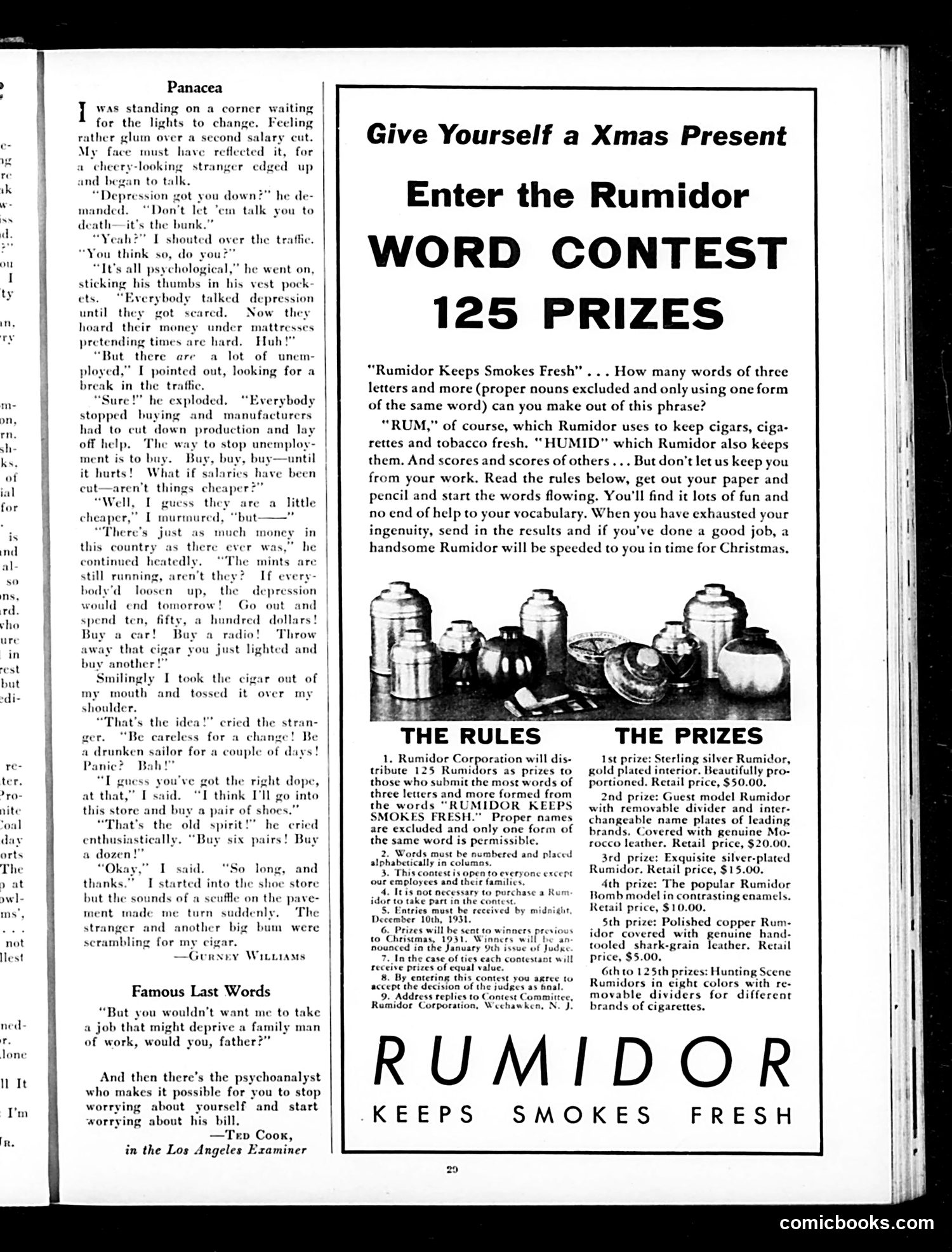
Judge Magazine Page Analysis This page contains two distinct elements: Left side: A satirical short story titled "Panacea" by Grantley Williams, depicting a Depression-era encounter. An optimistic stranger convinces a glum man that economic recovery requires *spending*—buy shoes, cigars, radios—arguing the money supply hasn't shrunk, only psychology has. The joke's dark irony: when the narrator finally adopts this advice and tosses away his cigar to buy shoes, the stranger immediately attacks him for the discarded cigar, revealing the "advice" was self-serving con artistry. Right side: A Rumidor (cigar humidor) advertisement disguised as a word-puzzle contest offering 125 prizes. Contestants extract words from "Rumidor Keeps Smokes Fresh." Context for modern readers: This satirizes 1930s Depression-era "positive thinking" rhetoric—the idea that consumer spending alone could cure systemic economic collapse. The story mocks both naive optimists and opportunistic fraudsters exploiting such thinking. The adjacent advertisement ironically exemplifies the consumerism the story critiques.
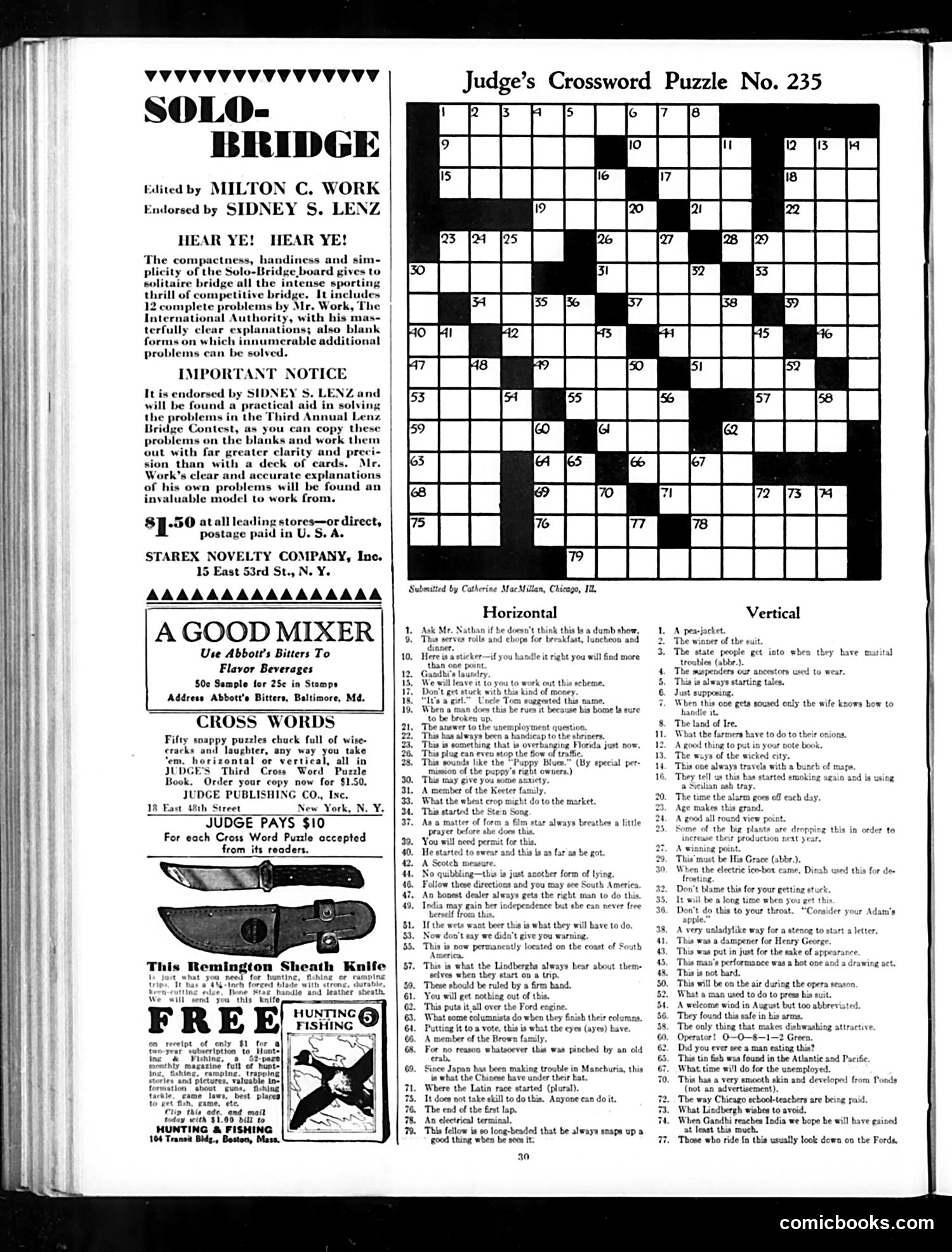
Judge Magazine Crossword Puzzle No. 235 (Circa 1920s-1930s) This page is primarily a crossword puzzle with accompanying advertisements—not a political cartoon. The puzzle itself contains social commentary embedded in its clues, typical of Judge magazine's satirical approach. The clues reference contemporary concerns: prohibition enforcement ("a fellow so long-headed that he always snaps up a good thing when he sees it"), employment struggles during economic uncertainty, marital discord, and social pretension. References to "the Lindberghs" suggest the 1920s-30s timeframe, when Charles Lindbergh was a celebrity aviator. The ads promote bridge instruction, cocktail bitters, hunting magazines, and a Remington knife—appealing to the middle-class male readership Judge targeted. The magazine itself offered $10 per accepted puzzle, monetizing reader participation. This is primarily a recreational puzzle product, not satirical commentary, though Judge's signature humor infuses the clue-writing.
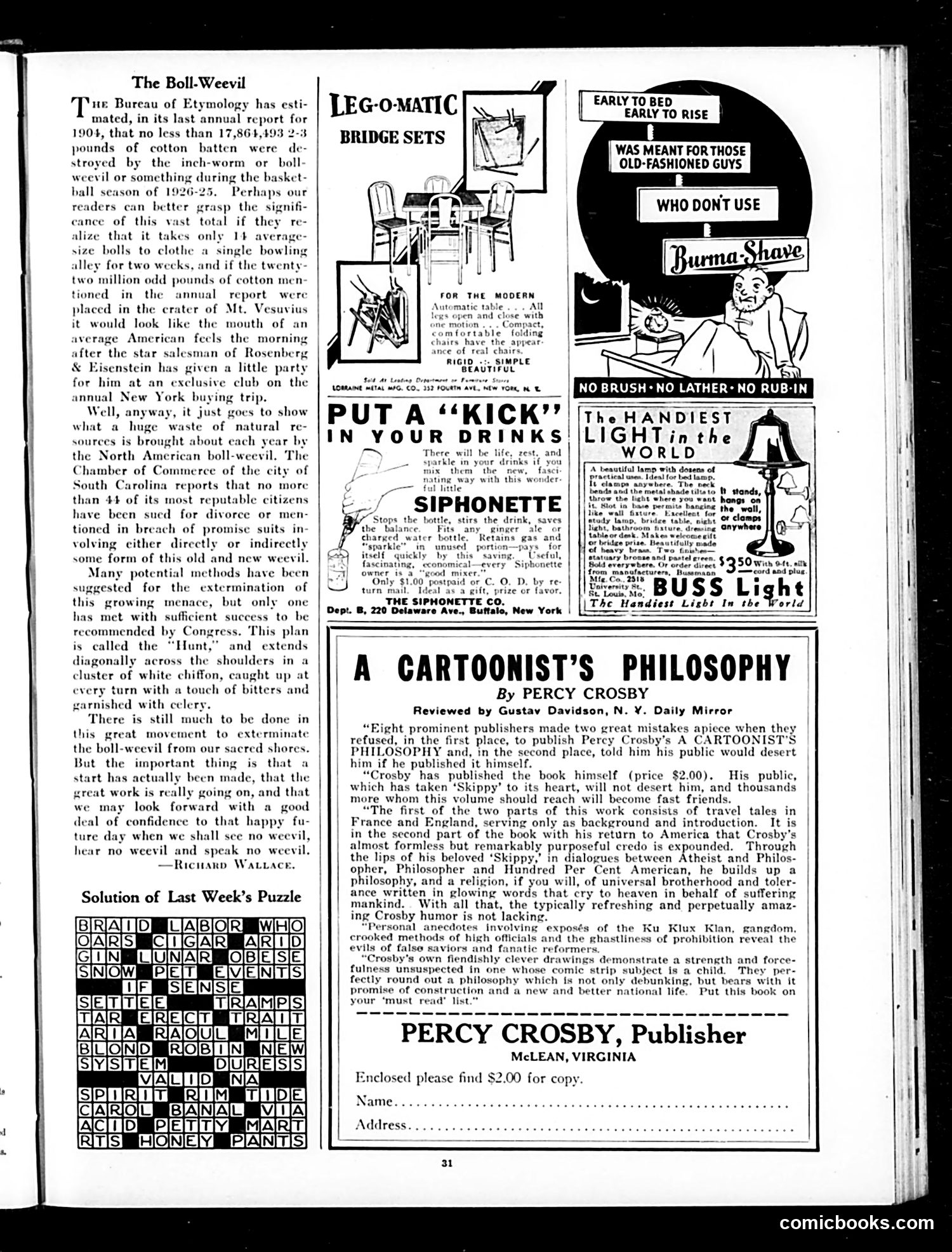
Analysis of This Judge Magazine Page This page is primarily advertising and book promotion rather than editorial satire, though it opens with a humorous essay. "The Boll-Weevil" essay (by Richard Wallace) satirizes the boll weevil pest that devastated Southern cotton crops in the early 1900s. The joke is absurdist: it mocks the Bureau of Etymology's attempt to quantify cotton destruction using deliberately nonsensical comparisons (relating it to bowling alley cloth and volcano craters). The essay's punchline about South Carolina's Chamber of Commerce reporting "no more than 44" divorce suits suggests wealthy citizens faced legal consequences from their behavior—a indirect jab at the South's establishment. The advertisements promote consumer products: Leg-o-Matic bridge sets (for the modern home), a Siphonette carbonation device for drinks, and Burma-Shave shaving cream. The main feature reviews Percy Crosby's self-published book *A Cartoonist's Philosophy*, noting that publishers rejected it but Crosby's fans (familiar with his "Skippy" comic strip) supported him. This was early 20th-century self-publishing advocacy. The page reflects Judge's mixed editorial-advertising model typical of that era.
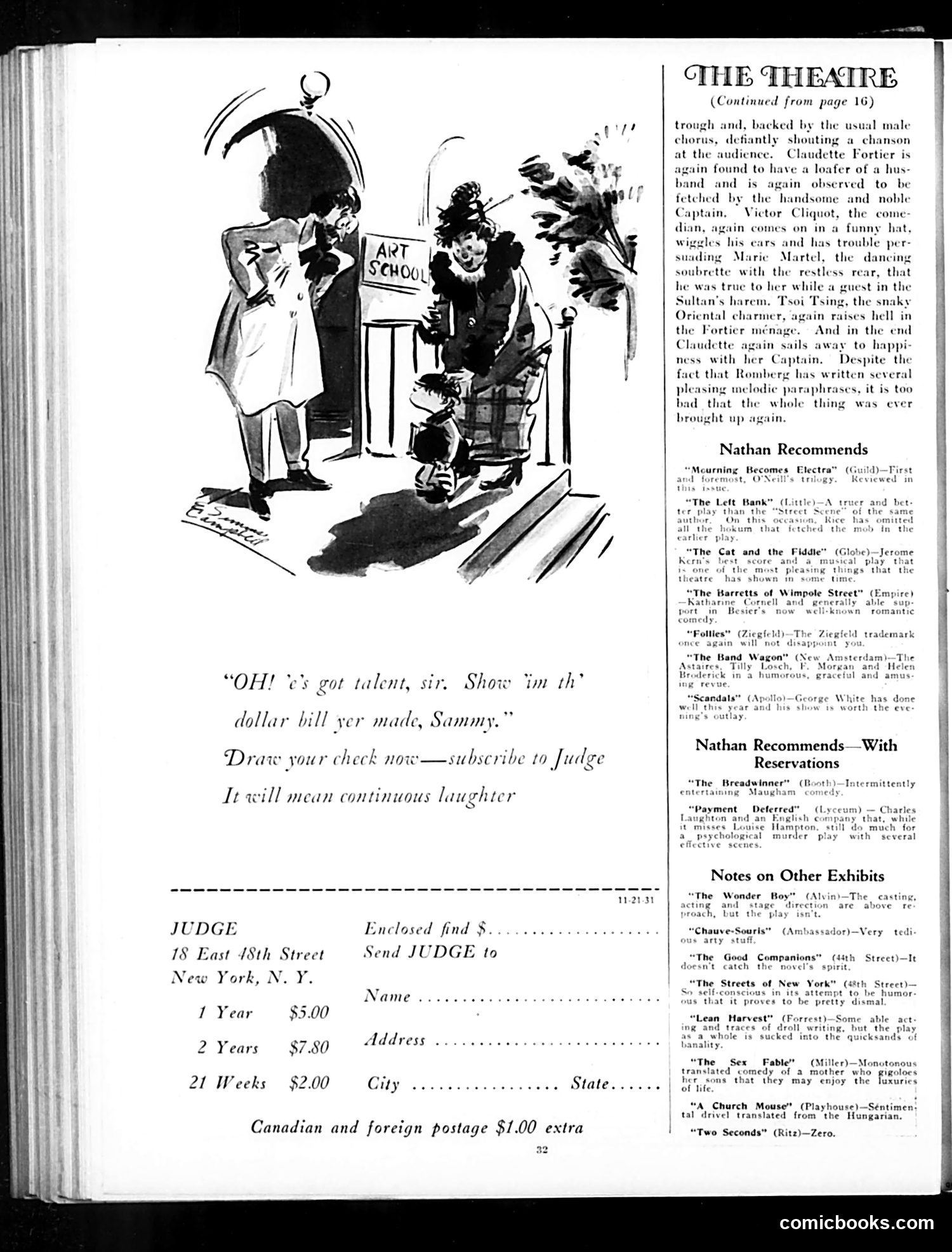
Judge Magazine Page Analysis This page contains a theatrical review section and subscription advertisement for Judge magazine. The main cartoon depicts an "Art School" scene where a talent scout or instructor declares to a young performer named "Sammy" that he has genuine talent worth paying for—the joke being the casual, colloquial expression "Show 'im th' dollar bill yer made." The accompanying text reviews a theatrical production (appears to be an operetta) with recurring character types: Claudette Fortier and her philandering husband, a charming captain, and various ethnic comedic stereotypes typical of 1920s-30s entertainment (an Oriental character named Tsoi Tsing, a dancing soubrette). The satire mocks the production's reliance on tired theatrical formulas and stock characters despite having composed music by Romberg. The right column lists Nathan's theater recommendations with brief critical assessments of current Broadway productions, using sharp, dismissive language ("Zero," "tedious stuff"). The subscription box offers Judge at various rates: $5 yearly, $7.80 for two years, or $2 for 21 weeks.
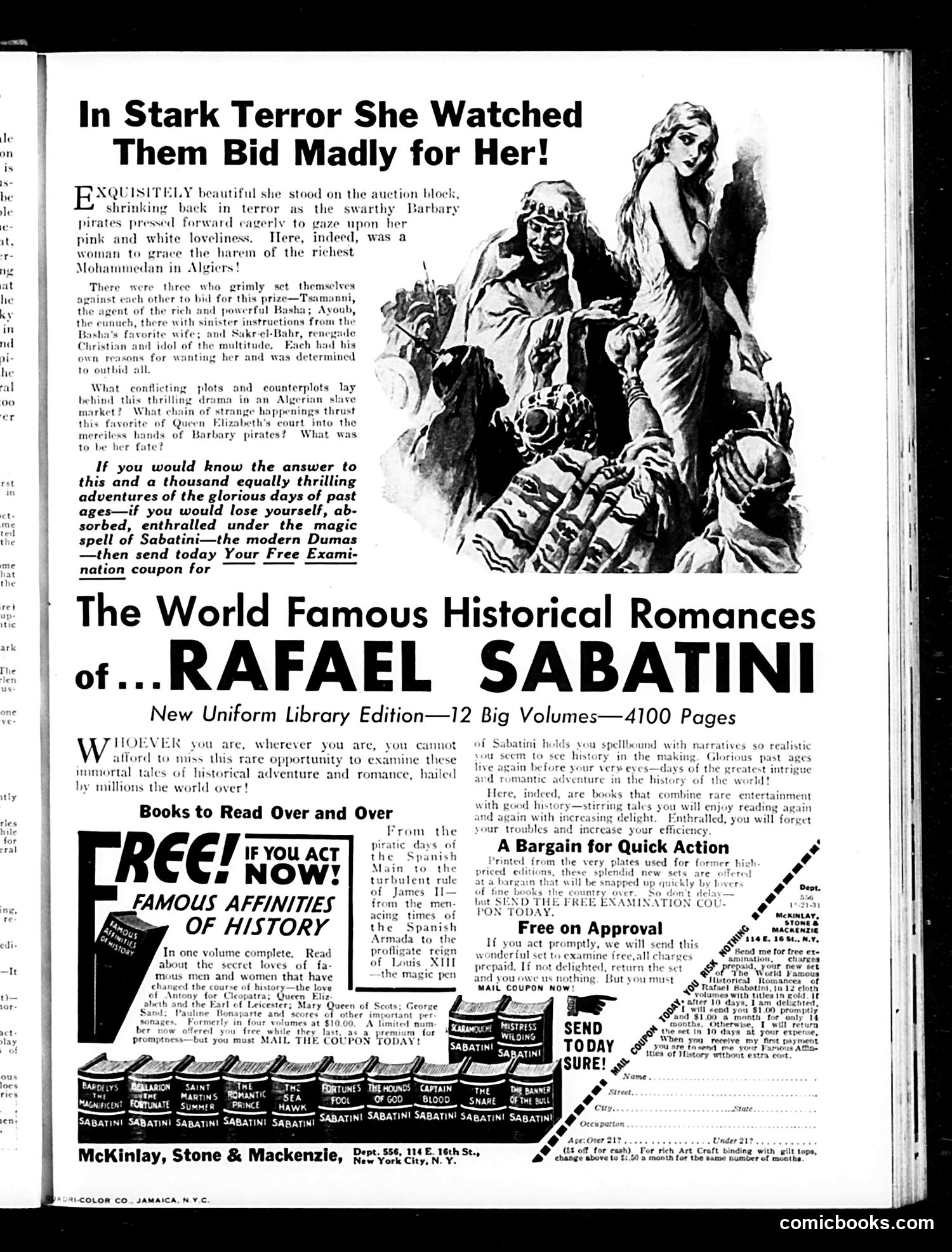
Analysis of Judge Magazine Advertisement Page This page is primarily a book advertisement, not satirical content. It promotes Rafael Sabatini's historical romance novels through a dramatic illustrated narrative. The illustration depicts a woman on an auction block being bid upon by Barbary pirates in North Africa. The text references "Queen Elizabeth's court," suggesting a historical romance plot involving European nobility captured by Mediterranean slave traders. The advertisement uses sensationalist language ("Stark Terror," "Madly") and melodramatic imagery typical of early 20th-century book marketing. By invoking historical adventure, exotic locales, and romantic intrigue, it appeals to readers seeking escapism through literature. The page includes a coupon for a "free examination" of Sabatini's 12-volume set, exemplifying direct-mail marketing tactics common to this era. This represents book publishing's attempt to reach mass audiences through periodicals like Judge. The content reflects period attitudes toward colonial/orientalist narratives rather than containing political satire.
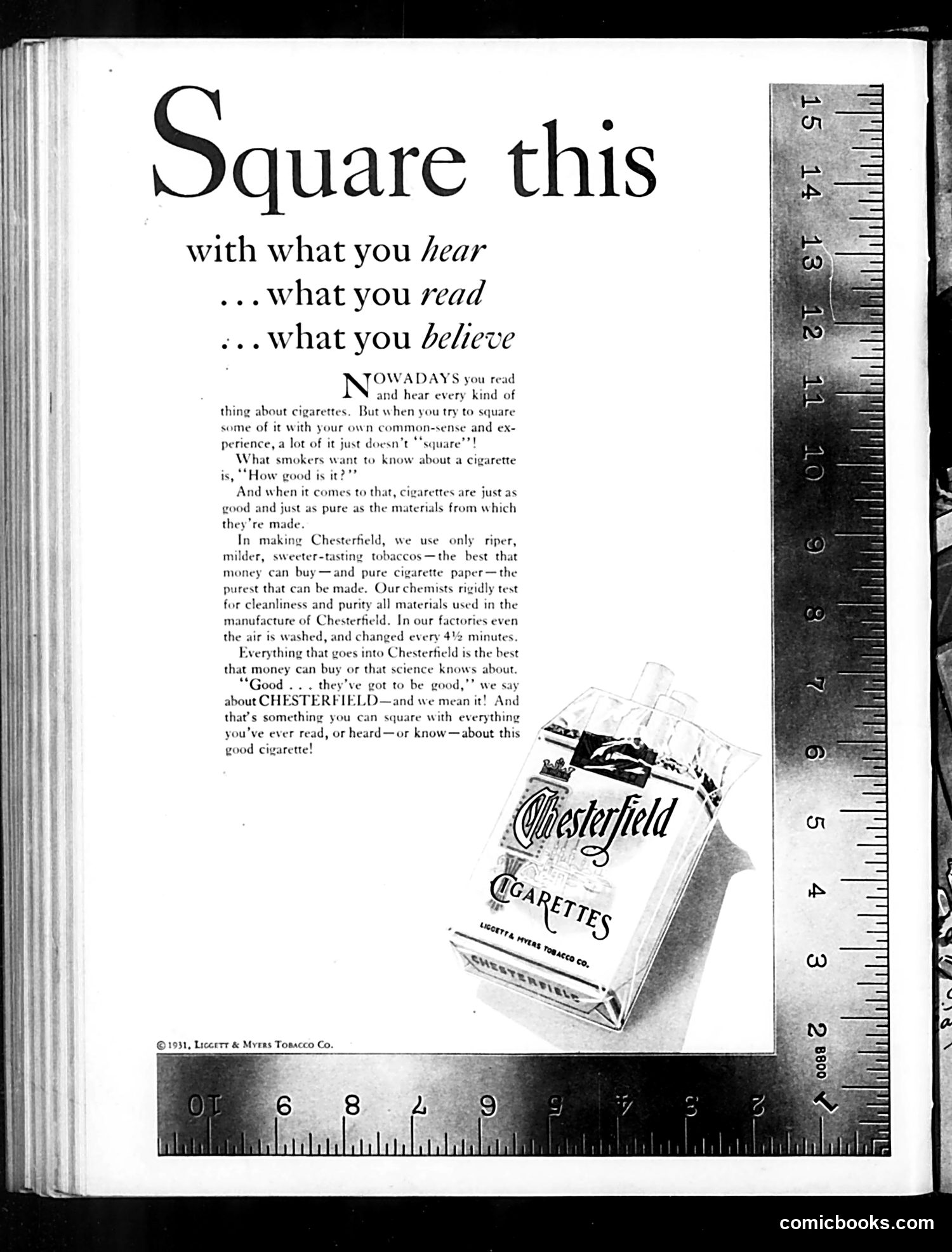
Chesterfield Cigarettes Advertisement (1931) This is not a political cartoon but a cigarette advertisement disguised as editorial content. The "satire" is implicit: the ad ironically addresses skepticism about cigarette claims by acknowledging that consumers hear conflicting information, then asks them to "square" (reconcile) advertising claims with common sense and experience. The pitch attempts to disarm criticism by appearing honest—admitting people read conflicting things about cigarettes, then claiming Chesterfield uses superior tobacco, pure paper, and rigorous quality control (air changed every 4.5 minutes, chemists testing materials). The cynical joke for modern readers: The ad's framing itself reveals the problem it claims to solve. By 1931, health concerns about cigarettes were circulating, making advertising claims questionable. The ad essentially says "ignore what you're hearing; trust us instead"—a rhetorical move that actually highlights why people *should* be skeptical. This reflects early cigarette marketing before health warnings were mandatory.