judge
Judge — December 5, 1931
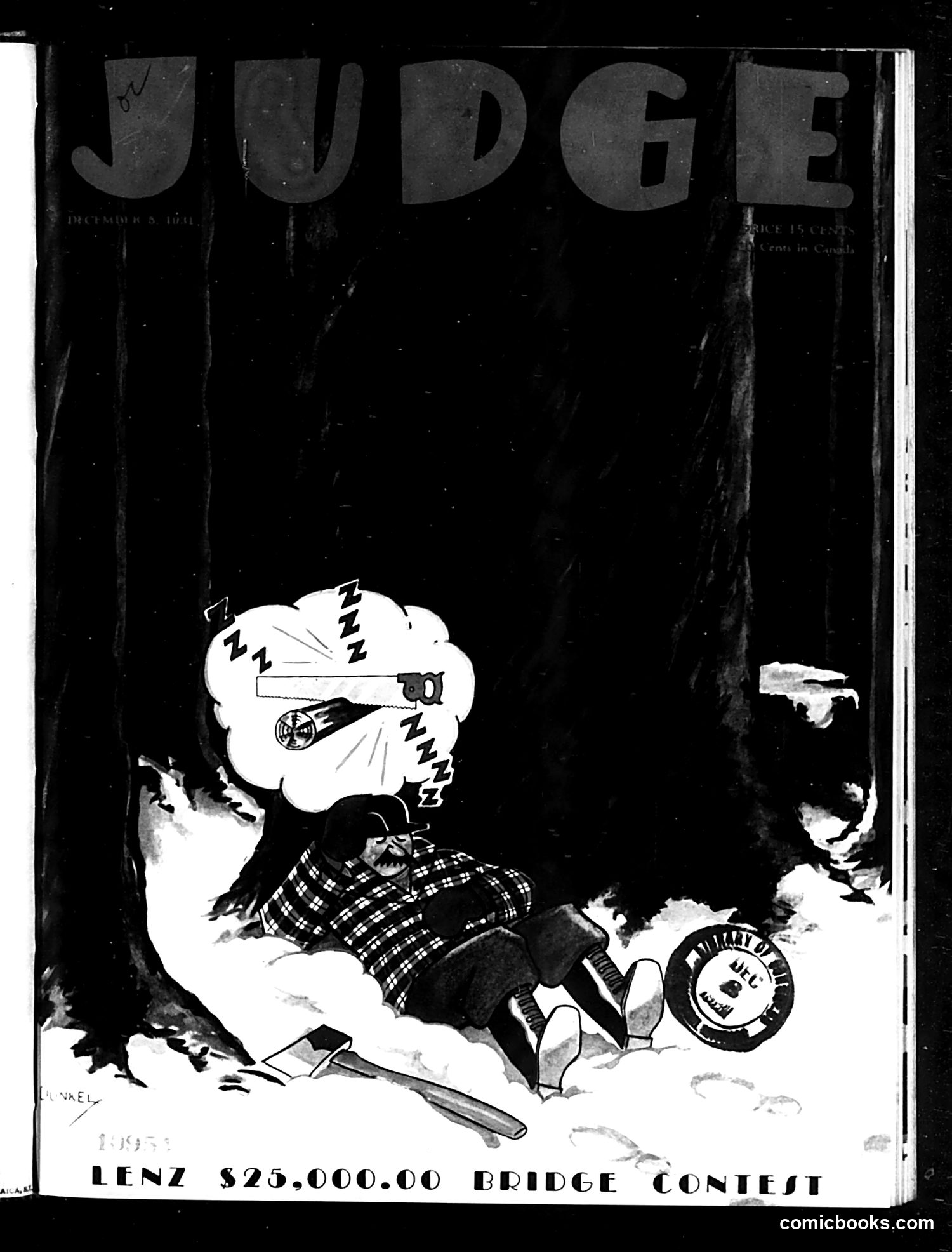
Political Cartoon Analysis This Judge magazine cover satirizes the "Lenz $25,000.00 Bridge Contest," likely referencing a real competition or proposal from the early 20th century. The cartoon depicts a sleeping figure in a plaid shirt lying in snow, dreaming of a telescope or surveying instrument (shown in a thought bubble with "Z"s indicating sleep). The figure appears to be a bridge engineer or contestant, humorously suggesting that designing or winning this bridge contest requires both technical skill and perhaps some luck or wishful thinking. The snowy setting and sleeping pose may mock the impracticality or difficulty of the contest itself. The circular seal on the lower right is partially visible but unclear. The satire likely criticizes the contest's terms, feasibility, or the dreamlike optimism of participants.
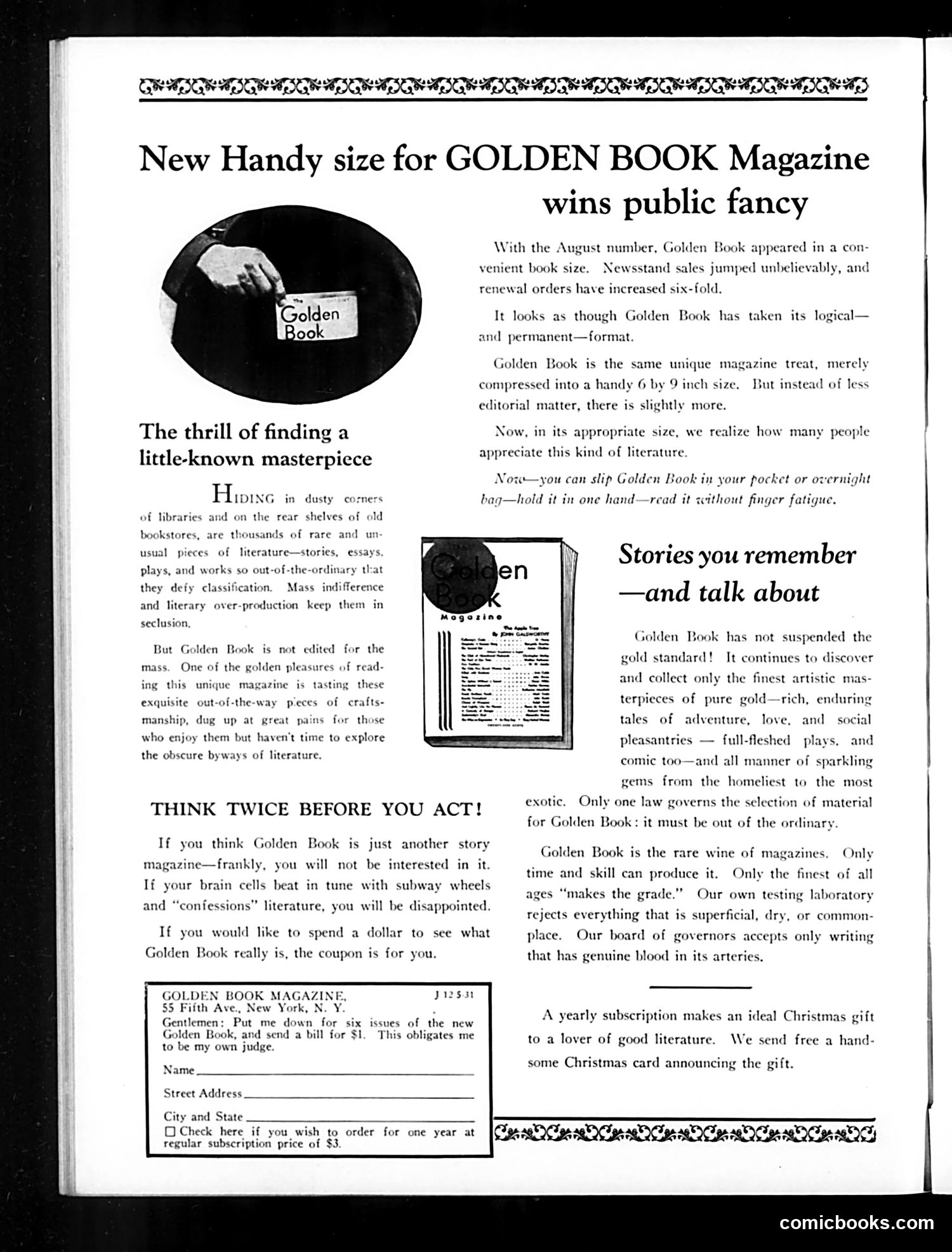
Analysis This page is primarily advertising copy, not political satire. It promotes Golden Book Magazine's new handy 6-by-9-inch format, launched in their August issue. The advertisement uses marketing language typical of early 20th-century literary magazines, emphasizing exclusivity and sophistication. It positions Golden Book as curating rare, high-quality literature for educated readers who appreciate obscure works unavailable in mass-market publications. The only visual element is a photograph showing the magazine's new compact size in a hand, plus an image of the magazine's cover. The text's somewhat condescending tone toward "mass indifference" and emphasis on "blood in its arteries" reflects period attitudes about literary elitism—the magazine appeals to those who consider themselves above ordinary readers. This is primarily a subscription solicitation, not editorial commentary.
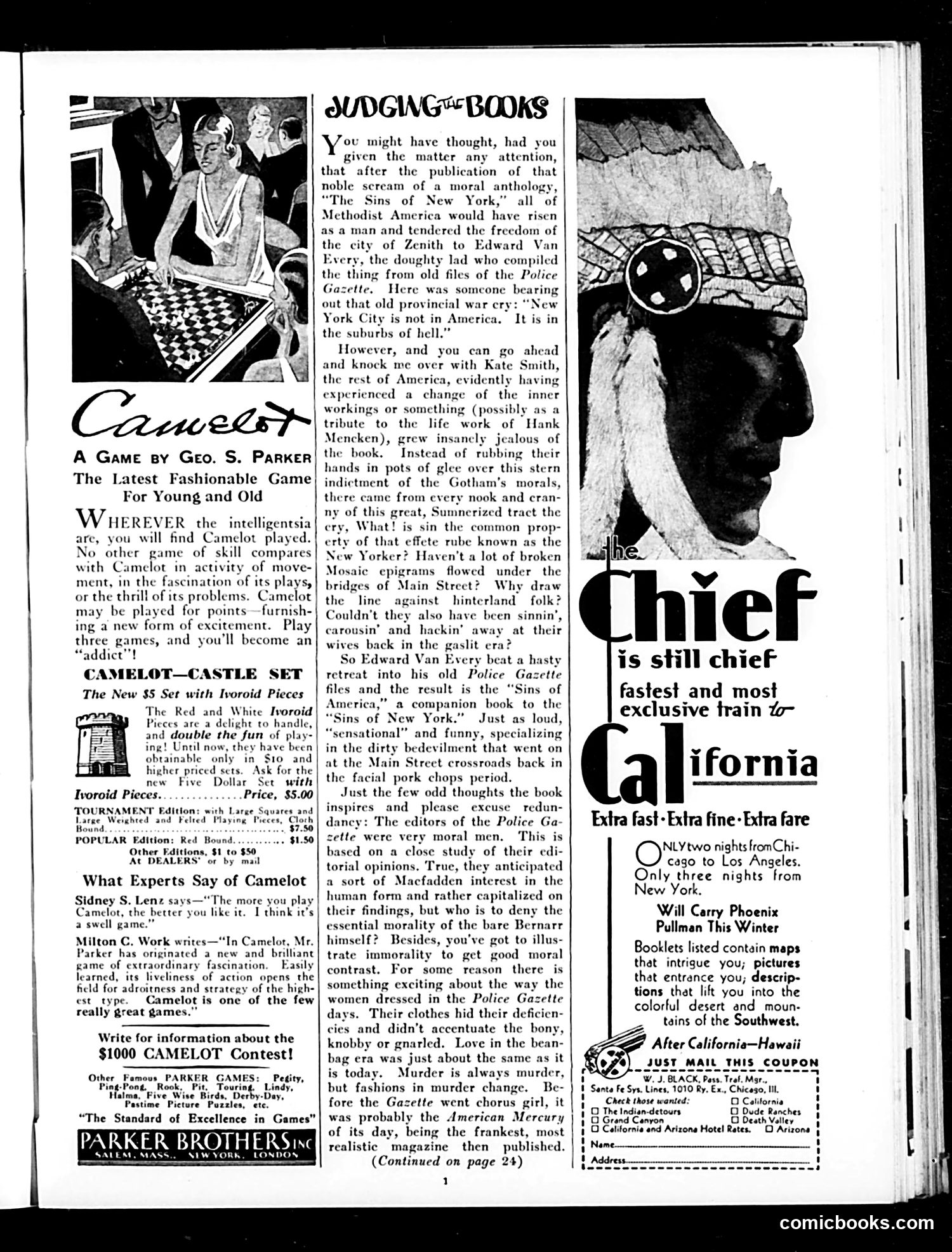
Analysis of Judge Magazine Page This page is primarily advertising and book reviews rather than political satire. The main content includes: 1. "Camelot" Game Advertisement - A board game by Geo. S. Parker advertised as fashionable entertainment for "young and old" 2. "The Sins of New York" Book Review - The text discusses a moral anthology that apparently criticized New York City's perceived depravity. The review notes that despite the book's stern moral judgments, New York continues unchanged—suggesting satirical commentary on the ineffectiveness of moral crusades against urban vice. 3. "California" Train Advertisement - Promoting the fastest train service between Chicago, New York, and Los Angeles The page reflects early 20th-century concerns about urban morality and the emerging consumer culture of games and travel advertising.
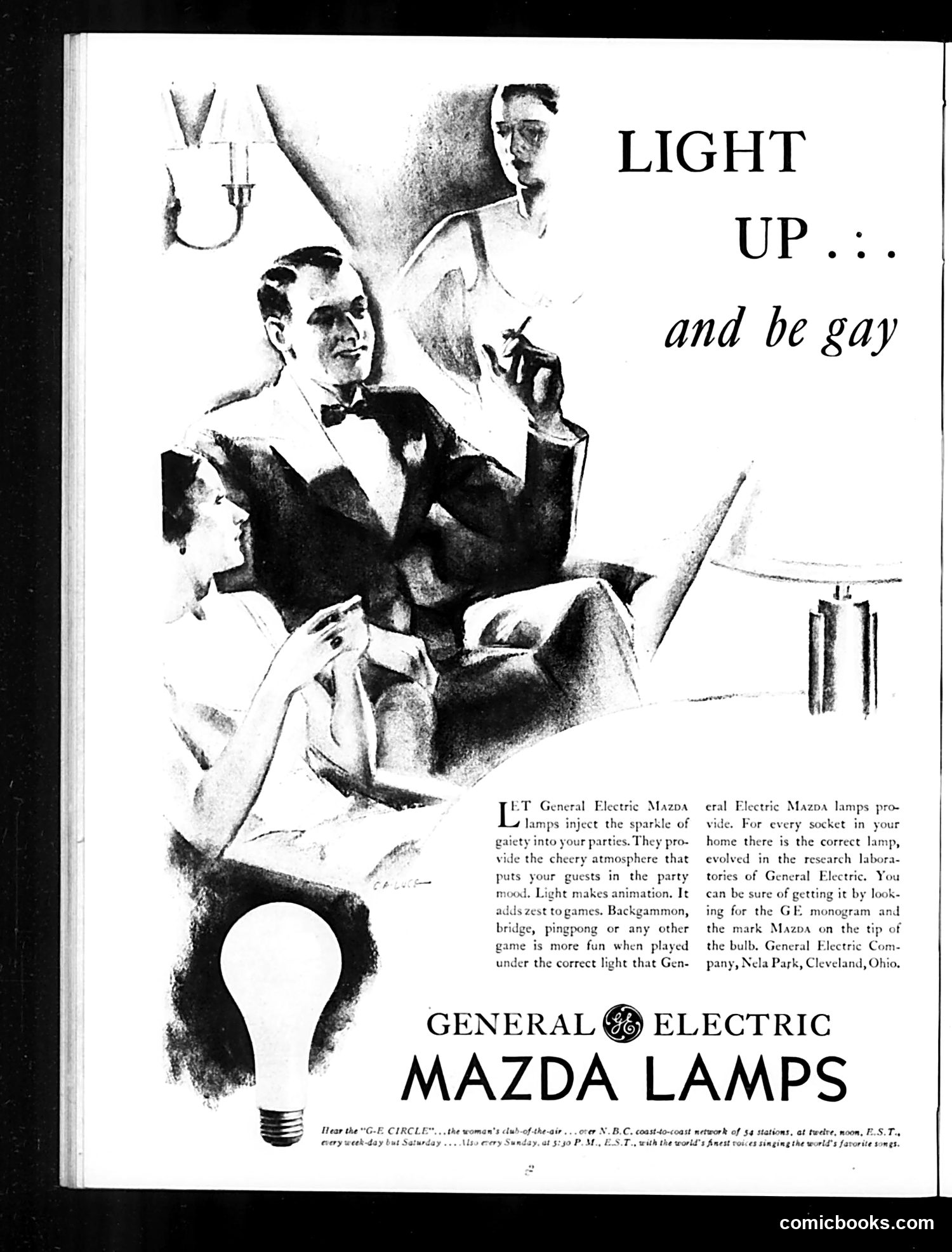
Analysis This is primarily a General Electric Mazda Lamps advertisement, not political satire. The page shows stylized illustrations of well-dressed people at a social gathering, with the tagline "LIGHT UP... and be gay." The ad argues that proper lighting—specifically GE Mazda brand bulbs—enhances home entertainment and party atmospheres. It claims correct lighting makes games like backgammon and bridge "more fun" and creates the right "cherry atmosphere" for socializing. The word "gay" here uses its mid-20th century meaning: cheerful or lighthearted. The advertisement is selling the idea that quality electric lighting improves one's social life and entertaining abilities. This reflects the era's marketing of modern electric home conveniences as essential to successful, pleasant living.
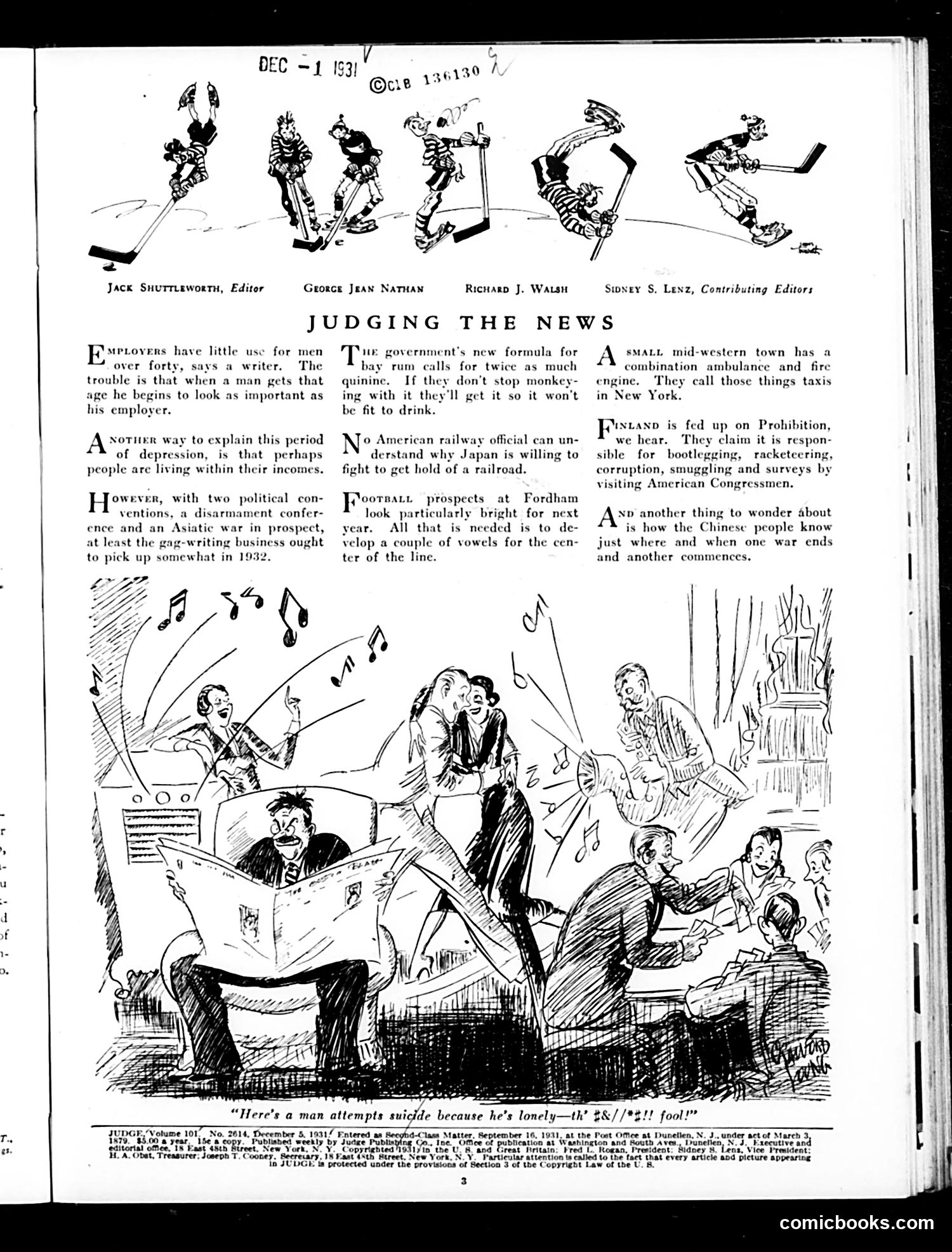
"Judging the News" - December 1, 1931 This page contains editorial commentary and a main cartoon titled "Here's a man attempts suicide because he's lonely—th' *'ll fool!!!!" The cartoon satirizes callousness during the Great Depression. A man in a bed (apparently attempting suicide) is surrounded by indifferent or mocking figures—some playing music, others gesturing dismissively. The joke's bitter irony: instead of sympathy for someone driven to despair by loneliness and economic hardship, he receives ridicule. The accompanying text snippets criticize various topics: aging workers facing unemployment, Japanese railway expansion, Prohibition enforcement failures, and Chinese conflict. The satire captures early-1930s cynicism about social problems and public indifference to human suffering during economic crisis.
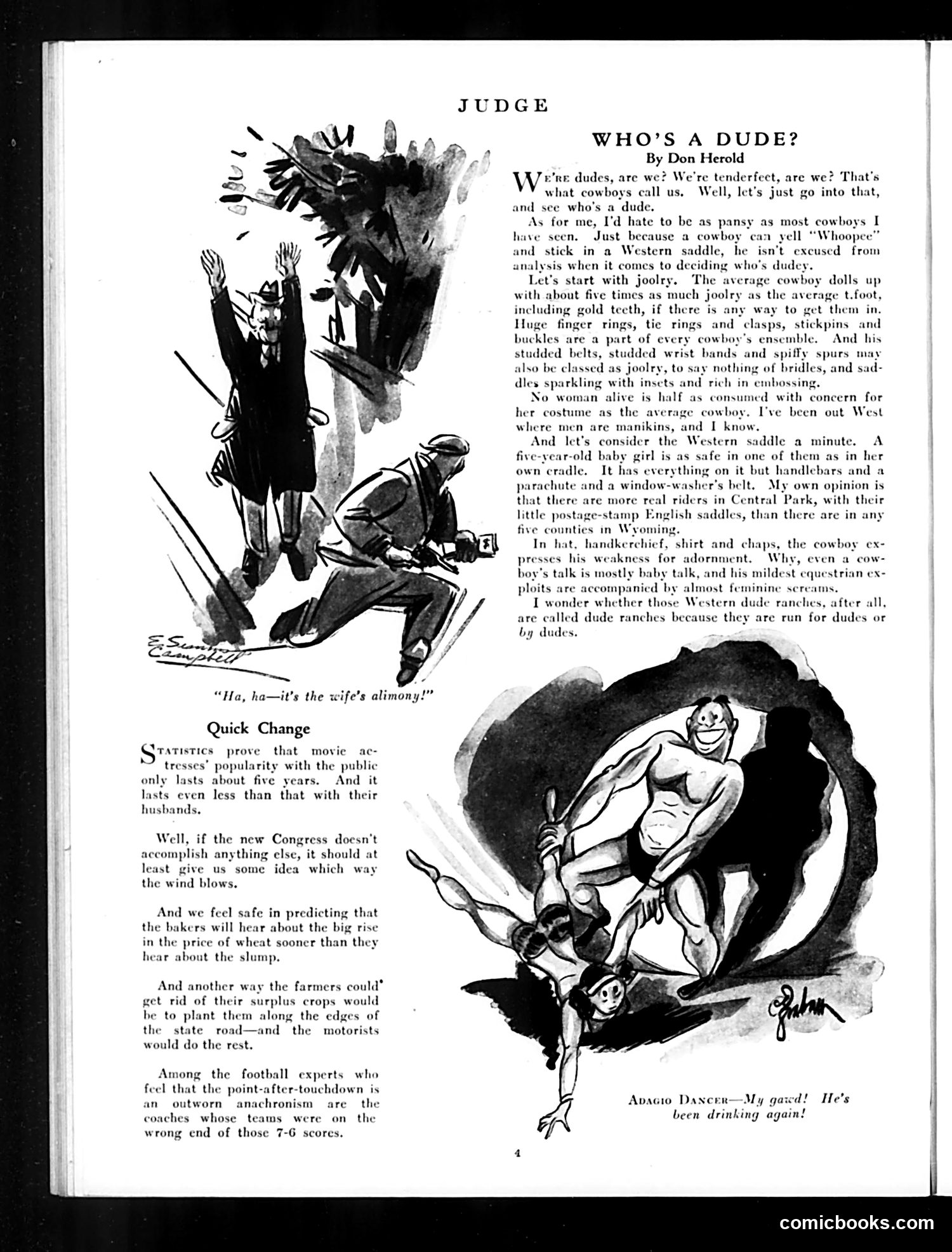
Analysis of Judge Magazine Page This page contains two distinct pieces: "Who's a Dude?" by Don Herold examines cowboy fashion and masculinity. Herold argues that despite their tough image, cowboys are actually quite concerned with appearance—jewelry, studded belts, decorative saddles—and thus qualify as "dudes." The satire mocks the contradiction between cowboys' claimed ruggedness and their actual vanity. The cartoon illustration supports this by depicting an exaggerated, fashionably-dressed cowboy figure. "Quick Change" offers brief political commentary on Congress and farming issues, mentioning movie actresses' popularity and predictions about bread prices and surplus crops. The cartoonist's signature appears to read "Yadkin." Overall, the page uses humor to critique masculine pretension and comment on contemporary agricultural and political concerns.
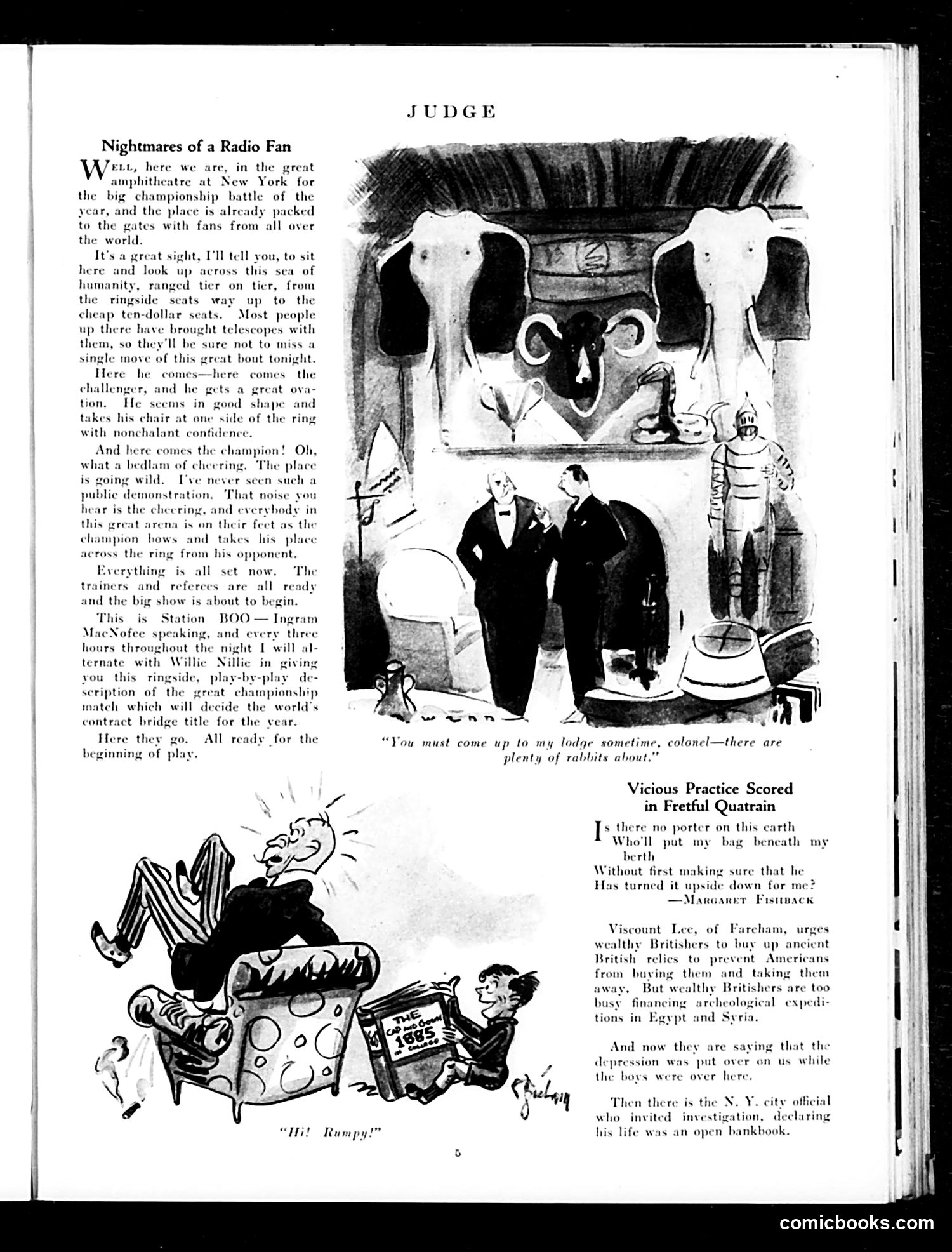
Analysis of Judge Magazine Page The page contains two distinct pieces: "Nightmares of a Radio Fan" depicts the excitement of listening to a championship boxing match broadcast on radio. The main cartoon shows a radio audience experiencing the event vicariously through broadcast commentary. The humor satirizes radio listeners' intense emotional investment in events they cannot physically see—they're dependent entirely on the announcer's description and their imagination to follow the action. "Vicious Practice Scared in Fretful Quatrain" includes a Margaret Fishback poem criticizing hotel porters. The accompanying cartoon shows a disheveled figure labeled "1865," likely representing outdated practices or old-fashioned service standards. The lower cartoon ("Hi! Rumpy!") appears to be unrelated comic filler, though its specific reference is unclear without additional context. The satire generally mocks radio culture's novelty and its emotional pull on the public.
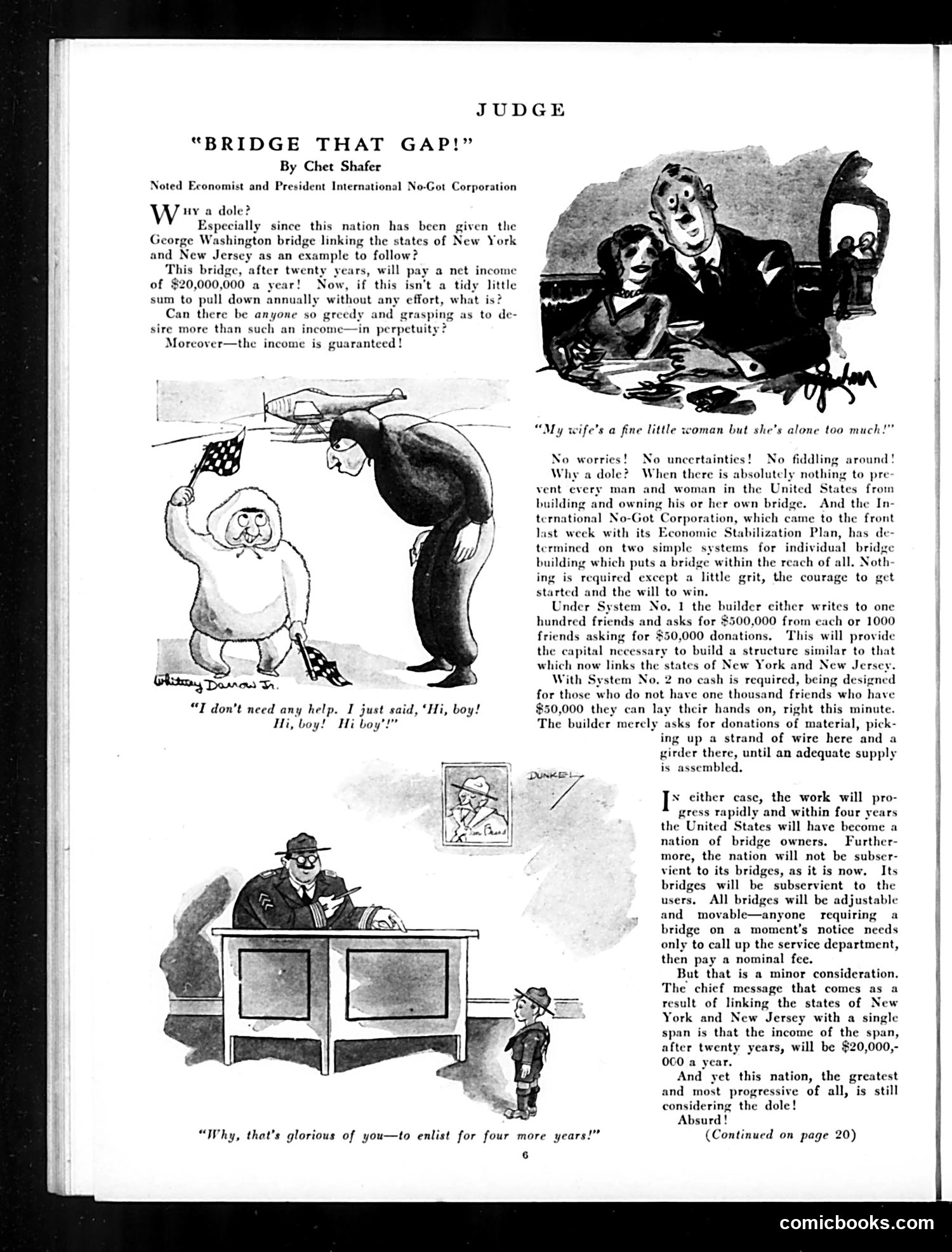
"Bridge That Gap!" - Judge Magazine Satire This satirical article by Chet Shafer mocks a proposal to make individual bridge-building accessible to ordinary Americans. The cartoon argues that the George Washington Bridge (linking New York and New Jersey) demonstrates bridge-building's profitability—generating $20 million annually. The satire presents two absurd "systems" for democratizing bridge ownership: System No. 1 asks wealthy individuals for donations ($500,000 each), while System No. 2 requires no cash, just voluntary material donations. The accompanying cartoons ridicule this notion—showing an enthusiastic but delusional character claiming he needs no help, and a bureaucratic official questioning someone's enlistment. The piece satirizes both blind optimism about economic opportunity and the impracticality of crowdfunding infrastructure projects.
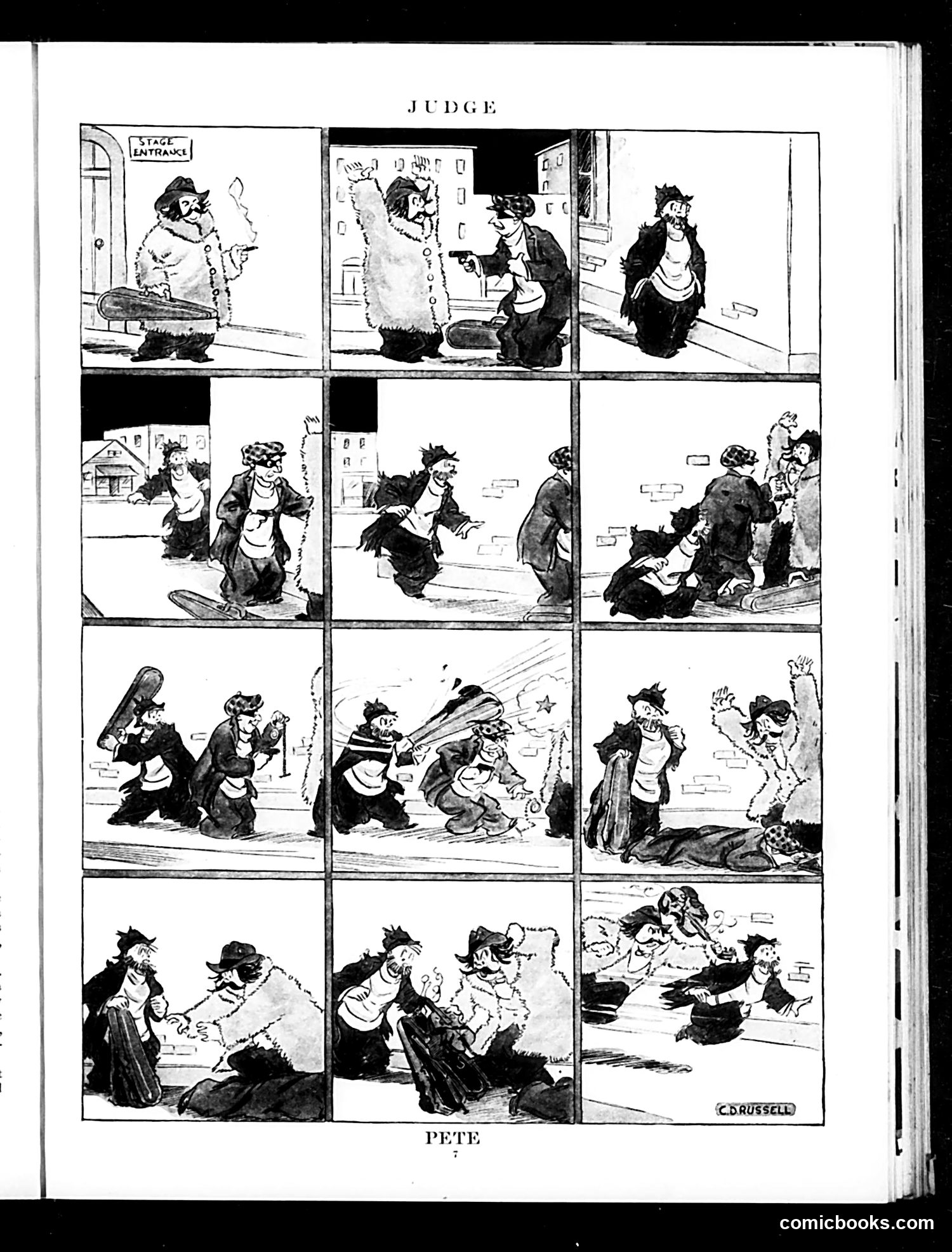
"Judge Pete" Cartoon Analysis This is a sequential comic strip titled "Judge Pete" by C.D. Russell, appearing in *Judge* magazine. The narrative follows what appears to be a magistrate or judge character through various scenes involving confrontations and chaos on city streets and indoors. The strip satirizes urban police court proceedings and street-level justice, showing the judge character repeatedly engaged in physical altercations and comedic mishaps. The exaggerated, slapstick style typical of early 20th-century American comics suggests the humor derives from the dignified "Judge" figure's undignified involvement in street brawls and disorder. Without clearer OCR text or additional context, the specific political or social commentary remains unclear, though it likely comments on urban law enforcement or judicial authority of its era.
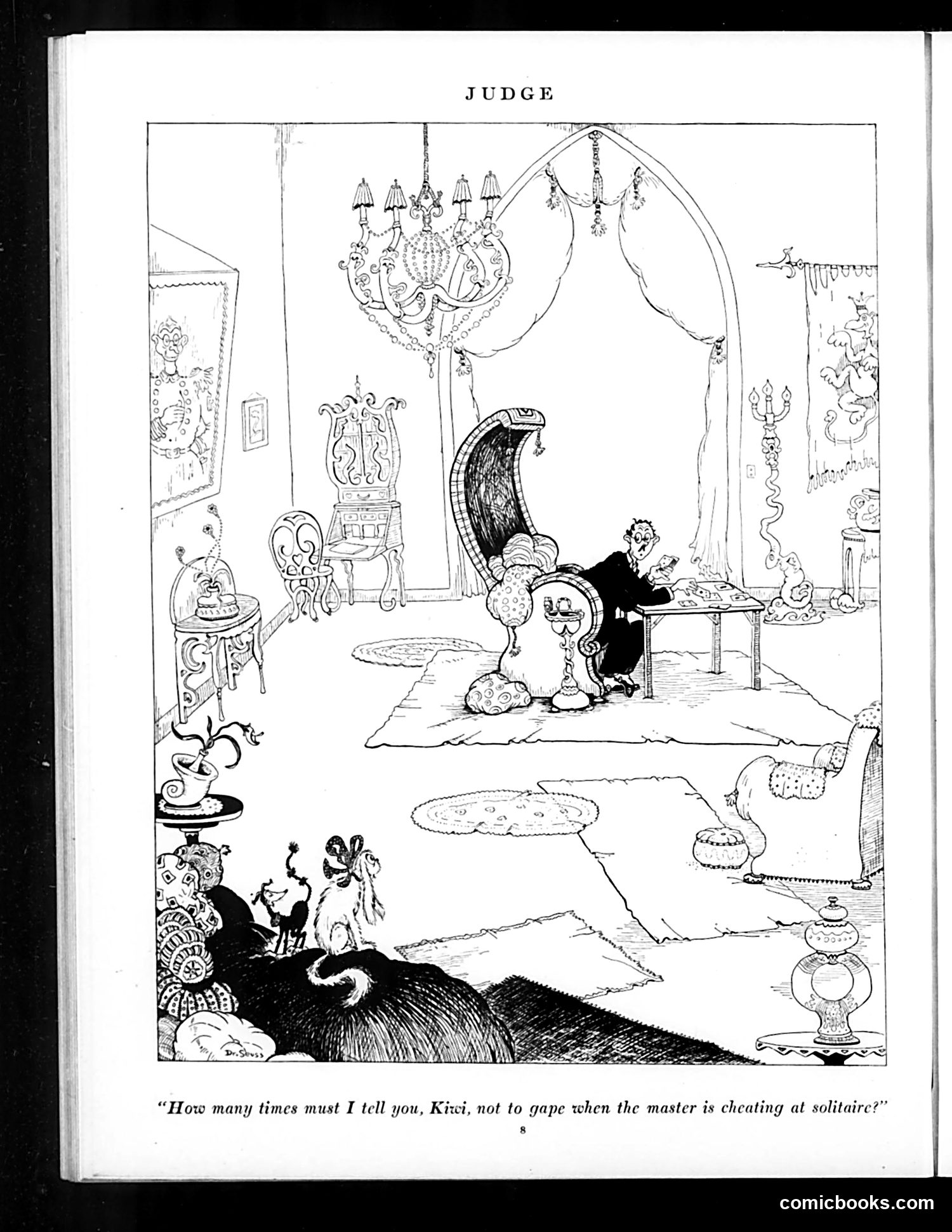
Analysis This single-panel cartoon satirizes hypocrisy and social pretense among the wealthy. A well-dressed man sits at a table playing solitaire while apparently cheating—manipulating the cards. His pet monkey, "Kiwi," watches openly, prompting the man's indignant rebuke about gaping. The humor works on multiple levels: the master criticizes the animal for witnessing his dishonesty while engaged in that very dishonesty; he's concerned with *appearances* of propriety rather than actual honesty. The ornate, luxurious interior setting (chandelier, decorative furnishings) emphasizes that this is someone of means and social standing, making the petty cheating at a solitary card game even more ridiculous. The cartoon mocks the pretentiousness of the upper class—their obsession with maintaining a facade of respectability regardless of their actual behavior.
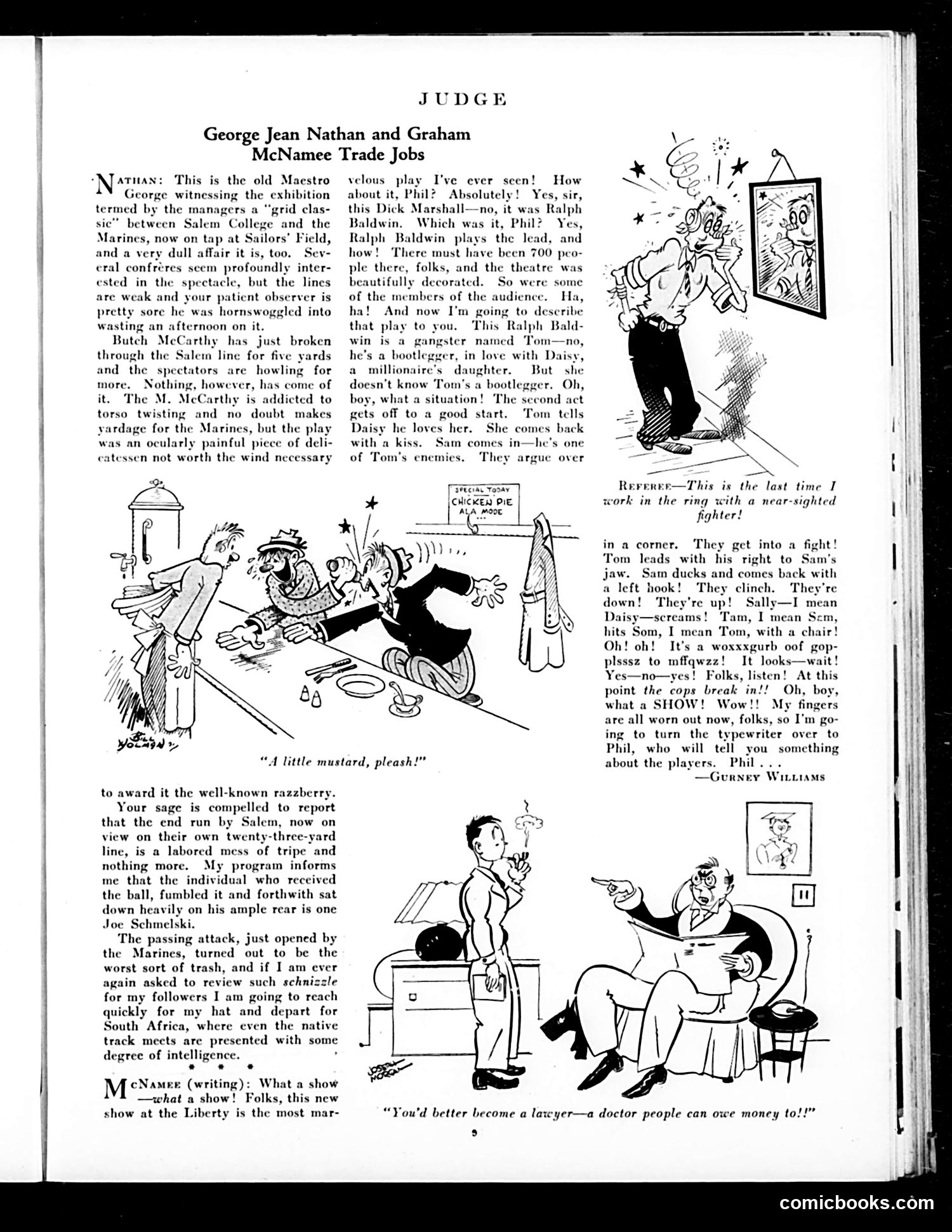
Analysis of Judge Magazine Page This page satirizes two prominent figures trading jobs: George Jean Nathan (theater critic) and Graham McNamee (famous radio sports broadcaster). The top section mocks Nathan covering a boring college football game at Sailors' Field, dismissing the Marines-Salem match as tedious "tripe." The bottom section ridicules McNamee attempting theater criticism, breathlessly describing a melodramatic play with a gangster-bootlegger plot in his characteristic excited radio style—repeating character names incorrectly, losing track of the story, and delivering overwrought play-by-play commentary ("It's a woxxxgurb oof gop-pssz"). The joke: each man is hilariously incompetent outside his specialty. Nathan finds football boring and writes dismissively; McNamee's breathless sports-announcer delivery is absurdly inappropriate for theater, reducing drama to incomprehensible excitement. The cartoons illustrate the chaos of their mismatched assignments—Nathan bored at a game, McNamee overwhelmed and confused at a theatrical event.
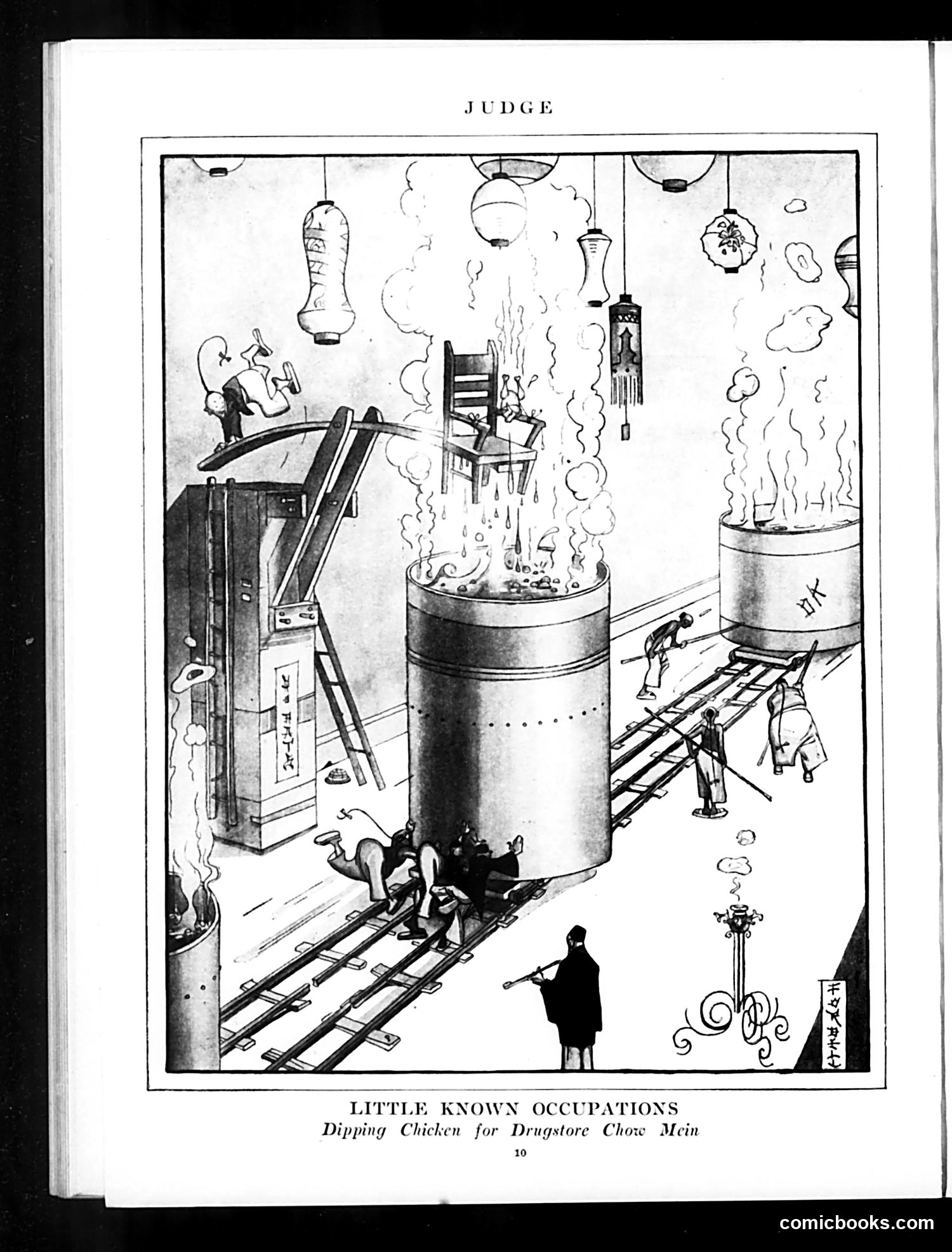
"Judge" Magazine Cartoon Analysis This is a satirical cartoon mocking Chinese-American restaurant food, specifically chow mein served in drugstores—a common casual dining option in early-to-mid 20th century America. The cartoon depicts an absurdly dangerous industrial operation where workers dip chickens into enormous vats of boiling liquid using factory equipment and rail systems. The exaggeration is the joke: presenting mundane drugstore food preparation as an elaborate, perilous manufacturing process. The title "Little Known Occupations" uses deadpan humor, treating this imaginary job as a legitimate profession worthy of documentation. The cartoon likely reflects both the novelty of Chinese food in American popular culture and contemporary stereotypes about mass-production and questionable food quality in casual eateries. The style and content suggest this dates from the early-to-mid 20th century, when such casual ethnic food mockery was standard magazine fare.
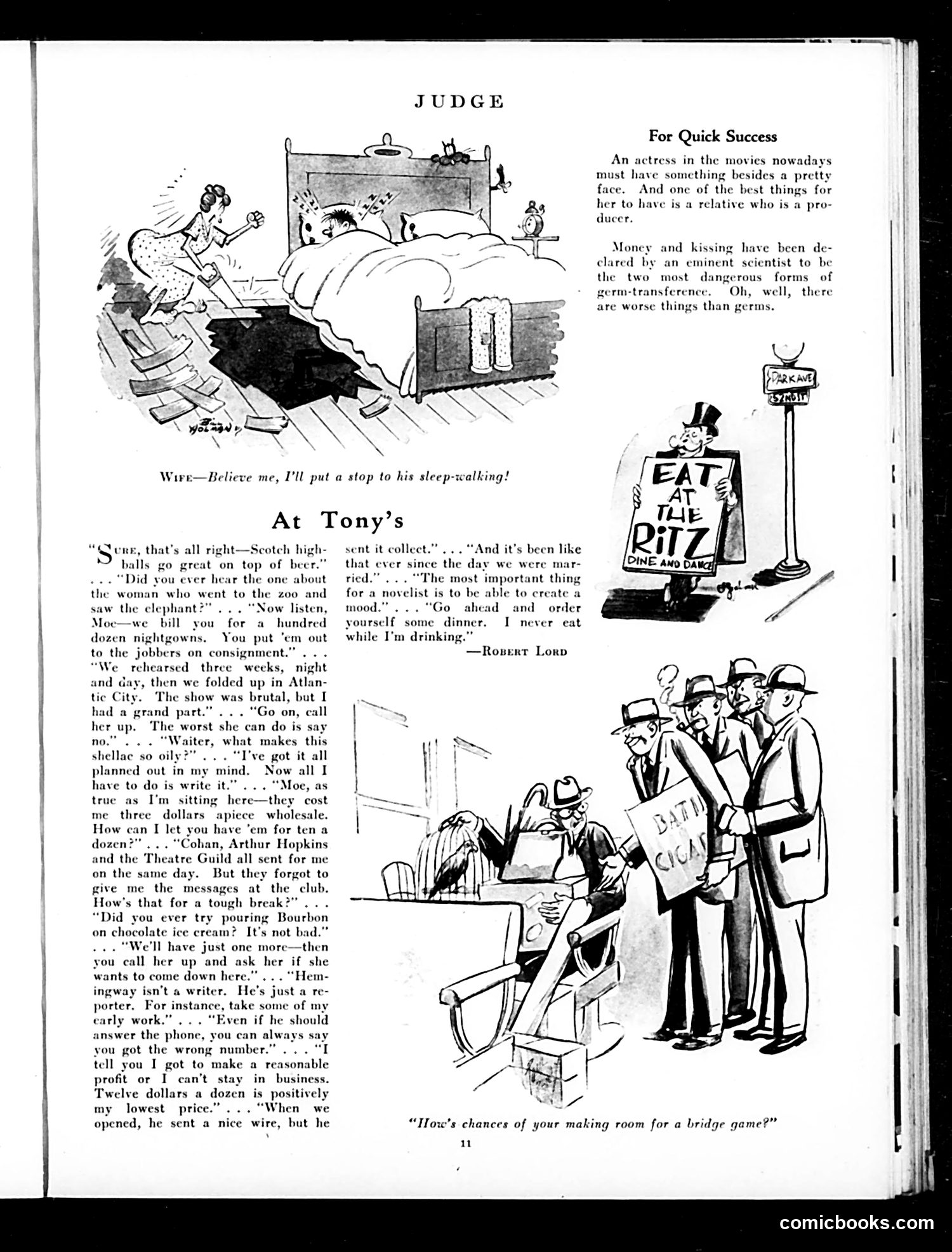
Judge Magazine Page Analysis This page contains satirical content targeting early 20th-century entertainment and social circles. Top cartoon: A wife threatens to stop her husband's sleepwalking, depicted as he wanders near a bedroom. The joke plays on marital anxiety about nighttime behavior. "At Tony's" section: A lengthy monologue (credited to Robert Lord) reproduces overheard bar conversations—likely at a real establishment frequented by theater people and writers. The satirized figures include Broadway producers, playwrights (Cohan, Hopkins, possibly Hemingway), and business people. Topics mock: theatrical gossip, failed productions, wholesale pricing disputes, romantic complications, and artistic pretension. The humor targets how these men drink, boast, complain, and rationalize business dealings and infidelity. Right-side advertisements/cartoons: Include a Ritz restaurant advertisement and a cartoon about crowded apartments, poking fun at urban living constraints. Sidebars: Brief satirical notes about actresses needing producer relatives for success, and scientific claims about money and kissing spreading germs. The overall tone satirizes male entertainment-industry culture through exaggerated dialogue and social commentary.
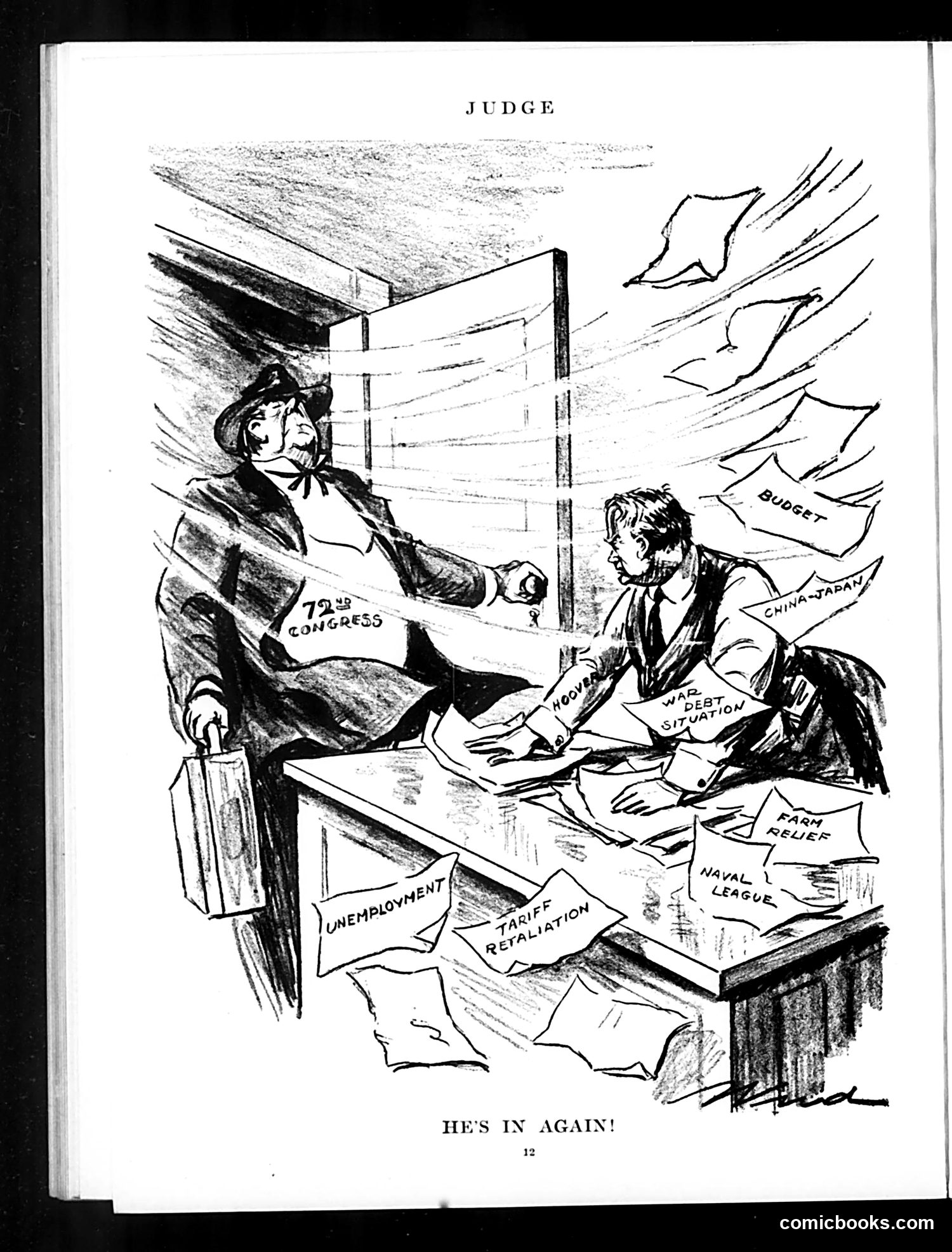
Political Cartoon Analysis: "He's In Again!" This Judge magazine cartoon satirizes a returning political figure dealing with recurring national crises. The central figure—appearing to be a government leader or president—enters juggling multiple urgent policy issues labeled on papers: "72nd Congress," "Unemployment," "Tariff Retaliation," "Hoover" (likely Herbert Hoover's administration), "Budget," "China-Japan," "War Debt Situation," "Farm Relief," and "Naval League." The title "He's In Again!" suggests this figure has returned to office facing the same or worsening problems as before. The cartoon critiques the cyclical nature of political challenges and the apparent inability to resolve these crises. The overwhelmed figure with bulging briefcase emphasizes how Congress and government leadership are buried under mounting domestic and international obligations.
"Judge on the Bench" — Analysis This page from *Judge* magazine contains three satirical opinion columns rather than cartoons. "Music in Time of Stress" criticizes how economic depression has devastated the arts in Europe and America, while praising the Soviet Union's investment in orchestras and concert halls—a pointed jab at the failure of American capitalism to support culture. The author notes the irony that radio (a modern technology) might rescue classical music through a broadcasting prize competition. "Good Old Home Cooking" celebrates the Waldorf-Astoria Hotel's hiring of female chefs for American dishes, challenging the convention that professional cooking is "men's work." It also mocks fears about declining home cooking, given modern convenience foods. "Courtesy, not Morality" (partial) references a survey by the Manning Publishing Company questioning rural Americans about women smoking—appearing to debunk generalizations that "all women smoke now" based on urban trends. The overall tone satirizes contemporary social anxieties and hypocrisies during what appears to be the Depression era.
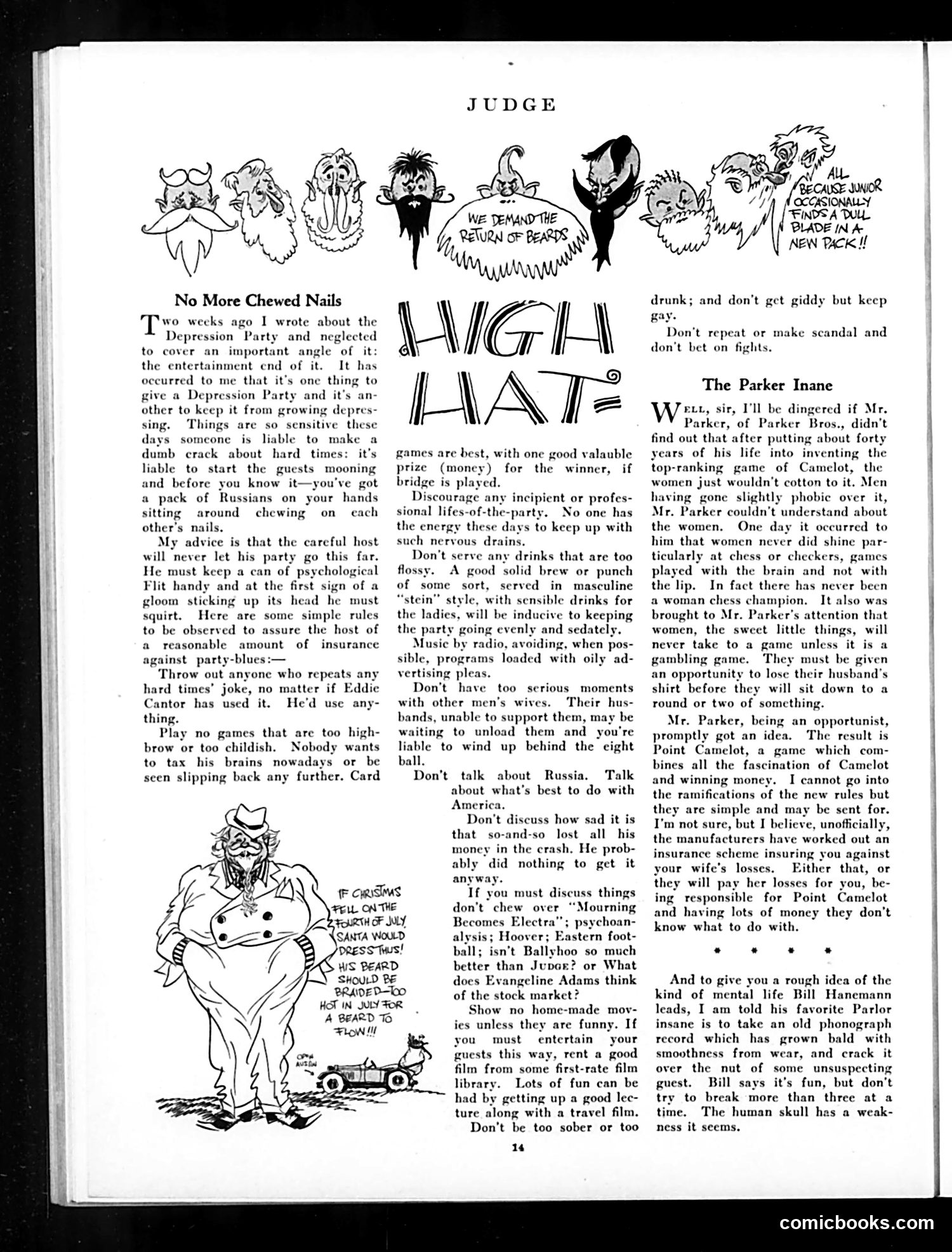
Explanation for Modern Readers This page from Judge magazine addresses Depression-era social etiquette. The top section offers satirical advice for hosting a "Depression Party"—a gathering during the economic crisis. The humor lies in warning hosts to prevent guests from becoming depressed by avoiding sensitive topics (Russia, financial losses) and depressing entertainment. The cartoon at bottom-left depicts Santa Claus with a beard, likely mocking the absurdity of Depression-era poverty. The article "The Parker Inane" discusses a board game inventor (Parker Bros.) frustrated that women won't play his game "Camelot." The piece satirizes gender stereotypes: women allegedly prefer games involving money/gambling over intellectual games like chess, and judge women as chatty rather than cerebral. This reflects 1930s sexist attitudes about women's intellectual capacity and gambling habits. The overall tone uses dark humor to address Depression hardships while revealing period assumptions about gender, class, and entertainment.
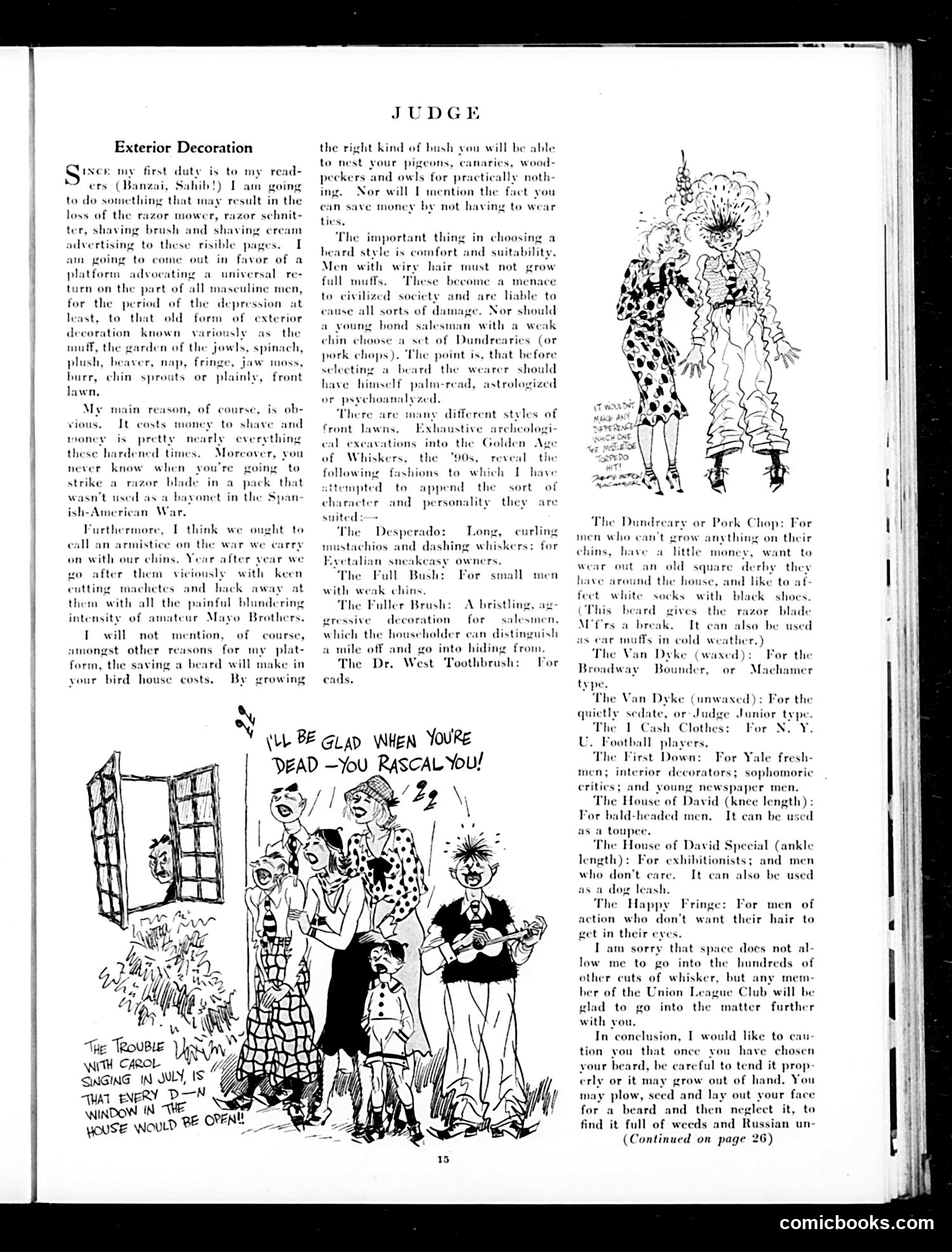
"Exterior Decoration" — Judge Magazine Beard Satire This is a humorous essay advocating that men grow beards during the Depression to save money on razors and shaving supplies. The author sarcastically catalogs different beard styles matched to social types: the "Desperado" for "Italian sneakeasy owners," the "Fuller Brush" for aggressive salesmen, the "Dundreary or Pork Chop" for men of modest means, and the "House of David" for exhibitionists or the indifferent. The cartoon below shows a domestic quarrel where a man threatens his wife ("I'll be glad when you're dead—you rascal you!"), apparently over her singing. The joke's context suggests marital discord during Depression-era hardship. The satire mocks both Depression-era frugality and the pretentiousness of naming beard styles after social stereotypes, while the cartoon illustrates working-class domestic tension of the period.
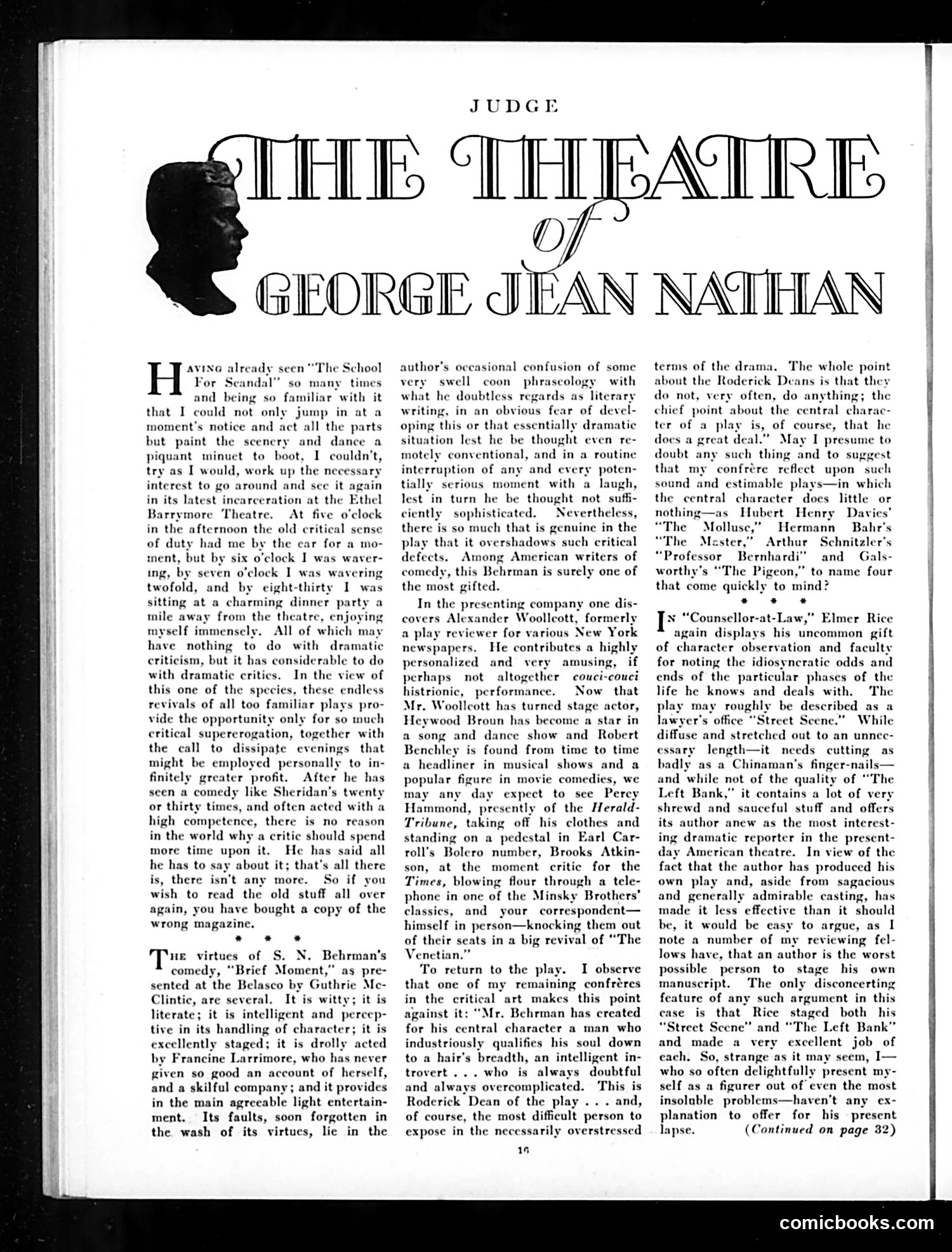
Judge Magazine Theater Criticism Page This page from *Judge* magazine contains theater reviews, not political cartoons. The silhouette at top shows George Jean Nathan, a prominent drama critic of the era. Nathan criticizes the endless revivals of classic plays like Sheridan's comedies, arguing critics waste time reviewing them repeatedly when they've already said everything worth saying. He uses this to justify skipping yet another production. He then reviews S.N. Behrman's "Brief Moment," praising its wit and intelligence while noting Behrman's occasional lapses into affected language and over-reliance on comedy to avoid genuine drama. Nathan sardonically remarks that several New York theater critics-turned-performers (Alexander Woollcott, Heywood Broun, Robert Benchley) have become actors themselves, suggesting Percy Hammond and Brooks Atkinson may soon follow—a joke about critics abandoning their posts for show business careers.
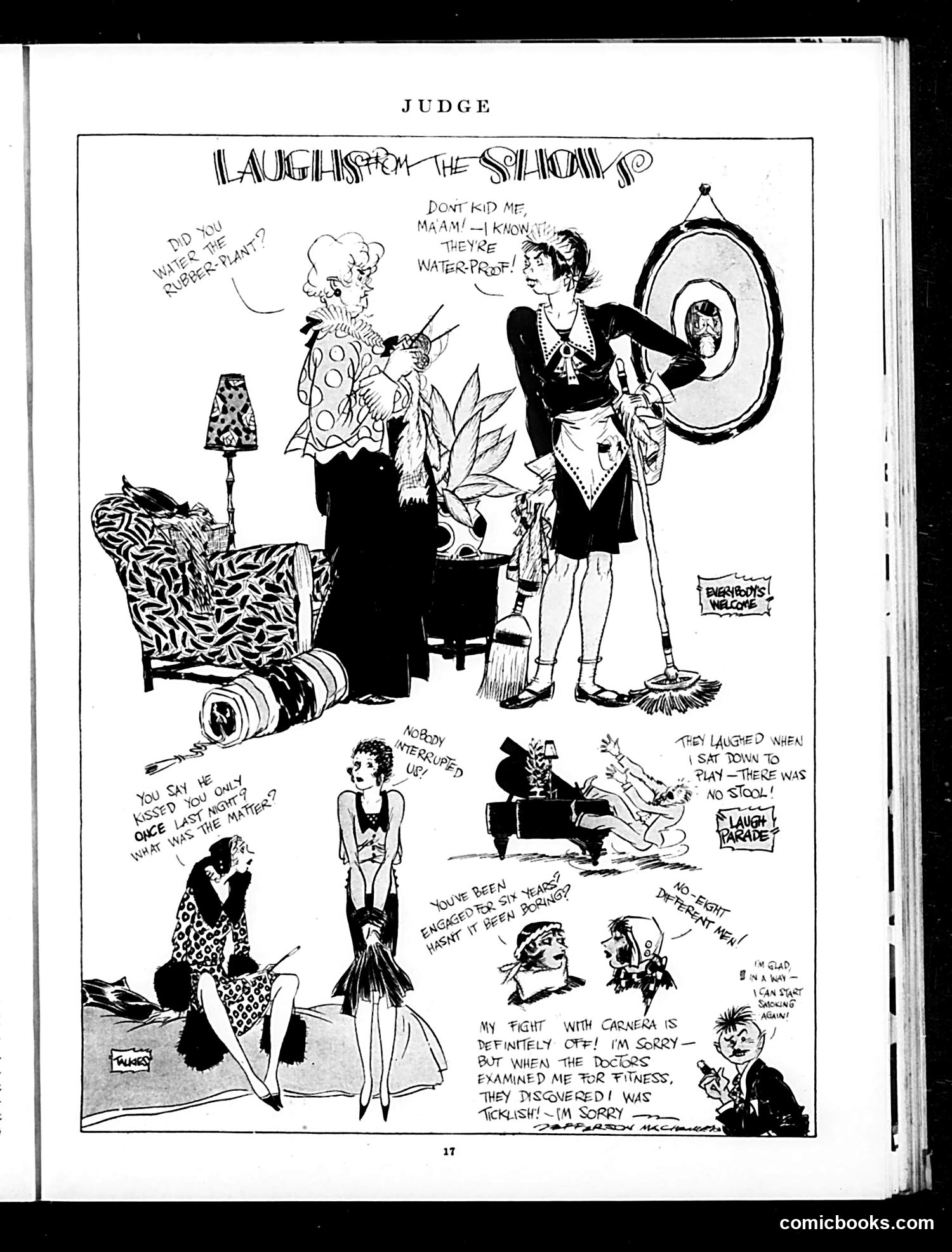
"Laughs from the Show" - Judge Magazine Cartoon This is a multi-panel domestic comedy satirizing upper-class women's social pretensions and gossip. The main scene depicts an elaborately dressed woman holding a mirror, speaking with a maid about water-proofing—a joke about the woman's vanity and concern with appearance. The lower panels show women gossiping about scandals: one mentions being caught without a stool while playing (suggesting an undignified social mishap), another references "Carnera" (likely boxer Primo Carnera) and a cancelled fight, with a character claiming doctors found them "ticklish" rather than physically unfit—a humorous excuse. The satire targets wealthy women's obsession with social status, fashion, and frivolous concerns, while poking fun at their tendency to spread rumors and make excuses. The "Judge" magazine's typical satirical stance criticizes upper-class affectation and superficiality through comedic exaggeration.
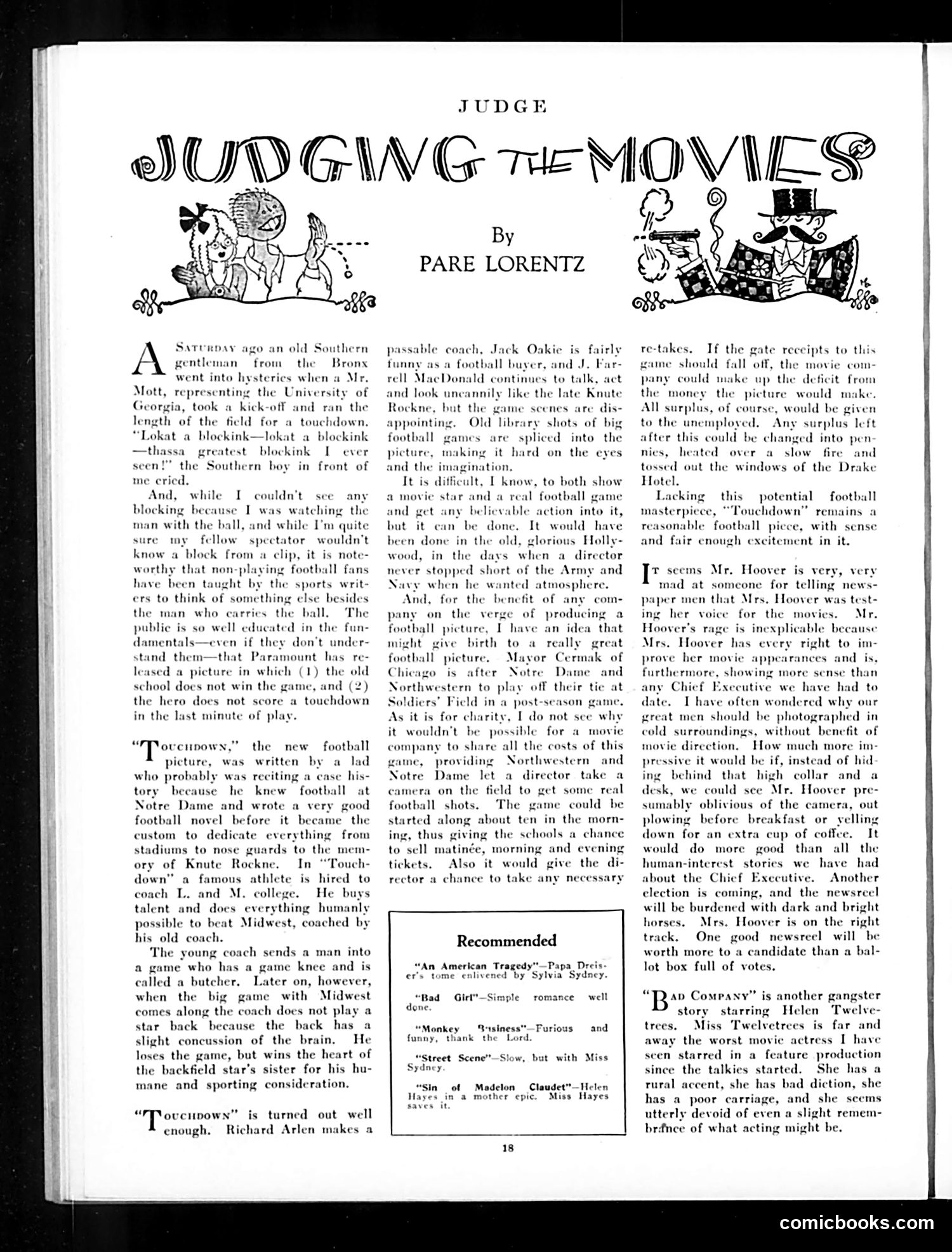
Judge Magazine: "Judging the Movies" by Pare Lorentz This film criticism column reviews "Touchdown," a 1930 college football movie starring Richard Arlen and Jack Oakie. Lorentz critiques how Paramount depicts football: the studio has become so focused on teaching audiences technical terminology that they've forgotten how to make compelling drama. The satire targets Hollywood's reliance on cheap spectacle—splicing old newsreel footage into new films rather than shooting authentic action. Lorentz mocks the industry's reverence for Knute Rockne (the famous Notre Dame coach, recently deceased) and its formulaic hero narratives. Notably, Lorentz proposes a novel solution: that Mayor Cermak organize a real Notre Dame-Northwestern charity game, allowing a film crew to capture genuine football footage and split profits with the universities. This reflects 1930s optimism about cinema's documentary potential and public-private collaboration, while satirizing Hollywood's inability to achieve realism through conventional means.
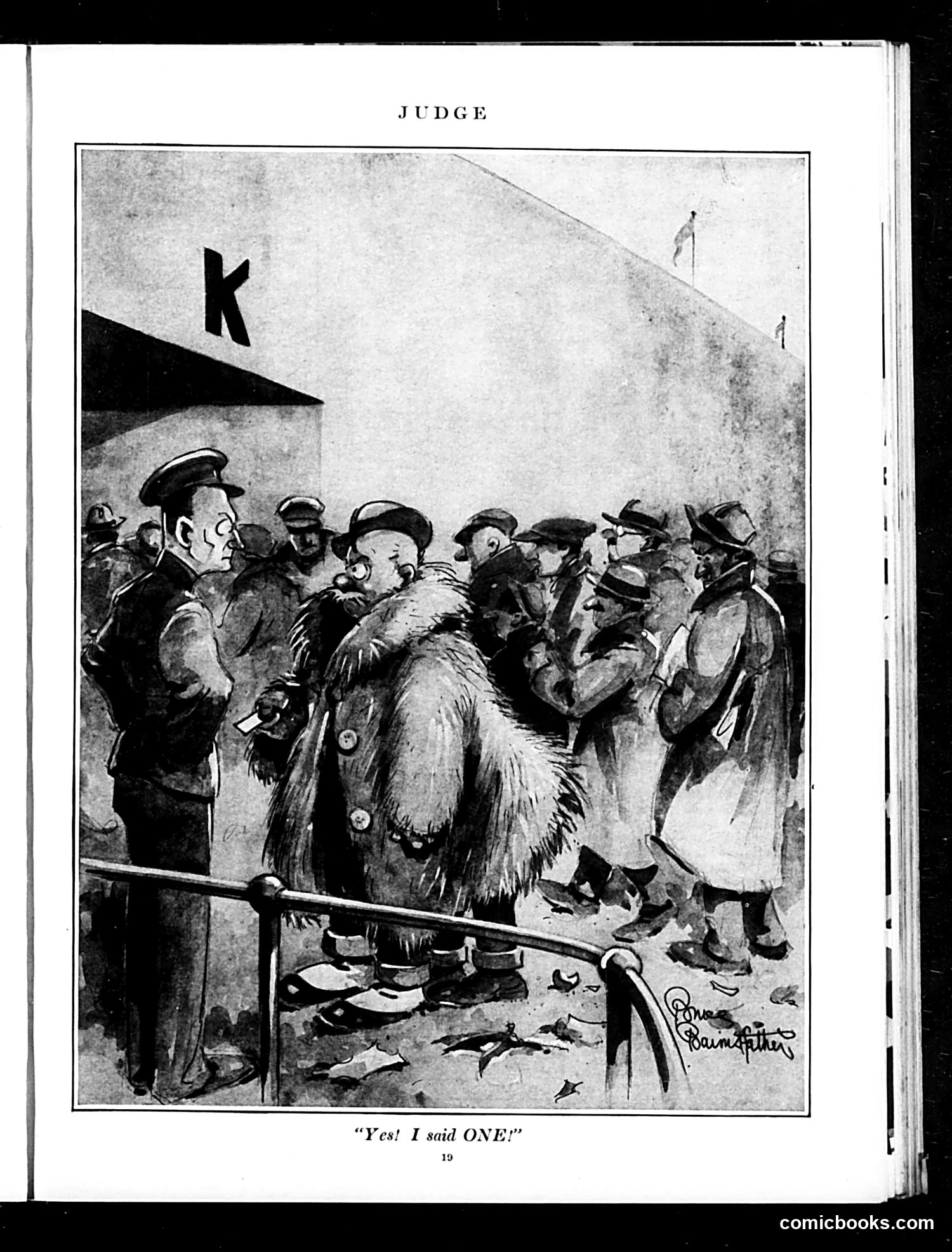
Analysis This Judge cartoon depicts a courtroom scene titled "Yes! I said ONE!" The central figure appears to be a judge or authority figure in fur robes, surrounded by what looks like defendants, lawyers, or court attendants in period dress and hats. The "K" visible on the wall likely indicates a courtroom designation. The humor appears to stem from a misunderstanding about quantity—someone insisting they said "one" (singular) rather than a larger number, given the crowd of people present. This likely satirizes either judicial proceedings, legal confusion, or bureaucratic mix-ups common to the era. Without knowing the specific historical moment, the exact political reference remains unclear, though it appears to mock courtroom absurdity or legal authority figures.
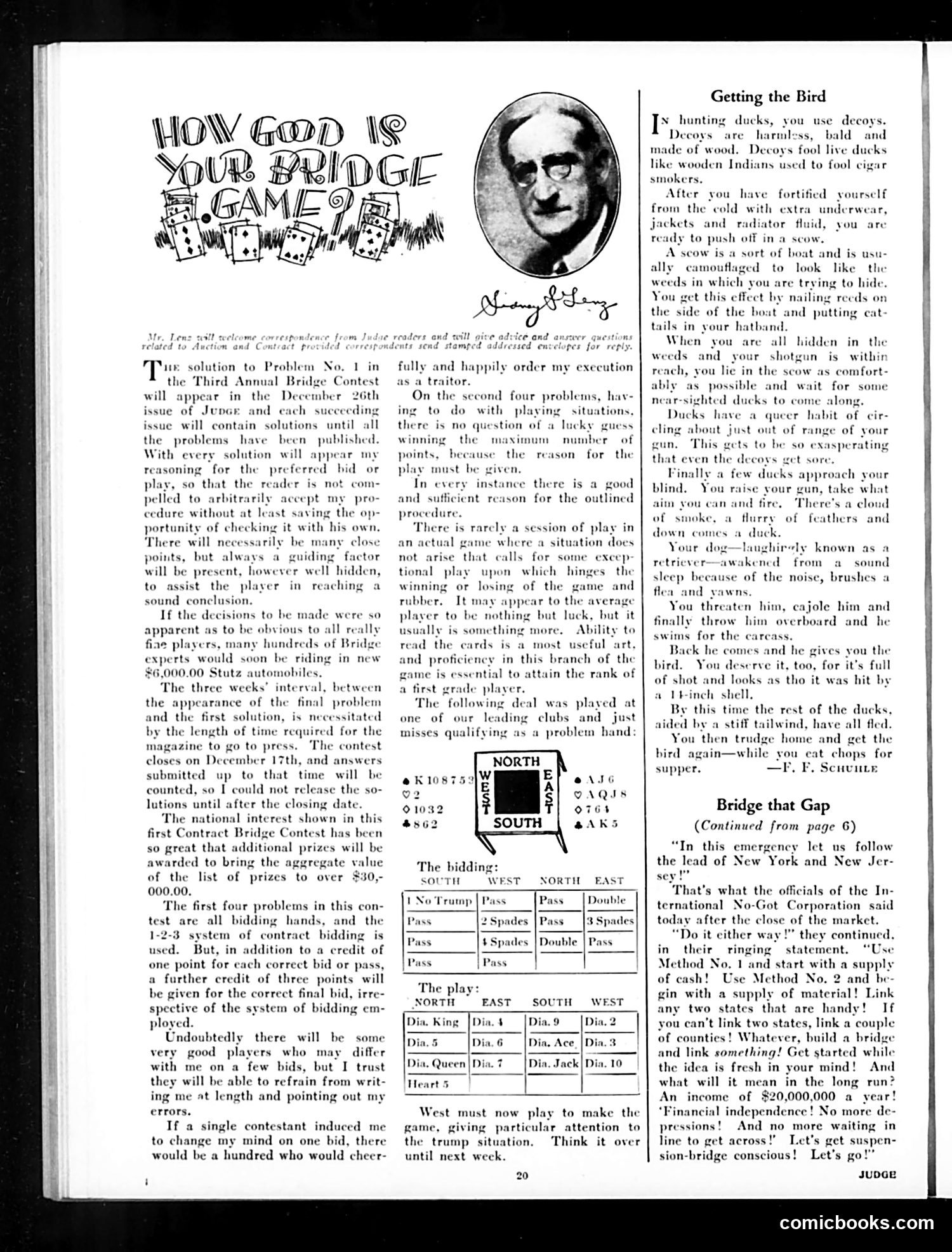
Judge Magazine: Bridge Contest and Duck Hunting Satire This page combines two distinct pieces from *Judge*, a major American satirical magazine. "How Good Is Your Bridge Game?" announces a national Contract Bridge Contest with substantial prizes (over $30,000). The piece, authored by someone whose signature appears at top, solicits bridge problems and solutions. It's a straightforward contest announcement aimed at the magazine's affluent, leisure-class readership who played contract bridge—a popular pastime among the wealthy in this era. "Getting the Bird" is humorous satirical writing about duck hunting. It mocks the elaborate preparations and equipment required for duck hunting—decoys, warm clothing, "radiator fluid" (liquor)—comparing wooden decoys to wooden cigar-store Indians. The piece gently ridicules hunters' pretensions and the comical nature of sitting hidden in boats to shoot ducks. Both pieces target *Judge's* well-to-do audience with gentle humor about their leisure activities and status symbols (the $6,000 Stutz automobile mentioned in the bridge section).
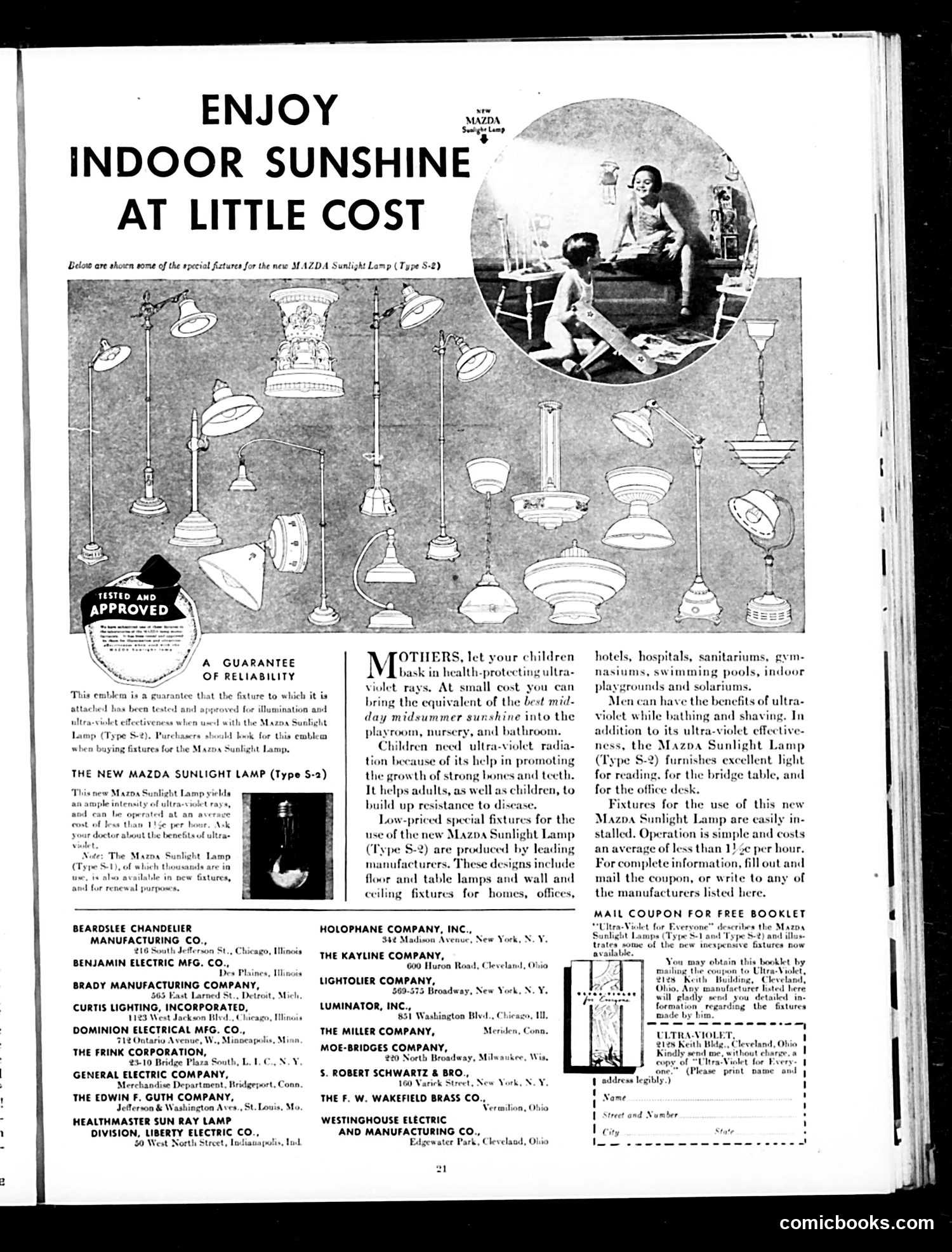
Mazda Sunlight Lamp Advertisement This is primarily a product advertisement, not political satire. The page promotes Mazda's new ultraviolet light fixtures for home and commercial use. The central claim targets health-conscious consumers: ultraviolet rays—associated with outdoor sunshine—can now be brought indoors "at little cost." The circular photograph shows a family enjoying indoor "sunshine" from the lamp. The appeal is to modern anxieties about health and hygiene prevalent in this era. Text emphasizes benefits for children's bone development, disease resistance, and adult vitality. The advertisement positions UV lamps as accessible luxury for homes, offices, hospitals, and gymnasiums. The "Tested and Approved" emblem provides reliability assurance—important for convincing consumers to adopt unfamiliar technology. Multiple manufacturers are listed, suggesting broad industry support. This reflects early-20th-century optimism about artificial light technology solving natural deficiencies, particularly relevant for indoor workers and northern climates with limited winter sunlight.
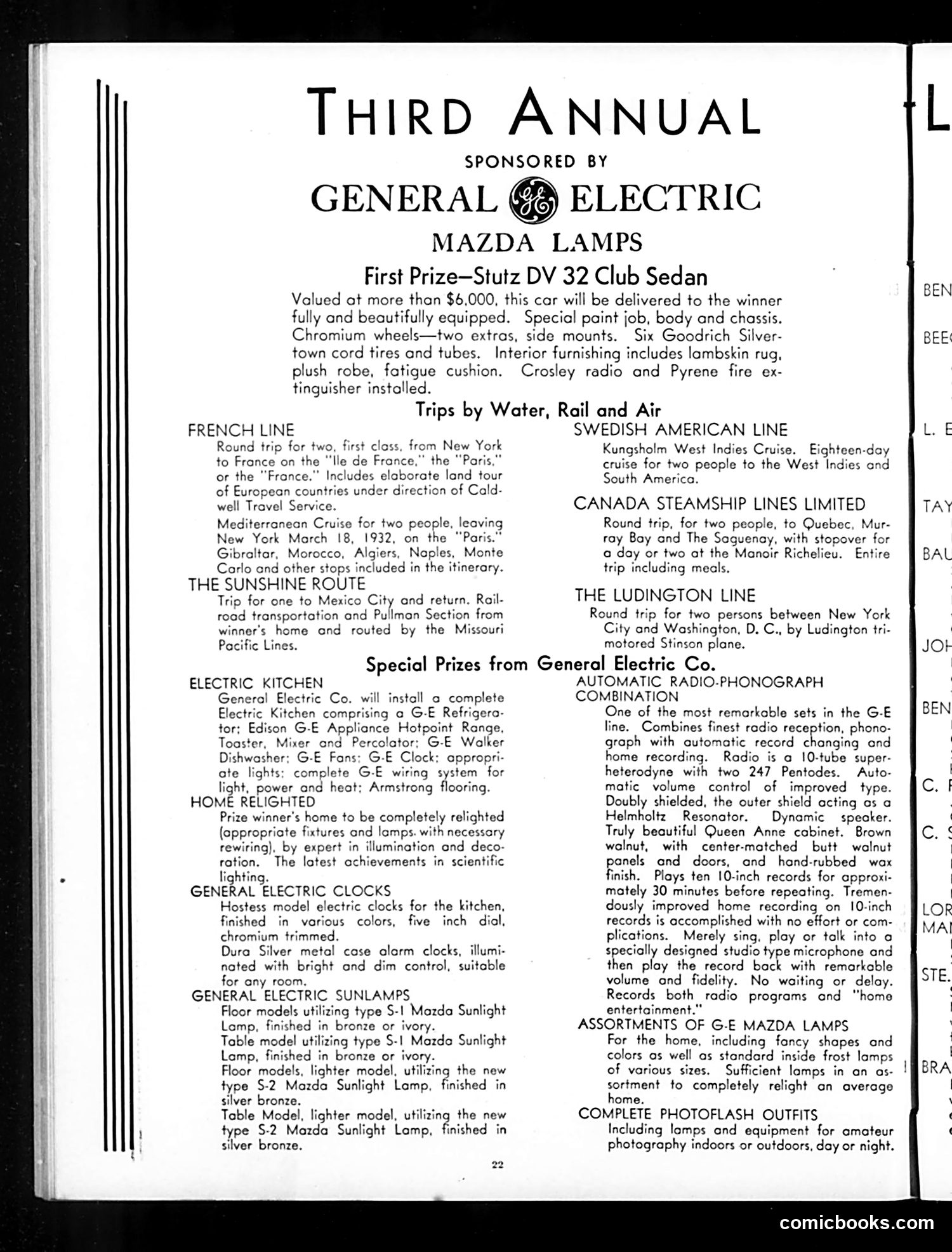
Analysis of This Judge Magazine Page This is not a cartoon or satirical content page — it's a prize advertisement for the Third Annual contest sponsored by General Electric's Mazda Lamps division, likely from the early 1930s (the text mentions a March 18, 1932 date). The page lists lavish Depression-era prizes including a $6,000 Stutz automobile, luxury ocean cruises (French Line, Swedish American Line), and high-end household appliances (electric kitchens, radios, sunlamps). The satirical *point* — implicit rather than explicit — is the contrast between these extravagant giveaways and the economic desperation of 1932. Judge's audience would recognize this as either earnest corporate optimism or subtle mockery of GE's wealth-flaunting during widespread unemployment. The specificity of amenities (lambskin rugs, chromium wheels) emphasizes luxury inaccessible to most readers facing the Great Depression.
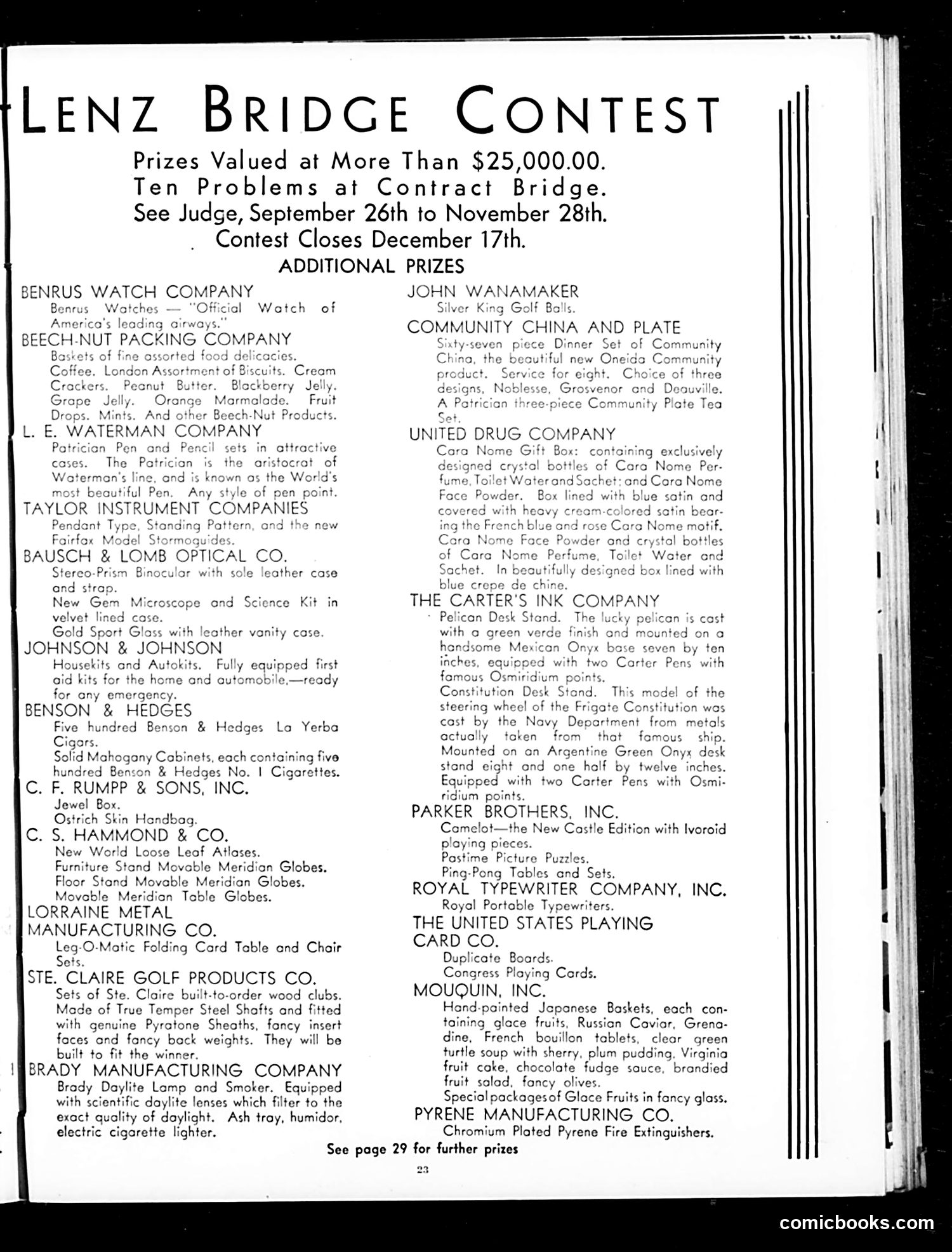
Lenz Bridge Contest Advertisement This page is primarily a contest advertisement, not a political cartoon. Judge magazine announced a "Lenz Bridge Contest" offering over $25,000 in prizes for solving ten Contract Bridge problems. The contest ran from September 26 to November 28, with entries closing December 17. The bulk of the page lists "Additional Prizes" donated by major American companies of the era—watches, golf equipment, typewriters, playing cards, cigars, atlases, china sets, and luxury food items from Mouquin (caviar, glace fruits). This was typical 1920s-30s promotional strategy: companies donated branded merchandise to a high-profile competition to gain advertising exposure in Judge's pages. The contest itself promoted Contract Bridge, a relatively new card game gaining popularity among the American middle and upper classes during this period.
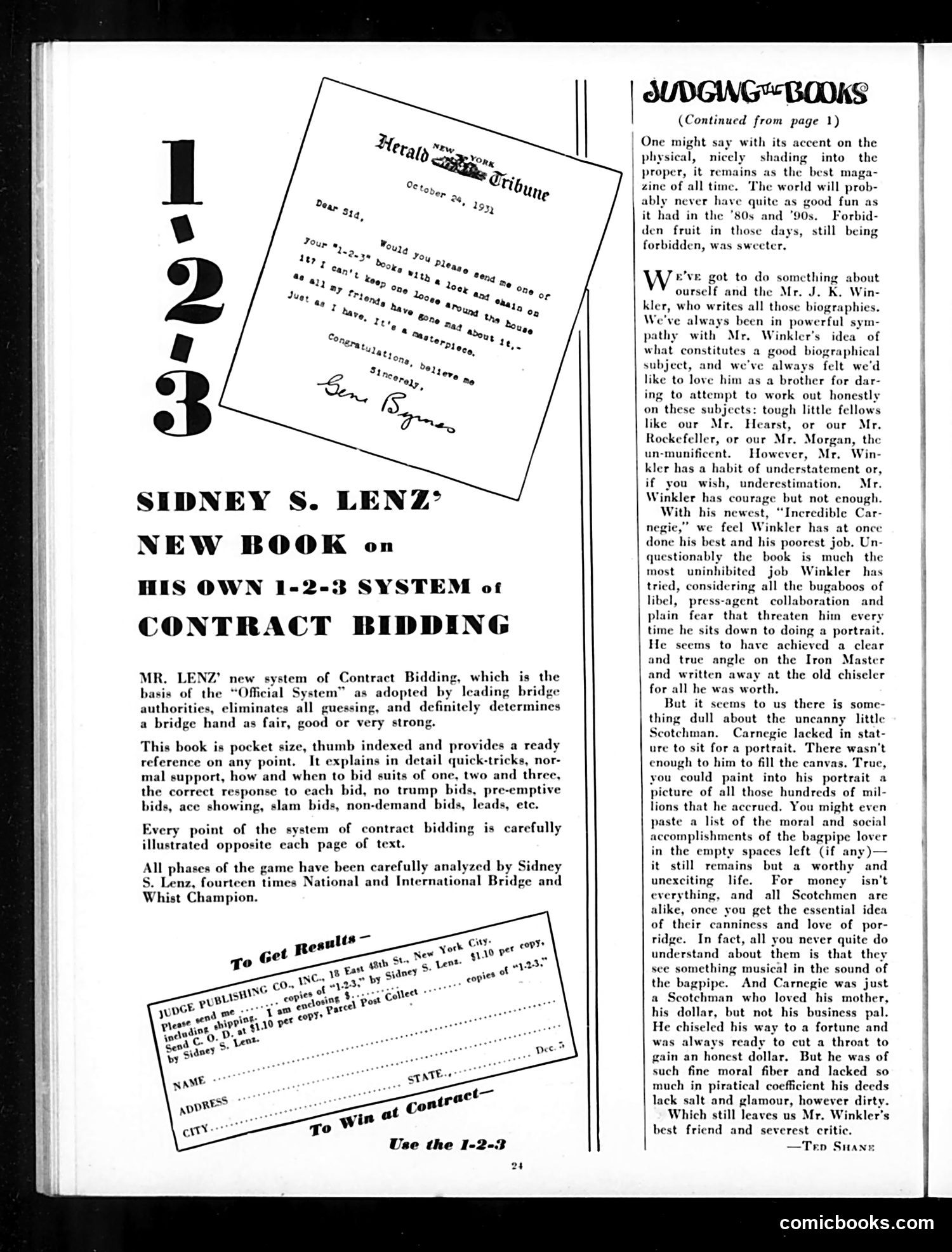
What This Page Shows This is primarily advertising and book review, not a cartoon. The left side advertises Sidney S. Lenz's instructional book on contract bridge bidding—a gambling card game. The text emphasizes Lenz's credentials as a fourteen-time bridge champion and promises his "1-2-3 system" eliminates guessing in bidding strategy. The right column reviews J.K. Winkler's biography of Andrew Carnegie ("Incredible Carnegie"). The reviewer (Ted Shane) praises Winkler's boldness in finally writing an uninhibited portrait of the robber baron, but ultimately criticizes Carnegie himself as a dull subject—merely a money-obsessed Scotsman lacking the glamorous villainy of other industrial titans like Hearst, Rockefeller, or Morgan. The satire targets Carnegie's moral pretense: he had "fine moral fiber" but was fundamentally a throat-cutting opportunist whose only interesting quality was wealth, now gone. The page reflects Judge's typical cynicism about American industrialists and their biographers.
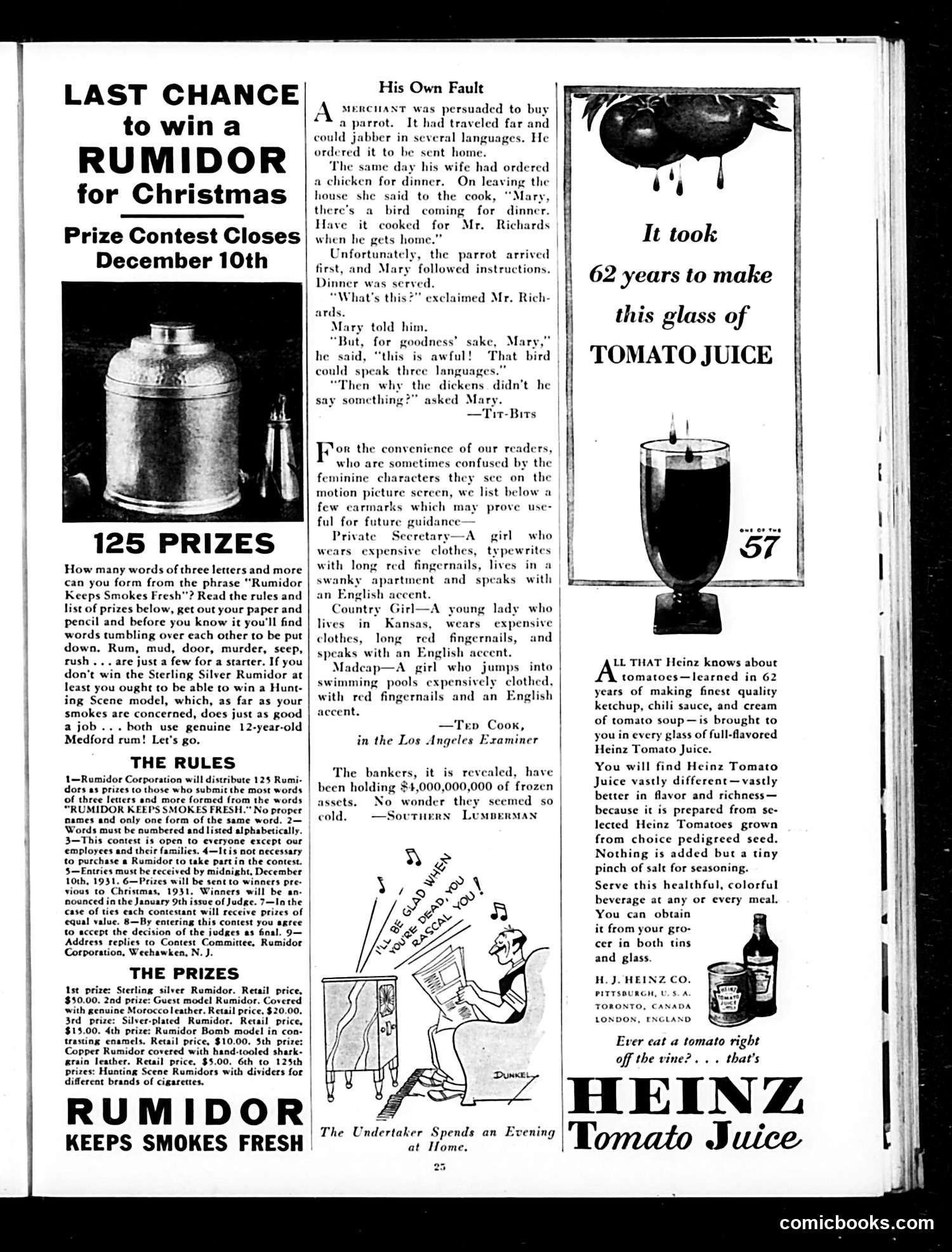
Analysis for Modern Readers This page contains primarily advertising and a word-puzzle contest, with lighter satirical content. The main Rumidor contest is a word-game promotion where readers form three-letter words from "Rumidor Keeps Smokes Fresh" to win humidors (cigar storage boxes). This was common 1930s marketing. The satirical humor appears in three brief pieces: "His Own Fault" jokes about a parrot that speaks multiple languages being mistaken for a chicken and cooked—the irony being it couldn't prevent its fate by speaking. A second piece mocks Hollywood's portrayal of "types" of women (secretaries, country girls, etc.), noting they all inexplicably wear expensive clothes and red nails regardless of character. A third quip satirizes bankers holding $4 billion in frozen assets during the Depression. The cartoons show an undertaker at home and a woman with tomato juice—the latter referencing Heinz's advertising claim that their product took 62 years to perfect. The overall tone is light, Depression-era humor mixed with commercial promotion typical of Judge magazine's format.
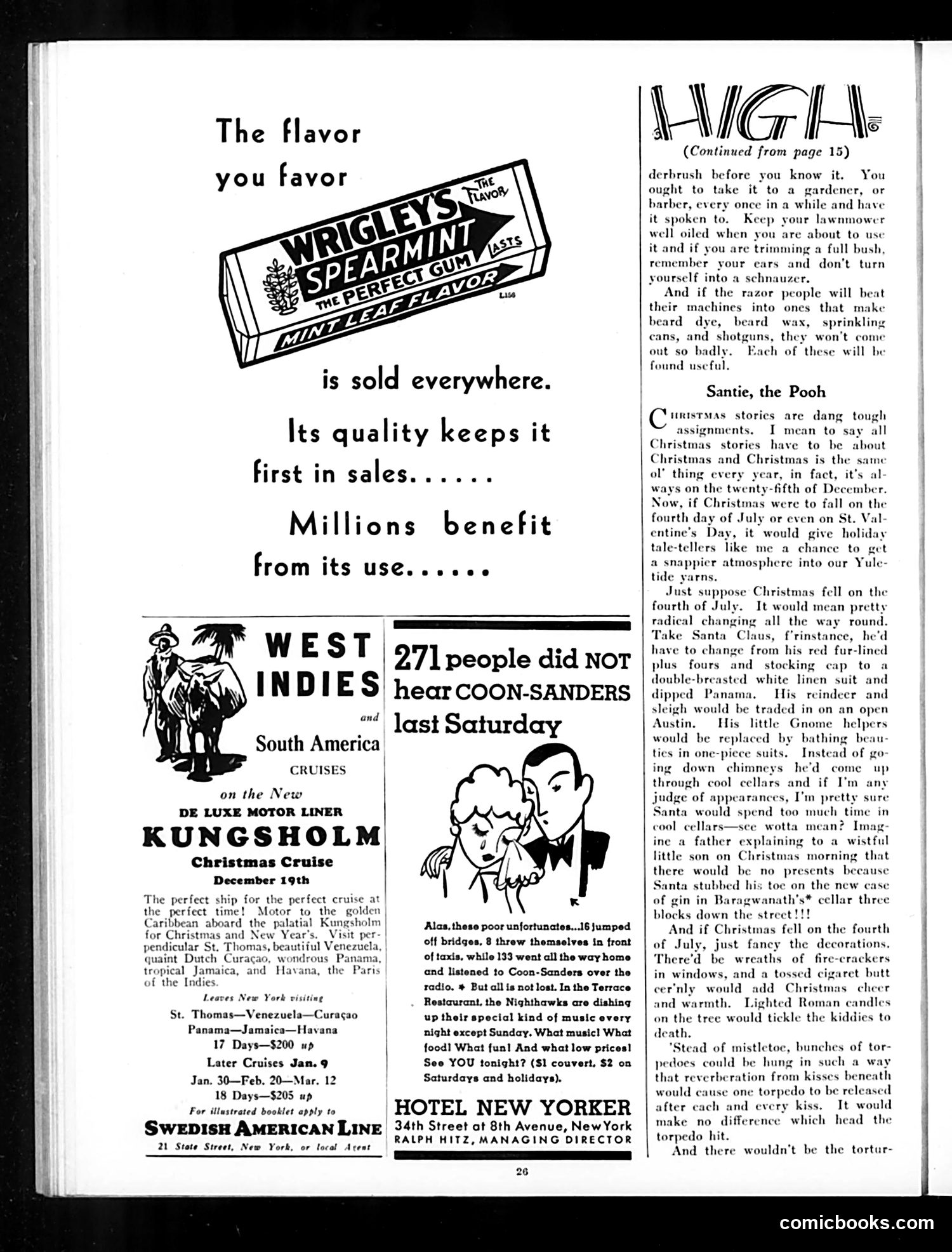
Analysis This page is primarily advertising and filler content from Judge magazine, with no significant political cartoons or satirical commentary. The main advertisements include: - Wrigley's Spearmint Gum (top): Standard product marketing claiming quality and universal sales - West Indies/South America Cruises on the De Luxe Motor Liner Kungsholm (middle left) - Hotel New Yorker (bottom right) The only illustrated humor appears to be a small cartoon showing a couple with text about people not hearing from "Coon-Sanders" over the radio last Saturday—this references the popular Coon-Sanders Nighthawks jazz band, a real 1920s-30s orchestra. The joke seems to concern their radio absence, though the full context is unclear from this page alone. This is largely a commercial page rather than satirical content.
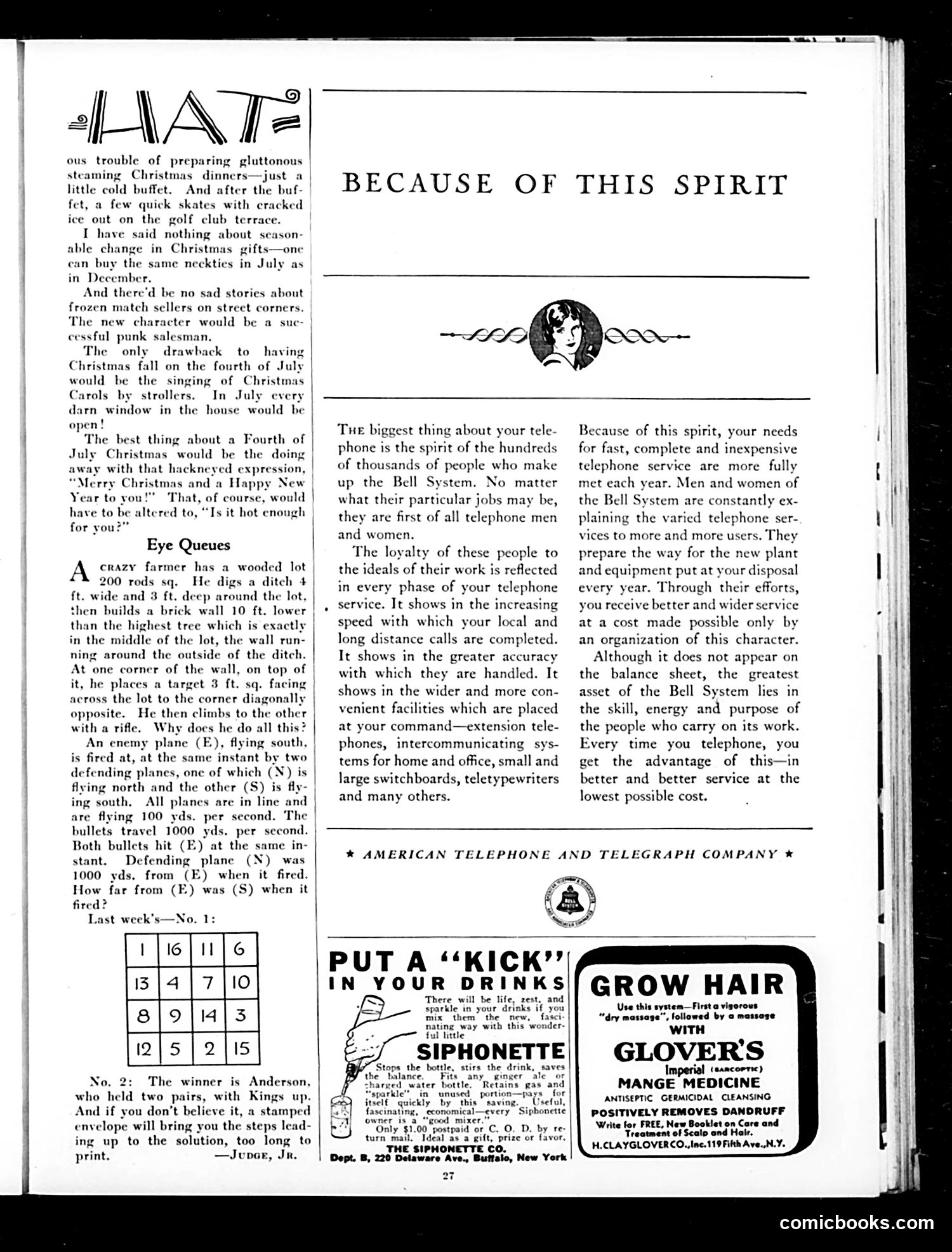
Analysis of Judge Magazine Page This page combines editorial content with advertising. The main article imagines Christmas falling on July 4th—a whimsical satire on American holiday commercialization. It mocks the absurdity of seasonal gift-giving (buying the same neckties year-round) and urban poverty (frozen match sellers), suggesting summer Christmas would eliminate such sad sights while creating new absurdities like carolers in open windows. The "Eye Queues" section presents mathematical puzzles for readers—a common Judge feature for mental exercise. The dominant content is a full-page Bell Telephone advertisement, titled "Because of This Spirit." It praises Bell System workers' loyalty and dedication as the company's greatest "asset," arguing their efforts justify service costs. This is corporate image-building during an era of growing monopoly scrutiny. The page also advertises consumer products: Siphonette (a drink mixer), Glover's Mange Medicine (for dandruff), suggesting Judge's working-class readership.
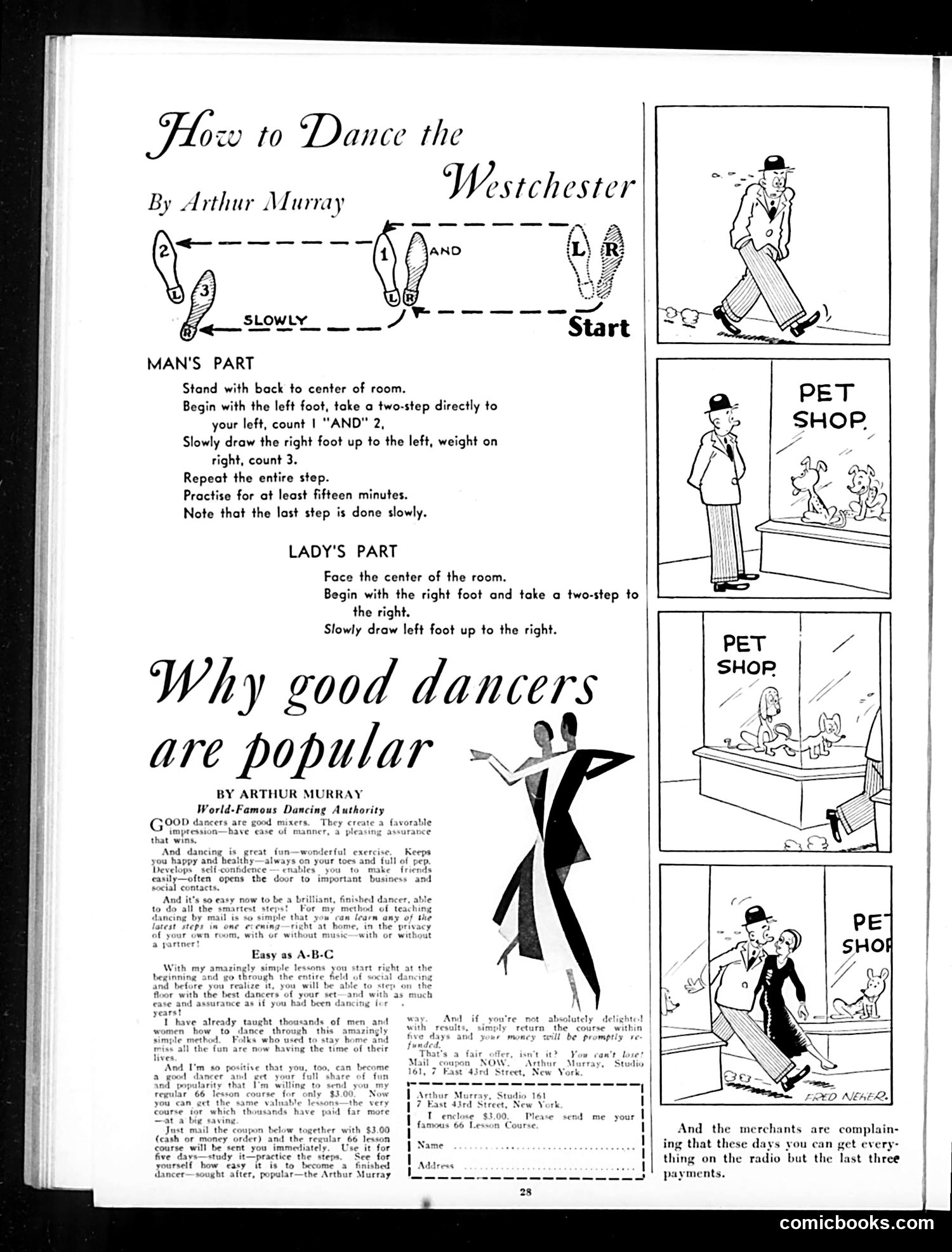
"How to Dance the Westchester" - Judge Magazine Analysis This page features dance instruction and advertising by Arthur Murray, the famous ballroom dancing instructor of the era. The top section provides step-by-step directions for the "Westchester" dance, a partner dance popular in the 1920s-30s. The main satirical content appears in the lower section: "Why good dancers are popular" argues that skilled dancers are social successes because they're "good mixers" with confidence and charm. The accompanying silhouette illustration of a dancing couple reinforces this aspirational messaging. The final joke (in the merchant testimonial) satirizes the payment plan culture: merchants complain they can advertise "everything" on radio except the final three installment payments—a dig at customers who fail to complete their purchase agreements. This reflects Depression-era anxieties about credit and consumer debt. The cartoons on the right appear to be separate comic strips unrelated to the dance content.
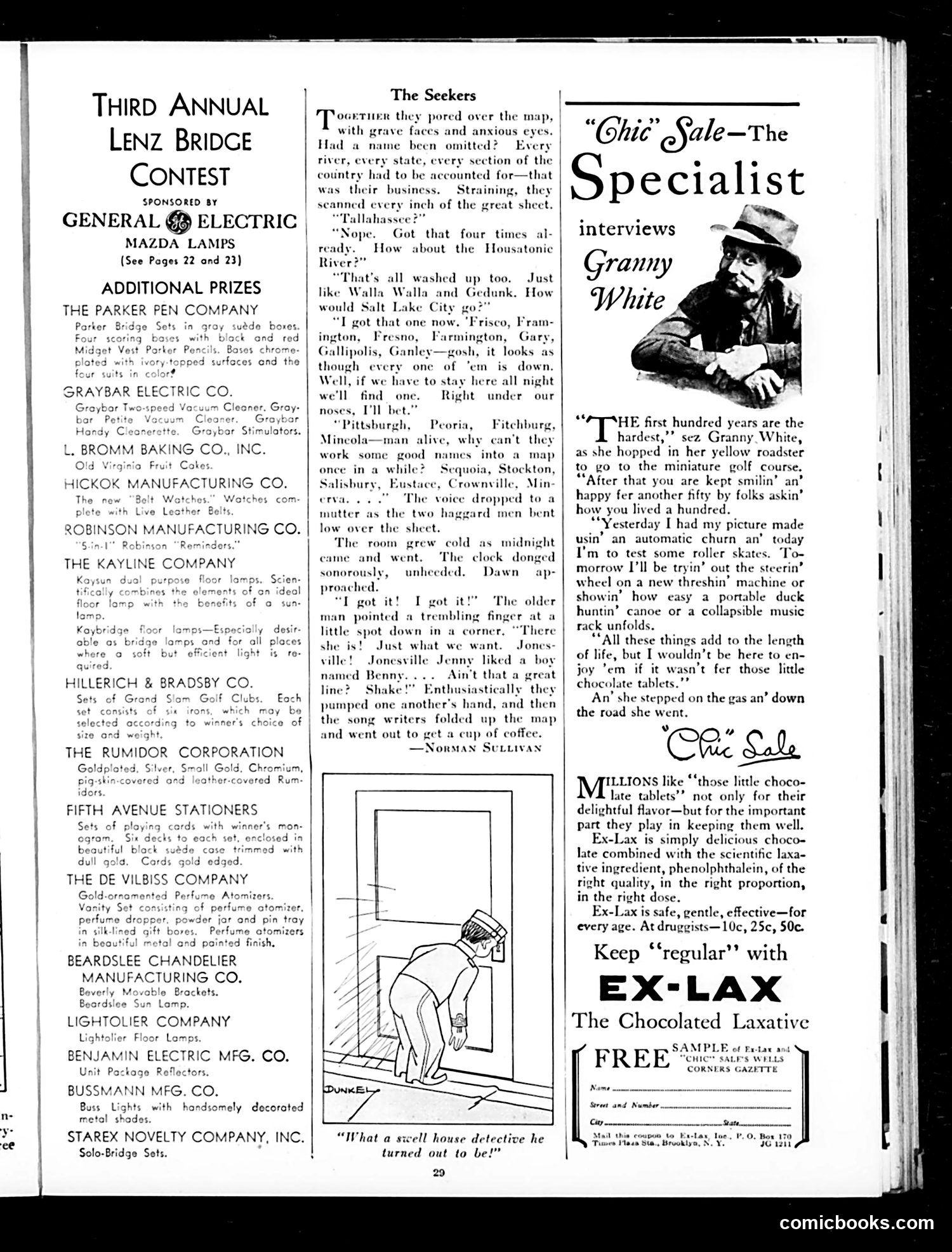
Page Analysis: Judge Magazine This page is primarily advertising and promotional content, not editorial satire. The main feature is a short story titled "The Seekers" about two men frantically searching a map for an omitted town name—a lighthearted narrative filler. The dominant content is an interview feature with "Chic" Sale, a popular vaudeville comedian known for folksy, rural humor. Sale (1885-1967) was famous for characters like "The Specialist." Here he interviews a fictional "Granny White," a centenarian who credits her longevity to various novelties (automatic churn, roller skates, etc.) and particularly to Ex-Lax chocolate laxative tablets. This is essentially sponsored content disguised as journalism—the interview exists primarily to promote Ex-Lax through celebrity endorsement. The humor is gentle and wholesome (typical for Judge in this era), relying on Granny's folksy dialect and the absurd notion that modern gadgets extend life. The remainder of the page lists prize sponsors for a "Third Annual Lenz Bridge Contest"—a promotional vehicle for General Electric Mazda Lamps and numerous manufacturers offering prizes.
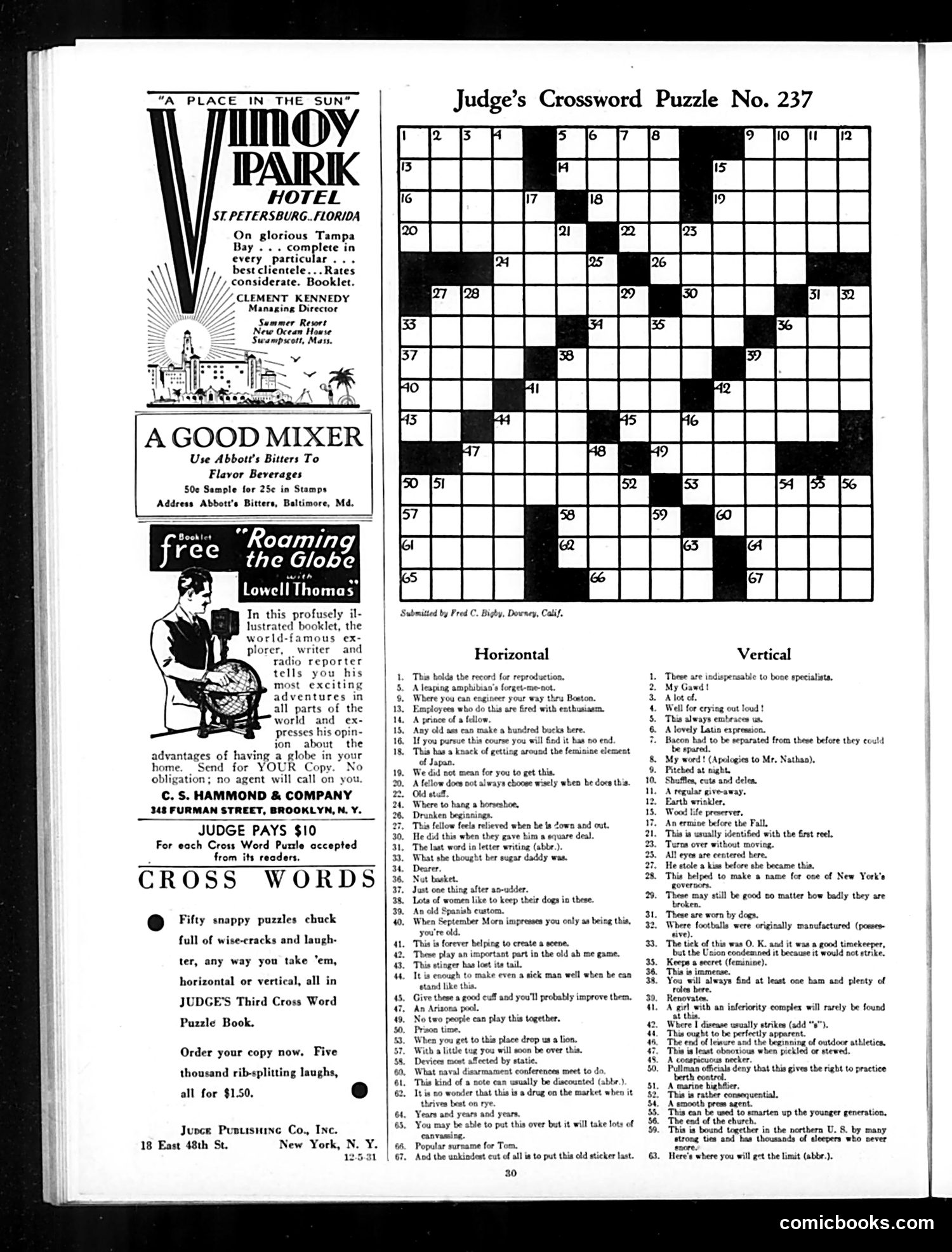
Judge Magazine Page Analysis This page is primarily advertisements and a crossword puzzle, not satirical content requiring historical context. The left side features ads for the Windy Park Hotel in St. Petersburg, Florida; Abbott's Bitters (a patent medicine for flavoring beverages); Lowell Thomas's "Roaming the Globe" illustrated booklet; and C.S. Hammond & Company globes. These are standard period advertisements. The main content is Judge's Crossword Puzzle No. 237, submitted by Fred C. Bigby of Downey, California. The puzzle offers $10 payment for accepted submissions—Judge's way of crowdsourcing puzzle content. Clues are typical 1920s wordplay and cultural references ("old stuff," "drunken beginnings," etc.). Below the puzzle, Judge advertises its "Third Cross Word Puzzle Book" for $1.50, promoting it as containing "five thousand rib-splitting laughs." This represents the magazine's pivot toward crossword puzzles, which were enormously popular in the 1920s. There is no political satire or cartoon on this page—it's essentially a marketing/content page.
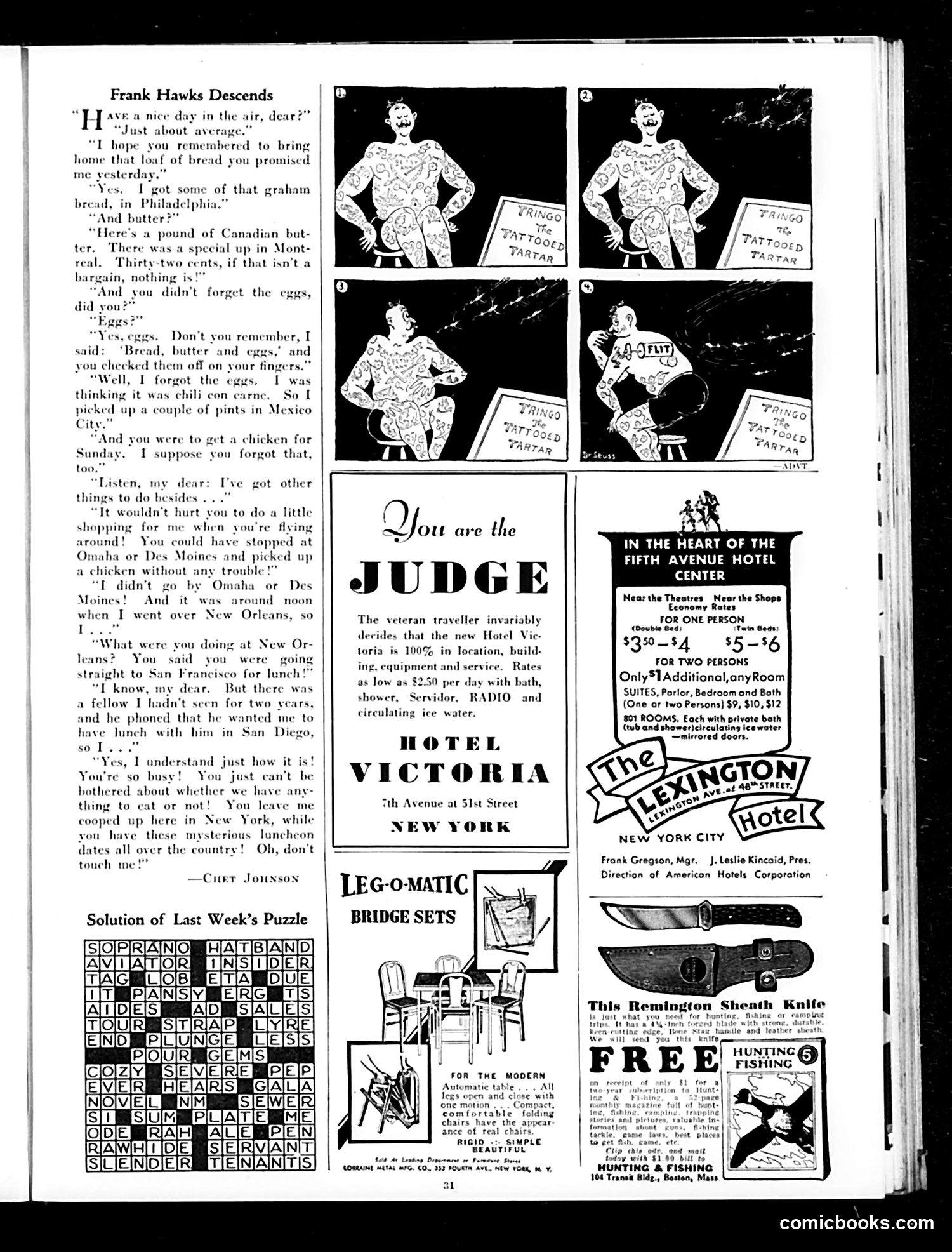
Frank Hawks Descends - Judge Magazine Comic This comic strip satirizes Frank Hawks, a famous real aviator and stunt pilot of the 1920s-30s known for record-breaking flights. The joke centers on a domestic dispute: Hawks' wife complains he forgot groceries while flying, yet he's managed to shop in Philadelphia, Montreal, Mexico City, and New Orleans—stopping for lunch with an old friend in New Orleans despite claiming a direct route to San Francisco. The satire mocks both Hawks' celebrity adventurousness and the absurdity of expecting shopping errands from a professional pilot. His wife's exasperation—complaining he "leaves her cooped up in New York"—reflects period anxieties about modern aviation separating spouses. The humor lies in the contradiction: he's visited multiple cities for pleasure but "forgot" a simple chicken dinner. The attribution to "Chet Johnson" appears at the strip's end.
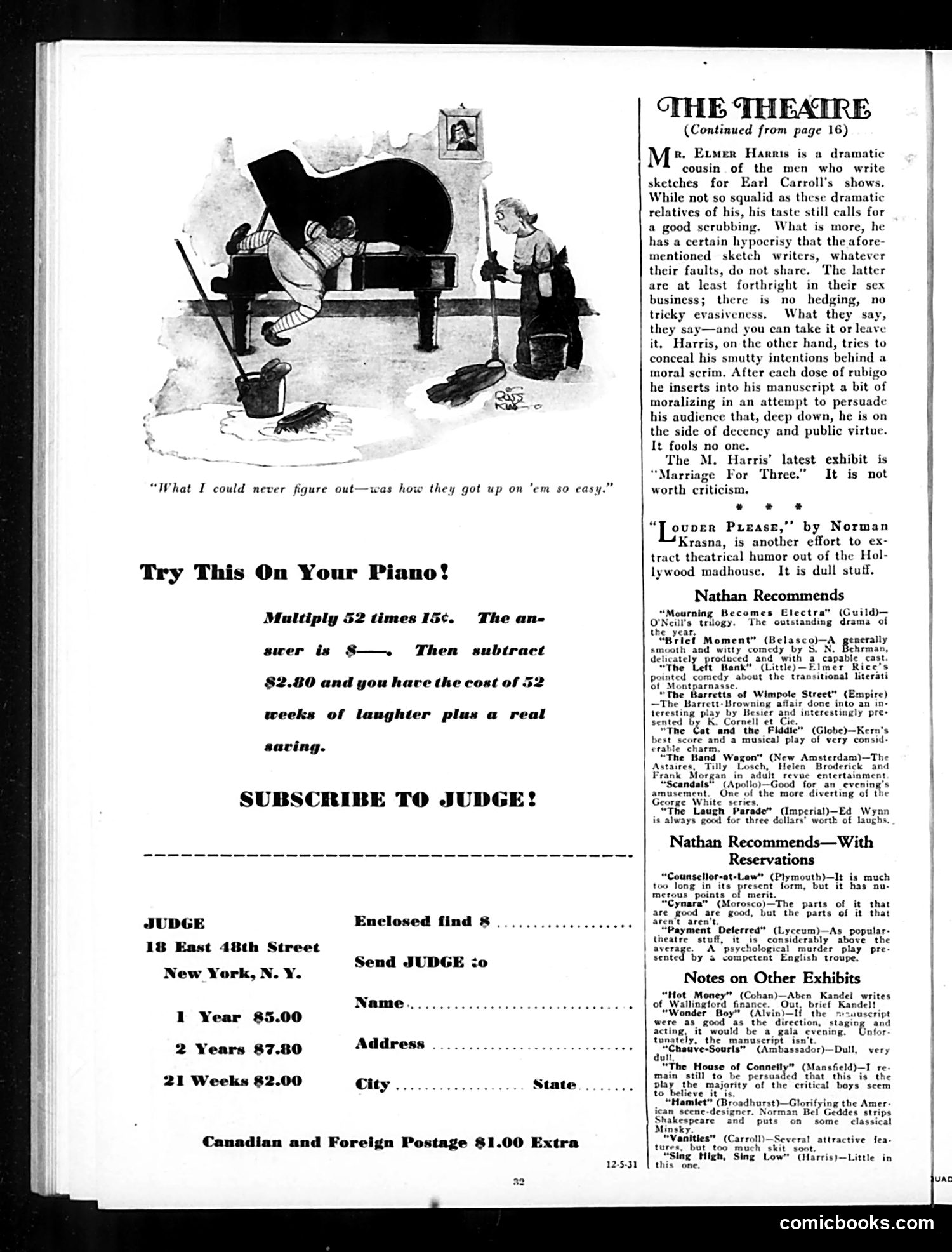
Judge Magazine Page Analysis This page is primarily advertising and subscription promotion for Judge magazine, not political satire. The small cartoon at top shows a pianist with sheet music scattered about, captioned "What I could never figure out—was how they got up on 'em so easy"—a mild joke about piano technique, likely accompanying the "Try This On Your Piano!" subscription pitch below. The bulk of the page contains theatre criticism by Nathan (likely drama critic George Jean Nathan), reviewing current Broadway productions. His reviews are sharp and dismissive—he praises O'Neill's "Mourning Becomes Electra" but skewers M. Elmer Harris for disguising "smutty intentions behind a moral scrim," and calls Norman Krasna's "Louder Please" "dull stuff." The page serves primarily as a magazine advertisement and content sampler, showing readers the type of satirical commentary and theatre criticism they'd receive with a Judge subscription ($5 yearly in 1931).
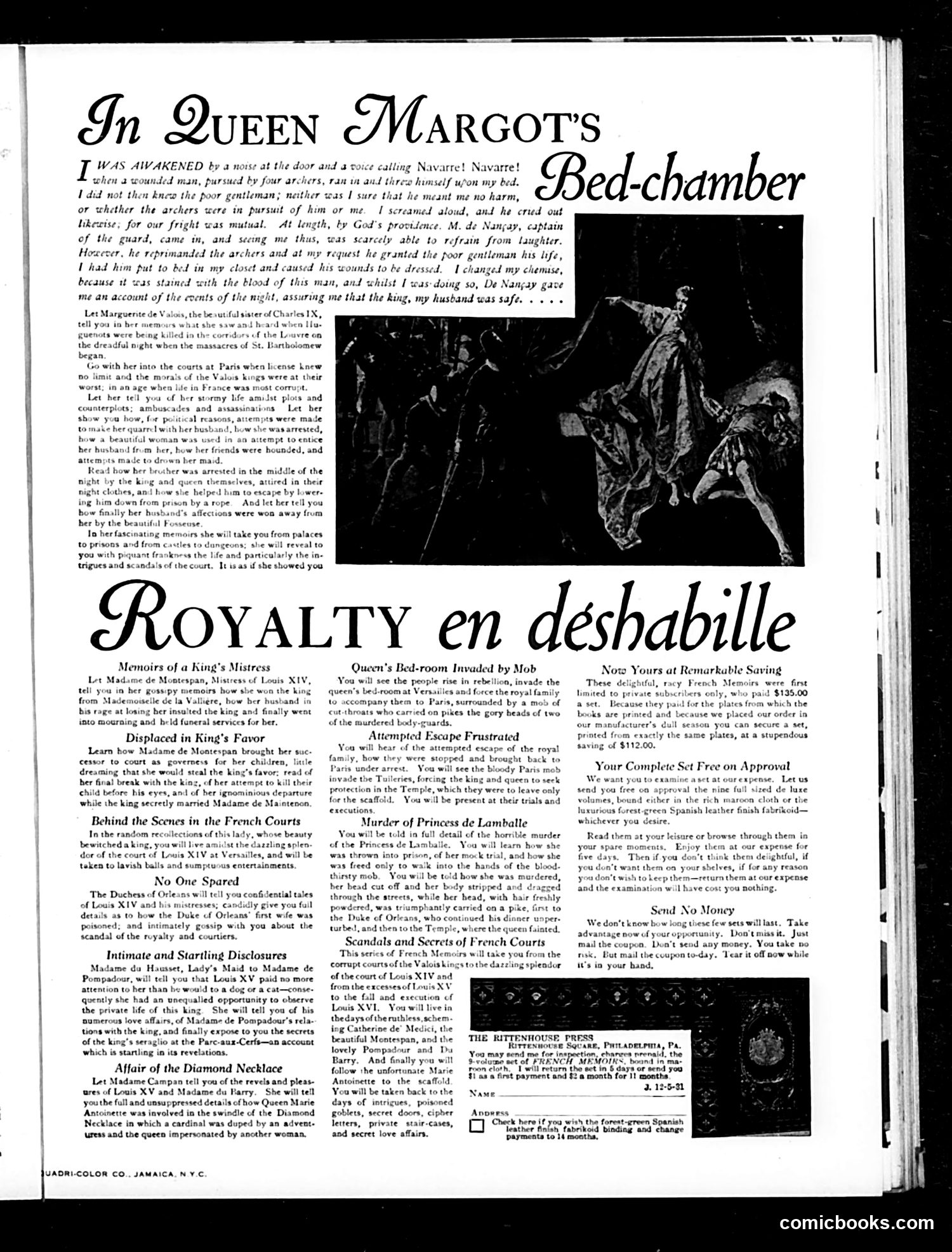
Analysis of This Judge Magazine Page This page advertises subscription sets of scandalous French royal memoirs, presented as serialized "intimate and startling disclosures" from historical figures like Queen Margot and Madame de Montespan. The satire works on multiple levels: Judge presents these as salacious exposés of royal corruption, intrigue, and sexual misconduct—depicting "royalty en deshabille" (royalty undressed/exposed). The dramatic illustration shows a chaotic bedroom scene, likely the St. Bartholomew's Day Massacre referenced in the text. For American readers in the early 20th century, this mocked both European aristocratic decadence and the appetite for scandalous "true crime" memoirs. The copy emphasizes lurid details: assassination plots, murder, infidelity, and attempted escapes—positioning these historical accounts as thrilling exposés of corruption among the elite. The advertisement frames these memoirs as previously exclusive to wealthy subscribers but now available at reduced cost, democratizing access to royal "secrets."
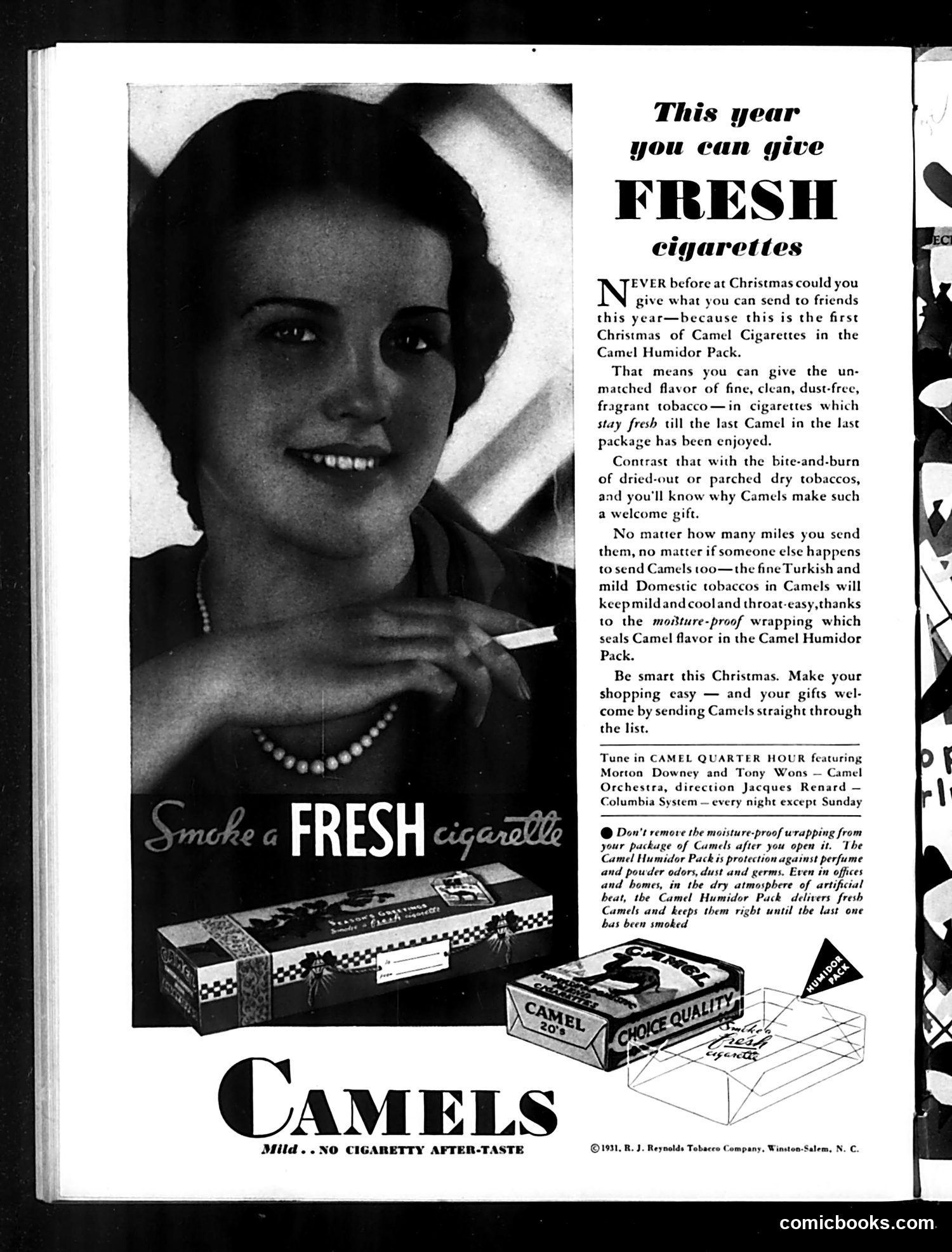
Analysis This page is primarily a cigarette advertisement, not political satire. It's a 1931 Camel Cigarettes ad promoting their new "Humidor Pack" as Christmas gifts. The ad features a smiling woman with a cigarette, positioned to make smoking appear sophisticated and desirable. The text emphasizes the packaging's "moisture-proof wrapping" that keeps cigarettes fresh during shipping—a novel selling point at the time. What's notable for modern readers: This represents an era when cigarette advertising in mainstream magazines was completely normalized and unregulated. There's no health warning, and the copy presents smoking as an ideal gift and social grace. The ad also references radio programming ("Camel Quarter Hour"), showing how tobacco companies sponsored entertainment. For a Judge magazine page, this is straightforward commercial content rather than satirical commentary—reflecting the publication's mixed advertising-and-editorial model typical of that period.