judge
Judge — December 19, 1931
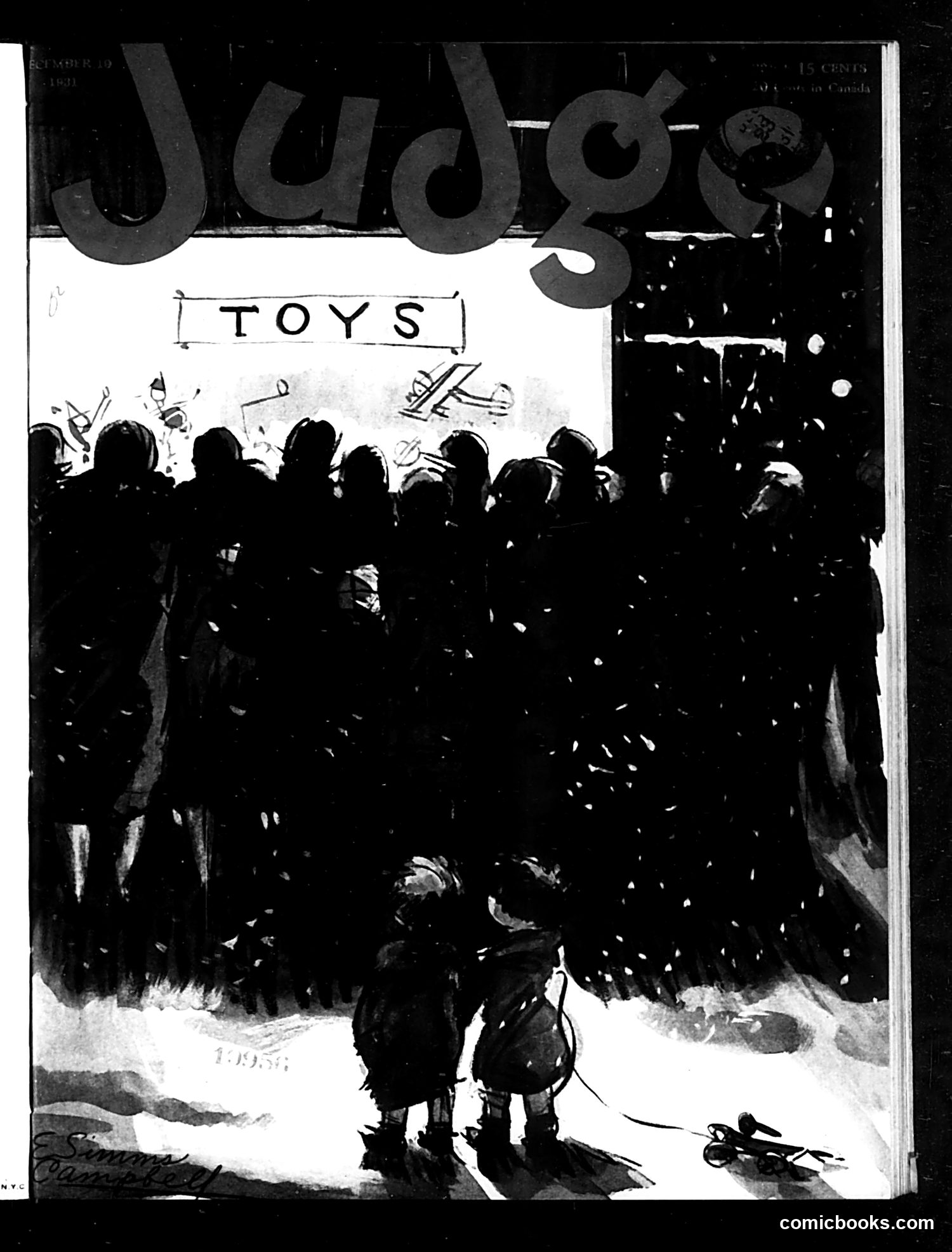
Judge Magazine Page Analysis This appears to be a cover or advertisement page from *Judge* magazine featuring a "TOYS" section. The illustration shows a large crowd of silhouetted figures (appearing to be children or people) gathered around a storefront or display window marked "TOYS." The stylized "Judge" masthead at the top suggests this is a satirical magazine cover. Without clearer visibility of specific details or additional context text, the precise satirical point is difficult to determine. The image may be commentary on consumer behavior, holiday shopping crowds, or childhood desires—common *Judge* magazine topics. The silhouettes and composition suggest social observation or gentle mockery of popular culture, though the exact historical reference remains unclear from this image alone.
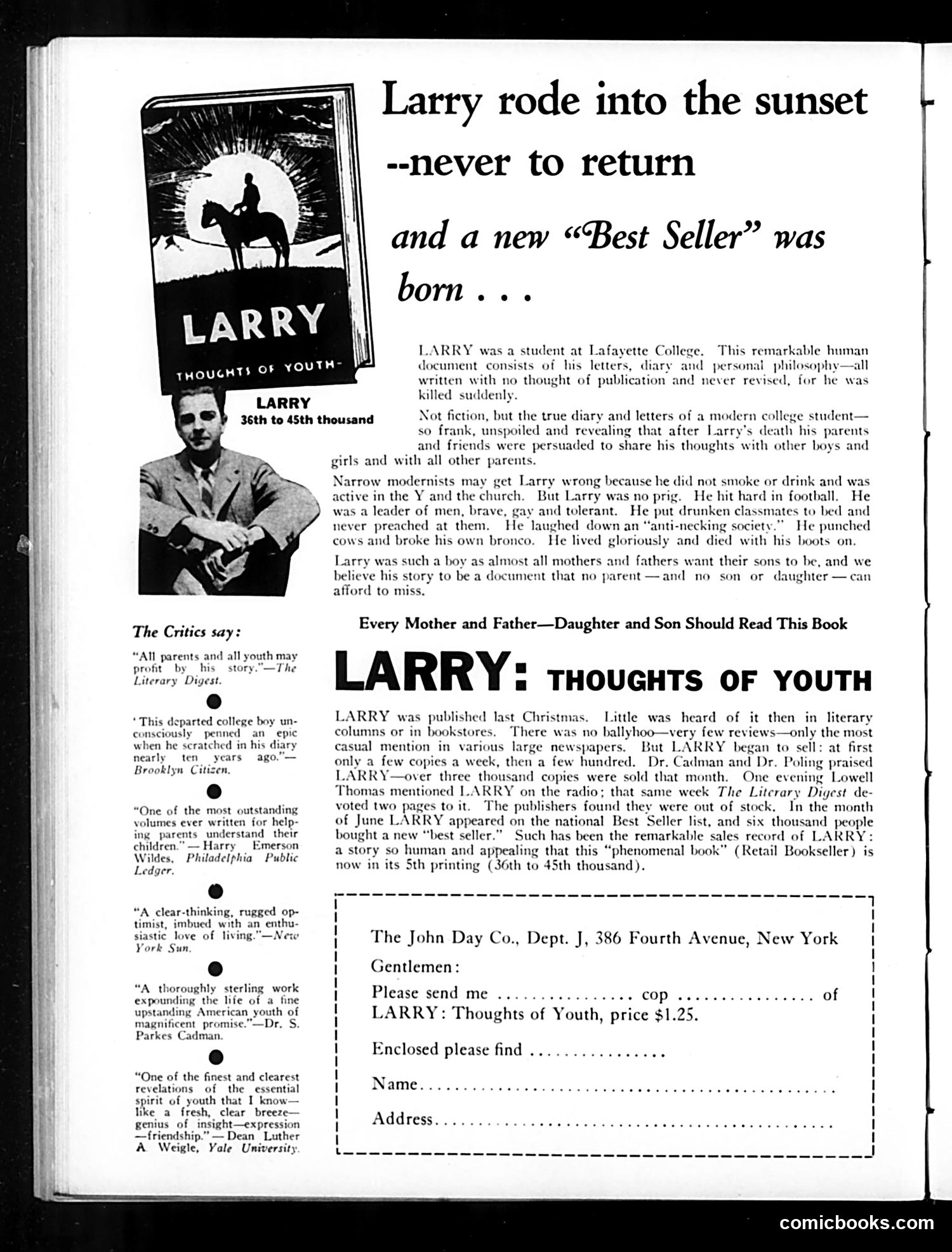
Analysis of "Larry: Thoughts of Youth" Advertisement This page is primarily a book advertisement, not political satire. It promotes "Larry: Thoughts of Youth," reportedly a bestselling collection of letters and diary entries from a Lafayette College student who died suddenly. The marketing copy emphasizes Larry's appeal to parents and youth: he was "brave, gay and tolerant," didn't smoke or drink excessively, and represented an idealized model son. The book became unexpectedly popular, reaching bestseller status. The silhouette illustration shows a young man on horseback riding into sunset—a romantic image of American youth and adventure. The advertisement targets parents specifically, marketing the book as wholesome reading material that celebrates youthful idealism while avoiding moral controversy.
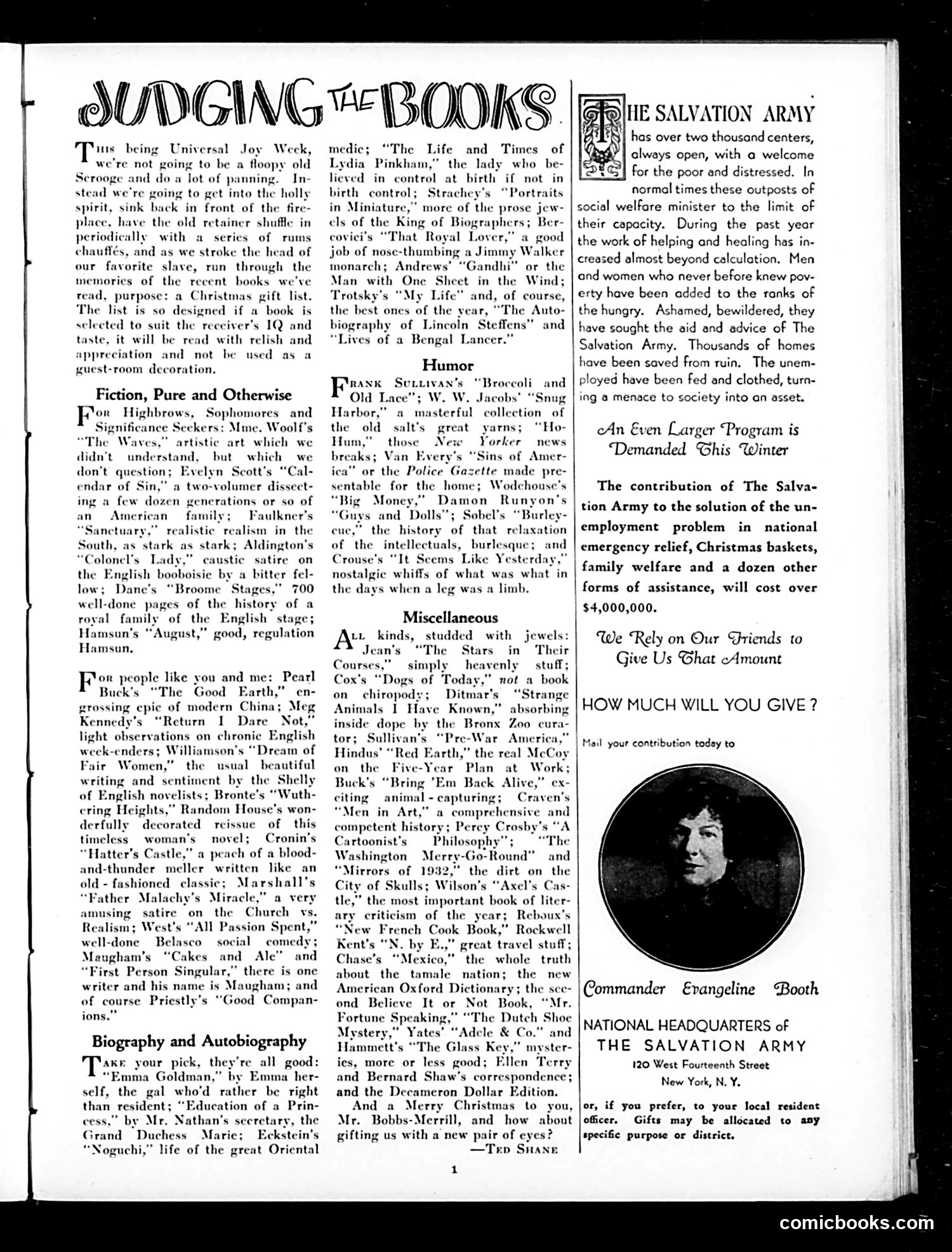
Page Analysis This page is primarily book reviews and advertising, not political satire. The left columns contain literary criticism discussing recent books across fiction, humor, biography, and miscellaneous categories—works by authors like Wodehouse, Brontë, and Maugham. The right side features a Salvation Army fundraising appeal with Commander Evangeline Booth's photograph. The text describes the organization's welfare work during economic hardship, listing costs ($4,000,000) for Christmas baskets, unemployment relief, and family assistance. A tear sheet at bottom provides the National Headquarters address for donations. No political cartoon appears on this page. The content reflects Judge magazine's mix of literary coverage and period advertising/advocacy materials, circa 1930s based on the economic references and book titles mentioned.
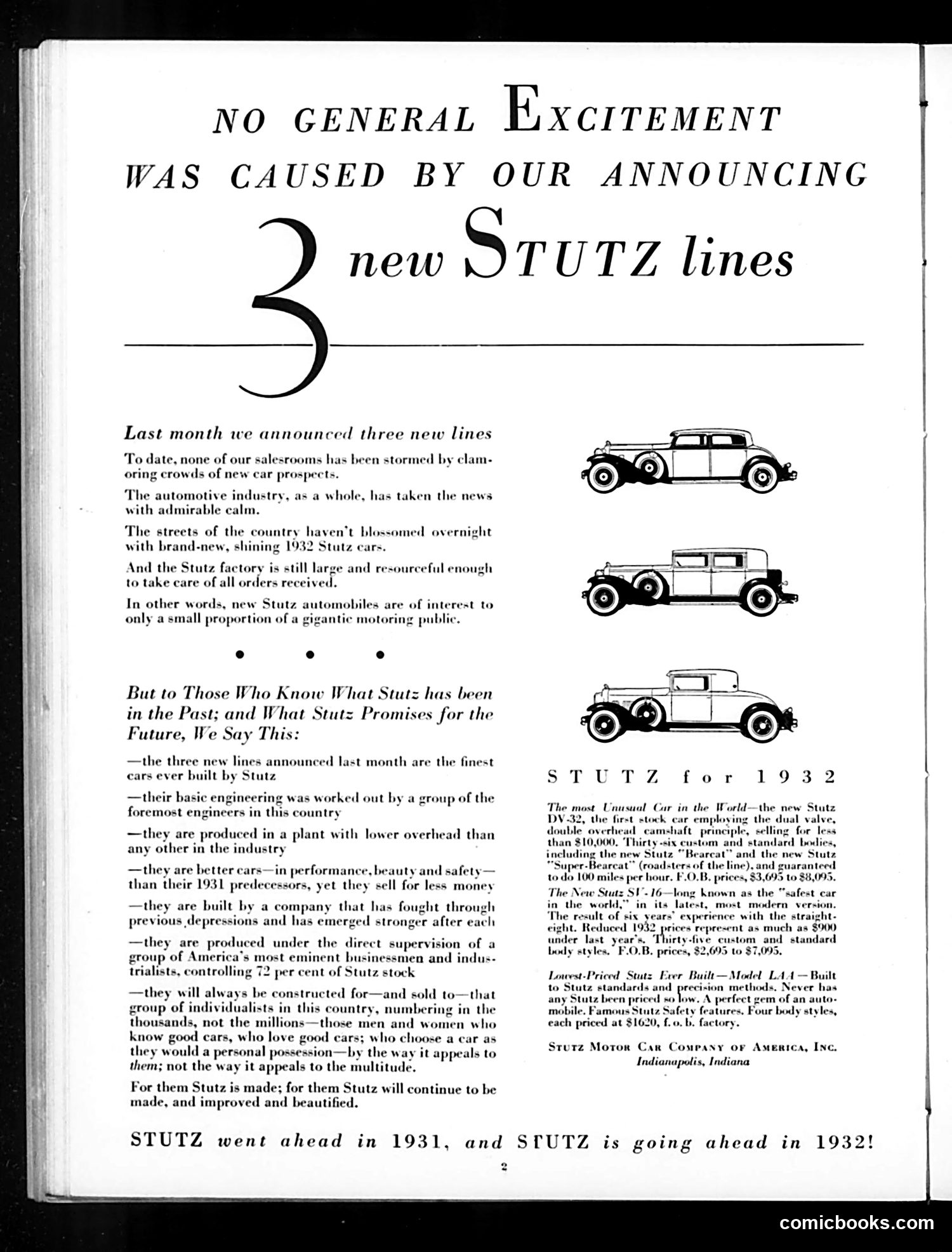
Analysis This is not a cartoon or satire page — it's a full-page automobile advertisement for Stutz Motor Cars, appearing in Judge magazine (circa 1932). The ad addresses skepticism about Stutz's announcement of three new car lines. It defensively argues that while the automotive industry showed "admirable calm" to this news, Stutz cars deserve recognition from knowledgeable enthusiasts who understand the brand's engineering heritage and financial resilience through the Depression. The three car illustrations on the right showcase the new 1932 models. The text emphasizes Stutz's survival through "previous depressions" and superior engineering, attempting to position the brand as prestigious despite limited market excitement. This reflects Depression-era marketing: reassuring both consumers and investors of company stability while claiming quality and exclusivity.
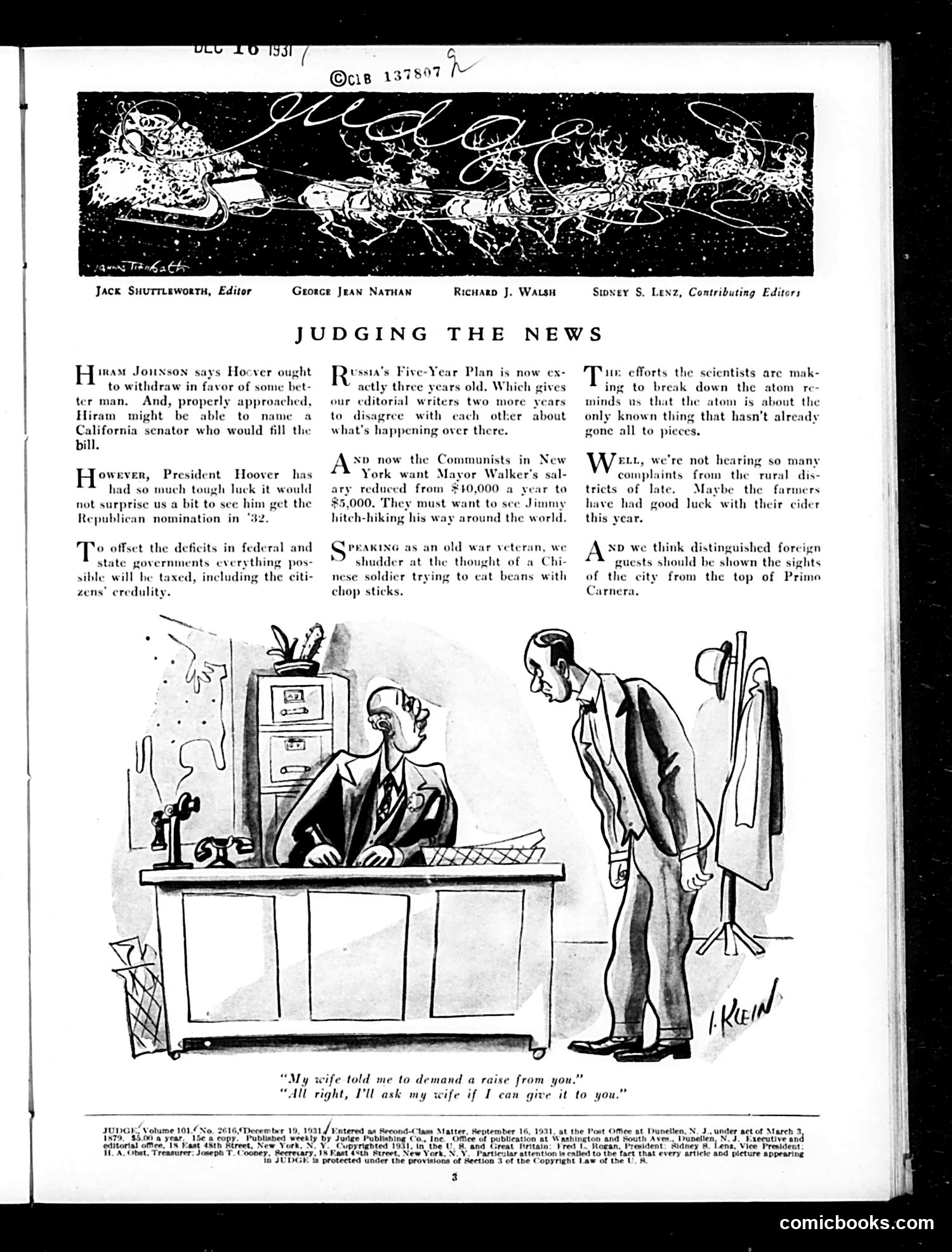
"Judging the News" - December 19, 1931 The main cartoon depicts a workplace negotiation: a man at a desk (appears to be an employer or manager) tells an employee requesting a raise, "My wife told me to demand a raise from you" / "All right, I'll ask my wife if I can give it to you." The satire mocks the economic helplessness during the Great Depression. Rather than direct negotiation between employer and employee, both men defer to their wives—suggesting that household financial decisions have become so constrained by economic hardship that even workplace salary discussions require spousal permission. The joke reflects 1931's severe financial crisis, where economic power has shifted unpredictably and neither party (employer nor employee) controls resources independently.
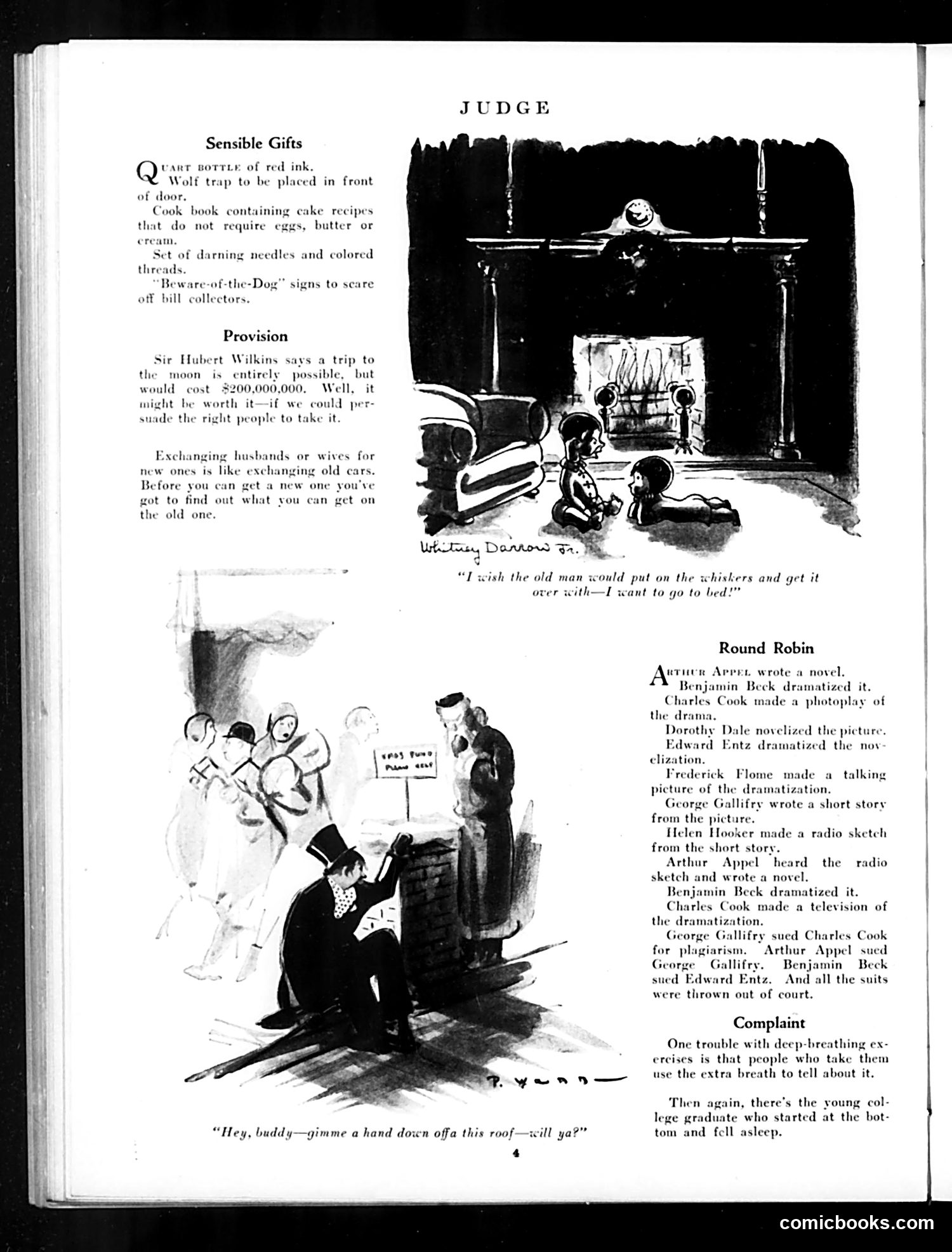
Analysis of Judge Magazine Page This page contains three satirical sections: "Judge" (top): A courtroom scene where a child asks an elderly judge to "put on the whiskers and get it over with—I want to go to bed!" The joke mocks judicial formality and tedious legal proceedings, suggesting even children find court rituals absurdly time-consuming. "Round Robin" (right): A satirical summary of literary adaptation chaos, where multiple authors and creators sued each other over plagiarism rights to the same work—a critique of 1920s-30s intellectual property disputes and the cutthroat entertainment industry. "Complaint" (bottom): Critiques self-important people who boast about deep breathing exercises, and college graduates who fall asleep—poking fun at pretension and lazy youth. The cartoons target legal pomposity, creative theft, and social affectation.
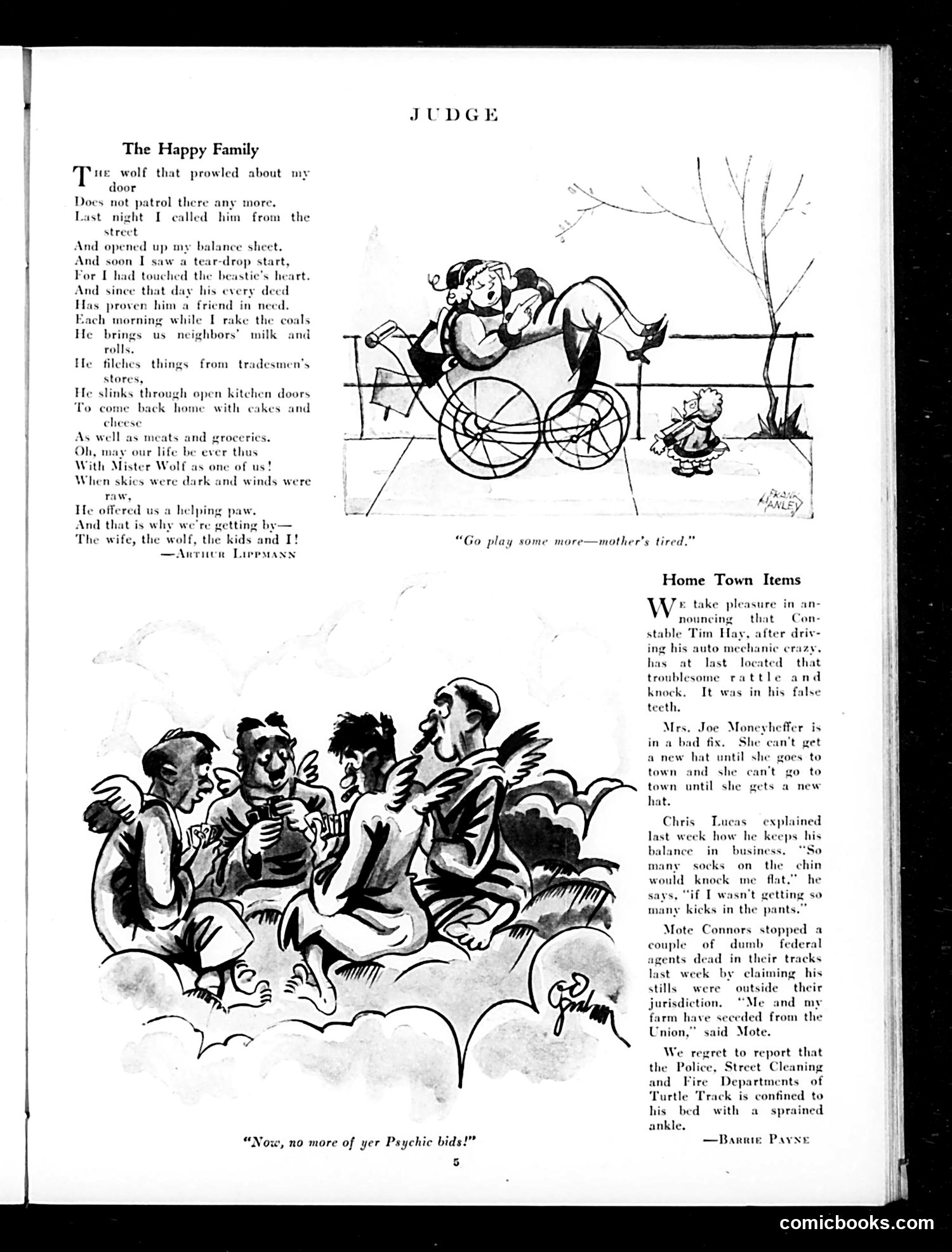
Analysis of Judge Magazine Page Top Cartoon: "The Happy Family" This poem celebrates a reformed wolf that now helps a poor family—bringing milk, stealing from traders' stores, and delivering food. The accompanying illustration shows the wolf pulling a baby carriage while a child plays nearby, depicting the "wolf" as a helpful neighbor rather than a predator. The satire appears to mock romanticized notions of redemption or reformed criminals becoming model citizens—a contemporary social debate about whether "bad elements" could genuinely improve. Bottom Illustration: "Nay, no more of yer Psychic bids!" This shows what appears to be angelic or spiritual figures rejecting "psychic bids," likely satirizing the early 20th-century spiritualism craze and séance culture that were popular among wealthy Americans seeking to contact the dead.
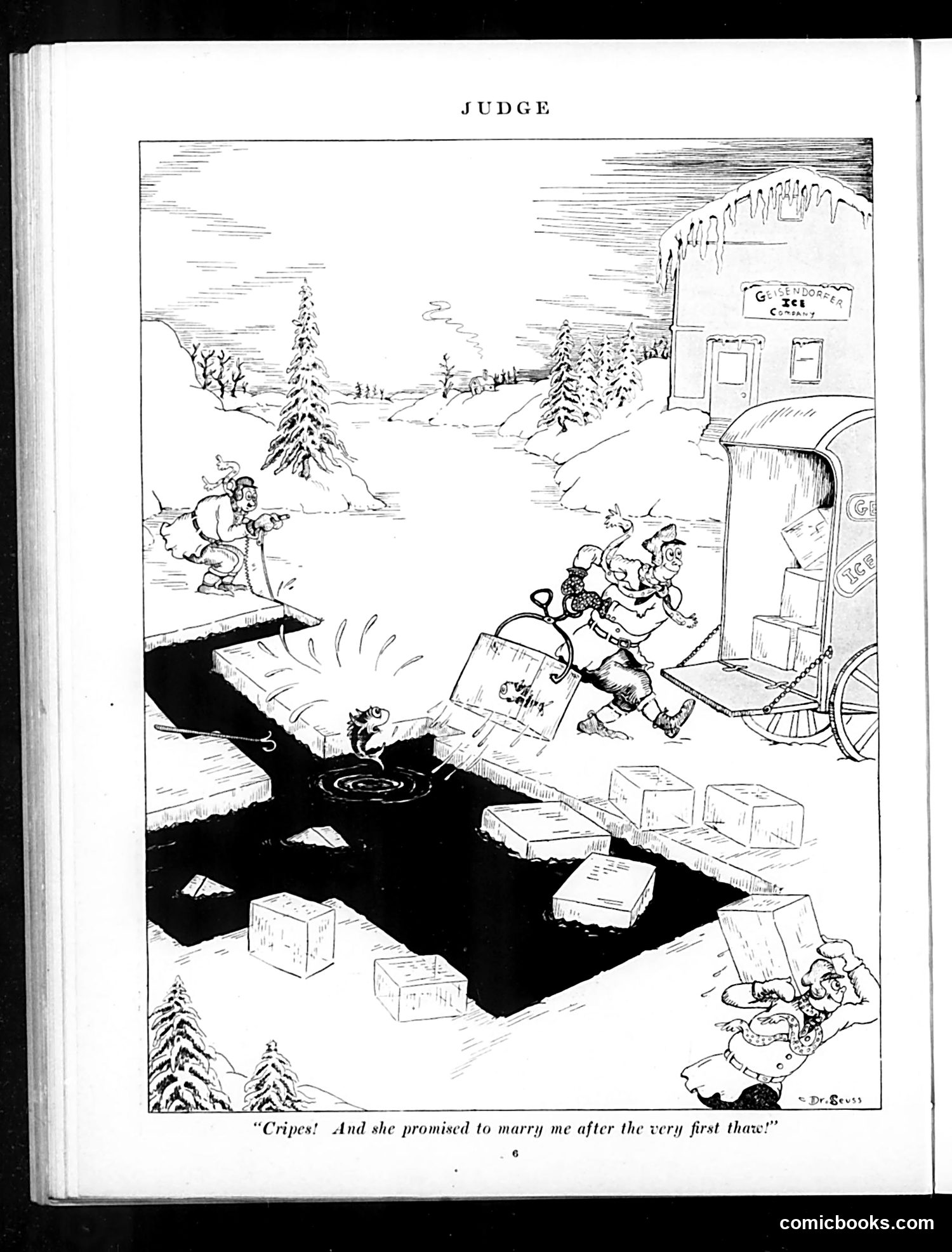
Analysis of Judge Cartoon This cartoon depicts a winter scene where multiple figures have fallen through ice into dark water. The caption reads: "Cripes! And she promised to marry me after the very first thaw!" The humor appears to be slapstick physical comedy rather than political satire. A man on the right expresses dismay about a broken romantic promise, while his companions struggle in the icy water behind him. The "Glendenning Ice Company" building visible in the background suggests this may be set at or near an ice business. The joke plays on the literal meaning of "thaw"—the man expected to marry after the ice melted, but instead everyone has fallen through it, creating dark comedic irony. This is primarily visual humor about mishaps and misunderstandings rather than social commentary.
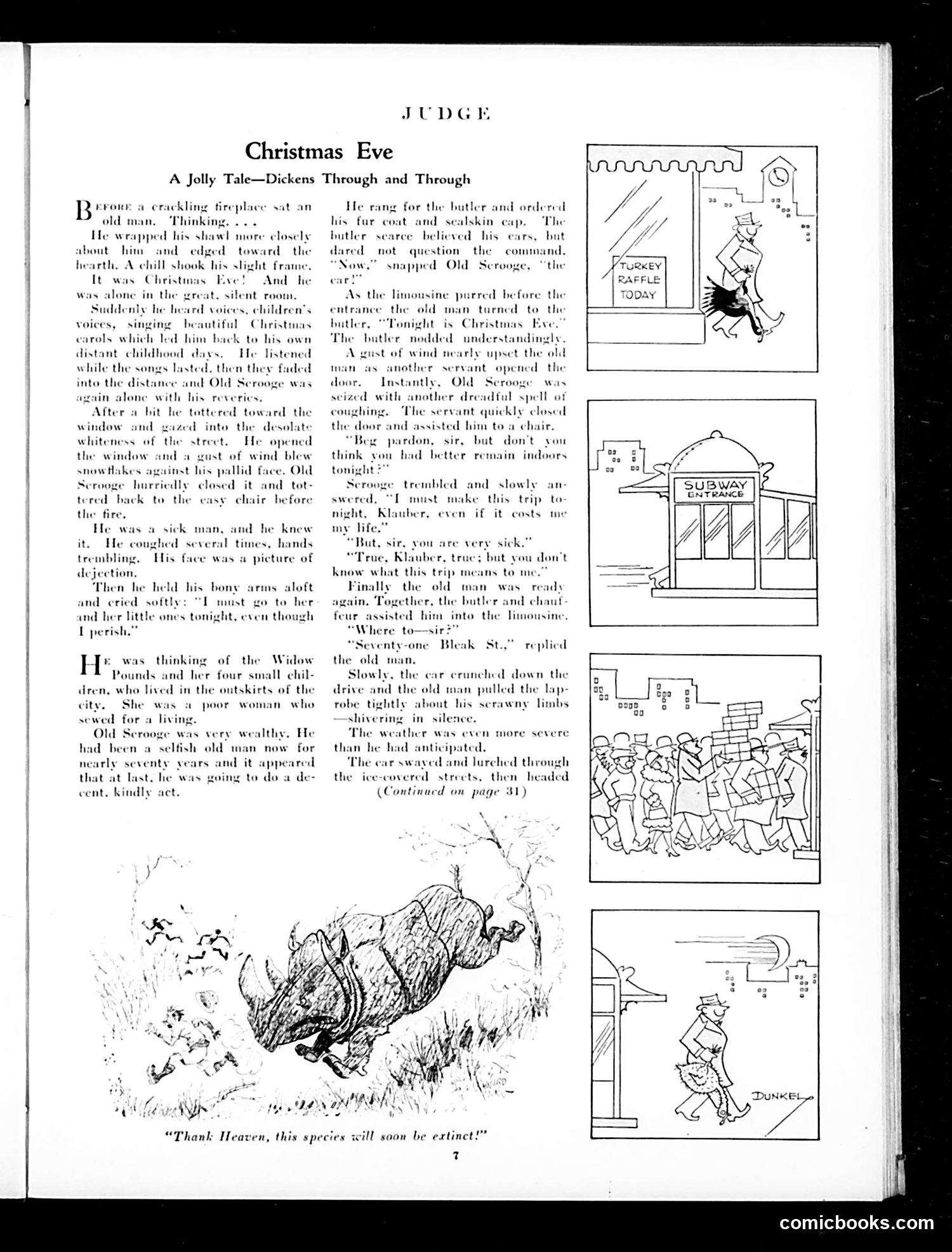
"Christmas Eve" Analysis This is a Dickensian parody—a deliberate homage to Charles Dickens's *A Christmas Carol*. The story follows "Old Scrooge," a wealthy, selfish elderly man who experiences a change of heart on Christmas Eve and resolves to help the Widow Pounds and her four poor children, despite his severe illness. The satire works by mimicking Dickens's sentimental moral tale structure: the isolated rich man, the impoverished family, the redemptive Christmas spirit, and the protagonist's physical suffering as metaphor for spiritual awakening. The phrase "Dickens Through and Through" signals that Judge magazine is affectionately spoofing both the story's melodramatic earnestness and Dickens's characteristic sentimentality. The various cartoon panels illustrate scenes from the narrative—Scrooge's decision, the limousine journey, street crowds—emphasizing the story's theatrical, serialized quality typical of period fiction. The final image caption ("Thank Heaven, this species will soon be extinct!") likely jokes about Scrooge-like misers becoming obsolete through redemption.
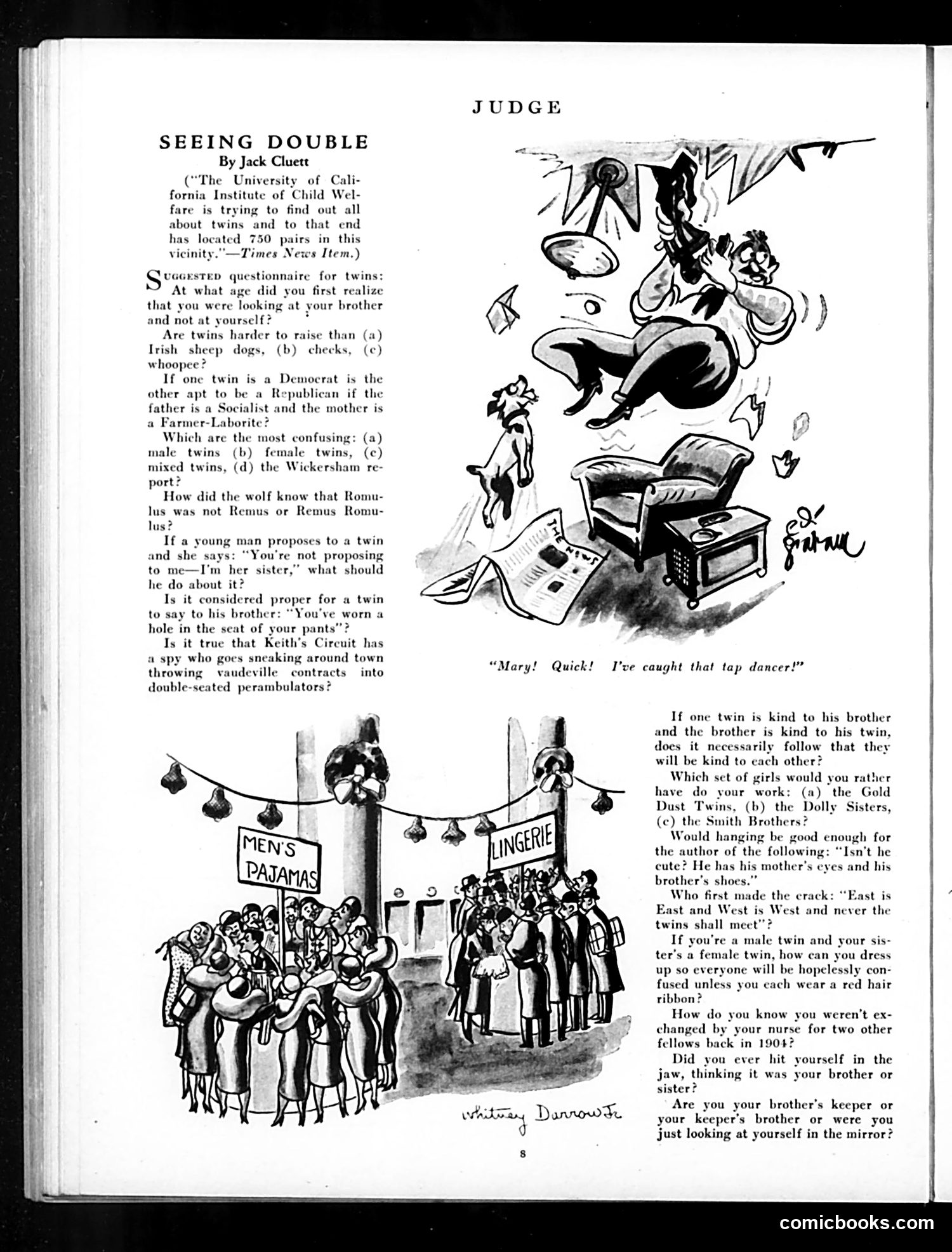
Judge Magazine: "Seeing Double" by Jack Cluett This page satirizes the University of California's twin-research study (referenced in the Times News Item) by presenting absurd questionnaires twins might face. The humor works on multiple levels: The cartoons show chaos—a tap dancer caught mid-performance near a TV, and crowds at "Men's Pajamas" and "Lingerie" shops, implying the confusion and mayhem twins supposedly cause. The questions mock both the research itself and broader 1920s concerns: political inheritance ("If one twin is a Democrat..."), commercial brand mascots (Gold Dust Twins, Dolly Sisters, Smith Brothers), and period anxieties about identity confusion ("were you exchanged by your nurse?"). References to "Keith's Circuit" (vaudeville) and the "Wickersham report" (Prohibition enforcement) ground the satire in contemporary 1920s culture. The overall joke: studying twins scientifically is futile—they're fundamentally bewildering.
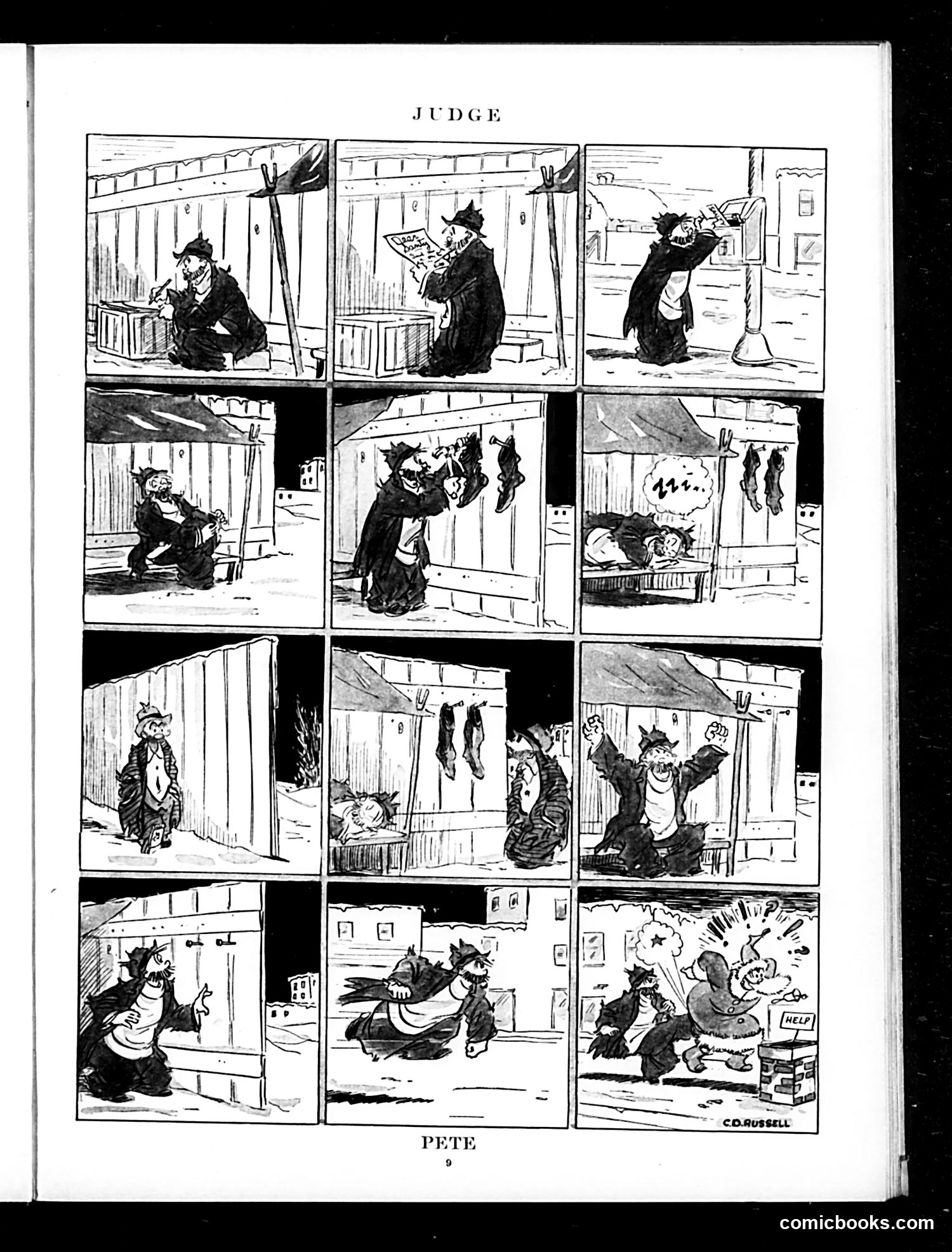
"Judge" - "Pete" Comic Strip This is a multi-panel comic strip titled "Judge" (credited to C.D. Russell) depicting a character named Pete, appears to be a working-class or vagrant figure in worn clothing and a hat. The narrative follows Pete through various encounters in urban settings—searching through buildings, handling laundry or clothing, sleeping, and eventually encountering what seems to be authority figures or conflict in the final panels, where there's apparent chaos and a "HELP" sign visible. The strip appears to satirize urban poverty, homelessness, or petty crime common to early 20th-century American cities. Pete's shabby appearance and desperate circumstances likely comment on social conditions or serve as darkly comedic observations about urban struggle, typical of Judge magazine's satirical approach.
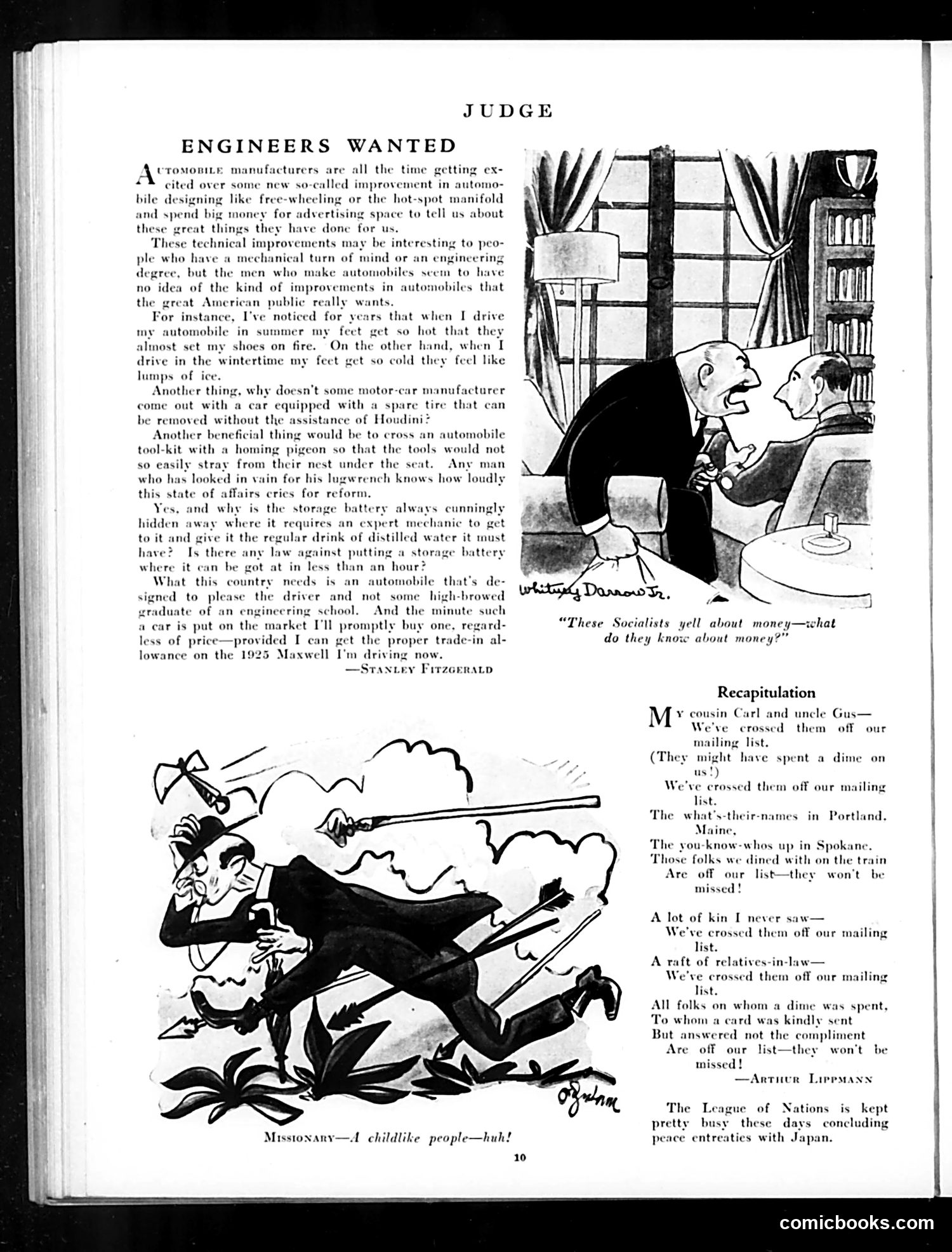
Explanation for Modern Readers "Engineers Wanted" is Stanley Fitzgerald's satirical essay criticizing automobile manufacturers. He argues they obsess over technical innovations (free-wheeling, manifolds) that engineers find impressive but ordinary drivers don't need. Instead, he humorously lists practical problems: feet burning in summer, freezing in winter, spare tires requiring "Houdini" to remove, and storage batteries hidden where mechanics can't service them. The point: car makers design for engineering prestige, not user comfort. "Missionary" cartoon depicts a missionary being violently attacked by what's labeled "a childlike people"—appearing to mock Western missionary work and paternalistic attitudes toward non-Western cultures. The irony suggests such missions often ended badly. "Recapitulation" by Arthur Lippmann is a humorous poem about pruning one's mailing list of relatives and acquaintances who never reciprocated hospitality or gifts—crossing off those who won't be "missed."
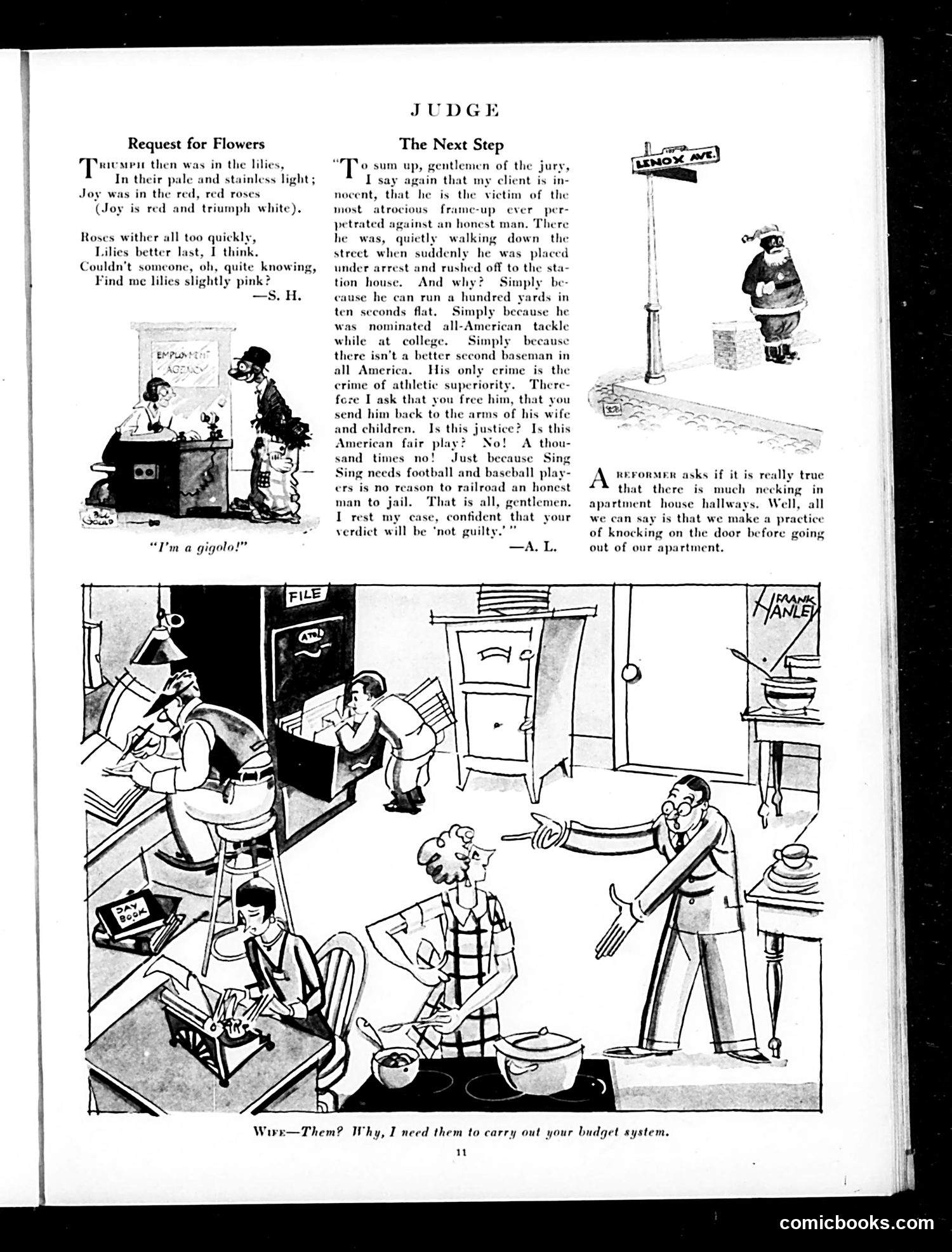
Judge Magazine Page Analysis This page contains two satirical pieces: "The Next Step" mocks the absurdity of imprisoning athletes for their sports prowess. A defense lawyer argues his client—who can run 100 yards in ten seconds, played all-American football, and excels at baseball—is innocent and victim of a "frame-up." The satire targets Sing Sing prison's apparent recruitment of athletes for its sports teams, suggesting the criminal justice system prioritizes athletic talent over justice. The lawyer's passionate plea that athletic superiority shouldn't be criminalized exposes the contradiction. The bottom cartoon depicts domestic chaos—a cluttered apartment where a husband holds rope like a tightwire, with wife saying "I need them to carry out your budget system." This satirizes 1920s-era "scientific" household budgeting systems (likely Frederick Taylor's efficiency movement applied domestically), suggesting such rigid financial planning creates absurd domestic disorder rather than the promised order. Both pieces critique contemporary institutional overreach and misplaced priorities.
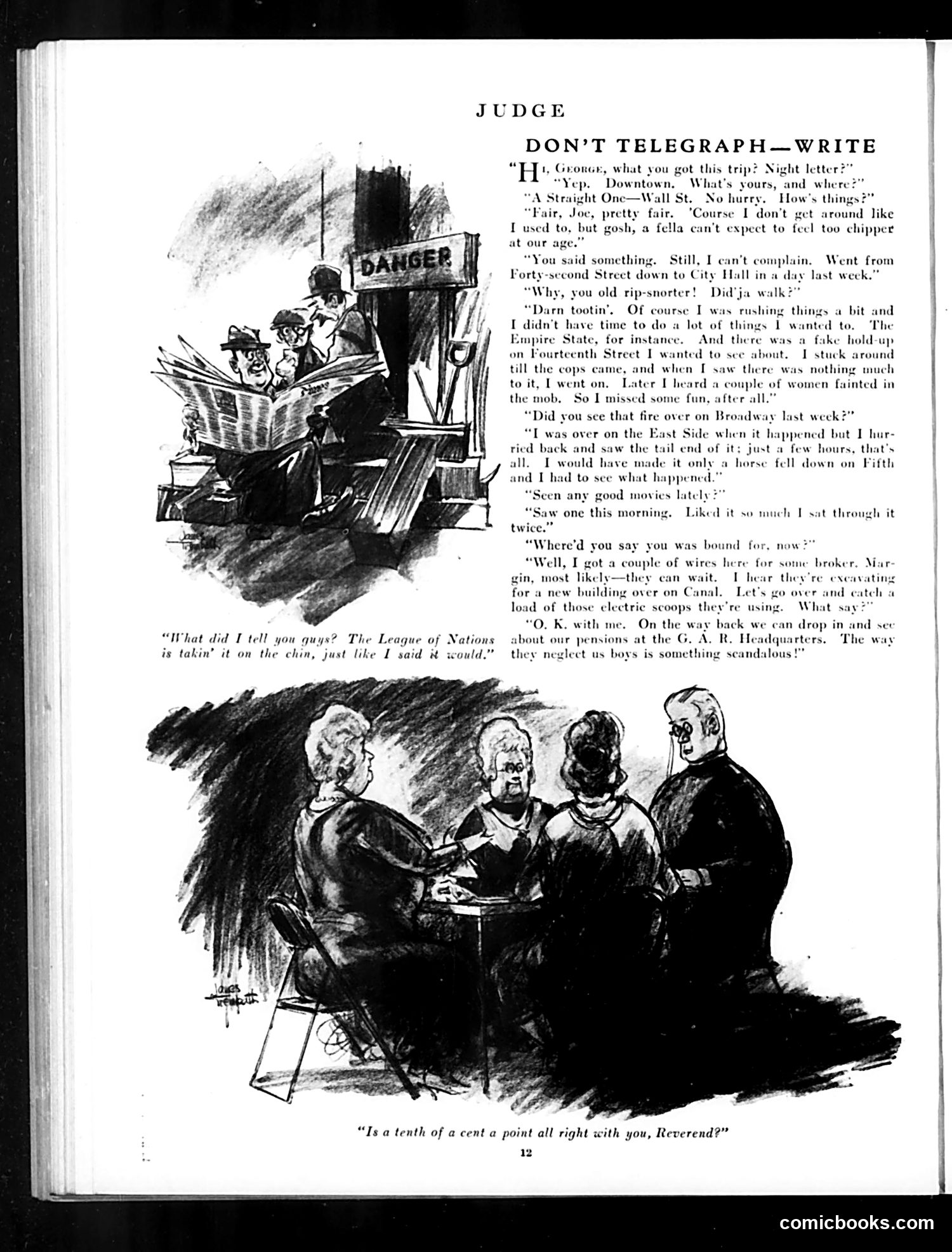
Analysis This page contains two distinct satirical cartoons mocking different targets: Top cartoon: Depicts a taxi driver and passenger discussing mundane city activities (visiting buildings, seeing fires, watching movies). The satire targets ordinary people's self-importance—they treat trivial urban events as adventures worth detailed recounting. Bottom cartoon & dialogue: The real political content. Two elderly men discuss pensions and the League of Nations (referenced in the headline quote). One claims "The League of Nations is takin' it on the chin, just like I said it would"—satirizing those who predicted the League's failure. The final panel shows what appears to be clergymen or officials, with one asking about payment "a tenth of a cent a point"—suggesting corruption or bribery among institutional leaders who "neglect us boys." The overall thrust critiques both everyday vanity and institutional corruption/indifference to veterans' pensions. The League reference dates this to the 1920s-30s era when the League faced significant criticism in America.
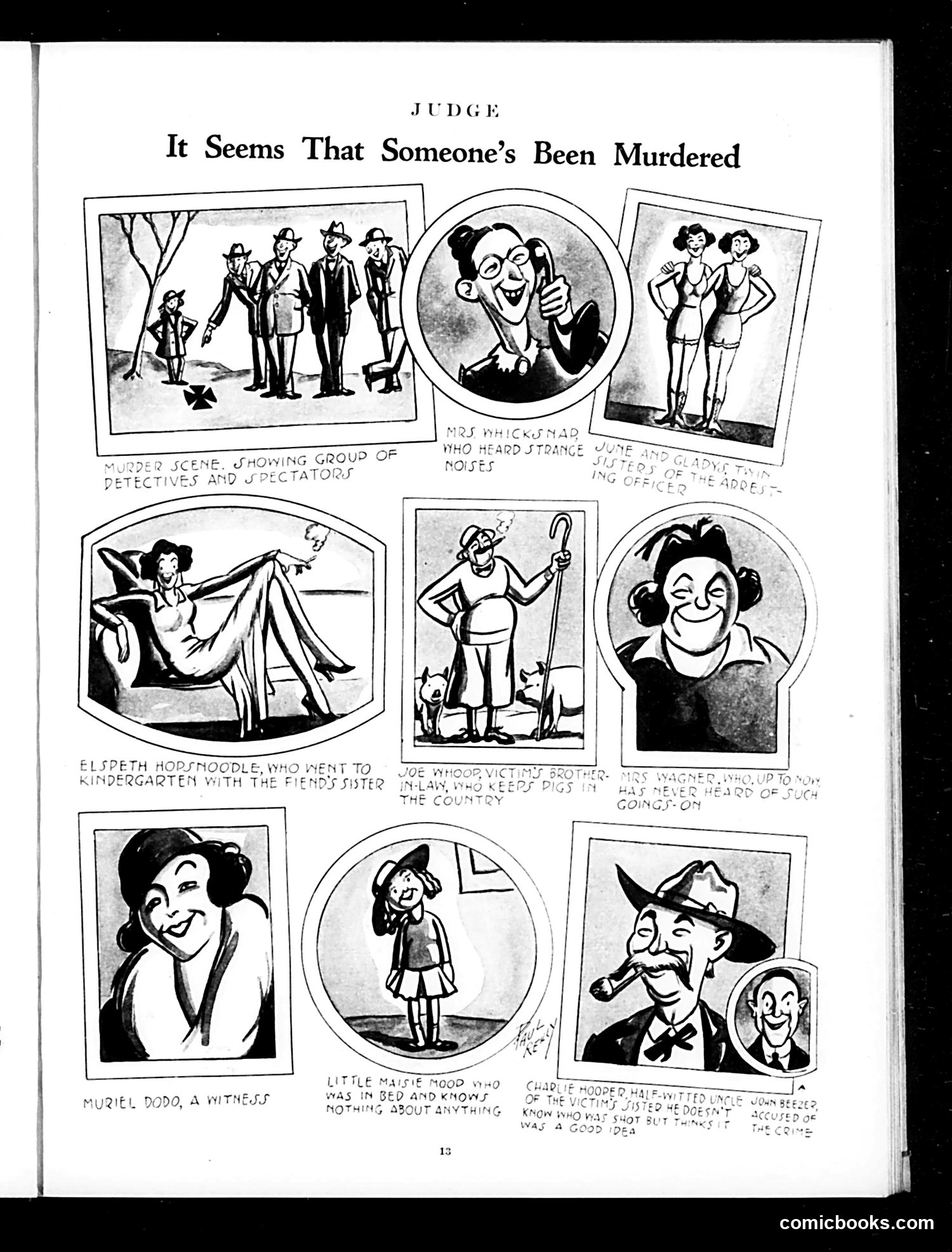
Judge Magazine Satire Analysis This page presents a mock murder mystery featuring exaggerated caricatures. The title "It Seems That Someone's Been Murdered" frames comedic character portraits as suspects or witnesses. The cartoon includes stereotypical figures with captions identifying them by occupation or characteristic: detectives examining a crime scene, showgirls, a pig farmer, a witness named Muriel Dodo, a character associated with bed and ignorance, and others. The style relies on broad physical caricature typical of early-to-mid 20th century satire. The satire appears to mock detective stories and their stock characters—the bumbling investigators, suspicious witnesses, and morally questionable figures—rather than targeting specific political figures or events. It's primarily comedic rather than socially pointed.
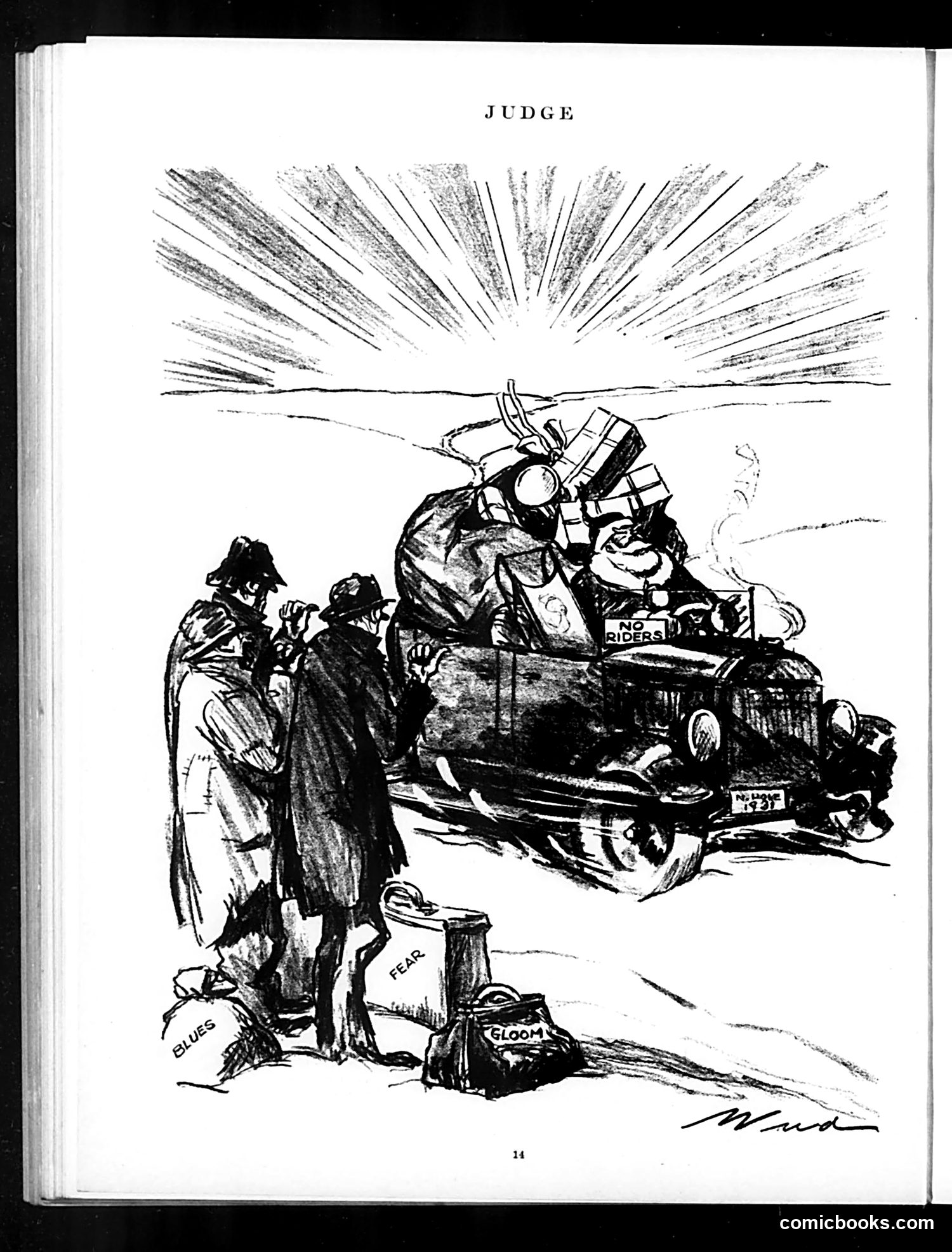
Judge Cartoon: "Judge" This political cartoon depicts a judicial figure (labeled "JUDGE") presiding over a chaotic automobile accident scene. The judge stands elevated, radiating authority with dramatic light rays behind him. Below, three figures labeled "BLUES," "FEAR," and "GLOOM" stand witness to the wreckage—a car marked "NO RIDERS" that appears to have crashed catastrophically. The satire appears to critique judicial response to automotive safety concerns or traffic regulation during the early automobile era. The emotional figures (Blues, Fear, Gloom) likely represent public anxiety about new motor vehicles, while the judge's luminous presence suggests the judiciary's role in adjudicating automobile-related disputes and establishing regulatory standards. The "No Riders" marking remains unclear but may reference safety restrictions.
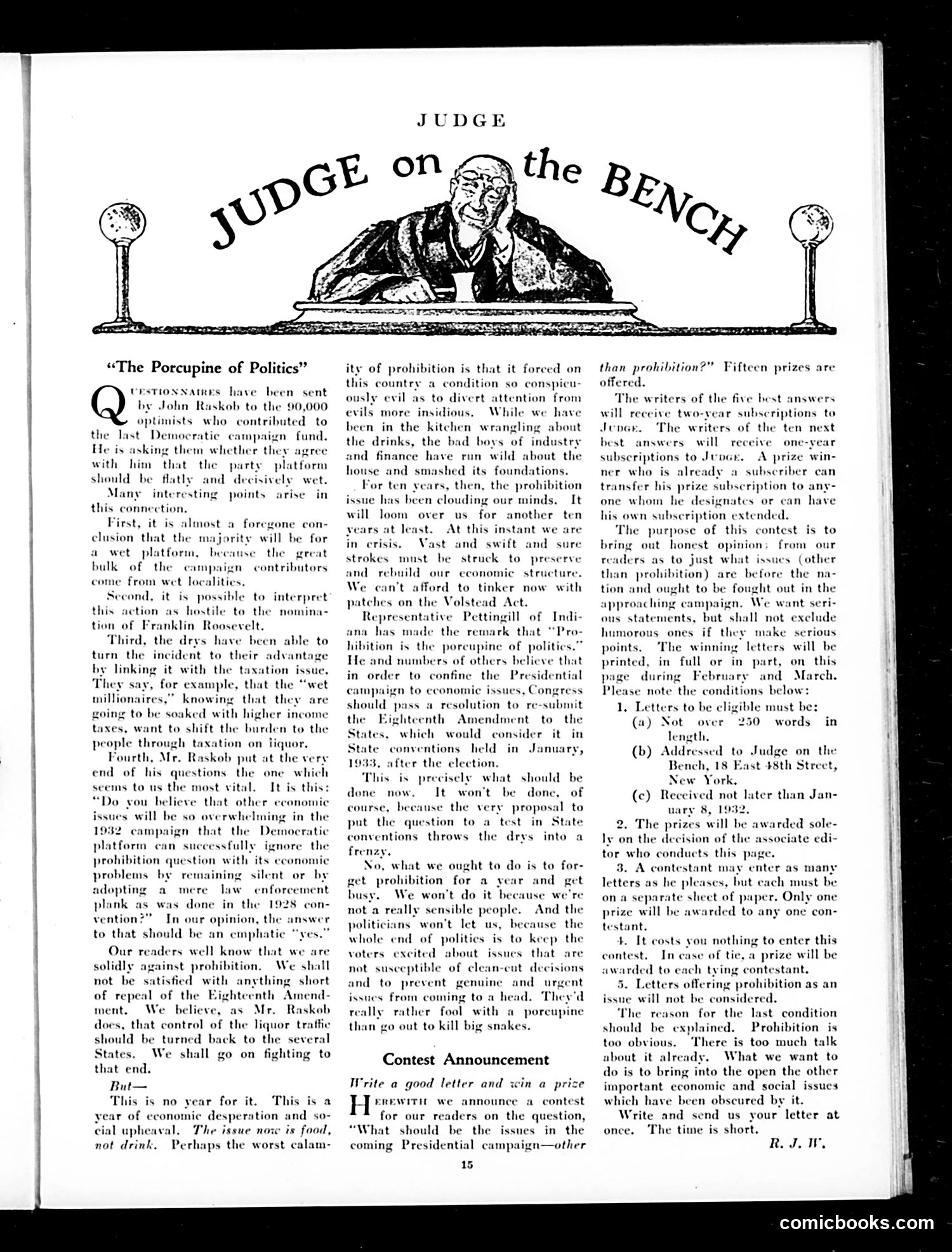
Judge Magazine: "The Porcupine of Politics" (c. 1932) This editorial page discusses the Democratic Party's direction ahead of the 1932 presidential campaign. John Raskob, Democratic National Committee chairman, has surveyed major campaign donors about whether the party platform should explicitly support repealing Prohibition—a controversial "wet" position. The satire's central metaphor: Prohibition is a "porcupine"—difficult to handle, distracting from real issues. The author argues that while personally anti-Prohibition, the party should *avoid* making it a campaign centerpiece because the economic crisis (the Great Depression) demands urgent attention. The real villains are "bad boys of industry and finance" who've "smashed" the economic "house." The piece satirizes how politicians exploit divisive but ultimately secondary issues to distract voters from substantive economic problems they either can't or won't solve. A contest invites readers to propose what *should* be the actual campaign issues. The accompanying illustration shows a stern judge at his bench—authority presiding over this political debate.
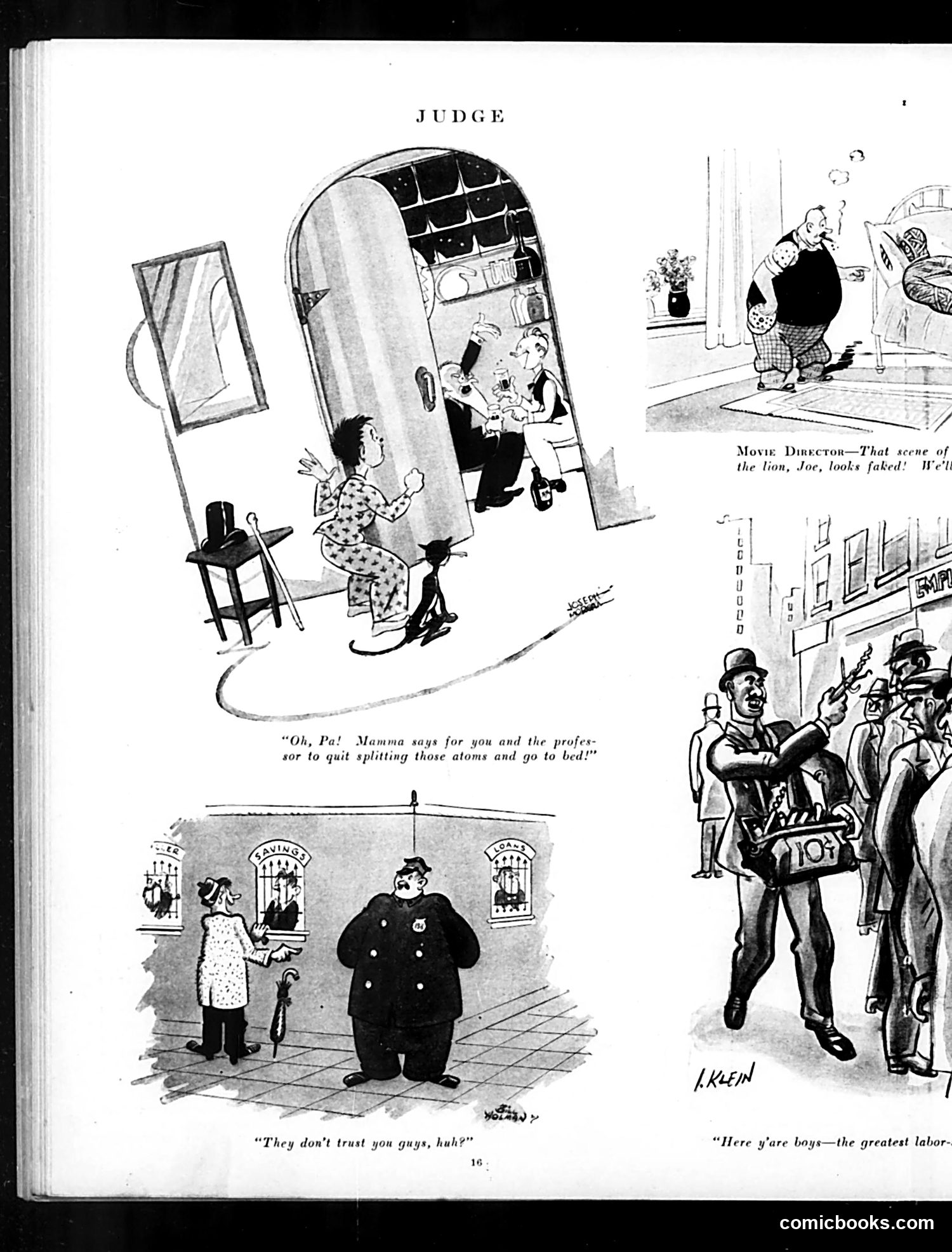
Judge Magazine Page Analysis This page contains three separate cartoons satirizing early 20th-century concerns: 1. Top cartoon: A child interrupts parents and a professor engaged in atomic physics experiments, with mother demanding they stop "splitting atoms" and go to bed—likely mocking public anxiety about newfound atomic science and its dangers. 2. Bottom left: A judge addresses a man with distrust, captioned "They don't trust you guys, huh?"—suggesting skepticism toward a particular profession or group, though the specific target is unclear. 3. Bottom right: A man proudly presents a group to others as "the greatest labor-"—the caption cuts off, but appears to satirize labor organizing or union rhetoric of the era. The "JUDGE" header indicates this is from the satirical magazine *Judge*, known for political and social commentary through humor.
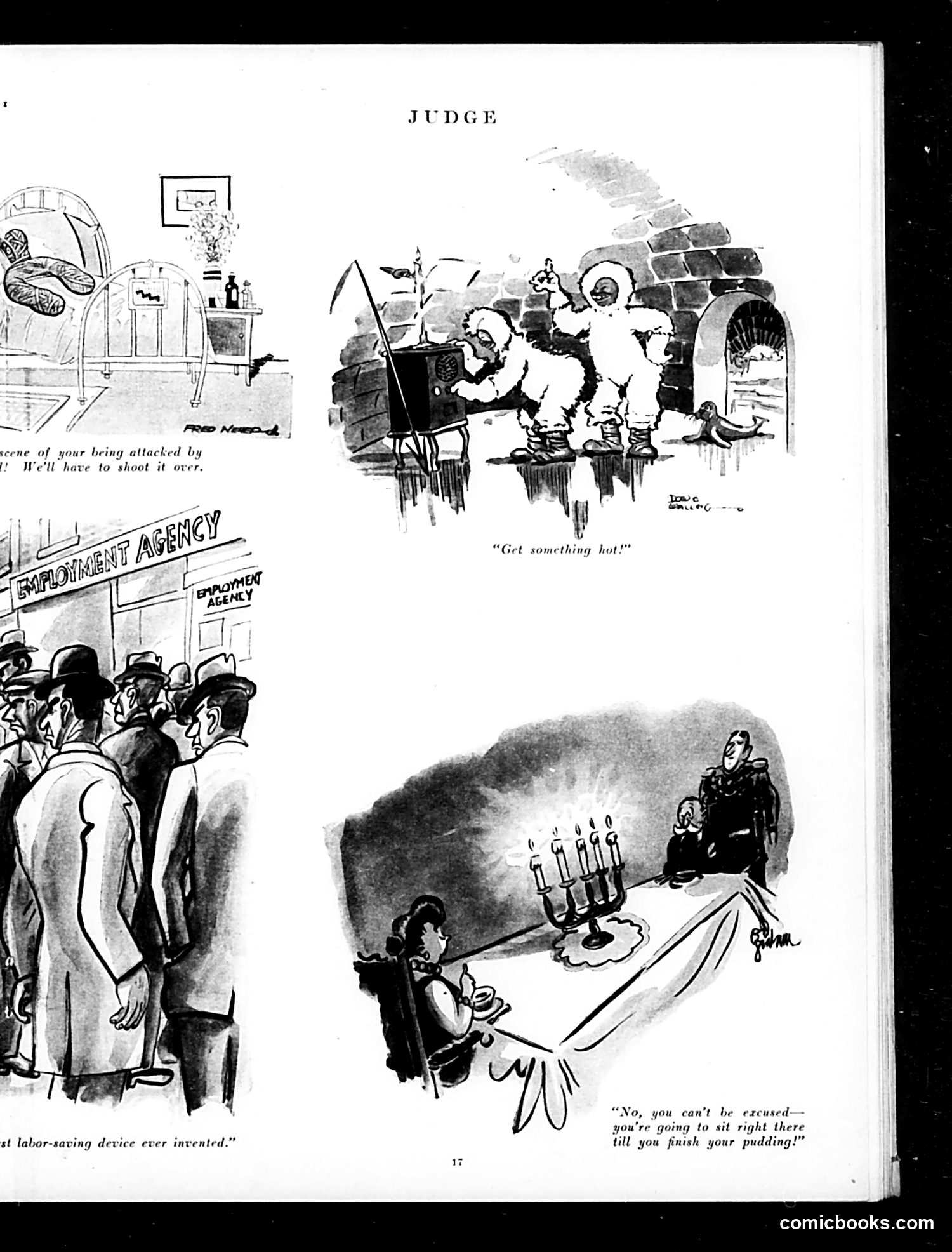
Analysis of Judge Magazine Page This page contains three separate cartoons satirizing different aspects of 1930s-40s American life: 1. Top right: Shows workers at what appears to be a factory or industrial site being directed to "Get something hot!"—likely satirizing wartime production demands or workplace conditions. 2. Bottom left: Depicts an "Employment Agency" with crowds outside, captioned about a "labor-saving device ever invented"—satirizing unemployment or mechanization replacing workers during economic hardship. 3. Bottom right: Shows a mother forcing a child to finish pudding despite their protests about being excused—a domestic humor cartoon about parental strictness during rationing or post-Depression frugality when wasting food was considered unacceptable. The page's overall theme appears to be social commentary on wartime/Depression-era hardship, mechanization, and changed domestic life.
Judge Magazine Theater Critique This is a theater review by Judge magazine's drama critic, critiquing Ferenc Molnár's play "The Good Fairy" as produced by Gilbert Miller on Broadway. The Satire: Judge praises producer Miller's efforts—hiring composer Lehár's music, set designer Urban, and actress Helen Hayes—while savagely dismissing Molnár's script as tired and derivative. The critic argues that Molnár, once a wit ("a fellow of pretty fancy"), has creatively declined into mere "pallid copy of the lesser French boulevard playwriting." The Joke: The final paragraph's implication is biting: Miller will soon need to surround himself with every major Broadway figure (Hopkins, Pemberton, Ziegfeld, the Shuberts, the Theatre Guild) just to salvage Molnár's weak material—a hyperbolic mockery of Miller's theatrical rescue effort. The review exemplifies Judge's theatrical criticism: witty, acerbic commentary on a Hungarian playwright's diminishing talents versus a resourceful American producer's heroic compensatory work.
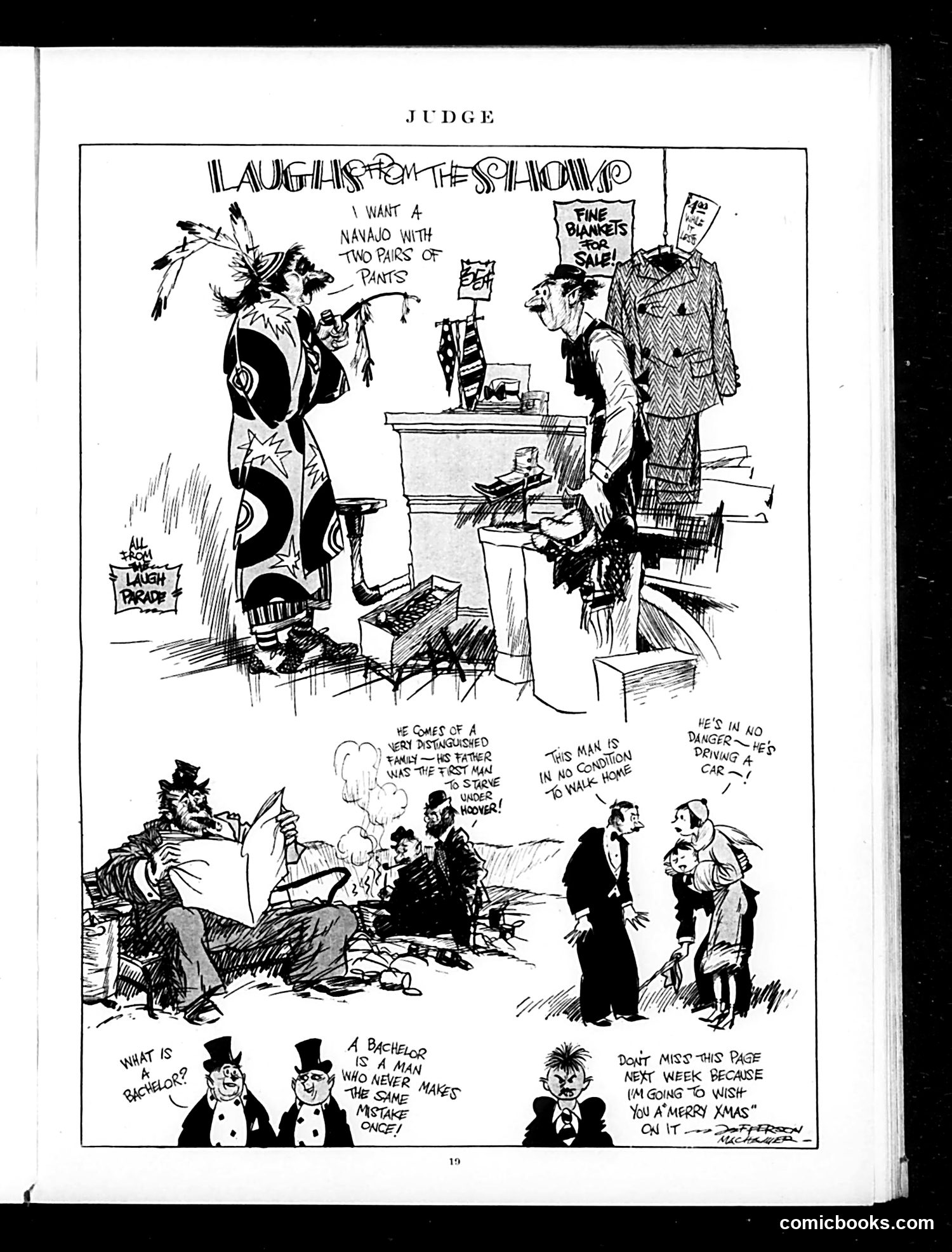
"Laughs from the Stomp" - Judge Magazine Cartoon This page collects several satirical comic vignettes poking fun at social pretension and foolish behavior: Top panel: A clothing store scene mocking absurd consumer demands—a customer insists on a "Navajo with two pairs of pants," treating Native Americans as merchandise. The salesman's bewilderment highlights the ridiculousness. Middle panels: Various scenes of social comedy—a poorly-bred family man, discussions about bachelors and marriage mistakes, and a man recklessly driving. Bottom panel: Two identically-dressed men debating what defines a "bachelor," suggesting humor about indistinguishable wealthy or fashionable types. The cartoons satirize early 20th-century American consumer culture, racial insensitivity, marital anxieties, and class pretension through exaggerated character types. The overall tone is lighthearted mockery of contemporary social follies, typical of *Judge* magazine's satirical approach to modern American life and manners.
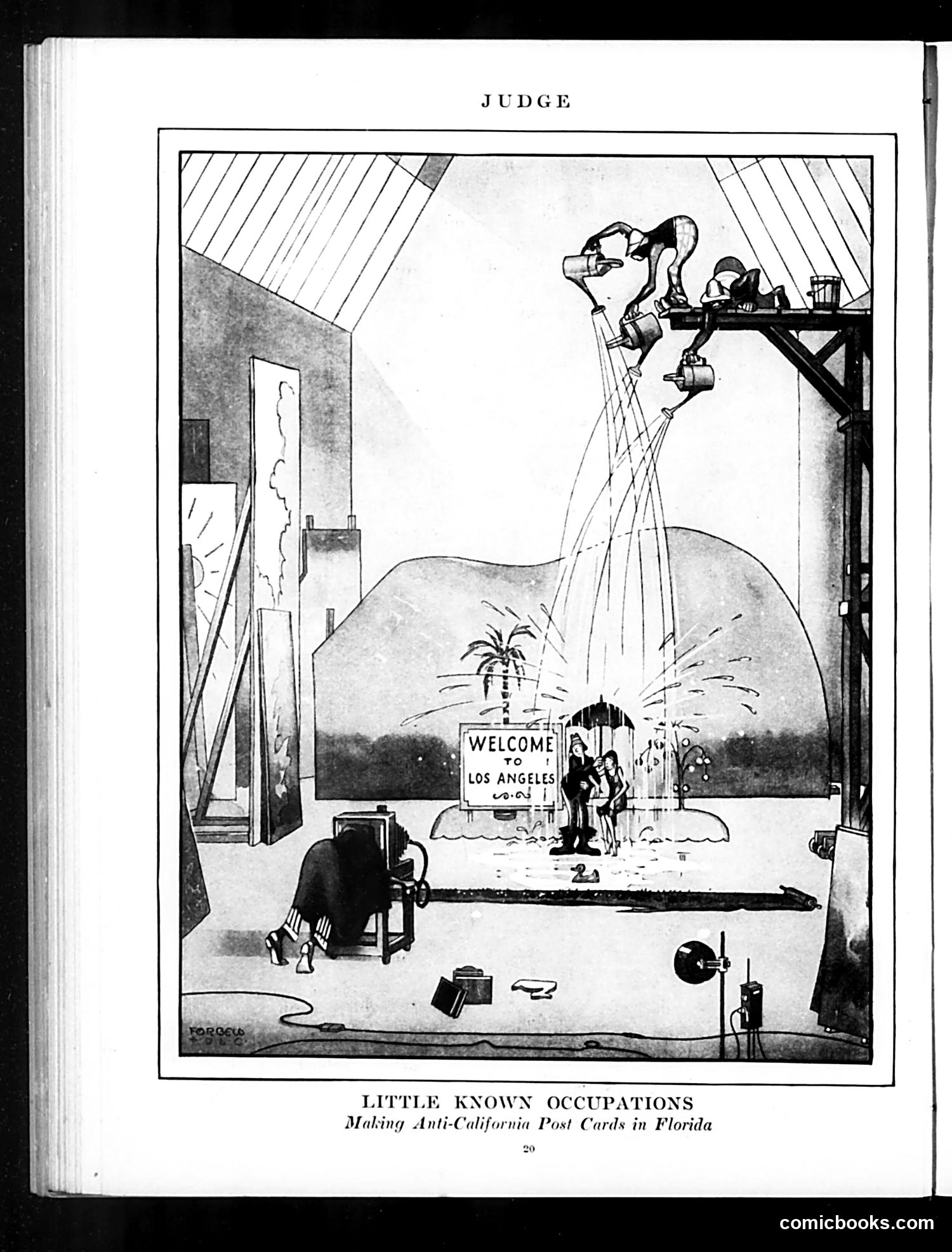
Explanation for Modern Readers This Judge magazine cartoon satirizes regional rivalry between Florida and California. The title reveals the joke: workers in Florida are deliberately creating negative postcards about California to discourage tourism there and redirect visitors to Florida instead. The scene shows a studio operation with sprinkler systems creating artificial rain over a "Welcome to Los Angeles" sign—implying California's climate or conditions are being misrepresented as undesirable. Workers on an elevated platform operate the equipment while someone examines the produced postcards below. The satire targets early 20th-century interstate competition for tourists and settlers. Florida, a developing destination, supposedly engaged in disinformation campaigns against its rival California to boost its own tourism and real estate industries. The cartoon mocks this cutthroat promotional rivalry as an absurd "little known occupation."
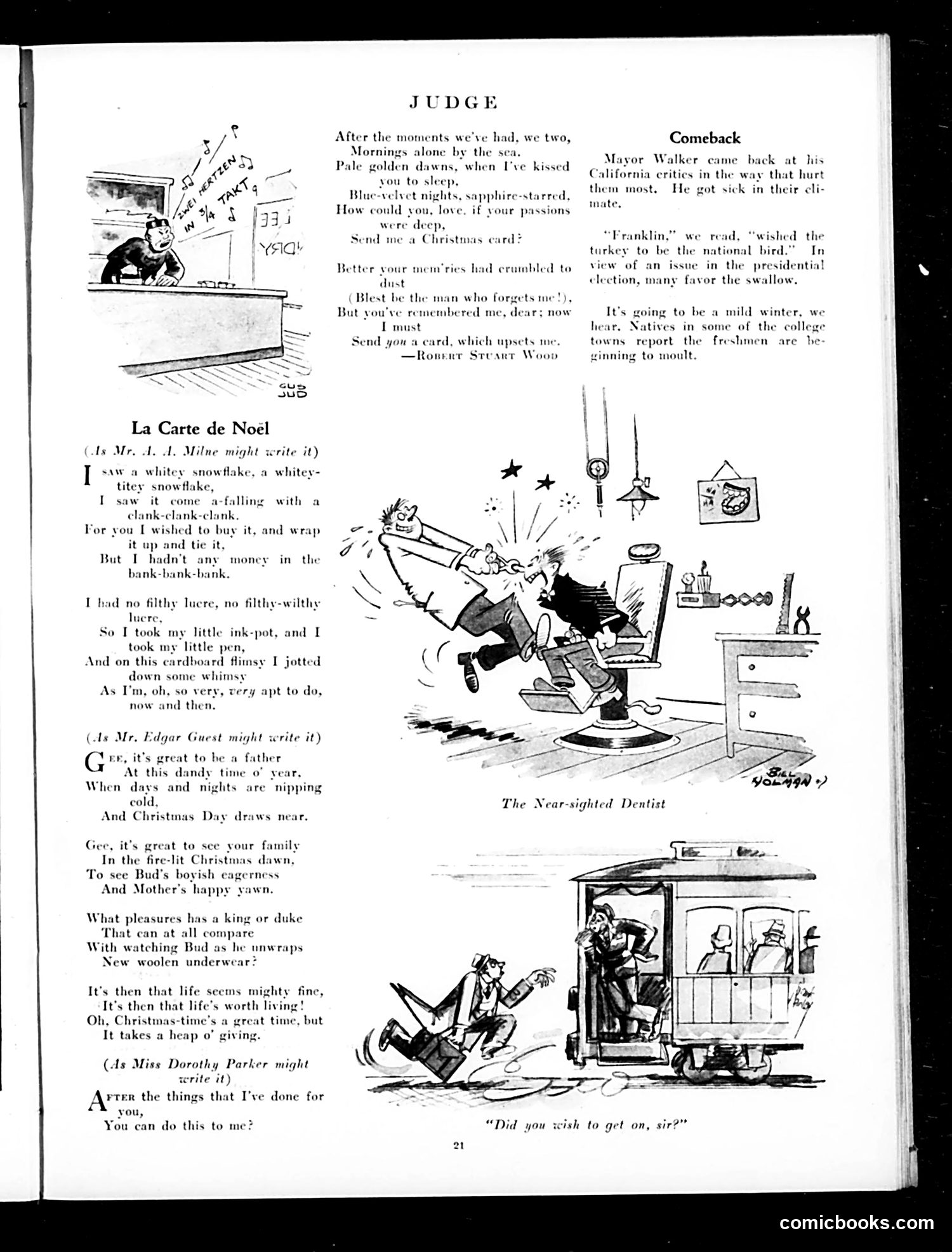
"La Carte de Noel" (Judge Magazine Page) This page parodies Christmas card-writing by presenting three literary styles. The headline mimics A.A. Milne's whimsical verse about a snowflake, using his characteristic repetitive sound effects ("clank-clank-clank"). The second poem imitates Edgar Guest's sentimental Americana style, celebrating family Christmas moments including a son unwrapping woolen underwear—a humorous contrast to Guest's earnest tone. The third section, credited to Dorothy Parker, offers her characteristically sardonic take: a jilted lover resents receiving a Christmas card from an ex-lover, viewing the gesture as emotional manipulation rather than kindness. The cartoons illustrate these themes: "The Near-sighted Dentist" shows a dental patient colliding with holiday decorations, and other sketches depict holiday chaos. The "Comeback" section references Mayor Jimmy Walker of New York, who apparently traveled to California and fell ill—his critics implied he couldn't handle the climate. It also mentions a debate over whether the turkey or swallow should be the national bird, apparently tied to a presidential election context.
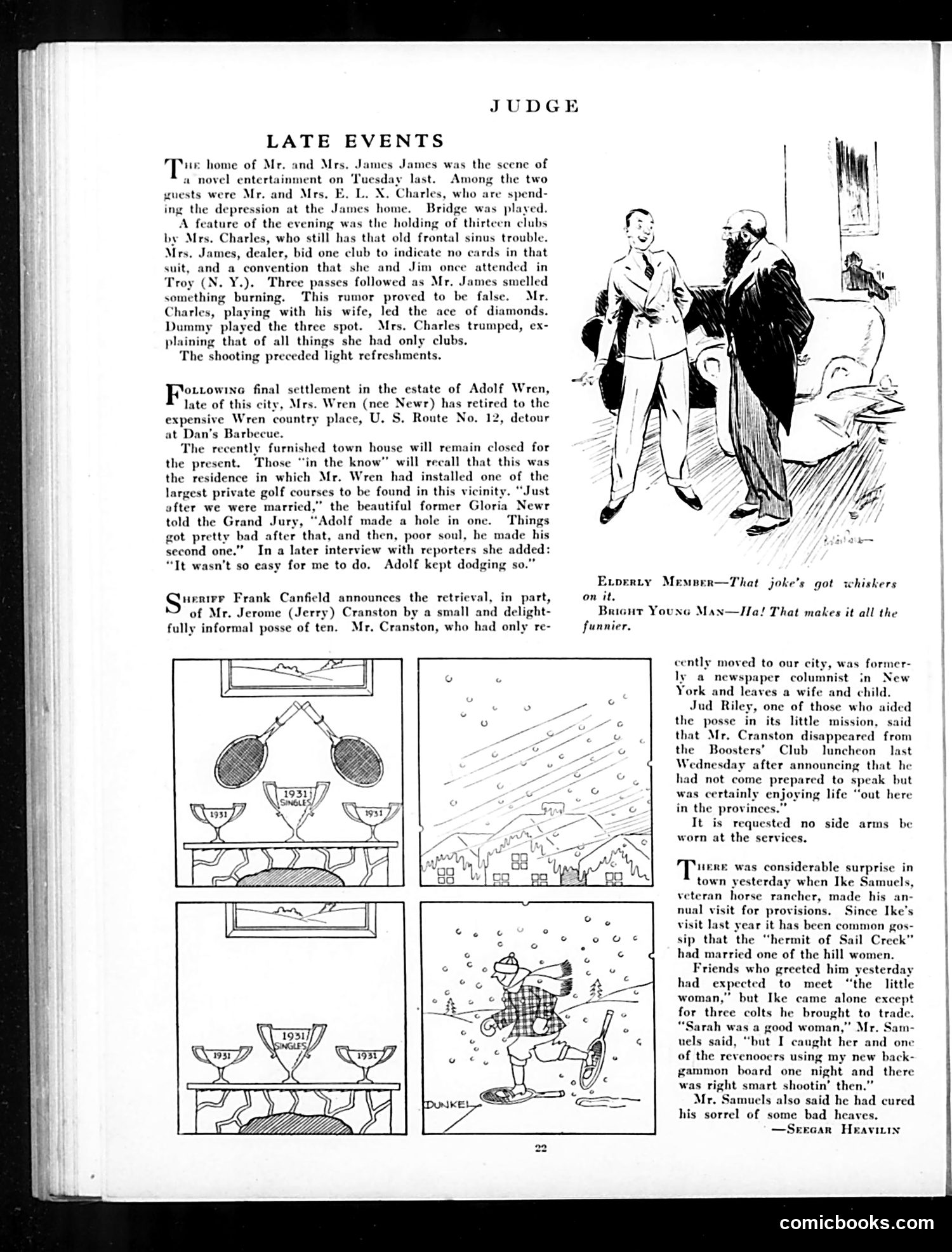
Judge Magazine Satire Analysis This page contains humorous social commentary typical of Judge's satirical approach during the Depression era. "Late Events" presents three comedic anecdotes mocking upper-class pretensions: 1. The Bridge Game: Satirizes a society dinner where Mrs. Charles holds thirteen clubs—a bridge faux pas. The joke escalates absurdly when "shooting preceded light refreshments," suggesting violence erupted over the card game, mocking both bridge etiquette obsession and domestic discord among the wealthy. 2. The Wren Estate: A dark joke about a man named Adolf Wren who made two "holes in one"—first at golf, then implicitly dying (making his "second one"). His widow's coy phrasing ("It wasn't so easy for me") suggests she may have caused his death, played for laughs. 3. The Cranston Retrieval: A newspaper columnist vanished from a club lunch; a posse retrieves him. The caption joke about "side arms at services" hints darkly at his fate, while celebrating provincial hospitality ironically. The cartoon illustrations and dialogue frames reinforce the satirical tone mocking Depression-era social gatherings and rural/urban character types.
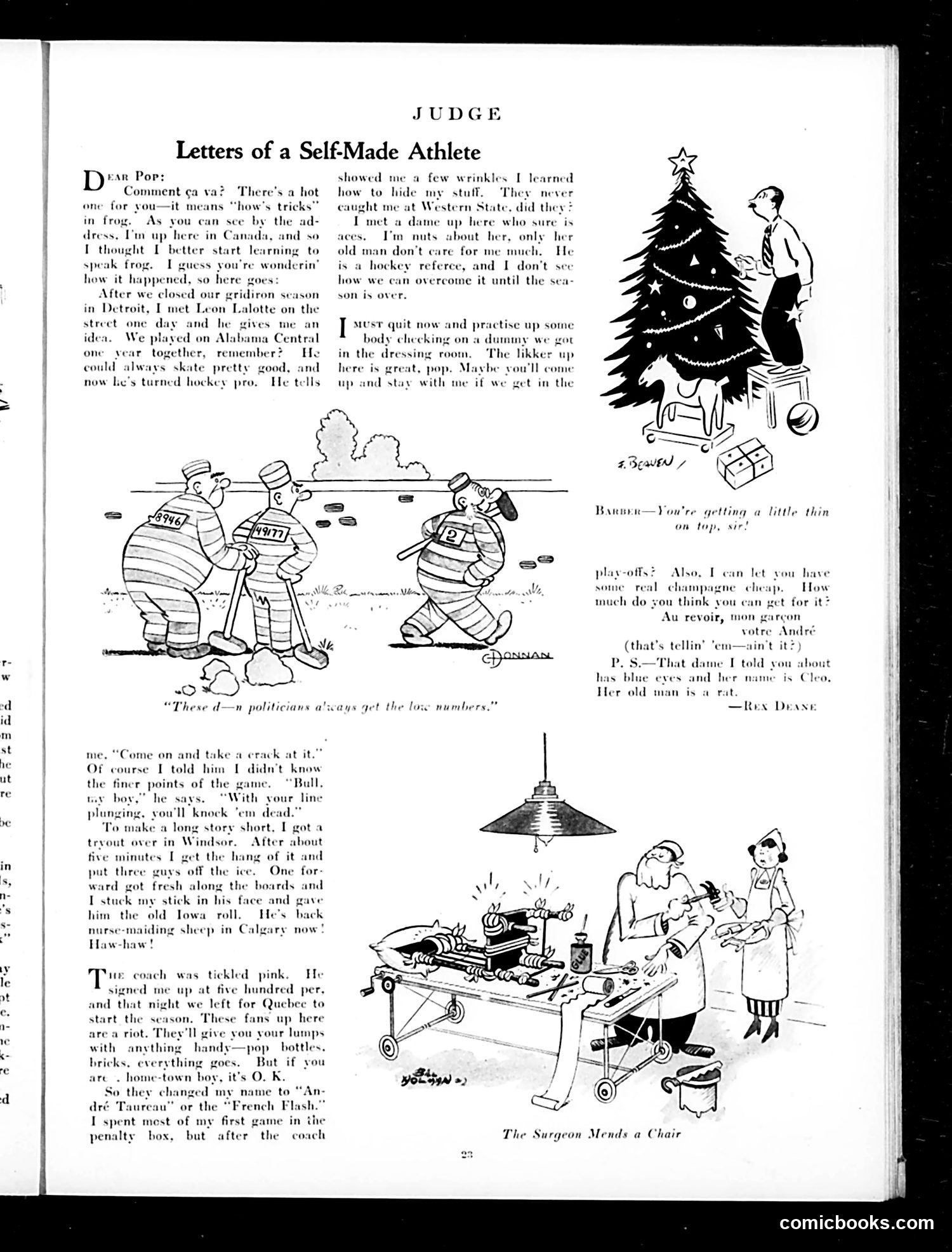
"Letters of a Self-Made Athlete" — Judge Magazine This is a humorous sports column disguised as a letter from a young American athlete who's moved to Canada to play professional hockey. The satire mocks: The figure: An American jock of modest intelligence trying to reinvent himself in a foreign country, adopting a French name ("André Taureau"/"French Flash") for marketability. The jokes: - His malapropisms and broken French ("Comment ça va?") - His casual violence on ice (stick-checking faces, the "Iowa roll") - His get-rich-quick schemes (asking his father to buy cheap champagne to resell) - His obliviousness to social class (dating a hockey referee's daughter) - The cartoon bottom-left shows "politicians always get the low numbers" — likely referencing jersey numbers or draft picks The satire: The piece ridicules the "self-made" athlete archetype—someone with no real skill or sophistication who succeeds through brute force and shameless self-promotion, embodying American sports culture's commercialism and lack of refinement.
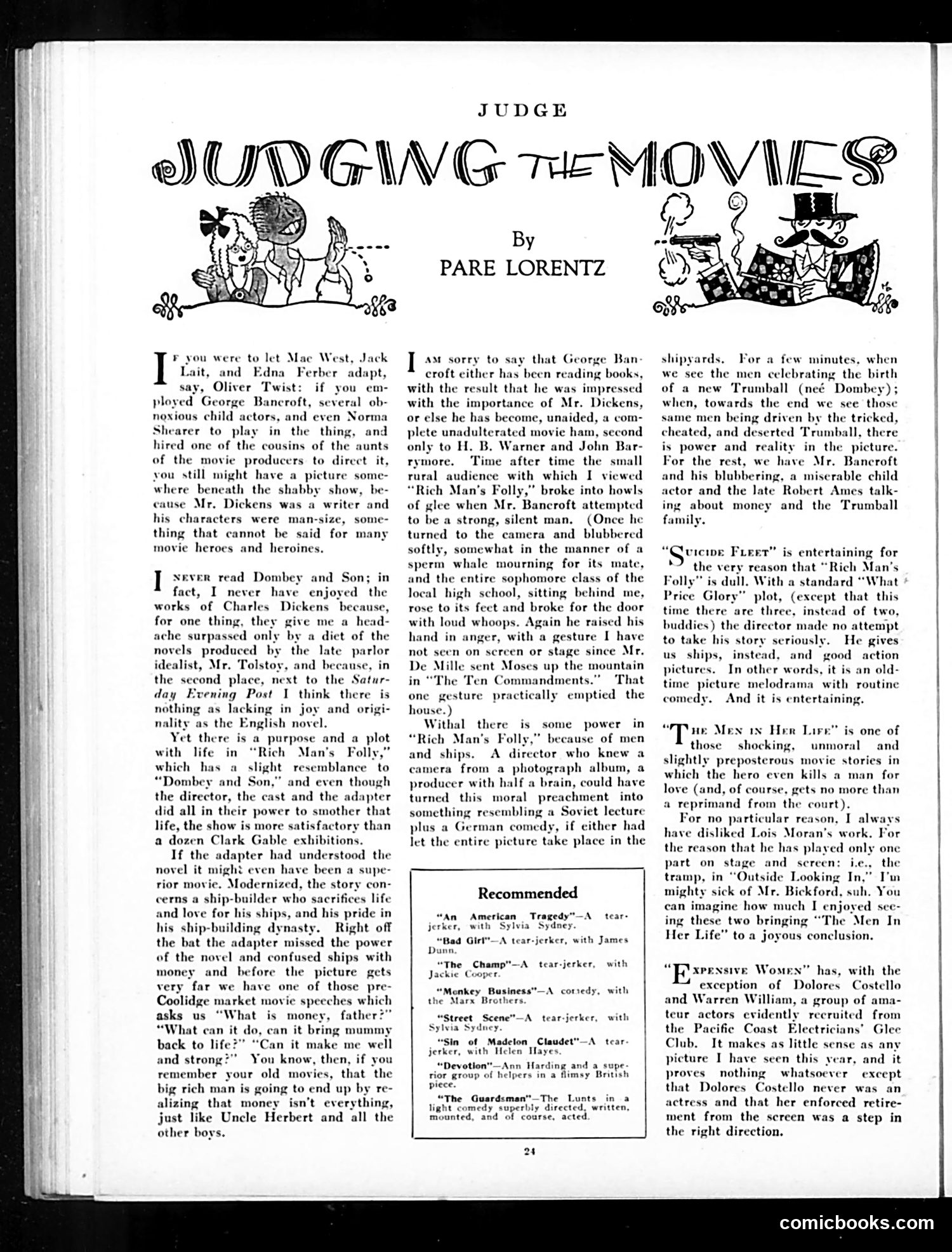
Judge Magazine Film Review: "Rich Man's Folly" This is a film criticism column by Pare Lorentz reviewing the movie "Rich Man's Folly." The writer mocks actor George Bancroft's overwrought dramatic performance—comparing his gestures to a "sperm whale mourning" and his biblical poses to De Mille's Moses scenes. The criticism suggests Bancroft is unintentionally hilarious, causing audiences (including high school students) to laugh and flee theaters. The larger satire targets Hollywood's formulaic approach: adapting literary classics (Dickens novels) while losing their substance, then inserting preachy moralizing about money not being everything—predictable "Coolidge-era" sentimentality that undermines any genuine drama. The boxed "Recommended" films list contemporary tearjerkers and comedies, offering alternatives to this failed adaptation.
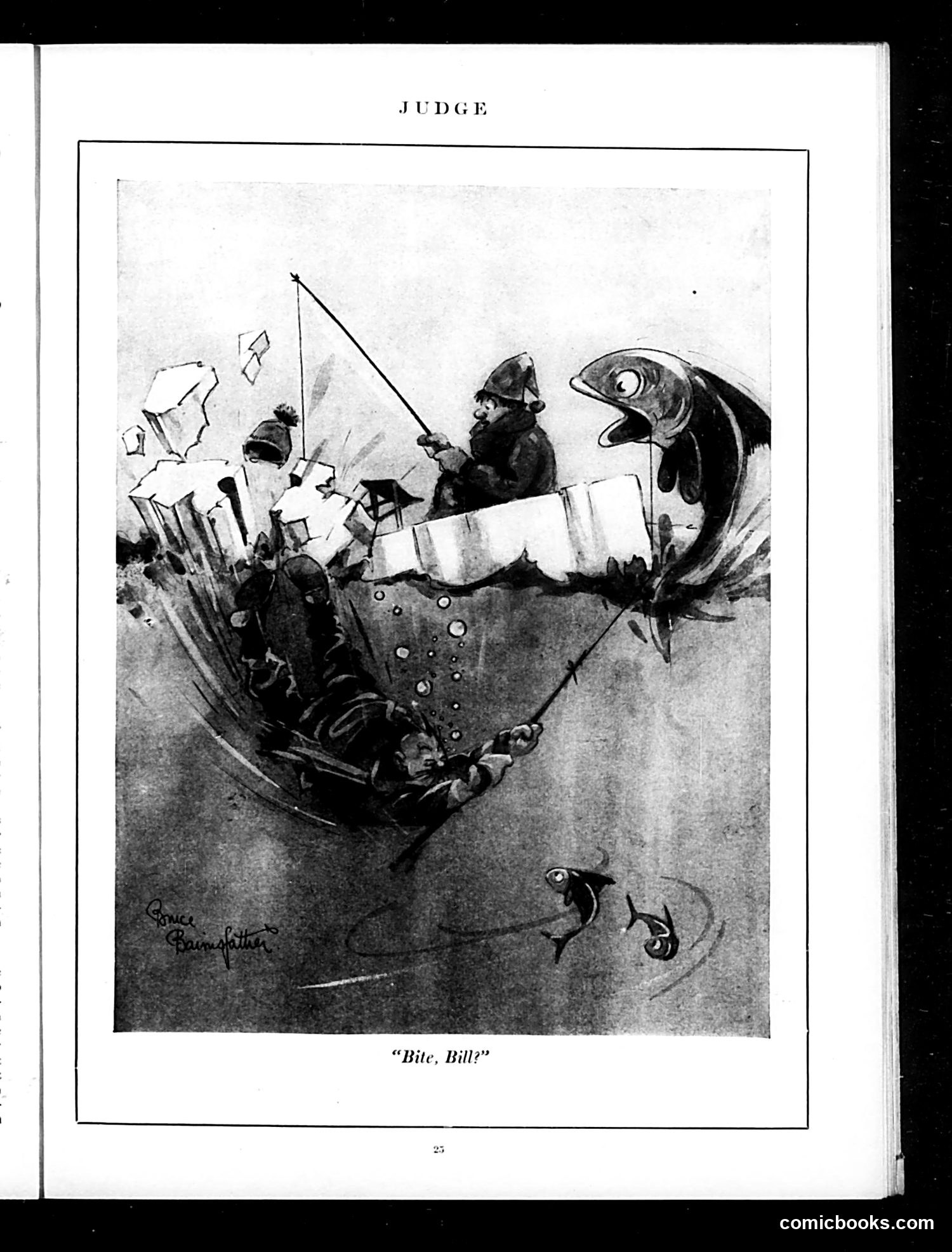
This political cartoon, titled "Bite, Bill?", depicts a fishing scene as satire. A bearded fisherman in a boat holds a fishing rod while large, menacing fish with human features surround him. The fish appear aggressive and threatening, with one particularly large specimen approaching from the right. The cartoon likely uses fishing as a metaphor for political struggle or negotiation. The fish probably represent political opponents or adversaries, while "Bill" refers to proposed legislation. The fisherman's precarious position—surrounded by threatening "bites"—suggests the danger or difficulty of navigating political waters. The title's casual "Bite, Bill?" implies the stakes of legislative battle, where threats of harm or defeat are constant. The specific identity of "Bill" and the exact political context remain unclear without additional publication information.
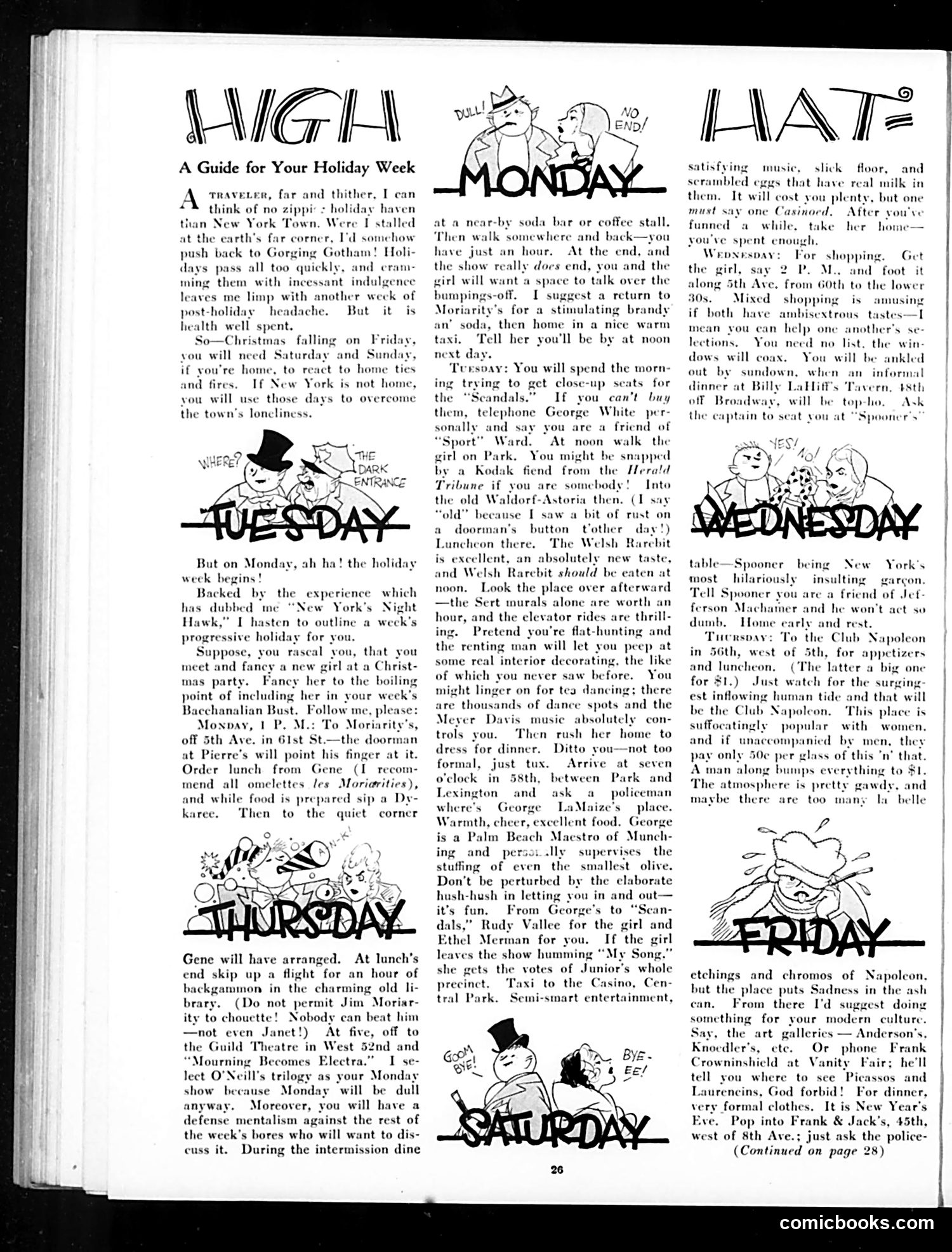
Explaining "High Hat: A Guide for Your Holiday Week" from Judge Magazine This is a humorous lifestyle guide for spending Christmas week in 1920s New York City, written for wealthy sophisticates. The page outlines a romantic holiday itinerary featuring nightclubs, theaters, and exclusive restaurants. Key references: - "Mourning Becomes Electra" — Eugene O'Neill's acclaimed 1931 trilogy (mentioned as Monday entertainment) - "Scandals" — likely George White's *Scandals*, a popular Broadway revue - Rudy Vallee and Ethel Merman — contemporary entertainers - Named establishments like Moriarty's, the Waldorf-Astoria, and George's restaurant represent upscale venues The satire: The piece gently mocks wealthy New Yorkers' self-indulgent holiday pursuits—expensive dining, theater-hopping, nightclub dancing, and romantic conquest—presented as a "progressive holiday." The tone is winking and ironic, suggesting this lifestyle is both enviable and somewhat ridiculous. The cartoons' top-hatted figures reinforce the "high hat" (pretentious) theme.
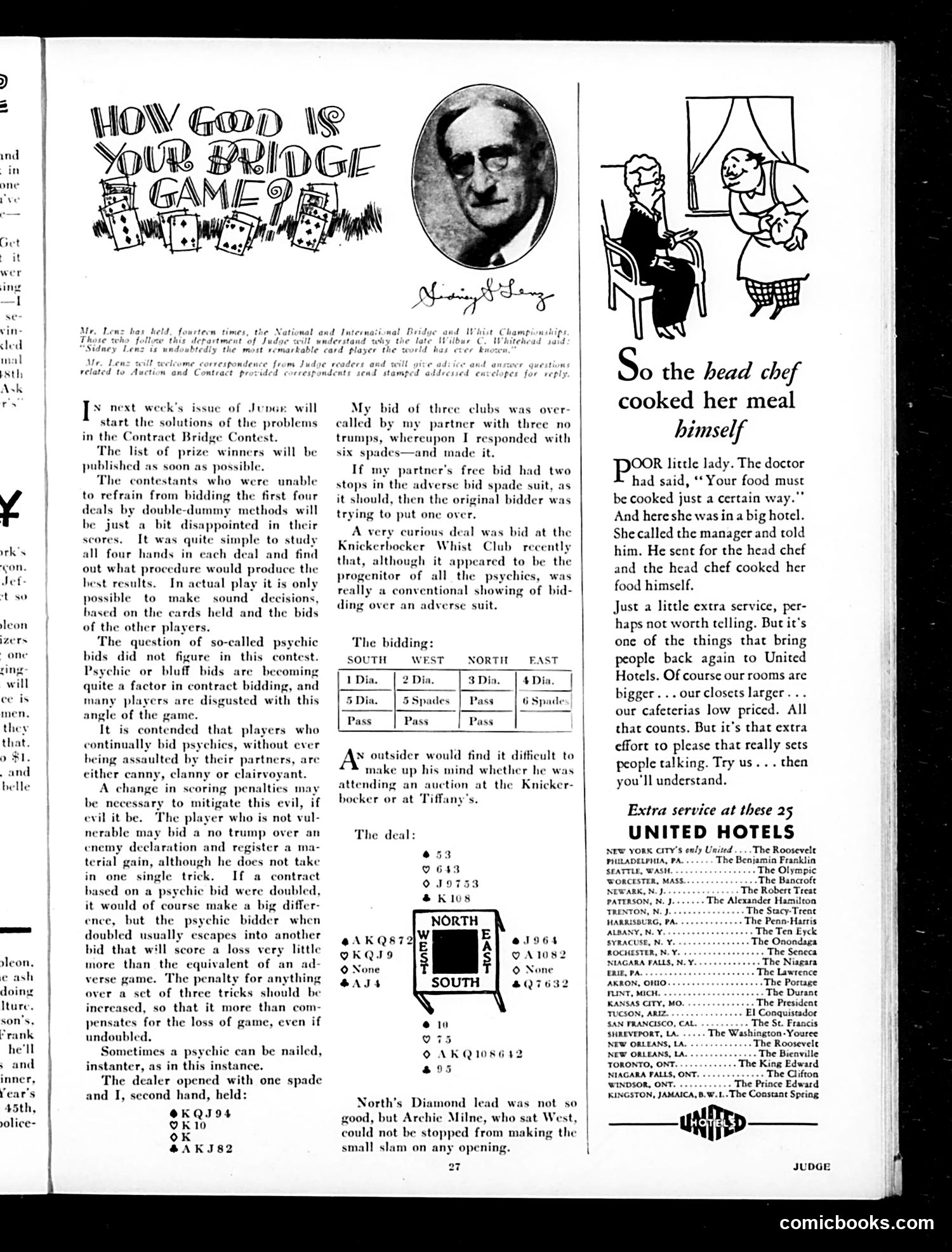
Analysis of This Judge Magazine Page This page is primarily advertising and bridge instruction rather than political satire. The dominant content consists of: 1. Bridge column by "Judge": Technical discussion of contract bridge bidding, including analysis of a specific hand deal and debate over "psychic bids" (bluffs in card play). The column addresses competitive bridge players' concerns about unsportsmanlike bidding tactics. 2. The cartoon (top right): A brief humorous anecdote about a hotel's "head chef" personally cooking a sick guest's meal—illustrating attentive service. The cartoon itself is not satirical but rather an advertisement. 3. United Hotels advertisement: Lists 25 hotel locations across America, emphasizing personalized service as their competitive advantage during what appears to be the Depression era, when such touches supposedly justified higher prices. The page reflects 1930s-40s concerns: bridge's growing popularity as competitive sport, debates about game ethics, and hotels' marketing strategies emphasizing service differentiation. There is no political content visible.
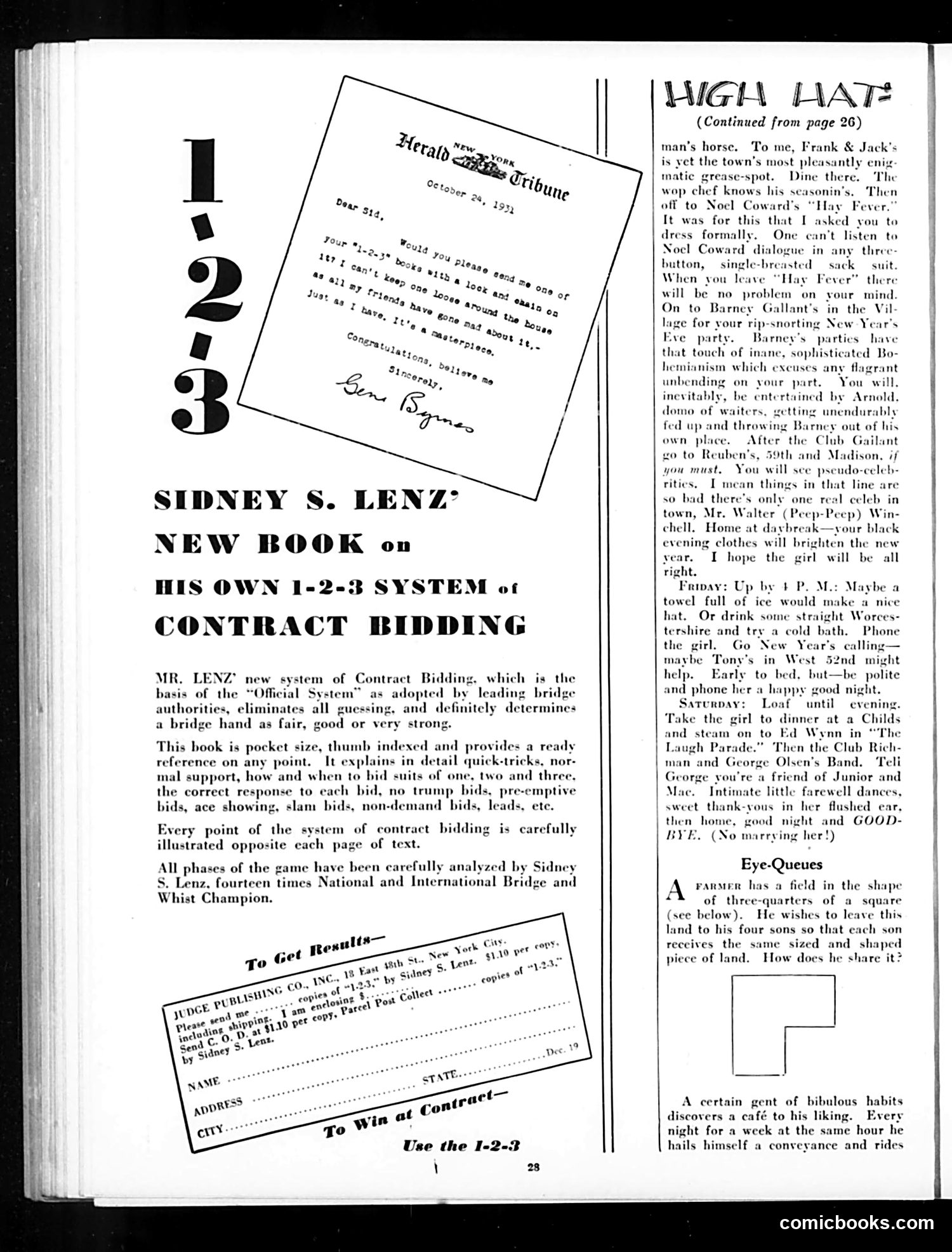
Page Analysis: Judge Magazine (October 29, 1921) This page is primarily advertising and puzzle content, not political satire. The main feature promotes Sidney S. Lenz's new instructional book on contract bridge bidding—a card game system he developed that was adopted by leading bridge authorities. The ad emphasizes the book's practical design (pocket-sized, thumb-indexed) and Lenz's credentials as a fourteen-time champion. The right column contains entertainment advice (likely continued from a previous article) recommending New York City venues for New Year's Eve—including restaurants, Noel Coward's play "Hay Fever," nightclubs like Barney Gallant's and Reuben's, and performances by George Olsen's Band and Ed Wynn. Below that are two recreational puzzles: "Eye-Queues"—a land-division geometry problem and a riddle about a man visiting a café. The page reflects 1920s leisure culture: bridge as a sophisticated pastime, theatrical entertainment, nightlife, and recreational brain-teasers for readers.
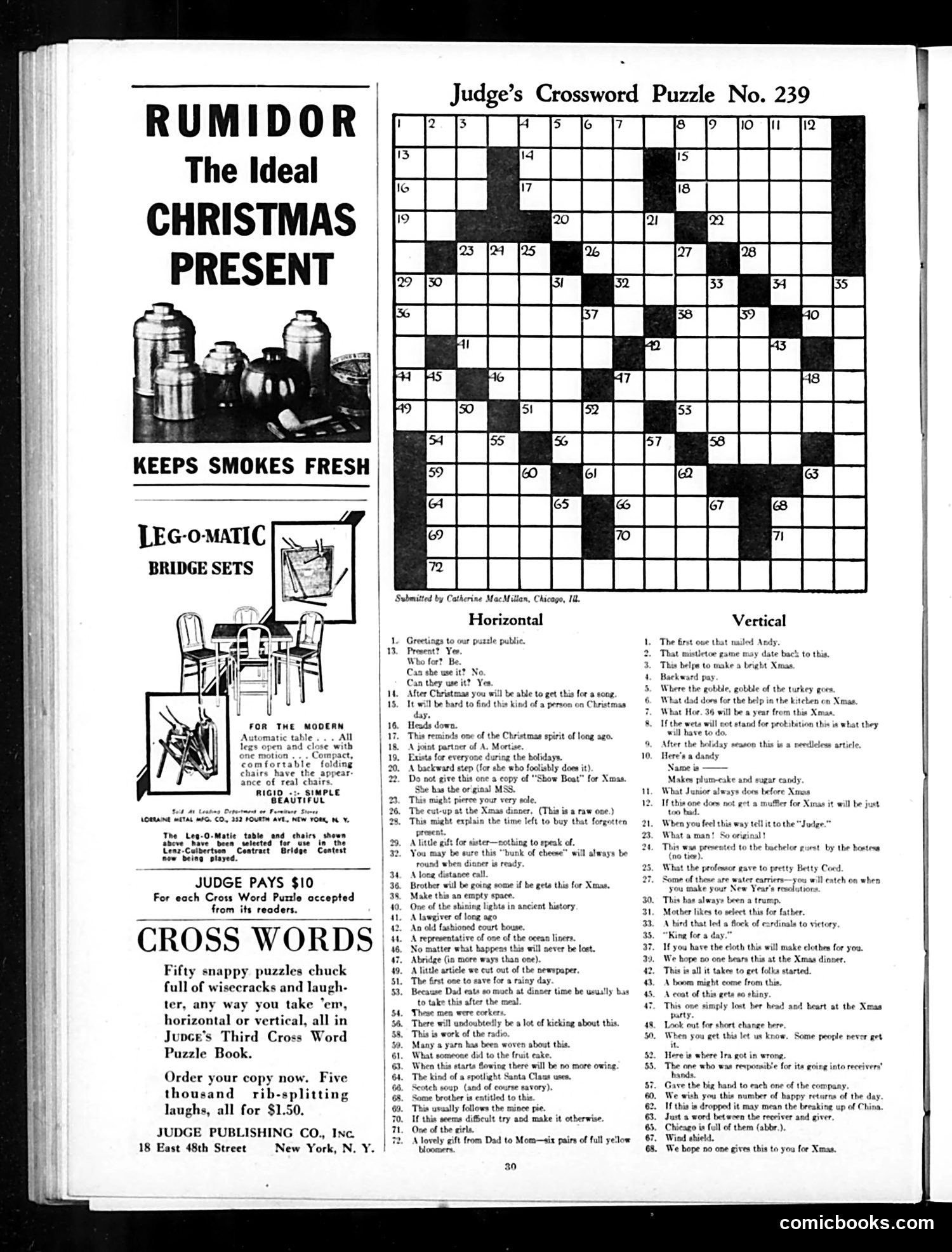
Judge Magazine Page Analysis This page is primarily advertising and promotional content for Judge magazine itself, not political satire. The main advertisement promotes a Rumidor (a humidor for cigars) as an ideal Christmas gift, emphasizing it "keeps smokes fresh." Below that, another ad touts Leg-o-Matic Bridge Sets—folding card tables marketed as modern furniture for entertaining. The bulk of the page features Judge's crossword puzzle promotion. Rather than political commentary, Judge is selling its "Third Cross Word Puzzle Book" containing fifty puzzles, offering readers $10 payment for accepted submissions. This reflects the 1920s-30s crossword craze. The clues are humorous wordplay typical of the era—puns, double meanings, and references to contemporary life (radios, "wets" and Prohibition, bridge playing, holiday traditions). The jokes assume familiarity with modern conveniences and social customs of the time. This is essentially a magazine self-promotion page, showcasing Judge's dual appeal: satirical humor and popular entertainment puzzles.
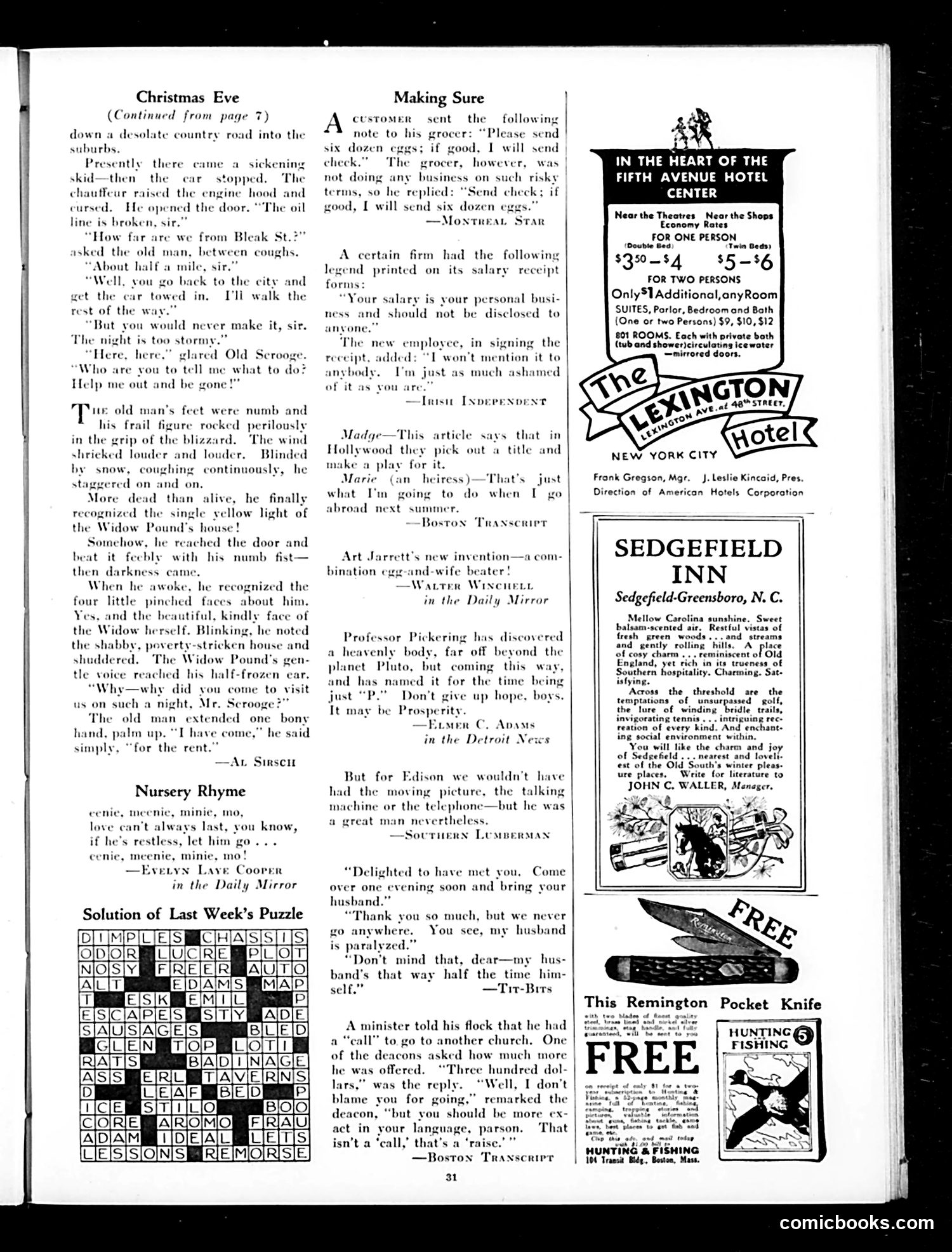
This page from Judge magazine contains miscellaneous humor items rather than political cartoons. The content includes: "Christmas Eve" (continued story): A Dickensian narrative about an old man (apparently named Scrooge, invoking Dickens) caught in a blizzard who seeks shelter with a poor widow's family. The satire criticizes wealth inequality and lack of charity. "Making Sure" and other short jokes: These mock various social situations—a grocer demanding payment before delivery, workplace salary secrecy, and marital discord. They're gentle social commentary on commerce, class consciousness, and domestic relations. "Nursery Rhyme": A brief, unremarkable verse. The page is primarily filler content mixing fiction and humor rather than topical satire. The advertisements (Fifth Avenue Hotel, Sedgefield Inn, Remington Pocket Knife) occupy significant space. Without visible dates or clear political references, the humor appears focused on universal human foibles rather than specific contemporary events or figures.
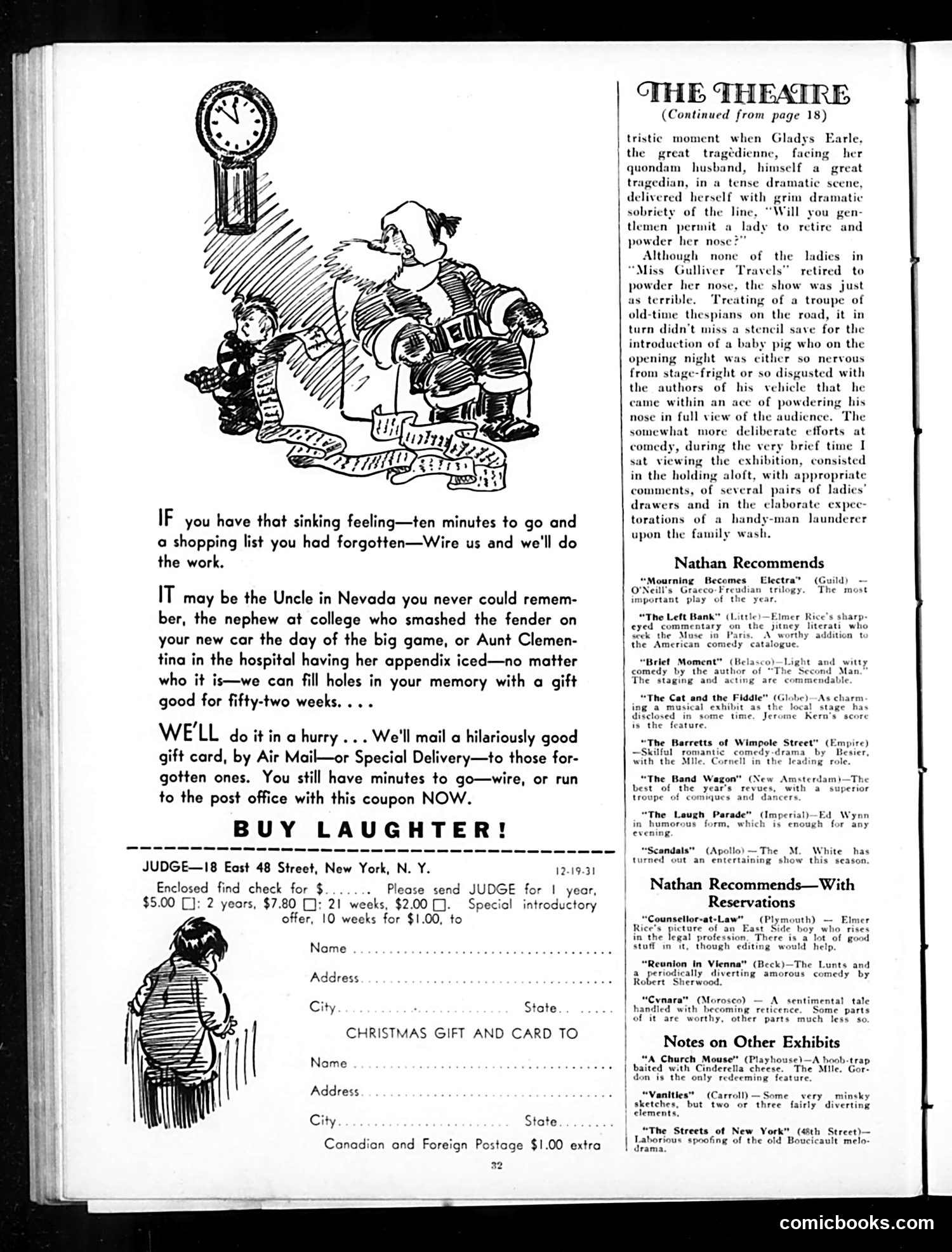
Explanation for Modern Readers This page is primarily advertising and theatre reviews, not political satire. The cartoon at top depicts a harried woman with a clock and shopping list—illustrating the "sinking feeling" of last-minute forgotten errands. Judge magazine is selling gift subscriptions as a solution: "fill holes in your memory with a gift good for fifty-two weeks." The accompanying text mocks a theatrical production called "Miss Gulliver Travels," describing its terrible quality, including an anecdote about a nervous baby pig nearly defecating onstage and stagehands displaying ladies' underwear as "comedy." Below are theatre reviews recommending Broadway shows of the era (dated 12-19-31), including *Mourning Becomes Electra* and *The Cat and the Fiddle*. The satire is theatrical/cultural, not political—Judge ridicules bad theatre while promoting gift subscriptions as practical holiday solutions for forgetful relatives.
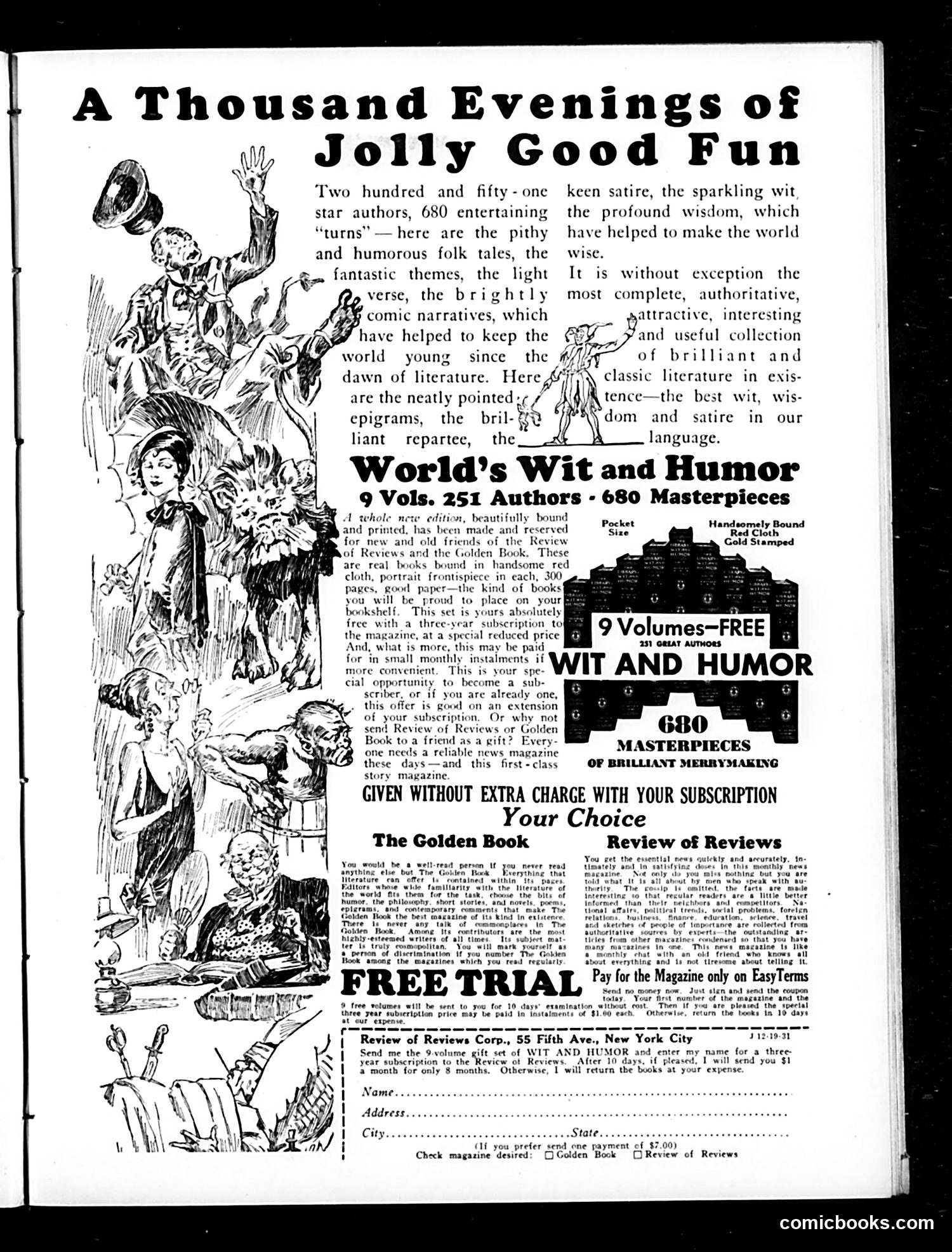
Analysis for Modern Readers This is primarily advertising, not a political cartoon. The page promotes a 9-volume subscription set called "World's Wit and Humor" — a collection of 251 authors and 680 literary pieces spanning jokes, folk tales, epigrams, and satirical writing. The decorative illustrations show generic jovial figures (jesters, performers, comedians) in period dress, meant to evoke "merriment" and entertainment rather than satirize specific people or events. The marketing pitch emphasizes this as "the most complete, authoritative" collection of "wit, wisdom and satire in our language" — a quality literature set offered via subscription. Readers could trial it free or pay in installments ($7.06 total, or $1 monthly). This represents early 20th-century mail-order publishing, targeting educated middle-class subscribers seeking "brilliant" entertainment and classic literature for home libraries. The offer to bundle it with *Review of Reviews* or *Golden Book* magazines suggests cross-promotion strategies common to that era.
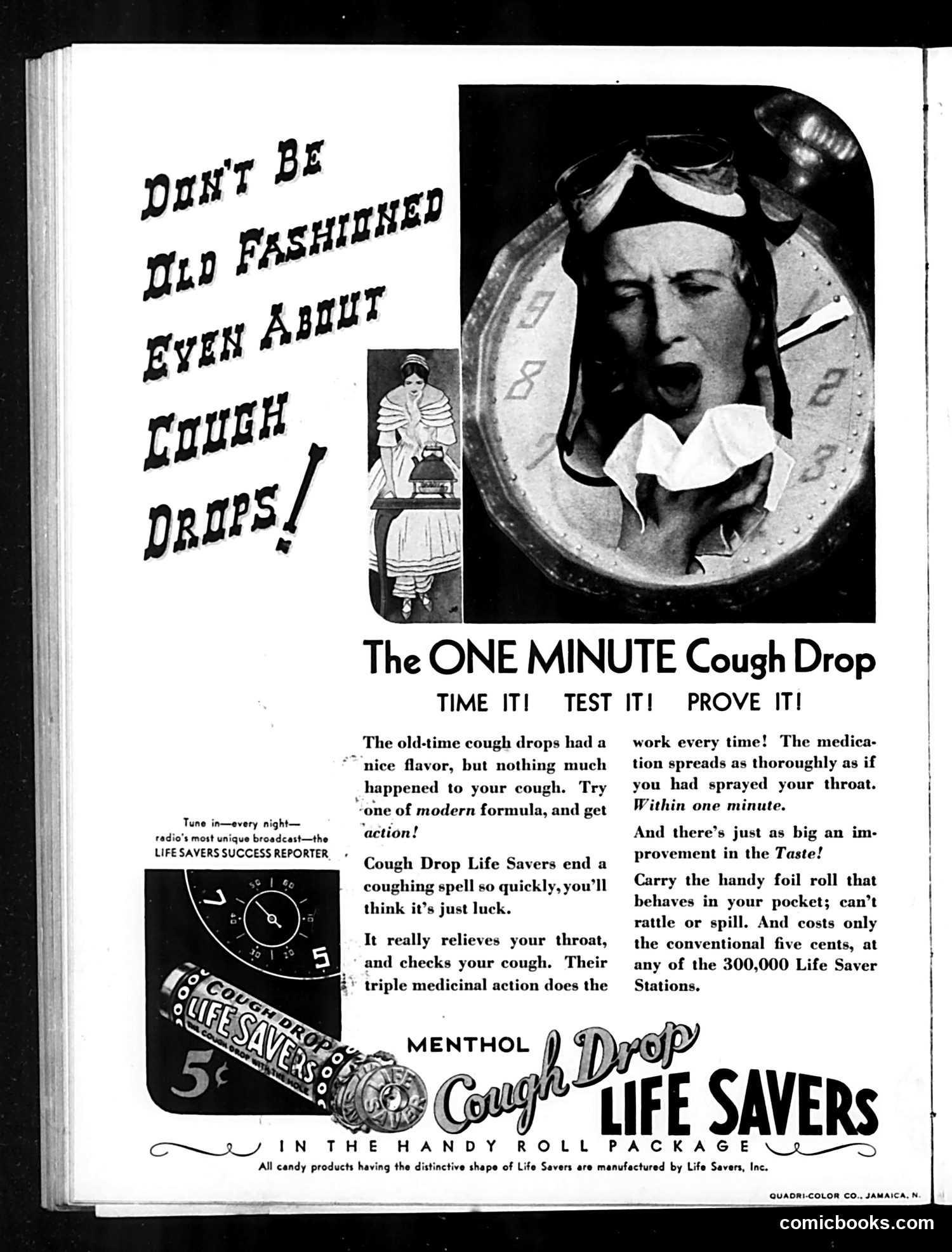
Analysis This page is primarily a Life Savers cough drop advertisement, not political satire. The headline "Don't Be Old Fashioned Even About Cough Drops!" mocks older-style remedies as outdated. The advertisement promotes a "modern formula" cough drop claiming superior speed and effectiveness over traditional versions. Key selling points include: fast relief (within one minute), better taste, convenient foil packaging that won't rattle or spill, and widespread availability at "300,000 Life Saver Stations." The circular photograph shows a person using the product. A smaller illustration depicts the convenient pocket-sized roll packaging. The ad references a radio broadcast—"Life Savers Success Reporter"—reflecting 1930s-40s advertising strategy of promoting products through popular media. This is commercial advertising, not editorial content or political commentary, representing typical mid-century marketing that emphasized modernity, convenience, and scientific advancement to sell consumer goods.