judge
Judge — December 26, 1931
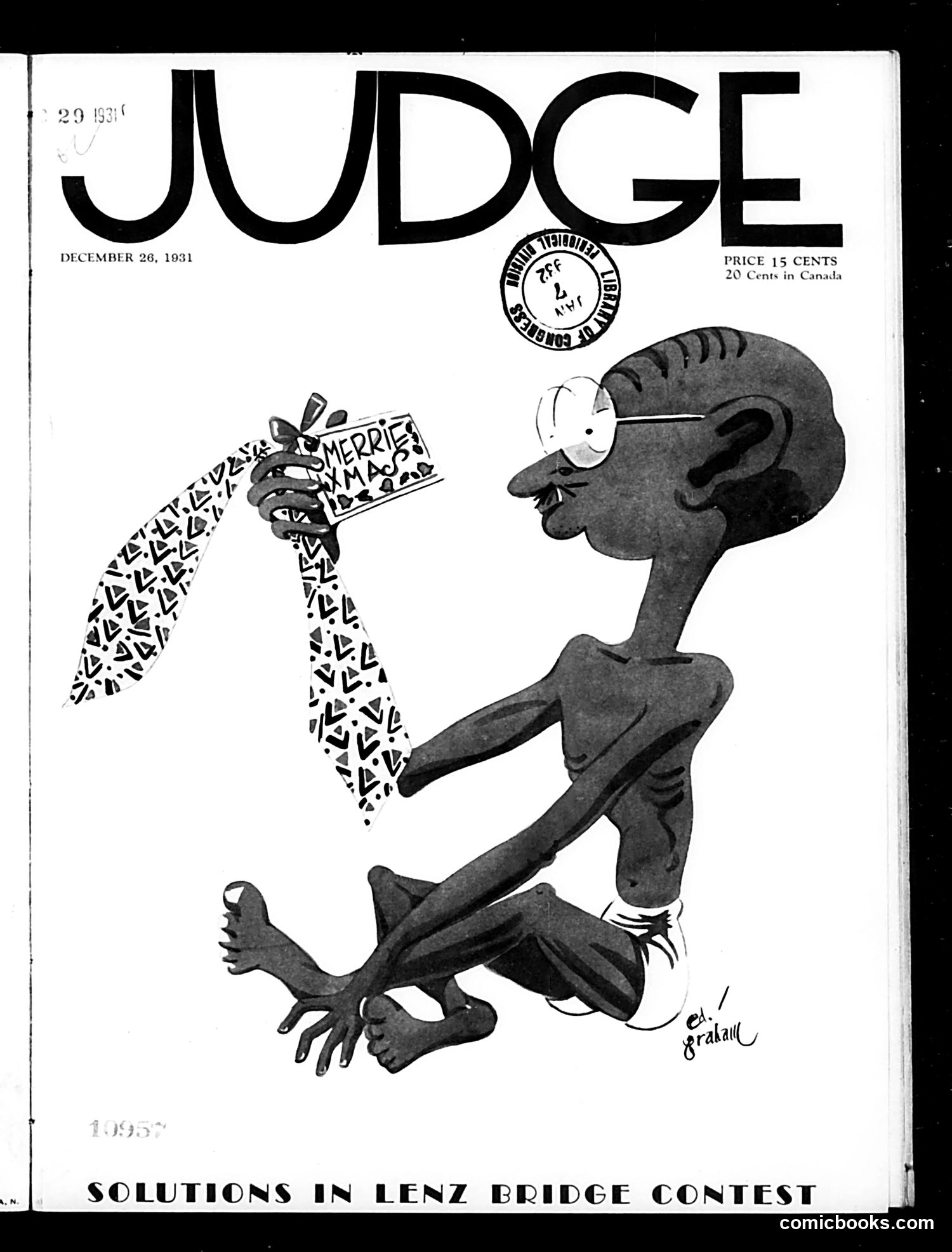
Analysis of Judge Magazine Cover, December 26, 1931 This satirical cover depicts a caricatured figure (the art style suggests a racial caricature typical of 1931) holding a "Merry Xmas" banner with a decorative pattern. The figure appears jubilant despite the Great Depression context—this was December 1931, during severe economic hardship. The satire likely mocks either forced holiday cheer during economic crisis, or possibly comments on specific public figures' attempts to maintain optimistic messaging amid the Depression. The exaggerated style and cheerful demeanor contrast sharply with the historical moment's grim reality. The page references "Solutions in Lenz Bridge Contest," suggesting Judge's readers were invited to submit competitive ideas about bridge engineering—a practical economic concern of the era. The $0.15 price reflects 1931 economics.
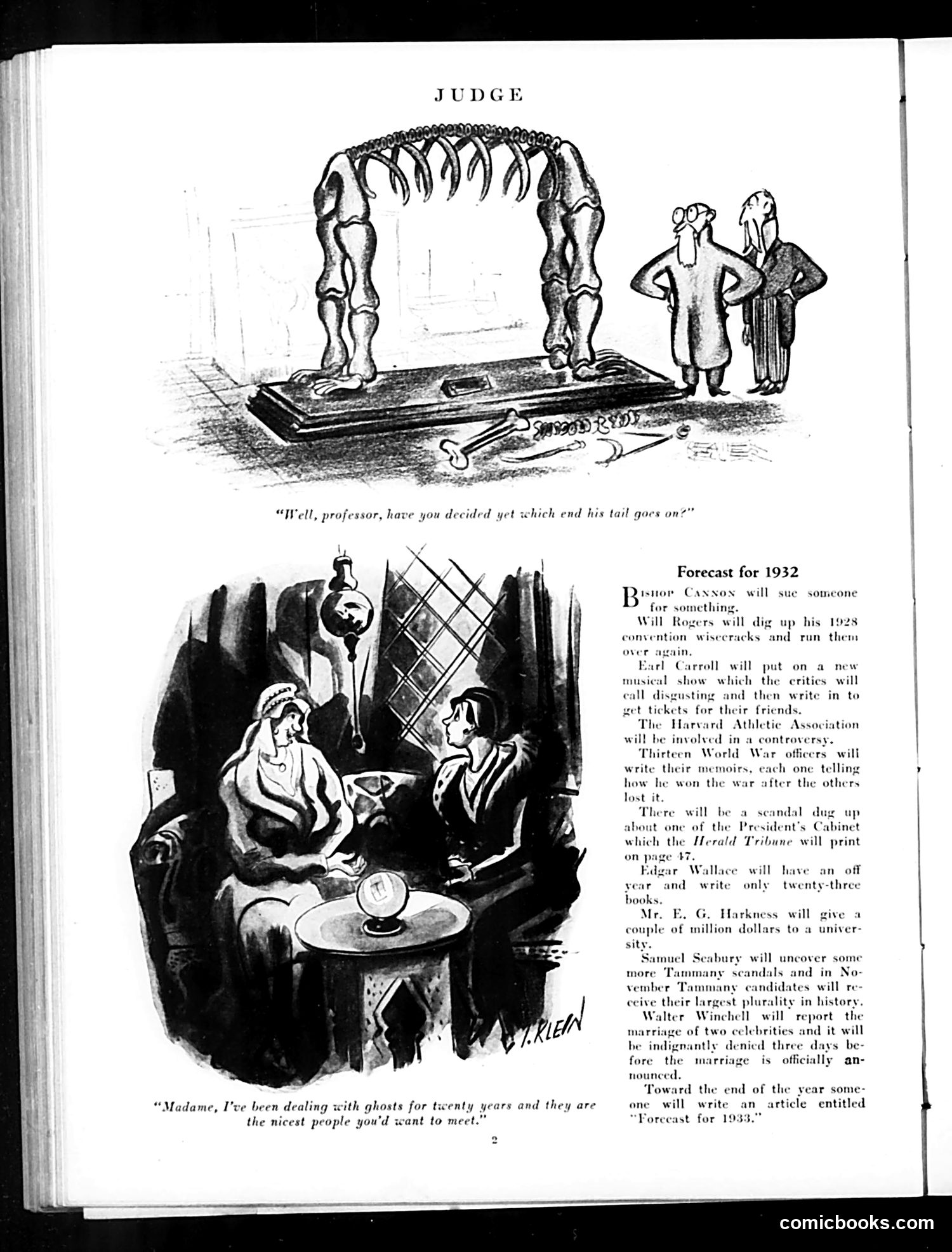
Judge Magazine Page Analysis Top Cartoon ("Judge"): Depicts a skeleton arch with two observers. The caption asks a professor which end the skeleton's tail goes on—a visual pun playing on anatomical confusion and perhaps satirizing academic pretension or scientific debate. Bottom Cartoon: Shows a fortune teller with crystal ball speaking to a client. The caption jokes that ghosts are "the nicest people you'd want to meet," suggesting spiritualism's popularity or mocking it as naive entertainment. "Forecast for 1932": The accompanying text contains satirical predictions about 1932 public figures and scandals—mentioning Bishop Cannon, Will Rogers, Lord Carroll, and others—typical of Judge's annual tongue-in-cheek prognostications about celebrities, politicians, and potential controversies. The page exemplifies Judge's blend of visual satire and celebrity gossip humor.
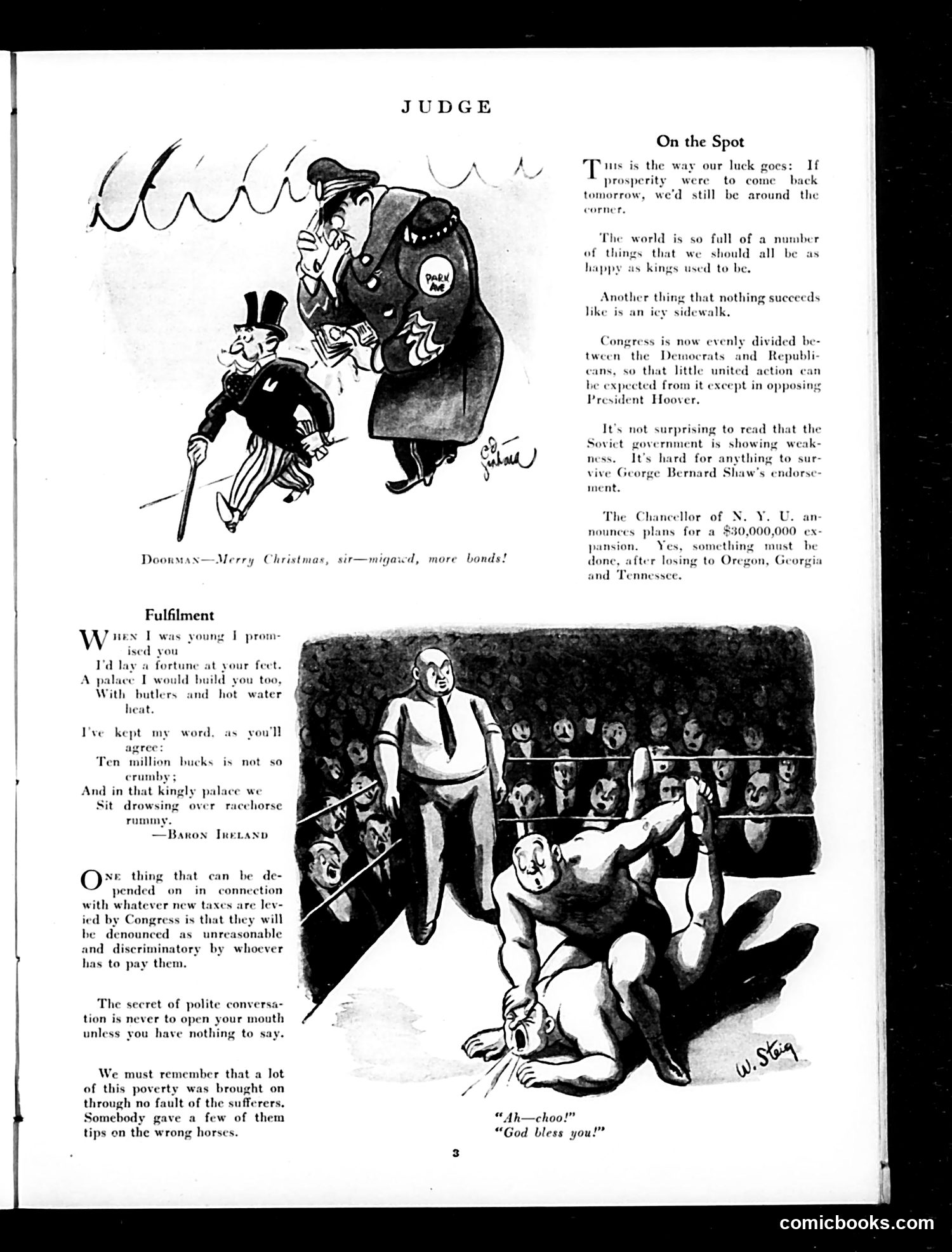
Political Cartoon Analysis: Judge Magazine Page Top Cartoon ("Doorman—Merry Christmas, sir—migaied, more bonds!"): Uncle Sam (tall figure in striped pants) appears to be a doorman greeting a rotund, wealthy-looking visitor labeled "Dada Dad." The caption suggests sarcastic commentary on post-WWI bond-selling or financial obligations. The "more bonds" reference likely critiques continued government borrowing or public financial demands during the 1920s. Bottom Cartoon ("Ah—choo! God bless you!"): Shows a wrestling or boxing match with spectators. The caption's "God bless you" appears to be darkly ironic commentary, possibly about economic hardship or social suffering during this period—suggesting consolation is all the vulnerable receive while others profit from their misfortune. Both pieces reflect Judge's satirical approach to post-war American economics and class disparity.
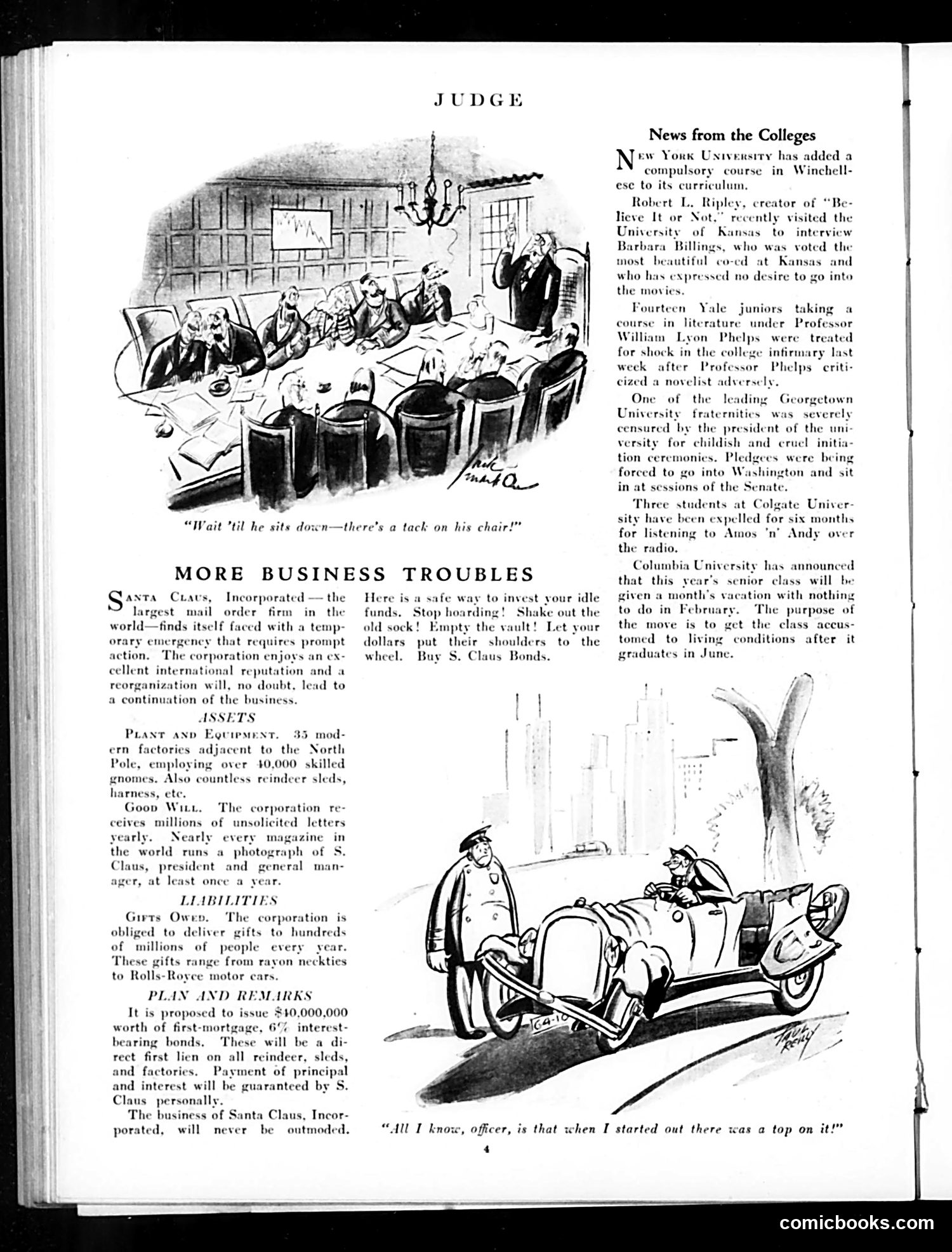
Page Analysis This page contains two distinct elements: Top cartoon ("Wait 'til he sits down—there's a tack on his chair!"): A courtroom scene satirizing judicial proceedings. The joke targets how judges are treated with deference—someone plans a prank (tack on chair) that would be unthinkable to execute because the judge commands such respect and authority. Bottom cartoon ("All I know, officer, is that when I started out there was a top on it!"): A driver explains to a police officer that his car's convertible top has disappeared during a drive through an urban setting. The humor lies in the absurdity of losing an entire car component without noticing until confronted by law enforcement. The "More Business Troubles" section discusses corporate issues facing Santa Claus, Inc. and other businesses, presenting them humorously as actual entities with real financial problems.
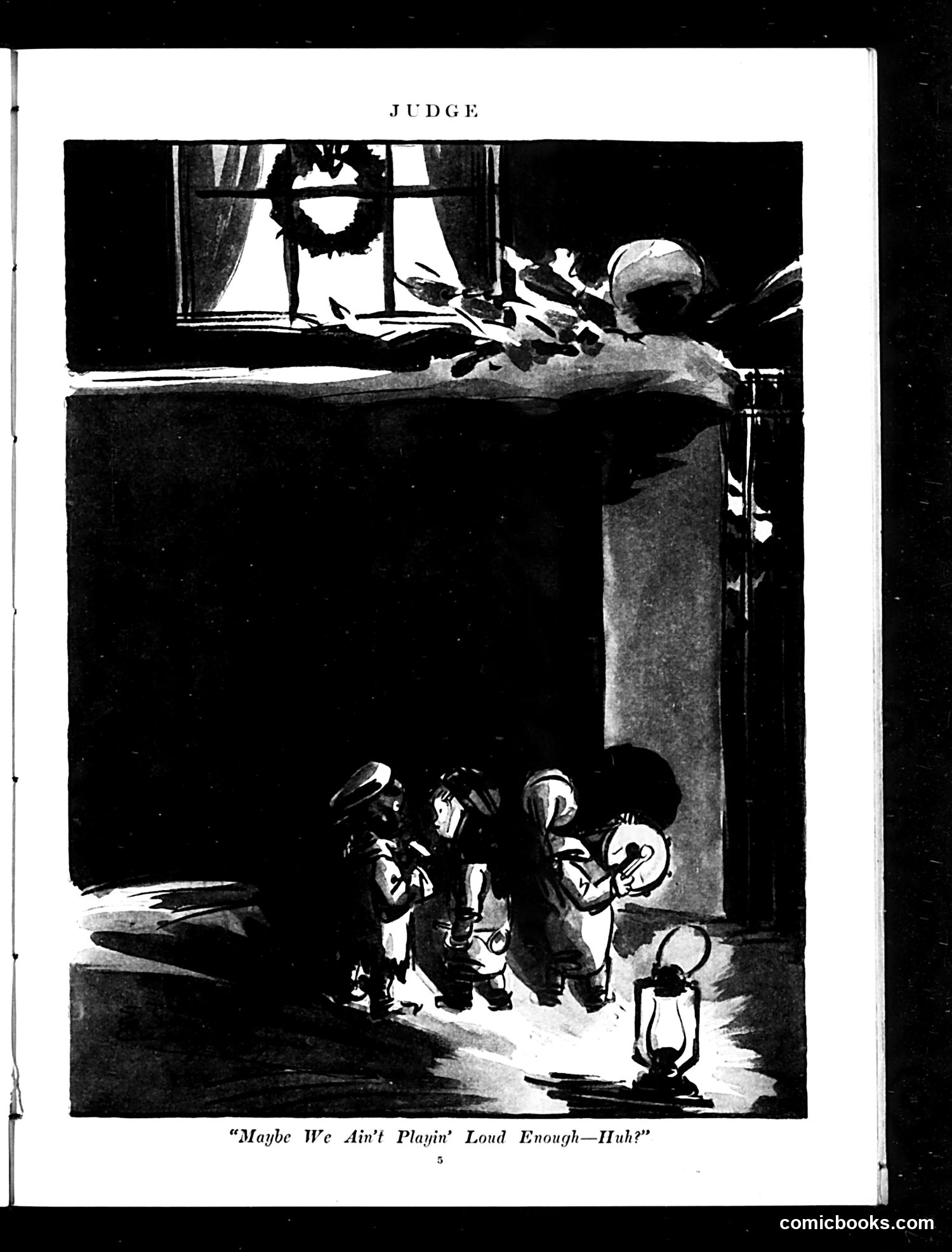
"Maybe We Ain't Playin' Loud Enough—Huh?" This cartoon depicts a judge or authority figure (visible through a window above) overlooking a scene below where several carolers or street musicians are performing. The caption suggests the performers are playing music, but the authority figure questions whether they're playing loudly enough. The satire likely critiques judicial oversight or legal authority intruding into everyday activities—specifically street performance or caroling. The absurdity of demanding musicians play *louder* rather than complaining about noise pollution inverts typical complaints. This appears to mock either overzealous law enforcement, arbitrary legal standards, or judicial micromanagement of citizens' ordinary activities. The specific context—whether this references a real ordinance or general regulatory excess—remains unclear without additional historical documentation.
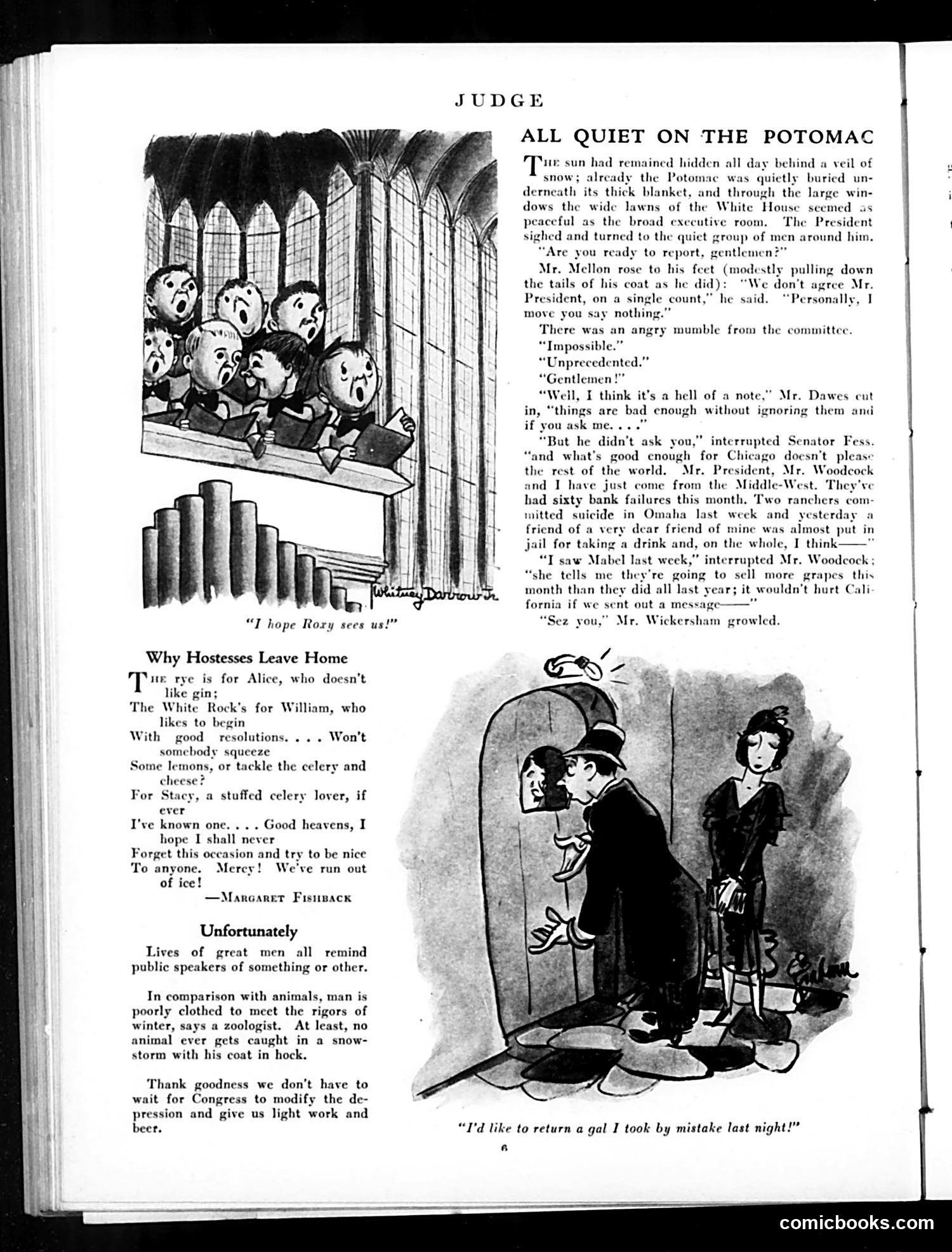
"All Quiet on the Potomac" This cartoon satirizes congressional disagreement over economic relief during a financial crisis. A group of angry congressmen peer from a Capitol window while the President (likely Woodrow Wilson, given the era) tries to get them to agree on a report. They refuse unanimously—one calls it "a hell of a note." The debate concerns bank failures in the Midwest and suicides among ruined farmers. Mr. Woodcock argues that Chicago's crisis shouldn't concern the rest of the country, while others cite the broader national impact. The satire mocks Congress's inability to cooperate on addressing the economic disaster, despite urgent need. The title "All Quiet on the Potomac" ironically invokes Civil War language to suggest governmental paralysis.
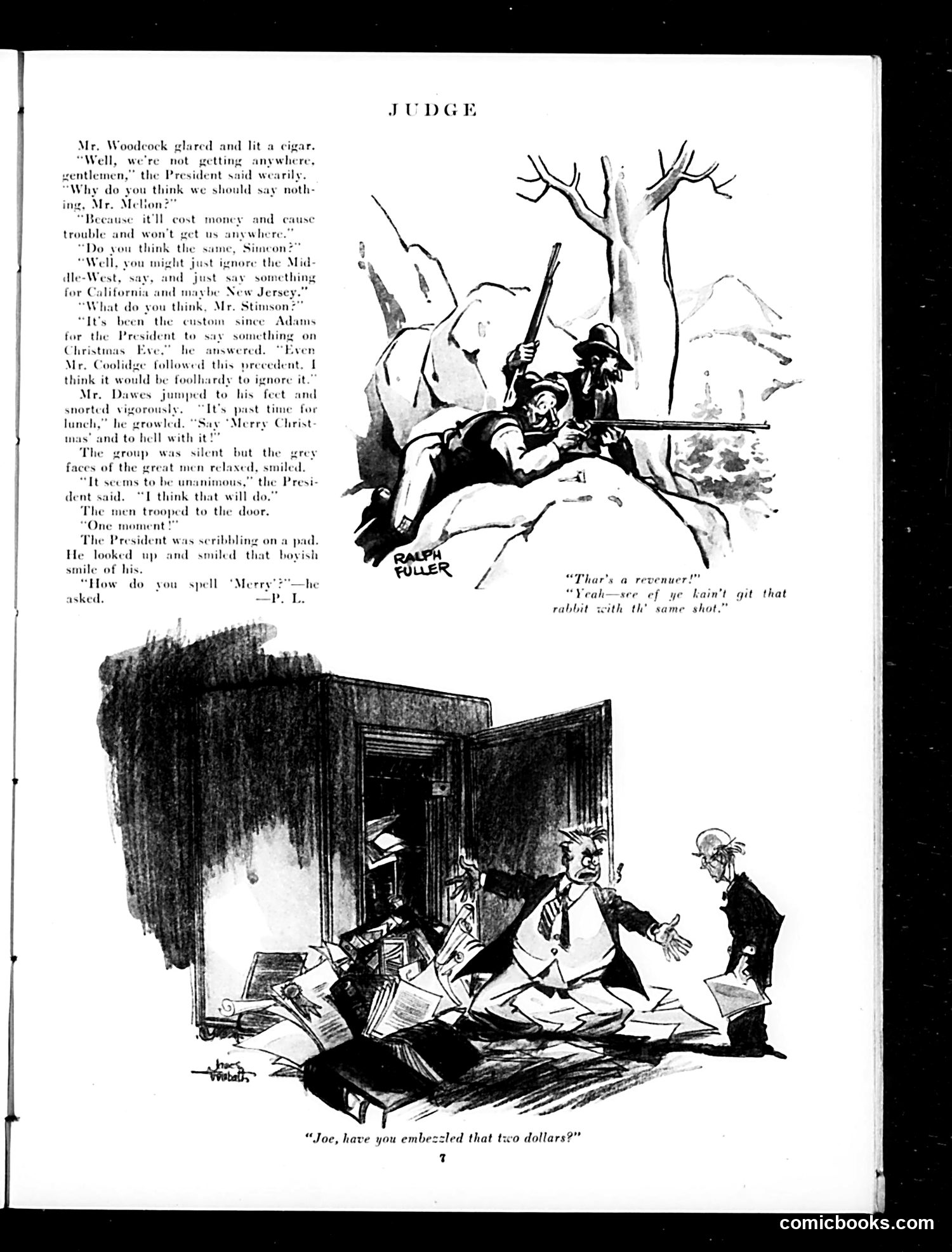
Judge Magazine Political Cartoon Analysis This page contains two satirical cartoons mocking early 1920s American politics and rural culture. Top cartoon: Depicts President Calvin Coolidge and his cabinet (including Treasury Secretary Mellon, Commerce Secretary Hoover, and Secretary of State Stimson) debating whether to make a Christmas statement. The humor lies in their paralysis—Mellon argues it costs money, others worry about offending regions, and Coolidge ends up asking how to spell "Merry," suggesting presidential incompetence. This satirizes the Coolidge administration's passivity and the cabinet's prioritization of money over governance. Bottom cartoon: A rural/hillbilly scene where men mistake a revenue agent ("revenuer") for game to shoot, joking about hitting him "with th' same shot" as a rabbit. This mocks Prohibition enforcement—rural Americans resisting federal tax agents trying to stop illegal whiskey production. The final caption "Joe, have you embezzled that two dollars?" suggests petty corruption among government clerks.
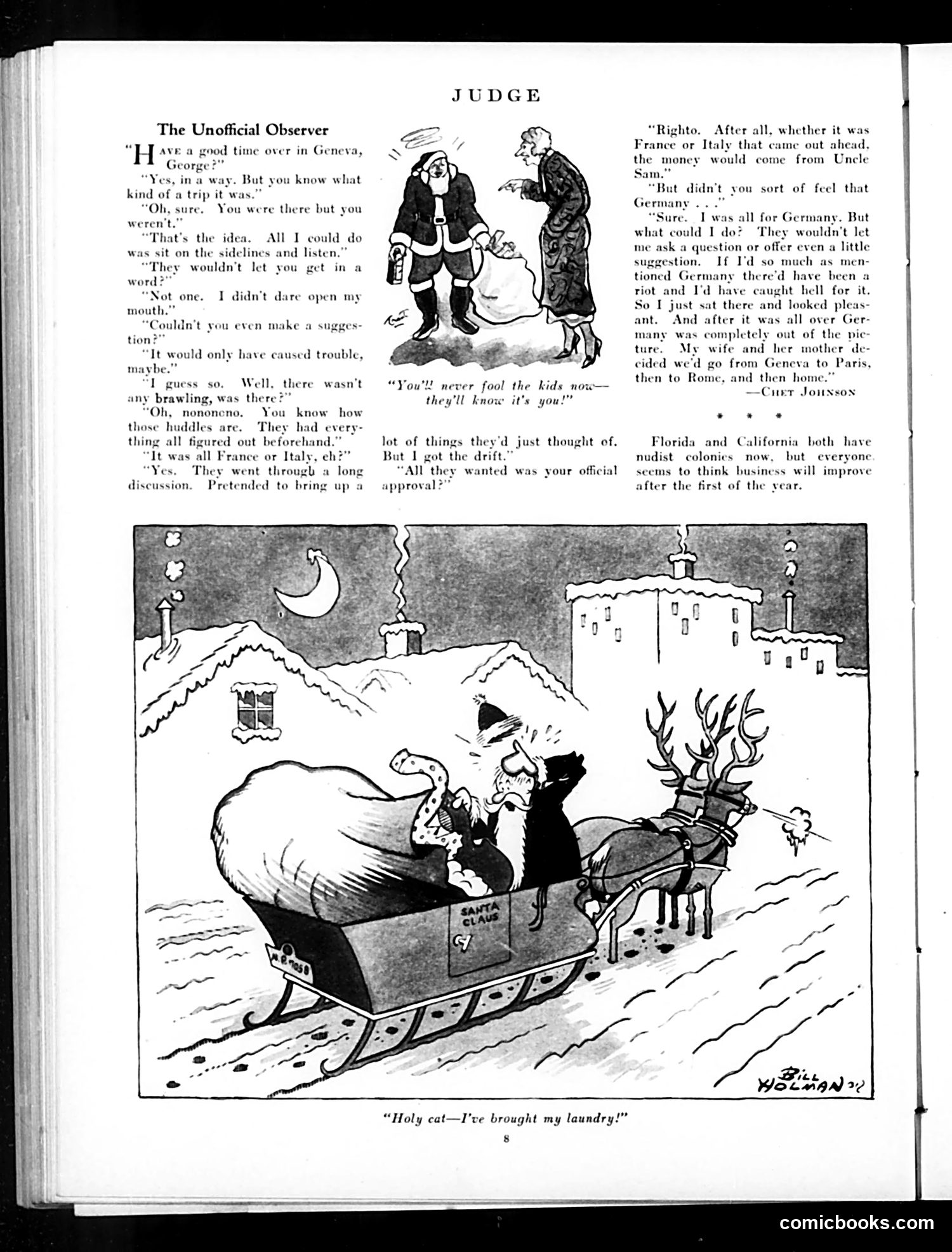
"The Unofficial Observer" - Judge Magazine Satire This page satirizes American diplomatic impotence at the League of Nations (the "Geneva" huddle referenced). An American observer describes being allowed only to sit silently on the sidelines during international negotiations—unable to ask questions, make suggestions, or advocate for any nation's interests without causing "trouble." The satire's point: The U.S. maintains official detachment from League proceedings while unofficially favoring certain powers (Germany is mentioned), yet has no real voice or influence. American diplomacy is reduced to passive attendance and compliance with others' decisions. The Santa cartoon below (captioned "Holy cat—I've brought my laundry!") appears unrelated—a Christmas gag about Santa confused by modern life. The page criticizes American foreign policy's weakness during the interwar period, when the U.S. remained outside the League while trying to influence global affairs.
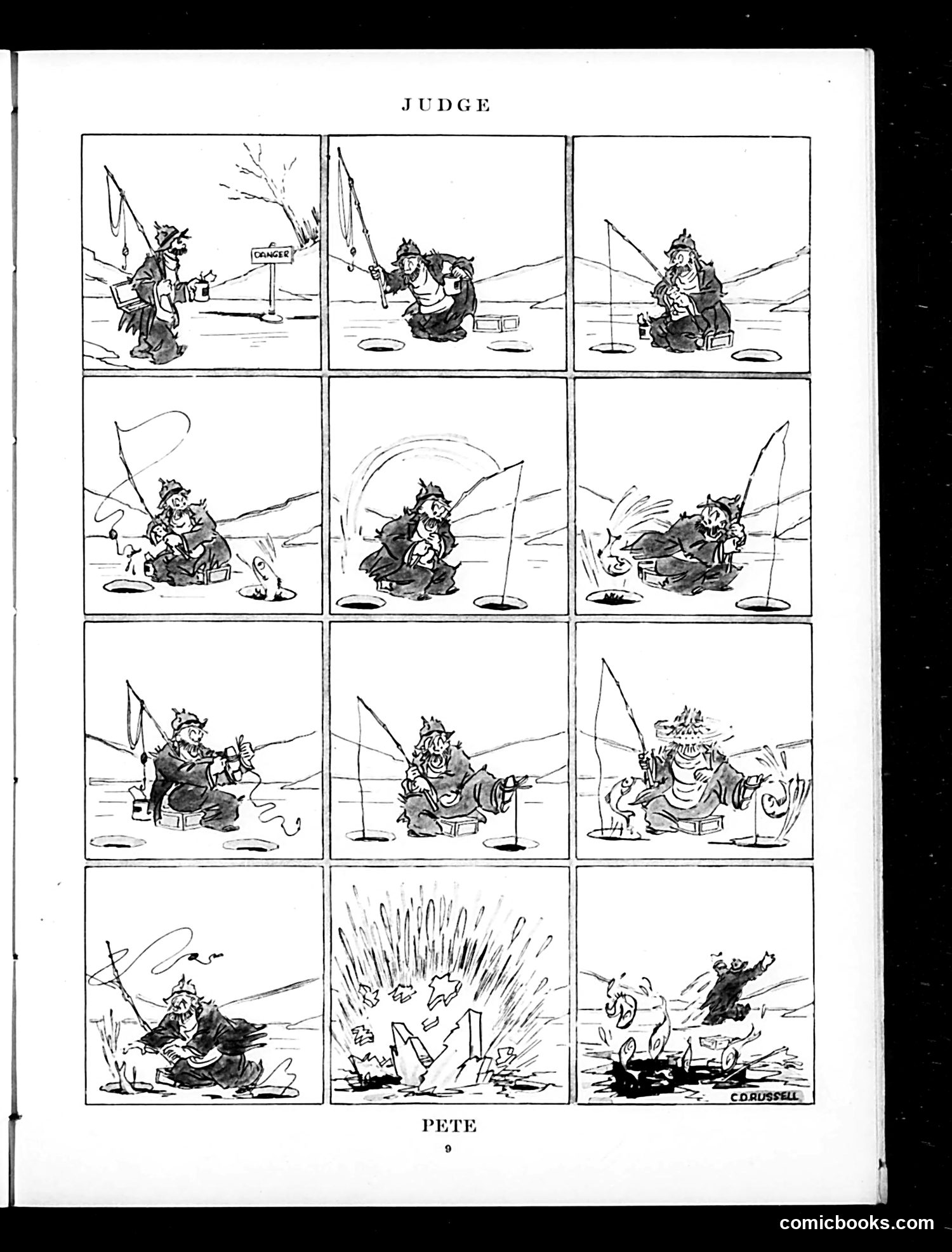
"Judge" - Pete Comic Strip This is a twelve-panel comic strip titled "Judge" (with the artist signature "Corussell" visible) depicting a character identified as "Pete" engaged in ice fishing. The narrative shows Pete attempting to fish through a hole in ice, progressing through various comedic mishaps: he struggles with his fishing rod, gets tangled in his line, battles with what appears to be a large fish or creature, and ultimately experiences an explosive finale in the final panels where everything—Pete, his equipment, and debris—are sent flying. The humor derives from slapstick physical comedy typical of early 20th-century satirical magazines, with escalating chaos and exaggerated reactions. Without additional historical context about the character "Pete" or contemporary references, the specific political or social satire remains unclear.
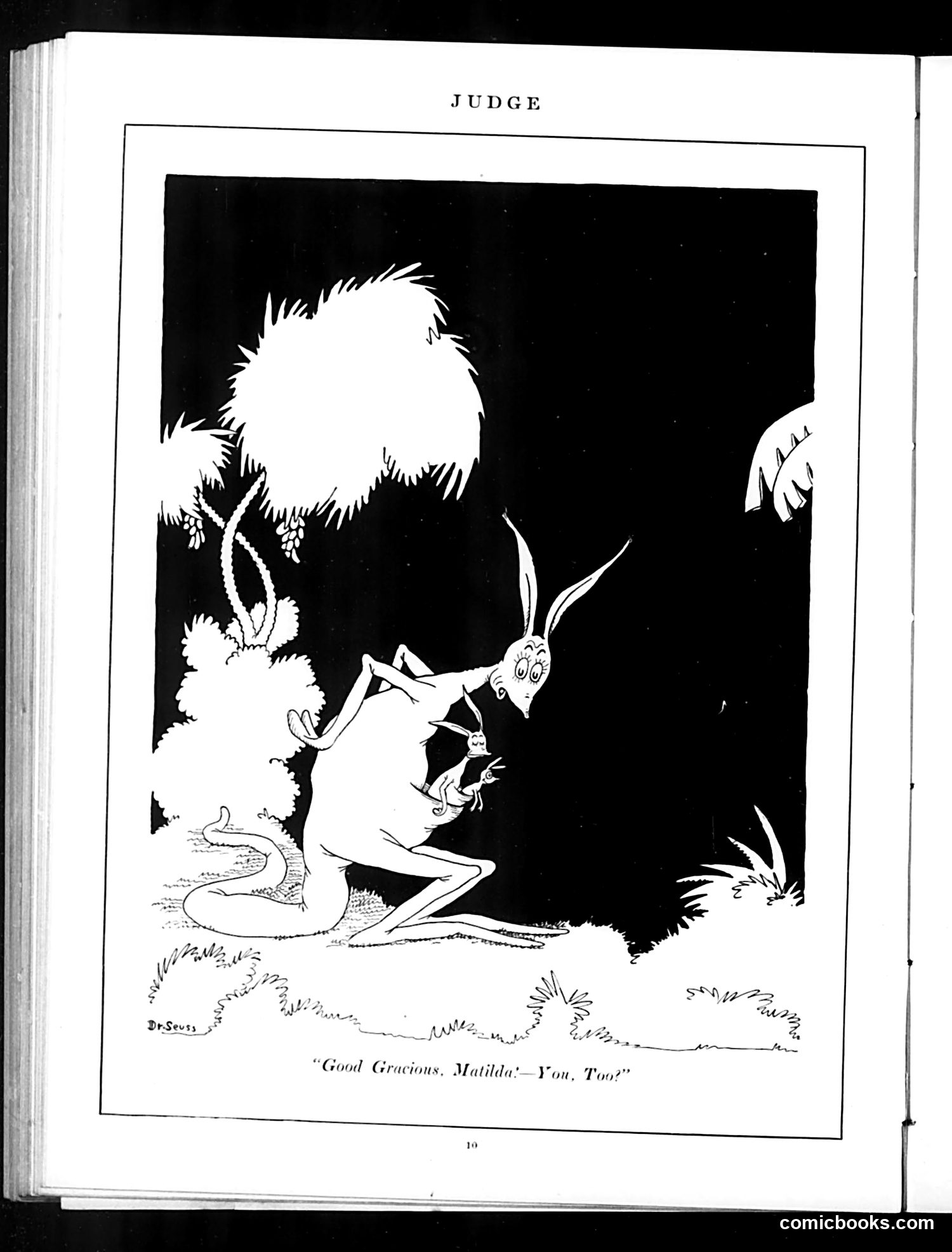
Political Cartoon Analysis This Dr. Seuss cartoon from *Judge* magazine depicts a horned, goat-like creature addressing a woman named Matilda with apparent surprise or alarm. The caption—"Good Gracious, Matilda! You, Too?"—suggests she has joined or become something previously unexpected. The goat-creature likely represents a satirical figure or allegory, though without additional context it's unclear what specific political or social movement is referenced. The "Too?" implies others have already undergone this transformation. This appears to be social satire about contemporary trends or conversions to some ideology or group—the exact target remains ambiguous from the image alone. The exaggerated, fantastical imagery is characteristic of Seuss's satirical style during this period.
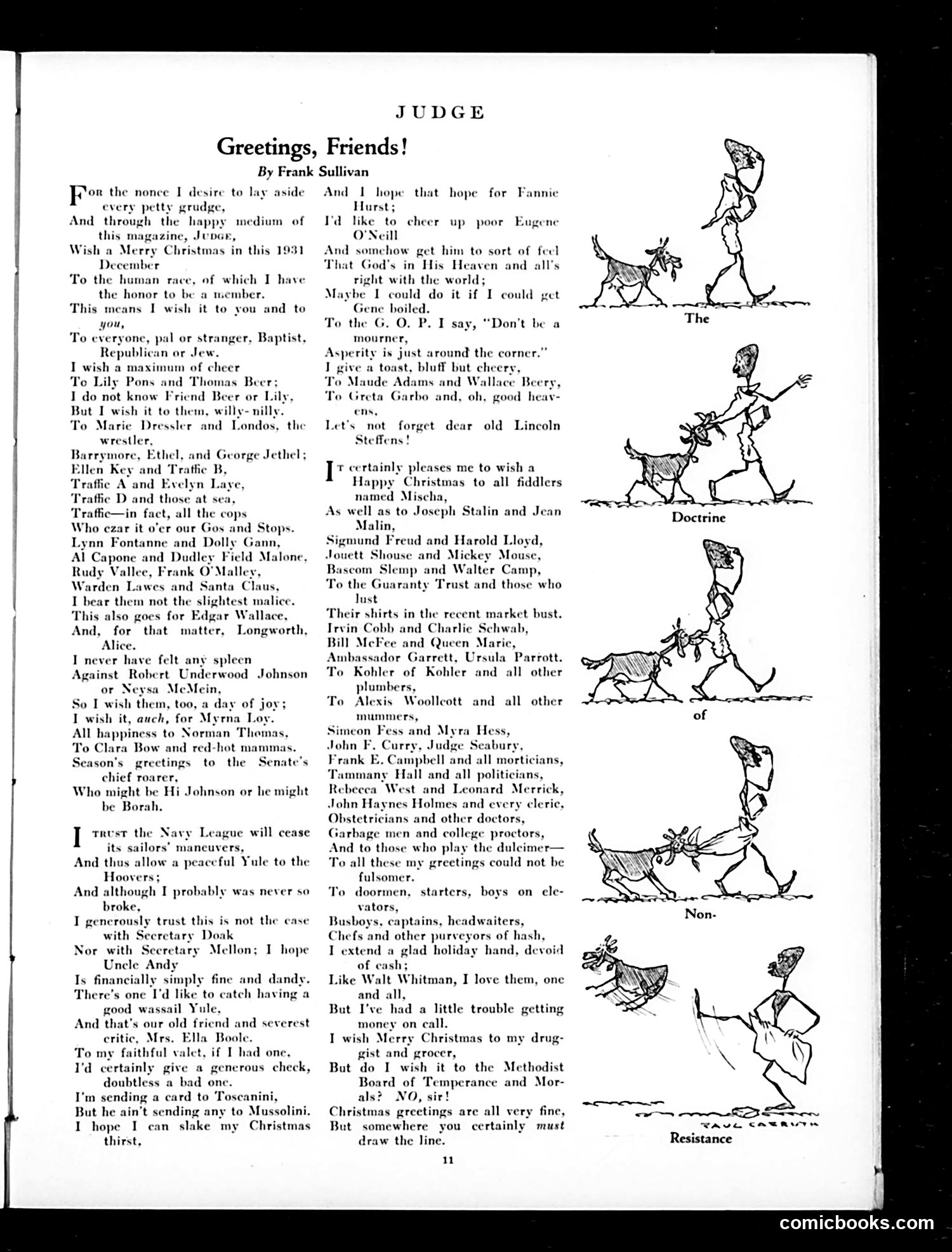
"Greetings, Friends!" by Frank Sullivan — Judge Magazine, 1931 This is a satirical Christmas greeting poem that humorously extends holiday wishes to a sprawling cast of real 1931 figures—celebrities (Clara Bow, Greta Garbo), politicians (Al Capone, Secretary of Labor Doak), and public figures (Eugene O'Neill, Norman Thomas). The satire works through absurd juxtaposition: Sullivan indiscriminately wishes cheer to the famous and obscure, the virtuous and criminal, the living and possibly fictional. The joke sharpens when he explicitly *refuses* to wish goodwill to the Methodist Board of Temperance and Morals—a dig at Prohibition-era moralists—while generously extending it to gangsters and bootleggers during the Depression. The cartoons (labeled "The Doctrine," "Resistance," etc.) appear to be unrelated decorative illustrations. Sullivan's point: true democratic spirit means Christmas cheer for everyone, *except* the self-righteous censors.
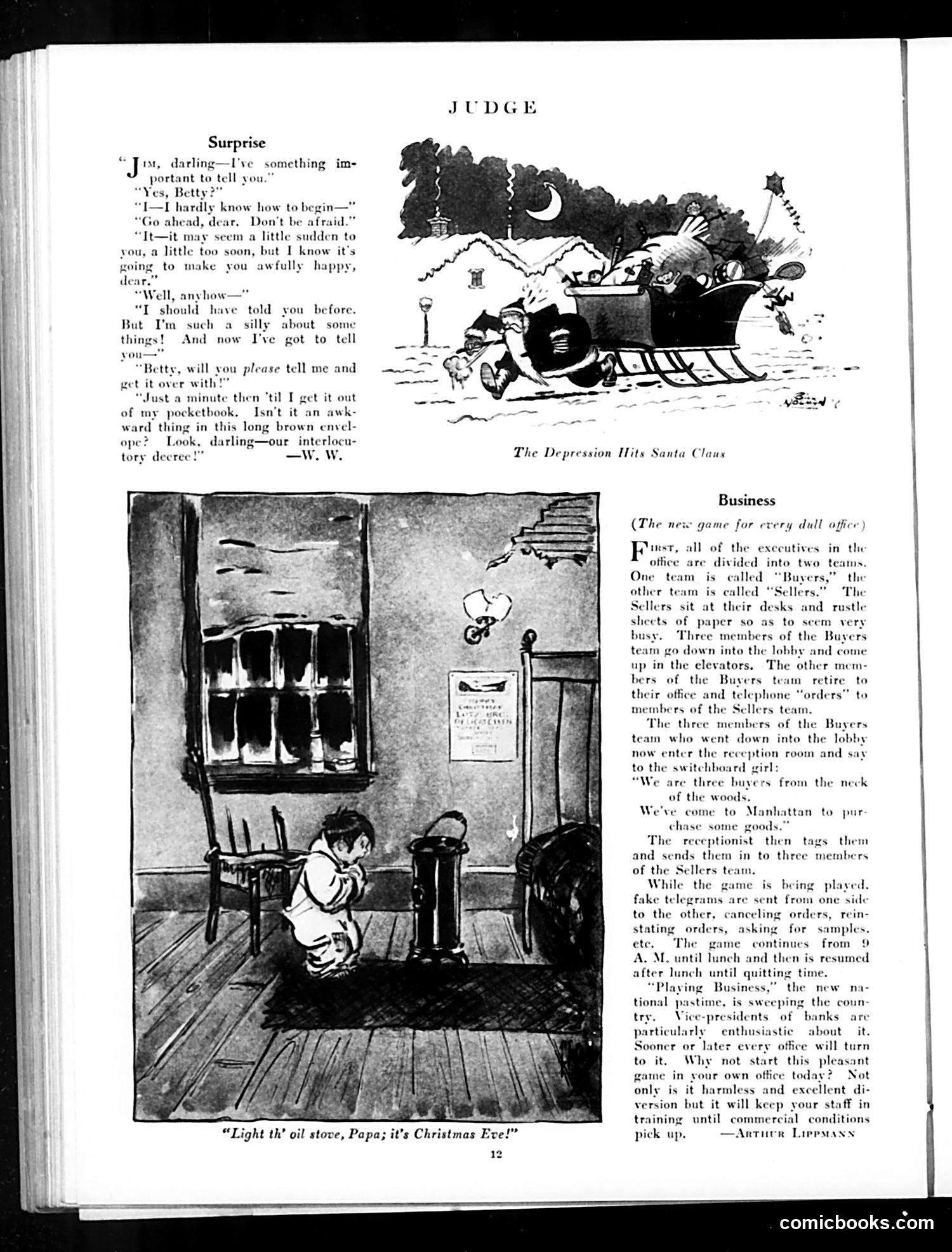
Judge Magazine Satire Analysis This page contains two separate pieces satirizing 1920s-30s American life during economic hardship (likely the Depression era). "Surprise" (top): A domestic comedy sketch where a wife builds suspense before revealing she's found an "interlocutory decree"—a legal document related to divorce proceedings. The humor derives from her melodramatic buildup of what she presents as exciting news, when it actually concerns marital dissolution. "Business" (bottom): The main satire mocks office workers during economic depression. Executives play a mock game called "Playing Business" where they pretend to conduct transactions—Buyers visit Sellers, fake telegrams are exchanged, papers are shuffled—to *appear* busy while actual commercial activity has ceased. The satire's bite: offices must invent busywork to maintain the pretense of productivity and "training" during economic collapse when real business has dried up. The author suggests this harmless game keeps staff occupied while waiting for economic recovery. Both pieces reflect Depression-era anxieties about employment, stability, and maintaining appearances during collapse.
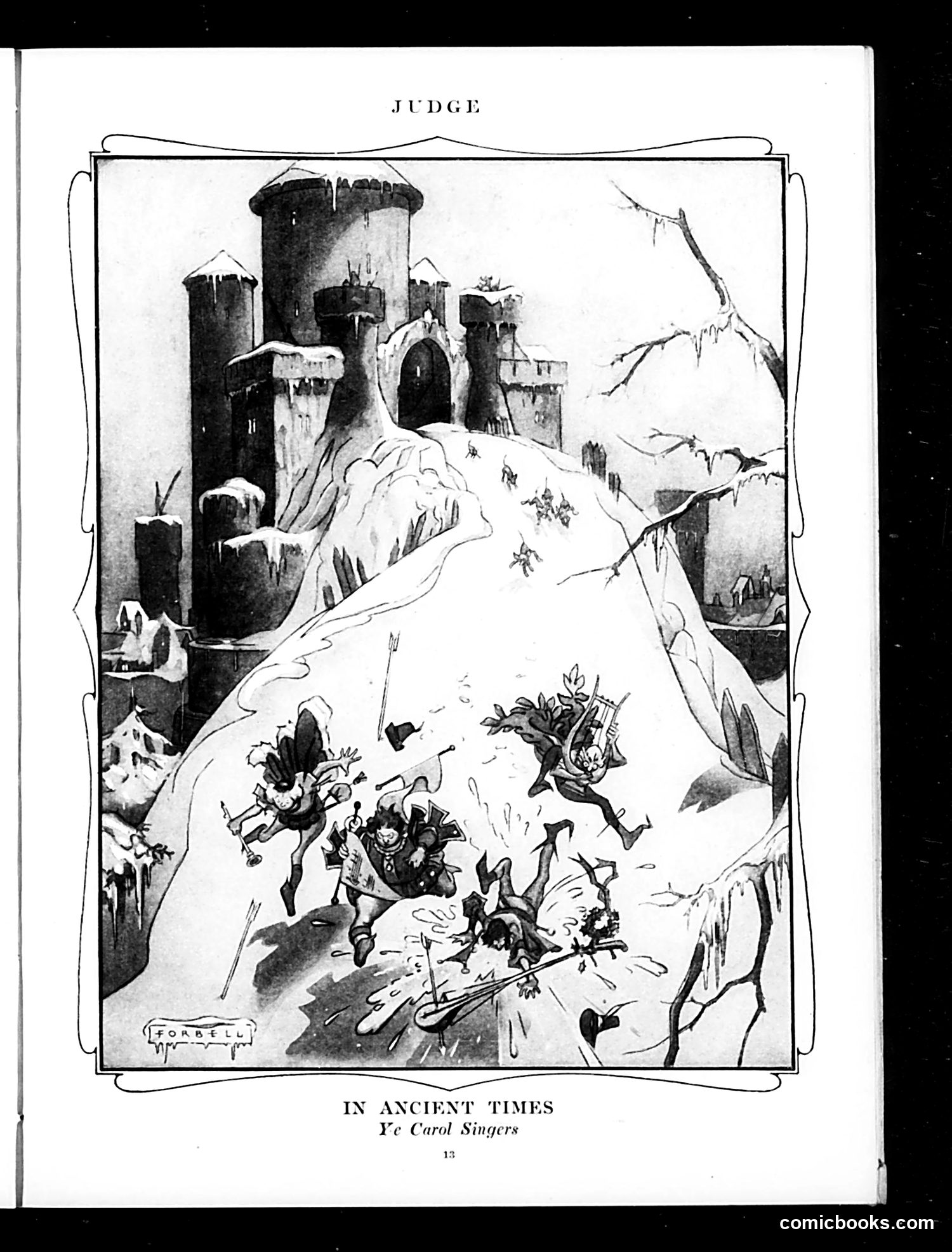
"Judge in Ancient Times: Ye Carol Singers" This cartoon satirizes Christmas carol singers by depicting them as medieval invaders attacking a fortified castle. Rather than wholesome holiday performers, the artists portray carolers as a chaotic, aggressive mob launching an assault up a snowy slope toward the castle gates—complete with what appear to be siege weapons and tumbling figures. The satire likely mocks the nuisance of persistent holiday carolers of the era, presenting the annual tradition as an unwanted invasion. By framing cheerful singers as medieval attackers, Judge comments on how intrusive or annoying caroling could be to households, treating the festive custom as more assault than entertainment. The joke inverts expectations of caroling as pleasant and welcomed.
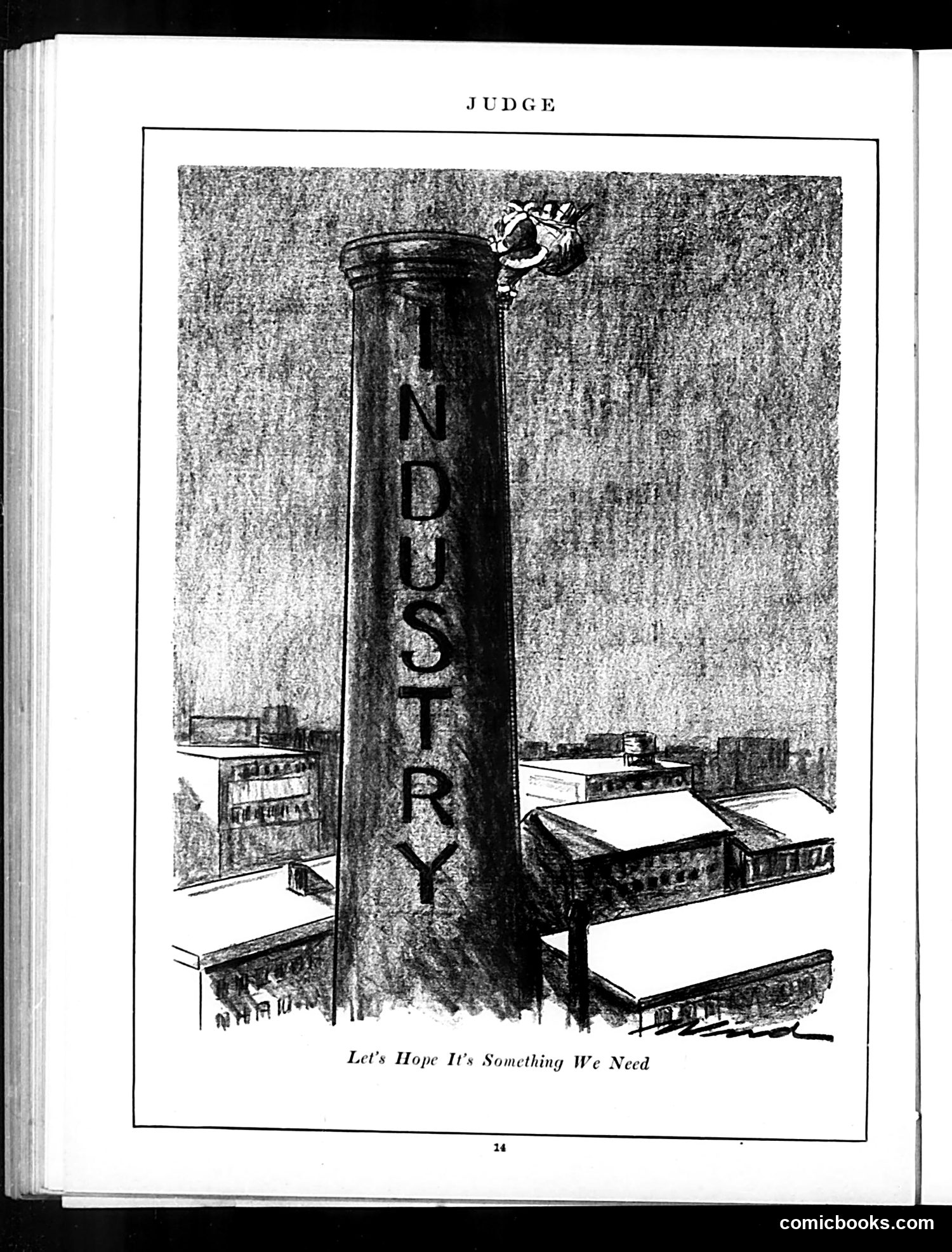
Judge Magazine Cartoon Analysis This cartoon depicts an industrial smokestack labeled "INDUSTRY" with a figure perched atop it. The caption reads "Let's Hope It's Something We Need." The satire appears to target industrial production during an uncertain period—likely post-WWI or early Depression era. The figure climbing the smokestack likely represents a worker or capitalist, while the smoke and industrial setting symbolize manufacturing output. The joke's point seems to be anxiety about what industry is actually producing: the hopeful tone masks genuine uncertainty about whether goods being manufactured serve any real public need, or if production continues merely for profit's sake, regardless of actual utility. The cartoon critiques industrial excess and disconnection between manufacturing and genuine social benefit—a common Judge theme during economically turbulent periods.
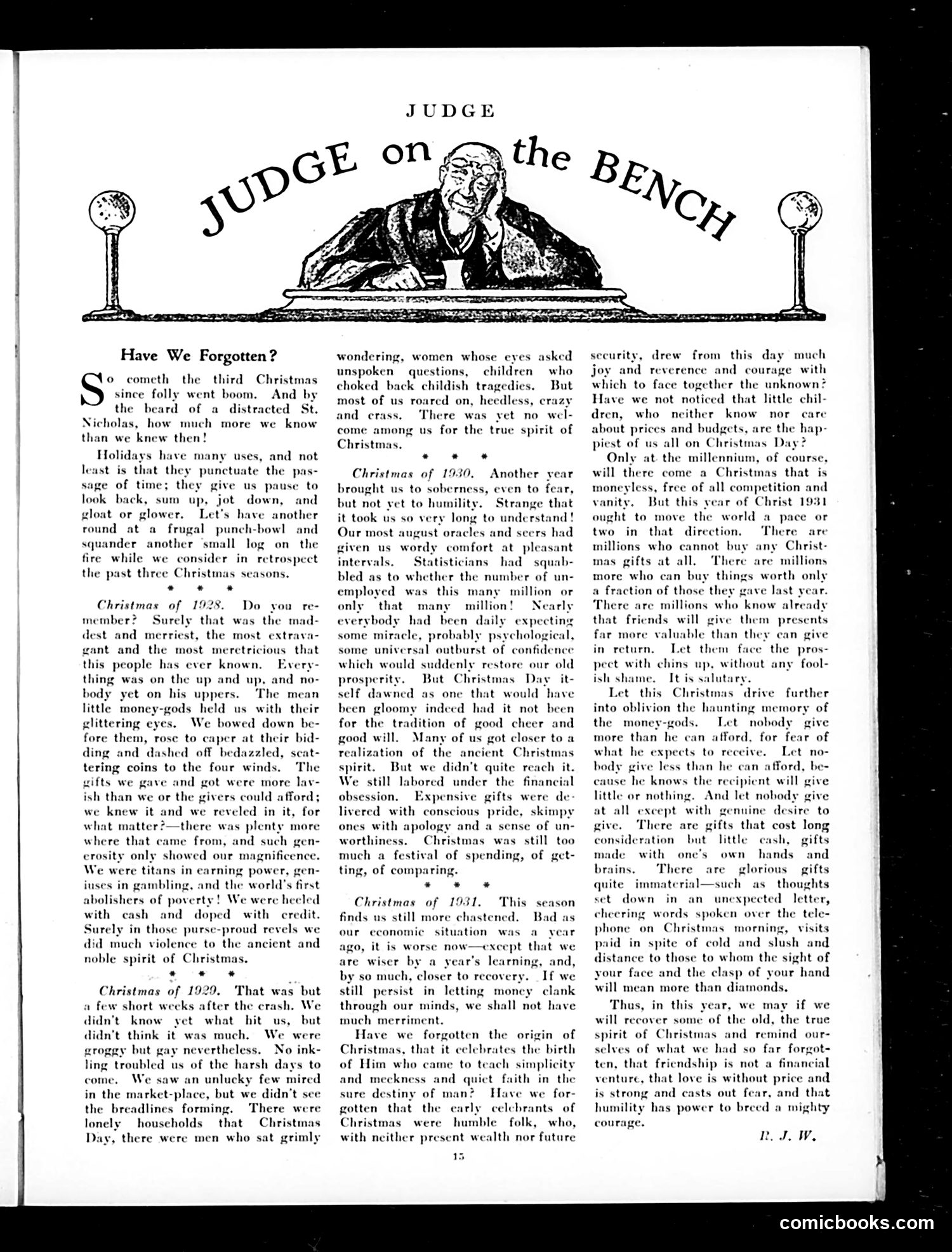
"Judge on the Bench: Have We Forgotten?" This editorial essay uses Christmas as a lens to critique American materialism and spiritual decline across four years (1928-1931). The author contrasts each Christmas season with the previous one: 1928: Pre-crash excess—lavish spending, "money-gods," and arrogant prosperity. 1929: Immediate post-crash bewilderment; people still in denial despite early suffering. 1930: Growing sobriety but continued fixation on expensive vs. cheap gifts, still materialistic. 1931: Further economic deterioration; the author warns that obsessing over money will prevent genuine Christmas spirit. The piece's core argument: Americans have forgotten Christmas's original meaning—celebrating Christ's teaching of simplicity and humility—replacing it with competitive consumption. The "Judge on the Bench" header frames this as moral judgment on the nation's character during the Great Depression.
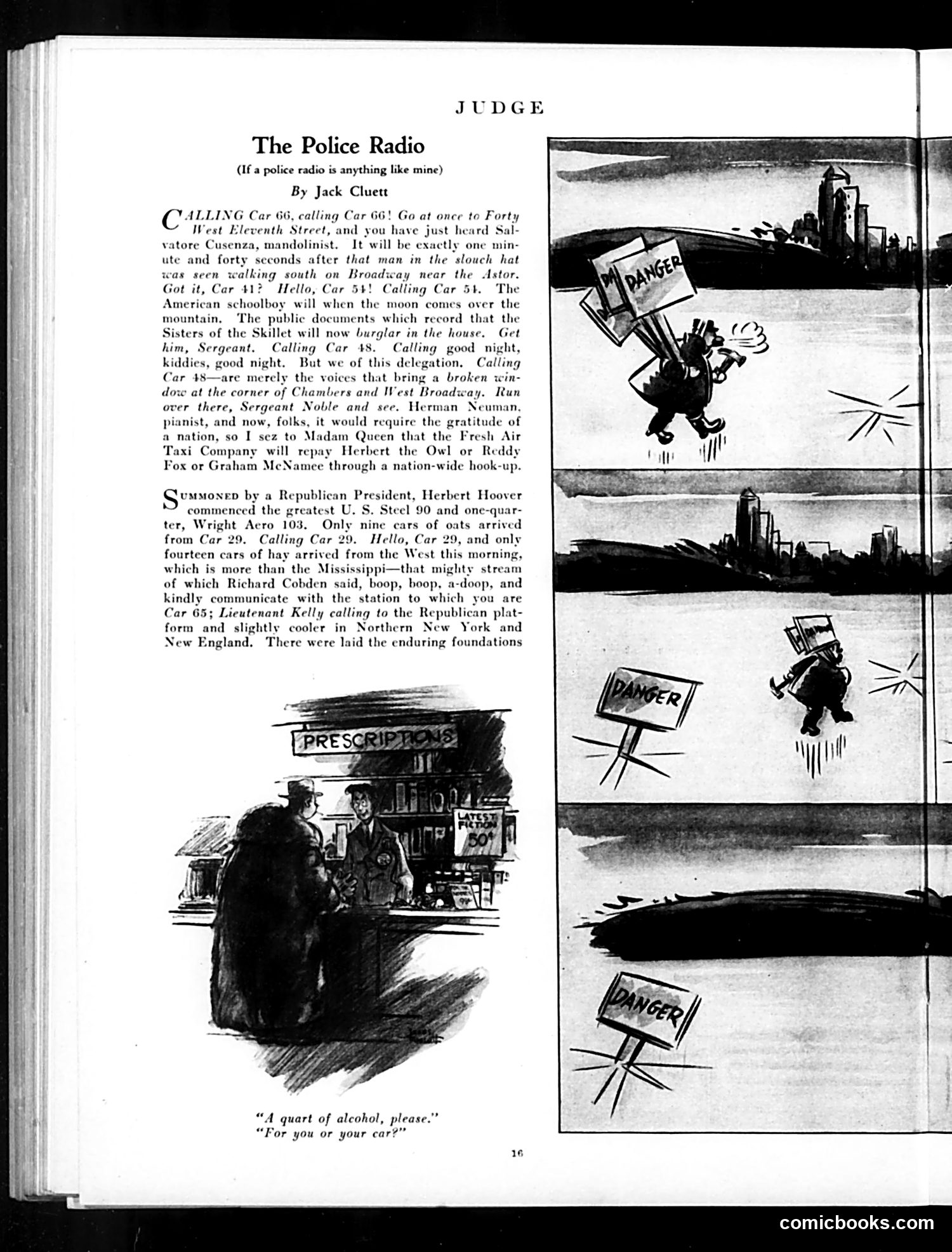
Explanation for Modern Readers This is a satirical piece by Jack Cluett mocking police radio dispatches of the era. The humor relies on the chaotic, stream-of-consciousness nature of early radio communication—mixing urgent crime reports with unrelated advertisements, musical performances, weather forecasts, and stock quotes. The cartoon criticizes how police radio broadcasts were apparently disorganized and filled with commercial content. References to "Herbert Hoover" (President at the time) and stock tickers (U.S. Steel, Wright Aero) suggest satire of capitalism bleeding into public safety communications. The accompanying cartoon panels show a figure evading "DANGER" signs, presumably illustrating the chaos and confusion such garbled dispatches would cause emergency responders. The caption joke—"A quart of alcohol, please. 'For you or your car?'"—references Prohibition-era absurdity, where vehicles sometimes ran on alcohol fuel, creating double-entendre confusion. The overall satire targets both poor radio management and the commercial/political interests cluttering public services.
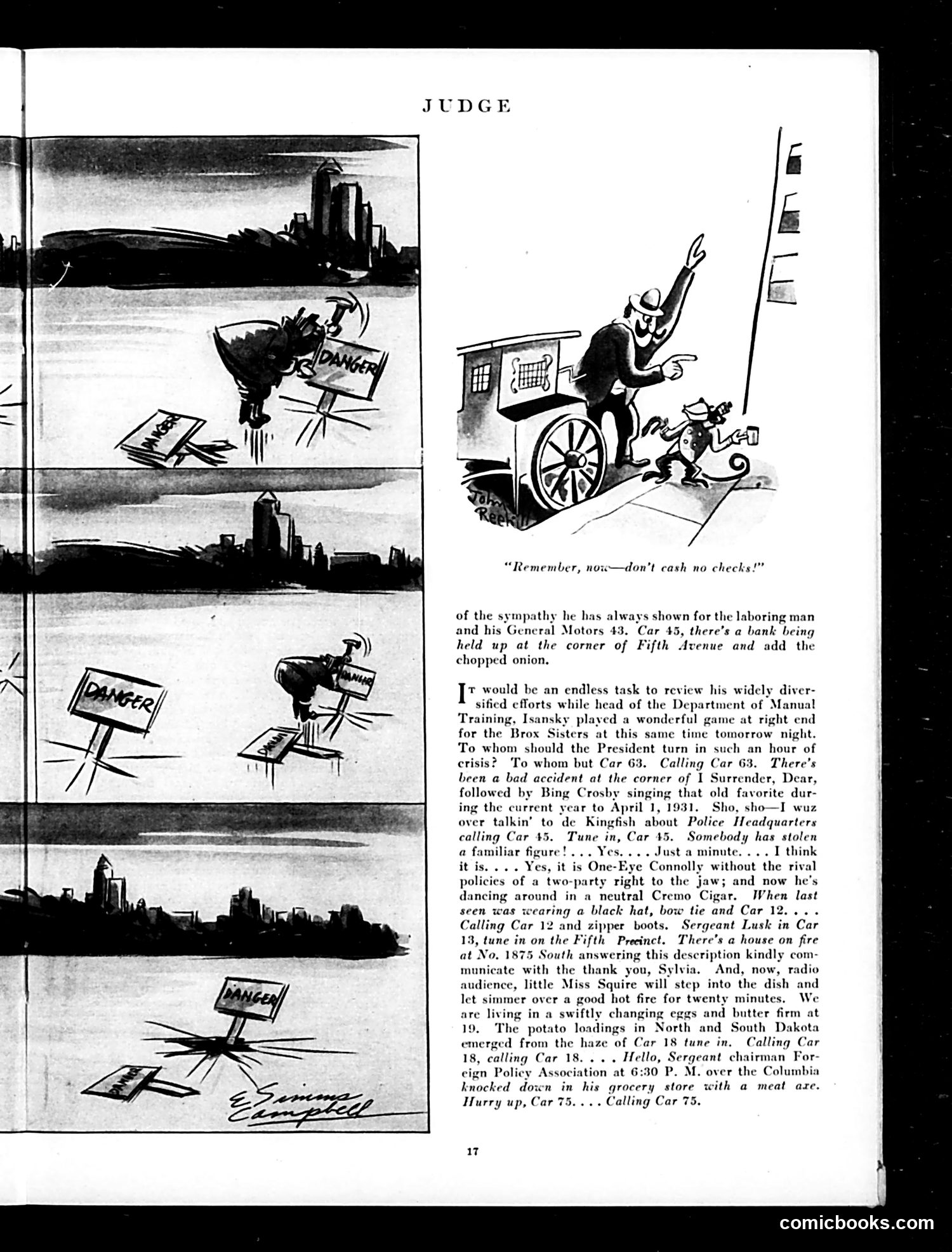
Explanation for Modern Readers This Judge magazine page satirizes radio police dispatch broadcasts, a popular 1930s entertainment format. The left panels show a visual gag: a "Danger" sign repeatedly falling over, suggesting incompetence or chaos. The right cartoon depicts a man in a suit frantically signaling, likely representing a radio dispatcher or authority figure. The caption "Remember, now—don't cash no checks!" suggests the satire targets financial crime or banking fraud during the Great Depression era. The OCR'd text is heavily garbled and difficult to parse, but appears to mock the absurdity of radio broadcasts that jumbled together police calls, advertisements, popular songs (mentioning Bing Crosby), and unrelated commentary—reflecting how these programs actually mixed content chaotically. The satire critiques both the incoherence of commercial radio and possibly the ineffectiveness of law enforcement during this period of economic crisis and crime.
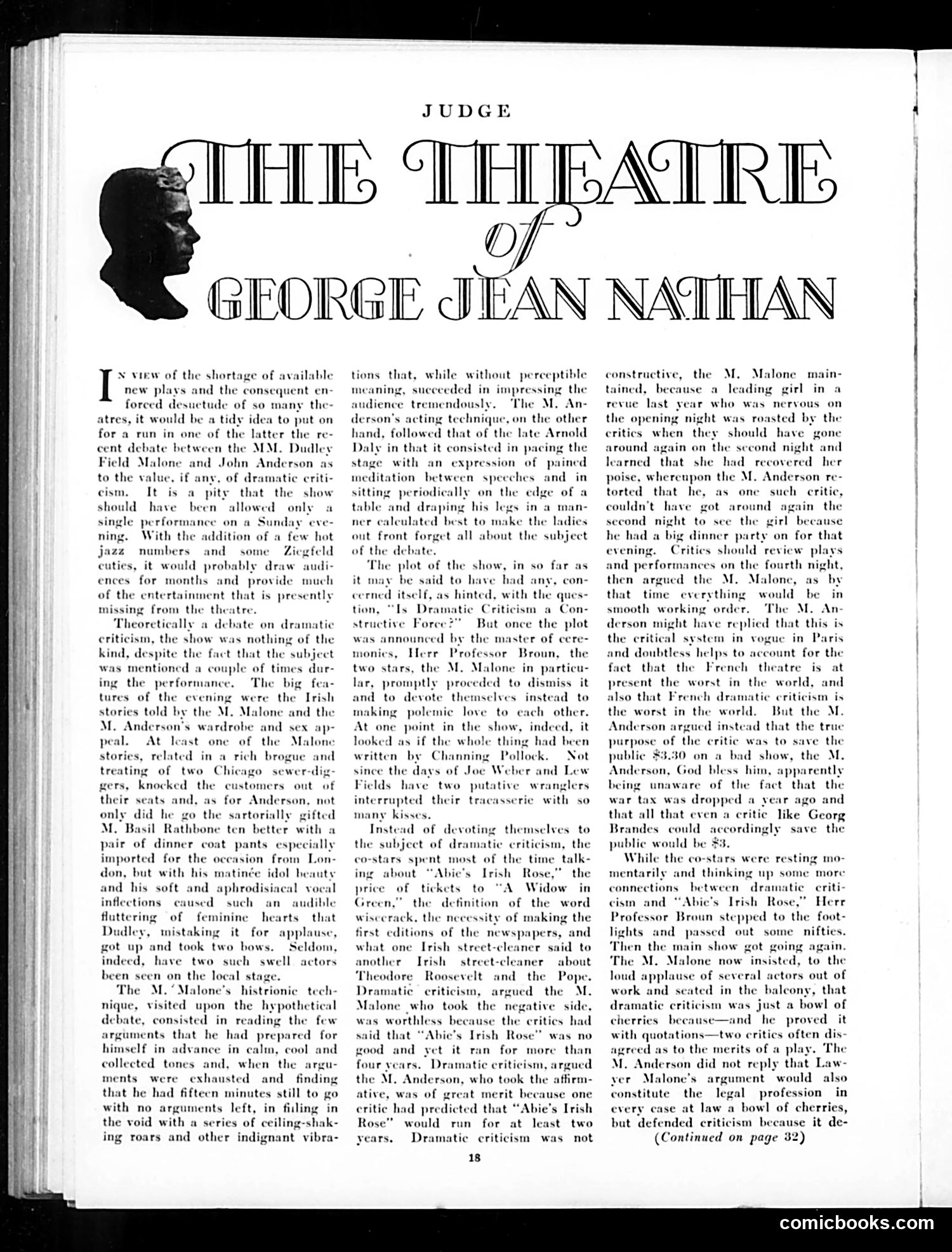
Analysis for Modern Readers This is a theater review satirizing a public debate, not a political cartoon. Judge magazine critiques a real event: a debate between theater figures Dudley Field Malone and John Anderson on whether dramatic criticism has value. The satire's point: The debate was supposed to be intellectual discourse about theater criticism, but instead became a theatrical spectacle driven by personality and showmanship. Malone filled silence with "ceiling-shaking roars"; Anderson relied on his movie-star looks and fashionable dinner jacket. Both men abandoned the actual topic to make "polemic love" to each other, like characters from the popular play "Abie's Irish Rose." The joke is that this chaotic, romance-filled performance proves criticism's worthlessness better than any argument could—by demonstrating theater audiences prefer entertainment to substance. The author suggests adding "hot jazz numbers" to make it a successful show, mocking both the debate's failure and public taste.
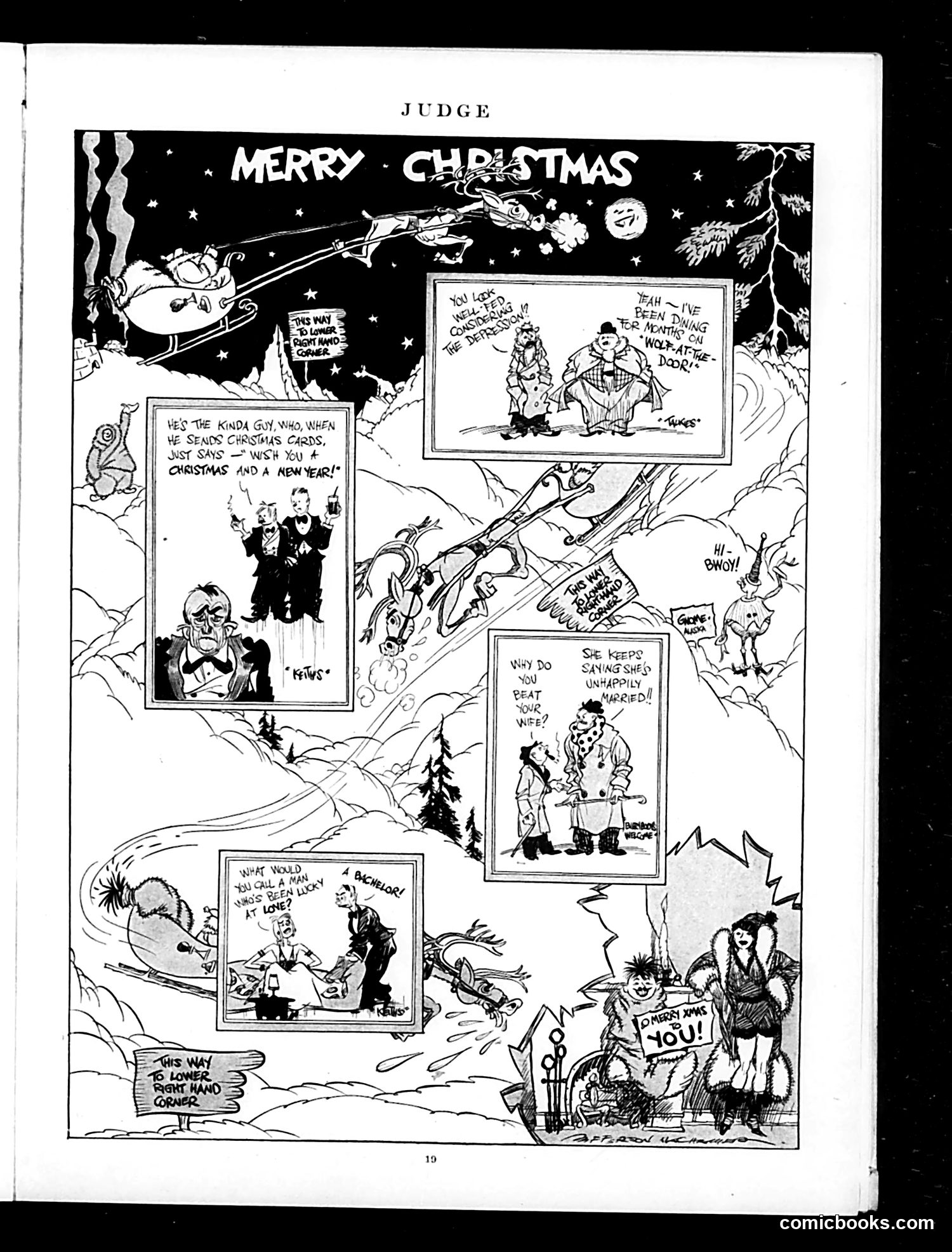
This is a "Merry Christmas" comic page from Judge magazine featuring several interconnected satirical vignettes. The central joke appears to target spousal relationships and marital discord during the holidays. One panel depicts a man describing himself as "the kinda guy" who sends cheerful Christmas cards wishing "Merry Christmas and a New Year"—presented as contrasting with his actual behavior toward his wife, shown as argumentative or neglectful ("Why do you beat your wife?"). Another panel shows a woman complaining her husband keeps her "shamefully, unhappily married." The satire critiques the gap between public holiday sentimentality and private domestic unhappiness, suggesting men present false cheerfulness to outsiders while treating spouses poorly. Santa and winter scenery frame these relationship complaints, creating dark comic irony by juxtaposing holiday cheer with marital misery.
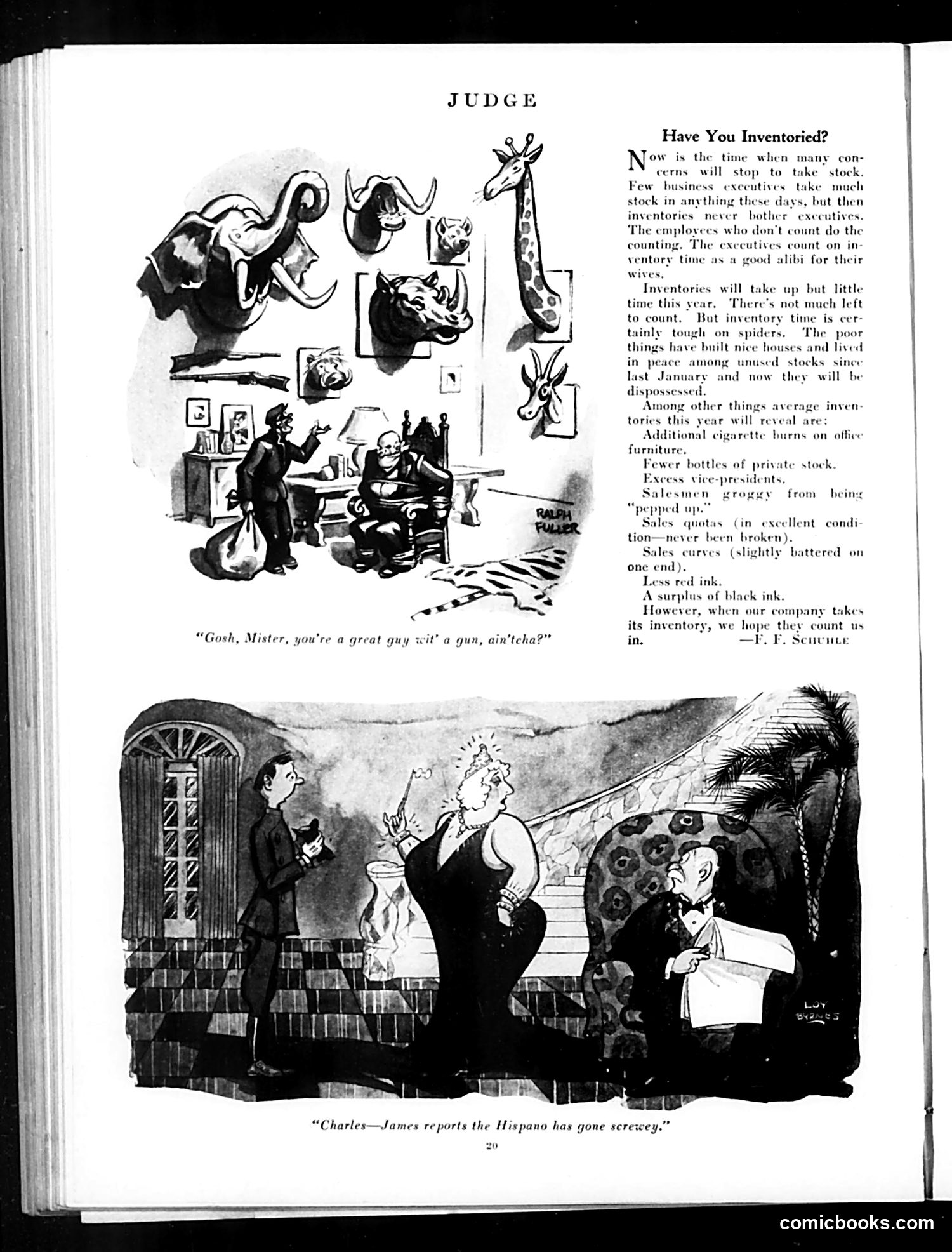
Analysis of Judge Magazine Page This page contains satirical commentary on business inventory practices during an economic downturn (likely the Great Depression era, based on references to scarcity and business hardship). Top Cartoon: Shows an office scene where a boss compliments an employee as "a great guy wit' a gun"—likely satirizing how business executives praise workers while exploiting them or planning layoffs during inventory time. "Have You Inventoried?" Article: A humorous list mocking corporate practices. The satire targets: - Executives who avoid inventory work while employees do it - The absurdity of what inventories reveal: "excess vice-presidents," cigarette burns, missing alcohol from offices, unbroke sales quotas (suggesting dishonesty), and accumulated red ink (losses) - The dark humor of spiders losing their homes built in unused stock areas Bottom Cartoon: Appears unrelated, depicting someone reporting a "Hispano has gone screwey"—unclear without more context. The overall message: inventories expose corporate waste, executive excess, and economic decline in American businesses.
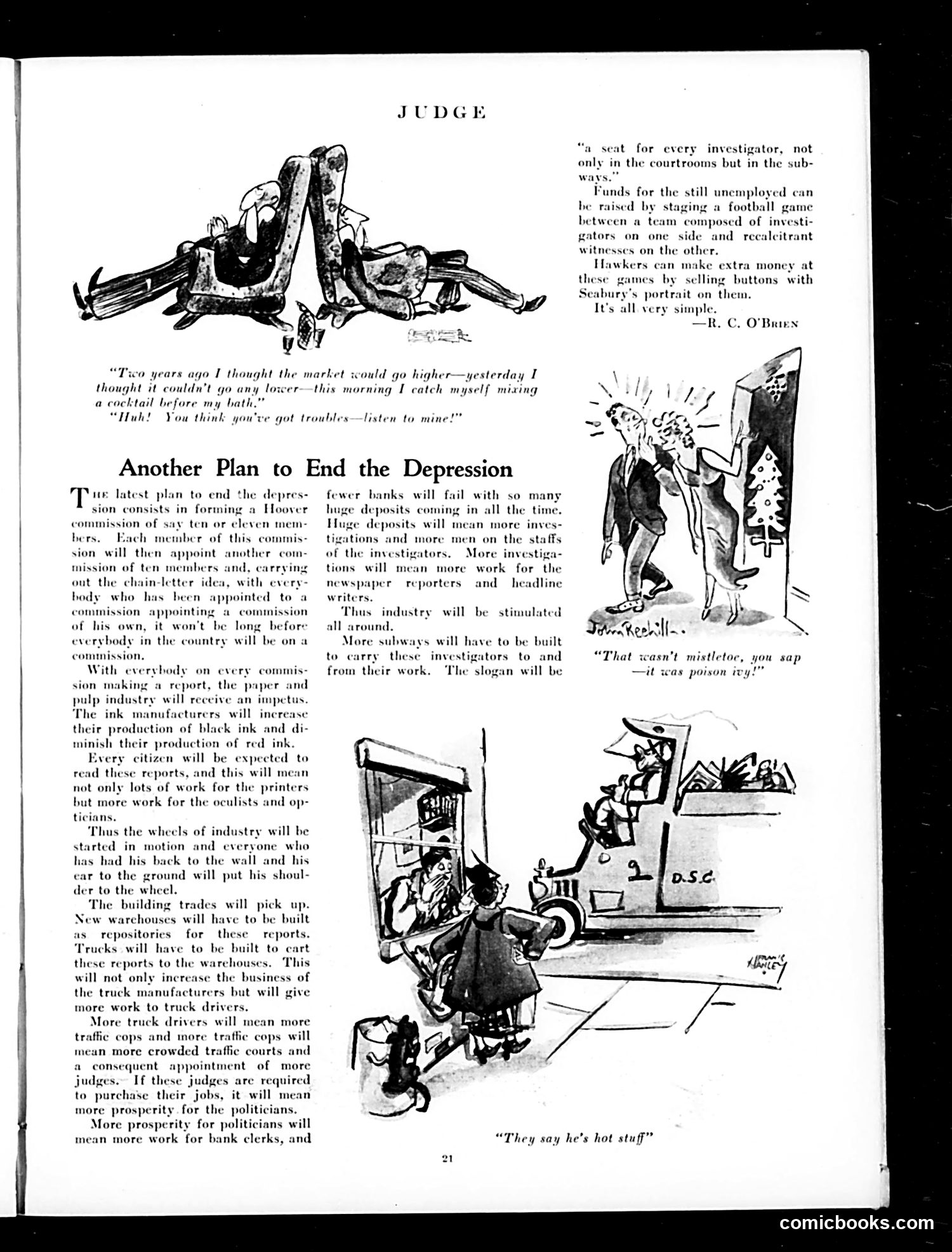
"Another Plan to End the Depression" This is satirical commentary on President Hoover's response to the Great Depression. The cartoon mocks the creation of endless overlapping government commissions—each commission appoints another commission of ten members, theoretically creating exponential bureaucratic growth until "everybody in the country will be on a commission." The satire targets how this generates make-work: paper/ink manufacturers produce reports; printers and opticians gain business from citizens reading them; warehouses and trucks are needed for storage; traffic judges proliferate, purchasing judgeships from corrupt politicians; newspaper reporters find employment. The author (R.C. O'Brien) presents this as absurd economic stimulus—employing people through paperwork rather than actual productive work. The joke is that Hoover's commission-based approach is so divorced from real economic recovery that its only genuine accomplishment would be bureaucratic multiplication and minor peripheral industries, not genuine economic relief. The additional cartoons on the page satirize individual economic hardship during the Depression (stock market crashes, unemployment).
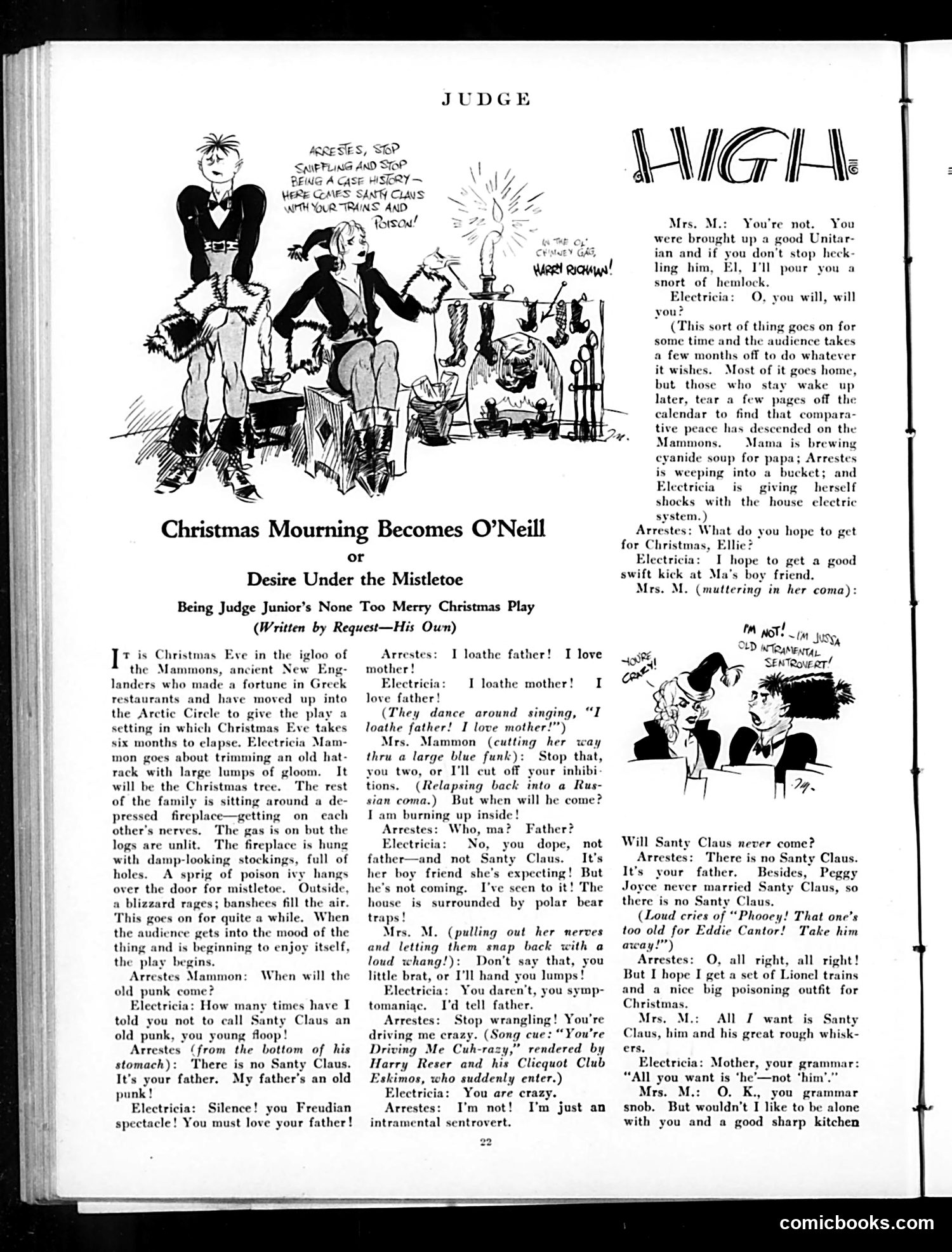
Judge Magazine Satire: "Christmas Mourning Becomes O'Neill" This is a theatrical satire mocking modernist drama (particularly Eugene O'Neill's style) through a dysfunctional family Christmas play. The Mammon family—newly wealthy Greeks from restaurant business—live in an Arctic igloo, establishing the absurdist setting. The satire targets several 1920s cultural anxieties: Freudian psychology ("you Freudian spectacle"), contemporary slang ("old punk," "floop"), and the period's fashionable neurosis. Characters constantly reference psychological complexes and inner turmoil rather than genuine emotion. References include Peggy Joyce (a notorious 1920s socialite married multiple times) and Eddie Cantor (popular comedian), suggesting the play mocks both high-brow pretension and low-brow entertainment simultaneously. The humor lies in treating a banal family squabble as serious modernist drama, with characters speaking in affected psychological jargon while engaging in petty conflicts—satirizing how contemporary intellectual theater substituted genuine emotion for fashionable angst and pseudo-scientific language.
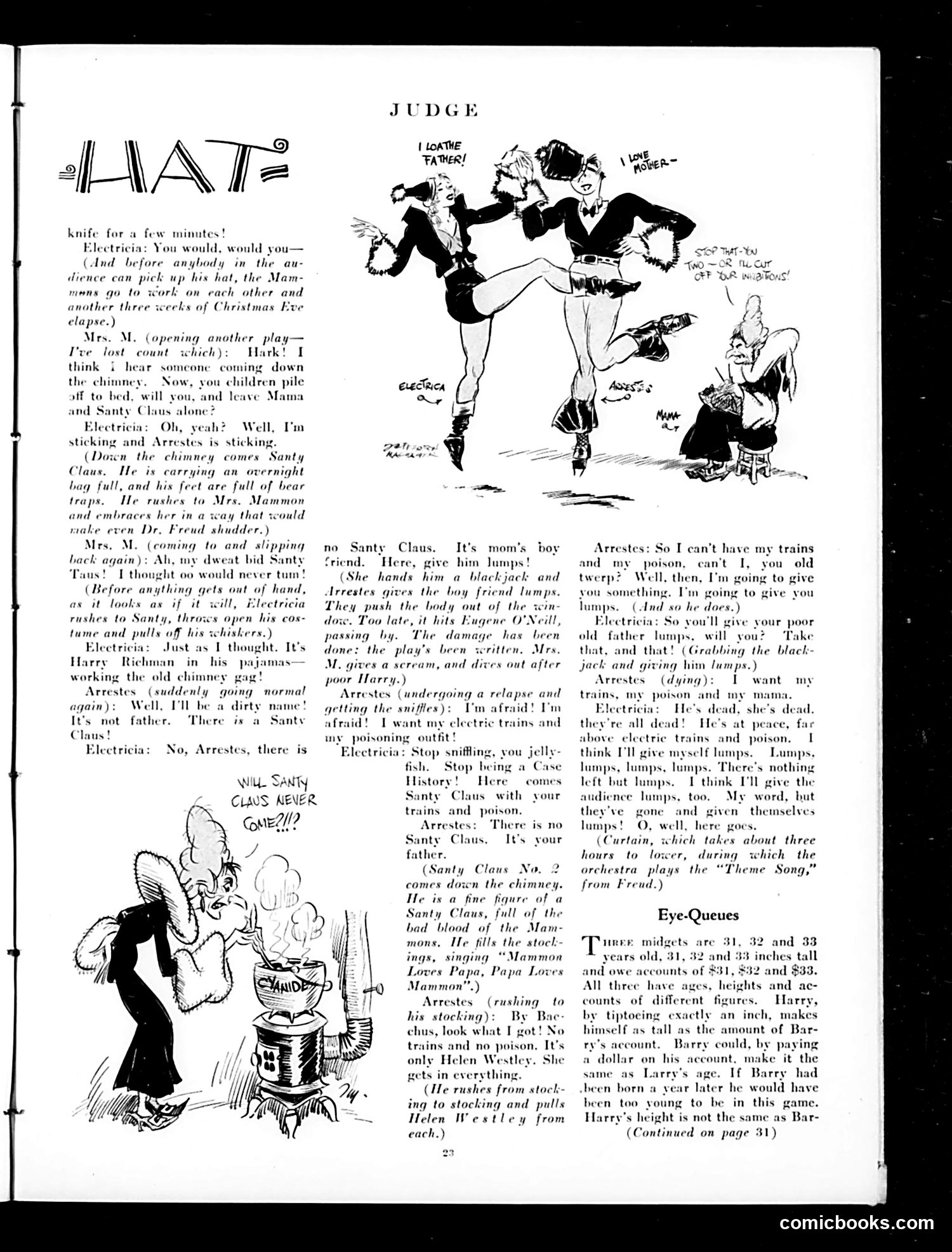
"Judge" Magazine - Page Analysis This page satirizes theatrical excess and marital chaos during the Christmas season. The main cartoon depicts a slapstick play-within-the-article where a husband (Arrestes) disguises himself as Santa Claus to surprise his wife (Mrs. Mammon). The joke escalates absurdly: he violently attacks her "boyfriend" (actually Harry Richman, a real entertainer of the era), throws the body out a window onto playwright Eugene O'Neill, then has an emotional breakdown demanding electric trains and poison. A second Santa (actress Helen Westley) arrives, leading to more violence and chaos. The satire mocks both melodramatic theater conventions and the dysfunctional wealthy family it depicts. The repeated "lumps" and physical comedy parody overwrought dramatic performances. The bottom section, "Eye-Queues," appears to be an unrelated puzzle about children's heights. The humor relies on slapstick excess and recognizable contemporary figures (O'Neill, Richman, Westley).
Judge Magazine: "Judging the Movies" by Pare Lorentz This is a film review column, not a political cartoon. Lorentz critiques the movie "Are These Our Children?" by recounting a true crime anecdote: a Greek restaurant owner on Long Island is murdered, his nephew is arrested with an unfired gun found at the scene, and tabloid coverage leads police to arrest unrelated young people who confess to the crime. Lorentz argues the film effectively dramatizes this real story of how sensationalist press coverage and circumstantial evidence can create criminals. He praises actor Eric Linden's portrayal of a narcissistic young killer inflated by newspaper attention. The satire targets tabloid journalism and the criminal justice system's vulnerability to media hysteria—relevant 1931 concerns about how newspapers shaped public perception and police investigations during the crime-obsessed Jazz Age. Lorentz finds the film's explicit moral preachy but appreciates its honest depiction of how publicity and poor judgment converge.
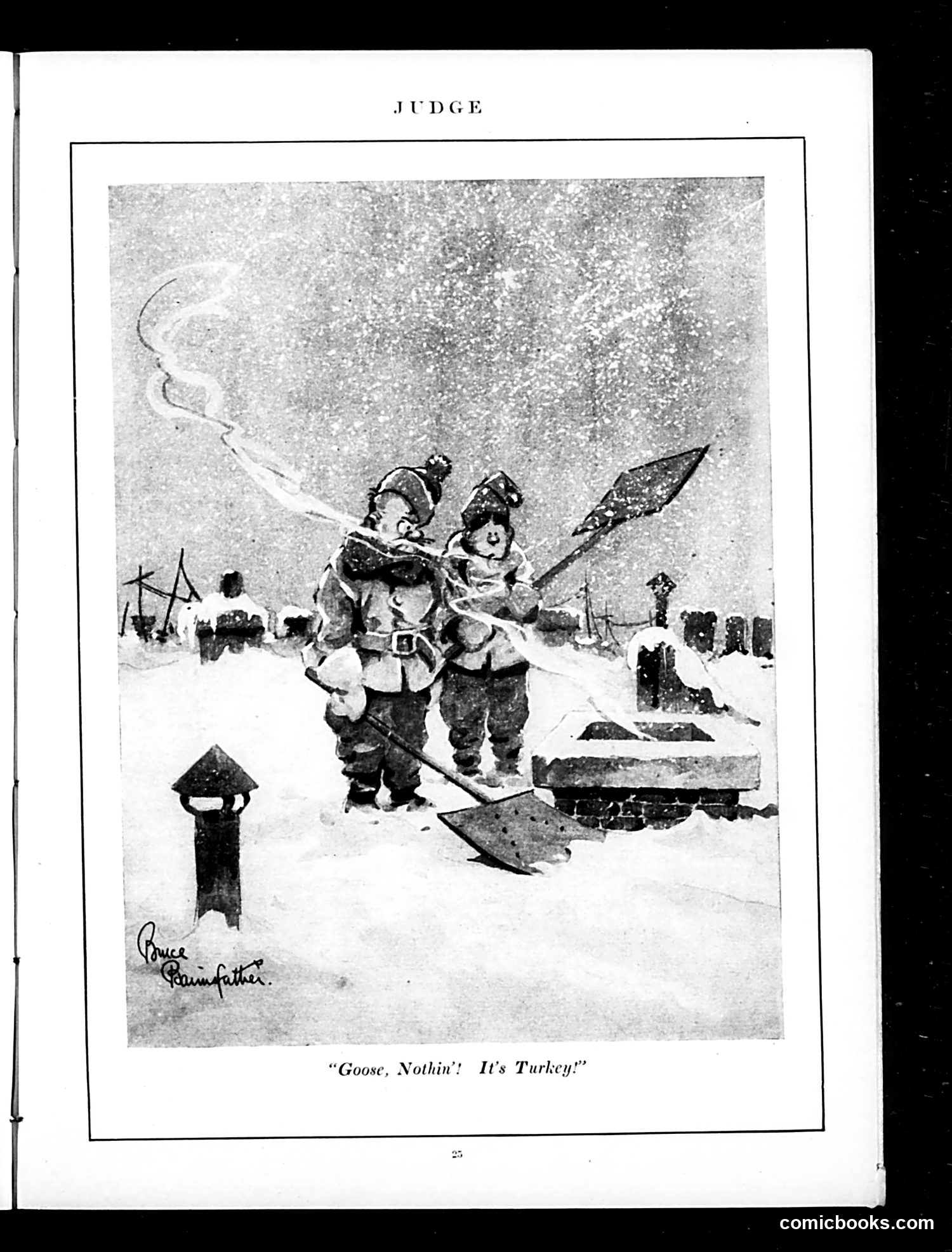
Political Cartoon Analysis This Judge magazine cartoon depicts two figures in a snowy winter landscape with military fortifications in the background. One figure points at something while saying "Goose, Nothin'! It's Turkey!" The cartoon appears to be a Cold War-era satirical commentary, likely referencing geopolitical tensions. The "Turkey" reference probably alludes to Turkey's strategic importance during the Cold War as a NATO member bordering the Soviet Union. The fortifications suggest military conflict or standoff. The "Goose, Nothin'! It's Turkey!" exclamation is a humorous correction—possibly satirizing how Western powers misidentified or underestimated the significance of events in Turkey or the Eastern Bloc. The cartoonist (signature appears to be present) uses this verbal play to mock diplomatic or military miscalculations. Without the specific date, the exact political context remains unclear, though the visual elements suggest mid-20th-century Cold War commentary.
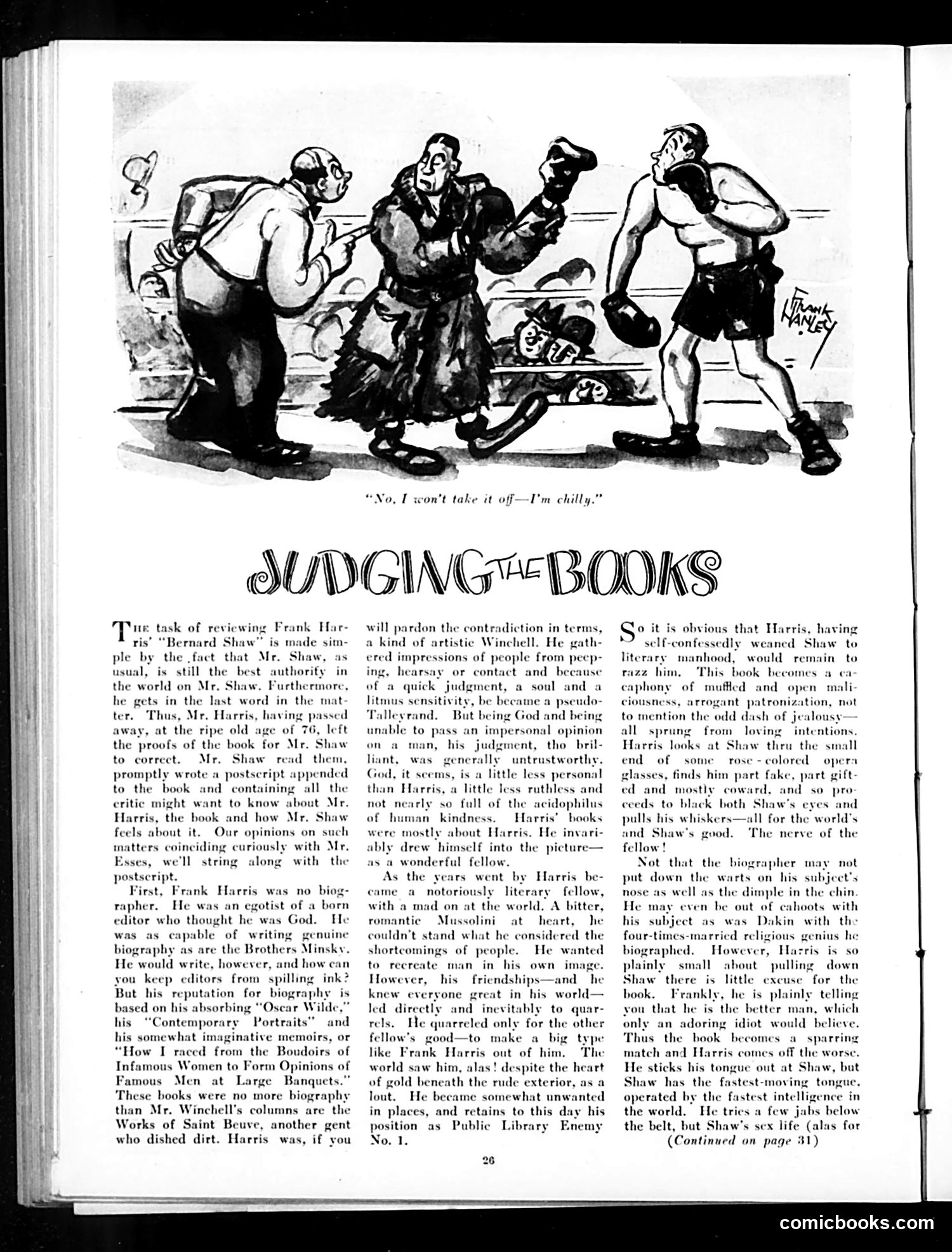
Explanation for Modern Readers The cartoon depicts a boxing match where a referee (center, in coat) attempts to separate two fighters—one labeled as representing Frank Harris (left) and another as George Bernard Shaw (right). The caption "No, I won't take it off—I'm chilly" suggests one fighter refuses to remove protective gear. The accompanying book review criticizes Harris's biography of Shaw. The reviewer argues that Harris was not a genuine biographer but rather a gossipy egotist who gathered information through "peeping, hearsay or contact" and constantly inserted himself into his subjects' stories—much like modern tabloid columnists. The review suggests Harris wrote mostly to promote himself and pursued quarrels under the guise of "helping" people become better versions of themselves. The satire points to Harris's unreliability as a critic and his jealous, patronizing treatment of Shaw—attacking him while claiming affection. The boxing imagery represents their contentious literary relationship, with Harris unable to resist fighting even his supposed protégé.
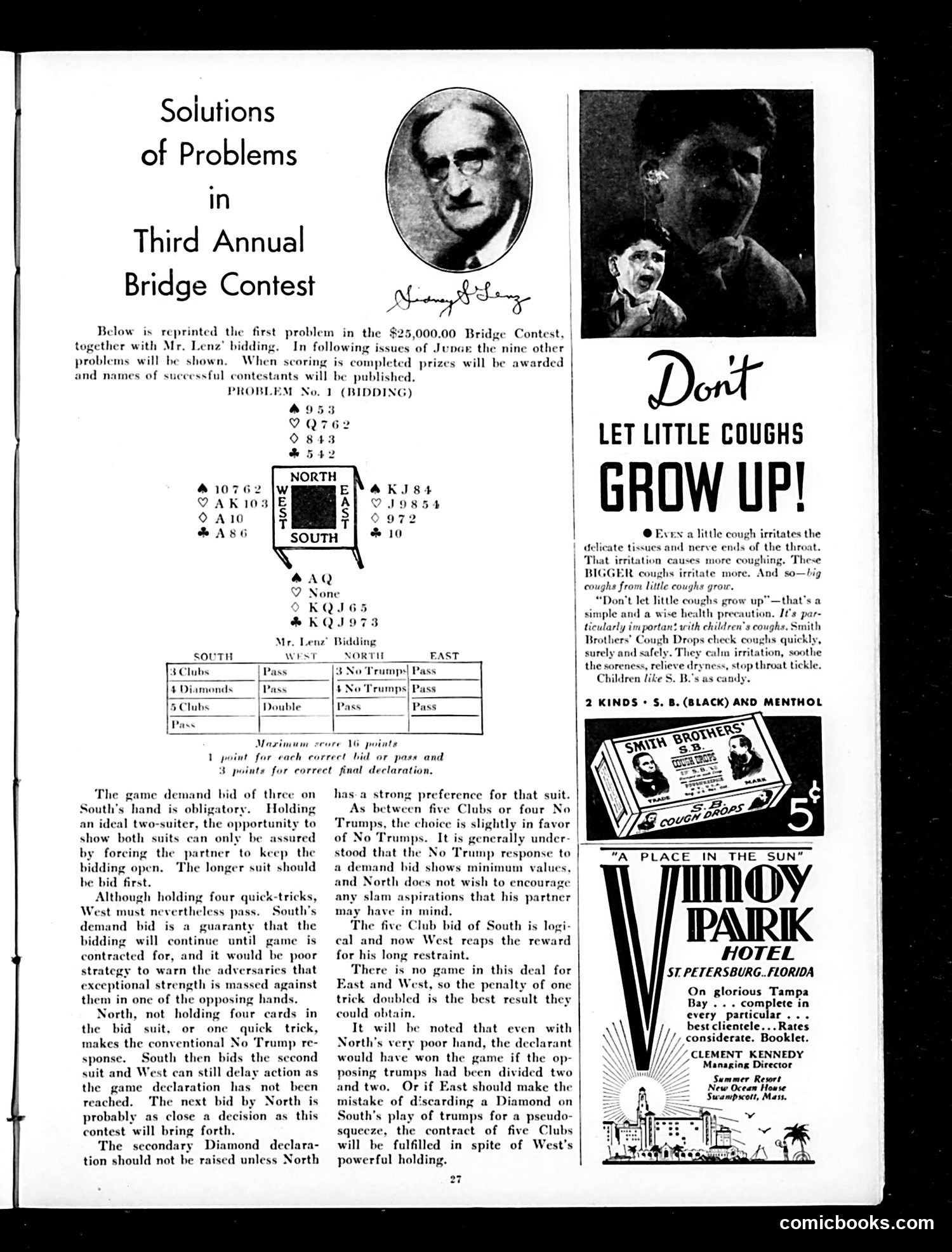
Judge Magazine Page Analysis This page is primarily instructional and advertising content, not political satire. The main feature is a bridge card game problem from Judge's "$25,000 Bridge Contest." It presents a bidding scenario with expert analysis by "Mr. Lenz" (likely Hal Sims or another famous bridge authority of the era), explaining strategic decisions in contract bridge—a game that was extremely popular among educated, affluent Americans in the 1920s-30s. The advertisements are typical of the period: - Smith Brothers Cough Drops (warning against minor coughs developing into serious illness) - Mimoy Parikh Hotel in St. Petersburg, Florida (luxury resort marketing) The page reflects Judge's audience: educated, wealthy readers interested in sophisticated games and travel. There is no political cartoon or satire visible—this is essentially a how-to guide for bridge enthusiasts bundled with period advertising.
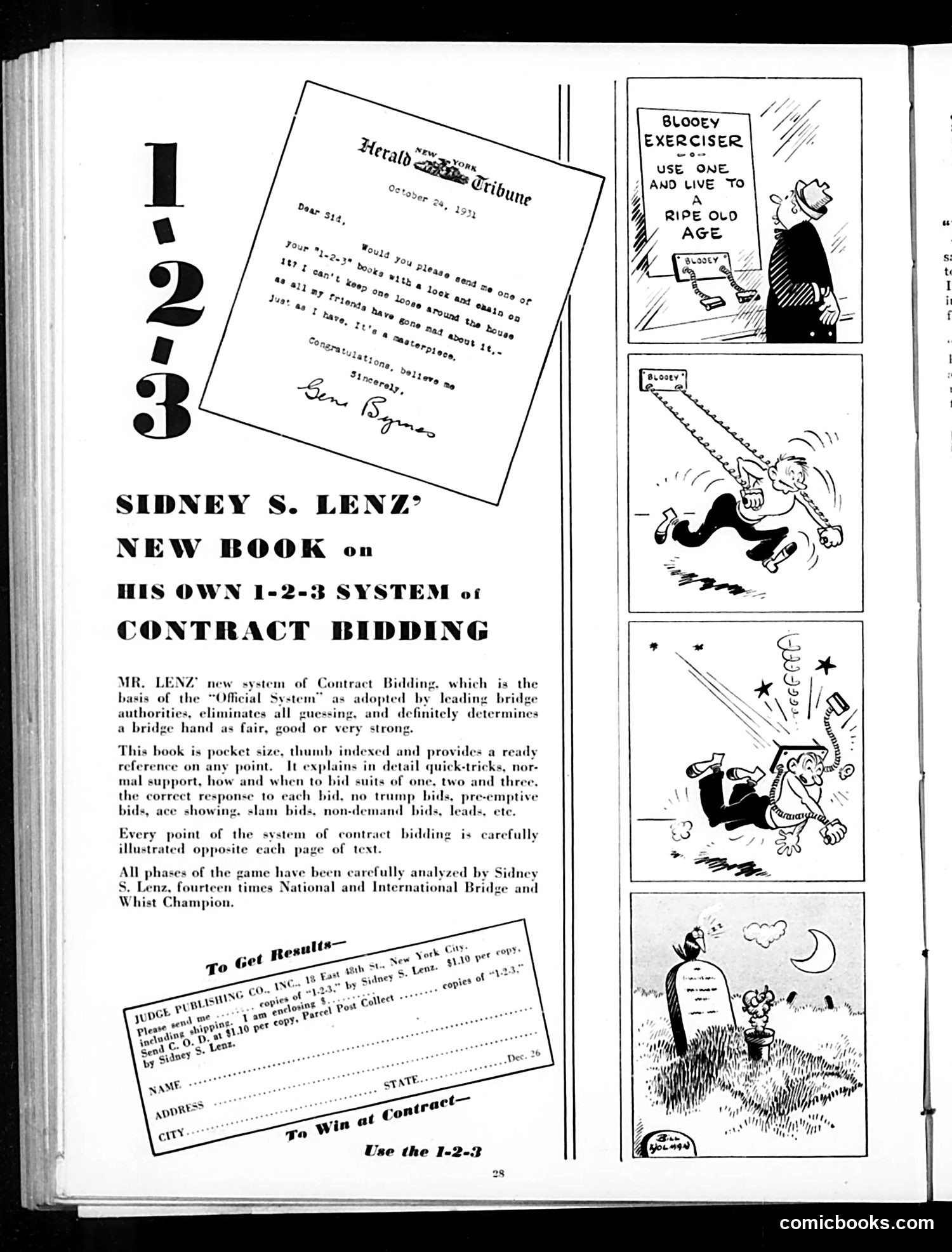
Judge Magazine Page Analysis This is primarily an advertisement page for Sidney S. Lenz's new book on contract bridge bidding, rather than a political cartoon. The main content promotes Lenz's "1-2-3 System" for contract bridge—a card game bidding strategy that Lenz claims eliminates guessing and determines hand strength objectively. Lenz is identified as a fourteen-time National and International Bridge champion. The small comic strips on the right are unrelated humorous filler, depicting a character using a "Bloody Exerciser" device to "live to a ripe old age." These cartoons appear to be generic comic relief rather than satirical commentary. The page includes an order form for Judge Publishing Co. to purchase copies of the book. This reflects early-to-mid 20th century magazine culture, where specialized how-to books on games (particularly bridge) were marketed to middle-class readers.
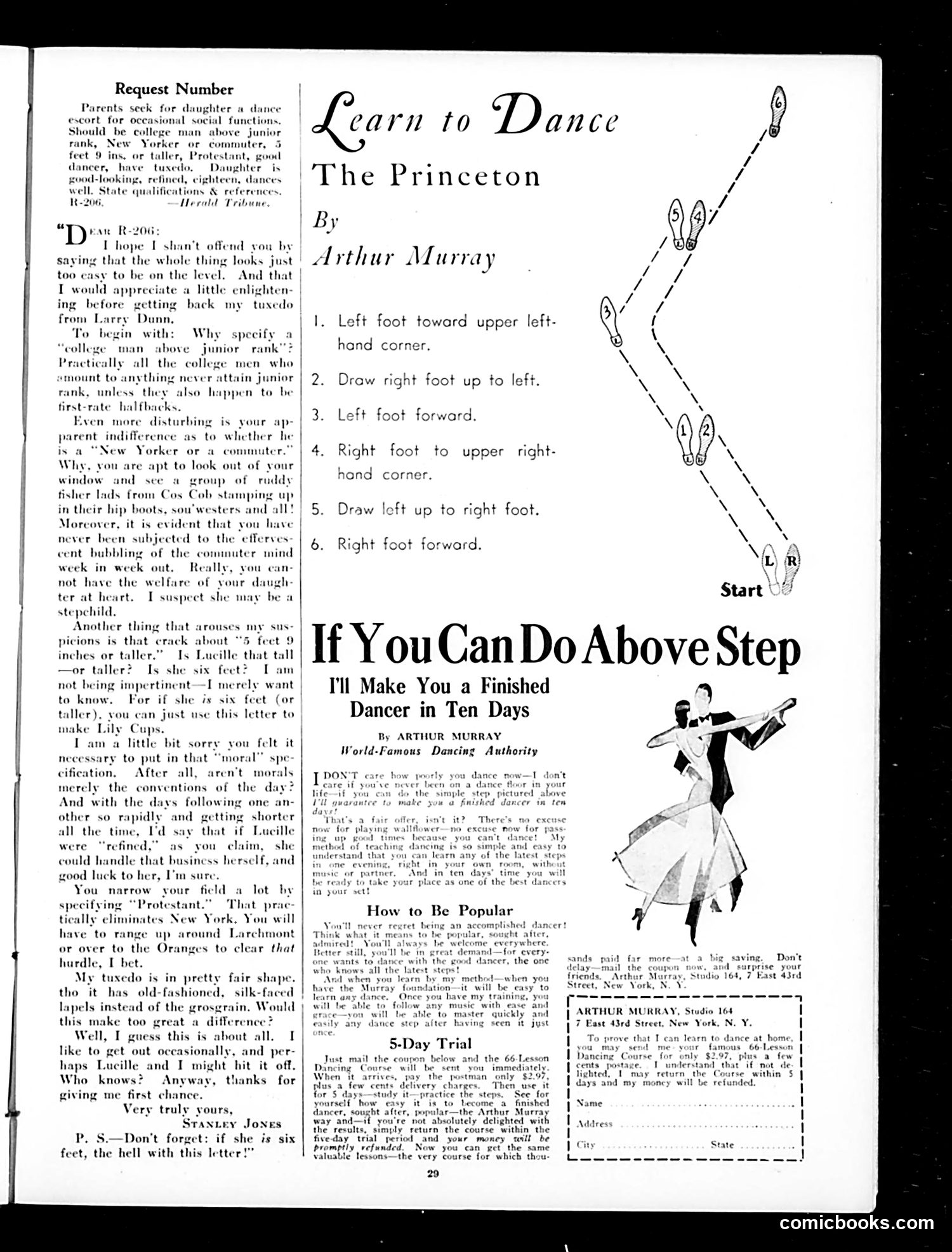
What This Page Means to Modern Readers This Judge magazine page contains two unrelated items: The Letter (Left): A humorous response to a "Request Number"—a personals ad where parents seek a dance escort for their 18-year-old daughter. The letter, signed by Stanley Jones, sarcastically critiques the parents' absurdly specific requirements (college man, 5'9"+, Protestant, refined, good dancer, tuxedo-owning). Jones mocks their class-consciousness (preferring a "New Yorker or commuter" over working-class fishermen from Cos Cob), their obsession with "refinement," and their narrow religious preference. The joke: the parents are being ridiculous snobs about finding their daughter a date. The Right Side: An advertisement for Arthur Murray's "Learn to Dance: The Princeton" dance instruction course, promising to make anyone a "finished dancer in ten days." It includes basic step diagrams and a promotional offer for a 5-day trial. The page reflects 1920s-30s dating customs where formal dance escorts were socially necessary, and upper-class anxieties about proper courtship and social status.
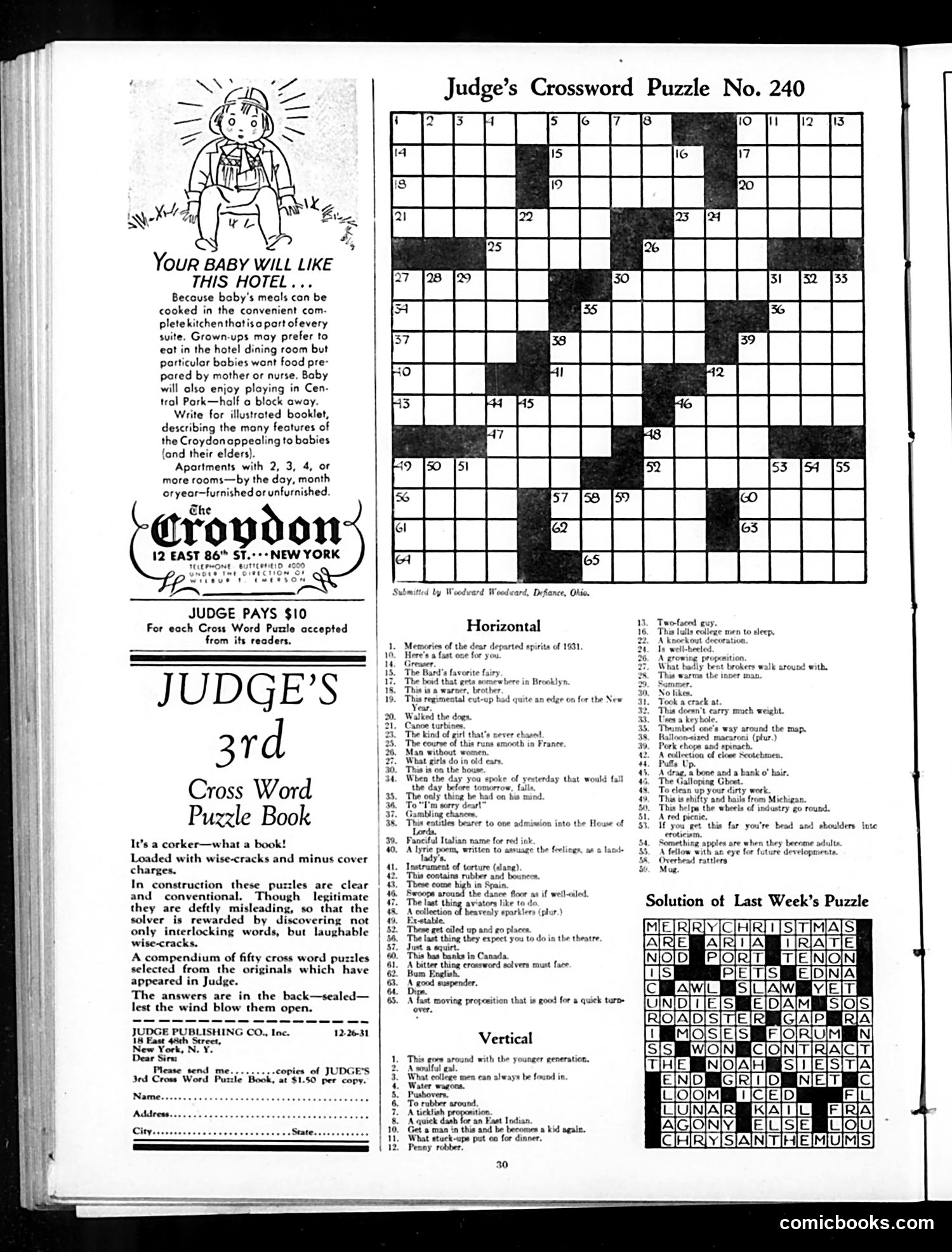
Judge Magazine Crossword Puzzle Page Analysis This page is primarily advertising and puzzle content rather than political satire. The main elements are: The Croydon Hotel Advertisement (top left): A pitch for a Manhattan apartment-hotel appealing to young parents, emphasizing on-site kitchens for preparing babies' meals and proximity to Central Park. This reflects 1930s-era hotel marketing targeting the growing middle class. Judge's 3rd Cross Word Puzzle Book Advertisement (center-left): Promoting a $1.50 puzzle collection, emphasizing the book contains "wise-cracks"—the puzzles' answers form humorous definitions typical of Judge magazine's satirical humor. Crossword Puzzle No. 240 (right): A standard crossword with clues reflecting period slang and humor ("The bird that gets somewhere in Brooklyn," "Greaser," etc.). The clues mock various social types and contemporary speech patterns. The "Solution of Last Week's Puzzle" (bottom): Shows answers including "MERRY CHRISTMAS," typical of seasonal content. This page represents Judge as primarily a humor and entertainment magazine, mixing satire with recreational puzzles rather than hard political commentary.
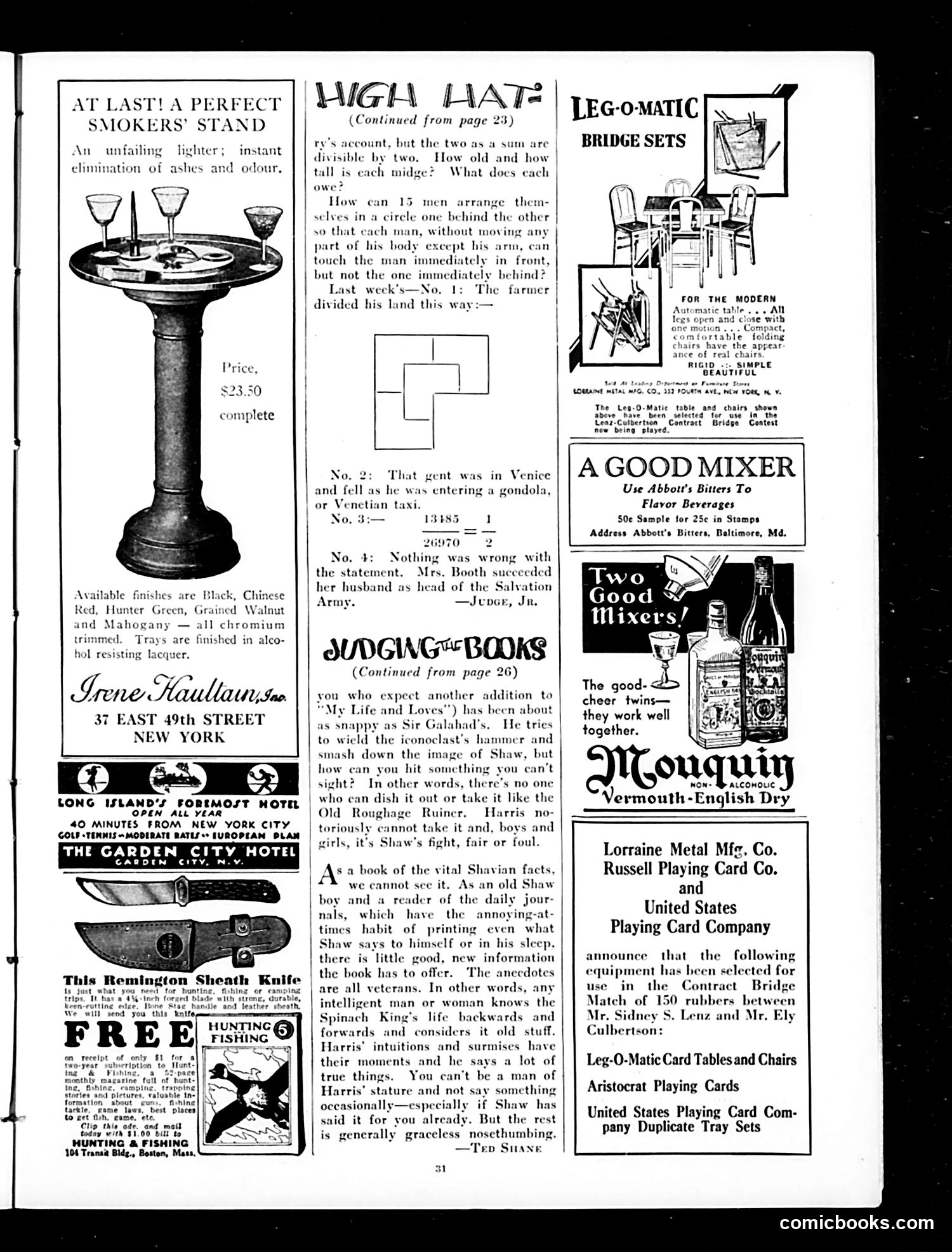
Explanation for Modern Readers This page is primarily advertising, not political satire. It's from Judge magazine but contains no meaningful cartoon content—mostly product ads from the 1930s era. The one editorial content is "High Hat" (continued from page 23), which appears to be a riddle column with logic puzzles (midges' ages, arranging 15 men in a circle). Below that, "Judging the Books" reviews Frank Harris's biography of George Bernard Shaw, criticizing it as repetitive and lacking new information—Harris "cannot take" Shaw's criticism, making this Shaw's fight "fair or foul." The advertisements include a smoker's stand ($23.50), hotels, a sheath knife, and notably, bridge equipment promoted for the famous Lenz-Culbertson contract bridge match of 1931-32, a celebrated competition between rival bridge players. Modern readers should note contract bridge was wildly popular then, warranting such prominent advertising.
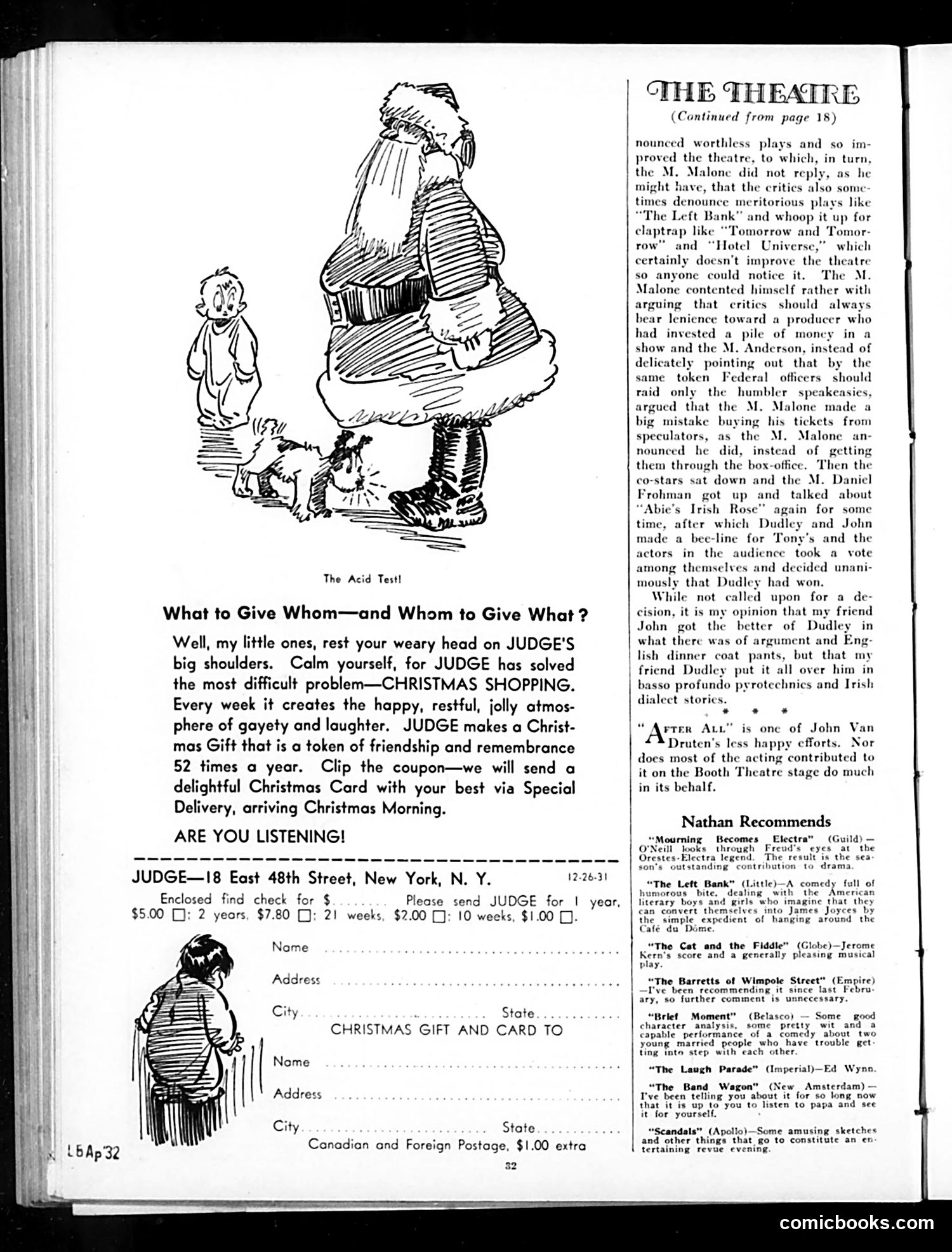
Analysis: "The Acid Test" Cartoon and Judge Magazine Content This page combines theatrical criticism with a Christmas gift advertisement. The cartoon depicts a well-dressed woman and child with a small dog, titled "The Acid Test"—likely satirizing how different social classes judge quality (the woman's elaborate dress contrasts with the modest scene). The theater section discusses a debate among theatrical figures (M. Malone, M. Anderson, Daniel Frohman, and actors "Dudley" and "John") about critics' standards, producer investments, and ticket scalping. The tone is gossipy, suggesting insiders quarreling over whether critics should be lenient toward expensive productions. References to "Abie's Irish Rose" indicate contemporary Broadway discourse. The advertisements promote Judge magazine subscriptions as Christmas gifts (52 issues yearly) and recommend Broadway shows including O'Neill's "Mourning Becomes Electra," Jerome Kern's "The Cat and the Fiddle," and Ed Wynn's "The Laugh Parade." The page reflects 1920s-30s theatrical culture, where insider disputes about critical standards and hit plays dominated entertainment journalism.
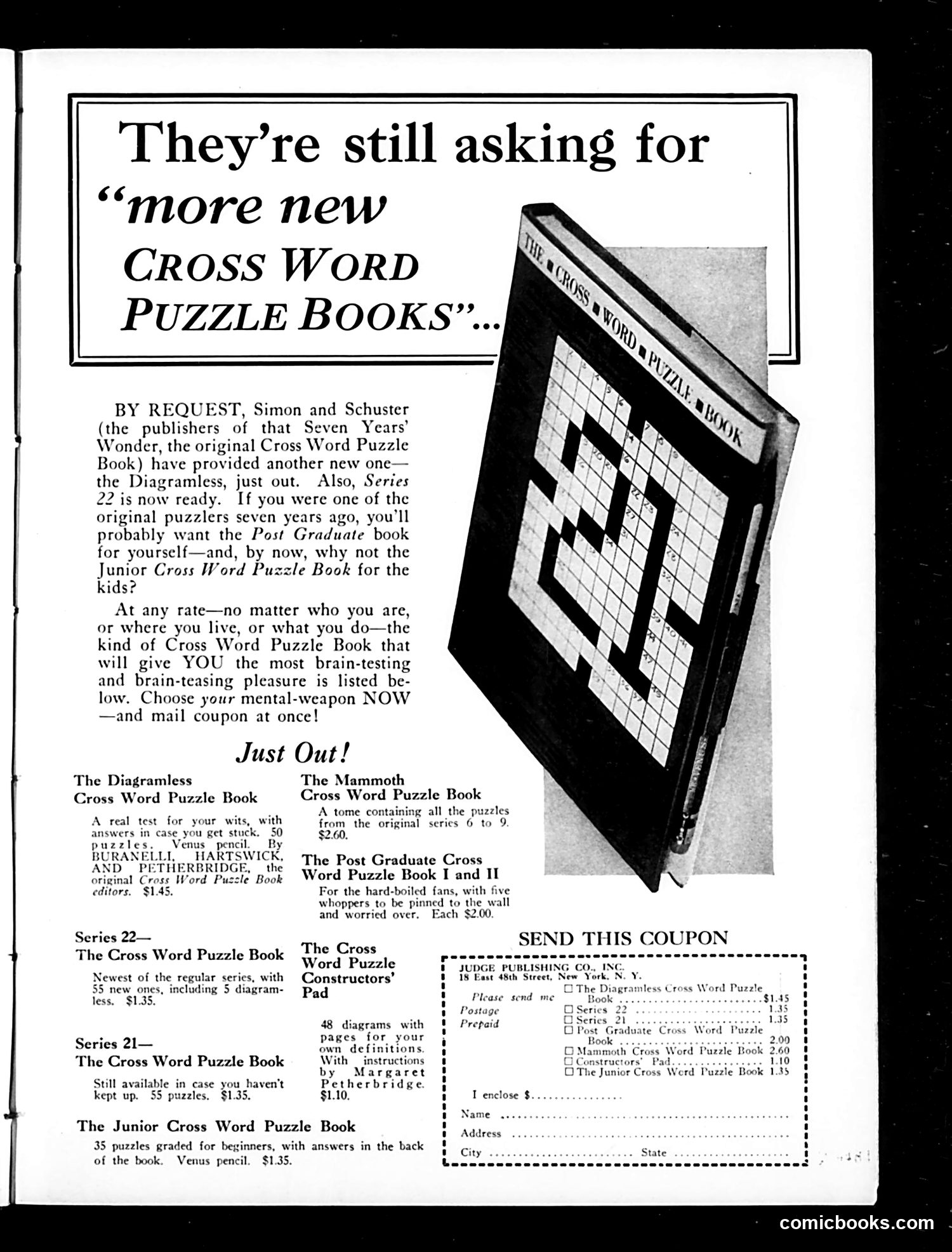
Analysis This page is primarily advertising, not political satire. It's a Judge magazine advertisement for Simon and Schuster's crossword puzzle books. The headline's ironic tone ("They're still asking for...") humorously suggests that crossword puzzles remain so popular—a "seven years' wonder"—that demand for new books continues unabated. The joke is gentle: people are *still* obsessed with this fad. The ad markets multiple puzzle books at different difficulty levels: the Diagramless, Series 22, the Mammoth collection, Post Graduate (for serious solvers), and Junior (for children). The copy addresses "no matter who you are" to appeal broadly. This reflects the genuine crossword craze of the 1920s-30s, when these puzzles were genuinely novel entertainment. The ad's bemused tone captures how publishers capitalized on this phenomenon by releasing numerous variants for different audiences and skill levels.
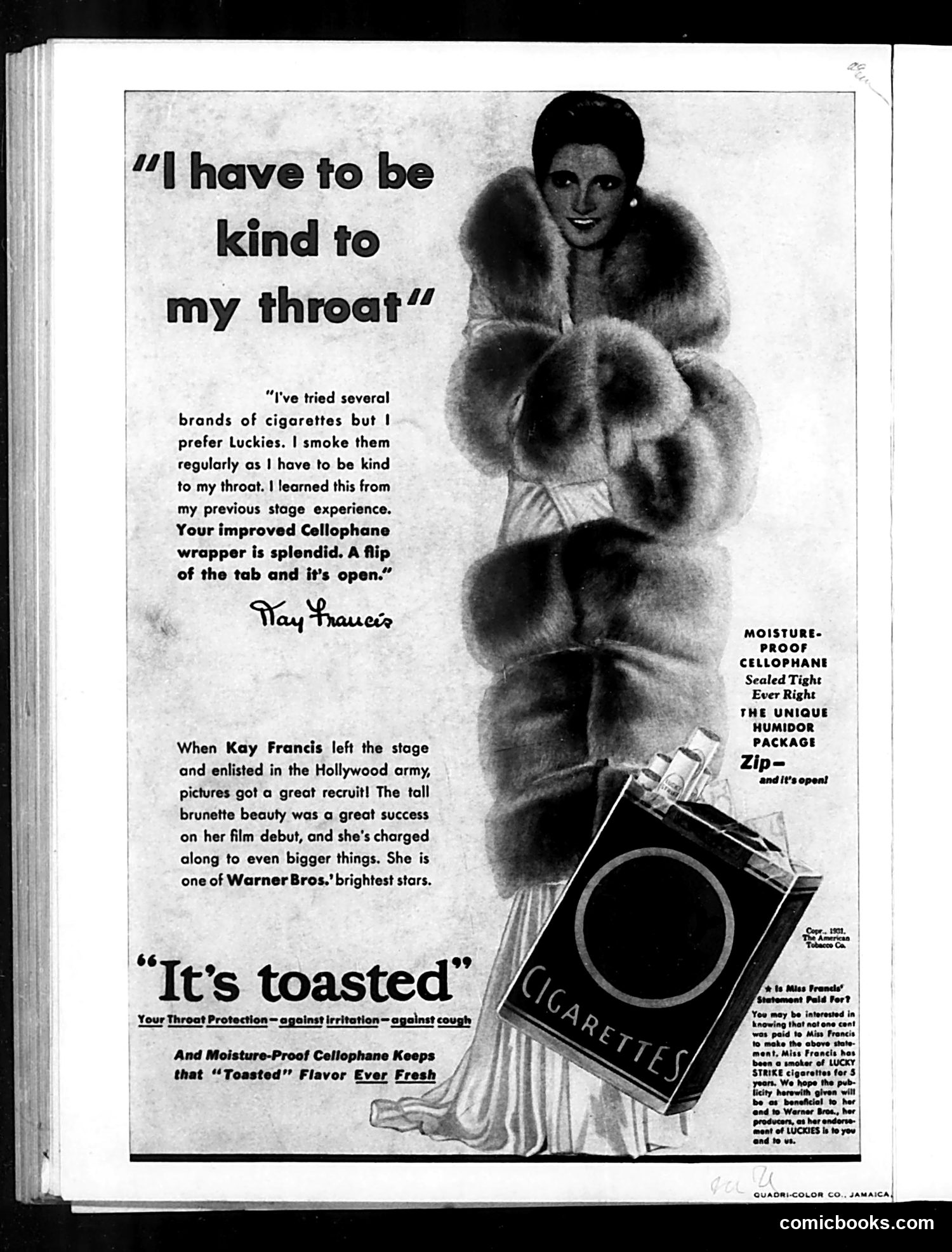
Analysis for Modern Readers This is a Lucky Strike cigarette advertisement masquerading as editorial content in Judge magazine, featuring actress Kay Francis as a paid endorser. Key context: - Francis was a Warner Bros. star who had transitioned from stage to film - The ad claims she prefers Luckies because she "must be kind to [her] throat"—a health claim now recognized as deceptive marketing - "It's toasted" was Lucky Strike's signature slogan, implying throat protection - The "moisture-proof cellophane" packaging is presented as a modern convenience feature Why this matters historically: This represents pre-regulation tobacco advertising (before 1964 surgeon general warnings). Celebrity endorsements and vague health claims were standard practice. The ad conflates stage experience with medical authority, using Francis's professional status to legitimize health benefits that cigarettes cannot actually provide. The page reveals how thoroughly cigarette marketing infiltrated mainstream media, presenting addictive products as beneficial through celebrity testimony and pseudo-scientific language.

I can see this is a page from Judge magazine, but the image appears to be almost entirely blank or blank white space. There is no visible cartoon, illustration, text content, or other meaningful material that I can analyze or describe, aside from the "comicbooks.com" watermark at the bottom. Without visible content to examine, I cannot identify any figures, caricatures, political references, or satirical points. To provide the analysis you're requesting, I would need a clearer image where the actual cartoon or article content is legible and visible. If you have another version of this page with better image quality, I'd be happy to analyze it.