judge
Judge — January 2, 1932
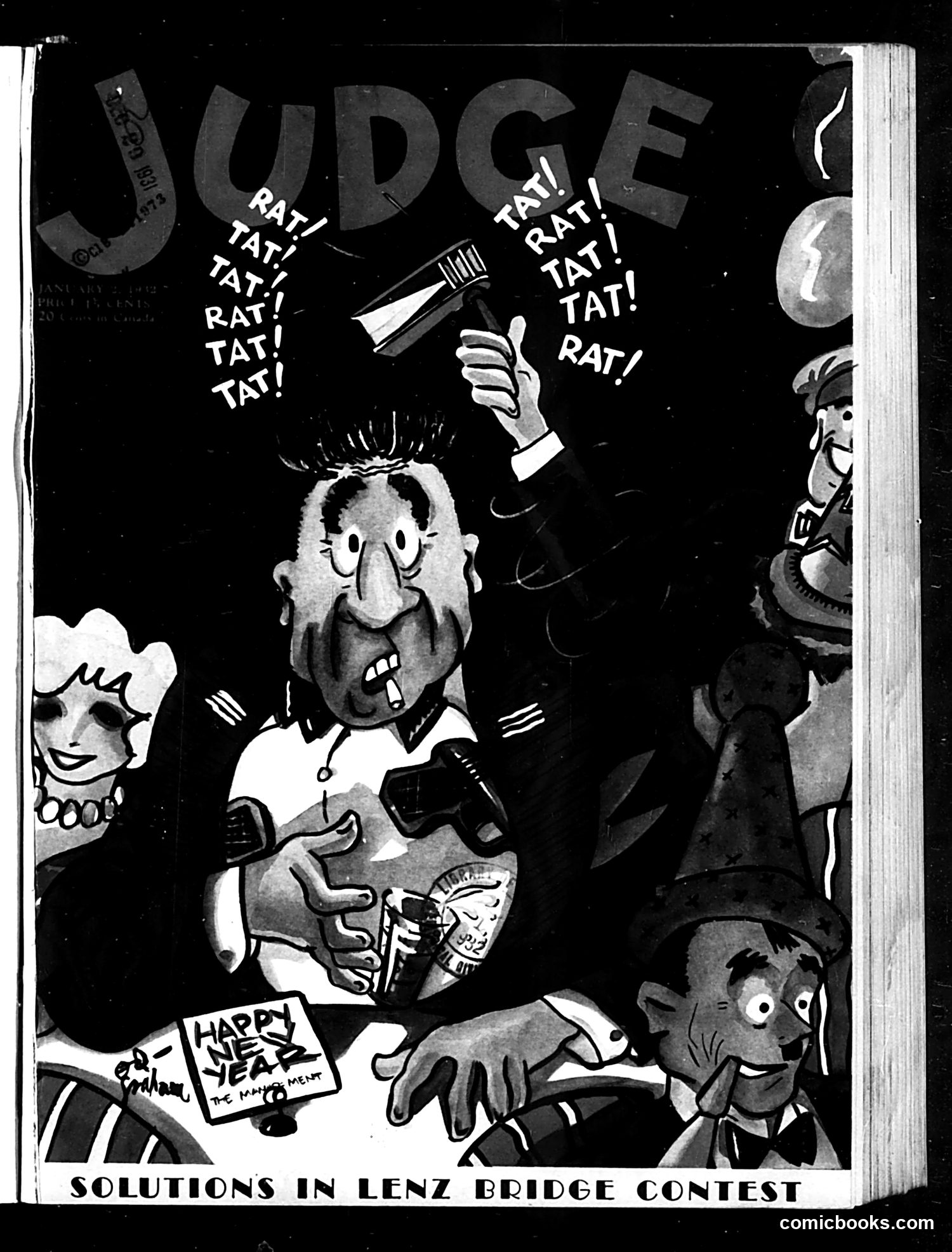
Analysis of "Judge" Cartoon Page This page from the satirical magazine *Judge* shows a New Year's celebration scene titled "Solutions in Lenz Bridge Contest." The central caricatured figure appears distressed, holding what looks like a document or solution, surrounded by onlookers saying "RAT! TAT! TAT!" — representing gunfire or criticism. The "Lenz Bridge" likely references a specific contemporary engineering or political controversy, though the exact historical event is unclear from the image alone. The cartoon suggests that proposed "solutions" to this problem are being met with harsh public ridicule and rejection. The New Year's setting implies commentary on how failed solutions are being discarded as the year begins. The exaggerated facial expressions emphasize the derision involved.
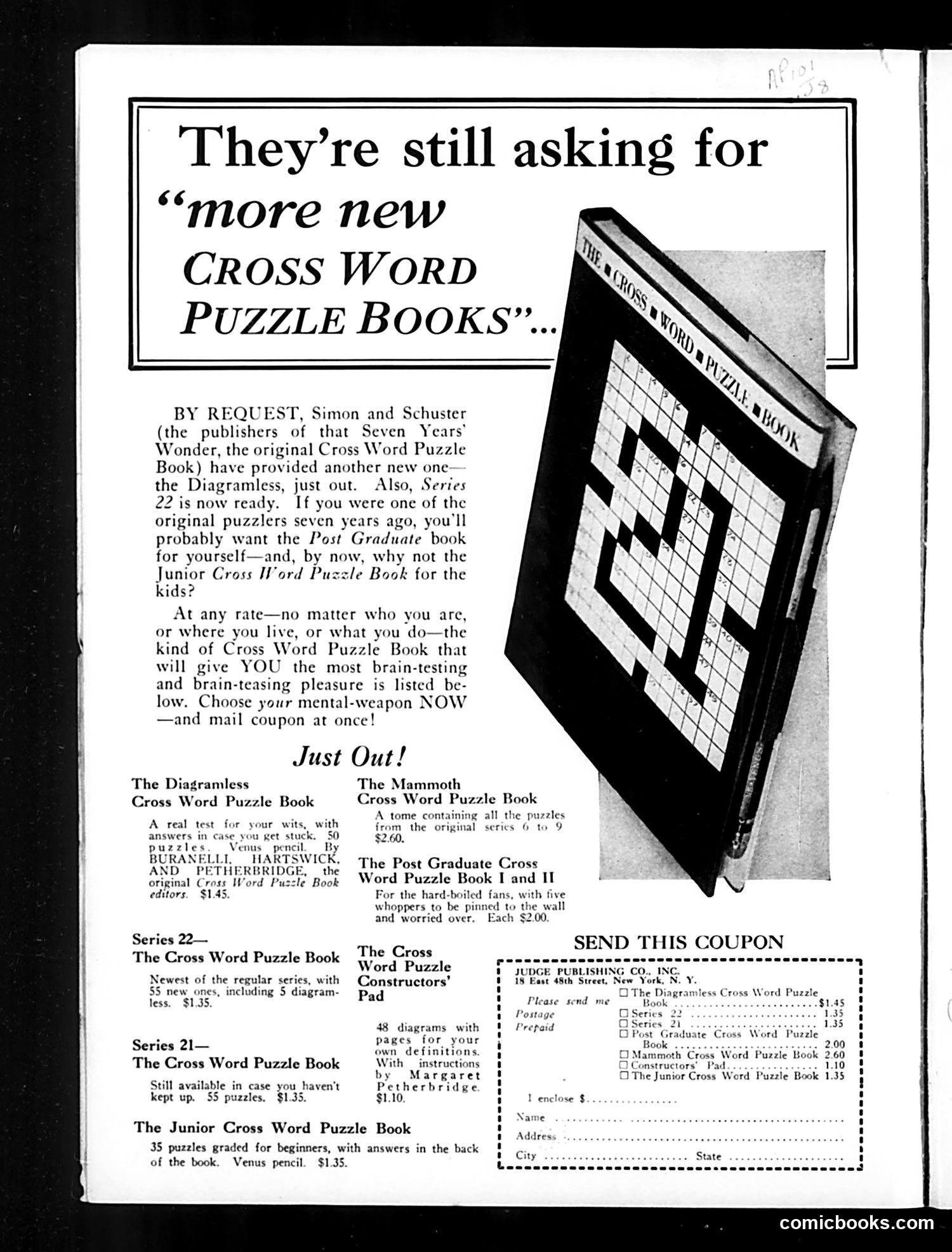
Analysis This page is primarily advertising, not editorial content or satire. It's a Judge magazine advertisement for crossword puzzle books published by Simon and Schuster, circa the 1920s-1930s (based on the styling and references). The ad promotes various crossword puzzle book series at different difficulty levels—from "The Diagramless" to "The Junior Cross Word Puzzle Book" for children. It includes a mail-in coupon for ordering. The headline's quote marks around "more new Cross Word Puzzle Books" appears to be mock-exasperation, suggesting customers constantly request these books. This reflects the contemporary craze for crossword puzzles, which were enormously popular during this era. No political or social satire is present—it's straightforward product marketing.
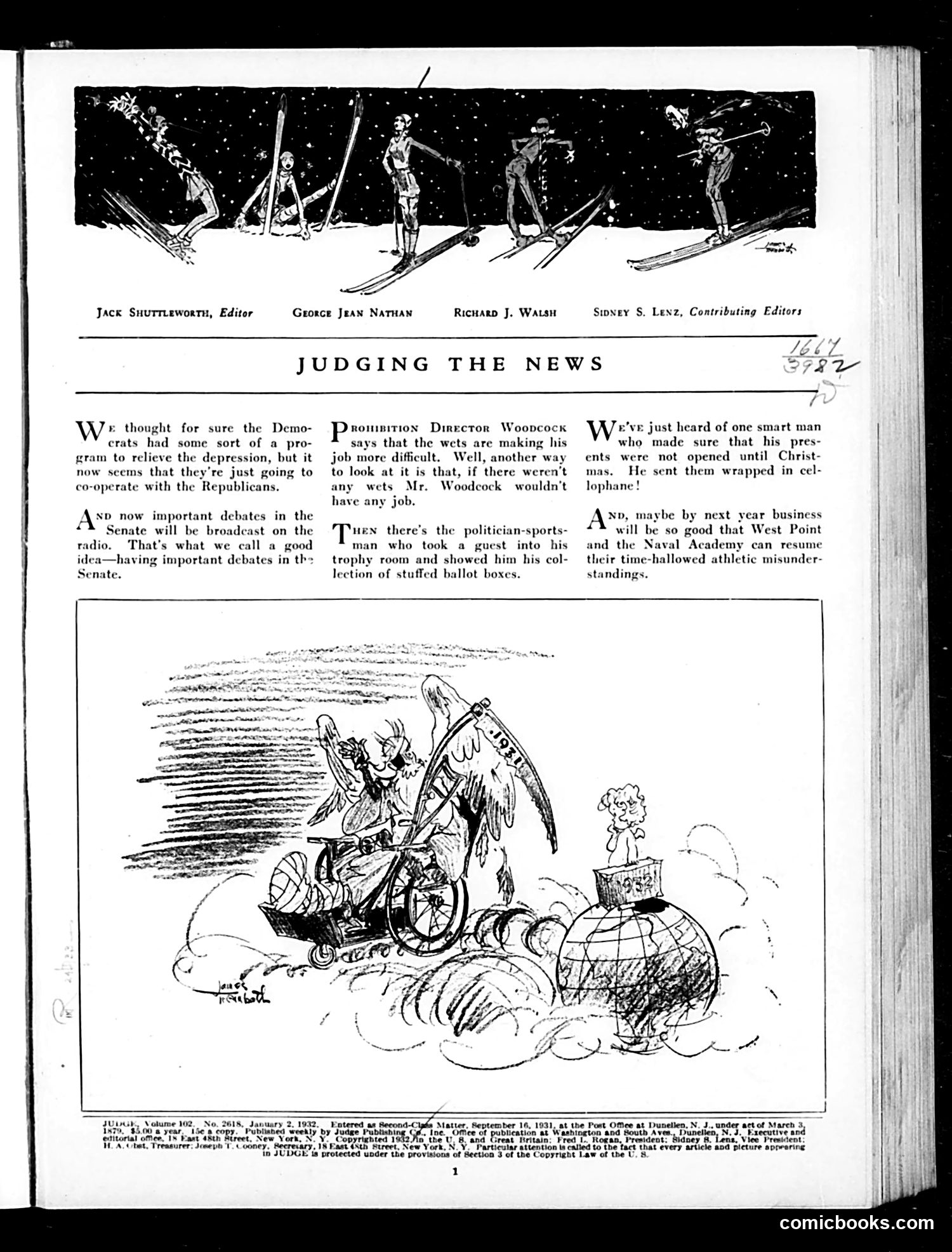
Analysis of "Judging the News" Page This satirical page from Judge magazine (dated January 2, 1932, based on visible text) contains editorial commentary and a cartoon addressing Depression-era politics. The text discusses: - Democrats' proposed relief program and Republican cooperation - A Senate debate broadcast idea - Prohibition Director Woodcock and enforcement challenges - A politician-sportsman showing his "collection of stuffed ballot boxes" (satirizing electoral corruption) - West Point's athletic misunderstandings The main cartoon depicts Death (with scythe and wings) arriving at Earth's globe by motorcycle, seemingly collecting souls or bringing catastrophe. A small child figure stands nearby, emphasizing the stakes. The image appears to comment grimly on the Depression's human toll and mortality during this economic crisis period. The overall tone is darkly cynical about political corruption and economic devastation.
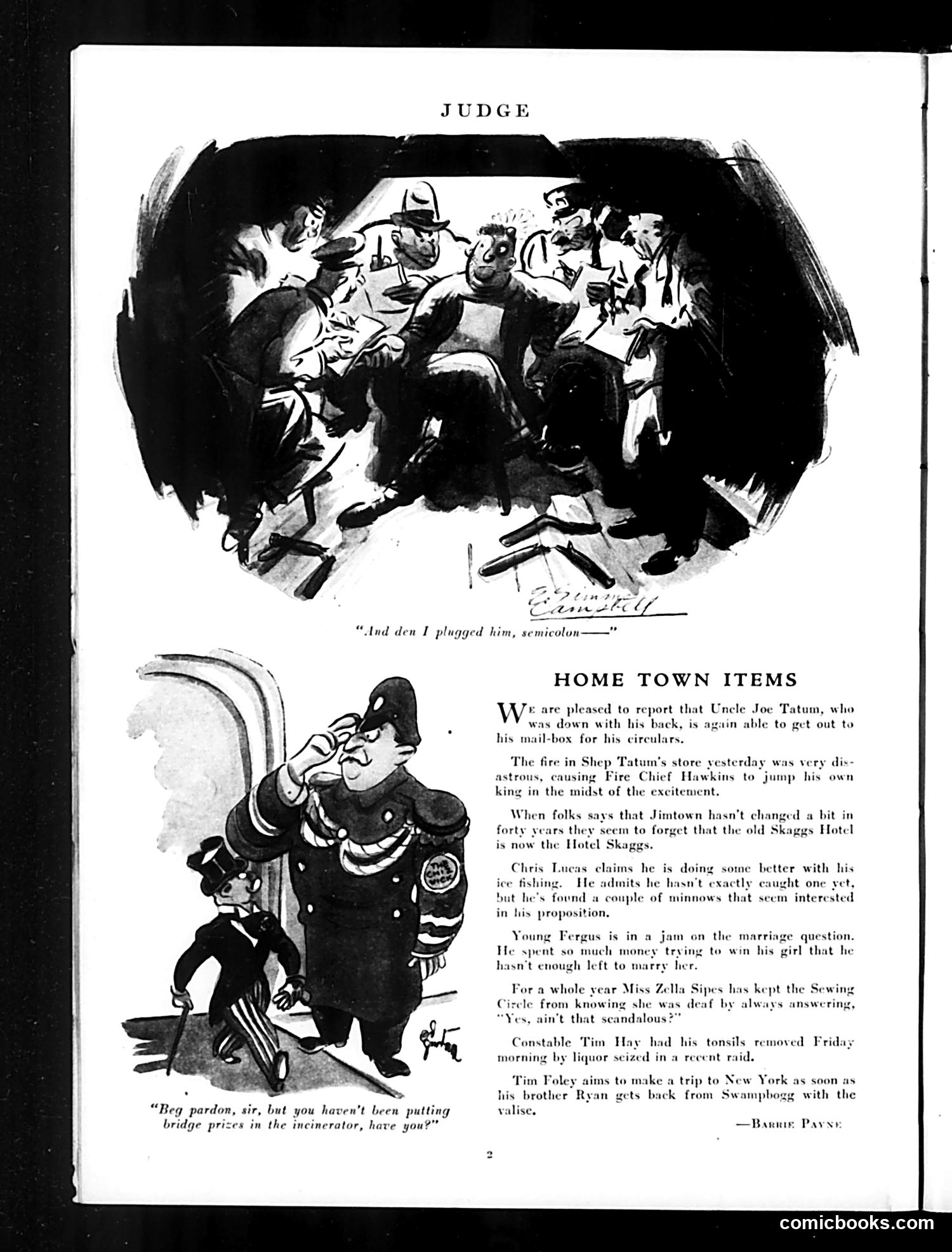
Judge Magazine Page Analysis This page contains two cartoons and a "Home Town Items" gossip column. The top cartoon depicts a courtroom scene with the caption "And den I plugged him, semicolon—" This appears to satirize criminal defendants' poor grammar or malapropisms during testimony, mocking how uneducated criminals speak in court. The bottom cartoon shows a police officer confronting a small figure with the caption "Beg pardon, sir, but you haven't been putting bridge prizes in the incinerator, have you?" This references a contemporary scandal or concern about disposing of bridge tournament prizes improperly—likely satirizing social pretension around card games and petty theft. The "Home Town Items" section provides small-town gossip about local figures, typical of Judge's humorous small-town commentary popular in early 20th-century American satire.
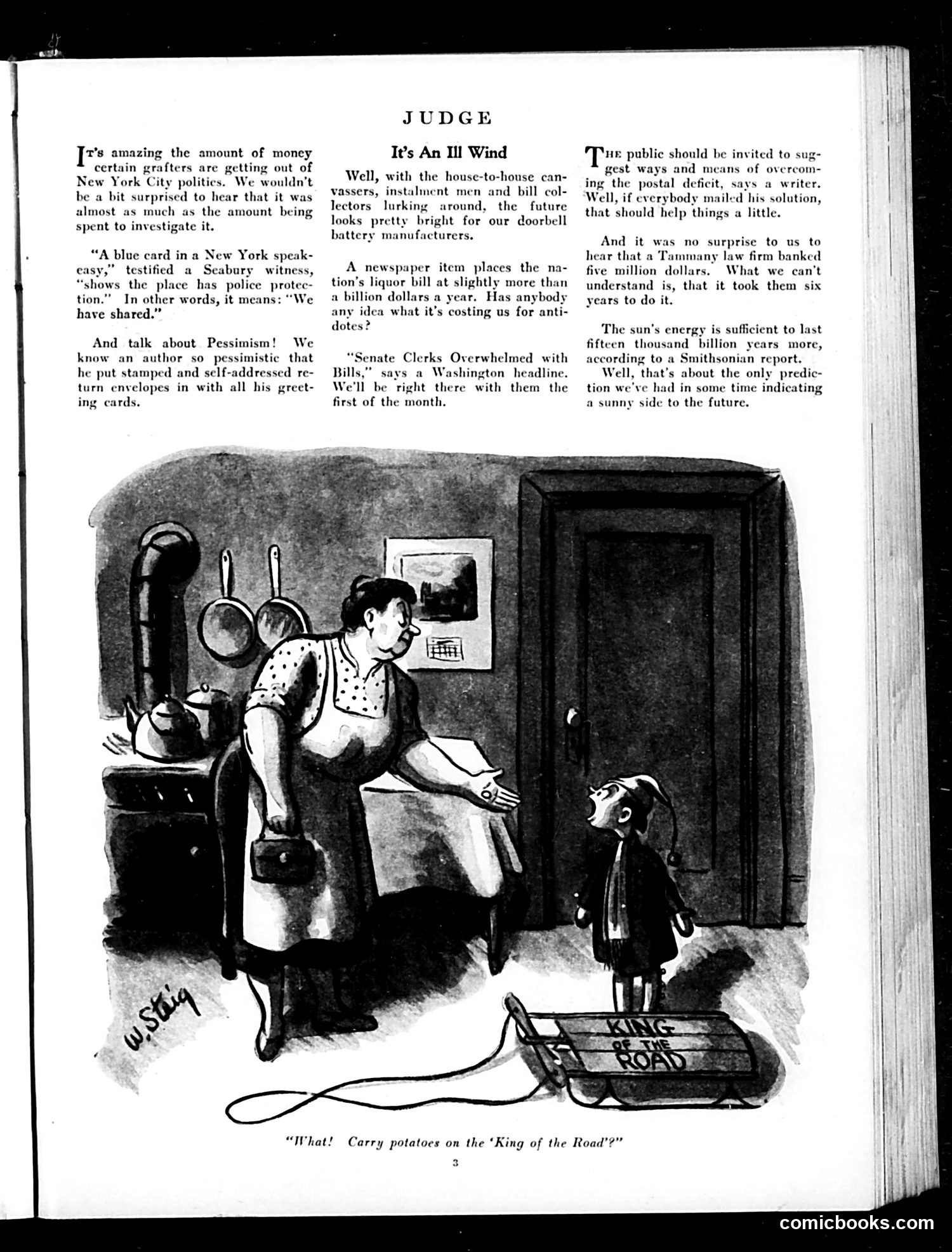
Analysis of Judge Magazine Page The main cartoon depicts a woman in an apron confronting a child about carrying potatoes on a toy wagon labeled "King of the Road." The satire appears to target wasteful consumer spending during economic hardship—the child is treating a luxury toy as if it's a practical vehicle, while the mother questions why potatoes (basic necessities) are being transported on it. The text above includes commentary on government waste and corruption: references to "house-to-house canvassers, installment men and bill collectors," a Tammany Hall law firm charging exorbitant fees, and Senate clerks being "overwhelmed with bills." The overall theme critiques frivolous spending amid financial strain affecting ordinary Americans and government alike.
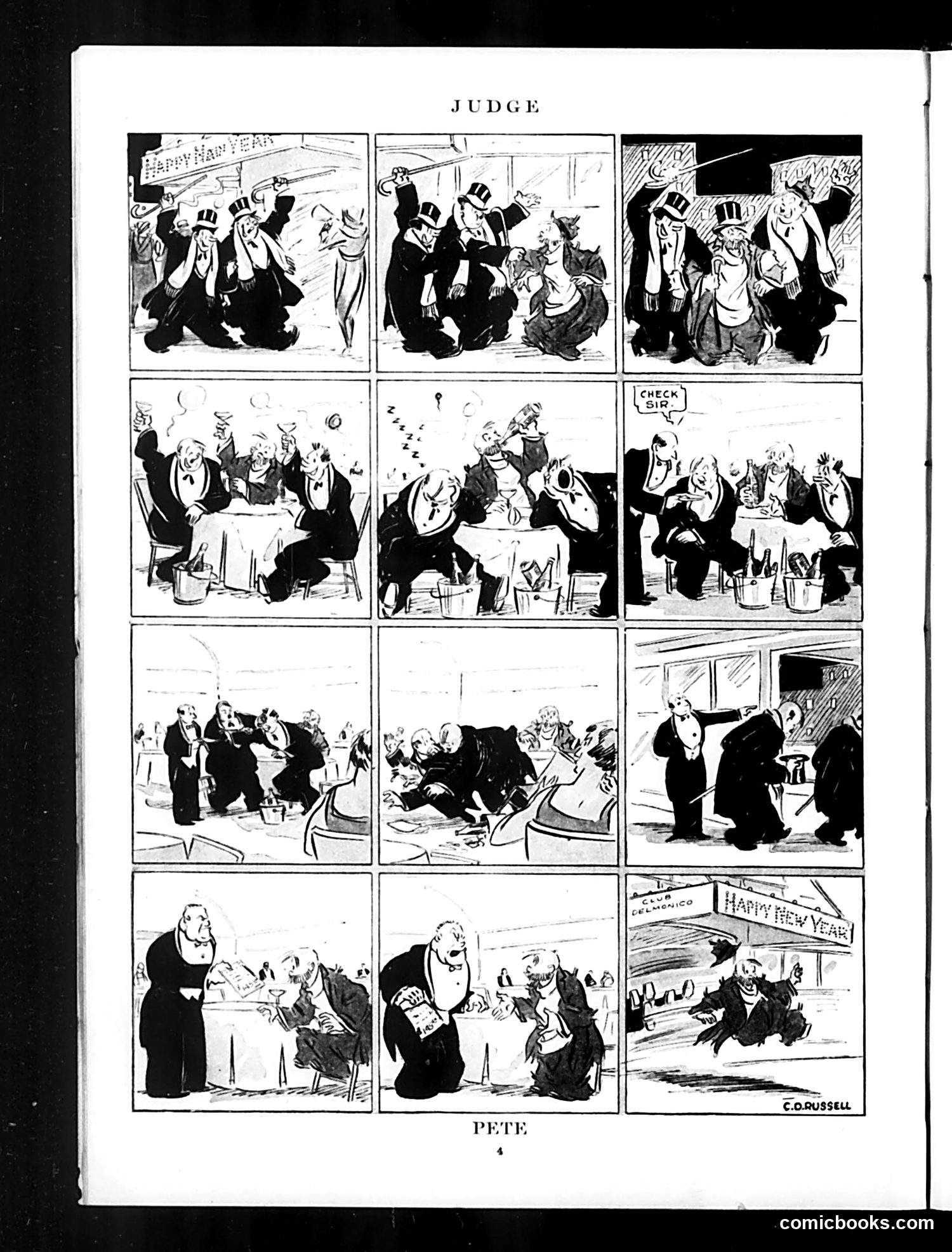
Analysis of "Judge" Page: "Judge Pete" This is a 12-panel comic strip by C. Dussell titled "Judge Pete" depicting courtroom scenes with judges in formal attire. The narrative appears to show judges celebrating New Year's Eve at what seems to be a judicial banquet or gathering, progressing from courtroom chaos (top panels) to dining and revelry (middle panels) to what looks like a seaside celebration with a "Happy New Year" banner (final panel). The satire likely targets judicial conduct and dignity—showing judges abandoning their formal courtroom decorum for drunken New Year's festivities. The progression from solemn legal proceedings to disheveled celebration mocks the gap between judges' public authority and private behavior, a common theme in Judge magazine's social commentary.
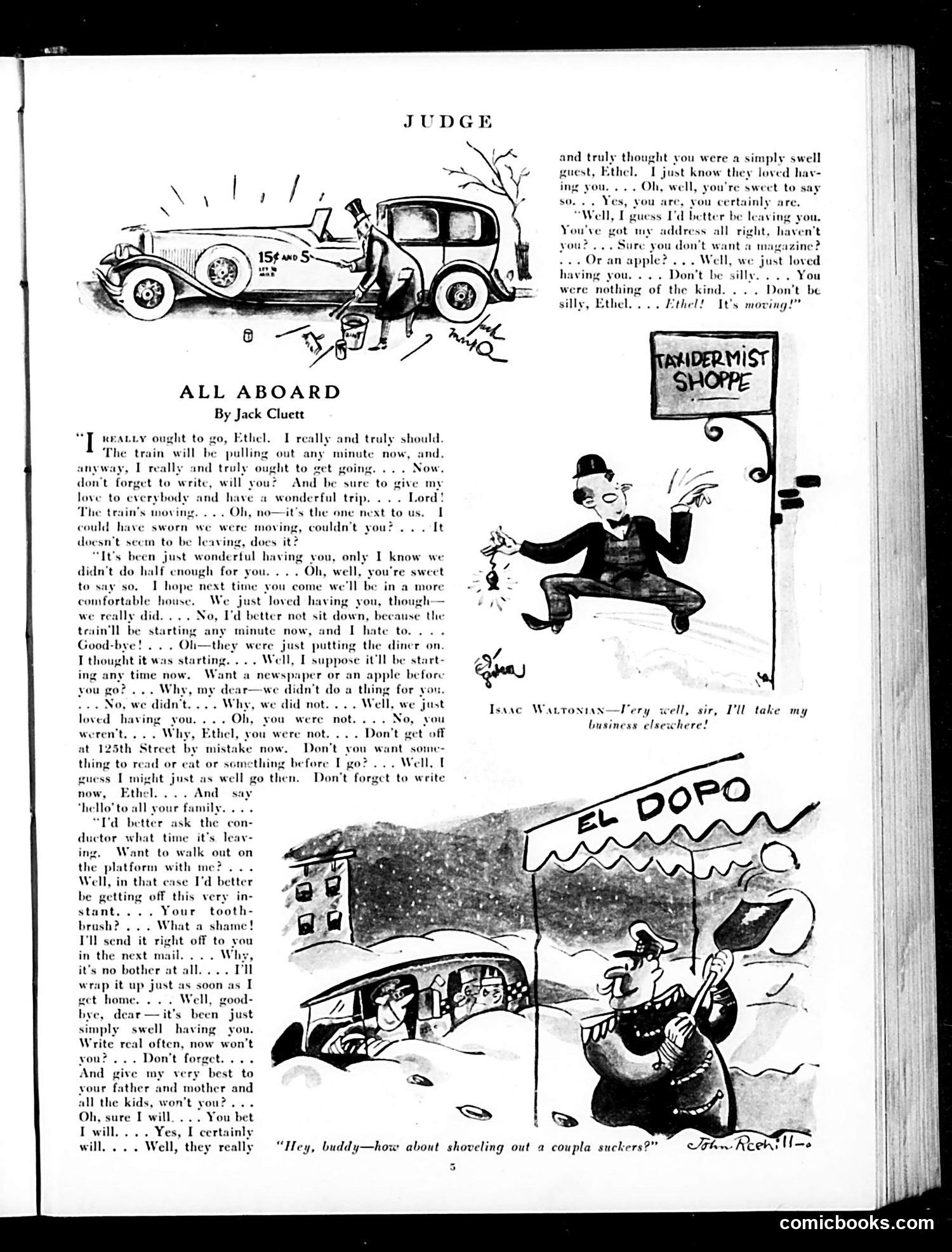
Analysis of Judge Magazine Page This page contains two separate pieces: "All Aboard" by Jack Cluett (top): A comic story about someone named Ethel departing by train. The narrator rambles through a long, breathless monologue of affectionate small-talk and last-minute advice—classic early-20th-century sentimental humor about train travel and emotional farewells. The joke relies on the character's inability to stop talking despite the train's imminent departure. "El Dopo" (bottom): A cartoon showing tourists at what appears to be a Mexican resort or beach destination. One figure asks another about "shoveling out a coupla suckers," suggesting satirical commentary on tourist exploitation or commercial tourism schemes, though the specific reference is unclear without additional context. Both pieces represent typical Judge magazine content: domestic social humor and satirical observations on American leisure and travel culture.
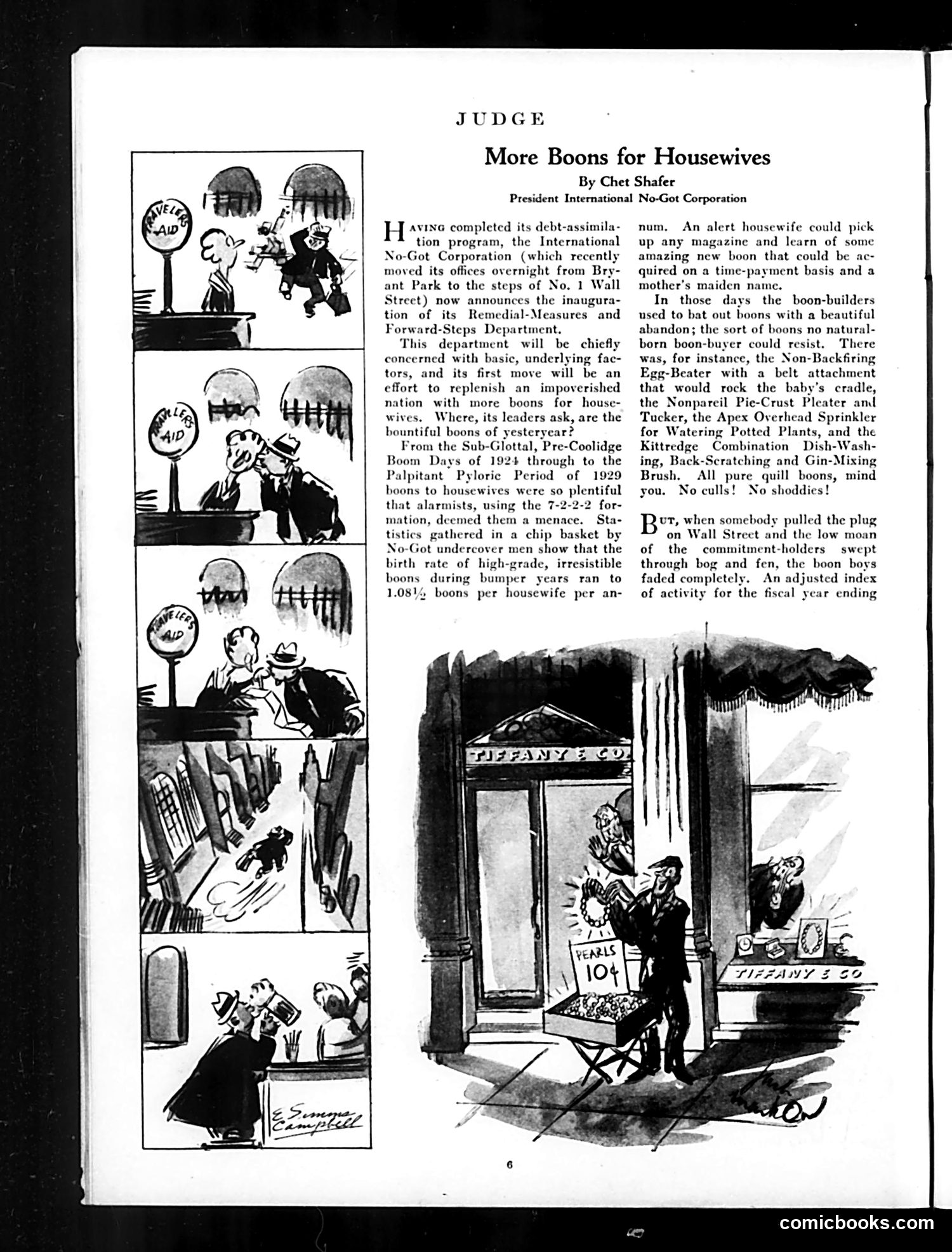
"More Boons for Housewives" by Chet Shafer This satirical article mocks the "International No-Got Corporation," a fictional company claiming to sell "boons" (benefits/products) to housewives. The piece ridicules corporate marketing schemes targeting women. The cartoon strip on the left depicts a Wall Street crash scenario where "boon" products fail spectacularly—satirizing how investor enthusiasm leads to market collapse. The accompanying text references the 1920s boom period and the subsequent market downturn, noting absurdly high birth rates of "1,081½ boons per housewife per annum." The illustration on the right shows a storefront (Tiffany & Co.) with women shopping, further mocking consumer culture and the aggressive marketing of dubious "solutions" to housewives. The satire targets both corporate hype and women's consumer vulnerability during this economic period.
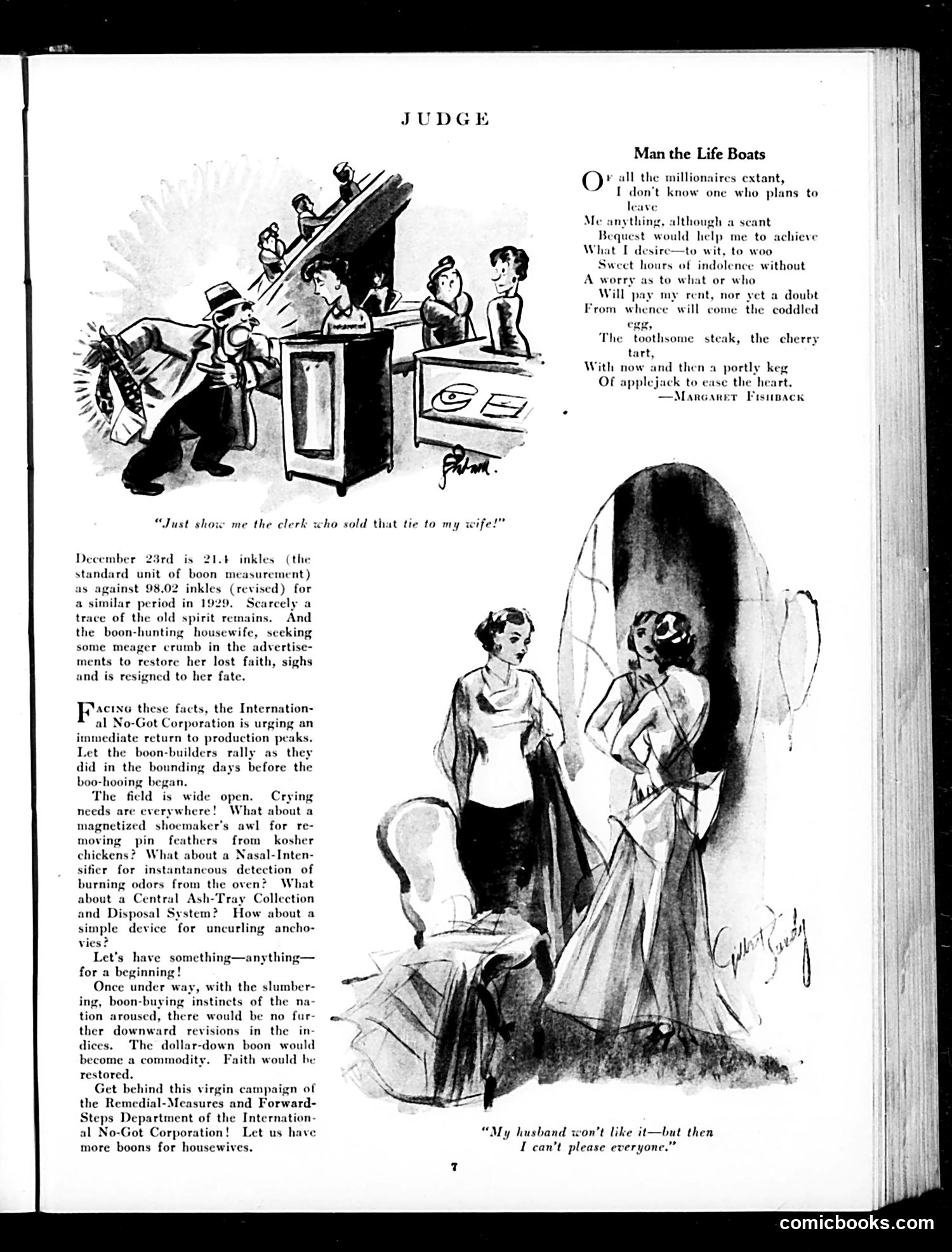
Analysis of Judge Magazine Page This page satirizes 1930s consumer culture and the Great Depression. The top cartoon mocks a husband's complaint about his wife's extravagant purchases—he demands to see the clerk who sold her an expensive tie, suggesting marital tension over spending. The main article parodies corporate marketing speak, referencing the "International No-Got Corporation" (a fictional company name playing on consumer deprivation). It mockingly suggests inventing absurd household gadgets—magnetized shoemaker's awls, "Nasal-Intensifiers," ash-trays—to revive consumer spending and restore "faith" in purchasing. The poem by Margaret Fishback expresses middle-class anxiety about financial insecurity and dependence on luxuries. The lower illustration shows two women discussing a chair purchase, with the wife's resigned acceptance that "my husband won't like it—but then I can't please everyone," capturing tensions between desire and domestic economy during economic hardship. Overall point: Satirizing both corporate attempts to manipulate consumers into unnecessary purchases and the psychological toll Depression-era financial anxiety placed on households.
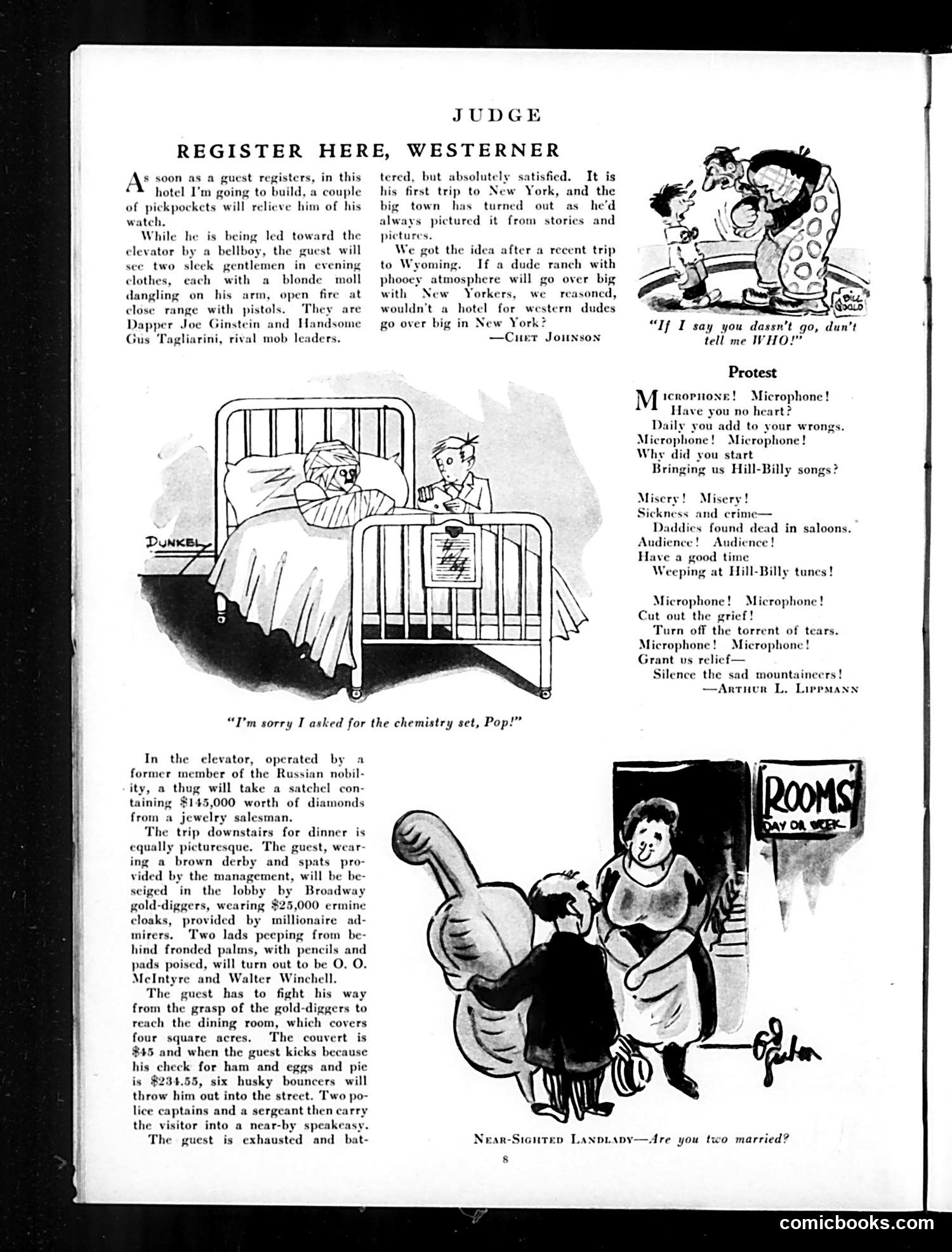
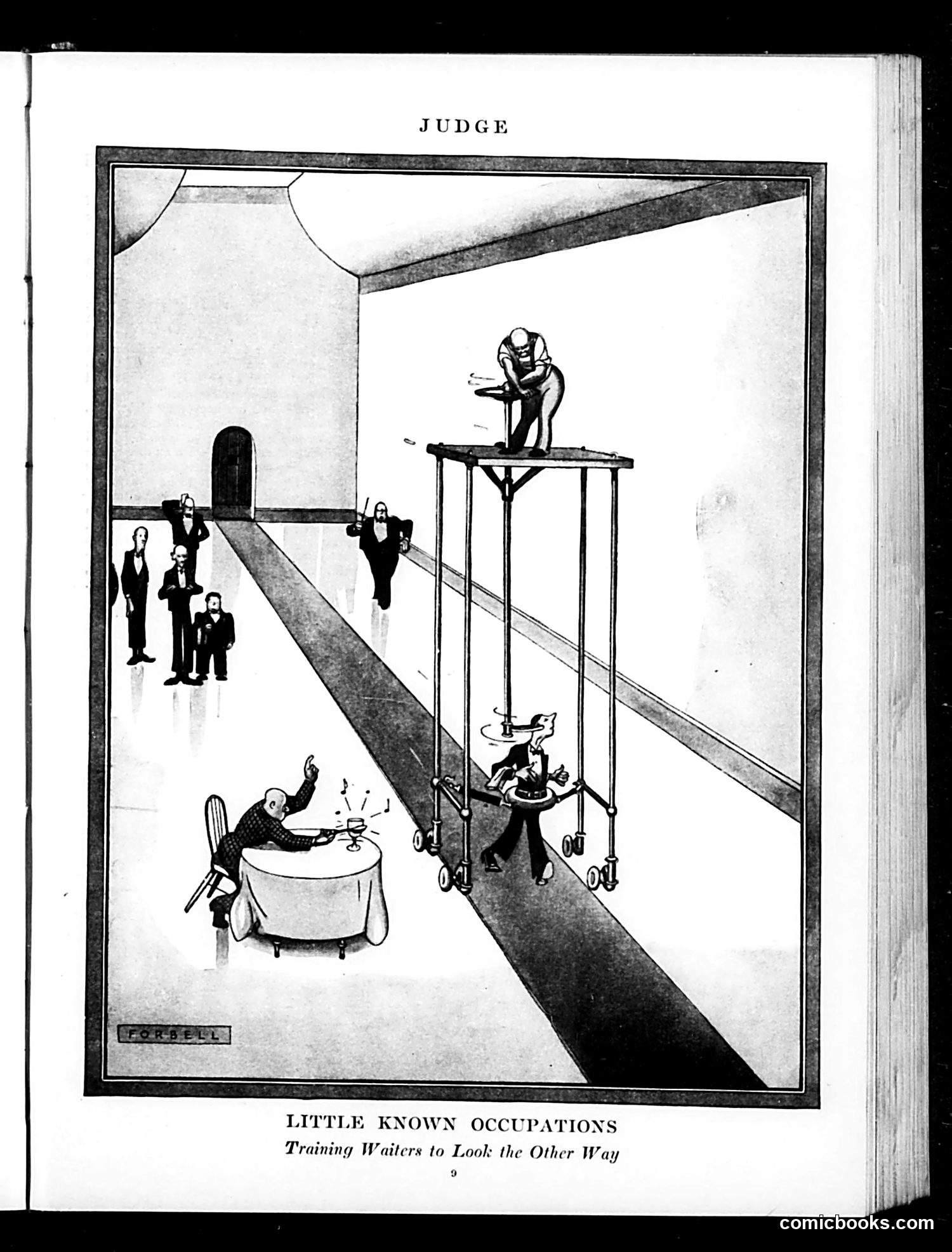
Analysis This is a satirical cartoon by Forsell titled "Training Waiters to Look the Other Way." The illustration depicts a courtroom or formal institutional setting where judicial authority (represented by the judge elevated on a platform) oversees the "training" of waiters—shown as small figures in the lower left and on a platform. The satire critiques judicial complicity in corruption or impropriety. By framing waiter-training as an "occupation," the cartoon suggests that judges actively instruct service workers to ignore wrongdoing or misconduct occurring in plain sight. The elevated judge literally supervises this misdirection, implying the judiciary itself endorses turning a blind eye to illegal or unethical behavior—likely referencing Prohibition-era corruption or bribery where judges and officials ignored violations in exchange for bribes.
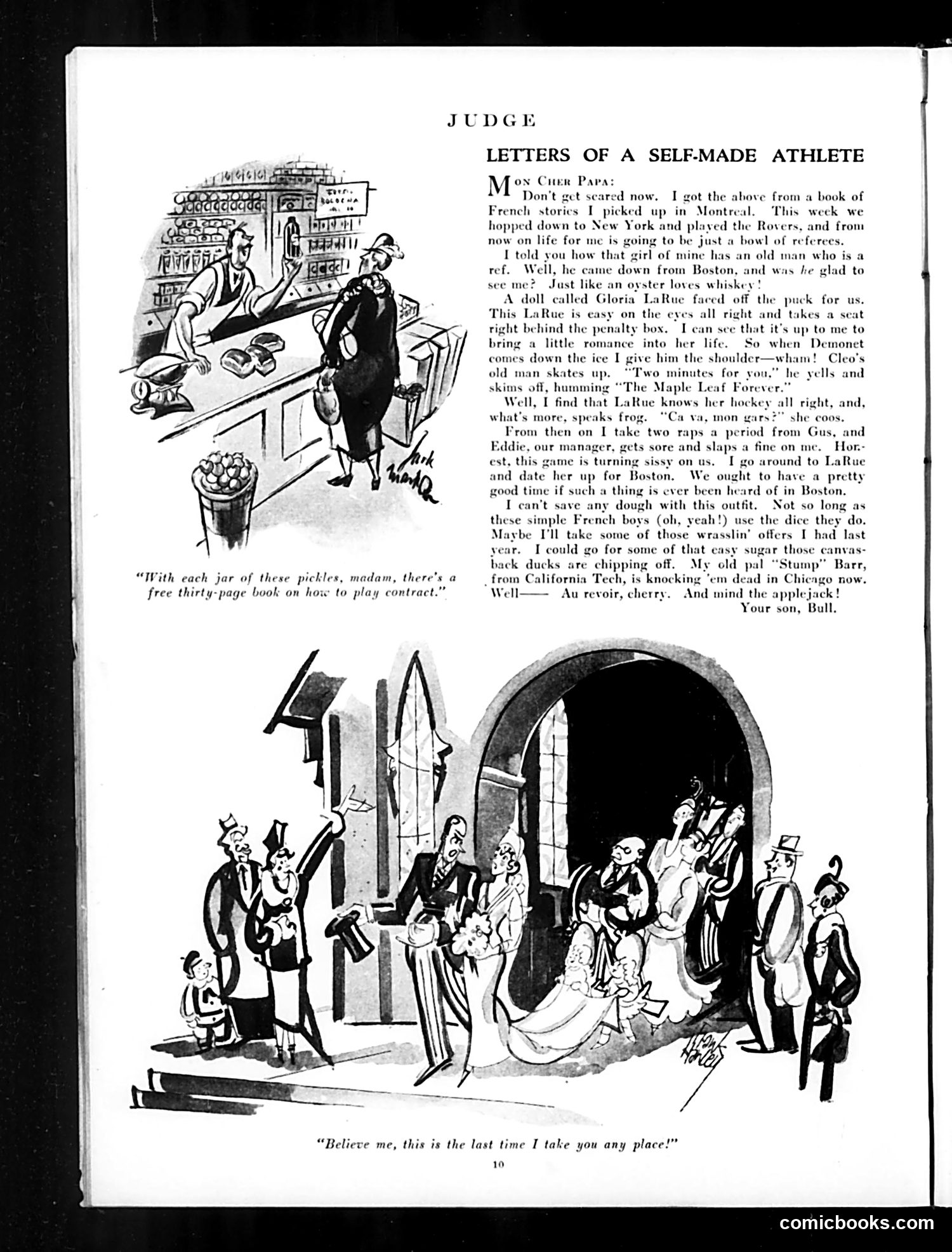
"Letters of a Self-Made Athlete" This is a humorous letter from a young hockey player ("Bull") to his father, written in the style of early 20th-century sports fiction. The satire targets the brash, unsophisticated American athlete and social climber. Bull describes playing hockey in New York and Montreal, flirting with a French-Canadian woman named LaRue at games, and getting penalties for on-ice misbehavior. The humor derives from his malapropisms ("bowl of referees"), crude attempts at romance, poor financial management, and casual references to supplementing his income through wrestling. The top cartoon shows a man bribing an official with pickles—satirizing contract fraud or bribery. The bottom illustration depicts an ornate social event, likely mocking the pretensions of newly wealthy or athletic men attempting to navigate high society. The overall joke: self-made athletes are uncultured, financially irresponsible, and comically out of place in refined settings.
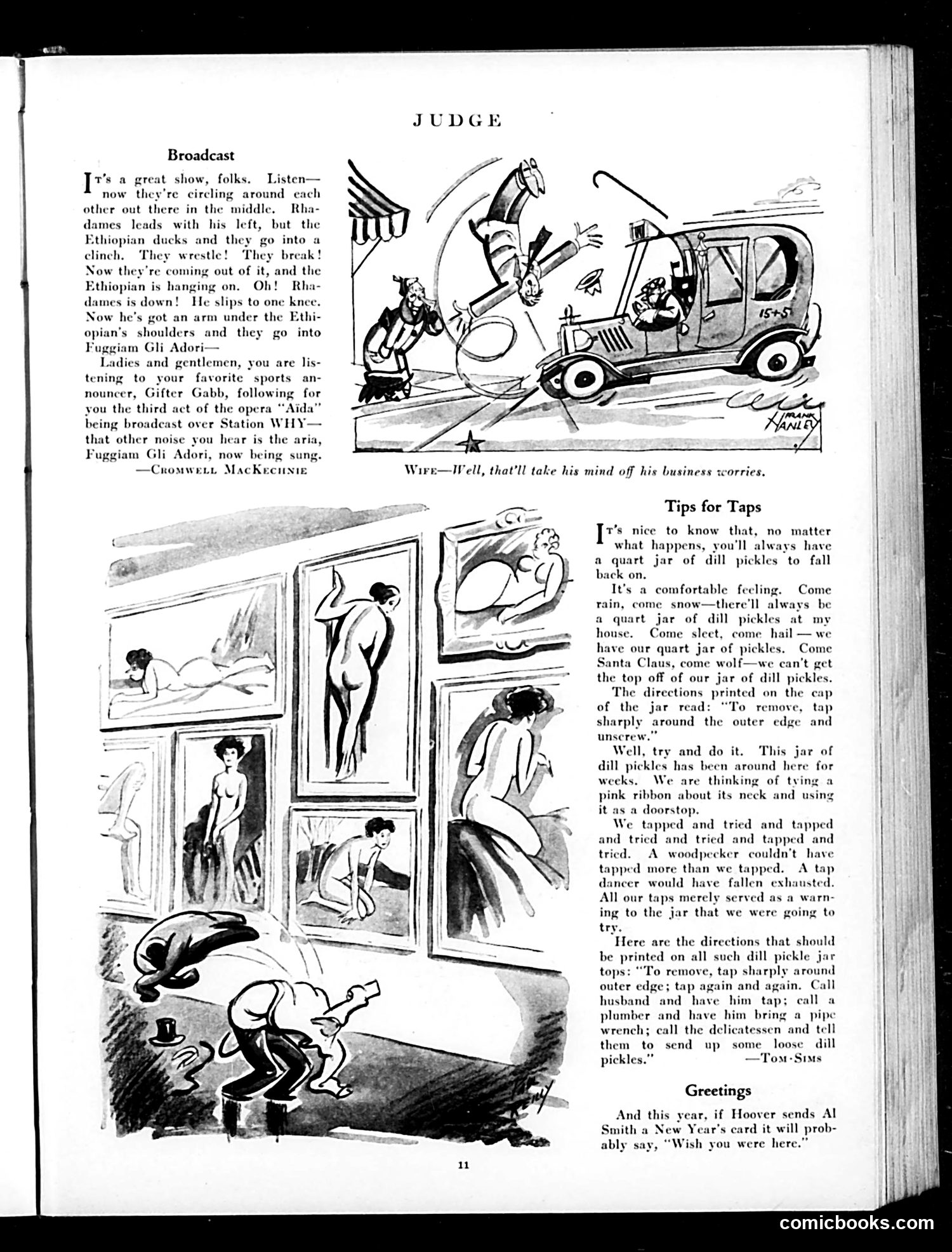
Page Analysis: Judge Magazine This page contains three distinct pieces of satire: "Broadcast": A joke about radio sports commentary. A announcer (Gitter Gabb) provides breathless play-by-play coverage of what he's describing as boxing, but it's actually the opera "Aida" being performed. The humor lies in treating highbrow opera with the sensationalism of lowbrow sports broadcasting—a commentary on how radio was democratizing culture and the absurdity of applying sports-announcer hyperbole to classical music. "Wire" (cartoon): A businessman's marital troubles are interrupted by an acrobat crashing through his car window. The caption suggests this distraction might relieve his worries about work and home life—satirizing how people seek escape from daily anxieties. "Tips for Taps": Humorous advice about pickle jars with stuck lids, suggesting increasingly absurd solutions (tapping, calling a plumber, ordering new pickles). It's gentle domestic humor about everyday frustrations. "Greetings": A brief political jab at the 1928 presidential race between Herbert Hoover and Al Smith, suggesting their mutual dislike.
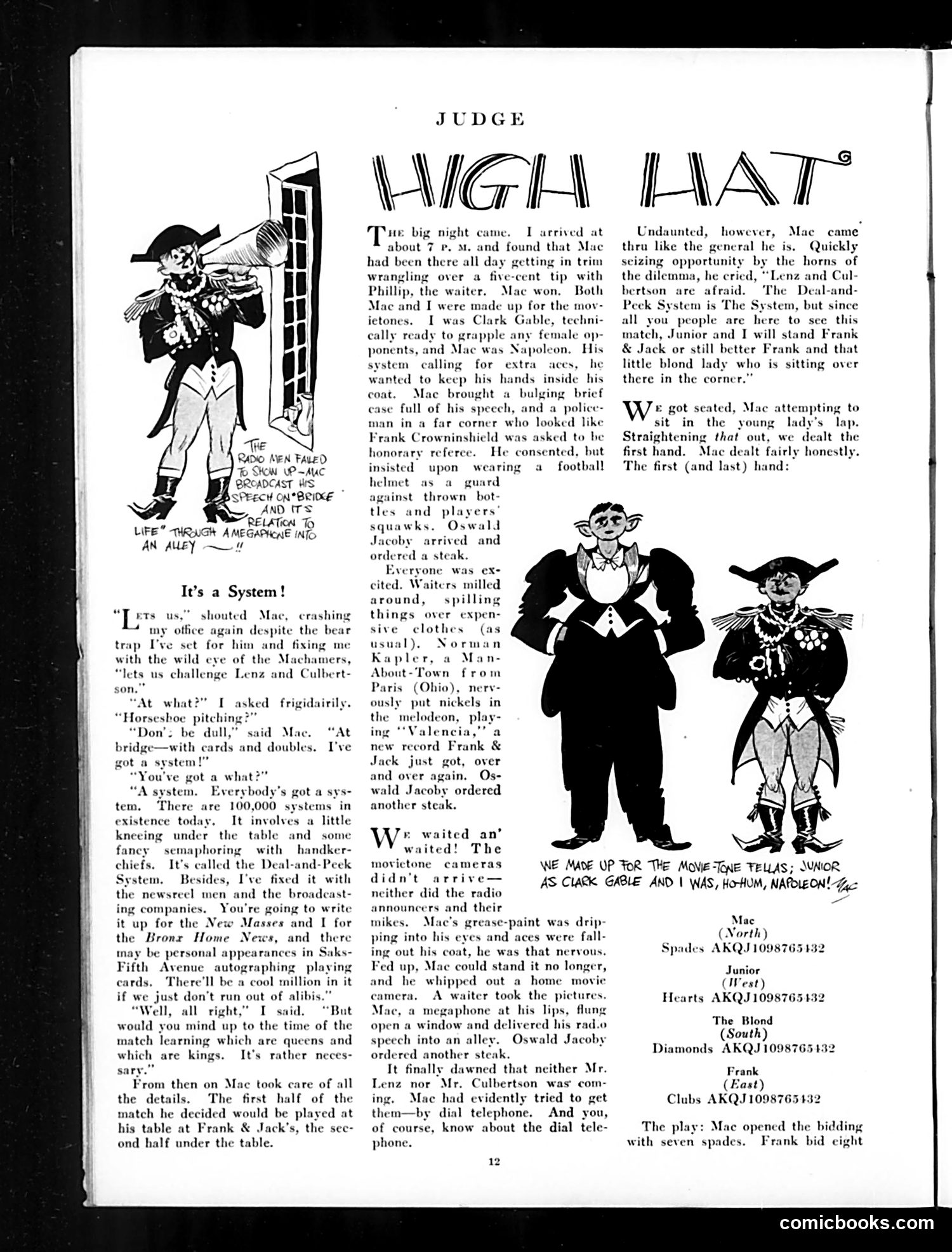
"High Hat" - Judge Magazine Satire This page satirizes 1920s-30s celebrity culture and the era's obsession with "systems" and publicity stunts. The narrator describes an elaborate bridge match setup involving socialite "Mac" and various New York figures (Frank Crowninshield, Oswald Jacoby—a real bridge expert). The joke targets: 1. False sophistication: Characters dress as Clark Gable and Napoleon for a card game 2. Media manipulation: They arrange newsreels, broadcasts, and radio announcers to publicize a rigged event 3. Celebrity desperation: When the famous players don't show, Mac simply improvises, declaring his homemade "system" superior 4. Technological fumbling: Mac tries reaching people by "dial telephone"—a joke about this new technology's complications The satire mocks how celebrities manufactured spectacles and false narratives through emerging mass media (radio, newsreels, broadcasts). The "system" itself is fake—an excuse for elaborate deception sold as genuine competition. It's social commentary on artifice and hype masquerading as newsworthy events.
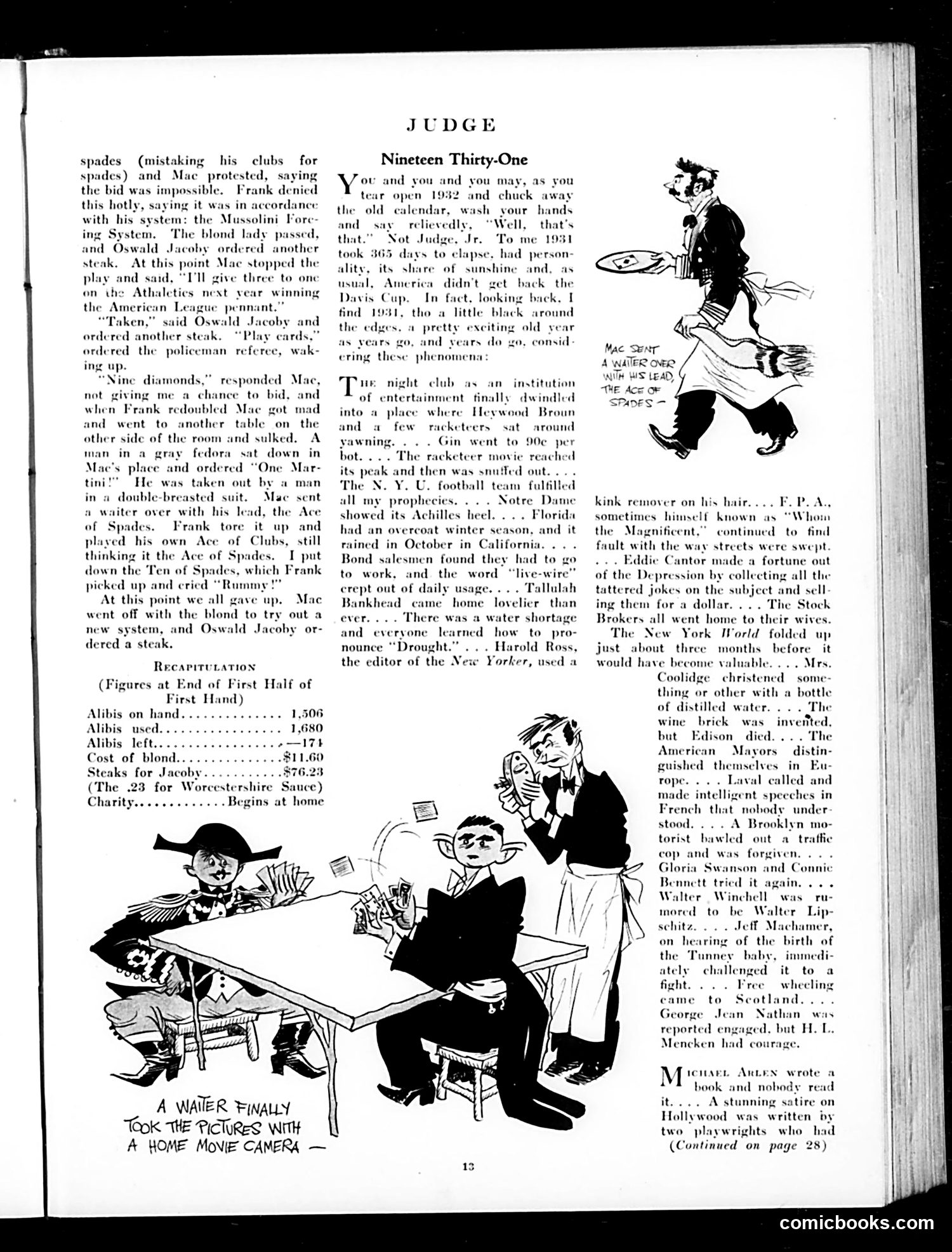
Judge Magazine, January 1932 This page contains two satirical cartoons about 1931's notable events. The top cartoon depicts a chaotic bridge game where players constantly change rules and order steaks—a metaphor for the disorder and absurdity of Depression-era society. References include "Mussolini Fore-ing System" (mocking fascism), Oswald Jacoby (a famous bridge player), and the Athletics' baseball prospects. The bottom cartoon shows a waiter finally documenting the card game chaos with a movie camera—suggesting that 1931's events were so ridiculous they needed film documentation. The accompanying text is Judge's year-end recap of 1931's absurdities: Prohibition's failure (gin at 90¢), nightclub decline, the stock market crash, politicians' follies, and celebrity gossip. The tone is darkly humorous, treating serious Depression hardships and political turmoil as comedic fodder for the magazine's affluent readership.
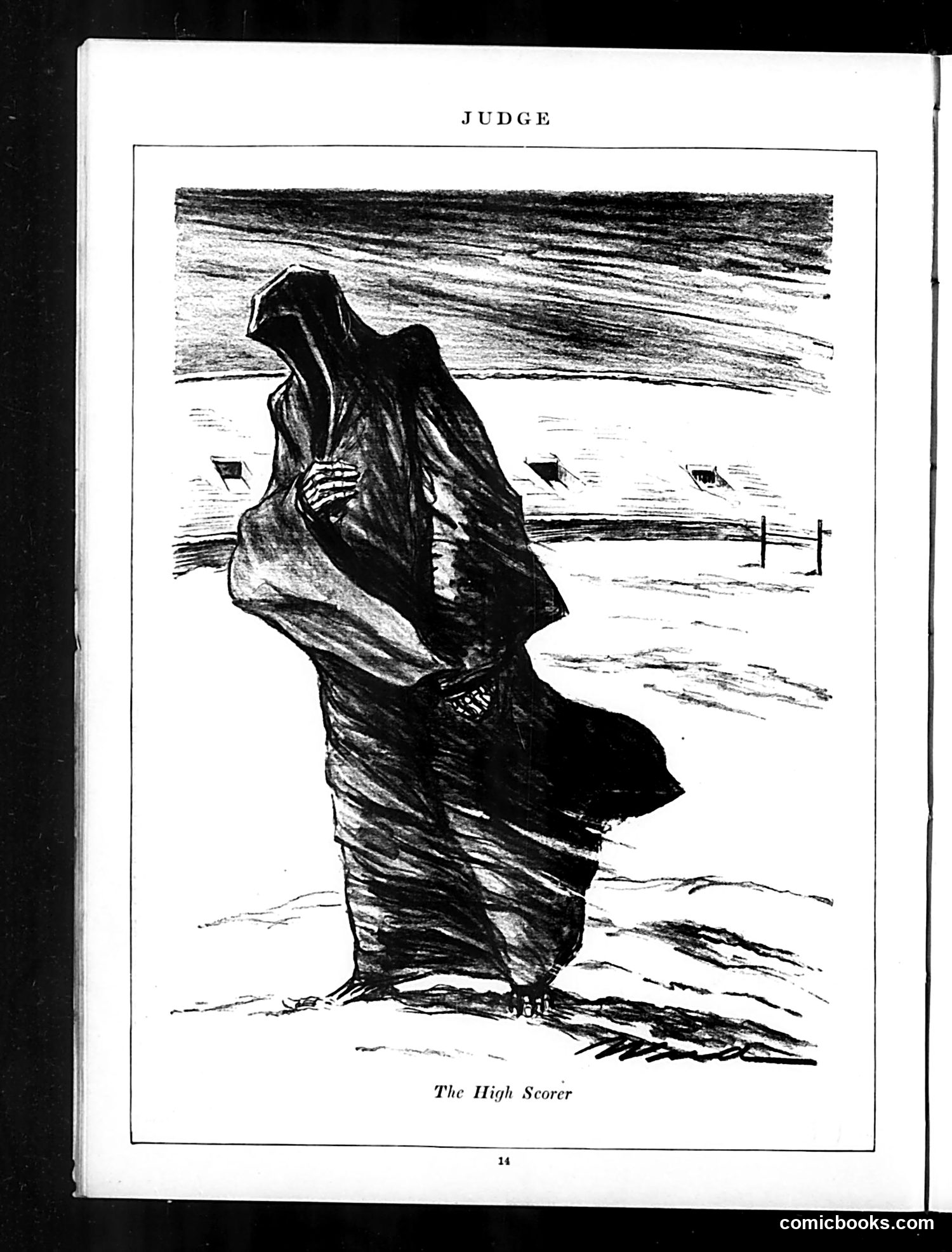
"The High Scorer" - Judge Magazine Cartoon This political cartoon depicts a robed figure (appearing to represent Death or a grim reaper) standing in a desolate landscape with bodies or casualties scattered in the background. The figure holds what appears to be a weapon or tool of destruction. The title "The High Scorer" uses ironic wordplay—typically "high scorer" refers to achievement in games or sports. Here it sarcastically applies that term to Death or destructive war, suggesting that whoever or whatever is responsible for the casualties shown has "scored high" in body count. Without the publication date visible, the specific historical context remains unclear, but the imagery suggests criticism of warfare, violence, or a leader/force responsible for mass casualties. The cartoon uses dark humor to condemn death and destruction.
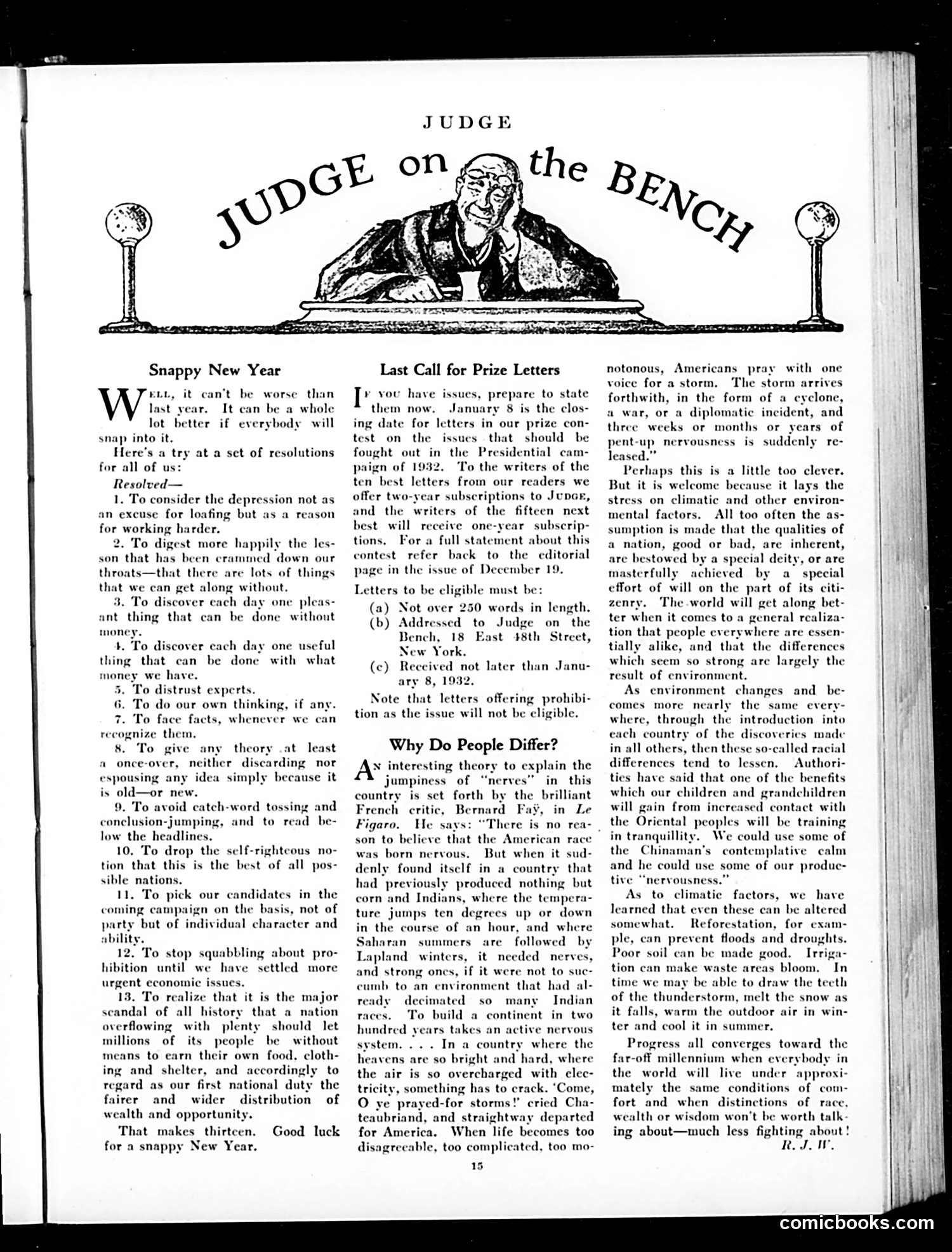
Judge Magazine Page Analysis This page from Judge magazine (dated early 1932, based on references to the 1932 Presidential campaign) contains three main elements: "Snappy New Year" - An editorial offering thirteen New Year's resolutions for readers, notably emphasizing self-reliance during the Depression, skepticism toward experts, independent thinking, and—crucially—point 13, which critiques the "major scandal" of widespread poverty amid national abundance. This reflects Depression-era social commentary. "Last Call for Prize Letters" - A contest announcement soliciting reader letters on issues for the 1932 Presidential campaign, notably excluding prohibition as an eligible topic. "Why Do People Differ?" - An excerpt from French critic Bernard Fay's *Le Figaro* theorizing that Americans are inherently "nervous" due to climate extremes and rapid nation-building (contrasting extreme temperatures, "Saharan summers" with "Lapland winters"). The piece suggests Americans psychologically need dramatic release—storms, wars, or diplomatic crises—to relieve accumulated tension. The page is primarily textual commentary rather than visual satire, reflecting Judge's role as a magazine of opinion and social criticism during the early Depression years.
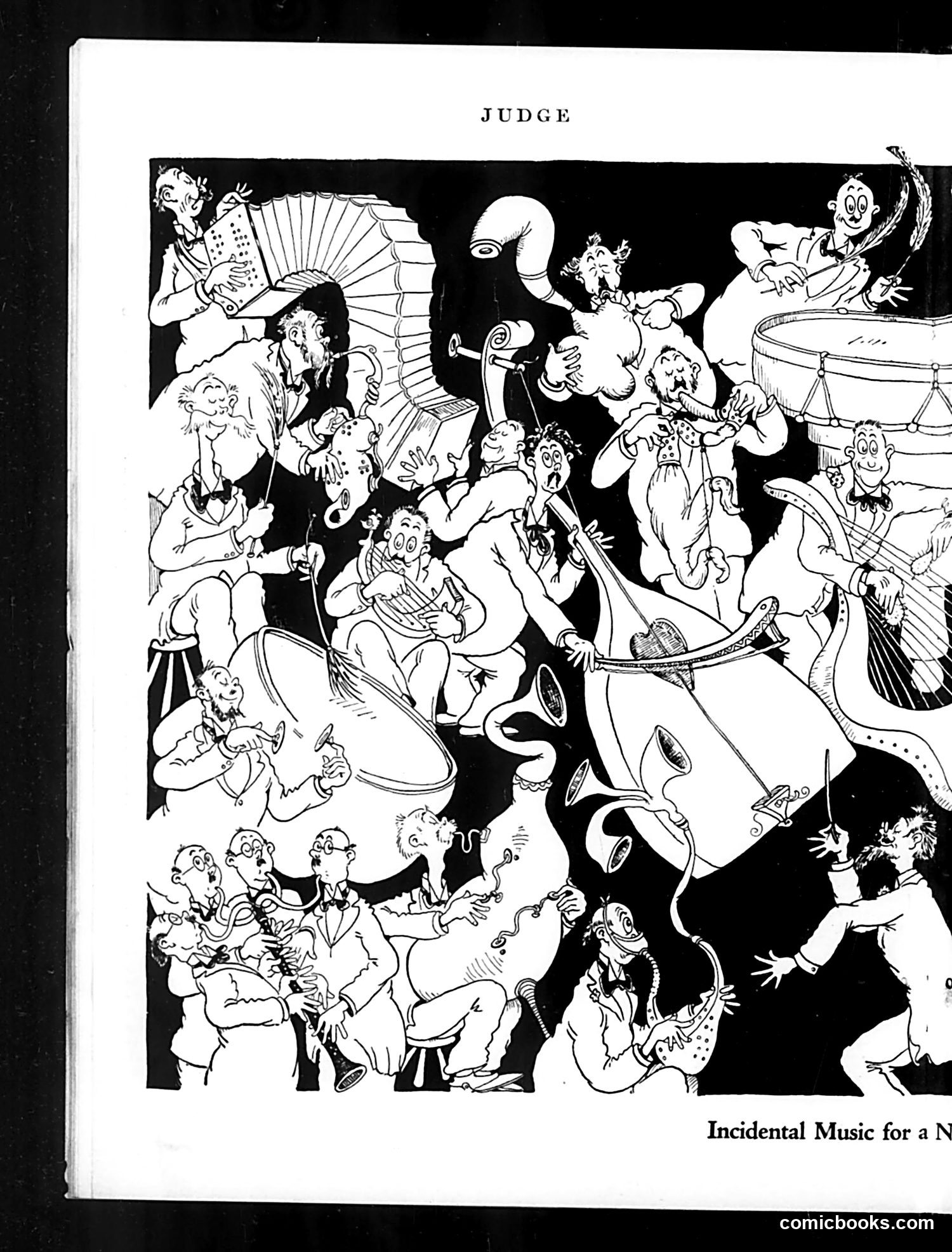
Analysis This page from *Judge* magazine features a chaotic black-and-white cartoon titled "Incidental Music for a N[...]" (text cut off). The illustration depicts a raucous circus or vaudeville scene with numerous exaggerated characters—musicians, performers, and audience members in various states of animated activity. There are circus elements including what appears to be a large drum or basin, musical instruments, and performers in period clothing. The satire appears to target either a specific theatrical production or the broader vaudeville/entertainment industry. However, without the complete title or visible date, the exact subject remains unclear. The style and crowded composition suggest commentary on either chaotic showmanship or the commercialization of entertainment during the early-to-mid 20th century.
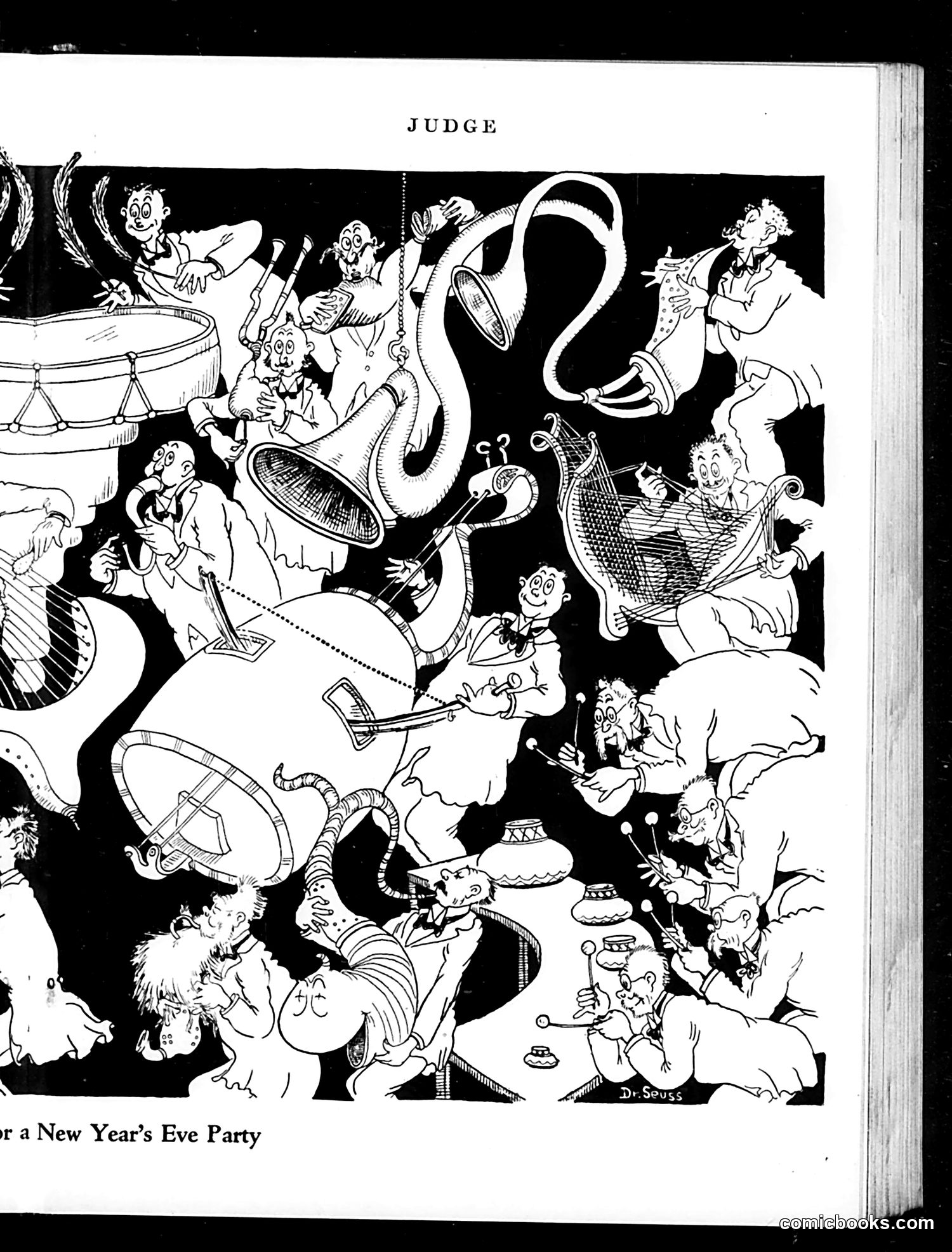
Analysis This is a Dr. Seuss illustration titled "Judge" depicting a chaotic New Year's Eve party scene. The cartoon shows numerous whimsical, cartoonish characters celebrating wildly—dancing, playing instruments (including large horns and drums), juggling, and generally creating mayhem. The style is characteristically Seussian with exaggerated proportions and fantastical creature designs. The satire appears to mock the excess and chaos of New Year's Eve celebrations—the overcrowded venue, the noise, the frenzied revelry. The title "JUDGE" likely refers to *Judge* magazine itself, which was known for satirizing contemporary American social customs and behaviors. Without additional context, the specific social critique remains general: poking fun at how people lose decorum during holiday celebrations. The chaotic composition itself is the joke.
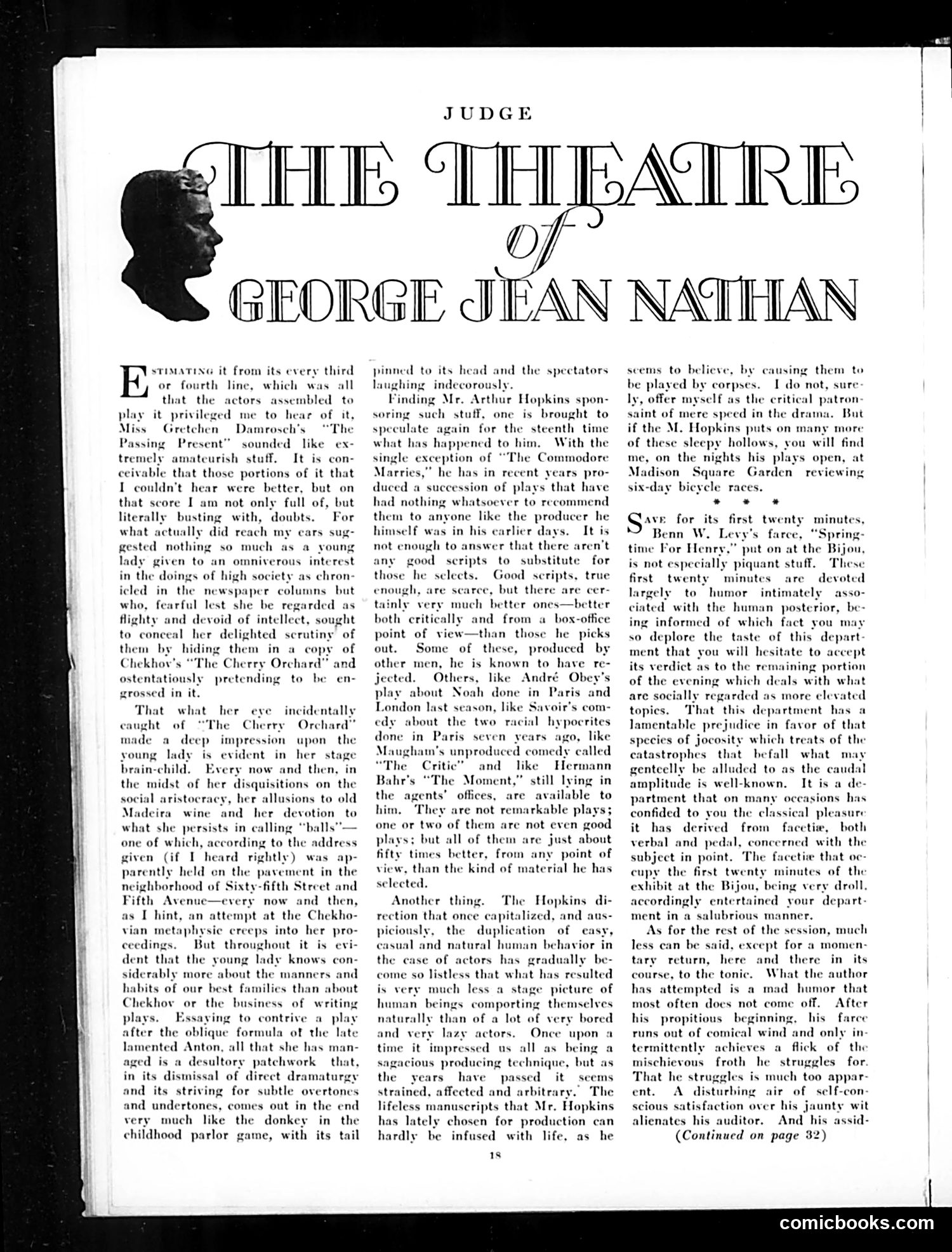
Judge Magazine Theater Review: "The Theatre of George Jean Nathan" This page contains a theater criticism column, not a cartoon. The critic (likely George Jean Nathan, based on the header) savagely reviews a play called "The Passing Present" by Gretchen Damrosch—a society woman who appears to be dabbling in playwriting. Nathan's satire targets her pretentiousness: she's superficially absorbed Chekhov's "Cherry Orchard" to seem intellectually serious while actually writing about high society gossip she reads in newspaper society columns. He compares the result to a children's game where a donkey's tail is pinned to its head—a confused mess. He also criticizes producer Arthur Hopkins for accepting mediocre scripts when better plays exist (mentioning works by André Obey, Savoir, and others), suggesting Hopkins has lost his once-sharp judgment. The critique exemplifies Judge magazine's role mocking theatrical pretension and incompetence among the wealthy amateur set.
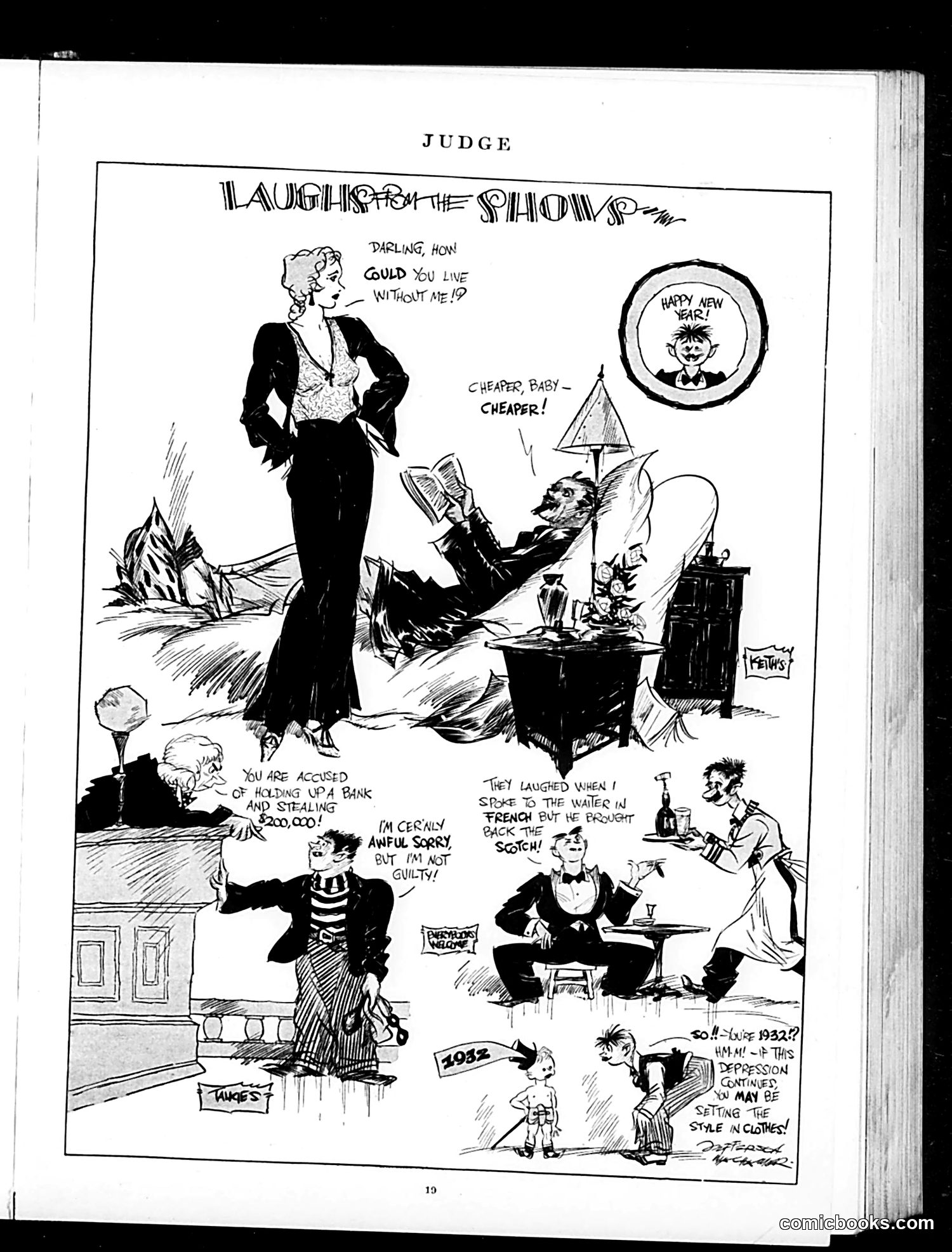
Analysis of "Laugh at the Shop" This cartoon satirizes 1920s-era courtroom absurdity and social pretension. A woman stands accused of bank robbery and theft. The defendant claims innocence while various comic scenes unfold: a man in formal dress lounges luxuriously, another disputes charges about ordering French wine "but he brought back Scotch," and figures at bottom reference "1922" and Depression-era hardship about "setting the style in clothes." The satire targets wealthy individuals evading serious criminal charges through frivolous excuses and social climbing—claiming poverty while maintaining expensive habits. The cartoon mocks both judicial leniency toward the wealthy and the absurd gap between their claimed circumstances and actual lifestyle during economic hardship. The page title "Judge" confirms this is from the satirical magazine of that name.
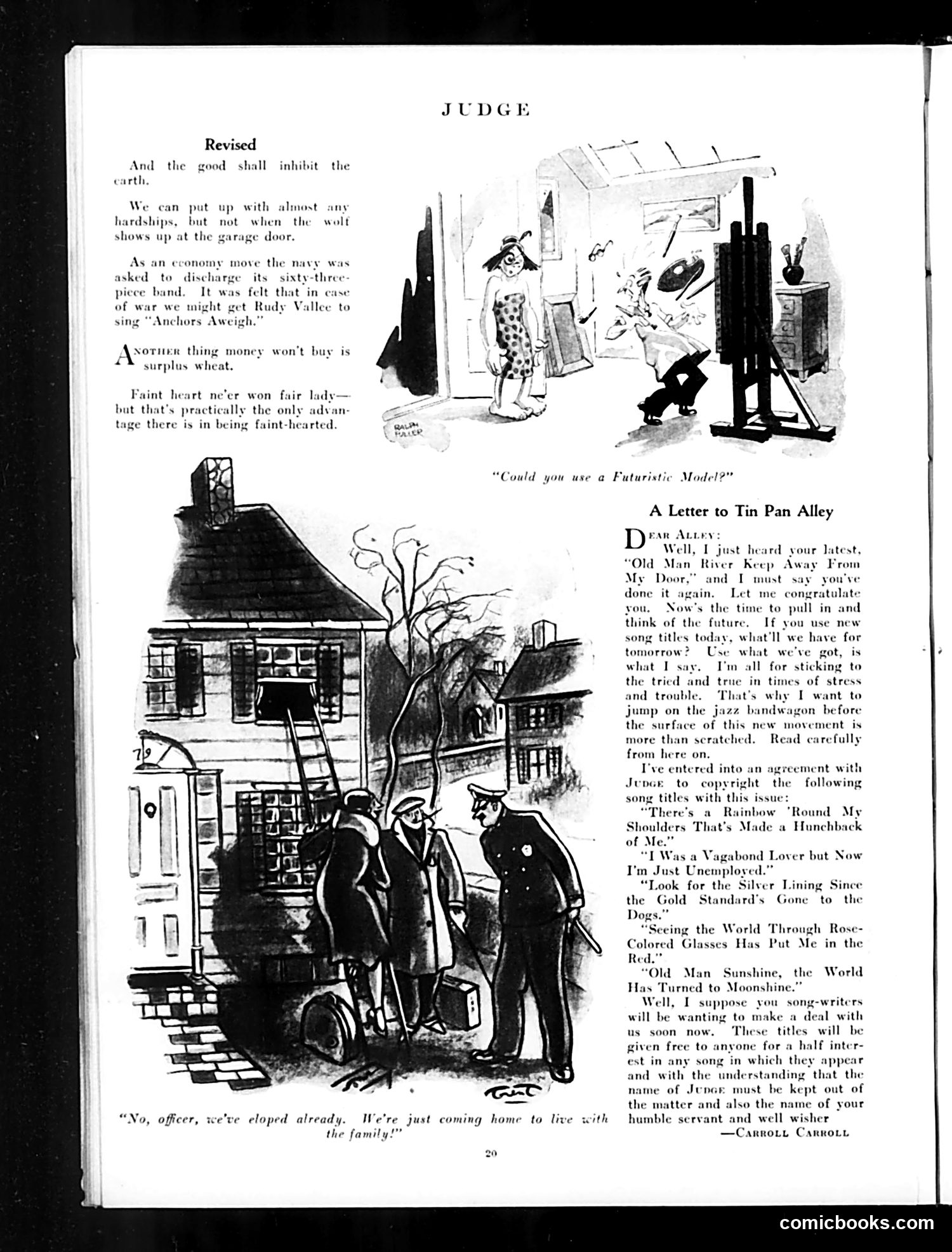
Judge Magazine Satire Analysis This page contains three distinct satirical pieces from the 1920s-30s era: Top cartoon: Mocks avant-garde art pretension. A woman in a studio asks an artist if he can create a "Futuristic Model"—likely satirizing the art world's obsession with modernist movements and abstract art that ordinary people found bewildering and unmarketable. Bottom cartoon: A police officer confronts an eloping couple. The couple's excuse—they've "eloped already" and are "just coming home to live with the family"—jokes about rushed wartime marriages and young couples' financial dependence, returning to parents' homes rather than establishing independence. "Letter to Tin Pan Alley": Carroll Carroll satirizes songwriters' creative bankruptcy, suggesting they recycle tired themes and old song titles rather than innovate. The letter mockingly lists absurd title combinations mixing current songs, poking fun at Tin Pan Alley's formulaic approach to commercial music production during economic hardship. The page's opening quips about naval budget cuts and surplus wheat reflect 1920s-30s economic anxieties.
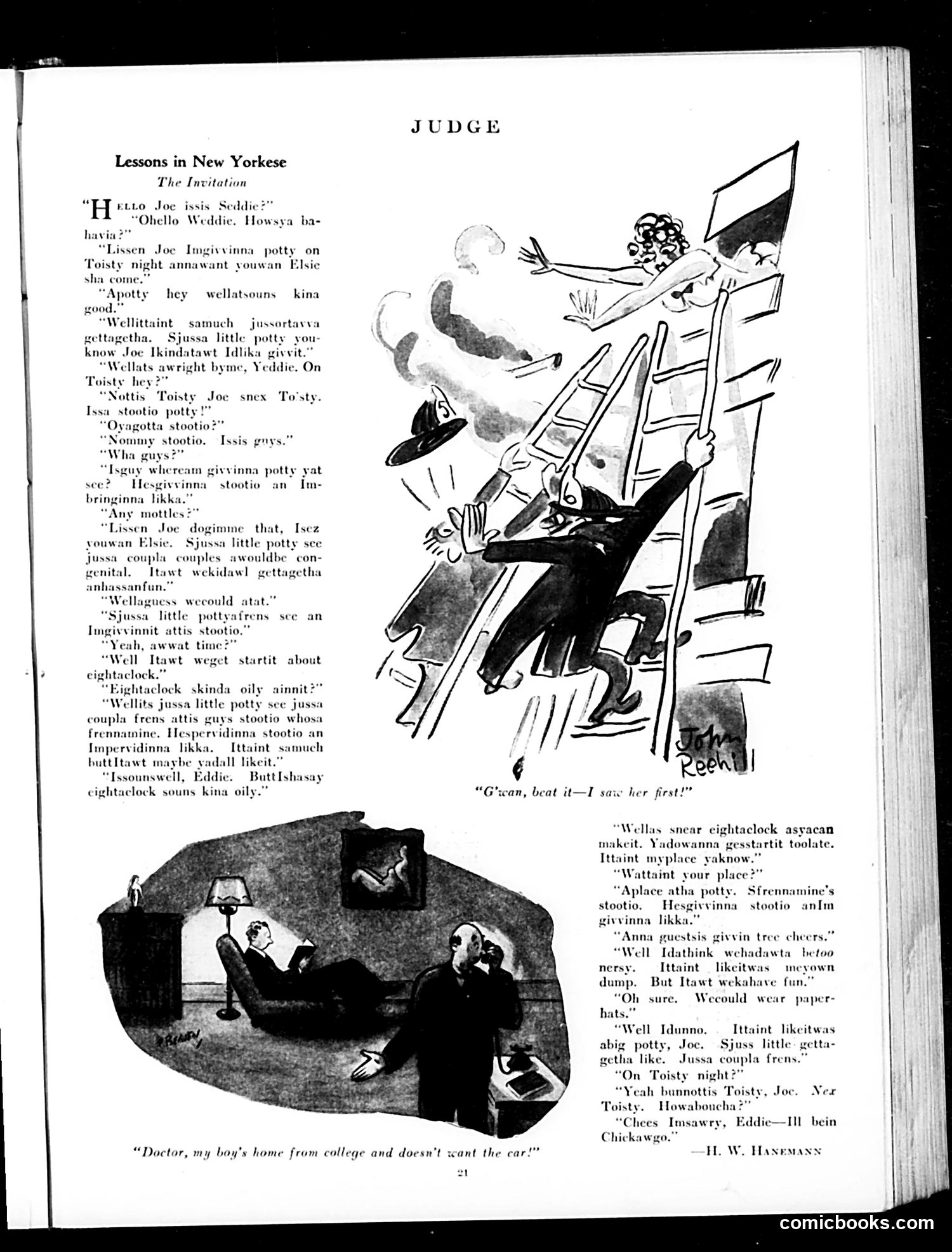
"Lessons in New Yorkese: The Invitation" This satirical piece mocks the distinctive accent and speech patterns of working-class New Yorkers of the early 20th century. The humor relies on phonetic spelling of rapid, casual New York dialect—dropping g's ("givvinna"), collapsing words ("Toisty" for Thursday), and using local slang ("stootio" for studio, "potty" for party). The cartoon depicts a phone invitation to a modest apartment gathering. Two men discuss plans in heavily accented English, with exaggerated phonetic transcription emphasizing how different New York speech sounded to outsiders or upper-class readers. The lower illustration shows the actual casual party scene. The satire targets class and regional differences—Judge's audience would have been amused by this "foreign" dialect from New York's immigrant and working-class neighborhoods. The author (H.W. Hansemann) presents the speech as incomprehensible and comic, reflecting period attitudes toward ethnic urban dialects as markers of lower status.
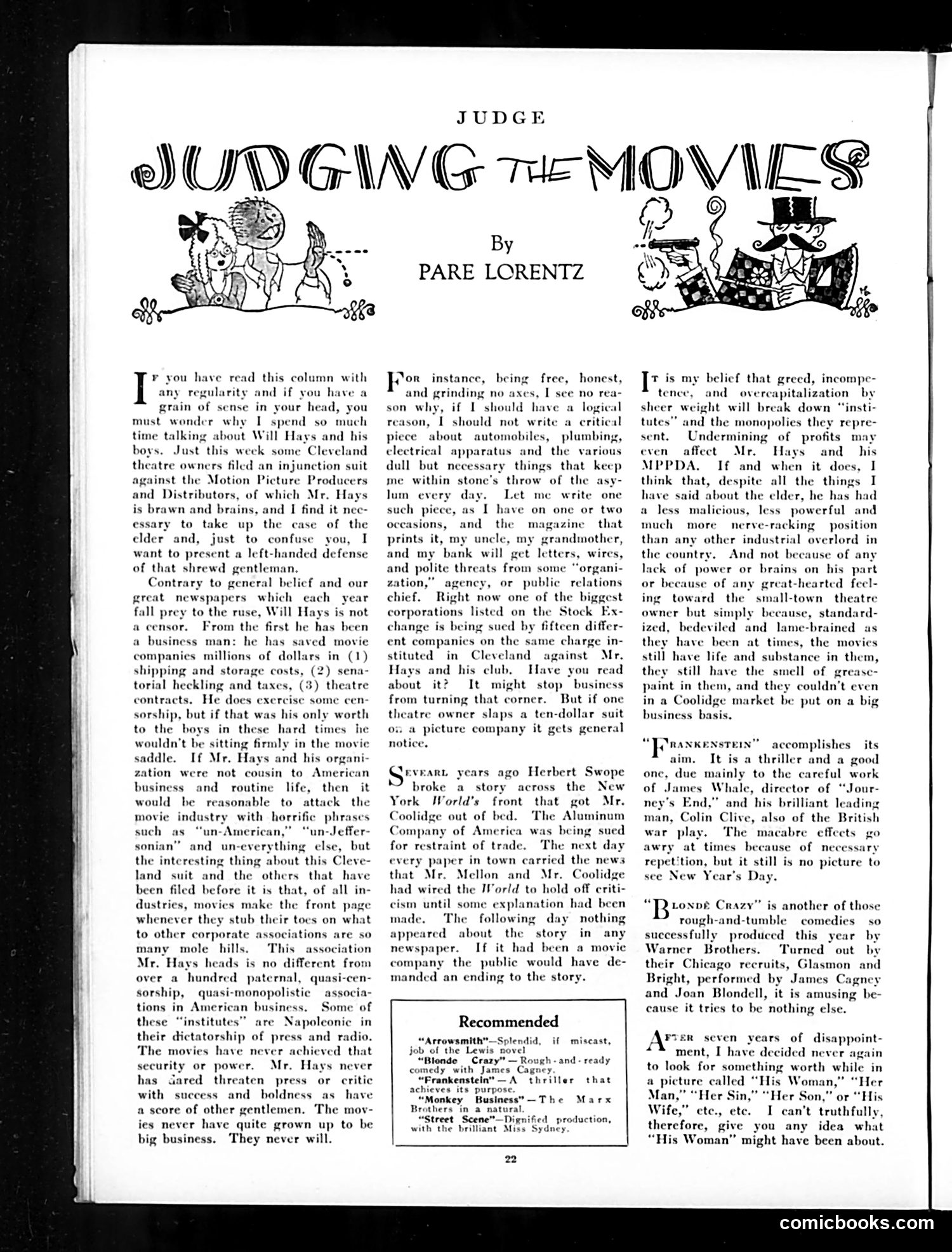
Judge Magazine: "Judging the Movies" by Pare Lorentz This column defends Will Hays, head of Hollywood's Motion Picture Producers and Distributors organization, against a Cleveland theater owners' lawsuit. Lorentz argues that Hays—despite his censorship role—functions as a shrewd businessman protecting the film industry from financial and legal damage, similar to unexamined monopolistic practices in other American industries. The satire cuts both ways: Lorentz criticizes how the movie industry faces disproportionate public scrutiny compared to equally powerful corporations (he cites a Coolidge-era Aluminum Company suit handled quietly). Yet he also mocks movies' immaturity as an industry—they "never will" grow up as legitimate big business. The page includes brief film recommendations, treating cinema as a subject worthy of serious critical discussion. The cartoon headers feature playful imagery typical of Judge's style.
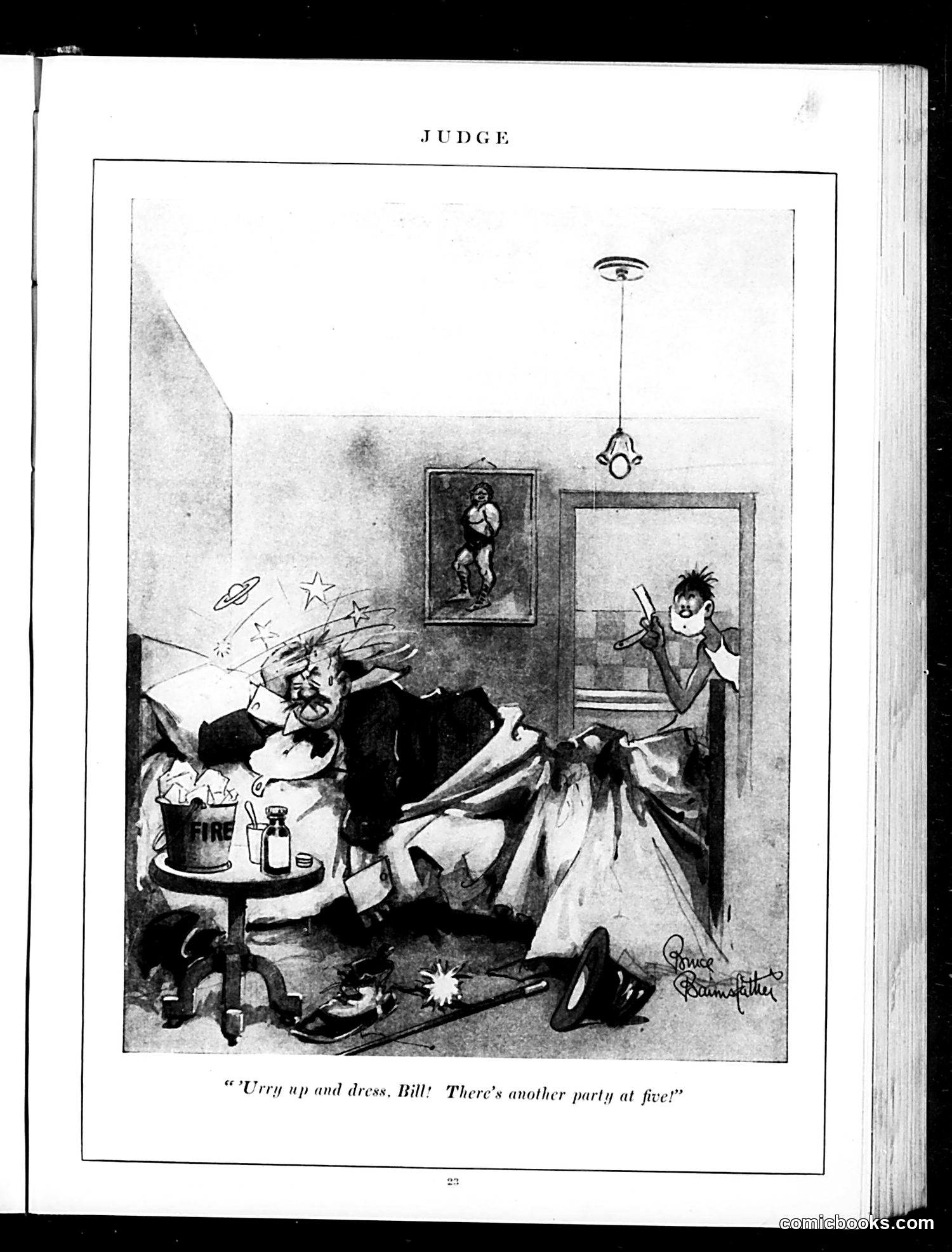
Analysis This single-panel cartoon depicts a domestic scene where a woman (appearing exasperated) urges a man named Bill to hurry and dress, as there's "another party at five." The satire targets the social frenzy of constant party-going, likely reflecting 1920s Jazz Age culture when frequent socializing was fashionable among the upper and middle classes. The woman's frantic energy and the scattered clothing and cosmetics visible suggest the exhausting pace of maintaining an active social calendar. The joke critiques the absurdity of back-to-back social obligations—the couple apparently has no rest between events. This reflects period anxieties about modern leisure culture becoming excessive and frivolous, a common Judge magazine theme during the era of Prohibition and speakeasies when nightlife was particularly prominent.
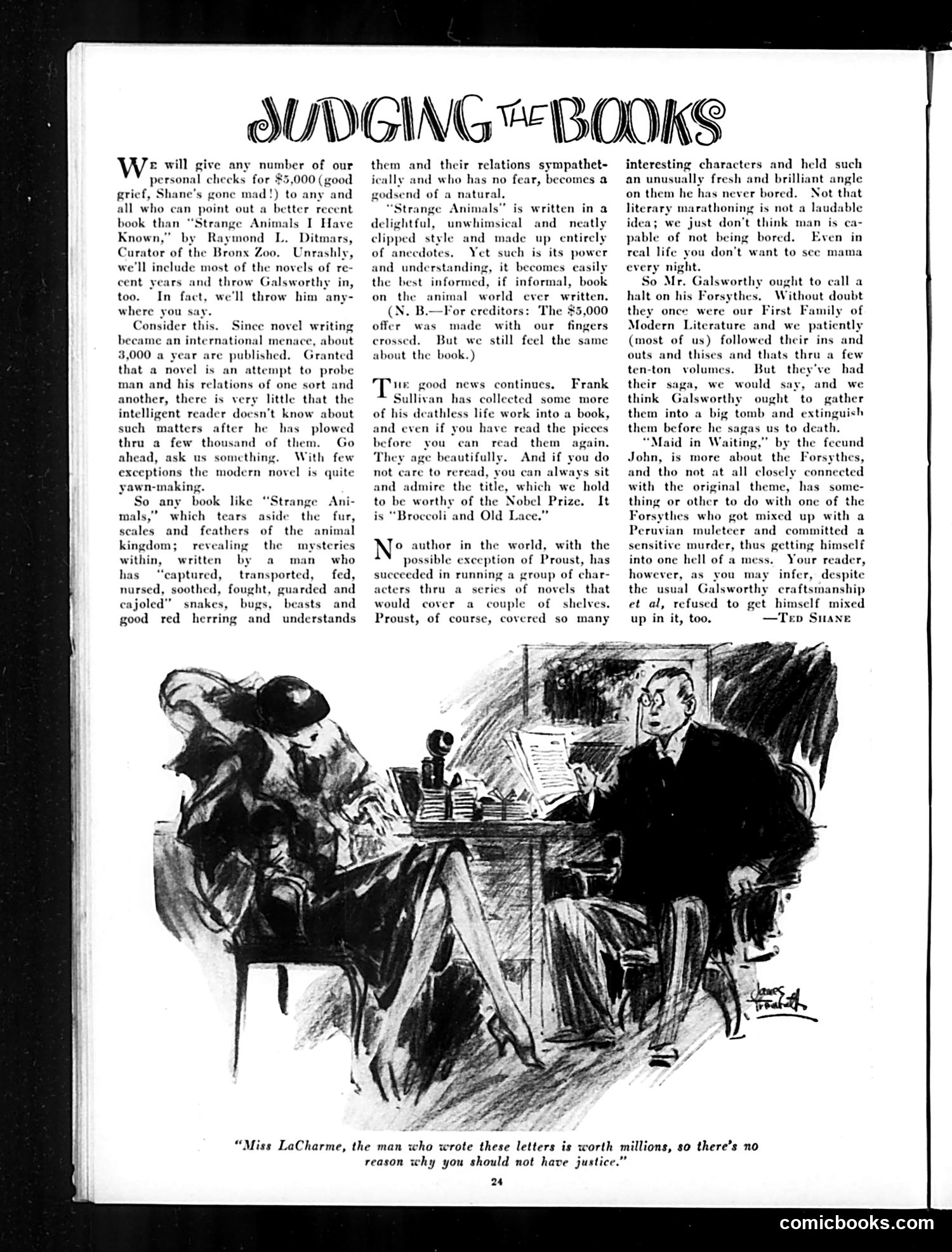
Explaining This Judge Magazine Page to Modern Readers This is a book review column titled "Judging the Books." The main cartoon depicts a wealthy man (identified in the caption as "Miss LaCharme") seated at a desk with stacks of money, speaking to a woman about a man worth millions who wrote letters to her—apparently implying she deserves financial compensation ("justice") from someone rich. The text reviews three books: Raymond Ditmars's "Strange Animals I Have Known" (praised for its fresh perspective on nature), Frank Sullivan's "Broccoli and Old Lace" (admired for its title), and John Galsworthy's "Maid in Waiting" (criticized as another Forsytes novel). The reviewer mocks the proliferation of modern novels (3,000 published annually) as repetitive and boring, sarcastically offering personal checks to anyone finding a better recent book than Ditmars's work. The column takes jabs at Galsworthy for continuing his lengthy Forsytes saga, suggesting readers are exhausted by the series.
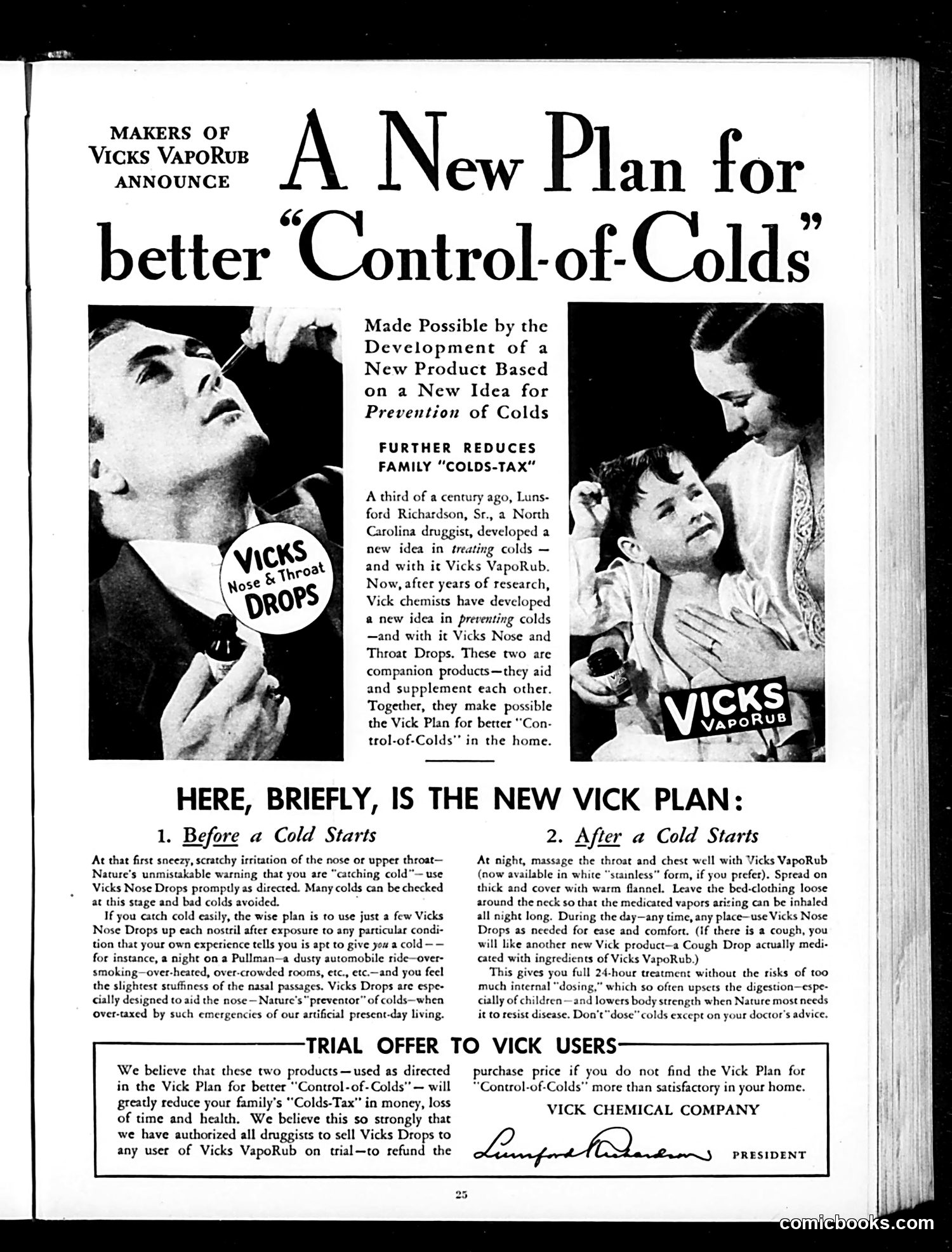
Analysis This is not a cartoon or satire, but rather a full-page advertisement for Vicks VapoRub and their new companion product, Vicks Nose and Throat Drops. The ad announces a two-part "Vick Plan for Control-of-Colds" with preventative (before symptoms) and treatment (after symptoms) stages. The language references a family "Colds-Tax"—the economic and health burden of frequent colds—framing disease prevention as a financial concern relevant to Depression-era readers. The ad includes photographs of users (a man and a woman with child) demonstrating the products, along with historical context attributing the original VapoRub to Lunsford Richardson, Sr., a North Carolina druggist from "a third of a century ago." A trial offer guarantees refunds if customers aren't satisfied, reflecting competitive patent-medicine marketing of the era. The page is editorial advertising, not satirical commentary.
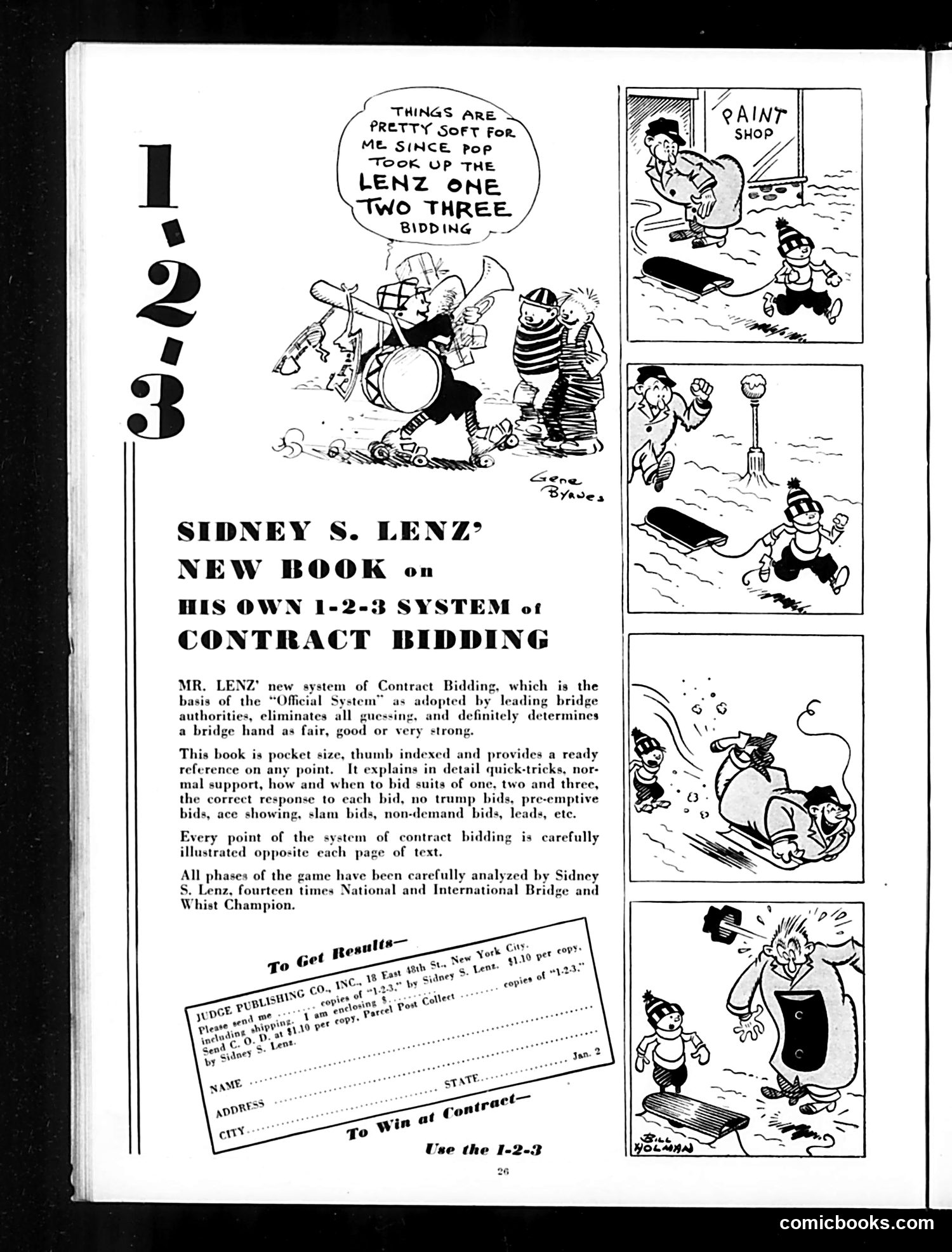
Analysis for Modern Readers This is primarily a advertisement for Sidney S. Lenz's bridge instruction book, disguised within a comic frame. The cartoon shows a child saying life has become "soft" since their father learned Lenz's 1-2-3 bidding system for contract bridge. Context: Contract bridge was a hugely popular parlor game among American middle and upper classes in the early-to-mid 20th century. Lenz was a legitimate bridge champion and authority. The joke relies on the assumption that a father absorbed in learning bidding strategy would become more lenient or distracted as a parent—a gentle domestic humor common to the era. The accompanying comic strips on the right appear unrelated, suggesting this is a magazine page mixing editorial cartoons with advertisements. The "To Get Results" order form at bottom confirms this is primarily promotional content for Judge Publishing Company.
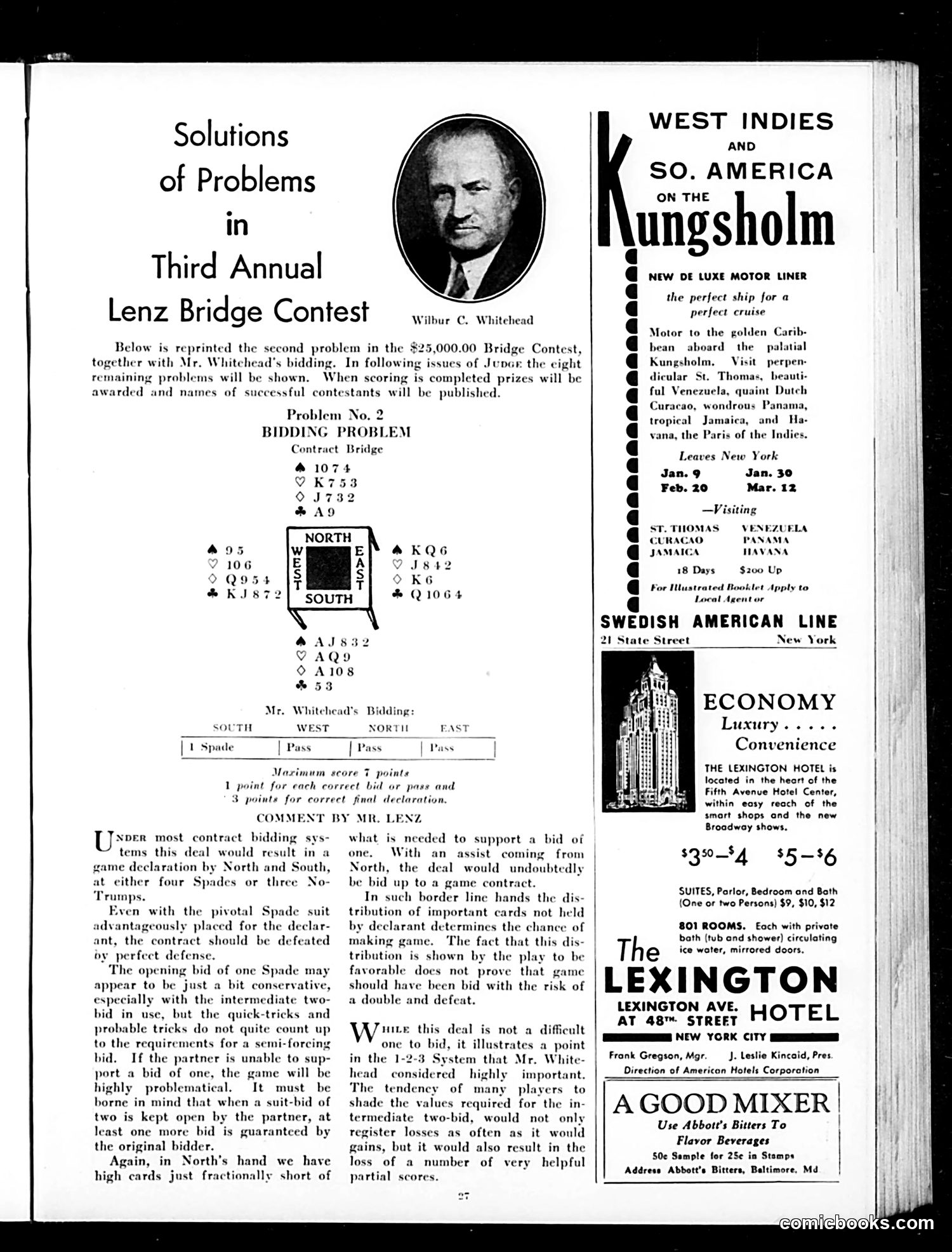
Judge Magazine Page Analysis This page is primarily instructional and commercial rather than satirical. The main content is the "Third Annual Lenz Bridge Contest," featuring Problem No. 2 in contract bridge, with Wilbur C. Whitehead's bidding strategy and Mr. Lenz's detailed commentary on proper bidding technique. The page demonstrates Judge magazine's dual nature: it mixed humor with serious, specialized content. Here, bridge—a wildly popular card game in the 1920s-30s—gets expert analysis rather than jokes. The surrounding advertisements (Kungsholm cruise line, Lexington Hotel, Abbott's Bitters) target affluent readers who played bridge. No obvious political satire or caricature appears. This represents Judge serving its readership as both entertainer and lifestyle guide for the American upper-middle class.
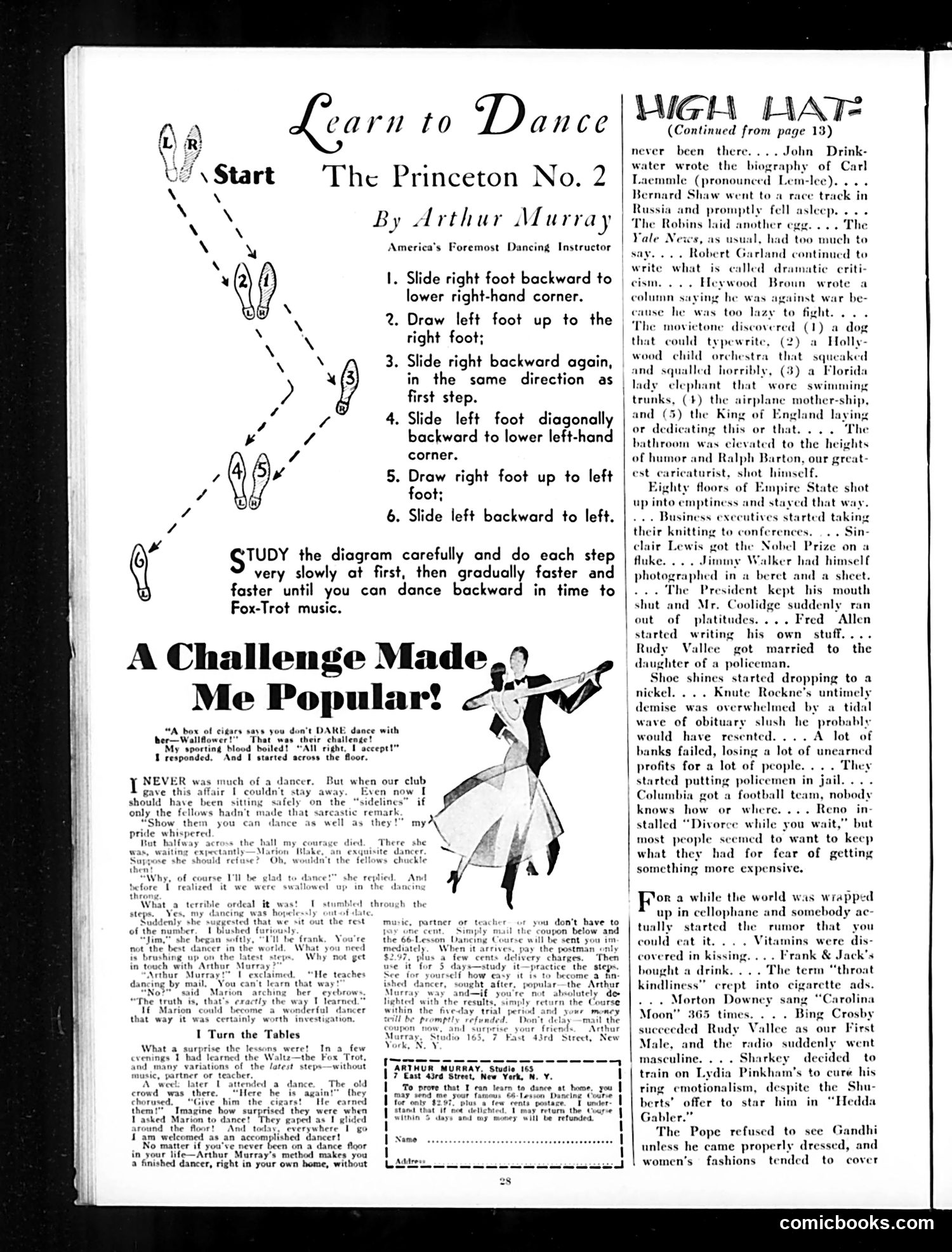
Judge Magazine Page Analysis This page contains two distinct features: "Learn to Dance: The Princeton No. 2" is a instructional diagram by Arthur Murray (America's famous dancing instructor) teaching the backward fox-trot step-by-step. It's a genuine how-to feature, not satire. "A Challenge Made Me Popular!" is an Arthur Murray advertisement disguised as a humorous anecdote. A shy man accepts a bet to dance with an attractive woman. Rather than attending dance lessons in person, he uses Arthur Murray's mail-order dance course and teaches himself at home. He returns to the next dance, successfully woos the woman, and wins the bet. The ad's implicit message: Murray's correspondence course works as well as in-person instruction—a somewhat dubious claim used to sell the product. The right column contains gossip tidbits about various celebrities and public figures of the era (Heywood Broun, Rudy Vallee, etc.), typical filler content for Judge magazine.
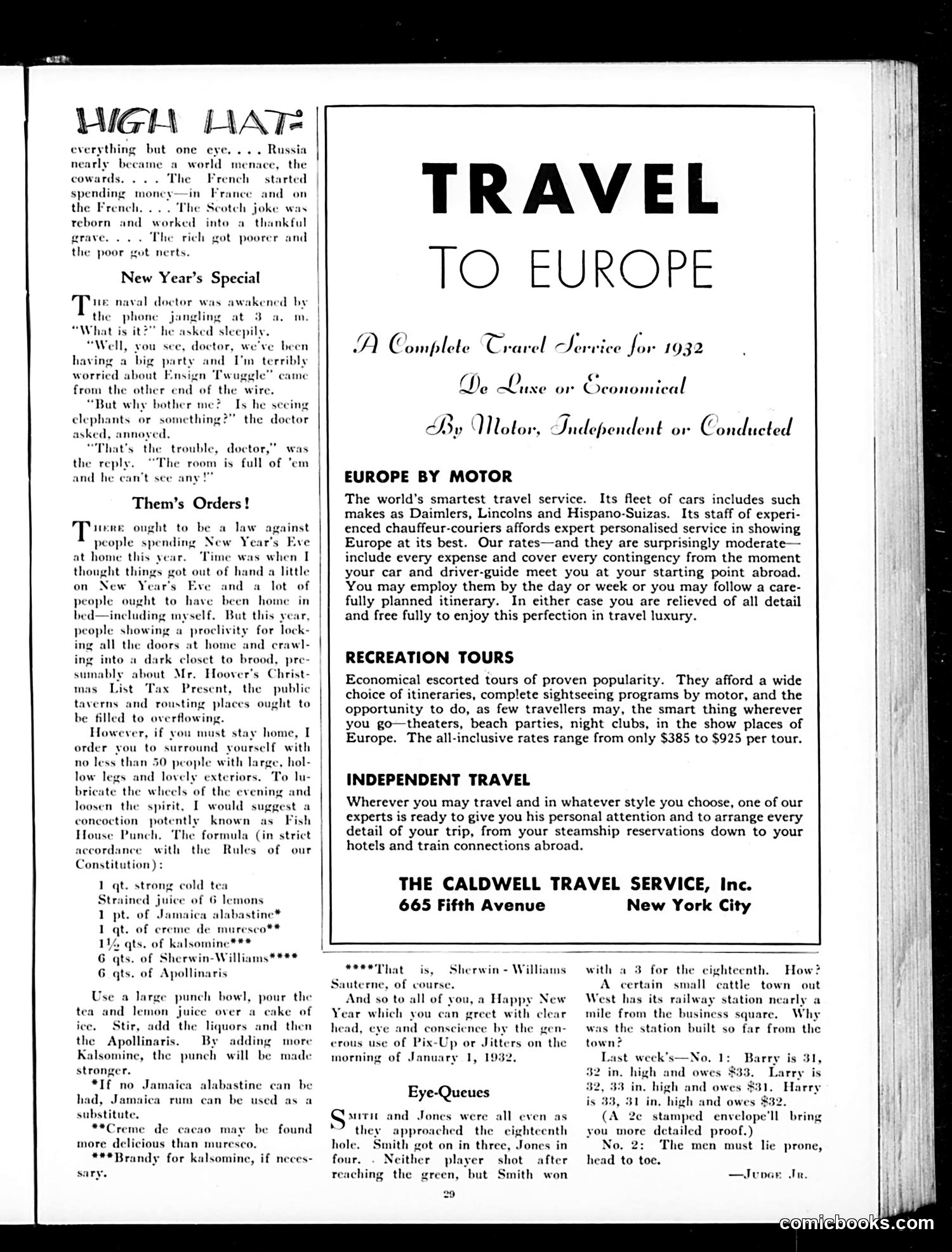
This page contains three elements: two short jokes/cartoons and a travel advertisement. The jokes satirize 1932 holiday excess and military absurdity. "High Hat" mocks New Year's Eve celebrations, particularly wealthy people's revelry—referencing current economic hardship (Hoover-era Depression). The naval doctor story jokes about drunkenness: an intoxicated ensign "can't see" elephants, implying hallucinations from overconsumption. "Them's Orders!" sarcastically suggests New Year's Eve traditions encourage people to lock themselves away rather than celebrate publicly—likely commenting on economic anxiety and diminished holiday spirit during the Depression. The remaining two-thirds is a full-page advertisement for the Caldwell Travel Service, promoting European motor tours. It's unrelated to the satire and represents how Judge magazines mixed editorial content with advertising revenue.
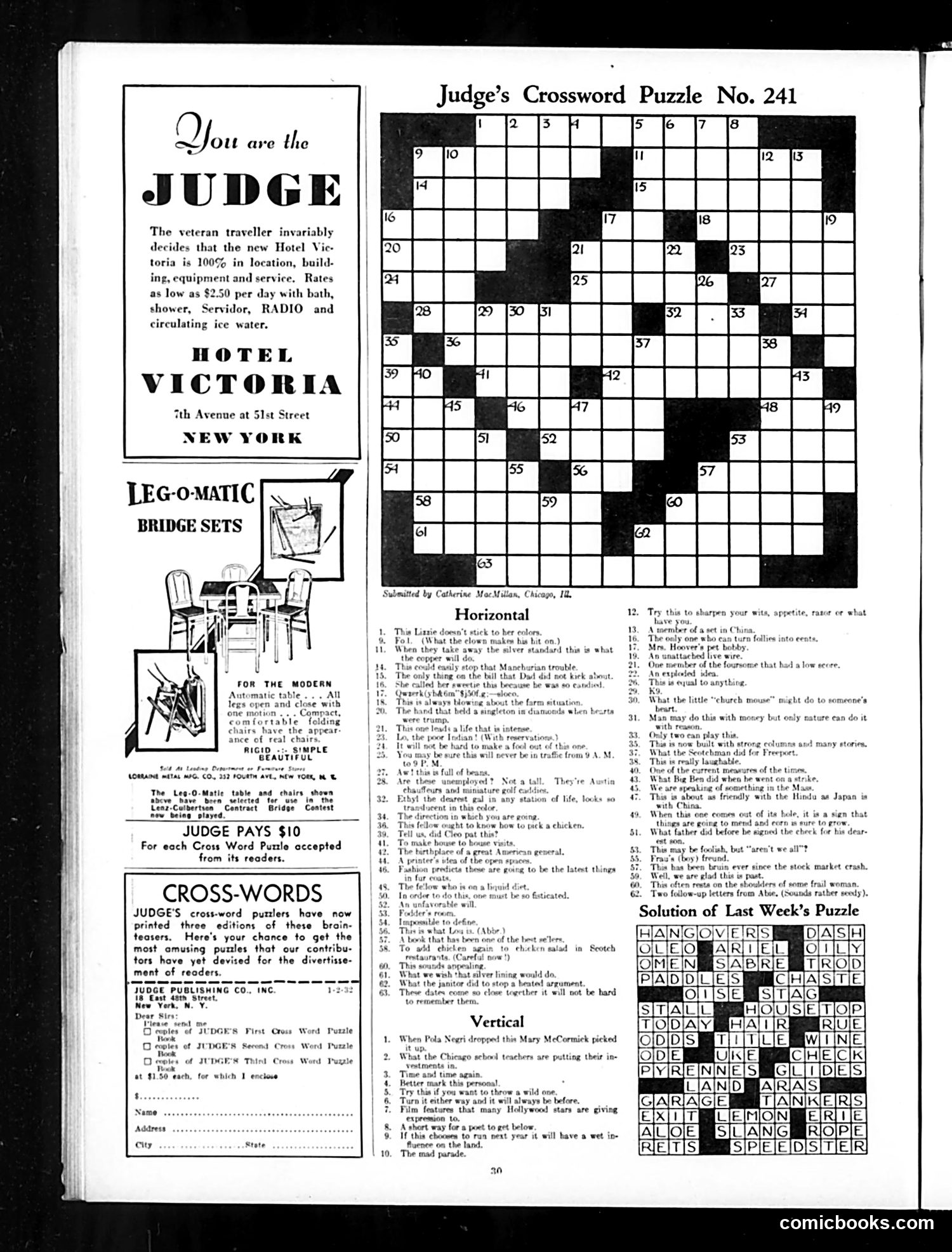
Judge Magazine Crossword Page Analysis This page is primarily advertising and puzzle content rather than political satire. The main elements are: 1. Hotel Victoria Advertisement: A straightforward commercial promoting a Manhattan hotel, emphasizing modern amenities (radio, shower, servidor) at competitive rates ($2.50/day). 2. Leg-O-Matic Bridge Sets Ad: Furniture advertising for collapsible bridge tables and chairs, marketed as space-saving solutions for modern apartments. 3. Crossword Puzzle Contest: Judge magazine solicited reader-submitted crossword puzzles, offering $10 payment per accepted puzzle. This was a common engagement strategy for publications in this era. 4. Solution Grid: Shows the previous week's completed puzzle answers. The page reflects 1920s-30s consumer culture and leisure activities (contract bridge was fashionable). There is no visible political cartoon or satirical content—this appears to be a standard magazine filler page combining classifieds, puzzles, and reader engagement features typical of the period.
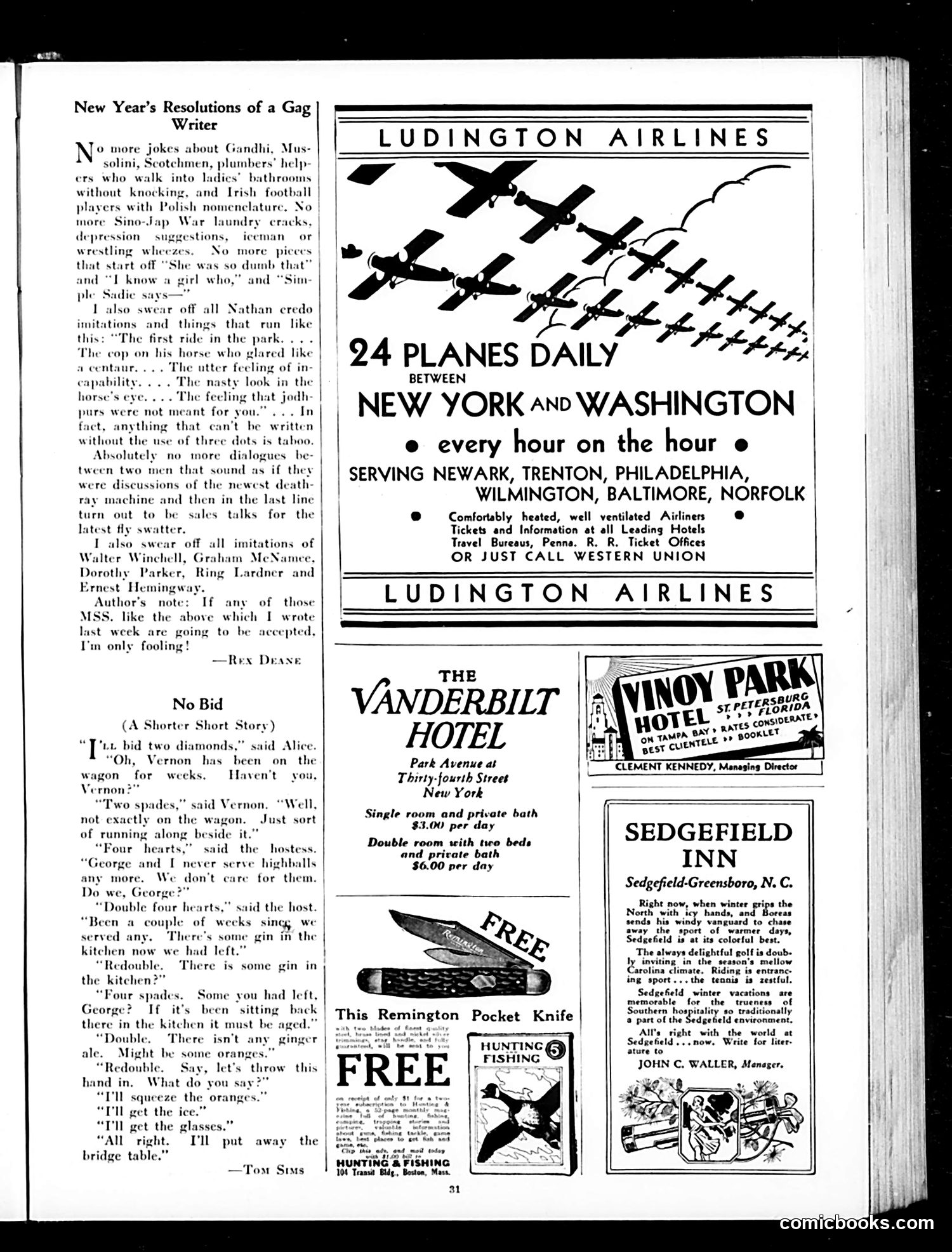
Analysis for Modern Readers This page is primarily advertising, with two short humorous pieces on the left margin. The Main Content: The left column features satirical "New Year's Resolutions of a Gag Writer" by Rex Deane, mocking hackneyed joke formulas of the early 1930s: tired material about Gandhi, Mussolini, Scotsmen, and the Sino-Japanese War; overused narrative devices (three dots, "she was so dumb that"); and parodies of famous writers like Ernest Hemingway and Ring Lardner. It's self-aware satire about comedy writing itself. "No Bid" (by Tom Sims) is a bridge-game short story where players' card-game bids keep getting hijacked by revelations about alcohol they claim not to have—a joke about Prohibition-era hypocrisy and secret drinking. The Advertisements include Ludington Airlines (24 hourly flights between New York and Washington), the Vanderbilt Hotel, Sedgefield Inn, Vinoy Park Hotel, and a free Remington pocket knife offer. These ads reflect 1930s leisure travel and consumer marketing.
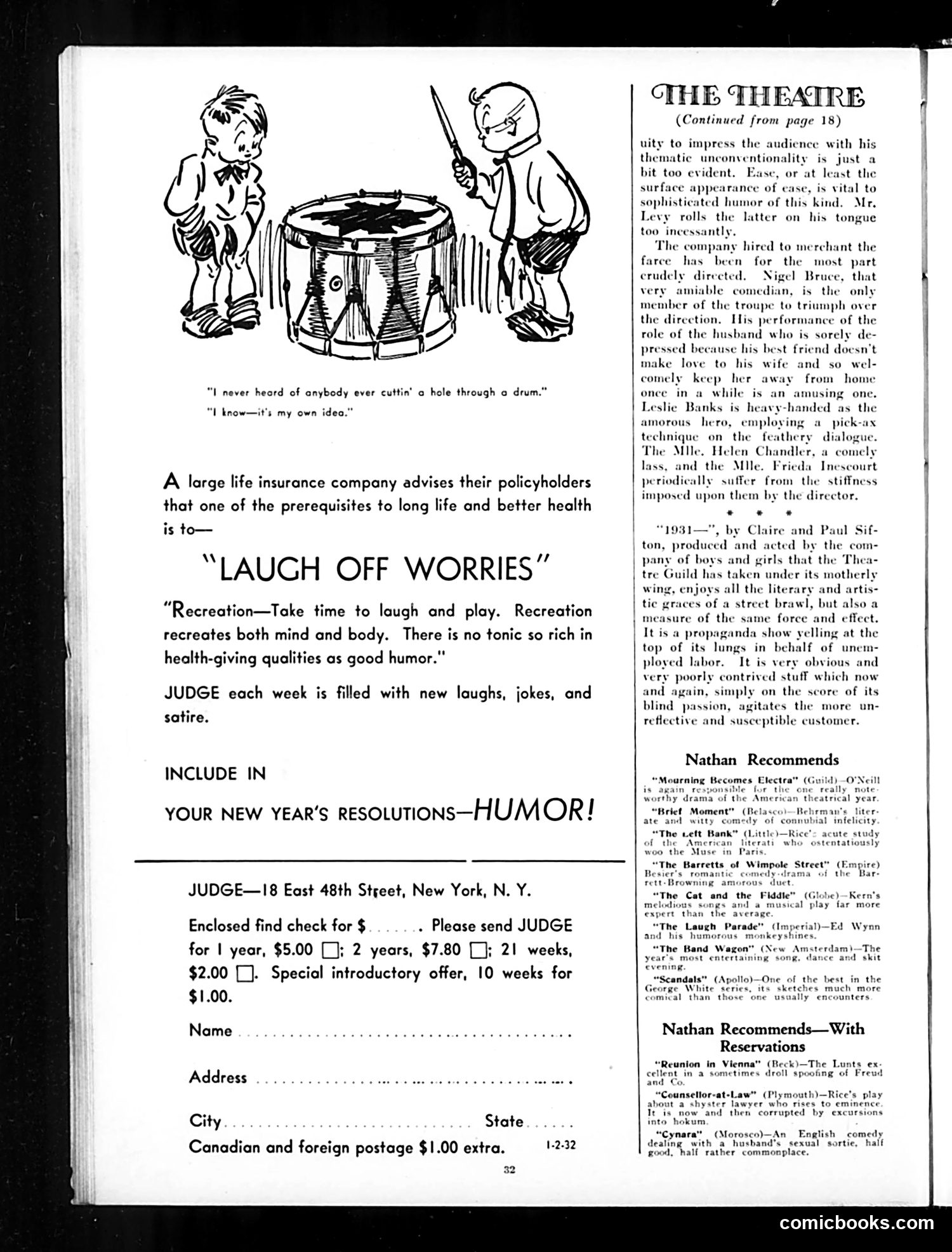
Judge Magazine Cartoon Analysis This is primarily a subscription advertisement rather than a political cartoon. The illustrated joke at top shows two figures with a drum, discussing an unconventional idea—likely a visual pun about "cutting through" something, though the humor is unclear to modern readers without additional context. The main content is a health insurance ad promoting laughter as a remedy for worry, positioning Judge magazine as a source of therapeutic humor. This reflects 1930s wellness philosophy linking recreation and mental health to longevity. The page also includes theatre reviews by "Nathan" (likely drama critic George Jean Nathan), critiquing contemporary Broadway productions. References to plays like O'Neill's *Mourning Becomes Electra* and performances by the Lunts indicate this was aimed at educated, theater-going audiences. The overall message: subscribe to Judge for health-giving laughs during economically uncertain times (note the 1932 date during the Depression).
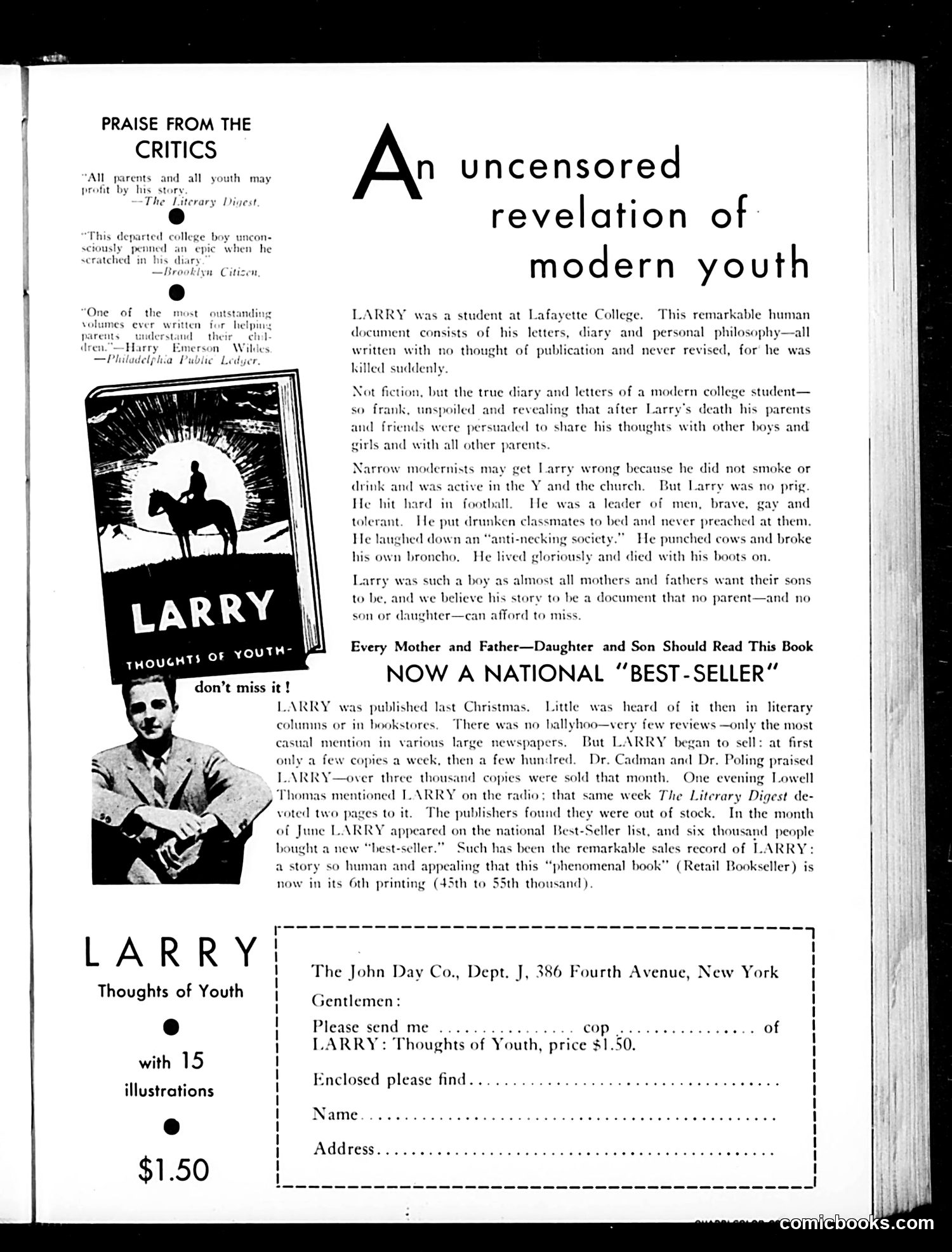
"Larry: Thoughts of Youth" — A 1920s Book Advertisement This is primarily a book advertisement, not a political cartoon. It promotes *Larry: Thoughts of Youth*, a posthumous publication of a deceased Lafayette College student's diary and letters. The sales pitch emphasizes the book's appeal to parents worried about modern youth. Larry is positioned as an idealized young man—morally upright (no smoking/drinking, active in church), yet masculine and adventurous (football leader, punches cows, "lived gloriously"). The marketing suggests the diary offers parents insight into authentic youth culture without scandal. The book's unexpected bestseller status (launched Christmas, achieved top-seller status by June) is attributed to radio promotion by figures like Lowell Thomas and endorsements from religious leaders (Dr. Cadman, Dr. Poling). The advertisement targets parental anxiety about generational gaps by framing Larry's story as a "document that no parent...can afford to miss." This reflects 1920s concerns about changing youth morality during the post-WWI era.

Analysis This is not a cartoon or satire — it's a full-page cigarette advertisement for Camel brand cigarettes from 1932. The image shows a smiling man in a cap holding a cigarette pack and a "Smoke a FRESH cigarette" sign. The ad targets women specifically, claiming Camels are milder than competing brands and better for "delicate" female throats. It emphasizes the "Camel Humidor Pack" as keeping cigarettes fresh and protecting them from odors. The text includes a radio program reference ("Camel Quarter Hour"), typical advertising copy of the era, and product claims about Turkish and domestic tobacco blends. For modern readers: This represents pre-health-warning advertising when cigarette companies made unsubstantiated health claims and explicitly marketed to women as a relatively new consumer demographic. The gendered messaging ("women's delicate throats") and lack of any health disclaimers would be illegal today.