judge
Judge — January 9, 1932
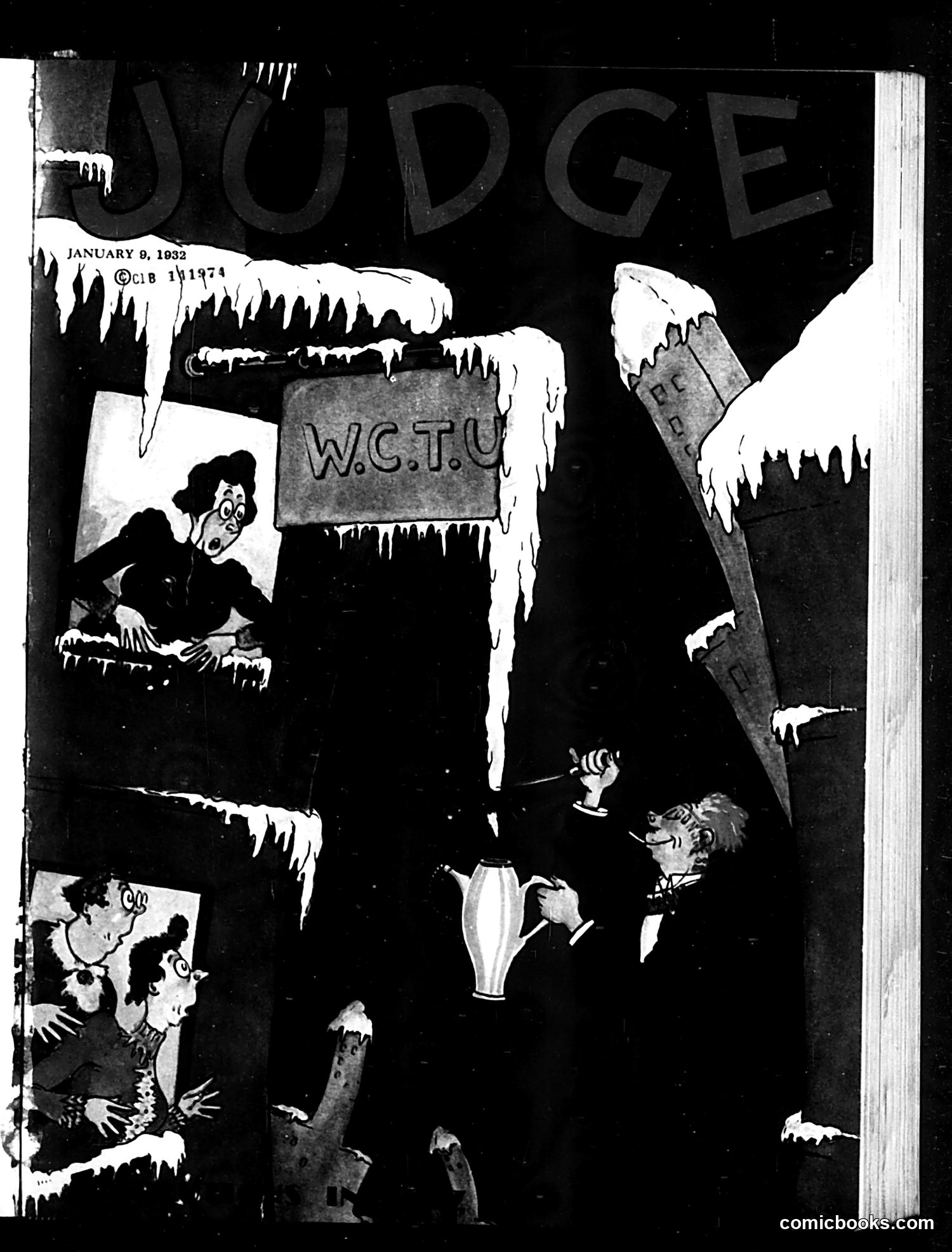
Judge Magazine Cartoon Analysis (January 9, 1932) This cartoon depicts a frozen building labeled "W.C.T.U." (Women's Christian Temperance Union) during winter, with icicles covering its structure. Several caricatured figures appear distressed or trapped outside in the cold. The satire references Prohibition's failure and the WCTU's role in advocating for it. By January 1932—near Prohibition's end (repealed December 1933)—the cartoon mocks the temperance movement as frozen, obsolete, and ineffective. The distressed figures likely represent temperance advocates confronting the reality that their decades-long crusade has collapsed amid the Great Depression and widespread public opposition. The harsh winter imagery symbolizes the WCTU's declining influence and relevance in American society.
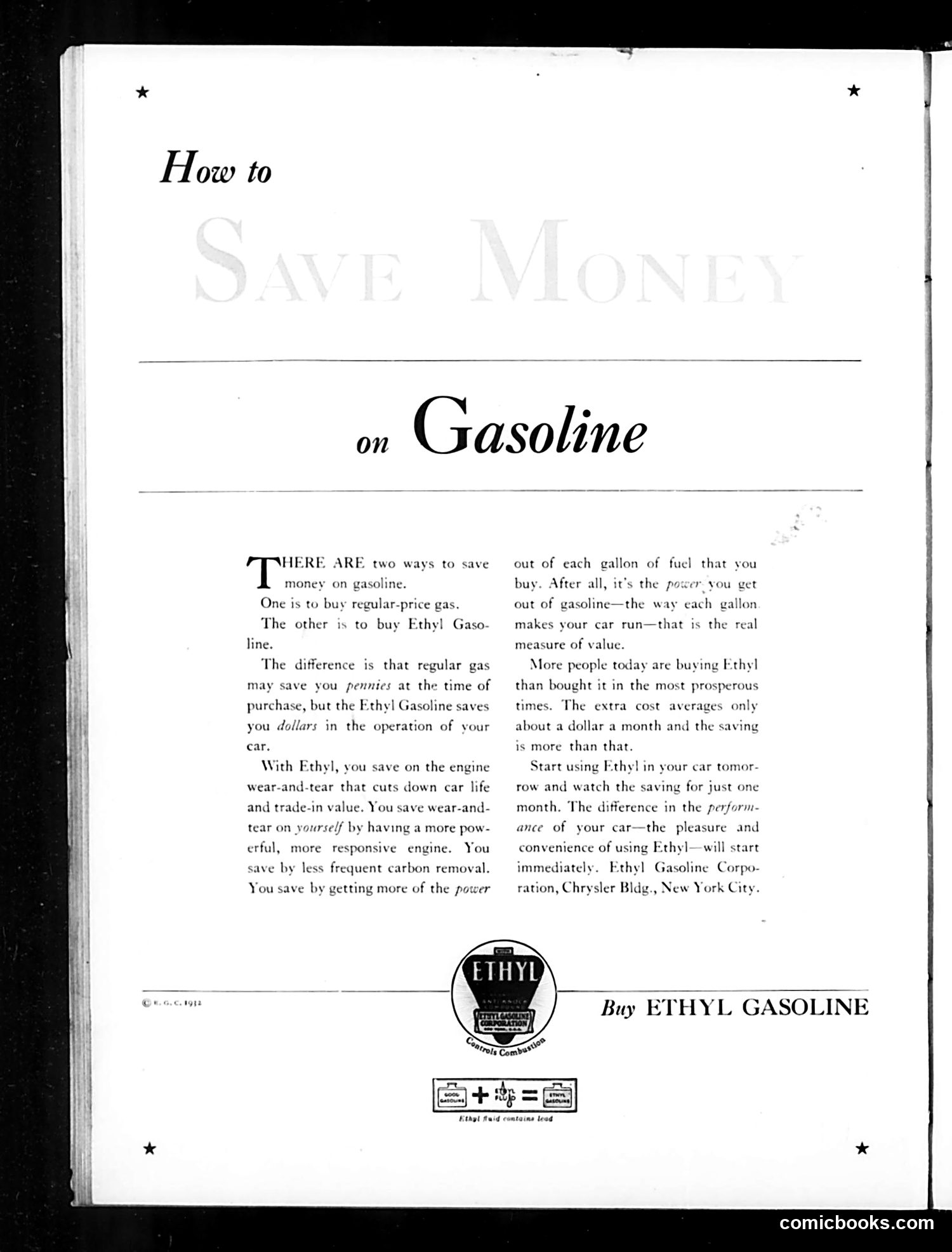
Analysis This is primarily advertising content, not satire or political commentary. The page promotes Ethyl Gasoline, a fuel additive product from the Ethyl Gasoline Corporation (Chrysler Building, New York City). The ad argues that while regular gasoline may save "pennies" at purchase, Ethyl Gasoline saves "dollars" through engine efficiency—reducing wear-and-tear, improving performance, and decreasing maintenance needs. The copy claims buyers will notice improved car "performance" and "pleasure" immediately. The page contains no political figures or satirical commentary. It's a straightforward product advertisement using comparative claims typical of 1920s-30s consumer marketing. The brand logo and call-to-action ("Buy ETHYL GASOLINE") dominate the lower portion.
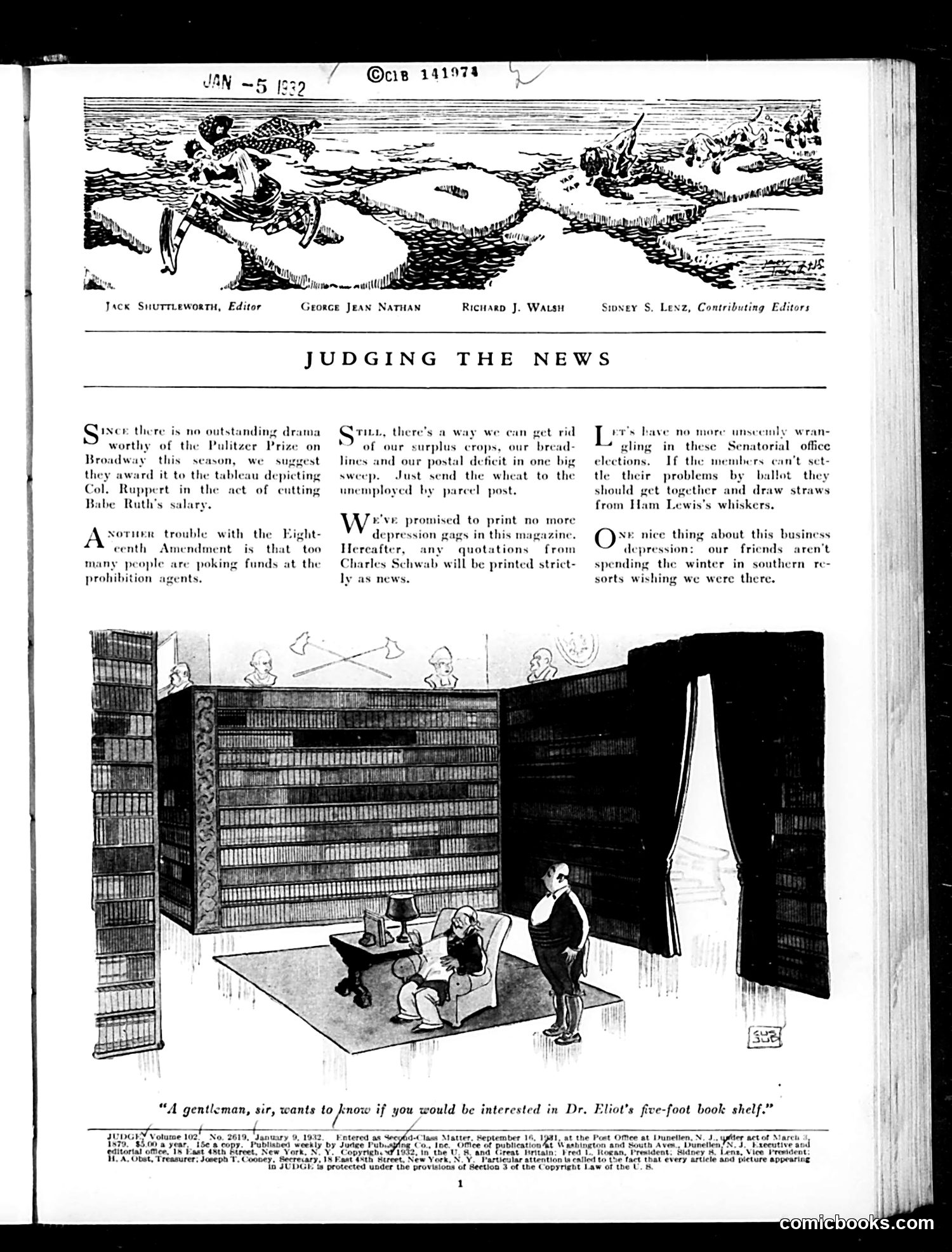
Analysis of "Judging the News" - Judge Magazine, January 9, 1932 This page contains brief satirical commentary on current events rather than a single political cartoon. The main illustration depicts a humorous scene about information management: a visitor inquires whether someone is "interested in Dr. Eliot's five-foot book shelf"—likely referencing Charles W. Eliot's famous curated collection of essential books. The commentary above jokes about Depression-era problems (surplus crops, postal deficits), mentions avoiding depression-themed content in future issues, and pokes fun at Prohibition enforcement and senatorial elections. The five-foot shelf reference appears to satirize Americans' pretensions toward self-education during economically difficult times, suggesting the irony of intellectual pursuits amid widespread hardship.
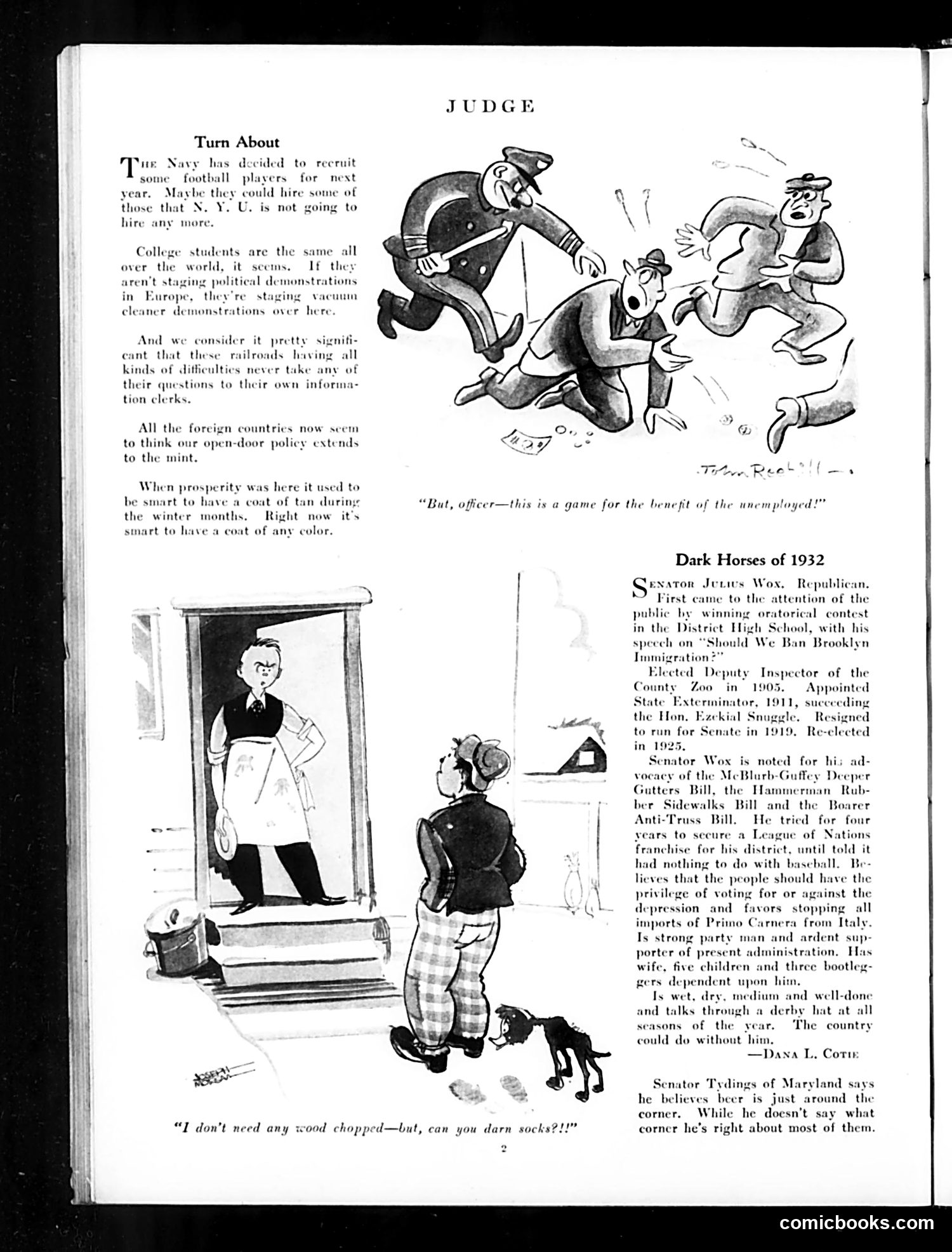
Analysis of Judge Page Top Cartoon ("Turn About"): This satirizes Navy recruitment difficulties and compares American college student protests to European demonstrations. The cartoon shows military officers chasing what appear to be reluctant recruits or students, suggesting the Navy struggles to recruit while students avoid military service through activism. Bottom Cartoon ("Dark Horses of 1932"): Profiles Republican Senator Jesse Wax, apparently a political newcomer gaining attention. The domestic scene shows a woman calling out "I don't need any wood chopped—but, can you darn socks?!" — likely mocking his ability to handle practical governing versus theoretical politics, or suggesting unproven political credentials during the Depression era when economic management was critical.
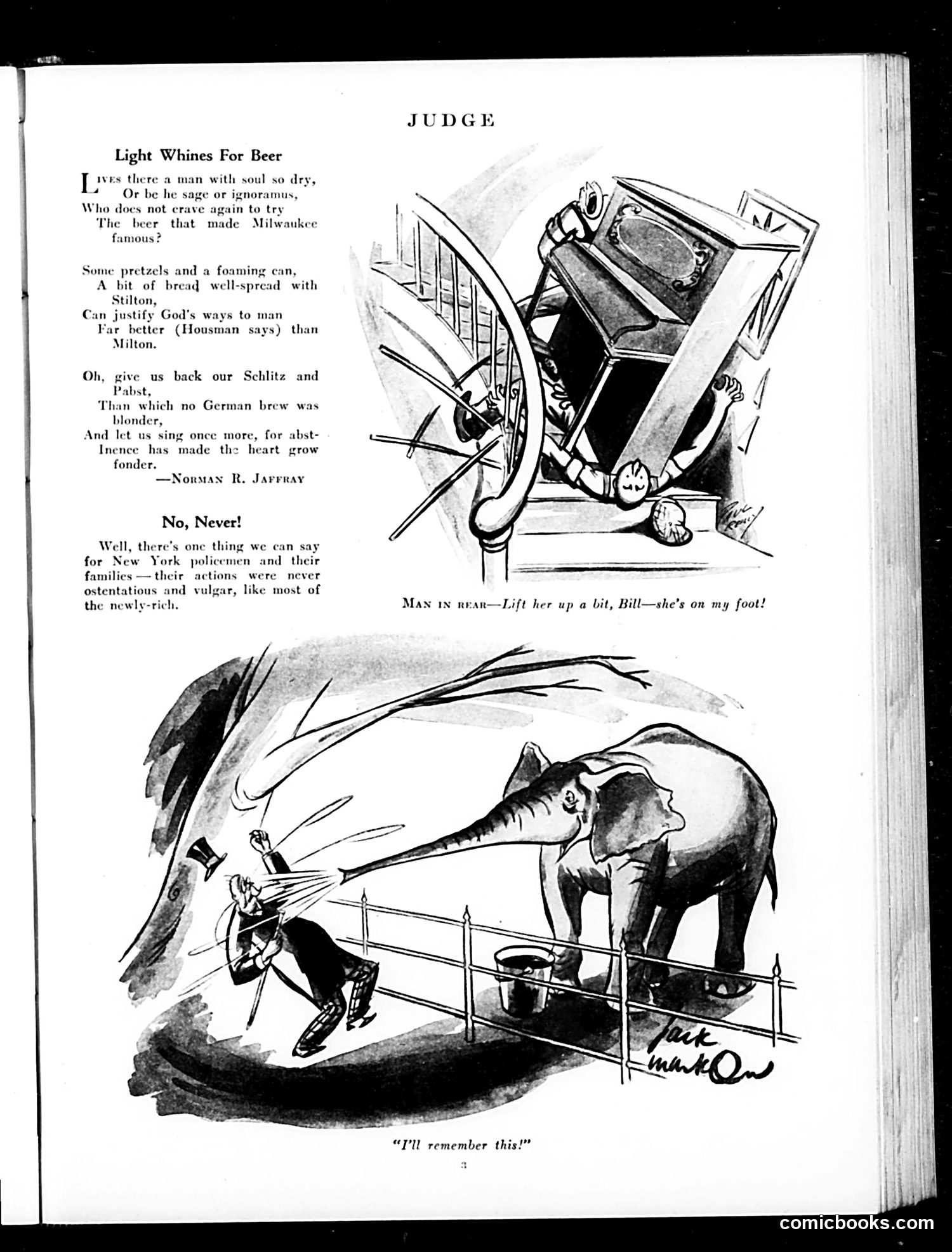
Analysis of Judge Magazine Page This page contains two satirical cartoons and a poem about beer. "Light Whines For Beer" is a poem by Norman R. Jaffray lamenting the decline of German beer quality, specifically mentioning Milwaukee beer (then famous for German immigrant breweries). The verses nostalgically reference Schlitz and Pabst brands while complaining that modern American beer lacks the character of authentic German brews. "No, Never!" criticizes New York police and their families for not being ostentatiously vulgar like "the newly-rich"—implying police maintained dignified, modest behavior despite their positions. The two cartoons below illustrate these themes: one shows a chaotic automobile scene, the other depicts a man struggling to control a large elephant, captioned "I'll remember this!"—likely satirizing difficulty controlling something powerful, possibly relating to Prohibition or regulatory challenges of the era.
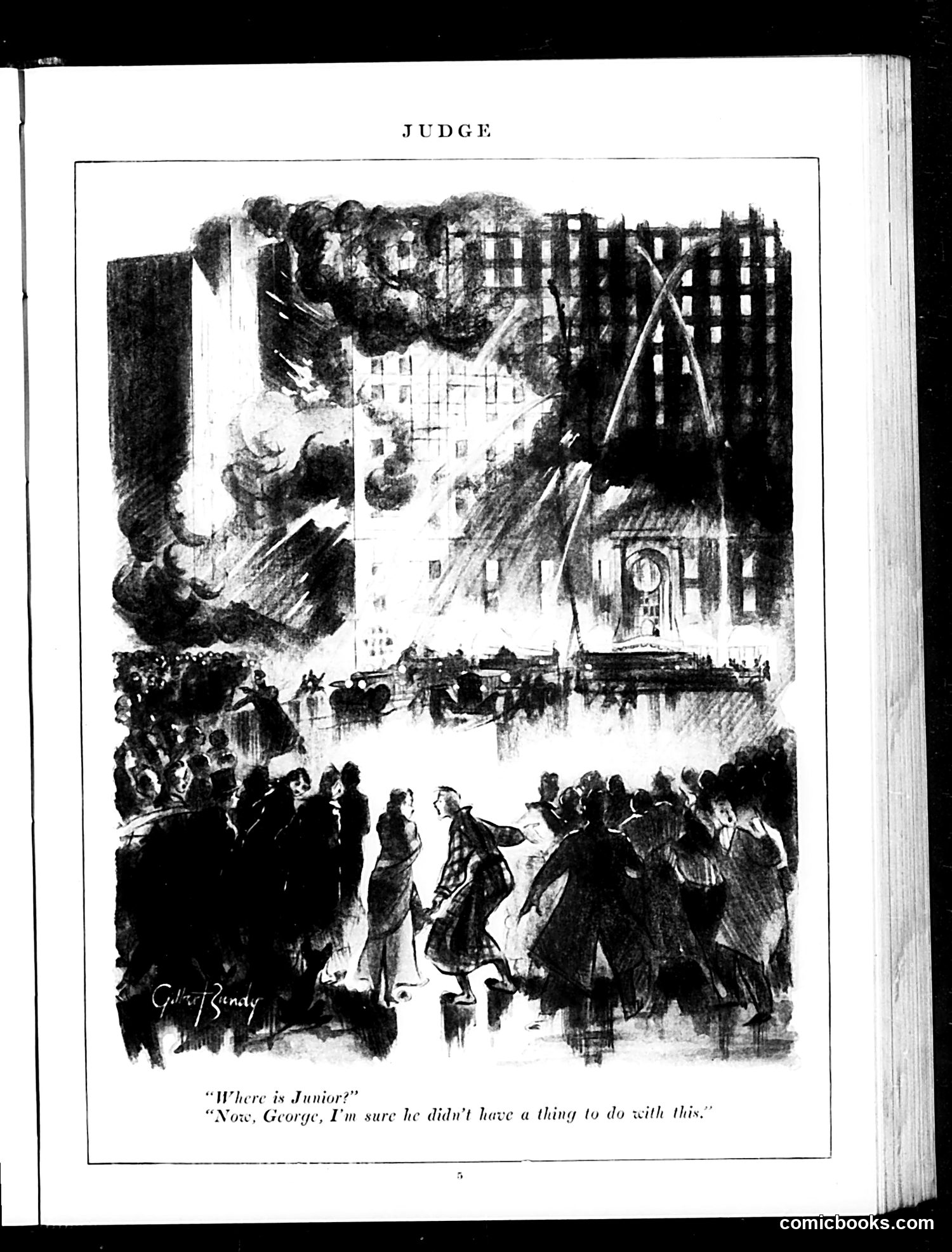
Judge Cartoon Analysis This cartoon depicts a public execution or lynching scene in an urban setting, with crowds gathered below tall buildings. The caption reads: "Where is Junior?" / "Now, George, I'm sure he didn't have a thing to do with this." The satire appears to target wealthy parents who shield their children from consequences for crimes. "Junior" (suggesting an upper-class son) has apparently committed a serious offense warranting execution, yet his mother assures "George" (the father) of the boy's innocence—a darkly ironic commentary on parental denial and class privilege. The cartoon critiques how wealthy families might use their social status to protect children from legal accountability, contrasting sharply with the grim execution scene. The joke's cruelty reflects Judge magazine's often harsh satirical approach to class and crime.
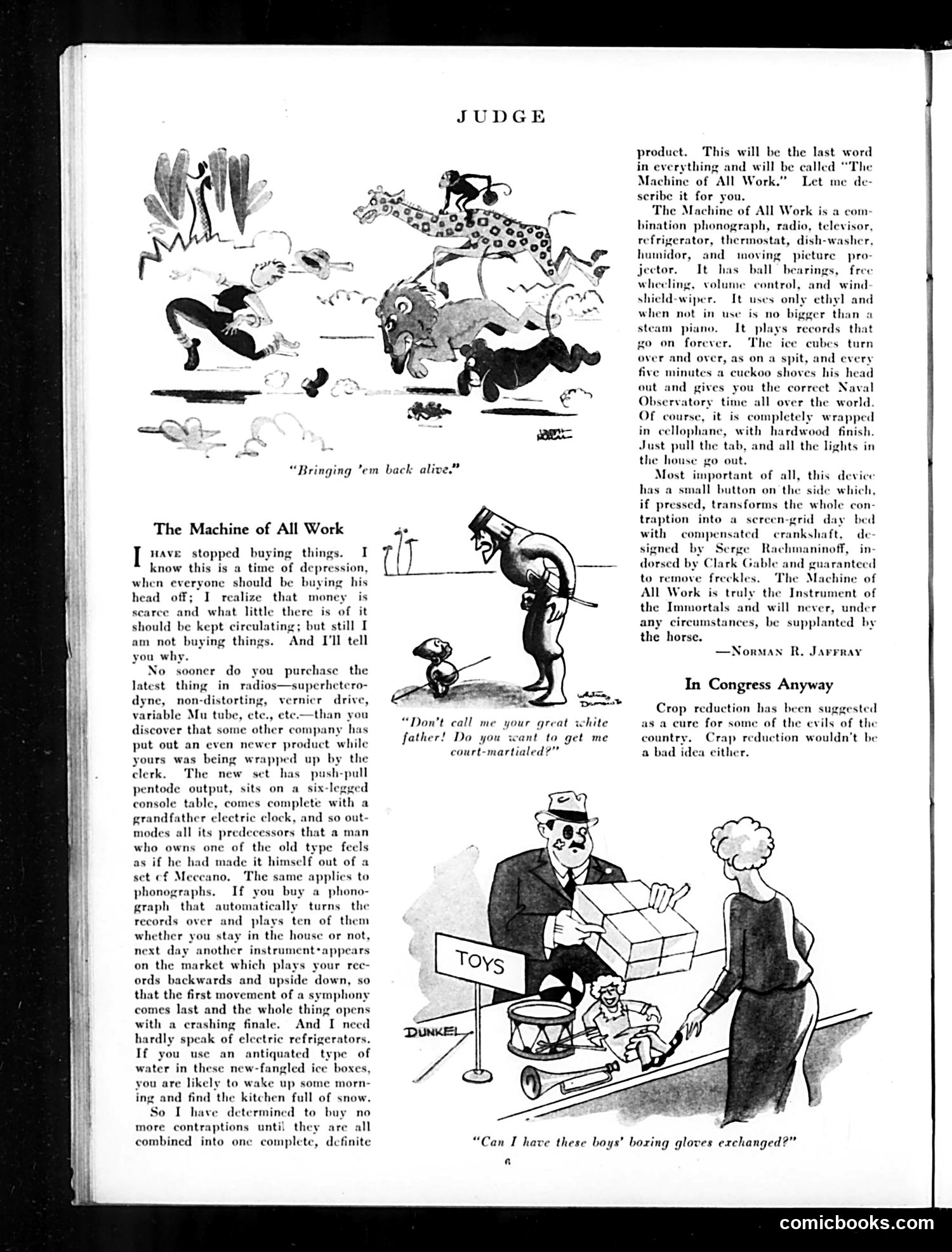
Analysis of Judge Magazine Page This page satirizes consumer culture during economic depression (likely 1930s). "The Machine of All Work" mocks the era's obsession with labor-saving gadgets. The author humorously describes an absurdly over-engineered contraption supposedly combining phonograph, radio, television, refrigerator, and other devices—all crammed into something the size of a steam piano. The joke is that consumers keep buying unnecessary gadgets despite financial hardship, hoping each new invention will solve problems. "In Congress Anyway" cartoon shows a toy merchant exchanging children's boxing gloves, satirizing crop-reduction policies. The pun suggests that while Congress debated agricultural reforms, ordinary people still faced economic struggle—the solutions felt as trivial as children's toys compared to real needs. Both items critique Depression-era thinking: blind faith in technology and government solutions failing ordinary citizens.
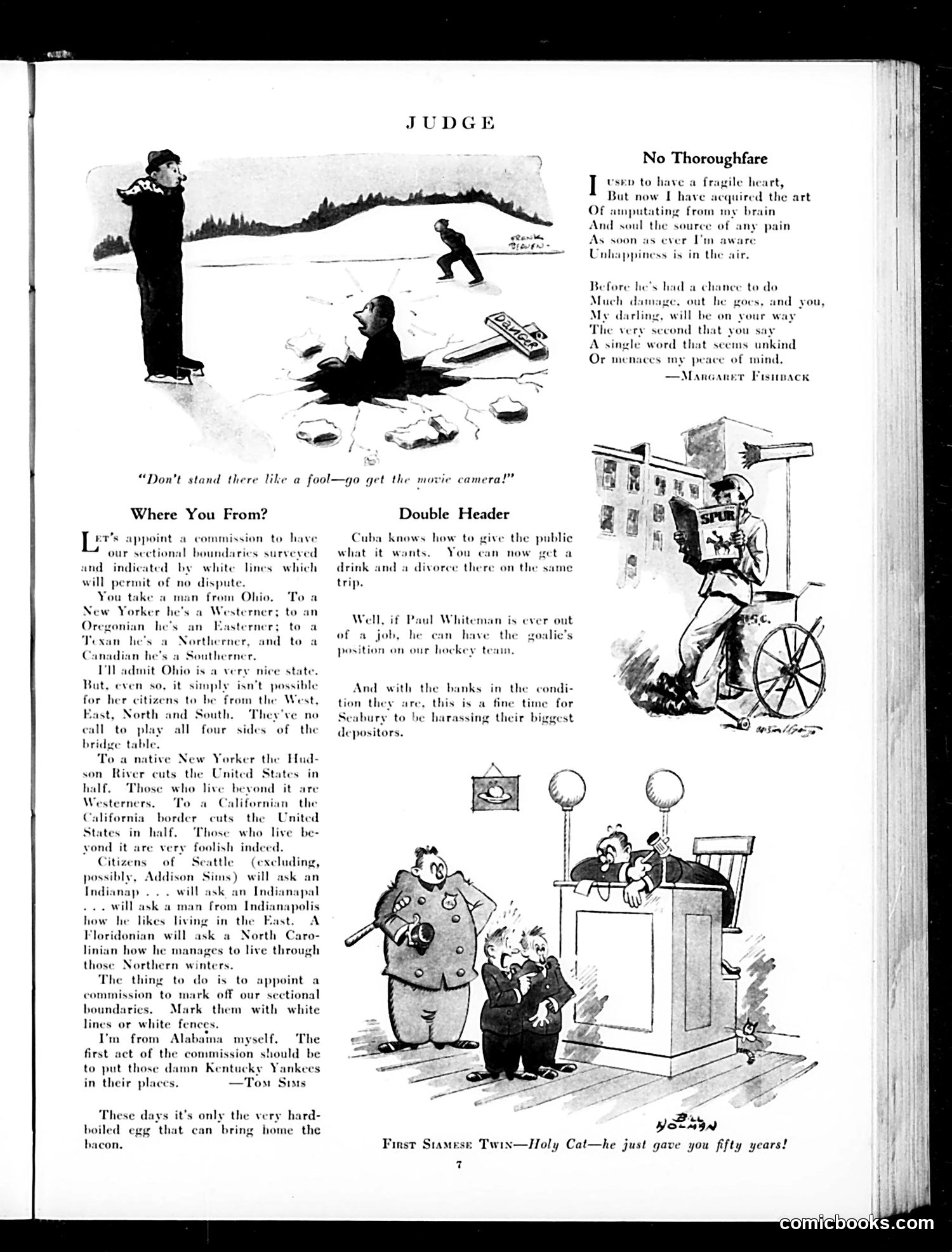
Judge Magazine Page Analysis This page contains three separate satirical pieces: "Where You From?" mocks American regional provincialism. The text jokes that citizens define the U.S. from their own perspective—New Yorkers think the Hudson River divides the country; Californians think their border does. The author (Tom Sims) proposes marking sectional boundaries with white lines to end confusion about regional identity. The satire targets parochial attitudes and the absurdity of regional superiority complexes common in early 20th-century America. "Double Header" makes three brief topical jokes: Cuba offering both alcohol and divorce (likely referencing post-Prohibition era tourism), Paul Whiteman (a famous bandleader of the 1920s-30s) becoming a hockey goalie, and banks harassing depositors during financial hardship. "No Thoroughfare" (poem by Margaret Fishback) and the cartoon about "Siamese Twins" satirize emotional detachment—the ability to amputate feelings and relationships instantly when they become uncomfortable, depicted as conjoined twins where one simply abandons the other after 50 years. The ice-fishing cartoon at top appears unrelated to the articles below it.
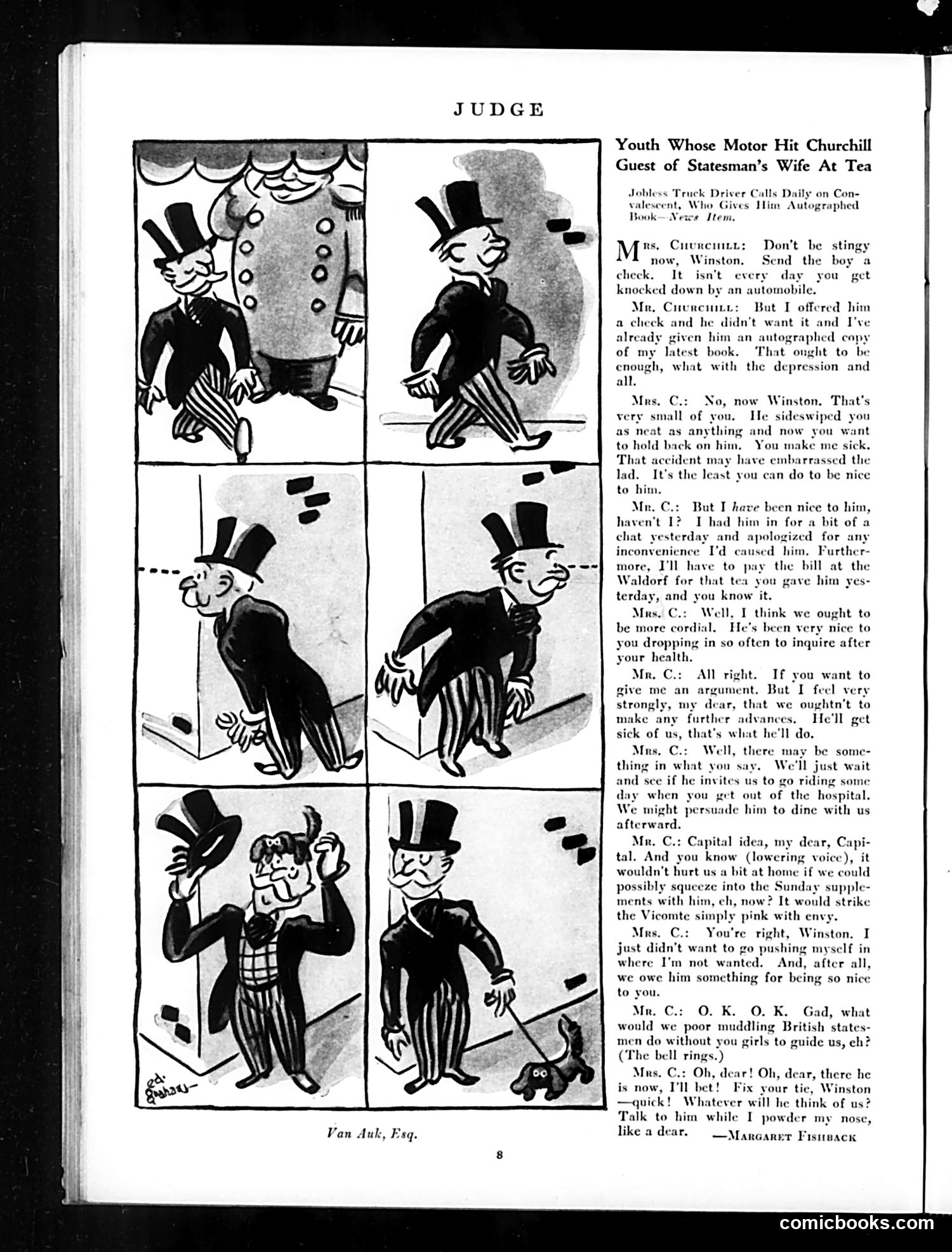
Judge Magazine Cartoon Analysis This cartoon satirizes the social pretensions and obsequiousness of the British upper class toward a young working-class man who accidentally hit Winston Churchill with a motor vehicle. The joke: Churchill and his wife are debating whether to give the jobless truck driver money beyond an autographed book and tea invitation. Mrs. Churchill insists on excessive generosity to avoid appearing stingy, while Winston resists—yet he's secretly delighted at the social opportunity to appear in the Sunday newspaper supplements with the young man, hoping to impress "the Vicomte" through envy. The satire targets aristocratic hypocrisy: their concern isn't genuine kindness but social status-climbing and newspaper publicity. The servant-and-master dynamic reverses—the wealthy Churchills anxiously prepare themselves for the working man's arrival, straightening ties and powdering noses. The cartoon ridicules how Britain's privileged class weaponizes charity as social currency, and how an accident creates an excuse for networking rather than genuine compassion.
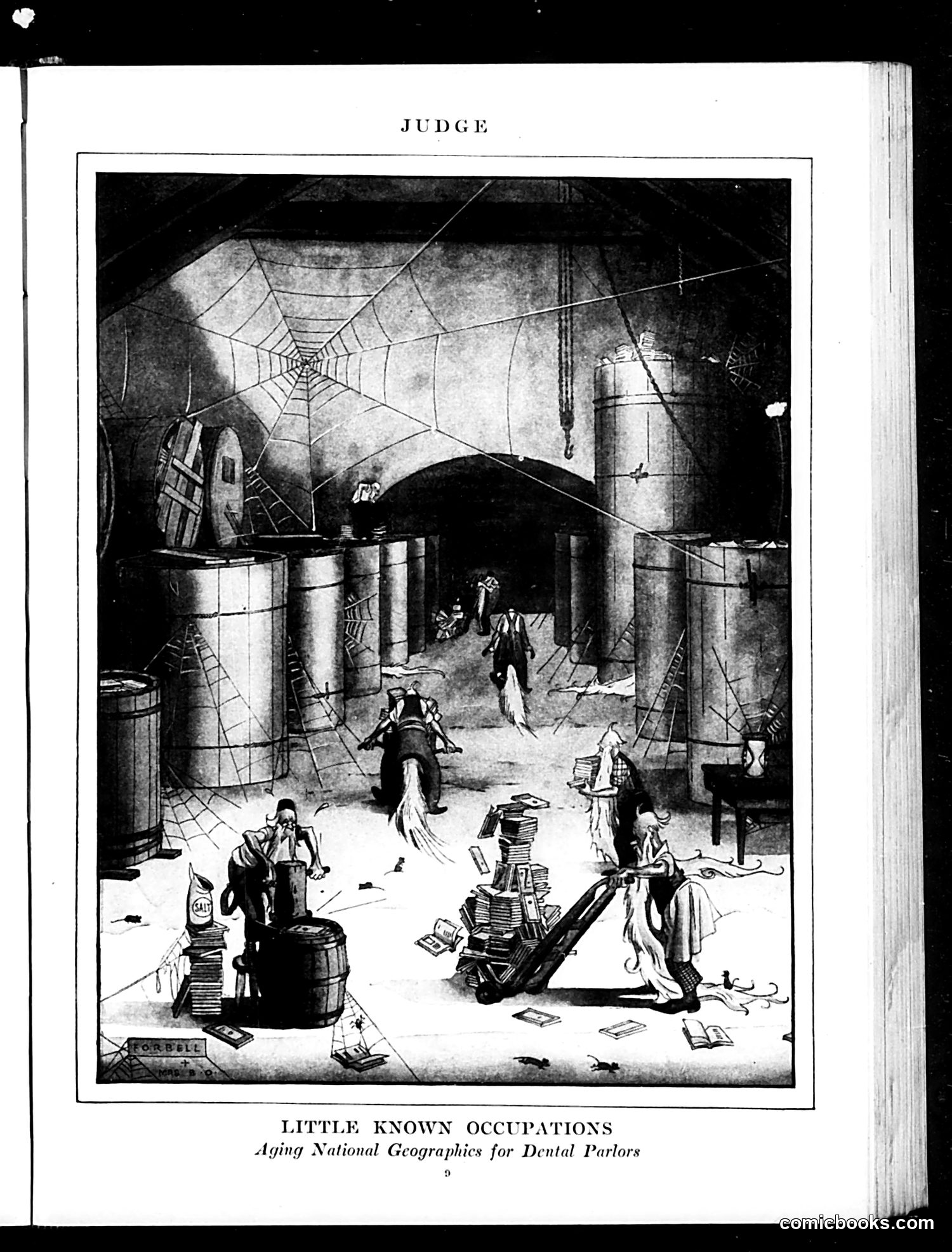
Analysis This satirical illustration depicts an underground or warehouse setting where figures are engaged in the absurd occupation of "aging National Geographics for Dental Parlors." The scene shows workers surrounded by stacks of magazines and papers, with large cylindrical storage containers and massive spider webs overhead. The joke targets a specific social observation: dental offices notoriously display outdated National Geographic magazines in their waiting rooms. Rather than dentists simply neglecting to update their reading materials, this cartoon humorously imagines it as an intentional *profession*—people deliberately age magazines to create that characteristically dusty, decades-old atmosphere found in dental waiting rooms. The spider webs reinforce this aesthetic of neglect and stagnation. It's satire about the standardized, unchanging nature of dental office décor and the universal experience of finding ancient magazines during dental visits.
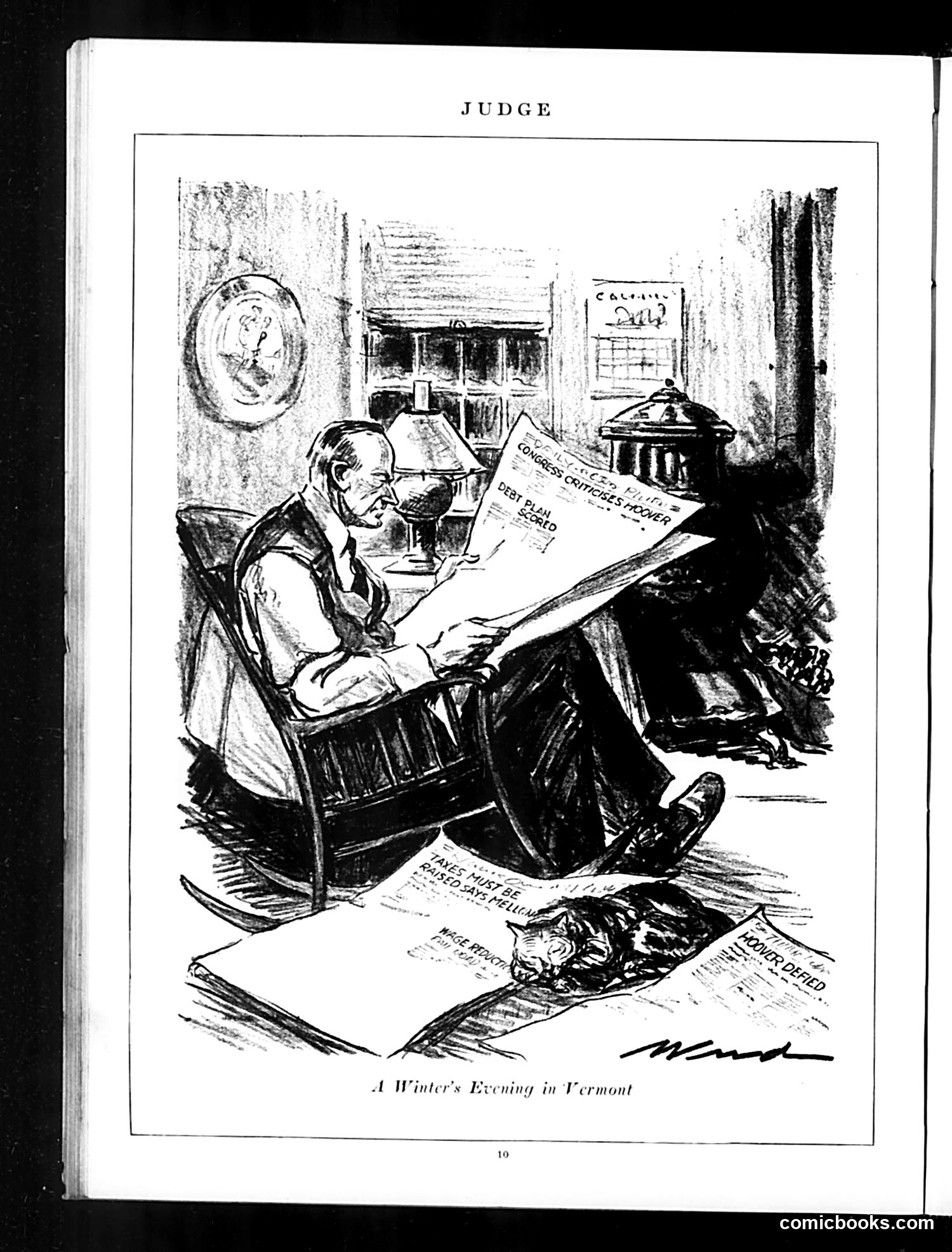
"A Winter's Evening in Vermont" This Judge cartoon depicts a seated man reviewing documents labeled with references to congressional critics and power—including what appears to be "Congress's Critters' Power" and other legalistic papers scattered around him. The setting suggests a Vermont winter evening (note the stove, window, and sparse interior). The satire likely targets a Vermont political figure or judge dealing with legislative scrutiny or criticism. The documents strewn about suggest bureaucratic burden or political pressure. The man's stern expression and focused reading posture convey his serious engagement with these matters. Without additional context about the specific date or Vermont figures involved, the exact identity and precise political reference remain unclear, though the cartoon clearly mocks someone's winter predicament navigating Congressional oversight.
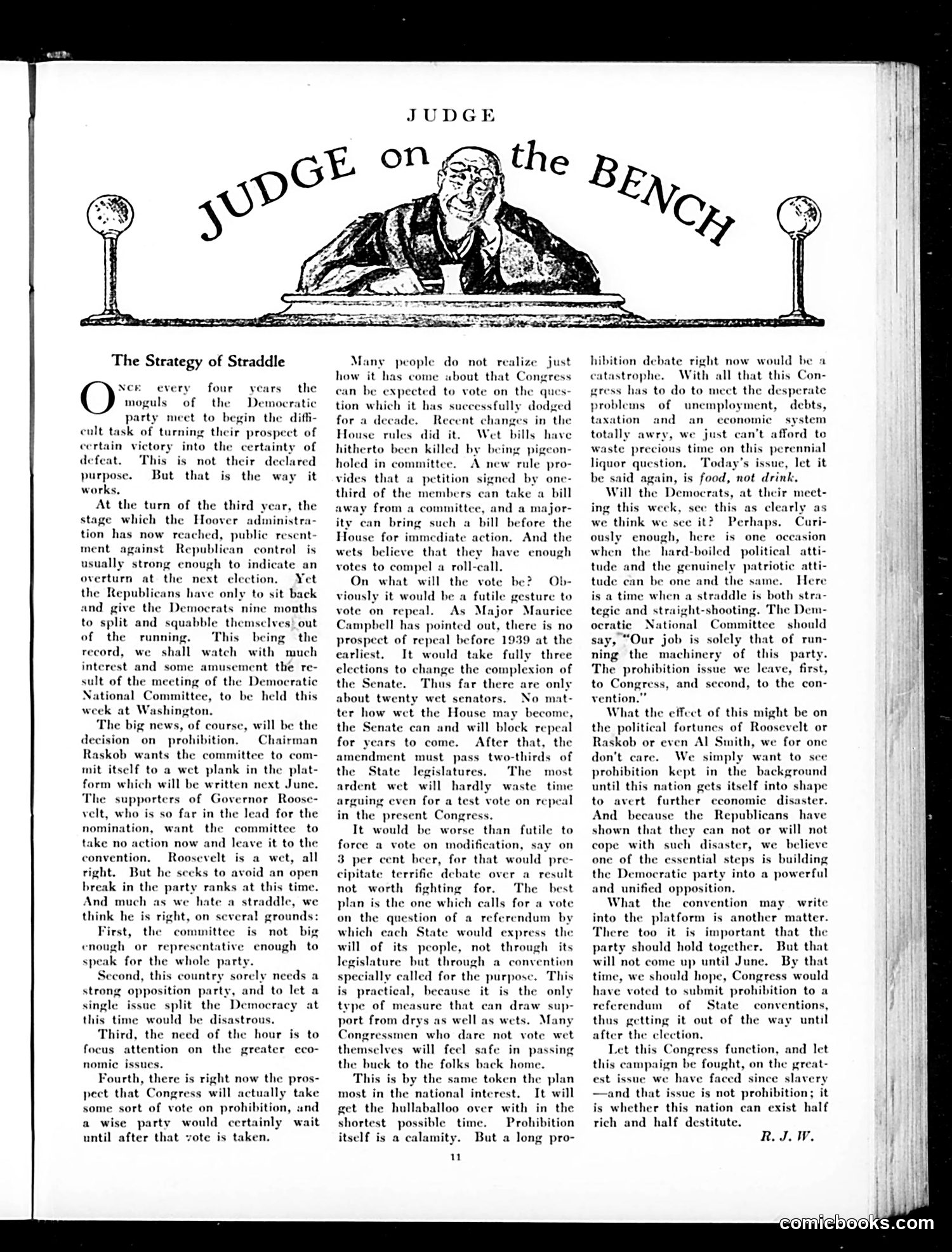
Judge Magazine: "The Strategy of Straddle" This editorial cartoon/article critiques Democratic Party dysfunction ahead of the 1932 election. The piece argues that while Republicans under Hoover face public resentment, Democrats consistently snatch defeat from victory through internal division. The specific dispute: whether the Democratic National Committee should commit to a "wet" (anti-prohibition) platform plank before the June convention. Chairman Raskob wants commitment now; front-runner Franklin D. Roosevelt prefers avoiding the issue until later. The author (signed "R.J.W.") supports Roosevelt's cautious "straddle" strategy, arguing that: - The committee lacks representative authority - A prohibition fight would fracture the party when it needs unity against Republicans - Congress may vote on prohibition anyway, making premature party division foolish The satire targets Democratic self-sabotage: their tendency to "split and squabble themselves out of the running" despite favorable conditions. The judge figure illustrates the editorial's role as commentary on political strategy.
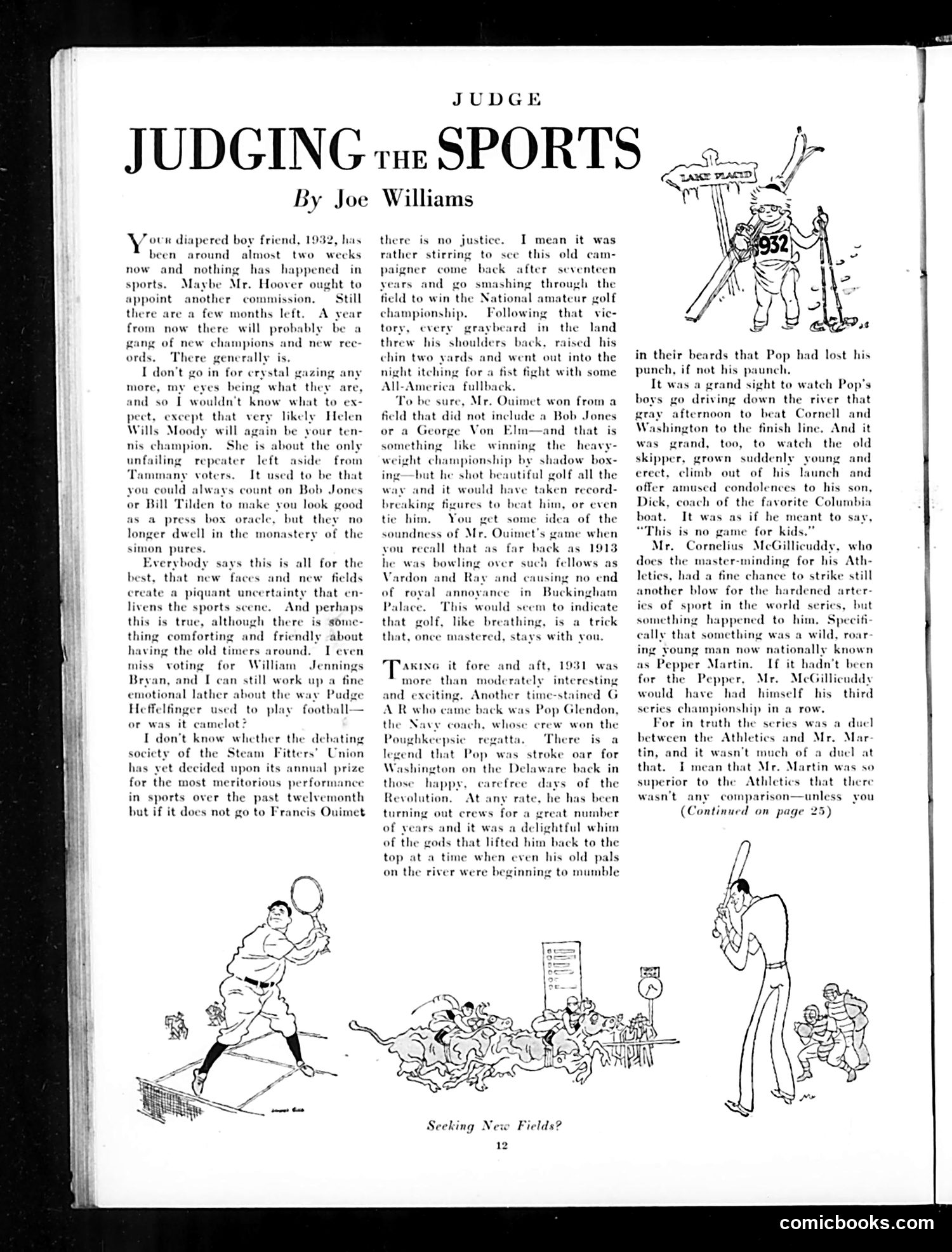
Judging the Sports: A 1932 Commentary Joe Williams's column celebrates comebacks in early-1930s American sports. The main figures discussed are: Francis Ouimet: A golfer who won the National Amateur Championship after a 17-year absence, impressing Williams with his skill despite facing weaker competition (without Bob Jones or George Von Elm). Pop Glendon: Navy's rowing coach whose crew won the Poughkeepsie Regatta (a prestigious college rowing competition). Williams humorously suggests Glendon rowed during the American Revolution, then praises him for reviving his competitive edge in old age. Helen Wills Moody: Tennis champion expected to repeat as champion—described as reliably consistent. The satire mocks the unpredictability of sports while celebrating older athletes' surprising resurgences. Williams suggests President Hoover should appoint a commission to address the sports "slump." The cartoon illustrations show various athletes in action. The piece nostalgically references retired champions (Bill Tilden, Bob Jones) while arguing that new uncertainty, though less comforting, keeps sports interesting.
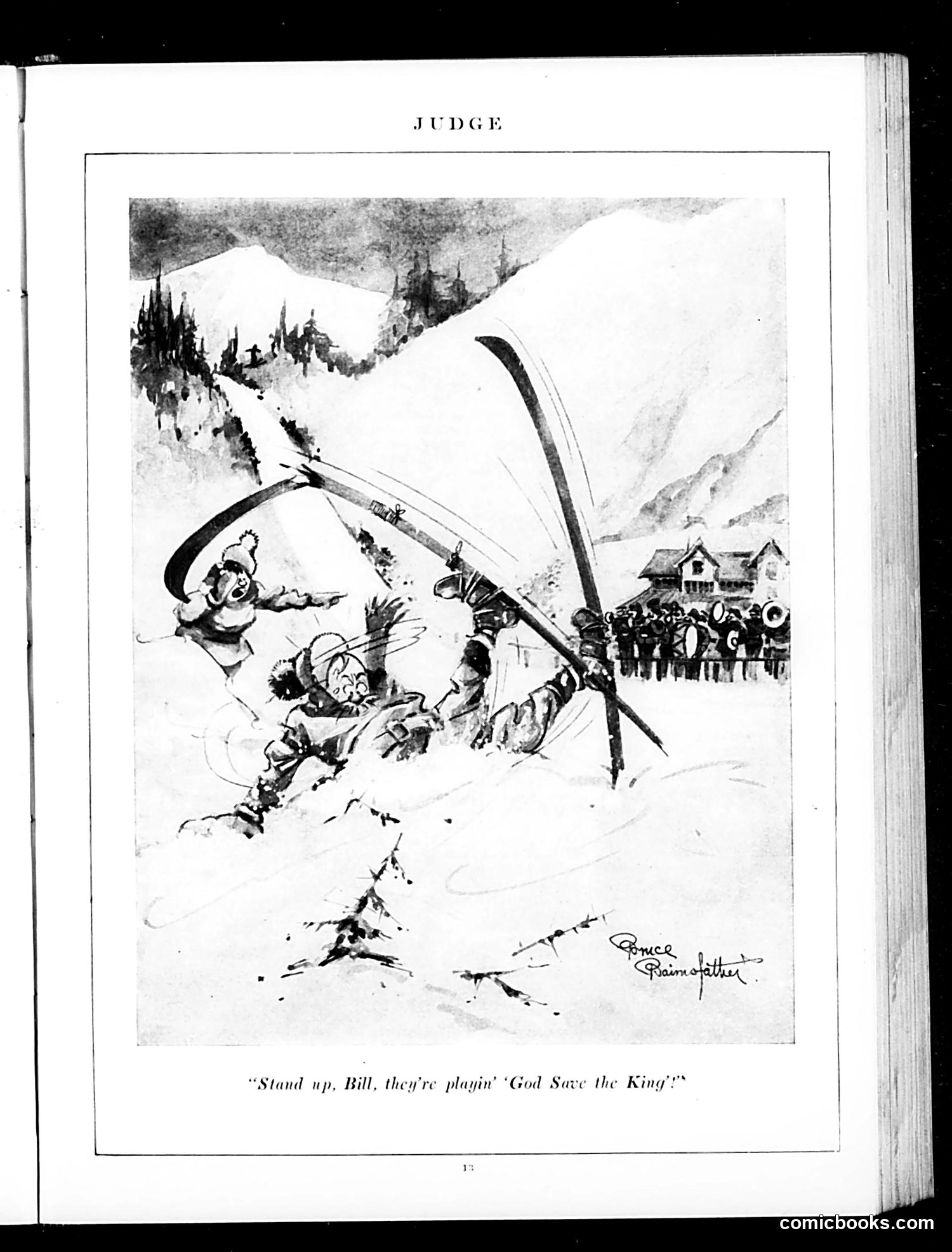
Judge Magazine Cartoon Analysis This satirical cartoon depicts a snowy Alpine scene where figures appear to be engaged in winter sports or conflict. The caption—"Stand up, Bill, they're playin' 'God Save the King'!"—suggests a British patriotic context, likely referencing WWI-era tensions. The cartoon appears to mock either British national sentiment or military conduct during winter warfare (possibly referencing Alpine/mountain campaign conditions). The figures' casual, undignified postures contrasted with the formal anthem create ironic humor about patriotism and dignity. The snow-covered mountains, distant castle-like structures, and gathered crowd in the background suggest a European military or conflict setting. Without precise dating visible on this page, the specific historical reference remains unclear, though the Union Jack reference and winter warfare setting suggest early 20th-century context.
This is a theater criticism column by Judge magazine's drama critic (likely George Jean Nathan, based on the byline). Nathan sarcastically defends dramatic critics against producer William A. Brady's claim that they misjudged celebrated plays. Nathan's satire operates through ironic reversal: Brady listed plays critics supposedly condemned but audiences loved (implying critics were wrong). Nathan agrees—but argues those plays were indeed *terrible*, so bad critics who praised them were the real failures. He extends this to plays critics liked, arguing some were equally awful. The piece reflects early 20th-century theater debates: conflicts between critics and commercial producers, anxiety about theatrical censorship (Nathan dismisses it as overblown), and the emerging threat of talking pictures to live theater's financial viability. The satire's punch relies on readers recognizing the specific plays referenced and understanding Nathan's reputation as a notoriously harsh, standards-driven critic willing to attack popular entertainment. His mockery of Brady is characteristic of Judge's mission: intellectual ridicule of commercial mediocrity.
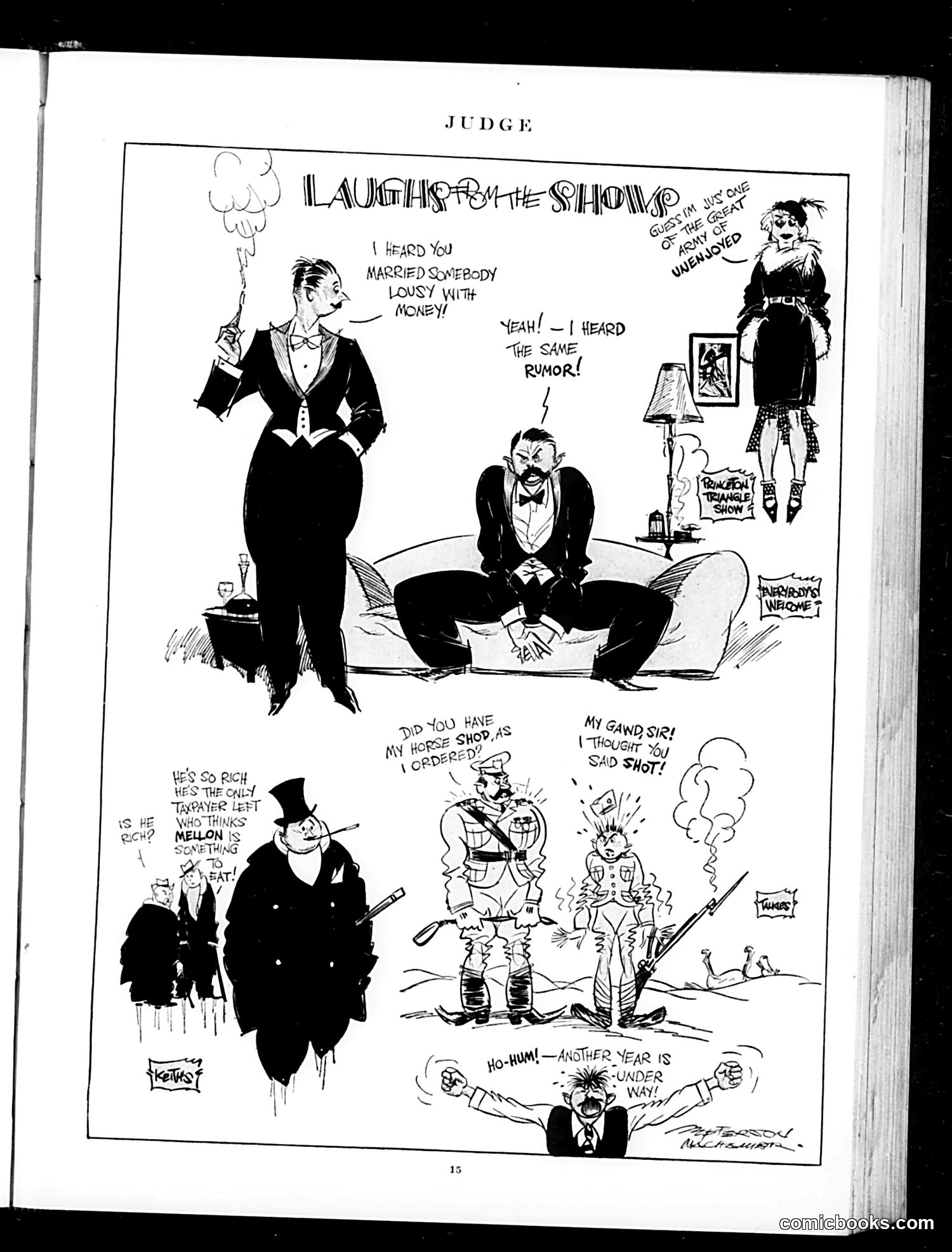
This page from *Judge* satirizes wealthy society and marriage for money. The main scene shows well-dressed men gossiping about someone marrying "somebody lousy with money"—suggesting marriages of convenience among the rich. A woman in fashionable dress stands nearby, reinforcing the social commentary on mercenary unions. Lower panels mock militarism and preparedness, with caricatured military figures and references to "another year is under way," likely commenting on arms buildup or military spending concerns of the era. One panel questions wealth itself ("He's so rich—he's the only thing that makes me rich...or is he?"), satirizing how the wealthy measure worth solely by money. The overall message critiques both society marriages and military industrial expansion as symptoms of materialistic excess.
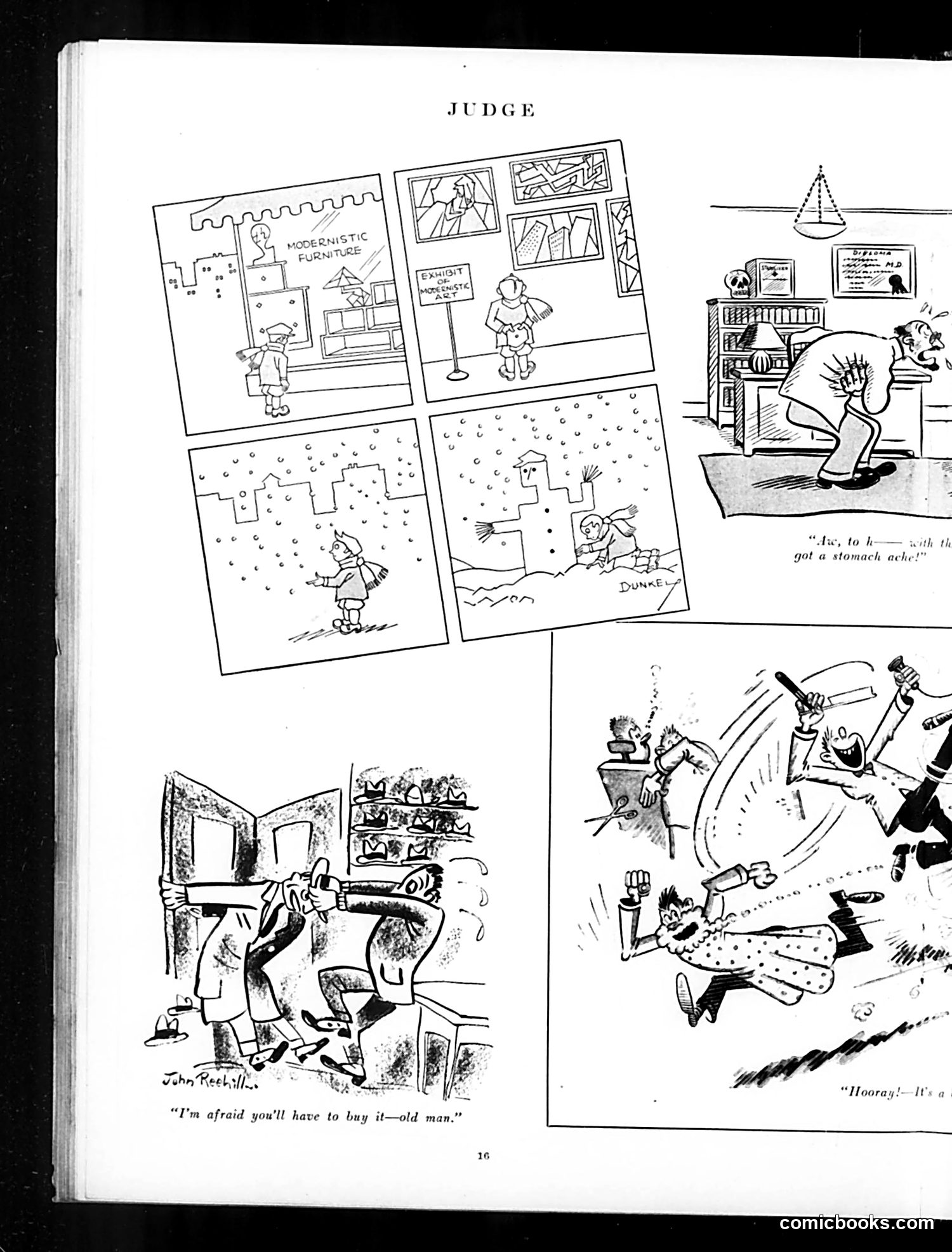
Page Analysis: Judge Magazine - "Judge" This page contains three separate cartoon gags satirizing early 20th-century life: 1. Top left: A four-panel comic about modernistic furniture—showing a child and adult examining abstract, geometric pieces in a showroom, then the child playing outside in rain, suggesting the impractical nature of avant-garde design trends. 2. Top right: A judge in his office with stomach troubles, complaining to someone, mocking judicial authority's vulnerability to common ailments. 3. Bottom: Two cartoons—one about expensive home repairs ("I'm afraid you'll have to buy it, old man") and another celebrating what appears to be a sports victory ("Hooray!—It's a..."). The humor targets contemporary concerns: trendy furniture fads, judicial pomposity deflated by physical discomfort, and home maintenance costs. The style and subject matter suggest satire of 1920s-30s American middle-class anxieties and consumer culture.
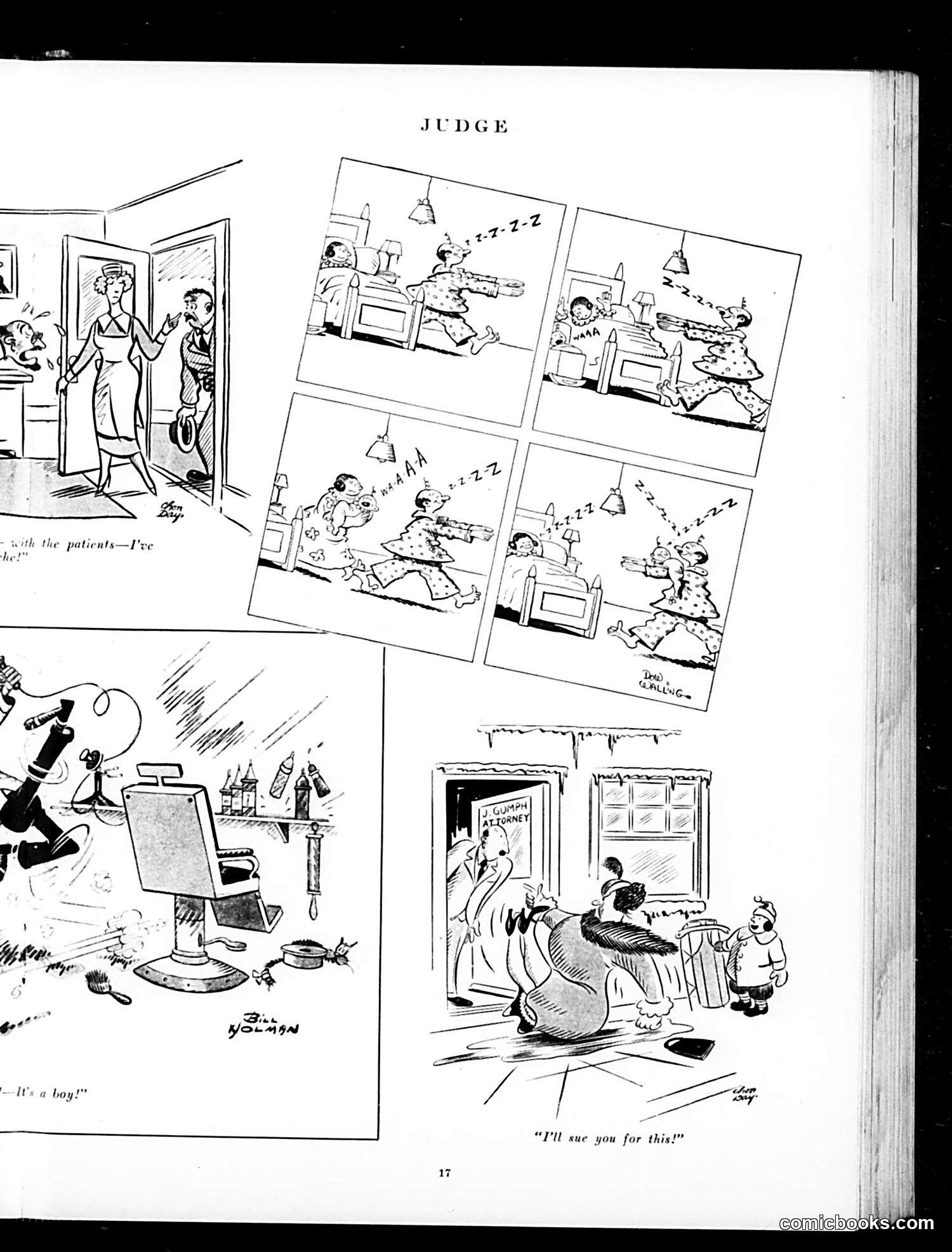
Analysis of Judge Magazine Page This page contains multiple cartoons satirizing domestic life and legal matters. The title "JUDGE" appears at top, and the main cartoon at bottom shows a woman confronting a man at a lawyer's office door with the caption "I'll sue you for this!" — likely depicting marital discord or a domestic dispute escalating to legal action. The four-panel sequence in the upper right depicts a woman repeatedly striking a sleeping man with increasing violence (indicated by "Z"s suggesting snoring), suggesting commentary on domestic quarrels or spousal frustration. Other panels appear to reference courtroom/legal scenarios. The cartoons collectively mock marriage conflicts, legal disputes, and domestic tension—common satirical targets in early-to-mid 20th century humor magazines. The specific legal or personal grievances referenced are unclear without additional context.
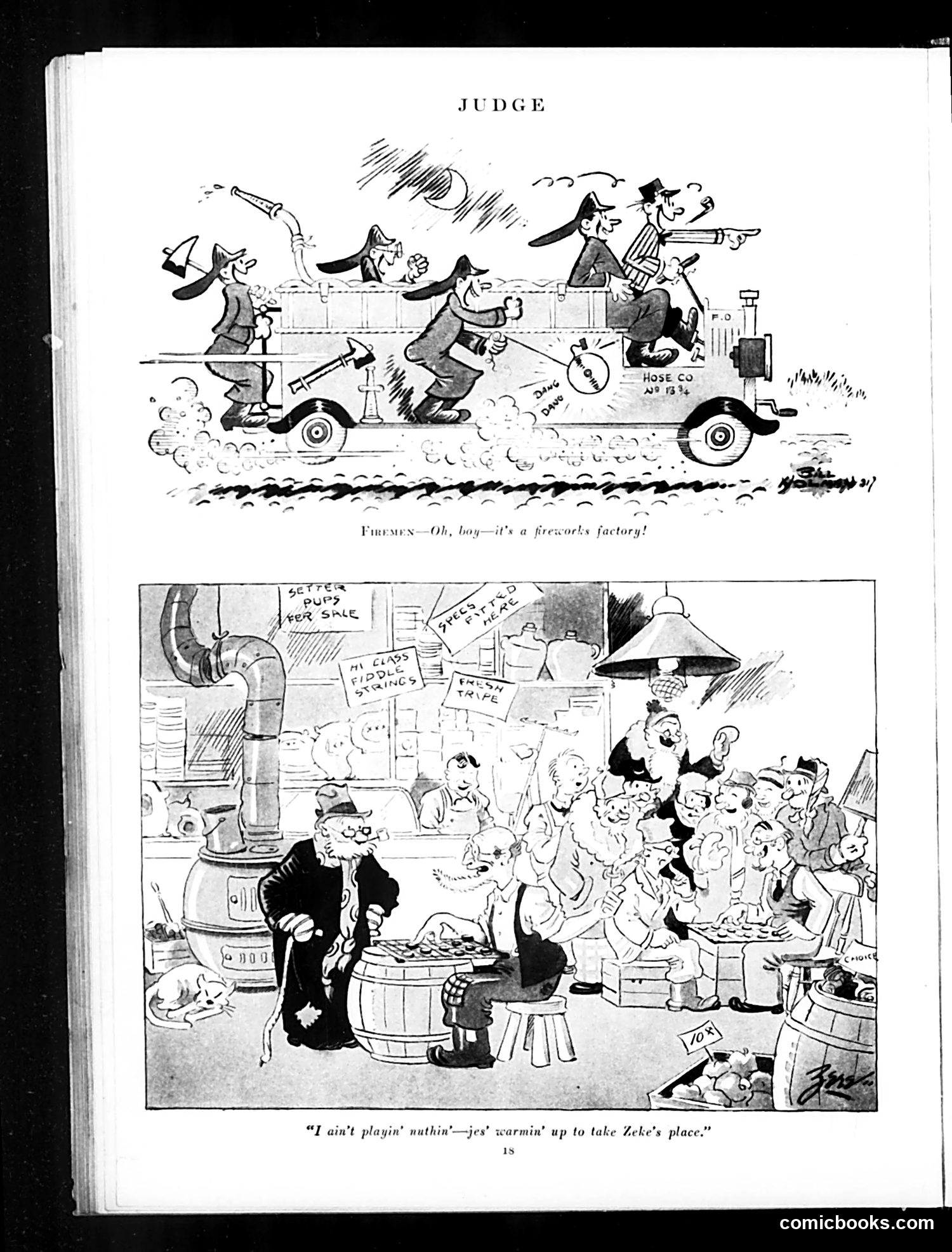
Analysis of Judge Page Top Cartoon: Depicts firefighters in a chaotic scene labeled "Hose Co" riding in a vehicle. The caption "Firemen—Oh, boy—it's a fireworks factory!" suggests they're responding to an explosion or dangerous fire. The exaggerated chaos and mayhem satirizes either firefighting incompetence or the dangerous conditions these workers face. Bottom Cartoon: Shows a crowded indoor gathering where someone states "I ain't playin' nuthin'—jes' warmin' up to take Zeke's place." This appears to satirize workplace or organizational succession—someone positioning themselves to replace a colleague ("Zeke"). The cramped, casual setting suggests informal workplace dynamics or competition among workers. Both cartoons use caricature and exaggeration typical of Judge's satirical style, targeting working-class situations and organizational humor popular in early-to-mid 20th century American satire.
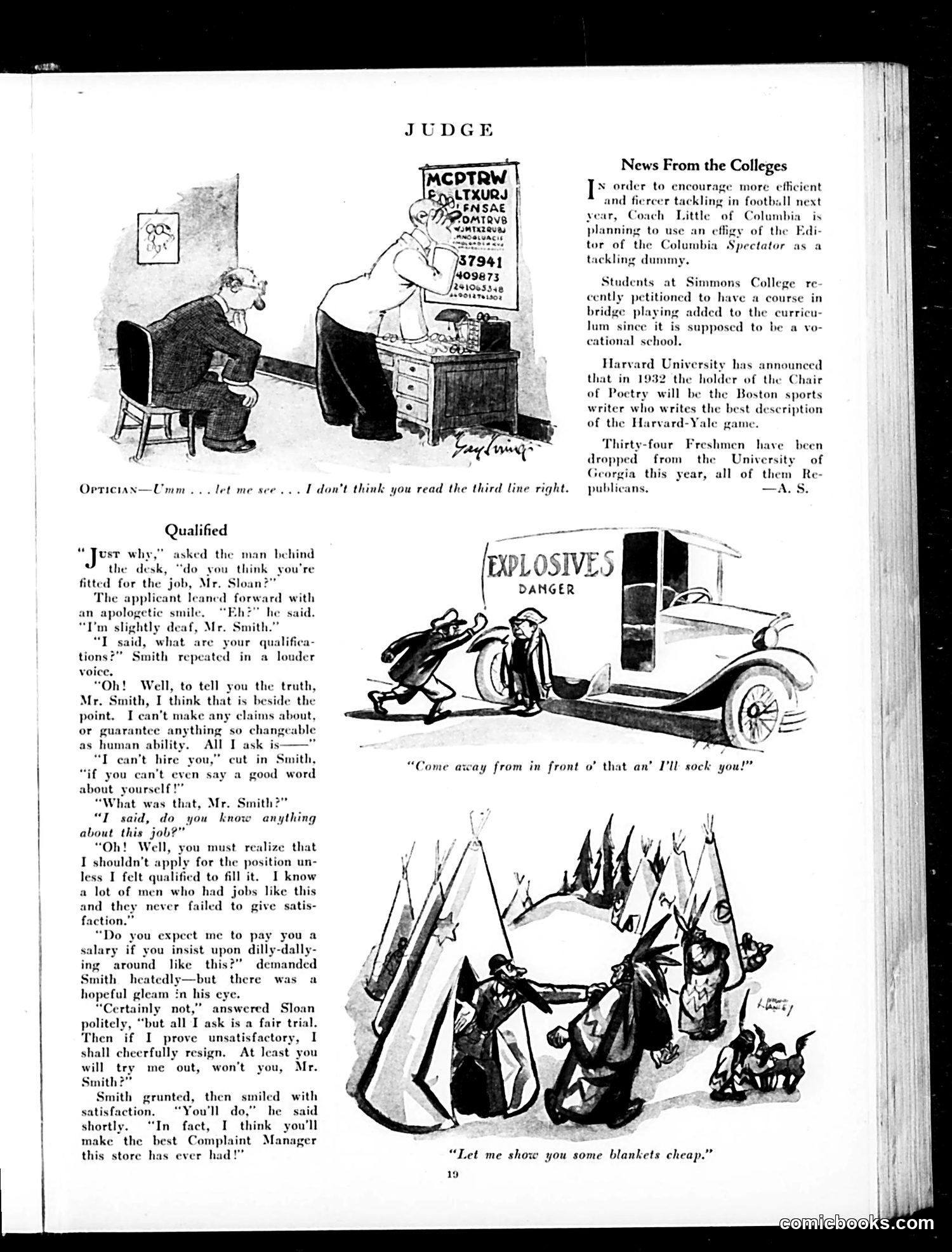
Judge Magazine Page Analysis This page contains three separate satirical pieces: "Qualified" is a dialogue joke about job interview absurdity. A deaf applicant (Mr. Sloan/Smith) misunderstands questions due to his hearing loss but ironically argues that his inability to perform the job shouldn't disqualify him—he just needs a "fair trial." The employer, amused by this backwards logic, hires him as a Complaint Manager, suggesting the position is so undesirable that someone utterly unfit is perfect for it. The two cartoon illustrations (top right and bottom) appear to be unrelated visual gags: one shows an explosives truck with someone threatening violence, the other depicts what appears to be a Native American camp with someone selling blankets. "News From the Colleges" offers satirical brief items about university life—using tackling dummies shaped like editors, adding bridge-playing to vocational curricula, and appointing sports writers as poetry chairs—mocking academic pretension and relevance. The humor relies on absurdist logic and institutional critique typical of 1920s-30s satire.
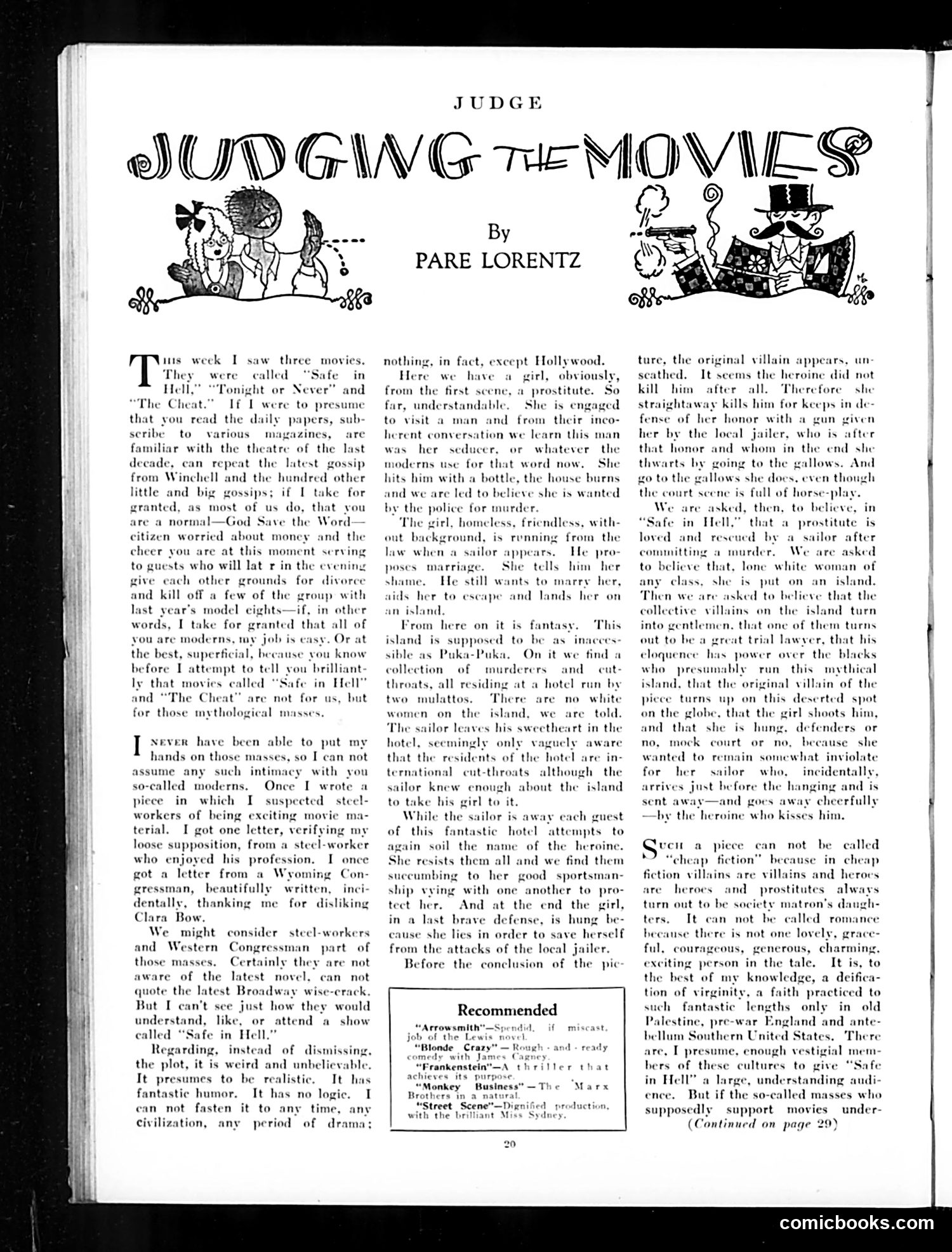
Judging the Movies: Pare Lorentz's Critique of "Safe in Hell" This is a film review column by Pare Lorentz, a prominent American critic and documentarian. He critiques three contemporary films, focusing on "Safe in Hell," which features a prostitute fleeing murder charges who finds refuge on a remote island populated by criminals and murderers. Lorentz's satire targets both the film's absurd plot and Hollywood's condescension toward "the masses"—working-class audiences he claims the industry assumes are unsophisticated. He notes the film's illogical premises: why would a sailor knowing the island harbors cutthroats leave his fiancée there? The heroine ultimately hangs herself to preserve her honor—a melodramatic ending Lorentz finds ridiculous and disconnected from any recognizable reality or moral framework. His broader point: such "fantastic" narratives insulting to average viewers represent Hollywood's fundamental disrespect for its audience.
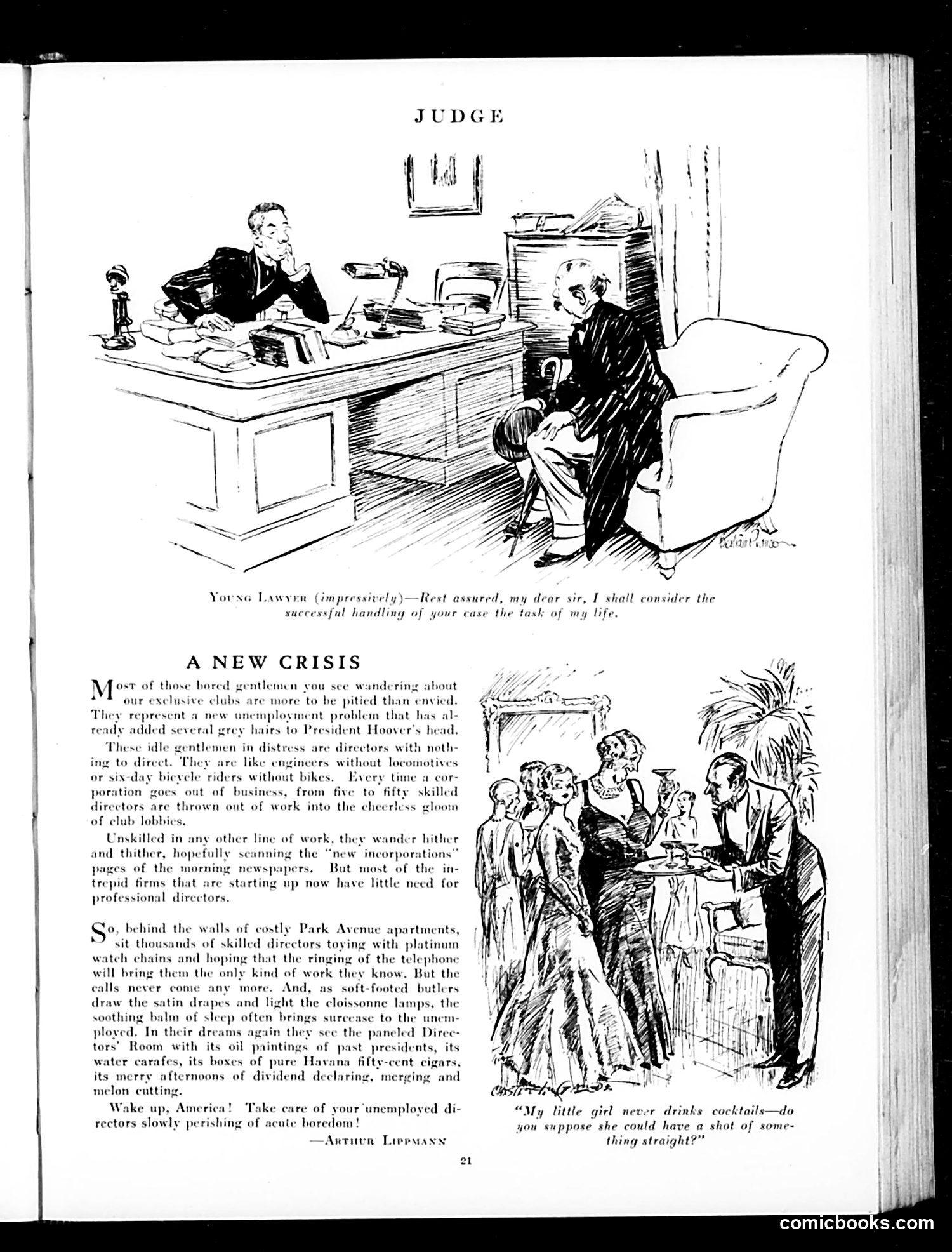
Judge Magazine Satire Analysis This page satirizes wealthy unemployment during the Great Depression. The top cartoon shows a young lawyer confidently assuring a client in a judge's office—a simple joke about legal overconfidence. The main article, "A New Crisis," mocks the plight of unemployed corporate directors from exclusive Park Avenue clubs. These are highly specialized professionals—useless outside boardrooms—now idle as corporations fail. The satire is pointed: while ordinary Americans starve, wealthy directors suffer only "acute boredom," napping in luxury apartments, dreaming of dividend meetings and expensive cigars. The closing illustration depicts a socialite; the caption's joke about a young girl drinking "something straight" (implying hard liquor rather than cocktails) satirizes Prohibition-era hypocrisy among the elite. Written by Arthur Lipmann, this is Depression-era social commentary targeting the absurdity of privileged-class suffering during national crisis.
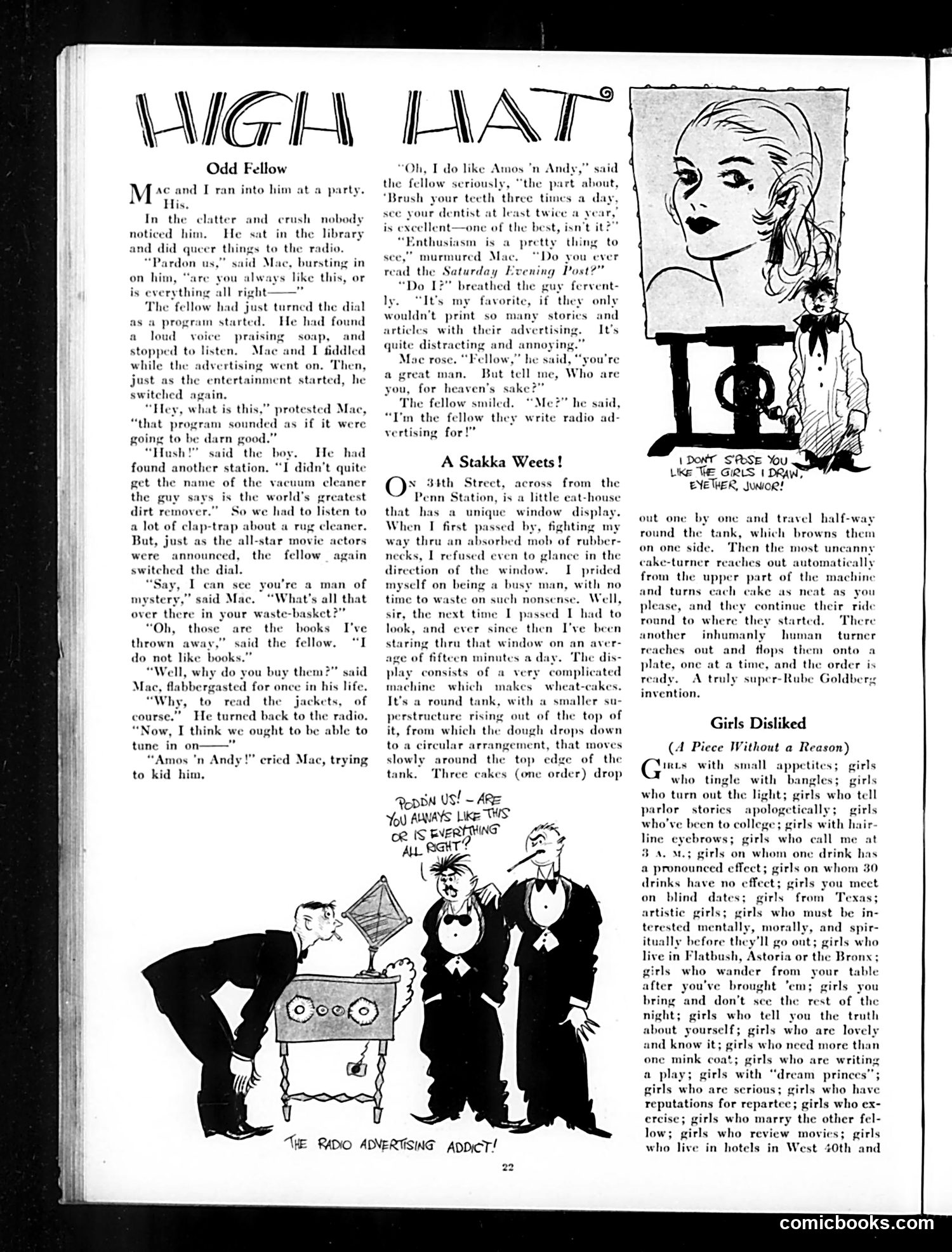
Analysis for Modern Readers This page contains three satirical pieces from *Judge* magazine: "High Hat" (top): Mocks a radio-obsessed fellow who constantly switches stations, valuing only advertisements and commercial jingles over actual programming. The joke: he's so addicted to ads that he discards books and ignores entertainment—he exists solely for commercial content. This satirizes 1920s-30s radio culture and emerging advertising dominance. "A Stakka Weets!" (middle): Describes an automated cake-making machine visible through a restaurant window—likely a Rube Goldberg-style contraption that fascinates passersby. The humor lies in the absurdist mechanical spectacle and public mesmerization by novelty machinery, typical of Depression-era fascination with automation. "Girls Disliked" (bottom): A list poem critiquing various female stereotypes and behaviors—from physical traits (small appetites, thin eyebrows) to social habits (college girls, excessive drinkers, those from specific regions). This reflects period misogyny and social anxiety about changing women's roles. All three pieces mock modern consumer culture, technology obsession, and social pretension.
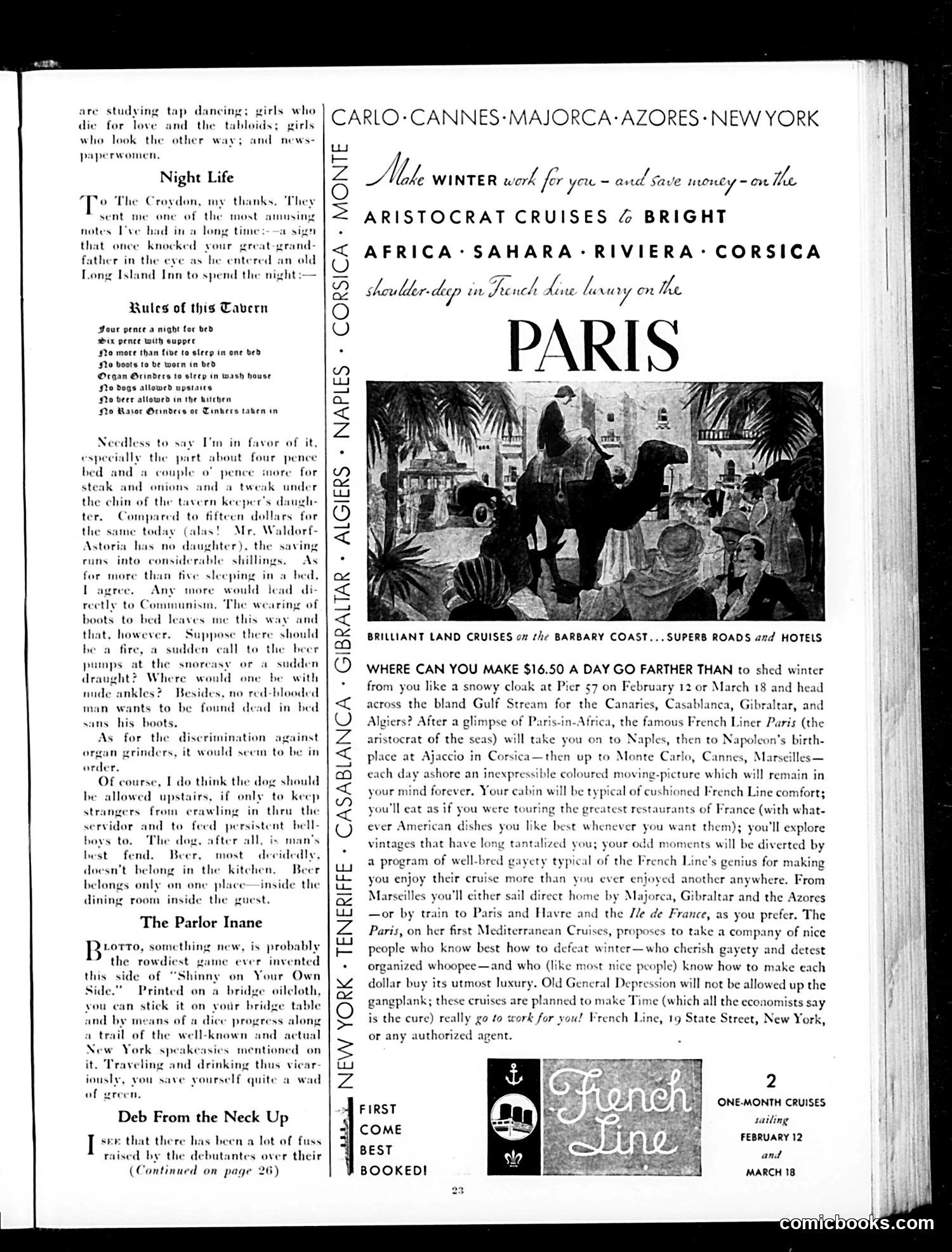
Judge Magazine Page Analysis This page is primarily travel advertising rather than political satire. The dominant content features a French Line cruise advertisement promoting Mediterranean voyages departing February 12 and March 18. The left column contains brief social commentary pieces titled "Night Life," "Rules of this Tavern," "The Parlor Inane," and "Deb From the Neck Up." These appear to be humorous observations about contemporary leisure activities and class behaviors—tavern etiquette, a speakeasy-themed board game called "Beer," and debutante culture. The photograph shows elegantly dressed passengers aboard a cruise ship, reinforcing the luxury travel pitch. The satire is mild and lifestyle-focused rather than political. References to "Communism" and sleeping arrangements mock working-class practices versus upper-class comfort. The "Deb From the Neck Up" headline (incomplete on this page) likely satirizes superficial debutante society. Overall, this is a society/leisure-focused issue blending humor with luxury advertising for affluent readers.
"Judging the Books" - A Critique of Philip Guedalla's Wellington Biography This book review column ridicules author Philip Guedalla for his massive quarter-million-word biography of the Duke of Wellington. The critic had previously dismissed Guedalla as a stylistic charlatan trading in ephemeral tricks and literary affectation. Now, stung by such criticism, Guedalla has produced this ponderous tome. The reviewer's satire cuts two ways: he acknowledges Guedalla retained his witty style while abandoning his dilettante tricks, yet argues the book is exhausting to read and ultimately offers little value to American audiences unfamiliar with Wellington. The critic uses the comparison that praising this work to an Englishman would be like praising a Thomas Beer portrait of U.S. Grant—technically skilled but culturally irrelevant to the audience. The point: even reformed hacks produce bloated, pointless books.
"Judging the Sports" – Judge Magazine Commentary This page contains sports commentary (continued from page 12) alongside a full-page advertisement for a new American Telephone & Telegraph teletypewriter service. The sports section discusses 1931 baseball and horse racing. The author praises Pepper Martin (baseball player) and especially Twenty Grand, a racehorse owned by Mrs. Payne Whitney, comparing the latter favorably to the legendary Man o' War. The commentary humorously notes Twenty Grand's enormous appetite and suggests training through overindulgence has appeal for sedentary people. The piece also references Jimmy Walker (New York mayor, known for extravagance) and makes a joking reference to preparing to cover Top Flight, a young racehorse expected to succeed Twenty Grand. The advertisement announces AT&T's new teletypewriter service allowing subscribers to communicate via typewritten messages across distance—essentially an early precursor to modern data transmission, positioned as revolutionary for business communication.
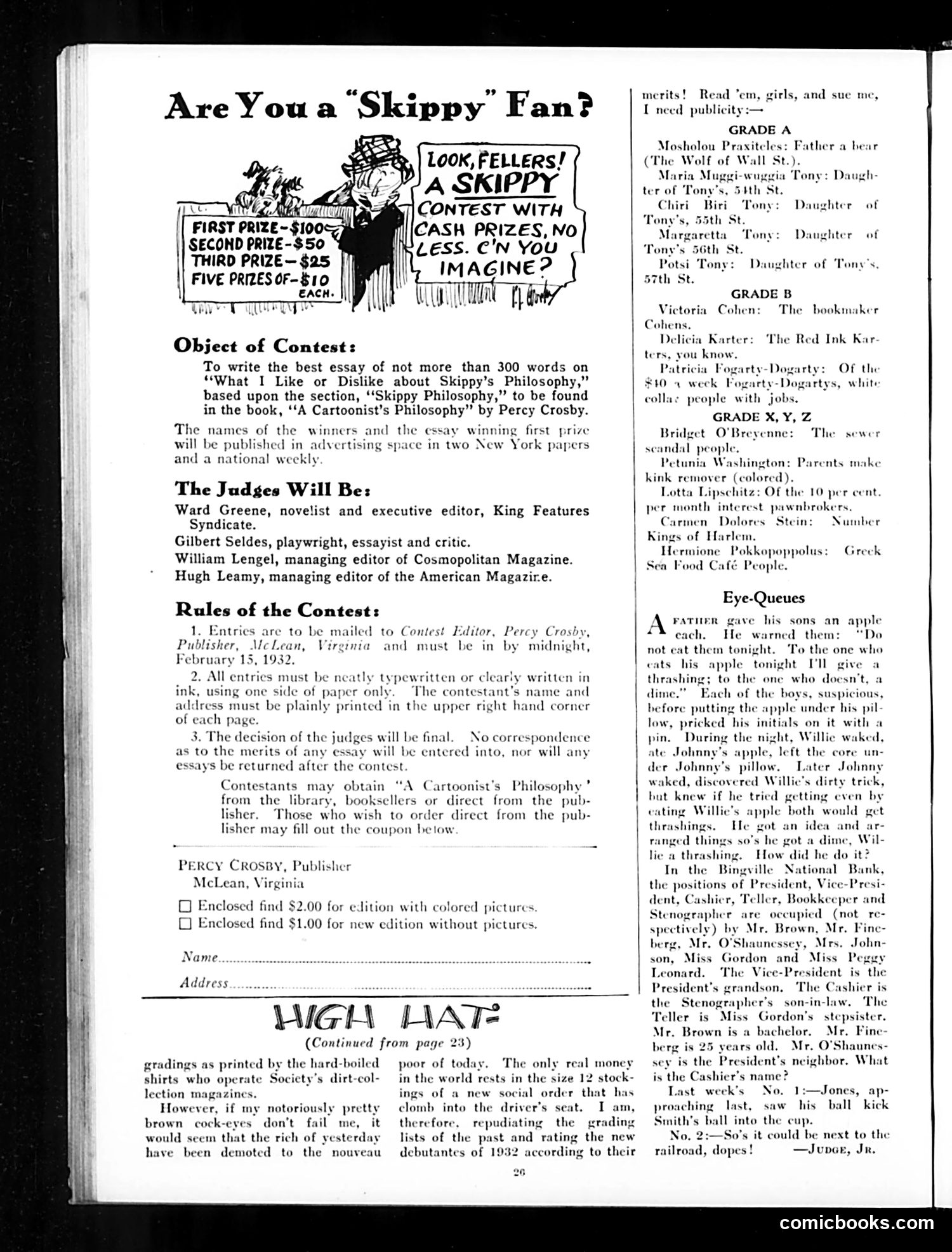
"Skippy" Contest and Related Content This page announces a writing contest for "Skippy" fans, offering cash prizes ($100 first prize) for essays about "Skippy's Philosophy" from cartoonist Percy Crosby's book. The cartoon shows Crosby promoting the contest with typical 1930s advertising language ("Look, fellers!"). The page includes judges from major magazines (Cosmopolitan, American Magazine, etc.), indicating this was a significant promotional effort. Below are unrelated puzzle/humor features: "High Hat" (continued from another page) contains satirical commentary on wealth and class, with a condescending tone about "the poor of today." The "Eye-Queues" section offers logic puzzles and riddles—common filler content in periodicals. The "Skippy" reference was timely—Percy Crosby's comic strip was hugely popular in the 1930s, making a contest around it effective marketing for Judge magazine itself.
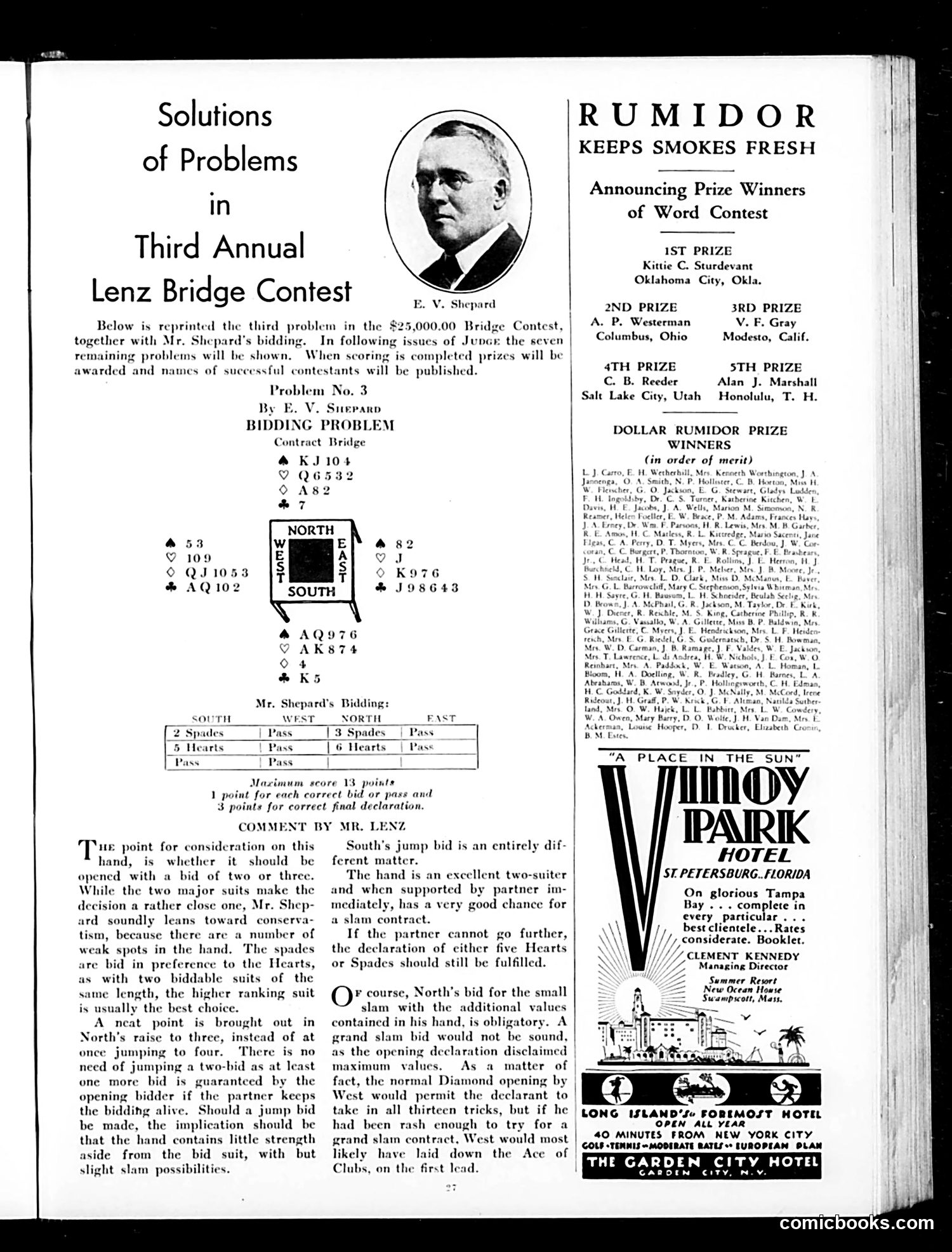
Analysis of Judge Magazine Page This page is primarily advertising and contest results, not a political cartoon. The main content consists of: Bridge Problem & Commentary: A Contract Bridge instructional feature by E.V. Shepard, showing bidding strategy for the "Third Annual Lenz Bridge Contest." Shepard analyzes hand-bidding decisions, emphasizing conservative play with weak spots versus aggressive slam bids when partner support is strong. Contest Winners: Results from a "Word Contest" sponsored by Rumidor (a cigar humidor brand), listing prize winners across multiple categories. Hotel Advertisements: Three resort hotel ads (Windy Park in St. Petersburg, Long Island foremost Hotel, and Garden City Hotel), typical vacation promotions of the era. The page reflects Judge magazine's blend of content—mixing bridge strategy articles with sponsor advertisements and contest results—rather than satirical commentary. The editorial context is lifestyle/leisure-oriented rather than political.
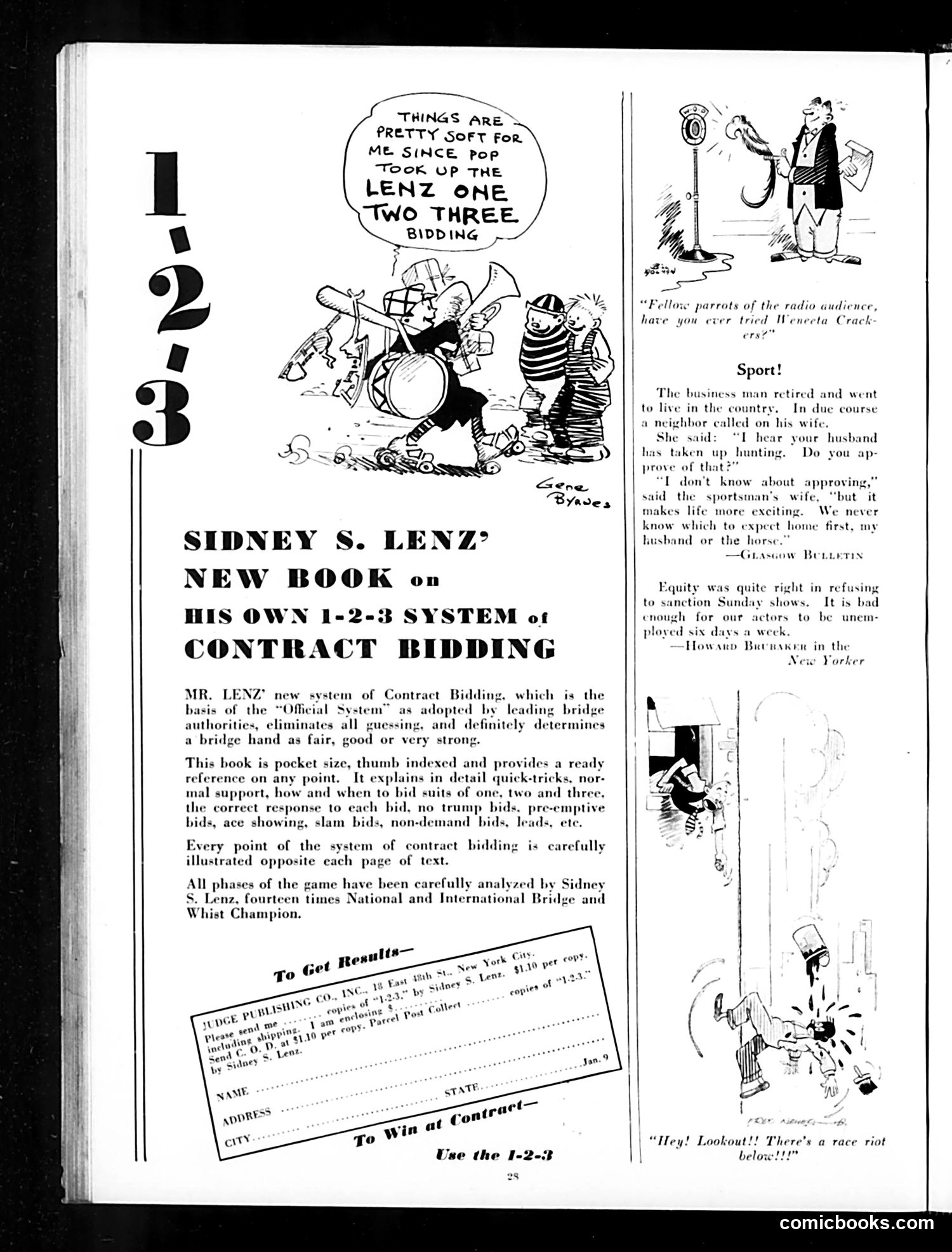
Analysis of Judge Magazine Page This page is primarily advertising and editorial content, not political satire. The main feature is a book advertisement for Sidney S. Lenz's contract bridge bidding system—targeting bridge players with a instructional guide. The page includes two unrelated humor items: 1. Top cartoon: A parrot mimicking radio advertising ("Wenecta Crackers"), satirizing how broadcast ads infiltrate popular culture and domestic life. 2. "Sport!" anecdote: A joke about a retired businessman who takes up hunting. His wife quips she can't predict whether to expect him or the horse home first—poking fun at unpredictable sporting husbands and domestic uncertainty. The cartoons are light, domestic humor typical of Judge magazine's era—not political commentary. The page primarily serves as mixed advertising and filler content common in mid-20th century magazines, combining book promotion with gentle social humor about modern life, radio culture, and marriage dynamics.
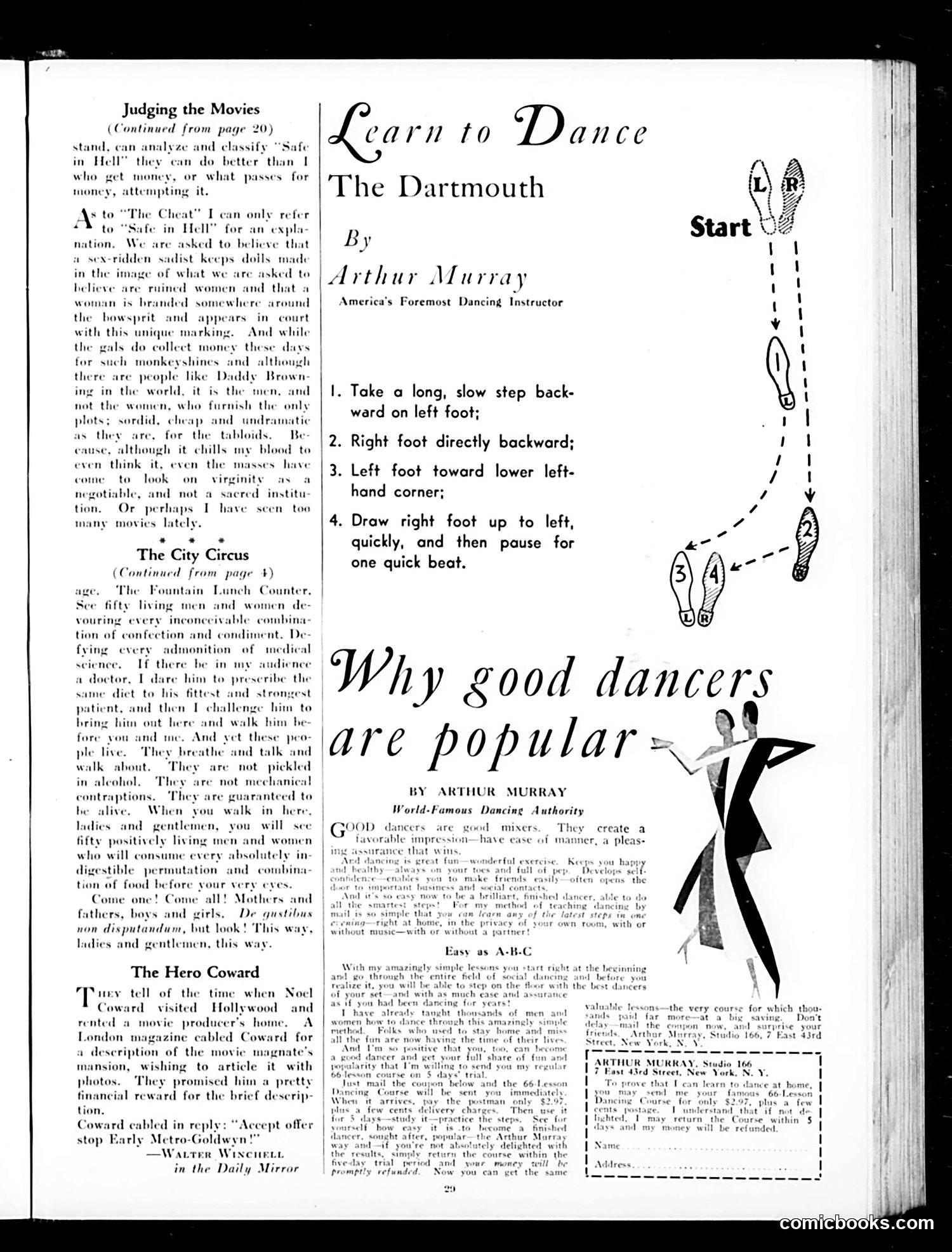
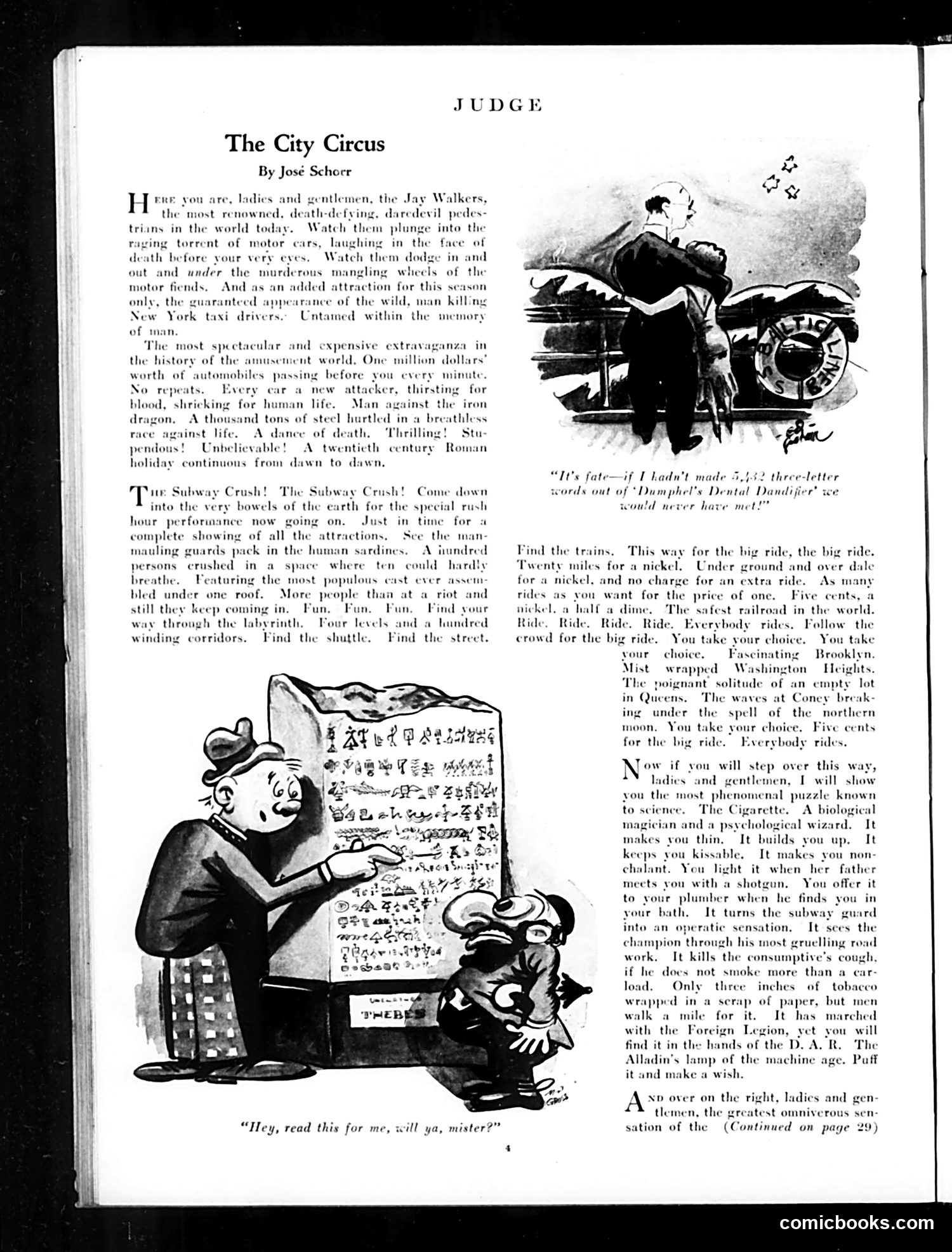
Analysis of Judge Magazine Page Content This page mixes film criticism with dancing instruction and light celebrity gossip, typical of Judge's satirical miscellany. "Judging the Movies" section: The critic attacks morally objectionable films like "Safe in Hell" and "The Cheat" for exploiting sensational content—sex-trafficking, branded women—while claiming artistic merit. The satire criticizes both the films' lurid plots and society's hypocrisy in consuming such material while pretending shock. "The City Circus" continues a breathless carnival barker's pitch mocking spectacle entertainment and medical ignorance—people consuming bizarre food combinations defying all dietary science. "The Hero Coward": A brief anecdote about playwright Noel Coward renting a Hollywood producer's mansion to photograph it for publication. When promised payment, Coward cabled back: "Accept offer stop Early Metro-Goldwyn!"—a joke about his refusal, sarcastically suggesting the studio buy the story instead. The Arthur Murray dancing instruction is straightforward advertising content, not satire.
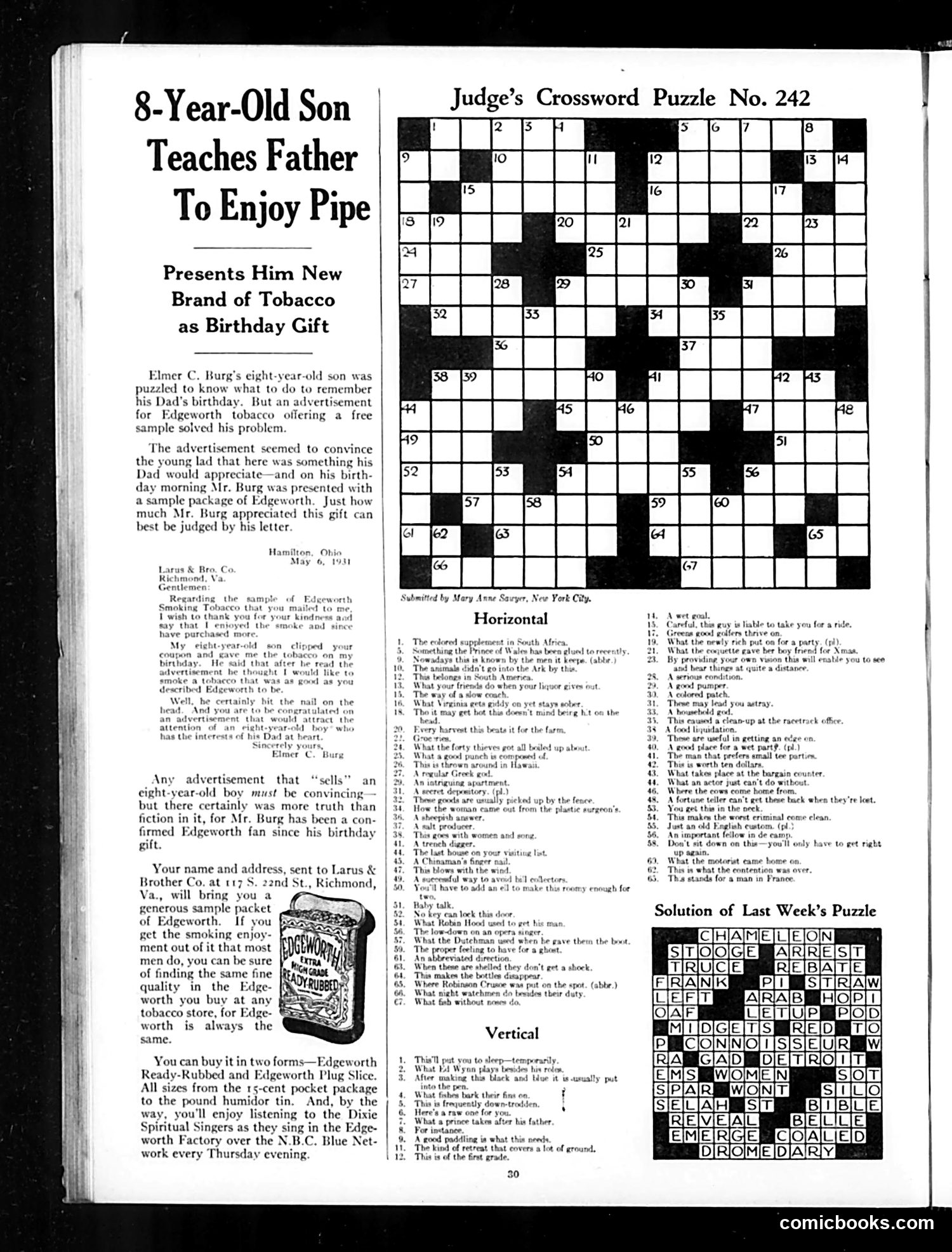
Analysis: "8-Year-Old Son Teaches Father To Enjoy Pipe" This page is primarily an advertisement for Edgeworth tobacco, disguised as a heartwarming anecdote. The "cartoon" is the narrative itself: an 8-year-old boy sees an Edgeworth ad offering free samples, orders one as a birthday gift for his father, and the father becomes a devoted customer. The satire targets advertising's power to manipulate—even children can be "sold" by marketing claims. The humor lies in the irony: a child teaches his father to smoke through commercial persuasion, presented as innocent and touching. The accompanying letter from "Elmer C. Burg" (likely fictional) provides fake testimonial credibility. The page also includes a crossword puzzle and its solution, standard Judge magazine filler content. By modern standards, the casual promotion of tobacco to families and the implied endorsement of children influencing adult smoking habits would be shocking. The ad emphasizes Edgeworth's availability and even mentions the "Dixie Spiritual Singers" on NBC radio—leveraging entertainment to build brand loyalty.
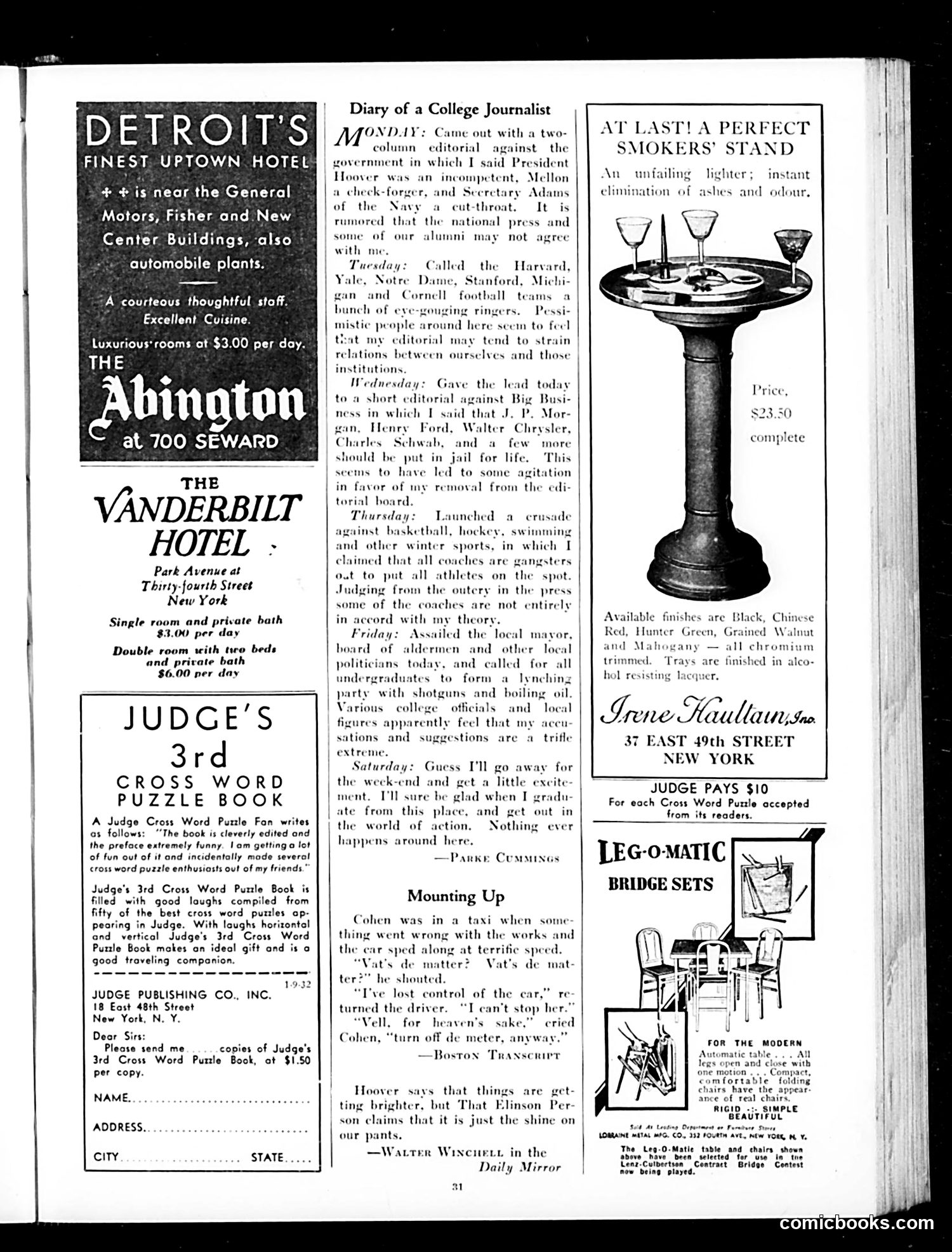
Analysis of Judge Magazine Page Content This page is primarily advertising with satirical article content, typical of Judge magazine's format. The main satirical content is "Diary of a College Journalist" by Parke Cummings, which mocks self-righteous student editors who write inflammatory editorials attacking major figures (President Hoover, banker Mellon, Secretary Adams) and institutions (Ivy League football teams, big business) without facing actual consequences—until Saturday arrives and the journalist admits nothing meaningful happens around campus. The joke critiques pretentious collegiate radicalism and ivory-tower posturing. The "Mounting Up" anecdote is an ethnic humor piece featuring a Jewish character (Cohen) in a taxi who, facing a runaway vehicle, prioritizes stopping the meter over safety—a stereotype joke about Jewish cheapness. The remaining content consists of hotel advertisements (upscale Detroit and New York establishments), Judge's crossword puzzle book promotion, and a product advertisement for a smokers' stand. These ads reflect 1920s-30s affluent readership marketing.
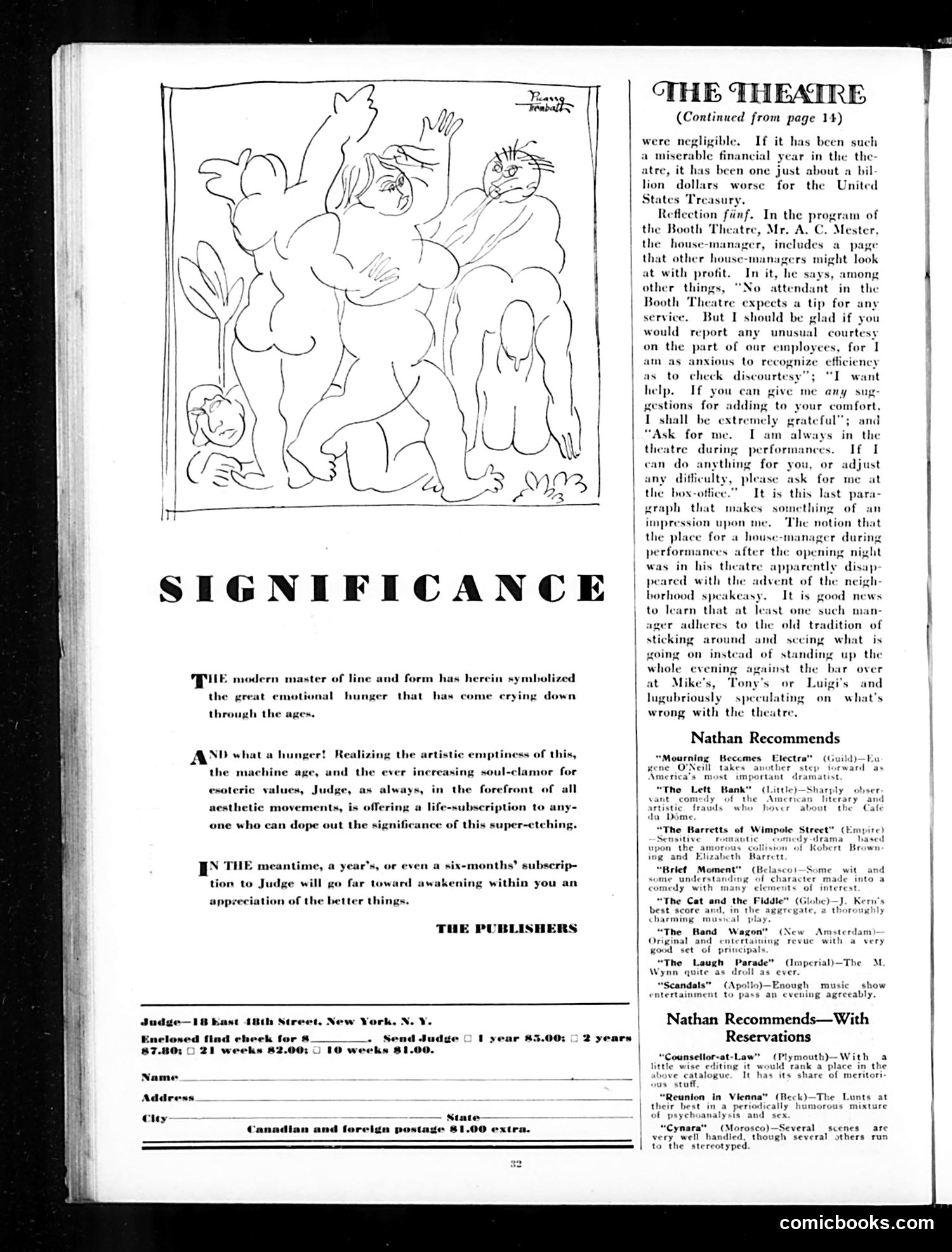
"Significance" Cartoon Analysis The cartoon depicts abstracted human figures in various poses of apparent distress or emotional turmoil—reaching, gesturing dramatically, appearing to cry out. The accompanying text explains it symbolizes "the great emotional hunger that has come crying down through the ages." This is Judge magazine's self-promotional satire. The piece playfully mocks the pretentiousness of modern art criticism by presenting an intentionally vague, pseudo-intellectual artwork. The caption uses florid language about "artistic emptiness" and "esoteric values" to parody how critics describe abstract or modernist art. The joke: Judge claims this incomprehensible drawing represents something profound about human longing, then uses this supposed artistic significance to sell magazine subscriptions. It's satirizing both modernist art's obscurity and the magazine industry's marketing tactics—essentially mocking how publications sell themselves through appeals to cultural sophistication. The subscription offer below reinforces the satire: Judge positions itself as arbiter of "better things" for readers seeking aesthetic awakening.
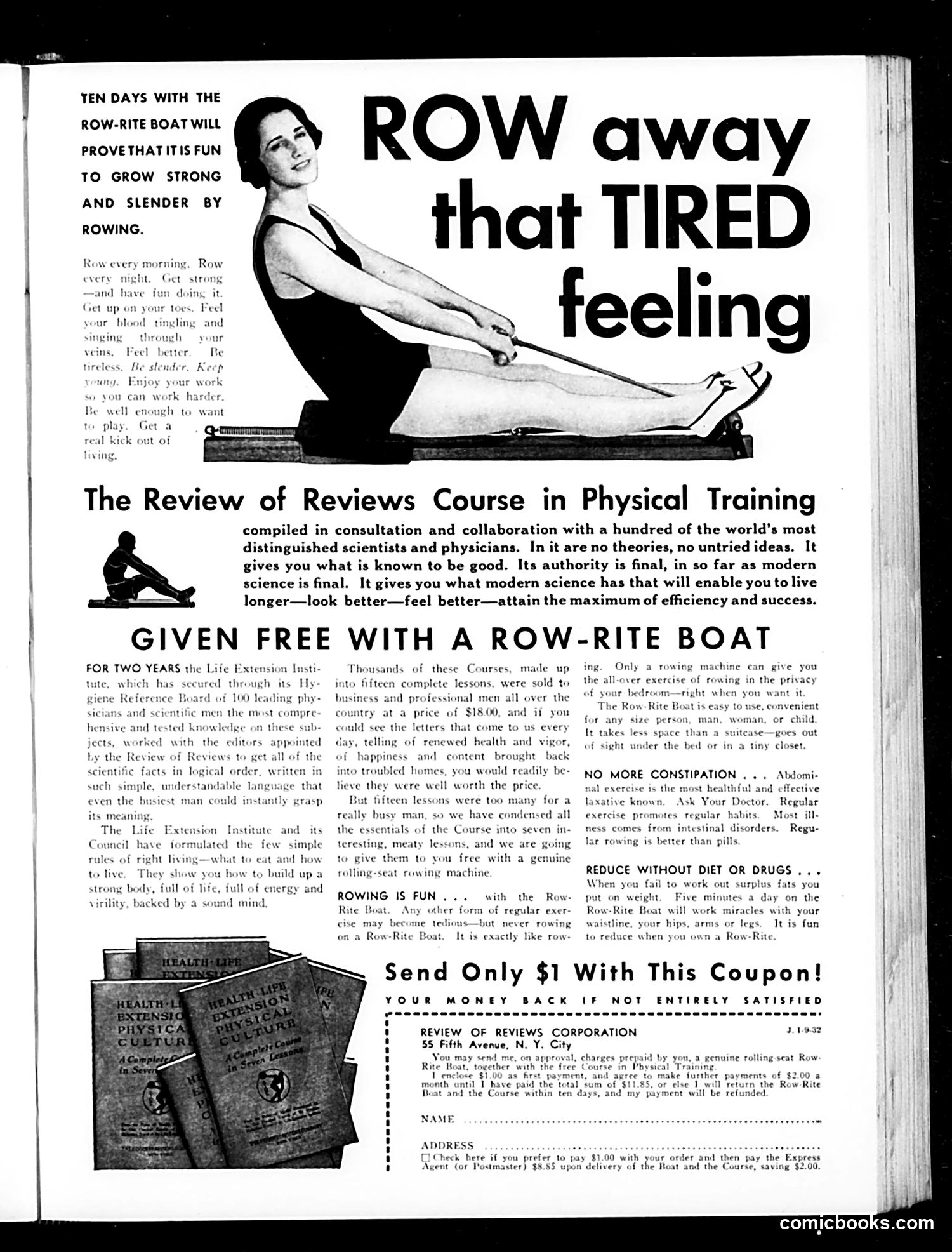
Analysis of This Vintage Advertisement Page This page is primarily an advertisement for the Row-Rite Boat, a home rowing machine marketed during the early 1930s Depression era. Rather than satire, it's a straightforward product pitch using health-focused messaging common to the period. Key Marketing Claims: - The rowing machine allegedly provides full-body fitness ("strong and slender") - It combats fatigue, constipation, and excess weight without diet or drugs - A free "Course in Physical Training" compiled by scientists accompanies purchase - Payment terms: $1 initial deposit, then $2 monthly installments, with money-back guarantee Why it appears in Judge magazine: Unlike today's separation of ads from editorial content, early Judge regularly published full-page advertisements disguised as editorial content. What stands out historically: The claims about curing constipation and weight loss through rowing, paired with vague references to "Life Extension" and scientific authority, reflect the snake-oil marketing typical of the 1930s—before FDA regulations. The appeal to businessmen and the emphasis on doing exercise "in the privacy of your bedroom" suggests marketing to busy professionals self-conscious about public fitness activities. No satirical cartoons appear; this is purely commercial content.
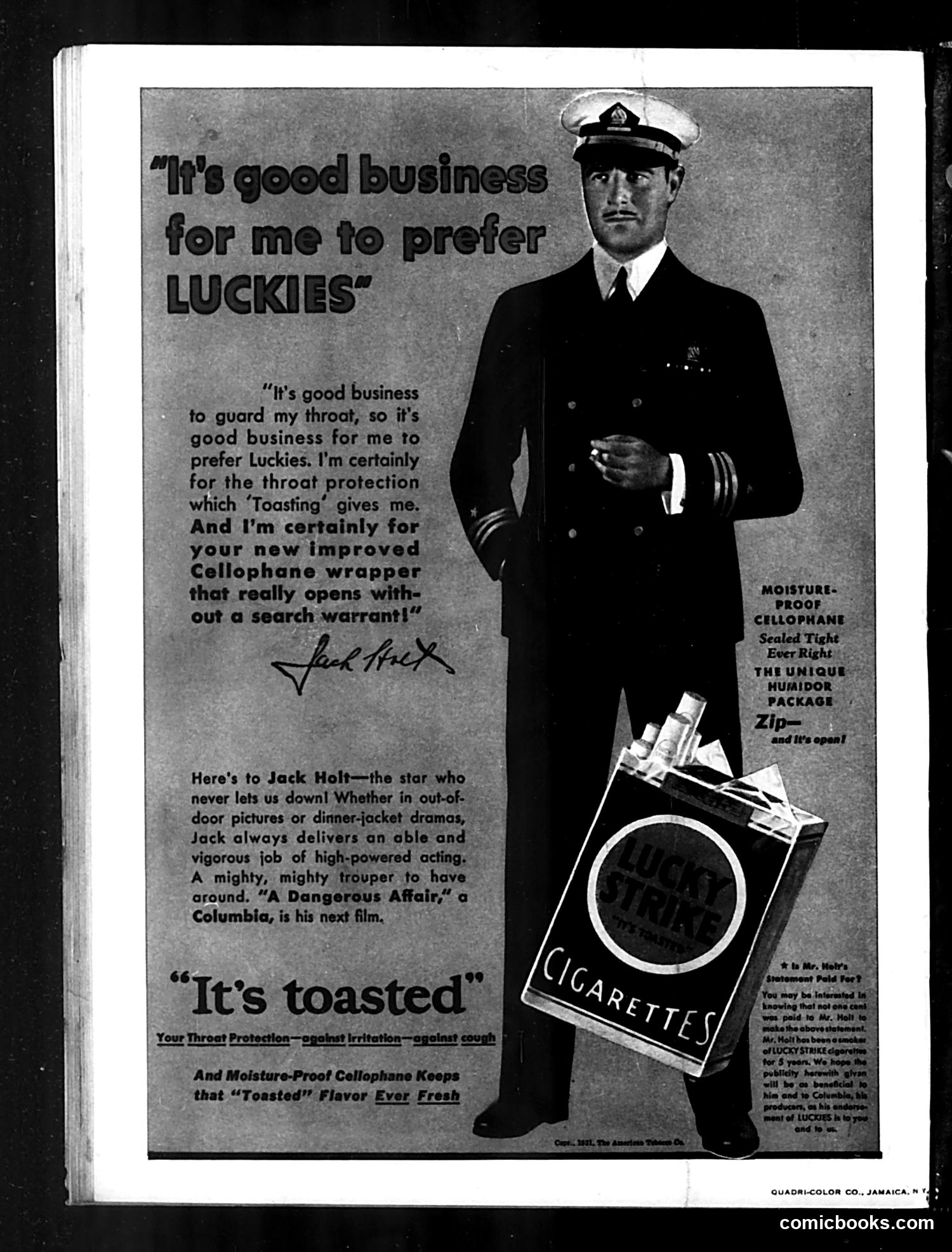
What This Page Actually Is This is not a cartoon or satire—it's a cigarette advertisement disguised as editorial content in Judge magazine. The page features actor Jack Holt endorsing Lucky Strike cigarettes, claiming they provide "throat protection" through a "toasting" process. The ad uses Holt's celebrity status and upcoming film "A Dangerous Affair" to lend credibility to the product. The quote about preferring Luckies is presented as his genuine opinion, though it's clearly paid promotional copy. For modern readers: This reflects pre-1960s advertising standards when health claims about cigarettes were legal and commonplace. The "toasting" and "throat protection" language is early tobacco industry marketing—claims that would later be proven false and eventually banned from advertising.