judge
Judge — January 16, 1932
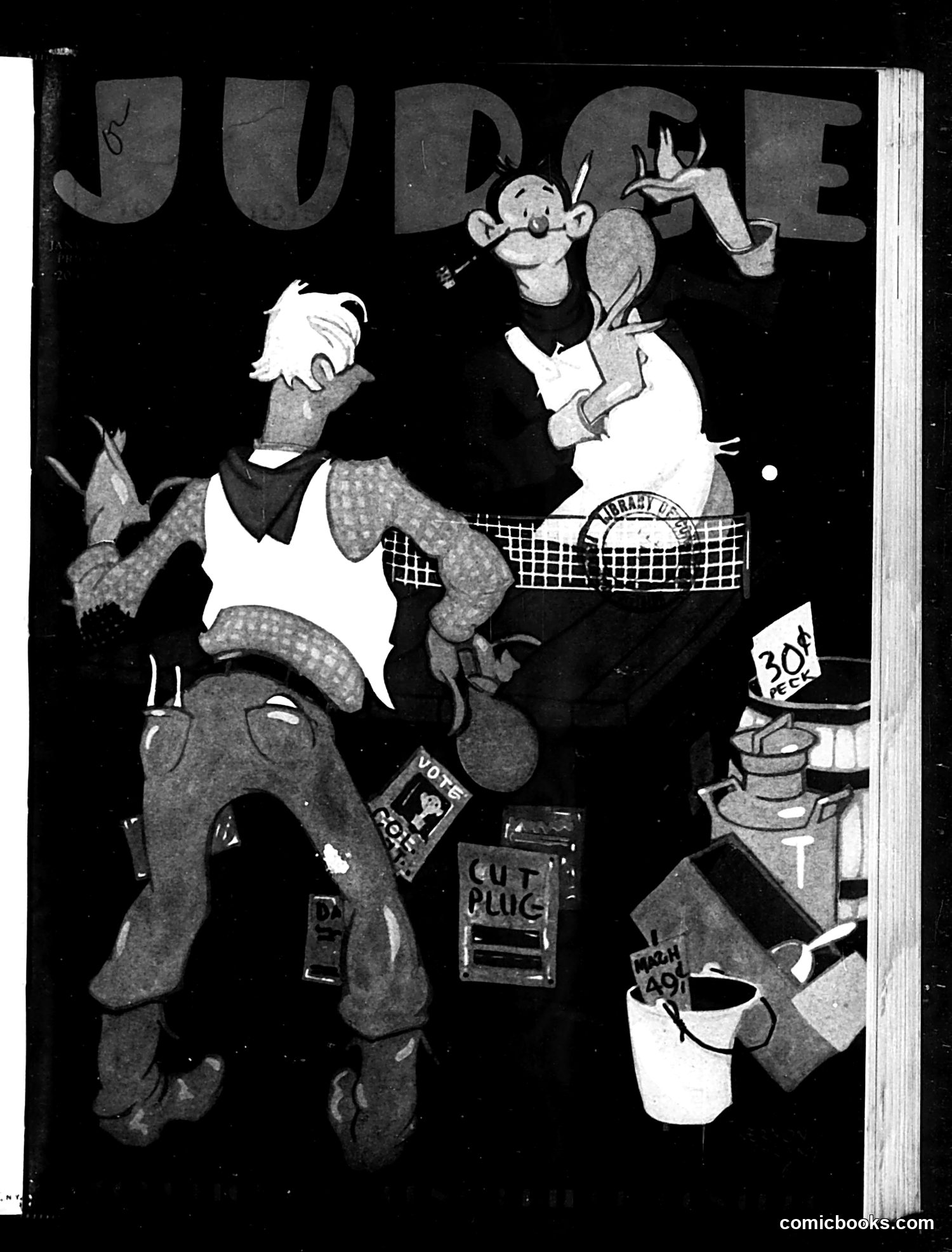
Analysis of Judge Magazine Page This appears to be a June-dated cover featuring two cartoon characters playing tennis. The left figure wears a white sleeveless shirt; the right wears darker clothing and a hat labeled "BOB PECK." Various product boxes are scattered around them, including visible text reading "CUT PLUG" and "30¢ PECK." The satire likely references commercial products or brands of the era being personified as tennis players. The specific identities of the characters remain unclear without additional context, though the style suggests early-to-mid 20th century American comic art. The scattered commercial packaging suggests commentary on consumerism or advertising culture. The "BOB PECK" label and product placement indicate this may parody actual commercial figures or spokespeople known to contemporary Judge readers.
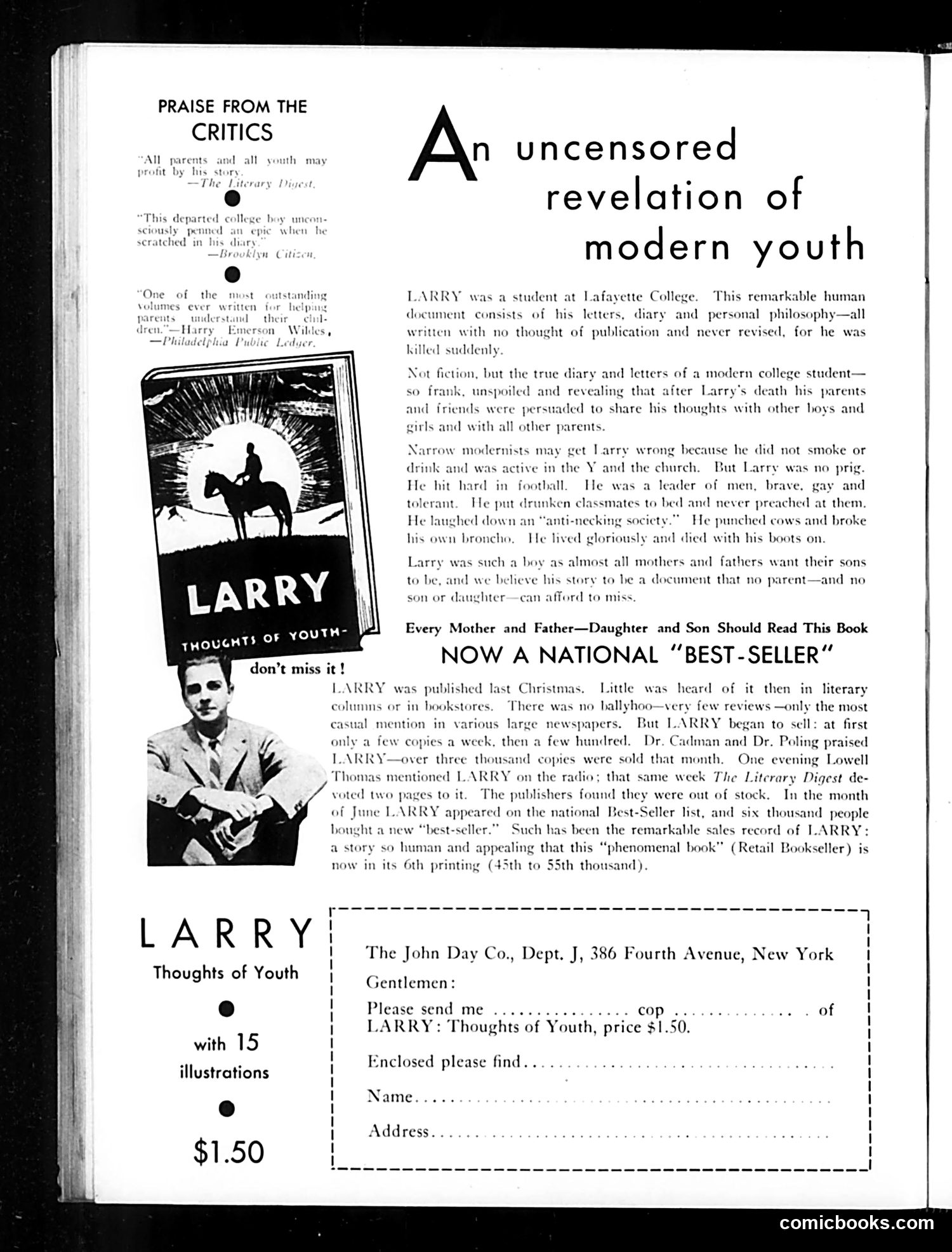
Analysis: "LARRY: Thoughts of Youth" This page is primarily a book advertisement rather than editorial satire. It promotes "Larry: Thoughts of Youth," presented as an authentic diary of a deceased Lafayette College student—"not fiction, but the true diary and letters of a modern college student." The marketing copy emphasizes the book's frank, unfiltered content about college life, claiming it reveals truths parents need to understand about their sons. The appeal is moralistic: parents should read it to connect with youth culture. The silhouette illustration shows a young man on horseback against a sunrise—a romanticized image of idealistic youth. The $1.50 price and mail-order form suggest this was a commercially successful publication marketed to concerned parents seeking insight into collegiate behavior and values.
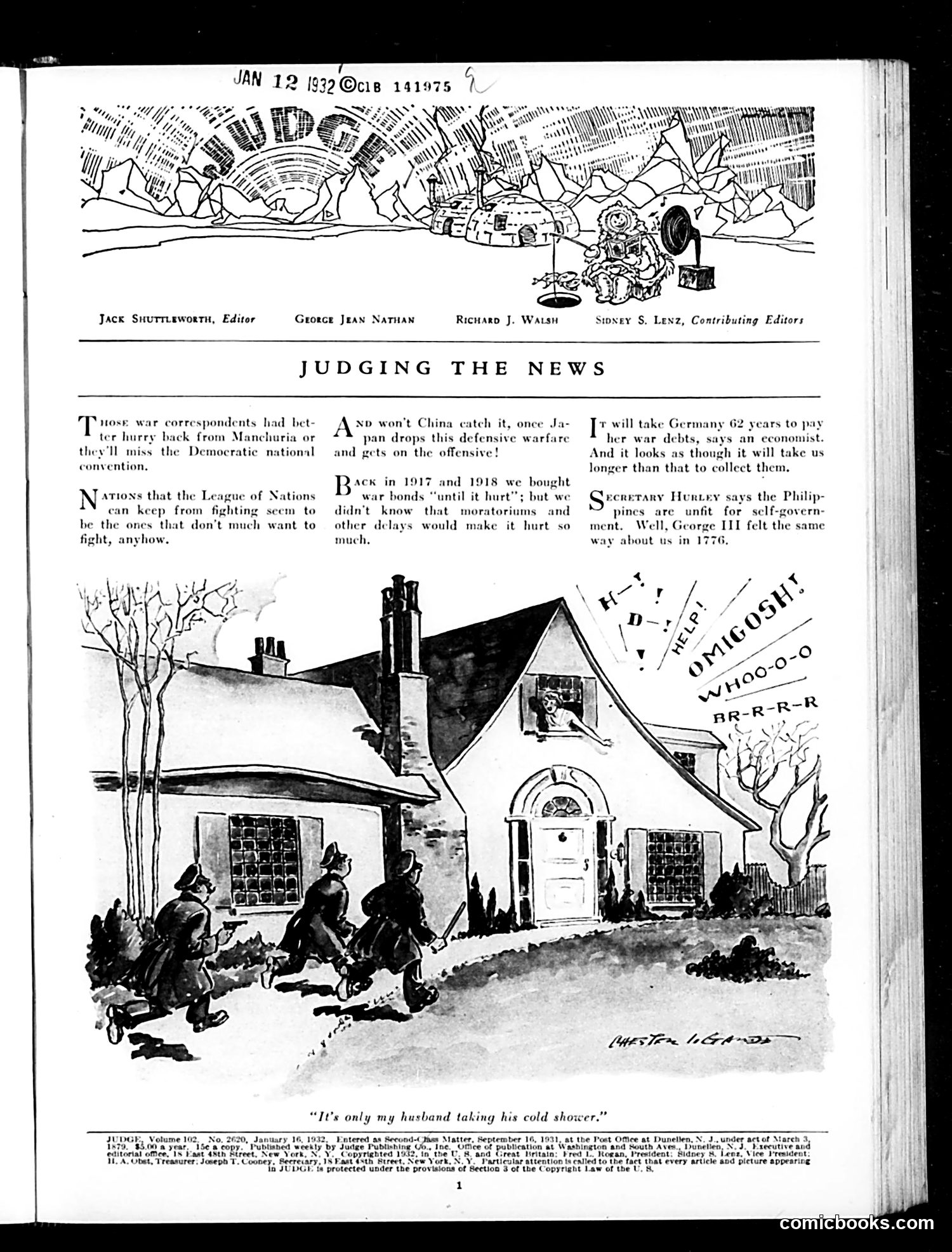
Analysis of Judge Magazine Page (January 12, 1932) The main cartoon depicts a house with children playing outside while making noise ("WHOO-OO-OSH! BR-R-R-R"). The caption reads: "It's only my husband taking his cold shower." This satirizes the popular health fad of cold-water bathing, likely promoted during the Depression era as an inexpensive wellness practice. The joke contrasts the husband's vigorous shower sounds with the commotion outside, suggesting his bathing routine is as disruptive as children playing. The "Judging the News" section above offers brief editorial commentary on contemporary issues: war correspondents missing Democratic conventions, China's military situation, Germany's war debts, and Philippine self-governance—typical concerns of early 1932.
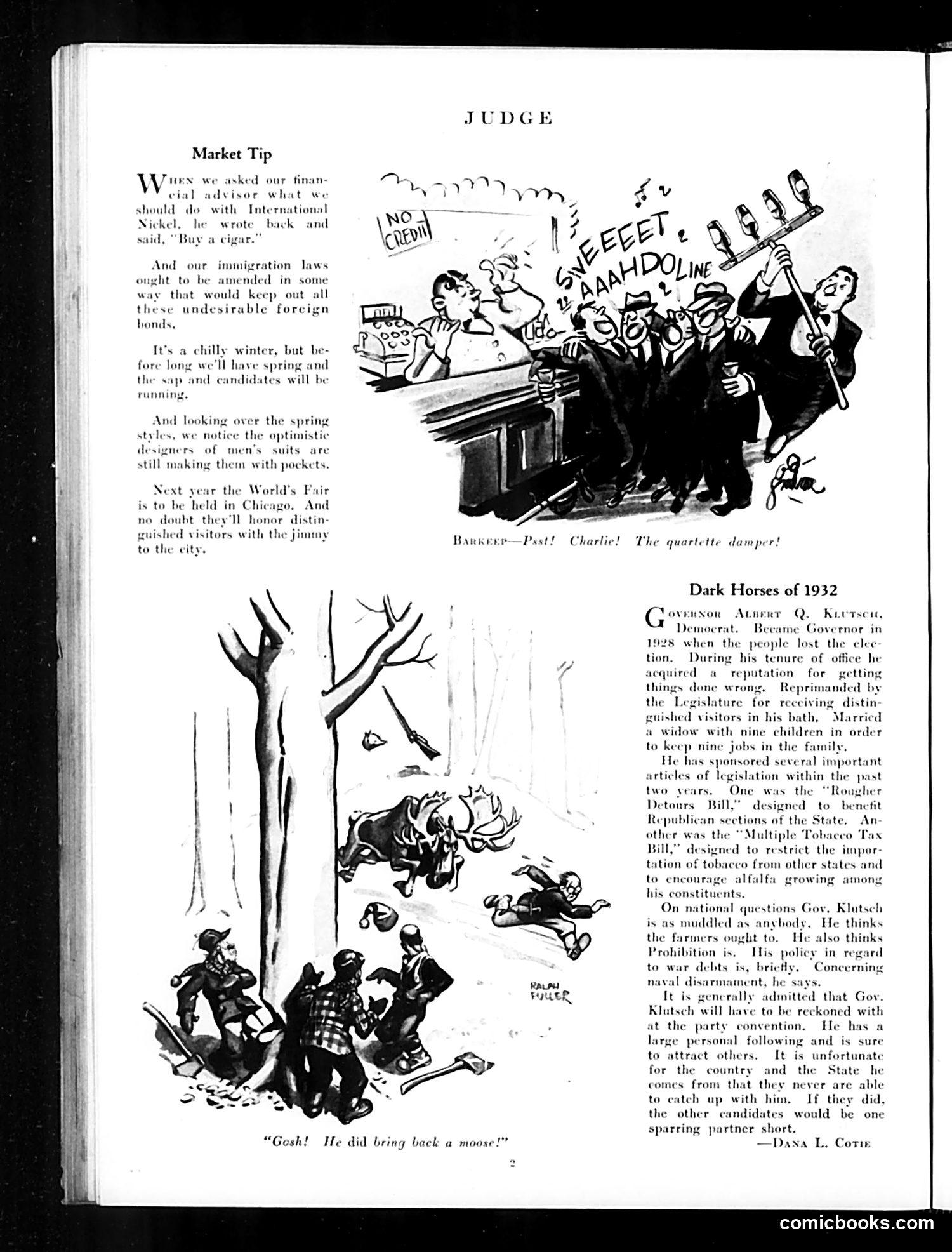
Judge Magazine Page Analysis Top Cartoon: Depicts a chaotic barbershop scene where a quartet performs while a barber works. The "Market Tip" column references buying International Nickel stock and cigars—satirizing financial advice columns. The cartoon mocks how such tips circulate in everyday spaces like barbershops, where ordinary people gather investment gossip. Bottom Cartoon & Article: "Dark Horses of 1932" profiles Governor Albert Q. Klutsch (Democrat), discussing his controversial 1928 election loss and subsequent political positions on Prohibition, farm subsidies, and war debts. The accompanying illustration shows people huddled beneath dead trees—likely representing economic hardship of the Great Depression era. The satire questions whether Klutsch represents viable presidential material for 1932.
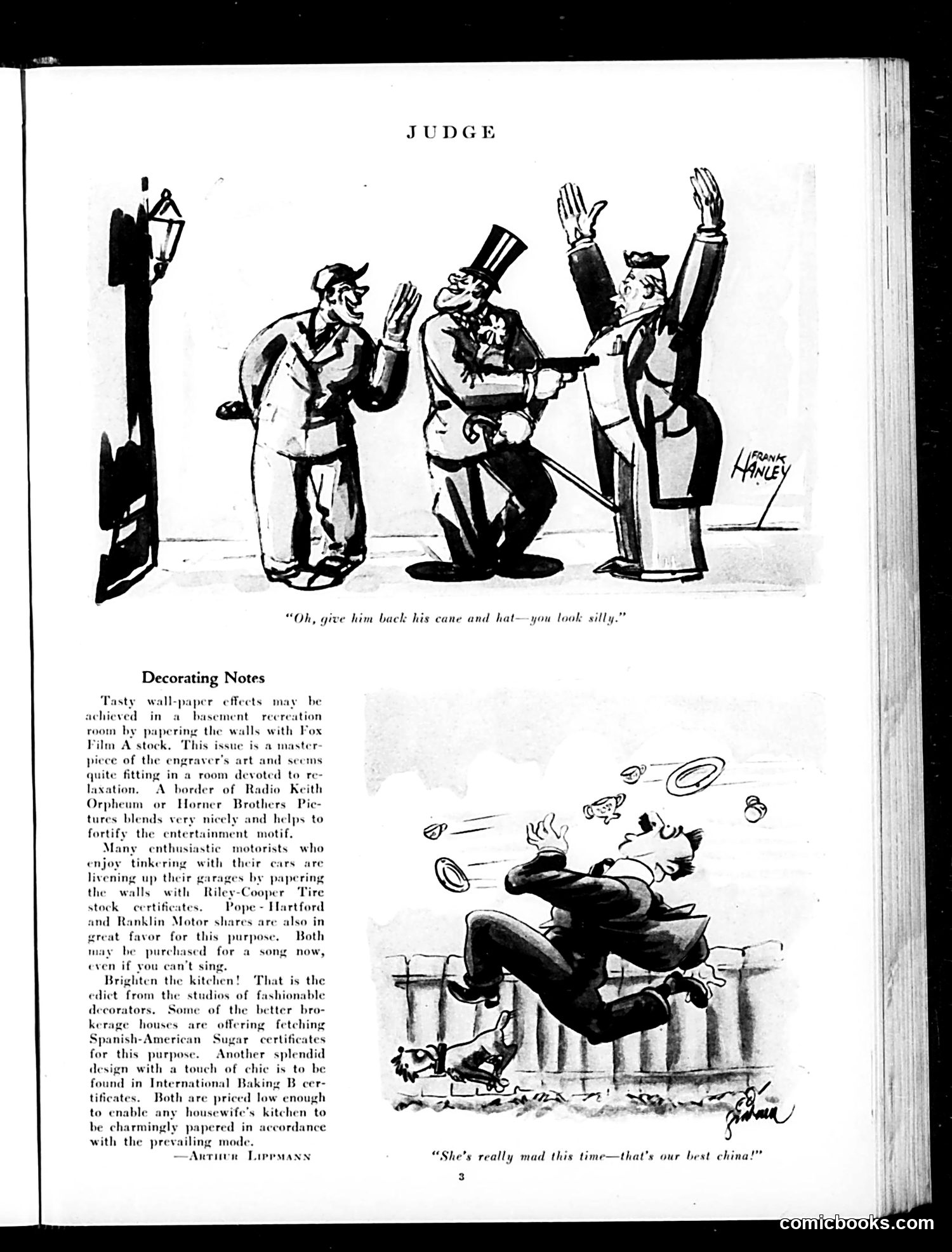
Analysis: Judge Magazine Page Top Cartoon ("Judge"): This political cartoon depicts four men in formal dress around a judicial figure (center, wearing a top hat). The caption reads: "Oh, give him back his cane and hat—you look silly." The satire appears to mock the judicial system or a specific court proceeding, suggesting that authority figures are behaving absurdly or losing dignity. Without clearer context about the specific case or date, the exact targets remain unclear, but the joke centers on how the "judge" and his associates appear ridiculous through their actions. Bottom Illustration: An unrelated domestic humor cartoon showing a woman lying on furniture with dishes flying, captioned "She's really mad this time—that's our best china!" This is standard period domestic comedy material. Lower Section: "Decorating Notes" by Arthur Lippmann discusses wallpaper and home decoration trends, largely advertising content.
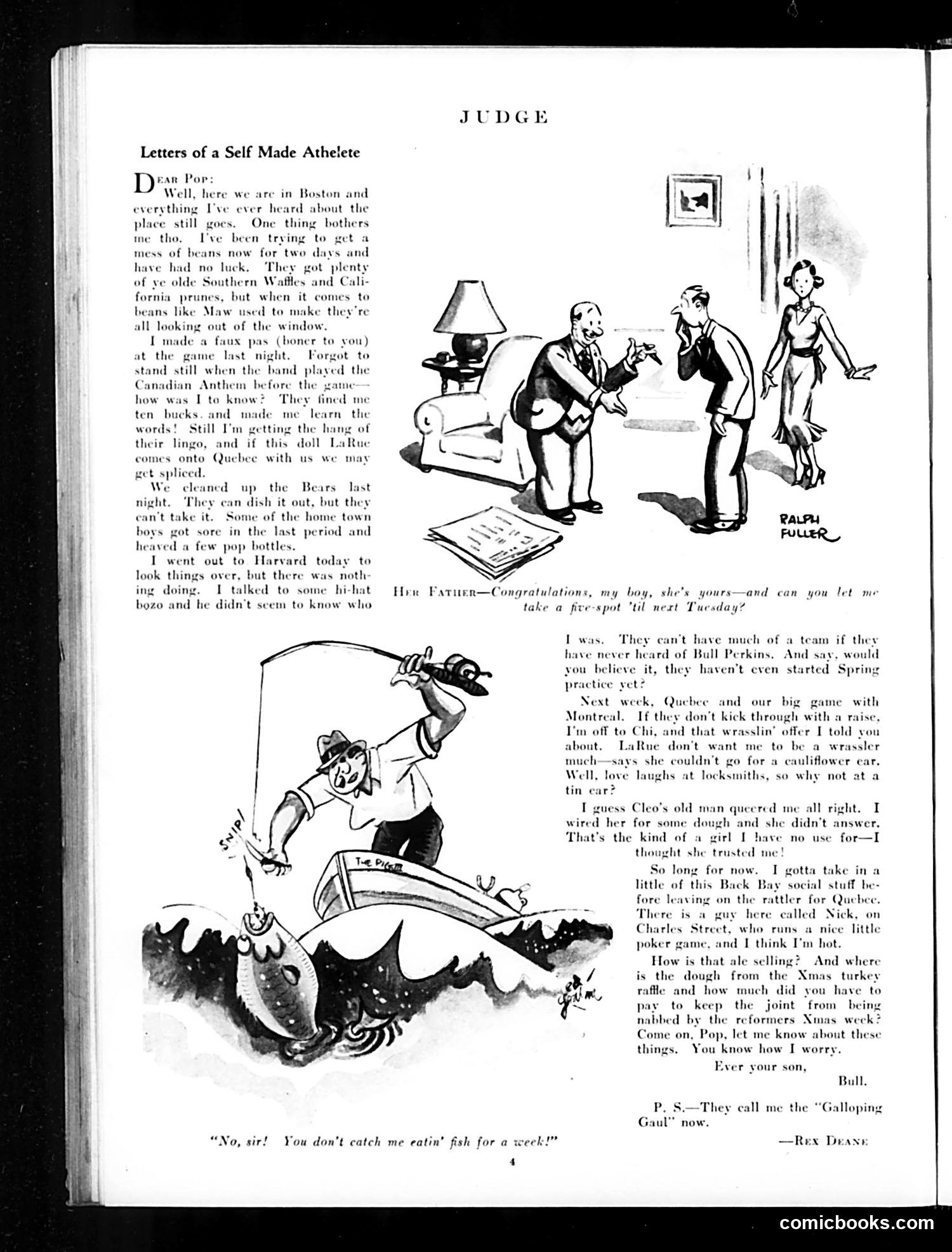
Analysis of Judge Magazine Page This page contains "Letters of a Self Made Athlete," a humorous column by "Bull" to his father "Dan Pop" about Boston sports and social life. The cartoons illustrate athletic mishaps: the upper drawing shows a man being congratulated by his father while others observe awkwardly—likely depicting social discomfort around dating or romance. The lower cartoon shows a figure dramatically falling from what appears to be a boat, with the caption "No, sir! You don't catch me eatin' fish for a week!"—a joke about seasickness or avoiding fish after a boating incident. The letters reference contemporary Boston sports (Bears, Harvard athletics, Quebec games), social venues, and dating culture. The tone is lighthearted mockery of a young man's athletic ambitions and romantic fumbles. Without specific dating, the exact sporting events referenced remain unclear.
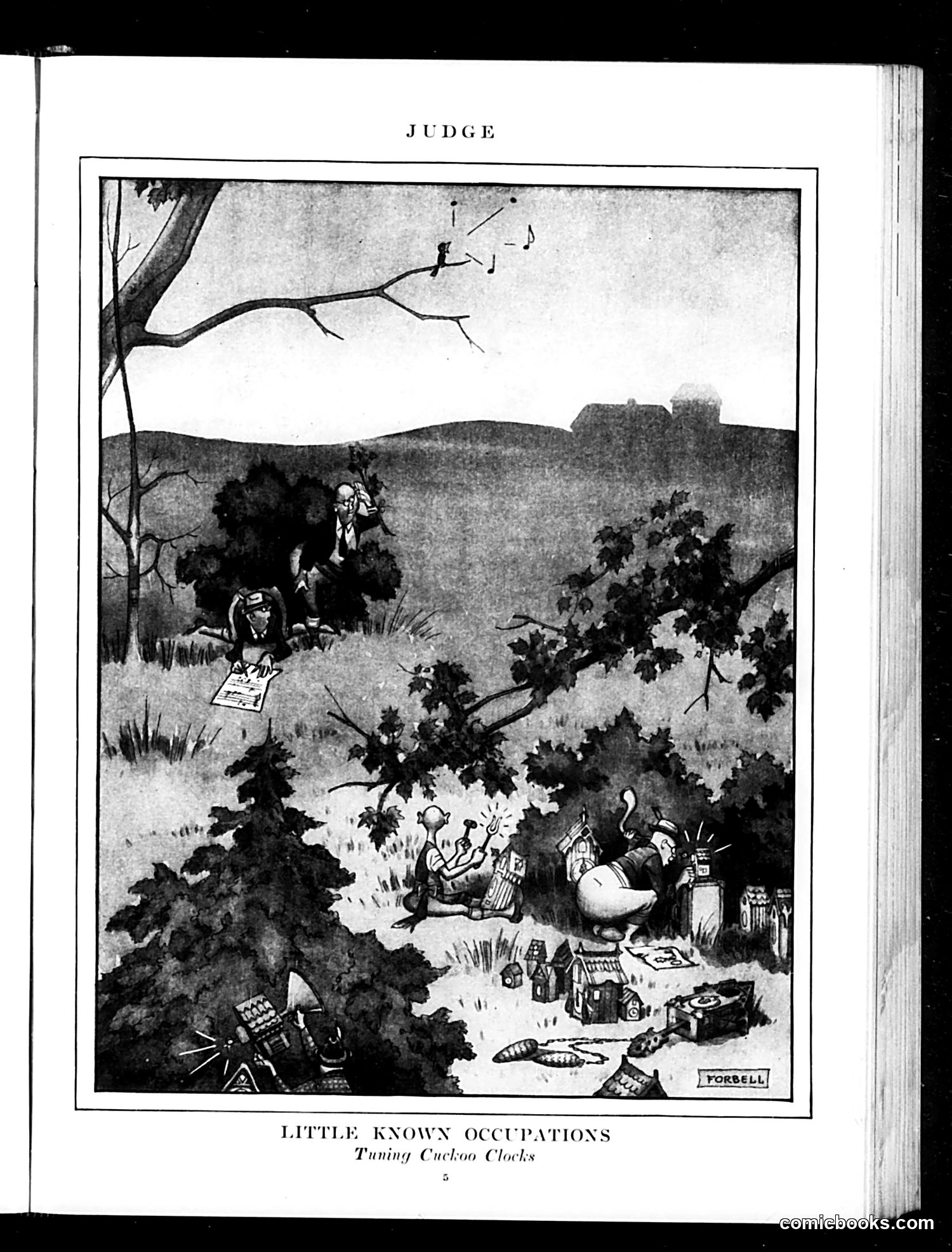
Analysis of "Little Known Occupations: Tuning Cuckoo Clocks" This cartoon satirizes an absurdly obscure profession. The title suggests "tuning cuckoo clocks" as a legitimate occupation, when it's actually ridiculous—cuckoo clocks don't require tuning like musical instruments. The scene depicts whimsical characters in a pastoral setting apparently engaged in this nonsensical task. One figure appears to be a uniformed official or judge (given the page header "JUDGE"), observing or supervising the activity. The humor lies in the contrast between presenting this as a serious "little known occupation" while the image's fantastical quality reveals the absurdity. It's satirizing pretentious or invented professions, or possibly mocking bureaucratic oversight of trivial matters. The artist is Forbell (signature visible).
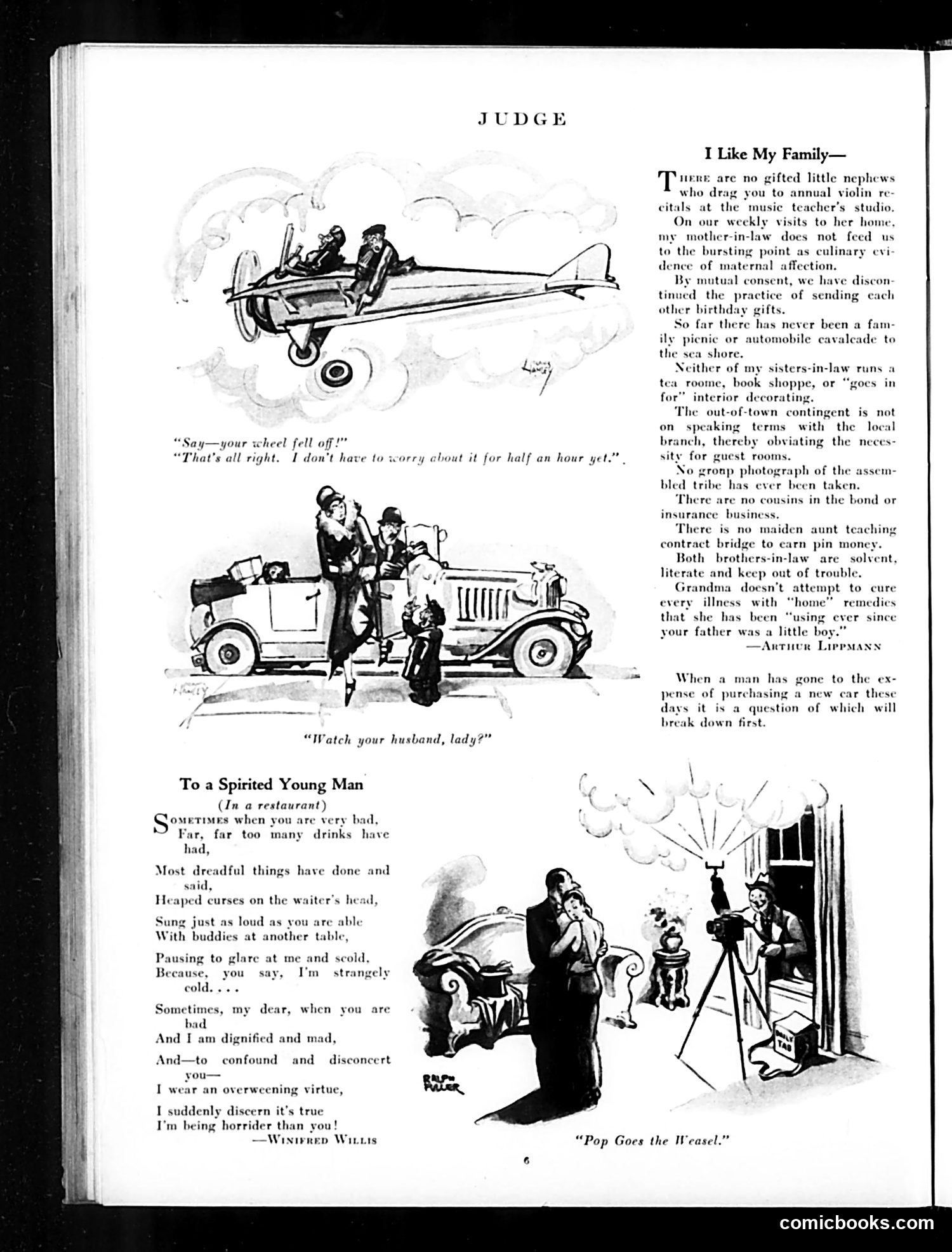
Analysis This page from Judge magazine contains two main editorial cartoons with accompanying humorous commentary: "I Like My Family" (top): A prose piece by Arthur Lippmann satirizing upper-middle-class family life by listing what the narrator *doesn't* do—no lavish entertaining, group photos, or conspicuous consumption. The accompanying car illustrations mock marital tensions and domestic mishaps, suggesting the humor lies in recognizing these everyday family frustrations. "To a Spirited Young Man" (bottom): A poem by Winfred Willis addressing a drunk man in a restaurant, depicting the social embarrassment and moral disapproval accompanying public intoxication. The illustration shows a photographer documenting the scene, suggesting scandal. Both pieces target genteel society's pretensions and behavioral anxieties during the Jazz Age, using relatable domestic and social situations for satire.
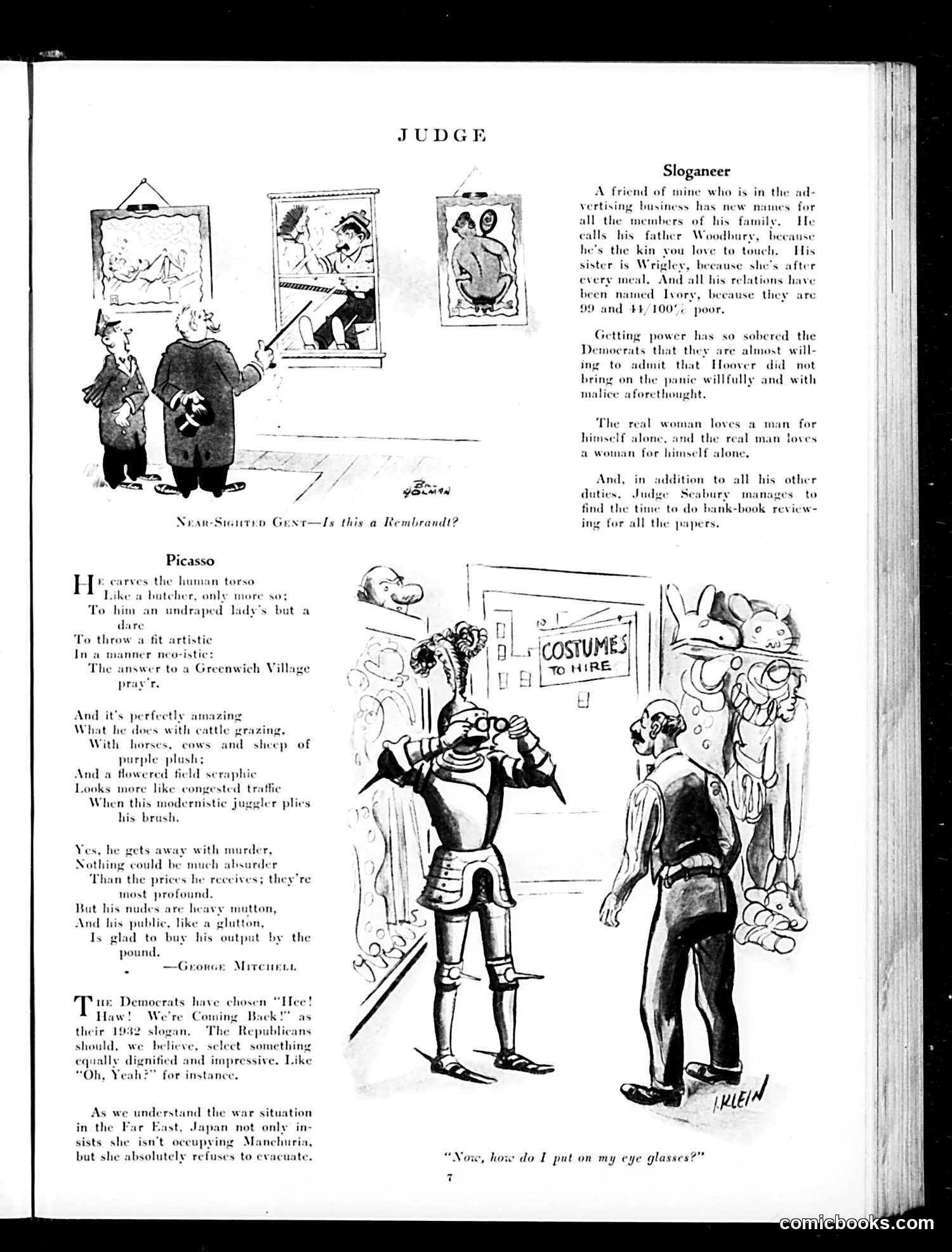
Analysis This page from *Judge* contains three satirical pieces: 1. "Near-Sighted Gent—Is this a Rembrandt?" A cartoon mocking two figures examining abstract art, likely critiquing modern art appreciation among wealthy collectors. 2. "Picasso" A poem by George Mitchell attacking Pablo Picasso's cubist style as incomprehensible and overpriced. The satire claims Picasso "carves the human torso / Like a butcher" and that his work sells by the pound despite being "absurd." This reflects 1930s American skepticism toward modernist art movements. 3. Political/social commentary snippets including jokes about Democrats' "Hee Haw, We're Coming Back" campaign slogan, references to Japan's refusal to evacuate Manchuria (the 1931-1932 invasion), advertising-based humor about brand names, and a dig at Judge Seabury (likely the corruption investigator). The overall tone is conservative, mocking both avant-garde art and Democratic politics during the Depression era.
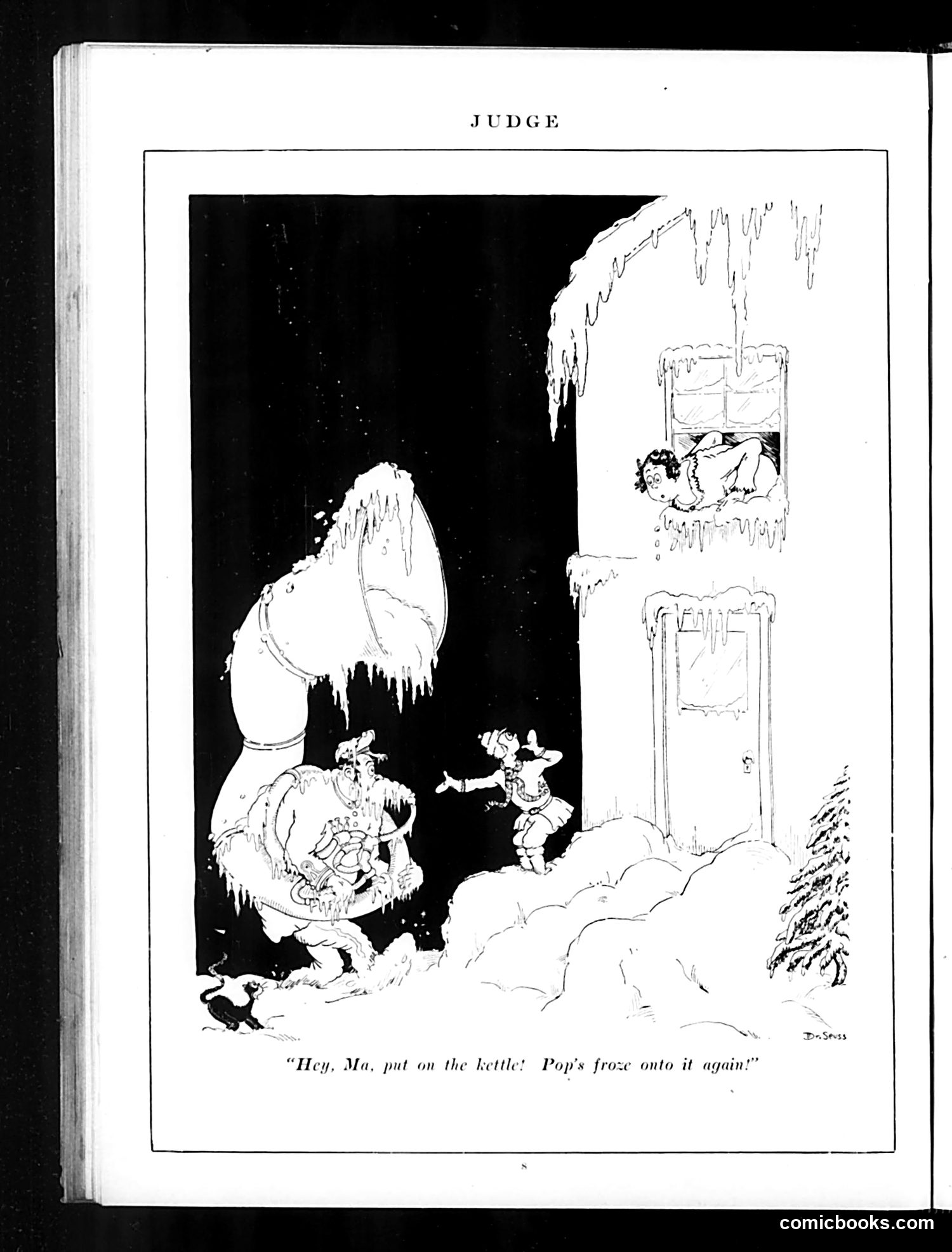
Cartoon Analysis This cartoon depicts a winter domestic scene with satirical humor about male alcoholism and freezing temperatures. A large figure (appearing to be the father/"Pop") has frozen solid to an outdoor kettle or water container, while a child calls to their mother inside the house. The exaggerated icicles covering the man suggest prolonged exposure to cold. The joke appears to target the father's drinking habits—the implication being that he's so intoxicated he's unaware of freezing solid to the kettle. The phrase "froze onto it again" suggests this is a recurring problem, satirizing both male drunkenness and parental neglect during winter. The child's casual tone about the disaster adds dark comedic effect typical of Judge magazine's biting social commentary on family life and vice.
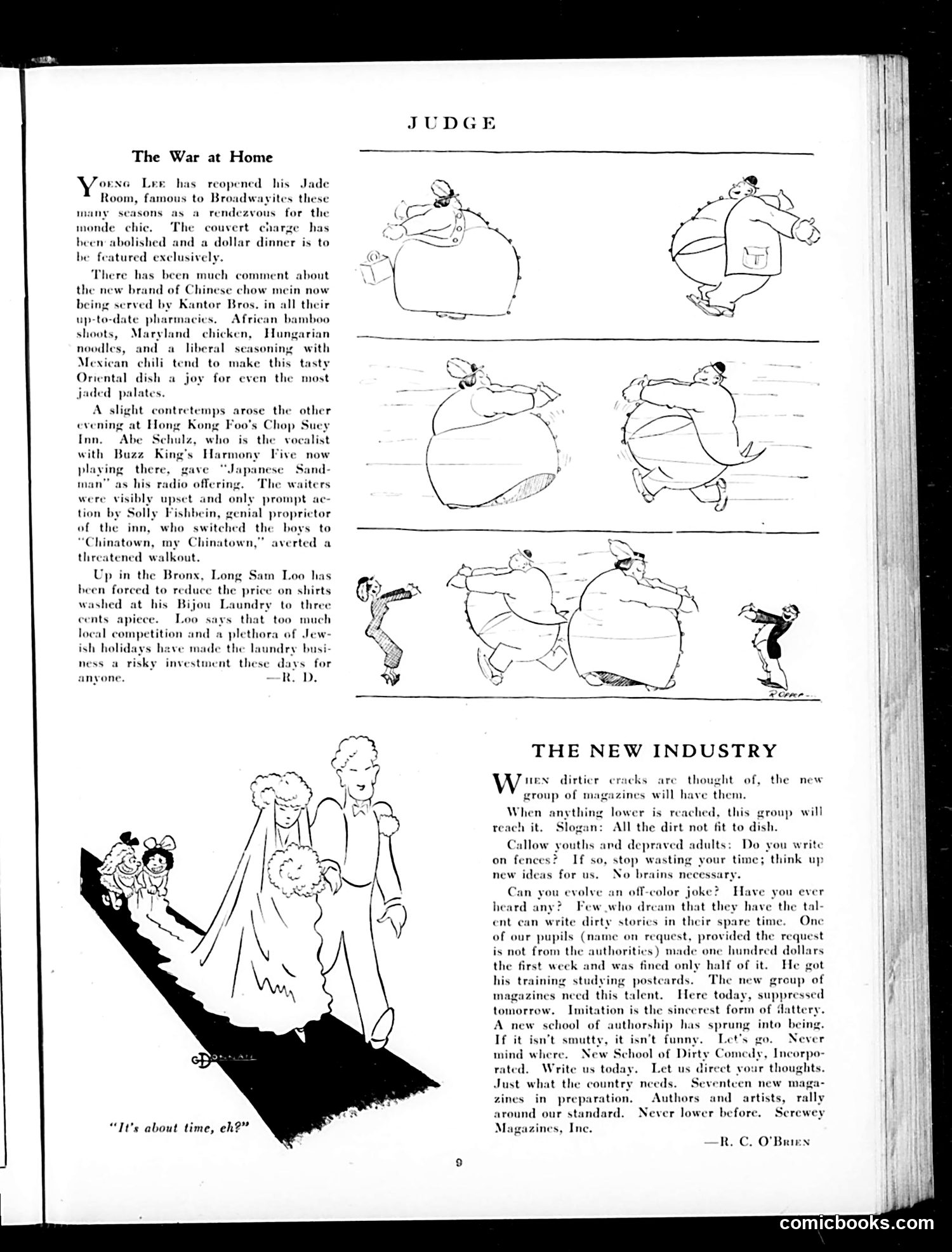
"The War at Home" and "The New Industry" "The War at Home" consists of humorous vignettes about New York's Chinese restaurant and laundry businesses. The sketches satirize ethnic businesses during what appears to be the 1920s: Young Lee's upscale Jade Room, exotic chow mein fusion at pharmacies, a confrontation at Hong Kong Foo's Chop Suey Inn (where a vocalist upset waiters), and Long Sam Loo's struggling laundry facing price competition and losses from Jewish holidays. "The New Industry" is a satirical advertisement for a fictional "School of Dirty Comedy, Incorporated." It mocks the proliferation of low-brow magazines by recruiting writers of crude, obscene material—explicitly soliciting "off-color jokes" and "dirty stories." The satire's point: this new magazine group promises to publish increasingly smutty content with a cynical slogan ("All the dirt not fit to dish"). The illustration shows a woman saying "It's about time, eh?"—suggesting public complaint about moral standards. Together, the page critiques both immigrant businesses and declining journalistic standards.
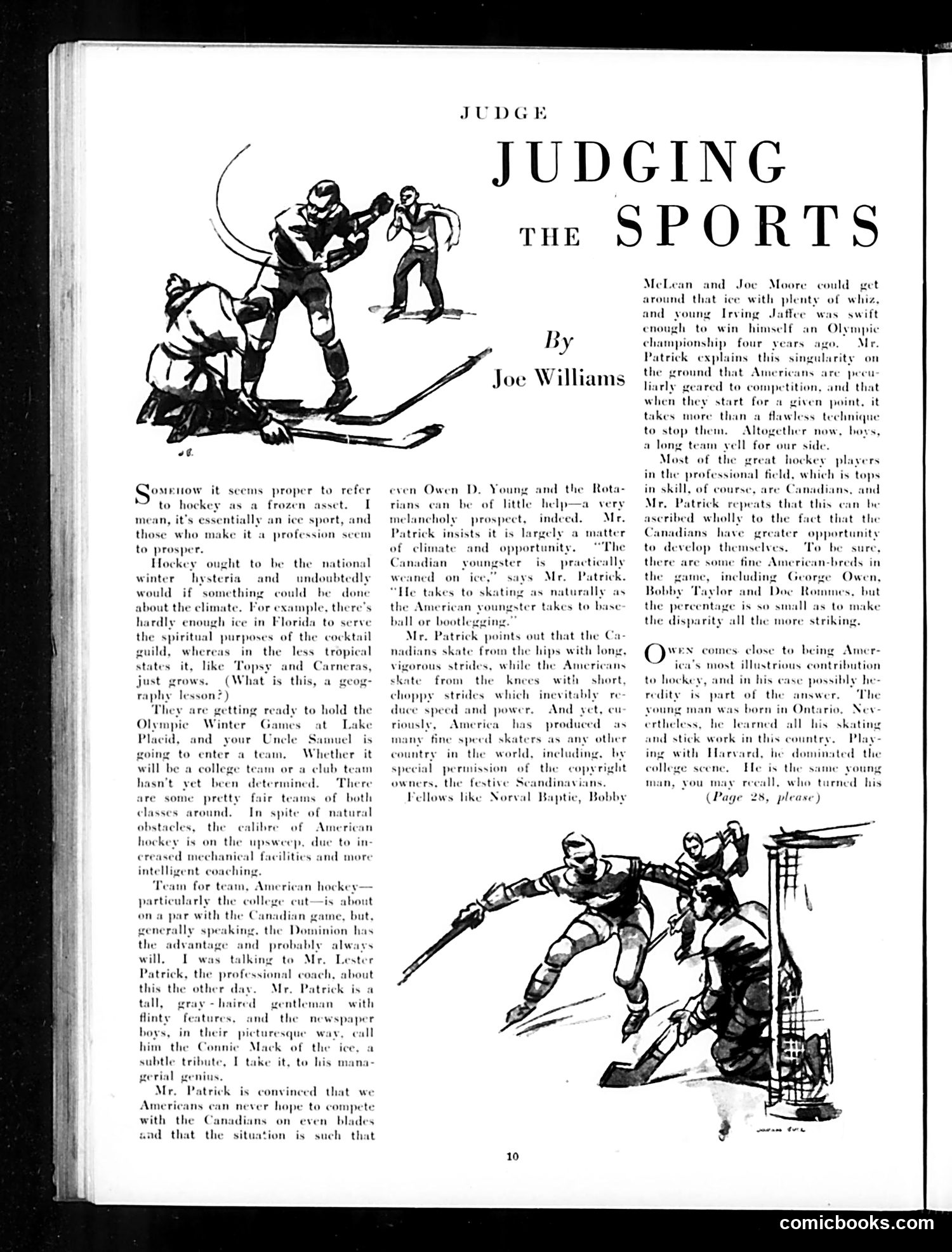
"Judging the Sports" by Joe Williams This article discusses American versus Canadian hockey superiority ahead of the 1932 Winter Olympics at Lake Placid. The author interviews Lester Patrick, a prominent professional hockey coach (called "the Connie Mack of the ice"), who argues Americans can never match Canadians because Canadian children are "practically weaned on ice" and skate from the hips with superior technique, while Americans skate from the knees with less natural power. The satire targets American sporting pride: despite producing Olympic speed skaters and competitive athletes, America's hockey remains inferior due to climate and culture—Canadians simply have better conditions for developing the sport. The piece gently mocks this disparity while praising figures like Irving Jaffee and Oren (likely Frank Orem), exceptional American skaters who succeeded despite systemic disadvantages. The overall tone is wry acceptance that geography, not talent, determines hockey dominance.
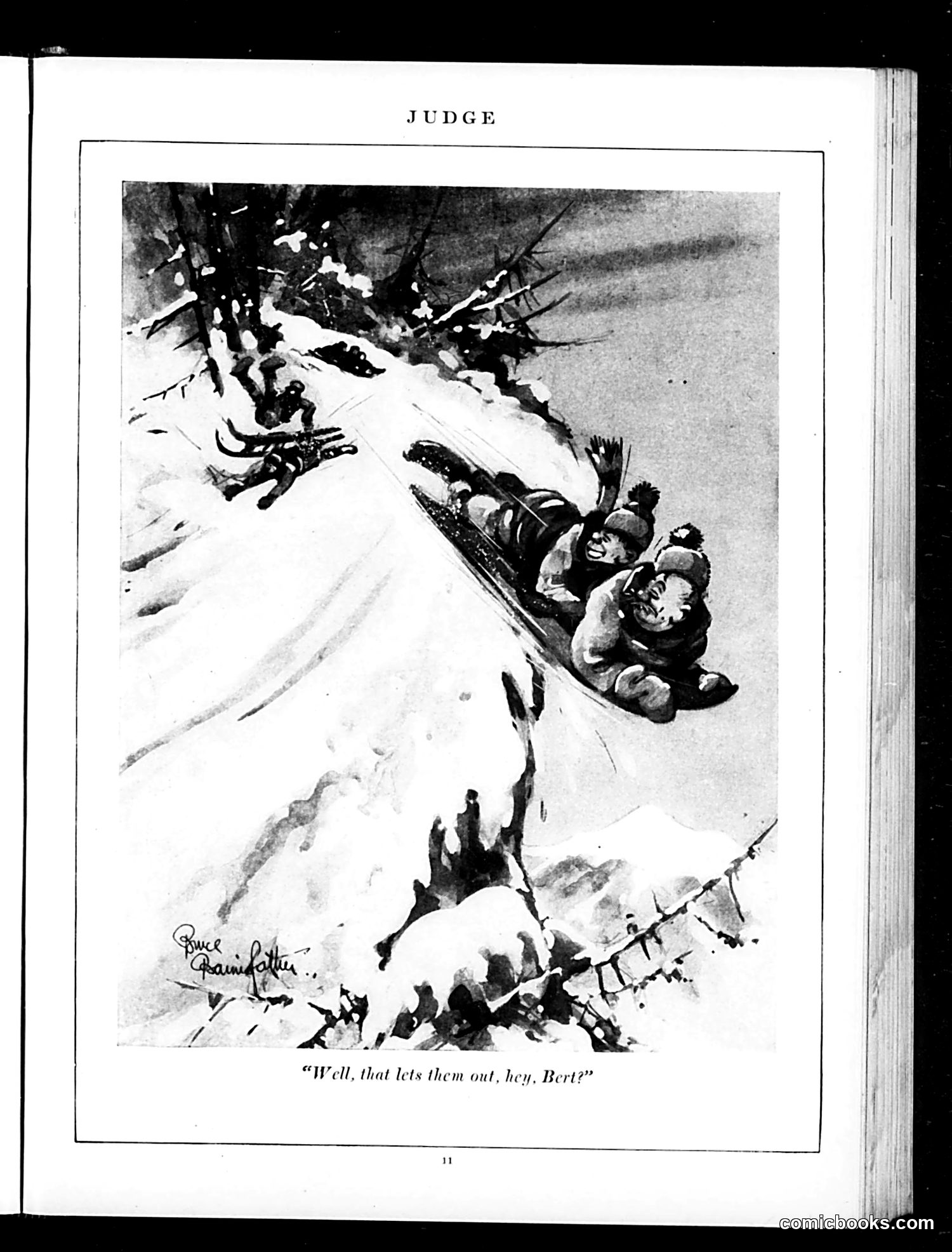
Analysis This cartoon depicts a winter sledding scene with one figure apparently releasing or ejecting passengers from a sled down a snowy slope. The caption "Well, that lets them out, hey, Bert?" suggests someone named Bert has deliberately tipped or emptied the sled. The cartoon appears to be a visual pun or situational humor—the phrase "lets them out" works on multiple levels: literally releasing people from the sled, but likely also referencing some contemporary political or social situation involving removal or dismissal of parties/people from power or position. Without additional context about the issue's date or political circumstances, the specific reference remains unclear, though the satirical intent targets some form of forced exclusion or expulsion presented as comedic.
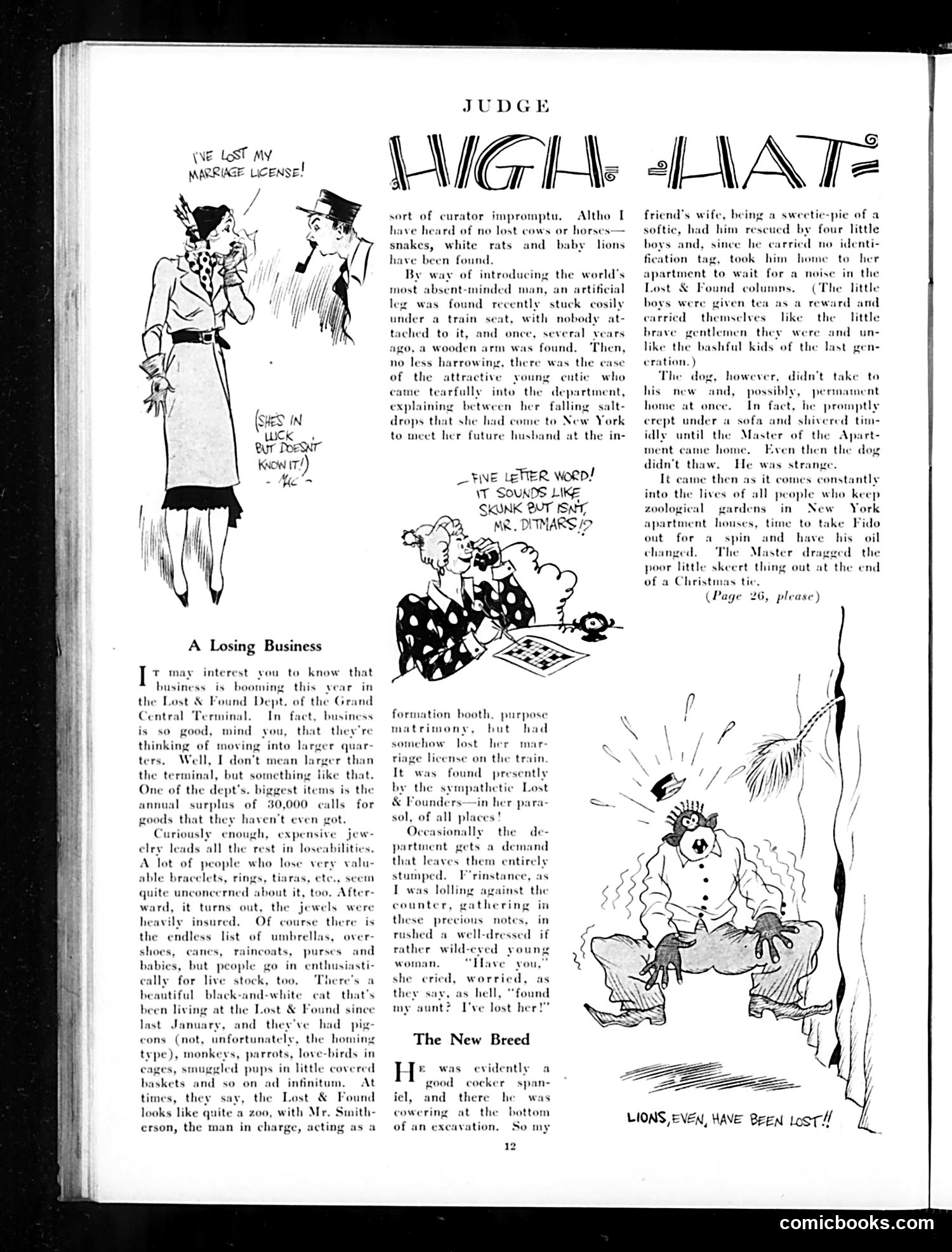
Judge Magazine Satire Analysis This page satirizes the Lost & Found Department at Grand Central Terminal, presenting it as absurdly successful due to New York commuters' chronic absentmindedness. The humor builds through escalating examples: lost jewelry, umbrellas, even live animals (pigeons, monkeys, parrots)—culminating in a woman who lost her marriage license en route to meet her fiancé. The cartoon illustrations mock absent-minded behavior: a woman losing her marriage license; someone's five-letter-word name resembling "skunk"; and a comically distressed person searching for a lost aunt. The final section, "The New Breed," describes rescuing a cocker spaniel from an excavation. The dog's nervous disposition and timidity provide the joke's punchline—when finally taken for exercise, it's so anxious it requires a Christmas tie as a leash, mocking both the dog's fearfulness and urban apartment-dwellers' impracticality. The satire targets New York's chaotic metropolitan life and its residents' scatter-brained nature.
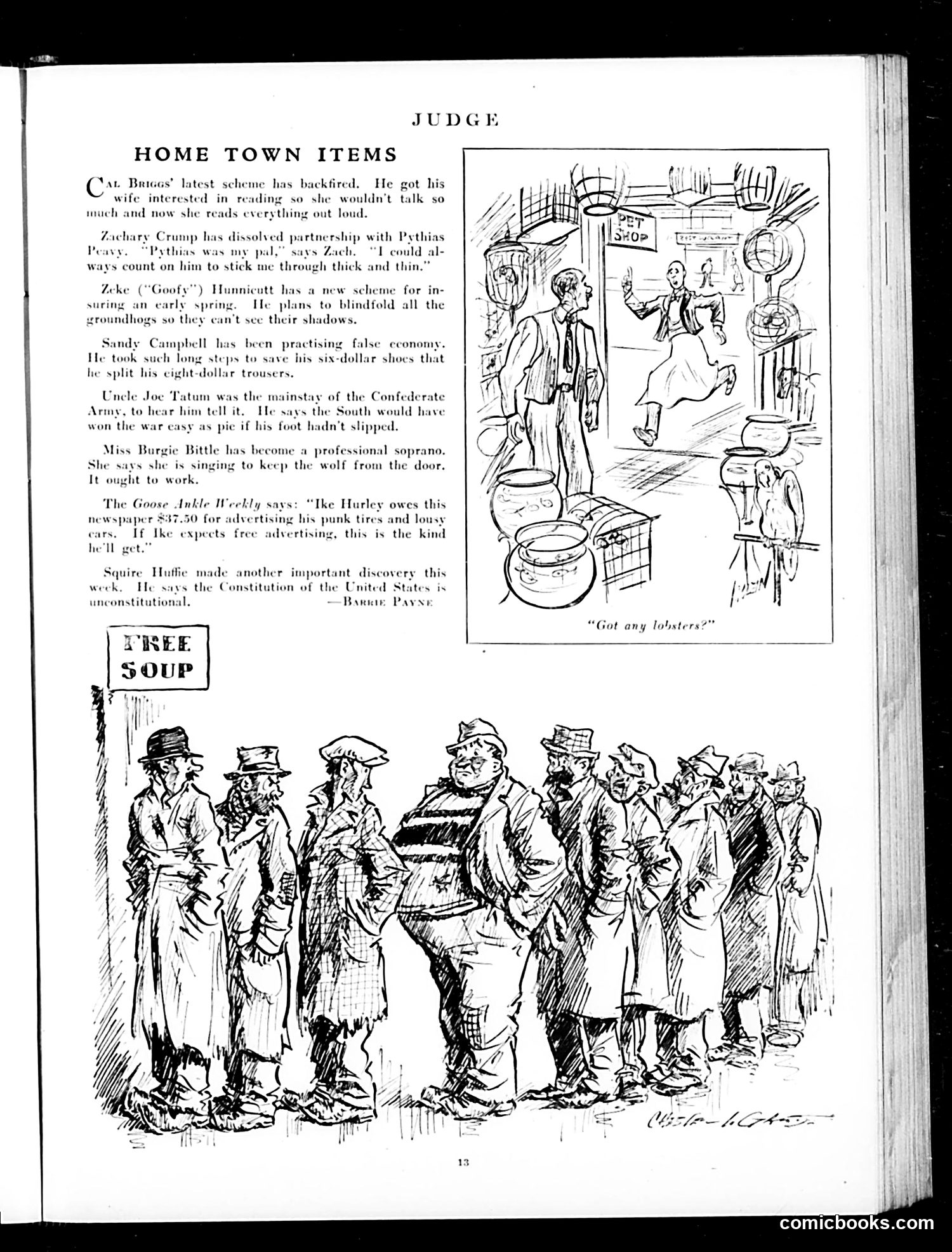
Judge Magazine Page Analysis This page contains satirical "hometown items"—brief humorous anecdotes about fictional small-town characters—typical of Judge magazine's humor style. The jokes mock everyday foolishness: a man's reading scheme backfiring, false economy (ruining expensive trousers while saving cheaper shoes), and an old veteran exaggerating his Civil War importance. The top cartoon shows a street vendor hawking lobsters, likely satirizing urban commerce or food vendors. The bottom cartoon depicts a "free soup" line, a common Depression-era or economic hardship reference showing unemployed or impoverished men seeking charitable meals. The squire's observation that "the Constitution is unconstitutional" represents absurdist humor—logical contradiction played for laughs. These are gentle, apolitical jokes targeting human nature rather than specific figures or events, reflecting Judge's general satirical approach to American life and pretension.
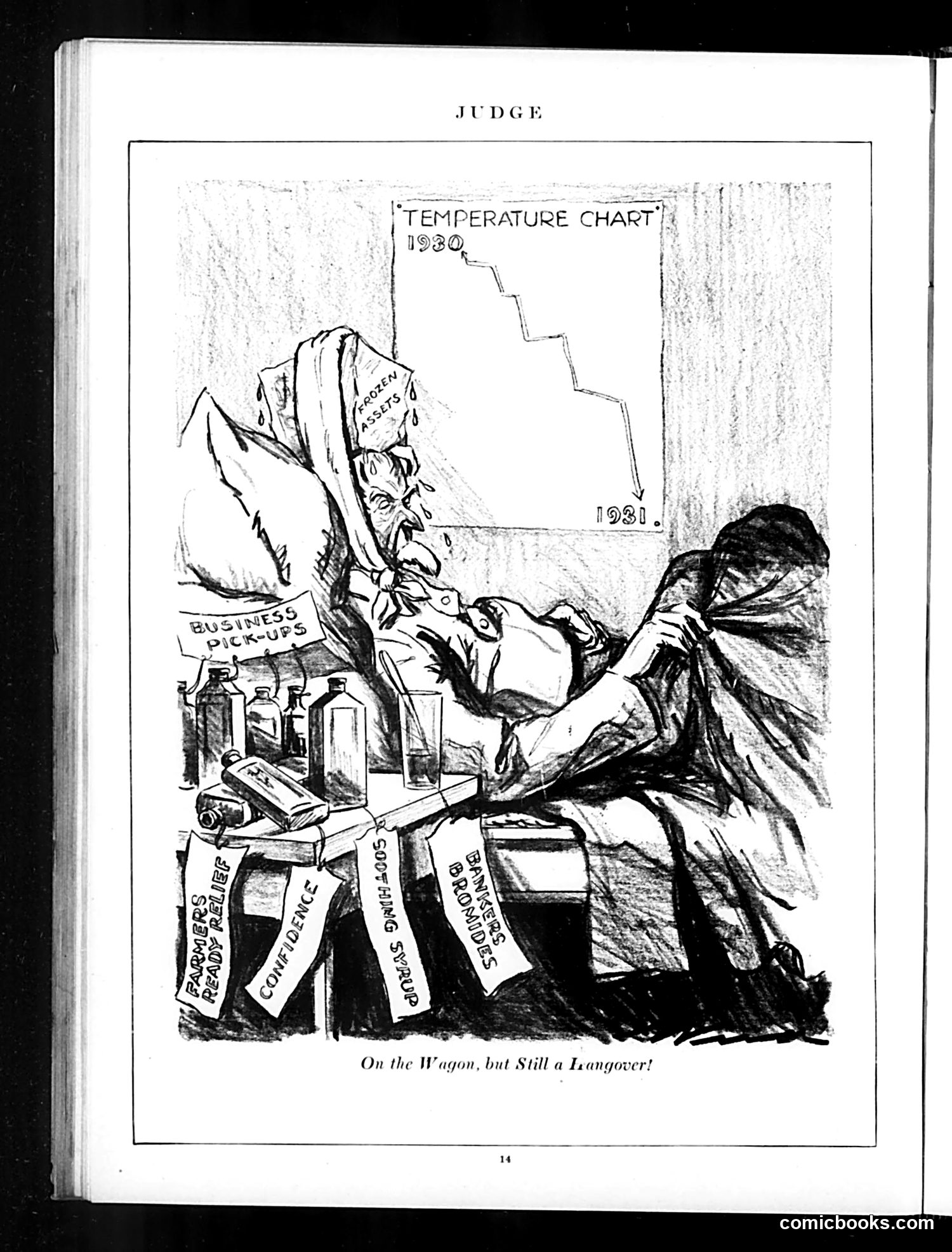
Political Cartoon Analysis: "On the Wagon, but Still a Hangover" This 1980-1981 Judge cartoon satirizes the decline of American business during an economic downturn. A skeletal figure labeled "Business" lies ill, wrapped in bandages, while a doctor checks a declining temperature chart marked 1980-1981. Below the bed are bottles labeled "Business Pickups," "Confidence," "Banks Broadening," and other economic indicators—all empty or depleted, suggesting failed recovery efforts. The caption "On the Wagon, but Still a Hangover" implies that while the economy appeared to be improving (staying "on the wagon"/sober), underlying problems persisted. The cartoon references the early 1980s recession and critiques the inadequacy of partial economic measures to address systemic business collapse.
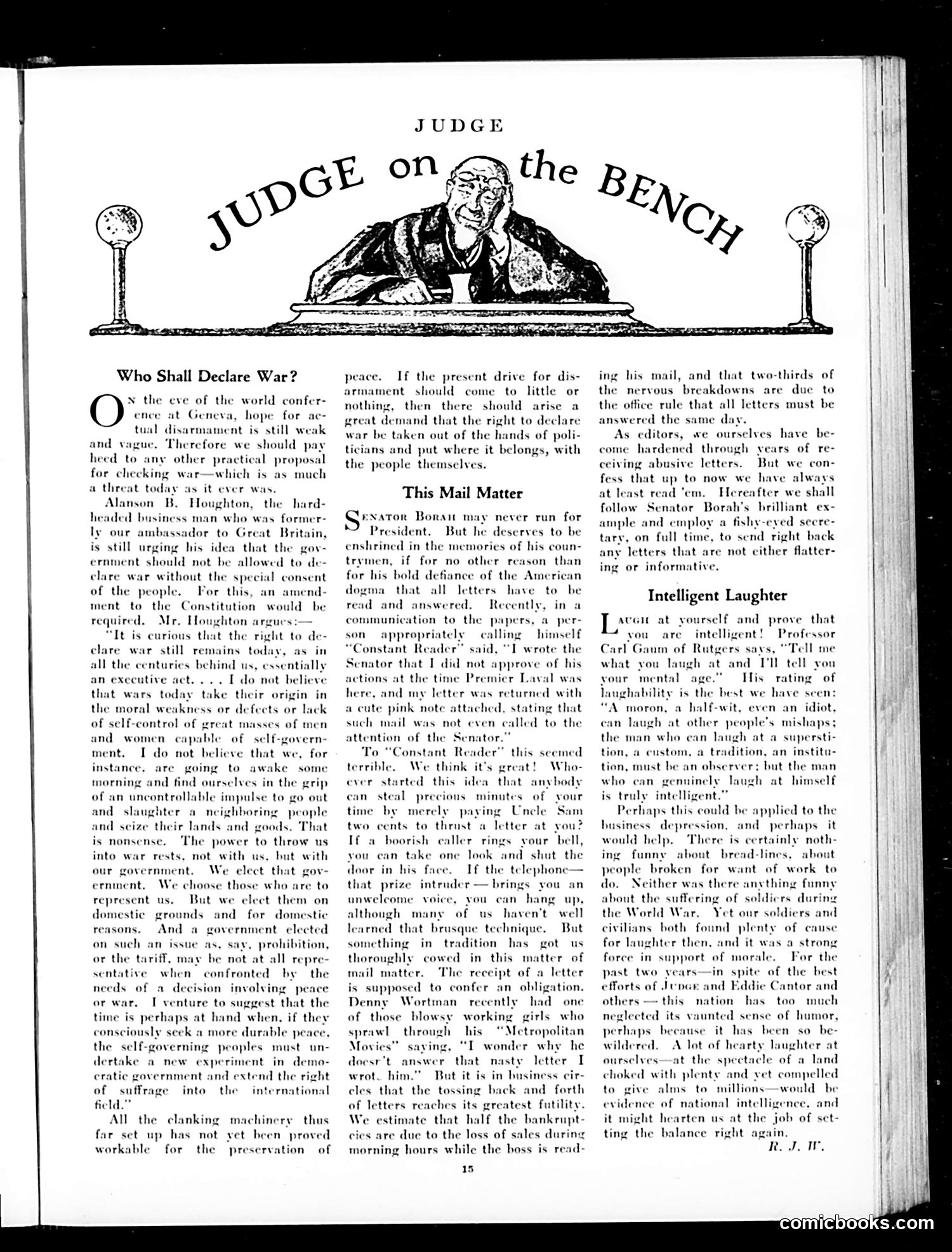
"Judge on the Bench" - Page Analysis This page contains two distinct opinion pieces from Judge magazine (a satirical weekly). "Who Shall Declare War?" argues for a constitutional amendment requiring popular consent before declaring war. It quotes Alanson B. Houghton, a former U.S. ambassador to Great Britain, who contends that war declarations should require public approval rather than remain solely an executive power. The piece advocates democratizing war-making authority during the Geneva disarmament conference era (appears to be 1920s). "This Mail Matter" satirizes Americans' reflexive obligation to answer every piece of mail. It praises Senator Borah for returning unanswered letters with a note, arguing people shouldn't feel compelled to respond to unsolicited correspondence any more than they must answer unwanted phone calls or door-knockers. The piece mocks business culture's obsession with letter-answering as wasteful. Both pieces represent Judge's characteristic blend of political advocacy and social satire targeting American conventions and government practices.
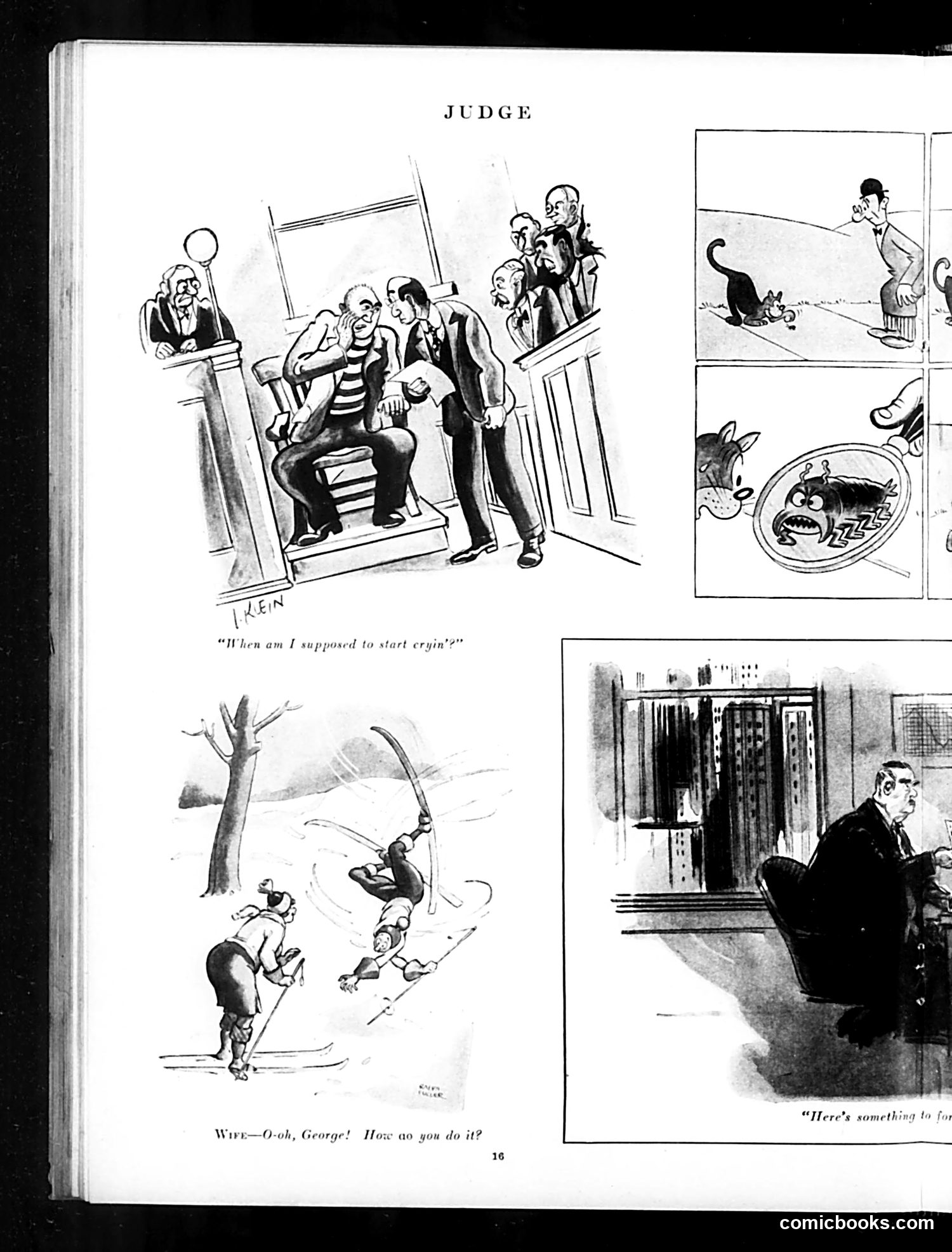
Judge Magazine Page Analysis This page contains three separate cartoons labeled "JUDGE" at the top, satirizing courtroom and legal proceedings. The top cartoon by I. Klein shows a defendant in the witness stand with a judge presiding, captioned "When am I supposed to start cryin'?" — mocking defendants who perform emotional displays during trials. The bottom left cartoon depicts a man fishing while his wife calls out "Wire—O-oh, George! How do you do it?" — likely satirizing men who escape domestic life through leisure activities, with the wife's exasperation suggesting this is habitual behavior. The right panel appears to show additional courtroom or official building scenes, though details are unclear in this reproduction. The overall theme critiques legal theater, masculine avoidance of domestic responsibility, and institutional pomposity through gentle humor typical of early 20th-century American satire.
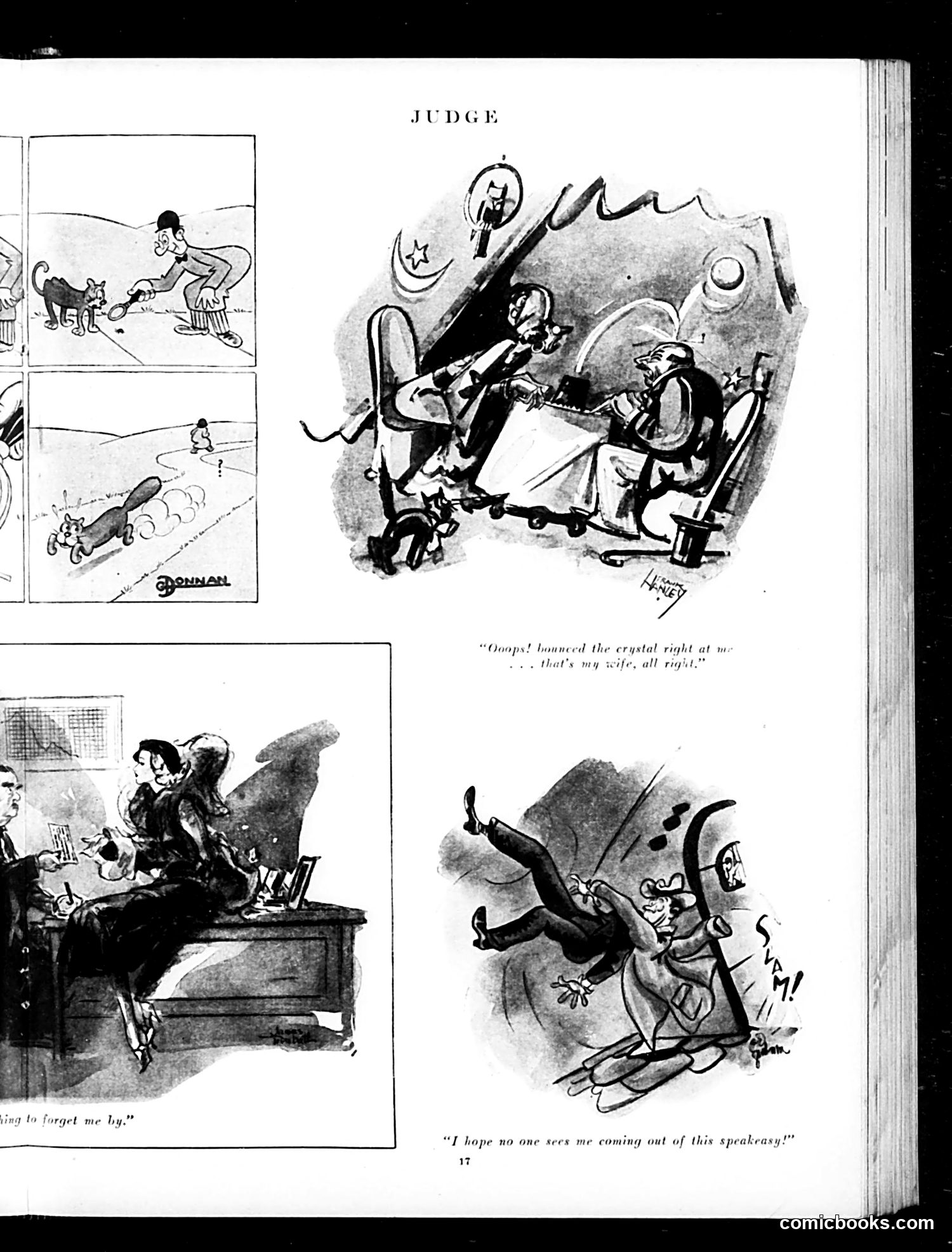
Judge Magazine Cartoon Analysis This page contains four separate comic illustrations satirizing domestic life and marriage. The cartoons appear to focus on marital mishaps and confusion: The top cartoon depicts what seems to be a courtroom or formal setting where a man identifies something as belonging to "my wife," suggesting mistaken identity or confusion during a legal proceeding. The bottom right cartoon shows a man apparently escaping through a window or chimney, captioned "I hope no one sees me coming out of this speakeasy!"—referencing Prohibition-era illegal alcohol consumption and the social hypocrisy of respectable men frequenting speakeasies while maintaining public propriety. The other panels appear to show domestic scenes with similar themes of marital discord or deception. The artwork style is typical of early-to-mid 20th century American humor magazines targeting middle-class audiences.
Analysis of "The Theatre of George Jean Nathan" This is a theater criticism piece by Judge's drama critic, not a political cartoon. It discusses actress Maude Adams' triumphant return to Broadway after a 13-year absence, playing Portia in "The Merchant of Venice" alongside Otis Skinner as Shylock. Nathan argues that Adams' success stems not from acting talent or the play's merit, but from her carefully cultivated romantic mystique—a "soft-focus" public image maintained through decades of theatrical publicity. He compares her appeal to that of movie stars like Marlene Dietrich, whose glamorous screen personas diverge dramatically from their private selves. The satire targets how celebrity mythology and marketing can override artistic merit: audiences flock to see the "Maude Adams" myth rather than the 60-year-old woman performing. Nathan suggests her legendary status—built through strategic publicity—explains the mob scenes better than Shakespeare or her actual abilities. This reflects early 20th-century skepticism about manufactured celebrity.
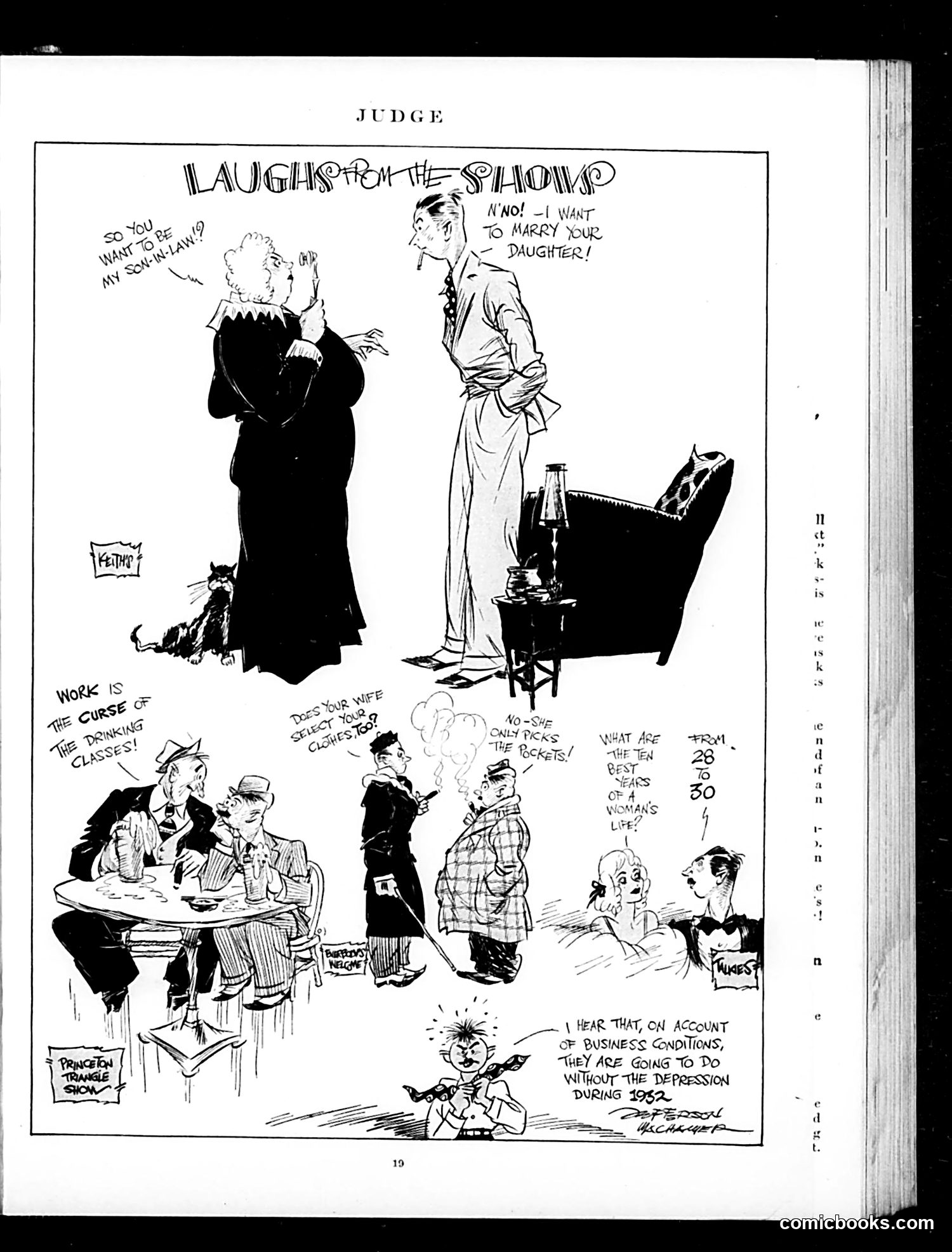
"Laughs from the Shoppe" - Judge Magazine Satire This cartoon collection satirizes 1930s Depression-era anxieties through various social scenarios. The title sketch shows a man rejecting a proposal to marry the daughter of someone described as having "small law" (likely a legal or business figure). Other panels mock working-class struggles: one depicts drinking as "the curse of the drinking classes," another shows a woman asking about her husband's infidelity, and couples discuss dating costs and marriage prospects. The bottom panel presents dark humor about economic hardship, with a character announcing businesses will "do without the depression during 1962"—absurdist commentary on the Depression's ongoing grip on society and widespread hope (or skepticism about hope) for future recovery. The cartoons collectively lampoon marriage, poverty, employment, and economic despair as interconnected social problems of the era.
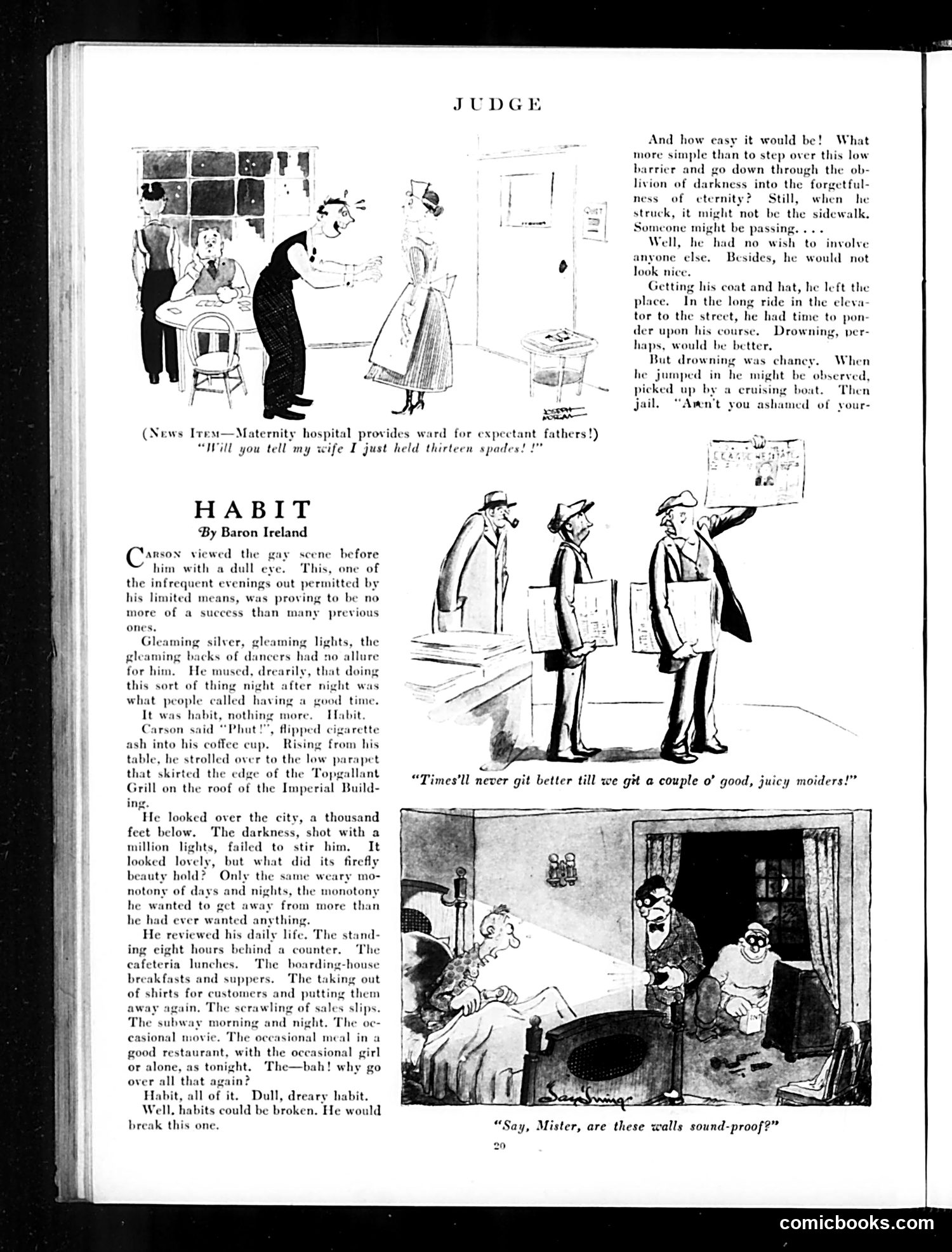
Analysis of Judge Magazine Page This page contains a dark satirical story titled "Habit" by Baron Ireland, depicting a man named Carson contemplating suicide from a rooftop restaurant ("Topgallant Grill") overlooking the city. The narrative explores his monotonous existence—standing behind a counter eight hours daily, boarding-house meals, subway commutes, occasional movies—and his conclusion that breaking the cycle of "dull, dreary habit" means ending his life. The cartoons above illustrate lighter domestic humor: expectant fathers in a maternity ward, and three men discussing finding "good, juicy murder" cases, likely mocking sensationalism. The juxtaposition is jarring—light comedy above, existential despair below—reflecting the magazine's satirical approach to American life. The story critiques urban monotony and ennui among working-class men in the early 20th century, presenting suicide as escape from grinding routine rather than clinical depression.
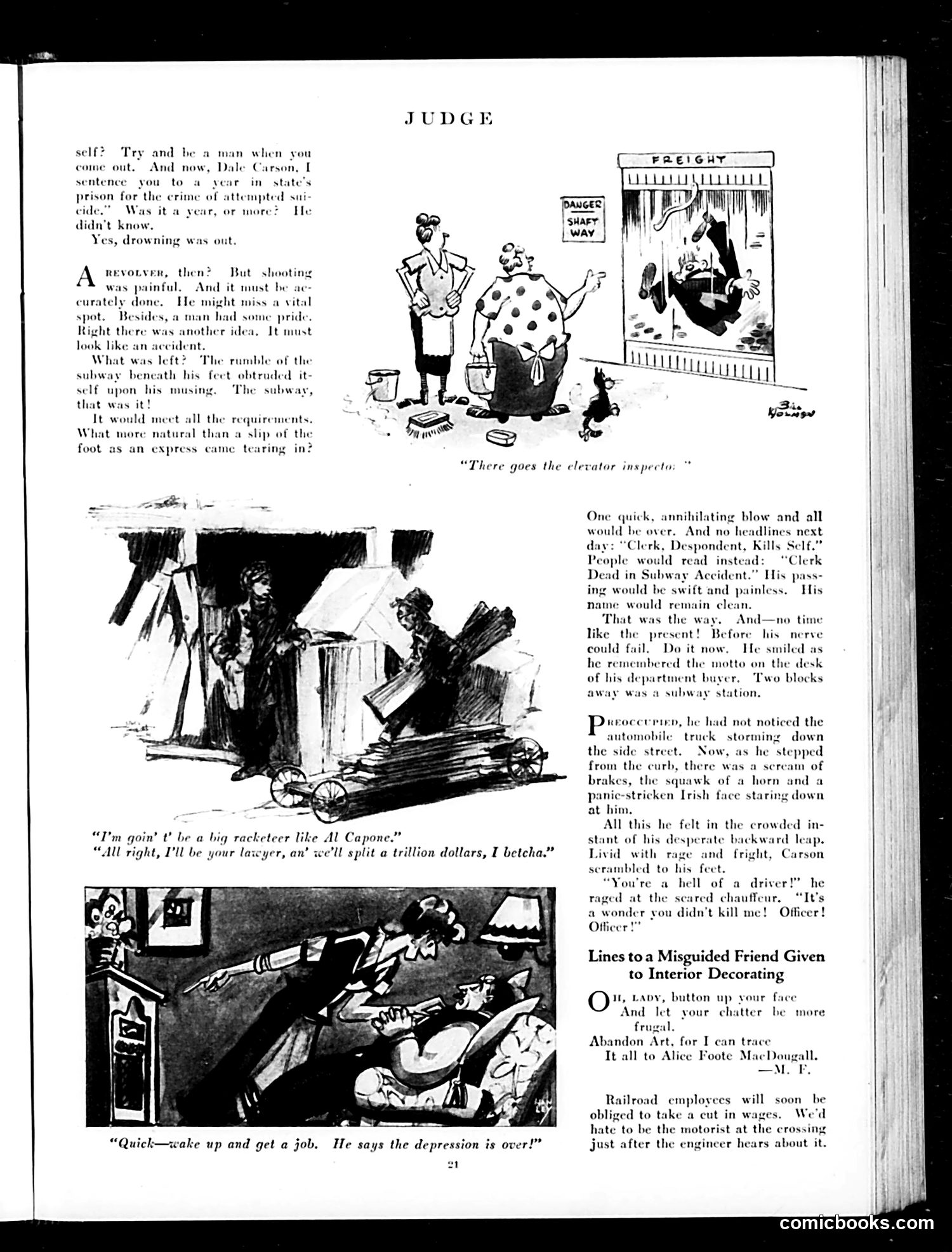
Judge Magazine Page Analysis This page presents a serialized story about a suicidal clerk named Dale Carson who, after receiving a one-year prison sentence for attempted suicide, plots to end his life by jumping in front of a subway train—designed to look like an accident. However, before he can execute this plan, he's nearly hit by an automobile truck and, surviving the close call, becomes enraged at the driver instead of relieved. The satirical point: the man's sudden anger and will to live (he's yelling at the officer) suggests his suicidal impulse was temporary despair rather than genuine conviction. The "accident" scenario ironically interrupts his suicide attempt through actual danger. The page also includes unrelated comic snippets: one mocking interior decorating trends, and another about Depression-era railroad wage cuts—typical Judge magazine fare mixing dark humor with social commentary on 1930s economic hardship.
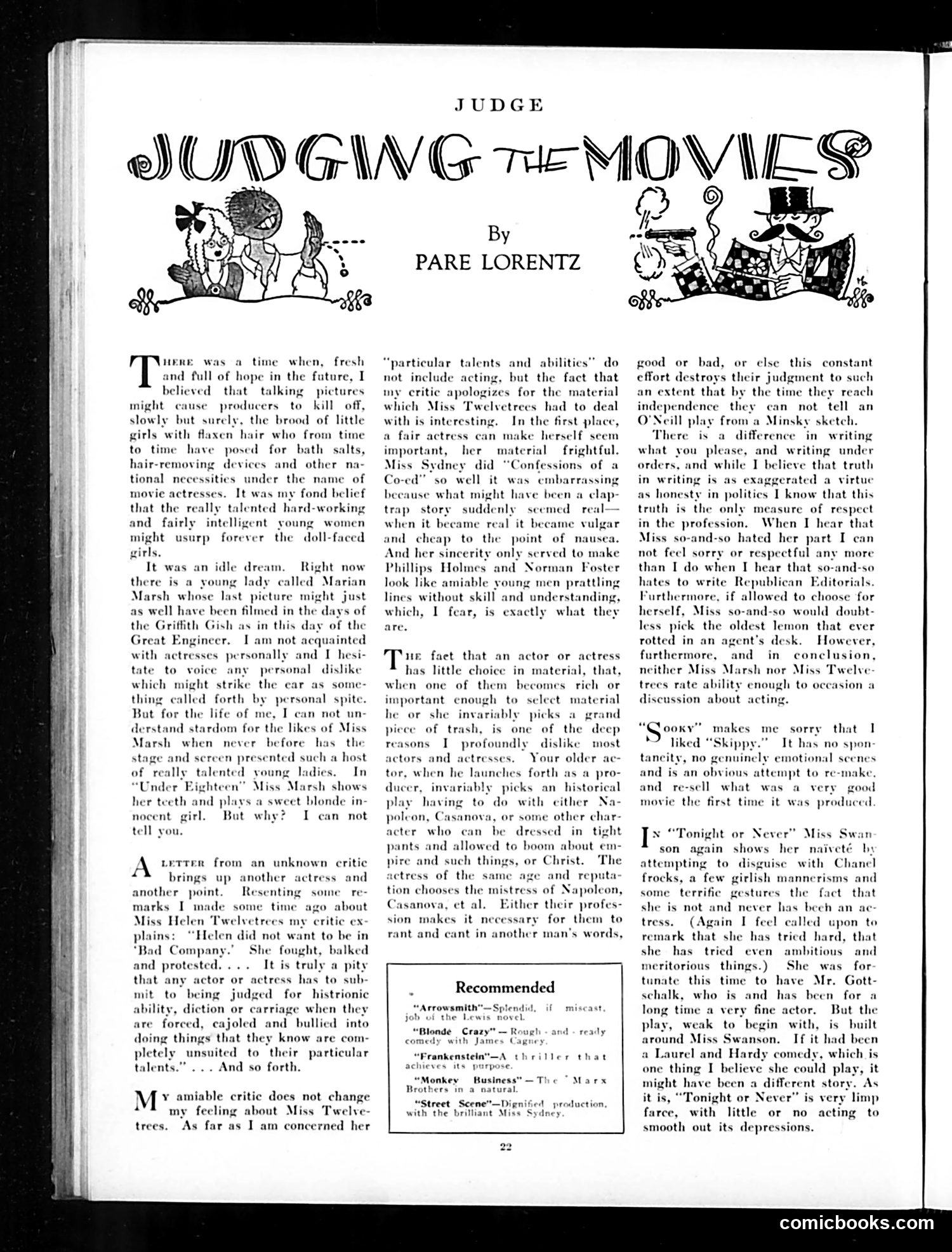
Judging the Movies: Pare Lorentz's Critique of 1920s Hollywood This article by film critic Pare Lorentz attacks the studio system's casting practices and actresses' limited agency. Lorentz argues that talented, hardworking actresses are displaced by conventionally pretty but untalented "doll-faced girls" like Marian Marsh. He criticizes how studios force actors into unsuitable material, corrupting their judgment and abilities. Lorentz cites Helen Twelvetrees and others as victims of this system. The core complaint: major studios (particularly those casting historical/prestigious roles) prioritize marketable beauty and star power over genuine talent or material quality. Lorentz claims this creates a vicious cycle where even capable actresses lose discernment between quality drama (O'Neill) and lowbrow entertainment (Minsky burlesque). The article reflects 1920s anxieties about sound film's impact on acting standards and studio control over performer careers.
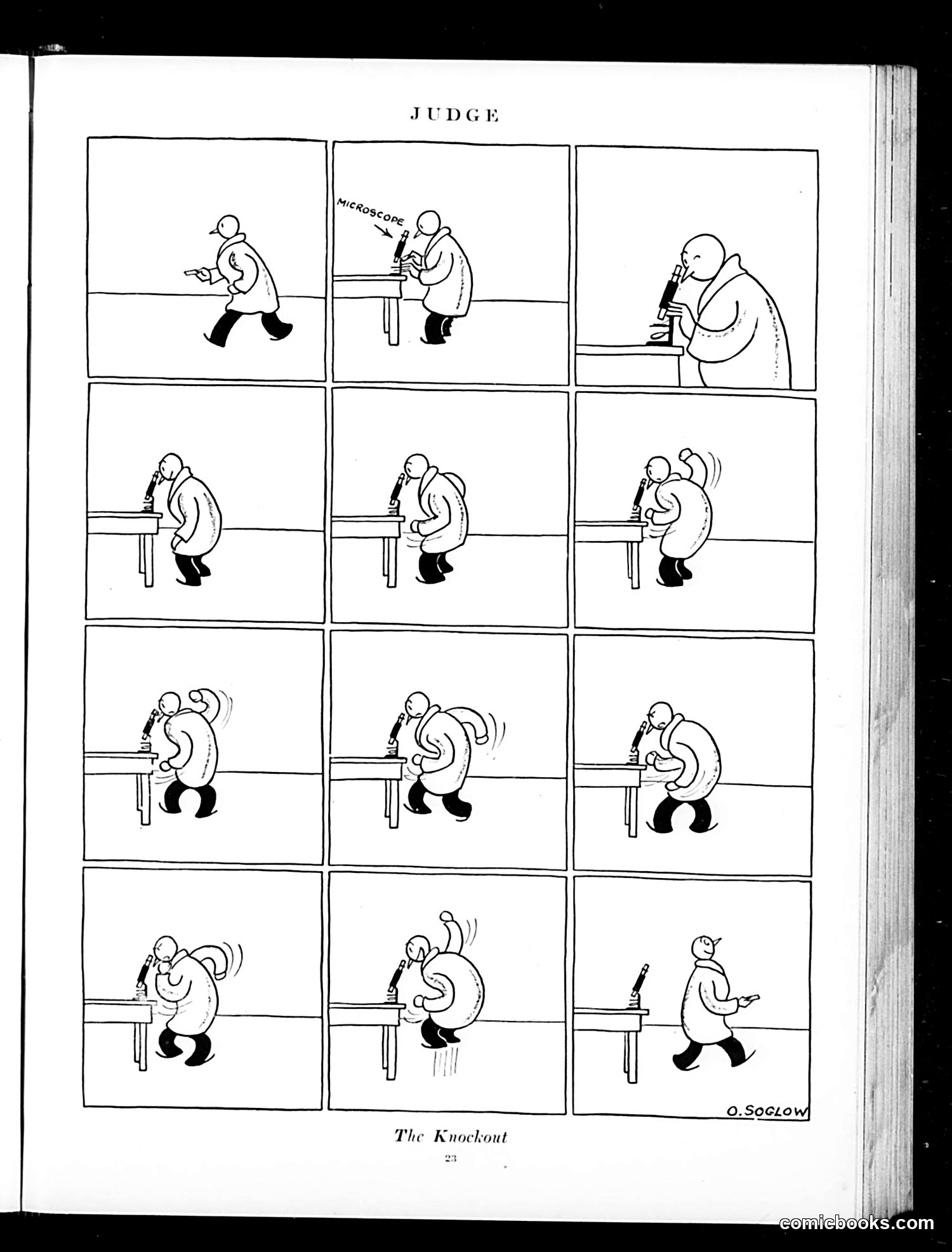
"The Knockout" - Judge Magazine Political Cartoon This single-panel comic strip by O. Soclow depicts a judge examining what appears to be a large stomach or internal organ through a microscope in the first panel, then progressively getting knocked around and beaten by the organ itself across subsequent panels. The satire likely critiques judicial incompetence or corruption—the "judge" character is literally being overpowered and defeated by his subject of scrutiny. This appears to be social commentary on the judiciary's inability to effectively regulate or control something (possibly big business, organized crime, or another powerful institution). The humor derives from the physical comedy of the judge being repeatedly "knocked out" by what should be under his control. The exact historical reference remains unclear without additional context about Judge magazine's publication date.
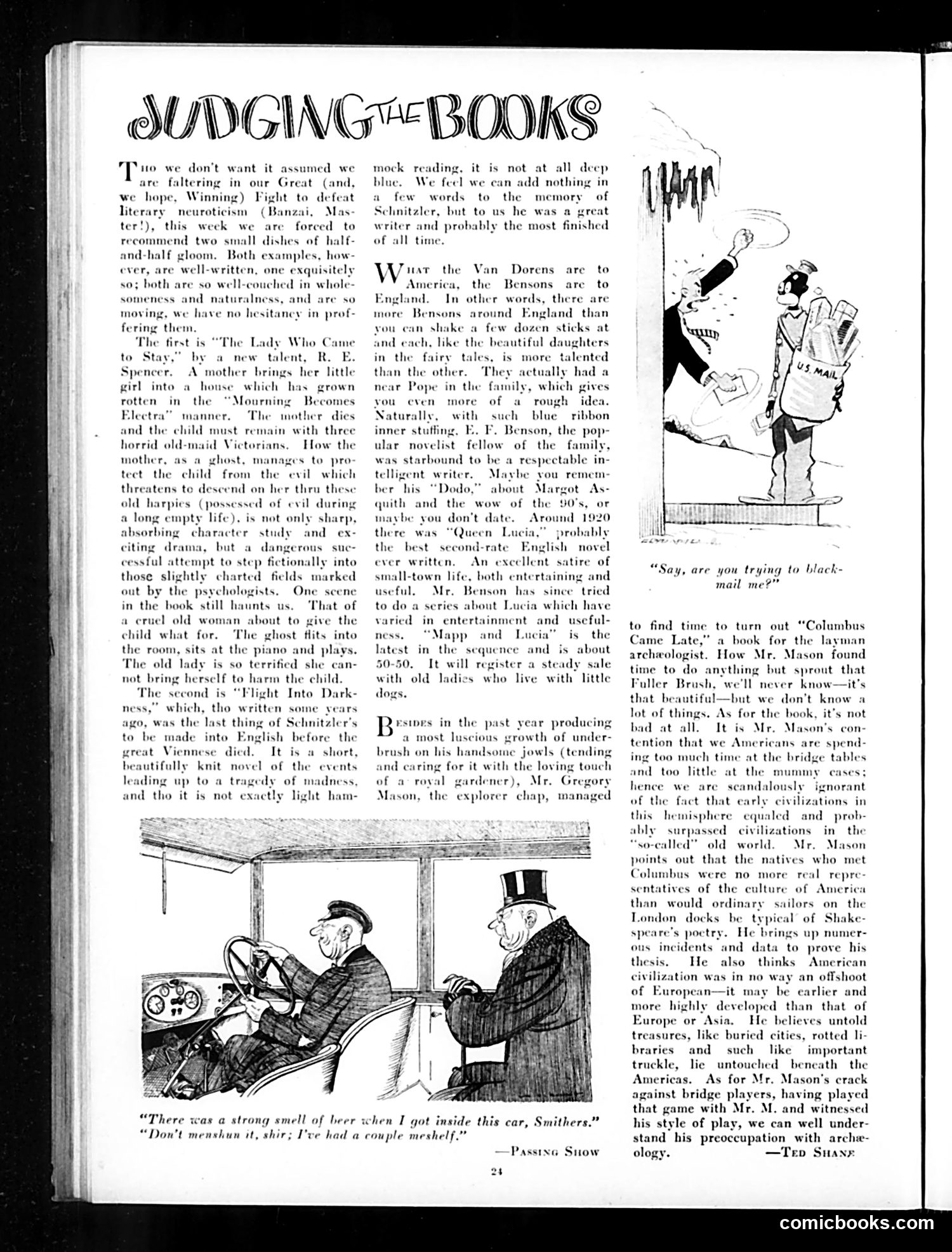
"Judging the Books" - Judge Magazine Book Review Page This page reviews recent novels, with two cartoons providing satirical commentary. Top cartoon: Shows a mailman being confronted by an angry woman. The caption reads: "Say, are you trying to blackmail me?" The humor references the common literary trope of blackmail plots in popular fiction—the reviewer is joking that even innocent mail delivery now seems suspicious given how frequently blackmail appears in contemporary novels. Bottom cartoon: Two men in a car; one says there was "a strong smell of beer" inside, and the other casually admits he's "had a couple myself." This satirizes casual drinking culture, likely referencing Prohibition-era (1920s-1930s) attitudes, when such admissions were scandalous. The text reviews E.F. Benson's novel "Mapp and Lucia," comparing the Benson family's literary output to the Van Doren family's prominence in American letters. The reviewer praises their work while gently mocking their prolific nature.
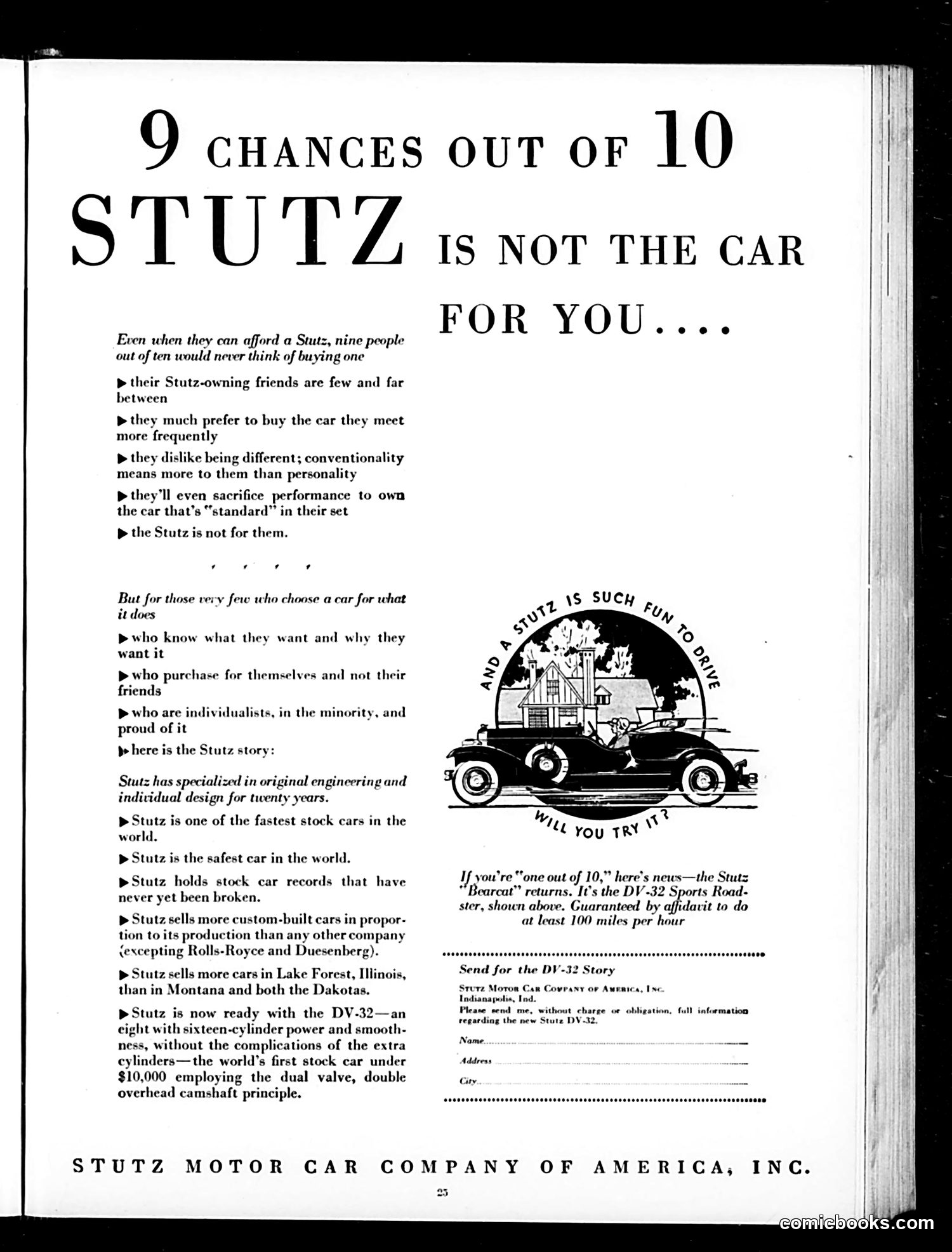
Stutz Advertisement Analysis This is a luxury car advertisement, not political satire. The Stutz Motor Car Company uses reverse psychology to market their high-performance automobile. The ad acknowledges that nine out of ten people won't buy a Stutz because they prioritize conformity over individuality—they'd rather own whatever car is "standard" in their social circle. The copy dismisses these conventional buyers as lacking personality. The actual pitch targets the remaining one percent: self-directed individualists who value performance and personal choice over social convention. The ad lists Stutz credentials (fastest, safest, custom-built, record-holding) and highlights the new DV-32 model, claiming it's the first stock car under $10,000 with advanced dual-valve engineering. The cartoon shows a couple joyfully driving a Stutz past conventional houses, reinforcing the "unconventional choice" messaging. This reflects 1920s-30s marketing strategy: appeal to wealthy buyers' desire to see themselves as independent thinkers, while subtly flattering them for being exceptional.
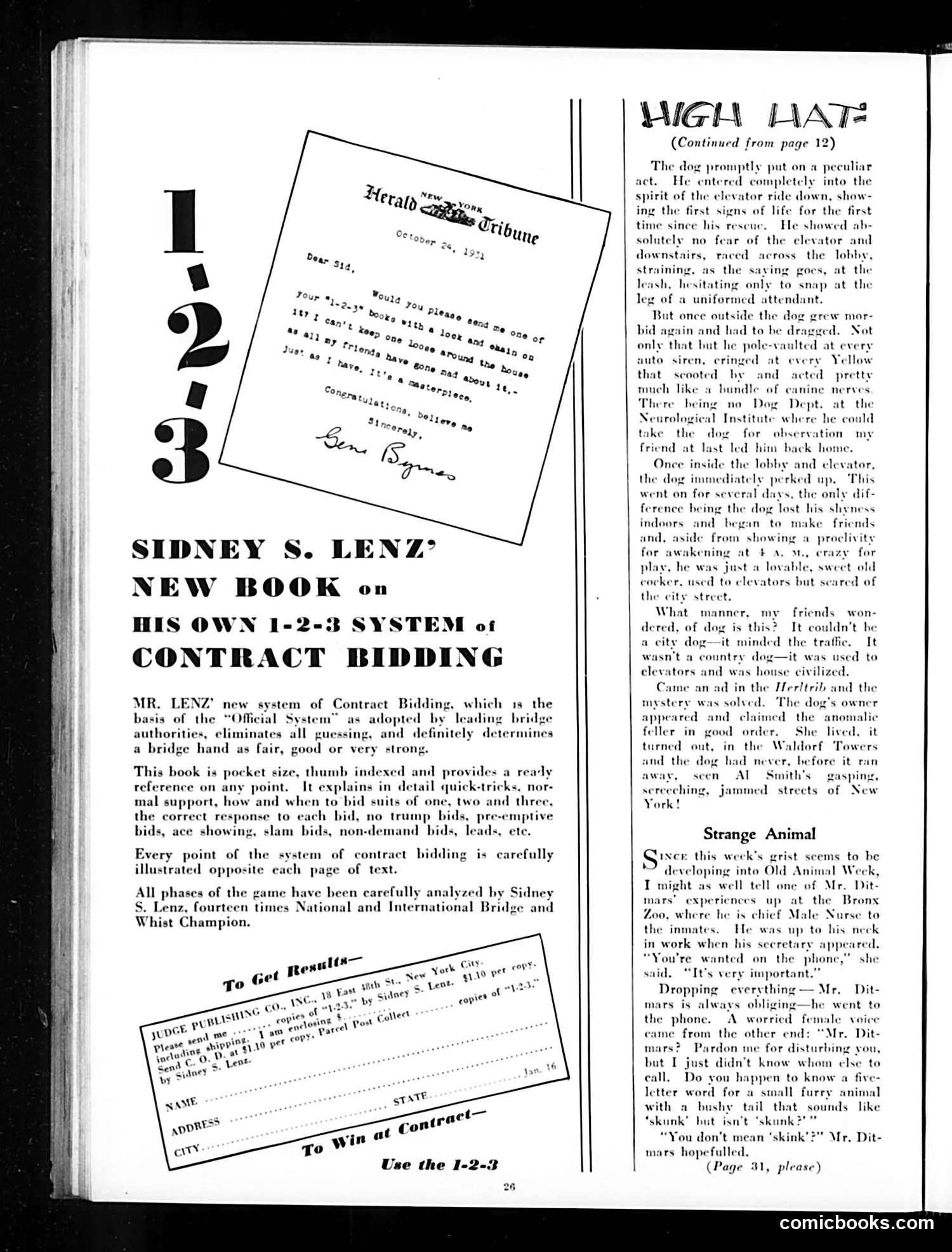
Judge Magazine Page Analysis This page is primarily advertising and fiction, not political satire. The left side promotes Sidney S. Lenz's new contract bridge bidding system book—a legitimate instructional advertisement aimed at bridge players, a popular parlor game of the era. The right side continues a humorous short story titled "High Hat" about an unusual dog rescued from the city. The narrative joke: a dog found in New York City elevators turns out to belong to a Park Avenue resident (implied by Waldorf Towers reference) and behaves as a nervous "city dog"—terrified of streets and traffic—yet comfortable only in elevators. The mystery is comically solved when the owner reclaims him. Below that, a brief piece called "Strange Animal" involves a zoo official (Mr. Ditmars, likely a real figure) being asked a riddle: a five-letter word for a bushy-tailed animal that sounds like "skunk" but isn't. The answer appears to be "skink" (a type of lizard). There is no political cartoon on this page. It's entertainment and advertising content typical of Judge magazine's miscellaneous offerings.
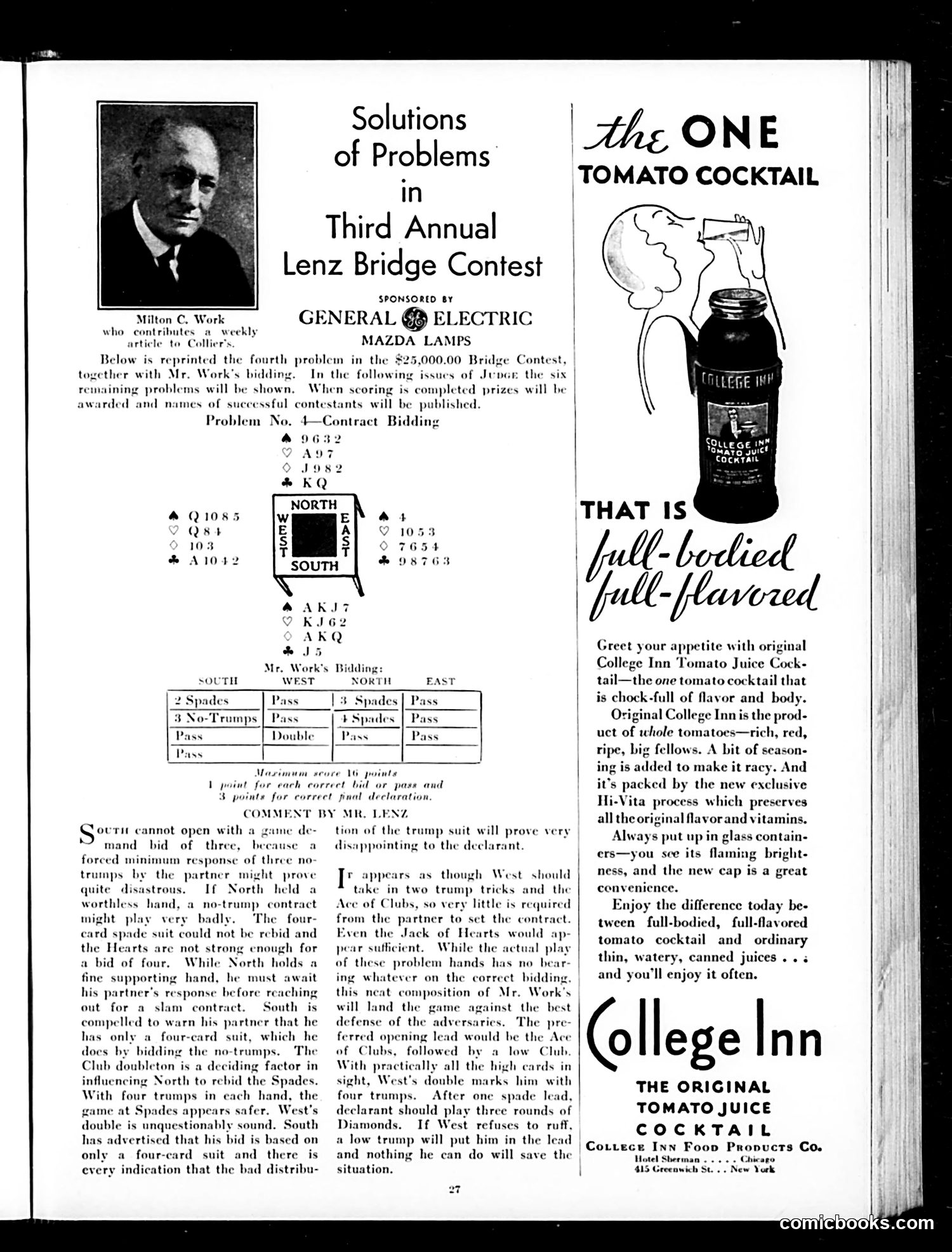
Analysis of This Judge Magazine Page This page combines editorial and advertising content from what appears to be a bridge-focused issue of Judge magazine. Main Content: The left two-thirds features the "Third Annual Lenz Bridge Contest," sponsored by General Electric (Mazda Lamps). It presents the fourth problem in a $25,000 bridge competition, with detailed bidding analysis by Milton C. Work (shown in the portrait). The commentary critiques various bidding decisions and explains optimal play strategy. Advertisement: The right side promotes "College Inn" tomato juice cocktails, emphasizing their superior "full-bodied, full-flavored" quality made from whole tomatoes using a proprietary "Hi-Vita process." The ad contrasts this against inferior "thin, watery, canned juices." Context for Modern Readers: This reflects 1920s-30s American leisure culture where contract bridge was a major recreational obsession among educated middle and upper classes. The elaborate contest and sponsorship indicate bridge's cultural prominence. The tomato cocktail ad targets the same affluent audience seeking premium products for their cocktail hour.
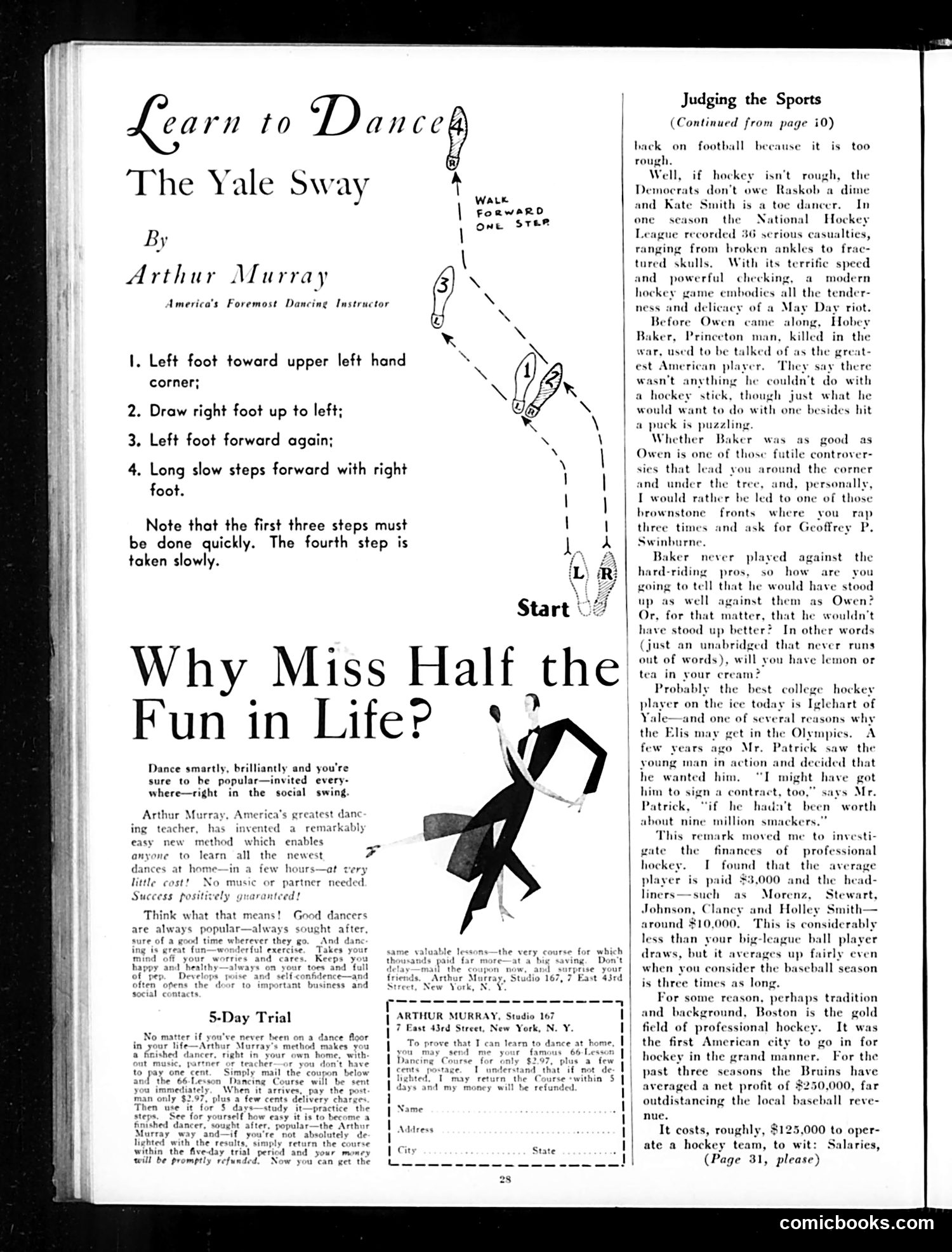
Analysis of Judge Magazine Page This page contains dance instruction (Arthur Murray's "Yale Sway") and a sports commentary column titled "Judging the Sports." The sports section satirizes professional hockey's brutality and expense while defending its legitimacy as entertainment. The writer argues that hockey—despite causing 36 serious injuries in one season—deserves respect as an American sport. He compares it mockingly to "a May Day riot" in terms of violence. The piece references real figures: Hobey Baker (Princeton hockey player killed in WWI, considered America's greatest player) and Owen (likely Gordie Howe or another contemporary pro), debating which would have excelled. It also mentions Mr. Patrick recruiting Yale's Iglehart for professional play. The commentary notes professional hockey players earn roughly $3,000-$10,000 annually—less than baseball stars but respectable—and costs approximately $125,000 to operate a team. Boston is celebrated as America's premier hockey city, with the Bruins consistently profitable. The satire targets both hockey's inherent roughness and readers' snobbish dismissal of it as unsophisticated.
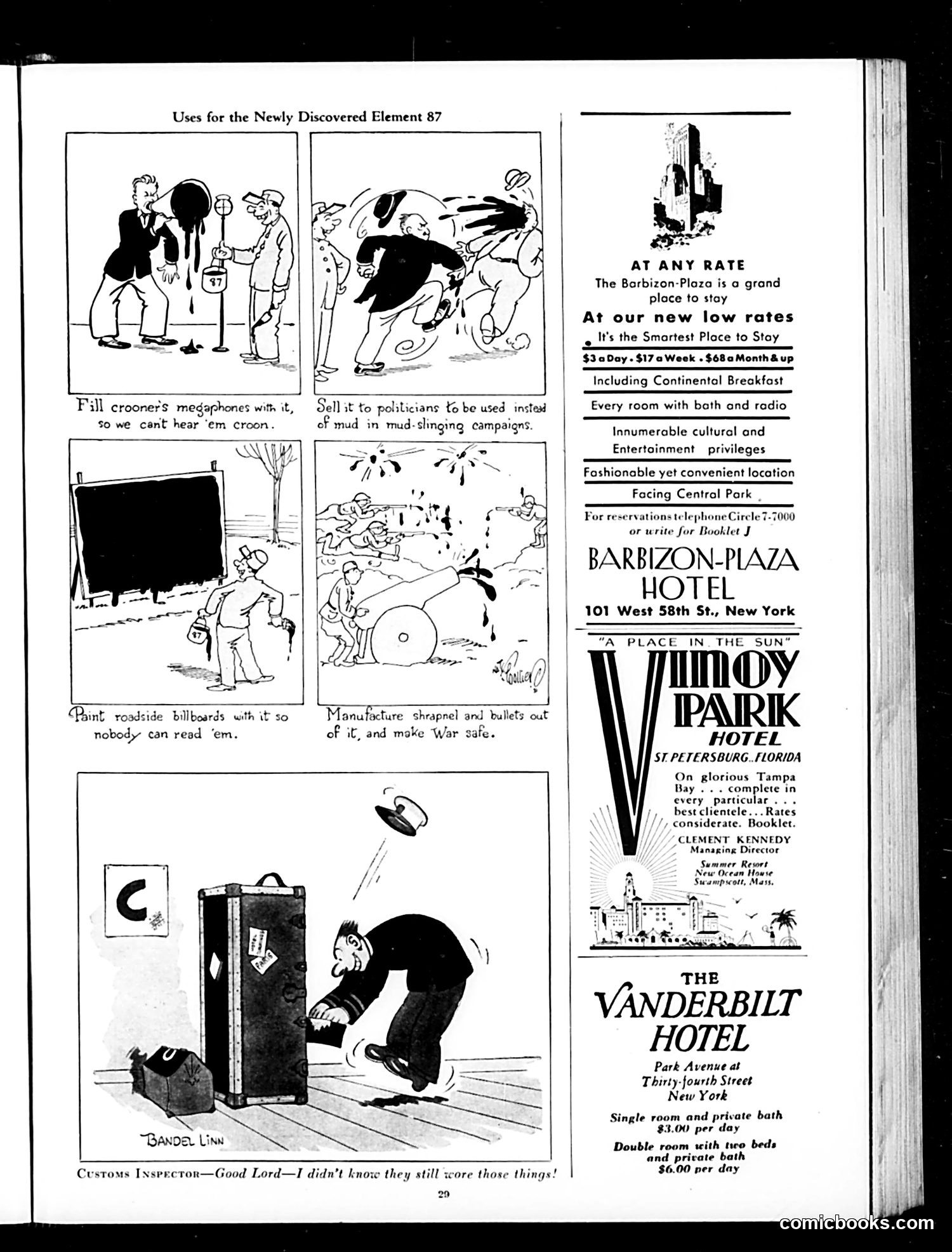
"Uses for the Newly Discovered Element 87" This page satirizes Element 87 (francium, discovered around 1939) through absurdist humor about contemporary annoyances. The top cartoons mock crooners (popular singers), mudslinging politicians, billboard advertising, and war—suggesting Element 87 could "solve" these problems by making crooners inaudible, replacing mud in political attacks, rendering billboards unreadable, and somehow making warfare safer (darkly ironic). The bottom cartoon shows a customs inspector shocked by a woman's corset—the punchline being that corsets, considered old-fashioned by the 1930s-40s, still existed. This mocks outdated fashion. The surrounding advertisements for NYC and Florida hotels represent typical magazine filler of the era, offering Depression-era budget rates ($3-6/day). The satire and ads together capture Judge magazine's combination of political/social commentary with commercial content.
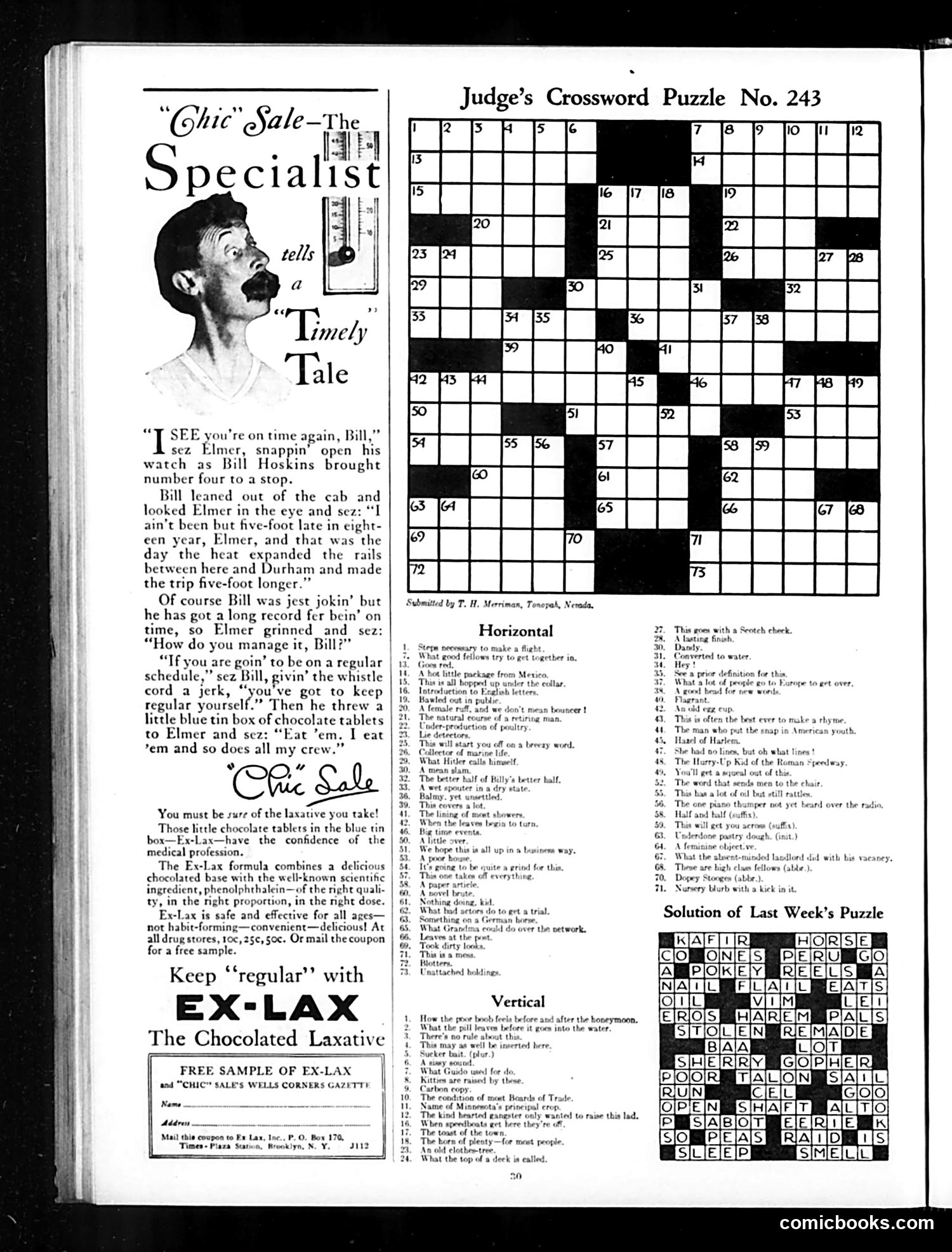
"A Timely Tale" - Judge Magazine Content Analysis This page features a short humorous story accompanying an advertisement for Ex-Lax laxative. The Story: A railroad conductor named Elmer praises Bill Hoskins, a cab driver with an 18-year record of perfect punctuality. When asked his secret, Bill credits Ex-Lax chocolate tablets, claiming they keep him "regular"—a pun playing on both bowel regularity and maintaining a consistent schedule. The Satire: The joke relies on the double meaning of "regular"—the advertisement cleverly uses a workplace reliability narrative to promote a laxative product. By framing constipation management as essential to professional punctuality, the ad humorously suggests that digestive regularity enables life's other responsibilities. Historical Context: This reflects early 20th-century advertising's willingness to discuss bodily functions openly in mainstream publications. The "chic sale" heading references outdoor toilets, further emphasizing the bathroom humor theme. The page is primarily advertising rather than political satire, using folksy Americana and gentle humor to sell a medical product to Judge's middle-class readers.
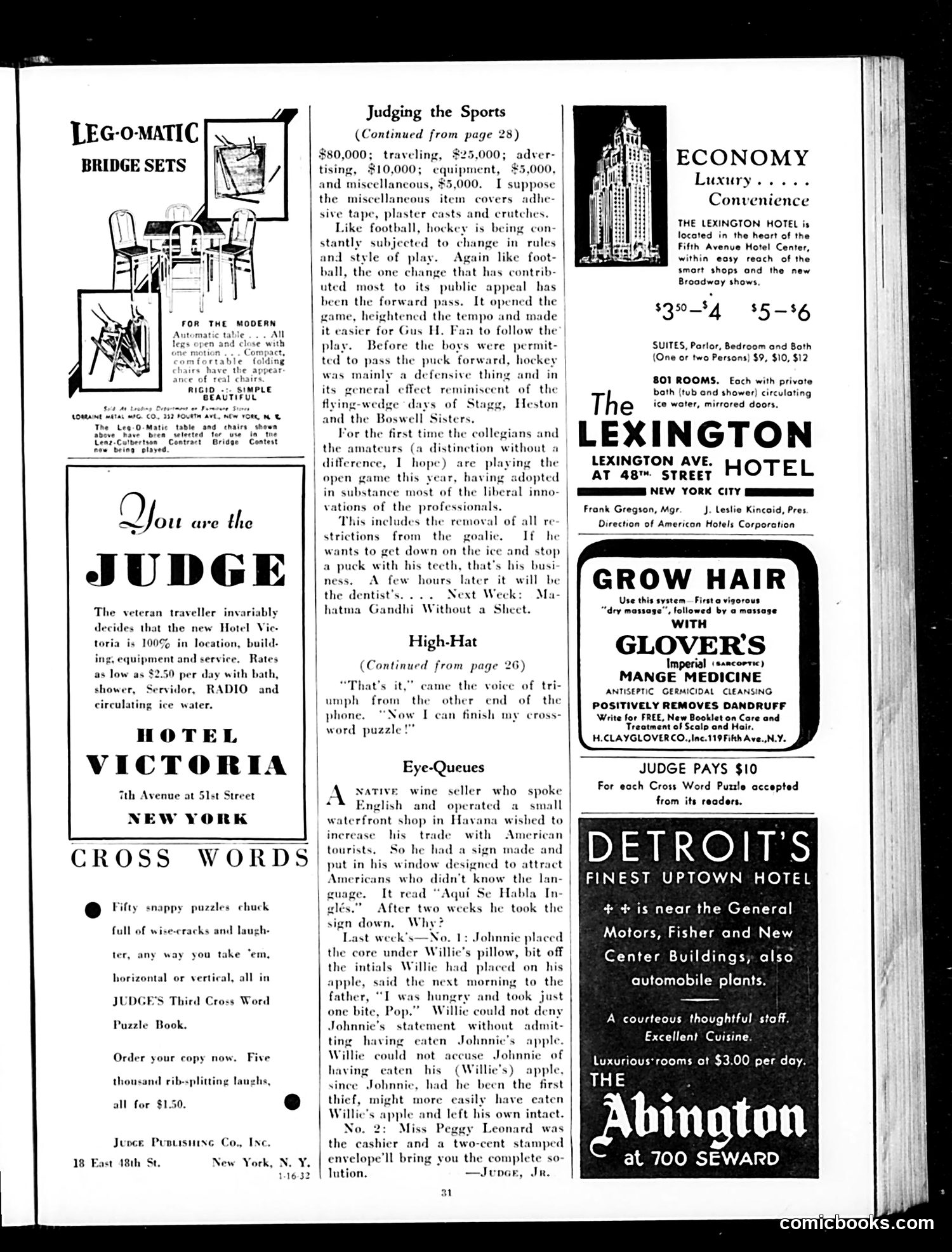
Analysis of Judge Magazine Page Content This page is primarily advertising, with minimal editorial cartoons or satire. The main content consists of hotel ads (Lexington, Victoria, Abington, Detroit's) and product advertisements (Leg-O-Matic bridge furniture, Glover's hair treatment, cross-word puzzles). The only substantive editorial content is "Judging the Sports" (continued article about hockey rule changes) and brief humor pieces like "High-Hat" and "Eye-Queues"—short anecdotal jokes about miscommunication and logic puzzles rather than political satire. The "You are the Judge" section asks readers to decide a contract-bridge dispute, leveraging Judge magazine's format of reader participation puzzles. There are no identifiable political cartoons, caricatures of public figures, or satirical commentary on this particular page. It represents the magazine's mixed advertising-and-humor format typical of early 20th-century periodicals.
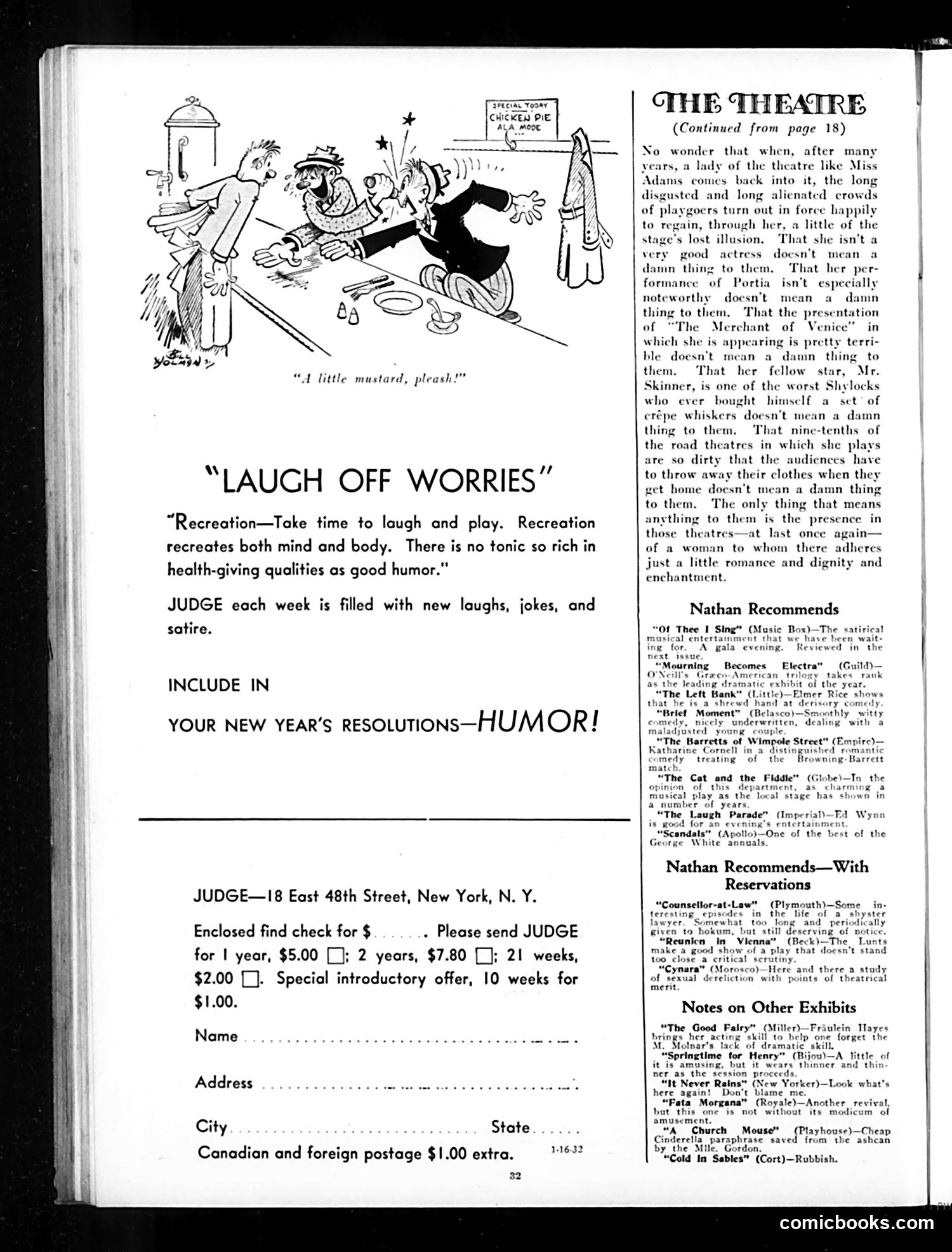
Judge Magazine Page Analysis This page mixes advertising with theater criticism. The cartoon depicts a slapstick restaurant scene where a diner requests "a little mustard, please" while chaos erupts around him—a waiter falls, dishes scatter. The humor is physical comedy typical of 1930s Judge magazine. The main advertisement promotes Judge magazine itself, urging readers to include "humor" in their New Year's resolutions. It emphasizes recreation and laughter as health tonics—reflecting early-20th-century beliefs about humor's therapeutic value. The theater section critiques Broadway productions, notably dismissing a revival of "The Merchant of Venice" starring actress Miss Adams and actor Skinner. The reviewer acknowledges neither the play nor performances are noteworthy, but audiences attend purely for Adams's nostalgic star power and "romance and dignity." This reflects theater criticism's focus on star appeal over artistic merit during this era.
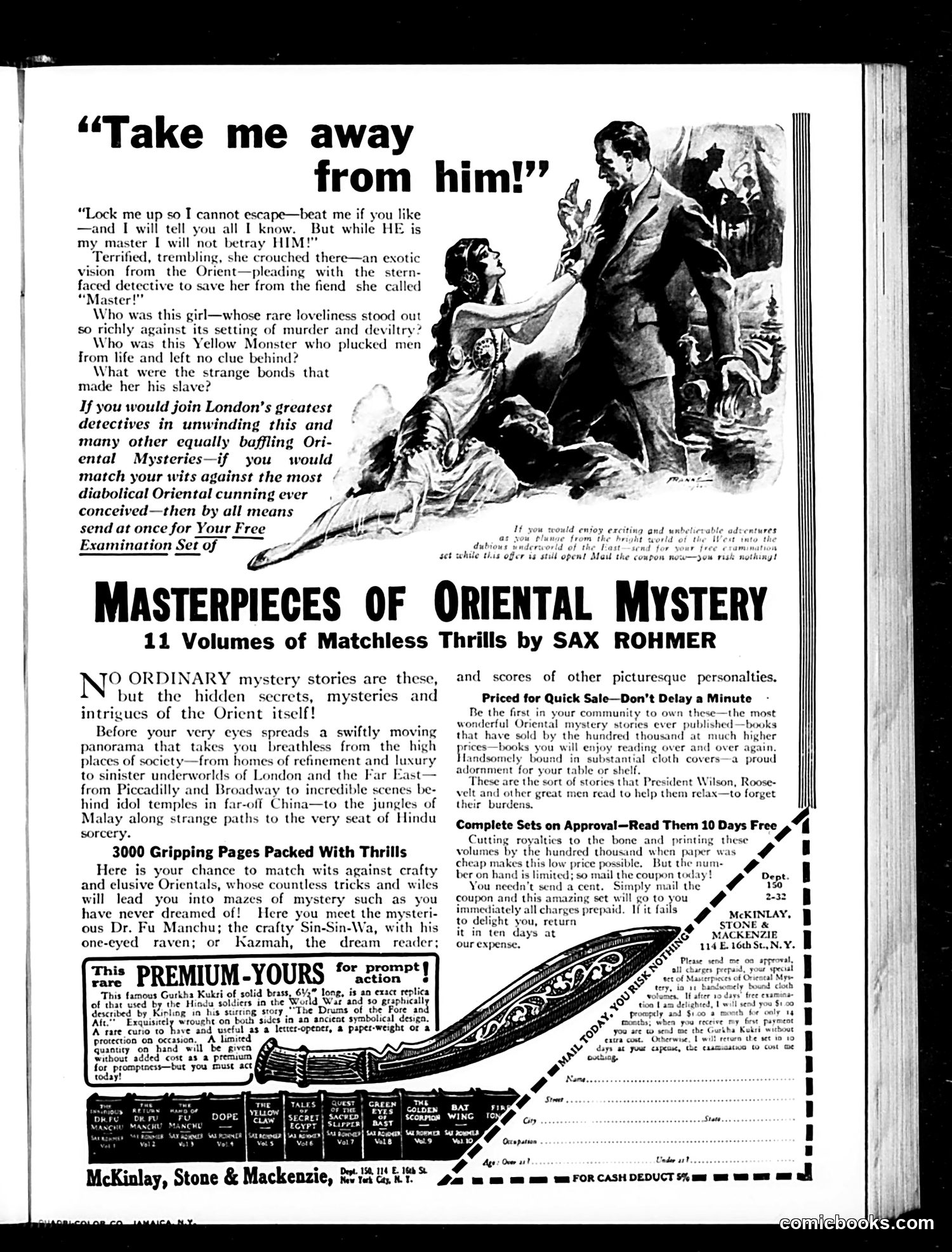
What This Page Means to Modern Readers This is primarily advertising, not satire or political content. It promotes Sax Rohmer's "Masterpieces of Oriental Mystery" book series—likely featuring his famous character Dr. Fu Manchu, a criminal mastermind. The illustrated narrative at top depicts a terrified woman pleading with a detective to protect her from an evil "Oriental" overlord who controls her through mysterious psychological bonds. This reflects early 20th-century pulp-fiction tropes: the "Yellow Peril" (fear of Asian dominance), exotic mystery, and the damsel-in-distress rescued by Western authority. The ad promises 3,000 pages of "thrilling" stories set across London and the Far East. It includes a premium kukri knife replica and offers a free 10-day examination period. Notable is the endorsement claim that Presidents Wilson and Roosevelt read these books to "relax." By modern standards, the content relies on racist stereotypes and orientalism—depicting Asia and Asians as inherently sinister and criminal—now recognized as harmful propaganda rather than entertainment.
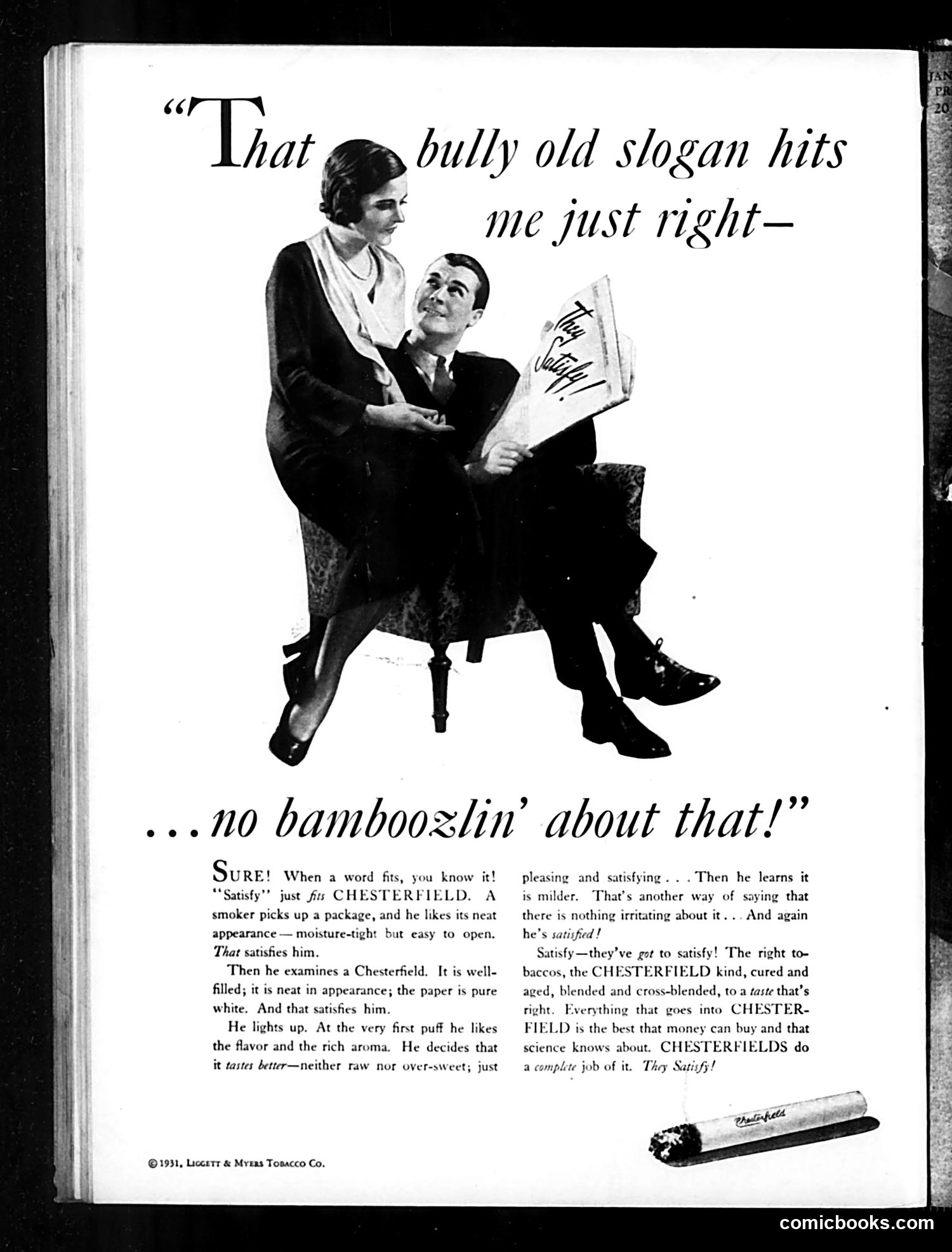
Analysis This is a Chesterfield cigarette advertisement, not political satire. The page depicts a man and woman in 1930s attire, with the man seated reading while the woman leans over him. The headline uses casual slang ("that bully old slogan hits me just right") to create a conversational tone. The ad's central message is that the word "Satisfy" perfectly describes Chesterfield cigarettes. It walks through a smoker's experience—appreciating the package appearance, examining the product, then enjoying the taste—using "satisfaction" as the unifying concept. The copy emphasizes the tobacco blend, pure white paper, and mild flavor. This reflects 1931 advertising conventions: before health warnings were required, cigarette ads openly promoted smoking's pleasures. The colloquial language and domestic scene were typical tactics to make the product seem friendly and accessible to ordinary Americans.