judge
Judge — January 23, 1932
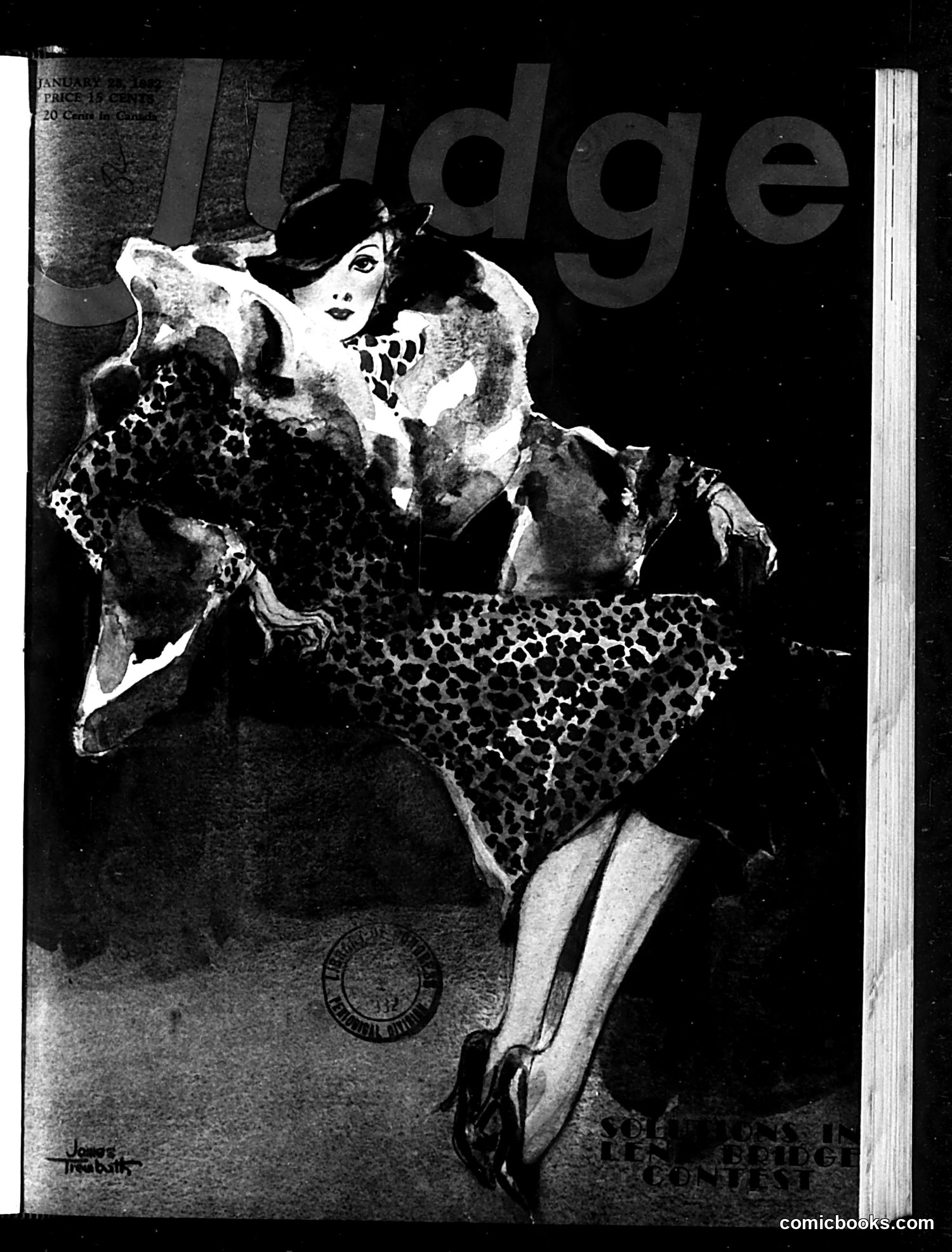
I can see this is a cover from Judge magazine (dated January 1926, priced at 20 cents). The image shows a woman in fashionable 1920s attire—a cloche hat, patterned dress with animal print, and heeled shoes—striking a dramatic pose. However, the OCR text provided is incomplete and illegible, making it difficult to identify the specific satirical subject or political/social reference. The styling and composition suggest this relates to 1920s social commentary, possibly about women's fashion, changing gender roles, or contemporary social figures of that era. Without readable text identifying the subject, I cannot reliably explain the cartoon's specific point or intended satire to a modern reader. The artistic signature appears present but is not clearly legible in this reproduction.
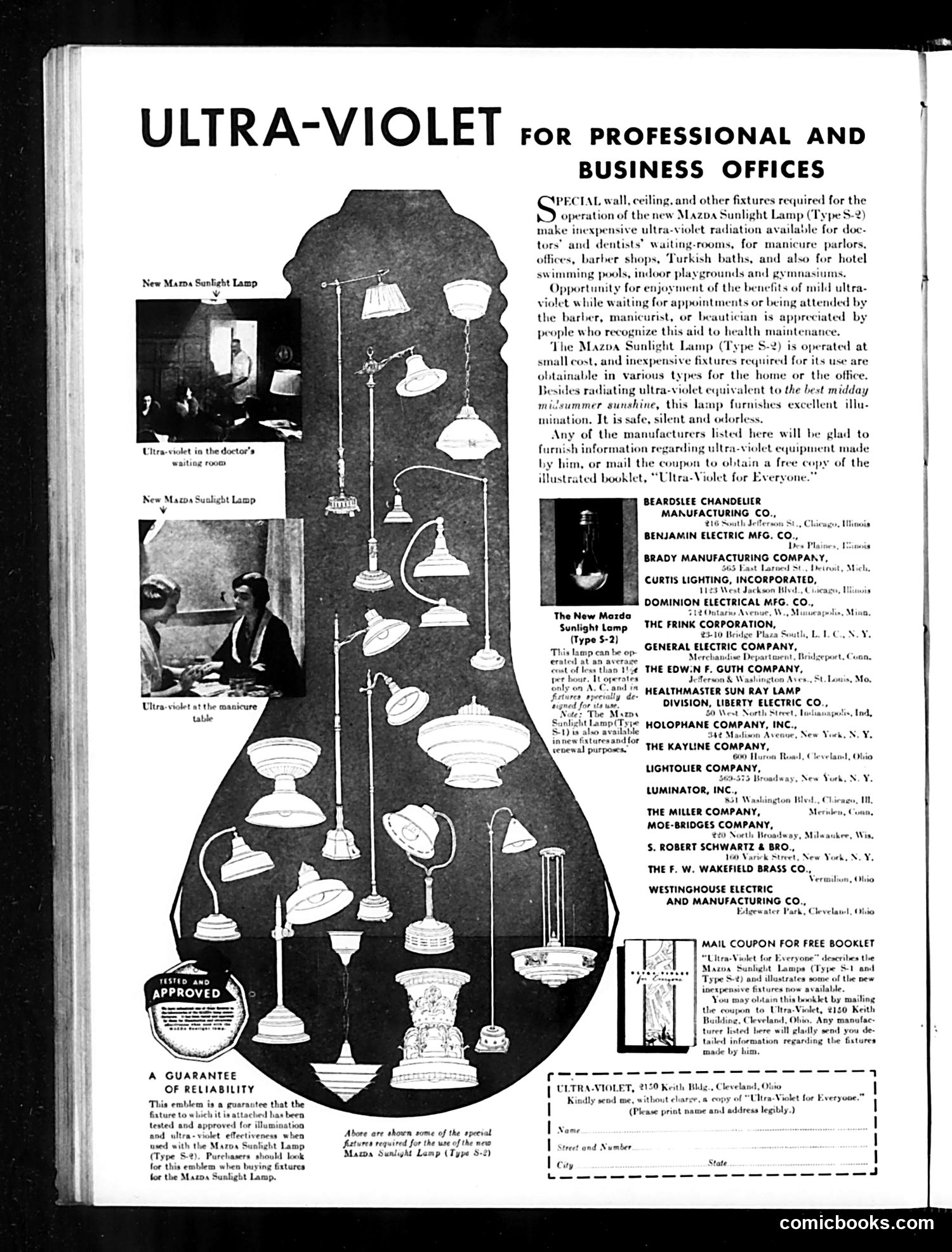
Content Analysis This page is primarily a product advertisement, not satirical content. It promotes the Mazda Sunlight Lamp (Type S-2), an ultraviolet lighting fixture for professional offices, medical waiting rooms, barbershops, and beauty salons. The "cartoon" element is minimal—the central image is a silhouette showing various lamp fixture styles available, surrounded by small photographs demonstrating real-world applications (a doctor's waiting room, a manicure table). The advertisement emphasizes the lamp's safety, silence, and effectiveness for "mild ultra-violet" therapeutic purposes. It includes a guarantee seal and lists multiple manufacturers distributing the product. This represents early 20th-century commercial advertising in *Judge* magazine rather than political satire. UV lamps were then considered beneficial health innovations.
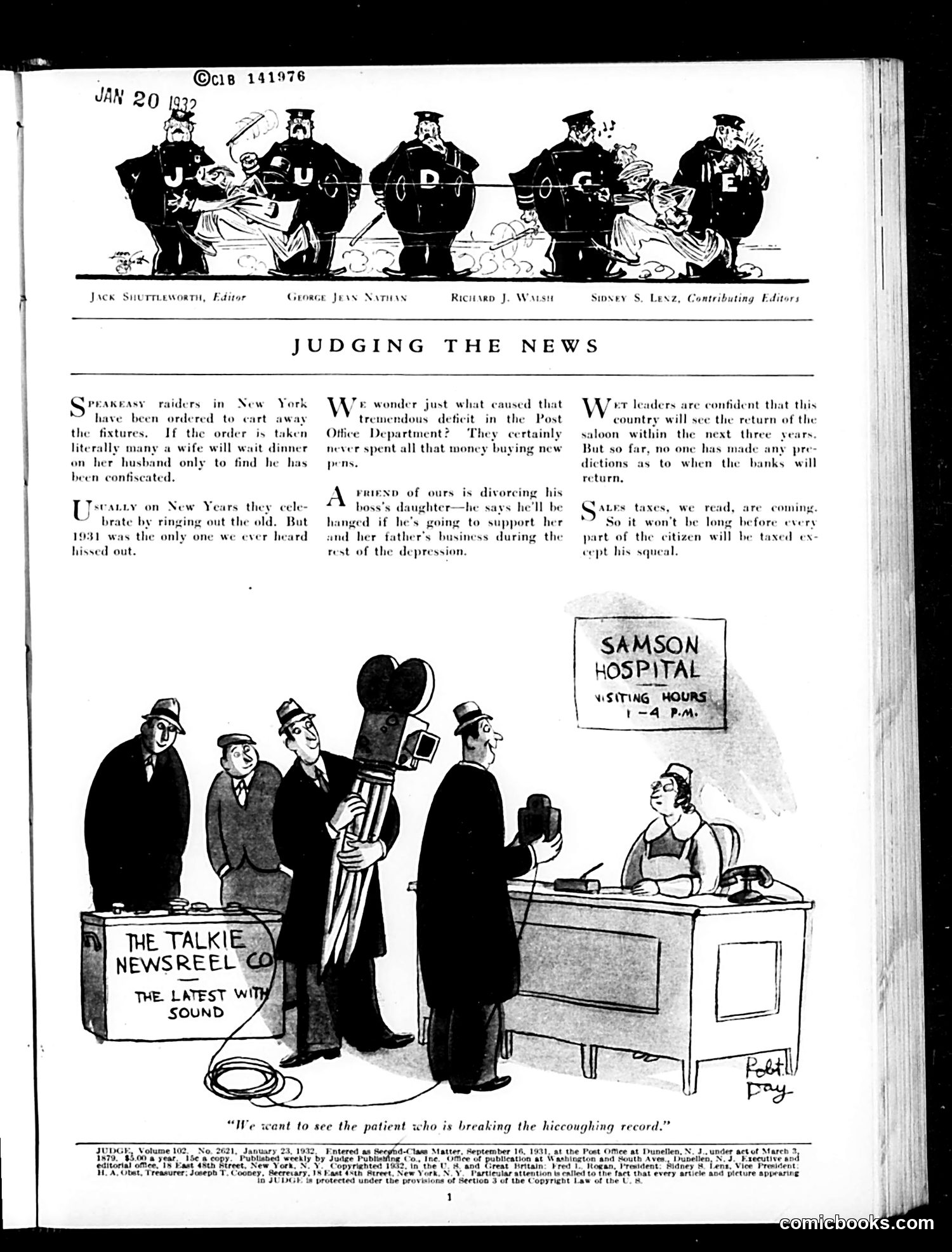
"Judging the News" - January 20, 1932 The main cartoon satirizes newsreel companies' sensationalism during the Great Depression. A film crew from "The Talkie Newsreel Co." attempts to film a patient at Samson Hospital, seeking someone with a "hiccoughing record" to break—prioritizing entertainment value over genuine news. The accompanying editorial column (top) comments on economic hardships: speakeasy raids in New York, Post Office deficits, divorce during depression, New Year's celebrations being muted due to hard times, and anticipated sales taxes. The cartoon mocks how 1930s newsreels exploited human suffering and oddities for entertainment rather than informing the public about serious economic conditions. It critiques the trivial priorities of commercial media during genuine national crisis.
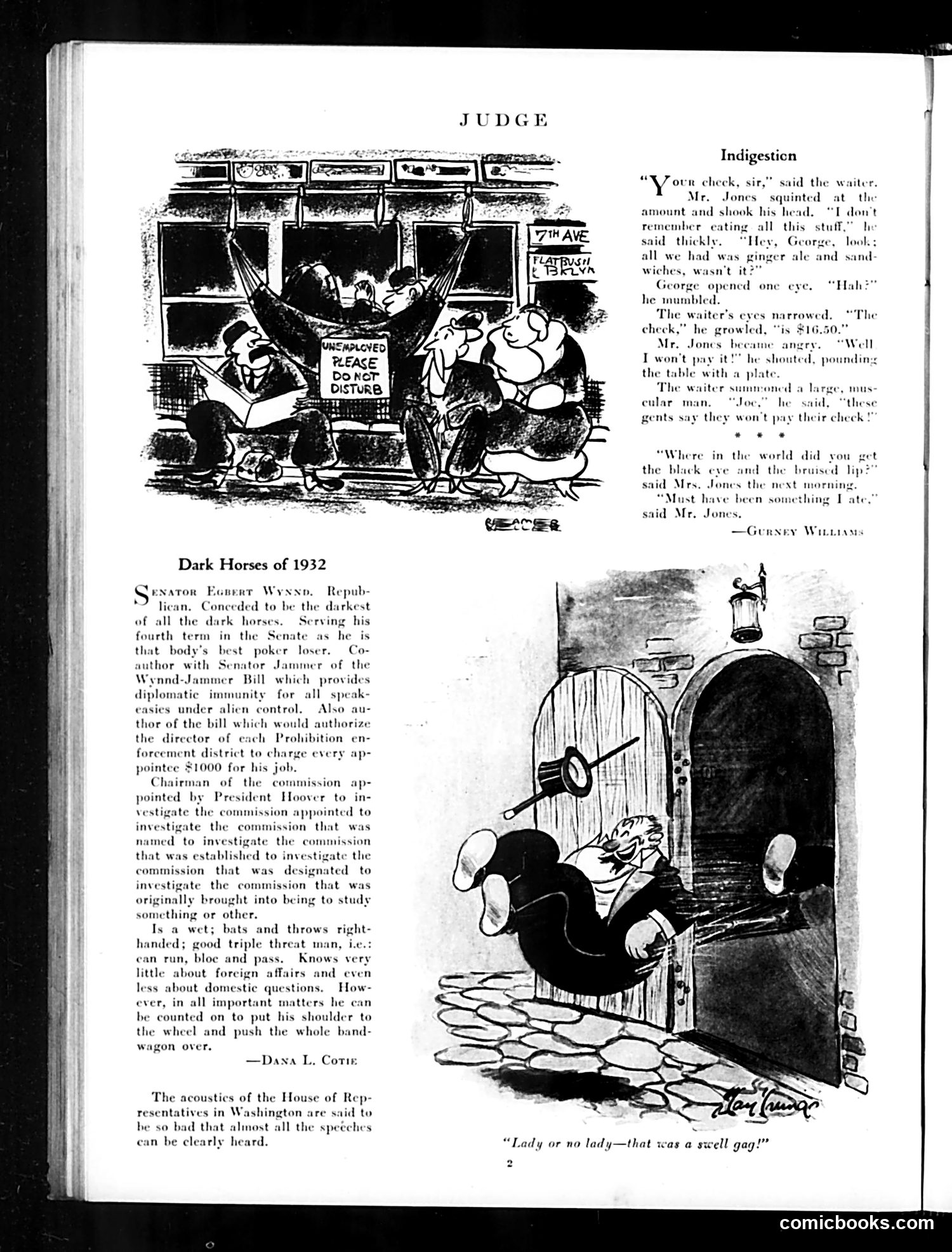
Page Analysis "Indigestion" cartoon (top): A waiter presents an inflated bill ($16.50) to an angry diner (Mr. Jones) at a restaurant. Jones claims he only ate "ginger ale and sandwiches" yet received an enormous charge. His wife sarcastically asks what caused his "black eye and bruised lip"—implying he got into a fight over the bill. The joke satirizes restaurant overcharging practices, a common consumer complaint during the Depression era. "Dark Horses of 1932" (text section): Political commentary on Senator Egbert Wynnd (Republican), described as a poker player and legislative manipulator. The passage critiques his character and political maneuvering. Bottom cartoon: A figure bursts through a door exclaiming "Lady or no lady—that was a swell gag!" The context remains unclear from the visible image alone.
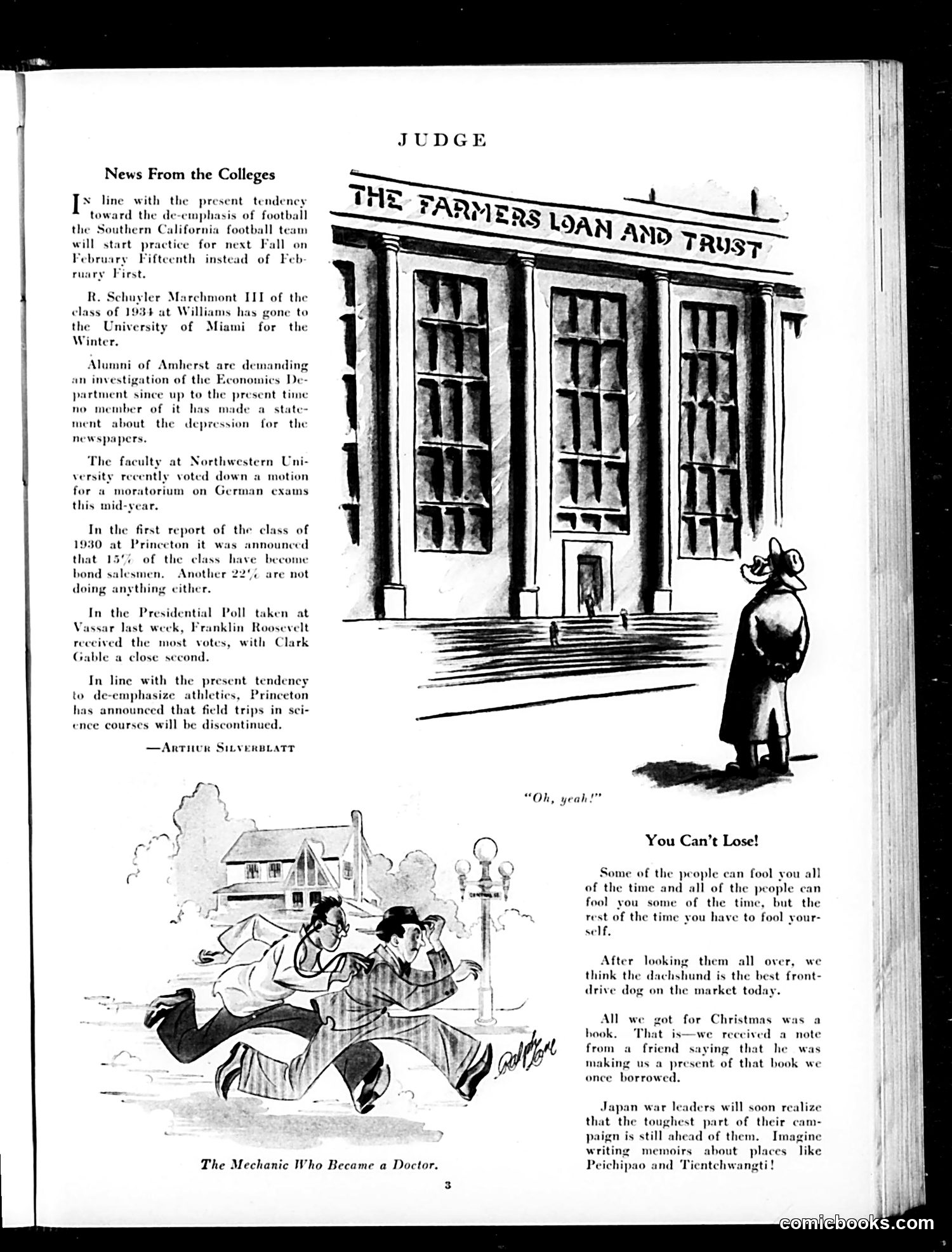
Analysis of Judge Magazine Page Top Cartoon: A man stands before "The Farmers Loan and Trust" building, saying "Oh, yeah!" This appears to be commentary on farmers' financial struggles, likely during the Depression era when agricultural debt was a major issue. The figure's skeptical response suggests doubt about the institution's ability or willingness to help. Bottom Cartoon: "The Mechanic Who Became a Doctor" depicts three men in physical comedy—apparently the story being that someone transitioned from manual labor to medical practice. The cartoon likely satirizes either educational mobility or questions the legitimacy of such career changes. "You Can't Lose!" section contains cynical observations about trust and Christmas gift-giving, reflecting Depression-era skepticism about financial institutions and consumer culture.
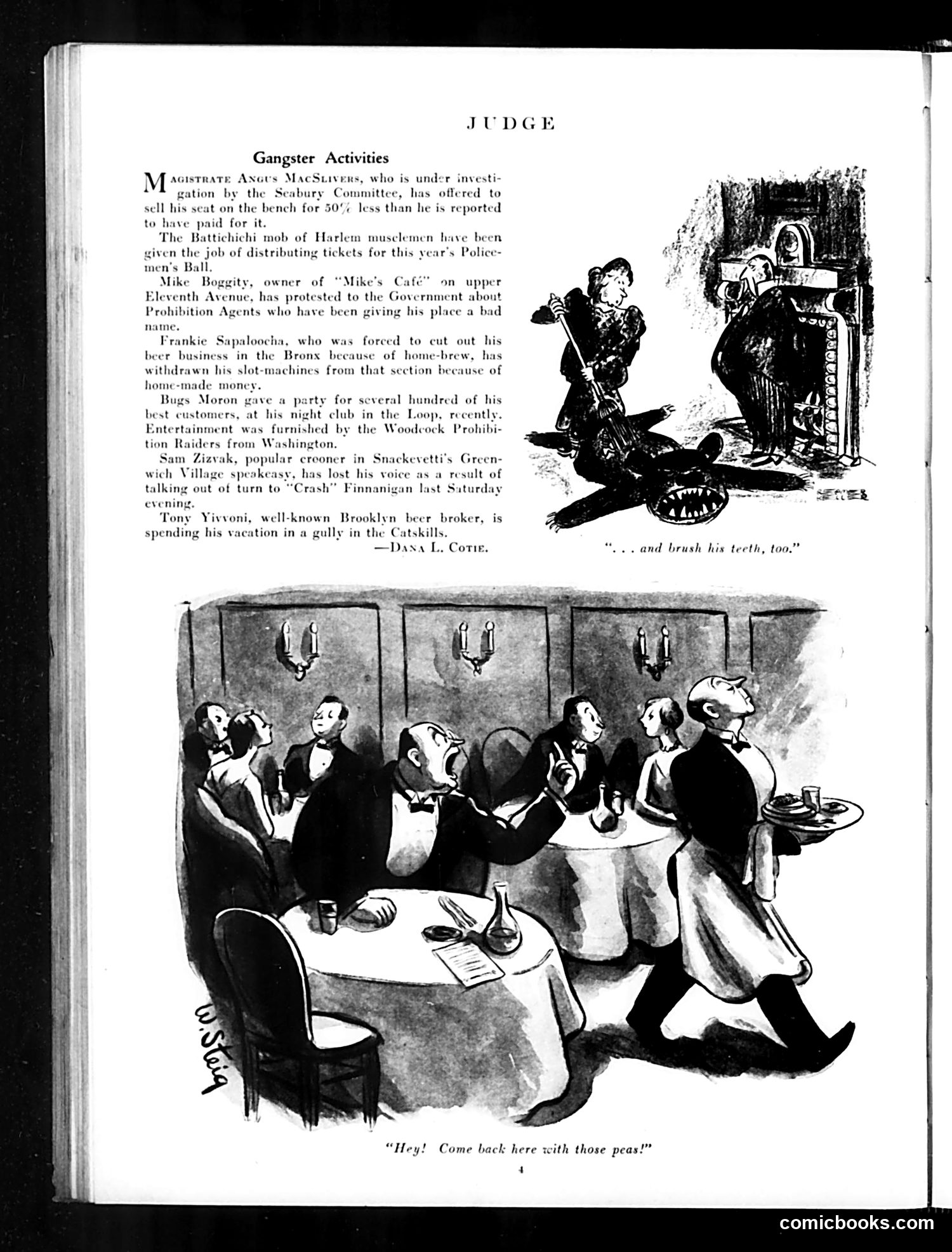
"Gangster Activities" - Judge Magazine Satire This page satirizes Prohibition-era corruption and organized crime through brief vignettes of notable figures allegedly connected to illegal activities: Top cartoon: A gangster threatens someone with a gun, captioned "and brush his teeth, too" — implying violence extends to enforcing petty obedience. Text items mock specific individuals: Magistrate MacSlivers allegedly accepting bribes; Harlem musclemen distributing police ball tickets; Mike Boggity (café owner) protesting government Prohibition agents; Frankie Sapaloocha removing slot machines; "Bugs" Moron hosting speakeasies; and Tony Vivvoni, a beer broker, vacationing openly. The satire targets how organized crime infiltrated legitimate businesses and corrupted officials during Prohibition, presenting lawbreaking as casual and systemic rather than dramatic.
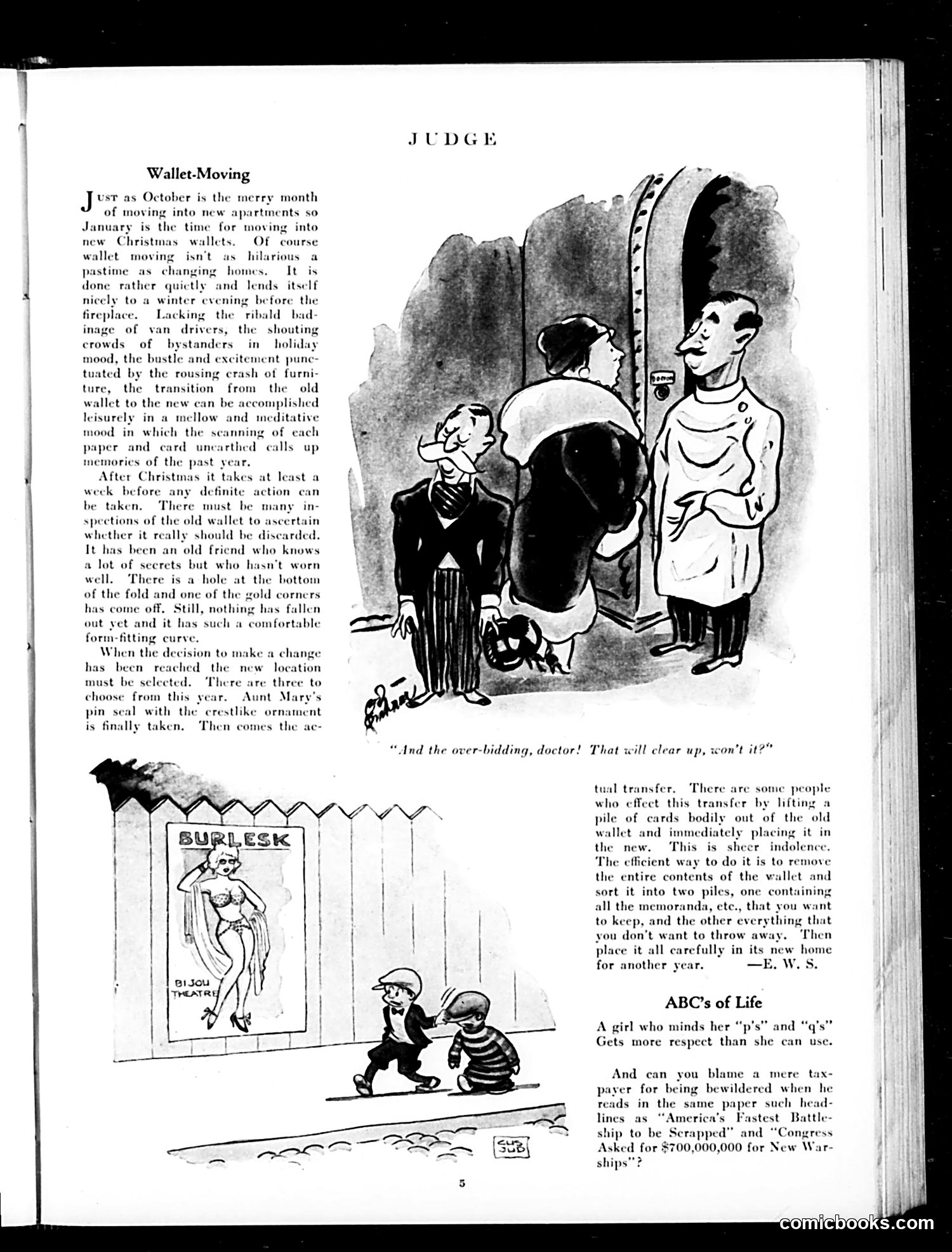
Analysis of Judge Page Main Article: "Wallet-Moving" This satirizes the January tradition of transferring contents between old and new wallets after Christmas gifts. The piece humorously describes the practical hassle—inspecting old wallets for worn-out cards and papers, then carefully reorganizing everything in a new one. It's gentle domestic humor about a universal male experience. Top Cartoon Shows a doctor visiting a patient's home. The caption reads: "And the over-bidding, doctor! That will clear up, won't it?" This likely references post-WWI inflation or economic speculation, suggesting a domestic concern that a physician might remedy—though the specific context remains unclear. Bottom Cartoon Two figures peer at a burlesque theater marquee, depicting typical street-level entertainment of the era.
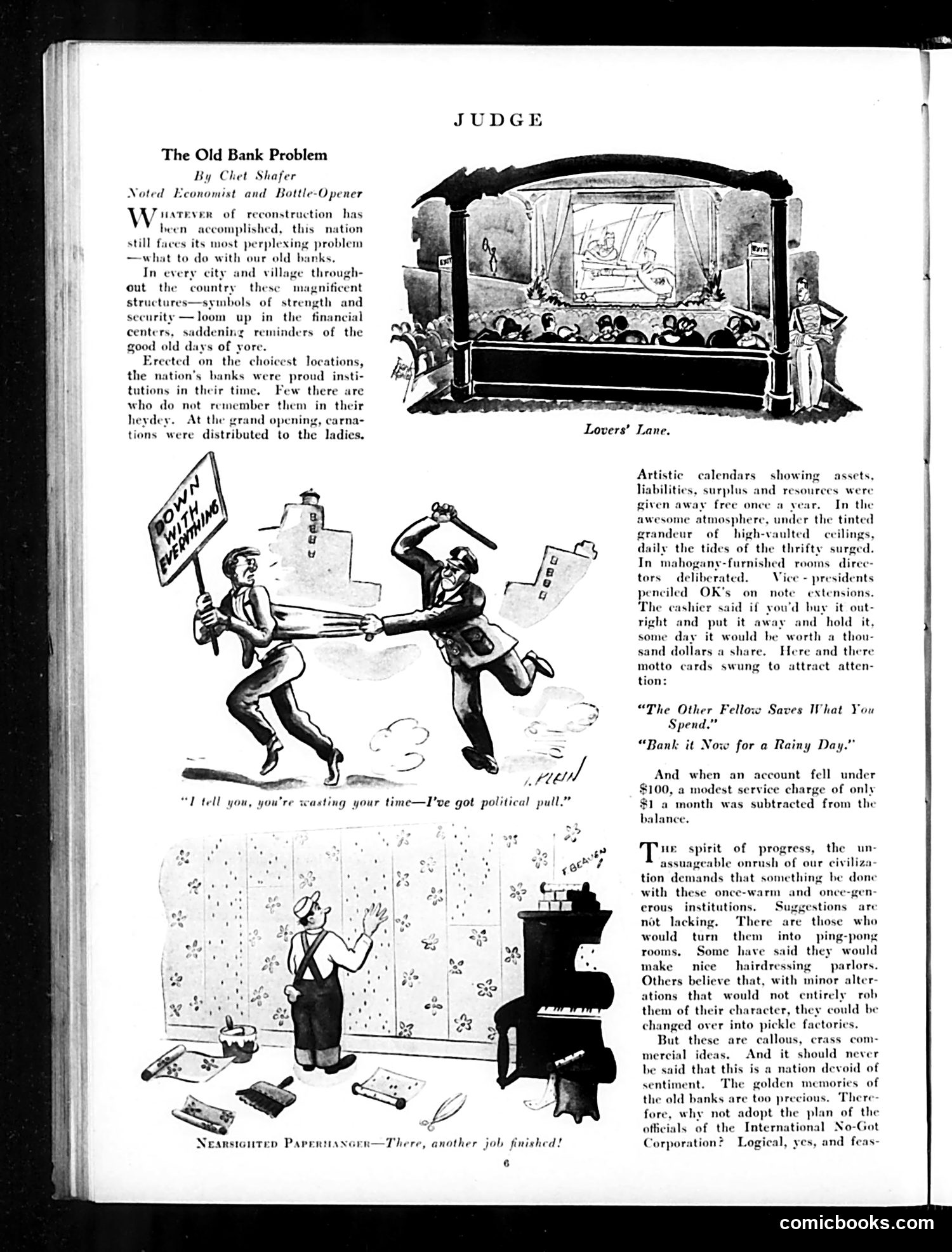
"The Old Bank Problem" - Judge Magazine Satire This article by Chet Shafer critiques the preservation of historic American bank buildings. The cartoons mock sentimentality about old banks as outdated institutions needing modernization. The first cartoon shows two men fighting over a document labeled "Political Pull," illustrating how banks used political connections rather than merit. The second depicts a "Nearsighted Paperhanger" (likely referring to someone carelessly redecorating), suggesting banks should be converted to other uses—pinup rooms, hairdressing parlors, or pickle factories. The satire argues that while these old banks held historical prestige, they're now economically useless. The article proposes adopting the "International No Got Corporation" plan to repurpose these buildings for modern commercial needs rather than preserve them as monuments to an outdated financial era.
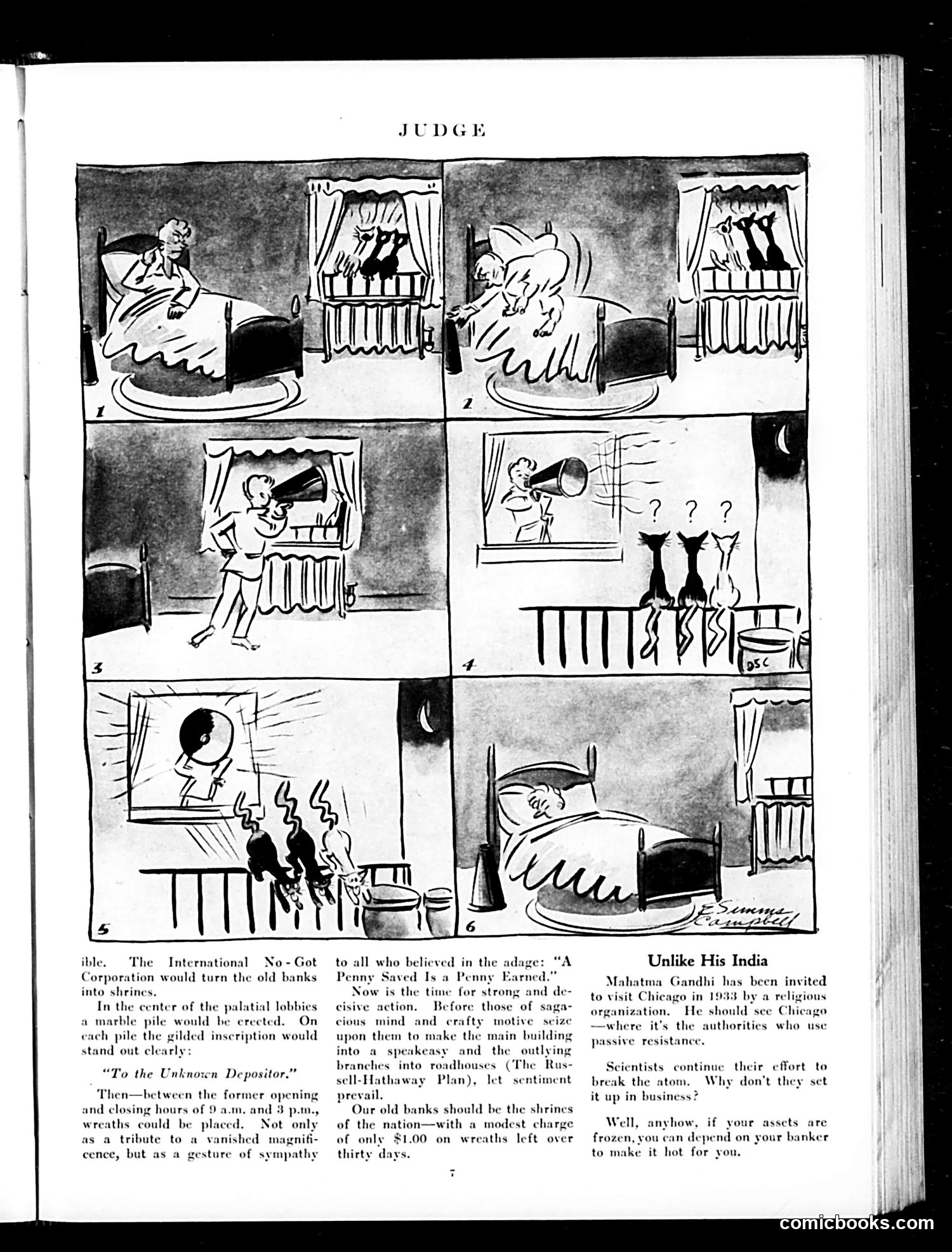
"Judge" Magazine Satire Analysis This comic strip satirizes bank failures during the Great Depression. The narrative mocks the idea of converting closed banks into monuments "To the Unknown Depositor"—a bitter joke about ordinary Americans losing their savings. The accompanying text references the "International No-Got Corporation" (a pun on "no got"—slang for having nothing), proposing banks become shrines with wreaths honoring lost deposits. The satire critiques how banks might be repurposed as speakeasies or roadhouses instead of honoring depositors. The sidebar about Mahatma Gandhi's visit to Chicago draws a cynical comparison: Gandhi practices passive resistance against authorities in India, but Chicago authorities would use aggressive methods against him—a jab at American hypocrisy regarding freedom and justice. The final quip about frozen assets and bankers making things "hot for you" continues the Depression-era complaint that banks could still collect debts even when customers had lost everything.
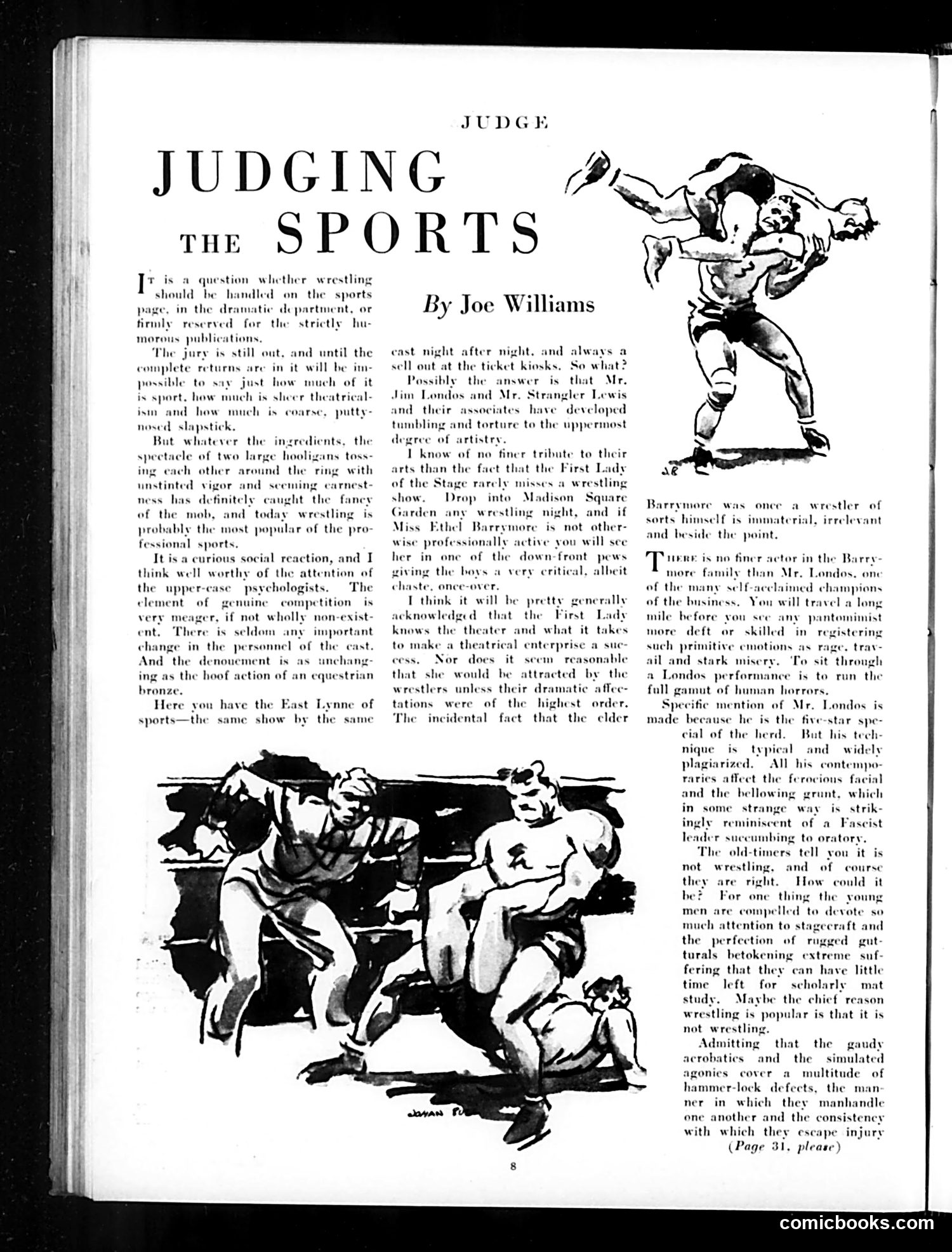
"Judging the Sports" by Joe Williams This article defends professional wrestling as entertainment while acknowledging it's theatrical spectacle rather than genuine sport. Williams argues the "jury is still out" on whether wrestling belongs in sports or dramatic coverage, given its staged nature—comparing it to the melodrama "East Lynne." The satire targets both wrestling promoters and high society. Williams notes that despite wrestling's obvious artificiality (predetermined outcomes, consistent cast, rehearsed drama), it sells out nightly. He adds pointed commentary by mentioning that even *Ethel Barrymore* (the acclaimed actress and member of the famous theatrical family) attends wrestling matches, suggesting that respectable society recognizes wrestling's theatrical merit—or that they're fooled by it. The piece mocks Jim Londos and "Strangler" Lewis as masters of stagecraft who perform primitive emotions expertly. Williams's final jab: young men waste scholarly time perfecting wrestling's "rug naturals" and acrobatics rather than studying—yet wrestling remains popular *because* it's not wrestling.
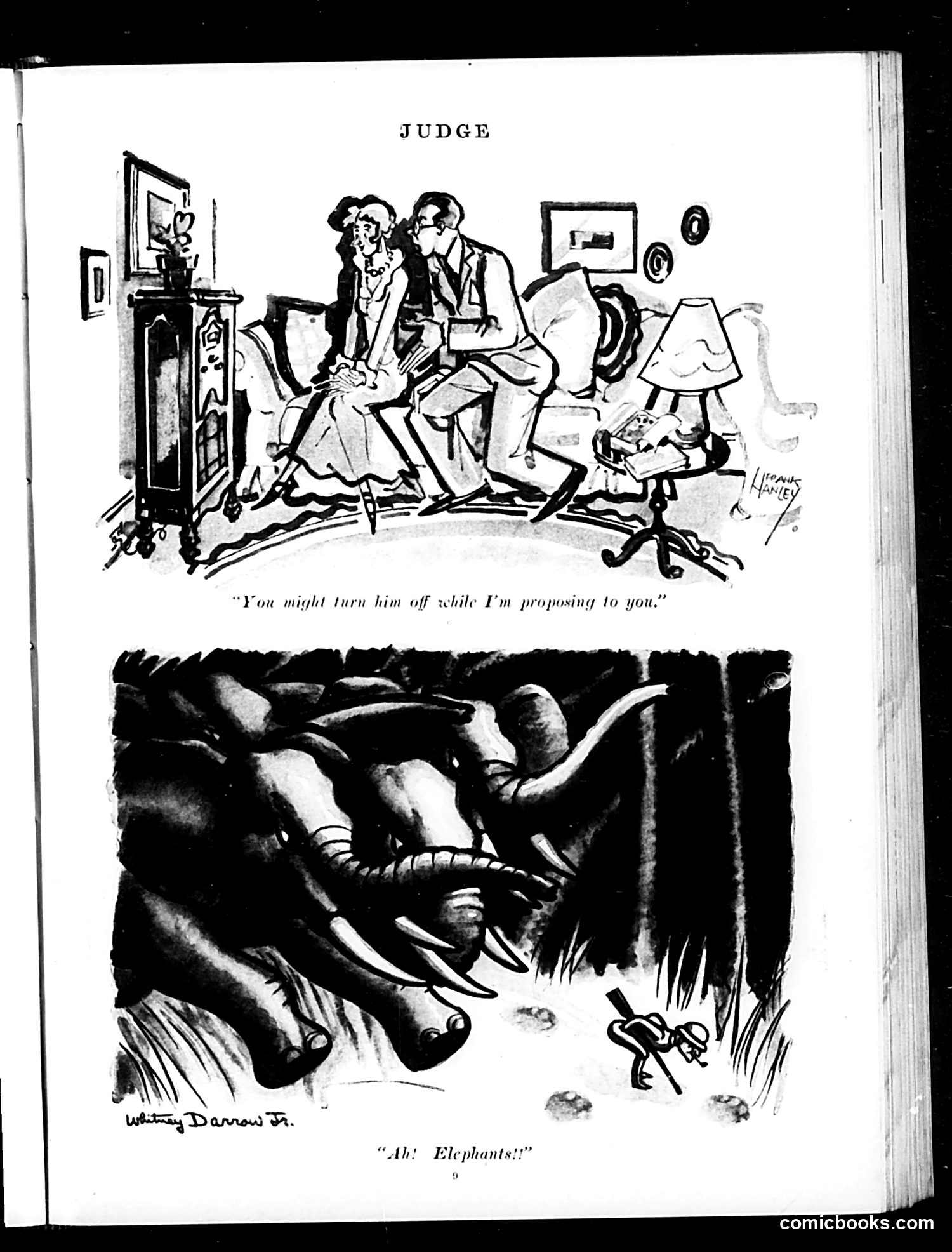
Two Judge Cartoons on "Judge" Top cartoon: A man proposes to a woman while seated on a sofa, with two other figures present and a child nearby. The caption reads, "You might turn him off while I'm proposing to you"—suggesting the man wants to disable the radio (visible on the left) during his romantic moment. This satirizes how radio has become an intrusive domestic presence, interrupting intimate moments. Bottom cartoon: Shows an elephant's legs and large feet in what appears to be a circus or performance setting, with tiny human figures nearby. The caption "Ah! Elephants!!" appears to joke about scale or perspective—likely mocking someone's surprised reaction to seeing elephants, or satirizing the spectacle of circus entertainment and human fascination with exotic animals.
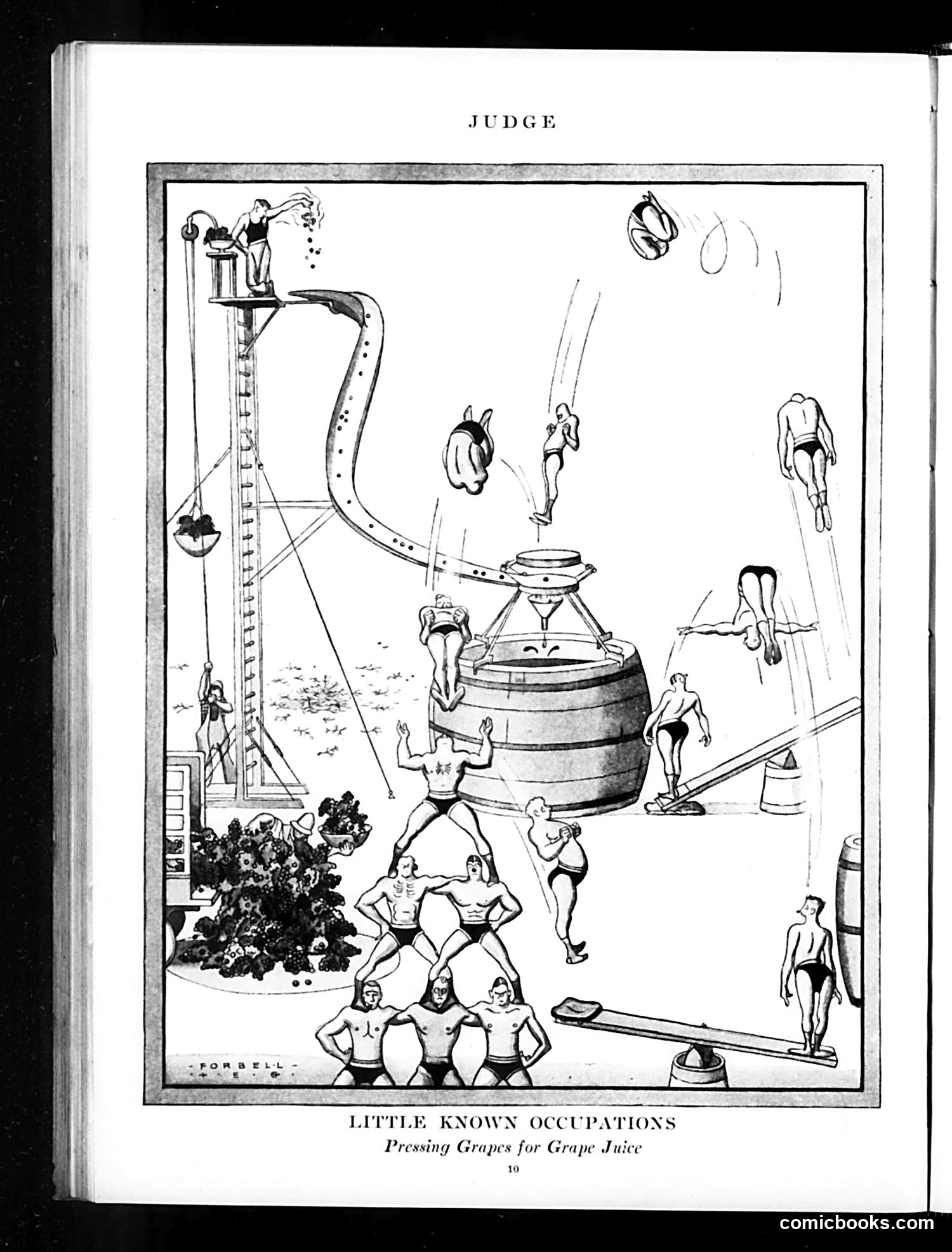
Judge Magazine Cartoon Analysis This is a satirical cartoon titled "Little Known Occupations: Pressing Grapes for Grape Juice." The illustration depicts numerous acrobats, gymnasts, and performers engaged in various physical feats around a large wine press or barrel apparatus—all supposedly to extract grape juice. The satire likely mocks either the labor-intensive production methods of grape juice manufacturing, or possibly references Prohibition-era substitutes. The absurdly complex human machinery required suggests commentary on either inefficient industrial processes or the ironic lengths people went to produce "grape juice" (which was sometimes a legal workaround during Prohibition to produce wine). The cartoon's humor derives from presenting an obviously ridiculous and impractical method as a legitimate occupation, typical of Judge magazine's deadpan satirical style.
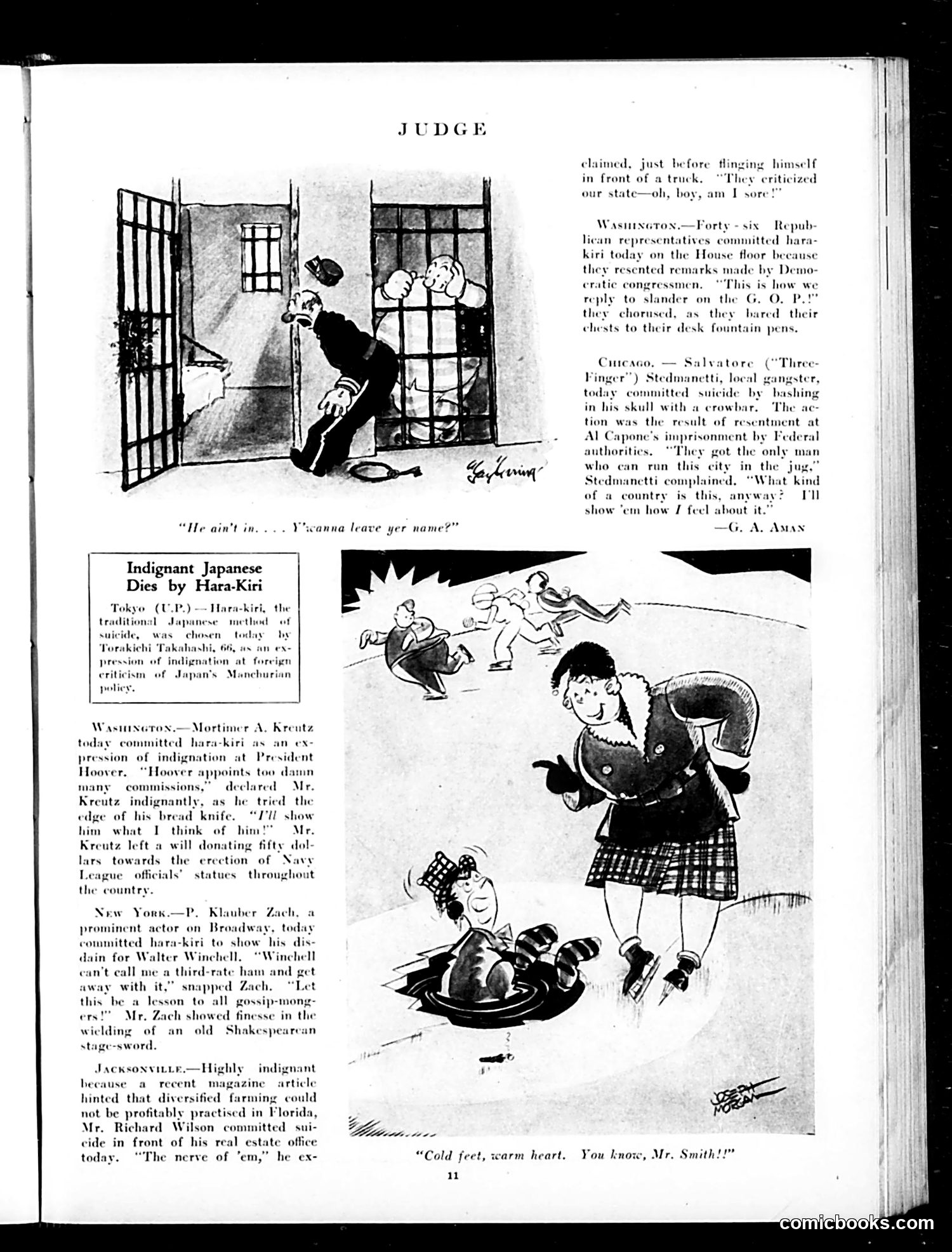
Judge Magazine Satire Analysis This page satirizes the Japanese ritual of hara-kiri (ritual suicide) by absurdly applying it to American complaints about trivial grievances. The top cartoon shows a prisoner attempting suicide over criticism of "our state." The accompanying text presents mock news reports of various Americans committing hara-kiri in response to minor indignities: Republican congressmen over Democratic insults, a Chicago gangster (referencing Al Capone's imprisonment) over federal authorities, a man protesting President Hoover's commissions, a Broadway actor scorning gossip columnist Walter Winchell, and a Florida real estate agent angered by farming criticism. The satire mocks American overreaction to insults and perceived slights—suggesting Americans treat trivial offenses with the deadly seriousness Japanese culture historically attached to honor. The bottom cartoon's caption "Cold feet, warm heart" reinforces the joke: Americans lack the actual conviction for such extreme measures. This reflects 1930s era stereotyping of Japanese culture as obsessively honor-bound, contrasted with American frivolousness.
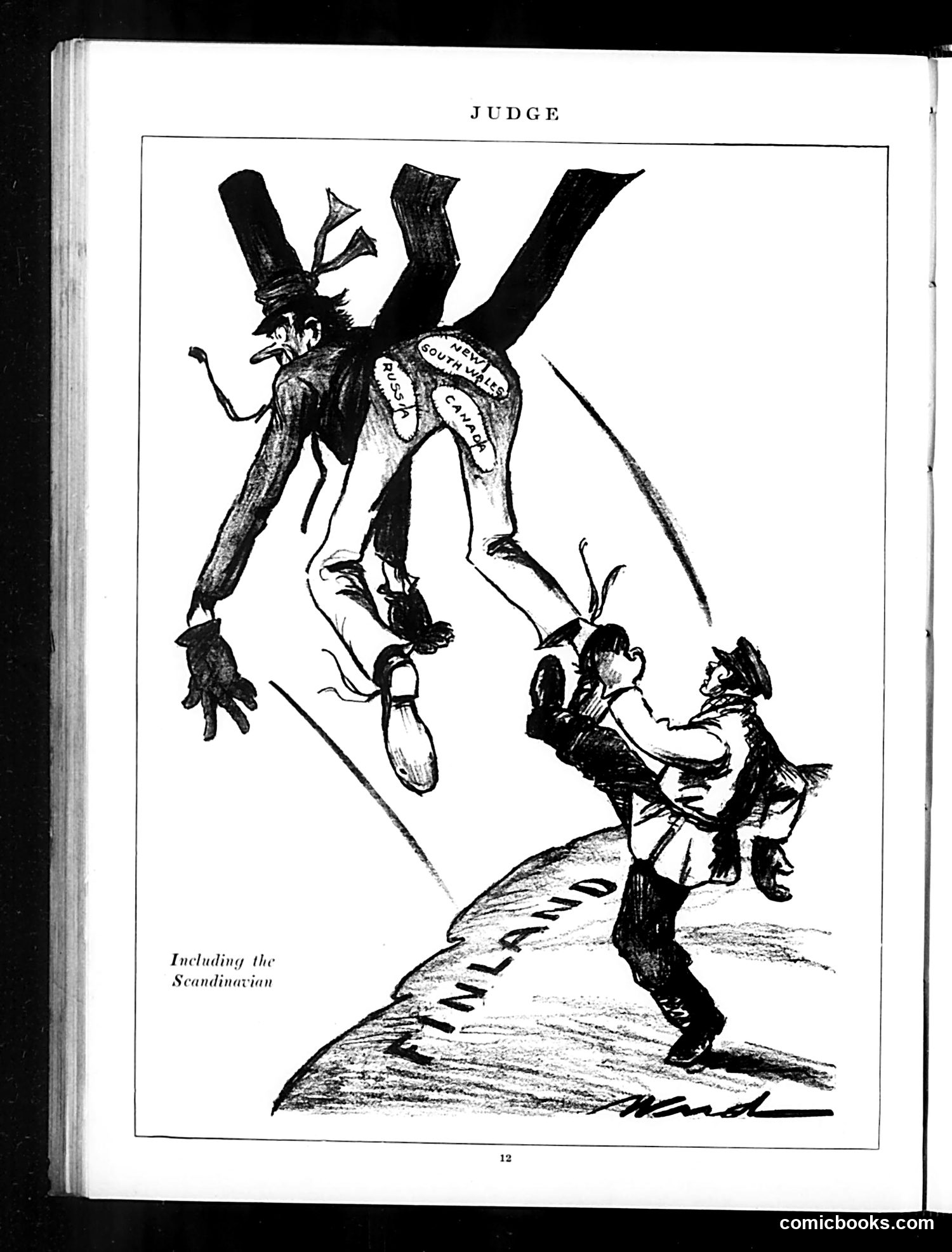
Analysis This Judge magazine cartoon depicts a grotesque, demonic figure wielding a large club or bat labeled "JUDGE" (visible on the weapon). The figure appears to represent judicial authority or law enforcement, attacking smaller human figures below—likely representing ordinary citizens or defendants. The subtitle "Including the Scandinavian" suggests this concerns legal treatment of Scandinavian immigrants, a politically contentious topic in early 20th-century America. The satire criticizes judicial excess or brutality, particularly against immigrant populations. The artist (signature visible) uses exaggeration and grotesqueness to condemn what appears to be discriminatory or overly harsh legal practices. Without the specific publication date, the exact historical context remains unclear, but the cartoon protests unfair treatment of vulnerable groups within the American justice system.
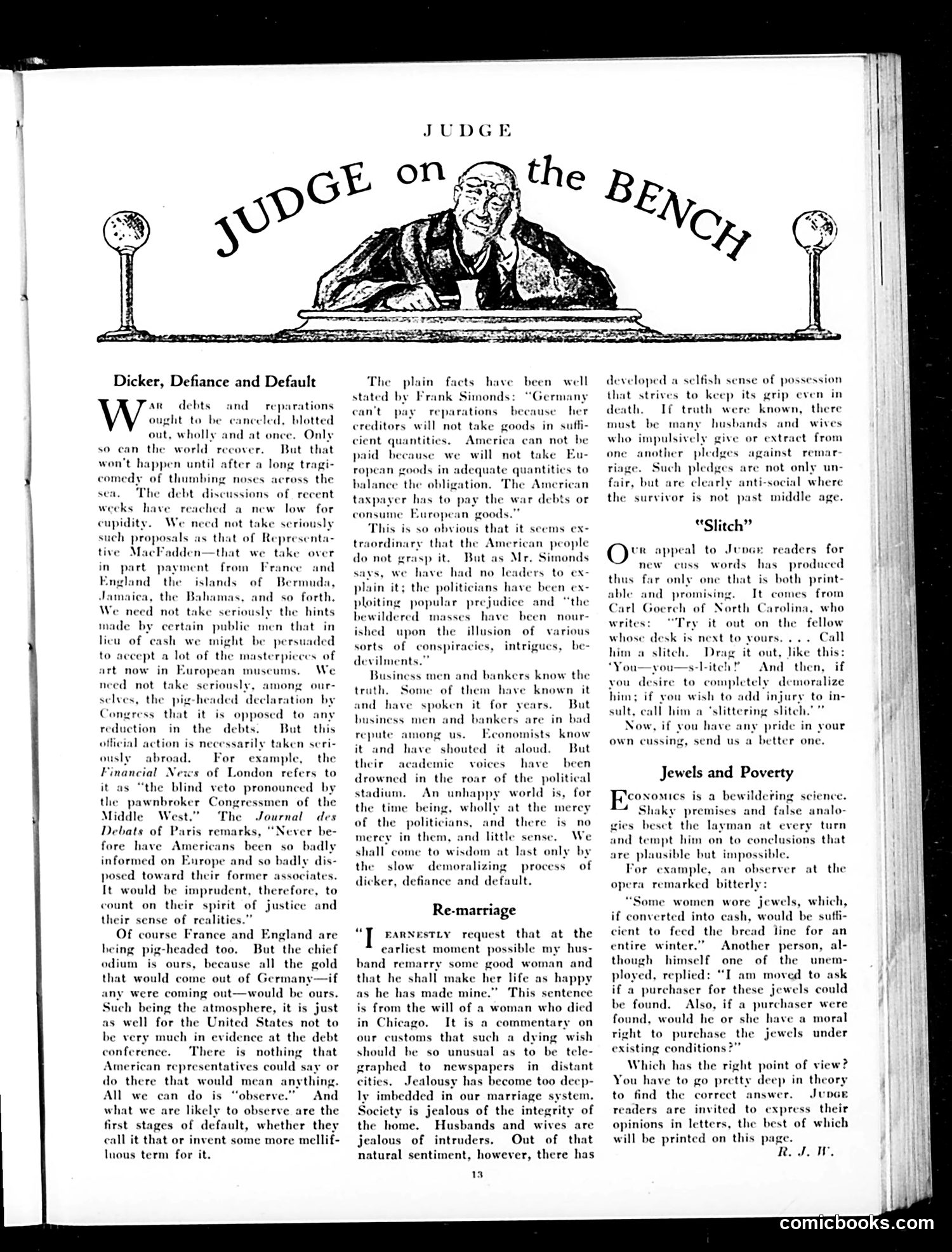
"Judge on the Bench" — Post-WWI Debt and Divorce This page contains two satirical pieces from Judge magazine addressing serious post-World War I issues. "Dicker, Defiance and Default" critiques American handling of war debts and German reparations. The article mocks Congress and American policymakers for refusing to acknowledge economic reality: Germany cannot pay reparations if creditors won't accept German goods, and America cannot collect war debts while refusing European imports. The author (citing economist Frank Simonds) argues politicians exploit public prejudice while businessmen and economists understand the truth but lack political voice. The satire suggests inevitable default through "dicker" (negotiation), national "defiance," and ultimate economic collapse. "Re-marriage" presents a Chicago widow's will requesting her husband remarry and be happy—unusual enough to warrant newspaper coverage. This illustrates how jealousy has become pathologically embedded in marriage. The piece critiques society's possessive attitudes toward spouses even beyond death, suggesting emotional immaturity pervades the institution. Both pieces use satire to expose how emotion, prejudice, and irrationality—whether political or personal—drive decisions with serious consequences.
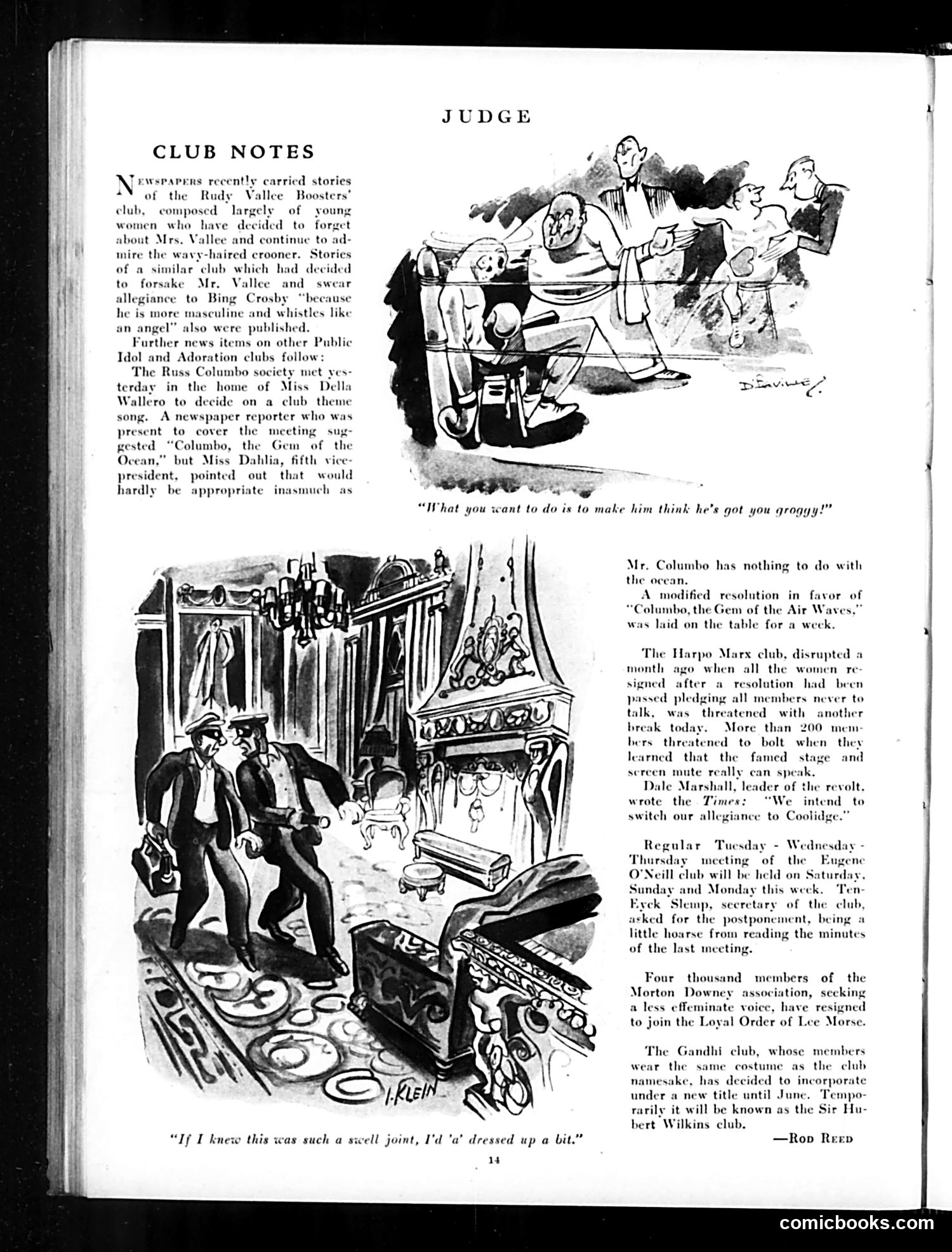
Judge Magazine Club Notes Satire This page satirizes the 1920s-30s celebrity fan club phenomenon. The "Club Notes" mockingly describe absurd fan organizations devoted to popular entertainers of the era: Rudy Vallee, Bing Crosby, Russ Columbo, Harpo Marx, Eugene O'Neill, Morton Downey, and others. The satire targets the obsessive devotion fans show these figures. One joke: a Russ Columbo club debates whether their theme song should reference "Columbo, Gem of the Ocean" — missing that Columbo has nothing to do with the ocean. Another: the Harpo Marx club women swear never to speak (mimicking the silent comedian), then threaten to quit when learning he actually talks. The cartoons illustrate the absurdity: one shows men making a woman jealous to win her favor; another depicts a fancy restaurant scene. The humor relies on readers recognizing these celebrities and understanding how ridiculous fan devotion had become — a cultural phenomenon the magazine mocks as irrational hero-worship.
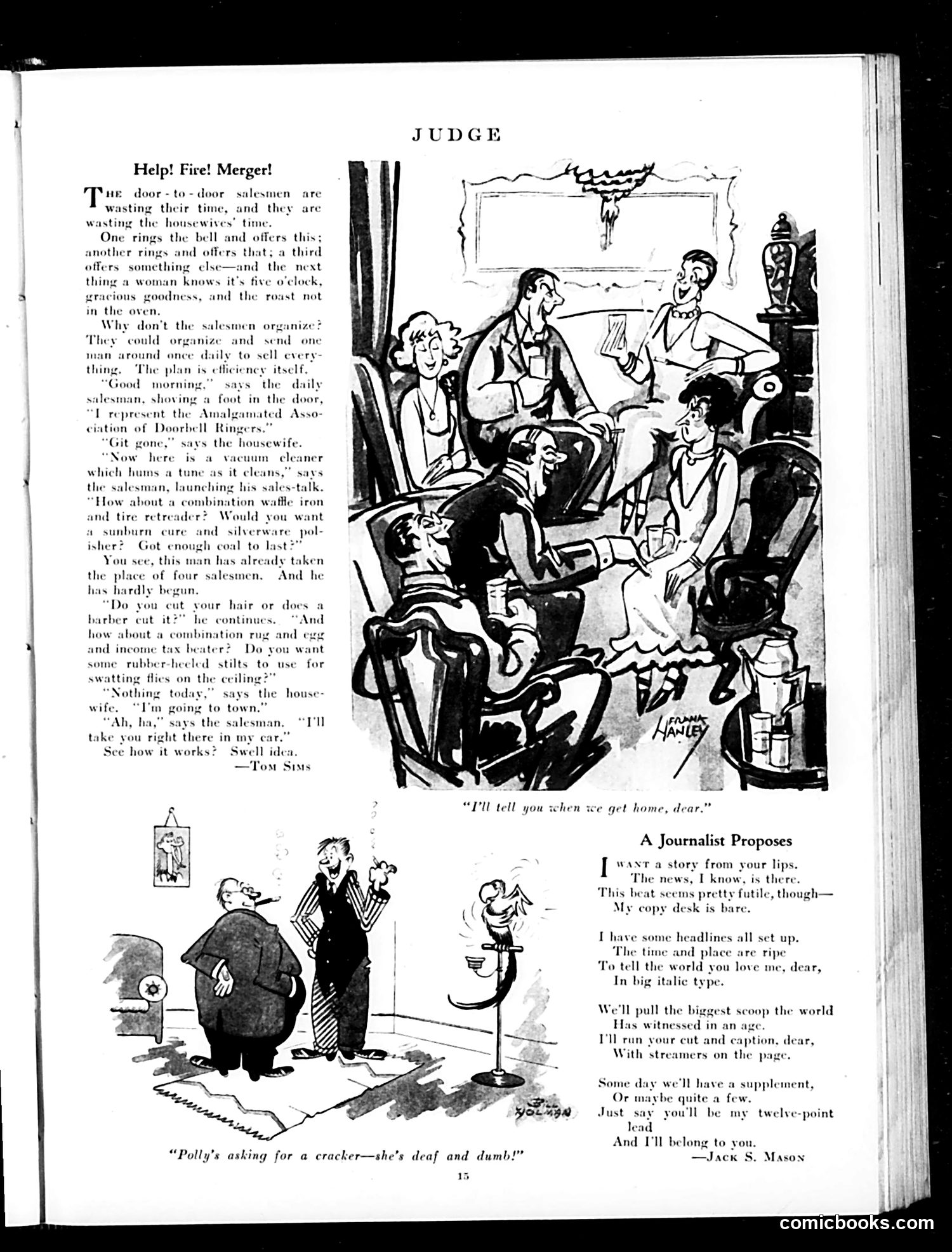
Analysis: Judge Magazine Page Top Cartoon ("Help! Fire! Merger!") satirizes door-to-door salesmen's inefficiency. The joke proposes that salesmen organize into one "super-salesman" visiting each home daily with all products combined—a vacuum cleaner that also functions as a tire retreader, waffle iron, sunburn cure, silverware polisher, and fly-swatter. The satire mocks both the absurdity of this "efficiency" (the salesman would never leave) and the real nuisance these salesmen posed to housewives managing domestic duties. Bottom Cartoon shows a man proposing marriage via newspaper jargon—offering to make his bride a "twelve-point lead" story, promising headlines and supplements. It's a lighthearted mockery of journalists' single-minded focus on news over romance. Both pieces reflect early 20th-century consumer culture anxieties and gender dynamics, with housewives depicted as harassed by intrusive salesmen and courtship still dominated by male professionals.
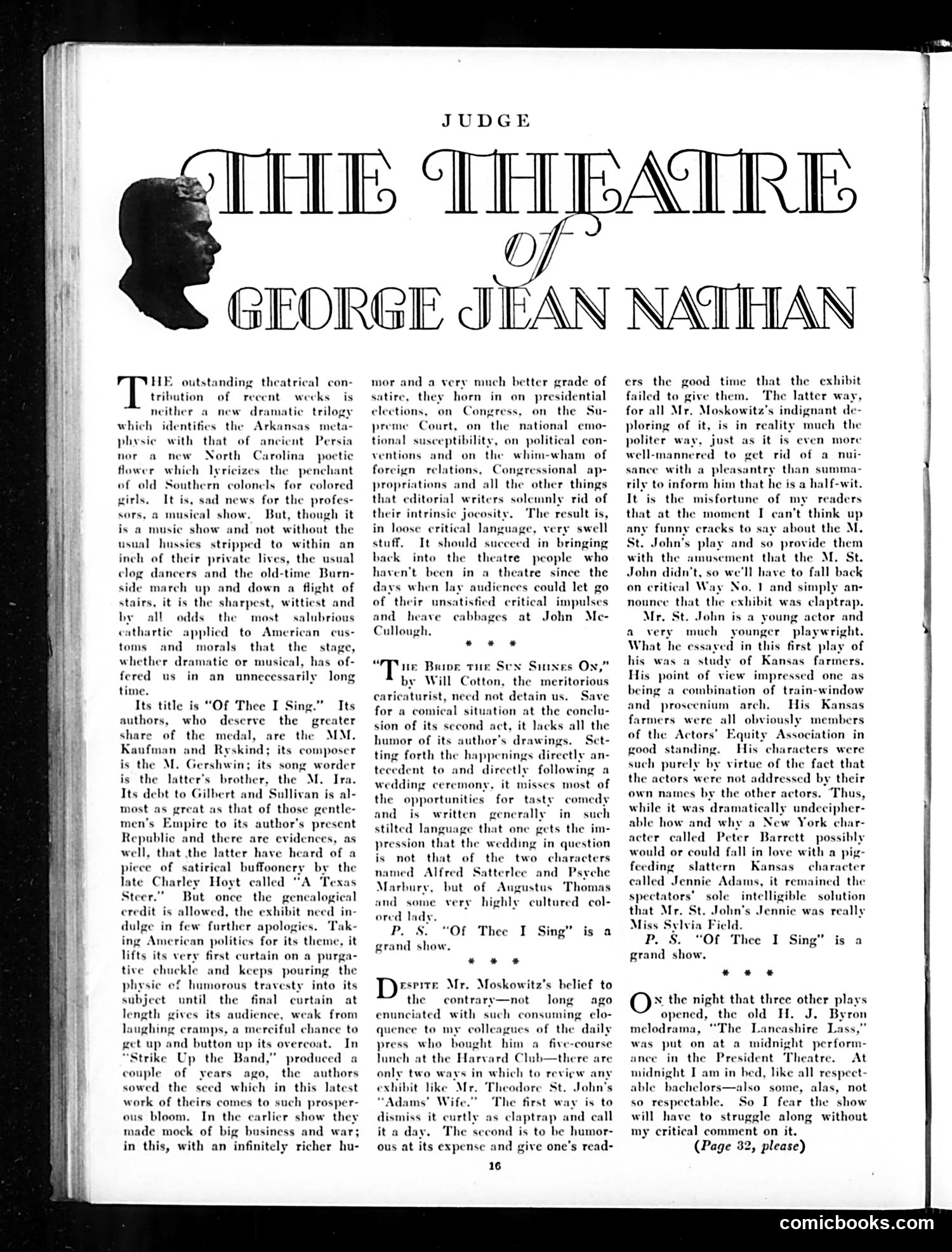
Judge Magazine Theatre Review: Political Satire in "Of Thee I Sing" This is a theater review by critic George Jean Nathan praising the musical *"Of Thee I Sing"* (by George S. Kaufman, Morrie Ryskind, and George Gershwin). Nathan celebrates the show as satirical commentary on American politics—specifically targeting presidential elections, Congress, the Supreme Court, political conventions, and foreign relations. He notes the authors previously mocked "big business and war" in *"Strike Up the Band,"* but this new work expands to ridicule the entire political establishment with "humorous travesty." The review praises the show's ability to entertain general audiences through political satire, contrasting it with other theatrical offerings. Nathan dismisses a separate play, *"Adams' Wife,"* as claptrap, and briefly reviews another work by Will Cotton that he finds humorless. The silhouetted profile appears to be Nathan himself, the prominent theater critic of the era.
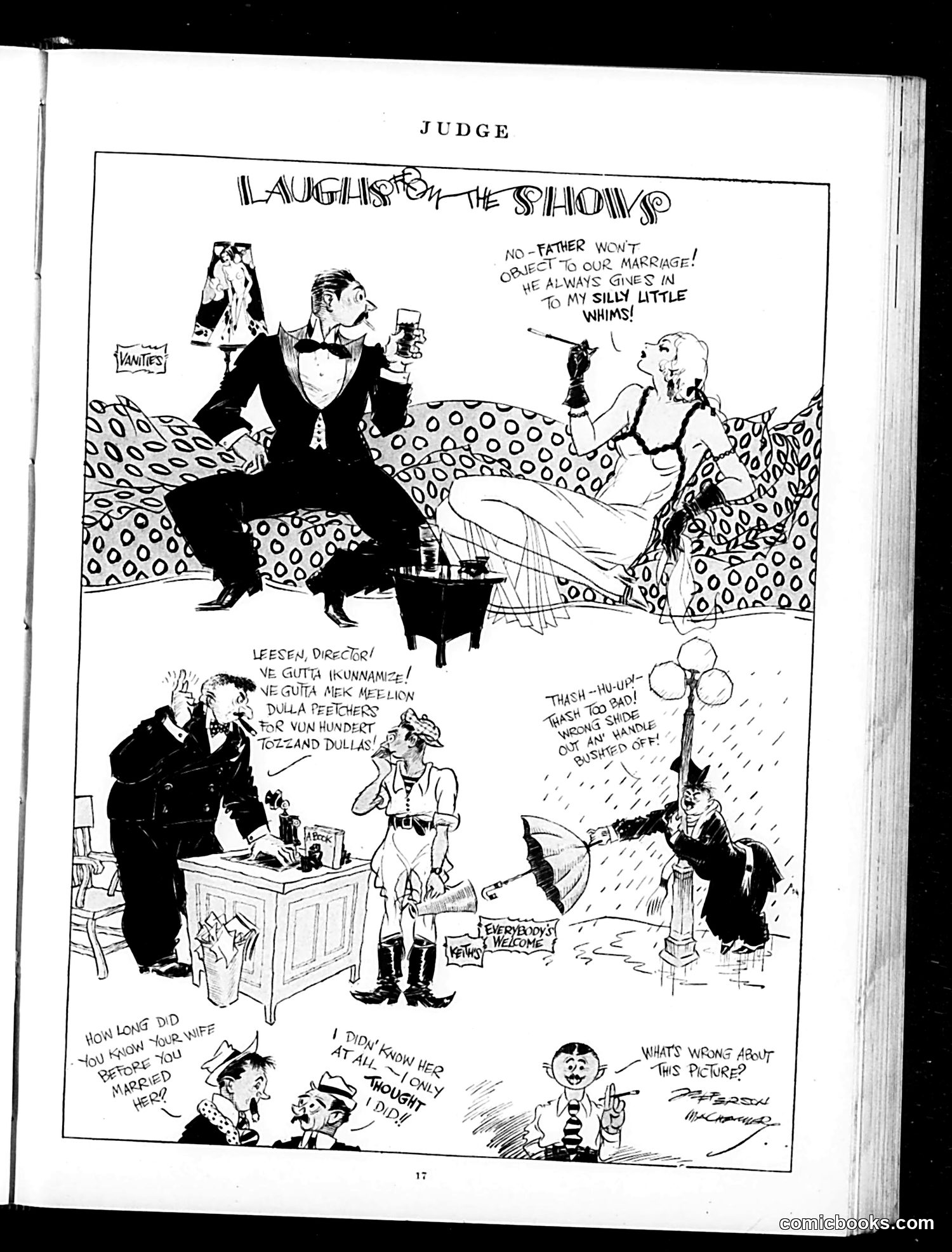
"Laughs at the Show" - Judge Cartoon Analysis This multi-panel satirical cartoon depicts marital discord and courtroom/social scenes. The upper panel shows an elegantly dressed couple at what appears to be an entertainment venue, with the woman complaining that her husband always indulges her "silly little whims" — the irony being she's *still* unhappy about it. The lower panels show various domestic conflict scenarios: a judge or authority figure dealing with marital disputes, slapstick chaos involving umbrellas and weather, and characters in heated arguments about marriage expectations. The satire targets early-20th-century gender relations and marriage dynamics — specifically, the contradiction that even when husbands comply with wives' demands, it breeds resentment rather than satisfaction. The "what's wrong about this picture?" prompt at bottom invites readers to identify the absurdity: no matter what men do, they're blamed. It's social commentary on impossible marital expectations and nagging spouses, reflecting period attitudes about women's complaints being unreasonable.
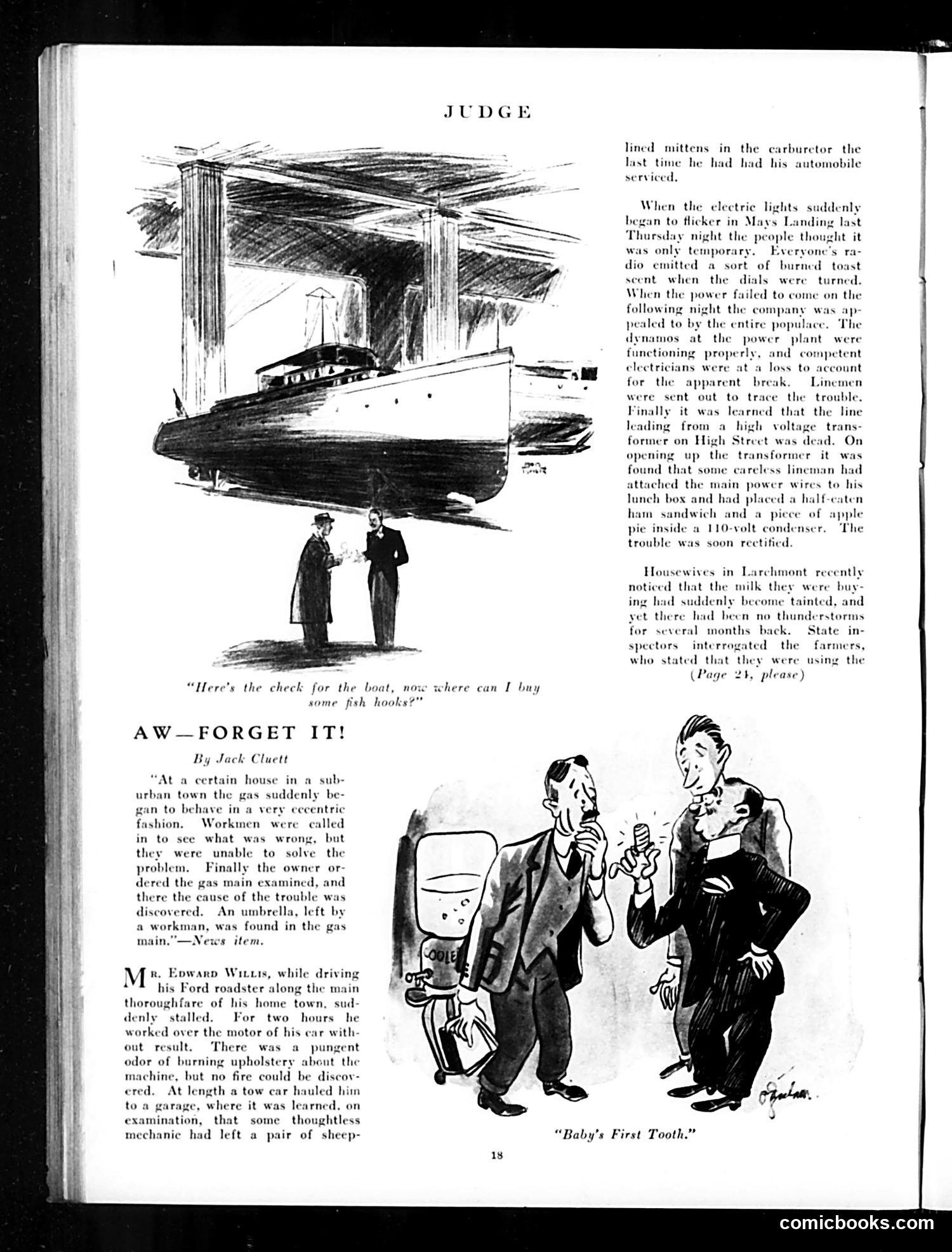
Judge Magazine Satirical Content Analysis This page contains two humorous pieces satirizing incompetence and carelessness in early 20th-century infrastructure and service work. "AW—FORGET IT!" by Jack Cluett presents three absurd incidents: a gas main blocked by an abandoned umbrella, a car's engine damaged by sheep-lined mittens left in the carburetor, and a power outage caused by a lineman who attached high-voltage wires to his lunch box containing a ham sandwich and apple pie. Each story ridicules the negligence of workers whose forgotten personal items create widespread public problems. The top cartoon captioned "Here's the check for the boat, now where can I buy some fish hooks?" appears to mock someone celebrating receiving payment while immediately spending it on frivolous purchases. The bottom cartoon, "Baby's First Tooth," shows two men examining what appears to be a baby's tooth with exaggerated surprise, likely satirizing overwrought reactions to mundane parental milestones. The satire targets working-class carelessness and the cascading consequences of inattention on modern utilities and infrastructure.
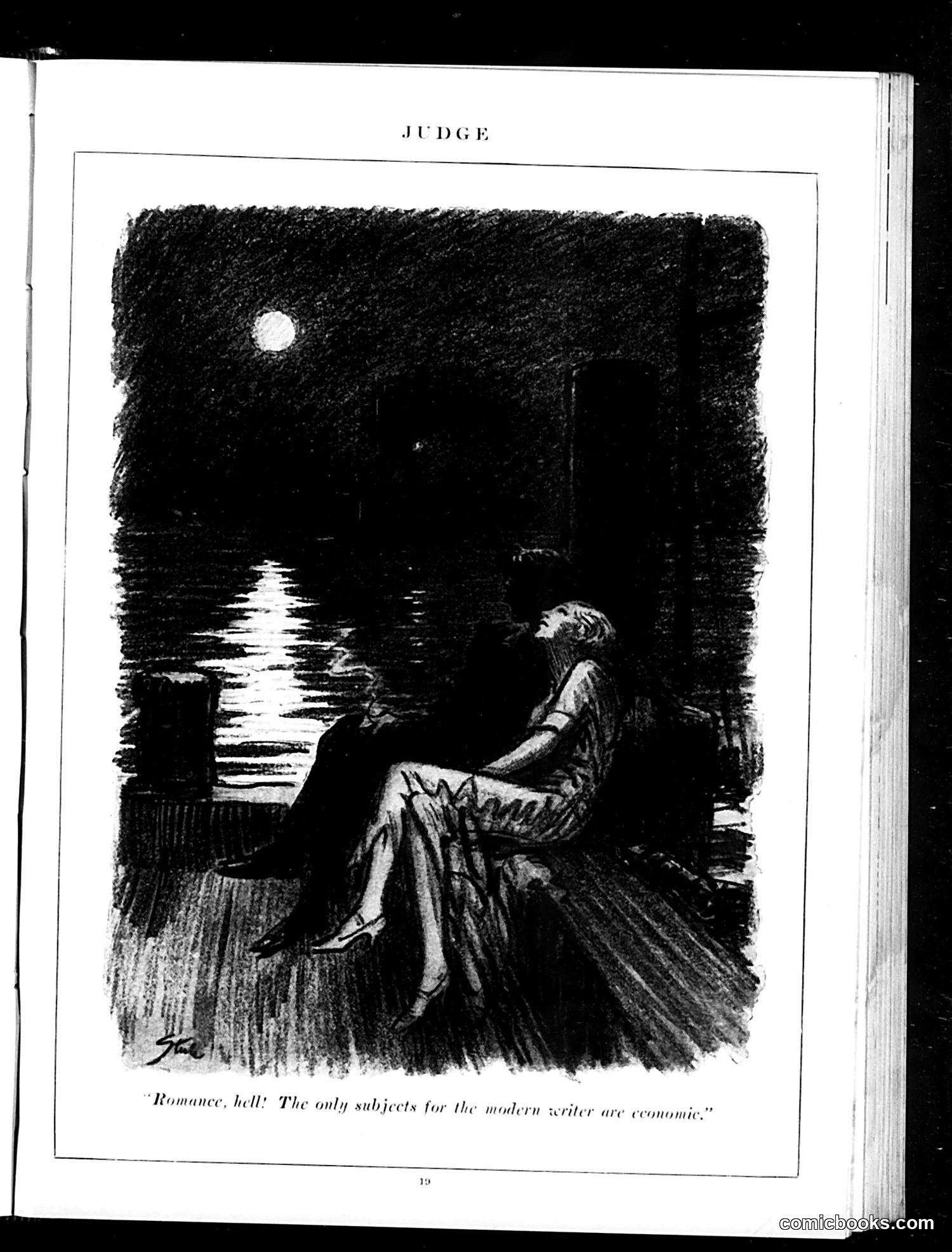
Judge Magazine Cartoon Analysis This single-panel cartoon depicts a figure reclining by a moonlit window, gazing romantically at the night sky. The caption reads: "Romance, hell! The only subjects for the modern writer are economic." The satire mocks early 20th-century literary trends and intellectual fashions. A writer dismisses traditional romance—the classic subject of literature—as beneath serious modern consideration. Instead, they insist economic subjects are the only worthy focus for contemporary authors. The humor lies in the contradiction: the figure is posed in an utterly romantic, sentimental manner while verbally rejecting romance entirely. Judge satirizes pretentious intellectuals who rejected sentimentality in favor of "serious" economic or social realist writing, suggesting such writers are hypocrites unable to escape their own romantic impulses despite ideological posturing.
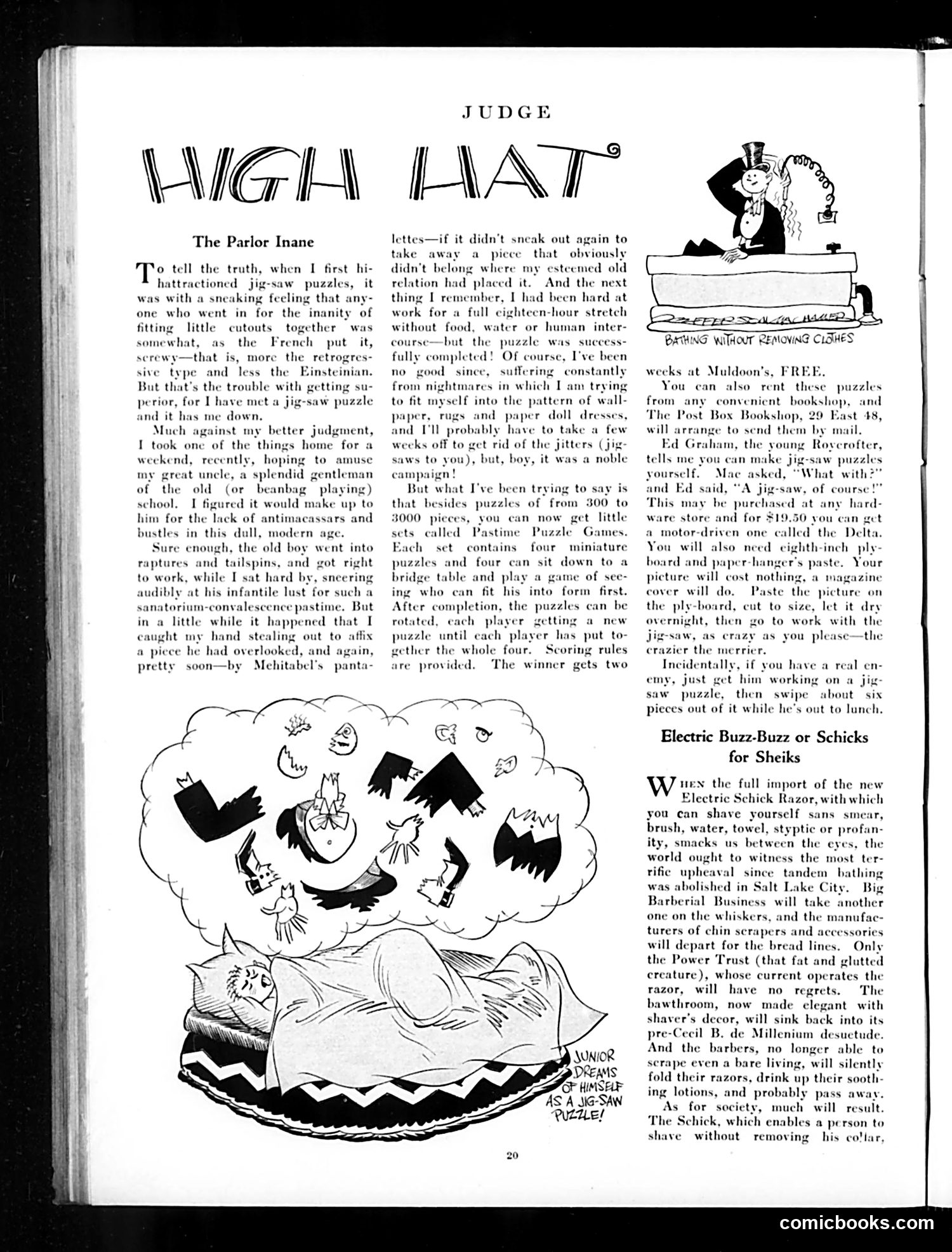
Judge Magazine Page Analysis This page contains humor about two 1920s-30s fads: jig-saw puzzles and electric razors. "High Hat: The Parlor Inane" mocks the jig-saw puzzle craze. The author initially dismissed puzzle-solving as "insane," but became obsessively addicted, working 18 hours straight. The cartoon shows someone dreaming of puzzle pieces while neglecting real life. The satire targets how intellectuals dismiss harmless pastimes as lowbrow, then hypocritically succumb to them. The piece advertises new "Pastime Puzzle Games" for competitive play and DIY puzzle-making kits. "Electric Buzz-Buzz or Schicks for Sheiks" satirizes the electric razor's disruptive impact on barbering. The author predicts the invention will devastate the barber industry and related businesses (brush makers, chin-scraper manufacturers). Only the Power Trust (electric companies) benefits. The tone is mock-apocalyptic about modern convenience disrupting traditional trades and male grooming rituals. Both articles exemplify Judge's formula: satirizing contemporary consumer trends and social anxieties through exaggeration and irony.
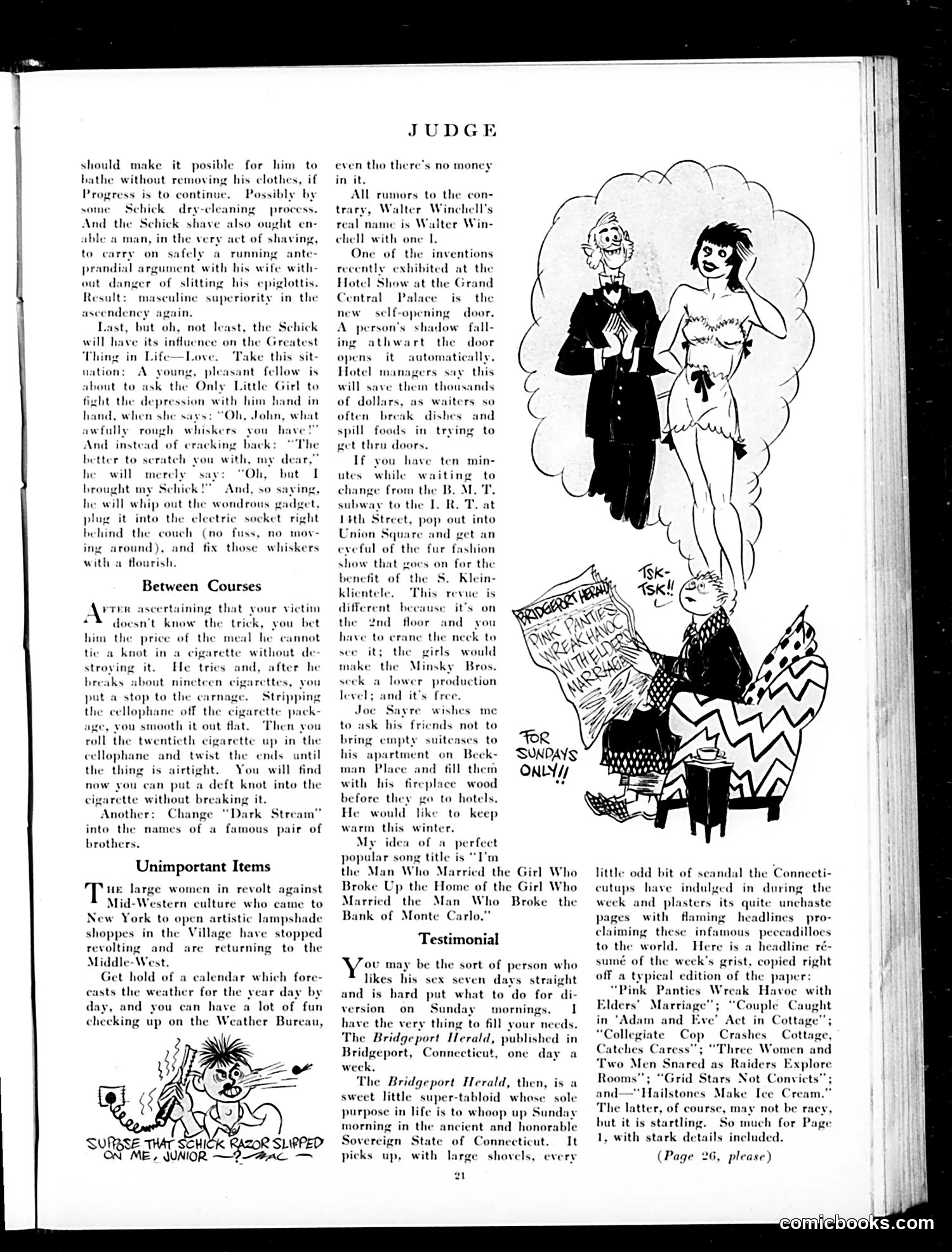
Judge Magazine Page Analysis This page from *Judge* satirical magazine (publication date unclear from image) contains several humor pieces targeting early 1930s American culture: Main cartoon: Shows a couple at a hotel with a self-opening door—a real invention recently exhibited. The satire mocks the absurdity of labor-saving devices, suggesting waiters will benefit by breaking fewer dishes through doors. Text pieces include: - Mock praise for the Schick electric razor's supposed ability to enable shaving while arguing with one's wife - Cigarette-tying bar trick instructions - Jabs at Walter Winchell (famous gossip columnist) over his name spelling - Mockery of Midwestern women who opened "artistic" shops in New York then retreated - A backhanded endorsement of the *Bridgeport Herald* as Sunday reading for those without "diversion" The overall tone reflects *Judge*'s characteristic irreverent satire of consumer gadgetry, celebrity, and social pretension of the era.
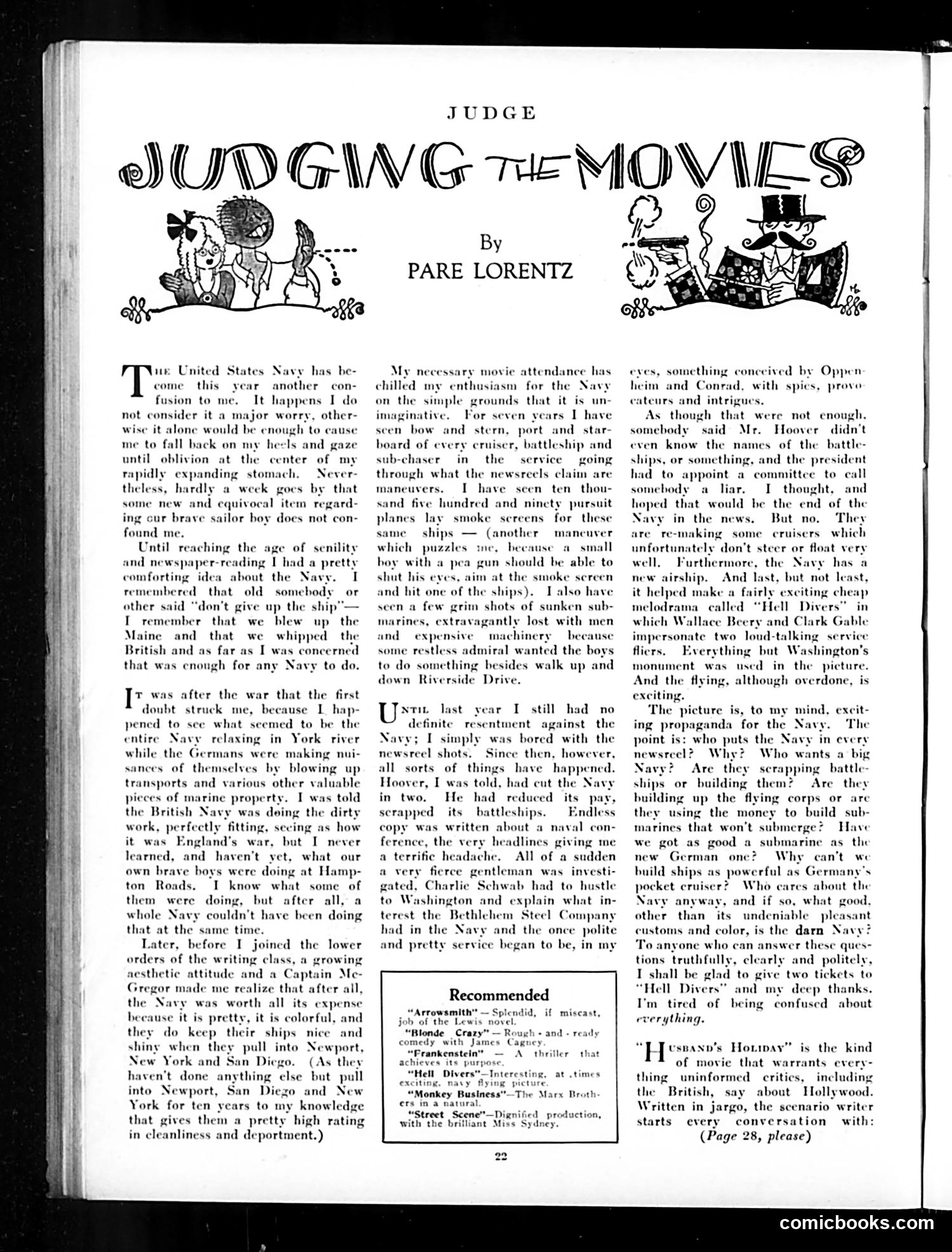
"Judging the Movies" by Pare Lorentz This is a film-criticism essay accompanying decorative cartoons, not a political cartoon itself. The author critiques Hollywood's depiction of the U.S. Navy as aesthetically attractive but narratively stale. Lorentz complains that seven years of newsreel footage shows repetitive maneuvers and battleship imagery without imagination. He references Secretary of Commerce Herbert Hoover's naval cost-cutting and ship scrapping, which generated headlines and public controversy. The piece alludes to Charlie Schwab (Bethlehem Steel executive) being called to Washington to explain his company's Navy contracts—a contemporary political scandal involving industrial influence. The author's central point: the Navy looks impressive visually but the press and films treat it superficially, ignoring genuine policy debates about military spending and industrial power. The recommended films listed (including Marx Brothers comedy "Monkey Business") represent alternatives to militaristic newsreel propaganda. The satire targets both the Navy's PR efforts and Hollywood's uncritical coverage of defense industries.
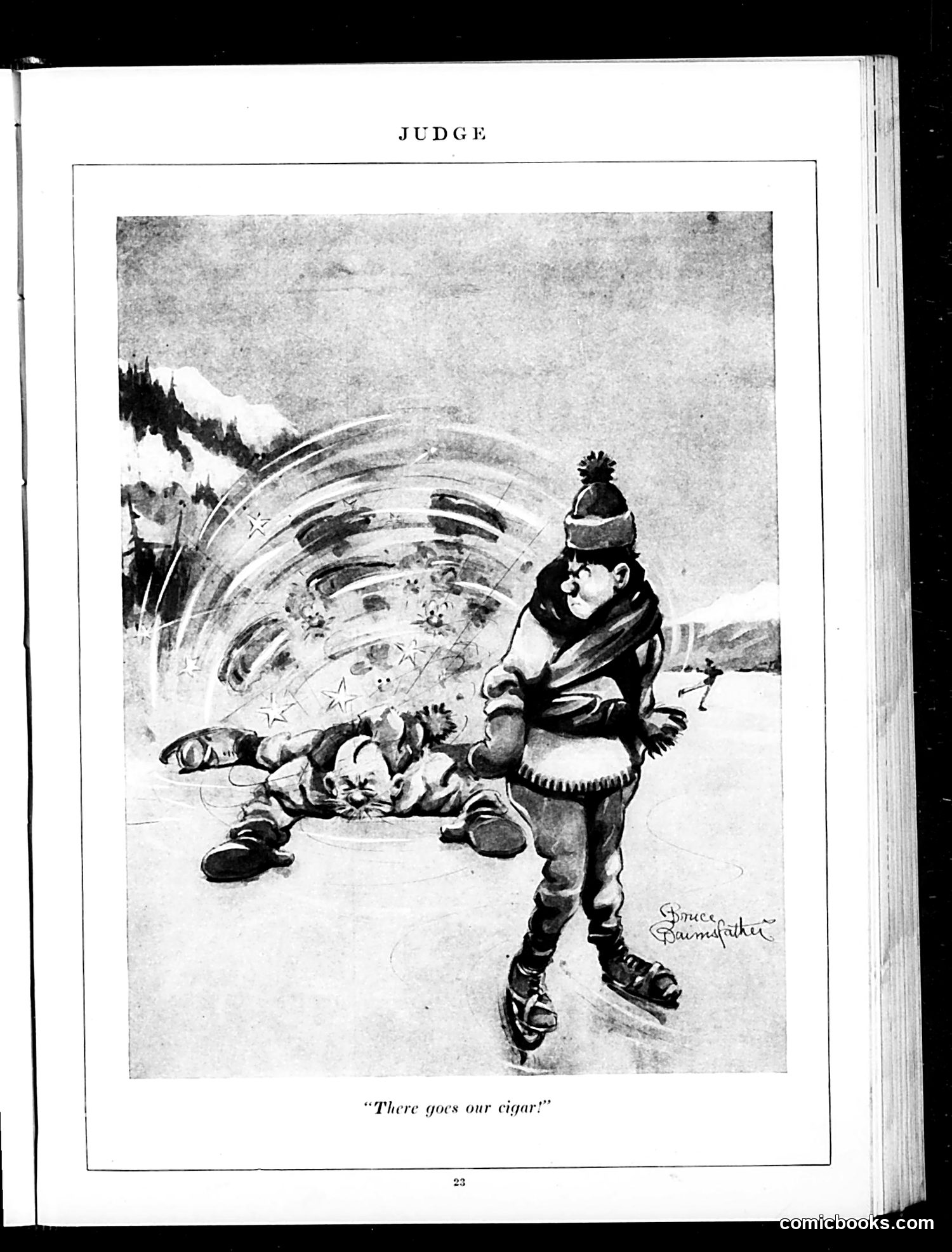
Judge Magazine Cartoon Analysis Title: "There goes our cigar!" The Image: A figure ice-skates on what appears to be a frozen surface, gesturing dramatically toward a large spiral or whirlpool behind them. A small character lies on the ice. The skater wears winter clothing with a distinctive hat and pom-pom. The Satire: This appears to be a political cartoon using winter/ice skating as metaphor for some contemporary event or situation. The "cigar" reference and the dramatic gesture suggest loss or disappearance of something valuable. Without additional context about Judge's publication date, the specific political figures or events referenced remain unclear, though the visual suggests commentary on political instability or misfortune. Artist Credit: Signed "Cesare Baumgartner" (or similar).
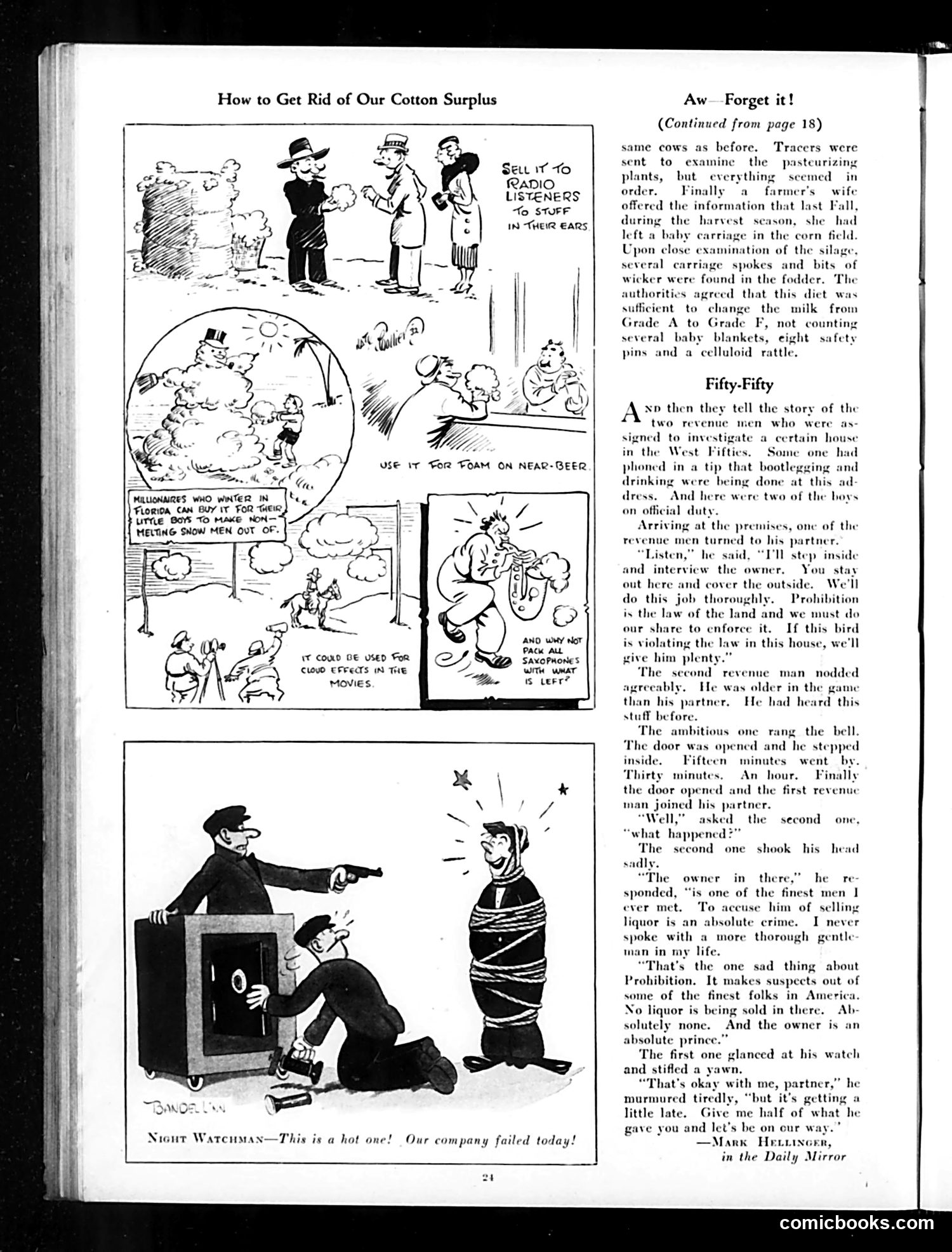
Analysis of Judge Magazine Page Top Section—"How to Get Rid of Our Cotton Surplus": This satirizes the 1920s-era cotton overproduction crisis. The cartoons mockingly suggest absurd solutions: selling cotton to radio listeners to "stuff in their ears," using it for movie cloud effects, and packing it into saxophones. The joke criticizes the government's inability to address genuine economic problems—the surplus was a real agricultural crisis—by presenting ridiculous "remedies" instead. Bottom Section—"Fifty-Fifty": This story satirizes Prohibition enforcement hypocrisy. Two revenue agents (federal prohibition officers) investigate illegal liquor sales. The earnest junior officer discovers the owner is "one of the finest men" and refuses to arrest him. His cynical partner—recognizing the corruption—simply asks for his "half" of what the owner paid as a bribe. The satire targets how Prohibition created widespread bribery and how enforcement became a racket rather than genuine law enforcement.
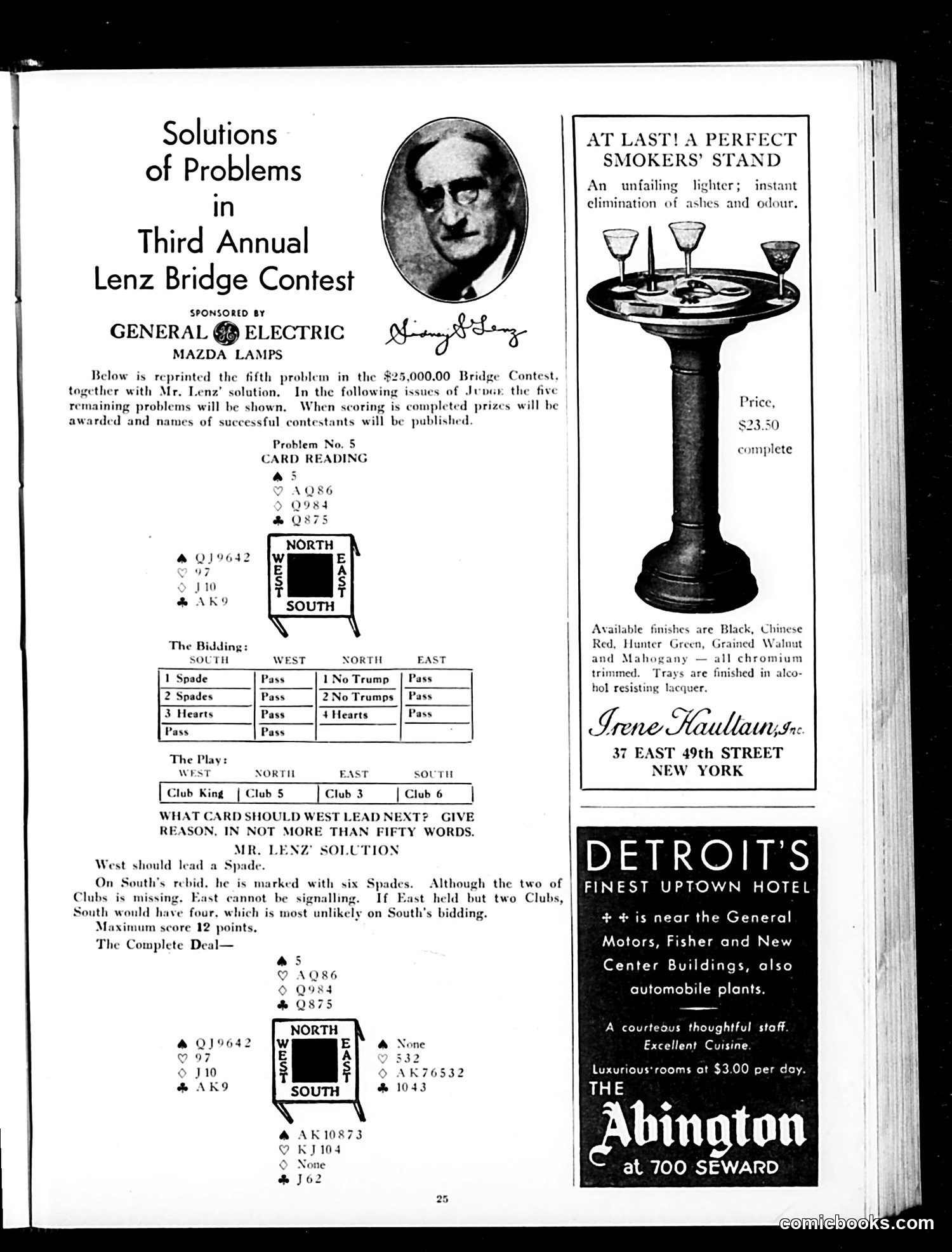
This page is primarily advertising and promotional content, not a cartoon or satire piece. The main feature is a bridge card game problem sponsored by General Electric (promoting Mazda Lamps). It presents the fifth problem in a "$25,000.00 Bridge Contest," showing card hands and asking readers to determine the correct lead card, with Mr. Lenz providing the solution. This was apparently a recurring puzzle feature in Judge magazine, with prizes awarded to successful solvers. The rest of the page contains period advertisements: a smokers' stand priced at $23.50, and hotel/restaurant ads for Detroit's Abinaton and "Detroit's Finest Uptown Hotel." There is no political satire or cartoon content visible—this appears to be a standard magazine page mixing editorial puzzle content with paid advertising, typical of early-20th-century American magazines.
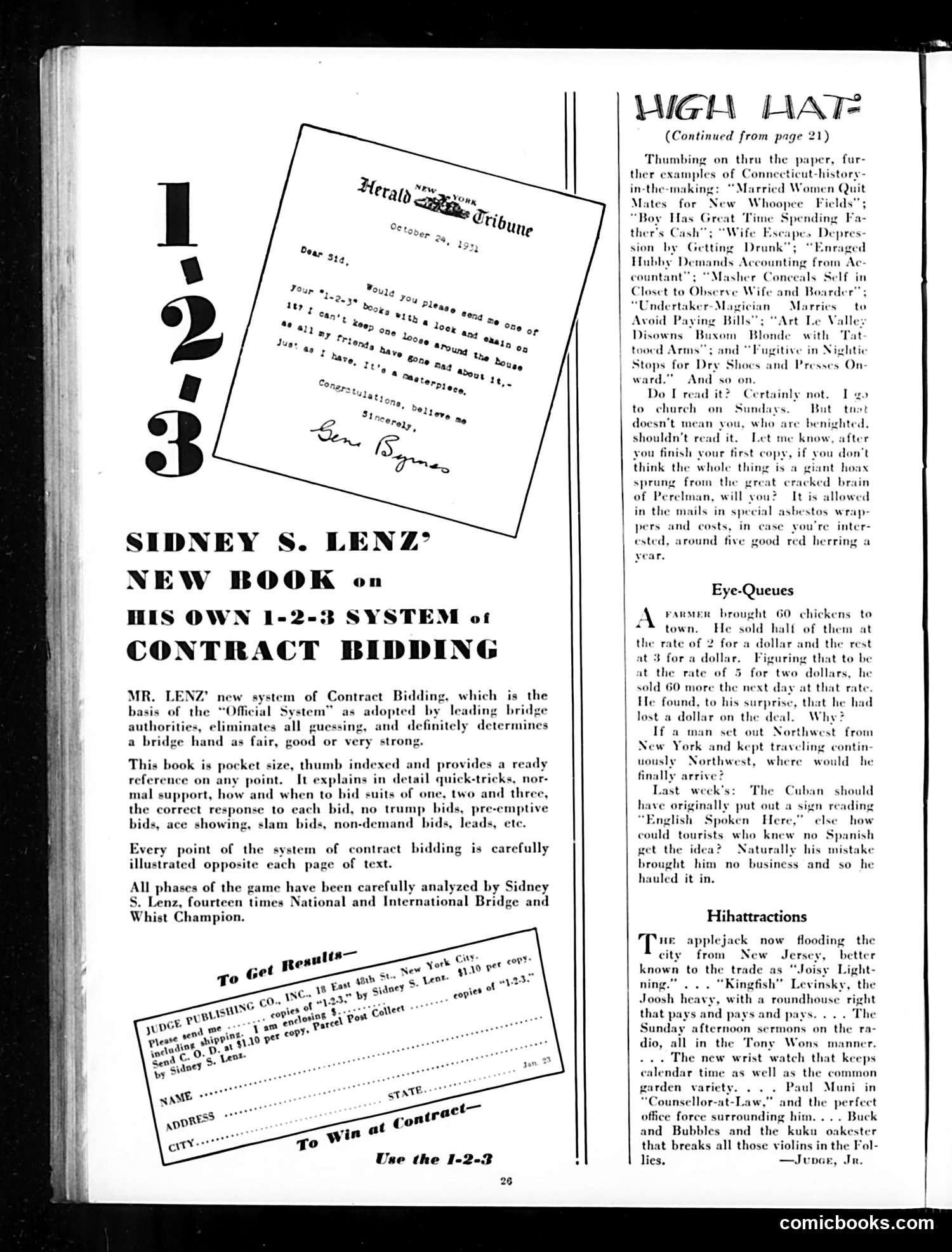
Analysis of Judge Magazine Page This page is primarily advertising and editorial content rather than political cartoons. The main feature advertises Sidney S. Lenz's new book on contract bridge bidding—a system claiming to eliminate guessing in the card game. Bridge was a popular pastime among the educated middle and upper classes in this era. The "High Hat" column continues satirical commentary on sensationalist Connecticut newspaper headlines about marital scandals and domestic chaos, attributing the absurd tone to writer S.J. Perelman's influence. "Eye-Queues" presents humorous riddles and observations about contemporary culture: applejack liquor flooding from New Jersey (Prohibition-era bootlegging), boxer "Kingfish" Levinsky, and current entertainment (Paul Muni's film, the Follies). The satire targets lowbrow journalism's obsession with scandal and divorce narratives—mocking both the papers publishing them and readers consuming them. The overall tone is sophisticated mockery of popular taste.
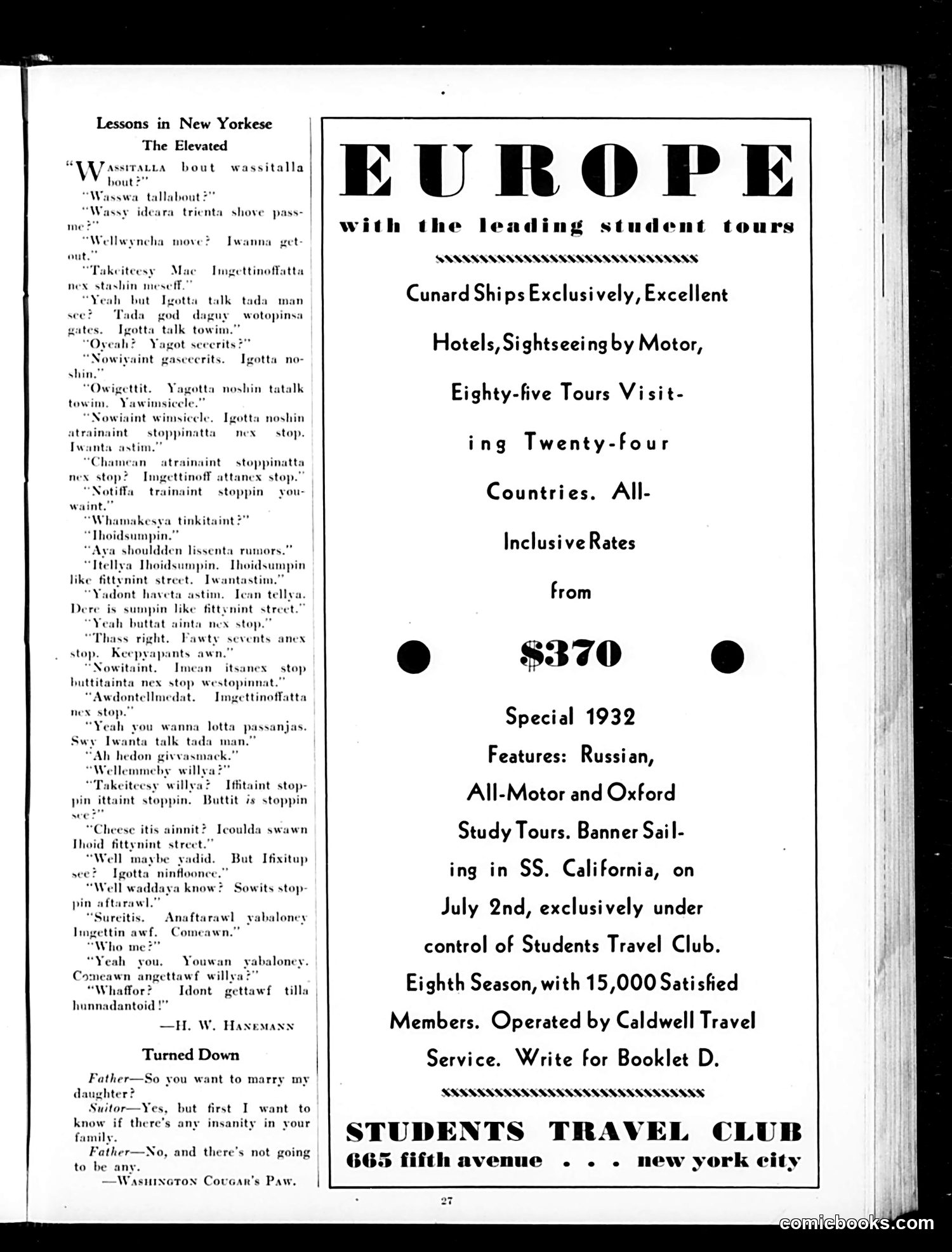
"Lessons in New Yorkese" and "Turned Down" The left side features a dialect comedy piece titled "Lessons in New Yorkese: The Elevated," credited to H.W. Hanemann. It satirizes working-class New York City speech patterns through exaggerated phonetic transcription—rendering standard English into heavily accented, colloquial dialogue ("wassitalla bout," "Iwanna get out"). The humor relies on mocking how immigrants and working-class New Yorkers spoke, a common comedic trope in 1930s publications. Below is a brief joke called "Turned Down" playing on a father's protective refusal to allow his daughter's marriage, with the punchline hinging on "insanity"—the father jokes he won't *allow* insanity in his family by permitting the marriage. The right side is primarily a travel advertisement for the Students Travel Club, promoting European tours at $370 for 1932, using Cunard ships.
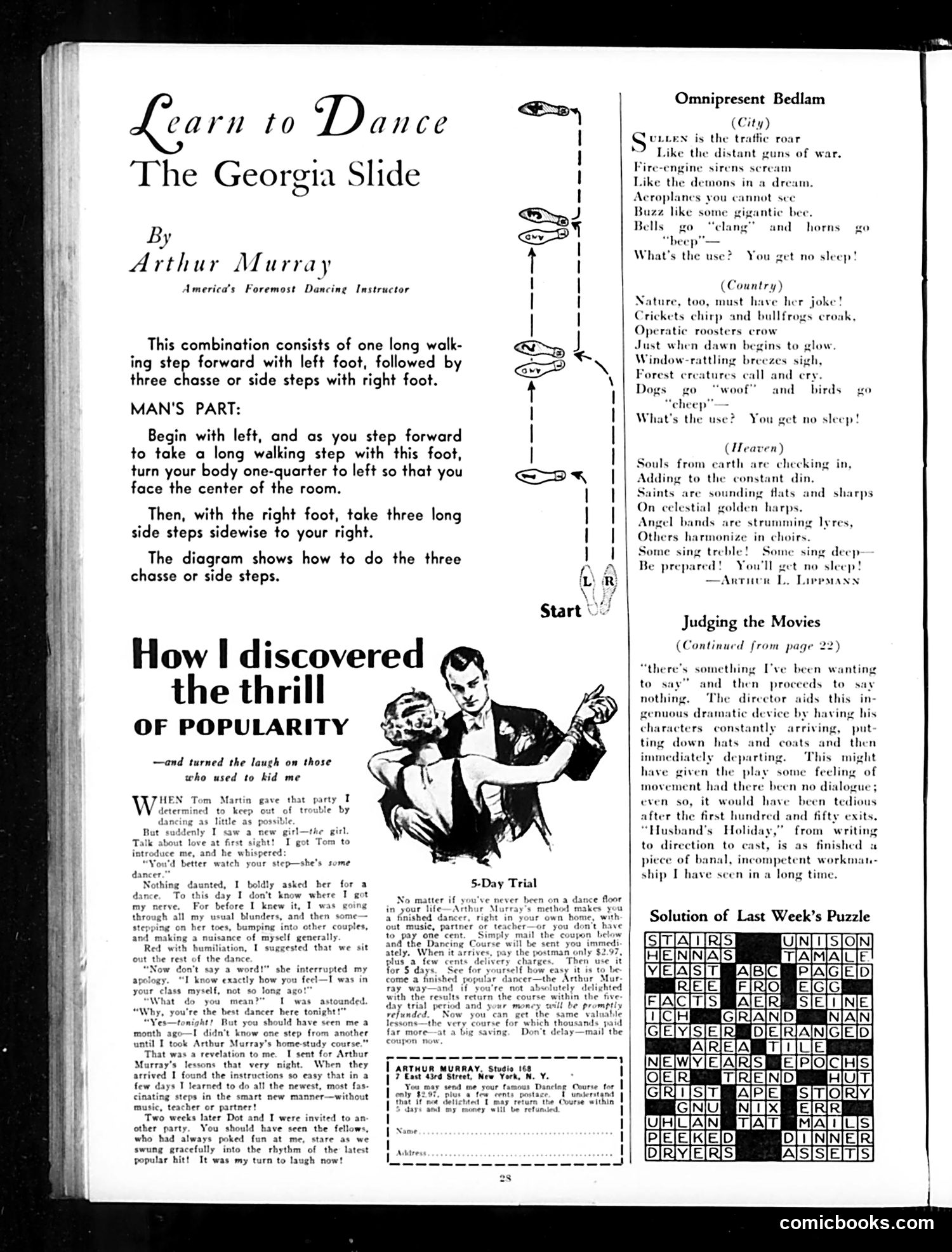
Analysis: "Learn to Dance" and Related Content This page from *Judge* magazine combines dance instruction with satirical poetry. The Dance Section: Arthur Murray's "Georgia Slide" provides straightforward instructions for a popular 1920s dance move, reflecting Murray's actual prominence as America's leading dance instructor during this era. The Satire: The poem "Omnipresent Bedlam" mocks modern urban life by contrasting three settings—city, country, and heaven—all characterized by relentless noise that prevents sleep. City noises include traffic, sirens, and airplanes; country sounds feature roosters and insects; even heaven features loud singing. The repeated refrain "What's the use? You get no sleep!" satirizes how industrialization and modern life have made peace impossible everywhere. The Narrative: "How I discovered the thrill of popularity" tells a comedic story: a socially awkward man learns dancing from Murray and transforms into a confident dancer, earning respect. This serves as both advertisement for Murray's method and commentary on how mastering fashionable skills ensures social acceptance. The page blends entertainment, advertising, and social commentary typical of *Judge*'s approach.
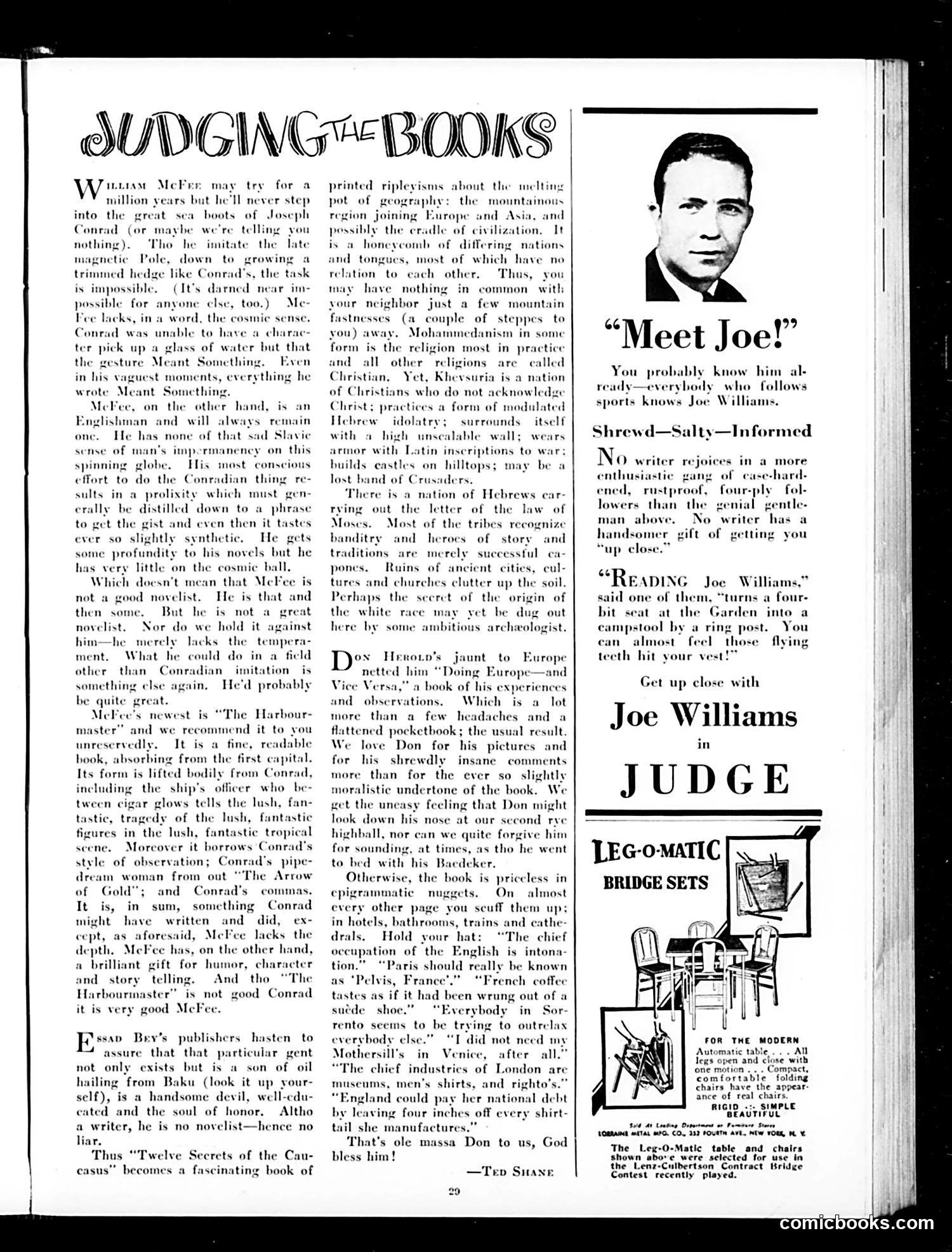
"Judging the Books" — A Literary Critique Page This is a book review column critiquing two novels. The main article compares English writer William McFee unfavorably to Joseph Conrad, the Polish-born master of sea narratives. The critic argues McFee lacks Conrad's philosophical depth and "cosmic sense"—his ability to infuse mundane gestures with profound meaning. McFee is competent at humor and storytelling but remains too conventionally English, missing the melancholic introspection Conrad achieved. The page also reviews "Twelve Secrets of the Caucasus," praising its exotic geographical detail about the remote Khevsuria region with its unusual blend of Christian, Hebrew, and crusader influences. The "Meet Joe!" advertisement promotes sports writer Joe Williams, positioned as "shrewd," "salty," and "informed"—a personality endorsement typical of 1920s-30s magazine promotion.
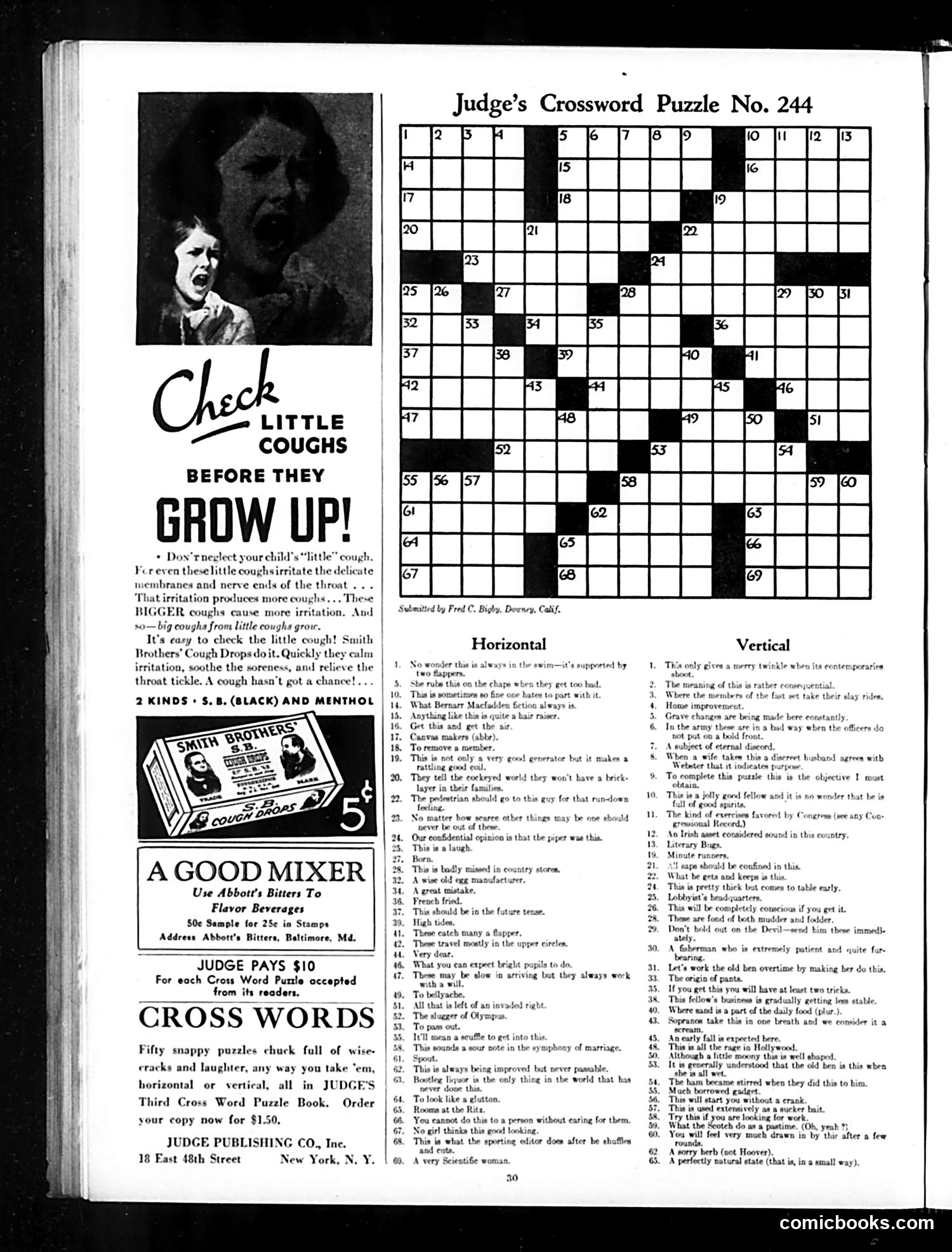
Judge Magazine Page Analysis This page primarily consists of advertisements and a crossword puzzle, rather than political satire. The main content includes: - A Smith Brothers Cough Drops ad warning parents to treat children's coughs early, using the slogan "Check little coughs before they grow up!" - An Abbott's Bitters advertisement - A crossword puzzle with clues submitted by readers The photograph shows a man's face, likely a product endorsement or generic image accompanying the cough drops ad rather than a specific political figure or caricature. The page reflects 1920s consumer culture: concern about children's health, commercial remedies as solutions, and the era's fascination with crossword puzzles (which had recently become a craze). The advertisements employ persuasive health messaging common to that period. There is no apparent political satire or social commentary on this particular page—it's primarily a vehicle for advertising and entertainment content.
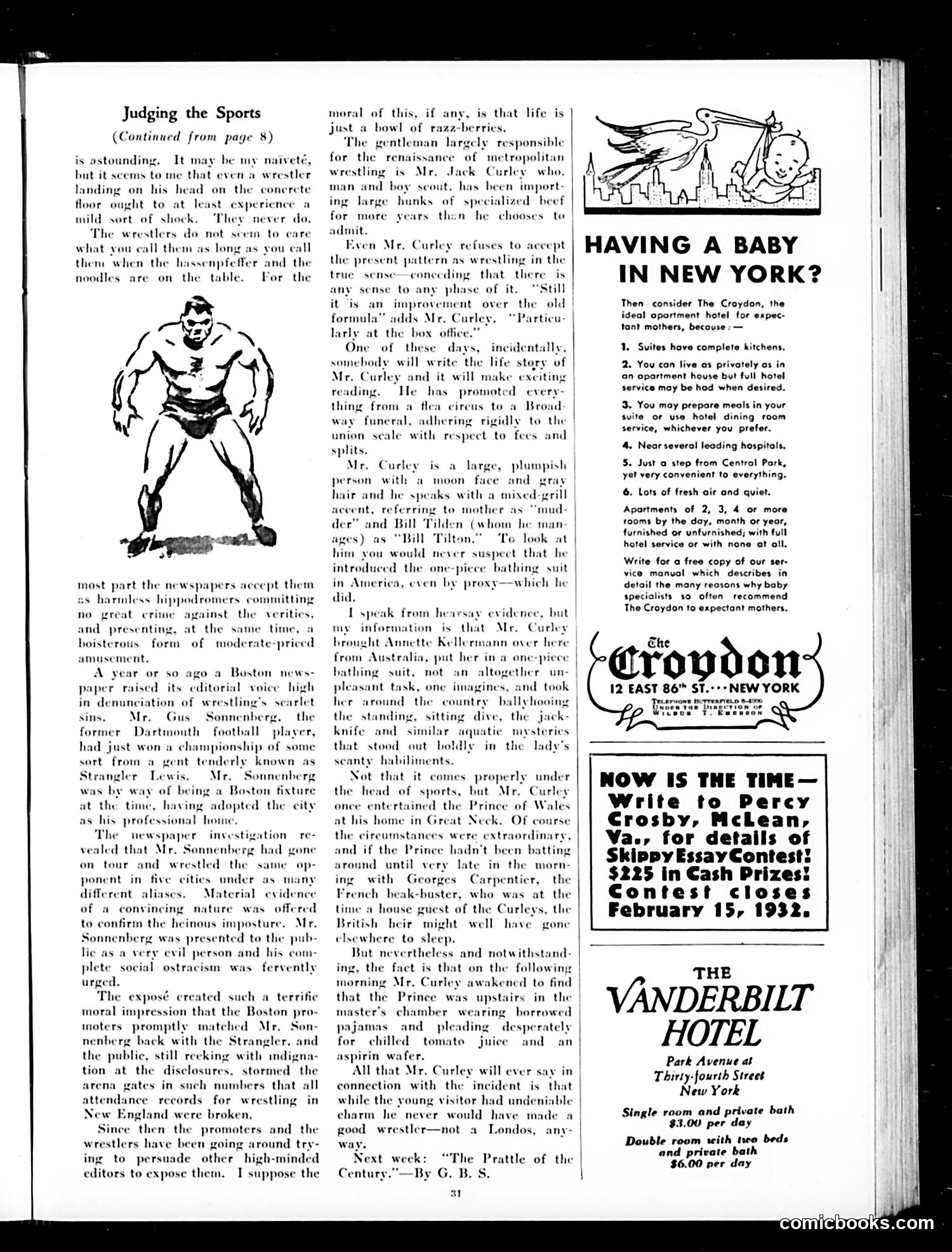
"Judging the Sports" - Historical Context This article satirizes professional wrestling's dubious legitimacy in 1920s America. The author mocks wrestling promoter Jack Curley as a carnival huckster who has transformed wrestling from legitimate sport into entertainment spectacle, promoting "specialized beef" (muscular performers) rather than genuine athletic competition. The piece references Gus Sonnenberg, a former Dartmouth footballer turned wrestler, whose championship matches across multiple cities under different aliases were exposed by a Boston newspaper. Rather than destroying wrestling's credibility, the scandal actually *increased* attendance—satirizing how the public embraces obvious frauds if sufficiently entertained. The text also highlights Curley's dubious accomplishments: allegedly introducing the one-piece bathing suit via Australian swimmer Annette Kellermann, and entertaining the Prince of Wales at his home. The satire's core point: wrestling's blatant phoniness doesn't matter to audiences or promoters—profit and spectacle trump athletic integrity.
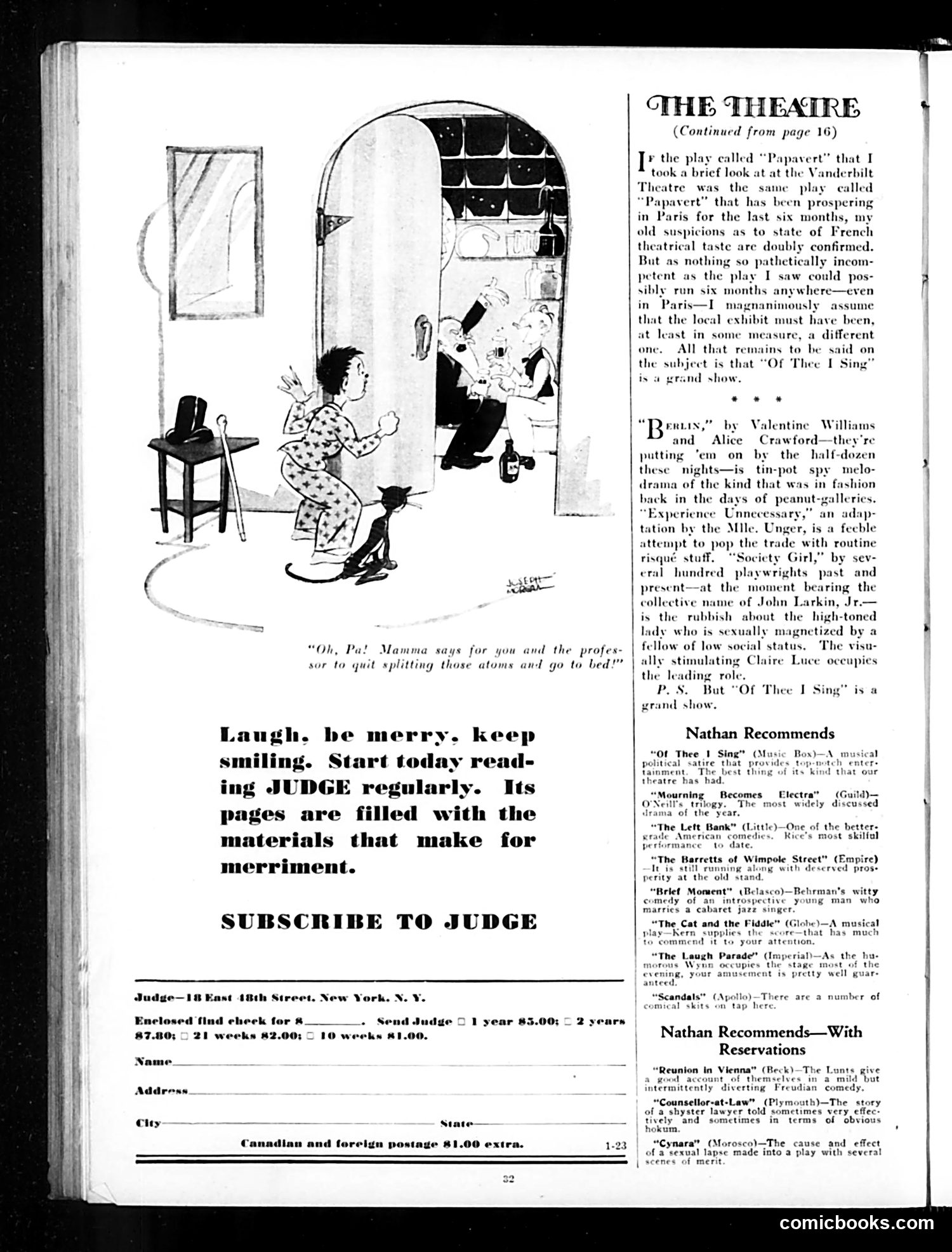
The Cartoon's Meaning The main cartoon depicts a woman interrupting two figures (a man and woman) who appear to be engaged in scientific work, splitting atoms. She's scolding them like children, saying their mother wants them to stop the atomic work and go to bed. The satire: This jokes about the era's fascination with atomic science as a trendy, almost childish pursuit. During the early 1930s (when Judge published), atomic physics was cutting-edge and captivating public imagination, yet the cartoon treats serious scientific endeavor as frivolous play that responsible adults should abandon for bedtime—mocking both the scientists' obsession and society's sensationalized view of atomic research. The page is otherwise an advertisement for Judge magazine subscriptions and theater reviews, making the cartoon the primary satirical content.
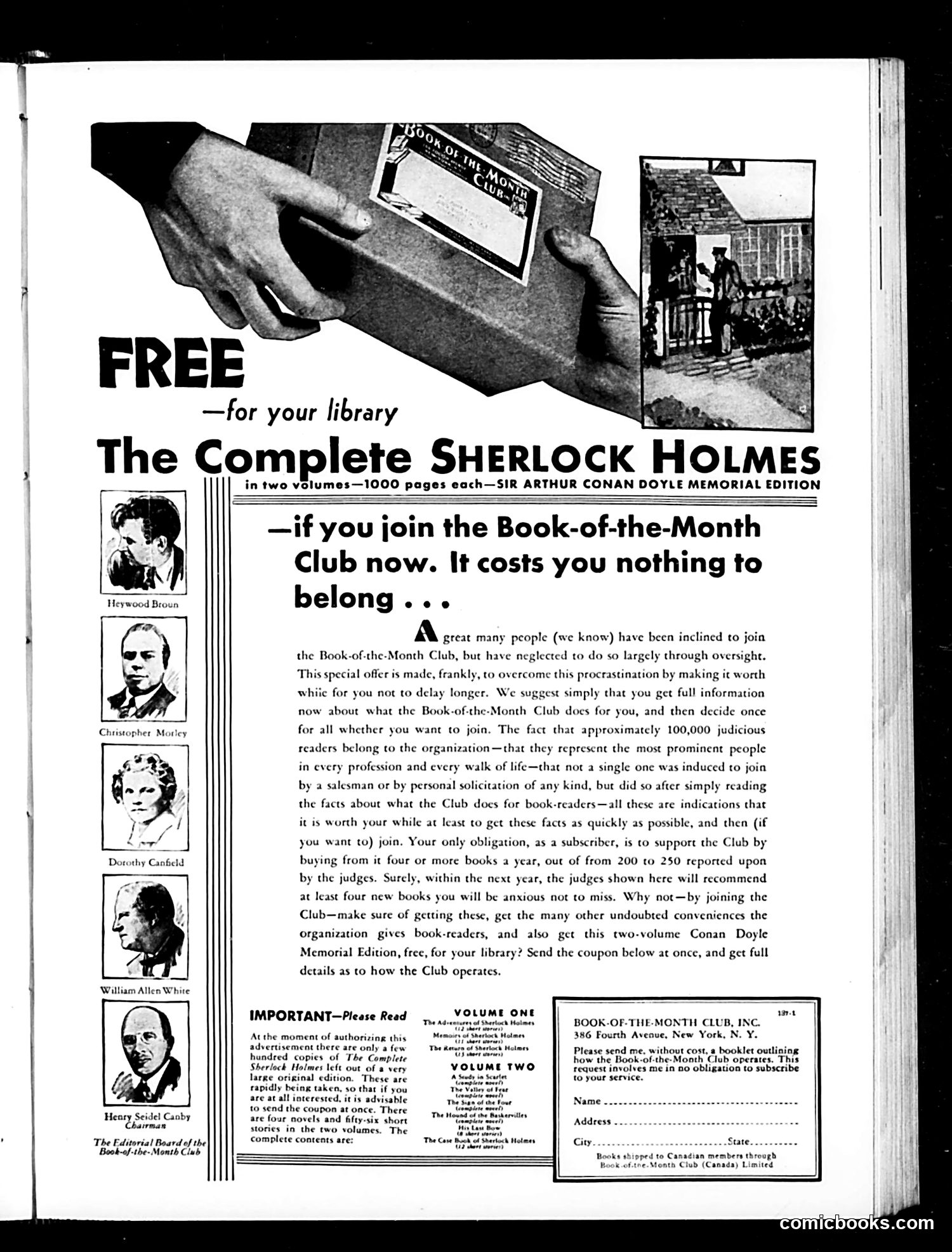
What This Page Means This is primarily an advertisement, not satire. It promotes the Book-of-the-Month Club, offering a free two-volume Sherlock Holmes collection as an incentive to join. The page features portraits of five real literary figures serving as the Club's editorial judges: Heywood Broun, Christopher Morley, Dorothy Canfield, William Allen White, and Henry Seidel Canby—prominent critics and authors whose endorsement lent credibility. The appeal targets procrastinators, emphasizing that membership is "free" (though members must buy four books yearly). The copy stresses that 100,000 "judicious readers" joined voluntarily—a selling point suggesting the Club represented intellectual respectability. The photo inset shows what appears to be a public gathering or book discussion, reinforcing the Club's community aspect. This reflects early 20th-century book-club marketing, when curated selections and expert judges shaped middle-class reading habits and cultural authority.
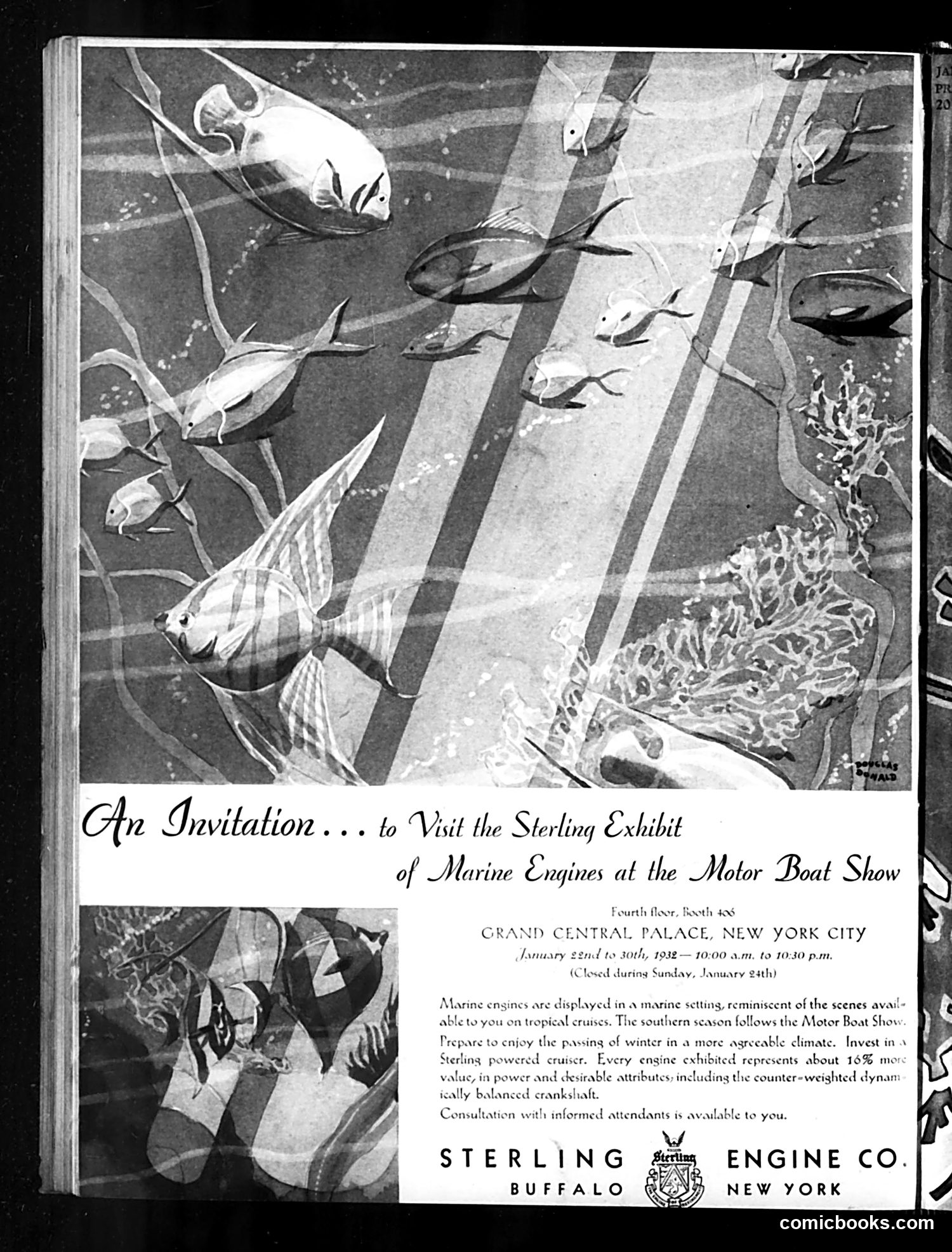
Advertisement Analysis This is not a political cartoon but rather a full-page advertisement for Sterling Engine Company, promoting marine engines at the 1932 Motor Boat Show in New York City. The imagery depicts an underwater tropical scene with various fish and coral, designed to evoke exotic vacation destinations. The advertisement's appeal is escapist: during the Great Depression (1932), it targets affluent readers by promising the ability to escape winter and enjoy "tropical cruises" via a Sterling-powered yacht. The text emphasizes the engines' technical superiority (counter-weighted crankshaft, 16% more power) while the visual strategy sells a lifestyle fantasy—leisure travel to warm climates—as an investment worth making despite economic hardship. This is marketing strategy, not satire.