judge
Judge — January 30, 1932
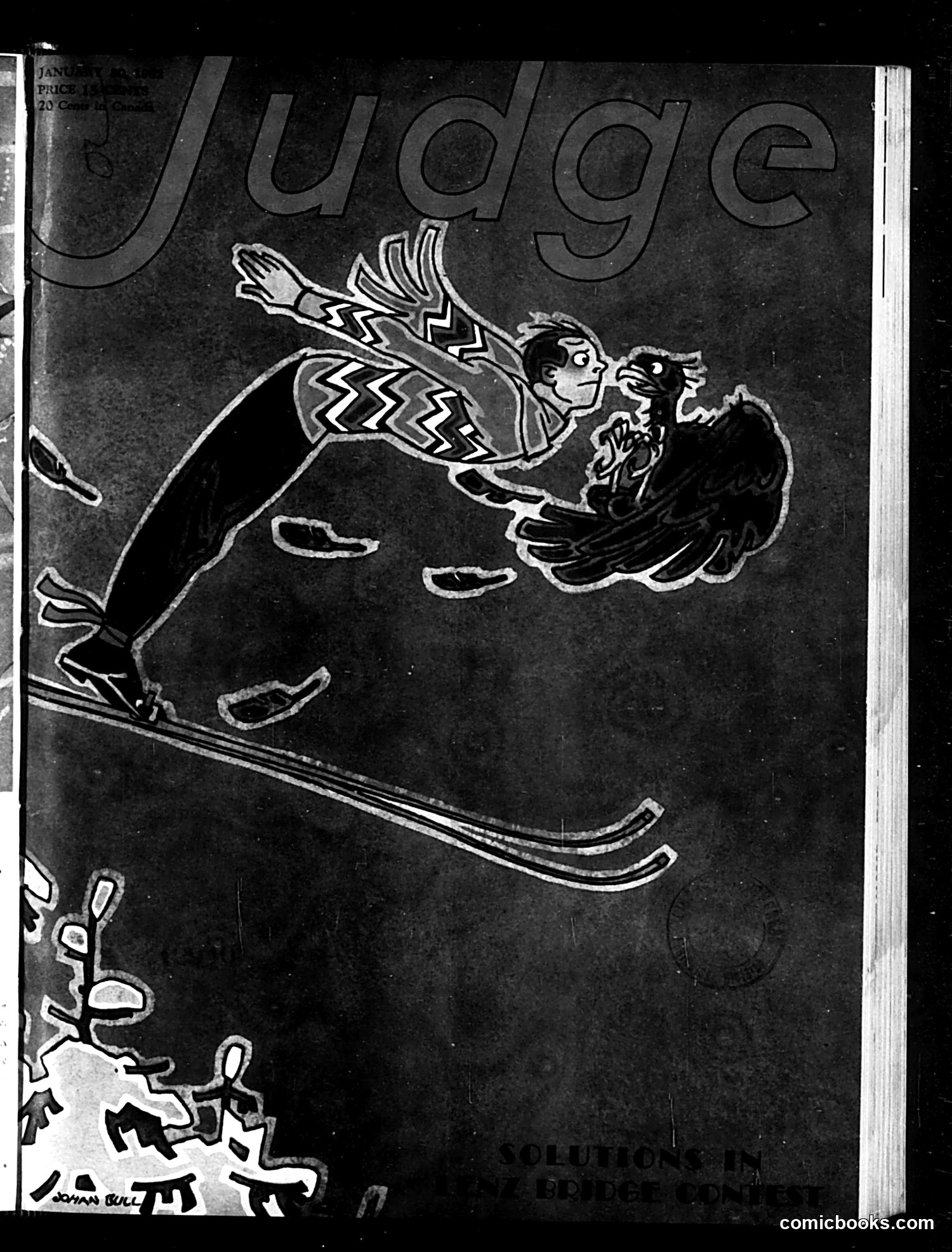
Judge Magazine Cartoon Analysis This appears to be a cover from Judge, an American satirical magazine. The illustration shows a figure in winter clothing (with a patterned sweater or garment) sledding or skiing downward at a steep angle, appearing to be in an out-of-control or precarious situation. A smaller figure is also visible. The cartoon likely satirizes a political or social situation involving rapid decline or loss of control—a common metaphor in early 20th-century political cartooning. The dramatic downward trajectory suggests a cautionary commentary on some contemporary event or trend. However, without clearer text or date information visible in this image, I cannot definitively identify the specific political figures, event, or satirical point being made. The magazine's masthead reading "Judge" is visible at top.
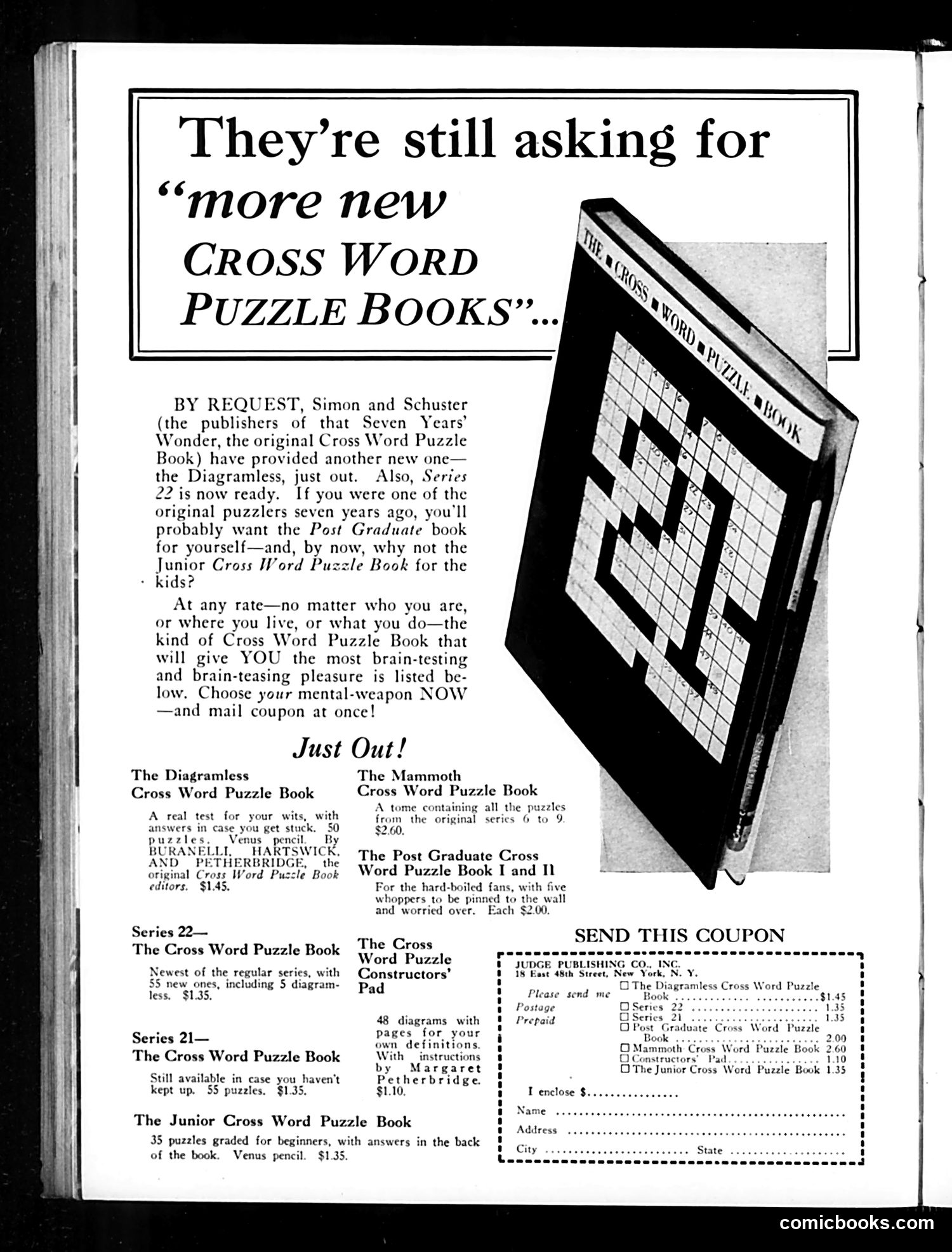
Analysis This page is primarily advertising, not satire or political commentary. It promotes crossword puzzle books published by Simon and Schuster, marketed through Judge magazine. The headline "They're still asking for 'more new CROSS WORD PUZZLE BOOKS'" suggests crosswords were a popular fad at this time. The ad references multiple book series (numbered 21-22), specialized editions (for kids, advanced solvers), and previous bestsellers from "seven years ago." The accompanying image shows an isometric view of stacked puzzle books as a visual sales tool. A mail-in coupon appears below, listing various titles and prices ($1.35-$2.60). This reflects crosswords' status as a major commercial entertainment product, likely from the 1920s-30s based on the vintage typography and publishing context of Judge magazine.
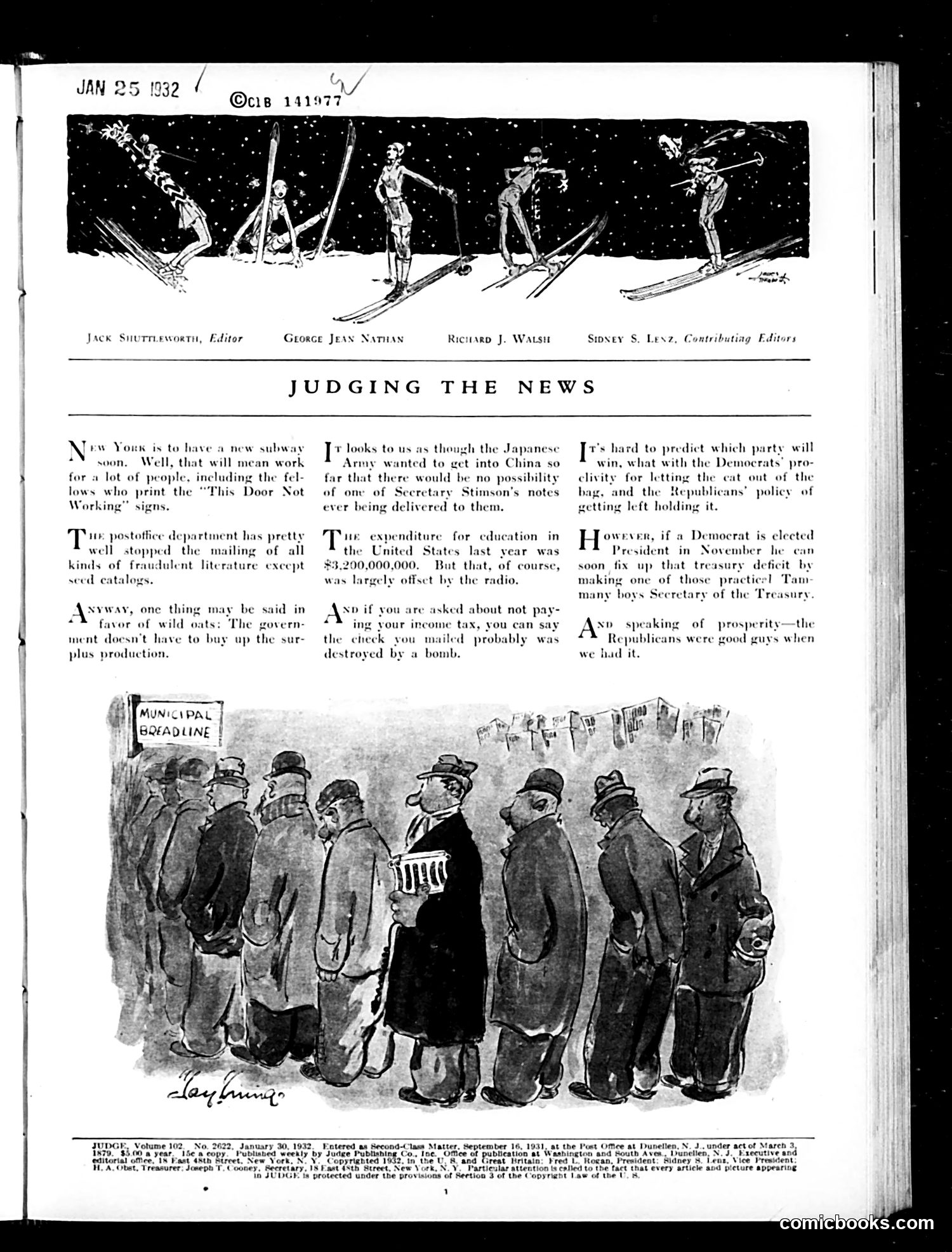
"Judging the News" - January 25, 1932 This satirical column page features editorial commentary on current events during the Great Depression. Main cartoon (bottom): Shows men lined up at a "Municipal Breadline," with one figure prominently wearing what appears to be a sash or badge, suggesting he's a politician or official. The satire implies that even those in power face the same bread lines as ordinary citizens during economic crisis. Text commentary includes jabs at: New York's proposed subway system; fraudulent "This Door Not Working" signs; the Japanese Army's intentions regarding China; education spending ($3.29 billion); tax evasion via bomb destruction; and Democrats' management of the treasury deficit. The overall tone suggests frustration with government incompetence and hypocrisy during the Depression era.
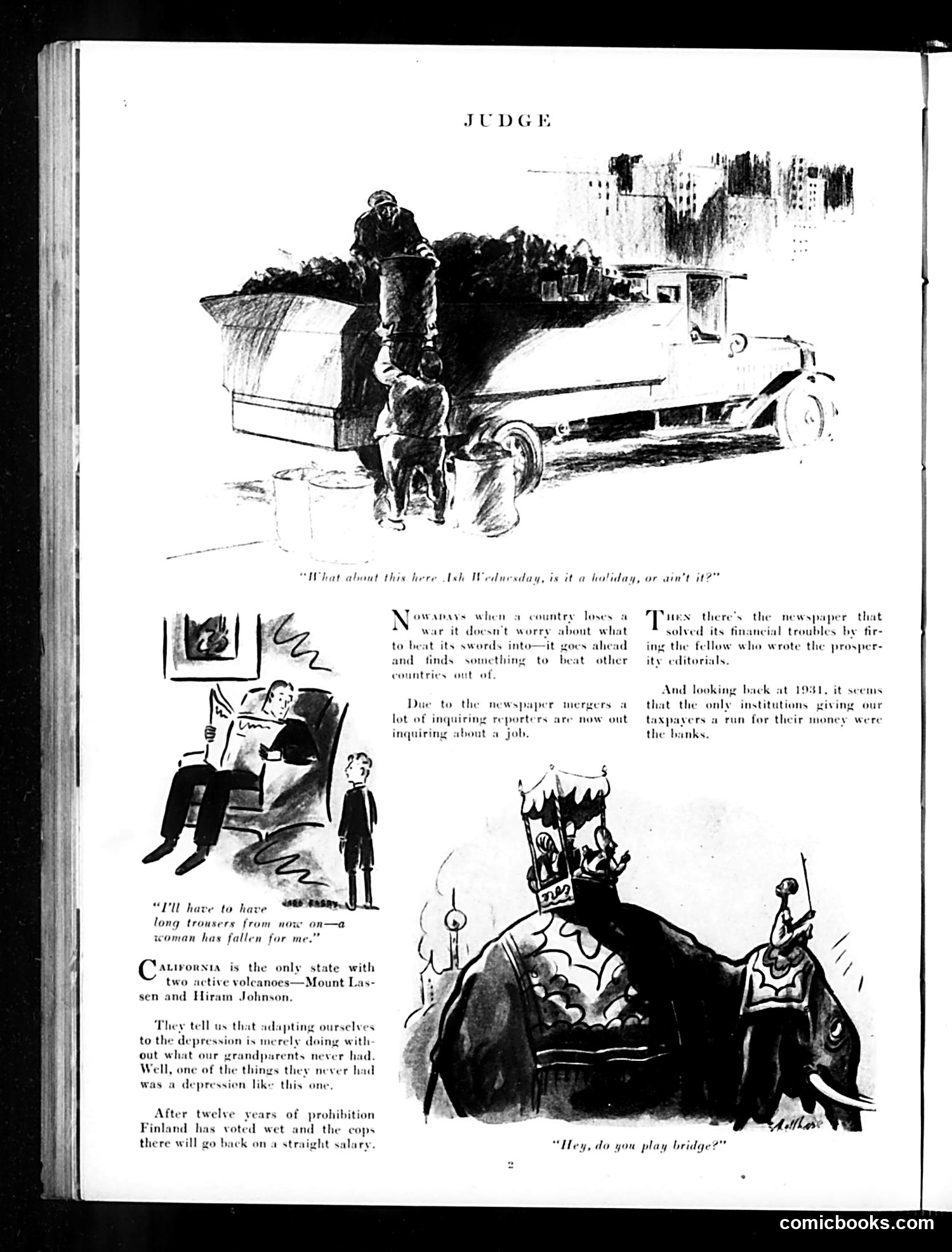
Analysis This Judge magazine page uses satire to comment on Depression-era economic hardship and institutional failure. Top cartoon: A garbage collector questions whether Wednesday is a holiday, given economic collapse. The joke mocks how unemployment has made every day equally bleak. Middle section: References newspaper mergers reducing reporting jobs, and notes that by 1941, only banks were running well—while average citizens struggled. This critiques financial institutions' stability amid broader economic failure. California reference: Notes two active volcanoes exist there, sardonically suggesting natural disasters are comparatively mild to economic ones. Bottom cartoon ("Hey, do you play bridge?"): Depicts wealthy figures amid financial chaos (burning money/documents), likely satirizing how the elite remained insulated from Depression consequences while ordinary people suffered. The page's overall message: institutions failed ordinary Americans while some remained prosperous.
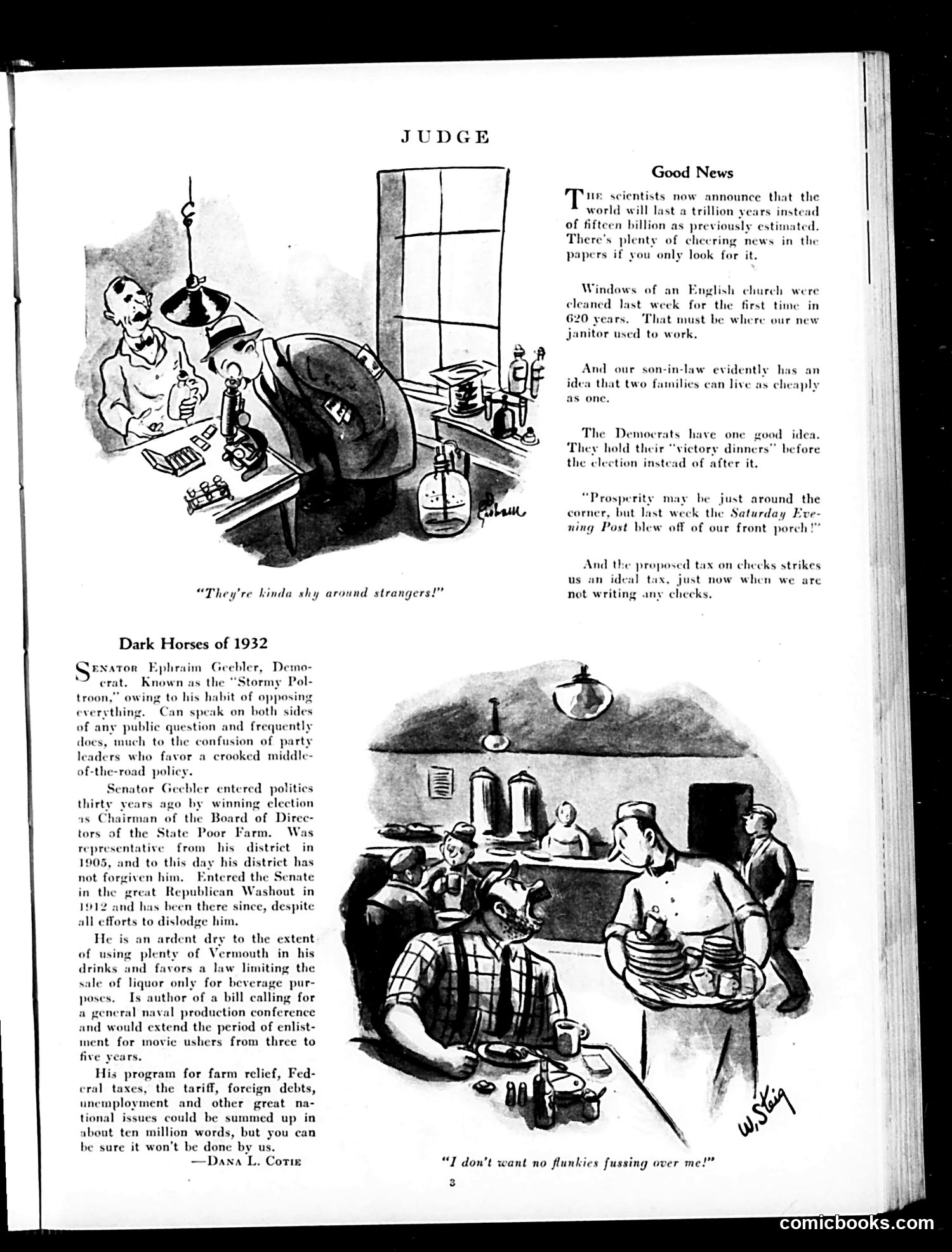
Page Analysis: Judge Magazine Top Cartoon ("Judge"): Shows a judge sentencing someone while another figure holds a noose. The caption "They're kinda shy around strangers!" is unclear without additional context, but appears to satirize either judicial leniency or capital punishment practices of the era. "Good News" Section: Offers light satirical commentary on contemporary issues: world lifespan extending to a trillion years, church window cleaning after 620 years, families living cheaply together, Democrats holding "victory dinners" before elections, and a tax on check-writing. "Dark Horses of 1932": Profiles Senator Ephraim Gesbler, a Democrat known as the "Stormy Poltroon" for taking both sides of issues. The text criticizes his political record and opportunism while detailing his farm relief and various policy positions, written by Dana L. Cokie.
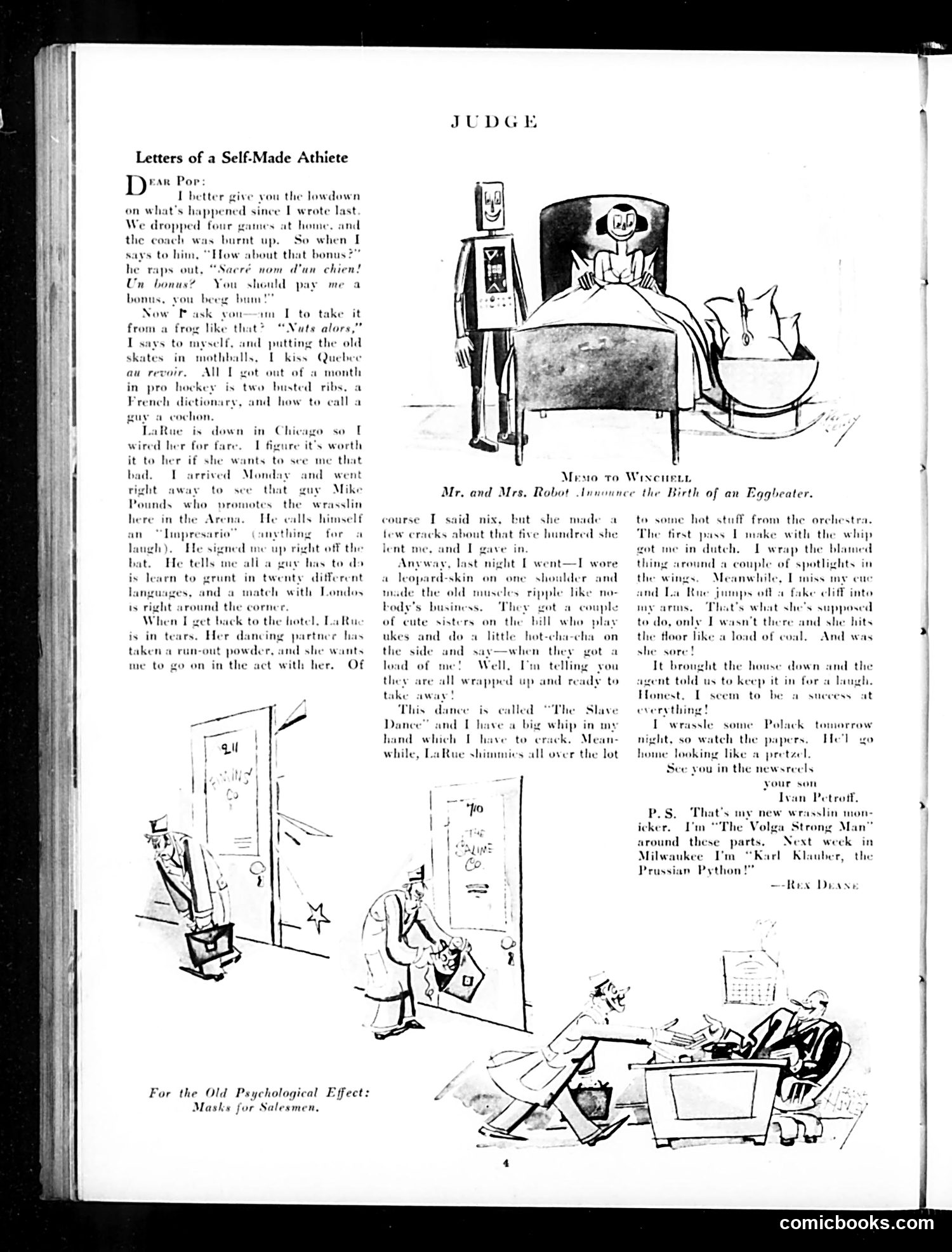
Analysis of This Judge Page This page contains "Letters of a Self-Made Athlete" by Ivan Petroff, a humorous column about wrestling and theatrical performance. The main letter describes dropping four games at home, then negotiating a bonus with his coach. The writer describes wrestling moves using French terminology and theatrical language, comparing the sport to stagecraft—mentioning "the Slave Dance," spotlights, and fake moves to entertain audiences. The cartoons illustrate the theatrical absurdity: one shows a wrestling "match" resembling staged performance rather than genuine sport; another depicts salesmen using psychological masks. The satire: Professional wrestling is presented as theatrical entertainment rather than authentic athletic competition—a critique suggesting wrestlers and promoters prioritize spectacle and profit over genuine sport. This was a contemporary concern about wrestling's credibility.
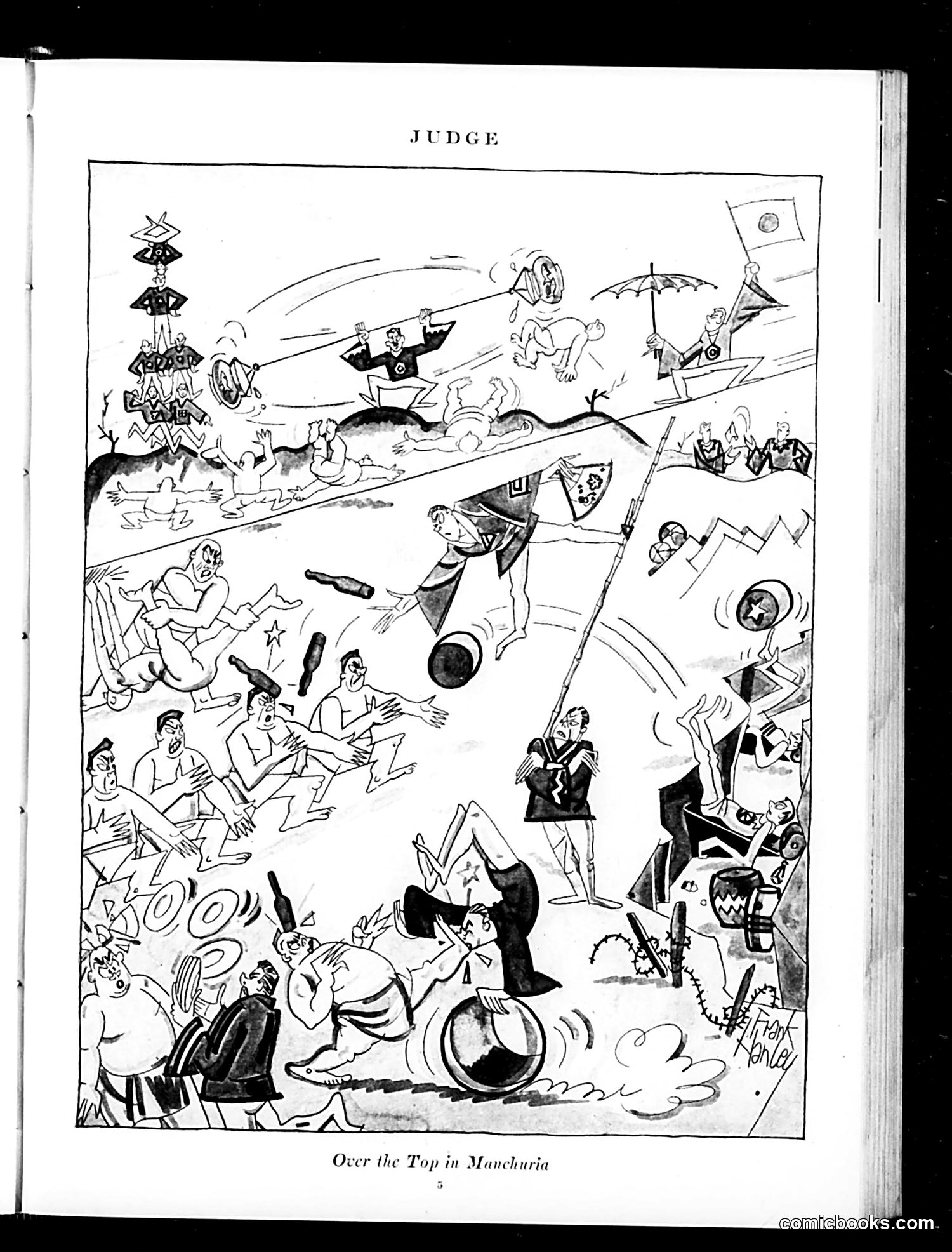
"Over the Top in Manchuria" This Judge magazine cartoon satirizes the Russo-Japanese War (1904-1905) and the chaotic international response to it. The title references "going over the top"—military terminology for attacking across no-man's-land. The cartoon depicts a surreal beach scene where various national figures (likely representing different countries' diplomatic positions) engage in absurd, conflicting activities—some fighting, some observing with umbrellas, some in formal dress amid chaos. The "Manchuria" reference indicates the contested territory where Russia and Japan battled for control. The satire appears to mock how Western powers watched the conflict with detached curiosity while the actual combatants suffered, and how international diplomacy fumbled amid the warfare. The chaotic composition emphasizes the confused, contradictory nature of global responses to the distant Asian conflict.
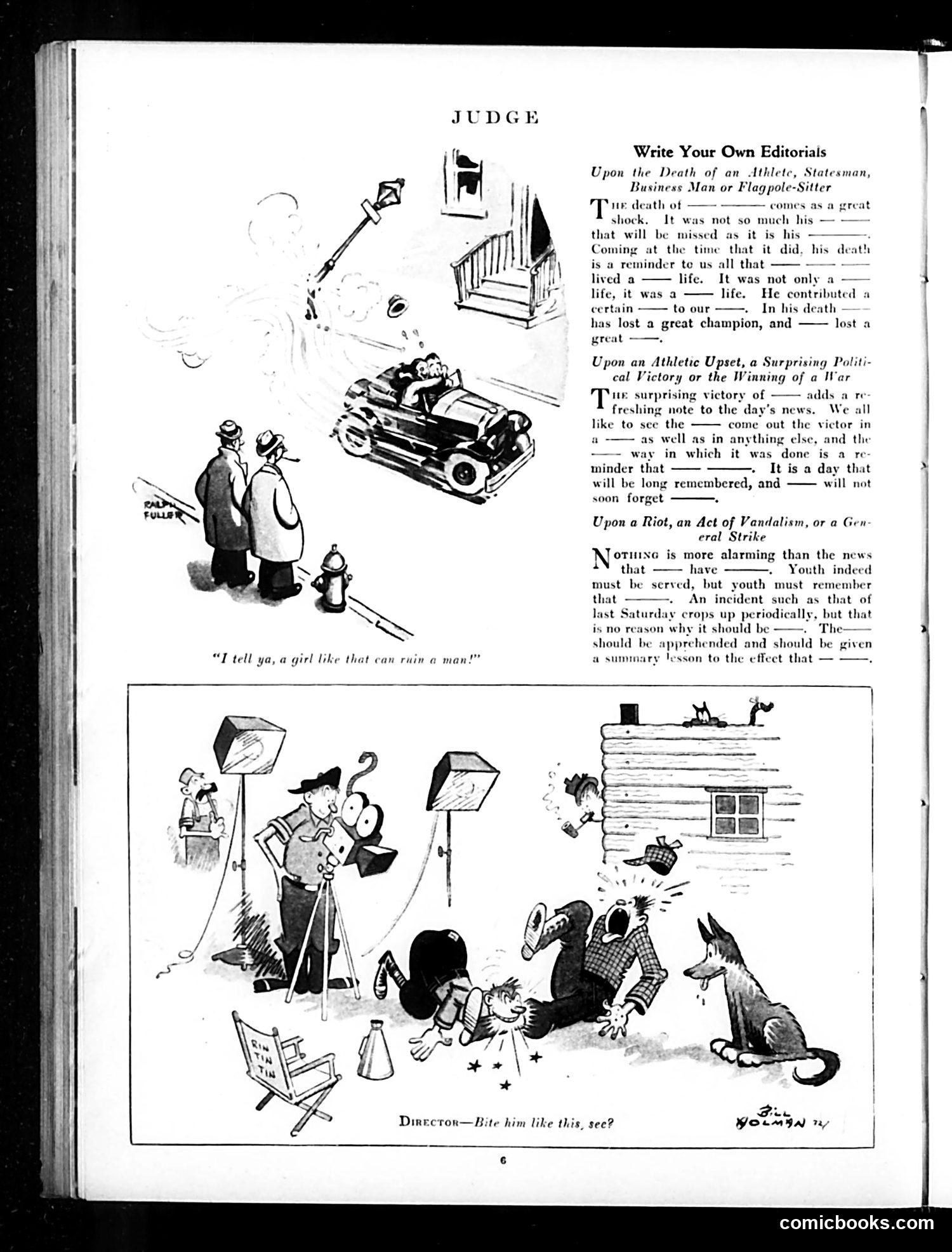
Analysis of Judge Magazine Page This page features three editorial cartoon templates for readers to complete themselves—a participatory feature titled "Write Your Own Editorials." The top cartoon shows a hearse and two mourners discussing someone's death, with a caption about a prominent figure's passing. The middle cartoon depicts a chaotic scene with people fighting, labeled regarding "a Riot, an act of Vandalism, or a General Strike." The bottom cartoon shows a film director staging a scene with actors fighting while a fox watches—captioned "Director—Bite him like this, see?" The satirical point appears to be mocking how different publications might frame identical events (riots, strikes, fights) differently depending on their political perspective. By asking readers to fill in names and commentary, Judge invites them to consider how narratives can be manipulated through selective framing.
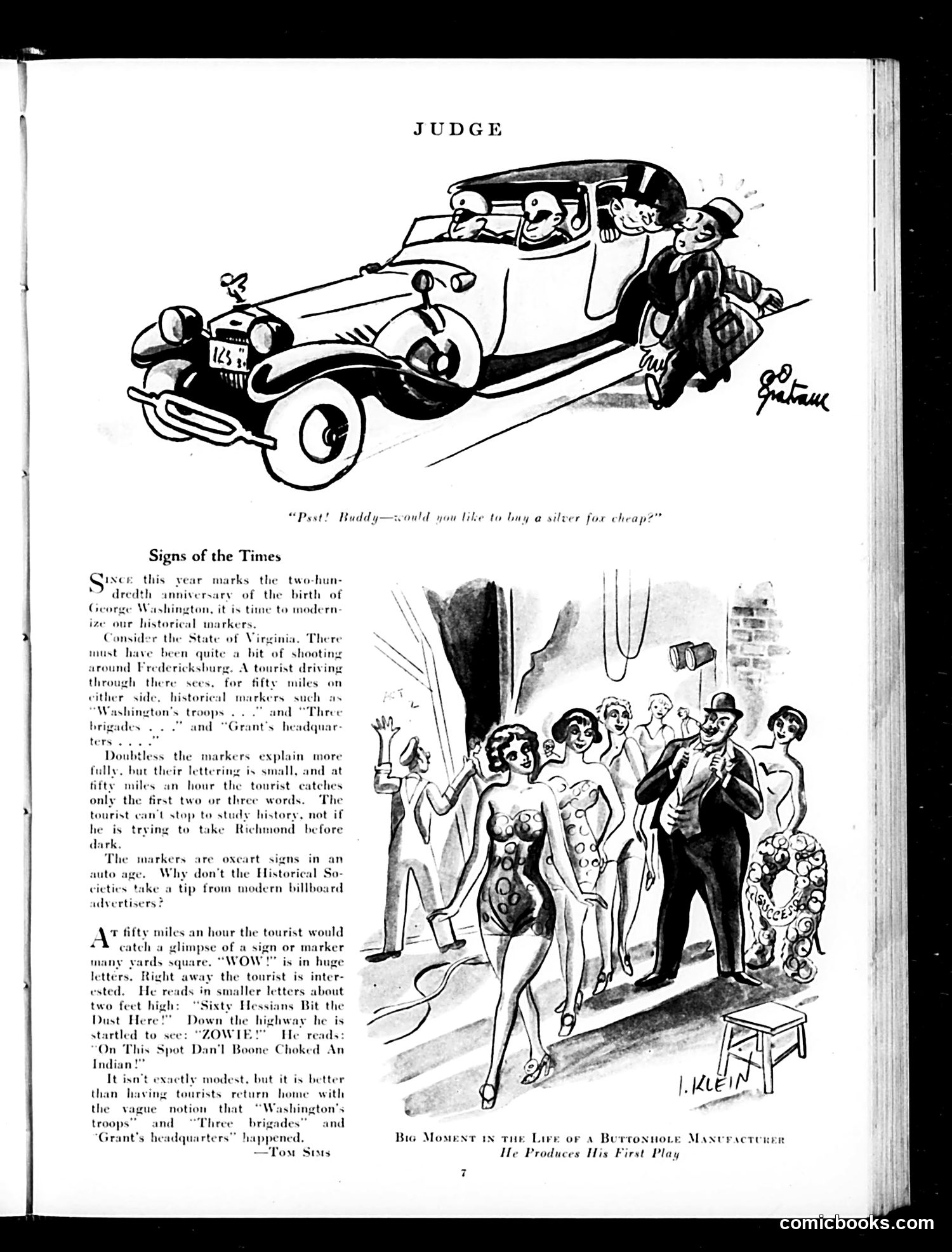
Page Analysis: Judge Magazine Top Cartoon: A man in formal attire approaches a car with two occupants, offering to sell a "silver fox cheap." This is a con-artist pitch—"silver fox" was slang for an attractive older person, but also literal fur. The joke plays on the double meaning and the "Psst! Buddy" approach typical of street hustlers. Main Article ("Signs of the Times"): Satirizes Virginia's historical markers commemorating George Washington's bicentennial. The author argues these markers use small lettering unreadable from cars traveling 50+ mph. He mockingly suggests adopting modern billboard advertising tactics—using huge eye-catching words ("WOW!", "ZOWIE!") to grab tourist attention, with actual historical details in smaller text below. The satire critiques both outdated historical preservation methods and America's growing billboard advertising culture in what appears to be the 1930s. Bottom Caption: References a "buttonhole manufacturer's" first theatrical production, though context is unclear from this page alone.
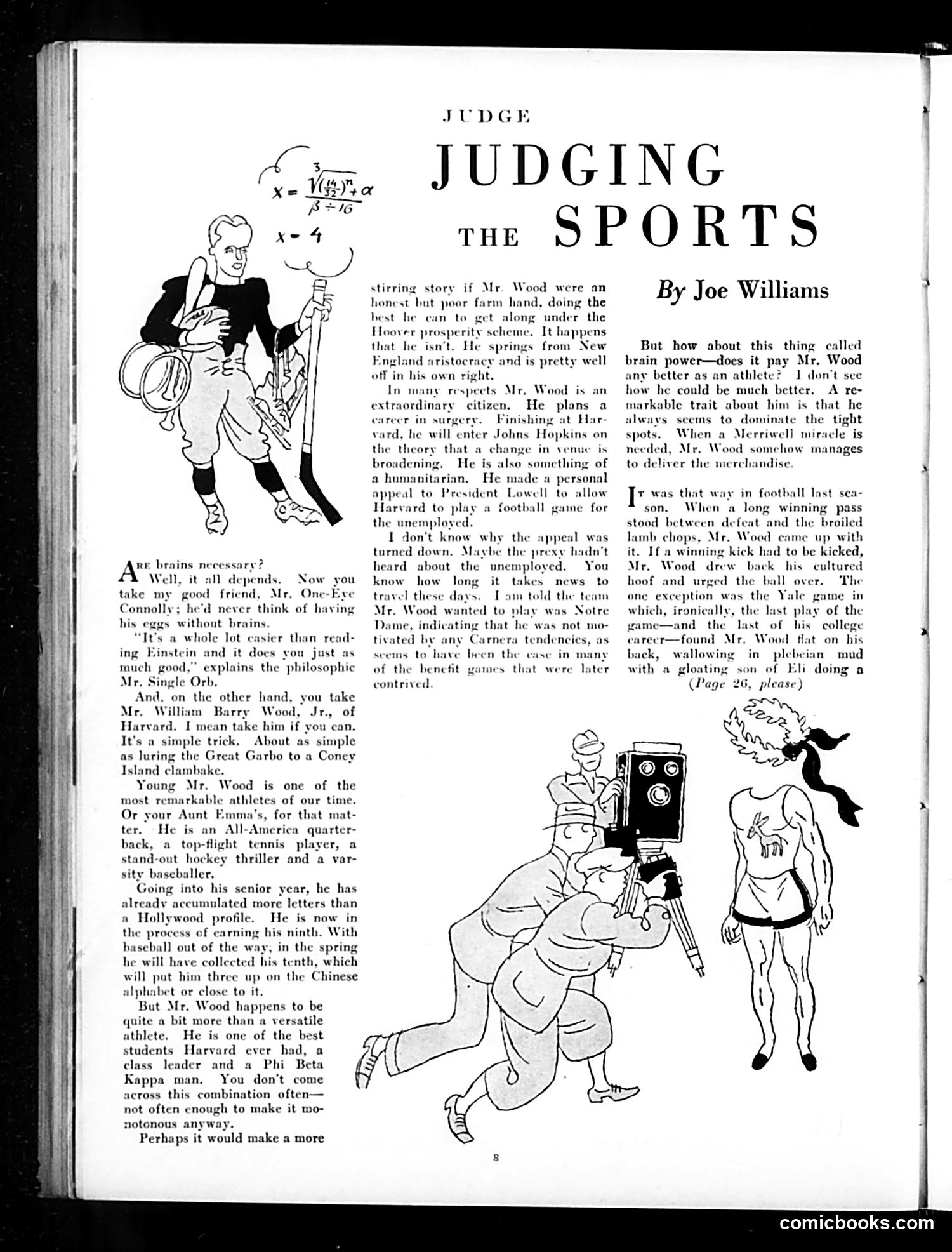
Judging the Sports: William Barry Wood Jr. This article profiles William Barry Wood Jr., a Harvard student-athlete of exceptional accomplishment. The satire critiques the rarity of combining athletic excellence with genuine intellect and character. Wood is presented as an almost impossibly impressive figure: an All-American quarterback, top tennis player, hockey standout, varsity baseball player, and honor student (Phi Beta Kappa). The humor lies in the author's exaggerated amazement that such combinations exist at all—comparing his accumulated athletic letters to "the Chinese alphabet." The cartoon illustrations show photographers documenting Wood's athletic prowess, emphasizing how his achievements seem almost newsworthy or record-breaking. The piece gently mocks both the rarity of well-rounded excellence and the cultural obsession with athletic celebrities. The reference to "Hoover prosperity scheme" and mention of unemployed people suggests this article dates from the late 1920s-early 1930s, when such contrasts between privileged students and economic hardship carried particular weight.
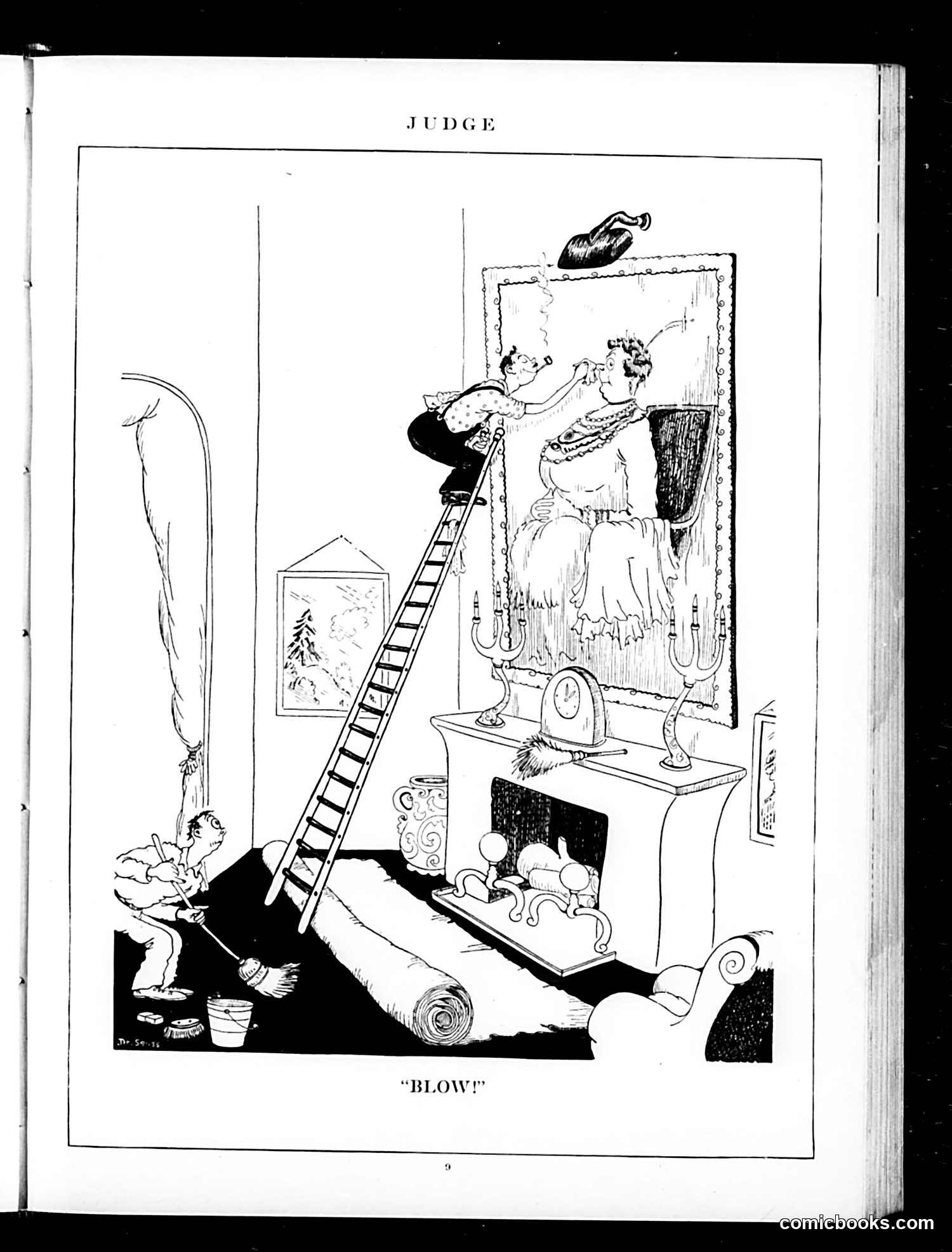
"BLOW!" - Judge Magazine Cartoon This single-panel cartoon depicts a chaotic interior scene titled "BLOW!" A man on a ladder appears to be blowing air or smoke into an ornate picture frame containing a woman's portrait. Below, various figures and objects are scattered in disarray—including papers, vessels, and what appears to be someone being knocked back by the force. The composition suggests the act of "blowing" is causing widespread disruption and chaos in a refined domestic space. Without additional context or visible date/attribution, the specific political or social reference remains unclear. The cartoon likely satirizes either a particular public figure's actions or a general social phenomenon, but the exact target cannot be determined from the image alone. The humor appears to rely on visual chaos and the unexpected consequences of a simple action.
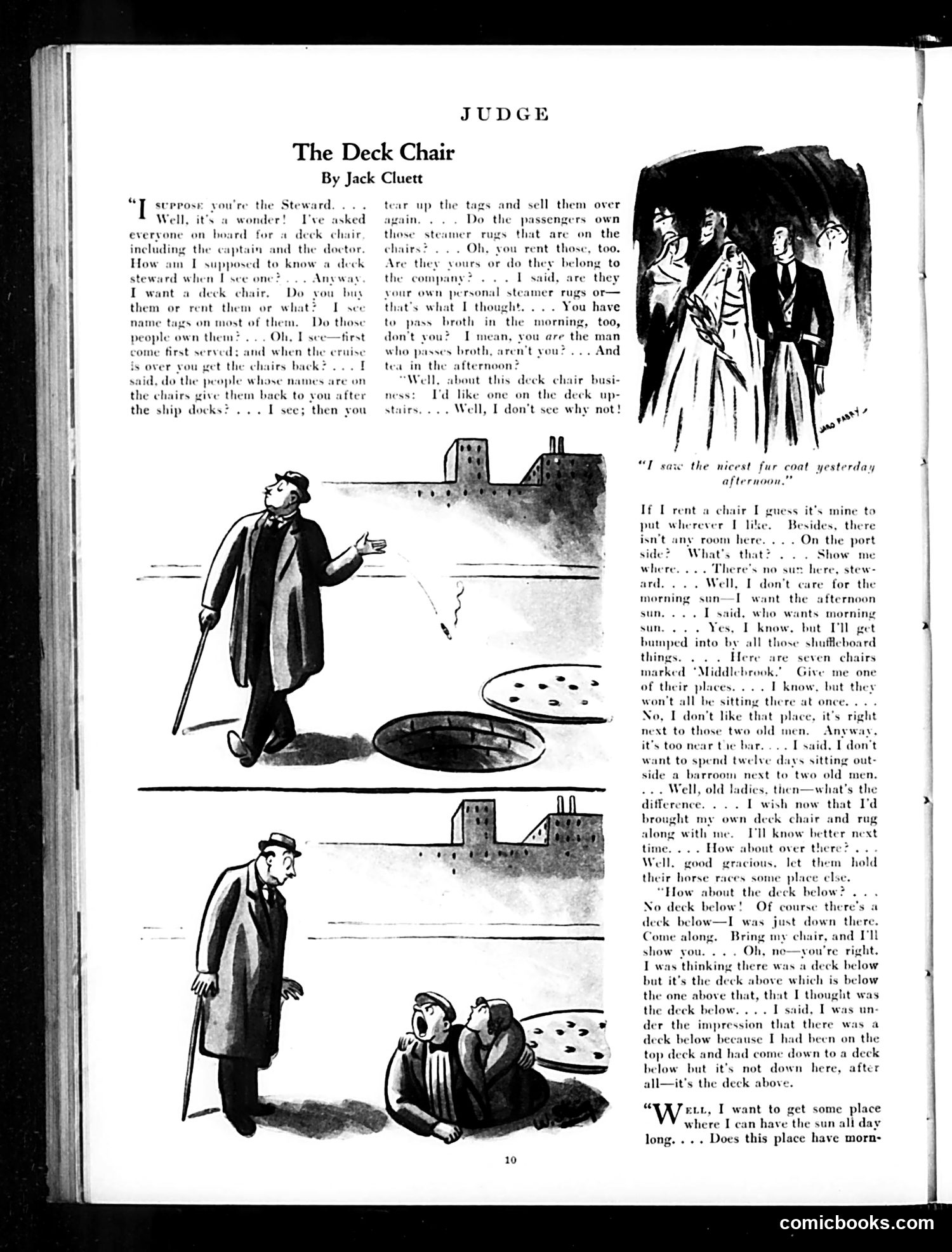
"The Deck Chair" by Jack Cluett — Explanation This is a humorous story about a persistently demanding cruise ship passenger tormenting a steward. The passenger badgers him endlessly about obtaining a deck chair, asking nonsensical questions: Do passengers own the chairs? Can he place it anywhere? Who owns the steamer rugs? The satire targets the entitled, complaining leisure-class tourist of the early 20th century—someone obsessed with comfort and amenities while being fundamentally illogical and ungrateful. The passenger's circular complaints (confusion about "deck above" versus "deck below," wanting sun but avoiding crowds) reveal someone who cannot be satisfied regardless of accommodation. The illustrations show the steward's increasing exasperation as the passenger continues his absurd demands. The joke's point: some people will never stop complaining, no matter what service is provided. It's social commentary on cruise culture and passenger entitlement.
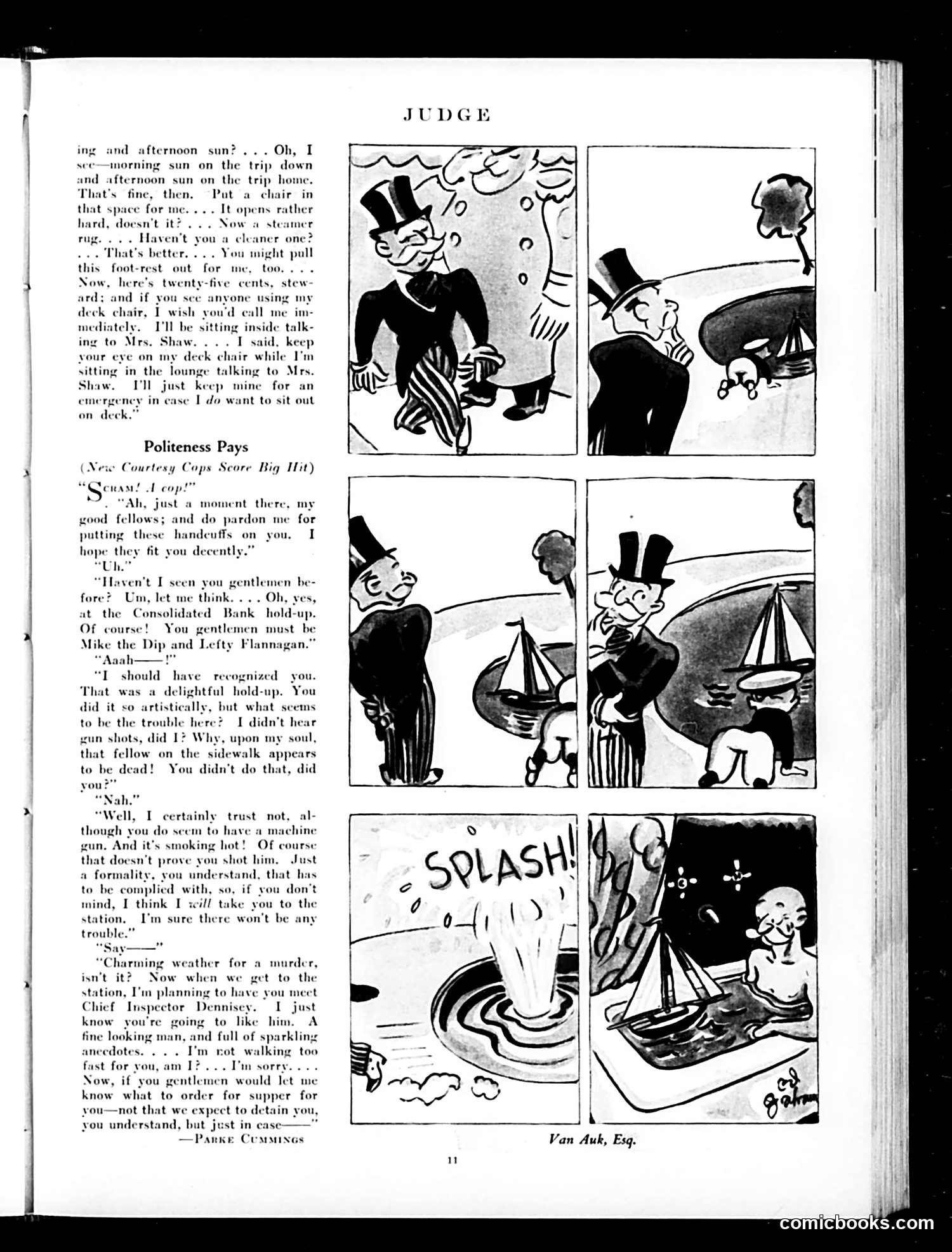
Explanation for Modern Readers This page contains two distinct comic pieces from *Judge* magazine. Top section: A brief domestic humor sketch about a fussy passenger on a ship making excessive demands of the steward—requesting specific deck chairs, complaining about sun exposure, and tipping modestly while treating service staff as servants. It satirizes upper-class entitlement and petty complaints. "Politeness Pays" (main cartoon): A police officer arrests two criminals—"Mike the Dip and Lefty Flannagan," apparently known bank robbers—with exaggerated politeness. He compliments their previous "artistically executed" bank heist, politely notes a dead body at the scene, and courteously invites them to meet the "fine looking" Chief Inspector. The satire mocks overly genteel, ineffectual law enforcement that prioritizes manners over actual justice. It suggests that being too "polite" undermines police authority and allows criminals to escape accountability. The joke critiques corruption or incompetence masked by courtesy.
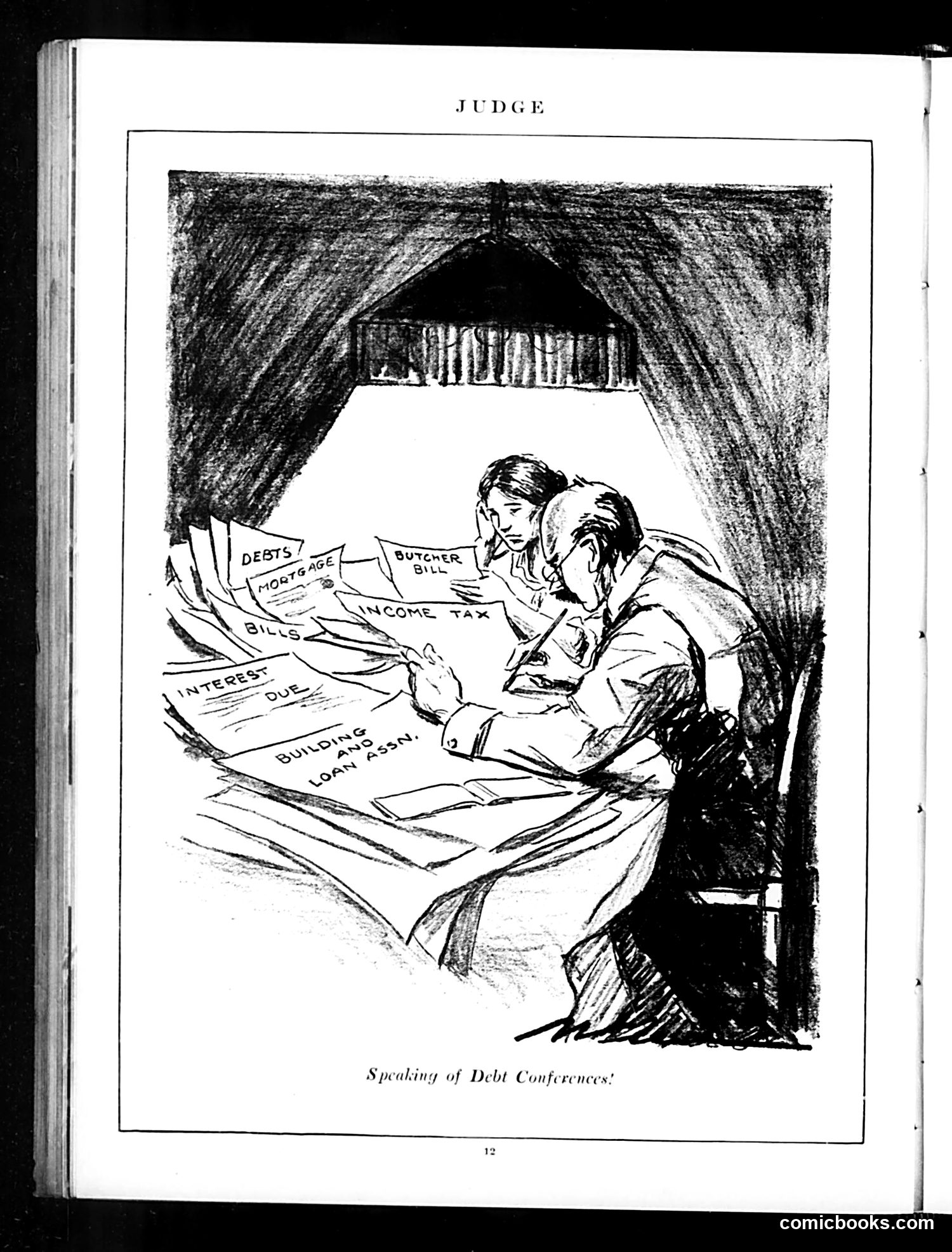
"Speaking of Debt Conferences!" This cartoon depicts two men in what appears to be a judge's chambers, overwhelmed by scattered financial documents. The papers are labeled with various debts and financial obligations: "Debts," "Mortgage," "Butcher Bill," "Income Tax," "Interest Due," and "Building Loan Ass'n" (Association). The title "Speaking of Debt Conferences!" suggests this is satirizing discussions about national or personal debt management—likely referencing post-WWI financial discussions, when debt conferences were common political topics. The cartoon's point: despite formal "conferences" about managing debt, ordinary citizens and judges remain buried under mounting financial obligations from multiple sources (taxes, mortgages, loans, basic expenses). The satire critiques the gap between high-level debt discussions and ordinary people's crushing financial realities.
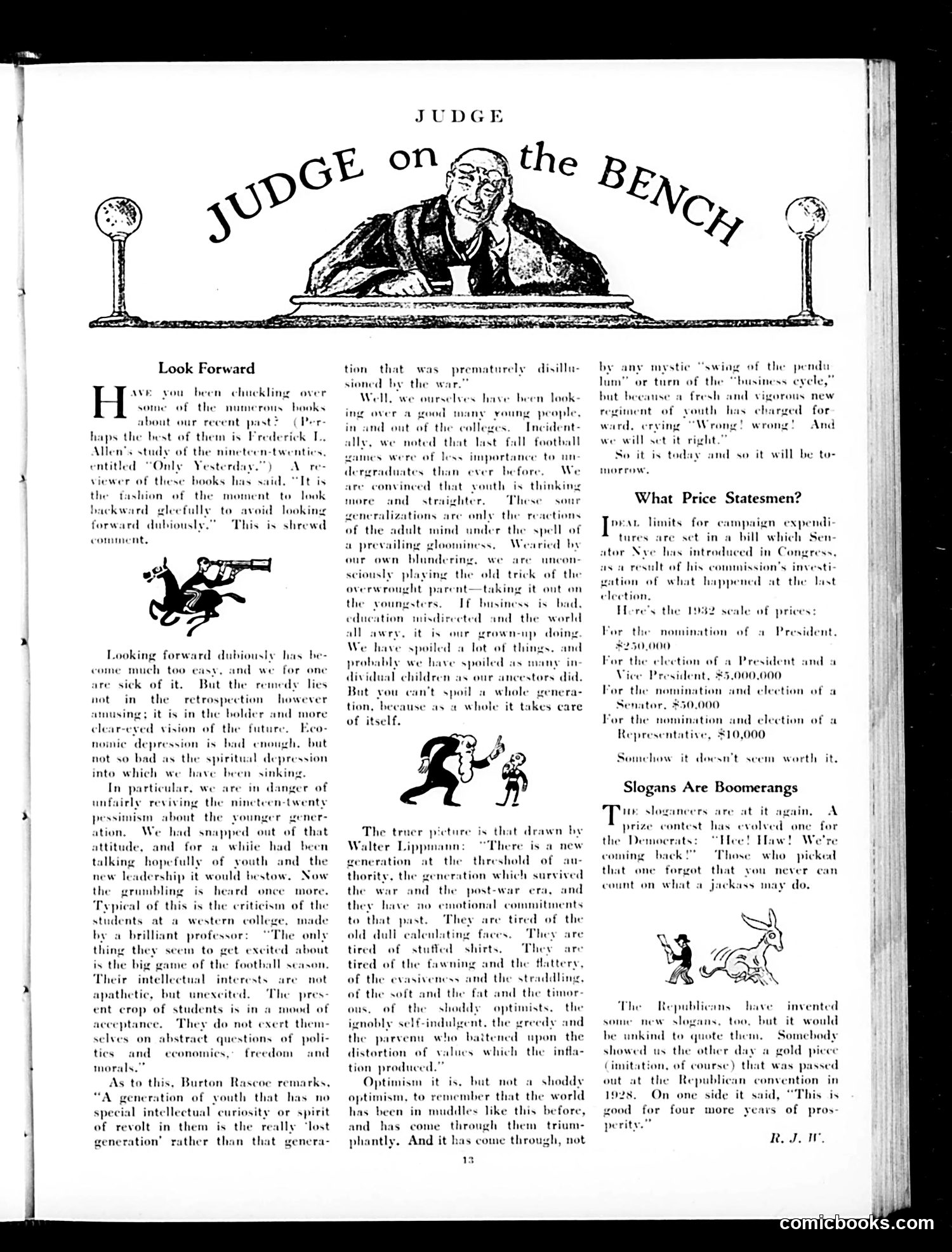
"Judge on the Bench" — Looking Forward (1920s-30s) This editorial criticizes Americans for dwelling on the past (referencing Frederick Lewis Allen's "Only Yesterday," a popular history of the 1920s) rather than facing the future with optimism. The main argument: older generations unfairly blame youth for apathy and lack of intellectual curiosity, claiming they're a "lost generation." But the author (likely Judge's editor) counters that young people are actually *thinking* more critically—they're simply tired of their elders' hypocrisy: "stuffed shirts," flattery, evasiveness, and the greed that led to economic collapse. The cartoons show adults and youth in conflict, illustrating this generational tension. A secondary section addresses campaign spending limits, suggesting such regulations seem inadequate ("What Price Statesmen?"). The piece advocates forward-looking optimism: history shows societies recover from crises when energetic new leadership arrives ready to say "Wrong! wrong!" and "set it right."
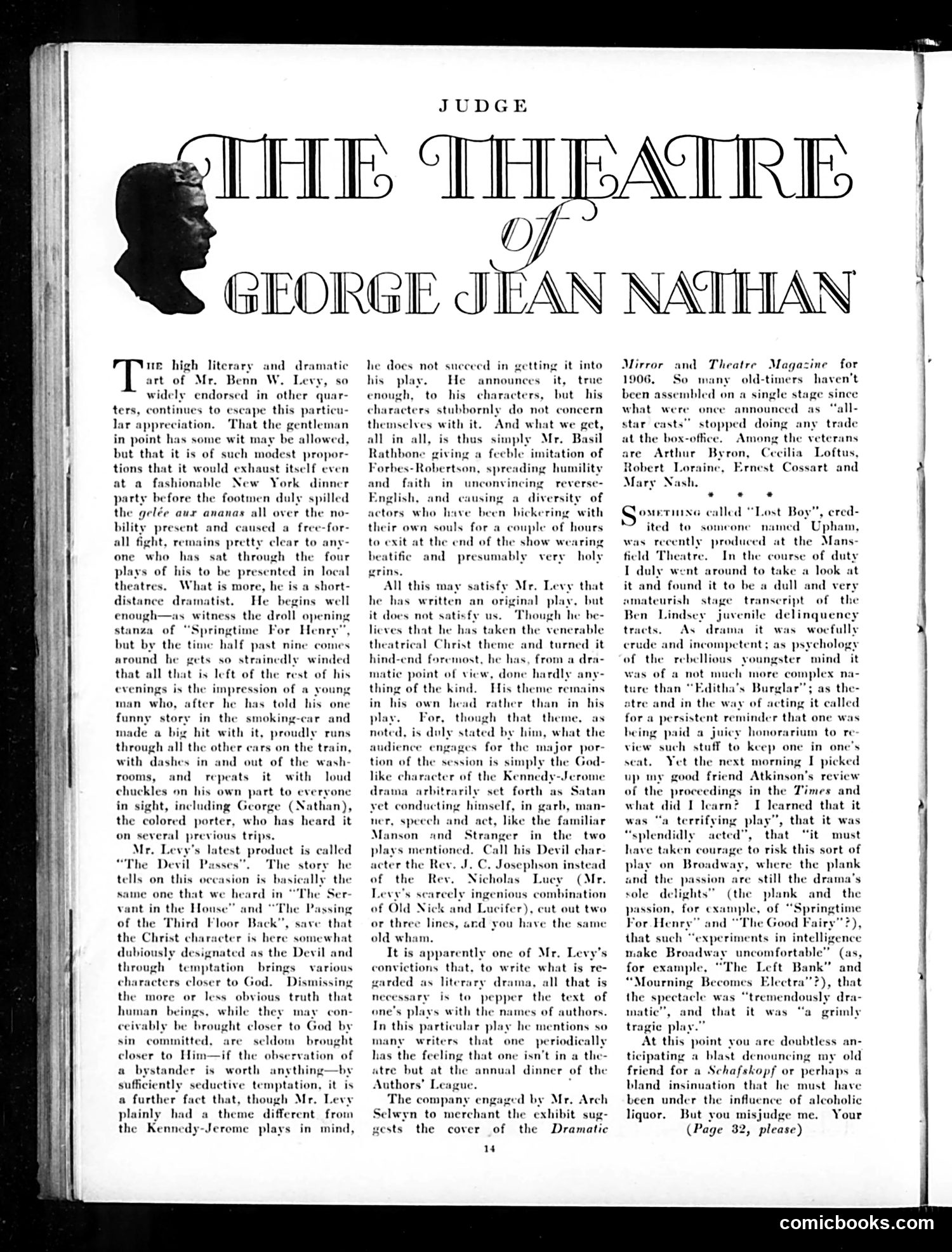
Judge Magazine Critique: "The Theatre of George Jean Nathan" This is a theater review—not a political cartoon—from Judge magazine's drama critic (George Jean Nathan, based on the byline). Nathan savagely critiques playwright Benn W. Levy's latest work, "The Devil Passes," starring Basil Rathbone. Nathan's satire targets Levy's repetitive recycling of the "Christ figure tempts sinners" plot, claiming Levy merely repackages earlier plays ("The Servant in the House," "Passing of the Third Floor Back") with superficial changes—renaming a character from "Rev. Nicholas Lucy" to something else doesn't create originality. The core complaint: Levy announces ambitious themes but his *characters* ignore them, leaving audiences watching familiar melodrama with holy window-dressing. Nathan mocks Levy's habit of name-dropping famous authors to seem "literary," and ridicules his short attention span—he "begins well enough" then exhausts himself, like someone telling one good joke repeatedly on a train. This is sophisticated dramatic criticism presented as comedy.
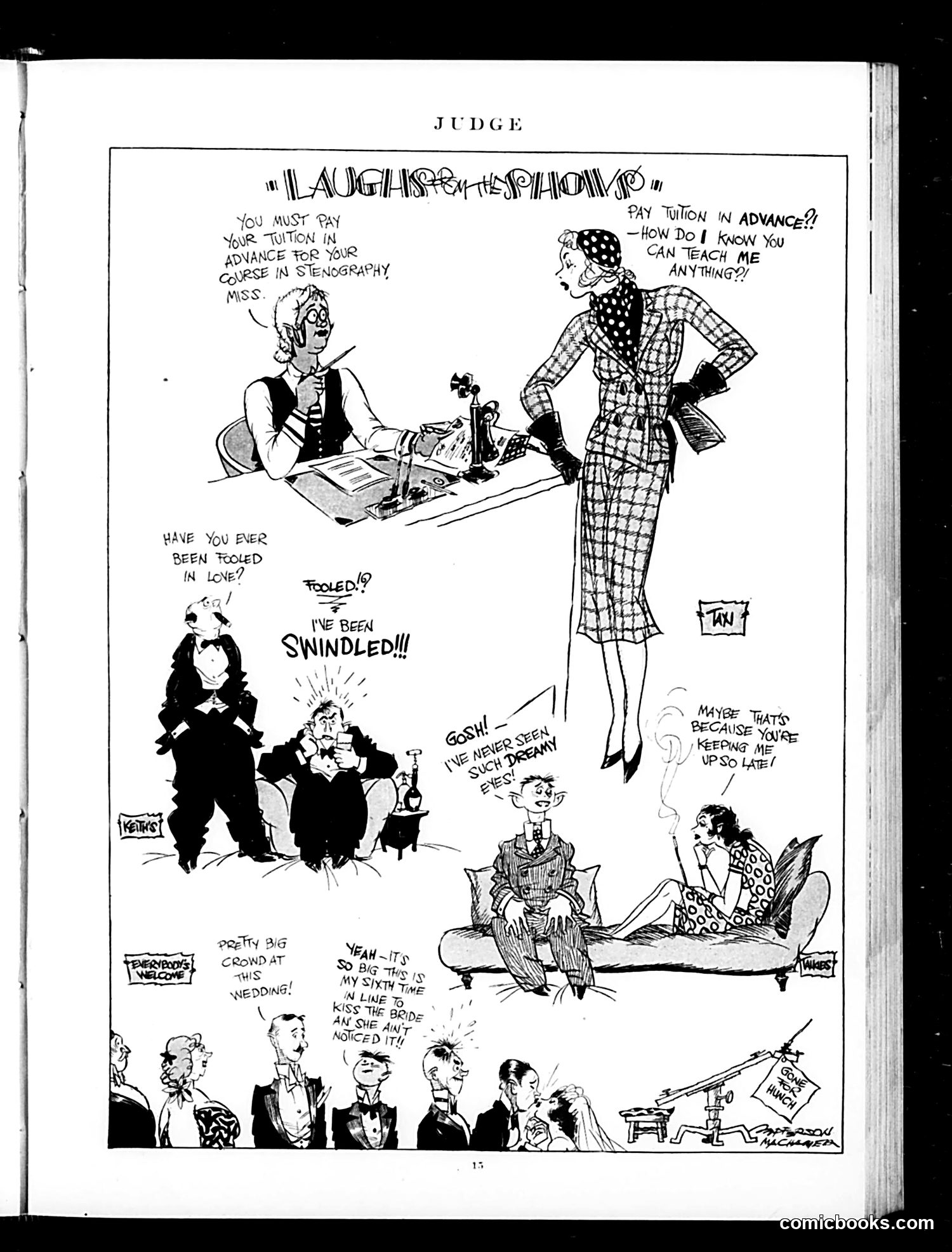
"Laughs and Parlors" - Judge Magazine Cartoon This page satirizes shorthand/stenography instruction scams. The central figure is a flashy, well-dressed woman (likely representing a confidence trickster or fraudulent instructor) confronting a student who demands advance tuition payment for stenography lessons. The surrounding vignettes mock victims of such schemes: men claiming they've been "swindled" and "tooled" (deceived), a couple noting they've never seen such "dreams," and a wedding scene where someone missed kissing the bride due to being kept "up so late" (presumably by the instructor's false promises or schemes). The satire targets both fraudulent vocational instructors who prey on students seeking respectable office work, and the gullibility of their victims. This reflects early 20th-century concerns about correspondence school and skills-training scams that particularly exploited working-class aspirants.
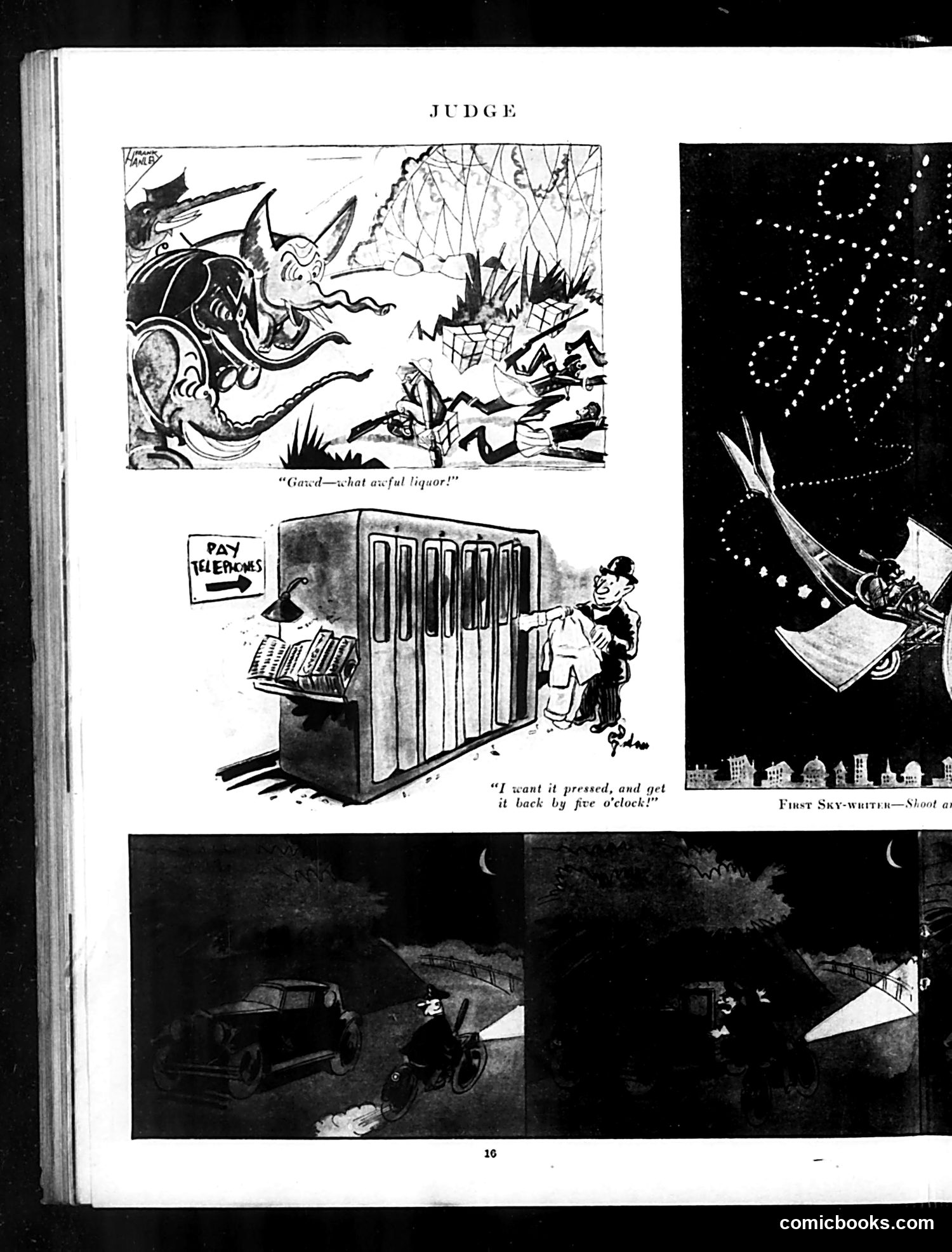
Judge Magazine Page Analysis This page contains three satirical cartoons. The top cartoon depicts a grotesque demon-like creature labeled "Good—what awful liquor!" critiquing poor quality alcohol, likely referencing Prohibition-era bootleg spirits. The middle cartoon shows a man at a printing press labeled "PAY CLERKS," demanding work "pressed, and get it back by five o'clock!"—satirizing workplace efficiency demands and labor pressure. The bottom section contains photographic stills (appearing to be from a film or serial called "First Sky-Writer") showing nighttime scenes with vehicles and aircraft, likely depicting an early aviation or crime narrative. The page's overall theme appears to critique modern industrial life through humor—alcohol quality, workplace demands, and emerging technology. Without clearer dates or bylines visible, specific political references remain unclear.
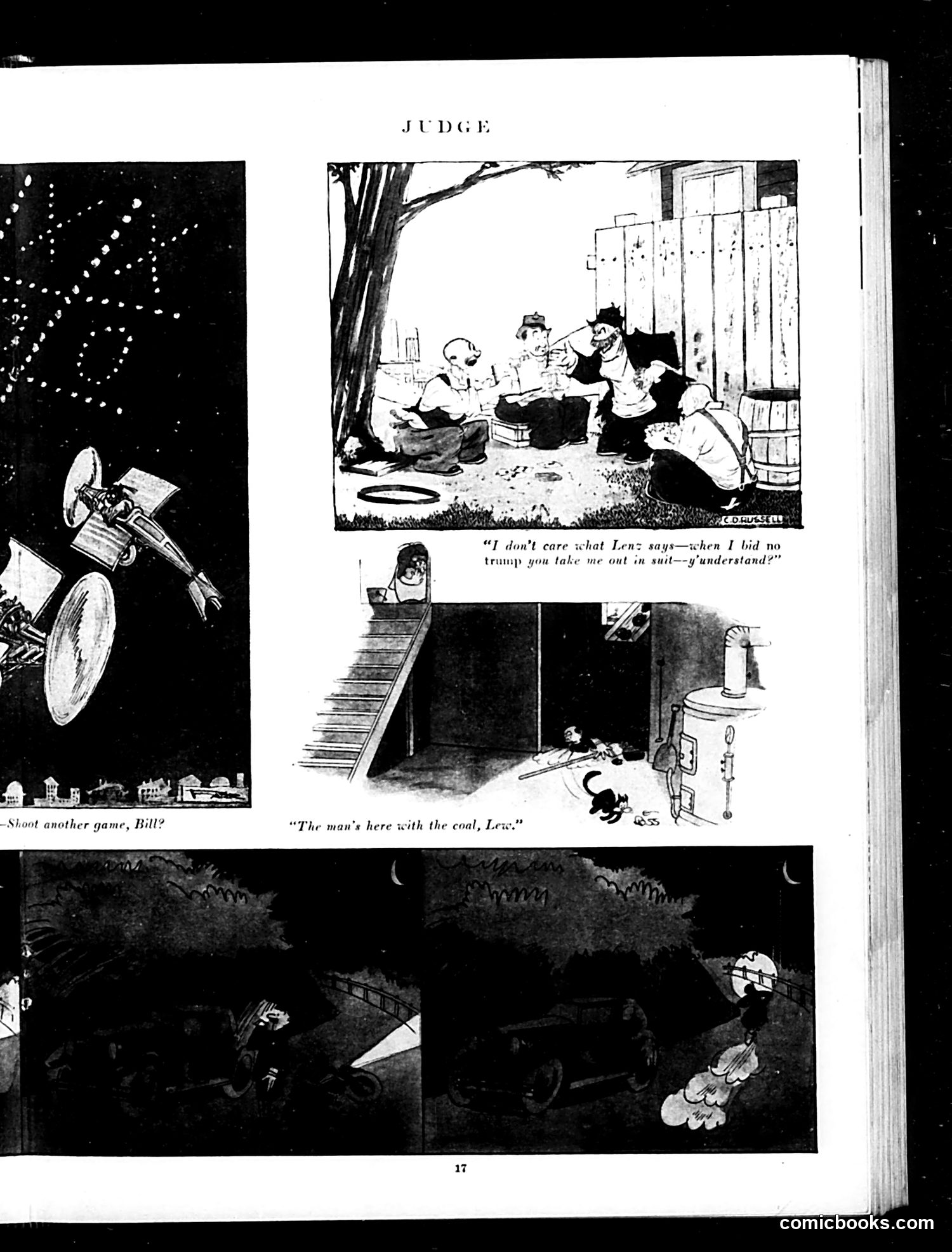
Analysis of Judge Magazine Page This page contains several cartoon sketches satirizing domestic life and social behavior, likely from the early 20th century. The main cartoon shows a group playing cards outdoors, with one player defending their bid: "I don't care what Lenz says—when I bid no trump you take me out in suit—y'understand?" This appears to satirize confusing or arbitrary rule-following in card games, possibly referencing a real card expert named Lenz. The other sketches show: - Someone suggesting "Shoot another game, Bill?" - A basement scene where "The man's here with the coal, Lev" - Night scenes with vehicles The humor targets domestic confusion, poor communication between spouses, and the tensions of working-class life. The satire is gentle domestic comedy rather than sharp political commentary.
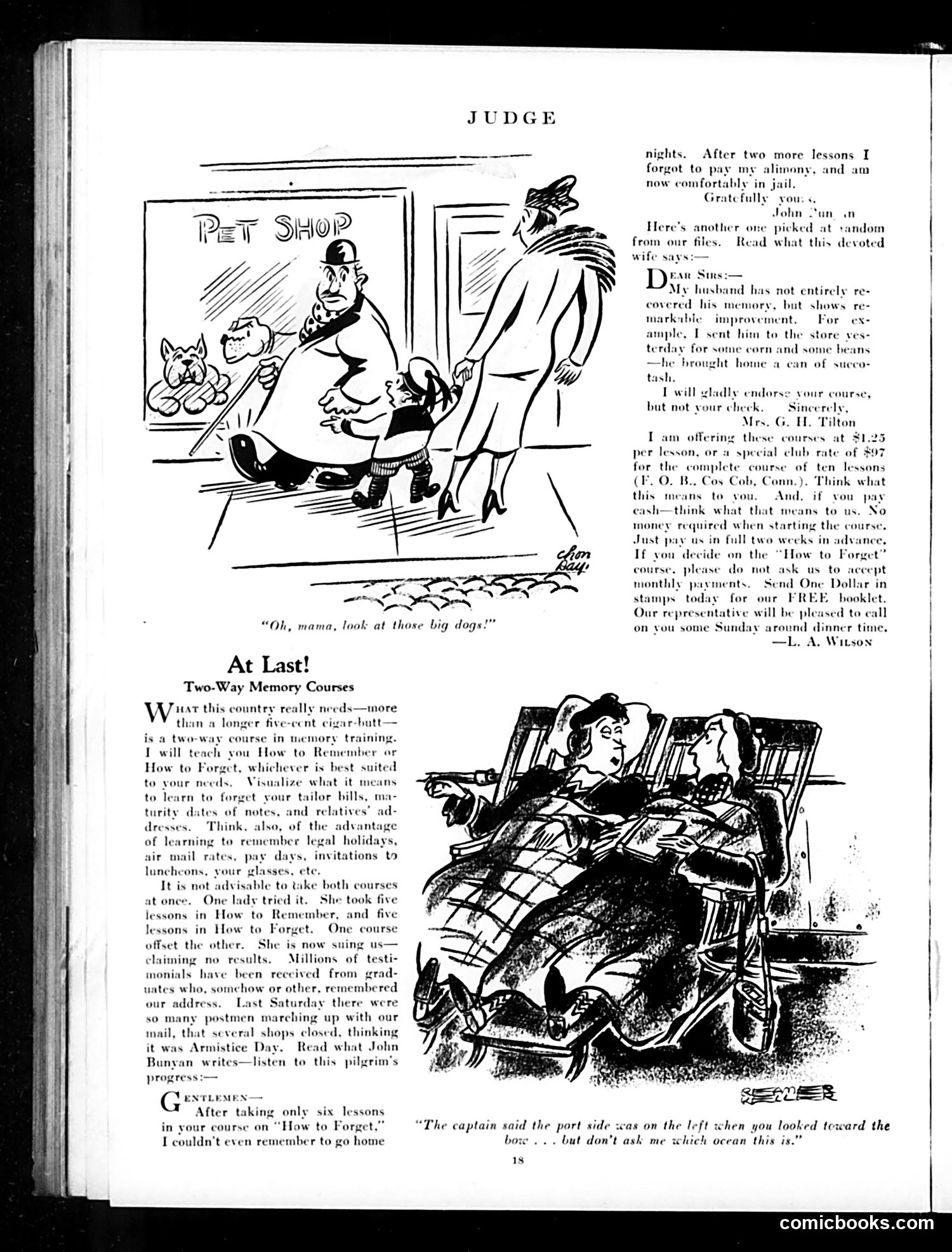
Analysis of This Judge Magazine Page This page satirizes a mail-order memory-training scam. The main article advertises absurd "Two-Way Memory Courses"—you can learn either "How to Remember" or "How to Forget," supposedly solving modern life's annoyances (unpaid bills, forgotten addresses, etc.). The satire works through testimonial letters from supposed satisfied customers. One man claims the "How to Forget" course helped him forget to pay alimony, landing him in jail. A woman endorses it after her husband forgot to buy what she asked for at the store. A third man says taking both courses simultaneously canceled out—she's now suing. The accompanying cartoons mock the course's uselessness: a man at a pet shop window, and sailors confused about maritime directions. The joke targets get-rich-quick educational schemes and gullible Americans seeking easy solutions to personal problems through dubious correspondence courses—a common 1920s-30s scam.
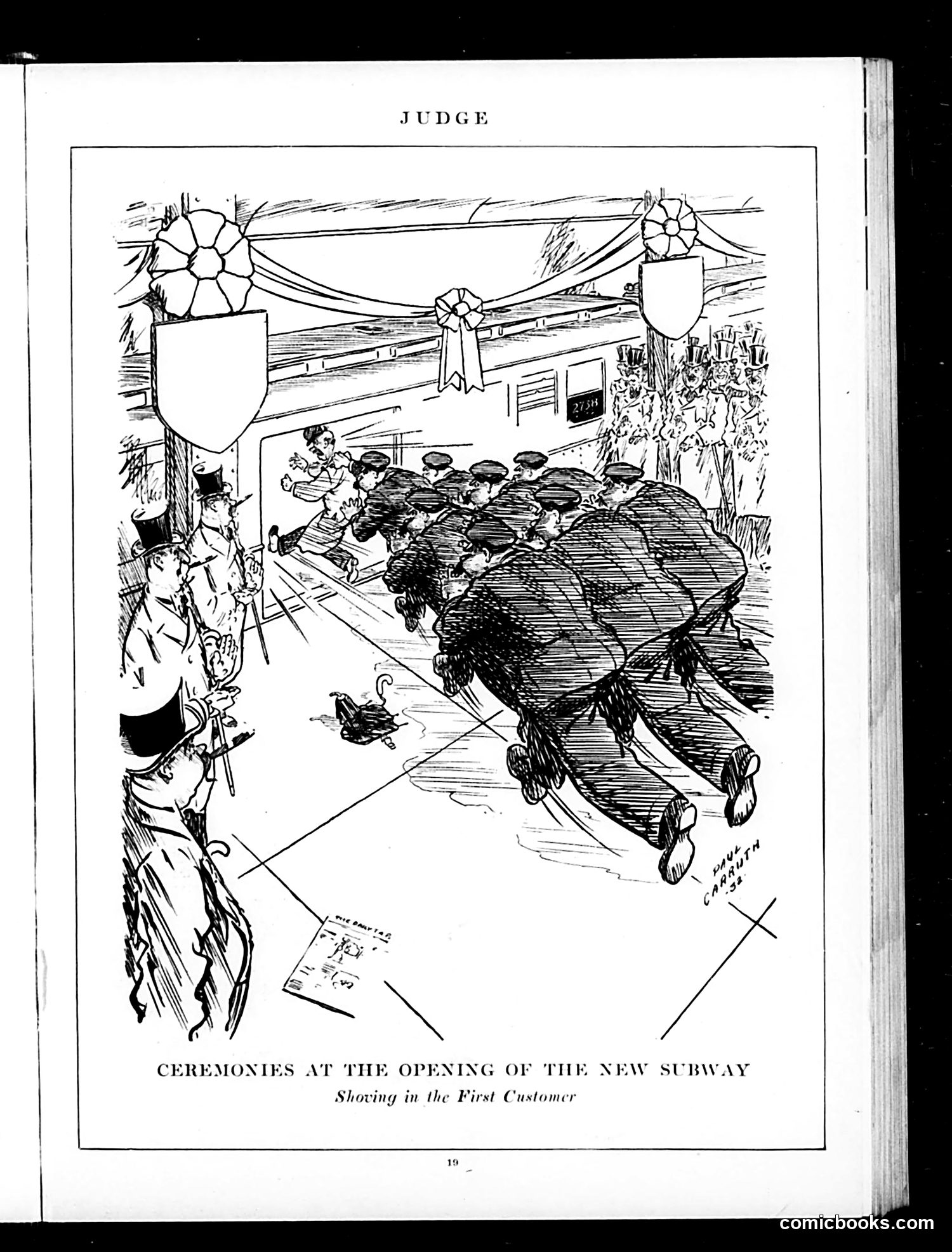
This cartoon satirizes the chaotic opening of a new subway system. On the left, formally-dressed officials and dignitaries conduct an orderly ceremony with decorative ribbons and shields. On the right, a massive crowd of ordinary citizens violently shoves and pushes to board, depicted as a chaotic, almost animalistic surge of humanity. The satire contrasts the dignified "official" opening with the brutal reality: once the public gains access, decorum collapses into pandemonium. The title's phrase "showing in the first customer" is a pun—rather than welcoming the first passenger respectfully, the cartoon shows crowds literally *shoving* to enter. This reflects turn-of-the-century anxieties about urban masses, public transportation congestion, and the gap between official ceremonies and public behavior.
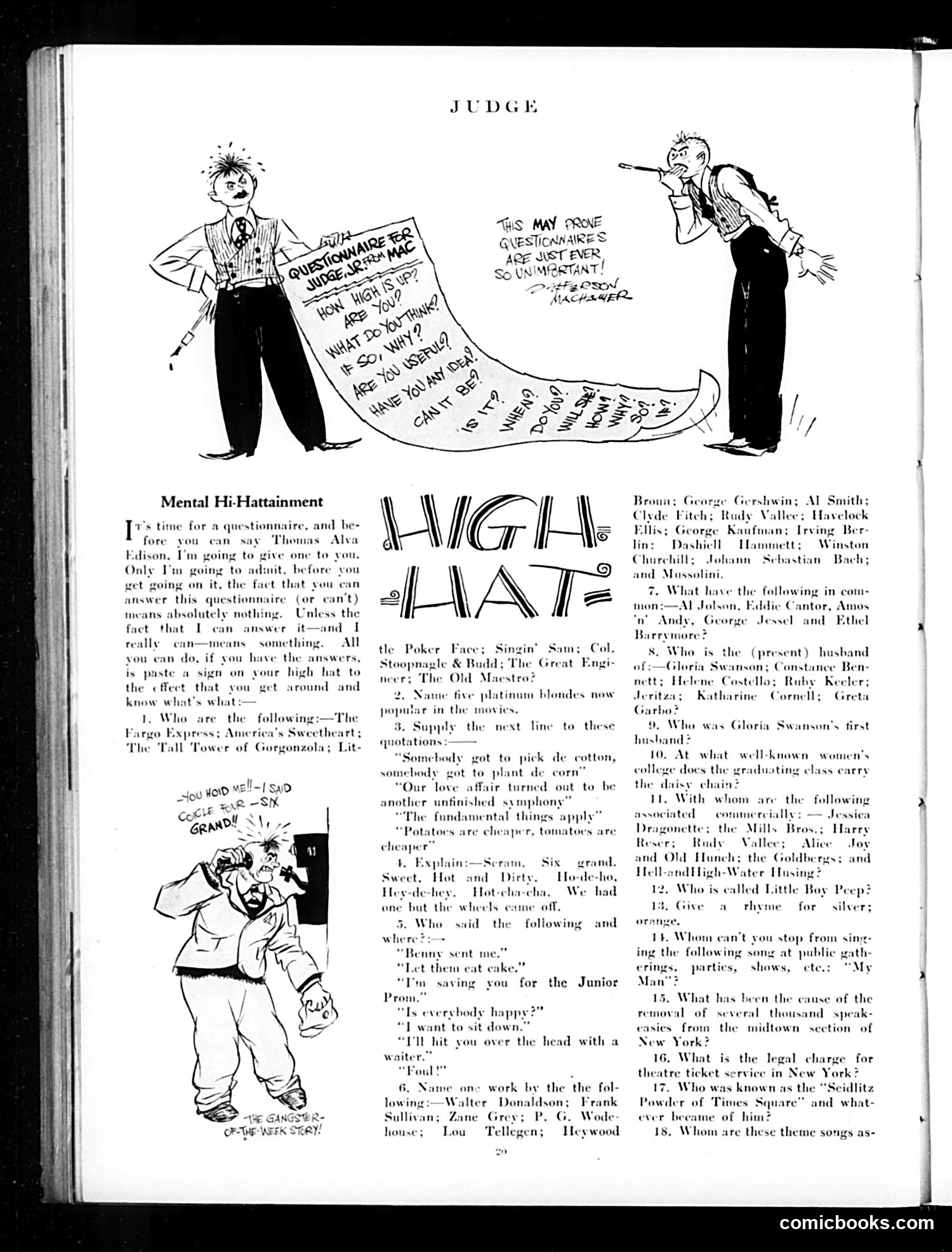
Judge Magazine: "Mental Hi-Attainment" Quiz This page satirizes the 1920s obsession with intelligence tests and questionnaires—then-trendy tools claiming to measure mental capability. The cartoon shows a judge presenting an impossibly long questionnaire to a bewildered man, mocking how such tests proliferated in American culture. The quiz itself parodies this trend by asking trivial questions about celebrities (Al Smith, George Gershwin, Gloria Swanson), popular songs, Broadway shows, and entertainers—not genuine intelligence measures. The satire's point: these questionnaires claim scientific authority while actually testing only cultural knowledge and celebrity awareness, proving "absolutely nothing" about real mental ability, as the text states. The accompanying cartoon gags (visible left side) further mock the era's obsession with such tests through slapstick humor, reinforcing Judge magazine's skeptical stance toward this fad.
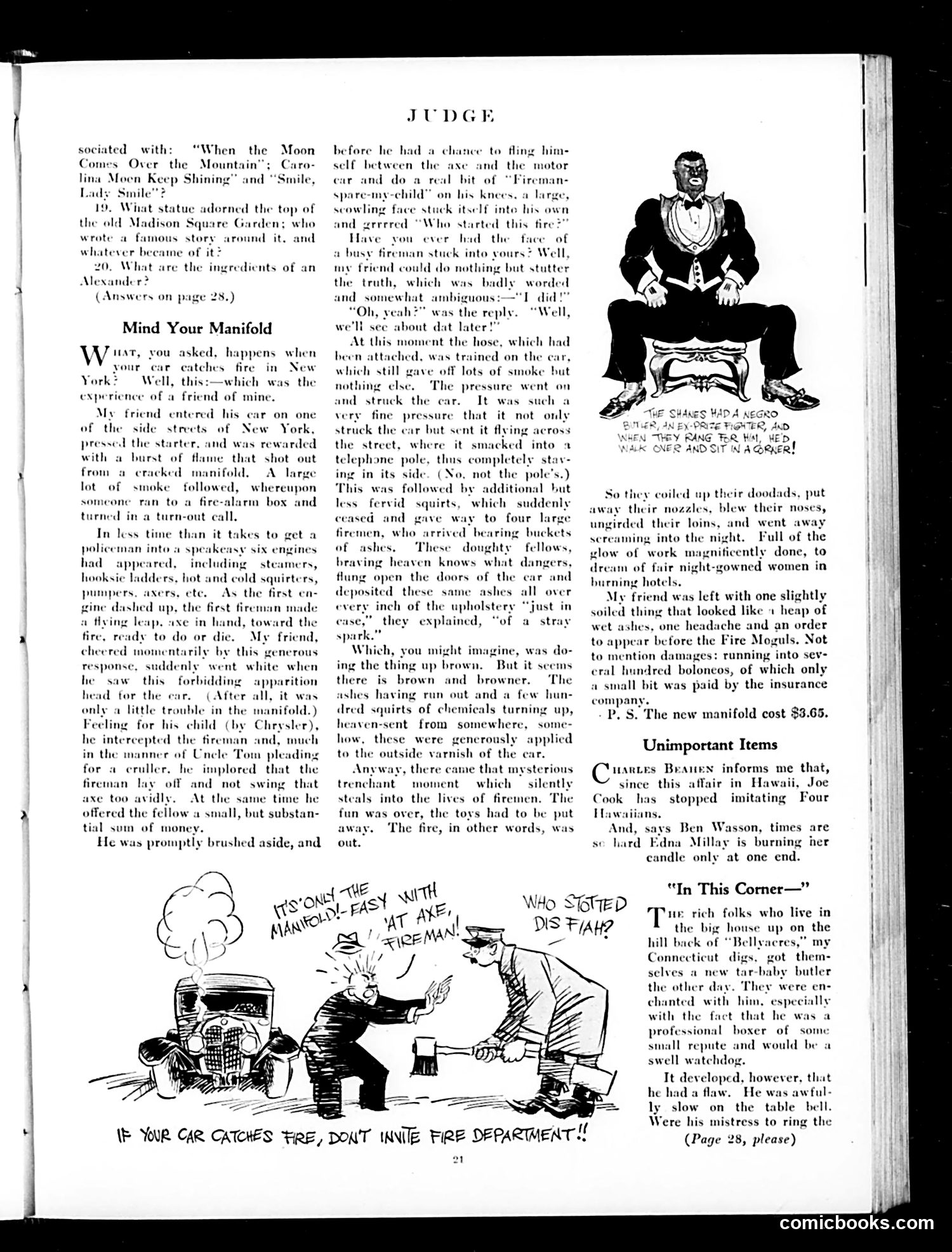
Analysis of Judge Magazine Page This page contains satirical commentary on New York City car culture and urban chaos circa the 1920s-30s. Main Cartoon: The large illustration depicts a comedic automobile fire scenario. When a car's manifold cracks and catches fire on a NYC street, the protagonist calls the fire department. The satire mocks the *excessive response*—six fire engines arrive with steamers, pumpers, and numerous firefighters who, in their zealous efforts to extinguish a minor engine fire, cause far greater damage: the high-pressure hose blasts the car across the street into a telephone pole, destroying it completely. The fireman's aggressive approach and the resulting destruction far exceed the original problem. The Joke: The satire critiques bureaucratic overkill and urban inefficiency. Calling the fire department for a minor manifold fire triggers a disproportionate, destructive response. The protagonist ends up with insurance claims, a ruined car, and damages worse than the original fire—a commentary on how civic institutions often create more problems than they solve. The smaller cartoon at bottom reinforces the message: "If your car catches fire, don't invite fire department!!"
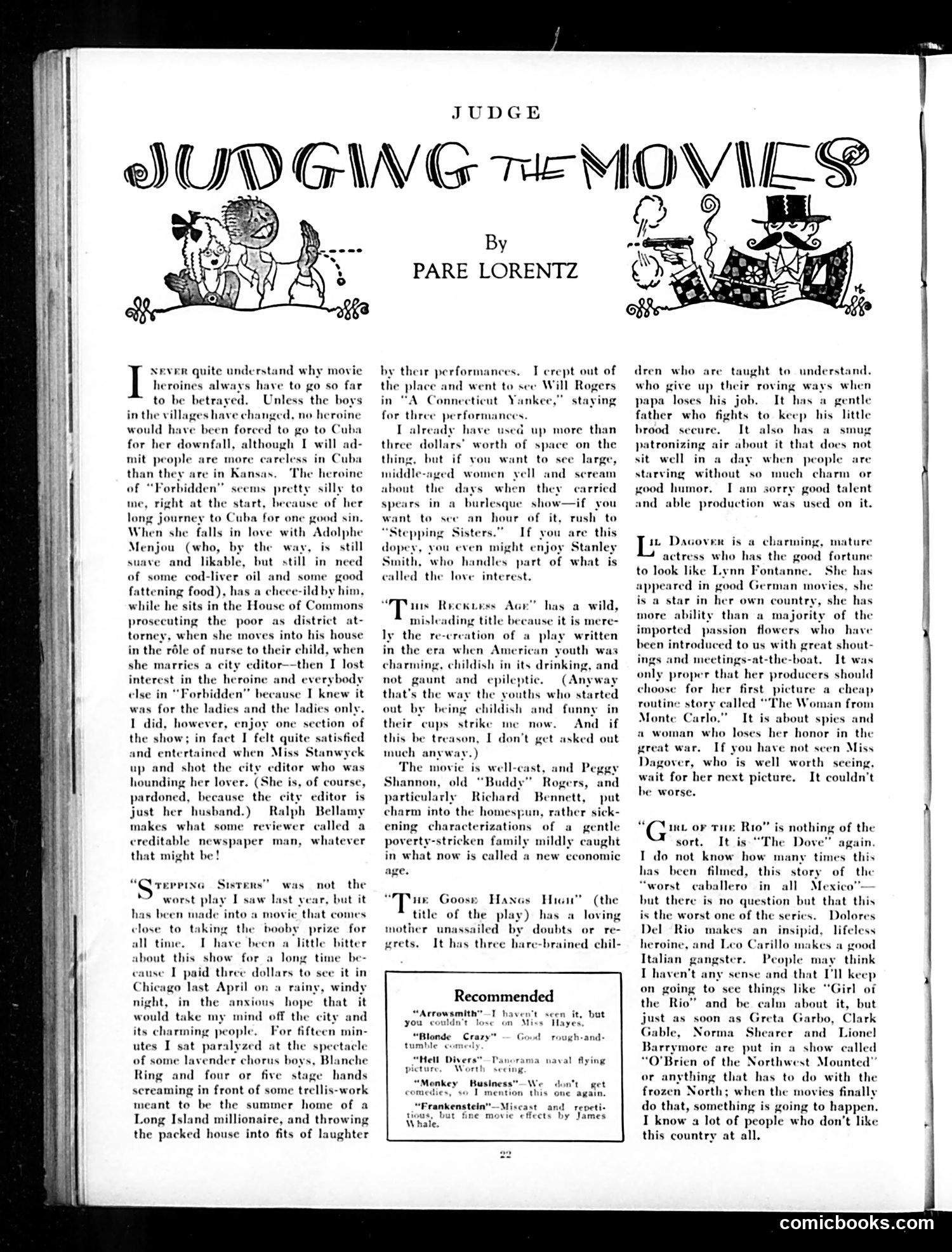
Judge Magazine Film Criticism: Understanding Pare Lorentz's Movie Reviews This page features film criticism by Pare Lorentz reviewing contemporary movies. The author critiques several 1931-32 era films with sharp wit: "Forbidden" stars Barbara Stanwyck; Lorentz mocks the contrived plot requiring the heroine to travel to Cuba for a "downfall" when Kansas would suffice. He appreciates only the scene where Stanwyck shoots a newspaper editor. "Stepping Sisters" receives harsh dismissal—the author paid three dollars to see it in Chicago and felt cheated, describing "lavender chorus boys" and screaming women in burlesque-style spectacle. "The Reckless Age" is praised for its nostalgic recreation of childish American youth drinking and behavior, with good ensemble casting. "The Goose Hangs High" depicts a gentle, poverty-stricken family during economic hardship—though Lorentz finds its patronizing tone uncomfortable. The criticism reflects 1930s attitudes toward cinema: skepticism about plot logic, appreciation for star performances, and class-conscious observations about theatrical spectacle versus genuine storytelling.
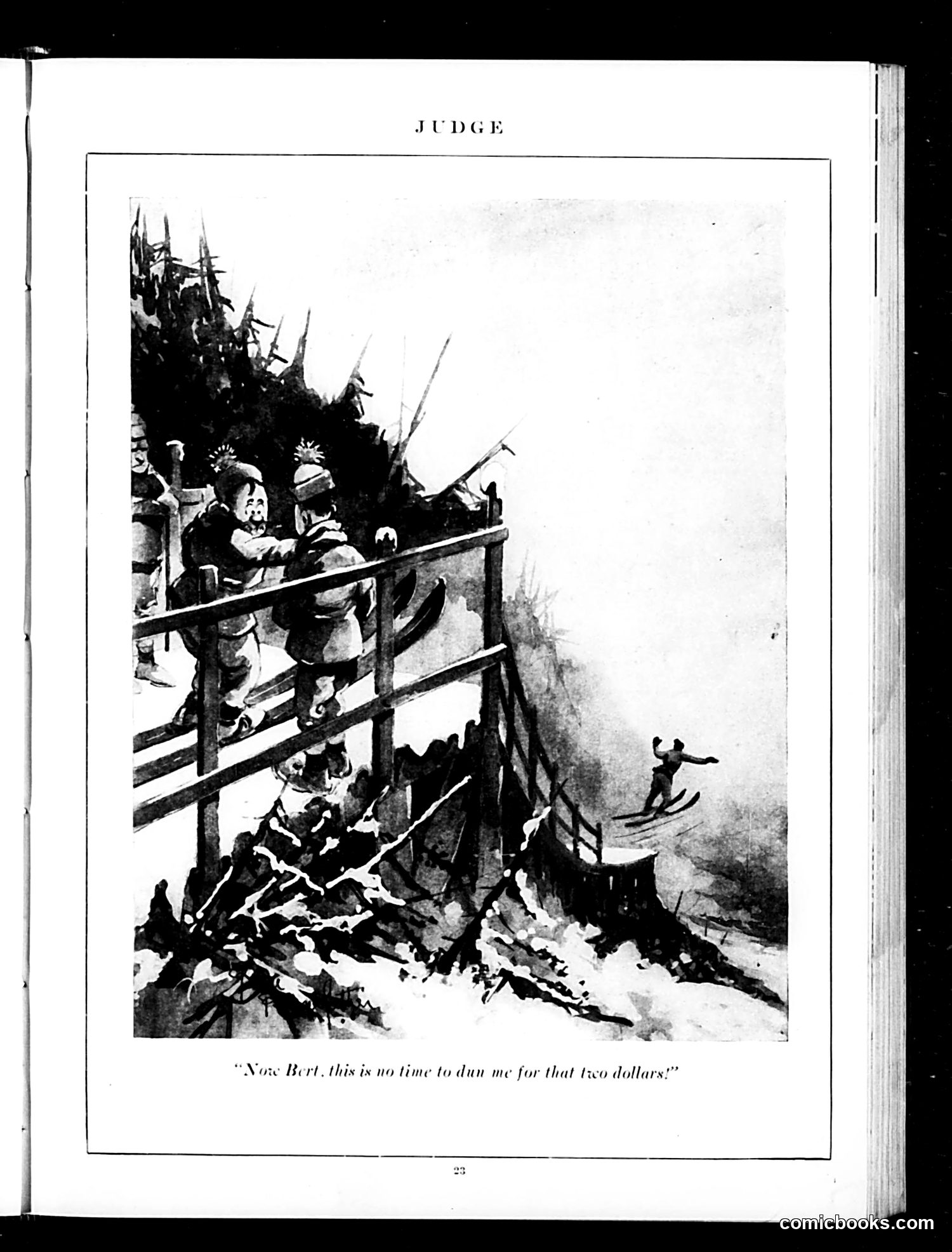
Judge Magazine Cartoon Analysis This cartoon depicts a precarious scene where a figure labeled "Bert" is demanding payment of two dollars from someone in a dangerous situation—apparently clinging to a wooden structure above a chaotic scene with armed soldiers below. The satire mocks the absurdity of pursuing debt collection at an inappropriate moment. The military figures with distinctive spiked helmets suggest German soldiers, likely referencing World War I-era content. The cartoon criticizes opportunistic creditors who prioritize collecting debts regardless of circumstances or danger. The humor relies on the contrast between the urgent, life-threatening situation and the mundane financial obligation, satirizing both poor judgment and ruthless debt-collection practices.
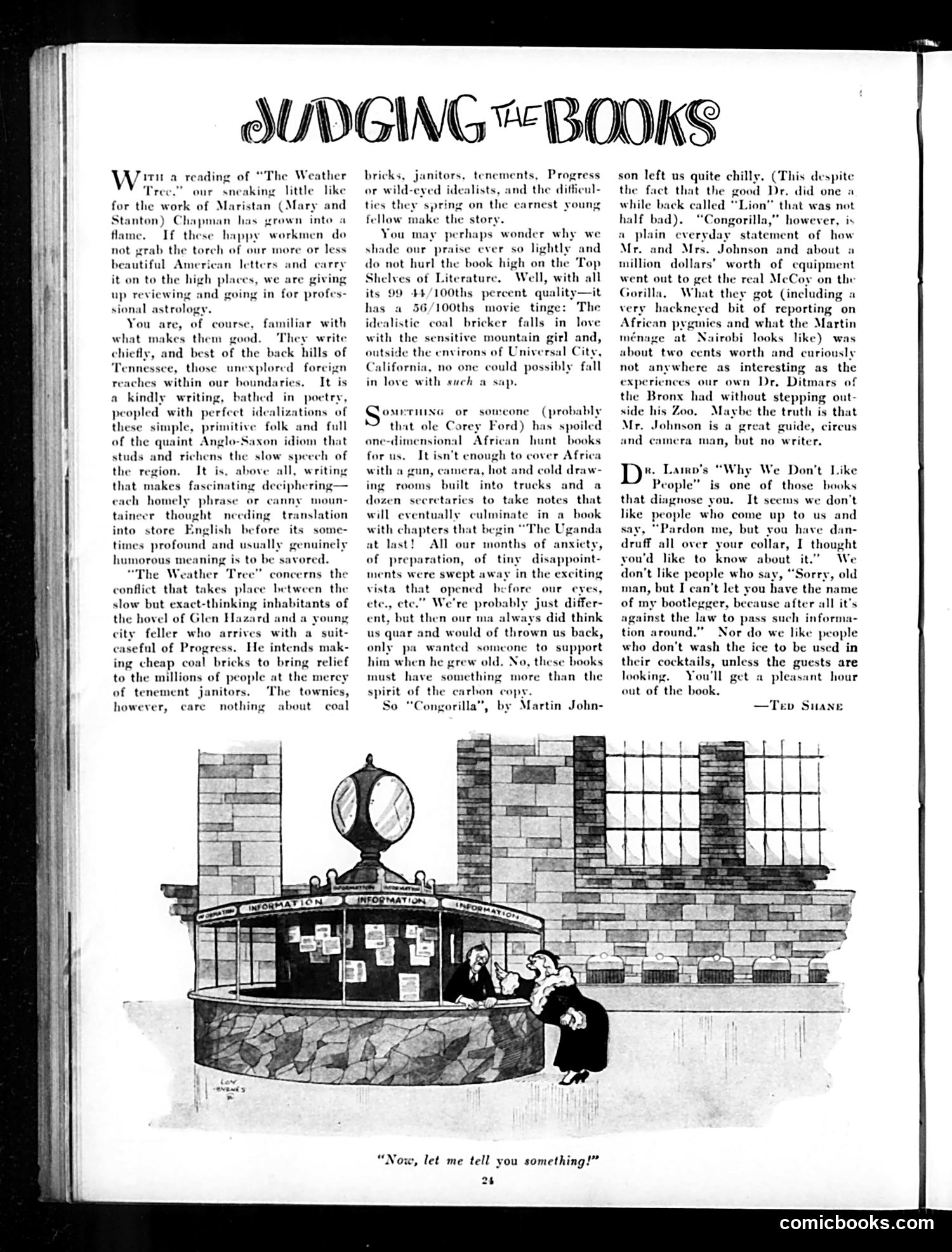
Judging the Books: A 1920s Literary Critique This page reviews three books for a 1920s American audience. The main criticism concerns *authenticity versus commercial appeal*. "The Weather Tree" by Mary and Stanton Chapman receives praise for its authentic portrayal of Appalachian dialect and rural life, though the reviewer notes it ranks below the "Top Shelves of Literature" because the plot—a city modernizer romancing a mountain girl—strains credibility. "Congorilla" by Martin Johnson is criticized as a plain documentary lacking the engaging narrative quality of Dr. Ditmars's zoo-based nature writing. Despite Johnson's million-dollar expedition and impressive logistics, the book feels disappointingly shallow. "Why We Don't Like People" by D. Laird appears to be a diagnostic book analyzing personality quirks (like the annoying person pointing out your dandruff). The cartoon below illustrates an information booth, likely related to the literary discussion. The recurring theme: authentic artistry and genuine observation beat expensive production values and trendy subjects.
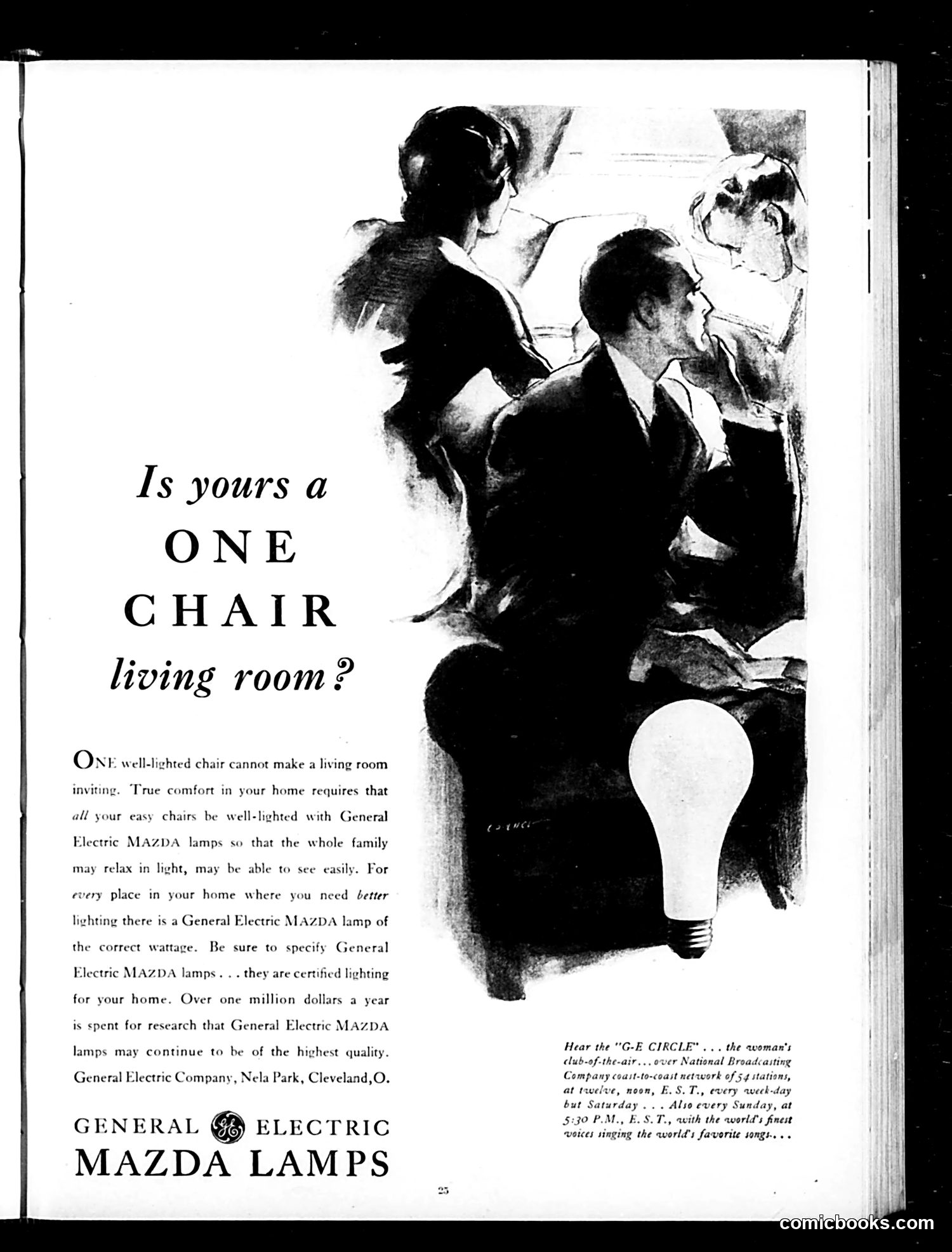
Analysis This is not a cartoon or satire—it's a straightforward advertisement for General Electric MAZDA light bulbs, likely from the 1920s-1930s. The image shows a sketch of well-dressed people sitting together in a living room. The ad's rhetorical strategy poses a leading question: "Is yours a ONE CHAIR living room?" implying that inadequate lighting makes a room inhospitable. The pitch emphasizes that proper home comfort requires multiple well-lit chairs throughout the house—a consumer appeal to middle-class domesticity and family leisure. The text promotes GE's MAZDA brand as "certified" and scientifically superior (claiming over one million dollars yearly in research). The bottom includes a note about a radio program ("G-E CIRCLE") on NBC—a common cross-promotional tactic where manufacturers sponsored radio content to reach audiences. This reflects early 20th-century consumer advertising targeting domestic comfort and electric home technology.
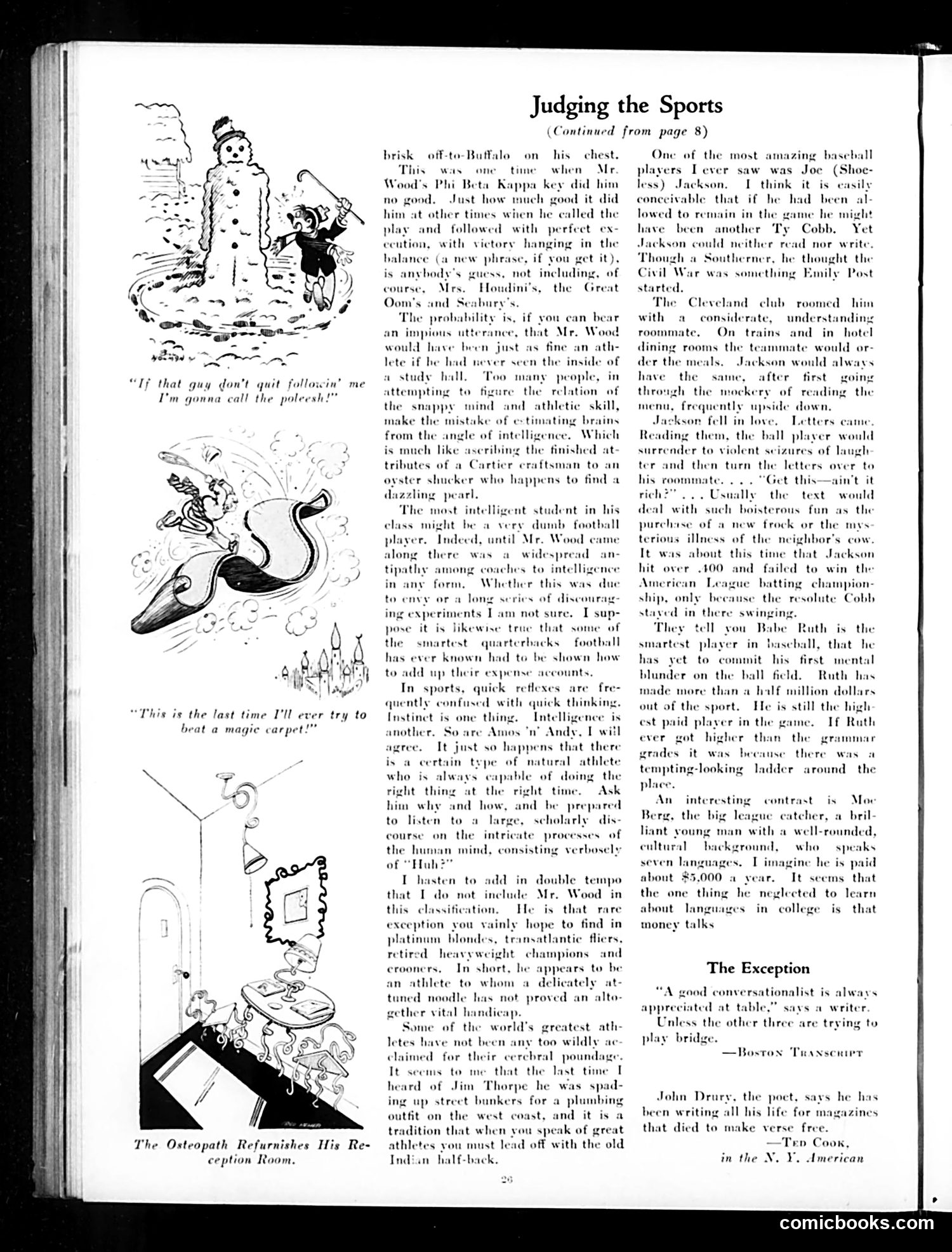
"Judging the Sports" — Judge Magazine Page This page continues a sports column discussing athletic intelligence versus academic learning. The cartoons illustrate the disconnect between scholarly ability and athletic talent. The three cartoon vignettes appear to be humorous scenarios: a person threatening to call police on someone following them; someone regretting an attempt to "beat a magic carpet" (likely a joke about futility); and an osteopath's reception room being "refurnished" (perhaps after damage). The main text discusses Mr. Wood, a football coach or player with intellectual credentials (Phi Beta Kappa), and argues that intelligence and athletic skill are separate abilities. It cites examples like Shoeless Joe Jackson and Jim Thorpe—famous baseball and football players respectively—who lacked formal education yet excelled athletically. The writer notes Jackson couldn't read and had teammates read his love letters aloud, yet still performed brilliantly on the field. The satire targets the assumption that educated people make better athletes, or that great athletes must be intelligent in academic terms.
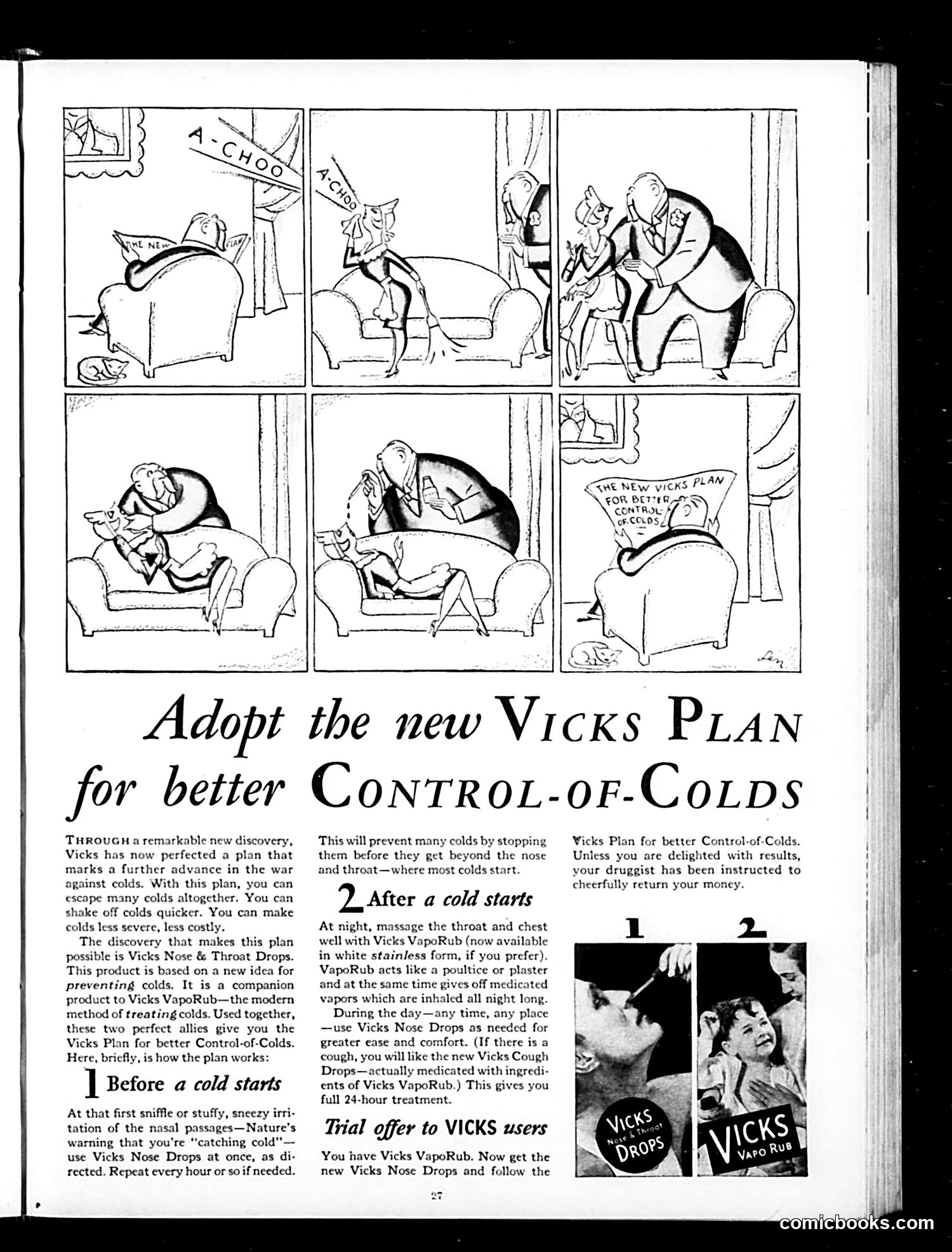
Analysis This page is primarily a Vicks product advertisement, not political satire. The comic strip at the top illustrates the marketing narrative rather than satirizing anything. The six-panel cartoon depicts a businessman's domestic routine: receiving mail, reclining on furniture, and interacting with family members indoors. The final panel shows him displaying "The New Vicks Plan for better Control-of-Colds." What modern readers should know: This advertises Vicks' new preventative cold strategy combining nose drops (for prevention) and VapoRub (for treatment). The cartoon simply depicts an ordinary middle-class household to make the product relatable to Judge's audience. There's no political commentary or social critique—it's straightforward commercial messaging using everyday scenes to demonstrate the product's domestic utility. The "remarkable discovery" referenced is the nasal drops as a preventative measure, positioned as an advance in cold management circa this publication's era.
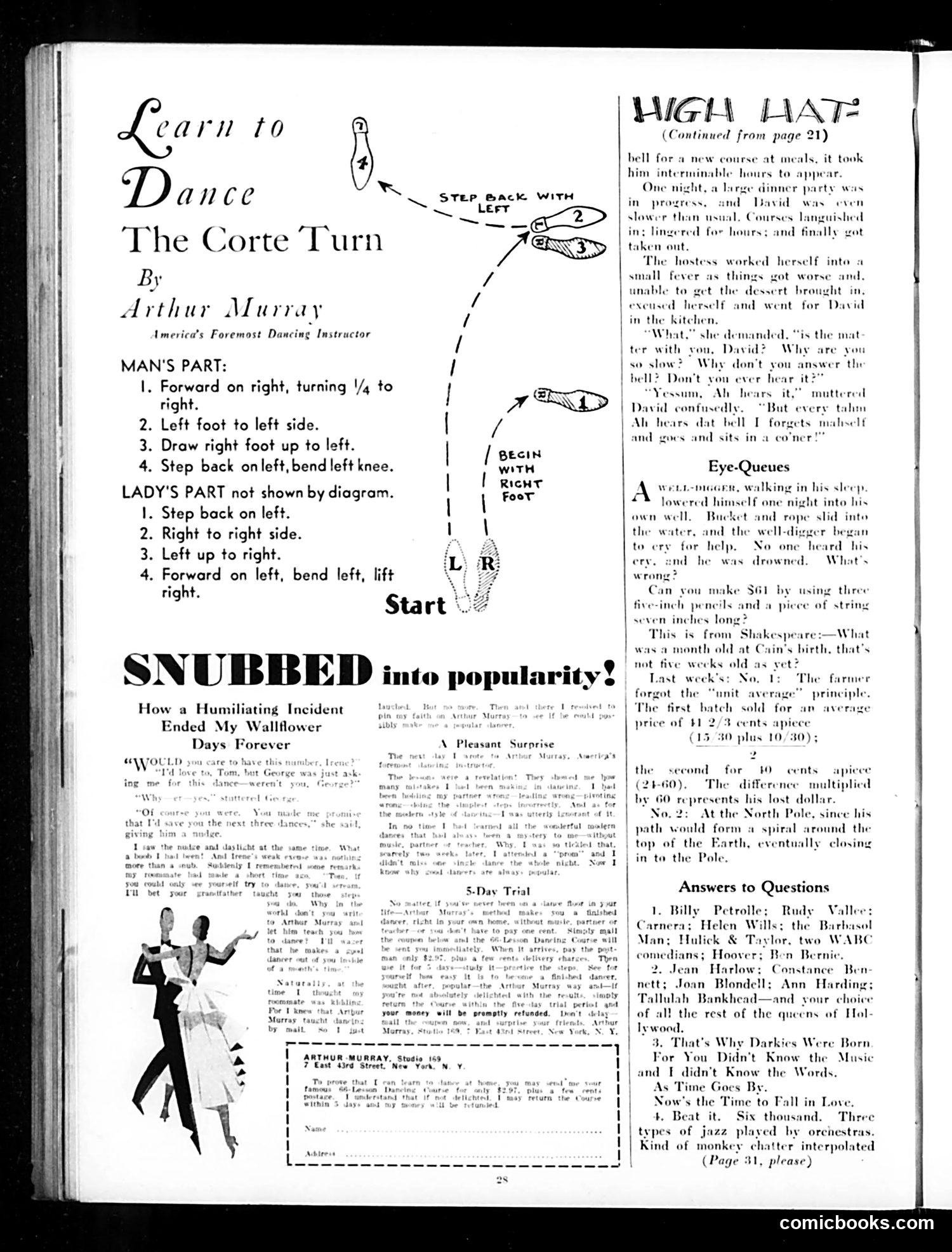
Judge Magazine Page Analysis This page contains dance instruction and period advertisements/content rather than political satire. The main elements are: "Learn to Dance: The Corte Turn" — Arthur Murray, famous 1920s-30s dancing instructor, provides step-by-step diagrams for a ballroom dance move, with separate instructions for man's and lady's parts. "Snubbed into Popularity" — A humorous personal testimonial (likely fictional advertising copy) about how taking Arthur Murray dance lessons transformed someone from a wallflower into a popular dancer. The illustration shows a couple dancing. Miscellaneous content — The right column contains unrelated magazine features: a short story ("High Hat"), riddles ("Eye-Queues"), and a Q&A section answering readers' questions about contemporary celebrities and trivia. The page is primarily instructional and entertainment content, not political commentary. It reflects 1930s popular culture's emphasis on dance, celebrity gossip, and self-improvement through commercial instruction.
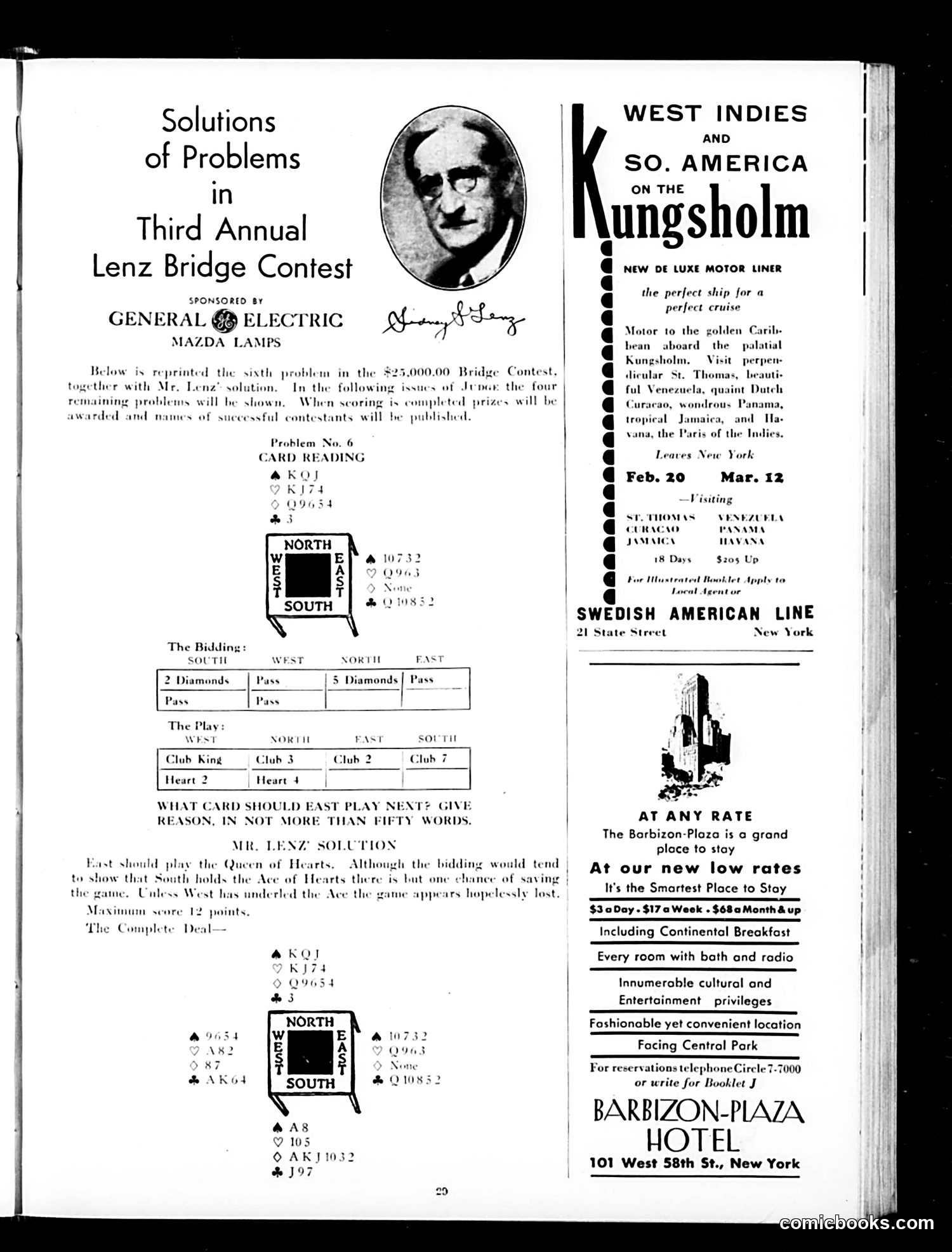
Page Analysis This page from *Judge* magazine is primarily advertising and puzzle content, not satirical editorial material. The left side features the "Third Annual Lenz Bridge Contest," sponsored by General Electric Mazda Lamps—a bridge card game problem with solution. The puzzle itself has no political or social satire; it's a straightforward competitive game challenge offering prize money. The right side contains two advertisements: one for the Swedish American Line's luxury cruise ship *Kungsholm*, promoting Caribbean and South American travel departures in February-March; the other for the Barbizon-Plaza Hotel in New York, marketing competitive room rates and amenities. There are no identifiable caricatures, political figures, or satirical commentary visible. The page represents typical commercial content filler that *Judge* magazine used alongside its editorial cartoons and humor pieces. The mention of "Mr. Lenz" in the bridge problem likely refers to the contest organizer, not a public figure being satirized.
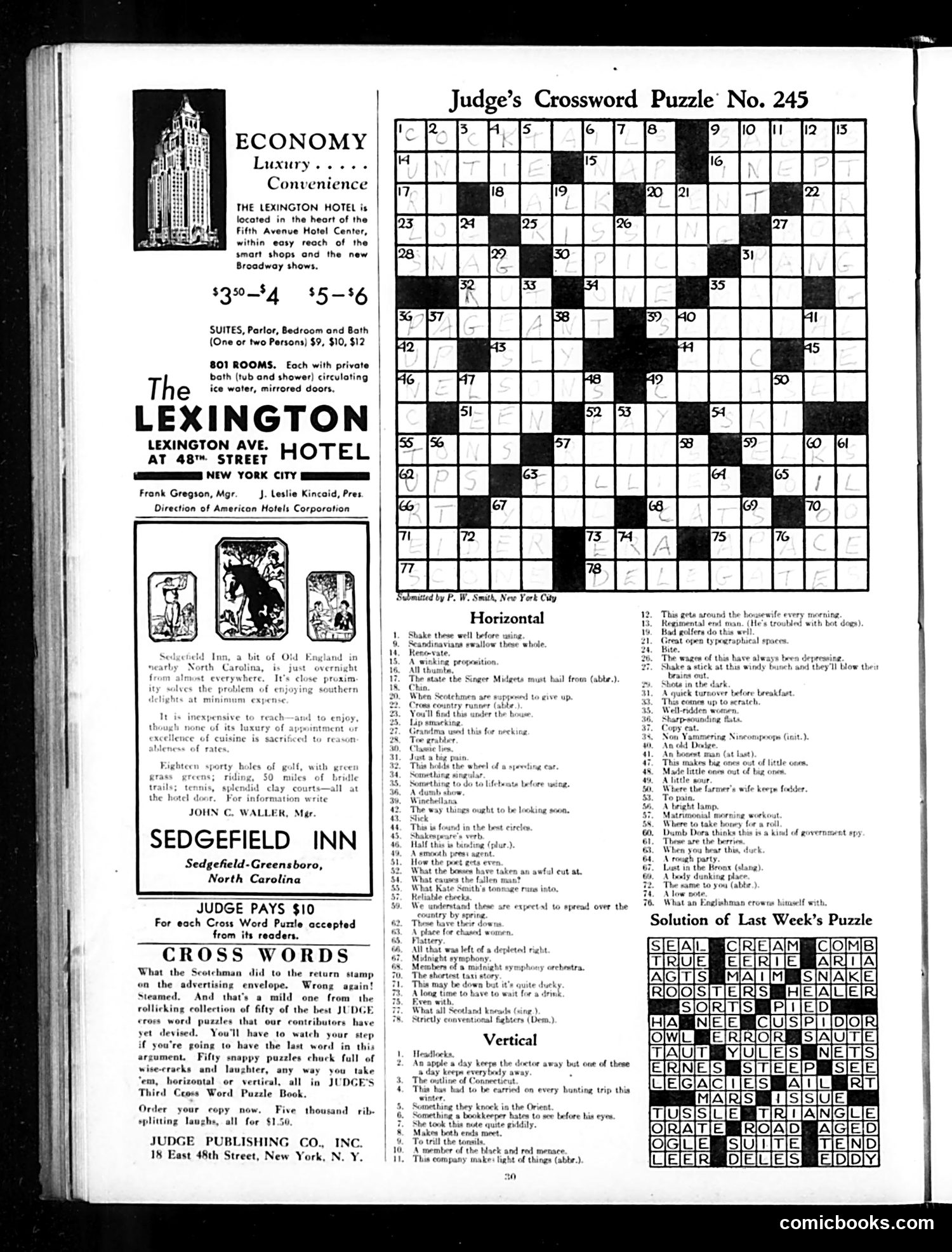
This page is primarily advertising and puzzle content, not political satire. It features: Main Content: - A crossword puzzle (#245) by Judge magazine - Hotel advertisements: The Lexington Hotel (NYC) and Sedgefield Inn (North Carolina), emphasizing economy and comfort - A "Cross Words" section promoting Judge's crossword puzzle book ($1.50) Context for modern readers: The page reflects 1920s-30s commercial culture. Judge magazine monetized reader engagement through puzzle contests (paying $10 per accepted puzzle). The hotel ads target middle-class travelers seeking affordable luxury—"economy" paired with "convenience" reflects Depression-era or post-WWI economic consciousness. The crossword puzzle craze was a genuine 1920s phenomenon, and Judge capitalized on this popular trend. This is a commercial/editorial page, not satirical commentary. No political figures or social satire are evident—just period advertising demonstrating how magazines generated revenue and reader participation during this era.
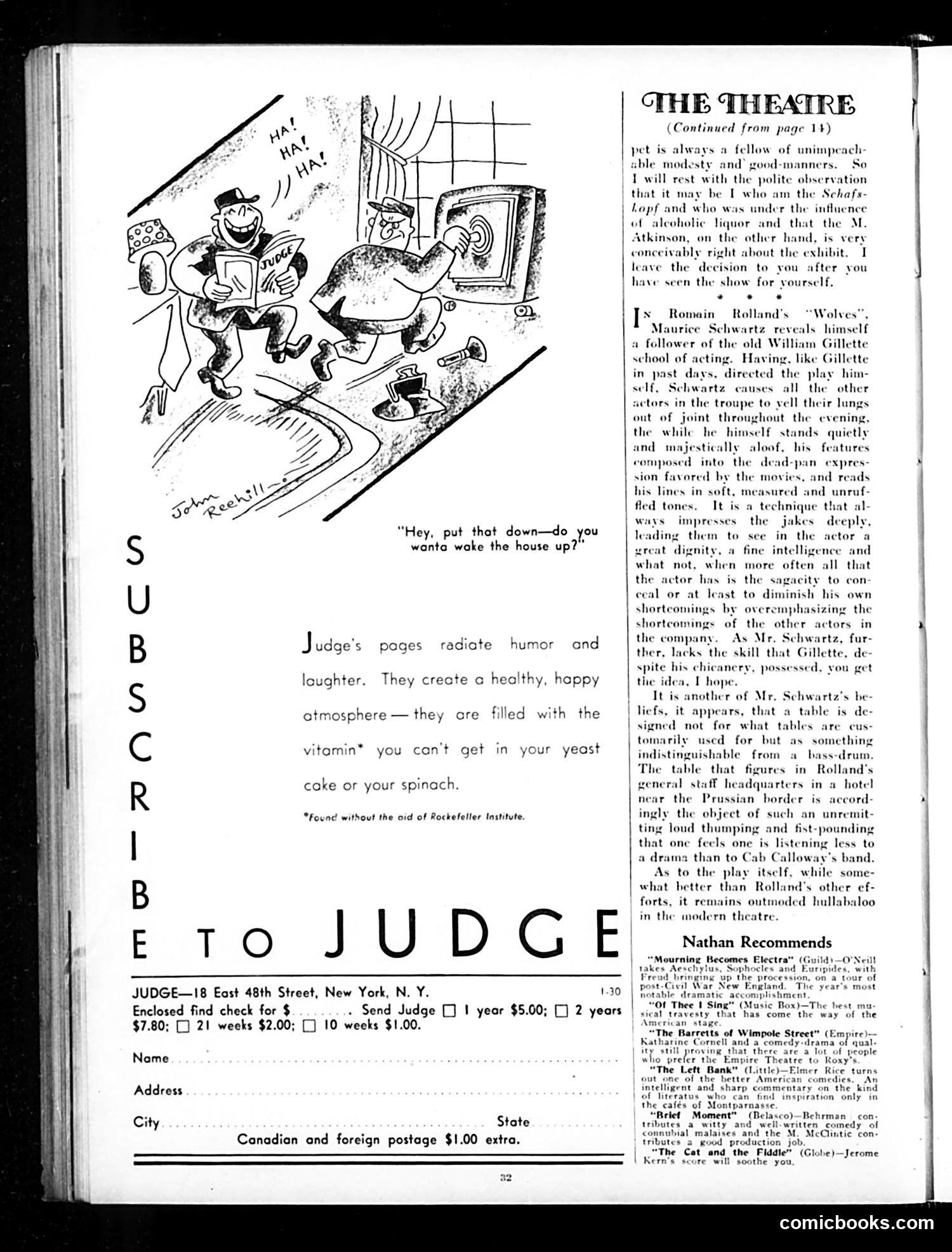
Judge Magazine Cartoon Analysis This page contains a humorous cartoon about domestic life and a subscription advertisement for Judge magazine itself. The Cartoon: A man energetically demonstrates something (appears to be a phonograph or radio) to his wife, who protests: "Hey, put that down—do you wanta wake the house up?" The joke plays on the volume and enthusiasm of early entertainment technology—the husband is so eager to show off his device that he's oblivious to the late hour and noise he's creating. The Advertisement: The subscription pitch uses comedic hyperbole, claiming Judge's pages contain "vitamin" you can't get elsewhere—a reference to 1930s-era health trends. The asterisked footnote "*found without the aid of Rockefeller Institute" is self-deprecating humor, mocking the magazine's own claims while referencing the famous philanthropic foundation. The overall tone is lighthearted domestic humor typical of Judge's satirical but family-friendly approach to American life.
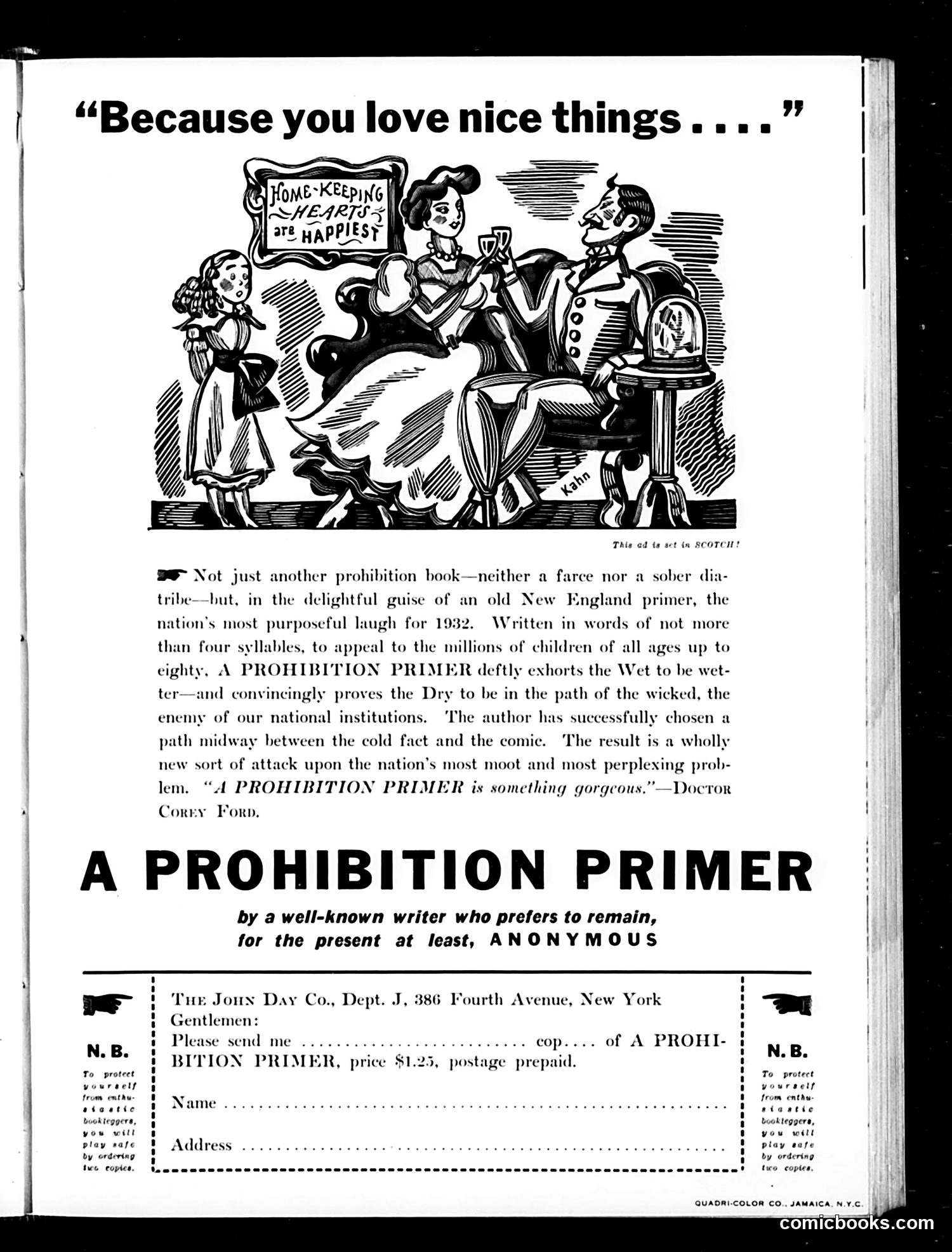
"A Prohibition Primer" Advertisement (1932) This is primarily an advertisement for a satirical book attacking Prohibition (the 1920-1933 alcohol ban). The cartoon illustration shows a family scene with the caption "Home-Keeping Hearts Are Happiest"—ironically suggesting domestic contentment while depicting what appears to be secret drinking. The ad's satire targets both sides of the Prohibition debate: it claims the book "exhorts the Wet to be wetter" (encourages drinkers) while "proves the Dry to be in the path of the wicked" (mocks abstinence advocates). Published in 1932, near Prohibition's end, the book uses a children's primer format to mock the law's moral pretensions. The sidebar jokes about ordering "two copies" to "protect yourself from enthusiastic booleggers"—a dark humor reference to violent black-market alcohol dealers who operated during Prohibition. The anonymous author appears to be someone prominent enough to merit discretion in 1932.

This is a cigarette advertisement, not satire or political cartoon. It's a 1932 Camel cigarettes ad from Judge magazine. The page advertises the "Camel Humidor Pack," emphasizing that Camel cigarettes remain naturally fresh because the tobacco is never artificially processed (parched or toasted). The image shows three people examining a Camel cigarette package, apparently demonstrating the product's appeal. The ad highlights radio sponsorships—the "Camel Quarter Hour" and "Prince Albert Quarter Hour" programs—typical promotional vehicles of the era. There is no satire here. This is straightforward commercial advertising exploiting 1930s consumer concerns about product freshness and quality. The language about "natural" preservation and moisture protection reflects period marketing strategies for tobacco products, before modern health warnings existed.