judge
Judge — February 6, 1932
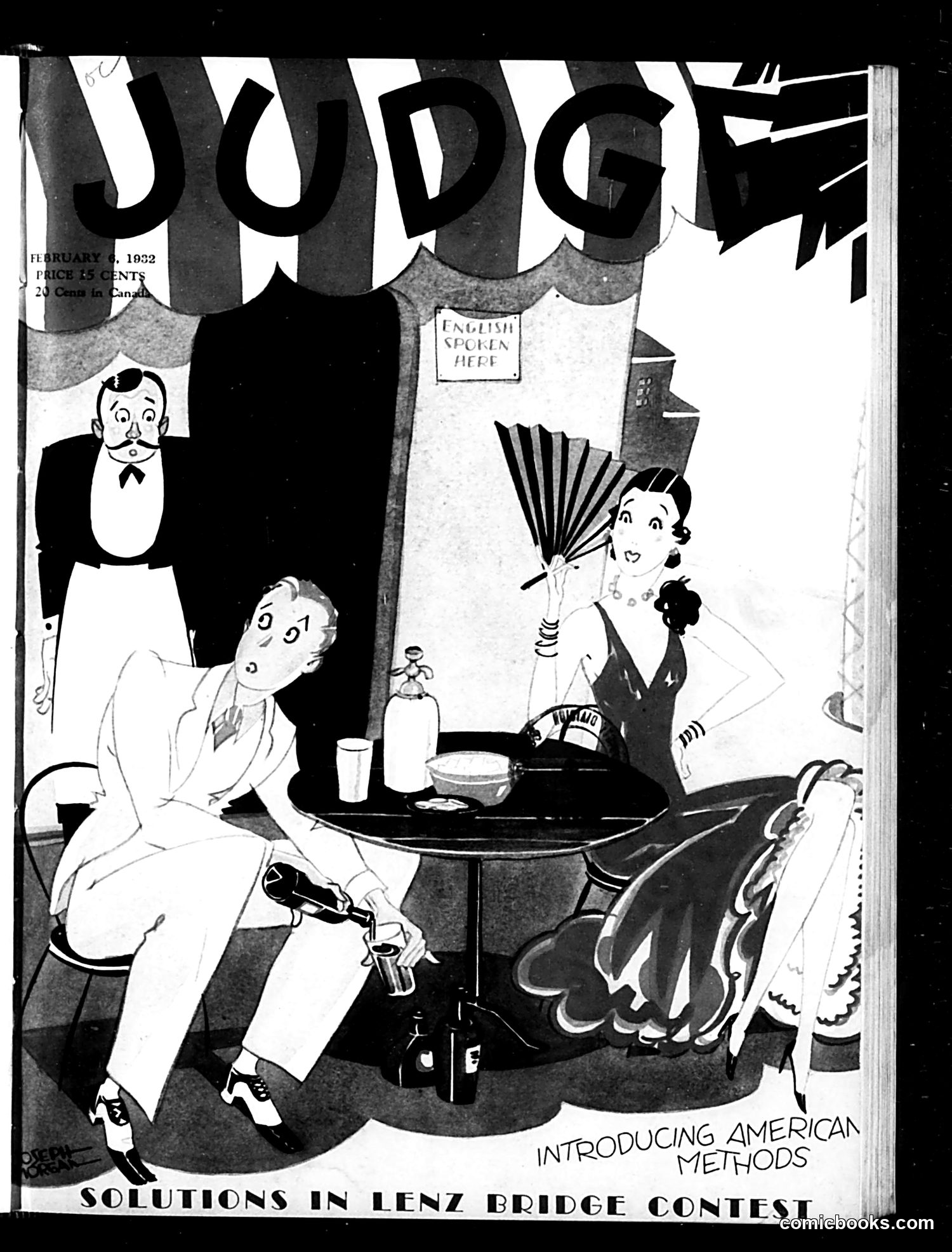
Analysis of Judge Magazine Cover, February 6, 1932 This satirical cover mocks the "Lenz Bridge Contest," apparently a competition soliciting solutions to bridge engineering. The cartoon's caption, "Introducing American Methods," suggests the joke contrasts American pragmatism with European formality. The scene depicts a formal dinner where an American man in casual attire (holding a bottle) sits opposite a well-dressed European gentleman and a woman with a fan. The "English Spoken Here" sign and the contrast between the slovenly American and refined Europeans satirize American social behavior abroad—specifically, the stereotype of uncultured American tourists or businessmen embarrassing themselves through crude informality in sophisticated European settings. The 1932 date suggests economic Depression-era commentary on American business dealings internationally.
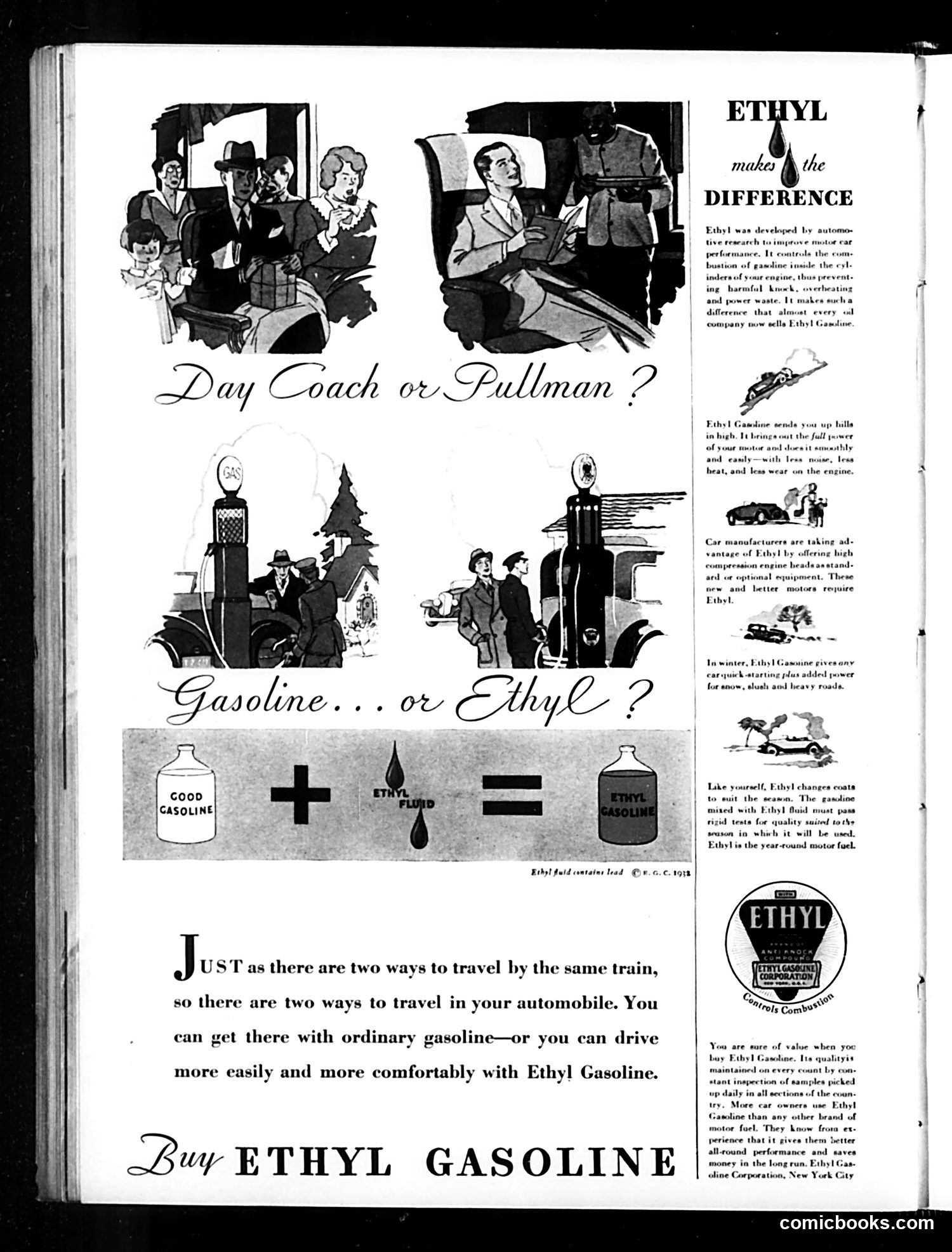
Ethyl Gasoline Advertisement in Judge Magazine This is primarily a commercial advertisement for Ethyl Gasoline, not political satire. The page uses humorous comparisons to market a fuel additive. The four illustrated scenarios ("Day Coach or Pullman?" and "Gasoline or Ethyl?") present lifestyle choices—traveling by basic versus luxury train cars parallels choosing regular versus Ethyl gasoline. The bottom equation shows: regular gasoline + ethyl fluid = ethyl gasoline. The right-side text explains Ethyl's technical benefits: improved engine performance, reduced knock, better cold-weather starting, and year-round reliability. The advertisement targets middle-class car owners by positioning Ethyl as a premium, worthwhile upgrade—the "Pullman" option for motorists. This reflects 1920s marketing strategies using comparative lifestyle imagery to sell automotive products.
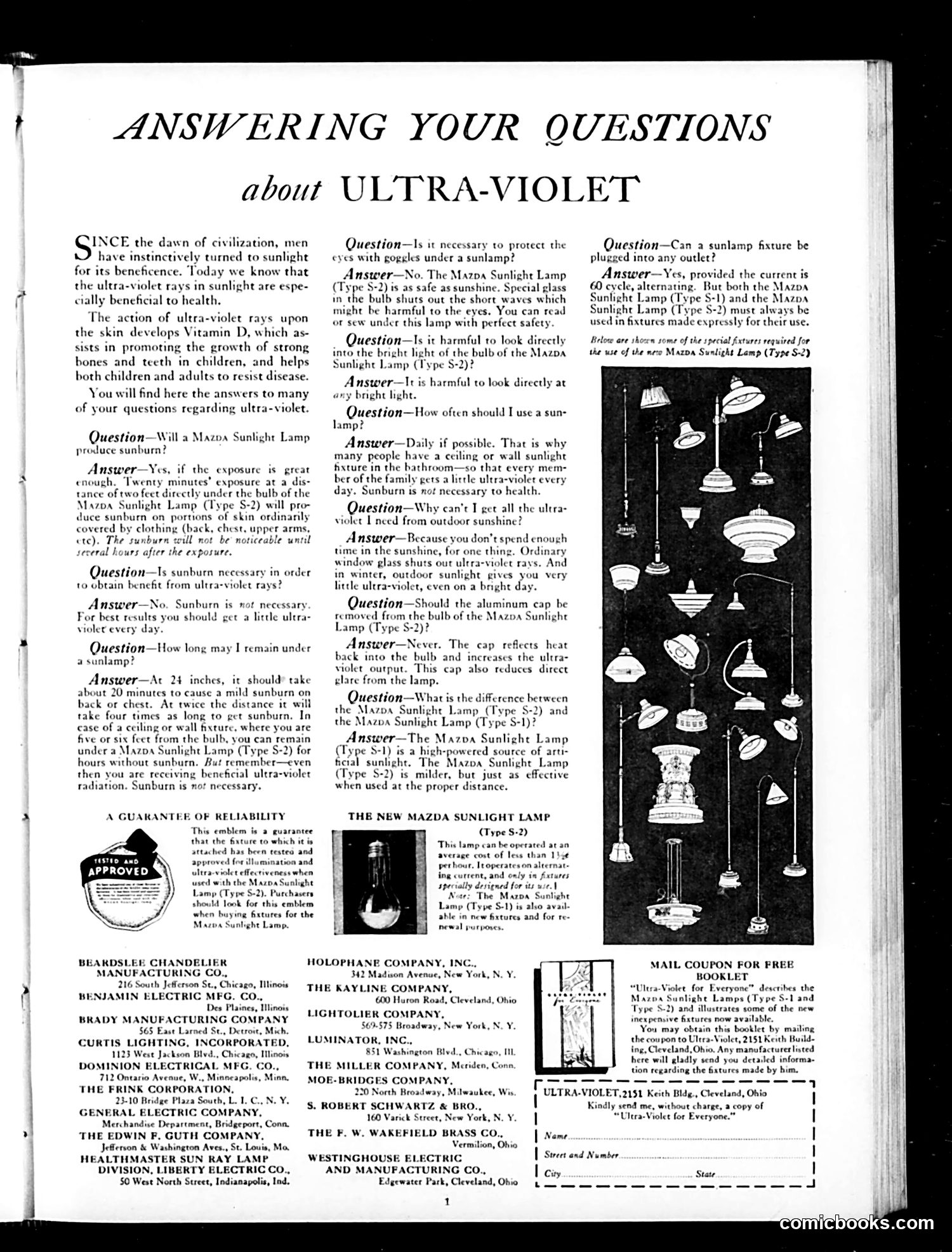
Analysis This page is not a cartoon or satire—it's primarily advertising content, specifically a Q&A promotional piece for Mazda Sunlight Lamps (ultraviolet lamps). The text answers consumer questions about UV lamp safety and usage, addressing concerns like eye protection and exposure duration. The right side shows product images of various decorative lamp fixtures available for purchase. At the bottom, there's a mail coupon offering a free booklet titled "Ultra-Violet for Everyone" from Ultra-Violet (Cleveland, Ohio). This represents early 20th-century consumer advertising that mimicked editorial content to build product credibility—a common marketing technique in magazines like *Judge*. There is no political or social satire present on this page.
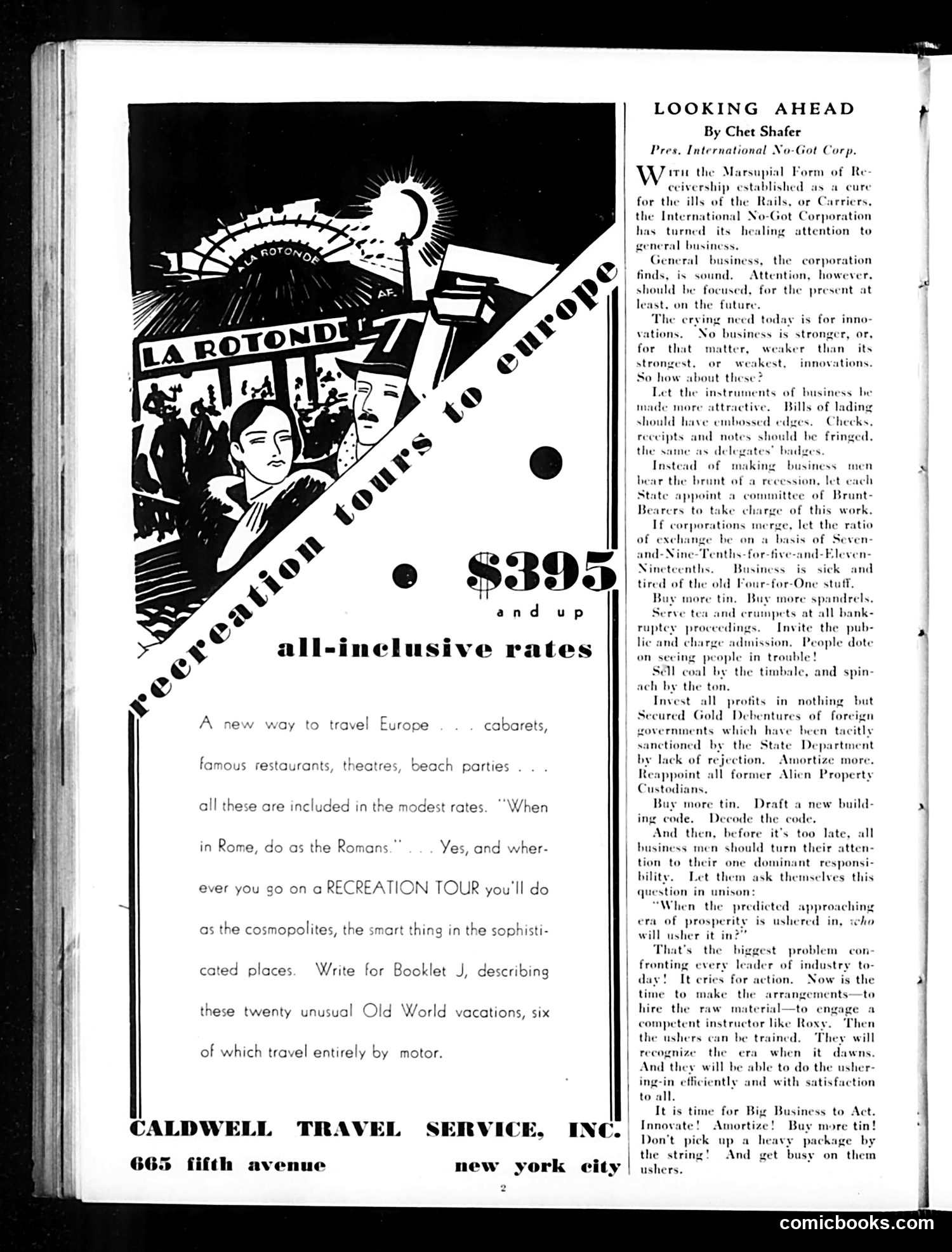
Page Analysis This page contains two distinct elements: Left side: An advertisement for Caldwell Travel Service promoting "Recreation Tours" to Europe starting at $395, featuring the Italian nightclub "La Rotonde." The Art Deco-style illustration shows well-dressed patrons enjoying Continental leisure. Right side: An opinion column titled "Looking Ahead" by Chet Shafer, president of International No Got Corporation, addressing business leadership during what appears to be an economic crisis (likely the Depression). Shafer argues businesses should innovate, consolidate, and invest in training workers rather than cutting costs. He advocates for appointing "committees of Brains-Bearers" and training programs—essentially calling for business reform and worker development as solutions to economic troubles. The juxtaposition of luxury travel advertising alongside urgent economic advice creates implicit commentary on class disparity.
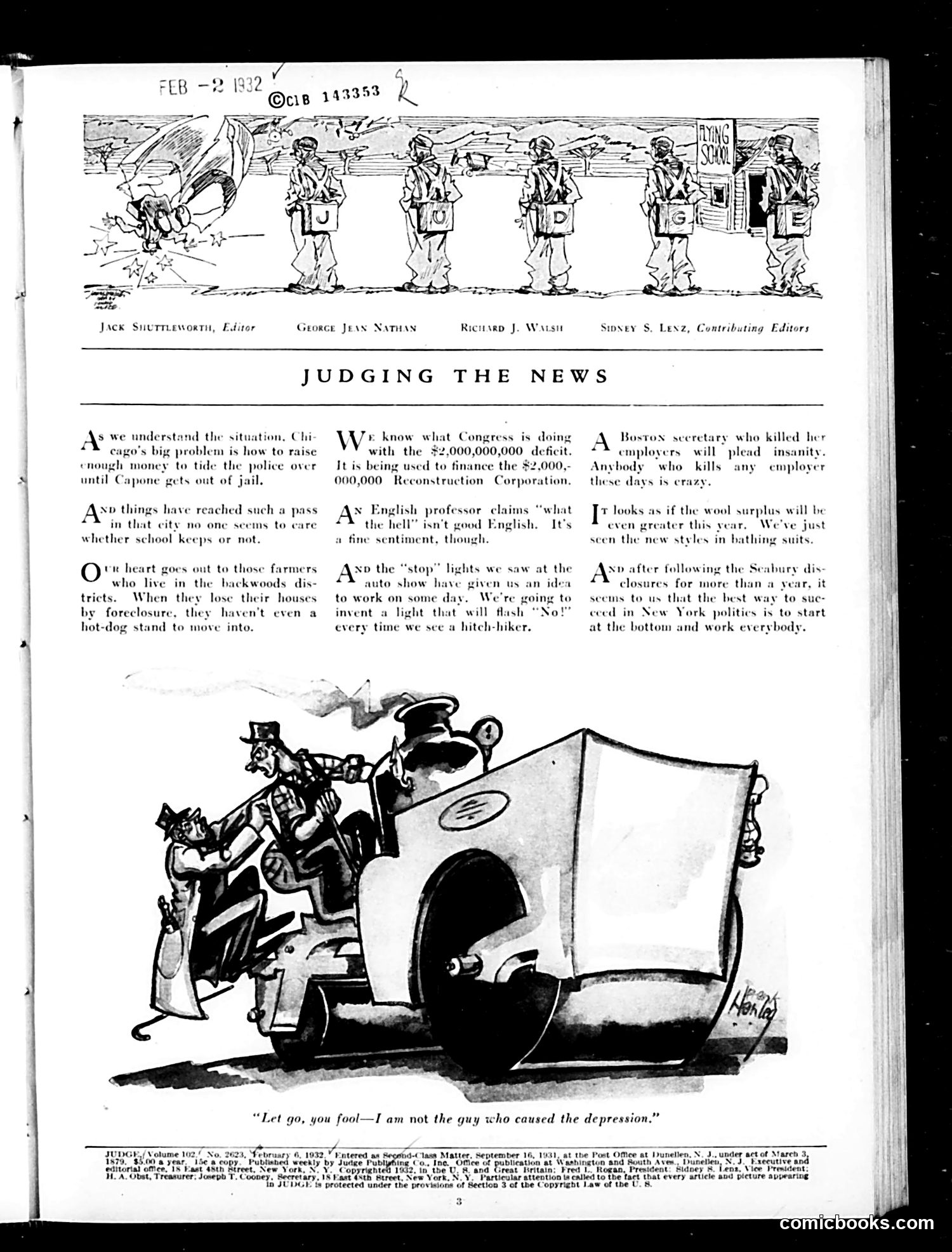
"Judging the News" - February 6, 1932 This page satirizes contemporary events during the Great Depression. The editorial column comments on Chicago's crime problem (likely Al Capone, recently jailed), Congressional deficit spending for Reconstruction Corporation funding, and labor unrest. The main cartoon depicts a figure being ejected from a barrel labeled "depression," with the caption "Let go, son fool—I am not the guy who caused the depression." This appears to be satirizing how ordinary citizens were blamed or scapegoated for economic collapse, when responsibility lay elsewhere (likely with financiers, politicians, or corporate leaders). The barrel symbolizes the Depression itself—something citizens were trapped within and being expelled from, despite their innocence in causing it.
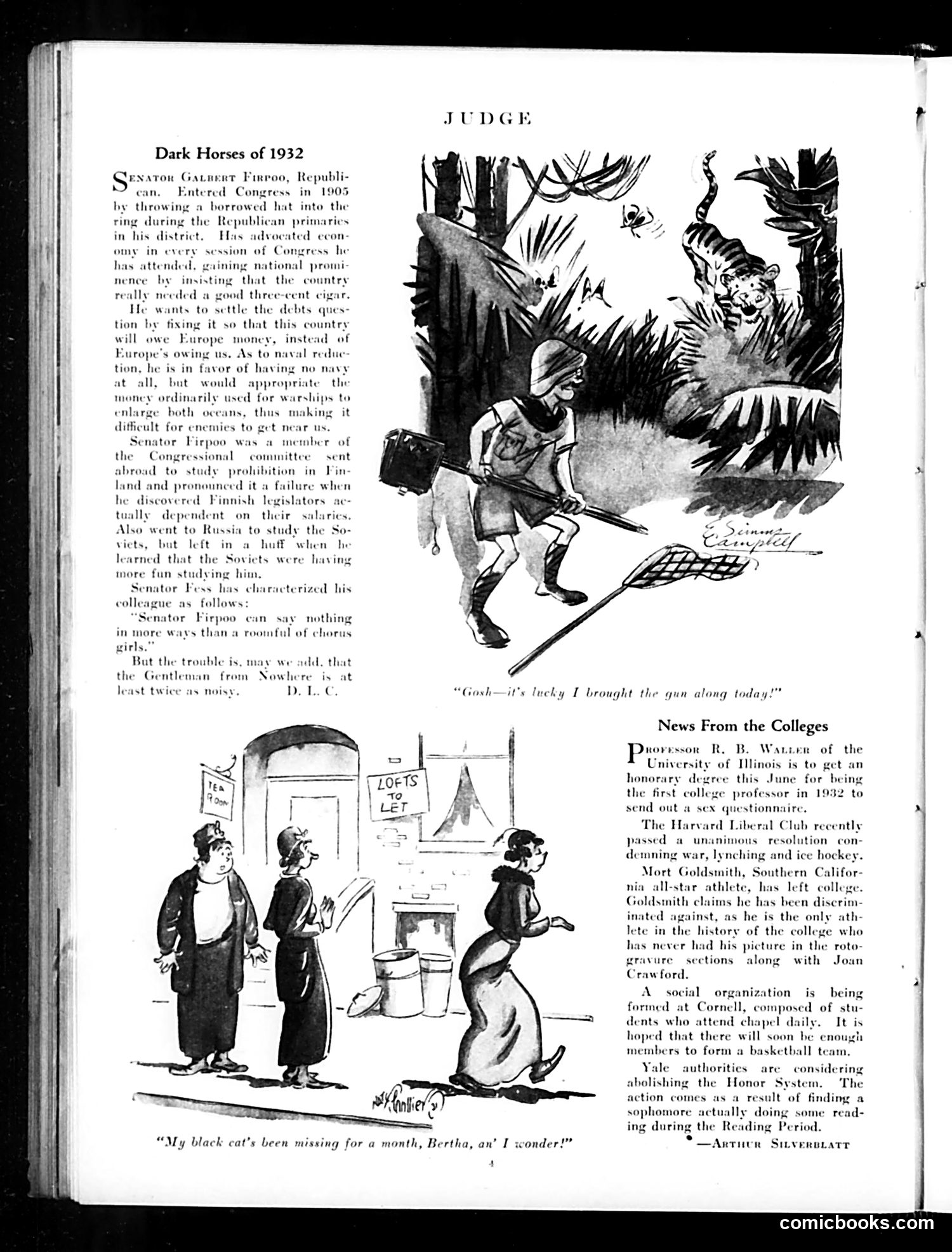
Analysis of Judge Magazine Page Top Cartoon ("Dark Horses of 1932"): This satirizes Senator Gilbert Fippo's contradictory positions on naval policy and European war debts. The illustration shows a man fleeing from menacing figures in a jungle, labeled "Gosh—it's lucky I brought the gun along today!" The satire suggests Fippo is unprepared or hypocritical—advocating military restraint while paradoxically needing armed defense. The "dark horse" reference indicates he's an unexpected political candidate whose stated positions don't withstand scrutiny. Bottom Cartoon: Two men examine a bulletin board while a third person rushes past. The caption "My black cat's been missing for a month, Bertha, an' I wonder!" appears to be domestic humor unrelated to politics. The "News From the Colleges" section covers campus social issues, including Yale's proposed Honor System abolishment.
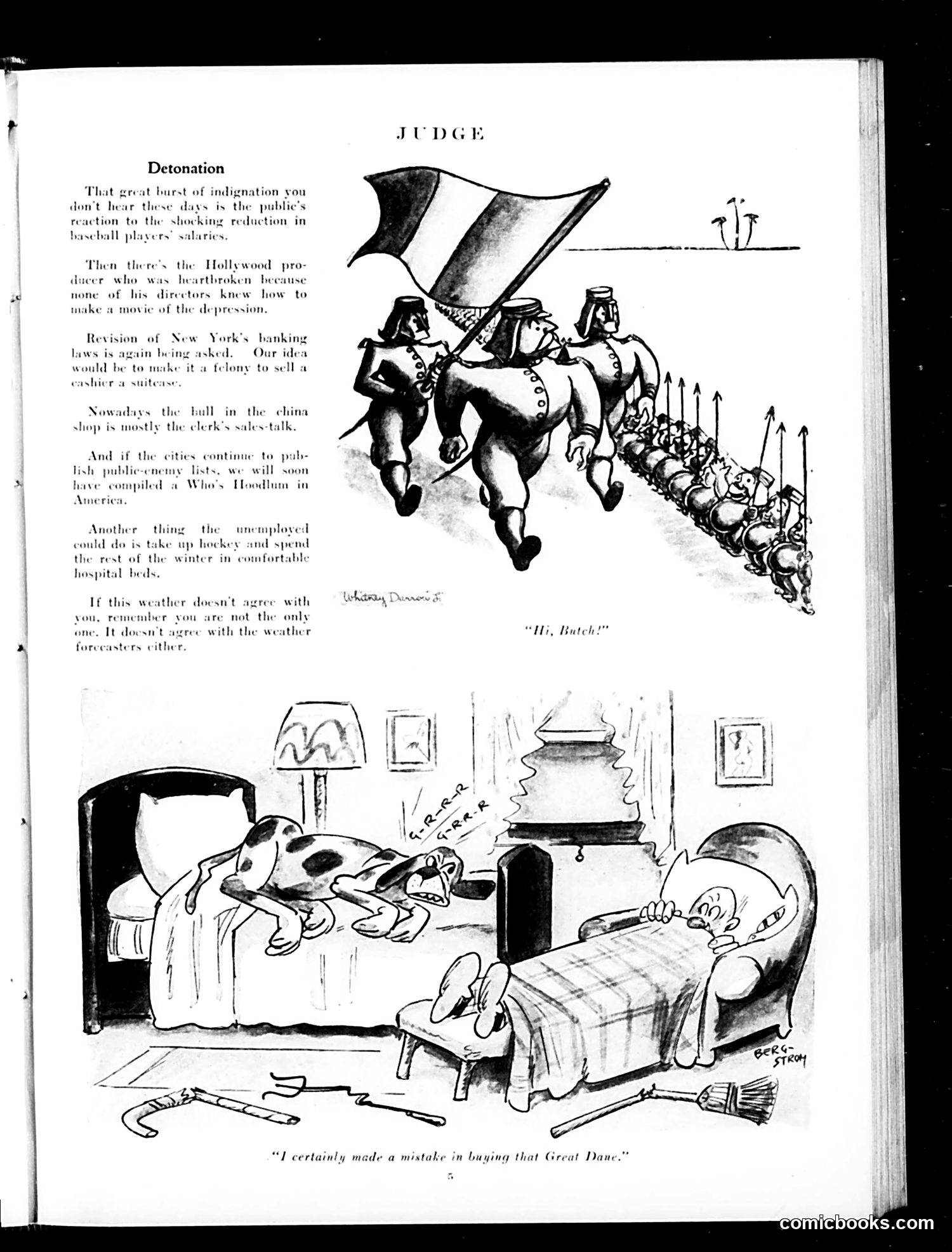
Judge Magazine Page Analysis Top Cartoon ("Hi, Hatch!"): This depicts what appears to be a political or judicial figure being carried aloft on a platform, surrounded by supporters with raised implements (possibly torches or weapons). The caption "Hi, Hatch!" suggests this references a specific public figure named Hatch, though the exact identity and event remain unclear without additional context. The triumphant imagery could satirize overconfidence or excessive celebration. Bottom Cartoon: Shows a domestic scene where someone in bed expresses regret about "buying that Great Dane." The humor is straightforward—purchasing a large dog created household complications, likely referencing space issues or costs. Left Column: Contains brief satirical commentary on baseball salaries, Hollywood depression films, banking law revision, and other contemporary topics, characteristic of Judge's social commentary style.
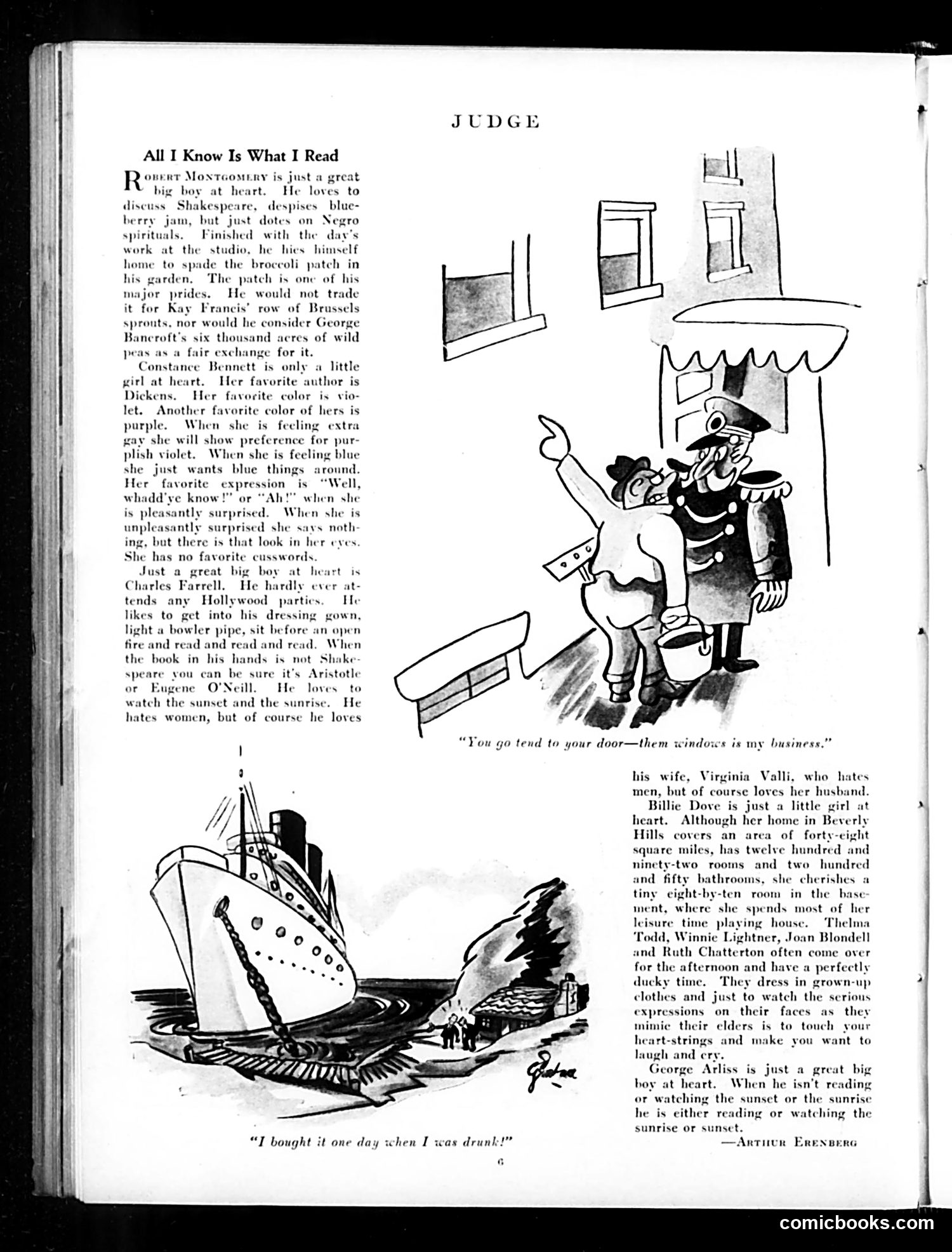
Analysis of Judge Magazine Page This page from *Judge* magazine features the column "All I Know Is What I Read," which profiles Hollywood personalities' reading habits and character traits. The text describes figures like Robert Montgomery, Constance Bennett, Charles Farrell, and George Arliss—major film stars of the era. The two cartoons illustrate humorous anecdotes: one shows a man at his doorway with the caption "You go tend to your door—them windows is my business," while another depicts someone with a ship, captioned "I bought it one day when I was drunk!" The satire gently pokes fun at celebrities' personalities and quirks through witty observations about their reading preferences and lifestyle choices, typical of *Judge's* celebrity gossip and humor format during Hollywood's Golden Age.
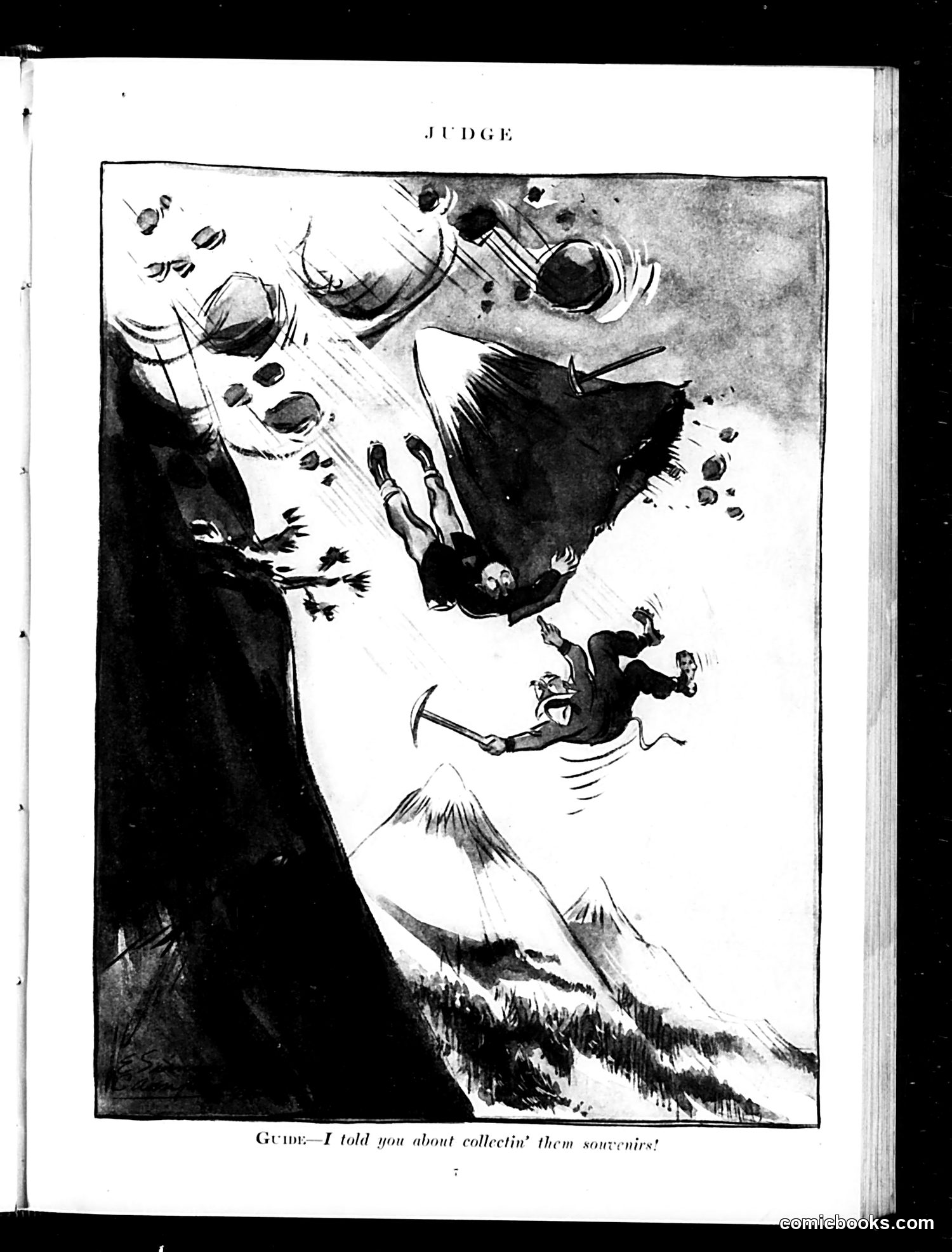
Analysis This political cartoon from Judge magazine shows a giant figure (likely representing a wealthy industrialist or corrupt politician) raining down money and valuables onto a tiny man below wielding a pickaxe labeled "Guide." The caption reads: "Guide—I told you about collectin' them souvenirs!" The satire appears to criticize how tour guides or intermediaries exploit tourists by encouraging them to collect "souvenirs"—likely referring to bribes, kickbacks, or illicit payments. The massive figure represents powerful interests (possibly mining or railroad industries) showering wealth downward, while the guide below appears complicit in this corrupt scheme. The cartoon likely critiques the collusion between guides/facilitators and wealthy power brokers who enrich themselves through questionable practices targeting unsuspecting visitors or workers.
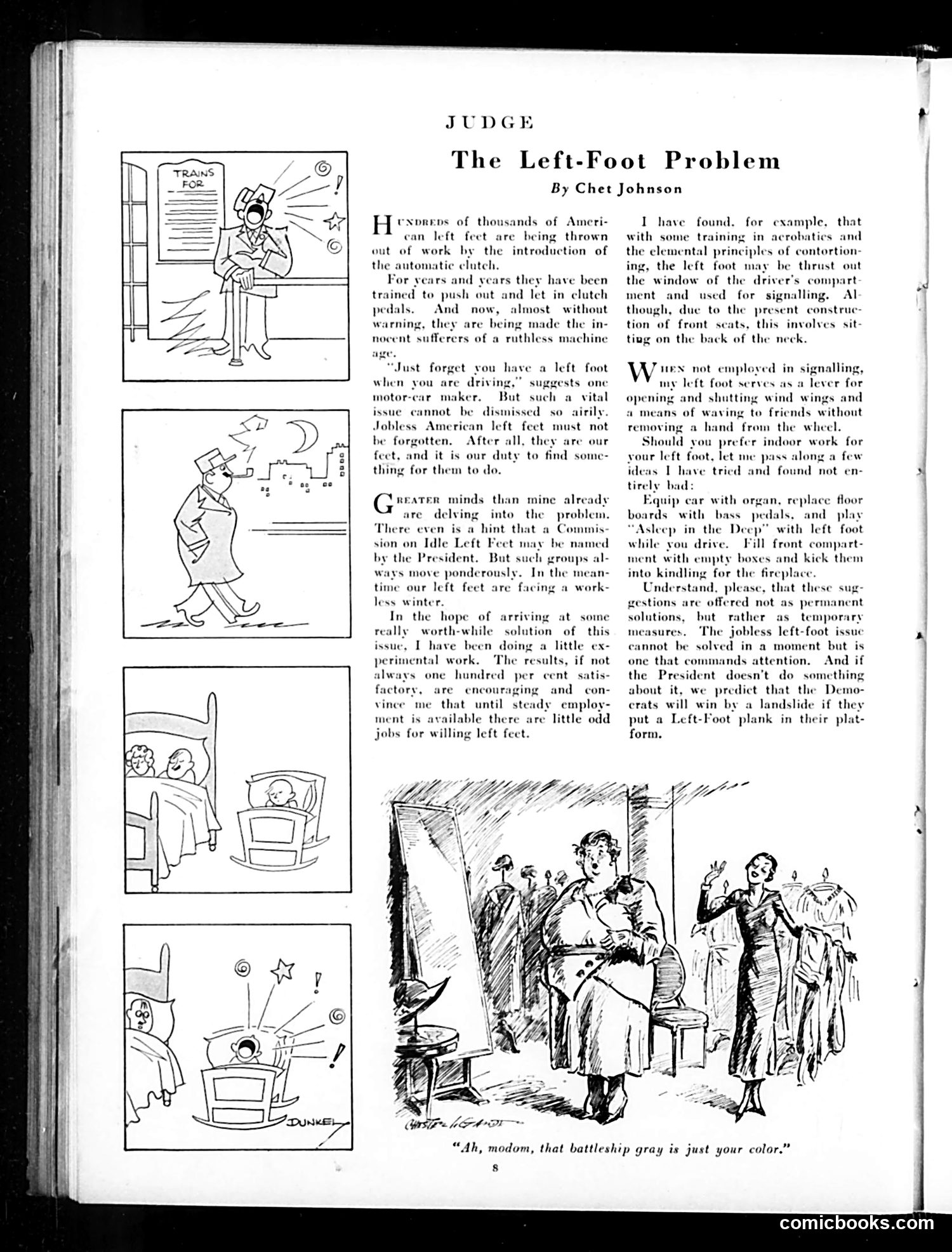
"The Left-Foot Problem" - Judge Magazine Satire This piece satirizes the economic disruption caused by the automatic clutch's introduction to automobiles. Previously, drivers used their left foot constantly to operate manual clutches; the new technology rendered this skill obsolete, creating genuine unemployment concerns for workers trained exclusively in that task. Author Chet Johnson mocks both the scale of hand-wringing over this "crisis" and the government's ponderous response—hinting at a potential presidential commission on "Idle Left Feet." The cartoons show absurd alternative uses: using one's left foot to signal from car windows, operating organ pedals while driving, or kicking boxes. The final panel's caption ("Ah, madam, that battleship gray is just your color") appears unrelated, suggesting editorial filler. The satire targets political overreaction to technological progress and Depression-era anxiety about job displacement, while poking fun at proposed government solutions to market-driven obsolescence. The humor relies on treating a minor inconvenience as a major national crisis warranting political intervention.
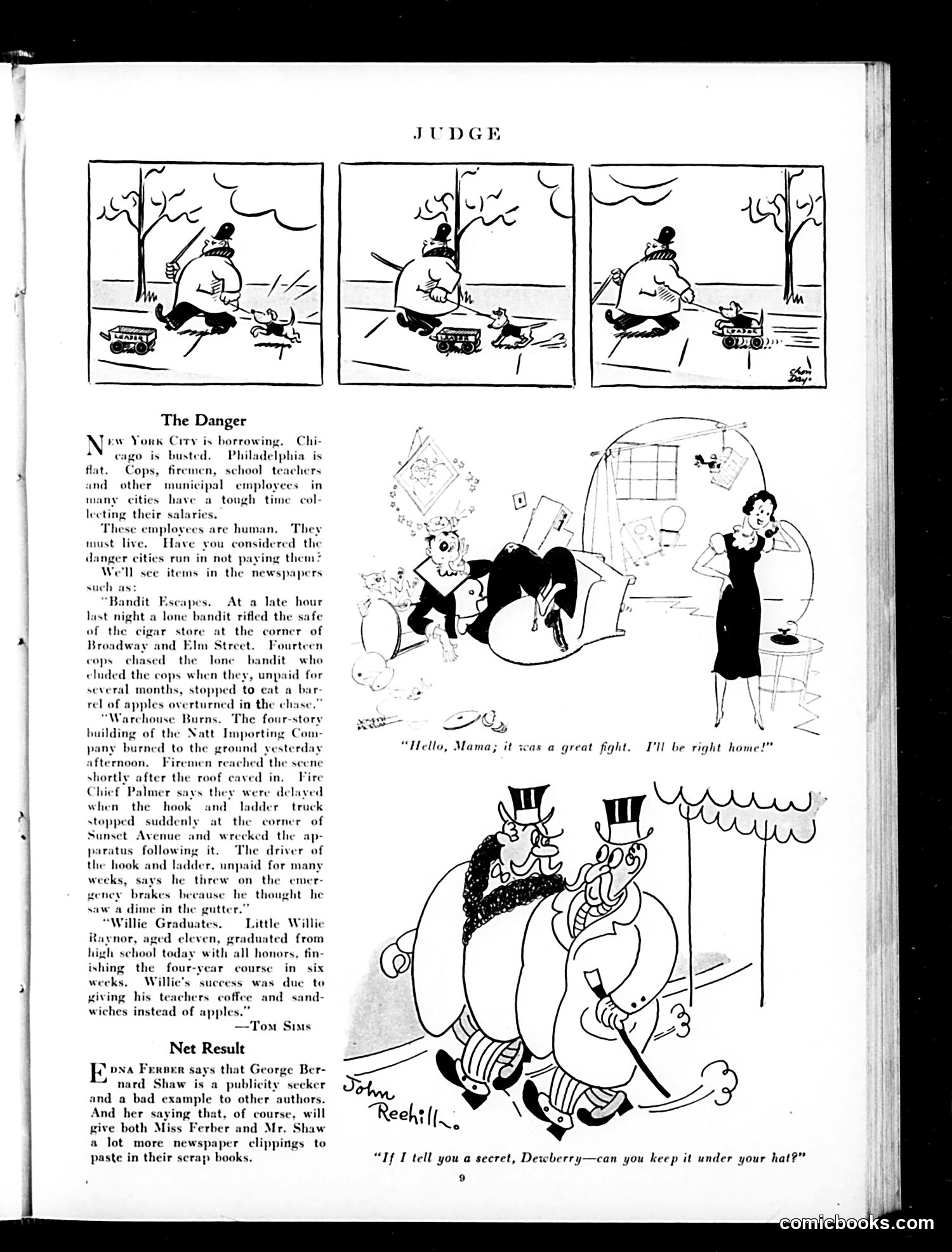
"The Danger" - Judge Magazine Satire This page contains two separate satirical pieces: "The Danger" (top): A political cartoon criticizing municipal budget crises in major American cities (New York, Chicago, Philadelphia). The text warns that unpaid police, firefighters, and city employees—being human—pose public safety risks. It satirically predicts newspaper headlines where underpaid workers fail at their jobs: a cop stops chasing a bandit to eat apples, firefighters are delayed because their exhausted driver sees a dime. The joke is darkly ironic—cities are so financially broken they endanger citizens by not paying those who protect them. "Net Result" (bottom): A brief item mocking author Edna Ferber's criticism of George Bernard Shaw as a publicity-seeker. The satire points out that Ferber's very complaint generates more newspaper clippings for Shaw's scrapbook—proving her criticism backfires and actually helps his publicity. It's meta-commentary on how gossip and criticism paradoxically serve the accused. Both pieces satirize real 1920s-era civic dysfunction and literary vanity.
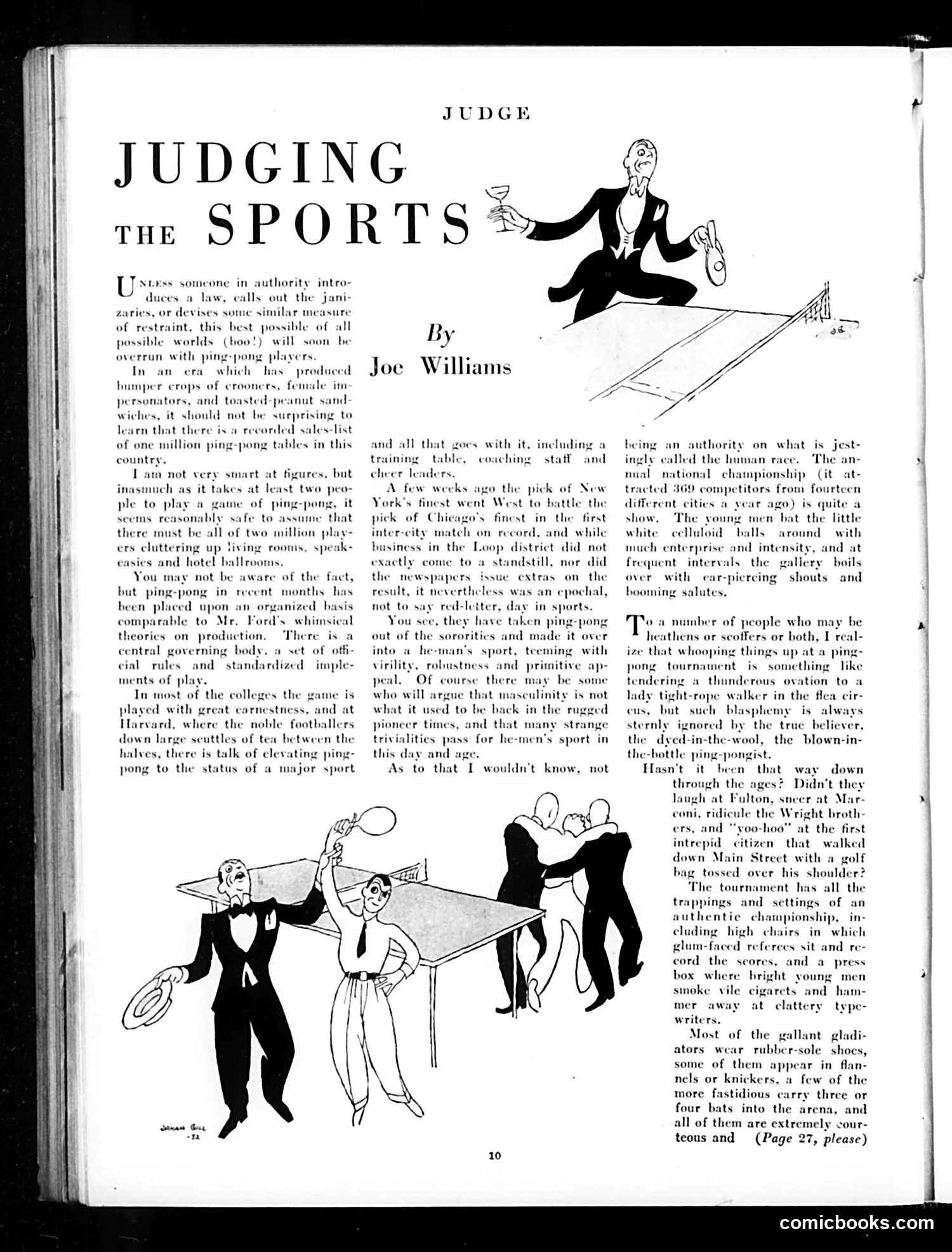
"Judging the Sports" by Joe Williams This satirical article mocks the sudden craze and competitive formalization of ping-pong in 1920s America. Williams notes that what began as casual parlor entertainment has been transformed into an organized "he-man's sport" with official governing bodies, championship tournaments, coaching staffs, and serious competitors—complete with referees, press boxes, and ceremonial trappings rivaling major sports. The satire targets both the sport's newfound pretentiousness and American culture's tendency to elevate trivial pursuits. Williams humorously compares ping-pong enthusiasm to past ridicule of Fulton, Marconi, and the Wright brothers, suggesting society always mocks novel pastimes before accepting them. The accompanying illustrations show formally-dressed players competing at tables with exaggerated intensity, emphasizing the absurdity of treating a tabletop game with athletic gravitas. The piece gently ridicules American enthusiasm for organized competition applied to even the most mundane activities.
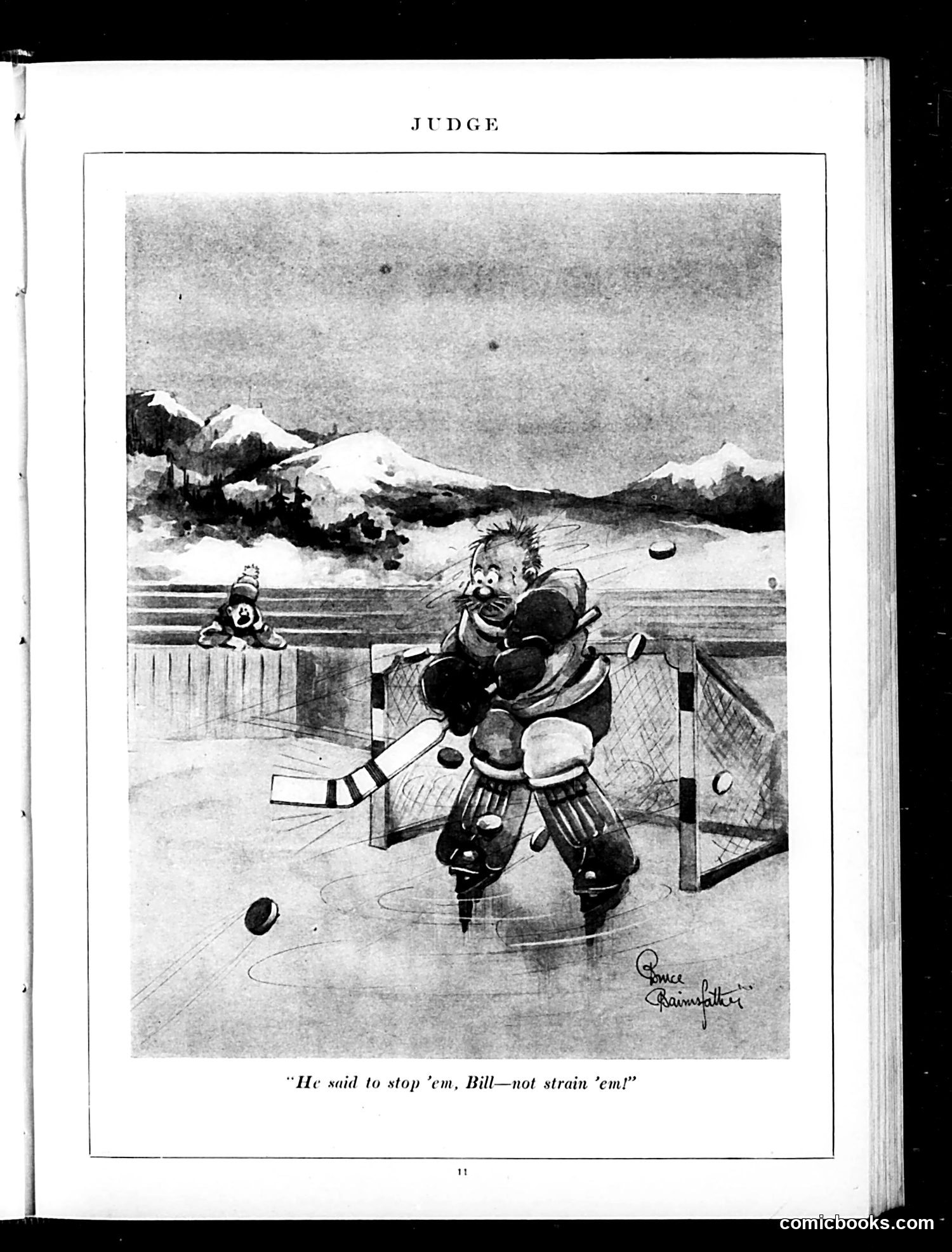
Analysis This cartoon depicts a hockey game scene with anthropomorphic animal characters on frozen ice, with snow-capped mountains in the background. The central figure is a aggressive player wielding a hockey stick, while another character watches from the boards at left. The caption reads: "He said to stop 'em, Bill—not strain 'em!" This appears to be a sports-themed joke about excessive physicality in hockey. The humor likely plays on a coach's instruction being misinterpreted or overexecuted—the player "straining" opponents rather than simply "stopping" them during play. The exaggerated, grotesque character design is typical of Judge magazine's satirical style, though without additional context, the specific figures and any deeper political meaning remain unclear.
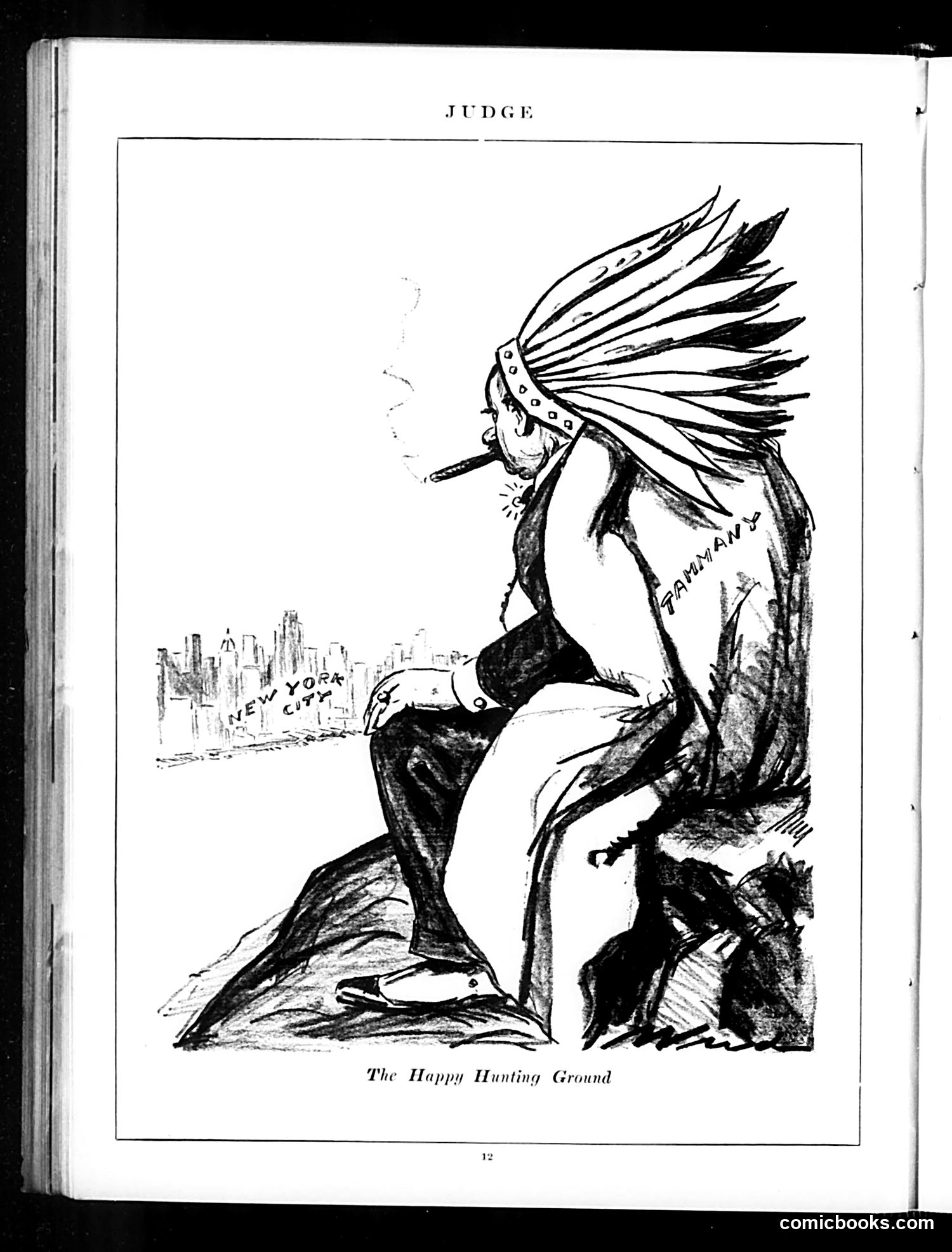
"The Happy Hunting Ground" This satirical cartoon depicts a Native American figure (labeled "Tammany") overlooking New York City. The imagery references the historical "Happy Hunting Ground"—a stereotype of Native American paradise—while the figure's contemplative pose suggests ironic commentary on displacement and loss of land. "Tammany" refers to Tammany Hall, the powerful Democratic political machine that controlled New York City politics. By merging Native American imagery with Tammany, the cartoonist likely critiques political corruption or exploitation—comparing the party's control of New York to colonization, or suggesting politicians exploit the city like historical conquerors exploited Native lands. The satire appears to mock either Tammany's political dominance or broader themes of American territorial appropriation, though the specific historical moment remains unclear without additional context.
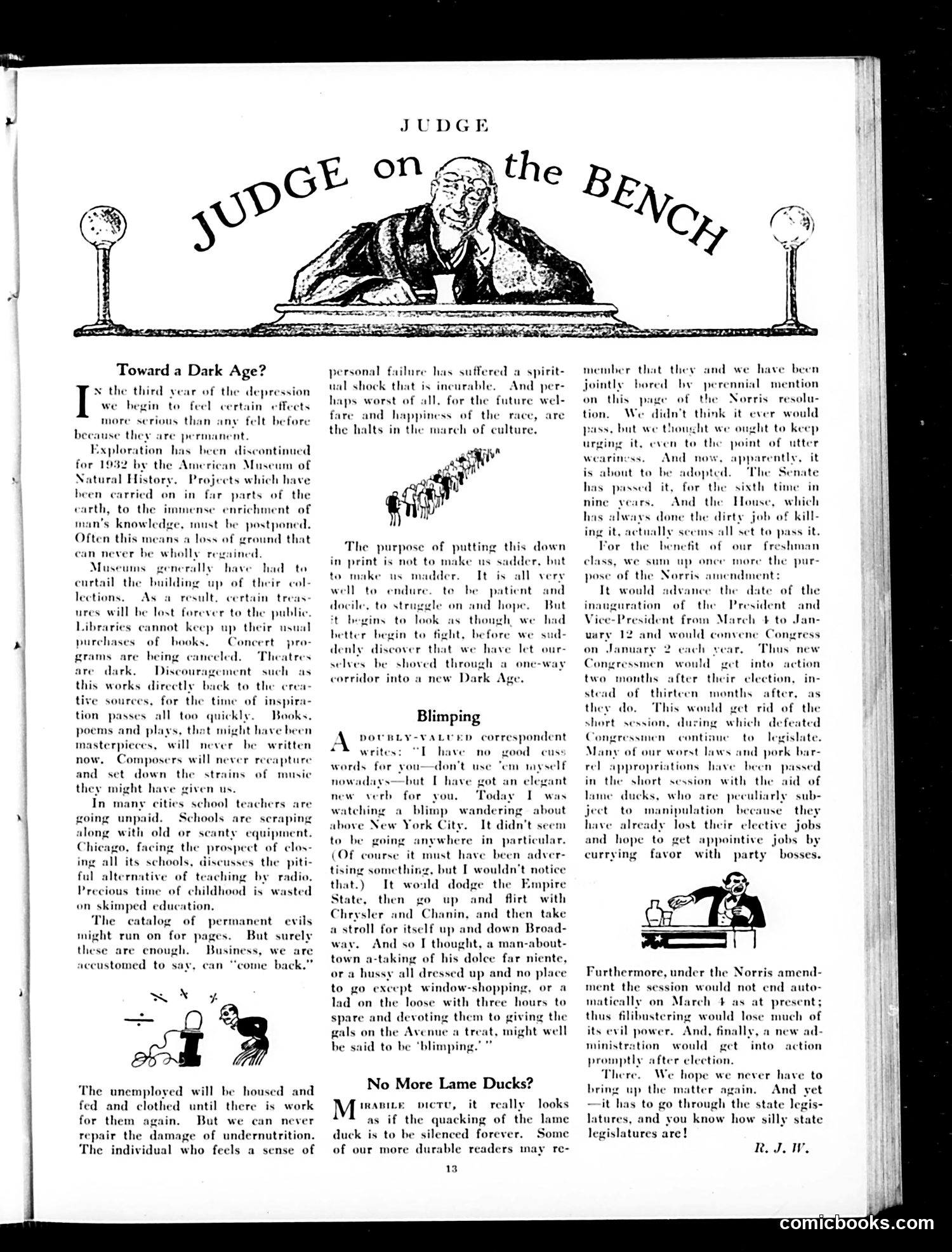
"Judge" Magazine Page Analysis This page from the Depression-era satirical magazine *Judge* contains three opinion pieces critiquing American society circa 1932. "Toward a Dark Age?" argues that Depression-era budget cuts—halting museum expeditions, closing libraries, darkening theaters, and leaving teachers unpaid—damage culture irreparably. The author warns these aren't temporary hardships but permanent losses to human knowledge and artistic creation, pushing civilization backward. "Blimping" is lighthearted wordplay: a correspondent coins "blimping" as a verb meaning to wander aimlessly (like advertising blimps floating over New York City without clear direction), applied to idle socialites window-shopping on Fifth Avenue. "No More Lame Ducks?" celebrates the Senate finally passing the Norris resolution, which would end the practice of defeated congressmen serving out remaining terms as "lame ducks." The author notes this has been proposed six times previously, mocking how slowly legislative reform moves. The cartoons are crude illustrations supporting the text's themes of economic hardship and political inefficiency.
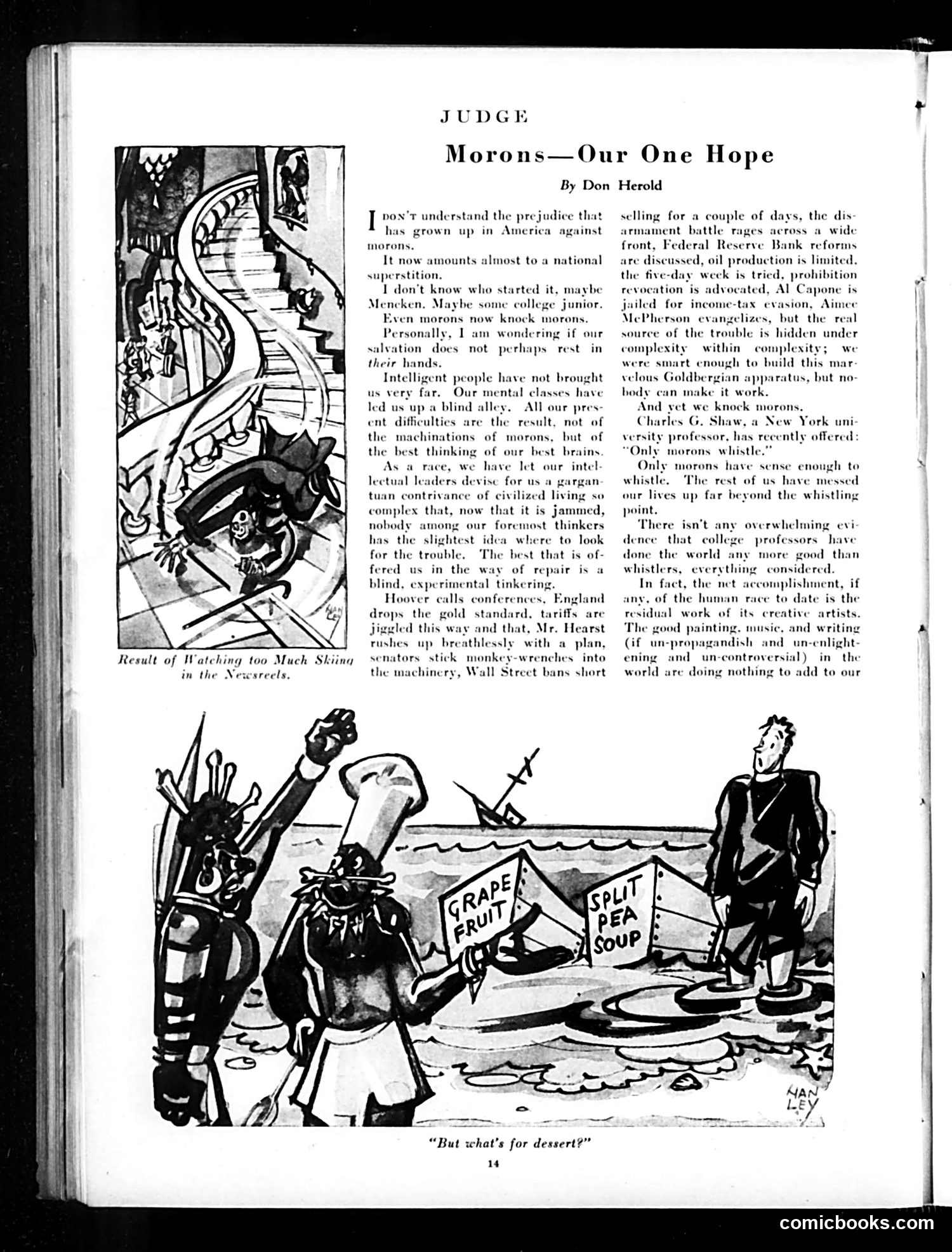
Explaining the Judge Page: "Morons—Our One Hope" This 1920s-30s satirical essay by Don Herold argues that society's contempt for "morons" is misplaced. Herold claims intelligent people have created an overly complex civilization now broken beyond repair—evidenced by failed economic policies (gold standard, tariffs, Prohibition debates, Federal Reserve tinkering). He cites Charles G. Shaw's observation that "only morons whistle," suggesting simple people possess wisdom the overcomplicating intellectual elite lack. The bottom cartoon depicts this irony: a shipwrecked sailor faces canned goods labeled "grapefruit" and "split pea soup," asking "But what's for dessert?"—a joke about expecting luxuries amid disaster, likely mirroring society's misplaced priorities during economic crisis. The satire targets intellectual pretension and the Great Depression-era sense that expert management had failed ordinary Americans. Herold suggests salvation lies not in complex solutions but in the simpler perspective of "morons."
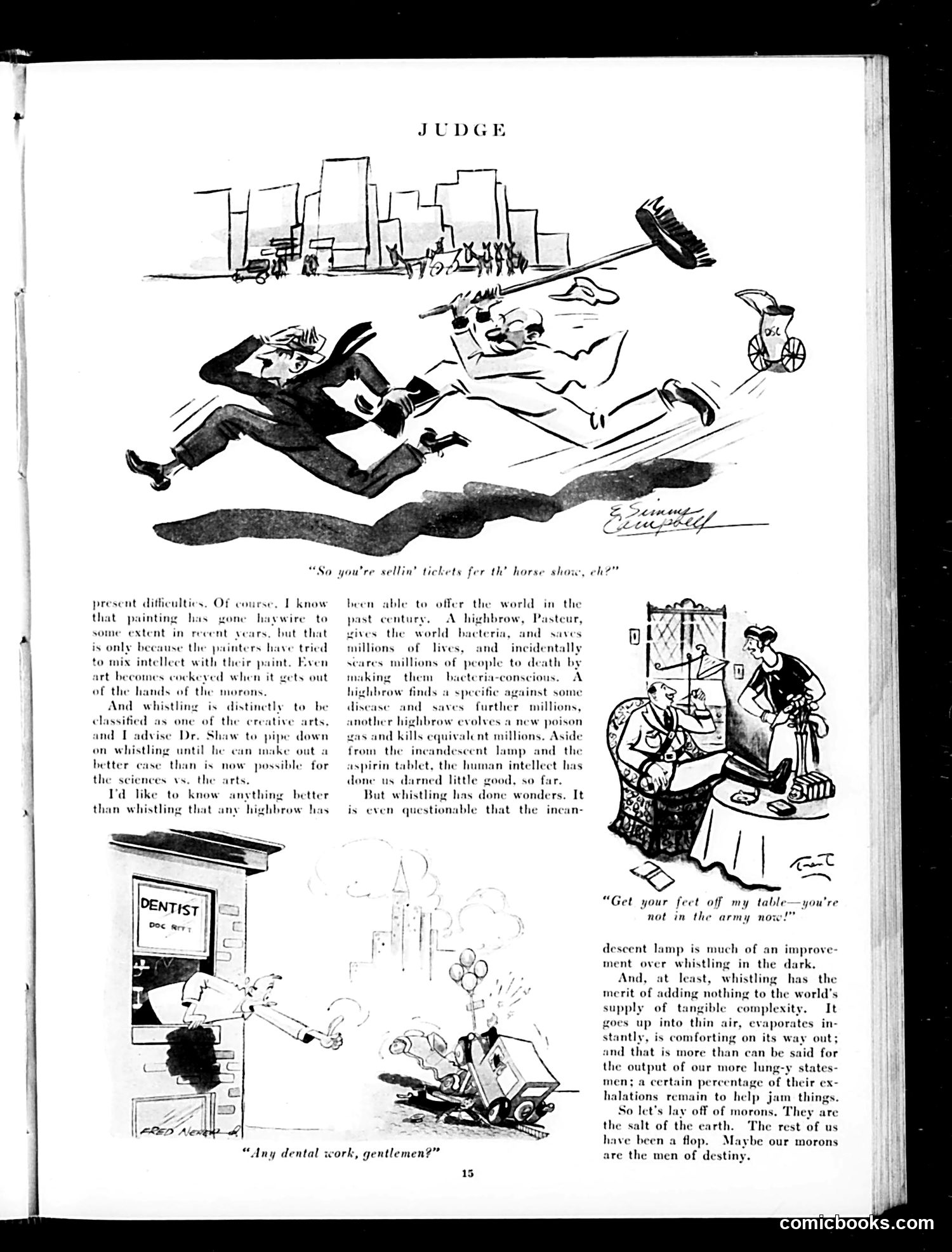
Analysis of Judge Page: "Judge" This page satirizes intellectualism and "highbrow" culture through a celebration of ordinary people and simple pleasures, particularly whistling. The main article argues that whistling—a humble, accessible activity—accomplishes more genuine good than high-minded intellectual pursuits. It mocks celebrated intellectuals like Pasteur, claiming their discoveries (vaccines, new poisons) kill as many people as they save, whereas whistling costs nothing and harms no one. The cartoons support this theme: one shows a dentist's patient, another depicts people at leisure activities. The opening cartoon shows a man being arrested or accosted, with the caption about "horse show" tickets—likely mocking pretentious entertainment. The satirical point: ordinary "morons" (used non-clinically here) who whistle and enjoy simple pleasures are better than self-important intellectuals whose complex schemes often backfire. This reflects 1920s-era anti-intellectual sentiment and nostalgia for simpler times, common in American popular satire of the period.
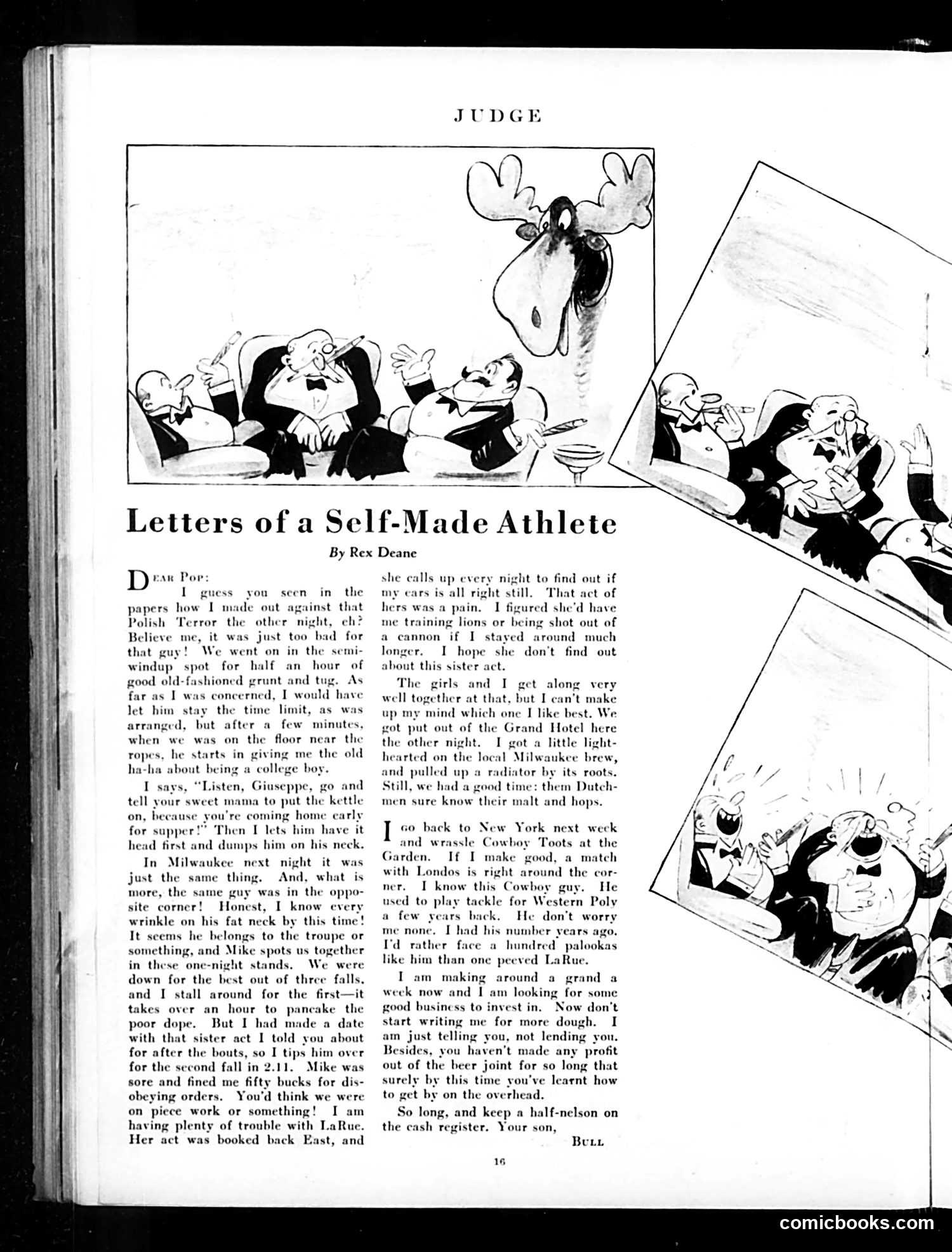
"Letters of a Self-Made Athlete" by Rex Deane This satirical column mocks professional wrestling's theatrical fakery through a boastful wrestler's letter home. The narrator brags about defeating opponents while revealing the sport's scripted nature: he recognizes the same "Polish Terror" opponent in multiple cities, deliberately prolongs matches ("stalls around for the first"), and receives fines for not following predetermined outcomes. The humor targets wrestling's pretense of legitimacy—the writer treats it as entertainment work rather than genuine sport, mentioning "sister acts" and "one-night stands" like vaudeville performers. His casual cruelty (dumping opponents on their necks) and romantic entanglements underscore the seediness of traveling carnival-style athletics. The cartoons (top and side panels) show well-dressed men socializing and reacting with exaggerated expressions, likely depicting Judge's typical audience of urban sophisticates—precisely the readers who would recognize wrestling's con and enjoy this exposé of its phoniness.
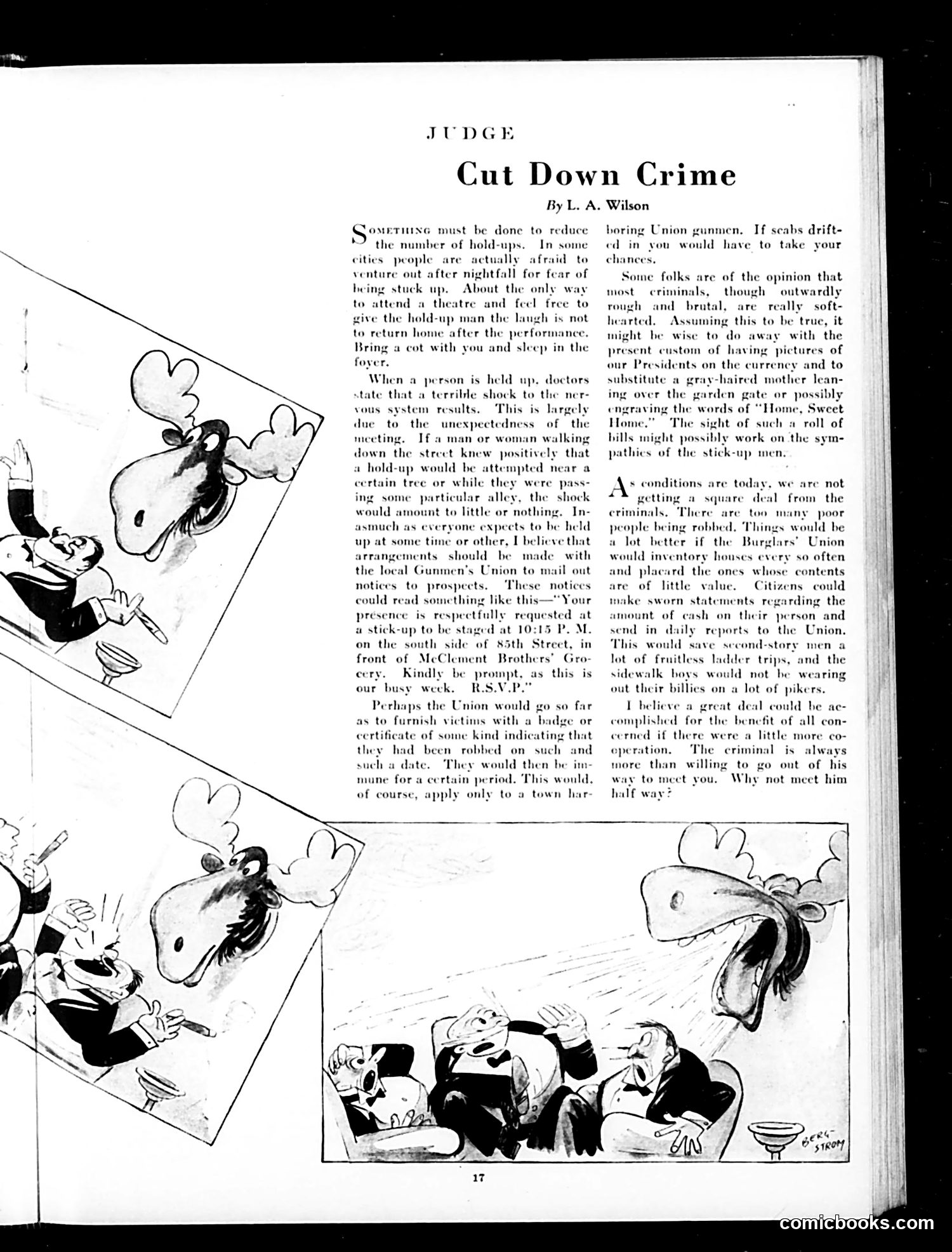
"Cut Down Crime" by L.A. Wilson This satirical piece mocks the epidemic of street robberies and hold-ups plaguing American cities in the early 20th century—so widespread that people feared nighttime activity. Wilson proposes absurdly "reasonable" solutions: the "Gunmen's Union" should mail advance notice of robberies (requesting punctuality with "R.S.V.P."), issue victims certificates proving they've been robbed so they're immune from future attacks, and a "Burglars' Union" should inventory homes and mark those with valueless contents to spare burglars wasted effort. The cartoons show moose-headed criminals terrorizing citizens—the exaggerated animal heads suggesting the "brutish" nature of criminals. Wilson's underlying joke is that criminals are simply businessmen who need better organization and communication with victims. By treating crime as a negotiated transaction rather than violence, he exposes how crime has become normalized—and how society's response is inadequate. The satire critiques both the criminals' systematic operations and civic failure to meaningfully address the problem.
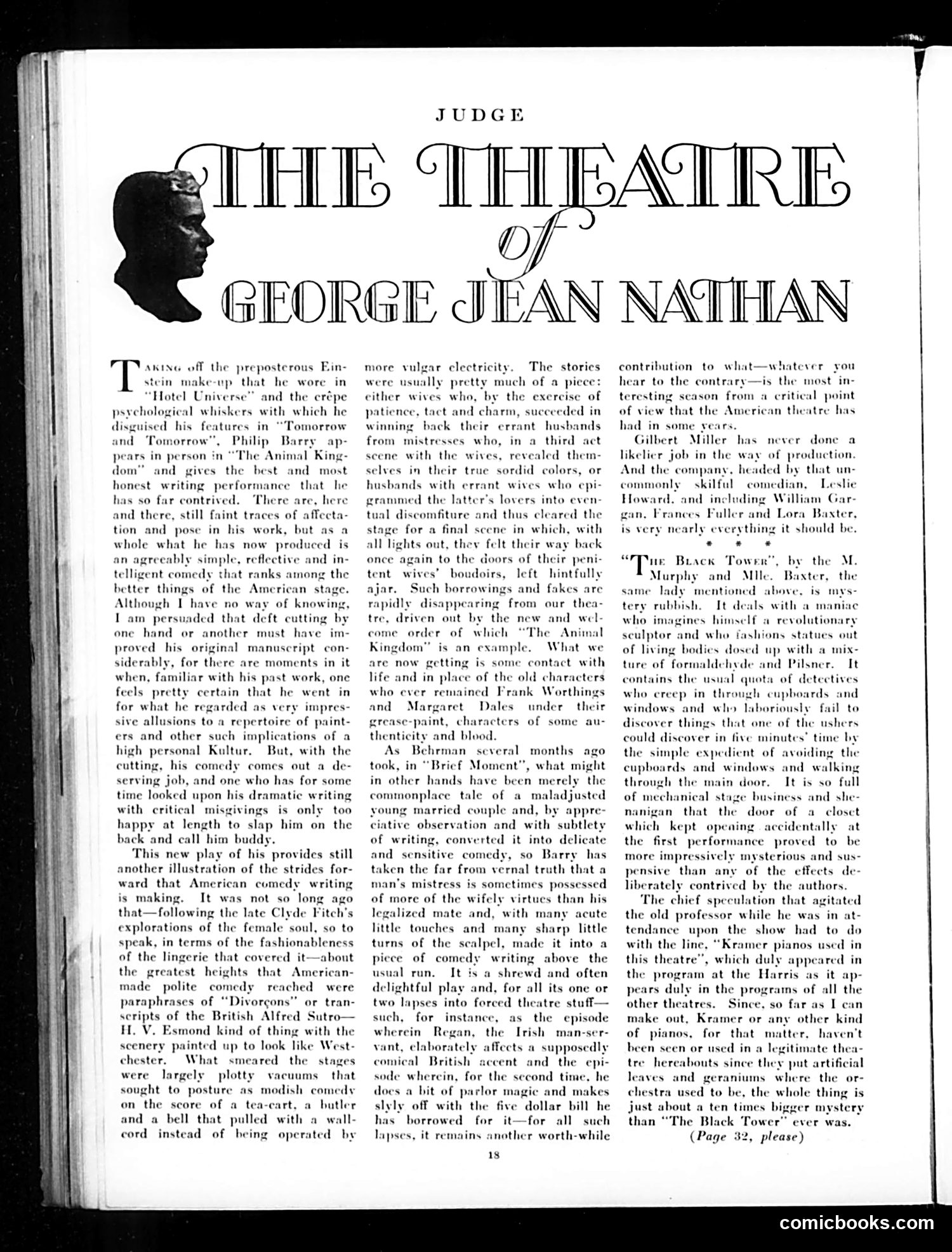
Judge Magazine Theater Critique This page reviews Philip Barry's play "The Animal Kingdom," praising Barry's acting performance and the play itself as exemplary of improving American comedy writing. The critic contrasts modern theatrical comedy—exemplified by Barry's work featuring authentic characters and genuine human situations—with outdated conventions that dominated earlier American stages. He specifically criticizes the formulaic plots of the previous era: unfaithful husbands and wives reconciling in darkened rooms, predictable British-style drawing-room comedies, and shallow characters named generically "Frank Worthings" and "Margaret Dales." The piece celebrates that contemporary playwrights like S.N. Behrman and Barry now ground their comedies in observed life and psychological truth rather than mechanical plot devices. "The Animal Kingdom," dealing with a husband's mistress possessing more "wifely virtues" than his actual wife, exemplifies this new sophistication—taking a potentially sordid subject and treating it with nuance and intelligence rather than melodrama.
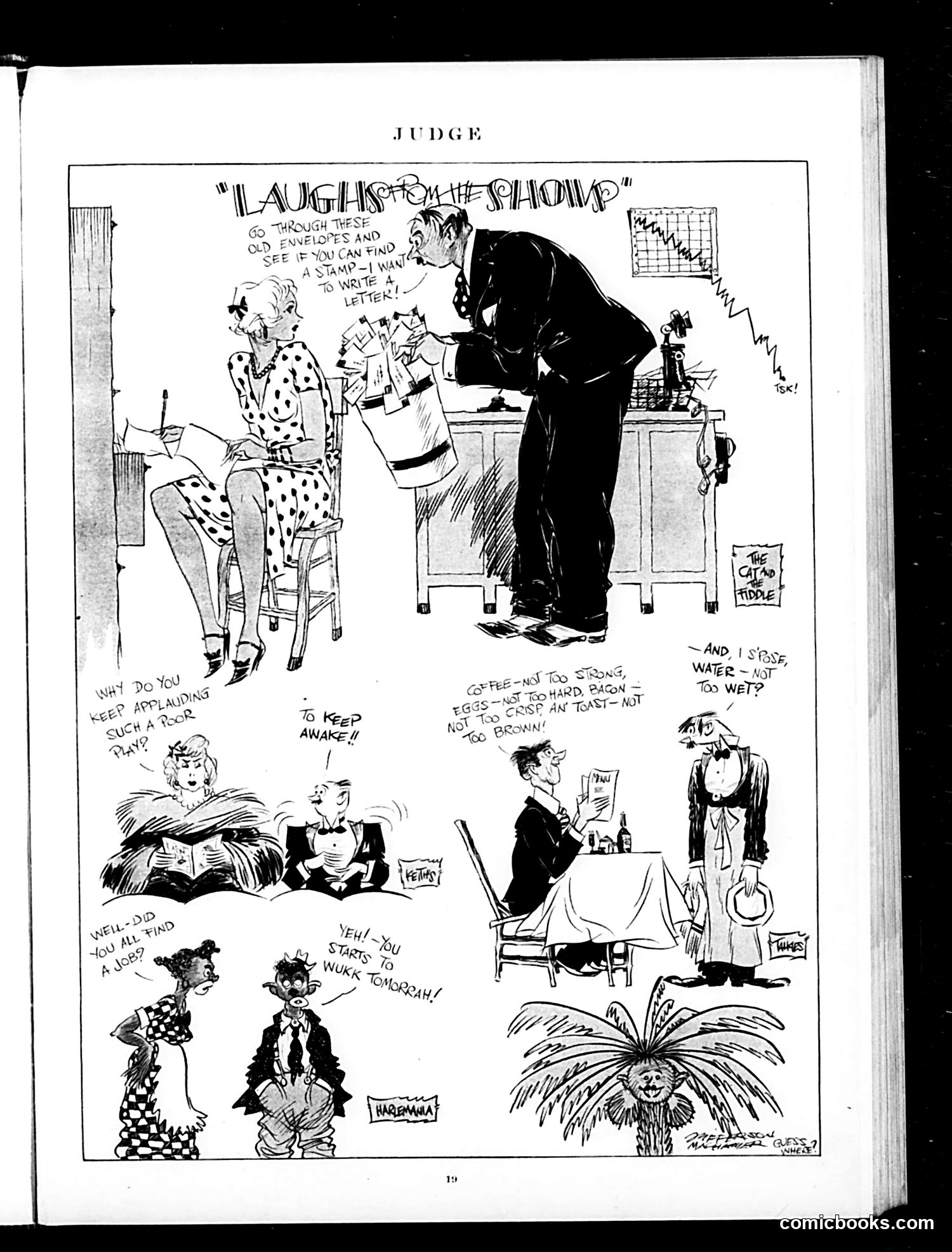
"Laugh at the Show" This page from Judge magazine presents a multi-panel comic about domestic life and marital dynamics. The central scene shows a judge or authority figure presiding over what appears to be a domestic dispute or comedy routine. Various panels depict couples arguing about household matters—coffee strength, eggs preparation, toast browning, and water temperature. The satire targets the mundane but perpetual complaints within marriages, portraying domestic life as a comedic "show" worthy of judicial review. The humor relies on exaggerated marital stereotypes common to early-to-mid 20th century American culture, where wives' housekeeping and cooking abilities were frequent subjects of ridicule. The cartoonist uses the judge figure to frame these trivial grievances as absurdly serious matters.
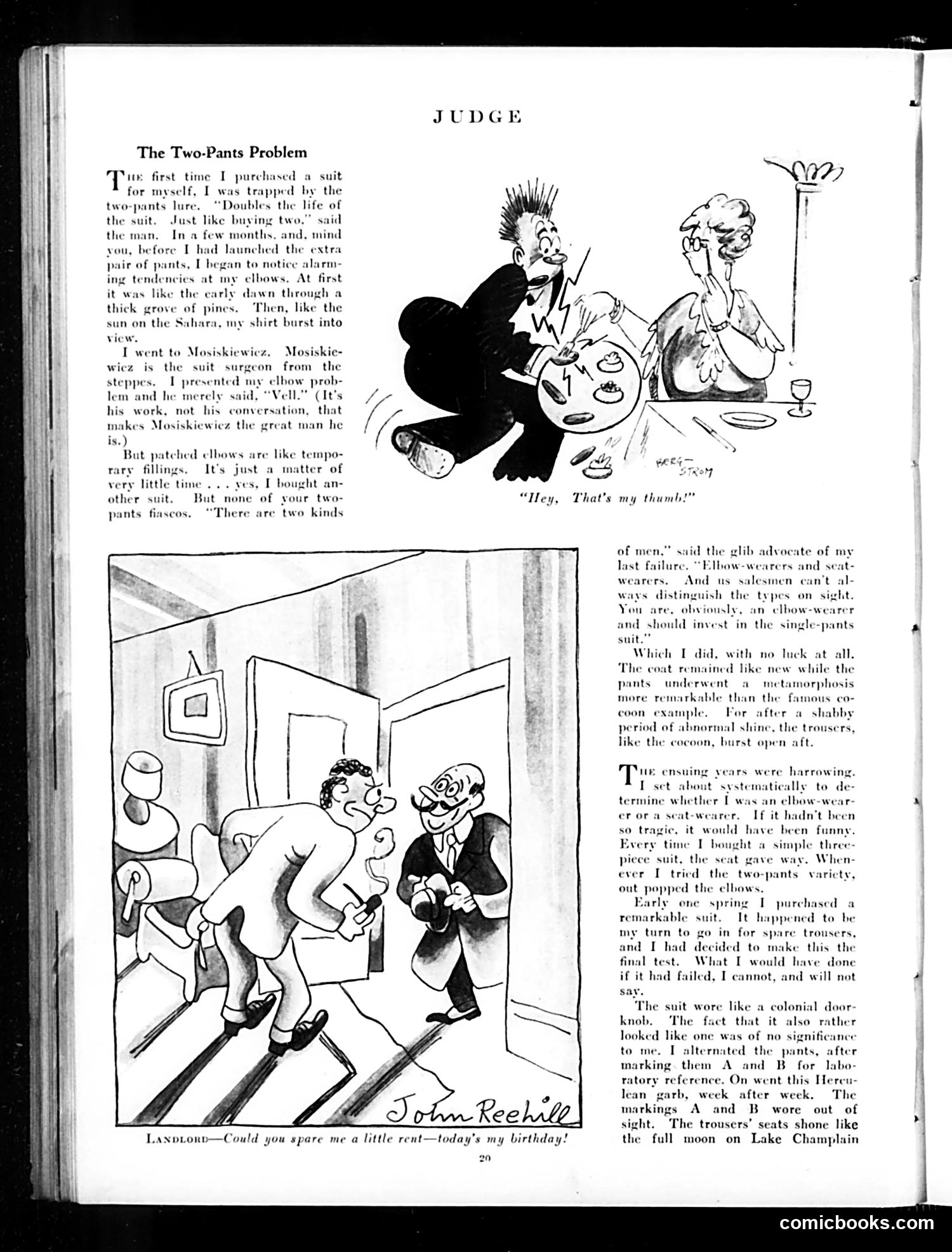
"The Two-Pants Problem" This humorous essay satirizes the common retail sales pitch of the early 20th century: buying suits with two pairs of pants to "double the life" of the garment. The author describes his frustrating discovery that he is either an "elbow-wearer" or a "seat-wearer"—one type always wears through the elbows while the other wears through the seat—making the two-pants option useless. The cartoons illustrate the absurdity: one shows a tailor (likely "Mosiskiewicz," depicted with Eastern European characteristics) examining worn elbows; another depicts a landlord confronting a tenant about overdue rent. The satire mocks both misleading sales tactics and the false economy of purchasing extra clothing that doesn't solve the fundamental problem of differential wear patterns based on individual body type and habit.
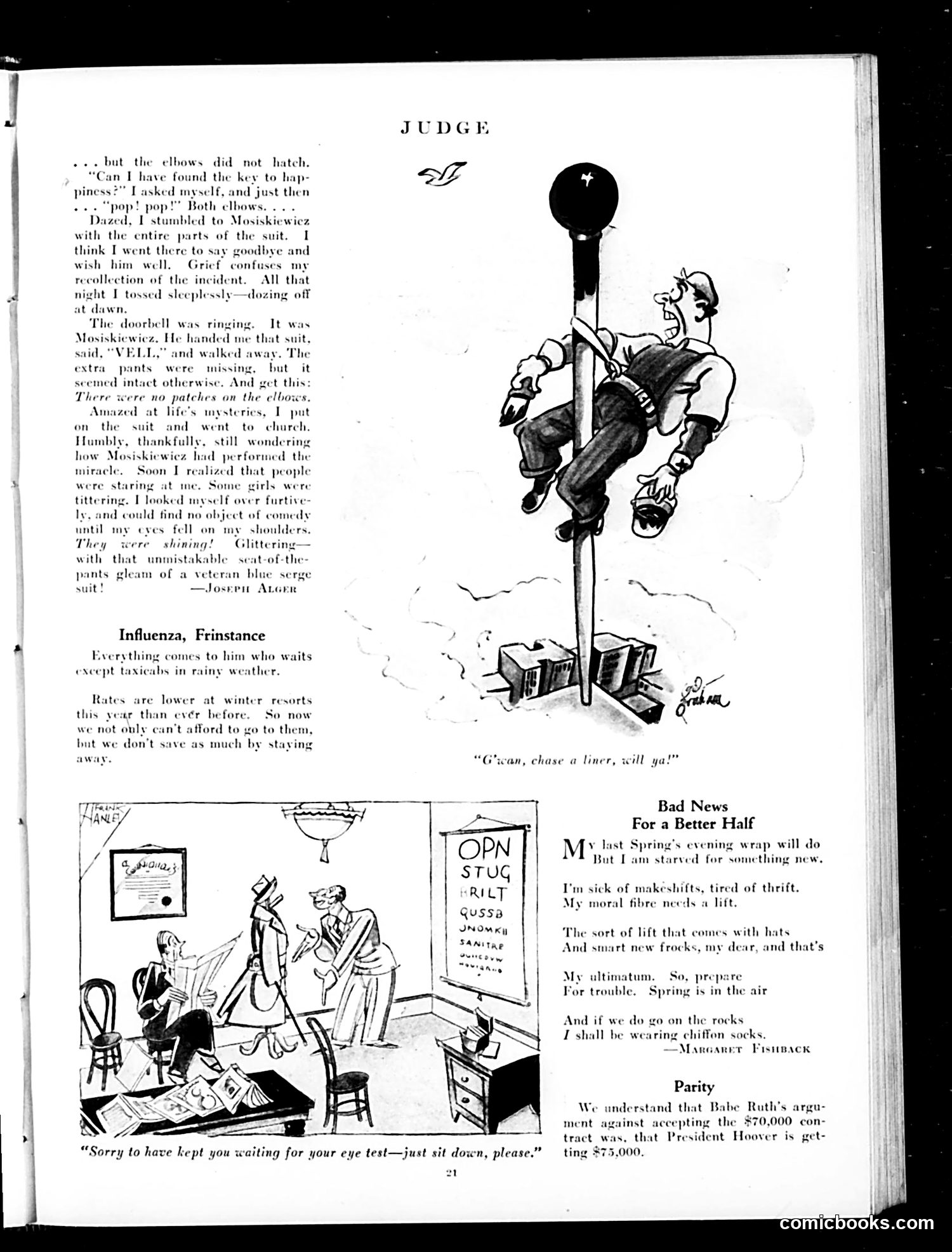
Judge Magazine Page Analysis This page from *Judge* contains multiple satirical pieces typical of the magazine's format: Top Story ("Judge"): A humorous anecdote about a tailor (Mosiskiewicz) who mysteriously repairs a suit's elbows without patches, only for the narrator to discover the pants are so worn the fabric shines visibly at the shoulders—implying the suit is ancient and threadbare. The satire mocks both tailors' limitations and the narrator's gullible relief. "Influenza, Frinstance": Brief quips about post-WWI economic hardship—taxis are scarce in rain, winter resort rates are cheap because people can't afford them anyway. Bottom Cartoon: Shows an eye doctor's office where patients wait; the joke plays on delayed service ("Sorry to have kept you waiting for your eye test"). "Bad News for a Better Half": A wife's poem demanding spring fashion and new clothes, threatening marital trouble if denied—satirizing consumerism and domestic expectations during economically tight times. "Parity": References Babe Ruth's contract dispute with President Hoover over payment amounts—contemporary sports/political commentary. The page reflects 1920s economic anxiety and social commentary typical of *Judge's* satirical approach.
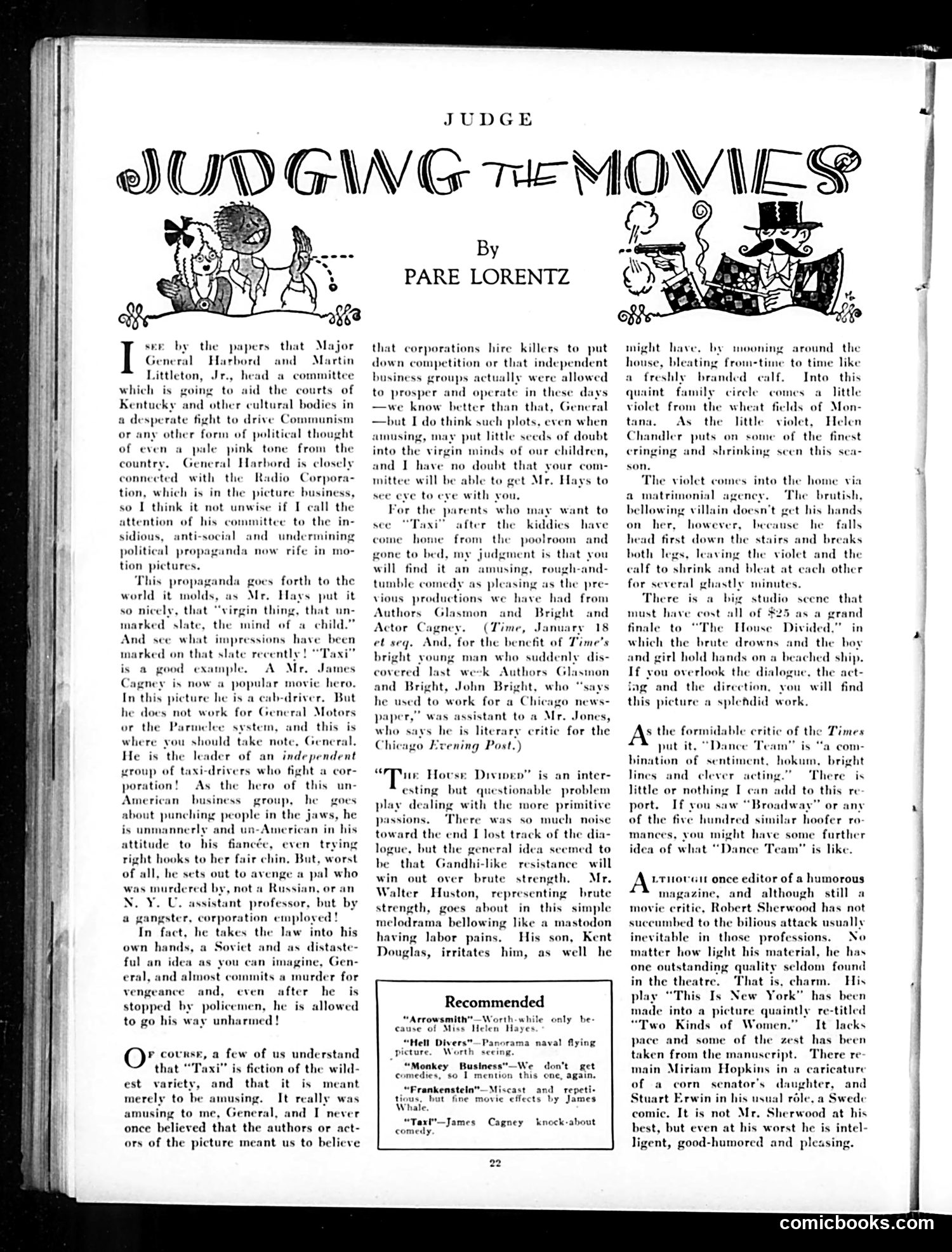
"Judging the Movies" by Pare Lorentz This column satirizes anti-communist crusaders, particularly General James Harbord (connected to RCA/radio), who worry that Hollywood spreads dangerous propaganda to innocent minds. Lorentz mocks their fears by reviewing *Taxi*, a James Cagney film about independent cab-drivers fighting a corporation. He notes that to Harbord, even showing corporate villainy or citizens taking the law into their own hands appears dangerously "un-American" and Soviet-influenced. Lorentz's irony is sharp: he agrees the plot could plant "seeds of doubt" in children's minds—but only because Harbord is right that corporations *do* hire killers and *do* suppress independent business. The satire targets censorious authorities who conflate realistic social criticism with communist propaganda, attempting to keep cinema as mindless entertainment ("that unmarked slate, the mind of a child").
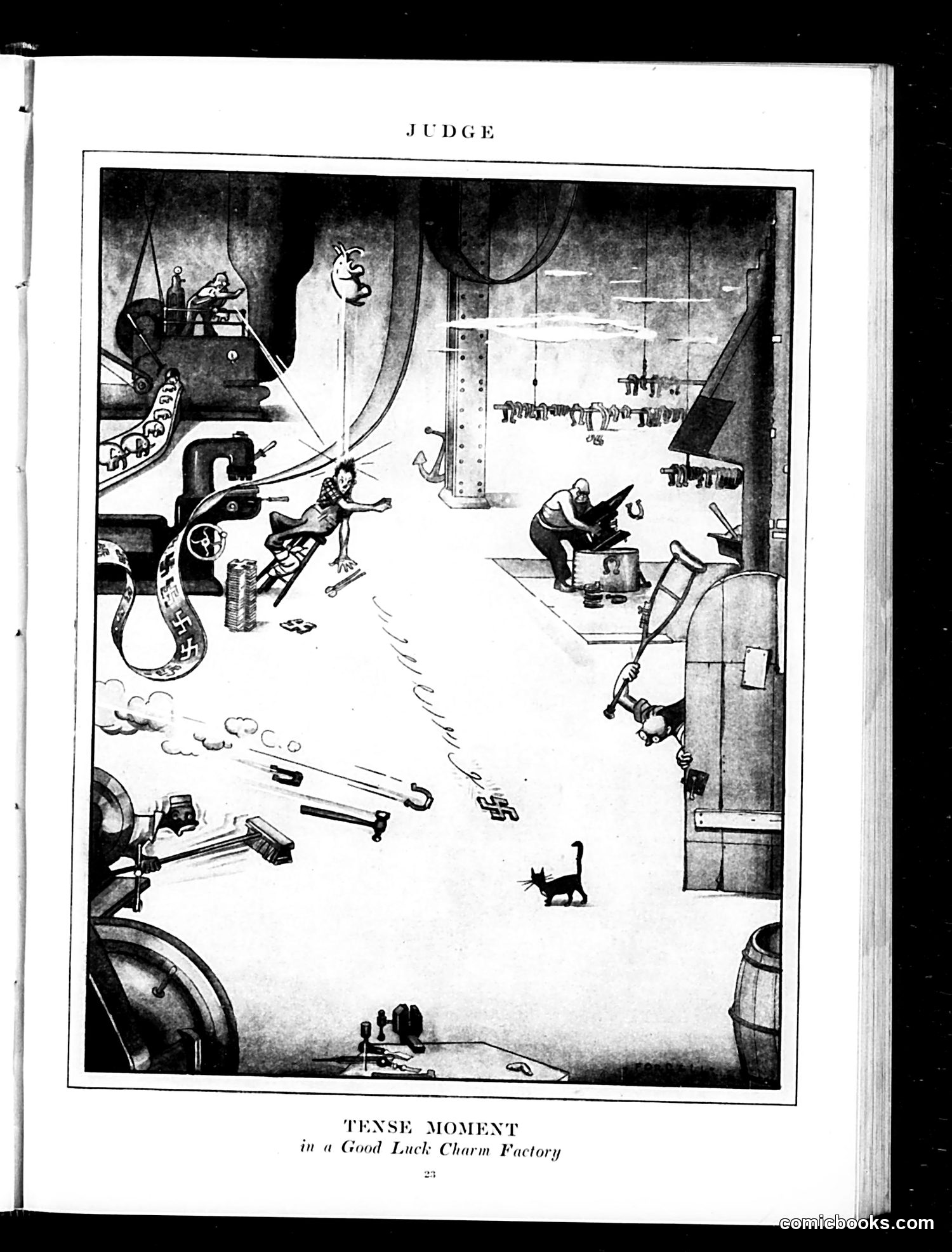
"Tense Moment in a Good Luck Charm Factory" This satirical cartoon depicts a chaotic factory scene where workers are manufacturing good luck charms. The satire appears to target the contradiction between the products being made (items supposedly bringing good fortune) and the actual dangerous, accident-prone conditions shown—workers are falling from equipment, tools are scattered everywhere, and mishaps occur throughout the workspace. A cat appears in the center, possibly adding to the "bad luck" irony. The cartoon mocks both the superstition surrounding lucky charms and, likely, poor industrial safety practices of the era. The "tense moment" refers to the workers' precarious situations, suggesting that if their own product—a good luck charm—actually worked, they wouldn't be in such peril. It's social commentary on both consumer gullibility and unsafe working conditions.
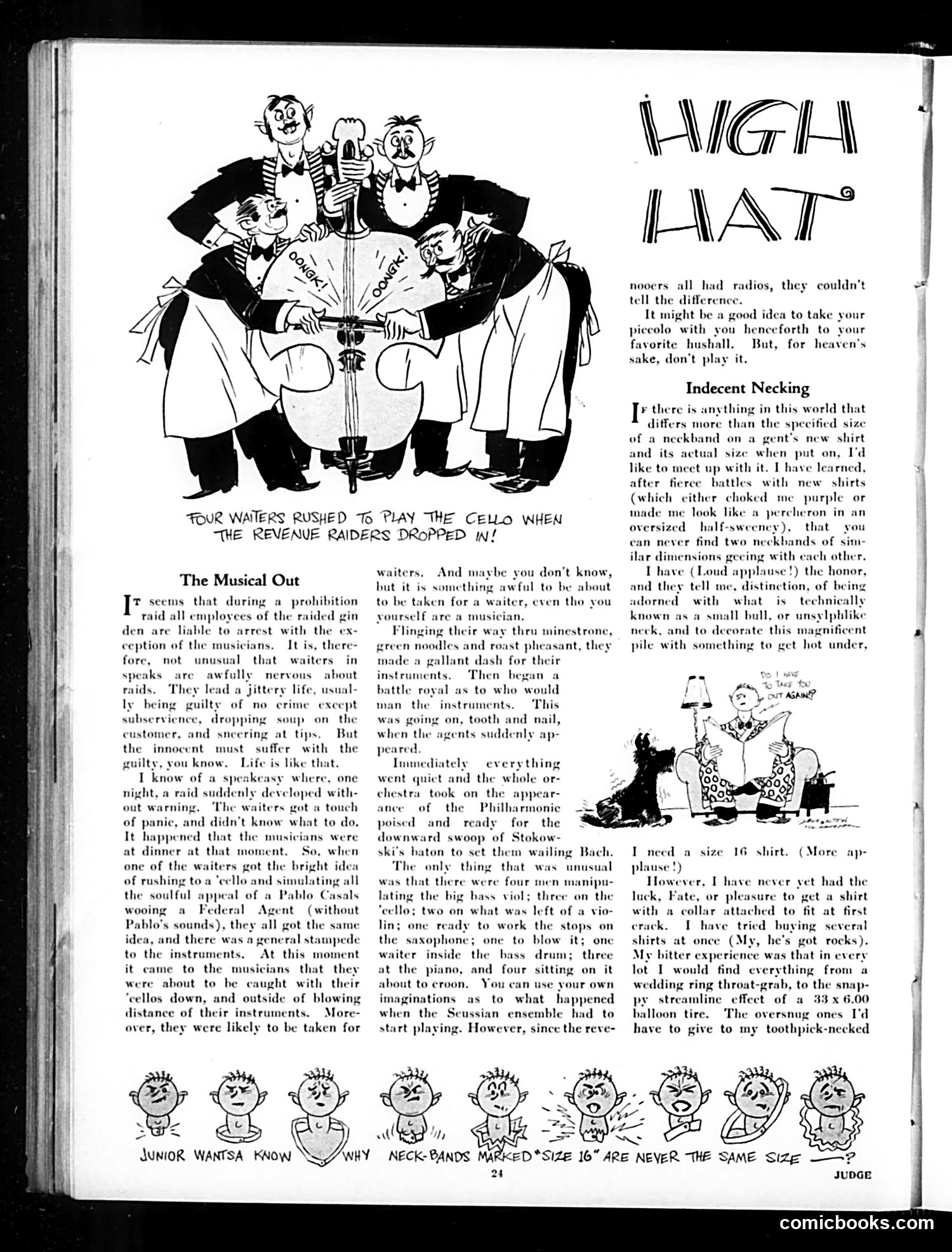
"The Musical Out" and "Indecent Necking" "The Musical Out" satirizes a Prohibition-era loophole: during police raids on illegal gin joints (speakeasies), musicians could not be arrested, but waiters could. The cartoon depicts waiters frantically grabbing instruments when revenue agents raid, pretending to be orchestra members to escape arrest. The absurdity escalates—four men manipulating one bass viol, multiple players on single instruments—yet the "Seussian ensemble" manages to fool the raiders, who have radios and "couldn't tell the difference." This mocks both the ridiculous legal technicality and Prohibition enforcement's ineffectiveness. "Indecent Necking" is a humorous complaint about shirt neckbands. The author laments that marked "size 16" neckbands vary wildly in actual fit—some choke him purple, others hang loose—making it impossible to find consistent sizing. He jokes about trying multiple shirts at once and dealing with wedding-ring throat-grab and oversized balloon-tire effects. It's genteel male grousing about clothing quality and standardization.
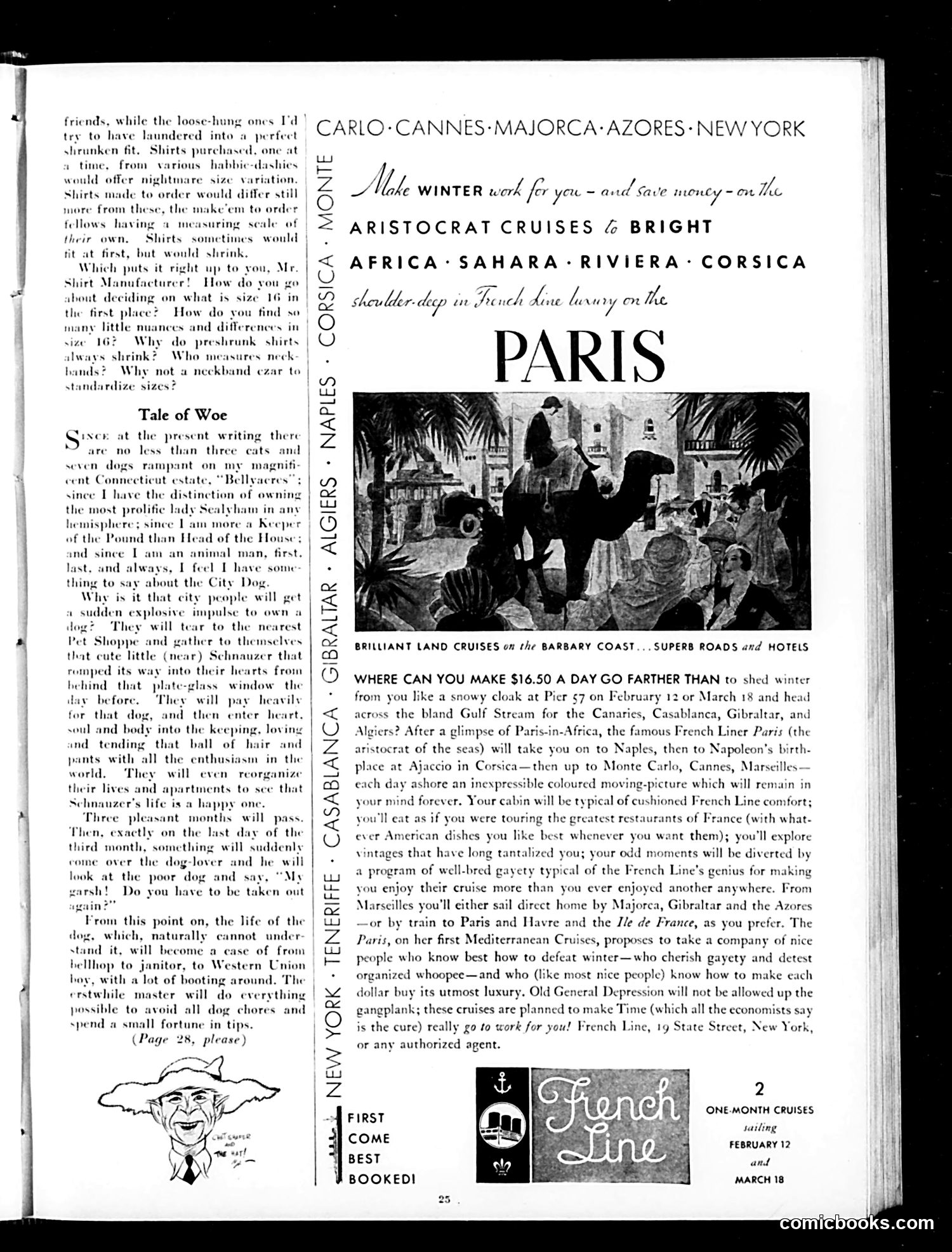
Page Analysis: Judge Magazine Advertisement and Humor This page mixes editorial humor with cruise ship advertising. The left column contains "Tale of Woe," a humorous essay about city dwellers' relationship with pet dogs—specifically how urban dog-lovers adopt puppies with enthusiasm, then quickly tire of the responsibility after three months and desperately seek ways to avoid caring for them. The satire targets the fickleness and impulsiveness of wealthy city people who treat pets as fashionable impulses rather than commitments. The right side advertises French Line cruises to Africa and Europe, positioned as winter escapes for affluent readers. A small cartoon illustration (bottom left) shows a caricatured face, though the figure's identity is unclear from the image. The page primarily functions as a vehicle for luxury travel advertising rather than political satire, targeting Judge's wealthy readership with aspirational vacation messaging.
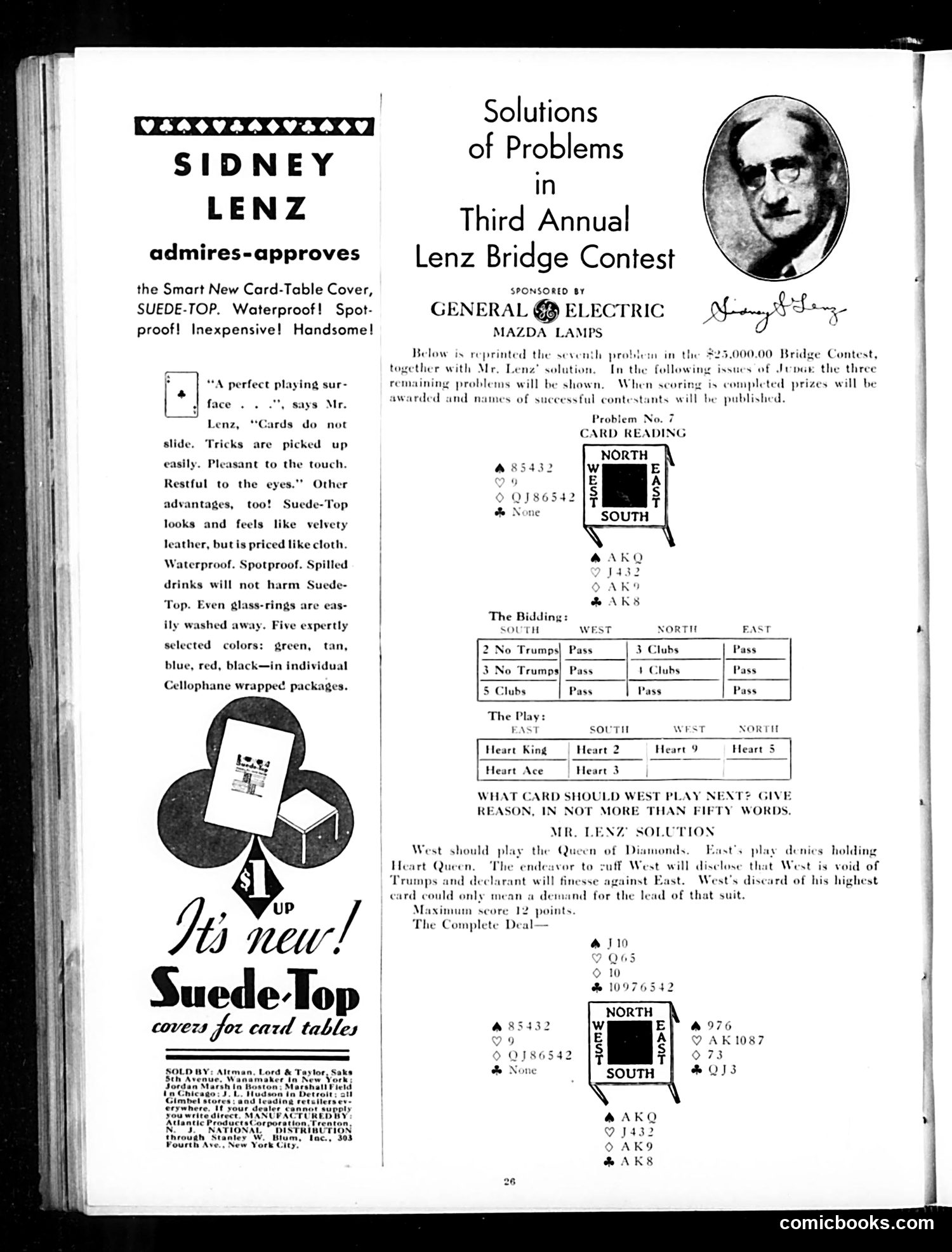
Analysis: Sidney Lenz Bridge Contest Advertisement This page combines advertising with an editorial bridge puzzle contest. The left side promotes "Suede-Top," a new waterproof card-table cover, featuring endorsement from Sidney Lenz, a renowned bridge expert (visible in the portrait photograph). The right side presents Problem No. 7 of a third annual bridge contest sponsored by General Electric (Mazda Lamps). It displays a specific bridge hand dealt, showing the bidding sequence and play, then asks readers to solve what card West should play next, with reasoning limited to fifty words. The editorial includes Lenz's solution beneath the problem. This represents Judge magazine's strategy: merge lifestyle advertising (the card-table cover for middle-class home entertainers) with intellectual content (bridge strategy) to appeal to educated readers interested in games. The contest promised prize money ($25,000 total) and published winners' names in subsequent issues.
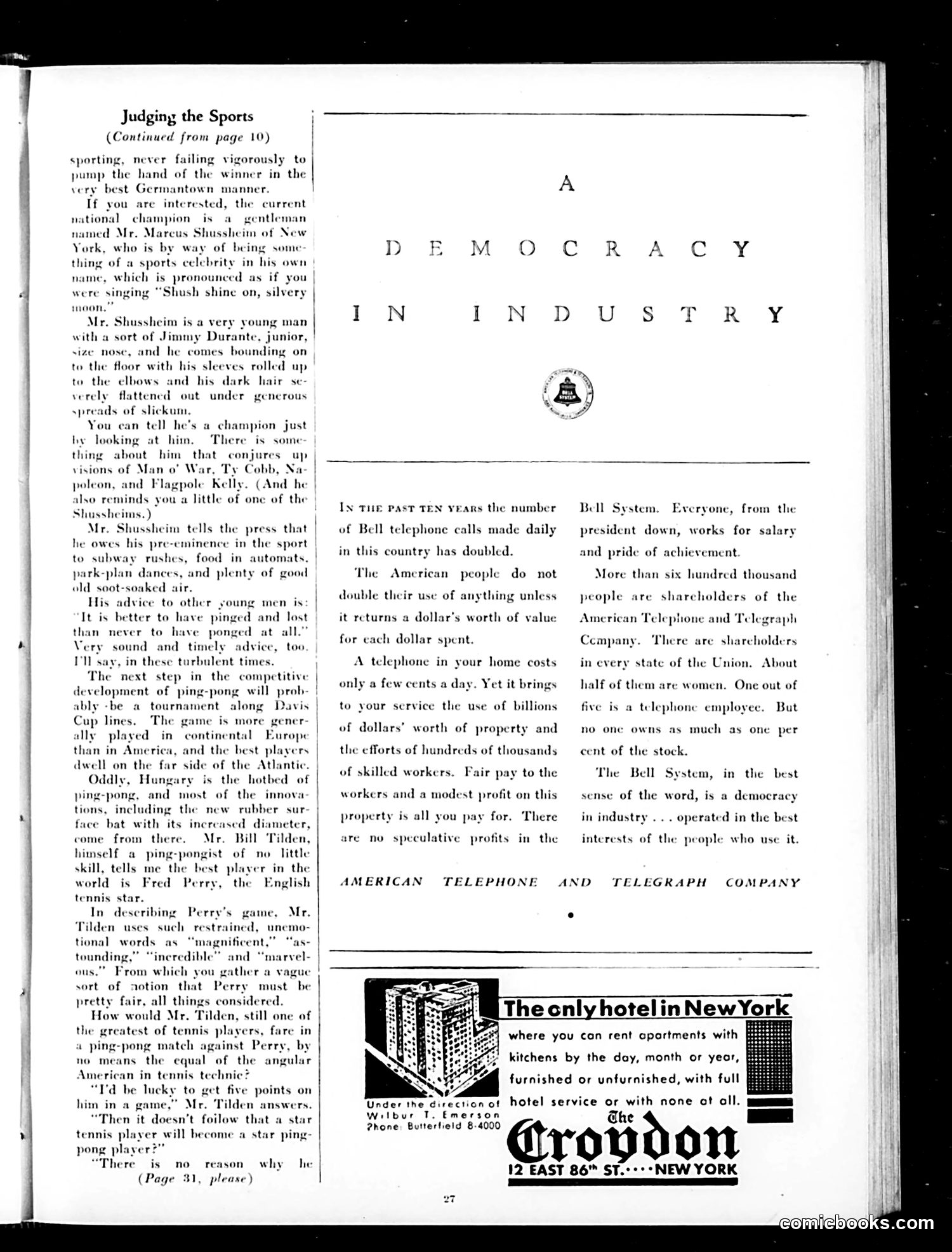
Analysis of This Judge Magazine Page This page contains a sports column (continued from page 10) about ping-pong, featuring commentary on Marcus Shussheim, the current national champion. The satire mocks the elevated, almost mythic status accorded to this athlete—comparing him to legendary figures like Man o' War (racehorse), Ty Cobb (baseball star), Napoleon, and others. The humor lies in treating ping-pong with ridiculous gravity typically reserved for major sports. The page also includes two advertisements: one for the Croydon Hotel apartments in New York, and a full-page corporate advertisement for the American Telephone and Telegraph Company promoting the "Bell System" as a "democracy in industry," emphasizing worker benefits, widespread shareholder distribution, and modest profits. This corporate messaging reflects 1920s-30s public relations attempts to present big business as democratic and worker-friendly. The page appears to be from the 1930s-1940s era based on style and references.
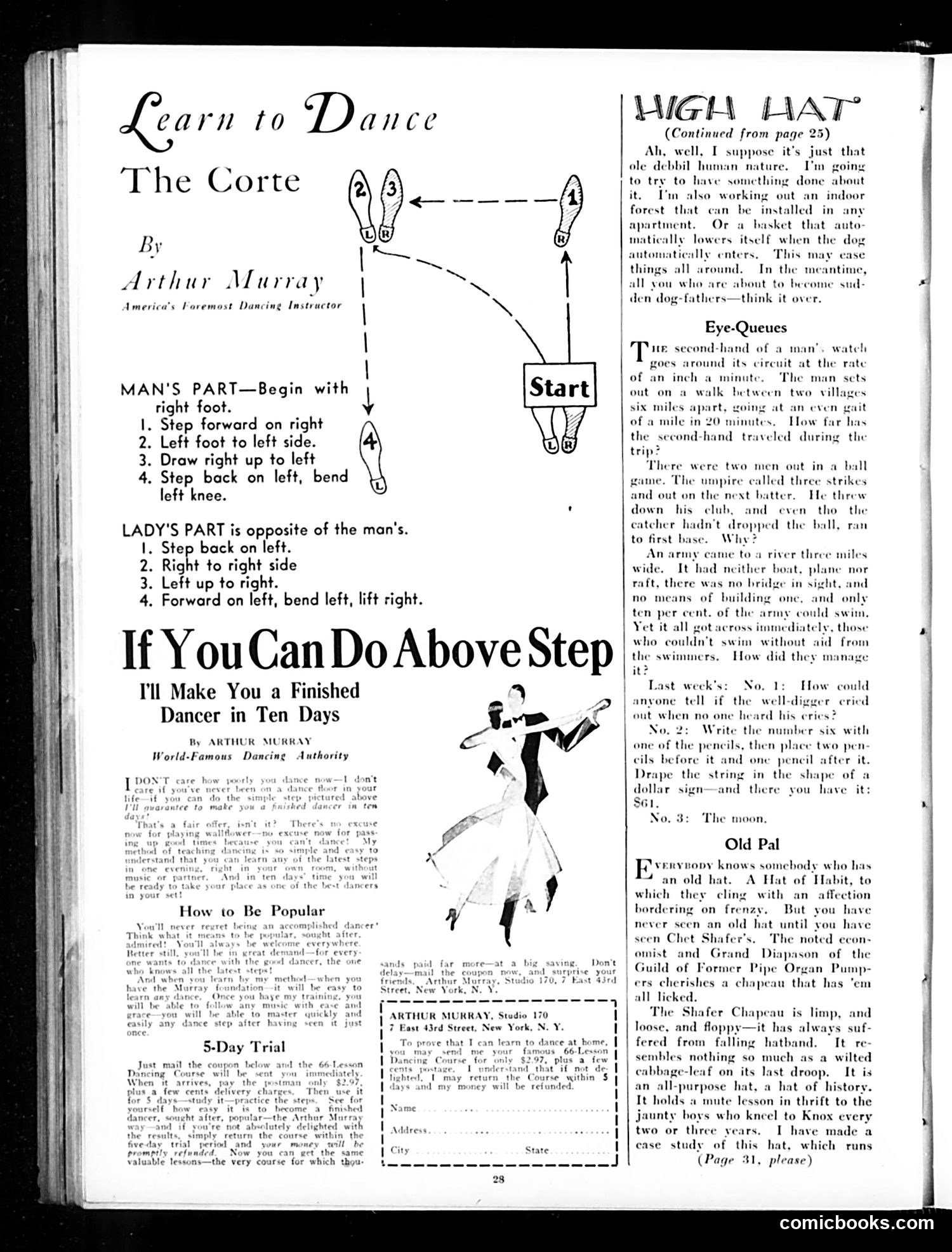
Analysis for Modern Readers This page contains dance instruction and humor content, not political satire. The left side features Arthur Murray's "Learn to Dance" advertisement—Murray was a famous real dancing instructor of the era who pioneered mail-order dance lessons. He promises to make readers "a finished dancer in ten days" by teaching "The Corte" (a basic dance step), with diagrams showing foot positions. This reflects 1920s-30s American enthusiasm for ballroom dancing. The right side contains "High Hat," a humor column with three sections: 1. "Eye-Queues"—riddle puzzles testing readers' logic (a watch's second hand, umpire paradoxes, army river-crossing) 2. "Old Pal"—a humorous character sketch about Chet Shafer and his worn-out hat, poking fun at extreme frugality and sentimental attachment to shabby possessions. The content is light entertainment and self-improvement advertising typical of Judge magazine, with no apparent political references or social commentary.
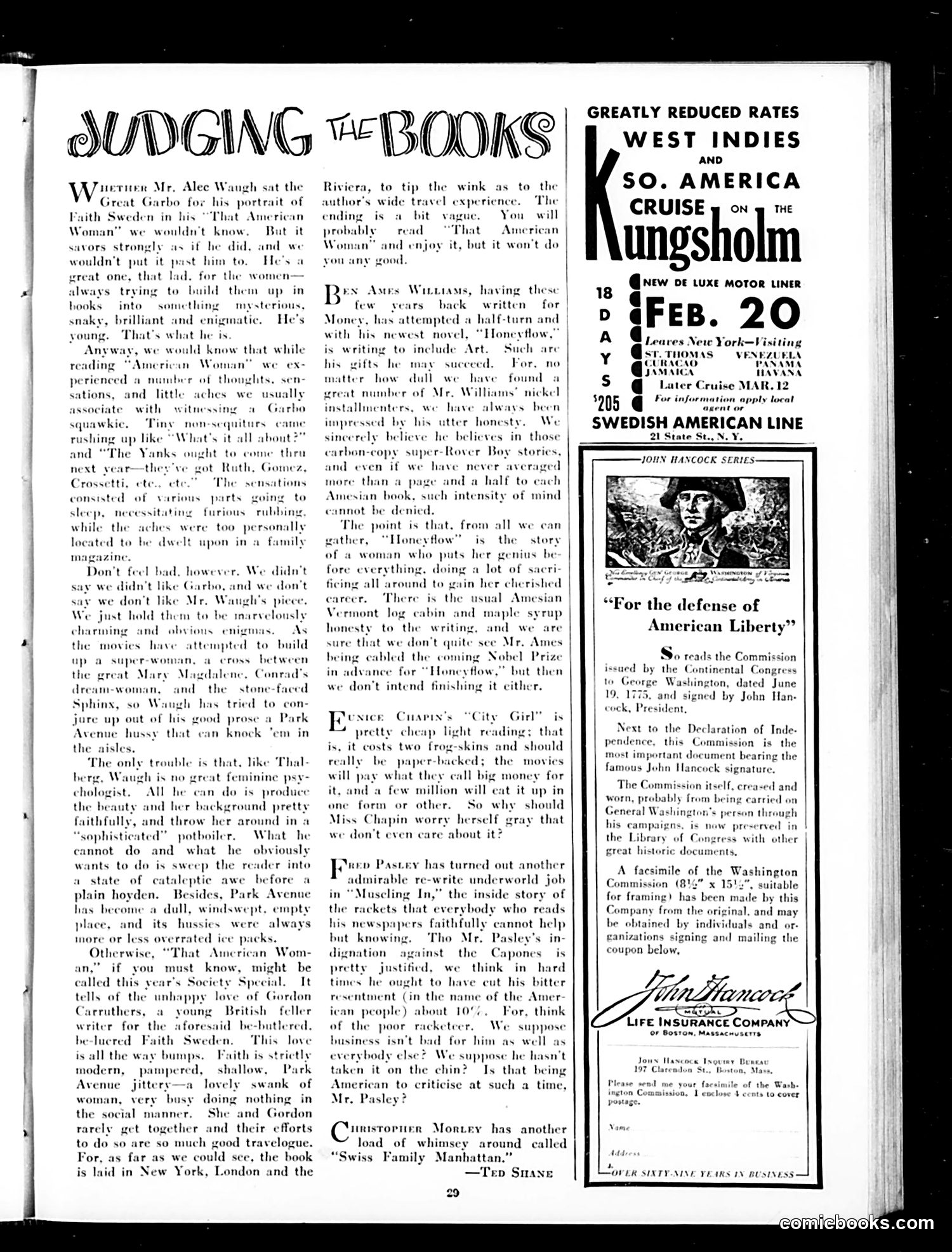
"Judging the Books" - A Book Review Column This is a book review column from Judge magazine, not a political cartoon. The page critiques three contemporary novels: 1. Alec Waugh's "That American Woman" — The reviewer mocks Waugh's attempt to create a mysterious, sophisticated female protagonist (comparing her to Greta Garbo), but finds the characterization shallow and the plot (set in New York, London, and the Riviera) merely travelogue masquerading as literature. 2. Ben Ames Williams' "Honeyflow" — The critic praises Williams' honesty as a writer despite finding his previous serialized work dull, and notes his new novel attempts to incorporate serious Art alongside its romance plot. 3. Fannie Chapin's "City Girl" — Dismissed as cheap, frivolous entertainment priced at "two frog-skins" (slang for dollars), likely to sell millions regardless of literary merit. The satire targets both authors' commercial pandering and readers' lowbrow tastes.
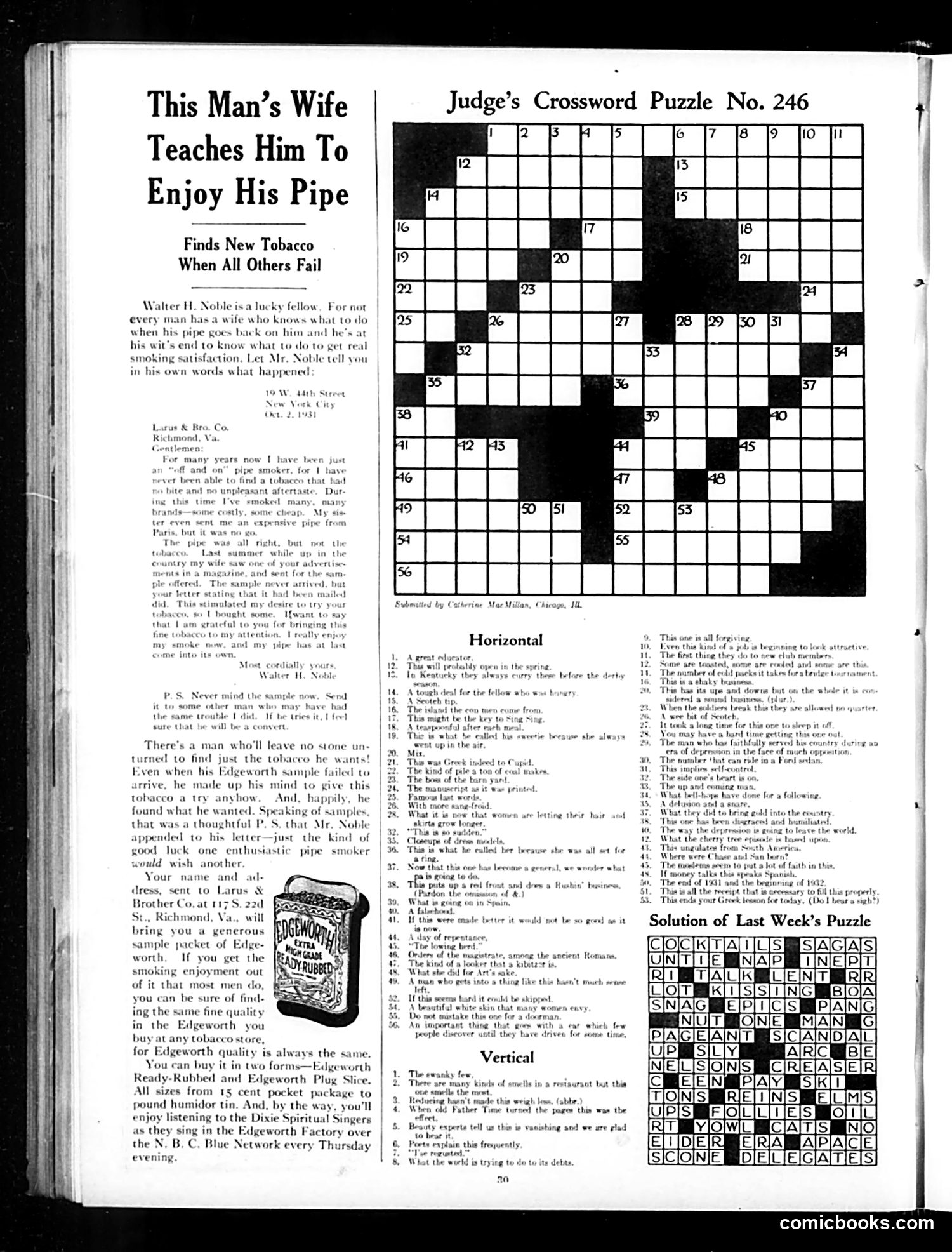
Analysis for Modern Readers This page is primarily advertising disguised as editorial content—a common Judge magazine format from the early 20th century. The main piece, "This Man's Wife Teaches Him To Enjoy His Pipe," is a testimonial ad for Edgeworth tobacco. A satisfied customer named Walter H. Noble claims his wife discovered this brand after he'd tried countless others unsuccessfully. The "satire" is gentle: the joke is that a man needed his wife's intervention to solve his pipe-smoking frustration. The humor relies on early 20th-century gender dynamics—the implication that wives know best about domestic pleasures and consumer products. The piece uses the everyman-customer-letter format common in vintage advertising to create false authenticity. The page also includes a crossword puzzle and solution—standard Judge filler content. Key context lost today: This represents an era when satirical magazines routinely blurred advertising and editorial, and when tobacco advertising faced no restrictions. The "luck" Walter found wasn't satirical—it was sincere marketing.
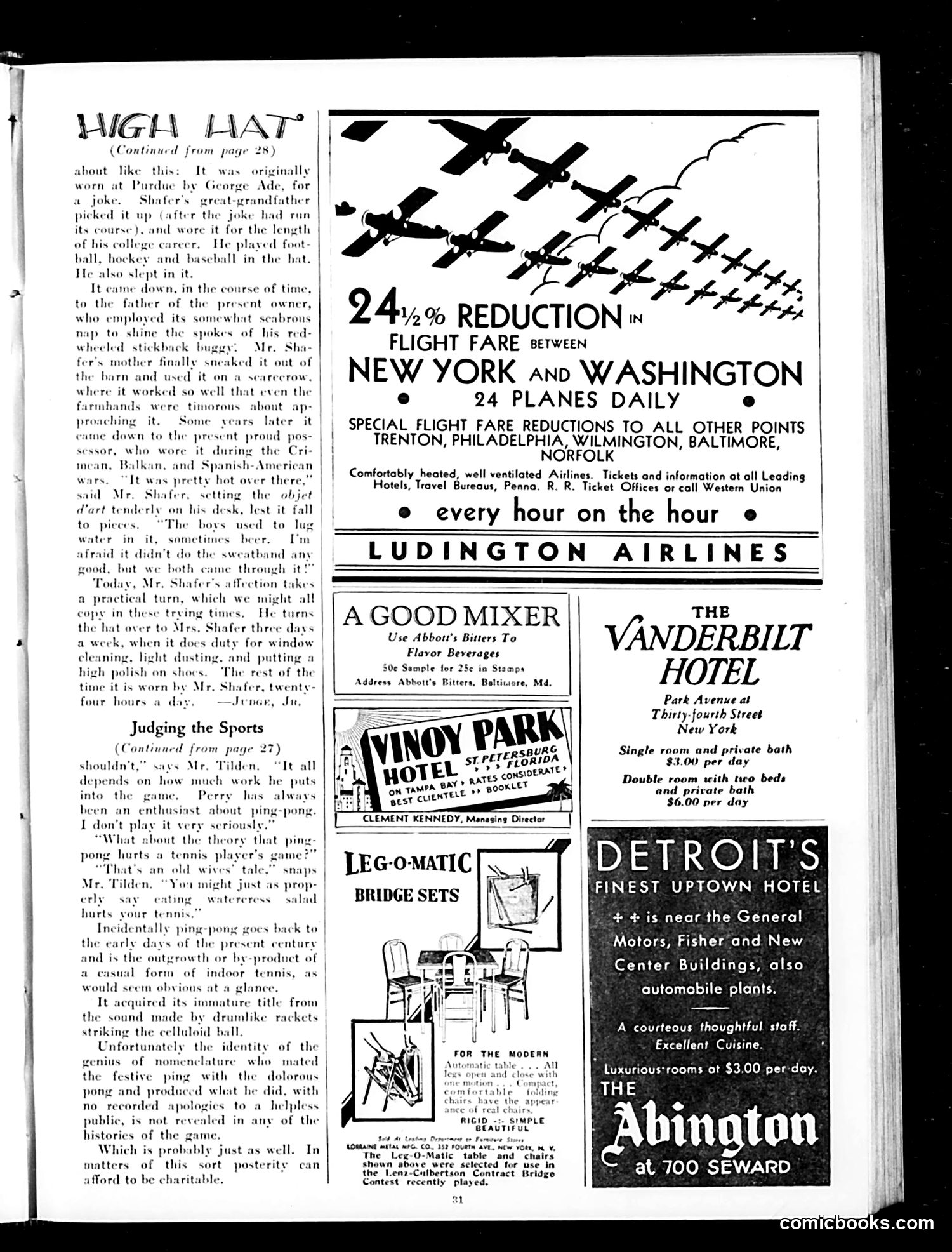
Analysis of Judge Magazine Page This page is primarily advertising with minimal editorial content. The top section contains two brief articles continued from previous pages—one about a treasured high hat passed through generations (emphasizing durability and practical repurposing during hard times), and another about tennis player Bill Tilden discussing ping-pong's effects on tennis performance. The bulk of the page consists of period advertisements typical of Judge magazine, including: - Ludington Airlines: promoting reduced fares (24½% off) between New York and Washington with 24 daily flights - Hotel advertisements: The Vanderbilt Hotel (NYC), Detroit's Finest Uptown Hotel, and The Abington - Product ads: Abbott's Bitters, Leg-O-Matic Bridge Sets, and Vinoy Park Hotel (Florida) The airline ad's airplane graphic and promotional language suggest this is from the 1920s-1930s, when commercial aviation was still novel and noteworthy. No political satire or caricature is present on this page—it functions primarily as a revenue-generating advertising section rather than satirical editorial content.
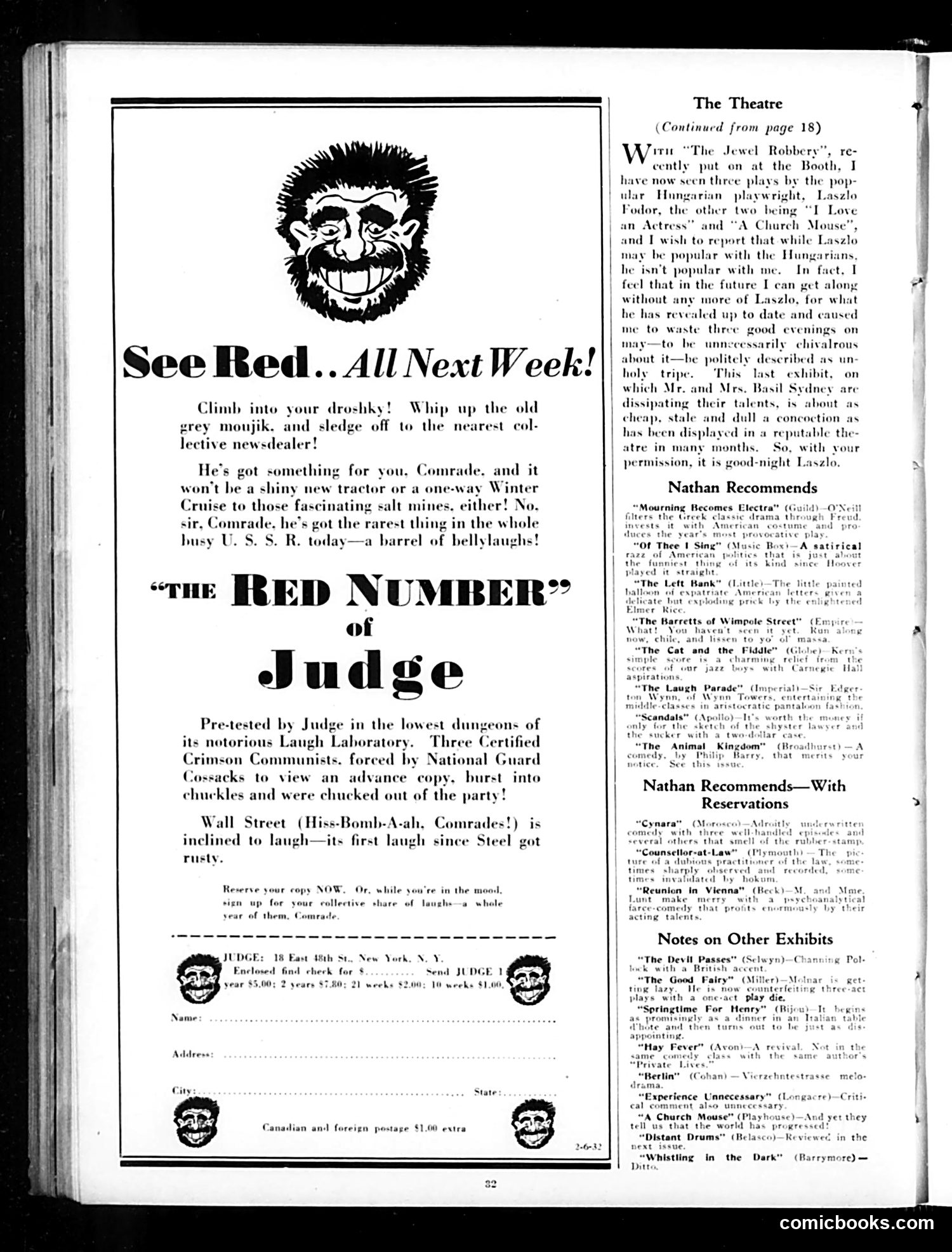
"The Red Number" of Judge Magazine This page advertises an upcoming issue of Judge, a satirical magazine, themed around Soviet communism—a major anxiety in 1920s-30s America. The cartoon's exaggerated monkey/ape face labeled "See Red" puns on the phrase "seeing red" (anger) while evoking anti-communist propaganda imagery. The advertisement mockingly addresses readers as "Comrade" and references Soviet imagery (droshkys, moujiks, collective newsdealers, tractors) to humorously promote the issue as containing communist-themed humor. References to "National Guard racks" forcing "Crimson Communists" to view the material suggests Cold War-era paranoia about communist infiltration. The joke targets Wall Street's economic troubles ("first laugh since Steel got rusty"), implying capitalists need communist satire as comic relief during financial hardship. This reflects Judge's conservative, anti-labor stance during economically turbulent times.
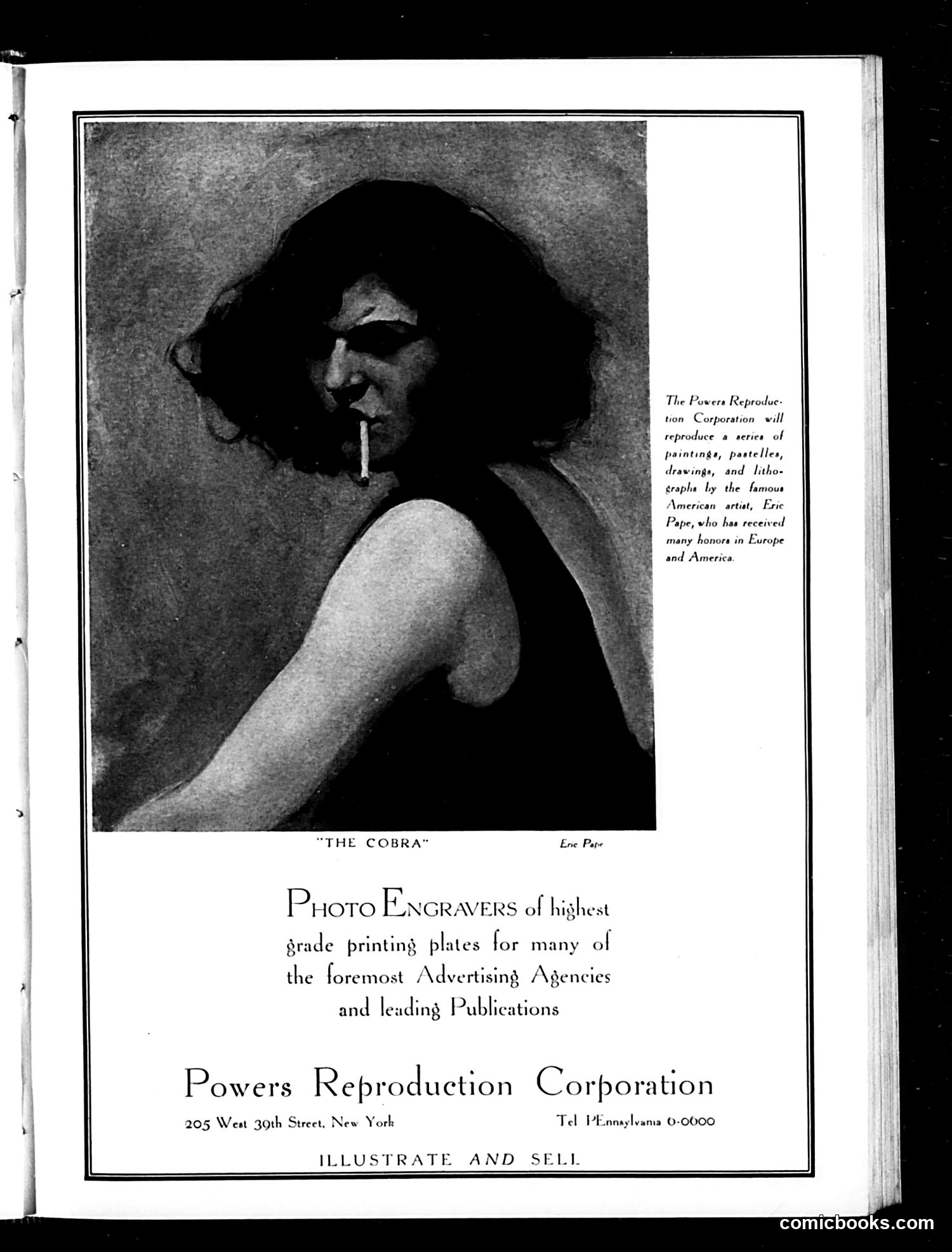
Analysis This is primarily an advertisement, not a political cartoon. It promotes the Powers Reproduction Corporation's photo-engraving services for advertising agencies and publications. The image shows a stylized portrait titled "The Cobra" by artist Eric Pape—a figure wearing sunglasses and smoking a cigarette, rendered in dramatic shadow. The work exemplifies Pape's artistic style, which the text notes earned him honors in Europe and America. The ad's purpose is to showcase Powers Reproduction Corporation's capability to reproduce fine artwork (paintings, pastels, drawings, lithographs) as high-quality printing plates. The striking portrait serves as a sample demonstrating their technical quality for potential advertising clients. There is no political satire here—this is a straightforward commercial announcement in *Judge* magazine.
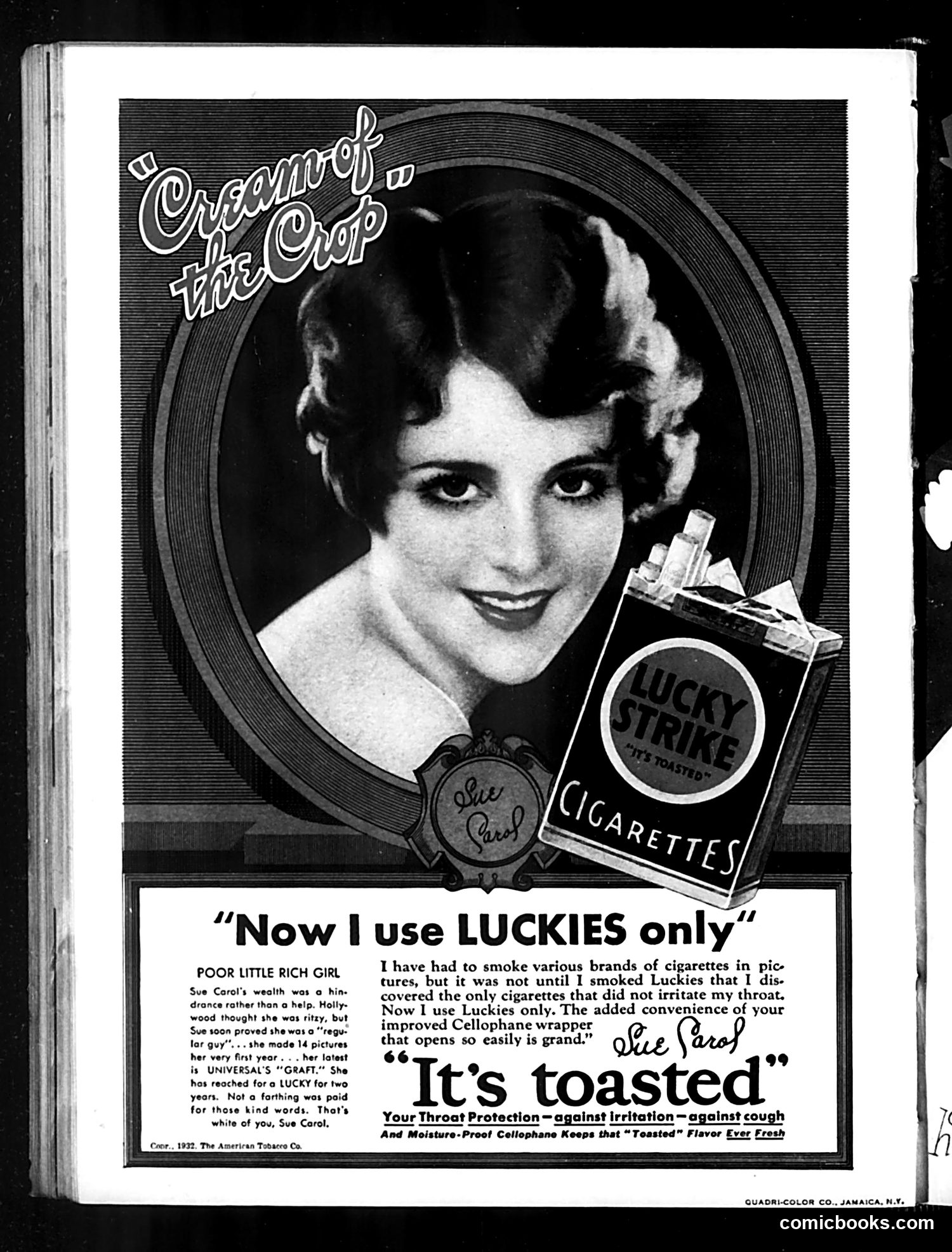
Analysis This is a Lucky Strike cigarette advertisement masquerading as editorial content in Judge magazine (1927). It features actress Sue Carol endorsing the product. The "satire" or joke lies in the transparent fakery: the ad claims Carol hasn't been paid ("Not a farthing was paid for those kind words"), a disclaimer required by advertising regulations of the era. The accompanying narrative about her Hollywood success is purely promotional—she's described as a "regular guy" despite her wealth, making her relatable to consumers. The cigarette marketing pitch emphasizes "throat protection" and a "toasted" flavor as health benefits—claims that would be illegal today. The "Moisture-Proof Cellophane wrapper" is presented as a major selling point. Modern context: This represents early celebrity endorsement advertising and the pre-regulation tobacco industry's aggressive health claims. The disclaimer about payment is ironic—the entire article exists solely to sell cigarettes using a famous actress's supposed authentic testimony.