judge
Judge — February 13, 1932
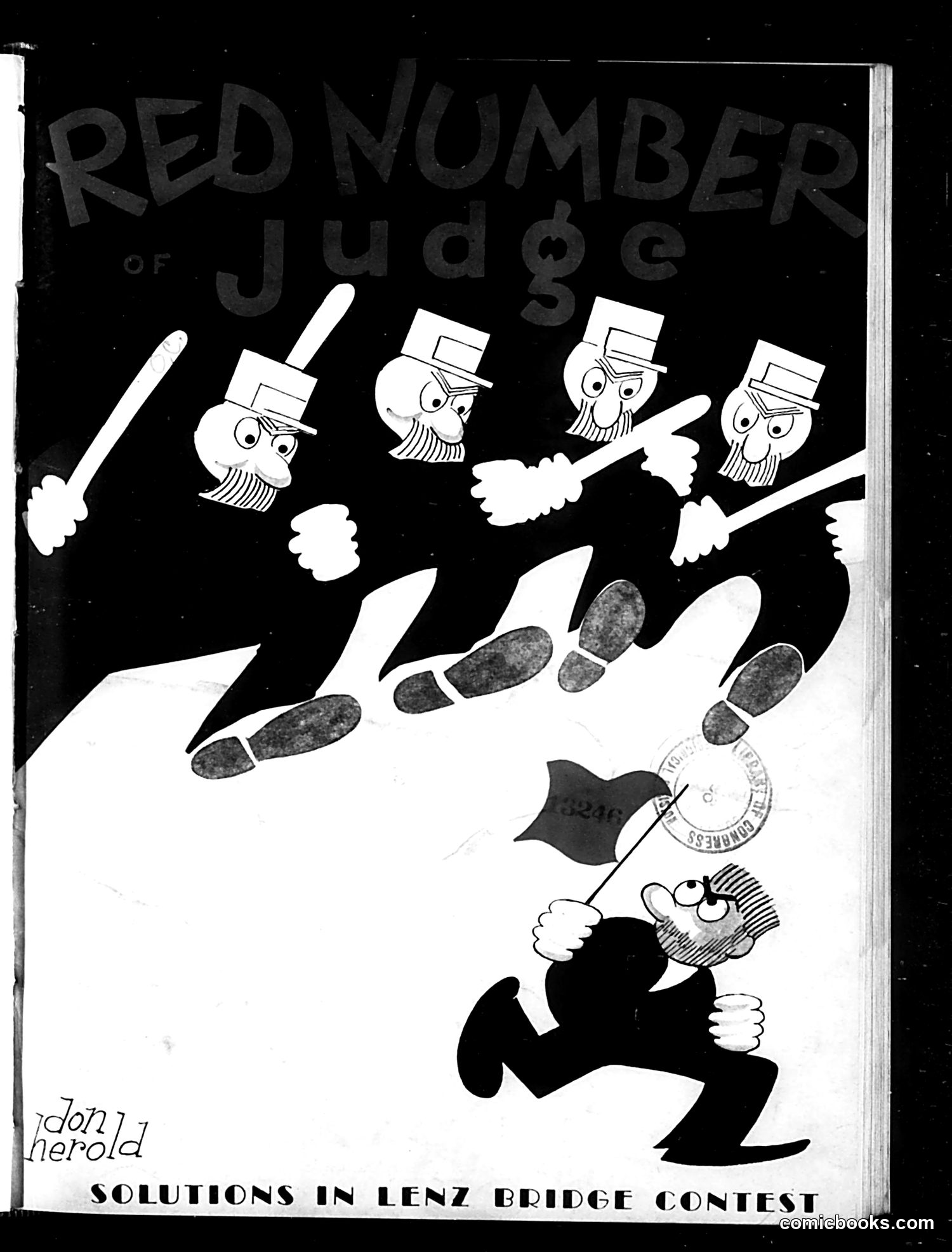
"Red Number of Judge" — Lenz Bridge Contest Solutions This appears to be a cover for Judge magazine's "Red Number" (a special issue), featuring a satirical cartoon about a "Lenz Bridge Contest." The image shows a character in black (likely representing a judge or contest official) being pelted with papers/solutions by five caricatured heads wearing top hats above—these appear to represent competing entries or contestants. The papers rain down on the official, suggesting an overwhelming volume of submissions. The satire mocks either the contest's popularity, the judge's difficulty in evaluating numerous proposals, or possibly the absurdity of the bridge-design competition itself. The artist is John Harold (signed lower left). Without more historical context, the specific bridge and contest remain unclear, though this likely references a real contemporary engineering or design competition.

Analysis This page is primarily a product advertisement, not political satire. It advertises Red Lion cooking flavors (gin, rye, scotch extracts) for home cooking. The ad's humor derives from a common 1920s-30s domestic scenario: a well-dressed couple appears delighted by their homemade meal, with the man remarking that "things must be going better with Lord and Lady" since the wife learned to cook using Red Lion Flavors. The accompanying text sarcastically appeals to Depression-era economics ("Oh, very economical!"), encouraging households to save money on restaurant meals by cooking at home with these affordable flavor extracts. The fence offer in the headline is a loss-leader promotion meant to drive product sales. The satire is gentle—mocking both gender roles and economic desperation rather than attacking specific political figures or events.
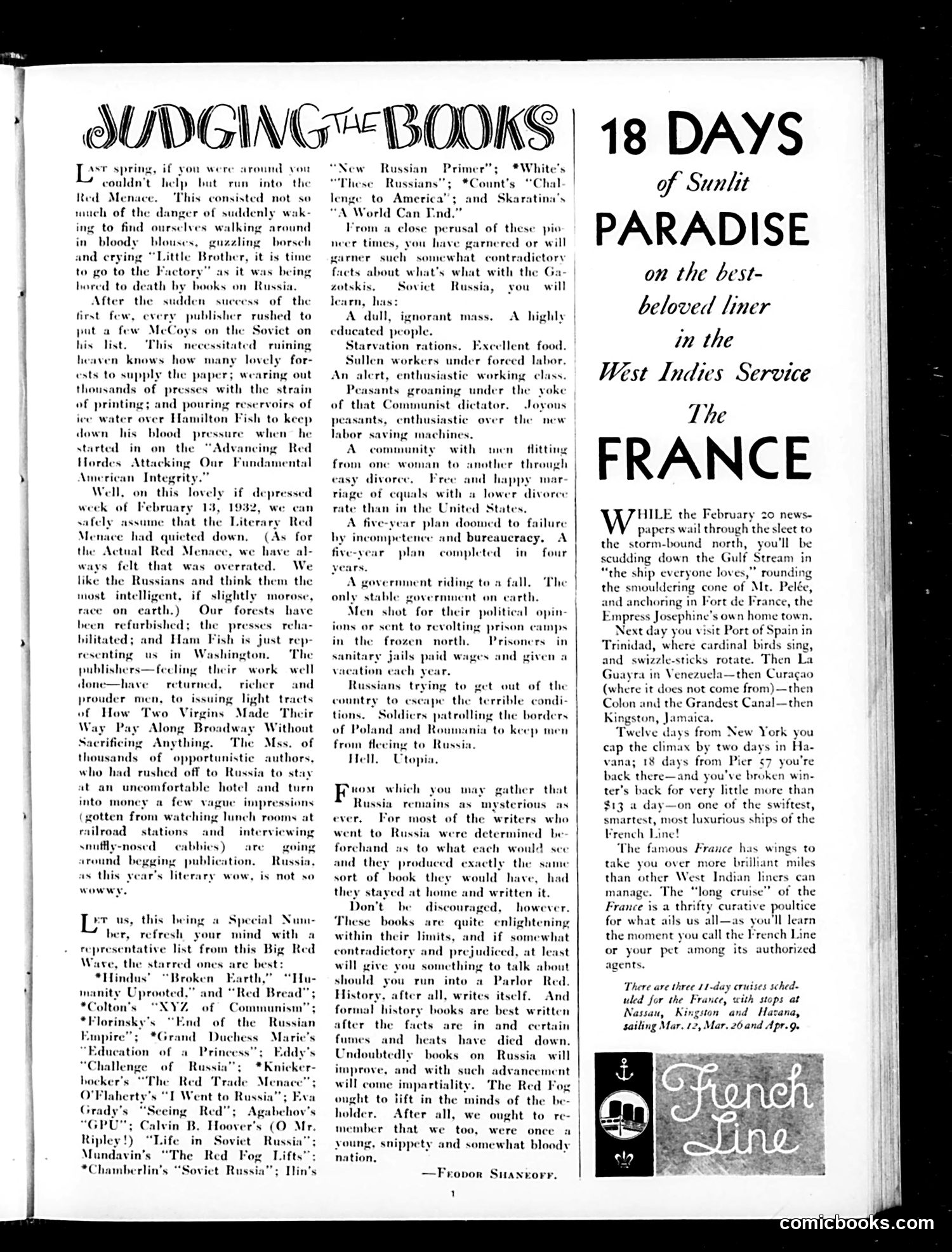
Analysis This page is primarily editorial content, not a political cartoon. The left column contains "Judging the Books," a satirical book review section critiquing recent Russian-themed publications. The author mocks publishers' rush to capitalize on anti-Soviet sentiment by releasing numerous books about Russia, noting many are contradictory, poorly researched, and written by unqualified authors. The right side advertises the SS France, a luxury ocean liner in the West Indies Service. This appears to be a paid advertisement rather than satirical content. The "Judging the Books" section represents Judge magazine's typical approach: using humor to mock American commercial culture's opportunistic trends, here the publishing industry's exploitation of Cold War anxieties about Russia.
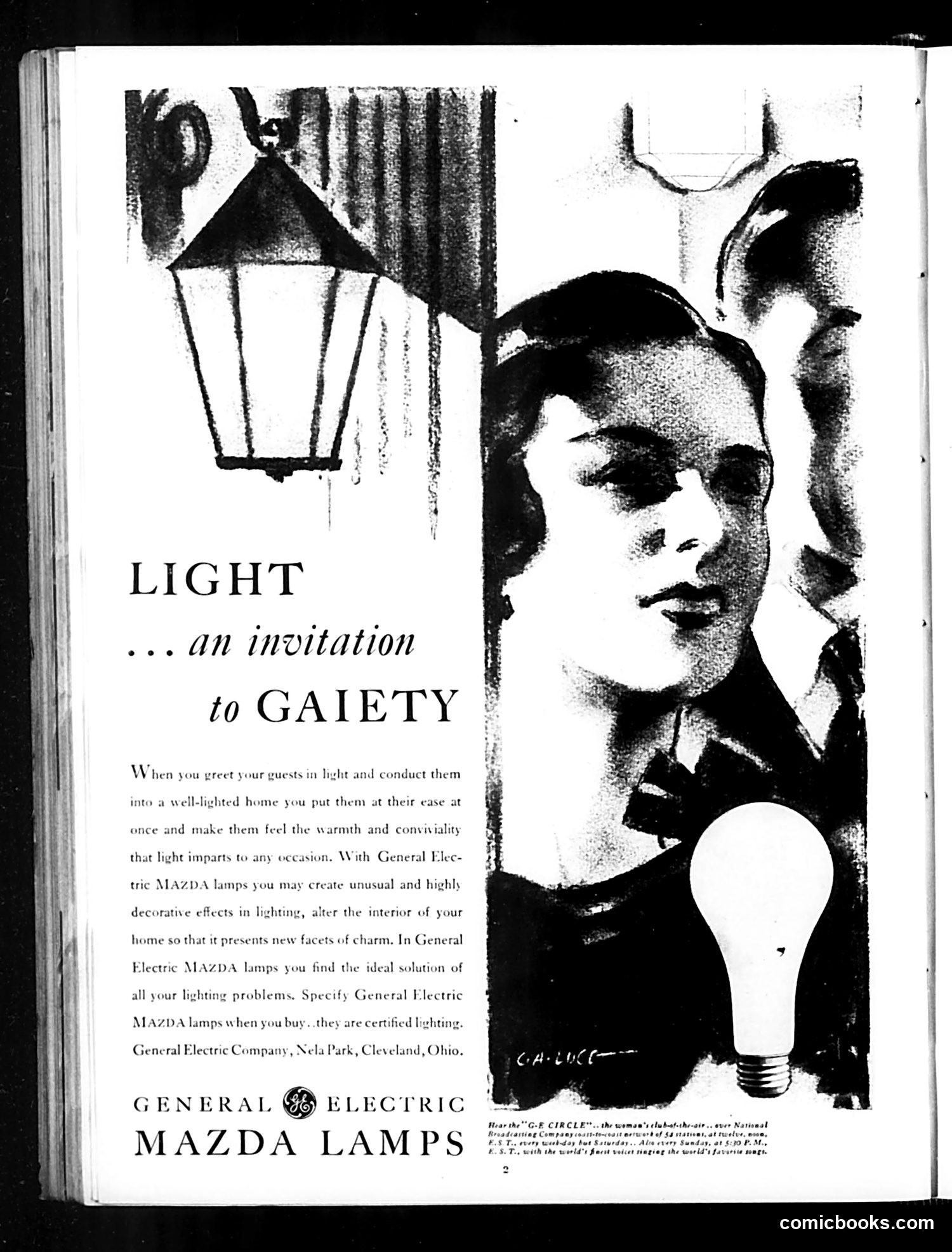
Analysis This page is primarily an advertisement, not political satire. It's a General Electric MAZDA Lamps marketing campaign titled "Light...an invitation to GAIETY." The ad uses a glamorous woman's portrait alongside a lightbulb to promote home lighting. The copy appeals to social aspirations—suggesting that proper lighting creates an atmosphere of "warmth and conviviality" for entertaining guests, thereby elevating one's social standing ("gaiety"). The accompanying lantern illustration reinforces the decorative/aesthetic angle. This represents typical 1920s-30s advertising strategy: linking consumer products to lifestyle desires and social prestige rather than functional benefits. No political satire is present here. This is straightforward commercial messaging in a humor magazine's advertising section.
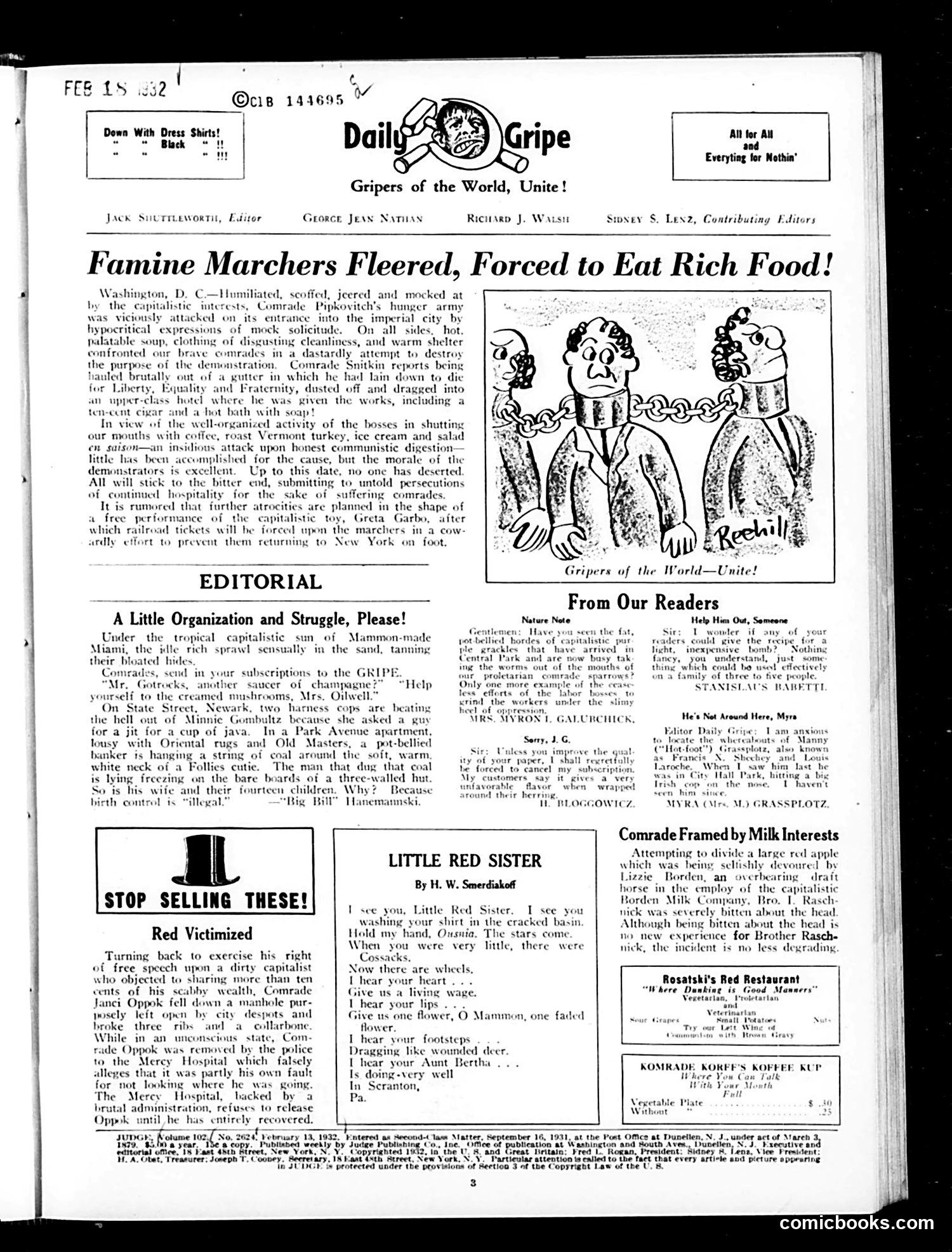
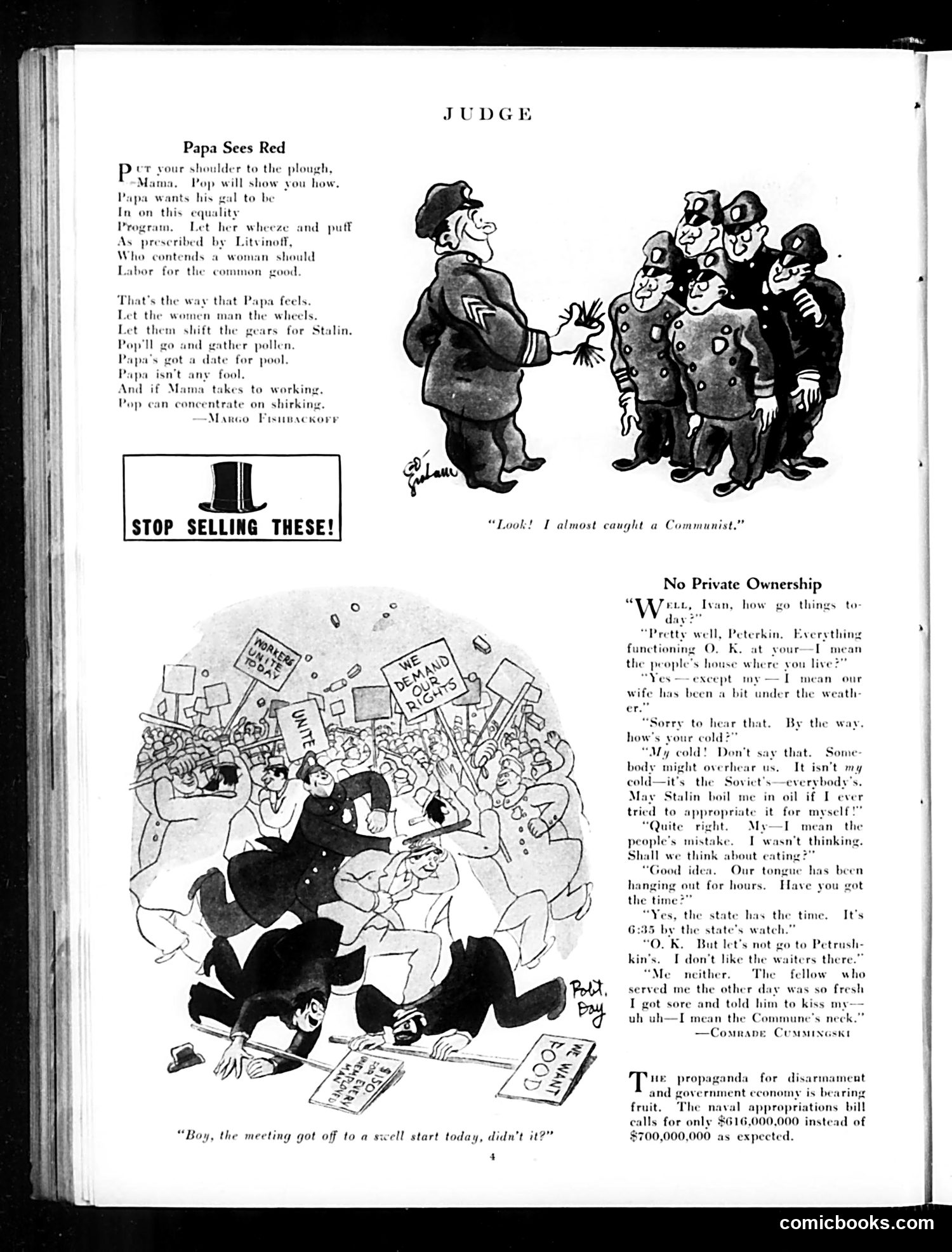
Political Satire Analysis This Judge magazine page contains anti-communist Cold War propaganda. The top cartoon mocks Papa (likely Stalin) seeing "red" — showing him alarmed among what appear to be Soviet officials. The caption "Look! I almost caught a Communist" suggests paranoid communist leadership. The lower cartoon depicts a chaotic meeting with protest signs reading "WE DEMAND" and "WORKERS," satirizing communist organizing or propaganda efforts as disorderly mob activity. The "No Private Ownership" dialogue mocks Soviet collectivization, with characters suggesting private property confiscation. The final note about reduced naval appropriations ($610M vs. $700M expected) reflects 1940s-50s defense budget debates. Overall, the page uses exaggeration and mockery to portray communism as threatening, disorganized, and fundamentally opposed to American values like private property.
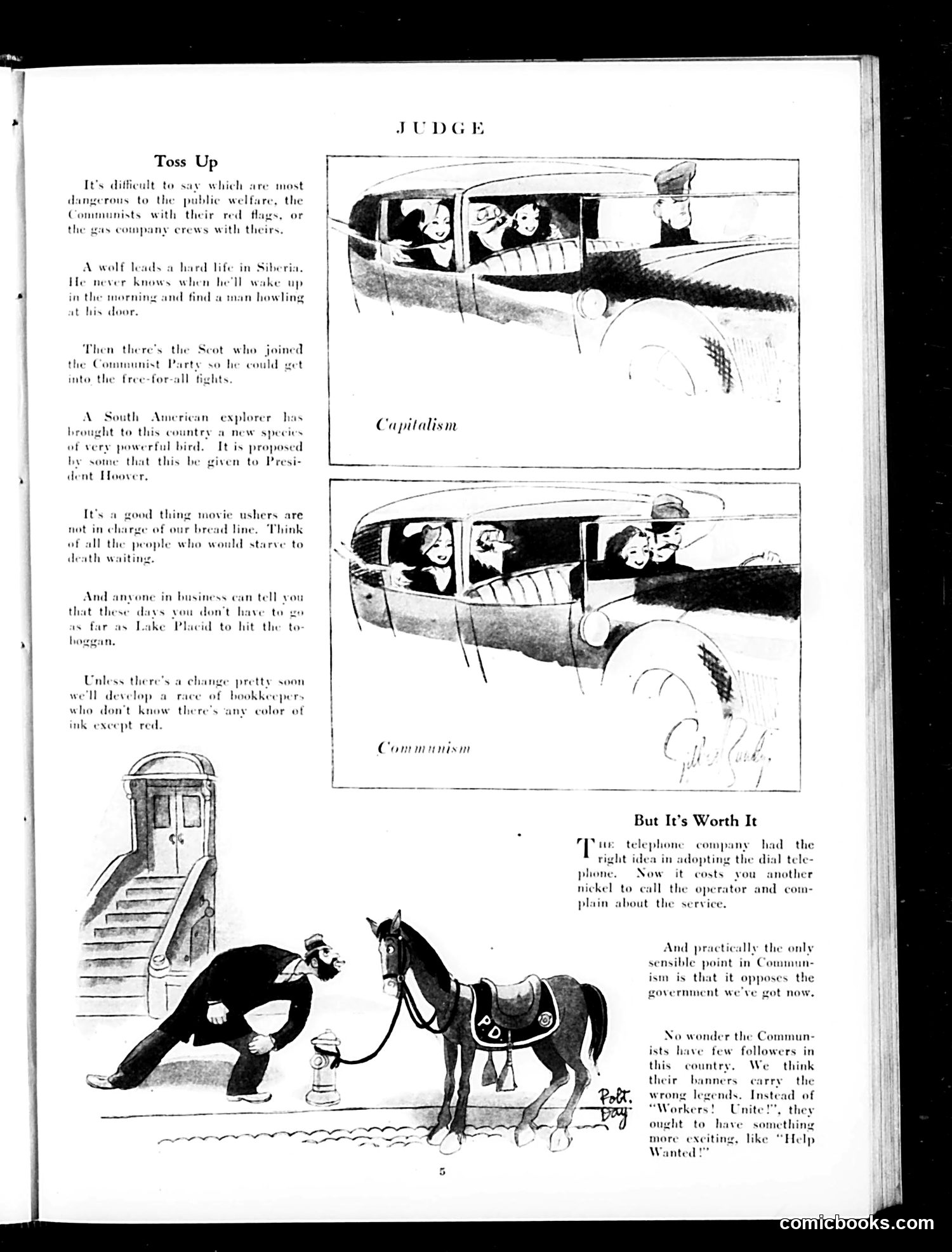
Analysis of Judge Page This page satirizes the ideological conflict between capitalism and communism, likely from the 1920s-30s Red Scare era. Top cartoons: Two panels show a car labeled "Capitalism" (top) versus "Communism" (bottom), each carrying passengers toward different fates—suggesting both systems have dangerous consequences. "Toss Up" section: Text mocks various threats to American stability: Siberian wolves, communists infiltrating politics, dangerous exotic birds, movie ushers' power, and business corruption. The tone is deliberately absurd, treating all as equal dangers. Bottom cartoon: A man lies exhausted beside a horse, illustrating the text's point about telephone company dial adoption—framed as citizens being exploited by corporate fees. Overall, the page uses exaggeration and dark humor to dismiss communist ideology while simultaneously criticizing American capitalism's excesses.
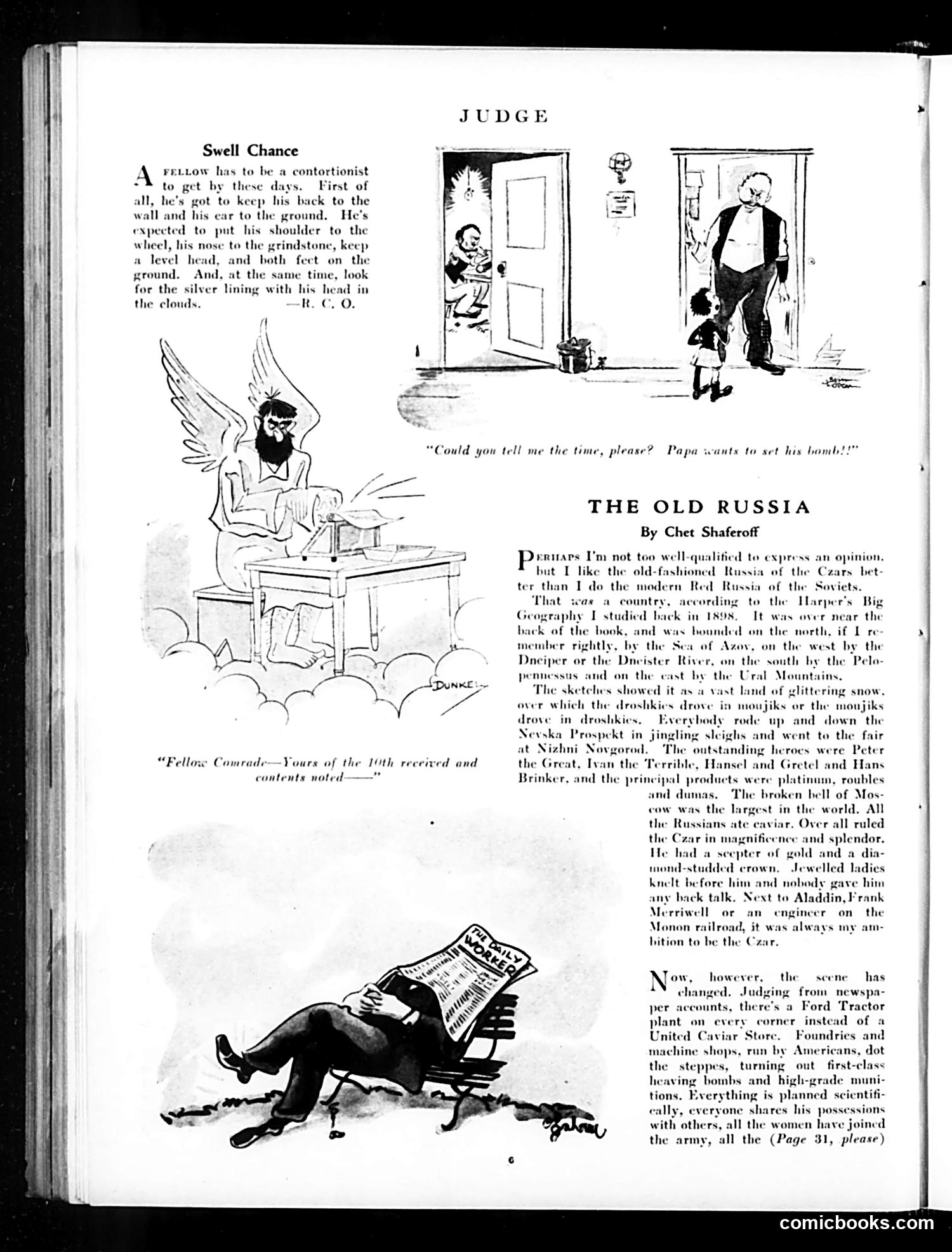
Analysis of Judge Magazine Page "Swell Chance" cartoon (top): Depicts a contortionist attempting an impossible physical feat—bending backward to touch his head to a wheel while keeping feet grounded. The caption's reference to "silver lining" suggests this mocks someone pursuing an unrealistic goal or false hope. "The Old Russia" article (by Chet Shaferoff): Contrasts pre-Soviet Russia under the Czars with modern Soviet Russia. Shaferoff nostalgically describes imperial Russia's grandeur—the Czar's splendor, wealth, and hierarchical society—while lamenting modern Soviet industrialization (Ford Tractor plants, factories) where "everyone shares possessions" and "all the women have joined the army." The piece satirizes Soviet communalism as a loss of the romantic imperial past.
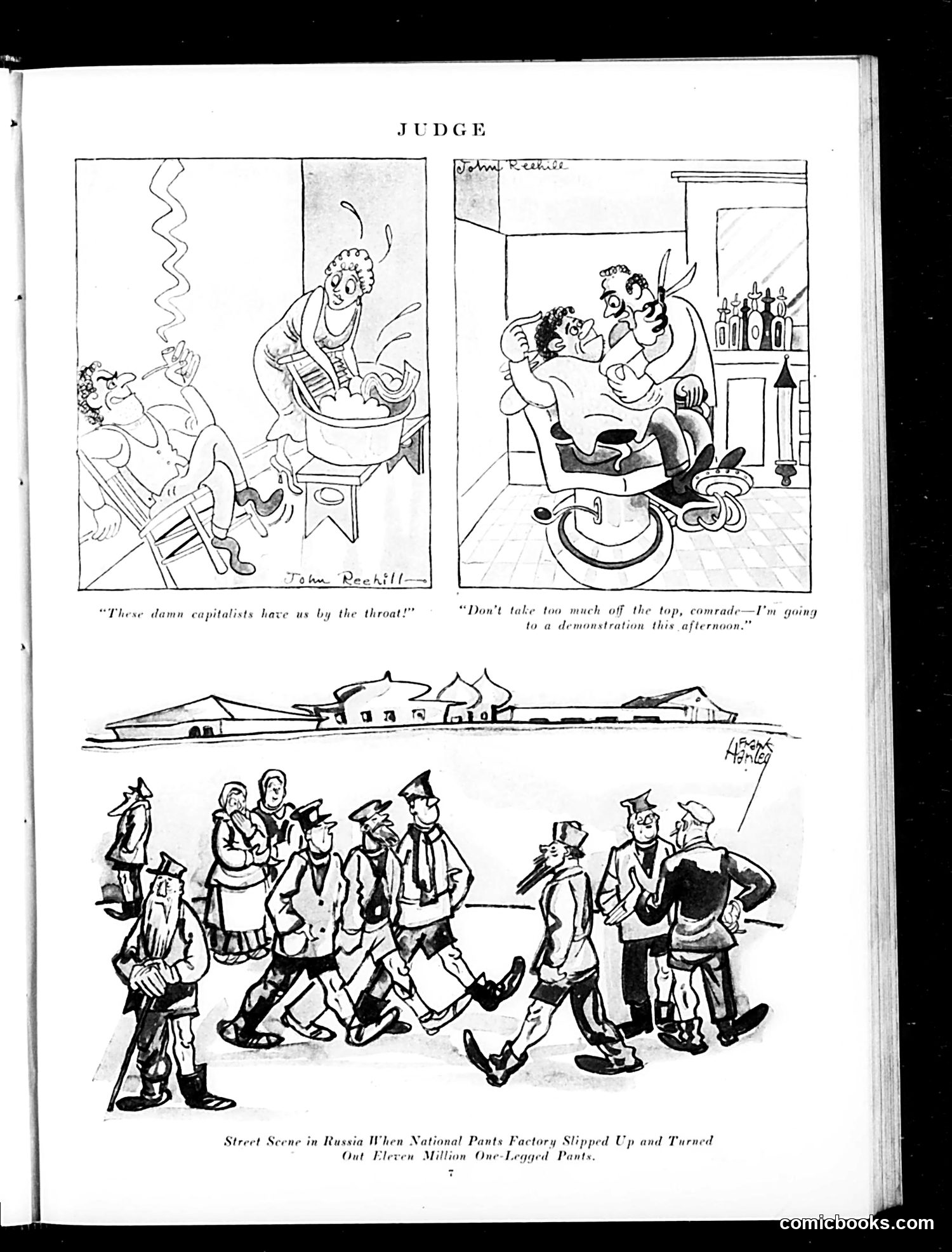
Political Cartoon Analysis: Judge Magazine Page This page contains three satirical cartoons labeled "JUDGE." The top two cartoons appear to reference capitalist exploitation and political demonstrations, with captions about "damn capitalists" and attending "a demonstration this afternoon." The bottom cartoon, titled "Street Scene in Russia When National Pants Factory Slipped Up and Turned Out Eleven Million One-Legged Pants," satirizes Soviet industrial inefficiency and communist centralized planning. It depicts Russian civilians in chaotic confusion over a massive factory error—producing one-legged pants instead of proper clothing. This mocks both Soviet manufacturing failures and the absurdity of rigid communist bureaucracy where such enormous mistakes could occur without correction. The cartoon reflects American Cold War-era skepticism toward Soviet competence and communist economic systems.
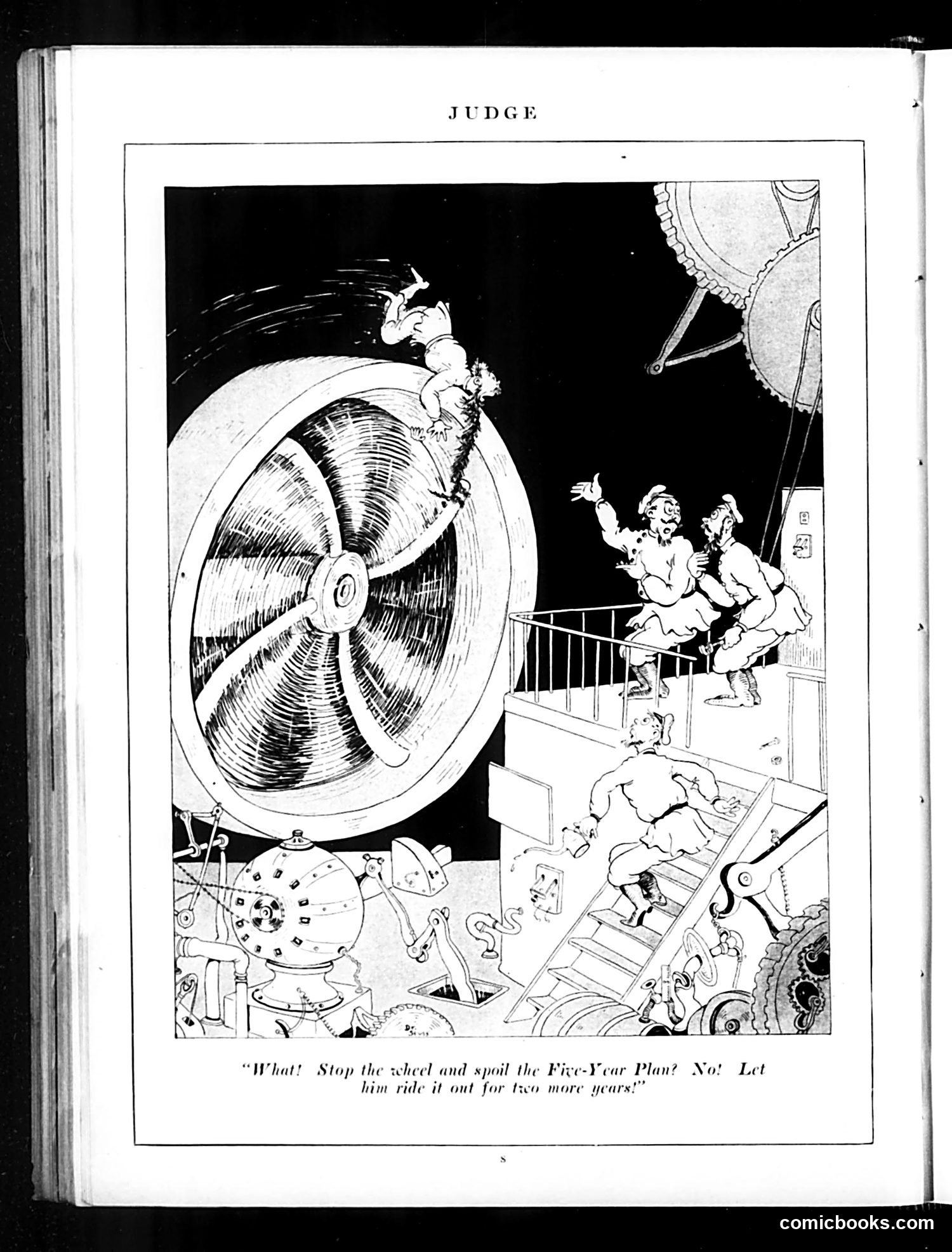
Political Cartoon Analysis This Judge magazine cartoon satirizes Soviet leadership, likely from the early 1930s. The massive wheel represents Stalin's "Five-Year Plan"—the Soviet Union's ambitious industrial development program. The figures appear to be Communist leaders callously allowing a person to continue being ground by the wheel for two additional years rather than stopping it to save him. The satire attacks the Five-Year Plan's human cost and the leadership's indifference to suffering caused by their policies. The exaggerated mechanical imagery emphasizes how the plan treated people as disposable cogs. This reflects American anti-Communist sentiment and criticism of Stalin's brutal industrialization, which caused widespread famine and hardship among Soviet citizens during this period.
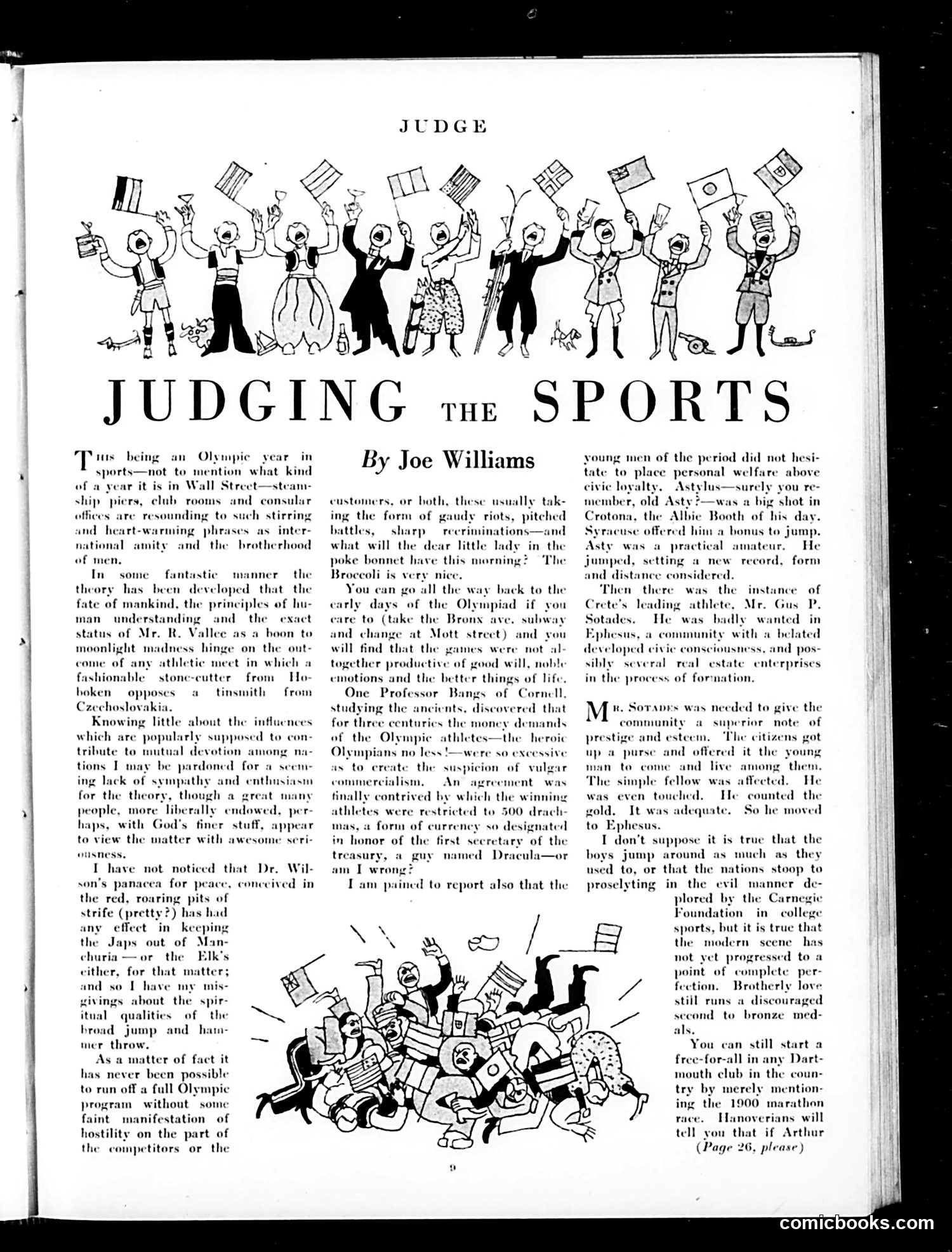
Judging the Sports: What This 1928 Cartoon Means This is a satirical article by Joe Williams about the 1928 Olympics, illustrated with two cartoons showing jubilant athletes waving flags and, below, a chaotic pile of brawling competitors. The satire: Williams mocks the widespread belief that Olympic competition promotes "international amity and the brotherhood of men." He argues this is naive—the ancient Olympics were equally commercialized and contentious. He cites "Professor Bangs of Cornell" discovering that ancient Olympic athletes demanded excessive prize money (500 drachmas), and communities bribed athletes with bonuses to compete for them (citing a fictional "Dracula" as treasury secretary and an athlete named "Asty"). The point: Modern nations haven't truly "progressed" morally through sports—athletes remain mercenary, communities still compete for prestige through athletic recruitment, and hostility persists. The cartoons visually reinforce that Olympic competition produces chaos, not unity. Williams suggests linking national virtue to athletic prowess is foolish. This reflects 1920s skepticism about sports' redemptive claims and competitive nationalism.
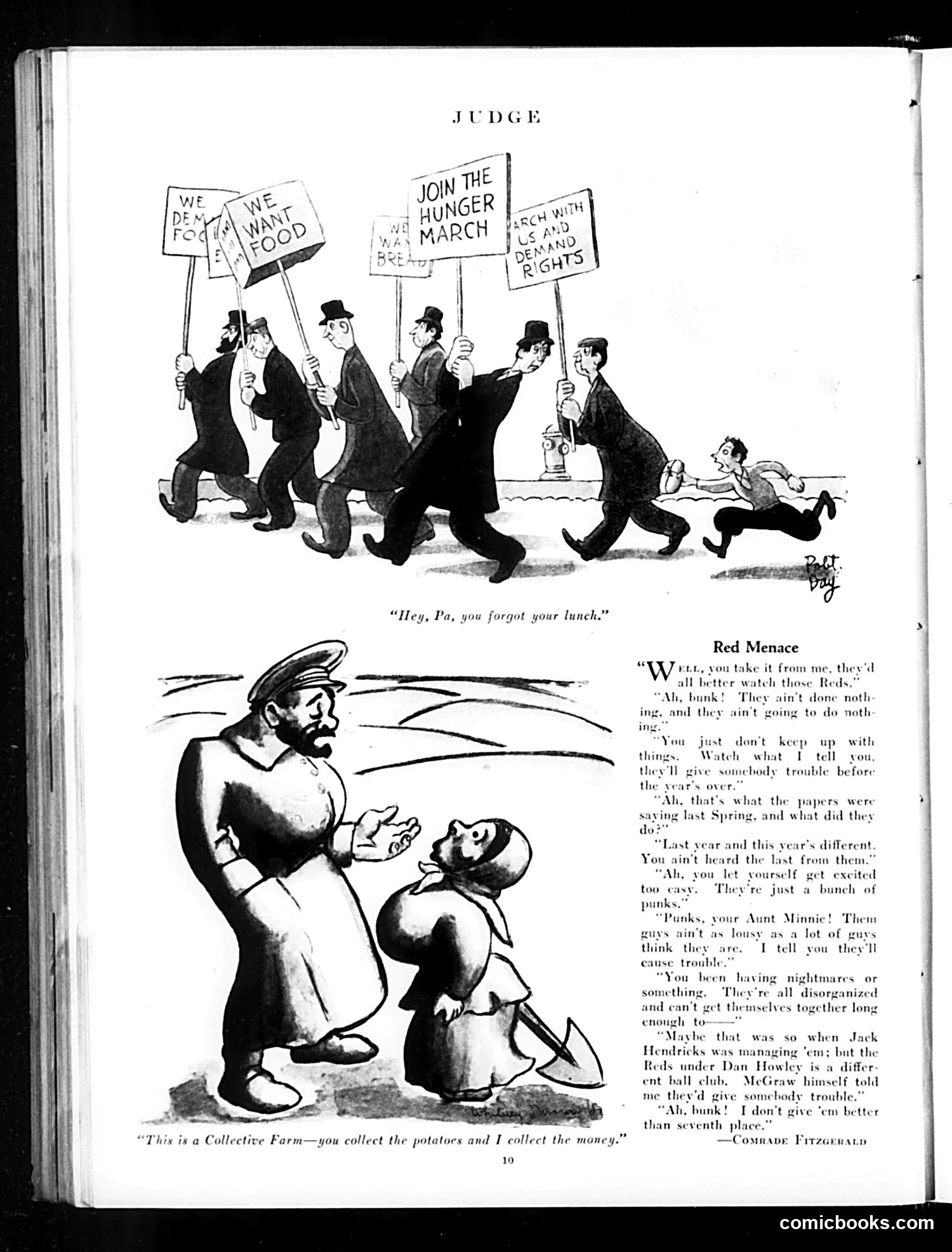
Political Cartoon Analysis: "Red Menace" This page contains two distinct pieces of satire: Top cartoon: Depicts men in formal dress carrying protest signs ("We Demand Food," "Join the Hunger March," "Teach Land and Rights") while marching past a judge. One small figure has apparently forgotten his lunch. The satire mocks radical political movements and protesters, suggesting their grievances are trivial or hypocritical. Bottom section: A dialogue between two figures debating the Cincinnati Reds baseball team's prospects under manager Dan Howley, contrasting them unfavorably to when Jack Hendricks managed the team. One character dismissively predicts "seventh place." The page's title, "Red Menace," creates intentional wordplay—conflating the baseball "Reds" with Communist "Reds" (the Soviet threat preoccupying America in this era). This satirizes both contemporary anti-Communist anxiety and sports fandom as equally overwrought concerns. The humor lies in treating baseball predictions with the same dramatic urgency as political fears.
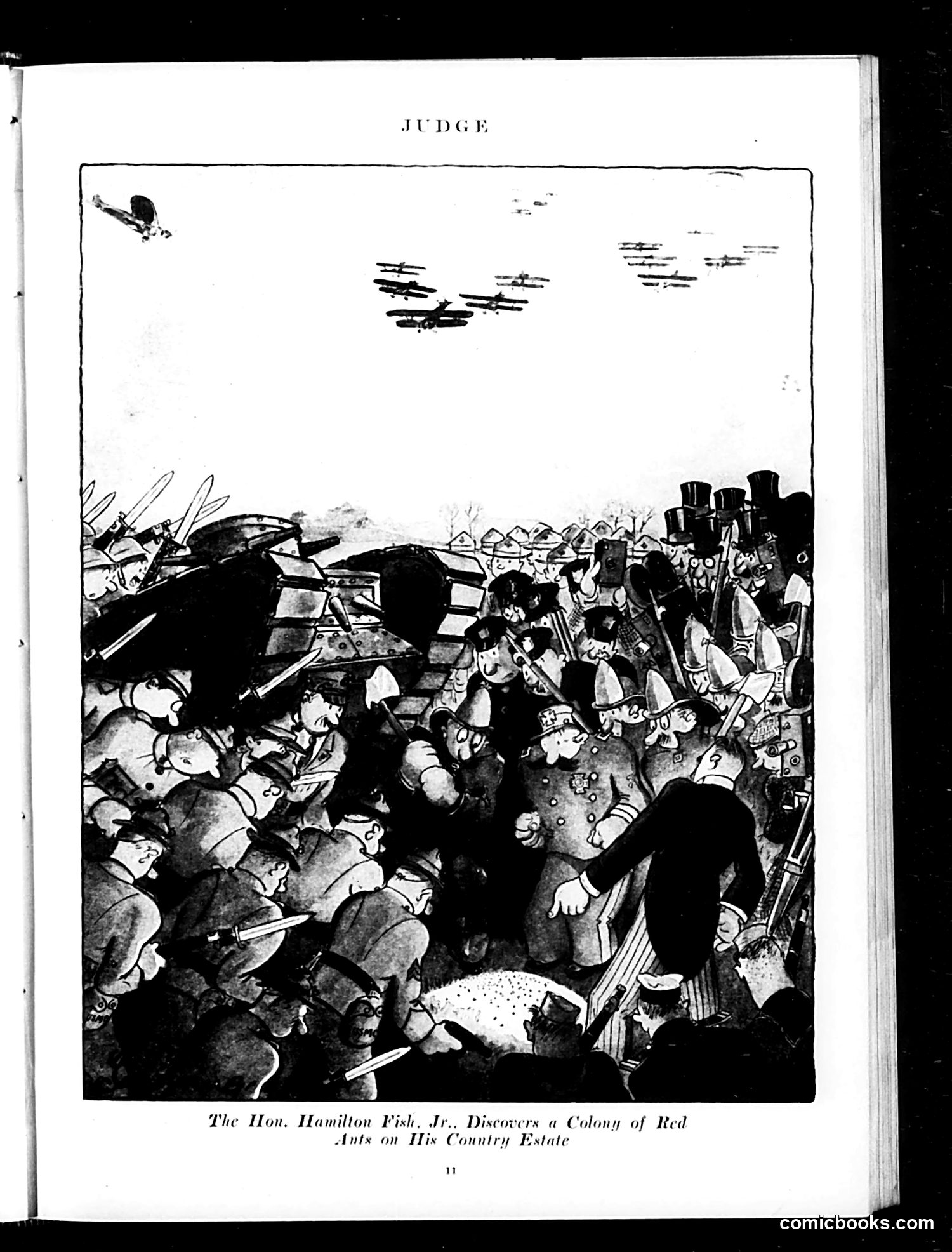
This is a political cartoon satirizing Hamilton Fish Jr., a prominent Republican politician of the early 20th century. The cartoon depicts Fish surrounded by masses of soldiers or military personnel, which are labeled as "Red Ants" in the caption. This appears to be anti-communist satire. "Red" was a common term for communists or radical leftists during this era. The joke suggests that Fish, visiting his country estate, has "discovered" communists or radicals—represented as swarming insects—infesting the property. The aircraft overhead and military imagery reinforce Cold War-era anxieties about communist infiltration. The satire likely mocks Fish's political positions or reflects broader anxieties about communist activity in America, presenting the "discovery" as absurd or alarmist.
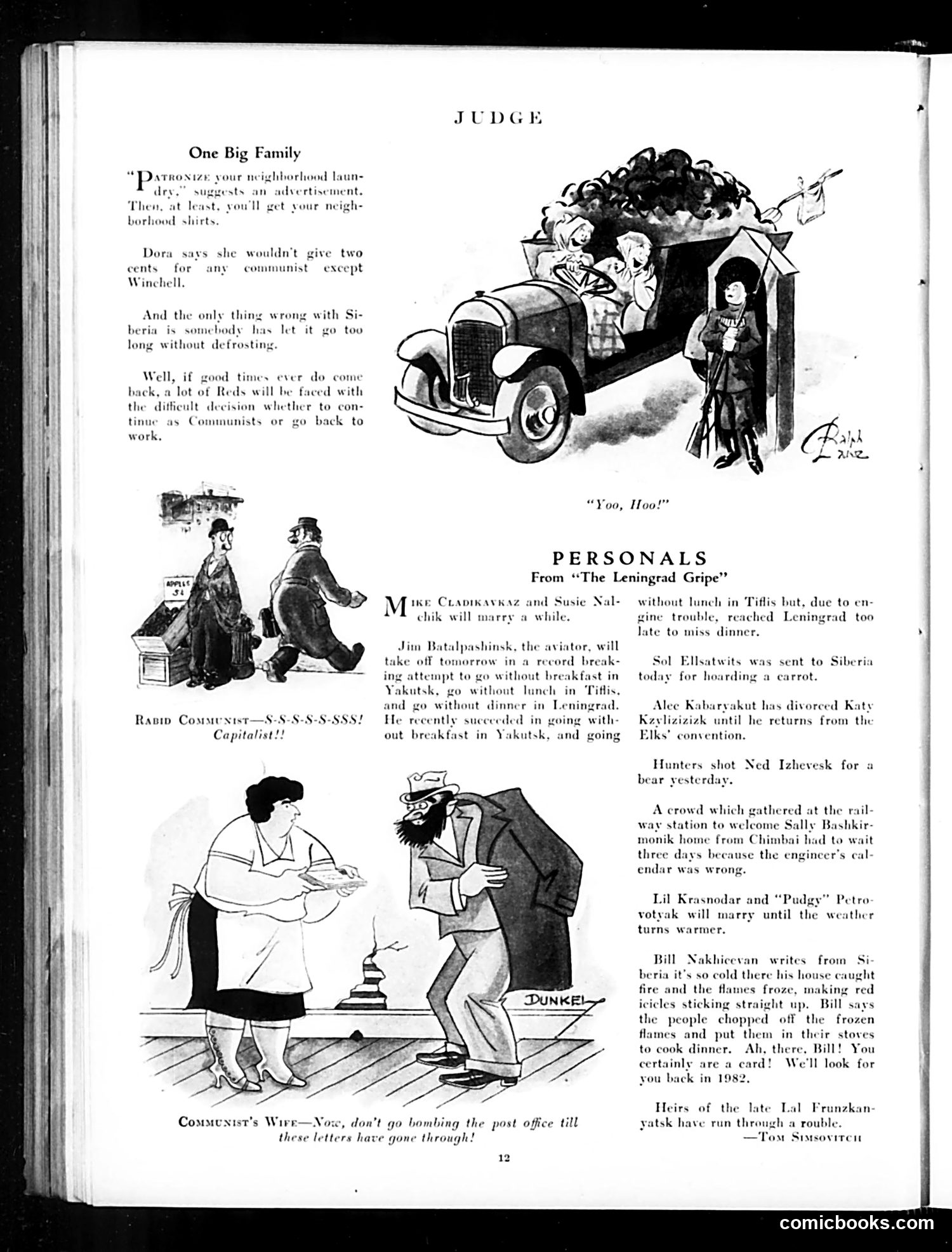
Judge Magazine Satire Analysis This page mocks Soviet communism through absurdist humor. The "One Big Family" section presents anti-communist jokes: references to forced labor in Siberia, the notion that communists would abandon ideology if jobs became available, and jibes at communist leaders like Walter Winchell (a famous gossip columnist, here satirically conflated with communist sympathizers). The "Personals" section parodies Soviet life through fake names (transparently Russian-sounding: Kzylizizizk, Nakhicevan) and grotesque scenarios—people sent to Siberia for hoarding carrots, marriages contingent on weather, and Bill's house so frozen that flames turn to icicles. The cartoons depict communist vs. capitalist tensions: one shows a communist shouting at a capitalist; another warns a communist's wife against "bombing the post office" with mail. The satire assumes readers recognize Soviet deprivation, communist threat, and the absurdity of planned economy failures—Cold War-era American audience anxiety presented as dark comedy.
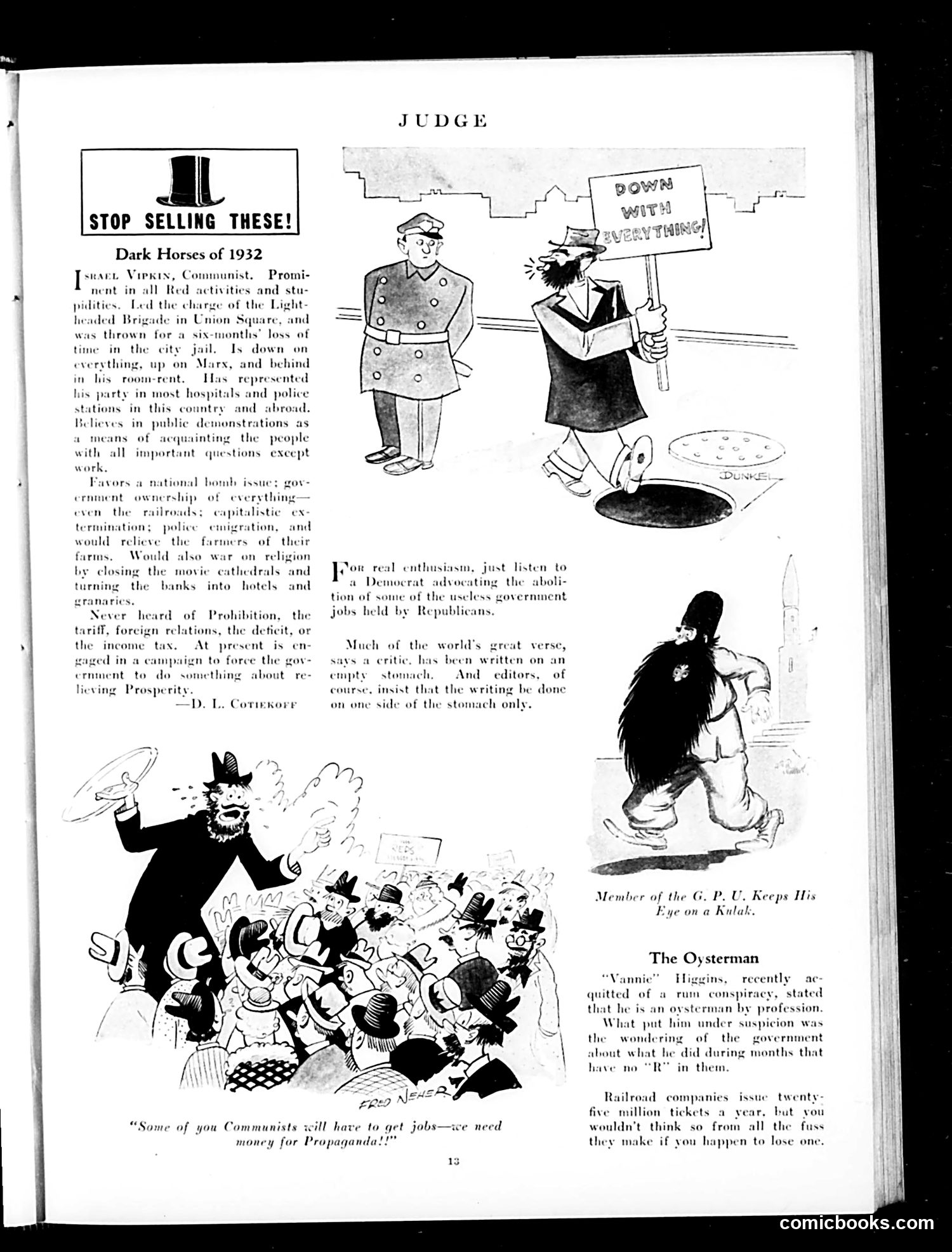
Political Satire from Judge Magazine, 1932 This page satirizes 1932 American politics during the Depression. The top section mocks a Communist activist ("Dark Horses of 1932"), portraying him as an agitator who led protests in Union Square, spent time in jail, and advocates radical positions (bomb-making, government ownership, eliminating capitalism). The cartoon shows him directing smaller communist figures while declaring "we need money for Propaganda." The page also includes jabs at Democrats for criticizing Republican government jobs, and lighter pieces mocking critics and railroads. A cartoon titled "Member of the G.P.U. Keeps His Eye on a Kulak" references Soviet secret police monitoring of peasants—suggesting American concerns about communist infiltration. "The Oysterman" item ridicules a rum-runner (Prohibition-era smuggler) claiming innocence by claiming legitimate work. The overall message: communists are dangerous propagandists exploiting Depression hardship, while Republicans defend necessary government employment.
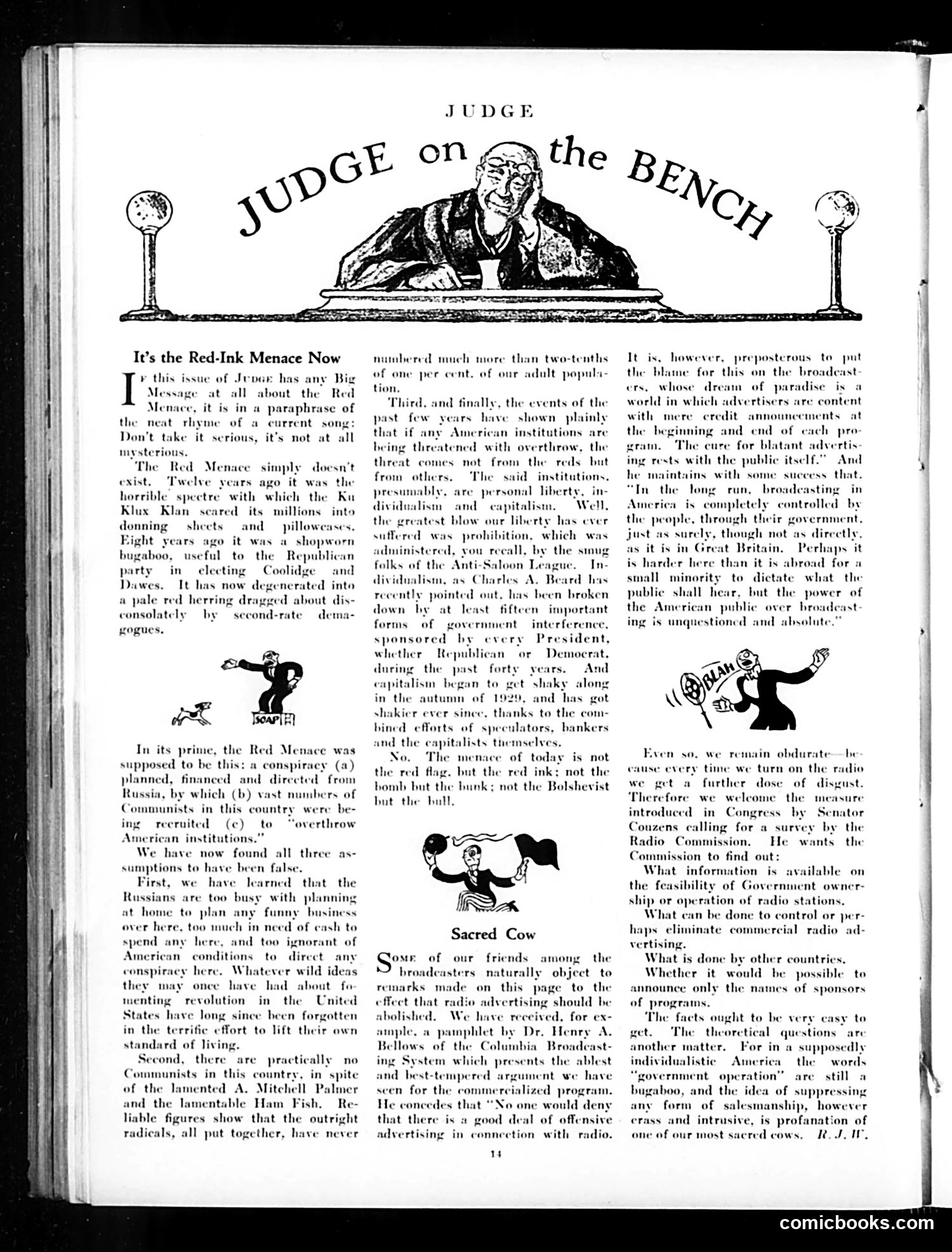
"Judge on the Bench": Red Menace Satire This editorial page satirizes overblown fears of communist subversion in America. The author argues that the "Red Menace"—once invoked by the KKK (1920s) and Republican politicians (1920s-1930s) to scare the public—has become a worn-out rhetorical device. The piece debunks three false assumptions about a Russian-directed communist conspiracy: (1) Russians are too preoccupied domestically; (2) they lack funds; (3) they don't understand American conditions. Instead, the author identifies the *actual* threat as economic—capitalism's instability since 1929, accelerated by speculators and bankers. The accompanying cartoons (showing a judge presiding) reinforce judicial authority on the matter. A secondary editorial discusses government control of radio broadcasting, warning against suppressing commercial advertising under guise of "public interest." The satire targets both anti-communist hysteria and economic elites who scapegoat communism while destabilizing the economy.
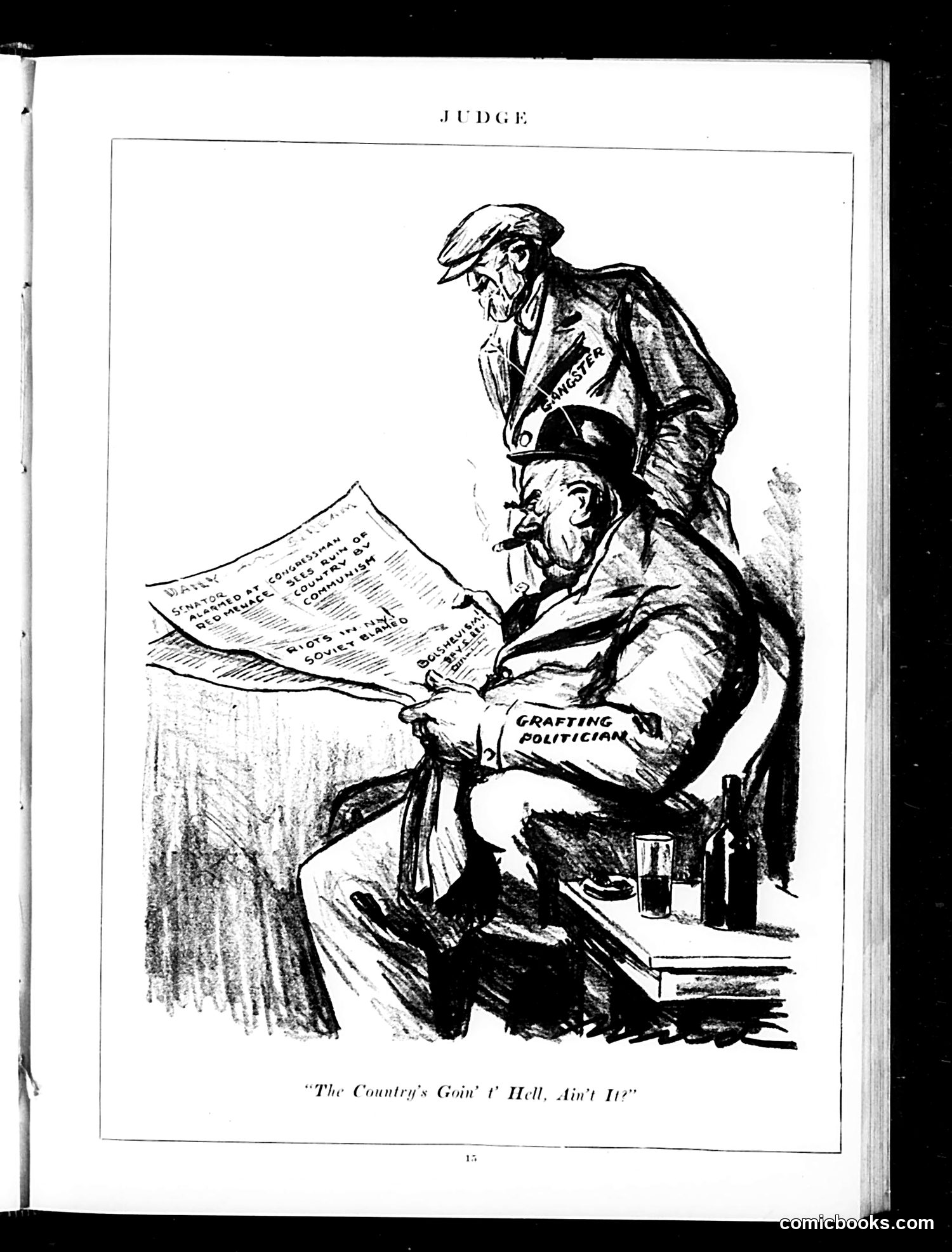
"Judge" Cartoon Analysis: "The Country's Goin' t' Hell, Ain't It?" This political cartoon depicts two figures examining documents labeled with terms like "GRAFT," "CORRUPTION," and "BOODLE" (slang for illicit money). The seated figure is identified as a "GRAFTING POLITICIAN" with a cigar. A judge stands behind, observing. The satire criticizes political corruption—specifically the endemic bribery and embezzlement ("grafting") that characterized late 19th/early 20th-century American politics. The ironic caption suggests resigned acceptance of governmental malfeasance as inevitable ("The country's goin' to Hell"). The judge's presence implies commentary on whether the judiciary effectively combats such corruption, or merely witnesses it passively. The cartoon reflects Judge magazine's reform-minded editorial stance against machine politics and institutional graft.
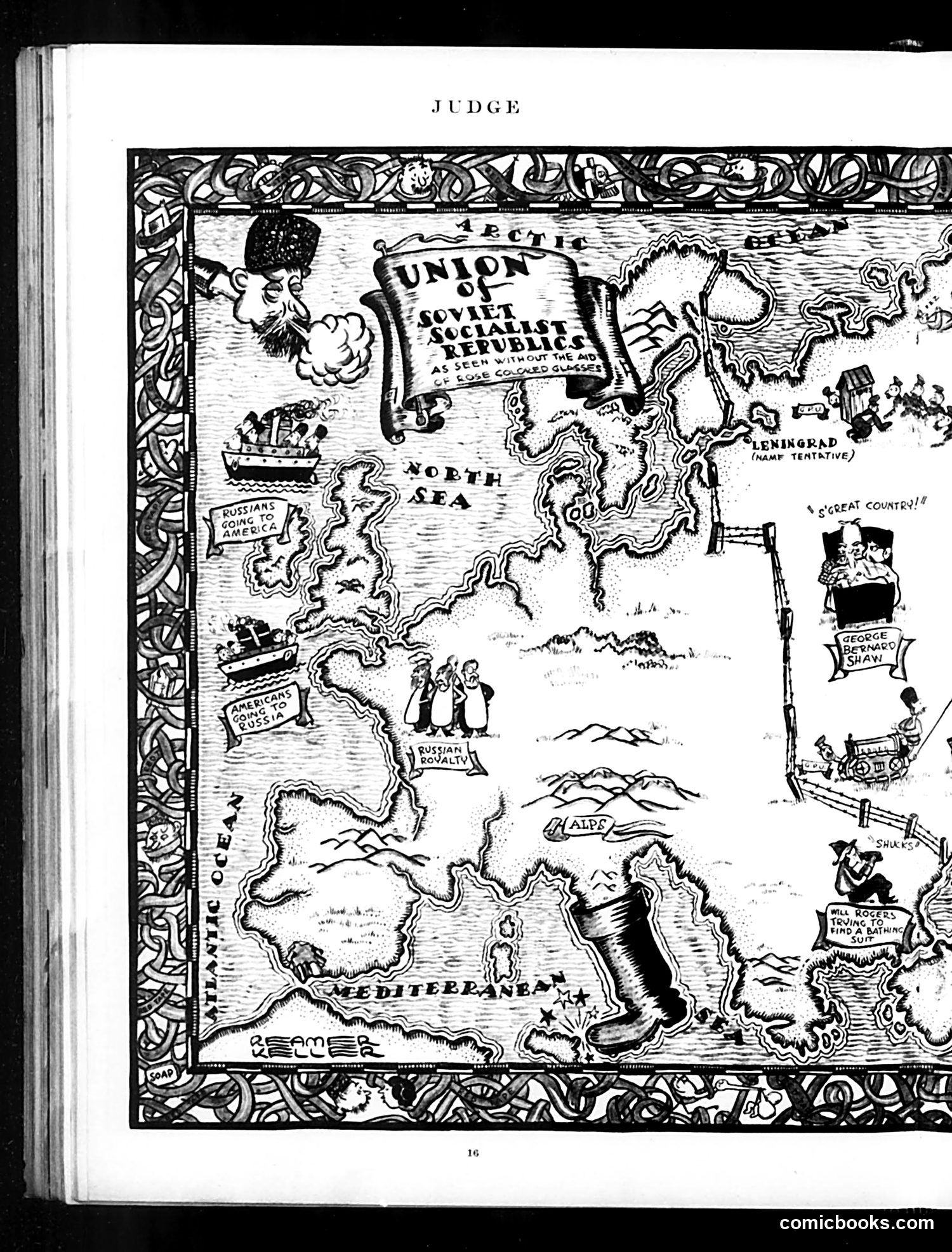
Analysis This is a satirical map cartoon mocking the Soviet Union during the Russian Revolution era. The central banner reads "Union of Soviet Socialist Republics" with a note about "colored guesses," indicating uncertainty about the new communist state's actual borders and control. The cartoon ridicules Soviet territorial claims through caricatured vignettes: "Russian Royalty" depicts fleeing aristocrats, "Americans Flock to Russia" shows confused Western interest, and various other scenes mock Soviet inefficiency and chaos. The phrase "Great Country!" drips with sarcasm. The ornate decorative border and map style parody serious geographical documents, enhancing the satire. This likely dates to the 1920s-1930s when American publications frequently expressed anti-communist sentiment and skepticism about Soviet legitimacy. The cartoon expresses Judge magazine's satirical hostility toward the communist experiment.
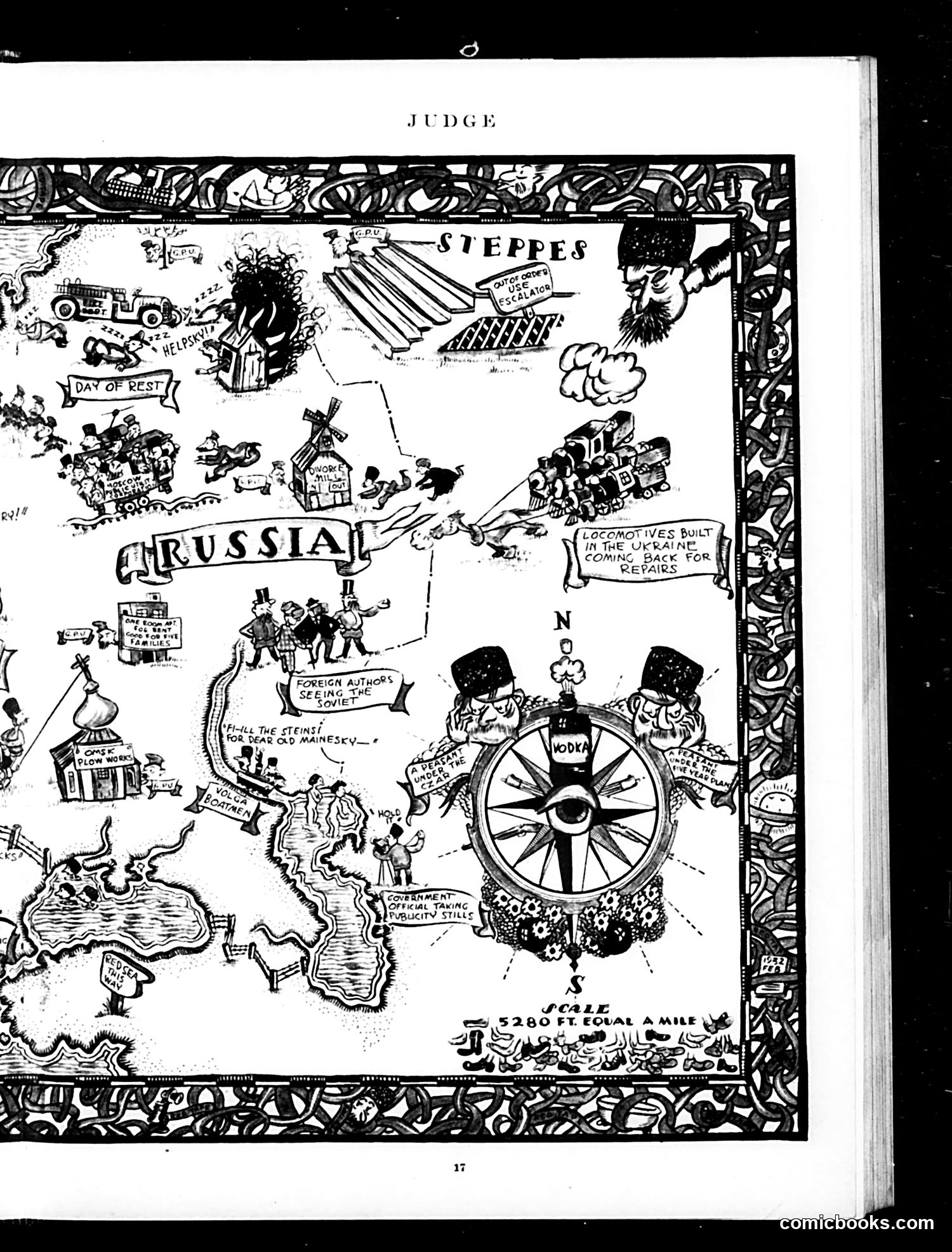
Judge Magazine Satirical Map of Russia This is a pictorial map of Russia titled "Judge," using visual satire to mock Soviet society and politics. The cartoon depicts Russia as chaotic and poorly managed, with scattered illustrations showing: - Agricultural problems ("Steppes" labeled with poor farming) - Industrial dysfunction (broken locomotives needing repairs) - Political corruption (references to "foreign authors" and Soviet ideology) - Alcohol consumption (prominent "Vodka" imagery at the compass center) - General backwardness and mismanagement Two caricatured Soviet officials steer a ship's wheel labeled "Vodka," suggesting they're intoxicated or that alcohol drives policy. The scattered vignettes of inefficiency, poverty, and chaos reinforce the American satirical view of Soviet Russia as backwards and unstable—typical Cold War-era mockery in American publications.
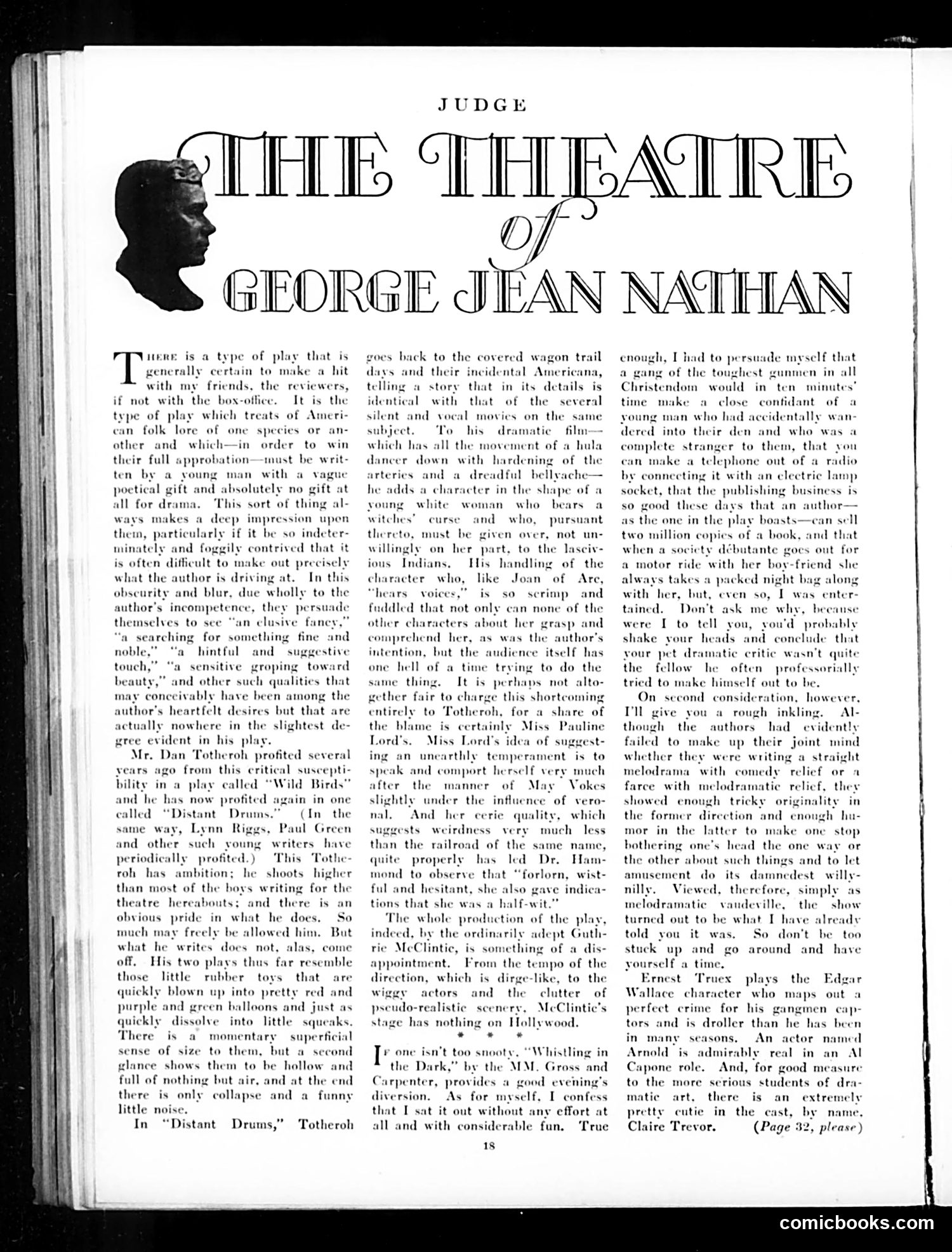
Analysis of Judge Page Content This page contains a theatrical review by Judge critic (likely George Jean Nathan, based on the byline visible in the header). Rather than a political cartoon, it's a caustic drama critique of Dan Totheroh's play "Distant Drums," a Western set during frontier days. The reviewer skewers both the playwright and the production. Nathan argues that Totheroh—like other young American playwrights—benefits from critics' susceptibility to folk-lore plays that are deliberately obscure, which reviewers mistake for artistic profundity. "Distant Drums" is dismissed as hollow: a inflated rubber balloon that quickly deflates into "little squeaks." The review specifically critiques the production's handling of a cursed white woman character (evoking Joan of Arc imagery) and actress Pauline Lord's affected performance. Director Guthrie McClintic's direction is called sluggish and pretentious. The satire targets both pretentious American theater and critics' gullibility toward nationalist subject matter presented with deliberate vagueness.
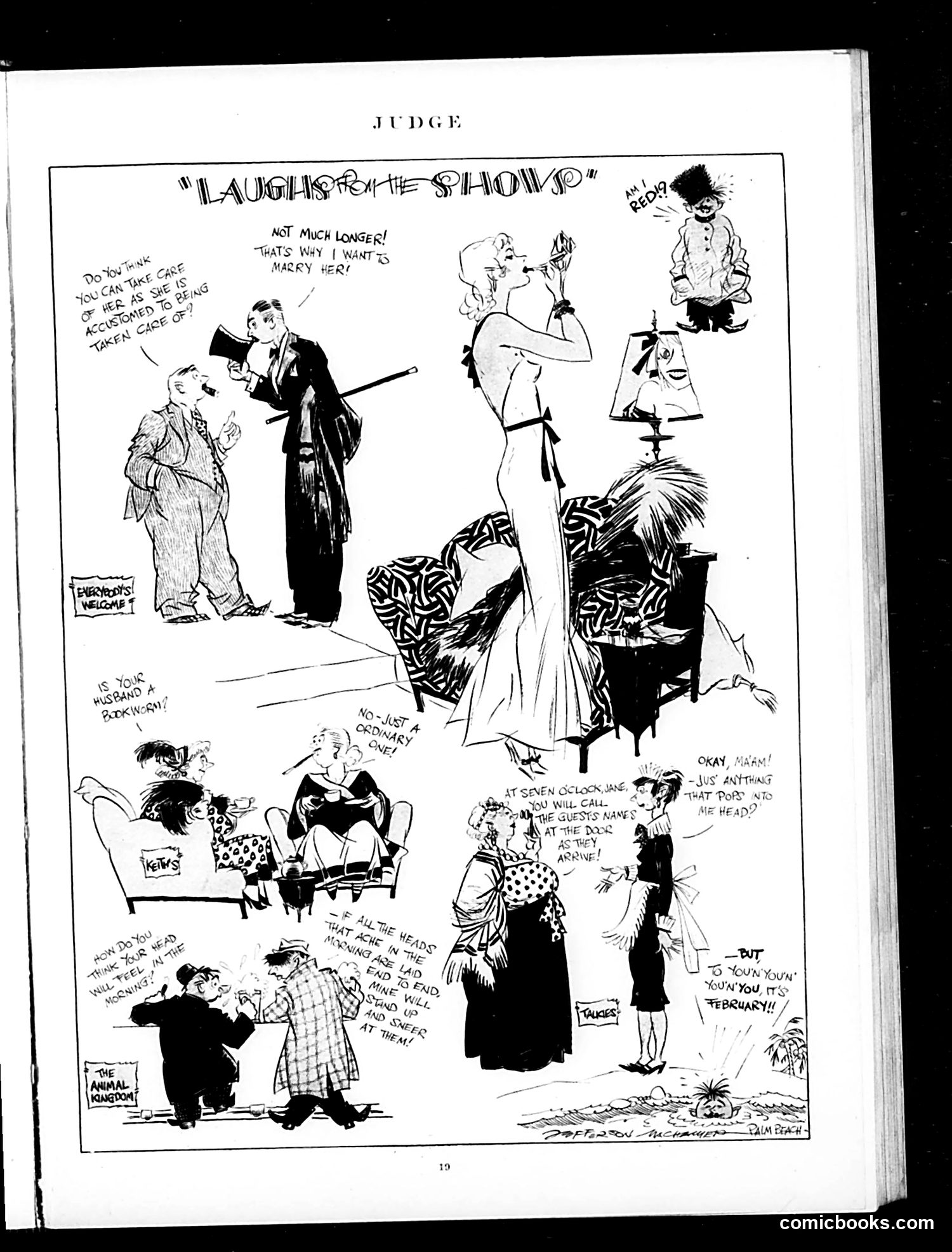
"Laughter Shop" Satire Analysis This Judge magazine cartoon satirizes wedding planning anxieties through multiple vignettes. The central narrative involves a couple discussing marriage, with the groom-to-be expressing urgency ("not much longer!") while the bride worries about logistics. The humor targets typical pre-wedding chaos: a judge or officiant reviewing legal requirements, guests arriving at the wrong time, last-minute arrangements, and family coordination. The scattered scenes depict common matrimonial disasters—confusion about ceremony details, the bride's anxiety about getting everything organized by February, and various domestic complications. The satire mocks how weddings generate overwhelming bureaucratic and social complications, turning what should be romantic into a stressful administrative ordeal. The cartoon reflects period anxieties about marriage formalities and the gap between romantic expectations and chaotic reality.
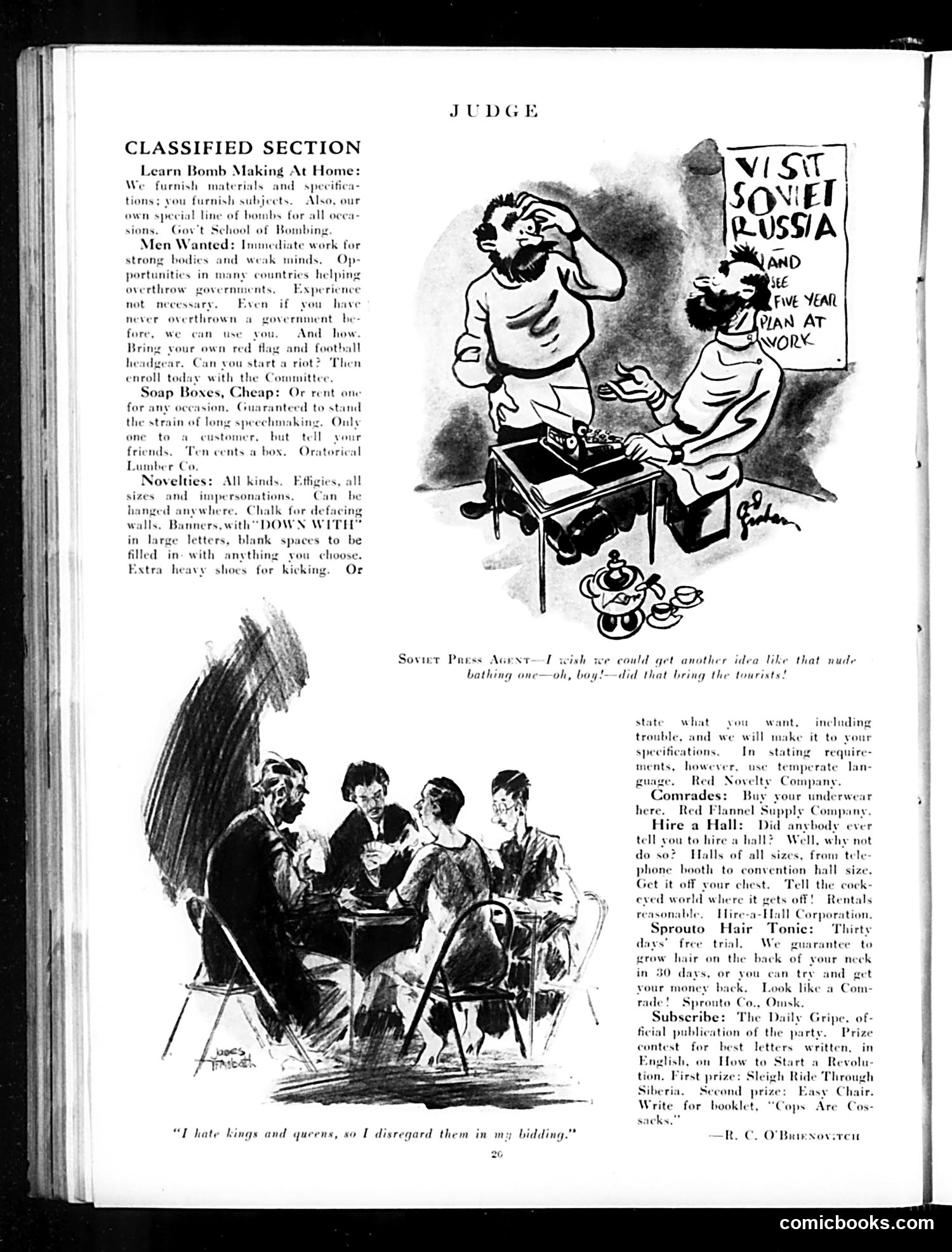
Political Satire in Judge Magazine This page satirizes communist/Soviet revolutionary ideology through mock classified advertisements. The "classified section" parodies want ads by offering absurd services: bomb-making instructions, recruitment for overthrowing governments, and propaganda materials (red flags, banners reading "DOWN WITH"). The top cartoon depicts a Soviet press agent complaining he needs new propaganda ideas—the "nude bathing" scheme brought tourists. It mocks Soviet tourism and propagandistic PR. The lower cartoon shows communist agitators in heated discussion, with the caption "I hate kings and queens, so I disregard them in my bidding"—satirizing revolutionary rhetoric as hollow ideology masking self-interest. The advertisements parody communist organizations with names like "Red Novelty Company" and "Sprouto Co., Omsk" (referencing Soviet Russia). Prizes include "Sleigh Ride Through Siberia"—darkly joking about Soviet gulags and exile. Context: This likely dates from the Red Scare era (1920s-1950s) when Judge regularly mocked communism as dangerous, foreign, and absurd. The satire presents revolution as performative theater run by cynical operatives.
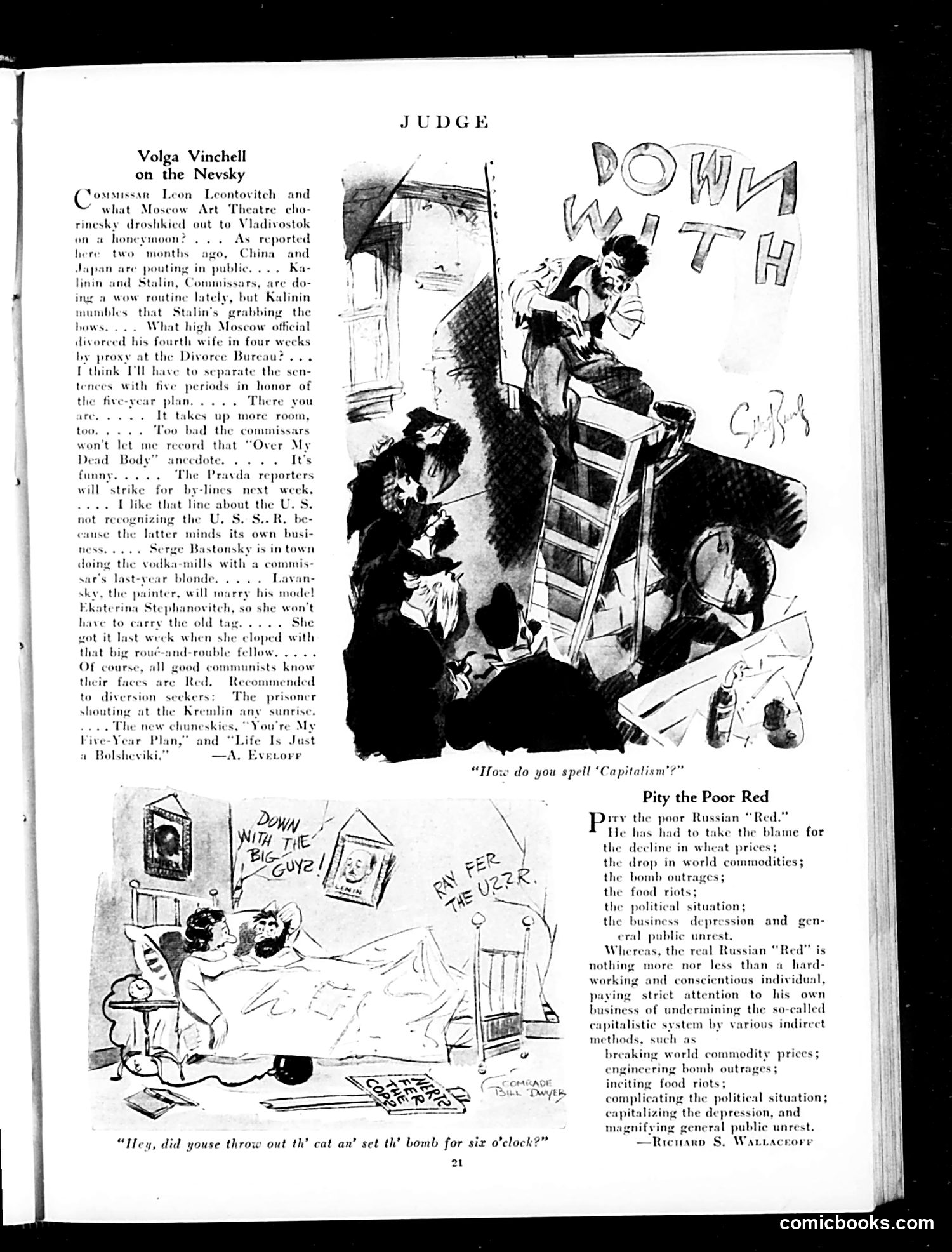
Political Satire from Judge Magazine This page satirizes Soviet Russia and American anti-communist anxieties in the interwar period. Top Section ("Volga Vinchell"): A gossip column mocking Moscow's Soviet elite—commissars Stalin and Kalinin, divorce scandals, the "five-year plan"—written in rapid-fire style mimicking American gossip columnist Walter Winchell. The tone is frivolous, treating Soviet leadership as tabloid fodder. Cartoons: The upper drawing shows a Soviet official being interrogated about spelling "Capitalism"—mocking communist ideology as elementary. The lower cartoon depicts someone hiding a bomb, captioned with dark humor about timing explosives. "Pity the Poor Red": This essay delivers cutting satire: it claims Soviet "Reds" blame capitalism for Russia's economic failures (wheat prices, commodity drops, food riots, unrest) while ironically noting that communists themselves deliberately engineer these crises through sabotage to discredit capitalism. The joke is that communists ARE the problem they blame on the West—a common American conservative argument of the era. The overall message: Soviet communists are hypocritical agents of chaos posing as idealists.
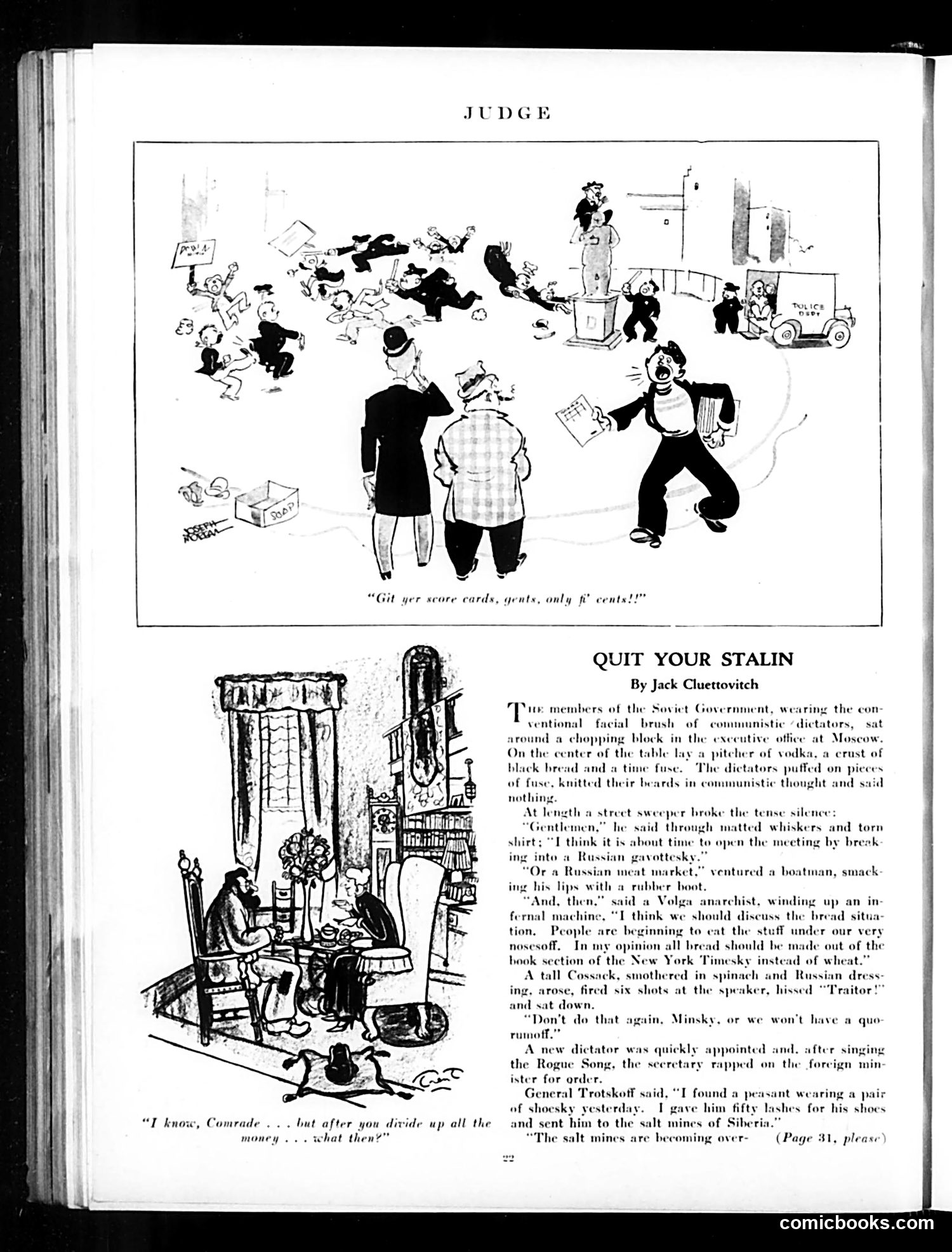
"Quit Your Stalin" - Judge Magazine Satire This 1920s-30s political cartoon satirizes the Soviet government under Stalin, depicting Soviet leaders as chaotic, violent, and absurd. The top cartoon shows a courtroom scene where a judge presides over pandemonium—suggesting the Soviet legal system is a joke. The main story ridicules Soviet governance: communist dictators meet in Moscow, speaking in broken English ("shoesky," "vod," "Timesky") to mock Russian accents. The satire centers on: - Internal paranoia and violence: A Cossack shoots the speaker; leaders are constantly replaced - Bread shortages: Citizens starving while officials debate replacing real bread with newspaper - Economic chaos: References to dividing money and salt mines (labor camps) - Trotsky: General Trotskotf appears, likely referencing Leon Trotsky, Stalin's rival The cartoonist presents Soviet communism as fundamentally dysfunctional—governed by trigger-happy tyrants speaking nonsense, unable to solve basic problems like feeding their population. It's anti-communist propaganda targeting American readers unfamiliar with Soviet realities.
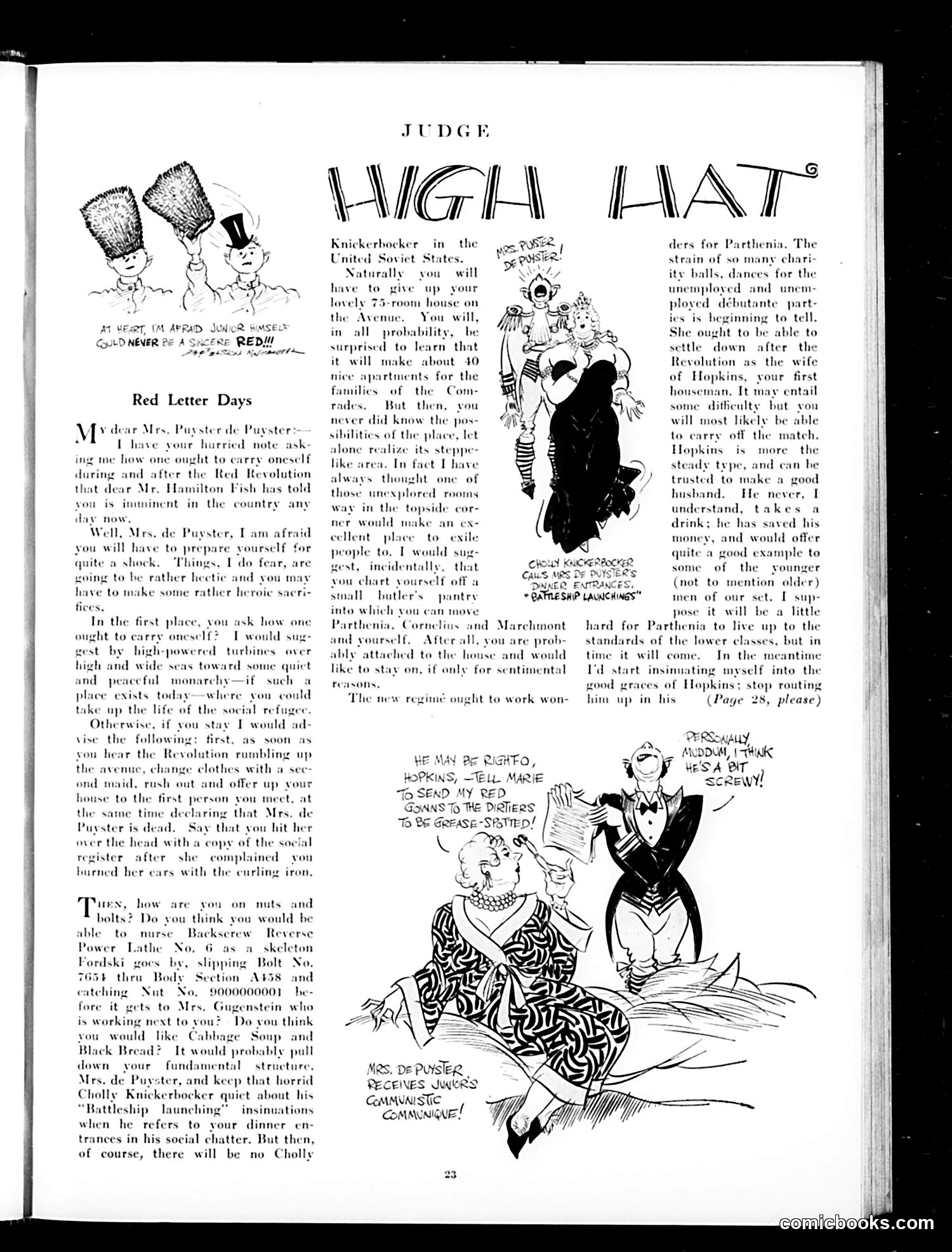
"Judge" Magazine Satire: "Red Letter Days" This 1920s satirical piece mocks wealthy American socialites' anxieties about communist revolution. An advice columnist addresses "Mrs. de Puyster"—a caricatured upper-class woman—about surviving an imminent "Red Revolution." The satire targets several targets: the absurd pretensions of the wealthy (their 75-room mansions, charity balls, social registers); their complete ignorance of practical skills (not knowing machinery); and their expected downward mobility (her daughter Parthenia reduced to marrying the houseman Hopkins). The cartoons show the collision between high society and communist ideology: Mrs. de Puyster receiving "communistic communiqués" and being advised to abandon social niceties. References to "Cholly Knickerbocker" (a gossip columnist) and "Gugenstein" invoke New York's elite circles. The joke: wealthy Americans feared Bolshevism would destroy their entire lifestyle—and the magazine mercilessly satirizes both that fear and the socialites' complete unfitness for ordinary life.
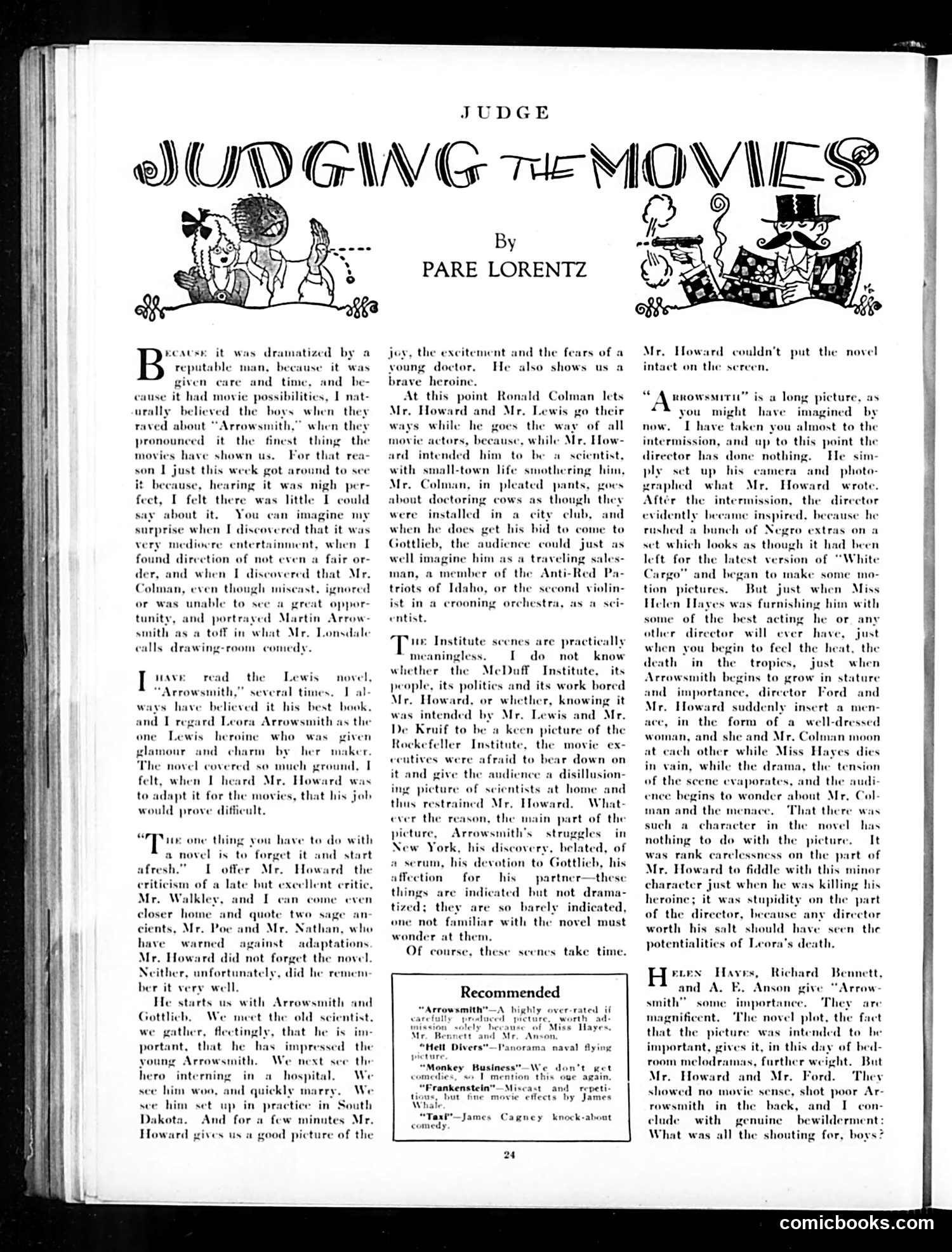
Judge Magazine Film Criticism: "Arrowsmith" This page contains a critical review by Pare Lorentz of the 1931 film *Arrowsmith*, adapted from Sinclair Lewis's novel. Lorentz praises the source material but condemns director John Ford's film adaptation as "very mediocre entertainment." The satire targets Ronald Colman's miscast performance. Though the actor was well-regarded, Lorentz argues Colman portrays the idealistic young doctor as a superficial "toff" (British dandy)—imagining him alternatively as a traveling salesman or "Anti-Red Patriot," emphasizing how the actor stripped the character of depth. Lorentz criticizes Ford for failing to dramatize the novel's crucial New York sequences—Arrowsmith's scientific struggles, his discovery of a serum, and his devotion to mentor Gottlieb. These pivotal moments were merely photographed, not meaningfully rendered cinematically. The review exemplifies 1930s film criticism's concern with literary adaptation fidelity and directorial competence in translating complex source material to screen.
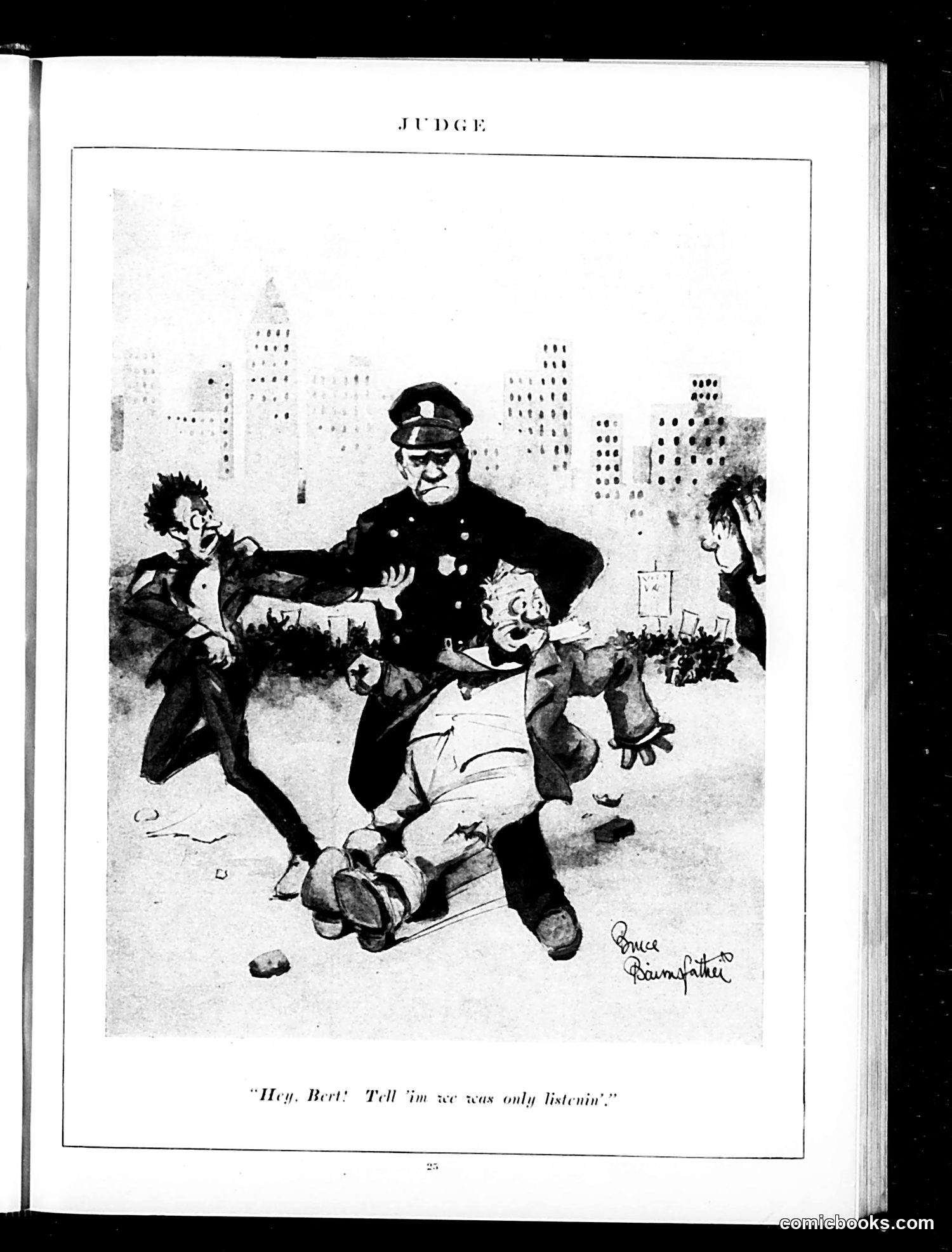
Judge Cartoon Analysis This cartoon depicts a police officer apprehending two men on a city street, with a caption suggesting they were "only listening" to something—likely implying they were eavesdropping or overhearing a conversation they shouldn't have. The satire appears to target urban crime or misbehavior, with the officer catching suspects in the act. The exaggerated facial expressions and body language are typical of Judge's comedic style. The casual tone of the caption ("Hey, Bert! Tell 'im we was only listenin'") suggests the men are trying to talk their way out of trouble with a weak excuse. Without more context about the specific date or surrounding articles, the exact political reference remains unclear, though it may relate to general public order concerns or police enforcement in early 20th-century America.
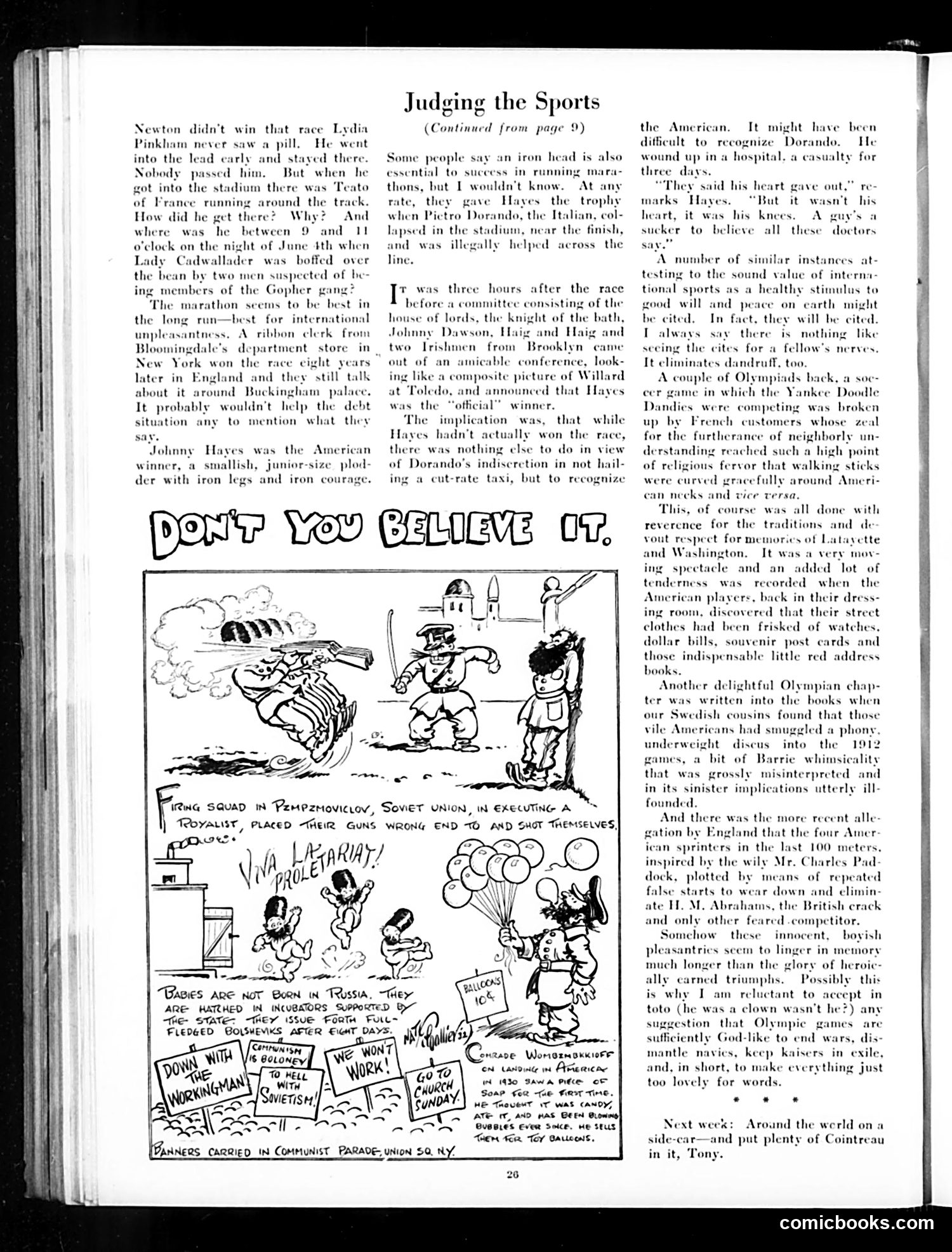
"Don't You Believe It" - Political Satire from Judge Magazine This page combines sports commentary with anti-communist propaganda. The main text discusses the 1908 Olympic marathon, where American Johnny Hayes was declared winner after Italian Pietro Dorando collapsed—a controversial decision requiring bureaucratic review by British officials. The cartoon below satirizes communism through exaggerated, inflammatory imagery: Soviet soldiers executing themselves with backwards guns, babies allegedly "hatched in incubators" as Bolsheviks, and communist parade banners in New York. The crude caricatures and absurdist scenarios are meant to mock communist ideology as inherently ridiculous and dangerous. The sports article uses the Olympic controversy as a segue to broader claims that international athletic competition breeds national hostility rather than goodwill—illustrated with anecdotes of violence and theft by foreign spectators. The page reflects 1920s American anti-communist sentiment and skepticism toward internationalism, framing both as threats to American interests.
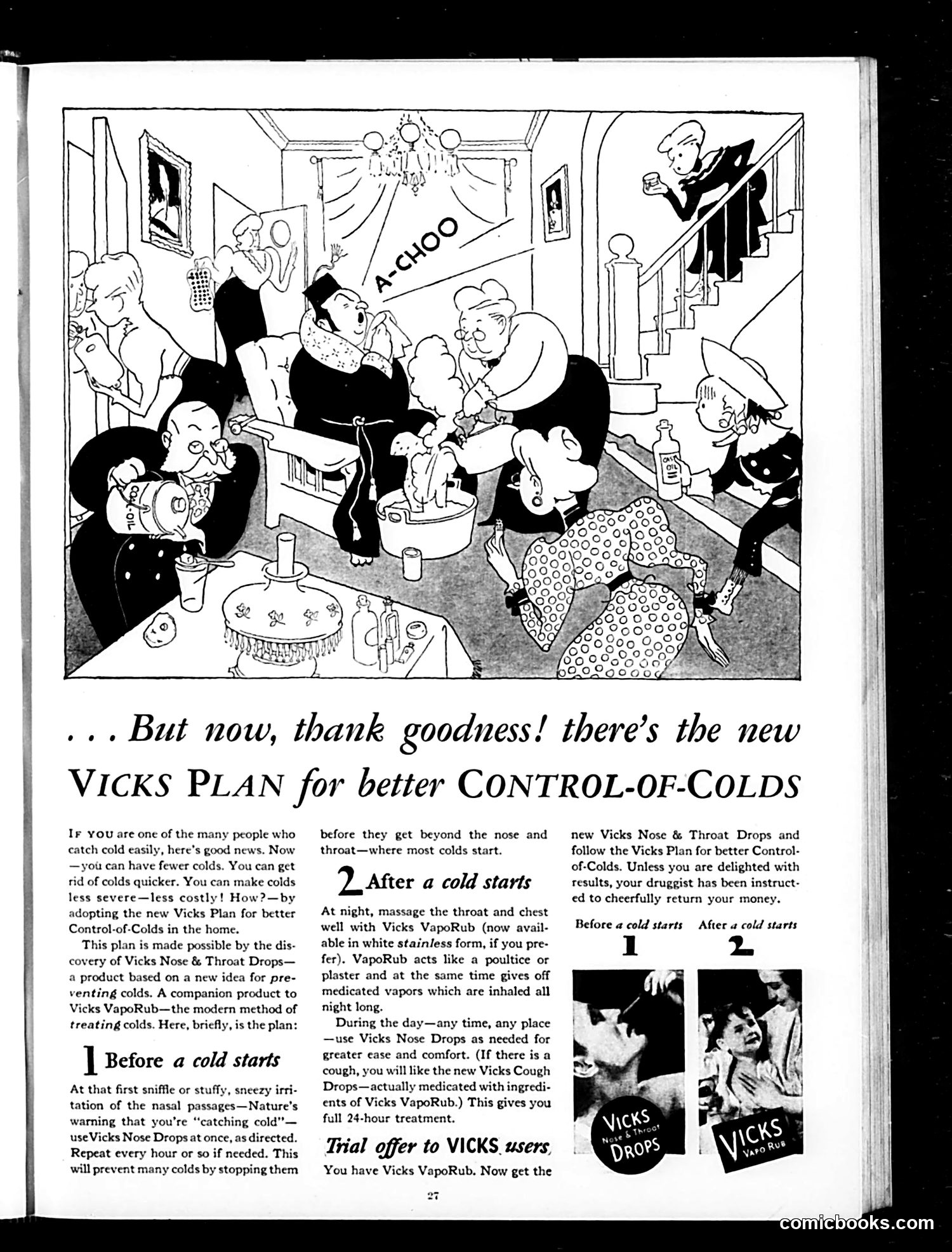
Analysis of Judge Magazine Page This is primarily a Vicks pharmaceutical advertisement, not political satire. The cartoon depicts a chaotic indoor party or social gathering where guests are coughing and sneezing—presumably spreading colds among themselves. The illustration serves as the advertisement's visual hook, showing the problem Vicks products promise to solve. The "satire" here is gentle and commercial: the cartoon mocks the social embarrassment and disruption of catching colds at gatherings. The advertisement then promotes Vicks' "Plan for better Control-of-Colds"—a two-step approach using Vicks Nose Drops (preventative) and VapoRub (treatment). This reflects early-20th-century advertising strategy: using humor and relatable scenarios to market consumer health products. The emphasis on preventative medicine and the "trial offer" with money-back guarantee represents emerging pharmaceutical marketing tactics of the era.
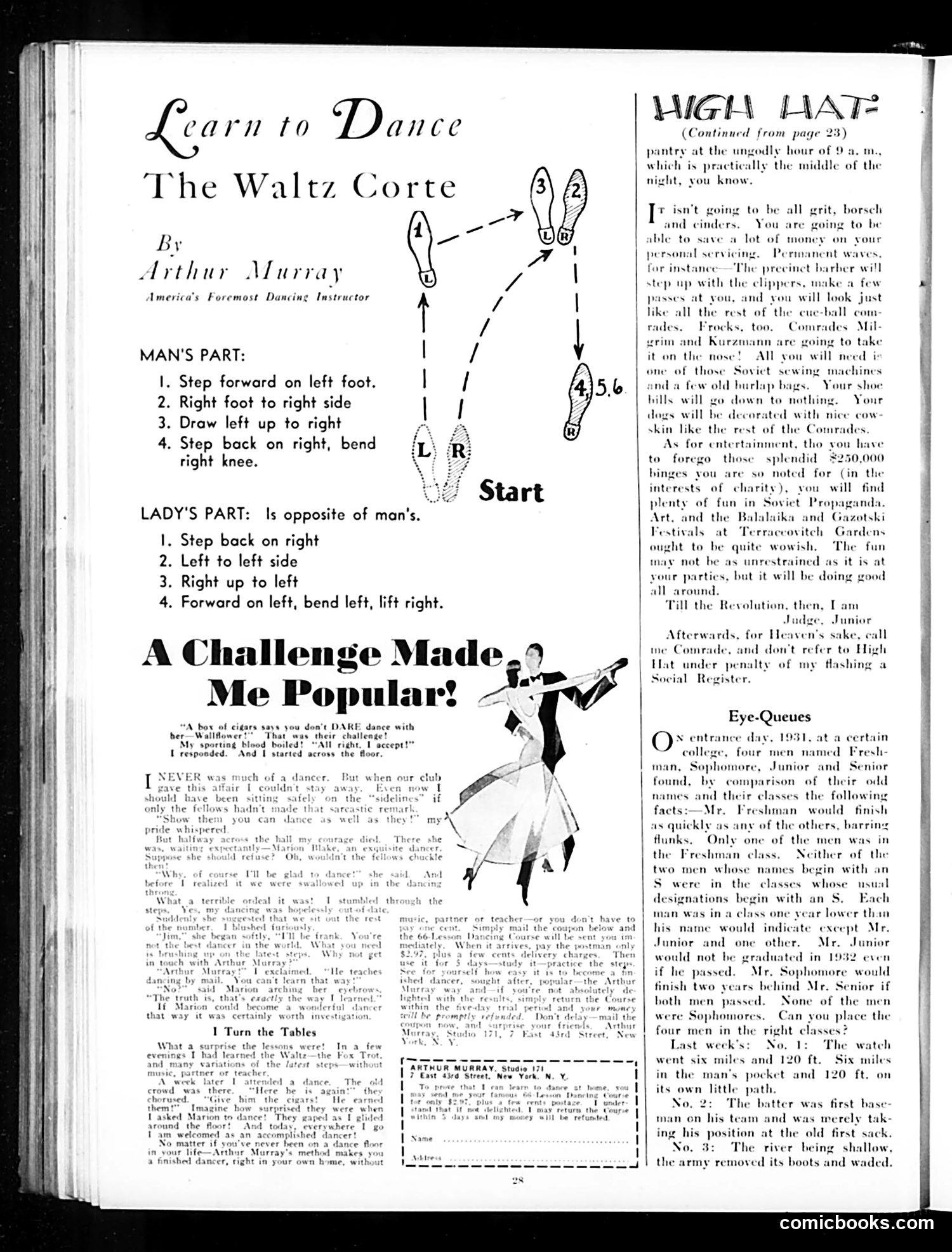
Judge Magazine Page Analysis This page contains two distinct sections: "Learn to Dance: The Waltz Corte" is an instructional feature by Arthur Murray, America's famous dancing instructor. It provides step-by-step diagrams for both the man's and lady's parts of the waltz, presented as practical dance lessons—not satire. "A Challenge Made Me Popular!" is a brief humorous anecdote about the author accepting a dancing challenge and using Arthur Murray's method to become skilled, turning the tables on those who doubted him. This serves as promotional content for Murray's dancing instruction. "High Hat" (continued from page 23) appears to be a satirical society column mocking wealthy Soviet sympathizers—likely American communists or fellow-travelers of the 1930s—predicting they'll lose their luxuries ("permanent waves," expensive clothing, servants) under a communist revolution. "Eye-Queues" is a logic puzzle for readers. The page primarily functions as instructional/entertainment content with light social satire, rather than political cartoons.
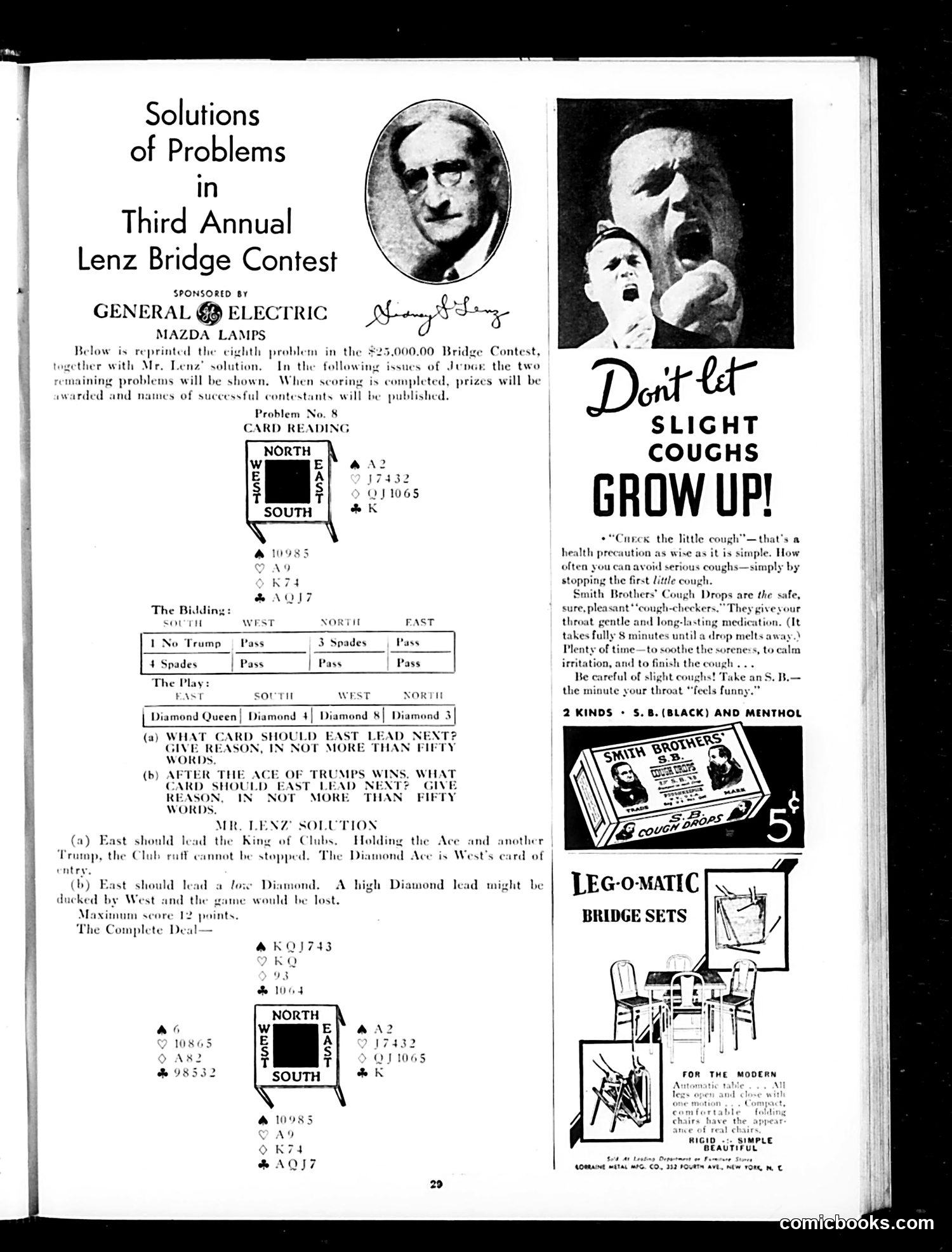
Page Analysis This page combines a bridge card game puzzle with unrelated advertisements. The left side features "Problem No. 8" from Judge magazine's "Third Annual Lenz Bridge Contest," sponsored by General Electric Mazda Lamps. It presents a competitive bridge problem with Mr. Lenz's solution—readers submit answers for prizes in what appears to be an ongoing series. The right side contains two advertisements unrelated to the puzzle: 1. Smith Brothers' Cough Drops ad: Features a photograph of what appear to be the actual Smith Brothers (identifiable by their distinctive beards, as was their branding). The ad warns that "slight coughs" shouldn't be ignored and promotes their cough drops as a safe, effective remedy. 2. Leg-O-Matic Bridge Sets ad: Advertises folding card tables designed for bridge games. The juxtaposition is purely commercial—Judge paired the bridge contest with products targeting card players.
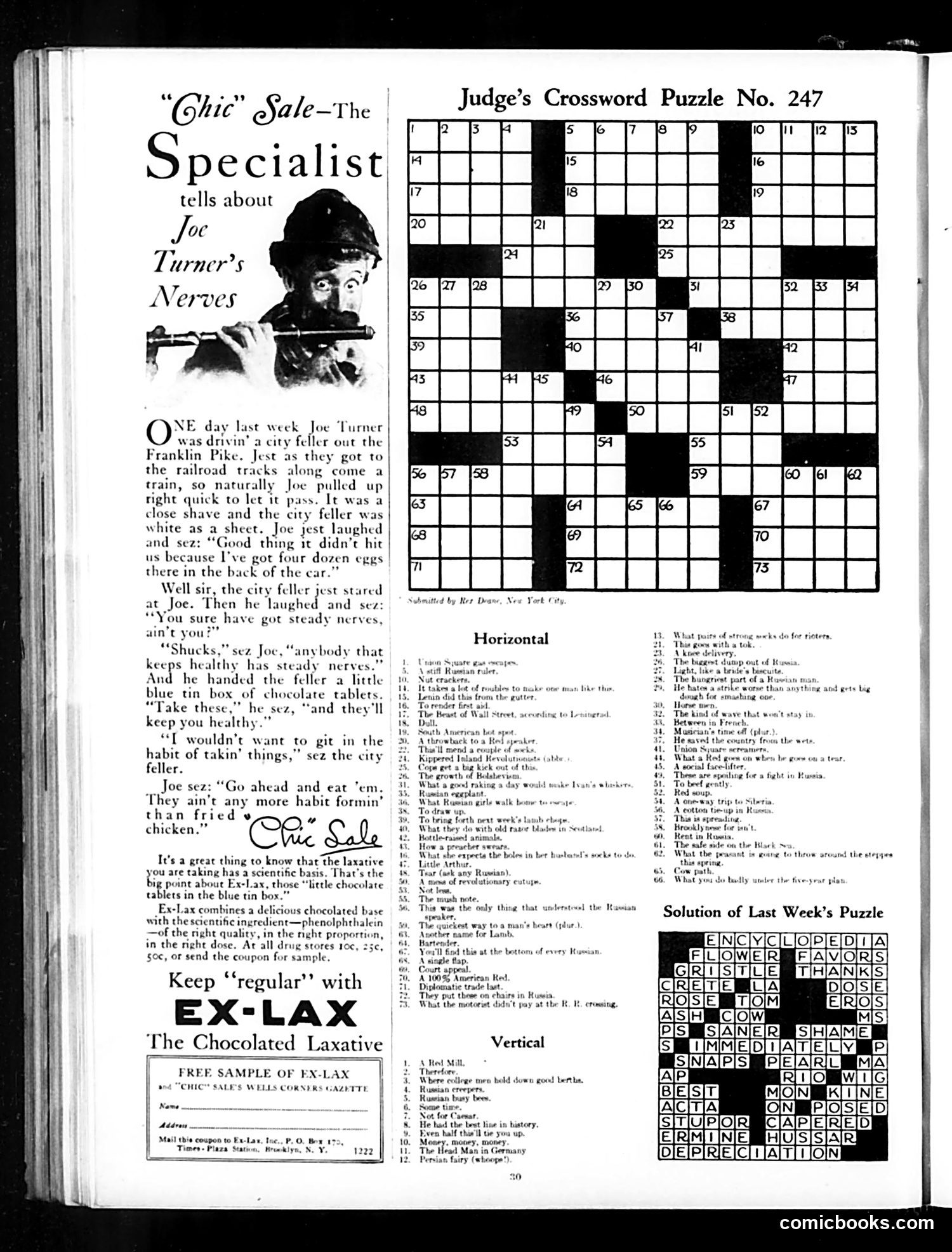
"Chic" Sale's "The Specialist" Cartoon This is an advertisement disguised as humor, featuring "Chic" Sale—a popular vaudeville performer and humorist known for rural dialect comedy. The cartoon depicts Sale's character "Joe Turner," a folksy farmer, demonstrating steady nerves by remaining calm when a train nearly hits his car carrying eggs. The joke establishes that good health equals steady nerves, which Joe attributes to Ex-Lax laxative tablets. The city visitor's surprise at Joe's composure sets up the product pitch: Ex-Lax is presented as a scientifically-formulated laxative (containing phenolphthalein) that promotes regularity and health without being habit-forming. The humor relies on rural versus urban stereotypes—the unsophisticated farmer paradoxically possessing wisdom about health. For modern readers, the satire is that a near-death experience becomes a vehicle for selling laxatives, treating digestive regularity as equivalent to courage and good health.
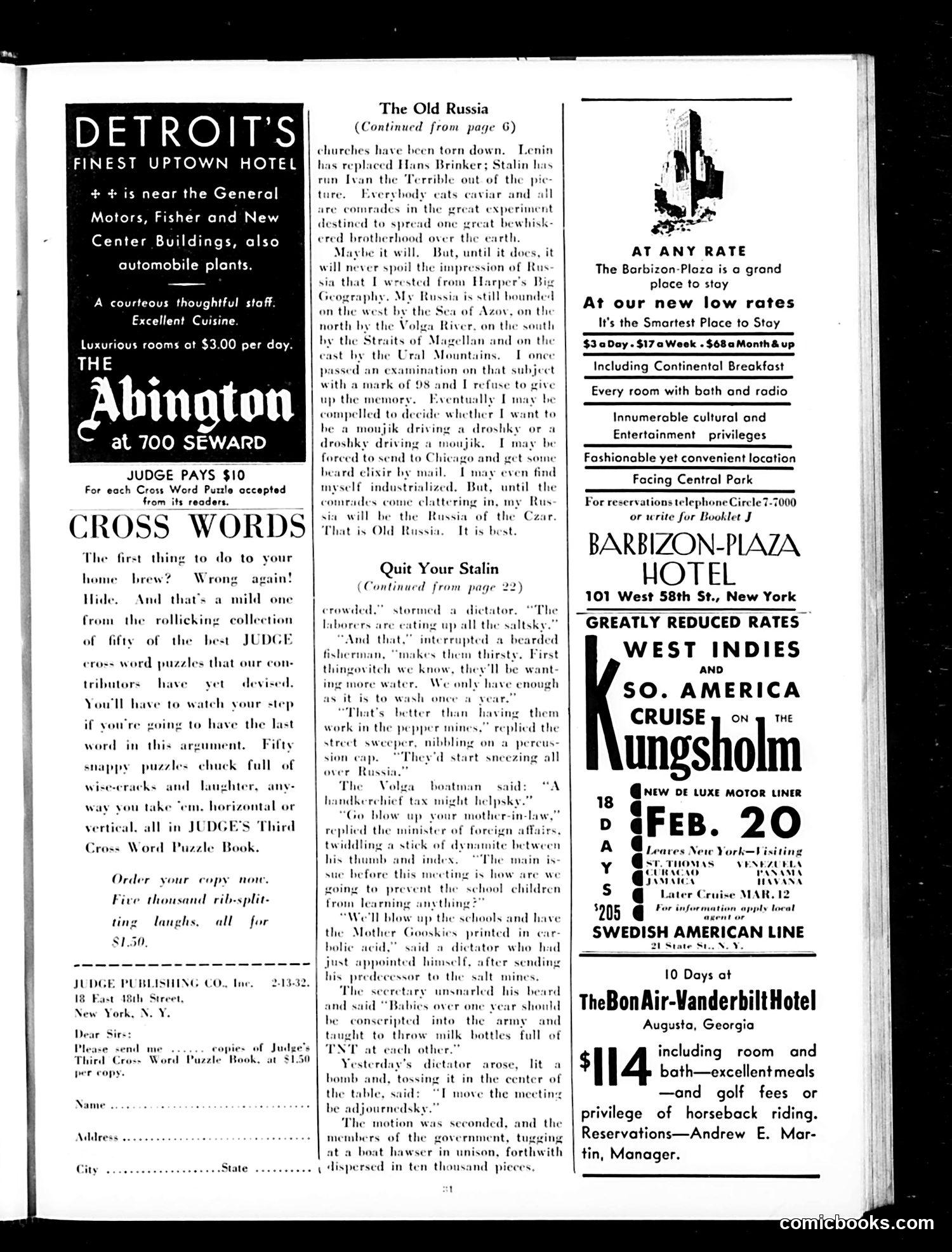
This page is primarily advertising and filler content rather than political cartoons. The text articles—"The Old Russia" and "Quit Your Stalin"—are satirical pieces about Soviet communism. "The Old Russia" contrasts a naive schoolbook understanding of czarist Russia (from Harper's Geography) with modern Soviet reality, where Lenin and Stalin have replaced old rulers but the author refuses to update his mental image. "Quit Your Stalin" is absurdist humor depicting Soviet chaos: communist leaders propose increasingly ridiculous measures (conscripting babies, throwing TNT bottles) until they accidentally kill themselves with dynamite. This reflects contemporary American Cold War-era anxiety and mockery of Soviet governance as violent and irrational. The pieces use exaggeration and wordplay typical of Judge magazine's anti-communist satire from the early Cold War period, but without identifying specific historical figures or events beyond the general critique of Soviet communism as chaotic and dangerous. The bulk of the page consists of hotel and travel advertisements.
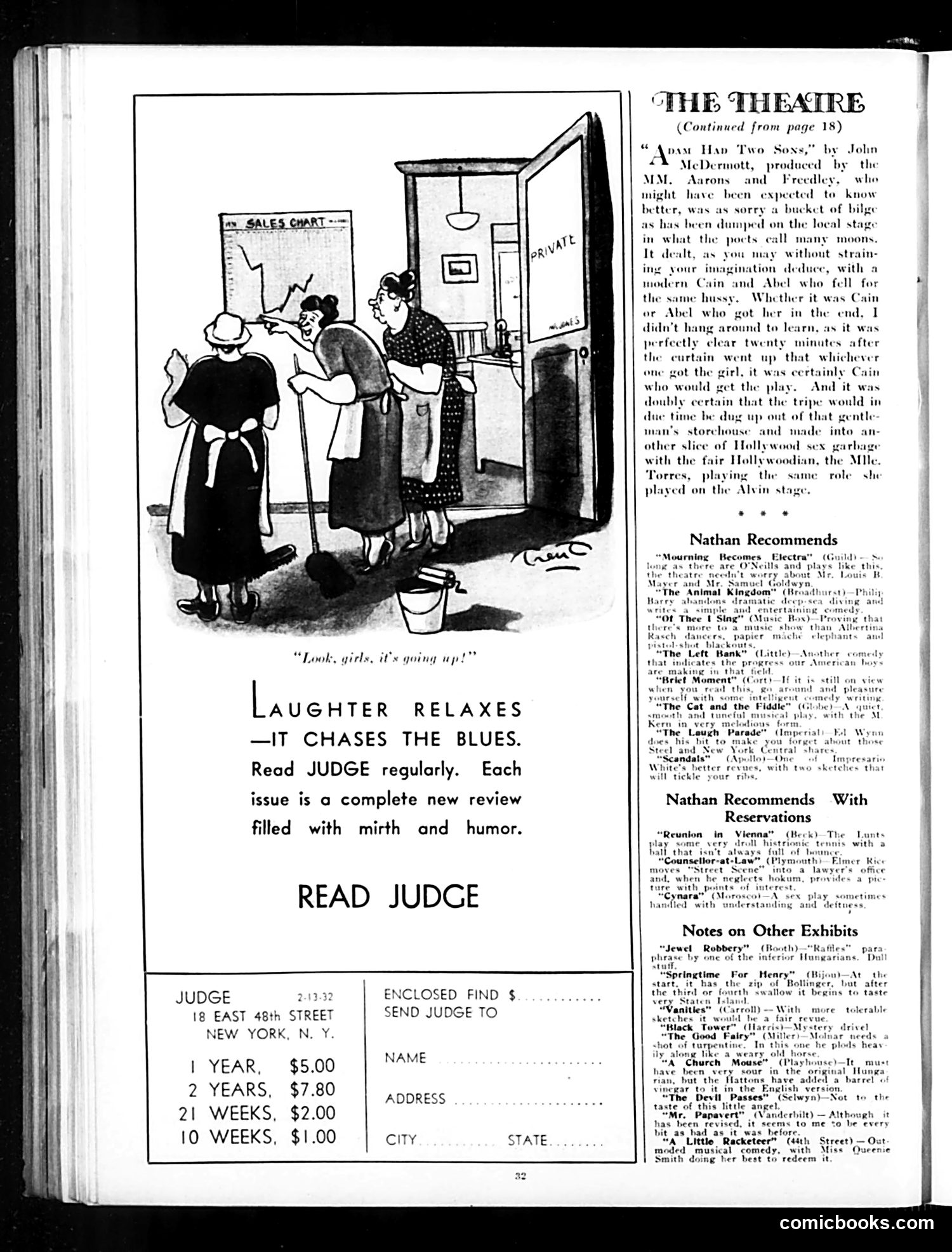
Judge Magazine Page: Theater Review and Advertisement This page combines theater criticism with a subscription advertisement. The cartoon depicts an office scene where a sales chart shows upward trends—a visual metaphor for business success. The caption "Look, girls, it's going up!" suggests optimism about sales or profits. The main content reviews theatrical productions from what appears to be the early 1930s (dated 2-13-32). The critic harshly dismisses "Adam Had Two Sons" as poor quality entertainment. The page includes recommendations for other shows, some praised, others dismissed as derivative or outdated. The advertisement promotes *Judge* magazine itself as comedic relief during hard times—"laughter relaxes—it chases the blues"—reflecting the Great Depression era when humor was valued as escapism. The subscription prices ($5 yearly) and address (18 East 48th Street, New York) are prominently featured for readers interested in purchasing.
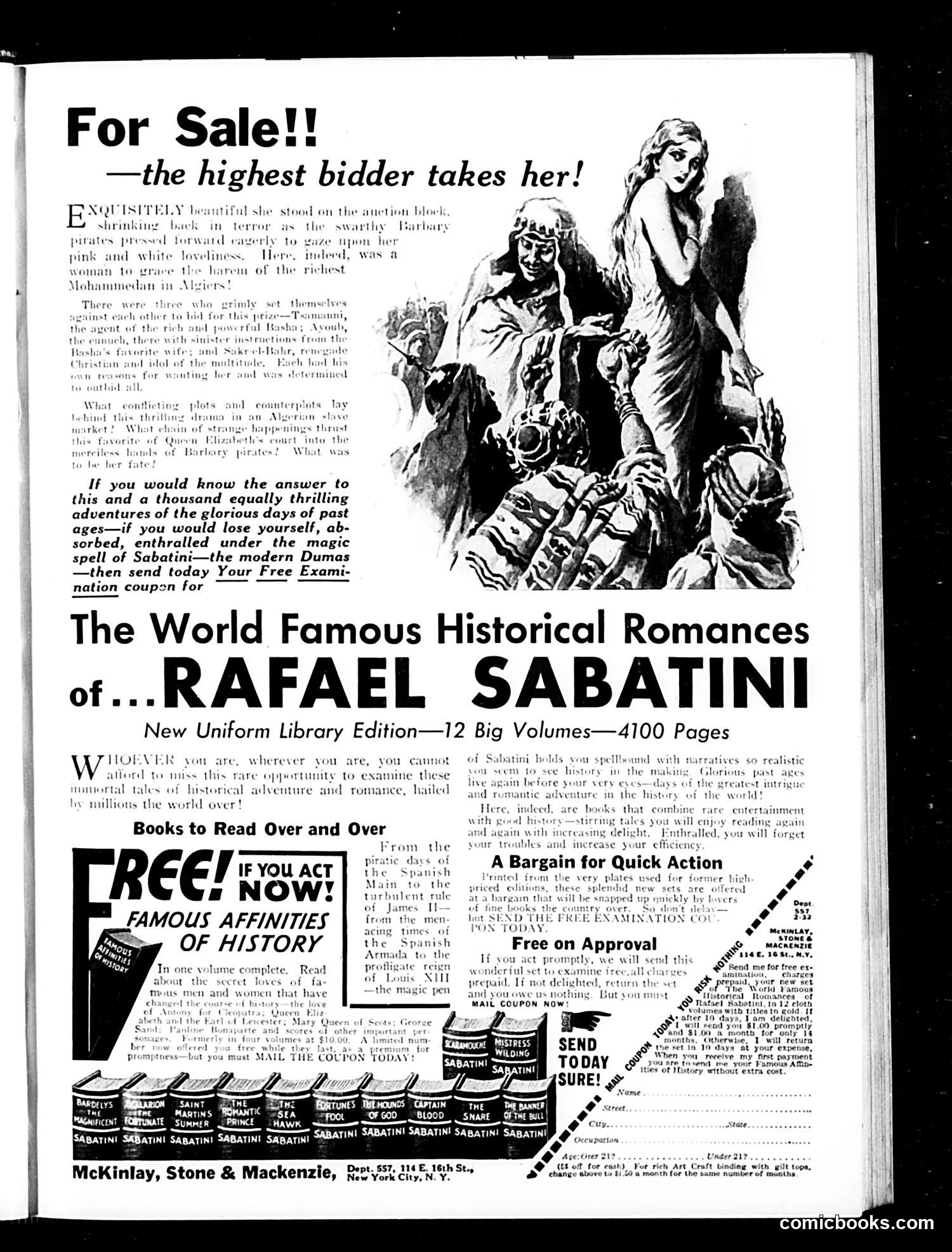
Analysis This is primarily a book advertisement, not political satire. It promotes Rafael Sabatini's historical romance novels through Judge magazine. The opening illustration depicts a woman on an auction block being sold to "Barbary pirates"—a scene referencing the historical practice of slave trafficking in North Africa. This dramatic image serves as a hook to entice readers into Sabatini's adventure narratives set in past eras. The satire is subtle and self-aware: Judge's audience (educated, middle-class readers) would recognize the melodramatic cliché of the "damsel in distress" scenario. The advertisement ironically positions Sabatini as "the modern Dumas," appealing to readers who enjoyed escapist historical fiction about exotic locales and romantic peril. The "FREE" offer and examination coupon were standard direct-mail marketing tactics of the era. The page also lists Sabatini titles visible at bottom, emphasizing the series' breadth. No specific political commentary appears intended—this is commercial advertising leveraging popular literary taste.
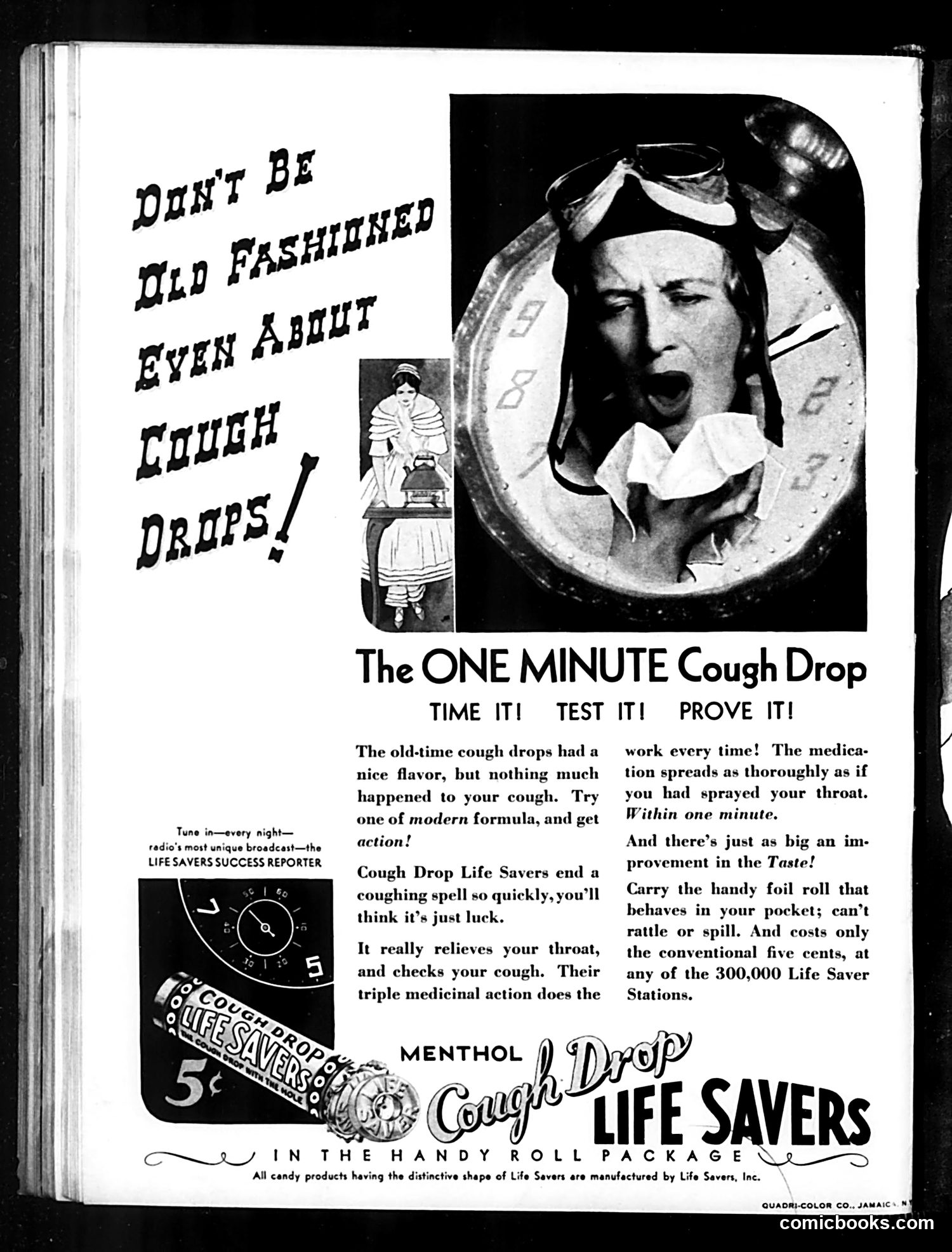
Analysis This page is primarily advertising, not satire or political commentary. It's a full-page advertisement for Life Savers Cough Drops from Judge magazine. The ad promotes a new menthol cough drop formulation, contrasting "old-time" remedies with this "modern formula" that works within one minute. The imagery shows a person using the product, with emphasis on fast relief. The only potentially humorous element is the tagline "Don't Be Old Fashioned Even About Cough Drops!" — a mild jab at traditional remedies — and the mention of a radio program called "Life Savers Success Reporter" (likely a fictional promotional tie-in). The page reflects 1930s-40s advertising conventions: pseudo-scientific claims ("triple medicinal action"), emphasis on convenience (foil packaging), and widespread availability (300,000 Life Saver Stations). There's no political satire or caricature present — this is straight commercial promotion disguised as editorial content in a humor magazine.