judge
Judge — March 5, 1932
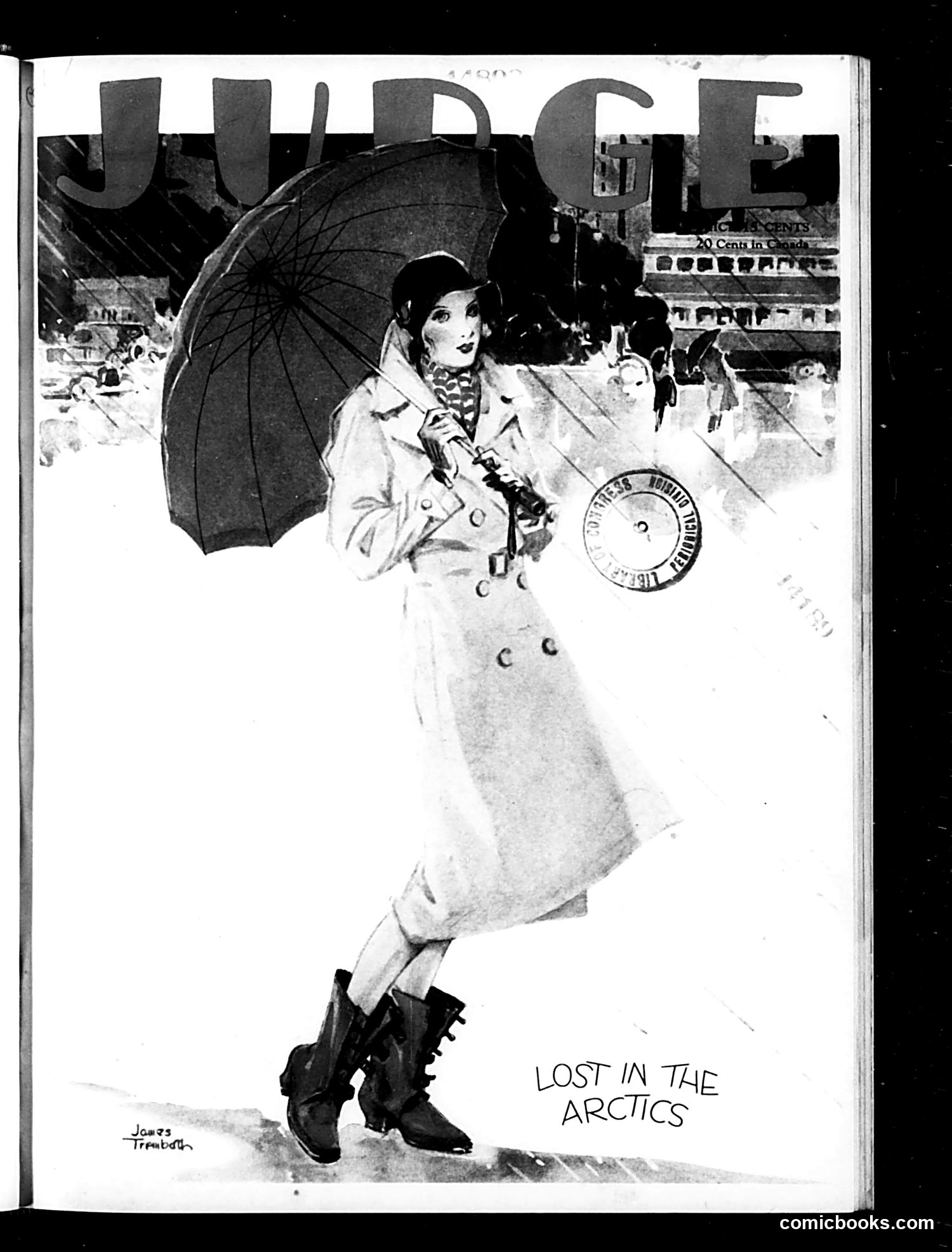
Judge Magazine Cover Analysis This appears to be a Judge magazine cover featuring a stylized illustration by Jones Travelstead. The central image shows a fashionably dressed woman in a light-colored coat and dark boots, holding a large umbrella, with the caption "LOST IN THE ARCTICS." The satire likely plays on early 20th-century Arctic exploration fever—a popular public fascination. The joke appears to contrast the elegant, fashionable woman (suggesting someone unprepared for harsh conditions) against the Arctic setting visible in the background. The elaborate coat and feminine styling humorously suggest she's hopelessly lost in a dangerous environment while maintaining her fashionable appearance. Without additional context from the magazine's date, specific Arctic expeditions referenced remain unclear, but the piece satirizes either exploration culture or feminine vanity through incongruity.
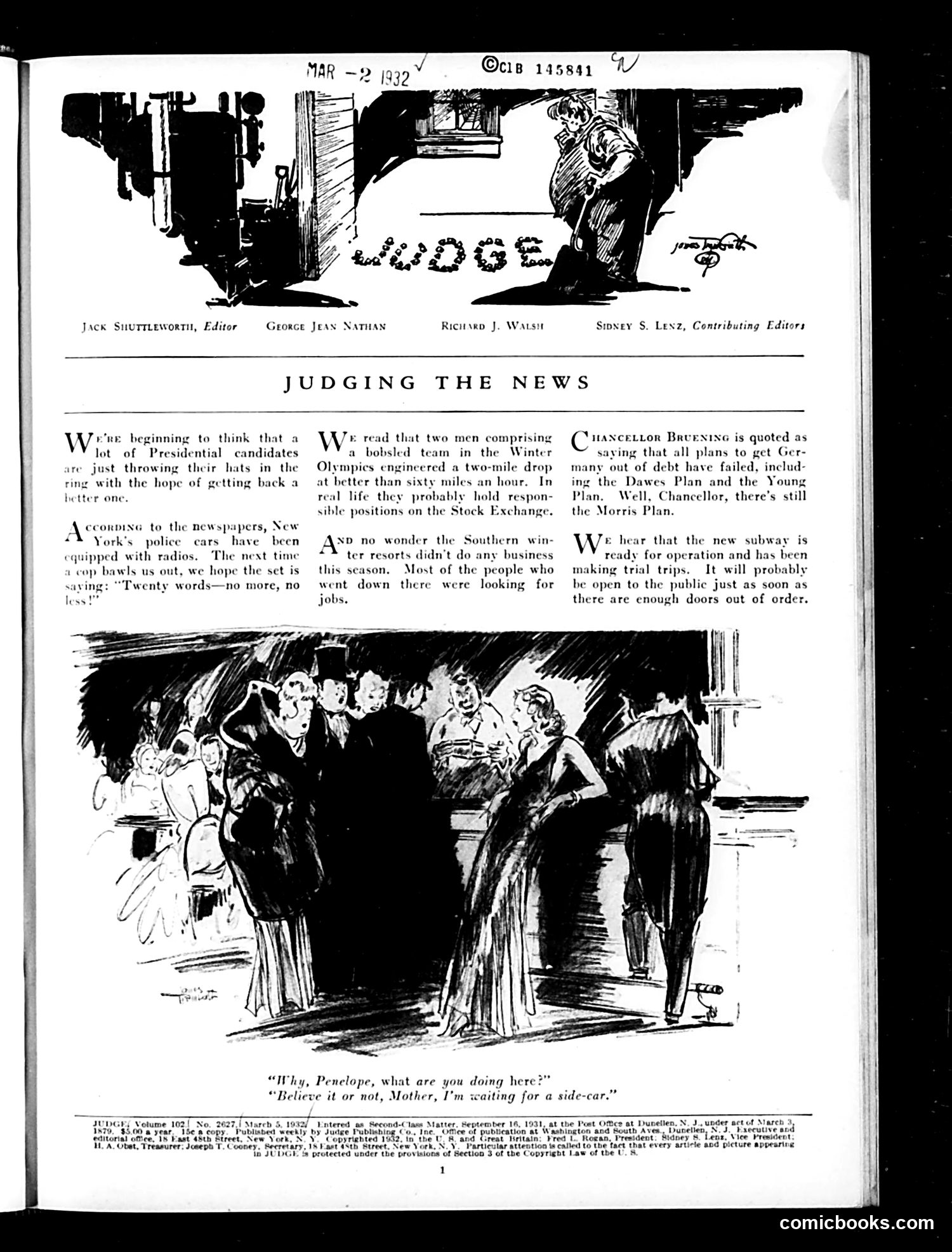
"Judging the News" - Judge Magazine, March 1932 This page features editorial commentary and a cartoon satirizing contemporary issues during the Great Depression era. The main cartoon depicts a woman (Penelope) waiting for a side-car, telling her mother "Believe it or not, Mother, I'm waiting for a side-car"—likely mocking the economic desperation of the period, where people cobbled together unusual transportation solutions. The text columns reference: Presidential candidates "throwing their hats in the ring"; New York police cars equipped with "radio" (emerging technology); a Winter Olympics bobsled team; Stock Exchange positions; Southern winter resorts facing business collapse due to the depression; and a new subway system with operational problems. The overall tone critiques both the absurdities of political campaigning and the widespread economic disruption affecting American life in early 1932.
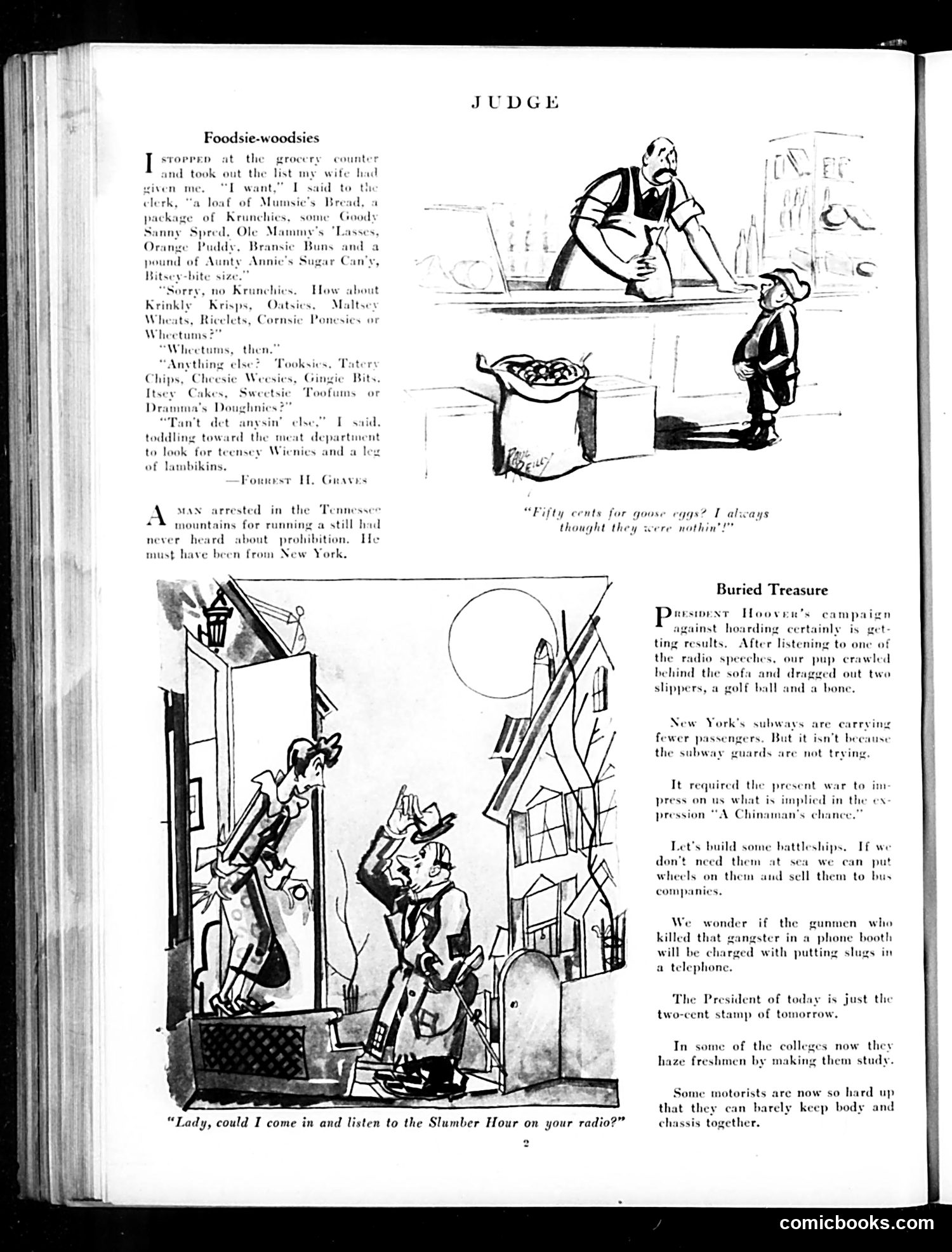
Analysis of Judge Magazine Page "Foodsie-woodsies" (top): A humorous poem by Forrest H. Graves mocking a husband's grocery list that includes novelty foods and brand names (Mumsie's Bread, Sunny Spread, etc.) rather than basic items. The accompanying cartoon shows a wife at a counter with a child, illustrating domestic shopping absurdity. "Fifty cents for goose eggs?" (right cartoon): A grocer and customer exchange about pricing, likely satirizing inflated wartime prices or food scarcity. "Buried Treasure" (main cartoon): Shows people crammed in a tenement building's elevator, apparently trying to reach upper floors. The caption reads "Lady, could I come in and listen to the Slumber Hour on your radio?" This satirizes overcrowded urban housing conditions and the era's new radio entertainment culture—suggesting people are so packed together they share neighbors' entertainment.
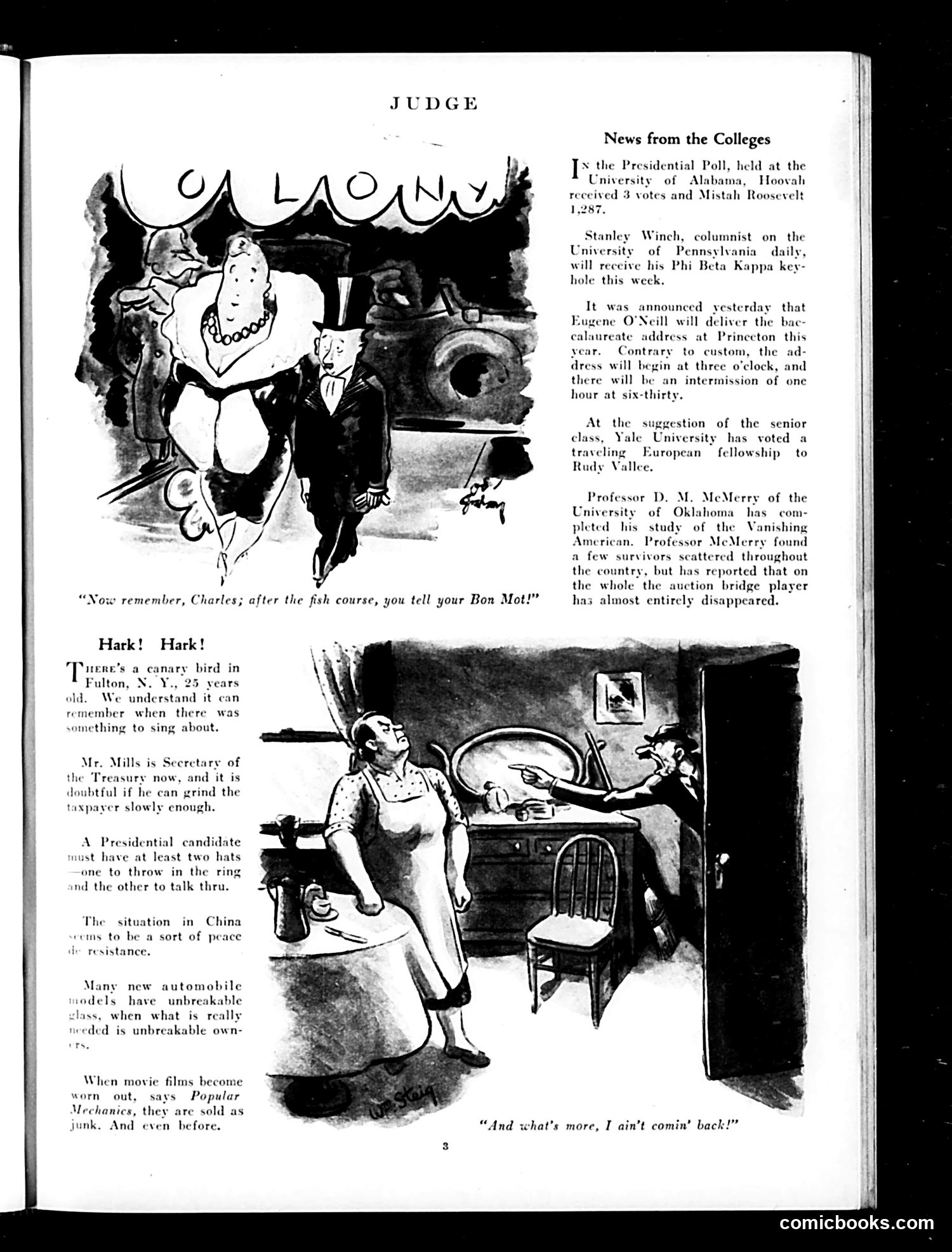
Judge Magazine Page Analysis The top cartoon depicts a rotund figure in formal dress at what appears to be a fancy restaurant, with the caption "Now remember, Charles; after the fish course, you tell your Don Me!" This satirizes pretentious dining etiquette and social climbing—likely mocking someone coaching their companion on when to make an important announcement or impression during a formal meal. The bottom cartoon shows a woman at a radio saying "And what's more, I ain't comin' back!" This appears to satirize women's independence or domestic disputes, popular comedy fodder of the era. The radio suggests this is a modern woman using contemporary technology, possibly criticizing or leaving her husband. The "News from the Colleges" section contains light campus gossip typical of Judge's collegiate humor.
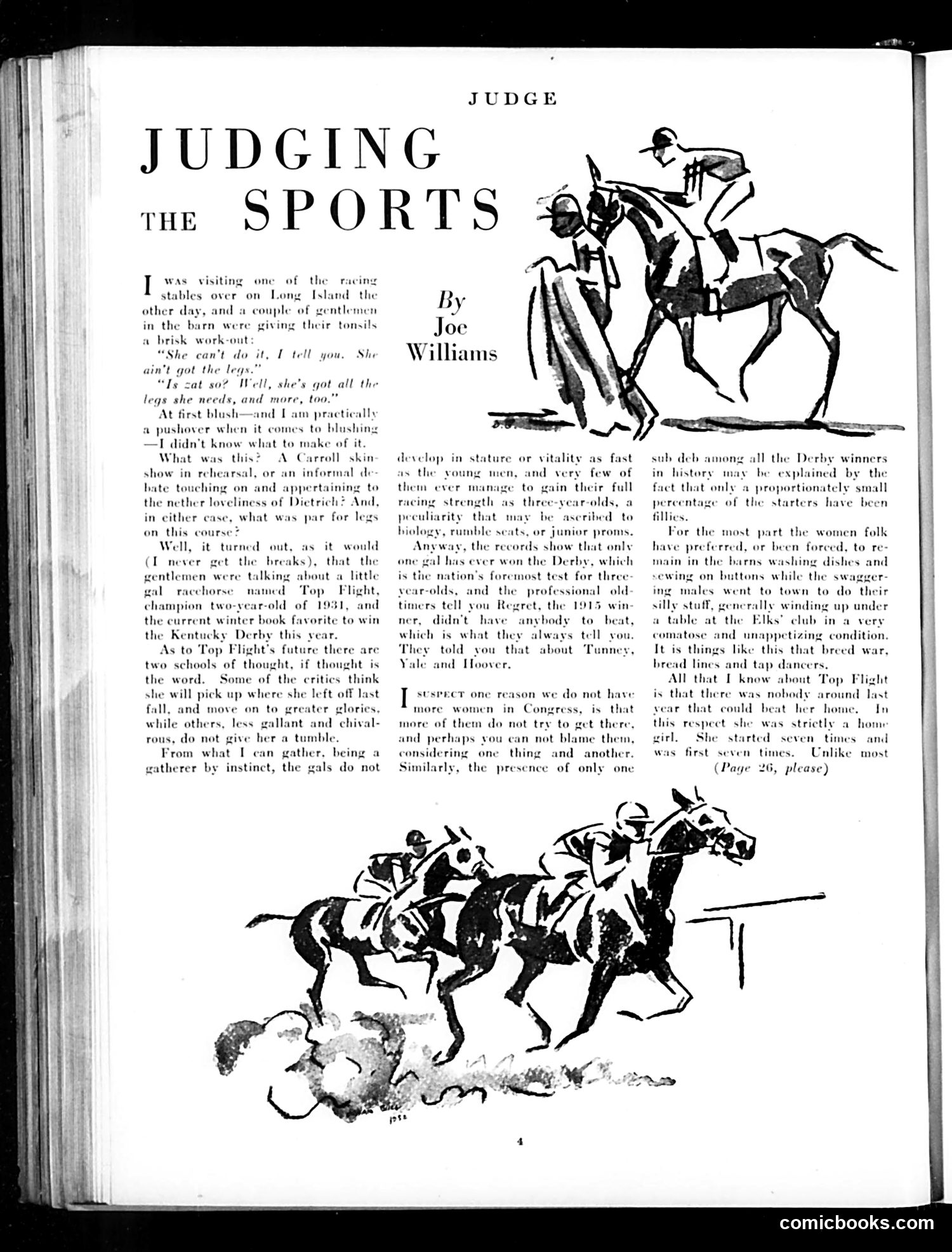
"Judging the Sports" by Joe Williams This satirical article criticizes women's limited presence in horse racing and sports governance. Williams recounts visiting racing stables where gentlemen claimed a horse named "Top Flight" couldn't win because "she ain't got the legs"—a dismissive comment about the animal's breeding. He then pivots to social commentary, noting that women are similarly underrepresented in Congress and sports decision-making, suggesting comparable prejudice excludes them from power. The illustrations show horse racing scenes. Williams argues that the absence of women in positions of influence isn't due to inability but systemic exclusion—people simply "do not try to get there." The piece appears to advocate for greater female participation in governance and sports, using horses as an ironic parallel to highlight the arbitrariness of exclusionary attitudes.
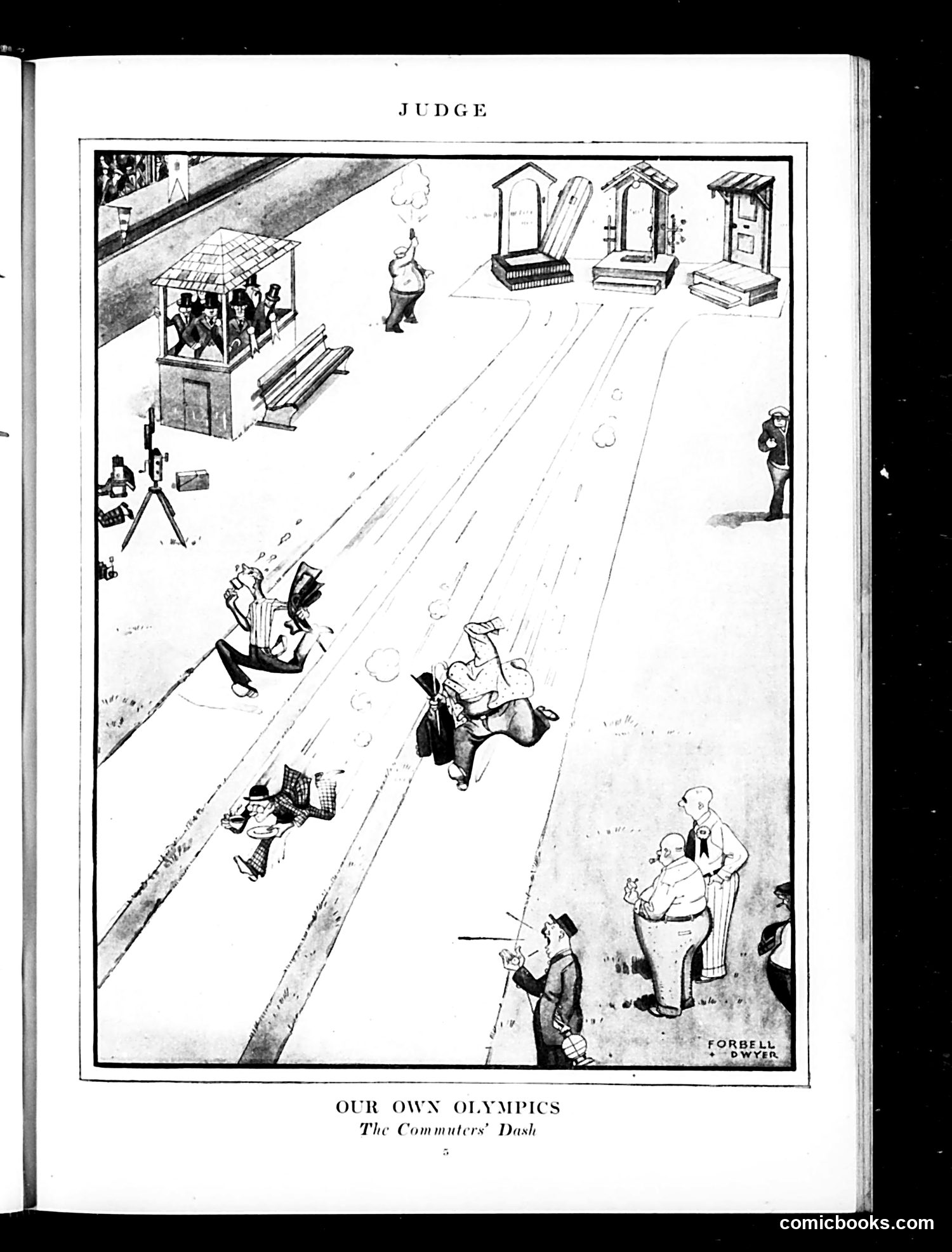
"Our Owx Olympics: The Commuters' Dash" This satirical cartoon depicts commuters racing along what appear to be railroad tracks or pathways, portraying their daily commute as a competitive sport. The figures are shown in exaggerated, athletic poses—some tumbling or lunging forward—suggesting the frantic, chaotic nature of rush-hour travel. The joke centers on transforming mundane commuter behavior into an "Olympic" spectacle. Period spectators (judges, officials with equipment) oversee the "competition," complete with viewing stands. The satire mocks both the intensity with which commuters rushed to catch trains and the era's obsession with Olympic athleticism and competition. This likely dates to early-to-mid 20th century, when rail commuting was the primary urban transportation method, and commuters' scrambling for trains was a recognizable social phenomenon worth satirizing.
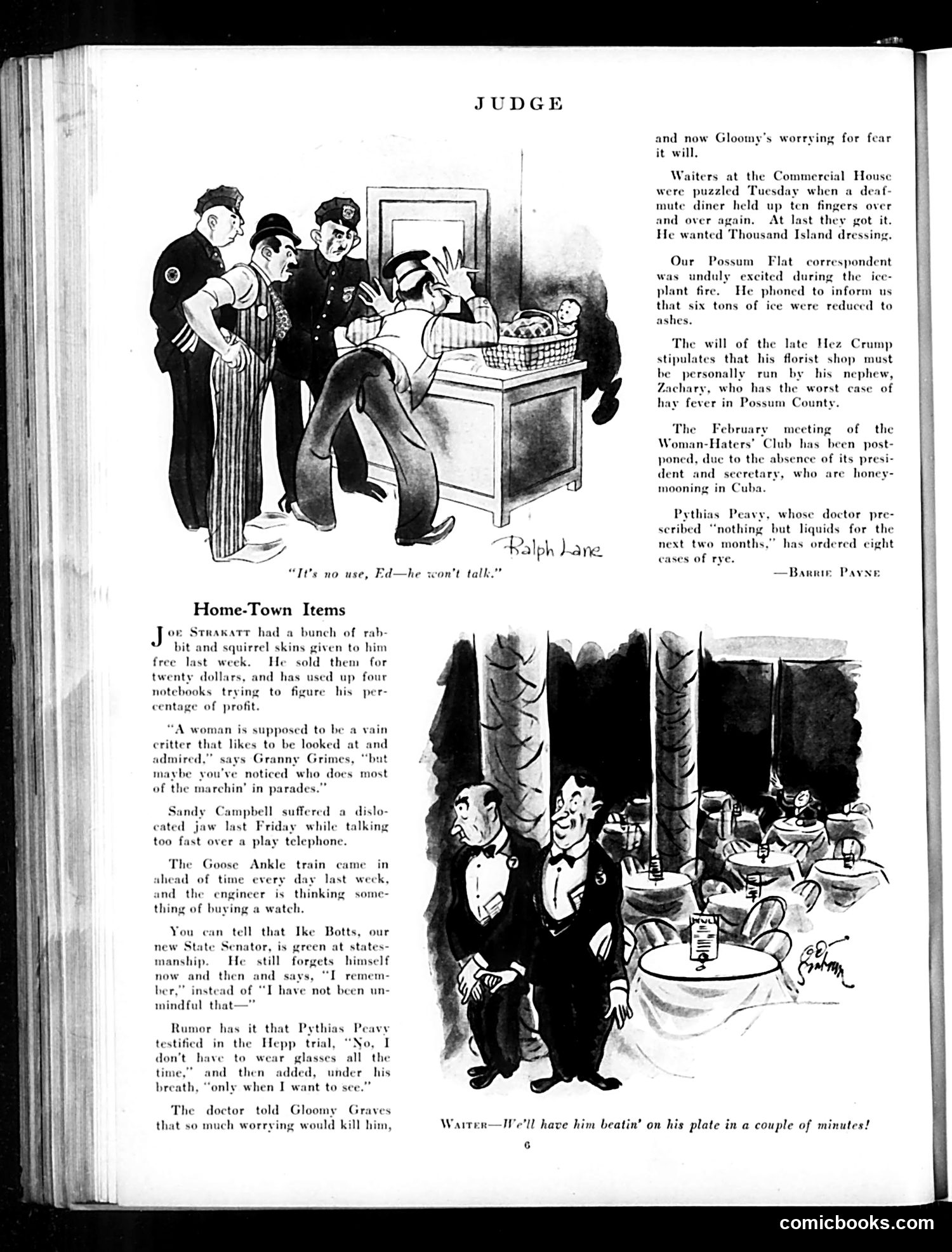
Analysis of Judge Magazine Page This page contains two distinct sections: a cartoon and local gossip items. Top Cartoon ("It's no use, Ed—he won't talk"): Shows what appears to be police or officials questioning a suspect who refuses to cooperate. The joke suggests someone in custody is refusing to speak to interrogators. "Home-Town Items" section: A collection of brief local anecdotes about small-town characters and situations—Joe Strakatt selling animal skins, Granny Grimes commenting on women in parades, Sandy Campbell's jaw injury from a phone mishap, and various other trivial incidents. Bottom illustration: Shows two formally dressed men at a dinner party or social gathering, with a waiter announcing someone will soon be "beatin' on his plate." The page exemplifies Judge's formula of mixing satirical humor with lighthearted local gossip and social observations typical of early 20th-century American magazines.
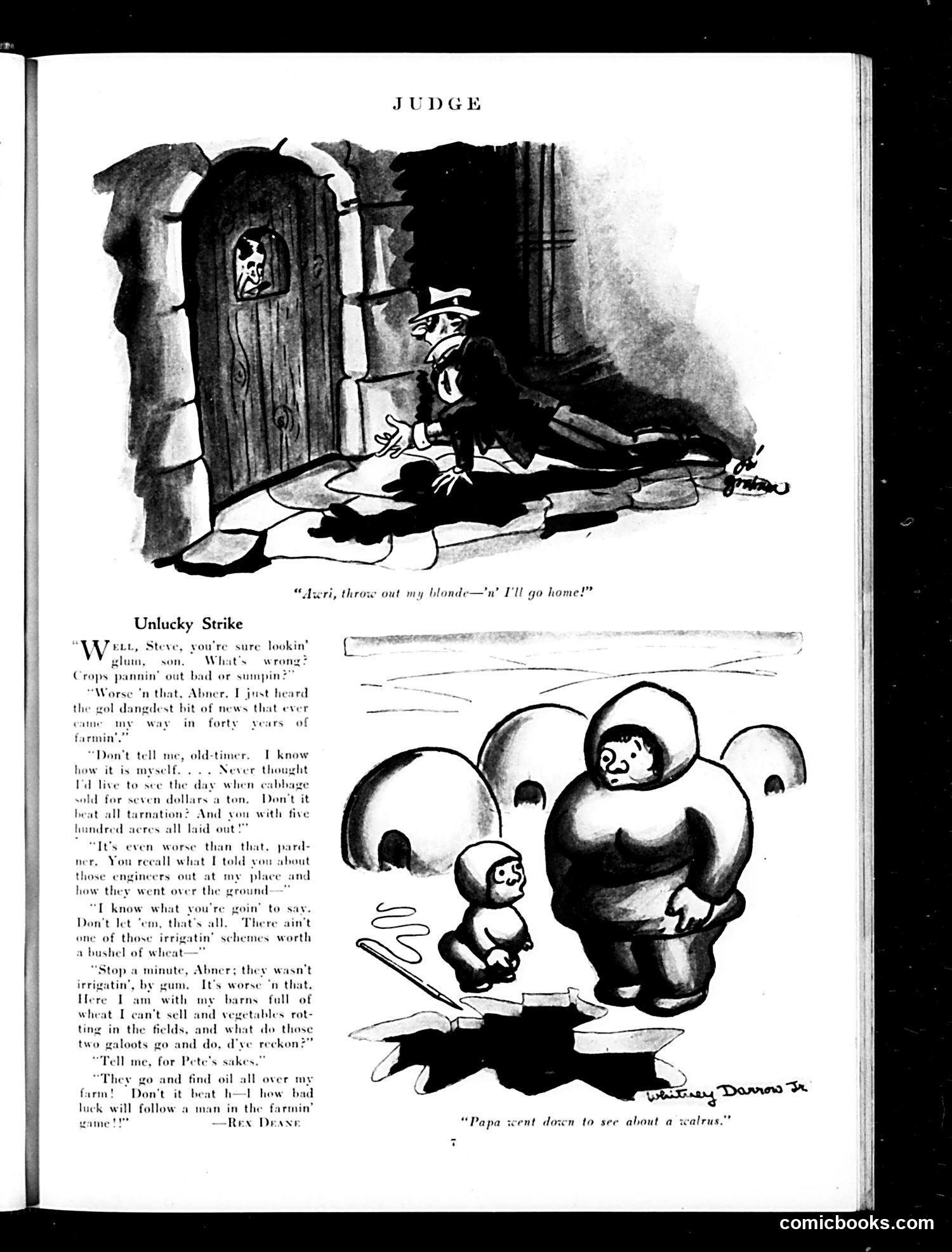
Unlucky Strike This two-panel Judge page satirizes early 20th-century American agricultural anxieties through rural dialogue. The main cartoon depicts a farmer's complaint about discovering oil on his property—a reversal of fortune that appears disastrous. Two farmers discuss crop failures, falling cabbage prices (seven dollars a ton), failed irrigation schemes, and rotting produce. The punchline: engineers discovered oil reserves on the farmer's land, which he views as a curse rather than blessing. The satire mocks rural skepticism toward sudden wealth and modernization—the farmer prefers familiar agricultural problems to unexpected industrial development disrupting his way of life. The smaller cartoon shows children playing with oversized pumpkins, captioned "Papa went down to see about a walrus"—a non-sequitur joke with unclear satirical intent. The page reflects Judge's urban, educated audience mocking rural conservatism and resistance to economic change during the oil boom era.
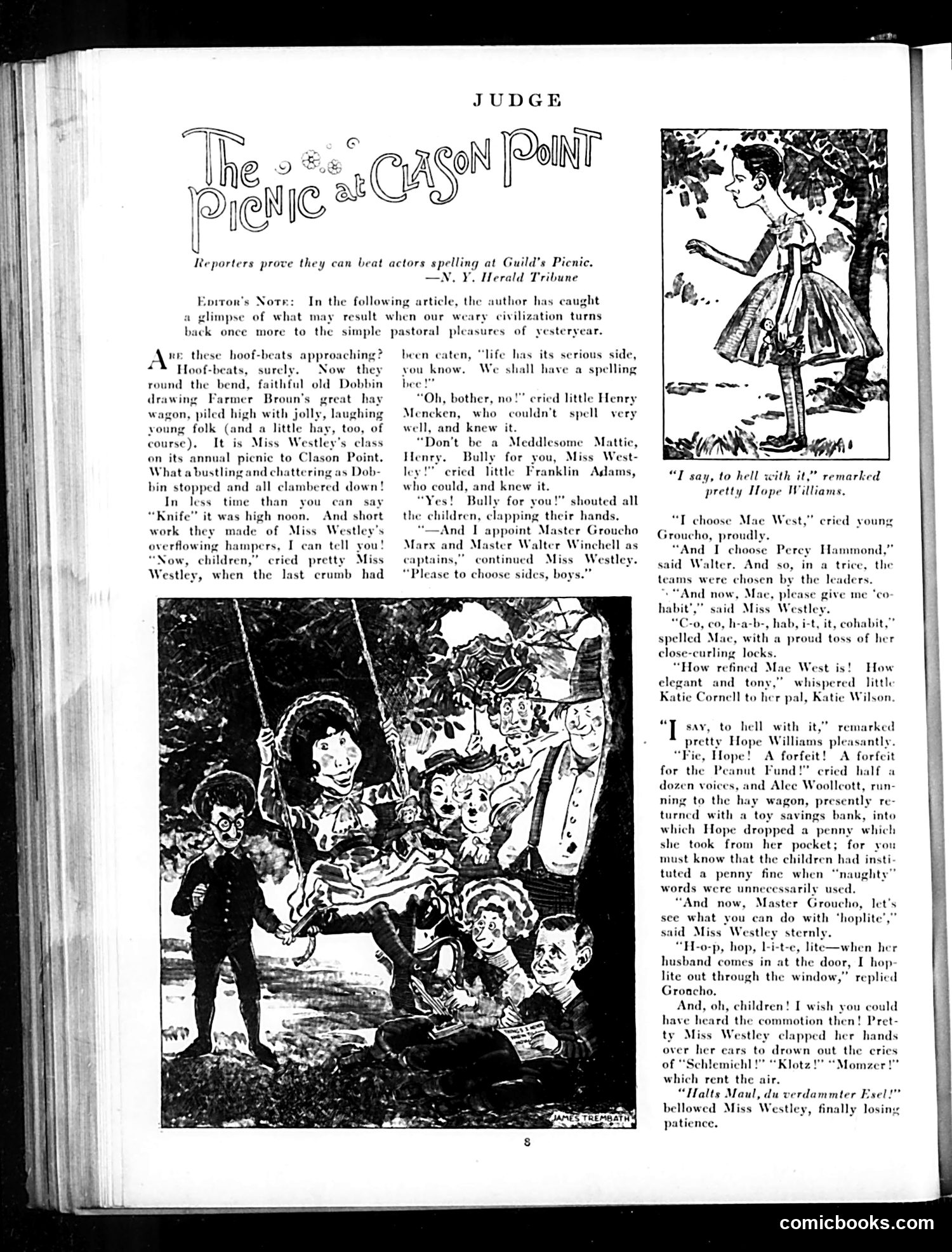
"The Picnic at Cason Point" - Judge Magazine Satire This is a humorous fictional article satirizing a spelling bee at a school picnic. The satire works by having children select famous 1920s-30s entertainers and cultural figures as team captains—Mae West, Groucho Marx, Walter Winchell, and Percy Hammond—then having these celebrities answer spelling questions with characteristic wisecracks rather than actual answers. The joke targets both the celebrities' public personas (Mae West's sultry confidence, Groucho's irreverent humor) and contemporary American culture's celebrity worship. By placing these famous figures in a children's educational context, the piece mocks how entertainment celebrities dominate public discourse while suggesting they're intellectually frivolous. The editor's note frames this as social commentary: our "weary civilization" abandoning serious pursuits for entertainment-driven pastimes. The children's casual profanity ("to hell with it") reinforces the satirical point about cultural decline.
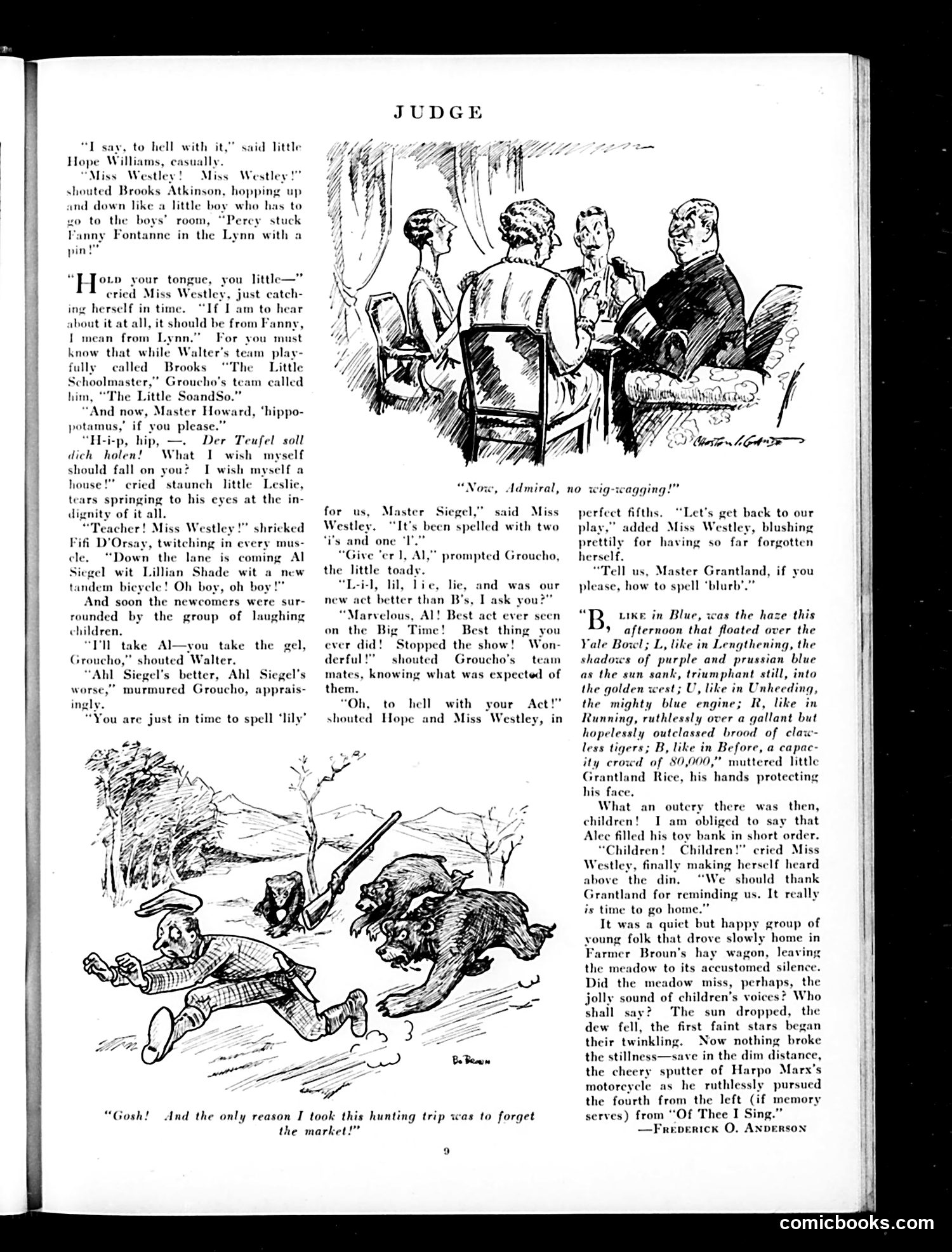
"Judge" Page Analysis This appears to be a humorous short story about children on an outing, rather than political satire. The narrative involves young people spelling words competitively—a parlor game—with adult judges including figures identified as "Brooks," "Groucho," "Walter," and others. The satire targets theatrical people and their pretensions: The story mocks Broadway personalities (the references to "Fanny Fontanne" and performance teams suggest theatrical circles) who take themselves seriously while children play innocent word games around them. The bottom illustration's caption—"the only reason I took this hunting trip was to forget the market!"—satirizes the financial preoccupations of the era, likely referencing stock market anxieties. The closing reference to "Harpo Marx" (the silent comedian) pursuing "the fourth from the left" is self-aware comedic randomness typical of Judge's absurdist humor. Overall: lighthearted satire of theatrical vanity and urban financial worry, not political commentary.
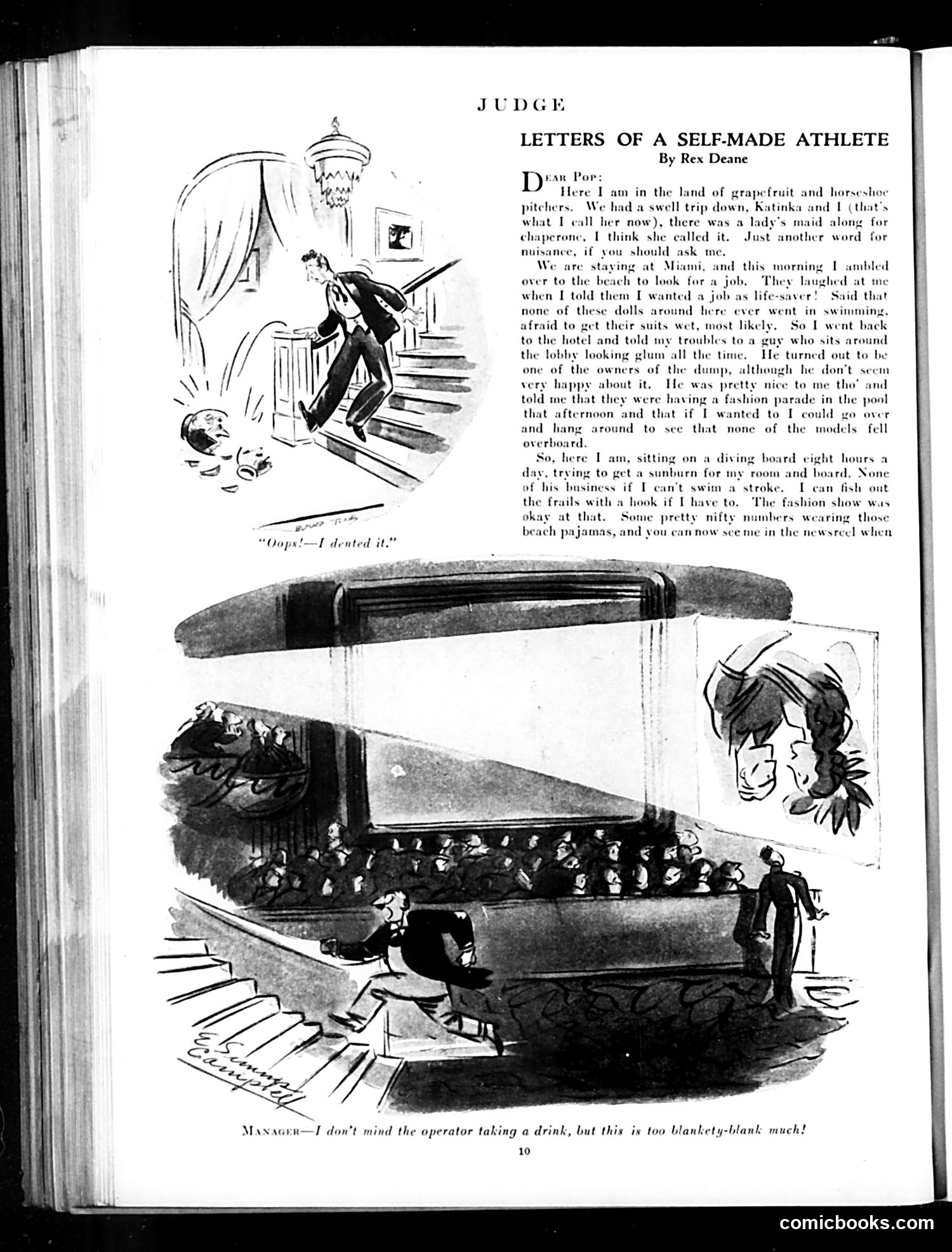
Analysis for Modern Readers This is a humorous letter from a self-made athlete boasting about his Florida vacation. The narrator is a comically incompetent, self-deluded man who: - Falsely claims athletic prowess while unable to swim - Treats women dismissively ("dolls," bringing a chaperone he calls "Katinka") - Gets a hotel job as a diving board lifeguard despite having no qualifications - Attends a fashion show featuring "beach pajamas" (1920s swimwear) - Desperately seeks newsreel exposure to boost his fake reputation The satire targets: Nouveau riche pretenders, male vanity, and the 1920s obsession with celebrity and publicity. The humor depends on the reader recognizing this character as a transparent fraud—someone fabricating credentials and accomplishments while remaining oblivious to his own inadequacy. The two cartoon illustrations depict his mishaps and pomposity, reinforcing the text's mockery of this self-aggrandizing con artist.
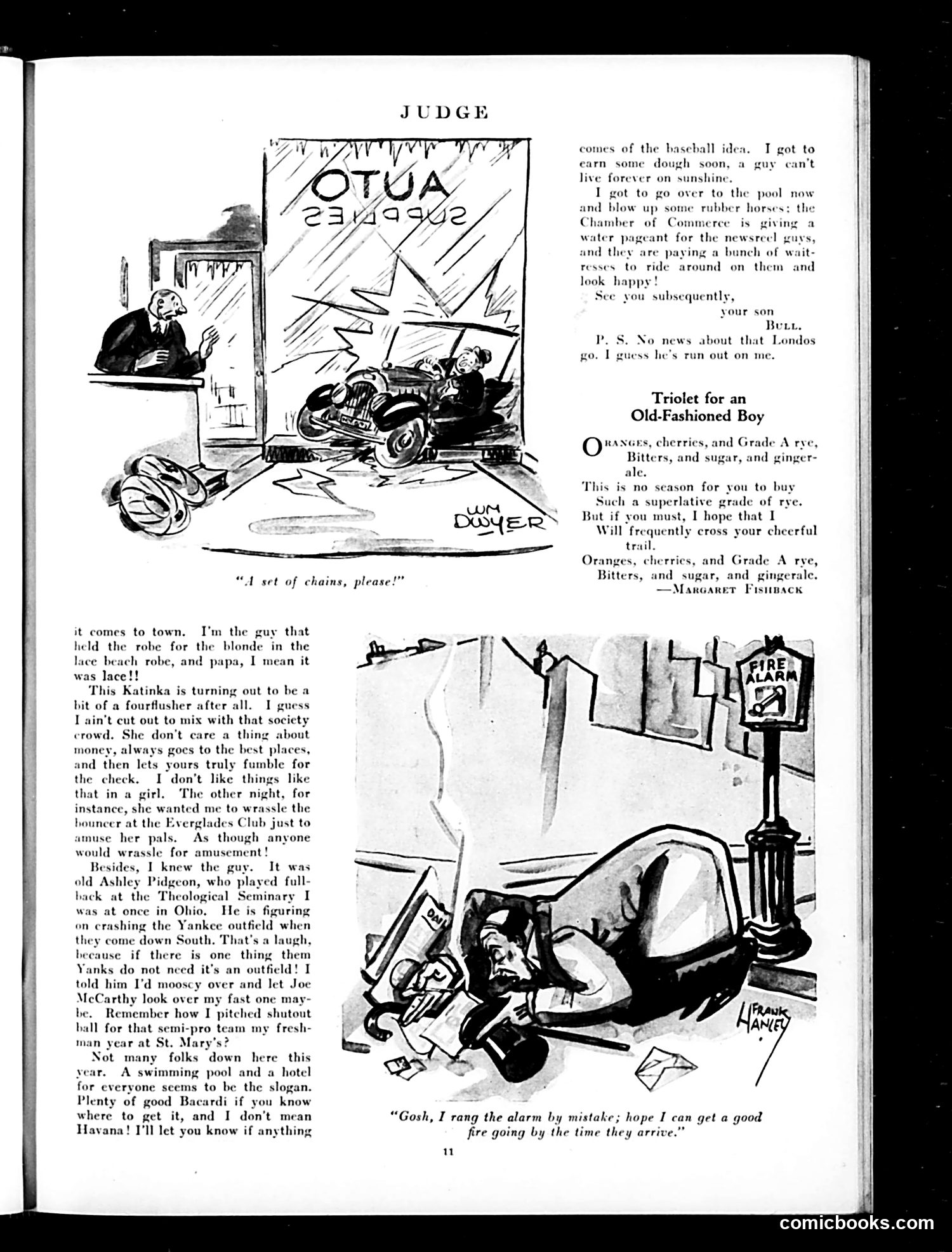
Analysis of Judge Magazine Page This page contains two unrelated pieces of 1920s-era satirical content: Top cartoon: A judge presides over a traffic court case involving a reckless driver. The satire mocks the era's dangerous automobiles and casual attitudes toward traffic violations—the judge's exasperated expression suggests courts were overwhelmed by such cases as car culture expanded. Letter section: A wealthy young man complains about dating a society woman named Katinka who embarrasses him by asking him to fight bar bouncers for entertainment. The satire targets old-money elitism and social pretension—she's indifferent to his spending and treats him as entertainment rather than romance. Lower cartoon: A man has accidentally triggered a fire alarm while reading a newspaper. The humor derives from the mundane mistake and his sheepish concern about firefighters responding unnecessarily. The page reflects 1920s concerns: automobile proliferation, class anxiety among the middle class attempting to "mix" with wealthy society, and urban modernization. The tone is lighthearted social commentary rather than hard political satire.
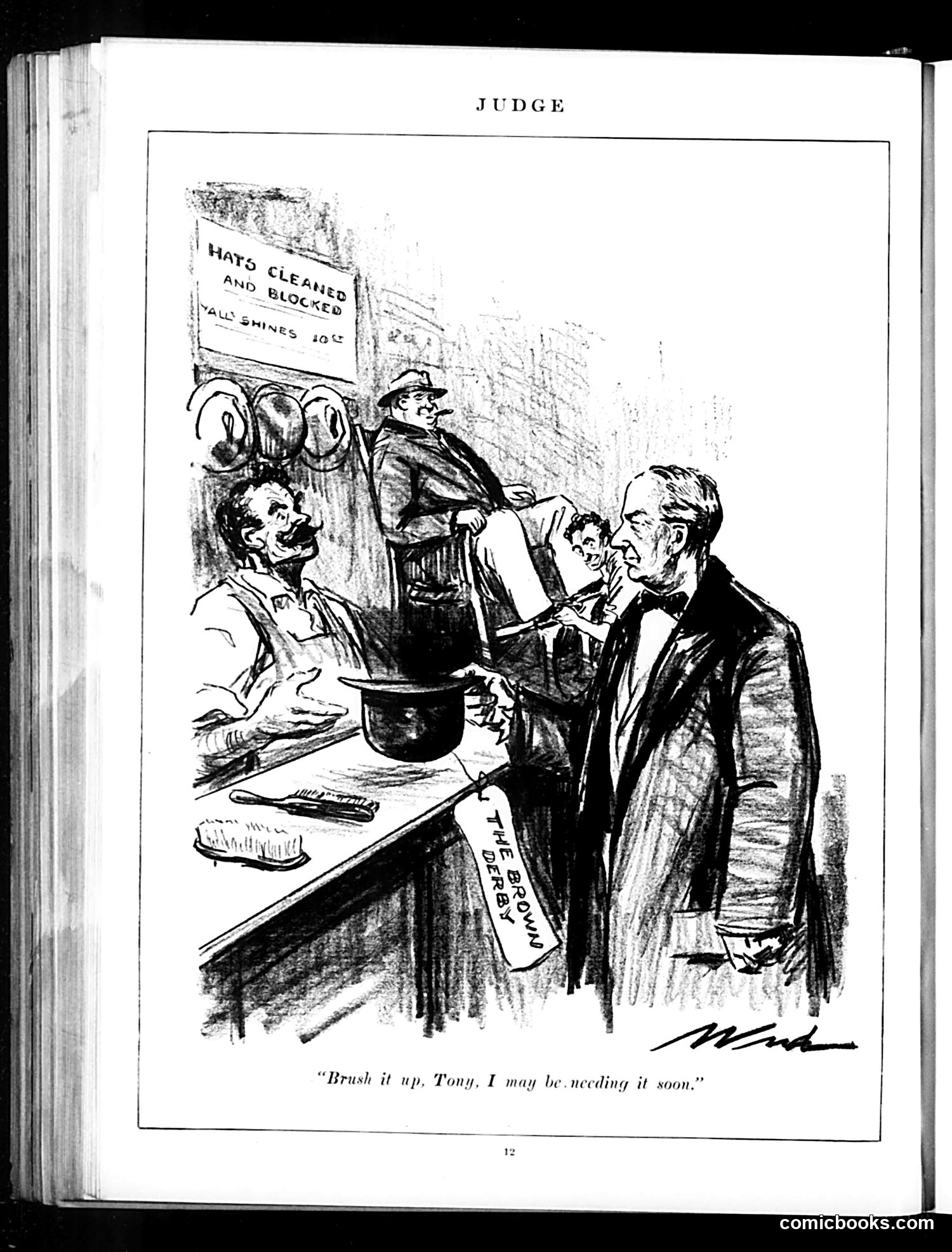
Analysis This cartoon appears to be satirizing judicial corruption or the preparation of legal arguments through dubious means. A well-dressed man (likely representing a wealthy defendant or client) hands a hat-cleaning brush to "Tony" (possibly a court official or fixer), with the suggestive caption "Brush it up, Tony, I may be needing it soon." The sign advertising "HATS CLEANED AND BLOCKED" and "BALLS SHINES 10¢" provides cover for what seems to be an illegal arrangement—the "brushing up" likely refers to fabricating or polishing false evidence or testimony rather than literally cleaning hats. The cartoon satirizes the corruption of judicial processes through bribery or collusion, suggesting that justice can be "cleaned up" or manipulated for those with money to pay.
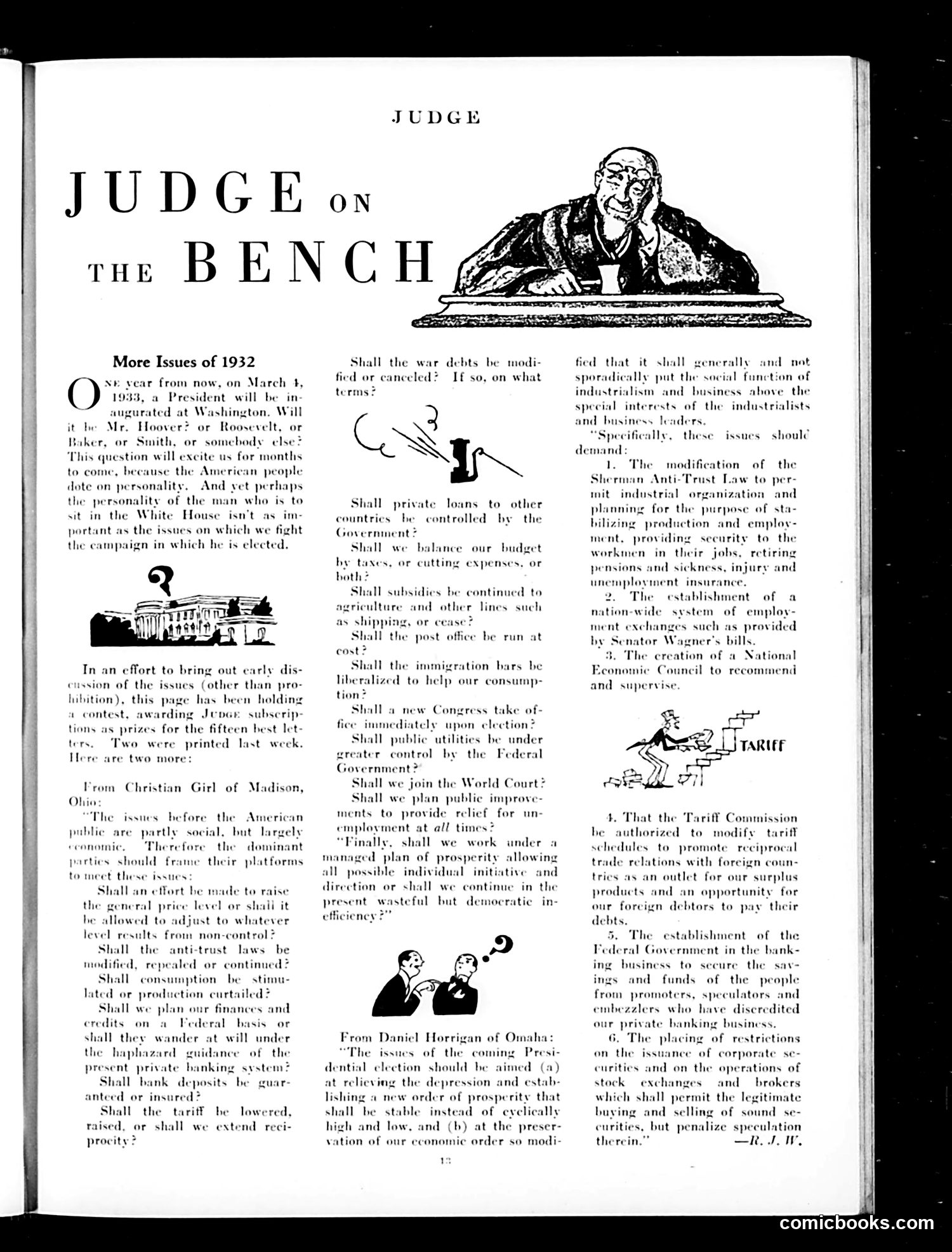
Judge Magazine Cartoon Analysis: "Judge on the Bench" (1932) This page solicits reader letters debating the major political and economic issues facing the 1932 presidential election. Two citizens—Christian Girl of Madison, Ohio and Daniel Horrigan of Omaha—propose competing visions for America's recovery from the Great Depression. The "Judge on the Bench" illustration depicts a stern jurist presiding over these competing philosophies. The satire critiques how ordinary Americans must essentially "judge" which candidate and platform will address urgent concerns: war debts, tariffs, banking reform, unemployment relief, and antitrust policy. The cartoon suggests that personality—whether President Hoover, Roosevelt, or another candidate—matters less than substantive policy positions on economic intervention, government control of utilities, and social welfare programs. The competing letters represent different economic philosophies (laissez-faire versus managed planning) that would dominate the 1932 campaign between incumbent Hoover and challenger Franklin D. Roosevelt.
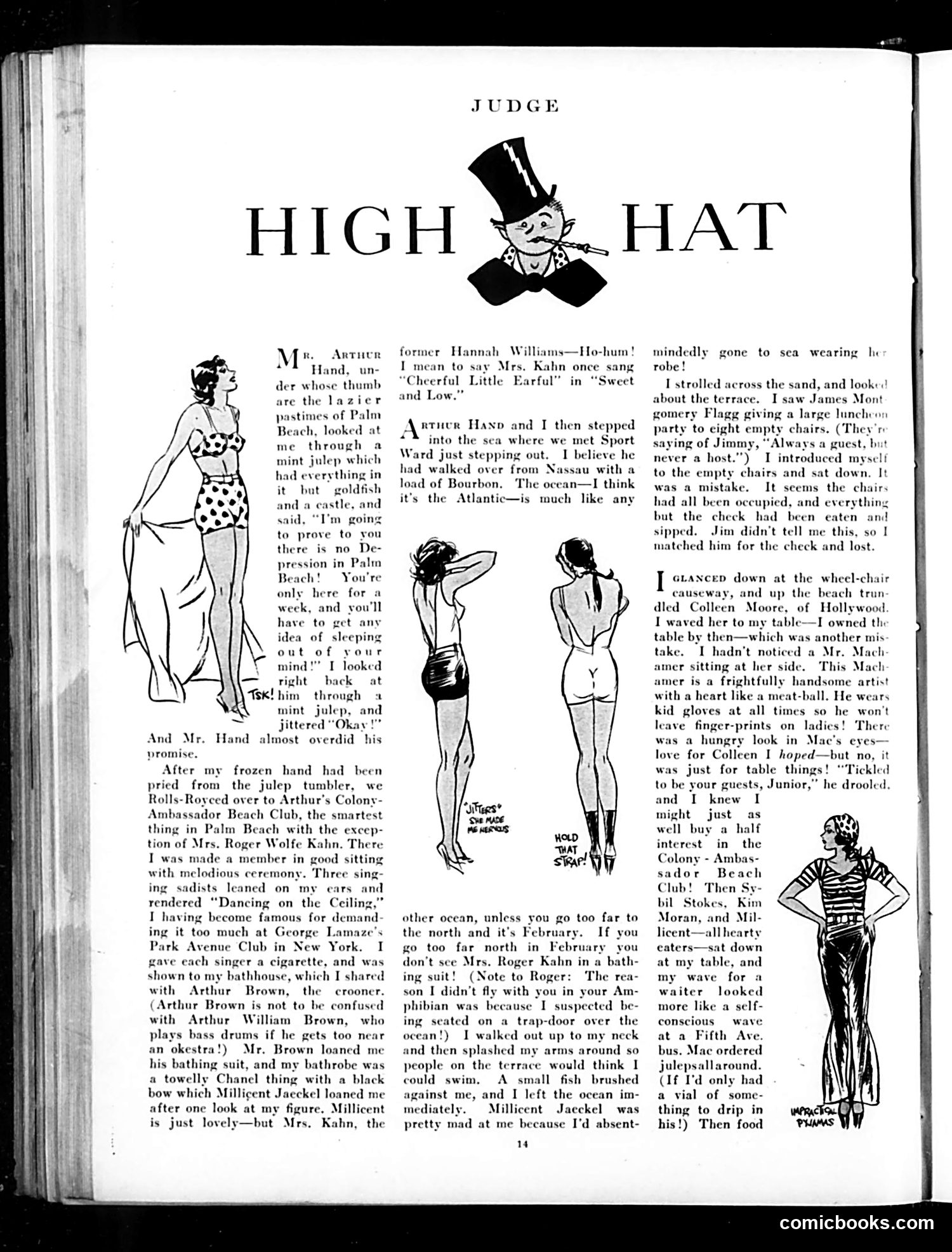
Judge Magazine Satire: "High Hat" (Palm Beach Social Scene) This is a humorous first-person account of a week in Palm Beach, satirizing the wealthy leisure class during what appears to be the Depression era. The author describes encounters with society figures like Mrs. Roger Wolfe Kahn (a former singer) and artist James Montgomery Flagg, depicting them at exclusive clubs and beaches. The satire targets several things: the ostentatious wealth display ("Rolls-Royced"), the hollow socializing (Flagg hosting "eight empty chairs"), and the casual cruelty of the wealthy elite. A running joke involves the narrator unknowingly sitting in occupied chairs and leaving expensive venues with unpaid bills. The illustrations show fashionably dressed women in 1920s-30s bathing attire, reflecting the era's leisure culture. The title "HIGH HAT" (slang for snobbish) and the judge character suggest Judge magazine's typical critique of pretentious society behavior—mocking how the wealthy insulate themselves from economic reality while engaging in trivial social games.
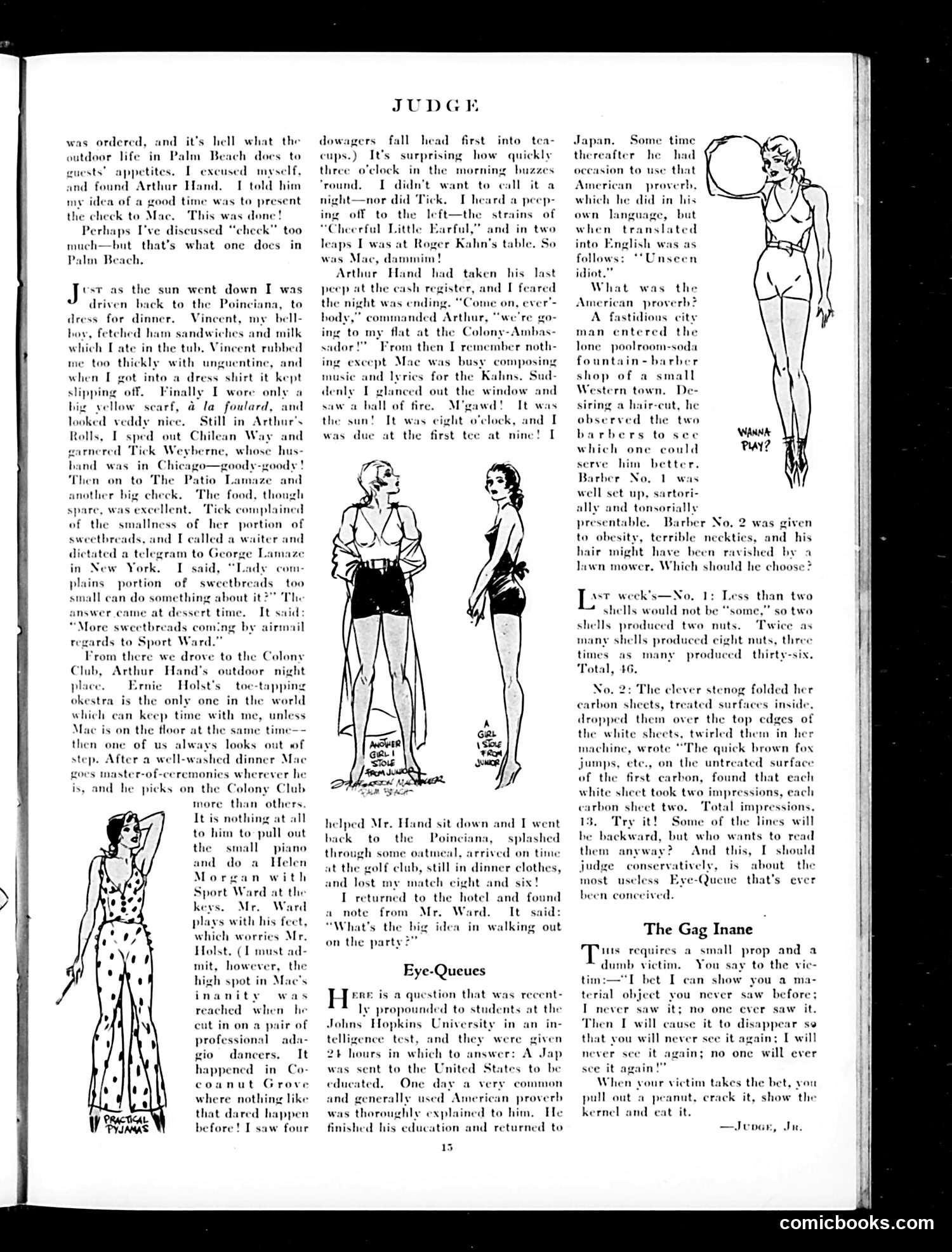
Analysis of Judge Magazine Page This page from Judge contains three distinct pieces of satirical content: Main Story: A humorous first-person account of the wealthy author's evening in Palm Beach, satirizing the excessive spending and decadence of the leisure class. The repeated emphasis on paying "checks" at exclusive clubs (The Poinciana, Patio Lamaze, Colony Club) mocks the conspicuous consumption of the era's elite. The mention of "Mac" (likely Helen Morgan, a famous torch singer of the 1920s-30s) performing informally at nightclubs adds period-specific glamour. The absurd detail about losing a golf match "eight and six" after a night of partying underscores the frivolity. Eye-Queues section: A joke about an American proverb being mistranslated into Japanese, playing on linguistic/cultural misunderstandings. The Gag Inane: A setup for a visual gag about choosing between two barbers—positioning this as a test of visual perception or judgment. The overall tone mocks wealthy leisure and social pretension of interwar America.
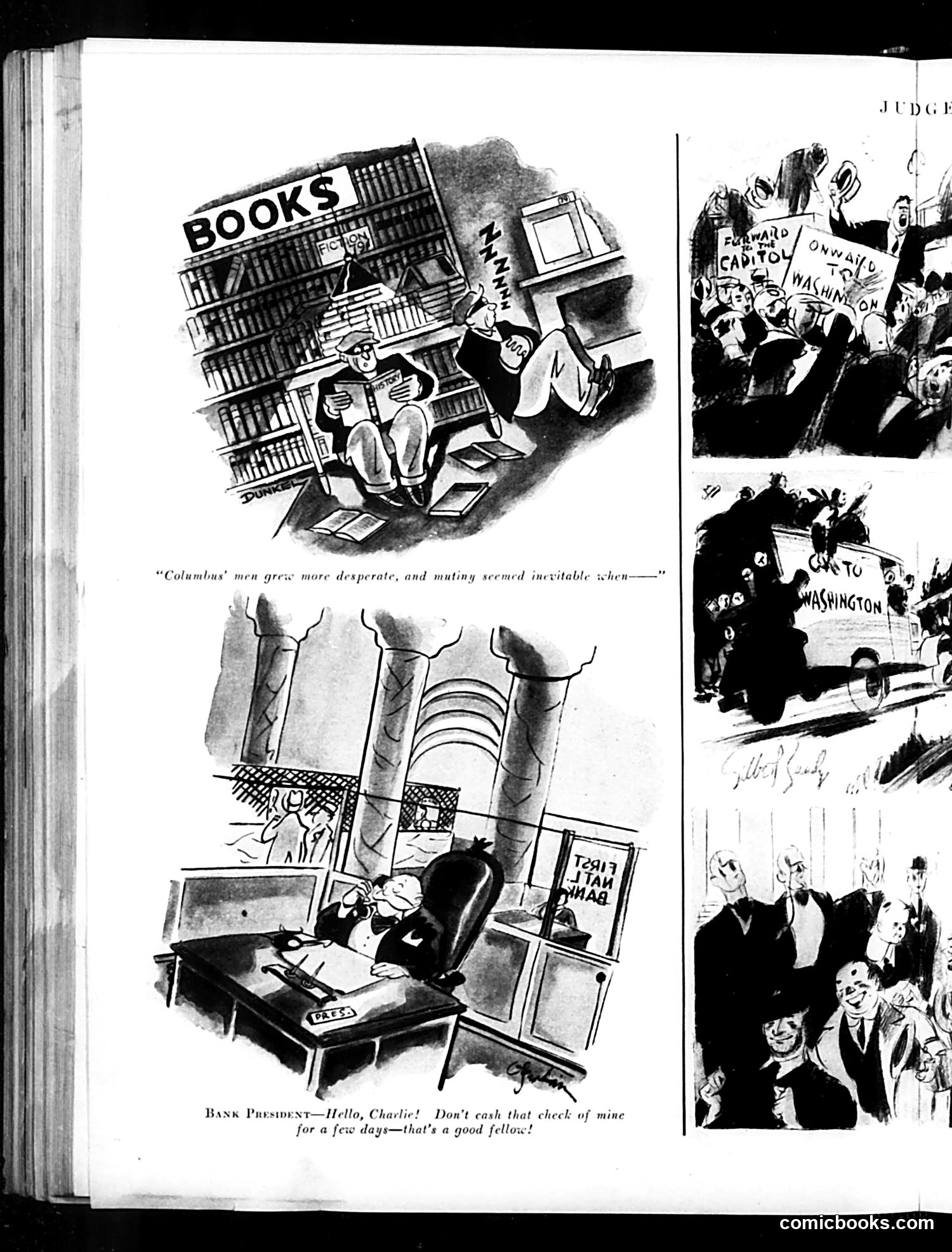
Judge Magazine Cartoon Analysis This page contains two satirical cartoons. The top cartoon depicts a man surrounded by towering bookshelves labeled "BOOKS," suggesting desperation amid intellectual or literary abundance—likely mocking someone overwhelmed by information or study. The bottom cartoon shows a bank president asking a teller ("Charlie") to delay cashing his personal check, claiming it's a favor between friends. This satirizes financial hypocrisy: a bank official who demands strict payment from customers is himself unable to cover his own check, revealing the corruption or financial instability of banking institutions during an era (likely the Depression or post-WWI period) of economic crisis. The humor lies in the audacious double standard.
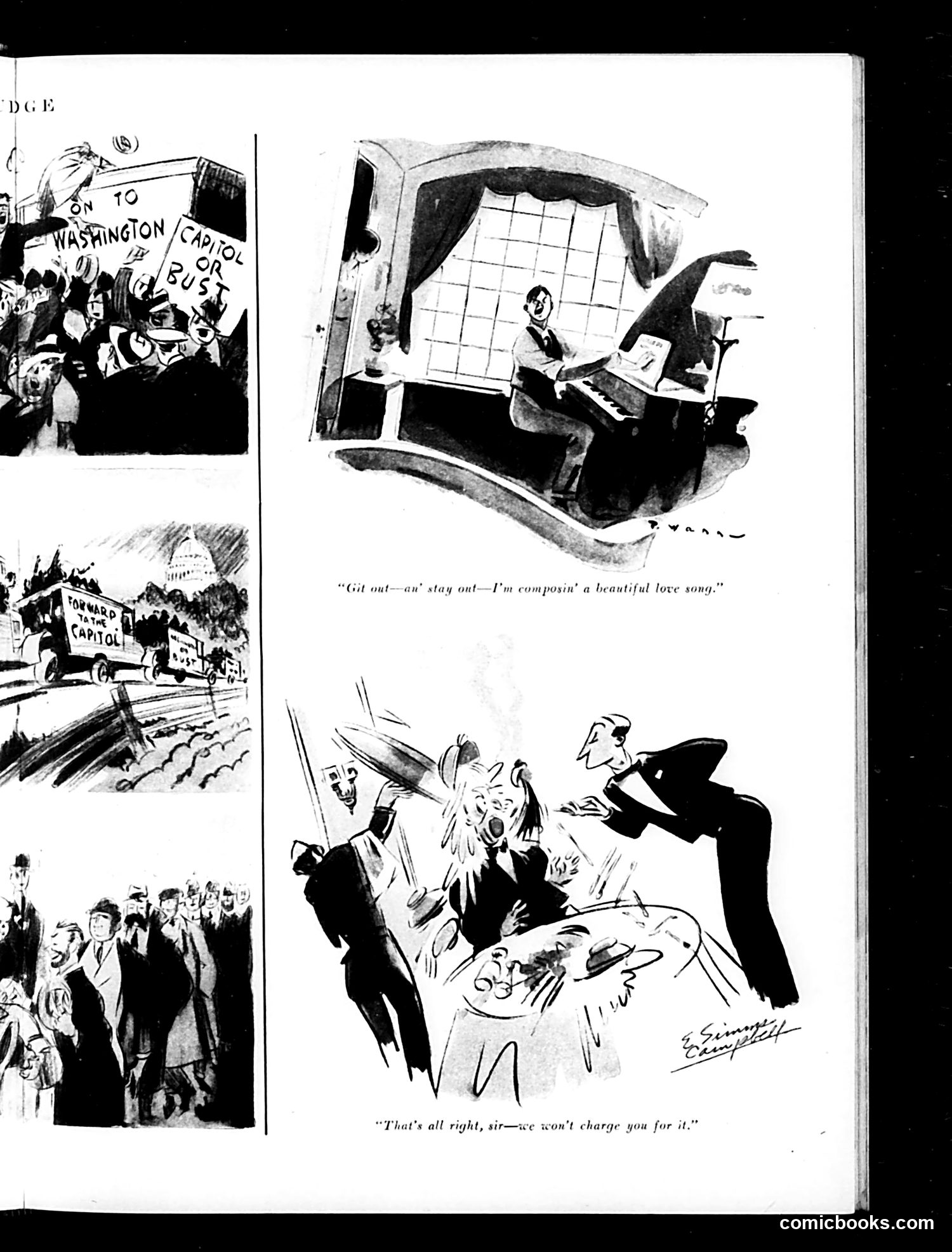
Analysis This page from *Judge* magazine contains political cartoons satirizing Washington, D.C. politics, likely from the early-to-mid 20th century based on the style. Left column: Three panels showing crowds heading "to Washington" and "the Capitol," suggesting mass mobilization or protest movements directed at the federal government. Top right cartoon: A couple in a car; the caption reads "Git out—an' stay out—I'm composin' a beautiful love song," satirizing how political distractions disrupt domestic life. Bottom cartoon: Men in suits appear agitated around a dining table; the caption "That's all right, sir—we won't charge you for it" suggests political figures receiving favors or services without payment—likely commentary on corruption or backroom dealing in Washington. The satire targets the chaos and moral compromises of American politics.
The Theatre of George Jean Nathan This is a theatre criticism column, not a political cartoon. The author—likely George Jean Nathan, the prominent drama critic—critiques producer Jed Harris for staging "The Fatal Alibi," a murder mystery play. Nathan argues that while Harris is genuinely talented, he's compromised his integrity by producing formulaic, mediocre mystery dramas simply for profit. Nathan writes with sardonic disdain: he claims indifference to murder mysteries while simultaneously asserting they're beneath Harris's abilities. The column praises English actor Charles Laughton's performance but suggests American theatre permits less theatrical excess than London stages do. Nathan's "raspberry" (criticism) aims to remind Harris of his artistic potential and responsibility—a backhanded compliment disguised as insult. The tone reflects early 20th-century theatrical criticism's hauteur and insider references.
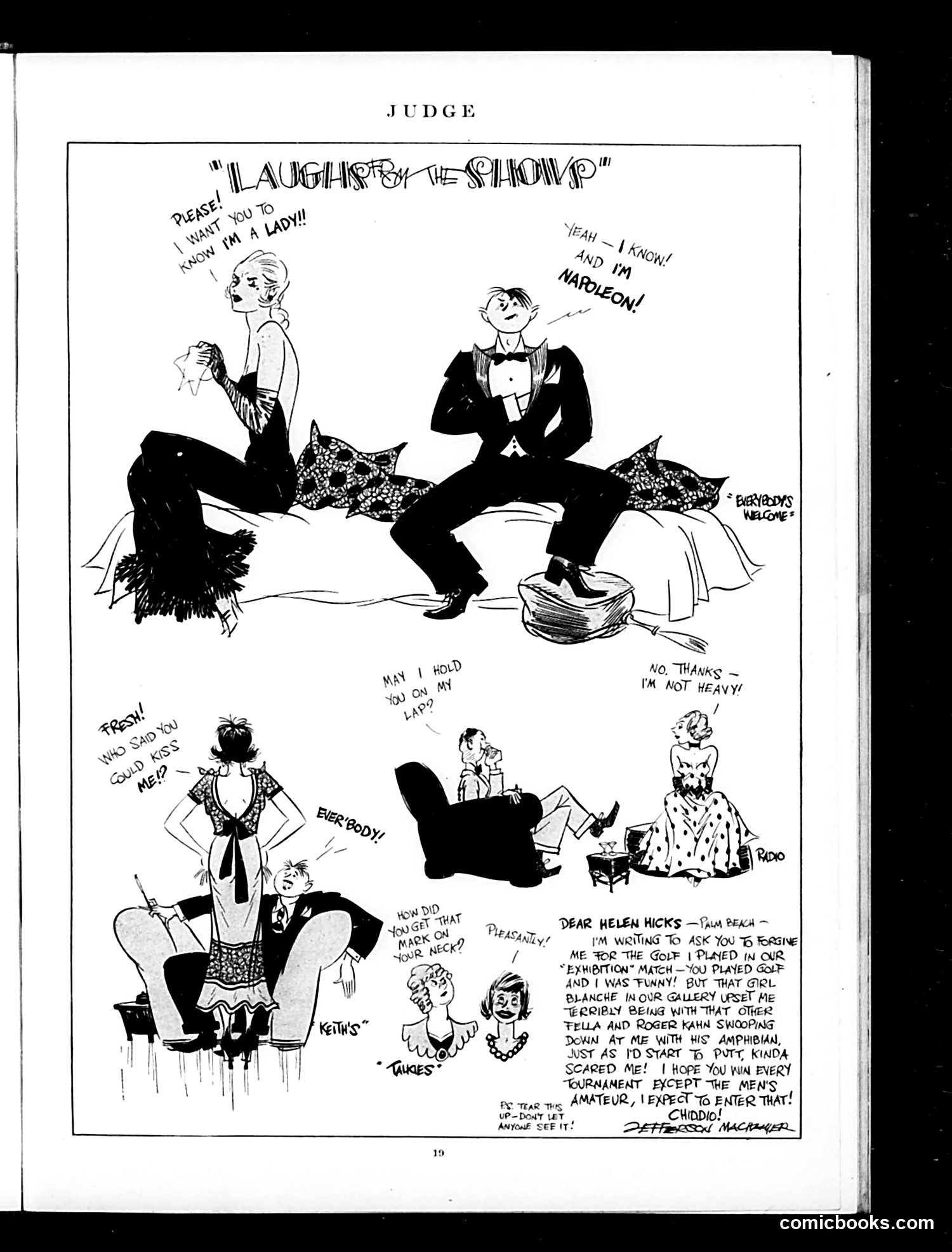
"Laughs at the Show" - Judge Magazine Satire This page collects brief comedic vignettes satirizing social pretension and romantic mishaps among the upper class. The main scenes mock men attempting to appear sophisticated or masculine—one claims to be "Napoleon," another feigns being a "lady," while others boast about golf and romantic conquests. The longest piece is a letter from "Chindio" to Helen Hicks, apologizing for poor golf performance during an exhibition match. He blames his distraction on seeing his girlfriend Blanche with another man (Roger Kahn), claiming Kahn's amphibian airplane startled him mid-putt. The humor lies in the absurd excuse-making and the implication that he only wants Helen to win "every tournament except the men's amateur" he plans to enter—reversing expected gallantry. The cartoons target male vanity and the comedy of social climbing.
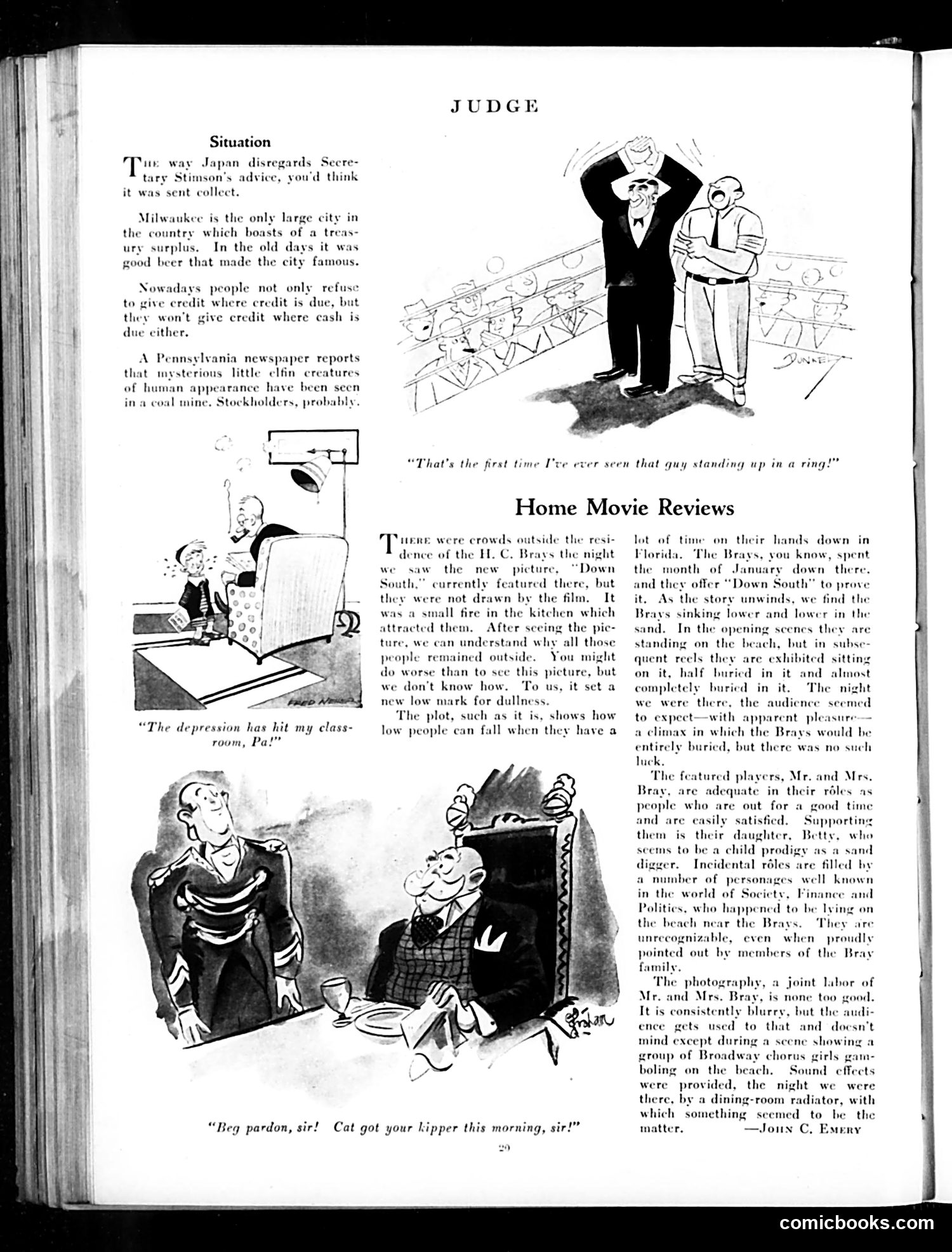
Analysis of Judge Page This page contains three satirical pieces about 1920s-30s American life: "Situation" section mocks economic hardship and credit collapse during the Depression. The Milwaukee reference acknowledges the city's brewing tradition while noting it now has a "treasury surplus"—ironic during widespread poverty. The Pennsylvania coal-mine "elfin creatures" is a darkly comic reference to workers or unemployed people; the parenthetical "(Stockholders, probably)" suggests they've been reduced to elf-like desperation. Two cartoon panels show Depression-era domestic struggle: one depicts a child noting "the depression has hit my class-room," the other shows a servant asking about "kipper" (fish), implying reduced circumstances. "Home Movie Reviews" satirizes amateur home films by the "H.C. Brays," where a kitchen fire attracts more attention than their boring movie. The review mocks their amateurish filmmaking and the beach footage featuring wealthy socialites and Broadway performers—suggesting the Brays' social pretensions and the vapid content of such home entertainment.
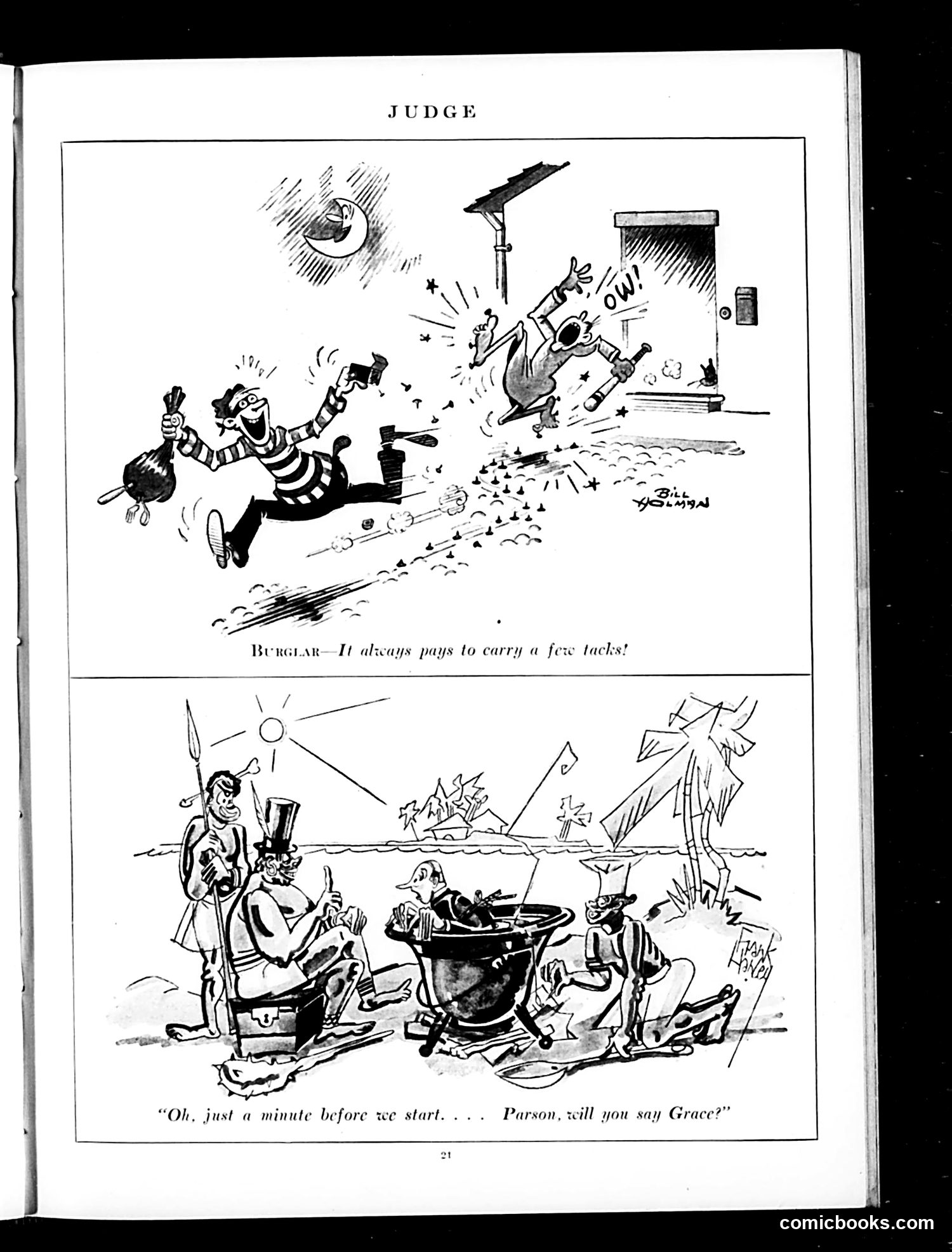
Two Political Cartoons from Judge Magazine Top cartoon: A burglar flees a house carrying stolen goods while being chased by an armed homeowner. The caption reads "Burglar—It always pays to carry a few tacks!" The joke plays on the double meaning of "tacks"—both roofing nails (literal) and tactical plans (figurative)—suggesting the burglar's preparedness helps him escape. Bottom cartoon: Military or government figures gather around a large pot (suggesting a cauldron or cooking pot, possibly metaphorical for "war" or "conflict") on a shoreline with ships burning in background. One figure asks another to say grace before they "start," implying they're about to engage in something morally questionable. The satire critiques the hypocrisy of invoking religious blessing before military action or violence. Both cartoons mock authority figures and moral inconsistency, typical of Judge's satirical style.
"Judging the Movies" by Pare Lorentz This is a film criticism column attacking the current state of 1920s cinema. Lorentz critiques the influence of German Expressionist directors and theater-trained playwrights who insisted movies should "move"—prioritizing dynamic action and camera work over dialogue and character. He mocks the pretension of critics (referencing Alexander Woollcott and Gilbert Seldes) who elevated film to high art. Lorentz argues that pure slapstick comedies like those of the silent era were superior to modern attempts mixing murder plots and "jungle pictures" with comedy. The column specifically criticizes "The Hatchet Man," a Lionel Atwill film, and argues Hollywood has abandoned what made early comedies successful: simple, funny stories. The closing lists underwhelming current productions as evidence that humor has disappeared from cinema.
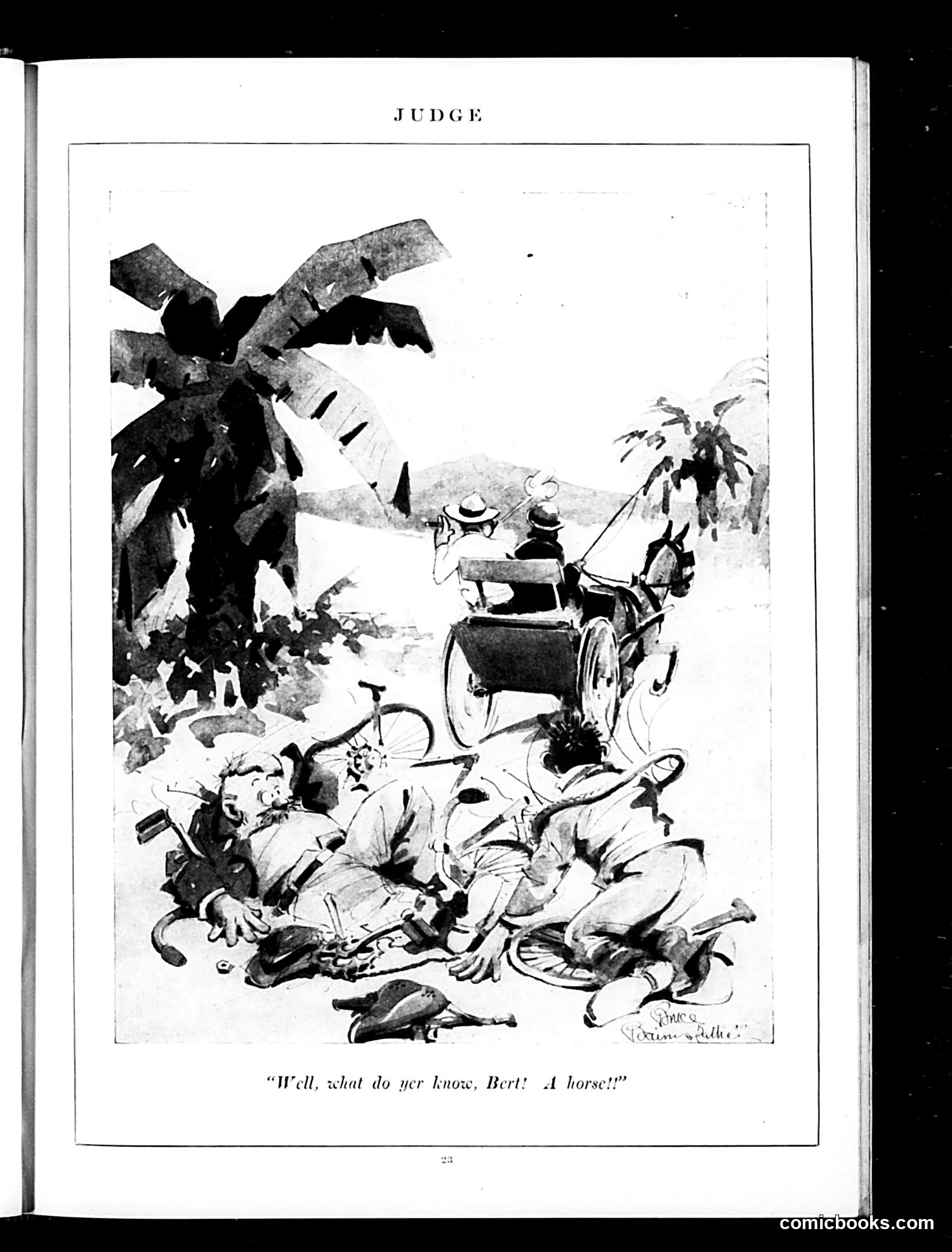
Judge Cartoon Analysis This satirical cartoon depicts two figures in a carriage encountering people lying on the ground amid scattered bicycles and debris. The caption reads: "Well, what do yer know, Bert! A horse!!" The satire likely mocks the early bicycle craze and its dangers. The scattered cyclists on the ground suggest accidents or collisions caused by this new transportation fad. The wealthy passengers' surprise at seeing a horse—traditional transportation—implies that bicycles had temporarily displaced horses in urban areas, making actual horses noteworthy curiosities. The joke targets both bicycle enthusiasts' reckless behavior and the broader cultural disruption caused by this emerging technology in late 19th/early 20th-century America. The chaotic scene underscores the hazards and social chaos the bicycle boom created on public streets.
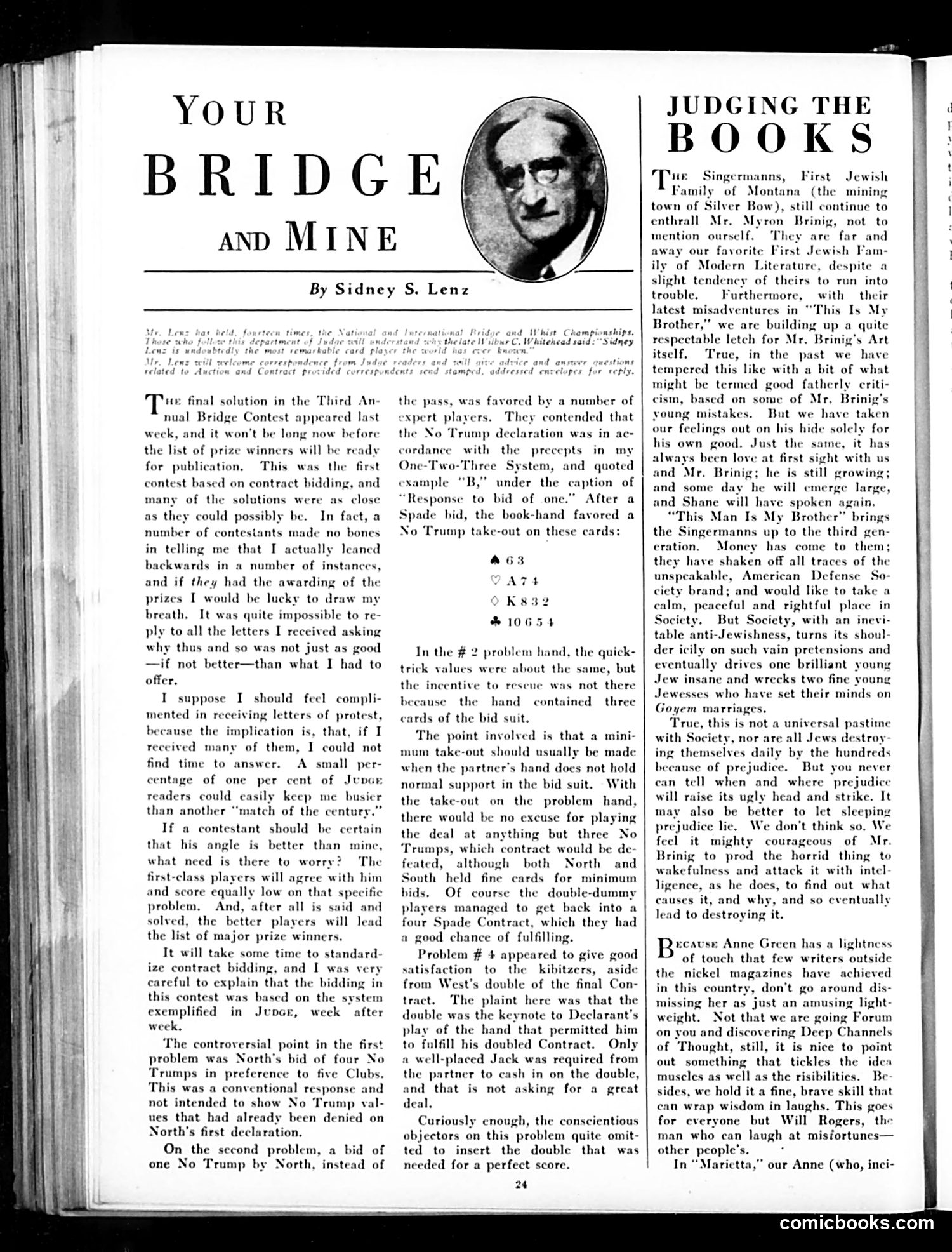
"Your Bridge and Mine" - Judge Magazine Analysis This page contains a bridge card game column by Sidney S. Lenz, not a political cartoon. The main content is instructional analysis of contract bridge bidding problems from a recent tournament. The satirical element appears in the accompanying "Judging the Books" section, which critiques author Myron Brinig's portrayal of the Singermann family—described as "the First Jewish Family of Montana" from the mining town of Silver Bow. The reviewer praises Brinig's literary skill but expresses concern about his tendency toward unflattering Jewish stereotypes and social critique. The satire gently mocks both Brinig's writing style and the broader tendency of contemporary literature to depict Jewish characters sympathetically while simultaneously highlighting their social difficulties—suggesting this reflects prejudice rather than objective observation. The reviewer humorously notes that such literary treatment "wreck[s] two fine young Jewesses" and their marriages, criticizing what appears to be exploitative characterization masquerading as serious fiction.
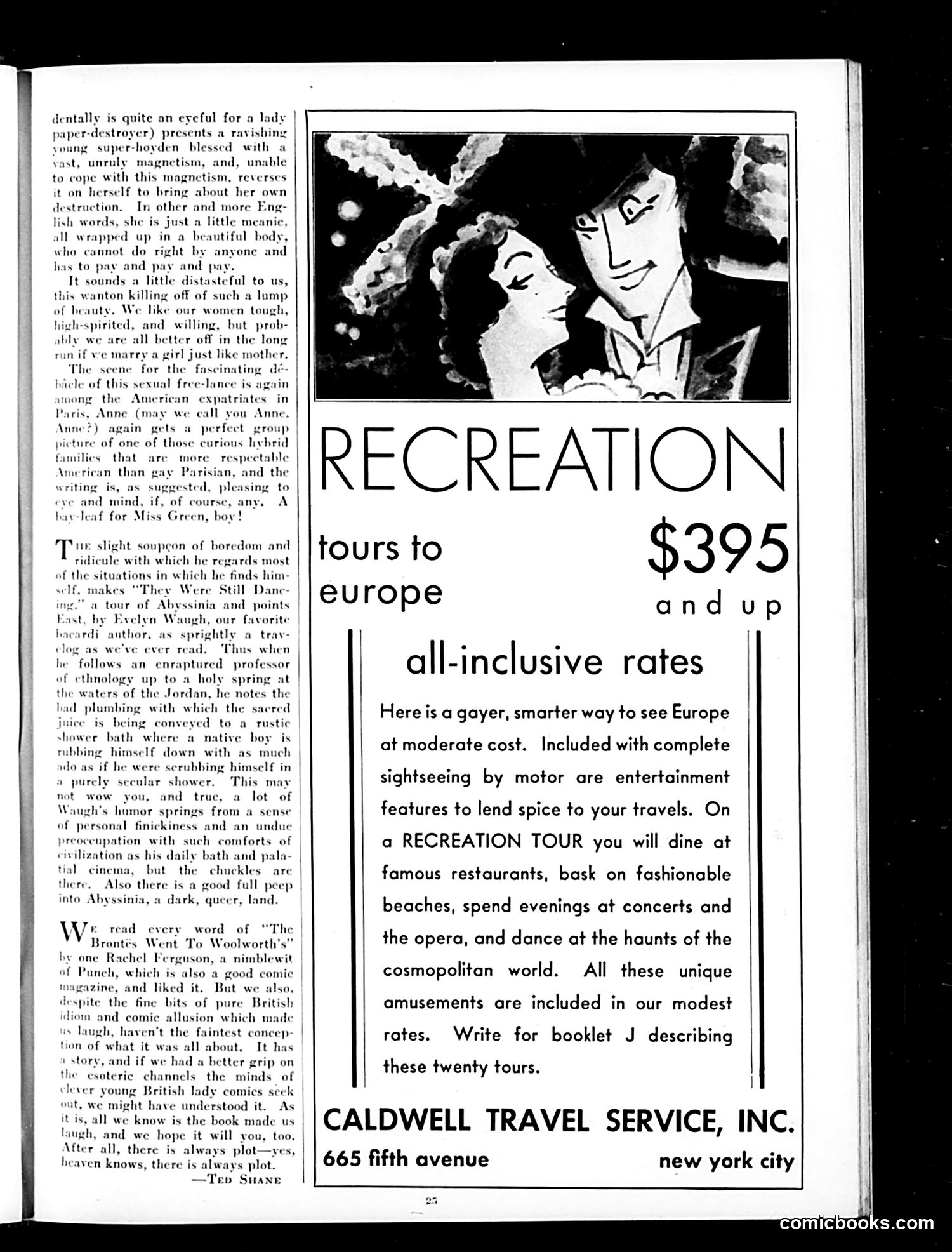
Analysis of Judge Magazine Page This page is primarily book reviews and advertising, not political satire in the traditional sense. The left column contains literary criticism reviewing three books: a film about a destructive woman character ("super-hoyden"), Evelyn Waugh's travel narrative *Black Mischief* (about Ethiopia/Abyssinia), and Rachel Ferguson's *The Brontës Went to Woolworths*. The reviewer admires Waugh's wit but acknowledges Ferguson's British humor requires insider knowledge to fully appreciate. The right side is a travel advertisement for Caldwell Travel Service promoting European tours at $395 and up, marketed as sophisticated leisure for affluent Americans—"a gayer, smarter way to see Europe" including fine dining, beaches, concerts, and opera. The small illustration shows elegantly dressed figures, reinforcing the luxury-tourism pitch. The page reflects 1930s publishing culture: middlebrow literary discussion alongside aspirational advertising targeting educated, wealthy readers.
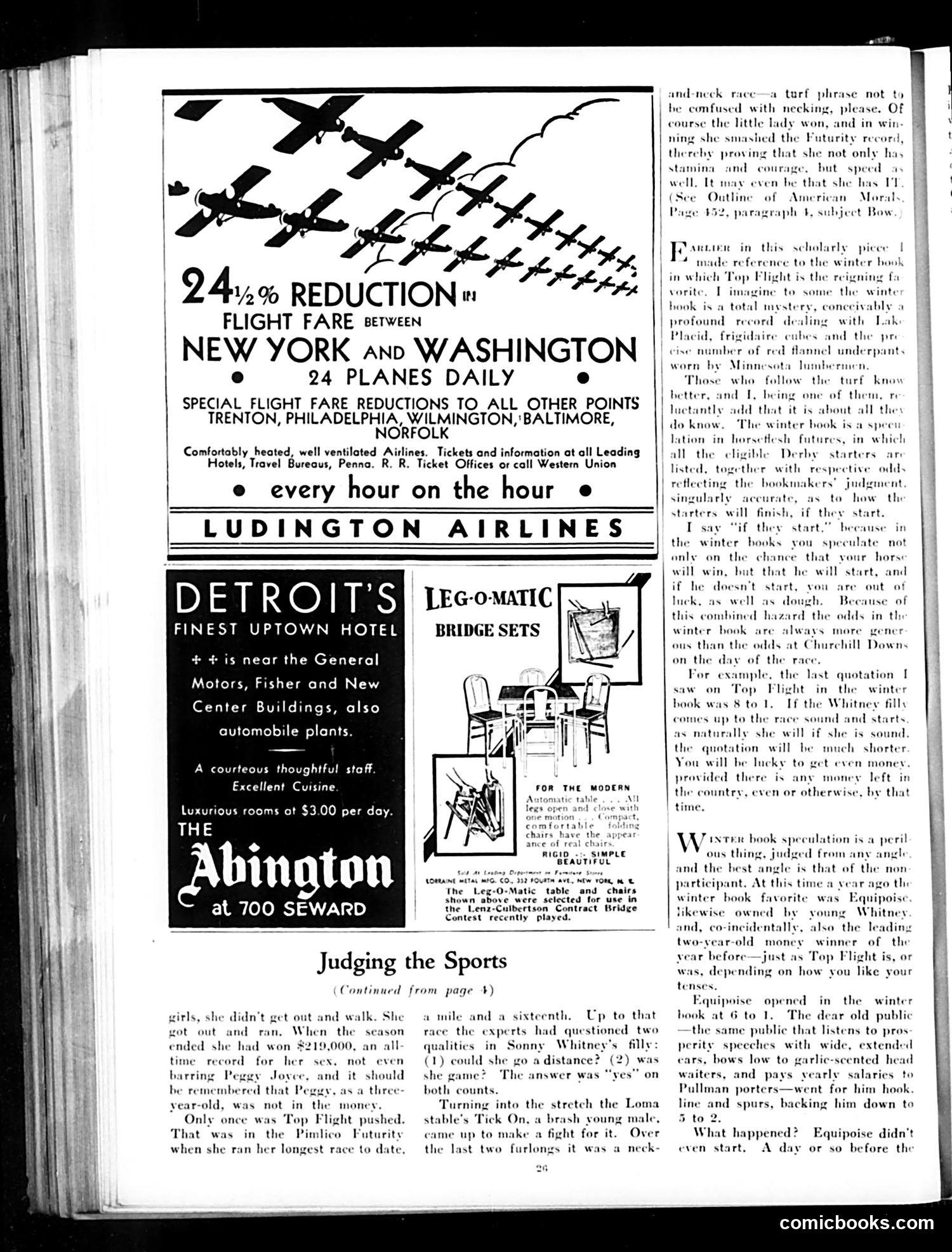
Analyzing This Judge Magazine Page This page is primarily advertising and sports commentary, not political satire. The top portion contains ads for Ludington Airlines (promoting 24 daily flights between New York and Washington at reduced fares), the Abington Hotel in Detroit, and Leg-O-Matic Bridge Sets. The main editorial content is "Judging the Sports" (continued from page 1), discussing horse racing. The author discusses Top Flight, a champion racehorse owned by Whitney, and her record-breaking performance in the Futurity. The piece then pivots to "winter book" speculation—betting on Derby contenders before the race occurs. The satire is gentle: the author mocks non-participants in winter book betting as having "the best angle," and jokes about the "dear old public" listening to prosperity speeches while betting on horses—a subtle Depression-era jab at American optimism despite economic hardship. This appears to be from the early 1930s based on advertising rates ($3/day hotel rooms) and references to contemporary racing figures.
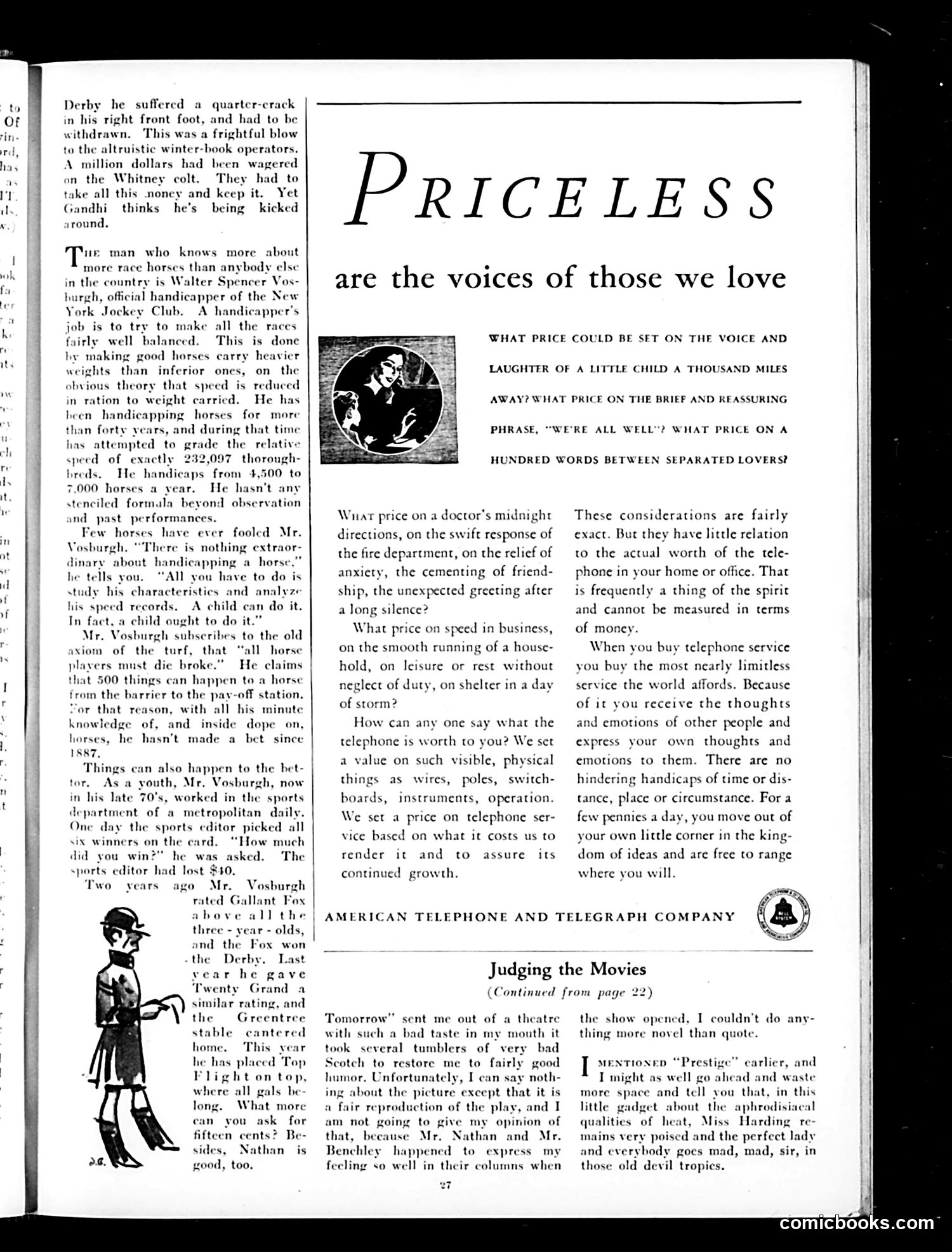
Analysis of Judge Magazine Page This page contains two distinct sections: Left Column - Horse Racing Content: Text discusses Walter Spencer Vosburgh, the New York Jockey Club's official handicapper. The passage details his expertise in assigning racing weights to horses to level competition. A small illustration shows a man in period dress (likely early 20th century). The satire appears gentle—noting Vosburgh's success predicting winners despite never betting himself since 1887, contrasting with a sports editor who won $0 while losing $40. Right Column - AT&T Advertisement: This is a sentimental advertisement for American Telephone and Telegraph Company. It argues telephone service is "priceless" by listing emotional scenarios: a child's distant voice, a doctor's directions, lovers' communication. The ad positions telephony not as a commodity but as enabling human connection that transcends monetary value. This represents corporate "soft sell" advertising common in the 1920s-30s. The juxtaposition—practical racing analysis alongside emotional telephony marketing—creates an unintended irony typical of magazine layouts from this era.
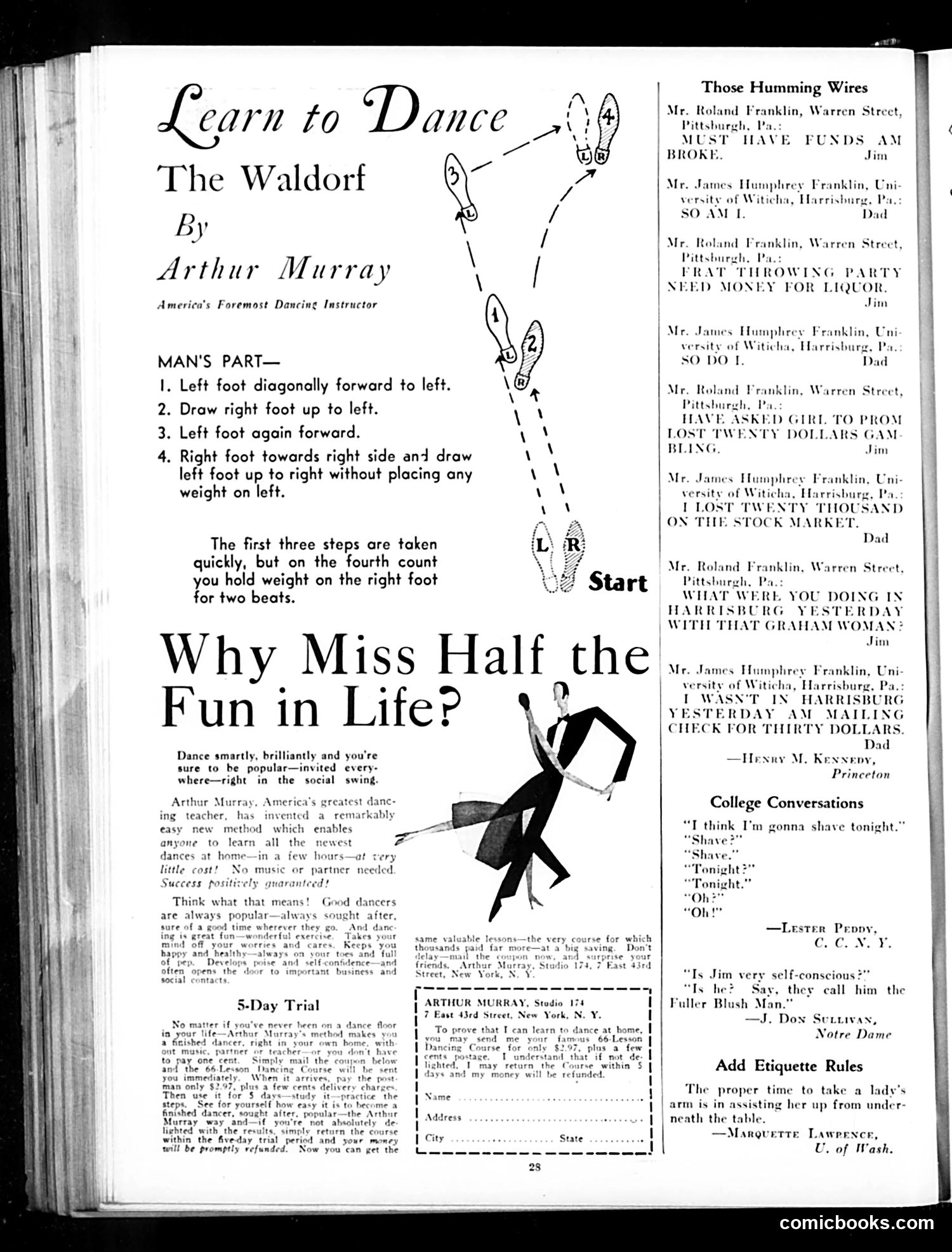
Analysis of Judge Magazine Page This page combines dance instruction advertising with humorous social commentary typical of Judge's satirical approach. Main Content: Arthur Murray's dancing instruction dominates, promoting his "Waldorf" dance with step-by-step diagrams. The accompanying text promises social popularity through dancing—a common sales pitch of the era. The Satire: The right column titled "Those Humming Wires" presents fake telegrams between father (James Humphrey Franklin) and son (Roland Franklin) that mock financial irresponsibility across generations. The son needs money for various frivolities (fraternity parties, gambling, prom dates); the father—apparently wealthy from stock market speculation—scolds him while admitting massive losses ("twenty thousand on the stock market"). The final wire suggests marital infidelity. This satirizes both youth excess and parental hypocrisy during the prosperous 1920s. "College Conversations" and "Add Etiquette Rules" offer absurdist humor about student life and social conventions, mocking pretension and dating culture. The overall effect contrasts the earnest dance-lesson marketing with cynical commentary on American social climbing and moral contradiction.
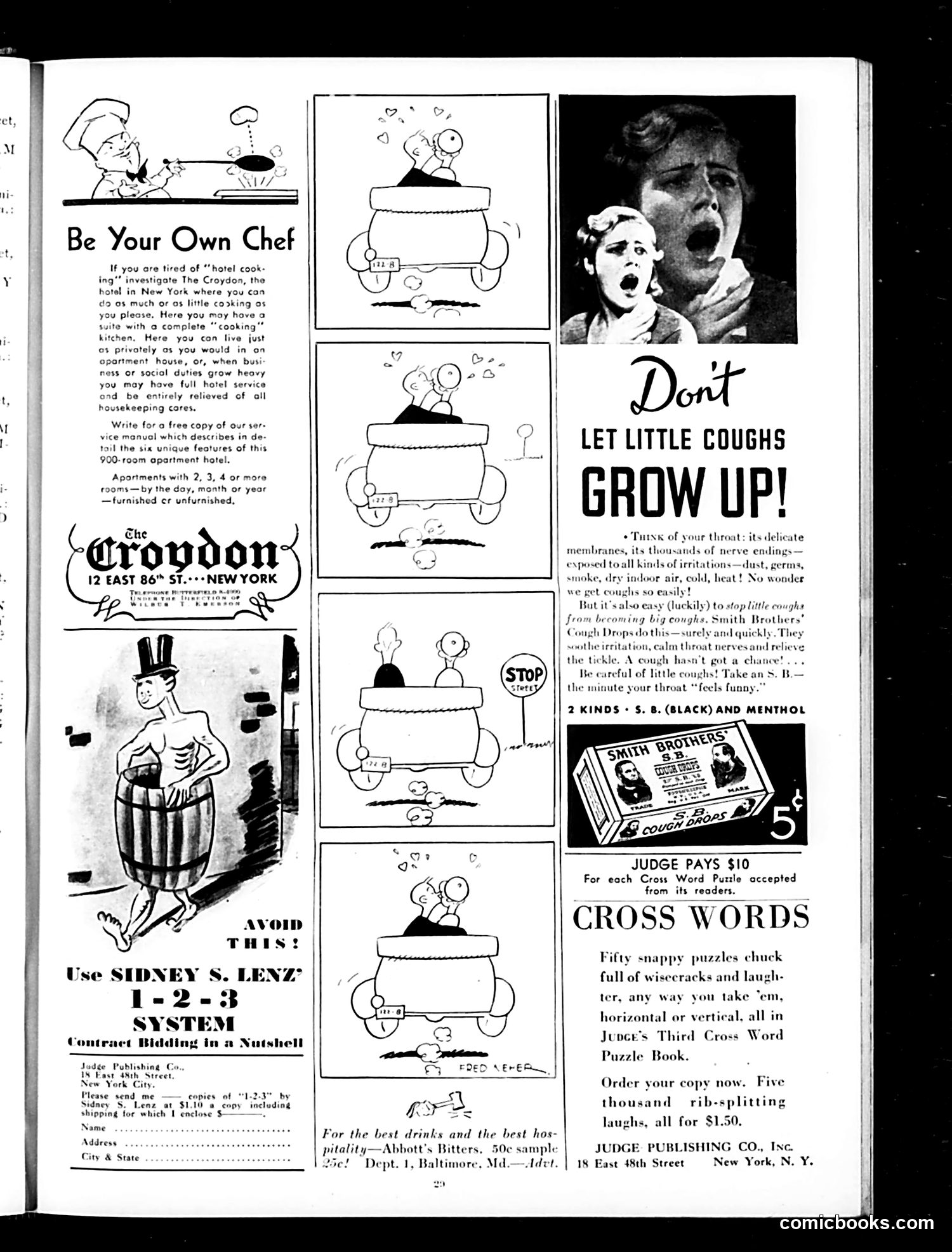
Analysis of Judge Magazine Page Content This page is primarily advertising and promotional content rather than political satire. It contains: 1. The Croydon Hotel ad (top left): Promotes apartment-hotel living in New York, appealing to people tired of traditional hotel service. The cartoon chef is generic advertising imagery, not a political figure. 2. Sidney S. Lenz contract bidding system: A mail-order advertisement for a bridge card game strategy book. 3. Smith Brothers Cough Drops ad (right): Features theatrical imagery of people coughing dramatically, playing on period anxieties about illness and promoting the product as throat relief. 4. Cross Words puzzle promotion: Judge advertising its own puzzle book and paying readers $10 per accepted crossword. 5. Abbott's Bitters ad (bottom): Promoting an alcoholic beverage. The page reflects 1920s-era consumer culture and magazine business practices—primarily commercial rather than satirical political commentary. No identifiable political figures or social satire are present.
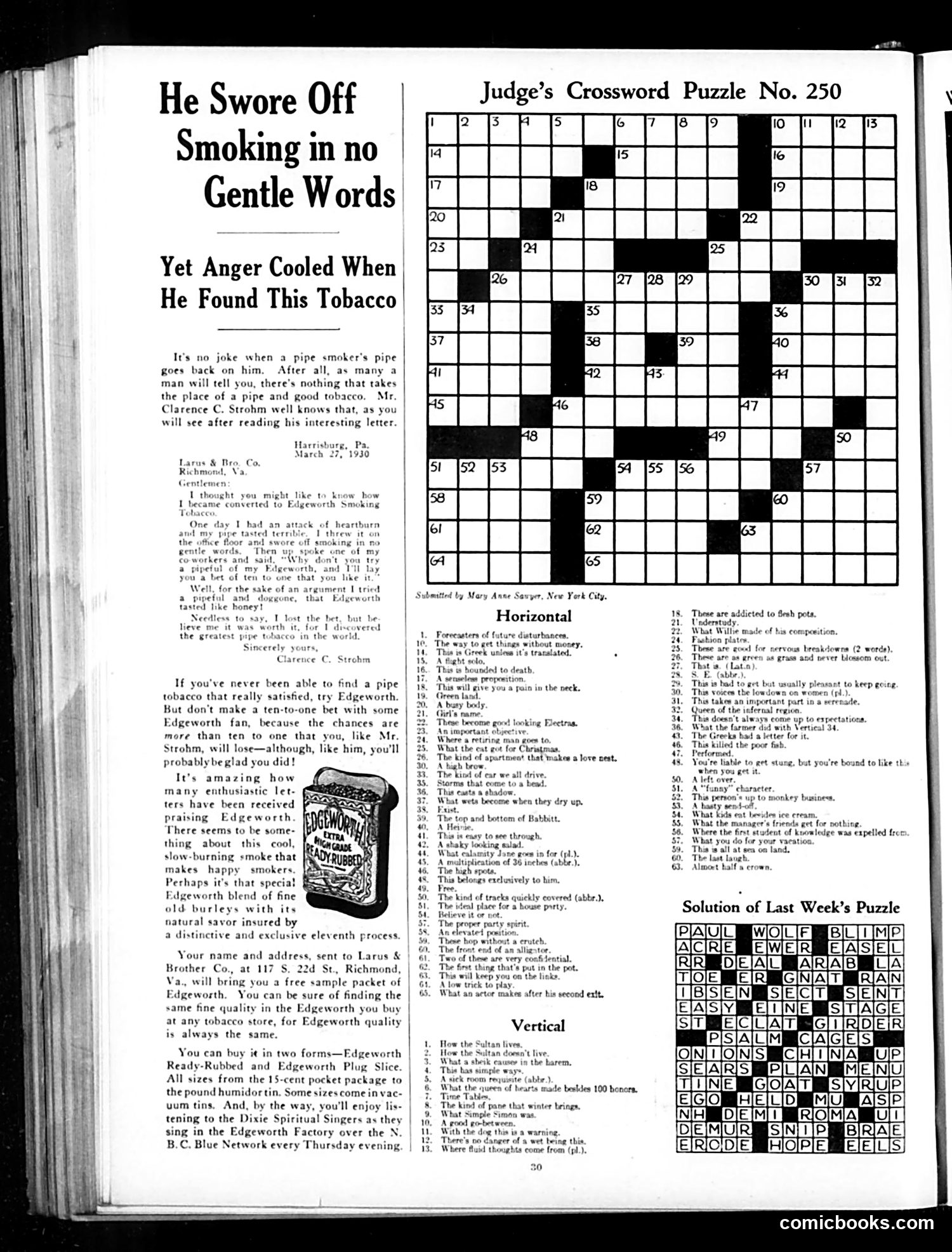
"He Swore Off Smoking in no Gentle Words" — Judge Magazine This page is primarily advertising disguised as editorial content — a common early-20th-century marketing technique. The "story" presents a testimonial letter from Clarence C. Strohm of Harrisburg, Pennsylvania, who quit smoking in anger over heartburn, then discovered Edgeworth brand tobacco and became a convert. The narrative arc (angry quitter → satisfied customer) serves as a hook for promoting the product. The satire/humor is mild: the joke is that smokers are so devoted to their habit that even someone who "swore off smoking in no gentle words" cannot resist when offered superior tobacco. The implication — smoking is an addiction stronger than principle — is played for amusement rather than critique. The page also includes a crossword puzzle and advertising copy emphasizing Edgeworth's "distinctive and exclusive eleventh process," available through mail order or tobacco retailers. No political figures or events are referenced. This is essentially a sponsored advertorial from the 1920s tobacco industry.
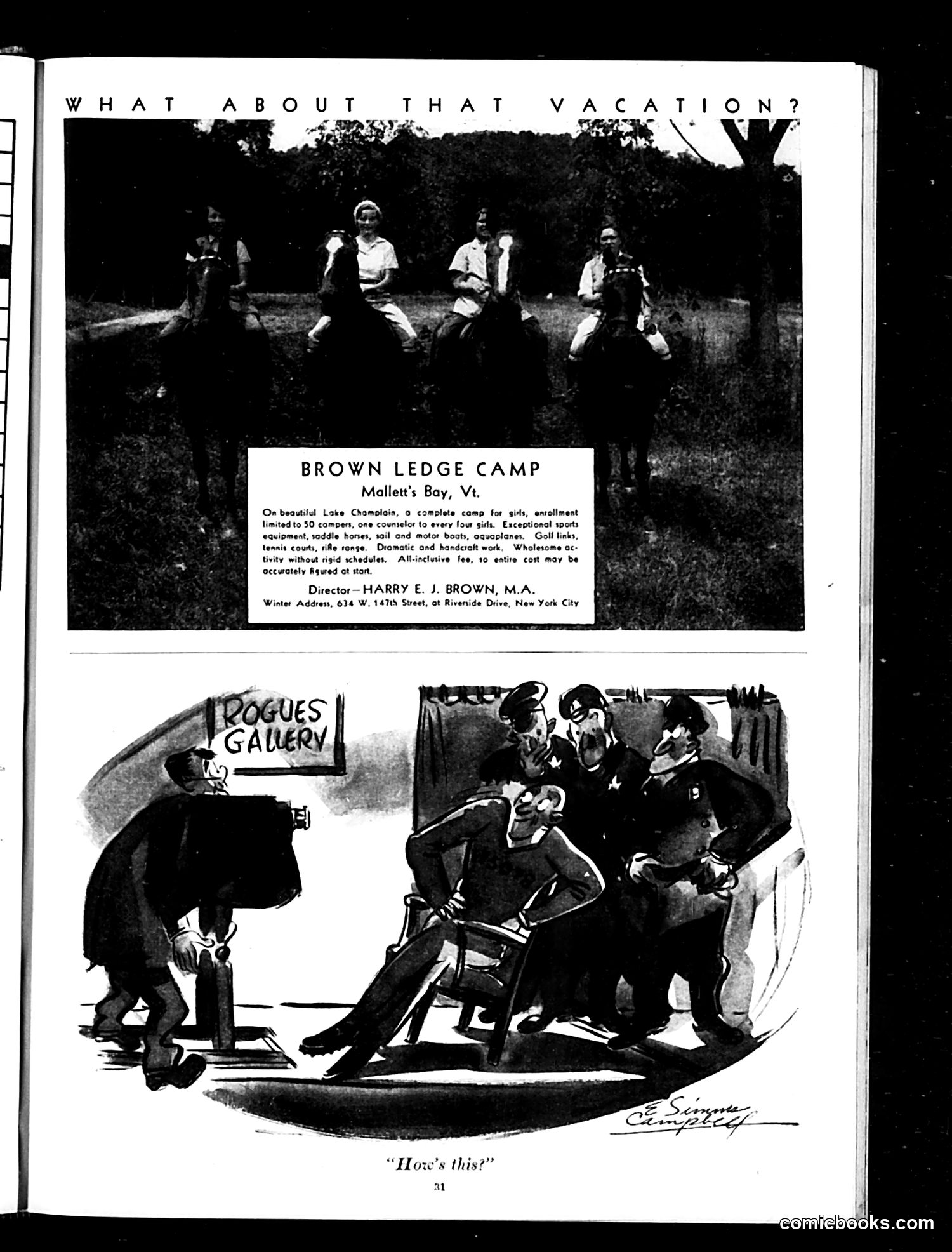
"How's This?" Cartoon Analysis This page contains a cartoon captioned "How's this?" depicting men at an art gallery labeled "Rogues Gallery." The humor appears to be a visual pun: the men viewing artwork are themselves being examined or displayed like paintings, while one man (left, in dark coat) photographs or studies them through a camera or viewing device. The satire likely plays on the double meaning of "rogues gallery"—originally a police collection of criminal photographs, but here referring to an art gallery. The joke suggests that the well-dressed men viewing art are themselves "rogues" worthy of criminal documentation, or that examining fine art and criminal records are equivalent activities. The cartoon is a straightforward visual gag about social hypocrisy or the questionable character of supposedly refined society figures.
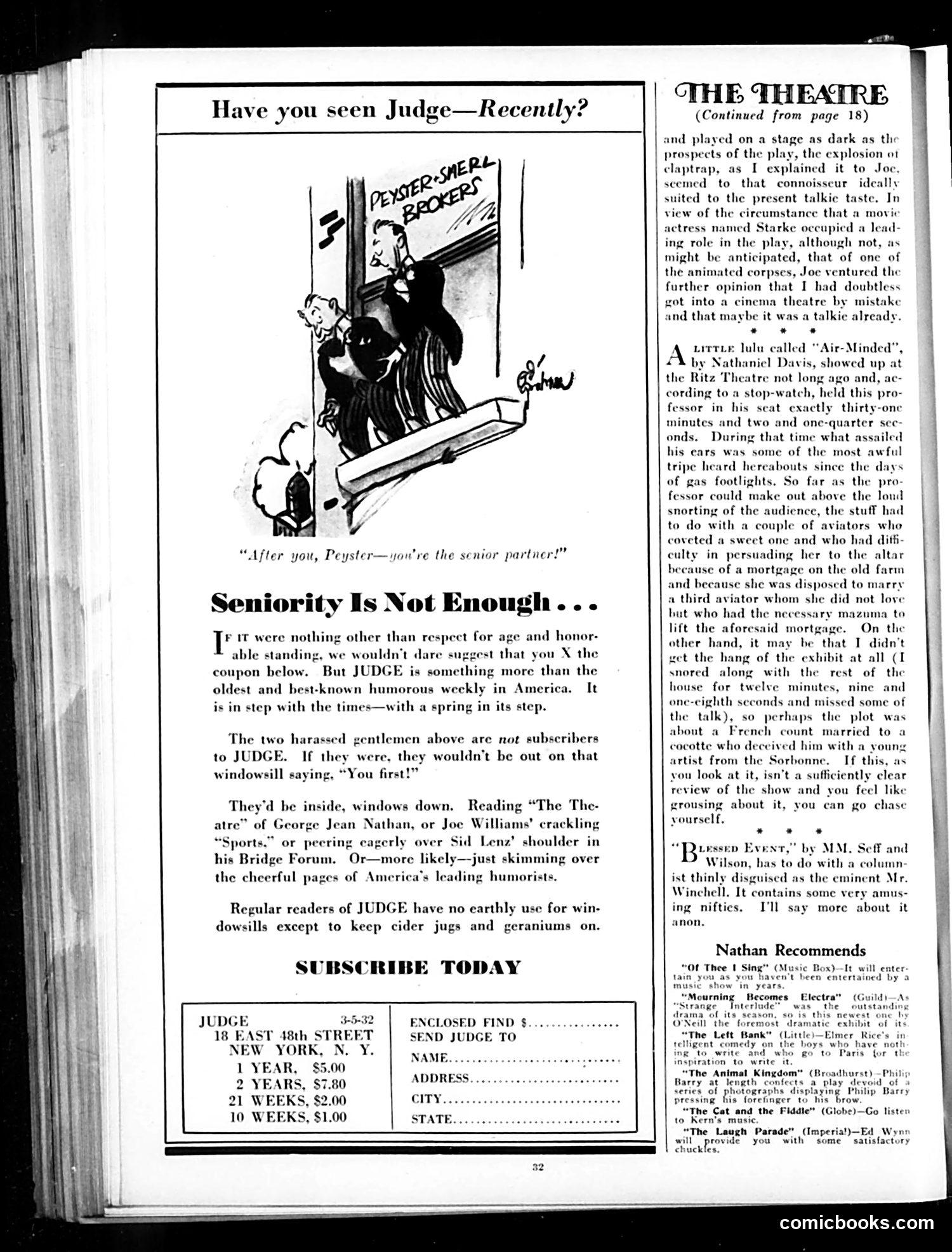
Judge Magazine Subscription Advertisement This page is primarily a subscription solicitation for *Judge*, America's leading humor magazine, with accompanying theater reviews. The cartoon depicts two men on a dangerous windowsill, about to jump—captioned "After you, Peyster—you're the senior partner!" The joke is dark: non-subscribers to *Judge* are so desperate and miserable that they resort to suicide, whereas subscribers enjoy life indoors reading quality humor and commentary. It's a comedic exaggeration mocking the magazine's importance. The advertisement emphasizes *Judge*'s prestige—calling it "the oldest and best-known humorous weekly in America"—and highlights popular columnists like George Jean Nathan (theater critic) and Joe Williams (sports writer) as reasons to subscribe. The subscription rates range from $1 (10 weeks) to $5 (1 year). The page's right side continues theater reviews by Nathan, discussing recent plays including "Air-Minded" and "Of Thee I Sing," offering recommendations for entertainment-seeking readers.
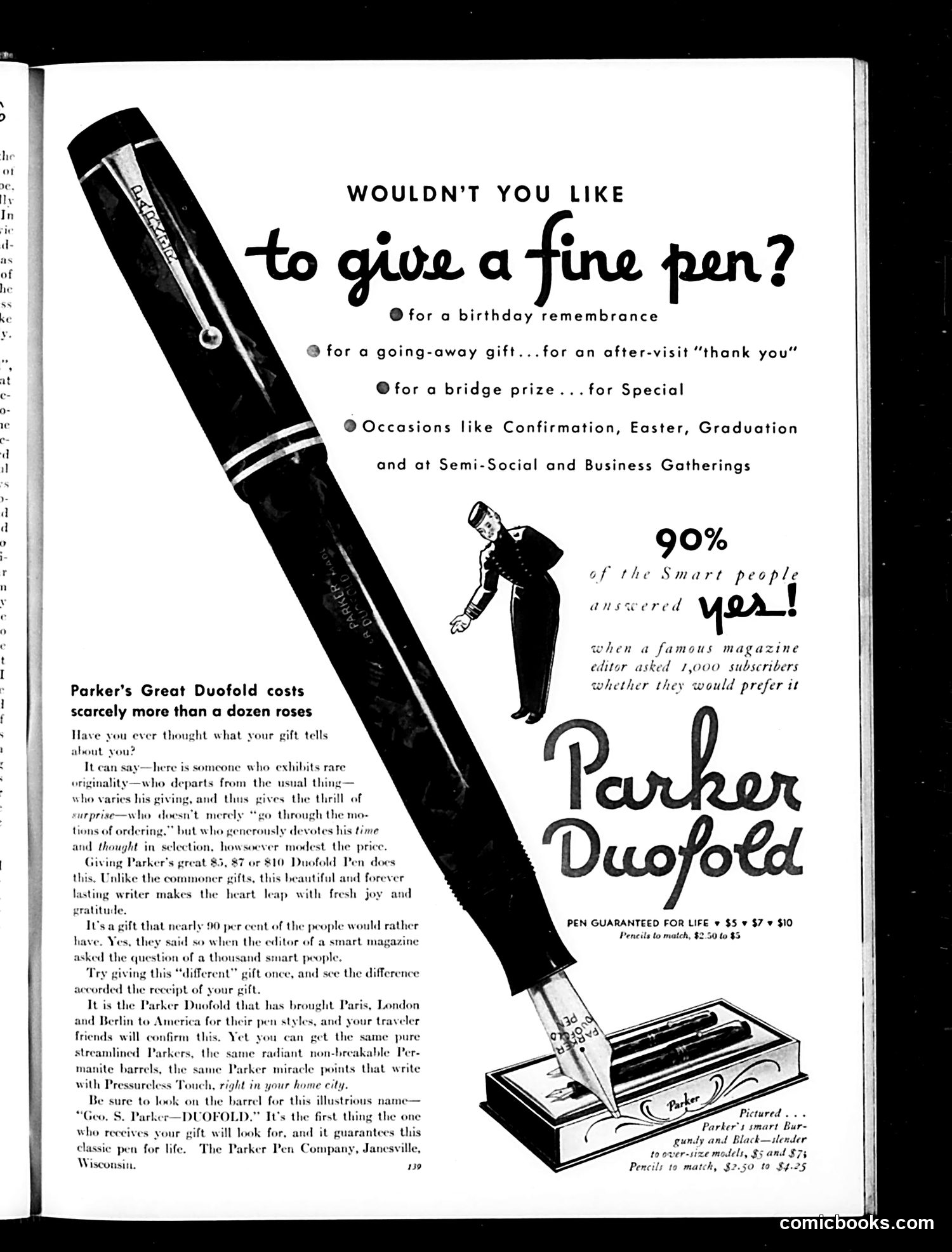
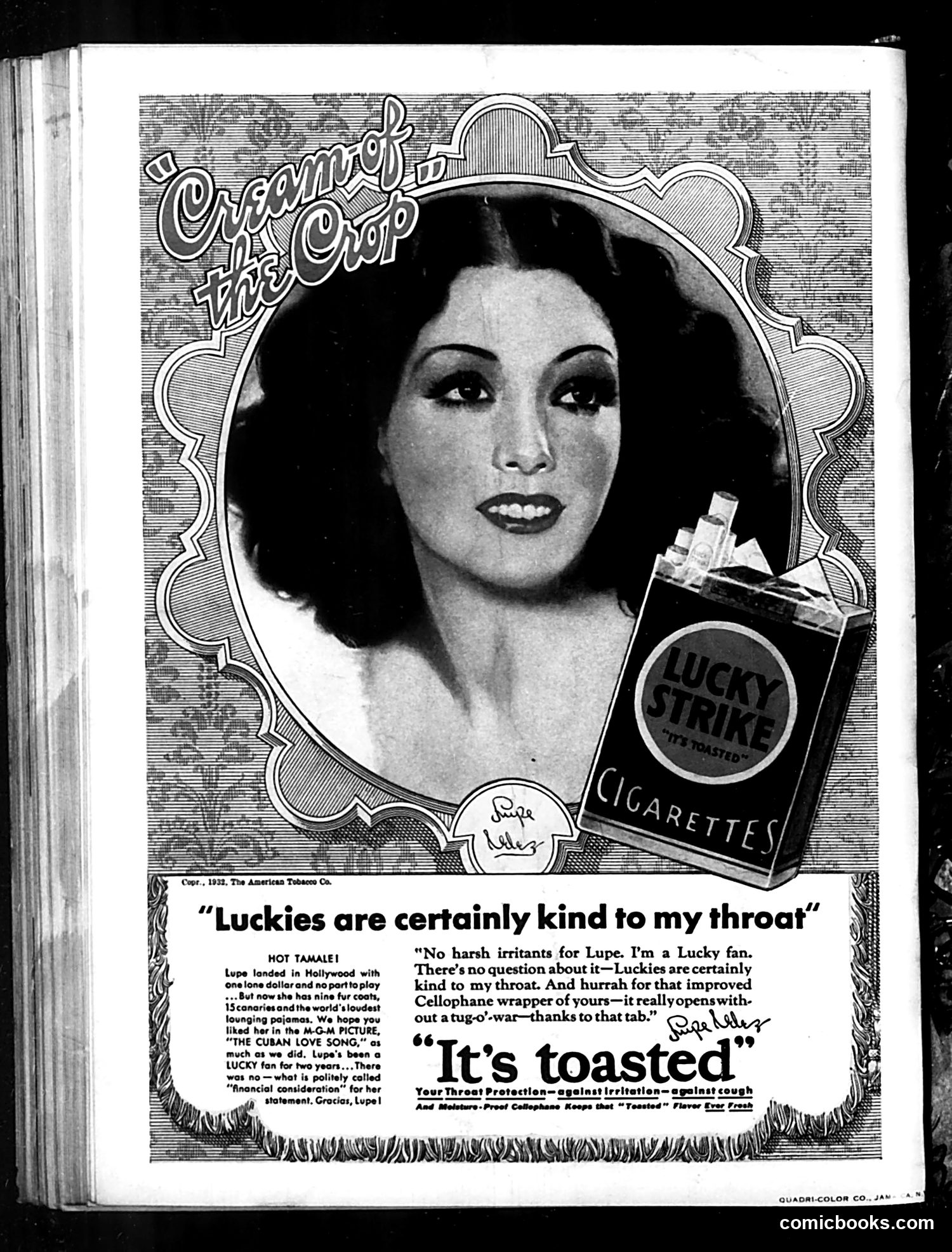
Lucky Strike Cigarette Advertisement Featuring Lupe Vélez This is a cigarette advertisement, not political satire. It features actress Lupe Vélez ("Hot Tamale"), a Mexican-born Hollywood star, endorsing Lucky Strike cigarettes circa 1930s. The ad's appeal relies on: 1. Celebrity endorsement: Vélez's Hollywood success (nine fur coats, roles in M-G-M films like "The Cuban Love Song") lends credibility to the product. 2. Throat-health claims: The tagline "It's toasted" and promises of "no harsh irritants" were typical tobacco marketing before health dangers were widely acknowledged—cigarette companies falsely claimed their products were safer. 3. Ethnic stereotyping: The "Hot Tamale" nickname and her Mexican origin are used for exotic appeal and humor, reflecting period attitudes. The disclaimer that there was "no financial consideration" (a false claim) attempted to suggest Vélez's endorsement was genuine rather than paid promotion—a common advertising practice of the era.