judge
Judge — March 12, 1932
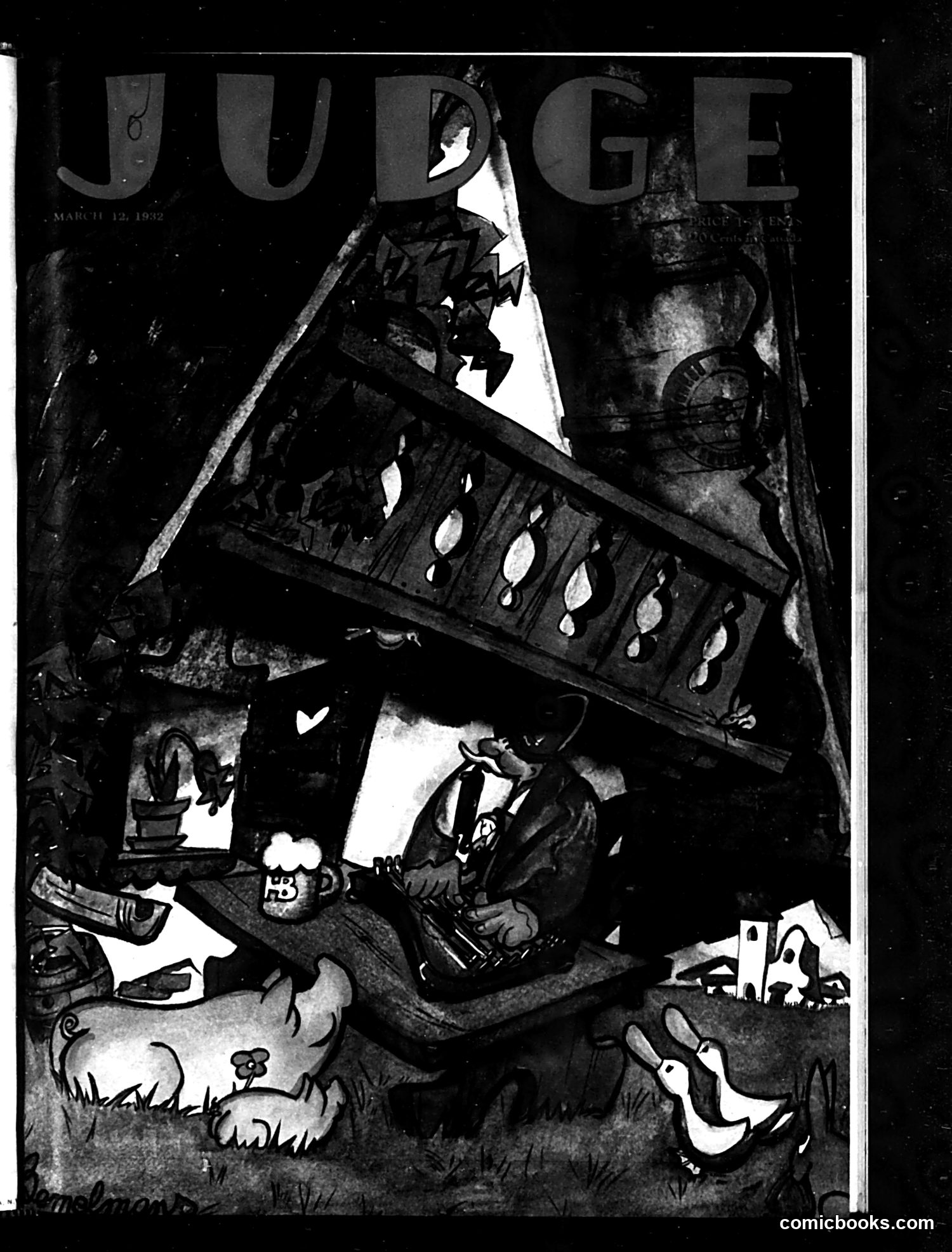
Judge Magazine Cover Analysis - March 12, 1932 This cover depicts a grotesque skeletal or death-like figure presiding over a scene of economic devastation during the Great Depression. The imagery suggests Death or economic ruin as a malevolent force controlling the period. The scattered objects below—including what appear to be discarded possessions, empty pockets, and struggling figures—represent the widespread poverty and homelessness afflicting Americans. The architectural elements suggest urban decay. The satirical point appears to be blaming either Death itself, fate, or (more likely) political/economic leadership for allowing the Depression's catastrophic human toll to continue unchecked. The cover critiques the failure of those in power to adequately address the crisis devastating ordinary citizens. The date (March 1932) places this during the Depression's darkest period, before Roosevelt's New Deal initiatives.

Analysis This page is primarily an advertisement, not political satire. It's a travel ad from Intourist, Inc., promoting Soviet Union tourism to American readers. The ad paradoxically emphasizes openness and welcome ("American travelers are cordially welcomed everywhere") while showcasing Soviet achievements—massive construction projects, industry, power plants, and the Dnieprostroy Dam. The collage of Russian Orthodox churches, palaces, and modern industrial sites visually contrasts "age-old cities and ancient treasures" with Soviet modernity. The pitch emphasizes affordability ($10-20/day) and accessibility: solo or group travel, theater tickets, ballet. Special tours include an Arctic icebreaker cruise and tours to Turkestan. This appears to date from the 1930s, when Soviet-American relations were relatively cordial and cultural exchange was encouraged, before Cold War tensions intensified.
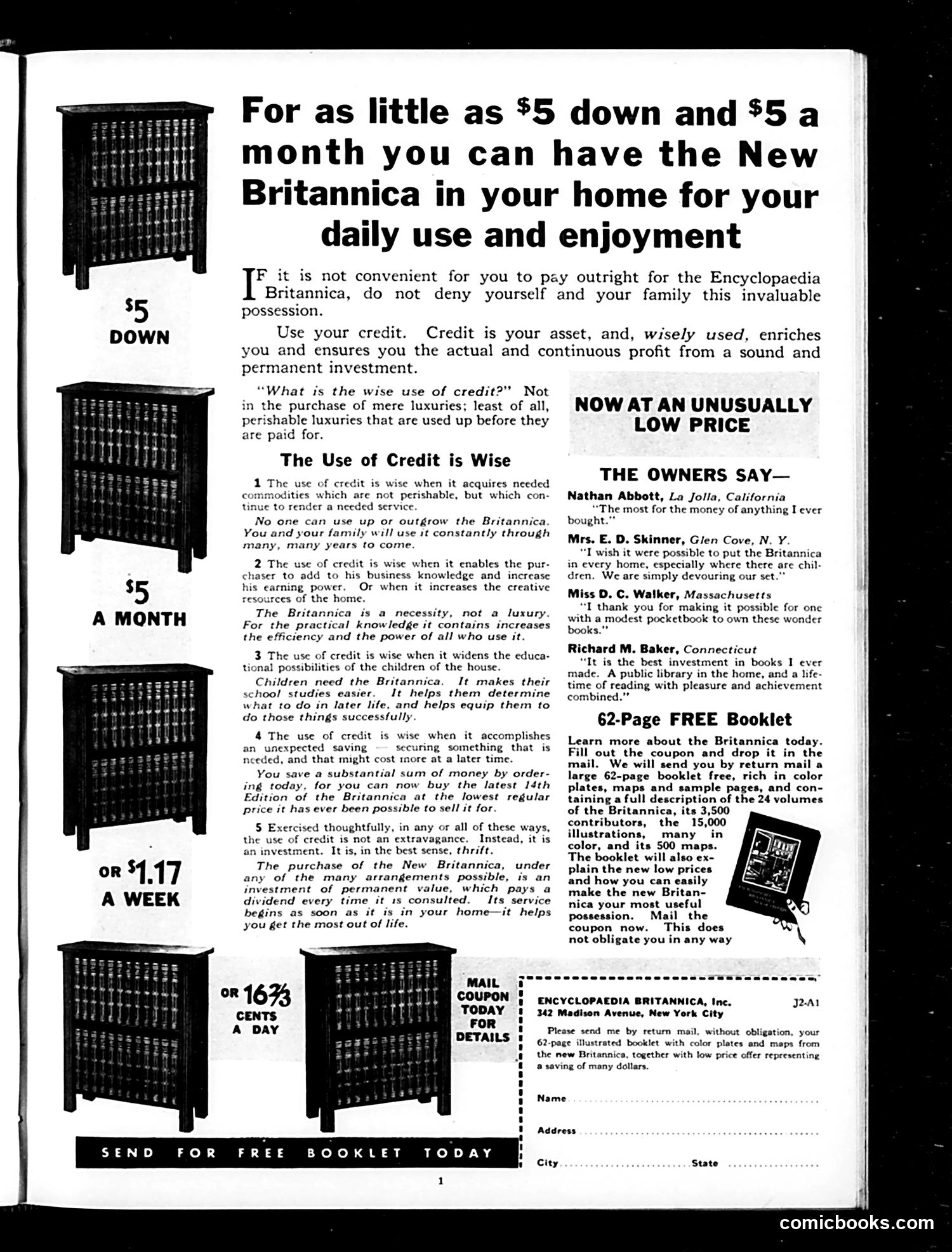
Analysis This page is primarily advertising, not satire or political commentary. It's a full-page advertisement for the Encyclopedia Britannica, promoting an installment payment plan ($5 down, $5 monthly or $1.17 weekly). The content includes: - Multiple images of the encyclopedia set in different cabinet styles - Testimonials from satisfied owners praising the purchase as economical and valuable for families and children's education - Marketing copy emphasizing that credit is a "wise" financial tool for acquiring needed knowledge There are no political cartoons or satirical figures on this page. The only visual elements are product photographs and the mail-in coupon. This reflects Judge magazine's reliance on advertising revenue, even in a publication known for satire. The advertisement itself uses persuasive language typical of early-to-mid 20th century consumer marketing.
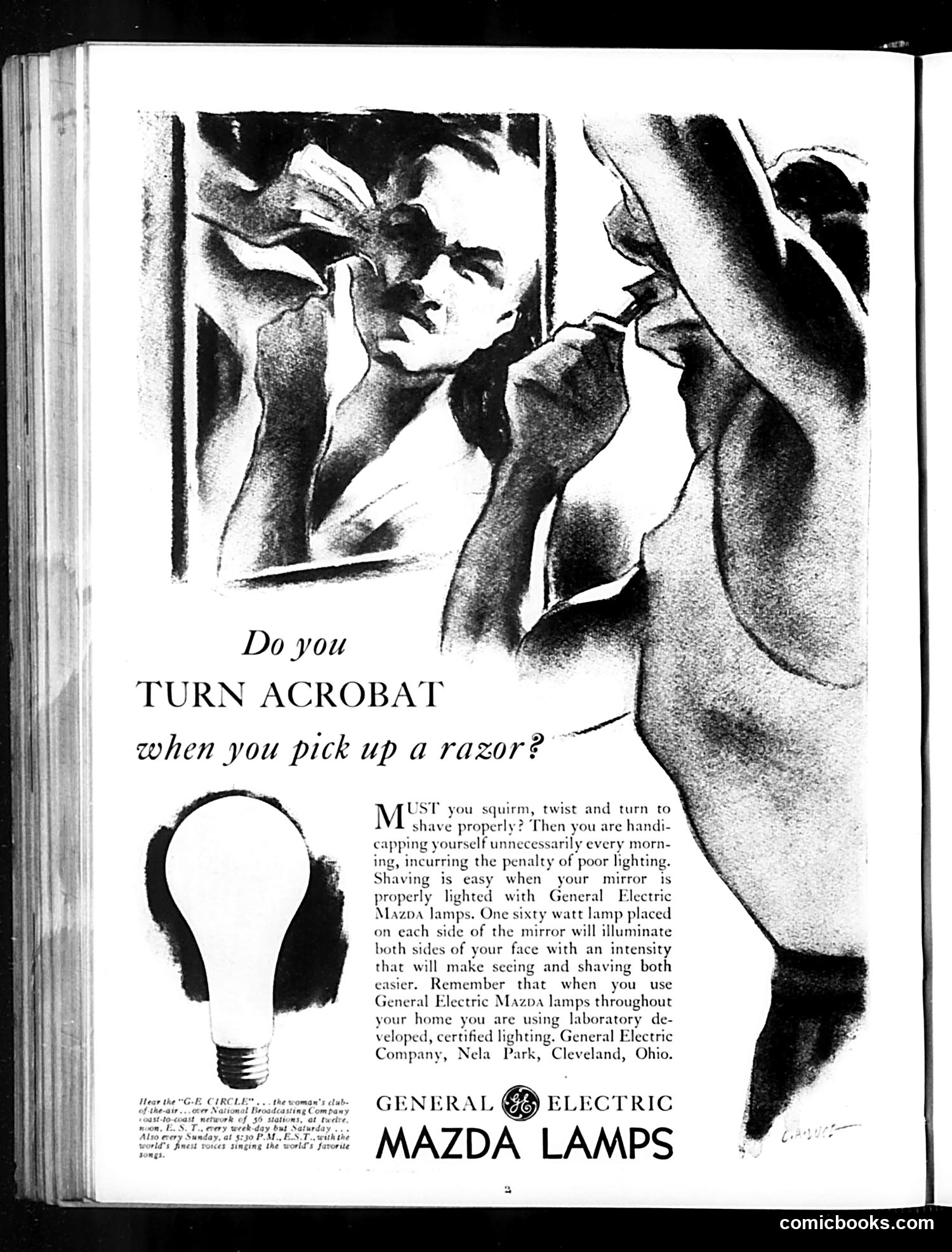
Analysis This page is primarily a General Electric advertisement for Mazda lamps, not political satire. The ad uses a visual pun to humorously promote proper shaving technique and lighting. The cartoon shows a man contorted awkwardly while shaving, with the headline "Do you TURN ACROBAT when you pick up a razor?" The joke is that without proper mirror lighting, men must twist and strain their bodies into acrobatic positions to see their faces while shaving. The advertisement's solution: General Electric Mazda lamps placed on both sides of a mirror provide sufficient, even illumination, eliminating the need for these gymnastic contortions. The text emphasizes that Mazda lamps use "laboratory developed, certified lighting." This is a straightforward commercial pitch using humor to highlight the practical benefits of adequate electric lighting—a relatively modern convenience in this magazine's era.
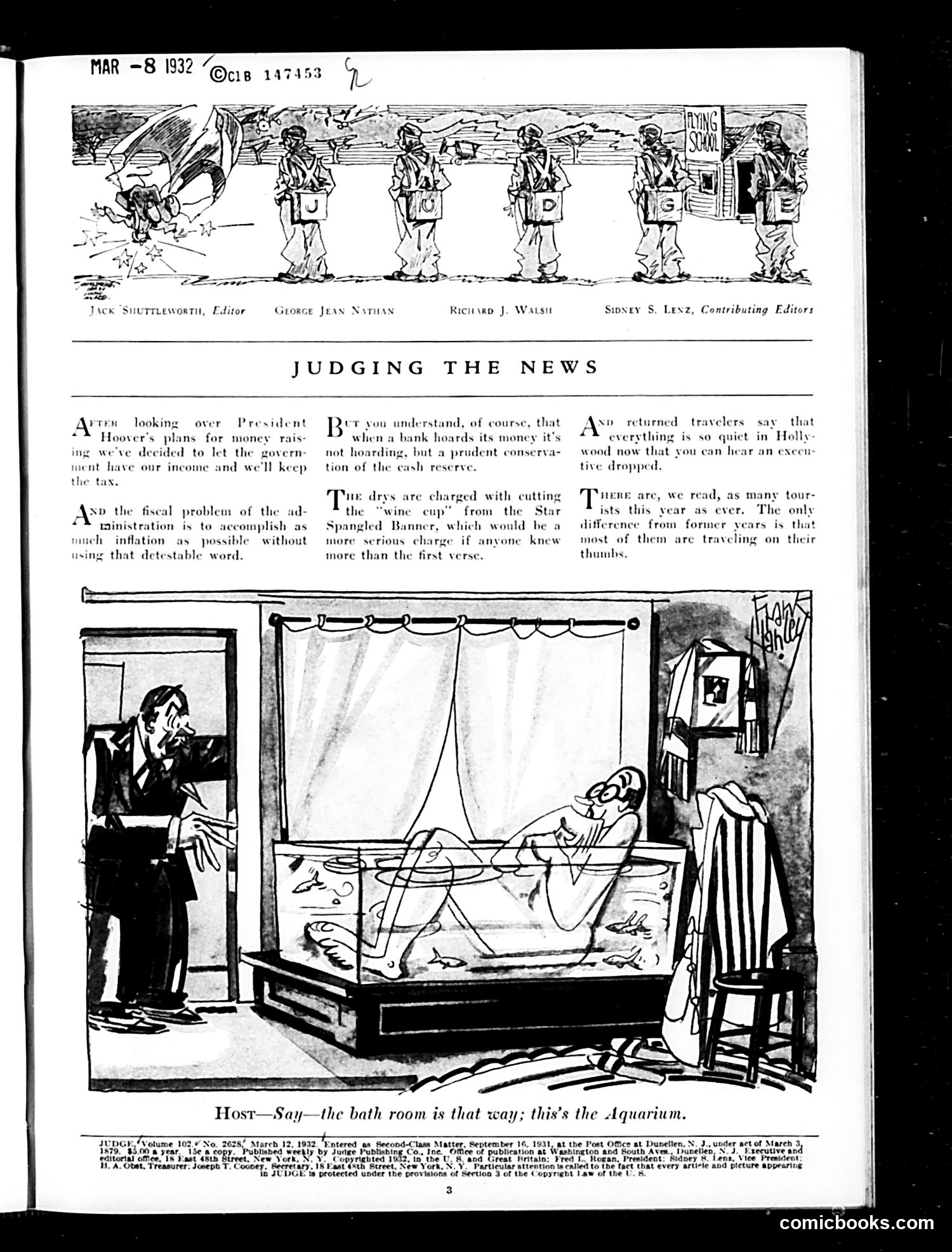
Explanation for Modern Readers This March 1932 *Judge* page satirizes President Hoover's financial policies during the Great Depression. The "Judging the News" section mocks the administration's approach: keeping tax income while relying on the cash reserve, and attempting inflation-control without using "that detestable word." The cartoon below depicts a host showing guests an elaborate indoor swimming pool, claiming "this is the Aquarium"—a visual pun satirizing how the wealthy lived in luxury during economic collapse while ordinary Americans suffered. The joke reflects 1930s class resentment: the prosperous few maintained extravagant lifestyles seemingly oblivious to widespread poverty, while government claimed to manage the crisis responsibly.
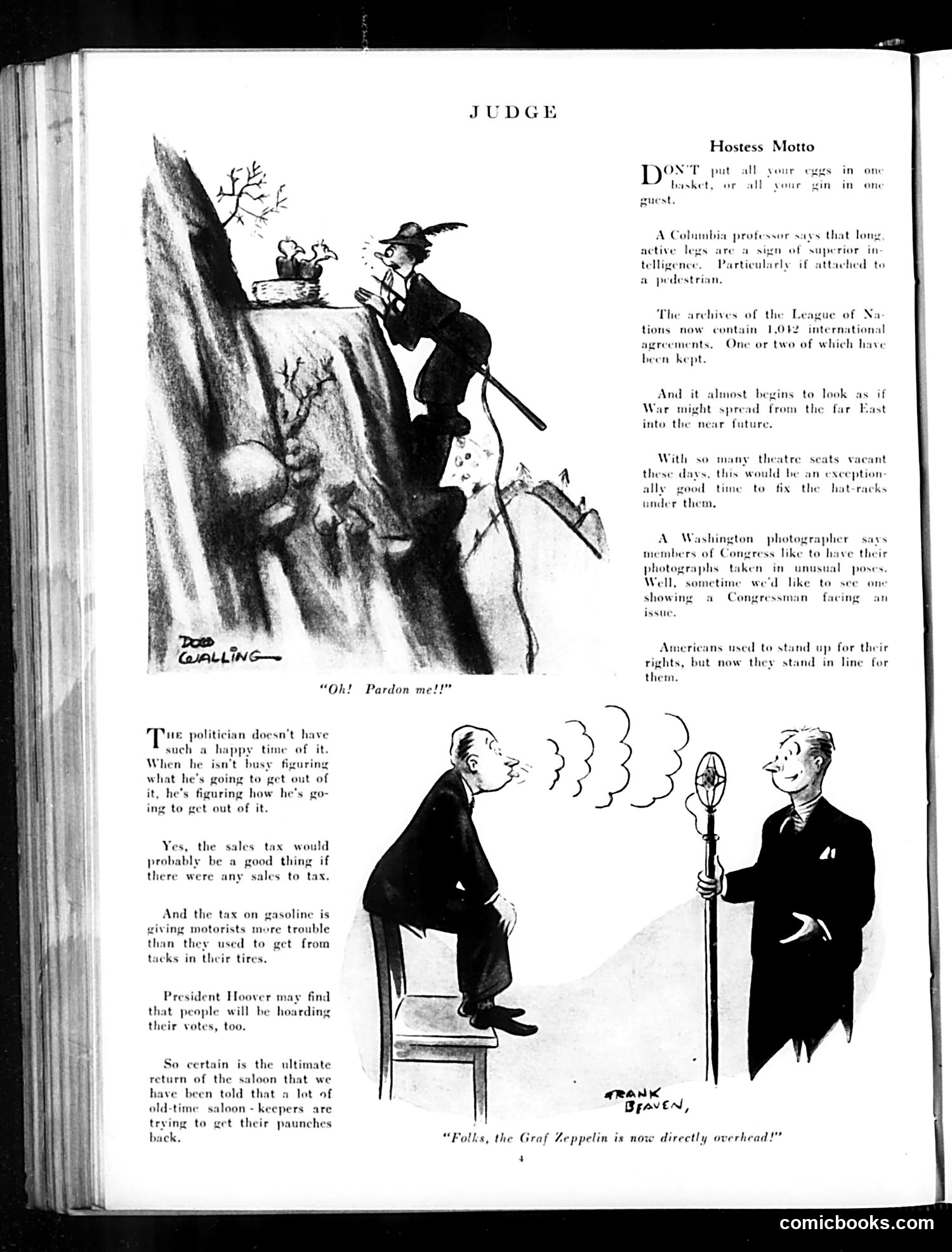
"Judge" Page Analysis This page contains two separate political cartoons from an interwar era Judge magazine (likely 1920s-30s, given references to President Hoover and war concerns). Top cartoon ("Oh! Pardon me!"): A witch-like figure on a cliff startles a gentleman, illustrating anxieties about unexpected political surprises or social upheaval. Bottom cartoon ("Folks, the Graf Zeppelin is now directly overhead!"): A man speaking into a microphone addresses another figure, likely satirizing radio announcements and public panic during the Graf Zeppelin's famous transatlantic flights. The joke appears to mock both sensationalist media and public reaction to new aviation technology. The page's text commentary addresses politicians' tax problems, sales taxes, gasoline taxes, and voters "hoarding" votes—typical Depression-era economic and political frustrations.
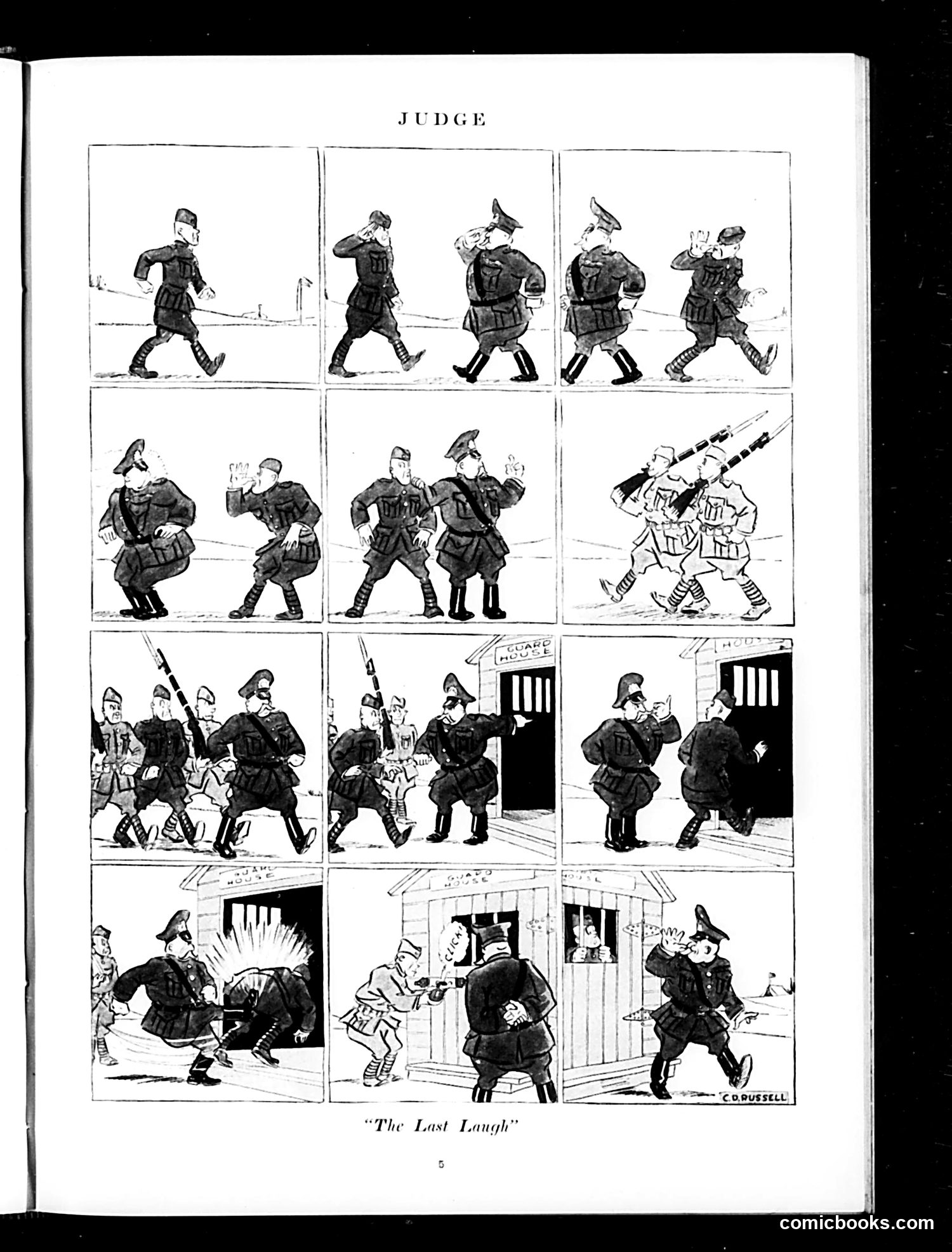
"The Last Laugh" - Judge Magazine Political Cartoon This comic strip satirizes military or judicial authority figures (identifiable by their distinctive uniforms with spiked helmets, suggesting German or Prussian military style) engaging in increasingly violent and chaotic behavior. The narrative appears to progress from orderly marching to physical confrontation, escalating to what looks like a prisoner or detained person being mistreated. The final panels show the uniformed figures apparently losing control—literally kicking and pursuing someone. The title "The Last Laugh" suggests ironic commentary: those in authority believe they're winning, but the satire implies their brutality and loss of composure reveals their actual weakness or moral bankruptcy. The style and uniforms suggest this critiques authoritarian military power, though the specific historical context remains unclear without additional publication information.
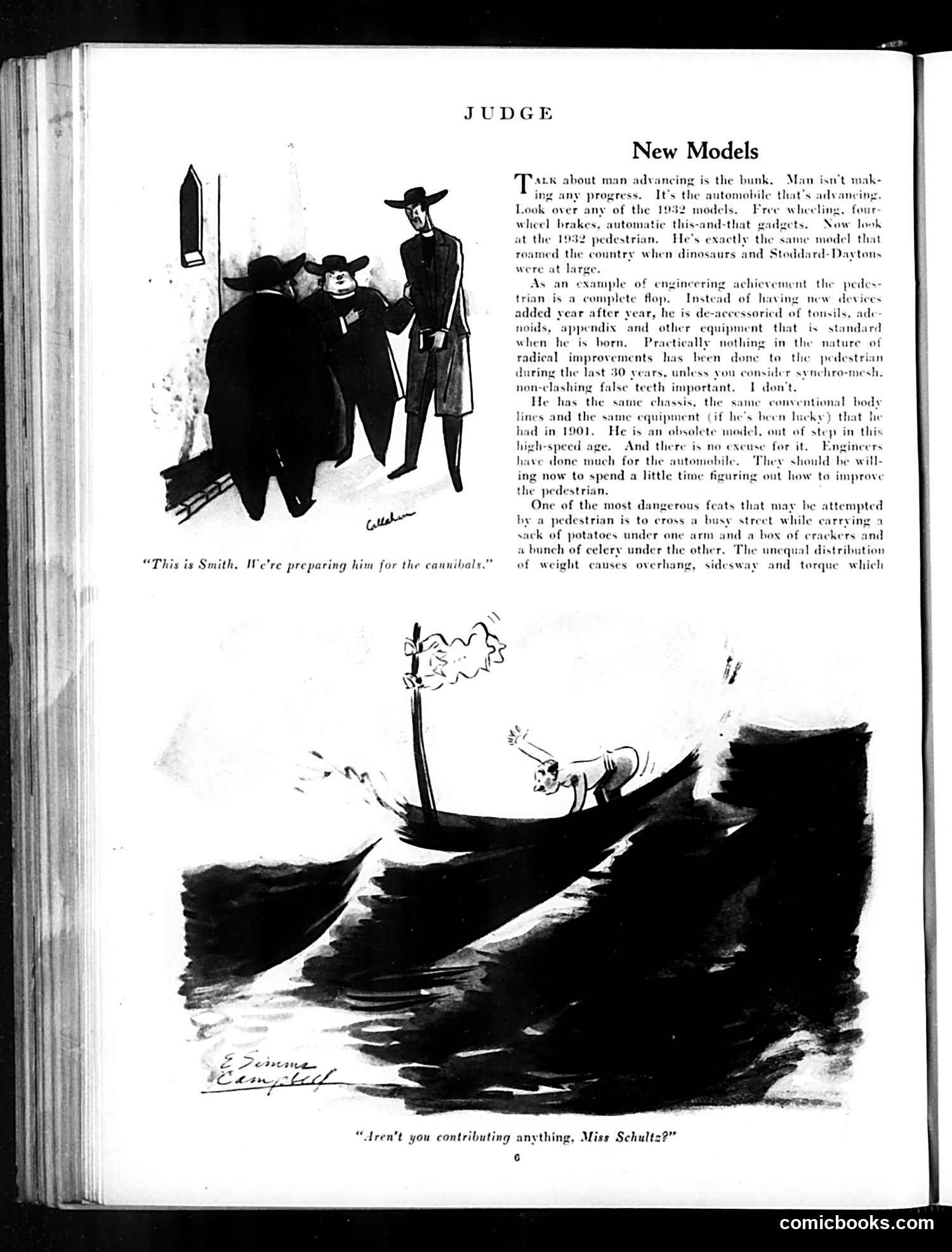
Analysis of Judge Magazine Page This page critiques automobile safety and pedestrian vulnerability in the early 1900s. The top cartoon mocks automotive "progress"—manufacturers constantly add gadgets and modifications while the basic pedestrian design remains unchanged since 1901, making them equally vulnerable to traffic dangers. The editorial text sarcastically argues engineers should spend time improving pedestrian safety rather than cars. It warns of a specific hazard: pedestrians carrying groceries while crossing busy streets risk losing balance and being hit due to unequal weight distribution. The bottom cartoon shows a figure struggling in rough water with a tilted boat, captioned "Aren't you contributing anything, Miss Schultz?" This appears to extend the imbalance metaphor—suggesting women's equal participation is necessary for stability, though the exact reference remains unclear.
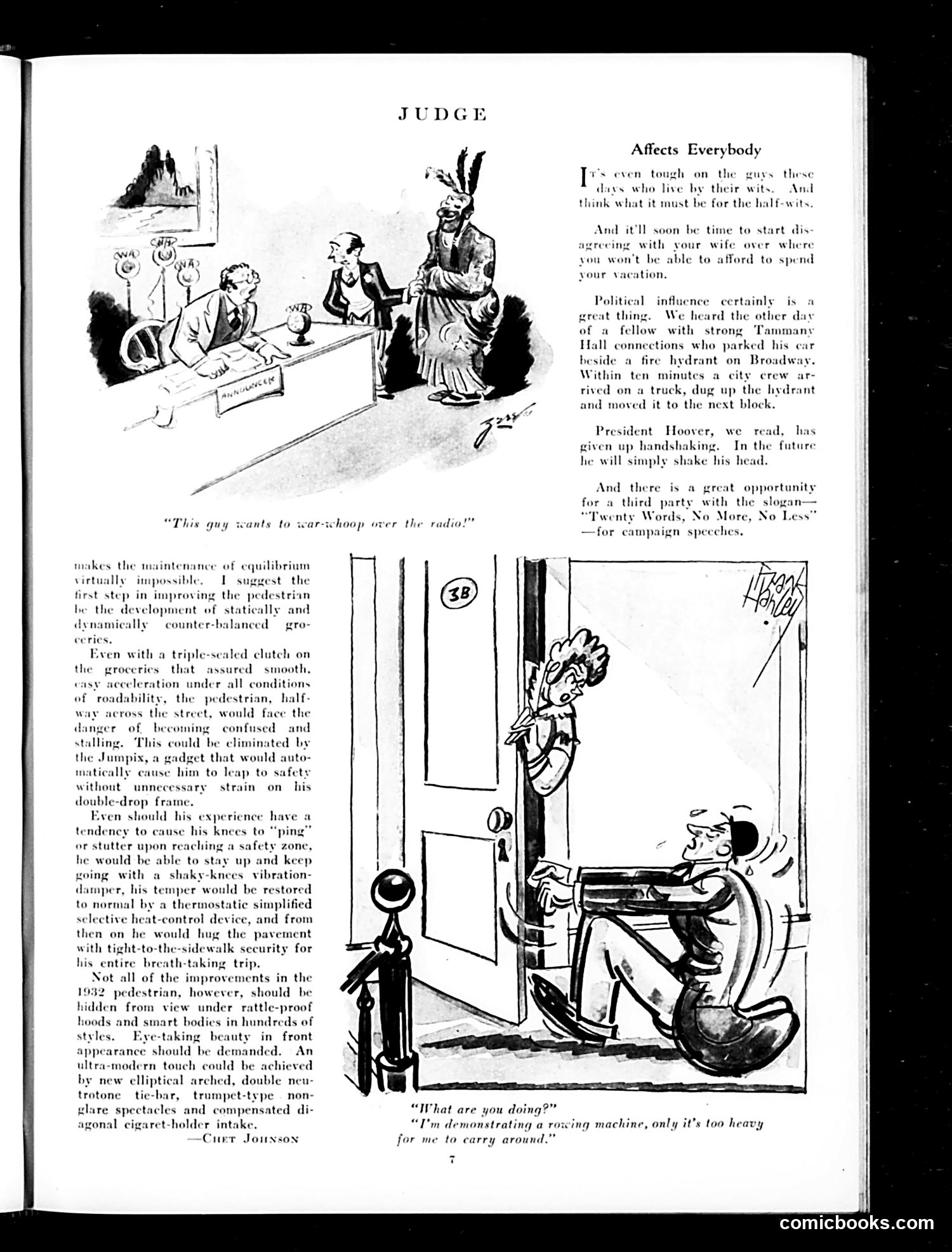
Judge Magazine Satire Analysis This page from Judge combines political commentary with absurdist humor. Top cartoon: A man at a desk (appears to be a judge or official) confronts a woman demanding he "war-scoop over the radio"—likely satirizing political patronage and women's increasing public activism in the early 1930s. Text commentary: Sharp jabs at contemporary issues—Tammany Hall political corruption (a New York Democratic machine), President Hoover's perceived coldness, and campaign speech verbosity. The Tammany reference mocks how political connections could literally move city infrastructure. Bottom cartoon: A man struggling to carry a rowing machine, claiming it's "too heavy to carry around"—absurdist humor mocking impractical inventions or false demonstrations, possibly satirizing overhyped consumer products or fitness fads of the era. The page's longest passage—a mock-serious proposal for "counter-balanced groceries" and pedestrian safety devices—is pure satirical nonsense, likely poking fun at over-engineered solutions to simple problems or advertising hyperbole.
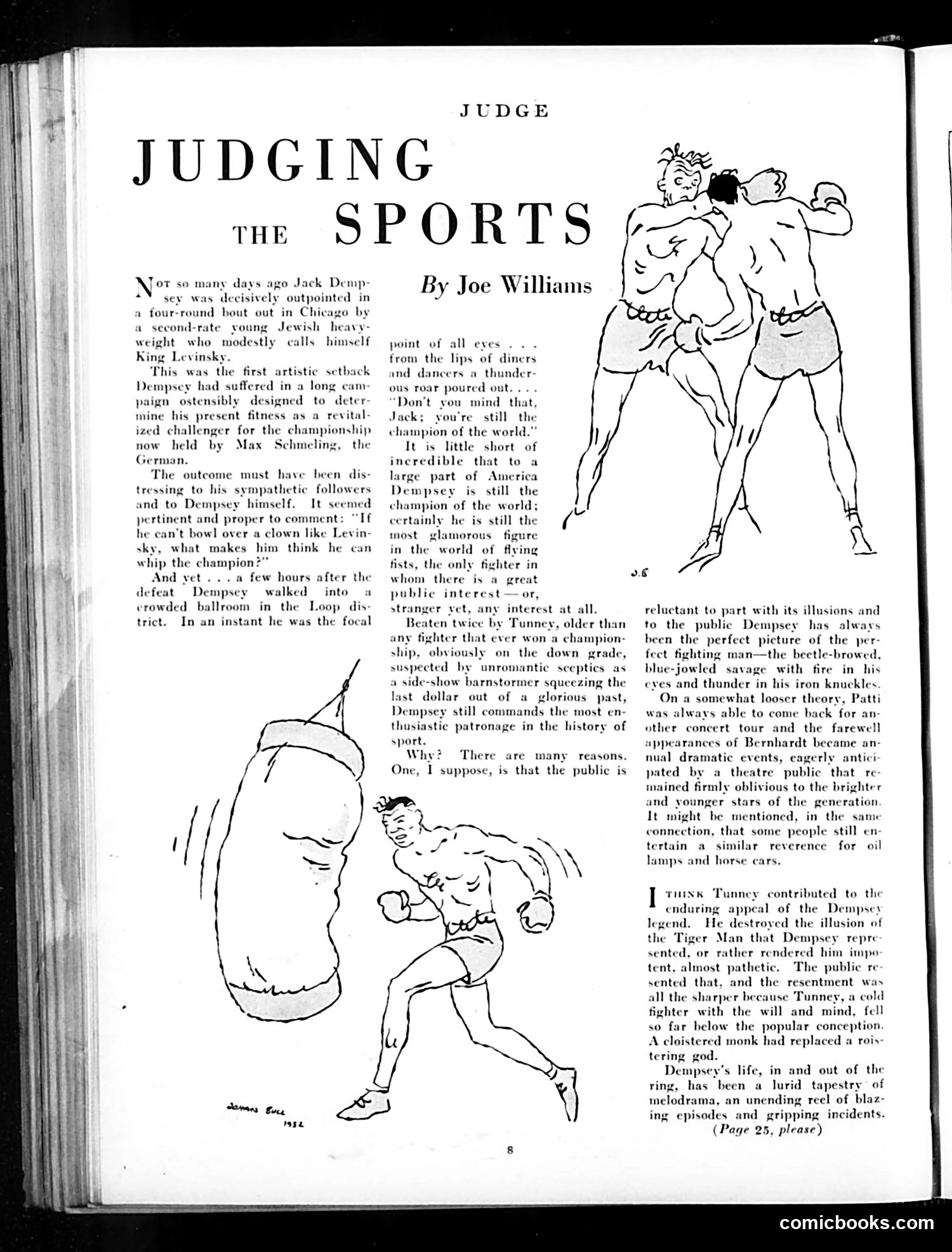
Judging the Sports: Dempsey's Fading Legend This article by Joe Williams critiques boxing champion Jack Dempsey's enduring public appeal despite recent defeats. After losing to King Levinsky in Chicago, Dempsey still commands enthusiastic crowds—a paradox the piece explores. Williams argues the public clings to Dempsey's mythic image: the "beetle-browed, blue-jowled savage" personifying fighting prowess. Gene Tunney's victories, however, shattered this illusion by defeating him decisively. Yet this only deepened Dempsey's appeal—audiences resented Tunney's cold, cerebral style ("a cloistered monk had replaced a roistering god"). Williams compares this to how audiences maintain illusions around fading celebrities like Patti and Bernhardt. The satire suggests Americans prefer romantic mythology to present reality—they'd rather remember Dempsey as the glamorous champion than accept his diminished abilities.
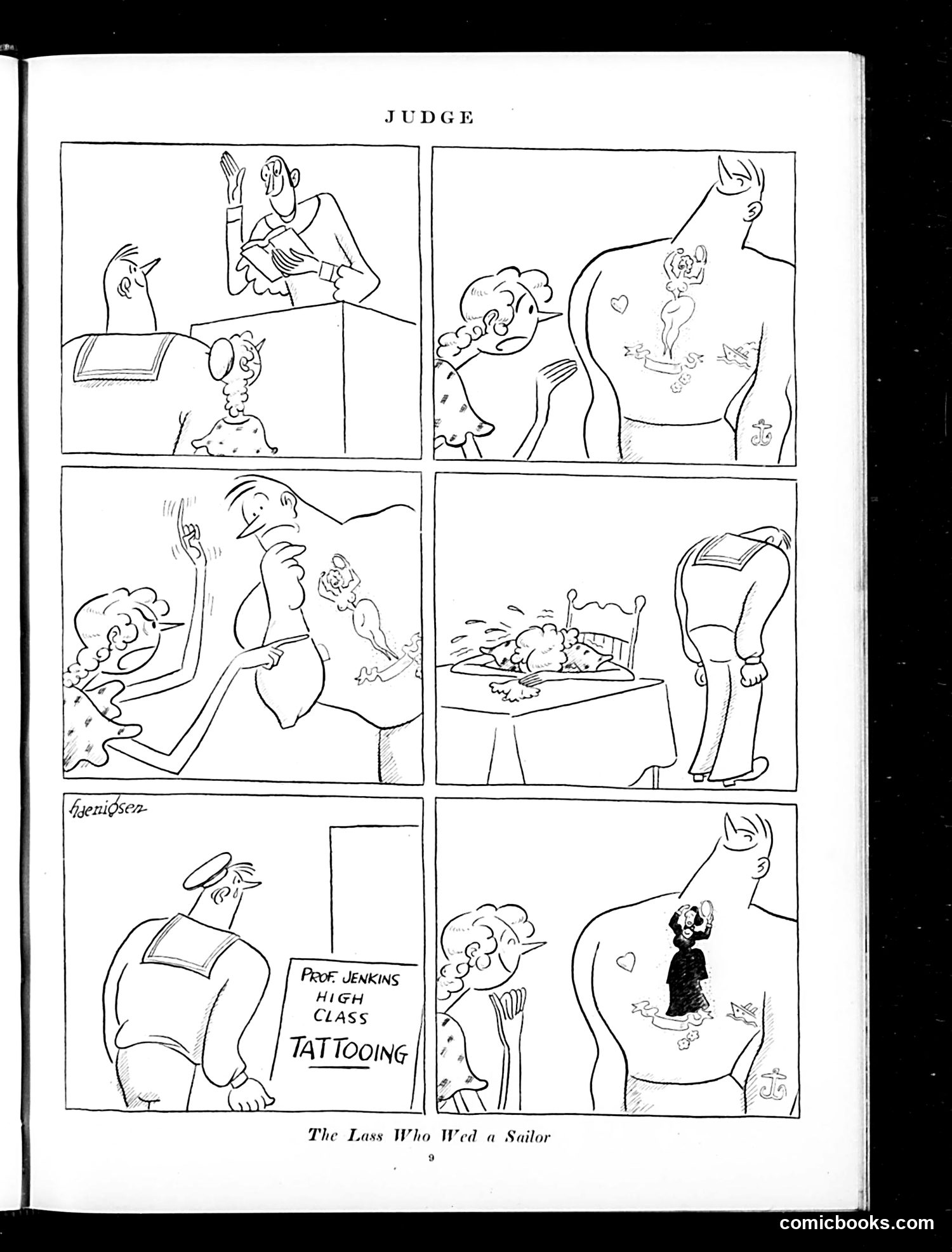
"The Lass Who Wed a Sailor" - Judge Magazine This comic strip satirizes a woman who marries a sailor, then attempts to "improve" him through tattooing and body art. The narrative arc shows: 1. A judge presiding over what appears to be a legal proceeding 2. The woman displaying the sailor's tattooed body as if he were an art canvas 3. Progressive "beautification" through tattoos, including romantic imagery (hearts, flowers) 4. A "Prof. Jenkins High Class Tattooing" shop, suggesting she's treating tattooing as fashionable refinement 5. The final panel showing her proudly displaying her heavily-tattooed husband The satire mocks both the woman's misguided attempts at "civilizing" a rough sailor through body modification, and the era's class anxieties about marrying "unsuitable" working-class men. Tattoos were associated with sailors and the lower classes, making her efforts absurdly futile.
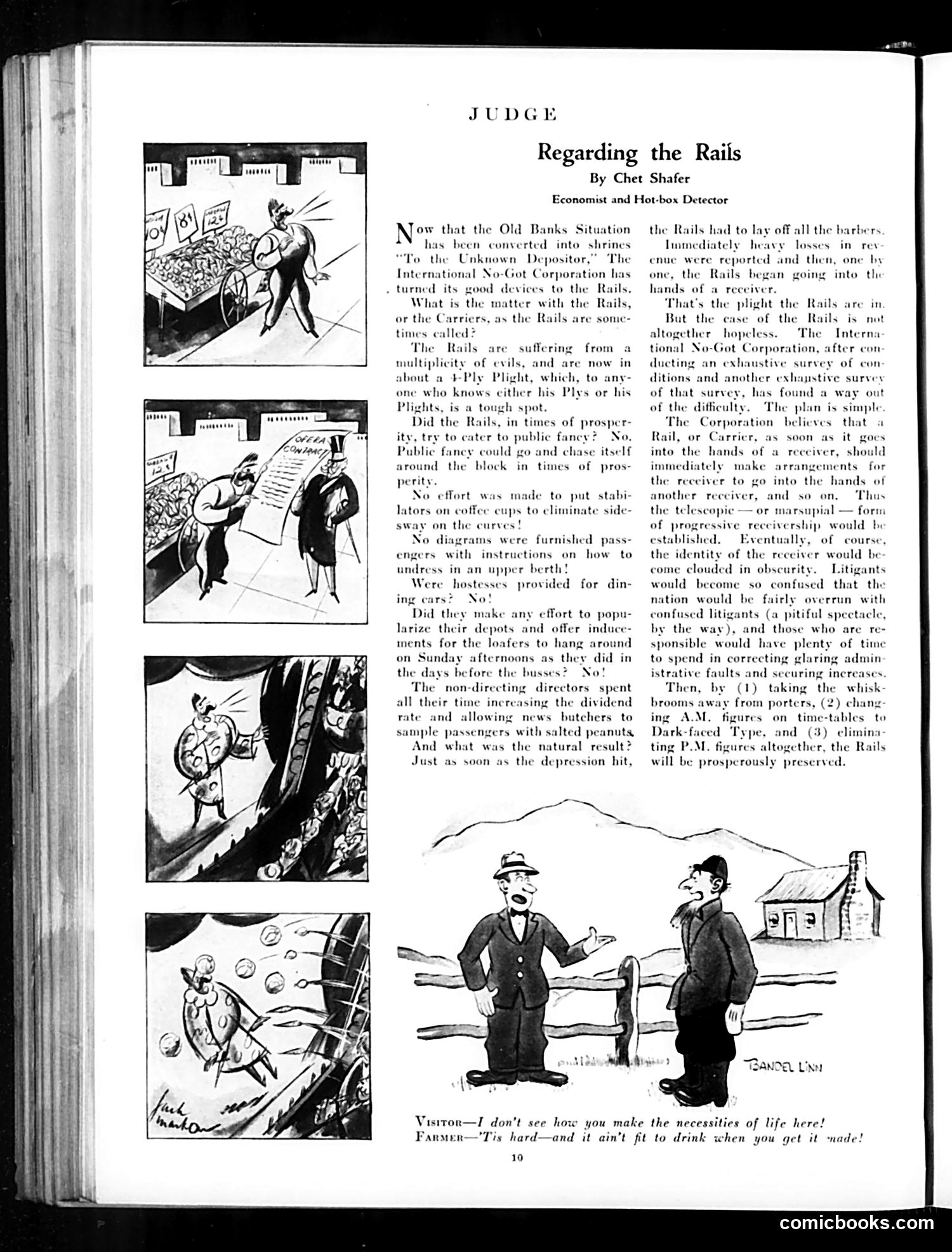
Analysis for Modern Readers This 1920s-30s piece satirizes railroad industry mismanagement during economic depression. Chet Shafer, identified as an "economist and hot-box detector" (railroad jargon for inspector), attacks rail companies for failing to innovate or serve customers during prosperity, then collapsing into receivership when the Depression hit. The four cartoon panels mock specific corporate failures: no stabilizers on coffee cups, no passenger amenities, failure to modernize depots. Shafer proposes absurd solutions—creating infinite chains of receivers handling receivers—exposing how management waste and incompetence caused the crisis. The bottom cartoon depicts rural poverty, contrasting with rail company dividends. The farmer's complaint about drinking water quality suggests Depression-era hardship while corporations prioritized shareholder returns over service quality or worker welfare. The satire targets corporate greed and managerial negligence as root causes of railroad collapse.
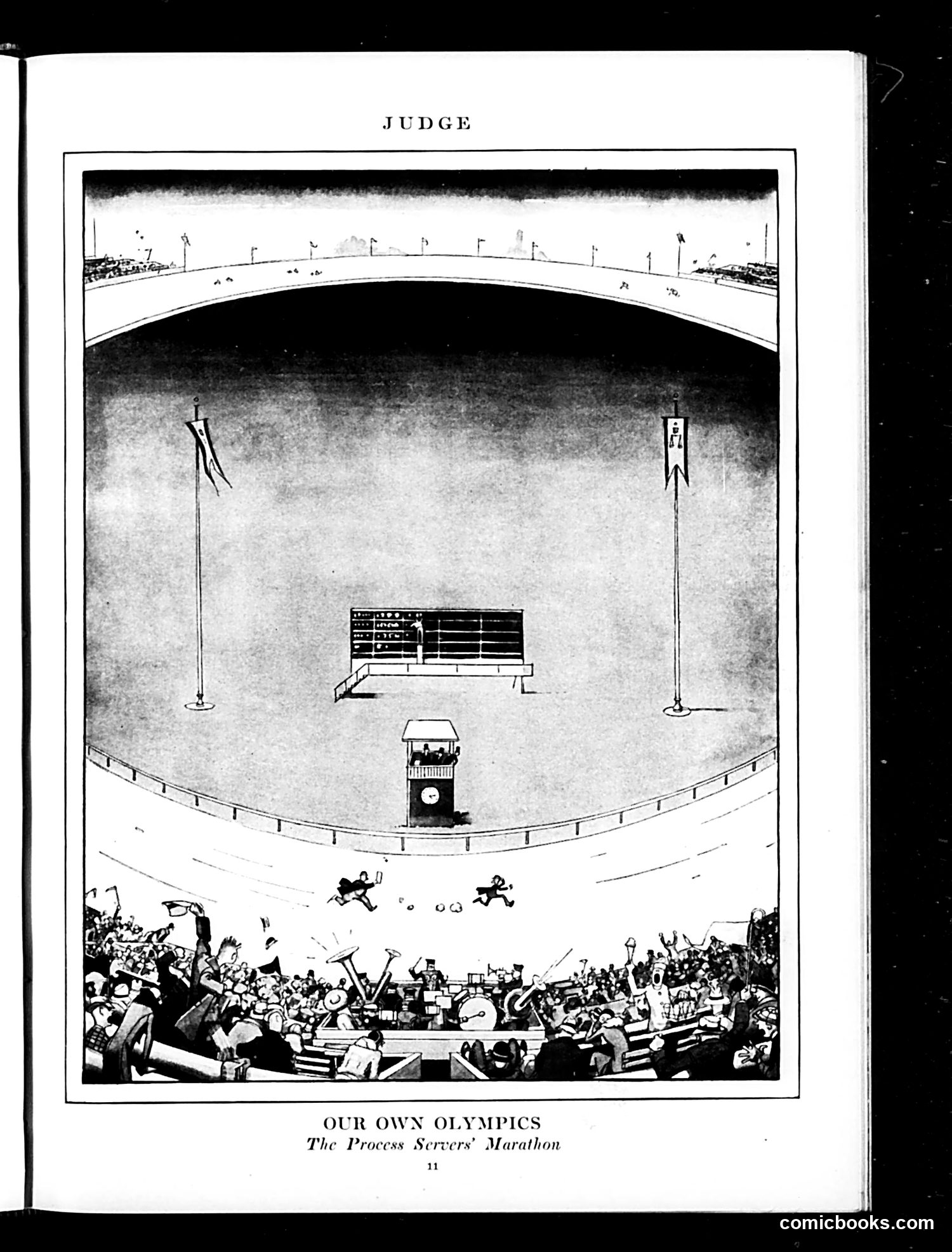
"Our Own Olympics: The Process Servers' Marathon" This satirical cartoon depicts a stadium event where process servers (court officials who deliver legal documents) are racing as participants in a mock Olympic marathon. The humor lies in depicting the tedious, unglamorous work of legal service as an athletic competition worthy of Olympic status. The scene shows runners on a field, spectators in crowded bleachers, a judge's stand, and officials overseeing the "event." By framing process serving—routine but often difficult work involving tracking down defendants and delivering papers—as an Olympic sport, Judge magazine mocks both the pretensions of the legal profession and the absurdity of awarding prestige to mundane occupations. This was characteristic of Judge's satirical commentary on American institutions and professional classes.
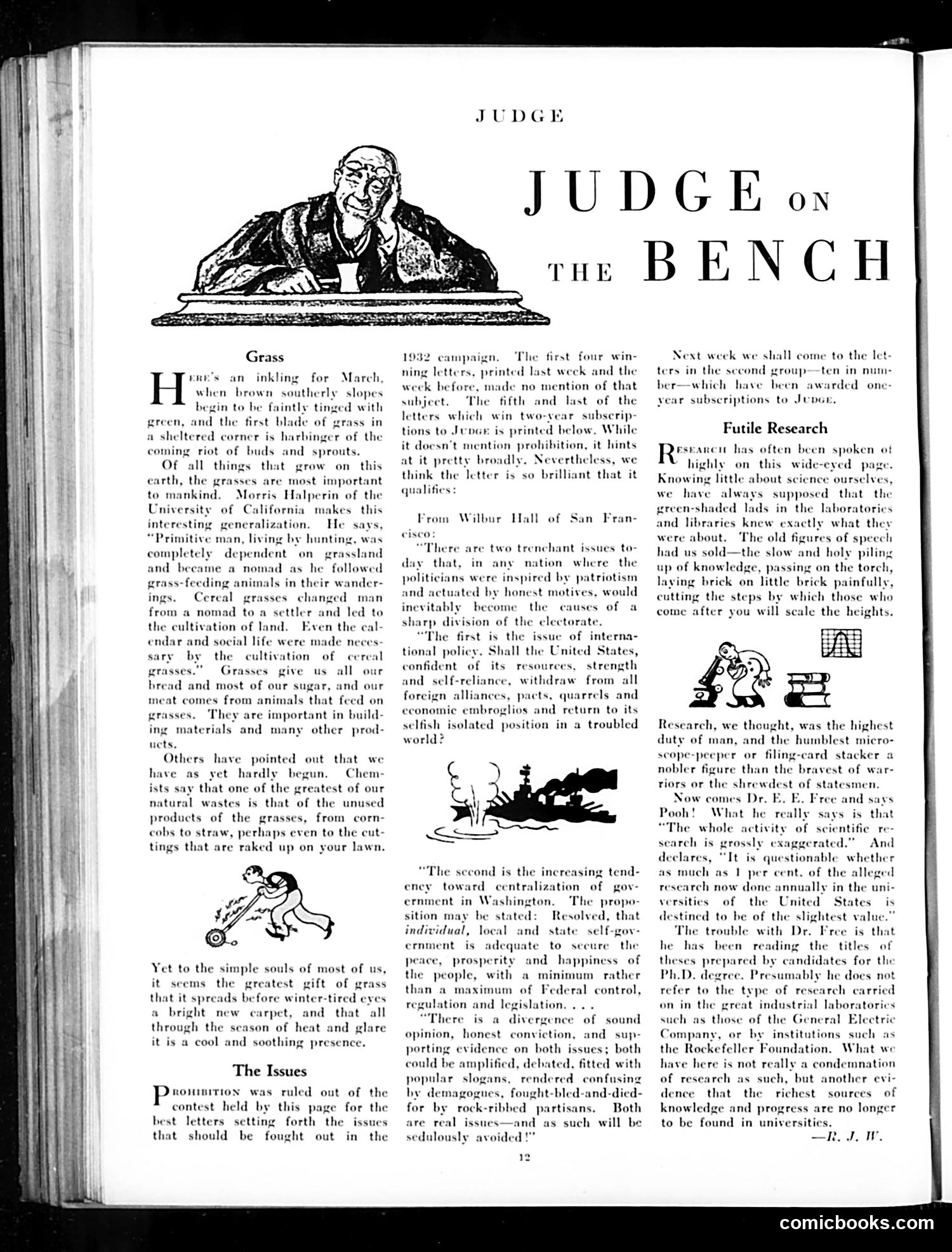
Judge Magazine Page Analysis This 1932 page from *Judge* magazine contains three distinct sections: an editorial essay on grass, a political letters contest, and commentary on scientific research. The main content discusses two competing 1932 campaign issues proposed by a San Francisco reader: (1) isolationism versus foreign alliances, and (2) states' rights versus federal centralization. The editorial presents these as genuine ideological divides worth serious debate. The "Futile Research" section critiques academic science, suggesting researchers exaggerate their accomplishments. The text claims only a small percentage of university research produces genuine value, implying much is wasteful self-promotion—a dig at institutions like Rockefeller Foundation that funded such work. The satirical cartoons (showing judges/authority figures) reinforce the editorial tone: skepticism toward both government overreach and inflated claims of expertise. The overall message reflects Depression-era cynicism about institutions and politicians alike.
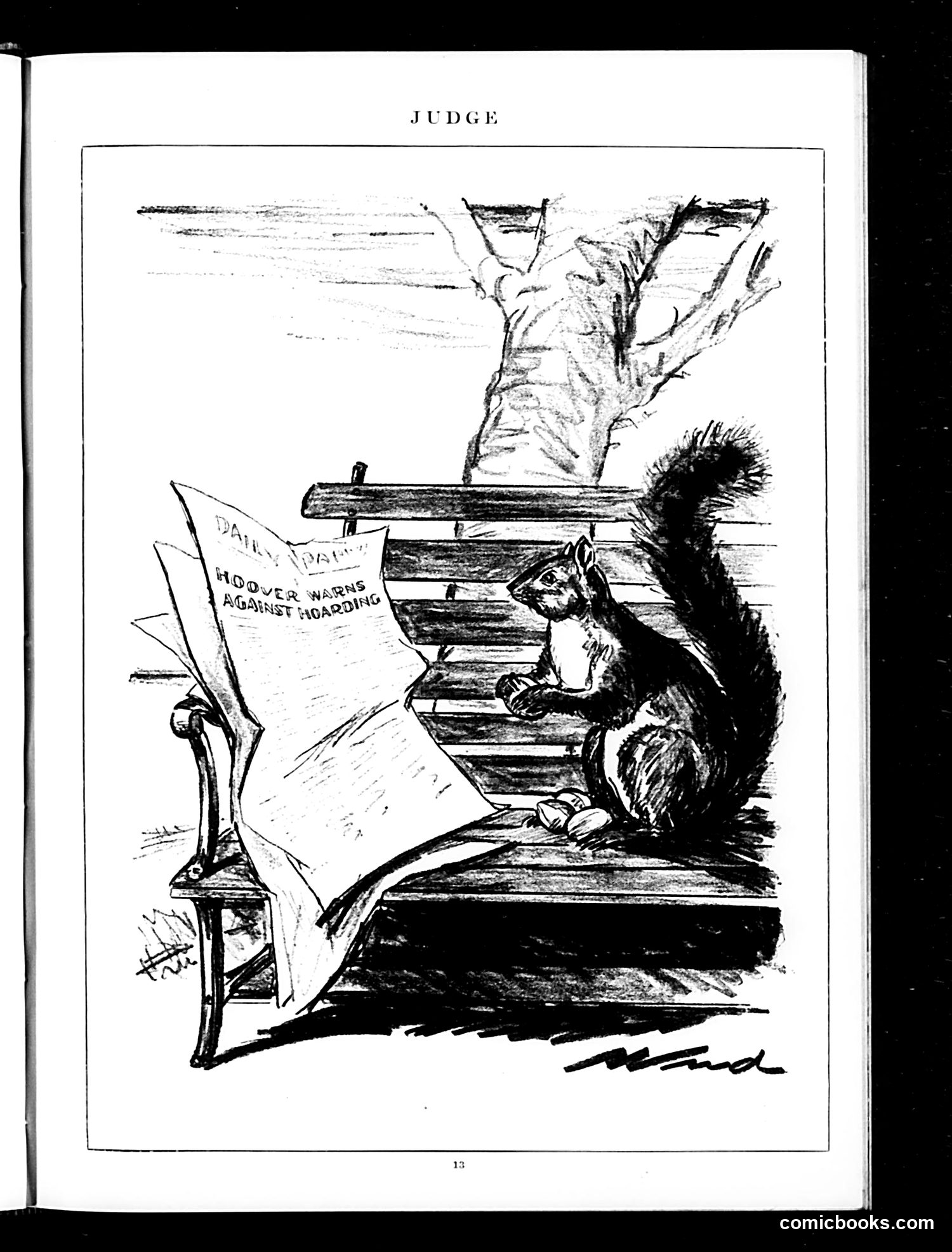
Analysis of "Judge" Cartoon Page This is a single editorial cartoon titled "Judge." The image shows an anthropomorphized squirrel sitting on wooden steps or a structure, reading a notice that reads "DAILY PAPERS / HOOVER WARNS / AGAINST HOARDING." The satire appears to target President Herbert Hoover's public warnings against hoarding during what is likely the Great Depression era. By depicting a squirrel—an animal famous for instinctively hoarding food—reading Hoover's anti-hoarding message, the cartoon makes a pointed joke: it's absurd to warn against hoarding when the natural, instinctive response to scarcity is exactly that behavior. The squirrel represents ordinary citizens whose survival instincts contradict official government messaging about restraint.
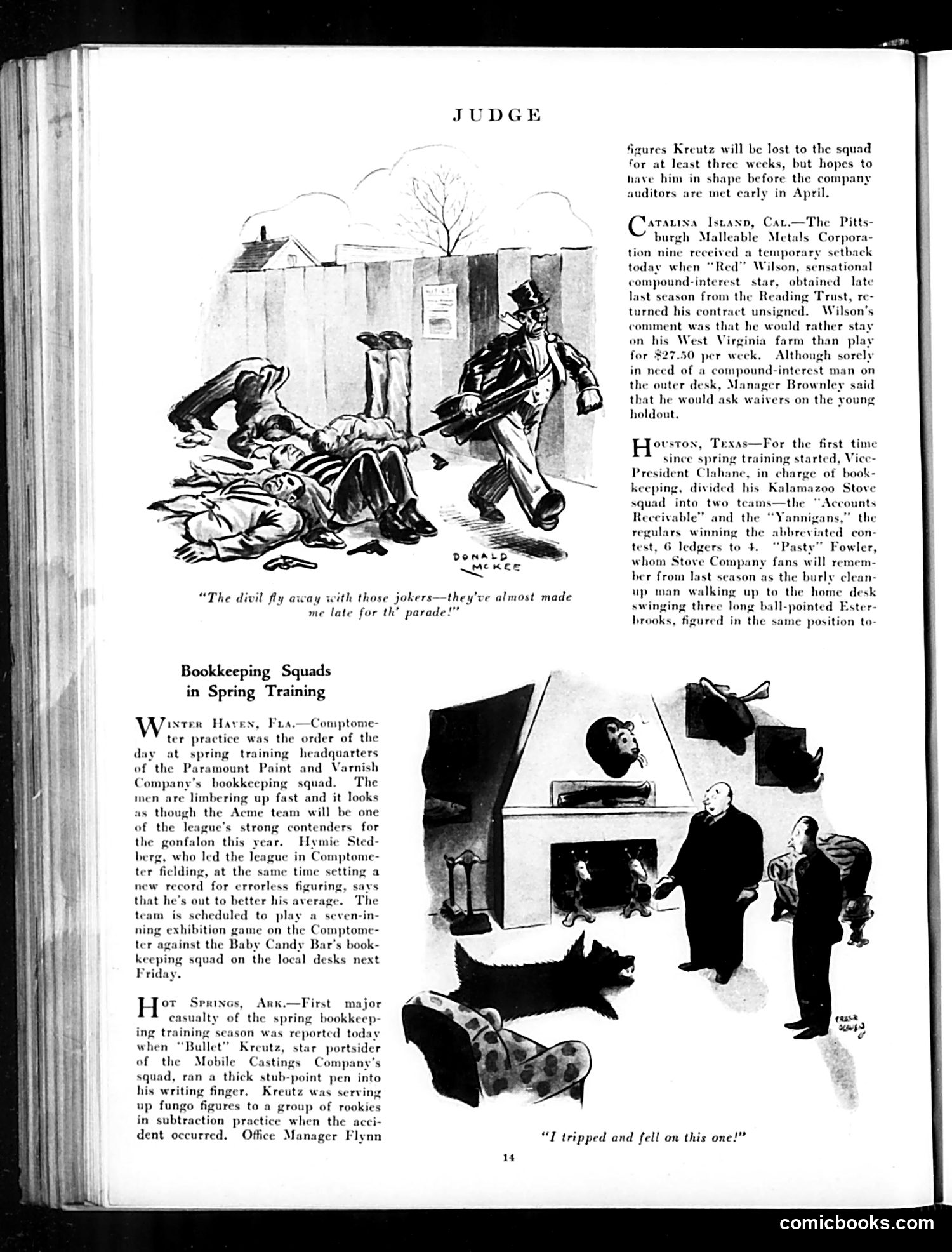
Judge Magazine - "Bookkeeping Squads in Spring Training" This page satirizes corporate office culture by treating accountants' spring training like baseball spring training. The cartoons mock the competitive, athletic language applied to mundane bookkeeping work. The top cartoon shows a judge figure amid chaos, captioned about "jokers" making someone late for a parade—likely a broader social commentary about disruption. The main content uses sports terminology for clerical workers: "comptometer fielding," "fungo figures," and employees as "stars" and "regulars." Companies like Pittsburgh Malleable Metals, Paramount Paint and Varnish, and Mobile Castings have competing "squads." The humor lies in absurd seriousness applied to trivial office injuries (a pen puncture to the finger) and contract disputes over modest wages ($25.50/week). The lower cartoon shows an office accident being treated with athletic drama—"I tripped and fell on this one!" This reflects 1920s-30s office humor mocking the mechanization and competitive culture of white-collar work.
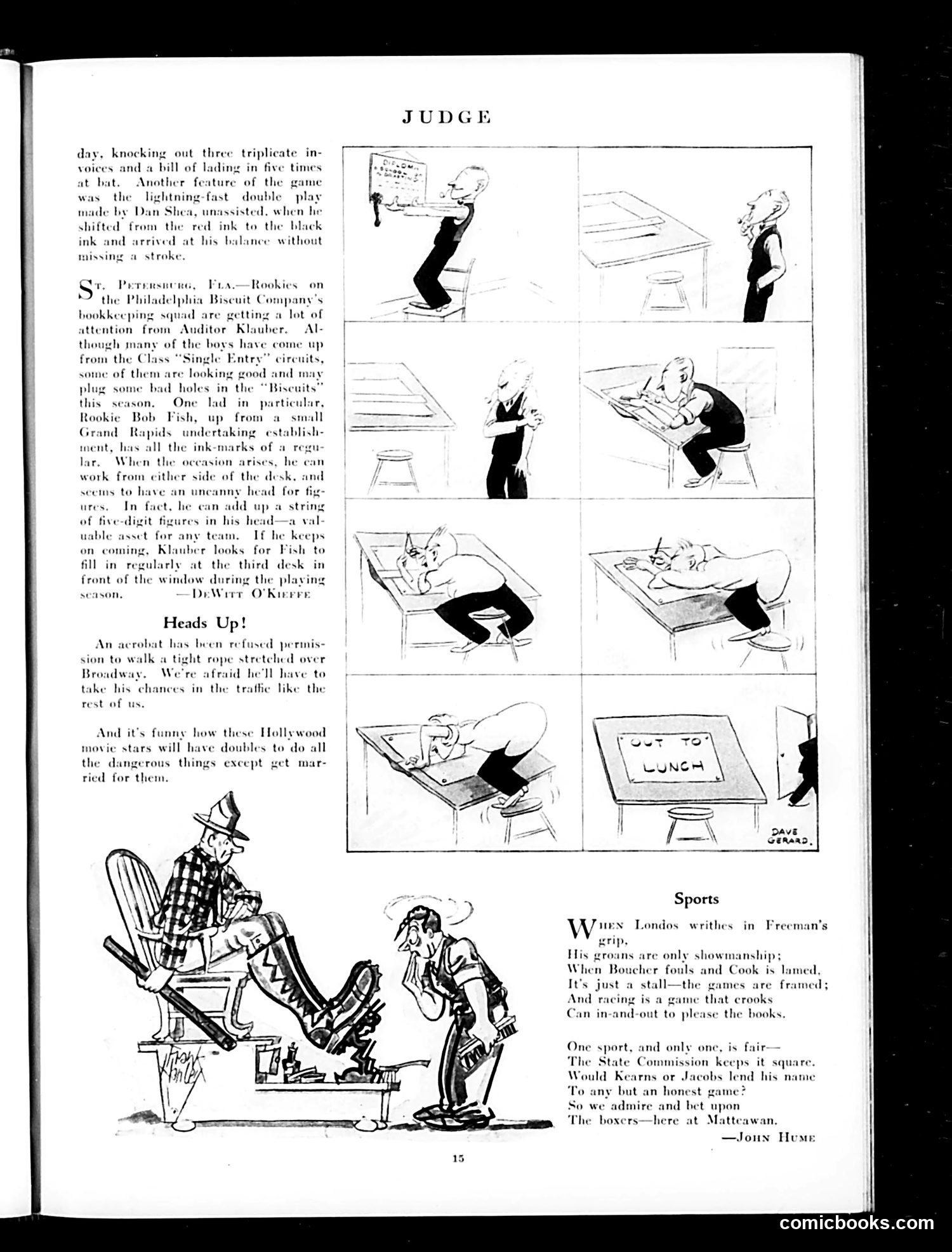
Judge Magazine Content Analysis This page contains two distinct satirical pieces: Main Comic Strip (right side): A visual gag by Dave Gerard showing office workers attempting increasingly absurd acrobatic feats at their desks—jumping, stretching, contorting themselves over furniture and papers. The humor mocks workplace monotony and suggests desperate physical comedy to escape tedium. "Sports" Column (bottom right): Poet John Heme satirizes professional sports corruption of the 1920s-30s era. He cynically dismisses wrestling (mentioning "Londos" and "Freeman"), boxing, and horse racing as fixed or controlled by promoters. The final stanza's punchline—praising boxers "at Matteawan"—likely references Matteawan State Hospital, a psychiatric facility, sarcastically suggesting only institutionalized men maintain honest boxing. The satire suggests widespread belief that most professional sports were rigged except (ironically) for those literally confined. The bookkeeping section references local business auditors and rookie accountants as a sports analogy.
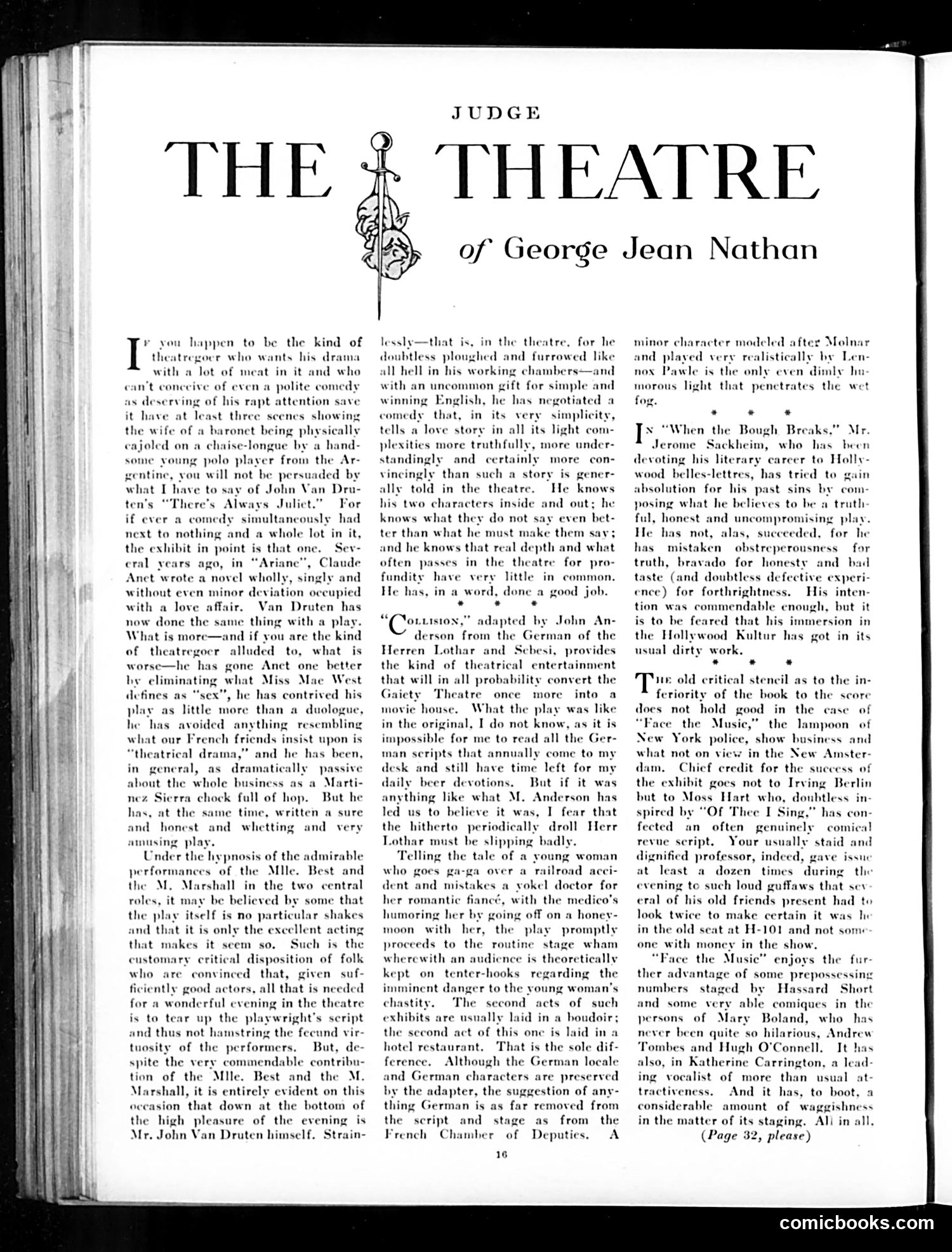
Judge Theatre Review: "The Theatre of George Jean Nathan" This is a theatre criticism column by George Jean Nathan, reviewing recent Broadway productions. The page contains no political cartoons—it's primarily text reviewing plays. Nathan critiques "There's Always Julie," a comedy by John Van Druten, praising its simplicity and emotional honesty. He argues the play succeeds despite being essentially a two-character dialogue about a love affair, claiming Van Druten's skillful writing and understanding of his characters makes it more truthful than overly theatrical dramatics. Nathan credits the actors (Mlle. Best and M. Marshall) but emphasizes the playwright's contribution. He then briefly reviews "Collision," adapted from a German play by Lothar and Sebesi. The plot involves a young woman who mistakes a country doctor for her romantic fiancé after a train accident, with comedic complications ensuing. Nathan's tone suggests skepticism about whether this plot device will sustain audience interest effectively.
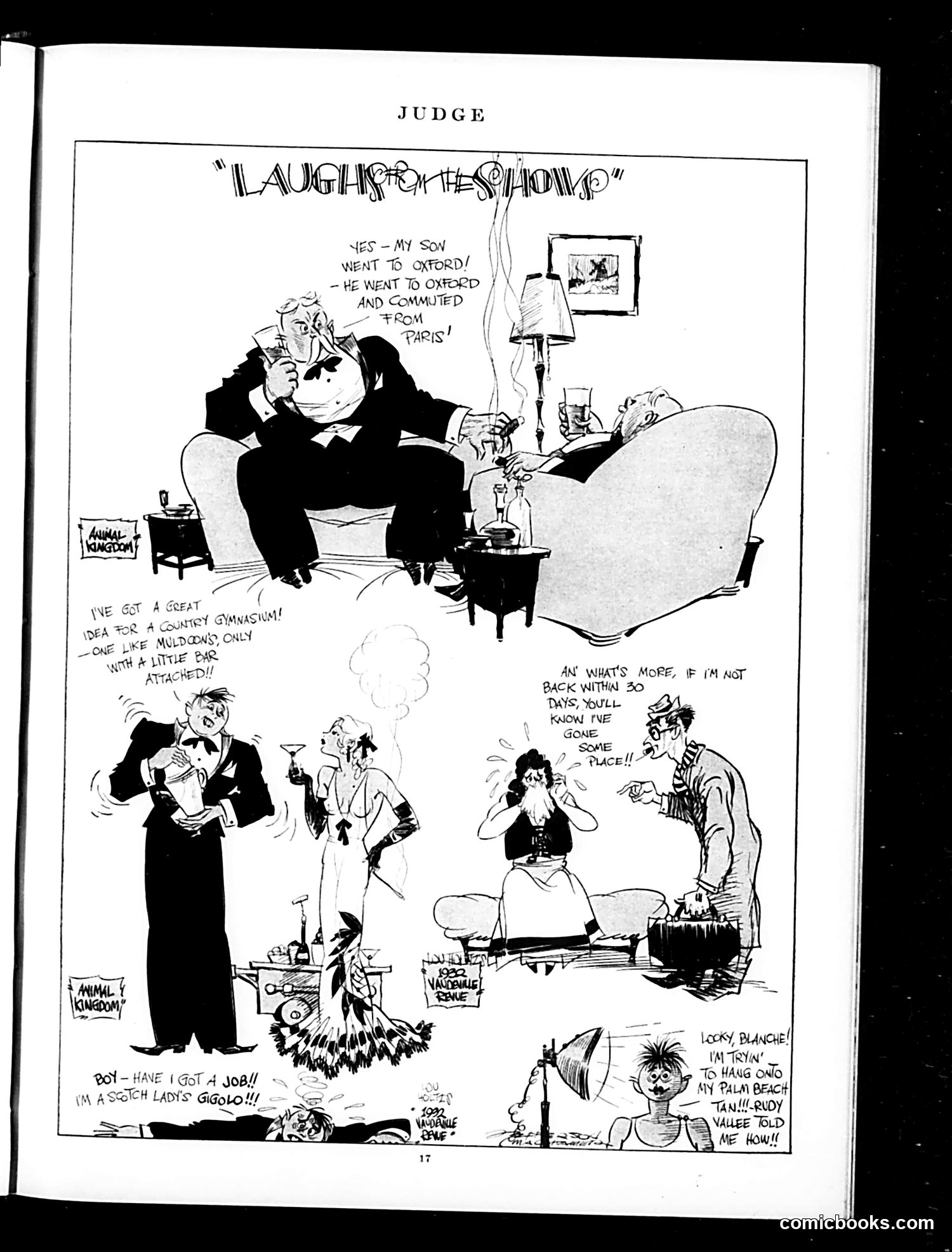
"Laughs at the Shop" - Judge Magazine Satire This is a multi-panel cartoon satirizing wealthy social climbers and their pretensions during the Jazz Age era (likely 1920s-30s, based on style). The central figure is an ostentatious rich man bragging about his son attending Oxford University while commuting from Paris—an absurd exaggeration meant to mock nouveau-riche Americans flaunting European connections and wealth. Surrounding panels show various characters: a man with a country gymnasium idea (satirizing impractical rich-person schemes), someone threatening to disappear to "some place," and references to Palm Beach and Valley—fashionable wealthy destinations. The humor targets American social aspiration: wealthy people desperate to appear sophisticated and internationally cultured while behaving ridiculously. The title "Laughs at the Shop" suggests these are overheard boasts from affluent circles, presented for readers' mockery of upper-class pretension and one-upmanship. The cartoon reflects period anxiety about American wealth, class mobility, and Old World sophistication.
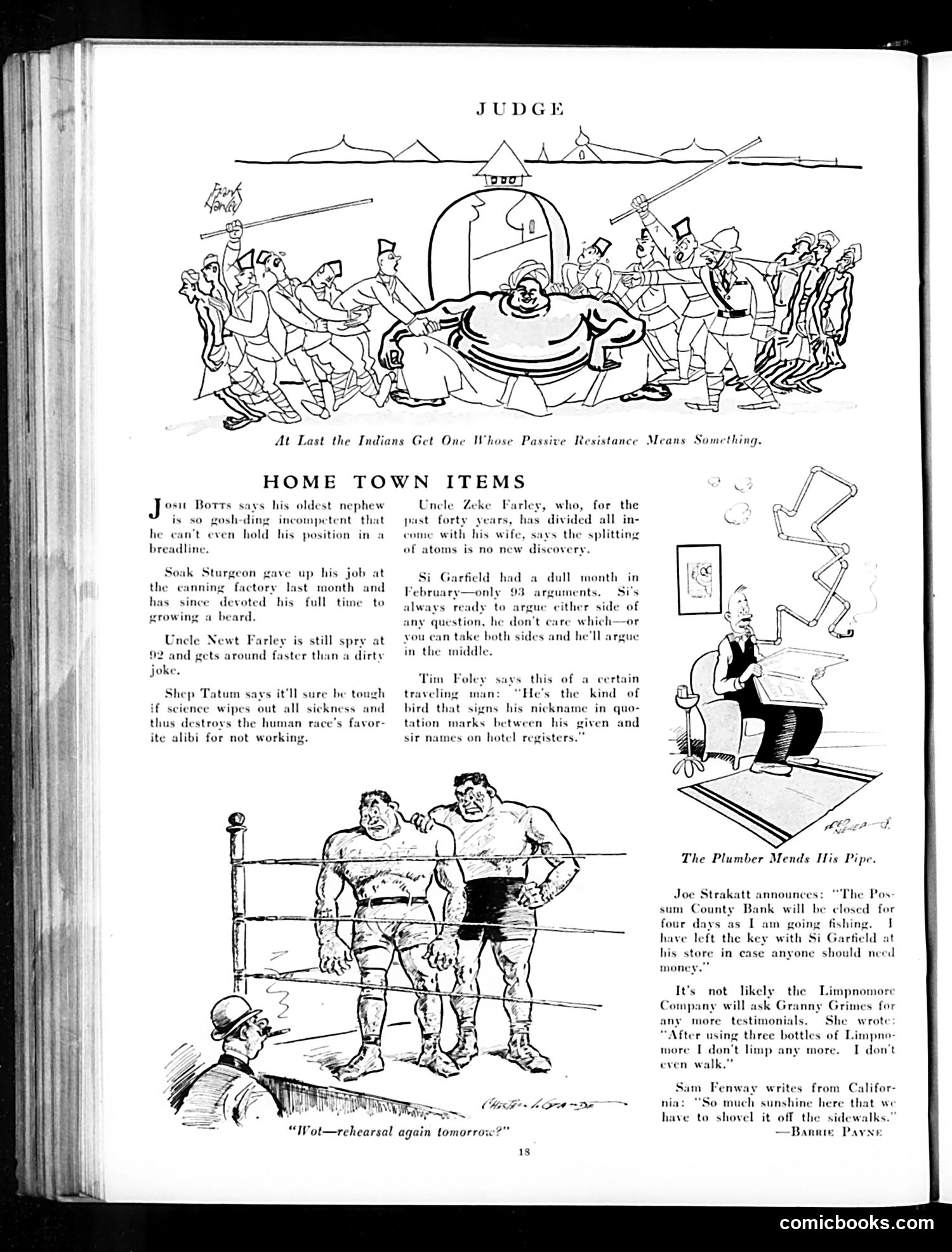
Judge Magazine Page Analysis Top Cartoon: The headline "At Last the Indians Get One Whose Passive Resistance Means Something" depicts a large Native American figure (caricatured) surrounded by officials and men in suits. This appears to satirize passive resistance tactics—likely referencing Gandhi or Indian independence movements—by suggesting that only a figure of substantial physical size could make passive resistance "mean something," implying the concept is otherwise ineffectual. The satire mocks both passive resistance and uses offensive racial caricature. "Home Town Items": This section collects brief humorous anecdotes about small-town characters, poking fun at unemployment, laziness, marital dynamics, and modern anxieties (atomic science, healthcare). The jokes reflect Depression-era concerns and skepticism toward scientific progress and corporate testimonials. Bottom Cartoon: "Wot—rehearsal again tomorrow?" shows muscular wrestlers or boxers, apparently depicting a training scene. The humor likely concerns repetitive, grueling athletic preparation. The page exemplifies Judge's blend of political commentary and folksy Americana humor.
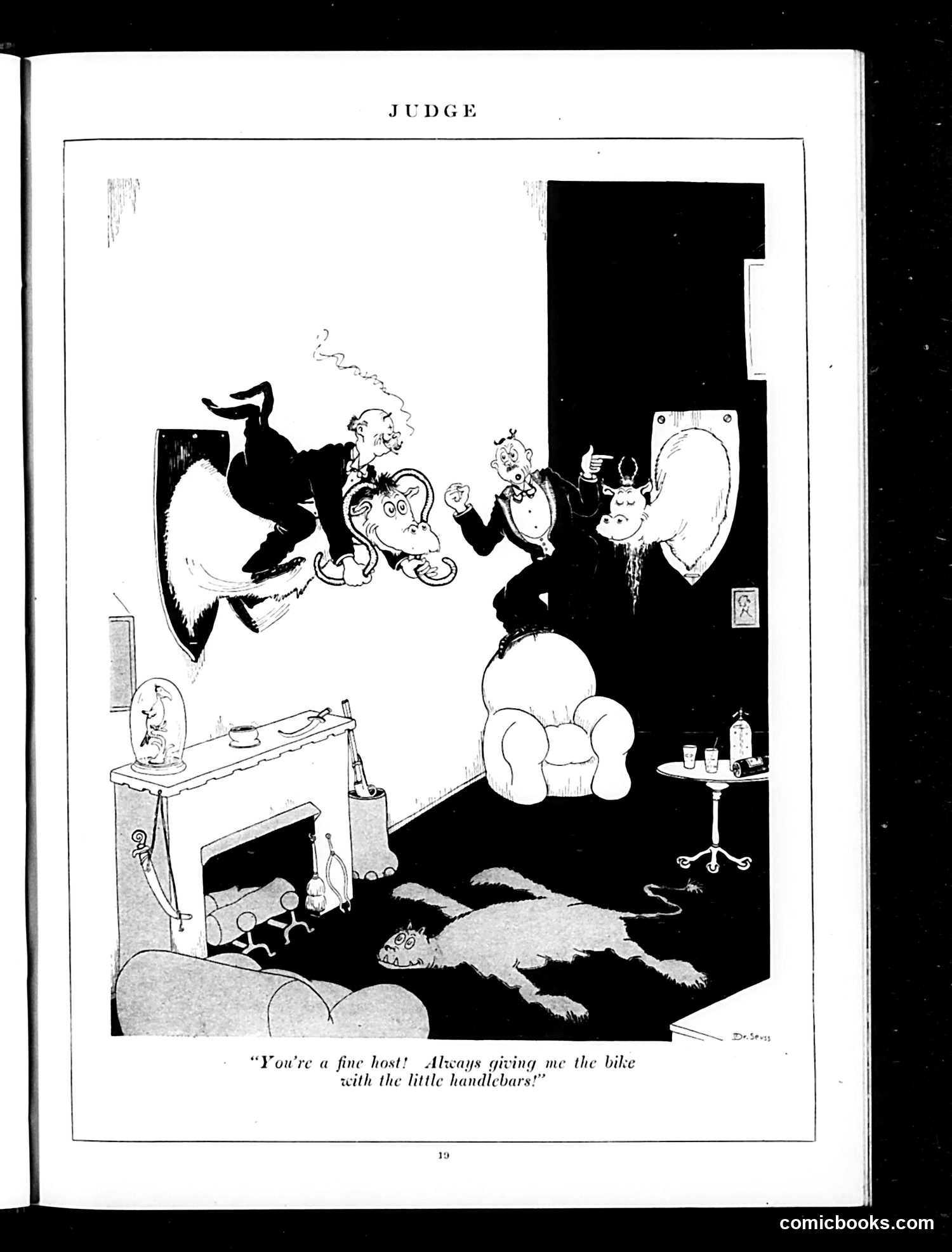
Cartoon Analysis This single-panel cartoon depicts a social gathering where a rotund host is being criticized by a guest. The host's exaggerated physique—particularly his prominent posterior—is the subject of mockery, with the guest sarcastically praising him as a "fine host" while making a crude joke comparing the host's body shape to bicycle handlebars. The humor relies on physical caricature and insult comedy typical of early 20th-century satirical magazines. The formal indoor setting (fireplace, furnishings, other well-dressed guests) contrasts with the crude bodily humor, suggesting the joke targets wealthy or socially prominent individuals. The specific identities of these figures remain unclear from the image alone.
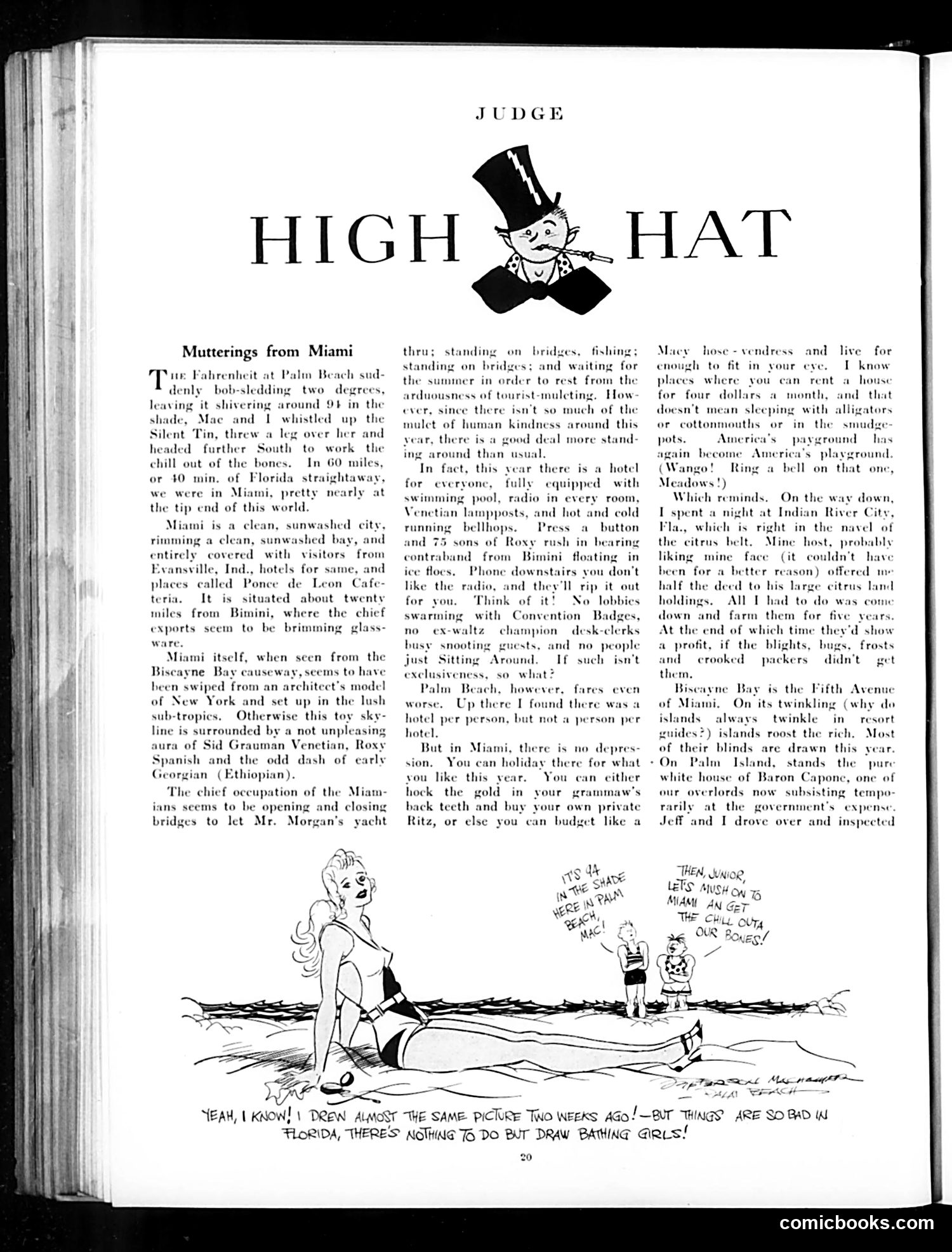
"High Hat" - Judge Magazine Satire This column mocks Miami and Palm Beach during what appears to be the early Depression era. The author satirizes Florida's transformation into a tourist destination: Miami is artificially "swiped from an architect's model of New York," featuring ostentatious Venetian and Spanish-style architecture. The satire targets wealthy visitors and the commercialization of leisure—hotels everywhere, bridges constantly opening for "Mr. Morgan's yacht," and bellhops summoned by button-press. The author notes the irony that despite supposed prosperity, there's "no depression" in Miami yet people are desperate (renting a house for four dollars monthly, offering deed-deals). A notable reference mentions Al Capone's estate on Palm Island, suggesting organized crime's open presence in Florida. The accompanying cartoon shows a woman on a beach complaining that there's "nothing to do but draw bathing girls," mocking the cartoonist's repetitive subject matter during slow news periods. This meta-joke acknowledges Judge's reliance on bikini-clad women as filler content.
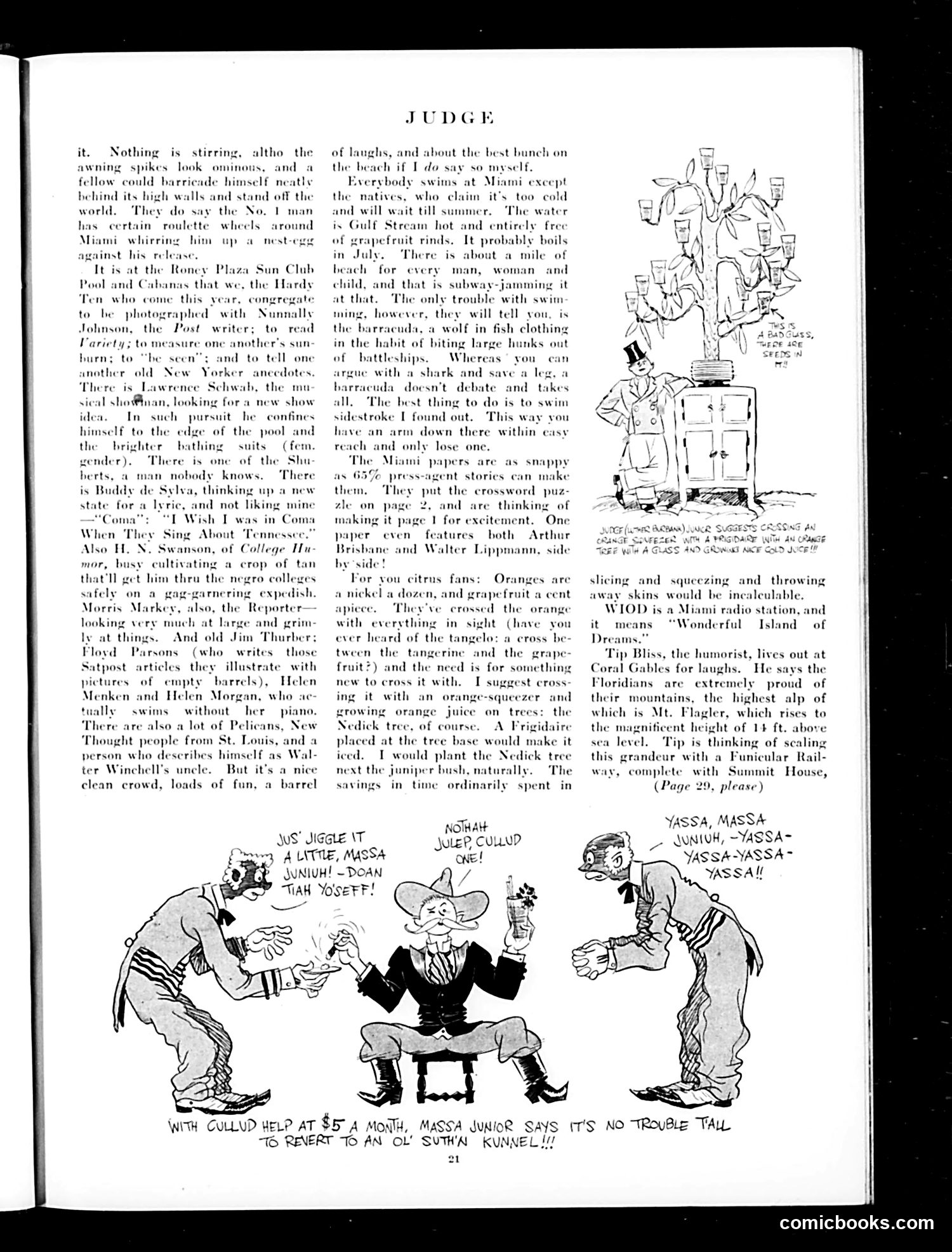
Explanation for Modern Readers This Judge page contains a humorous essay about Miami beach society during what appears to be the 1920s-30s, illustrated with cartoons. The main cartoon (bottom) depicts a character labeled "Massa Junior" in offensive racial caricature, speaking in exaggerated dialect ("Jus' jiggle it a little, Massa...") while being attended to by two other caricatured figures. The caption references "$5 a month" and "revertin' to an ol' suthun' kennel." This reflects the deeply racist humor typical of Judge at this era—mocking Black servants and perpetuating harmful stereotypes as entertainment. The essay itself satirizes Miami's fashionable beach scene, poking fun at celebrities and writers vacationing there (mentioning "Nunnally Johnson," Jim Thurber, and others), the absurdity of Miami's promotional boosterism, and local hazards like barracudas. The humor is gentle social satire about vacation culture and Florida's exaggerated marketing. The racist cartoon, however, represents a shameful element of period humor that modern readers should recognize as offensive propaganda, not comedy.
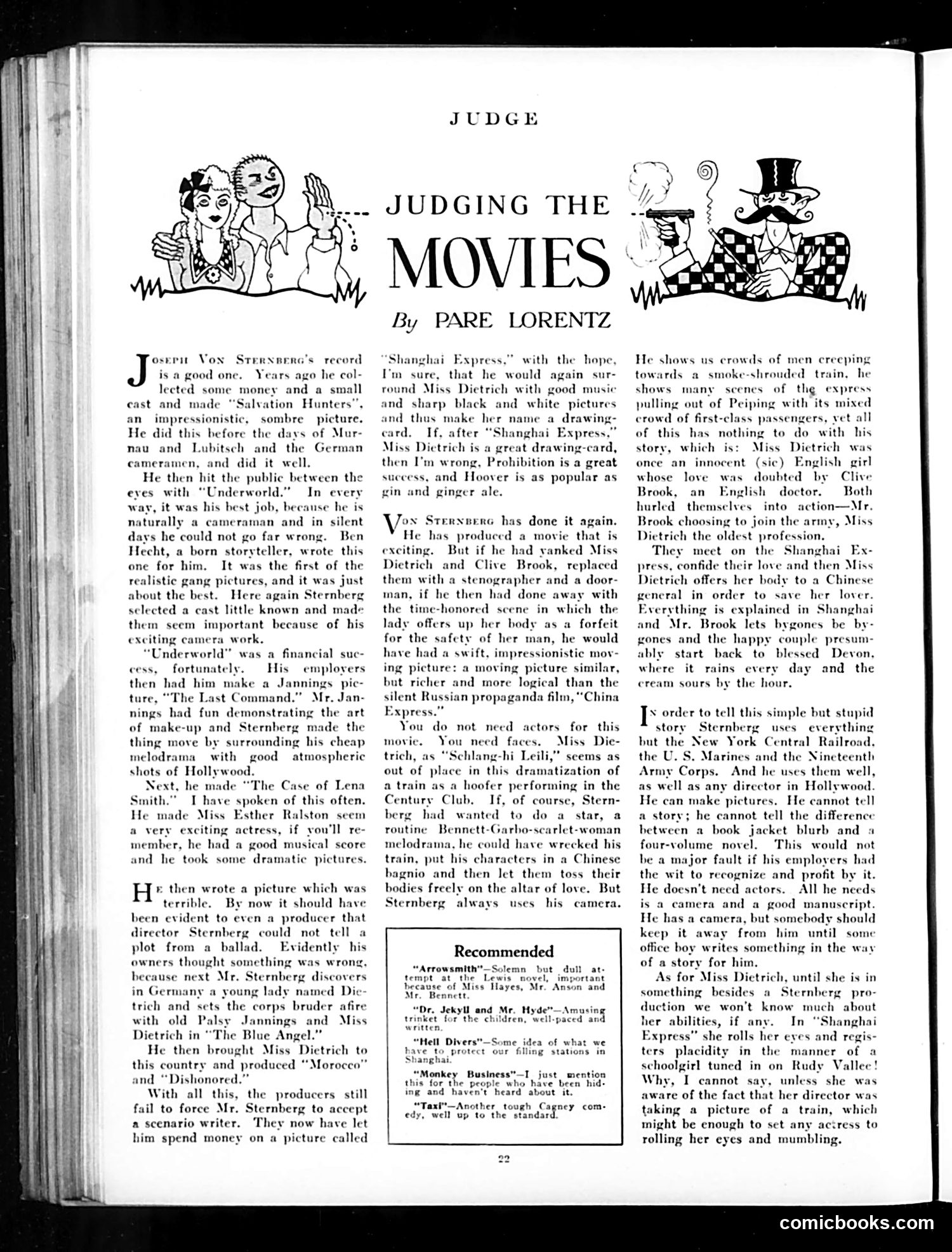
Analysis for Modern Readers This is film criticism by Pare Lorentz reviewing director Josef von Sternberg's work. The decorative header cartoons (showing a judge-like figure and theatrical characters) establish this as a "Judge" magazine film review section. Lorentz critiques Sternberg's filmmaking approach: while praising his early successes like "Underworld" (1927) for visual sophistication, he argues Sternberg cannot direct a coherent plot. The reviewer's central complaint is that producers keep hiring him despite this weakness. Regarding "Shanghai Express," Lorentz suggests the film succeeds only because star Marlene Dietrich and the cinematography distract from poor storytelling. He sarcastically compares Dietrich's presence to Prohibition's unpopularity—both are overrated. The "Recommended" box lists contemporary films like "Arrowsmith" and "Dr. Jekyll and Mr. Hyde," providing context for 1931-1932 cinema. The satire targets both Sternberg's fundamental directorial limitation and Hollywood's willingness to ignore it for star power and visual spectacle.
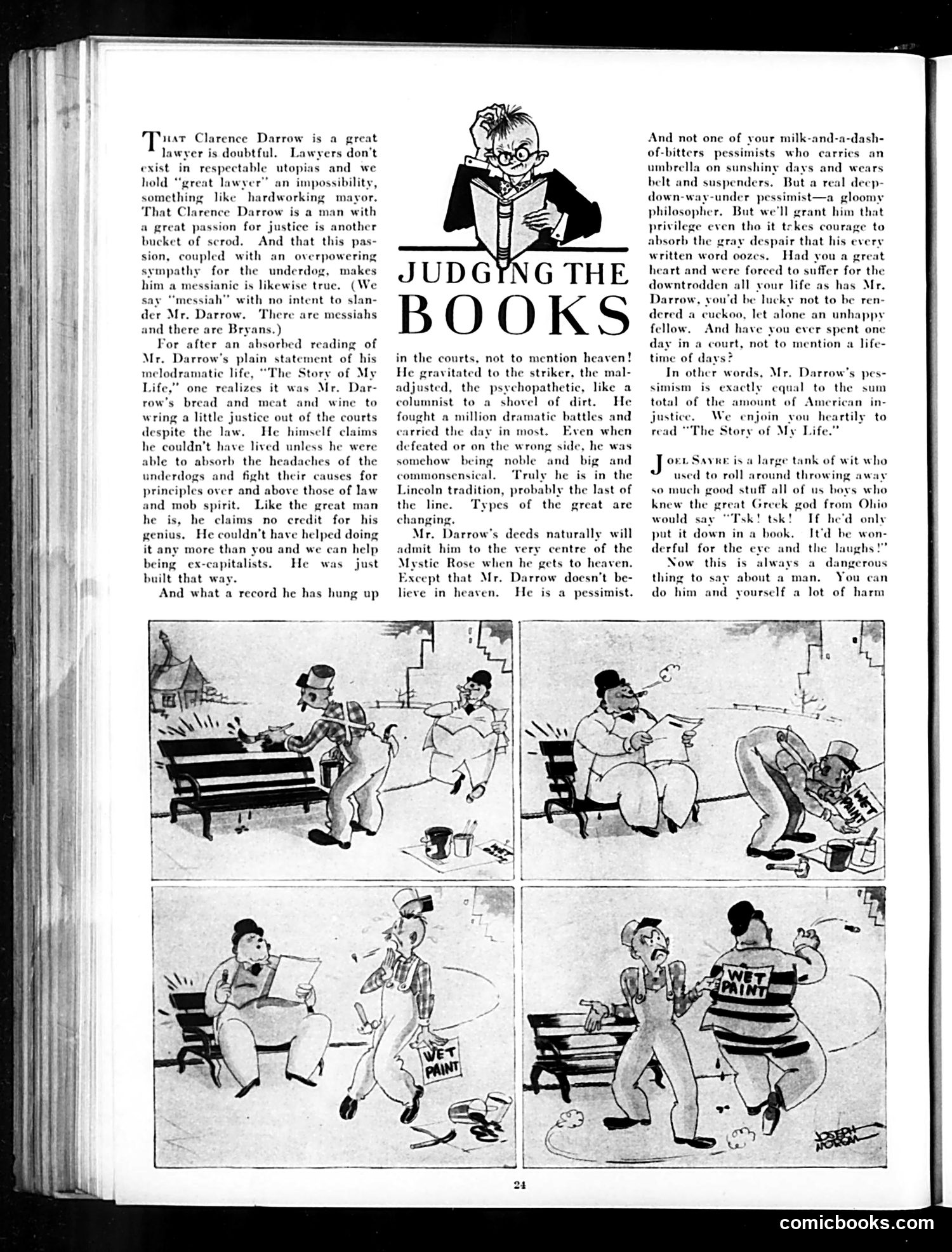
Judging the Books: A Satire of Clarence Darrow This page critiques famous defense lawyer Clarence Darrow through mock praise. The text sarcastically celebrates his passion for defending underdogs and strikers while simultaneously mocking his pessimism and atheism. The author notes that Darrow's record of fighting for justice is impressive, yet his gloomy worldview contradicts his achievements—he'd deserve heaven, except he doesn't believe in it. The four comic panels below illustrate the satire: they depict a man (Darrow) repeatedly painting, seemingly unable to finish or satisfy himself, suggesting his relentless, never-satisfied pursuit of justice and his inability to rest. The "wet paint" signs emphasize the ongoing, messy nature of his work. The secondary commentary on Joel Sayre briefly mentions a witty writer who should publish his bon mots rather than waste them in conversation.
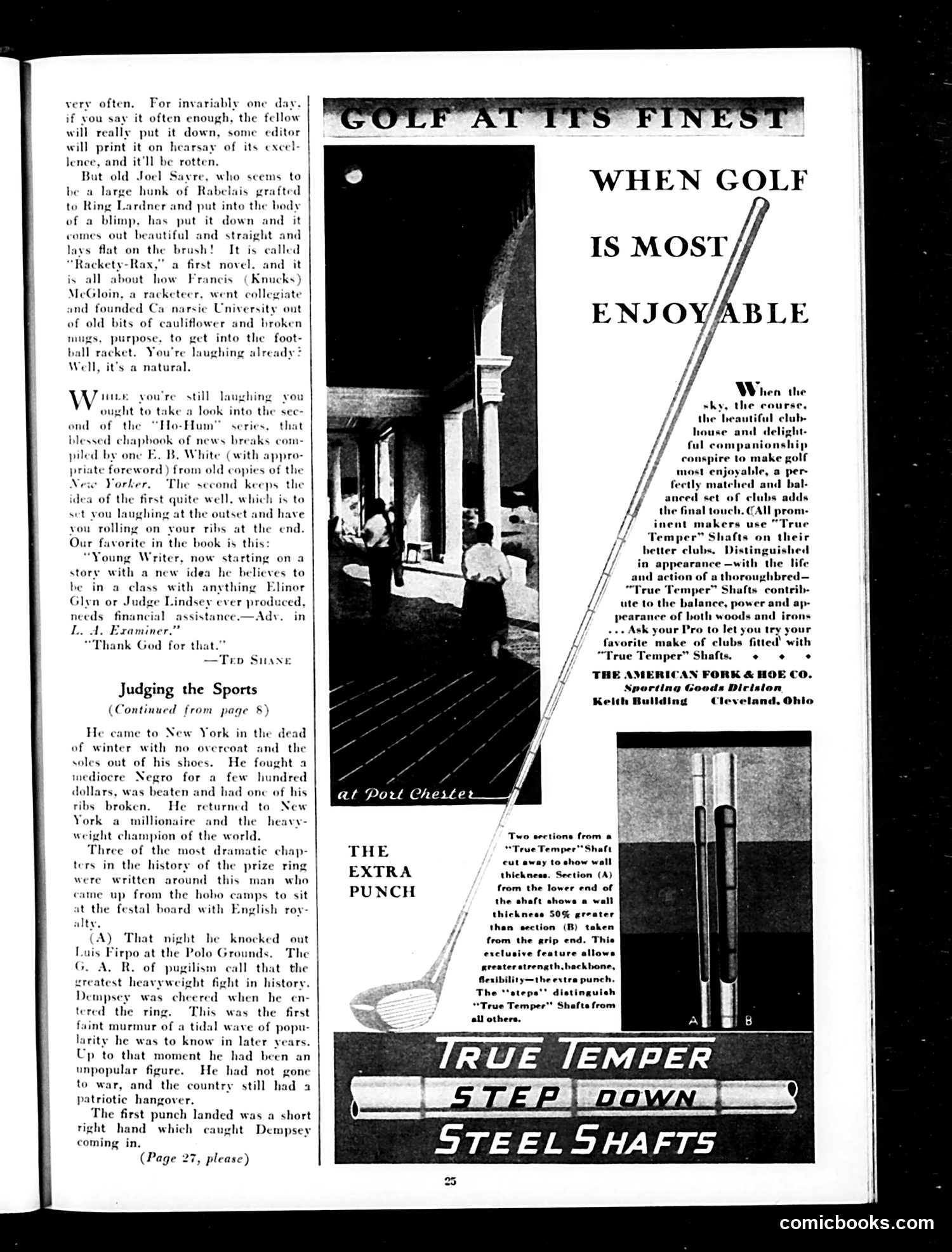
Analysis of Judge Magazine Page This page contains primarily advertising and book reviews rather than political cartoons. The main content discusses E.B. White's "Ho-Hum" humor column from *The New Yorker* and Joel Sayre's novel "Rackety-Rax," about a racketeer-turned-collegiate founder. The excerpt praising White's work represents typical 1920s-30s literary commentary on humorous writing. The bottom section continues an article titled "Judging the Sports," discussing Jack Dempsey's heavyweight boxing career—specifically his dramatic rise from poverty to becoming heavyweight champion, and his famous knockout of Luis Firpo at the Polo Grounds. The reference to Dempsey lacking patriotic credibility (not serving in WWI) reflects post-war American attitudes. The page is dominated by a golf club advertisement for "True Temper" steel shafts, illustrating the magazine's revenue model through sporting goods marketing. This is primarily a commercial page rather than satirical content.
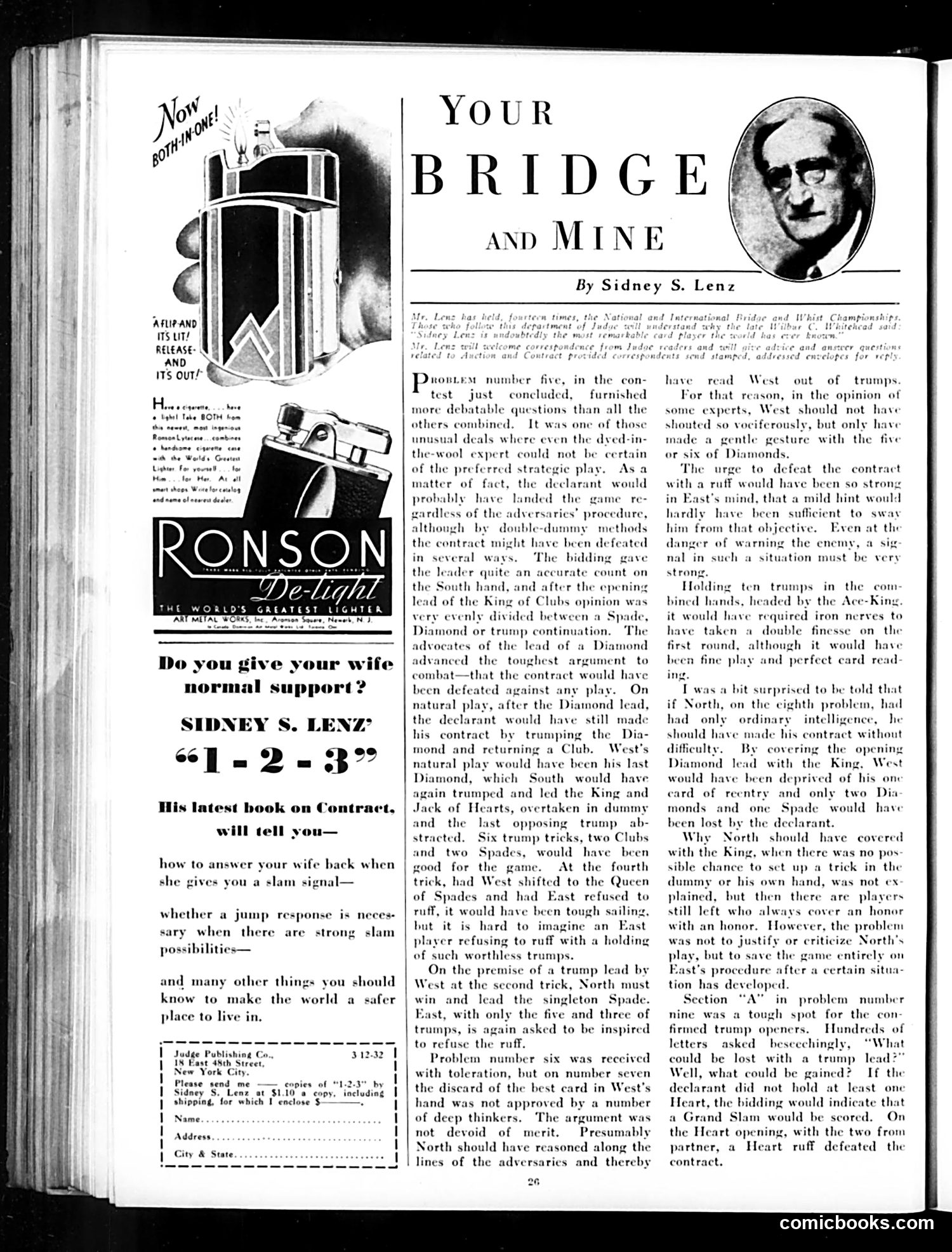
Judge Magazine Bridge Column Analysis This page combines a bridge instruction column ("Your Bridge and Mine" by Sidney S. Lenz) with advertising for Lenz's contract bridge book and a Ronson lighter. The editorial content discusses advanced contract bridge problems and strategy—specifically analyzing whether various defensive plays would have defeated the contract. Lenz critiques players' decisions in complicated hands, such as whether to ruff with weak trumps or signal strength to partners. The tone is instructional yet gently mocking of "deep thinkers" who missed obvious plays. The advertising angle is the book promotion: Lenz positions himself as the authority to answer domestic marital questions through bridge expertise. The copywriter humorously suggests that understanding "slam possibilities" and contract strategy will help husbands answer their wives' complaints ("when she gives you a slam signal"). This is satirical social commentary—using bridge as a metaphor for navigating marriage, implying that strategic thinking solves domestic disputes.
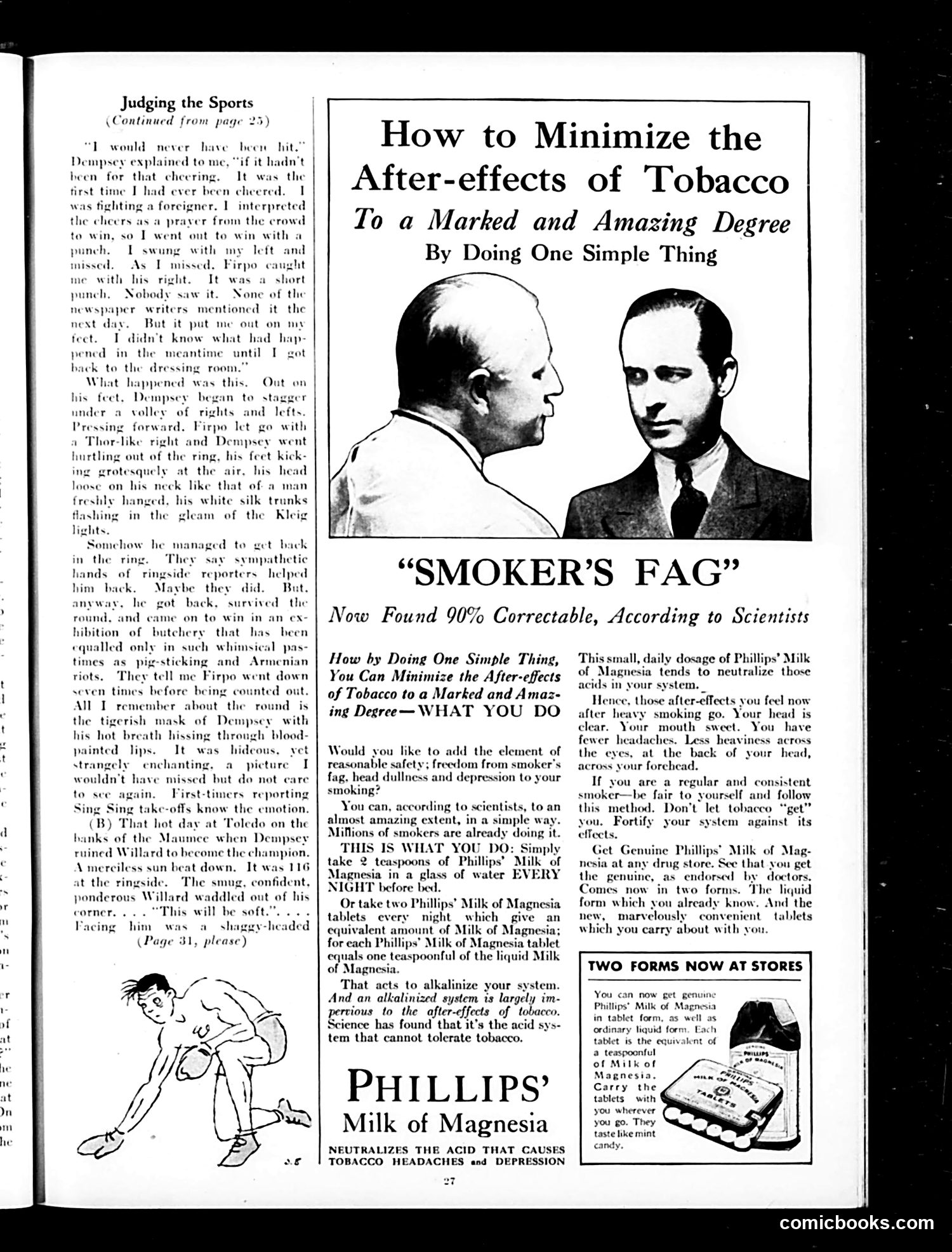
Analysis for Modern Readers This page contains two distinct elements: a sports article about boxing and a tobacco advertisement. The Sports Section discusses fights involving boxer Jack Dempsey, describing violent matches in graphic detail—interpreting crowd cheers as spiritual support and depicting the brutality of professional boxing in the early 20th century. The Advertisement is the more historically striking content. It promotes "Phillips' Milk of Magnesia" as a remedy for "smoker's fag" (nicotine sickness), claiming that alkalizing one's system with this antacid minimizes tobacco's negative effects. The ad explicitly acknowledges smoking causes headaches, depression, and mouth problems, yet frames the solution not as quitting but as chemical mitigation. This reflects a pre-health-warning era when tobacco companies and patent medicines freely advertised without FDA restrictions, and nicotine addiction's dangers were publicly discussed but normalized. The ad's existence in *Judge*—a satirical magazine—is ironic; whether intentional satire or straightforward advertising is unclear from the page alone.
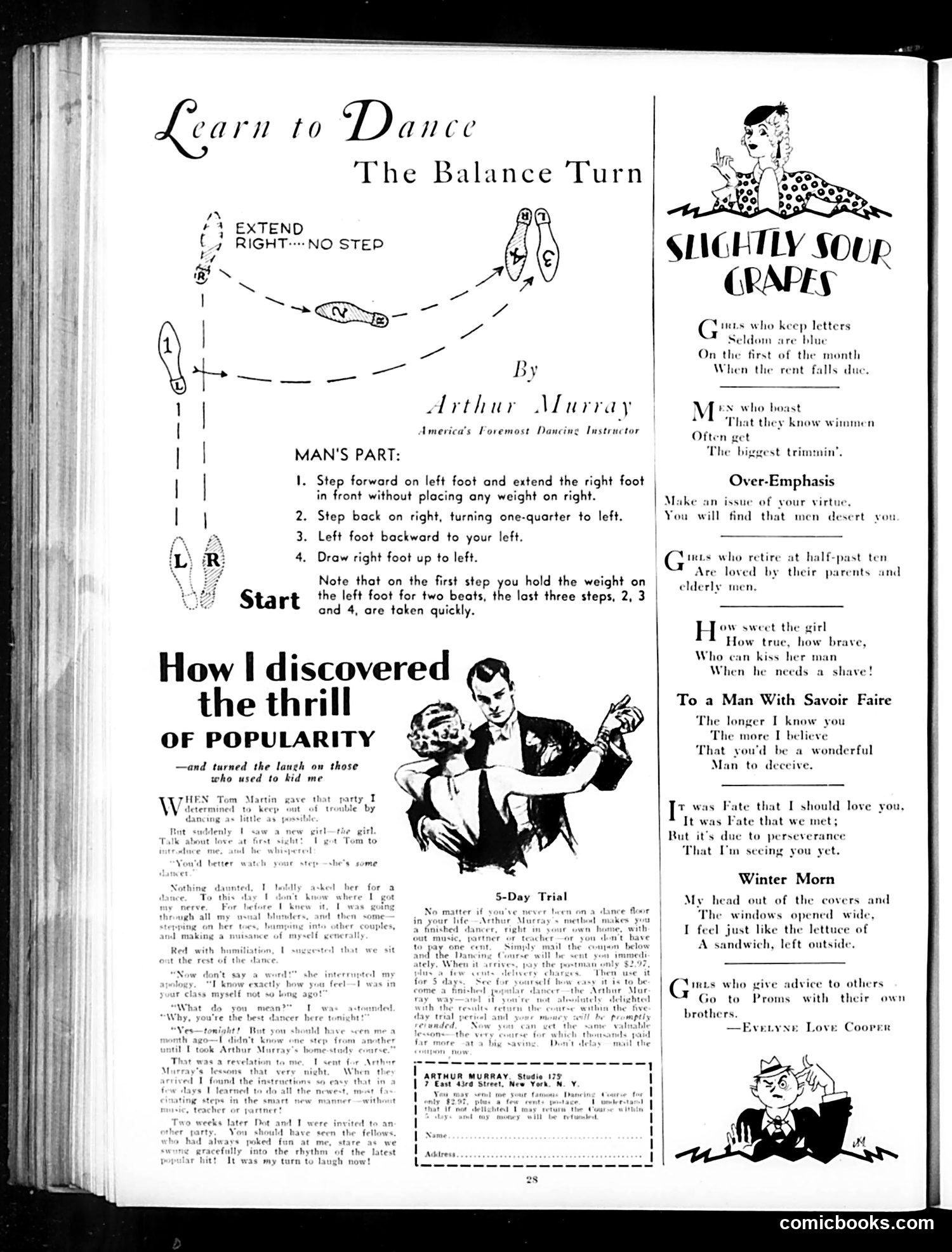
Analysis of Judge Magazine Page This page combines a dance instruction feature with satirical verse and social commentary typical of Judge magazine's format. Main Content: "Learn to Dance: The Balance Turn" teaches the Arthur Murray dance step—Murray was America's famous ballroom dancing instructor of this era. The instructional diagrams show footwork positions. "How I Discovered the Thrill of Popularity" is a testimonial-style advertisement for Murray's dance lessons, claiming that learning to dance transformed the author's social status from ridiculed to celebrated. Satire: The right column contains "Slightly Sour Grapes"—cynical verses mocking social types: girls who don't pay rent, boastful men, over-virtuous women, and those who give unsolicited advice. These represent Judge's characteristic social satire targeting middle-class pretension and hypocrisy. The contrast is deliberate: while Murray's ad promises popularity through dancing, the verses sardonically suggest many social "problems" can't be solved by etiquette or appearance—a gentle jab at self-improvement culture and advertising claims.
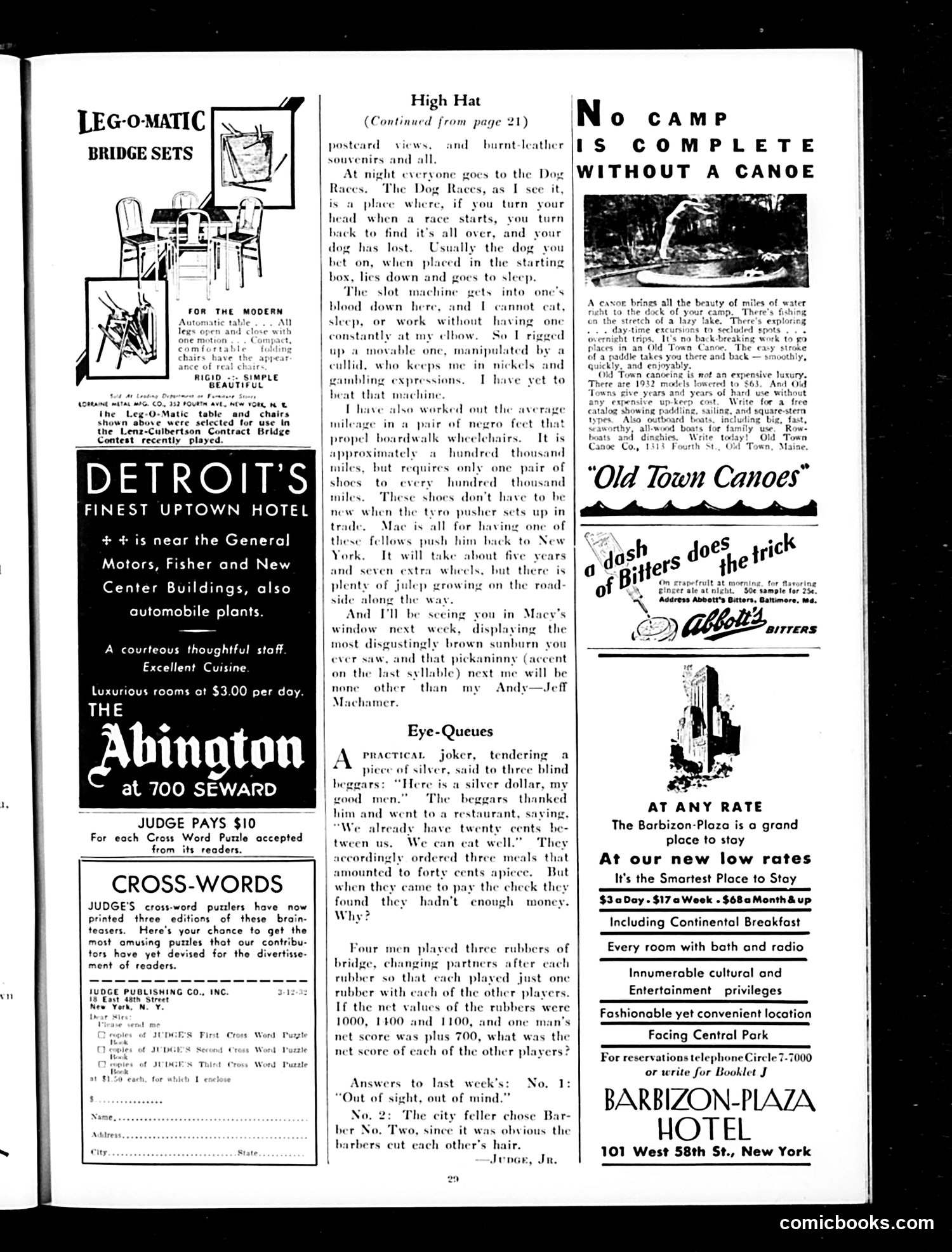
Analysis of Judge Magazine Page Content This page is primarily advertising and filler content with minimal editorial cartoons. The main elements are: Advertisements: The page features hotel ads (The Abington, Detroit's Finest, Barbizon-Plaza), furniture (Leg-O-Matic Bridge Sets), canoes (Old Town), and bitters (Abbott's). "High Hat" Column: A humorous first-person account (likely satirical fiction) about attending dog races and experiencing various absurdities—slot machines, wheelbarrow pushers on Atlantic City boardwalks, and racist stereotypes typical of 1920s-era humor. The narrator describes watching "negro feet" propel wheeled chairs and uses period-offensive language. "Eye-Queues": A puzzle section with two riddles—one about blind beggars unable to pay for meals, another about bridge players and scoring. These are brain-teasers for readers, with Judge paying $10 per accepted puzzle. Cross-Word Puzzles: Judge advertises its third edition of crossword puzzles, offering payment for reader submissions. The page reflects 1920s popular entertainment and advertising rather than political satire.
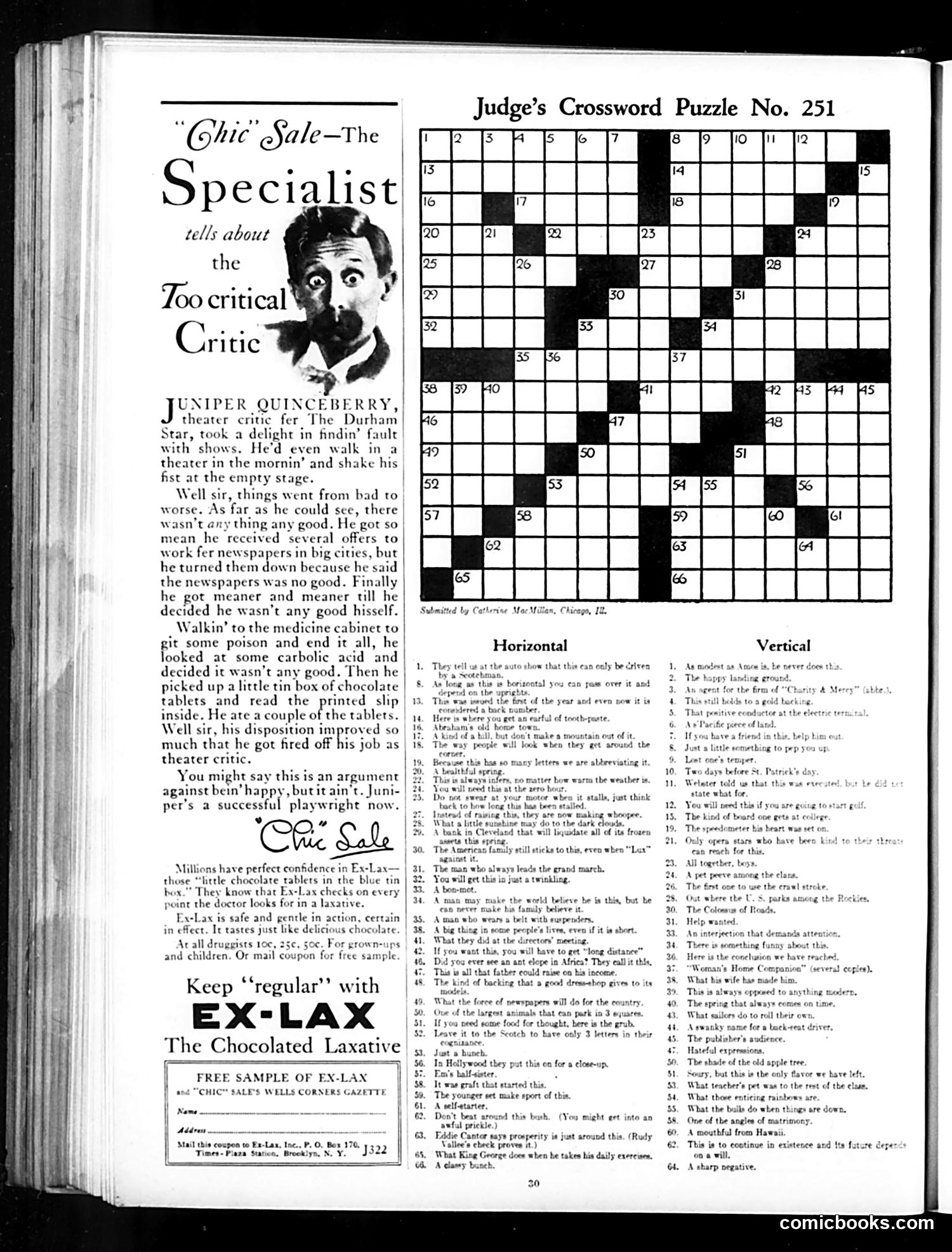
Judge Magazine Page Analysis This page primarily contains advertising for Ex-Lax laxative, framed as a humorous story. The "Chic Sale" narrative: "Chic Sale" was a famous humorist character known for folksy monologues. Here, the story concerns a theater critic for a Durham newspaper who became so perpetually negative and fault-finding that he grew depressed and attempted suicide. He accidentally took Ex-Lax chocolate tablets instead of poison, and the laxative improved his disposition so much he was fired from his job—then became a successful playwright. The satire: The joke satirizes both the theater critic archetype (the chronically negative, fault-finding reviewer) and uses absurdist humor: a laxative "cures" his cynicism. The implication is darkly comic—his disposition improved through forced bowel movement. Historical context: This reflects early 20th-century American magazine advertising that used narrative humor and celebrity endorsement. The crossword puzzle and Ex-Lax ad occupy most of the page, typical of Judge's mixed content format.
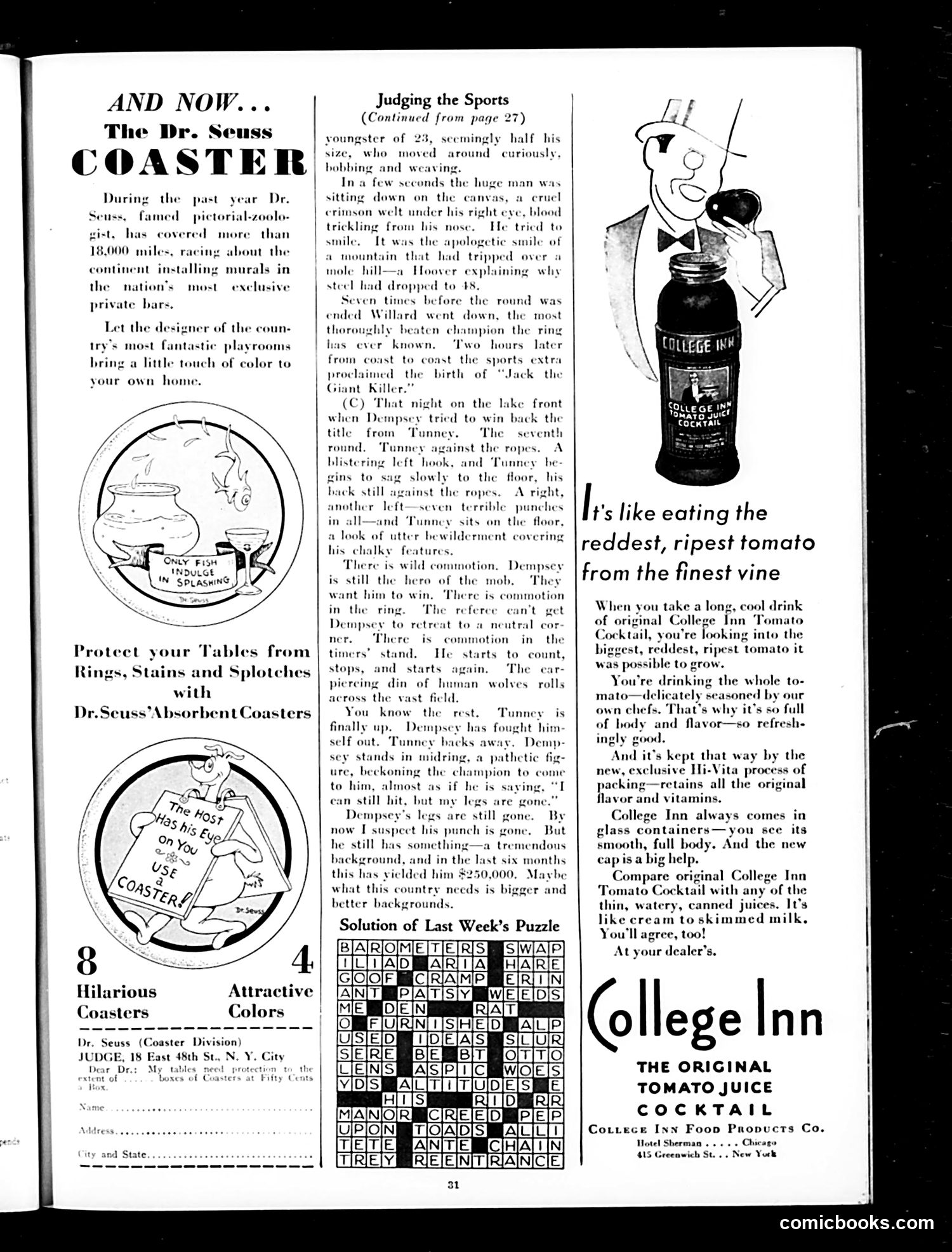
Judge Magazine Page Analysis This page contains Dr. Seuss product advertising alongside sports journalism and a crossword puzzle solution. The Coasters Advertisement: Dr. Seuss designed absorbent coasters featuring his characteristic whimsical creatures—likely appealing to 1930s-40s consumers seeking colorful, humorous home décor. The coasters protect furniture from drink rings and stains. "Judging the Sports" Article: This continues boxing commentary, discussing what appears to be the famous Dempsey-Tunney fights of the 1920s. It describes Jack Dempsey's defeat to challenger Gene Tunney and their contentious rematch, where the "long count" controversy occurred. The article portrays the drama and violence of professional boxing to middle-class readers. College Inn Cocktail Advertisement: This occupies the right column, marketing tomato juice cocktail as a refined, chef-prepared beverage—positioning a canned product as sophisticated compared to "thin, watery, canned juices." The page reflects 1930s consumer culture: humor-based merchandising, sports spectacle, and brand-building through lifestyle advertising.
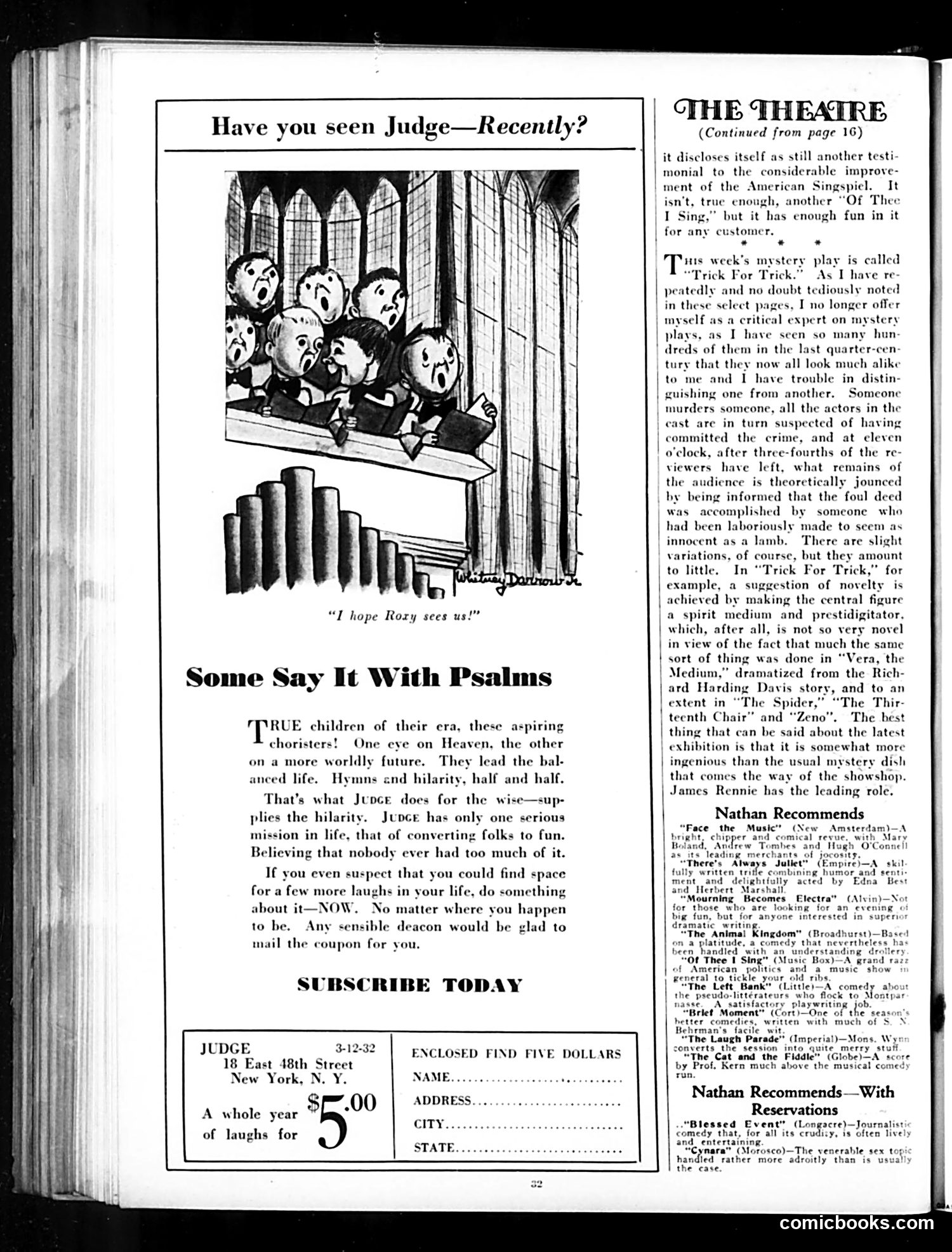
Judge Magazine Page Analysis This page is primarily advertising and theater criticism, not political satire. The cartoon at top shows choirboys in a church window with the caption "I hope Rosy sees us!"—a joke about children performing hymns while distracted by worldly concerns (impressing "Rosy"). It's a lighthearted commentary on youthful hypocrisy, used to sell Judge magazine subscriptions. The bulk of the page contains theater reviews by Nathan (likely theater critic George Jean Nathan), discussing 1932 Broadway shows including "Trick For Trick" (a mystery play), "Of Thee I Sing," and "The Animal Kingdom." Nathan critiques the formulaic nature of contemporary mystery plays while acknowledging some shows' merits. The subscription offer sells "a whole year of laughs" for $5.00—positioning Judge as humor-focused entertainment rather than serious journalism. This represents Judge's evolution from 19th-century political satire toward general-interest magazine content by the 1930s.
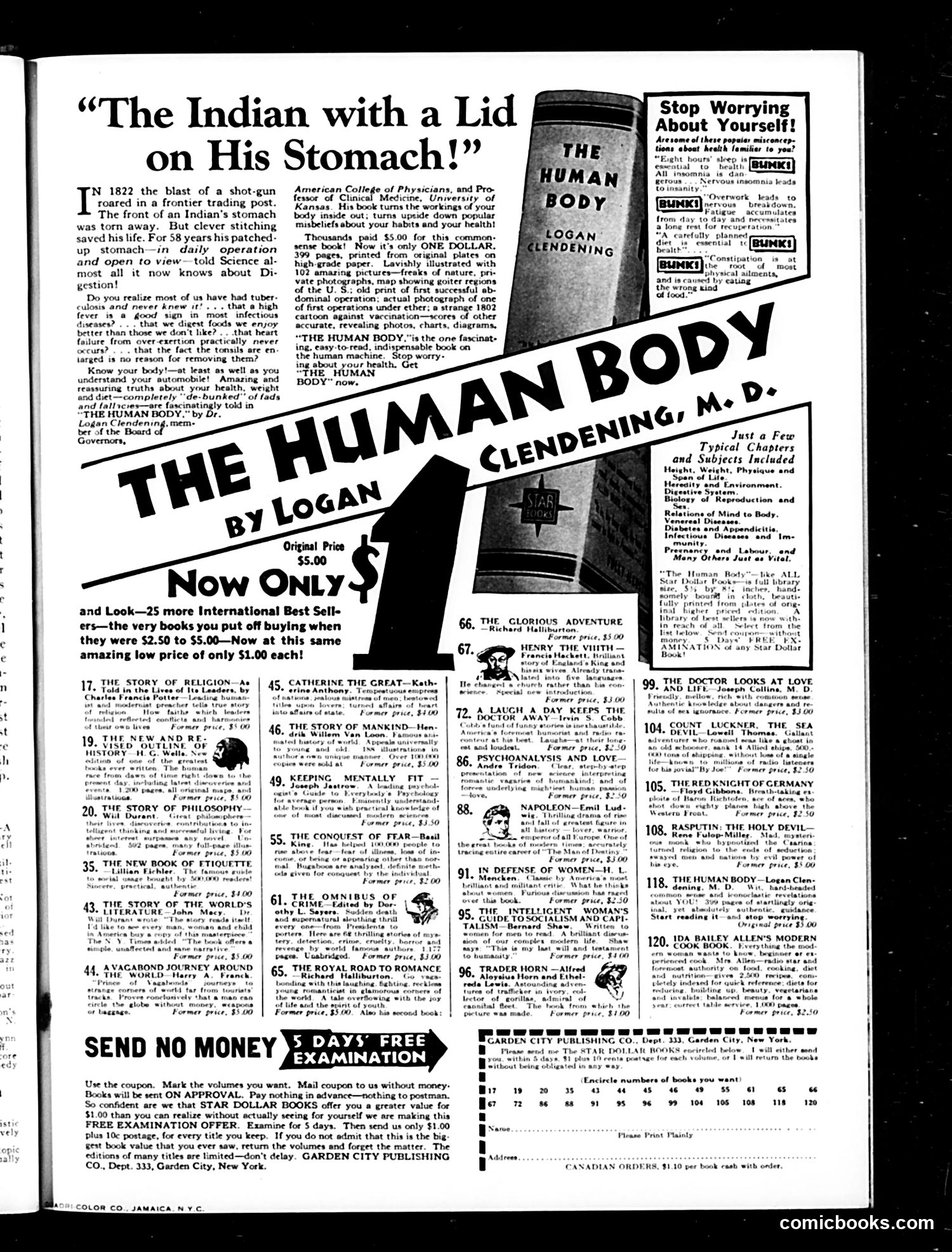
"The Indian with a Lid on His Stomach!" This page is primarily a book advertisement, not political satire. The headline references a famous 1822 medical case: Alexis St. Martin, a Native American whose gunshot wound left a permanent opening into his stomach, allowing Dr. William Beaumont to observe digestion directly for decades. The ad uses this dramatic historical example to promote "The Human Body" by Logan Clendening, a popular health education book. The "Indian with a Lid" serves as a sensational hook—a real medical curiosity that demonstrates scientific knowledge about bodily function. The tagline promises to dispel health "fallacies" about tuberculosis, fever, digestion, and other conditions. The page also advertises 25 discounted books (originally $2.50-$5.00) now selling for $1.00 each, including works on history, philosophy, and adventure—a typical mail-order book club promotion of the era.
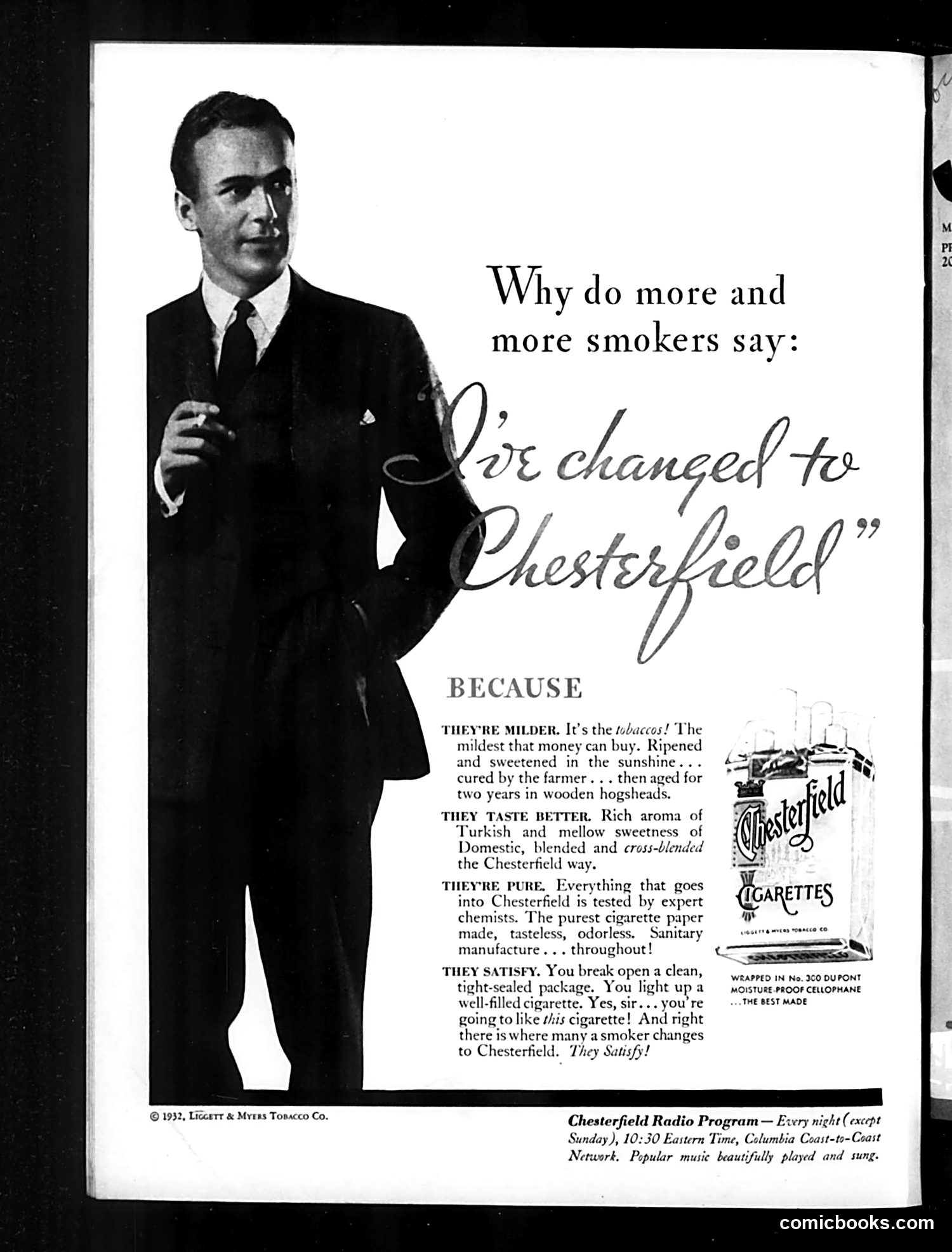
Historical Context Analysis This is not a cartoon or satire — it's a straightforward cigarette advertisement from 1932 by Liggett & Myers Tobacco Co., appearing in Judge magazine. The page features a well-dressed man in business attire endorsing Chesterfield cigarettes. The ad employs then-standard marketing claims: tobacco "ripened in sunshine," aged in wooden casks, blended with Turkish and domestic varieties, and tested for purity. It emphasizes the cigarette's "satisfaction" and cleanliness. For modern readers: This represents pre-regulation tobacco advertising, when health dangers were unknown/undisclosed to the public and cigarettes were marketed as desirable consumer products in mainstream publications. The "they satisfy" slogan and health-related promises (purity, cleanliness) would later become controversial as scientific evidence emerged about smoking's dangers. The ad also promotes a Chesterfield radio program, showing how deeply embedded tobacco was in mid-century American entertainment and commerce.