judge
Judge — March 19, 1932
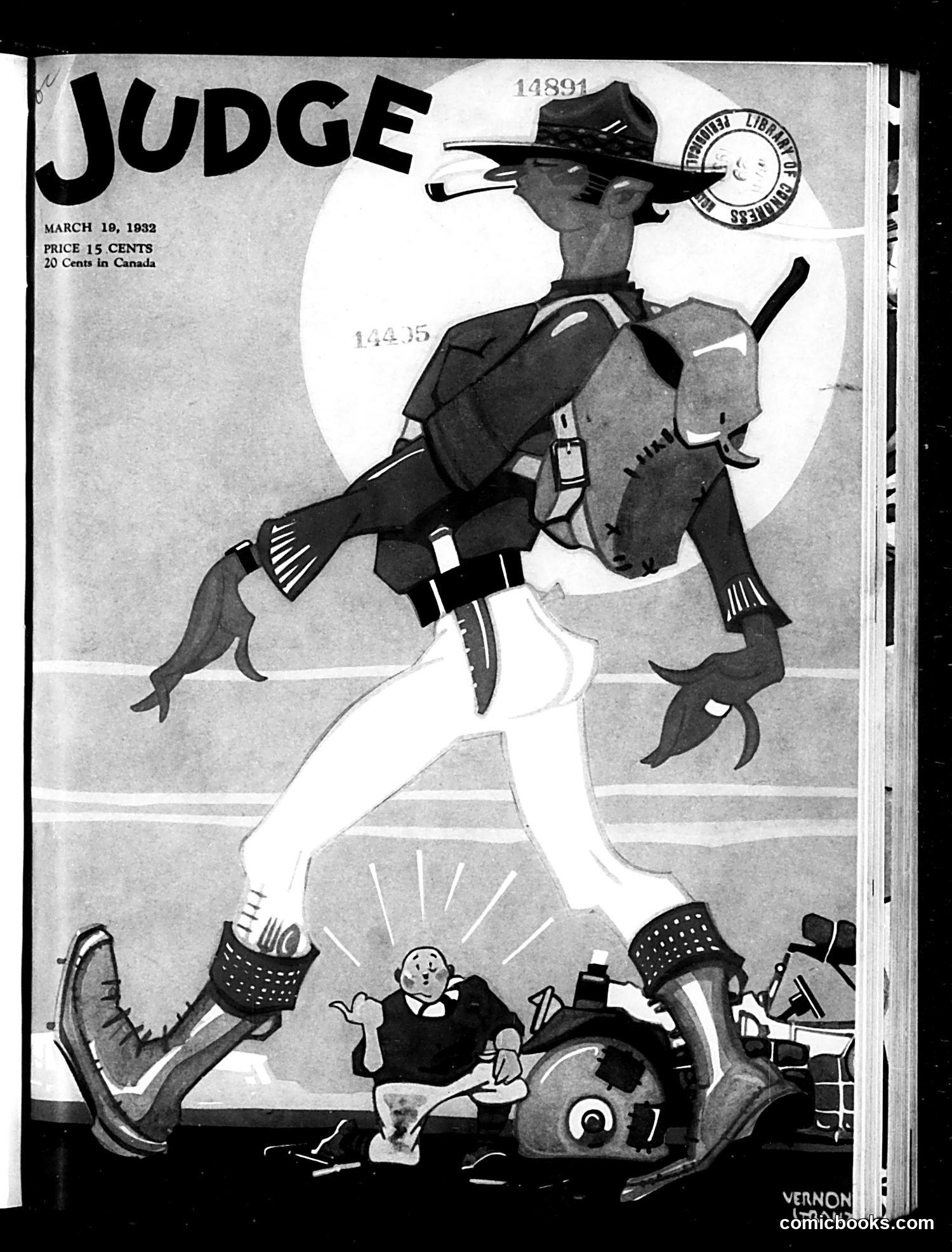
Judge Magazine Cover - March 10, 1932 This satirical cover depicts a caricatured cowboy or military figure leaping over small figures below, likely representing common citizens or politicians. The exaggerated proportions and dynamic pose suggest someone acting recklessly or overstepping their authority. Given the March 1932 date—during the Great Depression and Hooverville crisis—this appears to mock either President Hoover's inadequate response to economic catastrophe, or a political figure dismissing public suffering. The tiny figures being trampled or evaded represent ordinary Americans struggling with poverty and unemployment. The "Judge" publication was known for sharp political satire targeting government leaders. The cartoonist (signed "Vernon") uses the cowboy archetype to suggest wild, uncontrolled action disconnected from the real hardships below.
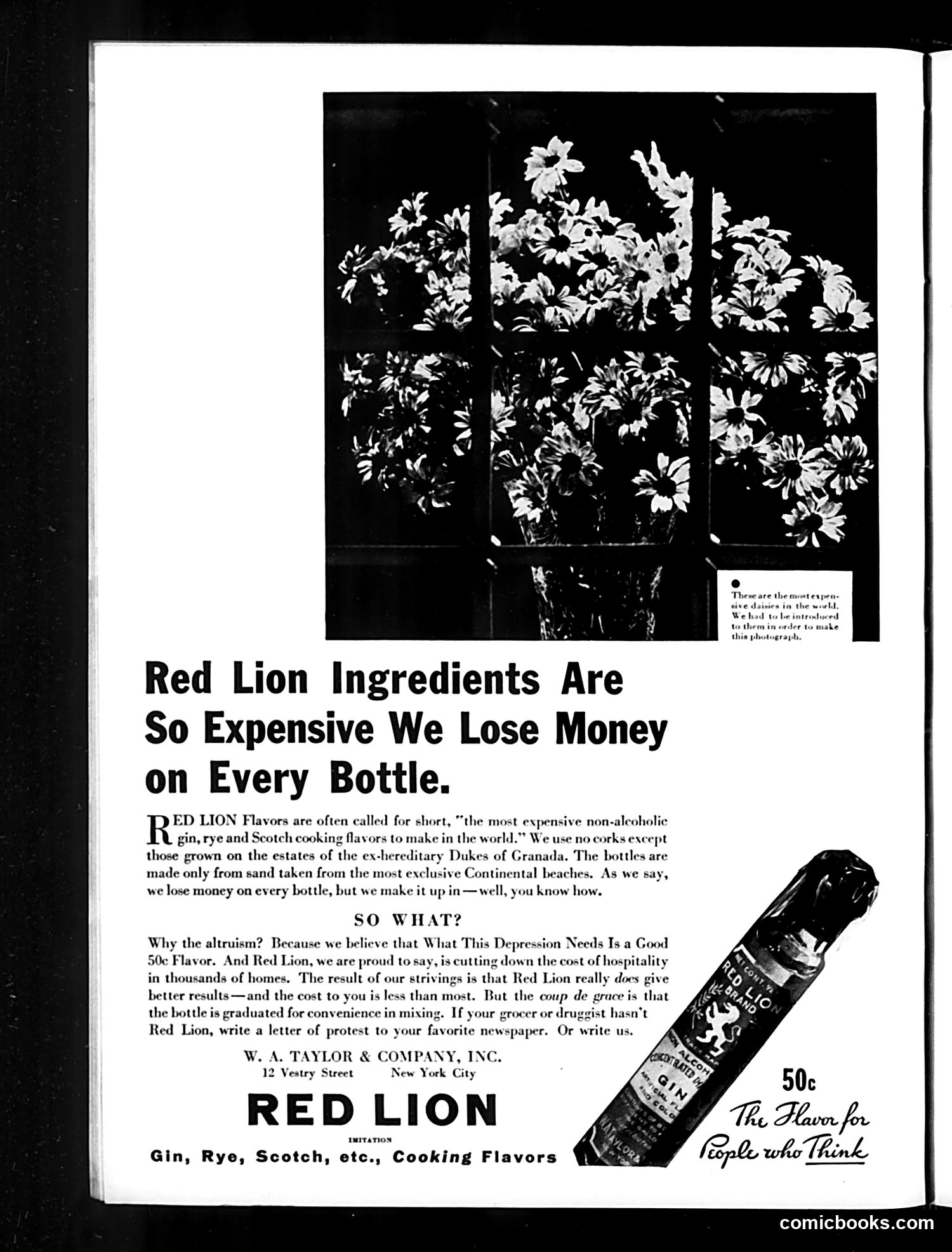
Red Lion Advertisement with Depression-Era Commentary This is primarily a product advertisement for Red Lion cooking flavors (gin, rye, Scotch imitation extracts), priced at 50¢. However, it includes social commentary disguised as marketing copy. The "SO WHAT?" section addresses the Great Depression directly. Red Lion claims their expensive ingredients justify the high cost, but they're "cutting down the cost of hospitality in thousands of homes" during "This Depression." The pitch frames buying cheap imitation flavoring as patriotic sacrifice—helping people maintain social entertaining despite economic hardship. The photograph of expensive dahlias in a window reinforces this: beauty and elegance remain accessible through affordable substitutes. The ad targets Depression-era consumers who want to appear prosperous while actually economizing.
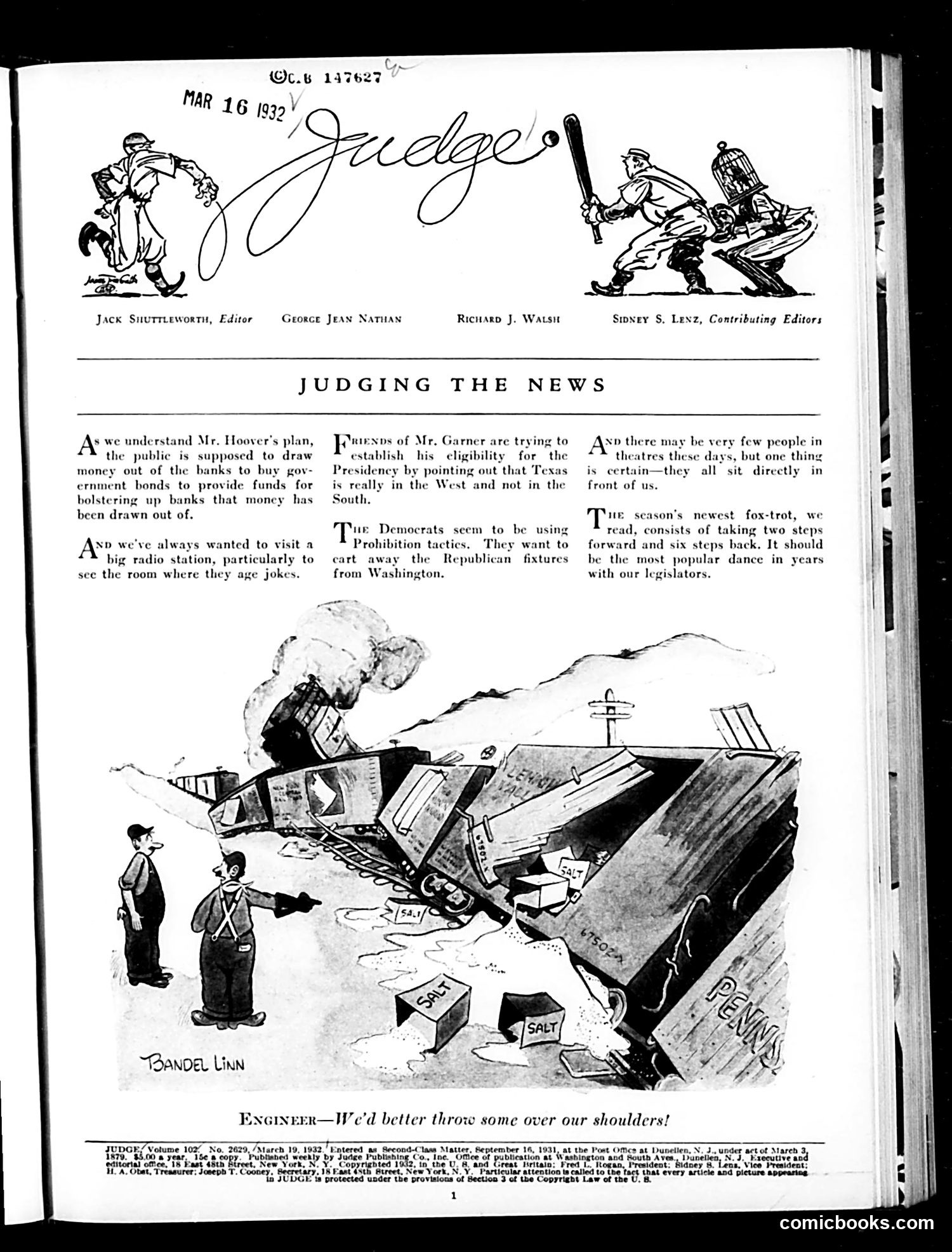
"Judge" Magazine - March 16, 1932 This page satirizes early Depression-era politics and social concerns through four brief editorial commentaries and a cartoon by Bandel Linn. The main cartoon depicts an overturned cargo ship spilling salt, with two figures observing the disaster. The caption reads: "Engineer—We'd better throw some over our shoulders!" This is a dark joke referencing the superstition that spilling salt brings bad luck, which can be reversed by throwing salt over one's shoulder. In 1932 Depression context, it mocks the helplessness Americans felt facing economic catastrophe—suggesting even ritualistic gestures couldn't fix such massive problems. The editorial snippets criticize Hoover's banking policies, Republican political tactics, and current dance trends, representing typical satirical commentary from this period.
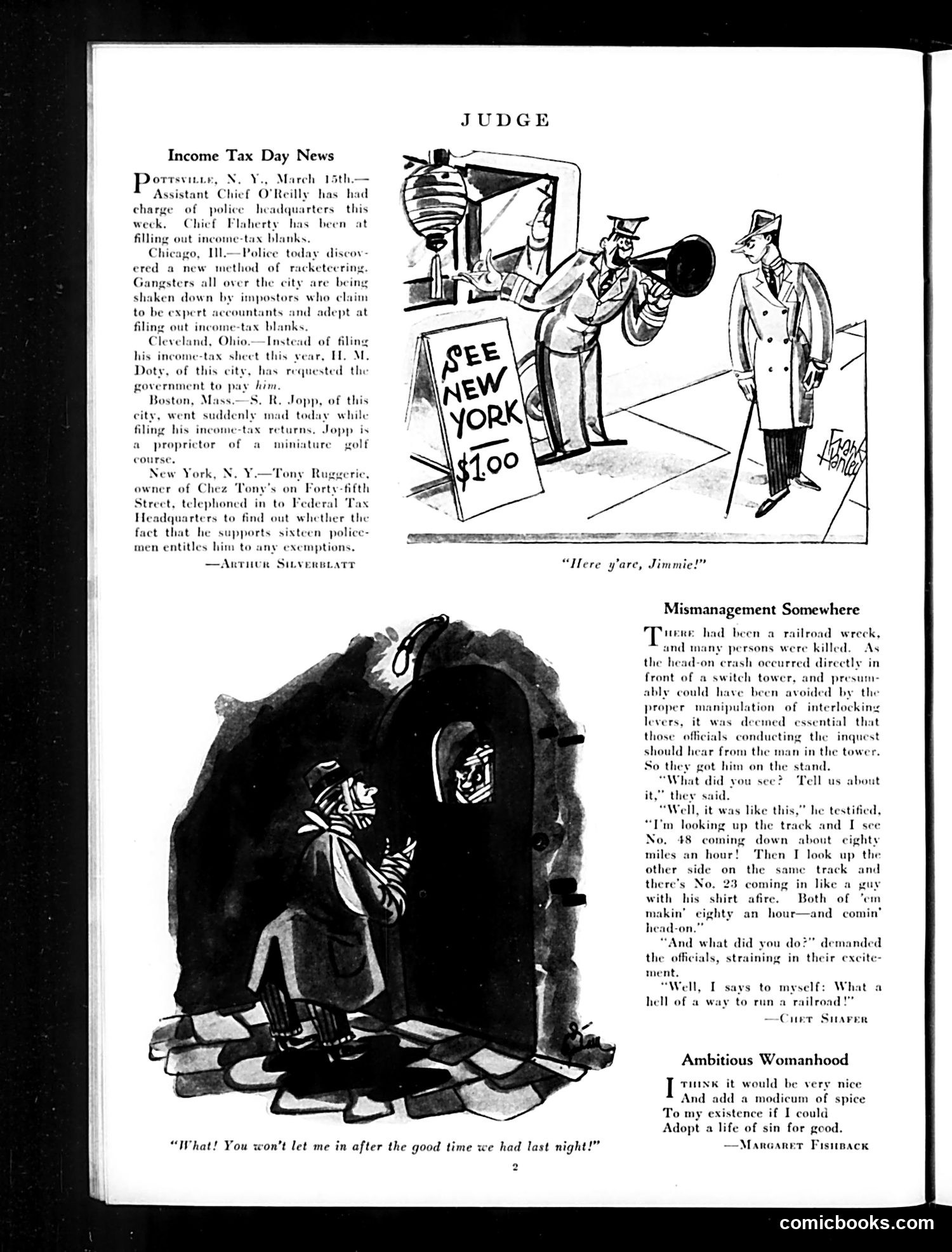
Judge Magazine Page Analysis Top Cartoon - "Here gare, Jimmie!" This satirizes Income Tax Day (March 15th). A con artist runs a "See New York $1.00" tourist scam while a policeman approaches. The joke: during tax season, when citizens are being squeezed by the government for income taxes, petty criminals exploit the same victims with tourist schemes. It's social commentary on vulnerability and predatory behavior coinciding with tax obligations. Bottom Cartoon - "Mismanagement Somewhere" This illustrates a railroad wreck caused by operator error. The accompanying article explains that a man in a tower failed to properly manipulate interlocking levers, causing two trains to collide head-on. The satire criticizes bureaucratic negligence and institutional mismanagement—suggesting preventable disasters result from incompetent officials rather than unavoidable accidents.
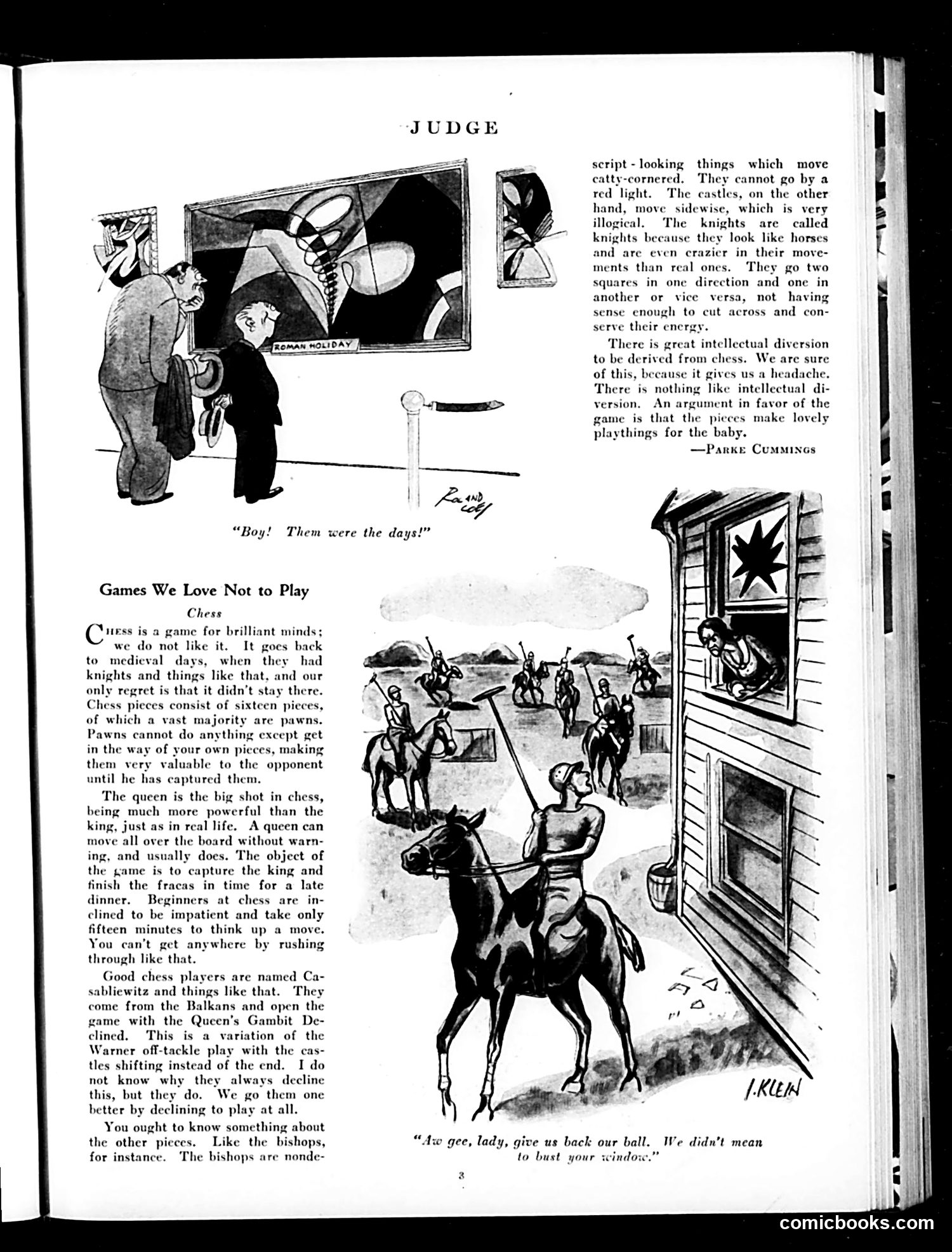
Analysis This page from *Judge* magazine contains two distinct pieces: Top cartoon: Shows two men viewing what appears to be a film or screen labeled "ROMAN HOLIDAY." The caption "Boy! Them were the days!" suggests nostalgic commentary on Roman civilization, likely satirizing contemporary fascination with ancient Rome during a period when such imagery held cultural appeal. Main article: "Games We Love Not to Play" critiques chess as overly intellectual and tedious. The author argues chess lacks the appeal of more dynamic games—its complexity and slow pace make it unsuitable for casual play. The article dismisses chess variants like "Casabliewitz" from the Balkans as equally unappealing. Bottom illustration: Shows mounted soldiers attacking a building, accompanying the article's discussion of game variations with a humorous caption about a lost ball. The page's overall theme mocks intellectual pursuits and cultural pretension.
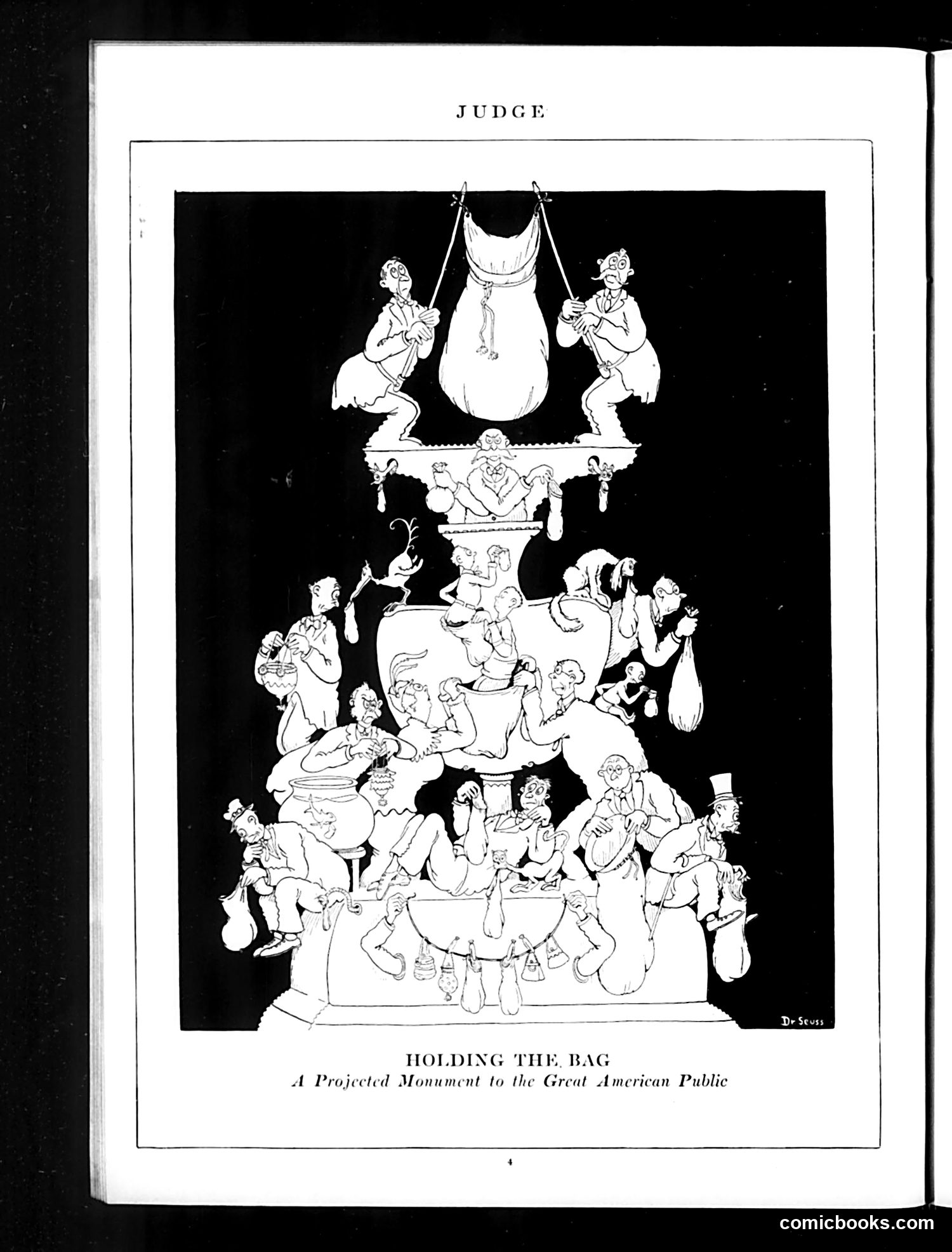
Analysis This Dr. Seuss cartoon satirizes American judicial corruption. The image depicts a massive, tiered monument made of figures—judges, lawyers, and politicians—stacked precariously atop one another. Two cherubs at the top struggle to hold an enormous bag, suggesting the weight of accumulated bribes or ill-gotten gains. The subtitle "Holding the Bag" is a period idiom meaning taking blame for others' crimes. The cartoon critiques the interconnected corruption between the judiciary and political establishment, portraying the legal system as an unstable pyramid scheme where lower-level figures literally support the corrupt weight above them. This reflects early 20th-century Progressive-era concerns about institutional corruption, suggesting the entire judicial system rests on questionable foundations—a visual metaphor for systemic graft.
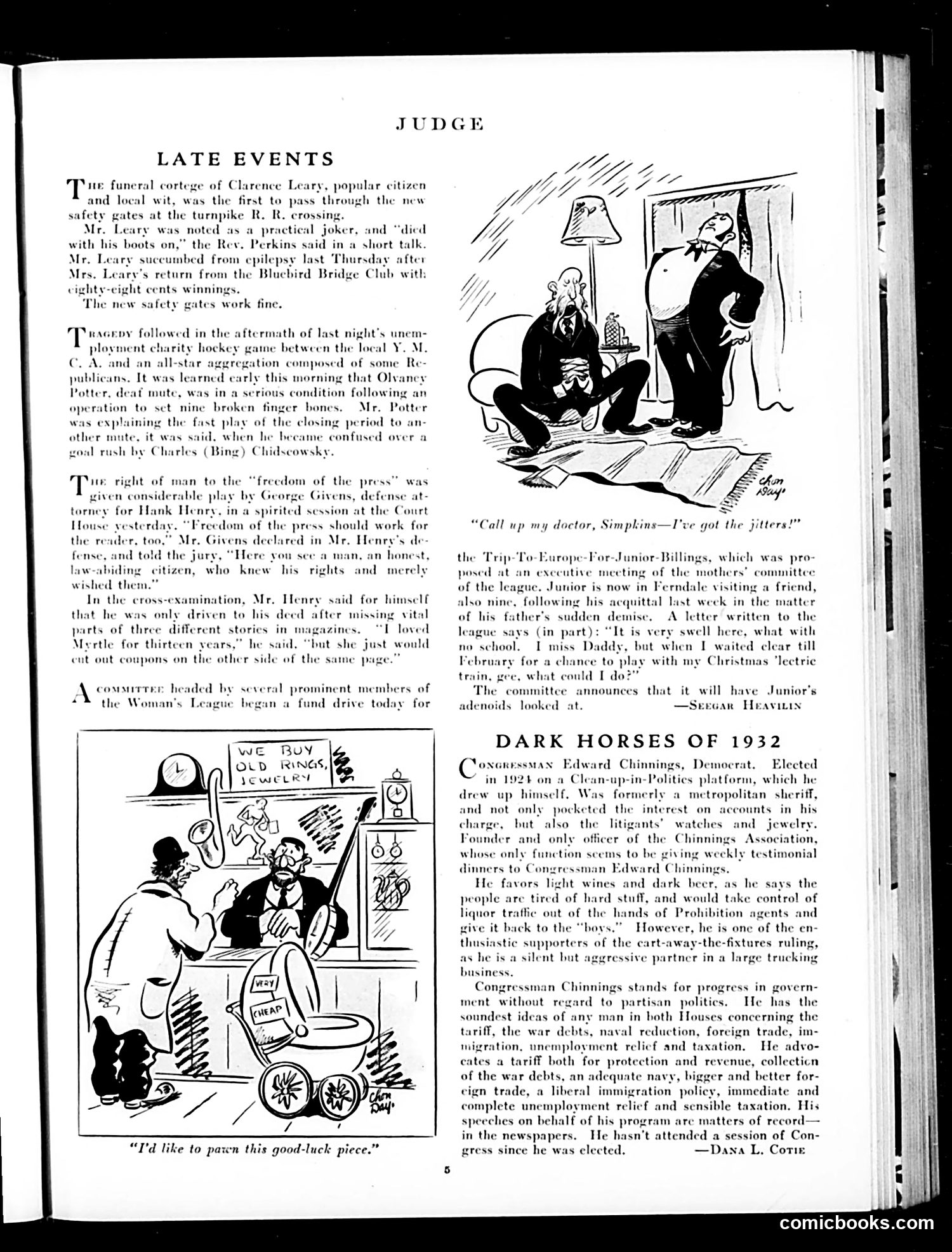
Political Cartoon Analysis: Judge Magazine Page Top Cartoon ("Call up my doctor, Simpkins"): A man experiencing illness (likely "the jitters") calls for a doctor. This appears to satirize anxiety or nervousness, possibly related to economic or social conditions of the early 1930s era. Bottom Cartoon ("I'd like to pawn this good-luck piece"): Shows a pawn shop scene where customers attempt to sell items, including what appears to be jewelry or valuables. The sign reads "WE BUY OLD RINGS, JEWELRY." This satirizes Depression-era financial desperation, when people pawned possessions for survival. Context: Both cartoons reflect the 1932 economic crisis, mocking how widespread financial hardship drove citizens to desperate measures—both psychological strain and literal asset liquidation.
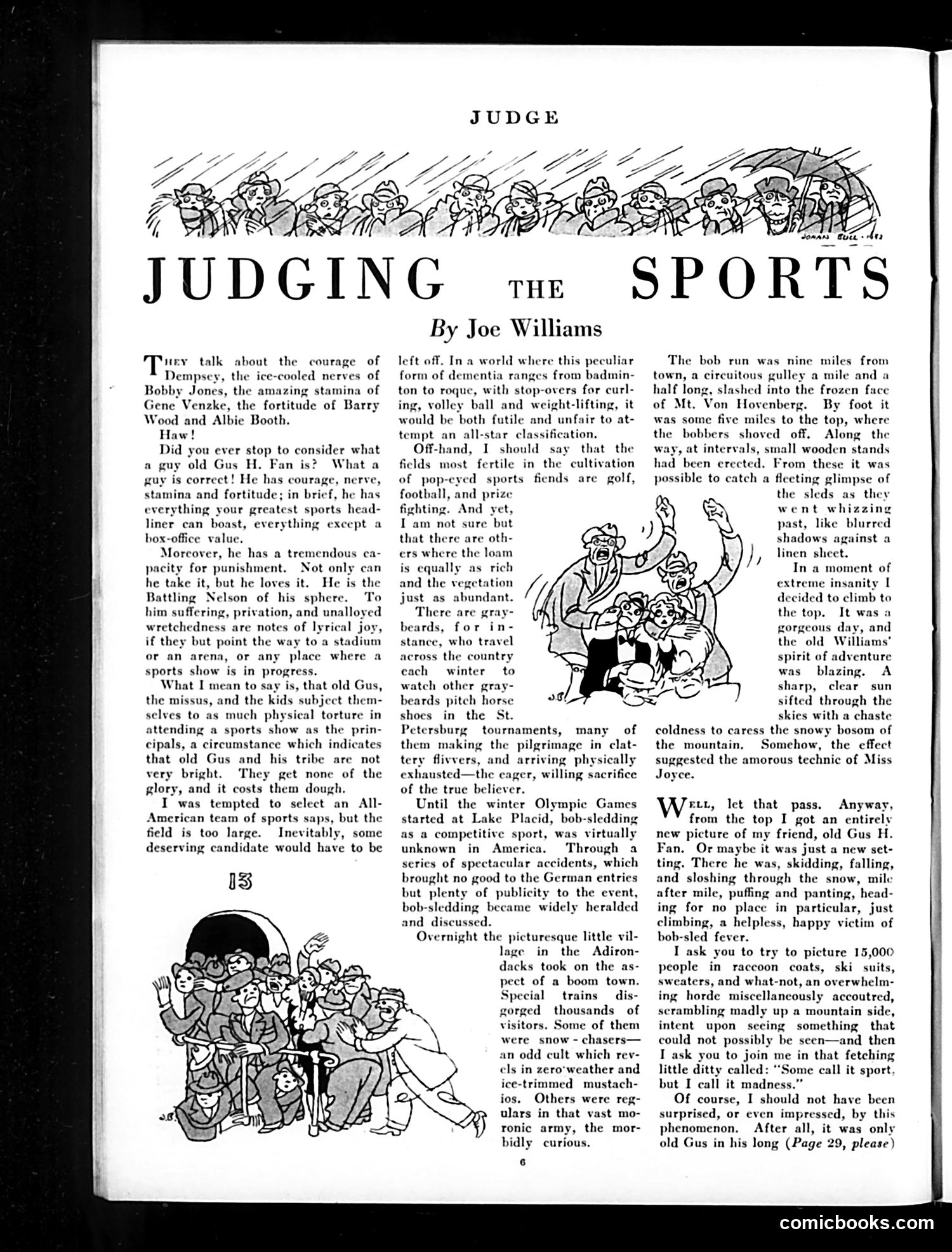
"Judging the Sports" by Joe Williams This satirical essay mocks the excessive enthusiasm and questionable judgment of sports fans and journalists. The article critiques figures like Dempsey (likely boxer Jack Dempsey), Bobby Jones (golf), and various sports personalities, questioning whether they truly deserve their exalted status. The cartoons illustrate spectators at winter sports events—sledding and bobsledding—showing crowds of bundled-up enthusiasts in snowy conditions. Williams sarcastically suggests these activities barely qualify as "sport" despite their popularity. He contrasts the reverence sports journalism grants to athletic figures against the sometimes mundane reality of what people actually watch, lampooning both the sports establishment's grandiose claims and fans' uncritical adulation.
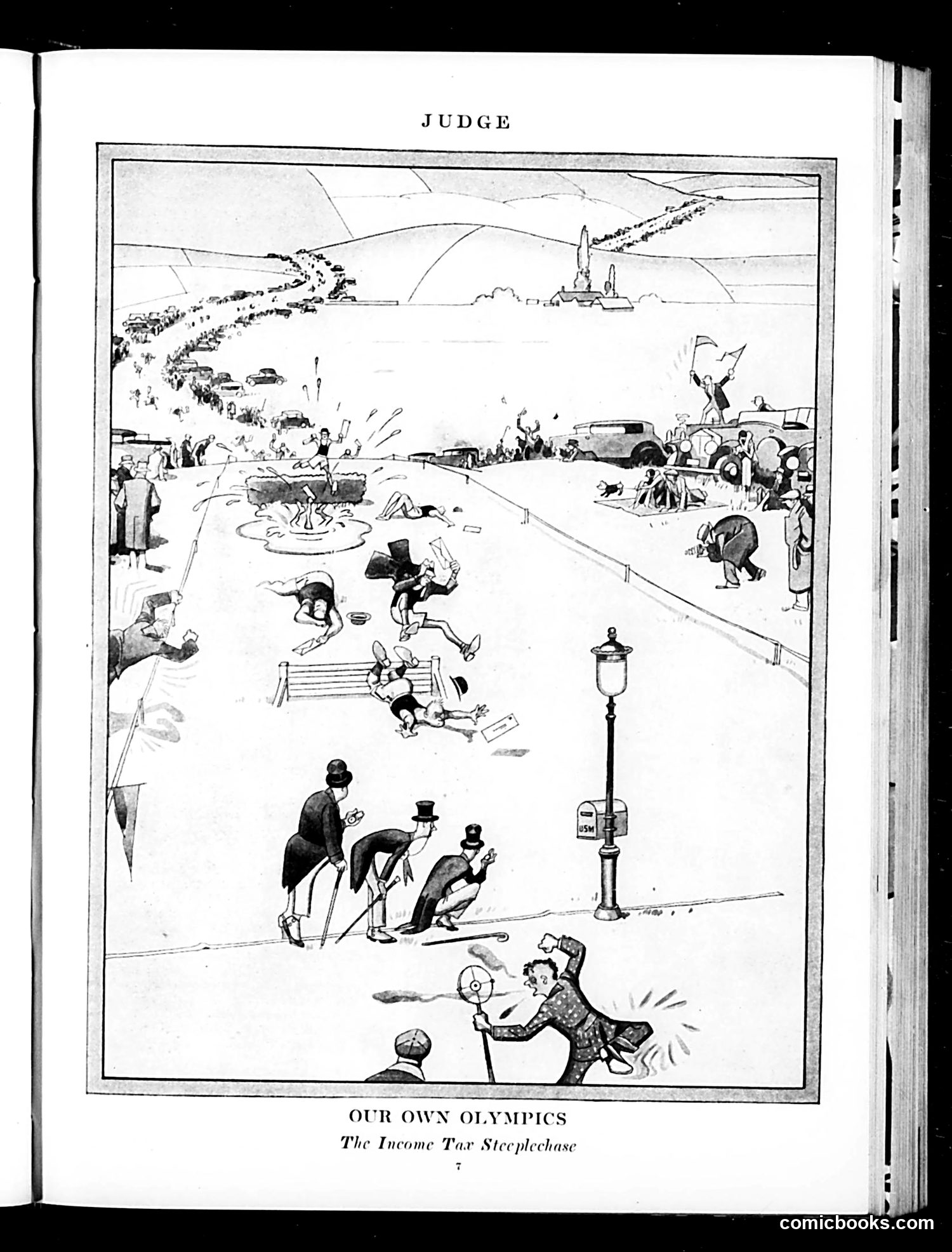
This satirical cartoon from *Judge* magazine depicts "The Income Tax Steeplechase"—a competitive race metaphor for dealing with income taxes. Various figures navigate obstacles and challenges across a landscape, suggesting taxpayers struggling through a complex, difficult process. The steeplechase format (an equestrian race with jumps) humorously parallels navigating tax requirements. The cartoon satirizes the burden and confusion of income tax compliance, treating it as an exhausting obstacle course rather than a straightforward civic duty. The "Our Own Olympics" title frames taxation as an absurd competitive event. The numerous participants and scattered activity suggest widespread public frustration with tax complexity during what appears to be the early-to-mid 20th century, when income tax systems were still relatively new and frequently modified in America.
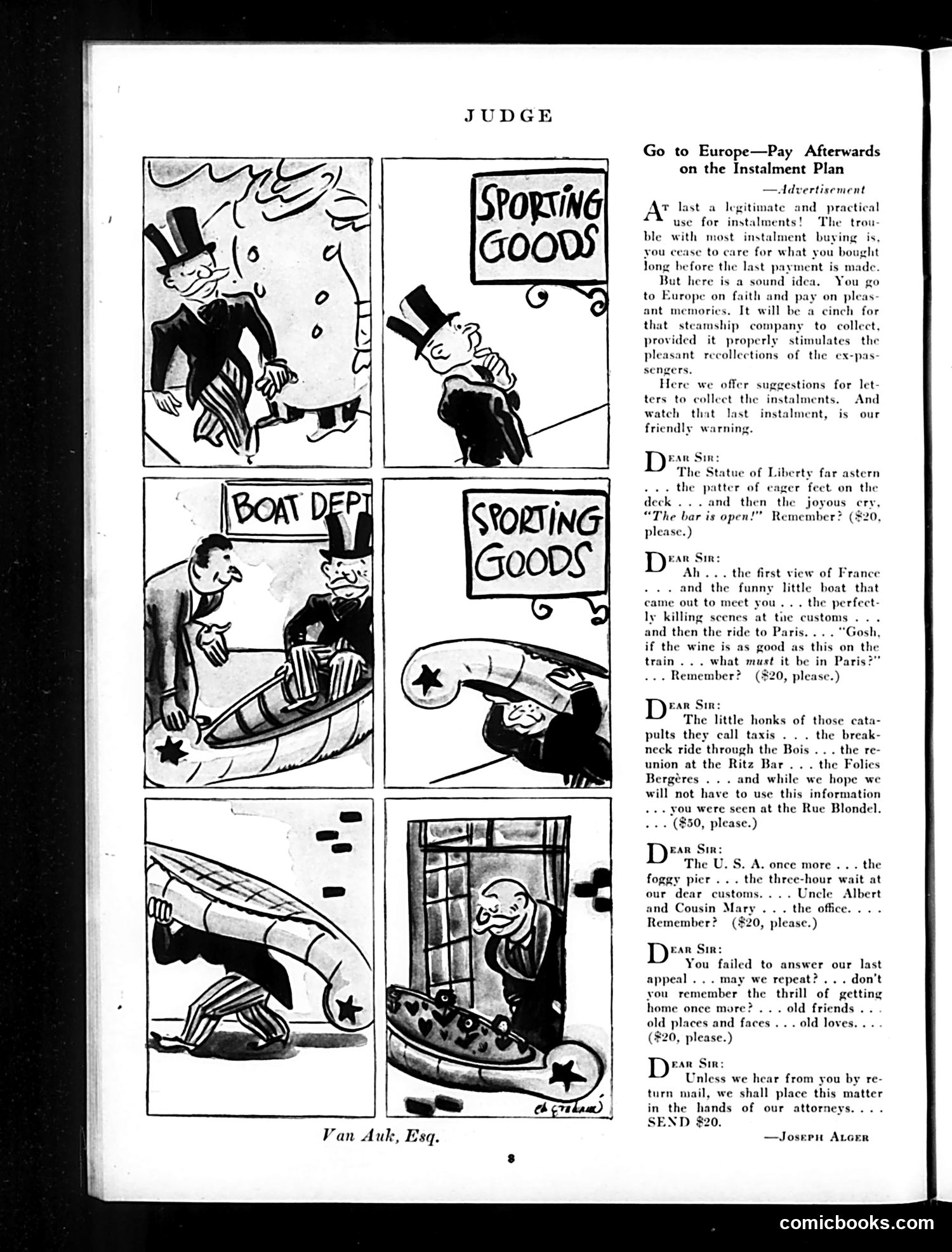
"Go to Europe—Pay Afterwards on the Instalment Plan" This is a satirical advertisement by Joseph Alger proposing that steamship companies let passengers travel to Europe on credit, paying installments afterward based on fond memories of the trip. The comic strip shows a collection agent pursuing a passenger named Van Auk through increasingly aggressive "Dear Sir" letters, each referencing specific travel experiences (the Statue of Liberty, French customs, Parisian bars, taxis, homecoming) meant to emotionally manipulate payment. The final letter threatens legal action. The satire targets two things: the then-popular installment buying system (buying goods on credit) and the assumed reliability of nostalgia as a payment incentive. The joke is that steamship companies would cynically exploit travelers' pleasant memories to extract payment—and that collectors would resort to emotional appeals and threats if sentiment failed.
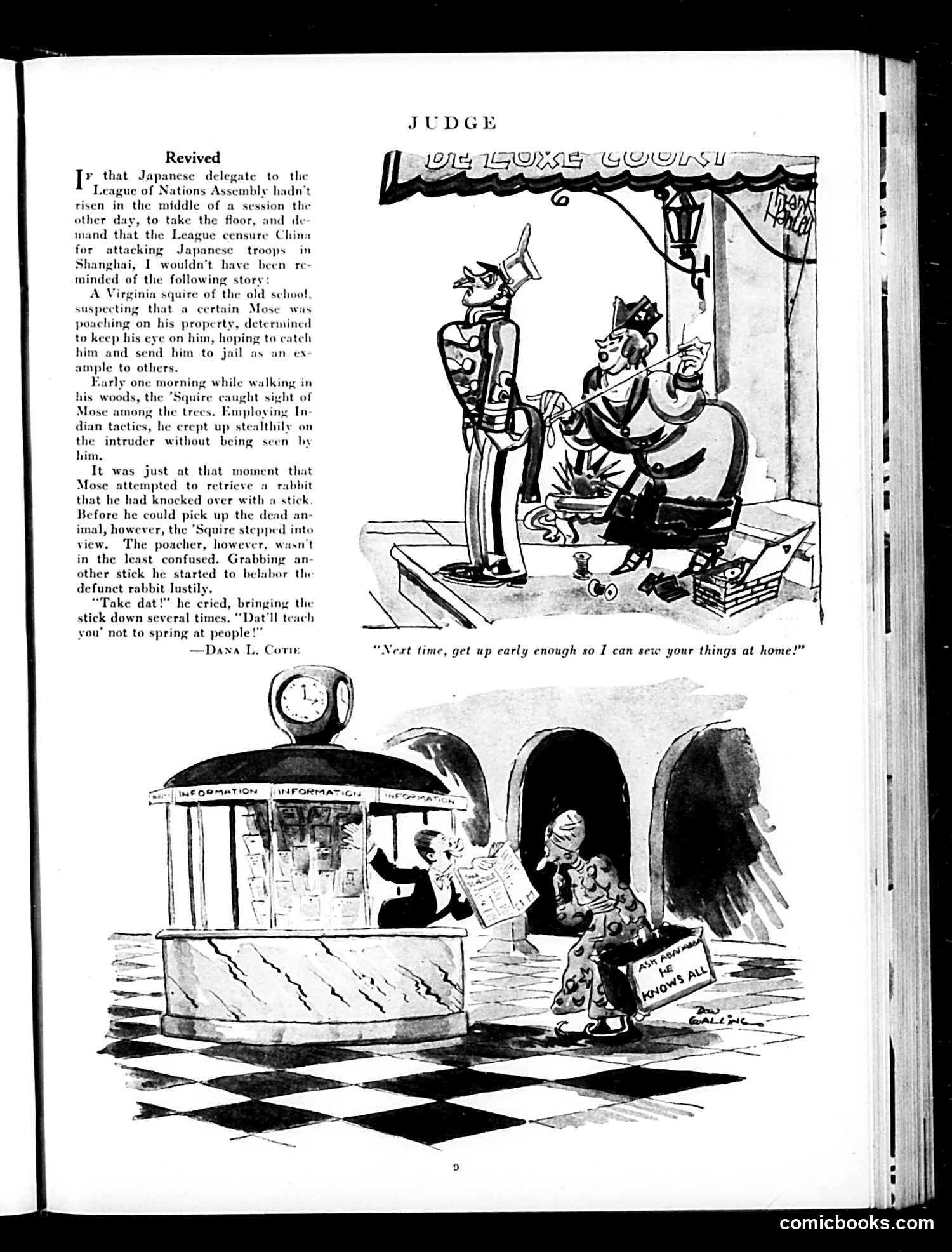
Analysis: "Revived" from Judge Magazine The Political Context: This page satirizes a Japanese delegate's complaint to the League of Nations about Chinese attacks on Japanese troops in Shanghai. Judge uses this to mock the hypocrisy of the aggressor claiming victimhood. The Two Cartoons: Top cartoon: Illustrates Dana L. Cotte's accompanying story—a Virginia squire catches an enslaved man named Mose poaching. When confronted, Mose frantically beats a dead rabbit, claiming it attacked him unprovoked. The parallel is clear: Japan is "Mose," falsely claiming self-defense against provocation. Bottom cartoon: Shows a kiosk labeled "Information" with a woman holding a sign reading "Americans Follow All." She addresses someone seeking information, saying they should come home earlier so she can mend their clothes—a domestic non-sequitur that suggests the absurdity of the League's response to obvious aggression. The Satire's Point: Japan's demand for League censure of China mirrors Mose's absurd claim of victimhood. Judge ridicules the League for even entertaining such transparent bad-faith complaints.
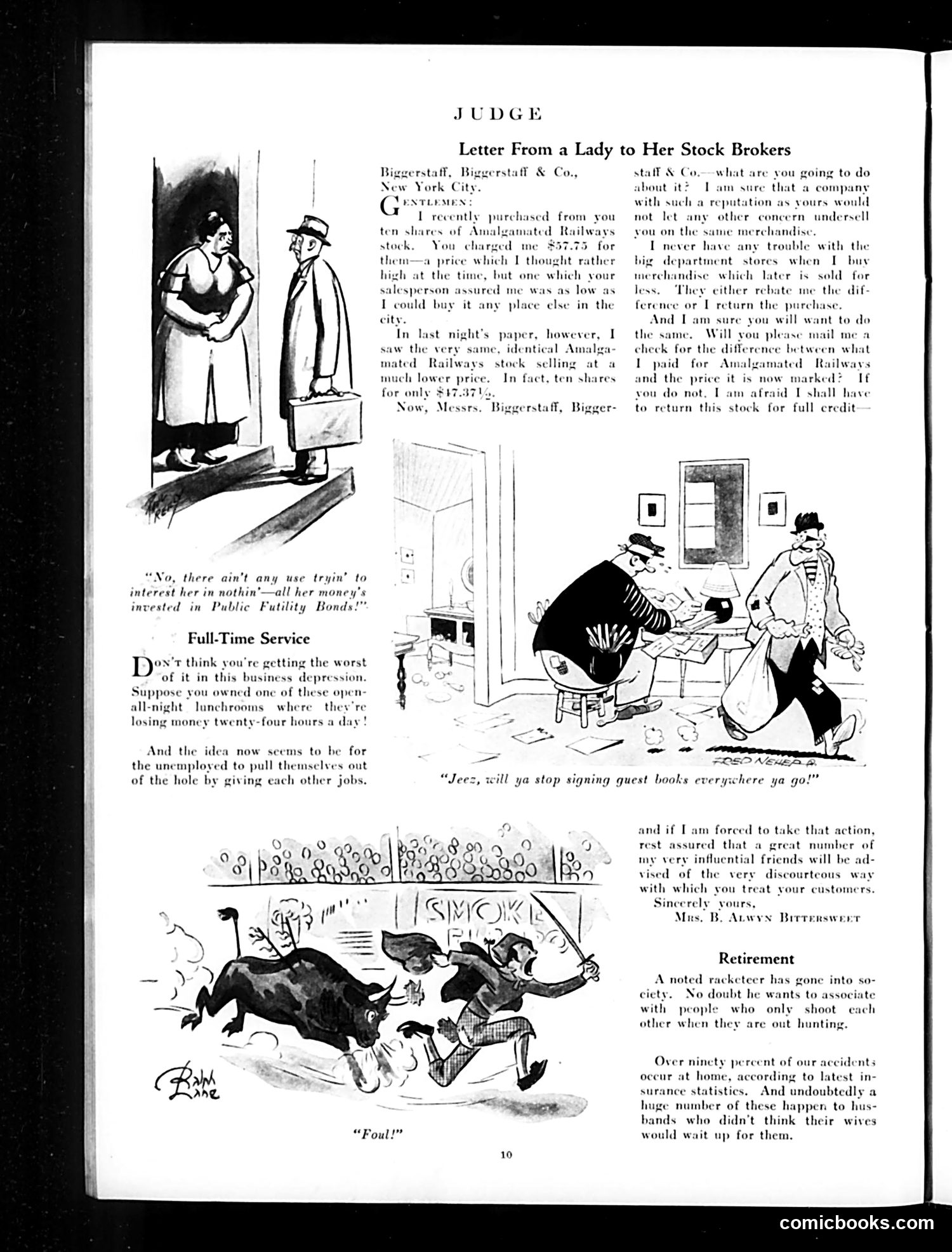
Judge Magazine Page Analysis This page contains three separate satirical pieces about Depression-era financial and social issues: "Letter From a Lady to Her Stock Brokers" mocks both incompetent brokers and entitled wealthy customers. A woman paid $57.57 per share for Amalgamated Railways stock, then found identical shares selling for $47.37. She demands a refund like a department store would offer, threatening to return the stock and damage their reputation through her "influential friends." The satire targets: (1) broker dishonesty in selling overpriced securities, and (2) the obliviousness of wealthy investors during the Depression. "Full-Time Service" jokes darkly about Depression unemployment. It suggests the unemployed should "give each other jobs"—implying a circular, pointless economy where no real wealth is created. "Foul!" depicts chaos at what appears to be a public gathering, possibly satirizing overcrowded venues or chaotic public behavior during hard times. The cartoons reflect 1930s anxieties: financial fraud, economic collapse, and social disorder during the Great Depression.
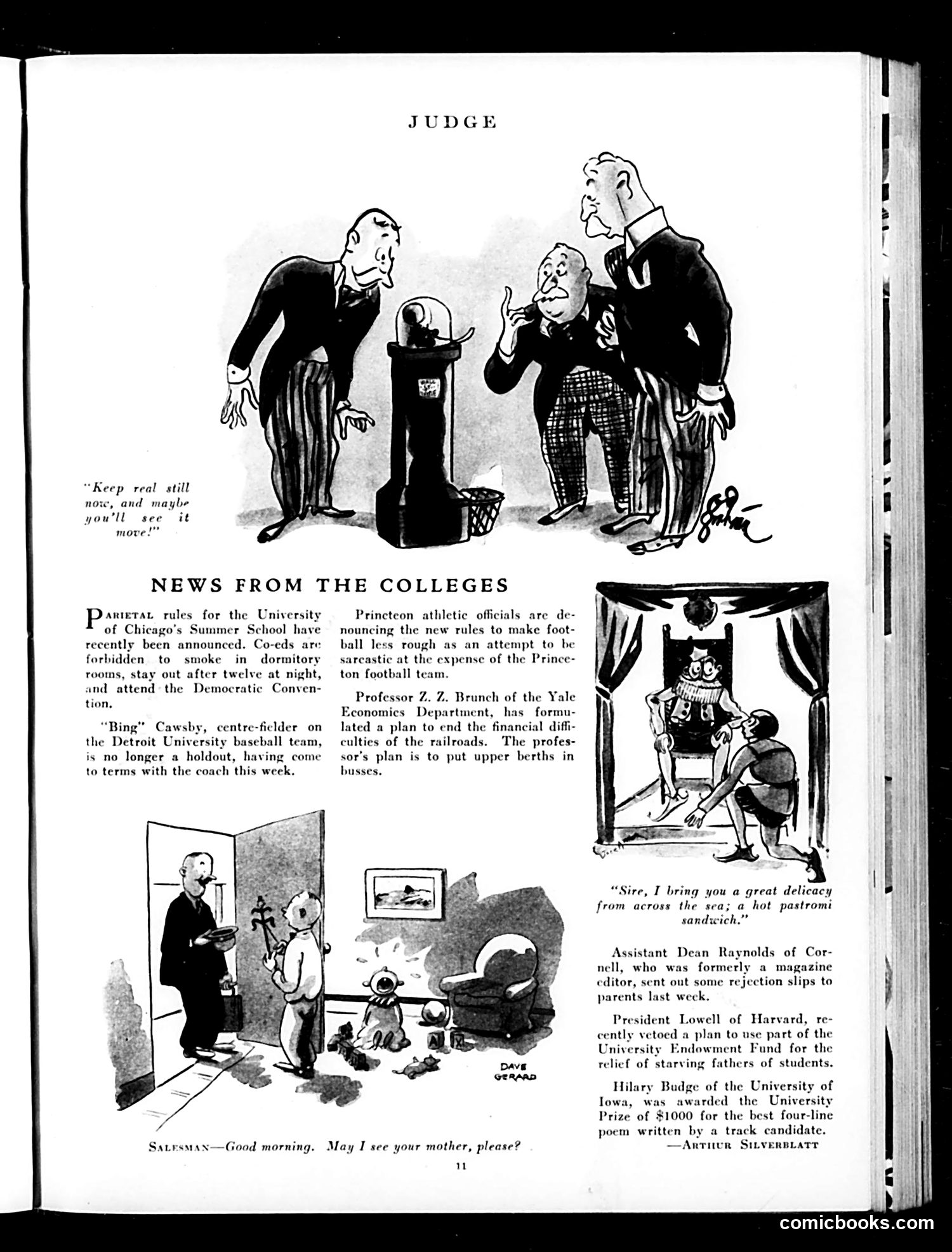
Explaining This Judge Magazine Page This page from Judge presents satirical "News from the Colleges"—humorous jabs at American universities circa the 1920s. The top cartoon mocks a pompous judge lecturing three men to "keep real still now, and maybe you'll see it move"—suggesting the judge himself is slow-witted or immobile, a common satire on judicial pretension. The college news items ridicule academic absurdities: University of Chicago banning coeds from smoking and attending Democratic conventions; Yale's economics professor proposing the ridiculous solution of putting train berths in buses to fix railroad finances; Harvard's President Lowell vetoing aid for "starving fathers of students" (implying wealthy institutions' misplaced priorities). The lower cartoon shows a "Salesman" visiting someone's home, asking to see "your mother"—likely a traveling salesman joke, a stock comedic figure of the era. The right cartoon depicts someone presenting a "hot pastromi sandwich" as an exotic import, satirizing pretentious fine dining or possibly ethnic food stereotypes. These collectively mock collegiate bureaucracy, academic pomposity, and institutional absurdity through exaggeration.
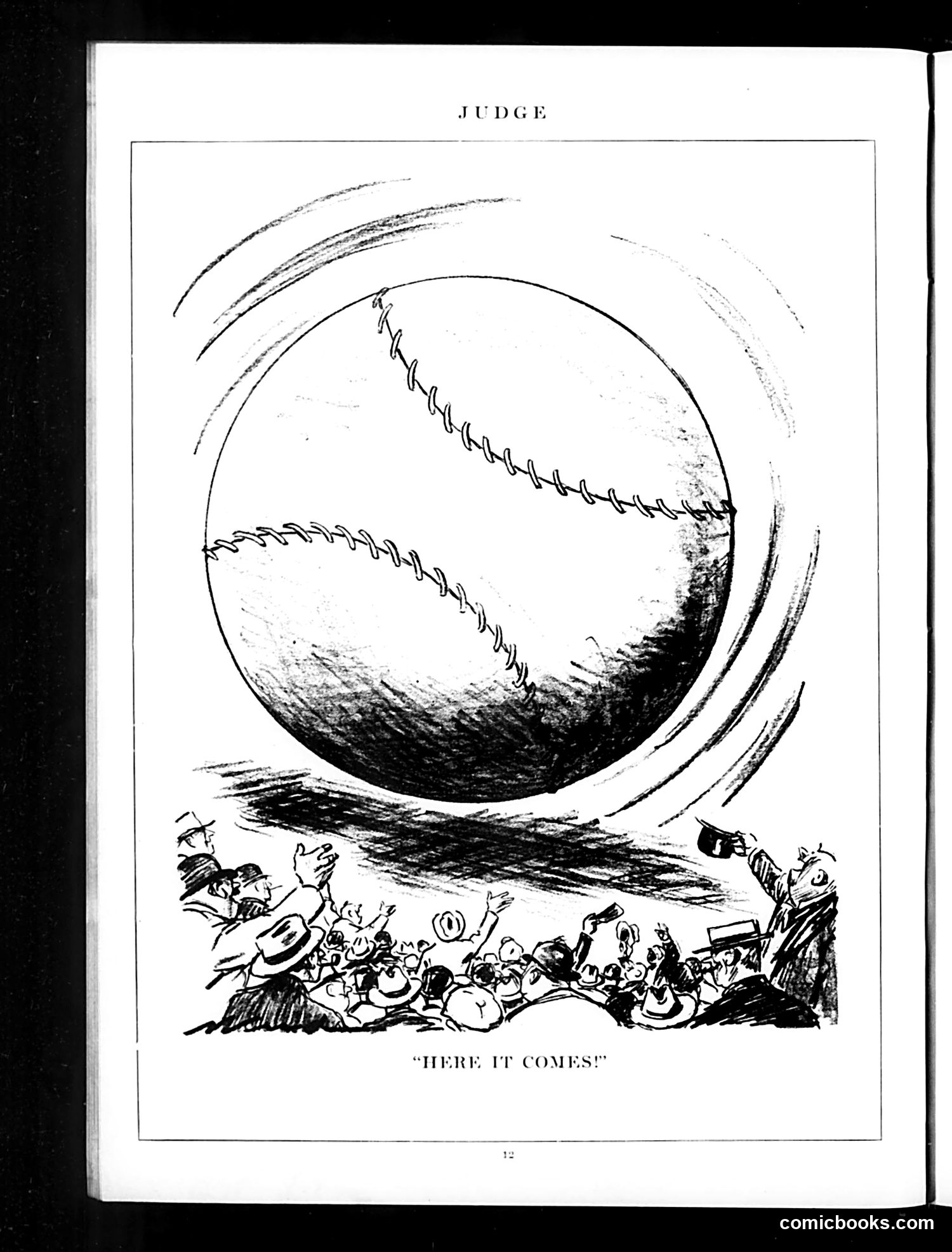
Analysis This is a political cartoon titled "Here It Comes!" from Judge magazine. It depicts a massive baseball (with visible stitching) rolling toward a crowd of small figures wearing hats and formal dress at ground level. The figures appear to be politicians or public figures reacting with alarm and gesticulation to the approaching sphere. The cartoon likely uses the baseball as a metaphor for an impending political event, crisis, or decision bearing down on political leaders. The "here it comes" caption suggests inevitability and perhaps resignation. Without the publication date visible, the specific political context is unclear, but the satire mocks politicians' helplessness before some major development they cannot stop or control.
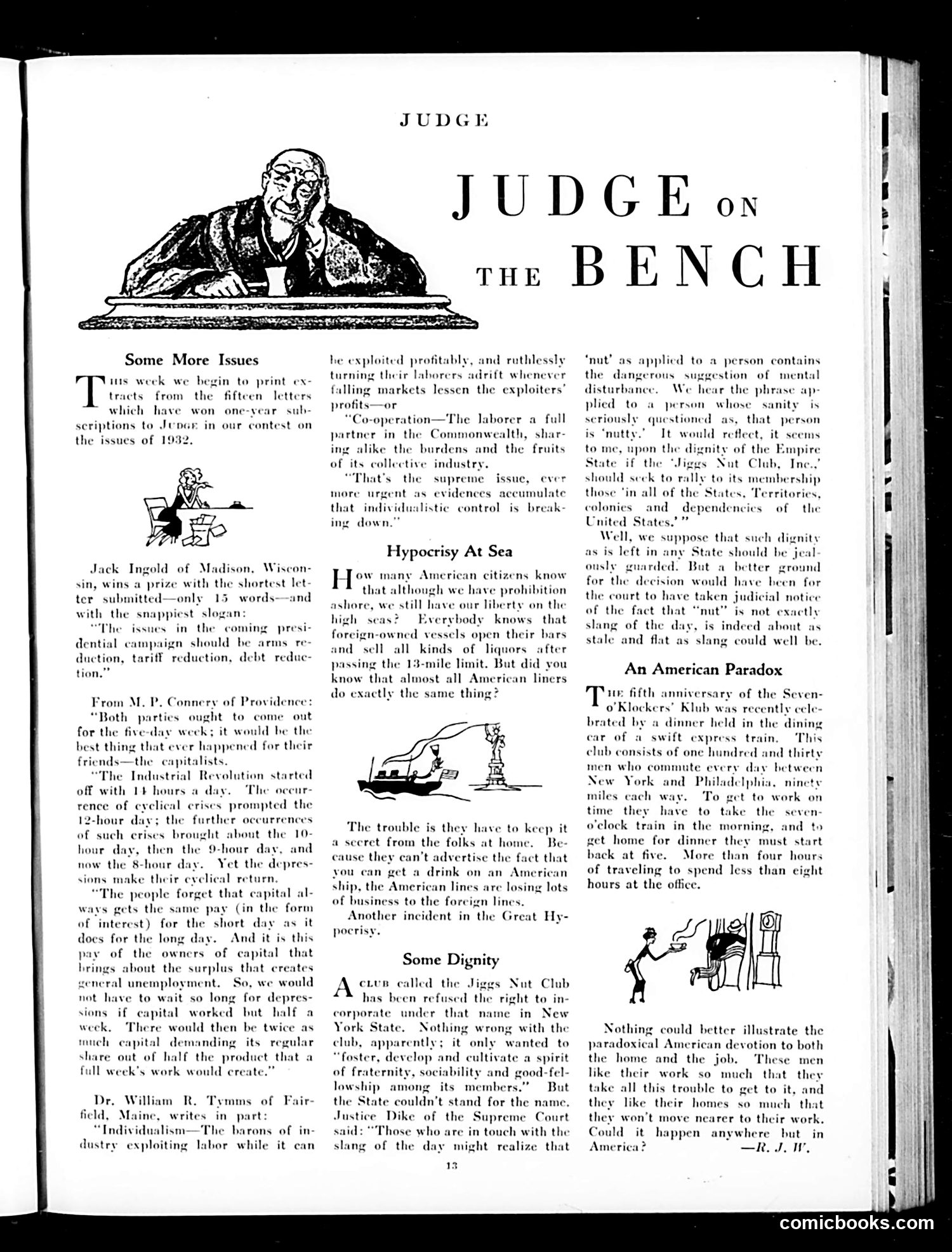
Judge Magazine Page Analysis This page collects reader letters on 1932 political/economic issues alongside satirical commentary. "Some More Issues": Prize-winning letters debate Depression-era solutions—work-week reduction, tariffs, debt, and labor exploitation. One writer argues capitalism's profit-taking creates cyclical unemployment regardless of hours worked. "Hypocrisy At Sea": Satirizes American prohibition enforcement. Foreign-flagged ships legally serve alcohol beyond the 12-mile limit; American shipping lines do the same but secretly, losing business because they can't advertise. The hypocrisy: the law applies selectively based on a vessel's flag. "Some Dignity": Mocks New York's refusal to incorporate the "Jiggs Nut Club," with a judge citing "nut" as slang for mental disturbance and worrying about the state's dignity. The satire suggests the decision is absurdly pedantic—the real problem isn't the name's slang usage, but the court's excessive concern with appearances. All three pieces critique American contradictions: labor exploitation, selective law enforcement, and bureaucratic prudishness.
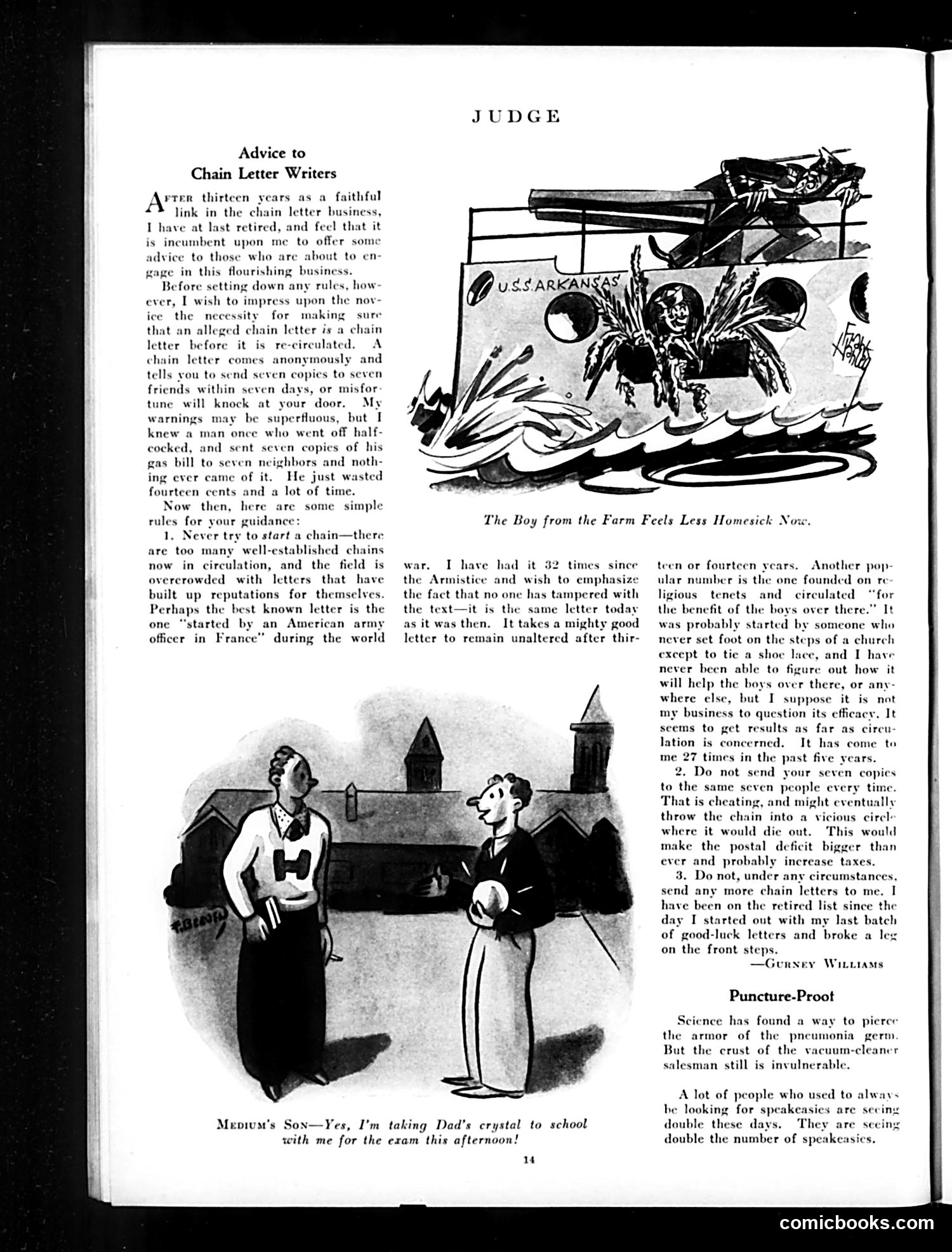
Analysis of Judge Magazine Page This page satirizes the chain-letter craze that swept America in the early 20th century. A retired chain-letter participant offers mock "advice" to newcomers, revealing how the system actually works through his numbered rules. The satire exposes chain letters as a scam: the author warns against starting new chains (too many already circulating), reveals people copy the same letters repeatedly, and notes one famous letter has circulated unchanged since WWI—32 times to him alone. He humorously describes wasting money sending seven copies of his gas bill to neighbors "and nothing ever came of it." The cartoons support this: one shows a farm boy with a naval ship, the other depicts a son taking his father's crystal to school—depicting the gullible behavior chain letters encouraged. The closing jab—his request to be removed from mailing lists after breaking his leg—suggests chain letters brought bad luck rather than the promised good fortune. This mocks both the letters themselves and people credulous enough to circulate them.
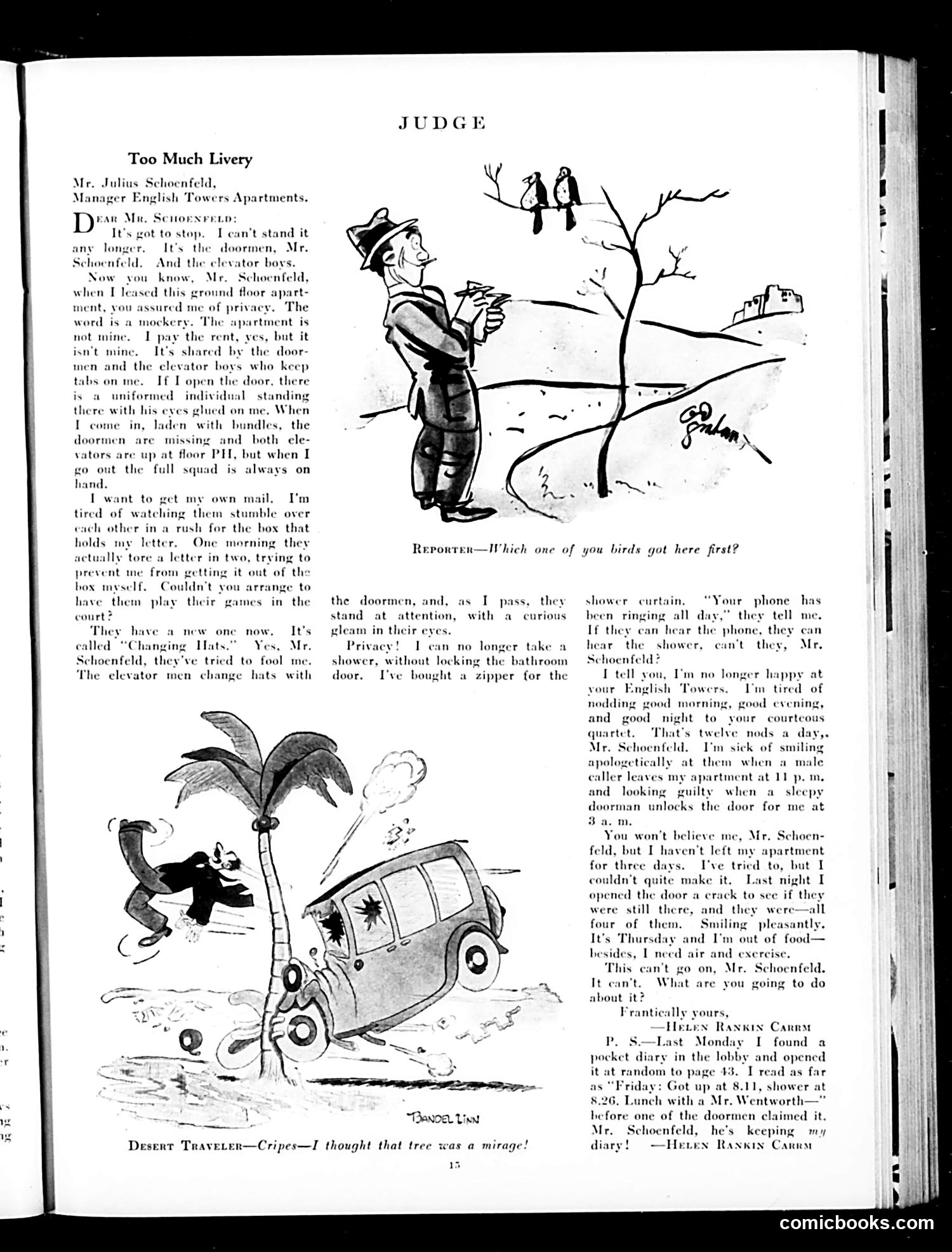
"Too Much Livery" — Judge Magazine Satire This letter-to-the-editor style piece satirizes the invasive service culture of luxury apartment buildings in the early 20th century. The complaint centers on doormen and elevator operators who, while performing their jobs, create an oppressive surveillance environment for residents. The satire targets both the building management's false promises of "privacy" and the residents' loss of autonomy. The writer comically documents how staff members intrude on every aspect of life—monitoring mail delivery, watching entrances, hearing shower activities through thin doors, and notably, witnessing a male caller leaving at 11 p.m. The humor escalates absurdly: the resident hasn't left the apartment in three days, fears the doormen's "smiling pleasantly," and even found staff reading his private diary. The accompanying cartoons (a man shooting birds perched on a dead tree; a car hitting a palm tree in the desert) appear to be unrelated comic fillers typical of Judge's layout. The joke critiques how excessive servant attendance paradoxically destroys the privacy it purports to provide.
Analysis of "The Theatre of George Jean Nathan" This is a theatre criticism column by George Jean Nathan (visible in the byline) praising producer Al Woods. The piece contains no cartoon—it's entirely text. Nathan celebrates Woods as unusually honest among Broadway producers. Woods differs from competitors by: frankly admitting he produces for profit (not "art"), never blaming critics for failures, and accepting negative reviews gracefully—even buying reviewers expensive cigars regardless of outcome. Nathan contrasts Woods's accessible "pistol-shot" melodramas and farces with pretentious contemporaries seeking approval from intellectual publications like *The New Republic*. Woods represents old-school Bowery entertainment, unapologetically commercial. The satire targets theatrical snobbery: Nathan suggests even critics secretly hope Woods succeeds because his unpretentious honesty and good humor make him likable, despite producing lowbrow entertainment. This reflects 1920s-30s cultural debates between "serious" art theatre and popular commercial drama.
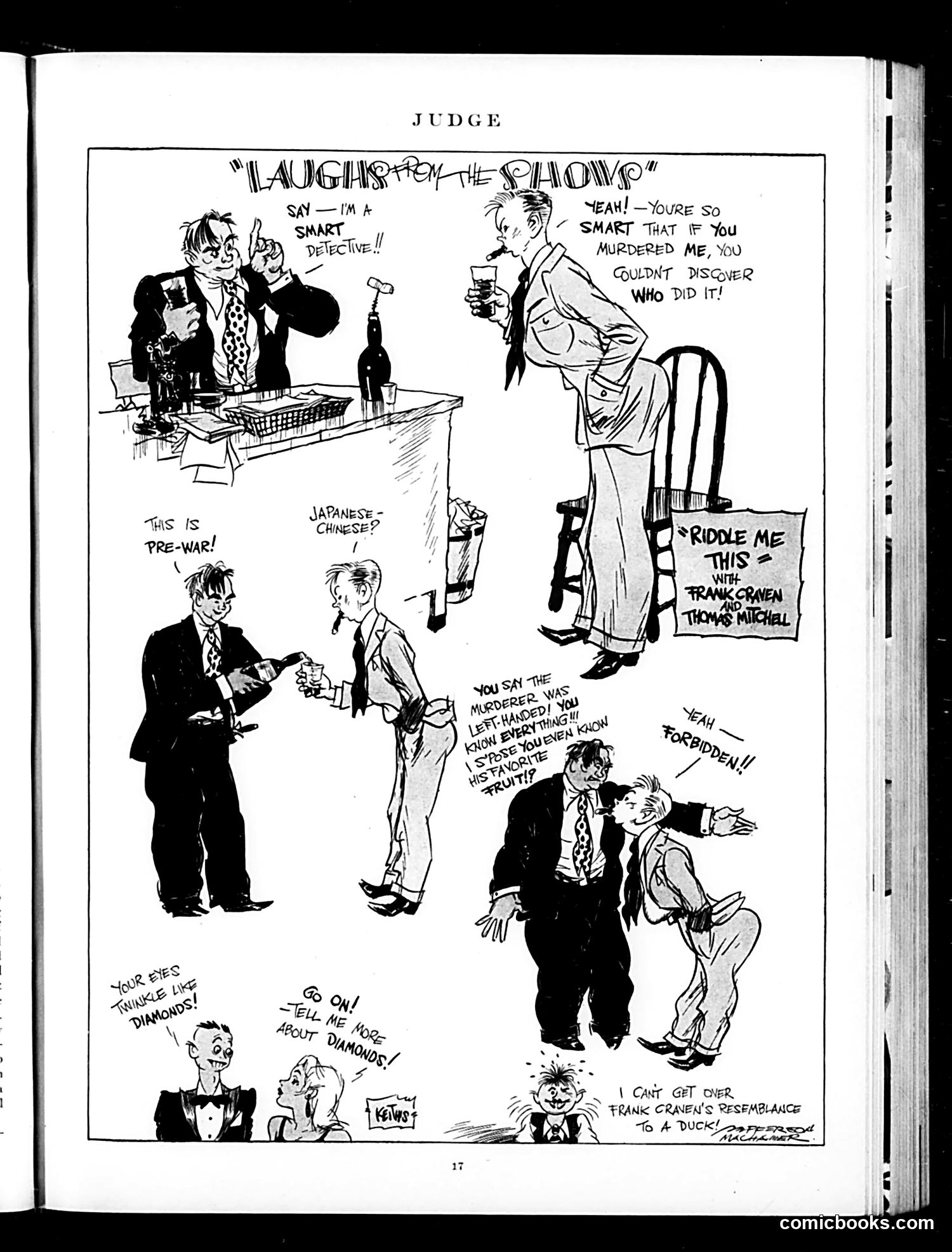
"Laughs from the Shadows" This cartoon satirizes detective fiction and mystery stories popular in the early 20th century. Two men—one appearing to be a detective or "smart" investigator (left) and another gentleman (right)—engage in witty banter about solving crimes. The humor derives from exaggerated detective-story tropes: the "brilliant detective" boasting of deductive abilities, references to "Japanese-Chinese" liquor (likely mocking casual ethnic stereotyping of the era), and absurd plot devices like "riddles" and "Frank Craven's resemblance to a duck." The satire targets overwrought mystery plots and their clichéd dialogue. The page mocks how detective stories relied on contrived coincidences and preposterous solutions rather than genuine logic. The cartoonist appears to be playfully skewering the conventions of popular pulp mystery fiction of that period.
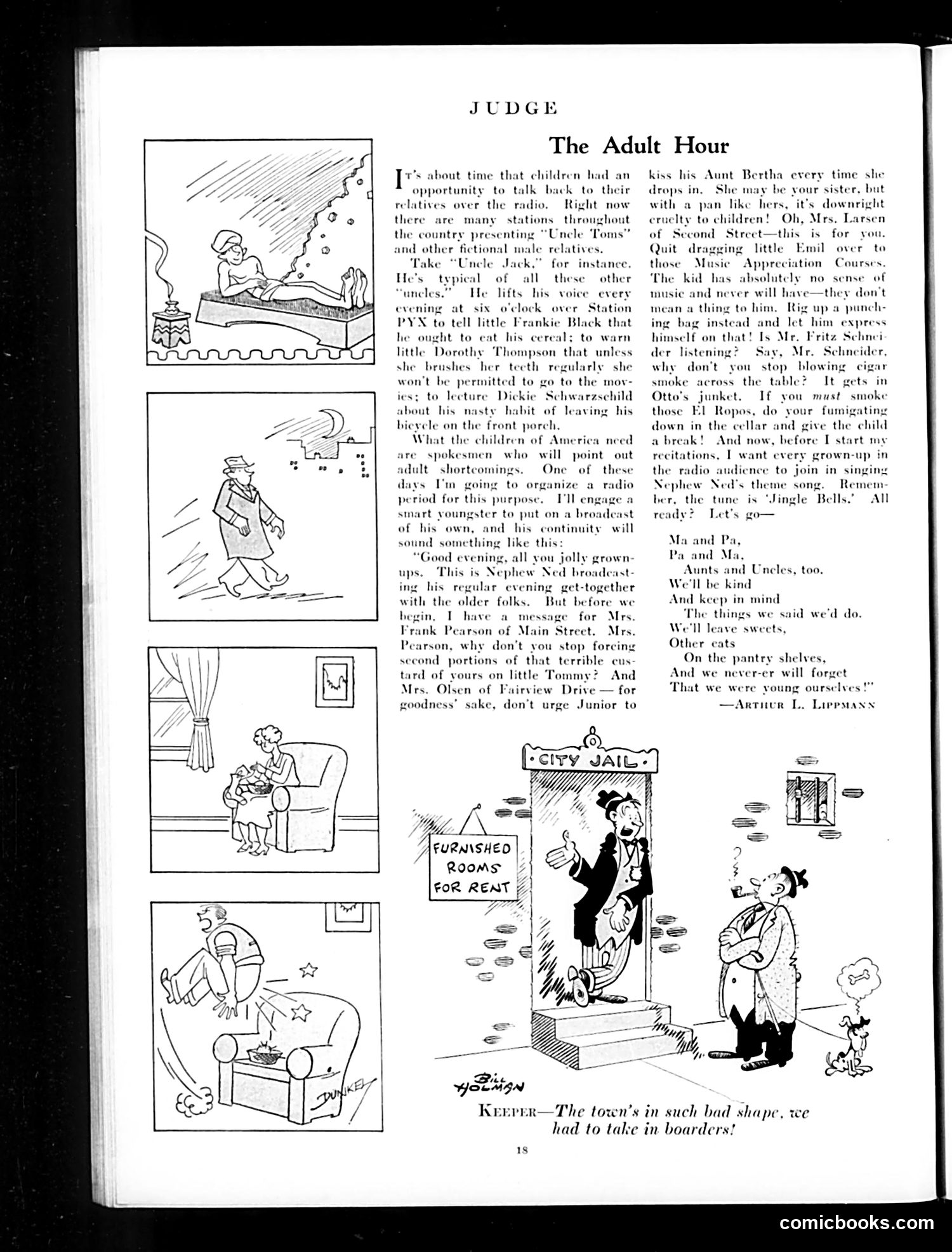
"The Adult Hour" - Judge Magazine Satire This piece satirizes the popular radio genre of "Uncle" programs—wholesome shows where adult hosts (like "Uncle Jack") dispensed patronizing advice to children about eating cereal, brushing teeth, and practicing music. The author proposes a humorous reversal: a "Nephew Ned" broadcast where children critique *adults'* behavior—scolding parents for forcing terrible food, pushing unwanted music lessons, and smoking at the table. The satire exposes the hypocrisy of grown-ups lecturing children while behaving poorly themselves. The accompanying cartoon (bottom right) appears unrelated to the main article, depicting a City Jail keeper discussing taking in boarders due to the town's financial troubles—likely a separate Depression-era joke about local fiscal crisis. The piece's humor relies on inverting authority: children become the moral arbiters, forcing adults to confront their own shortcomings through radio.
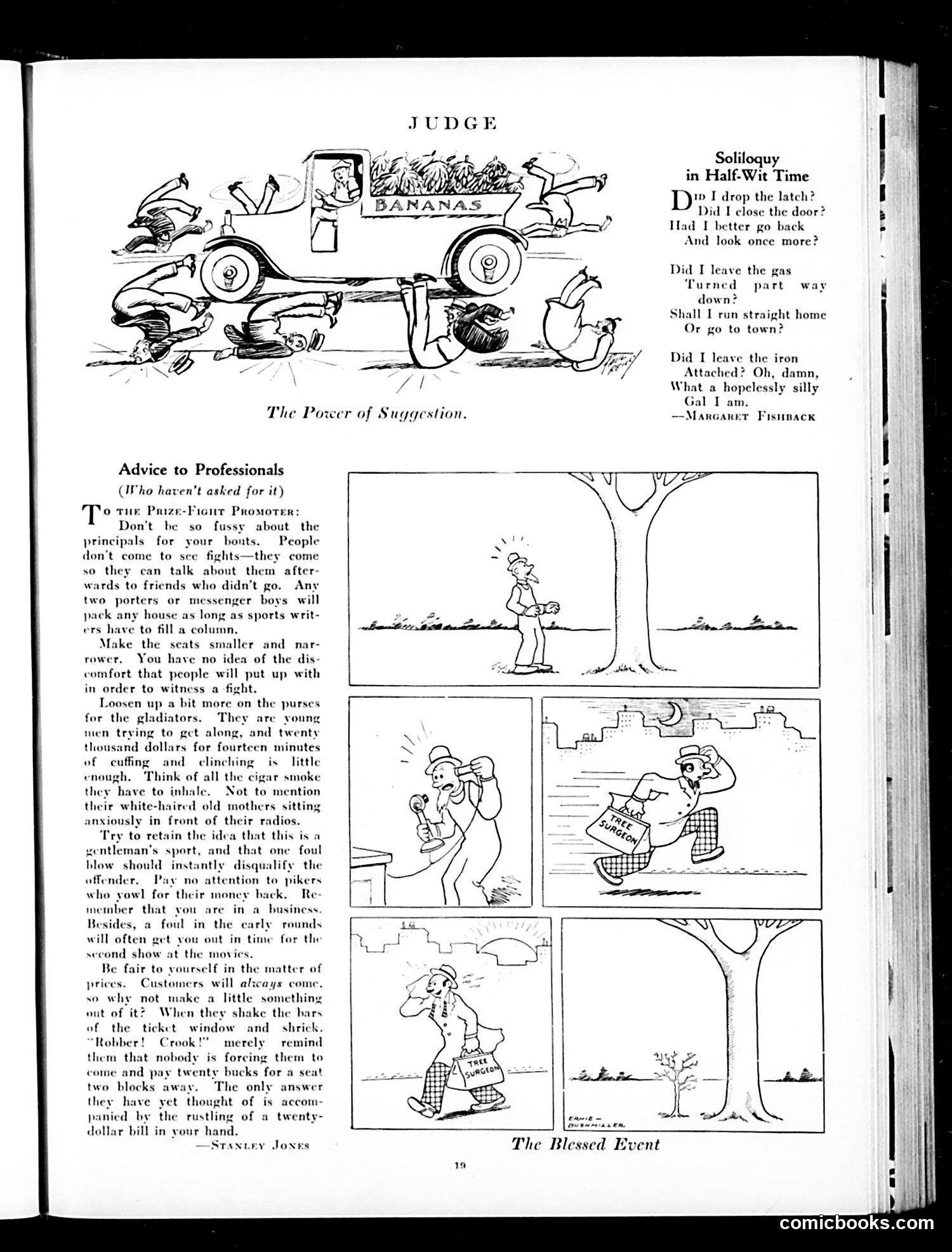
Analysis "The Power of Suggestion" (top cartoon) shows a chaotic banana truck with figures tumbling around it, illustrating how mere *suggestion* of something (bananas, presumably scarce or desirable) causes pandemonium—people lose self-control. "Soliloquy in Half-Wit Time" (poem, right) mocks absent-minded anxiety: a woman obsesses over trivial worries (did I close the door? the gas? the iron?) in neurotic, repetitive self-doubt—stereotyping women as scatterbrained. "Advice to Professionals" (left column) is satirical advice to boxing promoters, mocking the fight-promotion industry. It cynically suggests: pack venues with anyone (quality irrelevant), make seats uncomfortable, underpay fighters despite large purses, maintain false "gentleman's sport" pretense while ignoring fouls, and price-gouge customers. The sarcasm exposes industry greed and hypocrisy—promoters prioritize profit and spectacle over fighter welfare or fair pricing. "The Blessed Event" (bottom, unclear without caption) appears to show a character in various outdoor scenes with trees and buildings.
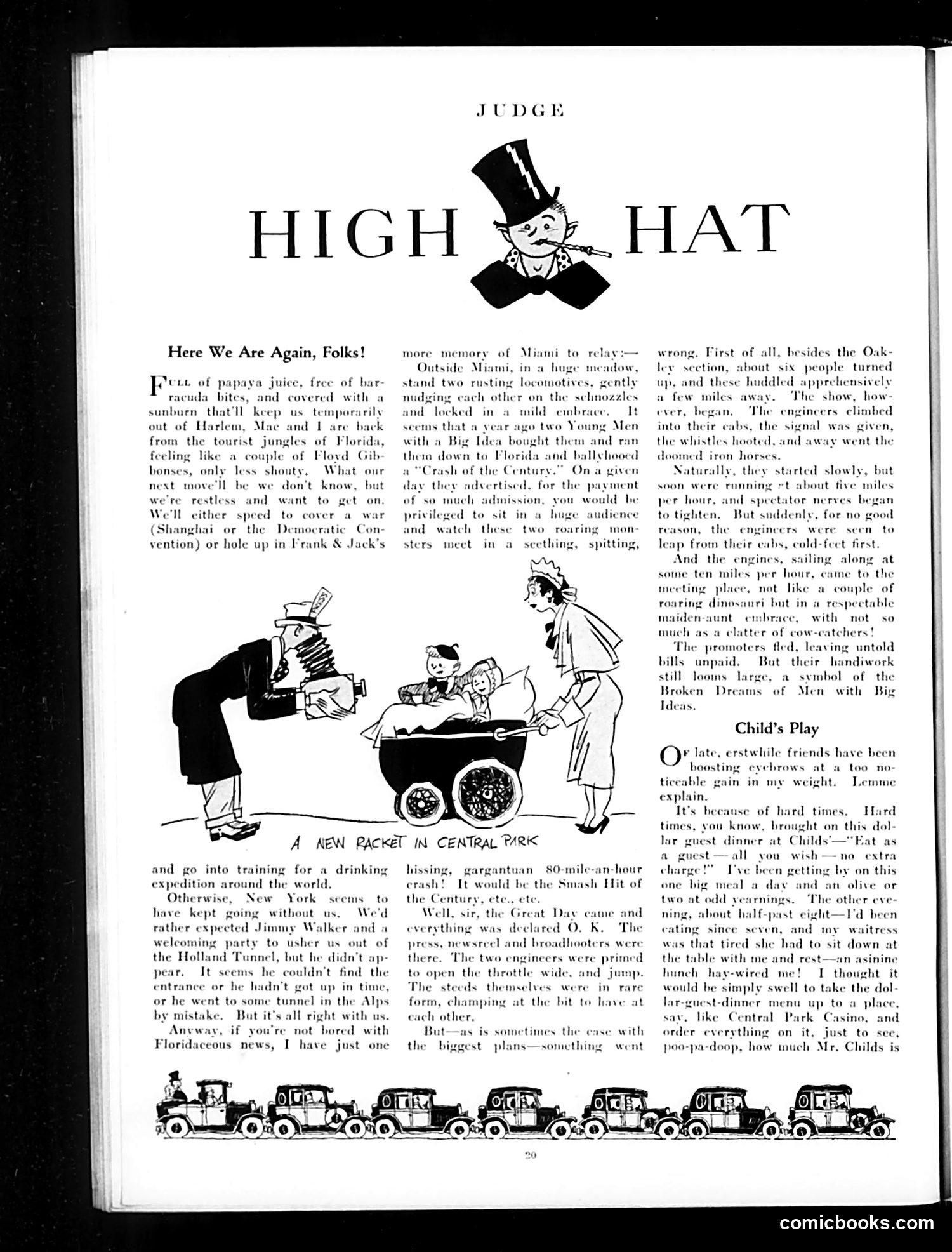
Judge Magazine Satire Analysis This page satirizes the famous "Crash of the Century"—a 1926 promotional stunt in Miami where two locomotives were deliberately crashed together. The author (identified as "Judge's" columnist) mocks the event's spectacular failure: despite massive hype and advertising, only about six spectators attended. When the engineers finally engaged the engines, rather than a dramatic collision, the trains gently bumped together at ten miles per hour—an anticlimax the text compares to a "maiden-aunt embrace." The cartoon illustrates the failed spectacle. The satire targets American obsession with sensational publicity and get-rich-quick schemes—"Broken Dreams of Men with Big Ideas." The accompanying section, "Child's Play," uses lighter humor about Depression-era budget dining at Child's restaurant. The reference to Mayor Jimmy Walker and political destinations (Shanghai, Democratic Convention) adds contemporary New York context, suggesting broader cultural restlessness during this period.
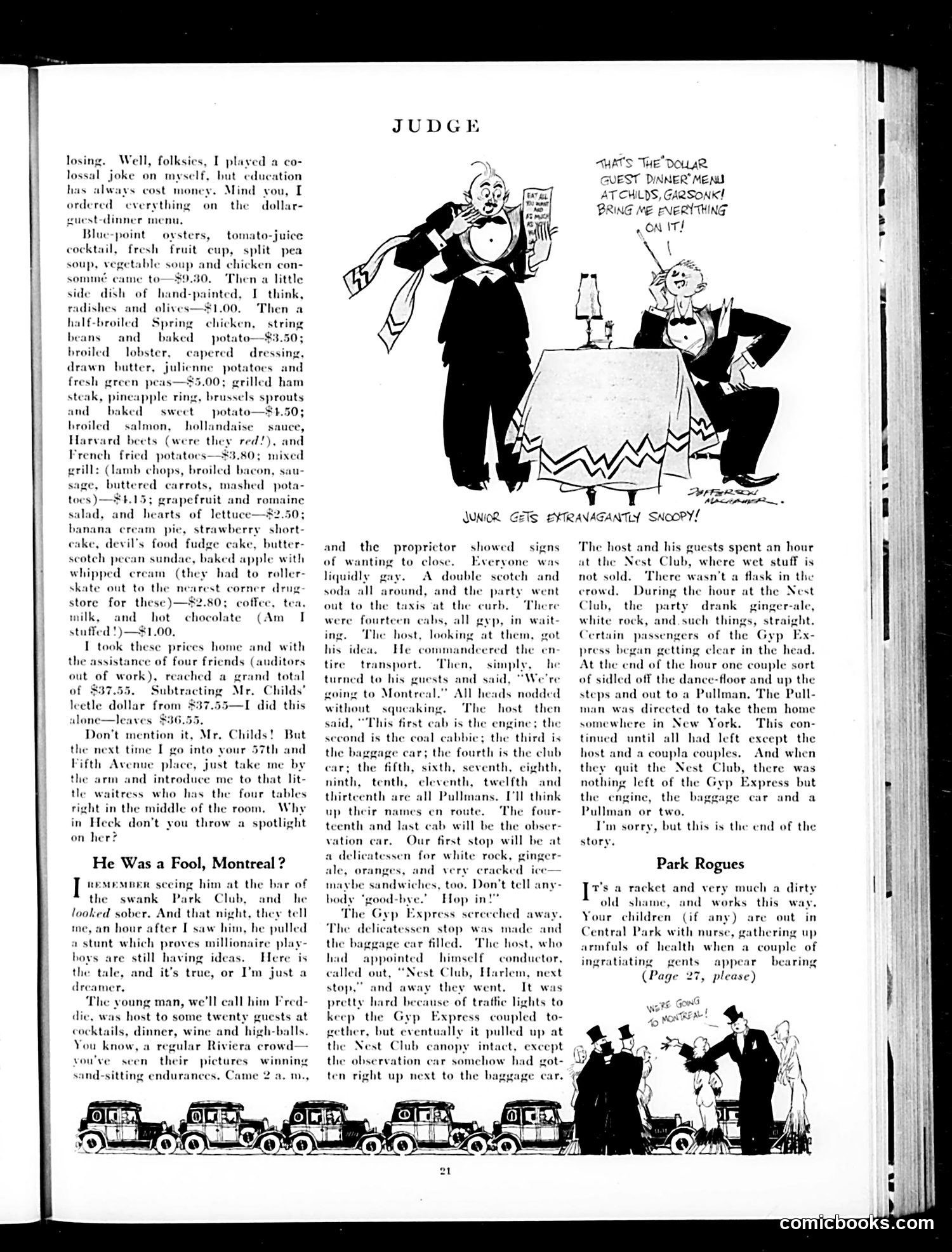
Judge Magazine Page Analysis This page contains two humorous articles satirizing wealthy New York social life in the early 20th century. The first piece, "Judge," mocks an expensive dinner at Childs Restaurant, where the narrator orders everything on the "dollar guest dinner menu," spending $37.55 total—a substantial sum at the time. The joke criticizes both the inflated prices and the narrator's wasteful spending while trying to impress others. The second article, "He Was a Fool, Montreal?", describes a wealthy young man named Freddie who, after drinking heavily at an exclusive club, impulsively commandeers fourteen taxi cabs, assigns each one a role (engine, coal car, baggage car, Pullmans, observation car), and leads his twenty guests on a spontaneous "train journey" to Montreal. The satire targets the reckless extravagance and poor judgment of the wealthy elite during Prohibition-era excess. Both pieces ridicule aristocratic wastefulness and foolish behavior among the moneyed class.
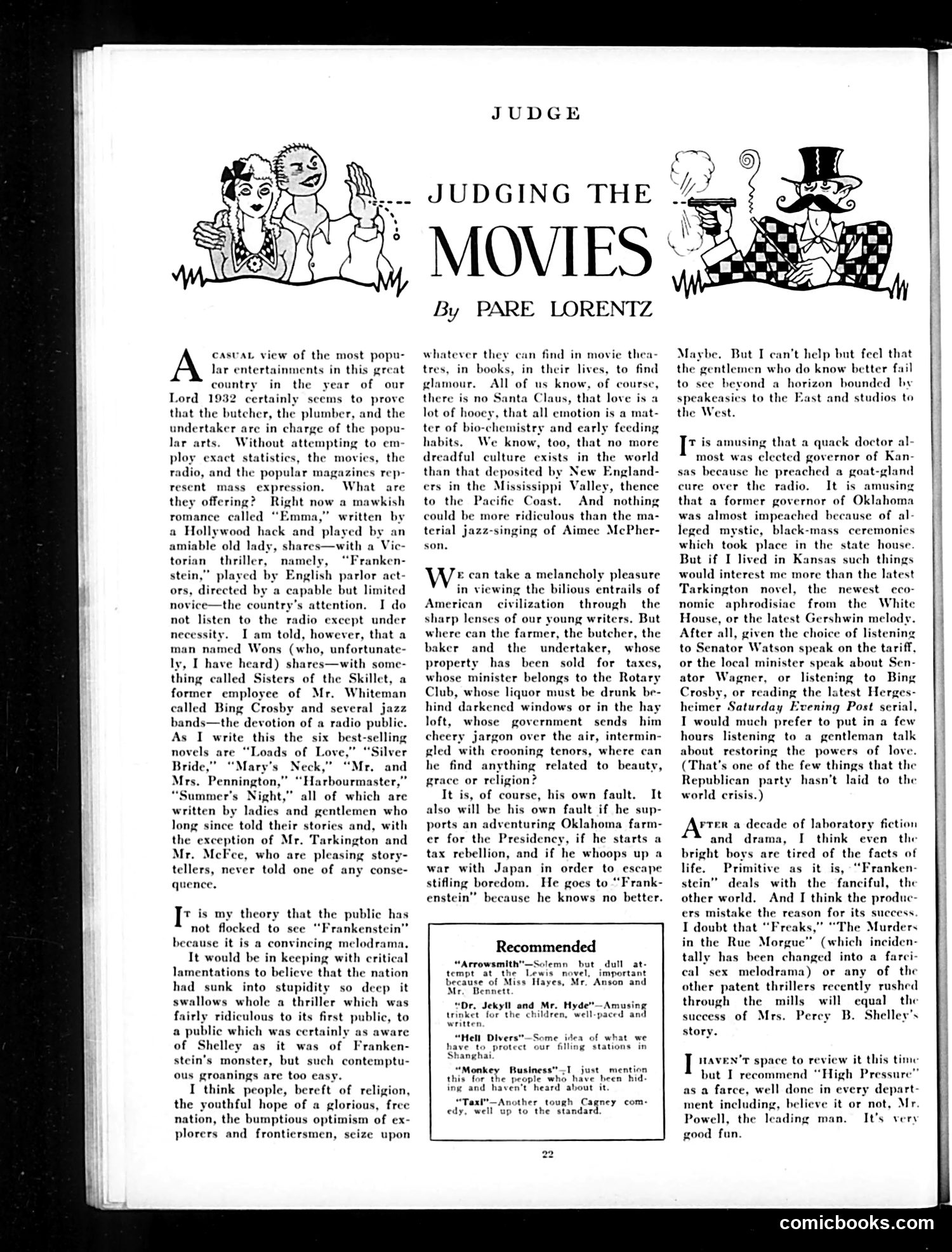
Context for Modern Readers This is a 1932 film criticism essay by Pare Lorentz in *Judge* magazine. Lorentz argues that depression-era audiences flock to "Frankenstein" not because it's a good melodrama, but because ordinary people—farmers, butchers, bakers, undertakers—have lost religious faith, frontier optimism, and hope. They desperately seek glamour and beauty anywhere available. He criticizes American mass entertainment (movies, radio, bestselling novels) as artistically bankrupt, written by hacks recycling tired plots. Yet he sympathizes with audiences' hunger for *something* meaningful in a spiritually depleted culture. The essay then recommends films like "Arrowsmith," "Dr. Jekyll and Mr. Hyde," and "Hell Divers"—suggesting which entertainments have artistic merit. The satire targets both mass culture's mediocrity and the desperation of Depression audiences grasping for escape.
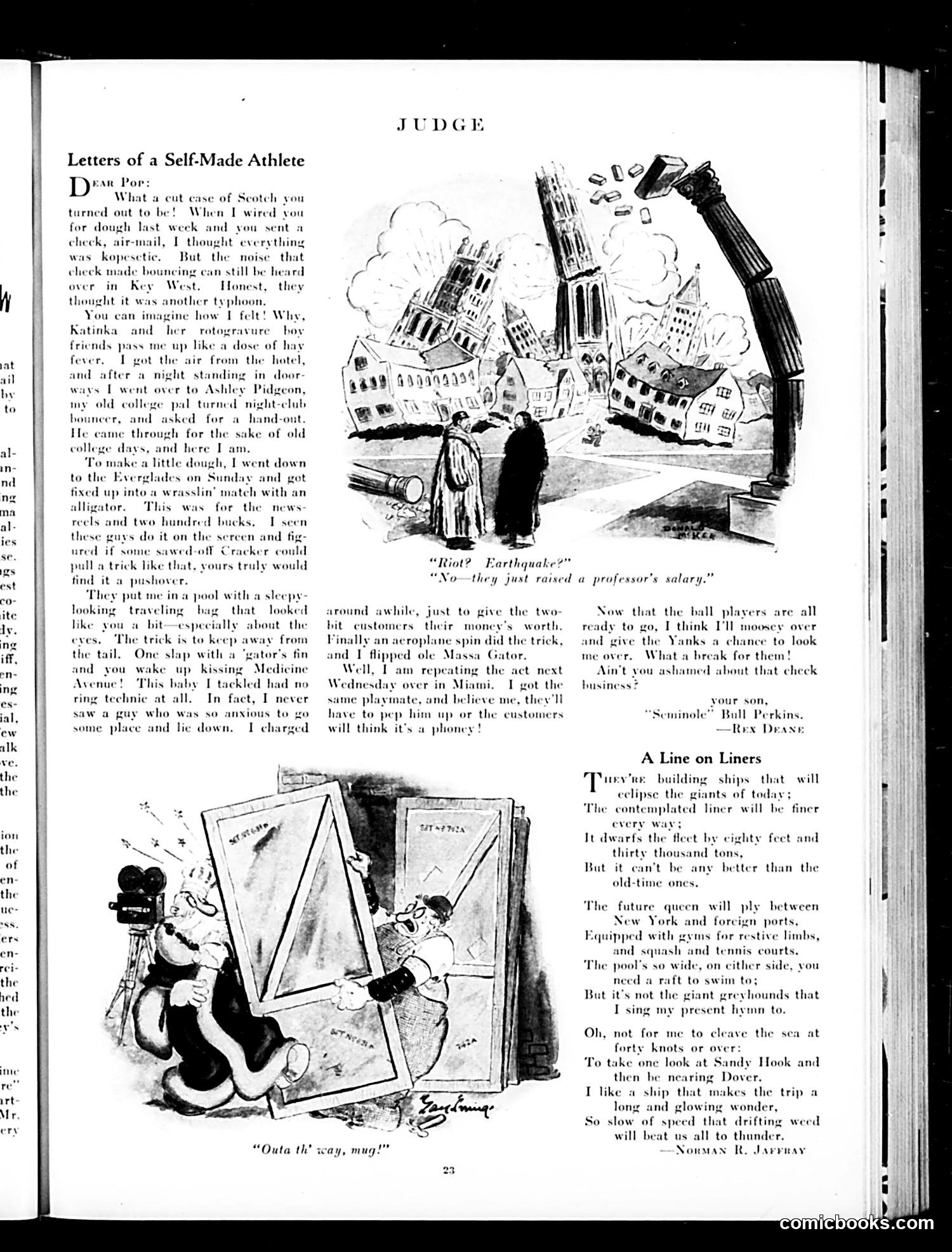
Explanation for Modern Readers This page contains two pieces of satirical humor from Judge magazine: "Letters of a Self-Made Athlete" is a humorous letter from a broke con artist claiming athletic prowess. He boasts about wrestling an alligator in the Everglades for newsreel money, then plans to impress baseball's New York Yankees—all while his wealthy "Scottish" friend's check bounced spectacularly in Key West. The satire targets self-aggrandizing athletes and get-rich-quick schemes popular in the 1920s-30s era. The cartoons (one showing a wrecked city captioned "Riot? Earthquake?" and another labeled "Outa the way, mag!") mock sensationalized newsreels and cheap Hollywood spectacle. "A Line on Liners" is light verse praising slow ocean liners over the new, massive "greyhound" ships being built. The poet humorously prefers leisurely sea travel where "drifting weed will beat us all to thunder"—a gentle jab at the era's obsession with speed and modern technology. Both pieces reflect period anxieties about commercialism, showiness, and technological excess.
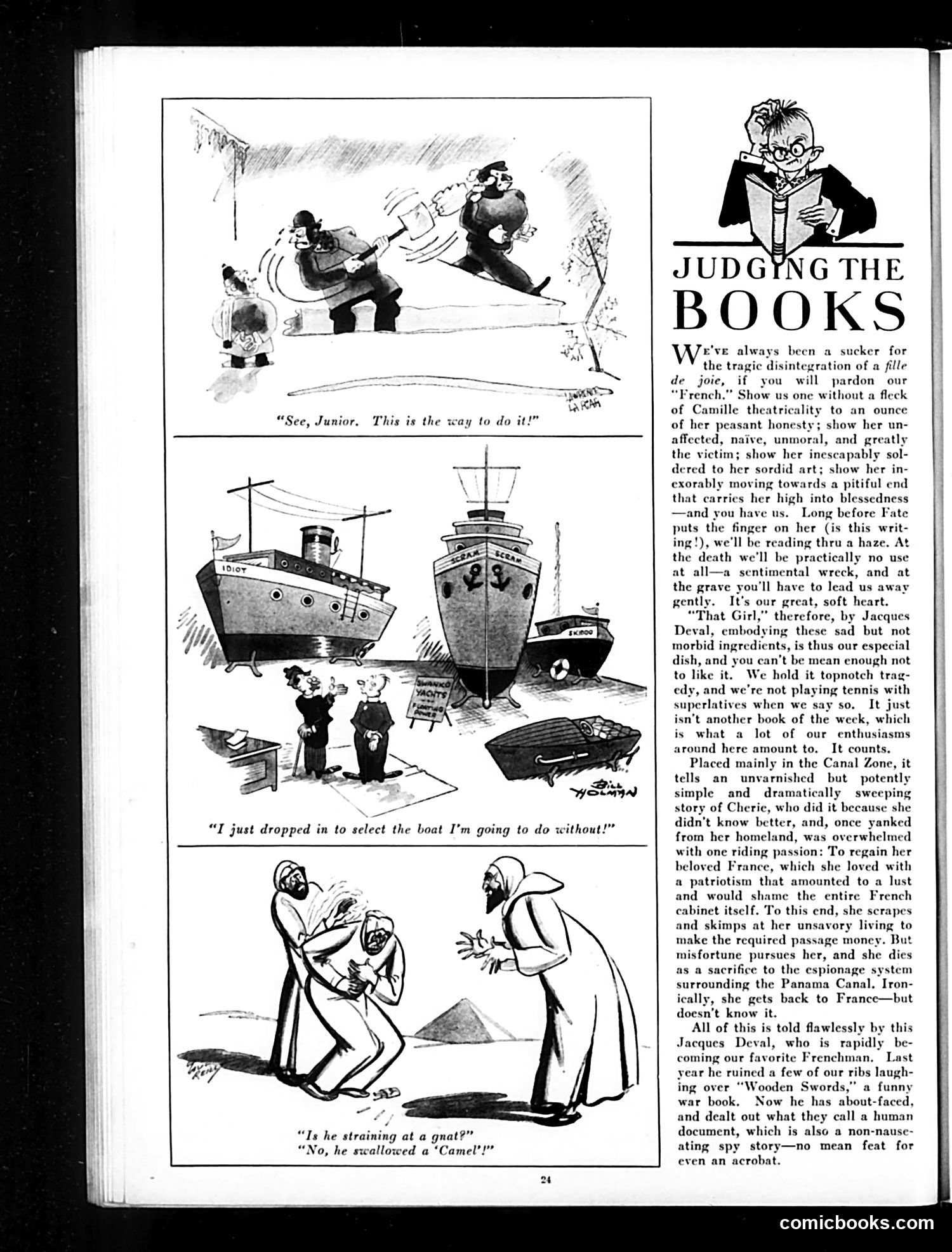
Analysis: "Judging the Books" - Judge Magazine Book Review This is a book review section, not political satire. The cartoons illustrate the review's themes rather than deliver independent jokes. The Review's Subject: Jacques Deval's novel "That Girl," set in the Panama Canal Zone, about Cherie, a French prostitute ("fille de joie") who sacrifices herself to French espionage and patriotism, ultimately dying but unknowingly returning to France. The Cartoons: The sketches humorously depict scenes from the book—characters teaching another "the way to do it" (likely related to the spy plot), selecting a boat for escape, and a final wordless exchange appearing to reference camel/gnat imagery. The Satire: Judge's reviewer admits to being sentimental about tragic "fallen woman" stories, then praises Deval's handling as genuinely moving without melodrama. The tone is self-aware and affectionate toward both the novel and their own emotional vulnerability—poking gentle fun at Judge readers' predictable tastes while endorsing the book as superior literature.
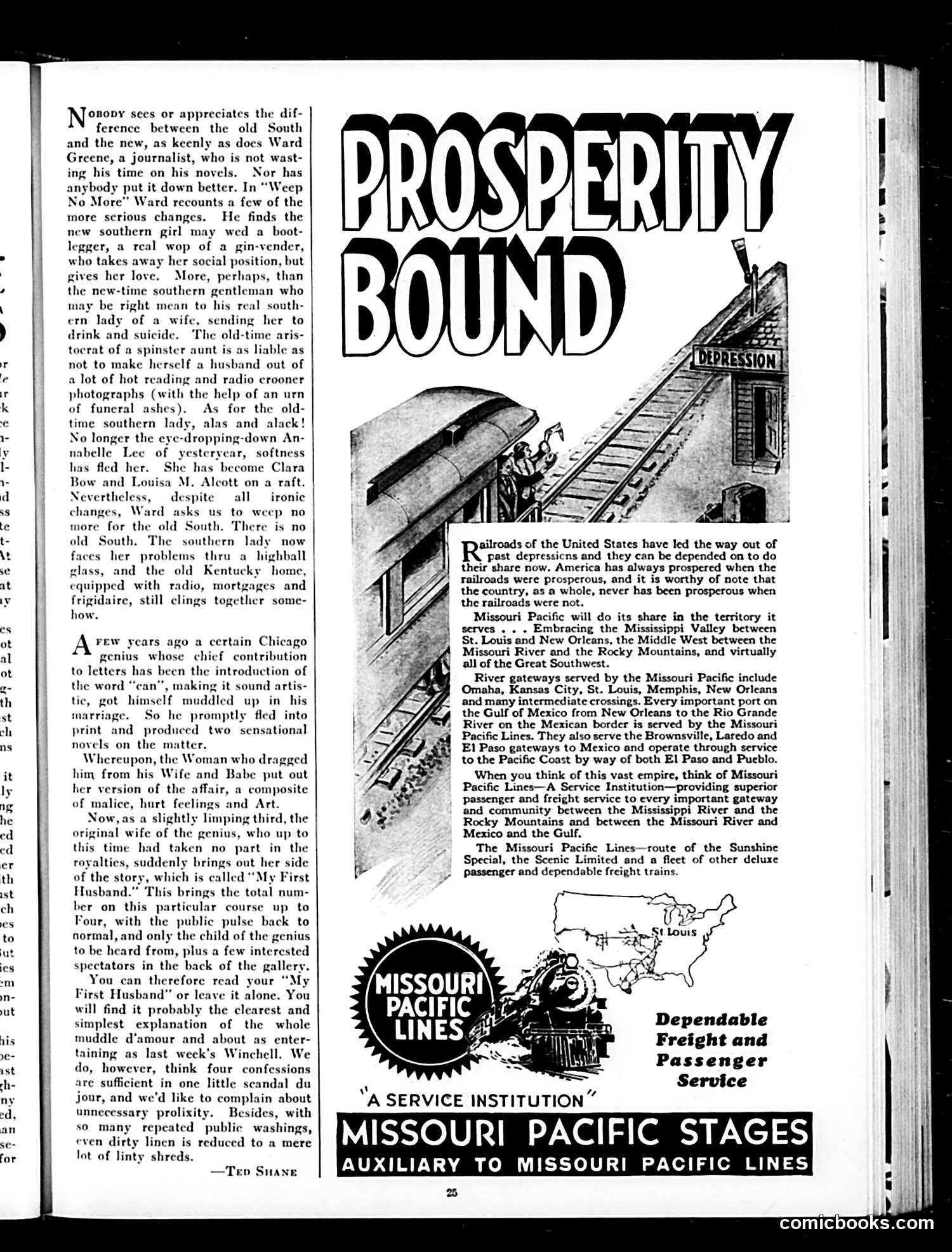
Understanding "Prosperity Bound" This page is primarily a railroad advertisement for Missouri Pacific Lines, not political satire. The top text discusses Ward Greene's novel "Weep No More," which critiques how the modern South has changed—old Southern aristocratic values have collapsed as daughters marry bootleggers and gangsters ("wops"), Southern ladies now drink highballs instead of embodying genteel femininity, and traditional hierarchies have vanished. The lengthy advertisement below argues that American railroads drive national prosperity, positioning Missouri Pacific as essential to the country's economic recovery (likely from the Depression era). It emphasizes the railroad's vast service territory spanning the Mississippi Valley to the Pacific Coast. The brief satirical section mocks a Chicago author whose ex-wife and original wife both published competing accounts of their affair—a contemporary scandal about literary one-upmanship and public gossip, not political commentary.
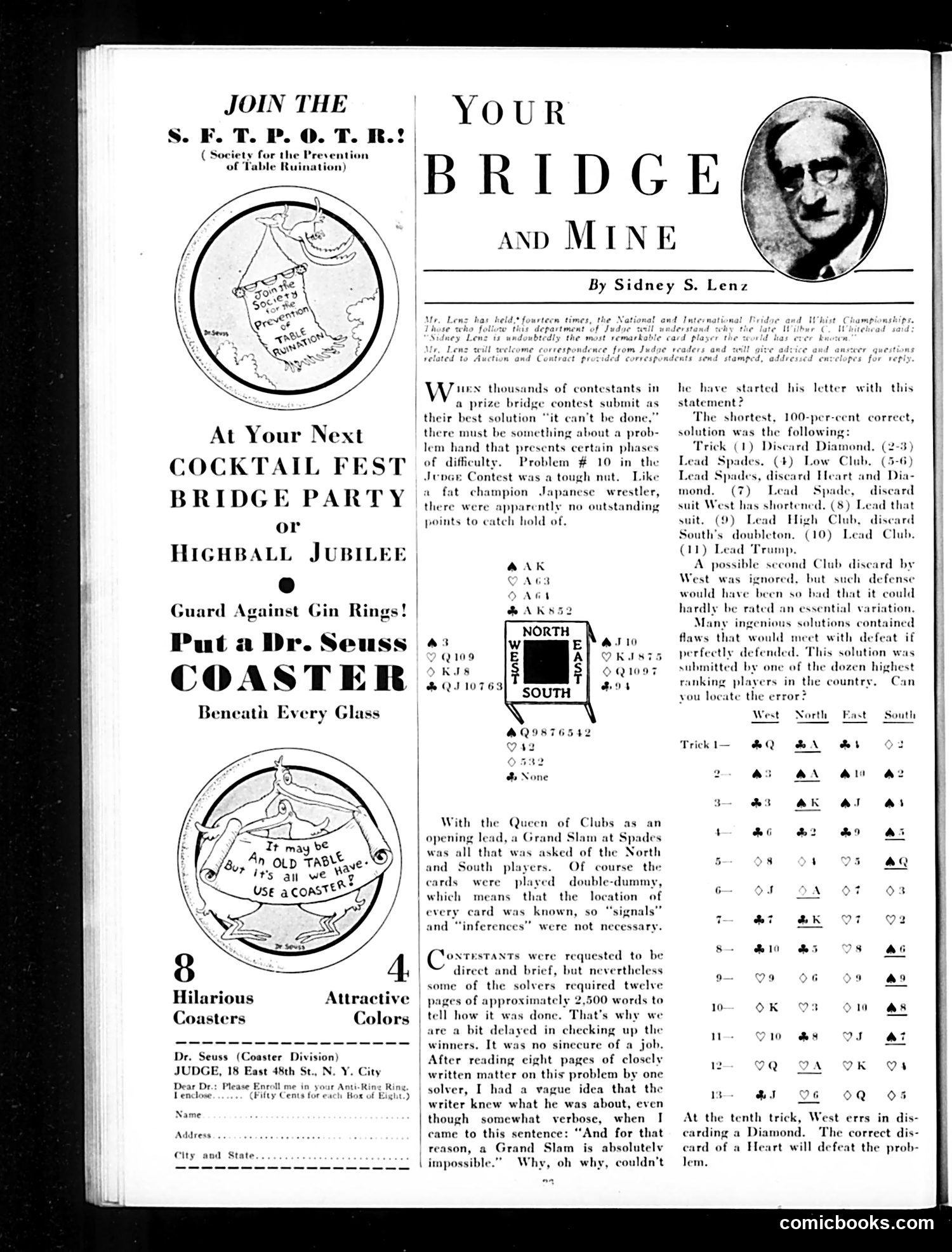
Analysis for Modern Readers This page mixes advertising with bridge game content — two 1930s leisure pursuits. The Dr. Seuss coaster advertisement (left) promotes novelty drink coasters decorated with humorous Seussian imagery, marketed to prevent "gin rings" (water stains from cocktail glasses). This reflects Prohibition's end (1933) and the subsequent popularity of cocktail culture among middle-class Americans. The main content (right) is "Your Bridge and Mine" by Sidney S. Lenz, a famous bridge champion and columnist. It presents a bridge problem from a contest, explaining why thousands submitted incorrect solutions claiming "it can't be done." Lenz humorously criticizes one verbose solver who wrote 12 pages before concluding the grand slam was "absolutely impossible" — when a correct solution exists in a few sentences. The satire: Bridge was serious intellectual entertainment for affluent Americans; Lenz gently mocks overwrought analysis and verbose reasoning, contrasting it with elegant simplicity. The coaster ad and bridge column together target the same demographic: upscale socialites.
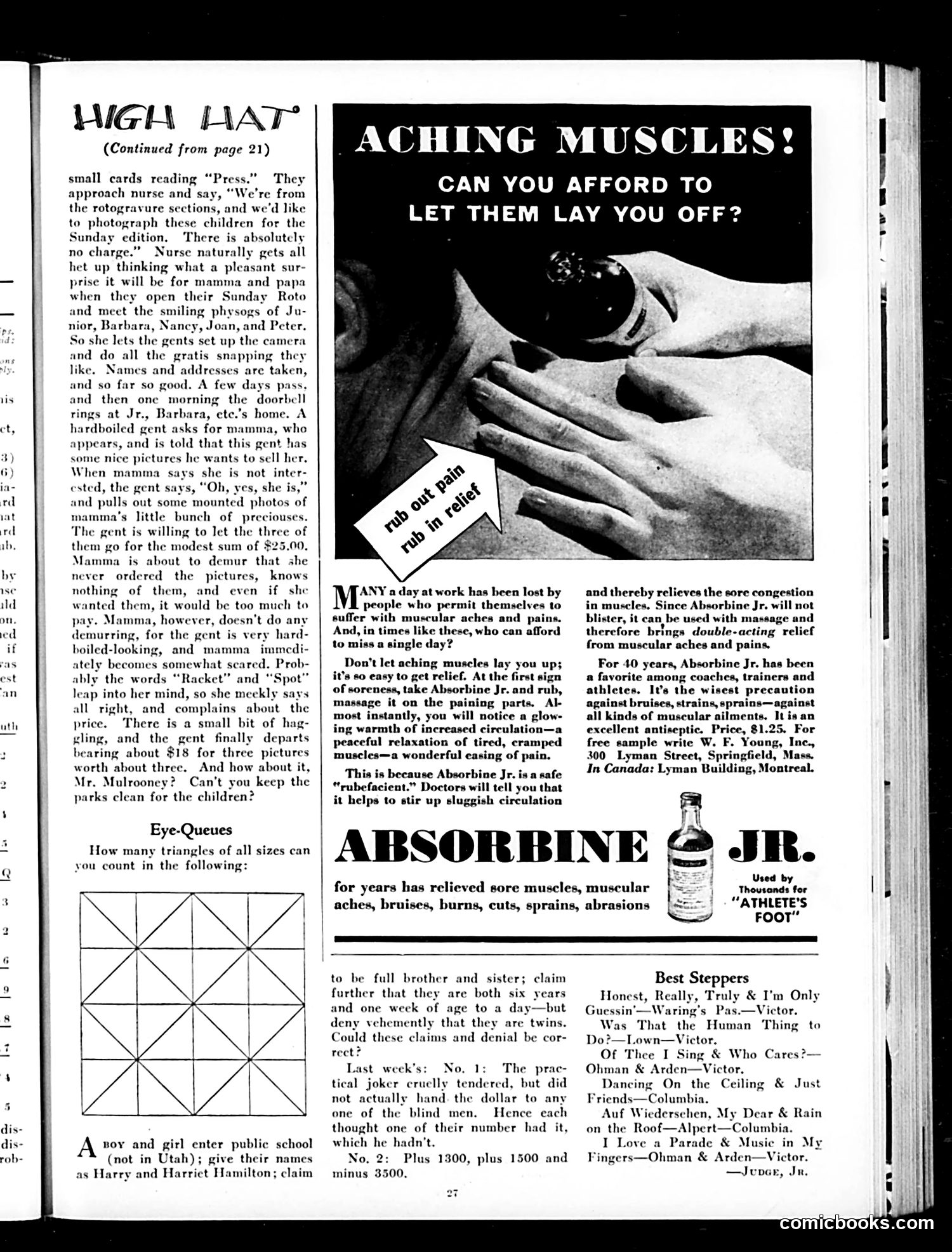
Understanding This Judge Magazine Page This page contains two distinct elements: "High Hat" Story (left column): A satirical account of a common urban scam targeting mothers. Press photographers pose as legitimate media, photograph children for free at hospitals/public spaces, then return days later demanding payment ($25) for the prints—implicitly threatening the mothers with vague references to "rackets" and "spots" (criminal activity). The narrator appeals to "Mr. Mulrooney" (likely a police official) to stop such exploitation. The satire mocks both the scam artists and the mothers' fear-induced compliance. Advertisement (right side): A full-page ad for Absorbine Jr., a patent medicine claiming to relieve muscular aches and athletic injuries through improved circulation. The dramatic "before" photo shows someone rubbing their arm in pain. Marketing emphasizes lost workdays and appeals to coaches and athletes. The juxtaposition is notable: serious social criticism alongside commercial product pitches—typical Judge magazine editorial strategy mixing satire with revenue-generating advertisements.
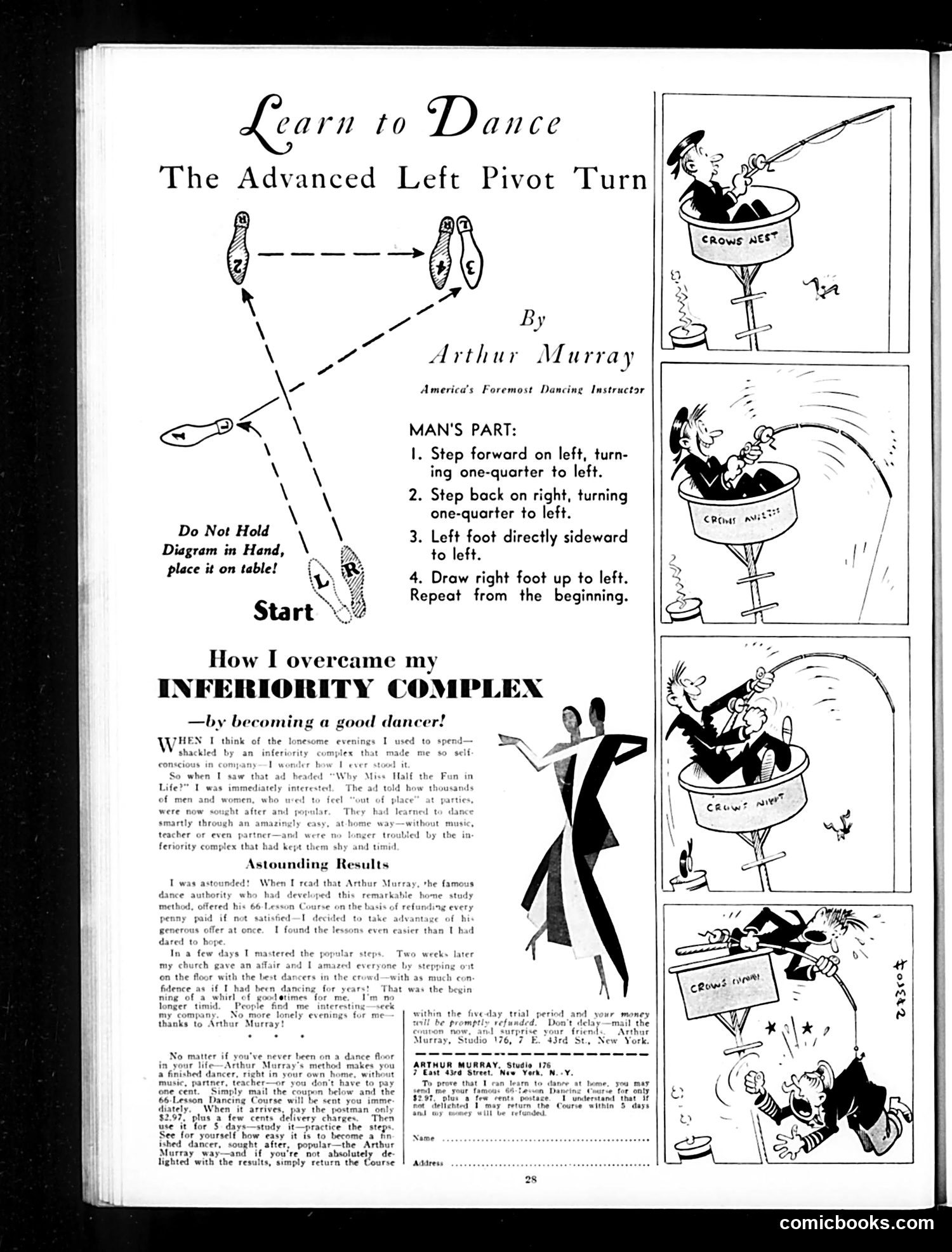
Analysis for Modern Readers This page combines a dance instruction advertisement with self-help marketing—both representing early 20th-century consumer culture. The Main Content: Arthur Murray, a famous ballroom dance instructor, advertises his mail-order dancing course. The diagram shows footwork for "The Advanced Left Pivot Turn." The accompanying testimonial claims that learning to dance cured the writer's "inferiority complex"—a psychological concept newly popularized in that era. The Satire (Right-side Comics): The cartoon panels mock this promise by showing a clumsy man repeatedly failing at dance in increasingly absurd ways—crashing through a "Crowns Nest," spinning wildly, and collapsing. The humor undercuts Murray's advertisement: dancing lessons won't magically transform you. The Context: This reflects 1920s-30s anxieties about social acceptance and the emerging belief that self-improvement products could solve personal problems. The comic deflates that optimism with slapstick realism—some people simply can't dance, no matter the course.
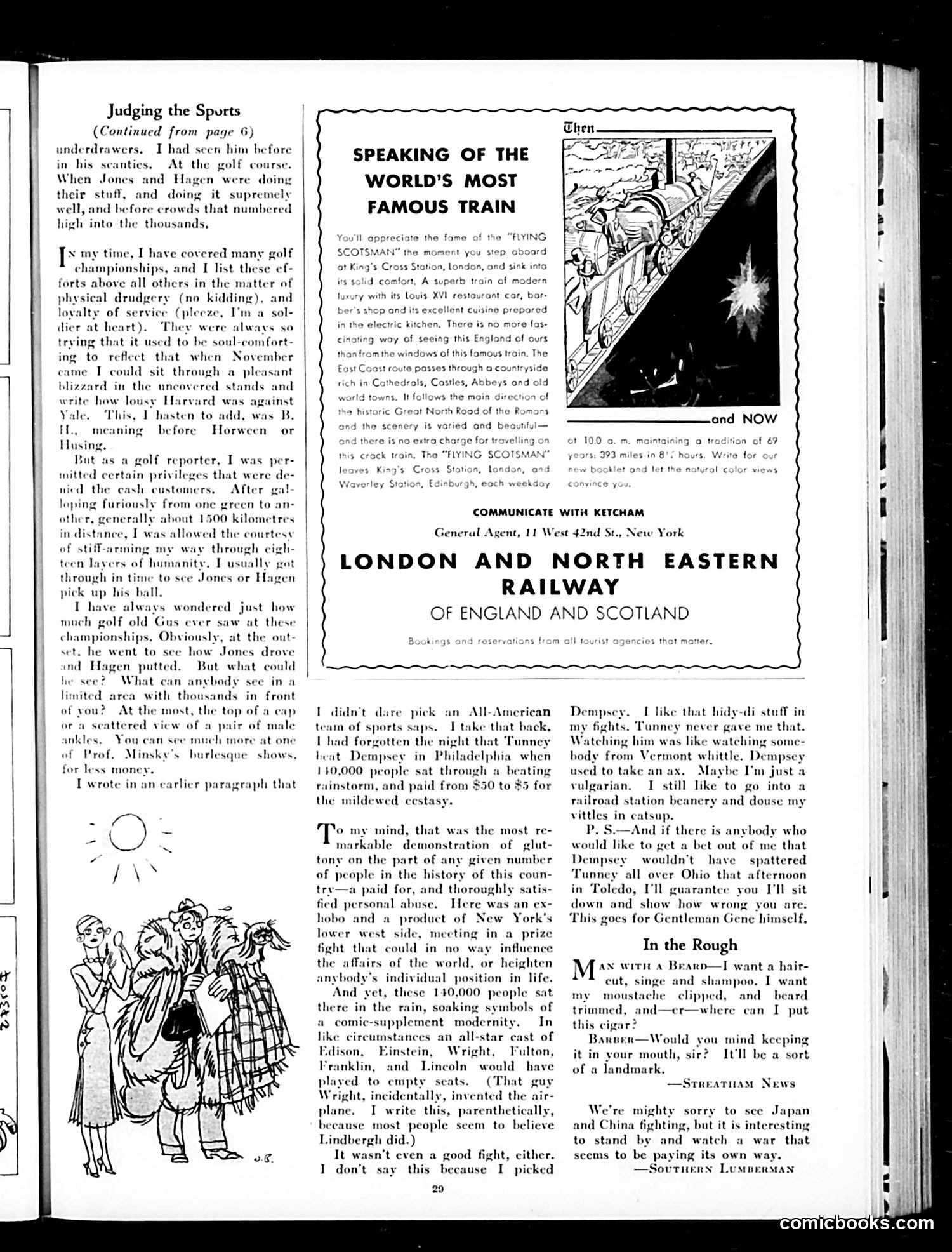
Analysis of Judge Magazine Page Content This page contains sports commentary rather than traditional political cartoons. The main article critiques American sporting culture, specifically the 1926 Dempsey-Tunney heavyweight boxing match in Philadelphia. The Satire's Point: The author argues that 140,000 people paid premium prices ($50-$85) to sit in a rainstorm watching an inferior fight—demonstrating American "gluttony" for sports spectacle. The irony: these same masses wouldn't attend if Edison, Einstein, or Wright (famous inventors) performed equivalent feats. The piece sarcastically contrasts the "sappy" devotion to sports with indifference to genuine achievement, suggesting Americans prioritize entertainment over intellectual or scientific advancement. Context: This reflects 1920s anxiety about mass culture, celebrity obsession, and whether modern Americans had misplaced values—concerns that resurface periodically. The page also includes railway advertising, typical for Judge's revenue model.
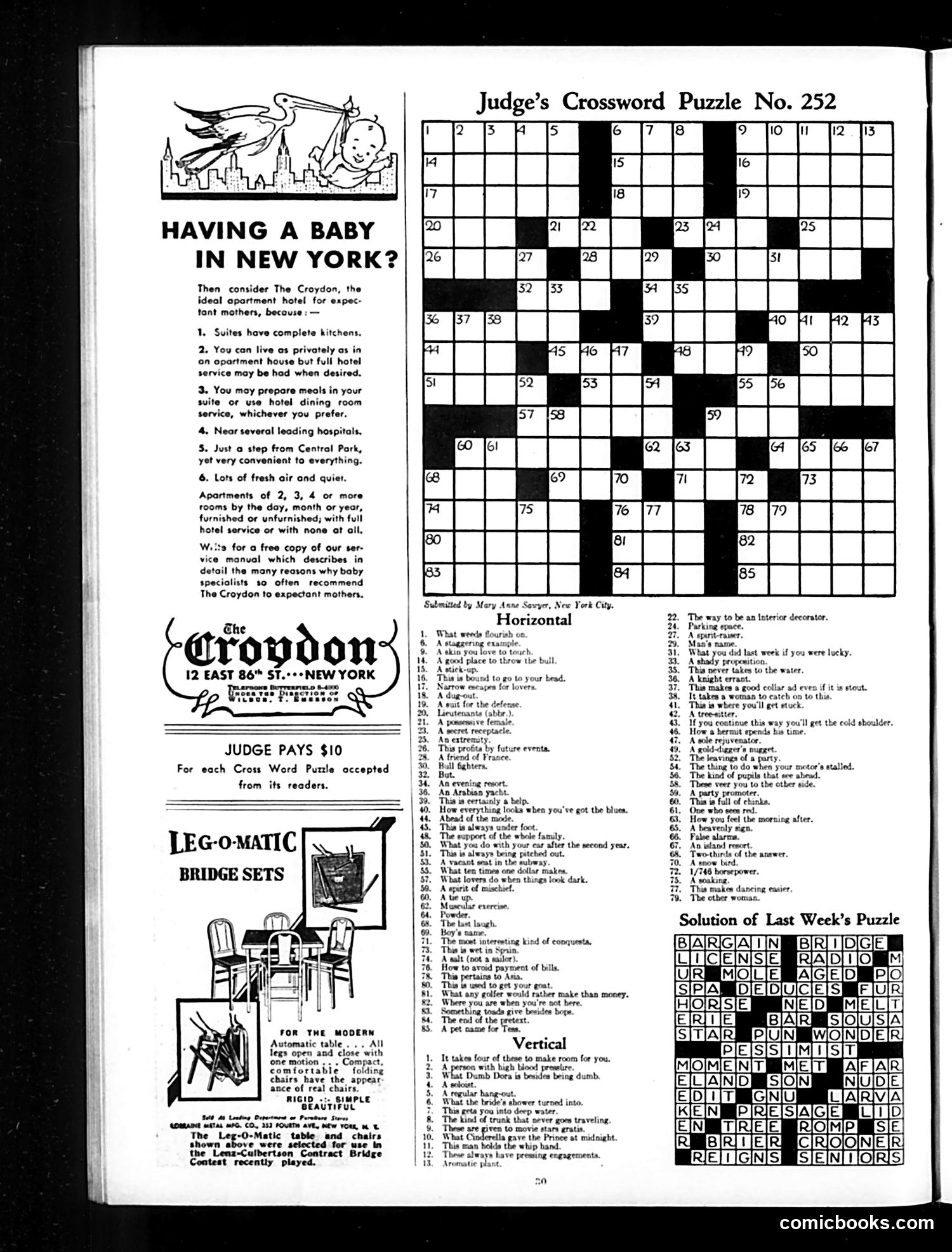
Judge Magazine Page Analysis This page is primarily advertising and puzzles, not political satire. The main content features: Advertisement: The Croydon apartment hotel promotes itself as ideal for expectant mothers in New York City, listing amenities like complete kitchens, proximity to hospitals and Central Park, and flexible hotel services. This reflects 1920s-30s luxury hospitality marketing targeting middle/upper-class families. Puzzles: The bulk of the page comprises a crossword puzzle (#252) and the solution to the previous week's puzzle, plus advertisements for bridge set furniture and a leg-o-matic table used in contract bridge tournaments. Notable: The "Judge Pays $10" line indicates readers submitted puzzles for publication—typical of this era's interactive magazine content. There is no political cartoon visible on this page. It represents standard magazine filler content: advertising, reader-submitted puzzles, and games that filled space between satirical articles elsewhere in the publication.
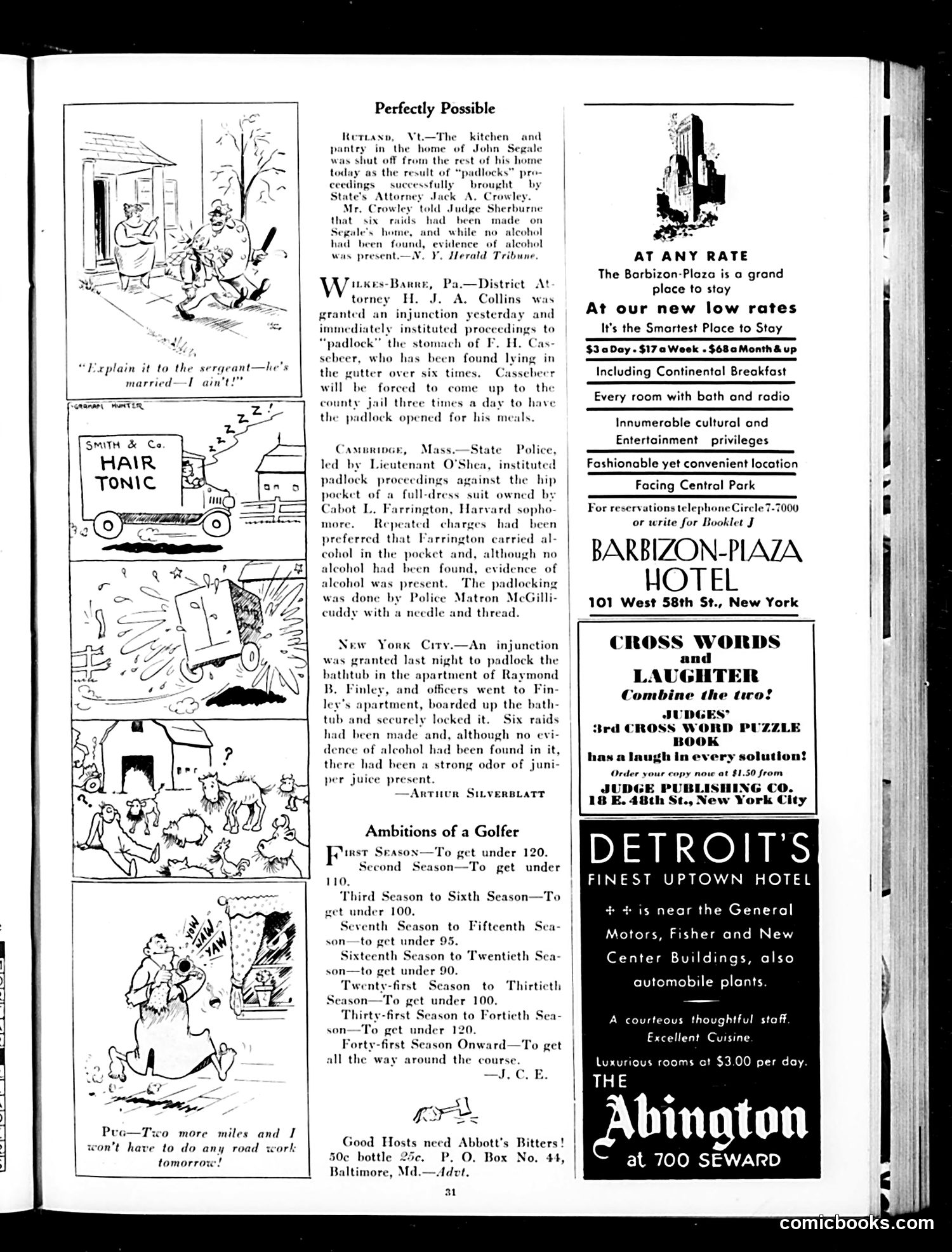
Analysis of Judge Magazine Page This page contains humorous commentary on Prohibition enforcement, satirizing the absurd lengths authorities went to combat alcohol consumption. The central "Perfectly Possible" section reports (tongue-in-cheek) on padlock injunctions—a real Prohibition-era tactic where judges literally sealed up locations suspected of harboring alcohol. The satire escalates absurdly: locking a man's *stomach* so he must visit jail three times daily for meals; padlocking a Harvard student's suit pocket with needle and thread despite finding no alcohol; sealing a bathtub that merely *smells* like juniper juice. The cartoons on the left show drunk or hungover men explaining themselves—one claiming to be "married," another dreading roadwork. "Ambitions of a Golfer" humorously charts how a golfer's goals degrade over decades from scoring under 120 to simply "get around the course." The page is otherwise dominated by period hotel and product advertisements, reflecting Judge's commercial revenue model. The humor targets both the futility and invasiveness of Prohibition enforcement rather than supporting it.
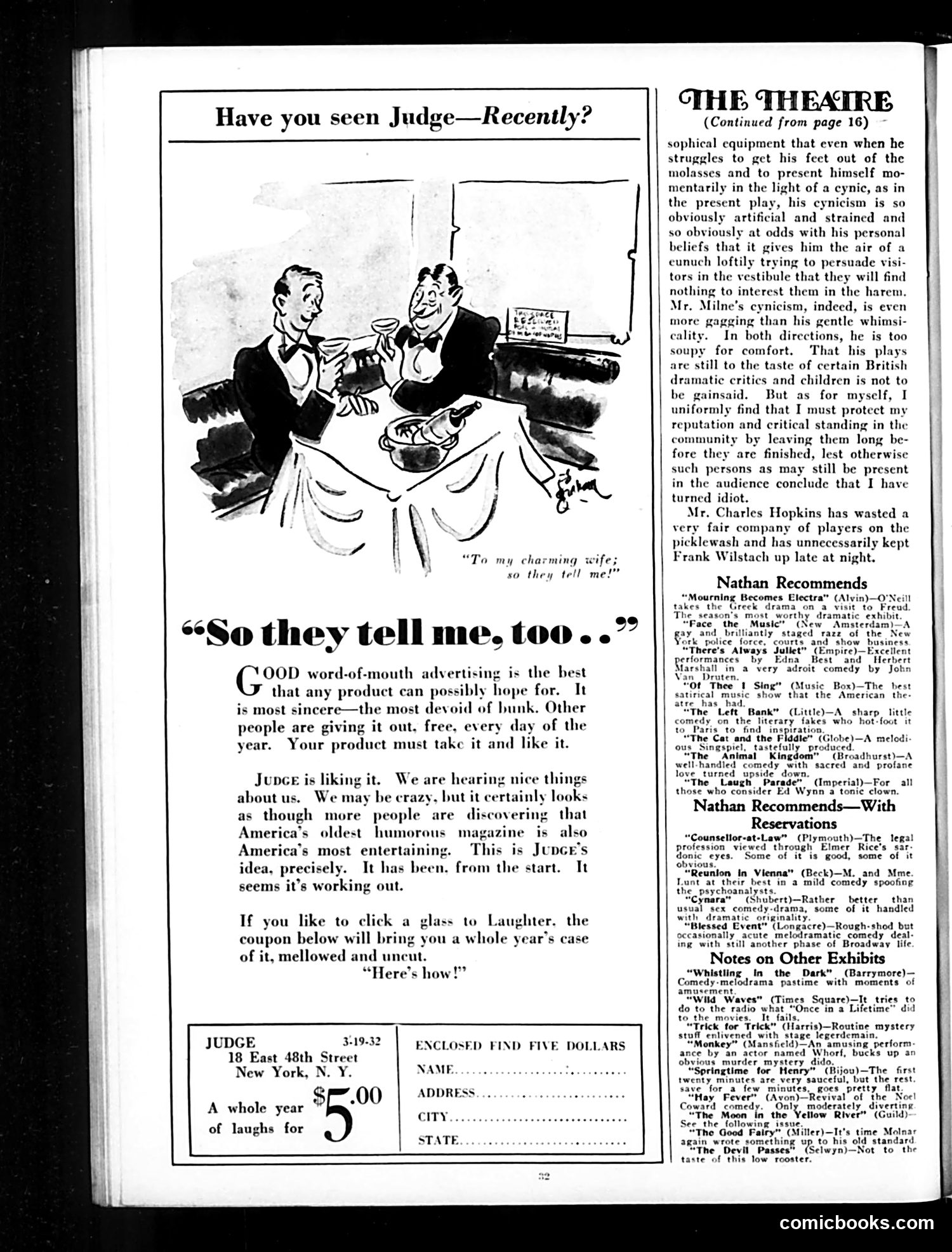
Analysis of Judge Magazine Page (March 19, 1932) This page primarily serves as a subscription advertisement for Judge magazine itself, using humor to promote word-of-mouth advertising. The Cartoon The illustration shows two men in formal attire at a dining table, with one telling his wife he's recommending Judge to others. The caption "So they tell me, too..." suggests the magazine's popularity is spreading through personal recommendations—the premise being that satisfied readers naturally promote it to friends. The Advertisement Judge offers a year's subscription for $5, marketing itself as "America's oldest humorous magazine" and "America's most entertaining." The ad emphasizes organic, unpaid word-of-mouth promotion as superior to traditional advertising. Context for Modern Readers In 1932 (Great Depression era), this self-promotional pitch highlights Judge's confidence in its appeal during economically difficult times. The magazine positions itself as affordable entertainment and leisure—a luxury product marketed through personal credibility rather than hype. The page also includes theater reviews by Nathan (likely George Jean Nathan), indicating Judge's coverage extended beyond humor to cultural criticism.
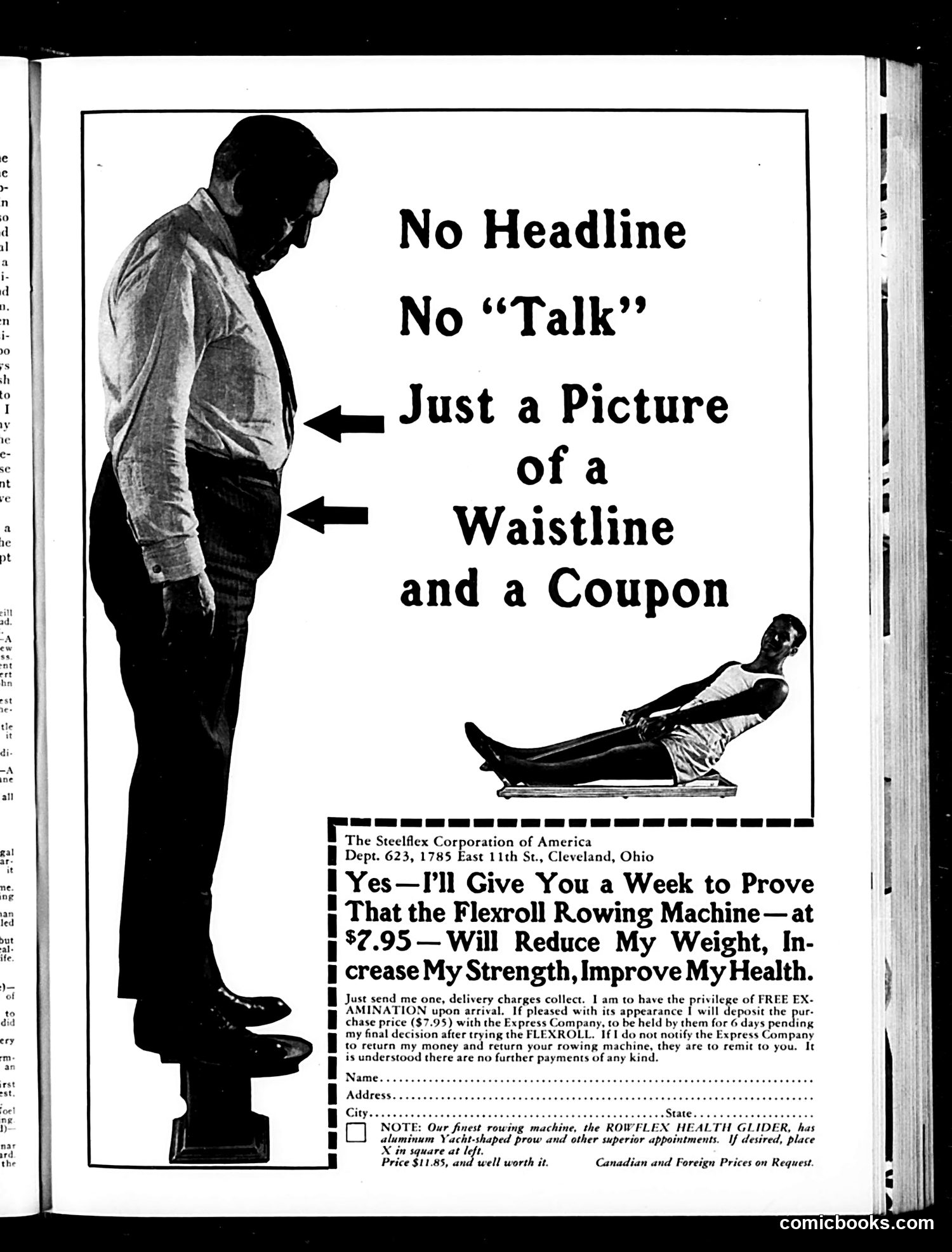
Analysis This is primarily a product advertisement, not political satire. It presents a Flexroll Rowing Machine from the Steelflex Corporation (Cleveland, Ohio), priced at $7.95. The "cartoon" element is visual humor: a large man standing on a scale, looking down at his substantial waistline, contrasts with an illustration of a lean man using the rowing machine below. The joke is the implied before-and-after transformation. The advertisement targets weight-conscious readers with familiar early-20th-century promises: weight reduction, increased strength, and improved health—all achievable through one simple machine. The "week-free trial" offer (with money held by Express Company) was a common sales tactic to overcome buyer hesitation. This represents the era's optimism about gadget-based fitness solutions and reflects widespread concern about weight and health among middle-class consumers. No specific political figures or events are referenced.
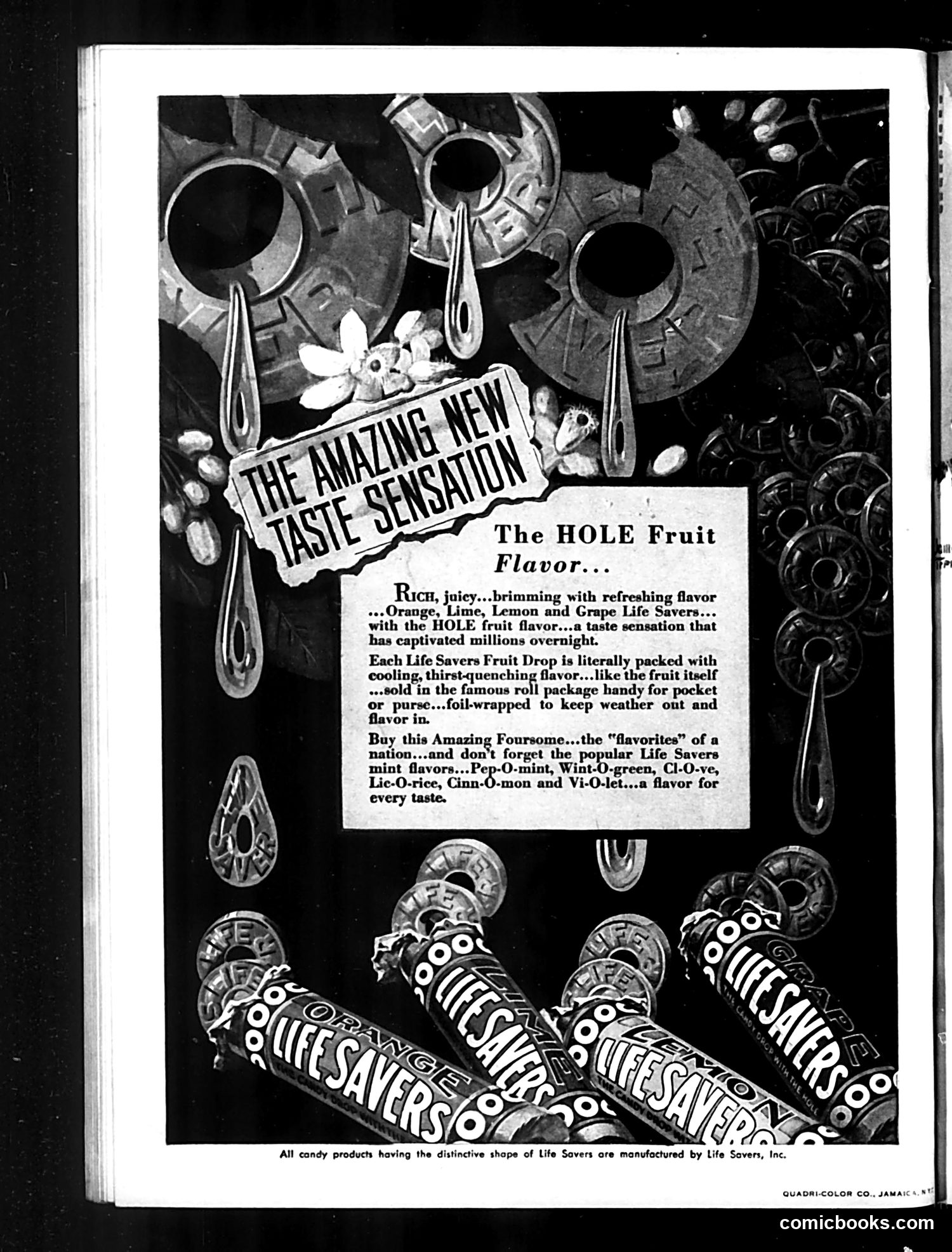
Analysis This page is primarily a Life Savers candy advertisement, not a political cartoon. It promotes the "amazing new taste sensation" of Life Savers Fruit Drops, emphasizing the distinctive "hole" in the candy and various fruit flavors (Orange, Lime, Lemon, Grape) plus mint varieties. The visual design uses spoons as stylized imagery, with oversized Life Savers packages displayed at the bottom. The artwork employs dramatic black-and-white contrast typical of 1920s-30s advertising. The humor—if any—is gentle wordplay: "the HOLE fruit flavor" puns on the candy's defining characteristic. The text emphasizes portability ("handy for pocket or purse") and the foil wrapper's functionality, appealing to modern consumer convenience concerns of the era. This represents Judge magazine's significant advertising content, not editorial satire.