judge
Judge — March 26, 1932
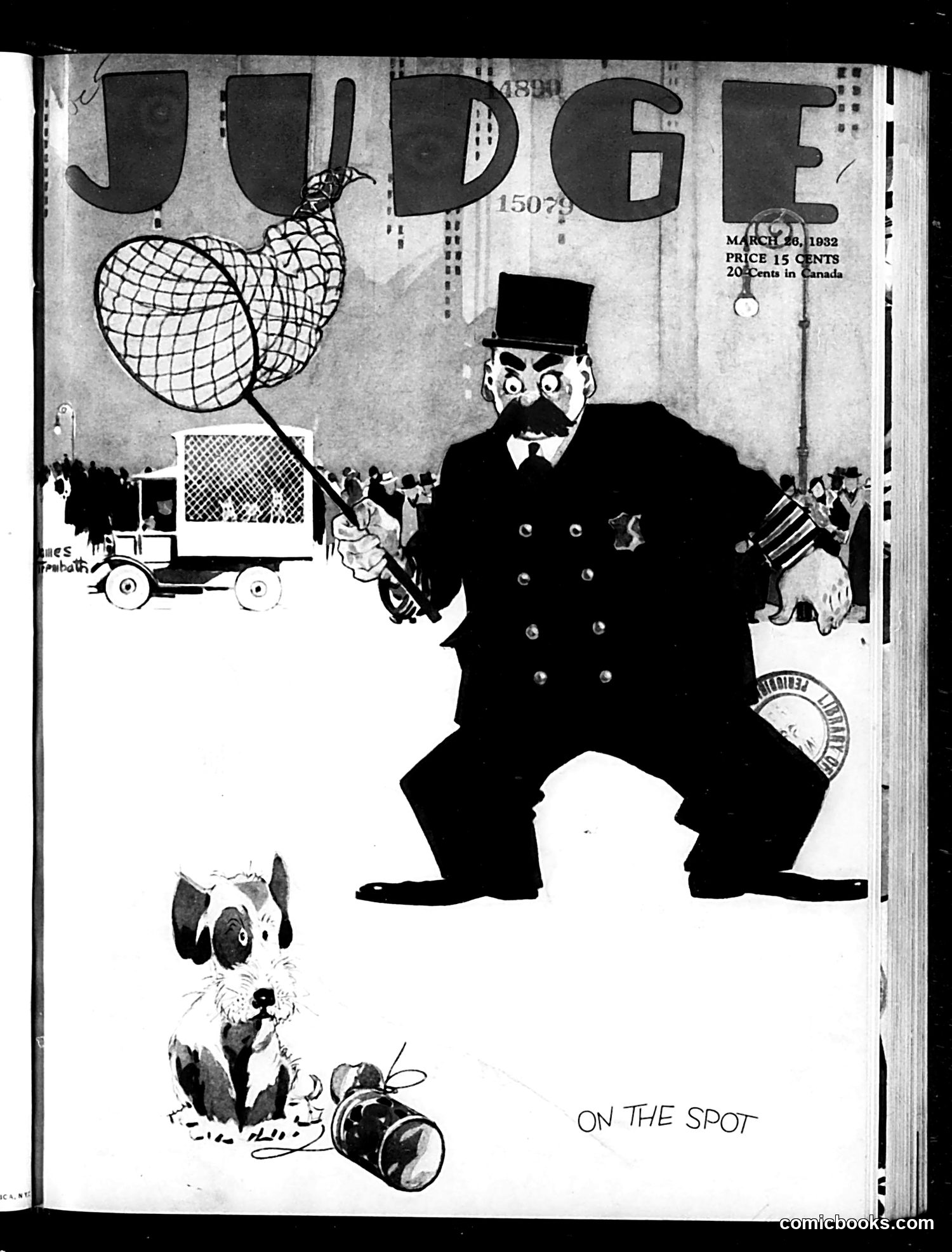
Judge Magazine Cover Analysis - March 26, 1932 This cover depicts a rotund, mustachioed man in formal attire (top hat and double-breasted coat) dominating the composition. The exaggerated caricature and prominent positioning suggest he represents a figure of authority or notoriety during the early Depression era. The title "ON THE SPOT" indicates vulnerability or danger. Background elements include a circus wagon, animals, and crowds—suggesting either chaos or spectacle surrounding this figure. The specific identity of the caricatured man remains unclear without additional context, though his theatrical costume and the menacing phrase suggest this critiques a political or public figure facing scrutiny or legal jeopardy during 1932—a significant year of economic crisis and political upheaval in America.
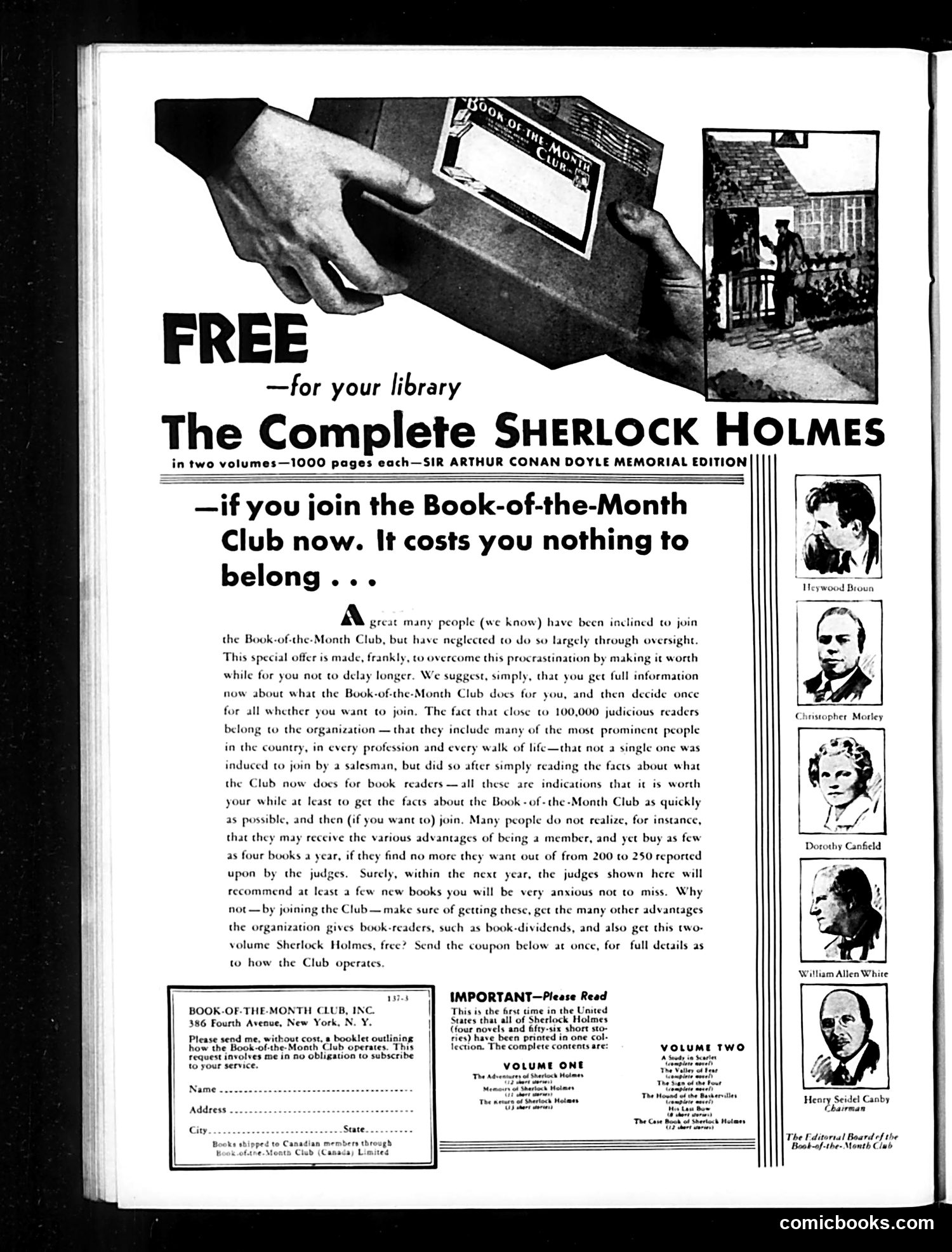
Analysis This page is primarily a Book-of-the-Month Club advertisement, not political satire. The ad promotes a free two-volume "Complete Sherlock Holmes" memorial edition to new club members. The imagery shows a hand holding a book and a domestic scene, emphasizing the club's appeal to educated readers. The right side displays portraits of the Editorial Board members: Heywood Broun, Christopher Morley, Dorothy Canfield, William Allen White, and Henry Seidel Canby—prominent American literary figures of the 1920s-30s, lending credibility to the club's selections. The text addresses reader hesitation about joining, arguing that membership offers book dividends and curated selections from respected judges. There's no political cartoon or satire here—this is straightforward commercial promotion using literary authority figures as endorsement.
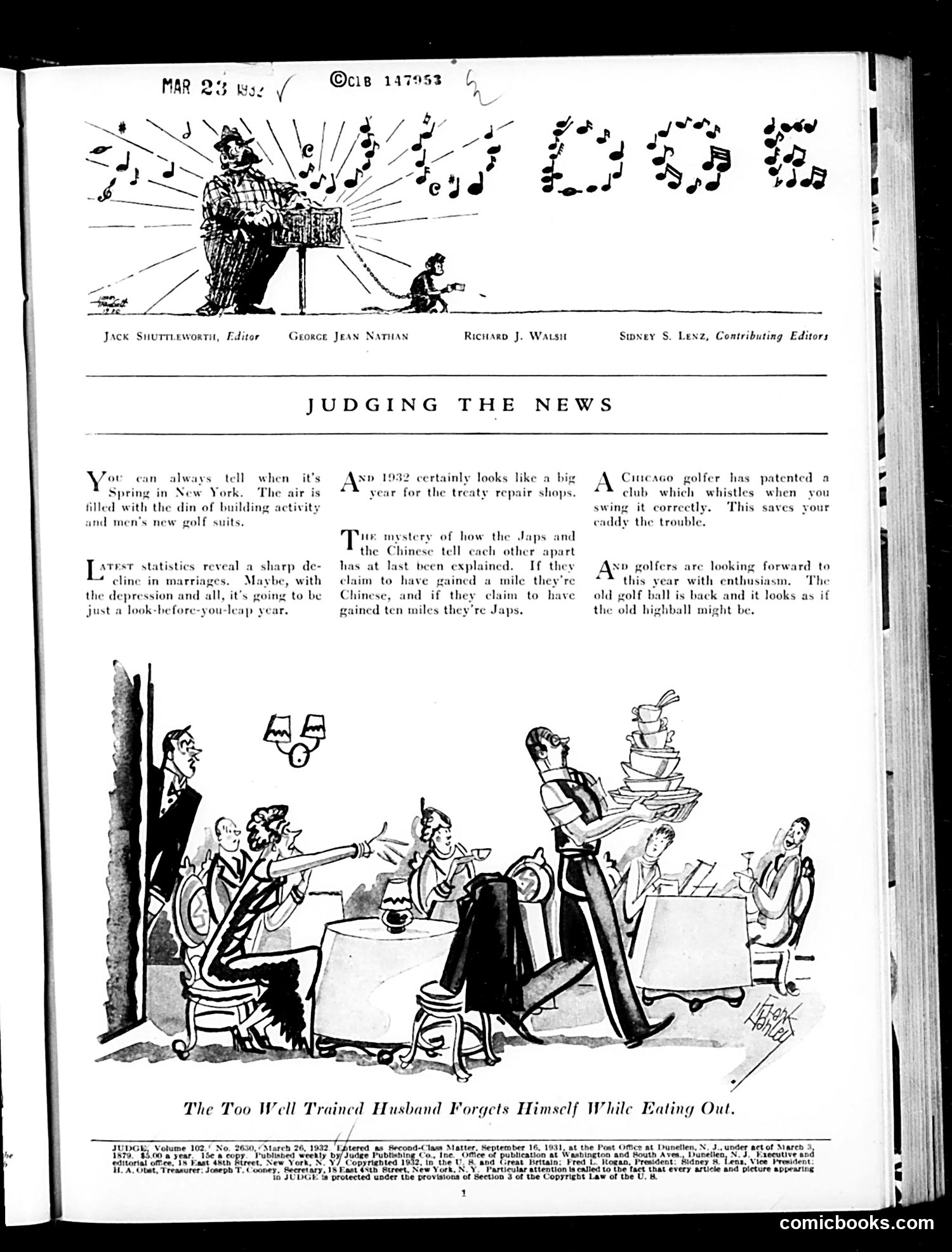
"Judging the News" - March 23, 1932 This satirical page addresses 1932 current events through brief commentary and a cartoon. The main illustration, titled "The Too Well Trained Husband Forgets Himself While Eating Out," depicts a domestic comedy scene: a well-dressed couple dining at a restaurant, where the husband appears to be gesturing or behaving as though still at home—likely treating servers or his wife with the casual informality of domestic life rather than restaurant etiquette. The surrounding text items mock contemporary concerns: building activity (suggesting economic speculation), marriage decline statistics, Japanese-Chinese military tensions, and golf equipment patents. The satire targets middle-class social pretensions and gender dynamics, where domesticity bleeds awkwardly into public spaces.
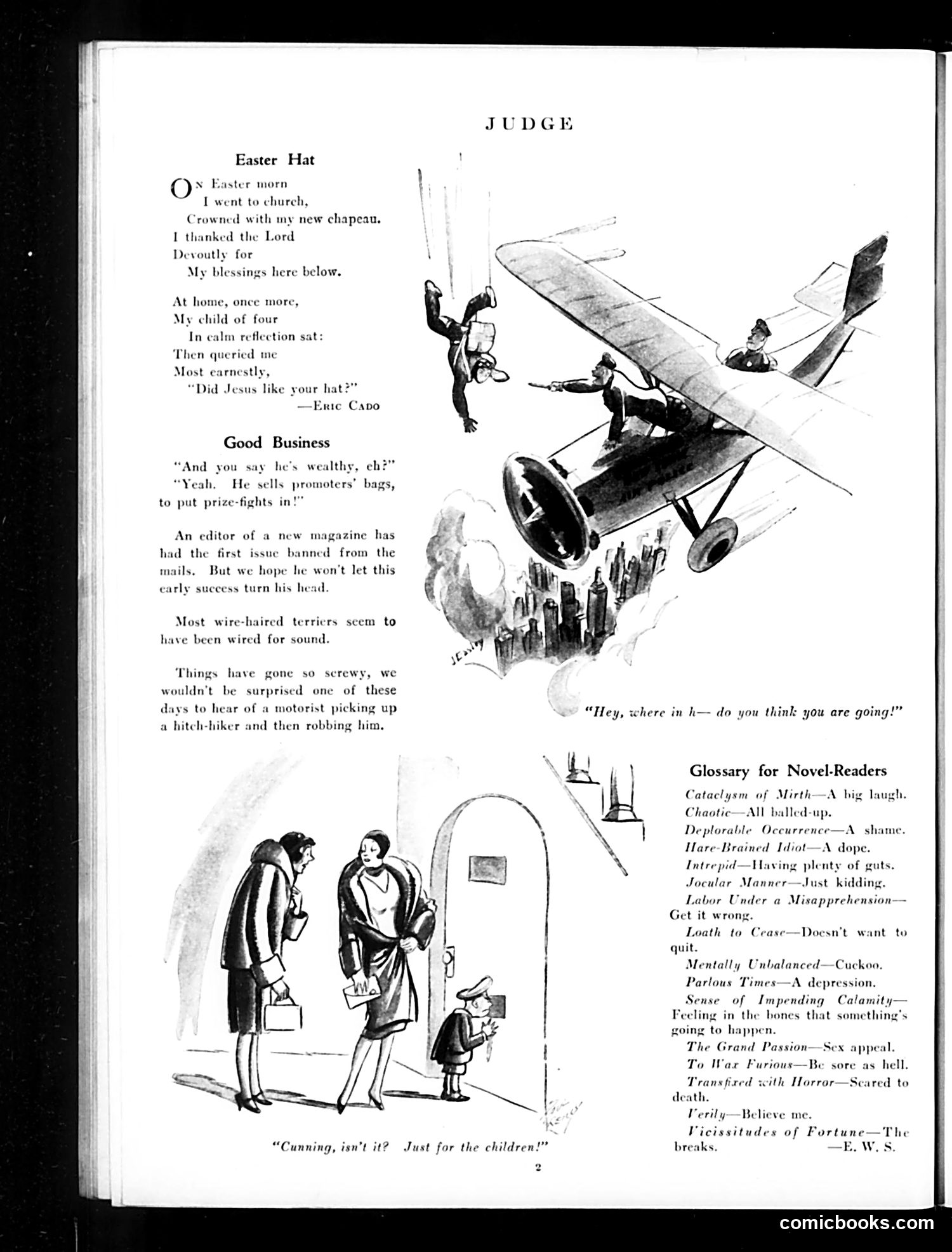
Analysis of Judge Page This page contains three satirical pieces and a glossary: "Easter Hat" mocks religious hypocrisy—a child asks if Jesus would like the parent's new chapeau, suggesting vanity during religious observance. "Good Business" satirizes wealth and moral compromise: a man who sells "promoters' bags" for prize-fights is deemed successful, despite profiting from potentially corrupt enterprises. The airplane cartoon depicts a pilot recklessly endangering passengers over a city, captioned "Hey, where in h— do you think you are going?"—likely satirizing dangerous early aviation practices or unregulated flying. The street scene shows adults discussing their cunning schemes "just for the children"—ironic commentary on parental hypocrisy. The glossary defines period slang and literary terms, suggesting this issue targeted educated, humorous readers familiar with contemporary novels.
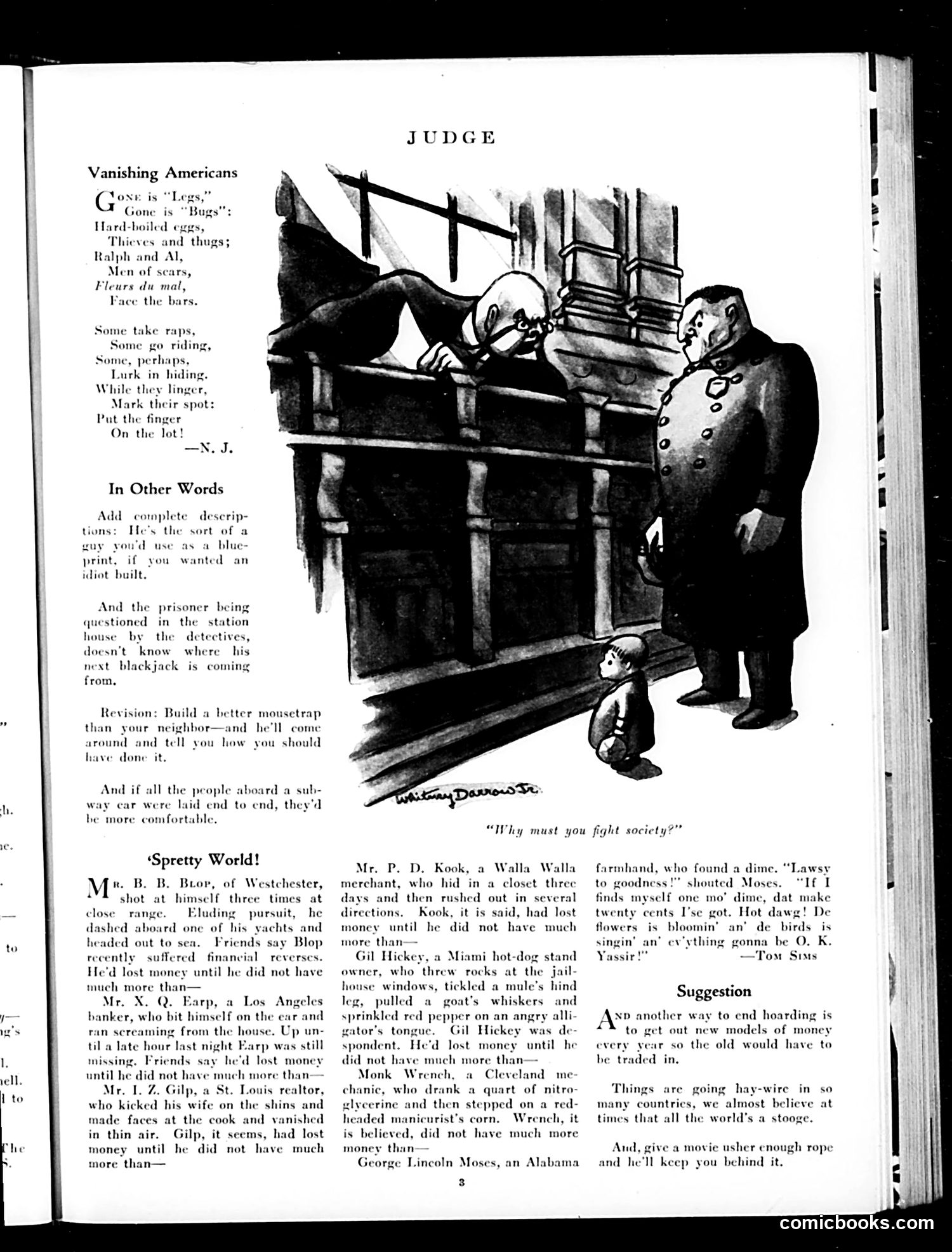
Analysis of Judge Page The main cartoon titled "Why must you fight society?" depicts a judge sentencing a prisoner while a small child watches. The satire critiques judicial hypocrisy: the judge lectures the prisoner about lawlessness while society's own injustices continue unchecked. The "Vanishing Americans" poem satirizes various criminal types—thieves, con artists, corrupt officials—using period slang ("Legs," "Bugs"). The irony suggests these "vanishing" criminals are actually thriving despite legal systems meant to stop them. The "Prettier World!" section lists anecdotes of businessmen and professionals who lost fortunes through dishonesty or misfortune, with the recurring phrase "had lost money until he did not have much more than—" The satirical point: respectable society engages in the same unethical behavior judges condemn in criminals.
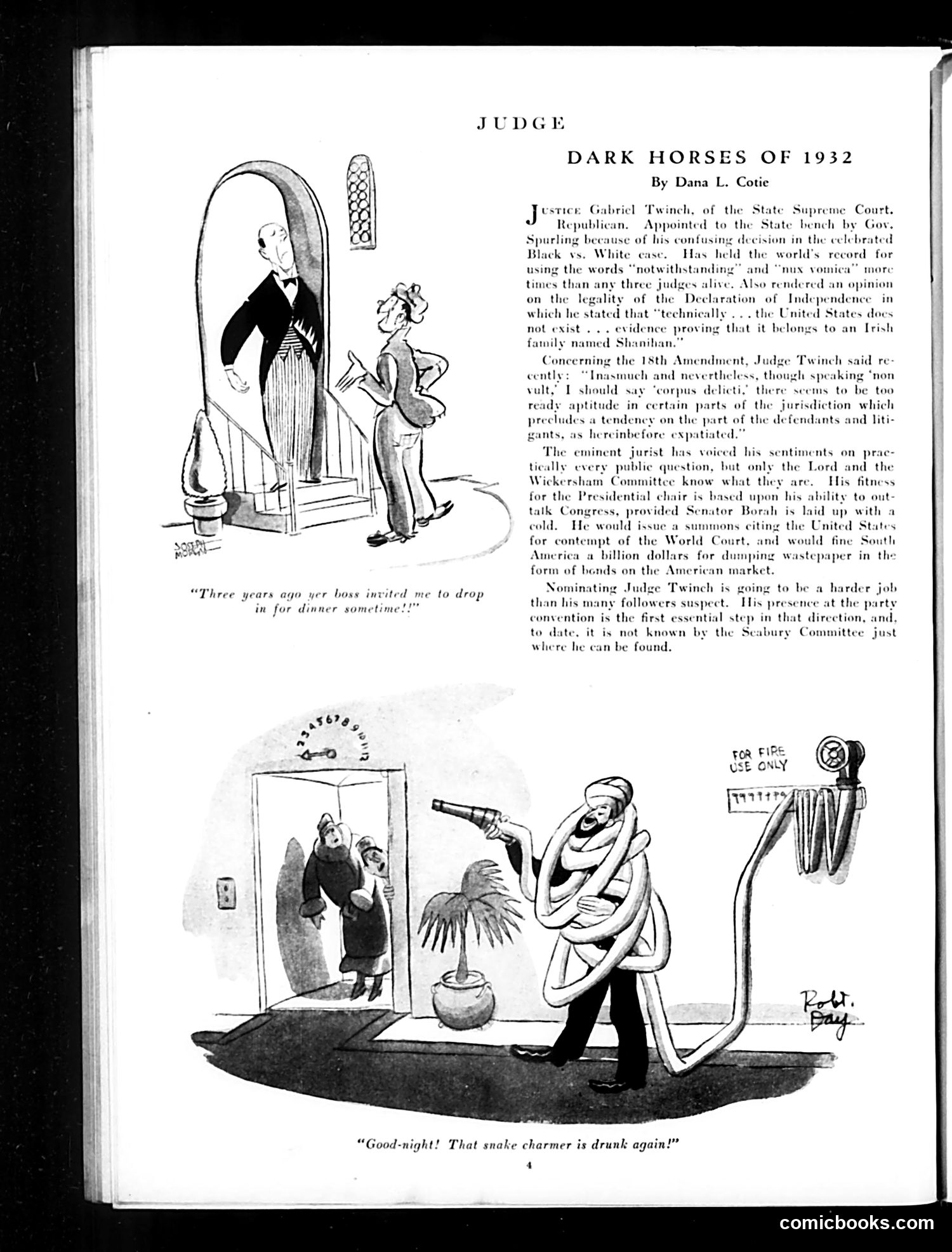
Analysis of "Judge" Page: Dark Horses of 1932 This page satirizes Judge Gabriel Twinch, a Republican Supreme Court justice known for controversial rulings. The text praises his legal opinions while mocking his fitness for higher office—the article suggests nominating him for President would be difficult because his whereabouts are unknown. The top cartoon shows a woman inviting a man to dinner, referencing a past social obligation he forgot—likely satirizing Twinch's unreliability or absent-mindedness. The bottom cartoon depicts a drunken "snake charmer" (labeled "FOR FIRE USE ONLY"), suggesting corruption or incompetence in judicial circles during the 1932 election year. The "dark horse" title references unexpected political candidates, implying Twinch's unsuitability despite Republican backing.
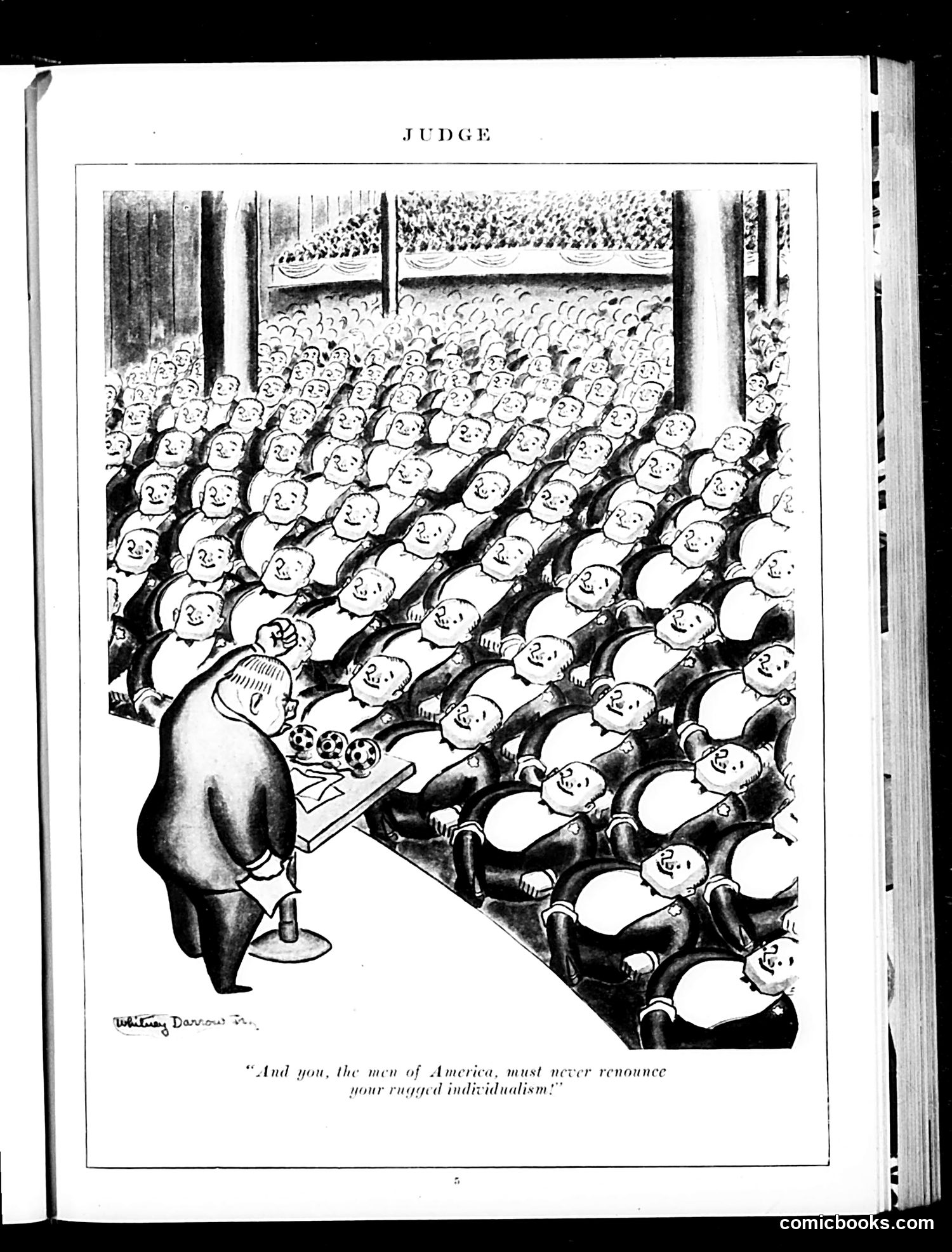
Analysis of "Judge" Cartoon This political cartoon depicts a judge addressing a courtroom packed with identical-faced jurors or citizens. The caption reads: "And you, the men of America, must never renounce your ragged individualism!" The satire works through stark irony: the judge preaches about preserving "rugged individualism"—a core American ideal—while addressing an audience rendered completely uniform and faceless. Every person appears identical, suggesting conformity rather than individuality. This likely critiques either judicial hypocrisy, mass society's homogenizing effects, or perhaps early-20th-century concerns about standardization eroding American character. The judge himself appears as an authority figure demanding individualism while presiding over a system that produces conformity. The cartoon's point: America's institutions contradict their stated values.
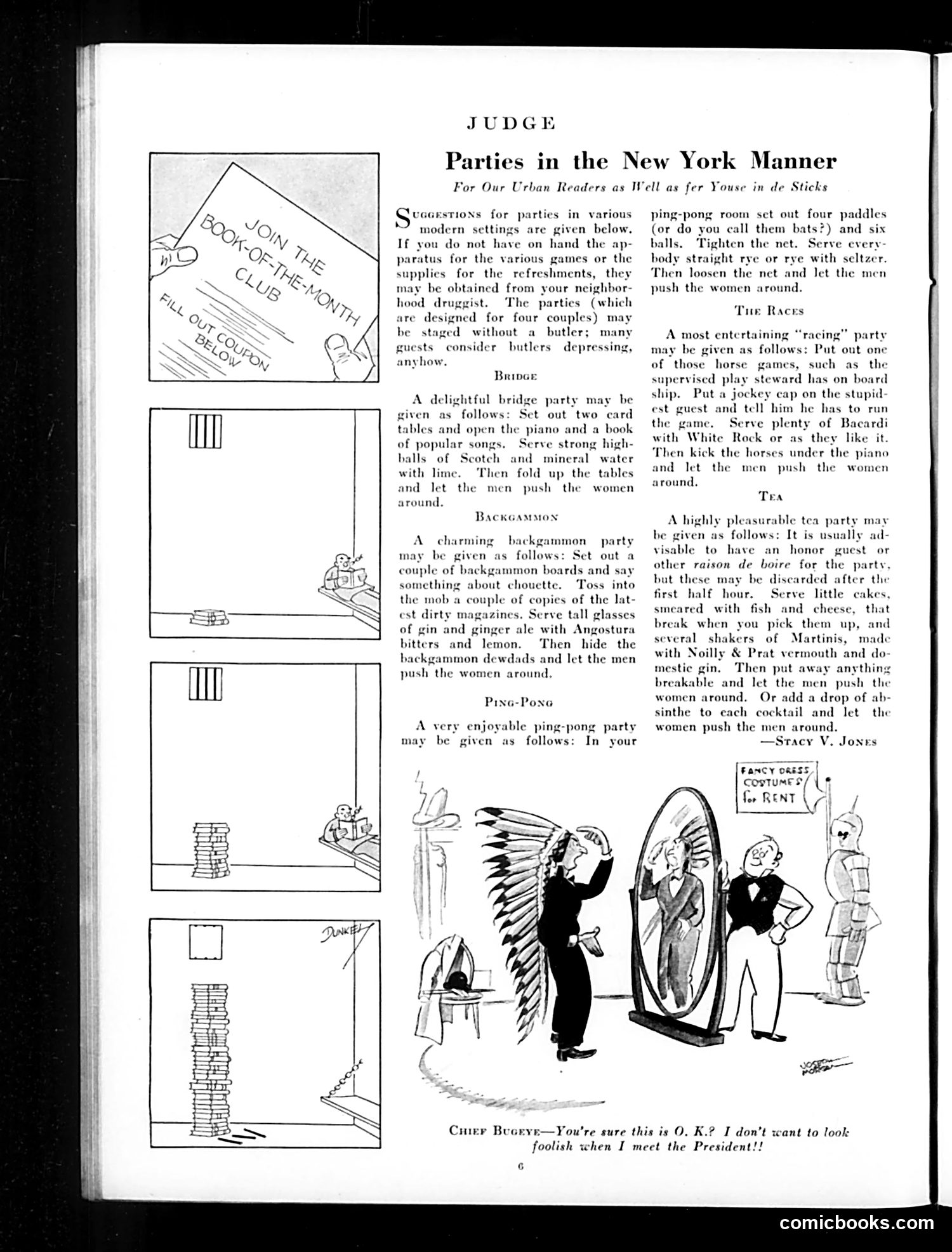
Analysis This page from *Judge* magazine contains party-planning advice rather than political satire. The left side offers suggestions for hosting bridge, backgammon, ping-pong, and tea parties in modern settings, with illustrated diagrams showing room layouts. The main cartoon (lower right) depicts a Native American chief in full headdress trying on fancy dress costumes, apparently concerned about appearance before meeting the President. The humor appears to rely on the stereotype of Indigenous peoples being unfamiliar with formal attire and social conventions. A caption reads: "Chief Buckeye—You're sure this is O.K.? I don't want to look foolish when I meet the President!!" The joke likely references contemporary diplomatic visits or photo opportunities involving Native American delegations to Washington.
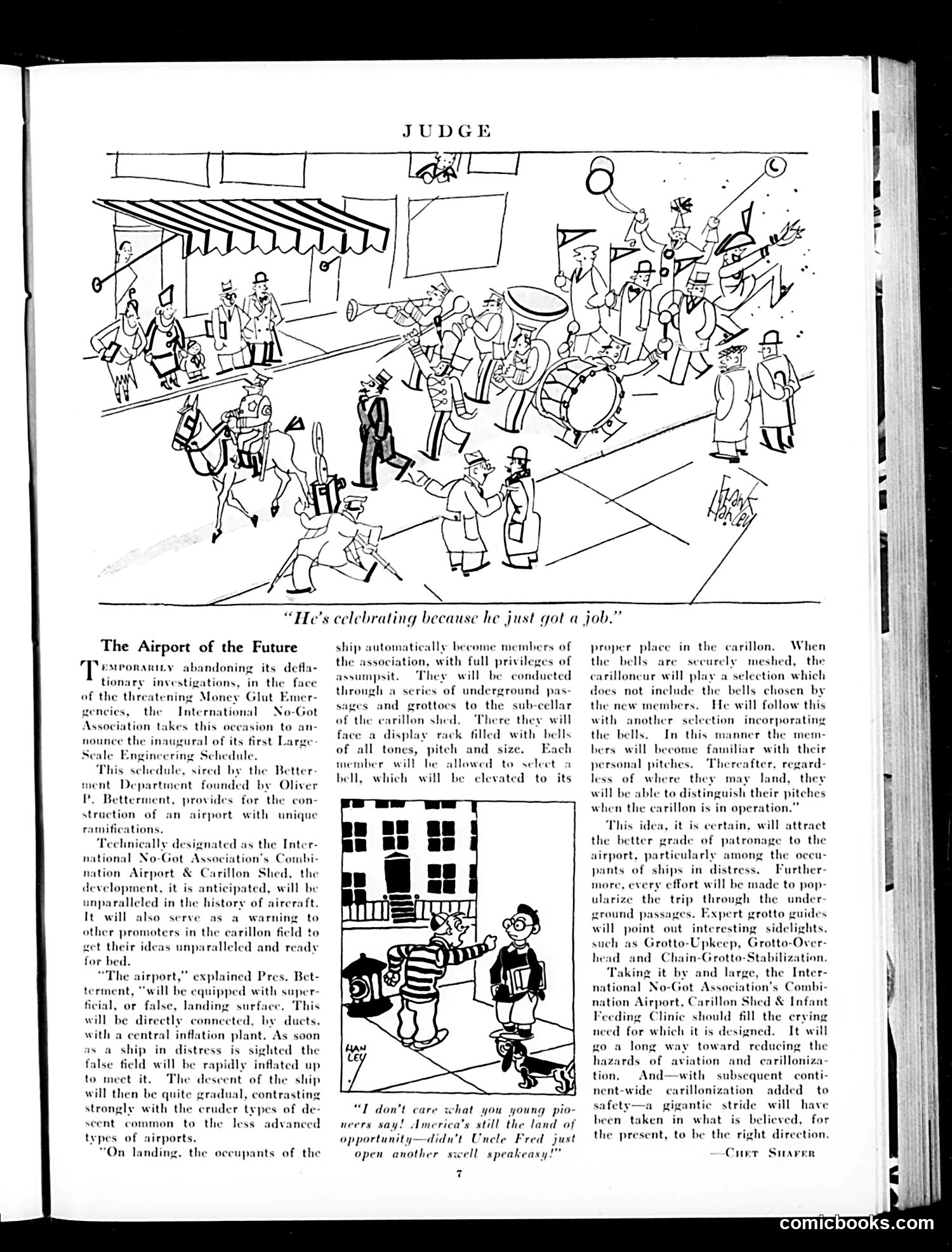
Explanation for Modern Readers This Judge magazine page satirizes 1920s-30s American corporate boosterism and absurd "futuristic" schemes. The main cartoon mocks Depression-era optimism through a fictional "Airport of the Future"—a deliberately nonsensical contraption combining an airport with a carillon (bell tower). The satire targets: 1. Grandiose corporate rhetoric: The "Better-ment Department" and pseudo-technical jargon ("superficial landing surface," "assumpsit") parody how businessmen dressed up ridiculous ideas in impressive language. 2. Inflatable safety solutions: The "false landing surface" that inflates to catch crashing planes lampoons impractical technological "fixes." 3. Forced membership schemes: Automatic association membership for landing passengers satirizes exploitative corporate practices. The sidebar cartoon about Uncle Fred's speakeasy undercuts the main article's optimism, sardonically noting Prohibition-era corruption persists despite talk of progress and opportunity. Overall, Judge mocks the gap between American business promises and reality.
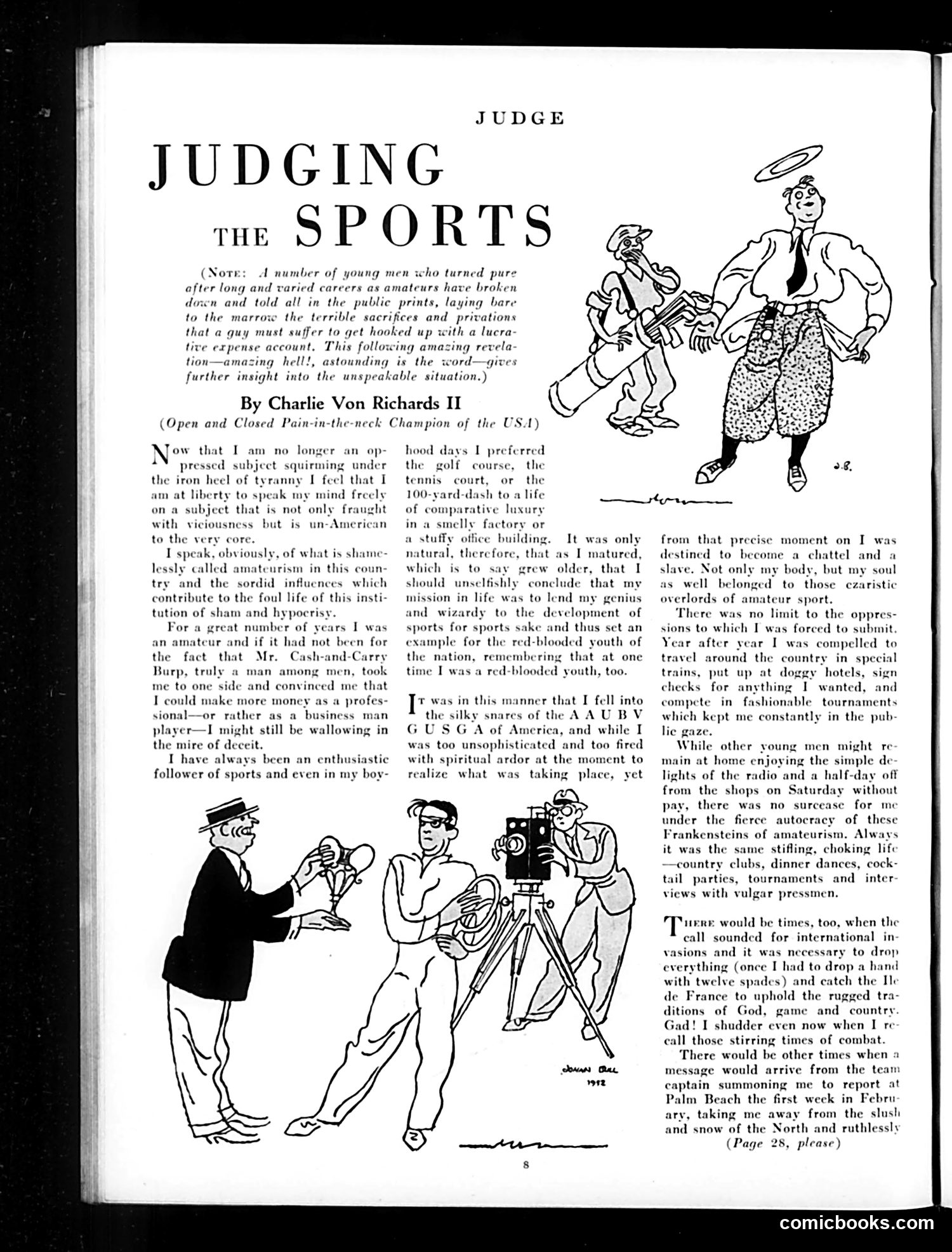
"Judging the Sports" - Judge Magazine Satire This satirical article by Charlie Von Richards II mocks the hypocrisy of "amateur" athletics in 1920s America. The author, presented as a former amateur athlete turned professional, exposes how so-called amateurs were actually receiving lavish compensation—fancy hotels, travel expenses, tournament fees—while maintaining the fiction of pure amateurism. The satire targets organizations like the AAU (Amateur Athletic Union) and USGA (golf), which enforced strict amateurism rules while allowing wealthy athletes to live luxuriously. Von Richards ironically complains that being an "amateur" was oppressive: forced globe-trotting, mandatory country club appearances, and constant public scrutiny—all while pretending to compete for the sport's sake alone. The joke is that these "amateurs" suffered no actual hardship; they enjoyed more privileges than working men with Saturday half-days off. The piece ridicules both the corrupt system and athletes' self-pitying complaints about their "chains."
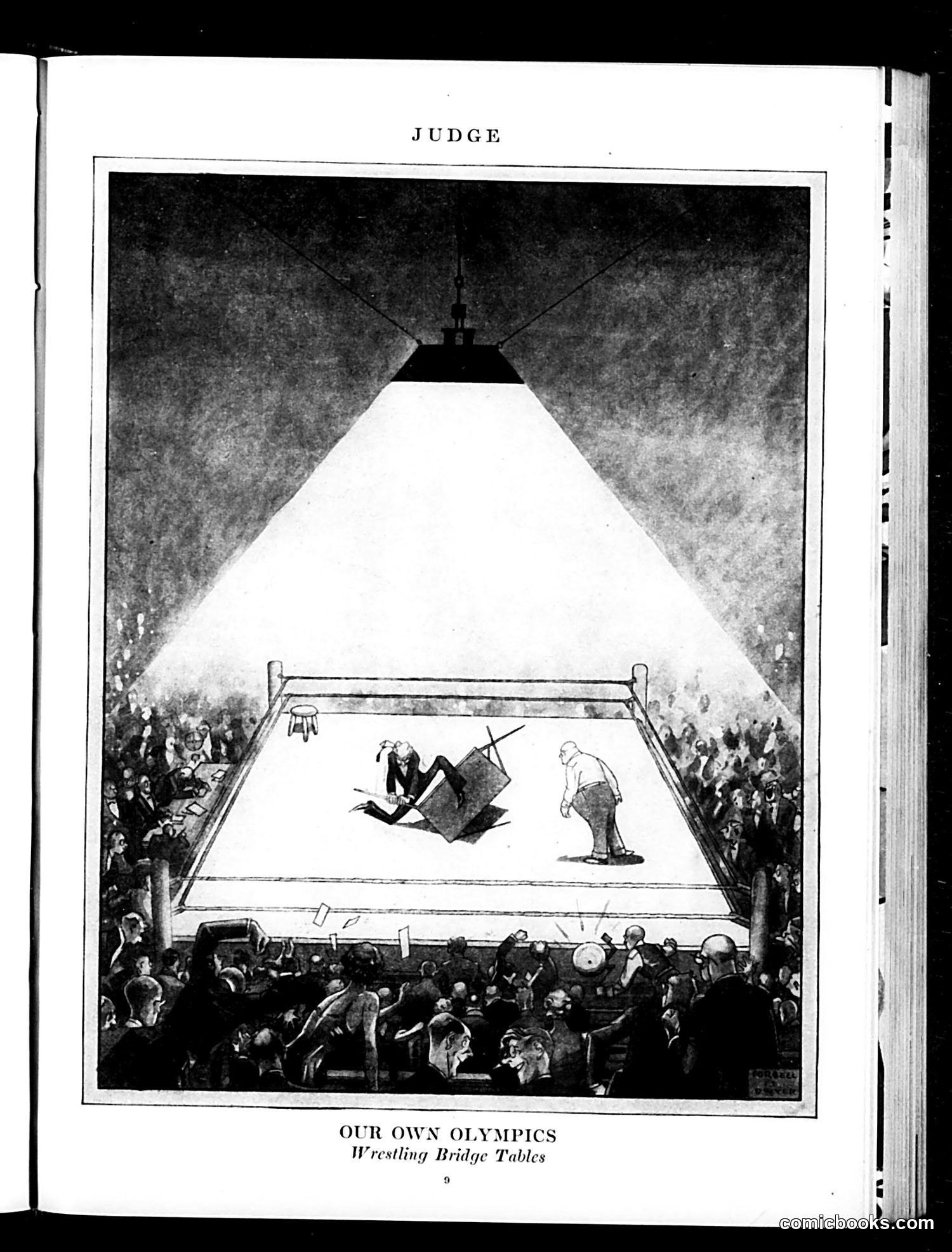
"Our Own Olympics: Wrestling Bridge Tables" This satirical cartoon mocks the social pretensions of upper-class Americans who treat bridge—a card game—as serious competitive sport. The image shows a wrestling ring filled with spectators, with two figures apparently engaged in physical combat over a bridge table under dramatic spotlight, mimicking actual Olympic wrestling. The joke targets the absurdity of wealthy leisure activities being treated with Olympic-level intensity and spectacle. By literally depicting bridge players "wrestling" in an arena, Judge ridicules how seriously some Americans took this card game, elevating it to mock-heroic status. The crowded venue and theatrical lighting emphasize the exaggeration, suggesting that bridge tournaments among the elite were becoming increasingly elaborate and ridiculous social events worthy of parody.
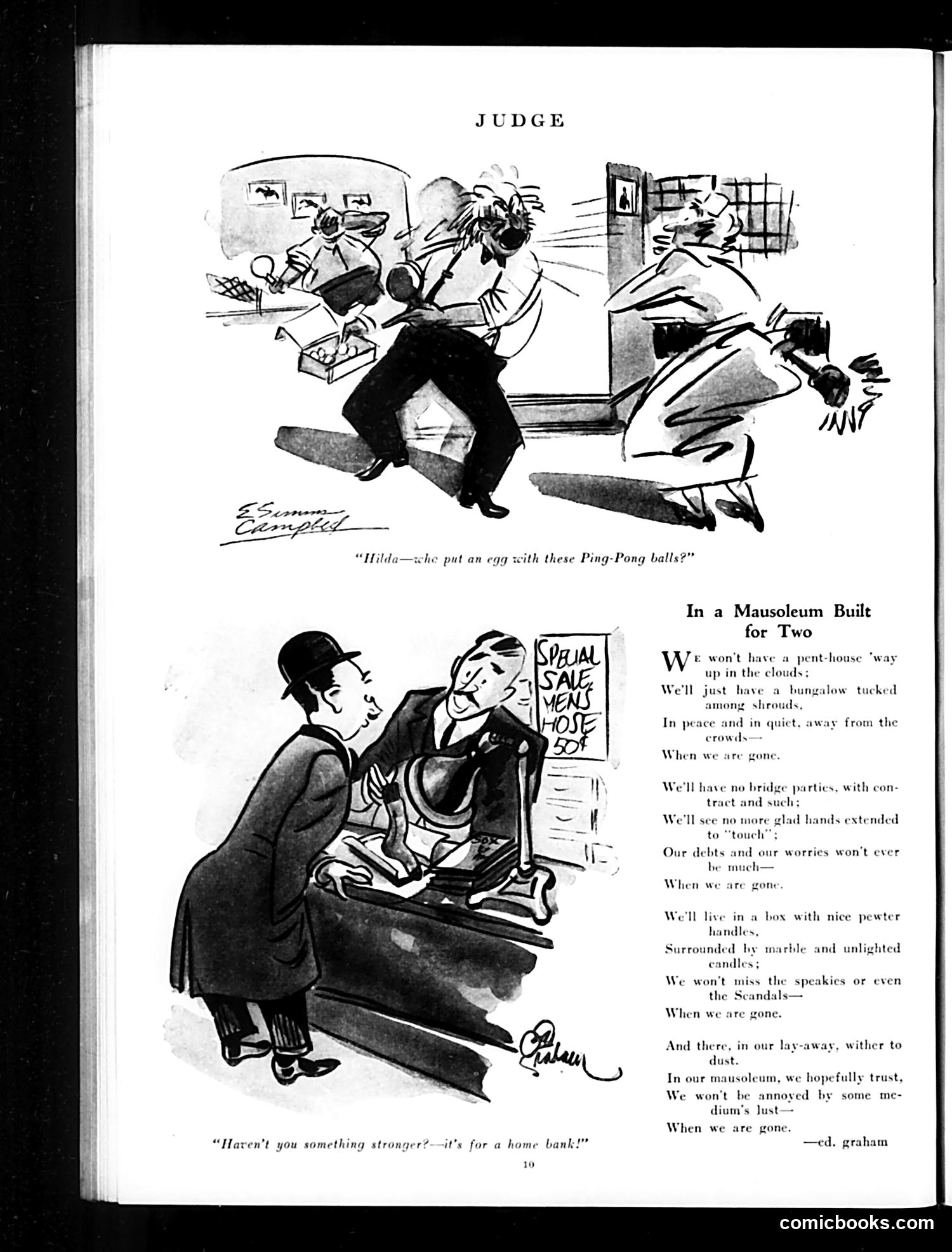
Analysis of Judge Page Top Cartoon ("Ping-Pong balls"): A judge sits bewildered while two figures (likely a husband and wife) argue animatedly before him. The caption suggests confusion about domestic disputes—possibly about a woman named Hilda mixing an egg with ping-pong balls, implying absurd marital quarrels the judge must arbitrate. This satirizes trivial divorce or domestic cases cluttering the courts. Bottom Cartoon ("Home bank"): A man at a "Special Sale" counter asks a salesman for "something stronger" for a "home bank," implying he wants liquor. This references Prohibition-era speakeasy culture and the irony of hiding alcohol in banks during that period. Poem "In a Mausoleum Built for Two": Dark satire about post-mortem peace—escaping bridge parties, social obligations, debts, and scandals. References "speakies" (speakeasies) and scandals of the Jazz Age, suggesting relief from 1920s social pressures. The page satirizes 1920s American anxieties: marital discord, Prohibition enforcement, and social exhaustion.
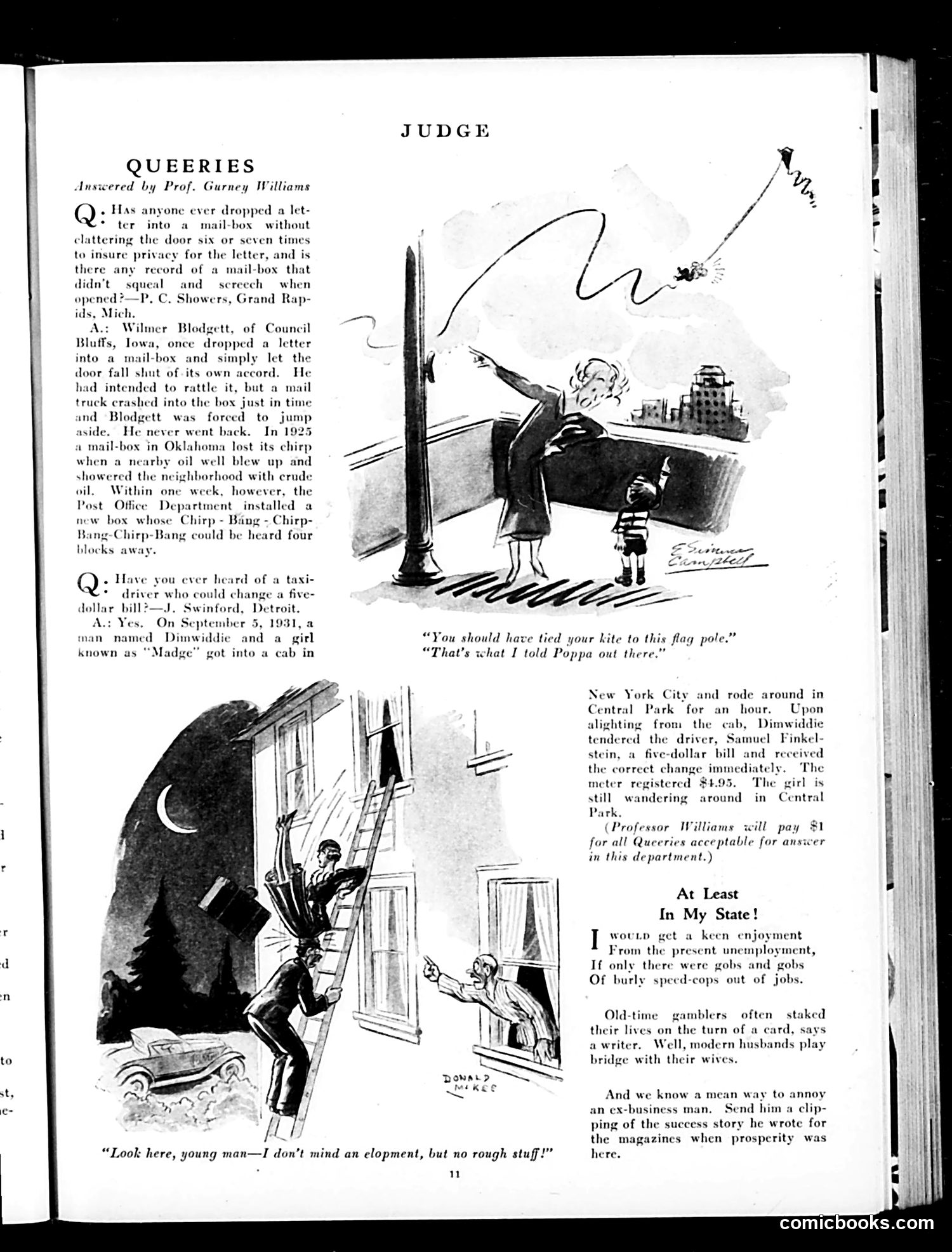
Judge Magazine Satirical Content Analysis This page contains three humorous "queries" mocking everyday American quirks: The Mail-Box Query satirizes people's anxiety about privacy—the obsessive rattling of mailbox doors. The joke: one man's mail box was destroyed by a truck before he could even rattle it, yet the Post Office replaced it with an even louder model. The Taxi Driver Query jokes about a taxi driver who actually *could* make change from a five-dollar bill—a seemingly impossible feat. The absurd punchline: a passenger still wanders Central Park because the driver gave correct change, implying this miraculous event was so rare it left her bewildered. The Cartoon shows a child's kite tied to a flagpole instead of properly anchored, with a parent scolding an apparent suitor about "rough stuff" during an elopement—mixing up causes and consequences for comedic effect. The "At Least in My State!" poem satirizes unemployment during what appears to be the Depression era, contrasting old gamblers' card games with modern husbands playing bridge with wives—a dig at domestic monotony over actual risk-taking.
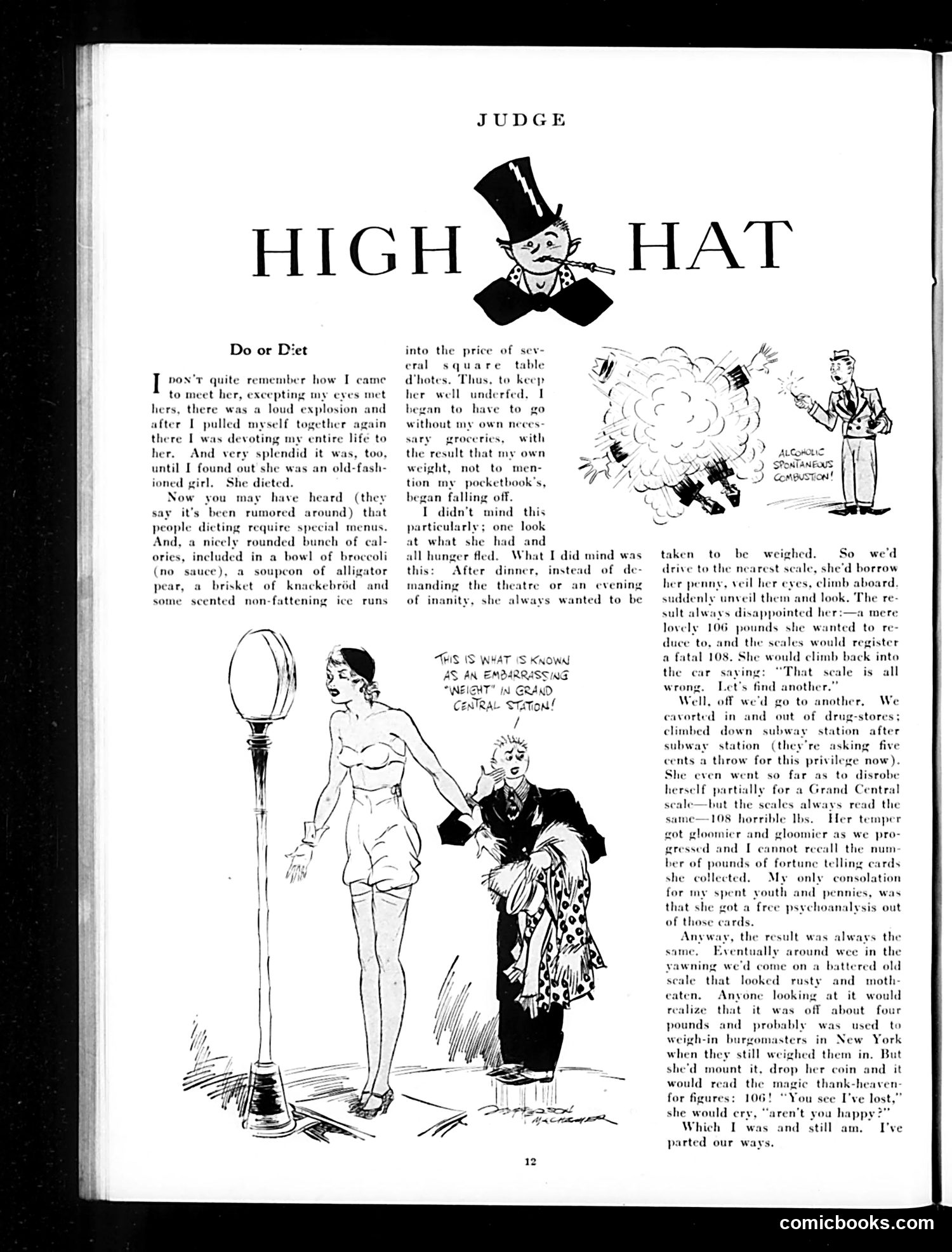
"High Hat: Do or Diet" This humorous story-cartoon satirizes the 1920s dieting craze among women. The narrator describes his romantic entanglement with a fashionable young woman obsessed with weight loss—she constantly wants to be weighed at various scales throughout New York City (drugstores, subway stations, Grand Central Terminal). The satire targets several things: the absurdity of women's obsessive calorie-counting, the proliferation of public scales as commercial enterprises, and the psychological toll dieting takes on both the dieter and her companion. The couple's repeated trips to find "accurate" scales that show lower weights, combined with her consulting fortune tellers about her weight, mocks the pseudo-scientific and superstitious attitudes surrounding weight management. The cartoon illustrations show the woman being weighed and consulting a fortune teller, emphasizing the vanity and obsession driving the behavior. Ultimately, the relationship ends over this futile pursuit of an impossible goal (106 pounds).
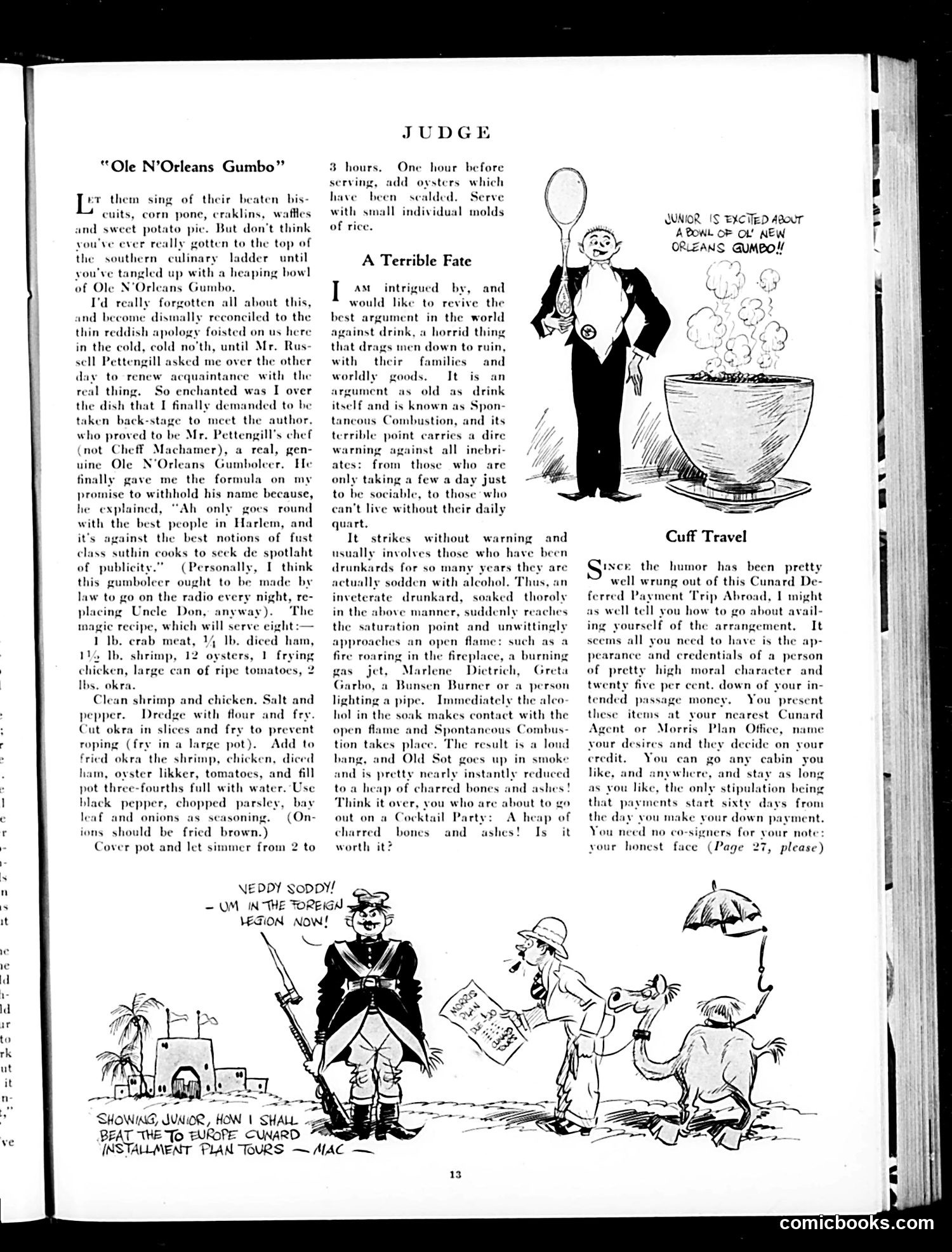
Judge Magazine Page Analysis This page contains three distinct pieces of satirical content: "Ole N'Orleans Gumbo" (top left): A humorous recipe article mocking Southern cuisine and a mysterious chef who refuses publicity, claiming he "only goes round with the best people in Harlem" — satirizing pretentious social climbing and affected speech patterns. "A Terrible Fate" (center): A temperance cautionary tale about "Spontaneous Combustion" — the pseudo-scientific (and clearly fictional) phenomenon where chronic alcoholics supposedly ignite from internal heat when approaching open flames. This is dark satire against prohibition-era anti-drinking propaganda, mocking exaggerated warnings about alcohol's dangers. "Cuff Travel" (right): Commentary on Cunard Line's installment payment plans for European cruises, suggesting that working-class people can now afford luxury travel if they have "pretty high moral character" and 25% down payment — satirizing the democratization of previously exclusive leisure travel and the moral judgments attached to consumer credit. The cartoons below show a sailor abroad and someone arranging a European tour, reinforcing travel themes.
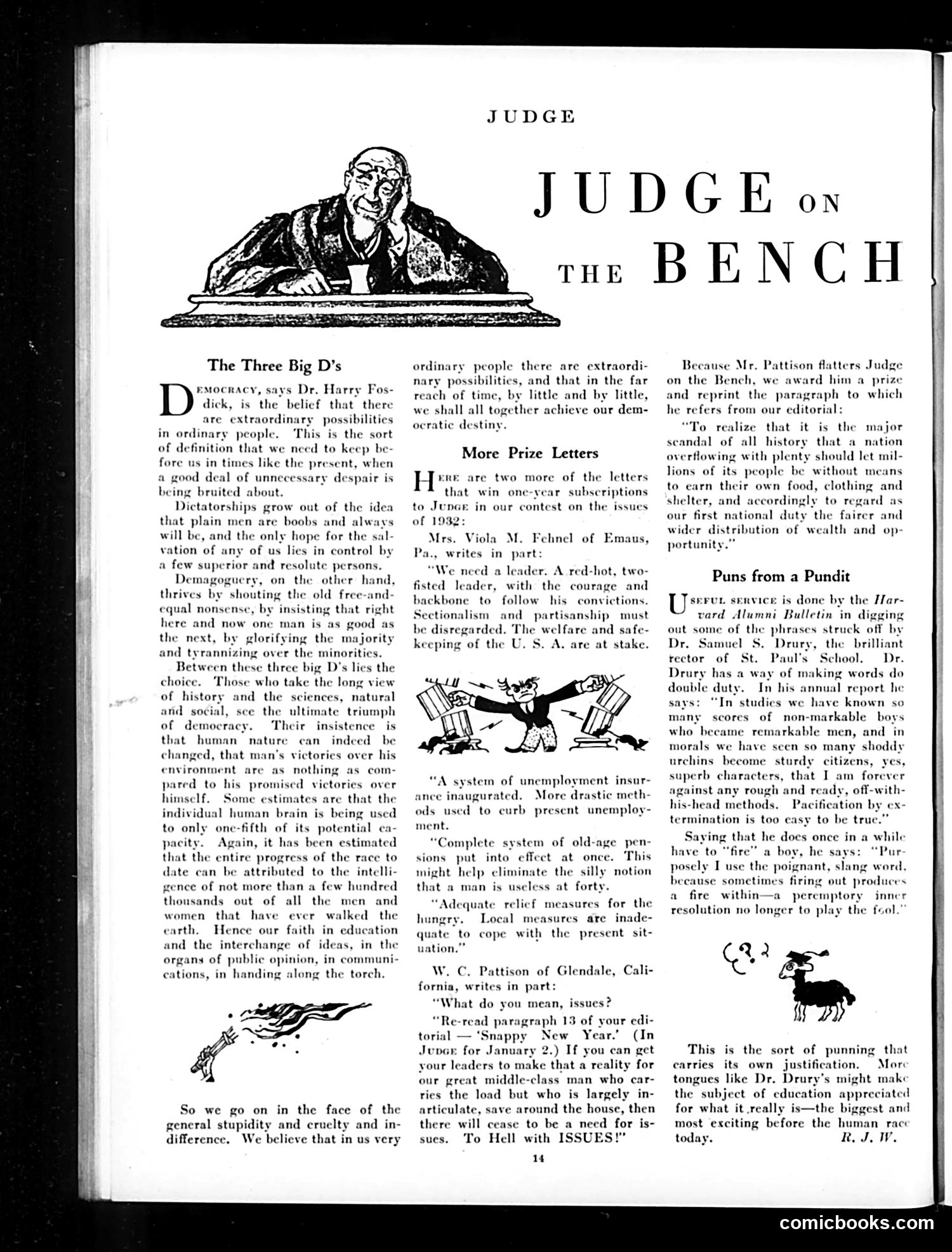
This page from *Judge* magazine presents 1930s-era social and political commentary through both serious editorial content and satirical humor. The main article discusses three competing systems: Democracy (faith in ordinary people's potential), Dictatorship (belief in elite control), and Demagogy (mob rule). The piece optimistically argues that humanity's unused intellectual capacity and historical progress demonstrate democracy's ultimate triumph. Below, readers' prize-winning letters address Depression-era concerns: unemployment insurance, old-age pensions, and wealth redistribution—practical demands targeting economic inequality. W.C. Pattison's letter sarcastically dismisses "issues," arguing the real problem is the struggling middle-class breadwinner's lack of basic dignity and resources. The "Puns from a Pundit" section humorously quotes Dr. Samuel Drury from Harvard, illustrating how educated figures weaponize wordplay—here, mockingly dismissing pacifism as too passive for serious times. Overall, the page balances earnest Depression-era reform advocacy with comedic relief, reflecting *Judge*'s role as both social critic and entertainer during economic crisis.
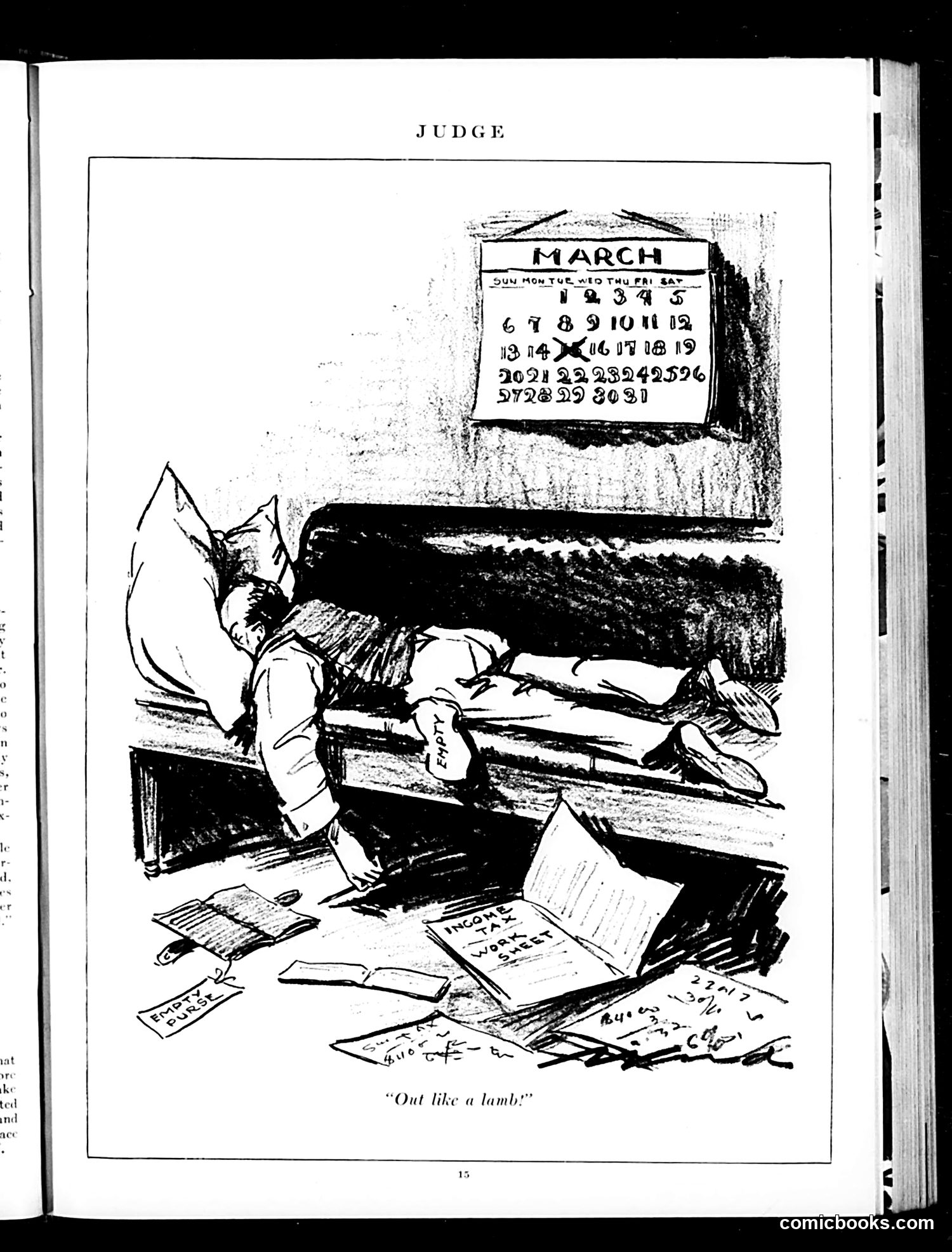
"Out Like a Lamb!" This cartoon satirizes the phrase "March comes in like a lion, goes out like a lamb"—a weather proverb. The image shows a disheveled figure (likely representing March or winter) surrounded by scattered legal documents, law books, and papers labeled with court cases and legal matters. The character appears exhausted, slumped among the debris. The satire suggests that March, rather than gently exiting, is instead worn down and defeated by legal proceedings—possibly referencing tax season (March income tax deadlines were relevant historically) or other legal obligations that burden people at month's end. The calendar visible in the background confirms the March setting. The joke: March doesn't exit gracefully "like a lamb"—it exits battered and overwhelmed "like a lamb" that's been through the legal system.
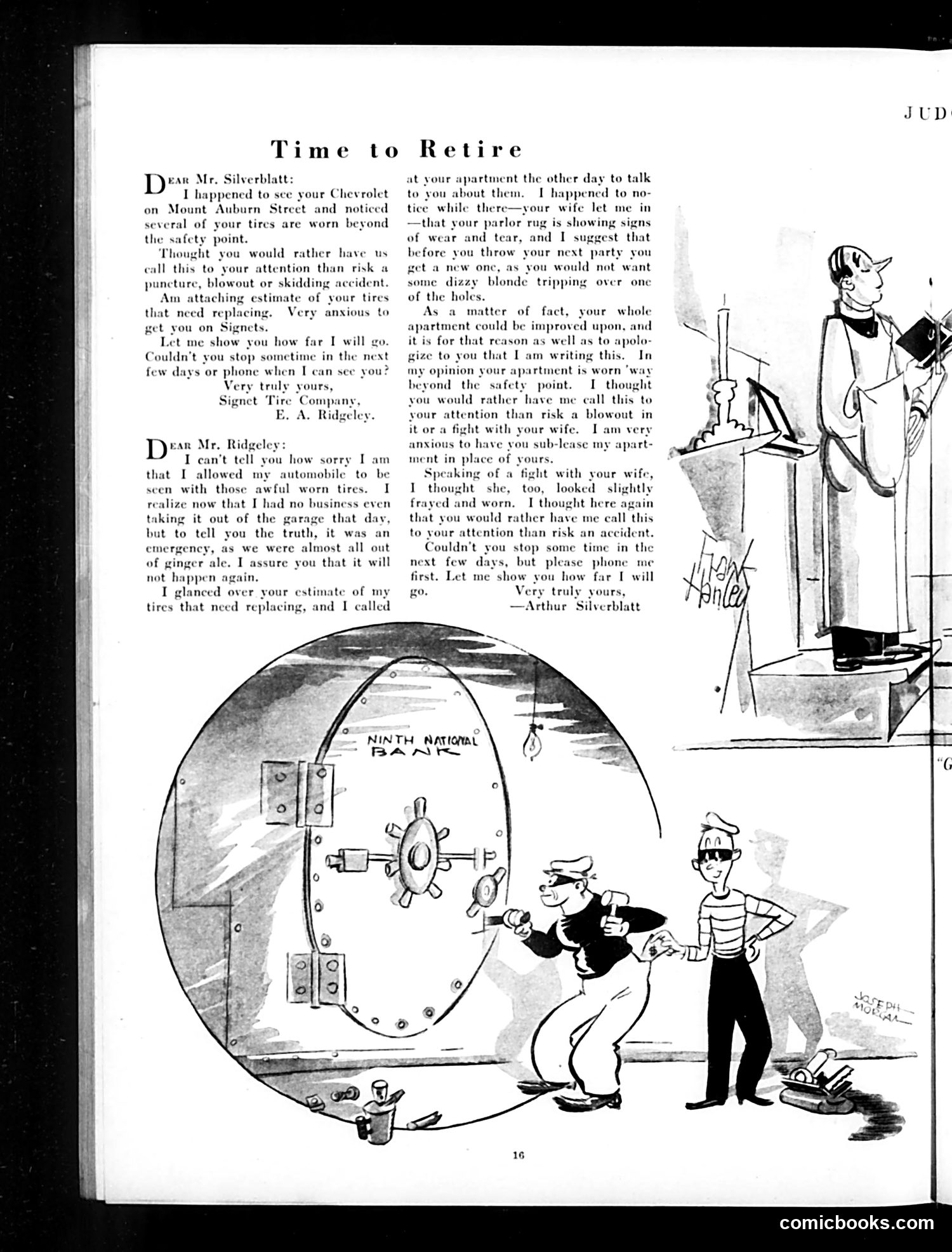
Time to Retire This page satirizes aggressive salesmanship and the logic of aggressive consumer marketing. The left letter from a tire company representative uses customer concern as a pretext to push tire sales. The right letter parodies this approach: a salesman named Arthur Silverblatt applies the tire company's reasoning to everything—worn apartment rugs, frayed clothing on the customer's wife—as justification for selling his own apartment lease. The bank vault cartoon below illustrates the absurdity: two bankers stand before a massive safe, suggesting the satirical point that such aggressive sales tactics are as forceful and intrusive as breaking into a bank. The satire mocks how businesses rationalize unsolicited pitches as "helpful advice" while their actual motive is profit. By extending this logic to ridiculous extremes (inspecting a stranger's wife's clothing), Judge exposes the manipulative nature of high-pressure sales.
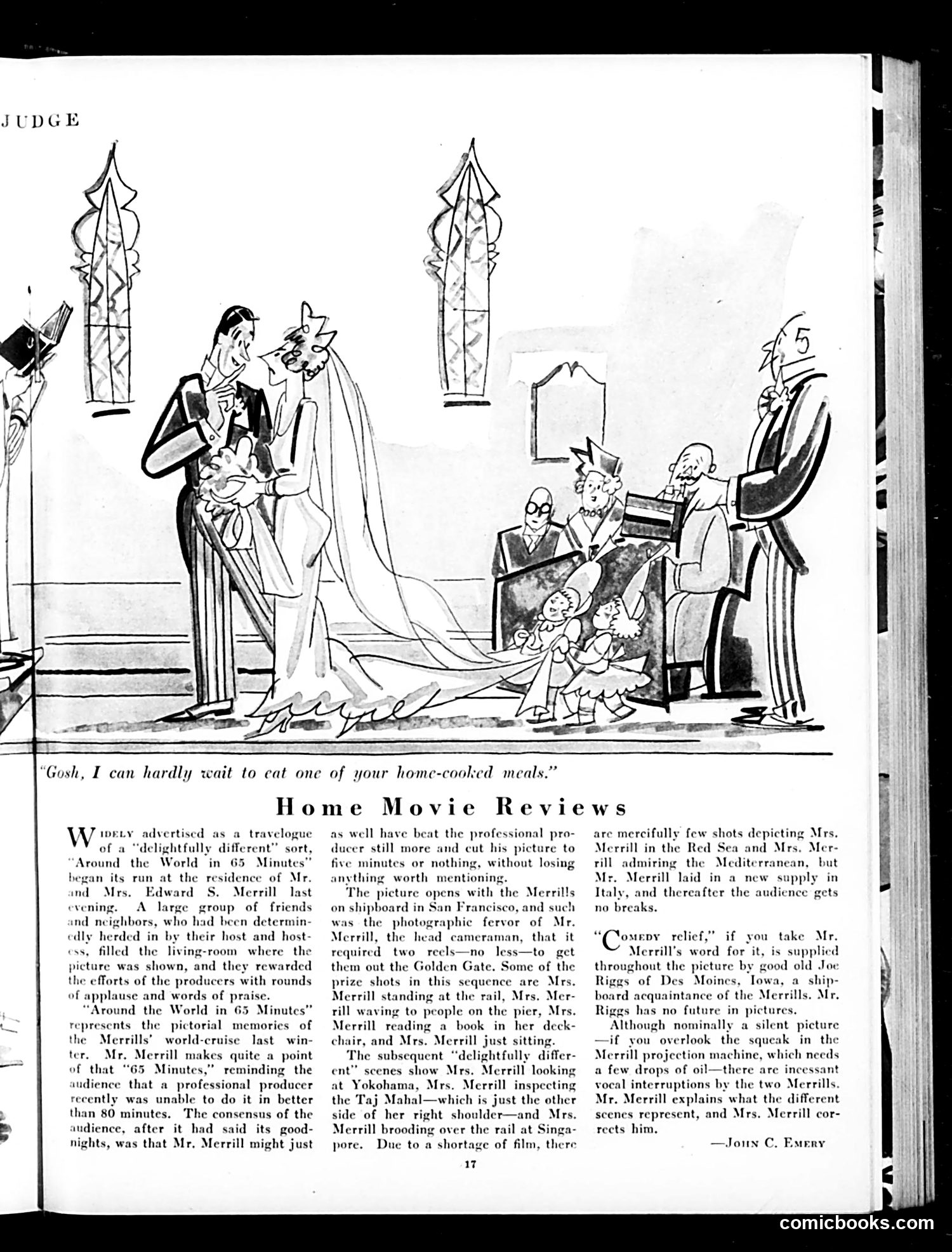
Analysis This page satirizes home movies and amateur filmmaking through a scathing review of Mr. and Mrs. Merrill's travelogue, "Around the World in 65 Minutes." The Satire: The review mocks the Merrills' self-indulgent vacation film. Mr. Merrill obsessively documents his wife—standing at railings, waving, reading, sitting—rather than actual destinations. The reviewer notes that professional producers condensed world travel into 80 minutes, yet the Merrills require 65 minutes largely for Mrs. Merrill's repetitive scenes, suggesting their film would be better at five minutes or nothing. Key Targets: - Amateur filmmakers' narcissism and tedious home-movie screenings - The obligation of social gatherings where hosts force guests to watch family films - The Merrills' inability to recognize their film's monotony The Cartoon: Shows a formal indoor screening where well-dressed guests are trapped watching, while someone comments about anticipating home-cooked meals—implying the screening is an ordeal endured for hospitality's sake. This captures a timeless frustration: mandatory viewings of others' vacation footage.
Judge Magazine Theatre Critique This is a theatrical review by George Jean Nathan, a prominent American drama critic of the early 20th century. Nathan defends Denis Johnston's play "The Moon in the Yellow River" against fellow critics who dismissed it as "not a play." The satire targets rigid theatrical orthodoxy: Nathan's colleagues (dismissed as "the boys") categorize works as "plays" or "not plays" based on adherence to conventional dramatic structure (the "Prof. George Pierce Baker" formula), while dismissing Johnston's work despite its artistic merit—emotional impact, thoughtful character development, and literary quality. Nathan's ironic "raspberry" (loud mockery) aims at critics who value formulaic mediocrity over innovative excellence. He recalls his own past rigidity, suggesting critical standards have evolved beyond mechanical rule-following. The piece advocates for artistic substance over structural convention—a modernist critique of conservative theatrical gatekeeping.
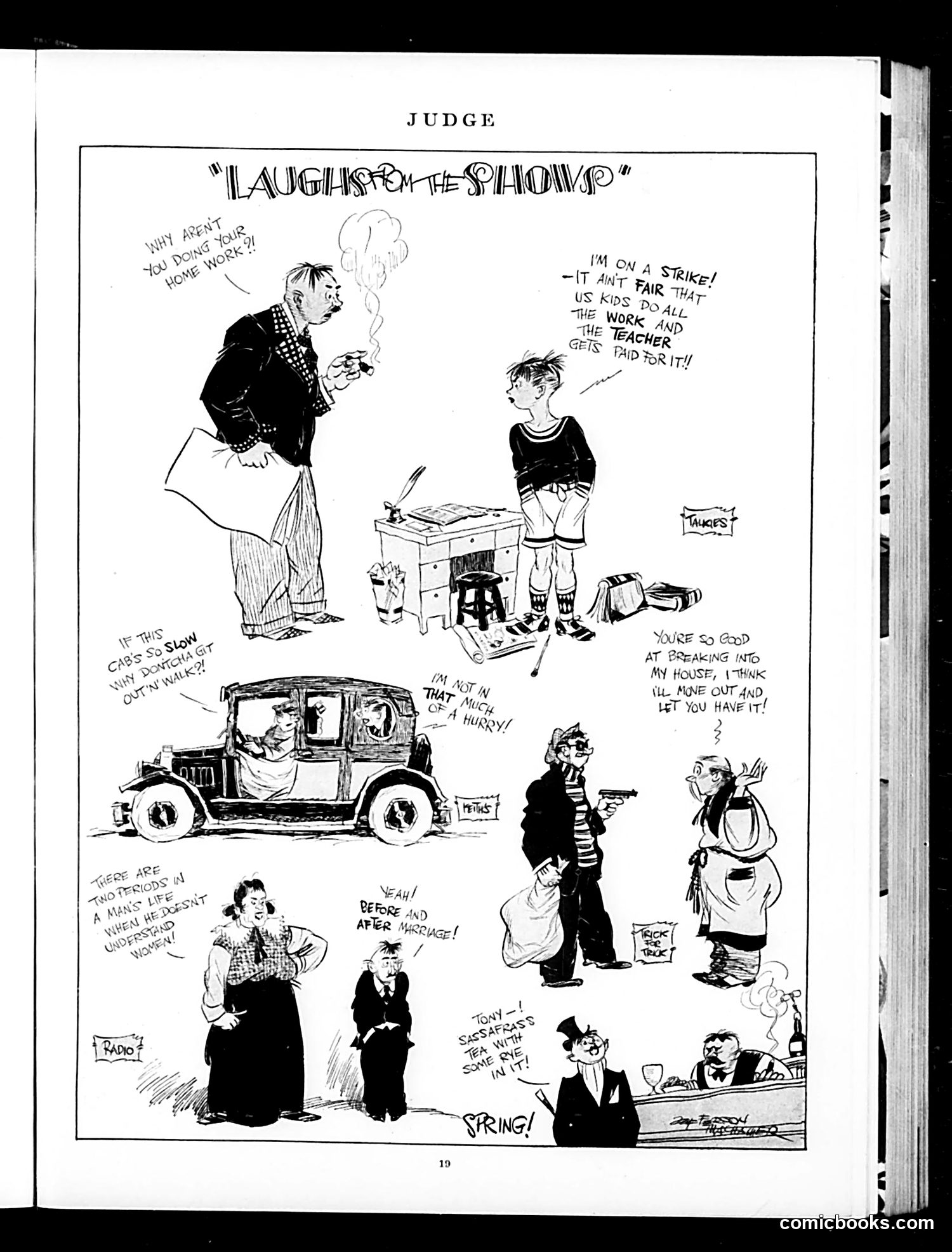
"Laughs from the Shomp" - Judge Cartoon Analysis This satirical cartoon addresses labor disputes and social friction of the early 20th century. The central figures appear to represent: - An authority figure (possibly a judge or wealthy homeowner) confronting social unrest - A striking worker or child claiming unfair labor practices - Various vignettes depicting marital discord ("Before and After Marriage"), automobile culture, and domestic conflict The recurring refrain about "breaking in" suggests commentary on burglary, labor unrest, or social upheaval. References to strikes, wages, and class conflict pervade the piece. The scattered domestic scenes—a car, a radio, a couple—mock middle-class anxieties about changing social order and women's independence ("Why aren't you doing your housework?"). The title suggests this is meant as humorous social commentary on contemporary tensions, though specific historical context would clarify which particular labor disputes or social movements are being satirized.
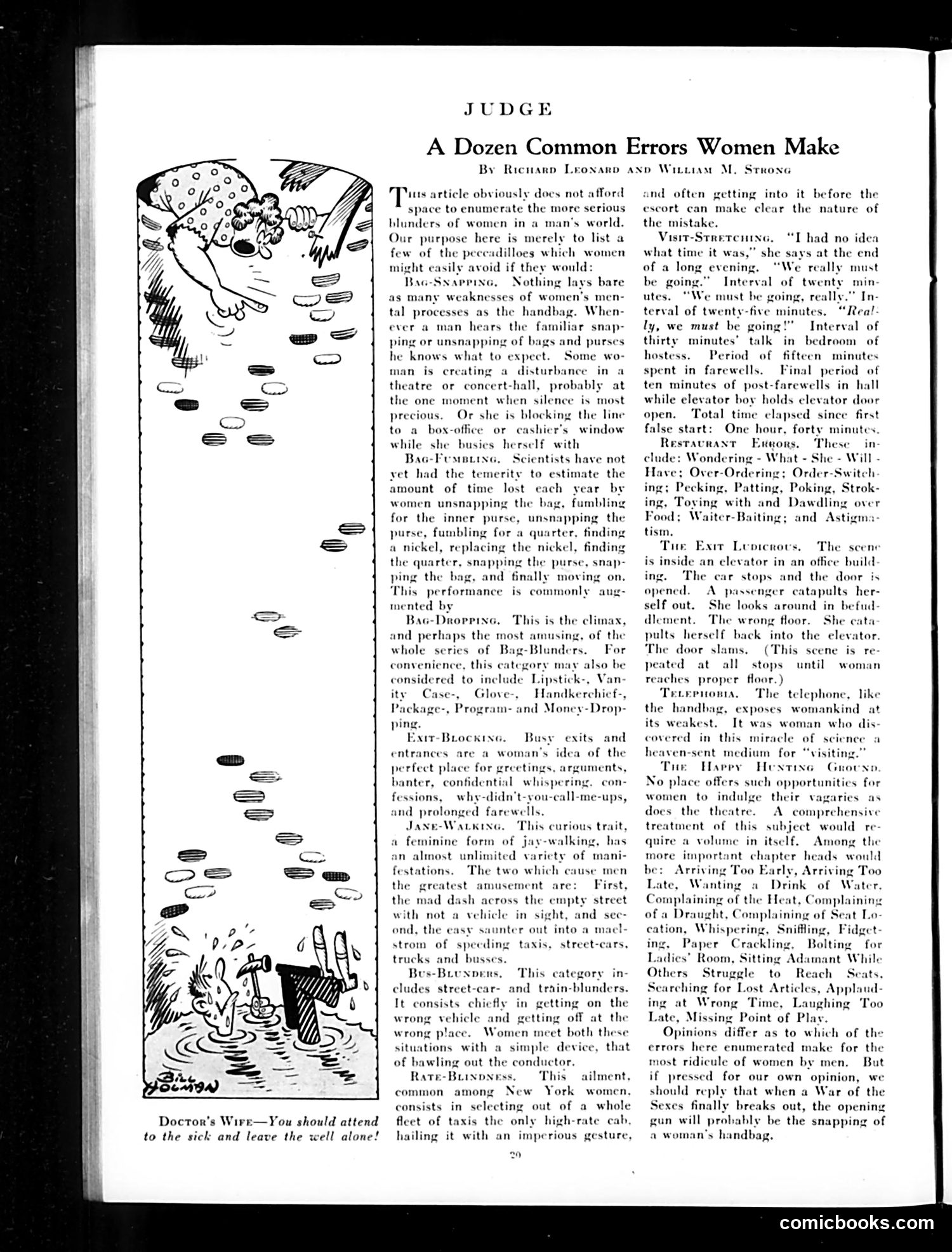
Analysis of "A Dozen Common Errors Women Make" This 1920s-era satirical article by Leonard and Strong mocks stereotypical feminine behaviors that supposedly annoy men. The cartoon illustrates women's "bag-snapping" — repeatedly opening and closing purses at inopportune moments in theaters or at cashier windows, portrayed as a source of male frustration. The article catalogs twelve alleged female "errors": handbag fumbling, bag-dropping, elevator confusion, street-crossing recklessness, taxi selection mishaps, prolonged goodbyes, restaurant indecision, telephone use, and others. The underlying premise—that women are scatterbrained, inefficient, and inconsiderate—reflects period gender stereotypes and patronizing attitudes. The satirical framework pretends to offer "helpful" guidance while actually reinforcing sexist assumptions that women are intellectually inferior and socially problematic. The doctor's wife cartoon caption suggests women should stay home rather than venture into public. This piece exemplifies how mainstream media of the era normalized disparaging views of women's competence and autonomy.
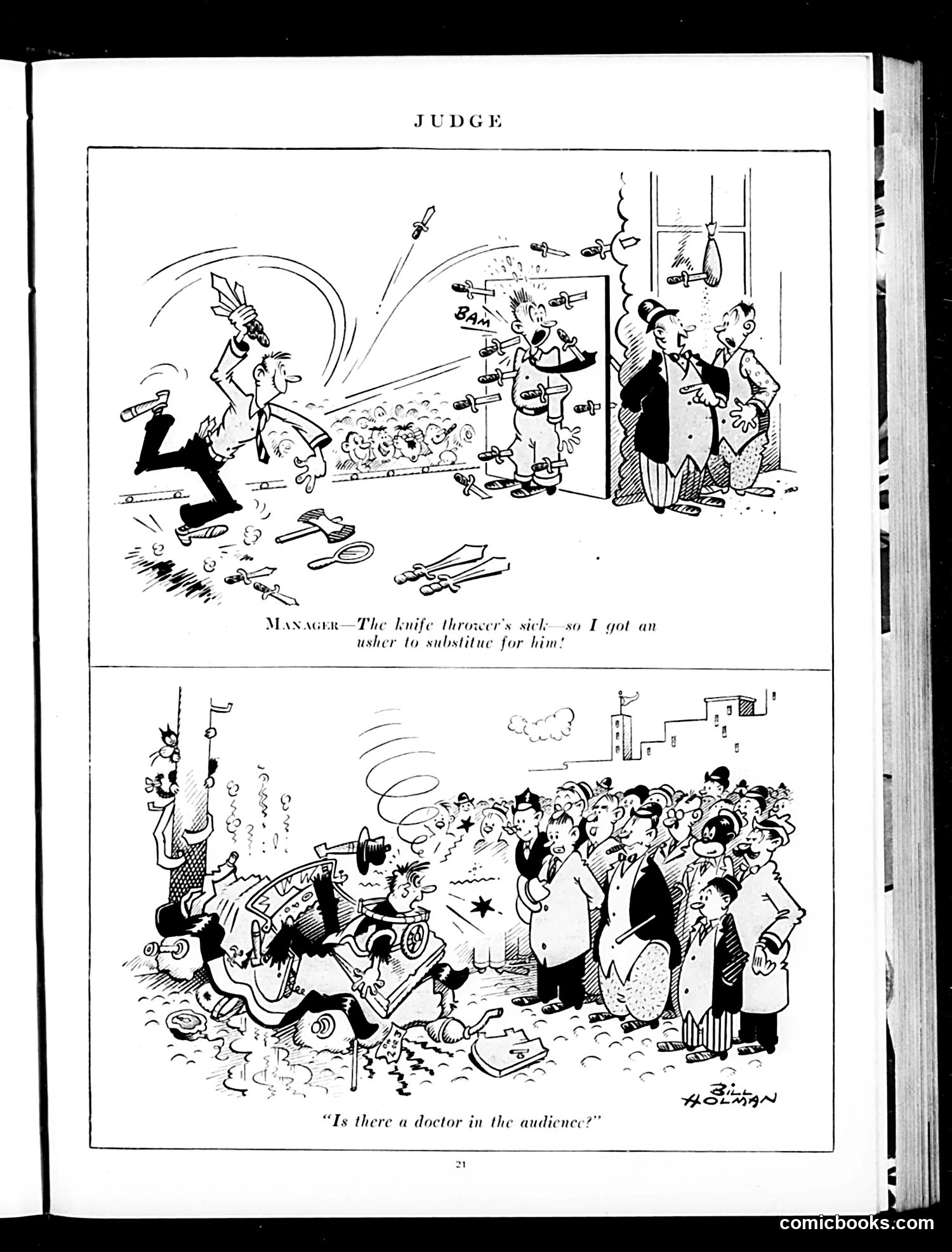
Analysis This page contains two separate cartoons satirizing theater management incompetence. The top cartoon shows a chaotic stage scene where a manager has replaced a sick knife-thrower with an usher, resulting in knives flying wildly into the audience and scenery. The joke: substituting an untrained usher for a skilled performer creates disaster. The bottom cartoon depicts an equally catastrophic performance where something has gone spectacularly wrong on stage—audience members are injured or in distress, and someone calls out "Is there a doctor in the audience?" Both cartoons mock theatrical mismanagement and the dangers of cutting corners with unqualified replacements. They reflect early 20th-century vaudeville culture, where variety acts (including dangerous knife-throwing) were common entertainment. The humor relies on the absurdity of prioritizing expedience over safety and competence.
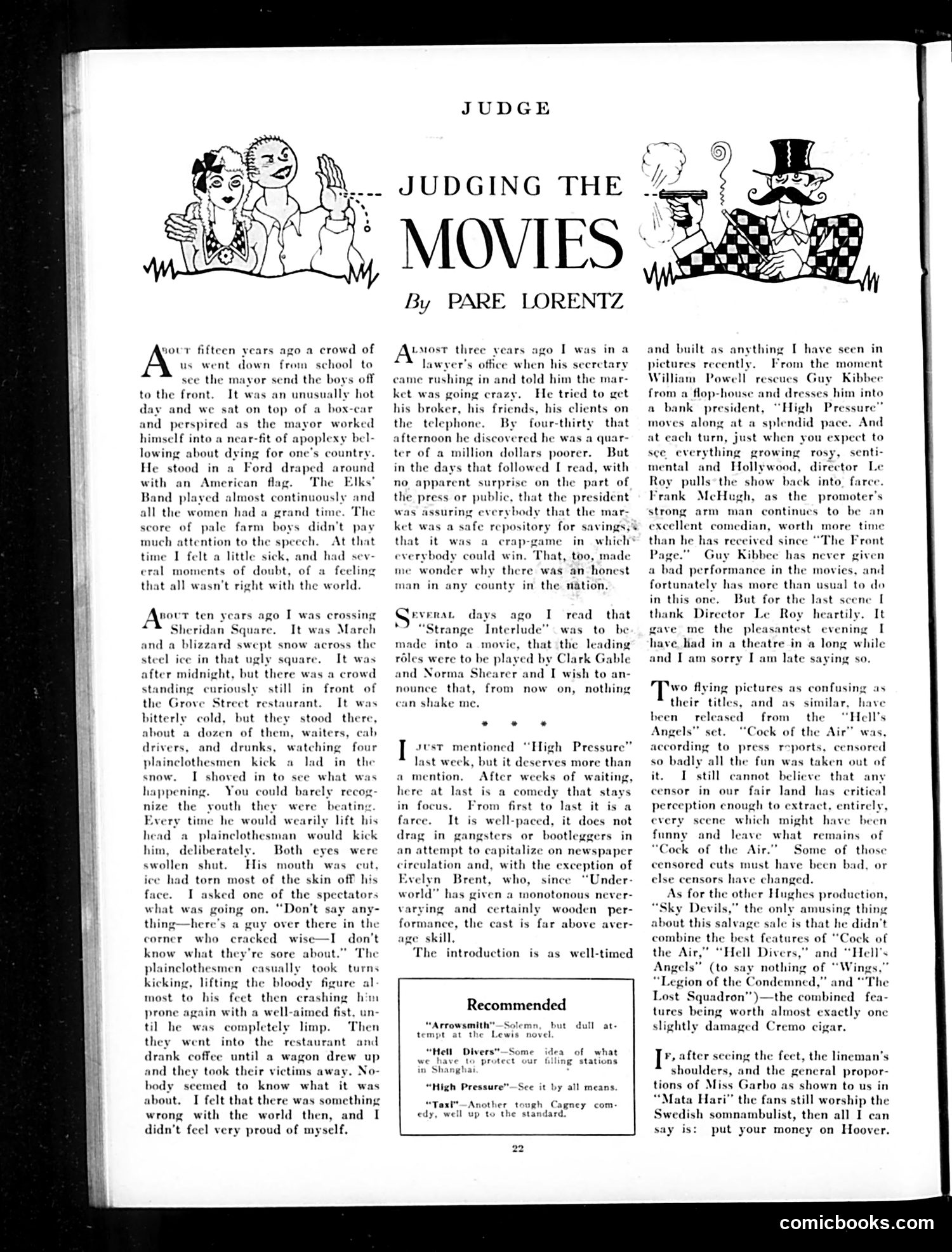
Judge Magazine: "Judging the Movies" by Pare Lorentz This is a film criticism column, not a political cartoon. Lorentz, a prominent filmmaker and critic, frames his movie reviews through three personal anecdotes about witnessing troubling social moments: a hollow WWI send-off parade (circa 1917), a police beating of an innocent man, and the 1929 stock market crash. These vignettes establish his theme: society's indifference to injustice and dishonesty. He then applies this moral lens to current films. He praises "High Pressure" as an honest comedy avoiding sensationalism, and expresses relief that "Strange Interlude" will star Clark Gable and Norma Shearer—implying these major stars guarantee quality. The "Recommended" box reviews four films: "Arrowsmith" (dull), "Hell Divers" (acceptable), "High Pressure" (must-see), and "Taxi" (reliable Cagney). The subtext: cinema should reflect and challenge society's moral failings, not ignore them.
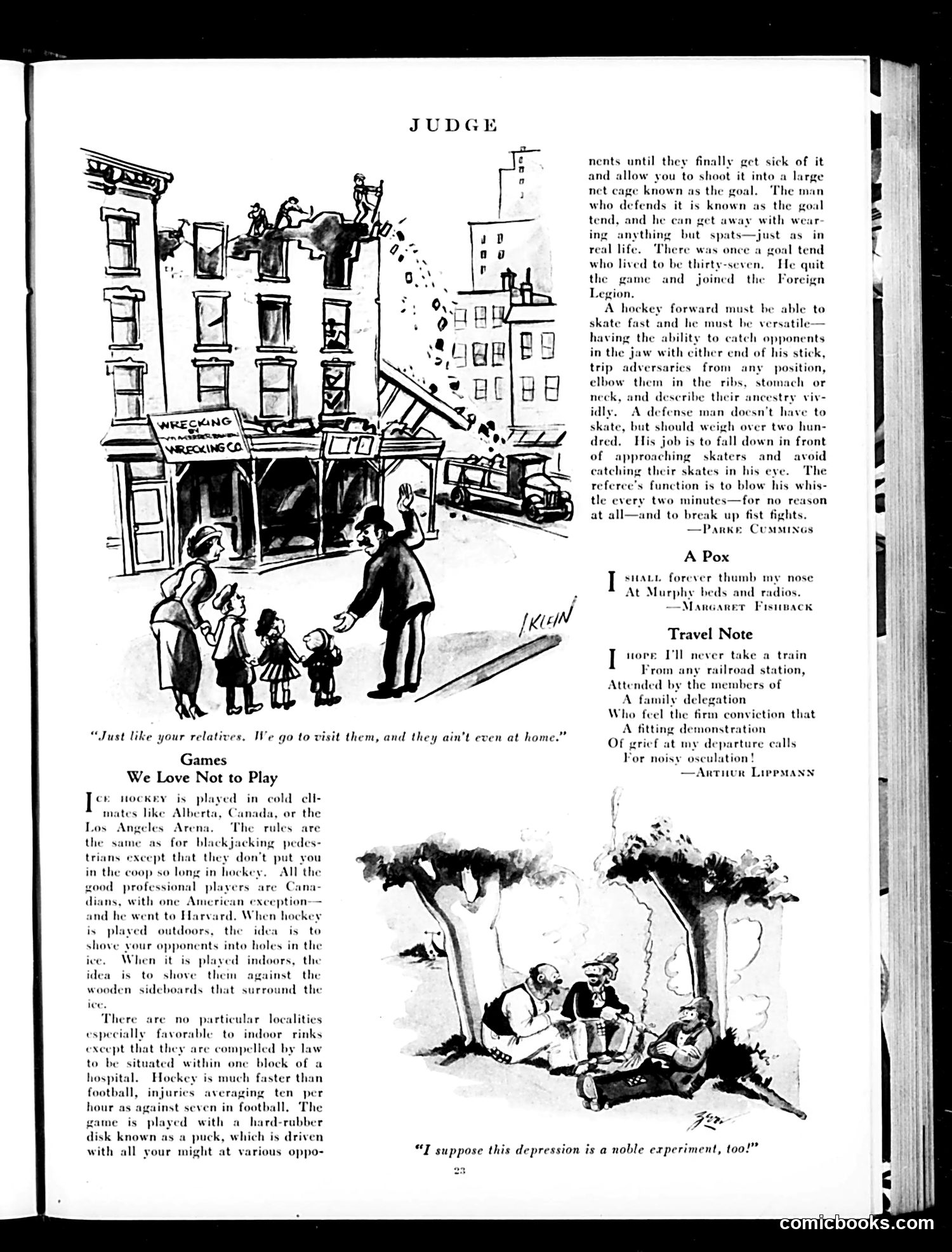
Judge Magazine Page Analysis This page satirizes ice hockey as a violent, brutish sport disguised by rules. The main cartoon shows a wrecking crew demolishing a building, captioned "Just like your relatives. We go to visit them, and they ain't even at home"—a joke about unwelcome visits. The article "Games We Love Not to Play" uses mock-serious language to expose hockey's actual nature: players deliberately injure opponents, shove them into boards and holes, and fist fights are routine. The satire equates hockey with criminal assault ("blackjacking pedestrians"), suggesting it's only legal because it's a sport. References to Canadian dominance and a Harvard player suggest early 20th-century sports class distinctions. The page includes three humorous poems mocking everyday annoyances: uncomfortable Murphy fold-down beds, noisy radios, and overly emotional family farewell scenes at train stations. The satire targets sports culture's acceptance of violence when formalized as entertainment.
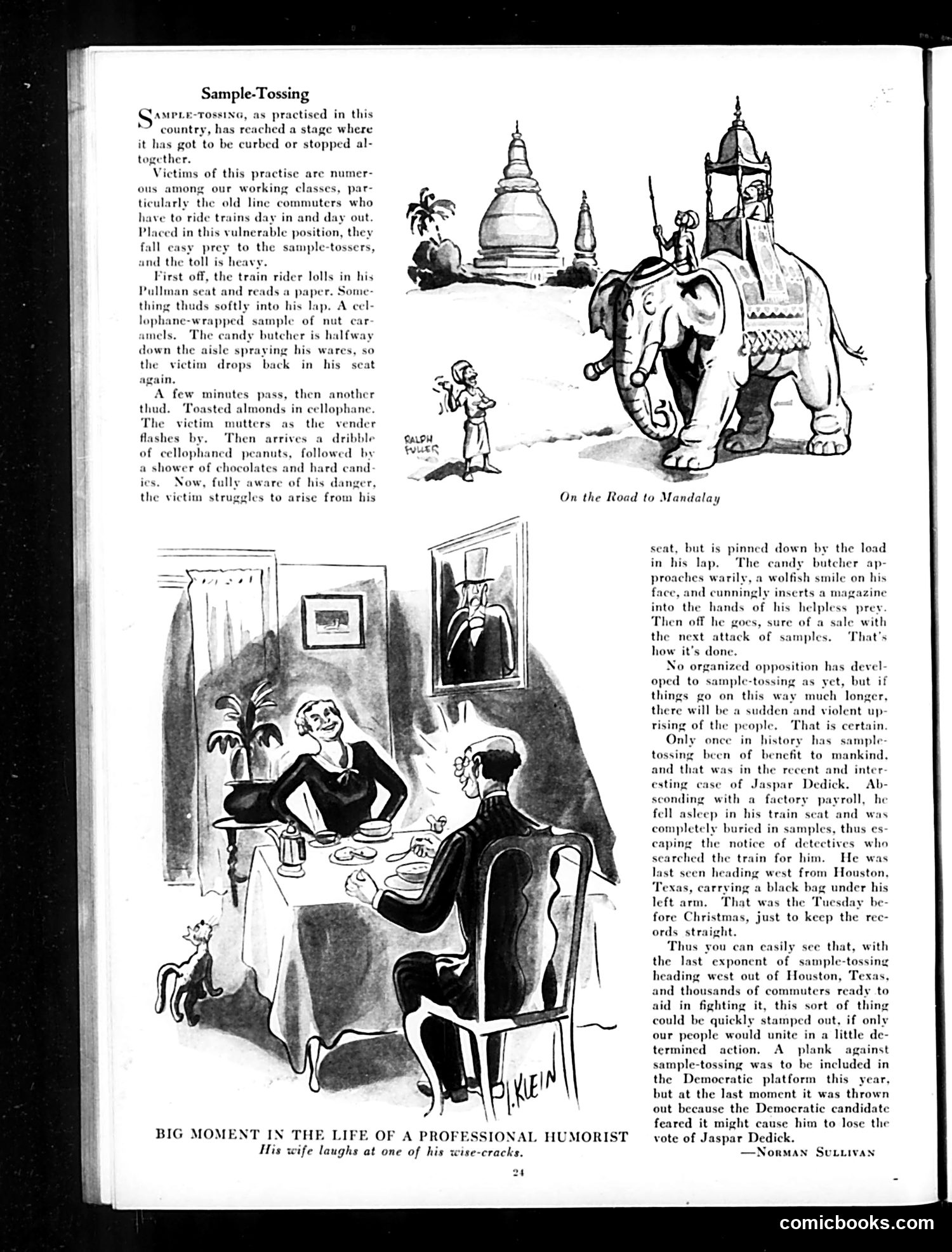
Sample-Tossing: A Judge Magazine Satire This piece satirizes the aggressive sales tactics of train vendors ("candy butchers") who forcibly distribute free samples to captive Pullman car passengers. The article describes their relentless assault: candies, nuts, and chocolates hurled into commuters' laps until victims are literally pinned down, then cunningly sold magazines as a final trap. The satire peaks with absurdist humor: it mentions Jaspar Dedick, a payroll thief who escaped detection by being completely buried under samples—presented as sample-tossing's *only* beneficial use. The joke culminates in claiming Democrats removed anti-sample-tossing from their platform, fearing they'd lose Dedick's vote. The lower cartoon shows a humorist's wife laughing at his joke—mocking the professional comedian's desperation for validation. The satire targets both predatory sales practices and political absurdity, using exaggeration to mock real commuter annoyances.
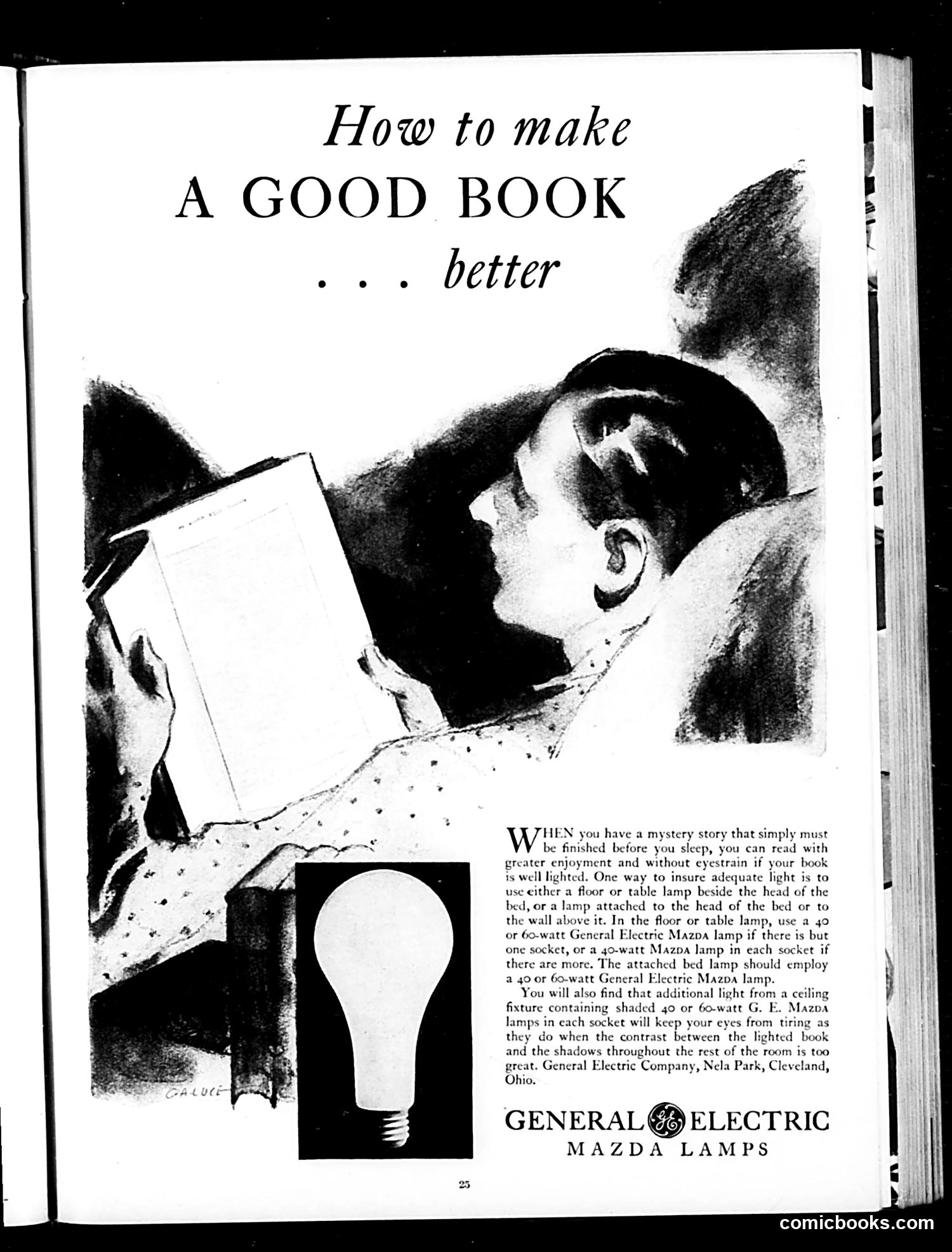
Analysis This is primarily a General Electric advertisement, not political satire. The page depicts a man in bed reading a mystery novel by lamplight, illustrating the product's practical benefit. The "satire" is gentle and commercial: the headline "How to make A GOOD BOOK...better" frames adequate lighting as essential to reading enjoyment. The ad argues that poor lighting causes eyestrain and diminishes the reading experience—therefore, GE Mazda lamps "improve" books by enabling comfortable, extended reading sessions. The accompanying text provides technical specifications for lamp placement and wattage to achieve optimal lighting contrast. This was a common early-20th-century advertising approach: positioning a consumer product as a solution to an everyday problem rather than as a luxury. There are no identifiable political figures or satirical commentary present. This is straightforward product marketing disguised within *Judge* magazine's entertainment format.
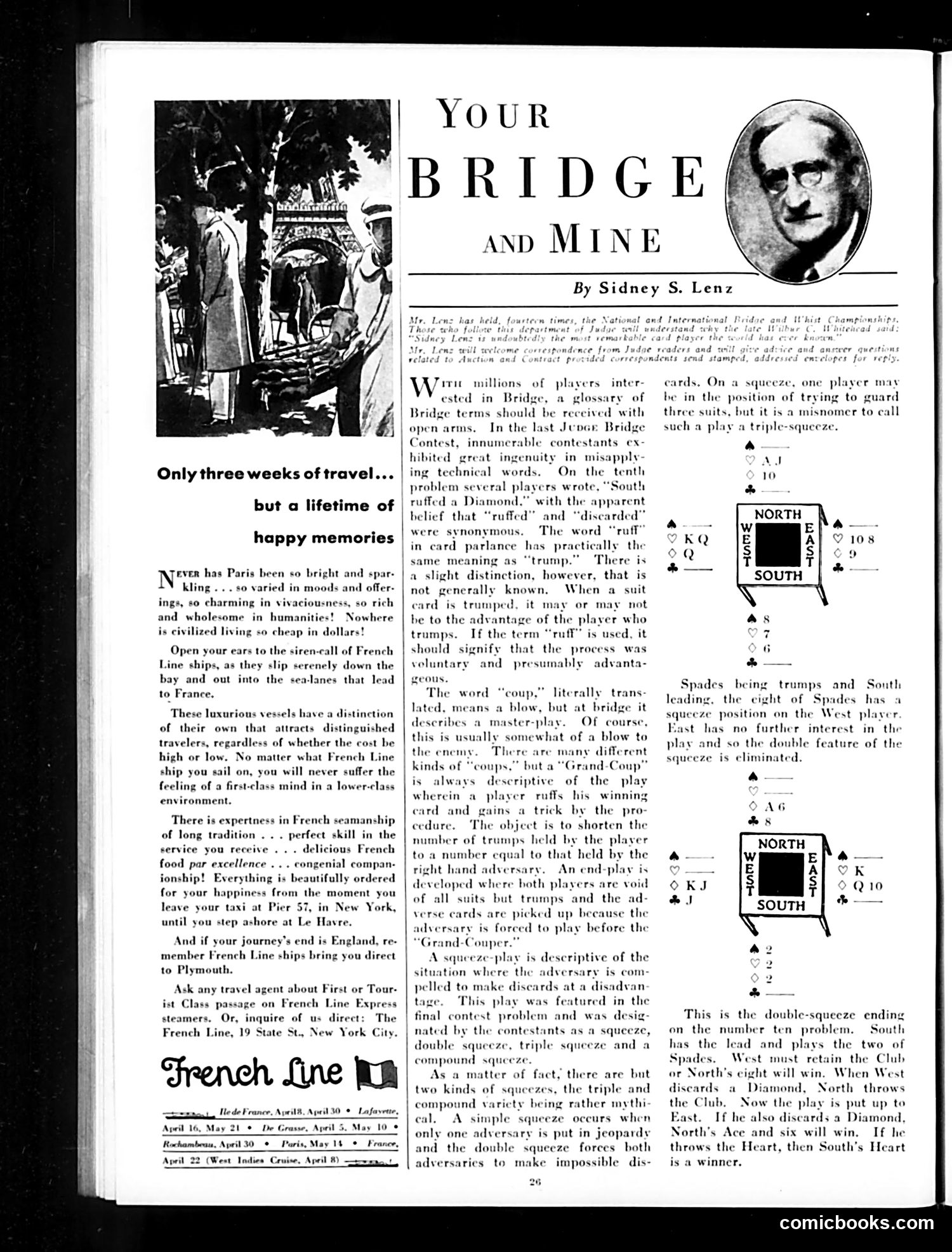
"Your Bridge and Mine" - A Bridge Column for Judge Magazine This page is primarily an instructional bridge column by Sidney S. Lenz (a renowned bridge expert), not satire. It's educational content aimed at the millions of bridge players who engaged in the card game's national craze during this era. Lenz clarifies bridge terminology that contestants in a recent "Judge Bridge Contest" had misused. He explains technical terms like "ruff" (voluntarily trumping, implying advantage), "coup" (a strategic master-play), and various types of "squeeze plays" (forcing opponents into disadvantageous card discards). The column corrects misconceptions—notably that "ruffed" and "discarded" are synonymous (they're not) and that there are only two types of squeezes, not three as contestants claimed. The sidebar advertisement promotes French Line steamships for luxurious transatlantic travel, promising "a lifetime of happy memories" from Paris to England.
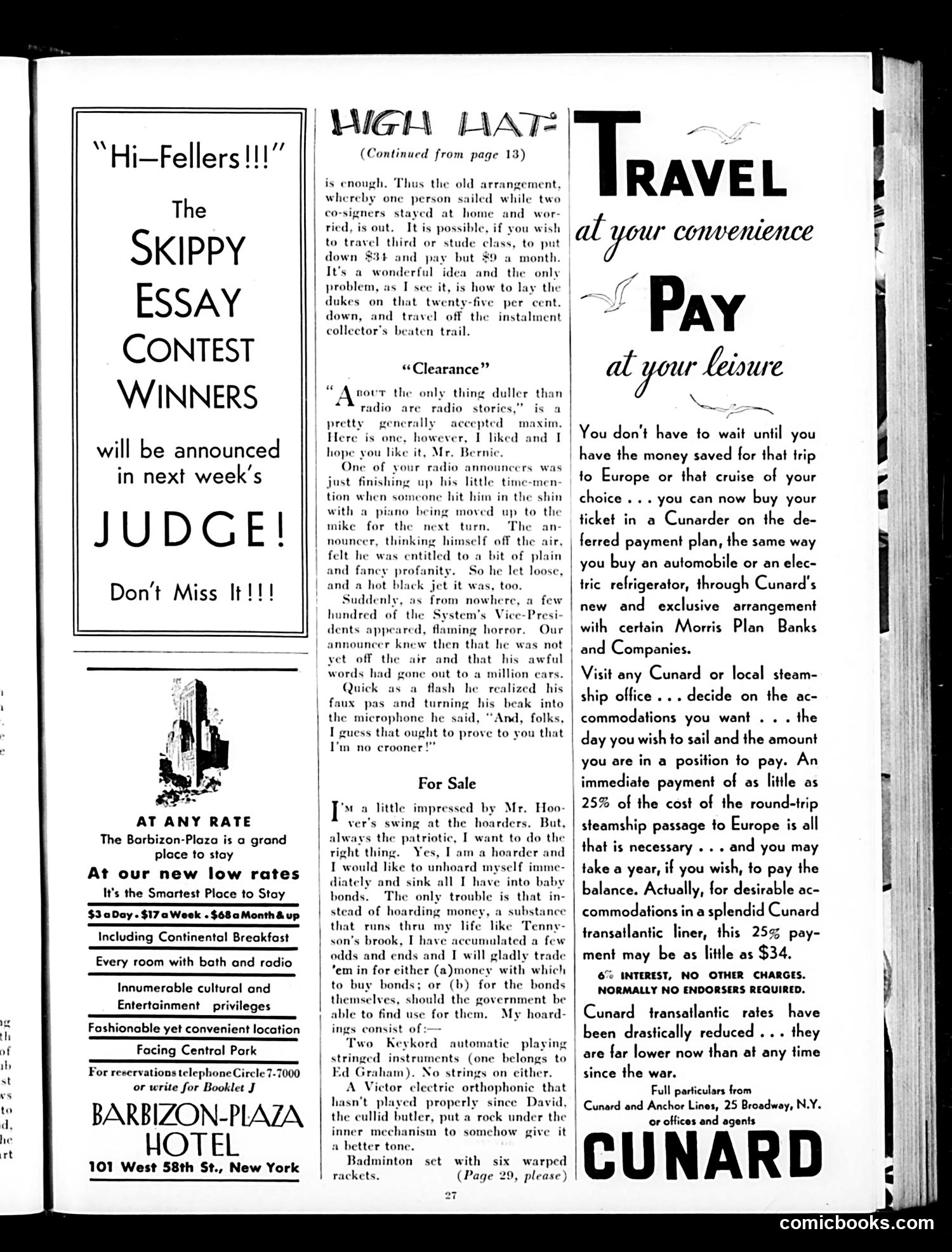
Judge Magazine Page Analysis This page mixes advertisements and satirical content typical of Judge magazine. The main cartoon/article is "High Hat" (continued from page 13), featuring humorous anecdotes about radio broadcasting mishaps. The "Clearance" section describes a radio announcer who, after being hit by a piano during a live broadcast, curses audibly—thinking he's off-air. He then realizes millions heard him and quips that this proves he's "no crooner," turning embarrassment into self-deprecating humor. The joke satirizes both radio broadcasting's live dangers and announcers' self-importance. The "For Sale" section humorously lists a hoarder's willingness to sell personal goods (auto-playing instruments, a broken phonograph, badminton equipment) to buy war bonds—likely referencing Depression-era or WWII-era patriotic appeals. The deadpan listing of worthless items satirizes how jingoistic appeals exploit citizens' sense of duty. The surrounding advertisements for the Barbizon-Plaza Hotel and Cunard cruise line's installment payment plan reflect 1930s-40s consumer culture and leisure travel marketing.
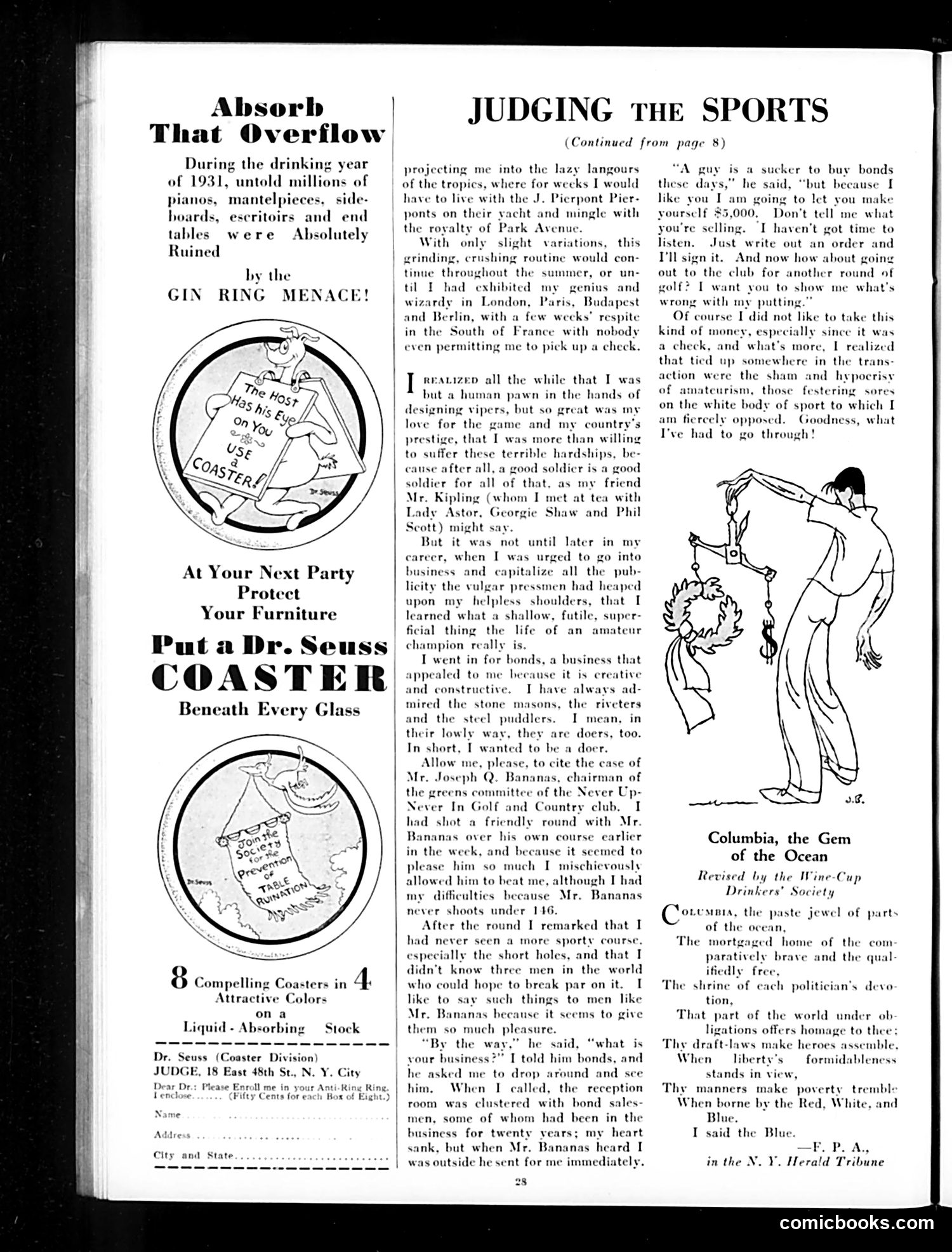
Analysis: "Judging the Sports" Page from Judge Magazine This page contains two distinct elements: Left side: A Dr. Seuss advertisement for coasters, satirizing 1931's "Gin Ring Menace"—a humorous reference to Prohibition-era drinking and the damage wet glasses caused furniture. The cartoon shows a figure surrounded by coasters, mocking the problem of condensation rings on wood surfaces during the drinking year of 1931. Right side: A sports column continuing from page 8, featuring a first-person account by what appears to be a professional golfer-turned-bond-salesman. The author critiques the shallow commercialism of amateur athletics. The central anecdote about "Mr. Joseph Q. Bananas" illustrates the hypocrisy: a wealthy club member asks the author to take a $5,000 bond deal as personal favor, then requests golf lessons—exposing how "amateurism" in sports masks financial corruption and social favor-trading among the wealthy. The accompanying illustration shows a golfer's awkward swing, visualizing the author's point about authentic versus performative athletics.
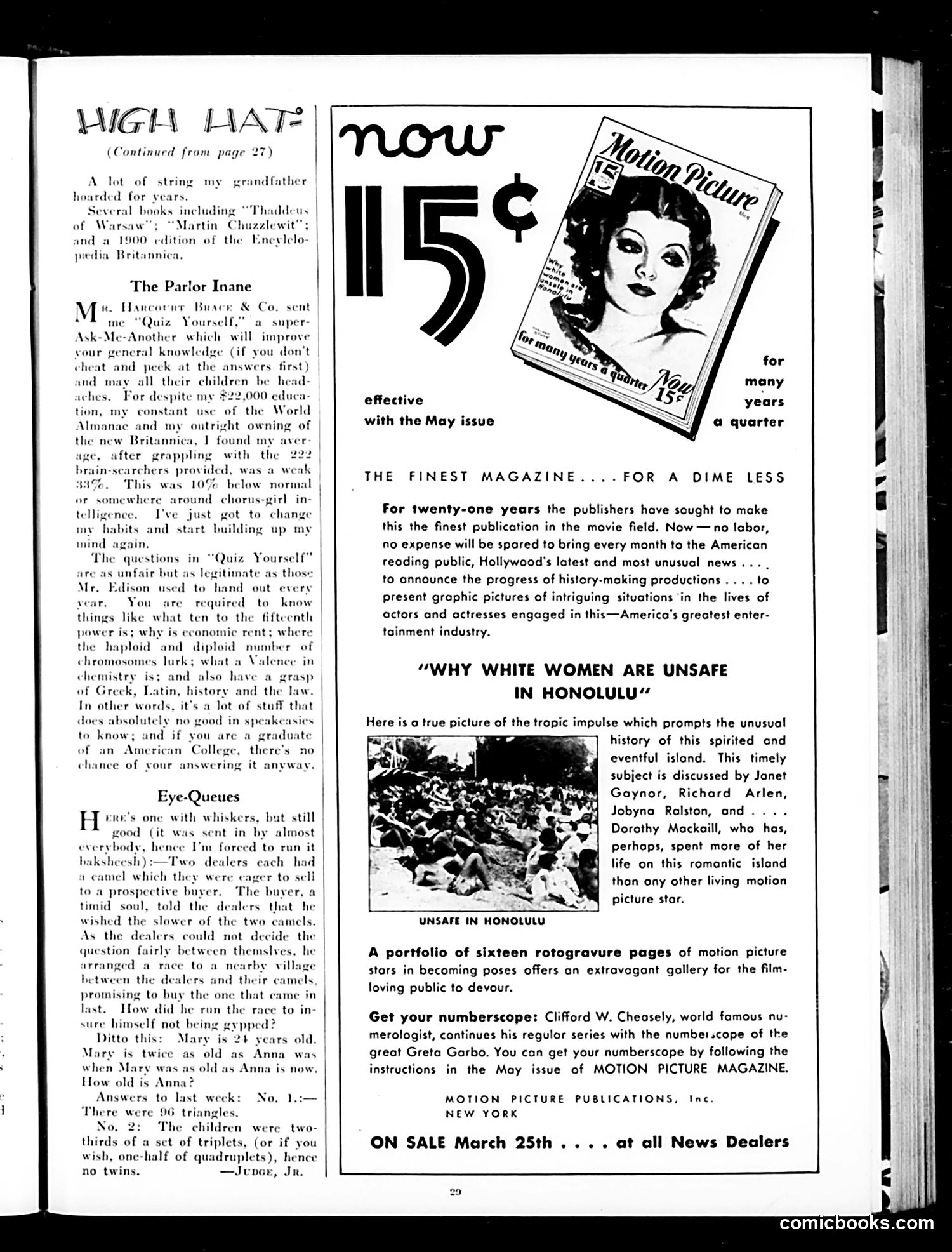
Analysis for Modern Readers This page contains two distinct elements: a humor column ("High Hat") and a movie magazine advertisement. The Column: Judge's "High Hat" section features three comedic pieces. One mocks trivia contests, suggesting they test useless knowledge irrelevant to real life ("speakeasies"). Another presents brain-teaser puzzles about camels and ages—typical period humor. The "Eye-Queues" section collects reader submissions. The Advertisement: The right side promotes *Motion Picture* magazine (15¢, down from 25¢). The sensationalist headline—"Why White Women Are Unsafe in Honolulu"—reflects 1920s racial anxieties about miscegenation and colonial anxieties. The accompanying image and copy invoke "tropic impulse," coded language suggesting threat from non-white populations. The ad features Hollywood stars (Janet Gaynor, Richard Arlen, Dorothy Mackaill) in "becoming poses," marketing both scandal and glamour. This advertisement exemplifies how mainstream publications of the era casually promoted racist stereotypes alongside entertainment content.
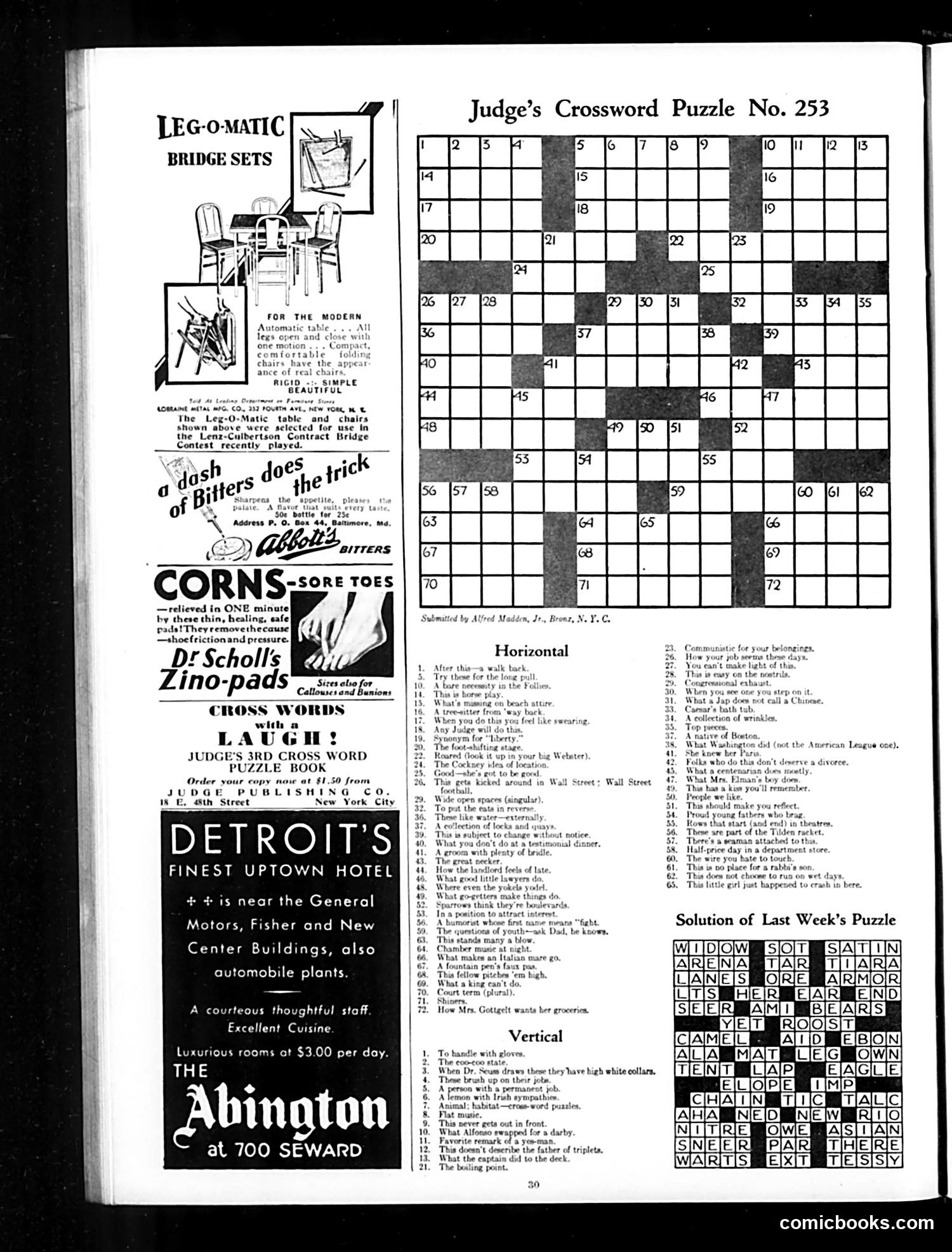
What This Page Shows This is primarily a crossword puzzle page from Judge magazine, not a political cartoon. The main content is "Judge's Crossword Puzzle No. 253" with clues and a solution grid. The page is surrounded by period advertisements (likely 1920s-1930s), including: - Leg-o-Matic bridge sets (for the card game contract bridge) - Dr. Scholl's foot pads for corns and callouses - Judge's own crossword puzzle book - Detroit's Abington Hotel - Abbott's Bitters The puzzle references appear to be typical crossword fare—wordplay and general knowledge clues. One clue mentions "How Mrs. Gottgelt wants her groceries," suggesting domestic humor. No satirical content or political commentary is visible on this page. It's primarily a puzzle/advertisement page typical of Judge's format during this era, when the magazine mixed humor, puzzles, and commercial advertising.
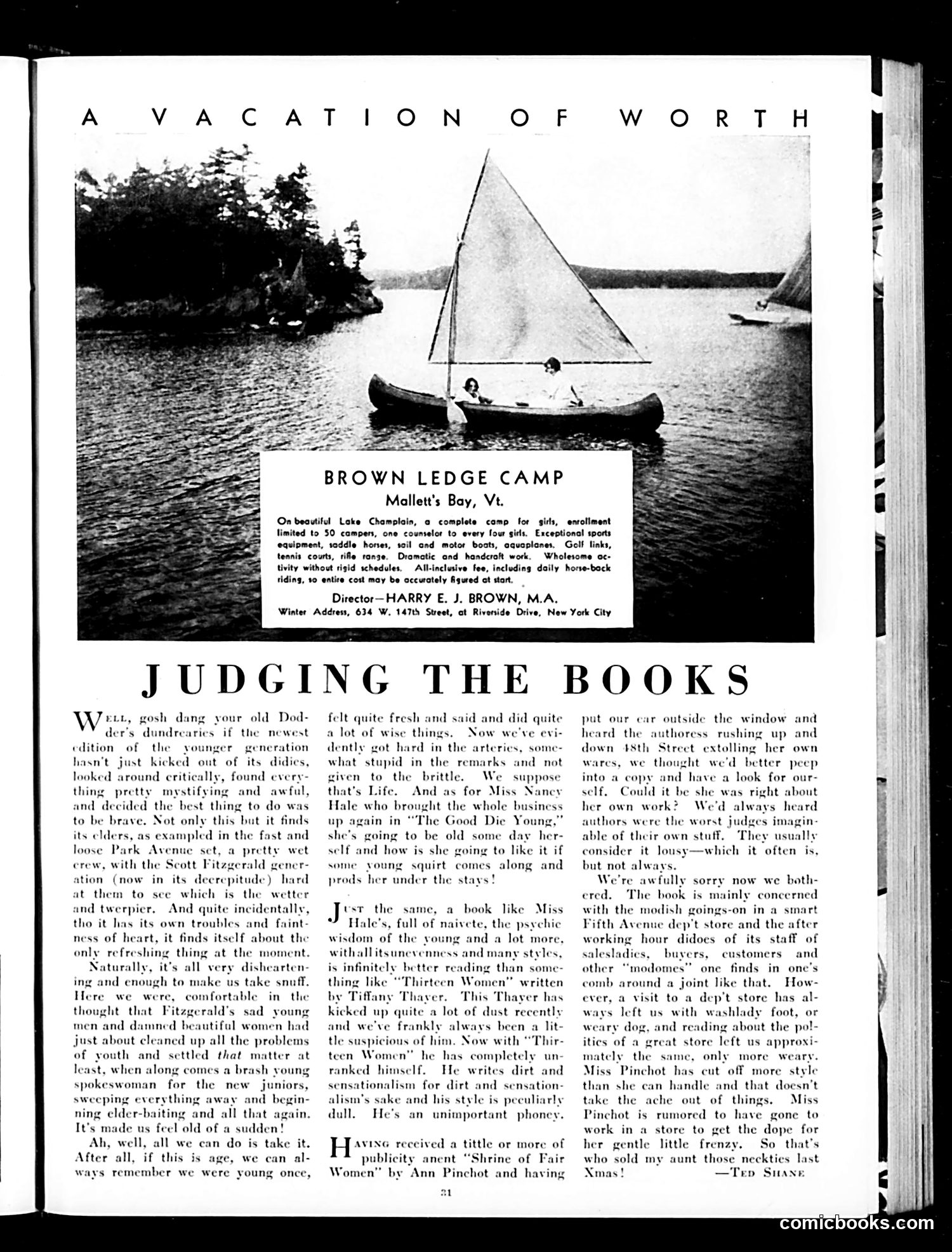
Judging the Books This page from Judge magazine contains a book review column critiquing recent fiction. The reviewer dismisses F. Scott Fitzgerald's literary influence on the younger generation—calling his "sad young men and damned beautiful women" outdated—while paradoxically admitting the youth's fresh perspective is "the only refreshing thing at the moment." The column praises Nancy Hale's novel as genuinely insightful despite its unevenness, contrasting it favorably with Tiffany Thayer's "Thirteen Women," which the reviewer attacks as sensationalism wrapped in poor prose—calling Thayer "an unimportant phoney." The reviewer expresses regret reading Ann Pinchot's "Shrine of Fair Women," a department store romance, finding it ultimately forgettable. The tone is curmudgeonly: aging critics grudgingly acknowledging younger writers while condescending to their subjects and styles. The accompanying advertisement promotes Brown Ledge Camp, a girls' summer camp in Vermont, unrelated to the literary content.
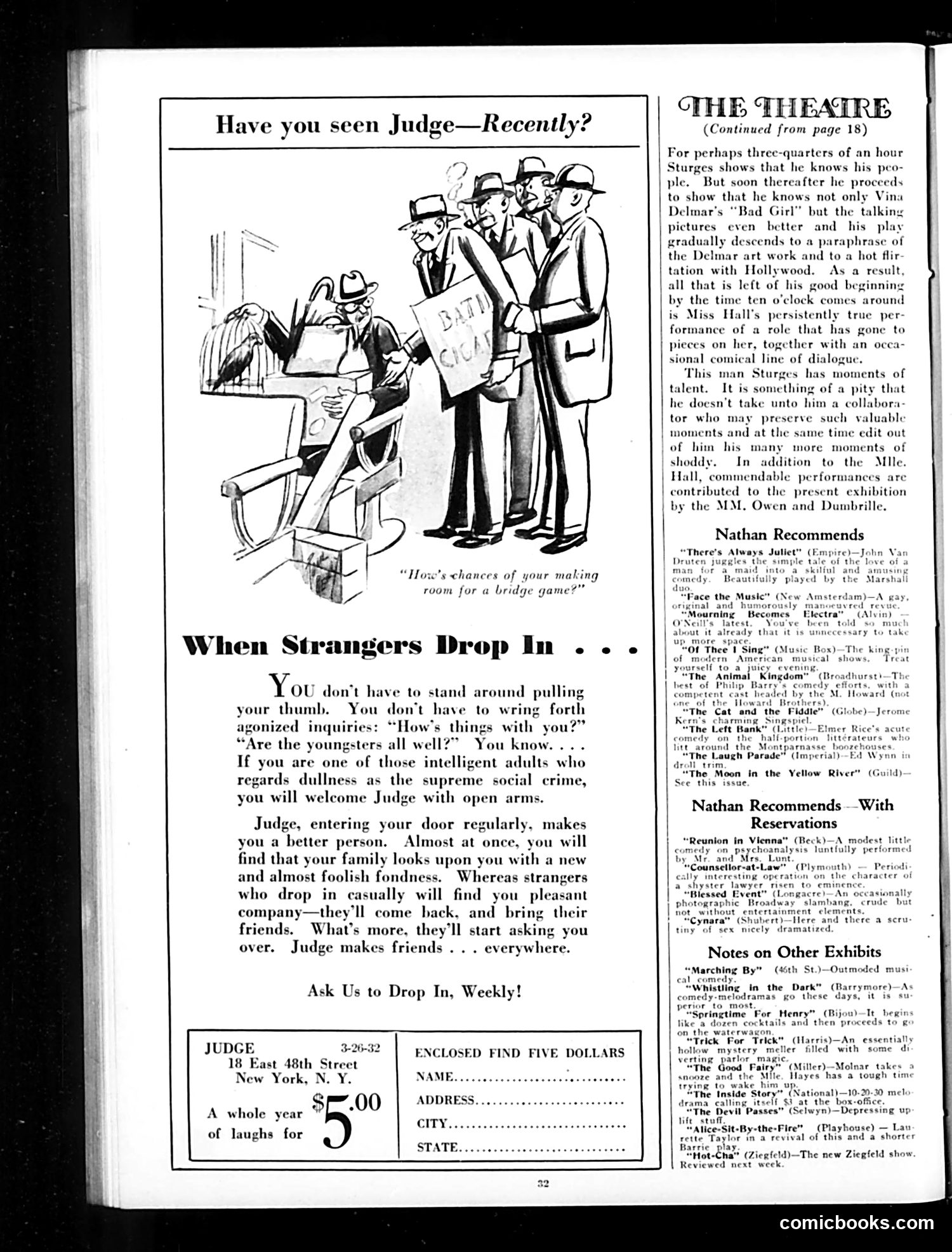
Judge Magazine Advertisement & Theatre Review Page This page combines a subscription advertisement for Judge magazine with theatre reviews. The main cartoon satirizes social etiquette. It depicts well-dressed men confronting someone seated in a chair, asking "How's chances of your making room for a bridge game?" The accompanying text argues that subscribing to Judge magazine makes you a better, more interesting person—entertaining enough that strangers will befriend you and want to socialize, rather than awkwardly making small talk with casual visitors. The satire targets social anxiety and status-seeking among middle-class Americans: the implication is that reading Judge will make you witty and cultured enough to be desirable company, transforming casual acquaintances into lasting friendships. It's essentially selling the magazine as a form of social currency. The right column contains Nathan's theatre recommendations for current Broadway productions (1932), noting which shows are worth seeing despite flawed writing or performances.
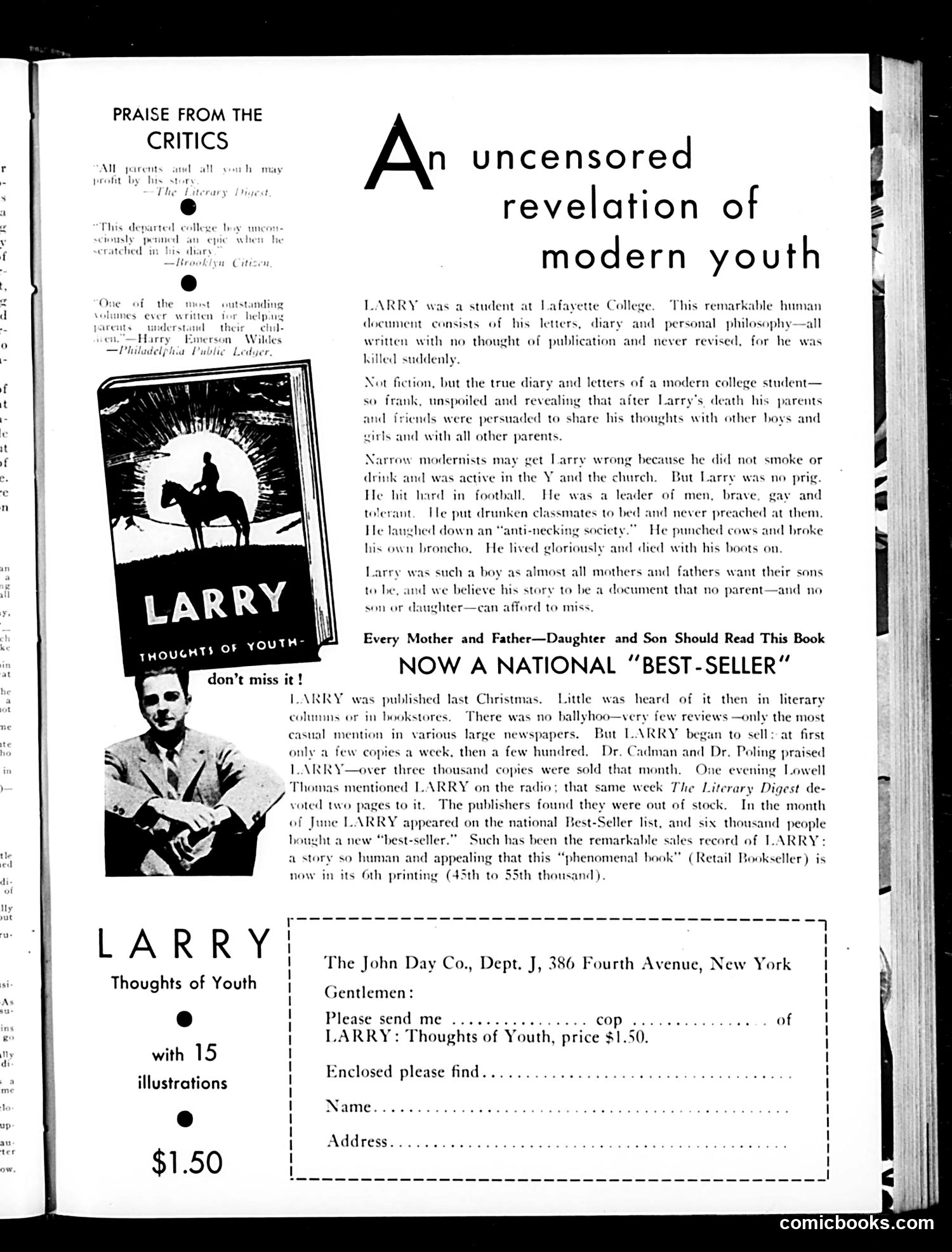
"Larry: Thoughts of Youth" - Advertisement & Social Commentary This page advertises a purportedly non-fiction book—the diary and letters of "Larry," a deceased Lafayette College student. The marketing targets parents anxious about modern youth morality. The satire (likely implied by Judge's presence) centers on a paradox: Larry is presented as the "ideal boy" parents want—he doesn't smoke, drink, or engage in "necking," attends church, plays football. Yet the testimonials emphasize he was *tolerant* of other students' excess and "laughed down" moral societies. The phrase "uncensored revelation" suggests scandalous content despite Larry's own propriety. The book's explosive sales success (now a "national best-seller" after radio endorsement) is itself the joke—it exploits parental moral panic about youth while actually depicting a conventionally virtuous young man. The ad thus satirizes both publisher sensationalism and the generational anxiety of 1920s-30s parents worried their children had become hopelessly "modern."

Analysis This is a cigarette advertisement, not satire or political commentary. It appeared in Judge magazine around 1932 and promotes Camel cigarettes to female smokers. The page features a photograph of a woman smoking, with the tagline "I've switched to CAMELS because they're FRESH." The copy uses pseudo-scientific language to market the product—claiming women's "more sensitive" throats detect mildness better than men's, and promoting the "Camel Humidor Pack" as protecting freshness. Notable for a modern reader: this explicitly targets women smokers during an era when female smoking was still somewhat controversial. The advertisement assumes women are a desirable market demographic and uses gendered messaging (sensitivity, refinement) to appeal to them. The ad also mentions the company's radio programs, indicating integrated marketing across media platforms—a modern advertising approach even in 1932.