judge
Judge — April 2, 1932
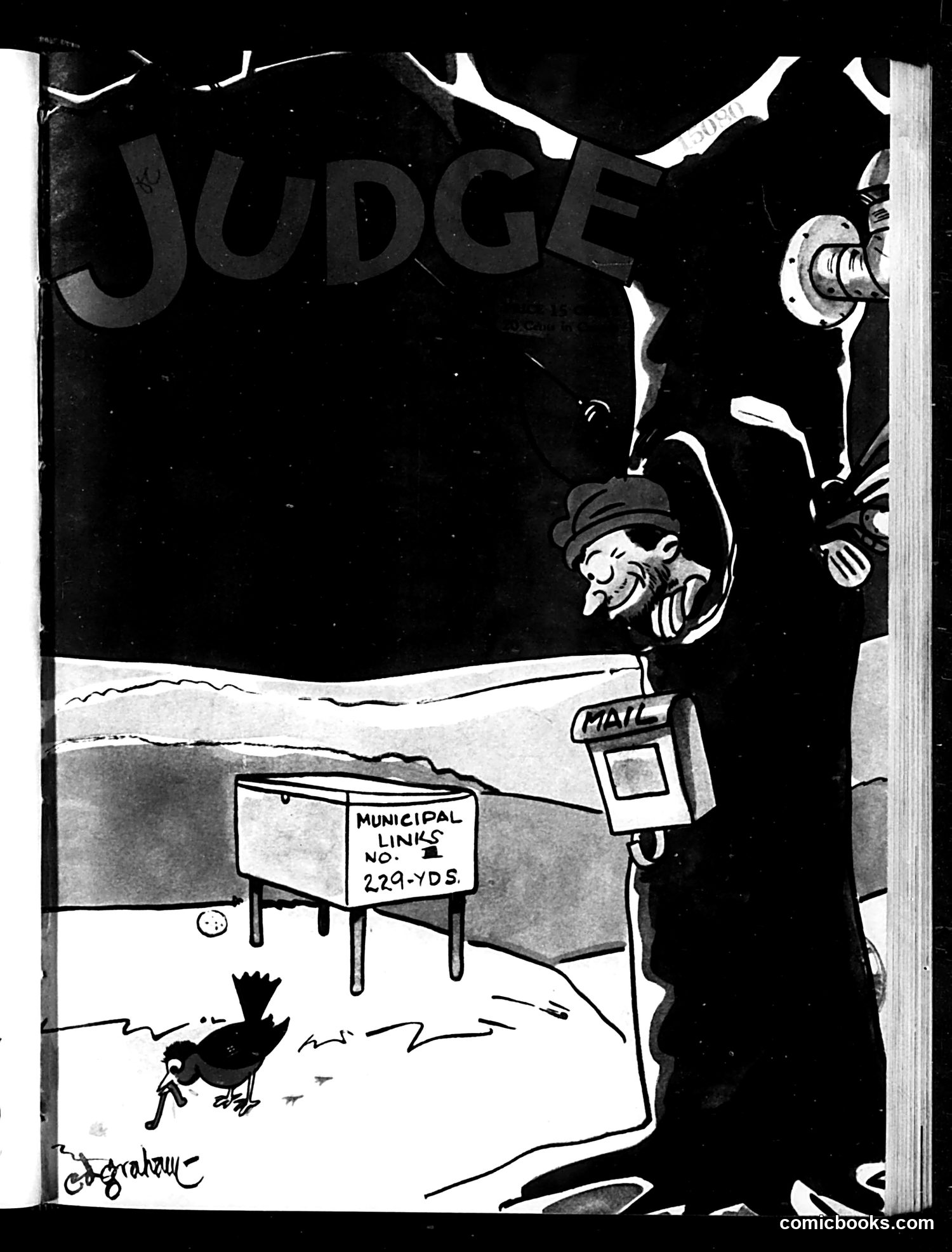
Analysis of Judge Magazine Cartoon This cartoon satirizes municipal golf course management. The sign reads "Municipal Links No. 1 — 229 YDS," indicating a public golf facility. The caricatured figure appears to be a municipal official or judge overseeing the course, hence the magazine's title reference. The joke seems to target inefficiency or mismanagement at public golf links—a 229-yard hole is unusually short, suggesting either poor course design or bureaucratic bungling. The small bird in the lower left may emphasize the absurdity of the measurement. The cartoon critiques government-run recreational facilities, a common satirical target in Judge magazine during the early-to-mid 20th century. The specific date and context remain unclear without additional publication information.
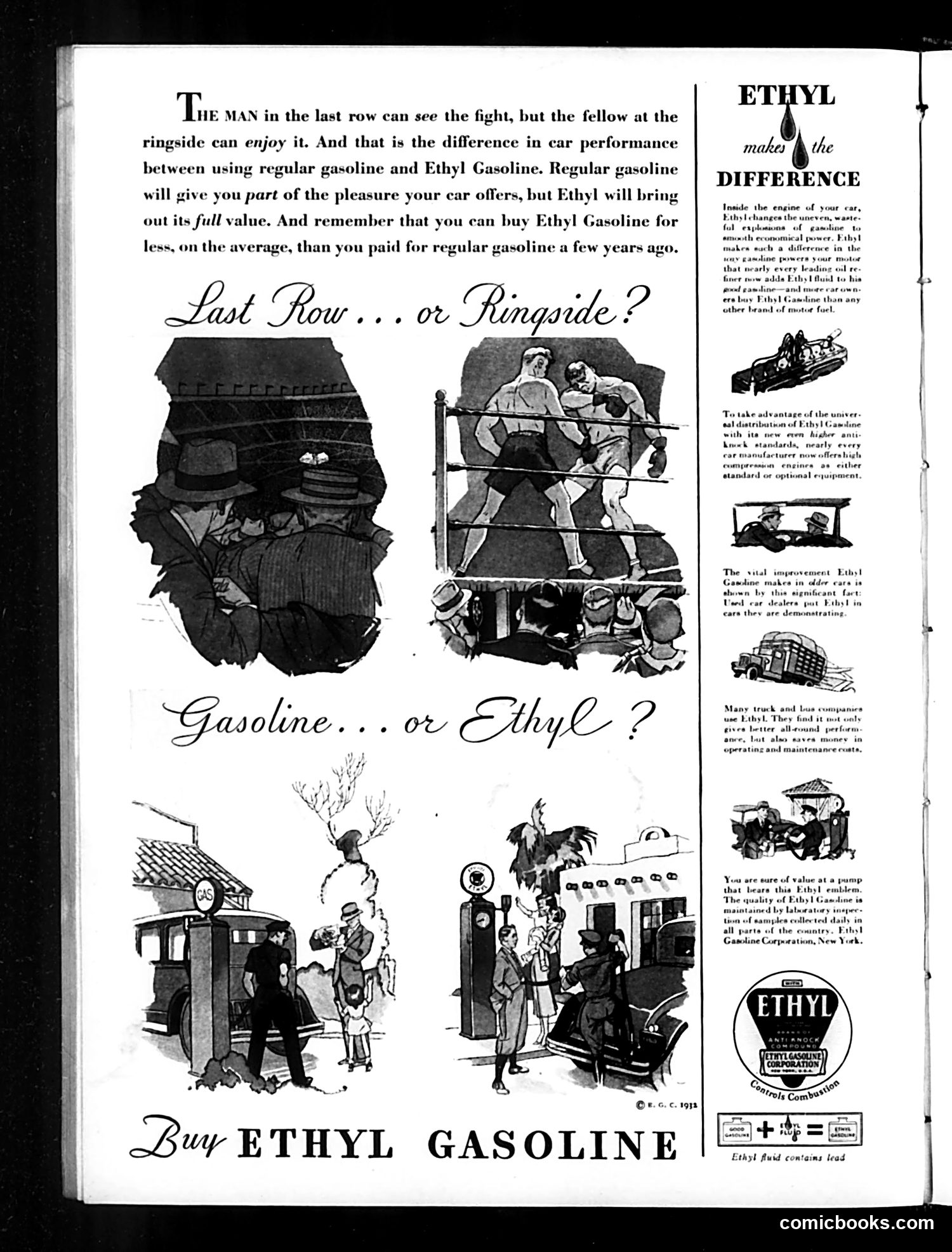
Ethyl Gasoline Advertisement This is primarily a commercial advertisement, not political satire. The page promotes Ethyl Gasoline through comparative scenarios showing the performance difference between regular gasoline and Ethyl brand. The left illustration contrasts two viewing experiences: a "Last Row" spectator (presumably at a sporting event) versus a "Ringside" viewer—using this as a metaphor for car performance differences. Regular gasoline offers limited capability; Ethyl provides superior results. The lower vignettes depict everyday scenarios (farming, gas stations, trucks) where Ethyl's advantages manifest. The right column reinforces claims about engine efficiency and cost-effectiveness. This reflects 1920s-30s marketing: establishing brand superiority through lifestyle imagery and practical benefits, emphasizing that Ethyl—though historically containing lead—delivered measurable performance advantages consumers valued.
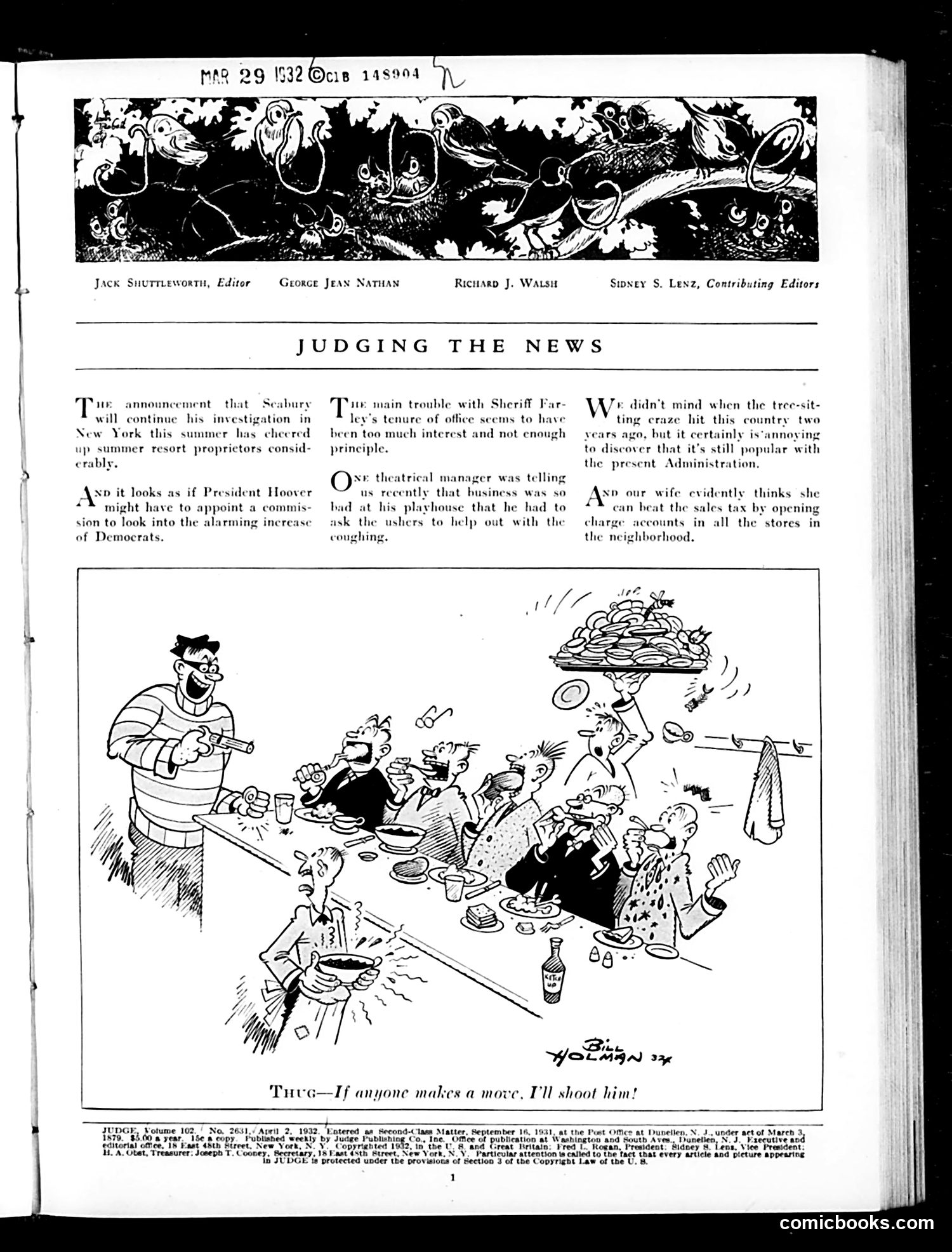
Analysis of Judge Magazine Cartoon (April 2, 1932) The main cartoon depicts a chaotic dinner scene with a waiter threatening violence ("If anyone makes a move, I'll shoot him!"). This satirizes Prohibition-era restaurant conduct during the Great Depression. The exaggerated threat and rowdy diners suggest the lawlessness and danger associated with speakeasies and illegal alcohol service in the early 1930s. The editorial snippets above reference contemporary issues: President Hoover potentially appointing a commission regarding Democrats, Sheriff Farley's questionable tenure, and theatrical business troubles. The wife's comment about "beating the sales tax" through neighborhood store visits reflects Depression-era consumer anxiety about new taxation. Overall, the page satirizes 1932 American anxieties—law enforcement breakdown, economic hardship, and government instability during Hoover's final year in office.
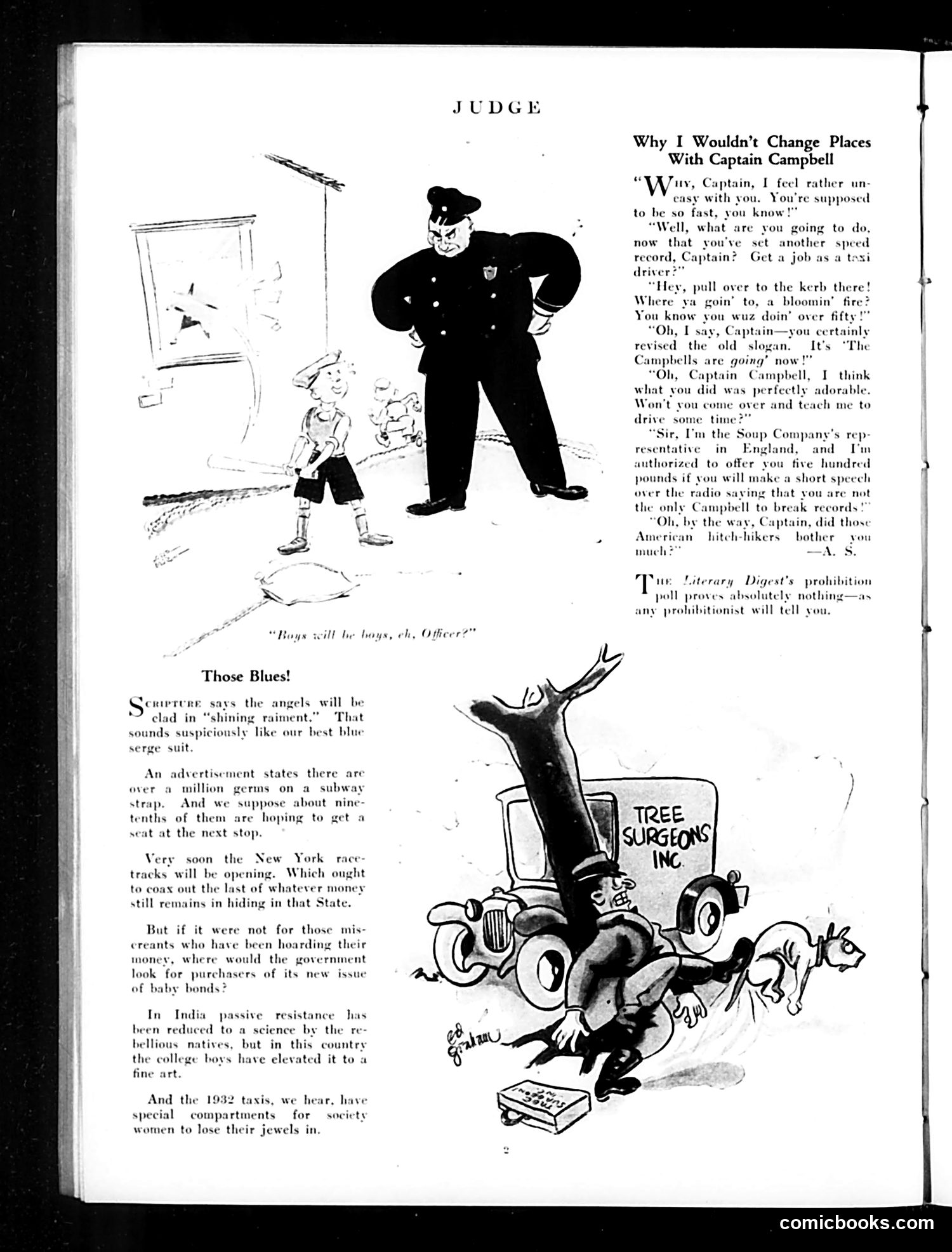
Judge Magazine Page Analysis This page contains three distinct satirical pieces: 1. "Why I Wouldn't Change Places With Captain Campbell" (top): A conversation between a small figure and a large captain in uniform. The captain brags about setting speed records, but the smaller person (appearing to be from a soup company) offers him a lucrative radio endorsement deal instead—suggesting that commercial sponsorships and advertising were becoming more profitable than athletic achievement. The satire mocks both corporate advertising culture and celebrities' willingness to abandon their accomplishments for money. 2. "Those Blues!" (left): Jokes about blue serge suits, germs on subways, and upcoming New York racetracks—light social commentary on urban life and fashion. 3. "Tree Surgeons Inc." (bottom right): A cartoon showing what appears to be a charlatan operator with a truck, suggesting fraud or incompetence in emerging service industries.
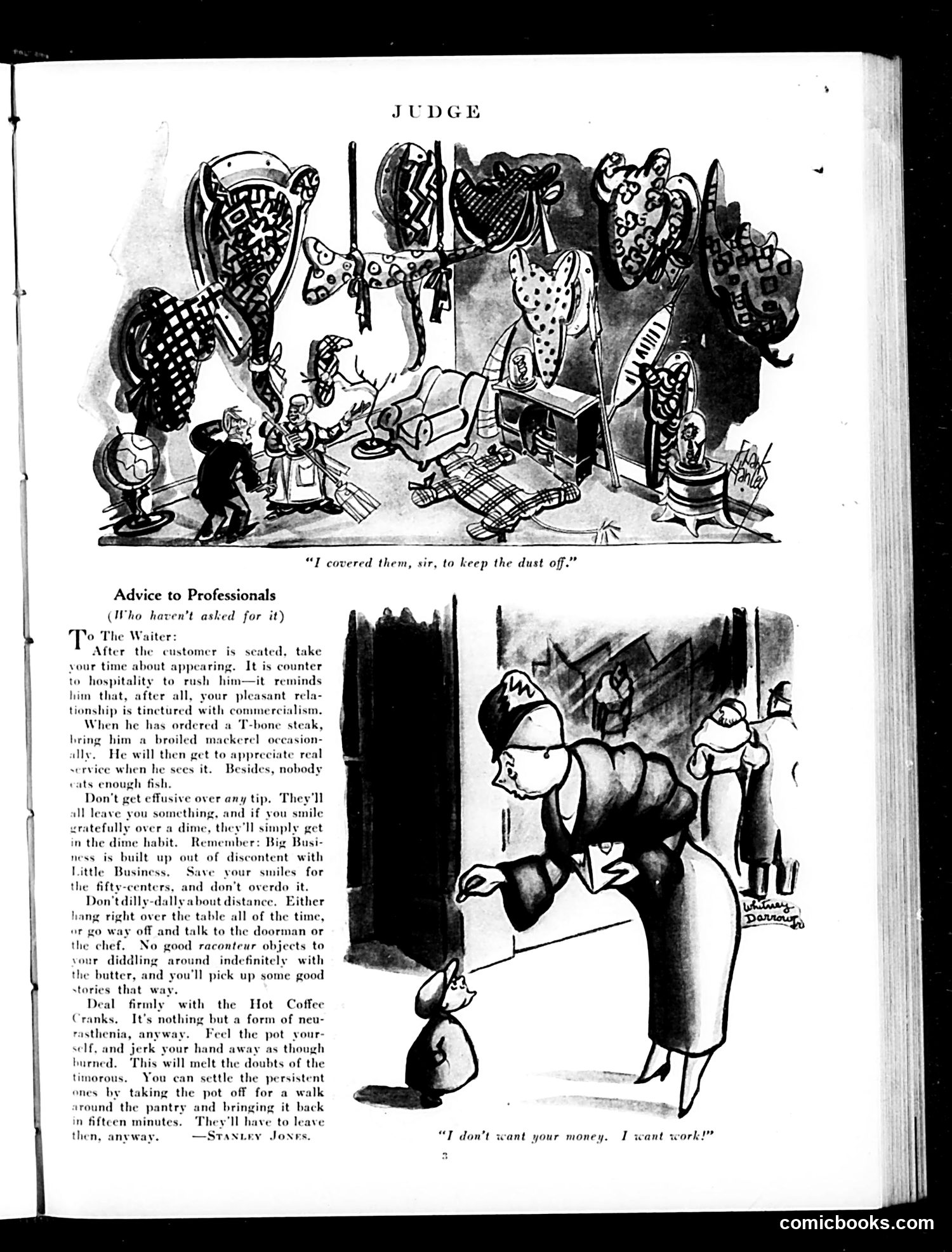
Analysis of Judge Magazine Page The page contains two distinct cartoons: Top cartoon ("I covered them, sir, to keep the dust off"): This appears to be a satirical commentary on antique collecting or museum curation, showing elaborate, ornately decorated objects. The joke likely mocks pretentious collectors who obsess over preserving valuable items. Bottom cartoon ("I don't want your money. I want work!"): This depicts a waiter or service worker rejecting money from an employer. The caption suggests social commentary on labor dignity—the worker demands employment and fair treatment rather than charity or tips. This reflects early 20th-century debates about working conditions and wages versus handouts. The accompanying "Advice to Professionals" column offers satirical guidance to waiters on managing customers and tips, reinforcing class and service industry tensions of the era.
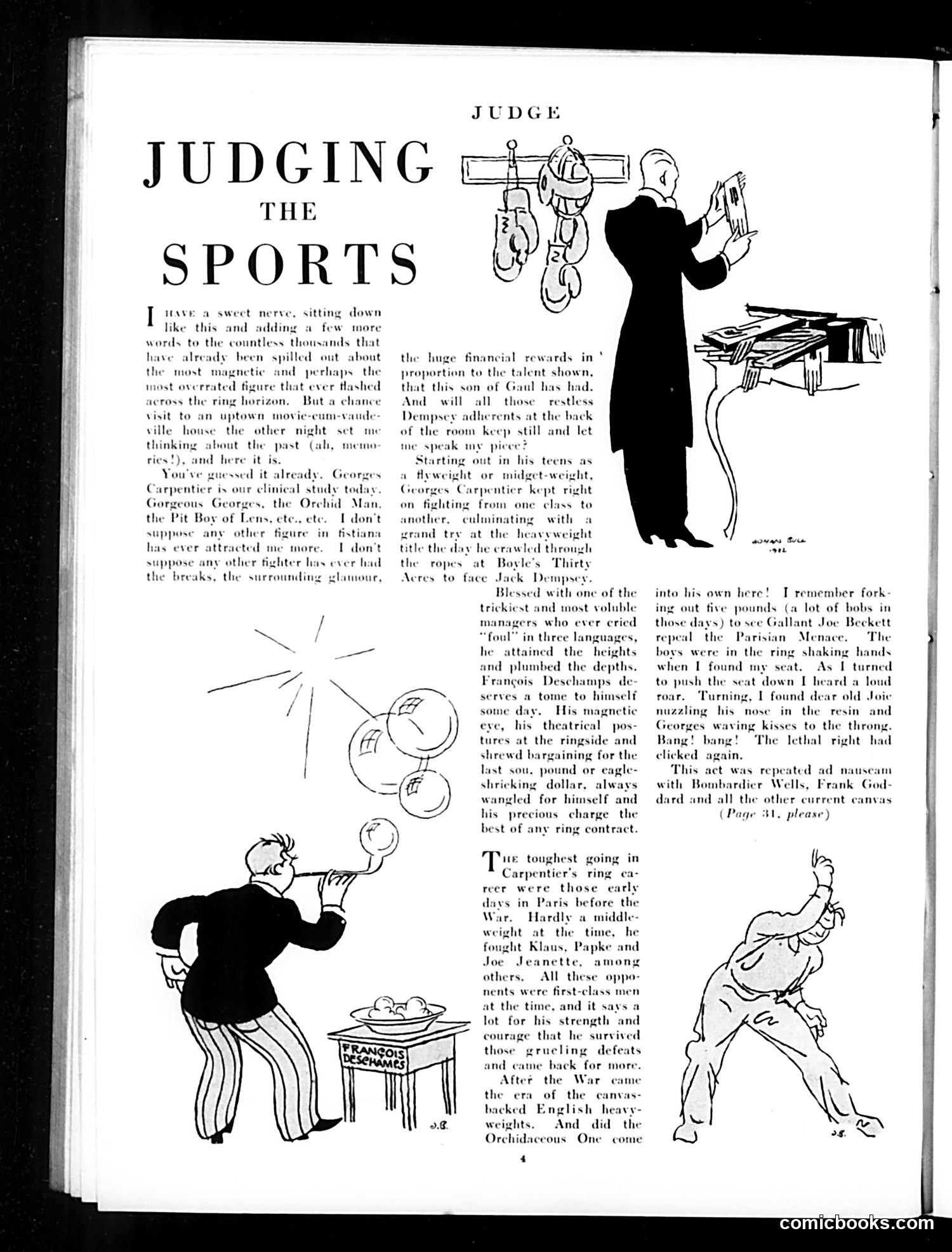
"Judging the Sports" This page presents a satirical essay on boxing and fight management. The author discusses Georges Carpentier, a famous boxer, using him as the central subject of critique. The text mocks the financial and managerial side of professional boxing, mentioning Carpentier's rise from lightweight to heavyweight competition, culminating in a fight against Jack Dempsey. The satire focuses on fight managers—particularly François Deschamps—who negotiated contracts and "wangled" money from promoters. The cartoons (showing judges juggling balls and boxing scenes) illustrate the absurdity of boxing's business apparatus and the theatrical posturing involved in the sport. The piece critiques both the outsized financial rewards in boxing and the colorful personalities surrounding it, suggesting the sport is more about spectacle and profit than athletic merit.
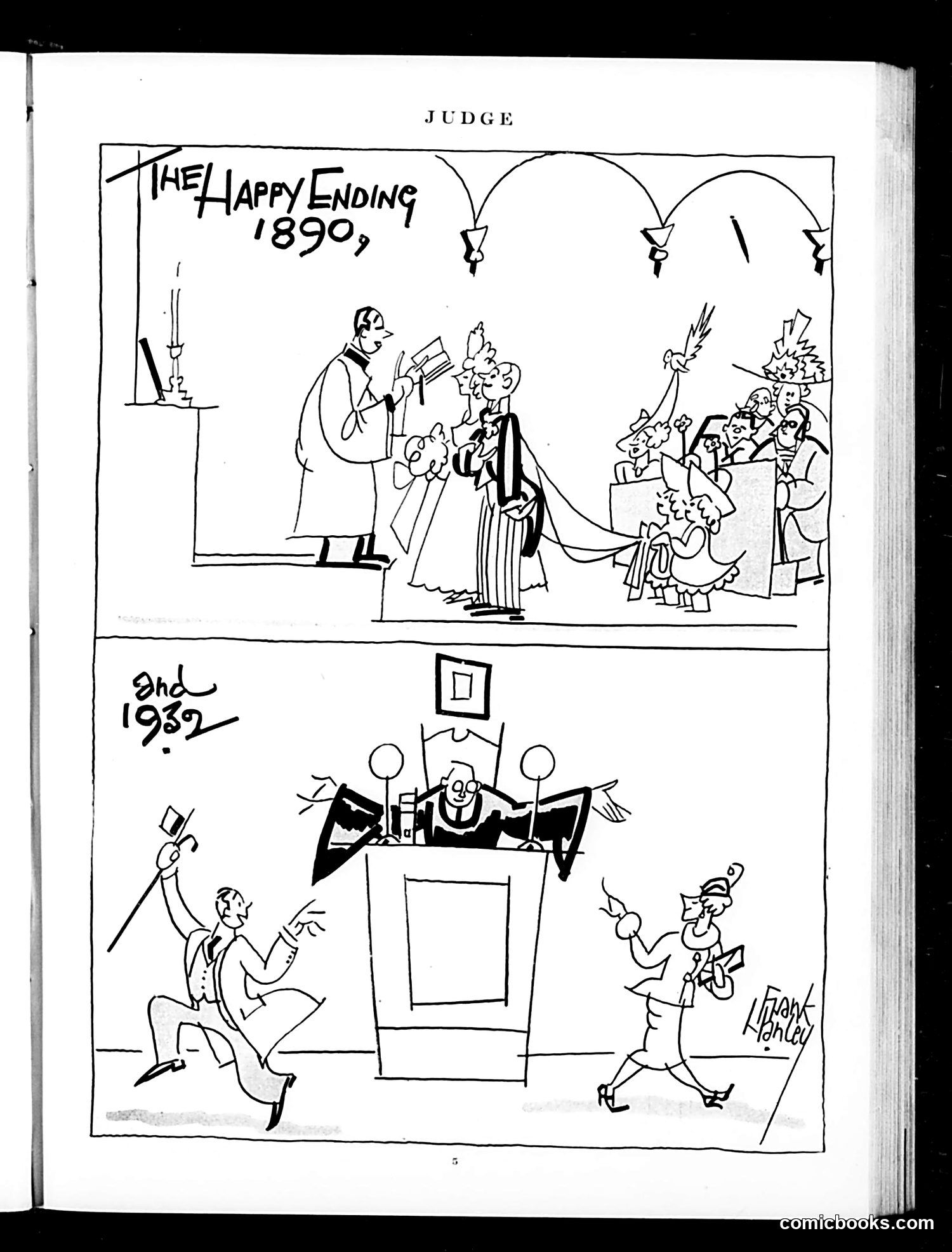
Analysis of Judge Page This page contains two cartoons titled "The Happy Ending 1890" and "2nd 1932," both depicting judges presiding over courtroom scenes. The 1890 cartoon (top) shows a judge conducting what appears to be a wedding ceremony, with couples and children celebrating—satirizing the judicial system's role in matrimonial matters. The 1932 cartoon (bottom) depicts a judge presiding over two men dancing energetically with flags, while another figure plays musical instruments. This likely satirizes judicial decisions or legal rulings that had unexpected or absurd social consequences during the early Depression era. Without additional historical documentation, the specific judicial decisions or events being mocked remain unclear. The cartoons appear to critique judicial authority's broader social impacts, though the exact references require further context.
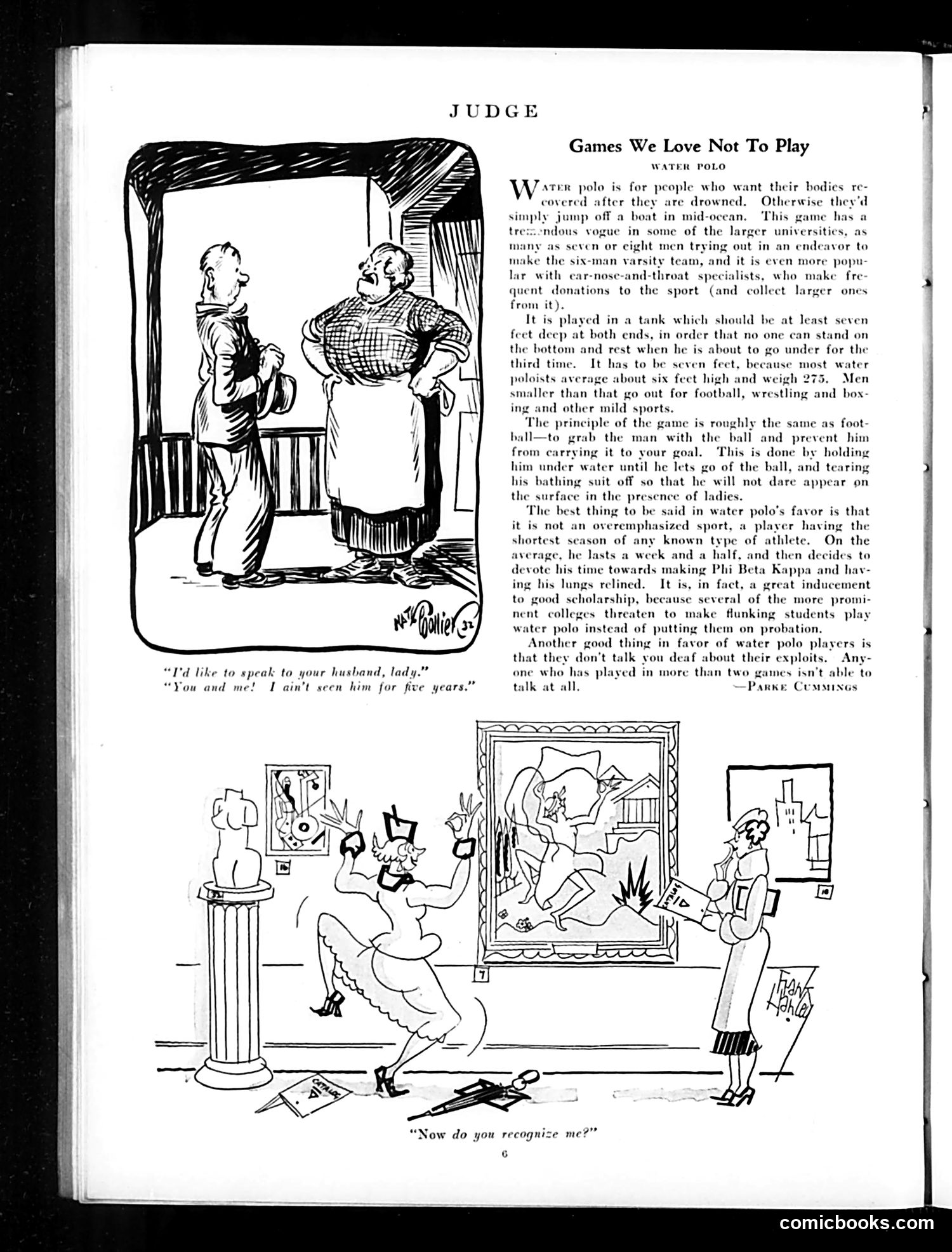
Water Polo Satire The top cartoon shows a domestic scene where a woman confronts her husband about his absences, saying "I'd like to speak to your husband, lady" and "You and me! I ain't seen him for five years." The article explains water polo's rules and appeals, noting it's played in deep tanks and requires dedication. However, the satire's point is that the sport is so time-consuming and obscure that husbands abandon their wives to participate. The joke undercuts the sport's prestige by showing its actual social cost: marital neglect. The bottom cartoon (artist: Frank Phila) depicts a woman at an art gallery, asking "Now do you recognize me?" suggesting her husband only recognizes her from paintings, having been absent from home so long due to water polo obsession.
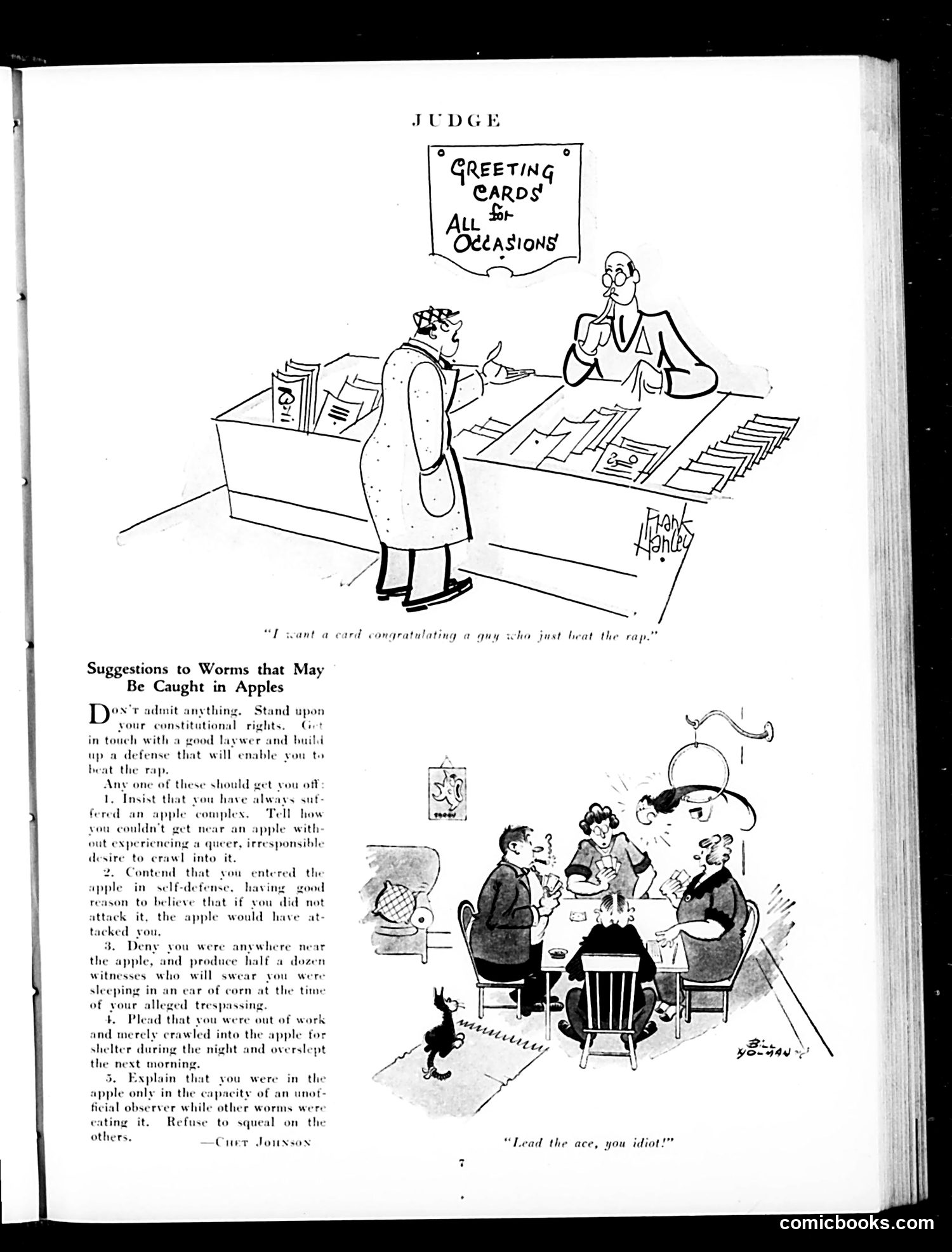
Explanation for Modern Readers This page contains two distinct satirical pieces from Judge magazine: Top Cartoon: A customer at a greeting card shop asks for a card "congratulating a guy who just beat the rap"—meaning someone who evaded legal consequences. The joke mocks the normalization of crime and acquittal, suggesting greeting cards exist for every occasion, even criminal ones. Bottom Section: "Suggestions to Worms that May Be Caught in Apples" is legal satire. It parodies criminal defense strategies by applying them absurdly to worms found in apples. The advice includes: claiming constitutional rights, manufacturing alibis, producing false witnesses, pleading poverty, and refusing to testify against accomplices. The humor satirizes actual legal defenses used by criminals—suggesting these tactics are so transparent and common they could be applied to literally any situation. The accompanying cartoon shows people playing cards, with the caption "Lead the ace, you idiot!"—unrelated domestic humor typical of Judge's mixed-content format. Together, these pieces mock both the ease of evading justice and the predictability of courtroom defense strategies.
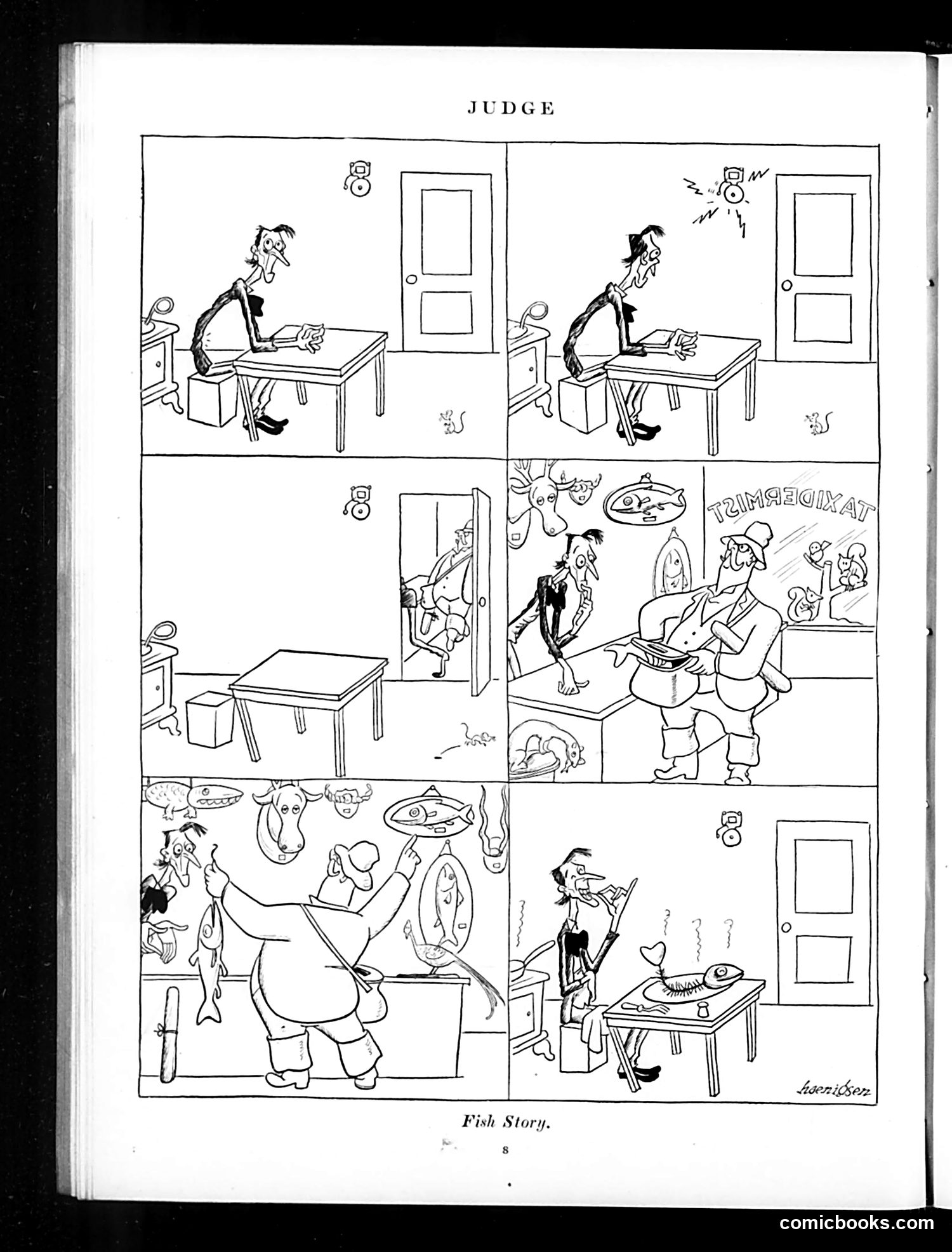
"Fish Story" - Judge Magazine Cartoon This is a six-panel comic titled "Fish Story" satirizing exaggeration and lying. The narrative shows a Judge (identifiable by his robes and bench in the first panels) who appears to catch a fish. The story progresses through increasingly absurd retellings: what begins as a modest catch becomes, with each retelling, a progressively larger and more fantastical tale, complete with increasingly elaborate illustrations of giant fish. The final panel shows the judge at his desk with a comically oversized fish, suggesting he's adopted the exaggerated version as truth. The satire targets how stories grow through repetition and how people—even authority figures like judges—can become invested in false narratives. It's a commentary on dishonesty and the human tendency to embellish, particularly relevant to a satirical magazine focused on exposing social and political falsehoods.
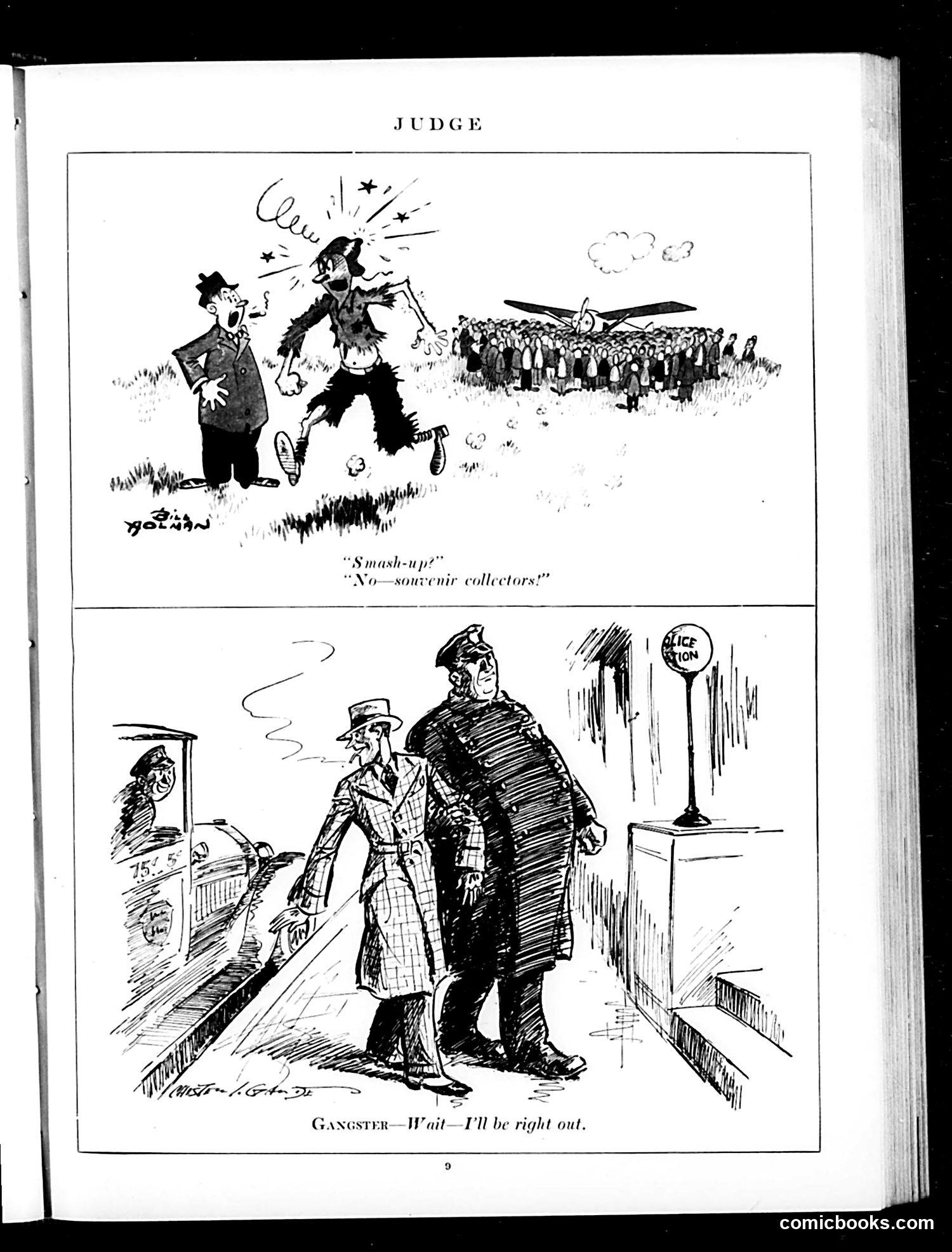
Page Analysis: Judge Magazine Political Cartoons This page contains two separate cartoons satirizing early 20th-century social behavior. The top cartoon depicts a chaotic scene where a figure labeled "Jew" is being attacked by a mob while "souvenir collectors" watch. The caption suggests the violence is being rationalized as mere souvenir-gathering rather than acknowledged as an actual "smash-up" (pogrom or riot). This appears to satirize indifference to anti-Semitic violence, where perpetrators or observers dismiss serious attacks as casual collectibles. The bottom cartoon shows a "Gangster" at what appears to be a police station, telling someone he'll "be right out"—suggesting criminals operate with such impunity or corruption that even arrest poses no real consequence. Both cartoons critique lawlessness and social violence in contemporary America, though the top cartoon contains deeply offensive anti-Semitic imagery reflecting the era's prejudices.
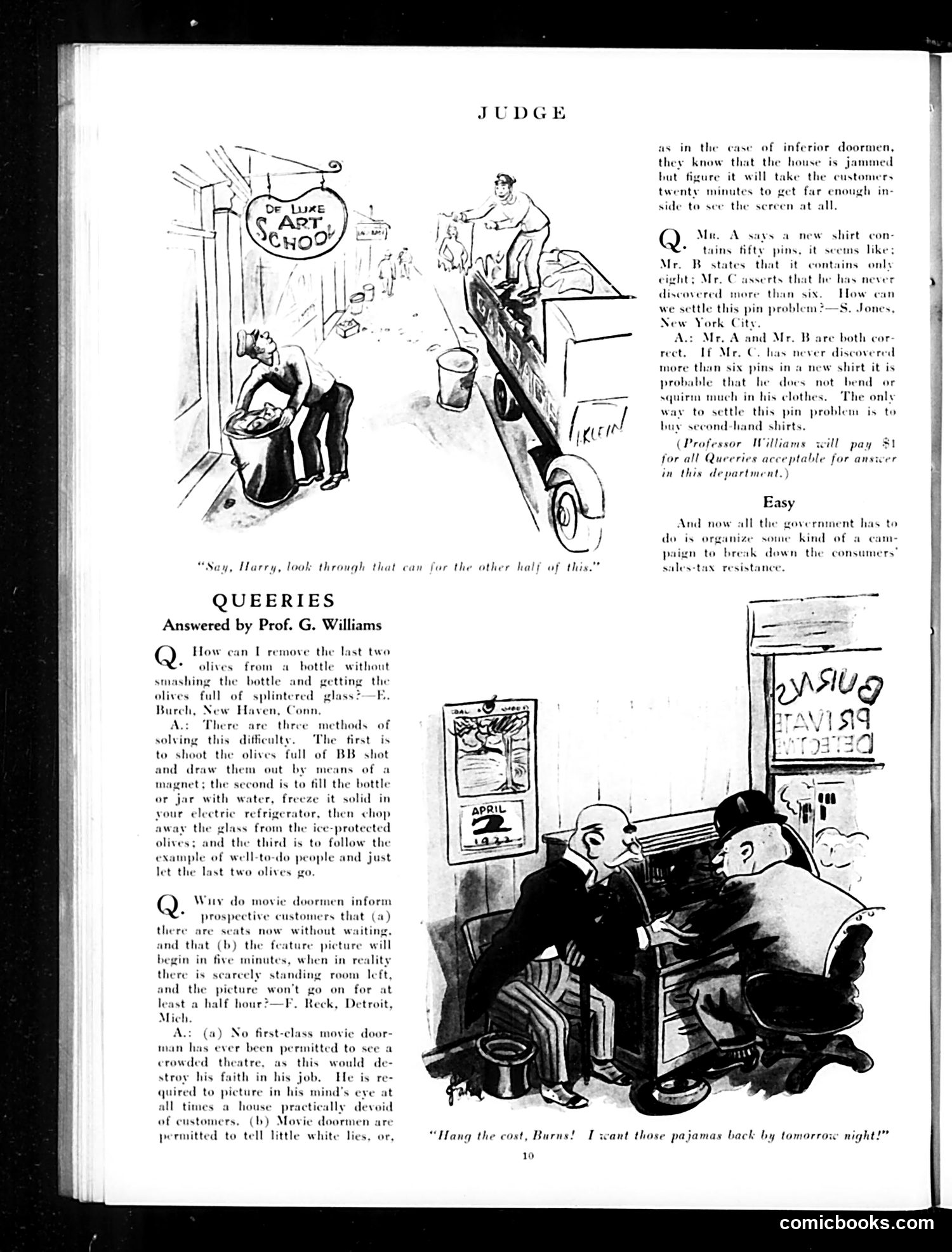
Judge Magazine Page Analysis This page from Judge contains humorous advice columns and satirical cartoons typical of early 20th-century American humor. The Cartoons: The top illustration shows a "De Luxe Art School" where doormen cram customers into a theater despite fire code violations. The satire mocks theaters that falsely advertise available seating. The bottom cartoon depicts a couple at what appears to be a tailor or dry cleaner, with one person demanding pajamas back by tomorrow—satirizing the gap between promised service delivery and reality. The "Queries" Section: Readers submit absurd practical problems (removing olives from bottles, counting shirt pins), and Professor Williams responds with mock-serious but ridiculous solutions (using BB shot and magnets; freezing bottles solid). The humor lies in treating trivial consumer complaints with overwrought technical advice. Social Context: These pieces satirize modern consumer culture, retail dishonesty, and everyday frustrations of urban middle-class life. The final note about "sales-tax resistance" suggests contemporary economic concerns.
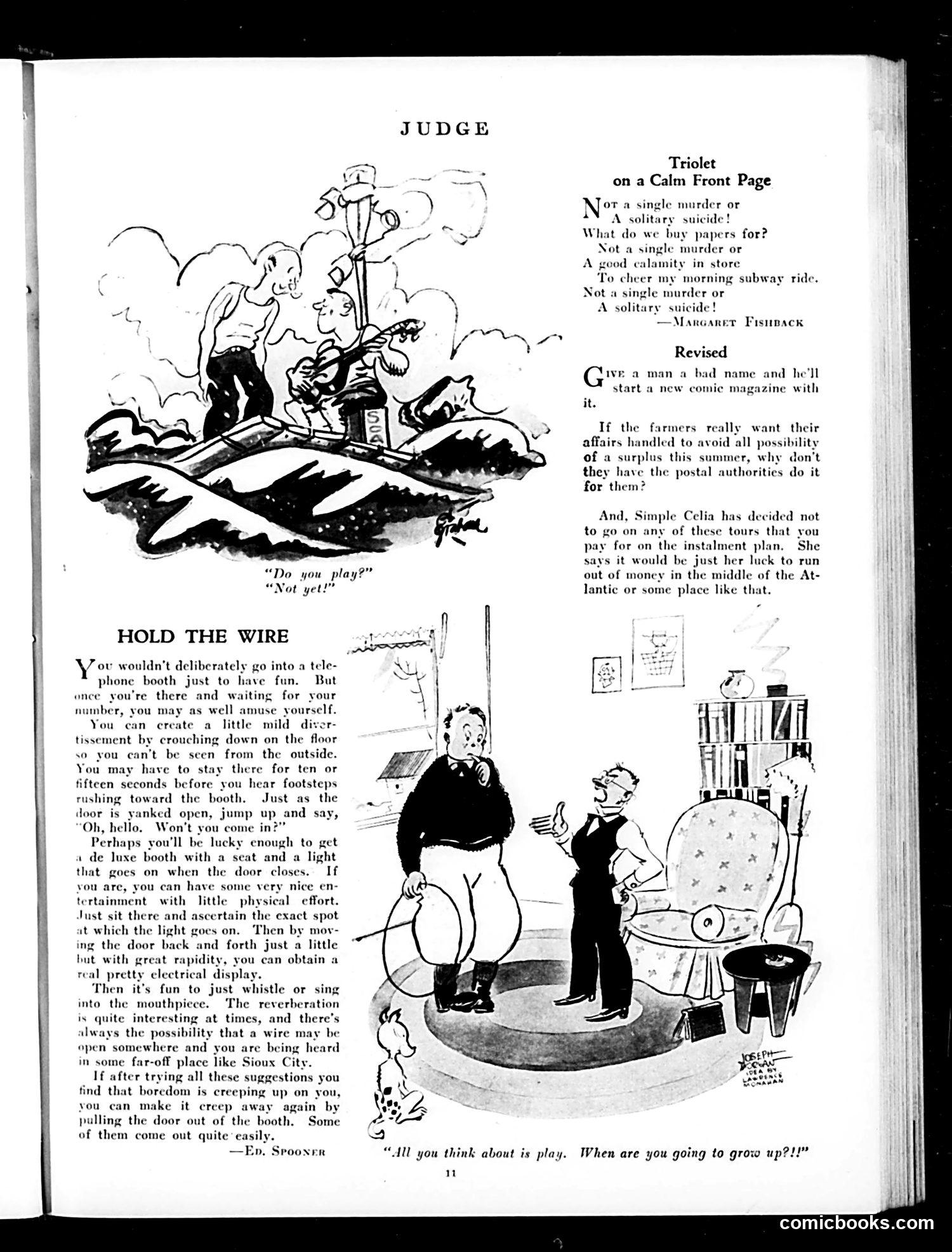
Analysis of Judge Magazine Page This page contains three distinct humor pieces satirizing early 20th-century American life: "Triolet on a Calm Front Page" mocks readers' morbid newspaper appetite. The poem, attributed to Margaret Fishback, satirizes how people buy papers specifically for sensational crime coverage—murders and suicides—rather than substantive news. A calm news day is presented as disappointing to commuters. "Revised" offers three short satirical quips: one about disreputable figures starting comic magazines, another suggesting farmers use the postal service to handle surplus crops (absurd bureaucratic logic), and a third about a woman avoiding installment-plan vacation tours. "Hold the Wire" describes pranks in telephone booths—then common public fixtures. The humor involves hiding in booths to startle people, playing with booth lights, and singing into receivers hoping distant people might hear. The accompanying cartoon shows an exasperated adult and child, with the adult asking when the child will mature beyond such play. All three pieces reflect period concerns: sensationalism in media, the novelty and misuse of new technology (telephones), and generational attitudes about proper behavior and growing up.
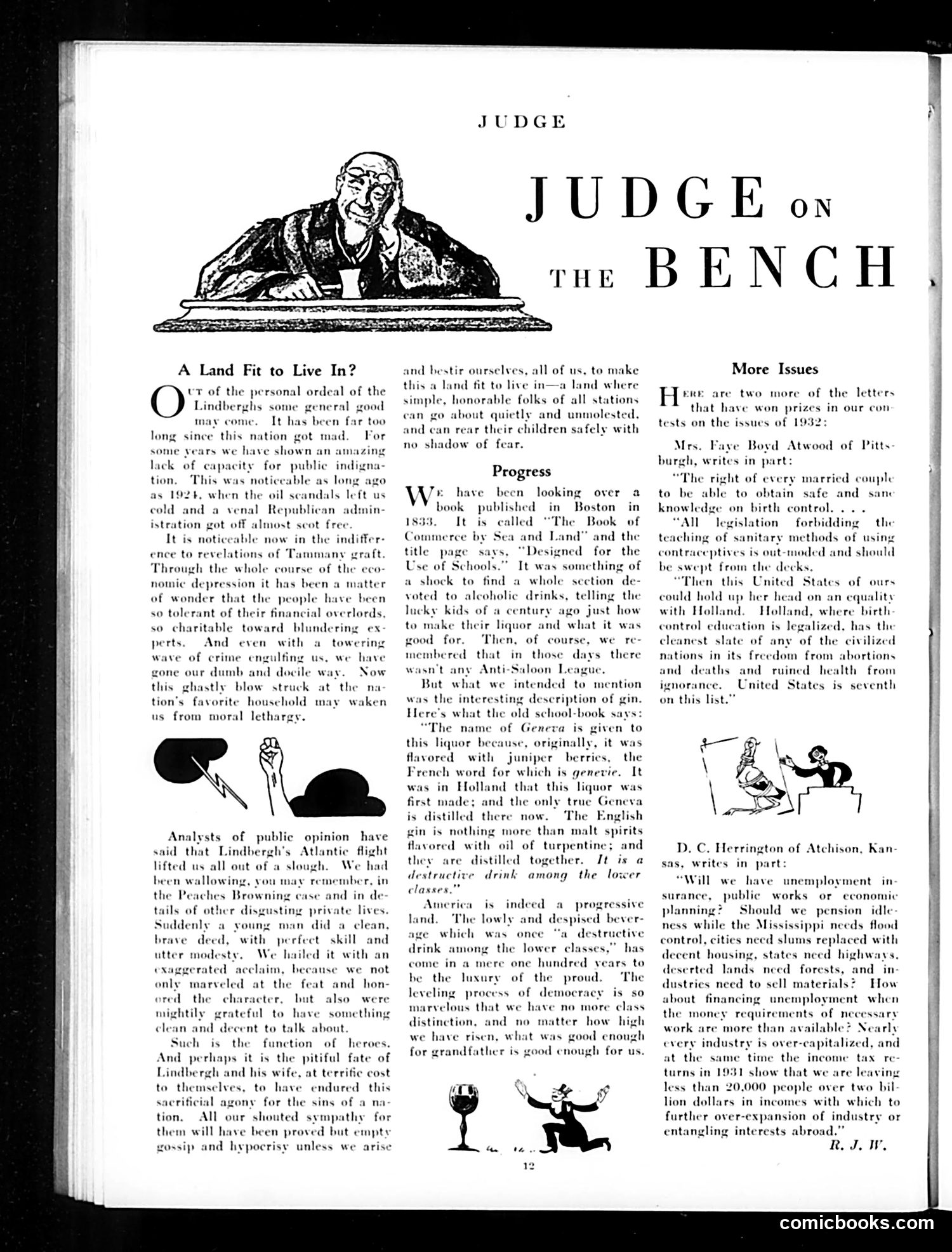
Judge Magazine Page Analysis This 1932 page critiques American moral complacency through two main pieces: Main Article ("A Land Fit to Live In?"): References the Lindbergh kidnapping case (March 1932), arguing it should awaken public outrage about broader social failures. The author contrasts Charles Lindbergh's 1927 heroic flight—which temporarily distracted Americans from scandals—with current crises: Prohibition-era crime, unemployment, corruption (Tammany Hall graft), and financial mismanagement. The satirical point: Americans tolerate systemic failures passively until a personal tragedy jolts them, then forget again. "Progress" Section: Satirically compares historical attitudes toward gin (once condemned as destructive for lower classes) with current acceptance among the wealthy. The irony: American "democracy" supposedly eliminated class distinction, yet the same substance now marks status differences—proving leveling is superficial. "More Issues": Mentions letters discussing birth control legalization, reflecting 1930s reproductive rights debates. The cartoons (small illustrations of drinking, dancing figures) reinforce themes of social disorder and changing mores.
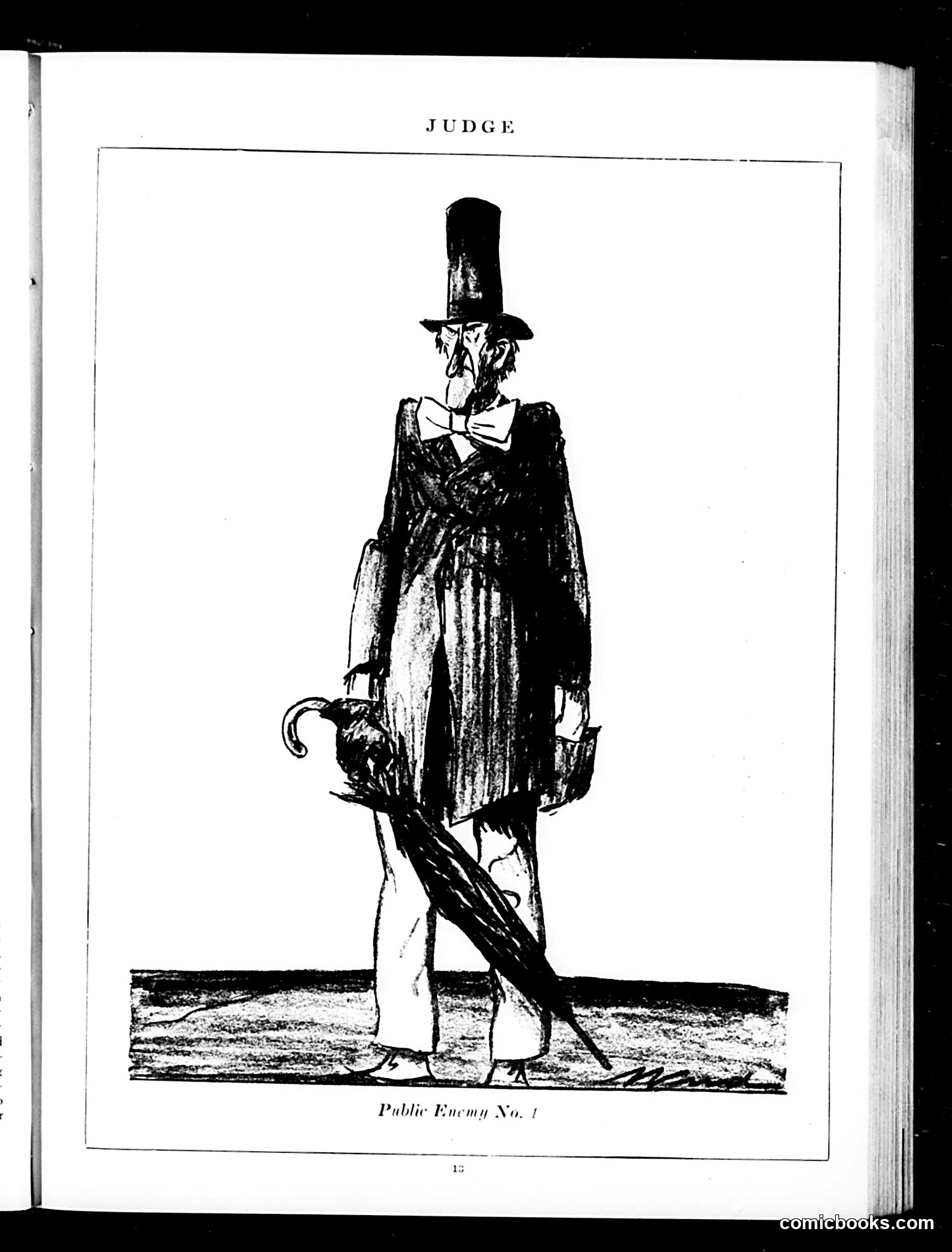
Analysis This is a title page for Judge magazine featuring a single satirical illustration labeled "Public Enemy No. 1." The figure depicted is a thin, menacing character in formal attire (top hat, coat, bow tie) holding a curved sword or scimitar. The caricature emphasizes sharp, angular facial features suggesting a sinister appearance. Without additional context about the publication date, I cannot identify the specific historical figure being caricatured. However, the "Public Enemy No. 1" designation was commonly used in early-to-mid 20th century American satire to mock unpopular political figures or social threats of the era. The illustration style and formal dress suggest this targets a political or judicial figure. The sword and menacing posture indicate the cartoonist viewed this person as dangerous to American interests, though the specific target remains unclear without dating this issue.
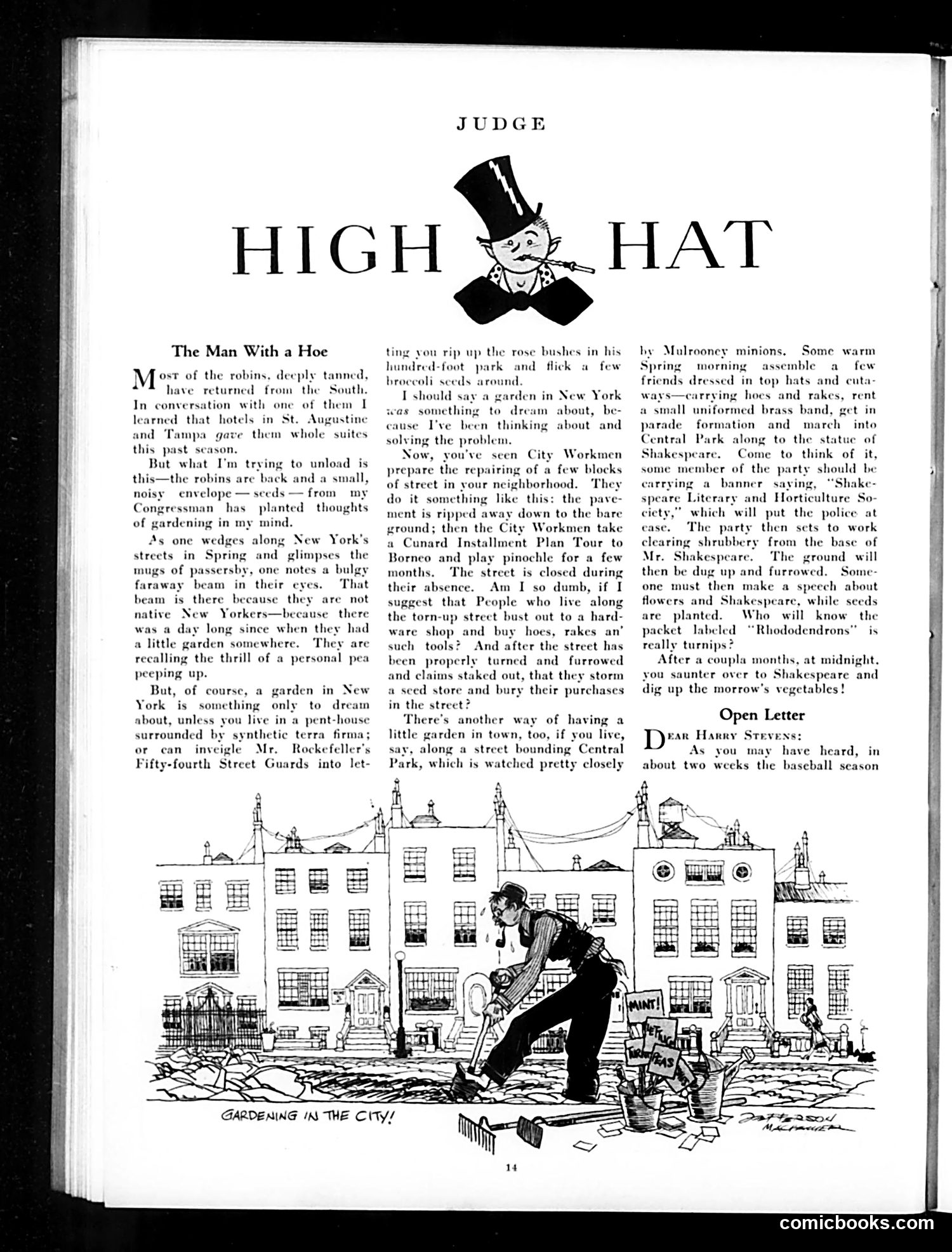
"The Man With a Hoe" - Judge Magazine Satire This article satirizes New York City dwellers' desire for gardening amid urban constraints. The author mocks the impracticality of city gardening by proposing absurd solutions: 1. Urban gardening fantasy: Most New Yorkers lack space for gardens, so the writer suggests commandeering street construction sites—while workers are absent on leisure trips—to plant vegetables. 2. Central Park scheme: He proposes a formal "Literary and Horticulture Society" marching with a brass band into Central Park to plant and later harvest vegetables (humiliatingly disguised as decorative plants like rhododendrons). 3. The joke: Both schemes mock bureaucratic inefficiency (workers abandoning projects) and the absurd lengths city residents would go to satisfy their rural nostalgia. The illustration shows a well-dressed man digging in an urban street surrounded by buildings—visualizing this ridiculous fantasy. The satire targets the gap between modern city life and pastoral yearnings, using slapstick humor about circumventing city rules.
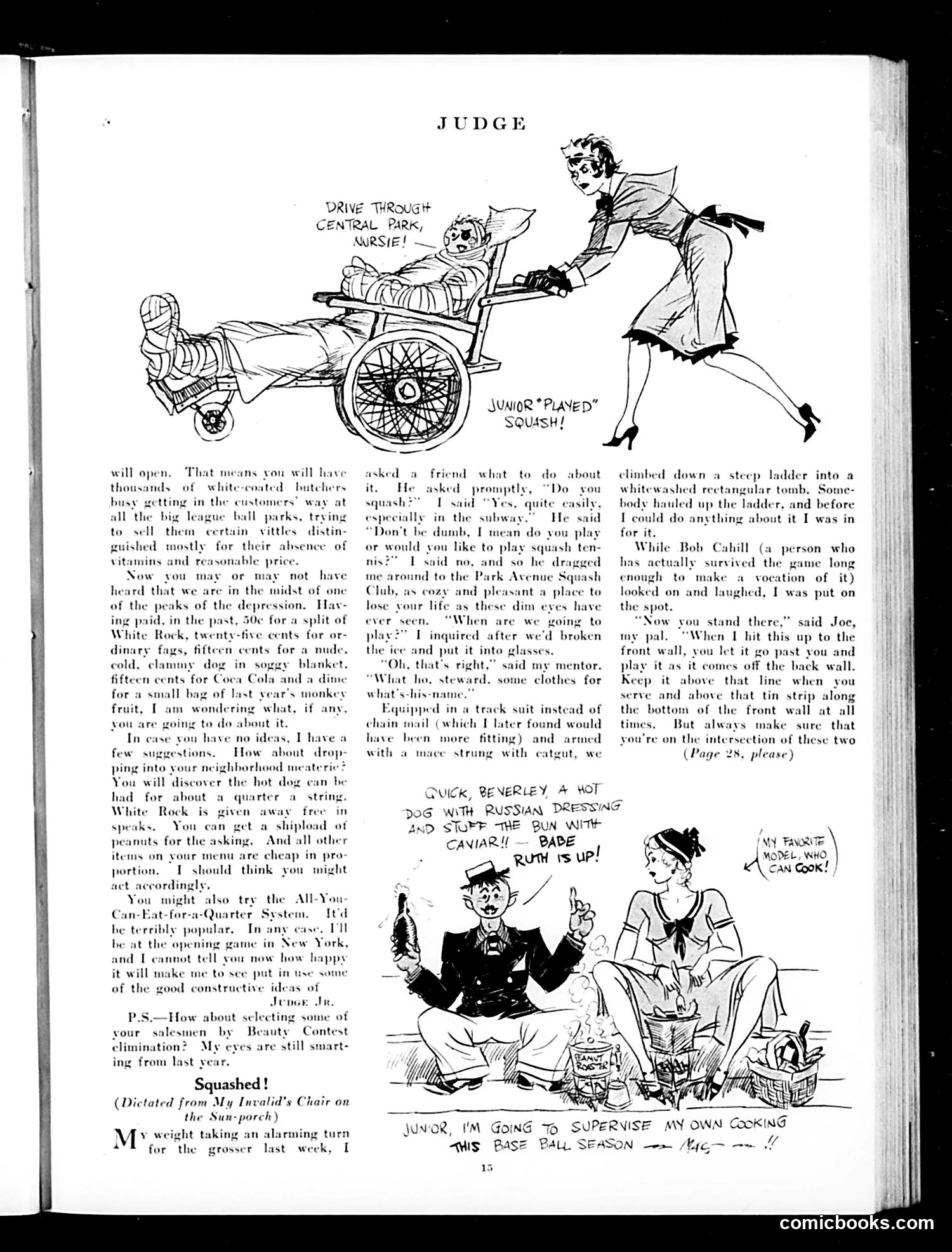
Judge Magazine Page Analysis This page contains two separate pieces of satirical content from the Depression era. Upper section ("Squashed!"): A humorous essay about discovering squash as an affordable recreation during economic hardship. The author, initially concerned about Depression-era price inflation at baseball games and restaurants, is introduced to squash at the Park Avenue Squash Club as a budget-friendly alternative. The piece gently mocks both the author's sedentary lifestyle and the sport itself through self-deprecating commentary about being lowered into "a whitewashed rectangular tomb." Lower cartoons: Two comic vignettes satirizing domestic life and amateur cooking. One shows a woman commanding her companion to prepare an elaborate hot dog ("Russian dressing," caviar), mocking pretentious food preparation. The other depicts a man announcing he'll "supervise my own cooking this base ball season," suggesting Depression-era economic pressures forced men into traditionally female domestic roles. The overall theme reflects 1930s American anxiety about economic survival and shifting social norms, presented through lighthearted humor rather than direct political commentary.
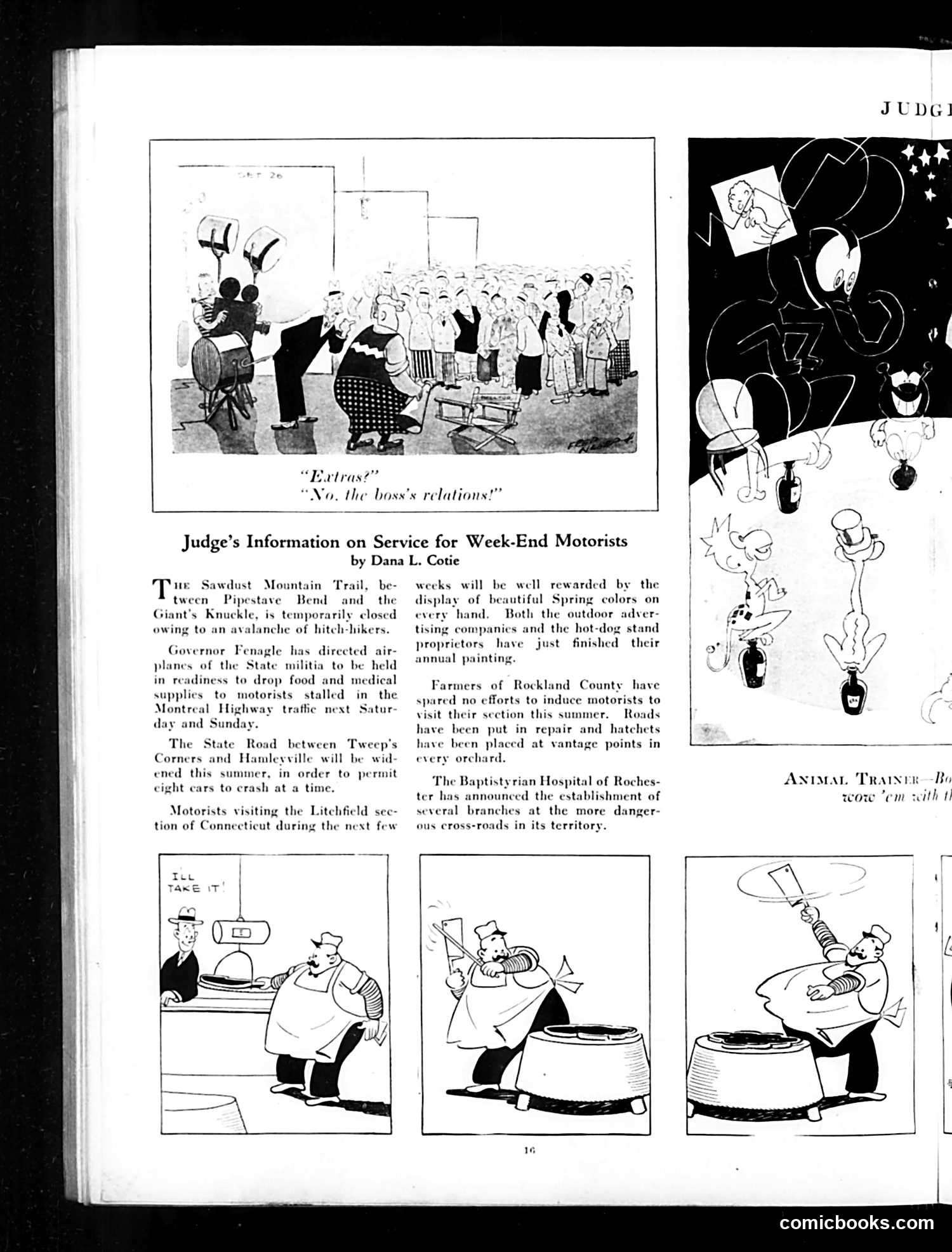
Judge Magazine Satire Analysis This 1920s-era page satirizes the chaos of early automobile tourism and weekend motorist culture. The top cartoon jokes about traffic accidents—a man claims the crowd isn't "extras" for a film but "the boss's relations," implying family members injured in a car crash. The "Information" section by Dana L. Cotie uses deadpan humor to mock: - Hitchhiker overpopulation (avalanches of them blocking mountain trails) - Road fatalities (needing planes to drop supplies to stranded motorists; a road widened specifically to accommodate eight simultaneous car crashes) - Commercialization of nature (ad companies and hot-dog vendors painting scenery) - Rural danger (hatchets placed in orchards, implying motorist violence; hospitals opening branches at dangerous intersections) The bottom comic strip appears unrelated—likely an "Animal Trainer" feature. The satire reflects genuine 1920s anxieties: automobiles were new, safety was minimal, weekend tourism was transforming rural areas, and traffic deaths were mounting rapidly. Judge exaggerates these real problems into absurdist comedy.
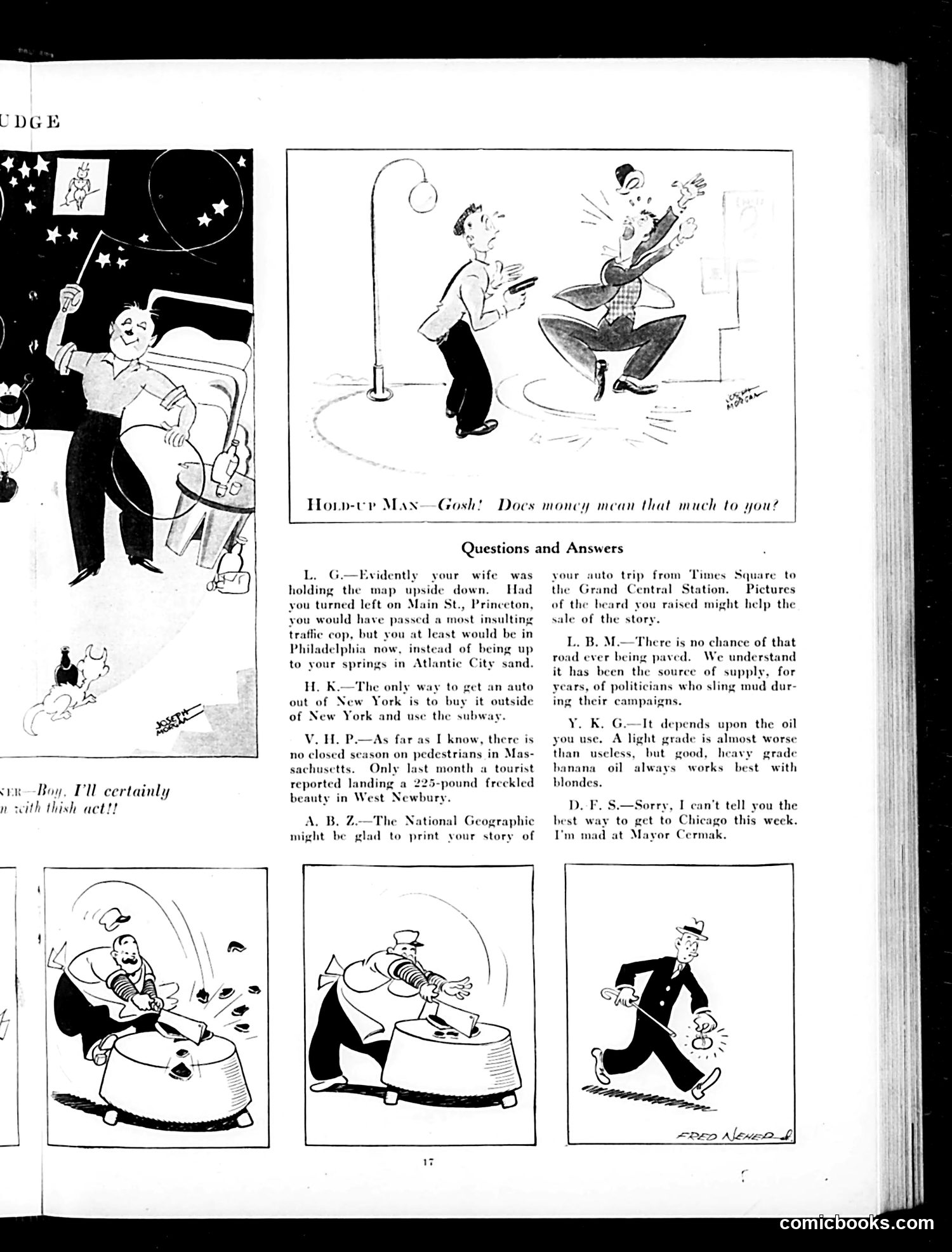
Judge Magazine Page Analysis This page from *Judge* magazine features humorous advice in a "Questions and Answers" column, accompanied by cartoons mocking contemporary life. The main cartoon "Hold-up Man—Gosh! Does money mean that much to you?" depicts a robbery, likely satirizing Depression-era economic desperation or cynicism about wealth. The Q&A section contains mock-serious responses to reader queries about driving, traffic, and travel—clearly joking about contemporary automotive culture and infrastructure problems. References include: - Traffic enforcement and dangerous roads in Massachusetts - New York City's subway system as an alternative to driving - Mayor Cermak (Chicago's mayor, 1931-33), suggesting this dates to that era The humor relies on absurdist exaggeration: suggesting banana oil works "best with blondes," claiming politicians literally "sling mud," and describing pedestrian hunting as a seasonal sport. The cartoons show slapstick scenarios of financial desperation and physical comedy typical of early 20th-century magazine humor.
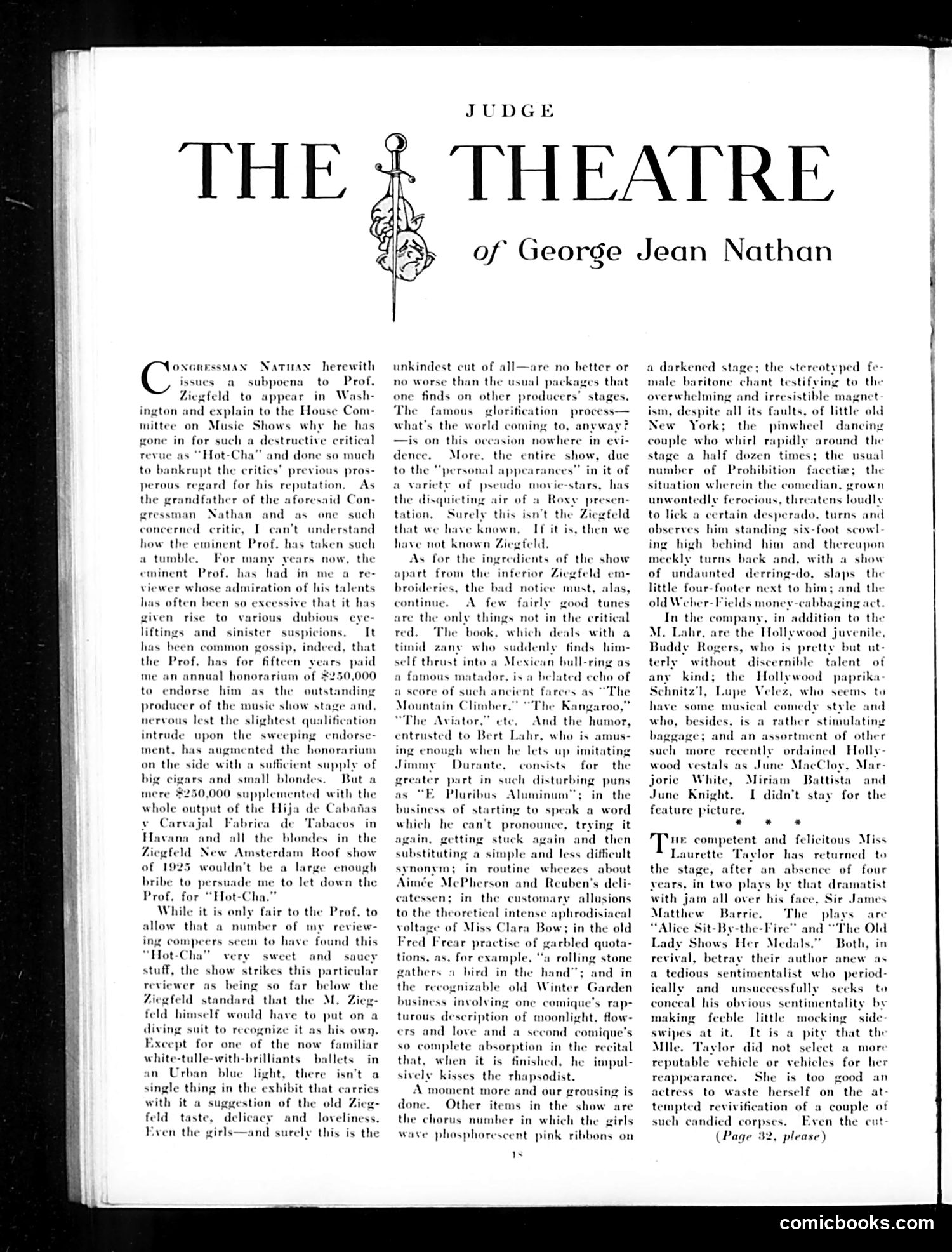
"Judge" Theatre Criticism: The Ziegfeld Follies Decline This appears to be a theatre review from *Judge* magazine critiquing Florenz Ziegfeld's musical "Hot-Cha." The writer claims to be a congressman's grandfather who has long received a $250,000 annual honorarium from Ziegfeld in exchange for favorable reviews. The satire targets two things: (1) Ziegfeld's declining standards—the show lacks the elegance of his earlier work, featuring undistinguished chorus girls and pseudo-movie stars rather than genuine artistry; (2) critic corruption—the reviewer admits being bribed to praise Ziegfeld for years, suggesting widespread dishonesty in theatre criticism. The piece mocks the show's thin plot (a zany in a Mexican bullfight) and comedian Bert Lahr's tired routines. The satire suggests both that Ziegfeld has compromised his theatrical reputation and that critical independence in 1920s entertainment journalism was compromised by financial incentives.
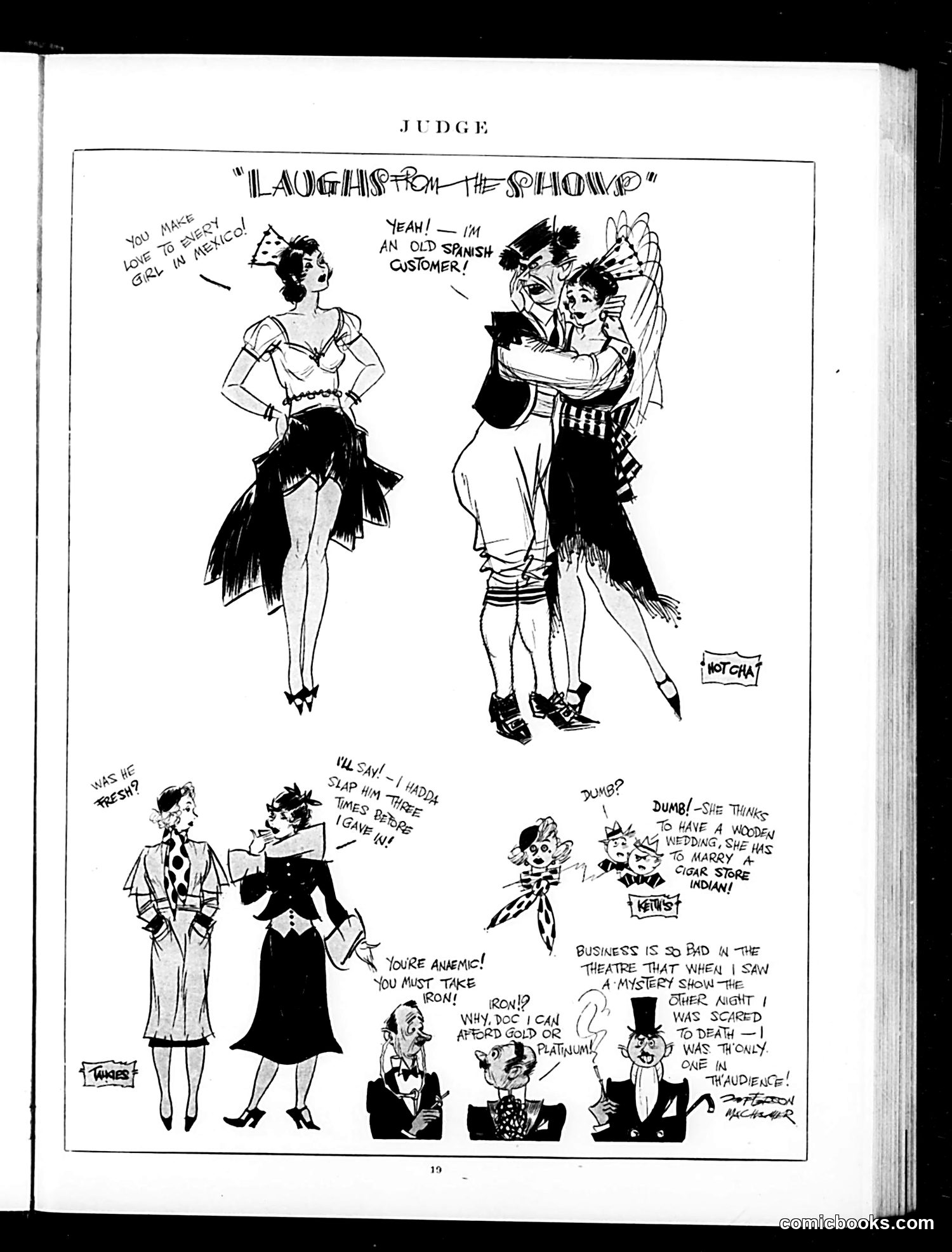
"Laughs for the Showo" This Judge page presents a series of satirical vignettes about early 20th-century American life and entertainment. The title suggests these are performative moments meant for public consumption. The sketches mock various social types: a woman posing for photographs in fashionable dress; a Spanish customer at what appears to be a barbershop or salon; couples discussing marriage prospects and financial struggles during economic hardship ("business is so bad"); and commentary on theater attendance and entertainment quality. The cartoons satirize vanity (people performing for cameras), economic anxiety (complaints about money and business), and the entertainment industry's struggles. References to "cigar store Indian" and ethnic stereotyping reflect period attitudes. The overall message critiques both pretentious social posturing and the economic difficulties facing working-class Americans, likely during an early 20th-century recession or the Great Depression era.
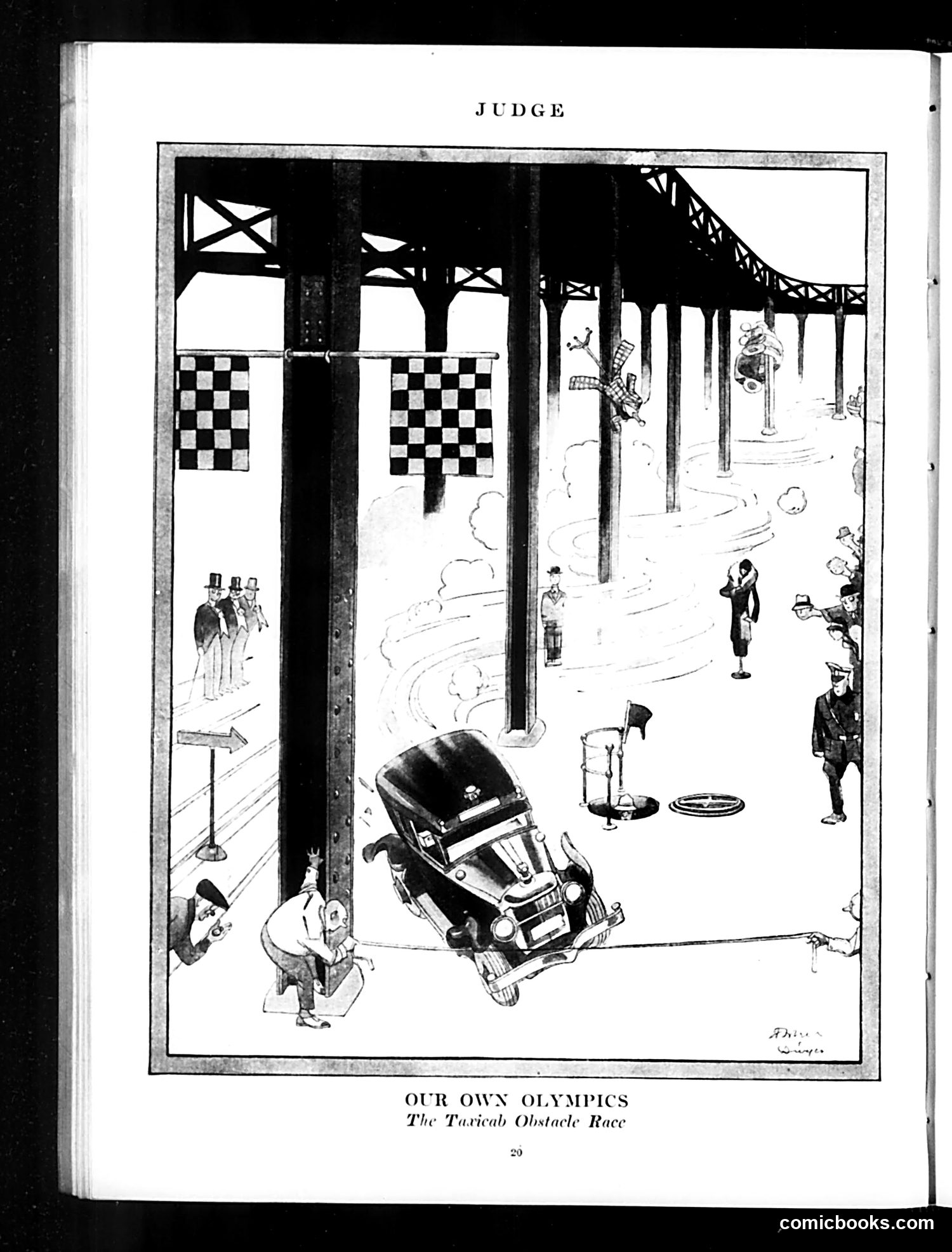
"The Taxicab Obstacle Race" This cartoon satirizes urban taxi driving as an "Olympic sport." The illustration shows a taxicab navigating beneath an elevated railway structure while encountering various street obstacles—pedestrians, signs, and other hazards typical of early 20th-century city streets. The satire targets the reckless or skillful maneuvering required of taxi drivers in crowded urban environments. By framing taxi navigation as an "Olympic event," the cartoon humorously comments on the chaos and danger of city traffic. The checkered flag banners reinforce the sporting competition metaphor. This reflects the era's rapid motorization and anxieties about automobiles sharing streets with pedestrians, creating genuinely hazardous conditions that contemporary readers would recognize as absurdly treacherous—hence "Olympic" difficulty.
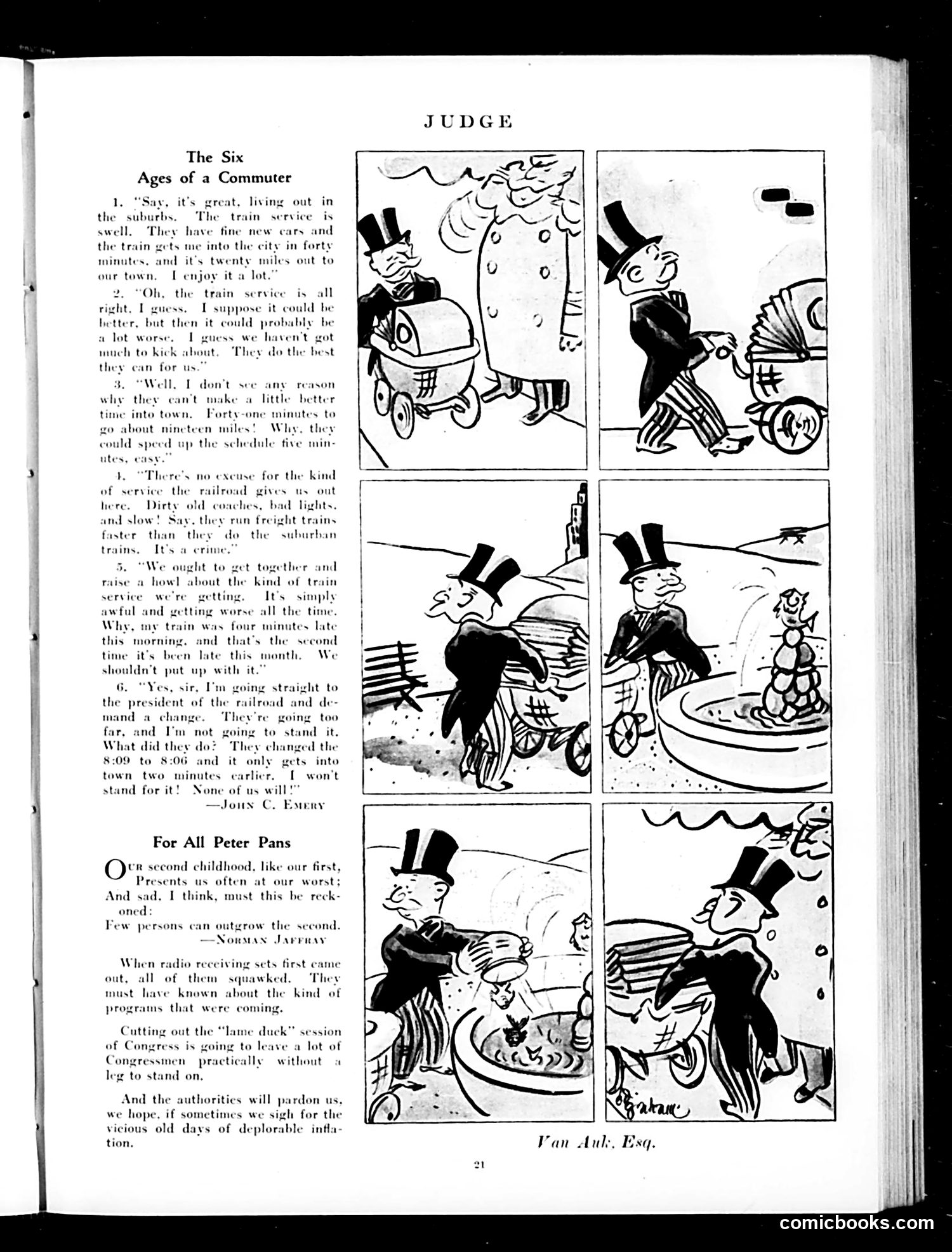
Explanation for Modern Readers This page satirizes the deteriorating patience of suburban commuters. "The Six Ages of a Commuter" depicts a man's attitude shift across six stages: from initial satisfaction with suburban living and train service (panel 1), through gradual complaints about delays and poor conditions (panels 2-5), to furious demands for change (panel 6). The joke shows how commuters normalize mediocre service until minor inconveniences spark outrage—specifically when the railroad changes the 8:09 to 8:06, saving only two minutes despite his previous complaints. The secondary piece, "For All Peter Pans," briefly comments on adult childishness and nostalgia. A brief mention of "lame duck" congressional sessions references politicians serving after losing reelection. The cartoon style and tone are typical of Judge magazine's social commentary on American life, targeting middle-class suburban anxieties and the gap between expectations and reality.
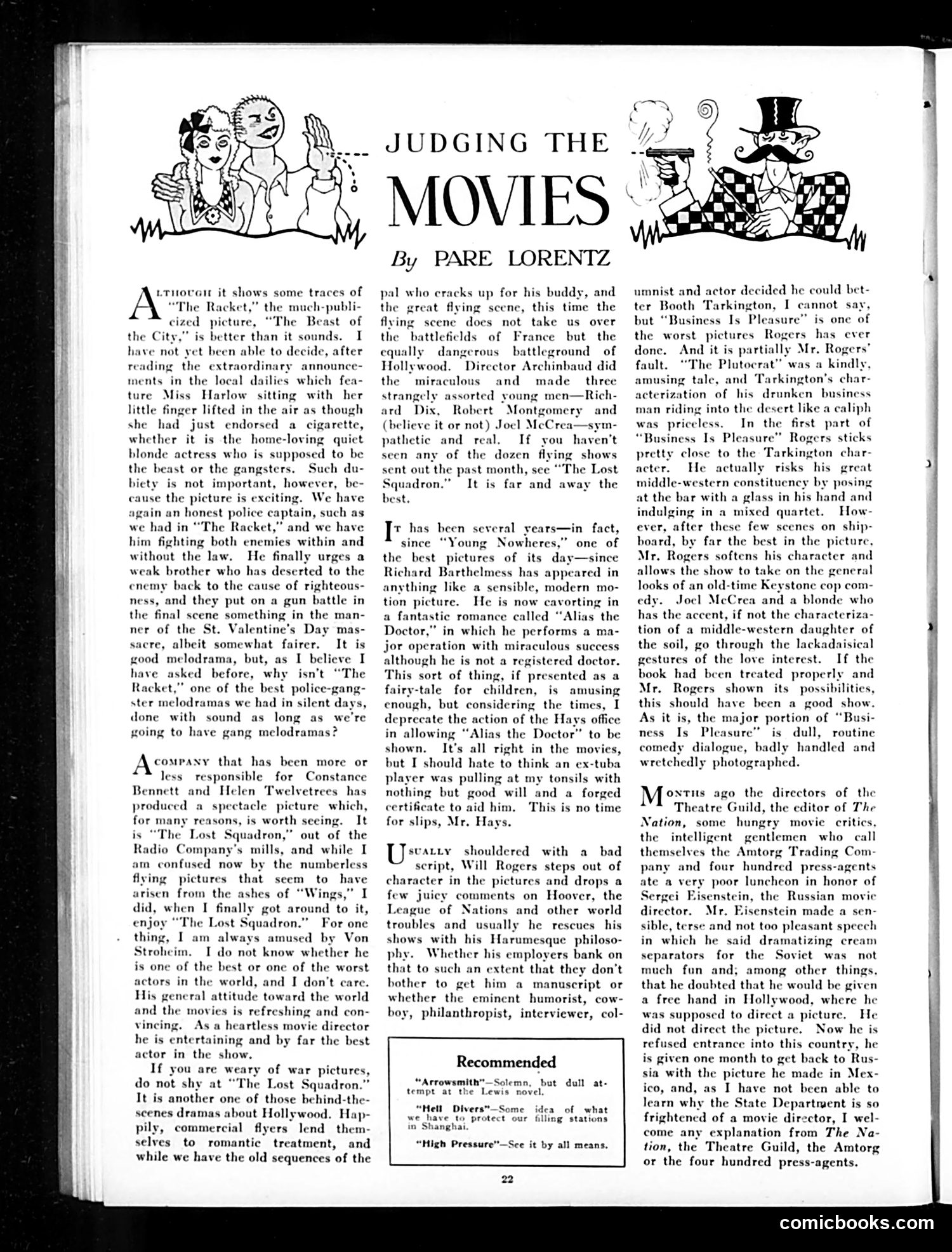
"Judging the Movies" by Pare Lorentz This is a film criticism column reviewing contemporary movies. The cartoons at the top—showing exaggerated theatrical figures—are decorative mastheads typical of Judge magazine's satirical style. Lorentz critiques several 1932 films: "The Beast of the City" (praised despite confusing publicity featuring starlet Jean Harlow); "The Lost Squadron" (a behind-the-scenes Hollywood war picture he recommends, praising Erich von Stroheim's performance); and "Alias the Doctor" (which he criticizes for showing an unqualified man performing surgery, arguing the Hays Office censorship board shouldn't have approved it given current times—likely referencing Depression-era concerns about irresponsible behavior). The brief mentions of Will Rogers and Richard Barthelmess indicate contemporary stars. Lorentz's critique reflects 1930s debates about cinema's social responsibility and the emerging Production Code's enforcement.
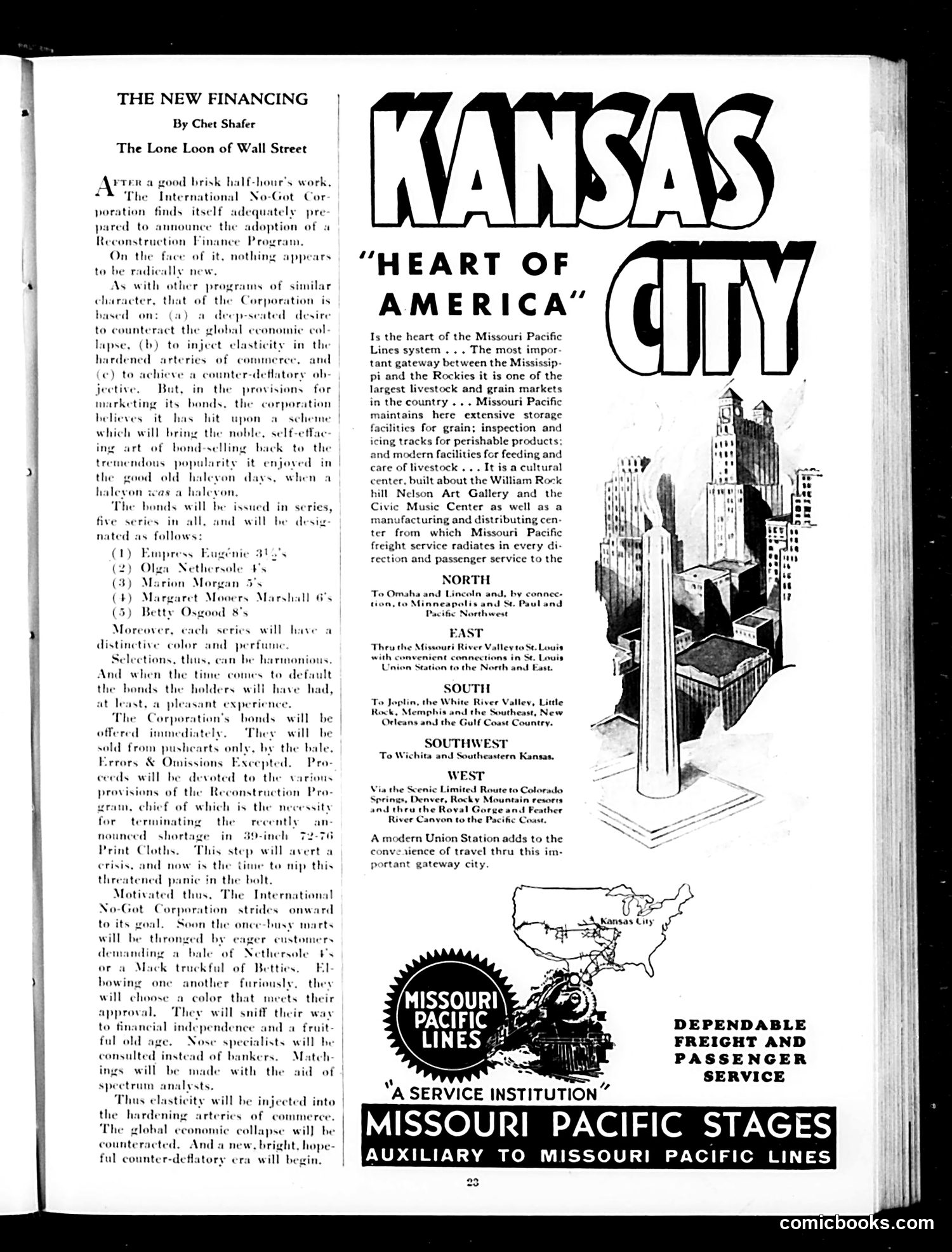
"The New Financing" by Chet Shafer — Judge Magazine Satire This is a satirical commentary on the Reconstruction Finance Program (RFC), a real New Deal initiative created during the Great Depression to provide emergency financing to failing businesses. Shafer mocks the program by imagining the "International No-Got Corporation" issuing bonds named after famous actresses and performers of the era (Empress Eugénie, Olga Nethersole, Marion Morgan, Margaret Moore, Betty Oswald). Each bond series would have distinctive colors and perfumes to make them aesthetically appealing. The satire's point: the RFC's bonds are being marketed with style over substance—sold from pushcarts "by the bale" to desperate buyers, relying on charm rather than actual financial soundness. When defaults inevitably occur, at least bondholders will have "had a pleasant experience." The piece ridicules both the government's financing schemes and Wall Street's ability to rebrand financial instruments as attractive consumer products, even when underlying economic fundamentals remain weak.
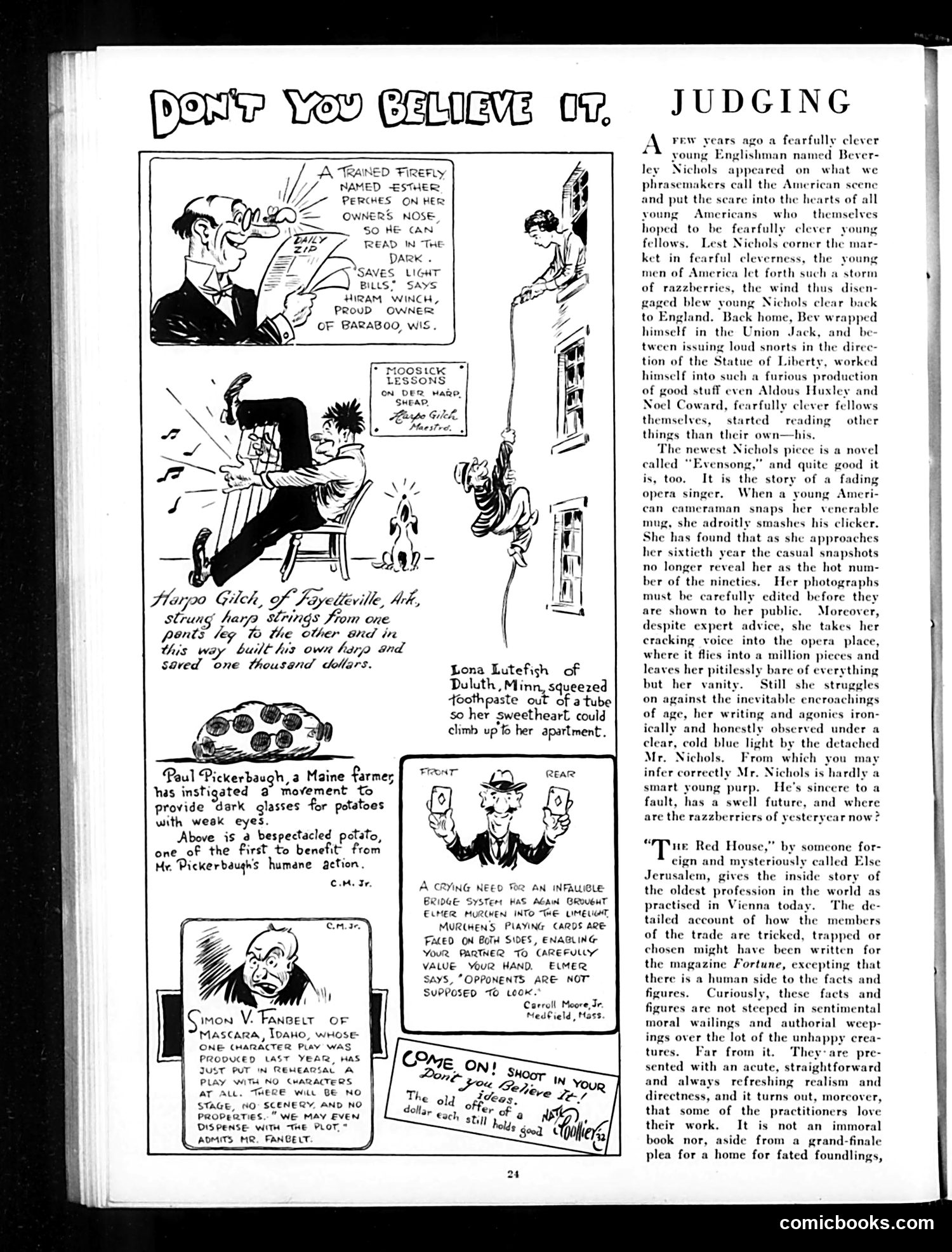
Judge Magazine Satire Analysis This page presents humorous "believe-it-or-not" style anecdotes mocking absurd inventions and impractical schemes. The cartoons ridicule American ingenuity taken to ridiculous extremes: a man using a trained firefly for reading light, potatoes wearing glasses for weak eyes, a Maine farmer's crusade, and playing cards marked on both sides for cheating at bridge. The right column reviews Beverly Nichols, a British author who recently gained American attention for clever writing. Judge mocks American youth's attempts to emulate his sophistication, noting they drove him back to England with their own "razz-berries." The reviews praise Nichols's new novel about an aging opera singer and "The Red House," a book about Vienna's sex trade, commending their honest, unsentimental treatment of human subjects. The satire targets both American pretension and genuine literary merit—praising Nichols while mocking American imitators.
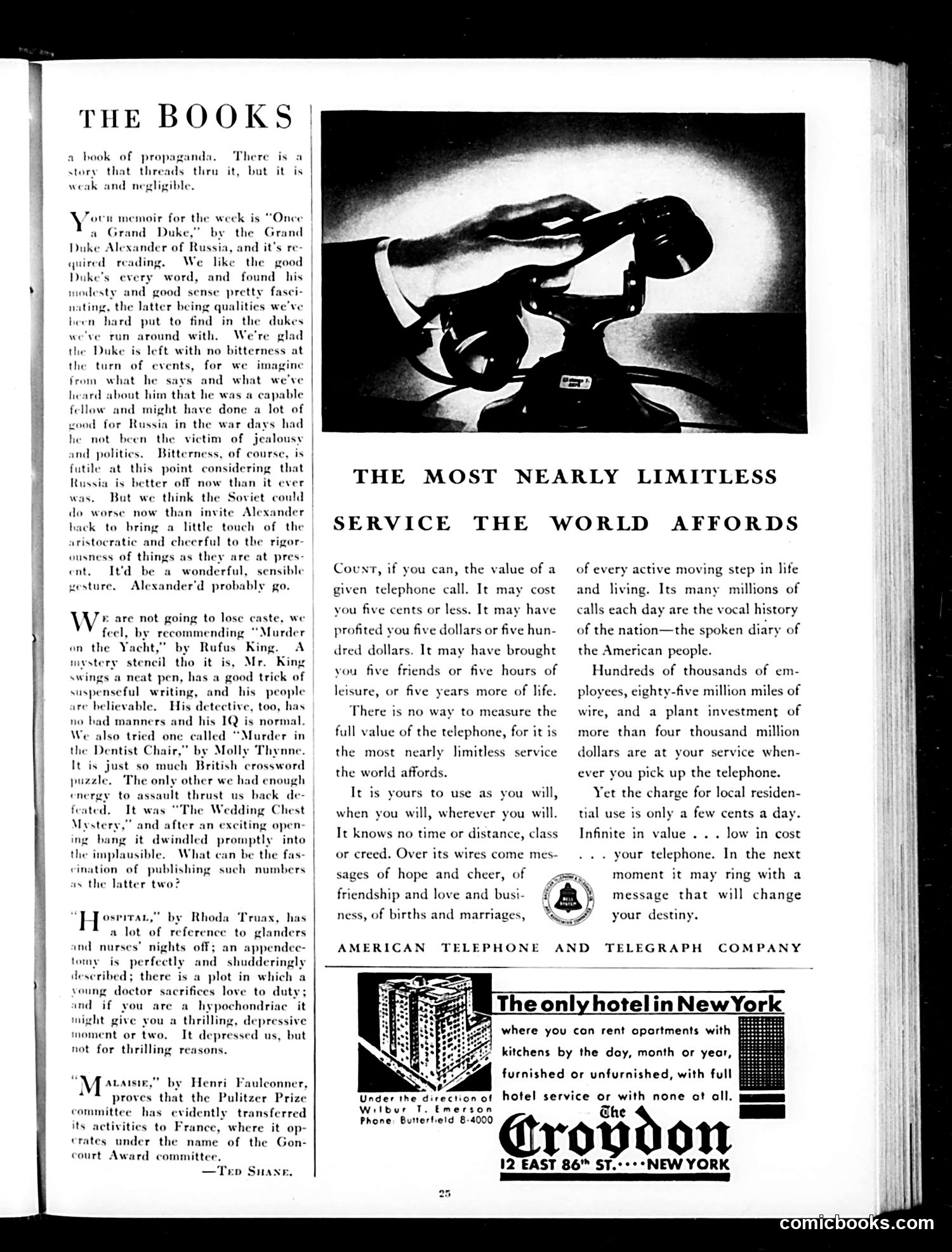
Judge Magazine Page Analysis This page mixes book reviews with advertisements. The book section critiques recent publications: "Once a Grand Duke" by Grand Duke Alexander of Russia receives praise for the author's modesty and sensibility, with a tongue-in-cheek suggestion that Russia might benefit from inviting him back to restore some aristocratic civility to the Soviet system. Other mystery novels are reviewed with mixed results—some praised for clever plotting, others dismissed as implausible crossword puzzles. The satire is gentle: the reviewer suggests that awarding literary prizes has somehow become as disconnected from merit as the Pulitzer Prize committee's work. The page's main content is advertising: a large AT&T telephone advertisement emphasizing the telephone's immeasurable value to American life, and a smaller ad for the Croyden Hotel in New York offering furnished apartments.
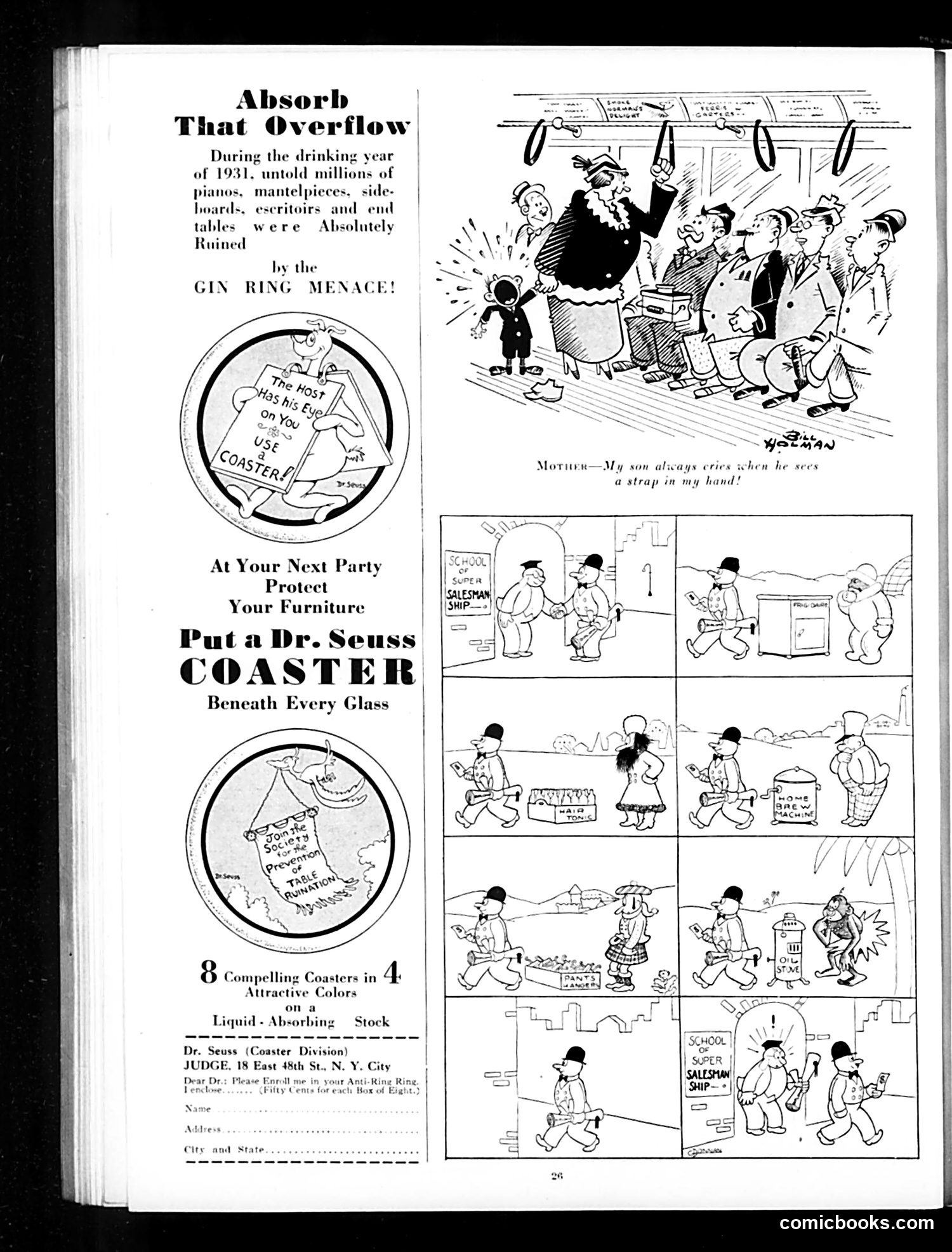
"Gin Ring Menace" — A 1931 Prohibition-Era Satire This page satirizes the tension between Prohibition (then in effect) and actual drinking behavior. The headline warns of damage from "gin ring" stains—wet glass marks left on furniture by alcoholic drinks. The satire works on two levels: it openly acknowledges widespread illegal drinking in 1931 (Prohibition didn't end until 1933), while advertising Dr. Seuss coasters as a humorous "solution" to protect furniture from cocktail glasses. The cartoon above shows a chaotic party scene where drinking has become so normalized that damage to home furnishings is treated as an expected problem requiring products. The bottom cartoon appears to be a separate domestic advice feature (unrelated to the Prohibition satire). Judge magazine was satirizing America's failure to enforce Prohibition by treating illegal gin-drinking as inevitable fact—so inevitable that protecting furniture from its consequences became a commercial product pitch.
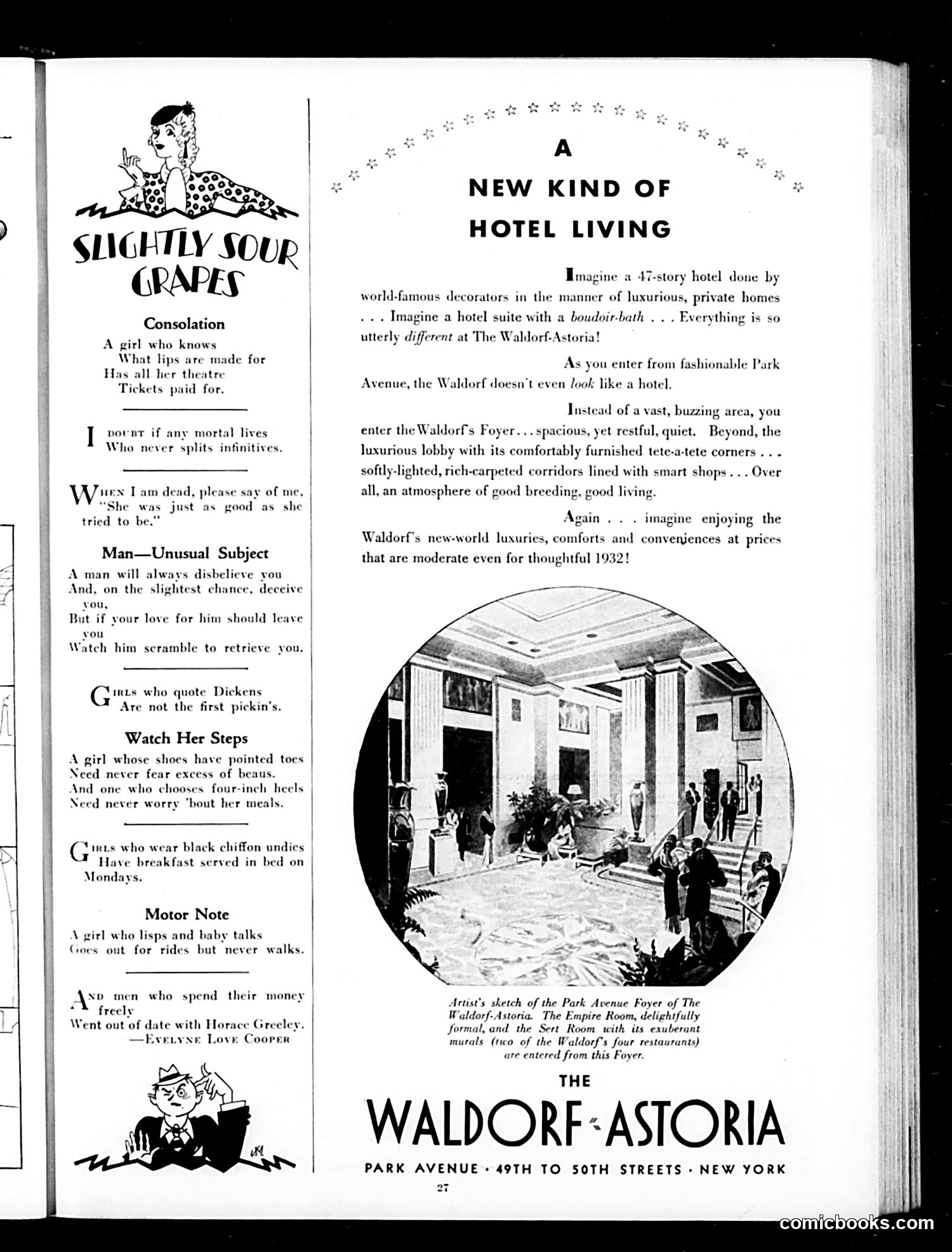
"Slightly Sour Grapes" Analysis This page mixes satirical social commentary with hotel advertising. The left side features cynical observations about 1930s dating and gender dynamics, attributed to "Evelyn Love Cooper." The jokes mock romantic conventions: women with "pointed toes" attract wealthy suitors ("need never worry 'bout her meals"), girls who lisp manipulate men into providing transportation, and men are inherently deceptive yet competitive for affection. The reference to Horace Greeley (19th-century editor) dating is dated even for 1932, suggesting old-fashioned courtship norms are obsolete. The right side is a Waldorf-Astoria hotel advertisement emphasizing luxurious privacy and "good breeding"—code for upper-class exclusivity. The irony: luxury pitched at "moderate" 1932 prices during the Great Depression, targeting aspirational readers of Judge magazine. The satirical barbs about mercenary dating relationships contrast sharply with the elegant hotel's promise of refined living.
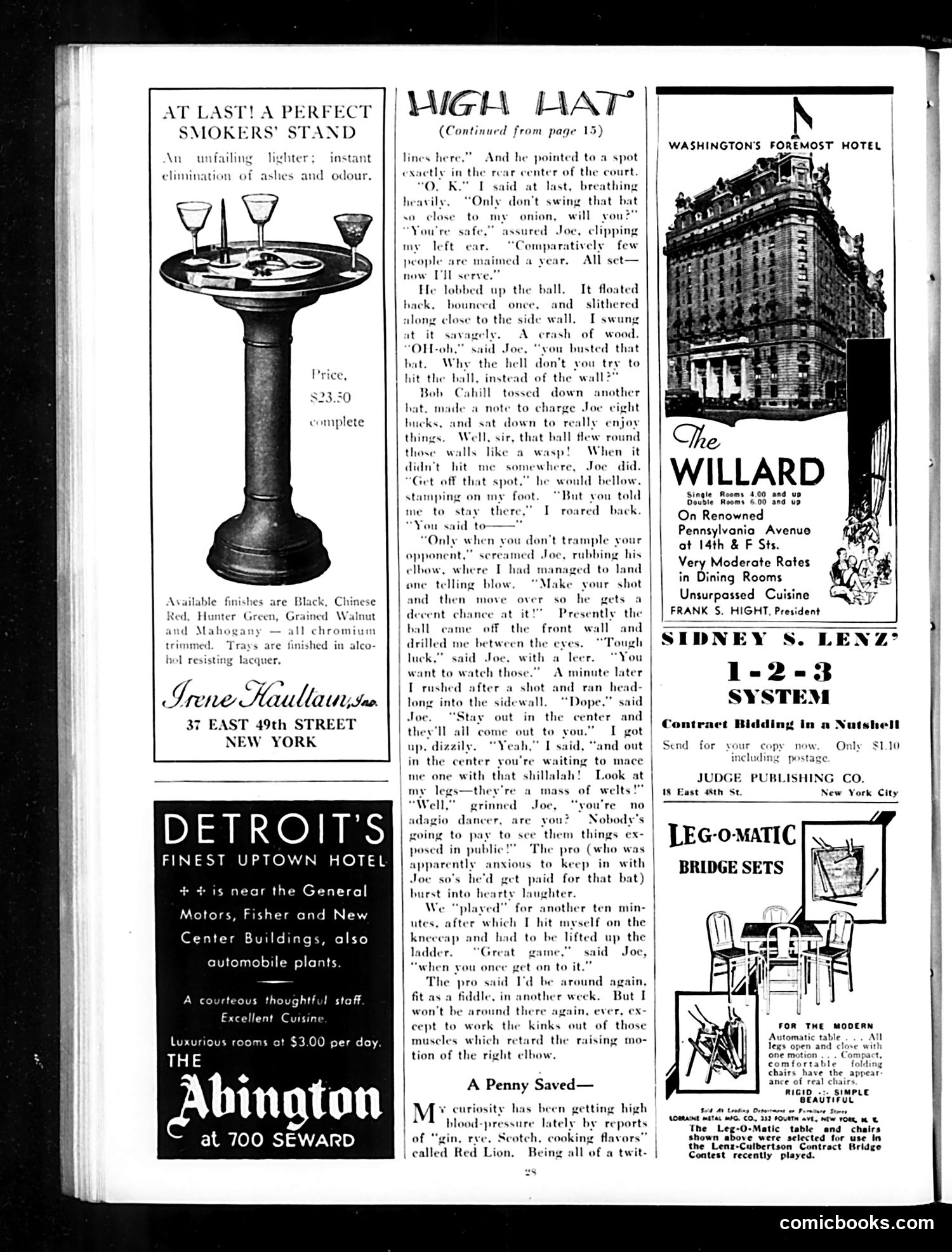
Page Content Analysis This page is primarily advertisements with one substantial narrative story dominating the center. The main text, "High Hat" (continued from page 15), depicts a comedic squash game between the narrator and a character named Joe. The humor relies on physical slapstick: Joe repeatedly hits the narrator with the ball, directs him to stand in dangerous positions, and generally abuses him on the court while maintaining a veneer of instruction. The joke satirizes both aggressive sports culture and the narrator's hapless tolerance of mistreatment—he's literally battered and bruised ("a mass of welts") yet allows Joe to convince him he'll return for more. The surrounding ads are typical 1920s-30s offerings: luxury hotel accommodations (The Willard, The Abington, Detroit's Finest), a smoking stand, a contract bridge instructional system, and "Leg-O-Matic" folding bridge tables. These advertisements establish the magazine's upper-middle-class readership and leisure-focused lifestyle. No clear political satire appears on this page.
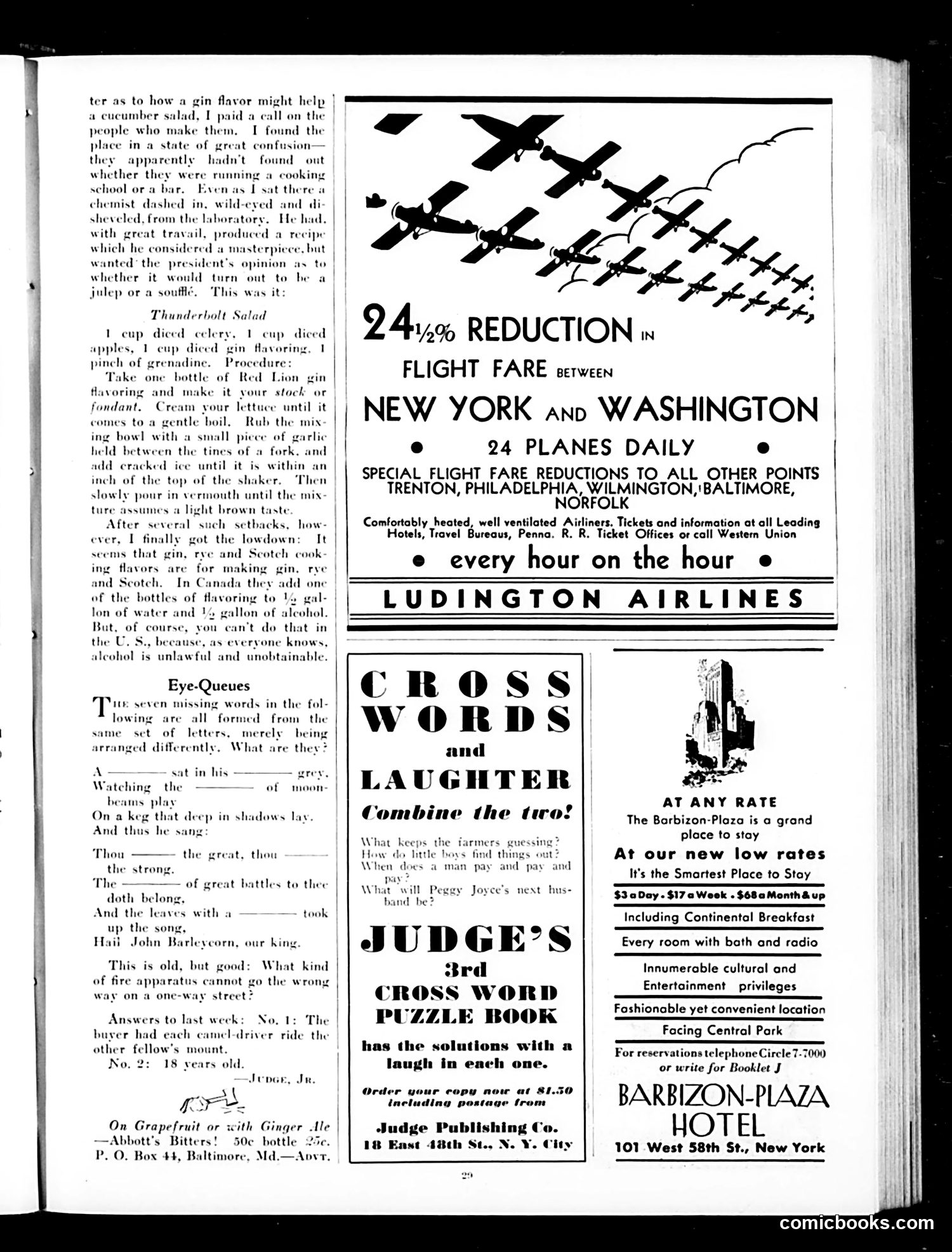
Analysis of Judge Magazine Page This page is primarily advertising and puzzle content rather than political satire. The main elements are: Ludington Airlines Advertisement: Promotes a 24.75% fare reduction on flights between New York and Washington, with 24 daily planes. This reflects the era of early commercial aviation (likely 1920s-30s), when air travel was novel and airlines aggressively marketed reduced fares to build passenger confidence. "Eye-Queues" Puzzle: A word puzzle game where readers identify seven missing words from a poem about "John Barleycorn"—a personification of alcohol/grain spirits. This is satirical commentary on Prohibition: the puzzle references drinking culture and alcohol production during an era when alcohol was officially illegal in the U.S., suggesting Judge magazine's readers enjoyed circumventing or mocking Prohibition laws. Hotel and Publishing Advertisements: Standard promotional content for the Barbizon-Plaza Hotel and Judge's crossword puzzle book. The page reflects Judge's role as entertainment for affluent urban readers during the Prohibition era.
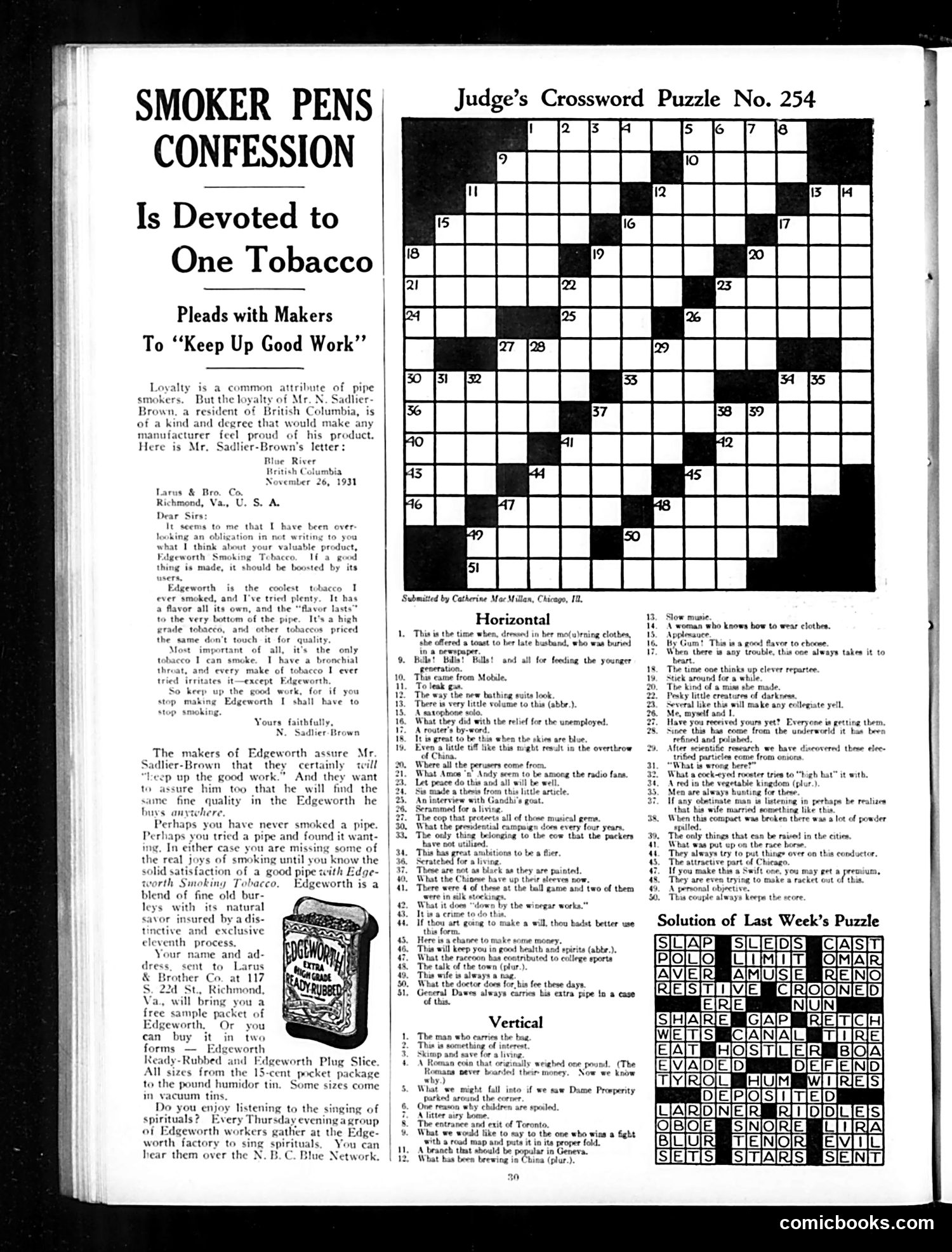
Analysis: "Smoker Pens Confession" (Judge Magazine) This page advertises Edgeworth pipe tobacco through a staged "testimonial letter" format popular in early 20th-century advertising. A British Columbian named N. Sadlier-Brown praises Edgeworth's flavor, coolness, and notably, that it's the *only* tobacco that doesn't irritate his bronchial condition—a health claim that wouldn't survive modern advertising regulations. The satire is gentle: Sadlier-Brown's effusive loyalty is presented as charming rather than mocked. The manufacturers respond by essentially saying "keep smoking or we'll stop making it"—a humorous appeal to consumer loyalty as a business obligation. The page also mentions Edgeworth workers gathering to sing spirituals (likely an appeal to wholesome corporate culture), and promotes free sample distribution. The crossword puzzle and solution are filler content typical of Judge's format. The advertisement exploits both brand loyalty and health-conscious consumers during an era when tobacco's dangers weren't publicly acknowledged.
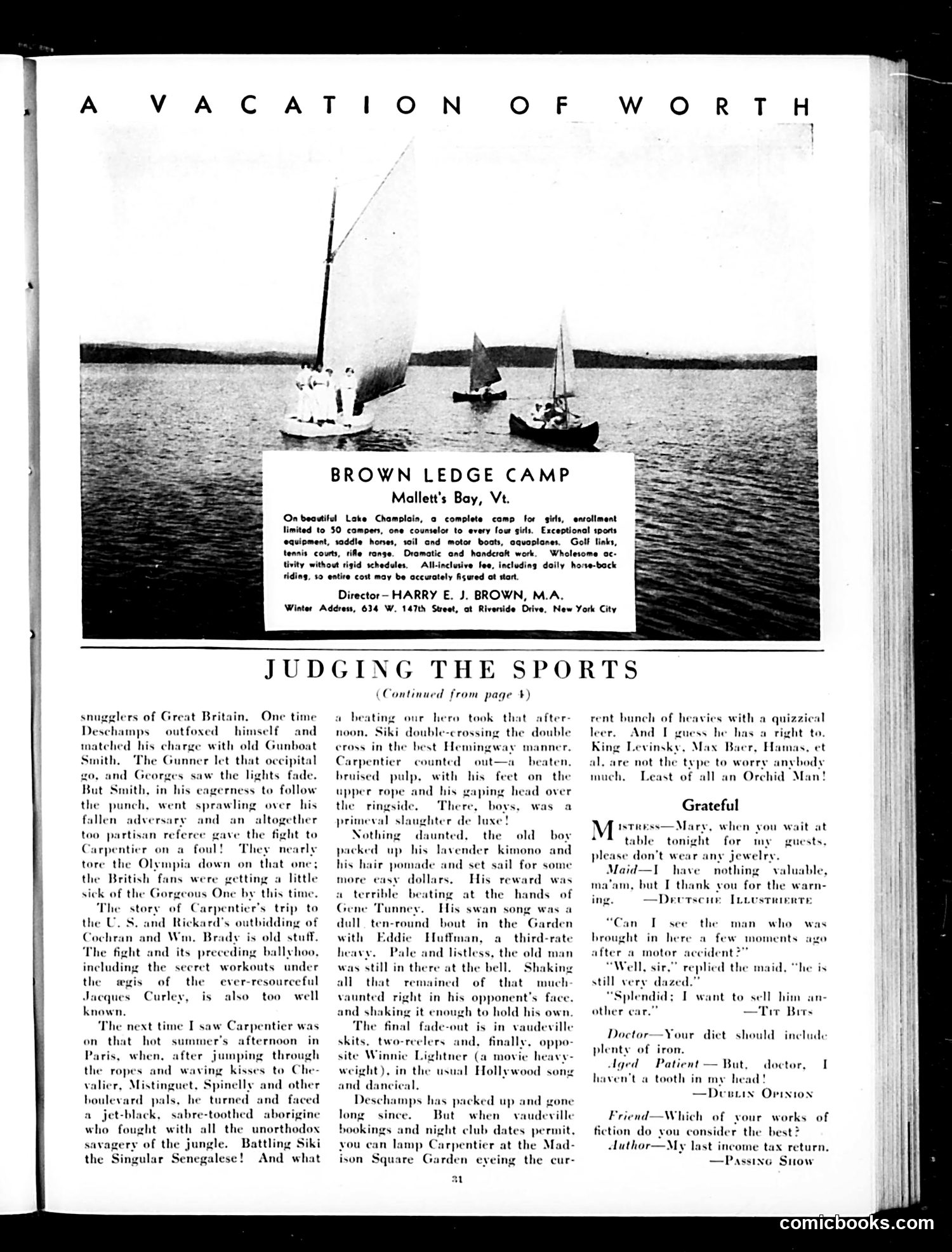
Judge Magazine Page Analysis This page contains a camp advertisement (Brown Ledge Camp in Vermont) and a sports column titled "Judging the Sports," which continues from an earlier page. The sports section discusses boxing matches, primarily focusing on Georges Carpentier, a famous French boxer of the 1920s. The writer recounts Carpentier's career highlights, including his fights against Gunboat Smith and notably Battling Siki, a Senegalese boxer whom the text describes in stereotypical, derogatory language typical of that era ("primeval slaughter de luxe"). The column traces Carpentier's decline from champion to vaudeville performer. The page also contains brief humorous one-liners at the bottom—dialogue jokes between mistress and maid, doctor and patient, and about an author's "income tax return"—typical filler content for Judge magazine. Modern context: This reflects 1920s sports celebrity culture and attitudes toward race that would be considered offensive today, though they were commonplace in contemporary publications.
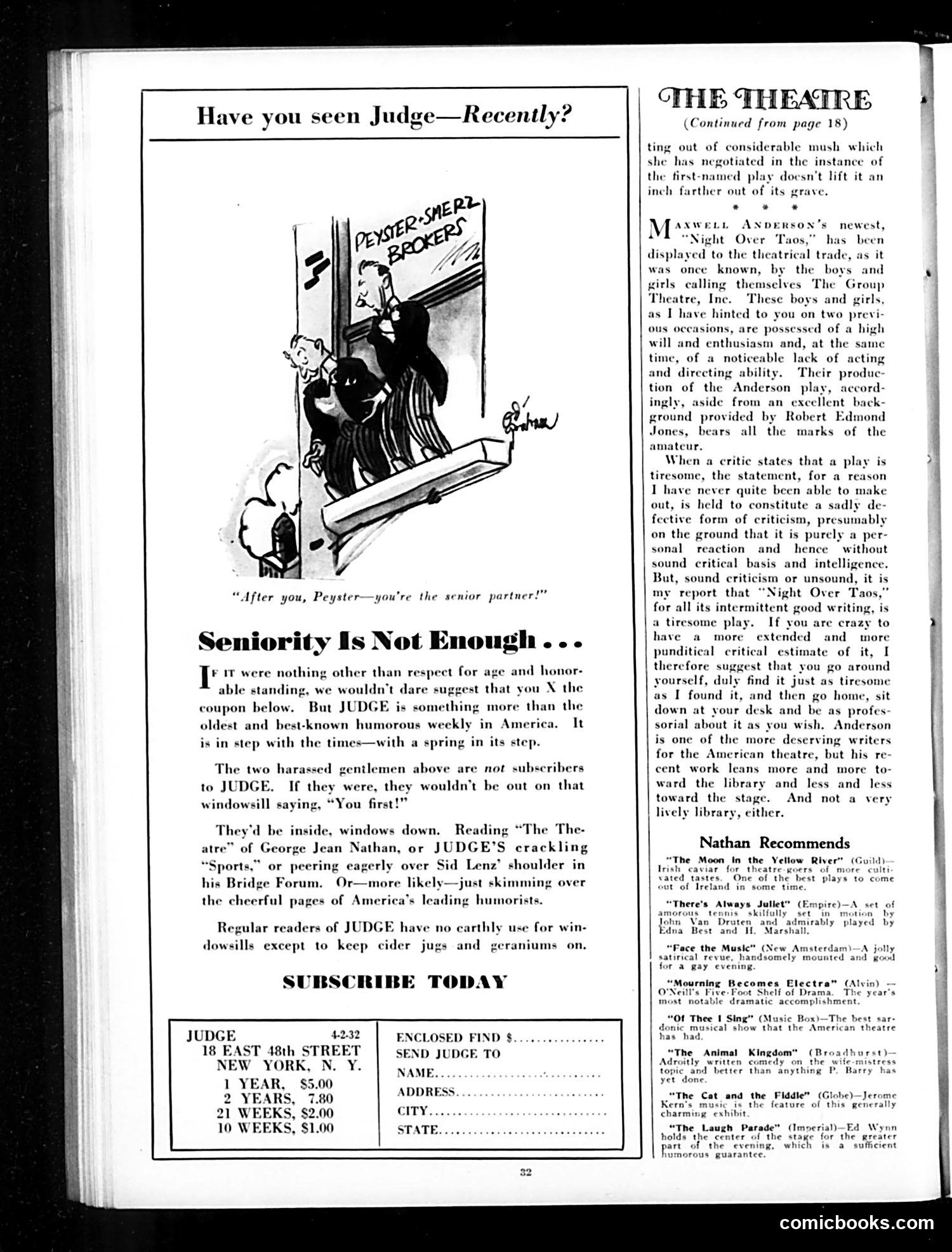
Judge Magazine Cartoon Analysis This is primarily a subscription advertisement for Judge magazine disguised as editorial content. The cartoon depicts two businessmen on a precarious building ledge, apparently arguing about who should go first—a visual joke about "seniority" not being enough to solve their problem. The satire works on two levels: First, it mocks the notion that mere age and rank guarantee competence or safety. Second, it implies that non-subscribers to Judge face literal danger, while subscribers would be safely inside reading the magazine's quality content (theater reviews by George Jean Nathan, sports columns, bridge advice). The accompanying text promotes Judge as "in step with the times" and more than just "the oldest" humor magazine—it's current and vital. The subscription rates and order form complete this thinly-veiled advertisement masquerading as satirical commentary. The right column contains unrelated theater reviews, suggesting this is a composite magazine page.
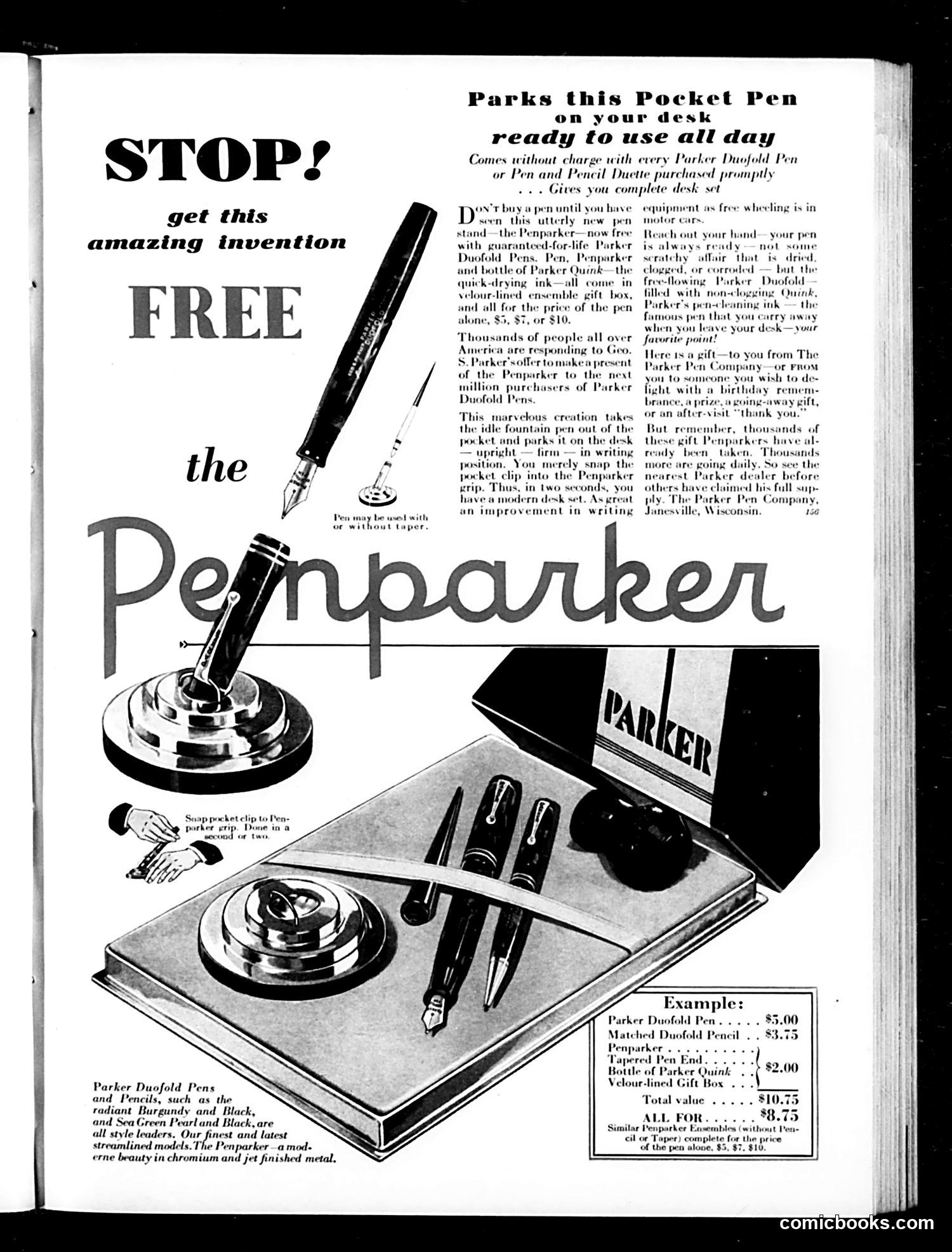
Analysis of This Judge Magazine Advertisement This page is primarily a full-page advertisement for Parker's "Penparker"—not a political cartoon or satirical commentary. It's a promotional piece from Judge magazine selling a desk-mounted fountain pen holder. The ad employs exaggerated marketing language typical of 1920s-30s advertising ("amazing invention," "marvelous creation," "modern desk set") to promote what is essentially a pen stand. The humor is implicit rather than satirical: the copywriting breathlessly advertises a simple mechanical device as if it were groundbreaking technology. The product comes as a promotional gift with Parker Duofold pen purchases. A price breakdown shows the bundled ensemble totals $10.75 retail value for $8.75. There is no political satire or social commentary visible on this page. It's straightforward consumer advertising using hyperbolic language—the kind Judge's audience would have encountered throughout the magazine, making it a period artifact of commercial marketing strategies rather than editorial commentary.
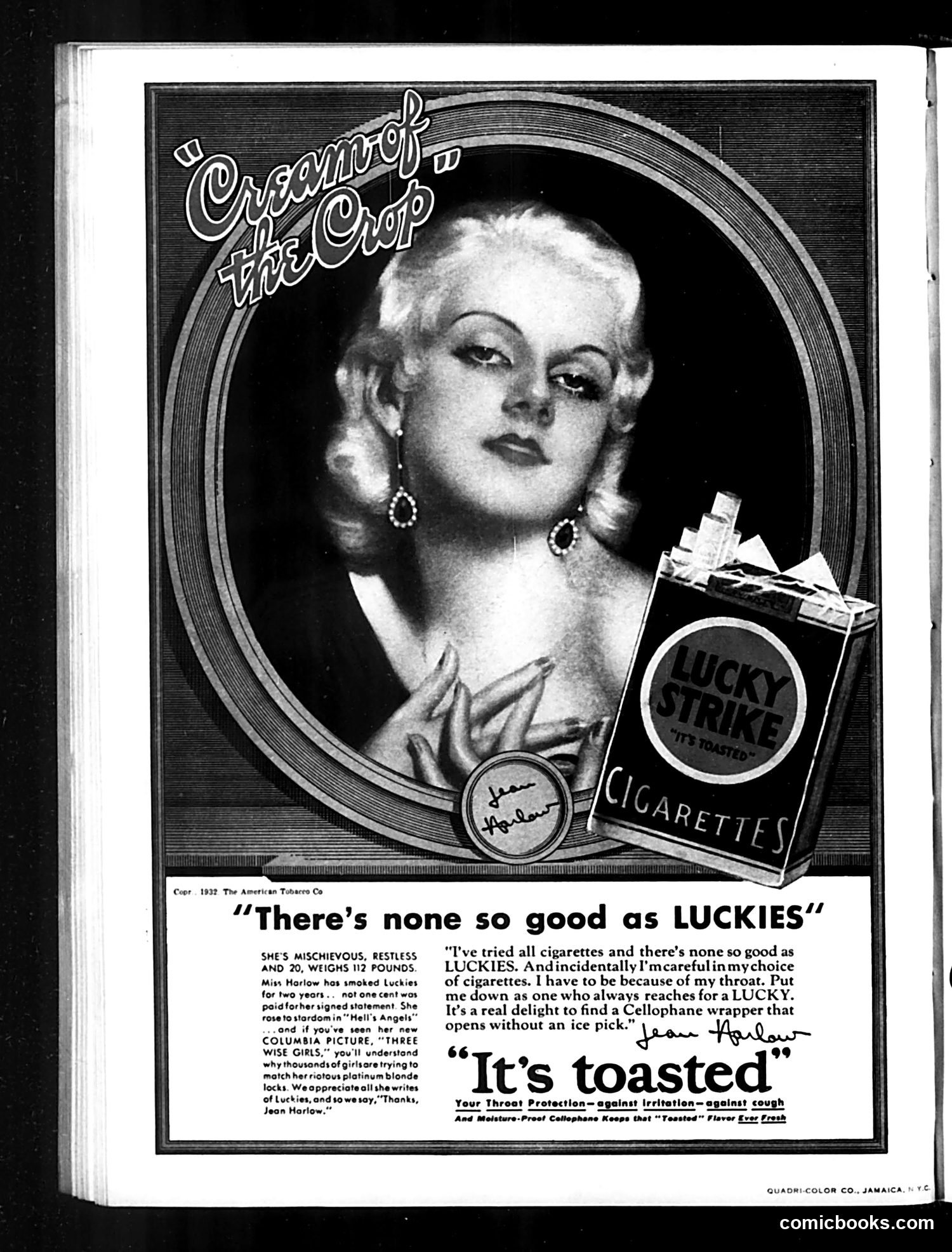
Analysis This is not a cartoon or satire—it's a cigarette advertisement masquerading as editorial content in Judge magazine (1932). The page features Jean Harlow, the famous Hollywood actress, endorsing Lucky Strike cigarettes. The ad describes her as "mischievous, restless" and references her Columbia Pictures films ("Hell's Angels," "Three Wise Girls") to establish her celebrity credibility. Harlow provides a testimonial claiming Lucky Strikes are superior and safer for her throat, emphasizing the "toasted" process and cellophane wrapper. The tagline "It's toasted" was Lucky Strike's actual marketing claim about their tobacco treatment. This represents 1930s celebrity endorsement advertising—a practice now heavily regulated. The ad exploits Harlow's glamour and mass appeal to sell cigarettes, while the health claims ("throat protection") would be illegal today. The framing as entertainment rather than transparent advertising was standard practice in this era.