judge
Judge — April 9, 1932
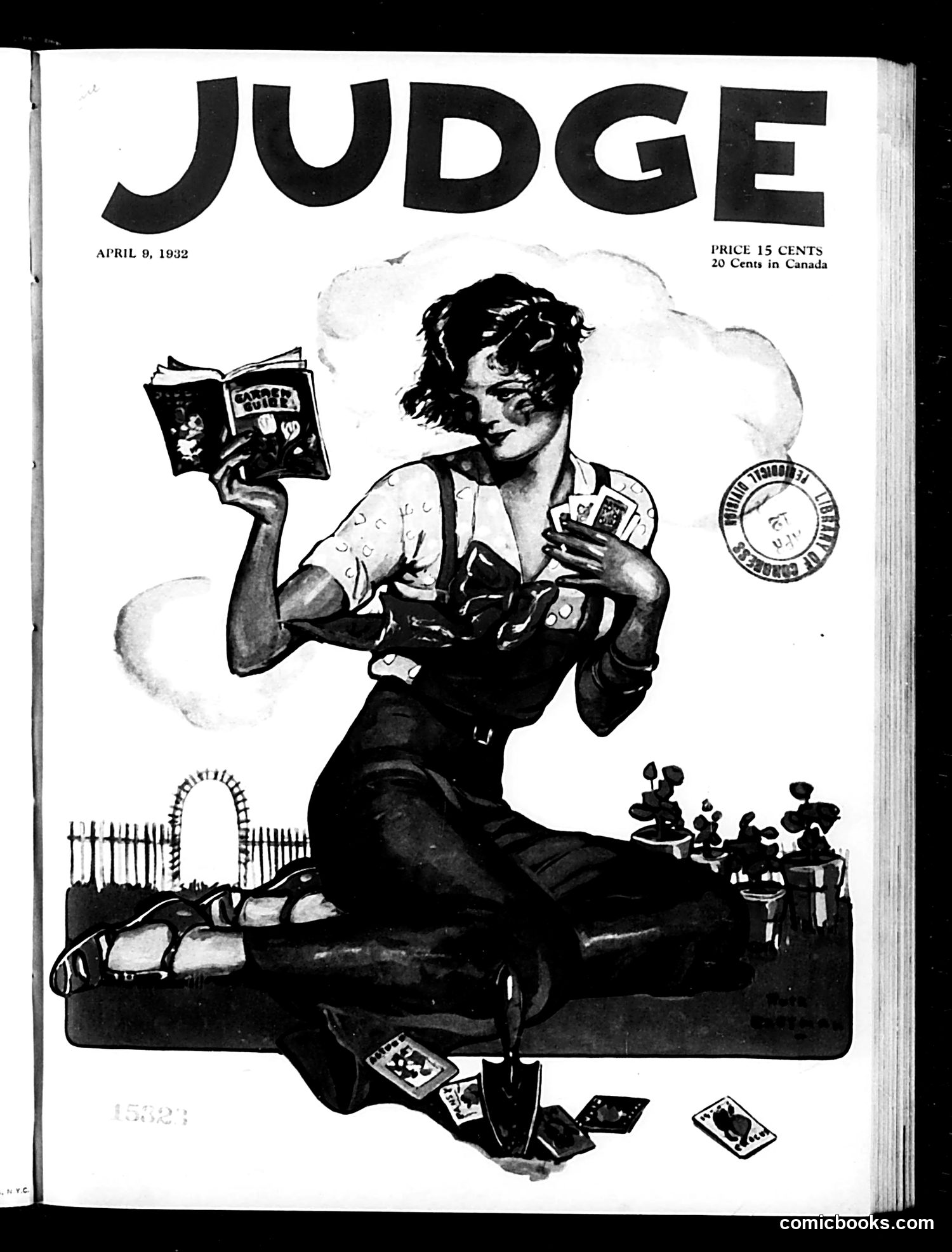
Analysis of Judge Magazine Cover (April 9, 1932) This cover depicts a young woman in overalls surrounded by toys, games, and entertainment products. She's juggling multiple items while sitting in what appears to be a toy car or vehicle. The satire likely addresses consumption and childhood play during the Great Depression. In 1932, Americans faced severe economic hardship, yet this image suggests abundance and commercialism aimed at children. The woman—possibly representing either a child or the "average American consumer"—juggles competing products and pastimes, satirizing either: 1. Marketing excess during economic crisis, or 2. Consumer distraction from serious economic problems The toys and games scattered around suggest manufacturers' continued aggressive promotion despite widespread poverty. The cover price (15 cents) itself was significant during Depression-era hardship.
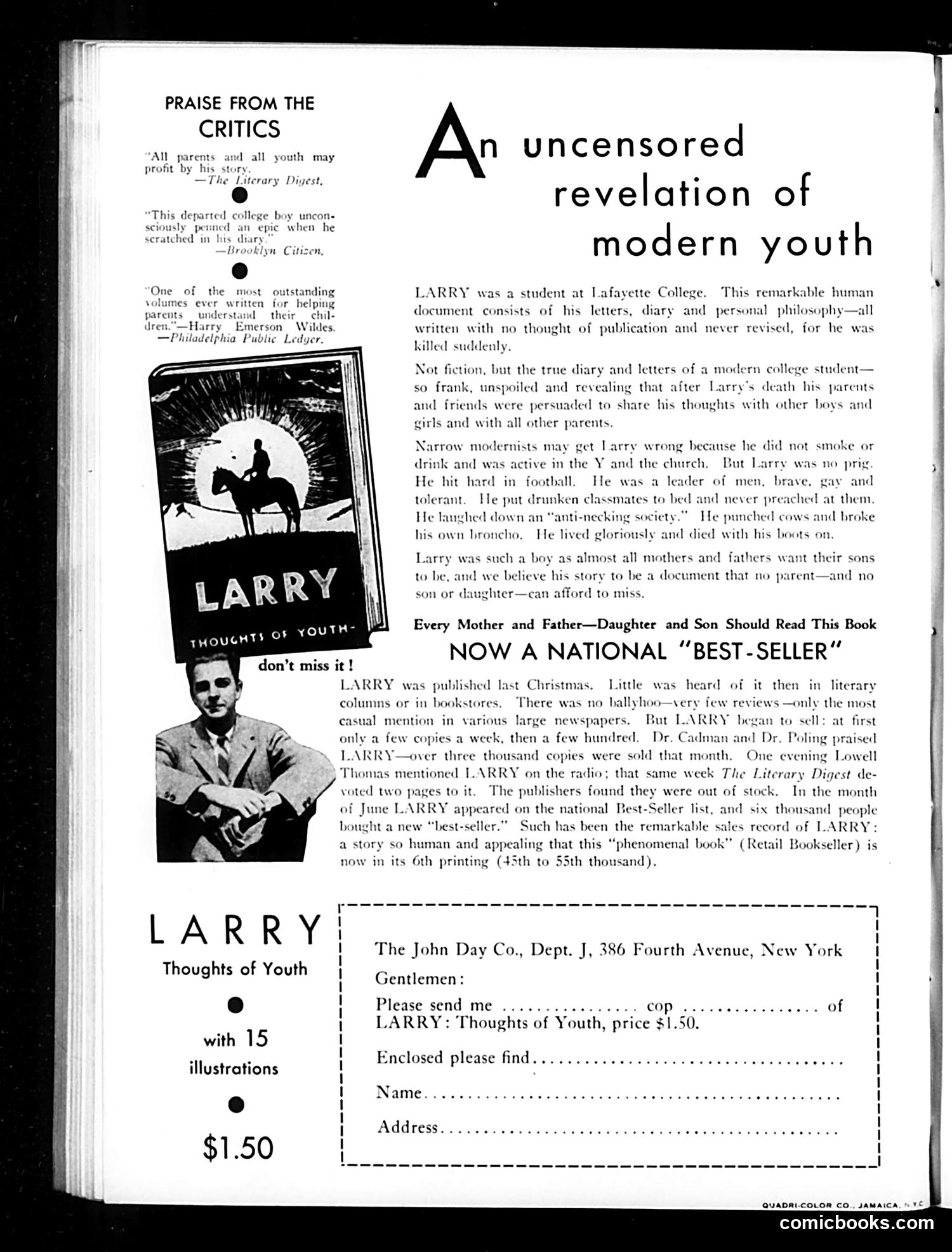
Analysis This page is primarily advertising, not satire or political commentary. It promotes "Larry: Thoughts of Youth," a 1920s bestselling book presented as an uncensored diary of a college student's frank thoughts about life, romance, and morality. The marketing emphasizes the book's transgressive appeal: Larry supposedly didn't smoke, drink, or attend church—he was athletic, irreverent, and "gloriously" lived life on his own terms. The ads mock "narrow modernists" who might disapprove. The "Praise from Critics" section uses genuine newspaper endorsements to position the book as essential reading for parents seeking to understand youth culture. The emphasis on it becoming a "national best-seller" suggests genuine commercial success the publishers capitalize on to drive further sales through the order form provided.
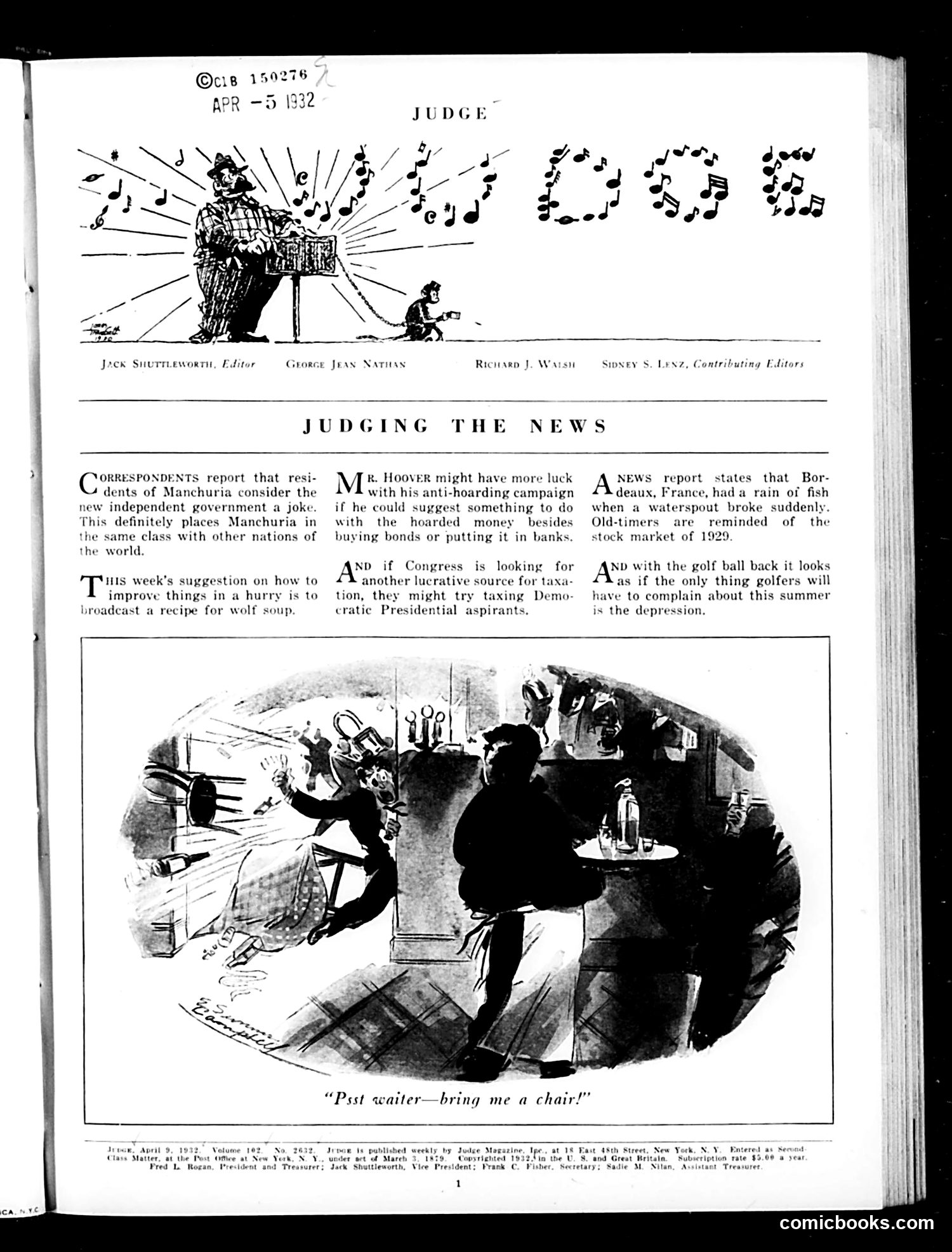
"Judge" Magazine Satire Analysis This April 1932 page satirizes economic and political conditions during the Great Depression. The main cartoon, captioned "Psst waiter—bring me a chair!", depicts diners at what appears to be an upscale restaurant, with one patron signaling a server. The humor relies on Depression-era scarcity: the joke likely suggests that even chairs are becoming scarce or precious commodities during economic hardship. The text sections mock various political figures and proposals. References to "Mr. Hoover" (President Herbert Hoover) and taxation suggestions for "Democratic Presidential aspirants" indicate frustration with government responses to the economic crisis. The commentary on Bordeaux wine and the stock market collapse suggests satirizing both luxury consumption and financial catastrophe during this period.
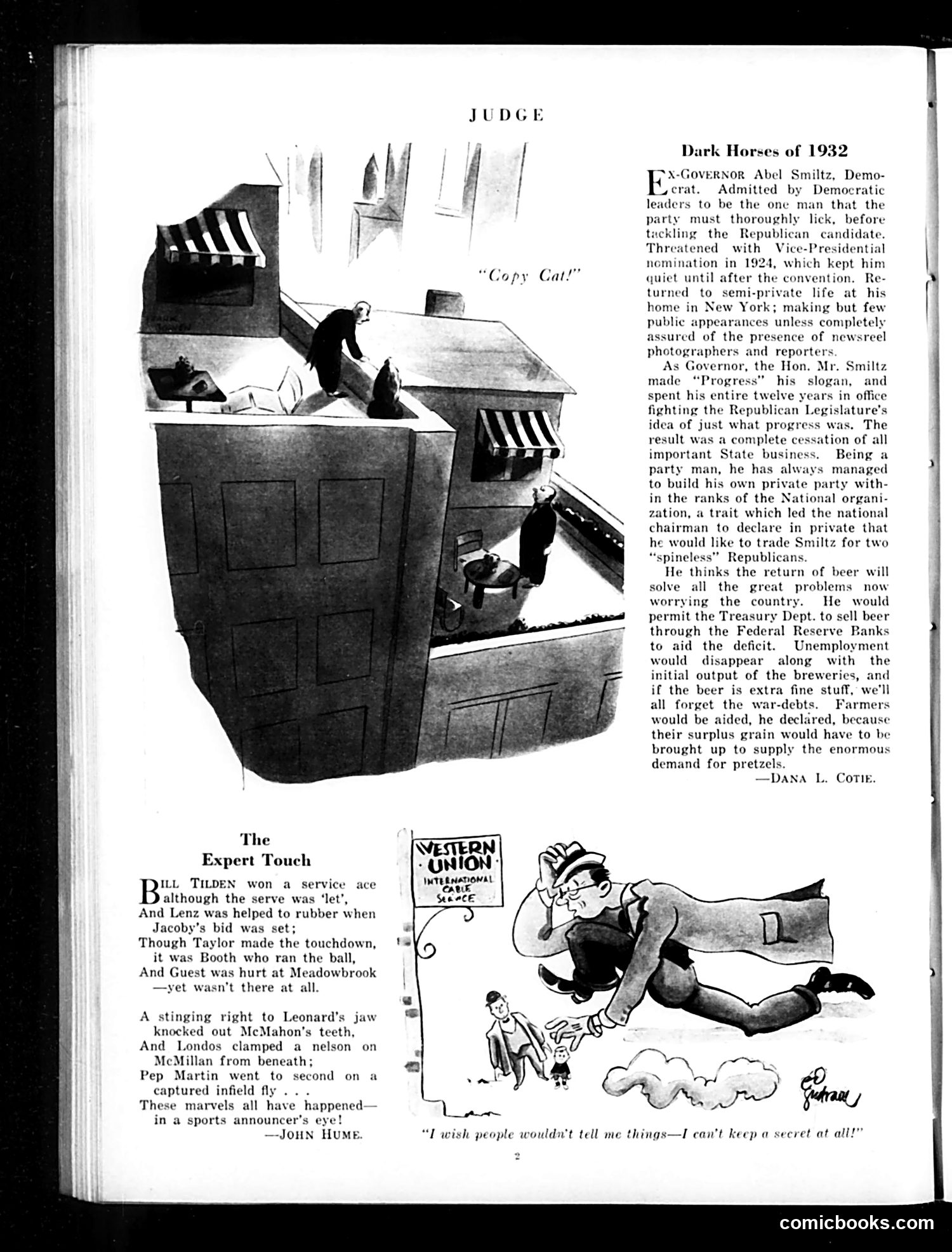
"Dark Horses of 1932" - Political Cartoon Analysis This page satirizes Ex-Governor Abel Smiltz, a Democratic "dark horse" candidate for the 1932 presidential election. The top cartoon depicts him as a "Copy Cat"—literally trapped in a box with a clapperboard, suggesting he's an artificial, stage-managed political creation rather than a genuine candidate. The accompanying text by Dana L. Corie mocks Smiltz's vague platform, particularly his naive belief that legalizing beer would solve America's Depression-era economic crisis. The satire suggests he offers nothing substantive—just empty promises about beer, unemployment, and farm relief. The bottom cartoon appears unrelated sports commentary. Overall, Judge uses Smiltz as a vehicle to ridicule superficial political candidates lacking serious policy solutions during the economic crisis.
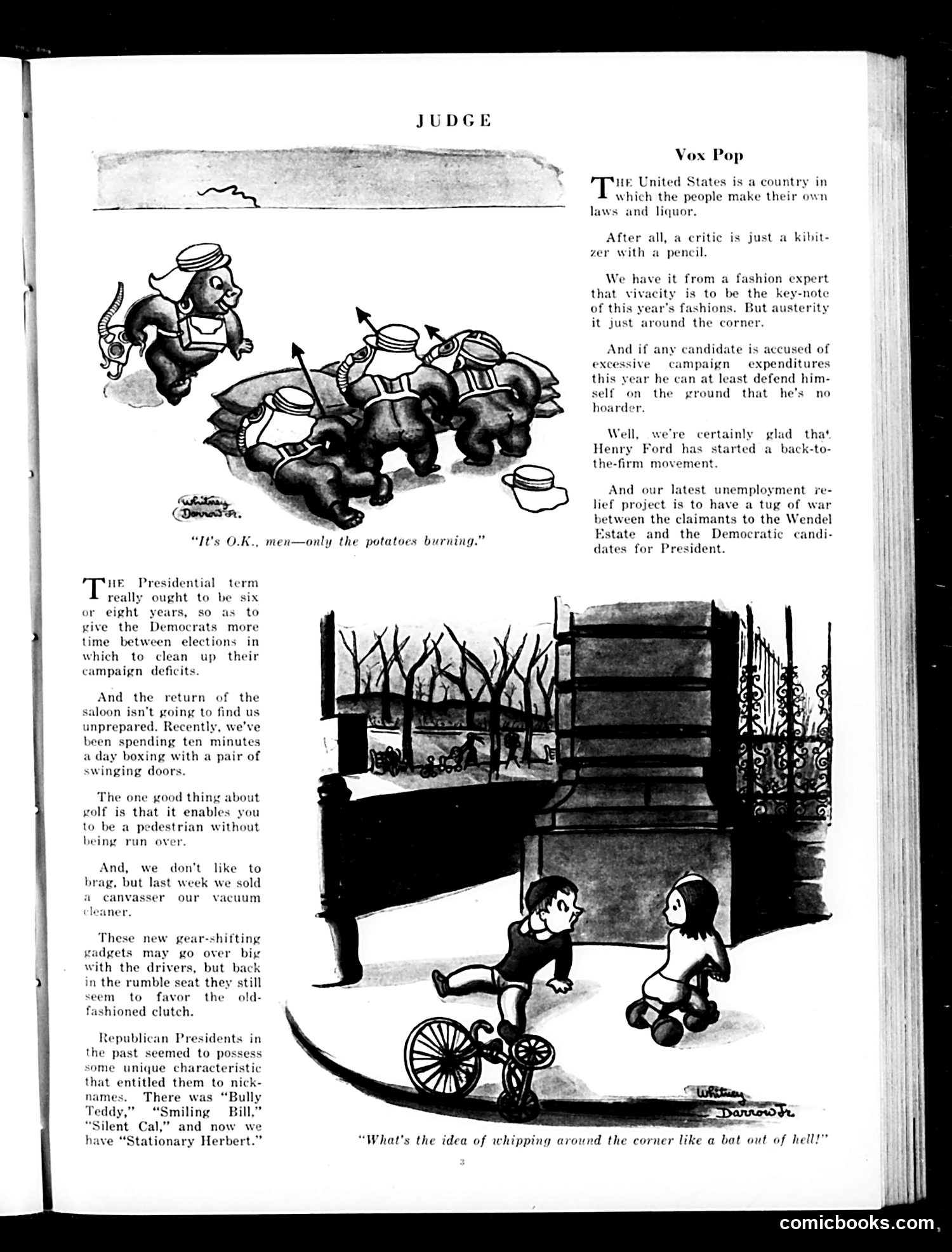
Analysis of Judge Magazine Page Top Cartoon: Depicts a figure (appears to be a political leader) herding donkeys labeled with "potatoes burning," captioned "It's O.K., men—only the potatoes burning." This satirizes someone dismissing serious problems as minor issues—likely referencing a political figure's casual response to economic crisis or hardship during the Great Depression era. Right Column Commentary ("Vox Pop"): A series of humorous social observations, including references to Henry Ford's "back-to-the-firm movement" (likely Ford's Depression-era agricultural initiative) and a joke about an "unemployment relief project" involving conflict between wealthy "claimants" and Democratic presidential candidates. Bottom Cartoon: Shows children playing dangerously near traffic, captioned about "whipping around the corner like a bat out of hell"—satirizing reckless child behavior or parental negligence in urban settings.
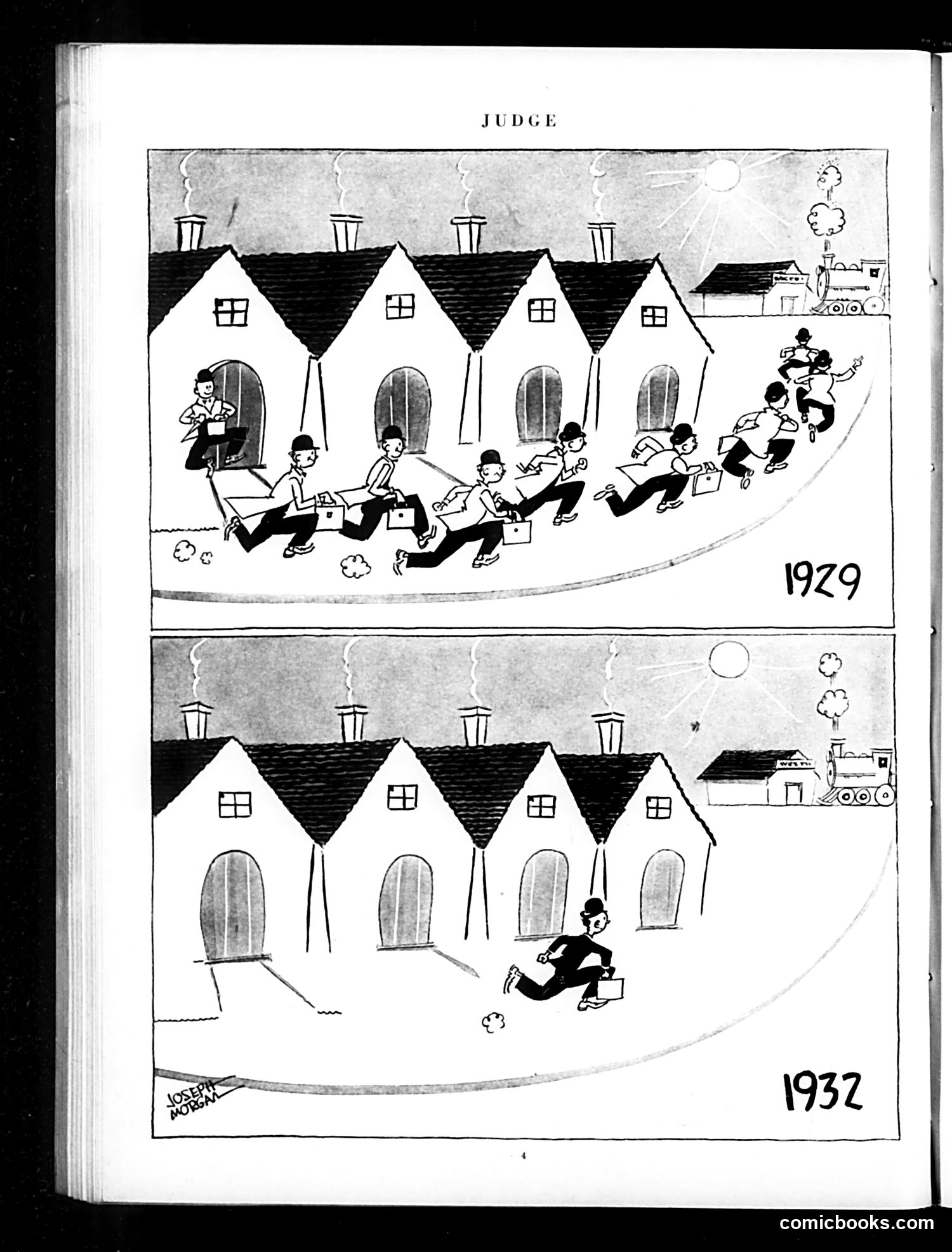
"Judge" Cartoon Analysis: "Judge" (1929 vs. 1937) This political cartoon compares two time periods through the metaphor of a courthouse building. In 1929, numerous men in suits rush frantically away from the courthouse, carrying briefcases—likely depicting stockbrokers or businessmen fleeing after the October 1929 stock market crash that triggered the Great Depression. In 1937, the same courthouse stands nearly empty with a solitary figure walking away slowly, suggesting economic stagnation persisting years into the Depression. The contrast satirizes how the initial panic of 1929 gave way to prolonged economic hardship and unemployment throughout the 1930s. The title "Judge" references the magazine itself, using the courthouse as visual commentary on America's economic crisis and judicial/legal system's inability to resolve it.
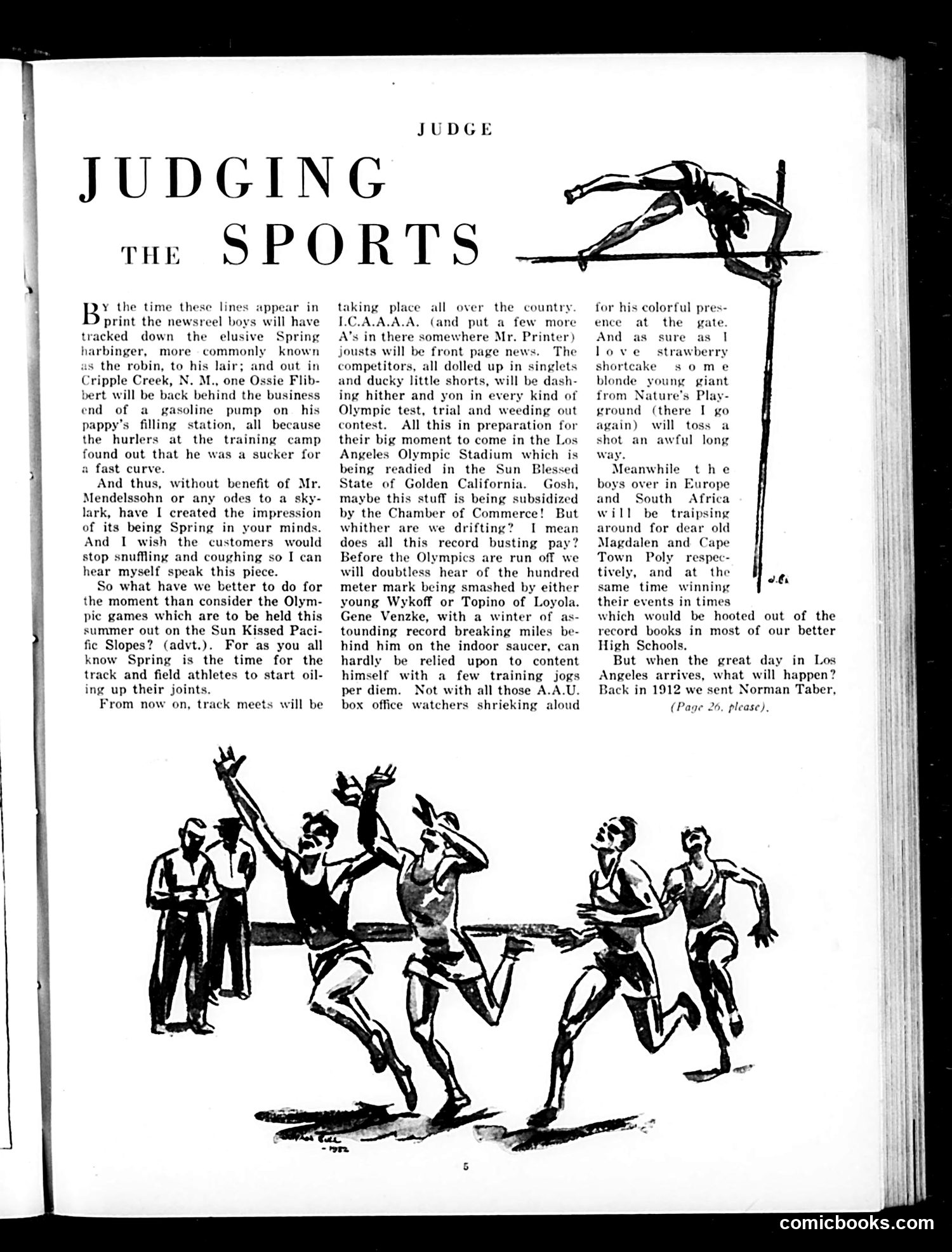
Analysis of "Judging the Sports" Page This satirical piece mocks the upcoming 1932 Los Angeles Olympics. The author criticizes how the event is being heavily promoted and subsidized by the Chamber of Commerce, suggesting taxpayer money funds unnecessary spectacle. The article references specific athletes—likely Wyckoff and Topino of Loyola, and Gene Venzke—as record-breakers generating hype. It jokes that despite all this promotional machinery, actual performance remains unpredictable. The cartoon below illustrates a track-and-field finish line scene, showing the competitive chaos the article discusses. The piece concludes by noting European athletes (German Taber mentioned) will also compete, adding international dimension to the satirized Olympic machinery. The satire targets Olympic excess and commercialization, questioning whether public investment in such spectacle is justified.
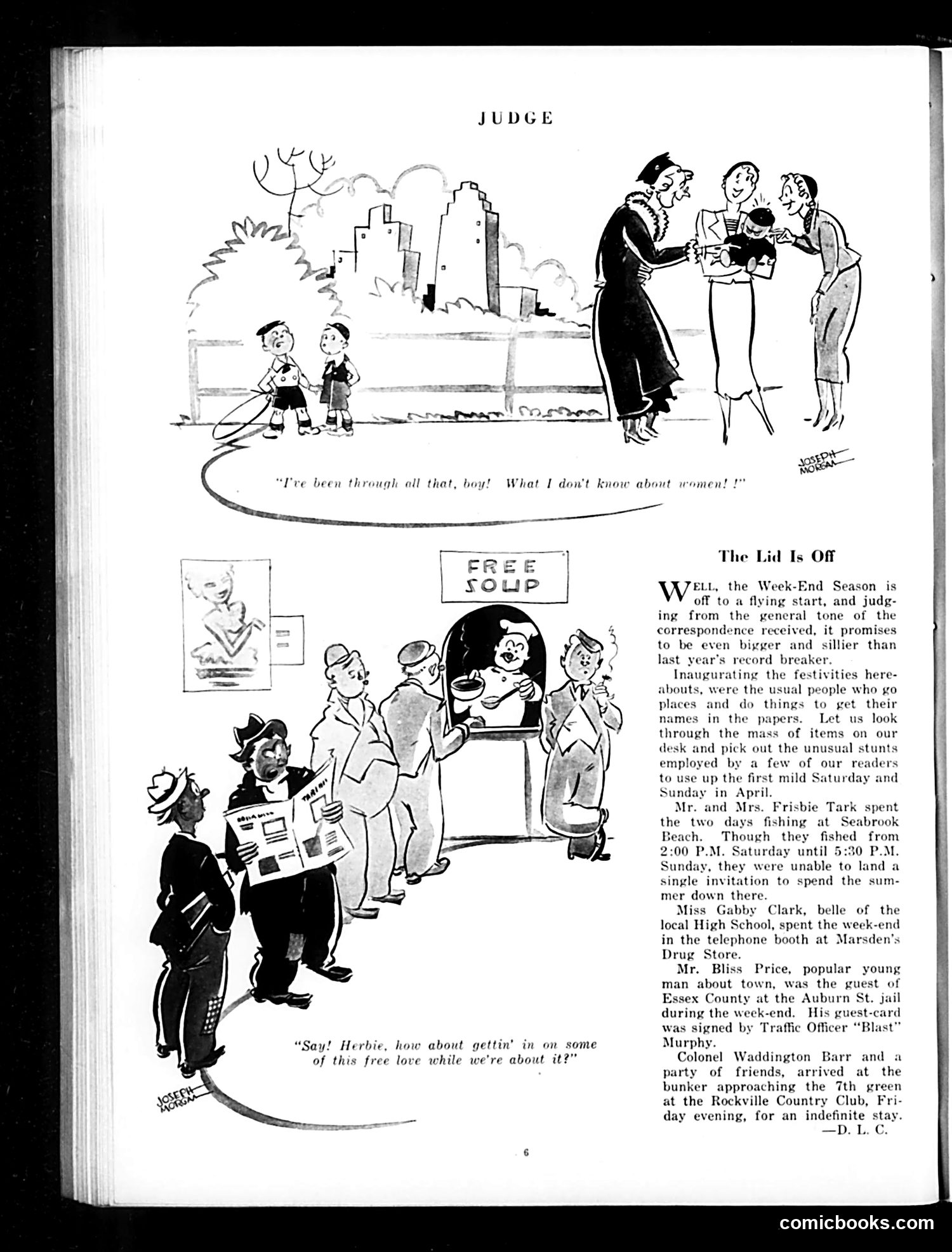
"Judge" Page Analysis This page contains two cartoons satirizing weekend social activities. The top cartoon, titled "Judge," depicts a man (apparently inexperienced with relationships) boasting to a judge about romantic conquests while admitting ignorance about women—a self-contradictory joke about masculine bravado. The bottom cartoon, "The Lid Is Off," shows people gathered around what appears to be a "Free Soup" station, with the caption suggesting someone is taking advantage of free offerings. The accompanying article, "The Lid Is Off," describes weekend activities of local socialites—fishing trips, country club visits, and jail visits—presenting humorous observations of upper-class leisure activities from early 20th-century America. Both cartoons mock pretension and social absurdities of the era.
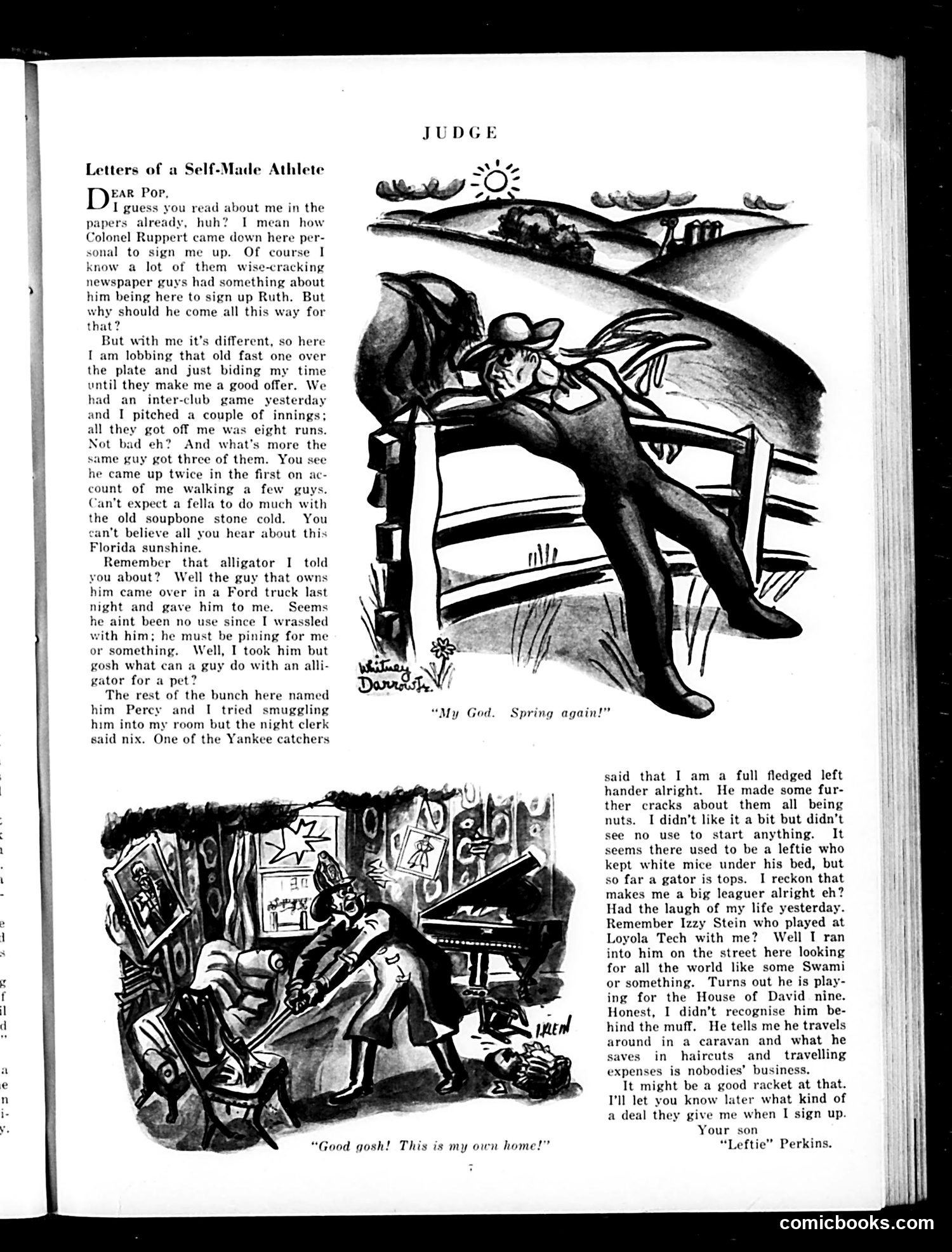
Analysis: "Letters of a Self-Made Athlete" This satirical piece mocks minor-league baseball aspirants during spring training, likely in Florida. The writer, "Leftie" Perkins, is a delusional young pitcher who confuses his own mediocrity with importance. The humor centers on his inflated ego: Colonel Ruppert (owner of the Yankees) supposedly came to sign *him*, not Babe Ruth. Yet Perkins allowed eight runs in an inning-long appearance. His casual ownership of an alligator (which he "wrestled") and references to eccentric teammates—including "Izzy Stein" playing for the House of David (a real barnstorming team known for Orthodox Jewish players)—highlight the absurdity of minor-league baseball culture. The cartoons show domestic chaos: a man thrown from a horse, and a chaotic home scene. These illustrate the disruption caused by bringing an alligator into lodgings—emphasizing Perkins's poor judgment and the general zaniness he represents.
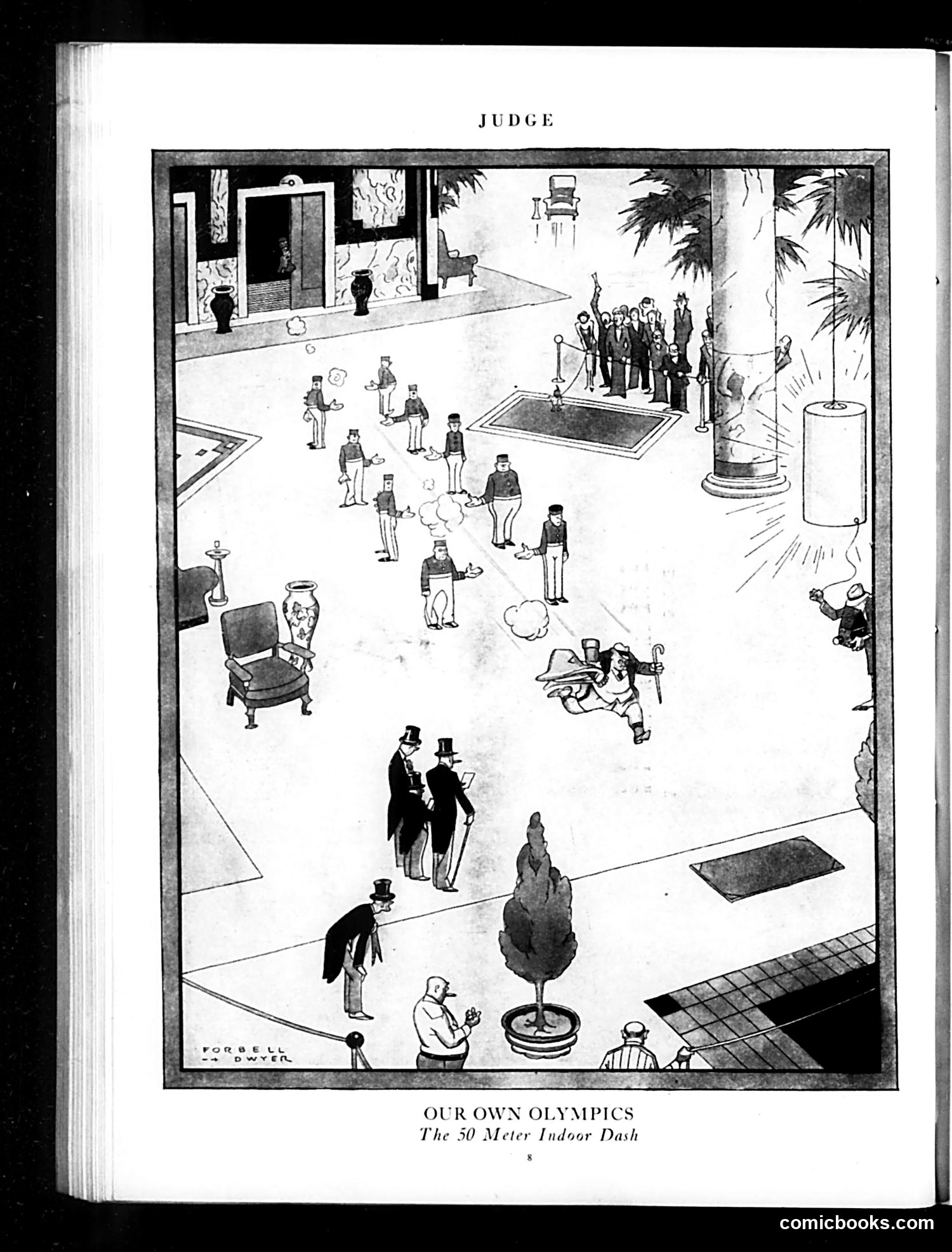
Judge Magazine: "Our Own Olympics - The 50 Meter Indoor Dash" This cartoon satirizes indoor public spaces—likely a courthouse lobby or civic building—as an absurd athletic arena. The title's deliberate error ("350 Meter" vs. "50 Meter") is part of the joke. Various figures dash, stride, and lounge across an ornate interior featuring classical columns, potted plants, and formal architecture. The humor derives from treating mundane daily activities in grand civic spaces as Olympic competition. People in suits and formal wear engage in exaggerated athletic poses amid dignified surroundings—the incongruity between elevated architecture and chaotic human behavior is the satire's core. This mocks both the pretension of formal public buildings and the undignified rush of people conducting ordinary business within them. The cartoon's title placement beneath "JUDGE" suggests commentary on courthouse or legal system culture specifically.
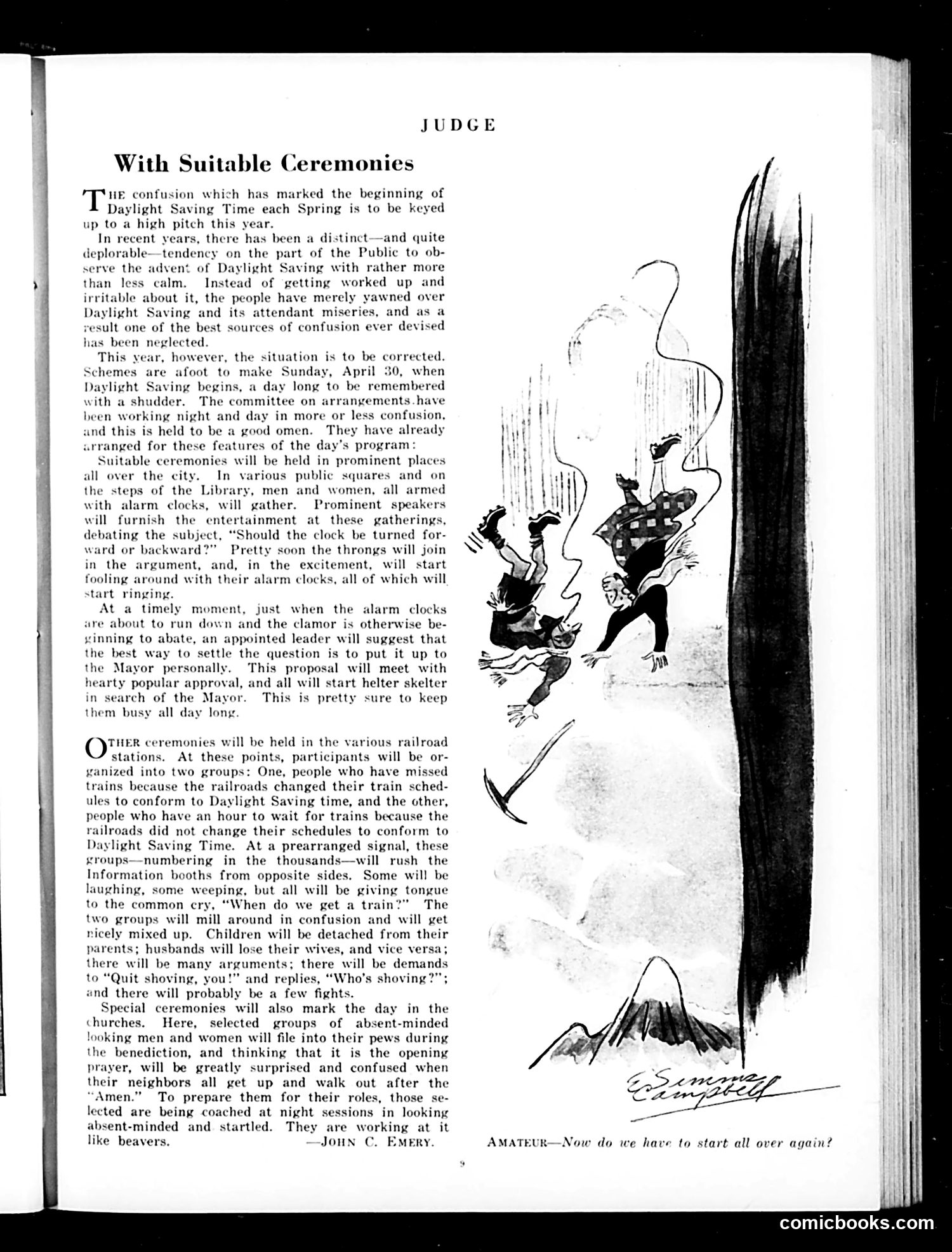
Daylight Saving Time Satire (Judge Magazine) This is a satirical article by John C. Emery mocking public confusion over Daylight Saving Time's implementation on April 30. The piece describes elaborate, tongue-in-cheek "ceremonies" to commemorate the clock change. The humor targets: 1. Public apathy: Citizens have been calmly accepting DST, disappointing those who enjoy the chaos it creates. 2. Proposed "solutions": The article mockingly describes intentional ceremonies designed to maximize confusion—alarm clocks ringing in public squares, people arguing about clock direction, crowds rushing train station information booths, families getting separated. 3. Institutional dysfunction: Railroads inconsistently adopting DST, churches staging confused parishioners leaving before services end. The cartoons (by Cesare Lombardi) show people in chaotic struggle with clocks and time. The satire suggests DST itself is inherently confusing, and that the public's reasonable indifference about it is somehow a missed opportunity for entertaining disorder. It's dark comedy about bureaucratic fumbling.
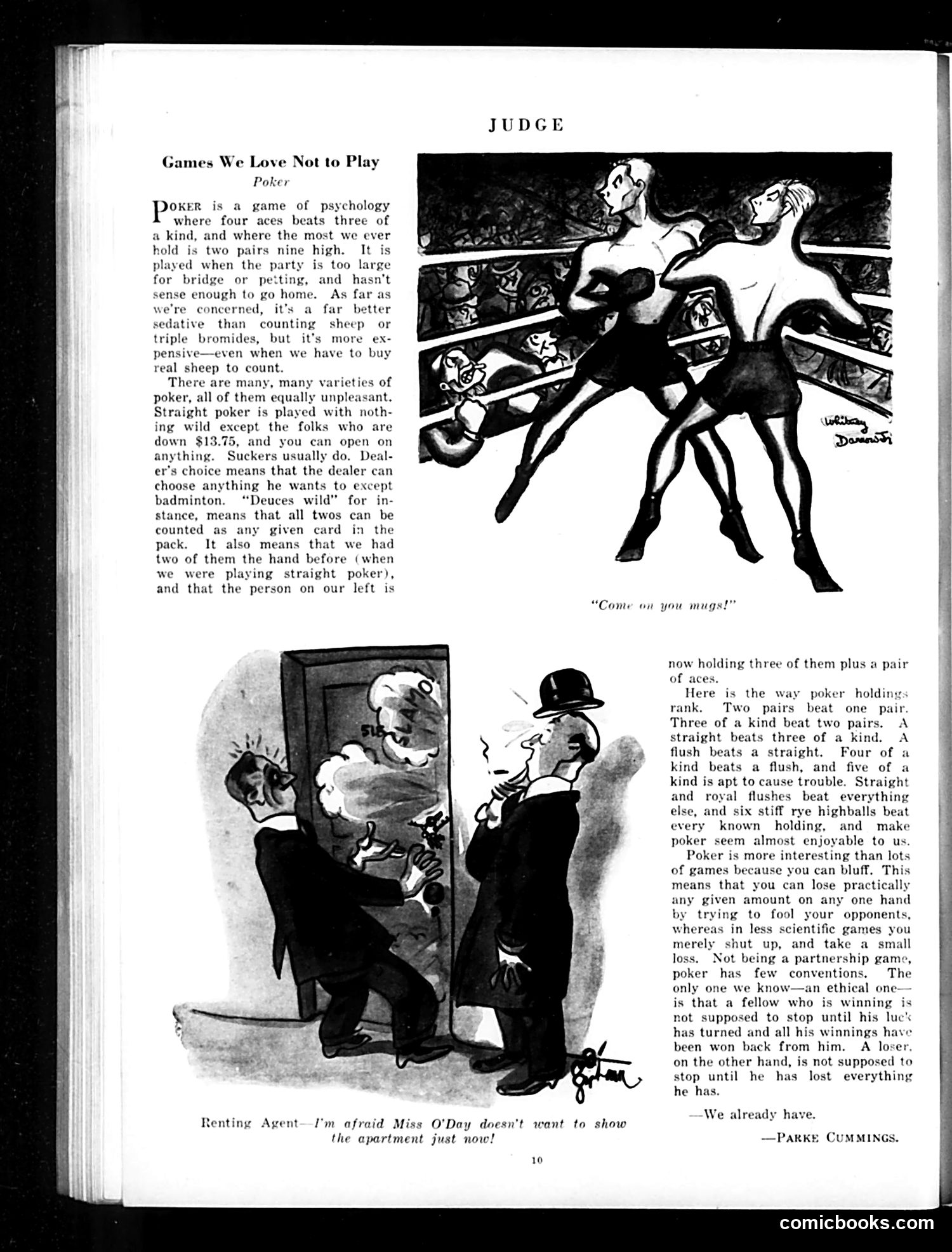
Analysis of Judge Magazine Page This page satirizes poker as a vice disguised as entertainment. The article humorously condemns the game as psychologically manipulative, expensive, and morally corrupting—yet the author admits playing it anyway. The top cartoon shows scantily-clad women boxing, captioned "Come on you mugs!"—likely contrasting frivolous entertainment with the serious money-losing happening at poker tables. The lower cartoon depicts a renting agent reluctant to show an apartment because "Miss O'Day doesn't want to show" it—presumably she's engaged in an illicit activity (likely prostitution, given the era and context), suggesting poker and moral dissolution go hand-in-hand in Jazz Age society. The article's final admission—"We already have [lost everything]"—reveals the satire's target: the self-destructive compulsion of gambling, presented with wry humor rather than moral outrage. This reflects Judge's cynical take on 1920s social vices.
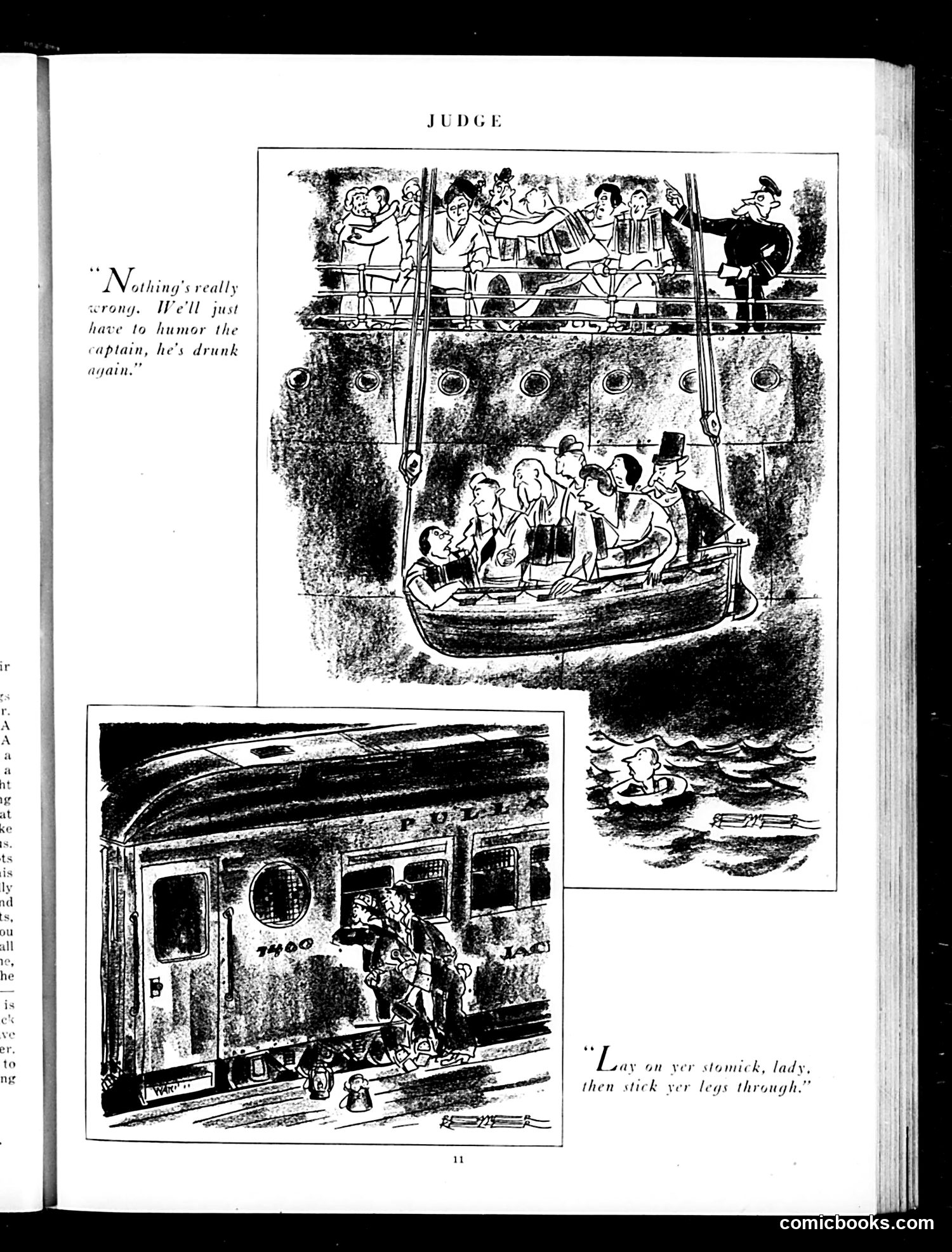
Judge Cartoon Analysis This page contains two separate cartoons satirizing maritime incompetence. The top cartoon shows a ship's officers dismissing concerns about the vessel's safety, attributing problems to a drunk captain whom they'll "humor." The bottom cartoon depicts a ship's officer giving absurd, degrading instructions to a female passenger during what appears to be an evacuation or lifeboat drill—telling her to lie on her stomach and stick her legs through. Together, these cartoons mock the incompetence and indifference of ship officers toward passenger safety. They suggest casual negligence, alcohol abuse among command staff, and disrespect toward passengers. The satire likely reflects early 20th-century concerns about maritime safety standards and crew professionalism, especially given the era's numerous shipping disasters.
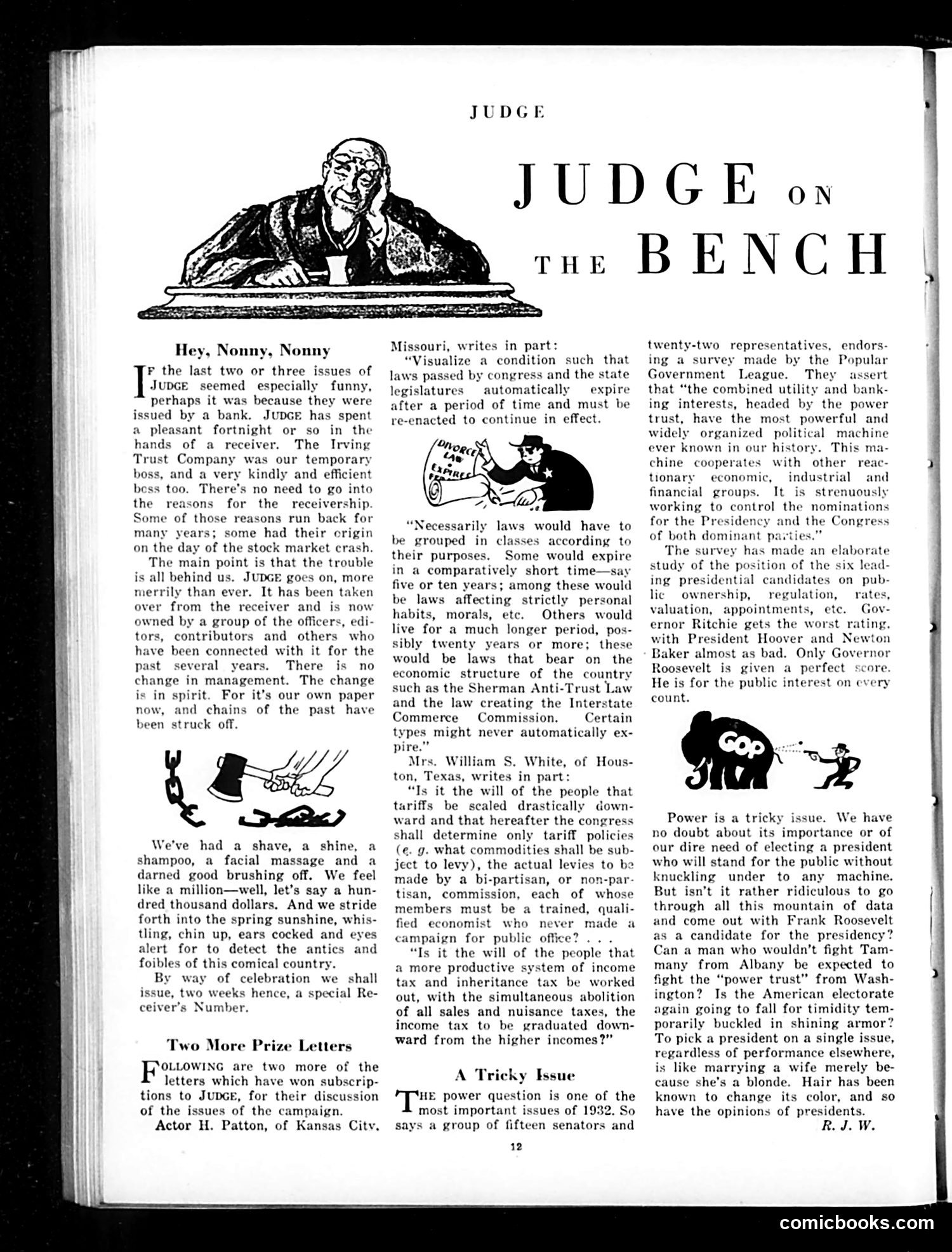
Judge Magazine Political Commentary (1932) This page celebrates Judge magazine's recovery from financial receivership following the 1929 stock market crash. The opening section humorously announces the magazine is now "owned by a group of officers, editors, contributors and others" rather than controlled by the Irving Trust Company receiver—striking off "chains of the past." The page then features letters debating major 1932 election issues: Representative William S. White of Texas argues for tariff reform and tax restructuring; a Missouri correspondent proposes laws with automatic expiration dates requiring re-enactment. The "Tricky Issue" section discusses a survey by fifteen senators and twenty-two representatives examining the "power trust"—the combined influence of utility companies and banking interests—which they claim constitutes "the most powerful and widely organized political machine ever known." The cartoon elephant (GOP symbol) with a figure suggests Republican entanglement with these corporate interests. The satire targets corporate influence on presidential nominations during the Depression era.
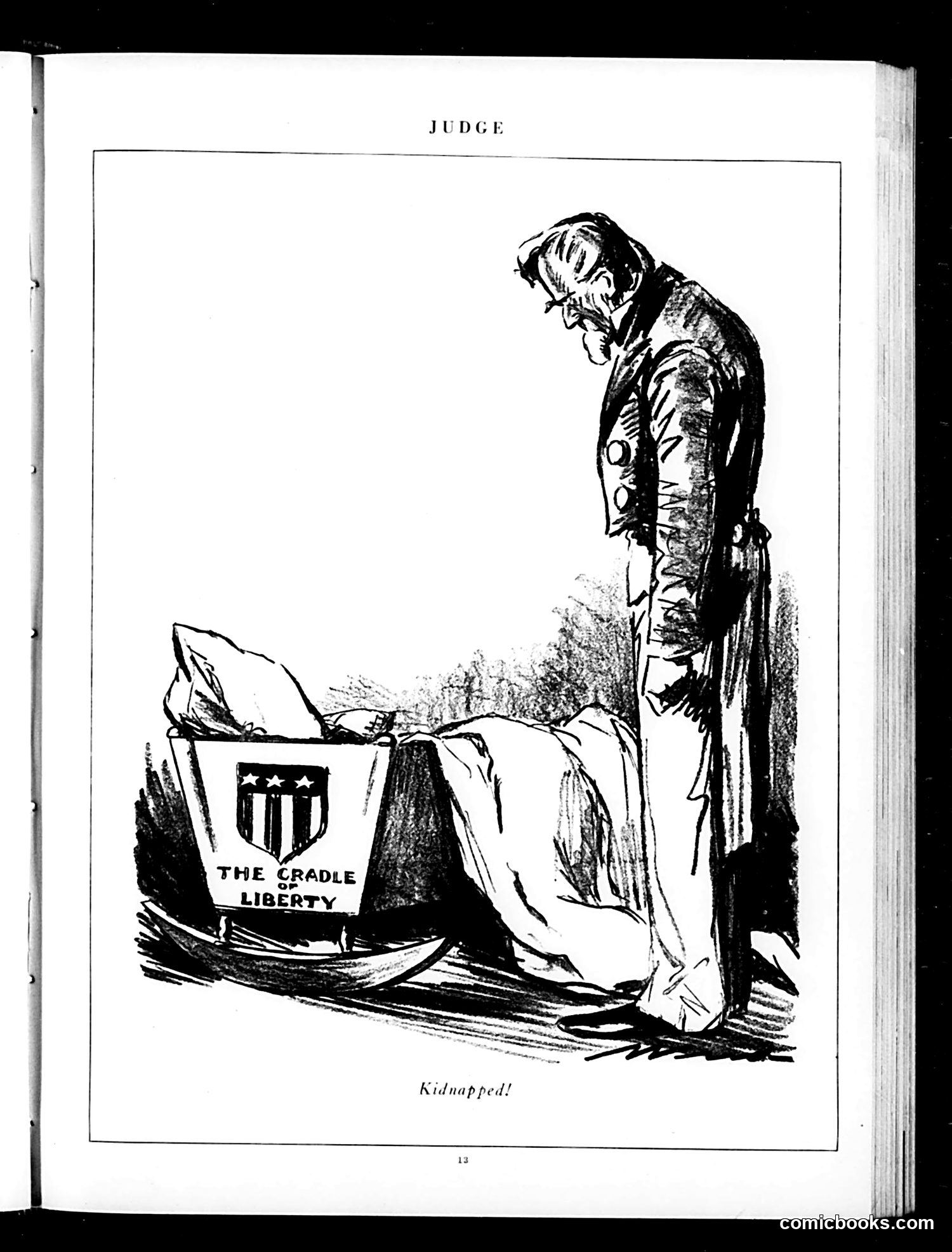
"Judge" Political Cartoon: "Kidnapped!" This cartoon depicts a robed judge standing over a cradle labeled "THE CRADLE OF LIBERTY" with the shield symbol of the United States. The cradle appears to have been disturbed or its contents removed, and the caption reads "Kidnapped!" The satire suggests that American liberty—symbolized by the cradle and national shield—has been stolen or compromised by judicial action. The judge's stern, downward gaze and formal attire suggest judicial authority being used to undermine foundational American freedoms. This likely critiques a specific court decision or judicial overreach that the *Judge* magazine's editors viewed as threatening constitutional liberties, though without the publication date visible, the exact case referenced remains unclear.
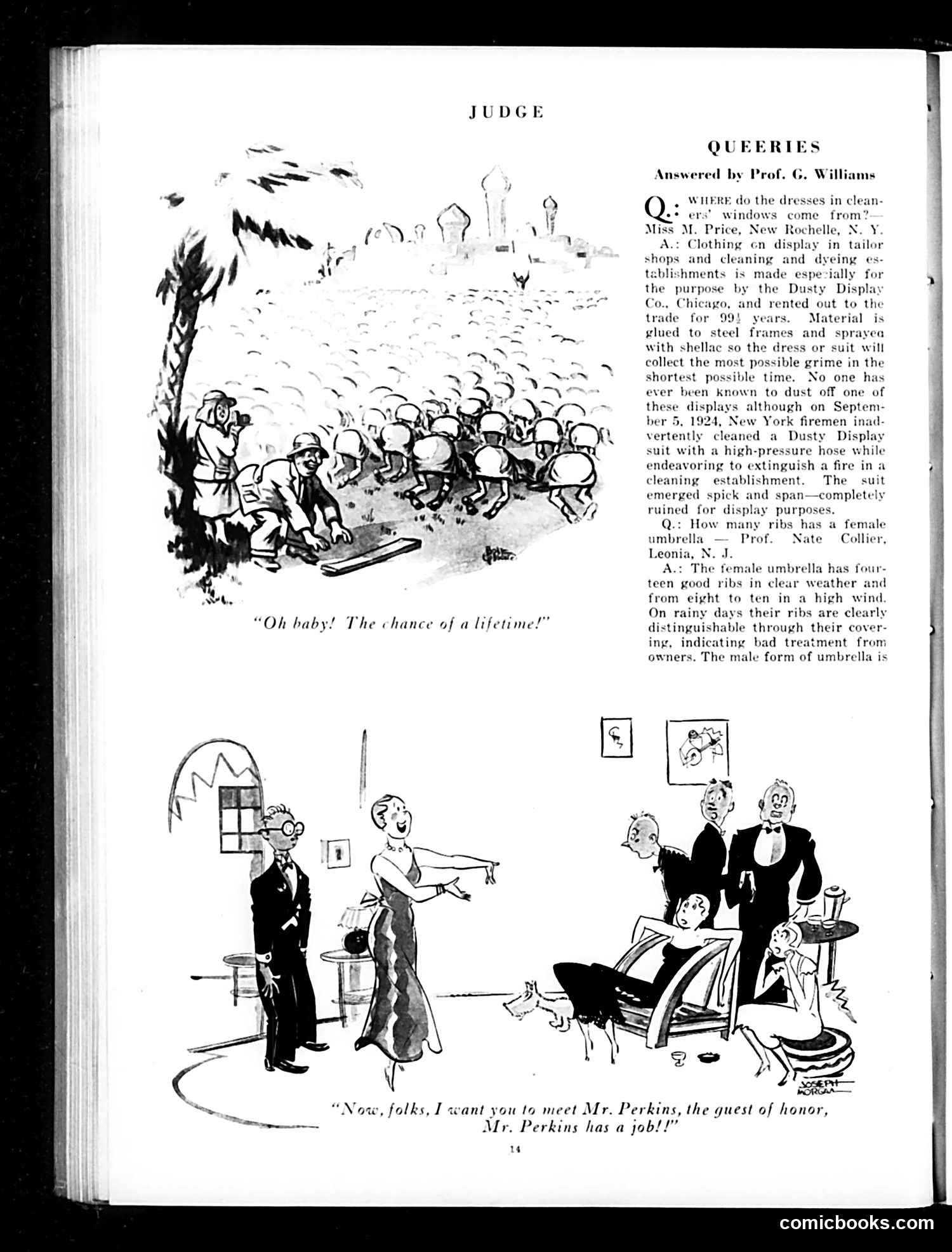
Judge Magazine Page Analysis This page contains two cartoons satirizing American social anxieties of the era (appears to be 1920s based on style). Top cartoon: Depicts a crowd of people in what looks like a breadline or unemployment queue, with the caption "Oh baby! The chance of a lifetime!" The satire mocks economic desperation—people treating basic survival or employment as a windfall. Bottom cartoon: Shows a social gathering where a host announces "Mr. Perkins, the guest of honor, Mr. Perkins has a job!" The humor targets widespread joblessness; simply *having employment* is treated as noteworthy social status worthy of celebration. The page also includes "Judge Queries"—a humor advice column answering absurd questions. The answers parody fake "expert" explanations, including one about display mannequins in shop windows being deliberately made grimy, and another using pseudo-scientific language about umbrella ribs. These mock both pretentious expertise and advertising practices. Overall, the page satirizes economic hardship, social pretension, and commercial deception in 1920s America.
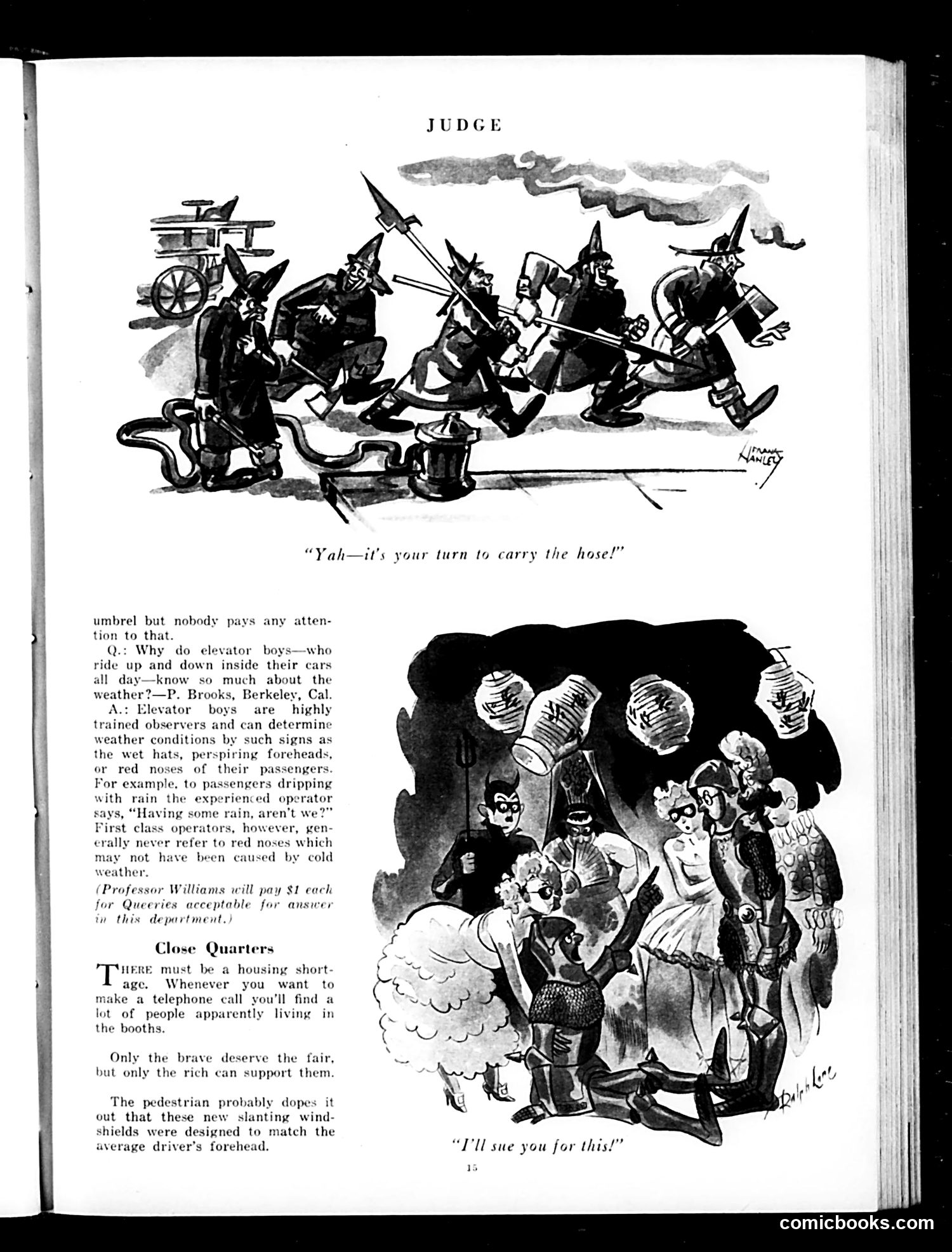
Judge Magazine Page Analysis Top Cartoon ("Yah—it's your turn to carry the hose!"): A satirical illustration of firefighters in action, likely mocking either their competence or the chaos of firefighting operations. The exaggerated poses and expressions suggest comedic commentary on emergency services. Bottom Cartoon ("I'll sue you for this!"): Depicts figures in heaven or the afterlife (indicated by clouds and halos), with one threatening to sue another. This appears to satirize America's litigation culture—the joke being that even in the afterlife, people cannot escape lawsuits. Text Content: The page includes a humor column called "Judge" featuring Q&A jokes and witty observations about everyday life: elevator operators knowing weather signs (reading passengers' wet clothes/red noses), housing shortages evidenced by crowded phone booths, and mocking pedestrians' assumptions about car windshield design. These are lighthearted social commentary typical of 1920s-30s satirical magazines.
"The Theatre" by George Jean Nathan - Judge Magazine This is a theater criticism essay, not a cartoon. Nathan, a prominent drama critic of the era, critiques Broadway producers' obsession with novelty shows. The argument: Producers wrongly believe "different" plays will save failing businesses. Nathan argues this fails consistently—yet they ignore evidence that quality revivals and standard plays (like *Othello*) would profit better. The named examples: Gilbert M. Miller successfully produces quality plays; Elmer Rice self-produces rejected works; the Theatre Guild finds profitable plays but previously wasted money on novelties like "The Real Thing." The satire's target: Producers' stubborn, illogical addiction to gimmicks despite repeated financial failure. Nathan contrasts their desperation with successful producers who trust dramatic merit over novelty. The piece represents early-20th-century theater criticism lamenting commercialism's corruption of artistic judgment—a timeless complaint about entertainment industries.
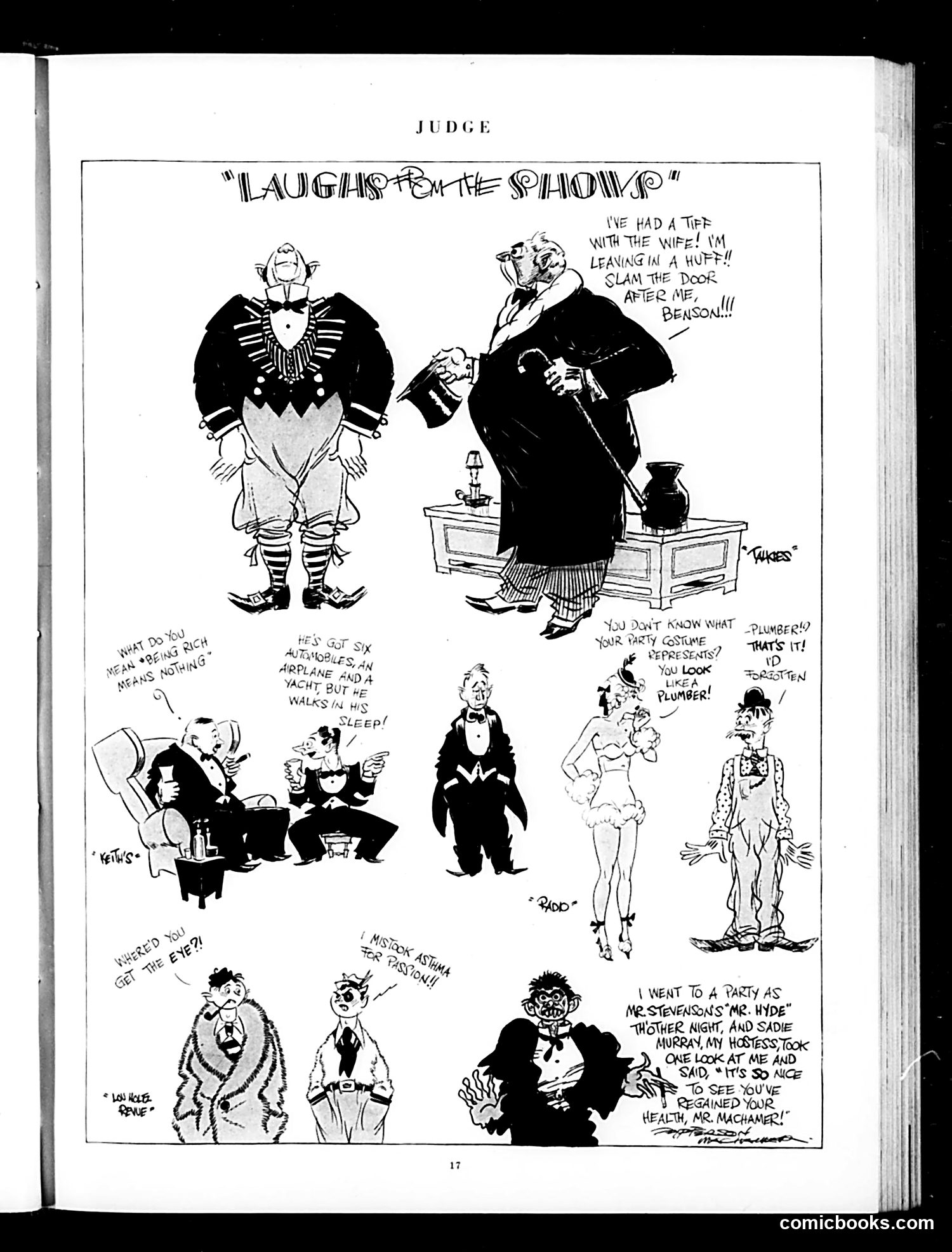
"Laughs for the Shows" - Judge Magazine Cartoon Page This is a collection of comic vignettes satirizing high society and wealthy characters. The main figures appear to be affluent men in formal dress complaining about domestic troubles—a wife who slams doors, arguments over money and possessions (yachts, airplanes). The humor relies on contrasting the pomposity of the ultra-rich with petty, relatable marital complaints. One scene shows a man claiming poverty despite owning luxury goods. Another depicts someone attending a party in a "Mr. Hyde" costume, with the hostess making a barbed remark about his health (possibly implying he looks ghastly or has aged poorly). The cartoons mock the vanity and shallow concerns of the wealthy elite, suggesting their problems—despite their riches—are fundamentally mundane. The style and references to contemporary social events (costume parties, yacht clubs) place this as early-20th-century American satire targeting the leisure class.
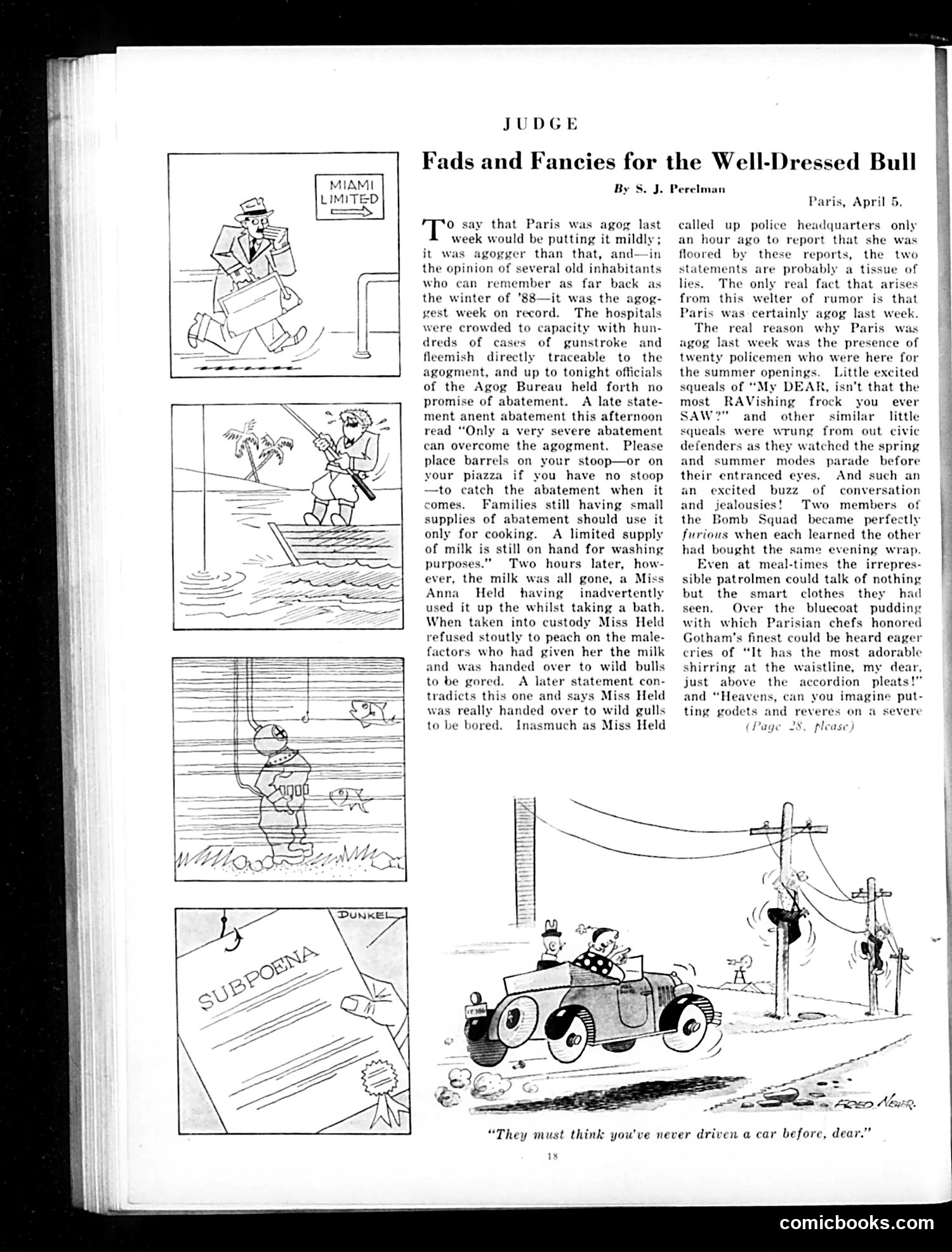
Analysis for Modern Readers This is a humorous piece by S.J. Perelman satirizing Paris fashion culture circa the 1920s. The article mockingly describes an "agogment" (excitement) gripping Paris due to visiting American policemen—the real draw being the fashionable summer clothing parade they attend. The satire targets: - Parisian obsession with fashion and appearance - The absurdity of grown policemen becoming distracted by high fashion details - American cultural influence in Paris (the "Bomb Squad" reference suggests American visitors) - The pretentiousness of fashion discourse (detailed descriptions of clothing elements like "godets" and "accordion pleats") The cartoons illustrate the chaos and frivolity: a well-dressed man fleeing heat, people cooling off, and a car accident caused by a distracted driver—all visual jokes supporting the theme that preoccupation with fashion and style causes real-world disorder. The humor relies on exaggeration and wordplay ("agogment," "fleemish"), mocking how trivial concerns dominate society.
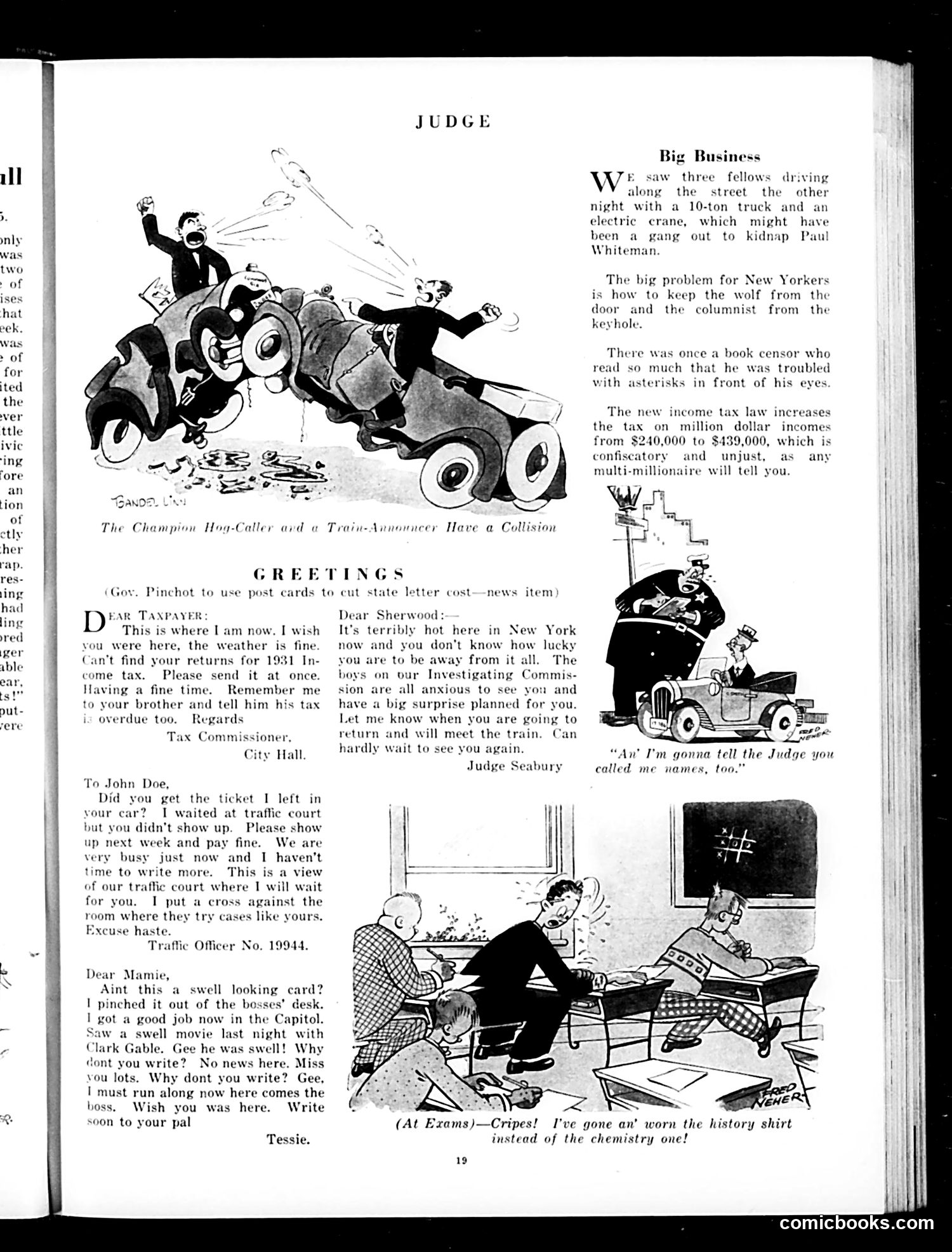
Judge Magazine Page Analysis This page satirizes American bureaucratic inefficiency and the tax system circa early 1930s. Top cartoon: "Champion Hog-Caller and Train-Announcer Have a Collision" depicts two loud professionals colliding—likely mocking the cacophony of urban life and competing sources of noise/chaos. "Greetings" section: Parodies postcards from government officials and workers, humorously showing bureaucratic indifference. The Tax Commissioner casually asks for overdue returns via postcard; a traffic officer leaves a ticket; a Capitol worker boasts from a borrowed desk. The satire: government workers treating serious matters (taxes, citations) with lazy informality. "Big Business" column: Mocks wealthy New Yorkers' anxieties (kidnapping fears of entertainer Paul Whiteman, columnist intrusions) and criticizes the new income tax law as "confiscatory and unjust"—reflecting wealthy readers' perspective that millionaires are unfairly taxed. Bottom cartoon: A student wore the wrong shirt to exams—mild humor about absent-mindedness. The page reflects Judge's audience: prosperous, tax-weary New Yorkers skeptical of government and sympathetic to the wealthy.
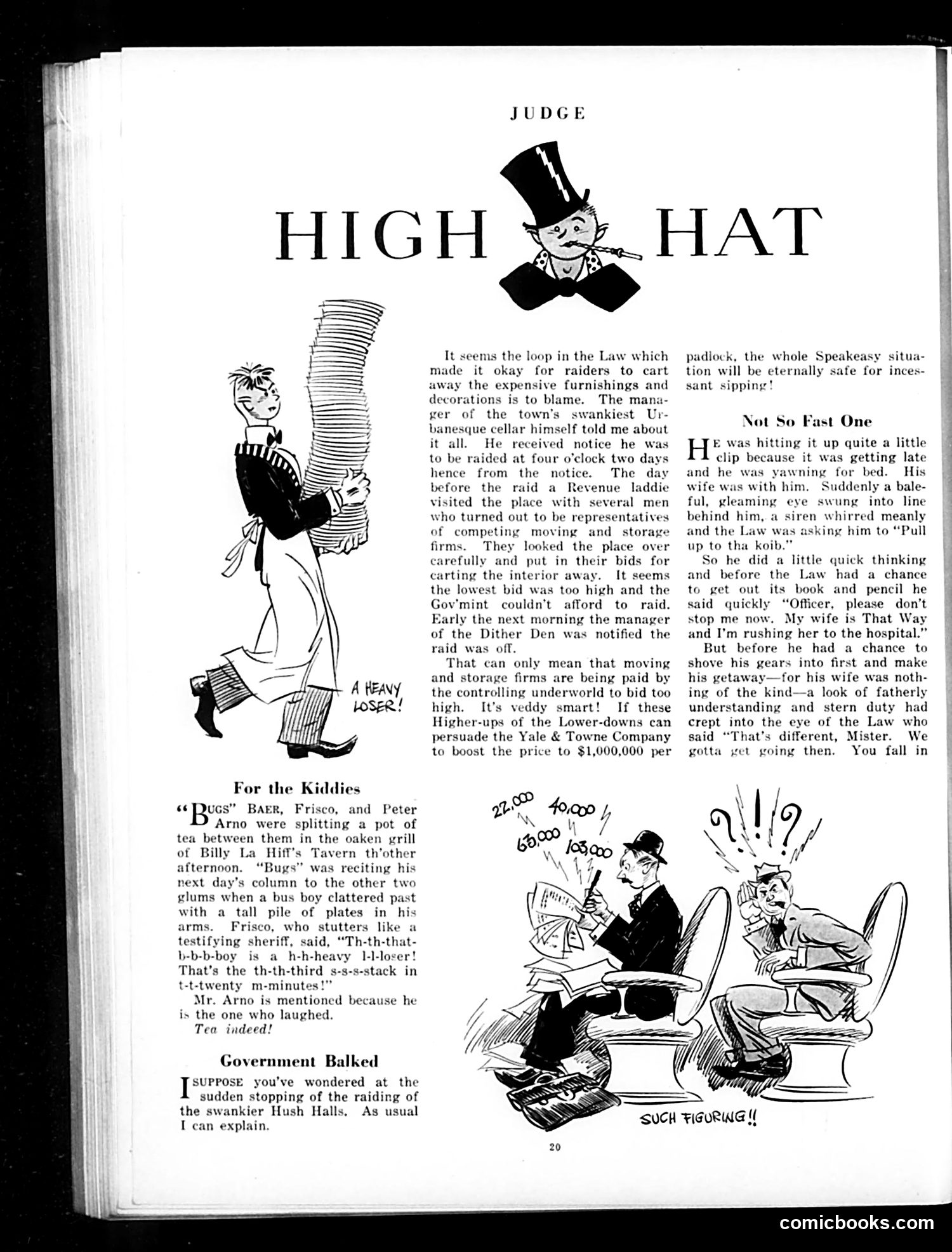
Judge Magazine Satire Analysis This page contains three separate satirical pieces about Prohibition-era New York City: "High Hat" (top): A visual gag about speakeasy raids. The text describes how government agents couldn't afford moving companies' inflated bids to remove contraband from illegal bars, so raids were cancelled. The satire suggests organized crime is bribing storage firms to price-gouge the government, effectively protecting speakeasies from law enforcement. "For the Kiddies" (left): A brief anecdote mocking one of the columnists present—likely "Bugs" Baer—who tells a joke about a bus boy dropping plates. The humor derives from a stutter joke ("h-h-heavy l-l-loser") that would strike modern readers as tasteless. "Not So Fast One" (right): A driver avoids a traffic stop by claiming his wife needs hospital care. A sympathetic cop lets him go, unaware the wife isn't actually ill. The satire critiques selective law enforcement—police strictly enforce minor traffic laws while tolerating widespread Prohibition violations. All three pieces reflect 1920s urban corruption and enforcement inconsistencies.
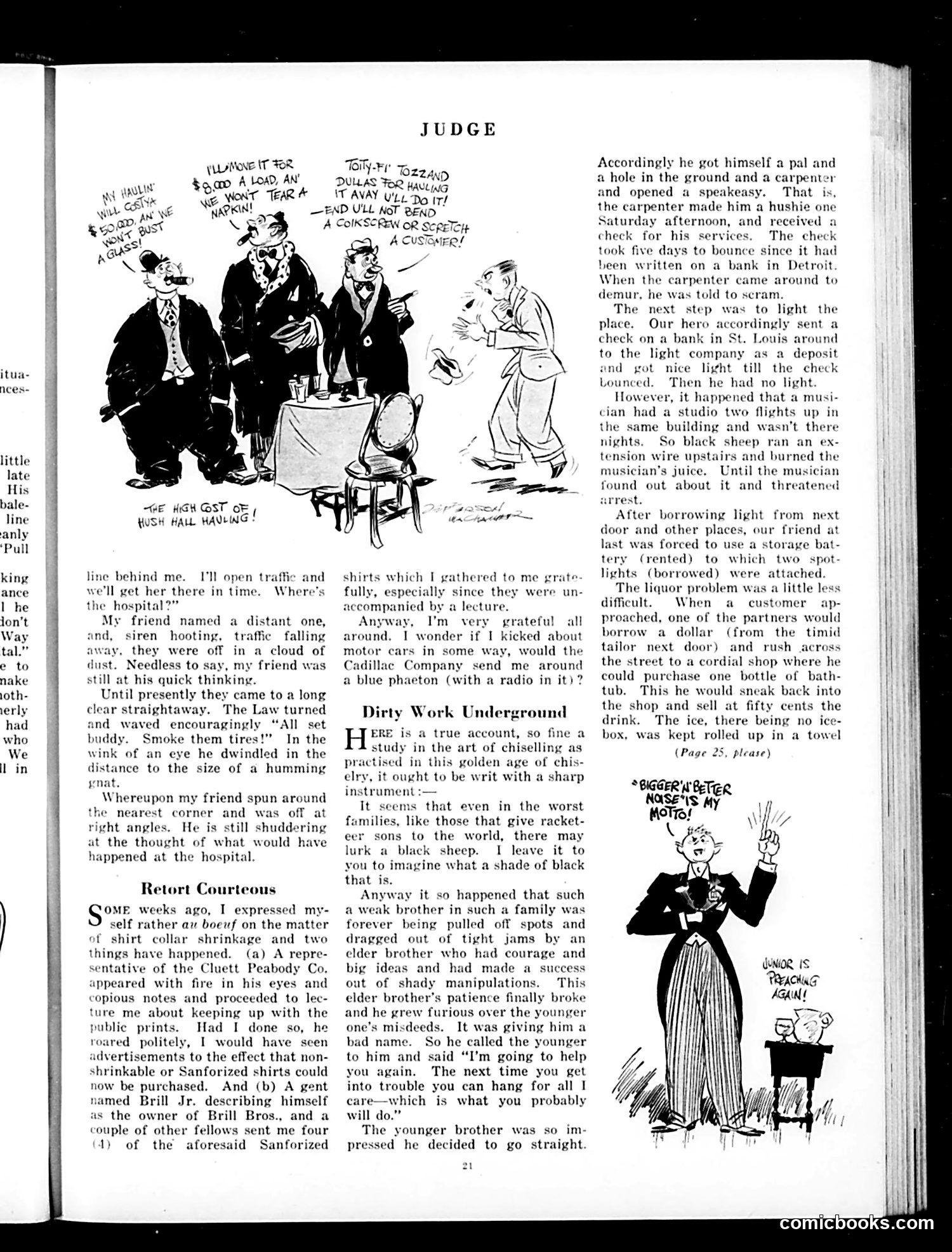
Judge Magazine Page Analysis This page contains three humorous anecdotes satirizing American urban life and business practices in the early 20th century. "Retort Courteous" mocks shirt collar shrinkage—a common consumer complaint—and the advertiser's defensive response. The author sarcastically suggests that if advertising solved shirt problems, perhaps car manufacturers should send him free vehicles. "Dirty Work Underground" tells of a mobster's younger brother who attempts legitimate business by opening a speakeasy (illegal bar). He repeatedly commits petty fraud: writing bad checks to pay for carpentry and utilities. The speakeasy owner steals electricity from an upstairs musician's studio until caught. This satirizes both Prohibition-era criminality and everyday dishonesty masquerading as business. The cartoon illustrations show businessmen and schemers engaged in dubious dealings. The humor relies on readers' familiarity with Prohibition, urban racketeering, and the moral compromises of modern business culture. The satire targets not just criminals but the casual fraud endemic to American commerce during this period.
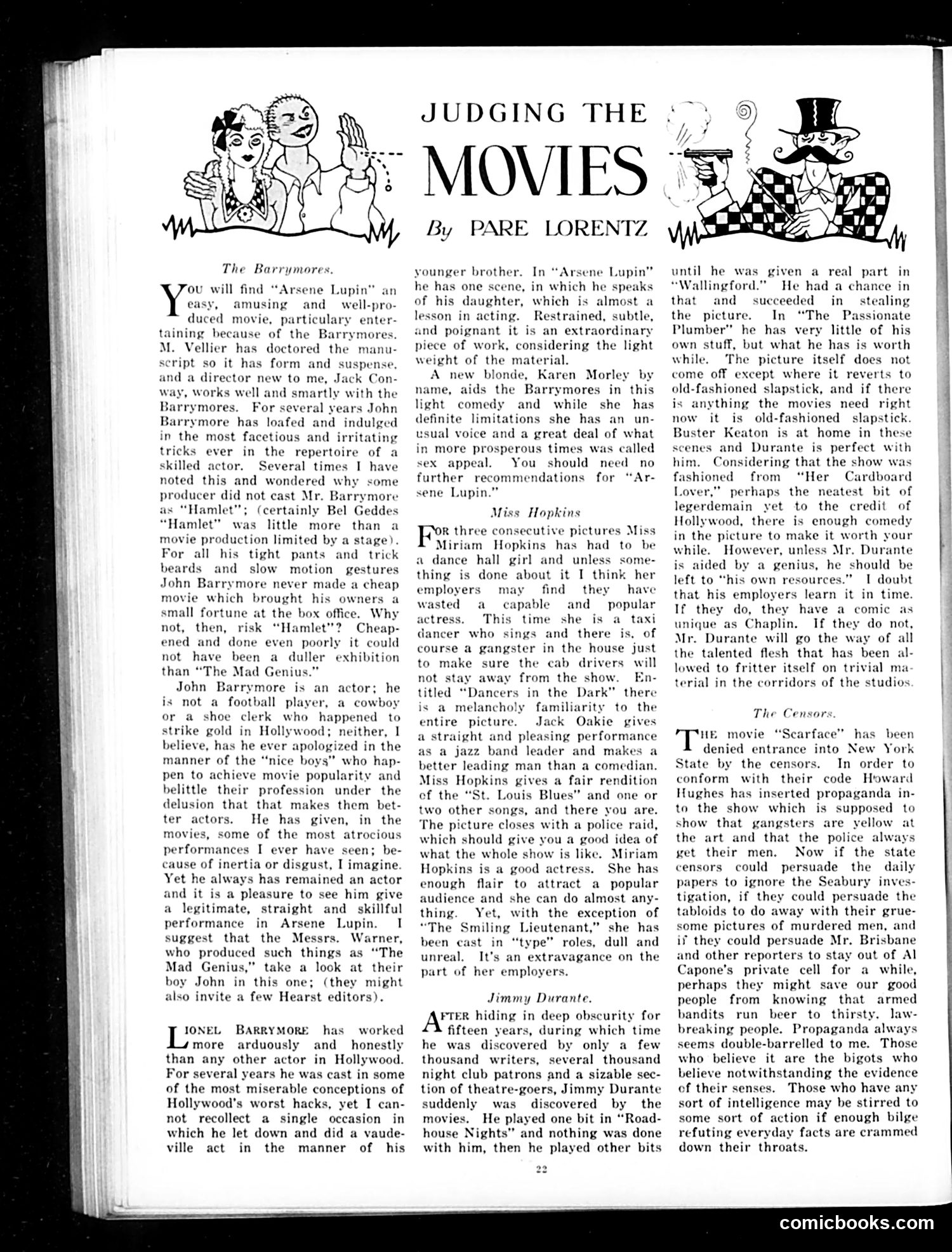
"Judging the Movies" by Pare Lorentz This is a film criticism column reviewing three 1931-1932 movies. The header illustration shows cartoon figures evaluating cinema, establishing the satirical tone. Lorentz critiques actor John Barrymore, who had been wasting his legitimate dramatic talents in poorly-conceived Hollywood vehicles. The reviewer praises him for finally delivering a serious, skilled performance in "Arsene Lupin" rather than relying on theatrical tricks and "slow motion gestures." This is social commentary on how the studio system squandered genuine actors' abilities on mediocre material. He also reviews films starring Miriam Hopkins and Jimmy Durante, criticizing Hopkins's repetitive typecasting as a "dance hall girl" despite her capabilities, and Durante's obscurity before movie discovery. The satire targets Hollywood producers (particularly Warner Brothers, mentioned by name) for mismanaging talent and prioritizing cheap entertainment over quality drama—a persistent 1930s critique of the studio system's commercial priorities over artistic merit.

Analysis This is a General Electric advertising page, not political satire. The page promotes GE Mazda brand light bulbs for kitchen use. The image shows three women examining a well-lit kitchen, with a light bulb illustration below. The headline equates proper lighting with food quality—a marketing claim positioning electric lighting as essential to modern hospitality. The advertisement reflects early-to-mid 20th century domestic ideology: it appeals to housewives' pride in their kitchens and suggests that bright, clean-appearing spaces (enabled by GE products) are a status symbol for entertaining guests. The copy emphasizes specific task lighting over sinks and stoves, positioning electric illumination as a practical necessity rather than luxury. This represents how manufacturers used magazines like *Judge* to reach middle-class consumers by linking consumer goods to social respectability and domestic competence.
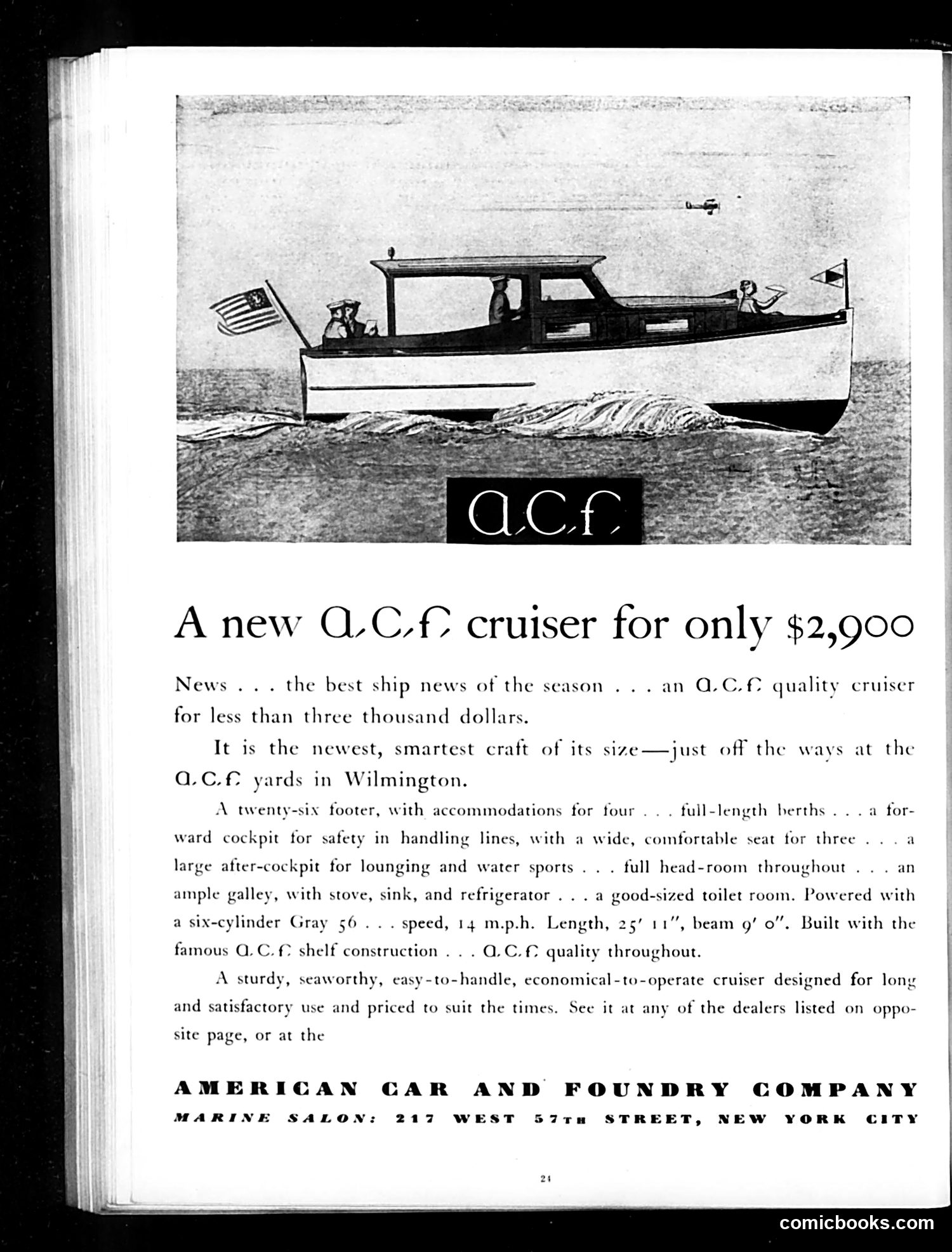
This page is entirely an advertisement, not political satire or a cartoon. It promotes a Q.C.F. (likely "Quality Craft") cruiser boat manufactured by American Car and Foundry Company, priced at $2,900. The image shows a side-view illustration of a 26-foot motorboat with an American flag, cabin, and cockpit areas. The ad emphasizes the vessel's modern amenities—berths, galley, head-room, refrigerator—and performance specs (14 m.p.h., Gray 56 engine). The phrase "priced to suit the times" suggests this appeared during an economically challenging period, likely the Great Depression era, when affordability was a selling point. There is no satire, caricature, or political commentary on this page—it is straightforward commercial promotion for recreational boating.
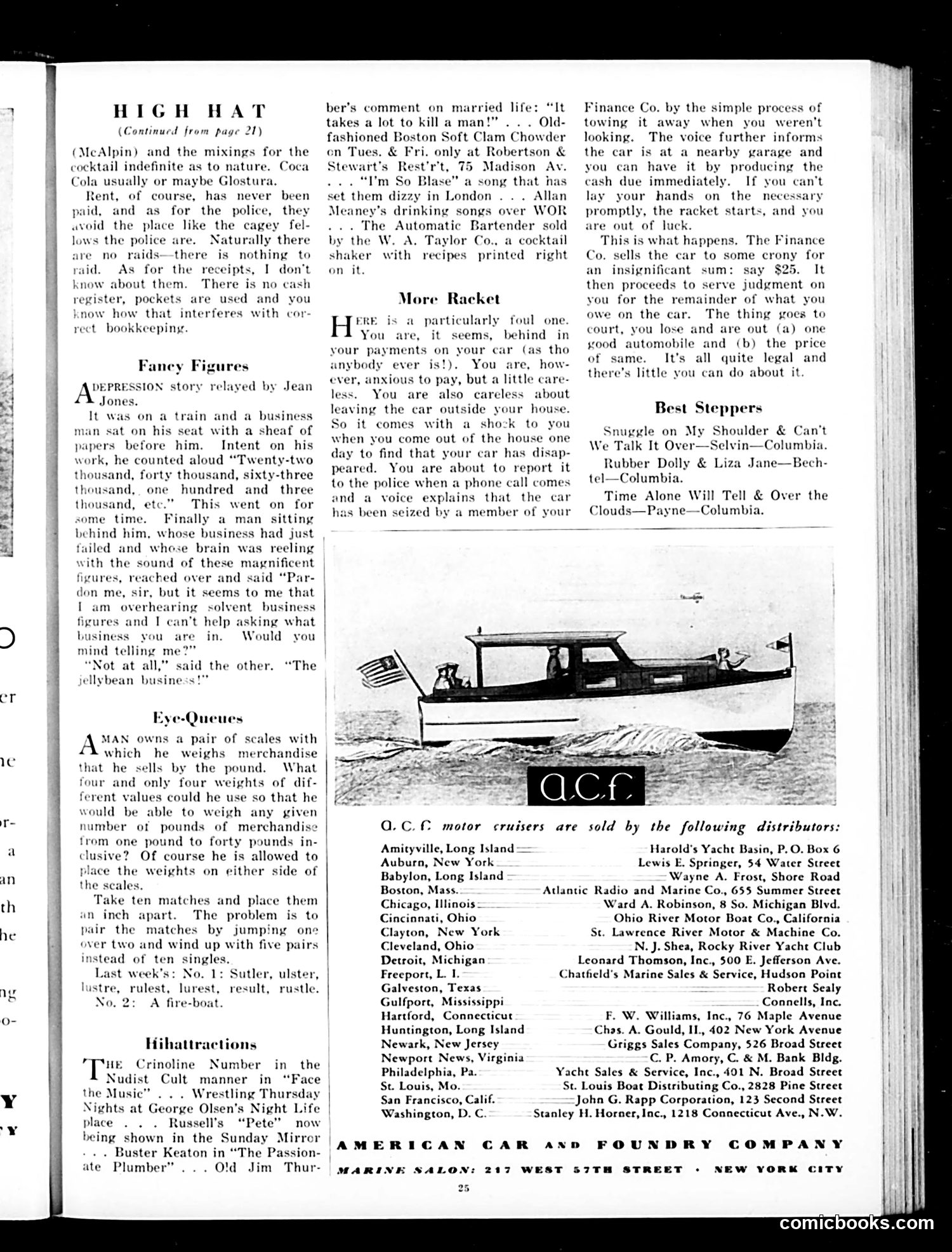
Analysis for Modern Readers This page contains three satirical humor pieces typical of Judge magazine's Depression-era content: "Fancy Figures": A businessman on a train counts aloud in massive figures ("twenty-two thousand, forty thousand..."), impressing a nearby passenger. The punchline reveals he works in the jellybean business—mocking how Depression-era commerce had become detached from substance, with trivial products generating impressive-sounding numbers. "More Racket": This satirizes predatory auto financing schemes. A car buyer falls behind on payments and carelessly leaves the vehicle unattended. The finance company repossesses it, sells it to a accomplice for pennies, then sues the original buyer for the remaining debt—a legal but exploitative practice that strips people of both car and money. Puzzle sections ("Eye-Queues," "Hilarities"): Standard brain-teasers and joke listings about radio shows and movies. The O.C.C. motor cruisers advertisement occupies the page's bottom half, listing distributors nationwide. The satire targets Depression-era financial predation and hollow business practices.
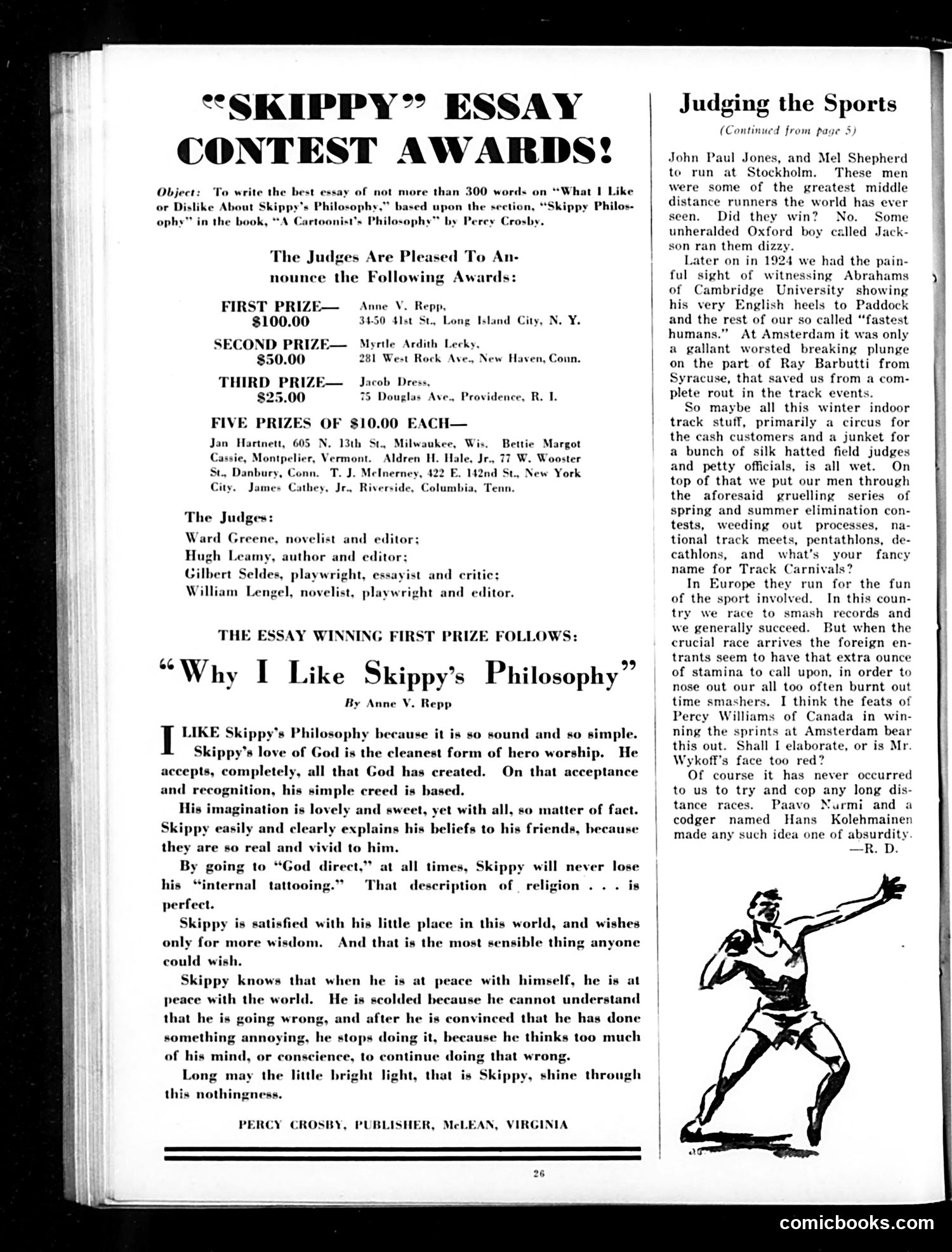
"Skippy" Essay Contest and Sports Commentary This page announces results of a writing contest sponsored by *Judge* magazine centered on "Skippy," a popular cartoon character created by Percy Crosby. Readers submitted essays interpreting Skippy's philosophy—emphasizing simple faith, contentment, and inner peace—with the winning essay praising these values as sensible life guidance. The right column discusses international athletic competition, lamenting American dominance in track and field despite superior training resources. The author argues that European competitors possess greater stamina and endurance, suggesting American athletes are "burnt out" from excessive competitive scheduling and record-chasing. This reflects 1920s concerns about whether American sports culture's commercialism and intensity actually hindered athletic performance compared to European amateur traditions.
"Judging the Books" - Judge Magazine Book Review Page This is primarily a book review section, not political satire. The page critiques three recently published novels: 1. Boleslavski's memoir about his experiences as a Polish soldier in WWI and the Russian Revolution—praised for its vivid, unflinching depiction of societal collapse, though acknowledged as another war book in a saturated genre. 2. "Forever and Ever" by Warren Spencer—a novel about an advertising man's romantic and financial struggles that starts honestly but devolves into contrived melodrama. 3. A Miss Pinkerton mystery by Mrs. Rinehart—standard murder-mystery fare with familiar tropes (nurse, doctor, gloomy house, midnight violence). The review's tone is witty and candid, mocking clichéd plotting while appreciating genuine literary honesty. The Santa Fe excursion advertisement on the right is unrelated commercial content. Overall, this reflects 1920s-30s literary criticism standards and the era's appetite for both serious war literature and popular mystery novels.
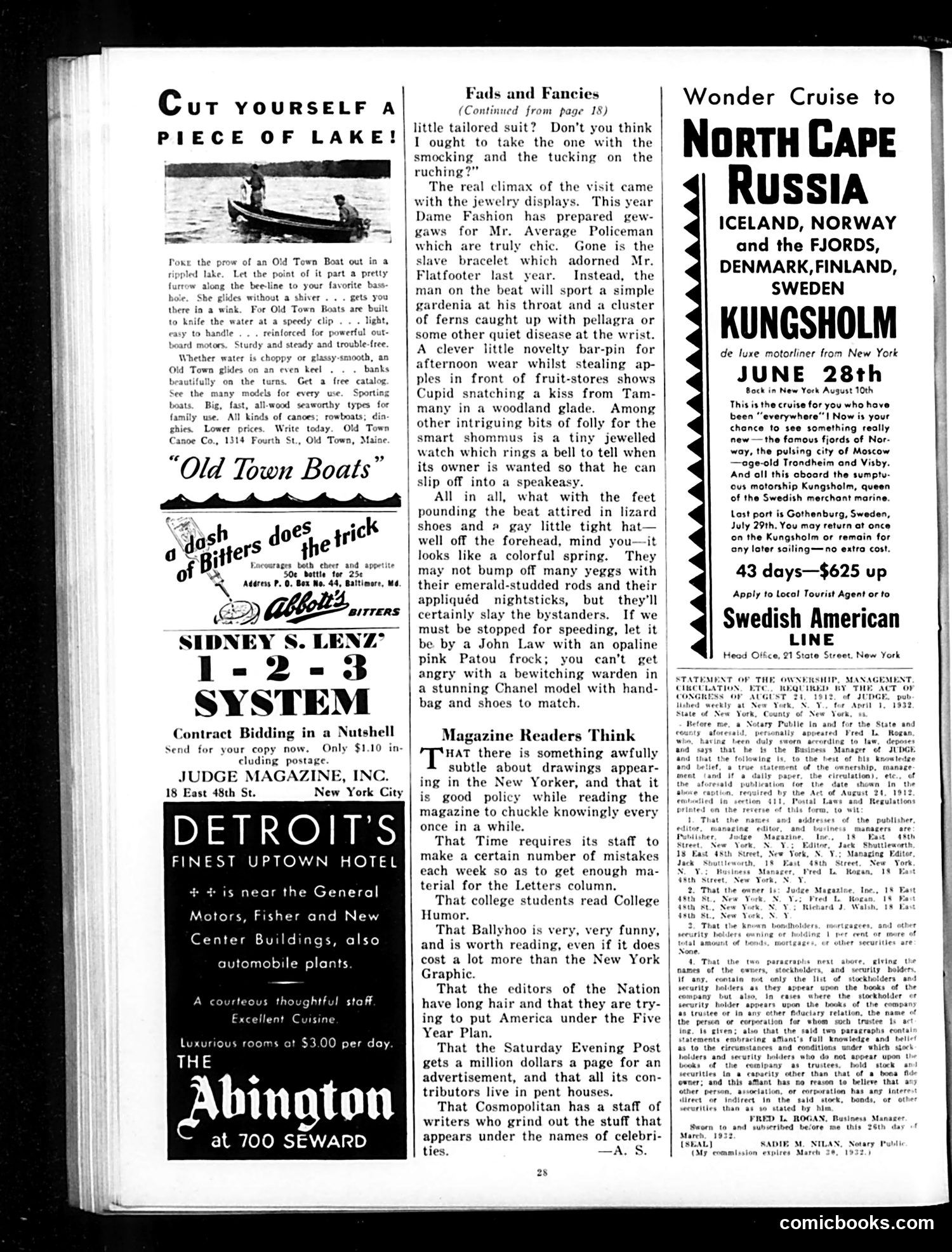
This page is primarily advertisements and filler content rather than a political cartoon. The main satirical element is a brief column titled "Magazine Readers Think" that mocks contemporary beliefs about popular publications. The satire gently ridicules readers' assumptions: that *The New Yorker* features subtle, sophisticated humor requiring knowing chuckles; that *Time* magazine deliberately includes errors to fill its letters column; that *The Nation* editors are radicals pushing communist "Five Year Plans"; that *Saturday Evening Post* contributors are celebrities (implying ghostwriting); and that *Cosmopolitan* publishes ghost-written pieces under famous names. The humor targets both the magazines themselves and readers' gullibility. References like "speakeasy" date this to Prohibition-era America. The remaining page consists of ads for Old Town boats, hotels, and a cruise line—standard magazine filler of the period.
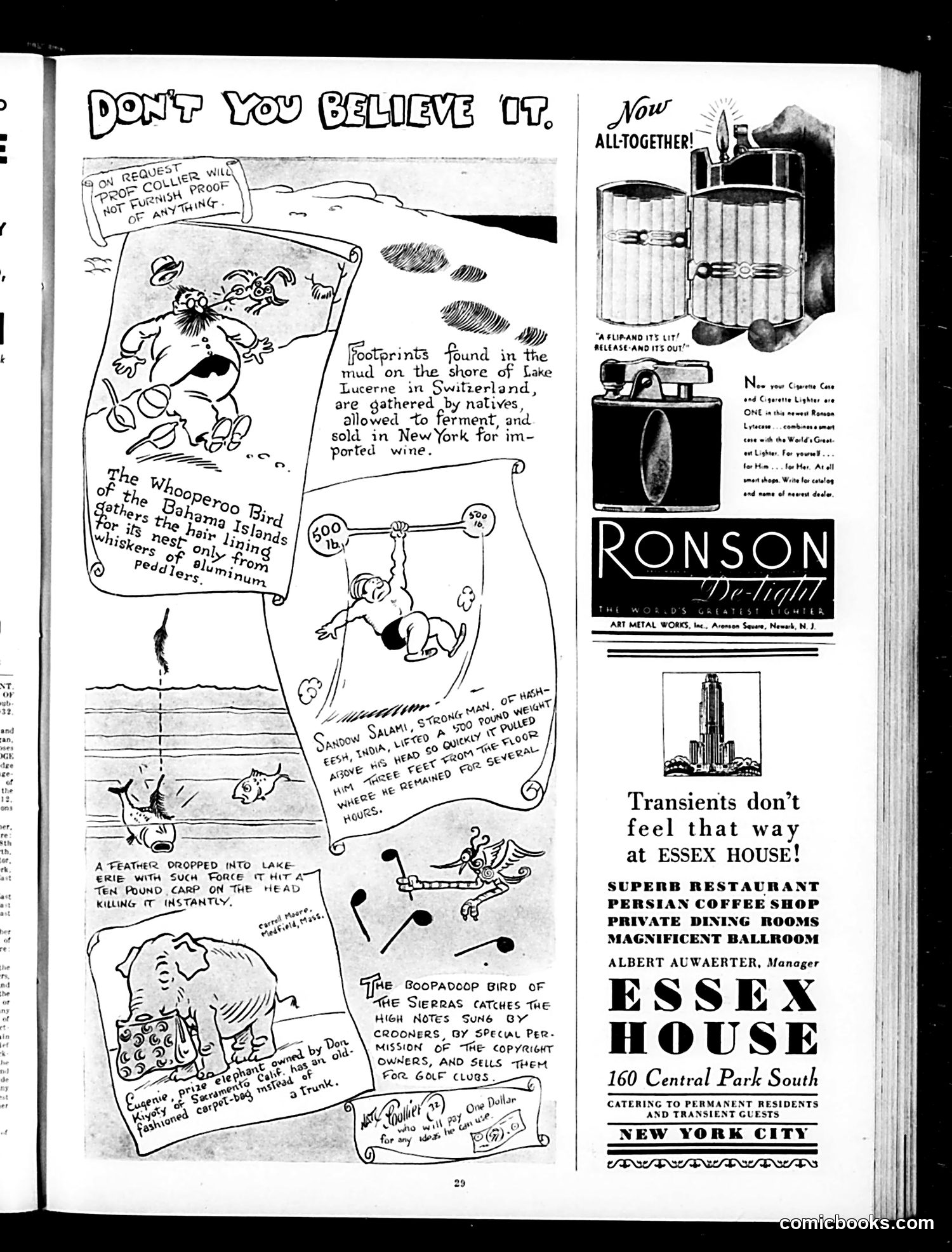
"Don't You Believe It" – Judge Magazine Satire This page features a tall-tale cartoon series mocking absurd claims and tall stories. Each panel presents increasingly ridiculous scenarios presented as fact: - Lake Lucerne wine scam: Footprints found in Swiss mud are fermented and sold as imported wine in New York—satirizing fraudulent wine imports during Prohibition era - Feather physics: A feather dropped into a lake kills a ten-pound carp instantly—mocking exaggerated anecdotes - Bird copyright: The "Boopadoop Bird" captures high notes from crooners and sells them for golf clubs—absurdist commentary on commercialism and intellectual property The cartoon's title "Don't You Believe It" explicitly signals these are lies people tell. The right side contains standard period advertising (Ronson lighters, Essex House restaurant). The satire targets gullibility, fraud, and the tall tales Americans accept or circulate—particularly regarding imports and commercial schemes. It's lighthearted mockery of public credulity.
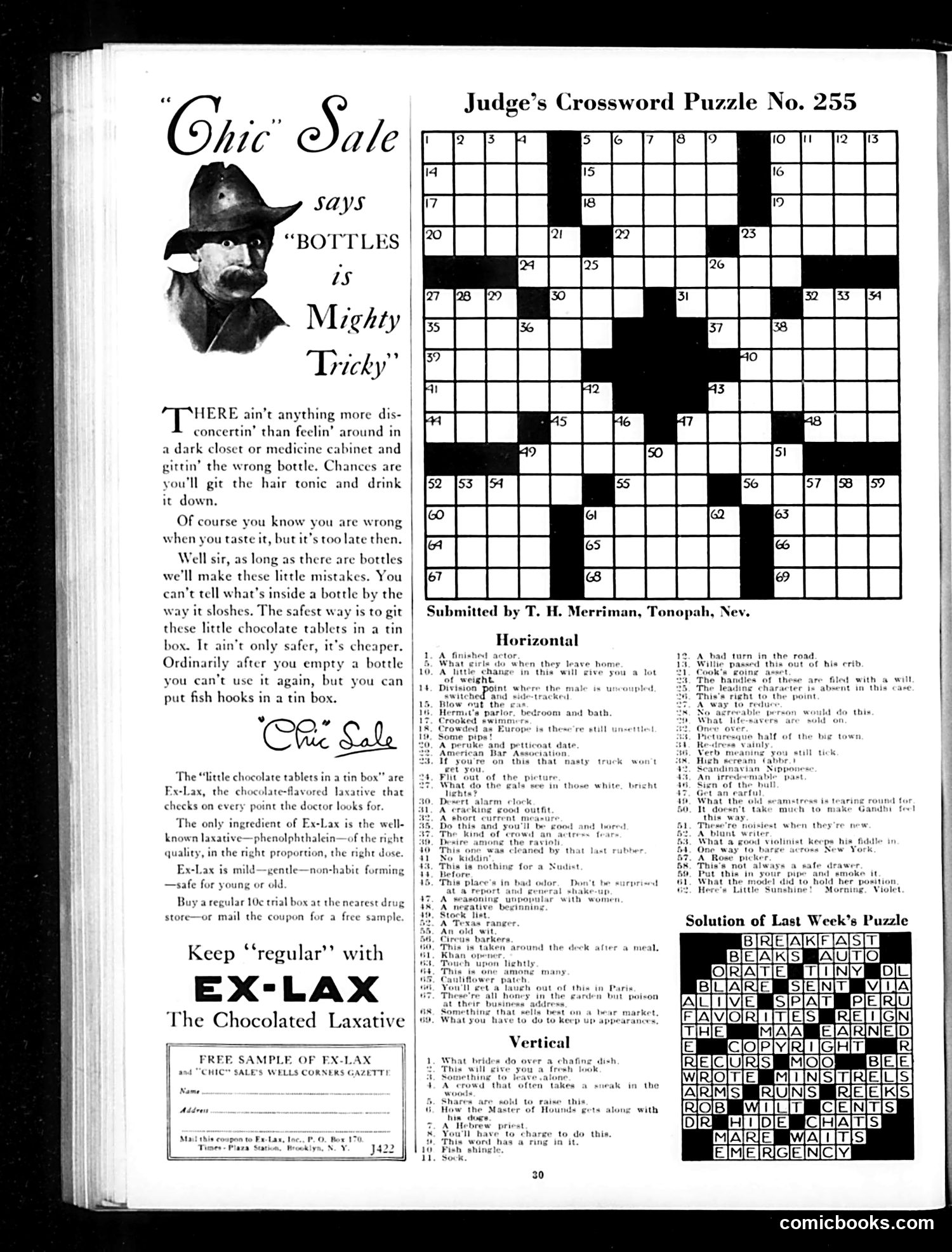
Analysis of Judge Magazine Page No. 255 This page consists primarily of advertising disguised as editorial content—a common practice in early-20th-century magazines. The "Chic Sale" cartoon features a folksy character warning about the dangers of mistaking bottles in dark cabinets (confusing hair tonic with medicine, etc.). This is an extended advertisement for Ex-Lax, a chocolate-flavored laxative. The humor relies on relatable domestic mishaps rather than political satire. The implicit pitch: Ex-Lax comes in identifiable tin boxes, solving the "bottle confusion" problem while being safer and cheaper than liquid medicines. The crossword puzzle and "Solution of Last Week's Puzzle" sections were typical magazine filler that also kept readers engaged and returning. There is no political content on this page—it's straightforward commercial promotion wrapped in period humor and presented alongside puzzle entertainment. The "satirical magazine" framing is misleading; this particular page is essentially a sponsored advertorial section.
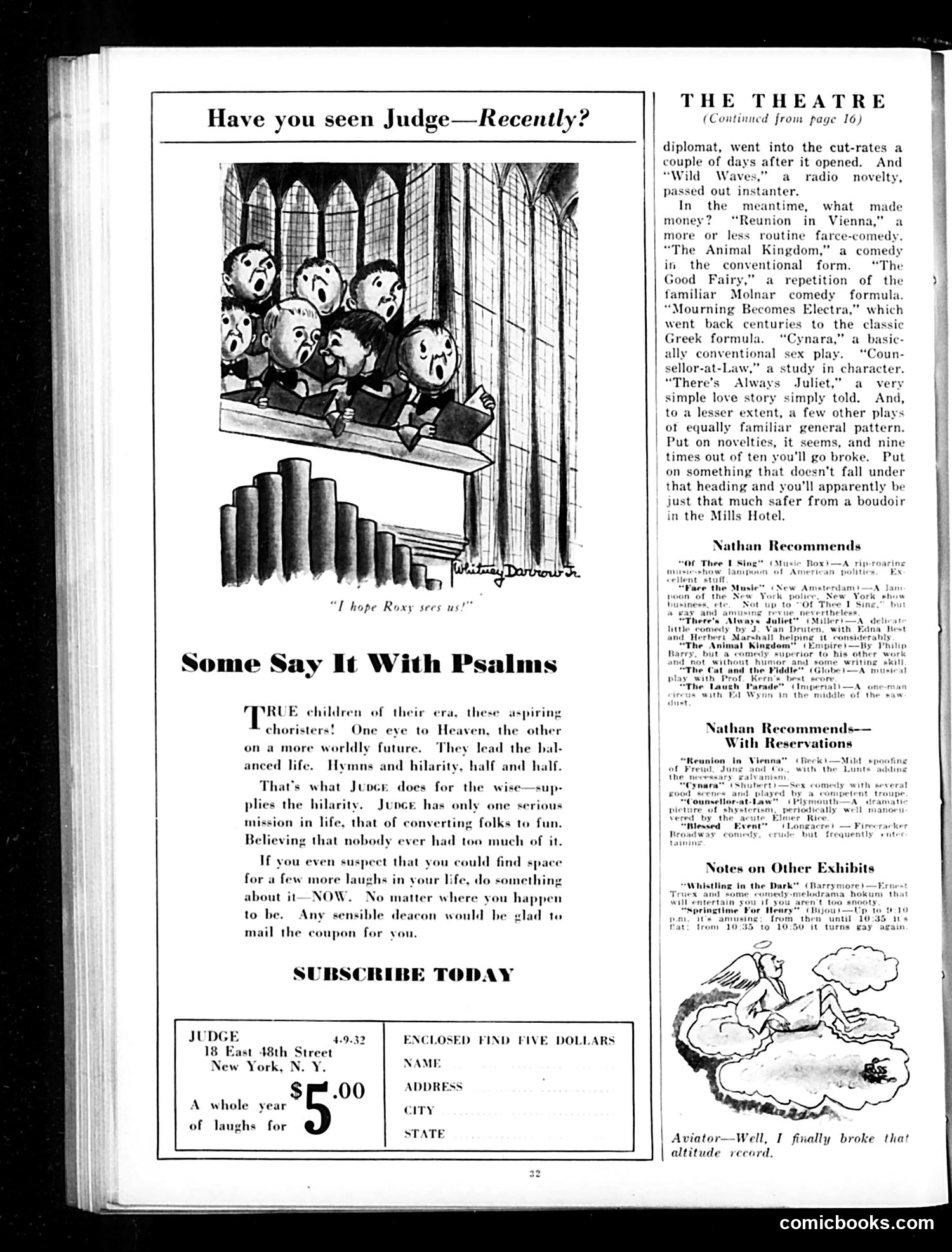
Explanation for Modern Readers This page from *Judge* magazine combines theater criticism with advertising. The main cartoon ("I hope Roxy sees us!") shows distressed figures in a window—likely representing struggling theatrical productions or performers—appealing to Roxy (possibly referring to S.L. Rothafel, a famous theater impresario), a visual joke about desperation for attention in show business. The accompanying text discusses theatrical trends: novelty plays fail commercially, while conventional narratives (romance, farce, classical adaptations) succeed. The critic Nathan recommends established productions over experimental ones. The subscription advertisement promotes *Judge* itself as offering "a whole year of laughs for $5.00," using the same philosophy—familiar, reliable comedy rather than risky innovation. The bottom cartoon about an aviator breaking an "altitude record" is an unrelated joke about exaggeration or boasting. The page reflects 1930s theater economics and *Judge*'s satirical mission to entertain through conventional, accessible humor.
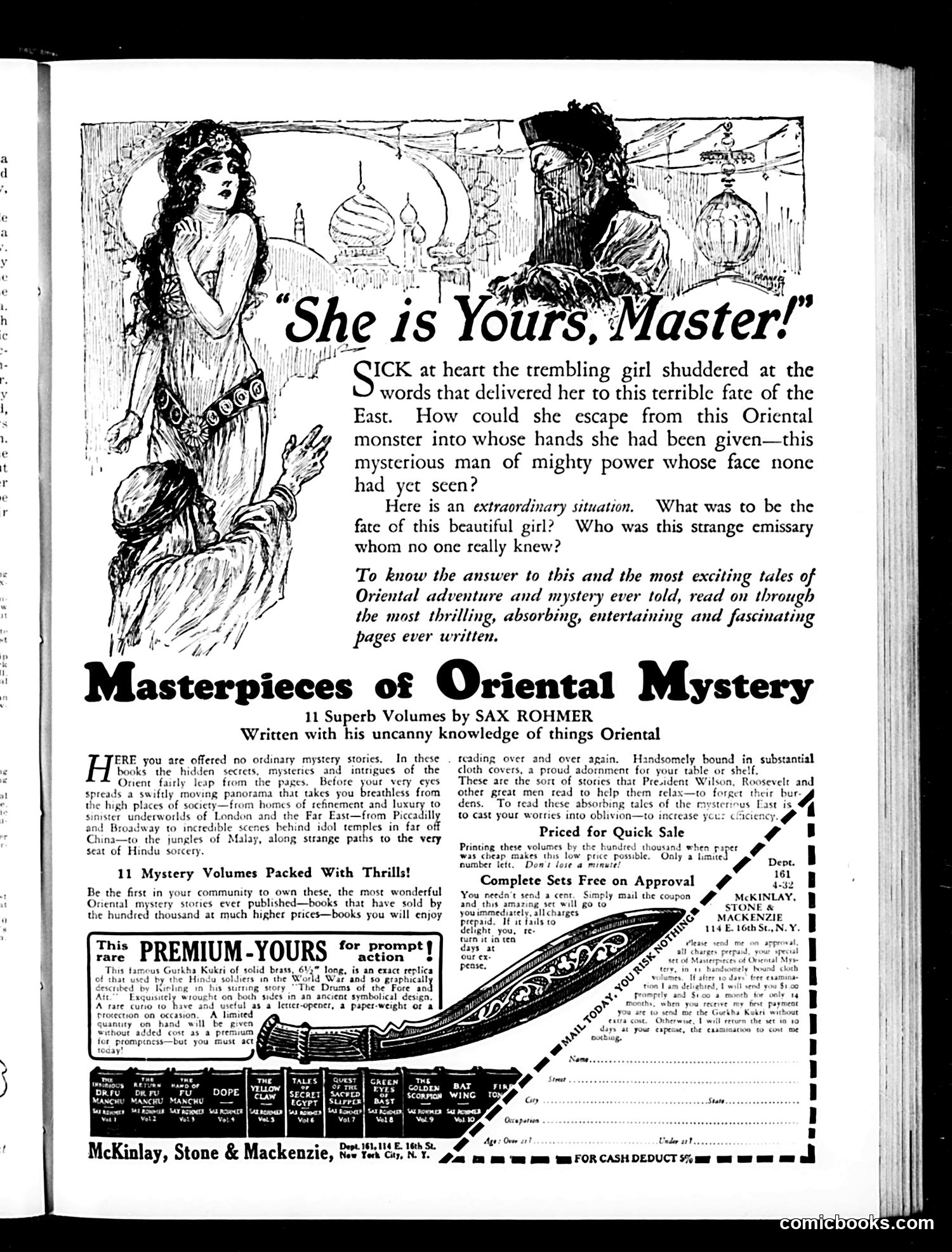
Analysis for Modern Readers This page is primarily advertising, not editorial content or satire. It promotes a book series called "Masterpieces of Oriental Mystery" by Sax Rohmer (11 volumes) through McKinlay, Stone & Mackenzie publishers. The advertisement exploits Orientalist stereotypes common to early 20th-century popular culture: mysterious Eastern intrigue, hidden secrets, exotic danger, and beautiful women imperiled by powerful "Oriental monsters." The opening narrative describes a trembling girl delivered to an unnamed Eastern villain—standard melodramatic tropes that positioned "the East" as dangerous and unknowable to Western audiences. The ad emphasizes luxury and intellectual cachet (claiming Theodore Roosevelt read similar works to relax), while the accompanying Kukri knife image reinforces the exotic-danger marketing angle. What we'd miss today: This reflects normalized Orientalist assumptions—the East as mystifying peril requiring Western narratives to explain it—and casual racism embedded in commercial entertainment of the era.
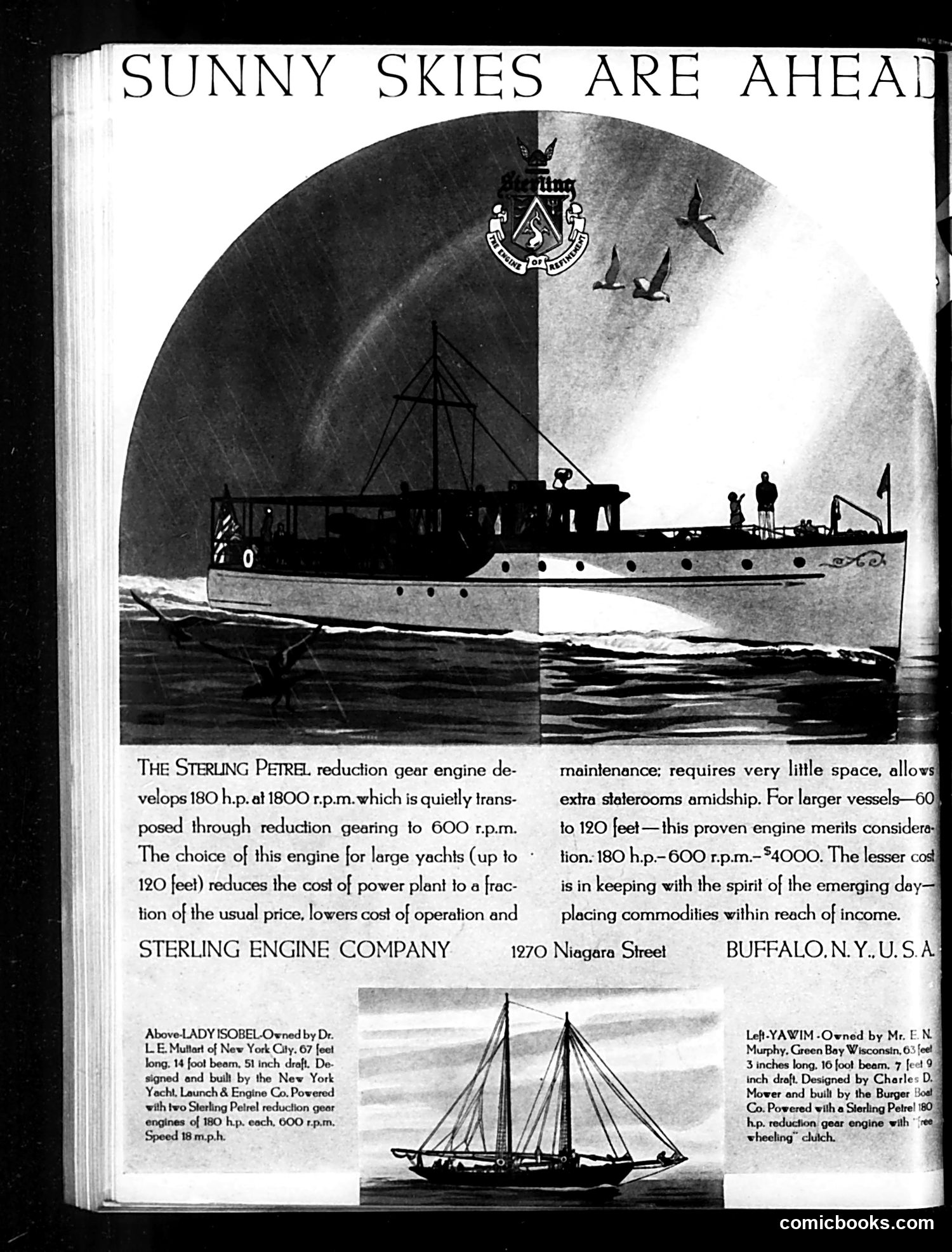
Analysis This page is primarily advertising, not satire or political commentary. It's a Sterling Engine Company advertisement promoting their Petrel reduction gear engines for yachts. The ad's implicit message—suggested by the headline "Sunny Skies Are Ahead"—uses optimism to market affordable marine engines. The tagline about "placing commodities within reach of income" appears to reference the 1920s economic boom and consumer culture, positioning Sterling's engines as democratizing luxury yacht ownership by reducing costs. The two yacht photographs (Lady Isobel and Yawim) serve as real-world testimonials to the engine's reliability and performance. There is no cartoon, caricature, or political satire visible. This is straightforward product marketing from the Jazz Age period, when Judge magazine (like modern magazines) carried substantial advertising alongside editorial content.