judge
Judge — April 16, 1932
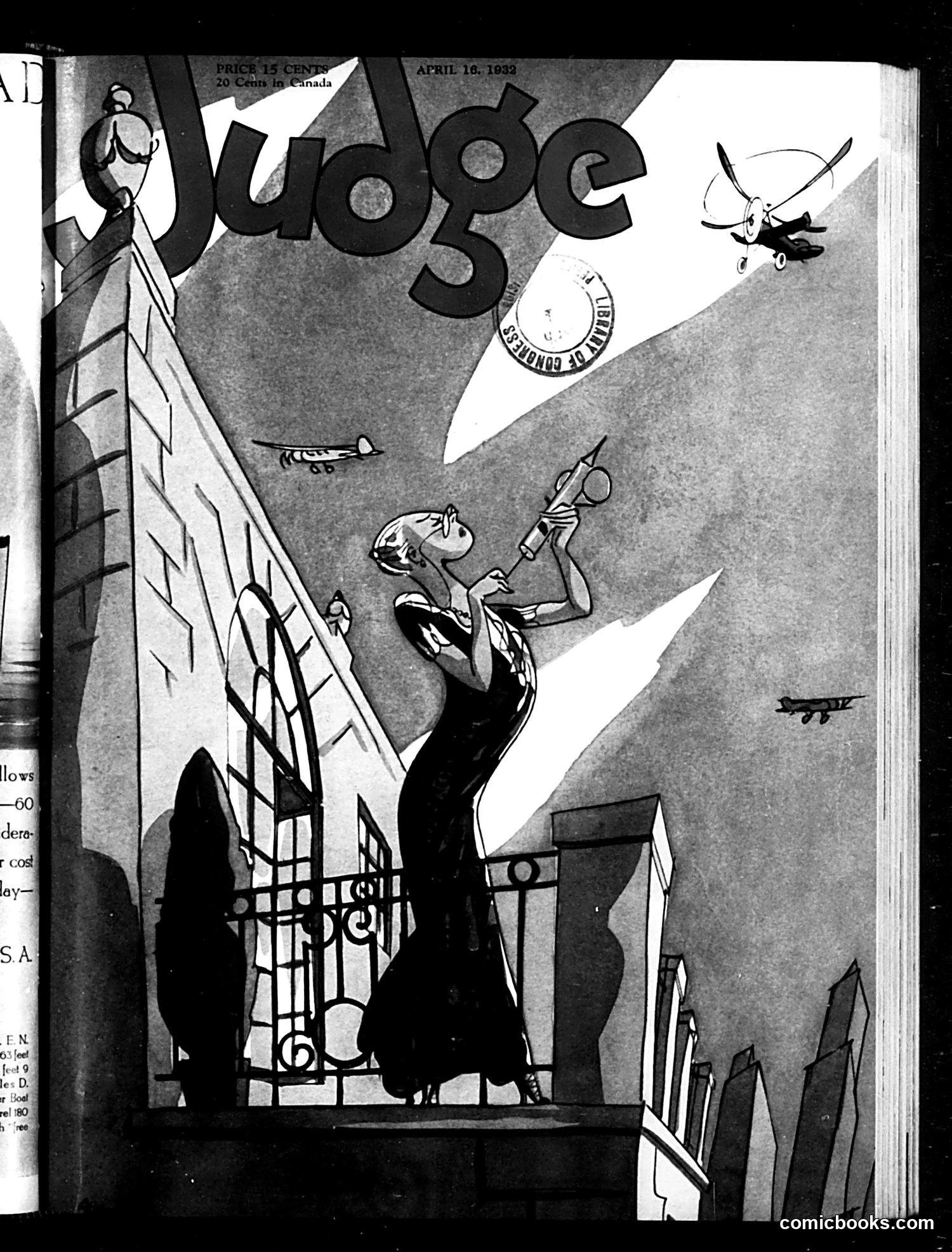
Judge Magazine Cover - April 16, 1939 This cover depicts a caricatured figure in formal dress on a rooftop or high building, wielding what appears to be a torch or flaming weapon toward aircraft in the sky. The dramatic silhouette and warlike imagery suggest military or political aggression. Given the April 1939 date—months before WWII's official start—this likely satirizes rising tensions in Europe, possibly referencing Fascist military buildups or dictatorial threats. The figure's exaggerated posture and the multiple aircraft suggest imminent conflict. The "Judge" masthead and price (15 cents) confirm this is the magazine's cover. Without clearer identifying details in the image, the specific political figure or nation targeted remains unclear, though the aggressive military imagery was timely commentary on 1939's dangerous geopolitical situation.
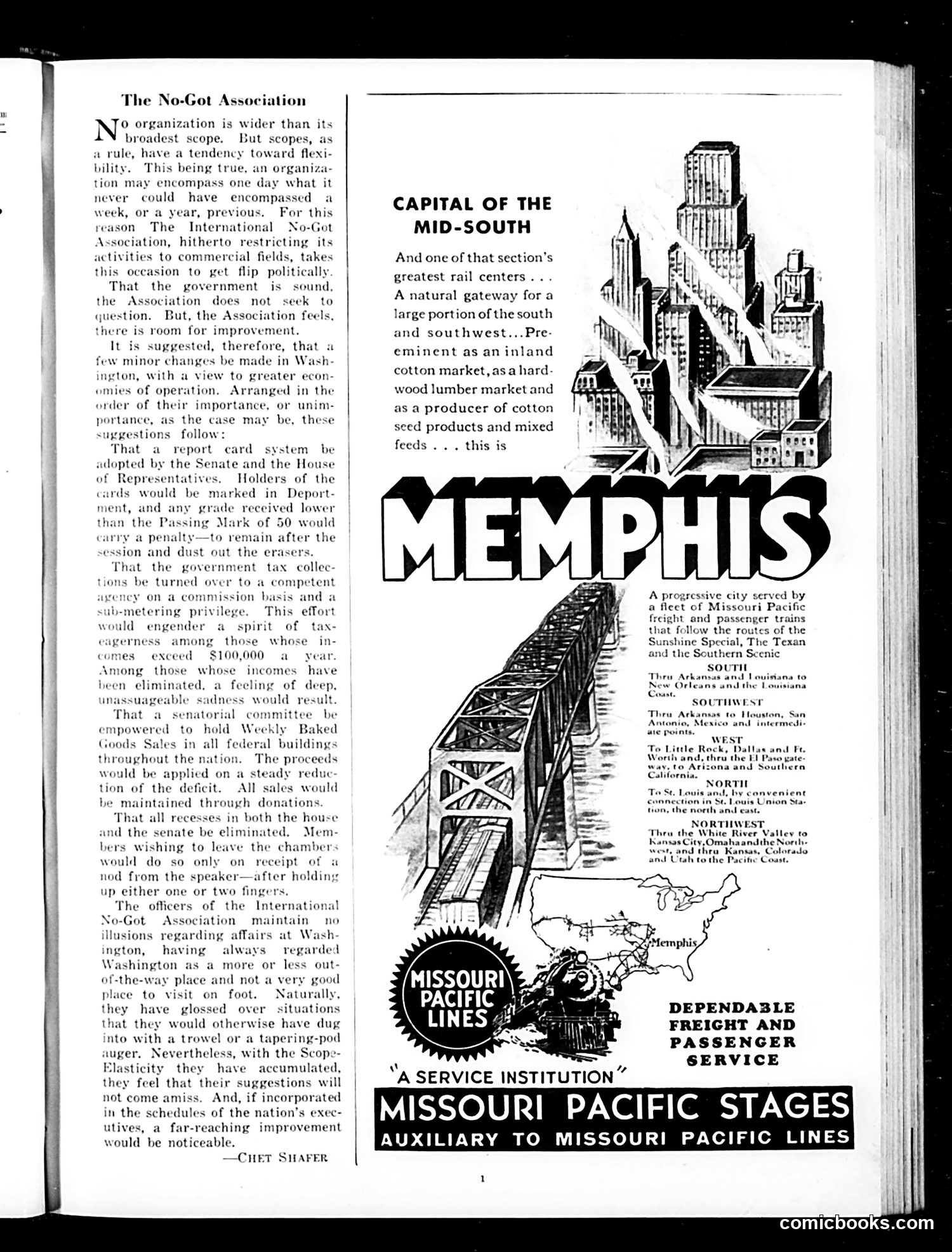
Analysis of Judge Magazine Page This page is primarily advertising, not satire. The left column contains "The No-Got Association," a brief opinion piece by Chet Shafer criticizing government inefficiency and proposing minor reforms (report cards for Representatives, tax collection improvements, etc.). The tone is mildly satirical but straightforward political commentary. The dominant content is a full-page advertisement for Missouri Pacific Lines, a major railroad company. The ad features stylized Art Deco imagery of Memphis's skyline and a freight train, promoting the railroad as a "progressive city" transportation hub connecting multiple American regions (South, Southwest, West, Northwest). The page reflects early-20th-century American business culture: substantial magazine revenue came from corporate advertising, and trains were symbols of modernity and economic progress.
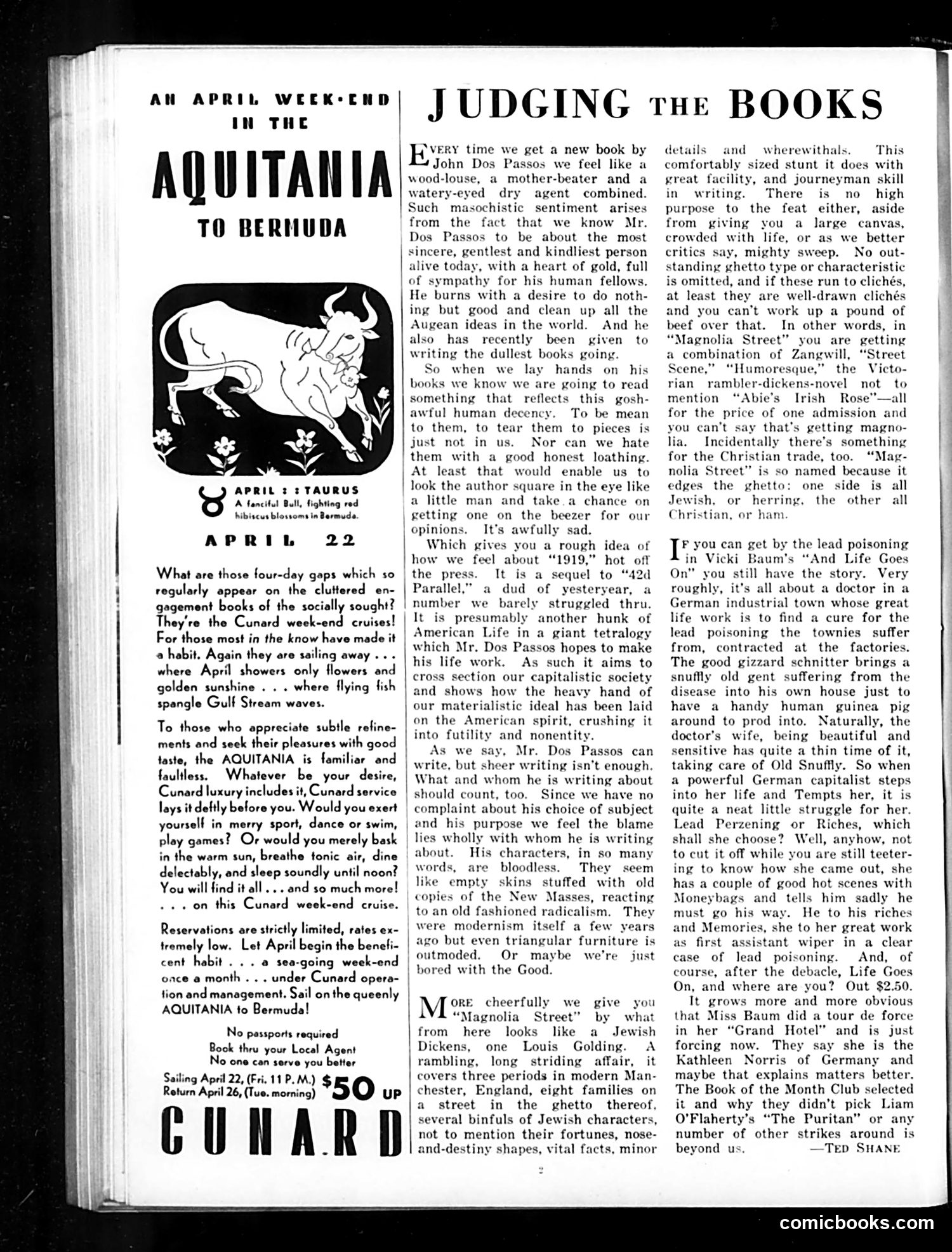
Explanation for Modern Readers This page is primarily a Cunard cruise ship advertisement promoting April week-end trips from Aquitania to Bermuda, positioned alongside a book review column titled "Judging the Books." The cartoon features a stylized bull with flowers, labeled "APRIL: TAURUS" with the dates "APRIL 22." This is a seasonal zodiac illustration—Taurus, not satirical commentary. The bull serves as decorative branding for the spring travel advertisement. The book reviews critique works by João dos Passos, including "1919" and "Parallel," praising his detailed, journalistic writing style while noting his characters lack warmth. The review also discusses Louis Golding's "Magnolia Street," a novel about Jewish families in Manchester. This is essentially advertising and cultural criticism, not political satire.
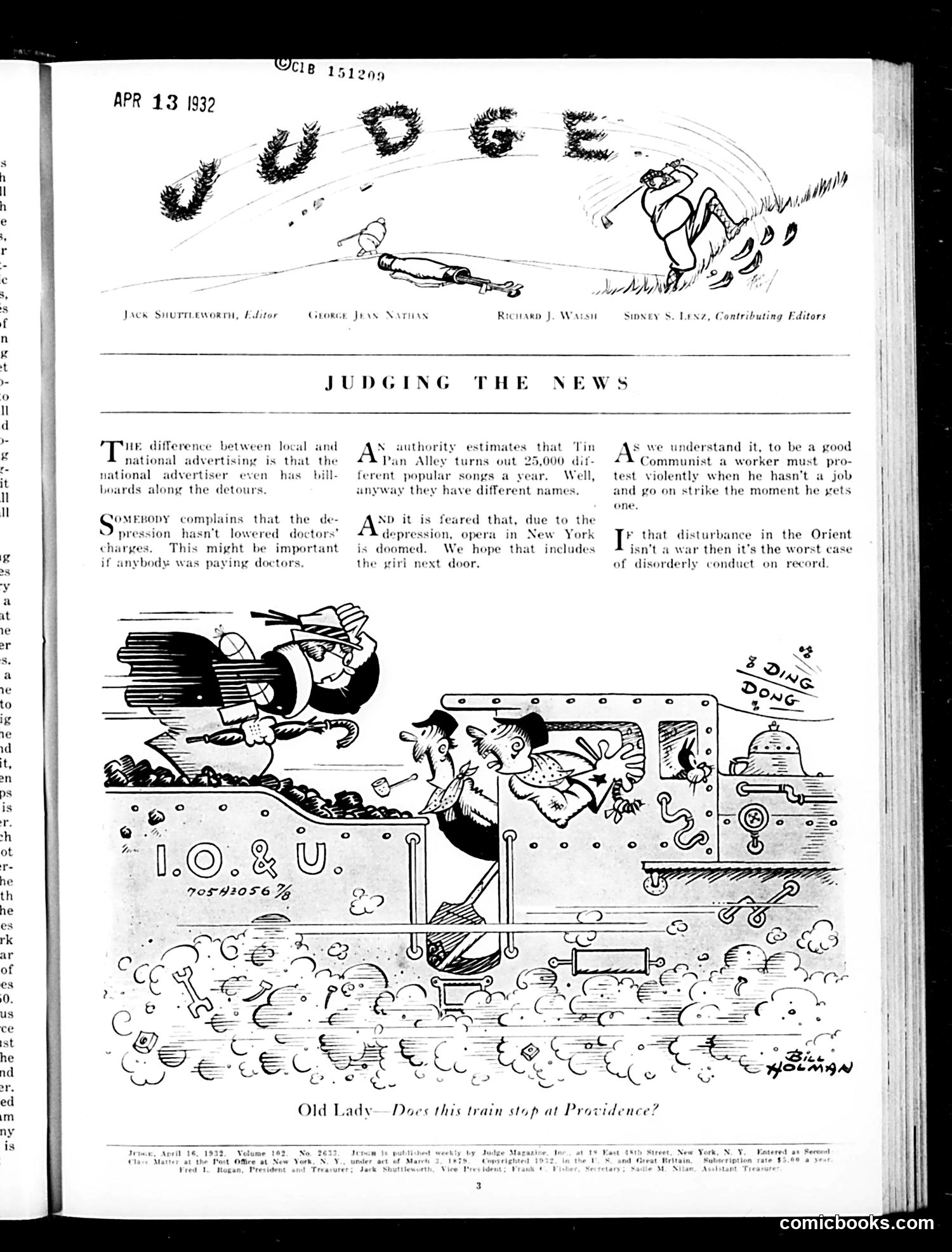
Judge Magazine, April 13, 1932 - "Judging the News" This page contains editorial commentary and cartoons satirizing 1932 current events during the Great Depression. Top cartoon: Shows a figure diving/falling toward "UDGE" text, illustrating economic collapse. Main cartoon ("Does this train stop at Providence?"): Depicts an overcrowded, chaotic train car labeled "I.O.U." with passengers in disarray. The "Old Lady" asks if it stops at Providence—likely satirizing the financial crisis and failed economic promises. The train appears to represent failed economic systems or unreliable government programs. Text commentary discusses: - Depression's impact on doctors' fees - Hopes that opera (specifically New York's) won't close - Concerns about labor unrest in the Orient The overall theme reflects Depression-era anxieties about economic collapse, institutional failures, and social disorder.
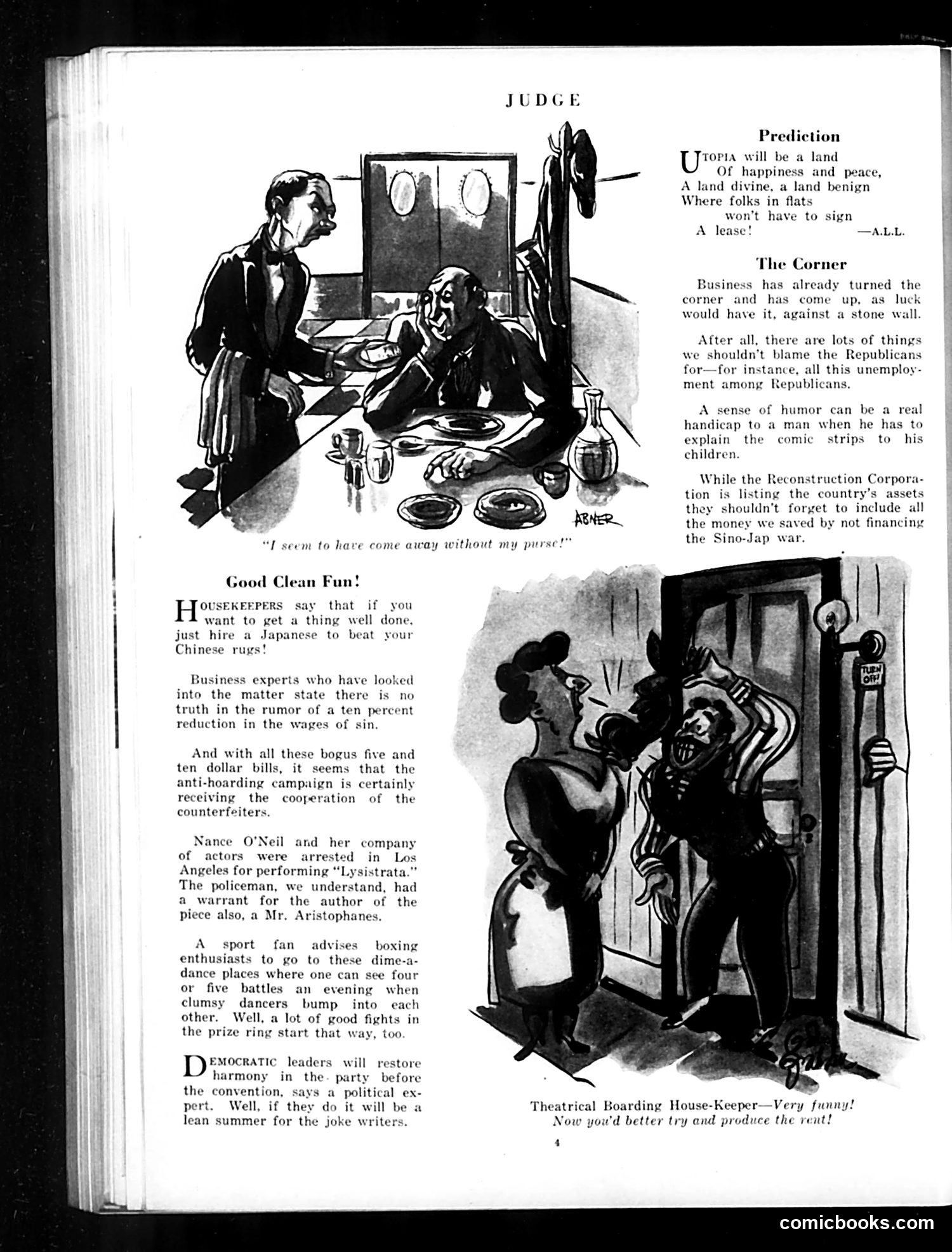
Analysis of Judge Magazine Page The page contains several satirical pieces targeting post-WWI American politics and social issues: Top cartoon ("Judge"): A man discovers his empty purse after dining out, likely satirizing economic hardship or inflation following the war. "Good Clean Fun!": Mocks Republican economic policies, referencing wage reductions and linking them ironically to "counerfeiters"—suggesting Republicans are economically dishonest. References the arrest of actress Nance O'Neil for performing "Lysistrata" (an anti-war play), and jokes about boxing matches at disreputable venues. "The Corner": Satirizes business failures and Republican unemployment, with dark humor about explaining economic problems to children. Bottom cartoon: Shows theatrical boarding house chaos, likely mocking theatrical industry struggles during economic downturn. Overall, the page reflects post-war economic anxiety and Democratic criticism of Republican governance.
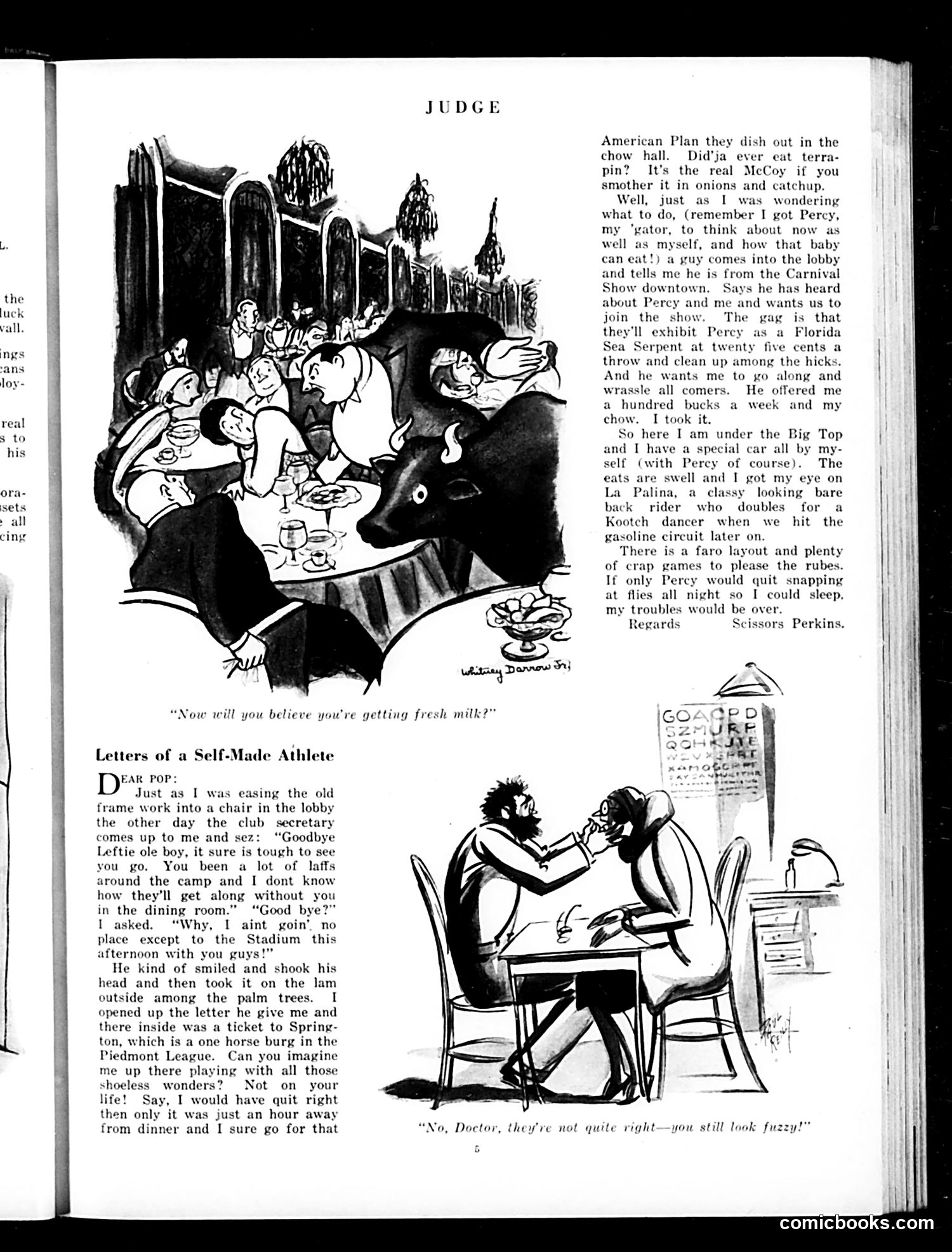
Analysis of Judge Magazine Page This page contains two separate pieces of satirical commentary on early 20th-century American life: Top cartoon ("Now will you believe you're getting fresh milk?"): Depicts a cow at a fancy dinner table with wealthy diners. The satire likely mocks either food adulteration scandals or false advertising claims about "fresh" dairy products—a genuine public concern during the Progressive Era when food safety was unregulated and companies made dubious purity claims. Bottom section ("Letters of a Self-Made Athlete"): A humorous letter describing an athlete's social climbing at country clubs and sporting events. The accompanying cartoon shows a doctor examining a patient, with the caption questioning the patient's health ("not quite right—you still look fuzzy"). This satirizes the pretensions and physical toll of amateur athletic pursuits among the leisure class. Both pieces mock consumer deception and upper-class vanity.
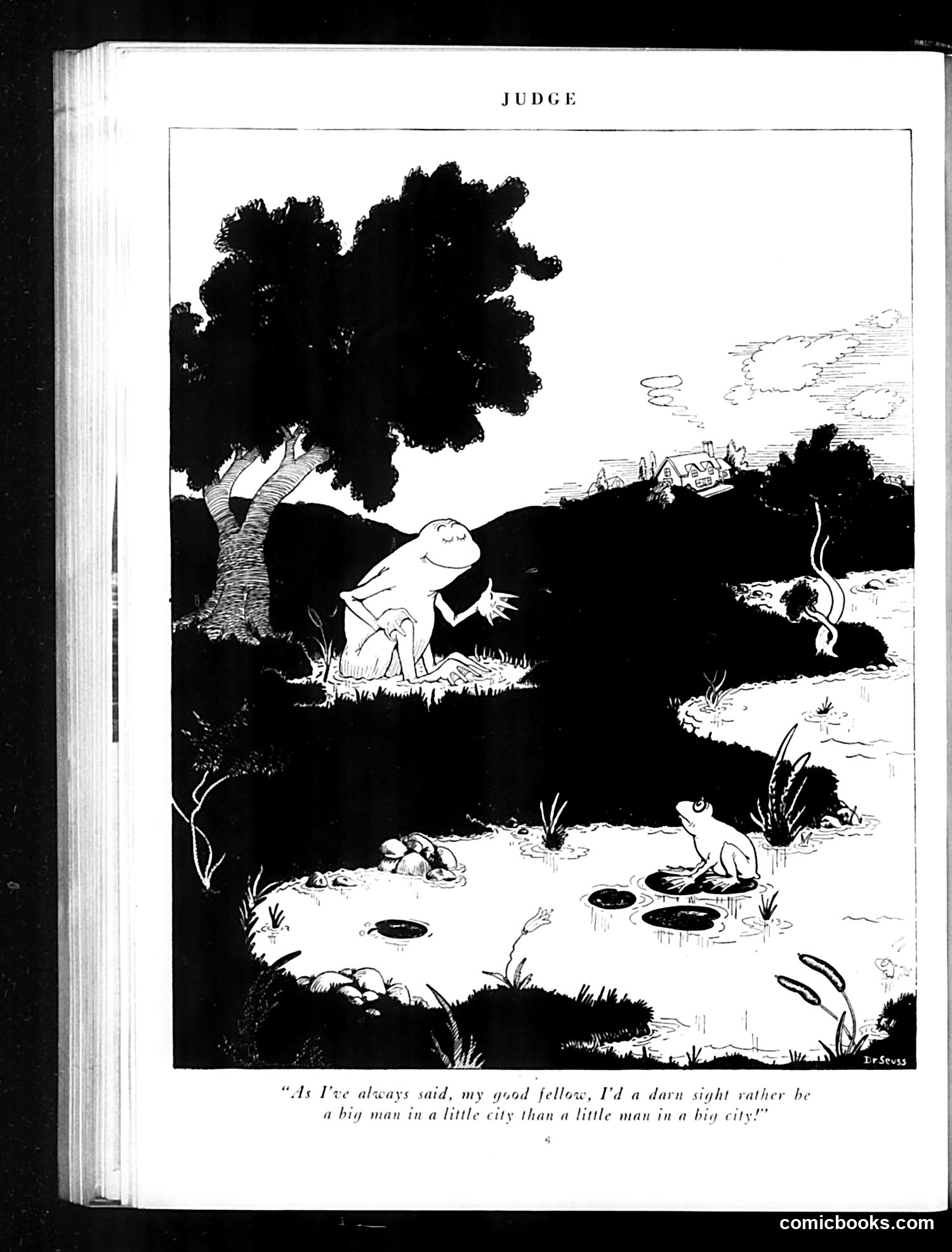
Analysis This cartoon depicts a pastoral scene with anthropomorphic frogs discussing life philosophy by a pond. The caption reads: "As I've always said, my good fellow, I'd a darn sight rather be a big man in a little city than a little man in a big city!" The satire targets social ambition and the human desire for status and prominence. Rather than pursuing meaningful achievement in larger, more competitive environments, the character prefers being a "big fish in a small pond"—enjoying local importance even if it means limited scope. This reflects early 20th-century American anxieties about urbanization and whether ambition in crowded cities was worth sacrificing local standing. The use of frogs—creatures naturally confined to small spaces—reinforces the joke's irony about accepting limitation as virtue.
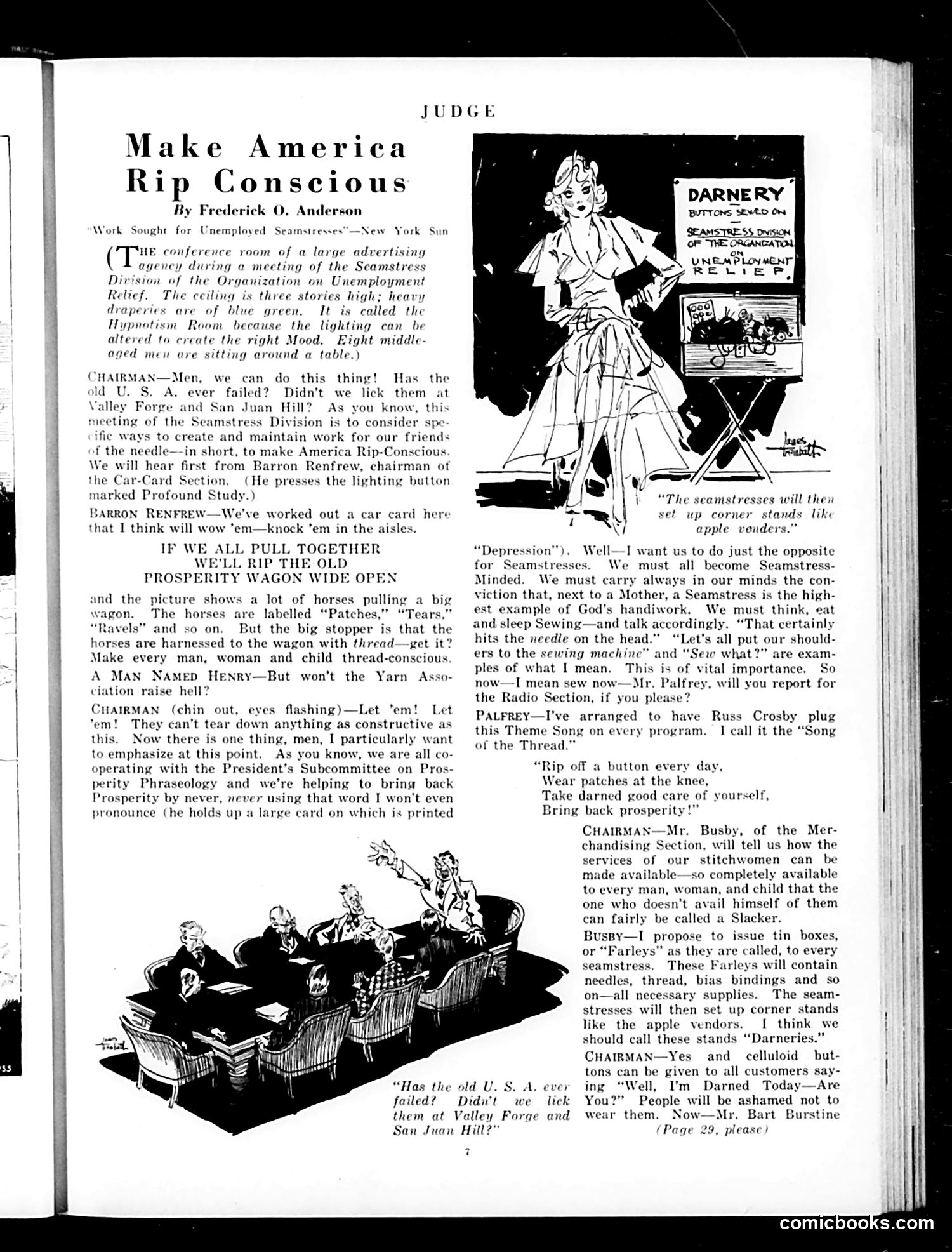
"Make America Rip Conscious" This satirical piece mocks Depression-era government propaganda campaigns promoting consumer spending and optimism. An advertising agency's "Seamstress Division" develops marketing schemes to make Americans "rip-conscious"—deliberately damaging clothing to stimulate demand for seamstress services. The joke targets the absurdity of the "Prosperity Phraseology" subcommittee (a real government effort): executives propose slogans like "Sew what?" and "Let's put our shoulders to the sewing machine," while distributing "Darneries" (button/thread boxes) and shame-inducing buttons saying "I'm Darned Today—Are You?" The satire critiques both the government's euphemistic language avoidance (never saying "Depression") and the manufactured, artificial nature of recovery campaigns that expect propaganda alone to restore prosperity. The advertising industry itself appears foolish for participating in transparent manipulation.
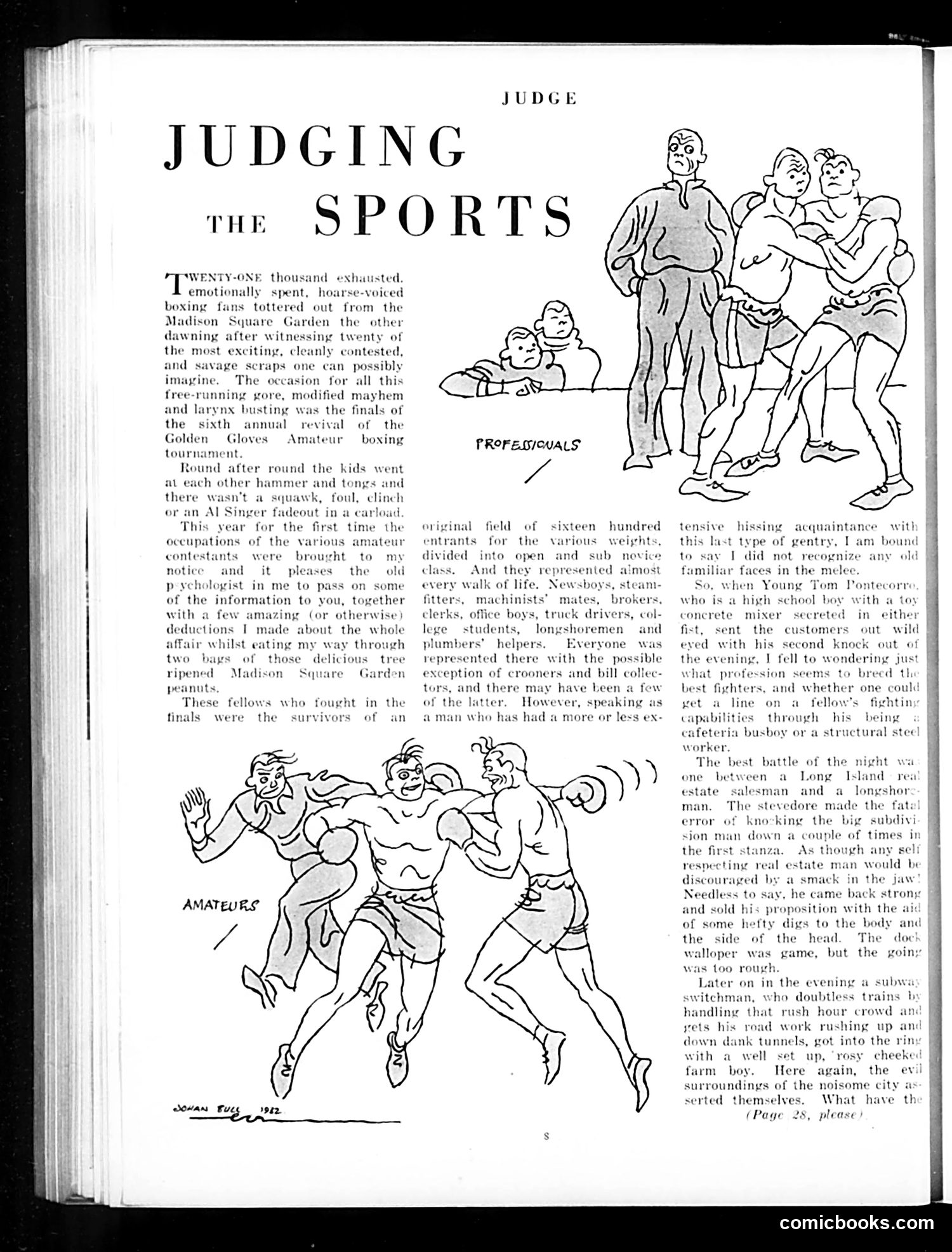
Judging the Sports This article reviews the Golden Gloves Amateur Boxing Tournament finals at Madison Square Garden—the sixth annual revival. The author humorously analyzes amateur boxers by their day jobs, attempting to correlate their occupations with fighting ability. The accompanying cartoons illustrate two categories of fighters: "Professionals" (depicted as refined gentlemen) and "Amateurs" (shown as rough street fighters in active combat). The text describes specific matches, including one between a real estate salesman and a longshoreman, and another involving a subway switchman versus a farm boy. The satire's point: the author observes that working-class urban occupations—longshoremen, switchmen, concrete workers—produce tougher fighters than middle-class "professionals." City life apparently breeds superior combat capability. The piece mixes genuine sports reporting with tongue-in-cheek social commentary on class and urban toughness.
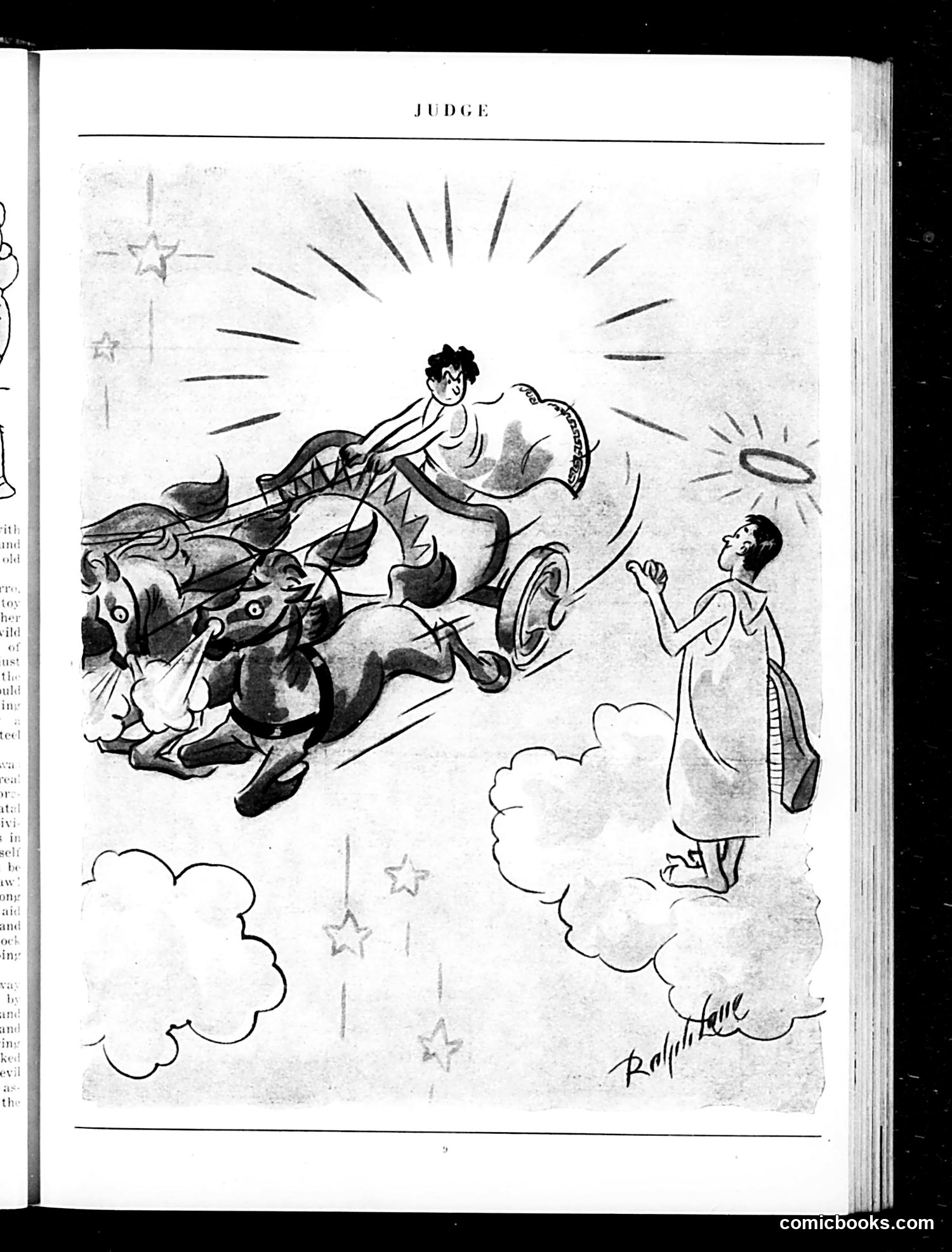
Analysis of Judge Magazine Cartoon This appears to be a single cartoon titled "JUDGE" depicting a celestial scene. A figure rides a chariot pulled by winged horses across clouds and stars, with radiating light lines suggesting divine or heavenly authority. The rider appears to be a stern authority figure—possibly representing Justice or a judge themselves, given the page title. On the right, a smaller figure in classical robes stands on a cloud, gesturing upward in supplication or alarm toward the charging chariot. The cartoon likely satirizes the overwhelming power of judicial authority or critiques a specific court decision or judge's conduct. The cartoonist uses classical/mythological imagery to mock pomposity or suggest divine judgment is being abused. The signature reads "Rollyhine" or similar.
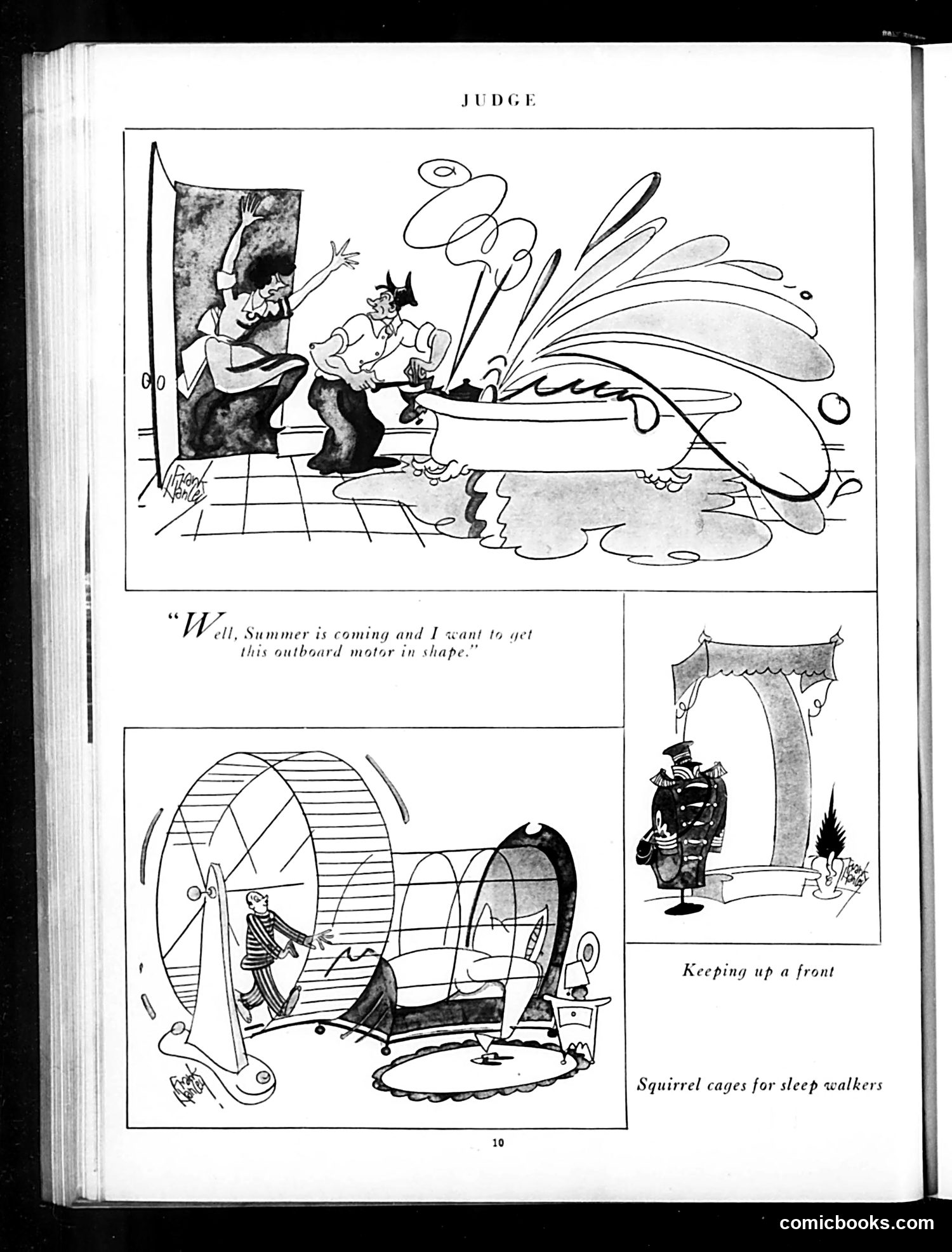
Analysis This page from *Judge* magazine contains three separate comic panels satirizing domestic life and inventions. The top cartoon depicts a judge confronting someone about an outboard motor, with the caption "Well, Summer is coming and I want to get this outboard motor in shape." The humor likely derives from the absurdity of the situation—possibly the motor's poor condition or inappropriate use. The bottom two panels showcase humorous inventions: a "squirrel cage" contraption for sleepwalkers (a treadmill-like device to contain nocturnal wanderers) and "Keeping up a front" (depicting someone being hoisted up, perhaps satirizing maintaining appearances or social pretense). These are general-audience gag cartoons typical of *Judge's* satirical humor, poking fun at everyday situations, inventions, and human behavior rather than specific political figures.
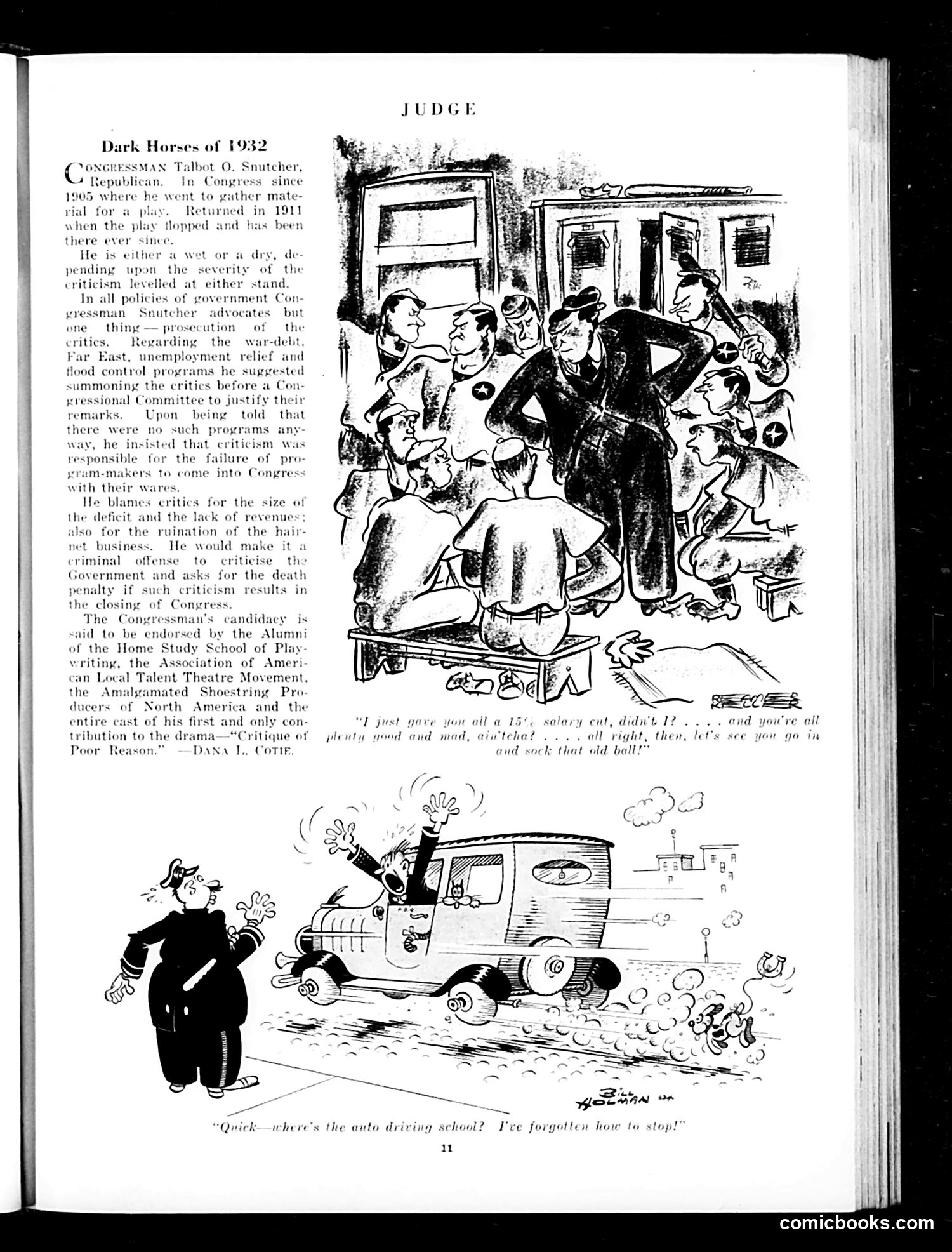
Political Satire in Judge Magazine (1932) This page satirizes Congressman Talbot O. Snutcher, a Republican first elected in 1905. The text mockingly describes his absurd political positions: he blames *critics themselves*—rather than actual policies—for government failures like the deficit, unemployment, and the collapse of the hairnet industry. He proposes making criticism of the government a criminal offense punishable by death. The top cartoon shows theatrical producers and artists endorsing this ridiculous candidate, reflecting his own failed play "Critique of Poor Reason." The bottom cartoon, captioned "Quick—where's the auto driving school? I've forgotten how to stop!", satirizes reckless government spending or policy-making during the Great Depression era—suggesting leaders don't know how to apply brakes to runaway problems. Together, these cartoons mock 1932 political figures who blame external scapegoats rather than addressing real economic crises, and attack authoritarian impulses to silence dissent.
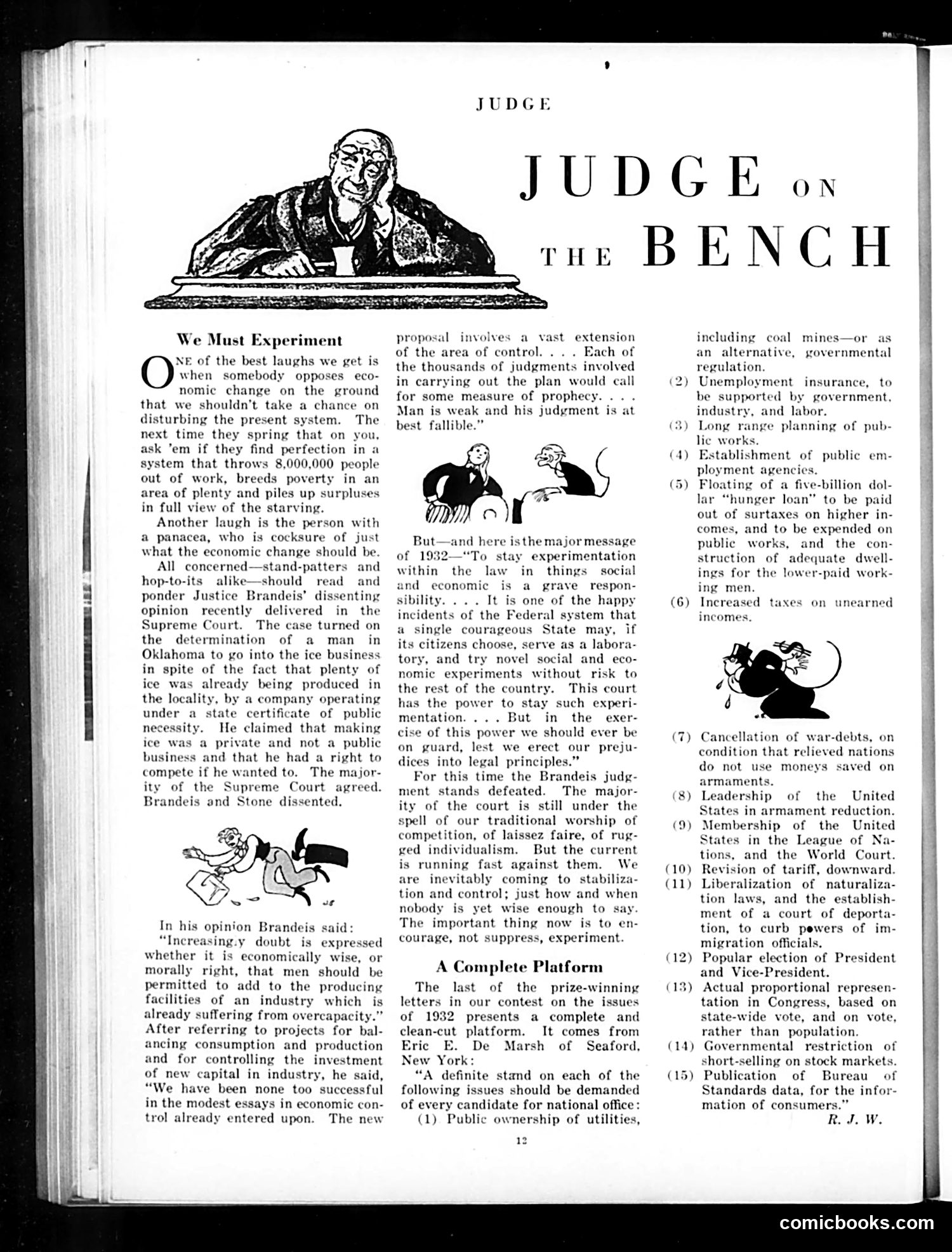
Judge Magazine Analysis: "Judge on the Bench" This editorial page from Judge magazine (likely early 1930s, given references to 1932) argues for economic experimentation during the Great Depression. The cartoon depicts a judge presiding over economic policy debates. The piece critiques two opposing positions: those resisting any economic change and those promoting rigid panaceas. It endorses Justice Brandeis's dissenting opinion in an Oklahoma ice-business case, where Brandeis argued states should be allowed to experiment with economic controls as "laboratories" without federal restriction. The satire targets both laissez-faire traditionalists clinging to "competition" and "rugged individualism" (now failing amid mass unemployment) and rigid central planners. Judge advocates controlled experimentation within constitutional bounds as preferable to either extreme. The accompanying platform lists progressive reforms: public utility ownership, unemployment insurance, public works planning, employment agencies, and progressive taxation—typical New Deal-era progressive demands.
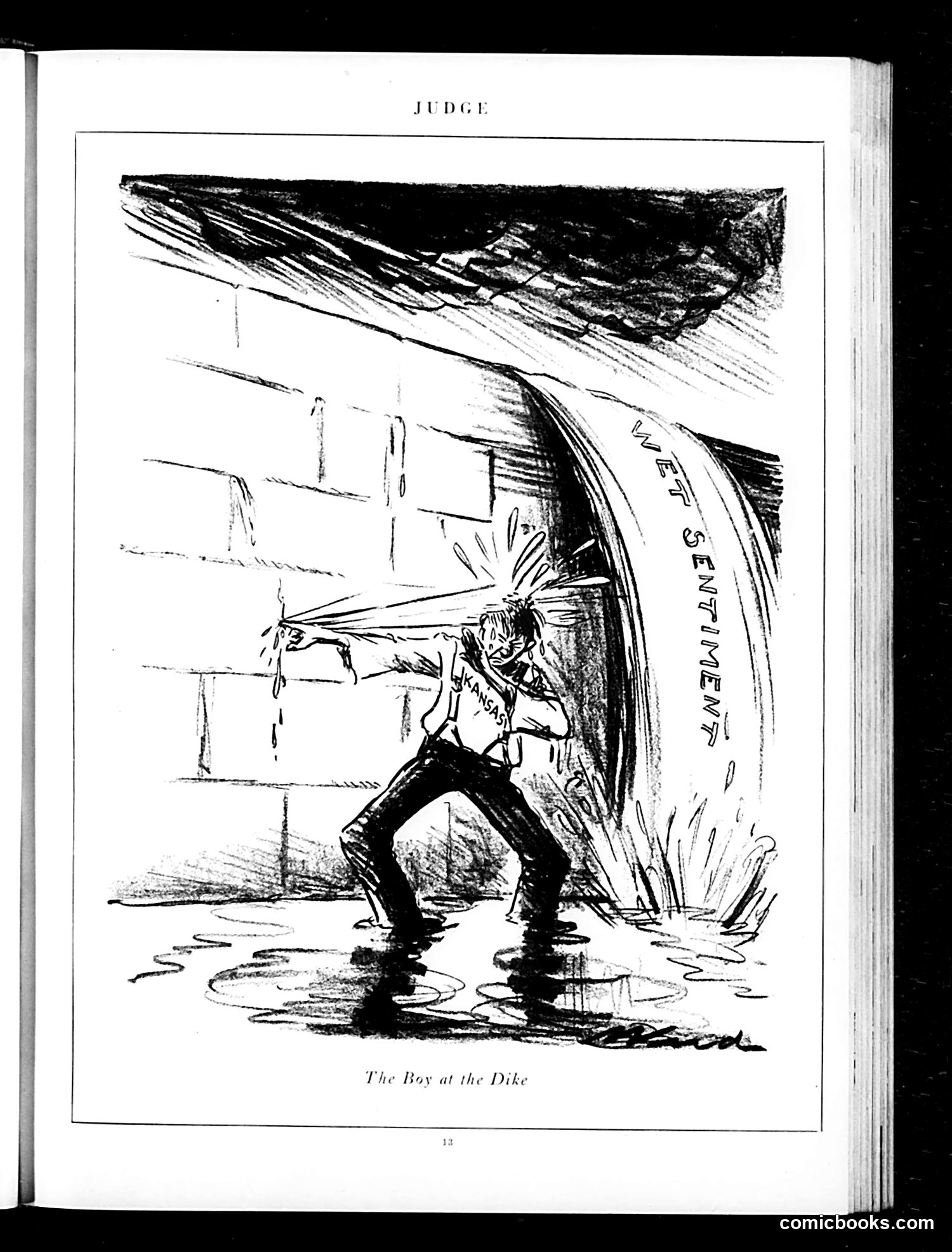
"The Boy at the Dike" This political cartoon depicts a figure straining to hold back a massive wave labeled "WEST SENTIMENT" (likely "WEST SENTIMENT" or similar). The boy struggles in water against enormous pressure, suggesting he's attempting to contain or resist some growing public sentiment or movement. The title references the famous Dutch folktale of a boy who plugs a dike with his finger to prevent flooding—a metaphor for holding back disaster with minimal resources. Here, it appears to satirize someone's futile attempt to resist popular opinion or social pressure. The specific sentiment being resisted is unclear without additional context, but the cartoon critiques the effort as inherently doomed, much like the boy's task in the original story.
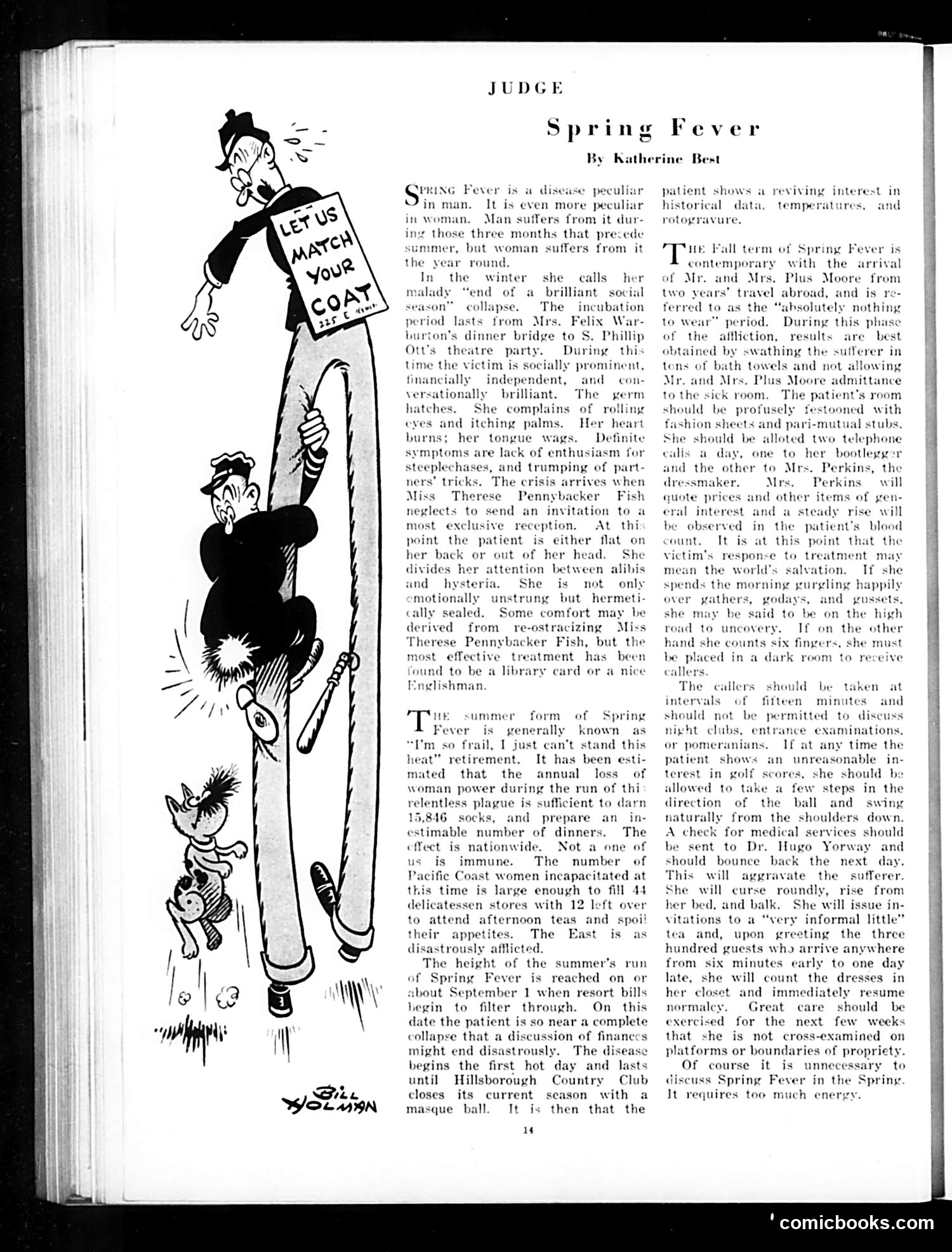
"Spring Fever" - Judge Magazine Satire This humorous article by Katherine Best satirizes the recurring affliction of "Spring Fever" in wealthy American women, portraying it as a seasonal malady tied to social anxiety and leisure-class concerns. The piece describes three forms: a winter "social collapse," a summer "I'm too frail" retreat (estimated to cause 15,846 undarned socks nationwide), and a fall "nothing to wear" crisis upon the return of socialites like "Mr. and Mrs. Plus Moore" from European travel. The satire mocks upper-class women's preoccupations—social exclusion (missing invitations from exclusive hostess Therese Pennybacker Fish), financial anxiety (resort bills), and fashion crises. The "treatment" recommendations (fashion magazines, telephone calls to bootleggers and dressmakers, limiting visitors) humorously suggest these women are emotionally fragile and dependent on consumption and social status. The cartoon's figures (shown climbing a person like a coat rack) visualize the disease metaphorically. The satire ultimately ridicules the privileged leisure class's self-absorbed, materially-driven anxieties during economic/social transition.
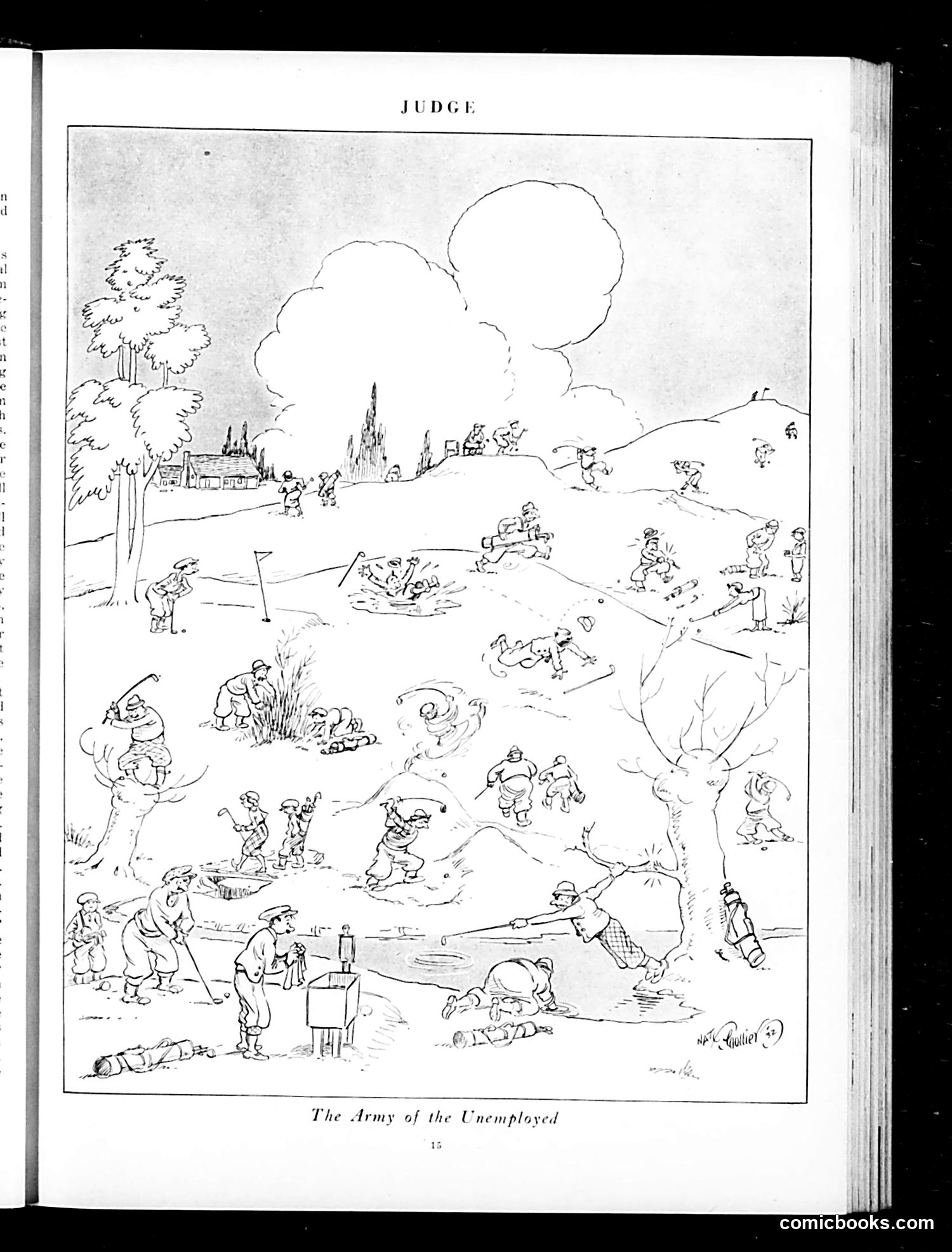
"The Army of the Unemployed" This satirical cartoon depicts unemployed people engaging in various leisure activities—fishing, playing games, lounging—in a pastoral landscape. The title "The Army of the Unemployed" appears to be social commentary on widespread joblessness, likely from an economic downturn period (the image quality and style suggest early-to-mid 20th century). The satire works by portraying the unemployed not as destitute or desperate, but as leisurely and carefree, almost on holiday. This likely mocks either: (1) public perception that the unemployed were idle or lazy rather than genuinely seeking work, or (2) the irony that those without jobs had ample free time while society struggled economically. The cartoonist's signature appears in the lower right. The specific historical context—which economic crisis this references—remains unclear from the image alone.
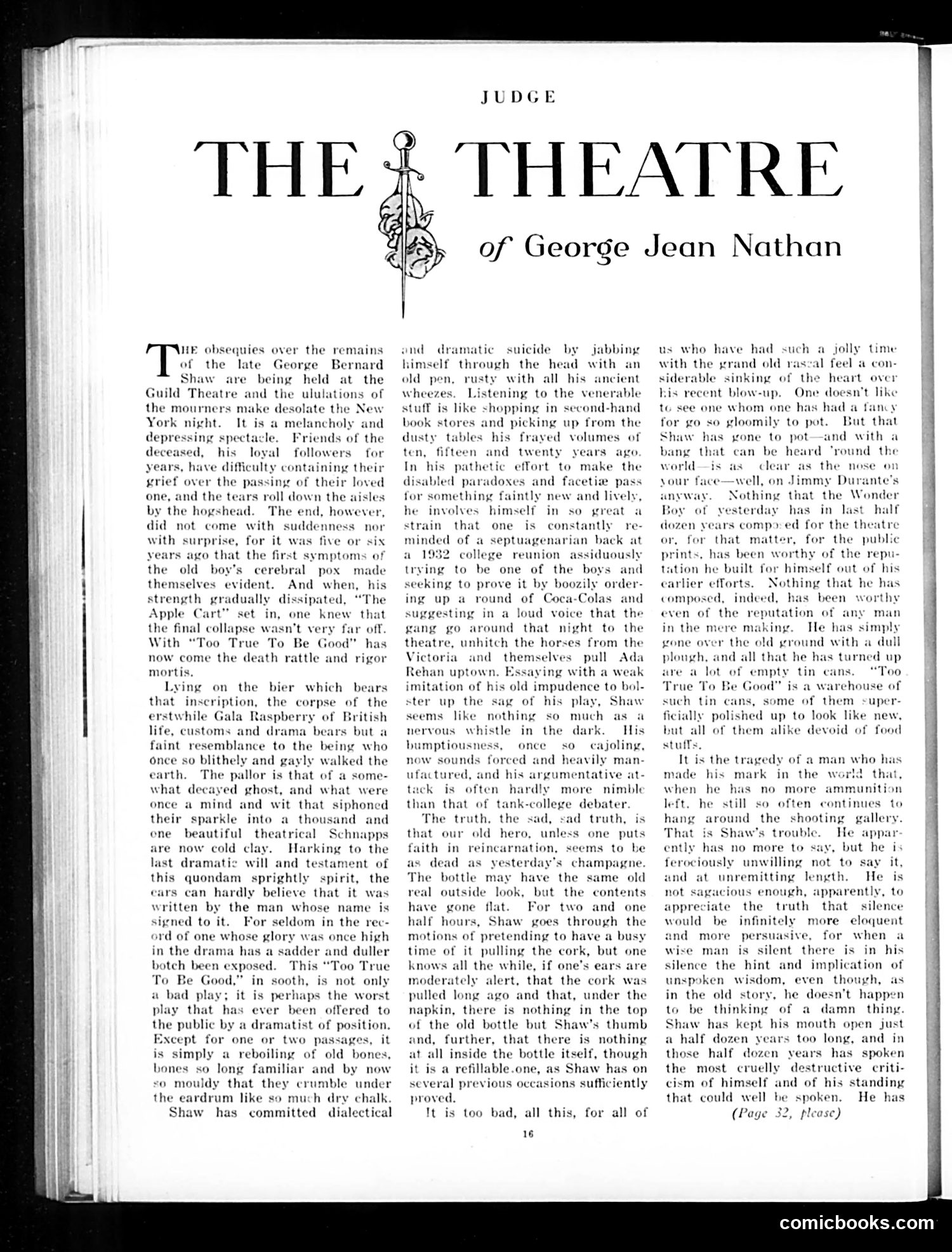
"The Theatre of George Jean Nathan" — Judge Magazine Review This is a theatrical review by Judge's drama critic, George Jean Nathan, savagely critiquing George Bernard Shaw's final play, *"Too True To Be Good."* Nathan uses funeral metaphors throughout—treating Shaw's creative decline as a death—to argue the playwright has become artistically exhausted. He claims Shaw's once-brilliant wit and paradoxes are now recycled, stale material from "ten, fifteen and twenty years ago." The core insult: Shaw is creatively empty but pretending otherwise, like an elderly man at a college reunion trying desperately to seem young and vital. Nathan compares him to someone "pulling the cork" on a champagne bottle that's already flat—all theatrical motion with no substance remaining. This is a brutal assessment of aging artistic decline, suggesting Shaw should have retired rather than expose himself to ridicule with this inferior work. The satire targets not Shaw's politics but his artistic bankruptcy.
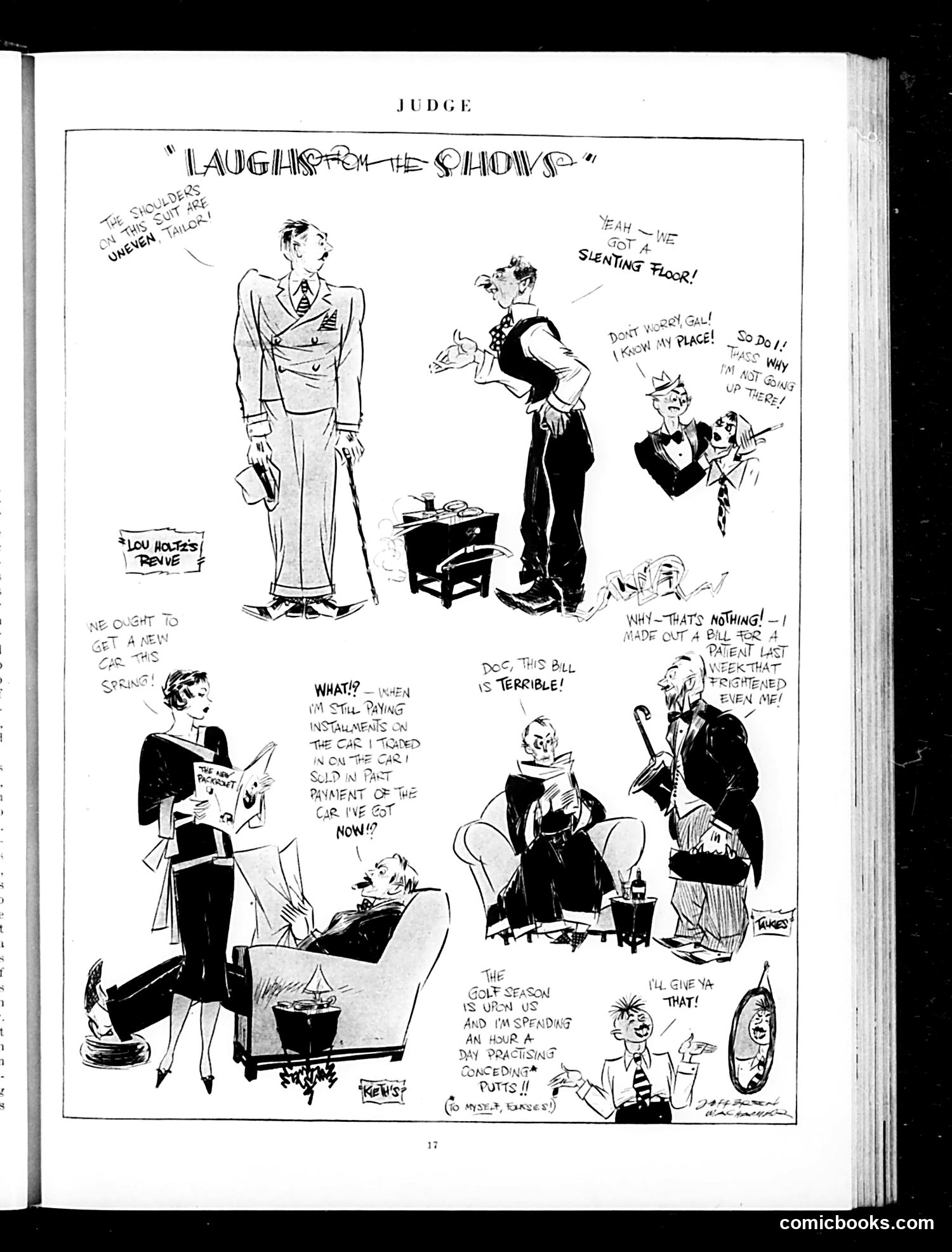
"Laughs of the Shows" This Judge cartoon satirizes the financial anxieties of middle-class Americans during what appears to be the early 20th century. The central figure is a man receiving bad news about unpaid bills and car payments—a common source of worry. The surrounding vignettes show various domestic and social scenarios where people discuss money troubles: a woman mentioning car installments, someone complaining about a patent bill, and references to golf season expenses. The satire targets the emerging consumer culture and installment-payment system that trapped ordinary people in perpetual debt. The cartoon's humor derives from depicting relatable financial stress across social situations, suggesting that even leisure activities (golf, entertainment, automobiles) come with mounting financial obligations that frighten even the well-to-do. The overall message critiques the modern economy's burden on American households.
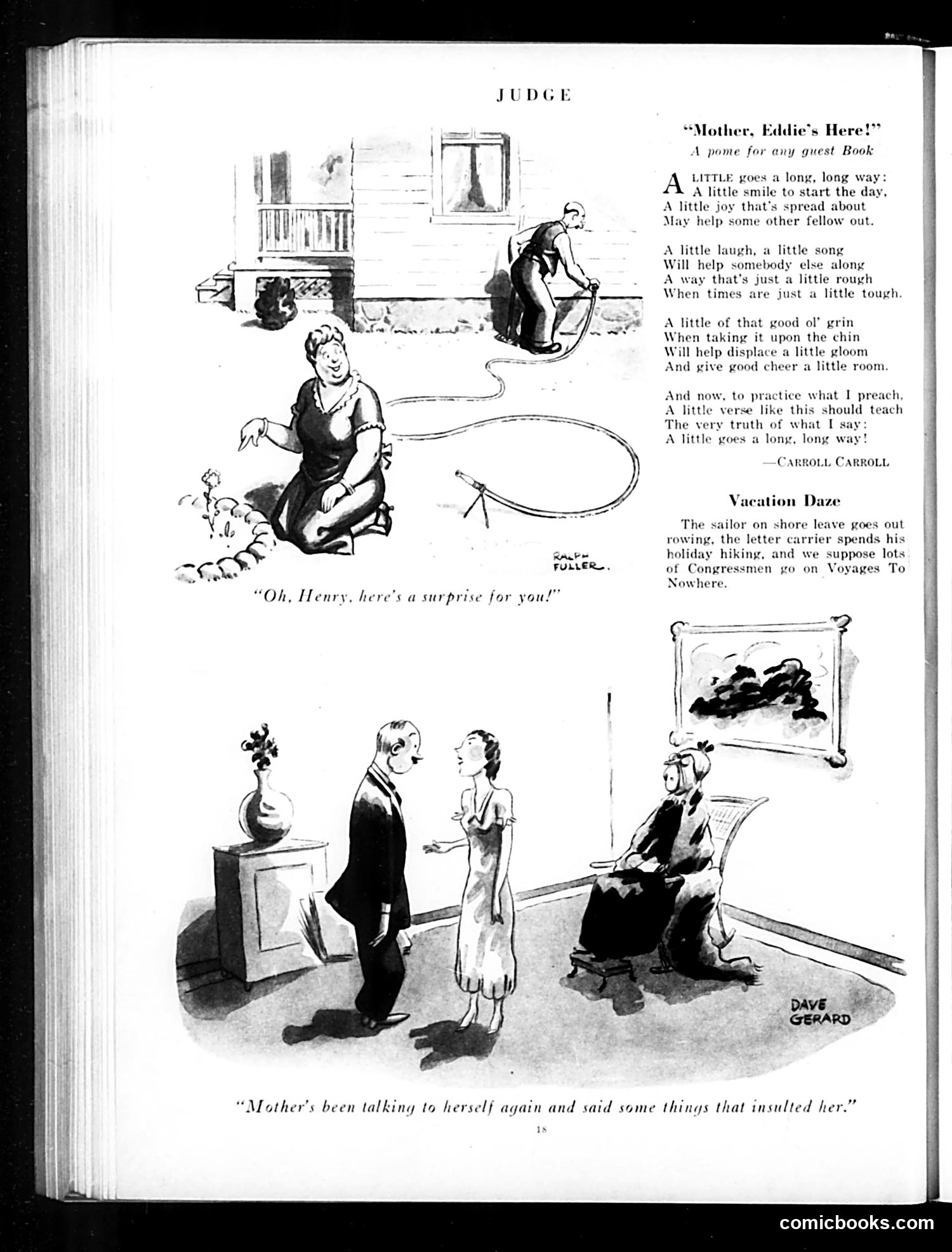
Page Analysis: Judge Magazine This page contains two distinct cartoons with different humor approaches. Top cartoon ("Oh, Henry, here's a surprise for you!"): Shows a domestic scene where a woman presents her husband with a child and dog, suggesting an affair or illegitimate child. The joke relies on marital infidelity humor common to early-20th-century satirical magazines. Bottom cartoon ("Mother's been talking to herself..."): Depicts an art gallery scene where a young woman reports to a man that her mother insulted herself while talking alone. The humor appears to rest on the absurdity of self-insult or perhaps social embarrassment about mental health—talking to oneself being viewed as eccentric or inappropriate. The page also includes a poem by Carroll Carroll about how "a little goes a long way" and a brief joke ("Vacation Daze") mocking Congressmen as taking pointless trips. The content reflects era-typical satire: domestic comedy, social etiquette humor, and light political jabs.
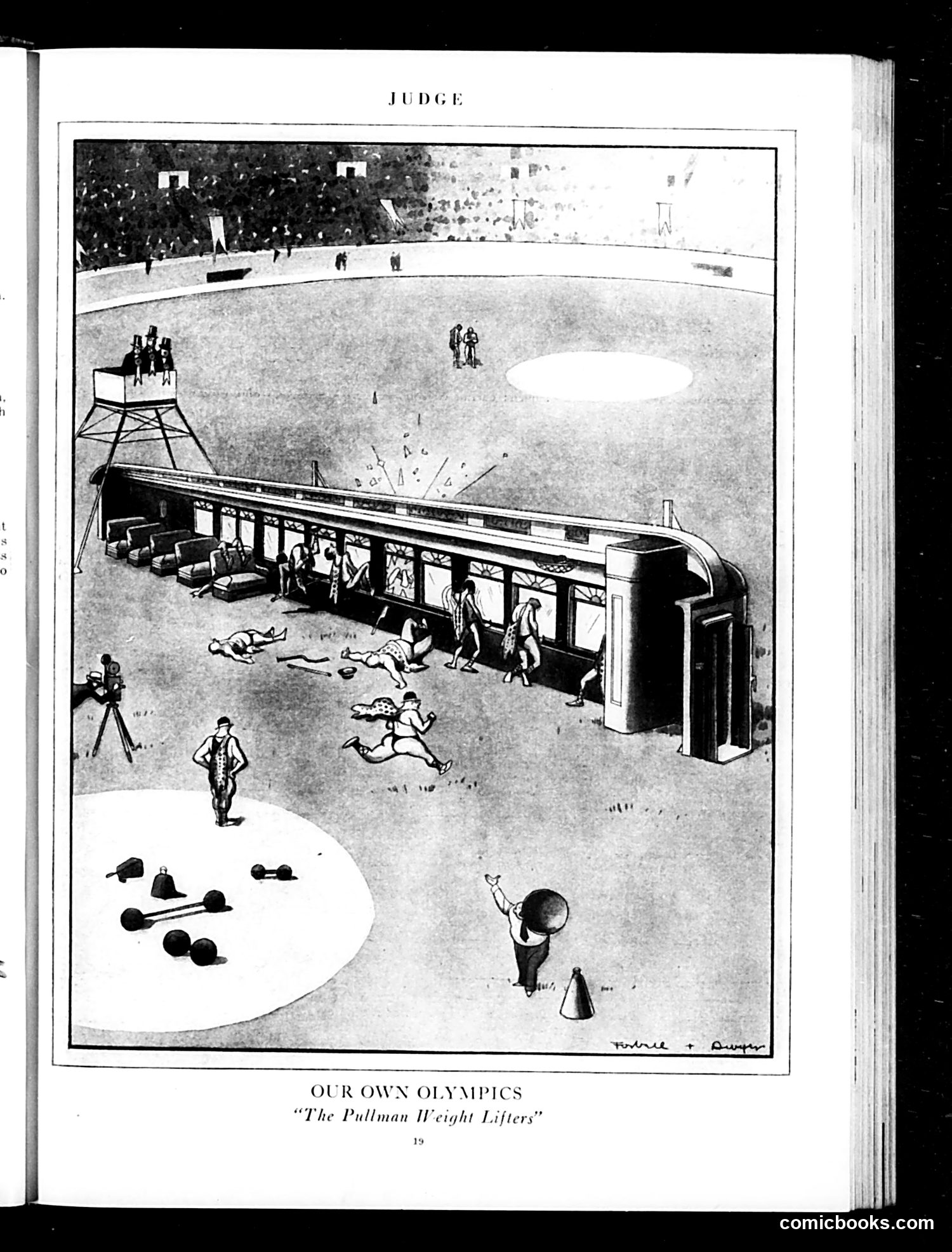
This cartoon satirizes the Pullman Strike labor dispute. The title "The Pullman Weight Lifters" is a pun: workers at the Pullman Palace Car Company are depicted as Olympic "weight lifters," but the "weights" are actually dumbbells and heavy equipment scattered around a circus-like arena. The illustration shows acrobats and performers in a stadium setting, suggesting the strike's drama was being treated as entertainment spectacle rather than serious labor issue. The Pullman Strike (1894) was a major railroad workers' strike that turned violent; this cartoon appears to mock how the conflict was being sensationalized and trivialized by the media and public as if it were merely circus performance rather than a genuine workers' rights struggle.
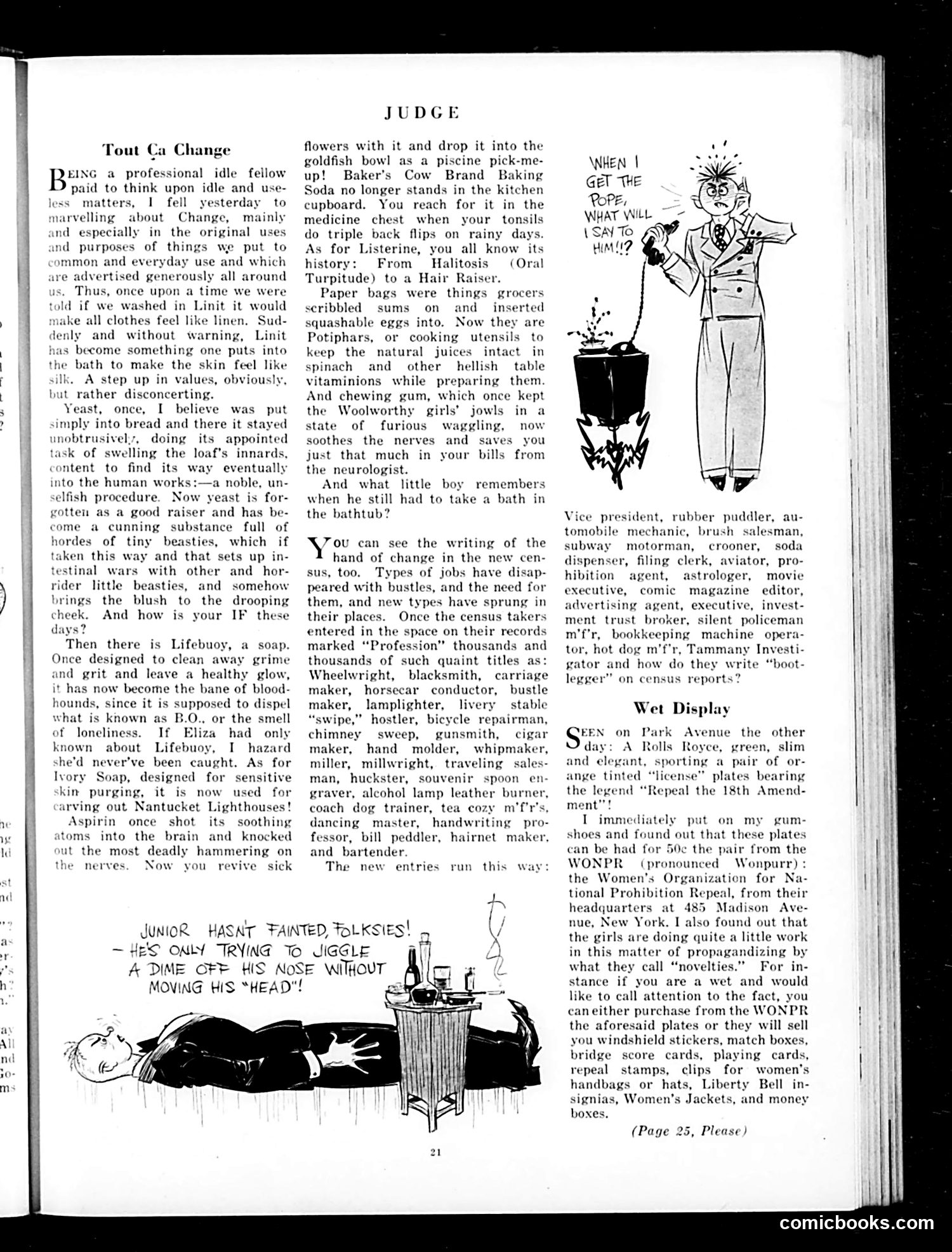
"Tout Ça Change" - Satire on Product Purpose Drift This column mocks how commercial products have been repurposed and rebranded through advertising to claim entirely different functions than their original use. The author (a self-described "idle fellow" paid to think about useless matters) catalogs absurd examples: - Linit laundry starch → now a bath product for skin - Yeast → shifted from bread-rising to a probiotic health claim - Lifebuoy soap → now marketed to cure "B.O." (body odor, the "smell of loneliness") - Aspirin → revived as fish medicine - Baking soda → reframed as medicine for tonsils - Paper bags → cooking vessels The satire extends to occupational obsolescence: census data now lists jobs like "rubber puddler," "aviator," and "astrologer" while old trades (wheelwright, blacksmith, lamplighter) have vanished—reflecting 1920s modernization and industrial change. The crude cartoon shows a child causing chaos, mocking frivolous concerns alongside genuine social transformation.
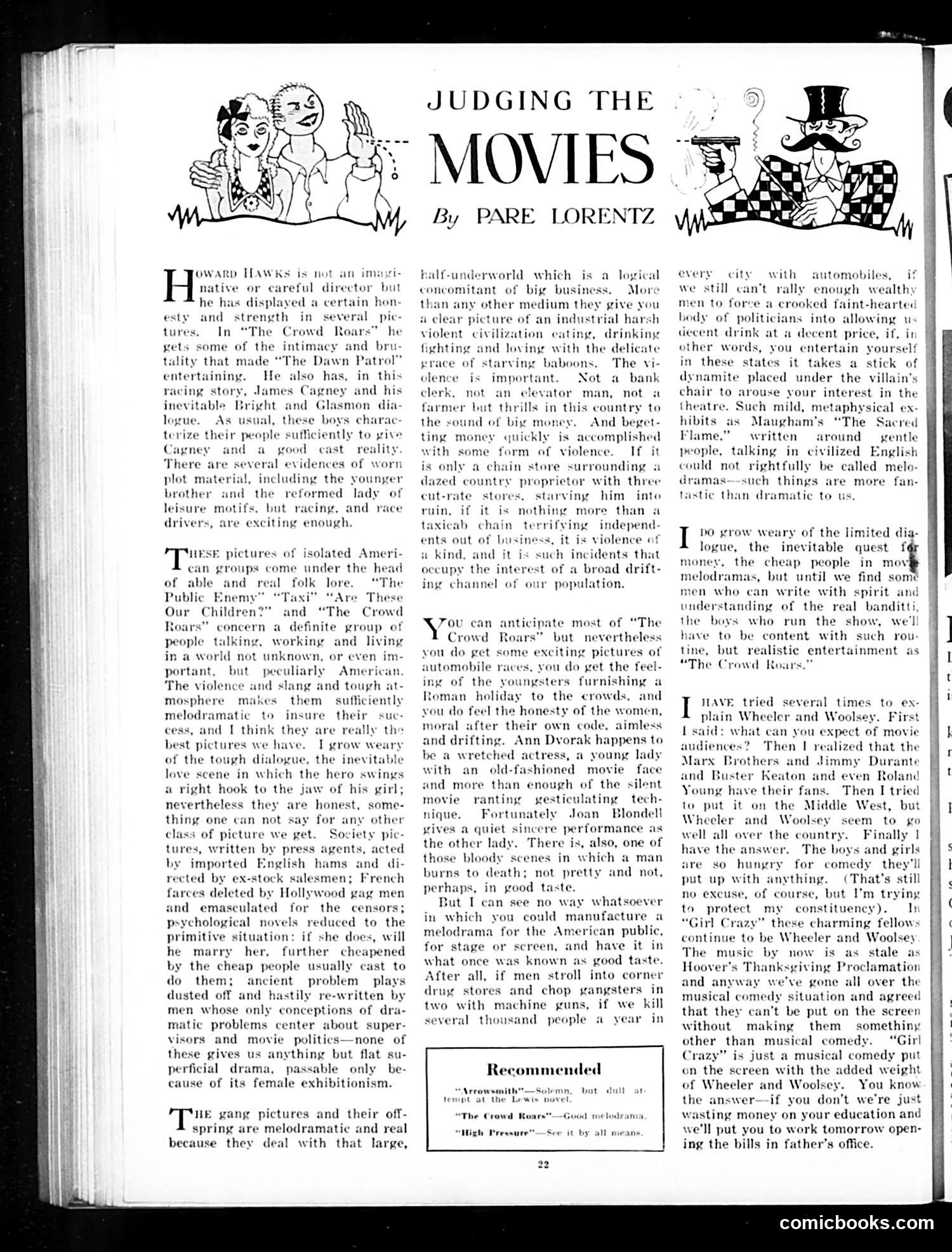
"Judging the Movies" by Pare Lorentz This is a film criticism column reviewing contemporary Hollywood pictures. Lorentz evaluates "The Crowd Roars" (starring James Cagney, directed by Howard Hawks) alongside "gang pictures"—films depicting urban underworld and working-class American life like "Public Enemy" and "Are These Our Children?" Lorentz defends these violent, rough-talking movies as more honest than society pictures or imported French farces "emasculated for the censors." He argues such films authentically capture industrial America's brutality and the violence inherent in capitalism—chain stores crushing proprietors, bootlegging, racketeering. While criticizing actress Ann Dvorak's performance and questioning whether such melodrama serves public taste, he ultimately champions these "gang pictures" as superior to sanitized, imported entertainment because they truthfully reflect American life's harsh realities.
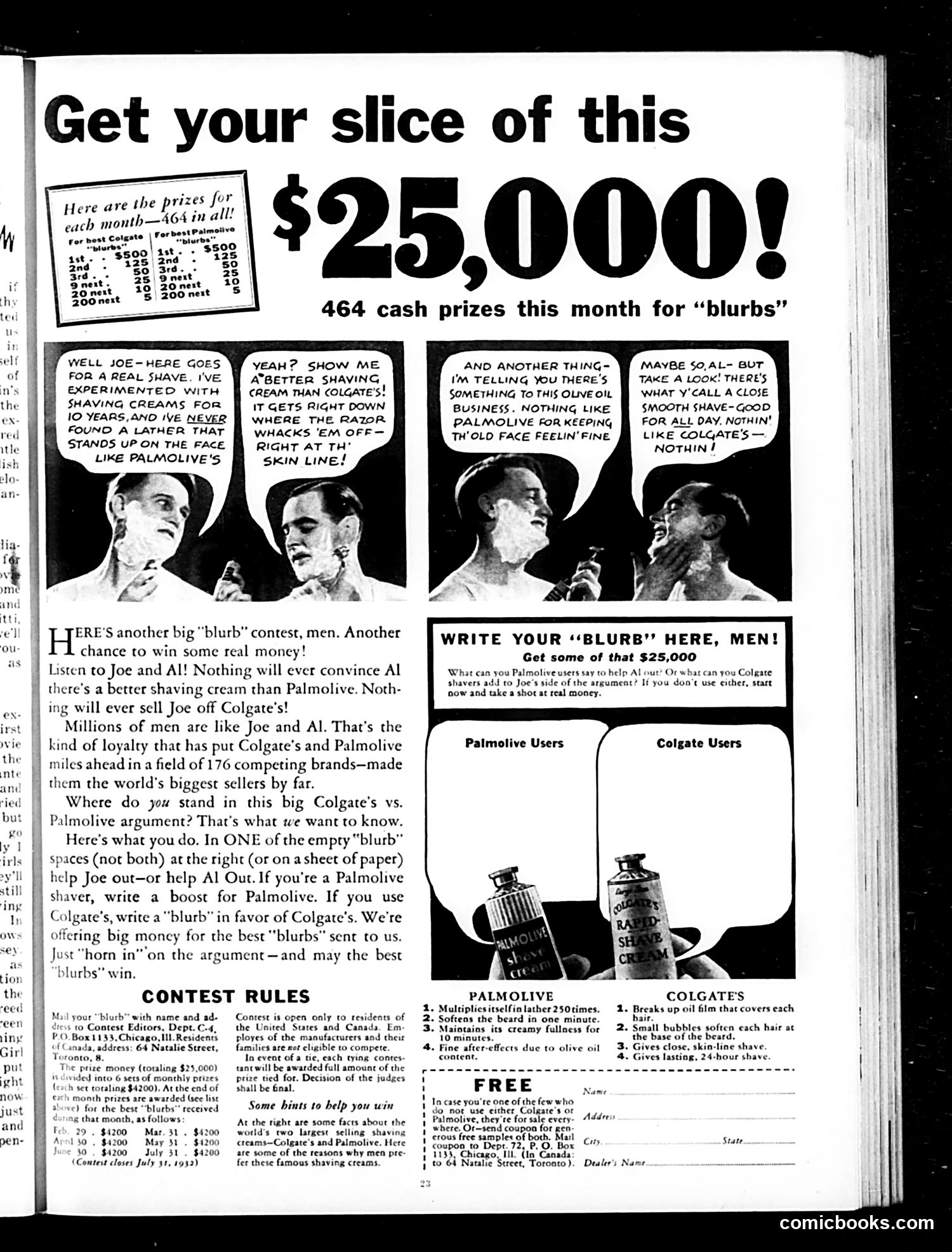
Judge Magazine "Blurb" Contest Advertisement This page is primarily a product advertisement disguised as a contest, not political satire. It features two men—Joe and Al—engaged in a friendly debate about shaving creams: Joe champions Palmolive, while Al promotes Colgate's. The "blurb" contest invites readers to write advertising copy favoring either product, with $25,000 in total prizes offered monthly. By framing this as a competition between loyal users, the advertisers tap into brand loyalty while crowdsourcing testimonials. The humor lies in the intense, almost absurd devotion both men display to their preferred cream—treating the choice as a serious philosophical disagreement rather than a minor consumer preference. This reflects 1930s advertising strategy: using popular magazines to run interactive contests that boost engagement and generate user-created marketing content. The page blurs the line between editorial content and advertising.
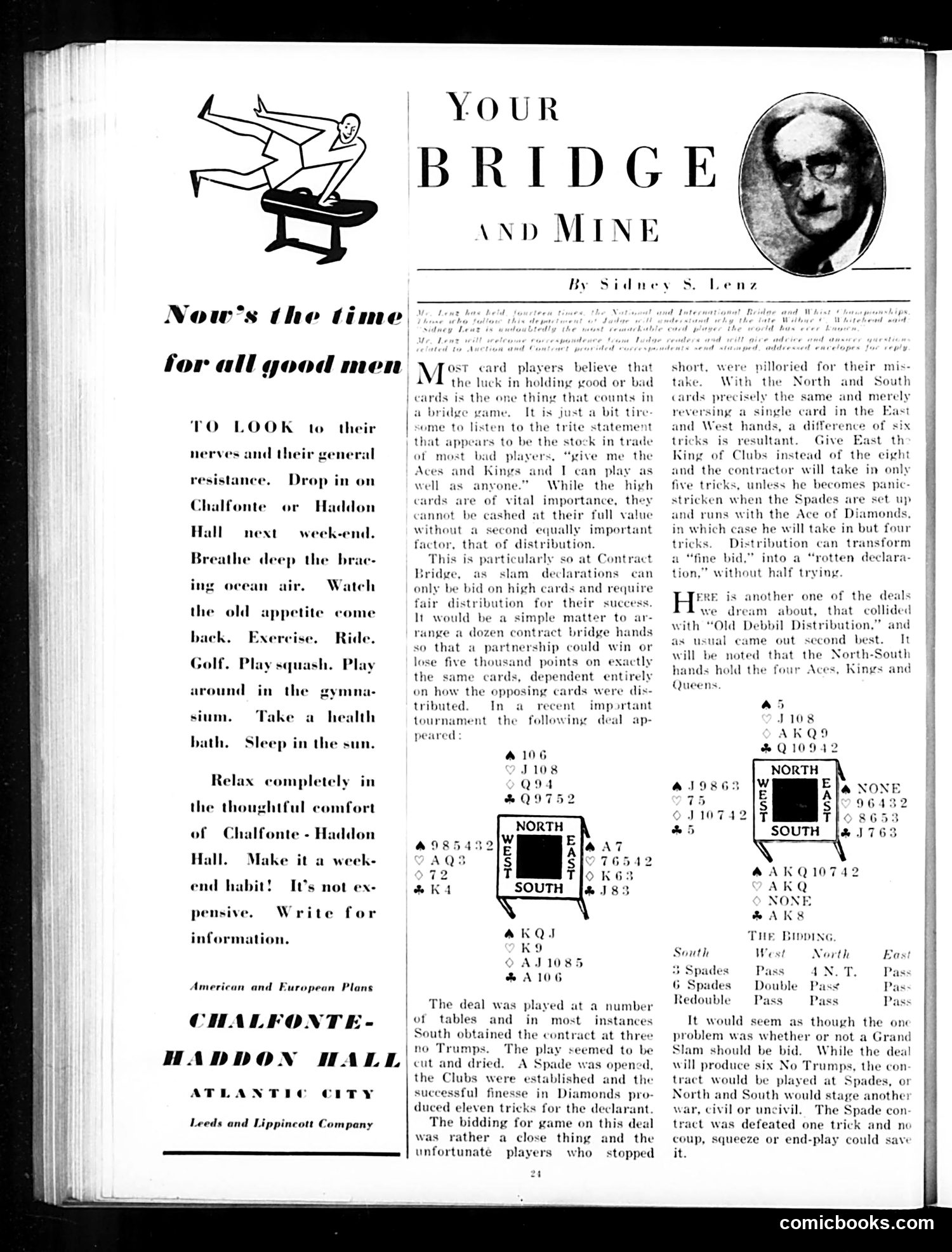
"Your Bridge and Mine" — A Bridge Strategy Article This is not a political cartoon, but rather an instructional article about contract bridge by Sidney S. Lenz, accompanied by sample hands and bidding sequences. The page teaches bridge players about "distribution"—how cards are divided among players—arguing this matters as much as holding high cards. The article uses a specific tournament deal to illustrate how identical cards produce different results depending on distribution. The left side contains an advertisement for Chalfonte-Haddon Hall resort in Atlantic City, encouraging relaxation and recreation ("Exercise, Ride, Golf, Play squash"). Context for modern readers: Bridge was a hugely popular pastime for educated Americans in the early-to-mid 20th century. This represents the kind of serious, strategic instruction that appeared regularly in *Judge* magazine alongside satire and humor—serving as both entertainment and practical guidance for affluent leisure activities.
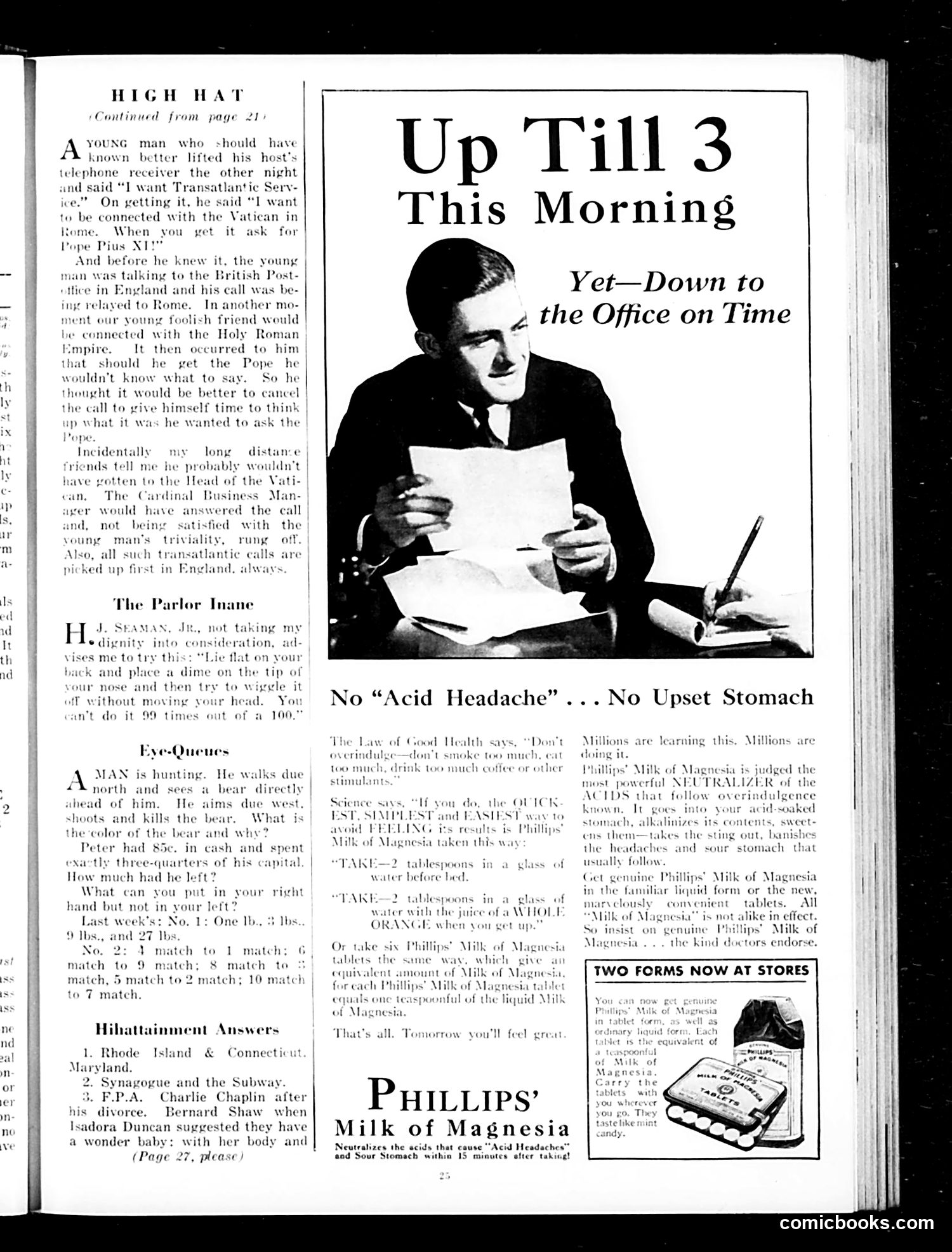
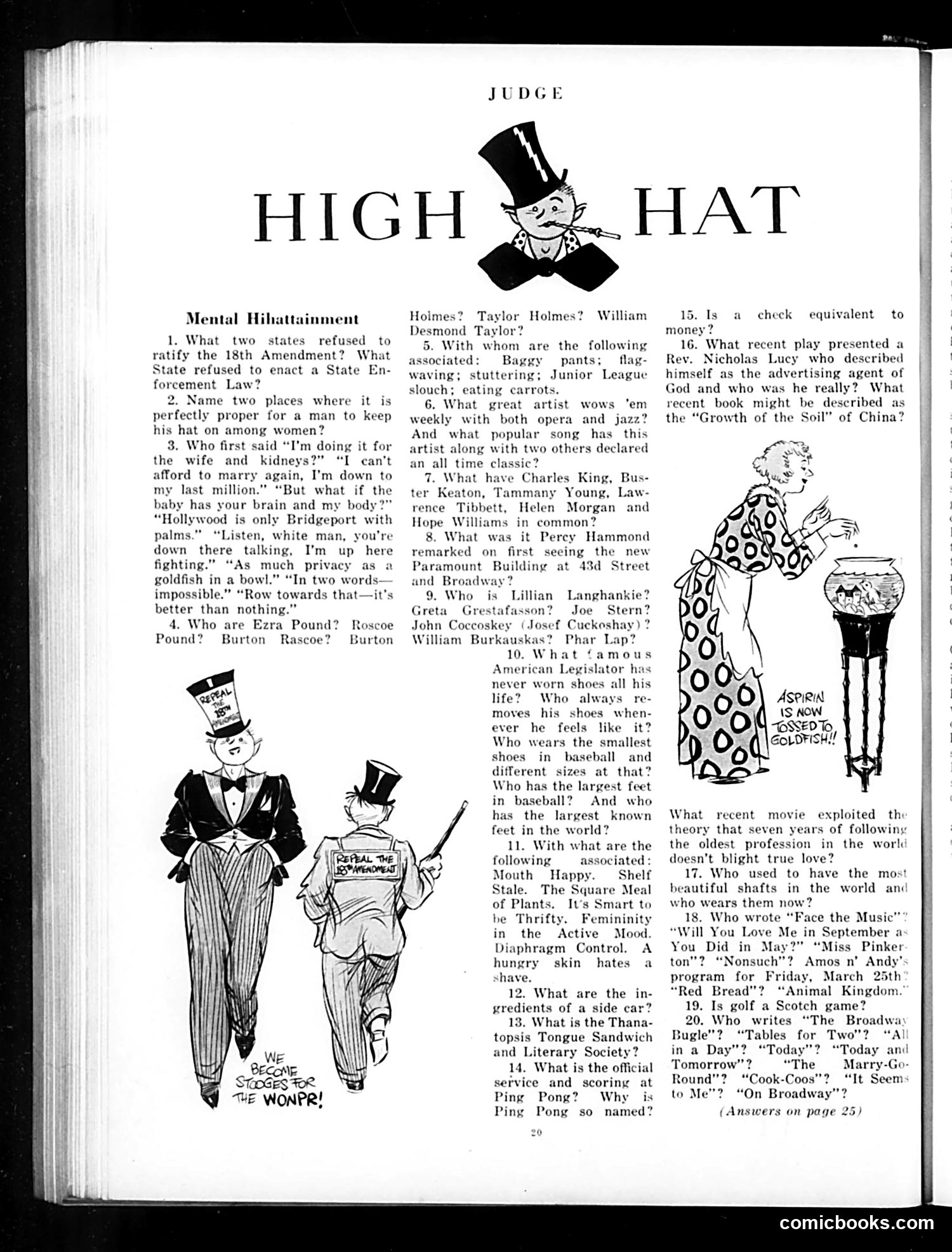
Judge Magazine Page Analysis This page contains three distinct humor sections rather than political cartoons: "High Hat" (top left) satirizes social pretension and long-distance telephone absurdity. A young man, trying to impress his host, attempts to call Pope Pius XI via transatlantic service. The joke exploits early 20th-century telephone technology's unreliability—his trivial request gets inexplicably routed through the British Post Office to Rome, creating bureaucratic chaos. The satire mocks both the caller's foolishness and the era's telephone system's bewildering inefficiency. "The Parlor Inane," "Eye-Queues," and "Hibattainment Answers" are parlor games and riddle sections—common Judge features entertaining readers with visual tricks and logic puzzles (e.g., "What can you put in your right hand but not your left?" Answer: your left hand). The dominant content is advertising: a large Phillips' Milk of Magnesia advertisement claiming to cure "acid headaches" and upset stomachs, presented as health advice. This reflects early 20th-century patent medicine marketing that made expansive health claims now considered misleading.
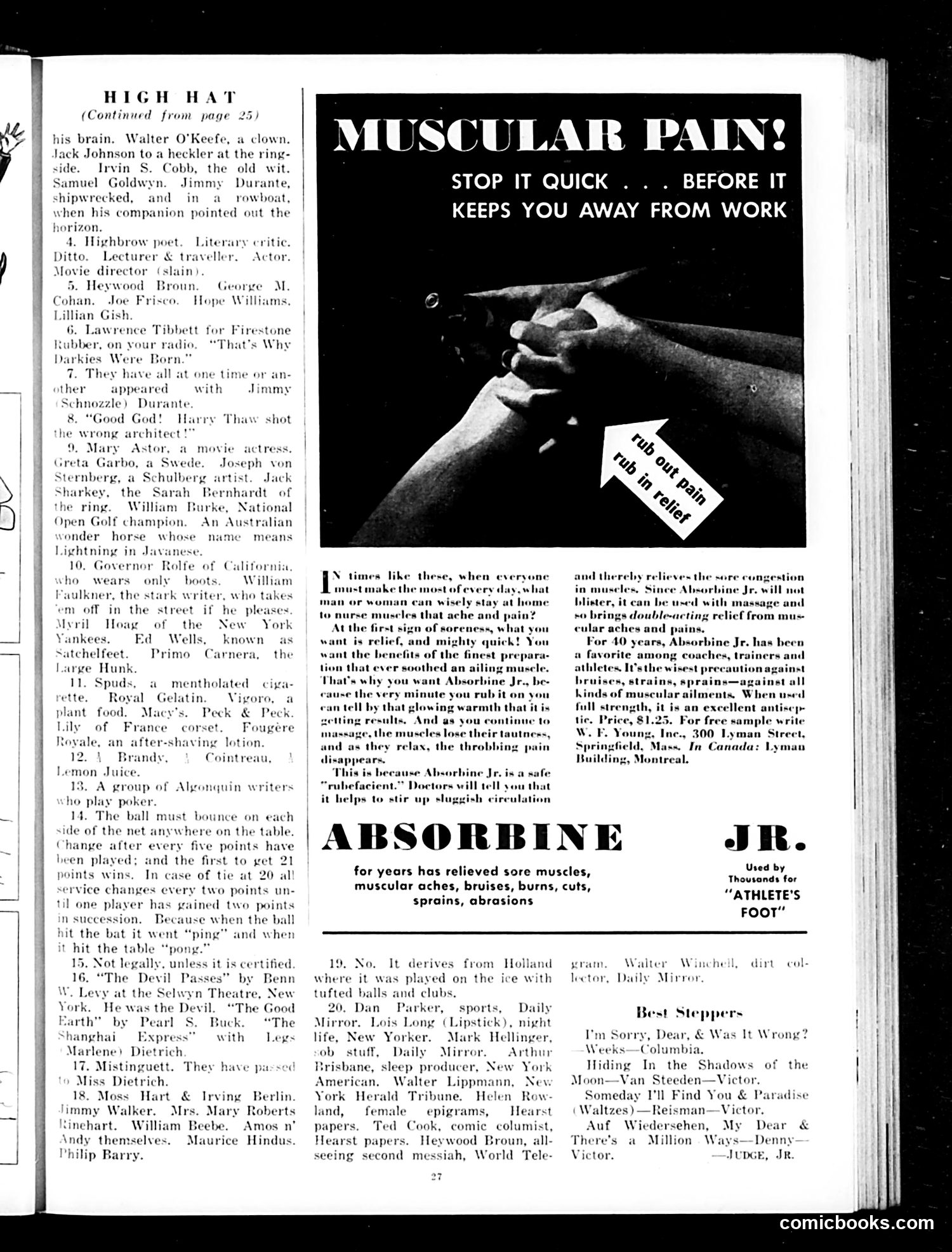
Explanation for Modern Readers This page is primarily advertising, not satire. The dominant content is a full-page advertisement for Absorbine Jr., a liniment product marketed for muscular pain relief. The ad uses period-typical marketing language, claiming the product provides "quick" relief from "sore muscles, muscular aches, bruises, burns, cuts, sprains, abrasions." It appeals to workers who might lose workdays due to pain, and emphasizes that the product has been "a favorite among coaches, trainers and athletes" for 40 years. The small "High Hat" column on the left is a gossipy riddle section referencing contemporary celebrities (Walter O'Keefe, Jimmy Durante, Mary Astor, etc.)—typical Judge magazine filler. The point: This reflects how magazines financed themselves through advertising. The Absorbine Jr. ad reflects period concerns about workplace productivity and marketed remedies, though modern readers would recognize such claims as overstated by today's regulatory standards.
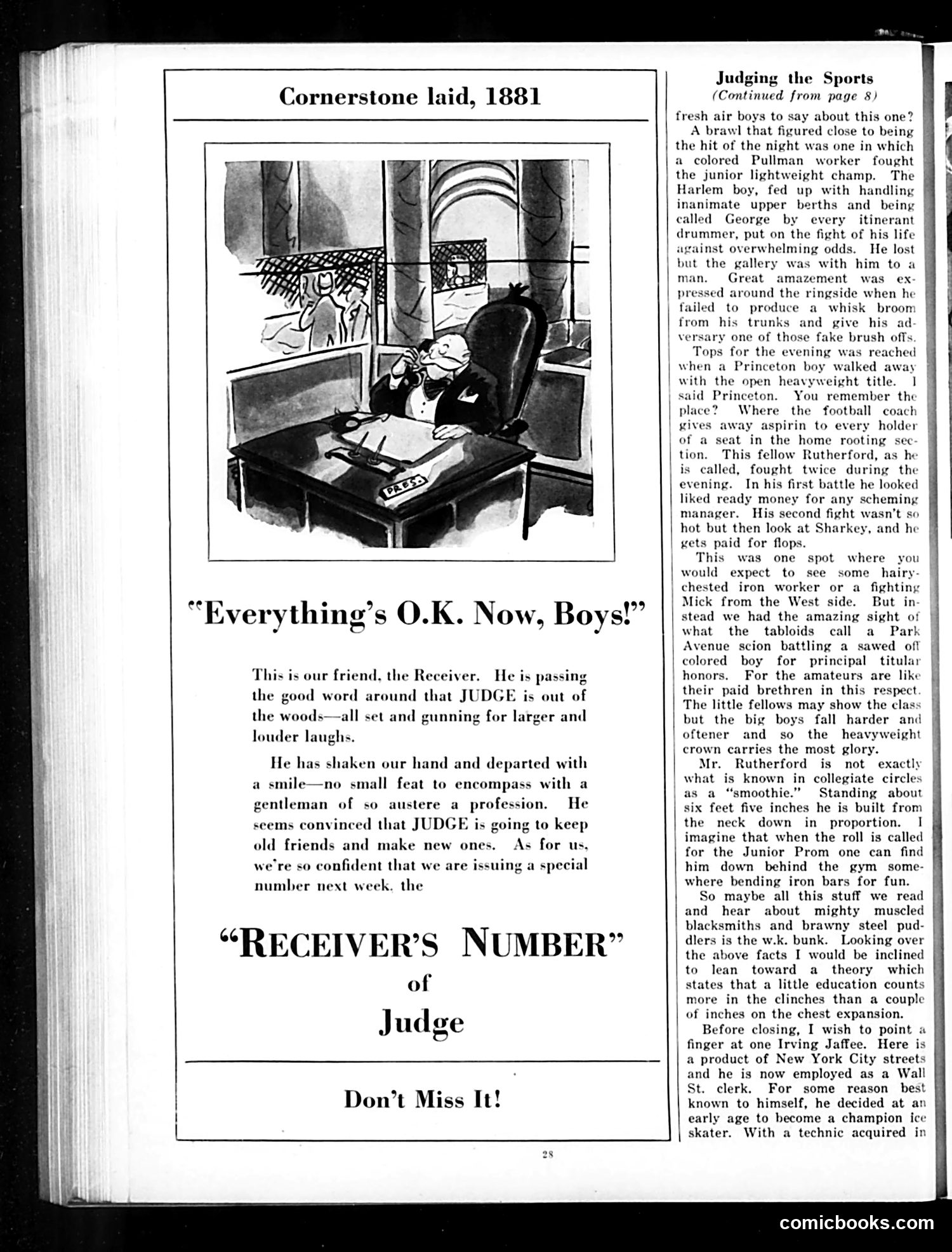
Explanation for Modern Readers This page celebrates Judge magazine's financial recovery. The main cartoon shows a "Receiver"—a court-appointed official who manages bankrupt businesses—delivering good news that Judge is "out of the woods" and solvent again. The joke is that this austere legal professional is smiling, which the editors present as proof of their optimistic outlook. The text announces a special "Receiver's Number" coming next week to commemorate this milestone (referenced as "Cornerstone laid, 1881"). The right column continues a sports column criticizing amateur boxing at what appears to be a college or club event. It mocks class pretensions: a wealthy "Park Avenue scion" (Rutherford from Princeton) defeats a working-class opponent, contradicting stereotypes about manual laborers being tougher fighters. The writer argues education matters more than physique in boxing. The page essentially documents Judge's financial turnaround while critiquing class assumptions through sports commentary.
Cartoon Analysis: Judge Magazine Page This page is primarily advertising and editorial content rather than a single cohesive political cartoon. The main satirical piece is a multi-panel dialogue about advertising strategy, not a political cartoon. The dialogue features unnamed characters—an Art Director, a character named Burstine, and a Chairman—discussing how to market a product (likely a shirt or clothing item) using emotional manipulation. The satire targets 1920s-30s advertising tactics: specifically, how advertisers exploited domestic themes and manufactured emotional responses to sell goods. The joke centers on a button-tearing scenario designed to make wives sympathetic to husbands, regardless of logic. The reference to Lake Placid's Winter Olympics and "supermen" nurtured in "speakeasies of New York" appears to mock the gap between wholesome athletic ideals and actual urban American life during Prohibition. The page is otherwise filled with product advertisements (hotels, bridge sets, globes) typical of Judge's revenue model.
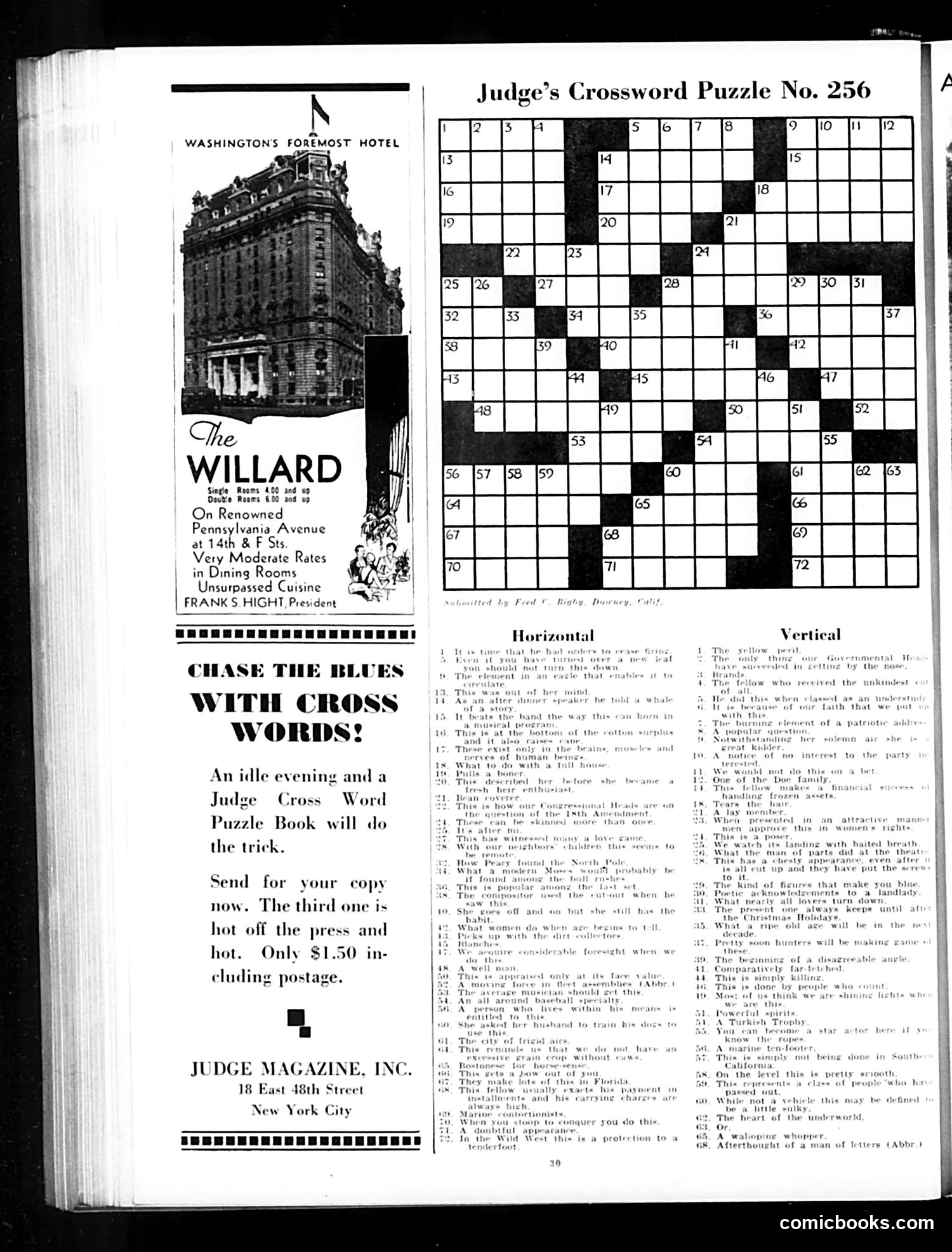
Page Content Analysis This page is primarily advertising, not satire or political commentary. On the left is a hotel advertisement for the Willard Hotel in Washington, D.C., promoting moderate rates and dining facilities—standard commercial copy from the era. The dominant content is a promotional advertisement for Judge Magazine's crossword puzzle books. The headline "Chase the Blues with Cross Words!" pitches solving crossword puzzles as an evening entertainment solution. This reflects the 1920s-30s crossword puzzle craze, when these puzzles were a novelty entertainment phenomenon. The ad encourages readers to purchase the third edition of Judge's crossword book for $1.50. The right side displays an actual crossword puzzle grid (Puzzle No. 256) with accompanying clues, serving as a sample to entice purchase. There is no political cartoon or satire on this page—it's purely commercial content capitalizing on a popular leisure activity of the period.
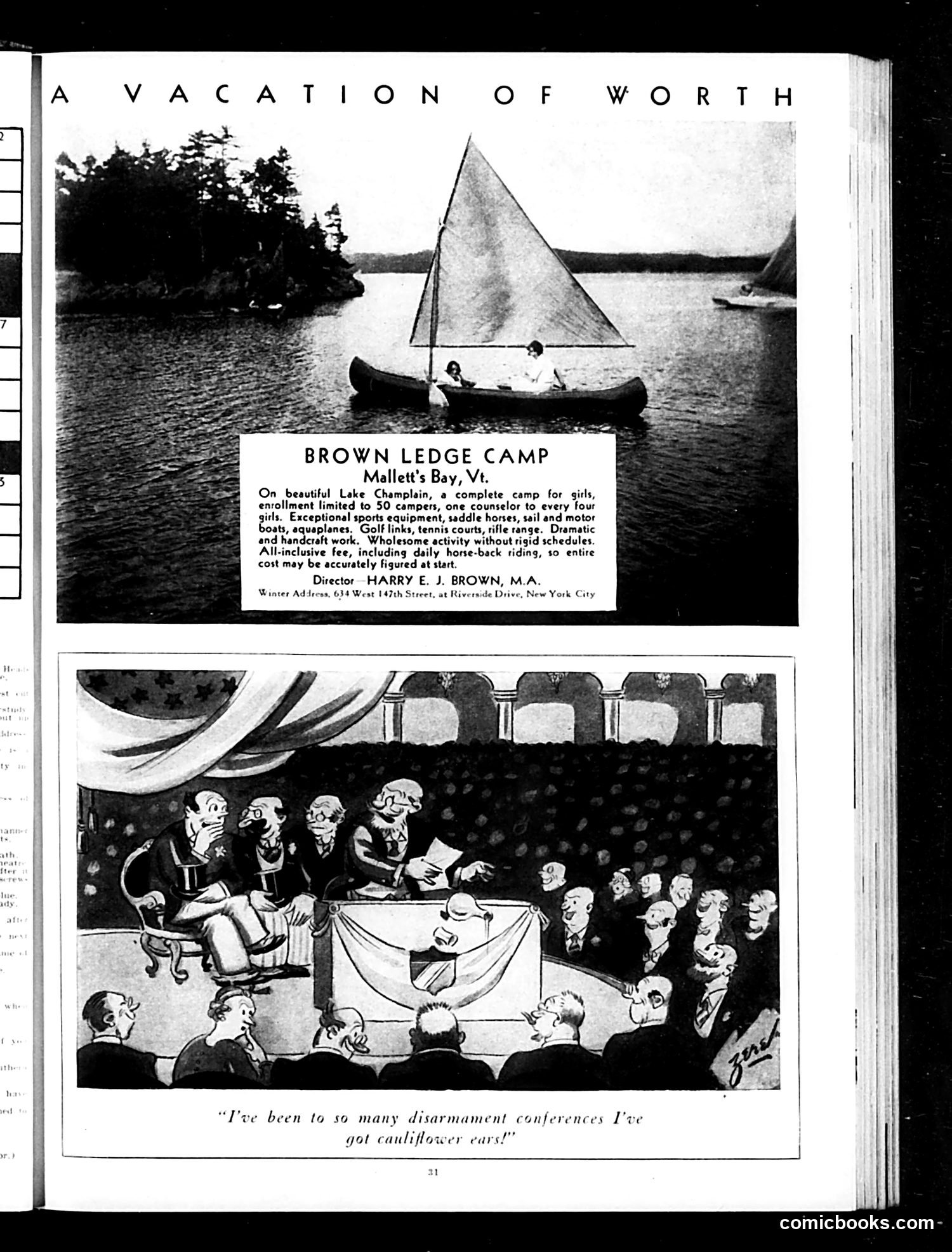
Analysis This page contains a girls' summer camp advertisement (top) and a political cartoon (bottom). The cartoon satirizes diplomatic conferences on disarmament—a major concern in the interwar period when nations negotiated arms reduction treaties. The speaker, appearing to be a diplomat or politician, complains of attending "so many disarmament conferences" that he has developed "cauliflower ears" (a boxing injury from repeated blows). The joke suggests these conferences were numerous, repetitive, and ultimately ineffective—the speaker seems worn down by endless talk without results. The caricatured audience in what appears to be a formal assembly chamber reinforces the satirical tone. This reflects contemporary skepticism about whether diplomatic efforts could actually achieve meaningful weapons reduction, a persistent anxiety during the 1920s-1930s period of international peace negotiations.
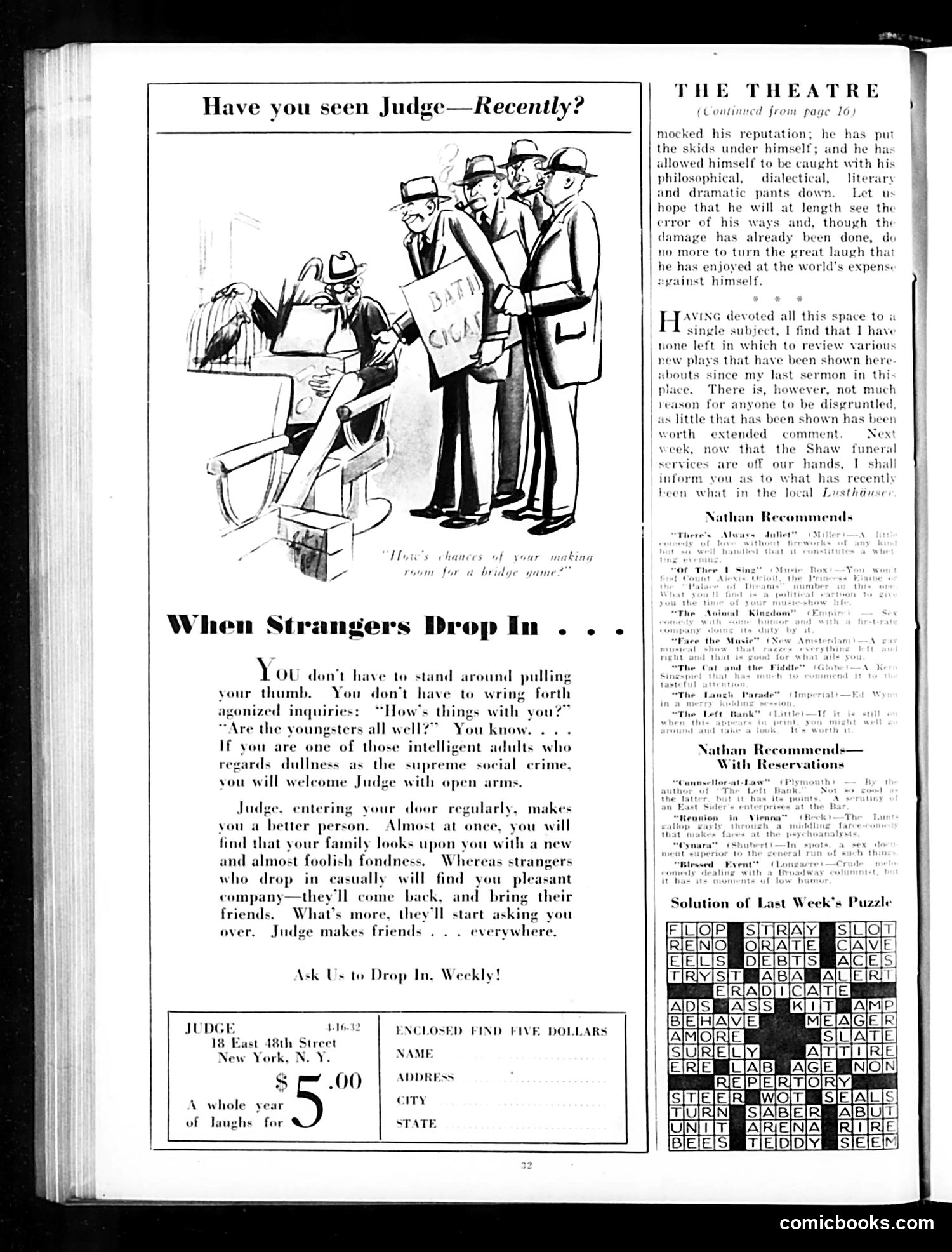
Analysis of Judge Magazine Page This page is primarily advertising for Judge magazine itself, presented as editorial content. The cartoon at top depicts men in hats gathered around someone playing bridge, with the caption "How's chances of our making room for a bridge game?" — illustrating social awkwardness when strangers visit. The accompanying text promotes Judge as a solution to social discomfort: owning the magazine regularly makes you more interesting and amusing to family and visitors, turning you into better company who attracts friends. The right column contains theater criticism by "Nathan" (likely theater critic George Jean Nathan), discussing a damaged reputation—possibly referring to a theatrical figure caught in scandal—and mentioning Shaw's funeral services. The satire is meta: Judge advertises itself as the cure for being dull. The joke assumes readers desire social status through humor and wit, which owning this satirical magazine supposedly provides. It's a tongue-in-cheek pitch targeting aspirational readers seeking to appear sophisticated.
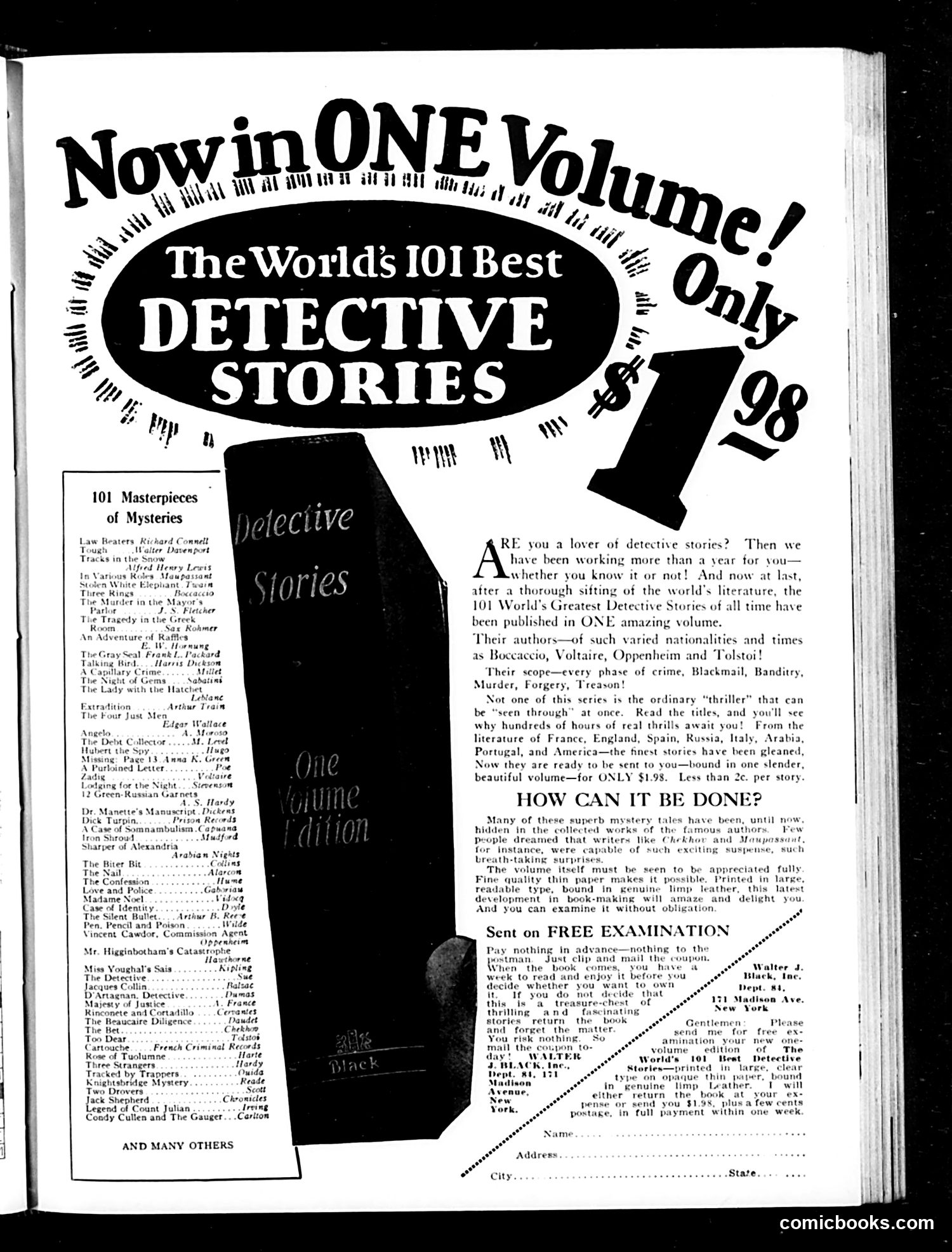
Analysis: Advertisement for "The World's 101 Best Detective Stories" This is primarily a book advertisement, not a political cartoon. It promotes a single-volume collection of classic detective fiction, marketed as a bargain at $1.98 (approximately 2 cents per story). The page lists 101 stories by canonical authors—Boccaccio, Voltaire, Tolstoy, Maupassant, Conan Doyle, Poe, and others—spanning European and American literature. The sales pitch emphasizes discovery: readers supposedly don't know these hidden masterworks exist. The "FREE EXAMINATION" coupon at bottom is standard mail-order advertising from this era (likely early 20th century). Customers could inspect the book risk-free before committing to purchase. There is no satire or political commentary visible. This is straightforward commercial promotion targeting detective-fiction enthusiasts, using the prestige of canonical authors and the appeal of comprehensive collection to justify the price.
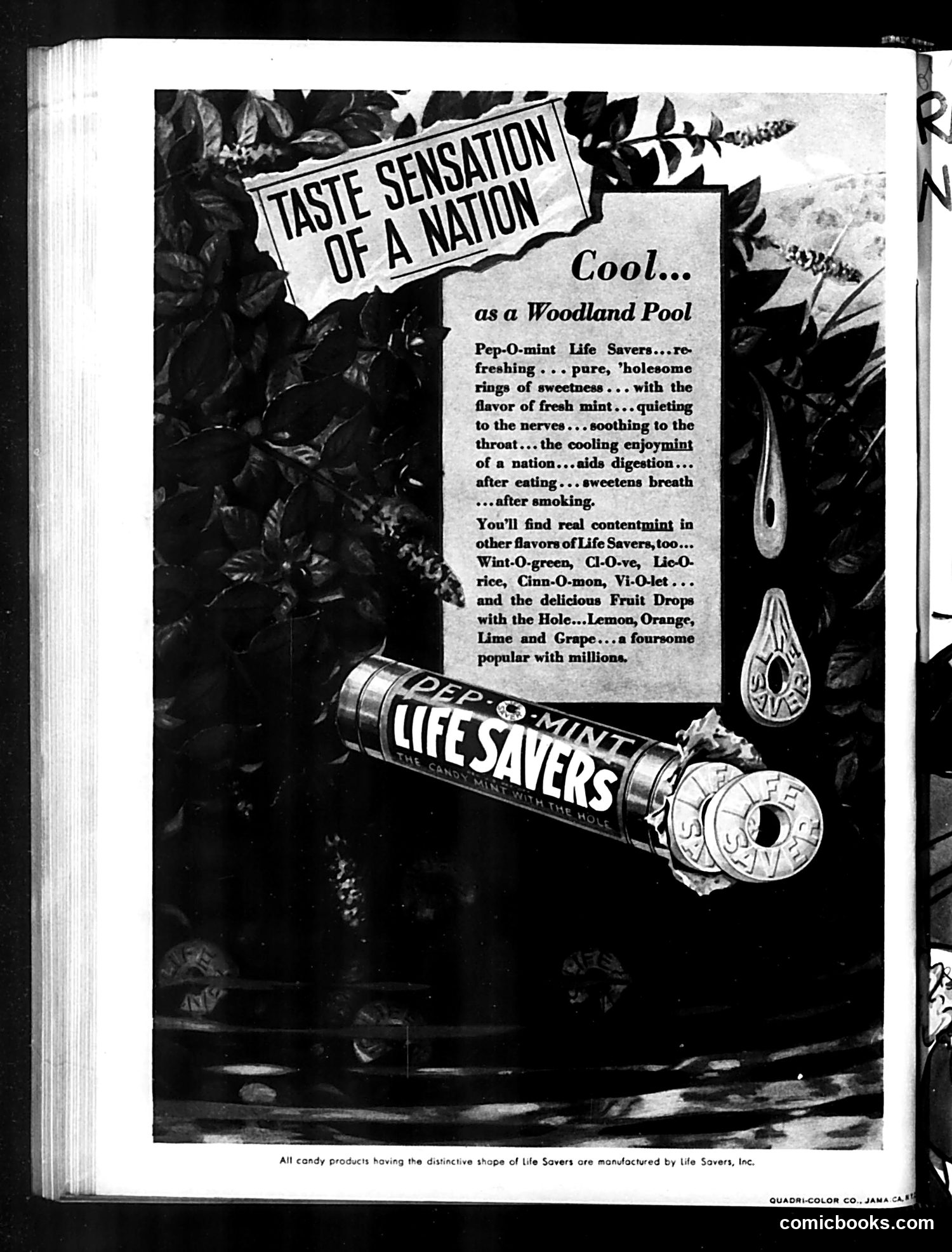
Analysis This is primarily a product advertisement, not political satire. It's a vintage Life Savers candy ad (likely from the 1920s-30s based on style) promoting Pep-O-mint Life Savers with the slogan "Taste Sensation of a Nation." The page uses nature imagery (woodland pool, plants) to suggest the candy's refreshing, cooling properties. The ad employs extensive wordplay—"contentmint," "enjoymint"—parodying the product name itself. The humor is commercial, not political: it lists other Life Savers flavors (Wint-O-green, Clove, Licorice, Cinnamon, Violet) and fruit varieties, using forced rhymes to make the candy sound beneficial for digestion, breath, and general wellness—typical patent-medicine-style advertising claims from this era. There is no visible satire of public figures or events here, just vintage marketing copy.