judge
Judge — April 23, 1932
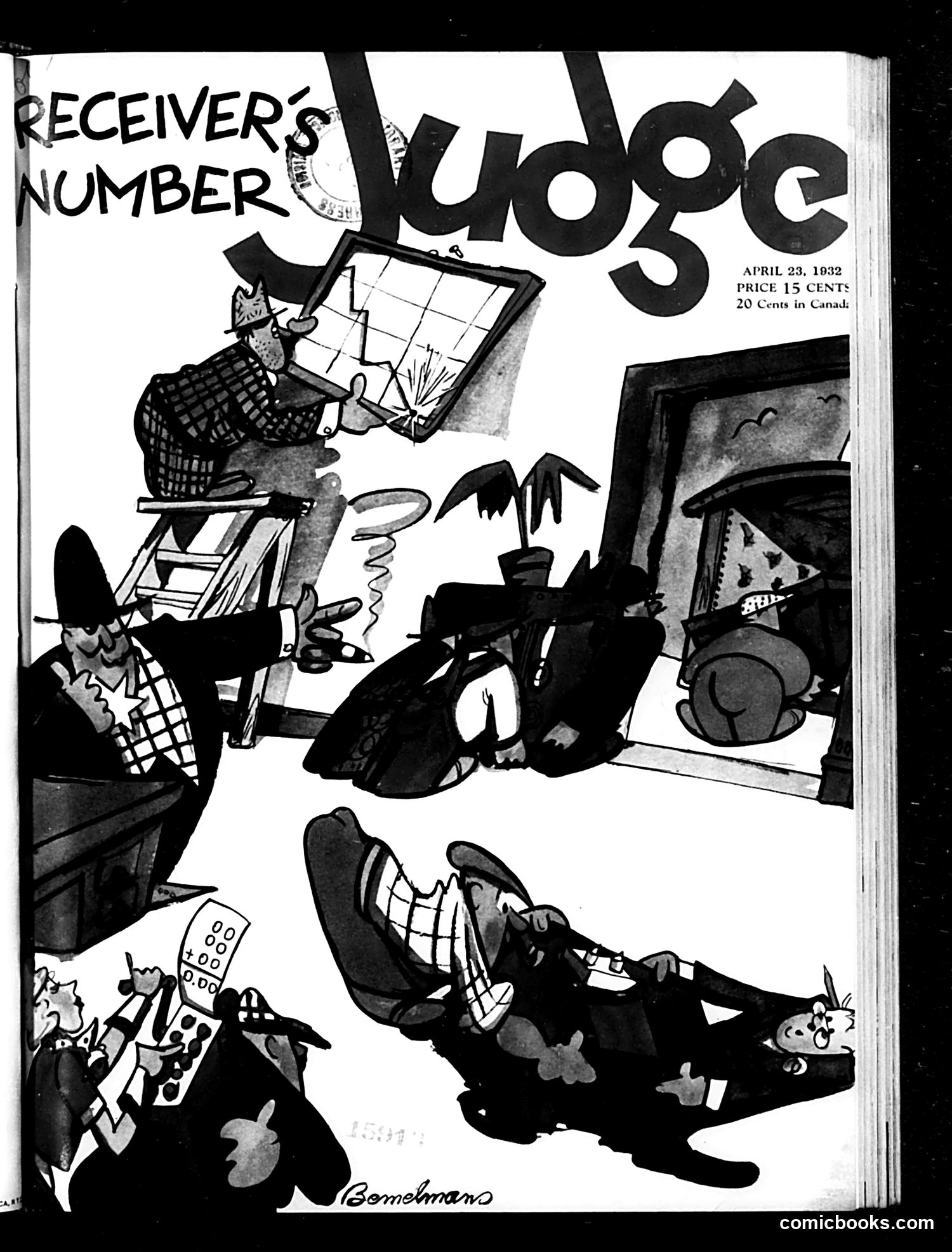
Analysis of Judge Magazine Cover (April 23, 1932) This cover satirizes the economic chaos of the Great Depression. The chaotic scene depicts figures in distress amid scattered financial documents and household items—representing widespread economic collapse and domestic upheaval. The central figures appear to be ordinary citizens struggling with financial ruin, a common Judge theme during the Depression era. The "receiver's number" text likely references court-appointed receivers managing bankrupt businesses—a frequent occurrence in 1932. The satire critiques the period's economic devastation: families losing homes, businesses failing, and citizens caught in financial turmoil beyond their control. The cluttered, frantic composition visually reinforces the sense of panic and disorder gripping American society during this severe economic crisis. The $0.15 price reflects Depression-era affordability.
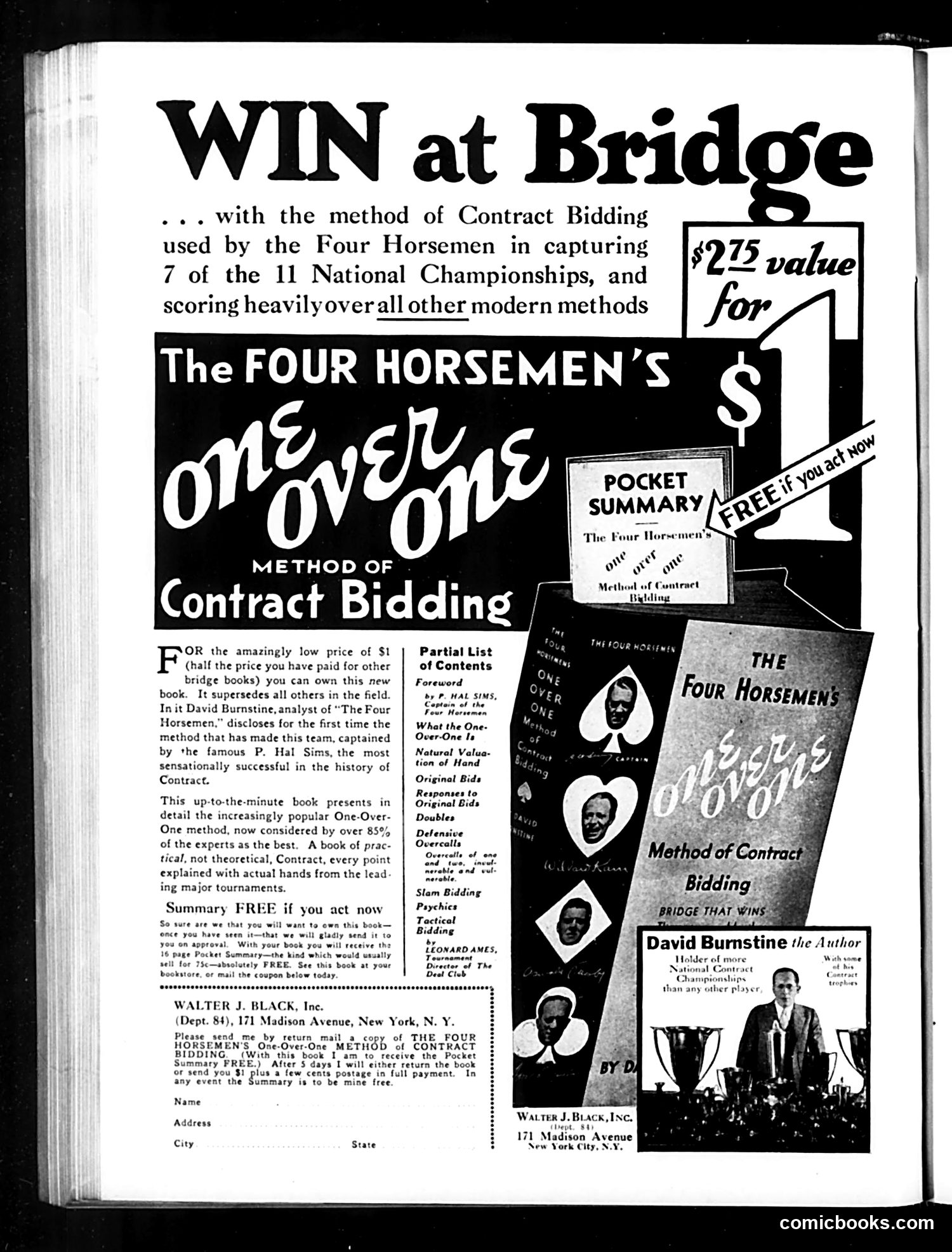
Analysis This page is primarily advertising, not satire or political commentary. It promotes "The Four Horsemen's One Over One Method of Contract Bidding," a bridge instruction book by David Burnstine. The ad claims this bidding system helped "the Four Horsemen" (a famous bridge partnership) win 7 of 11 National Championships. The "Four Horsemen" appears to refer to a real, well-known bridge team of that era. The page offers the $2.75 book for $1, plus a free pocket summary. It includes a mail-order form and shows the book's cover and contents. There is no political satire or social commentary evident. This is straightforward commercial advertising for a bridge strategy book, likely from the 1930s-40s based on design and pricing.
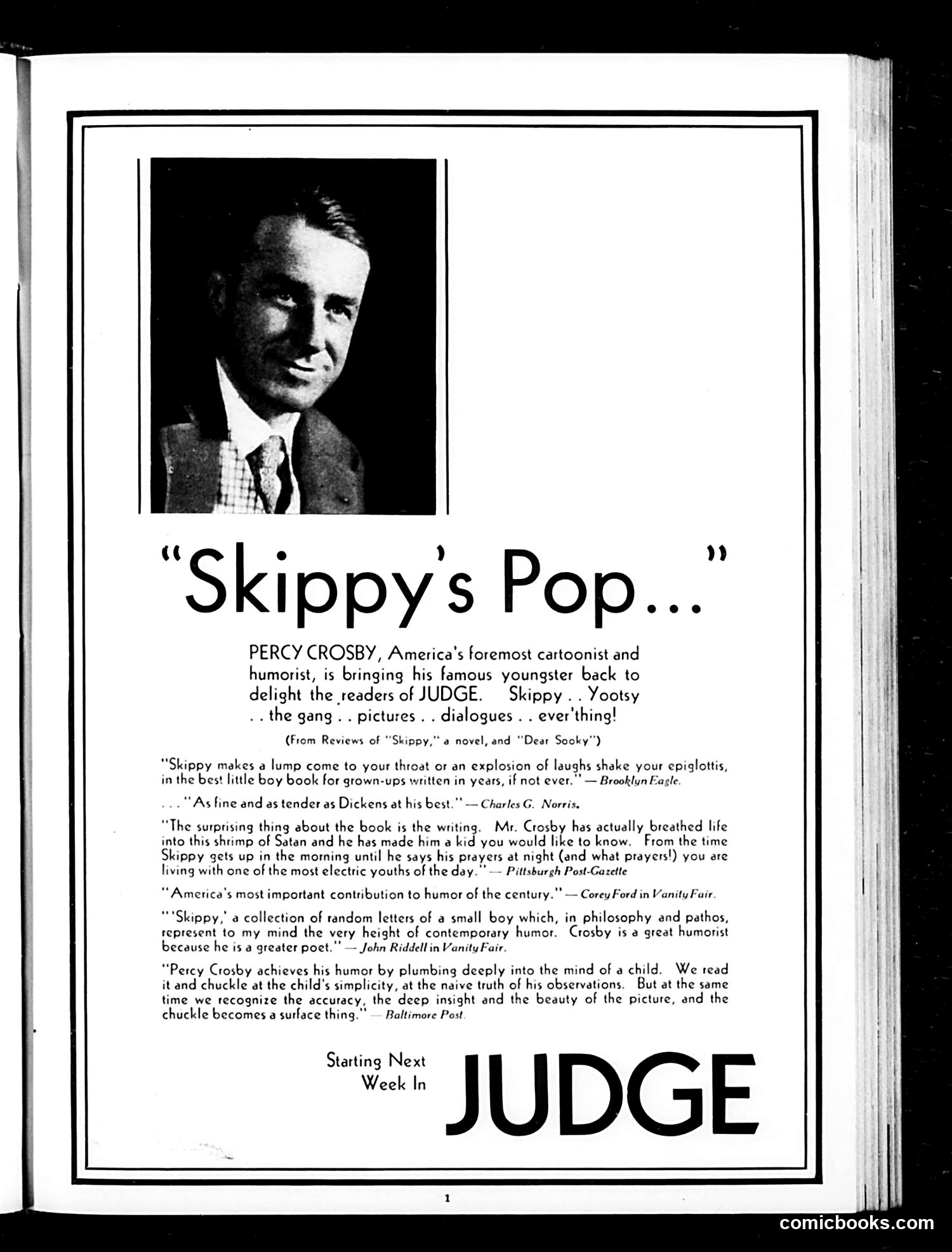
"Skippy's Pop" - Judge Magazine Advertisement This is an advertisement promoting Percy Crosby's "Skippy," a popular comic strip character, coming to *Judge* magazine. The page features a portrait photograph of Crosby himself, identified as "America's foremost cartoonist and humorist." The quotes below praise Skippy's humor and appeal. Critics highlight that Crosby captures authentic childhood perspectives with both comedic simplicity and deeper psychological insight. References mention the strip's "gang," "pictures," and "dialogues"—standard comic strip elements. The advertisement emphasizes Skippy as important American humor, suitable for adults despite focusing on a young protagonist. This reflects early 20th-century comics' emergence as respectable literary entertainment for general audiences, not just children. The announcement promises the character's appearance "Starting Next Week in JUDGE."
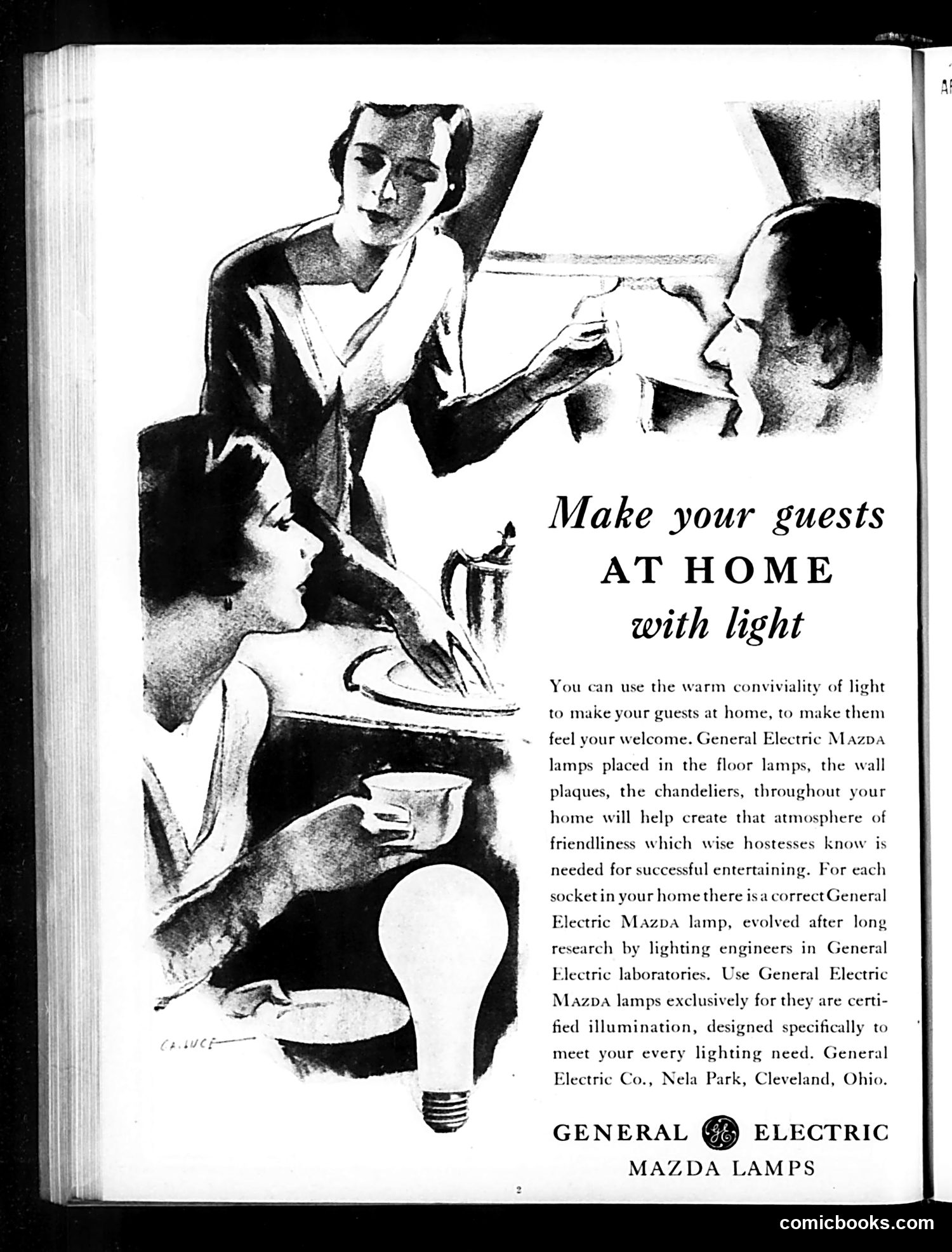
This is primarily a General Electric Mazda Lamps advertisement, not a satirical cartoon. The image shows a stylized illustration of a woman entertaining guests—serving drinks and food while positioned near a floor lamp displaying a glowing Mazda bulb. The ad's message is straightforward: proper home lighting creates a welcoming atmosphere for entertaining. The copy emphasizes that GE Mazda lamps, placed throughout the home (floor lamps, wall sconces, chandeliers), foster "friendliness" and make guests feel welcome. The ad claims these lamps represent "certified illumination, designed specifically to meet your every lighting need." This reflects mid-century advertising that connected domestic comfort and social status with consumer products.
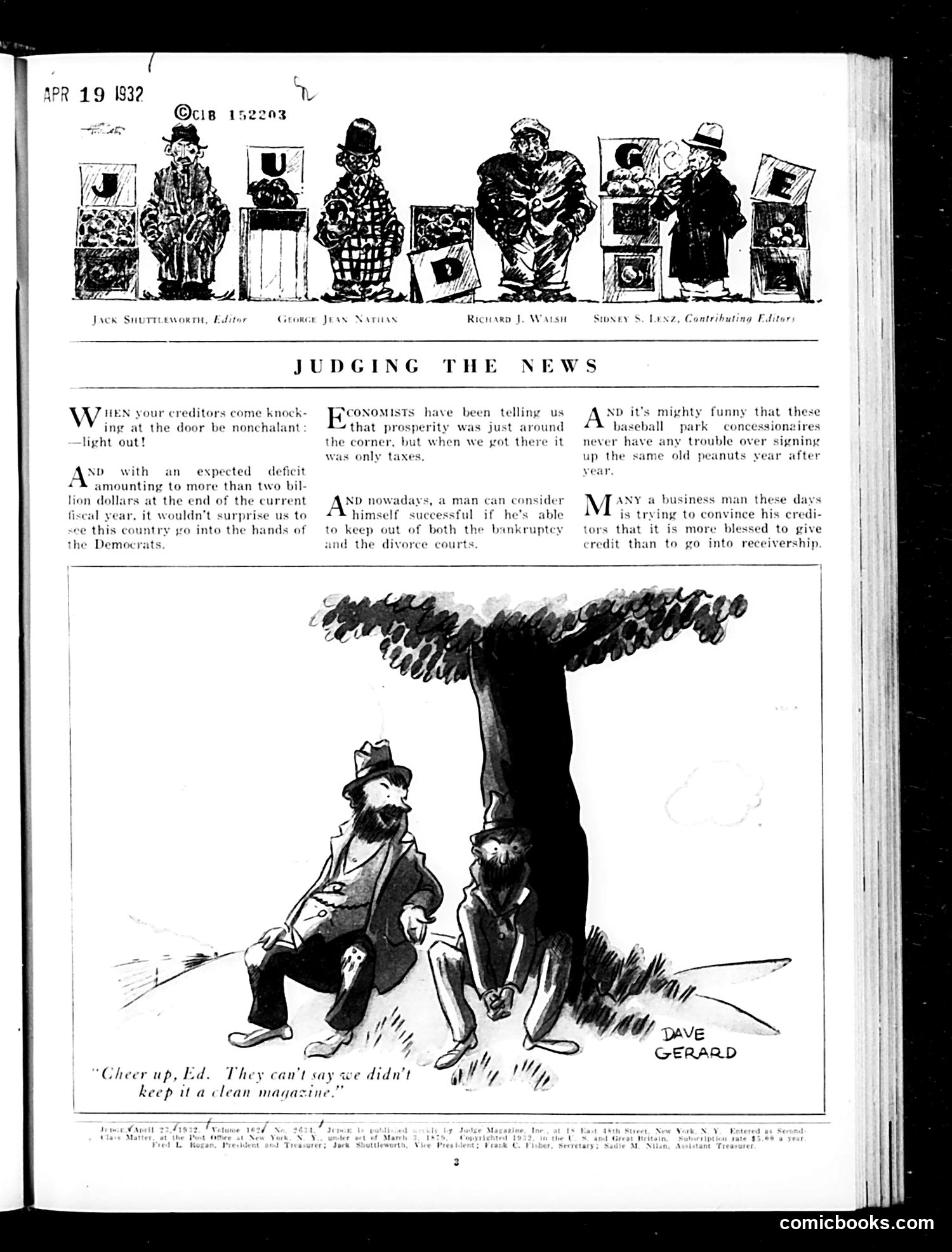
"Judging the News" - April 19, 1932 This editorial cartoon page satirizes Depression-era economic hardship. The masthead features caricatured editors evaluating current events. The main cartoon by Dave Gerard depicts two dejected figures beneath a dead tree—symbolizing economic collapse—with the caption "Cheer up, Ed. They can't say see didn't keep it a clean magazine." The accompanying text mocks contemporary economic contradictions: economists claiming prosperity was "just around the corner" despite rising taxes, men considering bankruptcy preferable to divorce, and business owners claiming receivership is "more blessed" than giving credit. The satire targets both failed economic predictions and the absurd mental gymnastics people employed to cope with the financial crisis, while the cartoon's dead tree suggests their optimism is hollow.
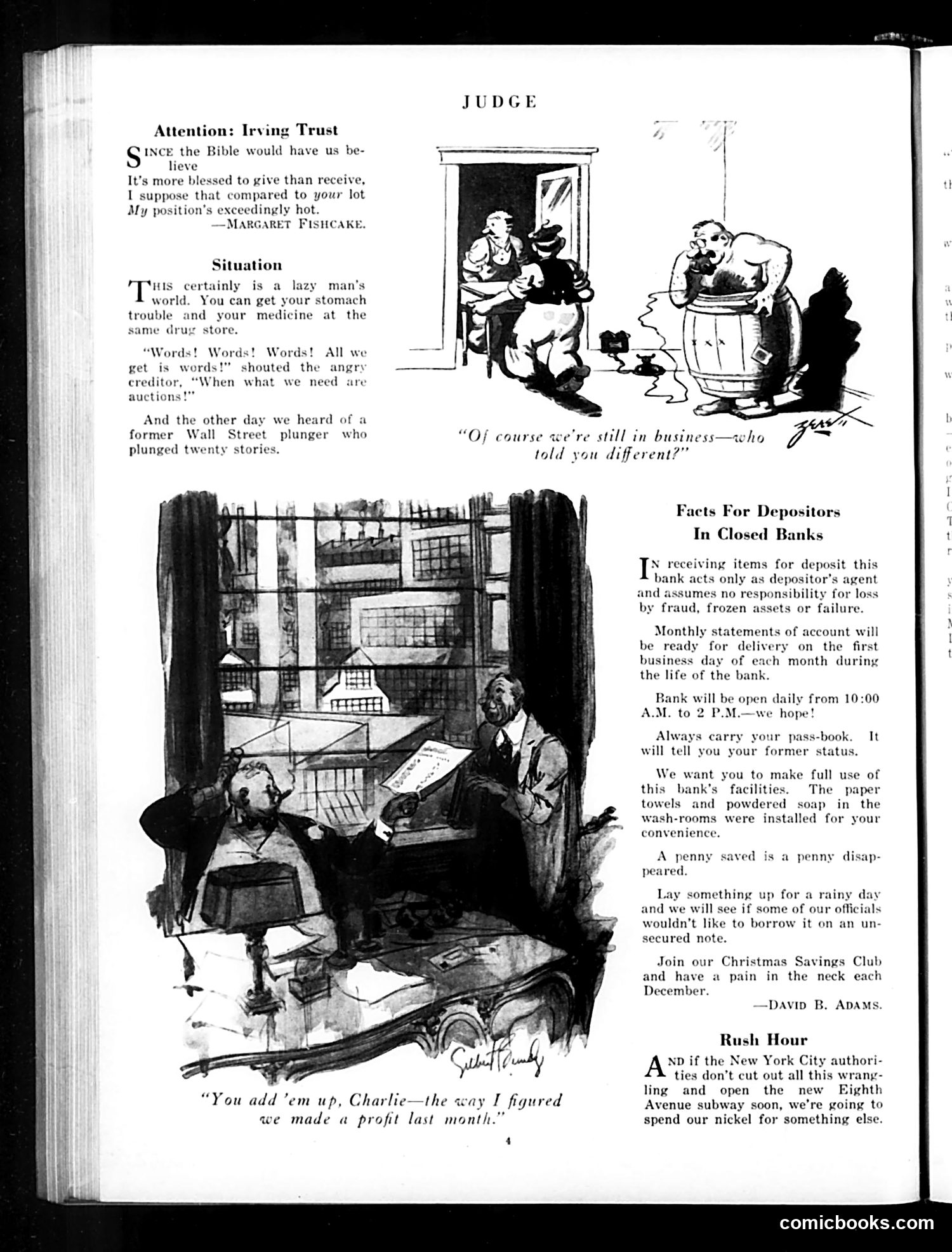
Analysis of Judge Magazine Page This page contains two separate cartoons satirizing early 20th-century American life: Top cartoon: Shows a businessman confronting what appears to be a banker or financial advisor about ongoing business operations. The caption "Of course we're still in business—who told you different?" suggests satirizing false optimism during economic uncertainty, possibly related to bank failures or financial instability of the era. Bottom cartoon: Depicts accountants or clerks calculating profits, with the caption "You add 'em up, Charlie—the way I figured we made a profit last month." This mocks creative accounting practices—manipulating numbers to show false profitability, a recurring target of Judge's financial satire. The right column contains practical banking advice for depositors during economically unstable times, suggesting this issue addressed financial concerns relevant to its contemporary readers.
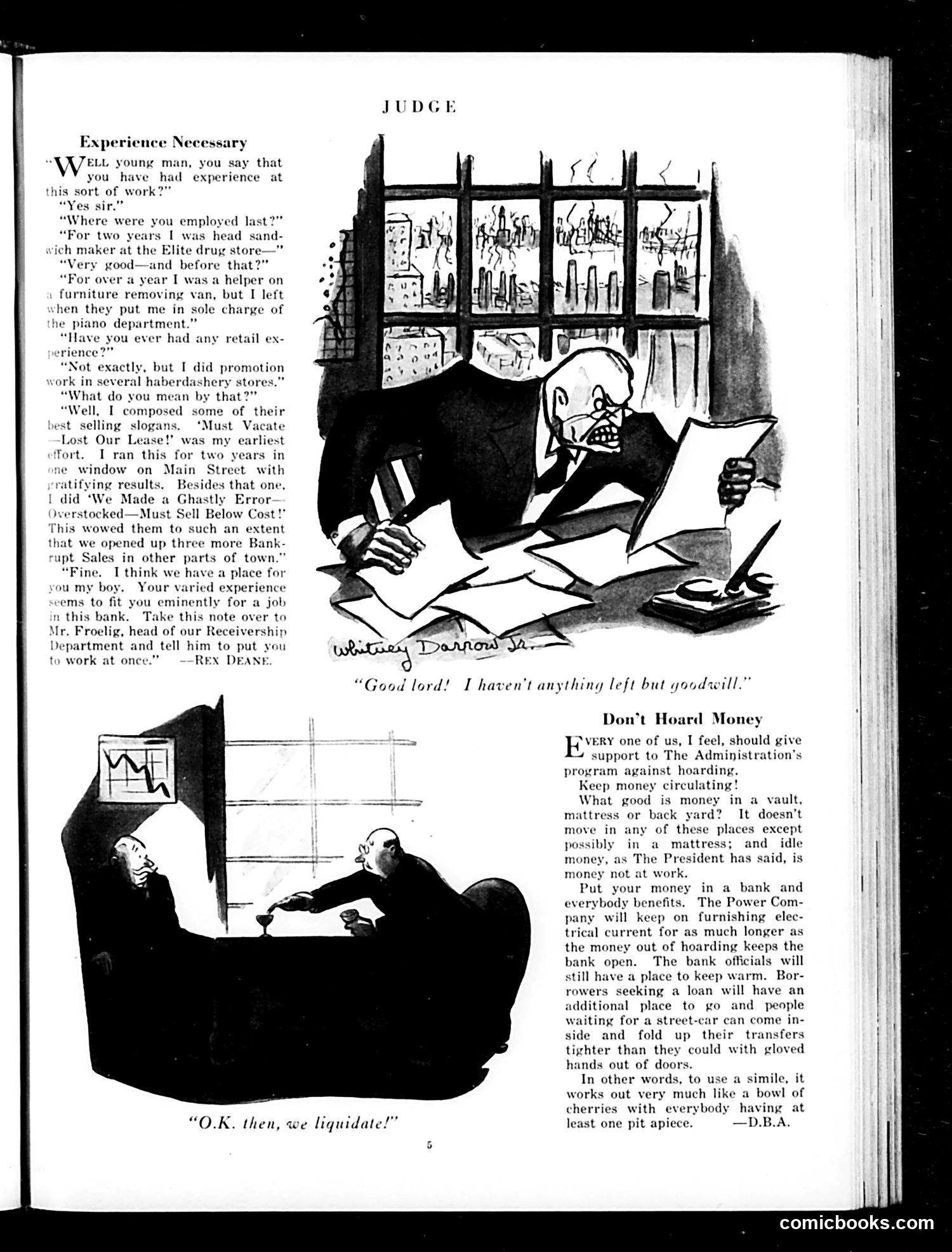
Page Analysis: Judge Magazine This page contains two distinct cartoons and articles from Judge magazine addressing Depression-era economic concerns. "Experience Necessary" (top): A satirical interview where a young job applicant claims experience at various retail positions, but admits he actually composed store slogans and window displays. The hiring manager (appears to be a bank official) recognizes his varied experience as suitable for banking work. The joke mocks both the applicant's inflated claims and how retail promotion skills translate oddly into banking. "Don't Hoard Money" (bottom): Text argues citizens should deposit money in banks rather than hoarding it at home. The accompanying cartoon shows two figures discussing liquidation, likely satirizing bank failures or financial instability of the era. The piece advocates for public support of banking institutions and economic circulation during Depression uncertainty.
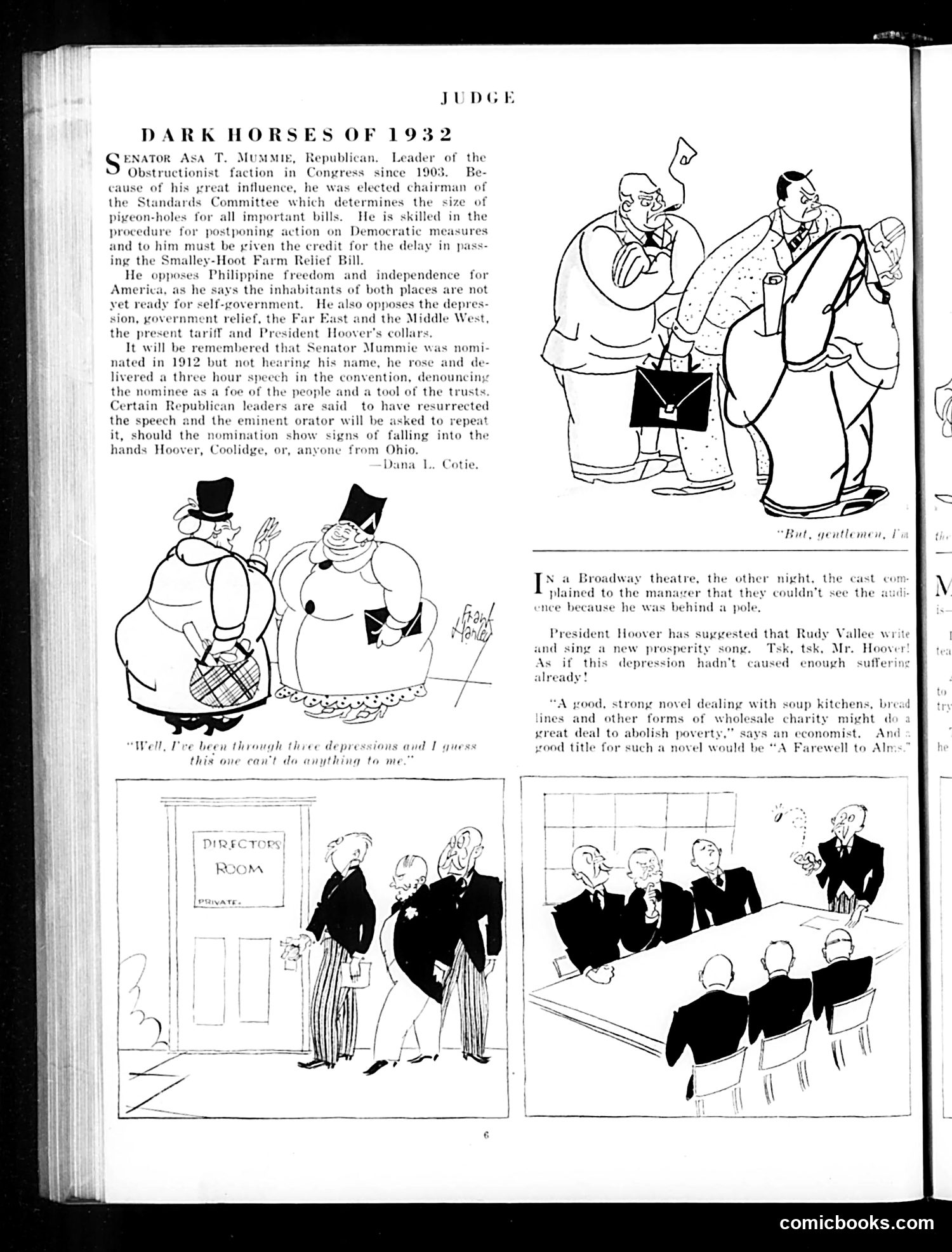
Judge Magazine - "Dark Horses of 1932" This page satirizes Senator Asa G. Jimmie (Republican), depicted as an obstructionist who delayed Democratic measures and opposed the Smalley-Hoof Farm Relief Bill. The cartoons mock him as a political "dark horse"—an unexpected or undesirable candidate. The top cartoon shows figures labeled as potential alternatives (possibly Hoover, Coolidge, or Ohio politicians), with the caption "But, gentlemen, I—" suggesting reluctant nomination. The middle cartoon presents two heavy-set men claiming depression endurance: "Well, I've been through three depressions and I guess this one can't do anything to me." The bottom panels depict boardroom and directorial scenes, likely illustrating corporate or political maneuvering during the 1932 election cycle. The overall message criticizes Republican obstruction during economic hardship.
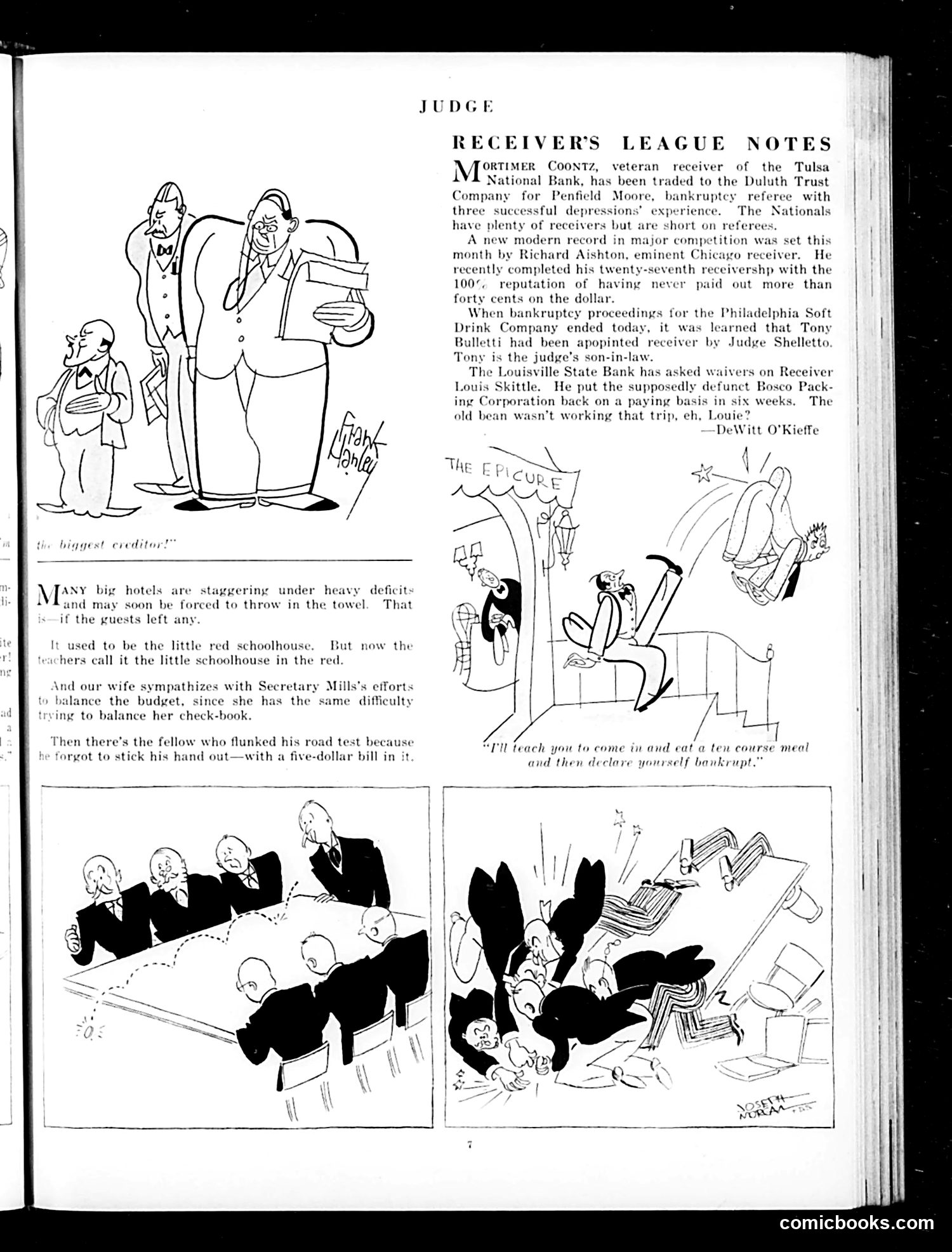
Judge Magazine Satire: "Receiver's League Notes" This page satirizes the proliferation of bankruptcy receivers during the Great Depression. The article treats bankruptcy receiverships like a sports league, with receivers being "traded" between banks and tracked for their records—humorously noting one receiver who "never paid out more than forty cents on the dollar." The satire targets: 1. Nepotism and corruption: A judge appointing his son-in-law as receiver 2. Systemic dysfunction: Hotels and institutions collapsing; even the schoolhouse metaphor shifts from "little red schoolhouse" to "schoolhouse in the red" (financially bankrupt) 3. Widespread financial crisis: The casual treatment of constant bankruptcies as routine The cartoon panels (bottom) appear to show chaotic boardroom scenes, likely depicting the bedlam of bankruptcy proceedings. The overall message critiques how normalized financial collapse had become—so endemic that it's treated as entertainment rather than tragedy. This reflects Depression-era anxieties about institutional failure and corruption among those managing financial collapse.
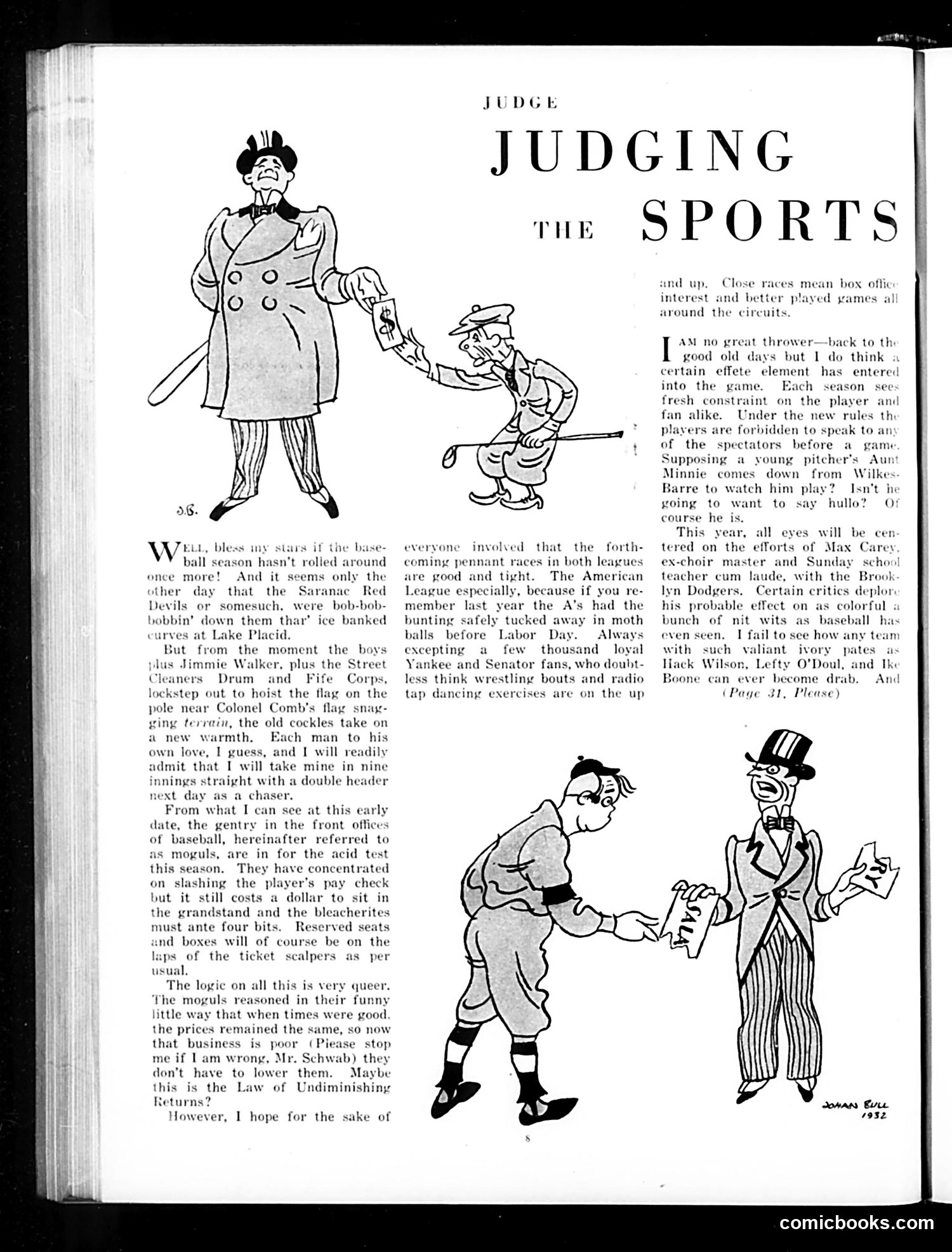
"Judging the Sports" — Judge Magazine This is a satirical column about baseball, likely from the 1920s or early 1930s (based on references to Max Carey and the Brooklyn Dodgers). The author critiques new rules restricting player-fan interaction as overly "effete" and unnecessarily constraining the game's natural warmth and character. The main targets of satire are: 1. Baseball "moguls" (executives): Their illogical pricing strategy—keeping ticket prices unchanged during prosperous times, then refusing to lower them during economic hardship ("Please stop me if I am wrong, Mr. Schwab"). 2. New restrictive rules that forbid players from greeting fans, exemplified by the absurd hypothetical of a pitcher unable to say hello to his visiting aunt. The cartoons illustrate the tension between authority figures (judges/officials) and players. The author celebrates colorful players like Hack Wilson and Lefty O'Doul, fearing regulations will eliminate baseball's personality and charm.
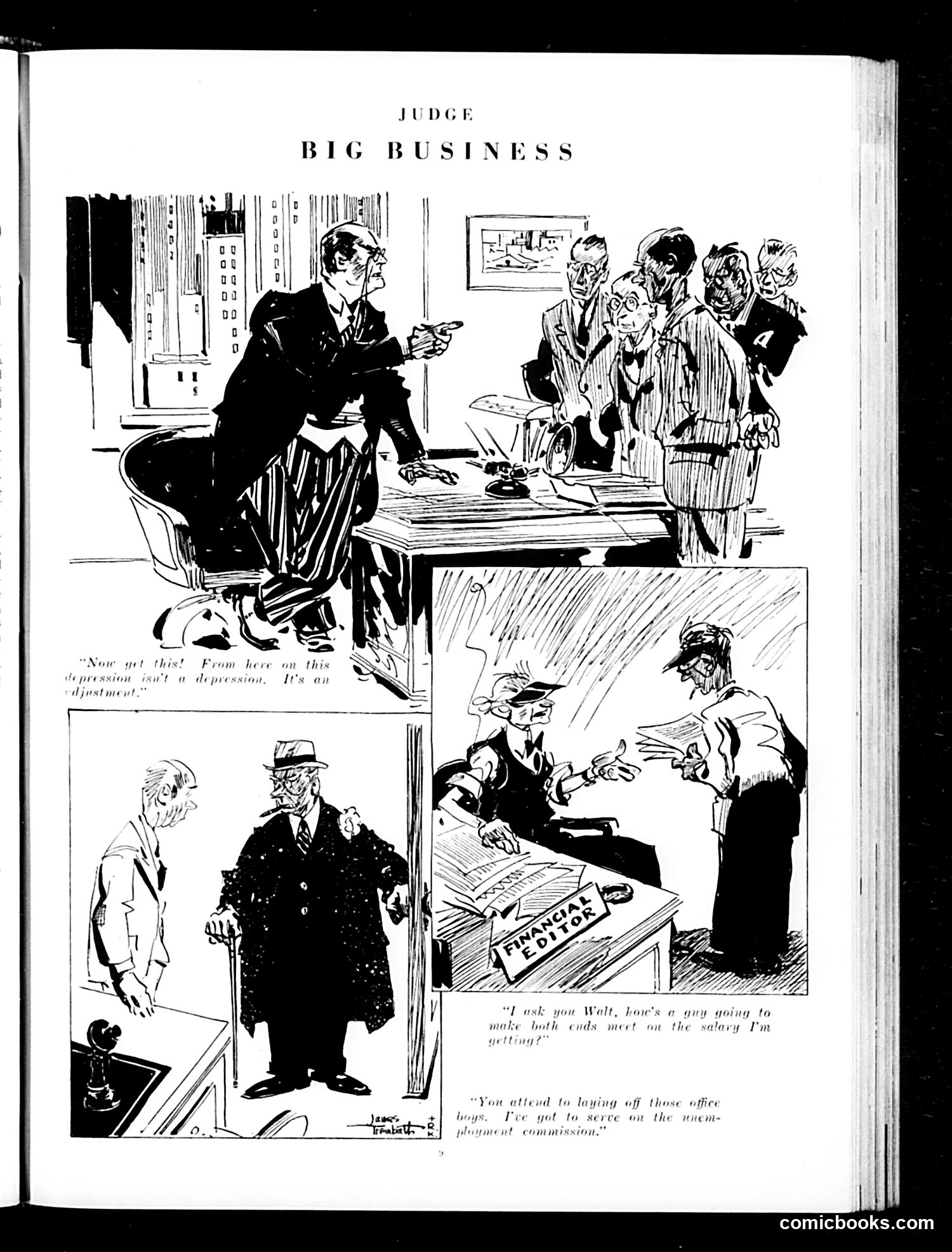
"Judge: Big Business" - Political Cartoon Analysis This satirical page critiques corporate management during an economic depression. The top panel shows a judge or authority figure addressing businessmen, declaring "From here on this depression isn't a depression. It's an adjustment"—mocking how executives use euphemistic language to downplay economic hardship. The lower panels depict workplace friction: one shows two men in conflict (one appears to be a worker or employee), while another depicts a tense salary negotiation where someone asks how two workers will "make both ends meet on the salary I'm getting?" The final caption references "laying off office boys" and serving notice on "the unemployment commission"—satirizing how big business shifts economic burden onto workers and government during downturns, while using semantics to reframe crises as mere "adjustments."
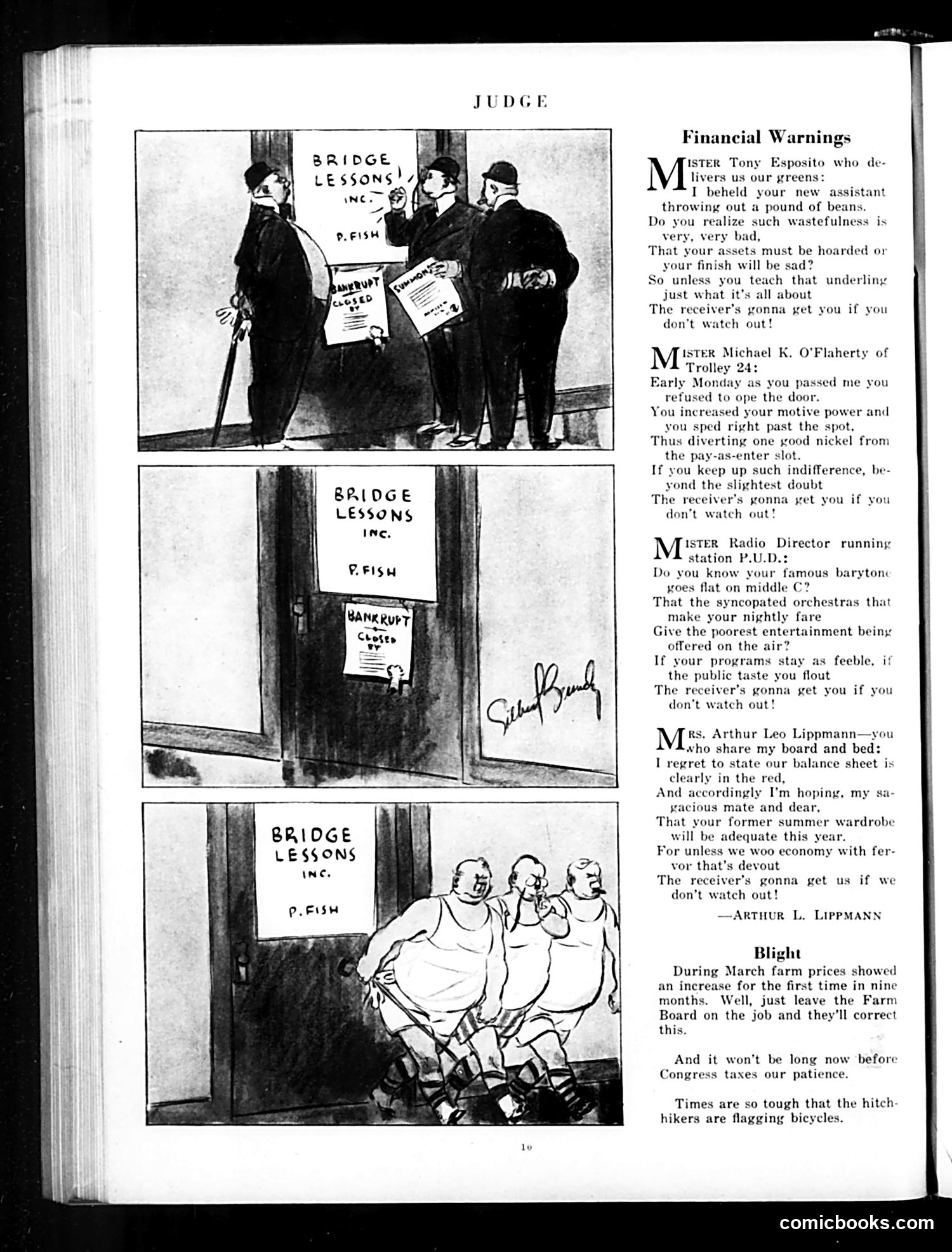
"Financial Warnings" — Judge Magazine Cartoon Analysis This page presents three-panel satirical comics by P. Fish mocking a business called "Bridge Lessons Inc." The cartoons employ the recurring threat "The receiver's gonna get you if you don't watch out!"—a parody of the children's poem "Santa Claus Is Coming to Town." Each panel targets different targets of financial mismanagement during what appears to be the Great Depression era: 1. Panel 1: Business associates wasting resources (throwing out beans) 2. Panel 2: A trolley operator (Michael K. O'Flaherty) refusing passengers to avoid paying the receiver, diverting fare revenue 3. Panel 3: Overweight men representing failed entertainment/management The satire warns that financial irresponsibility invites bankruptcy receivers to seize assets. The accompanying "Blight" section includes economic commentary: mocking the Farm Board's ineffectiveness and joking that economic desperation has reduced hitchhikers to flagging bicycles instead of cars. The humor relies on Depression-era anxiety about business failure and receivership.
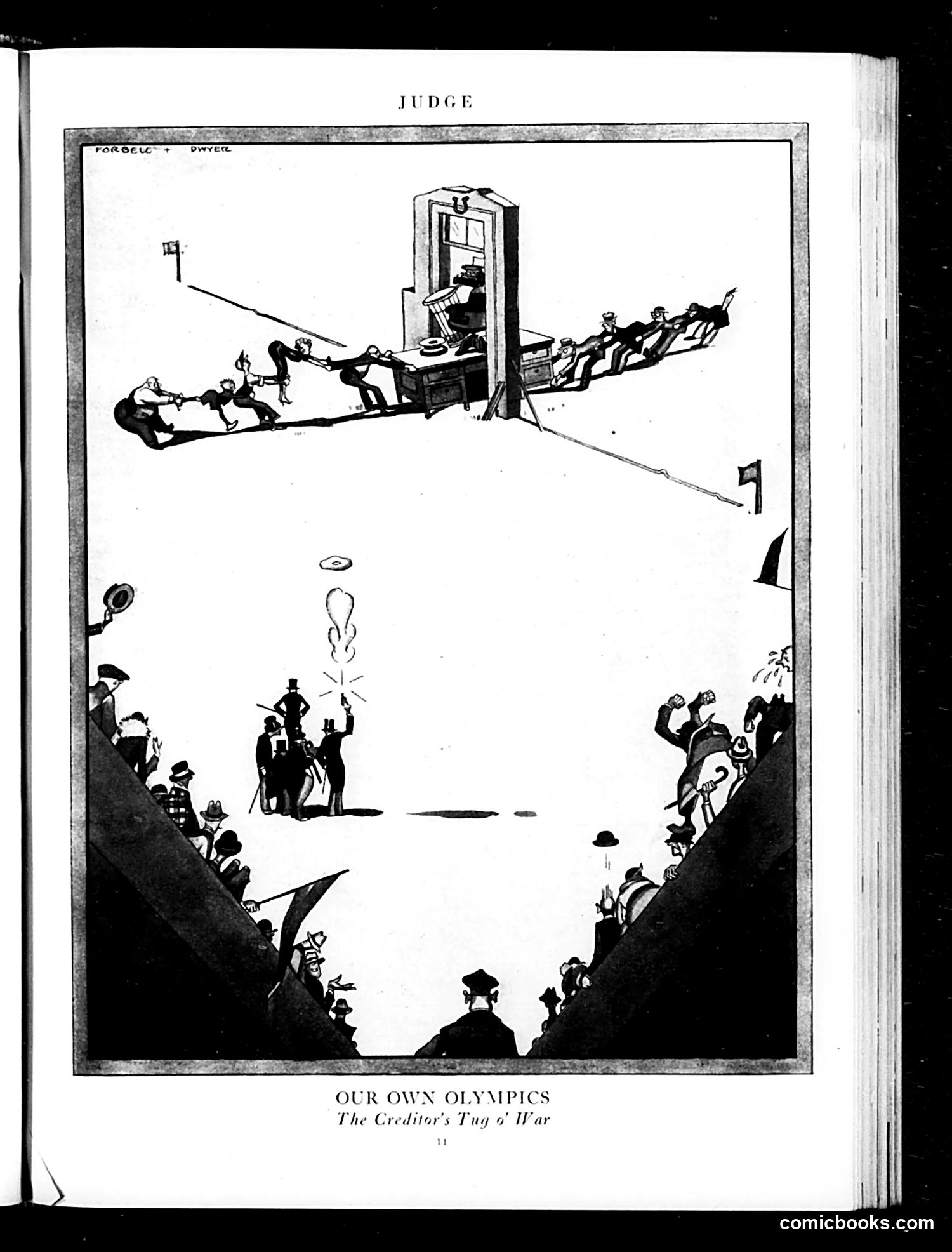
Analysis of "Our Own Olympics: The Creditor's Tug o' War" This cartoon satirizes financial struggles during an economic crisis (likely early 20th century). The central image depicts a tug-of-war between two groups of creditors pulling at a debtor/defendant in the middle, while judges and officials oversee from an elevated platform—suggesting the legal system's role in debt collection. The title's reference to "Olympics" sarcastically frames creditor collection as a competitive sport. Spectators line the pit's sides, watching the spectacle of financial ruin as entertainment. The imagery critiques how debtors are publicly humiliated and torn apart by competing financial interests while courts and authority figures passively observe or profit from the proceedings. The "Tug o' War" metaphor emphasizes the debtor's helplessness against powerful financial forces.
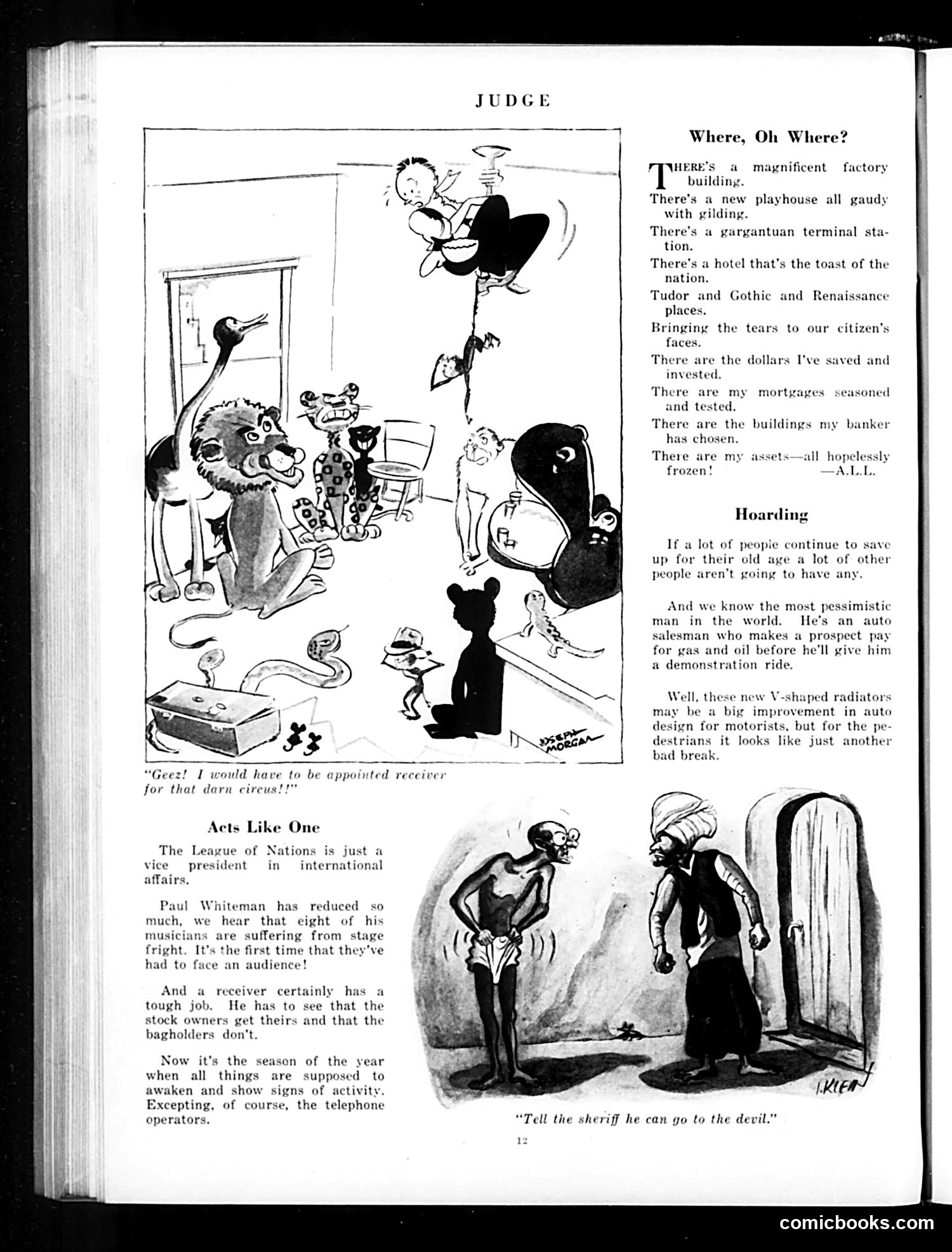
Judge Magazine Page Analysis This page satirizes economic anxiety during what appears to be the 1920s Depression era. The main cartoon depicts a circus of anthropomorphic animals—likely representing different economic classes or creditors—surrounding a bewildered human figure. The caption suggests he's being appointed "receiver" (a legal term for managing bankrupt assets), satirizing the chaos of financial receivership. The poem "Where, Oh Where?" mocks those who've invested their life savings in now-worthless assets (factories, hotels, buildings)—their dollars are "hopelessly frozen," unable to access them. "Hoarding" criticizes both wealthy savers and pessimistic businessmen (the car salesman example) who hoard resources rather than spend, worsening economic stagnation. "Acts Like One" takes shots at the League of Nations as ineffectual, Paul Whiteman's weight loss, and financial receivers managing bankruptcies. The bottom cartoon's punchline about telling "the sheriff he can go to the devil" reflects Depression-era frustration with authorities unable to help ordinary people.
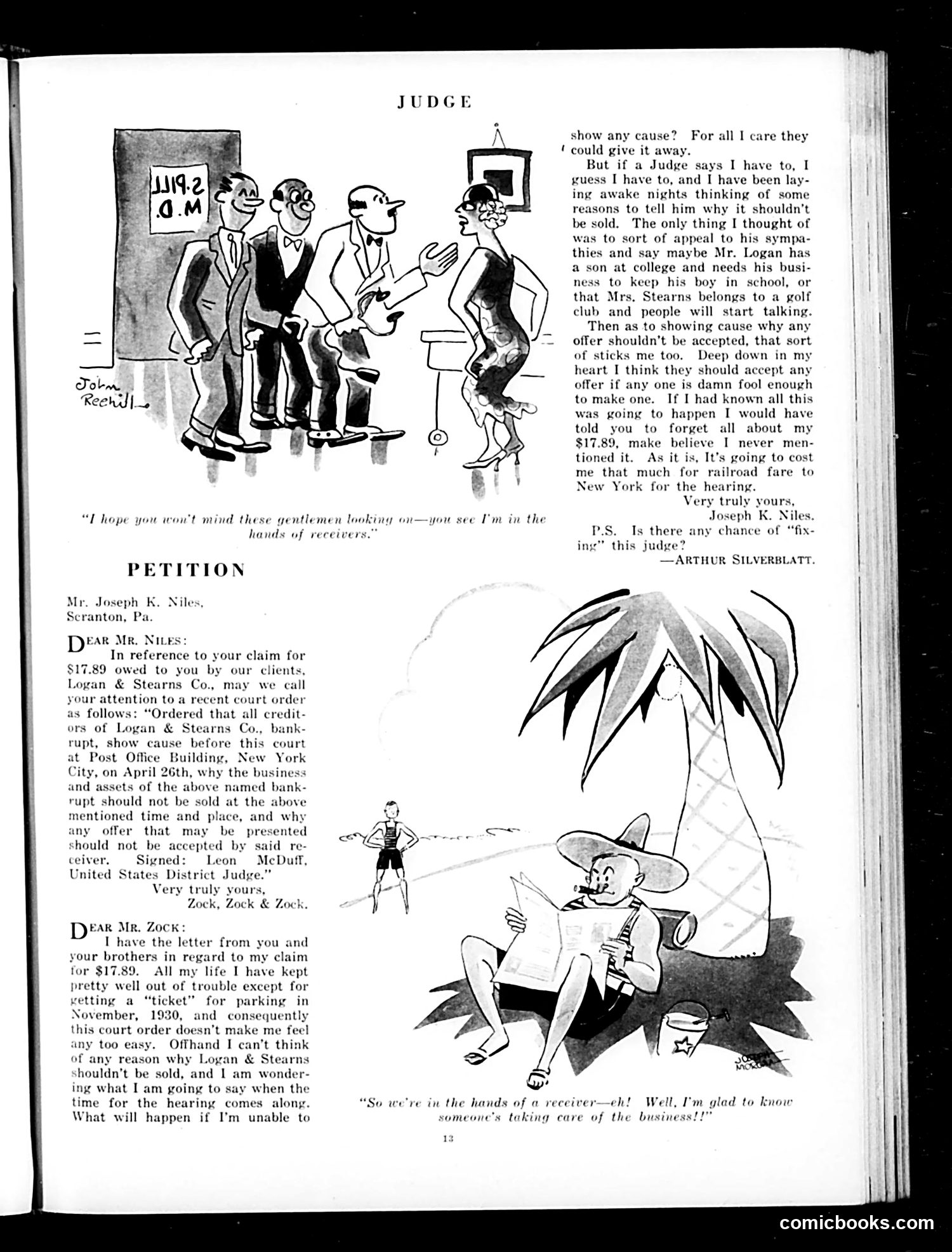
Explanation for Modern Readers This page satirizes bankruptcy proceedings and the frustration of small creditors caught in legal machinery. Joseph K. Niles is owed just $17.89 by the bankrupt Logan & Stearns Co., but must now travel to New York and appear before a judge to explain why the company's assets shouldn't be sold—a trivial debt creating massive bureaucratic burden. The cartoon's humor lies in Niles's bewilderment: he doesn't actually *oppose* the sale (he'd prefer to forget the debt entirely), yet must manufacture legal arguments to justify his presence. The captions mock the absurdity of formal receivership procedures drowning small debtors in red tape and travel costs for pennies owed. The bottom cartoon shows Niles in a "receiver's" hands—literally a figure controlling the outcome. His postscript asking if he can "fix" the judge adds cynical commentary on whether the legal system can be influenced. The satire targets bureaucratic excess and how formal legal processes disproportionately burden ordinary people with minor claims.
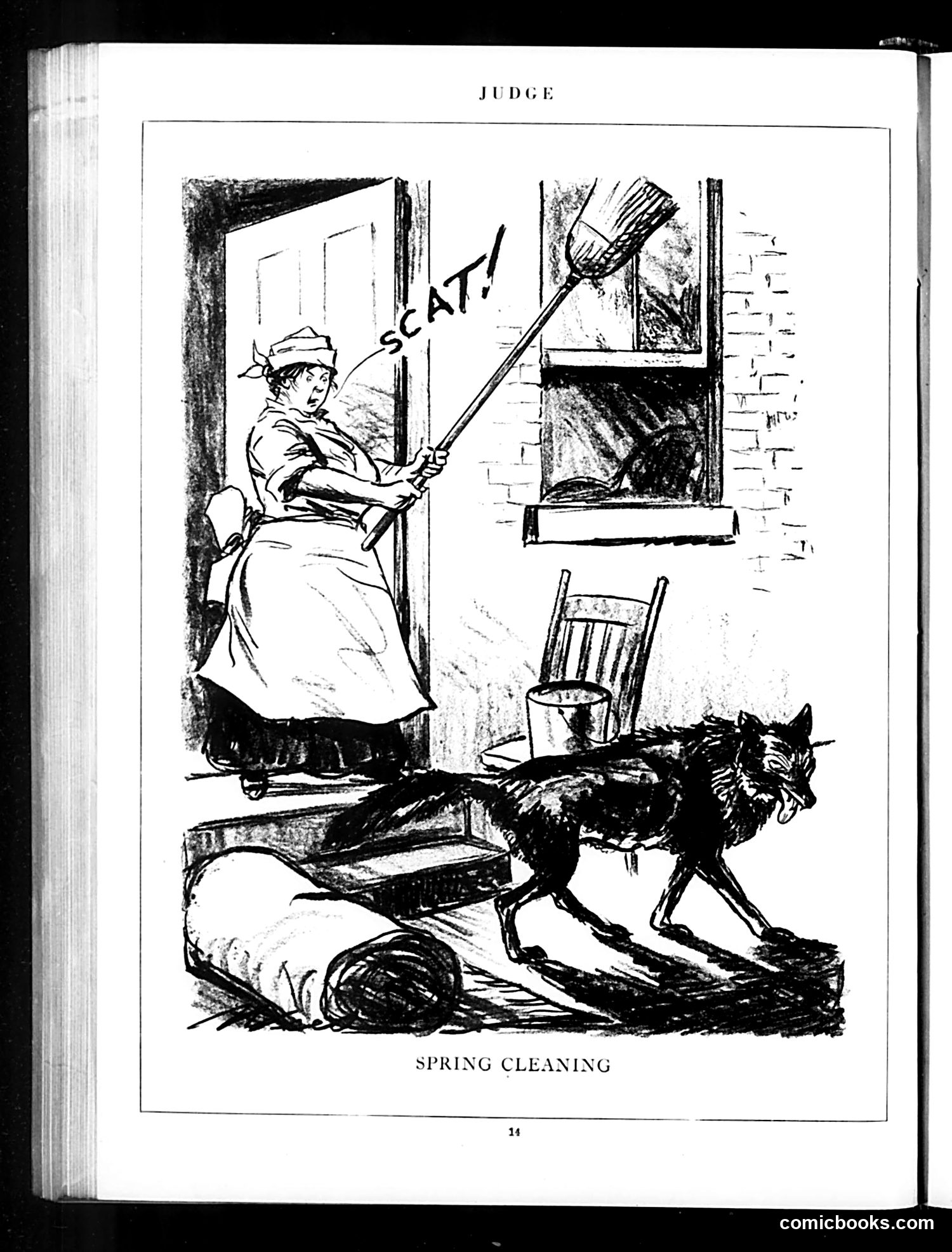
"Spring Cleaning" from Judge Magazine This cartoon satirizes spring cleaning through domestic chaos. A woman wielding a broom chases a cat out a window, shouting "SCAT!" while engaged in vigorous housecleaning. The scene depicts overturned furniture, a knocked-over chair, and general disorder—visual gags emphasizing how spring cleaning disrupts a household. The humor lies in portraying spring cleaning as violent, destructive activity rather than orderly tidying. The unfortunate cat serves as an unwitting casualty of the woman's aggressive cleaning campaign. This reflects period attitudes about domestic labor: spring cleaning was an intense, exhausting seasonal ritual that turned homes upside-down, humorously presented here as borderline warfare against household inhabitants and pets alike.
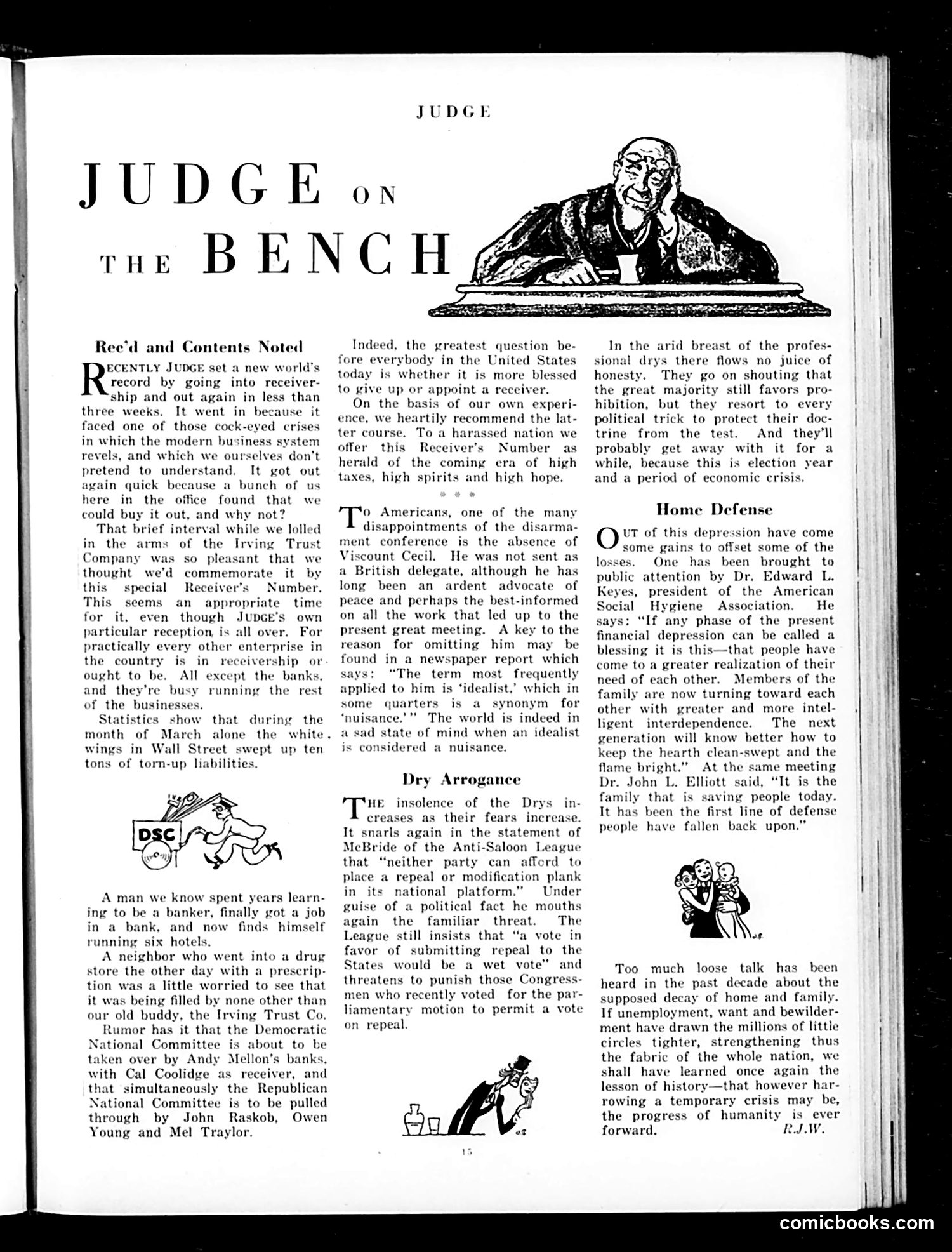
"Judge on the Bench" (Judge Magazine Satire Page) This page satirizes America's financial and political chaos during the Great Depression era. The masthead cartoon shows a judge on the bench—representing Judge magazine itself, which humorously went into receivership and back out within three weeks, a metaphor for the economic instability plaguing the nation. The text mocks how receivership has become so commonplace that banks now manage everything (hotels, drug stores, political committees). It references figures like Andy Mellon and Cal Coolidge, suggesting even Democratic and Republican parties face takeover by financial interests. The page also attacks Prohibition advocates ("the Drys"), particularly the Anti-Saloon League's McBride, for using political strongarming to prevent repeal votes despite claimed majority support. The satire suggests idealists like Viscount Cecil are dismissed as "nuisances" while hardline politicians gain power through crisis.
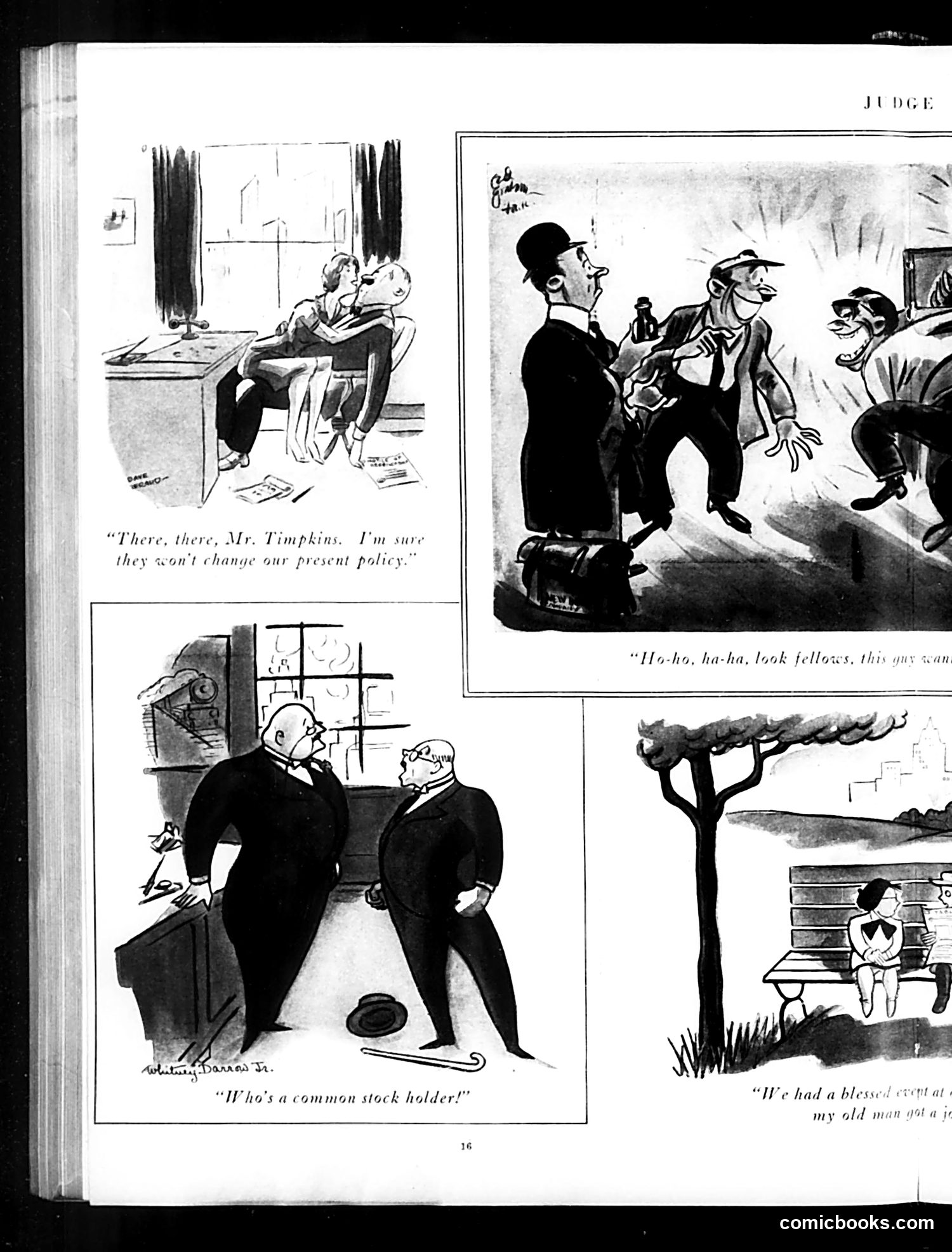
Judge Magazine Cartoon Analysis This page contains three satirical cartoons, likely from the early 20th century: 1. Top left: A businessman (Mr. Timpkins) receives reassurance about company policy—likely mocking corporate executives' blind confidence during uncertain times. 2. Middle left: Two men discussing "a common stock holder"—appears to satirize class divisions and how wealthy investors view ordinary shareholders, or possibly mocking someone's pretensions to wealth. 3. Right panels: Street scenes with working-class figures and dialogue about "blessed events" and an old man—unclear without complete captions, but likely commenting on ordinary people's struggles or social conditions. The overall tone suggests satire of business practices, class relations, and economic disparities typical of Judge's political commentary. The specific historical context and targeted figures remain unclear from visible text alone.
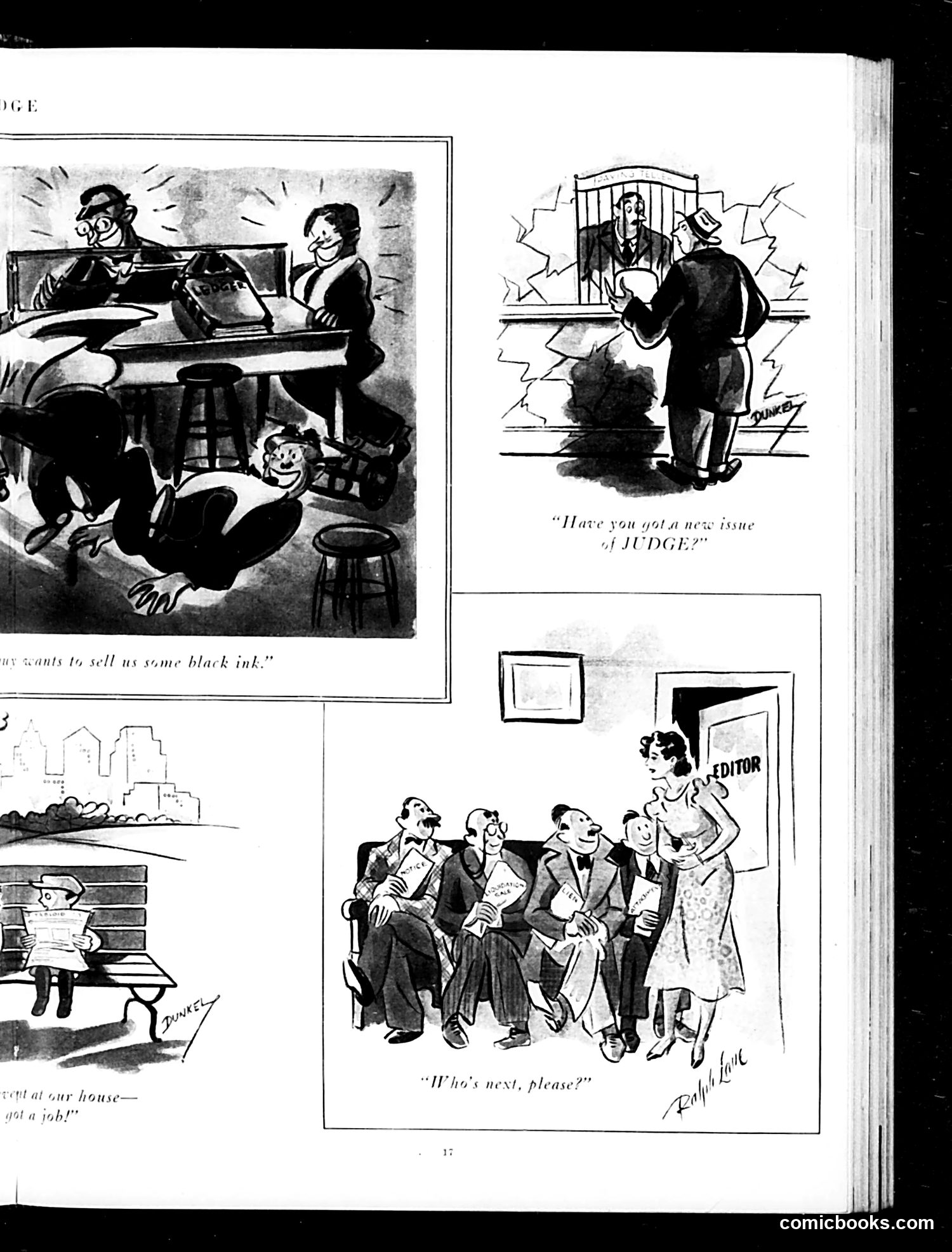
Judge Magazine Page Analysis This page contains four separate satirical cartoons from Judge magazine, a prominent American humor publication. The visible captions reference: 1. Top left: A domestic scene where someone "wants to sell us some black ink" — likely satirizing a salesman or business pitch. 2. Top right: A judge or authority figure with caption "Have you got a new issue of JUDGE?" — self-referential humor about the magazine itself. 3. Bottom left: A figure reading a newspaper on a bench, with partial text about "our house — got a job!" 4. Bottom right: An editor's office scene captioned "Who's next, please?" — depicting multiple job applicants or petitioners waiting to see an editor. The cartoons collectively satirize early 20th-century workplace dynamics, bureaucratic absurdities, and domestic economic concerns, though specific historical context for individual references remains unclear without additional information.
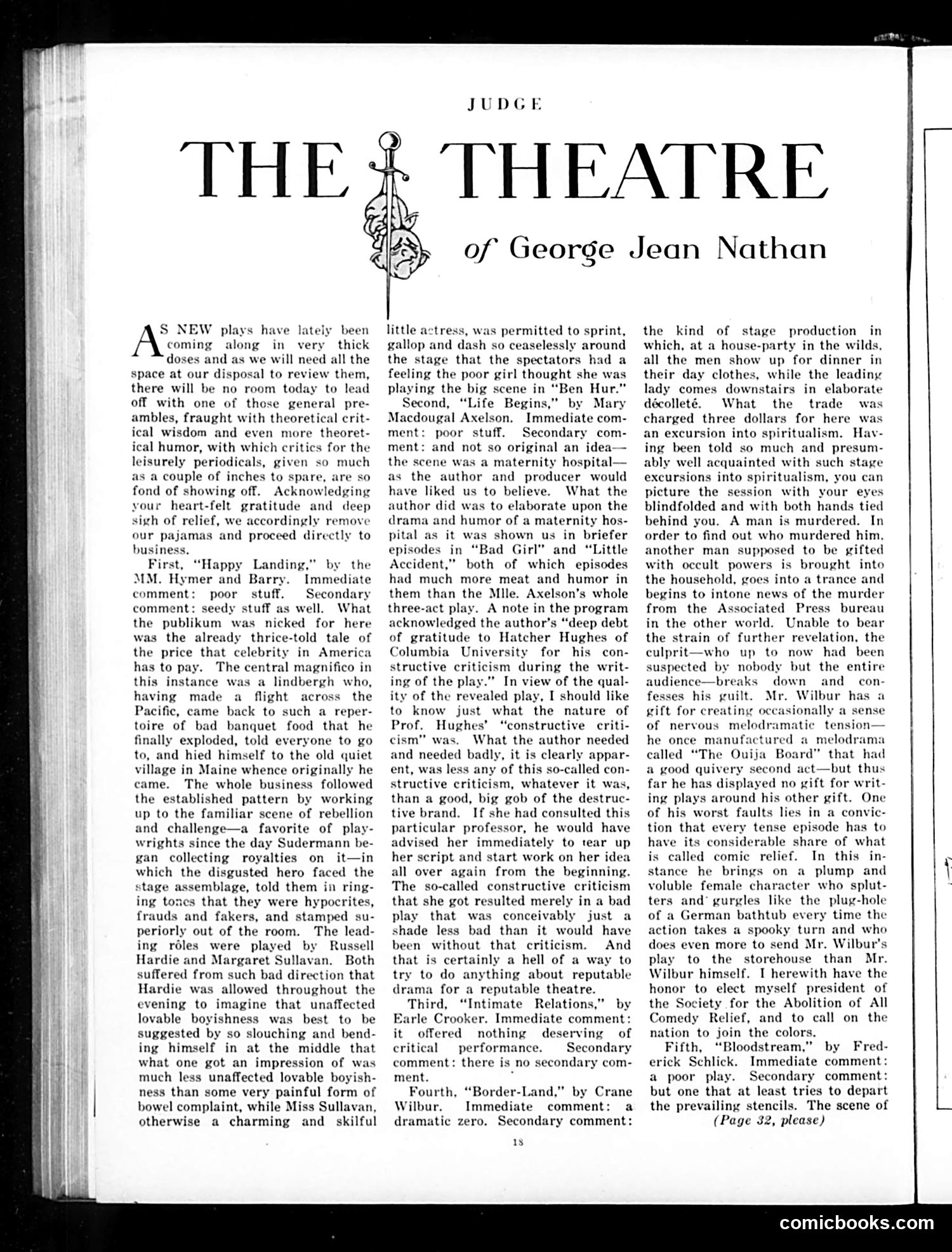
Judge Theatre Review Analysis This is a theatre review column by George Jean Nathan, a prominent drama critic. The page contains NO political cartoons—it's purely text criticism of contemporary Broadway plays. Nathan reviews five recent productions with characteristic acerbic wit. He opens by mocking "Happy Landing," which recycled a Lindbergh-inspired plot about a celebrity fleeing American superficiality to Maine. He criticizes the leads' poor acting choices—Russell Hardie's slouching posture and Margaret Sullavan's excessive running around the stage. "Life Begins," set in a maternity hospital, drew Nathan's ire for plagiarizing better material from earlier films like "Bad Girl." He sarcastically questions Columbia professor Hatcher Hughes' "constructive criticism," implying the play needed *destructive* criticism instead. The reviews continue (text cuts off) with equally dismissive assessments of other plays. Nathan's sardonic tone and theatrical references would resonate with Judge's sophisticated urban readership familiar with Broadway.
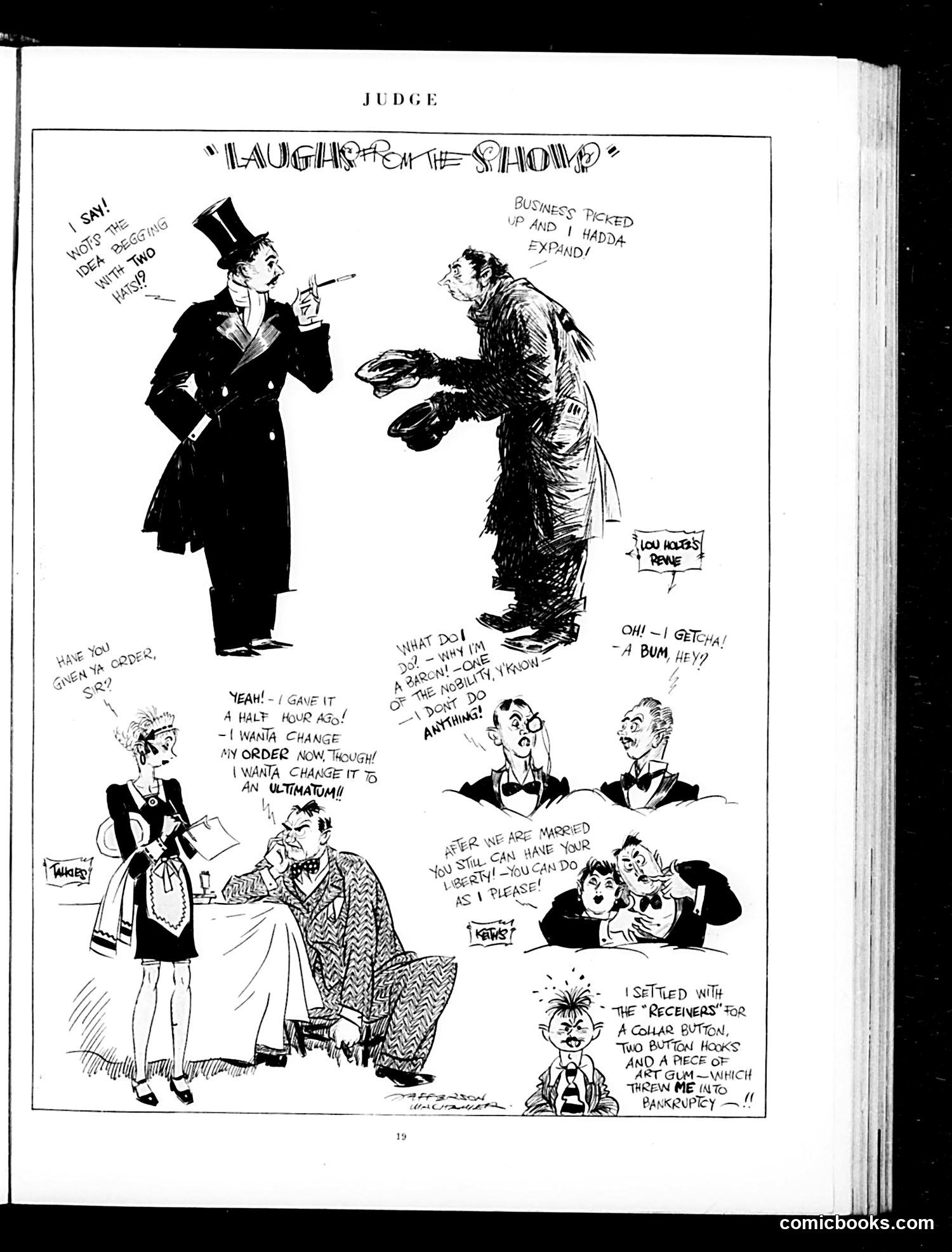
"Laugh at the Show" - Judge Magazine Cartoon This is a multi-panel satirical cartoon about marriage and domestic life. The top panels show an elegant man in a top hat discussing business expansion with a shabby businessman, establishing a contrast between wealth and poverty. The lower panels depict a married couple's argument, with the wife (labeled "HIRED") demanding changes to their marriage arrangement. The husband responds that he's already given her "half an hour" to reconsider, and now wants to change the order to an "ultimatum"—satirizing how quickly marriages devolve into power struggles and negotiation. The final panel shows a man who "settled with the receivers" (bankruptcy court) for a collar button and gum, ending in bankruptcy—a darkly comic punchline about marital discord leading to financial ruin. The cartoon mocks both marriage difficulties and the economic precarity of the era, likely from the early-to-mid 20th century.
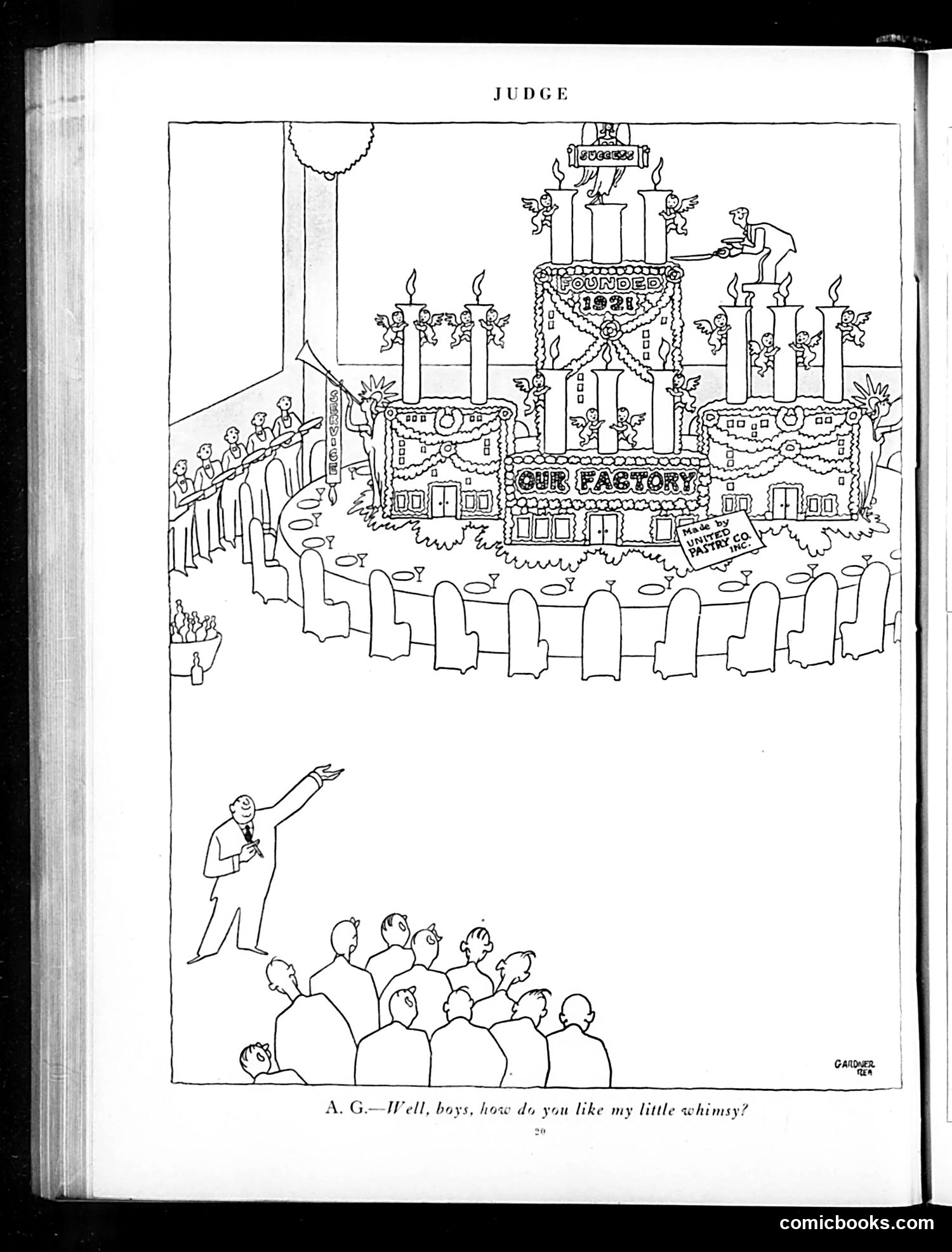
Analysis This single cartoon satirizes what appears to be a political or industrial leader ("A.G.") presenting his accomplishments to an audience. The elaborate, ornate structure labeled "OUR FACTORY" and "FOUNDED" suggests a massive industrial operation—possibly referencing a judge, attorney general, or corporate executive. The joke lies in the contrast: the speaker proudly displays his "little schimpy" (small, meager thing) to the crowd below, who observe the massive, decorated factory. The satire mocks the disproportion between modest actual achievements and grandiose self-promotion or public presentation. Without clearer historical context visible on this page, the specific political target remains unclear, but this represents typical *Judge* magazine fare—mocking inflated claims by those in power during the Gilded Age/Progressive Era.
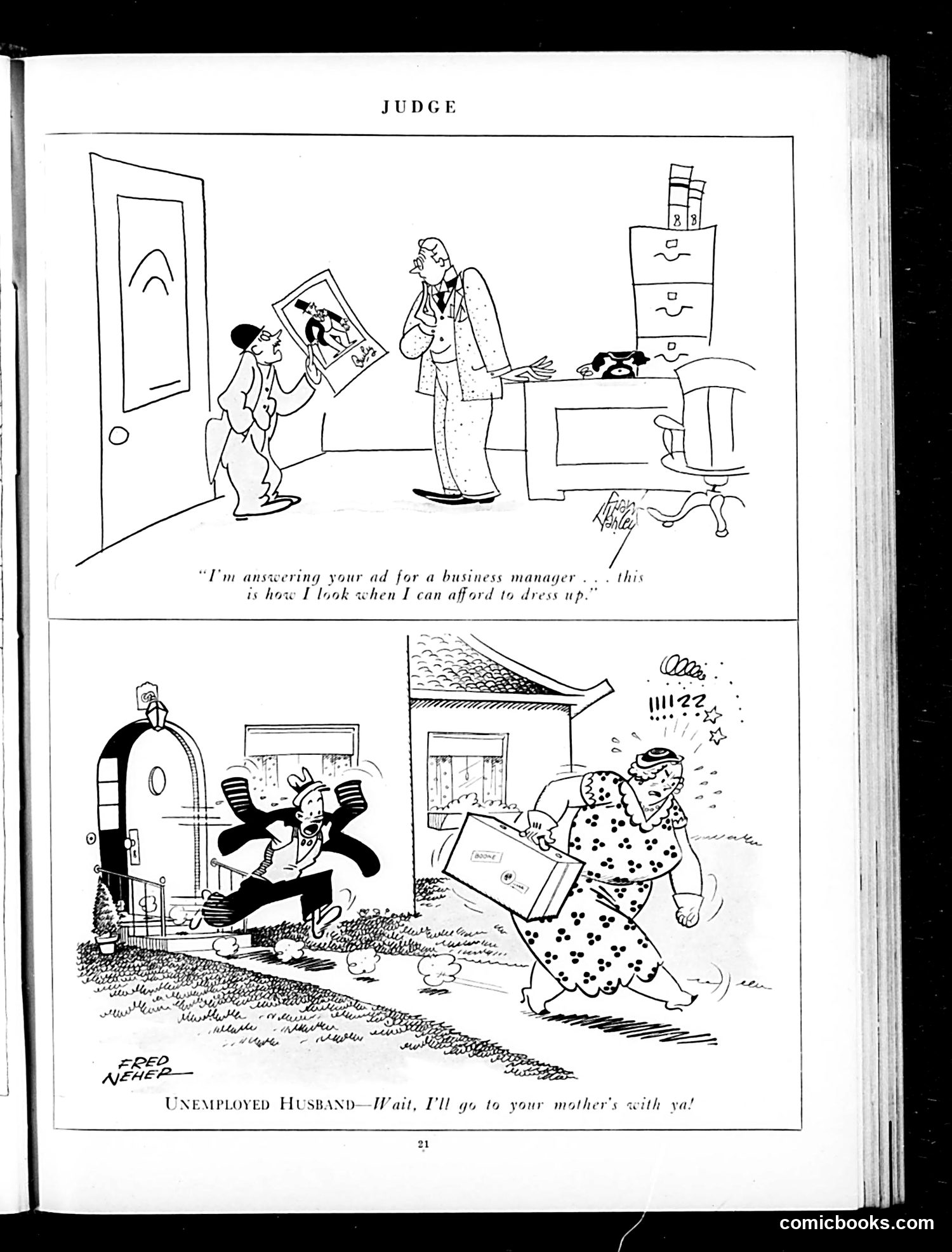
Analysis of Judge Magazine Page This page contains two satirical cartoons about unemployment and economic hardship, likely from the Great Depression era. Top cartoon: A poorly dressed man interviews for a business manager position, showing the judge a photograph of himself in formal attire. The joke satirizes Depression-era desperation—he must admit he can only afford nice clothes for pictures, implying his actual poverty. Bottom cartoon (signed "Fred Neher"): An unemployed husband, facing eviction or his wife's anger, threatens to leave for her mother's house—a common domestic conflict joke. The woman chasing him and the chaotic scene (furniture, boxes scattered) depict marital discord caused by joblessness. Both cartoons use humor to address the social anxiety of male unemployment during economic collapse, when breadwinners lost status and dignity. The satire highlights how economic crisis destabilized traditional family structures and masculinity.
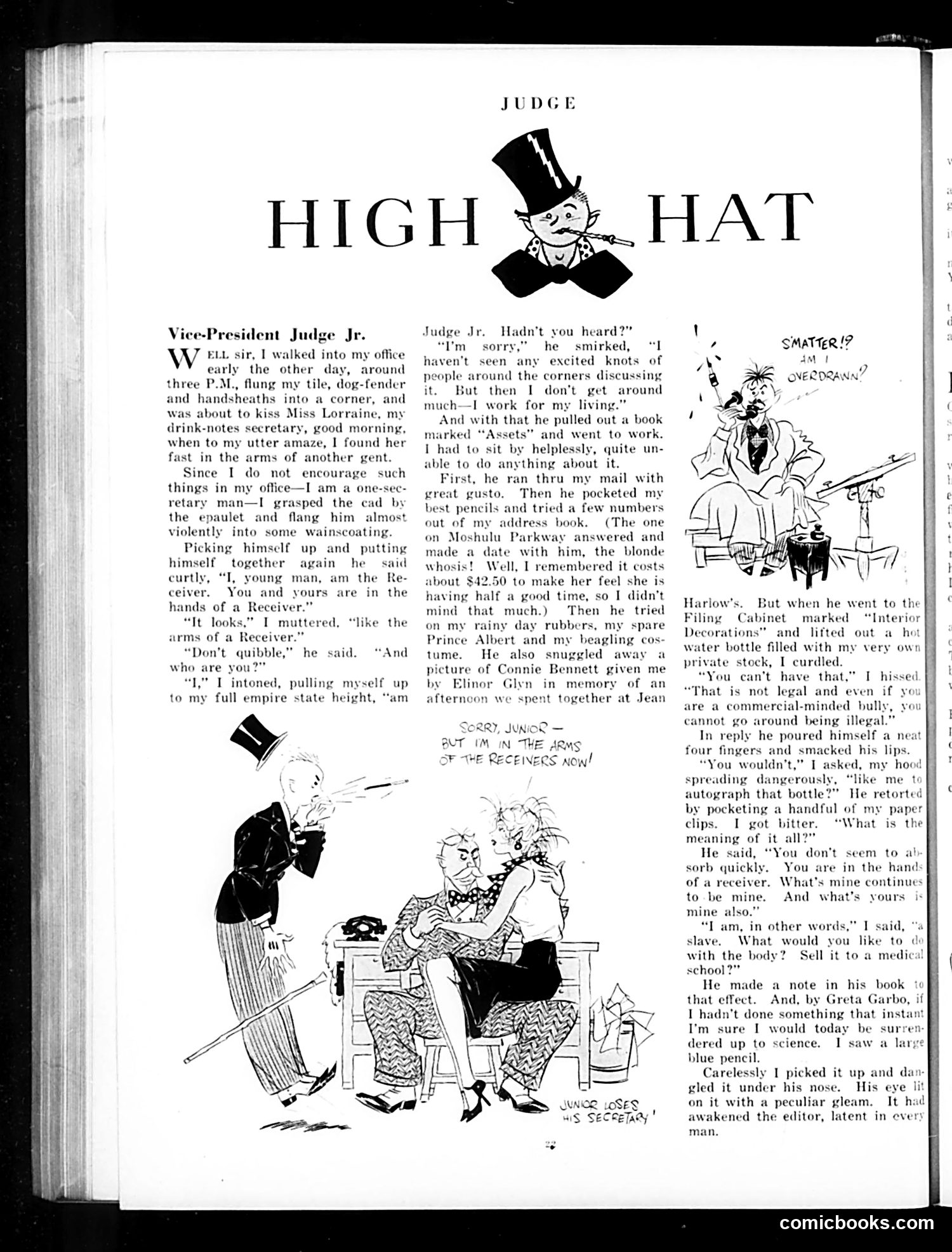
"Judge Jr." - A Satire on Receivership This humorous story satirizes the experience of having a court-appointed receiver take control of one's business or assets during financial troubles. The narrator, "Judge Jr.," discovers a receiver in his office seizing control of everything—literally and figuratively. The satire works through escalating absurdity: the receiver rifles through mail, takes pencils and makes personal phone calls, tries on the narrator's clothing, steals a liqueur bottle and celebrity photos, and claims ownership of all the narrator's possessions. Each violation becomes progressively more invasive and ridiculous. The punchline reveals the receiver's true motivation: when shown a blue pencil, his eyes light up because he's an editor at heart—suggesting editors are inherently acquisitive and controlling, unable to resist claiming things. The joke targets both the financial/legal apparatus of receivership and editorial types, portraying both as petty tyrants who exploit their authority for personal gain.
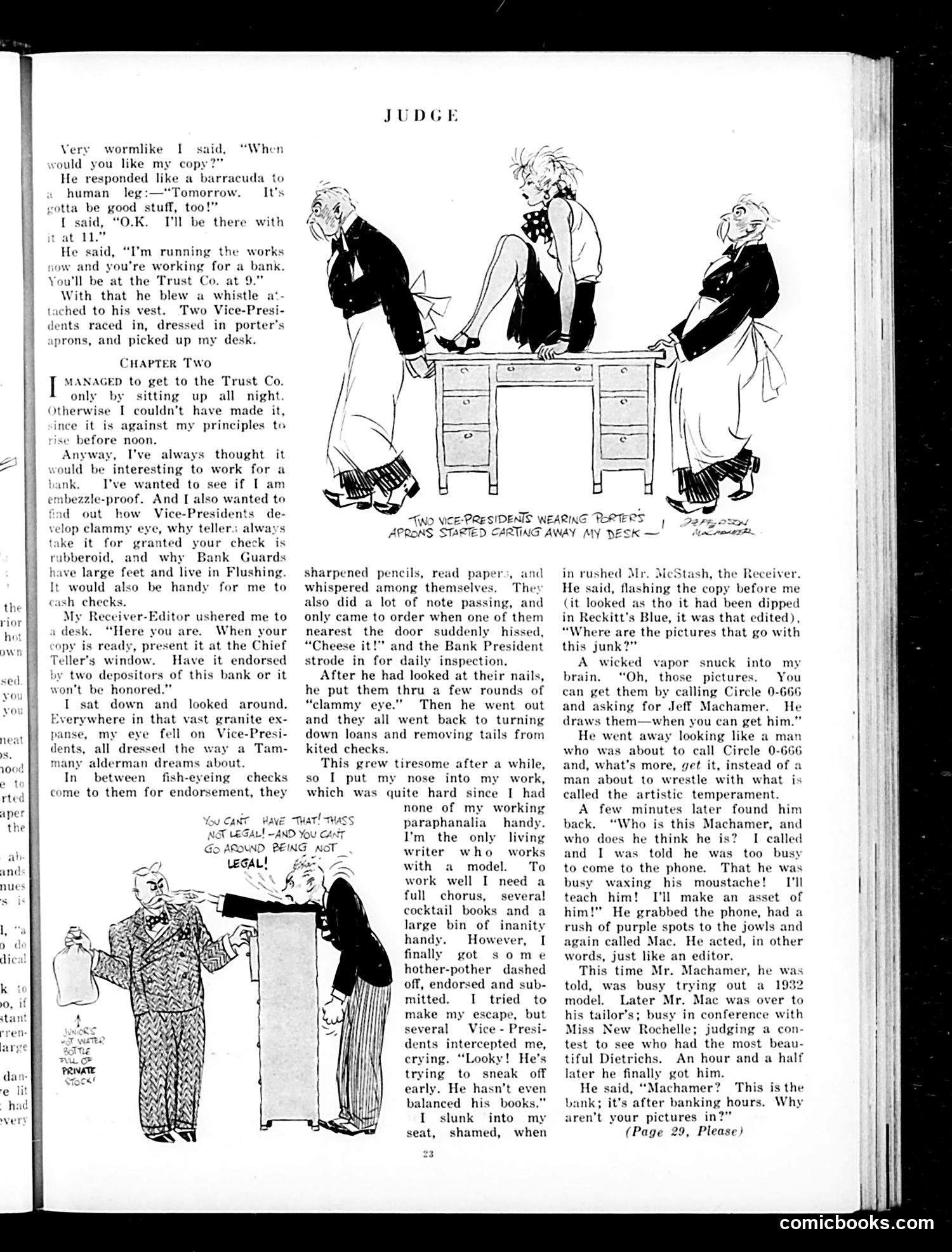
Analysis of Judge Magazine Page This page satirizes banking culture and corporate hierarchy during the early 20th century. The main cartoon depicts two Vice-Presidents wearing porter's aprons carrying away a desk—mocking the absurd pretension of bank executives who perform menial tasks while maintaining their titles and dignity. The narrative describes the author's experience at a Trust Company, ridiculing: - Bank culture: Vice-Presidents engaging in petty activities (fish-eying checks, passing notes) while maintaining stern authority - Bureaucratic absurdity: The "Cheese it!" alarm when the Bank President arrives for inspection—suggesting juvenile fear of authority - Corporate pretense: Executives dressed as porters, the rigid endorsement requirements, emphasis on "clammy eye" (suspicious stares) The secondary cartoon shows someone trying to escape work early, illustrating how banks maintain strict control over employees' time and behavior. The reference to artist Jeff Machamer humorously depicts the clash between artistic temperament and corporate demands—Machamer is "too busy waxing his moustache" to answer the phone, contrasting creative independence with corporate expectations of obedience. Overall, Judge mocks banking's pomposity and dehumanizing hierarchy.
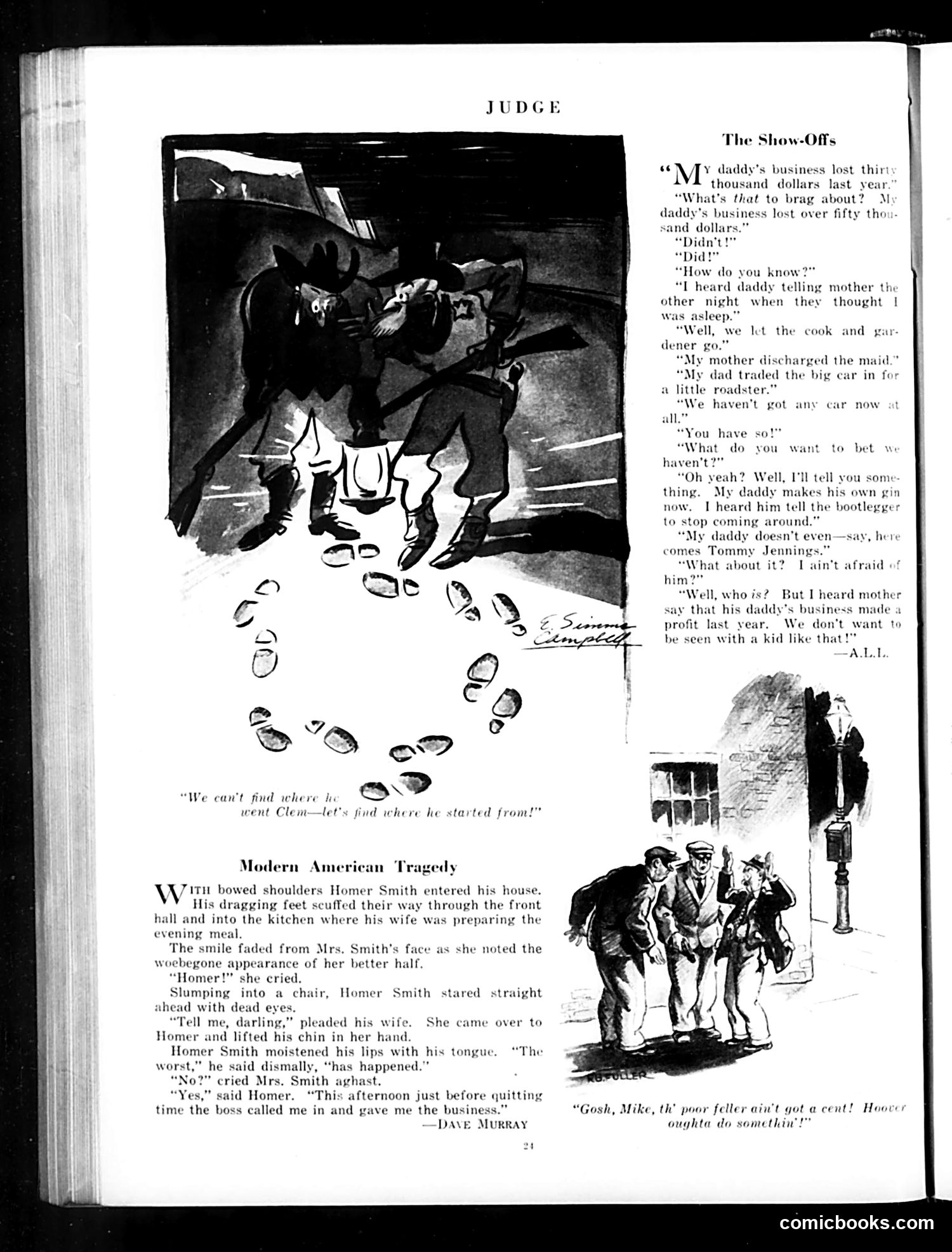
Judge Magazine Page Analysis This page satirizes American materialism and class anxiety during the Prohibition era (indicated by references to homemade gin and bootleggers). "The Show-Offs" depicts children competitively bragging about their families' financial losses—reversing normal status-seeking. The joke mocks parents who openly discuss business failures within earshot of children, who then weaponize this information socially. The punchline reveals the real anxiety: when they learn Tommy Jennings's father actually *profited*, they reject him as socially unacceptable. The satire targets how financial status—whether loss or gain—determines social worth among the wealthy, and how children internalize these shallow values. "Modern American Tragedy" shows Homer Smith arriving home after being fired ("gave me the business"). His wife's distress mirrors the era's economic precarity. The final caption, referencing Hoover (likely President Hoover, associated with Depression-era inaction), suggests working-class suffering amid economic crisis. Together, these pieces critique American class obsession and economic instability of the late 1920s-early 1930s.
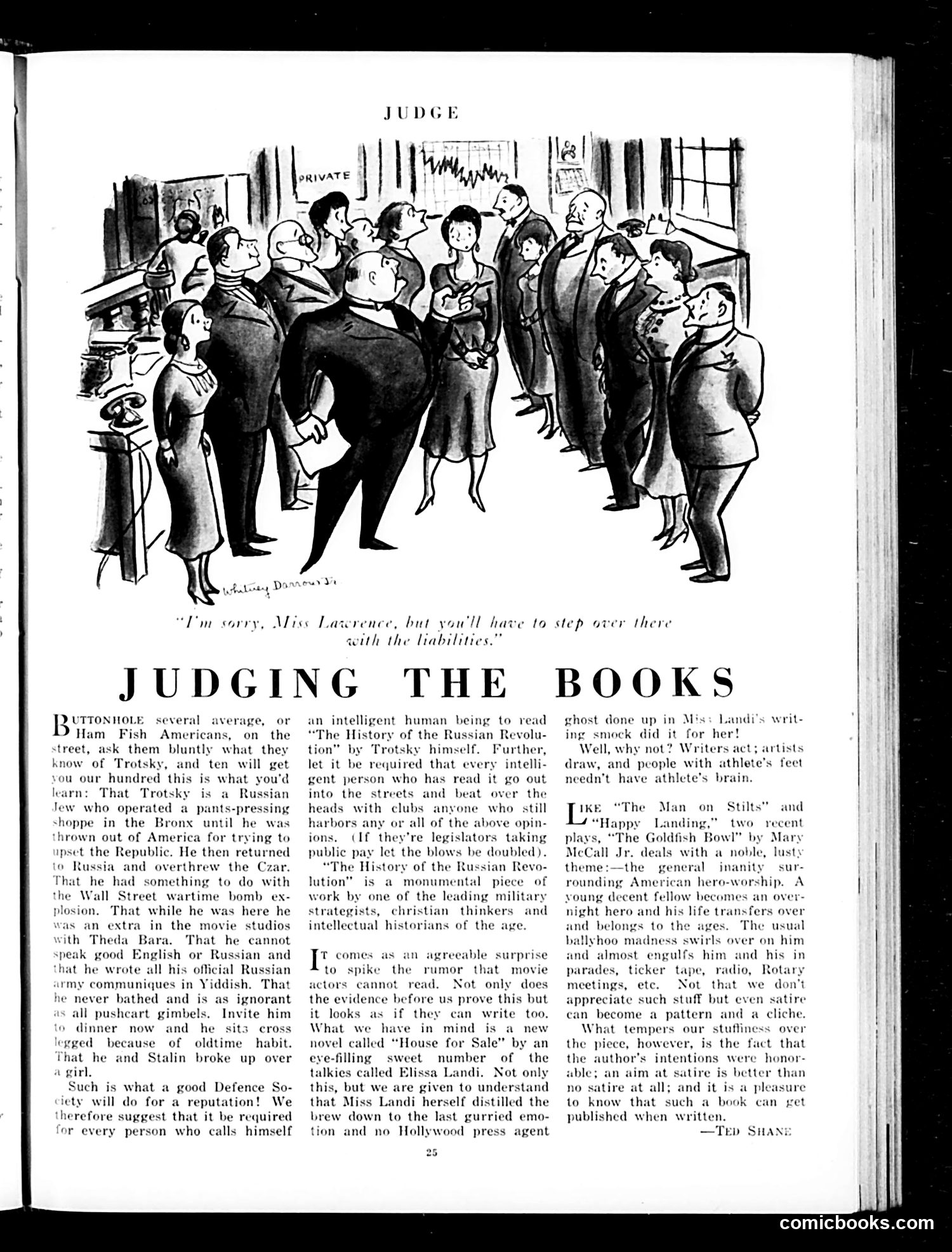
Explaining Judge Magazine's "Judging the Books" This page satirizes American ignorance about Leon Trotsky and praises literary works by actors. The cartoon shows a crowded judge's chamber where people must "step over" liabilities—visual satire about judging without knowledge. The "Buttonhole" section mocks typical Americans' absurd misconceptions about Trotsky (claiming he ran a pants-pressing shop in the Bronx, worked as a film extra with Theda Bara, wrote in Yiddish). The author sarcastically suggests beating these ignorant people with clubs, ridiculing both anti-communist hysteria and public illiteracy about major historical figures. The second section praises actress Elissa Landi's novel "House for Sale," arguing that creative talent transcends profession. It also reviews "The Man on Stilts" and "Happy Landing" (likely plays), praising their satire of American hero-worship and celebrity culture—themes ironically relevant to criticizing blind public opinion, as shown in the first section.
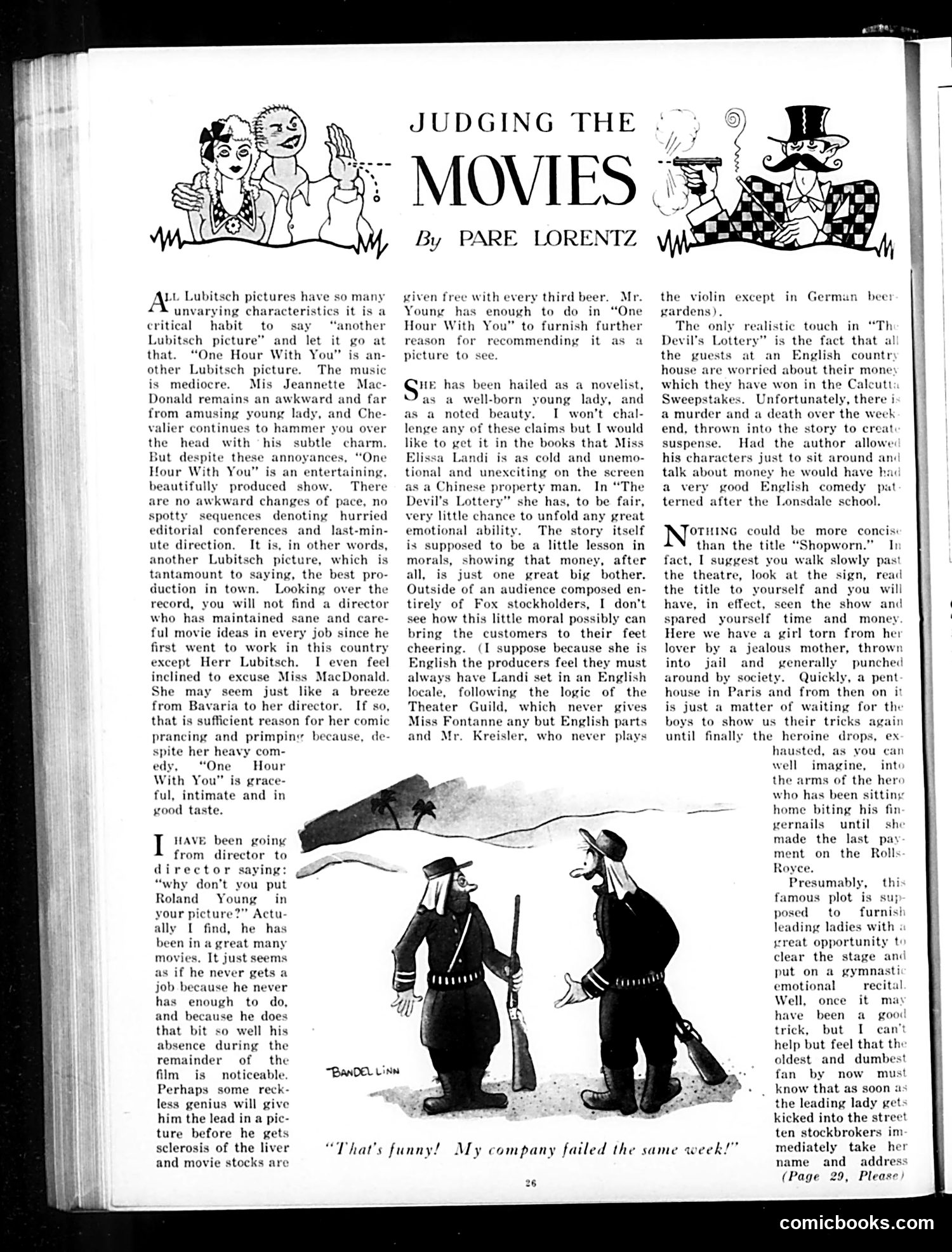
"Judging the Movies" - Judge Magazine Film Criticism This is a film review column by Pare Lorentz critiquing recent Hollywood releases, primarily focused on director Ernst Lubitsch's *One Hour With You* and other contemporary pictures. The cartoon illustrates a running joke: Lorentz frequently urges directors to cast actor Roland Young in leading roles, noting that Young appears in many films but never receives substantial parts—his absence becomes noticeable. The caption shows two hunters, one saying the other's company "failed the same week," a visual metaphor for professional disappointment. The reviews themselves are caustic: Lorentz dismisses Jeanette MacDonald as "awkward," praises Lubitsch's directorial consistency, and critiques actress Elissa Landi as emotionally cold on screen. He also mocks *The Devil's Lottery* for its implausible plot mechanics and artificial dramatic complications. The satire targets both studio casting decisions and the formulaic storytelling of early 1930s cinema—particularly the tendency to impose nationality-based stereotypes on performers and characters.
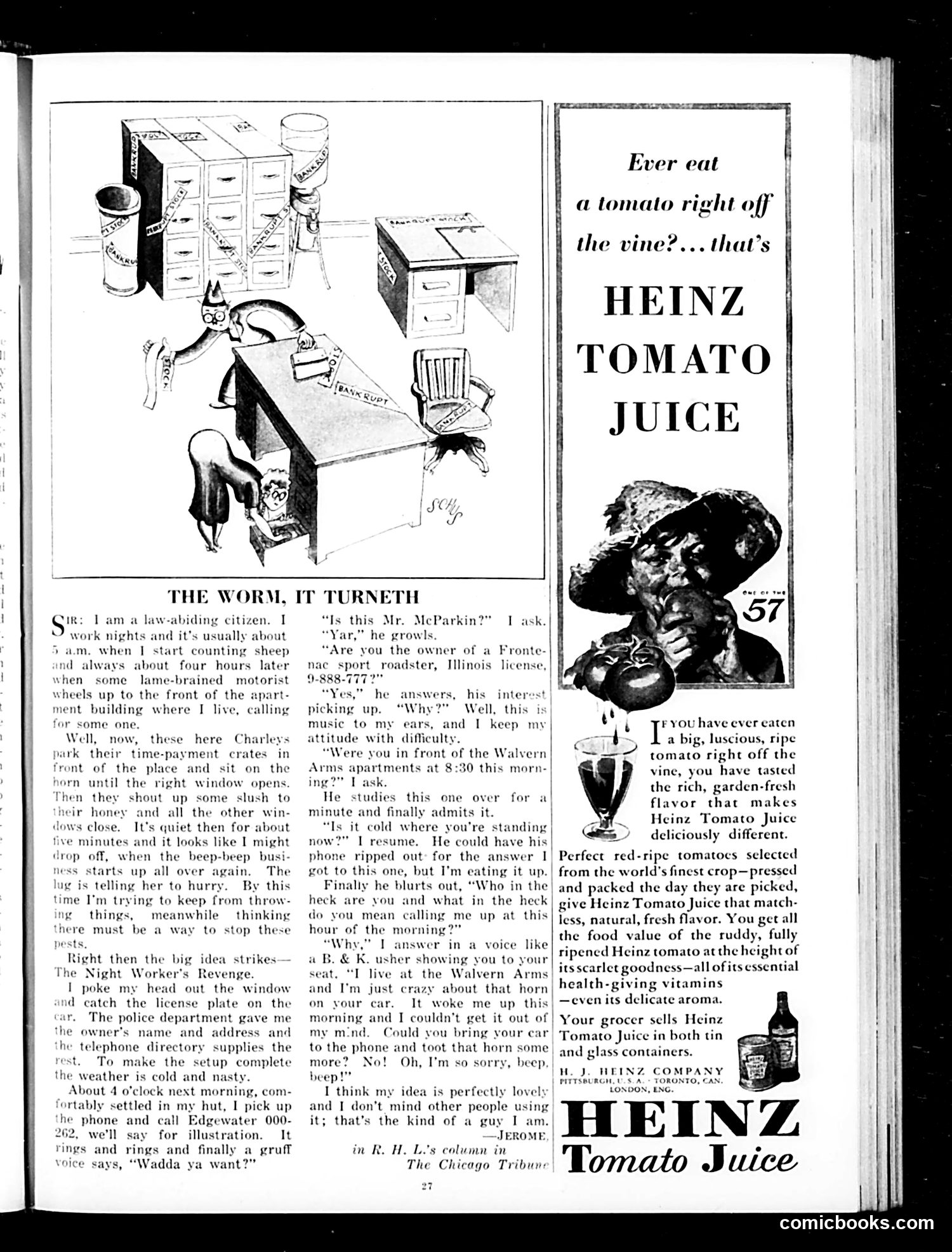
"The Worm, It Turneth" This satirical story depicts urban frustration with inconsiderate motorists. A night-shift worker, unable to sleep during the day, is repeatedly awakened by couples parking outside his apartment building and honking car horns to attract their girlfriends' attention from windows above. The narrator's revenge: he obtains the car owner's information and calls him at 4 a.m., pretending to admire the horn and asking him to demonstrate it by honking again. The joke's title references the biblical phrase "the worm turneth"—meaning the oppressed gain unexpected revenge. This reflects 1920s-30s urban complaints about automobile culture, parking congestion, and noise pollution from courting couples using car horns as romantic signaling devices—a now-extinct social practice that was apparently widespread enough to inspire satirical commentary.
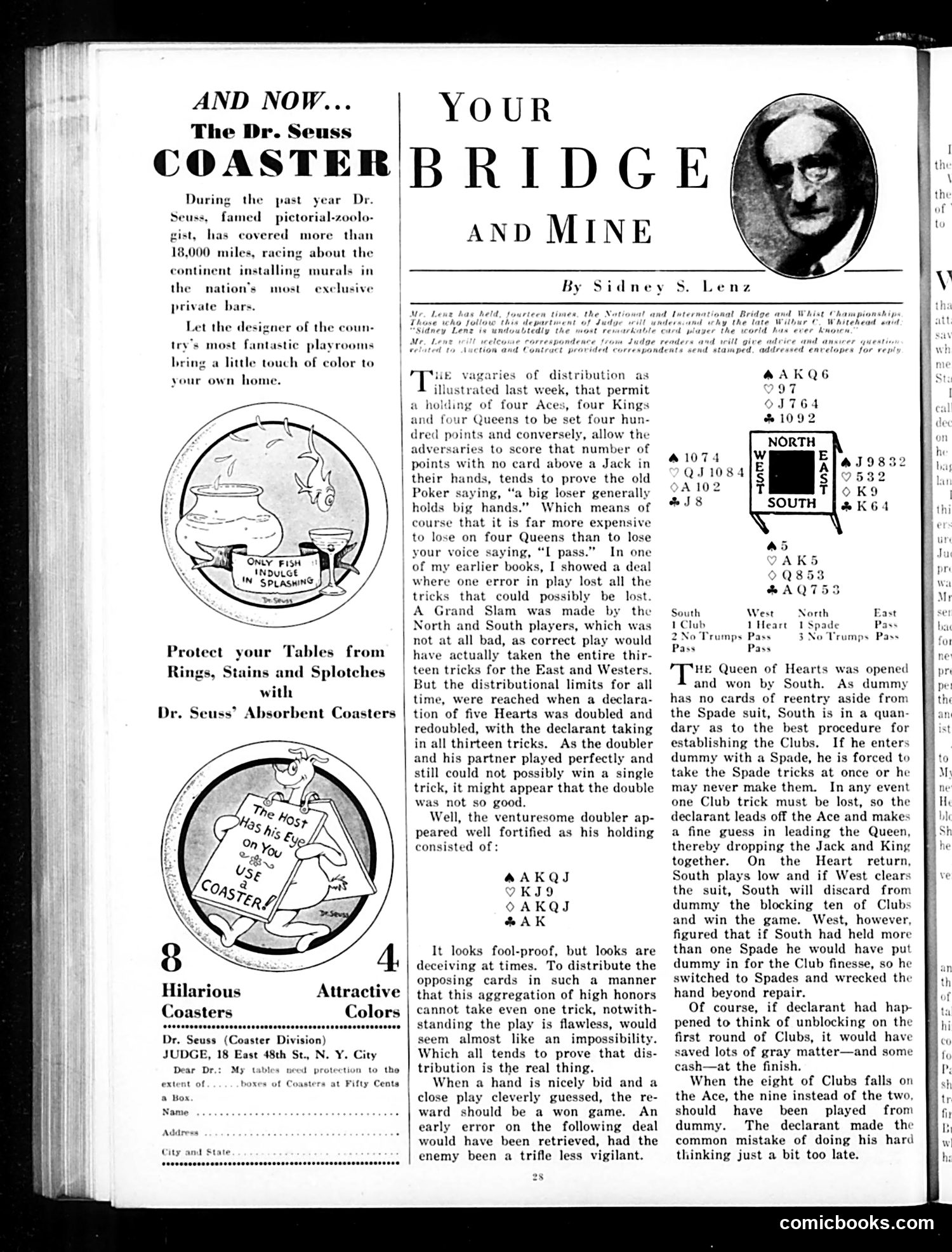
Judge Magazine: Dr. Seuss Coasters Advertisement & Bridge Column This page combines a whimsical product advertisement with a bridge strategy column. The left side advertises Dr. Seuss coasters—absorbent tableware designed to protect furniture from drink rings and stains. The cartoons show Seuss's characteristic surreal style: fish splashing and whimsical creatures. The ad copy mentions Seuss has traveled 18,000 miles installing murals in exclusive private bars, lending credibility to his design work. The right side is an unrelated bridge (card game) instructional column by Sidney S. Lenz, a prominent bridge expert. It analyzes a specific hand, explaining bidding strategy and the importance of card distribution in winning play. The juxtaposition is purely commercial—both are content filling Judge's pages. This reflects Judge's role as a satirical magazine that supplemented editorial content with advertisements and instructional features to sustain itself financially.
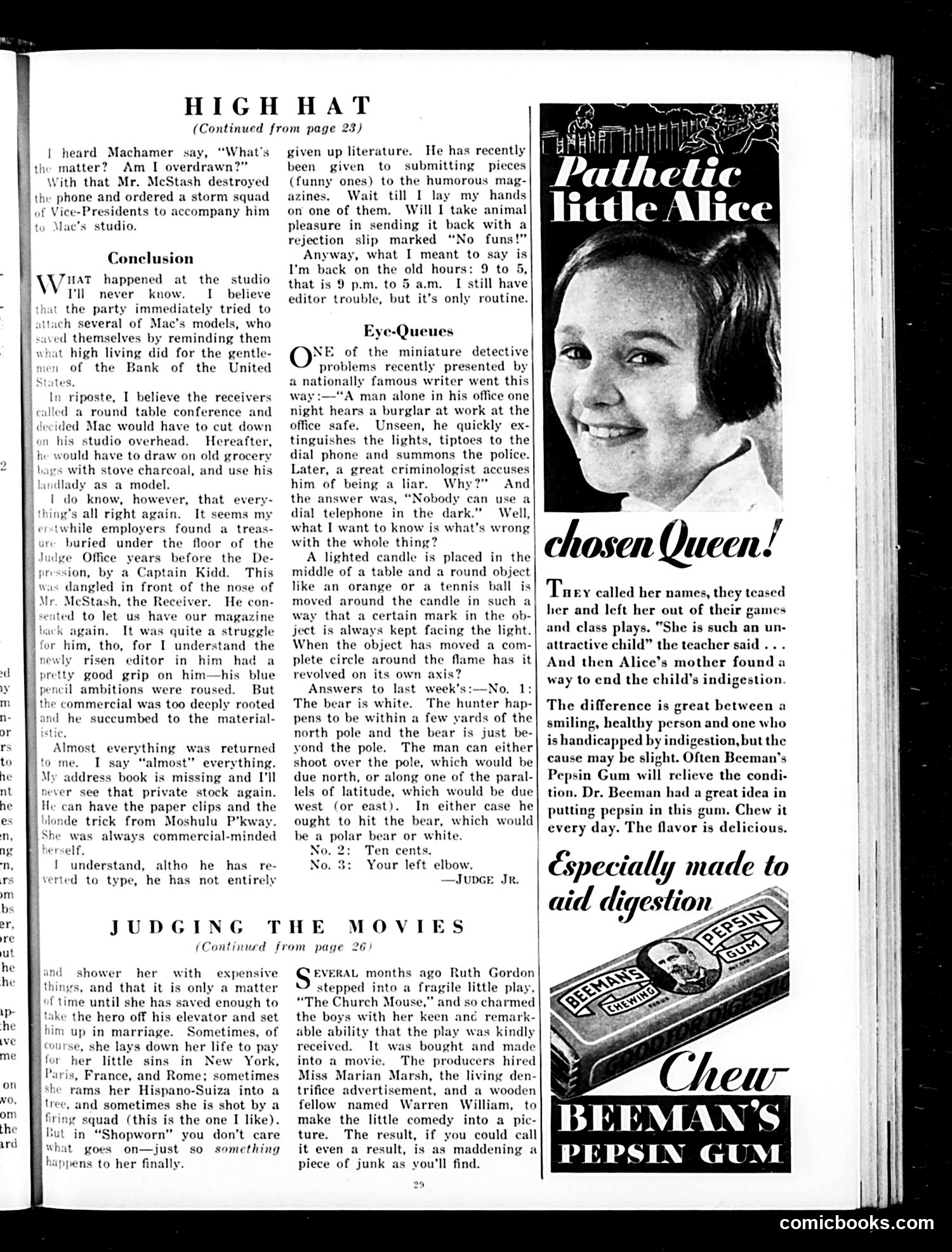
Analysis for Modern Readers This page from *Judge* magazine contains three distinct sections: "High Hat" (continued story): A humorous narrative about a magazine illustrator's studio chaos during what appears to be the Great Depression. The writer describes studio overhead cuts, a receiver's involvement, and discovering buried treasure—satirizing financial desperation and workplace absurdity of the era. "Eye-Queues" (puzzle column): A logic puzzle section presenting brain-teasers. The featured puzzle asks whether a marked object revolving around a candle completes a full rotation on its axis—a spatial reasoning problem. Previous answers reference standard riddles (a polar bear, directional logic). Advertisement: A Beeman's Pepsin Gum ad featuring "Pathetic Little Alice," a young girl chosen as the "Queen" for endorsement. The ad emphasizes digestive benefits, typical of 1920s-30s patent medicine marketing that made health claims now considered dubious. The page reflects Depression-era magazine humor blending workplace satire, intellectual puzzles, and advertising culture normalizing child celebrity endorsements.
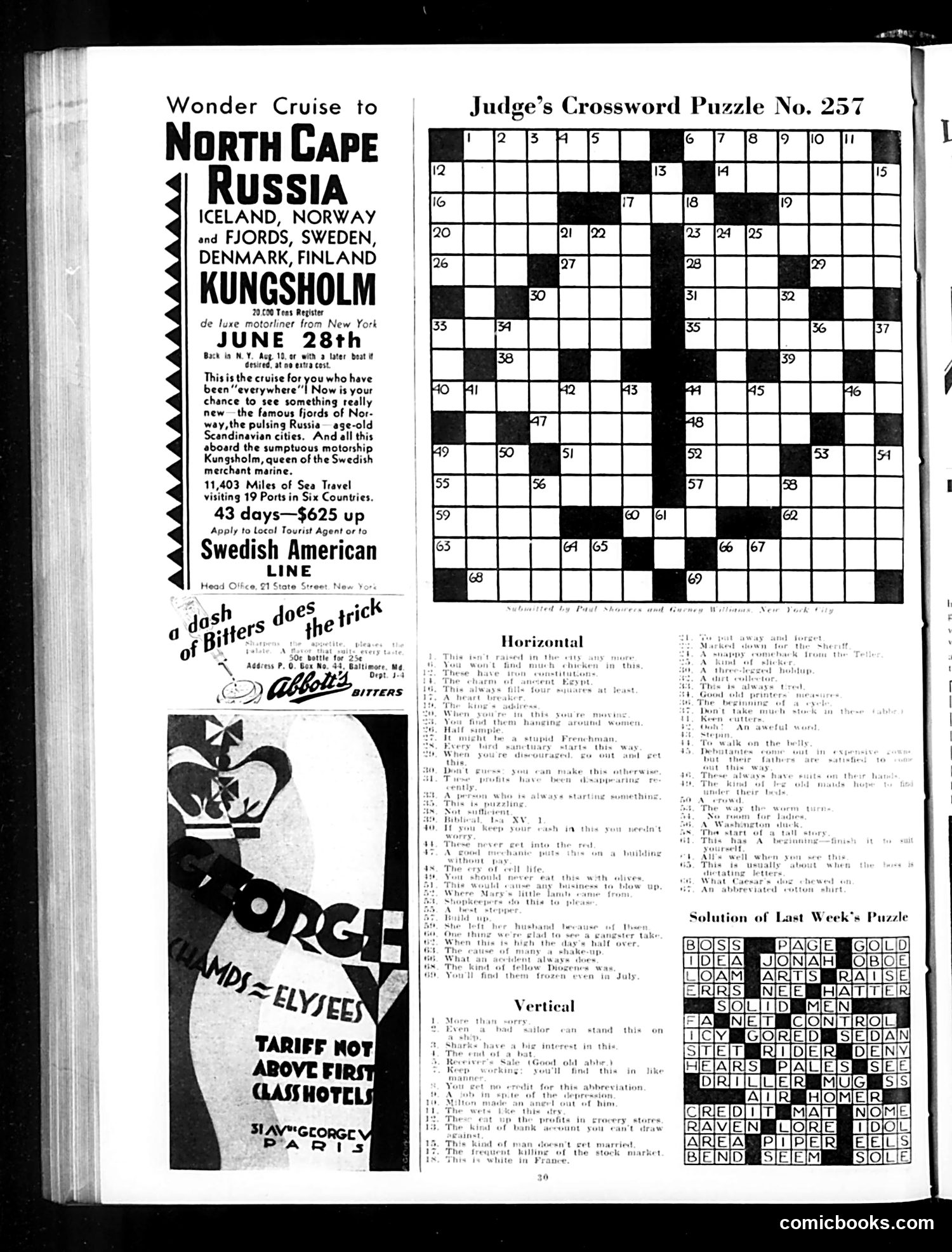
Judge Magazine Page Analysis This page is primarily advertising, not political satire. It contains: 1. Swedish American Line cruise advertisement (top left): Promotes a luxury 43-day cruise aboard the motorship *Kungsholm* departing June 28th, visiting North Cape Russia, Iceland, Norway, and Scandinavian cities. This targets affluent American travelers interested in European travel—likely from the 1930s based on the Art Deco styling and price point ($625). 2. Abbot's Bitters ad (bottom left): A vintage alcohol advertisement featuring a crown logo and text about tariff rates on "first class hotels," suggesting Prohibition-era marketing positioning premium spirits as luxury goods. 3. Judge's Crossword Puzzle No. 257 (right): The magazine's standard puzzle feature. The page reflects pre-WWII American consumer culture and leisure travel marketing to the wealthy. No political commentary or satire is evident—this is standard magazine filler and paid advertising from the publication's commercial content.
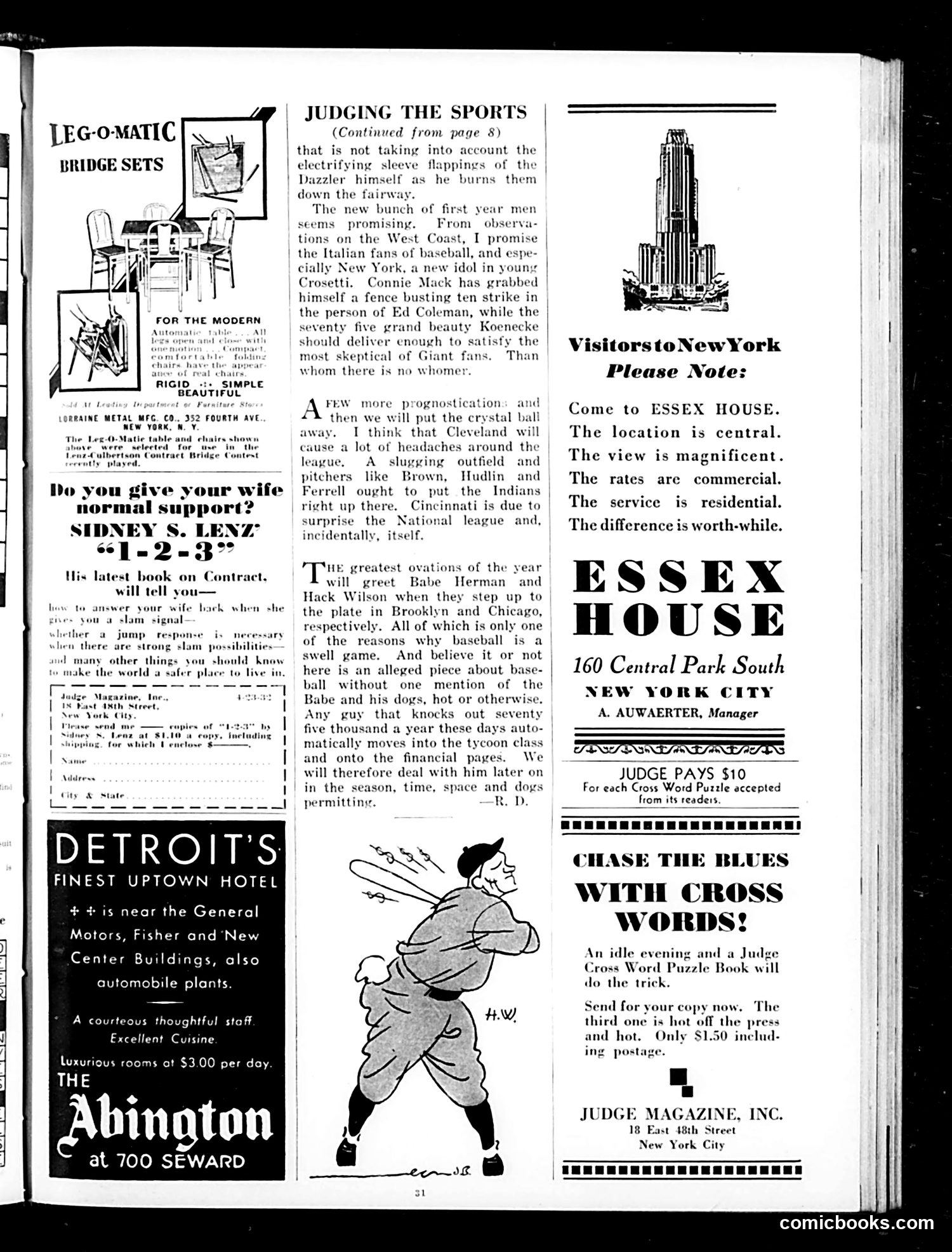
Analysis of Judge Magazine Page Content This page from Judge magazine is primarily advertising and sports commentary rather than political satire. The main content is a "Judging the Sports" column discussing 1920s-30s baseball prospects and players. The column references specific figures: Babe Herman, Hack Wilson, Ed Coleman, Connie Mack, and Koenecke—contemporary baseball personalities. It discusses pennant races for teams like Cleveland, Cincinnati, Brooklyn, and Chicago. The satire is subtle: the author critiques how baseball obsesses over star players like Babe Ruth, noting that any player earning $75,000 "automatically moves into the tycoon class." There's gentle mockery of baseball's celebrity worship and excessive focus on individual stars' personal lives ("his dogs, hot or otherwise"). The cartoon illustration shows a batter mid-swing—standard sports magazine fare. The page is otherwise dominated by hotel and bridge-set advertisements, including Sidney Lenz's contract bridge book, Essex House hotel, and the Abington hotel. The "Cross Words" advertisement promotes Judge's puzzle book—an early crossword puzzle promotion, suggesting these were novelty entertainment circa late 1920s.
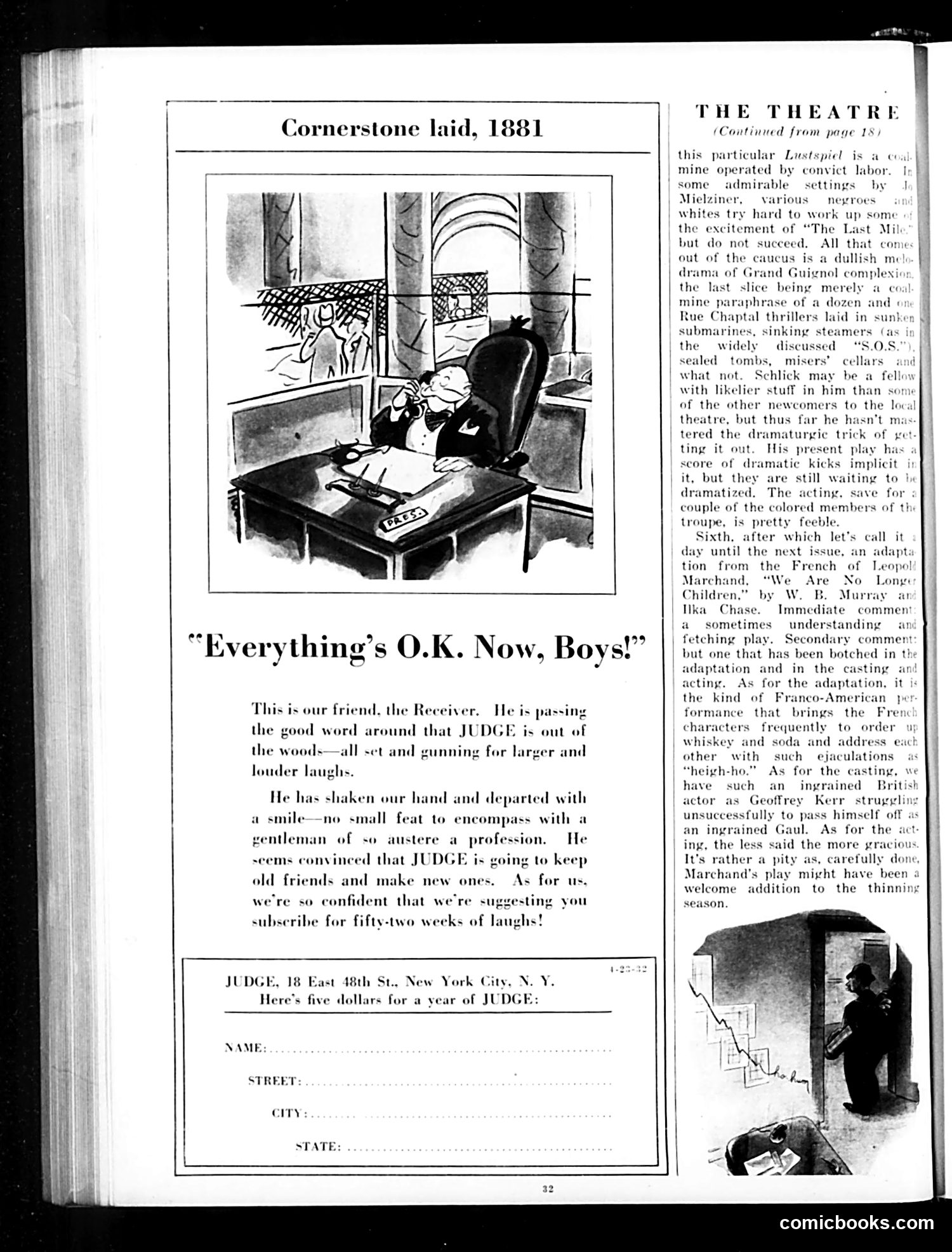
Judge Magazine Page Analysis This page announces Judge magazine's financial recovery. The main cartoon shows a "Receiver"—a court-appointed official who manages bankrupt businesses—leaving the magazine's office with good news that Judge is "out of the woods." The satire is straightforward: Judge, a satirical publication itself, had apparently faced financial difficulties serious enough to require a receiver, and now celebrates its salvation by humorously personifying the austere legal official departing with an uncharacteristic smile. The page functions as both celebratory announcement and subscription appeal, urging readers to support the magazine's comeback with year-long subscriptions ($5). The right column contains theatre reviews unrelated to the main cartoon—standard magazine content of the era.

Analysis: "Larry—Thoughts of Youth" Advertisement This page is primarily a book advertisement, not satire. It promotes *Larry: Thoughts of Youth*, a 1920s bestseller presented as the authentic diary of a college student who died suddenly. The pitch emphasizes "uncensored revelation"—appealing to parents and young people by claiming frank, unpublished authenticity. Larry is portrayed as an idealized modern youth: athletic, moral (avoiding smoking/drinking, active in church), yet masculine and adventurous ("died with his boots on"). The critical quotes and sales-success narrative (Christmas publication → national bestseller → multiple printings) suggest this was genuinely popular. The advertisement targets parents anxious about youth morality during the Jazz Age, offering reassurance that modern boys could be both "gloriously" alive AND ethically sound. The image shows a silhouetted horseman—evoking frontier idealism and masculine virtue rather than contemporary college life, reinforcing the book's appeal to traditional values.

Analysis This is not a cartoon or satire—it's a full-page cigarette advertisement for Camels, circa 1932. The image shows a woman examining cigarettes and their packaging. The ad markets Camels to women specifically, claiming they deliver "fresh" cigarettes (never "parched or toasted") through moisture-sealed "Humidor Pack" technology. The copy emphasizes mildness and smoothness, appealing to female smokers by contrasting Camels with competitors' allegedly inferior products. The "satire" aspect to modern readers is not intentional: the ad represents normalized mid-century tobacco marketing to women—something now recognized as predatory advertising that contributed to public health harms. The gendered appeal ("women particularly prefer them") and health claims ("mild," "refreshing") are precisely the tactics later regulated or banned. This reflects Judge magazine's commercial nature; such full-page ads subsidized publications during the Depression era.