judge
Judge — April 30, 1932
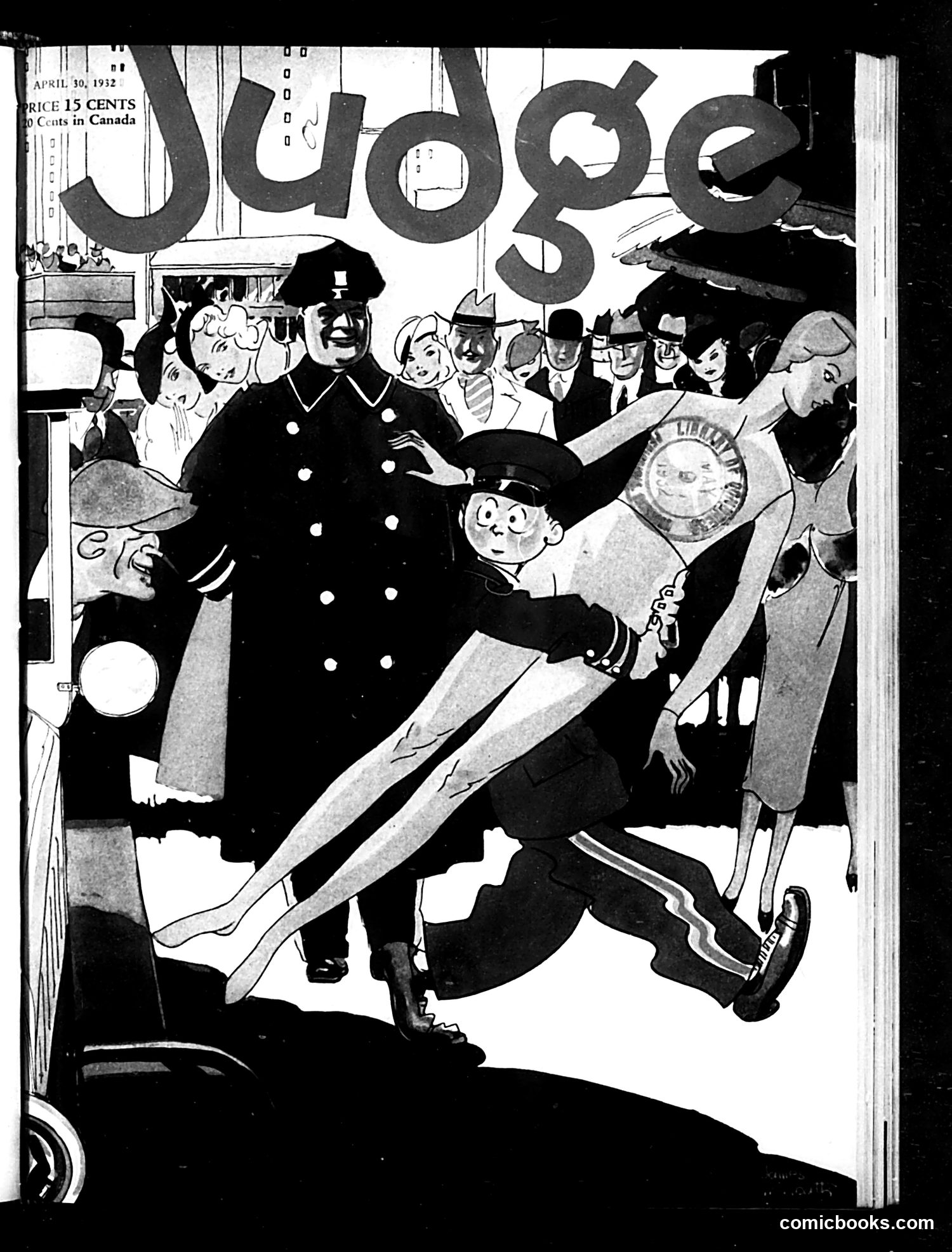
Judge Magazine Cover Analysis (April 30, 1932) This cover satirizes the economic desperation of the Great Depression era. A woman with exaggerated legs displays herself to a crowd of well-dressed men in formal attire, while a small character (possibly representing a child or dependent) clings to her side. The scene appears to depict street solicitation or sex work driven by poverty. The satire targets both the desperation of Depression victims forced into degrading survival strategies and society's hypocrisy—the formally-dressed men represent respectable society that tacitly enables such exploitation while maintaining appearances. The large "Judge" masthead dominates, indicating this is the magazine's cover commentary on contemporary social conditions and moral degradation accompanying economic collapse.
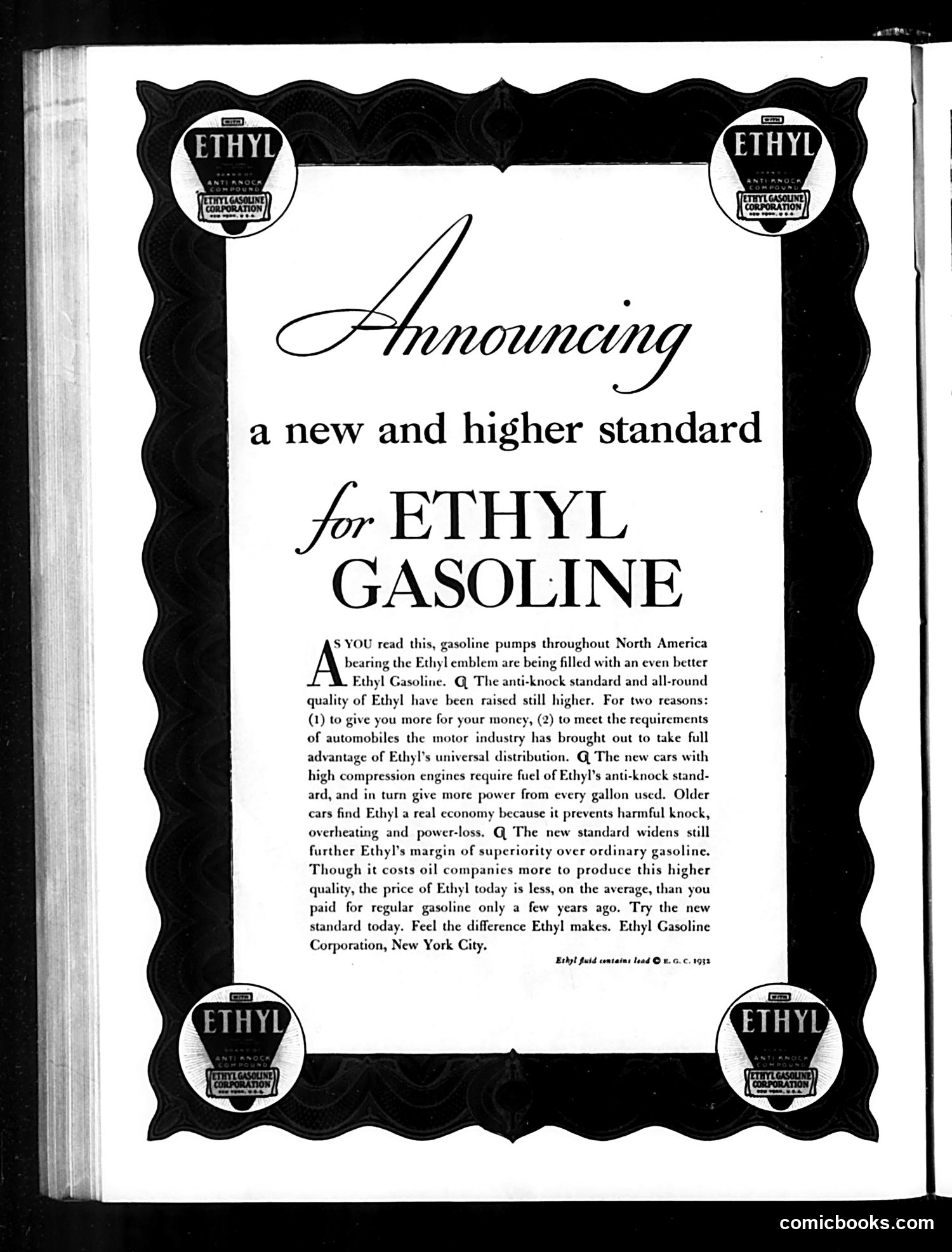
Analysis This is not a cartoon or satire page — it's a straightforward advertisement for Ethyl Gasoline, placed in Judge magazine. The ad announces a new, higher-quality standard for Ethyl brand gasoline. Key selling points include: - Anti-knock properties for new high-compression engines - Cost savings compared to regular gasoline - Improved performance (more power, prevents engine damage) - Better value despite production costs The decorative border and Ethyl emblems in four corners are standard advertising design. No political commentary, caricatures, or satire are present. This represents early automotive fuel marketing, circa 1920s, when ethyl gasoline (leaded fuel) was a commercial innovation competing for market adoption.
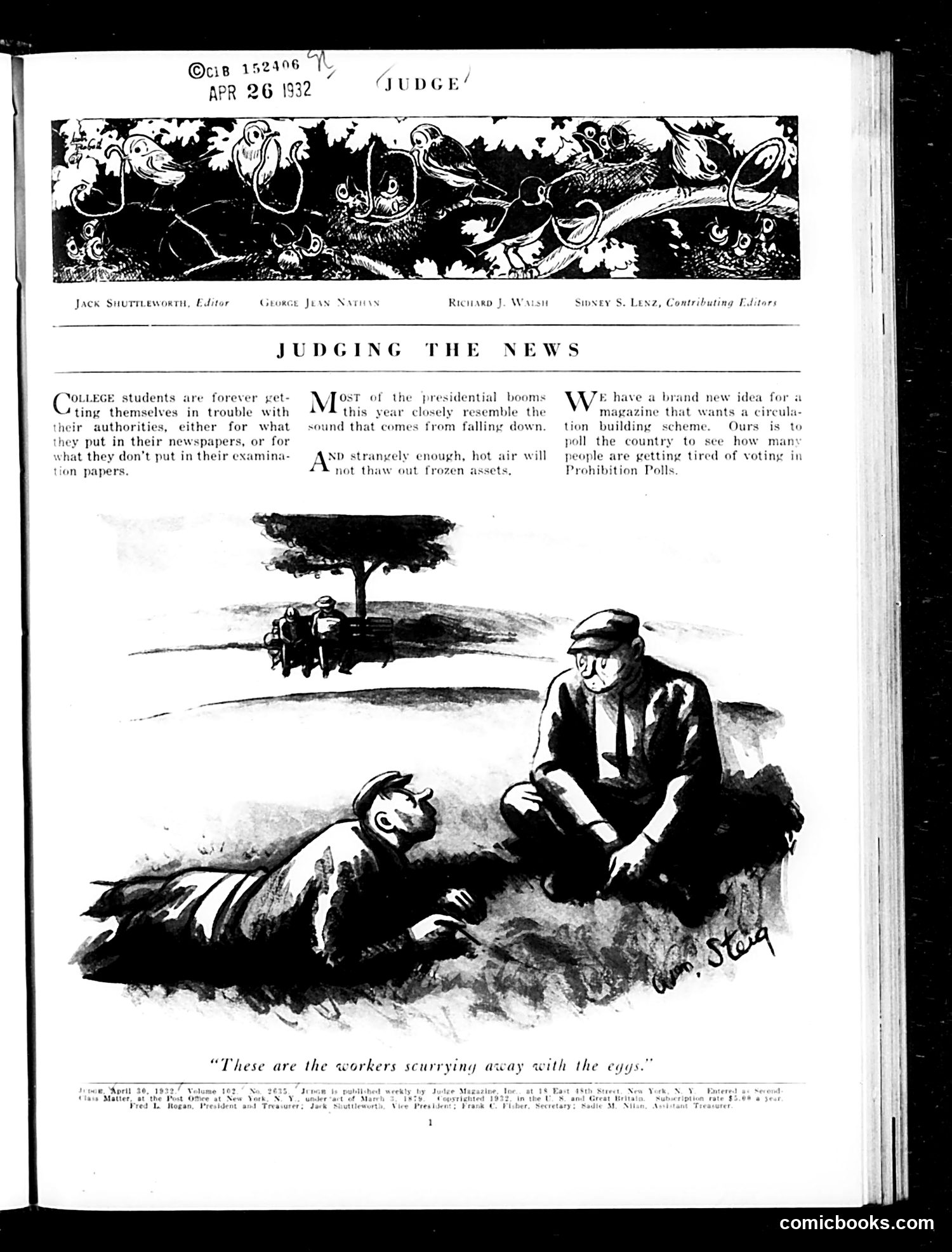
"Judging the News" - April 26, 1932 This page satirizes early 1930s political and social concerns. The main cartoon shows a man examining another figure lying on the ground, with the caption "These are the workers scurrying away with the eggs." The context appears to reference Depression-era economic anxieties. The editorial text above mentions "presidential booms" (likely about 1932 election candidates), frozen assets in banks, and a magazine proposal to poll Americans on Prohibition—a major divisive issue of that era. The cartoon's meaning is somewhat cryptic without additional context, but likely satirizes either labor disputes, economic desperation, or perhaps political corruption—common Judge magazine targets during the Great Depression period when worker unrest and bank failures dominated headlines.
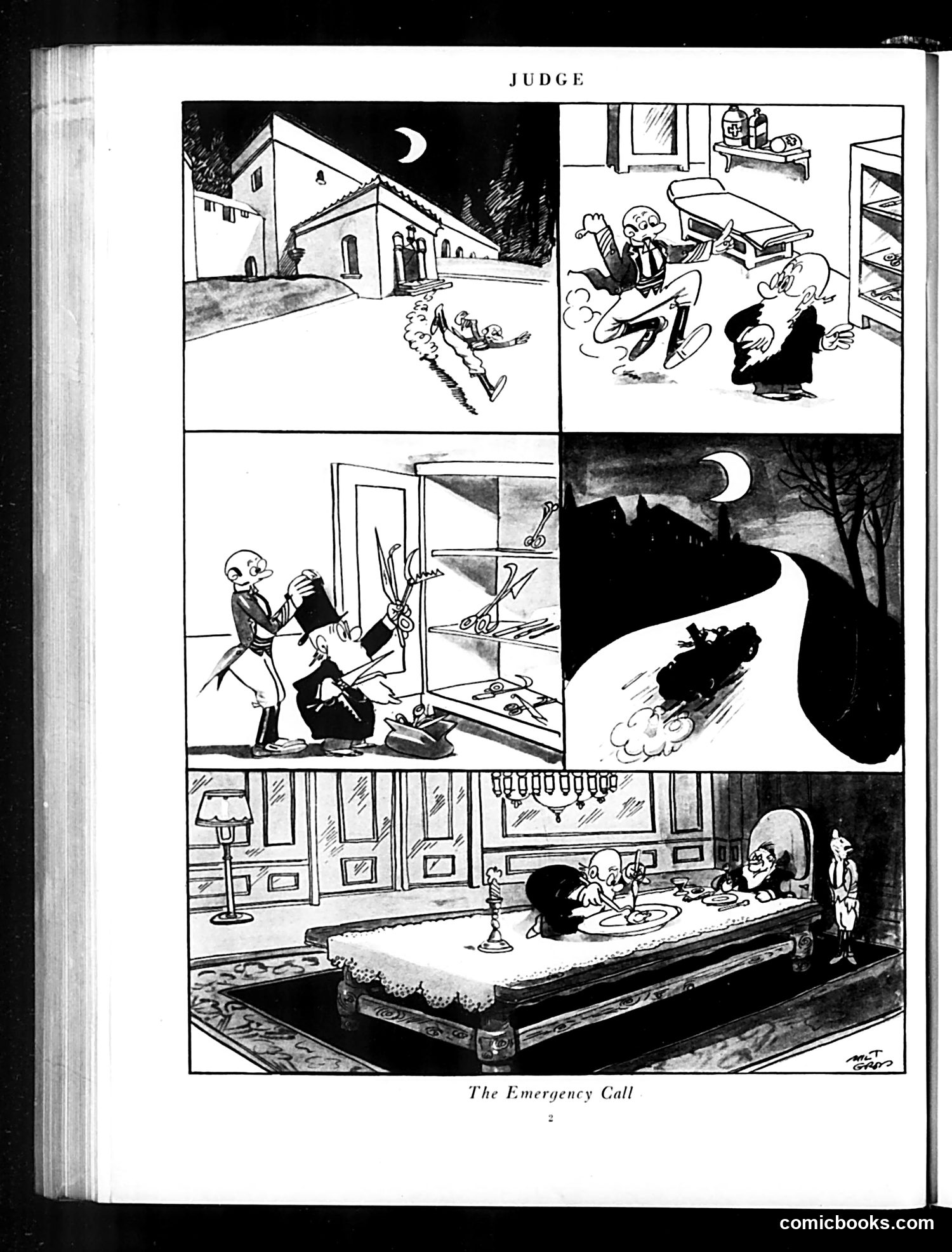
"The Emergency Call" – Judge Magazine Cartoon This comic strip titled "The Emergency Call" depicts a nighttime domestic crisis escalating through five panels. The narrative appears to show: 1. Opening: A figure flees a house in distress 2. Middle scenes: Chaos erupts indoors—figures struggle, furniture overturns, suggesting violence or disorder 3. Final panel: A judge or authority figure arrives at an ornate bedroom where a couple sits in bed, apparently summoned by the emergency The satire likely mocks the absurdity of calling legal authorities for petty domestic disputes. The contrast between the dramatic nighttime chaos and the formal, composed judge appearing in an elegant bedroom setting suggests ironic commentary on judicial intervention in private domestic matters—a social critique about when (or whether) courts should involve themselves in family affairs. The specific historical context remains unclear without additional dating information.
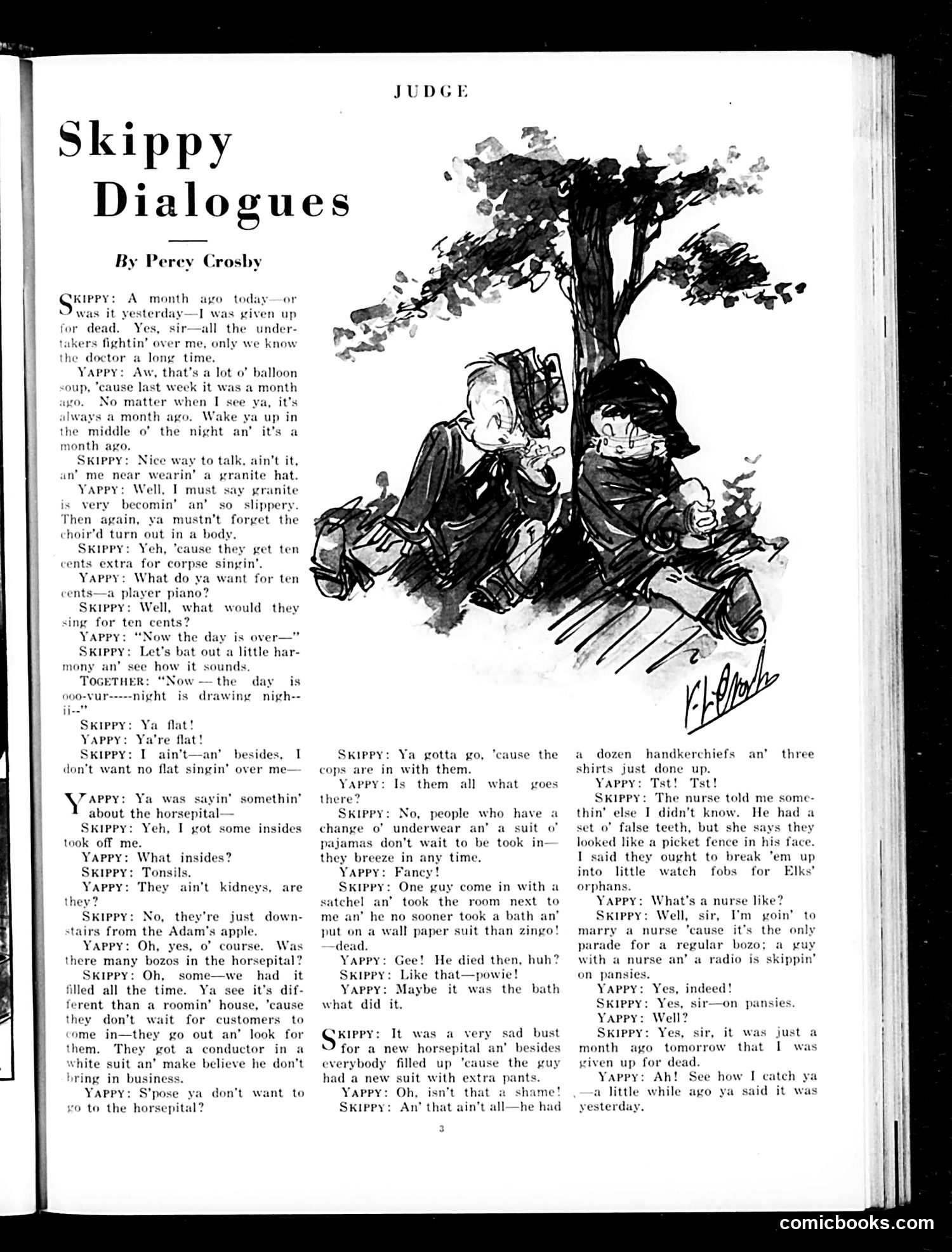
Skippy Dialogues by Percy Crosby This is a humorous comic dialogue featuring two young characters—Skippy and Yappy—engaging in typical early 20th-century children's banter. The conversation covers everyday childhood topics: a child pronounced "given up for dead" from illness, granite monuments, choir performances, and hospital visits. The satire appears gentle rather than political. It mocks adult pretensions through children's innocent misunderstandings—such as discussing what corpses should "sing for" or confusing medical terminology. The dialogue also gently satirizes hospital practices and funeral customs of the era. The illustration shows two boys in period clothing beneath a windswept tree, consistent with the comic's lighthearted tone. This appears to be character-driven humor rather than commentary on specific contemporary events or political figures.
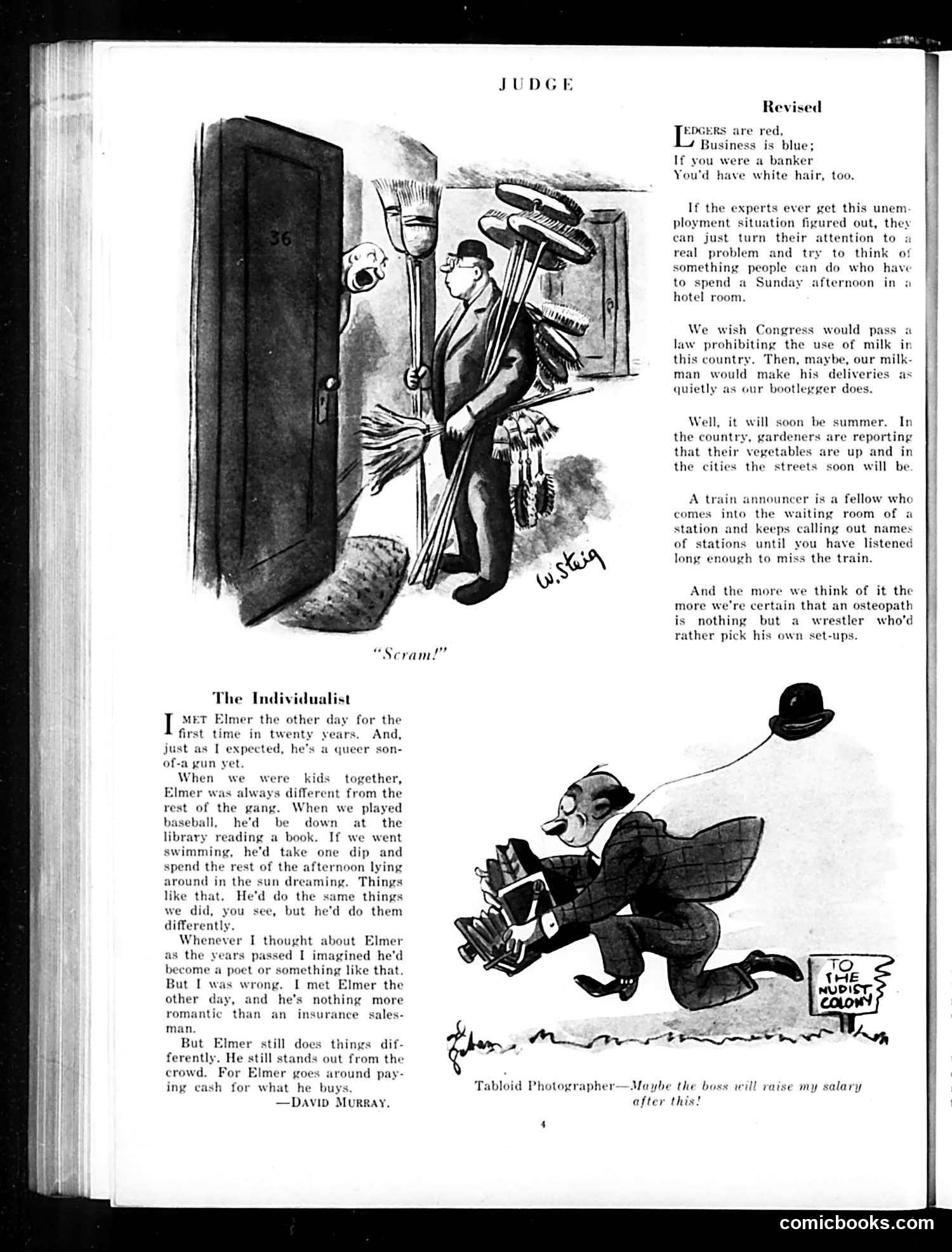
Analysis of Judge Magazine Page The "Scram!" cartoon satirizes judicial corruption. A judge (marked "36") opens his office door to reveal a man wielding various tools of bribery—money, jewelry, and other valuables. The judge recoils in exaggerated horror, though the satire suggests judges routinely accepted such bribes. The accompanying "Revised" poem mocks this hypocrisy: "Ledgers are red, / Business is blue; / If you were a banker / You'd have white hair, too"—implying that financial and political corruption has aged officials prematurely. The second cartoon, "Tabloid Photographer," depicts a sensationalist journalist pursuing stories for tabloid newspapers, a growing media phenomenon of the era. The satirist criticizes both judicial corruption and yellow journalism as interconnected social problems eroding public trust.
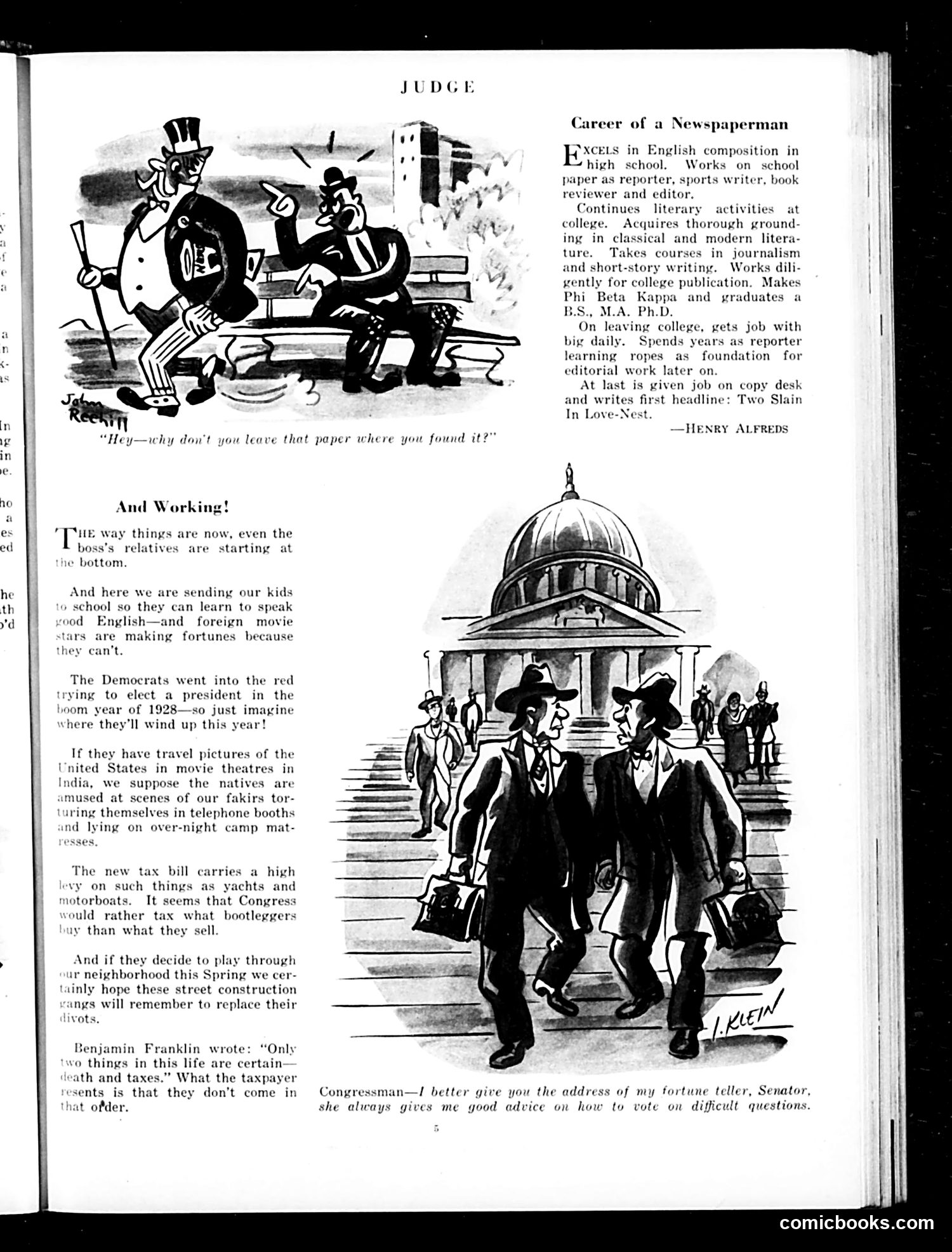
Judge Magazine Satire Analysis This page contains two cartoons satirizing American politics and society, likely from the 1928 election period (mentioned in the text). Top cartoon: Shows newspaper editors/journalists at a desk with the caption "Hey—why don't you leave that paper where you found it?" This jokes about sensationalism and the competitive nature of newspaper reporting. Bottom cartoon: Depicts men on Capitol steps with the caption about a congressman seeking fortune-teller advice on "difficult questions." This satirizes Congress's perceived incompetence or reliance on dubious guidance rather than sound judgment—particularly relevant during the 1928 election cycle and pre-Depression political turbulence. The accompanying text mocks various targets: poor education, foreign policy confusion, Democratic political efforts, movie industry influence, and new tax legislation. The overall tone suggests frustration with government ineffectiveness and societal superficiality.
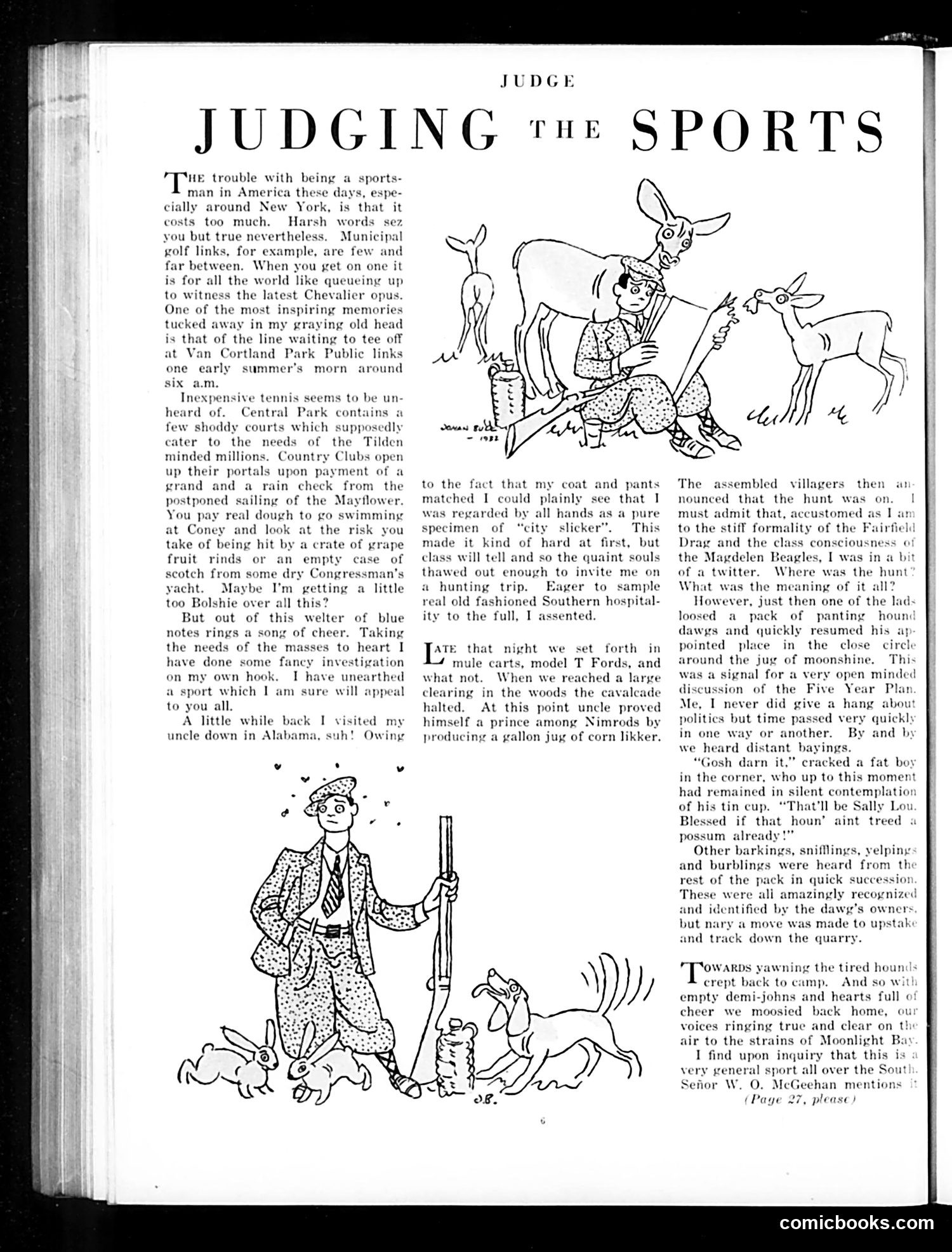
"Judging the Sports" This satirical article criticizes the expense of sports in America, particularly around New York. The author complains that public golf links require long waits (compared to the "Chevalier ops"), tennis clubs are exclusive, and swimming at Coney Island is crowded and risky. The main illustration shows a well-dressed sportsman with hunting rifle surrounded by hound dogs, satirizing the pretense and expense of recreational hunting. A secondary illustration depicts someone in patterned clothing holding a gun with small animals at his feet—likely mocking amateur hunters trying to adopt aristocratic sporting traditions they can't afford. The narrative describes an actual hunting trip involving mule carts and corn liquor in the woods, suggesting the gap between genteel sporting aspirations and rougher rural reality. The piece is fundamentally about class anxiety and conspicuous consumption in American leisure activities.
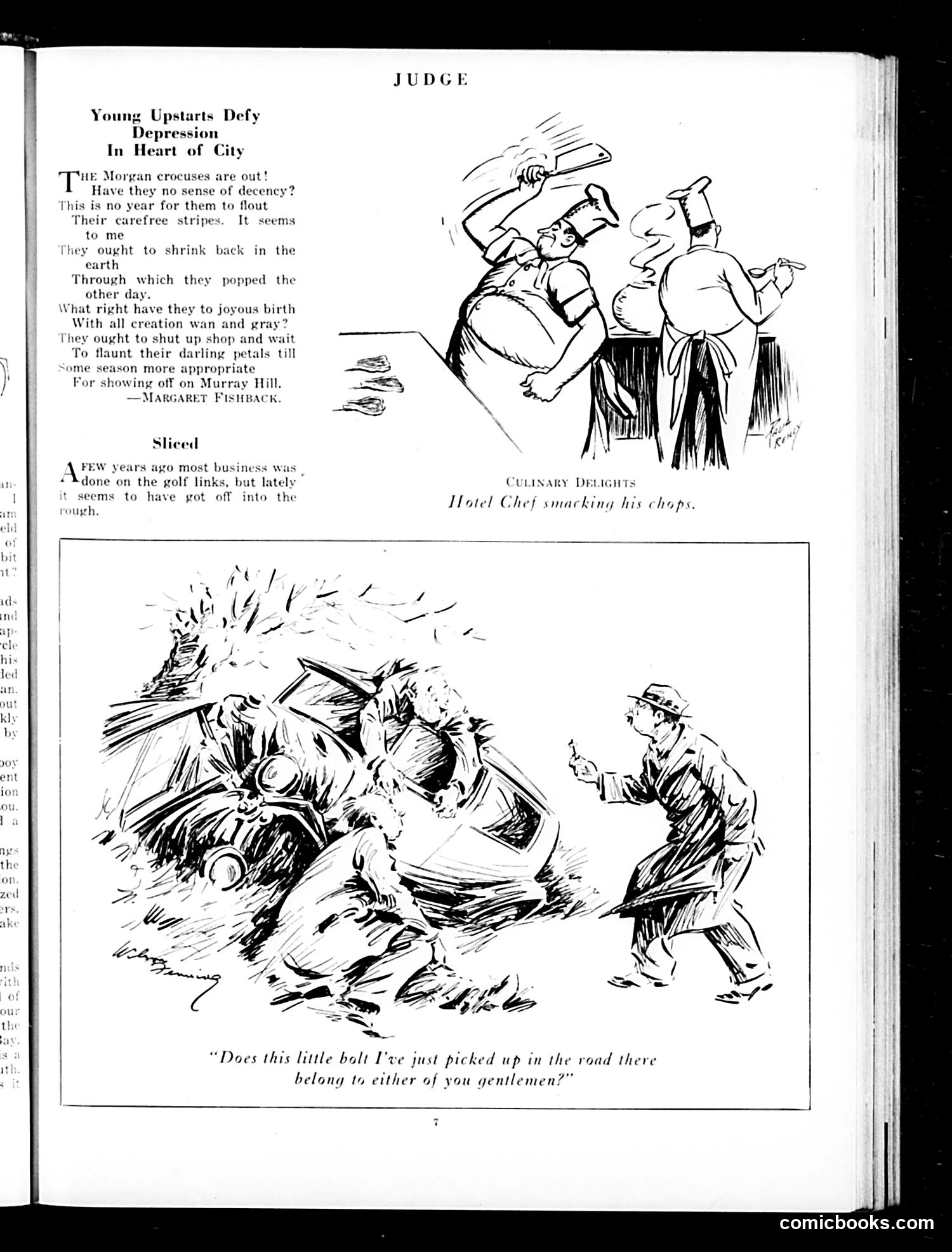
Explanation for Modern Readers This Judge magazine page contains Depression-era satire. The top cartoon mocks wealthy New Yorkers ("Morgan crocuses" references the wealthy Morgan family on Murray Hill) for flaunting spring flowers during economic hardship—the joke being flowers are inappropriately cheerful when people are suffering. The middle section "Sliced" comments on how wealthy businessmen who once conducted deals on golf courses have now lost their fortunes ("got off into the rough"—a golf reference). The bottom cartoon shows two men who've apparently collided on a road, with one asking if a bolt belongs to either of them—likely satirizing careless wealthy drivers or slapstick humor about accidents during hard times. All three pieces mock the wealthy's obliviousness or misfortune during the Great Depression, using wordplay and visual humor typical of 1930s satirical magazines.
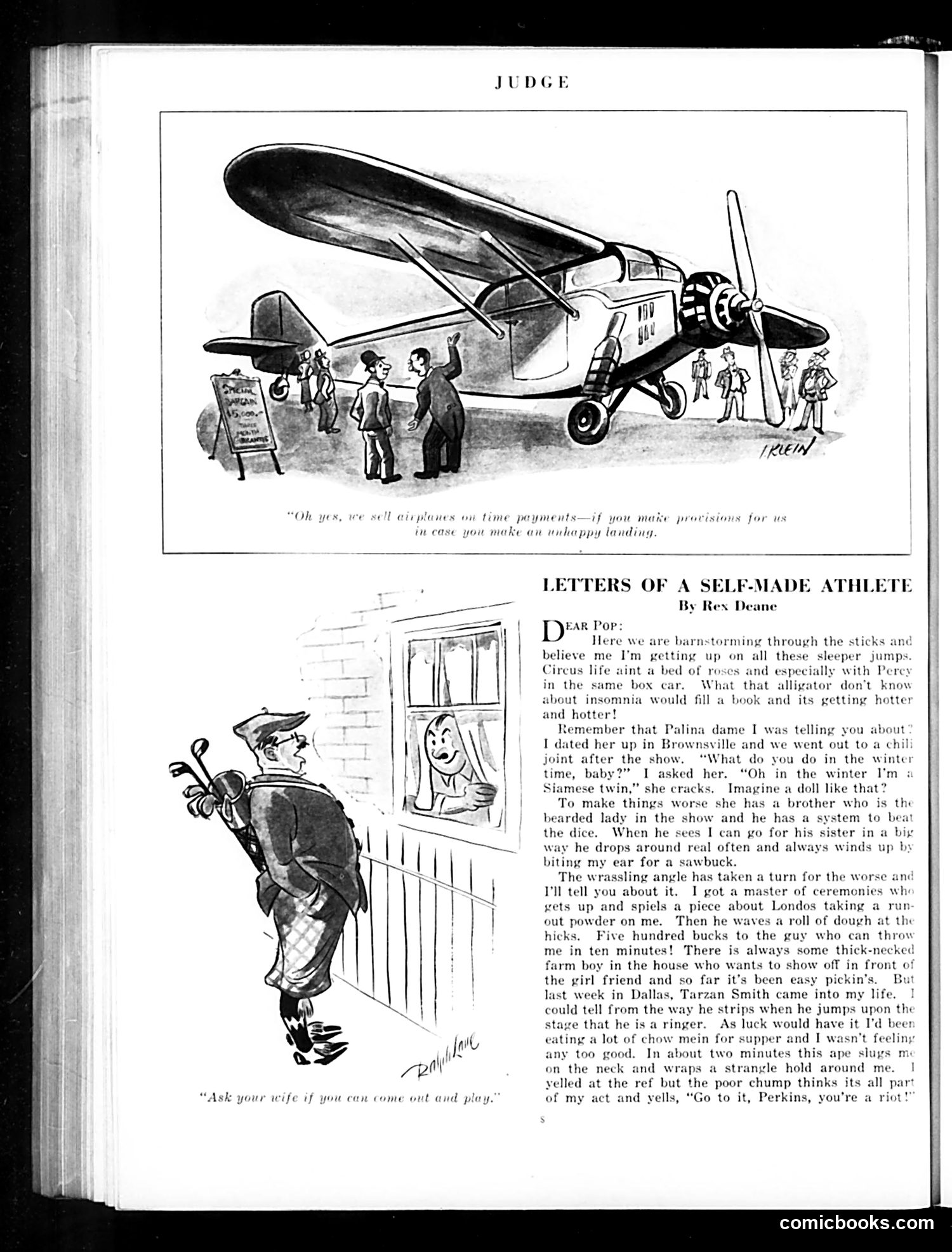
Judge Magazine Page Analysis Top Cartoon: A salesman pitches airplane financing to customers near a commercial aircraft. The joke satirizes post-WWI aviation sales tactics—the salesman offers "time payments" while reassuring buyers about "unhappy landings," darkly joking about aircraft crashes as if they're routine customer service issues. This reflects the era's dangerous early aviation and aggressive consumer credit marketing. "Letters of a Self-Made Athlete": A circus performer writes home about barnstorming (touring shows) through rural America. The letter humorously catalogs circus life hardships: insomnia from traveling, romantic entanglements, wrestling matches rigged for gambling, and encounters with con artists. The tone satirizes working-class hustlers and carnival culture while poking fun at crude rural audiences easily deceived by staged spectacles and promised payouts. The satire targets both traveling entertainment exploitation and rural gullibility during the interwar period.
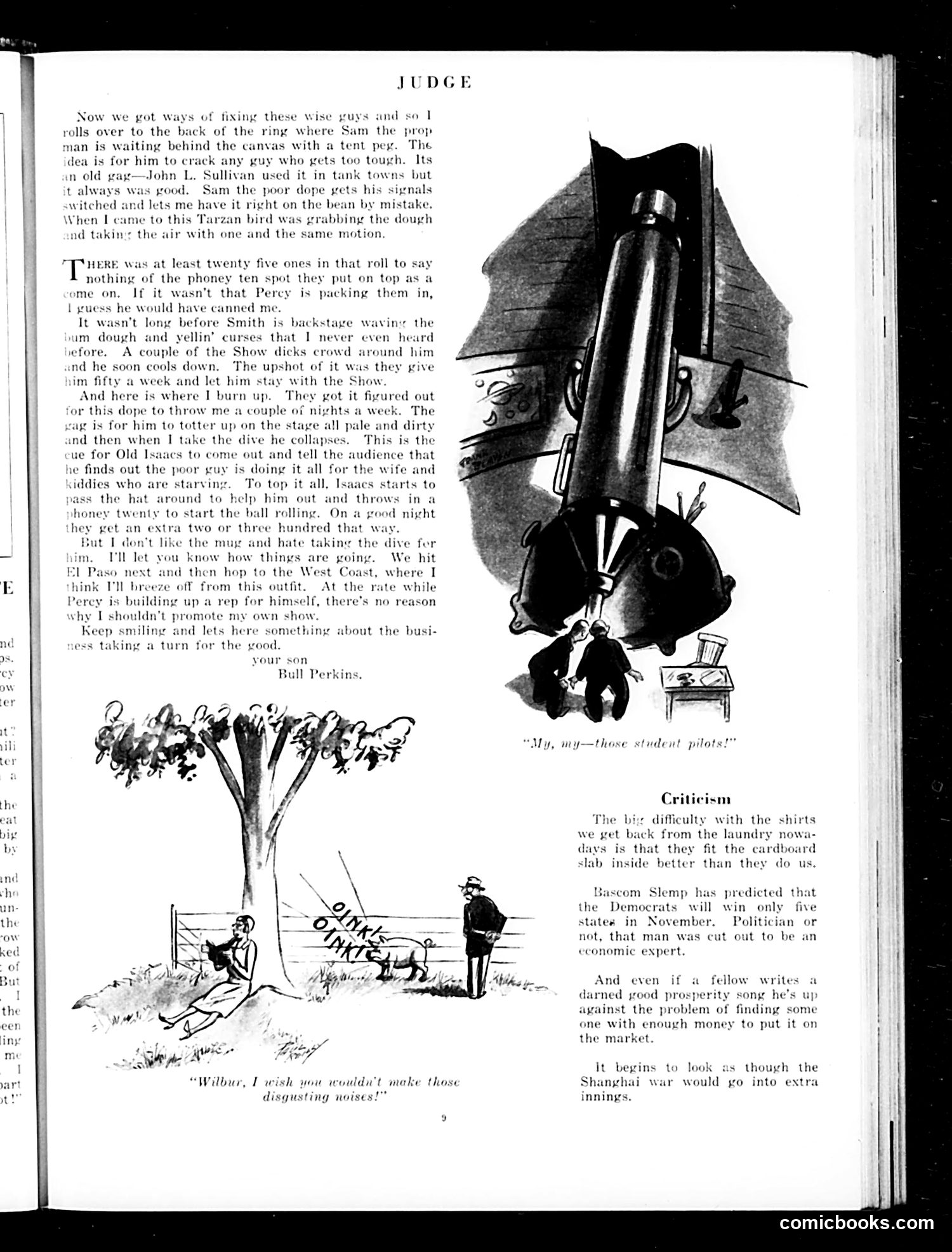
Analysis for Modern Readers This page contains two distinct satirical pieces from Judge magazine: "Judge" Column (Bull Perkins): A lengthy first-person account describing theatrical fraud in professional wrestling. The narrator details how promoters fake matches—using a backstage man with a tent peg to strike opponents who get "too tough," paying wrestlers to take predetermined dives, and collecting donations from audiences by claiming the injured wrestler needs money for his starving family. The satire targets the dishonesty of professional wrestling as entertainment masquerading as sport. Political Cartoons: - Top right: A judge or authority figure threatening "student pilots," suggesting criticism of reckless or inexperienced leadership - Bottom: A couple at a dining table, with the caption about "disgusting noises"—likely domestic humor "Criticism" Section: Brief satirical jabs at contemporary issues: laundry quality, politician Bascom Slemp's election predictions, and difficulty funding theatrical productions. The overall tone mocks institutional dishonesty, poor service, and political incompetence common to 1920s-era America.
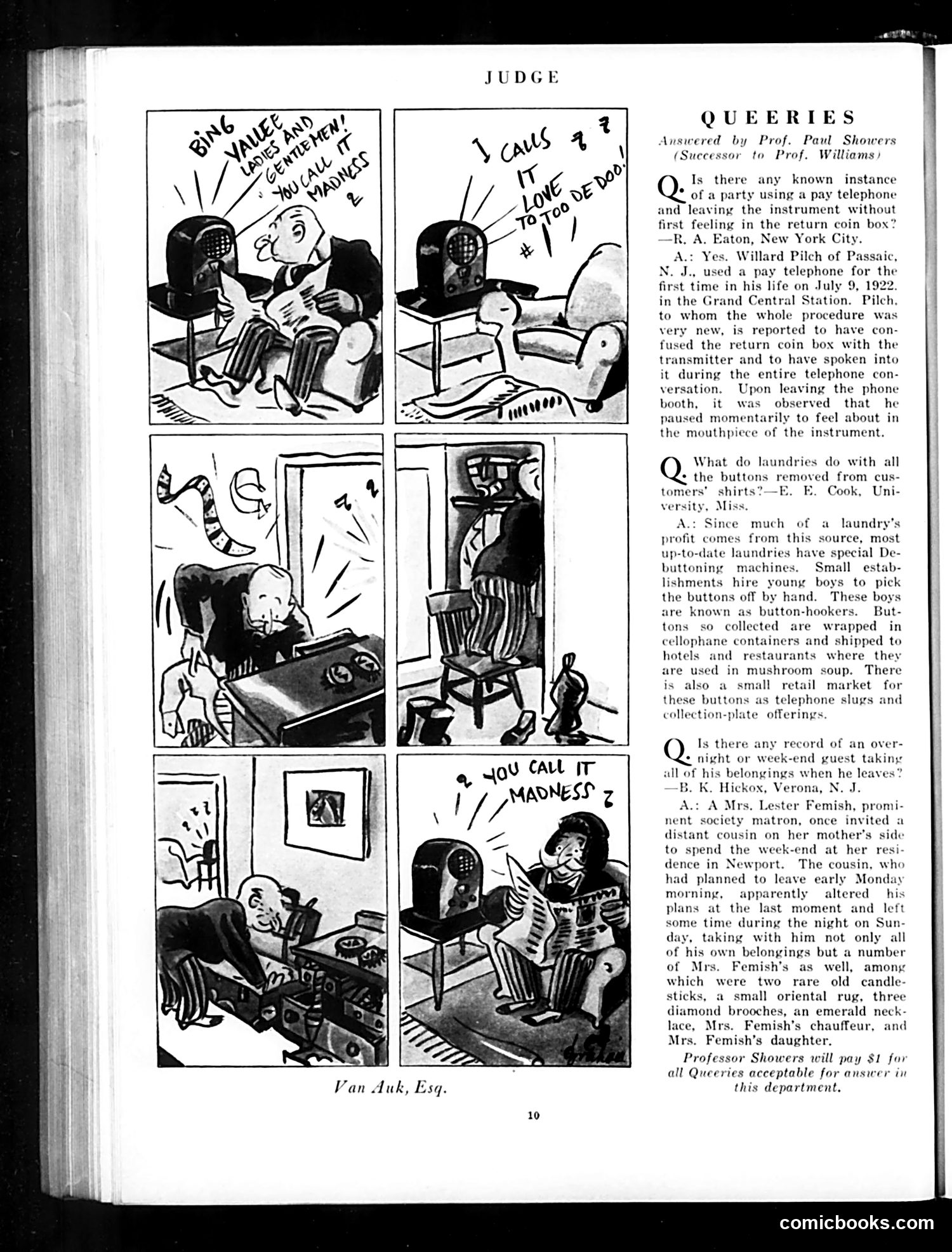
Judge Magazine: "Queeries" Column Analysis This page features a humorous advice column called "Queeries," answered by "Prof. Paul Showers." The content satirizes modern conveniences and social etiquette of the 1920s through absurdist fake answers. The comic strip illustrates the first query about pay telephones—a relatively new technology. It shows someone confused by the phone booth mechanism, speaking into the coin return box instead of the receiver, capturing anxiety about unfamiliar modern gadgetry. The subsequent written answers employ deadpan humor: buttons from laundry are claimed to be recycled into mushroom soup and used as "telephone slugs" (fake coins); a houseguest is described stealing the host's valuables—presented as an actual documented case. The satire targets both technological bewilderment among Americans adapting to 1920s innovations and upper-class social pretensions. The column mocks both the gullibility of readers seeking advice and contemporary society itself through deliberately absurd "facts."
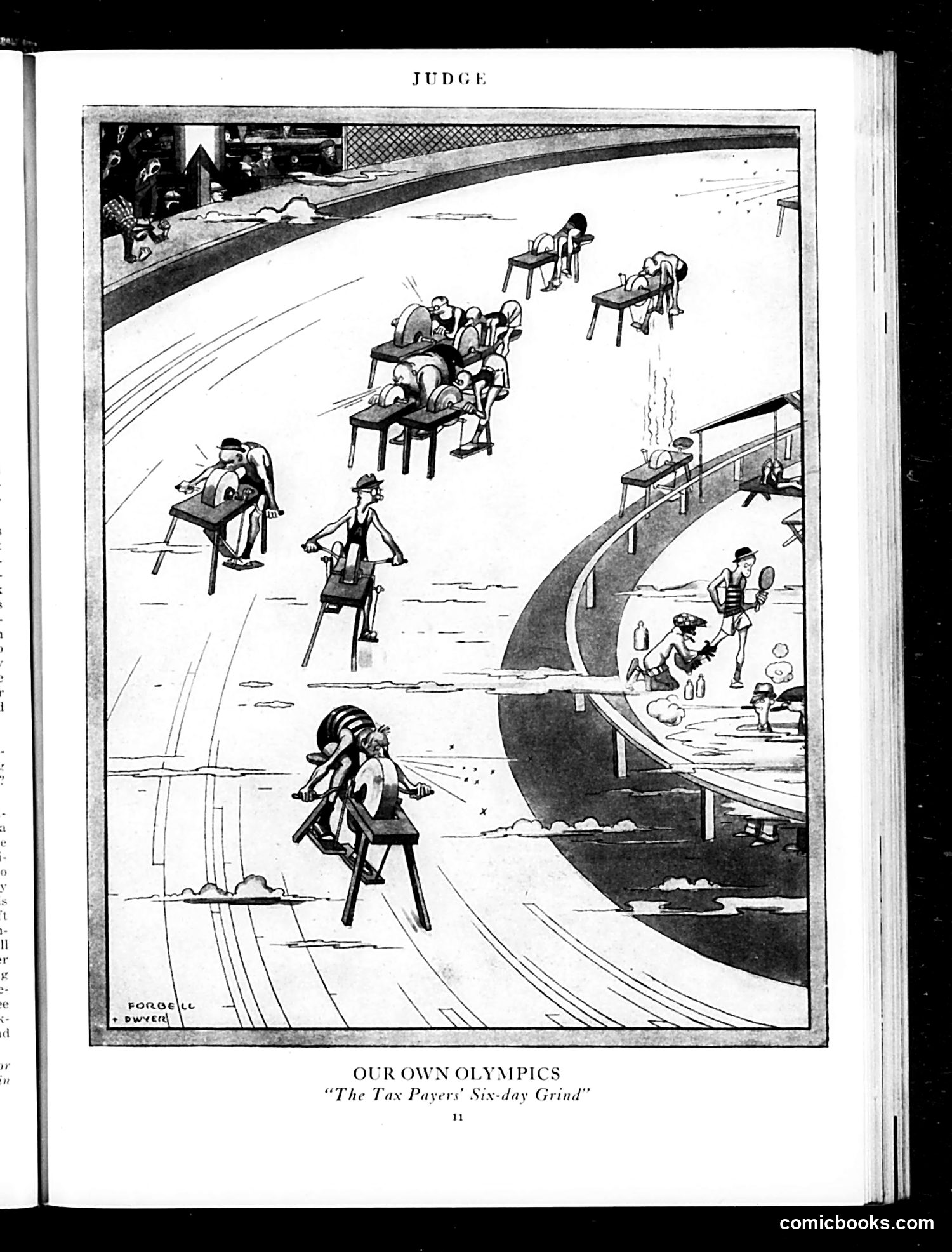
Analysis: "The Tax Payers' Six-day Grind" This Judge cartoon satirizes the burden of taxation on ordinary citizens by framing tax payment as a grueling athletic competition—a "six-day grind" (referencing the endurance cycling events popular at the time). The image shows exhausted figures sitting on chairs in what appears to be a competitive arena, with spectators watching from the stands. The cartoon mocks how taxpayers are forced to endure continuous financial demands, depicted as an Olympic-style trial. The satire suggests that paying taxes is as taxing and relentless as competitive sports, positioning taxpayers as unwilling athletes forced to perform for public amusement. This likely critiques either excessive taxation rates or the perceived unfairness of the tax system during whatever era Judge published this edition.
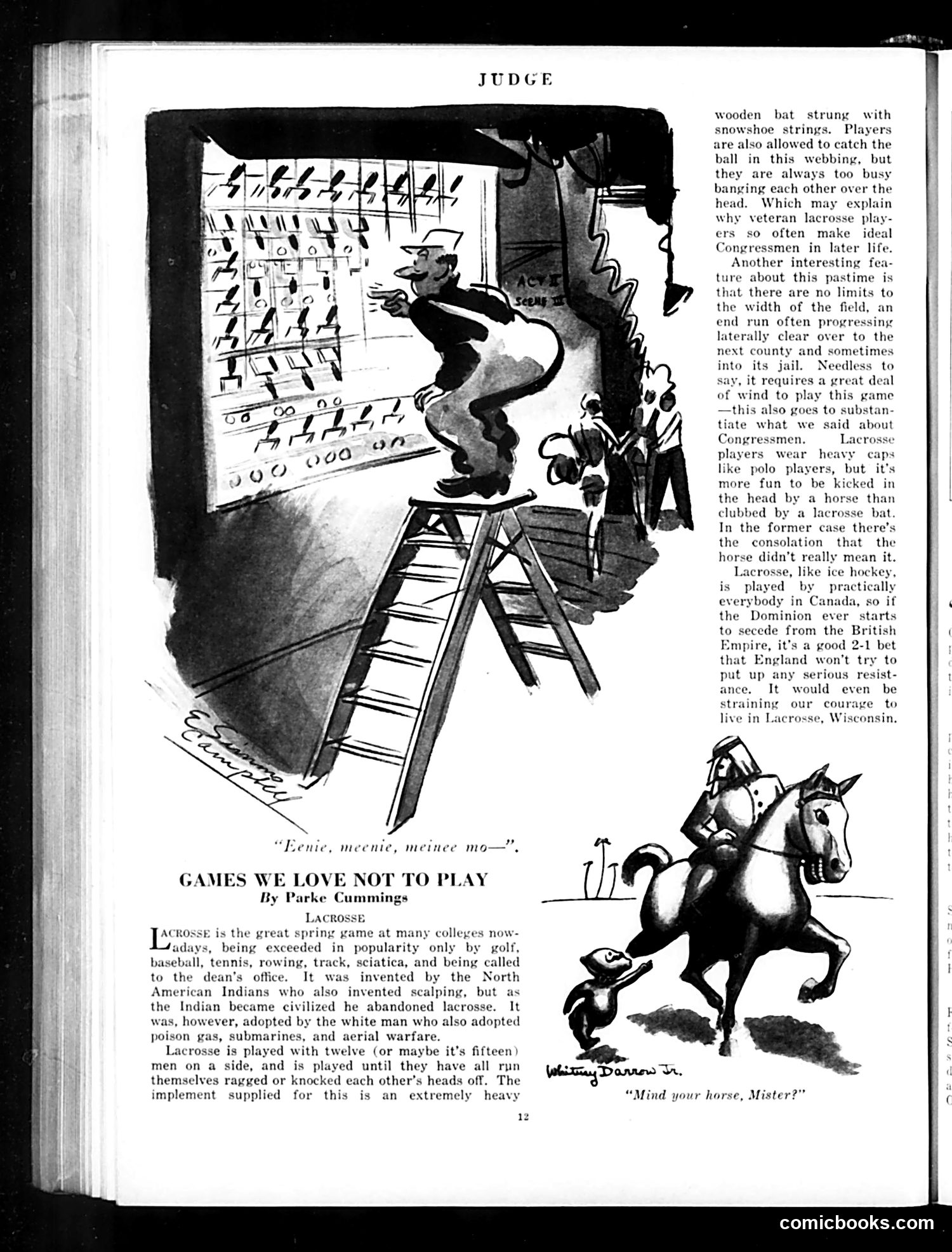
"Games We Love Not to Play: Lacrosse" This is a humorous essay by Parke Cummings satirizing lacrosse as a brutal sport. The text mockingly describes it as an extremely violent game where players regularly knock each other unconscious, with "no limits" to the field and equipment designed for head-striking. The satire works on multiple levels: Cummings jests that lacrosse's violence explains why veteran players often become Congressmen (implying politicians are naturally combative), and quips that Canada plays lacrosse so well that England shouldn't risk invading. The cartoon illustrations—showing a man being flung from a ladder and a polo player on horseback—reinforce the theme of chaotic, dangerous sport. This reflects early 20th-century American humor that mocked both the roughness of collegiate athletics and politicians' argumentative nature.
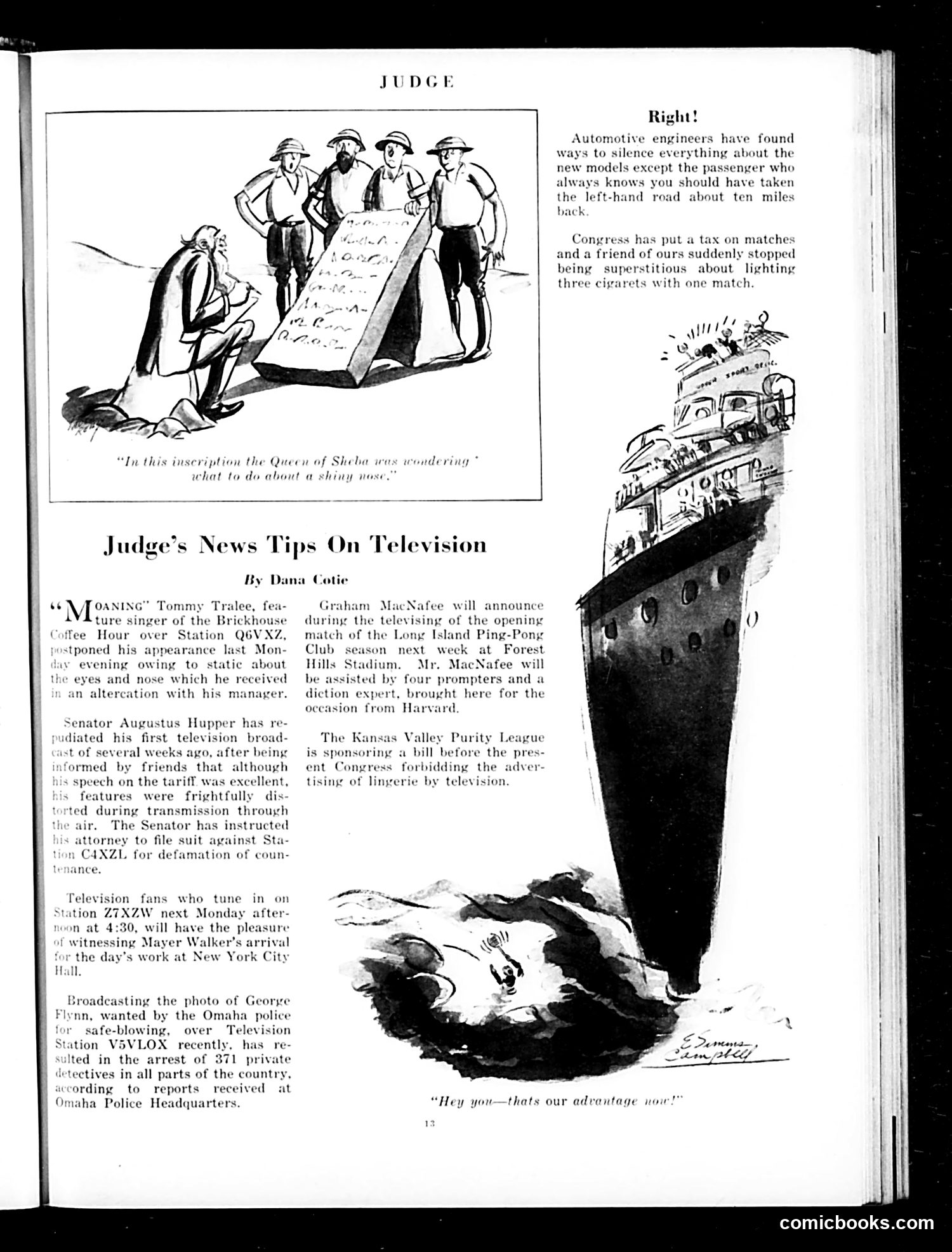
Judge Magazine Satire Analysis This page satirizes early television's technical and social problems. The top cartoon mocks a vague historical inscription about the "Queen of Sheba" and a "shiny nose"—likely referencing how early TV broadcast poorly rendered faces and complexions, a genuine technical limitation. The "News Tips" column below humorously documents television's growing pains: singers postponing appearances due to "static" affecting their appearance, a senator suing for "defamation of countenance" after his features looked distorted on air, and broadcasting causing unintended consequences (371 detectives arrested after a wanted criminal's photo aired). The page ridicules both the new medium's technical failures and societal overreactions. The bottom cartoon shows a ship captain saying "that's our advantage now!"—commenting on how radio/TV advertising could reach audiences anywhere, even at sea. The "Right!" segment jokes that Congress's match tax made people stop being superstitious about lighting three cigarettes with one match—satirizing how people rationalize behavior based on economics rather than logic.
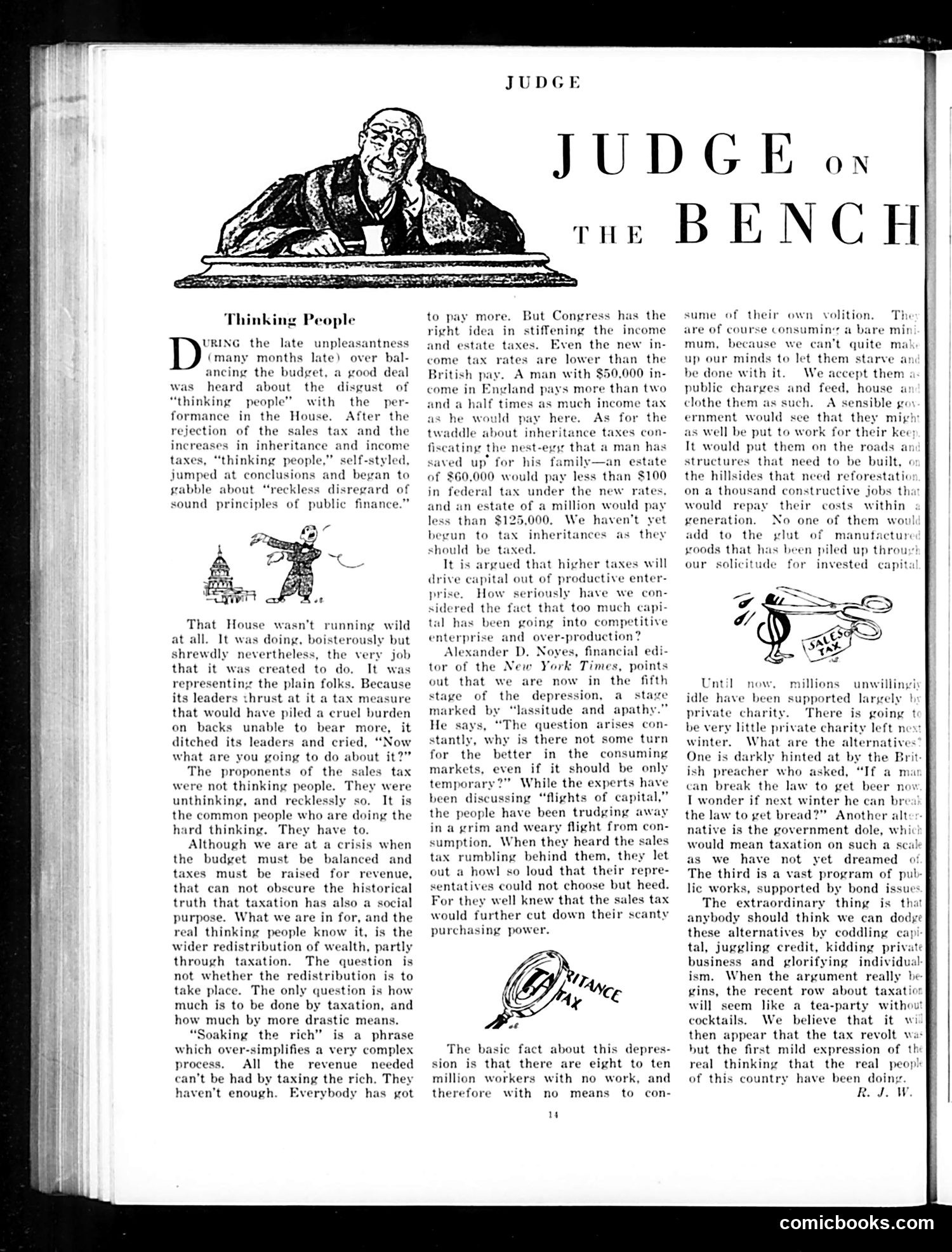
Explanation for Modern Readers This Judge magazine article critiques elites who opposed a sales tax during budget debates, calling them false "thinking people." The author argues the *actual* thinking people—common folks in Congress—correctly rejected the sales tax because it would burden the poor during the Depression. The satire targets wealthy intellectuals who invoke "sound principles of public finance" while ignoring economic reality: millions are unemployed and have no purchasing power. The article advocates progressive taxation (taxing the rich more) and public works programs to put the jobless to work, not charity. Key figures/references: Alexander D. Noyes (New York Times financial editor) represents expert opinion the author criticizes; the British tax system is cited as comparison showing America undertaxes the wealthy. The joke: "Thinking people" actually *aren't* thinking—the "plain folks" and their representatives show better judgment by rejecting regressive taxation.
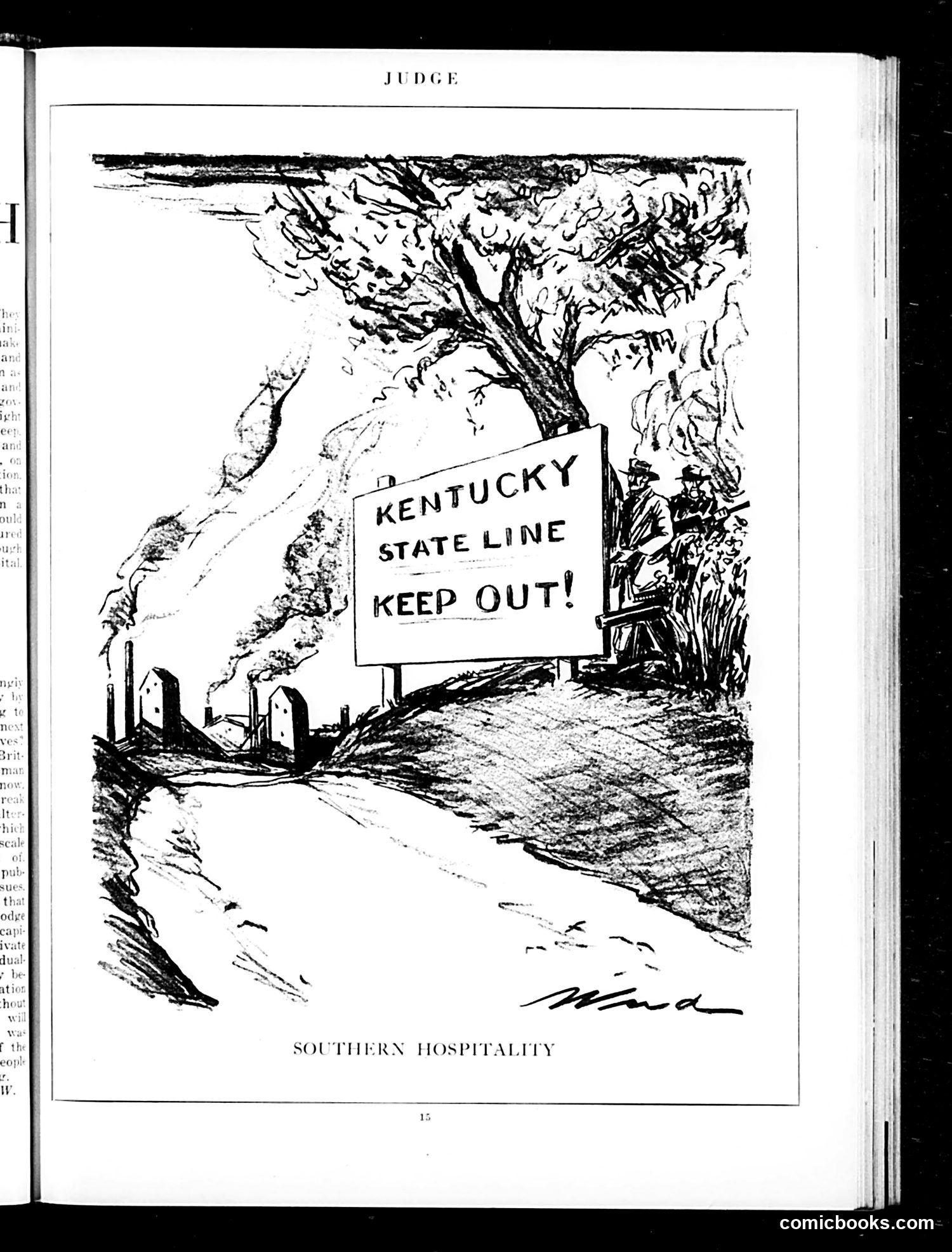
"Southern Hospitality" - Judge Magazine Cartoon This political cartoon satirizes Southern xenophobia and territorial hostility. It depicts a "Keep Out!" sign at the Kentucky state line, positioned beneath a gnarled tree—a stark contrast to the title's ironic reference to "Southern Hospitality," a phrase traditionally associated with warmth and welcome. The cartoon criticizes the actual unwelcoming attitude of Southern states toward outsiders, likely referencing early 20th-century resistance to Northern influence, immigration, or outside intervention. The barren, forbidding landscape and aggressive signage mock the gap between Southern states' professed friendliness and their actual exclusionary practices. The artist's signature appears at bottom left. This represents Judge magazine's satirical commentary on regional tensions and hypocrisy.
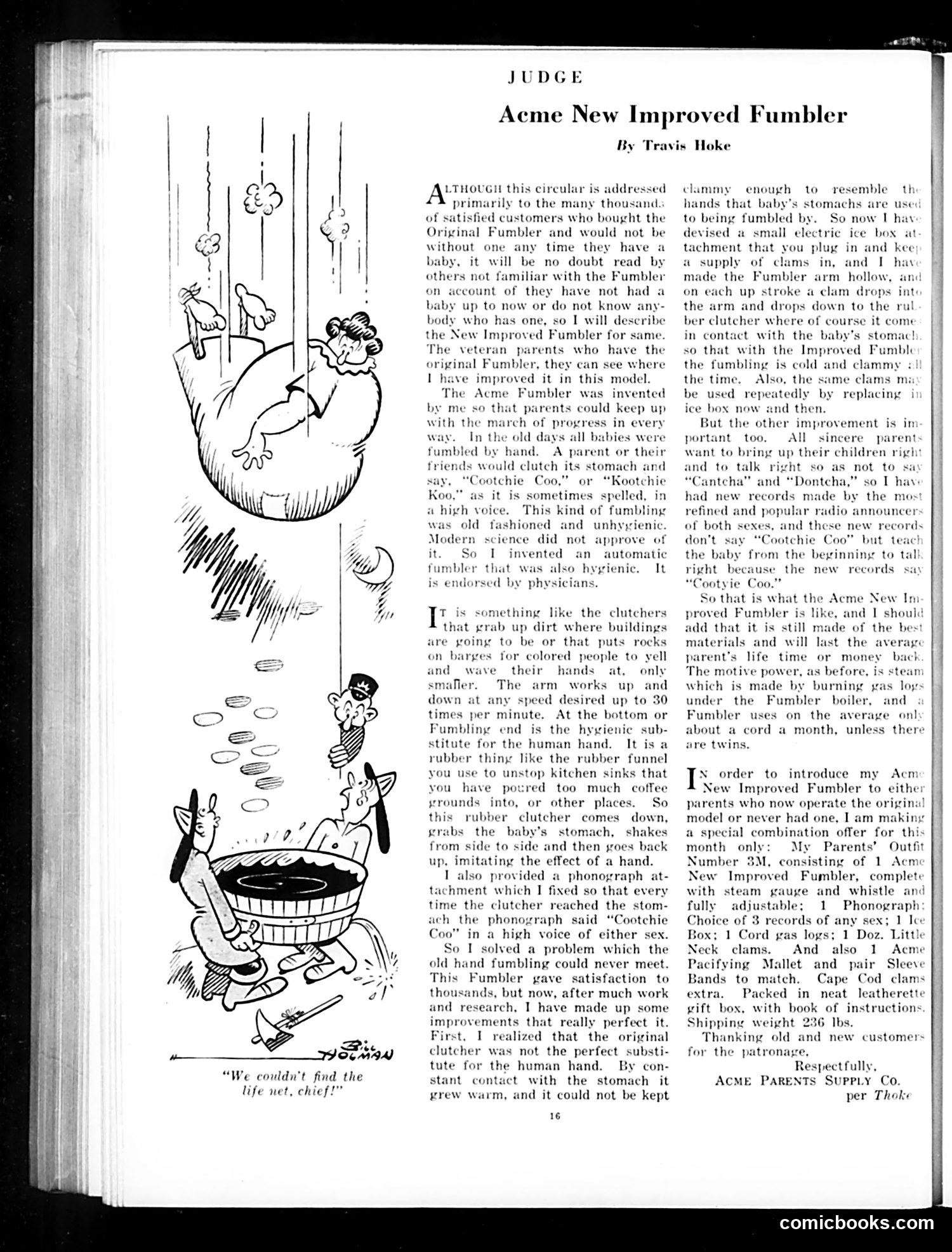
Judge Magazine: "Acme New Improved Fumbler" by Travis Hoke This is a satirical advertisement for a fictional baby-bouncing machine. The humor targets three things: mechanical over-engineering for simple tasks, pseudo-scientific justifications for unnecessary inventions, and pretentious parenting trends. The "Fumbler" is a steam-powered contraption that automatically jiggles a baby's stomach while saying "Cootchie Coo"—replacing what parents naturally did by hand. The "improvements" escalate the absurdity: an ice-box attachment keeps clams cold to make the rubber clutcher appropriately "clammy," and a phonograph teaches babies proper elocution instead of old-fashioned baby talk. The cartoon (showing a baby in the machine with adults celebrating) emphasizes the ridiculous gap between the invention's complexity and its trivial purpose. This satirizes 1920s-30s consumer culture's obsession with "modern science" solving everyday problems, while poking fun at middle-class parents' anxiety about raising children "properly."
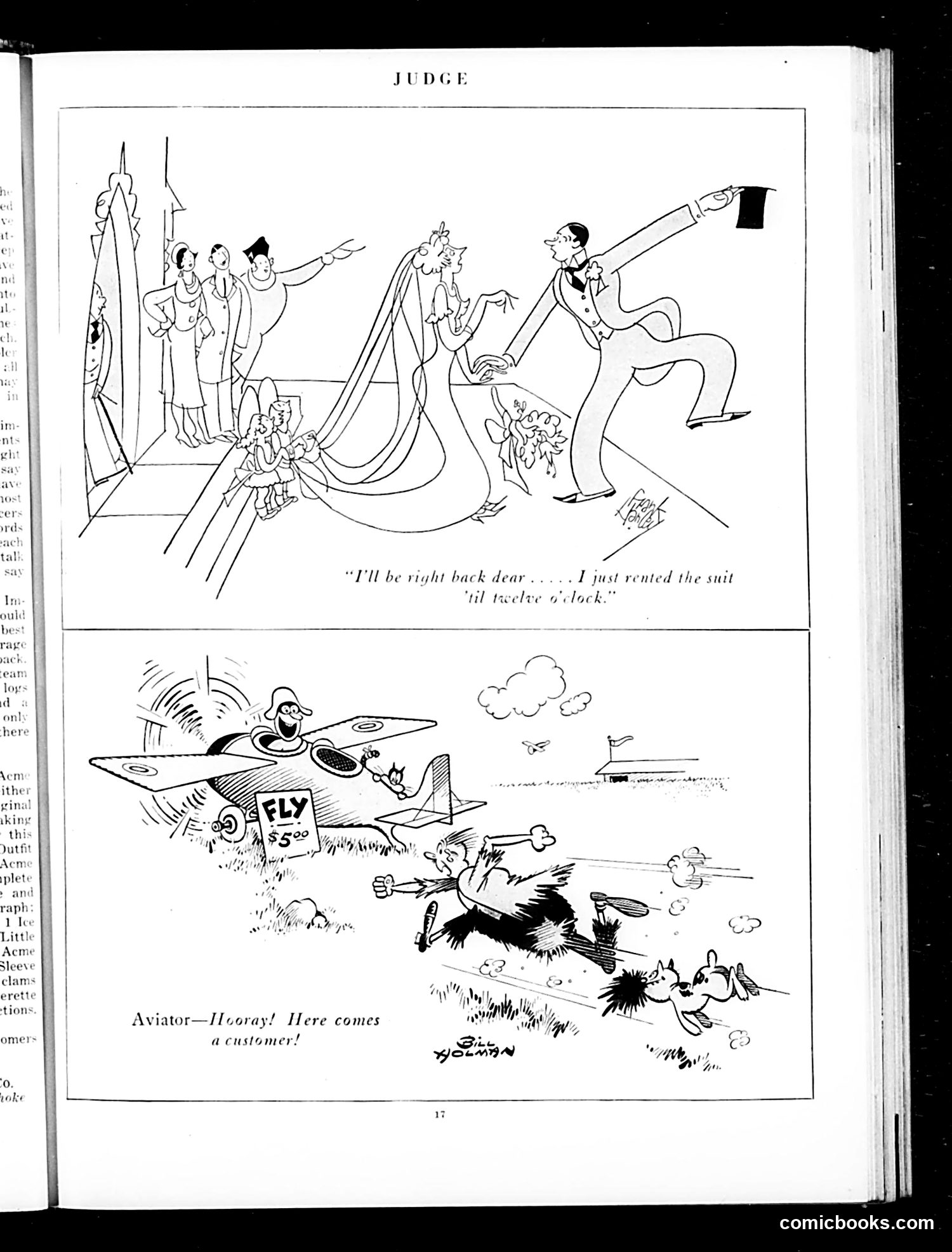
Analysis This page contains two cartoons satirizing early 20th-century social behaviors. Top cartoon: A well-dressed man exits a formal event (courthouse or similar institution), announcing he's rented his suit only until midnight. The satire mocks the pretense of the working or lower-middle class attempting to appear wealthy for social occasions by renting formal attire temporarily—a common practice that exposed class anxieties about maintaining appearances. Bottom cartoon: An aviator in a primitive airplane encounters what appears to be a customer on the ground. The humor likely satirizes the novelty and chaos of early aviation, suggesting an unexpected or comedic interaction between the new flying technology and ordinary people below. The "customer" reference suggests commercial aviation's absurd early days. Both cartoons mock social pretension and emerging modern phenomena through exaggerated scenarios.
Judge Magazine Theatre Critique This is a theatre review column, not a political cartoon. The author critiques a play called "Angels Don't Kiss" that recently played locally, describing it as terrible ("tripe"). The review mocks the play's absurd plot elements: the protagonist's unwarranted ego, a ridiculous scene where a boy is hired to conduct an engineering conference, and repeatedly—the core complaint—scenes where the heroine rejects the hero's kisses, claiming she felt something "dreadful" on their wedding night, then shrinks back in disgust from "that kind of kiss." The critic expresses frustration that after years of theatre-going, he cannot understand what specific horror the plays reference about kisses or wedding nights. The humor lies in the melodramatic vagueness of these theatrical clichés and the critic's exasperation with their repetitive use across multiple productions without explanation.
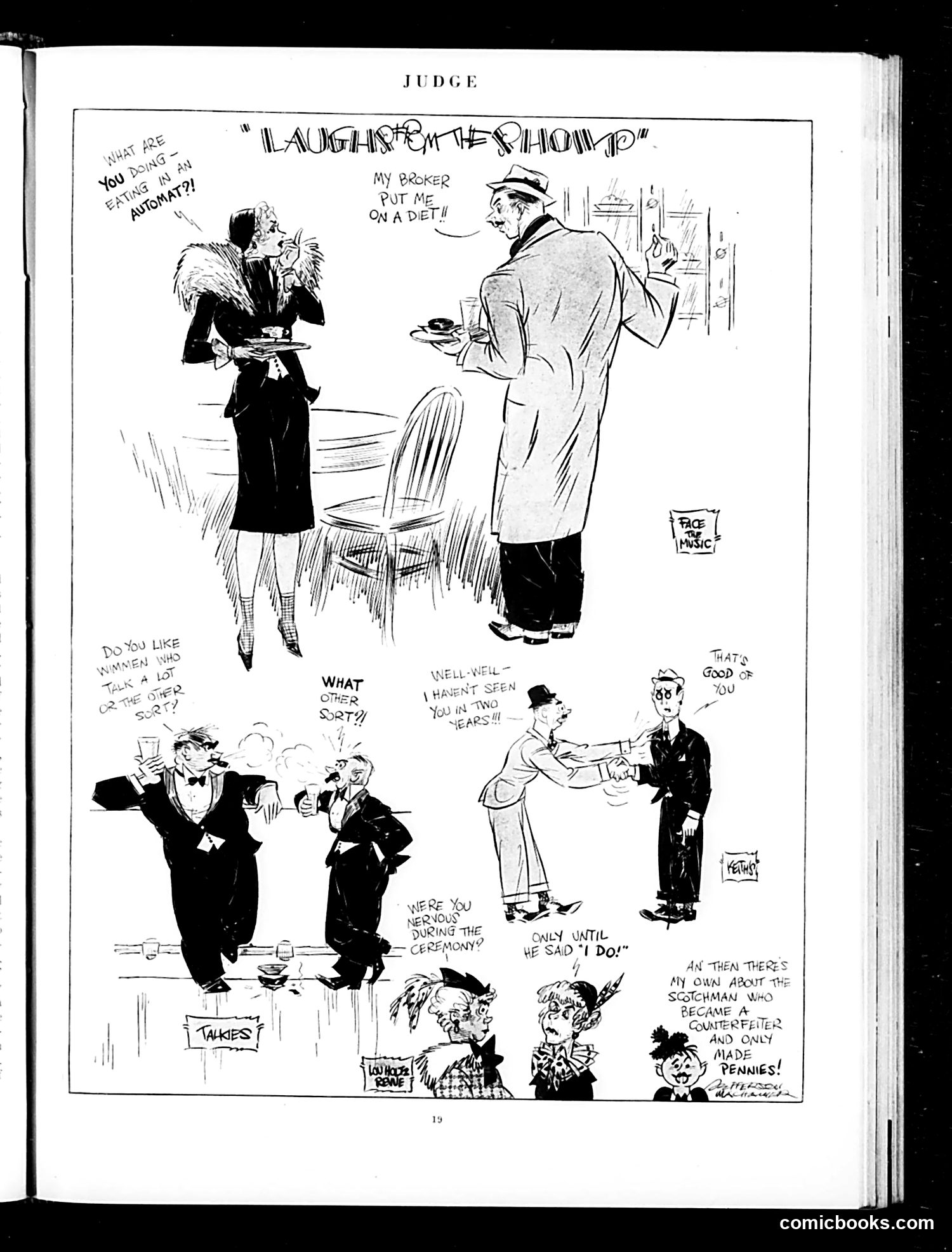
"Laugh It Off" - Judge Magazine Cartoon This page presents multiple comic vignettes satirizing marriage and domestic life. The central scene shows a couple at what appears to be a formal dinner or event, with dialogue about the woman's broker putting her "on a diet." The surrounding panels mock various marriage-related scenarios: a man bragging about putting his wife on a diet, guests asking nervous questions during a ceremony, and a punchline about a counterfeiter who "only made pennies"—a play on words linking worthless currency to a struggling marriage. The humor relies on early 20th-century gender stereotypes about women's weight, marital anxiety, and husbands' financial inadequacy. The overall tone suggests satire directed at both newlyweds' insecurities and the absurdity of domestic expectations, typical of Judge magazine's satirical approach to American social life during this period.
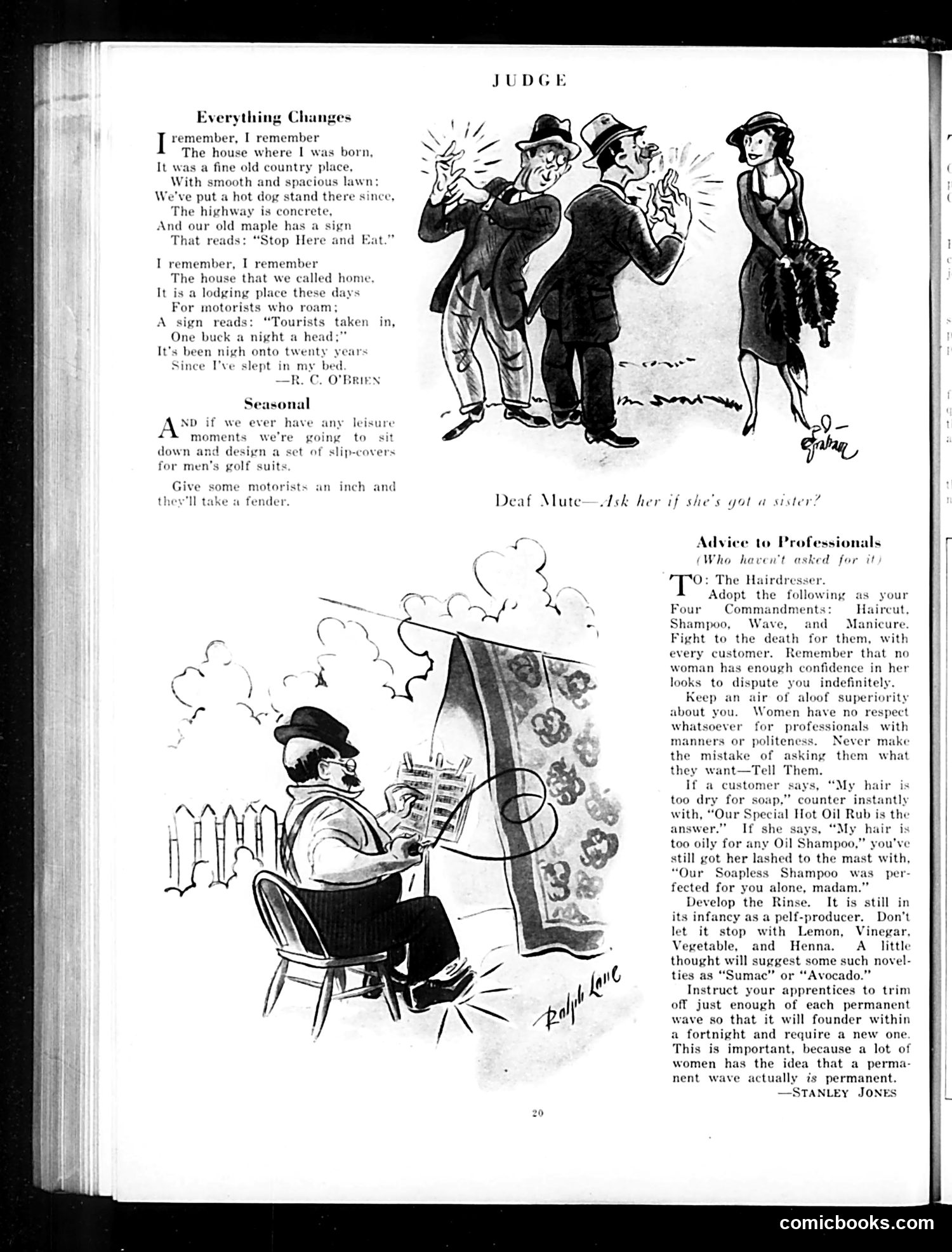
Judge Magazine Page Analysis This page contains three distinct pieces of social satire: "Everything Changes" — A nostalgic poem lamenting how rural America has been transformed by automobile culture and commercialism. The speaker's childhood home is now a hot dog stand; the family house is a tourist lodge. The satire targets the rapid, destructive modernization of the American landscape during the automobile boom era. "Deaf Mute" cartoon — A crude joke: three men are accosting a young woman, with one asking another to "ask her if she's got a sister?" The humor relies on the offensive premise that she cannot hear their advances. "Advice to Professionals" — Satirical guidance to hairdressers, mocking both the profession and female customers. It advises hairdressers to be arrogant, manipulative, and dismissive ("Never make the mistake of asking them what they want"), and to constantly upsell unnecessary services like "the Rinse." The satire criticizes how professionals exploit women's insecurity about appearance. All pieces reflect 1920s attitudes toward modernization, gender, and consumer culture.
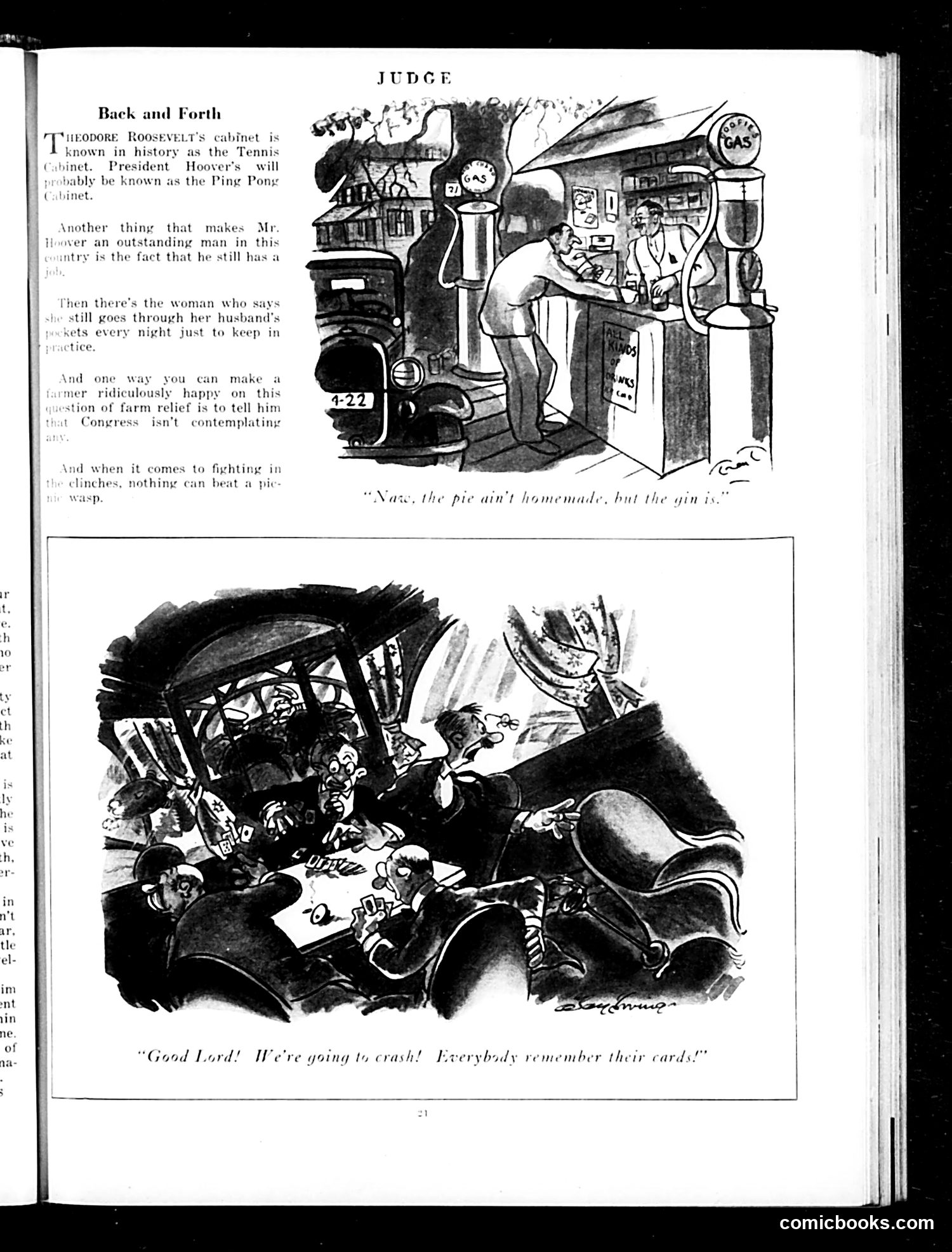
Judge Magazine Political Commentary This page from Judge magazine contains satirical commentary on American political figures and social customs, likely from the Hoover administration era (1929-1933). Top cartoon: A gas station attendant tells a customer "Nase, the pie ain't homemade, but the gin is"—satirizing Prohibition-era bootlegging and the hypocrisy of illegal alcohol consumption during the ban. Text commentary mocks: - President Hoover's cabinet (comparing it unfavorably to Theodore Roosevelt's "Tennis Cabinet") - A stereotypical wife who rifles through her husband's pockets nightly for control - Congressional inaction on farm relief during agricultural hardship - Fighting techniques ("pic-wasp" fighting in close quarters) Bottom cartoon: Depicts what appears to be a chaotic car accident or traffic incident with passengers shouting "Good Lord! We're going to crash! Everybody remember their cards!"—likely satirizing Americans' obsession with card games and gambling as a distraction from serious matters. The overall tone critiques domestic habits, political ineffectiveness, and social priorities of the era.
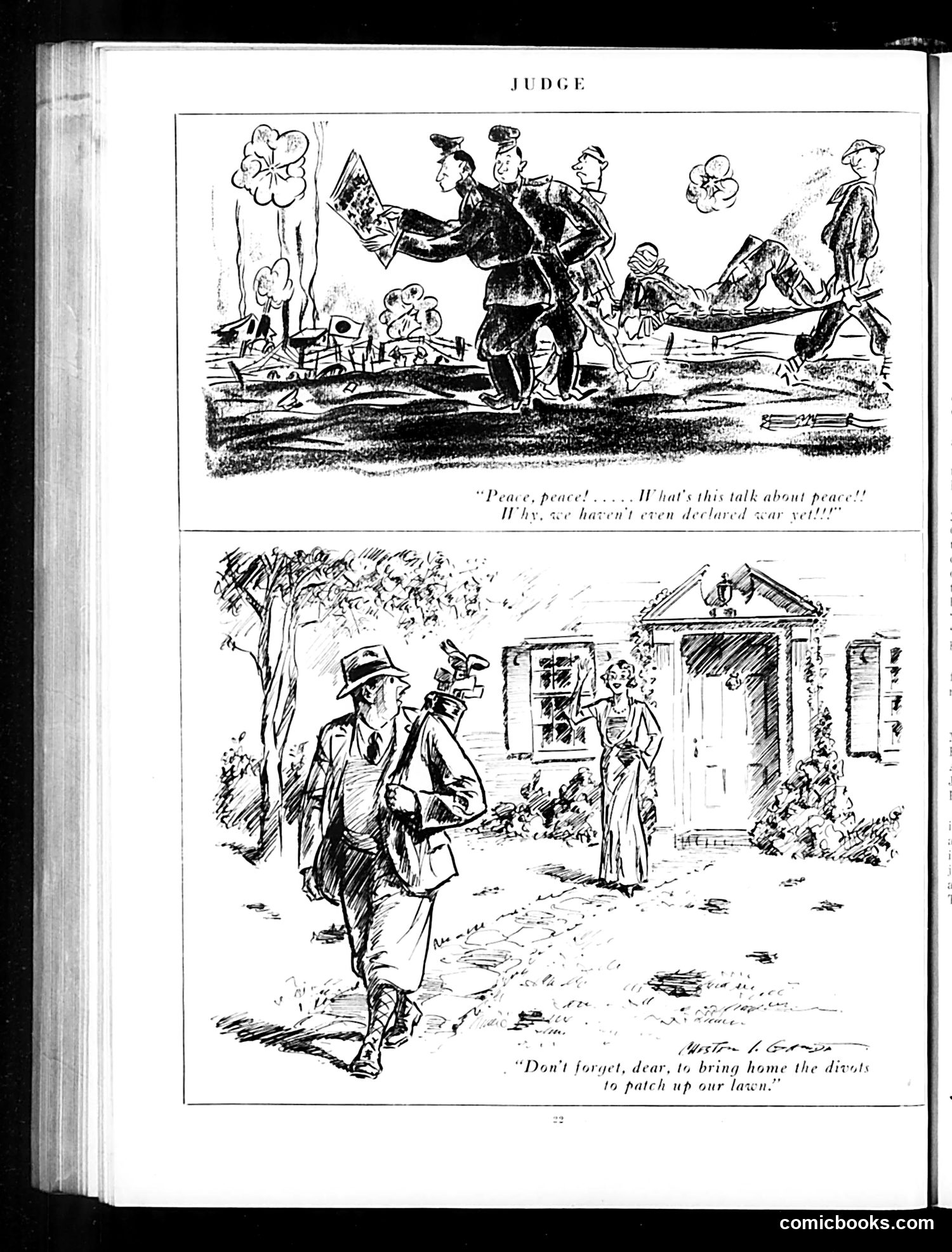
Analysis of Judge Page This page contains two WWI-era cartoons satirizing the disconnect between military and civilian life. The top cartoon depicts military officers discussing peace negotiations while soldiers suffer in the background. The dialogue mocks the absurdity: officers debate peace while war hasn't even been formally declared—highlighting the confusion and contradiction of wartime diplomacy. The bottom cartoon shows a soldier leaving home while his wife reminds him to bring back "divots" (chunks of turf) to repair their lawn. This is dark domestic humor: while the man goes to war, she's concerned about lawn damage—a satirical comment on civilian obliviousness to war's actual stakes, reducing battlefield casualties to a mere inconvenience comparable to yard maintenance. Both cartoons critique the gap between military reality and civilian perception during WWI.
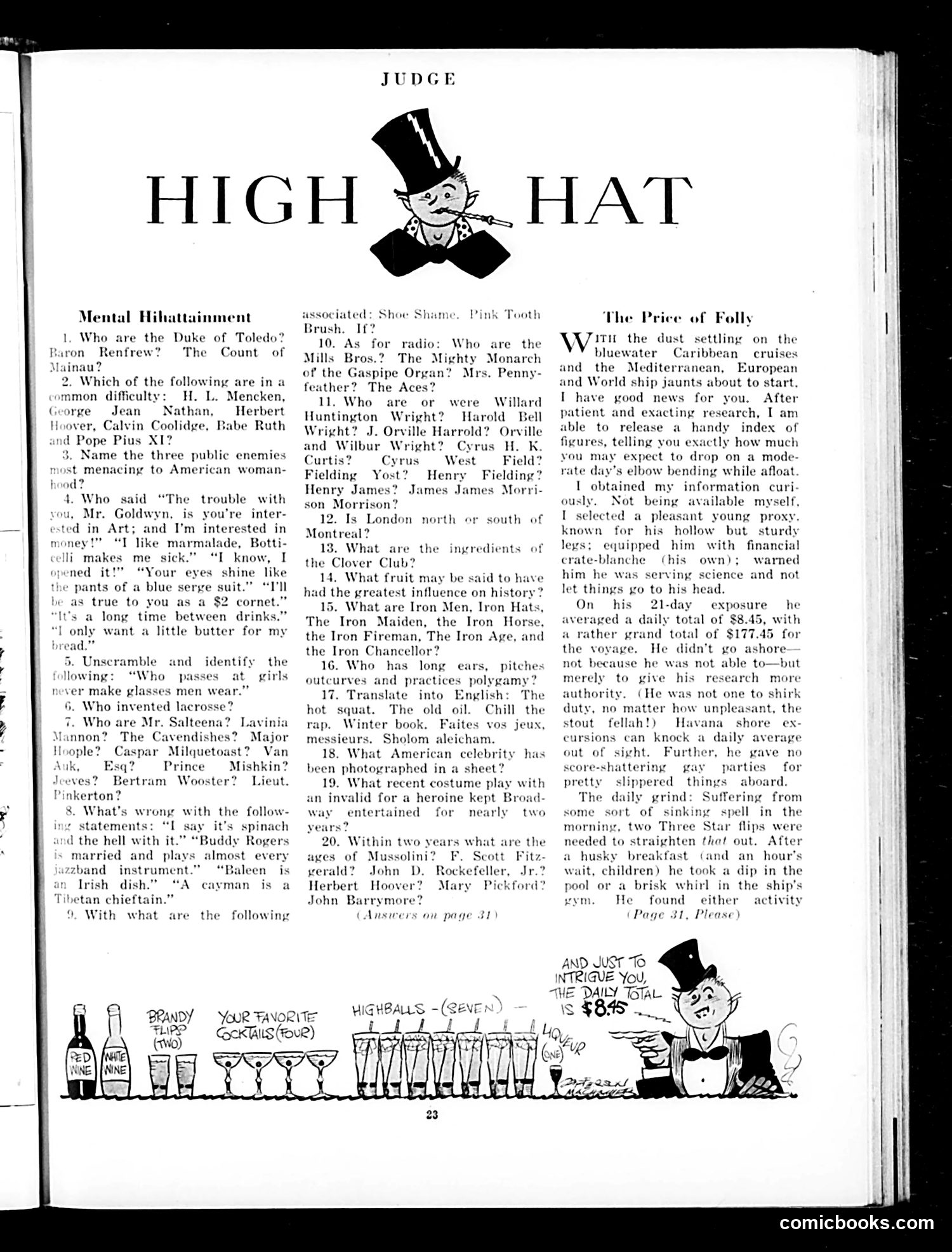
Judge Magazine Page Analysis This page from Judge magazine contains a trivia quiz titled "Mental Hihattainment" and a humorous article about cruise ship spending. The Quiz The "High Hat" quiz tests readers' knowledge of contemporary 1920s-30s celebrities, radio personalities, literary figures, and cultural references—names like Calvin Coolidge, Babe Ruth, the Wright Brothers, and radio shows. The humor lies in mixing obscure and famous figures, assuming educated readers would recognize them all. The Cartoon & Article The bottom illustration shows a bartender serving cocktails, with a running gag about shipboard expenses. The accompanying article satirizes the hidden costs of leisure cruises, revealing that a typical passenger might spend $177.45 over 21 days—a substantial sum during the Depression era. The humor mocks both the casual spending habits of the wealthy and their self-deception about vacation expenses. The "High Hat" branding suggests this section targets intellectually pretentious readers, characteristic of Judge's sophisticated satirical approach to American culture and class.
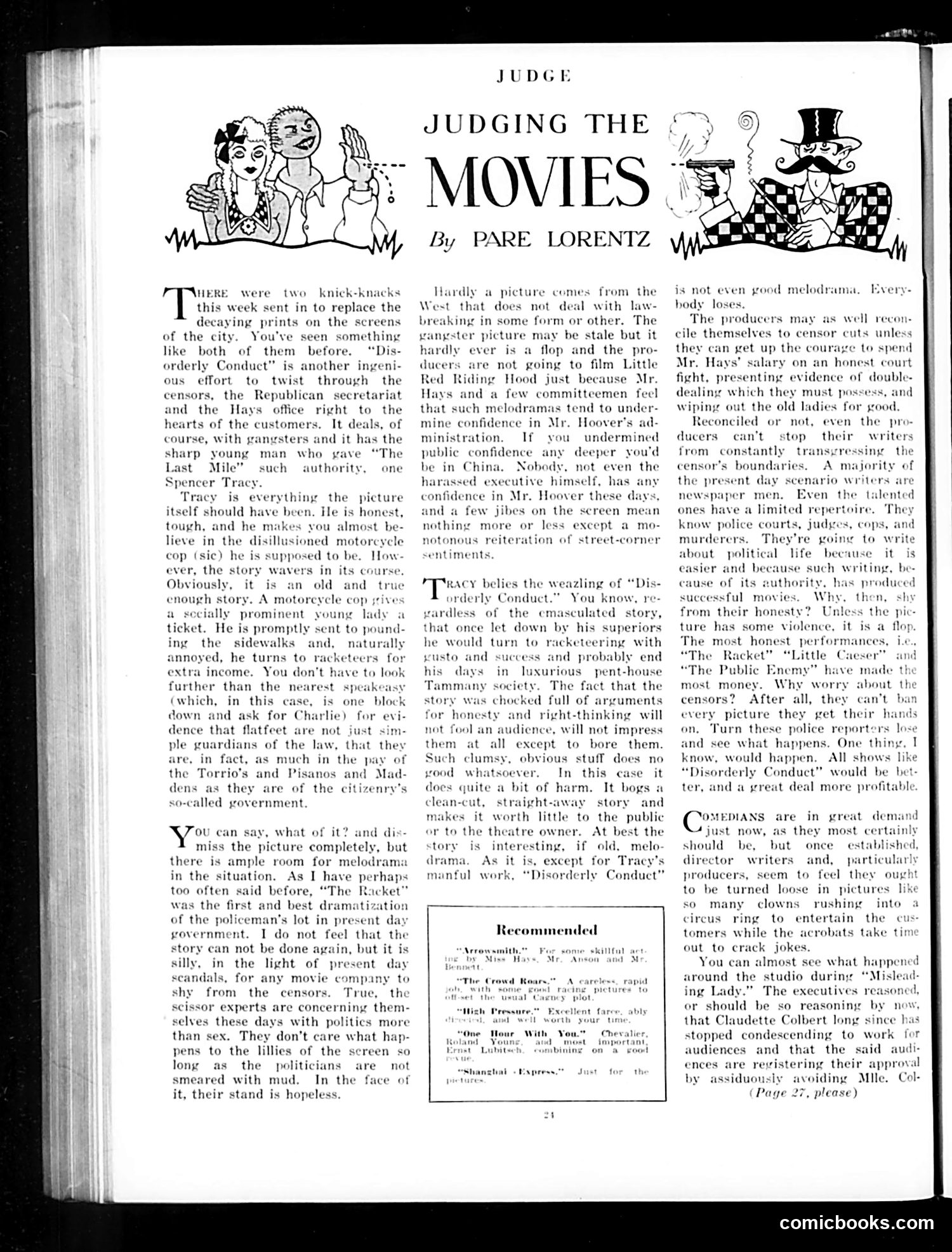
Judging the Movies: A Depression-Era Critique This page from Judge magazine features film critic Pare Lorentz reviewing "Disorderly Conduct," starring Spencer Tracy. The article criticizes Hollywood's timid approach to depicting crime and corruption. Lorentz argues that while gangster and crime films are popular, studios neutered this one by having its protagonist (a police officer who turns to racketeering) ultimately fail—making it moralistic rather than honest. He mocks the censorship board ("Hays office"), noting it polices political content more carefully than it once policed sexual content, fearing anything that undermines confidence in President Hoover's administration. The irony: public confidence in Hoover was already destroyed by the Great Depression, so sanitizing crime stories seems pointless. Lorentz praises Tracy's performance but laments how the script's heavy-handed moralizing undermines what could be a compelling story. He suggests studios need courage to fight censors directly rather than self-censor. The "Recommended" box lists other contemporary films reviewed.
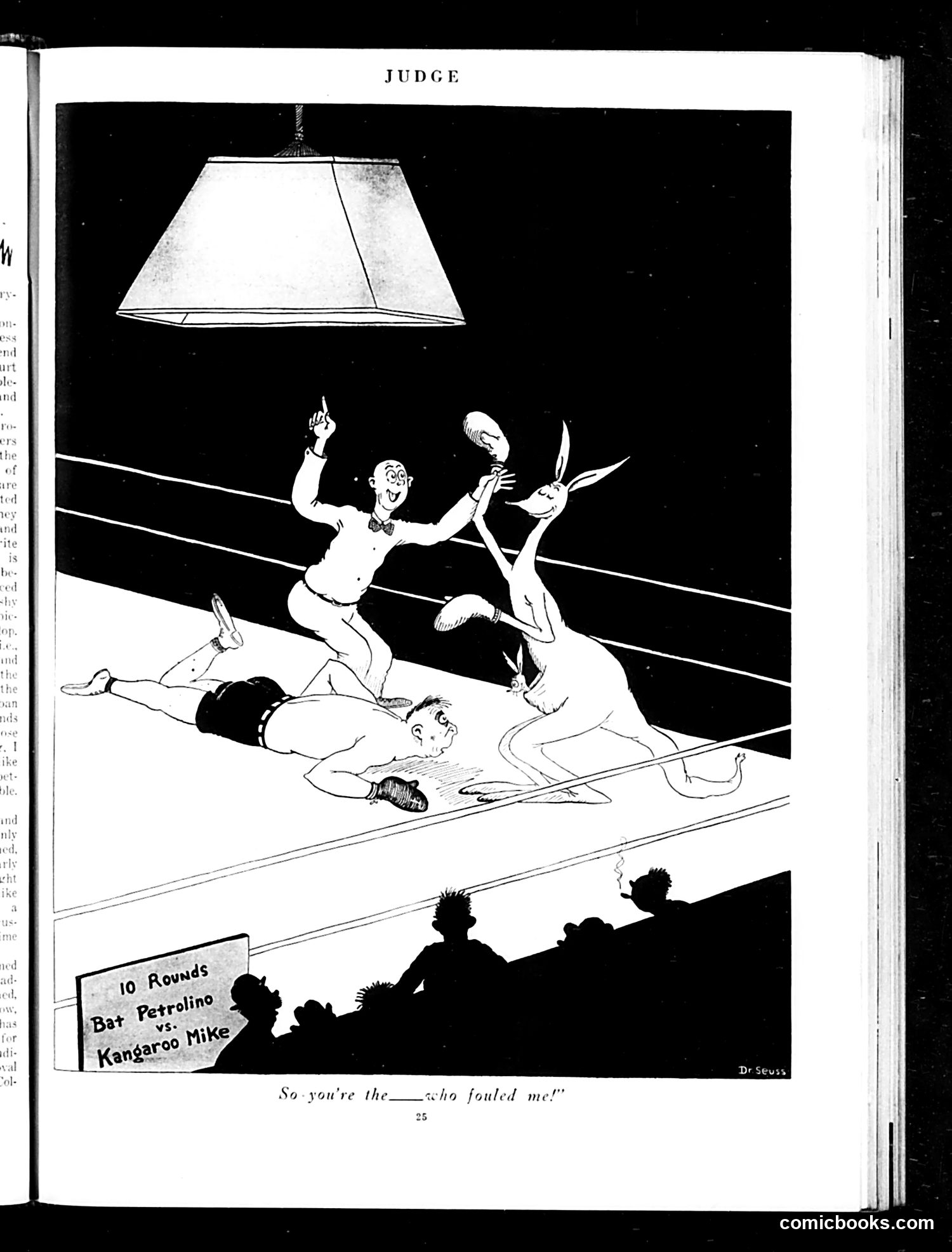
Judge Cartoon Analysis This is a boxing-themed cartoon titled "Judge" by Dr. Seuss, depicting a match between "Bar Petrolino vs. Kangaroo Mike" (visible on the ringside sign marking "10 Rounds"). The cartoon shows a boxer knocked down in the ring, while two other figures celebrate above him under a overhead lamp. The silhouetted audience below watches the action. The caption reads: "So you're the___who fouled me!" — the blank space suggests a censored or missing word, likely a mild profanity or insult. The satire appears to target boxing culture, possibly mocking heated disputes over fouls or unsportsmanlike conduct. The cartoon may also reference specific boxers or a particular match, though without additional historical context, the specific figures referenced remain unclear beyond what's labeled on the sign.
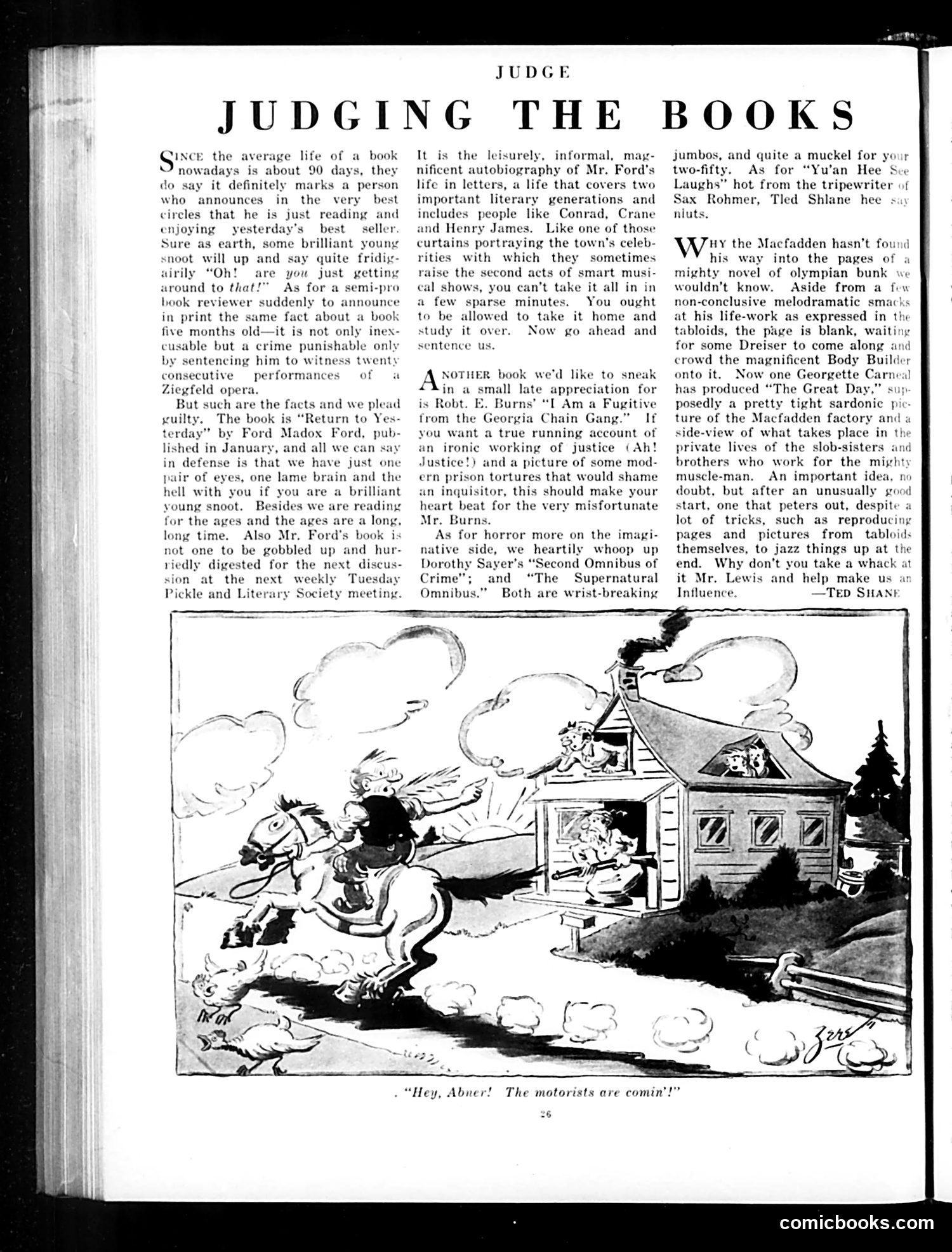
Judging the Books: Judge Magazine Book Review (c. 1930s) This is a book review column satirizing literary pretension and delayed reading. The opening mock-scolds readers who announce they're reading last season's bestsellers—a social faux pas in elite circles. The reviewer confesses to reviewing Ford Madox Ford's "Return to Yesterday" months late, joking that this crime deserves punishment by forced attendance at Ziegfeld Opera performances. The column then recommends several books: Robert Burns's prison memoir "I Am a Fugitive from the Georgia Chain Gang"; Dorothy Sayers's crime omnibus; and Georgette Carnos's "The Great Day," a satire about the Macfadden physical-culture factory and its workers. The reviewer criticizes Carnos's execution despite her good premise. The cartoon below shows a man on horseback alerting someone ("Hey, Abner! The motorists are comin'!"), apparently satirizing rural America's collision with modern automobile culture—a popular Judge theme of the era.
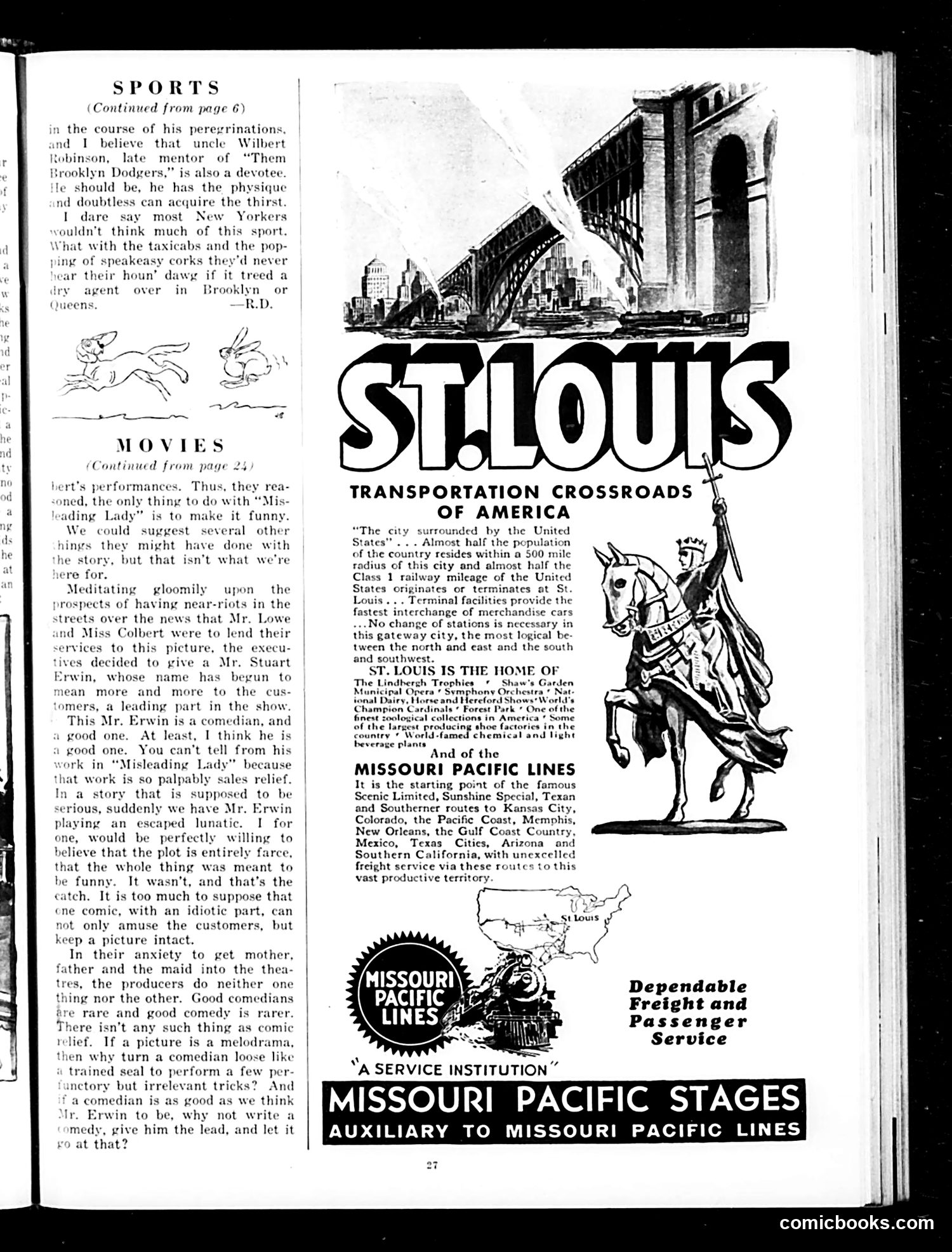
Page Content Analysis This page is primarily advertising rather than satirical editorial content. The top portion contains a continuation of sports and movies criticism from *Judge* magazine, but the dominant visual and textual content consists of full-page advertisements for the Missouri Pacific Railway. The ads promote St. Louis as "Transportation Crossroads of America" and highlight the Missouri Pacific Lines' routes and services. The imagery includes an illustration of the St. Louis skyline with the Gateway Arch area, and a logo featuring a cowboy on horseback—the railroad's branded mascot. The small sports/movies section above discusses comedians Stuart Erwin and Wilbert Robinson, critiquing how comedic relief is being misused in films like "Misleading Lady." This is essentially a magazine back page mixing editorial commentary with paid promotional content—typical of early 20th-century magazine layouts where advertising subsidized publication costs.
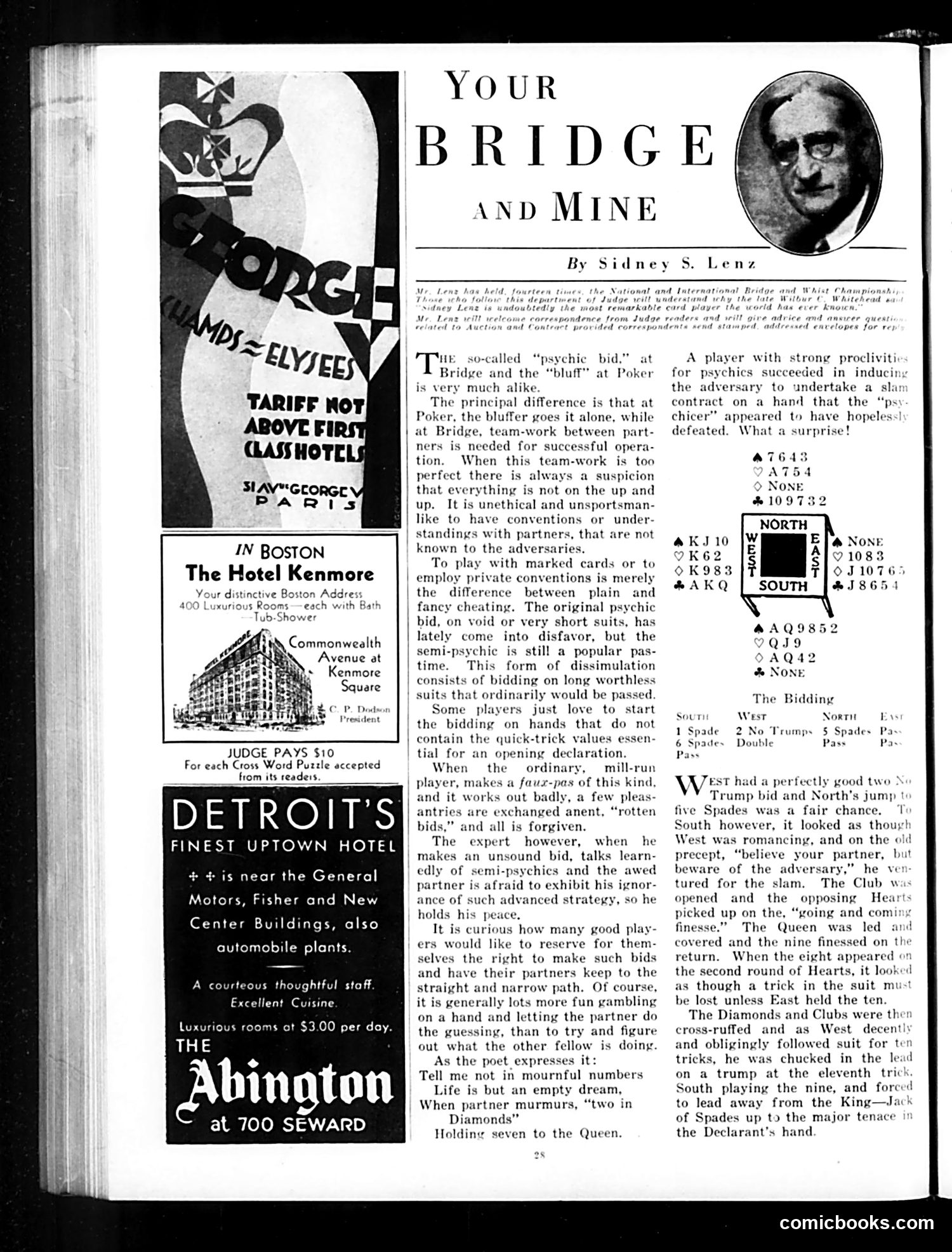
"Your Bridge and Mine" by Sidney S. Lenz This page is primarily a bridge strategy column rather than satirical content. The main article discusses "psychic bidding" in bridge—unconventional bids that signal information between partners through prearranged but undisclosed conventions. Lenz argues this is unethical gamesmanship, comparing it to cheating at poker with marked cards. He critiques players who exploit advanced strategy while expecting partners to follow strict, transparent rules. The article includes a detailed bridge hand analysis demonstrating how a risky "psychic" bid gambit worked out unexpectedly. The surrounding content is advertising for hotels (Boston's Kenmore, Detroit's Abington) and Judge magazine's word-puzzle competition. This represents Judge's typical format: mixing satirical commentary on social/behavioral topics (here, gaming etiquette) with era-appropriate hotel advertisements and reader contests.
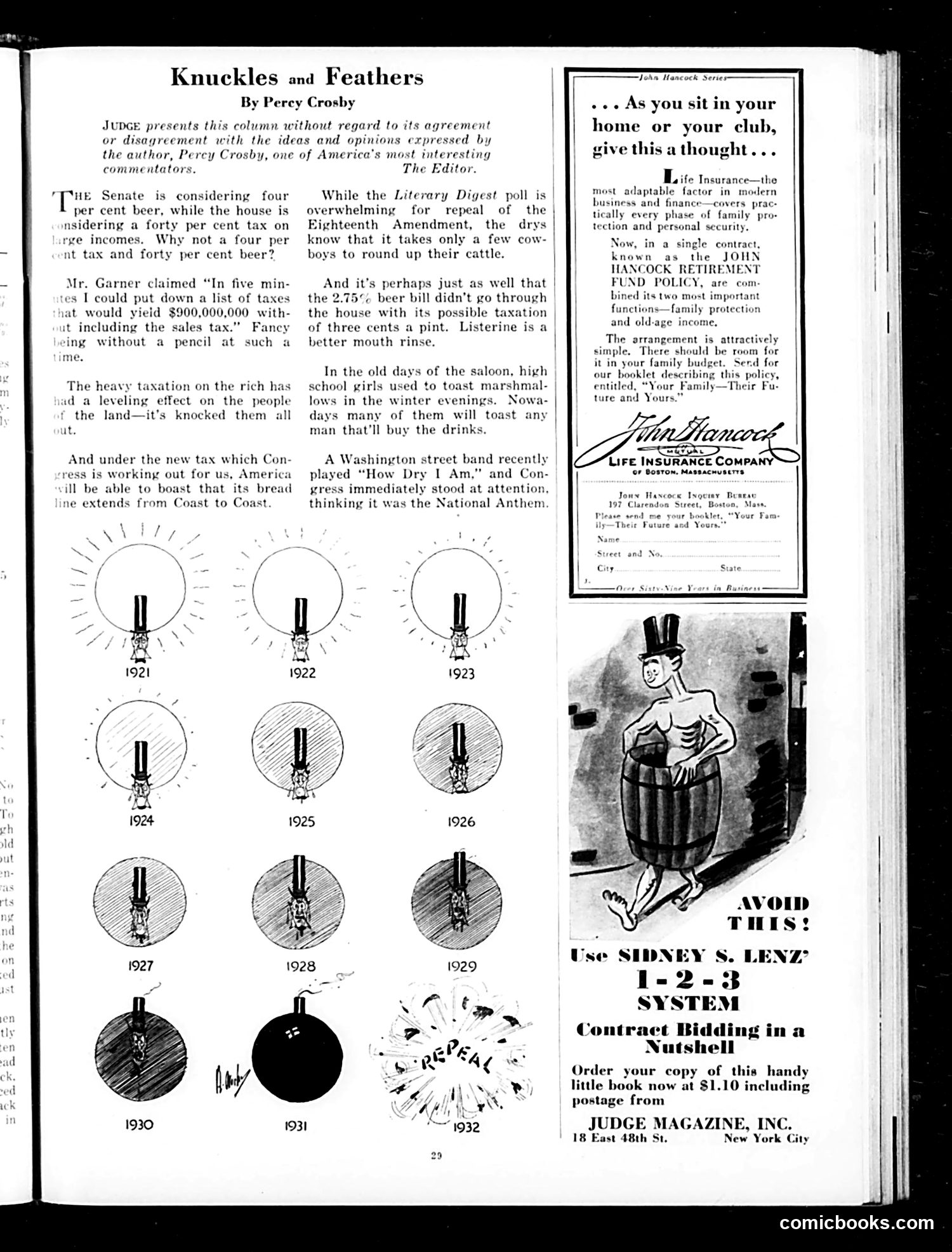
Explanation for Modern Readers Percy Crosby's "Knuckles and Feathers" column satirizes 1920s-early 1930s American politics, particularly Prohibition and taxation debates. The central joke contrasts absurd policy proposals: the Senate debates a modest beer tax while considering heavy income taxes on the wealthy—Crosby sarcastically suggests reversing this (low income tax, high beer tax). References include Mr. Garner's claimed ability to identify $900 million in tax sources, and the Literary Digest poll on repealing the Eighteenth Amendment (Prohibition). The barbs at "dry" advocates, the saloon-era joke about high school girls, and the Washington band playing "How Dry I Am" all mock Prohibition's failure and unpopularity. The twelve circular diagrams (1921-1932) appear to track Prohibition's waning effectiveness—each shows a smaller illuminated area, suggesting declining compliance or enforcement over the decade. The page also contains insurance and diet-system advertisements typical of the magazine's revenue model.
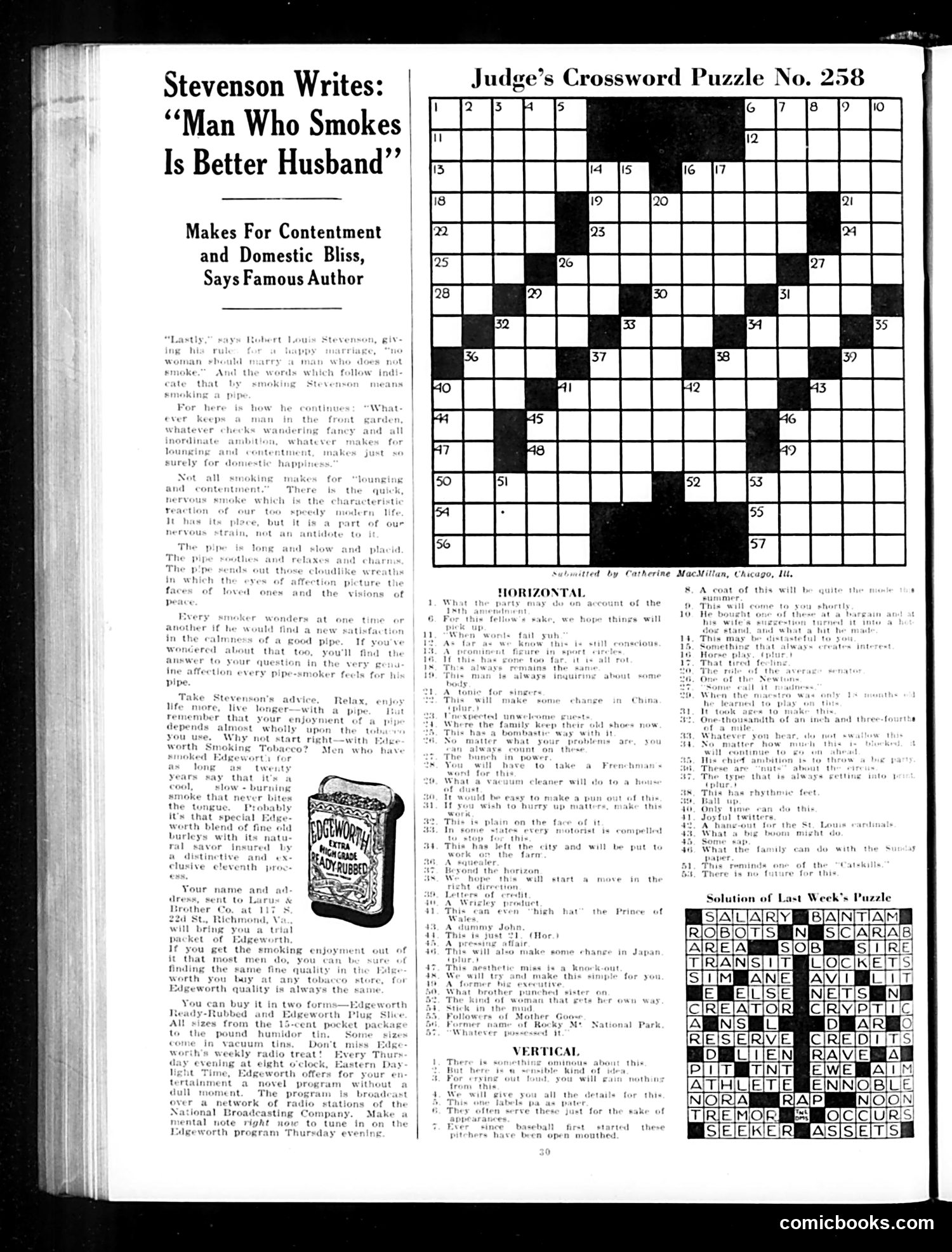
Analysis This page primarily features a crossword puzzle (Judge's Crossword Puzzle No. 258) and advertising rather than satirical cartoon content. The headline references Robert Louis Stevenson's purported claim that "a man who smokes is a better husband," promoting domestic contentment. The accompanying text appears to be editorial commentary on smoking and marital bliss. Below the article is an Edgeworth Plug Slice tobacco advertisement—a prominent brand of the era. The ad emphasizes the pipe-smoking experience as conducive to relaxation and contentment, cleverly aligning with Stevenson's quoted sentiment to market the product. The juxtaposition suggests this is partly advertorial content: using a famous author's endorsement of smoking to sell tobacco products. This reflects early 20th-century advertising practices that freely invoked celebrity endorsements without modern regulatory restrictions. The "satire" appears gentle—poking fun at domestic happiness through smoking rather than criticizing it.
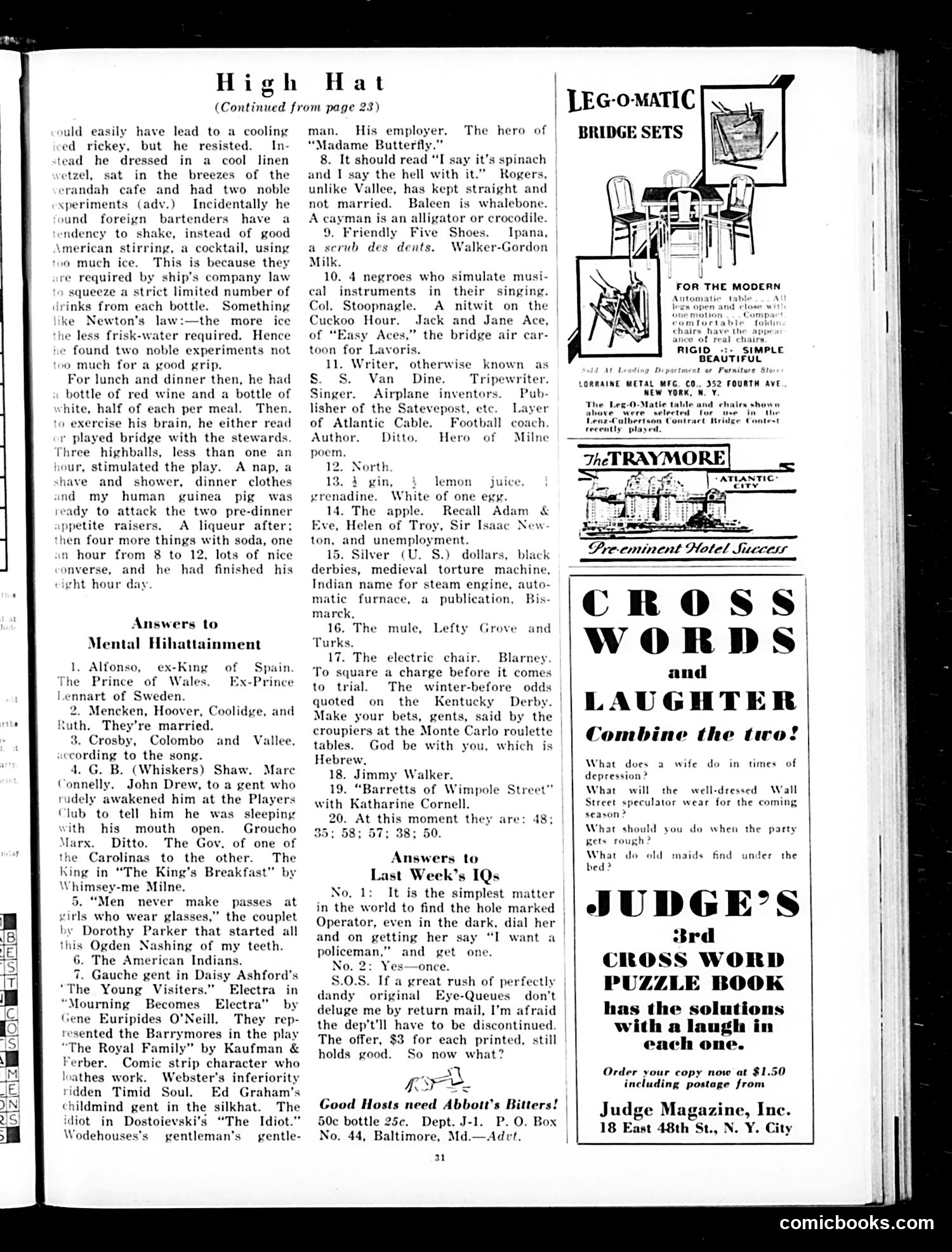
Content Analysis This page from Judge magazine is primarily a puzzle/trivia answer section, not a political cartoon page. The main content shows answers to a "Mental Hihattainment" quiz and "Last Week's IQs"—typical Judge features mixing celebrity references, wordplay, and contemporary cultural knowledge. The answers reference 1920s-30s figures like Alfonso of Spain, Coolidge, Rudy Vallee, Jimmy Walker (NYC mayor), and Katharine Cornell (actress). The satirical humor relies on readers' familiarity with current celebrities, Broadway plays, and popular culture. For example, answer #19 references "Barretts of Wimpole Street" with Cornell—topical theatrical gossip. The page also contains advertisements for Leg-O-Matic bridge sets, The Traymore Hotel, and Judge's own crossword puzzle book—standard magazine fare. No significant political satire is visible here; it's entertainment and advertising content typical of 1920s-30s humor magazines.
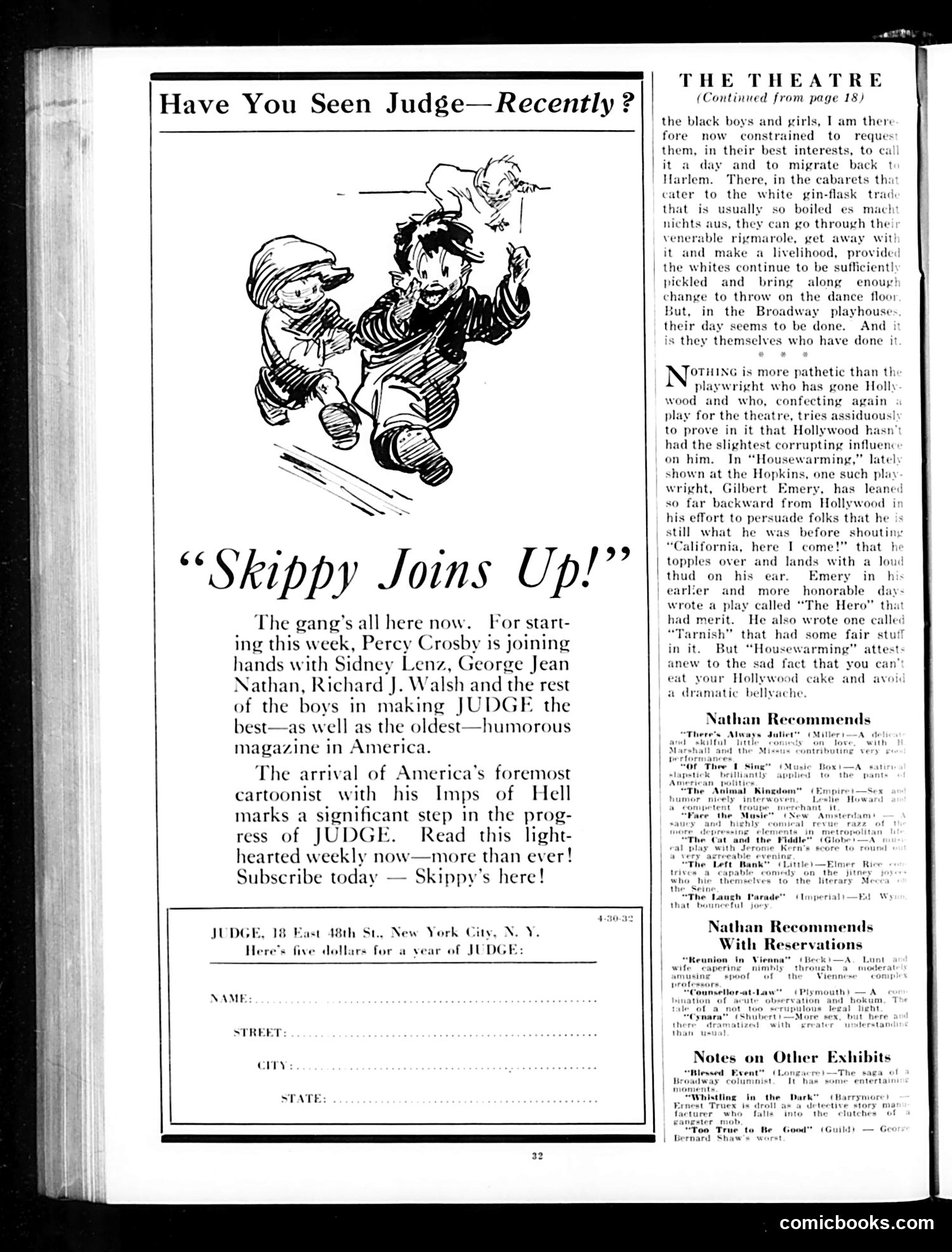
"Skippy Joins Up!" — Judge Magazine Advertisement This is primarily an advertisement announcing Percy Crosby's "Skippy" comic strip joining Judge magazine. The cartoon shows two child characters (likely Skippy and a companion) in playful interaction — characteristic of Crosby's popular comic about a mischievous boy. The text emphasizes this as major news: Crosby, called "America's foremost cartoonist," is joining forces with editors Sidney Lenz, George Jean Nathan, and Richard J. Walsh to strengthen Judge as "the best...humorous magazine in America." The accompanying theater column (right side) critiques Broadway playwrights who fail after moving to Hollywood, suggesting corrupting industry influence. It's unrelated promotional content on the same page. The ad includes a subscription form offering one year of Judge for five dollars.
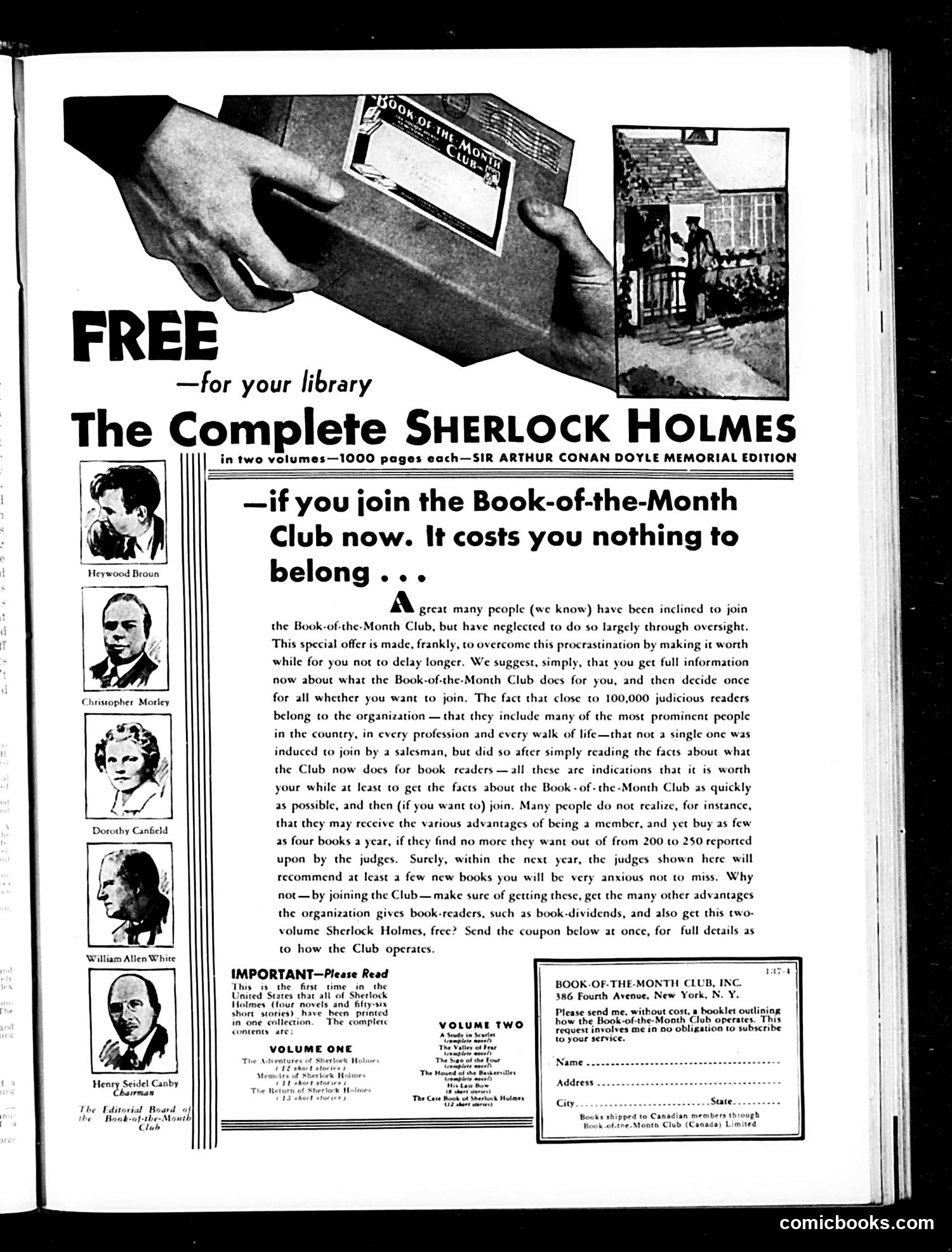
Analysis This is primarily a full-page advertisement, not political satire or cartoon content. It promotes the Book-of-the-Month Club's offer of a free two-volume "Complete Sherlock Holmes" edition to new members. The page features: - Five portrait photographs of the Club's Editorial Board (Heywood Broun, Christopher Morley, Dorothy Canfield, William Allen White, and Henry Seidel Canby)—prominent literary figures meant to lend credibility to the organization's selections - Main sales pitch: Emphasizing that joining is "free" and costs "nothing to belong," while highlighting the Club's prestige (nearly 100,000 members, prominent professionals, word-of-mouth growth) - Historical context: This reflects 1920s-30s book club culture, when curated monthly selections were novel marketing innovations for reaching educated consumers The image of hands holding a book at top left is promotional photography emphasizing the gift's tangibility. This is advertising strategy, not editorial content or satire.
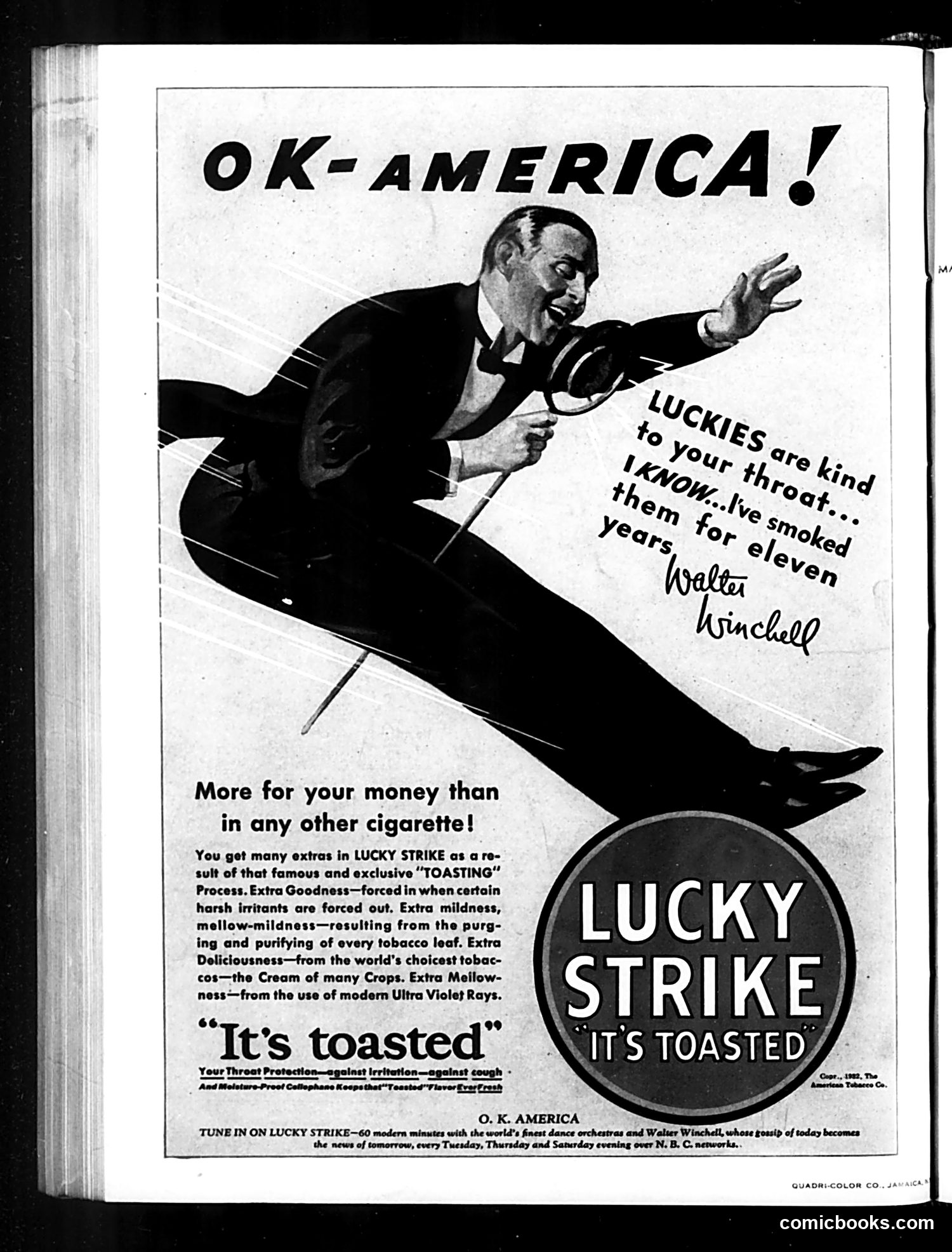
Lucky Strike Cigarette Advertisement Analysis This is a cigarette advertisement, not political satire. It features a man in formal attire (identified by signature as Walter Winchell, a famous gossip columnist) endorsing Lucky Strike cigarettes. The ad promotes Lucky Strike's "Toasting" process—a marketing claim about tobacco treatment that allegedly removes "harsh irritants" while adding mildness and flavor. The "OK America!" headline and the man's enthusiastic pose suggest patriotic confidence in the product. The advertisement also promotes a radio program: "Lucky Strike—60 modern minutes" featuring dance orchestras and Winchell's gossip column, broadcast Tuesday, Thursday, and Saturday on NBC. Modern context: This represents pre-regulation tobacco advertising, when cigarette companies could make unsubstantiated health claims ("purging and purifying") and use celebrity endorsements without disclaimers. Such advertising is now illegal in most countries.