judge
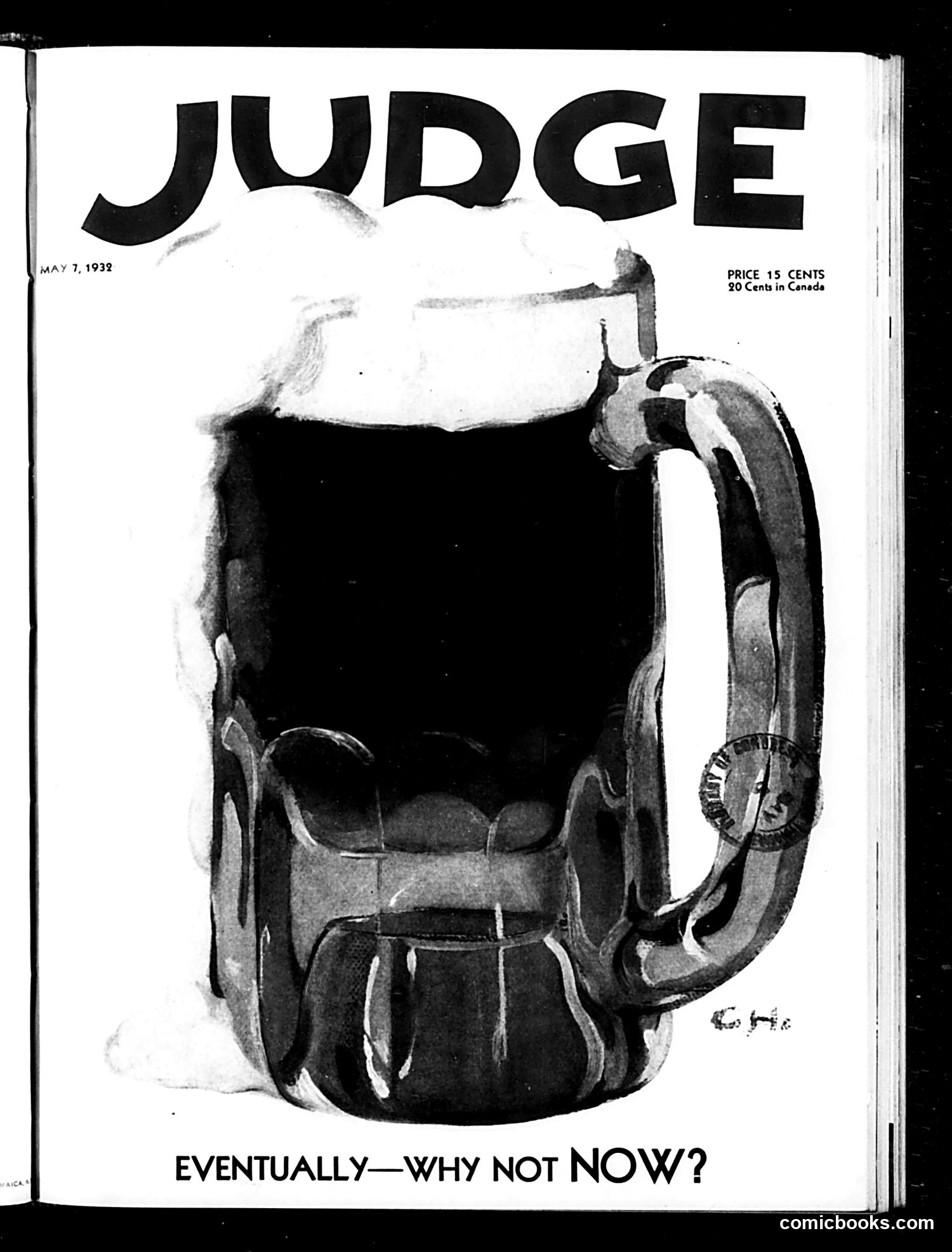
Judge — May 7, 1932
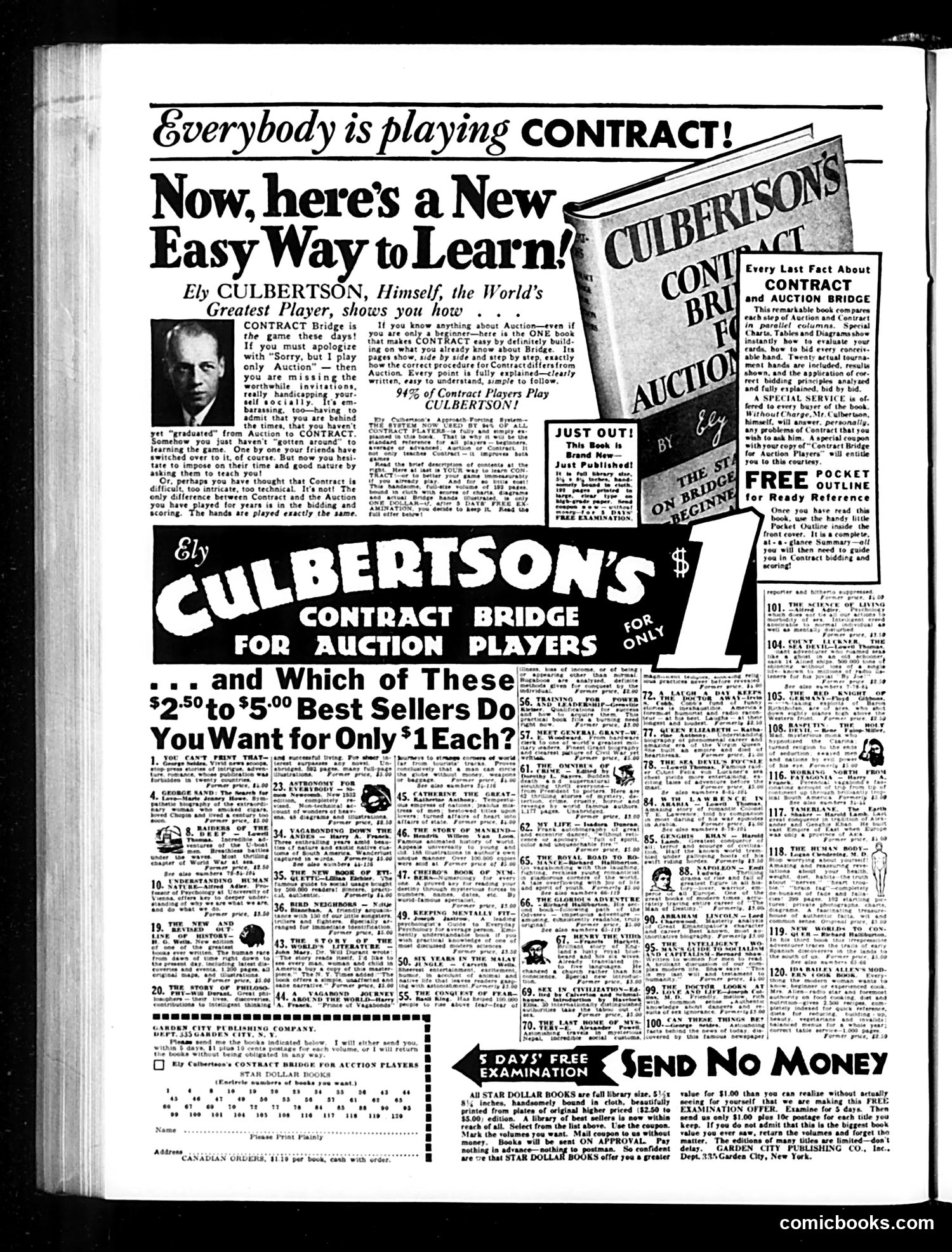
Analysis This page is primarily advertising, not editorial content or satire. It's a full-page advertisement for Culbertson's Contract Bridge instruction books, featuring Ely Culbertson, who was apparently a famous bridge player of the era. The advertisement promotes learning contract bridge through Culbertson's methods, claiming "94% of Contract Players Play Culbertson!" It offers his book for $1 and lists various related bridge instruction titles selling for $2.50-$5.00. The right side contains small-print book descriptions and a "Send No Money" coupon offer with free examination. There is no political satire here—it's a straightforward commercial advertisement typical of vintage magazine advertising, using a celebrity endorsement strategy to market bridge instruction materials.
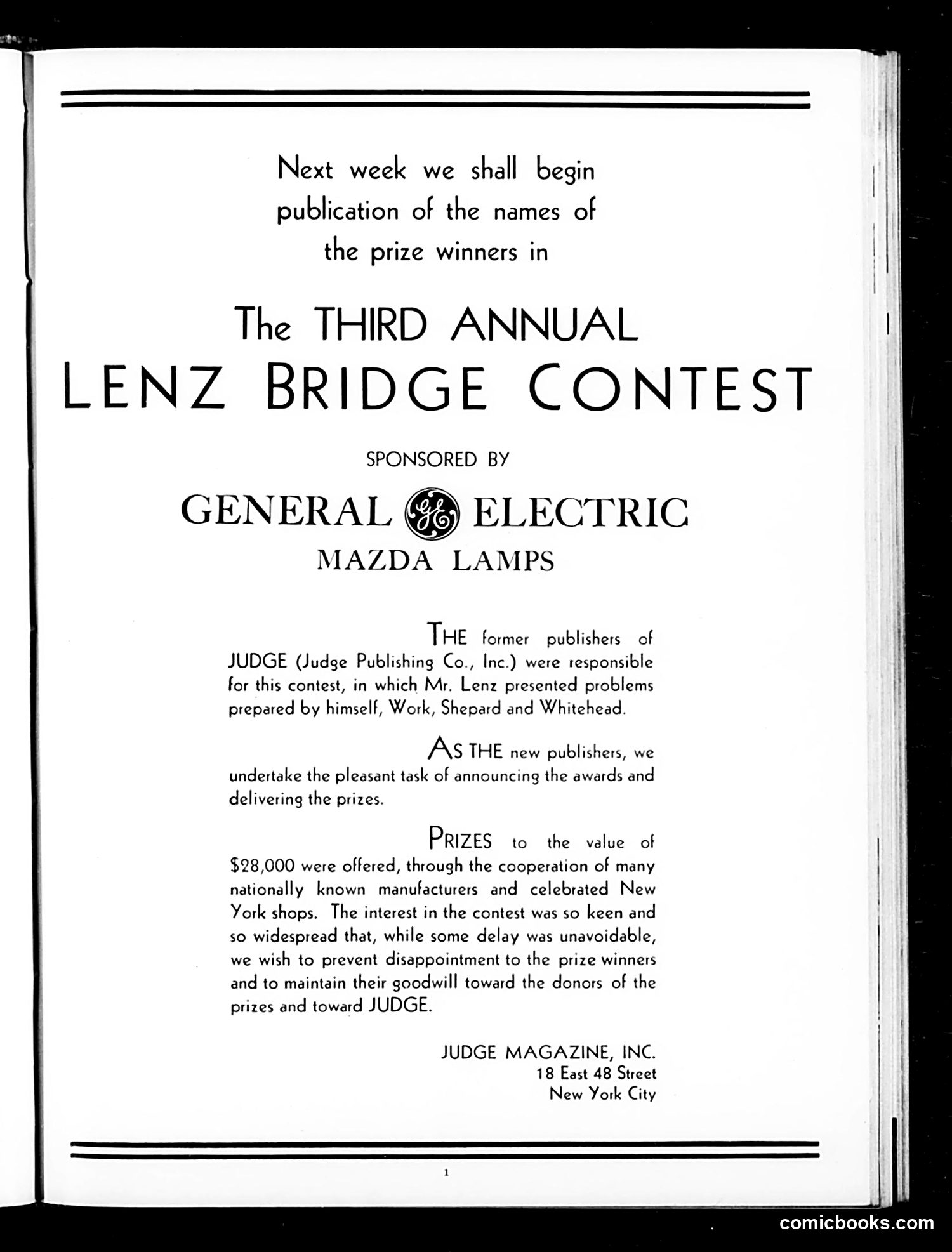
Analysis This page is not a cartoon or satirical content—it's an announcement and advertisement from Judge Magazine's publishers. The text announces the upcoming publication of winners from the Third Annual Lenz Bridge Contest, sponsored by General Electric's Mazda Lamps division. Judge Magazine (the new publishers) is taking over from the previous publisher, Judge Publishing Co., Inc., to announce awards and deliver prizes worth $28,000. The announcement emphasizes the contest's popularity and widespread interest, explaining that while some delay in announcing winners was unavoidable, they're committed to maintaining goodwill with prize winners and donors. This is primarily business correspondence and contest administration, not satire or editorial commentary.
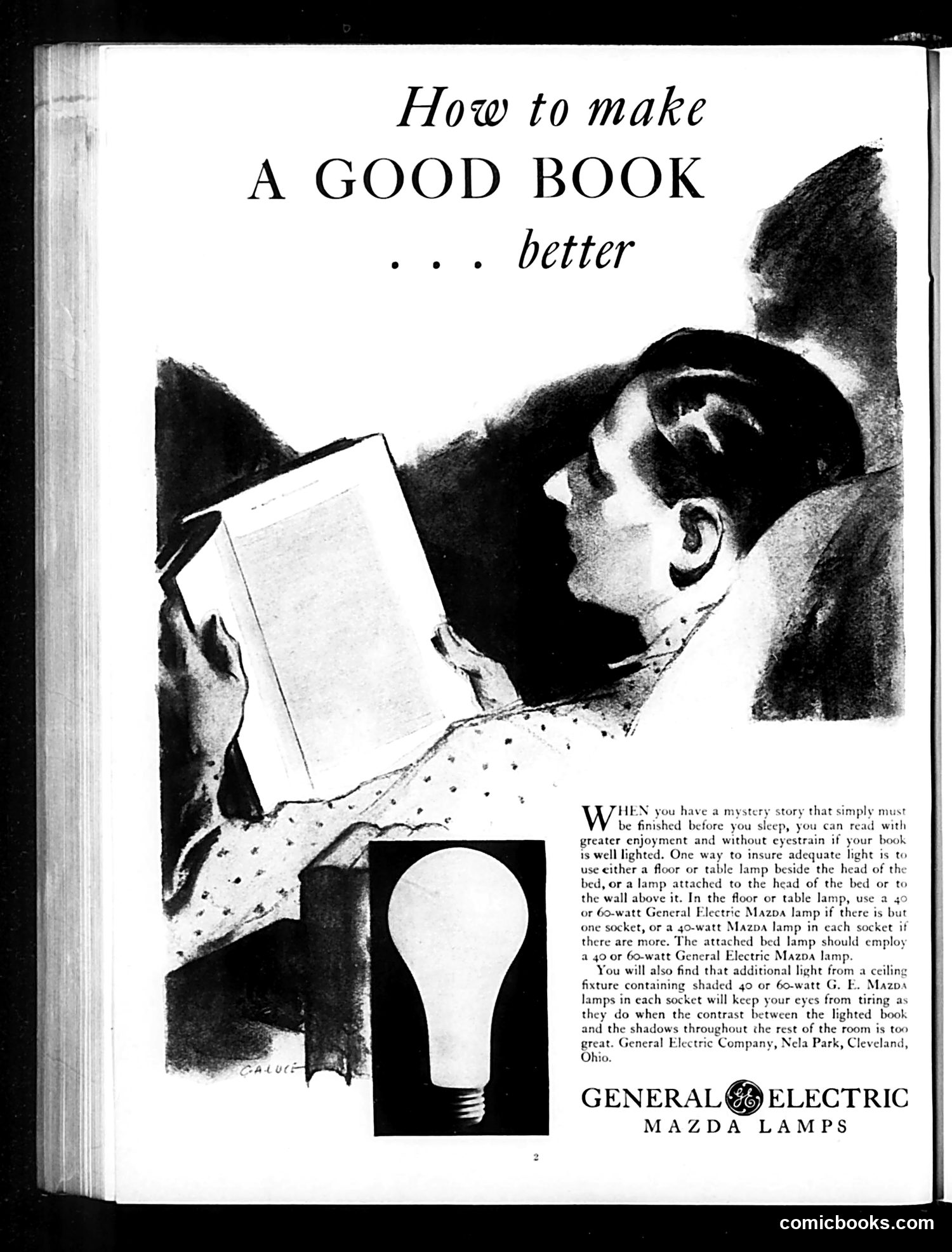
Analysis This is primarily advertising content, not satire or political commentary. The page promotes General Electric Mazda lamps by addressing a practical consumer concern: reading comfort. The headline "How to make A GOOD BOOK... better" uses a clever double meaning—improving both the reading experience and the book itself through proper lighting. The illustration shows a person reading in bed under inadequate lighting. The accompanying text and lamp diagram explain technical specifications for home lighting setups to reduce eyestrain while reading. The copy recommends specific wattages and lamp placements for bedside and ceiling fixtures. This reflects early-20th-century consumer marketing that framed electrical products as solutions to everyday problems, positioning electric lighting as a modern convenience that enhanced quality of life.
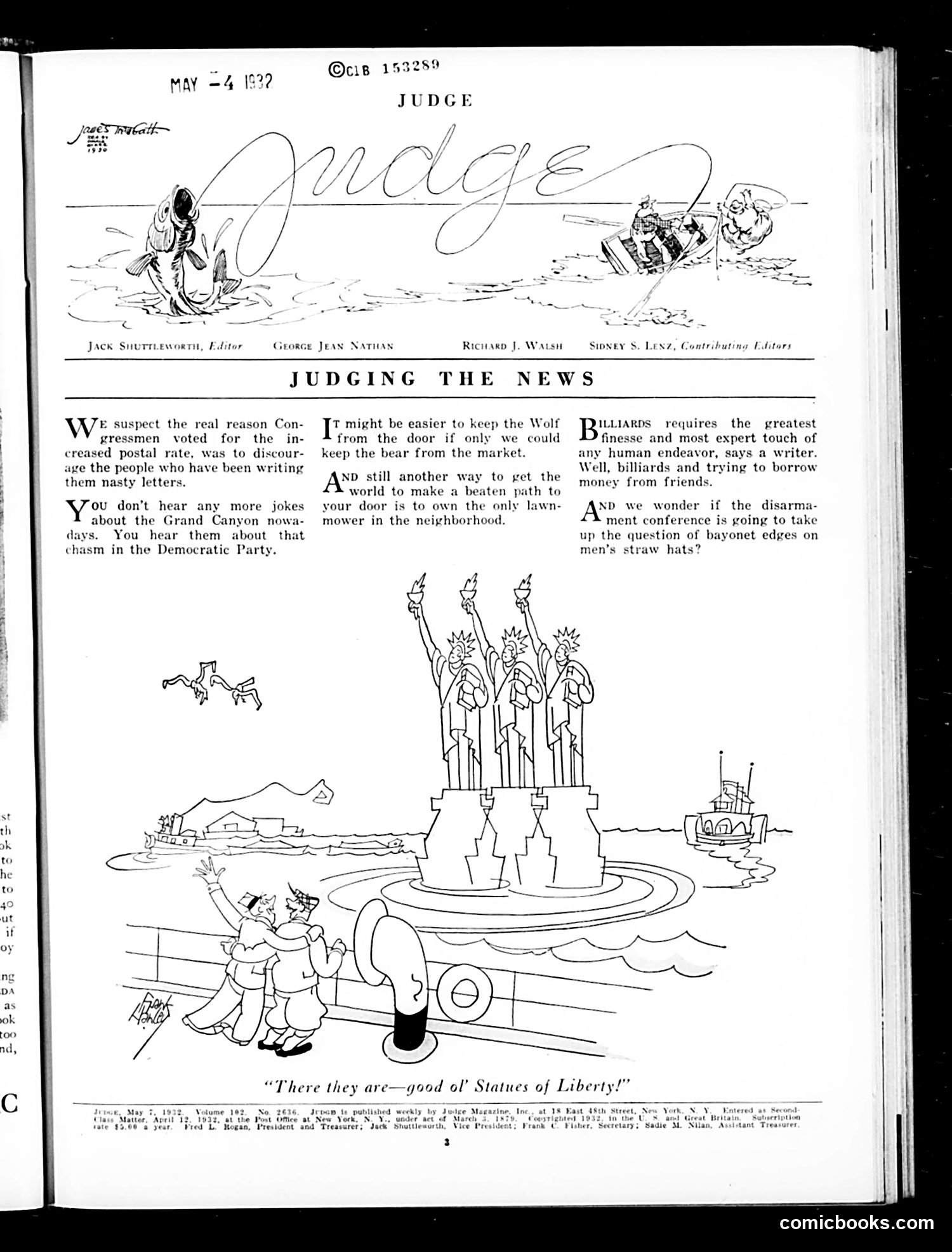
Judging the News - May 24, 1932 This satirical page critiques contemporary issues through short commentaries and illustrations: Top commentary mocks Congressional mail volume, suggesting politicians received increased letters about postal rates—implying constituent complaints were trivial compared to serious economic problems. Middle section jokes that Democrats were blamed for economic "chasm" rather than discussing substantive policy. Bottom illustration, captioned "There they are—good ol' Statues of Liberty!," depicts three torch-bearing figures on a pedestal viewed by tourists near a ship. This likely satirizes either excessive patriotic symbolism or America's self-image during the Great Depression (1932), when rhetoric about liberty contrasted sharply with economic hardship and unemployment. The overall tone suggests frustration with political distraction from real crises.
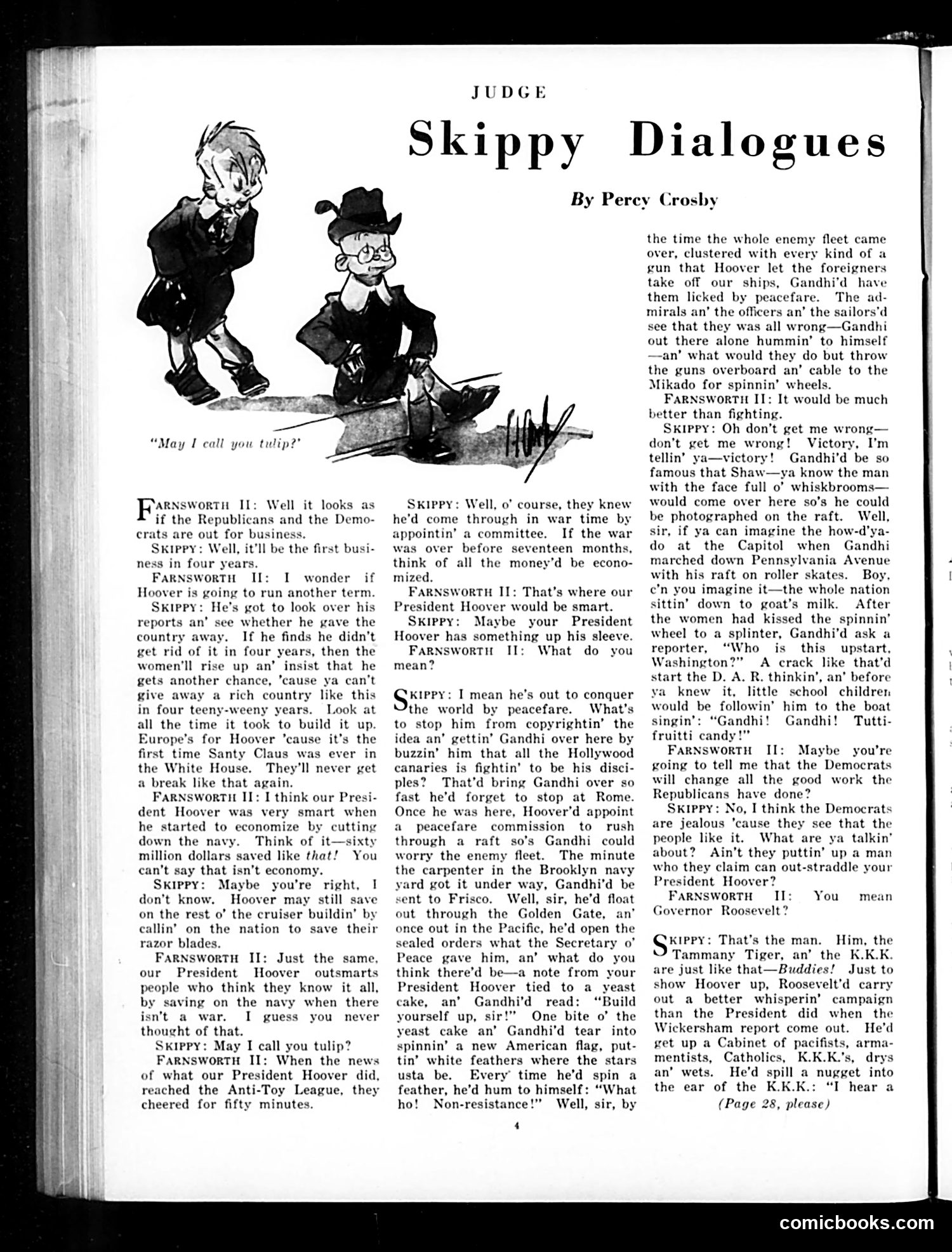
Judge Magazine: "Skippy Dialogues" Analysis This satirical dialogue features two characters—one appears to be a judge or authority figure, the other labeled "Skippy"—discussing President Hoover's foreign policy, particularly regarding Gandhi and India. The satire mocks Hoover's diplomatic approach: Skippy suggests Hoover might invite Gandhi to America to photograph him for propaganda purposes, implying the administration uses pacifist symbols for political gain. References to "peaceable" conquest and spinning "a new American flag" mock the administration's attempts to present military/imperial actions as peaceful diplomacy. The cartoon critiques how the Hoover administration exploited popular figures like Gandhi for domestic political advantage while pursuing expansionist policies. The humor targets the disconnect between peaceful rhetoric and actual foreign intervention—a common Judge critique of 1930s Republican administrations.
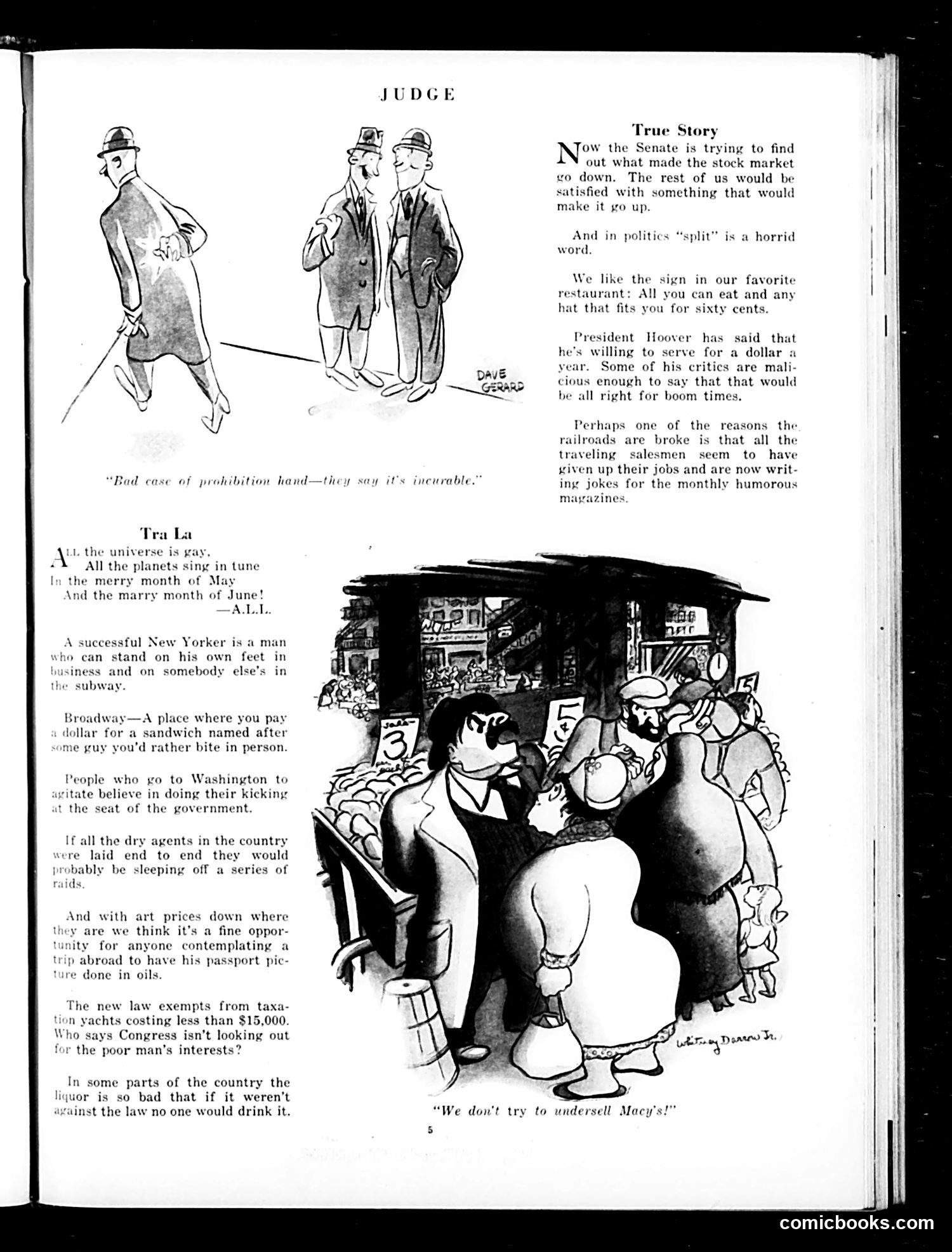
Judge Magazine Page Analysis Top Cartoon: Shows three men in suits discussing prohibition enforcement ("Bad case of prohibition hand—they say it's incurable"). The gesture and posture suggest the difficulty authorities faced enforcing the alcohol ban. Bottom Cartoon: A crowded scene at what appears to be Macy's department store ("We don't try to undersell Macy's!"). This likely satirizes competitive retail pricing during the Depression era. Text Content: The "True Story" column contains period commentary on stock market concerns, political "splits," restaurant pricing (60-cent meals), President Hoover's dollar-a-year service offer, and railroad industry troubles. References to dry agents writing jokes suggest public frustration with prohibition enforcement. The page reflects 1930s economic anxiety and prohibition-era social tensions.
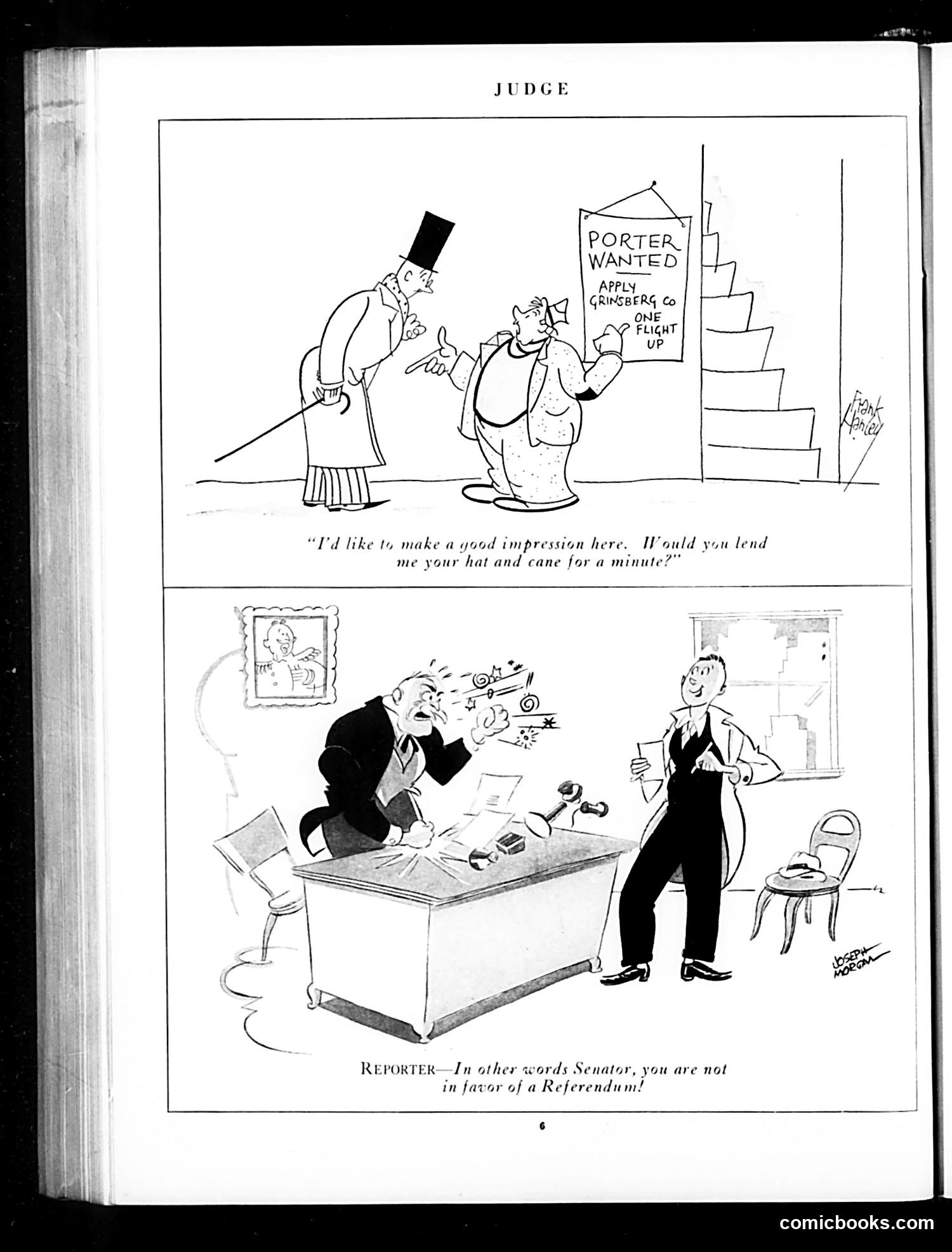
Judge Magazine Cartoon Analysis This page contains two satirical cartoons labeled "JUDGE": Top cartoon: A well-dressed man with a top hat asks another man to borrow his hat and cane to "make a good impression" while applying for a porter job at the Ginsberg Company. The joke mocks social pretension—using borrowed finery to falsely present oneself as more respectable than one actually is. Bottom cartoon: A senator appears agitated at his desk while a reporter states: "In other words Senator, you are not in favor of a Referendum!" The satire targets politicians who oppose direct democracy (referendums), suggesting the senator's evasive responses reveal his actual anti-democratic position despite his rhetoric. Both cartoons critique social hypocrisy and political dishonesty through visual humor.
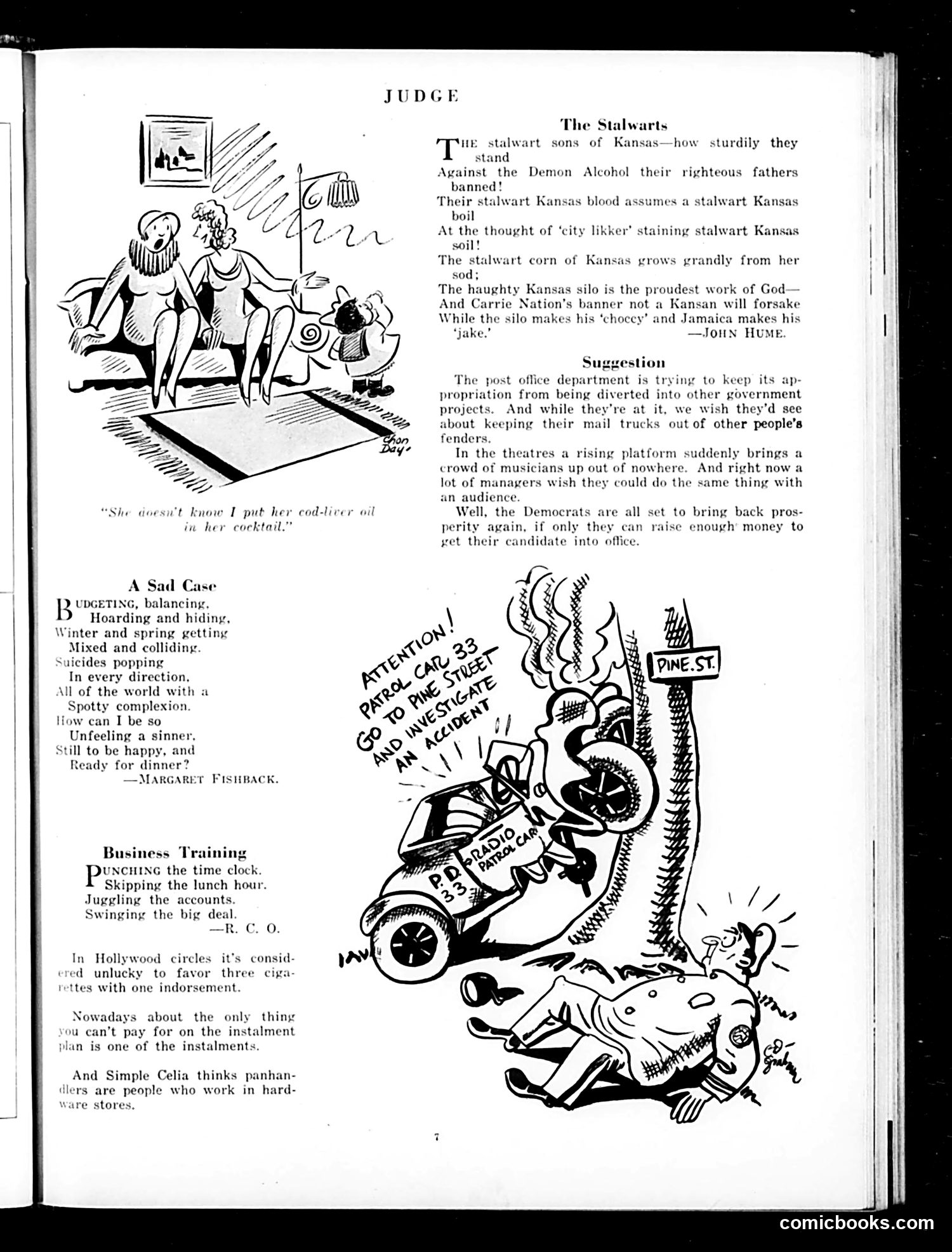
Judge Magazine Page Analysis This page contains satirical poetry and social commentary typical of Judge magazine's humor: "The Stalwarts" mocks Kansas's prohibition stance and Carrie Nation (the temperance activist famous for smashing saloons). The poem ironically praises Kansas's "stalwart" resistance to alcohol while noting Kansans secretly make illegal "choccy" (chocolate liquor) and "jake" (Jamaica ginger extract used to evade prohibition laws). The humor lies in the hypocrisy: publicly righteous, privately drinking. The large cartoon (right side) depicts a car crash on Pine Street involving what appears to be a "Patrol Car" and a "Bread Wagon," with text referencing "Attention! Patrol Car 33 to Precinct and Investigate Accident!" This satirizes either police incompetence or the absurdity of bureaucratic accident procedures. Additional sections include brief humorous observations on post offices, theaters, Hollywood, and business culture—standard Judge fare offering light social satire on contemporary American institutions and behaviors. The overall tone is lighthearted mockery of hypocrisy, inefficiency, and modern absurdities.
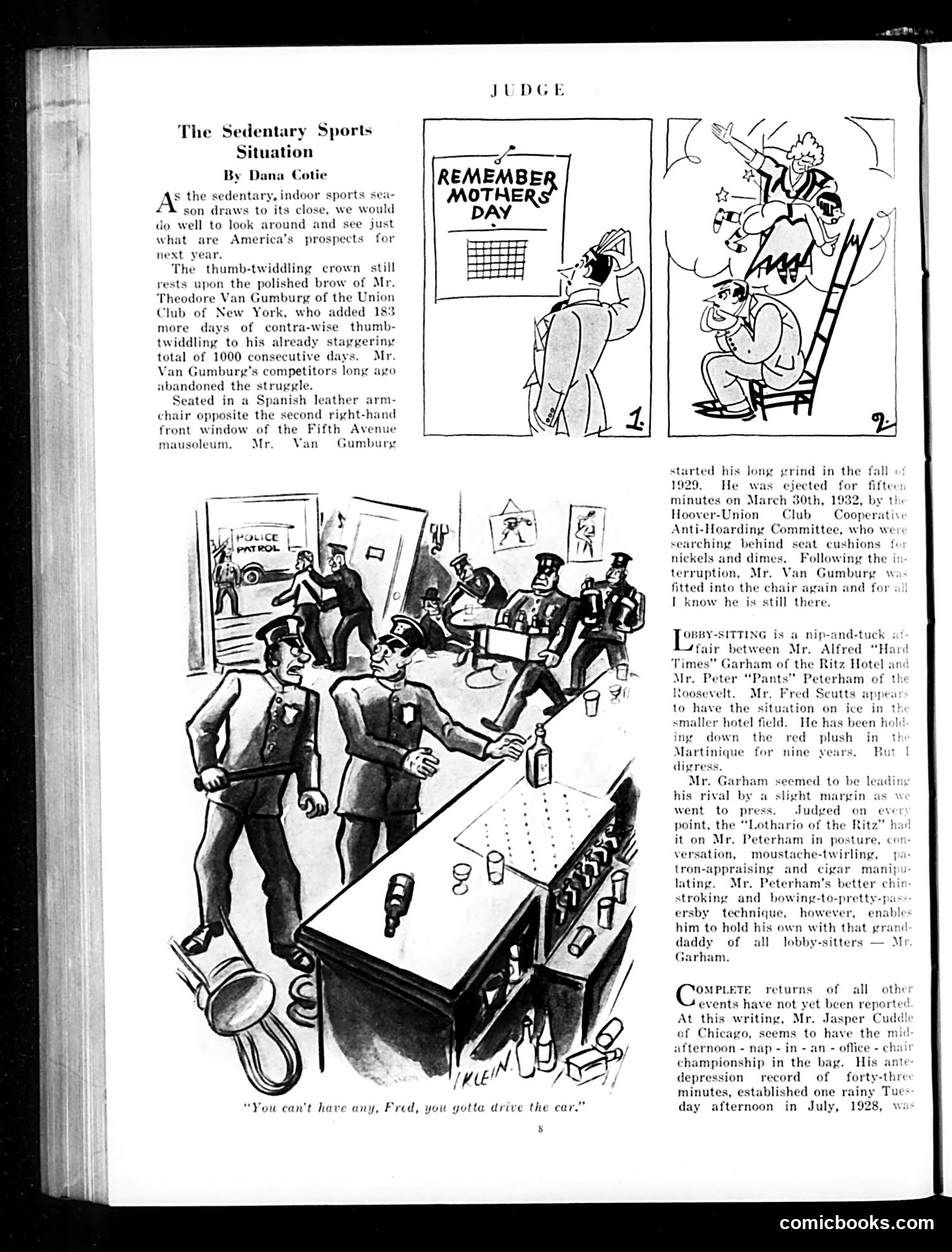
"The Sedentary Sports Situation" — Judge Magazine Satire This is satirical commentary on wealthy leisure-class idleness during the Great Depression era (late 1920s-early 1930s). The article humorously treats trivial "sedentary sports" as if they were serious competitions: Main figures: Theodore Van Gumburg (Union Club member) holds the "thumb-twiddling crown" with 1,000+ consecutive days. The text notes he was briefly ejected in 1932 when the club's Anti-Hoarding Committee searched furniture for hidden coins and dimes. The joke: While ordinary Americans faced economic hardship, wealthy clubmen competed in pointless indoor activities like professional napping and "lobby-sitting" (sitting in hotel lobbies). The cartoon below depicts a domestic scene where a man tells another "You can't have any, Fred, you gotta drive the car"—likely mocking car-dependent leisure or frivolous automobile culture among the affluent. The satire targets the disconnect between Depression-era poverty and the absurd pastimes of the privileged elite.
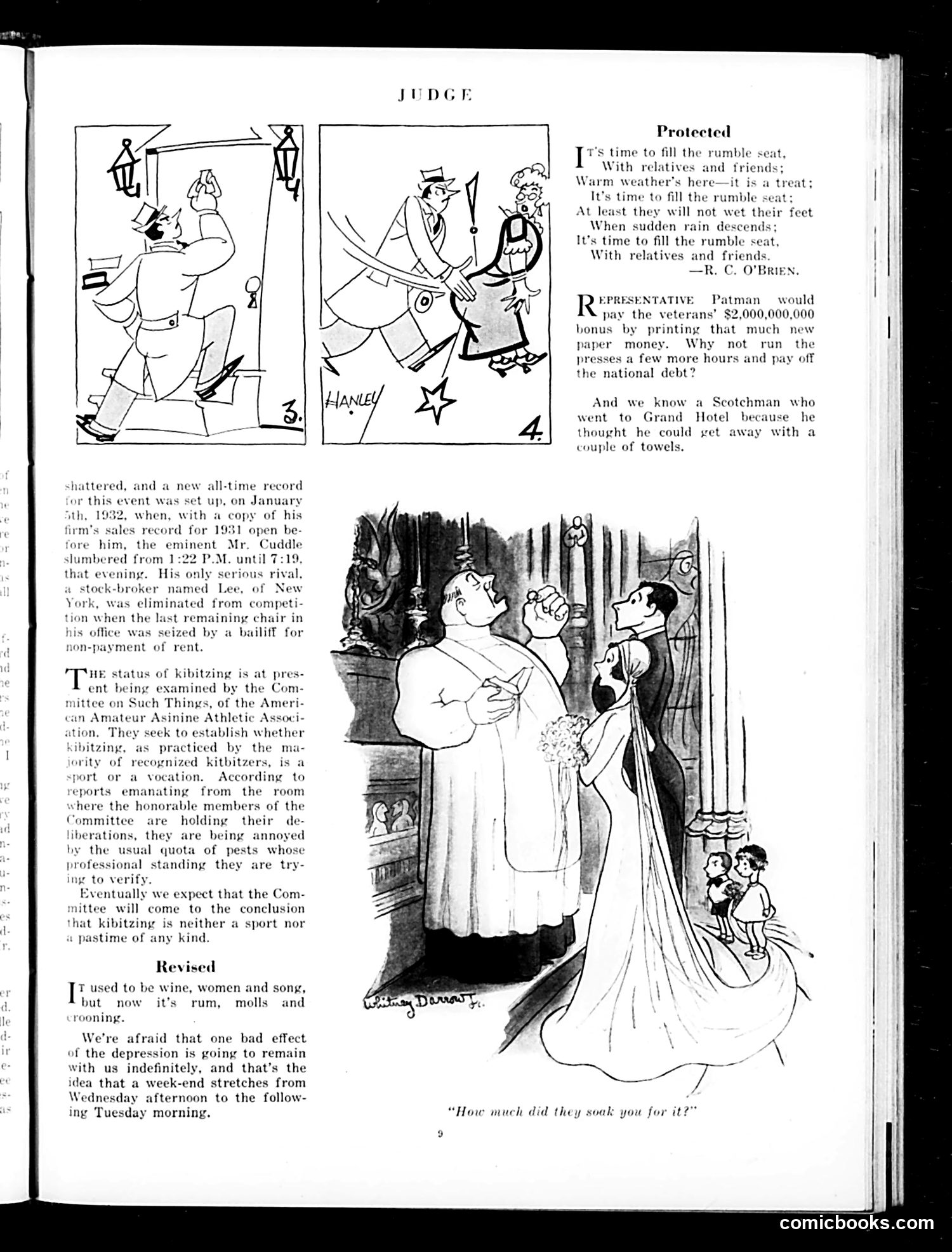
Judge Magazine Page Analysis This page contains political satire and social commentary from the Great Depression era (likely early 1930s, based on references to "the depression"). Top cartoons (numbered 3-4): Labeled "JUDGE," these appear to be unrelated vignettes about everyday life—possibly about crowded transportation or social situations. Political satire: A representative named Patman is mocked for proposing to pay a $2 billion veterans' bonus by printing new money, with the sarcastic suggestion of just printing more to pay off the national debt. Social humor: Various brief jokes target Depression-era behavior—a Scotsman trying to steal hotel towels, office chairs seized by bailiffs for unpaid rent, and the concept of "kibitzing" (backseat commentary) being examined as a "sport or vocation." Main cartoon: Shows a large woman in a hotel room asking guests "How much did they soak you for it?"—likely satirizing inflated hotel prices or poor service during economic hardship. The overall tone mocks both economic hardship and human nature's response to it.
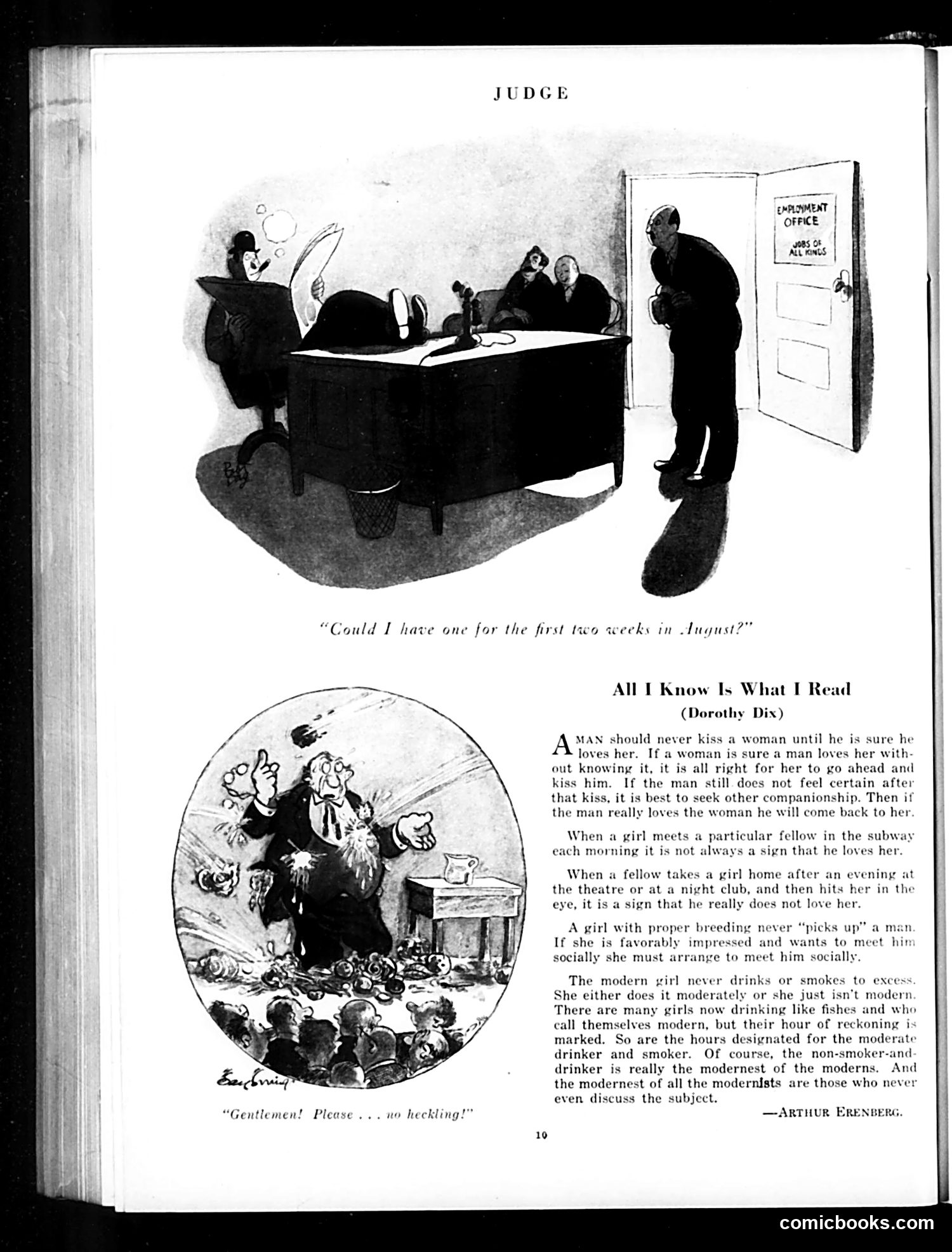
Analysis of Judge Magazine Page Top Cartoon ("Could I have one for the first two weeks in August?"): A man sits at a judge's bench while a couple stands before him seeking an "Employment Office" sign visible on the wall. The joke appears to satirize judicial authority being misused or absurdly applied—the man is requesting a two-week vacation "from the judge," suggesting the judge controls his employment or freedom. This likely mocks either corrupt judicial overreach or the absurdity of seeking judicial approval for routine matters. Bottom Cartoon ("Gentlemen! Please... no heckling!"): Chaotic scene with figures arguing, captioned by an exasperated woman demanding order. The humor appears to come from unruly behavior or heckling in what may be a social gathering. Column ("All I Know Is What I Read" by Dorothy Dix): A satirical advice column mocking modern dating and social conventions of the era—particularly critiquing "modern" women who drink and smoke, using paradoxical logic to mock claims of modernity. The wit lies in the absurd circular reasoning about what actually constitutes modern behavior.
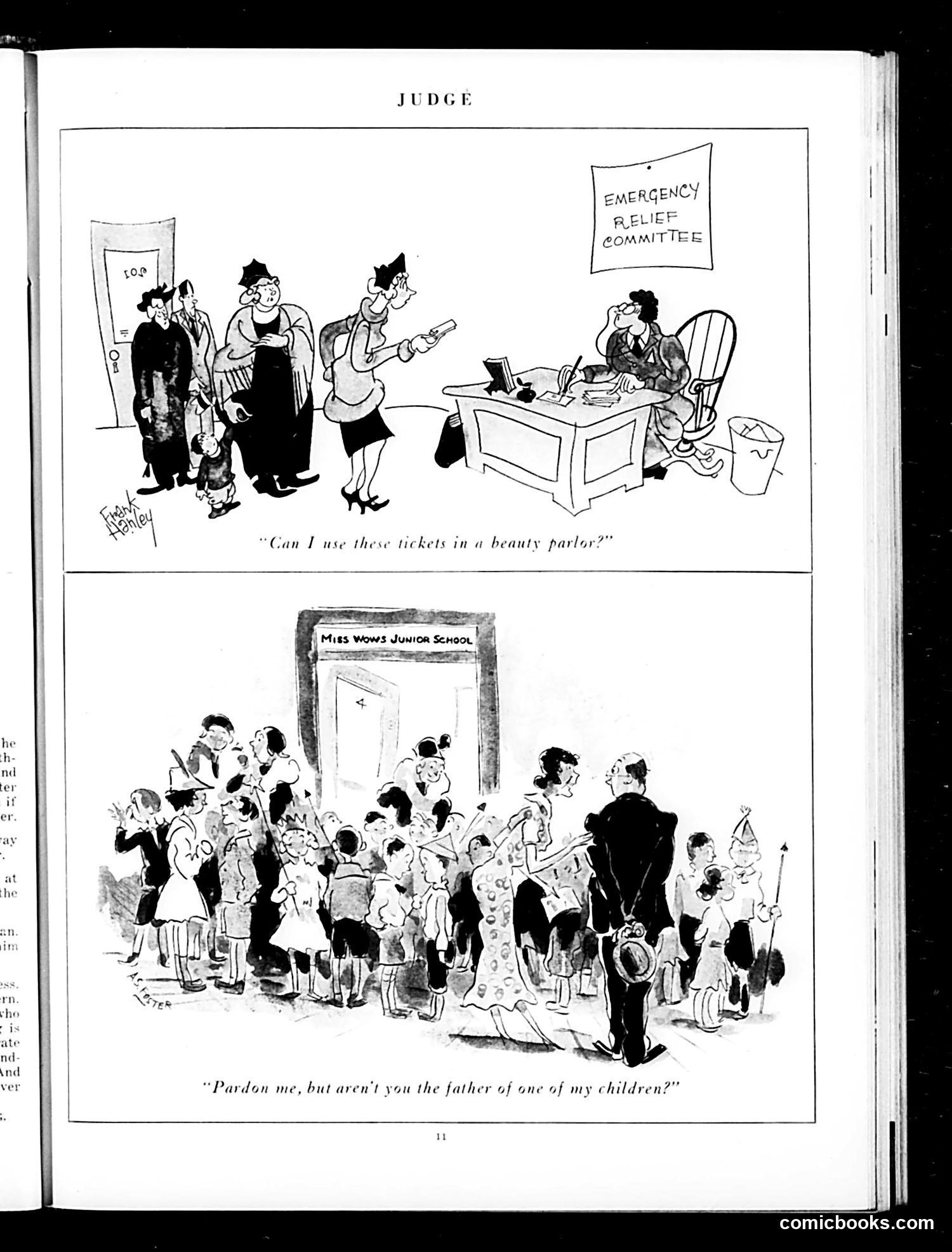
Analysis of Judge Page This page contains two cartoons satirizing bureaucratic absurdity during what appears to be a wartime emergency relief period. The top cartoon shows a woman asking an "Emergency Relief Committee" judge if she can use relief tickets at a beauty parlor—mocking the disconnect between official relief policy (for necessities) and people's actual desires for personal care. The bottom cartoon depicts a man confronted by a crowd of children outside "Miss Wows Junior School," with the caption "Pardon me, but aren't you the father of one of my children?" This satirizes either paternity issues or, more likely, critiques officials claiming connection to public institutions while ignoring their actual responsibilities. Both cartoons expose the gap between bureaucratic authority and practical reality, common Judge magazine themes during economic hardship periods.
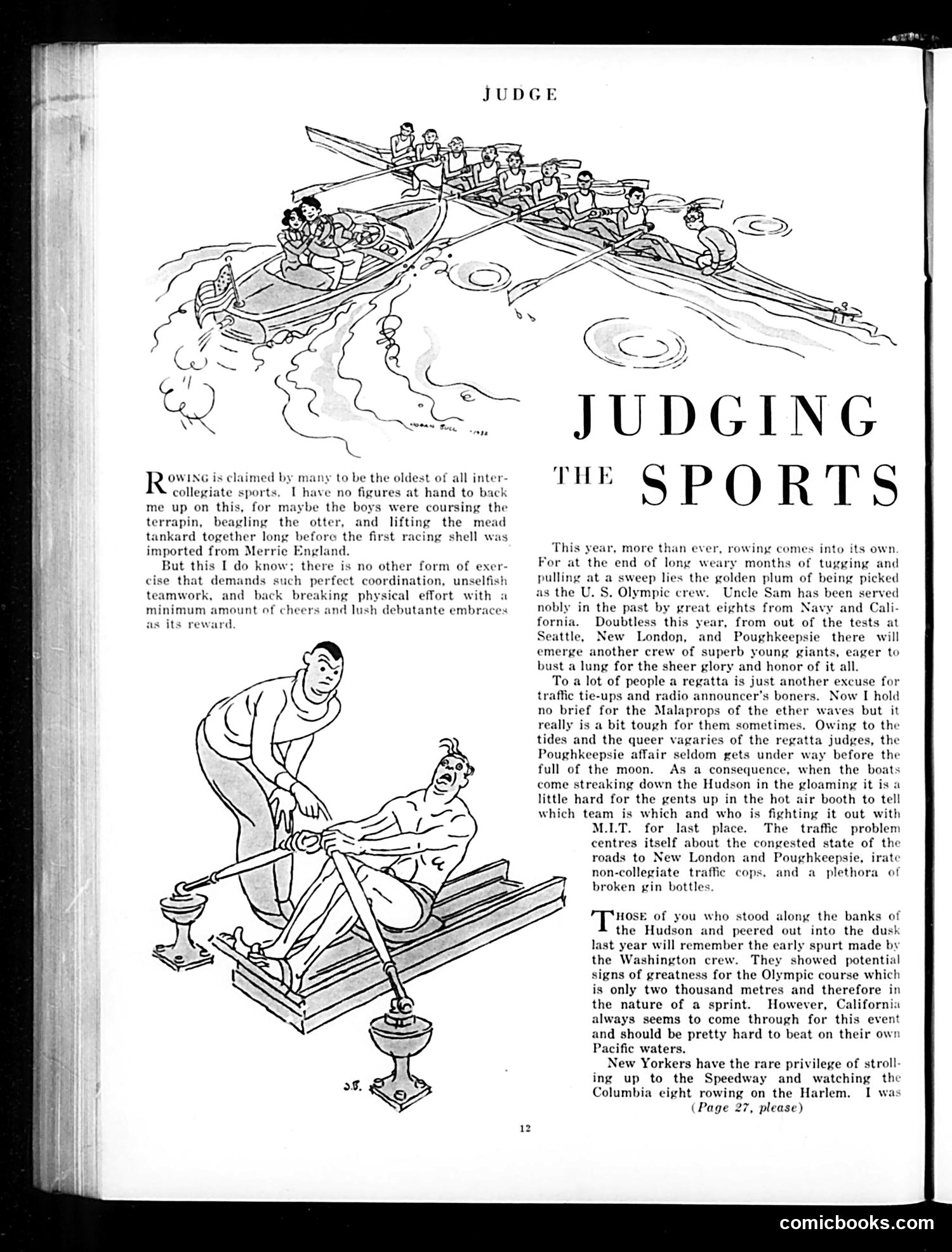
Judge Magazine: "Judging the Sports" - Rowing This page from Judge magazine humorously critiques rowing as an intercollegiate sport and the public spectacle surrounding major regattas. The article praises rowing's demands for teamwork and physical effort, noting it offers competitors minimal reward compared to other sports—a jab at rowing's unglamorous status despite its difficulty. The satire targets the annual Poughkeepsie Regatta's disruptions: traffic chaos, radio announcers' malapropisms when broadcasting in darkness (since races occur near full moon due to tidal schedules), and broken gin bottles littering the roads—suggesting drunken spectators. The cartoons show judges with scales and rowers competing, visually reinforcing the "judging" metaphor. The piece mentions competing crews from Navy, California, Washington, Columbia, and M.I.T., with California favored to represent the U.S. Olympic team. The humor assumes readers follow collegiate rowing rivalries and understand regatta-day traffic problems as contemporary annoyances.
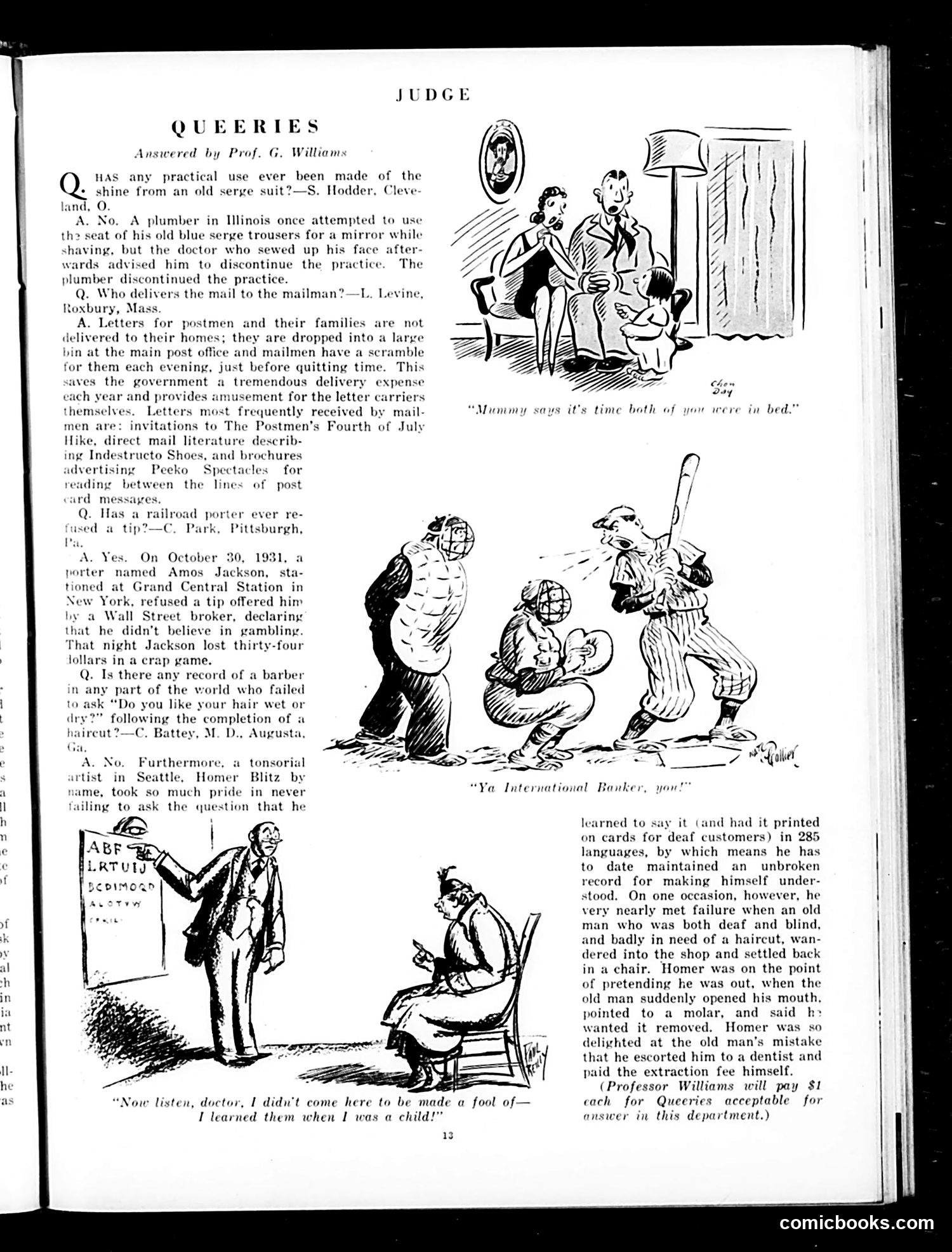
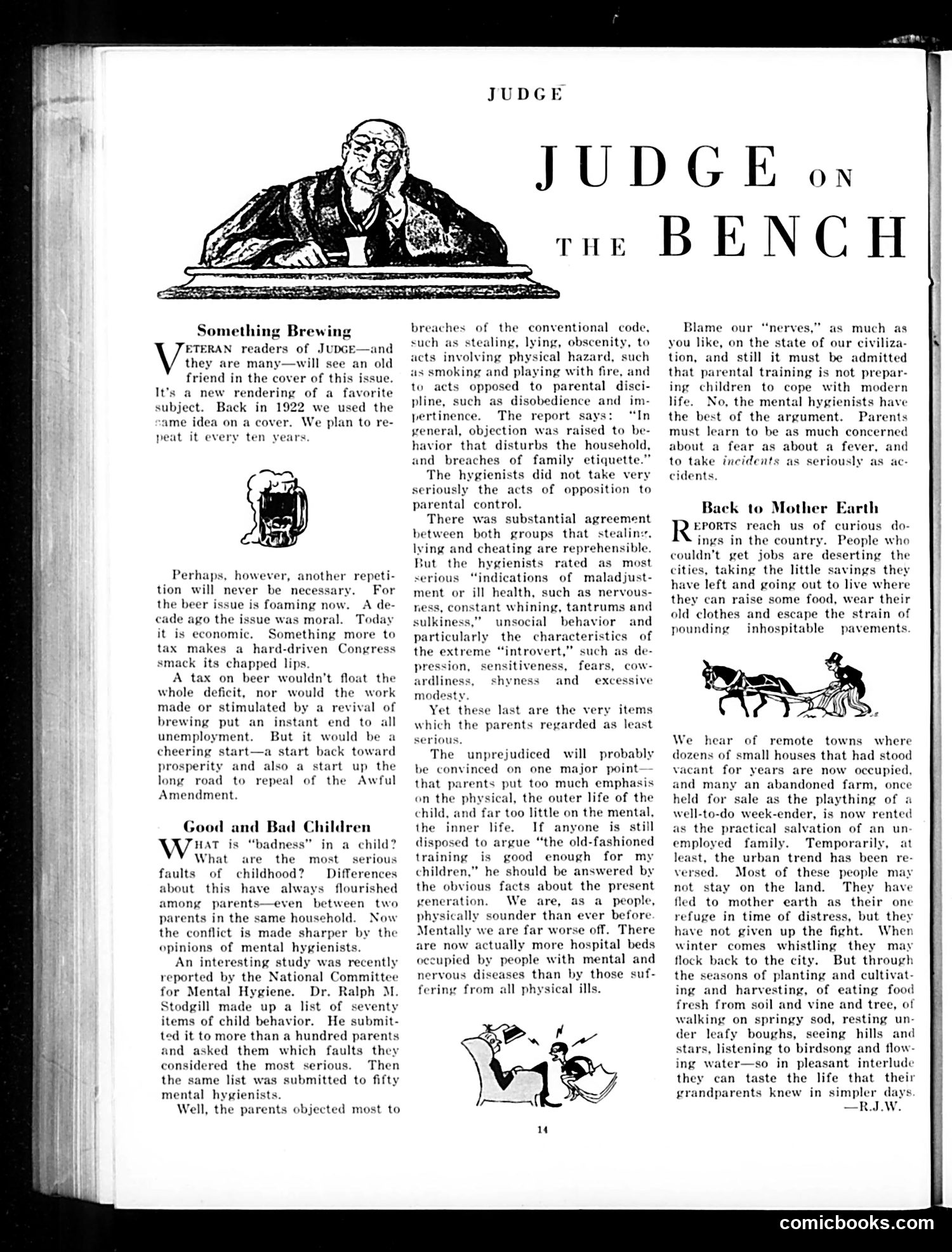
Judge Magazine: "Judge on the Bench" (circa 1930s) This page contains editorial commentary on two social issues of the era: "Something Brewing" discusses beer taxation and Prohibition repeal. Judge argues that while a beer tax won't solve economic depression or unemployment, it represents a promising "start back toward prosperity" and movement toward repealing the "Awful Amendment" (the 18th Amendment/Prohibition). The tone suggests Judge favors legalization. "Good and Bad Children" compares parental and mental hygienist views on child behavior. Parents prioritized conventional morality (stealing, lying, obscenity), while mental hygienists emphasized psychological health indicators (nervousness, shyness, introversion). Judge endorses the hygienists' perspective, arguing modern parents over-emphasize physical discipline while neglecting children's mental well-being—a progressive stance for the era. "Back to Mother Earth" briefly notes rural migration: Depression-era urbanites with depleted savings are returning to countryside farming to escape city hardship. The piece treats this as an alternative survival strategy during economic crisis.
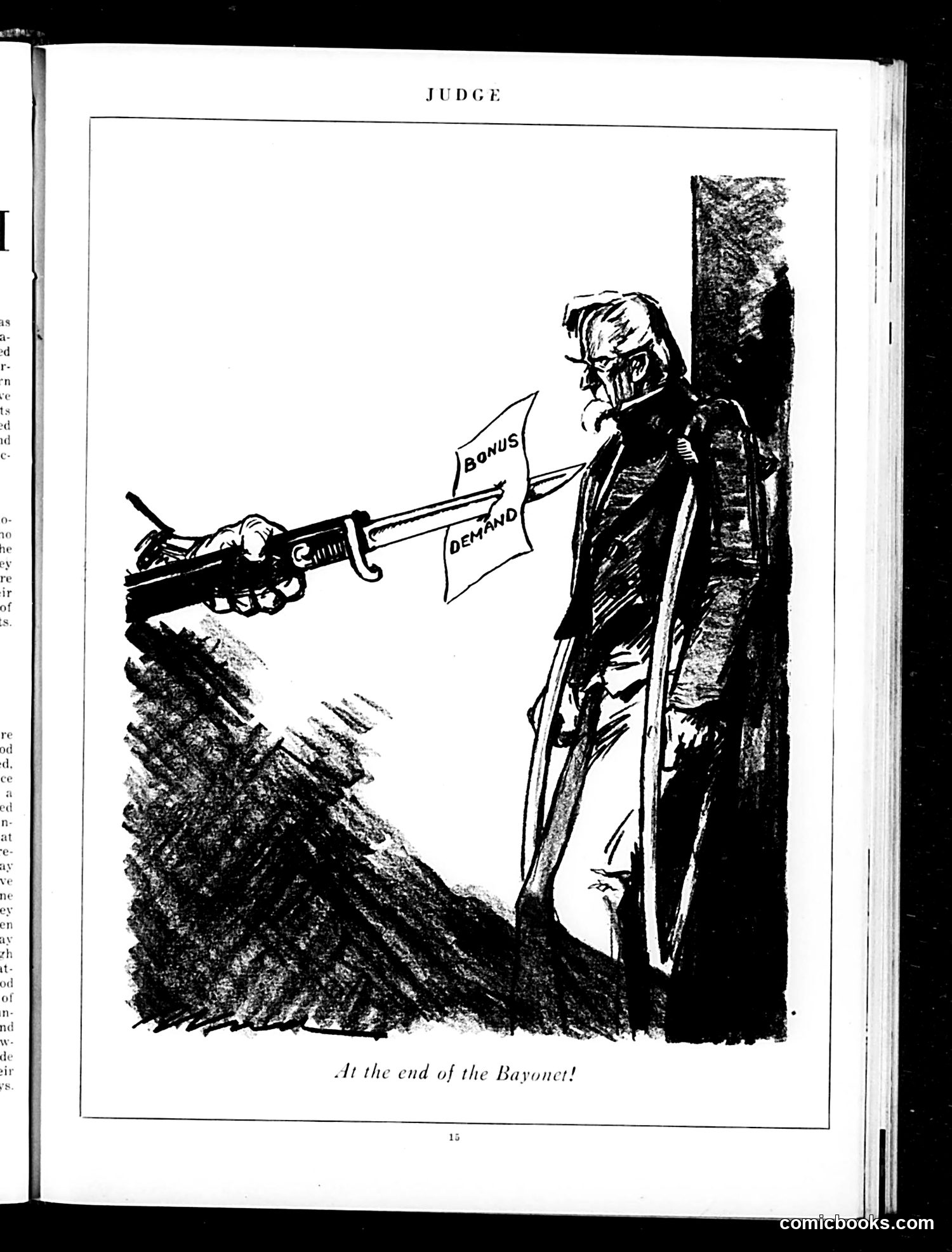
"At the End of the Bayonet!" This political cartoon depicts a stern, authoritarian figure (appearing to be a military or judicial authority) confronting a soldier wielding a bayonet. The bayonet's blade is labeled with two conflicting demands: "BONUS" and "DEMAND." The cartoon satirizes tensions between military/governmental authority and soldiers' demands—likely veterans seeking promised bonuses or compensation. The caption "At the End of the Bayonet!" suggests the dark irony that what was supposed to be settled by force or authority instead confronts an armed, desperate population willing to use violence to assert their claims. This likely reflects post-World War I veteran unrest, when soldiers demanded promised bonuses that governments were slow or unwilling to pay. The cartoon criticizes how authorities treat desperate veterans' legitimate grievances.
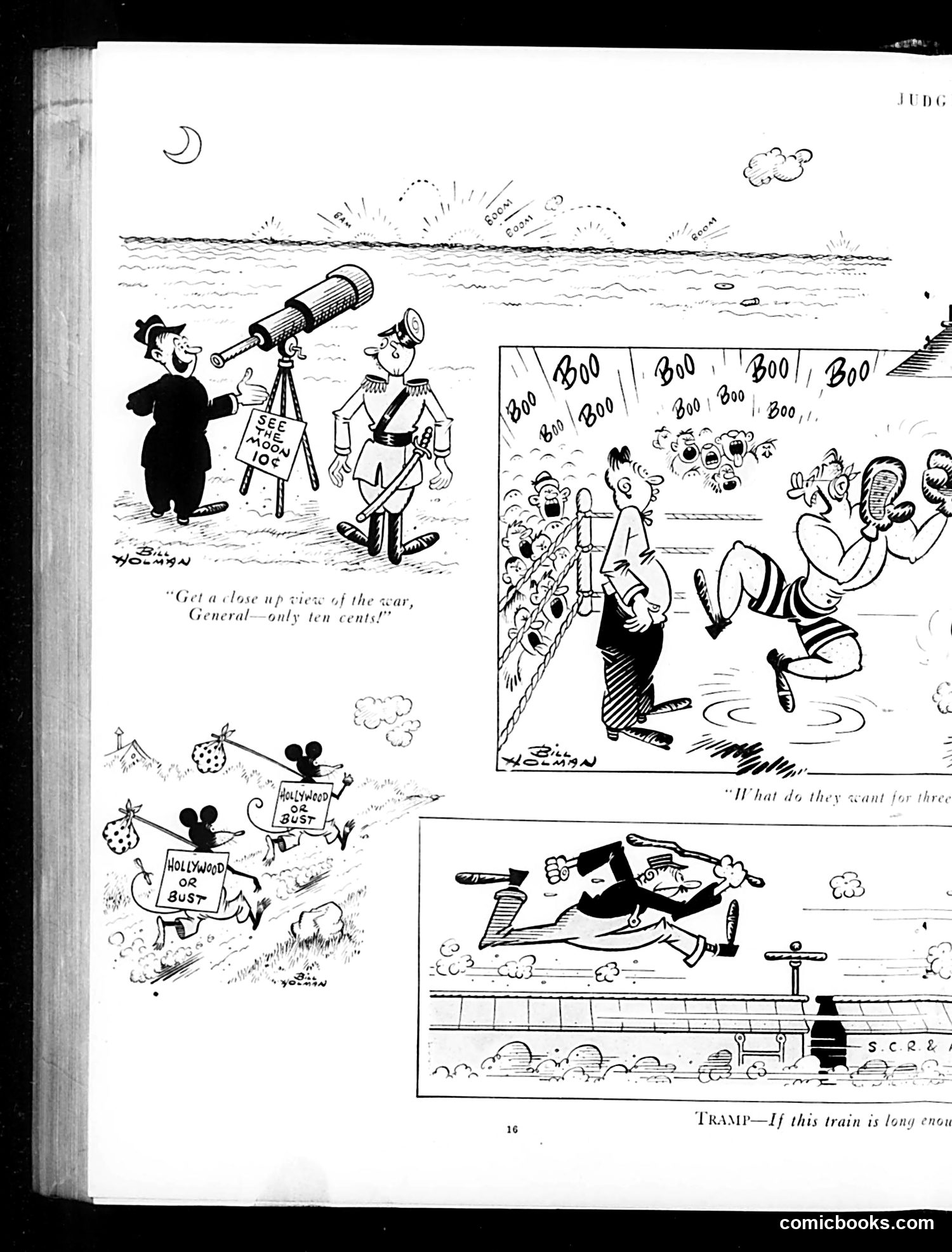
Political Cartoon Analysis This Judge page contains three satirical cartoons mocking American commercialism and opportunism: Top cartoon: A portly man with a telescope offers a "General" a close-up view of "the war" for ten cents—satirizing profiteers and war tourism, turning military conflict into entertainment for paying customers. Middle cartoon: "Hollywood or Bust" signs show figures chasing grapes and strawberries, likely mocking the entertainment industry's false promises and the desperation of those pursuing stardom. Bottom cartoon: Titled "Tramp," depicts a vagrant attempting to board a moving train—illustrating Depression-era hardship and desperation, a common Judge subject during economic downturn. The overall theme critiques American society's tendency to commercialize misery, exploit conflict for profit, and expose the gap between opportunity and reality.
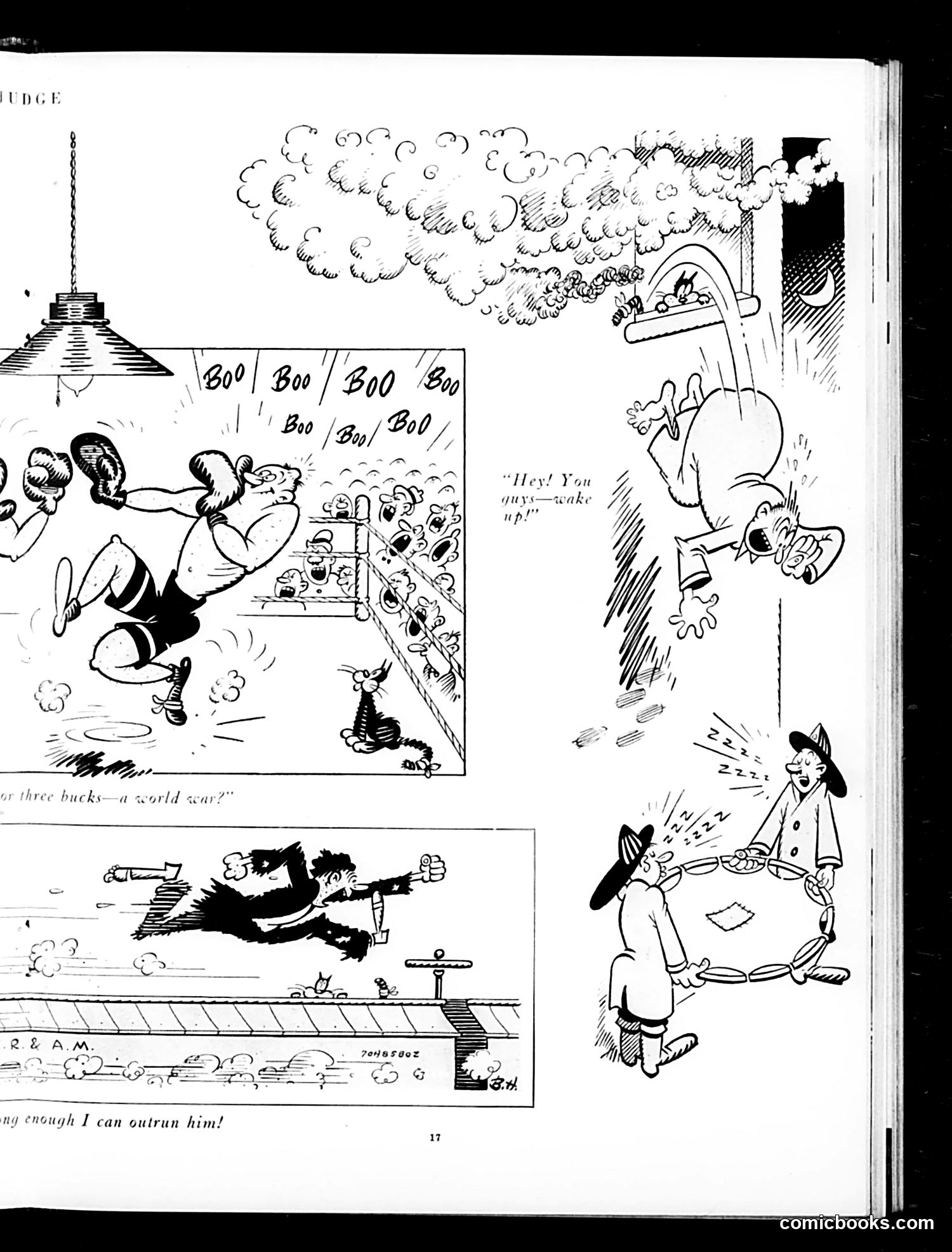
Analysis: Judge Magazine Comic Page This page contains three comic strips depicting slapstick humor rather than political satire. The top panel shows a character being chased away from a building while being "booed" by a crowd—likely depicting a failed performance or embarrassing situation. The middle panel shows a character fleeing horizontally at "2 & A.M.," suggesting nighttime mischief or escape. The final panel depicts children playing jump rope with the caption "Hey! You nearly shake us up!" The humor relies on physical comedy and exaggerated character expressions typical of early-to-mid 20th century comics. Without visible bylines or dated references, the specific satirical targets—if any—remain unclear from the image alone. This appears to be general entertainment comics rather than political commentary.
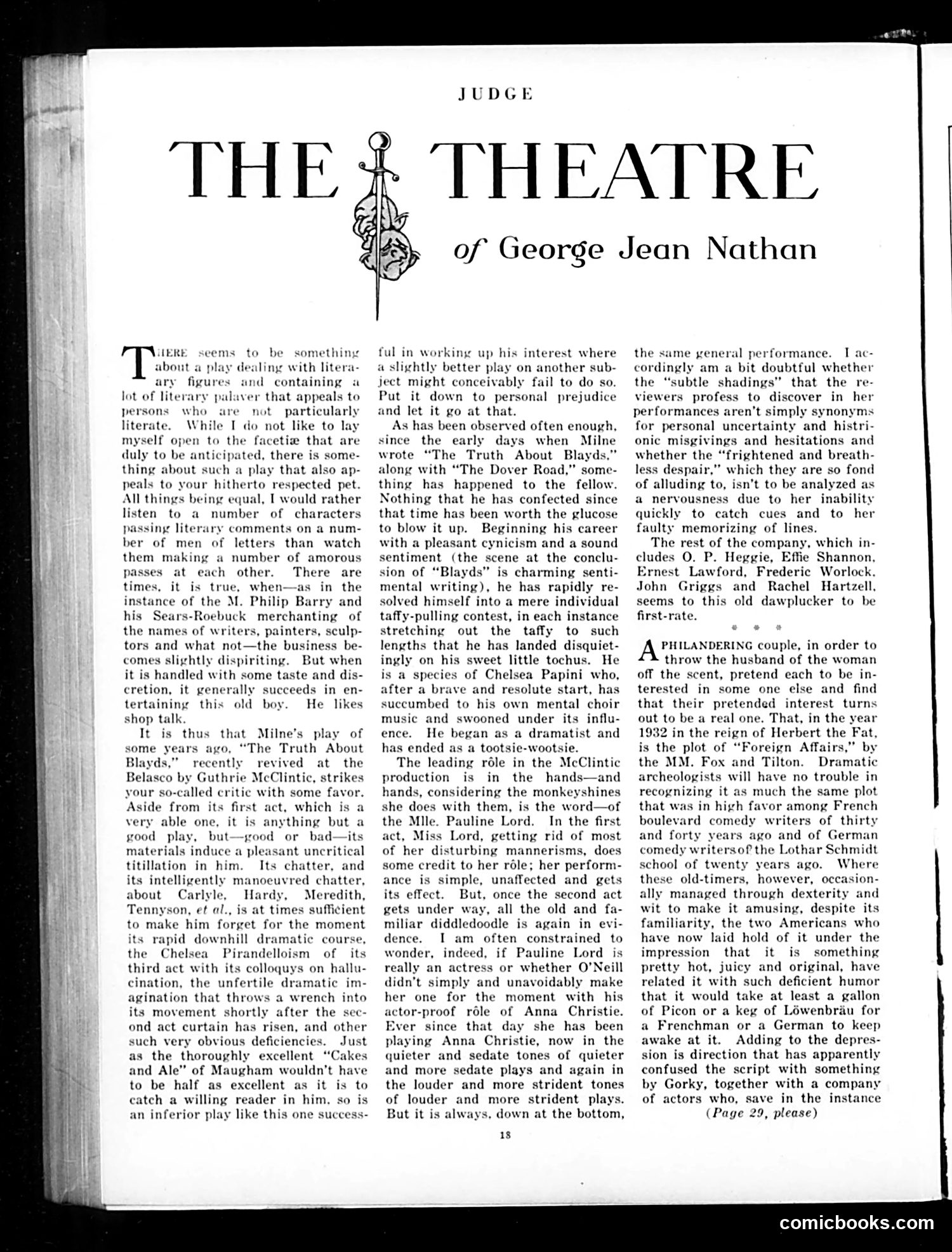
Judge Theatre Critique: "The Theatre of George Jean Nathan" This page is a theatre review by Judge's drama critic, discussing a revival of A.A. Milne's play "The Truth About Blayds." The critic praises plays featuring literary figures and intellectual "shop talk," finding them entertaining despite potential dramatic flaws. The review criticizes Milne's declining career since his early success, describing him as a "Chelsea Papini" who abandoned artistic integrity for commercial appeal ("taffy-pulling"). The main target is actress Pauline Lord, praised for her restrained performance in Act One but criticized for reverting to affected mannerisms in Act Two. The critic questions whether she's a genuine actress or merely benefited from Eugene O'Neill's "actor-proof" role in *Anna Christie*. The piece reflects 1930s theatre culture's emphasis on intelligent dialogue and literary merit versus commercial entertainment—concerns of a sophisticated magazine audience.
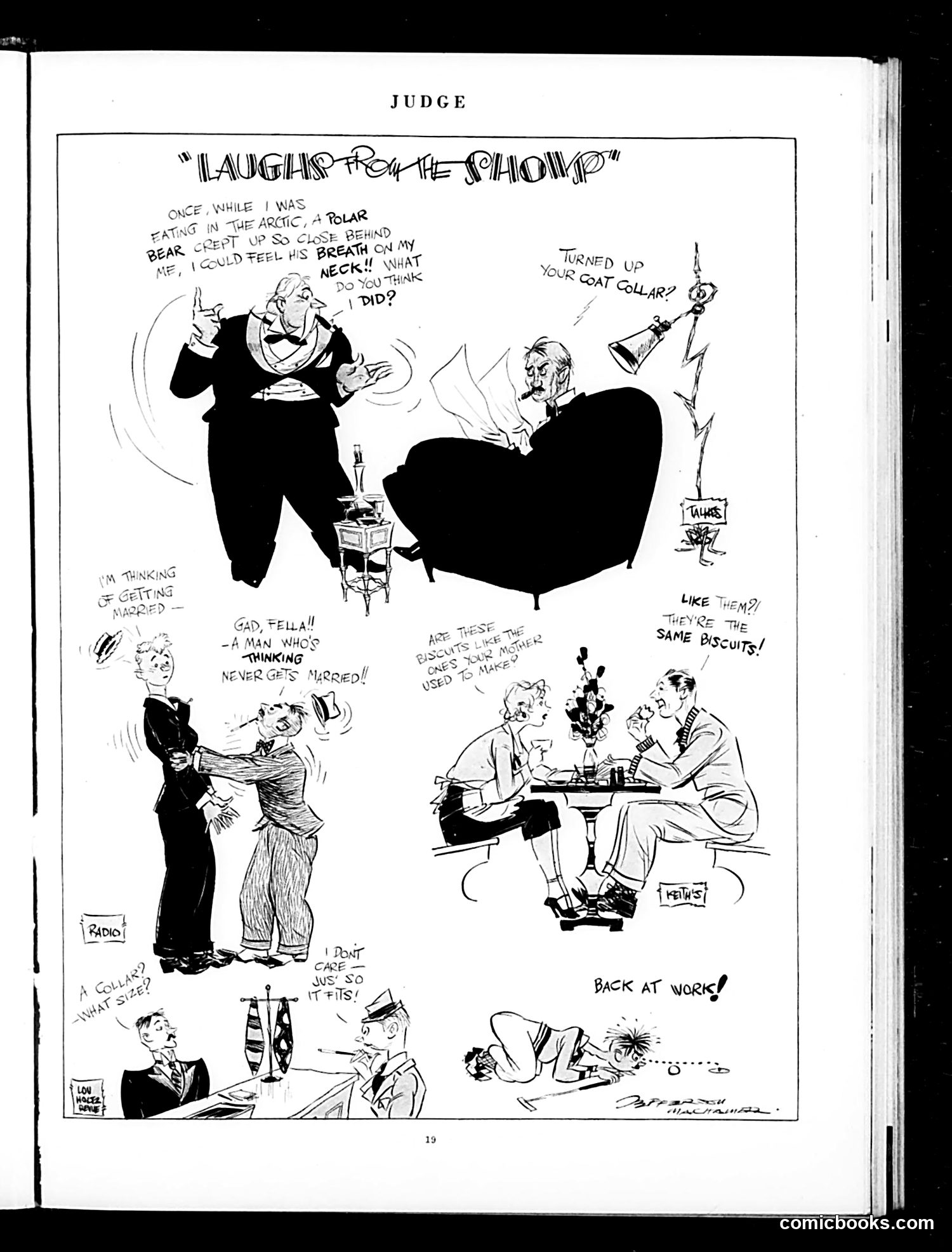
"Laughs for the Shomp" - Judge Magazine Cartoon This is a multi-panel humor page built around a central joke: a man recounts a near-death experience with a polar bear in the Arctic, where the bear breathed down his neck. The punchline appears to be about turning up one's coat collar—a trivial response to a life-threatening encounter. The surrounding panels mock various social types: a bachelor boasting he'll never marry, a "radio" man in formal wear, colleagues sharing gossip at a table, and office workers. The recurring joke seems to be contrasting dramatic stories (the bear anecdote) with mundane modern concerns (coat collars, office gossip, work routines). The satire targets early 20th-century men's preoccupations—bachelor status, workplace chitchat, and fashionable affectation—using exaggeration and absurdist humor typical of Judge magazine's comedic style.
Analysis: "Judging the Movies" by Pare Lorentz This is a film review column, not a political cartoon. Lorentz critiques the movie *Grand Hotel*, praising its emotional authenticity while identifying structural weaknesses. Key figures mentioned: - Greta Garbo - the star actress, whom Lorentz considers "woefully miscast" - Lionel Barrymore - praised for his genuine, understated performance - John (likely John Barrymore) - criticized for struggling with romantic scenes, handicapped by the role itself The critique's point: Despite directorial limitations and Garbo's miscasting, the film succeeds through emotional sincerity—particularly Barrymore's refusal to resort to theatrical tricks. Lorentz contrasts Barrymore's restraint with the excessive performance style of actors like Sam Jaffe, suggesting sophisticated acting (avoiding "circus clown" behavior) elevates the material. For modern readers: This reflects 1930s film criticism valuing naturalistic acting over theatrical exaggeration, a transition occurring as silent film conventions gave way to sound cinema's different demands.
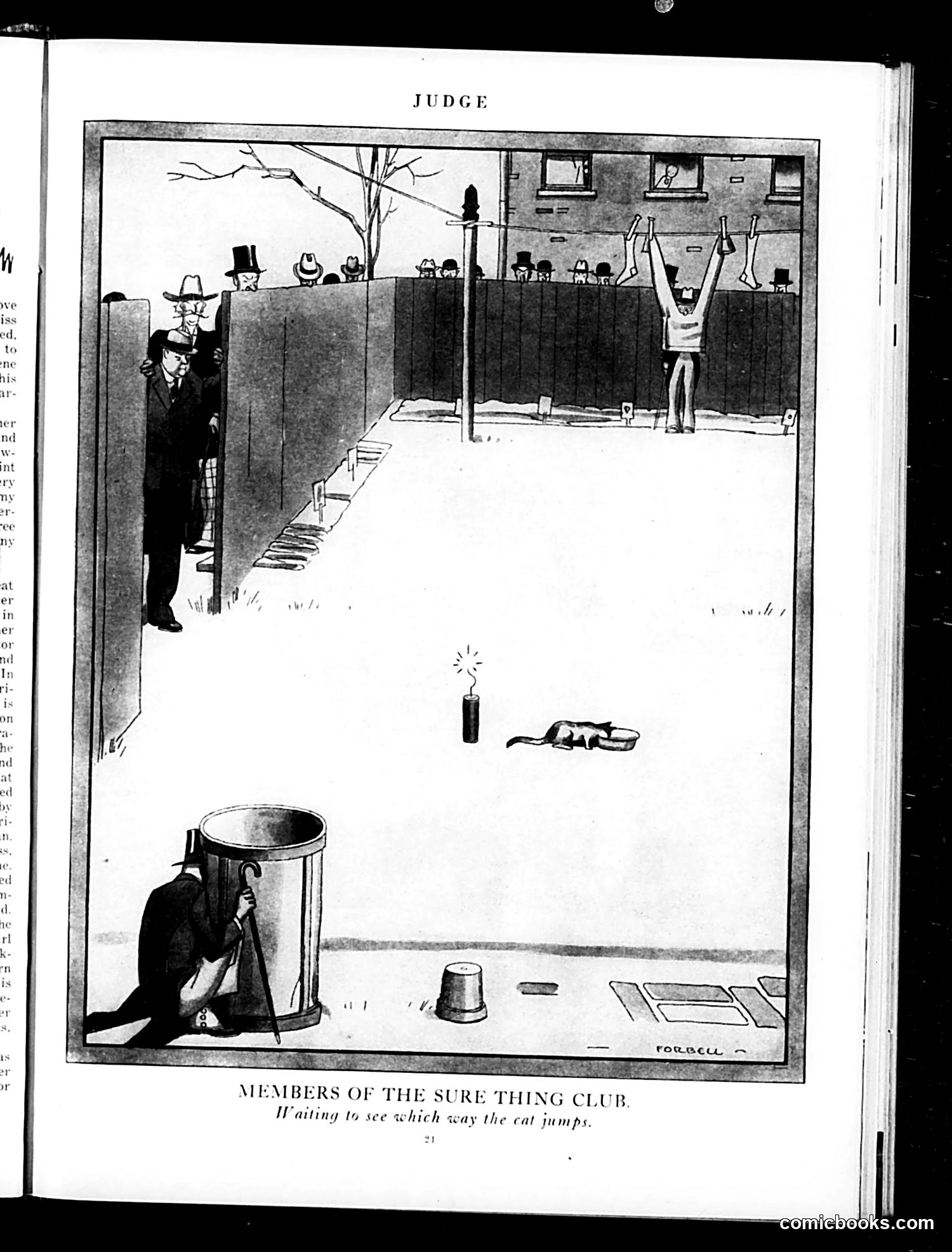
Analysis This cartoon satirizes members of the "Sure Thing Club"—likely politicians or businessmen—who are passively waiting to see "which way the cat jumps" before committing to a position. The idiom means waiting to see how events unfold before deciding. The scene shows well-dressed men in top hats observing from behind a high wall as a cat (shown mid-jump in the empty courtyard below) becomes the focus of attention. A judge presides over this peculiar gathering, suggesting this concerns a legal or political decision. The satire mocks indecisive leaders who avoid taking stands until outcomes seem certain—a critique of political cowardice or opportunism. The absurdity of grown men watching a cat's trajectory emphasizes how trivial or ridiculous their caution appears. The "Sure Thing" club name is ironic, since members seek guaranteed outcomes before acting.
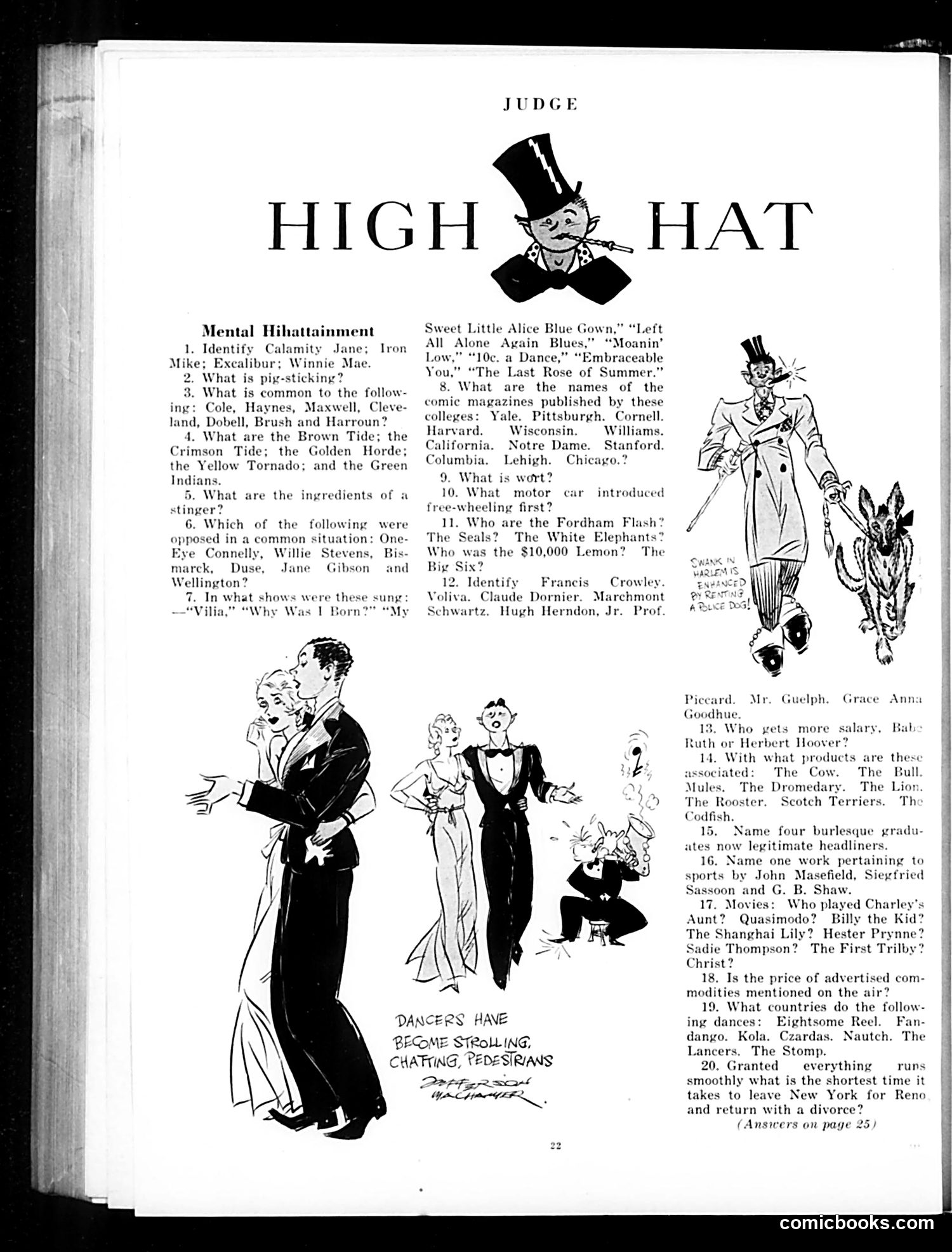
Judge Magazine "High Hat" Page Analysis This is a trivia quiz page titled "Mental Hihattainment," designed as entertainment for Judge's sophisticated readers. The cartoon illustrations show well-dressed socialites engaged in leisure activities (dancing, socializing), reinforcing the "high hat" theme of upper-class pretension. The quiz questions reveal 1920s popular culture references: silent film stars (Calamity Jane, Winnie Mae), Broadway musicals ("Sweet Little Alice Blue Gown"), Ivy League colleges, and contemporary celebrities and athletes. Question 20's joke about divorces references Reno, Nevada's then-famous role as a divorce destination requiring minimal residency. The cartoons mock the leisure class through stylized, exaggerated illustrations. Overall, this page satirizes upper-class intellectualism and social sophistication—positioning readers as insiders who could answer these trivia questions as markers of cultural refinement and social status.
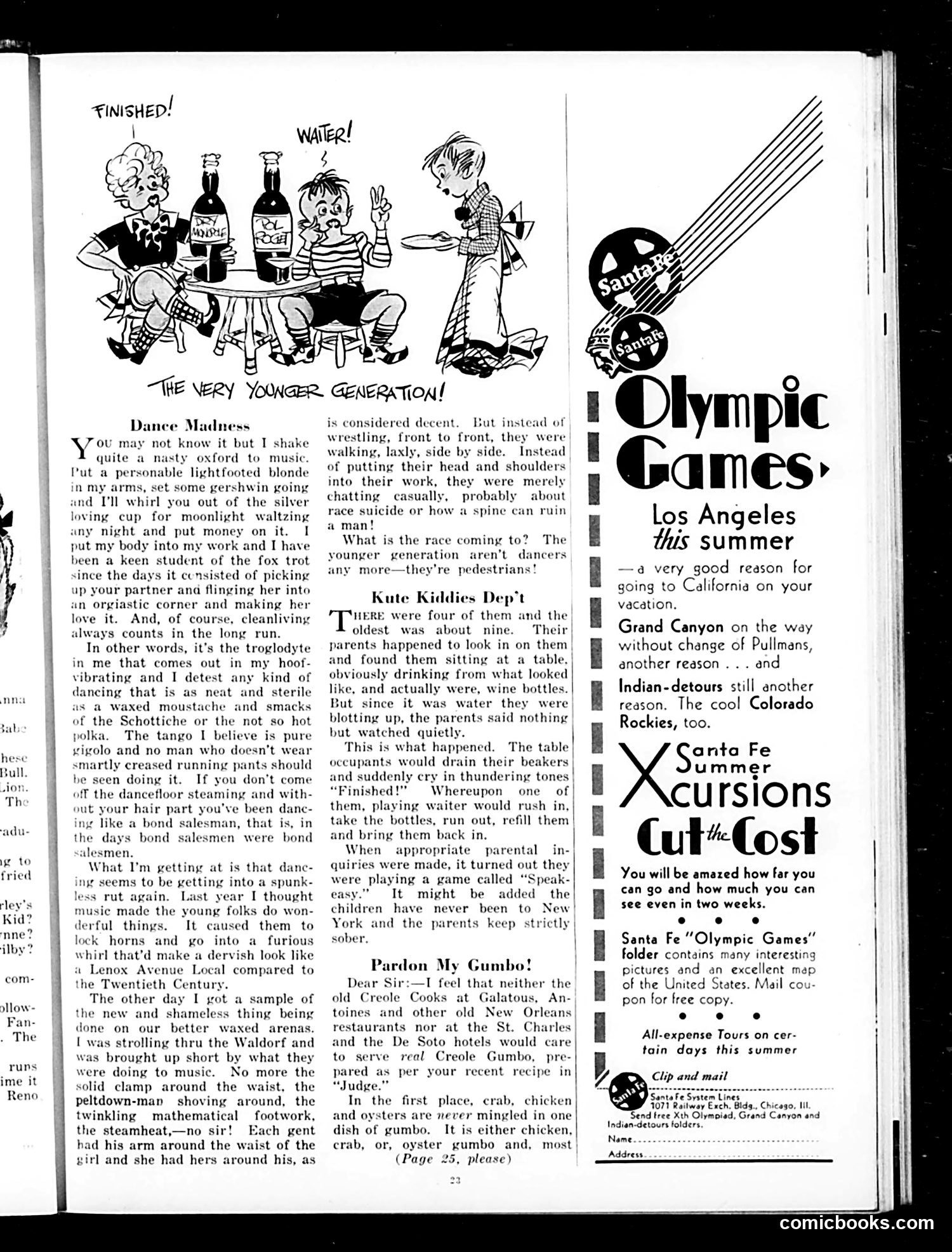
Explaining This Judge Magazine Page This page from Judge magazine (likely 1920s-30s based on style) contains three satirical pieces: "Dance Madness" mocks the declining vigor of modern dancing. The author nostalgically contrasts energetic Jazz Age dancing (the "fox trot," wild "whirl") with contemporary restrained, pedestrian dancing—couples merely "walking, laxly, side by side" while "chatting casually." The cartoon shows young people drinking, labeled "THE VERY YOUNGER GENERATION," suggesting moral decline. "Kute Kiddies Dep't" humorously describes children playing "Speakeasy"—pretending to drink wine in imitation of adults frequenting illegal bars. The satire targets Prohibition-era culture and parental obliviousness. "Pardon My Gumbo" is a reader complaint about Judge's published Creole gumbo recipe, pedantically correcting that authentic gumbo never mixes seafood types. The page also advertises Santa Fe Railway's "Olympic Games" California vacation tours, capitalizing on the 1932 Los Angeles Olympics.
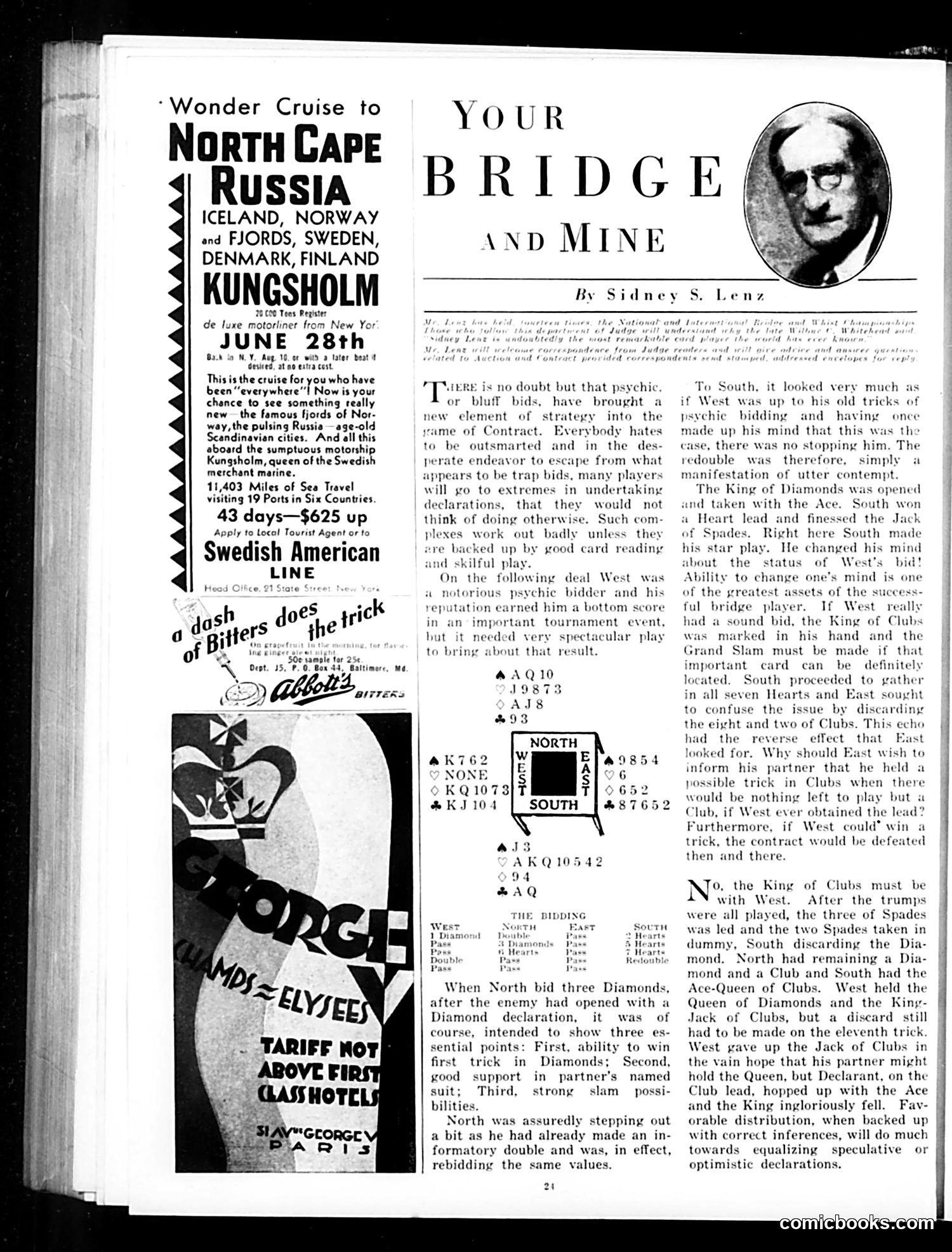
Judge Magazine Page Analysis This page combines travel advertising with a bridge card game column. The prominent left side features a cruise advertisement for the Swedish American Line, promoting a 43-day voyage to North Cape Russia and Scandinavian fjords aboard the luxury ship Kungsholm, departing June 28th for $625 and up. The main content is "Your Bridge and Mine" by Sidney S. Lenz, a popular bridge strategy column. Lenz analyzes a contract bridge hand, explaining how South player successfully made a difficult Grand Slam contract by recognizing that West was employing "psychic bidding"—making false bids to deceive opponents. The article demonstrates skilled play and card-reading strategy, showing how South changed his approach mid-game after identifying West's bluff tactics and ultimately won by correctly deducing West held the King of Clubs. The page reflects the 1920s-30s fascination with both leisure travel and the increasingly popular card game of contract bridge among the wealthy.
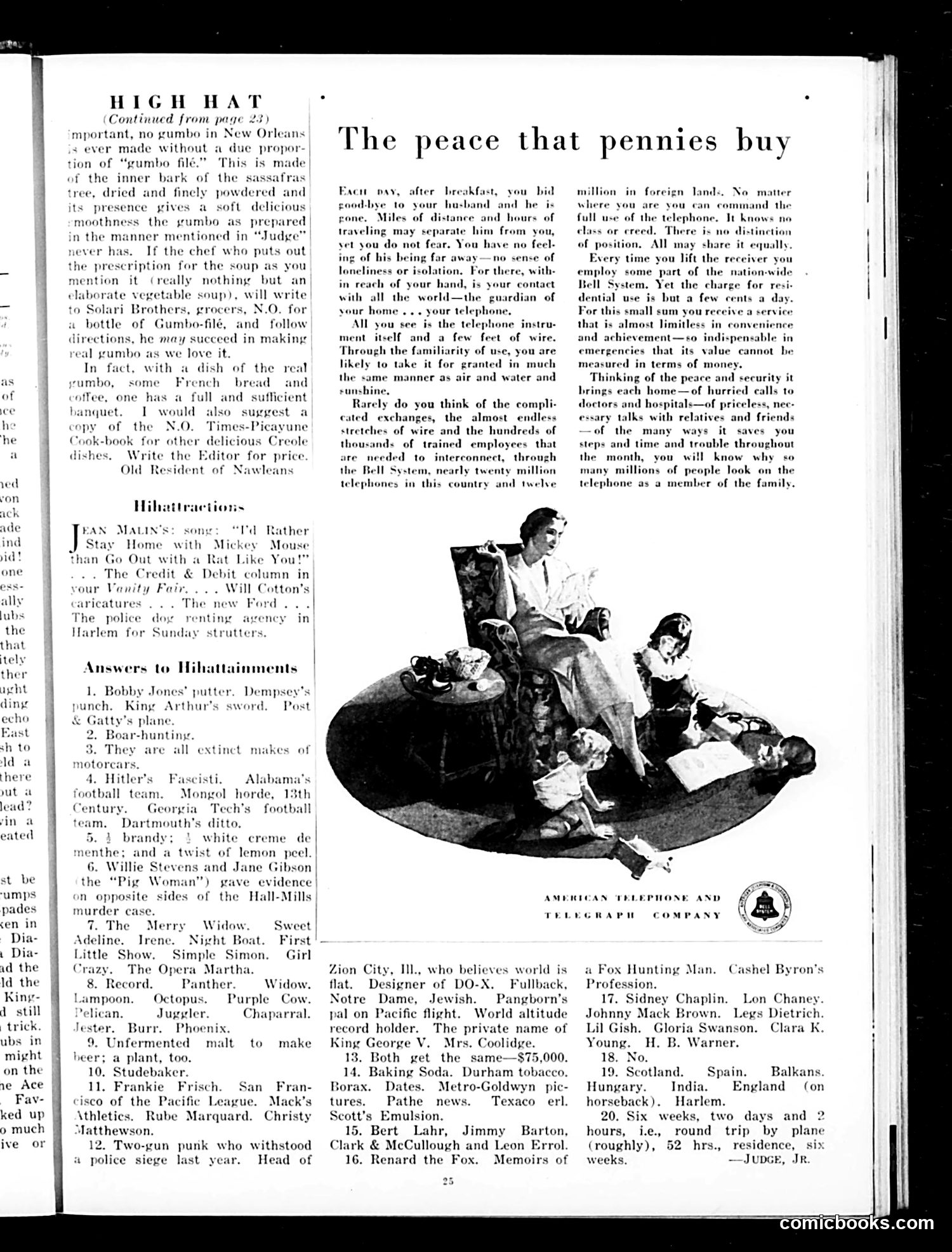
Page Analysis: Judge Magazine - "The Peace That Pennies Buy" This page features an advertisement for American Telephone and Telegraph Company (AT&T), disguised as editorial content about the value of telephone service. The accompanying illustration shows a family using a telephone—a mother and children gathered around the device—emphasizing how the telephone connects families separated by distance. The Advertisement's Message: The piece argues that pennies spent on telephone calls provide immeasurable value: peace of mind for separated families, security, and connection across great distances. It lists the infrastructure supporting calls (exchanges, wire networks, trained operators) to justify the service's worth. Social Context: This reflects 1920s-30s America, when telephone service was still a relatively recent luxury being normalized as essential. The ad targets middle-class families, emphasizing emotional benefits (reassurance, contact) rather than just utility. The page also contains "Hihattractions"—a humor column with trivia answers and brief entertainment references typical of Judge's satirical content. This is essentially advertorial content—advertising presented as journalism—a common practice in period magazines.
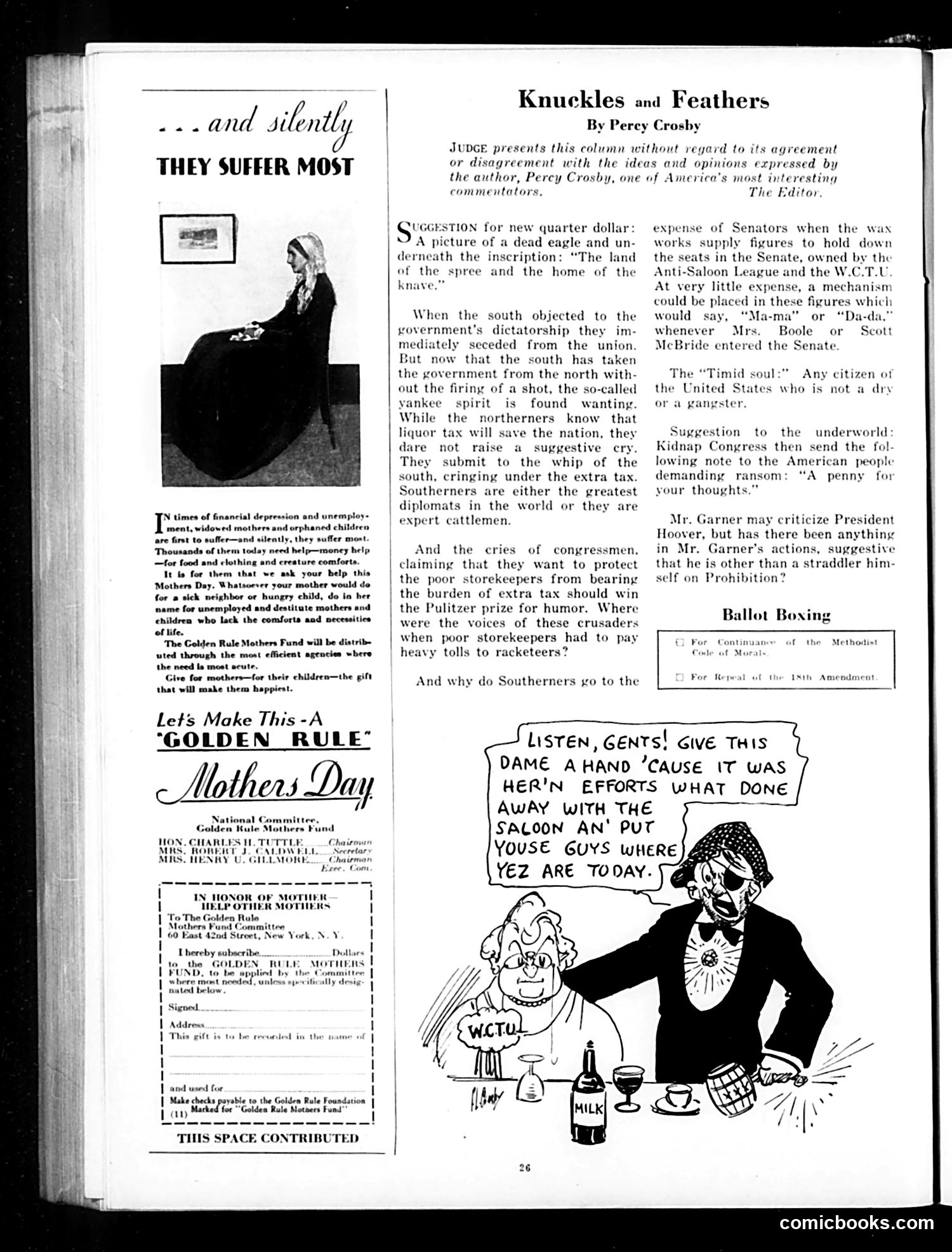
Judge Magazine Page Analysis This page combines a charitable appeal with political satire from the Prohibition era (likely early 1930s). Left side: A Mother's Day fundraising campaign for the "Golden Rule Mothers Fund," supporting unemployed women and children during the Great Depression. Right side ("Knuckles and Feathers"): Percy Crosby's satirical column mocking Prohibition and its aftermath. Key targets: - The South's political dominance: Crosby accuses Southern politicians of seizing federal control through Prohibition, which they championed, while Northern "yankees" passively accept extra taxes rather than resist. - Hypocrisy of Congress: He ridicules politicians claiming to protect small storekeepers from tax burdens—where were these voices when racketeers extorted from the same merchants? - Cartoon below: A woman (representing Prohibition's success) boasts to gangsters about eliminating saloons, apparently oblivious that her efforts directly created the criminal underworld those gangsters now occupy. The satire suggests Prohibition, driven by anti-alcohol crusaders (particularly Southern and Methodist interests), ironically empowered organized crime instead of improving society.
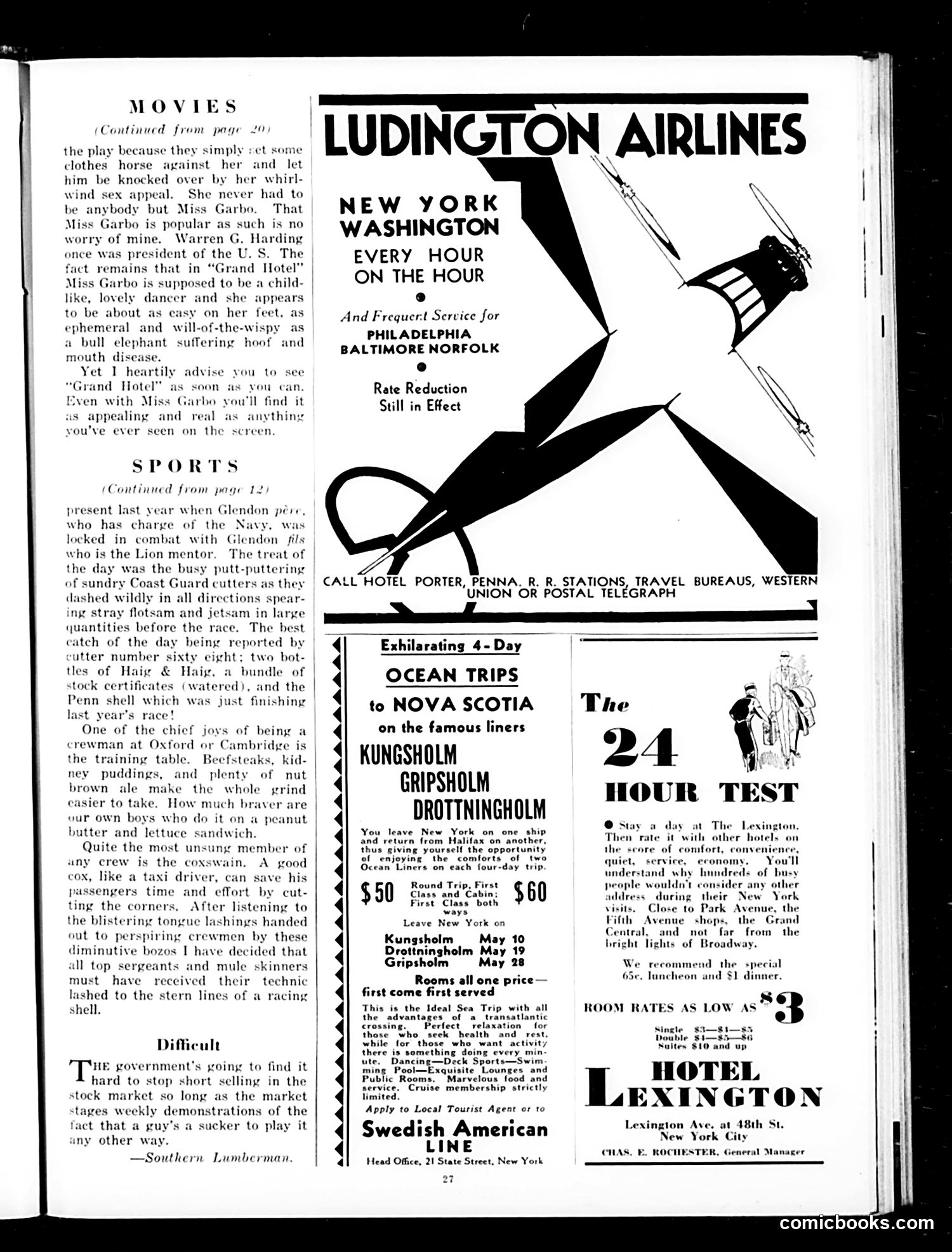
Analysis of Judge Magazine Page Content This page is primarily advertising content rather than political satire or editorial cartoons. The dominant features are travel and hotel advertisements: Key Advertisements: - Ludington Airlines: Announces hourly service between New York-Washington with frequent service to Philadelphia, Baltimore, and Norfolk. Visual shows stylized aircraft. - Ocean Trips to Nova Scotia: Swedish-American Line promotes 4-day cruises on ships Kungsholm, Gripsholm, and Drottningholm, departing from New York to Halifax. - Hotel Lexington: NYC hotel advertisement emphasizing proximity to Fifth Avenue shops and Broadway. Remaining Content: Brief editorial sections on movies (discussing Greta Garbo in "Grand Hotel") and sports (rowing/crew activities at Oxford/Cambridge) appear to be continuations from previous pages. The page reflects 1930s-era leisure travel and entertainment marketing to affluent readers, with no discernible political satire or caricature present.
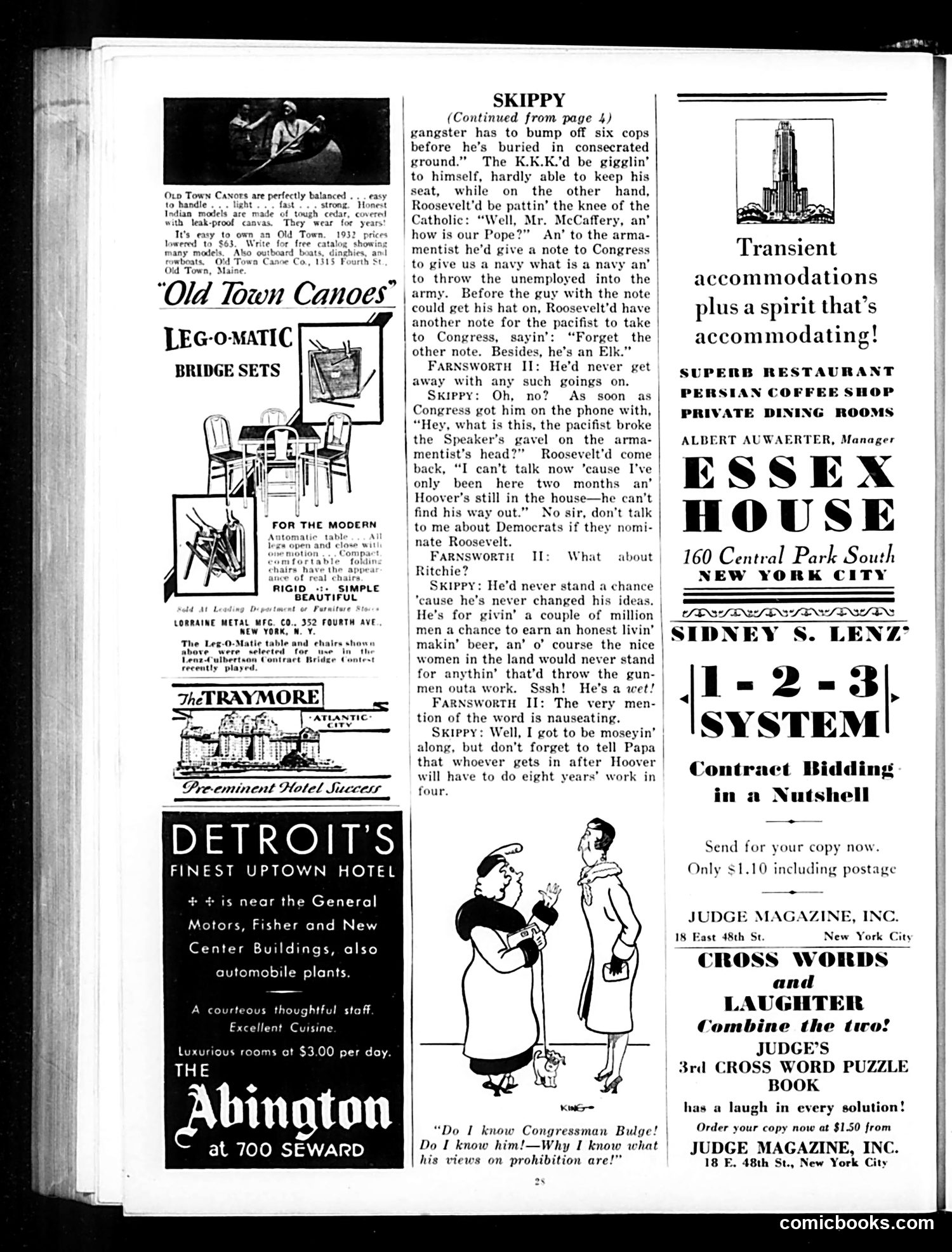
Skippy on 1932 Politics This page continues a "Skippy" comic strip dialogue satirizing Herbert Hoover's presidency and the 1932 election. Two characters discuss which candidate might succeed Hoover, speculating wildly about Roosevelt's contradictory impulses—imagining he'd simultaneously appease pacifists, armamentists, Catholics, and the KKK, issuing conflicting orders to Congress. The satire mocks Roosevelt as indecisive and chaotic. It also ridicules other potential candidates: "Farnsworth II" (likely referencing a fictional or real political figure), who would do nothing; Ritchie (Albert Ritchie, Maryland governor and wet—pro-repeal of Prohibition), dismissed as unchanging and unelectable because "nice women" oppose ending Prohibition and gun violence. The final joke about eight years' work in four years suggests Hoover left such a mess that his successor faces an overwhelming burden. The page is primarily advertisements for hotels, furniture, bridge sets, and puzzle books.
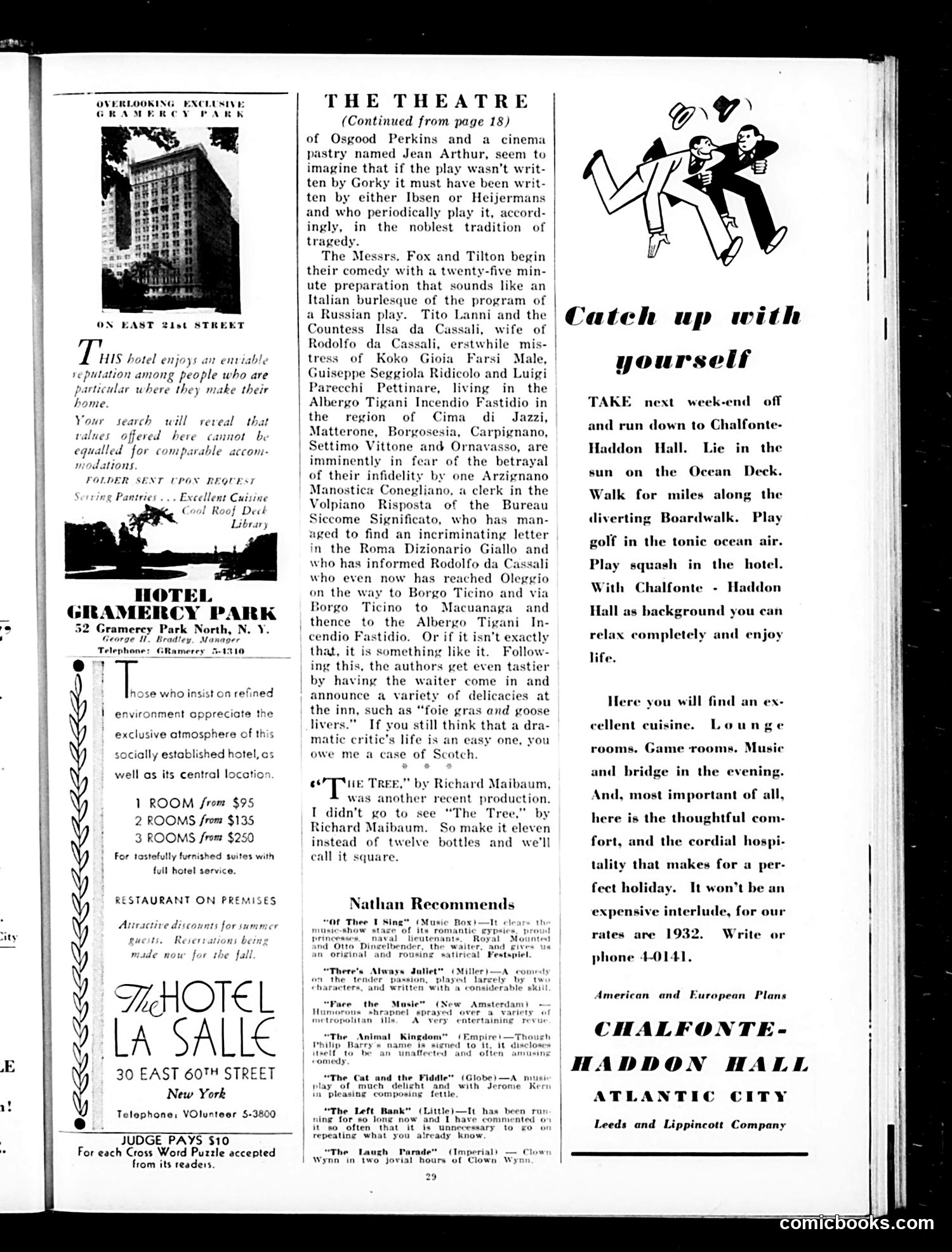
Page Analysis: Judge Magazine Theater & Advertising This page mixes theater reviews with hotel advertisements, typical of 1930s Judge magazine content. The Theater Section contains a satirical review mocking a contemporary play (likely by Fox and Tilton) set in Italy. The critic ridicules the deliberately overwrought Italian character names and plot complications—"Tito Lanni and the Countess Ilsa da Cassali" et al.—as pretentious mimicry of serious European drama (Gorky, Ibsen). The joke is that American playwrights manufacture fake sophistication through absurdly complicated Italian nomenclature and melodramatic setups, then have waiters announce ridiculous dishes. The critic suggests drinking heavily to endure it. The Advertising promotes upscale Manhattan hotels (Gramercy Park, Hotel La Salle) and the Chalfonte-Haddon Hall resort in Atlantic City, emphasizing refined atmosphere and reasonable 1932 rates. The page reflects 1930s attitudes: urbane mockery of artistic pretension, class-conscious hospitality marketing, and leisure culture during the Depression.
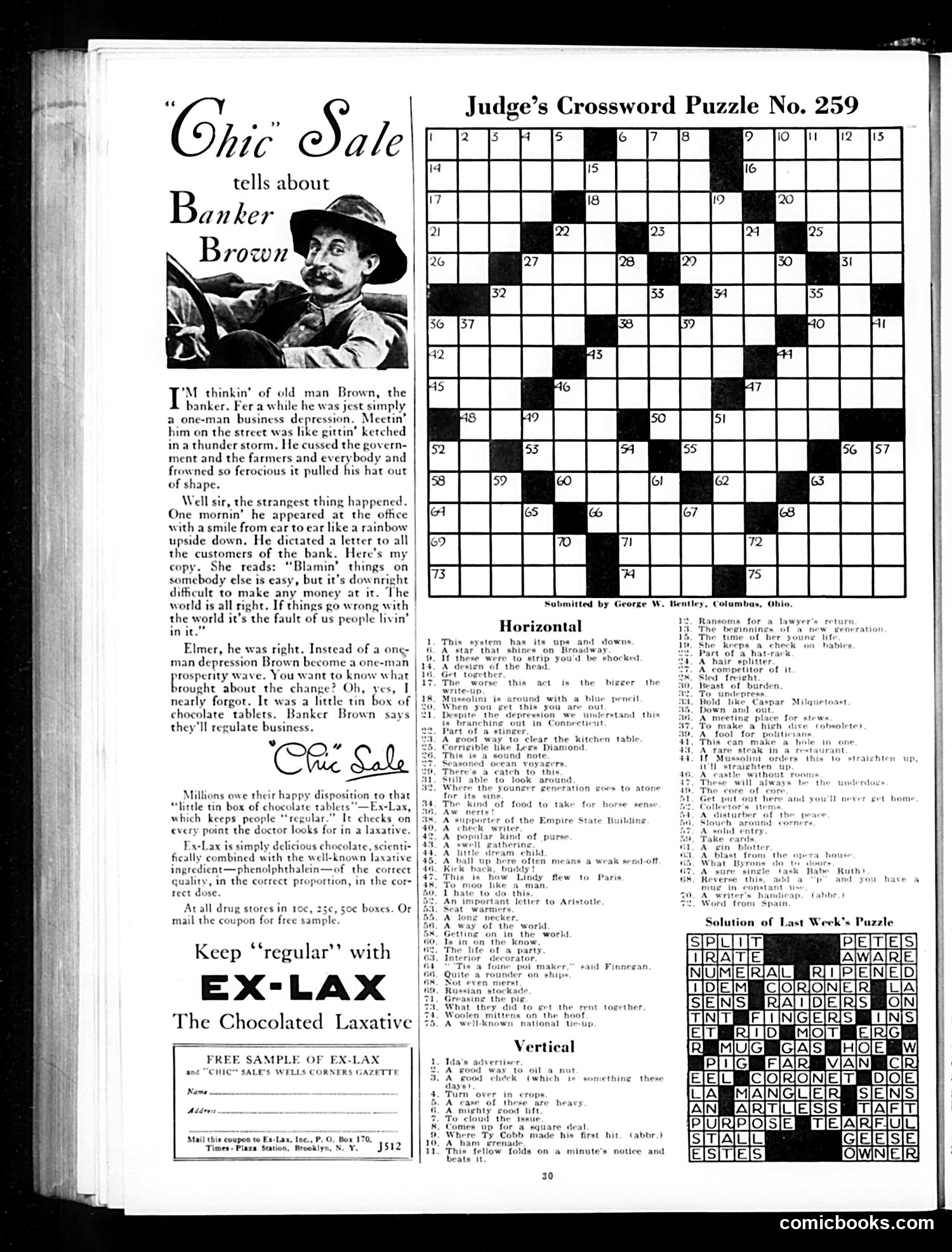
"Chic Sale" on Banker Brown This is an advertisement masquerading as editorial content, written by humorist Chic Sale (a popular Judge contributor). The "story" concerns a pessimistic banker named Brown whose negative attitude literally depresses his community during what appears to be the Great Depression era. The satire's point: Brown's transformation from complaining grouch to optimist—triggered by taking Ex-Lax laxative tablets—suggests that intestinal regularity produces happiness and prosperity. The joke conflates physical and economic "regularity," implying that if people would "keep regular" (both literally and figuratively), depression would vanish. This is crude advertising humor: by attributing Brown's change in outlook to a laxative, the ad implies Ex-Lax cures not just constipation but also bad moods and economic malaise. The underlying message—that personal disposition rather than systemic economic problems drives prosperity—is itself satirized, though the ad seems to present it earnestly.
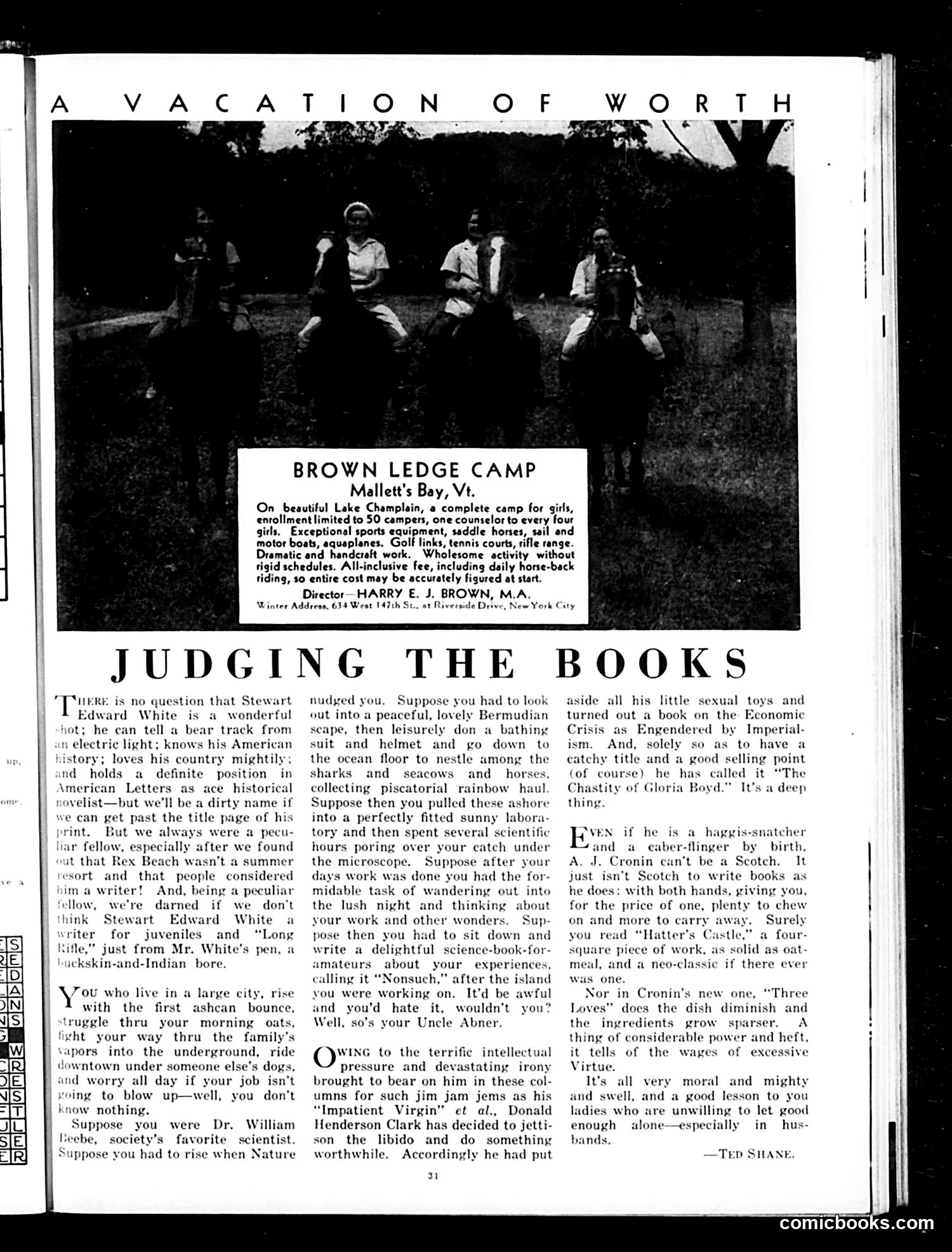
"Judging the Books" - Judge Magazine Book Review Page This is primarily a book review column rather than a political cartoon. The page critiques recent literary works by satirizing both the authors and their subject matter. The reviewer discusses: - Stewart Edward White: Dismissed as writing tedious "buckskin-and-Indian" material for juveniles despite being a serious historical novelist - William Beebe (implied): The "society favorite scientist" whose work on ocean exploration is praised as genuinely worthwhile, contrasting with frivolous literature - Donald Henderson Clark: Previously criticized for writing about sexual themes ("jim jam jems" like "Impatient Virgin"), he's now praised for shifting to serious social commentary with "The Chastity of Gloria Boyd" - A.J. Cronin: Complimented for prolific, substantial work—his new novel "The Three Loves" is called deep and morally instructive The satire mocks authors who write superficial adventure fiction while praising those tackling serious scientific or moral subjects. The tone is dismissive toward pulp entertainment and congratulatory toward "worthwhile" literature.
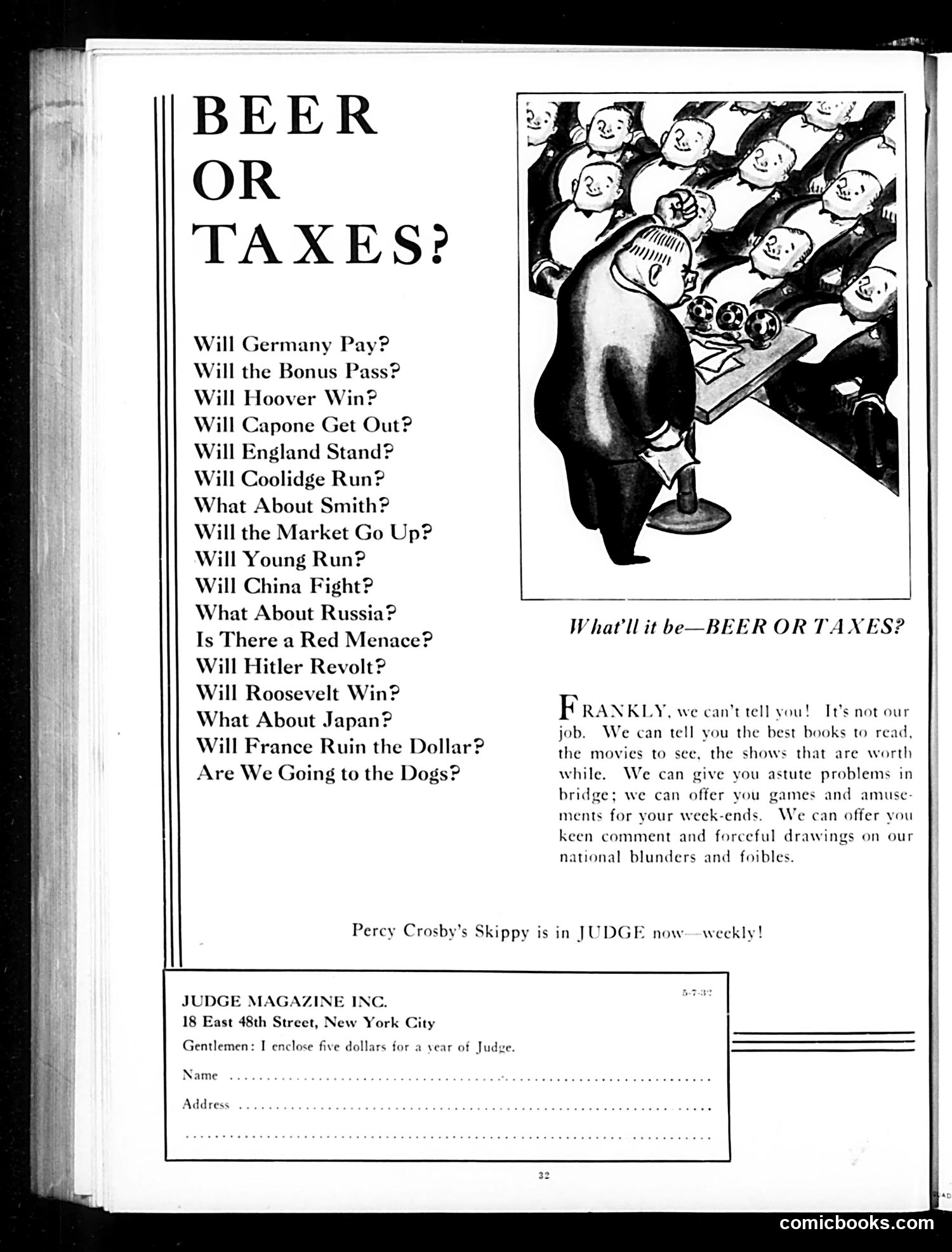
"Beer or Taxes?" Judge Magazine Advertisement This page advertises Judge magazine through satirical humor about contemporary uncertainties. The left column lists pressing questions of the era—Prohibition enforcement ("Beer or Taxes?"), the 1928 presidential race ("Will Hoover Win?"), organized crime ("Will Capone Get Out?"), and international concerns ("Will Hitler Revolt?" "What About Japan?"). The cartoon shows a bear-like figure (Uncle Sam or similar national symbol) surrounded by aggressive, grinning faces, seemingly bombarded by these unanswerable questions. The ad's pitch is self-deprecating: Judge admits it can't predict the future but offers entertainment—books, movies, games, bridge problems, and satirical commentary on "national blunders and foibles." The Prohibition reference frames the existential anxiety: facing uncertain times, should Americans worry about beer or taxes? Judge positions itself as a humorous escape from contemporary anxieties.
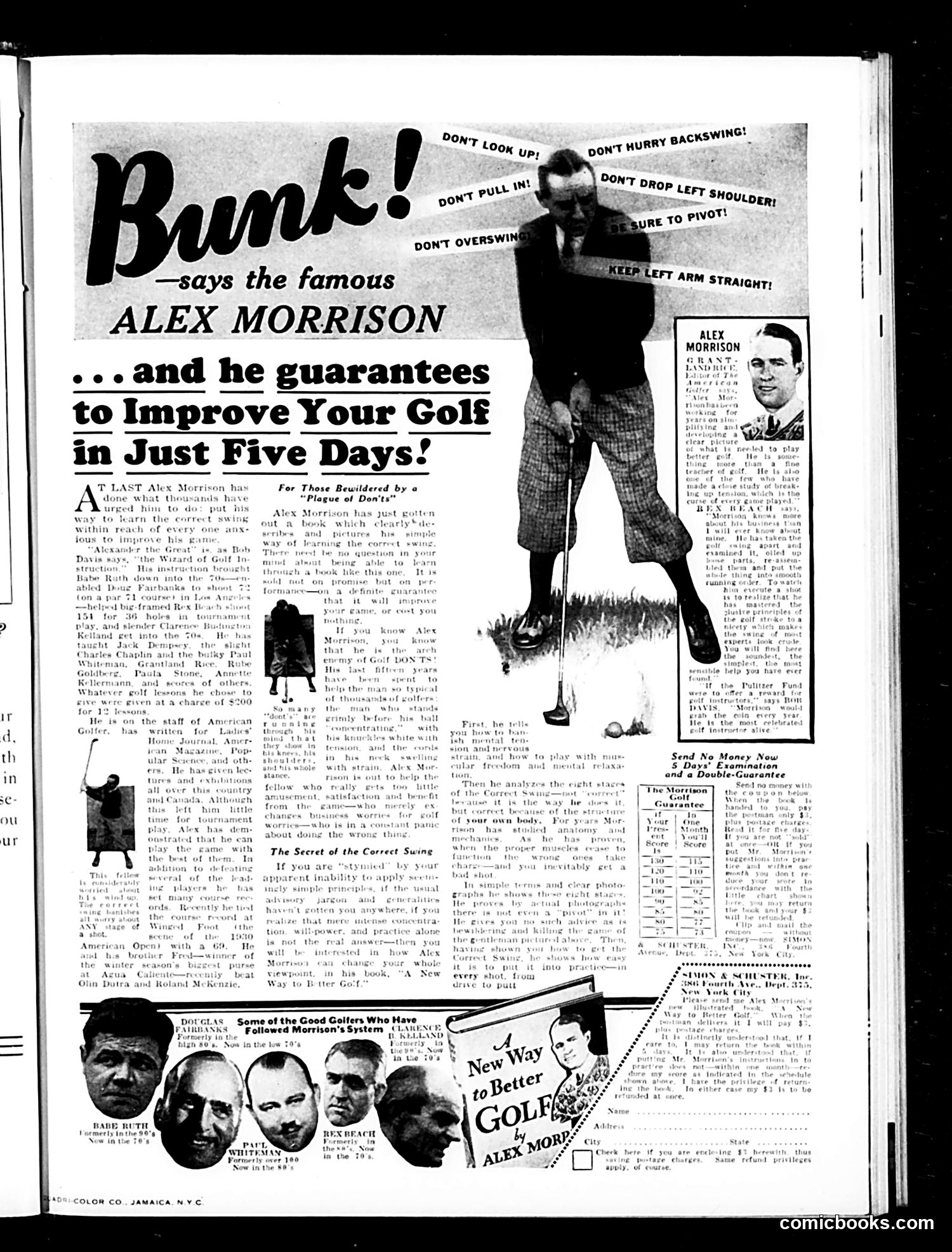
"Bunk!" — A Golf Instruction Advertisement Parody This page is primarily a commercial advertisement, not political satire. It promotes Alex Morrison's golf instruction method, claiming to improve players' games in five days. The humor is self-aware: the large word "Bunk!" at the top signals that Morrison himself is jokingly acknowledging the exaggerated nature of the promise. The image shows Morrison demonstrating proper swing technique, surrounded by instructional "don'ts" (don't look up, don't pull in, etc.). The page includes celebrity endorsements from famous golfers of the era (the text mentions names like Babe Ruth, though these appear as headshots below). This was standard advertising practice—using recognizable figures to promote products. The satirical element is minimal: Judge magazine is simply poking fun at the overblown confidence of golf instruction salesmanship—a recurring target of American humor. The "bunk" label is the joke itself: even the advertiser admits the bold guarantee sounds dubious, inviting readers to find humor in the pitch while still promoting Morrison's actual instruction booklet.
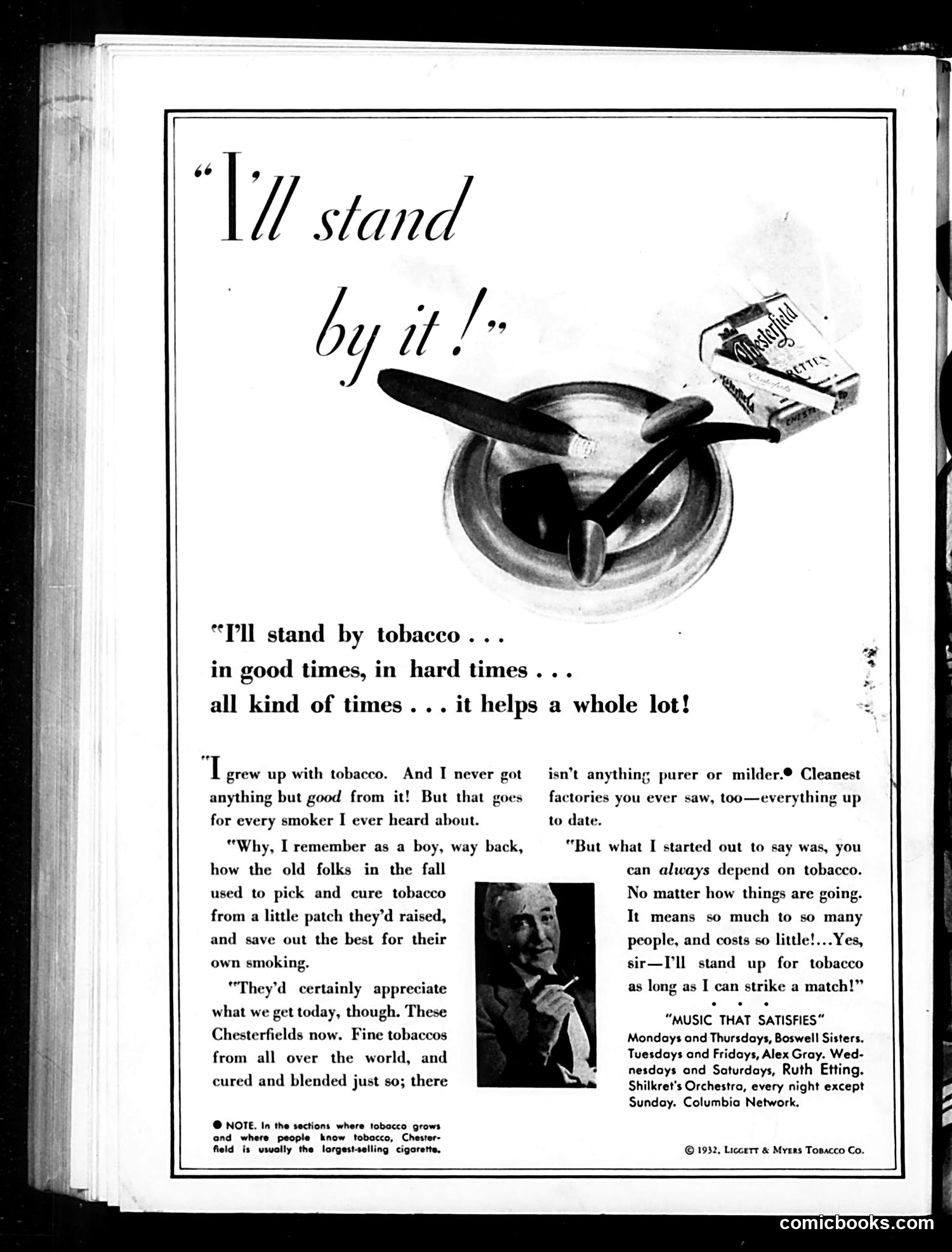
Analysis: Chesterfield Cigarette Advertisement (1932) This is a tobacco advertisement, not political satire. It's a full-page sponsored ad for Chesterfield cigarettes by Liggett & Myers Tobacco Co., disguised as editorial content in Judge magazine. The "cartoon" depicts an ashtray with cigarettes and a matchbook. The text presents a fictional testimonial from an unnamed older man praising tobacco's reliability and affordability across economic conditions—notably during the Great Depression ("in good times, in hard times"). Key period context: This reflects 1930s advertising tactics that: - Associated smoking with tradition and nostalgia - Made health/purity claims ("purer or milder," "cleanest factories") - Promoted cigarettes as affordable luxury - Embedded advertisements within editorial pages - Sponsored radio programs ("Music That Satisfies") for brand promotion Modern perspective: The advertisement's explicit health claims and open promotion of tobacco would now be illegal. It exemplifies pre-regulation advertising before the surgeon general's 1964 warning on smoking dangers.