judge
Judge — May 14, 1932
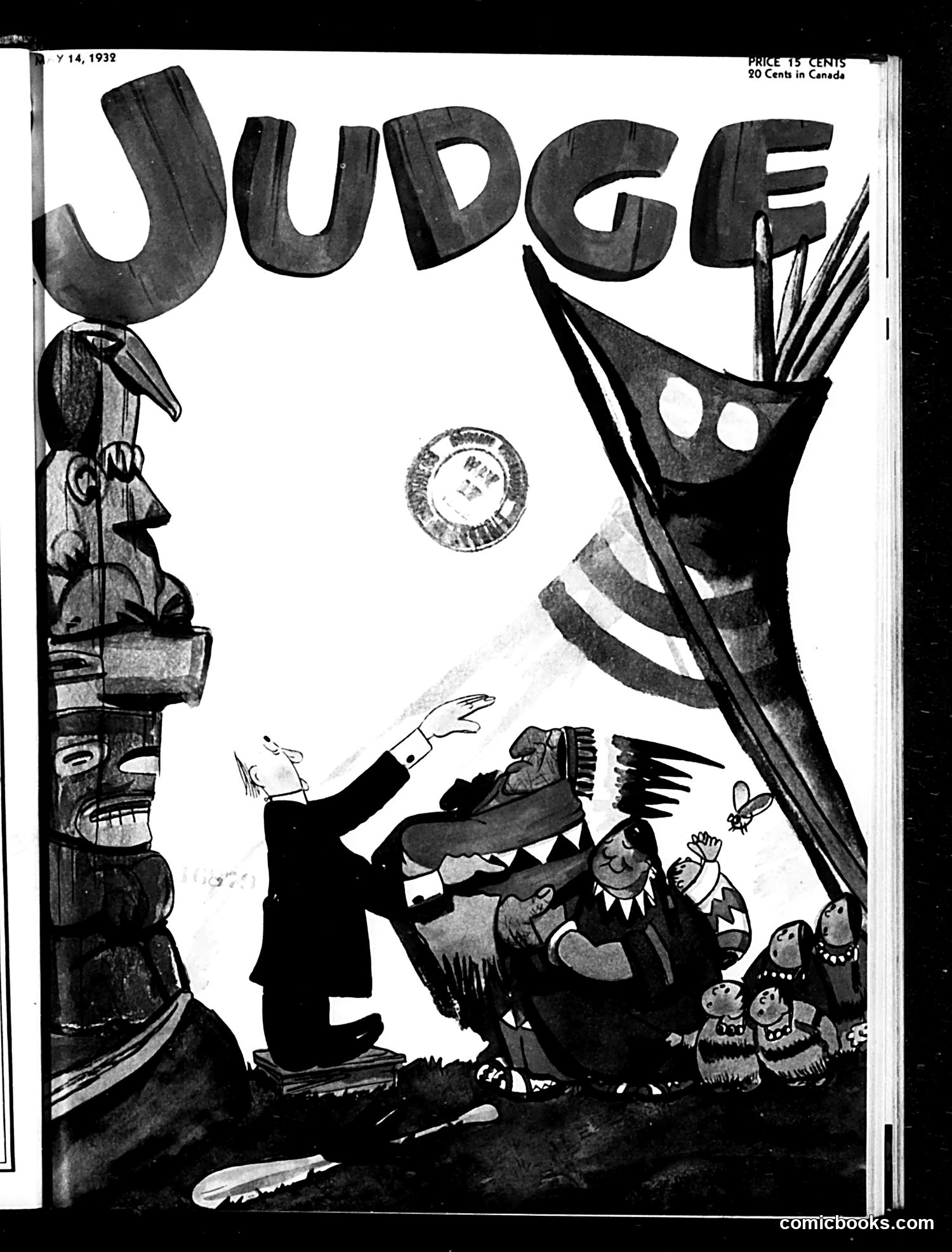
Judge Magazine Cover Analysis - July 14, 1932 This political cartoon satirizes the 1932 presidential campaign during the Great Depression. The large "JUDGE" letters dominate the composition, with a tall, menacing figure (likely representing a political opponent or threat) looming over smaller caricatured figures below. The scene depicts chaos and conflict—a man in formal dress appears to be kicking or fighting against others, suggesting political turmoil. The smaller figures likely represent ordinary citizens or political rivals being trampled during this turbulent election period. The totem pole on the left suggests Native American imagery, possibly commenting on American traditions or values under threat. Overall, the cartoon criticizes the violence and disorder characterizing 1932's contentious presidential race between incumbent Herbert Hoover and challenger Franklin D. Roosevelt amid economic crisis.
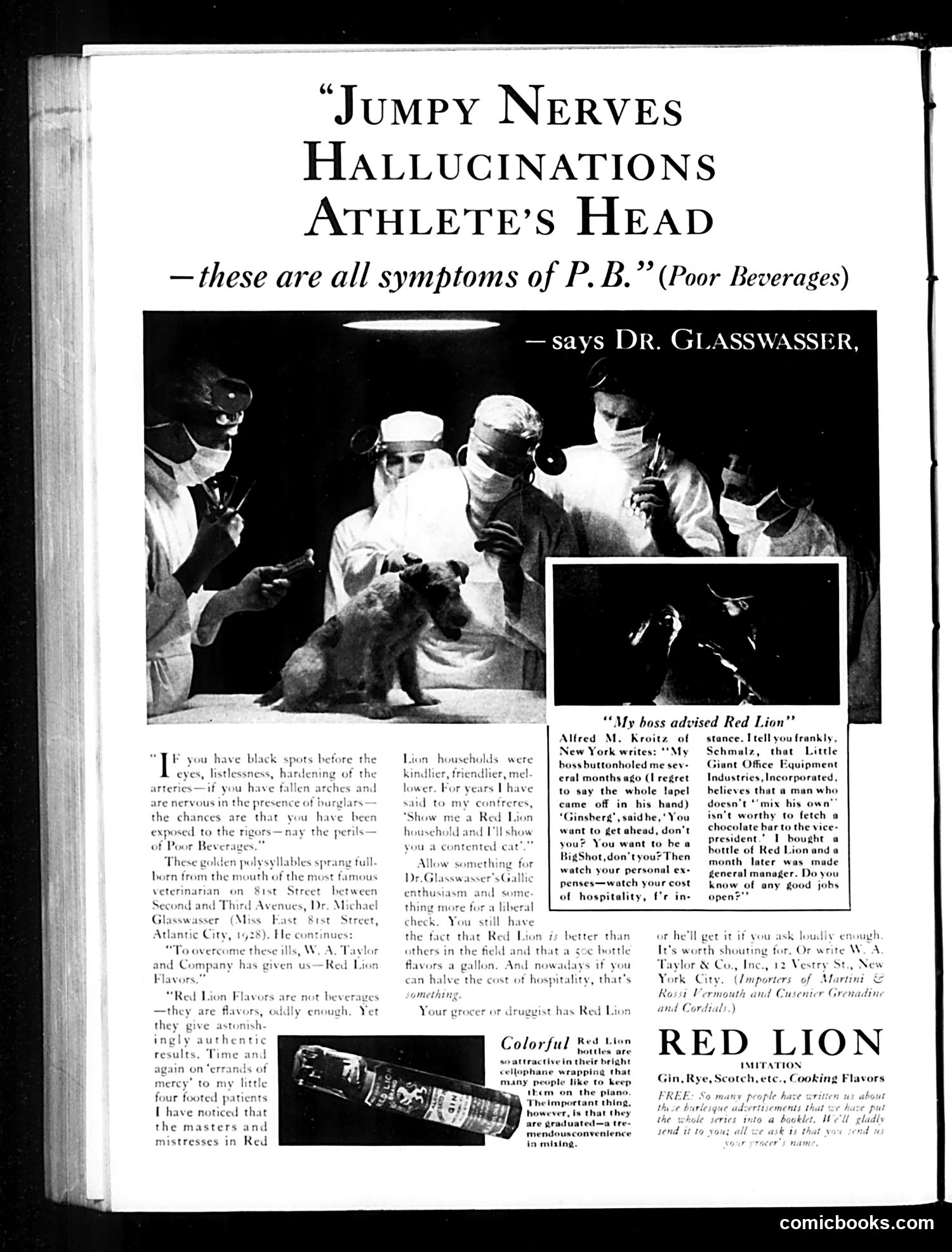
Analysis This page is primarily advertising masquerading as editorial content—a common Judge magazine practice. The headline satirizes "Poor Beverages" (abbreviated "P.B.") by claiming they cause nervousness and hallucinations, attributing this to "Dr. Glasswasser." The main image shows what appears to be a medical or laboratory demonstration with people examining a lion, likely parodying pseudo-scientific endorsements. The inset testimonial from "Alfred M. Kroitz" sarcastically describes a boss promoting Red Lion imitation whiskey/flavoring as if it were quality liquor—the humor derives from the absurdity of marketing cheap substitutes with dubious health claims. The bottom advertises Red Lion brand flavoring (gin, rye, scotch, cooking flavors), using the satire to actually *promote* the product to readers who'd recognize the joke. This reflects early 20th-century attitudes toward alcohol, patent medicines, and aggressive advertising claims.
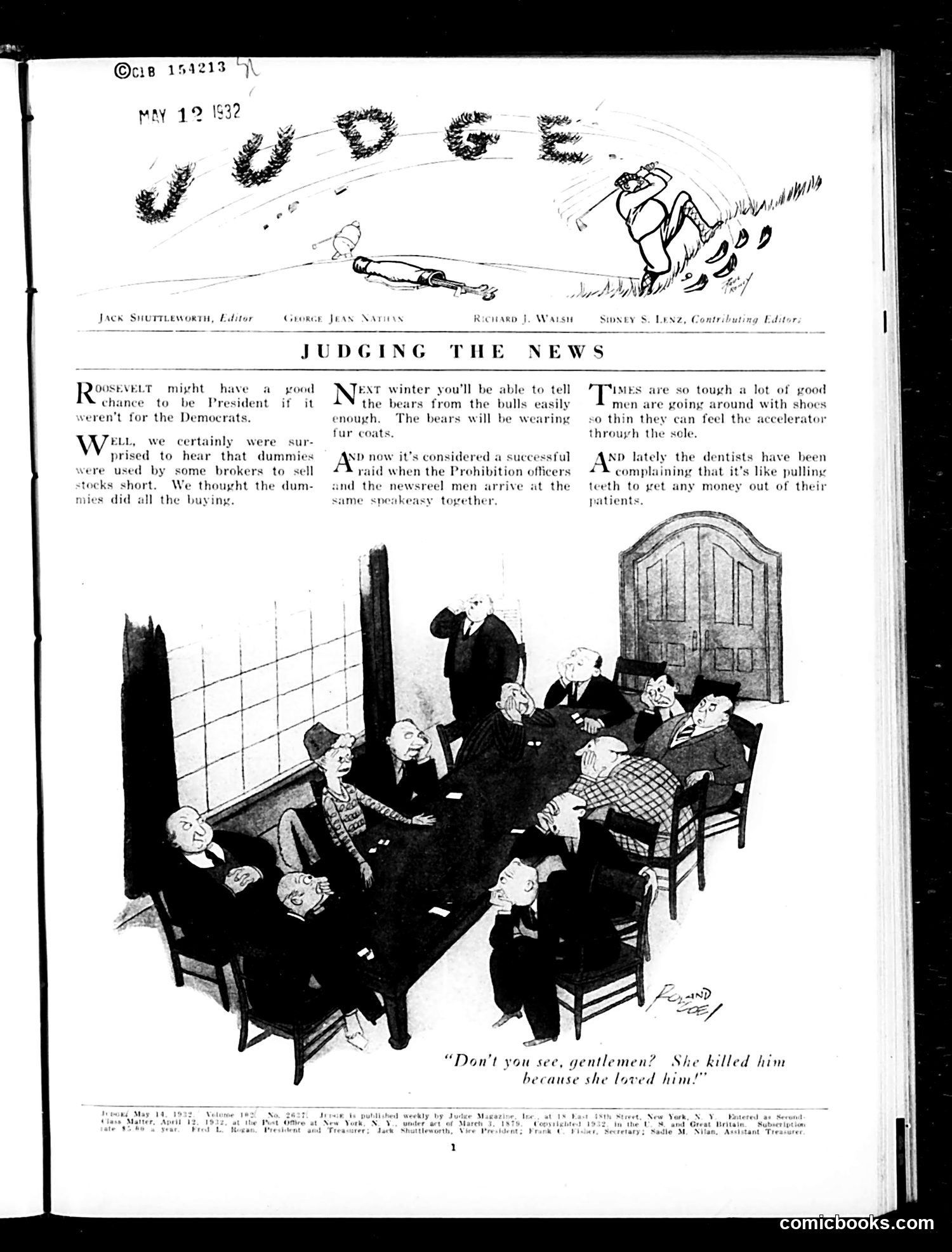
"Judging the News" - May 12, 1932 This page contains four brief satirical comments on current events, paired with cartoons: 1. Roosevelt and Democrats: A joke suggesting Roosevelt might have become President if not for Democratic opposition—likely referencing internal party tensions. 2. Bears and Prohibition: A winter forecast quip about bears wearing fur coats while Prohibition officers and "newsy men" meet at speakeasies—satirizing the widespread flouting of Prohibition laws. 3. Shoe accelerators: A joke about shoes with built-in accelerators—apparently mocking some fashion trend or advertisement. 4. Dentists: A quip about dentists extracting money from patients. The main cartoon depicts a courtroom scene where a woman explains killing someone "because she loved him"—likely referencing a contemporary trial or crime story, though the specific case is unclear from this page alone.
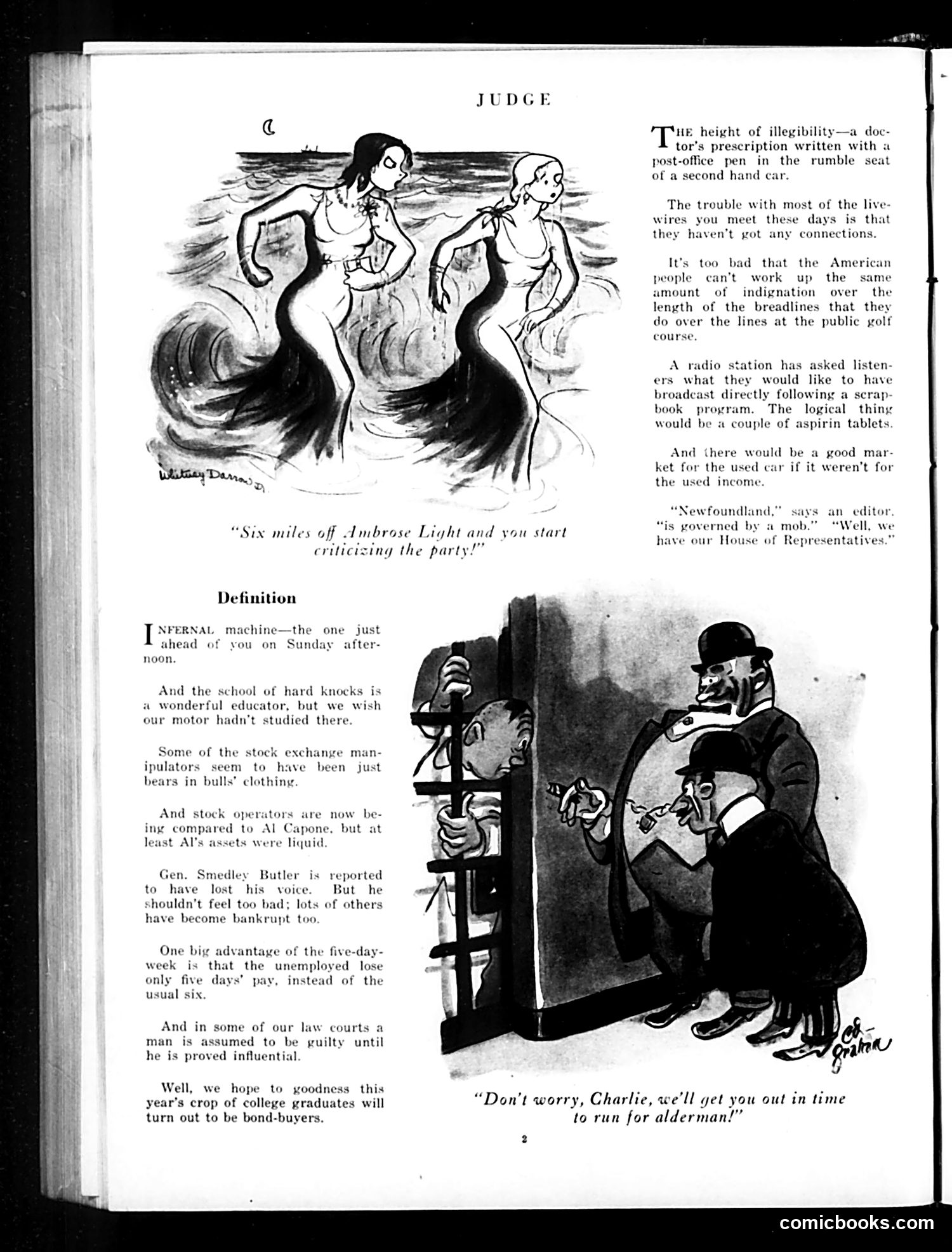
Analysis of Judge Magazine Page Top Cartoon ("Judge"): Two mermaids criticize a party six miles off Ambrose Light (a navigation marker near New York). The satire targets wealthy socialites' frivolous behavior during economically troubled times—the implicit critique being that the leisure class parties carelessly while others suffer. Bottom Cartoon ("Definition"): A traffic cop helps a man described as "Charlie" toward a lamppost, saying he'll "get you out in time to run for alderman." This satirizes corrupt urban politics, suggesting that even police involvement in minor infractions could be manipulated for political advancement—a jab at machine politics and the cozy relationship between law enforcement and city government. Both pieces use humor to critique 1920s American excess and political corruption.
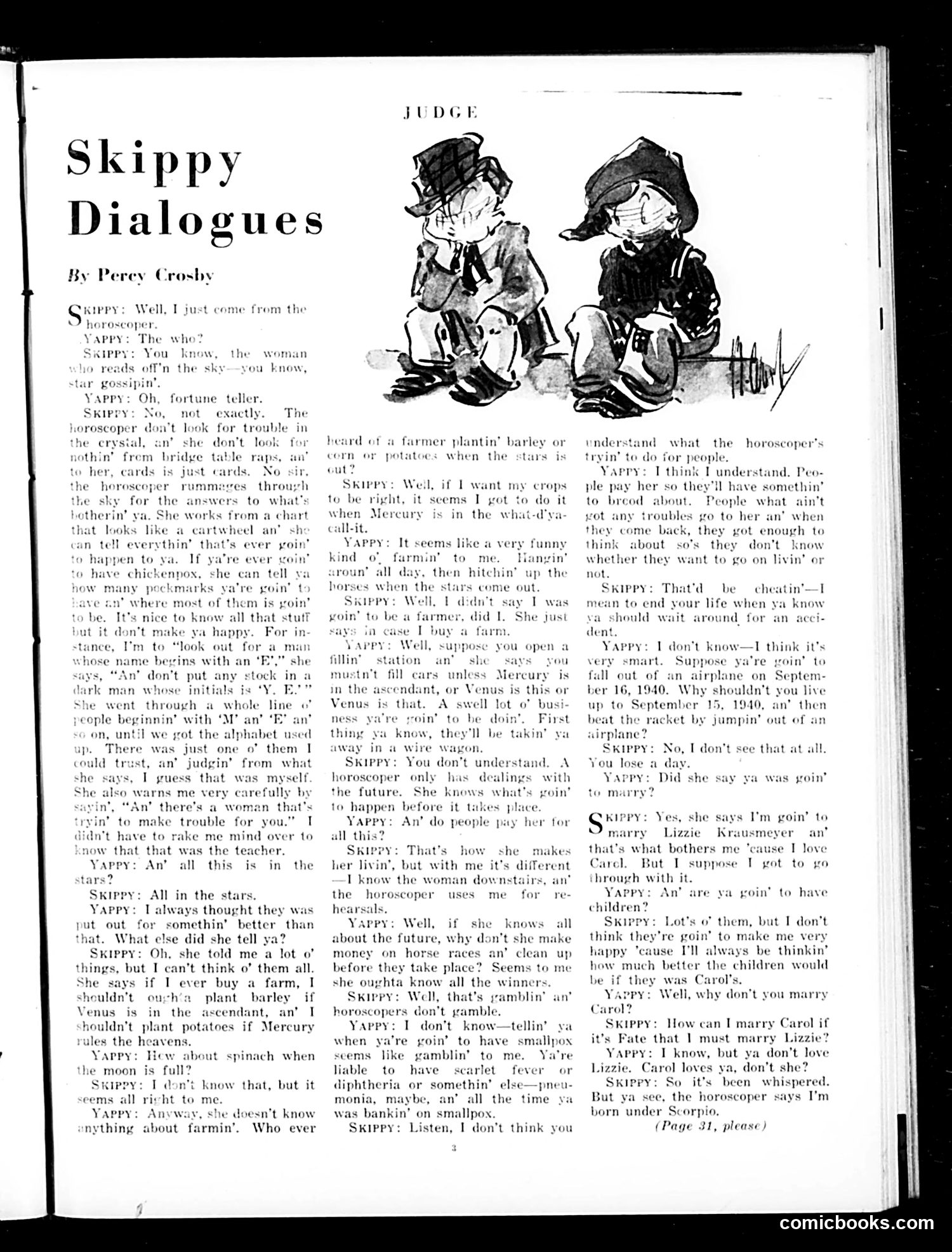
"Skippy Dialogues" by Percy Crosby This page features a dialogue comic between two young characters—Skippy and Yappy—discussing fortune telling and astrology. The satire targets people's credulity about horoscopes and their influence on everyday decisions. The joke centers on a woman horoscopist who makes her living predicting futures and advising clients on auspicious timing for activities like farming, marriage, and horse racing. Skippy and Yappy mock how people—despite the horoscopist's obvious financial motivation—trust her predictions about "Mercury" and planetary positions to guide major life choices. The cartoon satirizes the popularity of fortune-telling culture, suggesting it preys on gullible believers willing to delay marriage or make other decisions based on celestial superstition rather than reason.
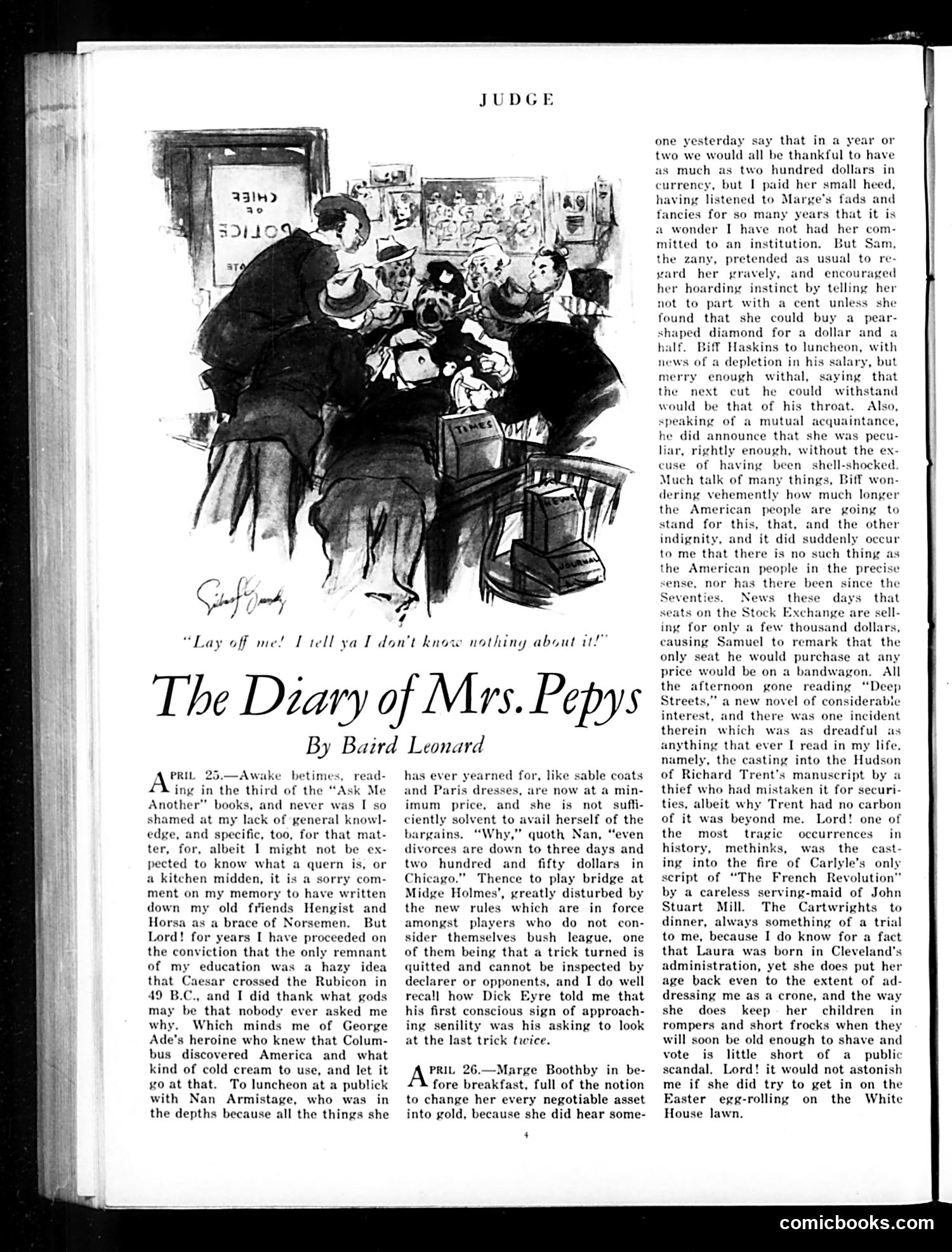
Analysis of Judge Magazine Page This page contains "The Diary of Mrs. Pepys" by Baird Leonard, a satirical column mimicking Samuel Pepys's famous historical diary. The accompanying sketch depicts a crowded interior scene with multiple figures in apparent conversation or conflict. The diary entries (April 25-26) mock high-society concerns of the era: women's fashion (Paris dresses, sable coats), divorce frequency ("down to three days"), bridge-playing etiquette, and financial anxieties during stock market speculation. References to the Hudson River and Richard Trent's manuscript suggest contemporary New York scandals. The satire targets upper-class preoccupations—materialism, gossip, marital instability, and speculative greed—by presenting them through the lens of 17th-century diary conventions, highlighting how little truly changes in elite social behavior across centuries.
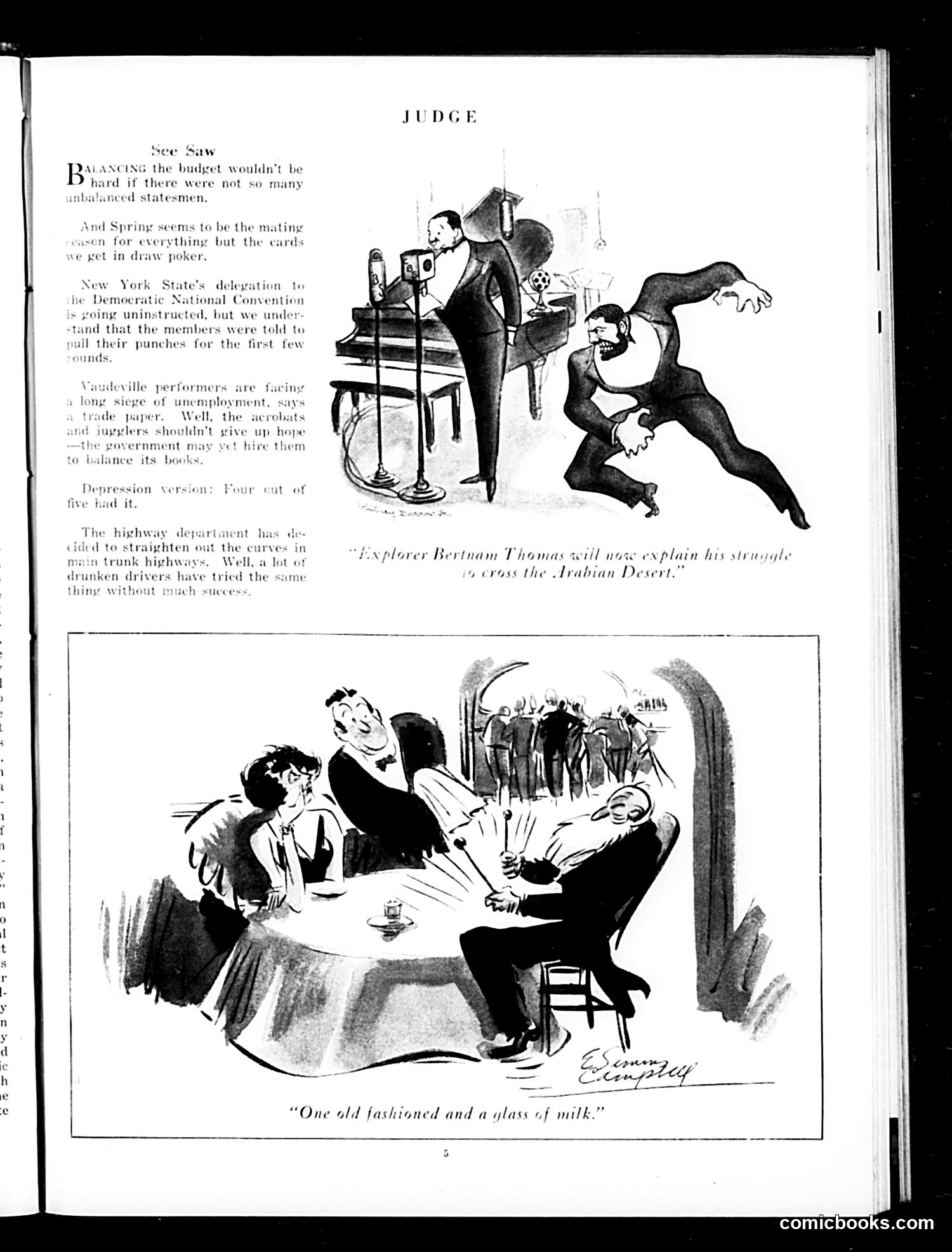
Judge Magazine Political Satire Page Top Cartoon: "Explorer Bertram Thomas will now explain his struggle to cross the Arabian Desert." The cartoon mocks explorer Bertram Thomas by showing him literally struggling against two caricatured figures pulling him in opposite directions—apparently satirizing the difficulty or absurdity of his expedition narrative. Bottom Cartoon: "One old fashioned and a glass of milk." This appears to be a social satire about generational differences, showing what seems to be an older gentleman ordering a simple drink while younger figures around a table react with apparent surprise or judgment. The page's text discusses political matters (Democratic National Convention, budget issues, unemployment) and entertainment (vaudeville performers), typical of Judge's satirical commentary on 1920s-30s American politics and culture.
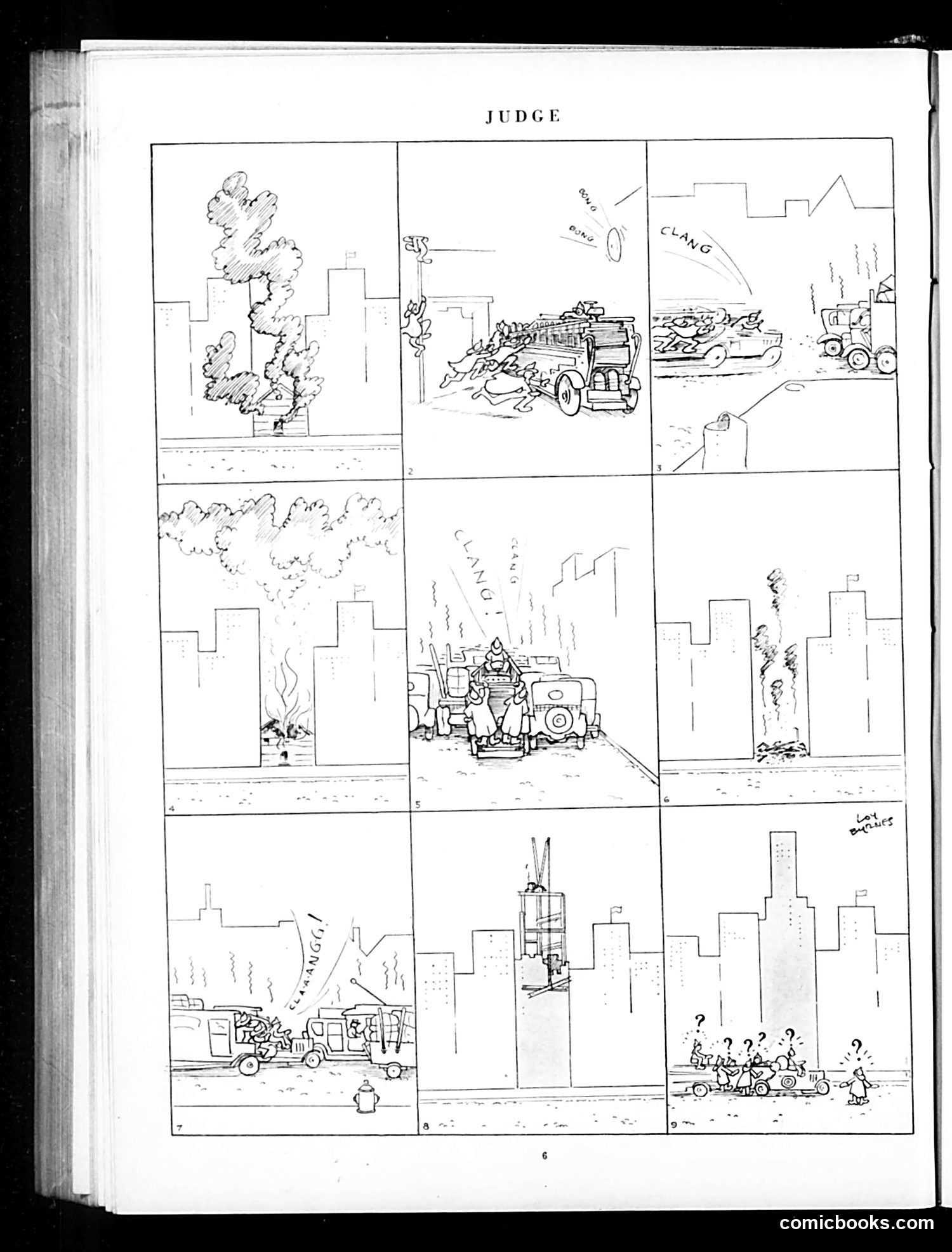
JUDGE Page Analysis This page titled "JUDGE" appears to be a multi-panel comic strip satirizing urban sanitation and waste management. The narrative follows a garbage truck and its operators through a city environment. The strip depicts the truck collecting refuse, with sound effects like "CLANG" marking the collection process. The repeated appearance of question marks in the final panels suggests confusion or uncertainty about the truck's ultimate destination or purpose. The satire likely critiques municipal waste handling systems—possibly inefficiency, unsanitary conditions, or the disconnect between collection and proper disposal. The exaggerated expressions and slapstick-style action emphasize the chaos of urban refuse management during the early-to-mid twentieth century when such services were less regulated or systematized. The exact political target remains unclear without additional context.
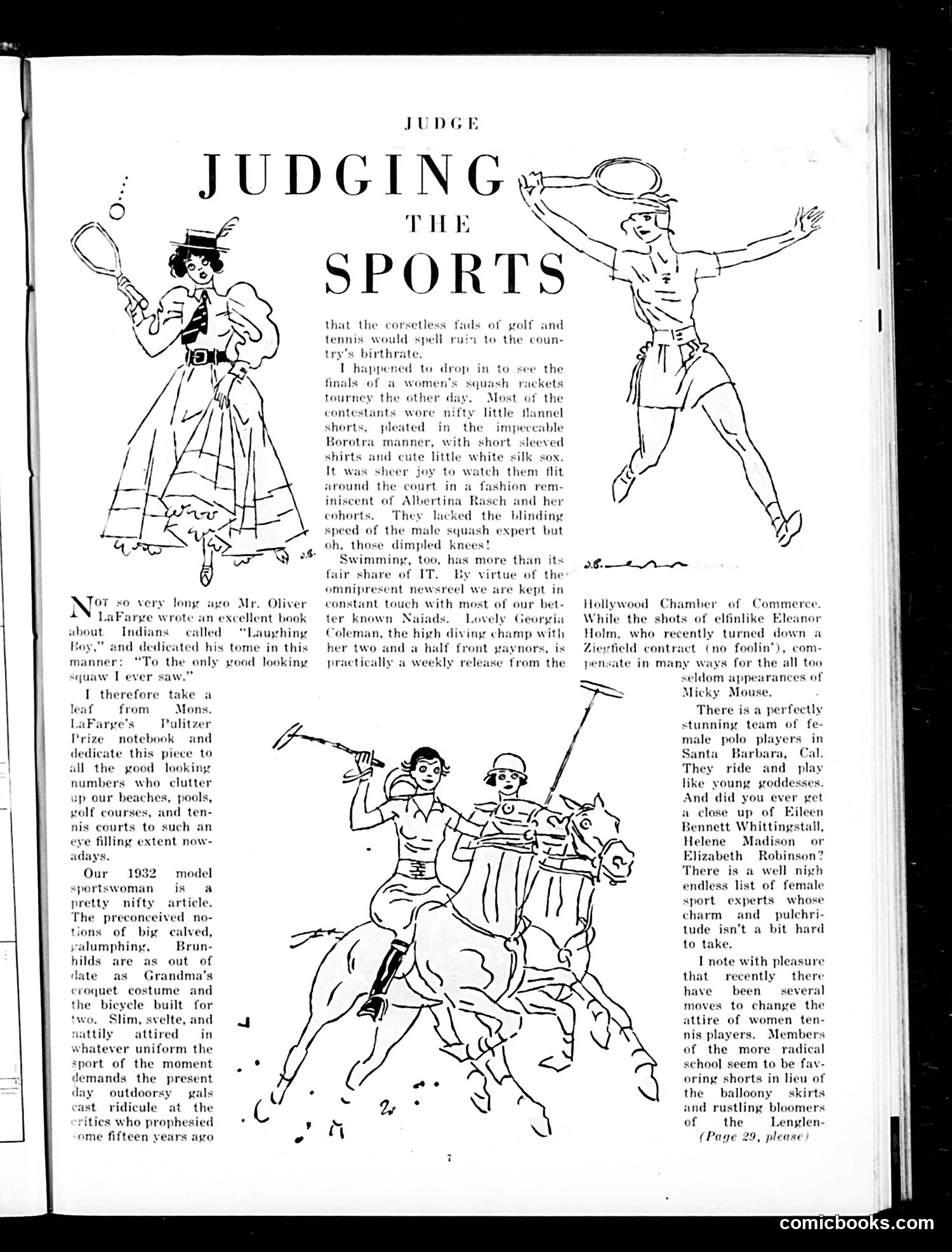
"Judging the Sports" (Judge Magazine, 1932) This satirical article celebrates the modern 1932 sportswoman, contrasting her with outdated stereotypes. The author mocks earlier critics who predicted that "corsetless" women playing golf and tennis would harm the nation's birthrate—fears that have proven baseless. The piece celebrates athletic women's fashion and appearance: female squash players in elegant pleated shorts, swimmers like diving champion Georgia Coleman and Eleanor Holm, and polo players in Santa Barbara. The author names real sports figures (Eileen Bennett Whittingstall, Helene Madison, Elizabeth Robinson) as examples of charming female athletes. The satire targets old-fashioned moralists who opposed women's athletic participation and revealing sportswear. By praising both women's athletic ability and their physical attractiveness, the article ironically validates the very "corsetless fads" critics had condemned, suggesting modernity has vindicated women's liberation through sports.
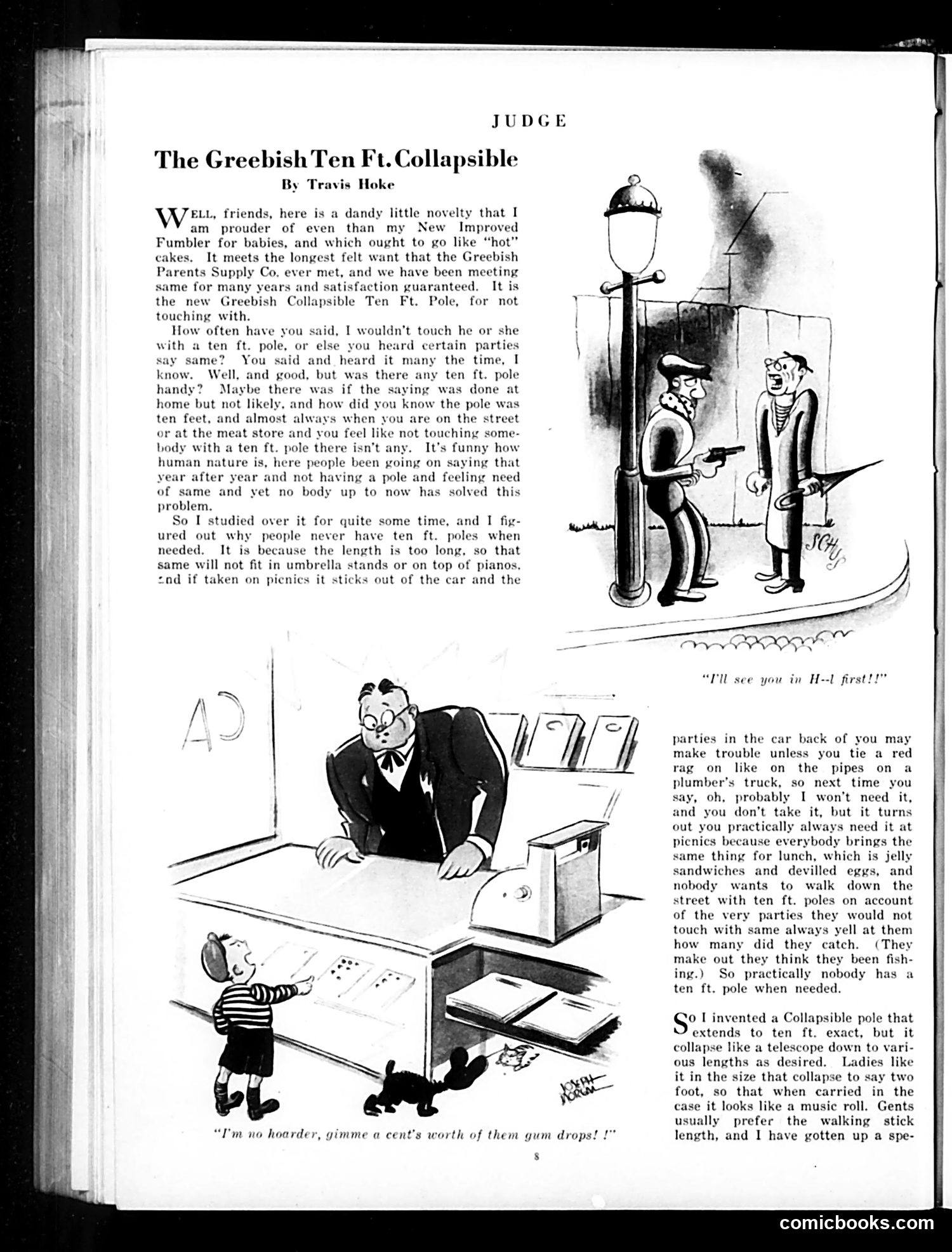
"The Greebish Ten Ft. Collapsible" – Judge Magazine Satire This is a mock advertisement by Travis Hoke satirizing American consumer culture and dubious product marketing. The "Greebish Parents Supply Co." (fictional) pitches an absurd invention: a collapsible ten-foot pole—supposedly solving the problem of the common saying "I wouldn't touch that with a ten-foot pole." The satire works on multiple levels: it mocks the gap between everyday expressions and practical reality, pokes fun at verbose sales pitches that manufacture "problems" to sell solutions, and ridicules consumer gullibility. The accompanying cartoons illustrate the pole's impracticality (sticking out of cars, being unwieldy in public). For modern readers: this reflects early 20th-century skepticism toward aggressive advertising and novelty products. The humor relies on recognizing how salesmen exploited figurative language to create nonsensical products, targeting desperate or credulous buyers. It's essentially proto-infomercial satire.
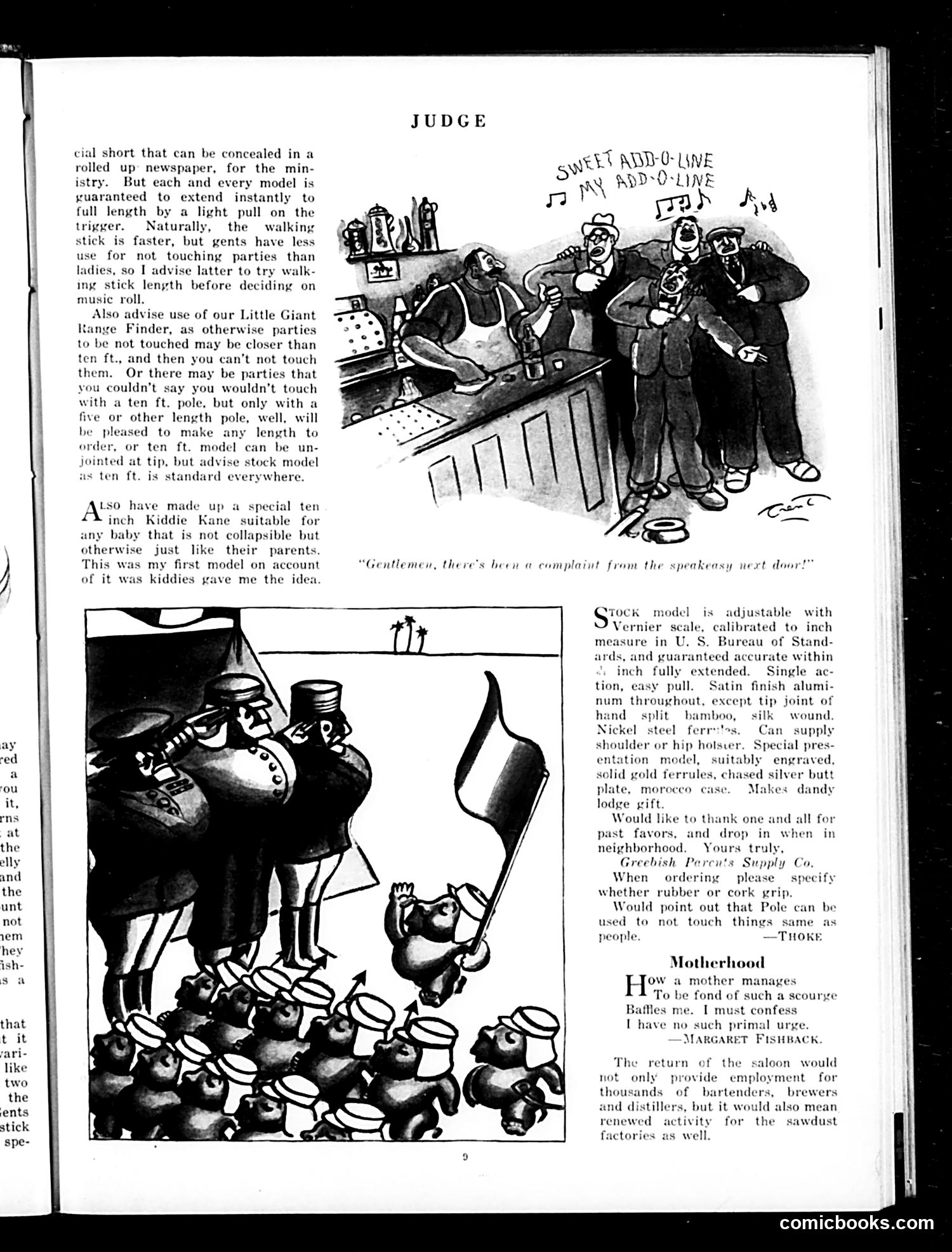
Judge Magazine Page Analysis This page satirizes Prohibition-era America through absurdist humor. The main cartoon depicts a speakeasy (illegal bar) complaint about noise, with figures singing "Sweet Add-O-Line" — likely a nonsense parody of prohibition-defying music. The dominant text is a humorous advertisement for a "10-foot pole" — a product ostensibly designed so one needn't "touch" certain people or situations. This is a satirical jab at Prohibition hypocrisy: the product's various lengths allow customers to distance themselves from speakeasy patrons and other "undesirables." There's even a "Kiddie Kane" version, suggesting children face the same moral compromises. The closing section mocks prohibition's economic impact: restoring saloons would boost employment for bartenders and brewers while reviving sawdust factories (used in bars). The Margaret Fishback quote about motherhood underscores the era's tension between family values and actual behavior. The satire targets both prohibition's ineffectiveness and the hypocrisy of those claiming moral superiority while secretly enjoying speakeasies.
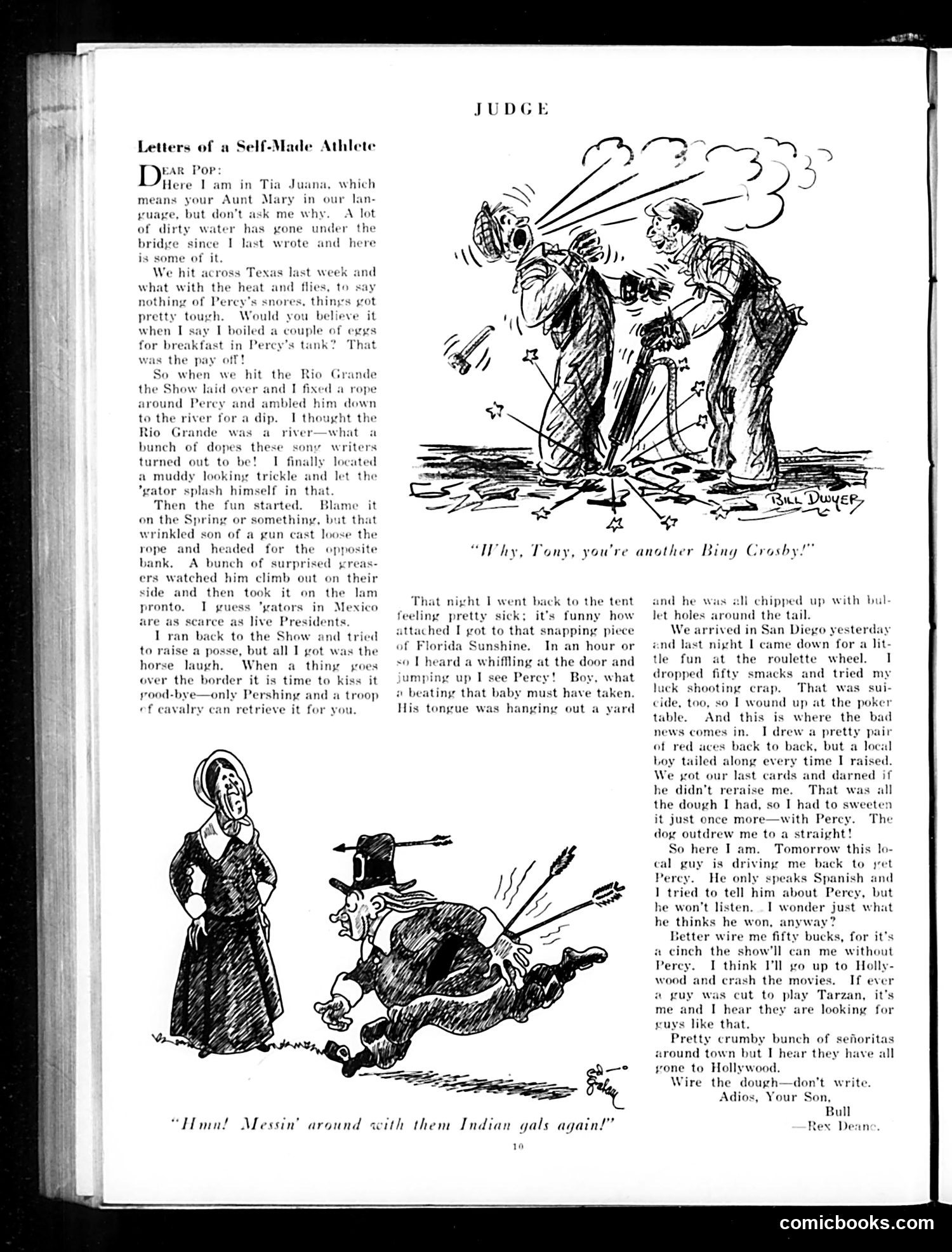
Explanation for Modern Readers This is a humorous letter from a self-made athlete named Bull to his father, describing misadventures traveling through Texas and Mexico with his dog Percy. The satire mocks both Bull's naïveté and period attitudes about the Southwest. Key satirical points: - Bull's incompetence: he boils eggs in the dog's water tank; loses Percy in the Rio Grande; foolishly bets the dog in a poker game - Stereotyping: references to Mexico as lawless ("when a thing goes over the border...kiss it good-bye"), dismissal of Mexican locals, casual racism about "Indian gals" - The illustrations show Percy escaping after being shot at in Mexico, and Bull's romantic mishaps - The humor relies on Bull's obliviousness—he's actually terrible at everything despite calling himself "self-made" - The closing joke: he's lost his dog gambling and now wants money wired home The piece satirizes cocky American youth, casual attitudes toward other cultures, and get-rich-quick schemes typical of the era.
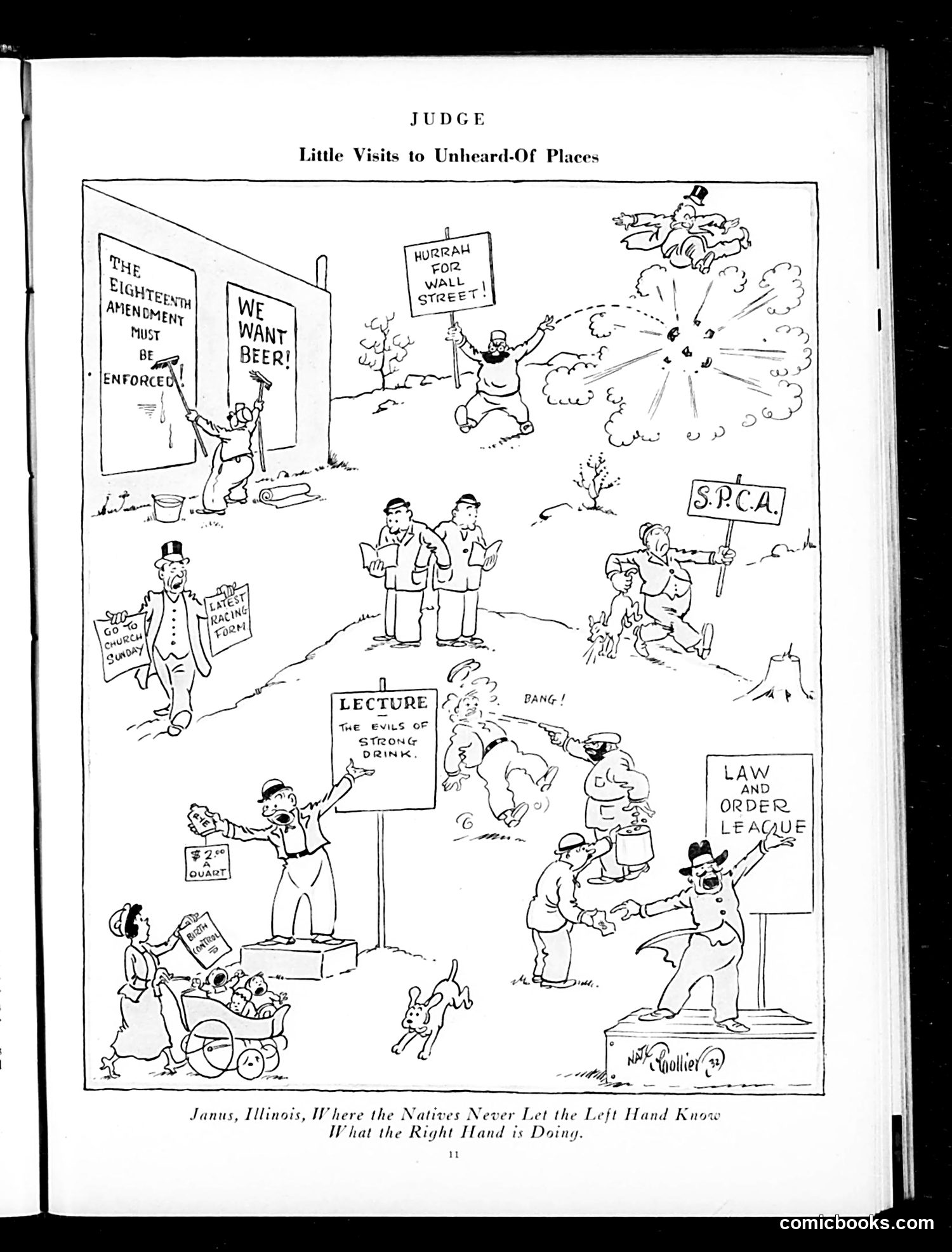
Analysis This is a satirical cartoon about Janus, Illinois, depicting various reform and enforcement efforts operating in apparent contradiction. The page shows competing initiatives: signs demanding beer enforcement of Prohibition ("The Eighteenth Amendment Must Be Enforced"), "We Want Beer," lectures against strong drink, SPCA activity, a "Law and Order League," and various other moral crusades—all simultaneously present. The joke, referenced in the subtitle, is that this town embodies hypocrisy: different factions pursue contradictory goals without awareness of each other's activities. The "left hand" and "right hand" metaphor suggests internal inconsistency and self-contradiction in civic life. This likely satirizes American communities of the Prohibition era, where official moralism clashed with actual drinking, enforcement with circumvention, creating absurd contradictions.
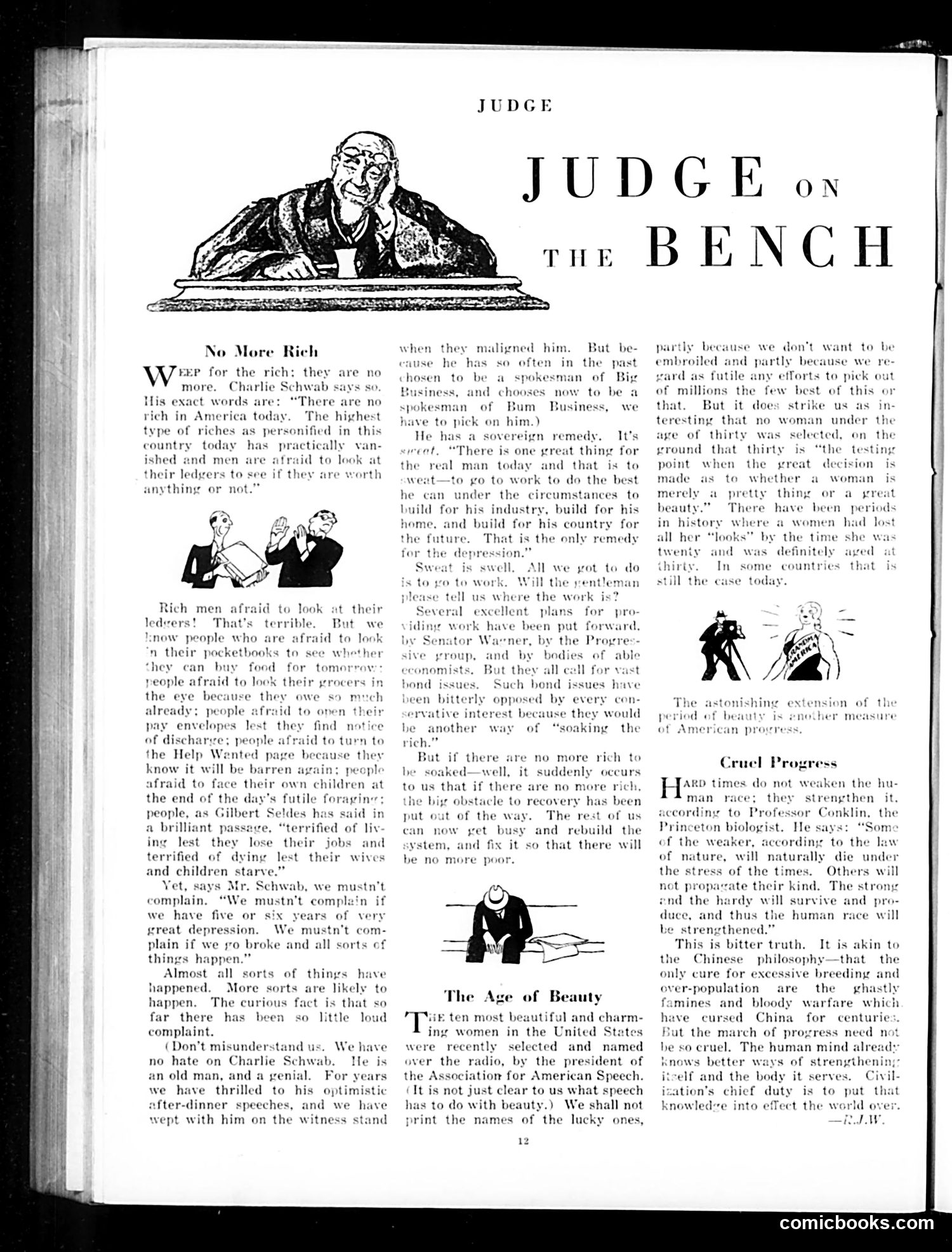
Judge Magazine Page Analysis This page from Judge (likely 1930s Depression era) satirizes wealthy industrialist Charlie Schwab, steel magnate and prominent businessman. The "No More Rich" section mocks Schwab's claim that riches have "vanished" in America, while simultaneously criticizing the wealthy for being afraid to acknowledge their actual poverty-stricken circumstances. The cartoon lampoons the contradiction: Schwab prescribes "work" as the remedy for depression while offering no concrete solution—the satirist asks sarcastically, "where is the work?" "The Age of Beauty" humorously notes that the ten most beautiful American women recently selected were all over thirty, contradicting the notion that beauty peaks at thirty. The piece questions why beauty contests exclude younger women. "Cruel Progress" presents a dark commentary on Social Darwinist theory popular at the time: Professor Conklin's argument that hardship "strengthens" humanity by weeding out the weak through starvation and preventing reproduction among the poor. The satire's bitterness suggests Judge found this philosophy deeply troubling—particularly relevant during the Depression's human suffering.
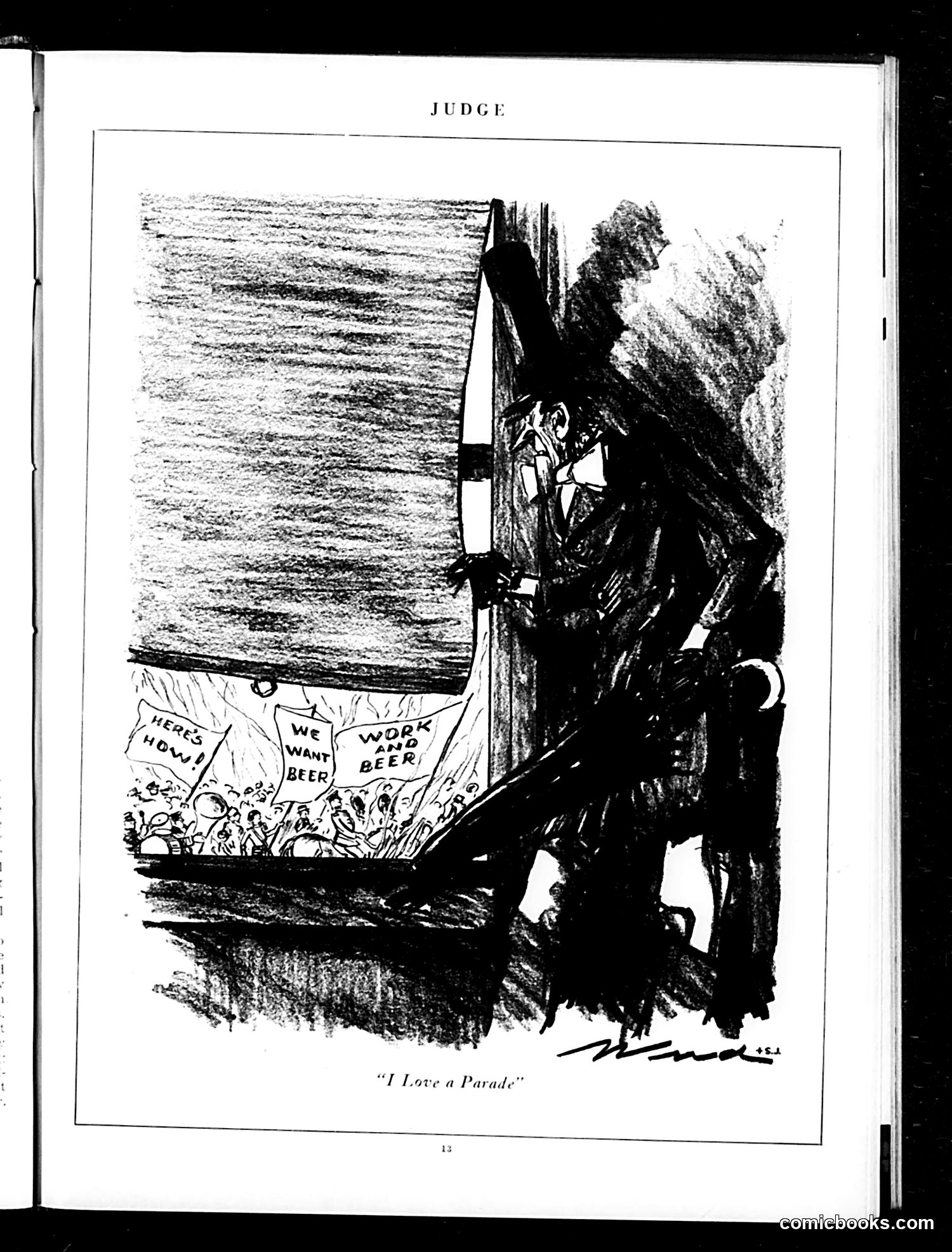
Analysis This political cartoon depicts a towering, menacing figure (appearing to be a judge or authority figure in dark robes) looming over a boat labeled with signs reading "HERE'S HOW!", "WE WANT BEER," and "WE WORK AND BEER." The cartoon satirizes Prohibition-era tensions. The small figures in the boat represent ordinary workers demanding beer—a beverage illegal under Prohibition (1920-1933). The title "I Love a Parade" sarcastically references the judge's apparent pleasure in the spectacle of enforcement. The satire critiques judicial or governmental authority figures who claimed to support Prohibition while the working class openly defied it. The cartoon captures the era's class tensions and public resistance to alcohol bans, mocking both the law's enforcement and those who championed it.
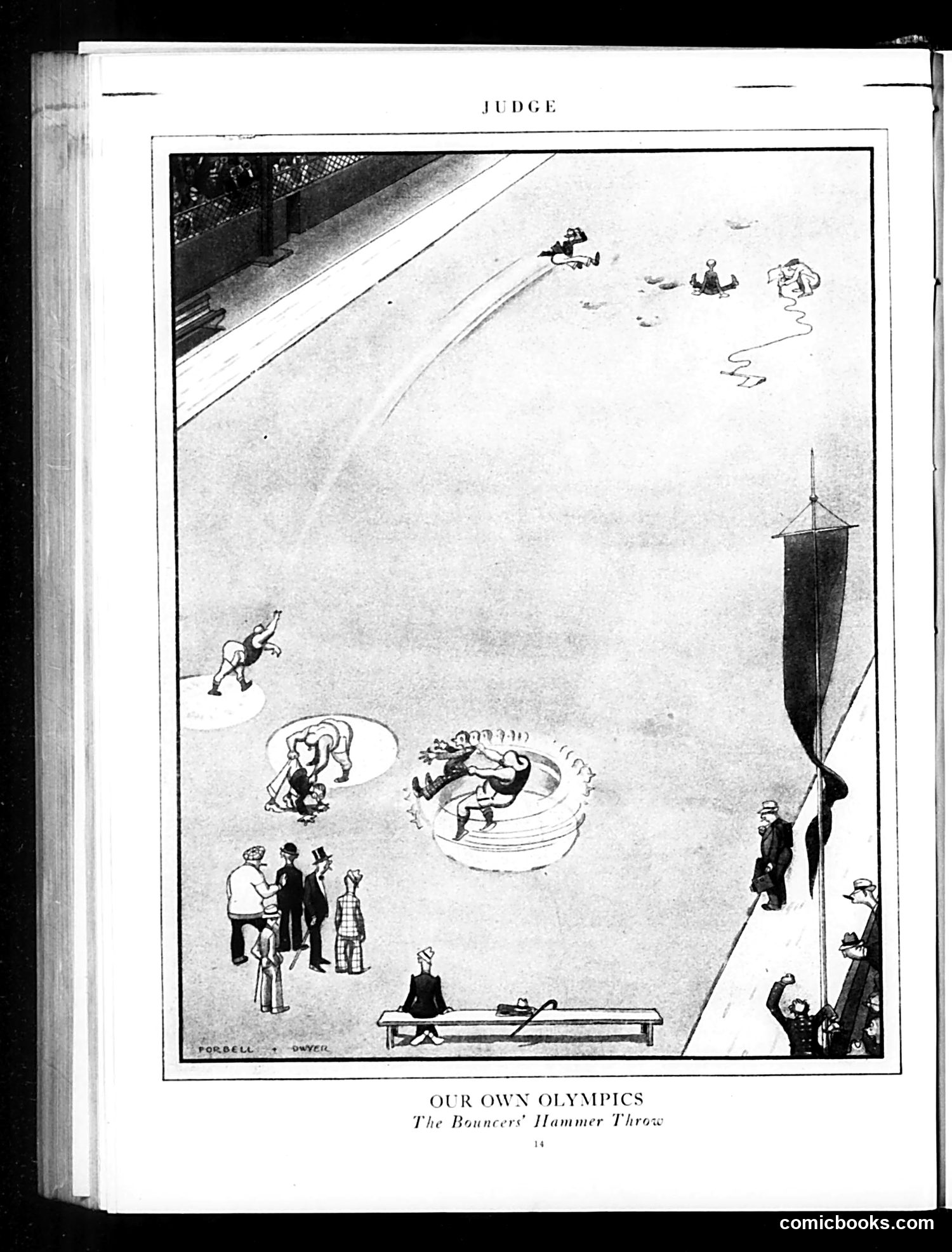
Analysis This page presents a satirical cartoon titled "Our Own Olympics: The Bouncers' Hammer Throw." The cartoon depicts a humorous parody of Olympic athletic competition, featuring nightclub bouncers as athletes competing in a "hammer throw" event. The scene shows various bouncers in formal attire throwing what appear to be patrons or troublemakers (depicted as the "hammer") across a large floor space, with spectators watching from the sidelines. The satire mocks both the Olympic Games and the violent nature of bouncer work—treating physical ejection of bar patrons as if it were an organized sport with judges and spectators. The joke relies on contemporary understanding of bouncer culture and the physical altercations that occurred in establishments of this era. Without a visible date, the specific Olympic Games referenced remains unclear.
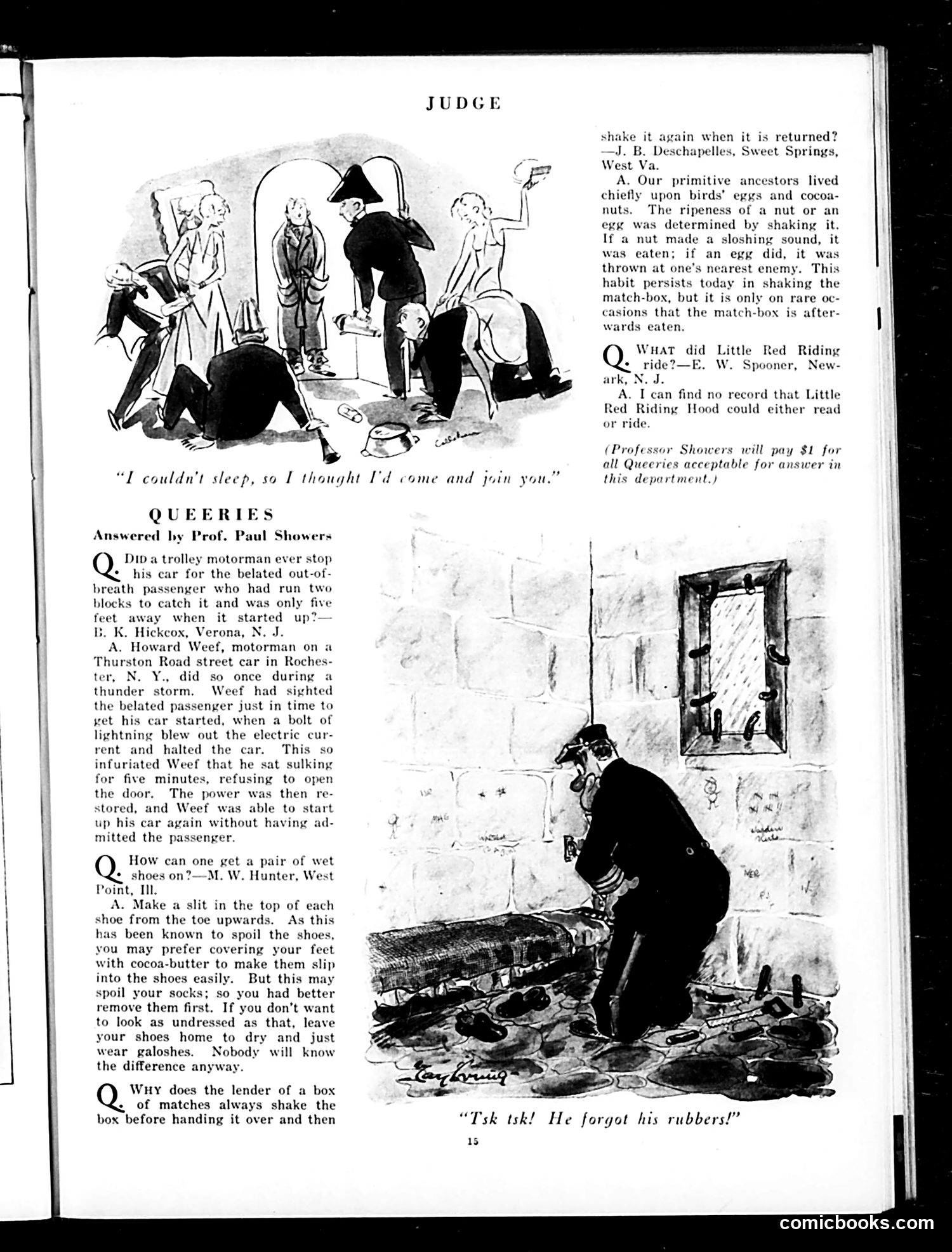
Analysis of This Judge Magazine Page This page from *Judge* magazine features a "Queries Answered" humor column where Prof. Paul Showers provides absurdist, tongue-in-cheek responses to readers' questions. The cartoons illustrate these comedic answers. The top illustration shows a social gathering with the caption "I couldn't sleep, so I thought I'd come and join you"—visual humor about an awkward party crasher. The bottom cartoon depicts someone examining a body in what appears to be a morgue, captioned "Tsk! He forgot his rubbers!"—dark humor about the practical consequences of poor preparation. The column itself mocks the era's advice-giving tradition by providing deliberately ridiculous, impractical solutions (like making slits in shoe tops or wearing cocoa-butter instead of shoes). It also uses pseudo-scientific explanations referencing "primitive ancestors" to explain modern habits like shaking matchboxes, treating trivial customs with mock-scholarly seriousness. The satire targets the earnest self-help and etiquette advice prevalent in early 20th-century magazines, deflating their pomposity through absurdist humor.
Judge Magazine Theater Review Analysis This is a theater review by George Jean Nathan (Judge's drama critic) of a vaudeville show at Hollywood Theatre. Nathan satirizes how vaudeville entertainment remains unchanged decade after decade, offering tired, predictable acts. The acts reviewed include: "Adler and Bradford" (dancers in colored spotlights), "Buster Shaver" (a pianist with two midget performers engaging in weak comedy about geography and politics), Lou Holtz and Jack Benny (performing a switcheroo identity joke), and "The Sisters" (dancers performing before a Buddha statue). Nathan's satire targets vaudeville's stagnation—repetitive wriggling, minimal plot, recycled gags, and absurd spectacle disguised as entertainment. The political references (fairies, Republicans, Democrats) are throwaway jokes inserted into the midget act, suggesting how vaudeville carelessly mixed topical humor with slapstick. Nathan's point: American popular entertainment offers nothing new, merely repackaging old material endlessly.
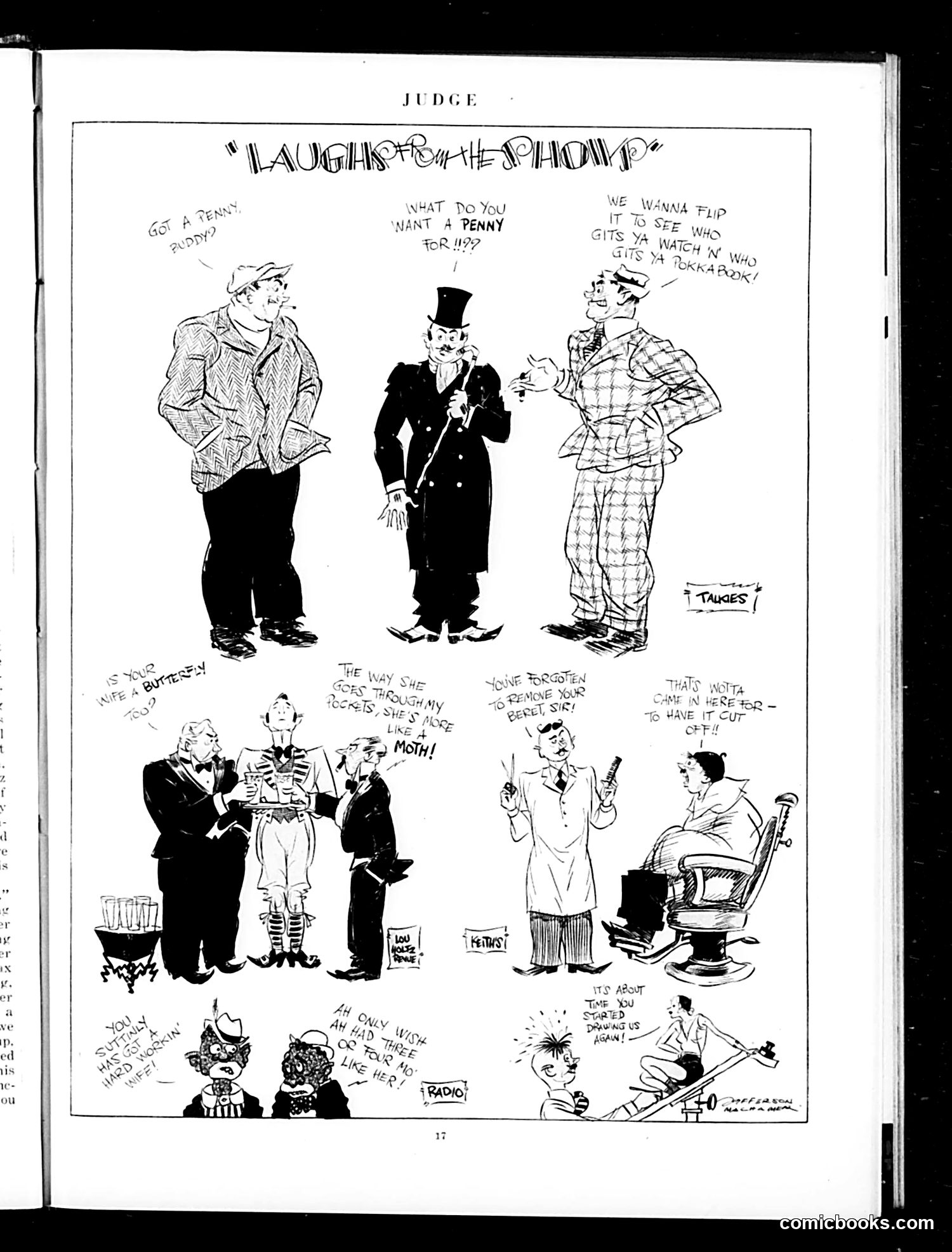
"Laugh or the Phono" This Judge cartoon satirizes early phonograph culture and gender stereotypes. The central figure appears to be a well-dressed man in a top hat being pestered by three other men requesting money ("Got a penny, buddy?" "What do you want a penny for?"). The humor centers on phonograph entertainment: men want coins to operate the machine, likely to hear recordings. Lower panels show domestic scenes—a woman being pressured by men, someone at a barber chair, and figures with a radio. The satire targets how new entertainment technology (phonographs and early radio) consumed people's money and attention, disrupting traditional social interactions. The repeated requests for coins mock how these machines created new consumer behaviors and social dynamics in the early 20th century.
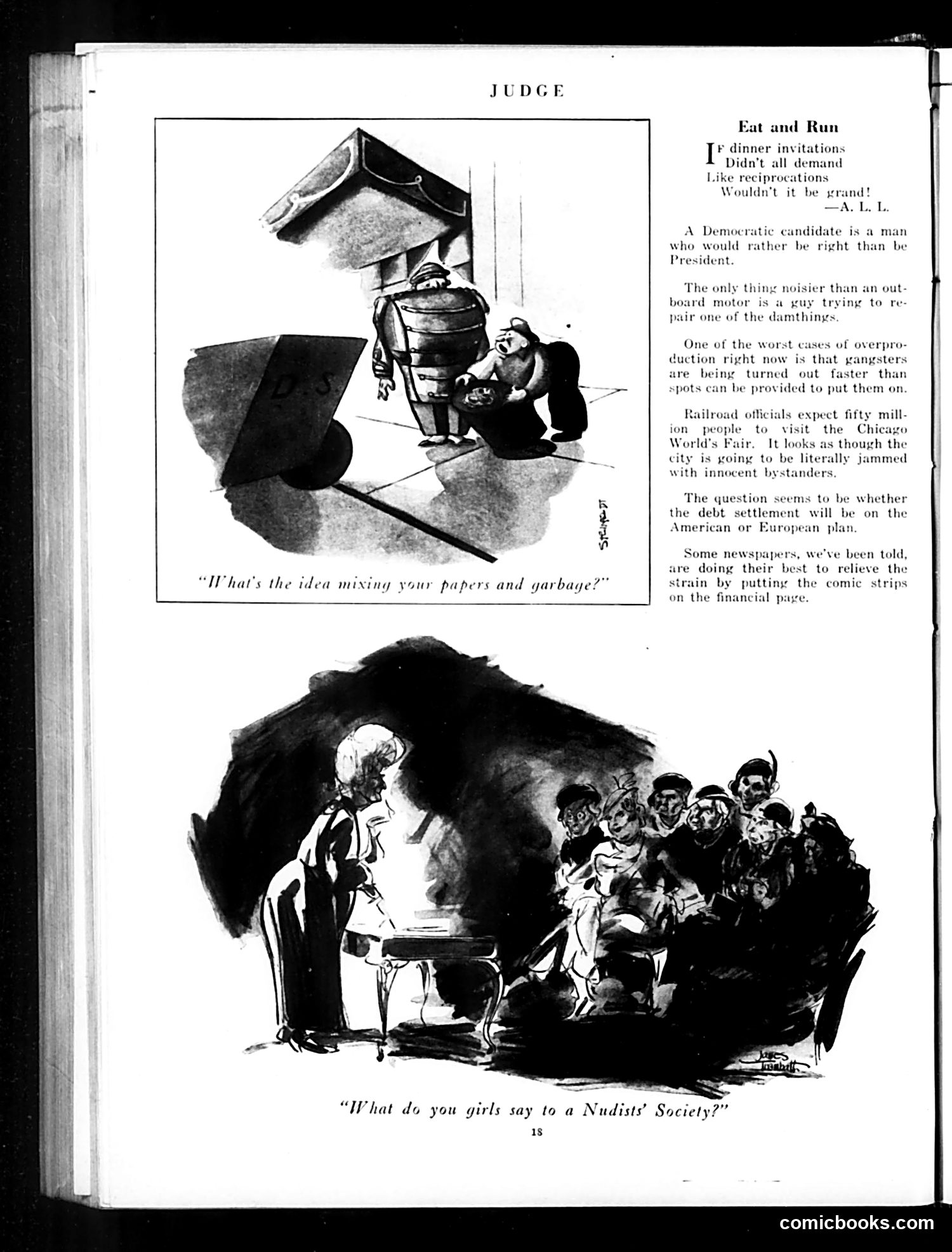
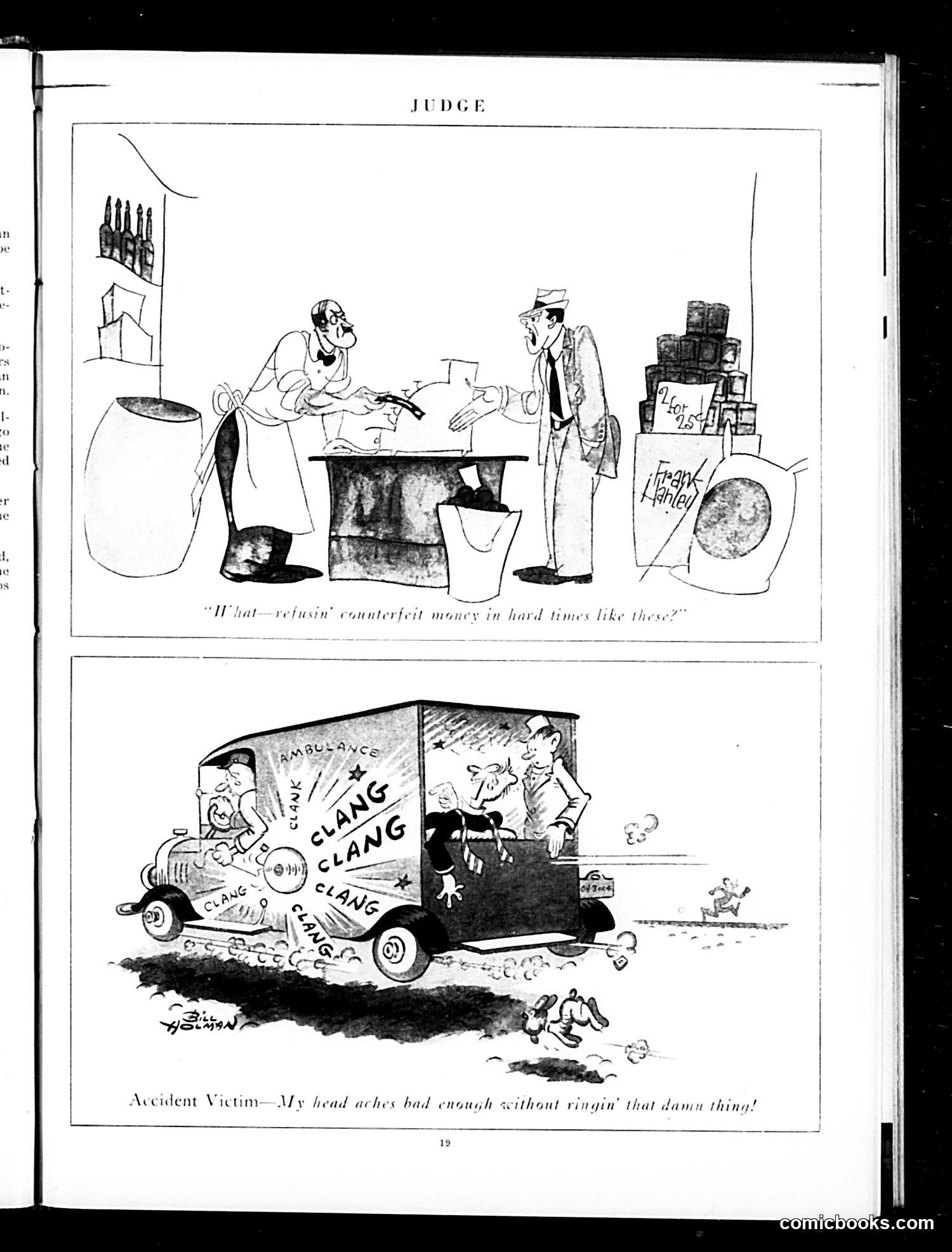
Explanation for Modern Readers This page from *Judge* contains two satirical cartoons about economic hardship and crime. The top cartoon depicts a judge rejecting counterfeit money during difficult financial times. The irony is that the judge—supposed to uphold the law—questions why someone would refuse fake currency "in hard times like these," suggesting that economic desperation might justify counterfeiting or accepting fraudulent money. The bottom cartoon shows an ambulance labeled "CLANG CLANG CLANG" with an accident victim complaining that his headaches were already severe before "that damn thing" (the ambulance's loud bell) made it worse. This satirizes the noise pollution and jarring disruption caused by emergency vehicles in urban areas. Both cartoons use dark humor to critique social problems of the era: economic desperation and the disruptive modernization of cities.
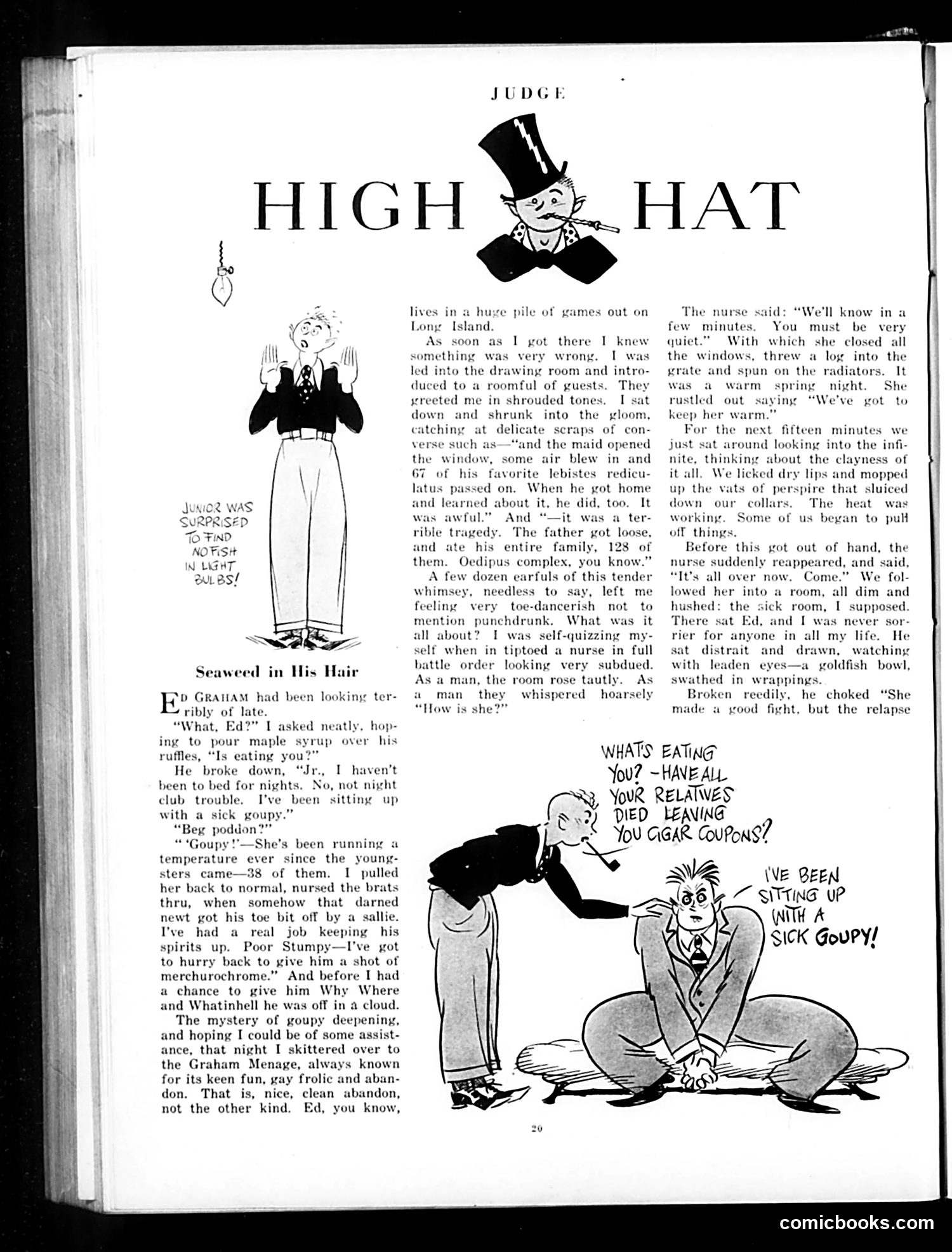
"Seaweed in His Hair" – Judge Magazine Satire This is a humorous short story with accompanying cartoons satirizing upper-class anxieties and melodrama. The narrator visits his friend Ed Graham, who appears disheveled ("seaweed in his hair"), and learns Ed has been caring for a sick "goupy" (unclear what this creature is—possibly a pet or colloquial term). The satire mocks: 1. Overwrought emotional responses: The house is shrouded in gloom despite minor crises (fish dying, pets misbehaving). Guests whisper solemnly about trivial household disasters. 2. Theatrical pretense: The nurse's dramatic entrance, the ritualistic heat treatment, and everyone's exaggerated concern create absurd melodrama over what appears to be routine illness. 3. Upper-class affectation: The constant references to "keen fun, gay frolic and abandon" mask genuine chaos and dysfunction. The cartoons show Ed's exhaustion and the ridiculous intensity of the situation, emphasizing how the affluent transform everyday problems into theatrical tragedies.
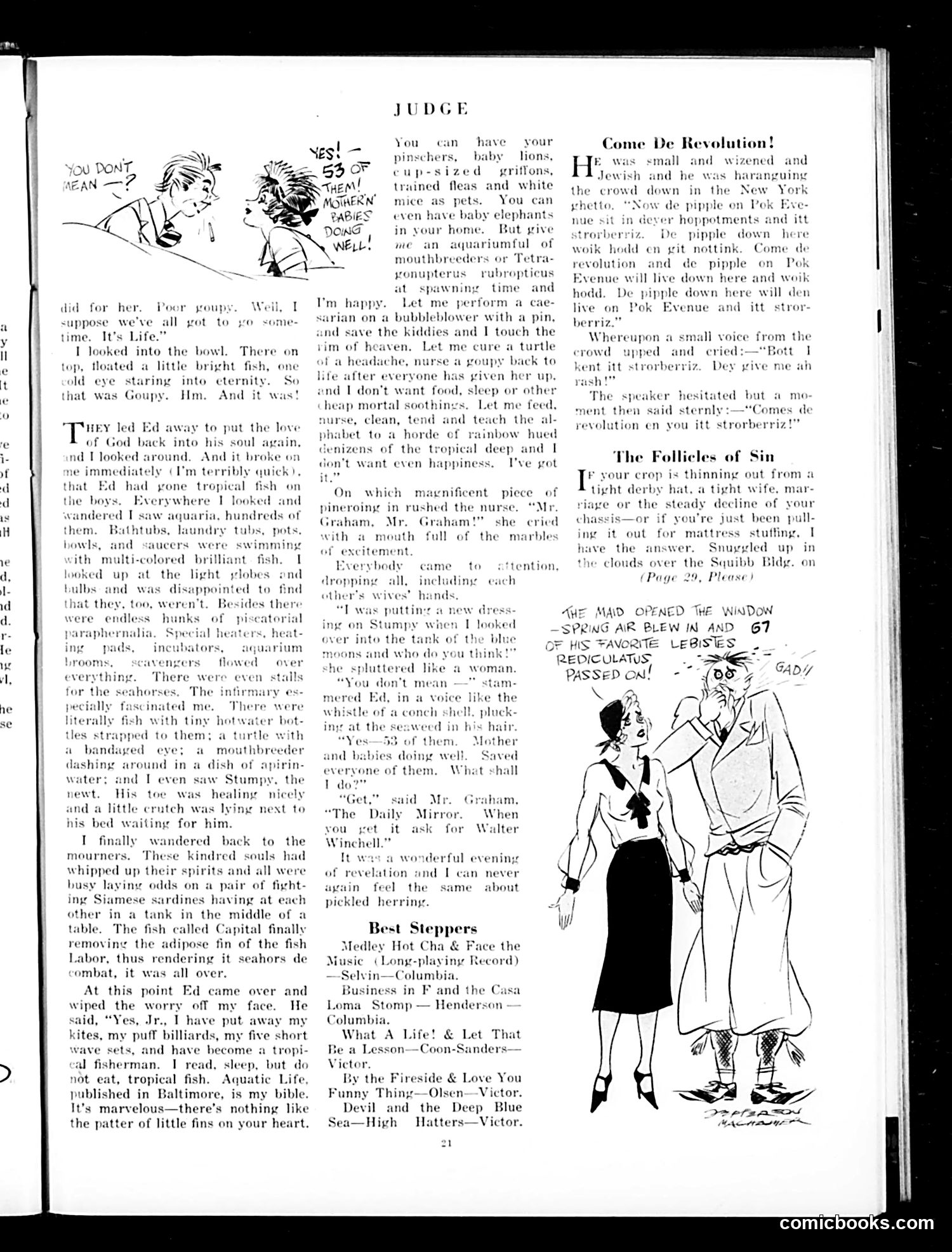
"Come De Revolution!" Cartoon Analysis This is a satirical cartoon mocking communist or socialist revolutionary rhetoric, likely from the 1920s-30s when such politics were prominent topics in American magazines. The cartoon depicts a small Jewish man speaking passionately to a crowd about revolution. The satire relies on ethnic caricature—exaggerated features and dialect ("Come De Revolution," "storberriz")—to mock both the speaker and the revolutionary ideology he espouses. The joke appears to be that this working-class immigrant promises grand utopian changes ("De nipple down here will all live on Pok Evenue") through revolution. The humor is contemptuous: it ridicules both communist ideals as naive fantasy and portrays immigrants advocating such politics as foolish rabble-rousers. This reflects common American anti-communist and nativist prejudices of the era, targeting immigrant communities suspected of radical sympathies. The page's other content—stories about tropical fish keeping—appears unrelated to this political satire.
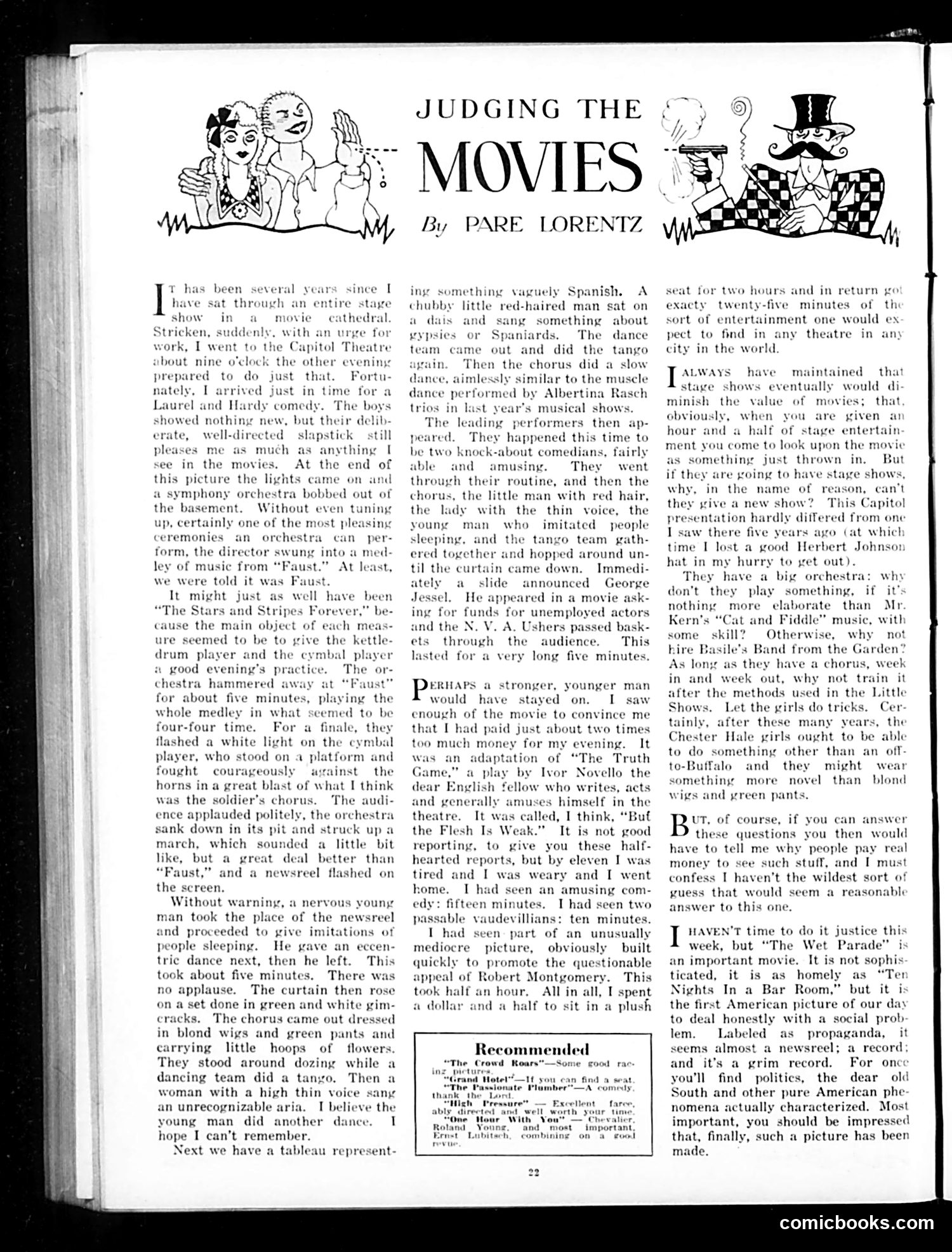
Analysis This is a theater review column by Pare Lorentz critiquing a movie-theater experience. The satirical point: movie palaces now offer so much mediocre "filler" entertainment that the actual feature film becomes almost irrelevant. Lorentz catalogs the evening's tedious acts—an orchestra mangling "Faust," a nervous comedian doing bad impersonations and eccentric dancing, a forgettable musical number, knock-about comedians, and a five-minute fundraising appeal by George Jessel for unemployed actors. The featured film adaptation of "But the Flesh Is Weak" (an Ivor Novello play) is so forgettable he's too tired and cynical to even remember it properly. The cartoon header depicts theatrical vaudeville characters, matching the review's theme: stage entertainment has invaded the movie house, diluting the cinema experience with desperate variety-show padding. The satire targets theaters' attempt to justify high admission prices through quantity over quality—a common complaint about 1920s-30s movie palaces that bundled films with live acts, orchestras, and newsreels.
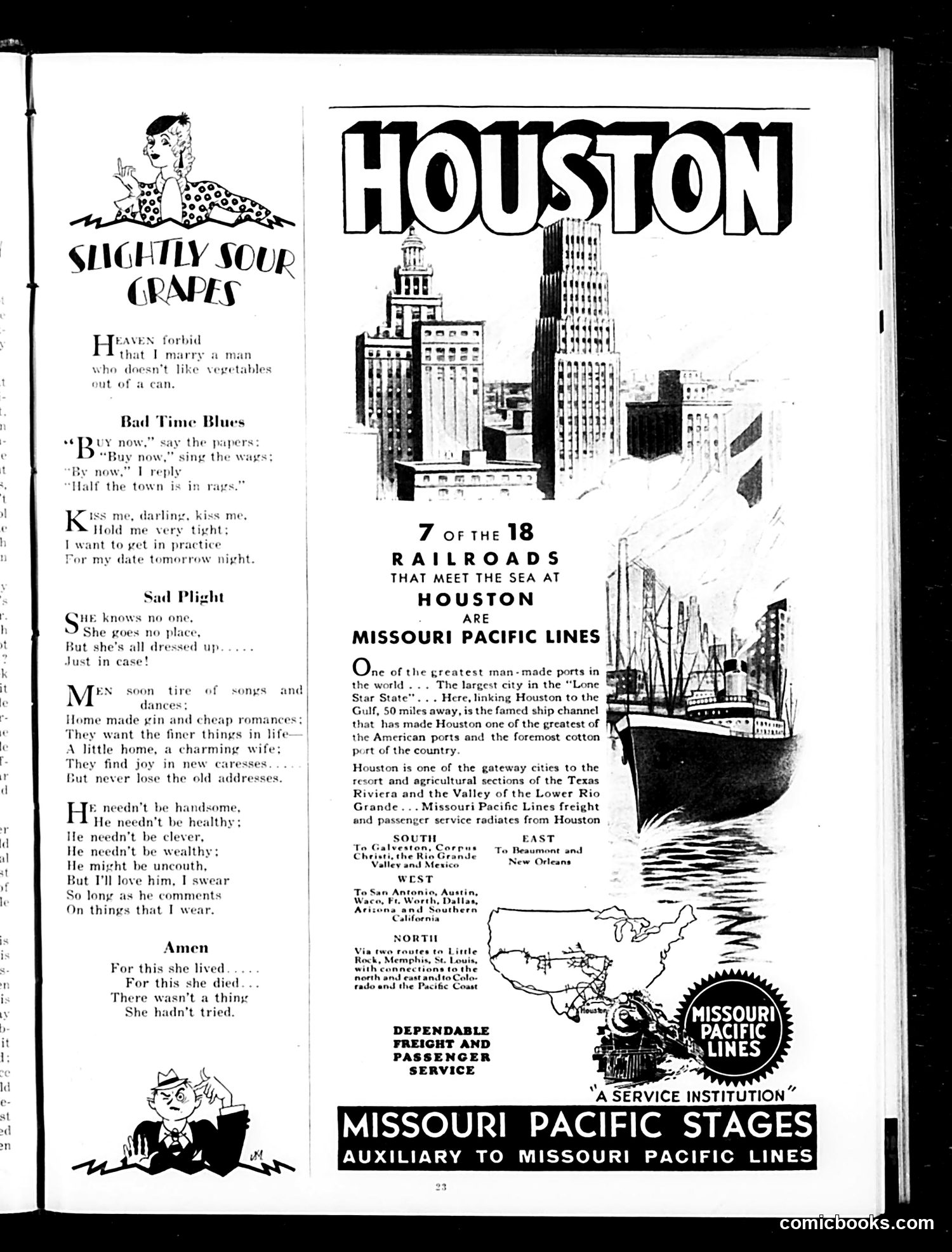
Analysis for Modern Readers This page is primarily advertising, not political satire. The left side contains humorous poems ("Slightly Sour Grapes") about dating and romance—typical light comedy for *Judge* magazine. References like "Bad Time Blues" mention newspaper headlines about economic hardship ("Buy now," "Half the town is in rags"), likely referencing post-WWI economic anxiety or Depression-era concerns. The dominant content is a Missouri Pacific Lines advertisement promoting Houston as a major port city and transportation hub. The ad emphasizes the city's role connecting inland America to the Gulf of Mexico via railroad and the ship channel. The illustrated skyscraper skyline and cargo ship visualize Houston's modern industrial importance. The cartoon caricature at bottom left (a man's face) appears decorative rather than representing anyone specific—typical magazine filler art of the era. The page demonstrates how vintage magazines integrated editorial humor with advertising to engage readers.
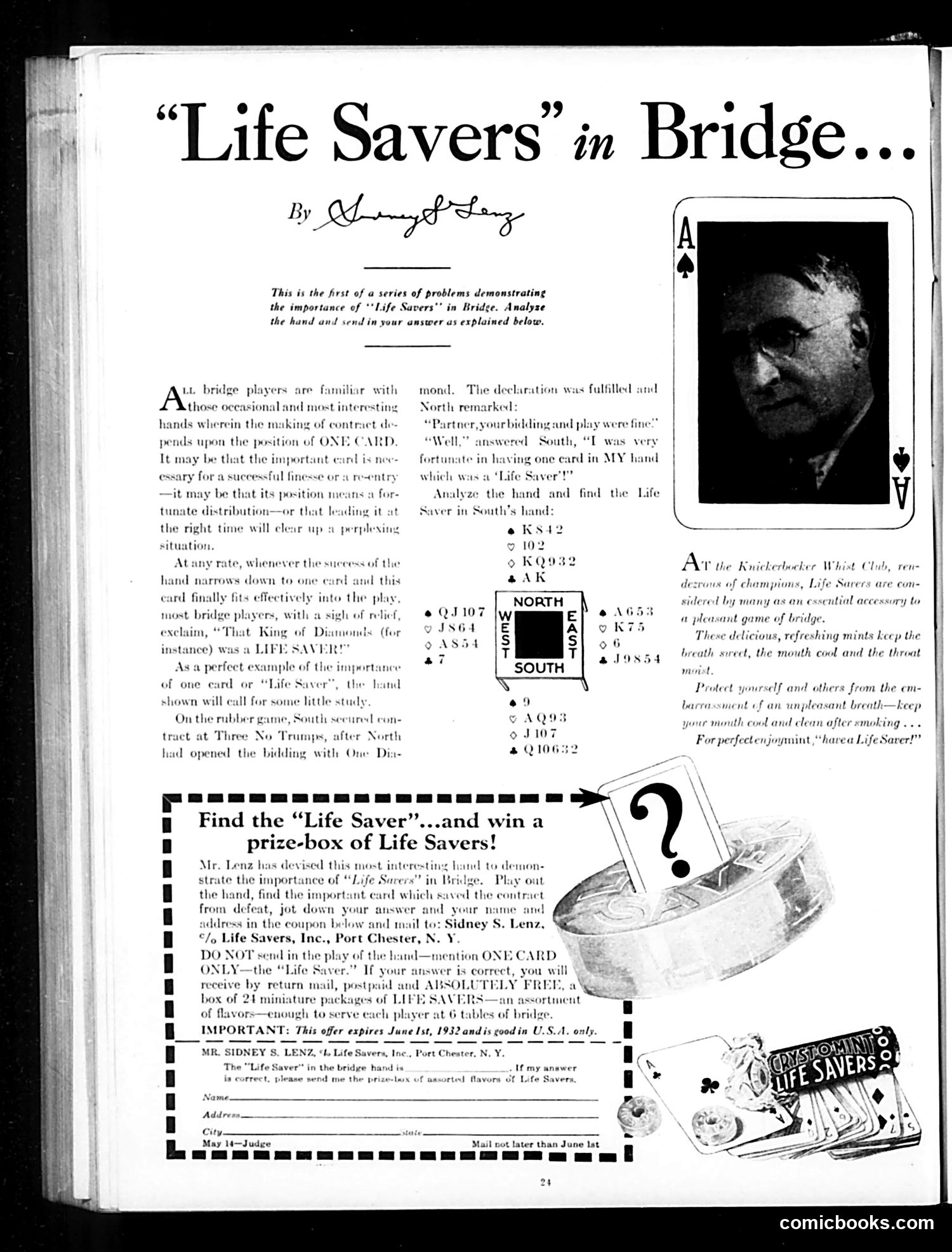
"Life Savers" in Bridge This page is primarily advertising disguised as editorial content. It presents a bridge card game problem attributed to champion player Sidney Lenz, but the actual purpose is promoting Life Savers candy mints. The "joke" is a pun: in bridge, a "Life Saver" is a crucial card that saves a contract. The ad cleverly mirrors this with Life Savers mints themselves—positioned as essential to enjoying bridge, keeping "breath sweet, the mouth cool and the throat moist" while playing. Readers who correctly identify the crucial card in the bridge hand and mail in their answer win a prize box of Life Savers candies. This was a common 1930s marketing tactic: leveraging celebrity endorsement (Lenz was genuinely famous), providing entertaining editorial-style content, and creating incentive for consumer participation. The satire is gentle—*Judge* magazine was likely paid to run this, making it advertorial rather than satirical commentary.
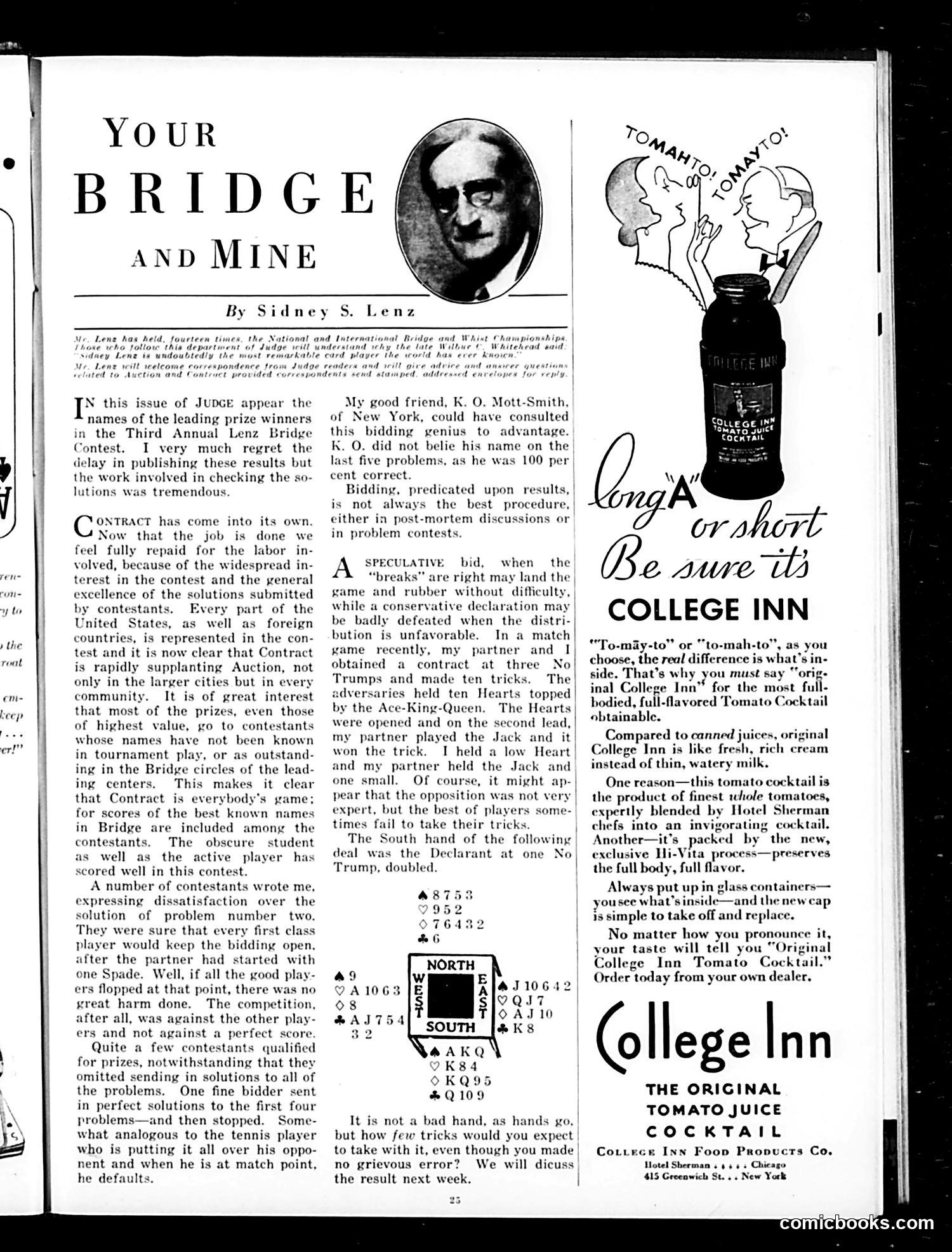
Analysis of Judge Magazine Page Content This page primarily features a bridge column by Sidney S. Lenz, a prominent contract bridge expert of the era, announcing winners of the magazine's Third Annual Bridge Contest. The article discusses contract bridge—a card game that was rapidly replacing auction bridge in popularity during this period. The satire is subtle and indirect: Lenz gently mocks contest participants who either doubted the published solutions or defaulted after solving only initial problems. He uses these examples to comment on human nature—particularly the tendency to second-guess expertise and to fail at the final moment. The right side contains a College Inn tomato cocktail advertisement (unrelated to the article), playing on the common pronunciation debate "tomato/tomahto" as a humorous marketing angle. The page reflects 1920s-30s leisure culture, when bridge was a major social activity among educated Americans, and Judge magazine catered to that sophisticated audience.
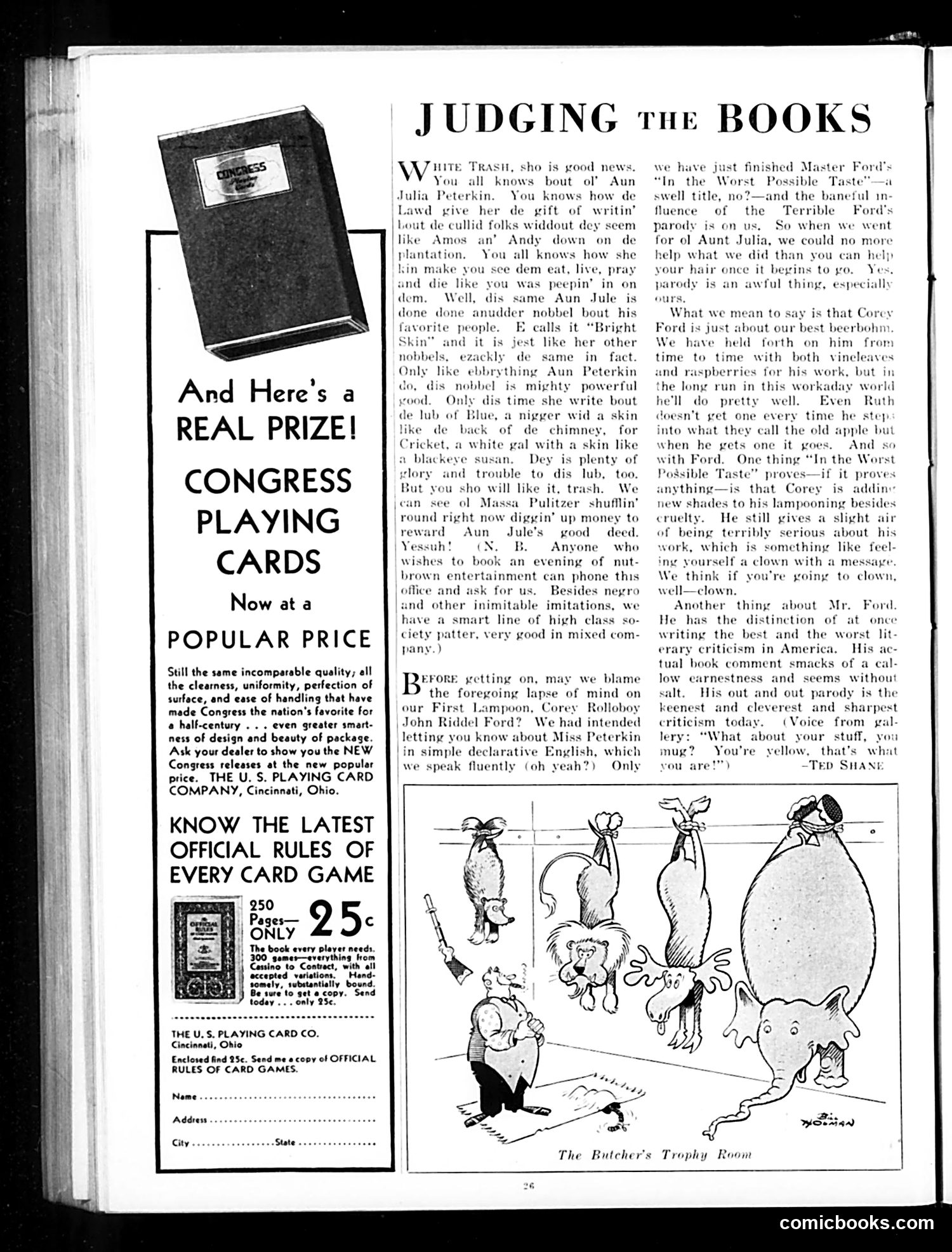
Analysis This Judge magazine page mixes advertising and literary criticism with offensive racial caricature. The Cartoon: "The Butcher's Trophy Room" depicts animals and people in a hunting trophy display—the visual joke appears to be wordplay about a butcher's collection. The Book Reviews: The column uses a racist dialect ("cullid," "Aun Jule," "nigger") to discuss Julia Peterkin's novel "Bright Skin" and Corey Ford's literary work. Peterkin was a real white author known for writing about African American life in the South. The review, written in exaggerated "plantation dialect," is meant as satirical mockery—of either Peterkin's subject matter or Ford's parody of her work. Judge appears to be joking that Ford's parody style has influenced the reviewer's commentary. The Satire: The racist dialect itself *is* the "joke"—deliberately offensive speech used for comic effect, typical of 1920s-30s American satire. Modern readers should understand this reflects deeply problematic attitudes that Judge's audience found amusing. Context: This represents pre-WWII American magazine humor where racial caricature was standard satirical practice.
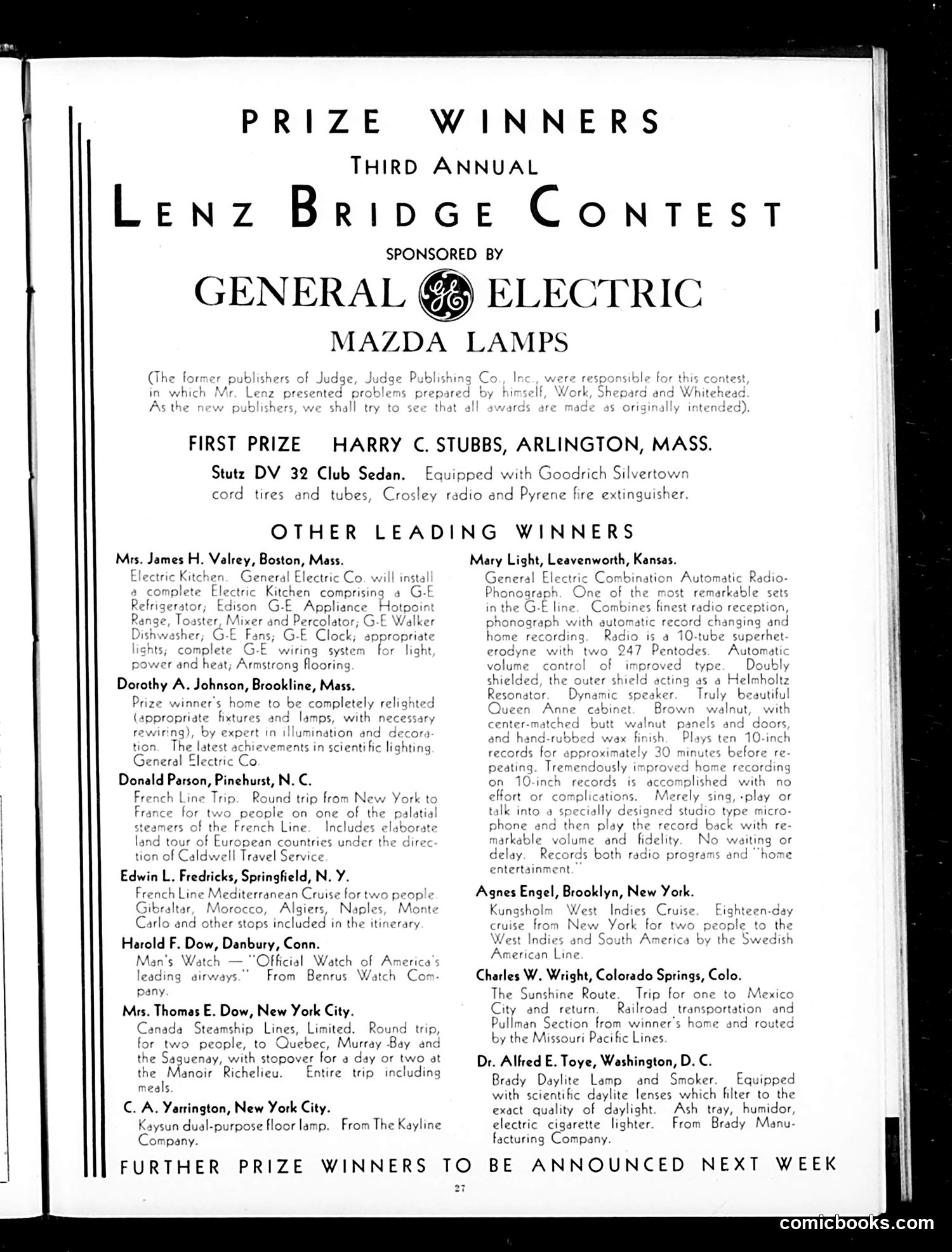
Prize Winners Page (Not a Cartoon) This is not a cartoon or satirical content—it's a straightforward advertising/editorial page from *Judge* magazine announcing winners of the "Third Annual Lenz Bridge Contest," sponsored by General Electric (Mazda Lamps). The page lists contest winners and their prizes, which range from practical items (electric kitchen appliances, lamps) to luxury experiences (cruise ships, European tours, automobiles). The first prize went to Harry C. Stubbs of Arlington, Massachusetts, who won a Stutz DV 32 Club Sedan. The page reflects 1920s-30s consumer culture: General Electric's promotion of electrical home goods, steamship cruises as prestige travel, and automobiles as status symbols. The note about *Judge*'s former publishers handling the original contest suggests this was a long-running promotional feature. This is essentially a results announcement page—advertising material embedded in editorial space, not satirical content.
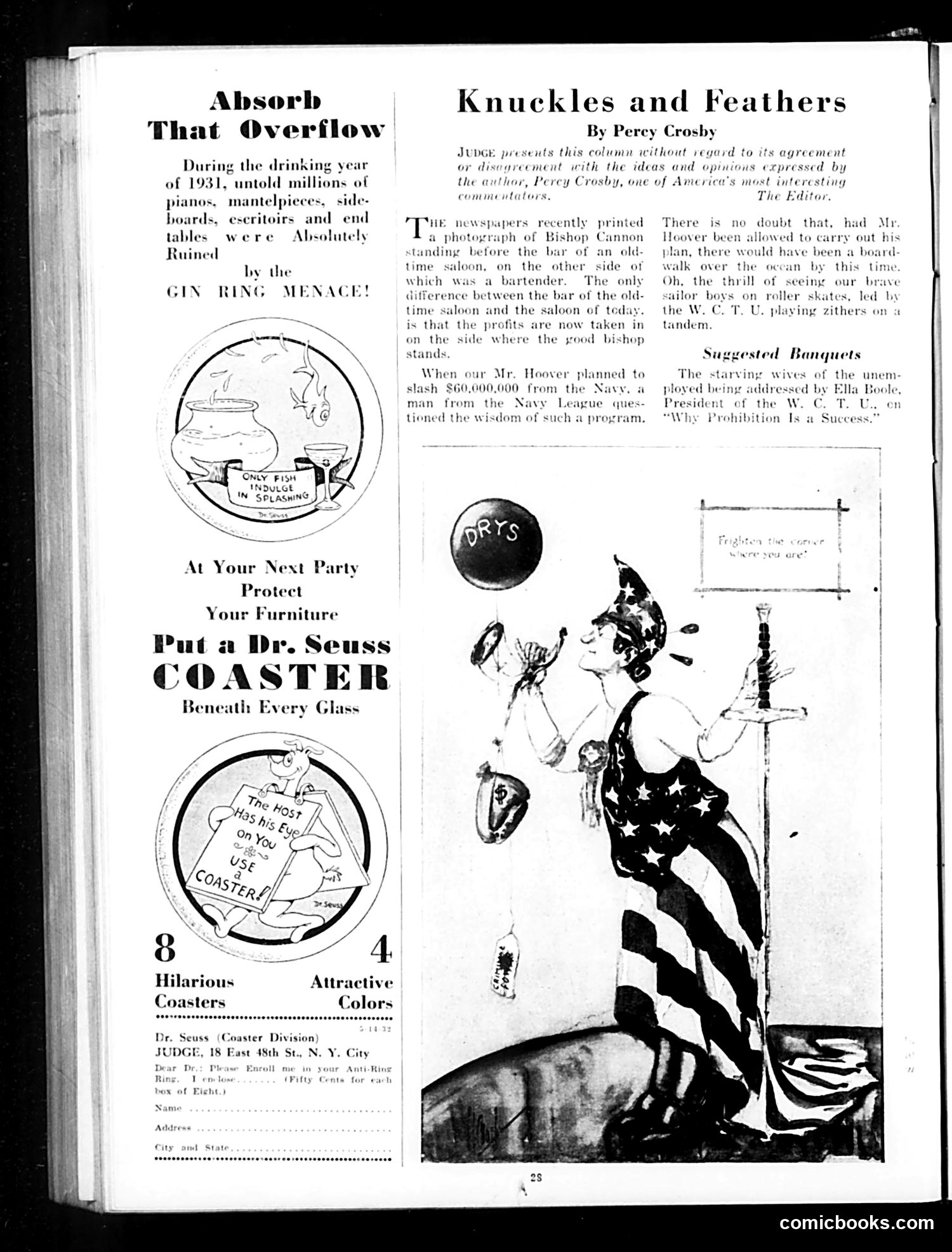
Analysis for Modern Readers This page contains satire about Prohibition era (1931) America. The left side advertises Dr. Seuss coasters—a humorous product designed to protect furniture from wet glasses during the illegal drinking ("gin ring menace"). The joke is that despite Prohibition's ban on alcohol, people were still drinking so much that furniture damage was common. The right column, "Knuckles and Feathers" by Percy Crosby, satirizes Bishop Cannon, a real anti-Prohibition religious figure. The text references a photograph of Cannon in a saloon, creating irony: a prominent Prohibition advocate was caught in a drinking establishment. The satire mocks the gap between Prohibition's stated ideals and actual behavior—even prominent supporters failed to follow the law. The "Suggested Banquets" section sarcastically proposes events by the W.C.T.U. (Women's Christian Temperance Union), a real Prohibition enforcement organization, further lampooning the movement's hypocrisy and ineffectiveness.
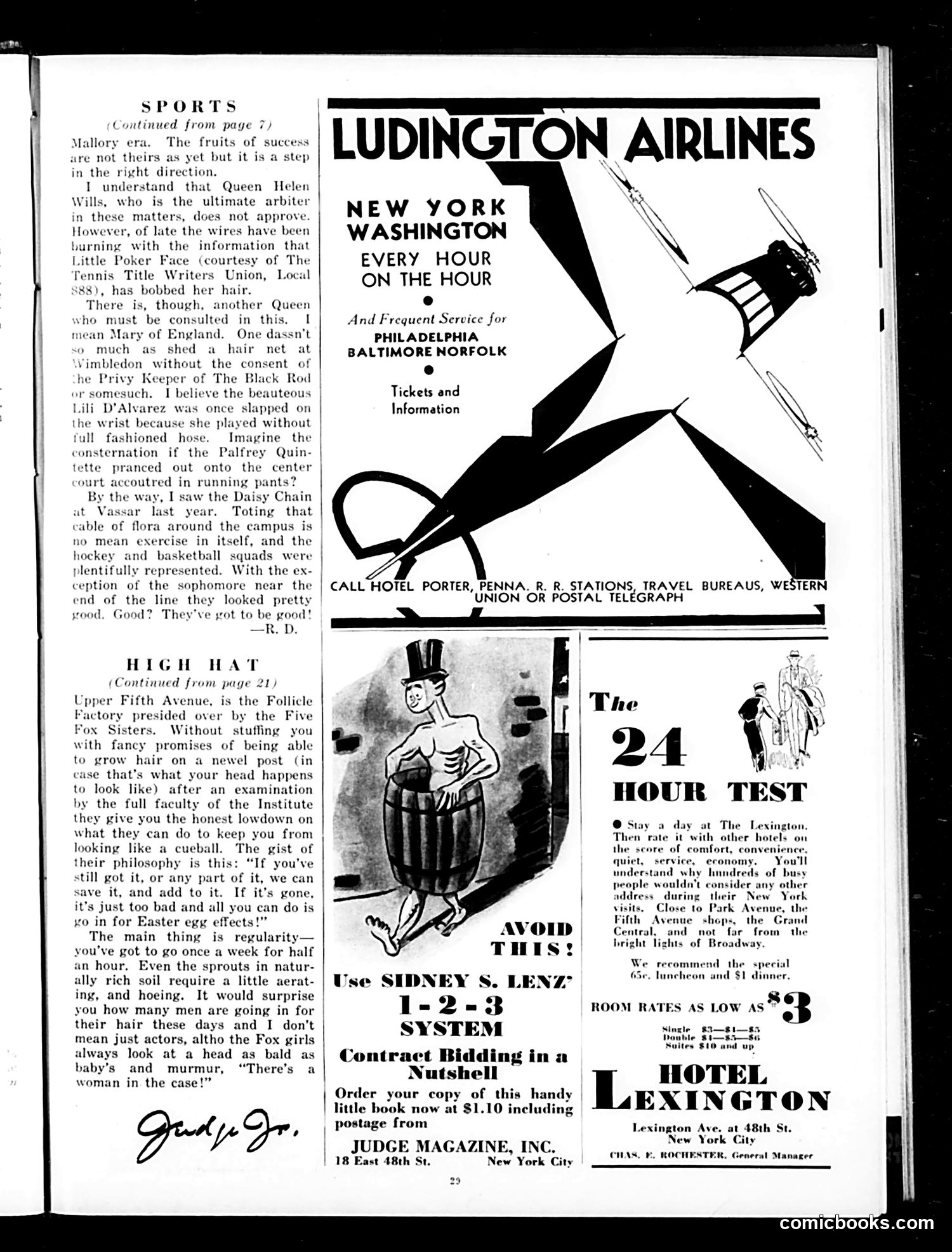
This page mixes sports commentary with advertisements. The "Sports" section discusses women's tennis, particularly Queen Helen Wills ("Little Poker Face"), noting controversy about her bobbed hair and whether it violates Wimbledon conventions. The writer humorously suggests it requires approval from "Queen Mary of England" and the "Privy Keeper." The "High Hat" section addresses men's hair care at a Fifth Avenue salon (the Follicle Factory), using joking pseudo-scientific language about treating hair loss. The cartoonish "Uncle Sam" figure in the contract bidding ad appears to be promoting a bridge-bidding guide system. The remaining content is commercial advertising for Ludington Airlines, a hair treatment system, and the Hotel Lexington—typical 1920s/early-1930s magazine filler. No clear political satire is present; the page primarily reflects period attitudes about grooming, fashion, and social propriety.
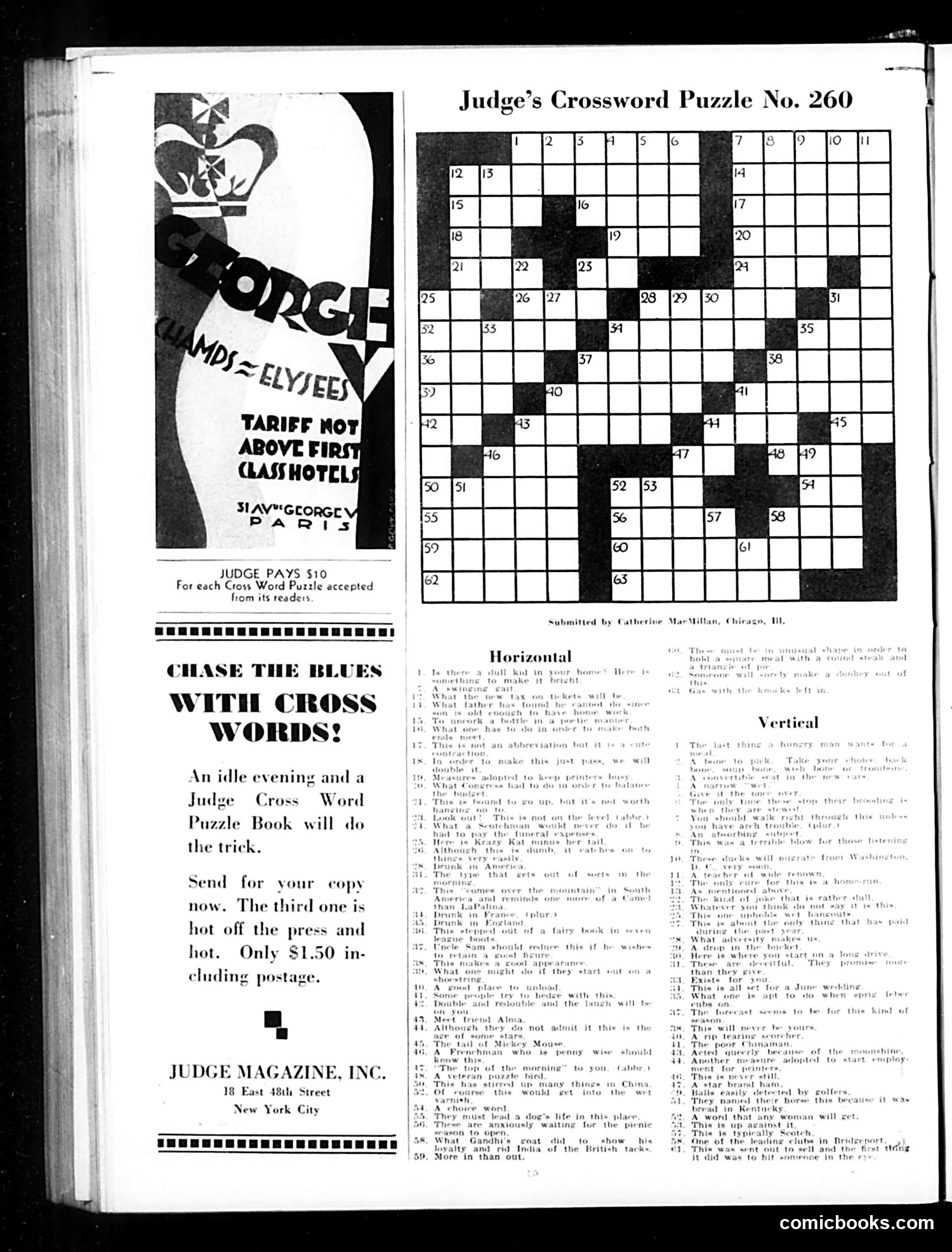
Judge Magazine Advertisement & Crossword Puzzle This page is primarily advertising and promotional content rather than political satire. The left side shows a vintage hotel advertisement (appearing to reference "Stay George V Paris" and tariff information for first-class hotels). The main content promotes Judge Magazine's crossword puzzle offerings—a commercial appeal to readers during the crossword craze of the 1920s-30s. The magazine offers $10 payment for accepted puzzles and advertises a crossword puzzle book for $1.50 to combat "the blues" during leisure time. The right side presents "Judge's Crossword Puzzle No. 260" with horizontal and vertical clues. Historical context: Crossword puzzles were enormously popular during this era following their American debut. Judge, as a satirical weekly, capitalized on this trend by selling both puzzles and puzzle books to readers seeking entertainment. There is no apparent political satire on this specific page—it's purely commercial content.
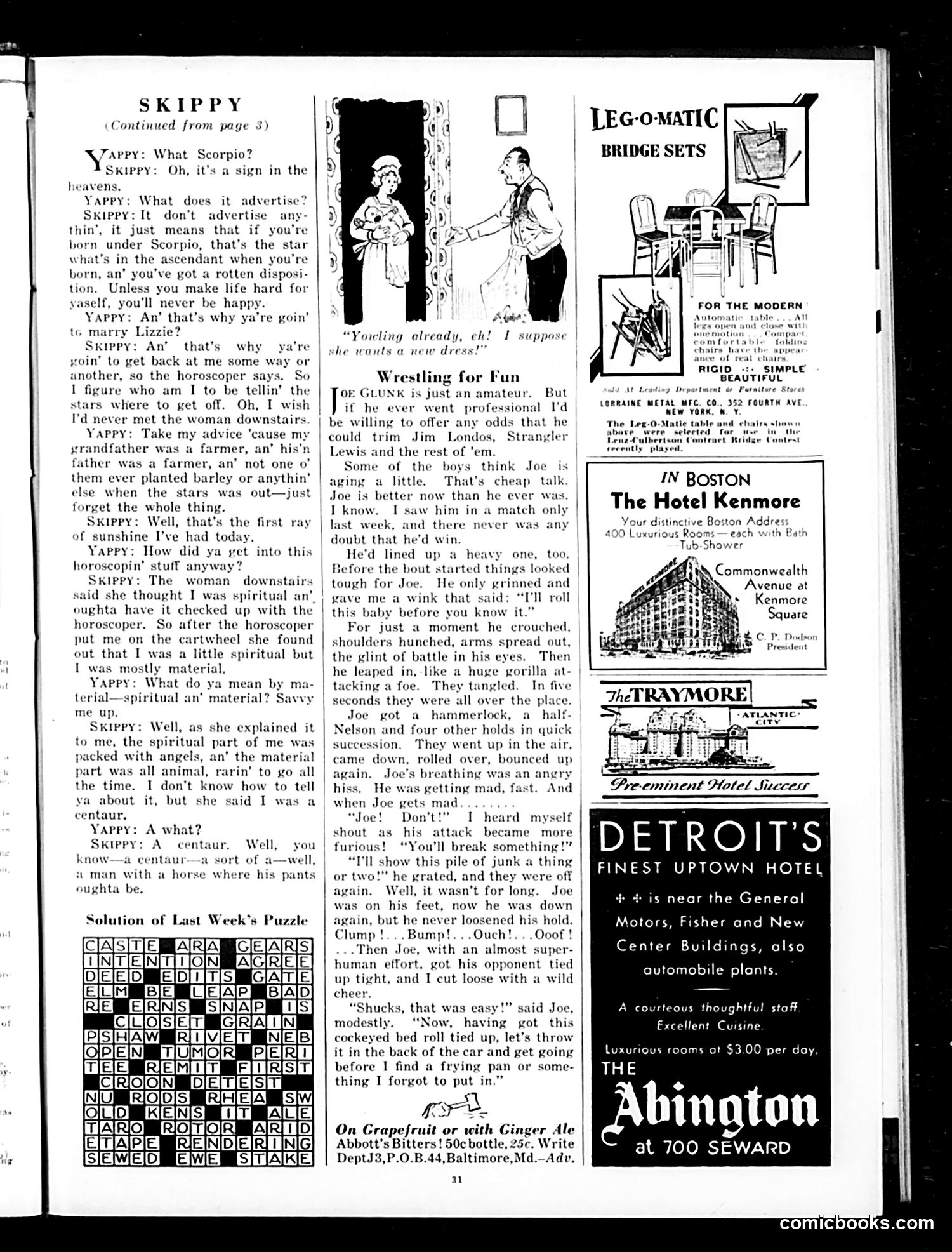
Skippy Comic Strip Analysis This page features Skippy, a popular comic strip character, in a humorous dialogue about astrology and relationships. Skippy discusses being born under the zodiac sign Scorpio, which he claims gives people a "rotten disposition." His friend Yappy offers farm wisdom advising against planning life around astrological signs. The strip satirizes early 20th-century fascination with horoscopes and pseudoscience—a common target of humor in this era. Skippy's complaint that a woman downstairs convinced him to consult a horoscoper (revealing he's spiritually "a centaur"—half-man, half-horse) mocks both gullible believers in astrology and charlatan fortune tellers exploiting them. A separate article, "Wrestling for Fun," celebrates amateur wrestler Joe Glunk's strength and victory, contrasting his authentic physical prowess with the superstitious nonsense of the astrology segment above it—suggesting real accomplishment beats magical thinking.
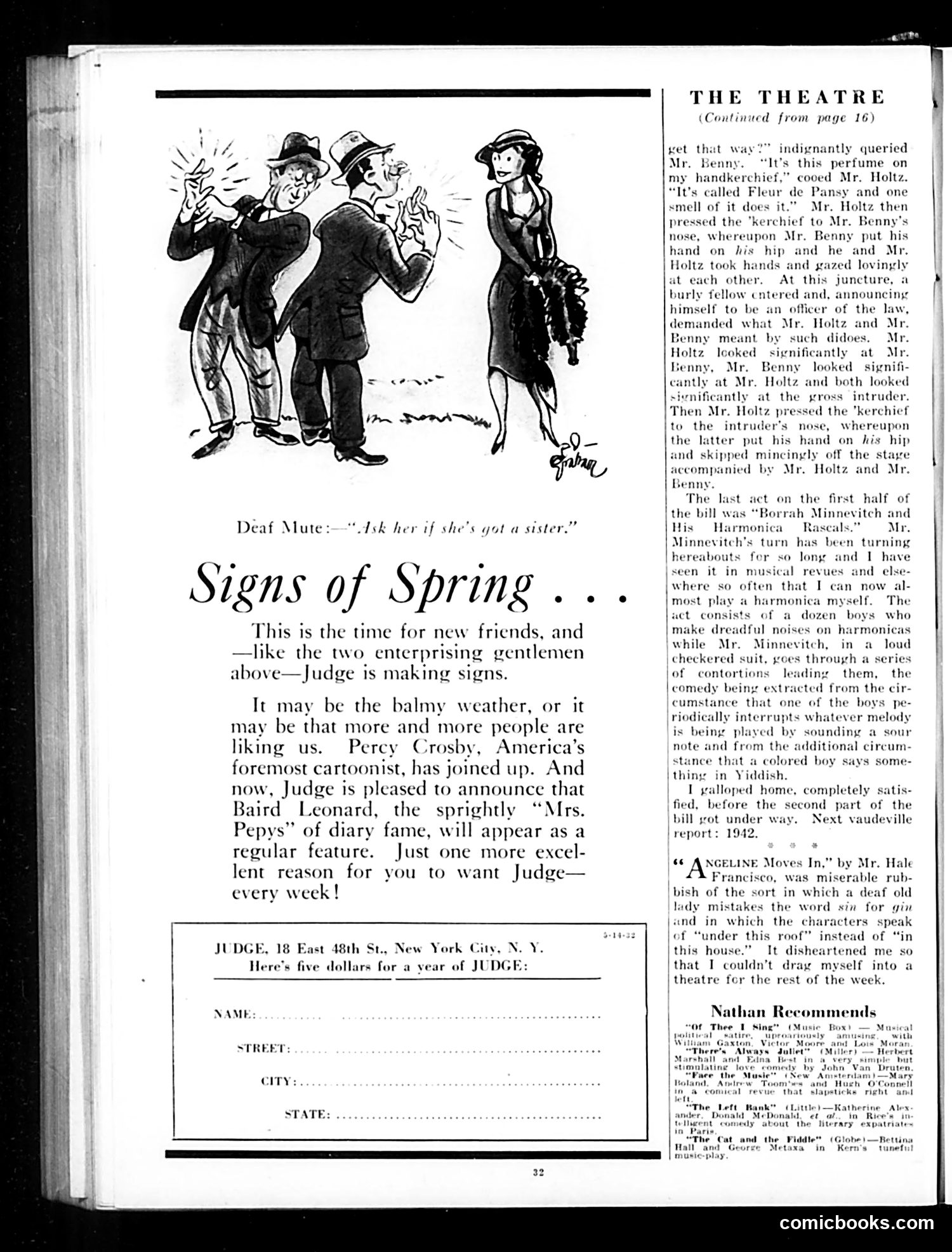
"Signs of Spring" — Judge Magazine Cartoon Explanation The cartoon depicts two men using sign language to communicate with a woman, with the caption: "Ask her if she's got a sister." The joke plays on the double meaning of "signs"—both the hand gestures of deaf communication and the seasonal "signs of spring" (flirtation, courtship). The humor is crude by modern standards: the men are using sign language not because they're deaf, but as a pickup technique, suggesting they're trying to appear mysterious or exotic to impress the woman. The "enterprising gentlemen" are essentially mocking deaf communication for romantic advantage. The surrounding text announces Judge magazine is recruiting new writers and cartoonists, including Percy Crosby and Baird Leonard ("Mrs. Pepys"), positioning this as a seasonal renewal—both literal spring and the magazine's "spring" revival with fresh talent. The page also contains theater reviews discussing Broadway performances from what appears to be the early 1940s.
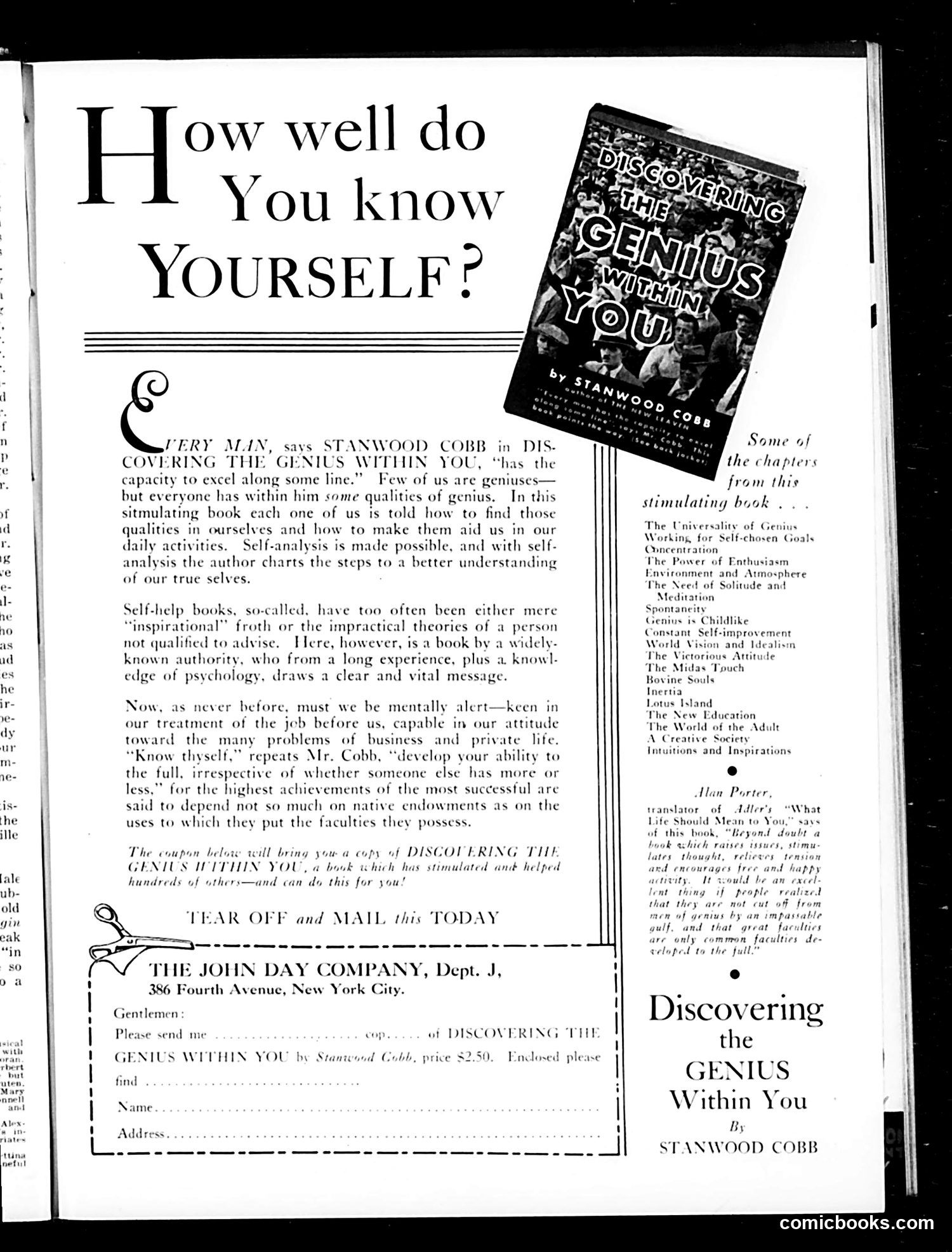
Analysis of This Judge Magazine Page This is primarily an advertisement for a self-help book, not a political cartoon. The page promotes "Discovering the Genius Within You" by Stanwood Cobb, published by The John Day Company. The advertisement argues that self-help literature has historically been either shallow "inspirational froth" or impractical theory from unqualified authors. Cobb's book, by contrast, claims authority through his experience and knowledge of psychology. The pitch emphasizes self-analysis and unlocking one's latent talents—reflecting early 20th-century popular psychology and the American self-improvement movement. The timing suggests this addresses post-WWI America's emphasis on mental alertness and practical capability for "business and private life." The featured chapters (concentration, environment, spontaneity, creativity) reflect period concerns with personal development and unlocking human potential. Rather than satire, this represents straight commercial messaging typical of Judge's advertising section.
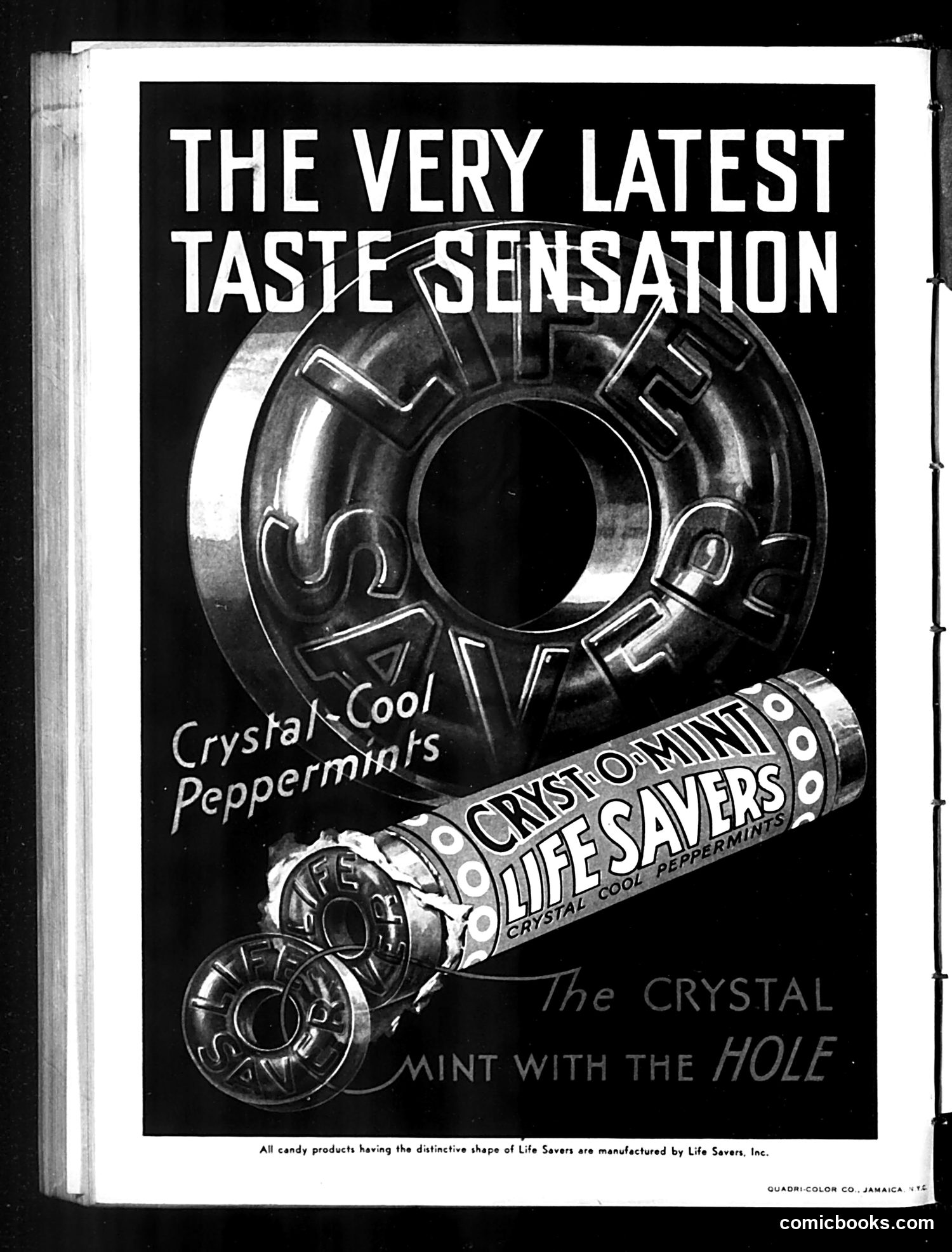
Analysis This is a vintage advertisement, not a political cartoon or satire. It promotes Life Savers mints, specifically "Crystal Cool Peppermints" and "Crystal Mint Life Savers," emphasizing "the crystal mint with the hole" — the distinctive ring shape that defines Life Savers candies. The advertisement uses the phrase "the very latest taste sensation" as its headline, a common marketing tactic from the early-to-mid 20th century. The imagery shows the product's characteristic hole prominently, which was a novelty and selling point at the time. The text identifies Life Savers, Inc. as the manufacturer. This appears to be from Judge magazine but functions purely as commercial advertising rather than satirical or political commentary.