judge
Judge — May 21, 1932
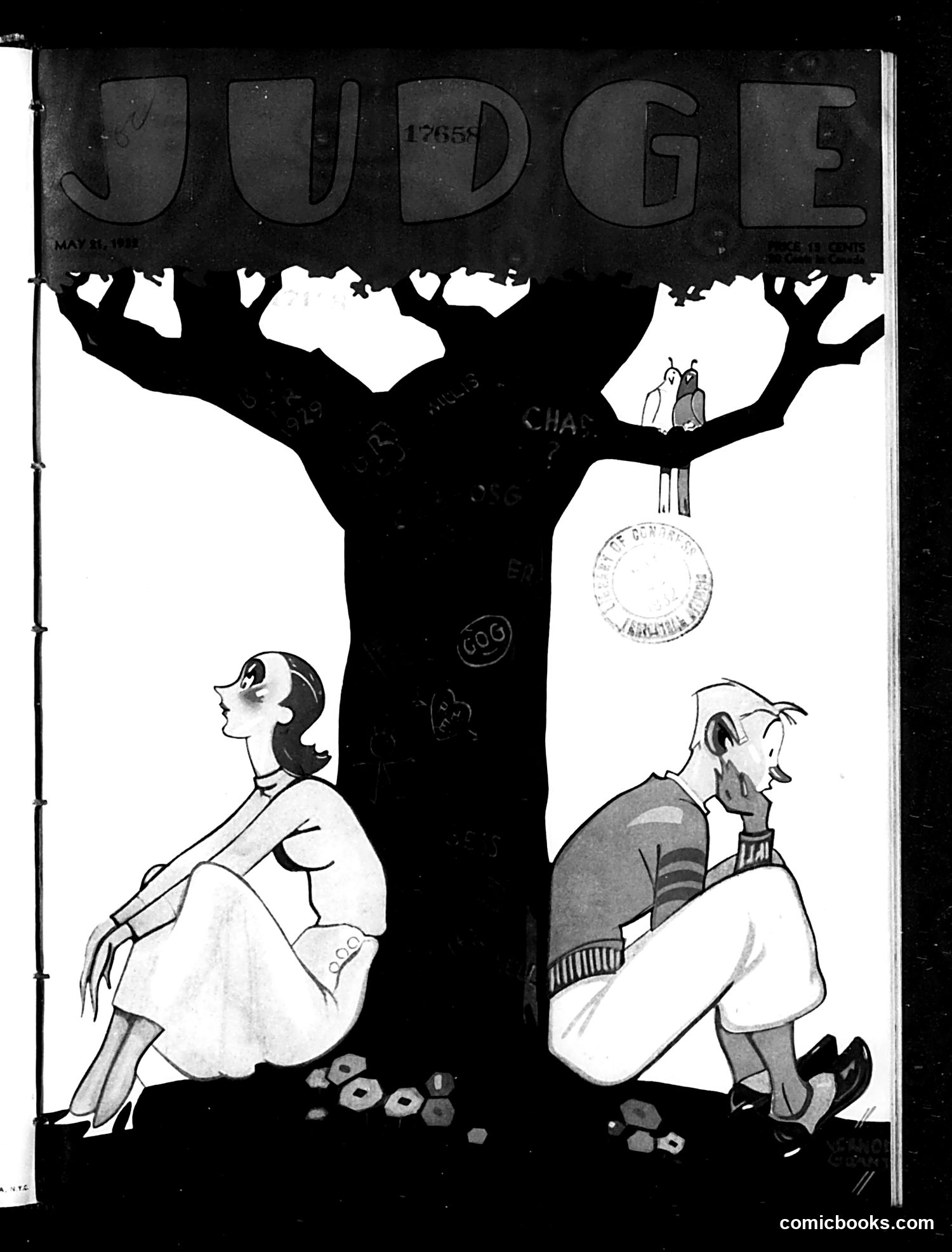
Analysis of Judge Magazine Cover - May 8, 1912 This satirical cover depicts two figures sitting beneath a bare, dead tree—a classic symbol of desolation or failed hopes. The composition suggests a political or social commentary about disillusionment or broken promises. The silhouetted tree dominates the composition, with two people positioned at its base appearing distressed or contemplative. Without clearer identifying features or accompanying text visible in the image, the specific political figures or event remain uncertain. The May 1912 date places this during a significant American political moment (the Progressive Party split and presidential election), but the exact targets of satire cannot be definitively determined from the visual elements alone. The overall tone suggests commentary on disappointed expectations or political failure.
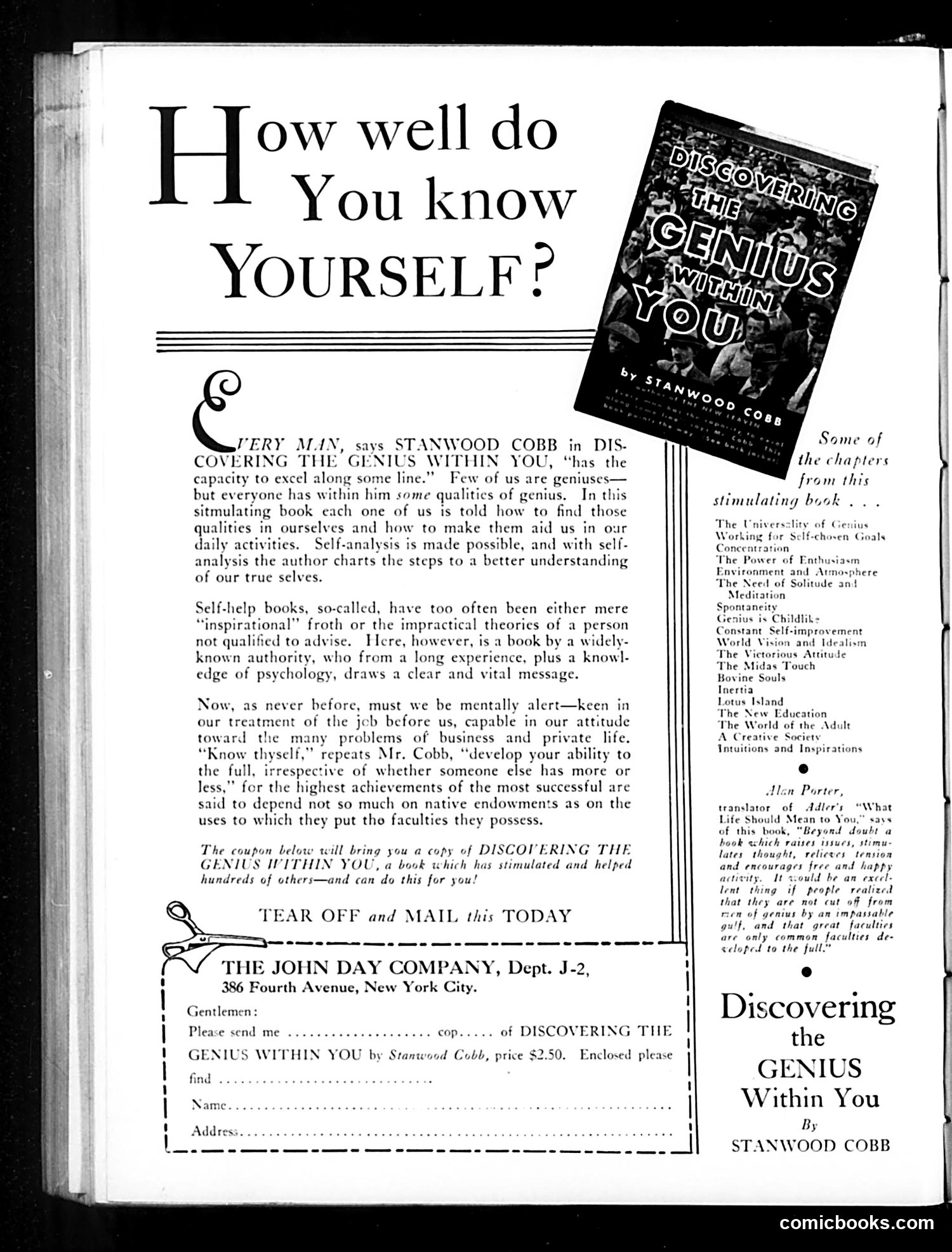
Analysis This page is primarily advertising, not satire or political cartooning. It promotes "Discovering the Genius Within You" by Stanwood Cobb, a self-help book published by The John Day Company. The advertisement uses a testimonial format, quoting Every Mix (likely a contemporary figure, though unclear who exactly) endorsing Cobb's psychology-based approach to self-improvement. The text contrasts this book favorably against typical self-help literature of the era, claiming it offers practical psychological guidance rather than mere "inspirational froth." The page includes a mail-order coupon and lists chapter titles emphasizing personal development themes popular in 1920s-30s American culture: concentration, enthusiasm, meditation, and self-improvement. No political satire is evident here.
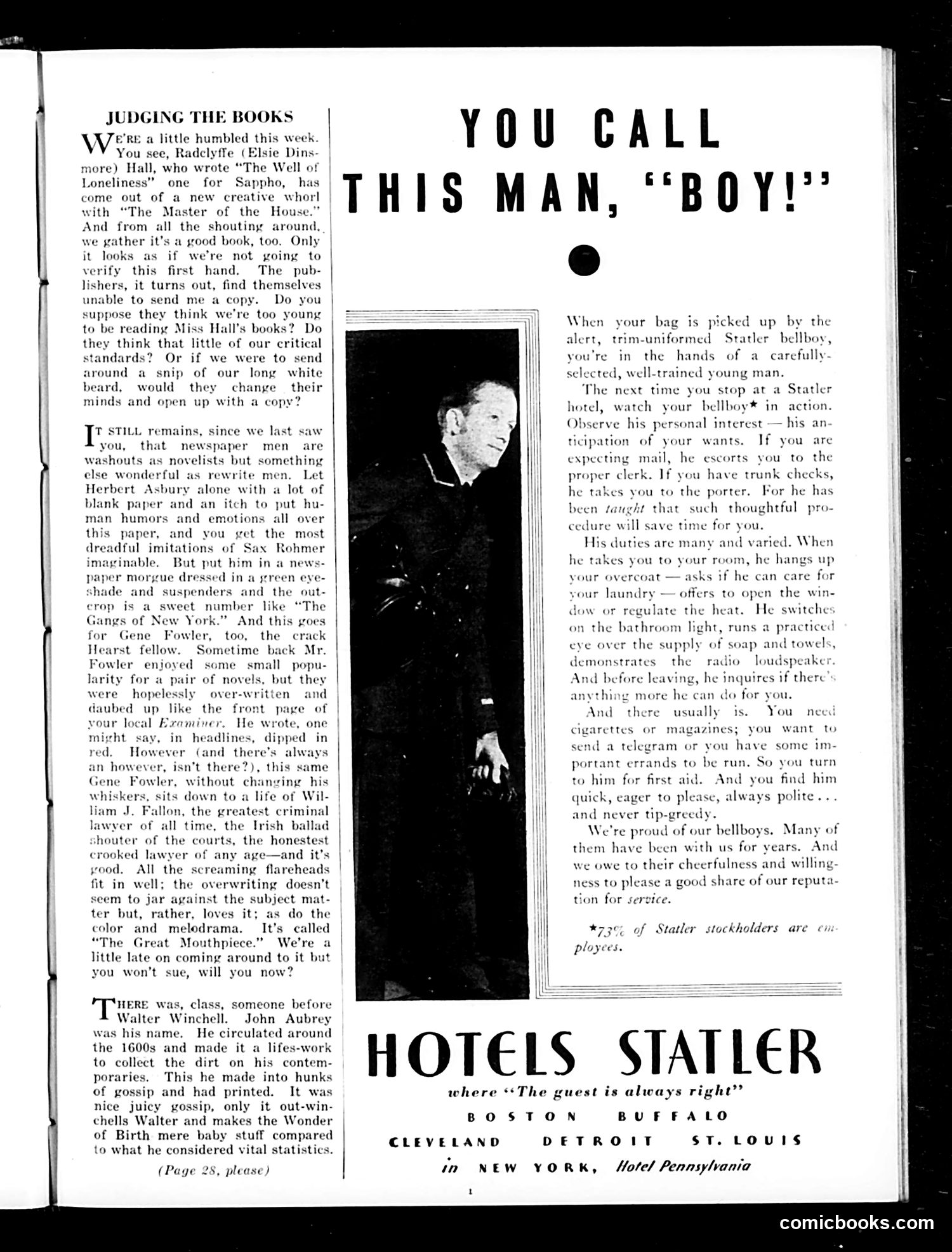
Analysis This page is primarily advertising, not satire or political commentary. The large right-hand section is a Hotels Statler advertisement featuring a photograph of a bellhop with the headline "YOU CALL THIS MAN, 'BOY!'" The ad describes the Statler hotel chain's bellhop service—their training, attentiveness, and professionalism. The phrase "call this man 'Boy'" appears to reference common era practice of addressing service workers informally, which the ad positions as contrary to the Statler bellhops' professional demeanor and dignity. The left side contains a book review column ("Judging the Books") discussing recent publications, including works by Radclyffe Hall and Gene Fowler. This is editorial content, not satire.
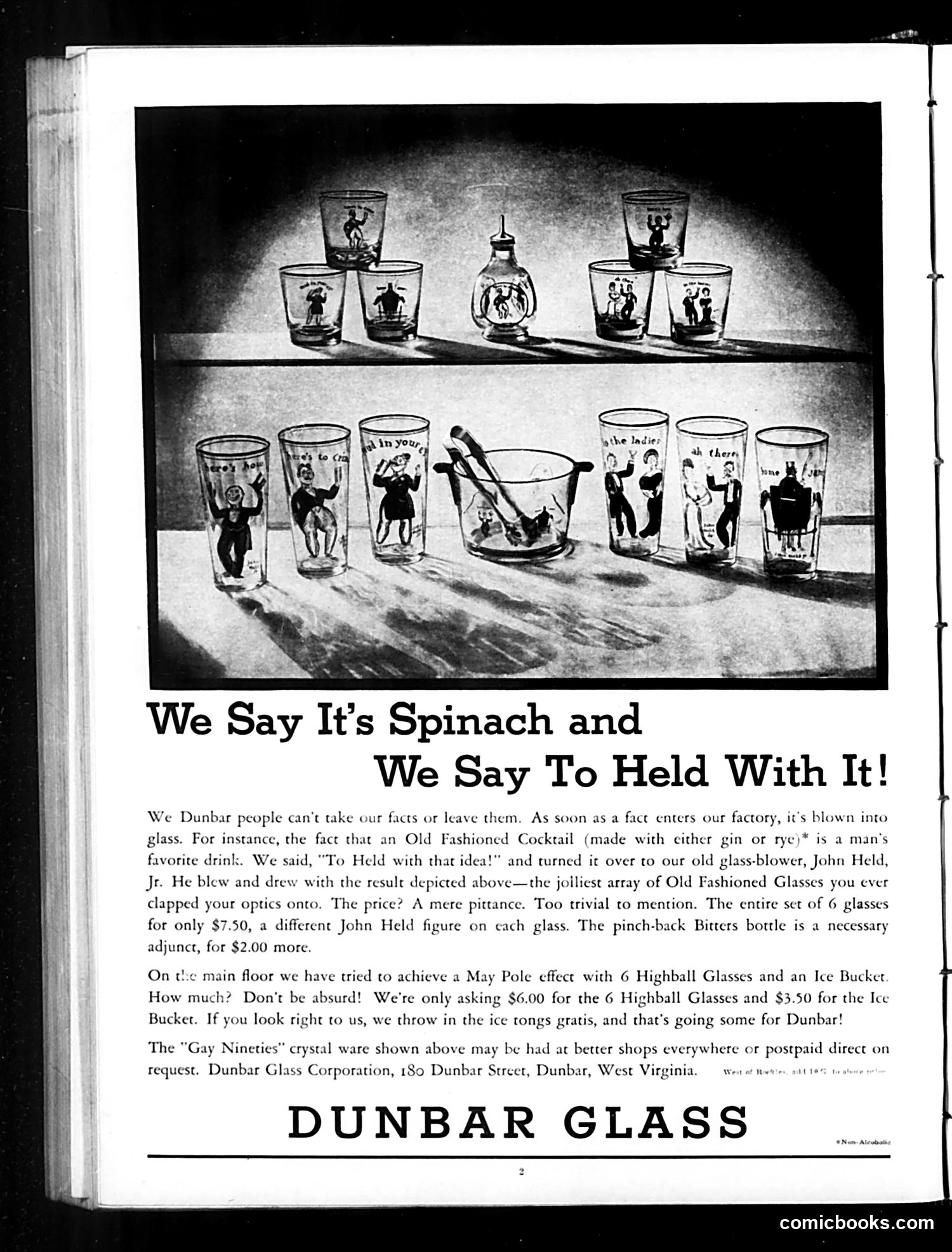
Analysis This is primarily advertising content, not editorial satire. Dunbar Glass Corporation of Dunbar, West Virginia is promoting their decorative glassware line called "Gay Nineties" crystal ware. The ad uses humor to sell cocktail glasses and novelty items featuring silhouetted figures in 1890s-style dress and poses. The headline "We Say It's Spinach and We Say To Held With It!" appears to reference contemporary slang (likely referencing a 1928 E.B. White cartoon caption that became popular). The advertisement highlights various glass products: Old Fashioned cocktail glasses ($7.50 for a set of 6), Highball glasses ($6.00), and an ice bucket ($3.50). The tone is lighthearted and colloquial, appealing to consumers interested in novelty barware and period-themed glassware during what was likely the Depression era.
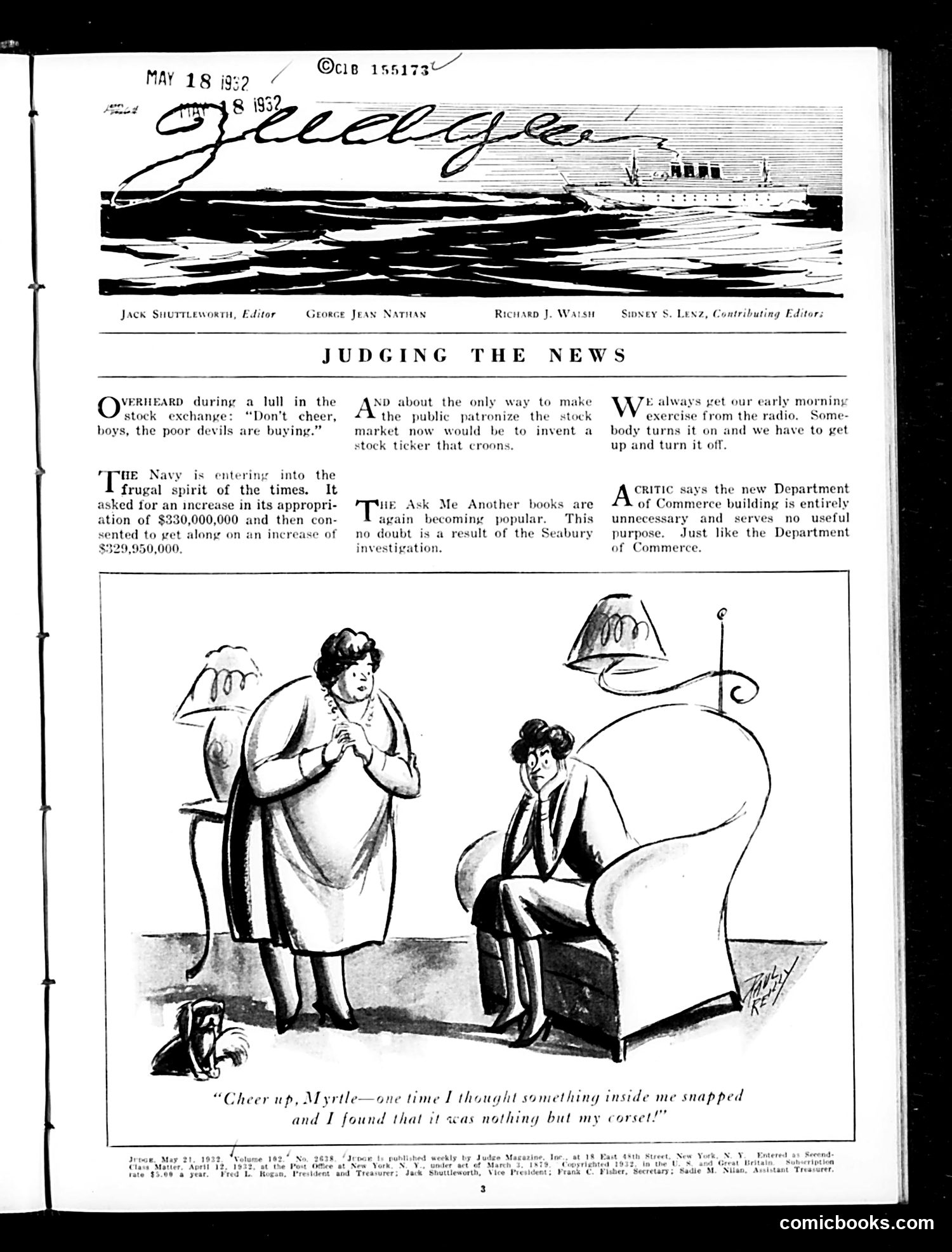
Analysis of Judge Magazine Page (May 18, 1932) This page from Judge magazine contains satirical commentary on contemporary issues. The main cartoon depicts a woman consoling a distressed man sitting in a large chair, with the caption: "Cheer up, Myrtle—one time I thought something inside me snapped and I found that it was nothing but my corset!" The joke plays on economic anxiety during the Great Depression (this is May 1932). The woman's quip suggests that what felt like an internal collapse was merely a physical garment failure—satirizing how people minimized serious financial worries or psychological distress as trivial matters. Above, brief editorial items mock current events: Navy budget increases, the "Ask Me Another" book trend (linked to the Seabury investigation), and criticism of the new Commerce Department building as wasteful during economic hardship.
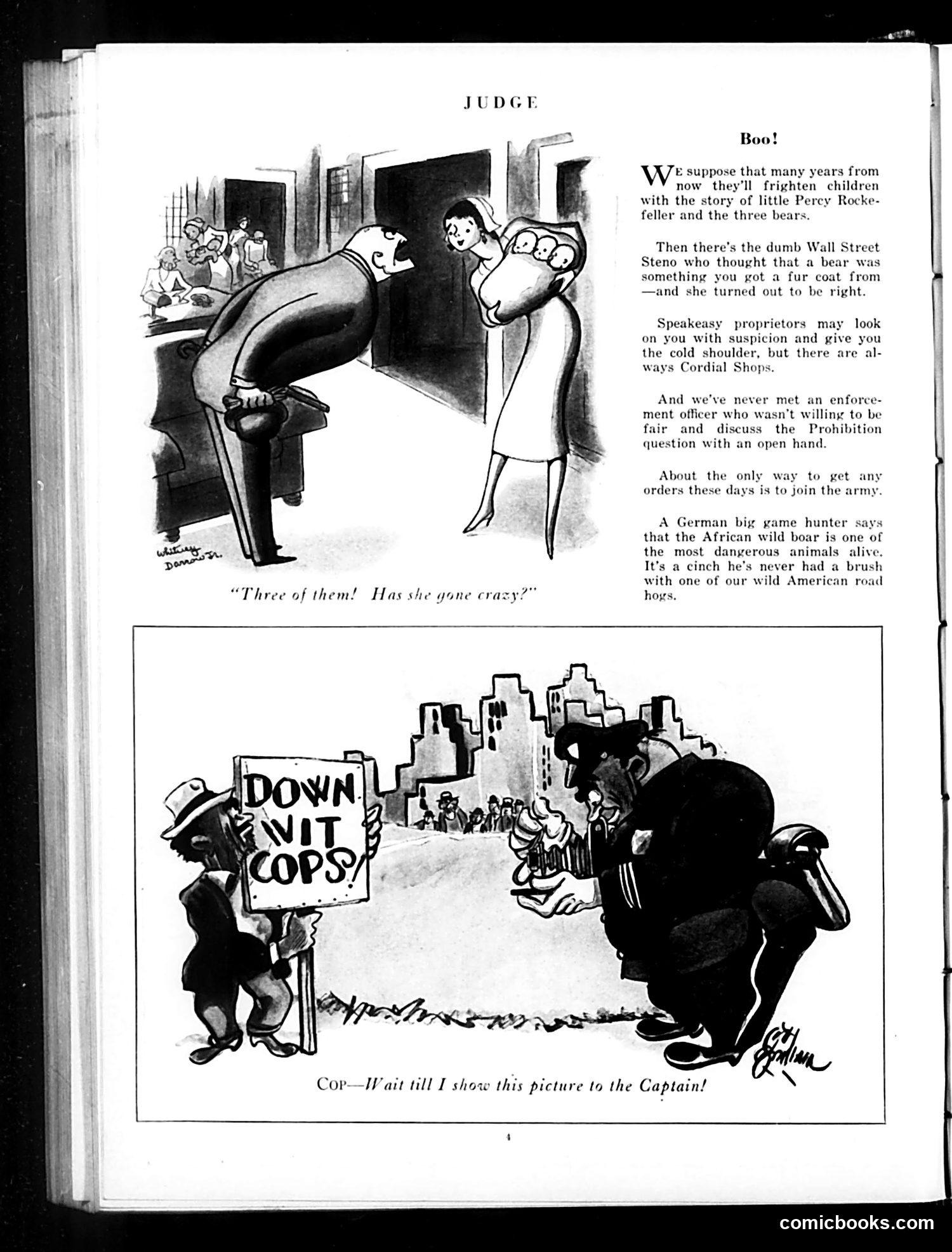
Judge Magazine Page Analysis This page contains two satirical cartoons about Prohibition-era law enforcement and social attitudes. The top cartoon depicts a man being thrown out a door by a woman holding a baby, with the caption "Three of them! Has she gone crazy?" The accompanying text jokes about various Prohibition-related matters, including speakeasies, enforcement officers, and wild game hunting. The bottom cartoon shows what appears to be a police officer holding a "DOWN WITH COPS" sign while confronting a bear near a city skyline. The caption reads "Cop—Wait till I show this picture to the Captain!" The satire appears to mock both Prohibition enforcement's ineffectiveness and the public's conflicted attitudes toward police during this period. The bear cartoon likely satirizes law enforcement priorities or the absurdity of anti-police sentiment coexisting with calls for order.
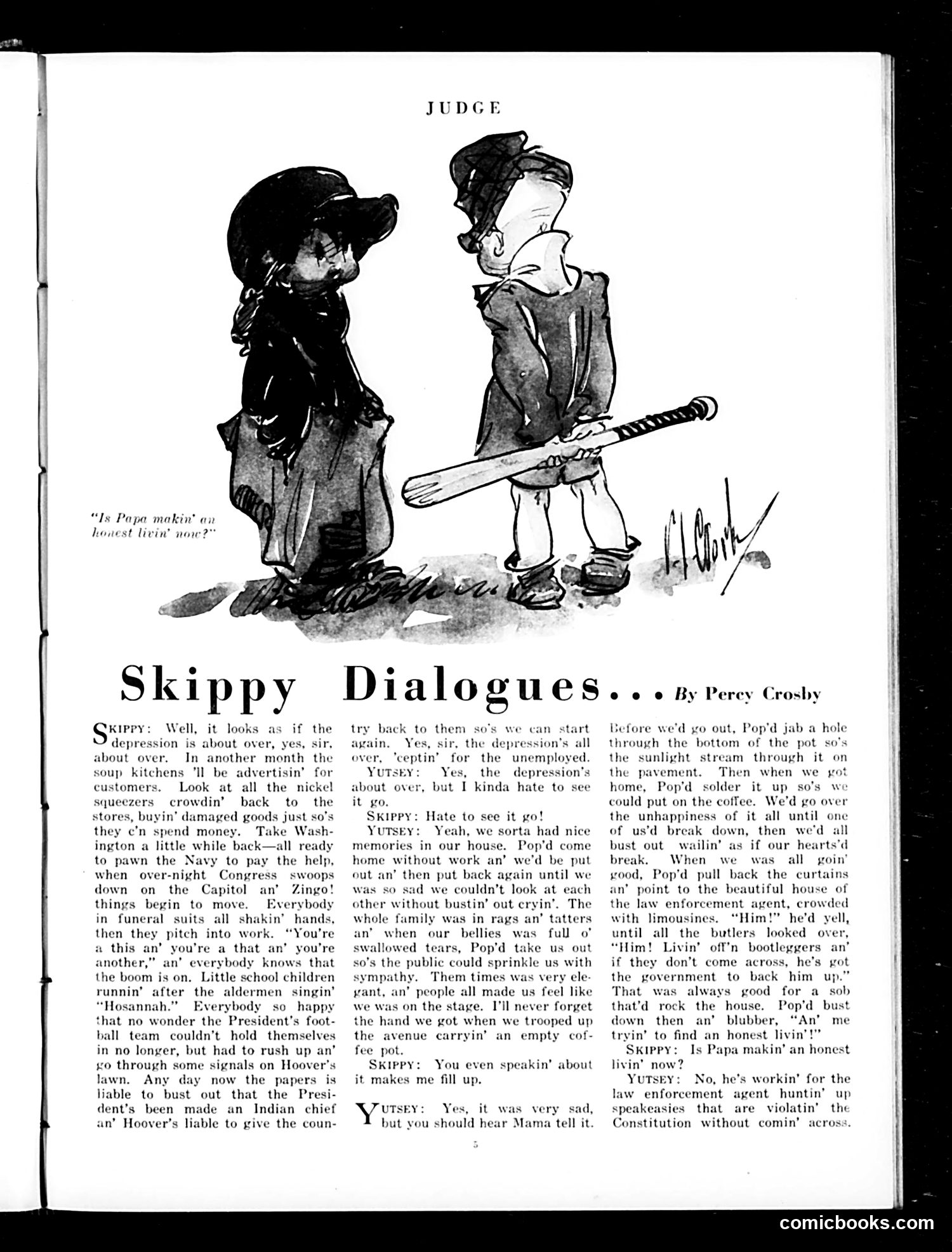
"Skippy Dialogues" - Judge Magazine Cartoon This is a comic dialogue by Percy Crosby featuring two young characters discussing the Great Depression. "Skippy" (left) and "Utsev" (right) are talking about economic hardship—unemployed fathers, families in poverty, and children going hungry. The satire targets how the Depression affected ordinary Americans. The children mention fathers "busting" to find work, mothers taking in laundry, and the family's desperation. References to "Hoover's lawn" and political blame suggest criticism of President Herbert Hoover's response to the crisis. The humor is dark: children discussing homelessness, empty pockets, and survival—capturing how Depression hardship permeated everyday American life, even children's conversations.
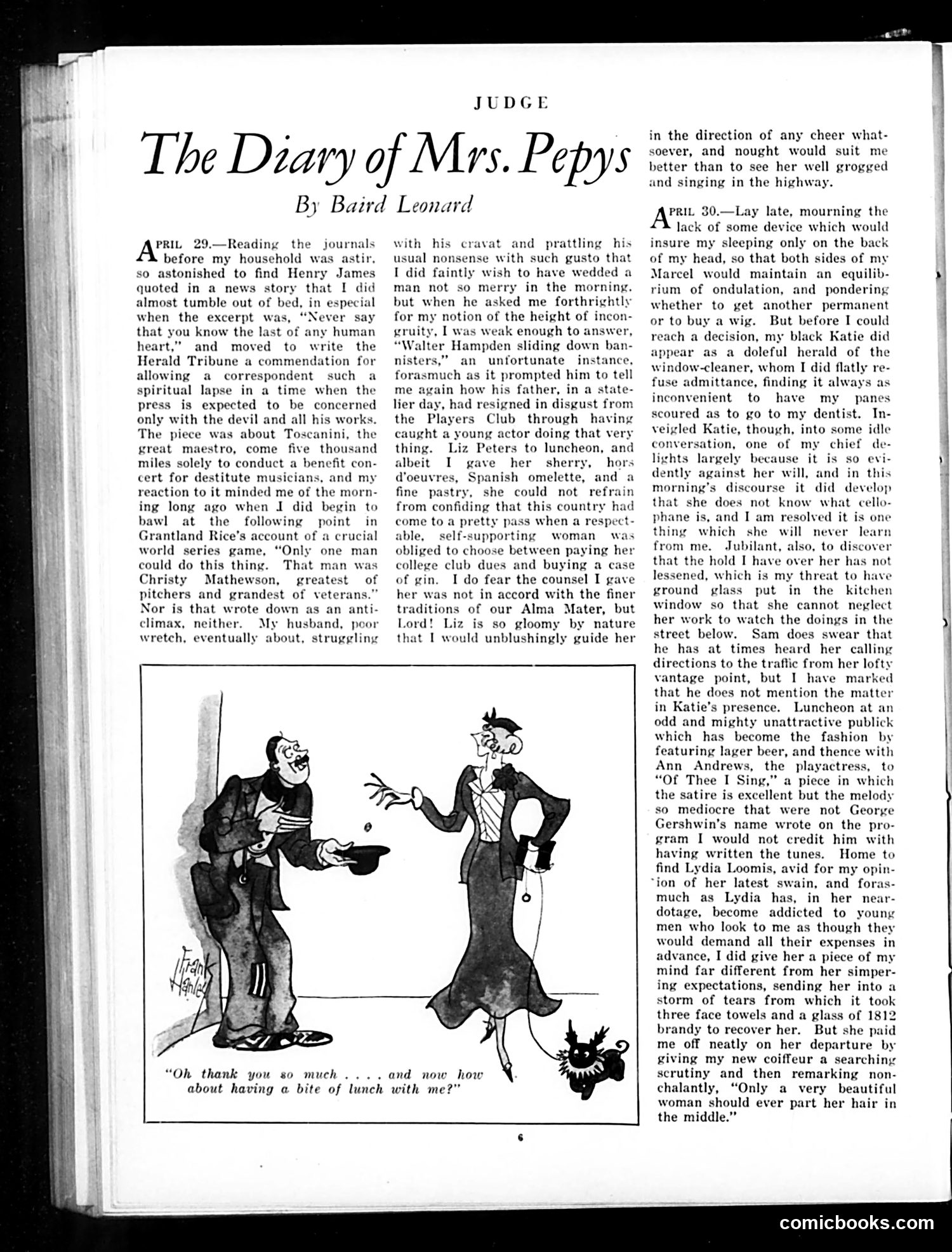
The Diary of Mrs. Pepys by Baird Lenard This is a satirical society column presented as diary entries from April 29-30. The cartoon depicts a society woman (likely Mrs. Pepys, the fictional diarist) being accosted by a shabby man asking for lunch money. The satire targets upper-class pretension and gossip culture. The text mocks Manhattan's social elite—including theater people, socialites, and cultural figures of the era. It satirizes women like "Lydia Loomis" and "Ann Andrews" (likely real or recognizable society figures), their superficial concerns, romantic entanglements, and competitive fashion consciousness. The humor derives from the contrast between the refined world these people inhabit and their petty, often ridiculous preoccupations, presented through the sardonic voice of an observant society columnist.
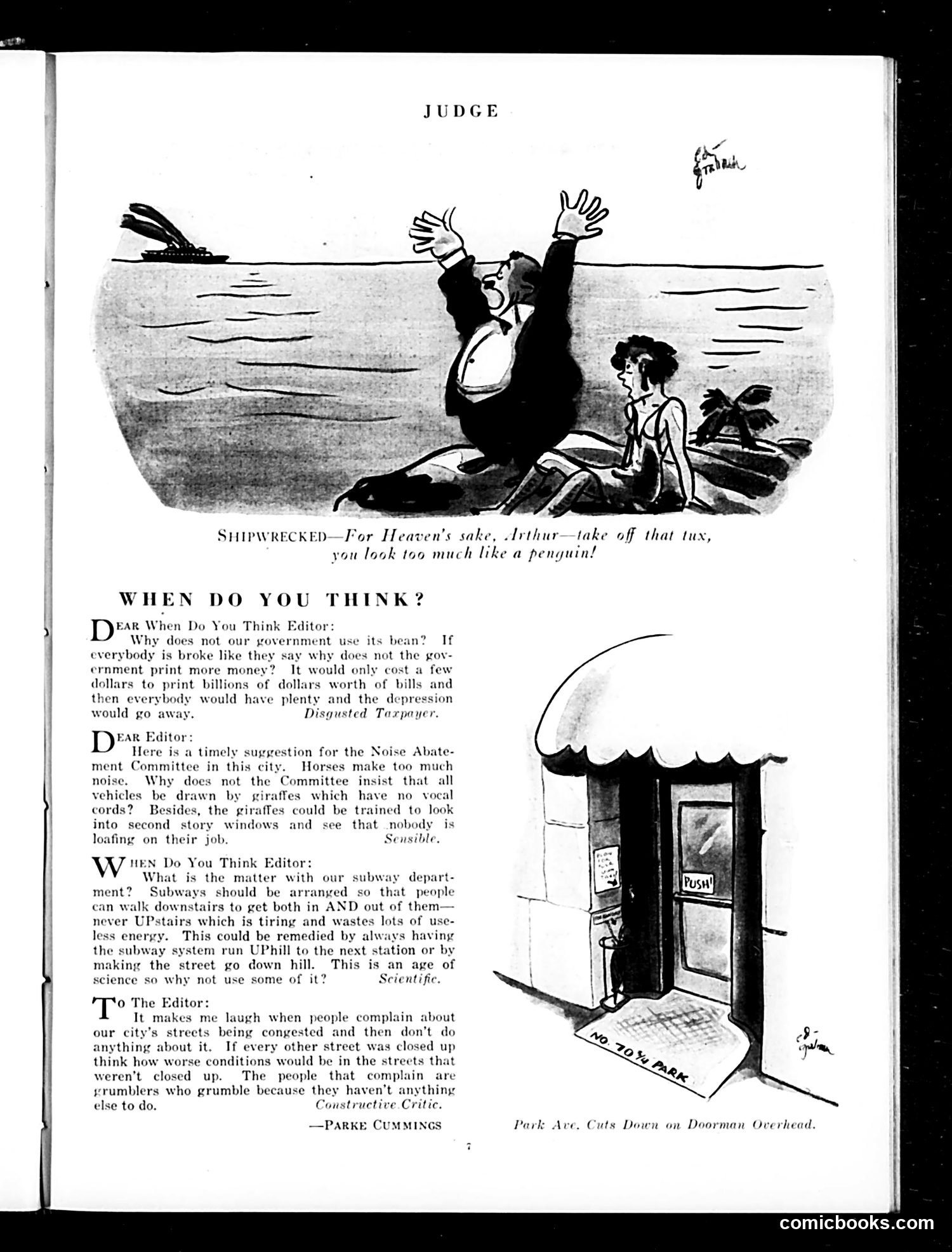
Judge Magazine Page Analysis Top Cartoon: A shipwrecked man in formal wear clings to wreckage while a woman suggests he remove his tuxedo because he "looks too much like a penguin." This is a simple visual gag playing on the penguin's formal appearance. "When Do You Think?" Section: This is a letters column featuring satirical reader submissions mocking Depression-era economic anxiety and urban complaints: 1. First letter ridicules the naive suggestion that printing more money would end the Depression—treating it as obviously foolish. 2. Second letter absurdly proposes replacing horses with giraffes for noiseless transportation while using them as workplace supervisors. 3. Third letter suggests redesigning subways so people descend rather than climb stairs—implying the writer doesn't understand gravity or engineering. 4. Fourth letter sarcastically defends street congestion, claiming closed streets would make remaining streets worse. The column satirizes public complaints and half-baked solutions to urban problems through intentionally ridiculous "common sense" proposals. The humor relies on readers recognizing the logical absurdity.
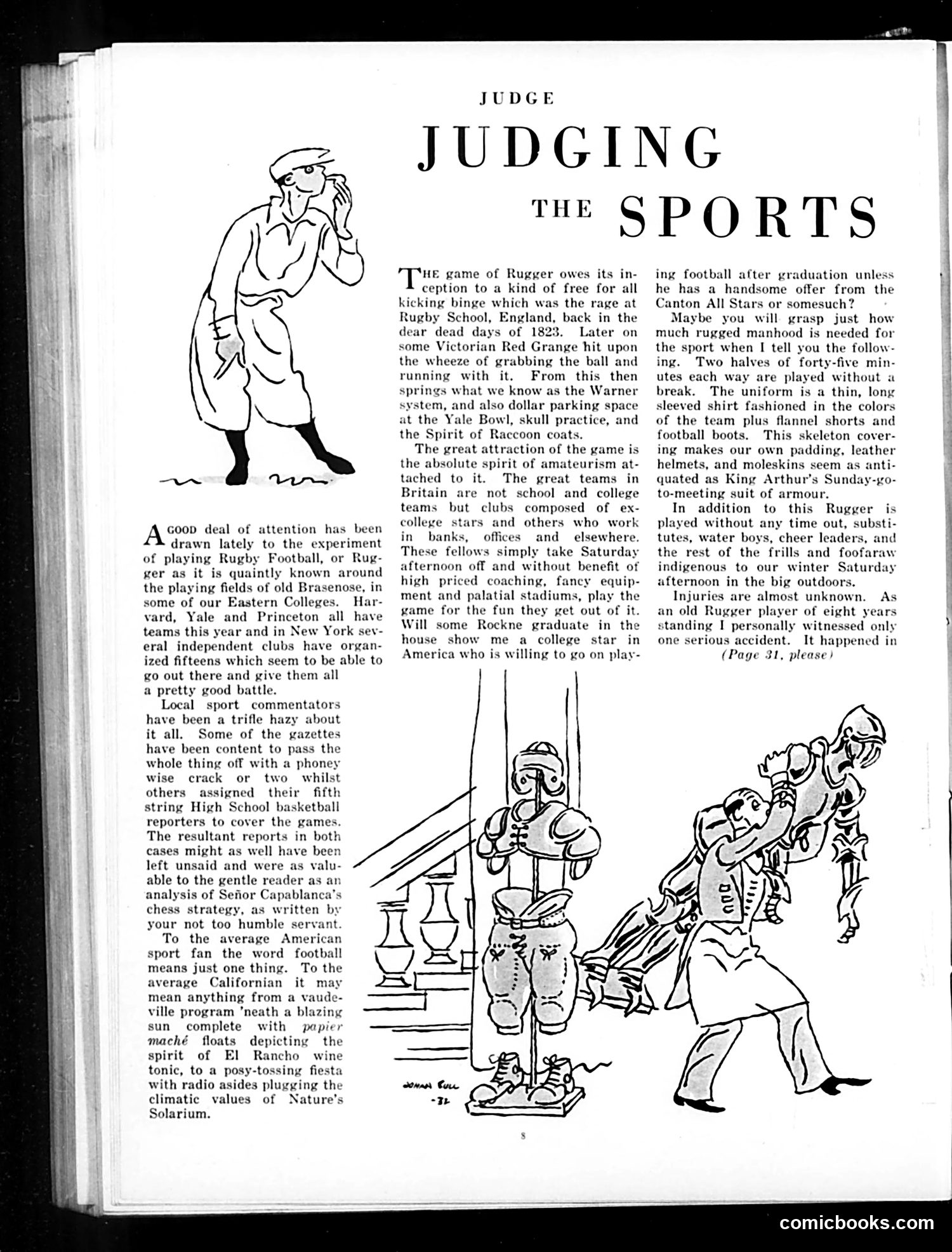
"Judging the Sports": Rugby Football Satire This page mocks American sportswriters' ignorance of rugby football, recently introduced to elite colleges like Harvard, Yale, and Princeton. The author criticizes how newspapers either dismissed rugby with "phoney wise cracks" or assigned incompetent "fifth string High School basketball reporters" to cover it—comparing such coverage to having a chess grandmaster analyze sports. The cartoons illustrate rugby players in full gear preparing for the game. The satire's central point: American sportswriters and fans understand only American football; to them, "football means just one thing," while Californians might confuse it with vaudeville entertainment. The author contrasts British rugby's amateur spirit—played by ordinary working men for fun—with American college football's commercialism, expensive equipment, coaching, and demand for professional contracts. The underlying critique: American sports have become professionalized and corrupt, while British rugby maintains genuine amateurism and physicality (played without breaks, minimal protective gear, few injuries).
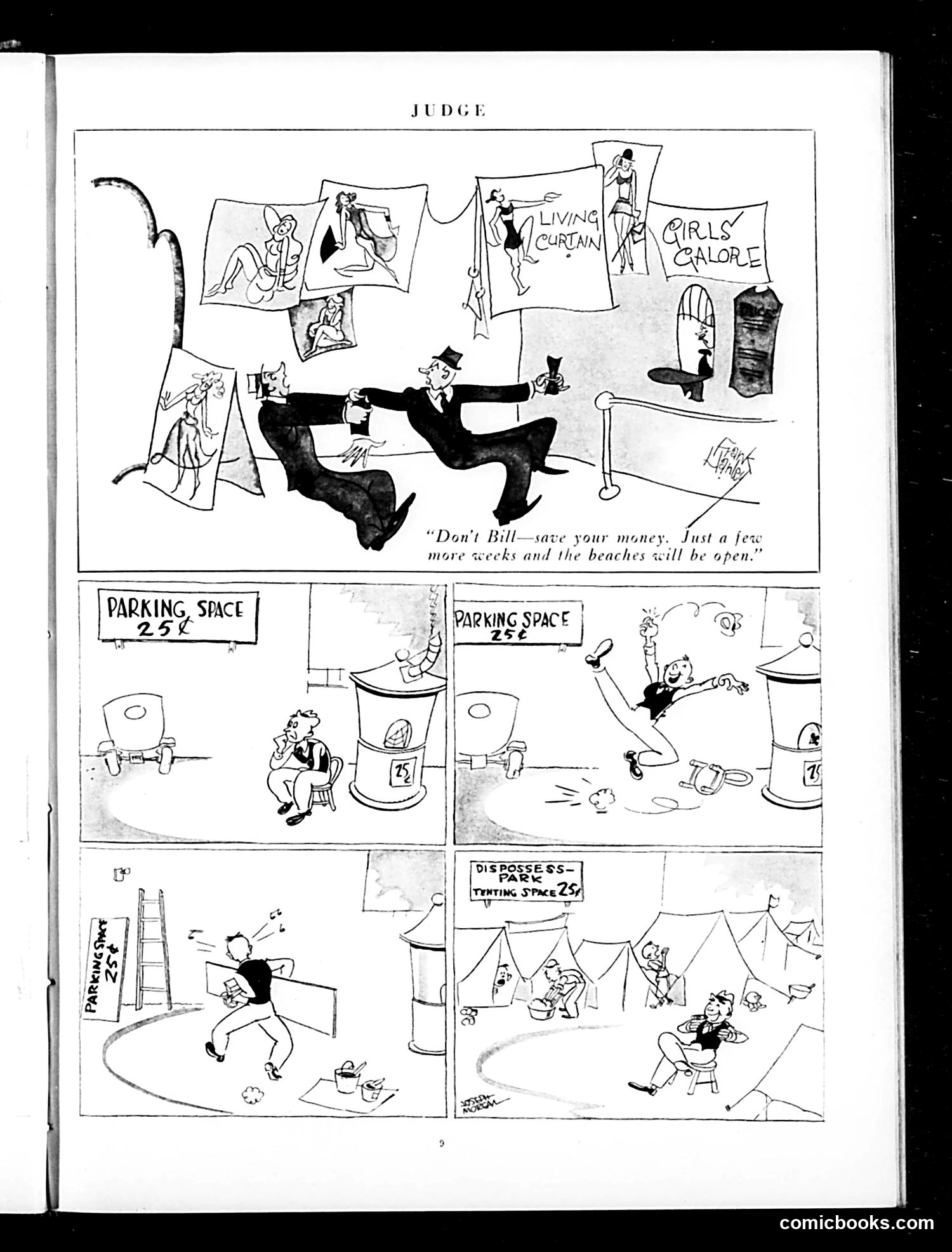
Analysis The top cartoon depicts a judge character surrounded by suggestive theater posters ("Living Curtain," "Girls Galore") and what appear to be vice-related imagery. The caption suggests someone named Bill should avoid spending money on entertainment because beaches will soon open—implying temporary closure of illicit establishments. The bottom comic strip shows a "Parking Space 25¢" scenario where someone pays for parking, then the space mysteriously disappears or becomes unavailable, leaving them frustrated. This appears to satirize urban parking frustrations and the scarcity of affordable parking spaces in cities. The page likely dates to a period when beach closures were temporary (possibly WWII-era blackouts or seasonal regulations) and reflects early-20th-century urban complaints about parking challenges.
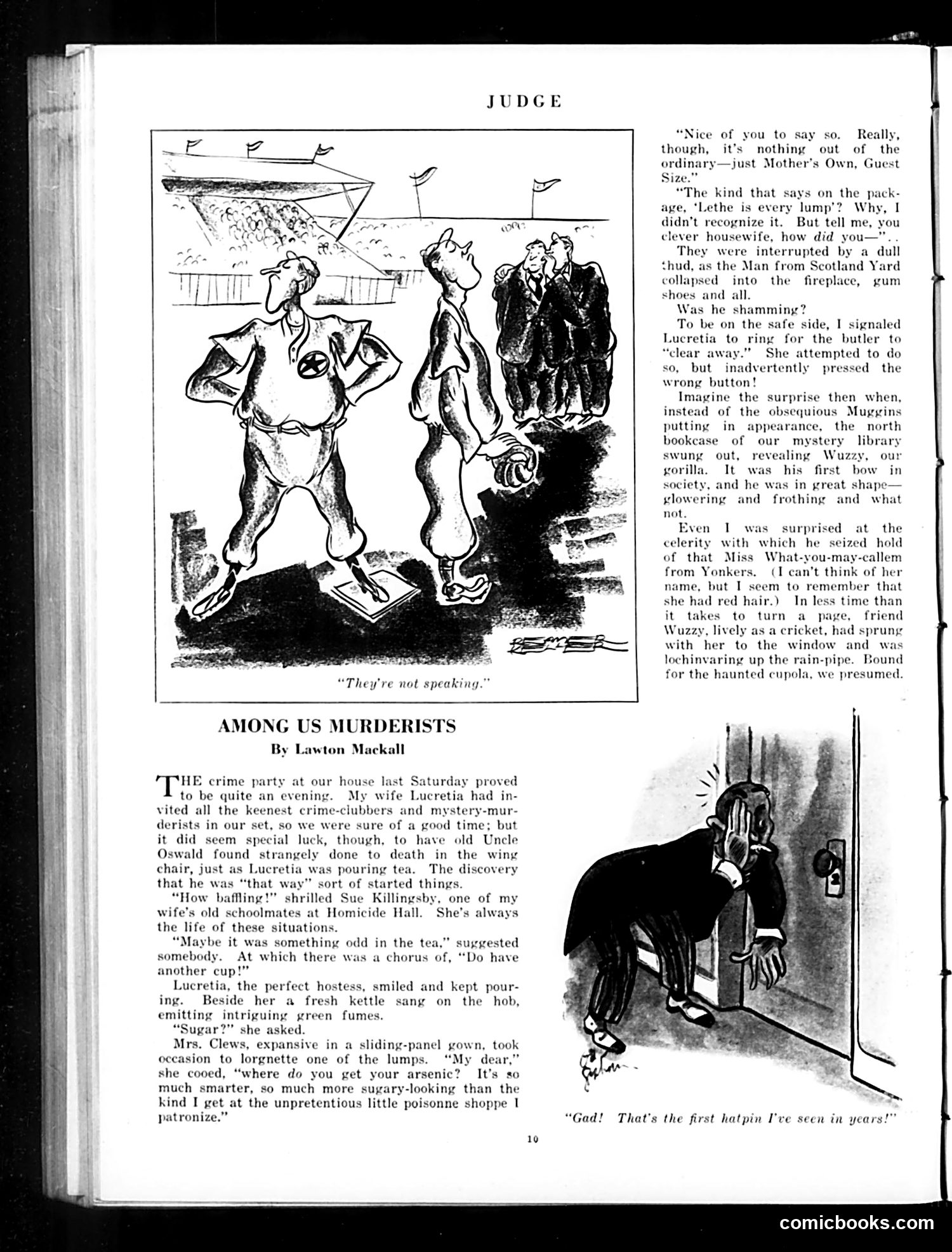
Analysis for Modern Readers This is a humorous murder-mystery parody titled "Among Us Murderists" by Lawton Mackall. The satire mocks the popularity of 1920s-30s detective fiction and "cozy mystery" conventions. The joke: at a dinner party, an uncle dies suspiciously. Rather than genuine alarm, the guests treat it as entertainment—one woman even compliments the hostess's arsenic quality, comparing shopping for poison as casually as buying groceries. A Scotland Yard detective collapses into the fireplace. A secret bookcase opens, revealing a gorilla that absconds with a guest through a window and rain-pipe. The cartoon above shows characters in deliberately ridiculous poses captioned "They're not speaking"—exaggerating melodramatic mystery-story tropes. The satire targets how fashionable mystery fiction had become among society people, treating real violence as parlor game entertainment. The escalating absurdity (competitive poison shopping, gorillas in libraries) mocks the implausible plot mechanics these stories relied upon.
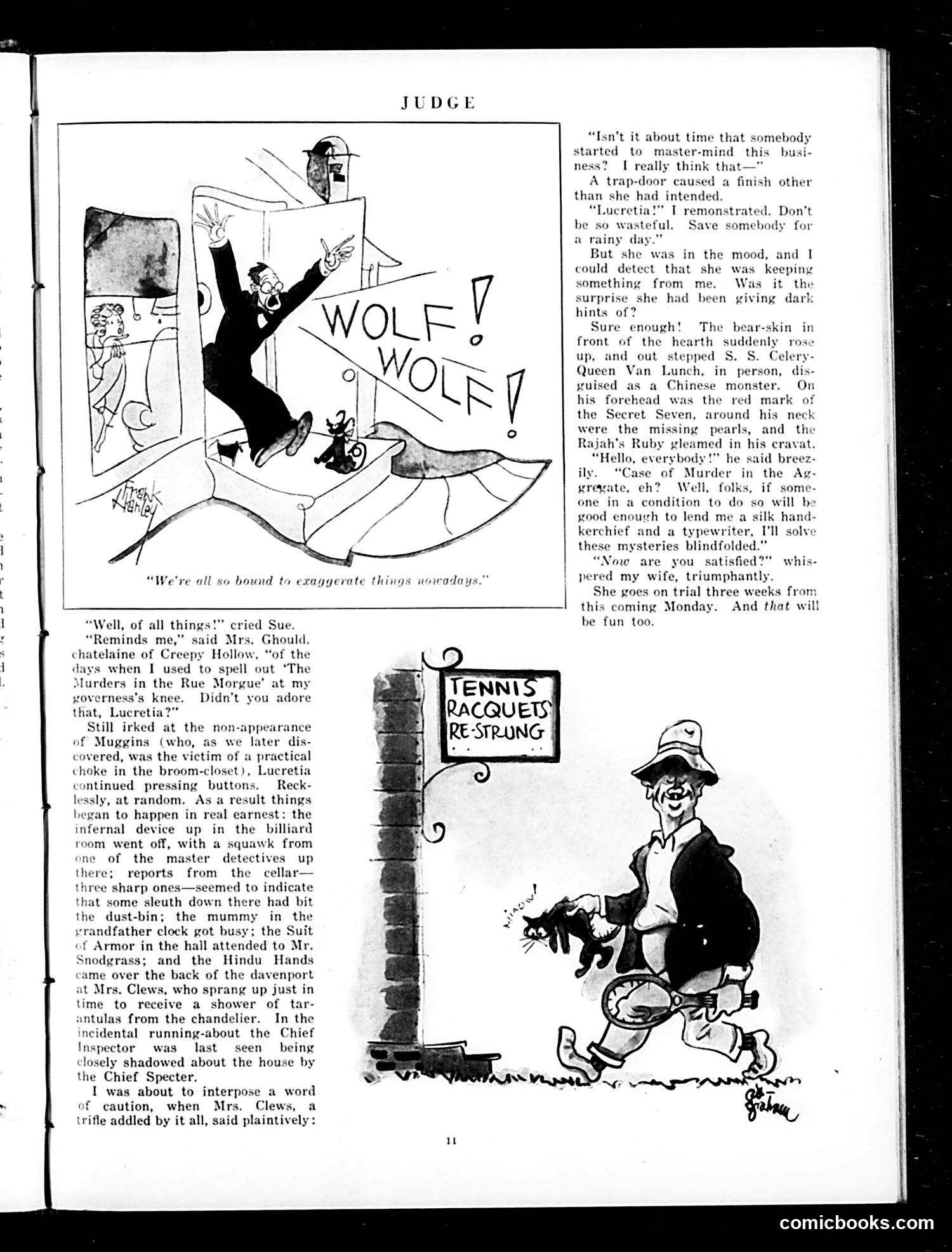
"Judge" Page Analysis This page satirizes detective fiction and mystery story conventions popular in the 1920s-30s. The main cartoon shows a man being chased by a woman yelling "WOLF! WOLF!"—mocking how mystery plots relied on exaggeration and melodrama. The accompanying text parodies elaborate detective narratives: a elaborate murder mystery unfolds at "Creepy Hollow" where characters reference classic mystery fiction (Poe's "Murders in the Rue Morgue"), and absurd chaos erupts—suits of armor attacking, tarantulas falling, mummies activating. The repeated phrase "We're all so bound to exaggerate things nowadays" is the satire's core: Judge mocks how mystery writers and their audiences had become addicted to increasingly implausible, overwrought plots. The chaotic climax—where pressing random buttons triggers simultaneous mayhem—lampoons the genre's reliance on contrived, elaborate mechanisms rather than realistic storytelling. The advertisement for "Tennis Racquets Re-Strung" provides period context but is unrelated to the satire.
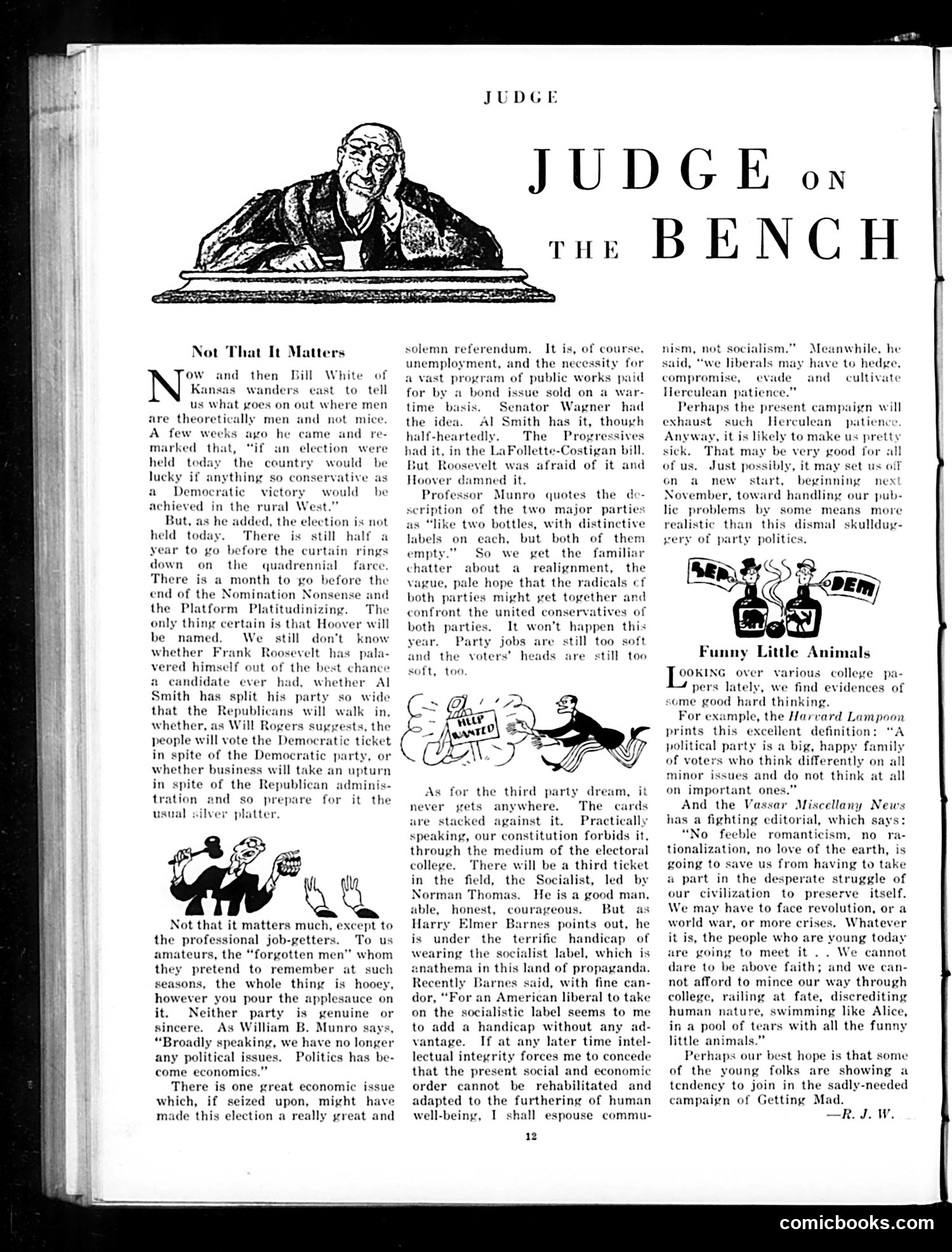
Analysis of Judge Magazine Page This 1932 editorial page satirizes American electoral politics during the Great Depression. The main article, "Not That It Matters," argues that both major parties are ideologically empty—merely different labels on identical bottles. The piece references Bill White's observation that even a "Democratic victory" would be conservative, suggesting both parties offer little real change. It dismisses the upcoming presidential election as a "quadrennial farce" where unemployment and public works remain unaddressed by both Hoover (Republican) and Roosevelt (Democrat), despite Senator Wagner and progressives proposing solutions. The satire peaks in quoting political scientist William B. Munro: modern politics has become pure "economics" with "no political issues." The cartoons (showing party machines) reinforce this cynicism about hollow party machinery. Norman Thomas and the Socialist Party are mentioned as genuine alternatives, yet handicapped by their label—even sympathetic liberals like Harry Elmer Barnes won't embrace socialism, only considering it reluctantly. The overall message: the 1932 election offers no meaningful choice between parties, leaving voters exhausted and cynical.
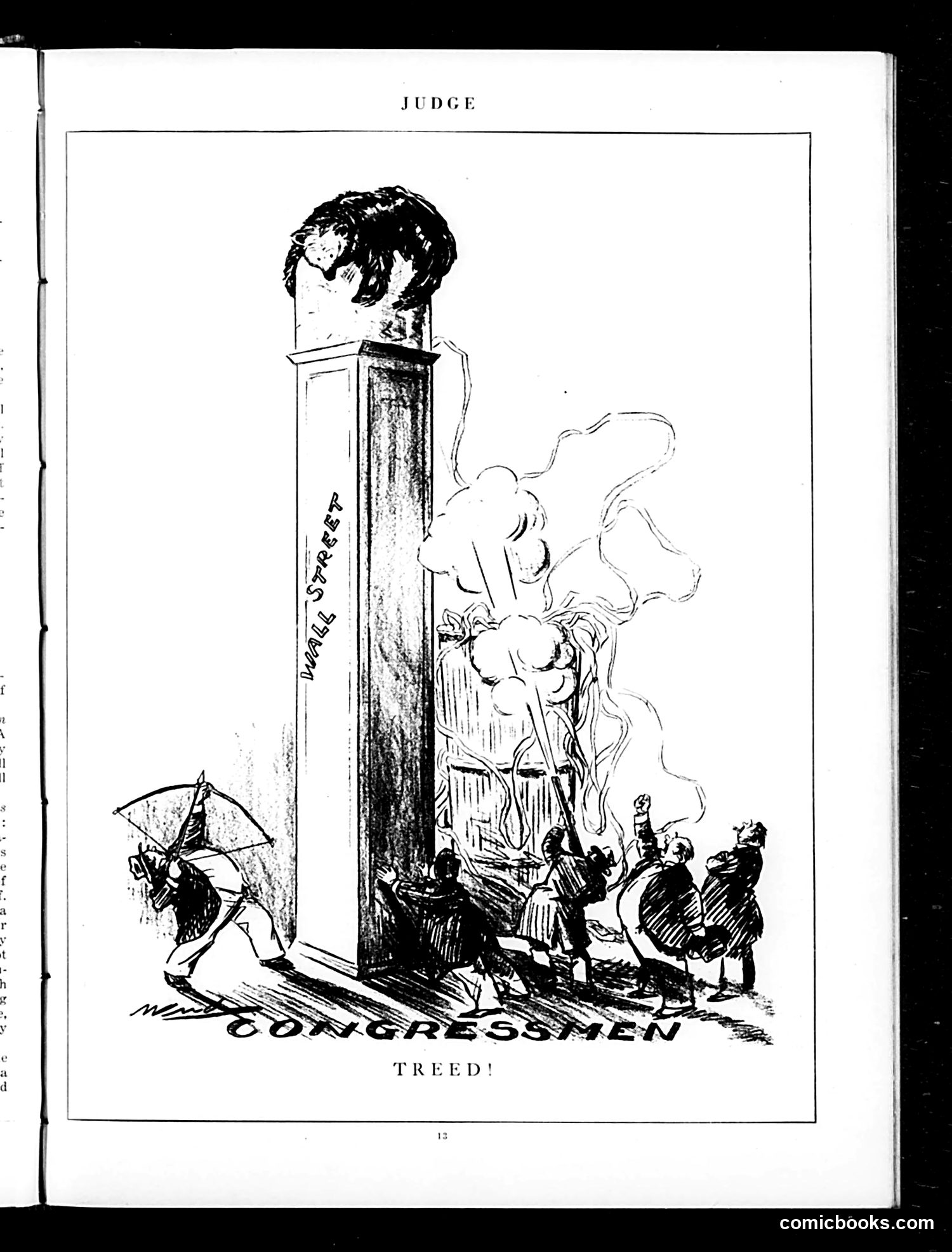
"Judge" Magazine Cartoon: "Treed!" This political cartoon depicts a large judicial figure (labeled "JUDGE") perched high on a pedestal, while below, congressmen ("CONGRESSMEN" visible on the base) appear cornered or threatened. One figure holds an umbrella in the rain, suggesting they're under attack or pressure. The satire appears to criticize Congress's relationship with the judiciary—specifically suggesting that judicial authority has become so dominant that lawmakers are "treed" (cornered, forced up a tree, or vulnerable). The Judge magazine's name makes the wordplay work: the actual judge character dominates the scene while Congress scrambles below. The cartoon likely comments on judicial overreach or activism during a specific legislative conflict, though the exact historical moment remains unclear without publication date context.
"The Theatre" — Judge Magazine Review This page is a theater criticism column by Judge magazine's drama critic, reviewing George Jean Nathan's assessment of a play (likely "Another Language" by Rose Franken, based on context clues). The critic celebrates an unexpected theatrical success: a well-written family drama about a Jewish family converted to non-Jewish characters. Despite being written by unknown playwrights and featuring unknown actors, the play impressed everyone—critics included—which the author uses to mock theater critics' supposed prejudices. The satire targets critical pretension: critics expected the production to fail because it came from unknowns, yet the play's genuine merit forced them to praise it anyway. The piece humorously suggests critics approach unfamiliar work with "thumbs crossed" rather than open minds, only to be pleasantly surprised. This reflects broader Jazz Age skepticism about cultural gatekeepers and establishment taste-making.
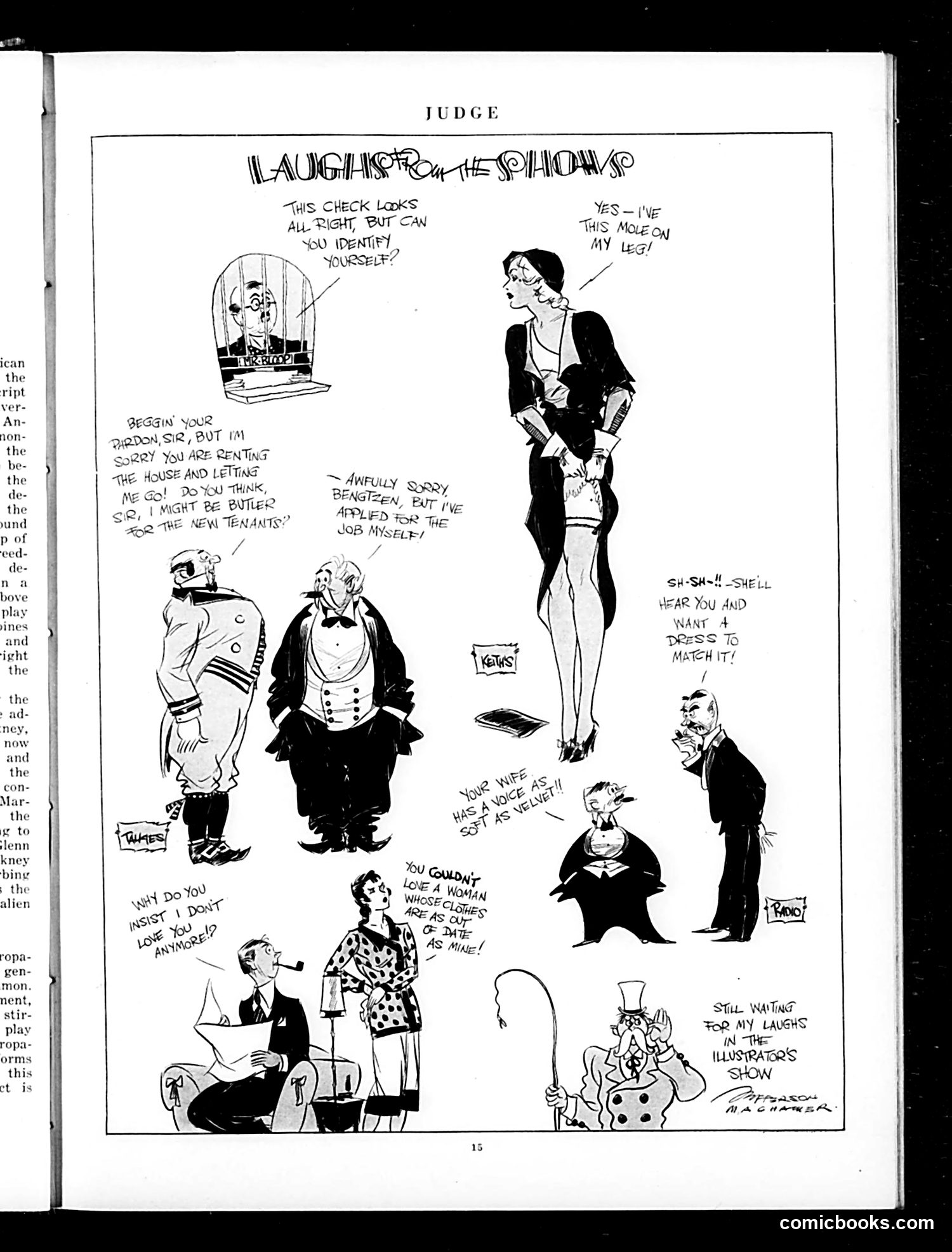
"Laughs at the Shows" This comic page satirizes early 20th-century American social anxieties about wealth, identity, and class boundaries. The central joke involves a woman trying to rent a house who cannot prove her identity with a check—a commentary on how the newly wealthy (possibly including women gaining financial independence) lacked the social credentials traditional society demanded. The surrounding vignettes mock various social pretensions: a man hoping to become a butler for "new tenants," characters debating whether women's clothing is appropriate, and references to marital dynamics and household staff. The title suggests these are theatrical scenarios or comedic "shows" about modern urban society. The satire targets both the aspiring lower classes seeking upward mobility and the established wealthy protecting social hierarchies through identity verification and dress codes—reflecting anxiety about rapid social change in the Jazz Age.
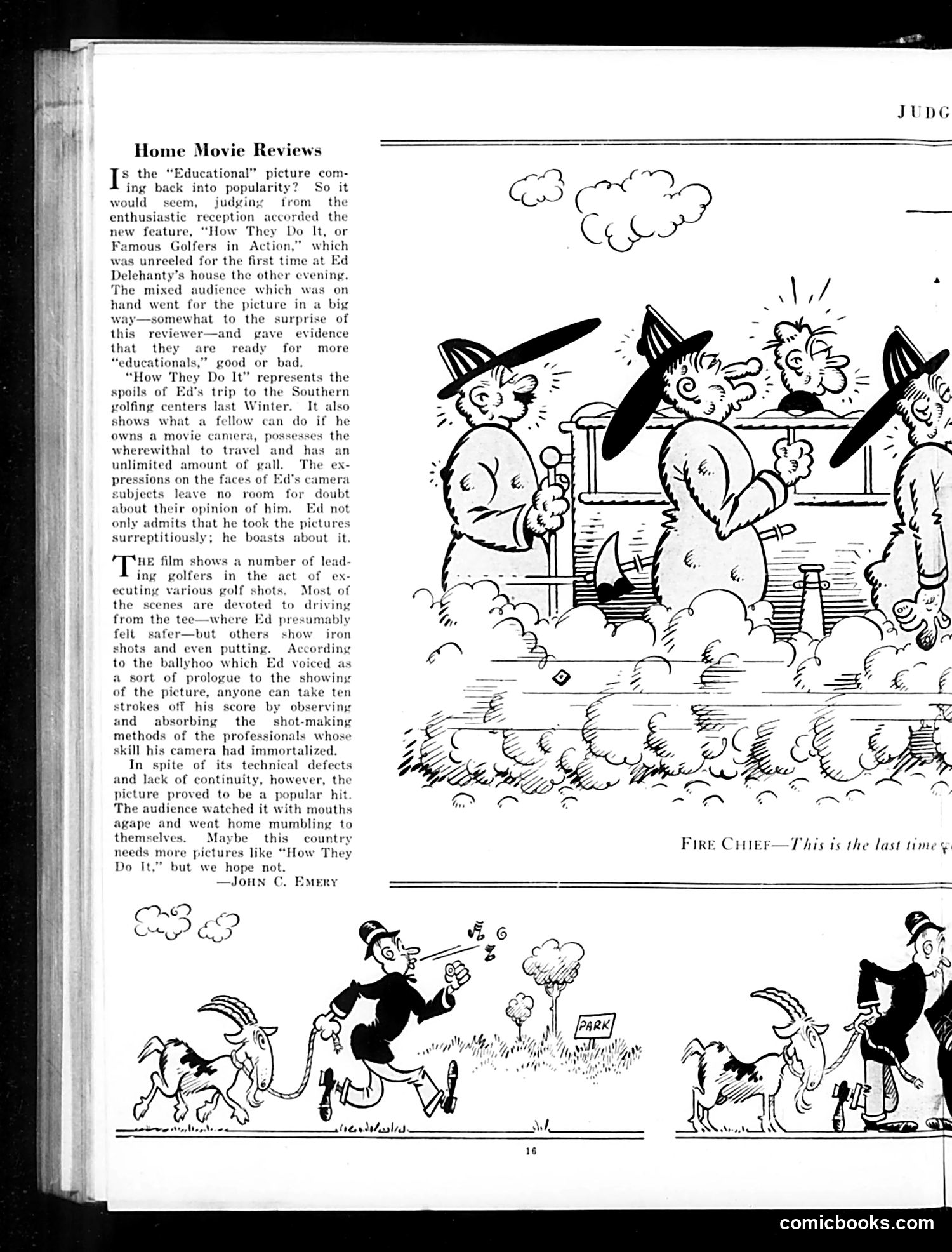
Home Movie Reviews Analysis This page reviews "How They Do It, or Famous Golfers in Action," an amateur educational film shot by Ed Delehanty featuring famous golfers at Southern golf courses. The reviewer (John C. Emery) discusses how the film, screened at Delehanty's house, unexpectedly succeeded with a mixed audience despite technical flaws. The review highlights Delehanty's candid camera work—he admits to filming golfers surreptitiously and boasts about it. The film shows golf techniques (drives, iron shots, putting) with the implicit claim viewers can improve their game by studying professional methods. Eméry notes the film proved popular despite poor technical quality and continuity, with audiences leaving impressed. However, he expresses hope this "educational" home-movie trend doesn't proliferate, suggesting skepticism about amateur filmmaking's cultural value. The cartoons below appear unrelated gag illustrations, likely featuring recurring Judge magazine characters.
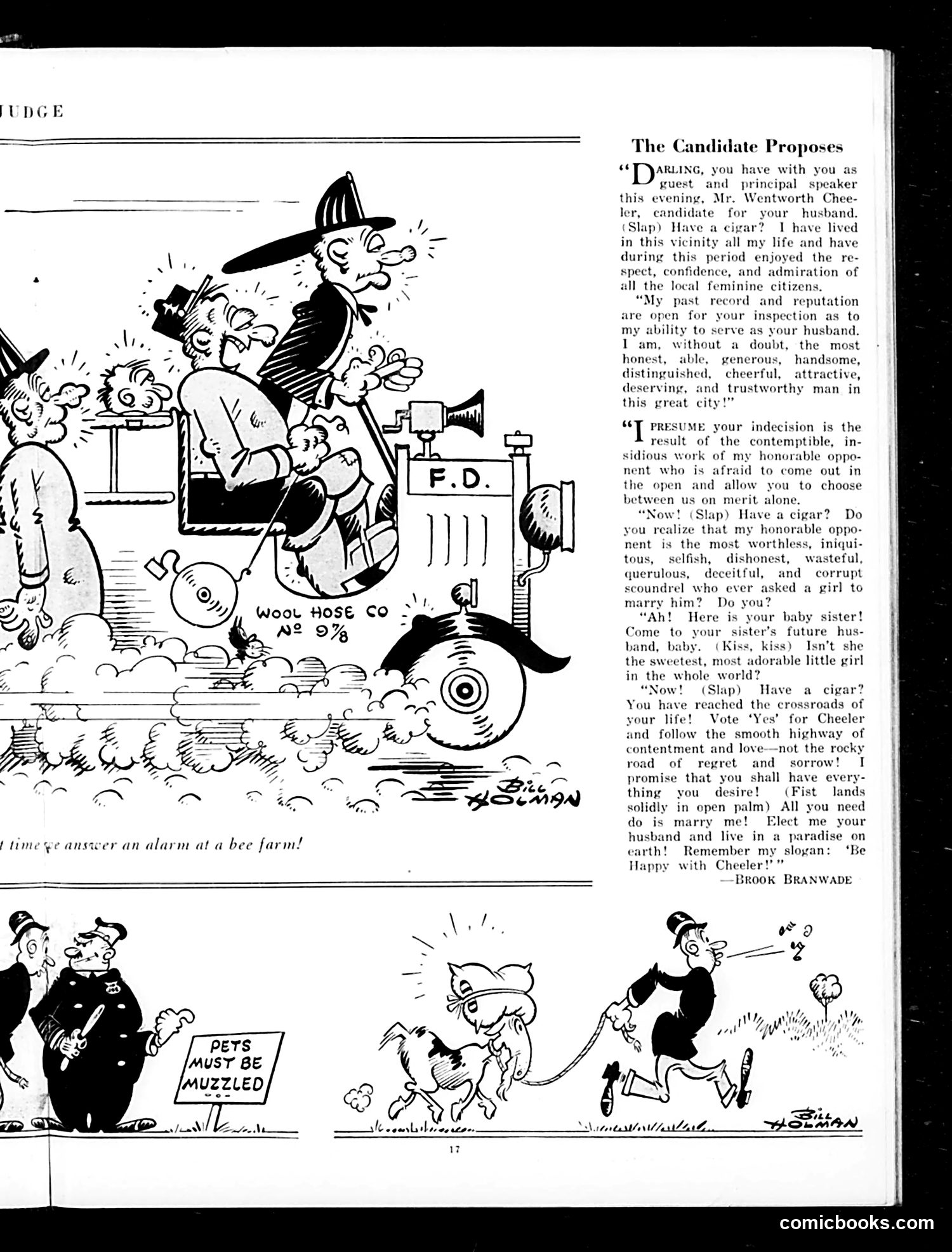
Political Satire: "The Candidate Proposes" This Judge magazine page satirizes political campaigning through a candidate (Wentworth Cheeler) making a marriage proposal. The satire works by treating courtship exactly like electoral politics: he delivers bombastic speeches praising himself while viciously attacking his "honorable opponent," offers bribes (cigars), makes absurd promises ("you shall have everything you desire"), and manipulates by appealing to sentiment (kissing the sister). The humor targets how candidates make contradictory, exaggerated claims and resort to character assassination. The candidate's rhetoric is transparently insincere—he praises his opponent's unworthiness in the same breath he calls him "honorable." By mapping campaign tactics onto marriage, the cartoonist suggests both situations involve similar manipulation and empty rhetoric. The bottom panels show related gags about political conduct ("Pets Must Be Muzzled").
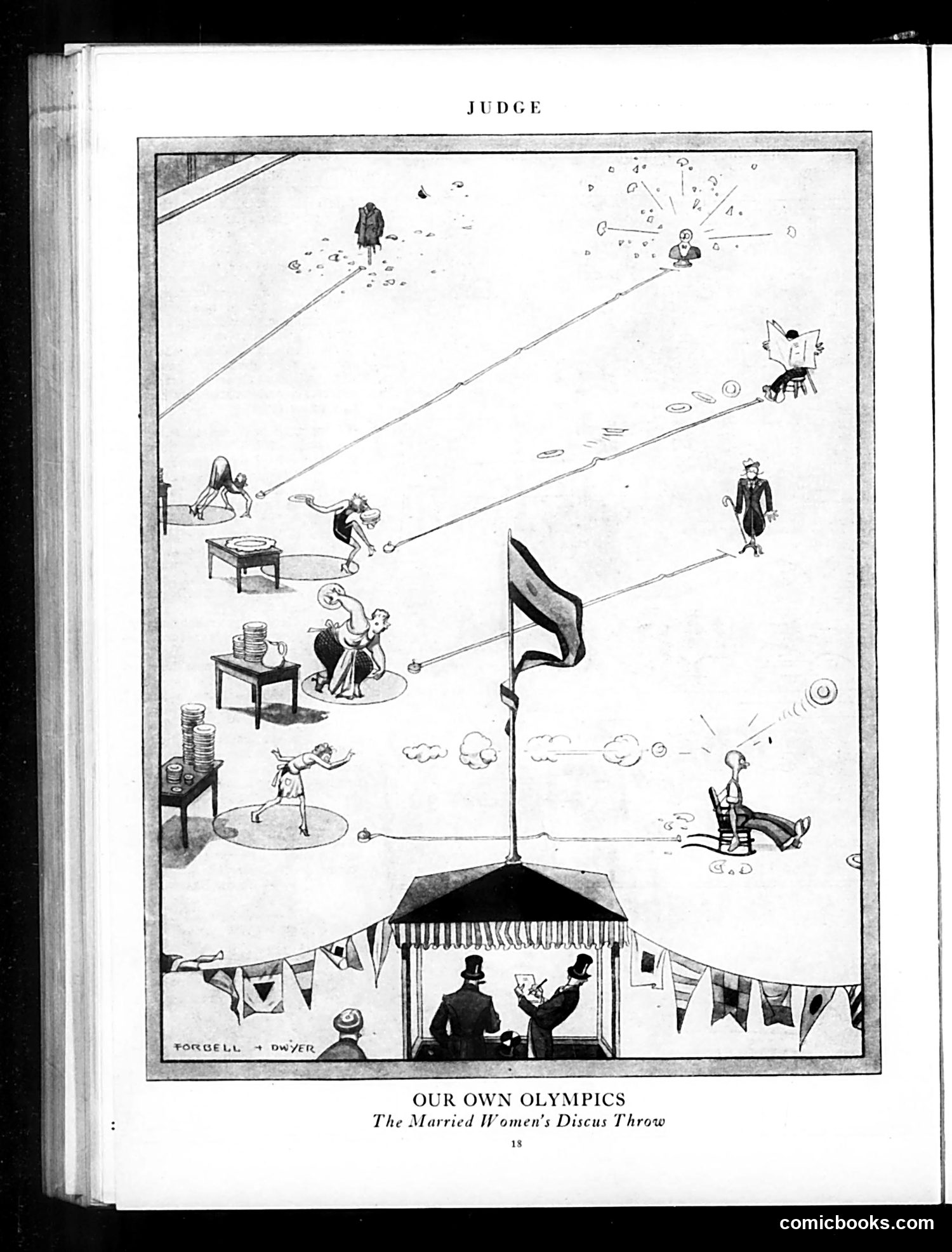
This satirical cartoon from Judge magazine depicts "Our Own Olympics: The Married Women's Discus Throw." The illustration shows various domestic scenes arranged like Olympic events, with married women literally throwing household objects—dishes, pots, and other kitchenware—as if competing in an athletic competition. The satire targets early 20th-century gender roles and marriage dynamics. The joke plays on women's frustration within domestic life, humorously suggesting that married women's "natural" Olympic event would involve the objects of their housework. Judges at a viewing stand oversee these "competitions." The cartoon satirizes both rigid domesticity and the emerging women's suffrage/Olympic participation movements of the era, mocking the notion that women's athletic competition was somehow unnatural while women's domestic labor was considered their proper sphere.
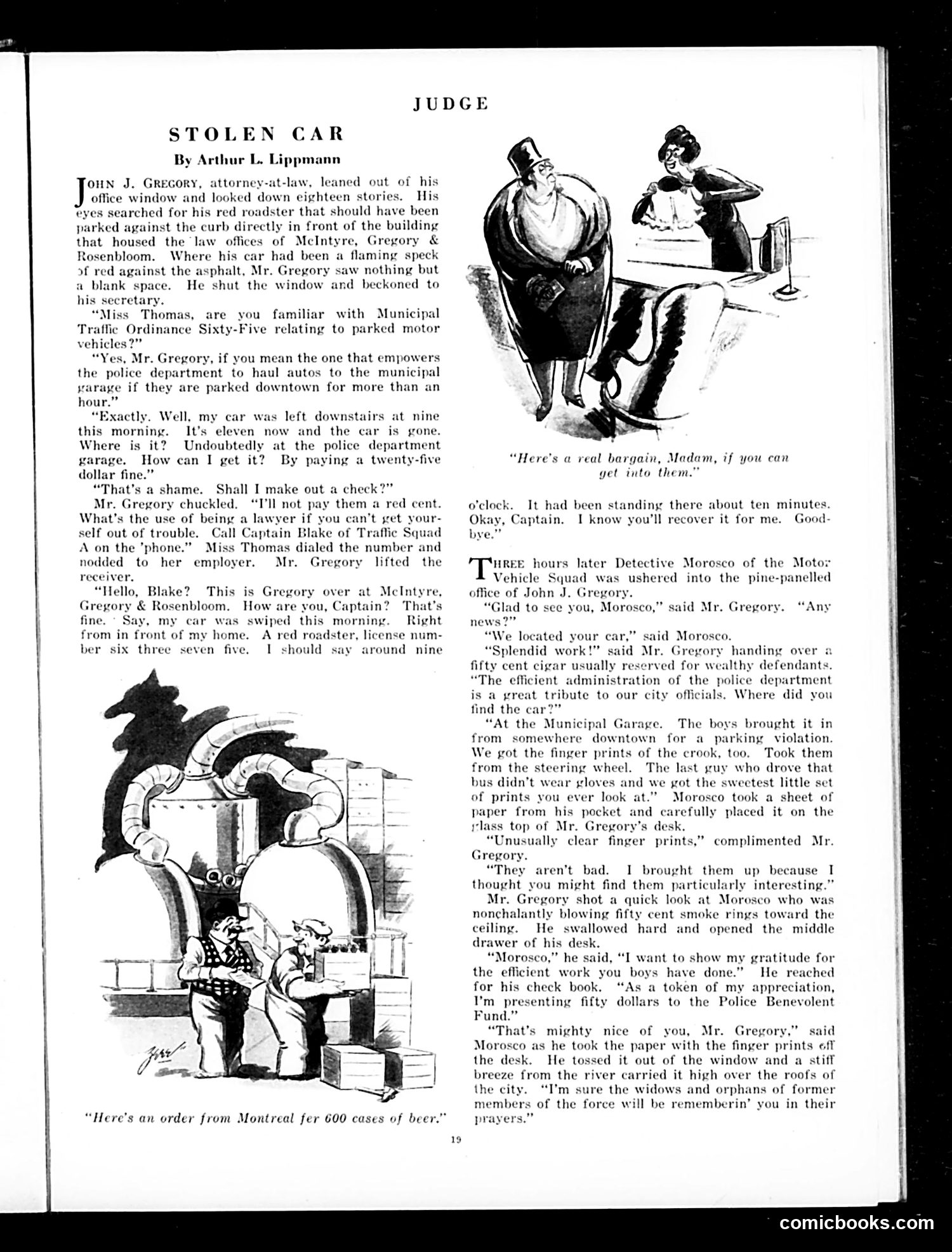
"Stolen Car" — Judge Magazine Satire This story satirizes corruption and hypocrisy among the privileged class. Attorney John Gregory's car is impounded for a parking violation—a rule enforced on ordinary citizens. Rather than pay the $25 fine, Gregory uses his connections to call Captain Blake of Traffic Squad, expecting special treatment. Detective Morosco arrives with fingerprints from the steering wheel, implying Gregory himself drove the car illegally. Gregory recognizes the trap: Morosco has caught him breaking the law he profits from defending others against. Rather than face consequences, Gregory "donates" $50 to the Police Benevolent Fund and symbolically destroys the evidence by tossing the fingerprints out the window. The satire targets how wealthy lawyers and connected citizens evade justice through money and influence, while ordinary people face strict enforcement. Morosco's final sardonic comment about "widows and orphans" underscores the moral corruption involved.
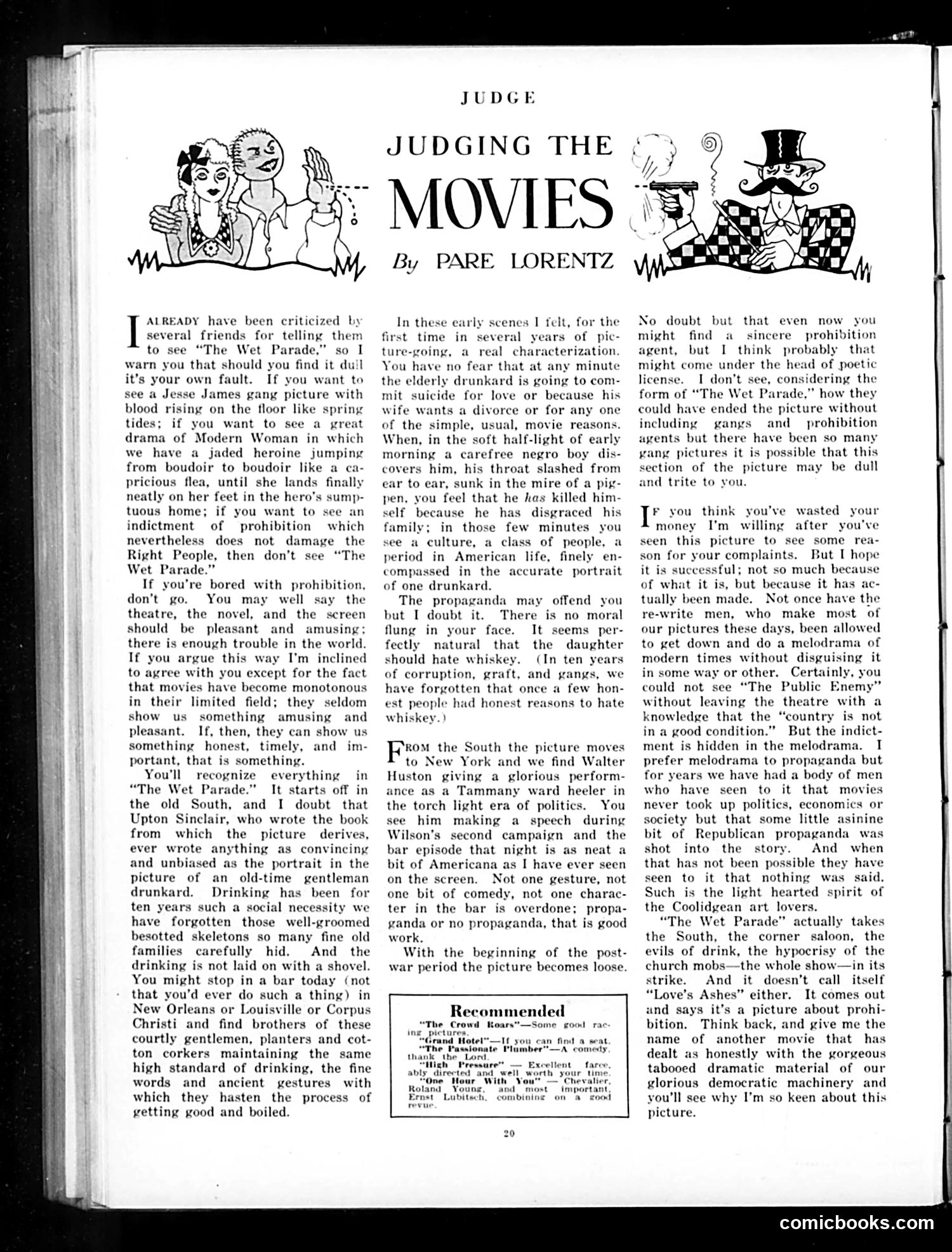
Analysis of "Judging the Movies: The Wet Parade" This is a film review by Pare Lorentz of *The Wet Parade*, a 1932 prohibition-era drama adapted from Upton Sinclair's novel. The cartoons flanking the title depict exaggerated, comedic characters—likely representing different social types affected by alcohol. Lorentz argues that *The Wet Parade* succeeds where most films fail by presenting honest social criticism rather than melodrama. He praises its unflinching portrayal of a Southern gentleman's alcoholism and suicide, and Walter Huston's performance as a Tammany Hall ward heeler during Wilson's presidency—capturing authentic political corruption without caricature. The satire targets both prohibition advocates and cinema critics: Lorentz warns purists who oppose "message pictures" while defending art that addresses real social problems. He critiques how American audiences have forgotten prohibition's legitimate moral foundations after a decade of "social necessity" drinking among respectable families. The review suggests *The Wet Parade* succeeds through specificity and restraint—depicting actual American life rather than contrived Hollywood sentiment.
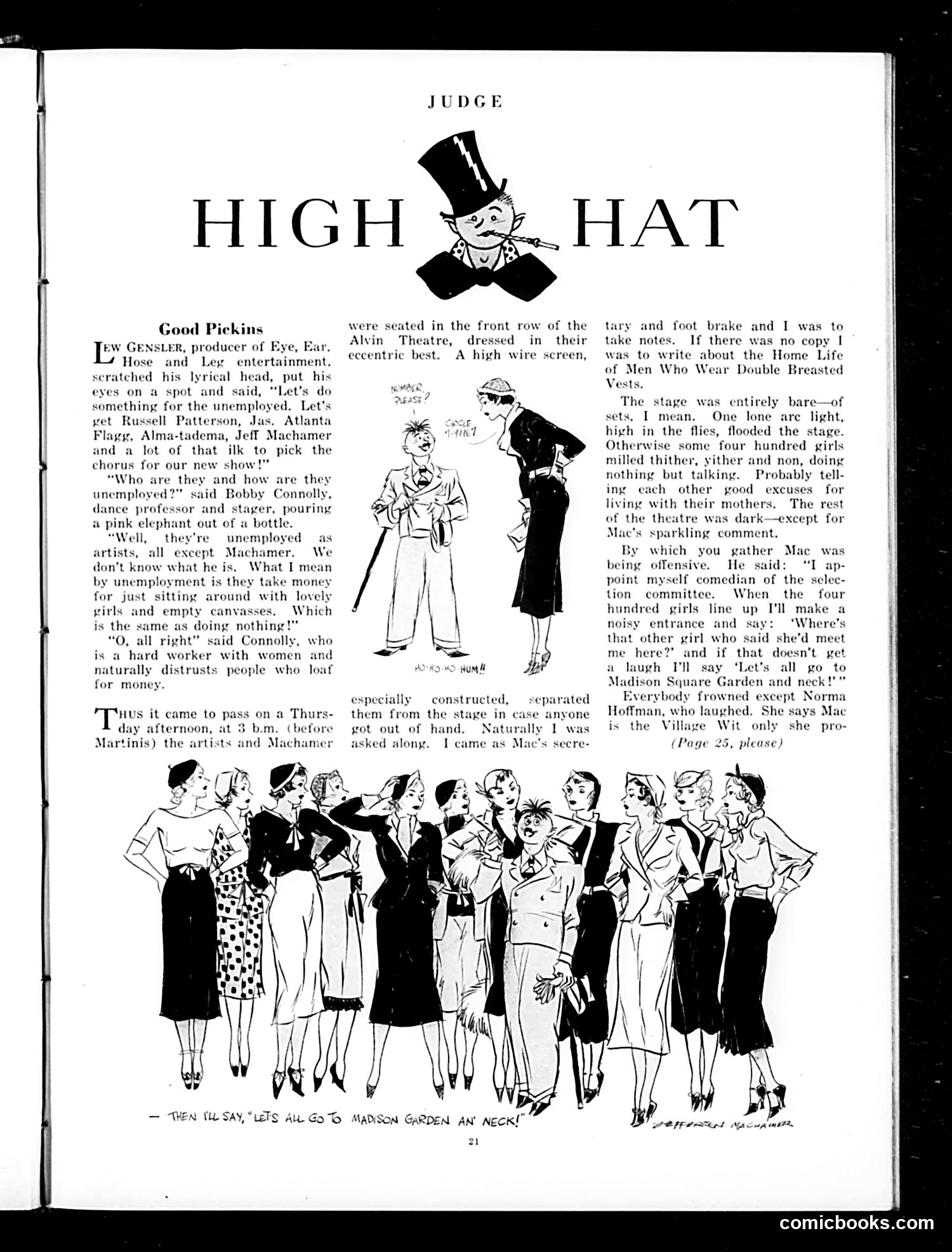
Judge Magazine: "High Hat" — Entertainment Industry Satire This page satirizes 1920s theatrical casting practices and artistic pretension. Producer "Ew Gensler" proposes hiring unemployed artists (painters Russell Patterson, James Montgomery Flagg, and others) to select chorus girls for a show—a scheme mocking both the Depression-era job crisis and artists' perceived worthlessness ("doing nothing"). The humor targets artistic snobbery: Bobby Connolly dismisses artists as people who take money for "sitting around with lovely girls and empty canvasses." The story describes a chaotic audition where hundreds of girls mill about talking, with Mac (apparently the show's comedian, though his identity is unclear) making crude jokes about Madison Square Garden and "necking" to get laughs. The satire works on multiple levels: unemployment relief turned absurd, artists' elitism deflated, and show-business vulgarity exposed. The illustrations show fashionably dressed women and the theatrical chaos being described.
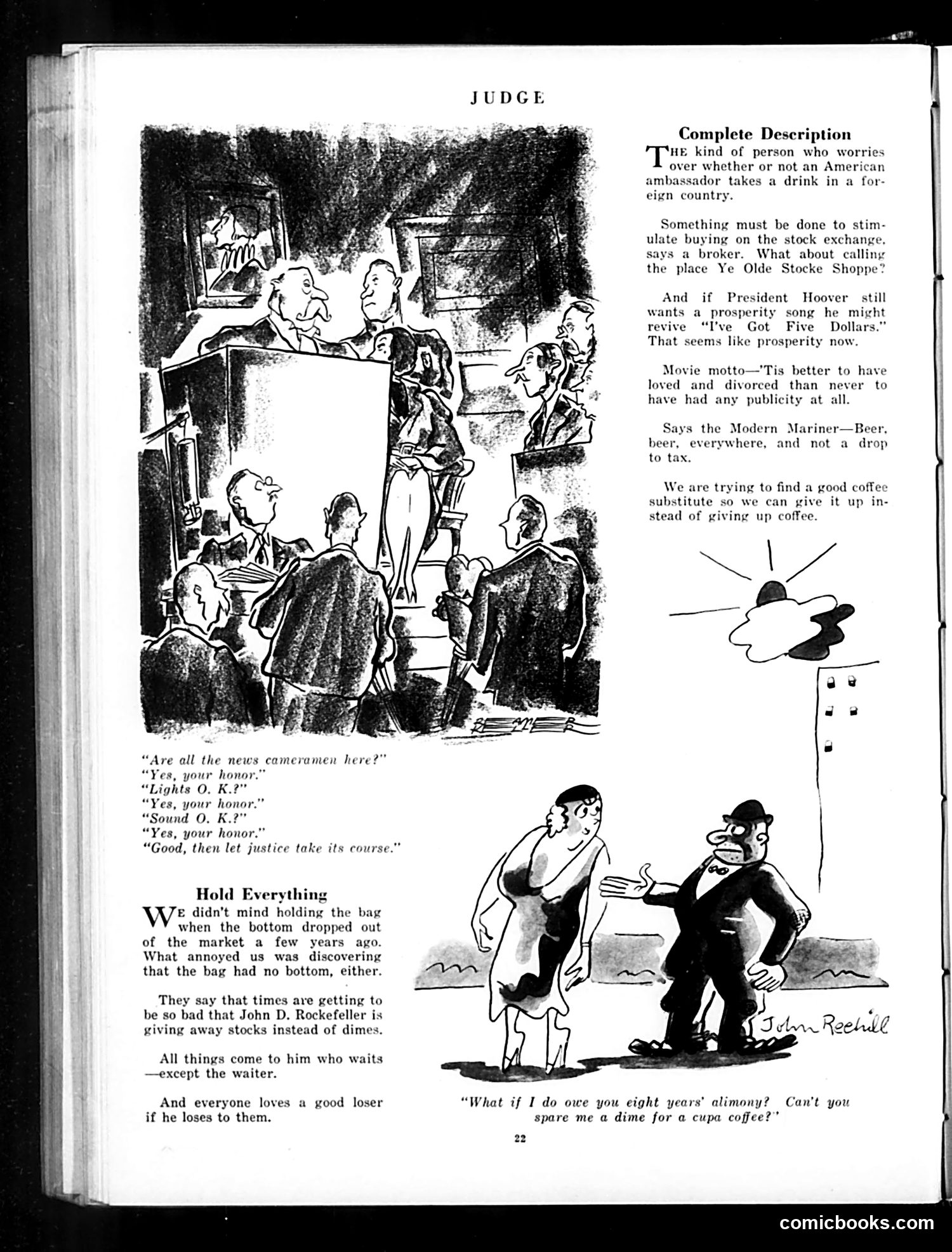
Judge Magazine Page Analysis This page contains satirical commentary on early 1930s American life, likely during the Great Depression. The main cartoon depicts a courtroom scene where a judge has carefully arranged cameras and sound equipment—suggesting justice has become theatrical performance rather than principle. The caption's exchange about "Lights O.K.?" and "Sound O.K.?" mocks how trials had become media spectacles. The accompanying text snippets mock various Depression-era concerns: stock market collapse (the "bag with no bottom"), Prohibition's failure ("beer everywhere, and not a drop to tax"), and President Hoover's failed prosperity messaging. The bottom cartoon shows a man dodging alimony payments by asking for spare change, satirizing how economic hardship justified abandoning obligations. Overall, Judge presents bitter humor about a society where media spectacle replaces justice, markets have failed, and individual responsibility erodes under financial pressure.
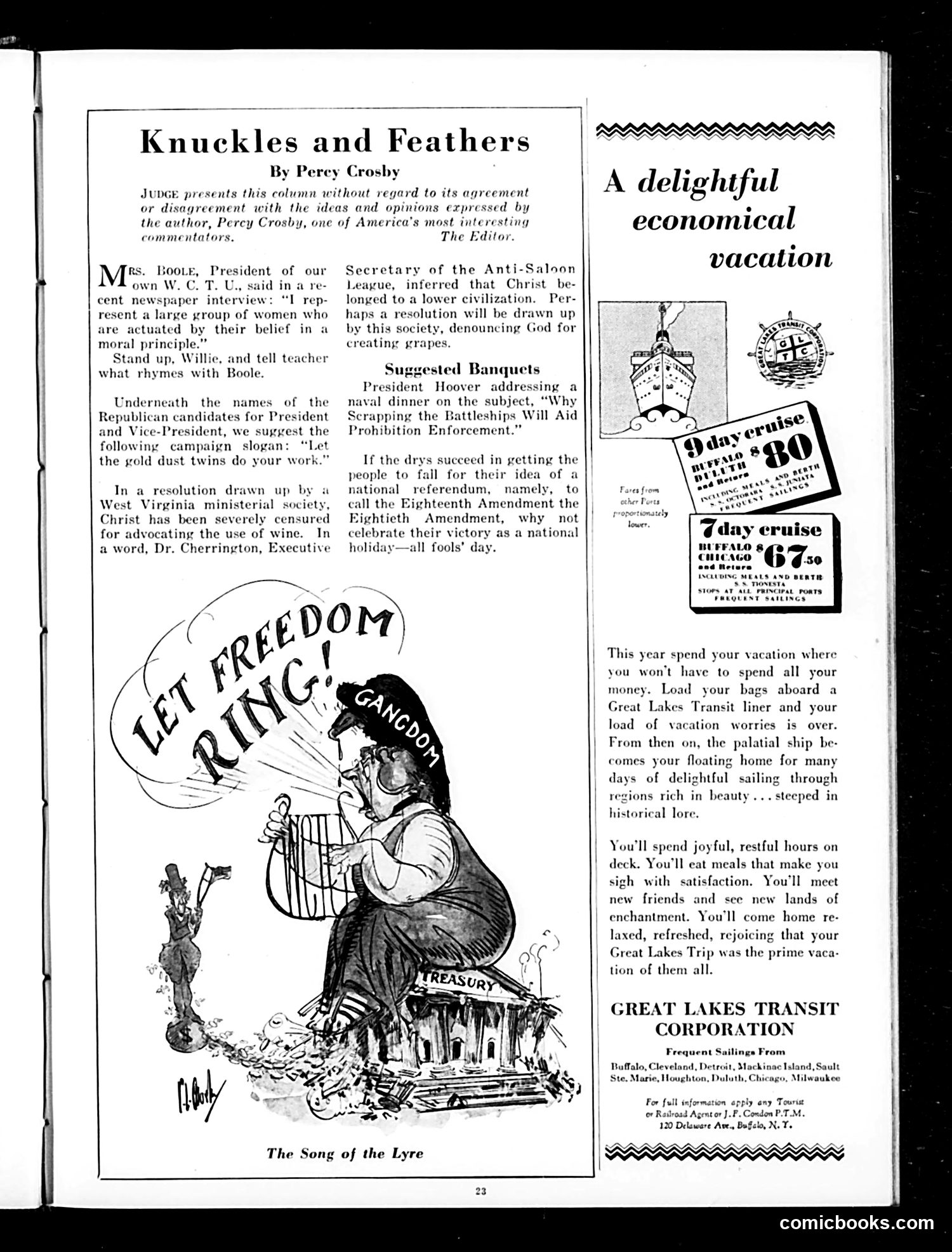
"Knuckles and Feathers" Analysis This page from *Judge* magazine features satirical commentary by Percy Crosby attacking Prohibition and dry (anti-alcohol) advocates. The main cartoon depicts Ganymede (a classical figure, representing youth/beauty) being struck by a figure representing the Anti-Saloon League or Prohibition movement. The caption "Let Freedom Ring!" is ironic—the cartoon argues Prohibition restricts freedom. The text mocks specific dry activists: Dr. Cherrington of the Anti-Saloon League is ridiculed for implying Christ belonged to a "lower civilization" for creating wine. The piece sarcastically suggests dry leaders should denounce God himself for creating grapes. Crosby also proposes mock "banquets" titled satirically (like renaming the 18th Amendment the "Eighteenth Amendment" as a fool's holiday), further lampooning Prohibition enforcement logic. The right side contains unrelated cruise ship advertising—standard *Judge* magazine fare. Context: This reflects 1920s-30s anti-Prohibition sentiment among urban, educated readers who viewed the movement as moralistic overreach.
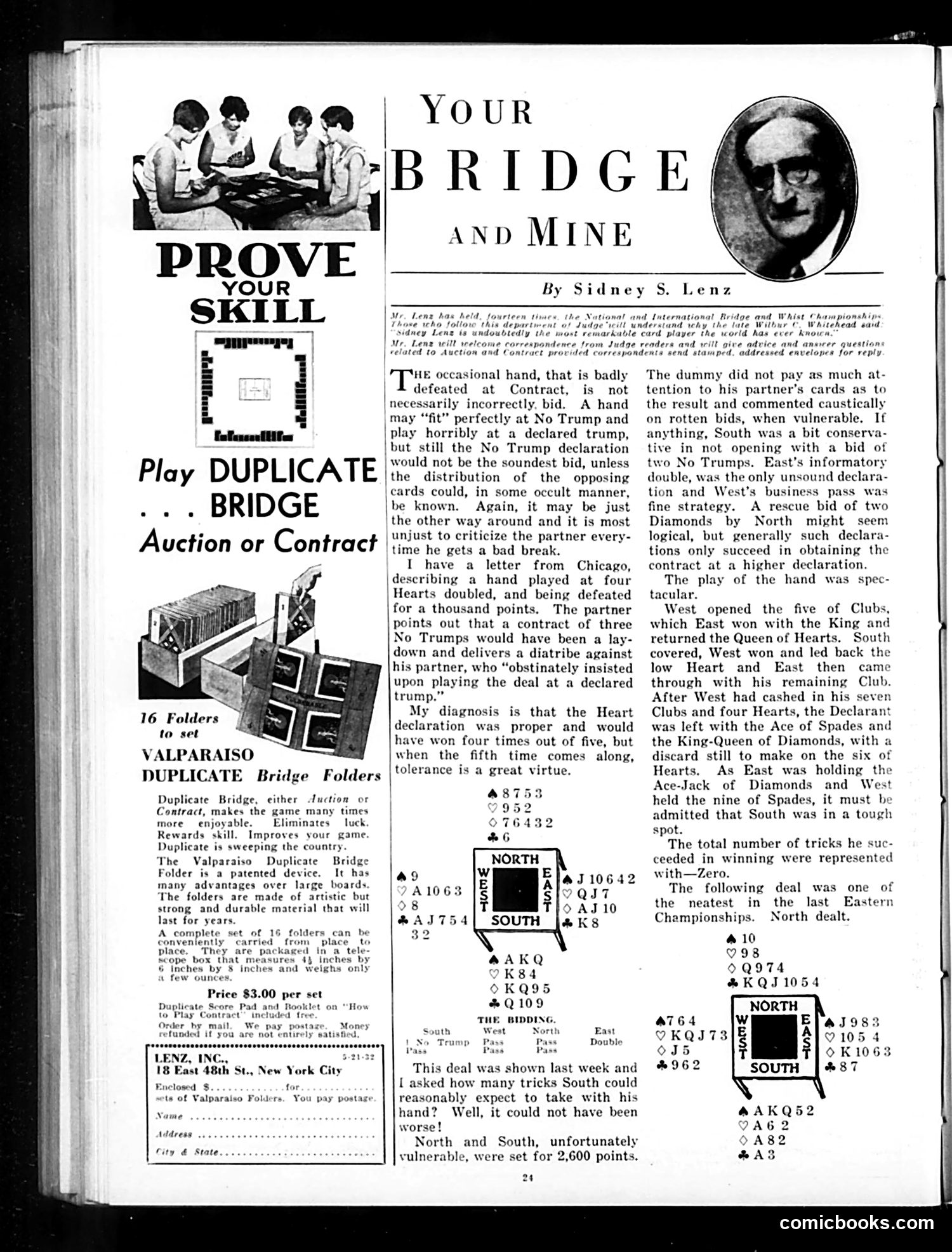
Judge Magazine Page Analysis This page combines bridge instruction advertising with a bridge column by Sidney S. Lenz, a famous bridge champion. The left side advertises Valparaiso Duplicate Bridge Folders—a patent device for organizing bridge hands to eliminate luck and reward skill. The column itself isn't satirical; it's educational content analyzing specific bridge hands and bidding decisions. Lenz uses real game examples to critique players' decisions. In one featured hand, a partnership bid Four Hearts doubled but failed by 1,000 points; Lenz argues the bid was mathematically sound even though it failed that particular time, emphasizing that tolerance for partner mistakes is important. The page reflects bridge's popularity in early-to-mid twentieth century American culture as both a serious competitive game and a parlor activity. The advertising emphasizes how duplicate bridge "eliminates luck" and "rewards skill"—appealing to players wanting intellectual challenge rather than chance.
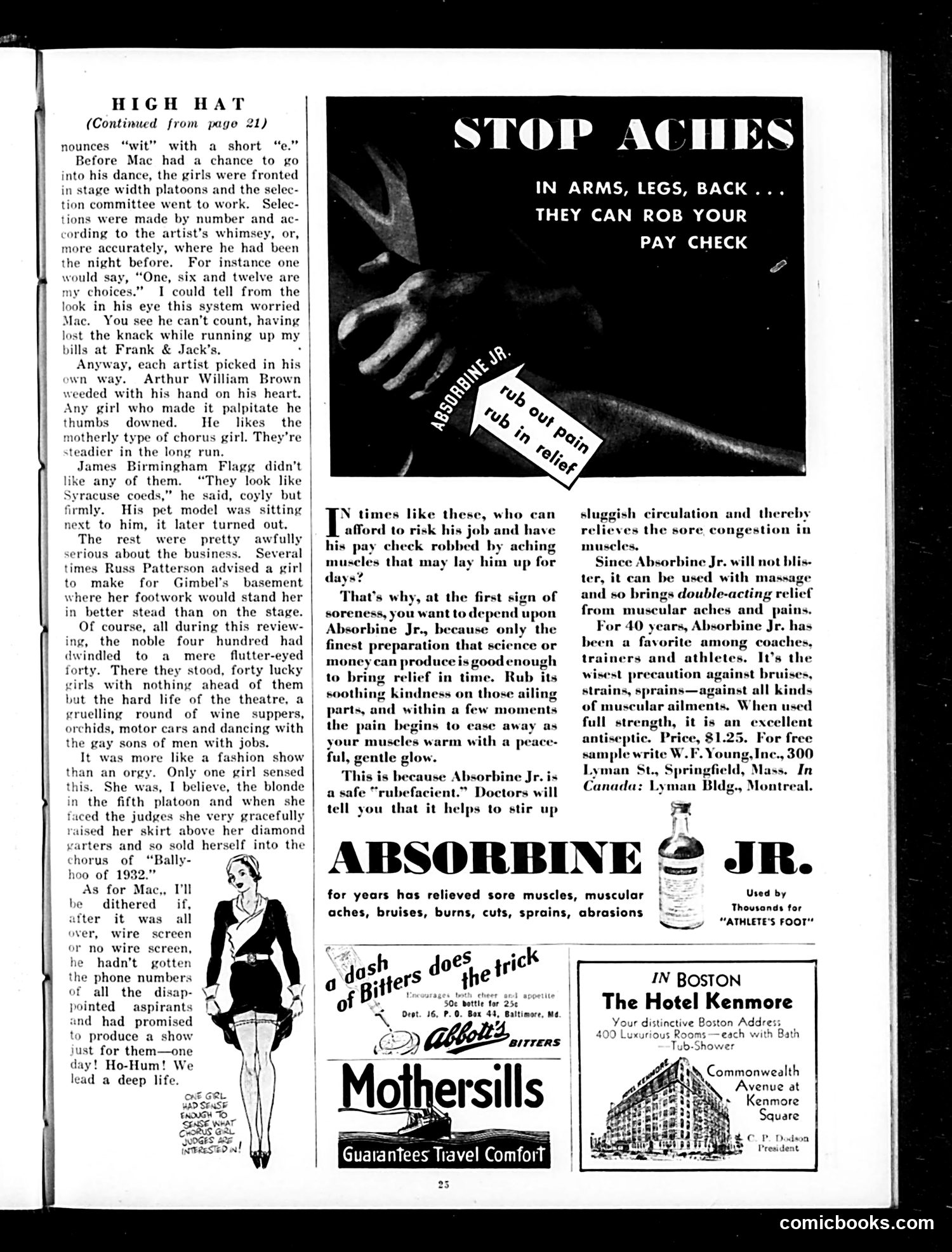
"High Hat" Page Analysis This page contains a mixed feature: the conclusion of a satirical article about theatrical chorus girl auditions, plus period advertisements. The "High Hat" article satirizes 1930s Broadway casting practices. It describes how famous artists (including James Montgomery Flagg, a renowned illustrator) judge chorus girls by arbitrary, subjective criteria—one selector admits he bases choices on "where he had been the night before." The satire mocks both the absurdity of the selection process and the grim reality facing the chosen girls: a life of "wine suppers, orchids, motor cars" alongside exhausting theater work. One girl's desperate bid to stand out—raising her skirt above her garter line—exemplifies how women commodified themselves in that era. The advertisements (Absorbine Jr. liniment, Mothersills travel remedy, Hotel Kenmore) are typical 1930s marketing, with the Absorbine ad notably targeting working men worried about muscle aches affecting their paychecks—reflecting Depression-era economic anxiety.
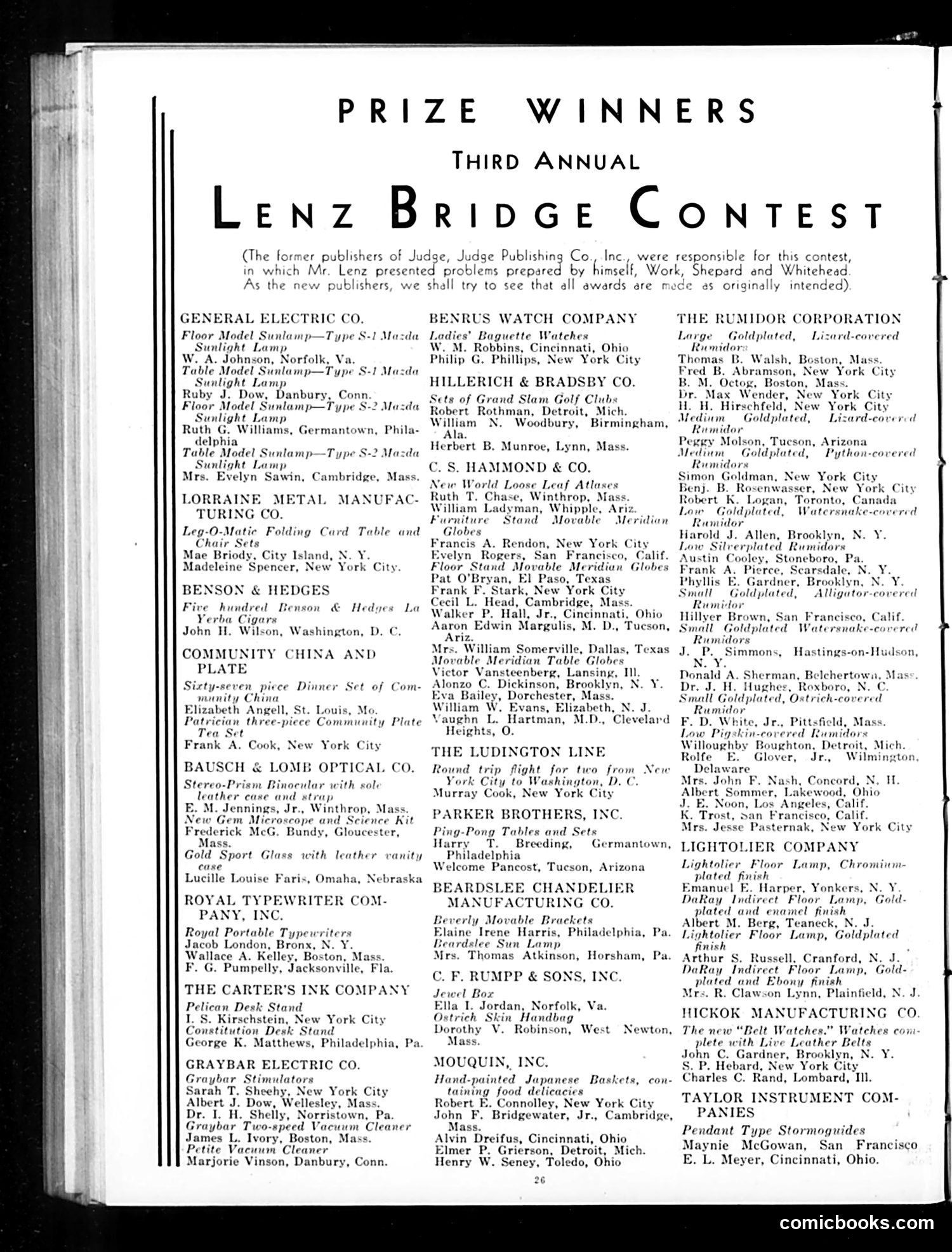
This is a prize-winners announcement page for Judge magazine's Third Annual Lenz Bridge Contest—a puzzle or problem-solving competition apparently featuring bridge-related challenges. The page lists winners' names alongside commercial prizes donated by companies like General Electric, Royal Typewriter, Bausch & Lomb, and others. Rather than containing editorial cartoons, this page functions as a results/advertisement hybrid: it announces contest winners while promoting the products they've won, thereby serving double-duty as both editorial content and advertising. The note clarifies that Judge Publishing Co. (the "former publishers") had created the original contest. This represents a common Judge magazine practice of monetizing content through sponsored contests and product placement, blending editorial credibility with commercial promotion.
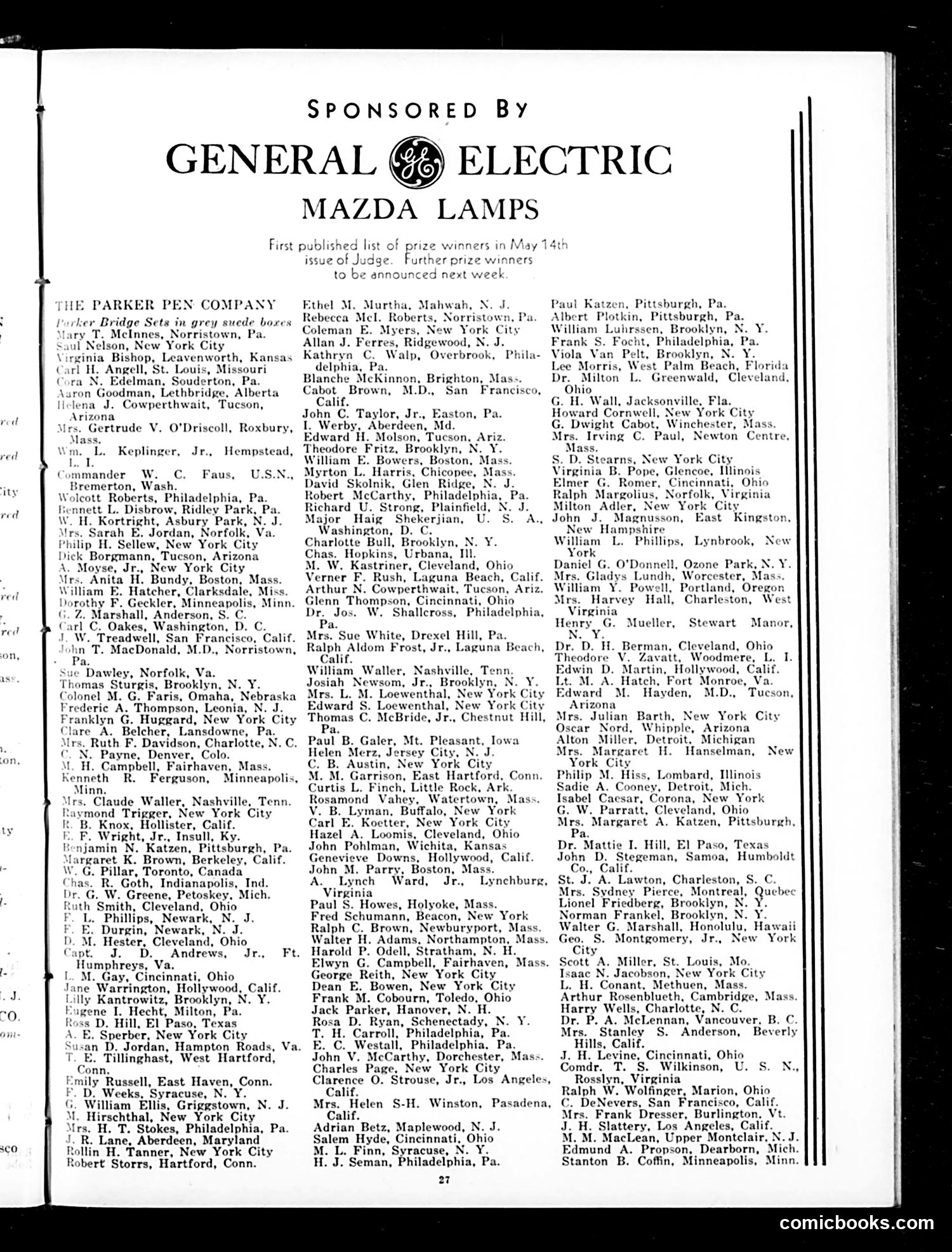
This page is primarily a contest winners list, not a cartoon or satirical content. It's a title page/advertisement sponsored by General Electric (Mazda Lamps) and The Parker Pen Company, announcing prize winners from Judge magazine. The text states this is the "First published list of prize winners in May 14th issue of Judge" with "Further prize winners to be announced next week." The bulk of the page consists of hundreds of names and addresses of contest winners from across the United States and Canada. There are no visible cartoons, caricatures, or satirical elements to analyze on this page—it's purely administrative/promotional content. The satire that Judge magazine was known for would appear elsewhere in that issue, not on this winners announcement page.
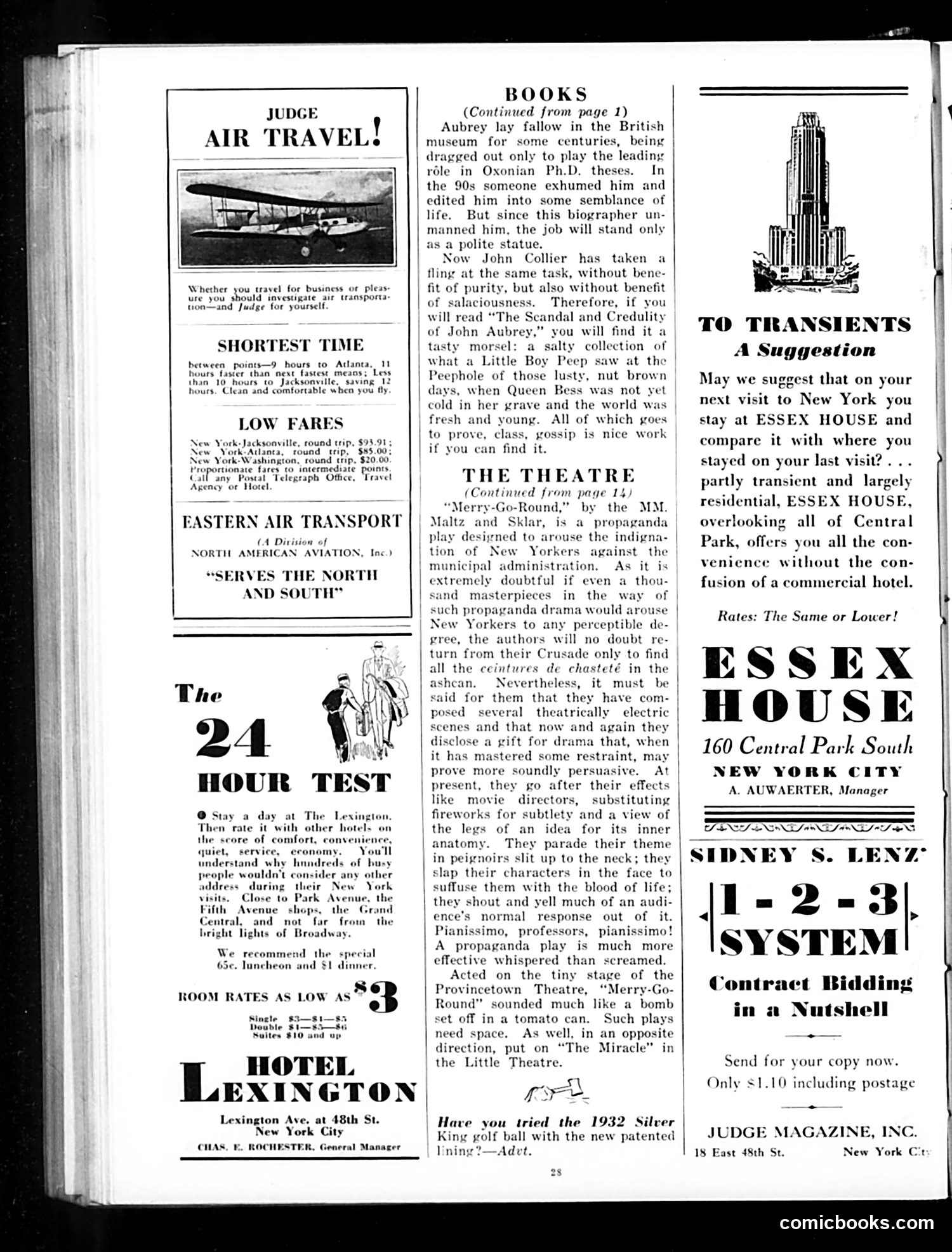
JUDGE Magazine Page Analysis This is primarily an advertising and entertainment page from Judge magazine, likely from the early 1930s. Rather than a political cartoon, it features several advertisements interspersed with short entertainment reviews. Key content: The "Judge Air Travel!" advertisement promotes Eastern Air Transport flights, emphasizing speed and comfort as reasons to fly—reflecting the era's novelty and glamour of commercial aviation. The theatre section critiques a 1930s radical play called "Merry-Go-Round" by Maltz and Sklar, which aimed to arouse New Yorkers' "indignation" against municipal administration. The reviewer dismisses its propagandistic intent while grudgingly praising its theatrical electricity, though faulting its over-the-top directorial approach. This reflects contemporary debates about political theater. The remaining content advertises New York hotels (Lexington, Essex House) and includes book reviews. Historical context: This captures 1930s America's modernization enthusiasm (aviation), emerging leftist theatre movements, and the magazine's target audience of affluent New Yorkers.
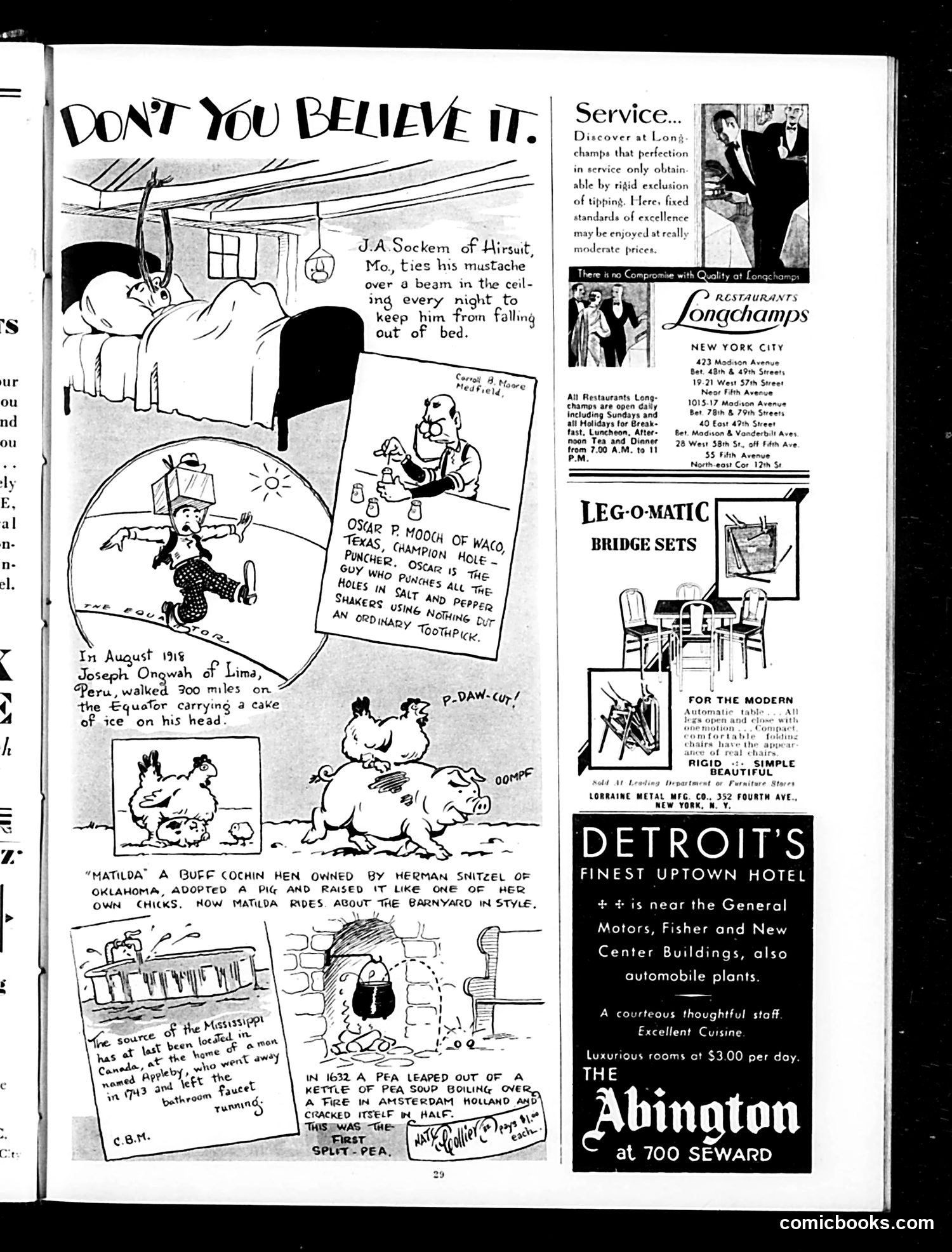
"Don't You Believe It" - Judge Magazine Page Analysis This page features a humorous column presenting absurd, implausible anecdotes supposedly from real people. The joke is in the title itself: readers are invited to disbelieve these tall tales. Examples include a Missouri man tying his mustache to a ceiling beam nightly to prevent falling out of bed, a Peruvian walking 300 miles balancing ice on his head, a hen raising a piglet, and a pea leaping from soup and splitting itself in Amsterdam in 1632. The cartoons accompanying these stories use exaggerated drawings to emphasize the ridiculousness. This was a popular satirical format of the 1910s-20s era—presenting deliberately false or wildly improbable claims as fact, relying on readers' skepticism for humor. The page also contains period advertisements for Longchamps restaurants, Leg-o-Matic bridge table sets, and the Abington Hotel in Detroit, typical of Judge's revenue model.
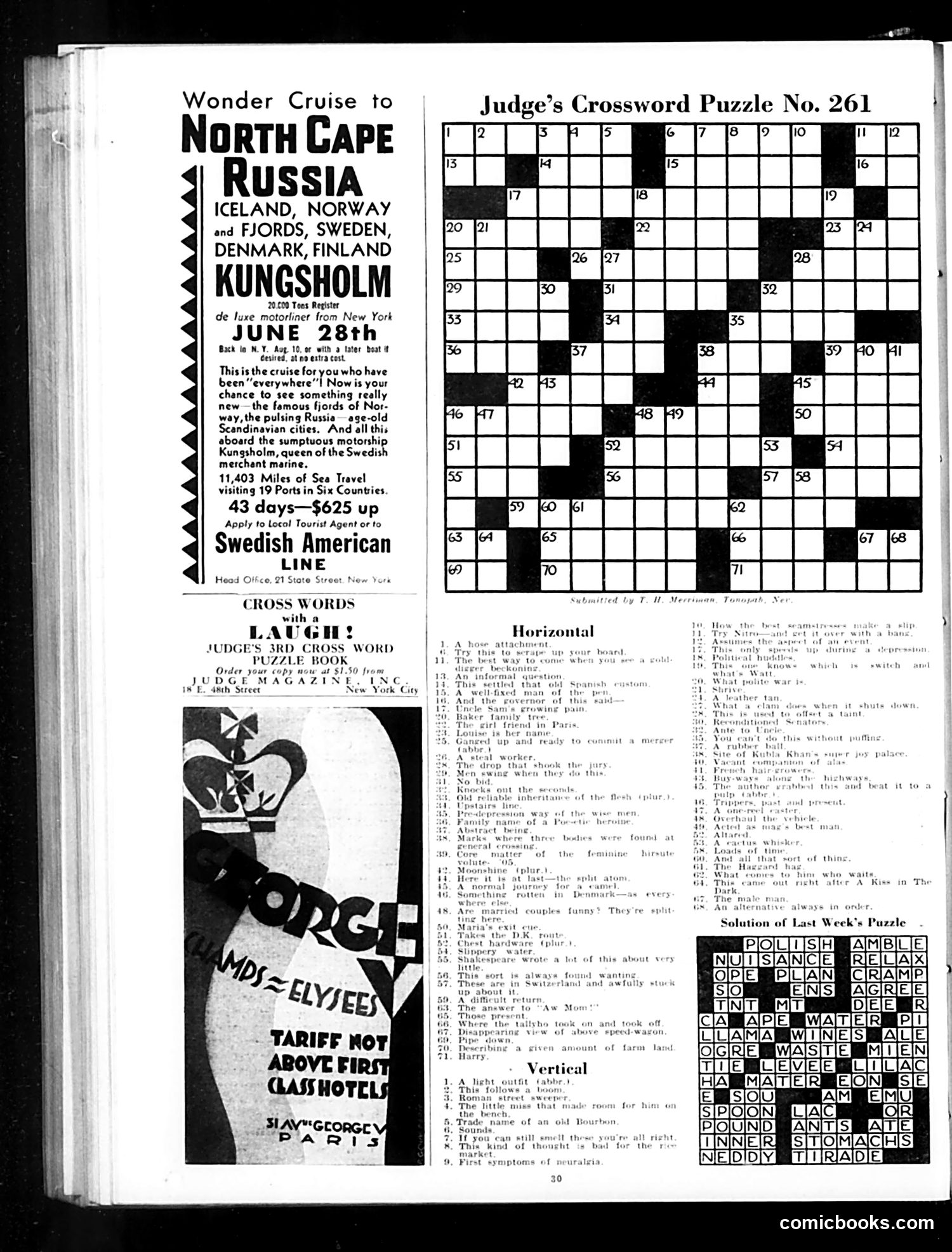
Analysis for Modern Readers This page is primarily advertising and puzzle content, not satirical cartoons. The main feature is a travel advertisement for the Swedish American Line's luxury cruise ship *Kungsholm*, departing New York June 28th. It promotes a 43-day journey to North Cape Russia, Iceland, Norway, and Scandinavian cities for $625 and up—positioning exotic Arctic travel as an exclusive experience for wealthy Americans who've "been everywhere." The lower half contains Judge Magazine's crossword puzzle No. 261 and promotes their third crossword puzzle book ($1.50). A small movie advertisement at bottom left appears to reference a film (text partially obscured but mentions "Tariff Not Above First Class Hotels" and "George Arliss"), likely from this era's cinema. The page reflects 1930s leisure marketing: cruising to Russia was presented as sophisticated adventure tourism, targeting affluent readers of this satirical magazine. The specific mention of "Russia" likely capitalized on Americans' Cold War-era curiosity about the Soviet Union.
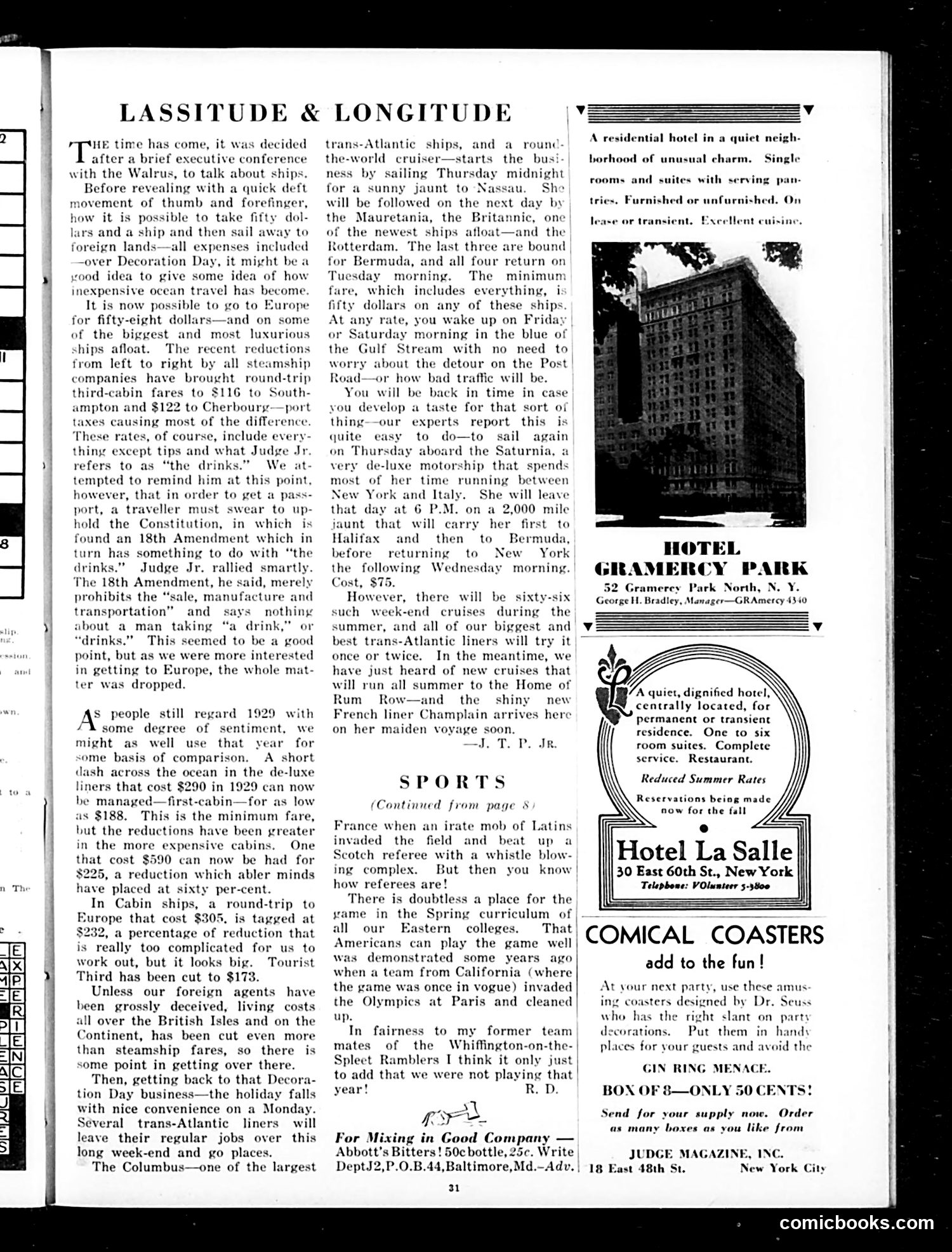
Judge Magazine Page Analysis This page is primarily advertising and travel writing, not political satire. The main article "Lassitude & Longitude" discusses affordable transatlantic cruise options for the 1929 Memorial Day weekend, comparing ship fares that have dropped from $290 in 1929 to $188 by the time of publication. The text notes the 18th Amendment (Prohibition) humorously—a traveler must swear to uphold the Constitution, which contains this amendment restricting alcohol, though the article jokes that the amendment only prohibits *sale*, not personal consumption of drinks. The page contains hotel and cruise line advertisements (Hotel Gramercy Park, Hotel La Salle, comical coasters novelties). There is no identifiable political cartoon on this page. The content reflects 1930s leisure culture and the economic shifts following the 1929 stock market crash, when steamship companies reduced fares significantly to stimulate travel demand.
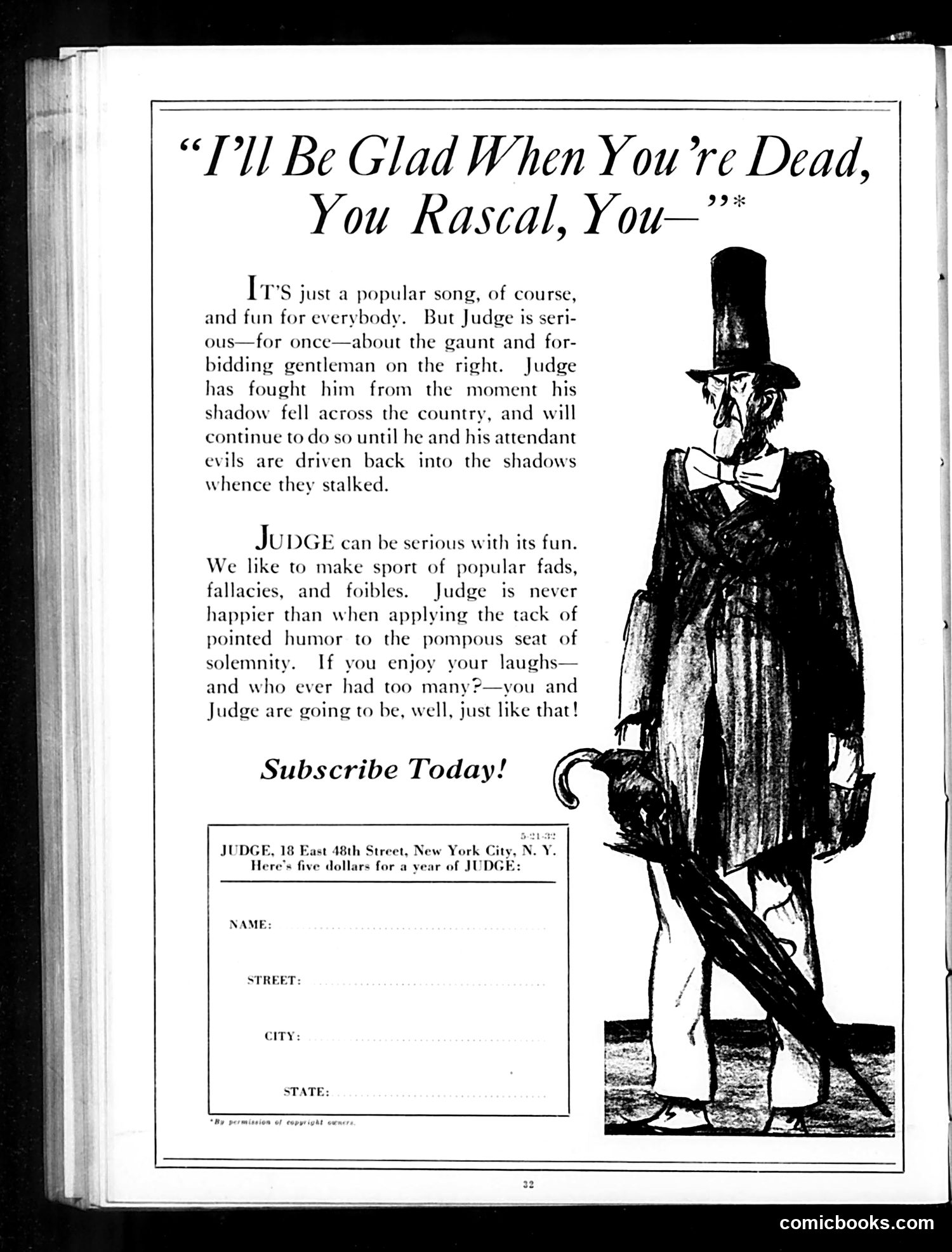
Analysis This is a subscription advertisement for *Judge* magazine using dark satire. The "gaunt and forbidding gentleman" depicted—a skeletal, top-hatted figure with a scythe—represents Death itself. The text references the popular song "I'll Be Glad When You're Dead, You Rascal, You," but pivots to claim *Judge* takes the personification seriously: the magazine positions itself as actively fighting against Death and "his attendant evils" that have "shadow[ed]" the country. The satire works on two levels: Death is portrayed as a threat requiring combat, while the advertisement frames *Judge* as a morally serious publication despite its humorous mission. The subscription pitch suggests readers join *Judge* in this ideological battle through their support. The specific historical context—what national crisis prompted this rhetoric—remains unclear from the image alone, though the tone suggests a significant public health or social threat.
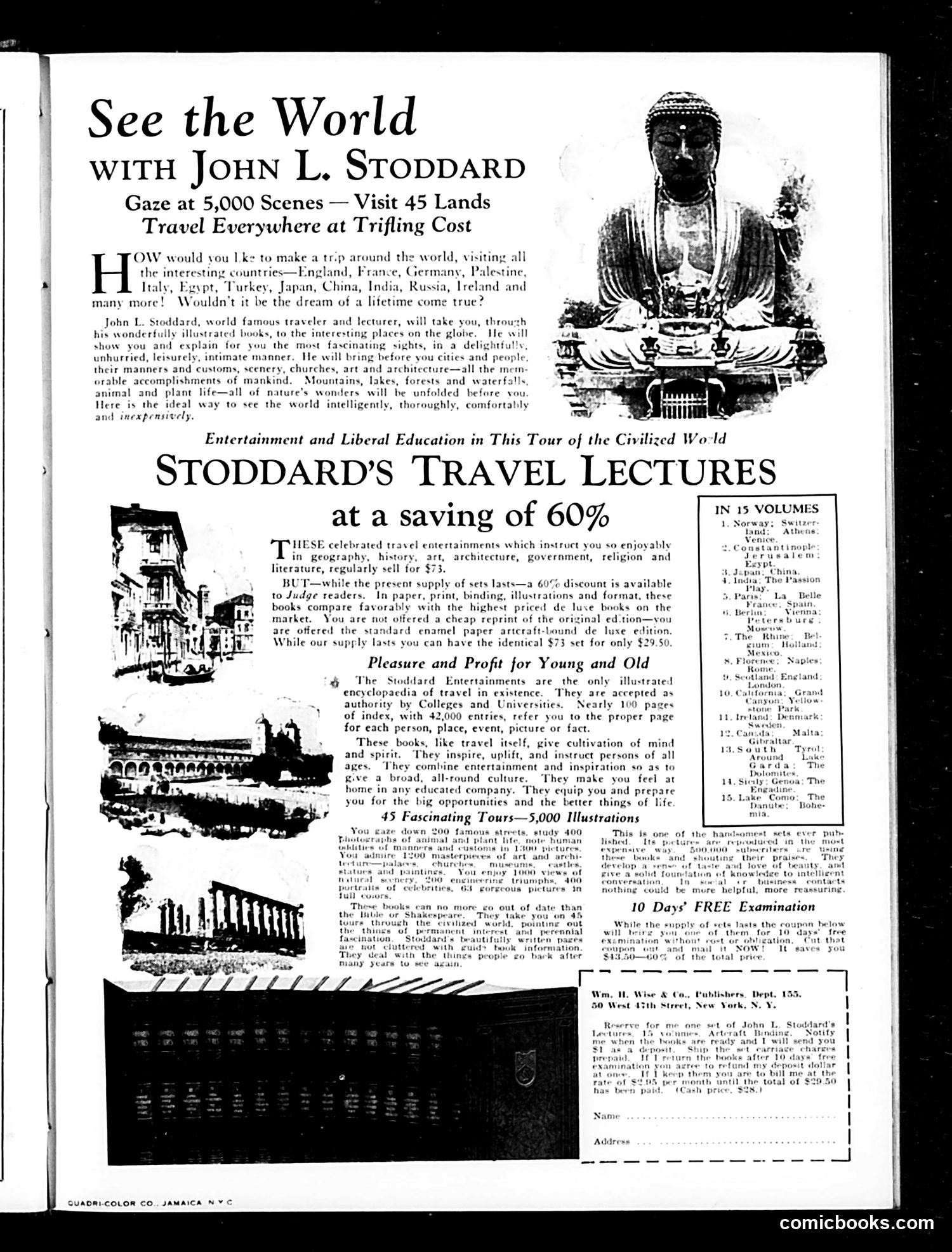
Advertisement, Not Satire This page is a straightforward advertisement for John L. Stoddard's Travel Lectures—a 15-volume illustrated encyclopedia set. There is no political cartoon or satire present. The content promotes an educational product: beautifully-bound travel books offering 5,000 illustrations of 45 countries, normally selling for $73 but offered to *Judge* readers at 60% discount ($29.50). The appeal emphasizes both entertainment and self-improvement—marketing these books as culturally elevating for "young and old" while being "accepted as authority by Colleges and Universities." The decorative image shows a Buddha statue and architectural monuments, visually representing the world travel promised. This reflects early-20th-century middlebrow culture: travel literature and self-education were status markers for educated consumers. There is no satire of Stoddard, travel, or education here—only commercial persuasion using aspirational language about culture and worldliness.
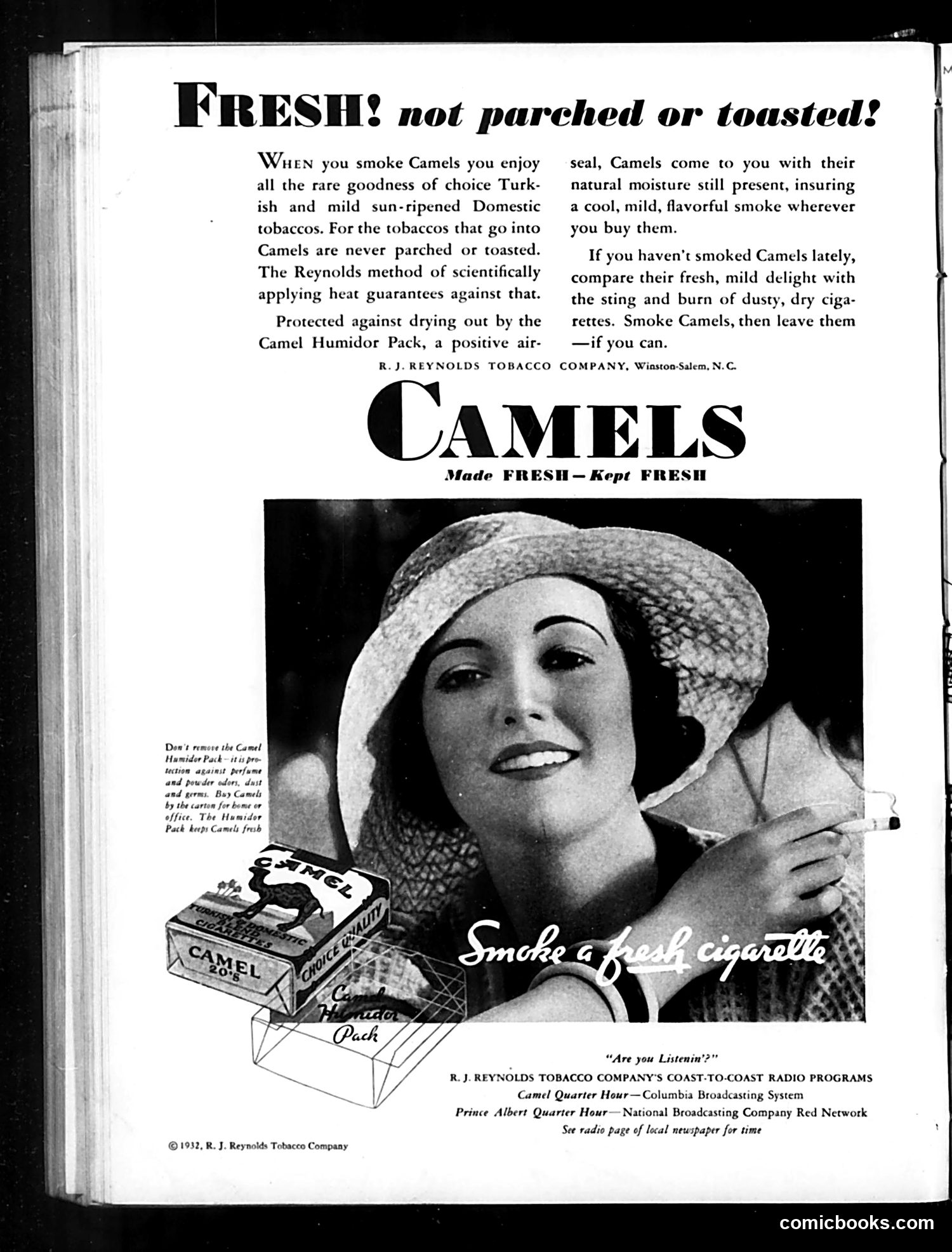
Analysis This is primarily a cigarette advertisement, not satire or political commentary. It appears in Judge magazine circa 1932, but functions as a straightforward Camel cigarette promotion. The page features a smiling woman in a cloche hat holding a cigarette pack, with advertising copy emphasizing that Camels are "fresh—not parched or toasted" and protected by the "Camel Humidor Pack." The ad contrasts Camels' freshness against competitors' "dusty, dry cigarettes." The key selling point is scientific preservation of tobacco's "natural moisture," framed as superior to competing brands that allegedly damage tobacco through heating processes. At the bottom, the ad promotes R.J. Reynolds' radio programs ("Camel Quarter Hour" and "Prince Albert Quarter Hour"), reflecting 1930s advertising strategy of sponsoring popular broadcast entertainment. No political satire is present—this is purely commercial advertising using period-typical marketing claims about product superiority.