judge
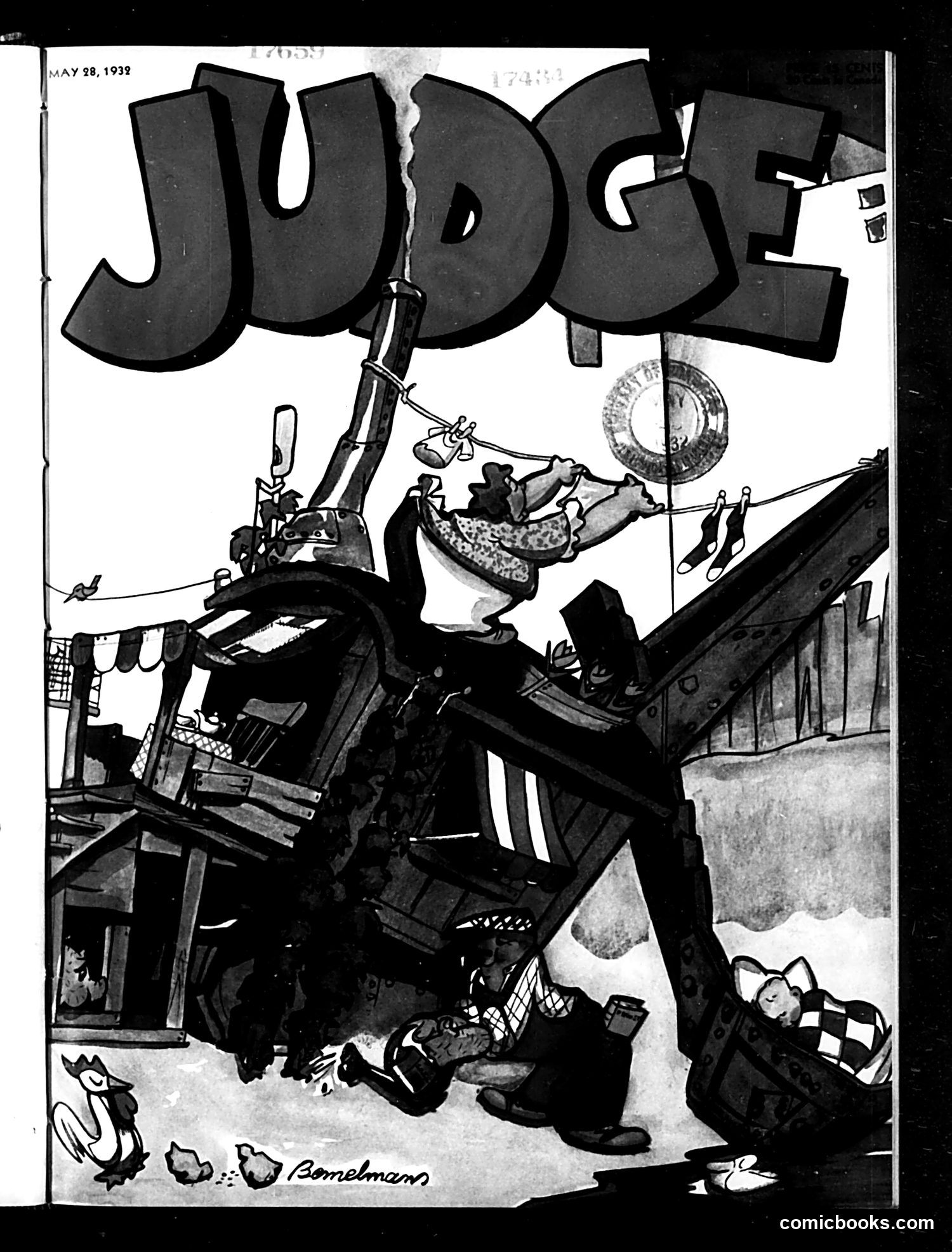
Judge — May 28, 1932
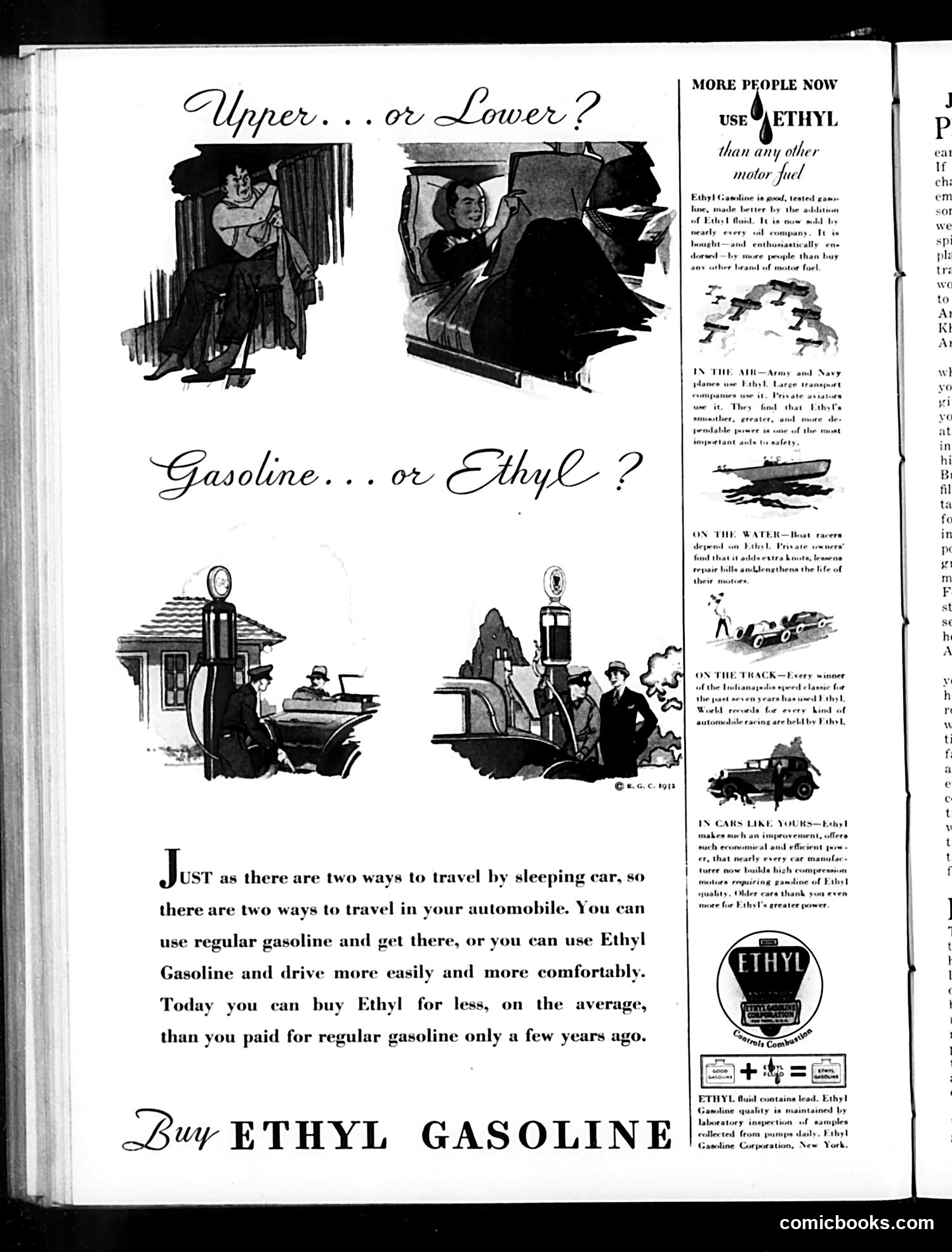
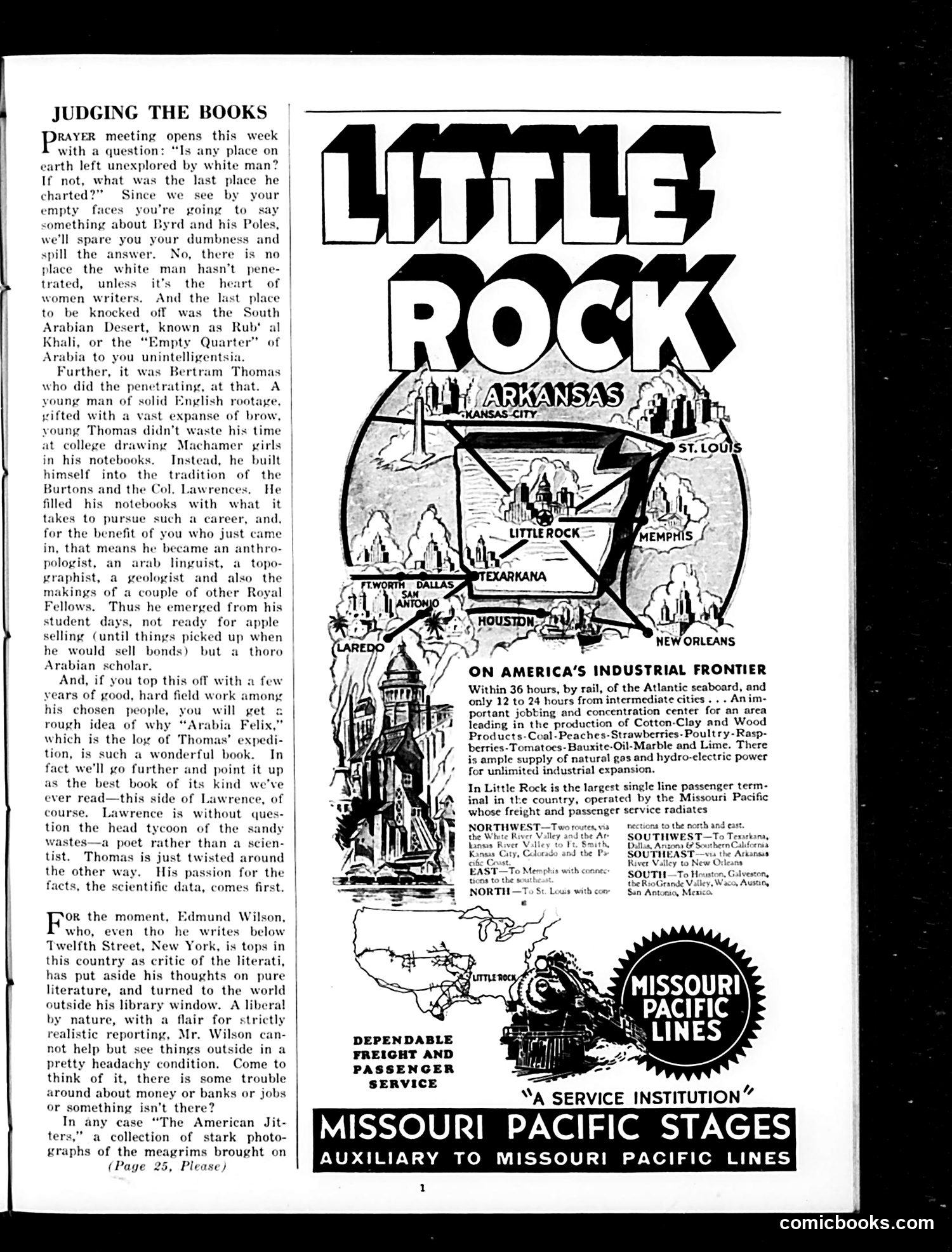
Analysis This page is primarily advertising for Ethyl Gasoline, not political satire. The main cartoon contrasts two scenarios: "Upper...or Lower?" and "Gasoline...or Ethyl?" The imagery suggests social class differences—upper-class comfort versus lower-class struggle—as a metaphor for choosing between regular gasoline and Ethyl brand. The accompanying illustrations show Ethyl being used in various contexts: military aircraft and ships, boats, trains, and private automobiles. The advertisement's central argument is that Ethyl Gasoline provides smoother, easier driving than regular gasoline, despite costing less than regular gas did years prior. This appears to be a vintage ad promoting an early premium fuel product, likely from the 1920s-1930s era based on the styling and references to "lead" content in the small text.
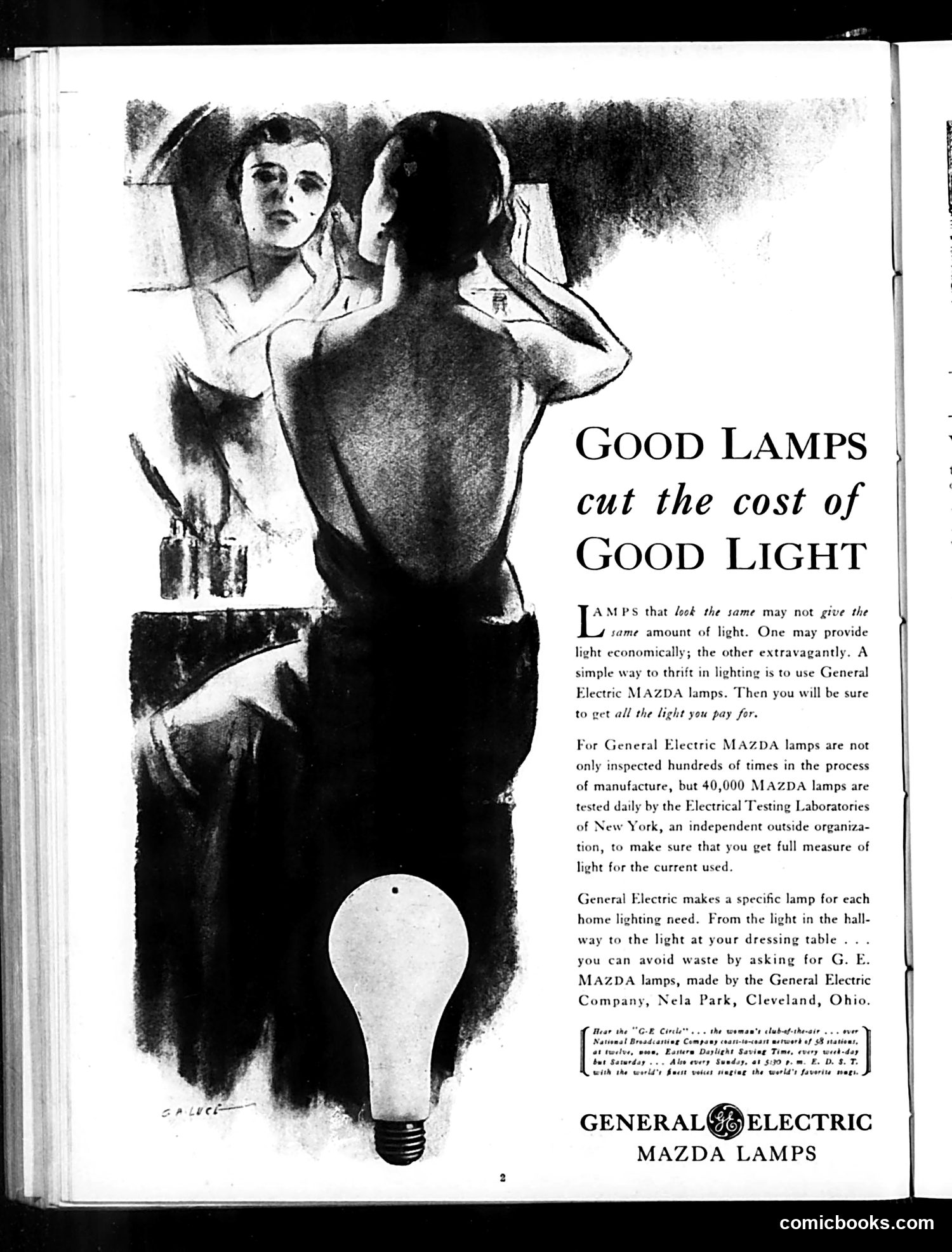
Analysis This page is primarily an advertisement, not satire or political commentary. It's a General Electric MAZDA lamp advertisement from what appears to be an early-to-mid 20th century issue of Judge magazine. The ad uses an artistic illustration of a shirtless man admiring his reflection in a mirror, alongside a woman's face in the mirror. This imagery appeals to vanity and self-improvement—common advertising tropes of the era. The tagline "Good Lamps cut the cost of Good Light" makes an economic argument: efficient MAZDA lamps provide better lighting value than competitors. The text emphasizes quality testing and reliability. There is no political satire on this page. Judge, while known for humor and satire, carried paid advertisements like other magazines. This is purely commercial messaging dressed in aesthetically appealing artwork.
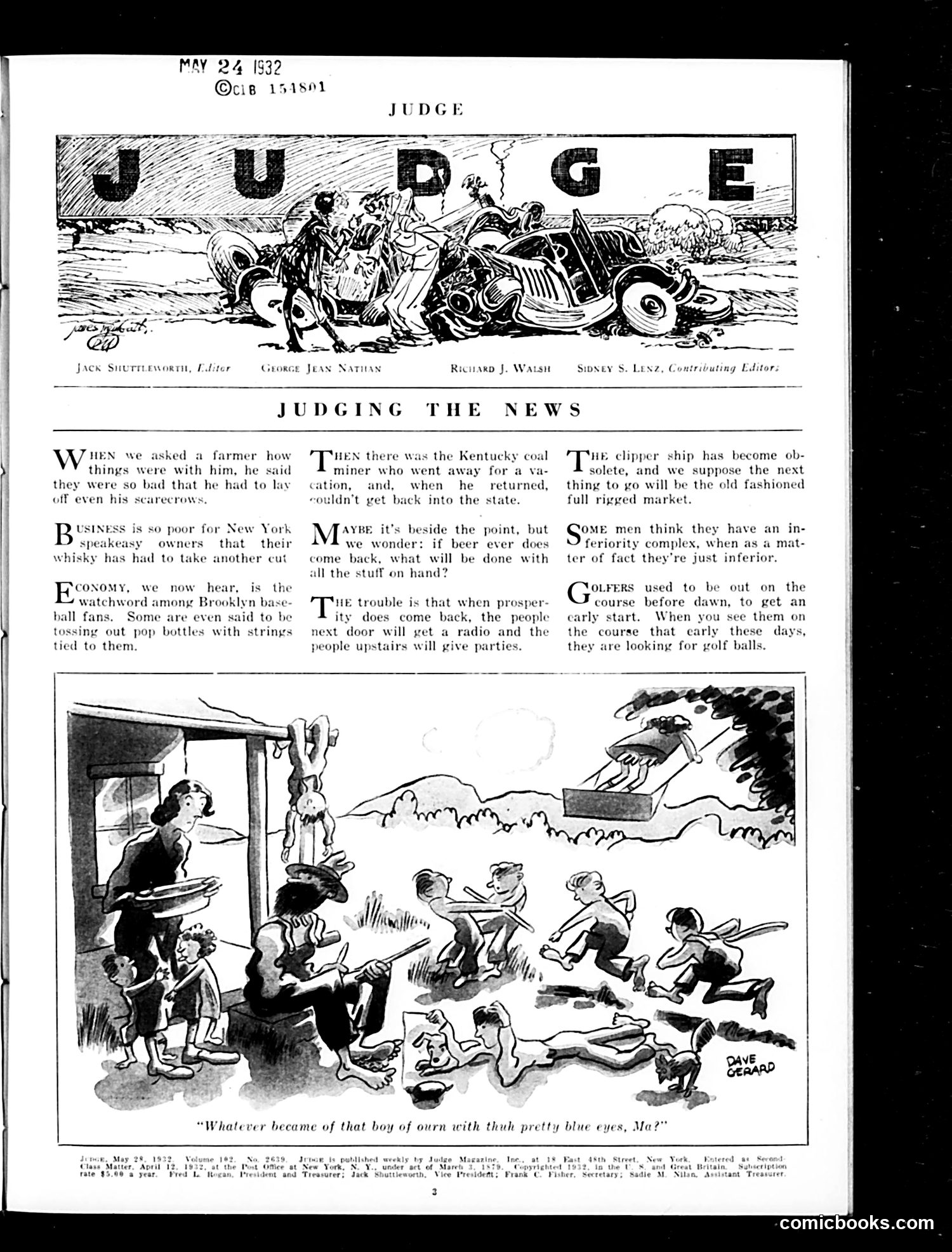
Explanation for Modern Readers This 1932 *Judge* magazine page satirizes Depression-era economic anxieties through brief editorial commentary paired with a cartoon. The text snippets mock various social impacts: farmers losing livelihoods, New York speakeasies (illegal bars during Prohibition) forced to dilute whiskey, and Brooklyn baseball fans economizing by reusing bottles with strings. The main cartoon depicts children playing outside a house while a mother tends to them, with the caption: "Whatever became of that boy of ours with those pretty blue eyes, Ma?" This likely comments on child welfare during the Depression—suggesting families were struggling so severely that children's health and well-being (the "pretty blue eyes") were deteriorating from poverty and malnutrition. The satire critiques both economic hardship and parents' helplessness during this crisis.
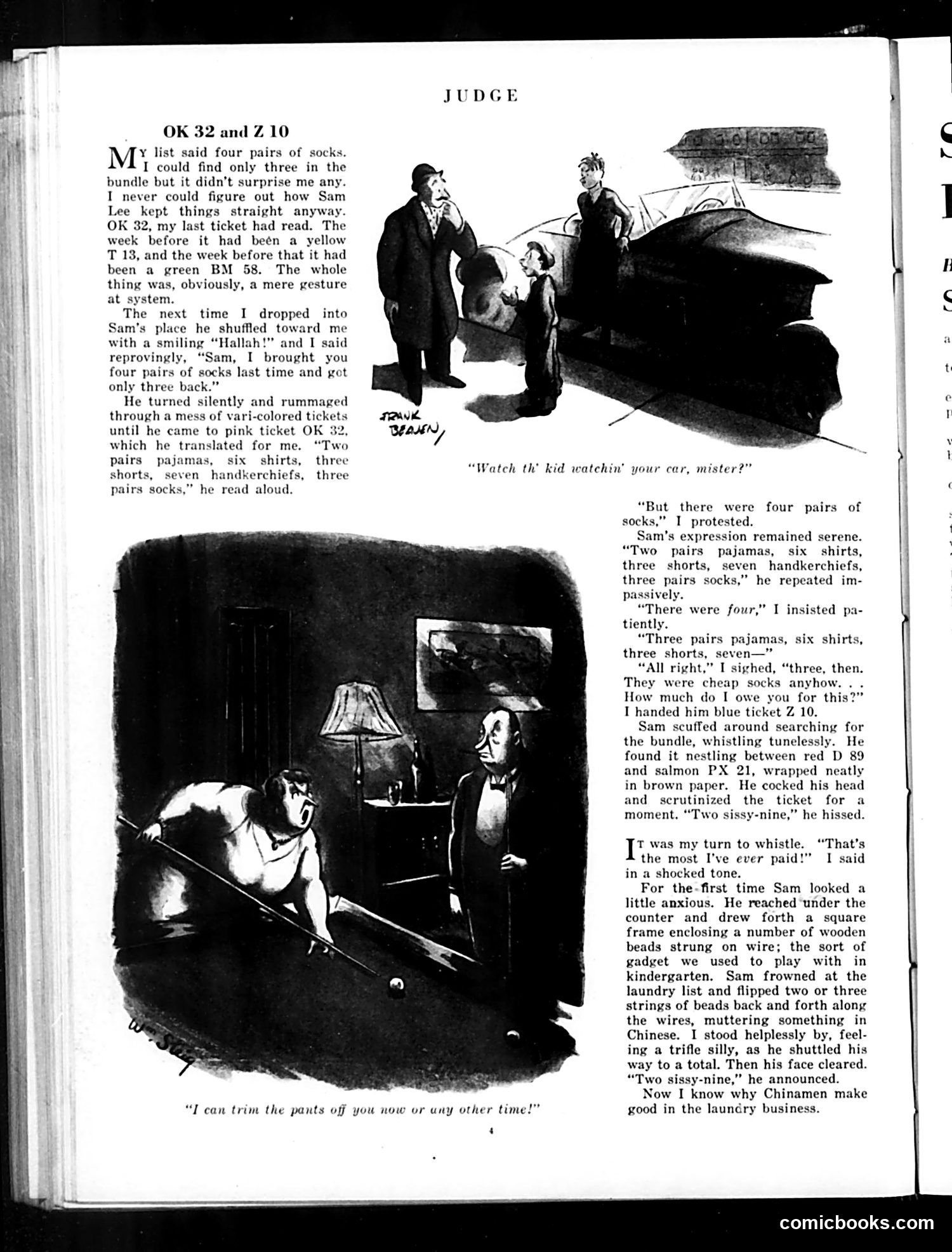
Analysis of Judge Page "OK 32 and Z 10" This page satirizes a Chinese laundry business's accounting system. The narrator complains about missing socks from a laundry delivery, presenting numbered tickets as evidence. When confronting the laundry owner "Sam," the narrator discovers an elaborate bead-counting device—apparently a traditional Chinese abacus or similar tool used to track inventory. The humor relies on a stereotype common in early 20th-century American satire: portraying Chinese immigrants as inscrutable and operating by mysterious, incomprehensible methods. The narrator's frustration at being unable to "follow" Sam's accounting suggests cultural incomprehension treated as comedy. The final caption reveals the narrator's grudging respect for the system's efficiency, though still framed through ethnic stereotyping.
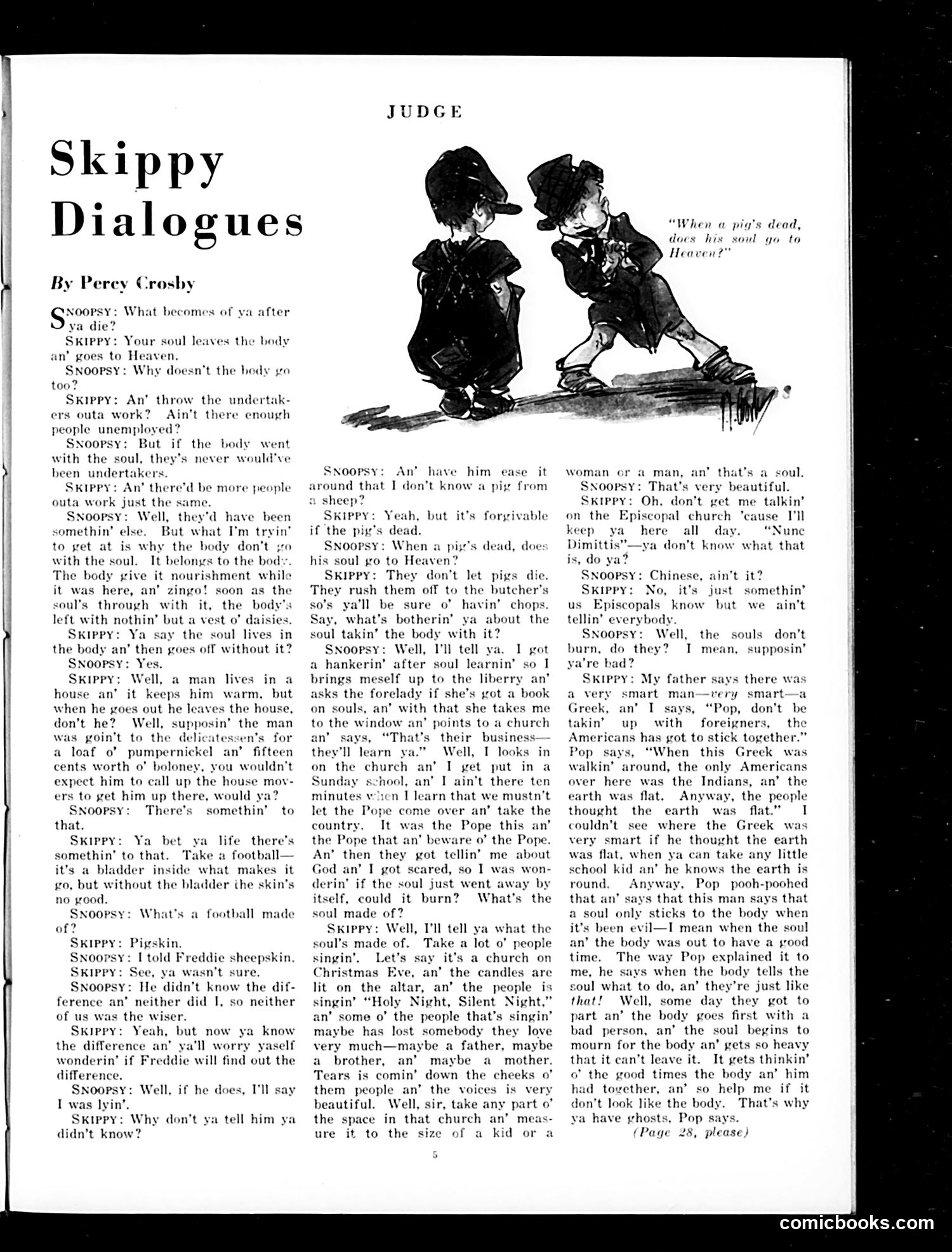
Skippy Dialogues by Percy Crosby This page features "Skippy Dialogues," a comic dialogue series by Percy Crosby that appeared in *Judge* magazine. The dialogue is between two characters—Snoopsy and Skippy—who discuss philosophical and theological questions in a humorous, mock-serious manner. The illustration shows two child characters in conversation. The dialogue explores absurdist humor typical of early 20th-century children's comics, debating questions about death, the afterlife, church practices, and cultural differences (notably including period-appropriate ethnic stereotypes regarding Greek and Native American peoples). The satire targets pretentious philosophical discourse by having children deliver it naively, exposing the absurdity of adult reasoning through innocent questioning.
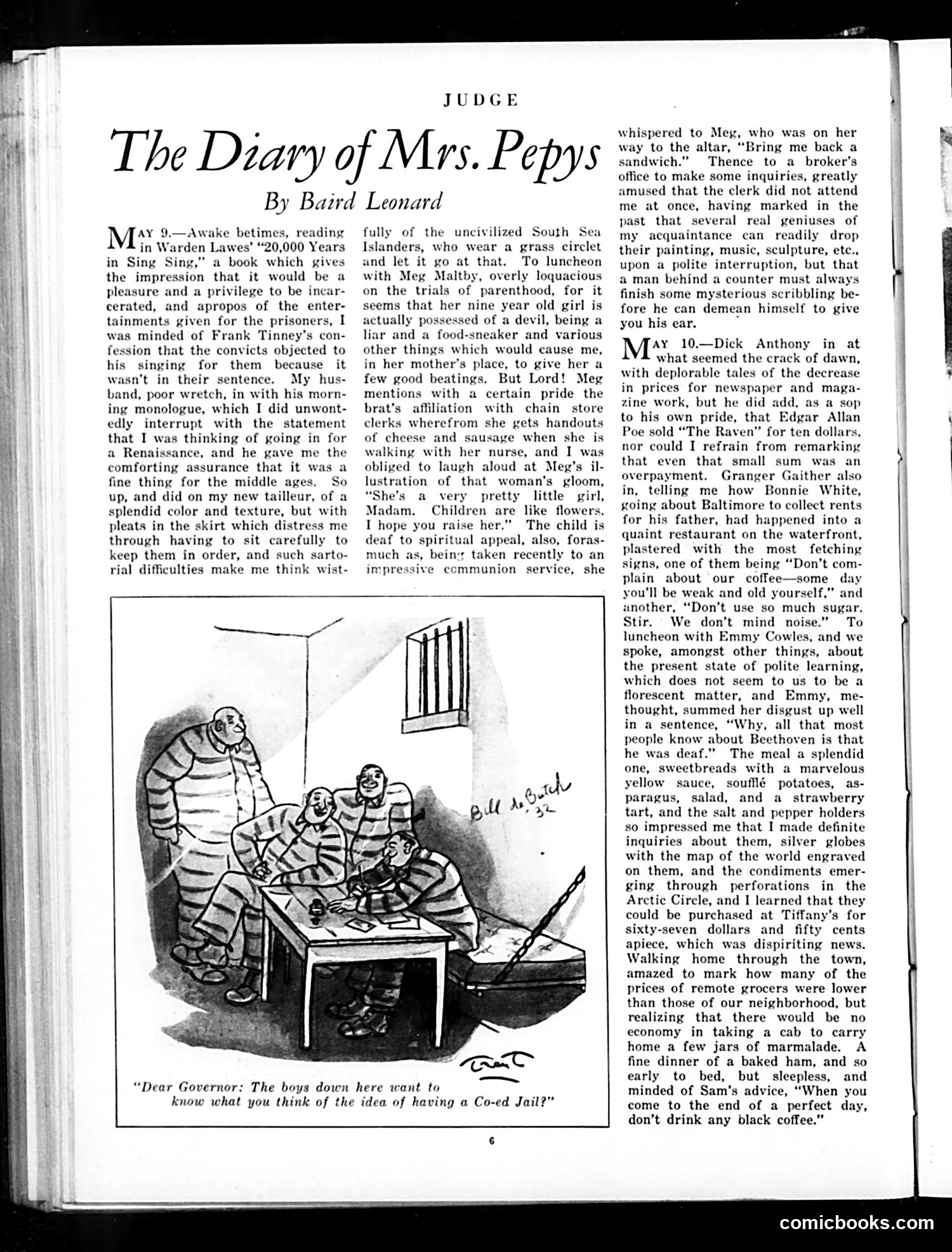
"The Diary of Mrs. Pepys" - Judge Magazine This is a humorous diary entry by Baird Leonard, not a political cartoon. The accompanying illustration depicts prisoners in striped uniforms in what appears to be a jail cell, with the caption: "Dear Governor: The boys down here want to know what you think of the idea of having a Co-Ed Jail?" The satire references a contemporary debate about co-educational prison facilities. The joke plays on the absurdity of prisoners petitioning authorities about jail conditions while imprisoned, and the questionable logic of mixing male and female inmates. The striped prison uniforms and barred window establish the setting. The diary entries themselves discuss mundane social observations about reading, children, and urban life, offering broader social commentary typical of Judge's satirical approach.
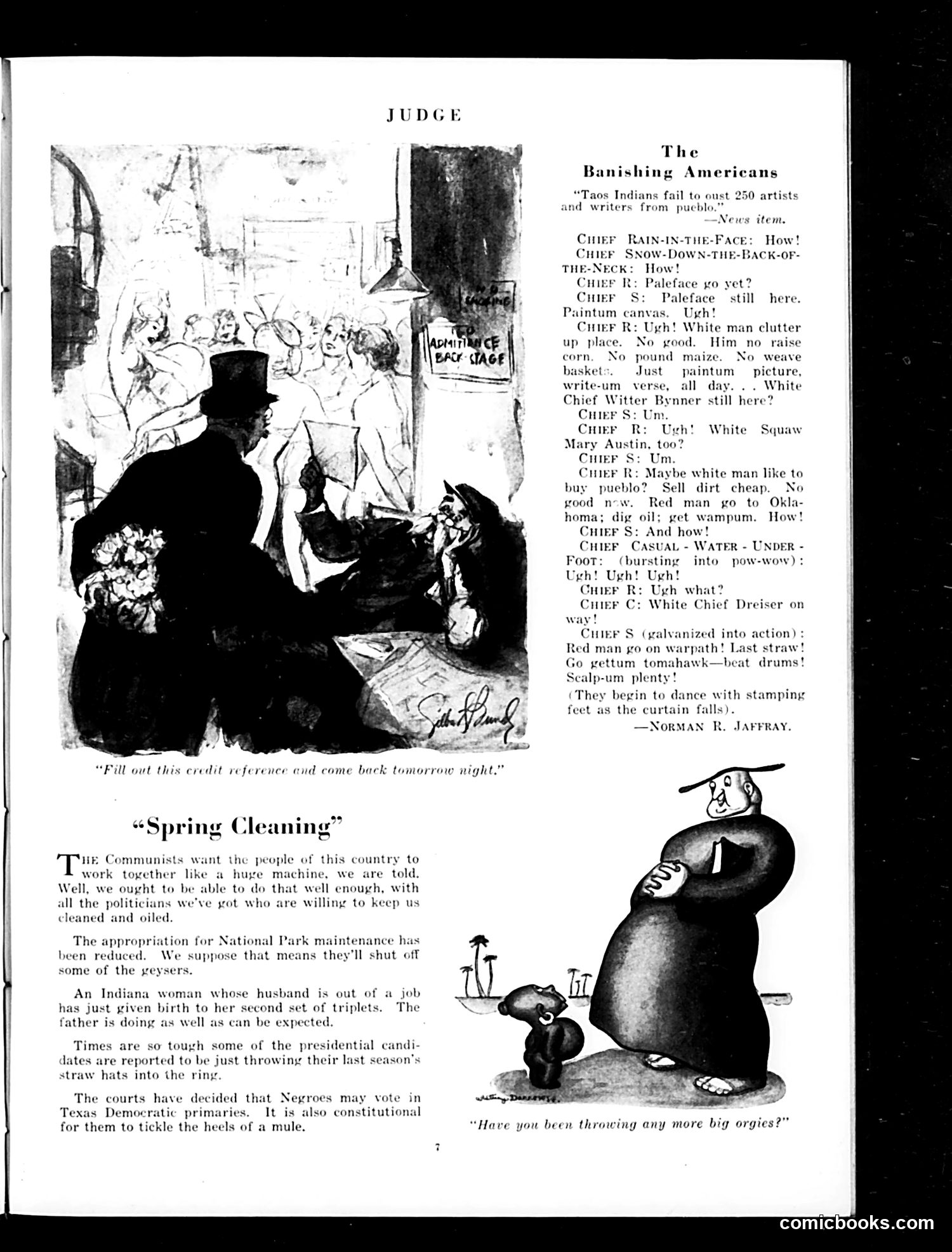
Explanation for Modern Readers "The Banishing Americans" satirizes a real 1924 news story: Taos Pueblo Indians attempting to expel 250 artists and writers living in their community. The sketch mocks both the Indians' complaint and the bohemian residents. Taos was an artist colony attracting literary figures like Witter Bynner and D.H. Lawrence. The cartoon presents Native American chiefs in exaggerated dialect complaining that white artists produce nothing useful—no corn, maize, or baskets, only paintings and verse. When told famous writer Theodore Dreiser is arriving, they declare war. The satire cuts both ways: it ridicules the stereotyped "primitive" resistance while also gently mocking the self-absorbed artists as parasitic outsiders. The humor relies on portraying the Pueblo's actual economic grievances as petty cultural snobbery. The accompanying "Spring Cleaning" section contains separate political commentary on Communism, the Depression, and racial discrimination in Texas voting.
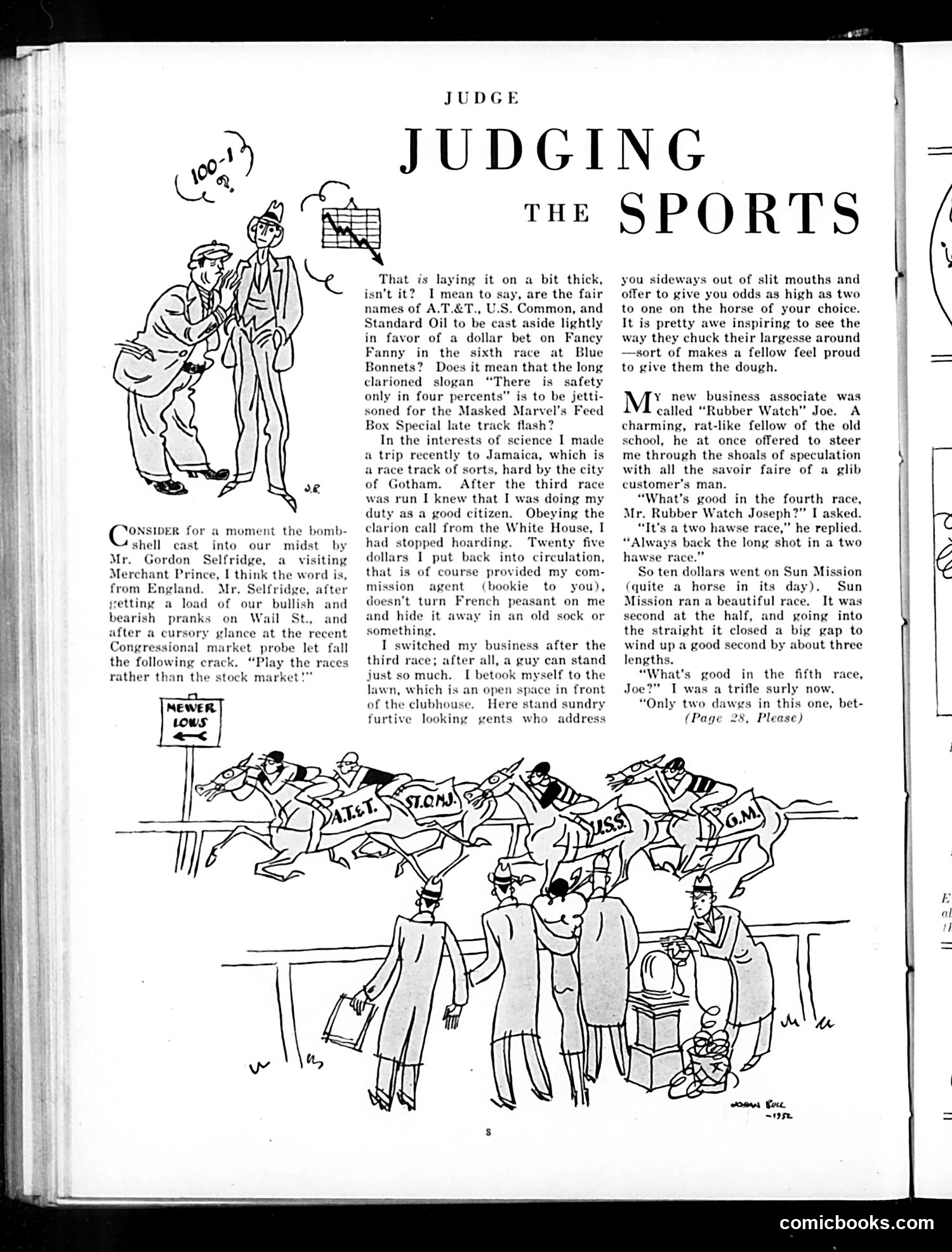
"Judging the Sports" This satirical piece mocks wealthy spectators at horse racing who make ostentatious bets and display their riches. The main narrative follows a narrator who encounters "Rubber Watch" Joe, a smooth-talking tout (racing advisor) who steers him toward betting tips at Jamaica race track. The satire targets: - Wealthy British visitors like Gordon Selfridge, who flaunt money and make showy bets - Post-WWI hoarding concerns: references to people hiding money in socks rather than circulating it - Class pretension: Joe's slick "savoir faire" contrasts with his rat-like appearance - Gullibility: The narrator repeatedly bets on Joe's recommendations with middling results The joke is that despite Joe's confident advice ("Always back the long shot"), the bets underperform—suggesting that flashy confidence and insider tips are unreliable. The cartoon satirizes both wealthy show-offs and the con-artist types who prey on them at racetracks.
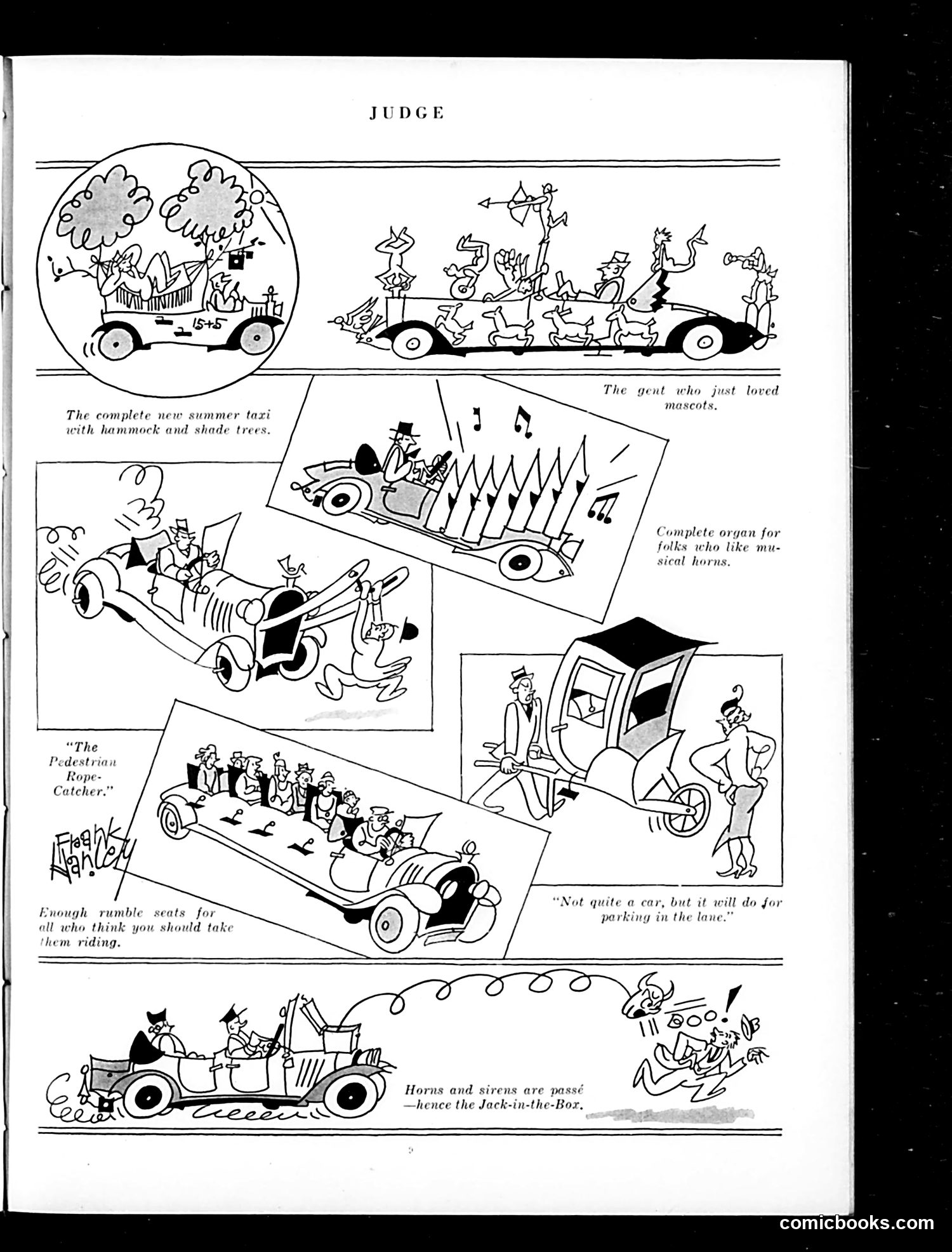
Judge Magazine Satire Page: Automobile Parodies This page satirizes 1920s automobile culture through exaggerated vehicle designs. Each cartoon mocks contemporary car trends and social behaviors: - Top panel: A ridiculously overcrowded taxi with mascots and entertainment features, parodying luxury vehicle excess - "Pedestrian Rope-Catcher": A vehicle with a rope attachment, satirizing pedestrian dangers from speeding cars - Musical organ car: Mocking drivers who honk excessively - "Jack-in-the-Box": Replaces traditional horns/sirens with a pop-up clown, suggesting horn-blowing had become absurdly commonplace - Rumble seat vehicle: Critiques the trend of cramming multiple passengers into tiny side seats for joyrides The satire targets 1920s automotive excess, reckless driving culture, noise pollution from horns, and dangerous traffic conditions—particularly the contradiction between cars' promised luxury and their actual chaotic, noisy impact on urban life.
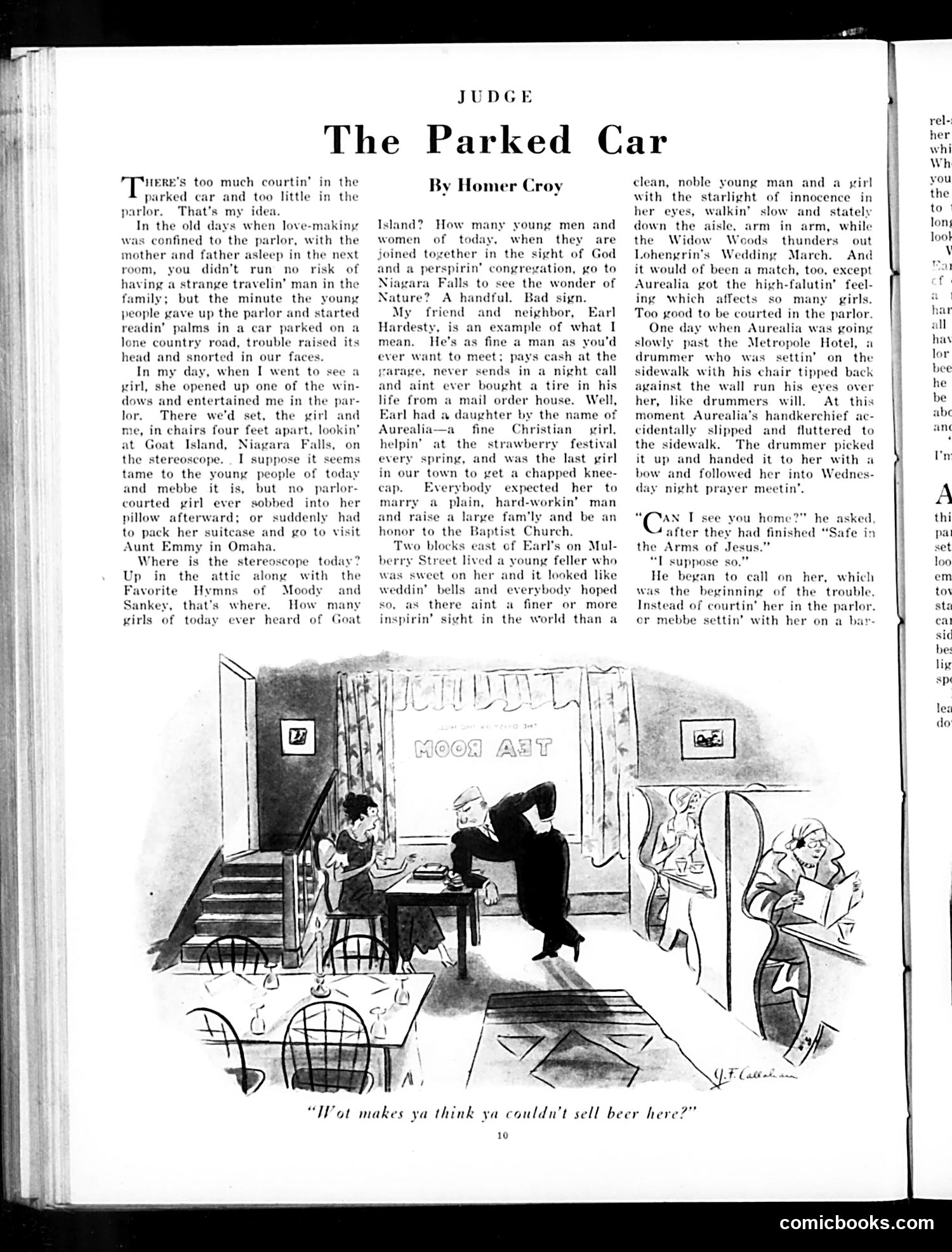
"The Parked Car" - Judge Magazine Satire This story-cartoon by Homer Croy satirizes changing courtship customs of the early 20th century. The narrator nostalgically contrasts old-fashioned "parlor courting" (chaperoned, supervised, in the home) with modern youth who court in parked cars—viewed as morally dangerous. The plot: Earl Hardesty's daughter Aurealia was a virtuous girl expected to marry a respectable local boy. But when a traveling drummer compliments her, she abandons proper parlor courtship. The implication is that unsupervised car-courting leads to moral compromise and broken engagements. The accompanying cartoon shows a young couple in a parked car beside what appears to be a speakeasy or movie theater, illustrating the "immoral" modern dating practice the text condemns. The satire mocks generational hand-wringing about youth morality—a recurring social anxiety. The joke cuts both ways: the old guard's anxiety about cars and unchaperoned dating seems excessive, yet the story validates their concerns by showing actual (implied) consequences.
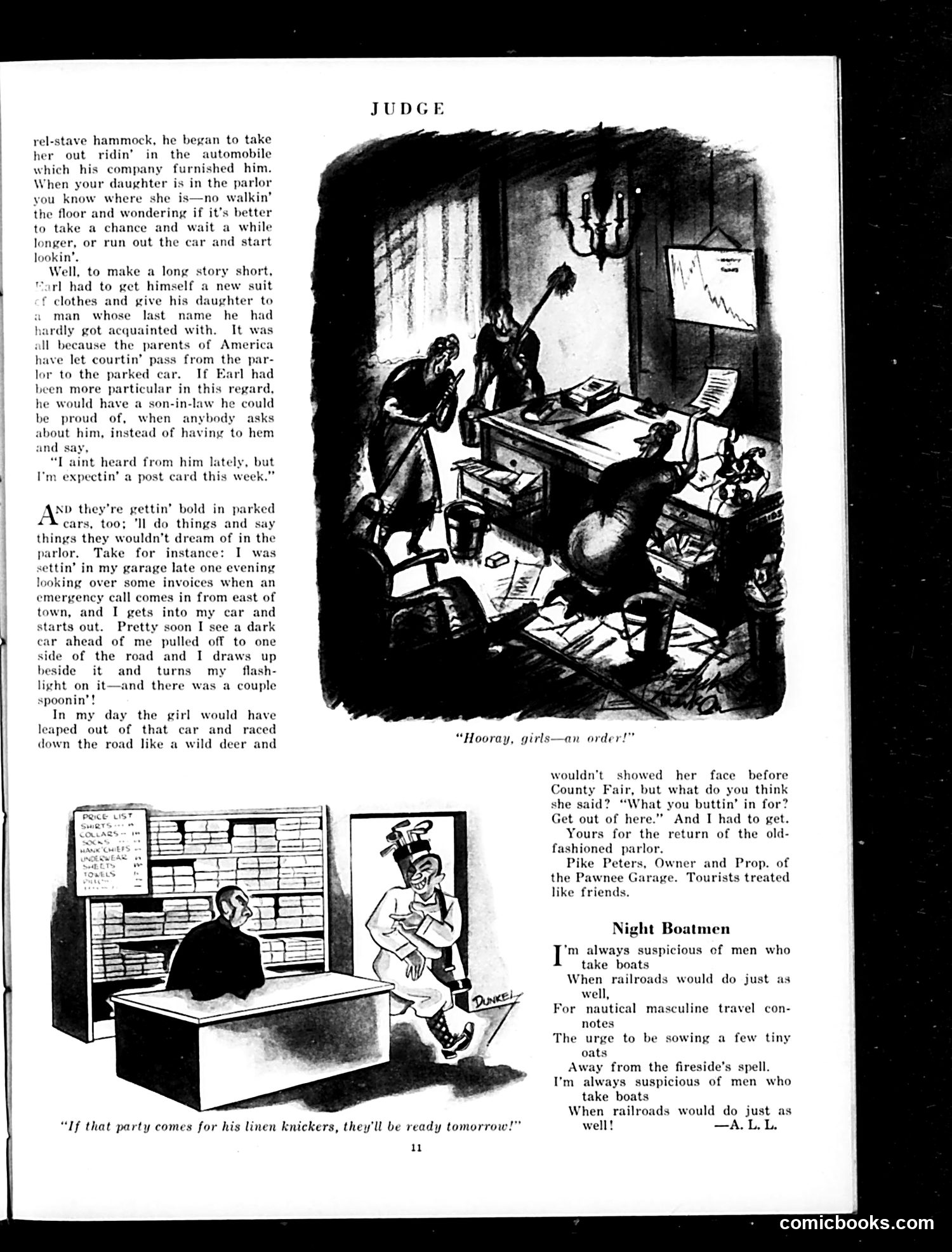
Judge Magazine Page Analysis This page contains two satirical pieces lamenting modern social changes: "Judge" (main article): Pike Peters, a garage owner, complains that automobile courting has ruined courtship traditions. He argues that when young couples courted in parlors, parents knew their whereabouts and could ensure propriety. Now, parked cars enable unsupervised intimacy—he even catches a couple "spoonin'" (kissing) in a parked car late at night. When he shines his flashlight on them, the girl brazenly tells him to mind his business rather than fleeing in embarrassment as she "should" have. He laments the loss of "old-fashioned parlor" courtship, suggesting automobiles have corrupted morality and parental control. "Night Boatmen" (poem by A.L.L.): A humorous verse expressing suspicion of men who choose boats over trains for travel, implying recreational boating is a cover for infidelity—a way to escape "the fireside's spell" and engage in improper behavior away from wives. Both pieces reflect early 20th-century anxiety about how new technologies (automobiles, leisure travel) were liberating young people and enabling moral transgressions beyond parental oversight.
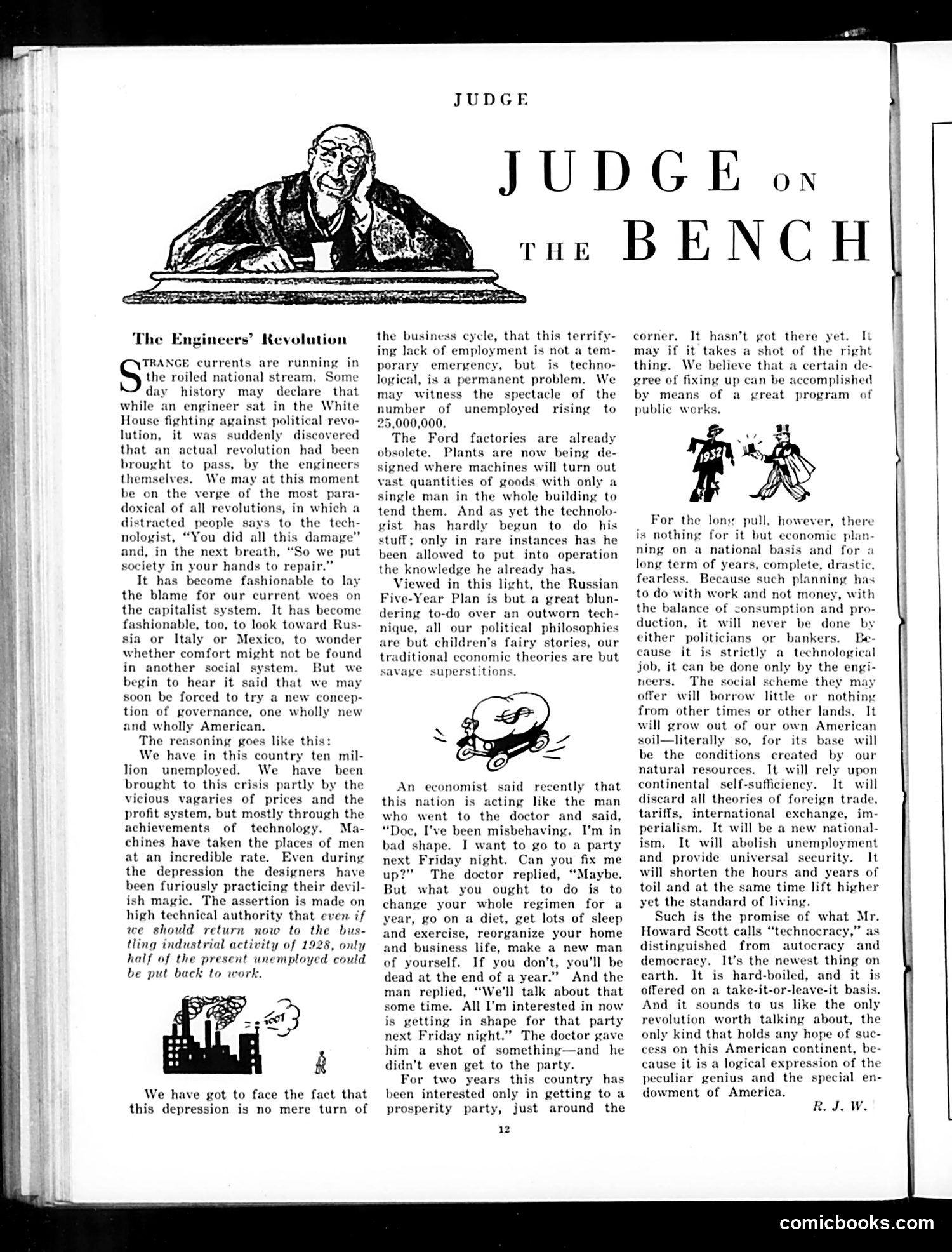
Analysis: "Judge on the Bench" This editorial cartoon criticizes 1930s American policy-making during the Great Depression. An engineer sits in the White House (likely Herbert Hoover, himself an engineer), while the text warns that technological advancement—machines replacing workers—has created permanent, not temporary, unemployment that could reach 25 million. The satire targets two failings: First, policymakers obsessed with quick fixes (the "prosperity party" metaphor) rather than long-term solutions. Second, the allegory of a sick patient refusing the doctor's advice for fundamental lifestyle change, instead demanding a shot to attend Friday's party—representing America wanting immediate relief without addressing systemic problems. The cartoon argues that short-term programs (public works) won't suffice; only comprehensive national economic planning can solve technologically-caused unemployment. It mocks both capitalist complacency and those looking to Russia or Mexico for answers, insisting America needs a "wholly new" approach to governance.
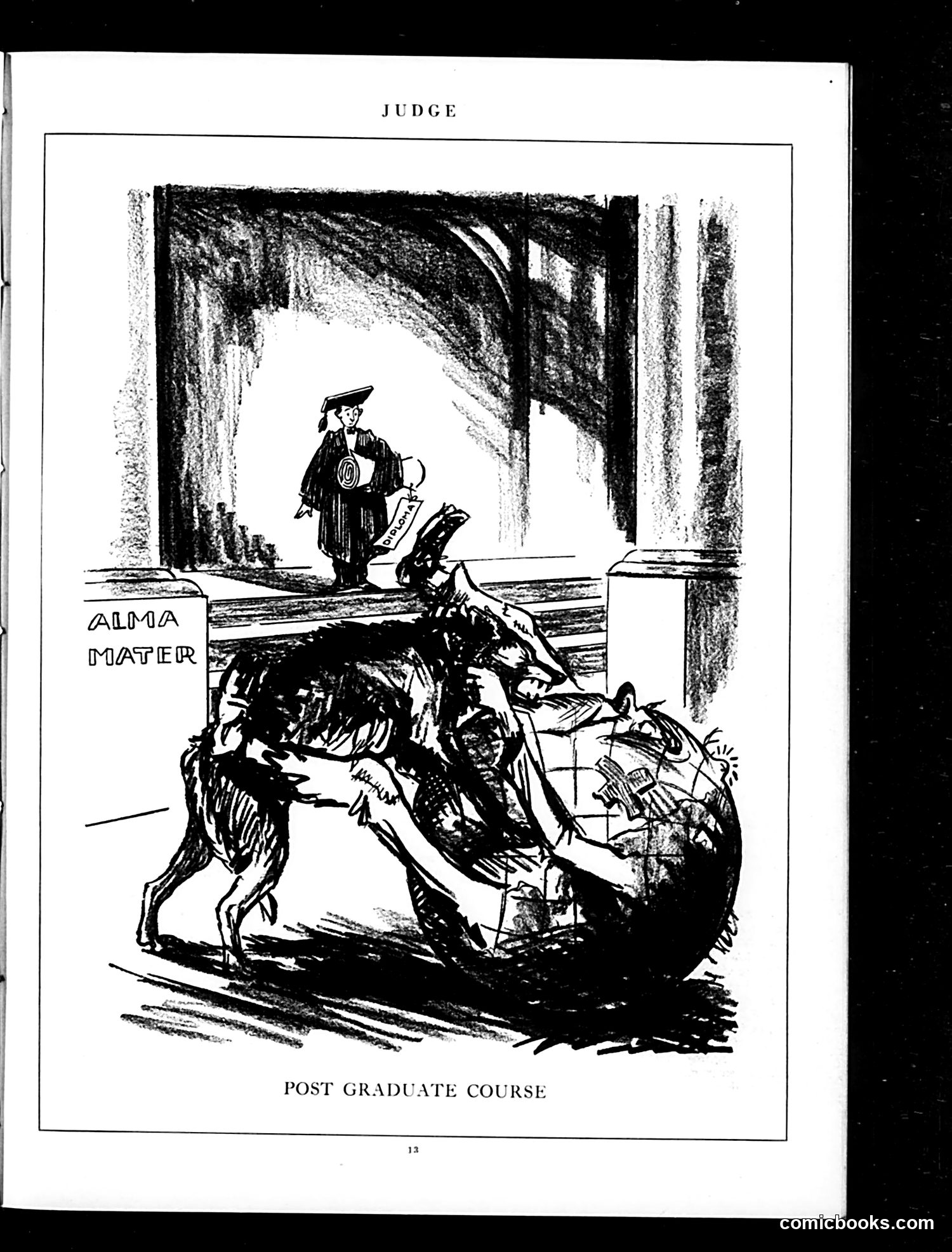
Judge Magazine: "Post Graduate Course" This cartoon satirizes legal education and the judiciary. A robed judge ("Alma Mater"—labeled on the left) stands in an institutional archway, observing two dogs fighting viciously below. The judge appears to be supervising or endorsing this brutal scene as a "post graduate course." The satire suggests that law schools and the judicial system teach and perpetuate ruthlessness and combat rather than justice or ethics. The dogs represent graduates or practitioners of law engaged in savage conflict, implying the profession rewards aggression over principle. By framing it as "post graduate" instruction from "Alma Mater" (mother institution), the cartoon critiques how legal education prepares attorneys for courtroom battle as their primary skill, treating law as combat rather than a noble pursuit of justice.
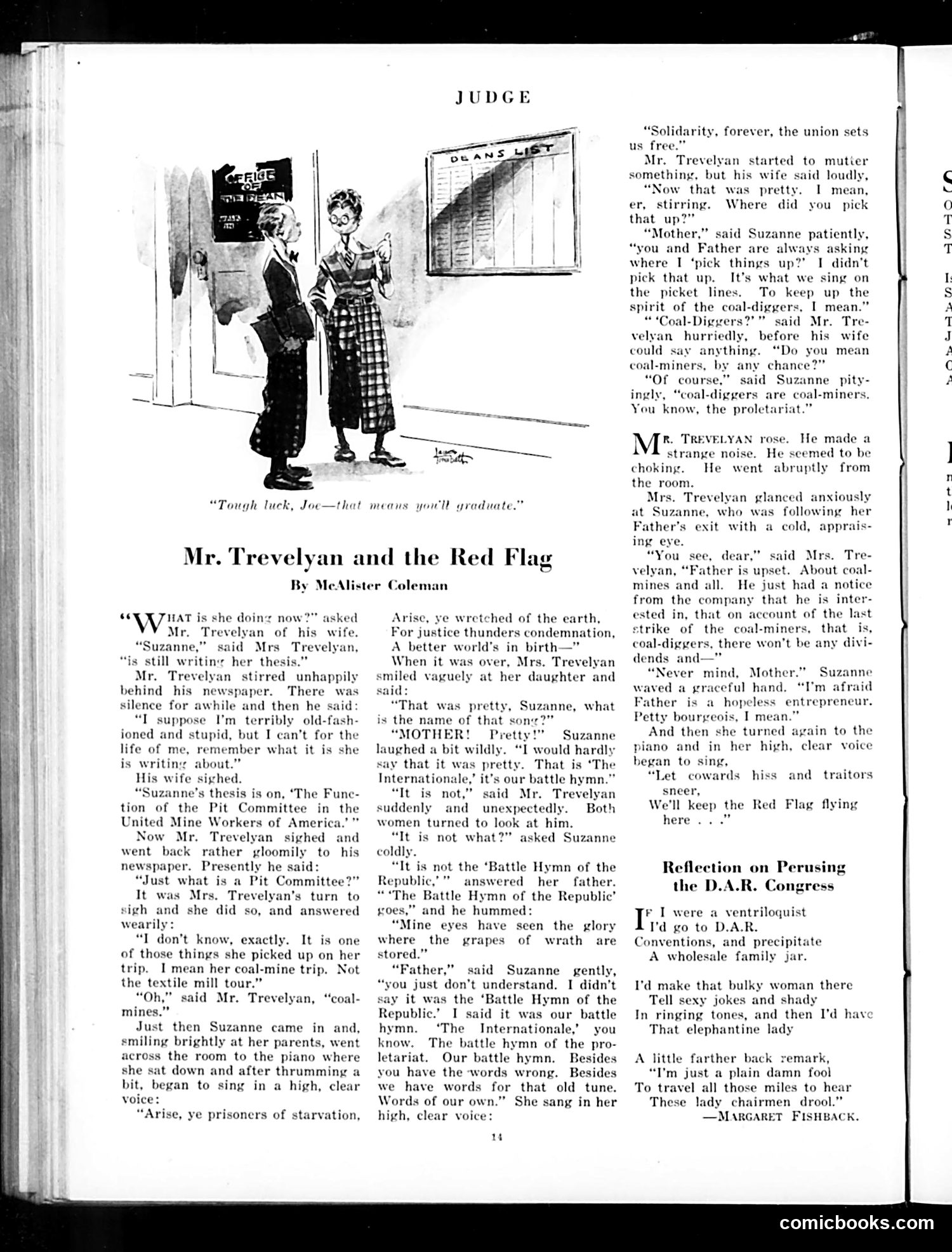
Explanation for Modern Readers This story satirizes upper-class revolutionary posturing. Suzanne, the daughter of Mr. Trevelyan (a wealthy investor), has become a communist sympathizer after visiting coal mines. She sings "The Internationale"—the socialist anthem—and speaks of "the proletariat" and labor strikes. The satire targets the contradiction: while Suzanne champions coal miners and denounces "petty bourgeois" capitalism, her father profits from coal company investments. When he learns the company won't pay dividends due to strikes his daughter supports, he chokes and leaves the room. The cartoon's caption—"Tough luck, Joe—that means you'll graduate"—likely references a student whose radical activism ensures expulsion. The piece mocks idealistic wealthy youth adopting leftist rhetoric without understanding its real consequences for their own class interests. This reflects 1920s-30s anxieties about communist influence among privileged American youth.
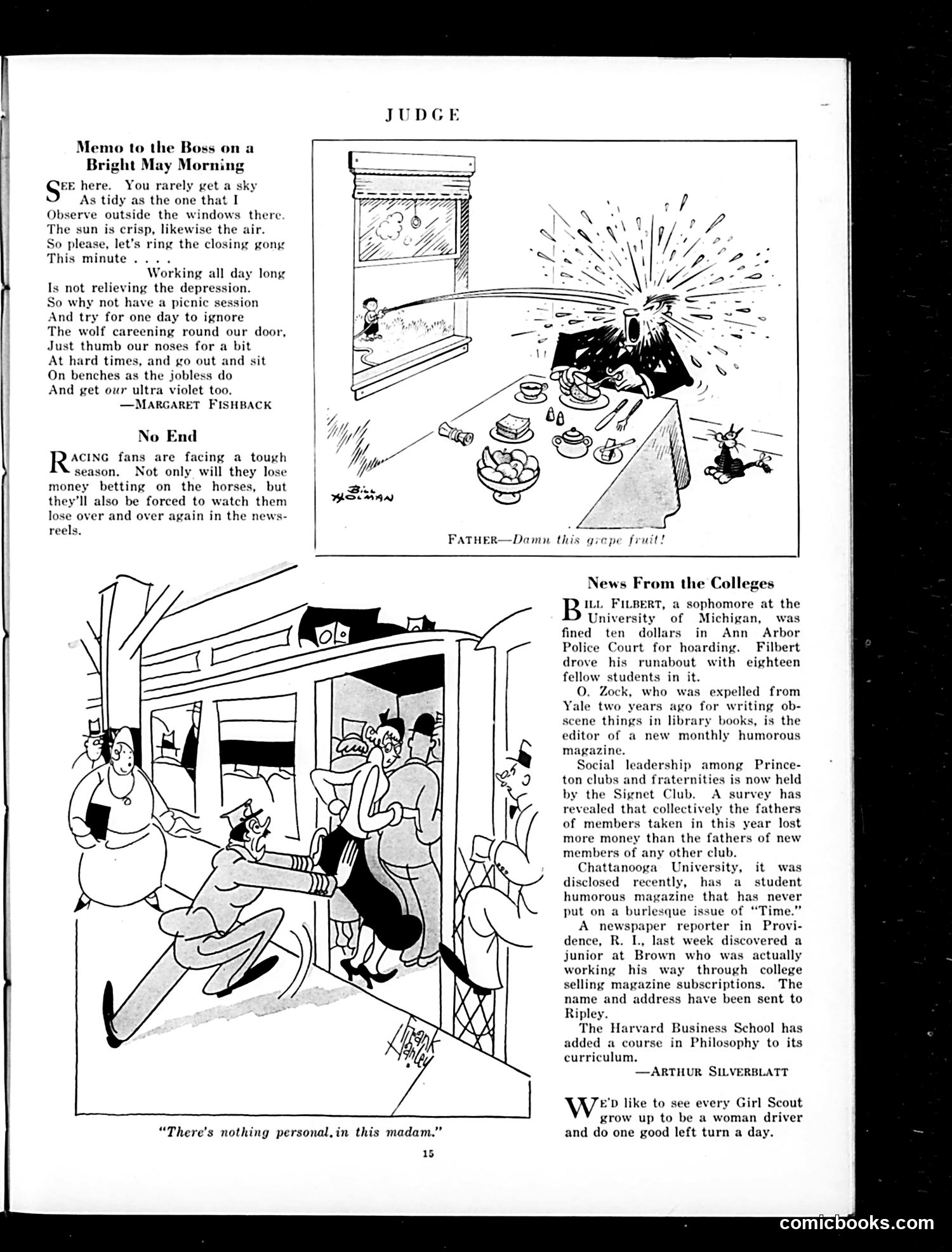
Judge Magazine Page Analysis This page contains satirical commentary on Depression-era life and college culture, circa early 1930s. "Memo to the Boss": Margaret Fishback's poem argues for taking a mental health day during economic hardship—suggesting workers skip work to have a picnic and enjoy sunshine rather than endure workplace depression while financial anxiety looms ("the wolf careening round our door"). "No End": A brief joke about horse-racing fans facing financial ruin from betting losses, now forced to watch their losses replayed in movie newsreels—compounding their misery. Top cartoon: Shows a father angrily confronting a daughter eating grapefruit at breakfast, likely criticizing wasteful consumption during economically tight times. "News From the Colleges": Sardonic brief reports on student behavior—overcrowded cars, expelled students becoming editors, fraternities whose members' fathers lost the most money in the stock market crash (presented as a status symbol), and a student actually working his way through college (presented as remarkably unusual). Bottom cartoon: A woman driver situation, with the caption suggesting aggressive behavior from a female motorist.
Analysis of "The Theatre of George Jean Nathan" This is a theatrical critique essay, not a cartoon. Judge's drama critic George Jean Nathan examines the recently deceased playwright Edgar Wallace's legacy. Nathan argues Wallace was a prolific but ultimately unsuccessful writer who achieved neither artistic greatness nor significant financial reward—the two justifications for a writer's labor. Wallace produced popular work that earned him only modest income and "tawdry renown," not the enduring fame of superior writers like Shaw. Nathan discusses specific Wallace plays, including "The Man Who Changed His Name," criticizing it as dramatically derivative and hastily written. He suggests other writers (Jacobs, short-story authors) better executed similar ideas about fear and consequences. The piece represents early 20th-century literary criticism dismissing commercial success as artistically hollow—a common intellectual position of the era.
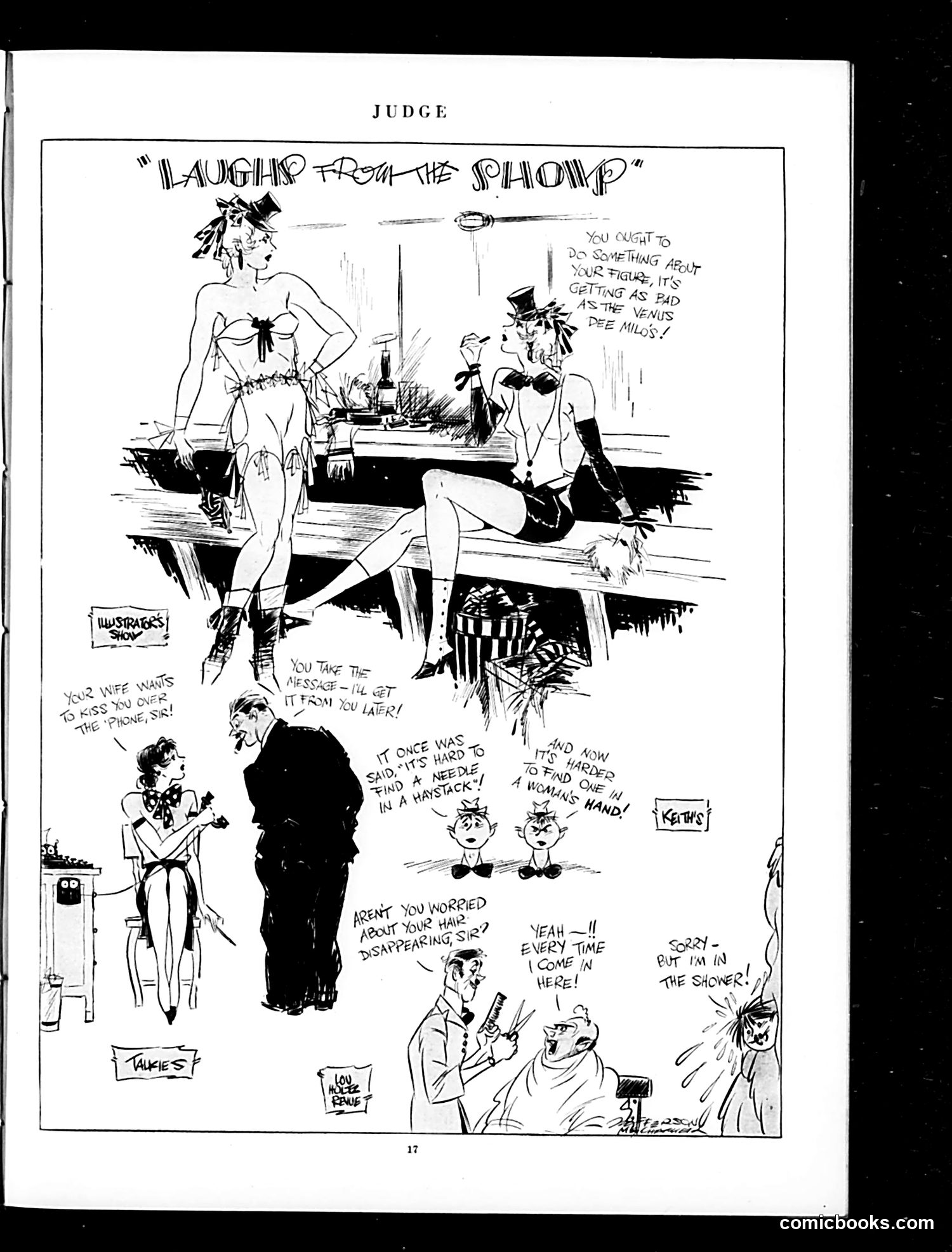
"Laughs from the Phono" - Judge Magazine Cartoon This appears to be a satirical comic strip about early phonograph technology and domestic life. The title puns on "phonograph" ("phono"). The cartoon depicts various domestic scenarios involving a phonograph: at top, two women in a dressing room discuss the device; below, multiple vignettes show husbands and wives dealing with phonograph-related problems—a man worried about his hair disappearing, another concerned about finding a needle, and someone calling from the shower. The satire mocks how the newfangled phonograph technology created domestic friction. Wives want husbands to use it for entertainment, but husbands are distracted or annoyed by technical difficulties (finding needles, maintaining the device). The humor relies on the novelty of this then-modern technology disrupting ordinary married life. The style and reference to phonographs suggest this is from the 1910s-1920s, when home phonographs were becoming popular consumer products.
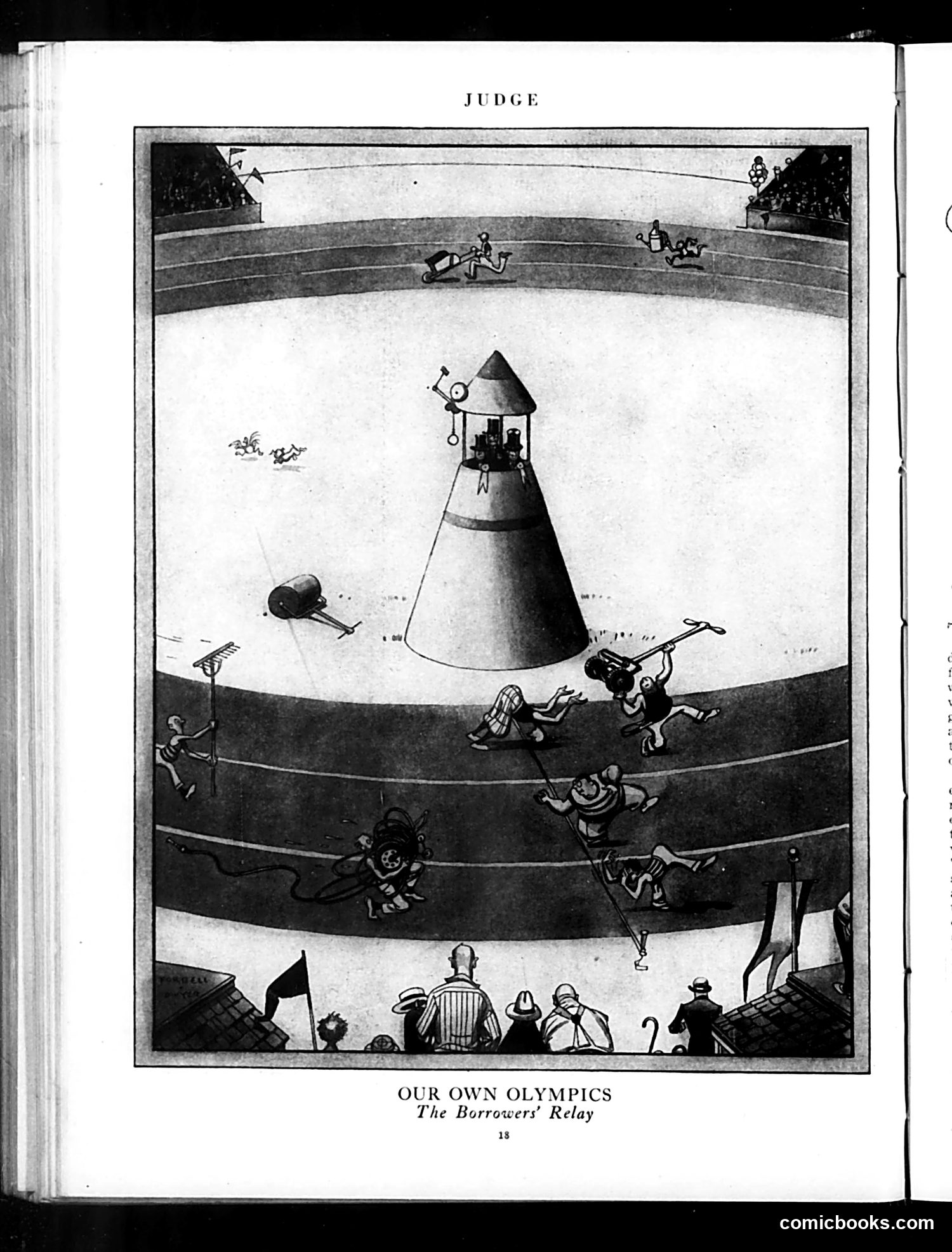
"The Borrowers' Relay" This satirical cartoon depicts a futuristic, surreal Olympic event held in a massive stadium. At the center stands a cone-shaped tower with figures inside, while athletes around it engage in a relay race involving what appears to be borrowed or improvised equipment. The satire mocks people who chronically borrow items from others without returning them—depicting this social vice as an Olympic sport. The "borrowers" are racing competitively around the arena while spectators watch from bleachers, treating chronic debt and borrowing as an athletic achievement worthy of celebration. This reflects early 20th-century Judge magazine's satirical style, using absurdist humor to critique social behaviors. The elaborate stadium setting emphasizes how ridiculous—yet apparently common—the practice of endless borrowing was considered among readers.
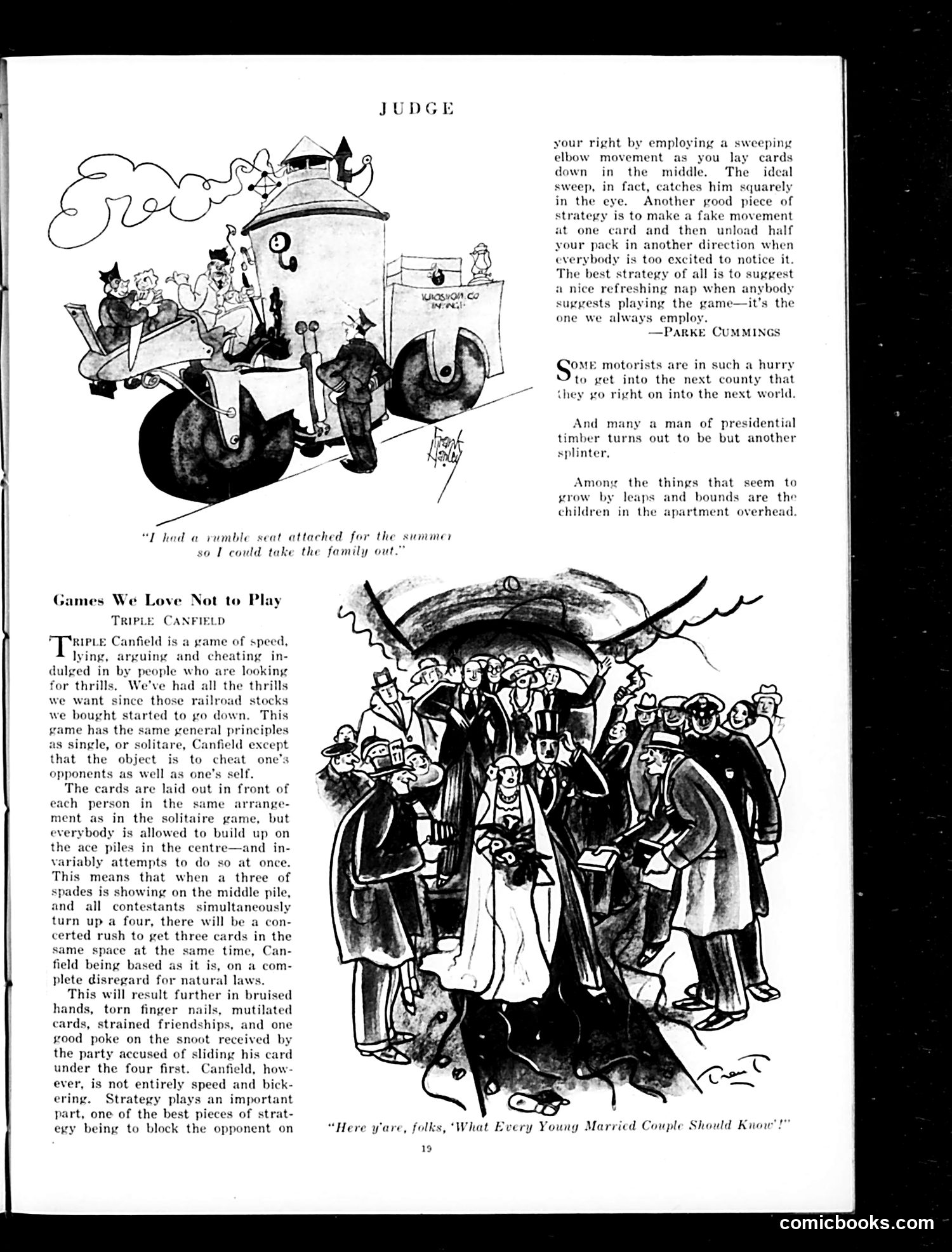
Judge Magazine Page Analysis This page from *Judge* contains humorous observations about modern life and a card game article: Top Section (by Parke Cummings): Short satirical quips about contemporary society—motorists driving recklessly into the afterlife, politicians who prove worthless ("presidential timber" becoming mere "splinter"), and noisy upstairs neighbors' children. Lower Section - "Games We Love Not to Play": An article about "Triple Canfield," a deliberately chaotic card game that combines solitaire rules with deliberate cheating and speed. The satire mocks the game's outcome: bruised hands, torn nails, ruined friendships, and violence ("a good poke on the snoot"). The illustration shows a bride and groom receiving instruction in this destructive game, captioned "What Every Young Married Couple Should Know!"—suggesting newlyweds are being taught how to destroy their relationship through competitive, dishonest behavior. The humor targets post-WWI American society's obsession with thrills and speed, and marital conflict disguised as fun.
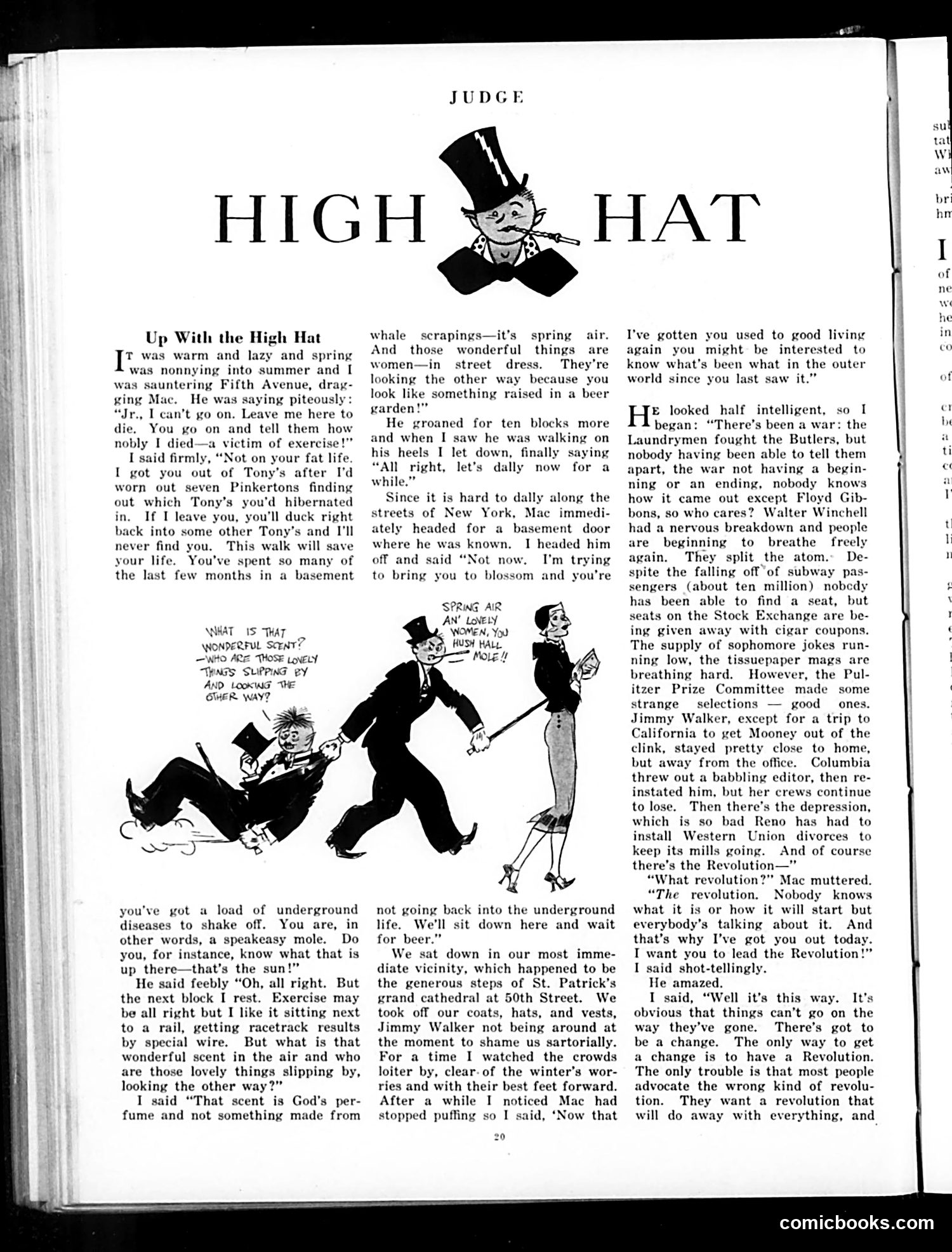
"High Hat" - Judge Magazine Satire This story satirizes Prohibition-era New York through the character "Mac," a speakeasy regular (underground basement dweller) being dragged into daylight by a friend attempting his reformation. The satire mocks: - Speakeasy culture: Mac's addiction to basement bars and resistance to sunlight/society - Jimmy Walker: NYC's mayor (1926-1932), mentioned as someone who'd "shame" them for removing formal wear in public - Walter Winchell: The famous gossip columnist, portrayed as having a "nervous breakdown" - Contemporary events: The Laundrymen-Butlers "war" (unclear reference), atom-splitting, subway overcrowding, stock market collapse, and Reno's divorce industry - Depression-era malaise: Cynical commentary on current social/economic chaos The illustration shows well-dressed men in top hats strolling past women—typical Judge imagery celebrating upper-class leisure while the text's narrator lectures about the moral/social decay happening around them. The humor targets both the speakeasy crowd and broader societal dysfunction of early 1930s America.
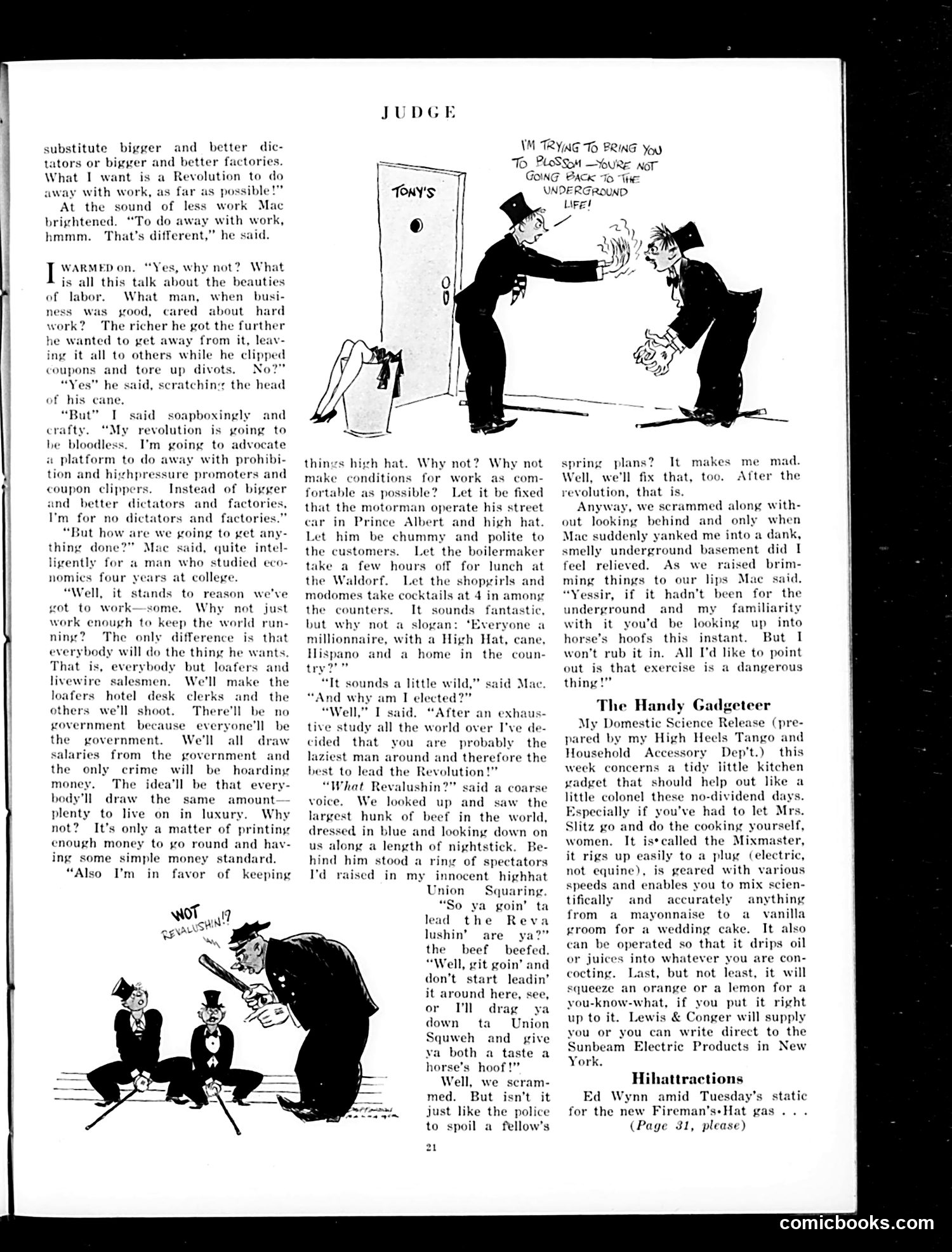
Analysis: "Judge" Magazine Satire Page This page satirizes 1920s radical political ideology through a dialogue between an unnamed socialist/communist speaker and "Mac," a wealthy but lazy businessman. The Setup: The speaker advocates a "bloodless revolution" eliminating work through government redistribution—everyone draws equal salaries, no hoarding, no dictators or factories. The joke: he identifies Mac (the laziest man around) as the perfect revolutionary leader. The Satire's Targets: - Utopian socialist rhetoric that ignores practical realities - The contradiction between preaching hard work while despising labor - Wealthy elites' hypocrisy (wanting servants but hating work itself) The Punchline: A police officer violently shuts down their street-corner soapboxing, forcing them underground. The final joke: Mac credits his knowledge of underground escape routes—undermining the speaker's "revolution" by showing it's immediately crushed by actual authority. Context: Post-WWI America feared radical movements. Judge mocked both socialists' naive idealism *and* aggressive police suppression, portraying both as absurd. The cartoons on the page reinforce the mockery through exaggerated character types.
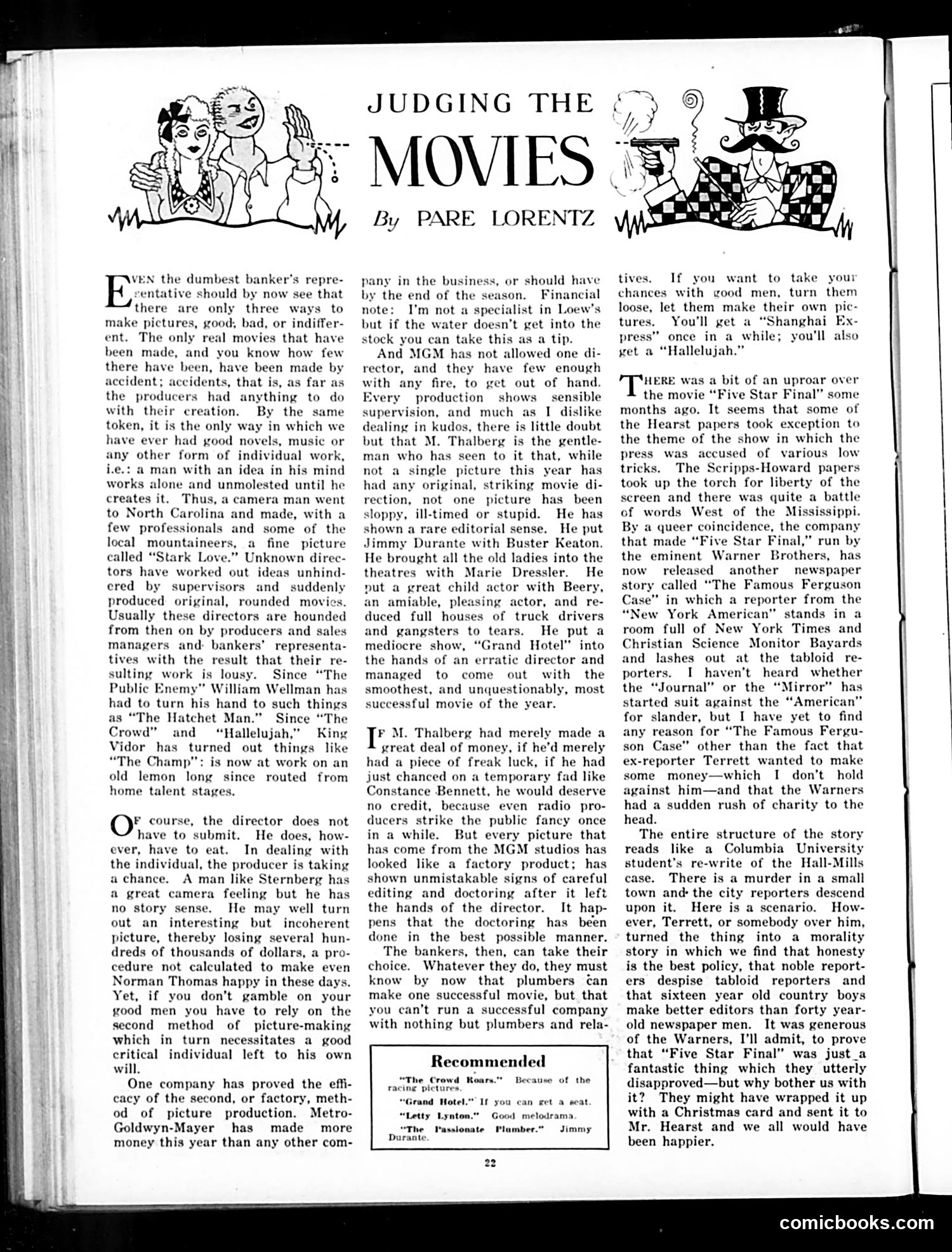
"Judging the Movies" by Pare Lorentz This film criticism column contrasts two production approaches: auteur-driven filmmaking versus studio system efficiency. The argument: Lorentz claims the best films result from directors working alone, unimpeded by producers and bankers' representatives. He cites examples like William Wellman and King Vidor, arguing their best work preceded studio interference ("The Public Enemy," "The Crowd"). The counter-example: MGM's Irving Thalberg exemplifies successful factory-method production. Despite lacking artistic originality, Thalberg's careful supervision, editing, and strategic casting (pairing Jimmy Durante with Buster Keaton, Marie Dressler with established stars) produced polished, commercially successful films like "Grand Hotel." The satire's tension: Lorentz concedes studio efficiency works financially, but implies artistic compromise. The "recommended" box lists MGM films approvingly, undercutting his preference for unshackled directorial vision—a practical acknowledgment that Depression-era audiences rewarded polish over experimentation.
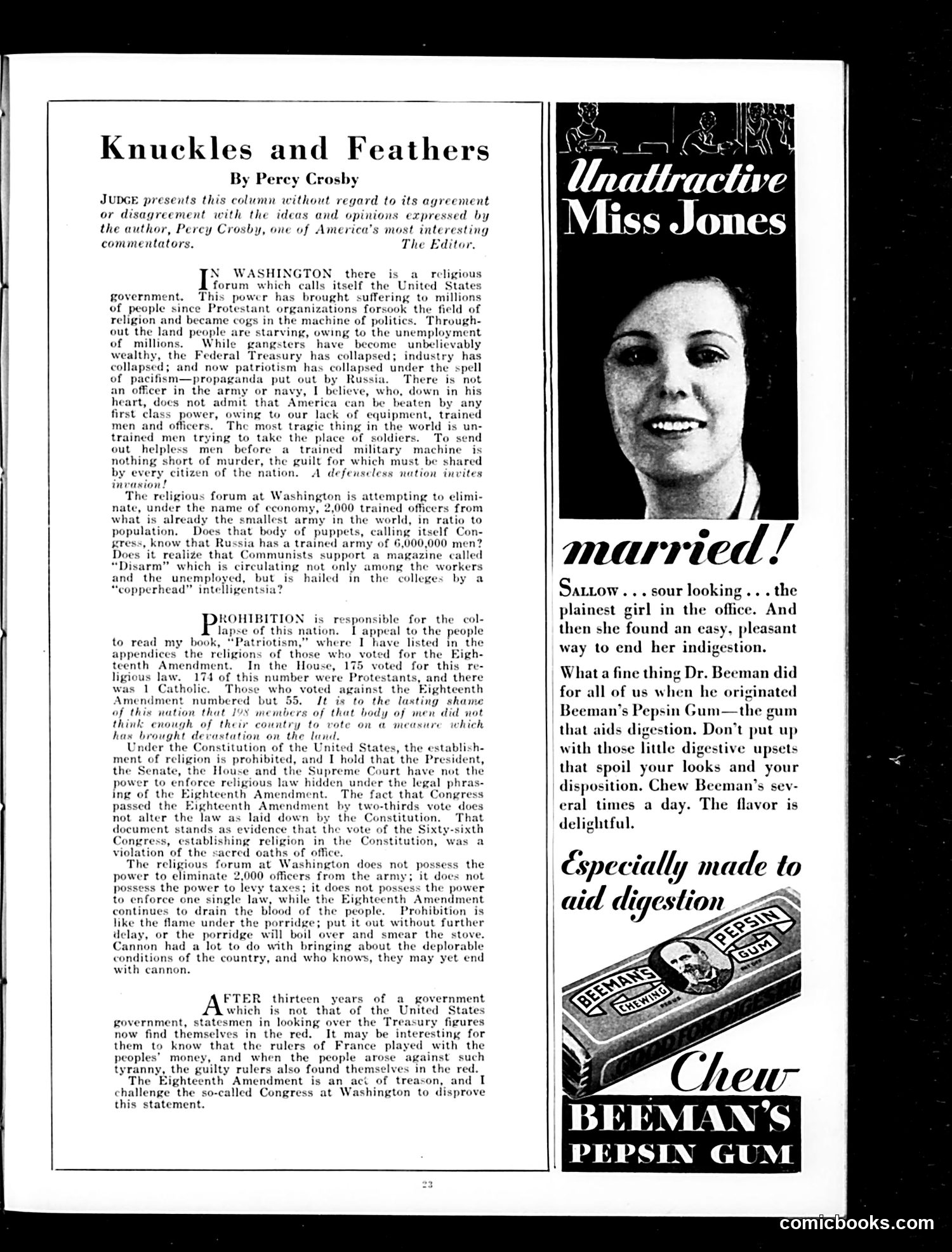
"Knuckles and Feathers" Analysis Percy Crosby's column attacks the Washington government as a "religious forum" masquerading as democracy. His central argument: the U.S. military is dangerously weakened—already the smallest army relative to population, while Russia maintains 6 million trained soldiers. He accuses Congress of attempting to eliminate 2,000 trained officers under the guise of "economy," a decision he characterizes as near-treasonous given communist propaganda promoting disarmament circulating among workers and college students. Crosby also blames Prohibition for national collapse, arguing it violated the Constitution since Congress lacked authority to enforce religious law. He criticizes the 175 Protestant House members who voted for the 18th Amendment while only one Catholic did, suggesting religious bias corrupted governance. The overall satire: American leadership has become so ideologically captured and militarily negligent that the nation invites invasion. The government prioritizes abstract moralism over national defense.
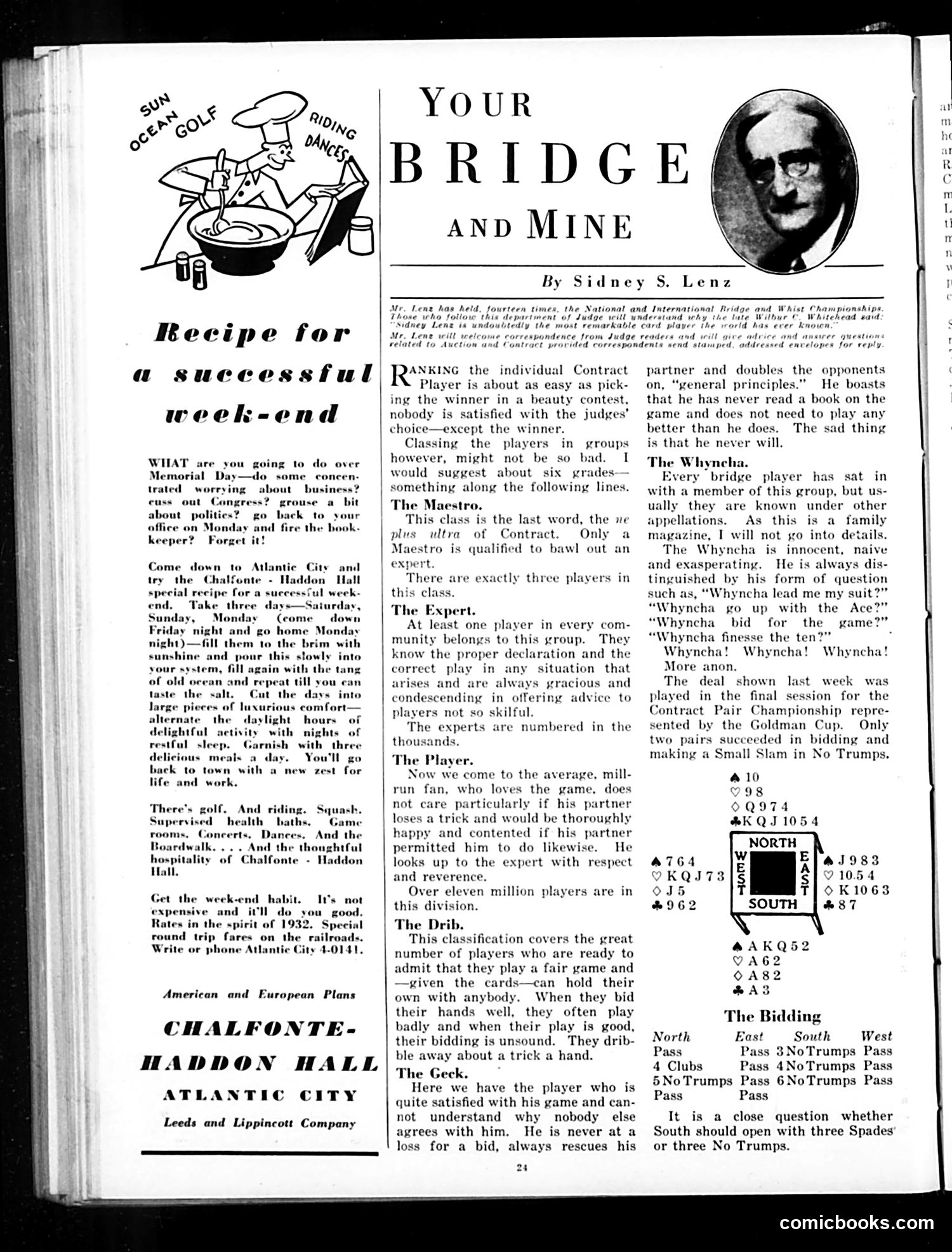
Content Analysis This page from *Judge* magazine contains bridge instruction and hotel advertising, not political satire. The main content is "Your Bridge and Mine" by Sidney S. Lenz, a famous bridge champion. Lenz humorously categorizes bridge players into six types: the Maestro (expert), the Expert, the Player (average fan), the Drib (mediocre), the Geek (delusional), and the Whyncha (annoying questioner). Each type is defined by skill level and personality traits, with "Whyncha" players distinguished by their constant second-guessing: "Whyncha lead my suit?" "Whyncha bid for the game?" The satire targets bridge culture itself—player arrogance, self-delusion, and annoying behavior—rather than politics. The page also advertises the Chalfonte-Haddon Hall resort in Atlantic City, promoting a "recipe for a successful week-end" involving golf, ocean activities, and leisure. This is lifestyle and hobby content, not political commentary.
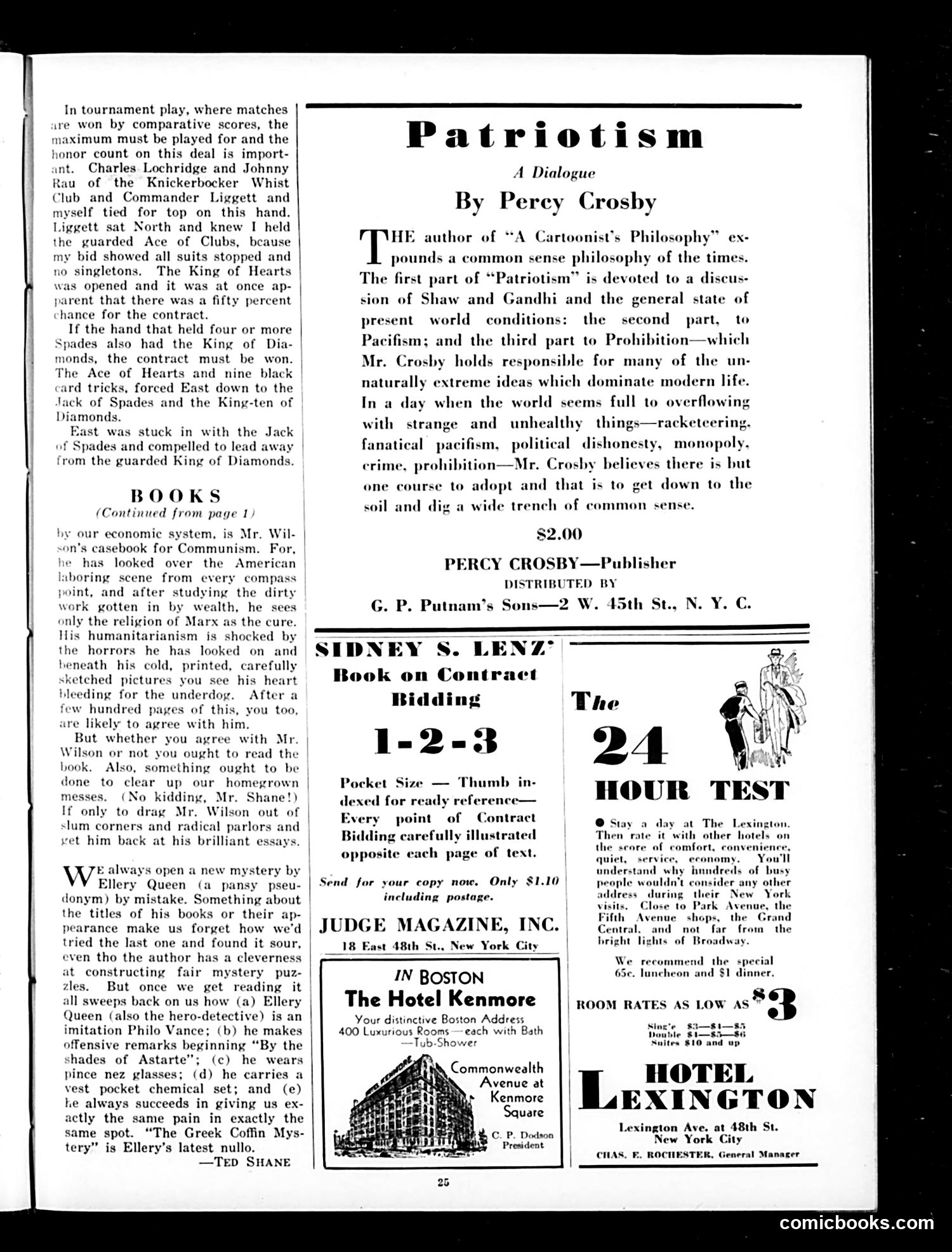
Judge Magazine Page Analysis This page is primarily advertising and book reviews, not satirical cartoons. The main content includes: Book Reviews (left side): Discussion of books on Communism and mystery novels by Ellery Queen, with critical commentary on their merits and flaws. Featured Advertisement: Percy Crosby's dialogue book "Patriotism" ($2.00), which critiques contemporary social problems—racketeering, pacifism, dishonesty, monopoly, and Prohibition—advocating instead for "common sense." Other Ads: Sidney Lenz's "Book on Contract Bidding" (bridge instruction, $1.10); Hotel Kenmore in Boston; and Hotel Lexington in New York. The page reflects 1920s-30s concerns: economic ideology, social reform movements, and Prohibition. Crosby was known for cartoons with philosophical commentary. The "24 Hour Test" hotel advertisement suggests tourism marketing of the era. No specific political figures are caricatured on this page.
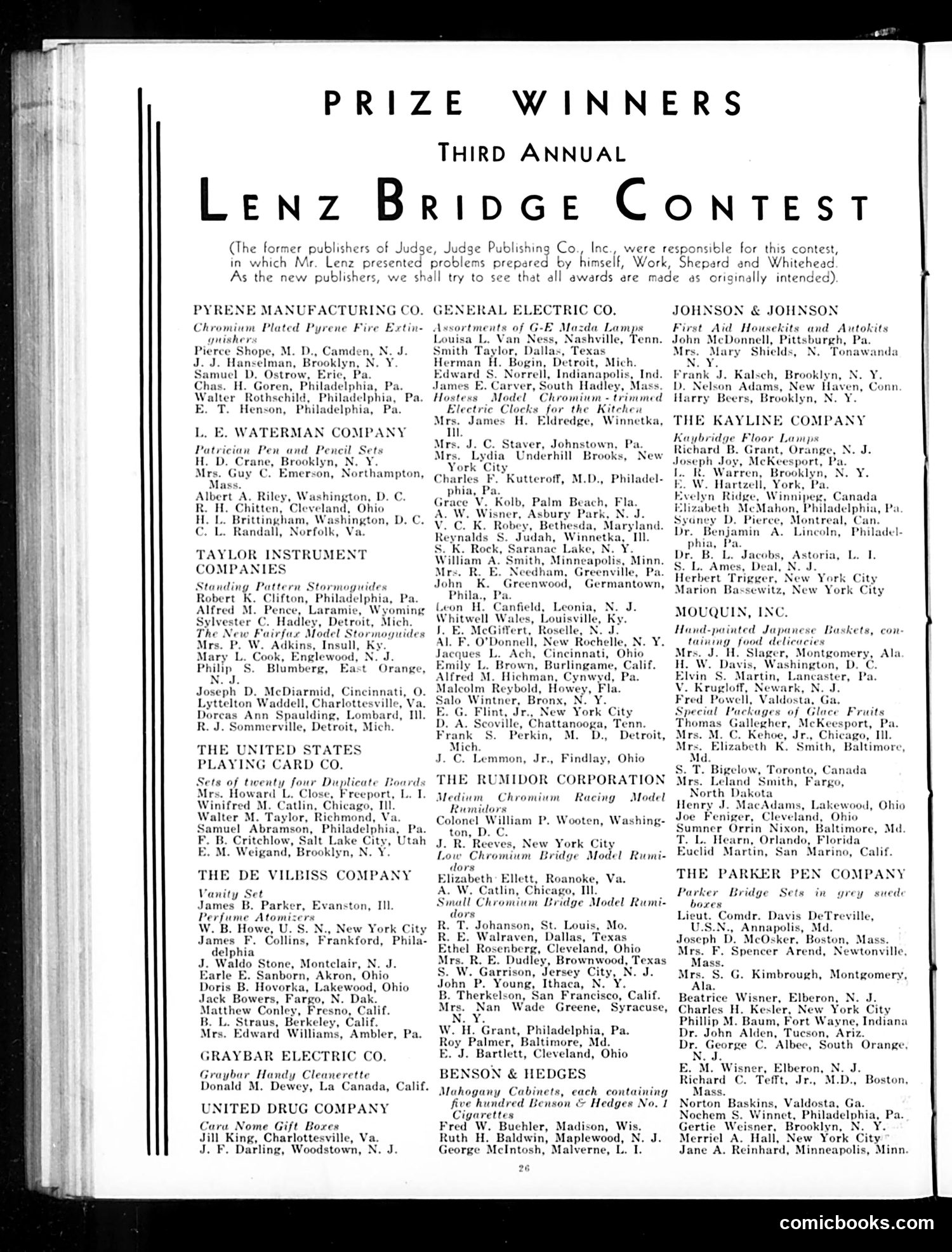
This page contains no cartoons or satirical illustrations. It's a title page listing prize winners from the Third Annual Lenz Bridge Contest—a competition Judge magazine (then under new publishers) sponsored. The page identifies numerous manufacturers (Pyrene, Waterman, General Electric, Johnson & Johnson, etc.) who donated prizes, and lists the names and locations of contest winners across multiple product categories. For modern readers: "Bridge" refers to the card game contract bridge, which was enormously popular in the 1920s-1930s. The contest awarded prizes ranging from fountain pens to automotive fire extinguishers to bridge accessories. The footnote clarifies that the new Judge publishers committed to honoring awards "as originally intended" by the previous publishers—suggesting some transitional business dispute, though details aren't explained here. This is essentially an advertisement-heavy administrative page with no visual satire present.
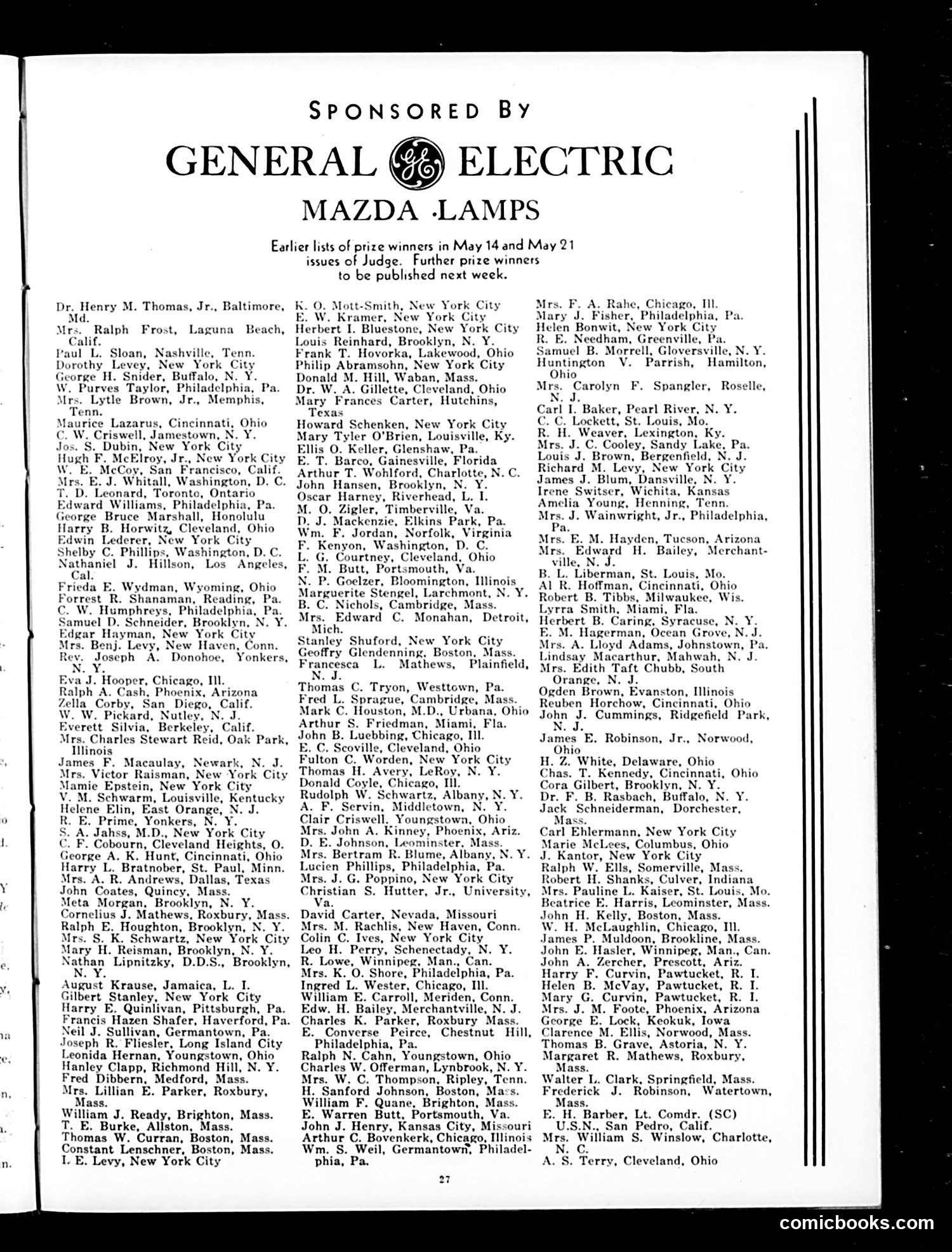
This page is primarily an advertisement and prize winner list, not a cartoon or satirical content page. The page announces that Judge magazine's content is "Sponsored By General Electric Mazda Lamps." Below this is a contest results announcement: prize winners from issues dated May 14 and May 21 are listed here, with additional winners to be published the following week. The bulk of the page consists of hundreds of names and addresses of contest winners from across America—from major cities like New York, Philadelphia, and Chicago to smaller towns. This appears to be a circulation-building promotional contest run by Judge magazine, likely rewarding readers for subscriptions or participation. There are no cartoons or satirical commentary visible on this page. It's a straightforward business/promotional document typical of early-to-mid 20th century magazine publishing.
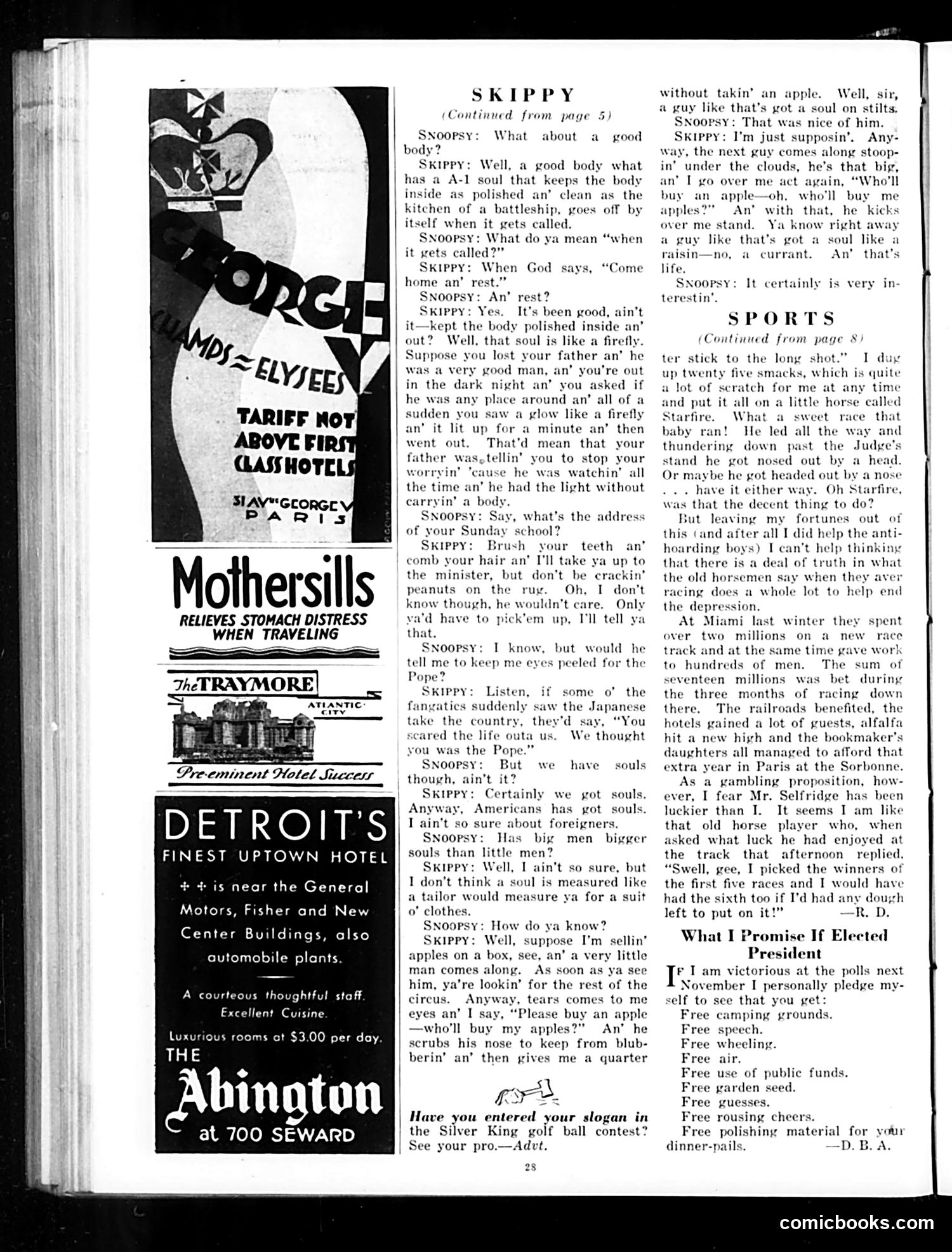
Analysis for Modern Readers This page is primarily advertisements and comic strip continuation, not political satire. The visible cartoon is "Skippy," a long-running children's comic strip. The dialogue shows Skippy and a friend (Snoopsy) discussing philosophy—specifically, what constitutes a "soul" and whether it correlates to body size or moral character. Skippy uses vivid metaphors (fireflies, apples, horses) to explain spiritual worth to his younger friend. The surrounding ads promote 1920s-30s hotels and a stomach remedy (Mothersills), typical of Judge magazine's era. Historical context: "Skippy" was enormously popular during the Depression, offering lighthearted philosophical humor for children. The strip's whimsical tone and Skippy's role as wise-but-mischievous mentor reflect period values emphasizing character over material wealth—fitting for Depression-era audiences.
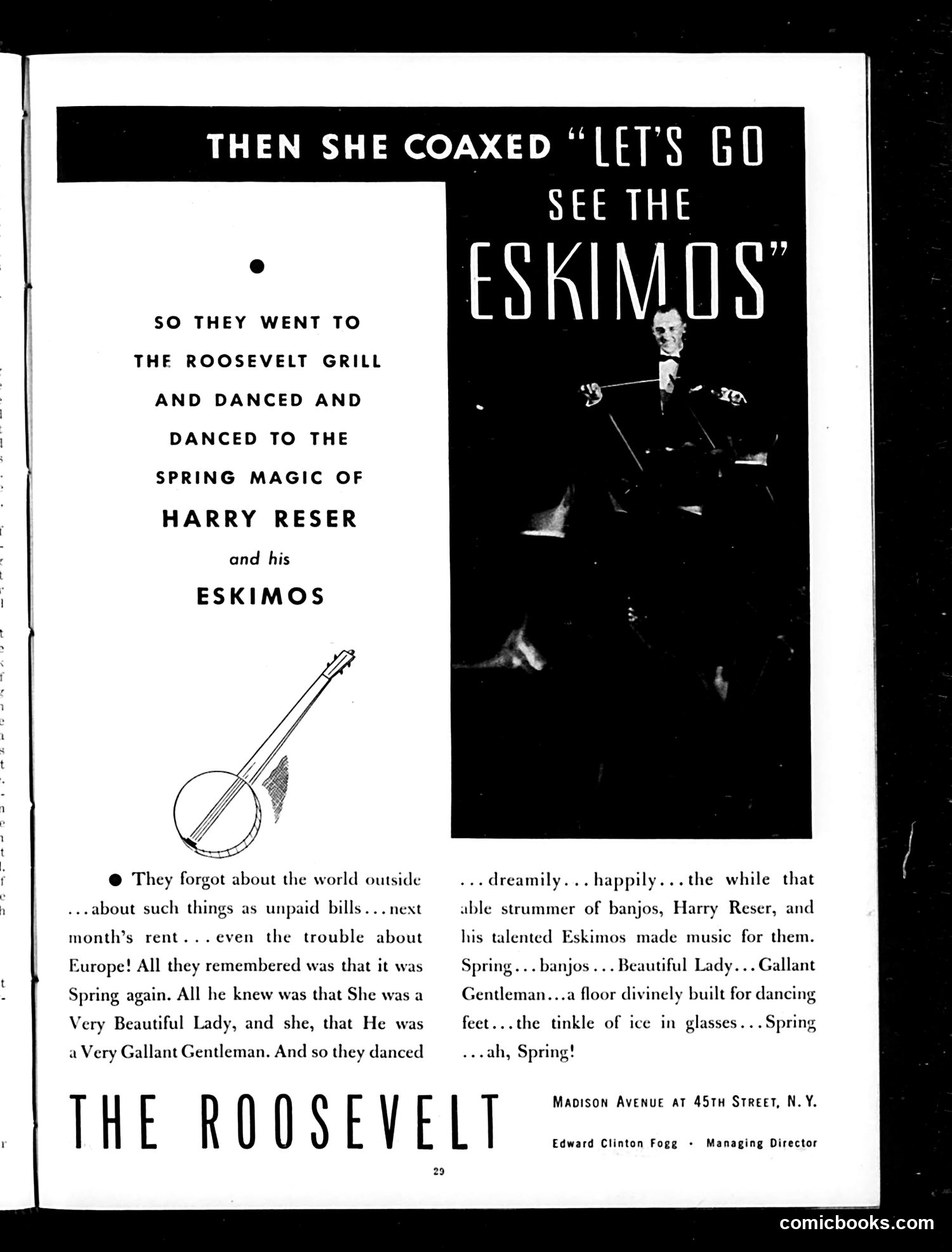
Advertisement for The Roosevelt Hotel/Grill This page is primarily an advertisement for The Roosevelt Hotel (Madison Avenue at 45th Street, NYC), not political satire. It romanticizes the venue by narrating a couple's evening: she convinces him to visit the Roosevelt Grill, where they dance to Harry Reser and his Eskimos (a real 1920s-30s jazz/dance band). The copy uses escapist language—they forget worldly troubles like bills and European concerns—emphasizing the hotel as a romantic refuge. The illustration shows Harry Reser, the bandleader, with his characteristic banjo. Note: "Eskimos" was the band's actual name; the term reflects period conventions, not satire. The ad's point: The Roosevelt Grill offers spring romance, live music, and escape from everyday anxieties—a luxury leisure pitch targeting middle/upper-class readers during what was likely the Depression era (when such escapism was marketable).
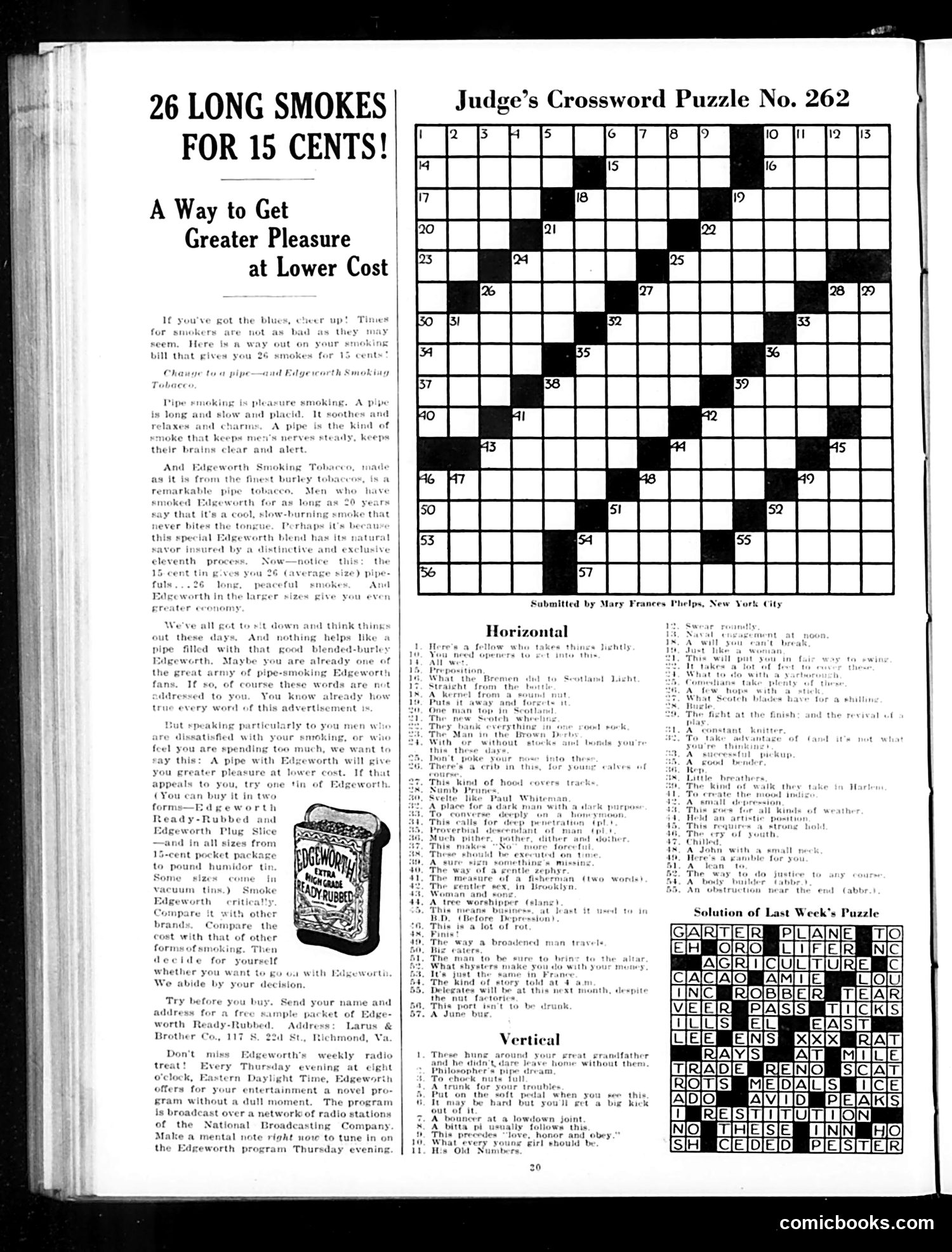
Analysis for Modern Readers This page is primarily advertising for Edgeworth pipe tobacco, not political satire. The left side contains a marketing pitch promoting pipe smoking as an economical pleasure—26 long smokes for 15 cents. The advertisement targets men during what appears to be the early-to-mid 20th century, emphasizing pipe smoking's virtues: it's slow-burning, relaxing, and made from quality "burley tobacco." The copy promises that Edgeworth brand specifically delivers superior value and pleasure. The right side contains Judge's Crossword Puzzle No. 262—a standard newspaper crossword puzzle feature, unrelated to the advertisement. There is no political cartoon or satire visible on this page. It's primarily a commercial advertisement leveraging the magazine's space to market consumer goods to Judge's male readership, alongside routine puzzle entertainment. The "greater pleasure at lower cost" angle is straightforward marketing, not social commentary.
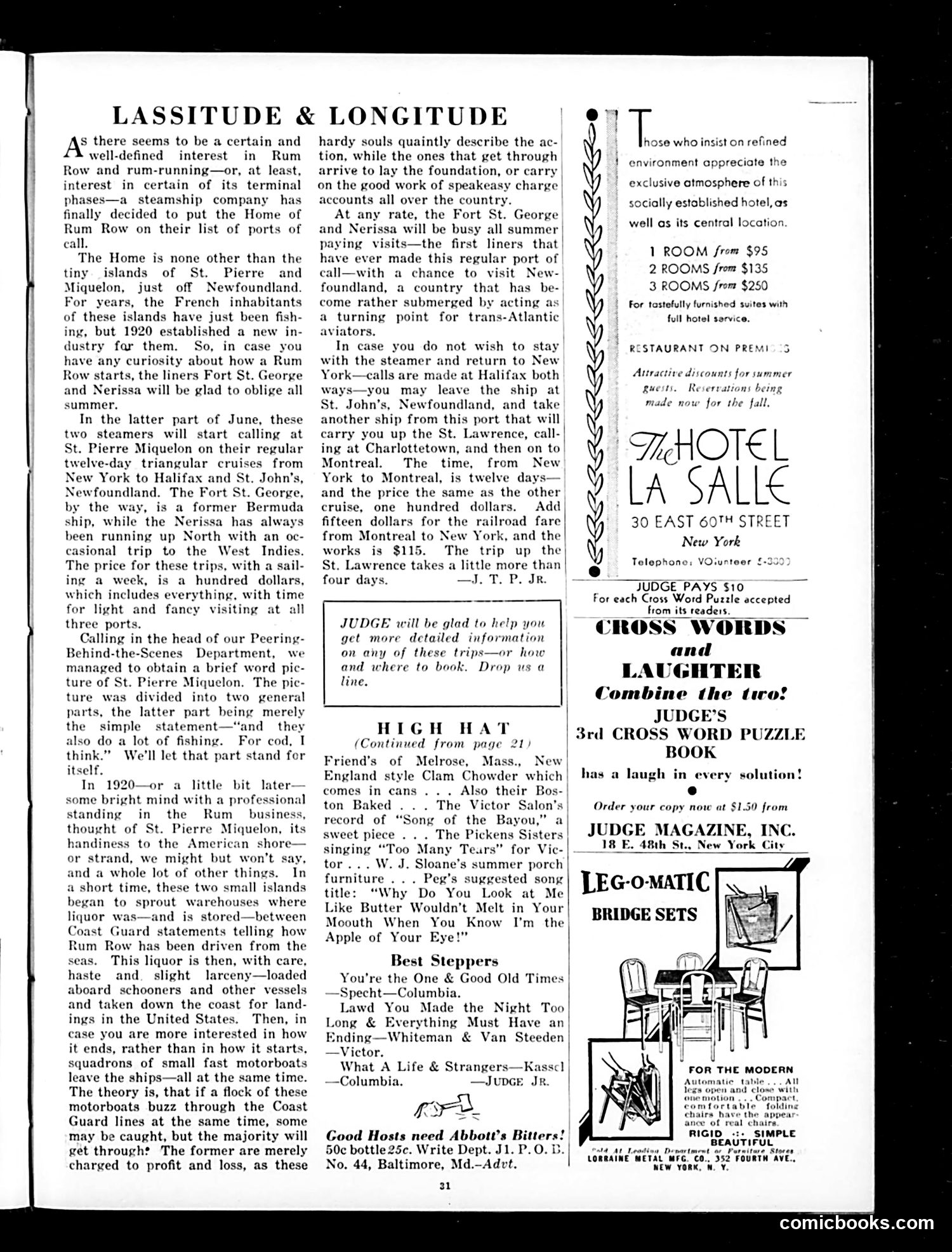
Analysis of "Lassitude & Longitude" This article satirizes Prohibition-era rum-running through the guise of legitimate cruise advertising. The satire targets the hypocrisy of the era: steamship companies openly advertising "cruises" to St. Pierre and Miquelon, French islands off Newfoundland that had become notorious as transshipment points for illegal liquor destined for American speakeasies. The joke is the transparent pretense—the article describes exactly how bootleggers operate (storing liquor, transferring it to fast motorboats, evading Coast Guard patrols) while framing it as tourist information. The writer notes that companies "finally decided" to put this smuggling hub "on their list of ports of call," mocking how openly the illegal operation functioned. The reference to motorboats "buzz[ing] through the Coast Guard lines" and losses being "charged to profit and loss" reveals Judge's sardonic commentary on Prohibition's failure and widespread corruption—even major shipping companies profited from bootlegging.
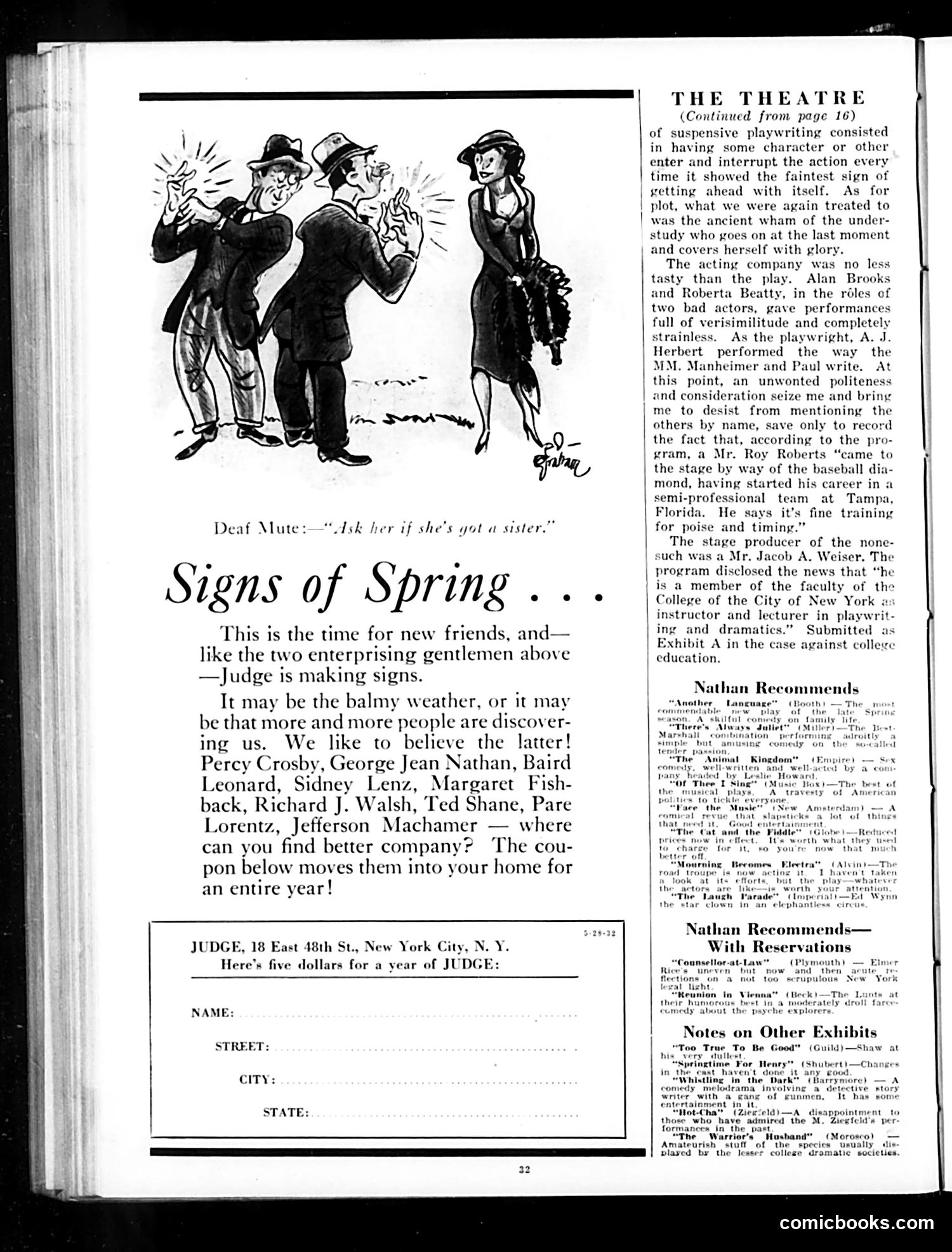
Analysis of Judge Magazine Page This page from Judge magazine contains a theater review and promotional material rather than political satire. The Cartoon: The illustration labeled "Deaf Mute" shows three men in bowler hats making exaggerated gestures toward a woman, with one asking "Ask her if she's got a sister." This appears to be a crude joke about flirtation, playing on the idea that if someone is deaf, elaborate physical gesturing would be necessary—a common comedic trope of the era. "Signs of Spring" Section: This is promotional copy for Judge magazine, claiming it brings together notable writers like Percy Crosby and George Jean Nathan. It includes a subscription coupon offering a year of Judge for five dollars. Theater Review: The right column critiques a Broadway production called "Signs of Spring," discussing the acting company (Alan Brooks, Roberta Beatty, A. J. Herbert) and noting that one actor, Roy Roberts, came from semi-professional baseball in Tampa—framed as unusual background for stage work. The page reflects early-20th-century attitudes toward disability and courtship humor while promoting magazine subscriptions.
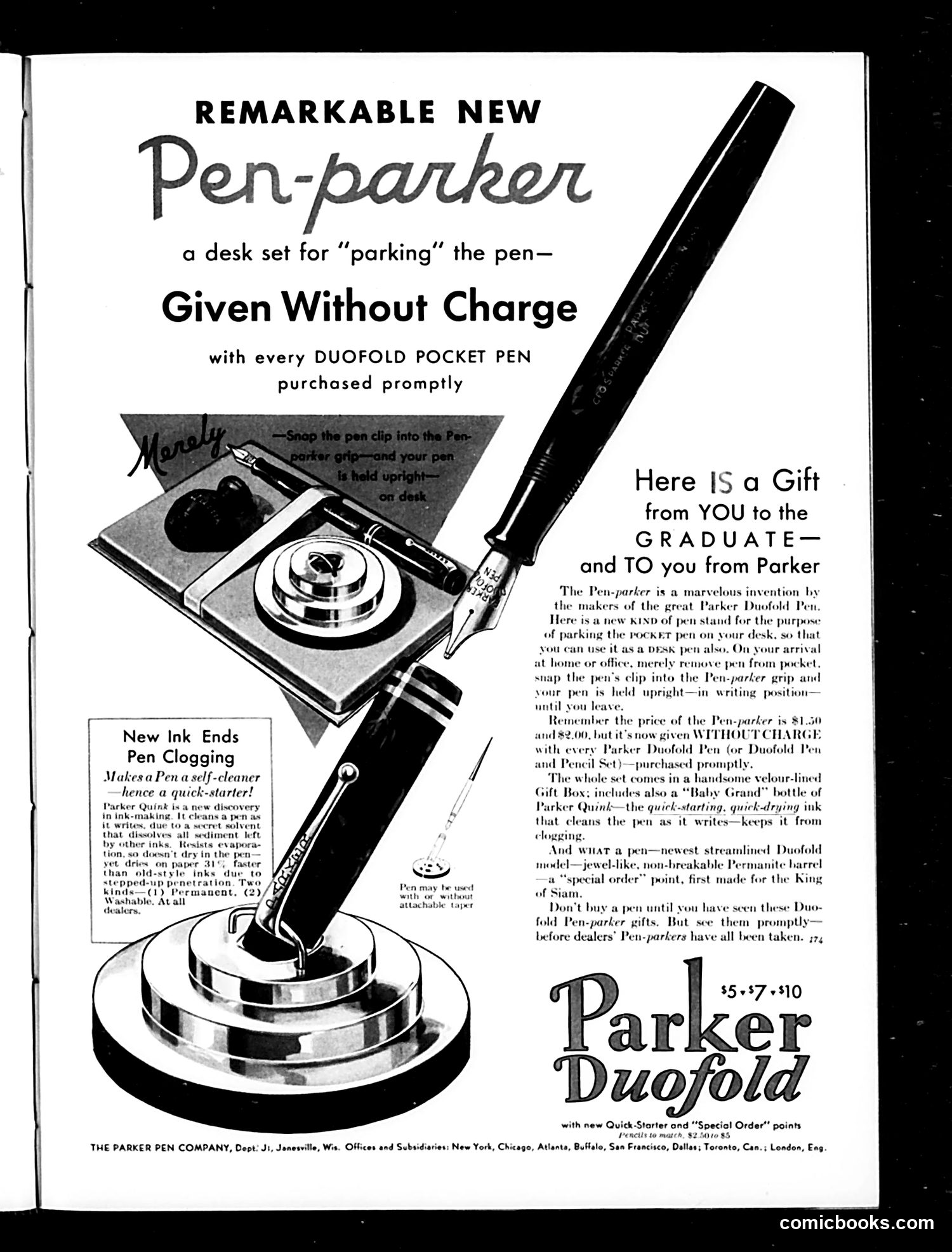
Analysis This is primarily a product advertisement, not a political cartoon. It promotes Parker's Duofold fountain pen and a new accessory called the "Pen-parker"—a desk stand that holds the pen upright when not in use. The page targets graduation gift-givers, positioning the pen as an appropriate present for graduates. The "Pen-parker" is marketed as a remarkable free bonus (worth $1.50-$2.00) included with purchase. Notable details: the text mentions a "Special Order" point "first made for the King of Siam," suggesting exotic prestige. The advertisement emphasizes the pen's self-cleaning properties and quick-starting ink to address common fountain pen complaints of the era. There is no satire or political content visible. This is straightforward commercial copy typical of 1920s-30s magazine advertising, appealing to middle-class consumers through gift-giving occasions and product innovation claims.
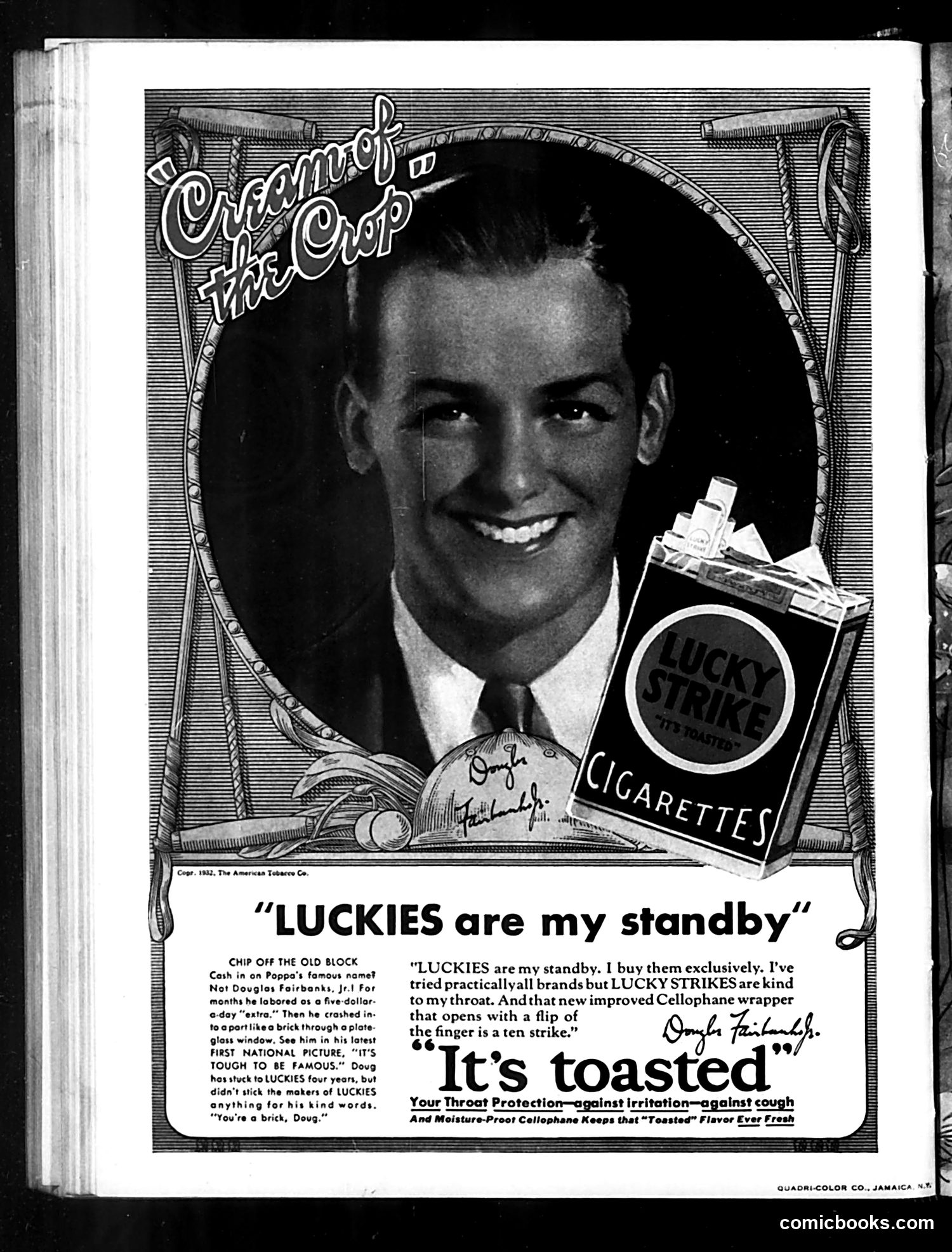
Analysis This is a Lucky Strike cigarette advertisement, not political satire. It features what appears to be a young man (identified as "Doug" or possibly "Chip") endorsing Lucky Strike cigarettes. The ad uses a testimonial format common in 1930s advertising. The "joke" references his father's ("Poppo's") fame—the copy suggests he's leveraging a family name for credibility, yet humorously notes he didn't compensate the cigarette makers for the endorsement ("didn't stick the makers of LUCKIES anything for his kind words"). Key marketing claims include the cigarettes being "toasted" and the new "improved" cellophane wrapper that "opens with a flip of the finger." The ad promises throat protection against irritation and cough. For modern readers: this represents pre-regulation tobacco advertising that made health claims (throat protection, reduced irritation) now prohibited. The casual celebrity endorsement was standard practice before such restrictions existed.