judge
Judge — June 4, 1932
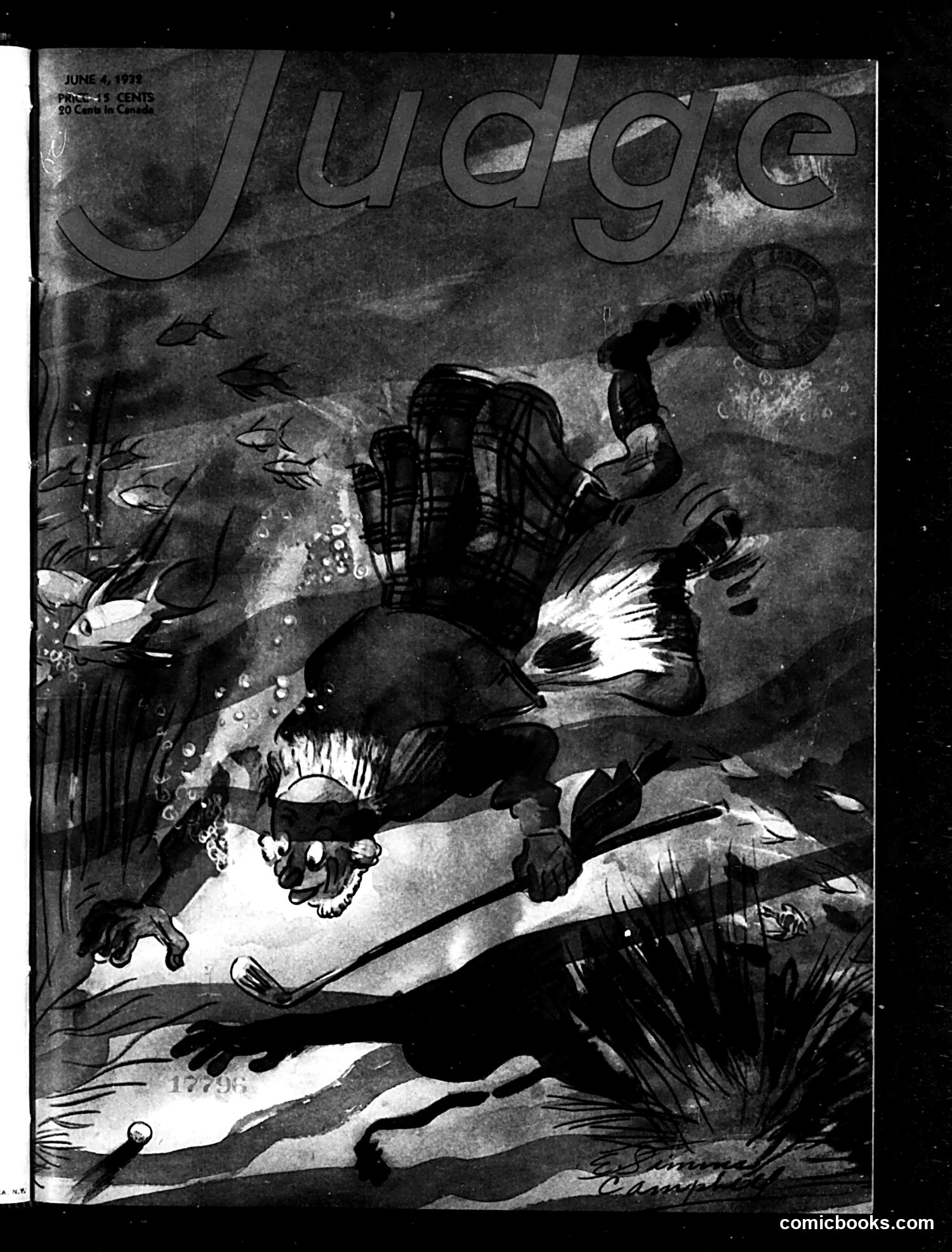
Judge Magazine Cartoon Analysis This appears to be a June issue of Judge magazine (price 20 cents in Canada), a prominent American satirical publication. The cover illustration depicts an underwater scene with divers or swimmers in dramatic poses among aquatic vegetation and sea creatures. The artistic style and composition suggest this is likely political or social satire, though without clearer text or visible captions identifying specific figures or events, I cannot definitively state what particular political situation or public figures are being mocked. The dynamic, action-oriented composition and exaggerated artistic style typical of Judge's editorial cartoons indicates social commentary, but the specific target and satirical message remain unclear from this image alone.
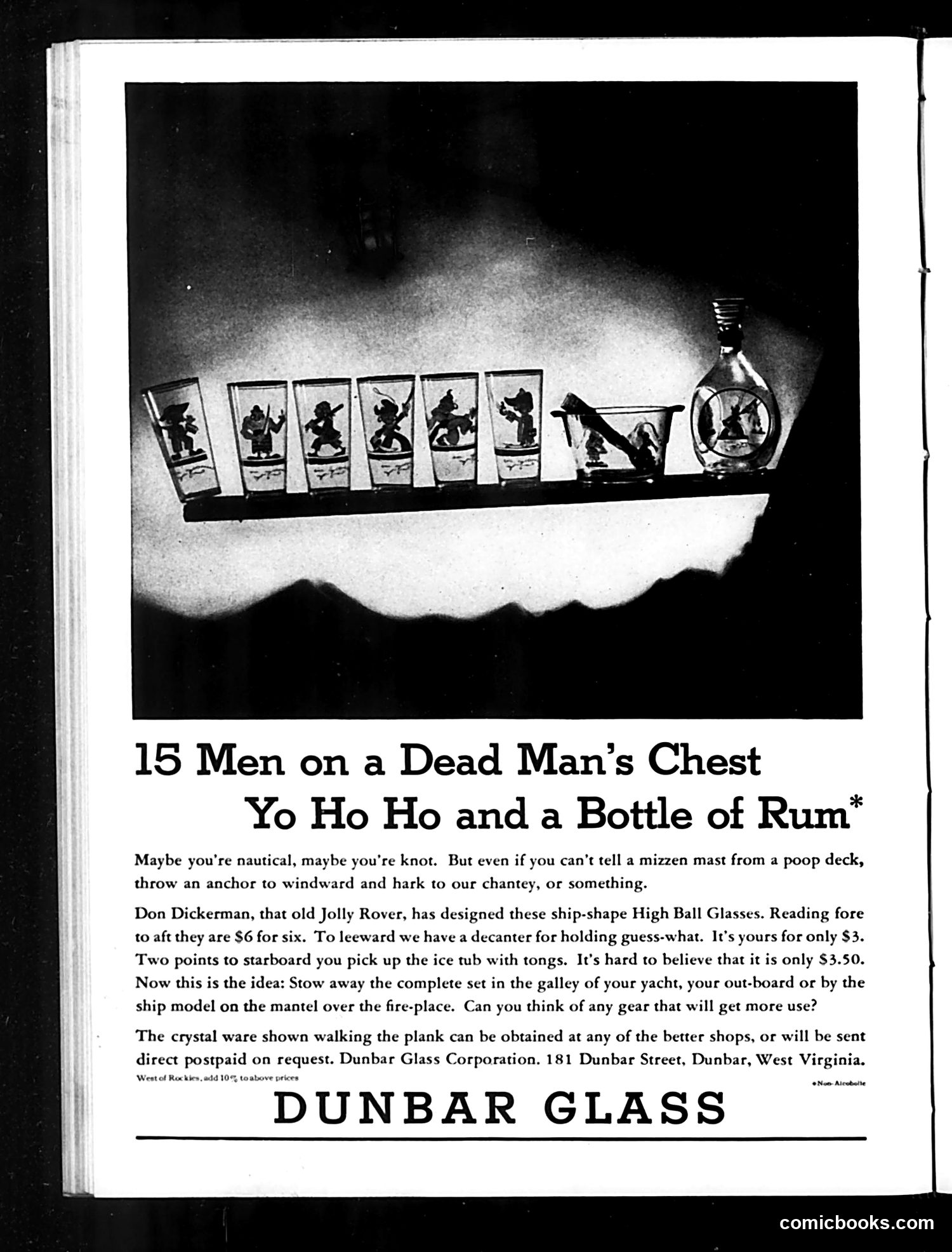
Analysis This is primarily a product advertisement for Dunbar Glass Corporation, not political satire. The page advertises nautical-themed glassware designed by "Don Dickerman, that old Jolly Rover." The humorous copy adopts pirate/sailor vernacular ("mizzen mast," "poop deck," "hark to our chantey") to appeal to customers who fancy themselves nautical enthusiasts—whether genuinely knowledgeable or not ("maybe you're knautical, maybe you're knot"). The product line includes ship-shaped highball glasses ($6 per set of six), a decanter ($3), and an ice tub with tongs ($3.50). The satirical angle is gentle: it mocks aspirational consumers who want maritime décor to display on their yachts or mantels, suggesting these items represent quintessential "gear" for the nautically-minded. The title playfully references a pirate drinking song.
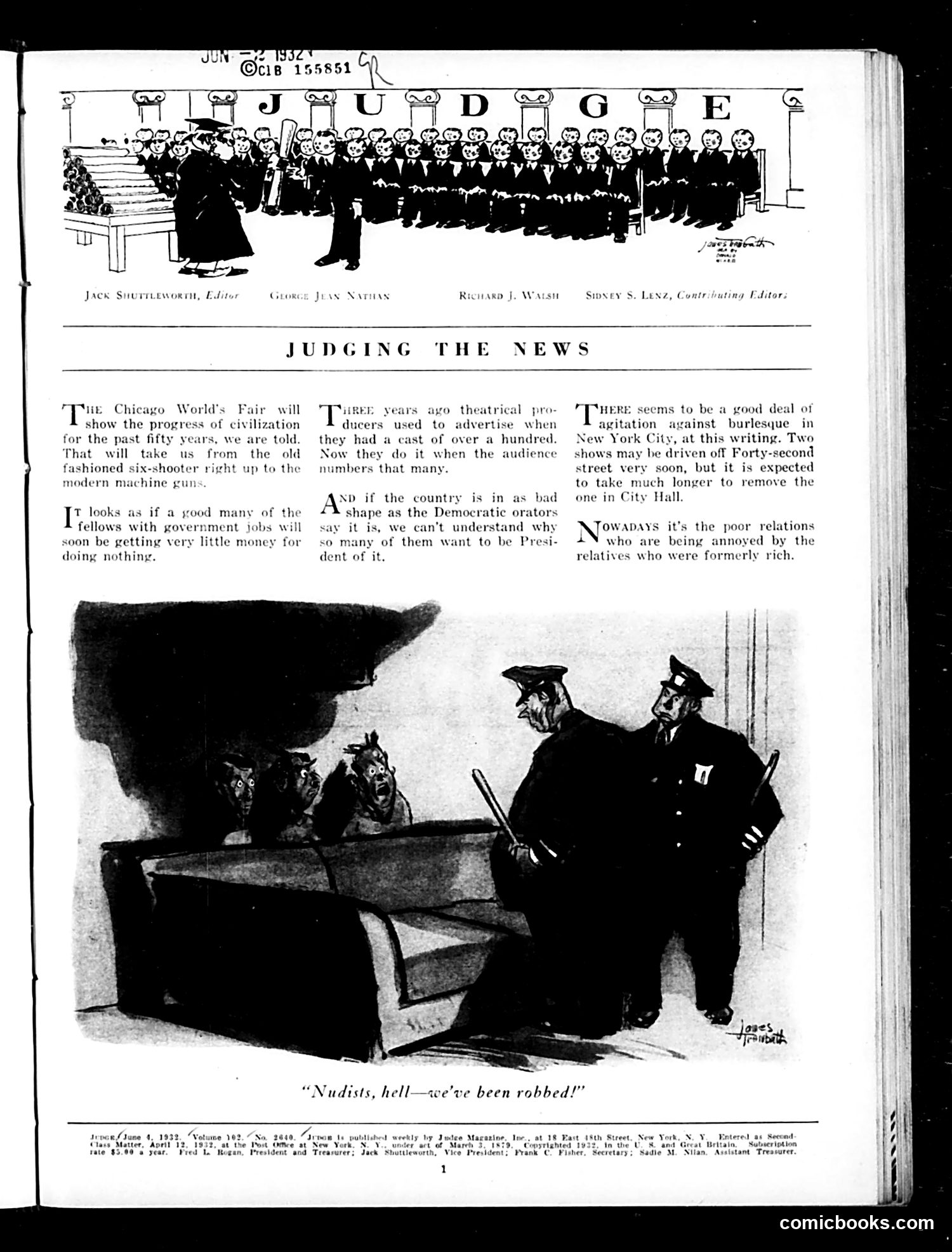
Analysis of "Judging the News" Page This page from Judge magazine (dated June 2, 1932) contains editorial commentary and one cartoon titled "Nudists, hell—we've been robbed!" The cartoon depicts two police officers discovering what appears to be a robbery at a nudist establishment. The joke plays on the double meaning: nudists have "nothing to wear," so discovering a theft ("we've been robbed!") is absurd—they have no possessions to steal. The text snippets above discuss the 1932 Chicago World's Fair, theatrical advertising practices, and complaints about burlesque shows in New York City. One note sardonically observes that poor relations of formerly wealthy people now cause family friction—a pointed reference to the economic devastation of the Great Depression affecting class relationships. The overall tone reflects Depression-era cynicism about social upheaval and changing circumstances.
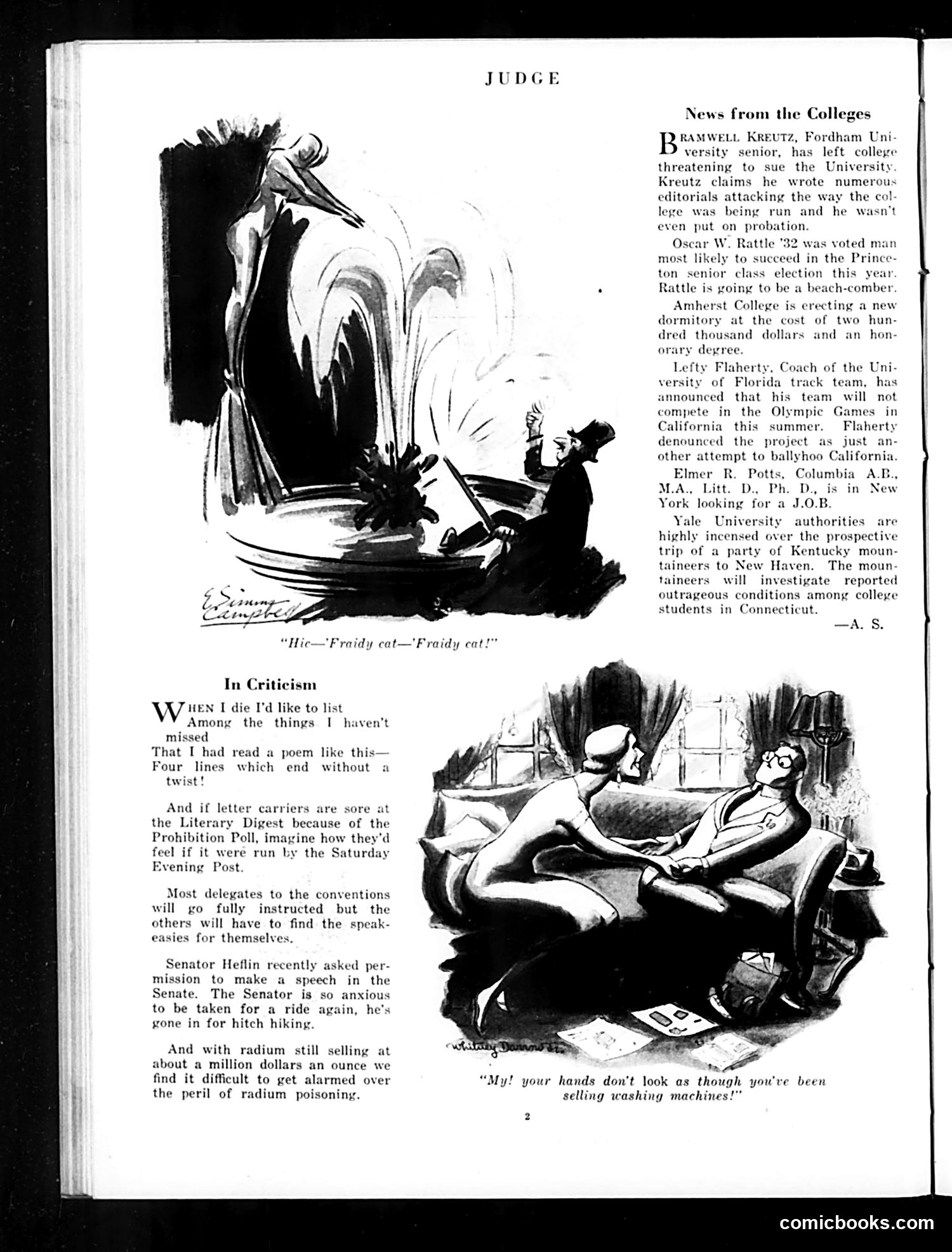
Analysis of Judge Magazine Page The page contains two cartoons and college news items from an unspecified era (likely 1920s-30s based on style). Top cartoon ("Hic—Fraidy cat—Fraidy cat!"): Shows a skeleton confronting a frightened person, likely satirizing the Prohibition era's dangers—specifically bootleg alcohol or speakeasies. The skeleton represents death from contaminated liquor. Bottom cartoon ("My! your hands don't look as though you've been selling washing machines!"): Depicts a woman in domestic leisure being questioned about her hands, mocking the irony of salespeople claiming products work while showing no evidence of actual use—a common advertising criticism. The "In Criticism" section offers satirical commentary on contemporary issues including the Prohibition Poll, radium safety concerns, and Senator Heflin's public speaking anxieties.
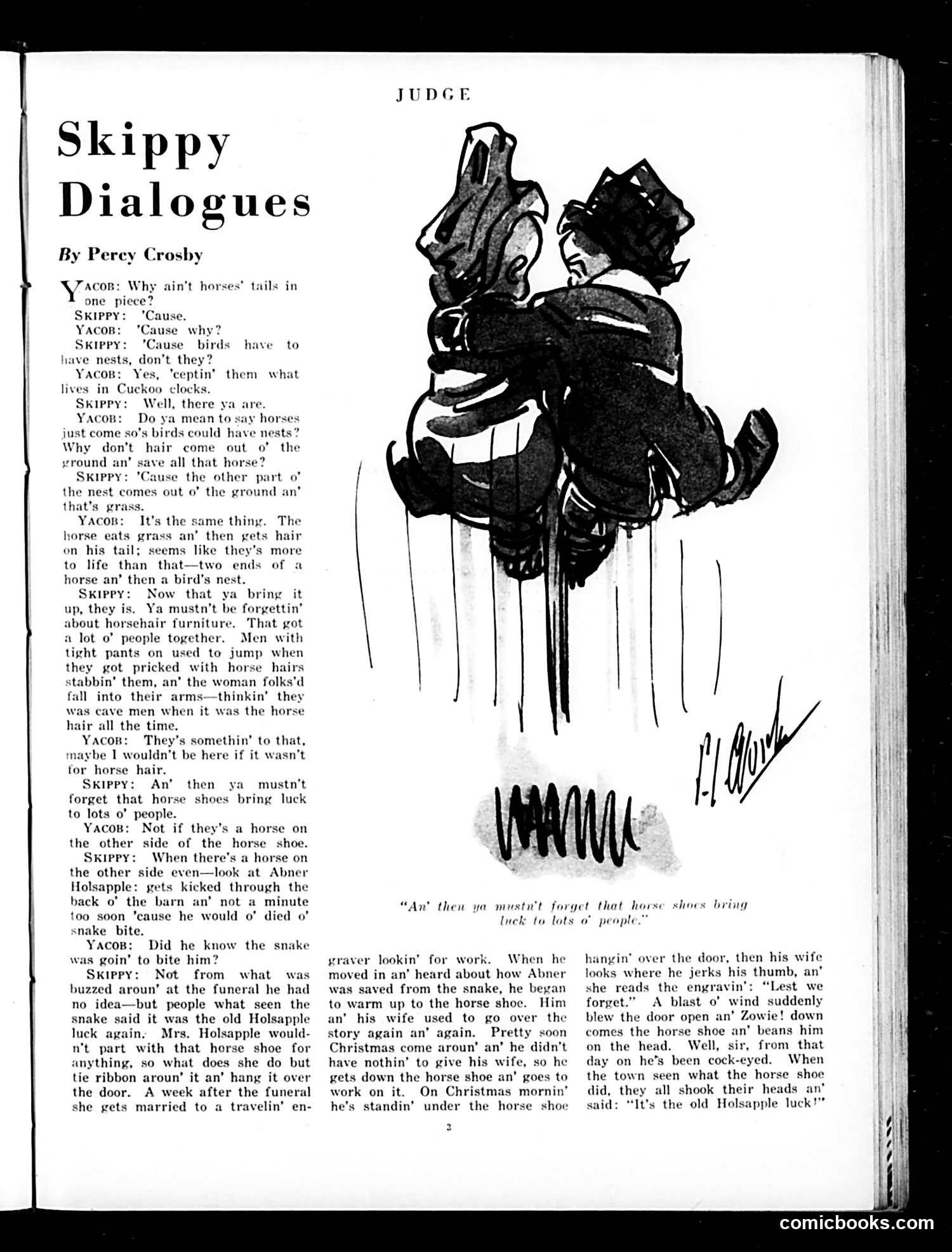
"Skippy Dialogues" by Percy Crosby This page features a humorous dialogue between two characters—Yacob and Skippy—discussing the practical uses of horsehair. The conversation satirizes folk superstitions and everyday logic through a child's perspective. The joke centers on horseshoes as good-luck charms. Skippy points out the absurd contradiction: people treasure horseshoes for luck, yet the same horsehair used in furniture caused an accident (referencing "old Holsapple luck"). The narrative builds to a comic payoff where a snake bite is ironically blamed on the horseshoe's "old Holsapple luck" rather than actual danger. The cartoon mocks superstitious thinking by showing how people rationalize contradictory beliefs about the same object—treating horseshoes as both bringers and preventers of misfortune based on convenience.
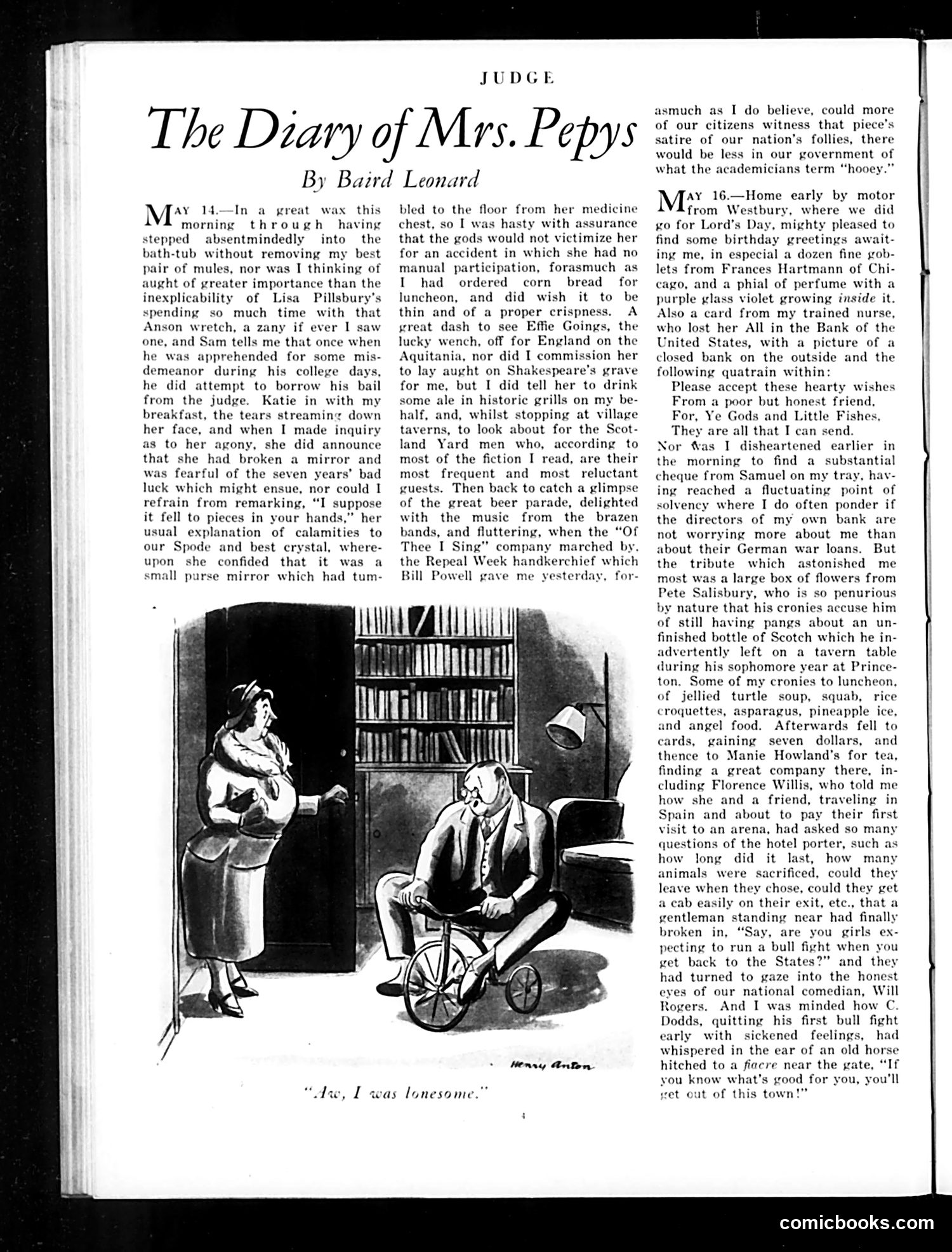
"The Diary of Mrs. Pepys" by Baird Leonard This is a humorous diary entry feature, not political satire. The May 14 entry describes Mrs. Pepys's morning mishap—stepping into a bathtub without removing her best pair of mules, then worrying about her friend Lisa Pillsbury's injury from a mirror accident. The May 16 entry catalogs social activities: motoring, receiving birthday greetings and gifts (including a perfume bottle from Frances Hartmann), and attending luncheon at Manie Howland's where guests discuss a bullfighting arena visit and Will Rogers's comedic commentary. The illustration shows a woman and man in a domestic interior, with the caption "Alas, I was lonesome"—depicting the domestic comedy the diary documents.
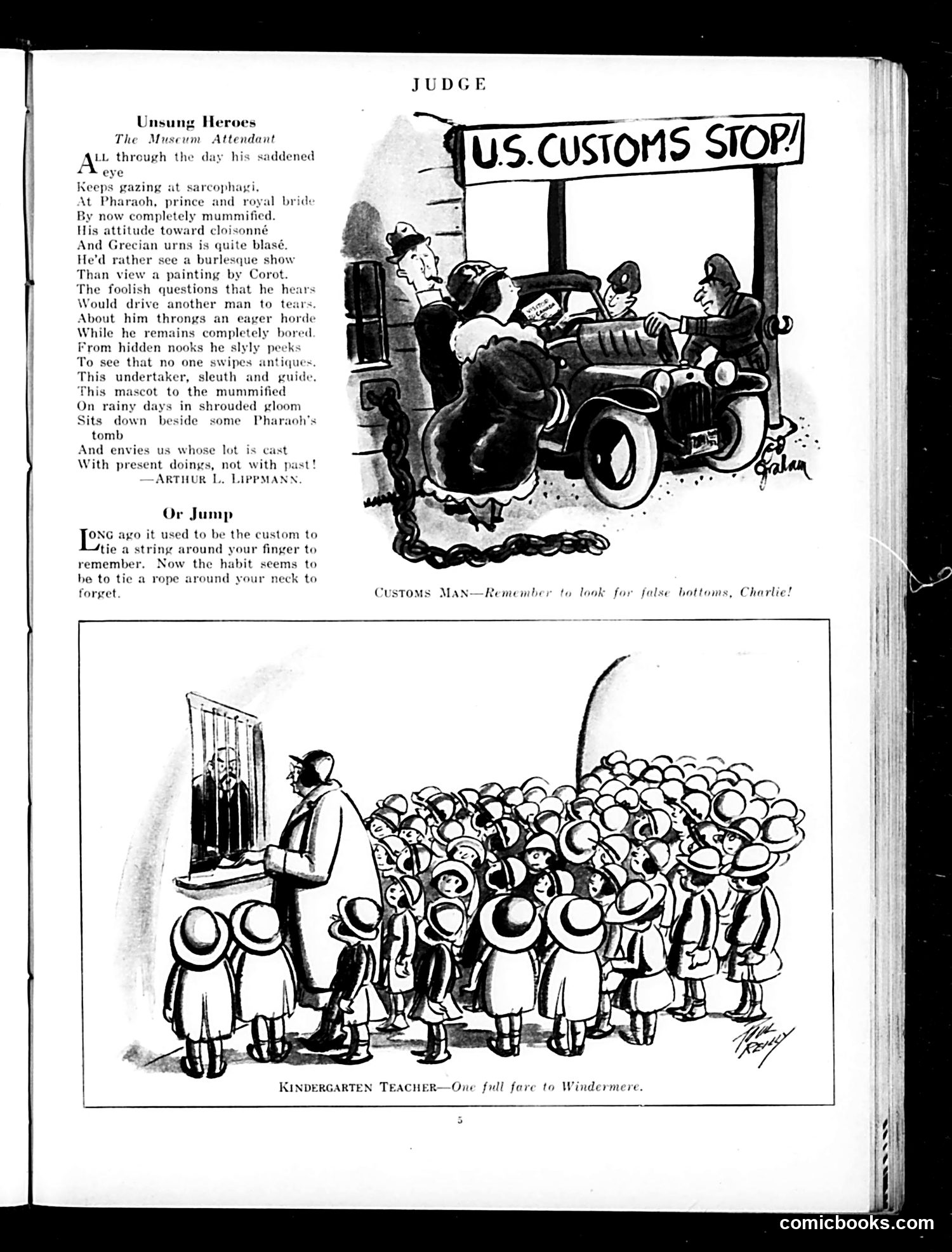
Analysis of Judge Magazine Page This page contains two unrelated cartoons satirizing American institutions: Top cartoon ("US Customs Stop!"): Depicts smugglers in a car attempting to evade customs inspection. The joke plays on people hiding contraband by "jumping" the border—the accompanying poem "Or Jump" references old memory tricks (string around finger) becoming modern smuggling methods (rope around neck). It mocks both smugglers' desperation and customs enforcement challenges. Bottom cartoon ("Kindergarten Teacher"): Shows a crowded schoolroom where a kindergarten teacher must manage a massive class. The caption "One full fare to Windermere" suggests overcrowding, with students packed impossibly tight. This satirizes underfunded public education and inadequate classroom resources in early 20th-century America. Both cartoons critique social problems through exaggeration and visual humor typical of Judge's satirical style.
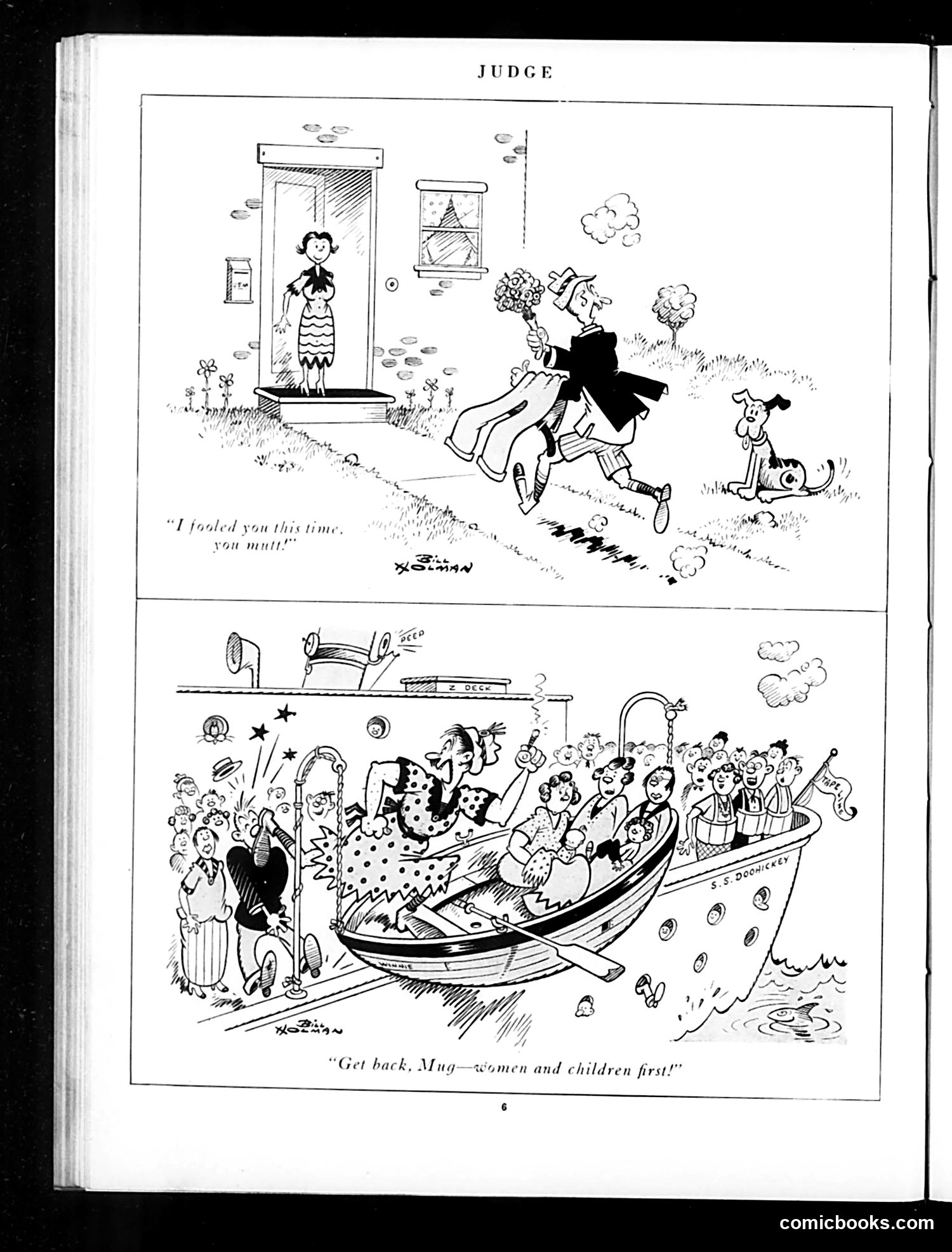
Analysis of Judge Page This page contains two satirical cartoons. The first shows a woman at a house door saying "I looked you this time, you must!" to a man on a bicycle fleeing with flowers—likely depicting marital discord or a domestic dispute where the wife has literally locked him out. The second cartoon depicts a ship labeled "S.S. Decency" with crowds boarding and a figure (appearing to be a judge or authority figure) shouting "Get back, Mug—women and children first!" This appears to satirize social hypocrisy: someone representing moral authority or "decency" ironically demonstrates the opposite behavior by prioritizing protocol over genuine concern for vulnerable populations, suggesting elites mouth principles they don't practice.
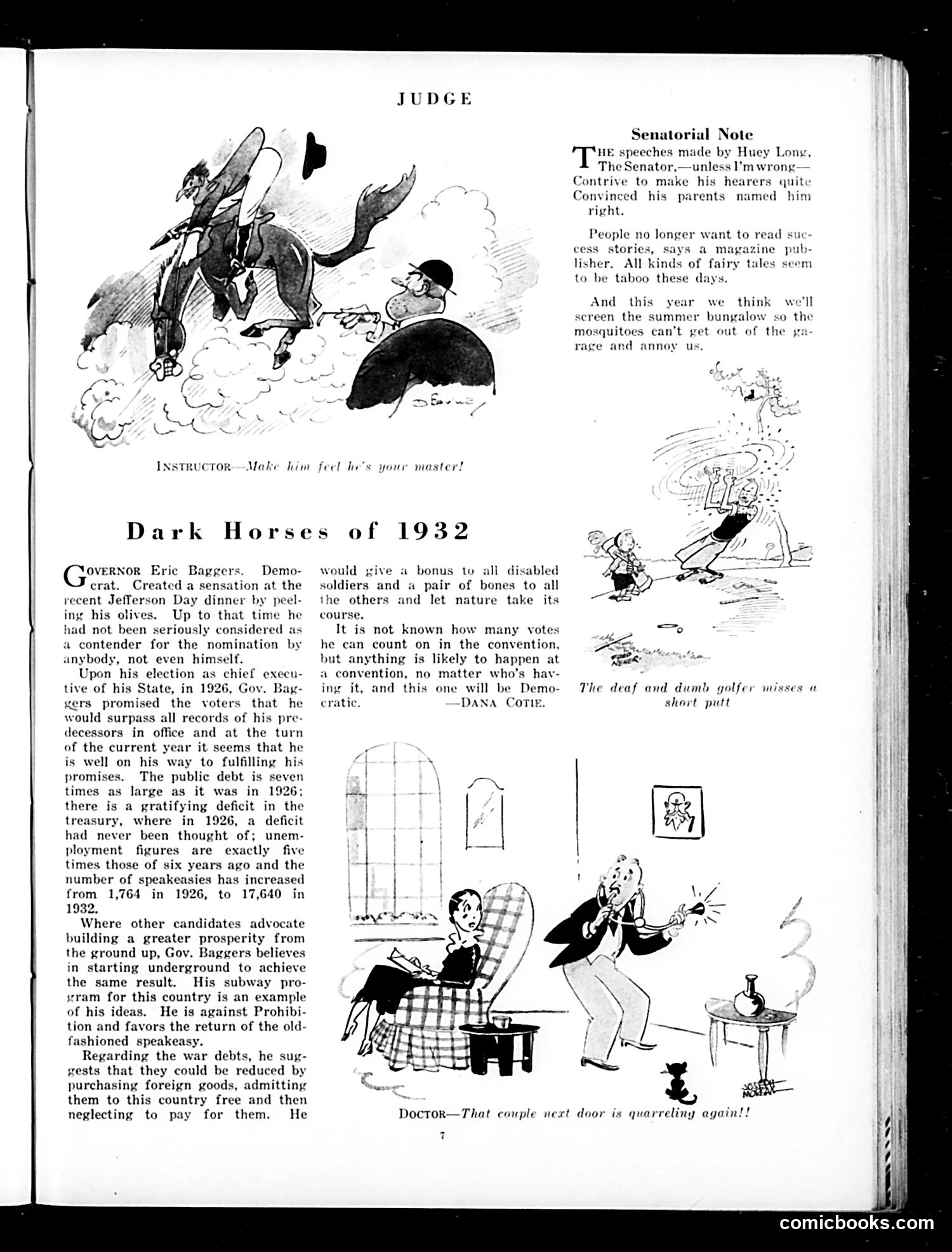
"Dark Horses of 1932" Political Satire This page satirizes Governor Eric Baggers (likely a fictional stand-in for a Democratic politician during the 1932 election cycle). The text mocks his record since taking office in 1926, claiming he's actually *worsened* conditions: the public debt ballooned sevenfold, unemployment quintupled, and speakeasies increased tenfold—the opposite of promised prosperity. The satire's bite lies in its irony: Baggers claims to build prosperity "from the ground up" but actually works "underground" (a subway metaphor suggesting hidden corruption). His policy suggestions are absurd—paying war debts by importing goods free and refusing payment; giving soldiers bones instead of bonuses. The top cartoon shows an instructor with a wild horse labeled "Make him feel he's your master!"—mocking Baggers as an uncontrollable political force. Secondary items include a jab at Senator Huey Long's verbose speeches and a golf joke about deaf-and-dumb golfers. The page reflects 1932 Depression-era political anxiety about failed leadership.
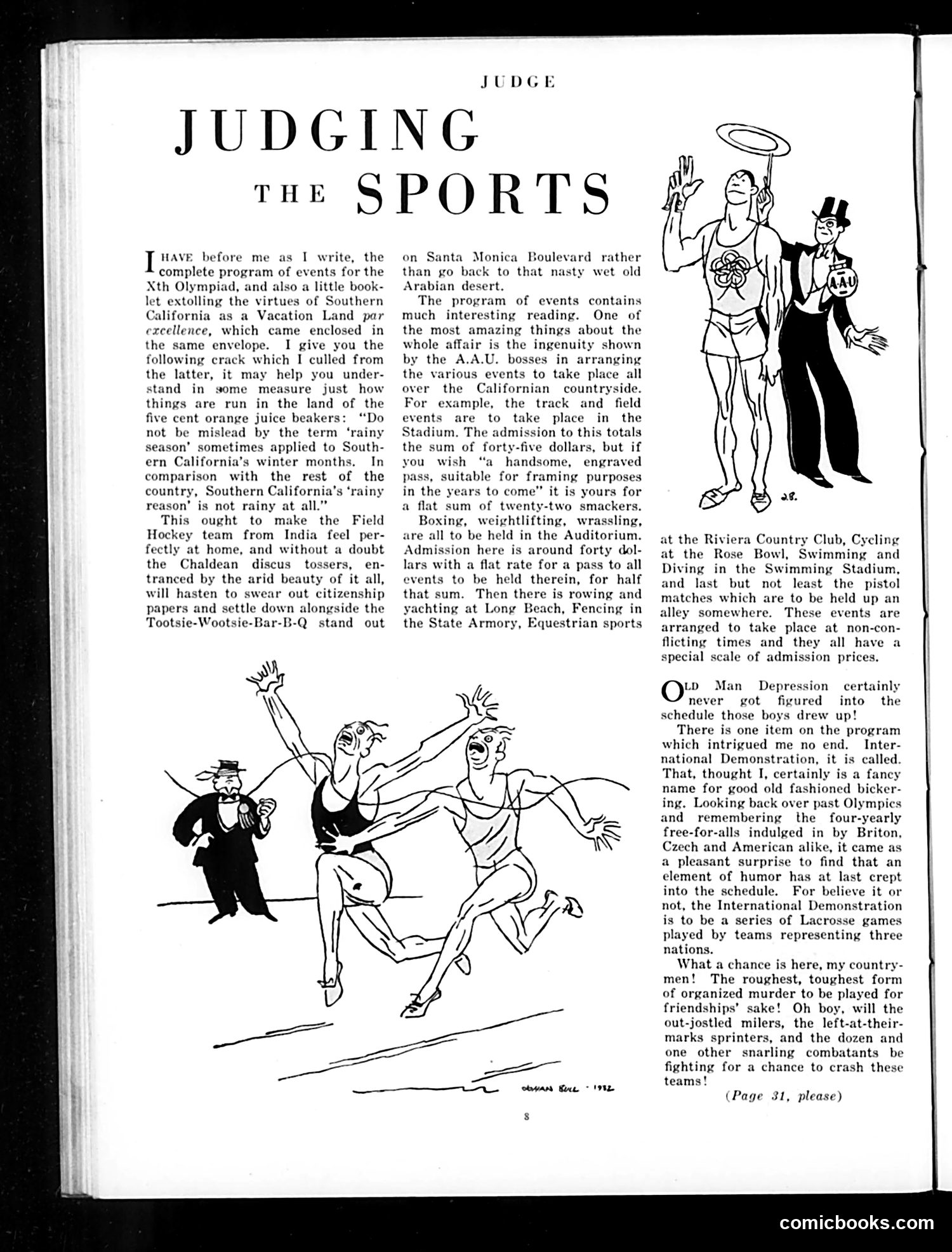
"Judging the Sports" - Judge Magazine Article This is a satirical commentary on the Olympic Games being held in Southern California (appears to be the 1932 Los Angeles Olympics). The author mocks the grandiose promotion of California as a paradise while critiquing the Olympics' organization. The cartoons at top and bottom illustrate absurd Olympic scenarios—figures in exaggerated athletic poses, with one showing a formally-dressed man (likely an AAU official) amid jumping athletes. Key satirical points: - The "rainy season" crack: Mocking California's self-promotion as perpetually sunny, contrasting with actual weather - Venue profiteering: Events scattered across Southern California with inflated admission prices ($45 for track tickets; $22 for "engraved passes") - The "International Demonstration": Sarcastically treating scheduled lacrosse games as organized mayhem, joking that competitive athletes will use this as an excuse for legitimate violence The tone suggests skepticism about Olympic commercialization and California's Chamber-of-Commerce marketing, while poking fun at international athletic rivalries as barely-contained hostility.
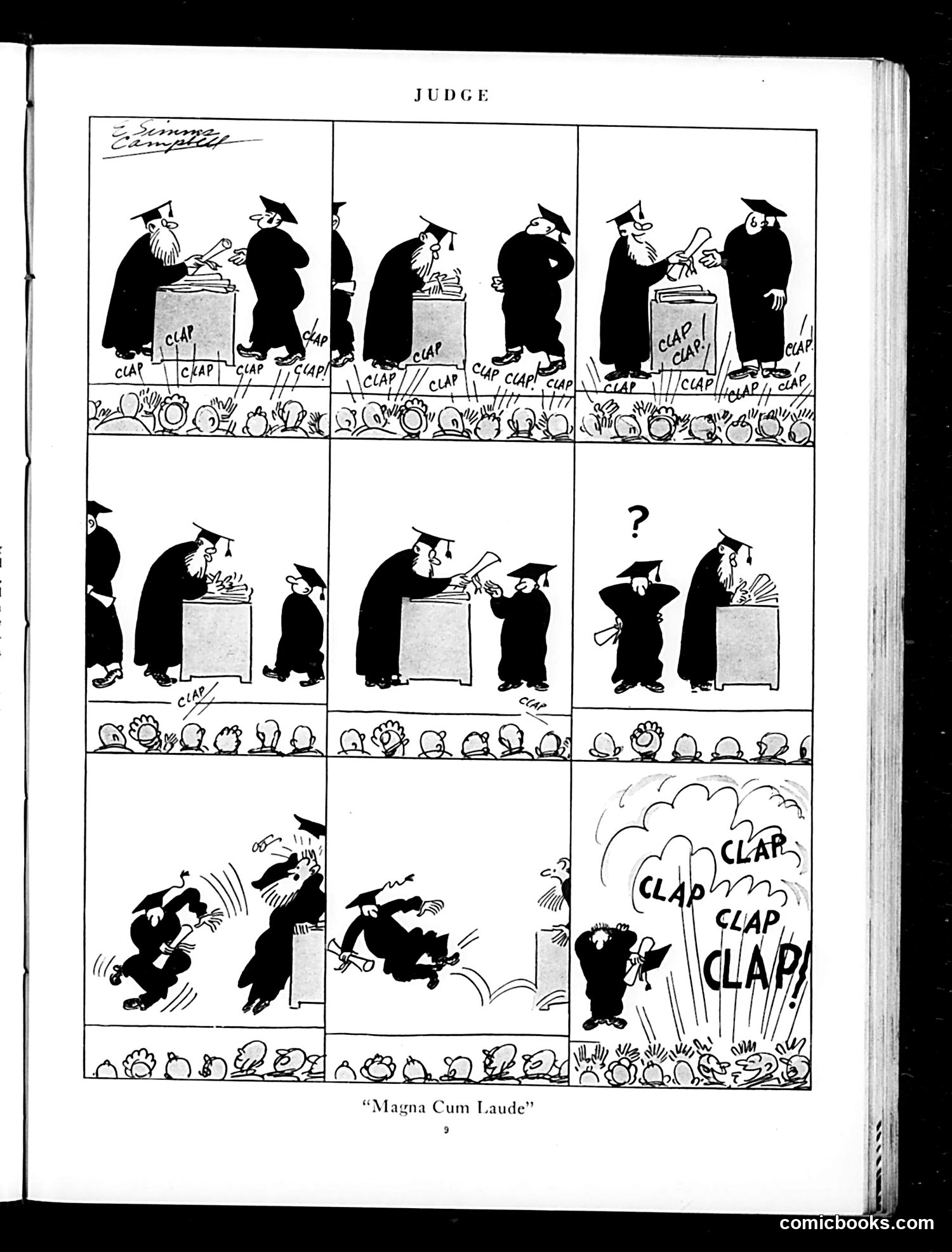
"Magna Cum Laude" Political Cartoon This Judge cartoon satirizes judicial corruption or favoritism during verdict announcements. The top panels show judges accepting what appear to be bribes ("CLAP" sounds suggest applause or payoffs) from robed figures at voting/decision boxes, with audiences watching below. The middle section poses a question mark, suggesting "what happens next?" The bottom panels show the consequences: judges physically fighting or being thrown out, with escalating "CLAP" sounds becoming chaotic noise rather than approval. The Latin title "Magna Cum Laude" (highest academic honors) ironically mocks judges who conduct themselves with such dishonor. The cartoon criticizes how judicial decisions can be bought or influenced, depicting the inevitable chaos and loss of dignity when corruption is exposed. The specific historical context remains unclear without additional dating information.
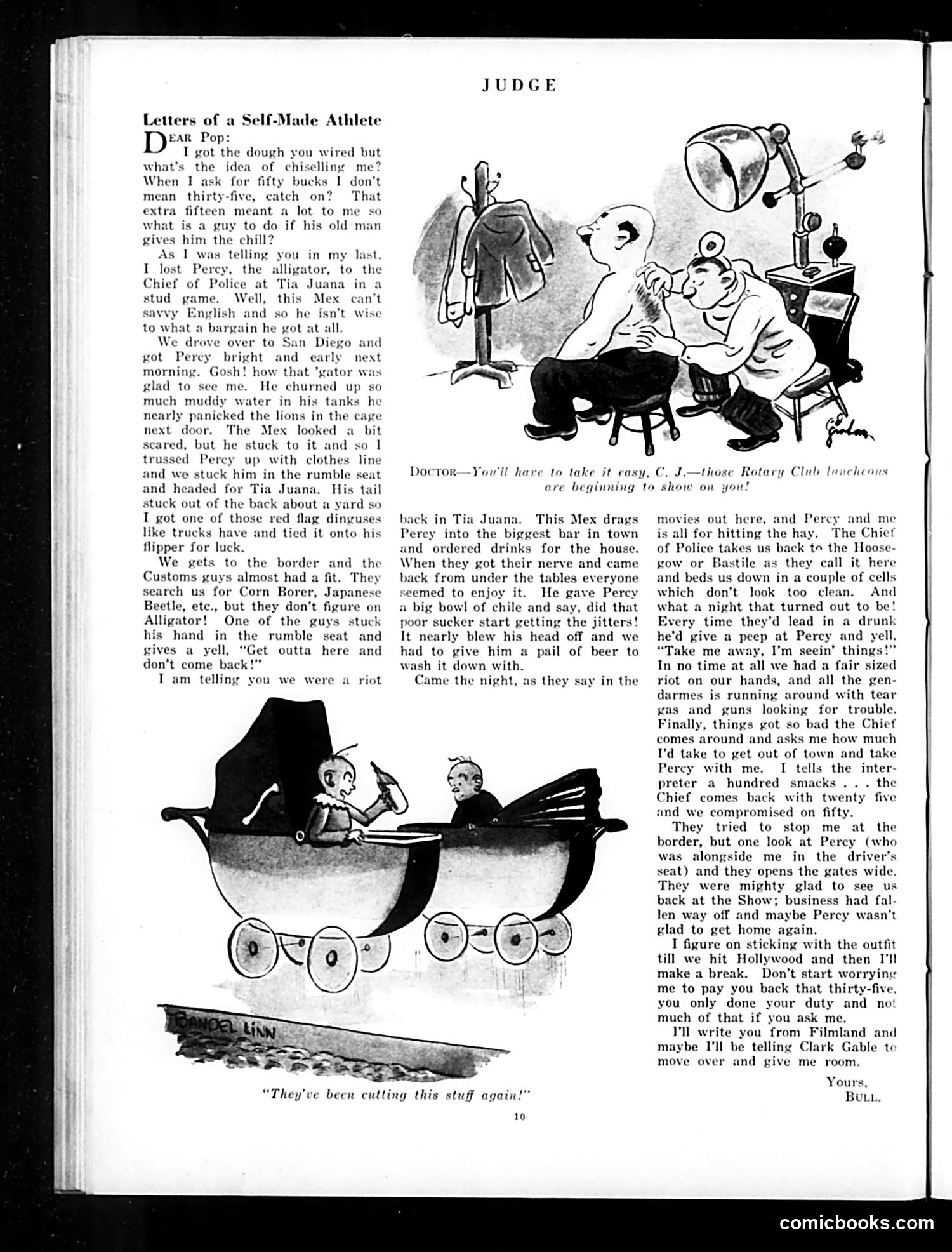
"Letters of a Self-Made Athlete" - Judge Magazine This humorous letter-column entry satirizes brash, unscrupulous young men trying to make it in the entertainment world. The writer, "Bull," recounts absurd misadventures involving an alligator he lost gambling in Tijuana, then retrieves in comically chaotic fashion—smuggling it across the border, causing mayhem in a Mexican jail when the animal's spicy food causes digestive distress, and bribing officials. The satire targets several things: the writer's arrogance and entitlement (complaining his father didn't send enough money), his casual law-breaking, and his delusions of Hollywood stardom. The accompanying cartoons—showing a chaotic doctor's office and what appears to be a baby carriage mishap—reinforce the theme of reckless incompetence. The humor relies on the reader finding such irresponsible behavior and absurd situations ridiculous, mocking both petty crooks and aspiring showbiz figures of the era.
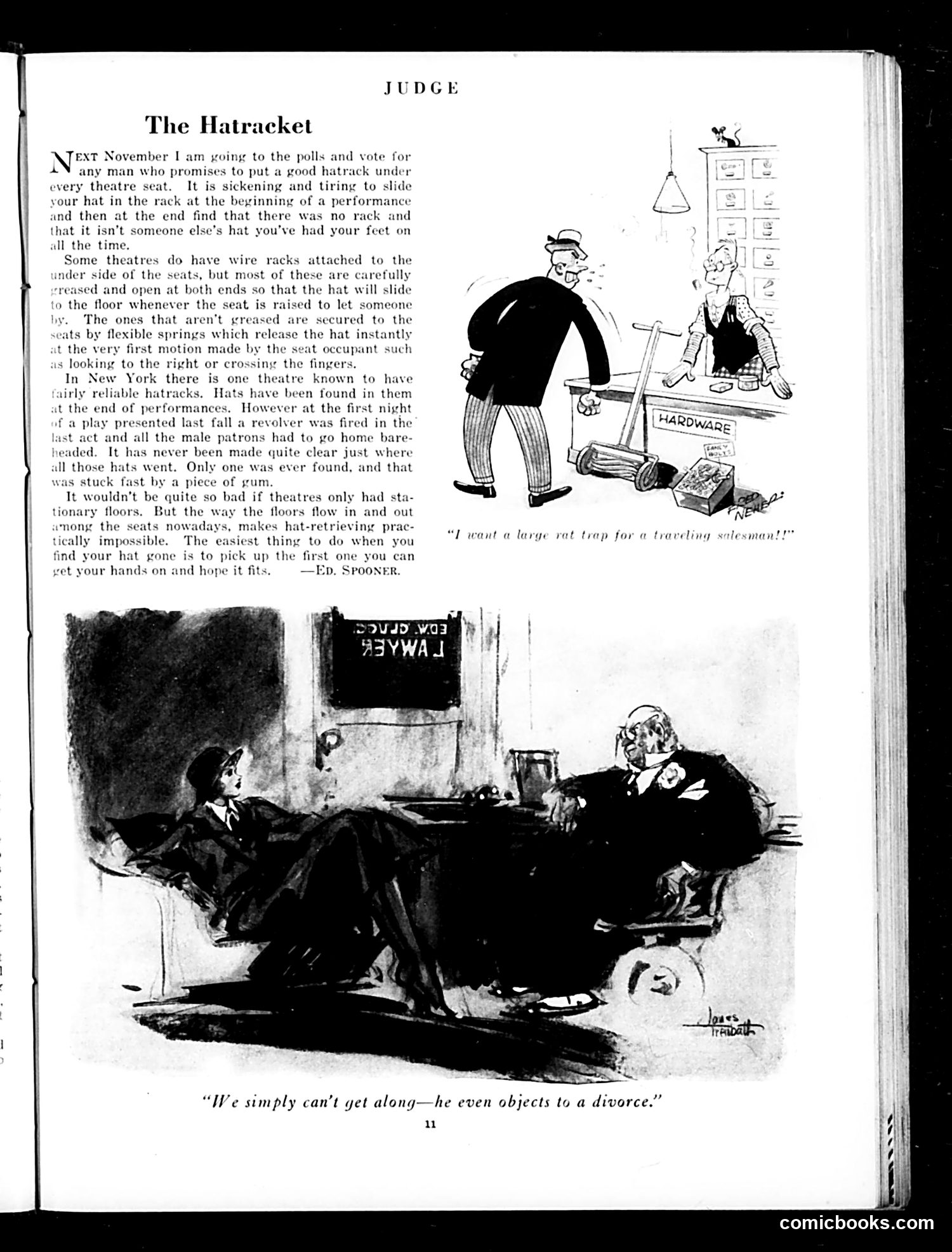
"The Hatrack" - Judge Magazine Satire This page contains two distinct pieces: Top Article & Cartoon: Ed Spooner's humorous complaint about theater hat racks. The satirical point is straightforward—theaters have notoriously poor hat storage systems. Hats either fall out when seats are raised or get lost entirely. The cartoon shows a salesman pitching an absurdly large rat trap as a "hat rack" solution, mocking both the inadequacy of existing systems and the absurdity of potential "fixes." This reflects early 20th-century theater frustrations before modern coat check systems. Bottom Cartoon: A couple sits in what appears to be a lawyer's office (note "LAWYER" sign reversed on wall). The husband complains the wife "even objects to a divorce"—meaning she's so disagreeable that despite their marriage failing, she won't cooperate even with ending it. This satirizes difficult divorce proceedings and incompatible spouses, reflecting contemporary anxieties about marriage dissolution. Both pieces use humor to comment on mundane but genuine social irritations of the era.
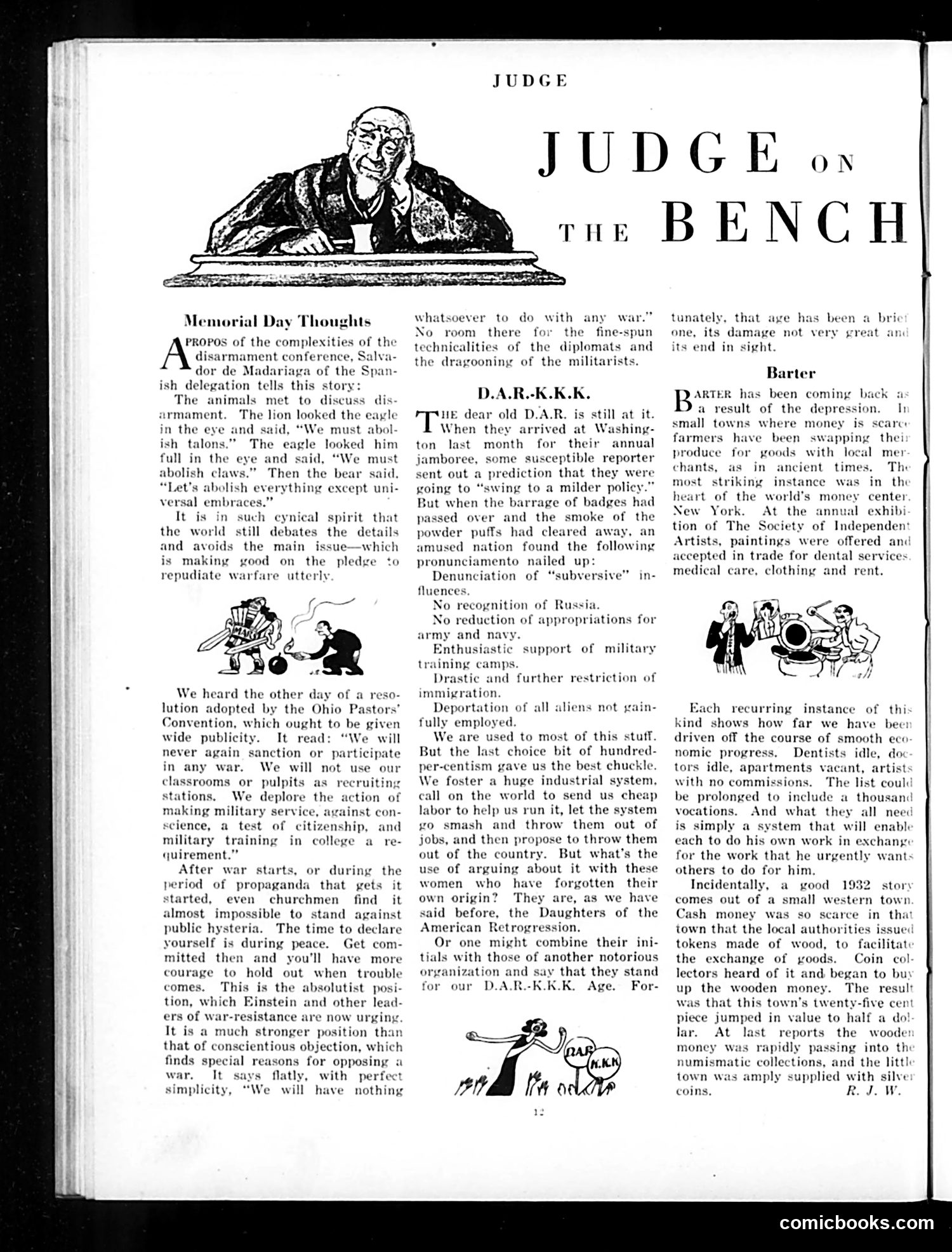
Political Cartoon Analysis: Judge Magazine Page This page contains two satirical pieces attacking American conservative institutions during the Depression era. "D.A.R.-K.K.K." mocks the Daughters of the American Revolution (D.A.R.), a patriotic women's organization. The cartoon equates their political positions—opposing Russia recognition, restricting immigration, deporting unemployed aliens—with the Ku Klux Klan (K.K.K.), calling them "Daughters of American Retrogression." The satire highlights the hypocrisy of a group that calls for cheap foreign labor while simultaneously demanding deportations of jobless immigrants. "Barter" describes Depression-era economic collapse, where money became so scarce that people traded goods directly. The example: New York artists traded paintings for dental work and rent. The cartoonist uses this to show how far society has "deviated from the course of smooth economic progress." Both pieces criticize reactionary responses to economic crisis—xenophobic nationalism and institutional breakdown—reflecting 1930s progressive magazine skepticism toward right-wing politics.
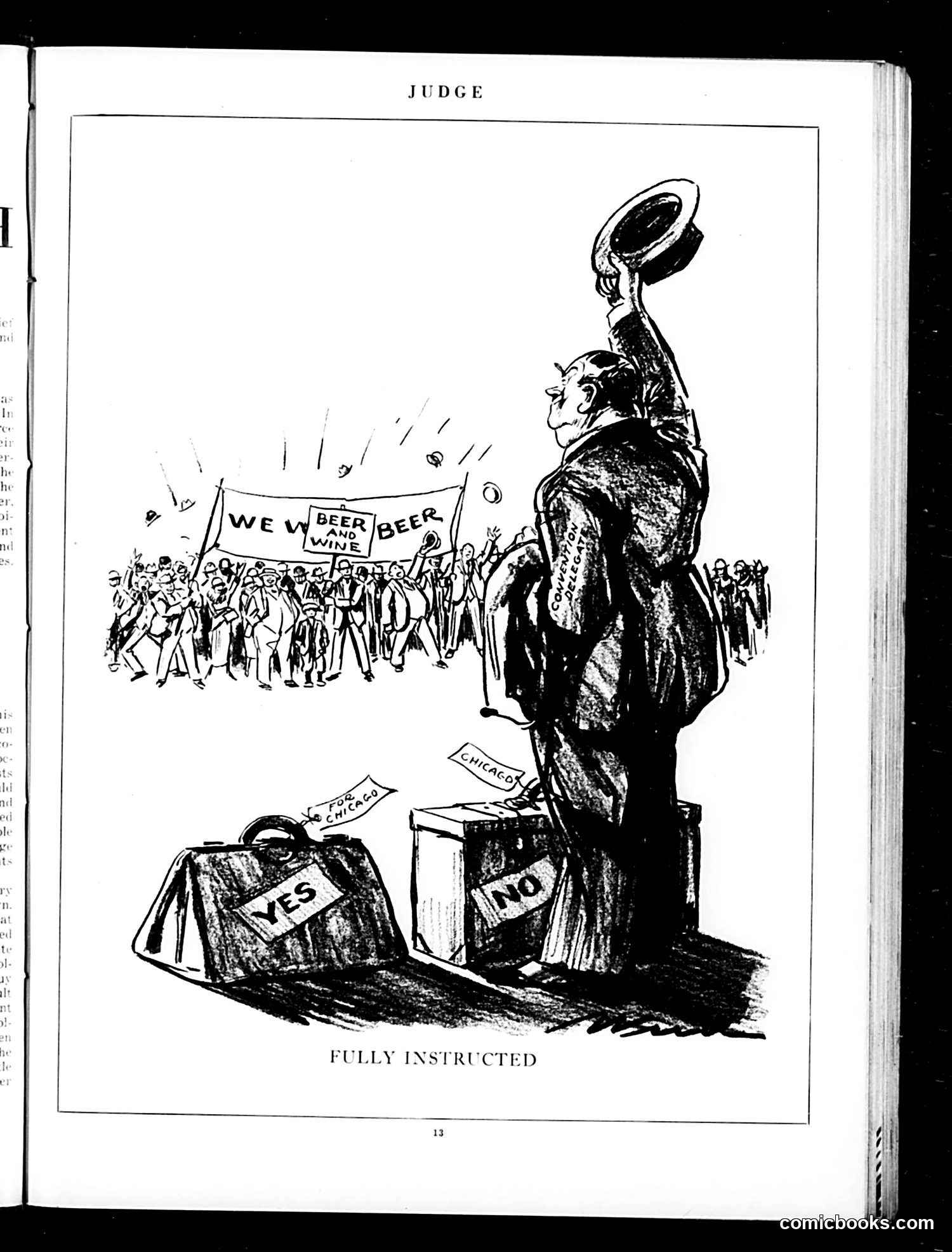
Political Cartoon Analysis: "Judge" - "Fully Instructed" This cartoon depicts a large judicial figure standing on boxes labeled "YES" and "NO," holding a hat aloft to a crowd demanding "WE WANT BEER AND WINE." Below are papers labeled "FOR CHICAGO" and "CHICAGO," suggesting this concerns Chicago's local alcohol policy. The satire critiques judicial authority during Prohibition: the "Judge" character appears instructed by conflicting public opinion (represented by the crowd) rather than law. The boxes beneath suggest the judge must choose between "yes" and "no" answers to alcohol legalization, but the crowd's pressure indicates they're determining the verdict. This likely comments on how public demand during Prohibition was overriding legal/judicial principles in certain jurisdictions.
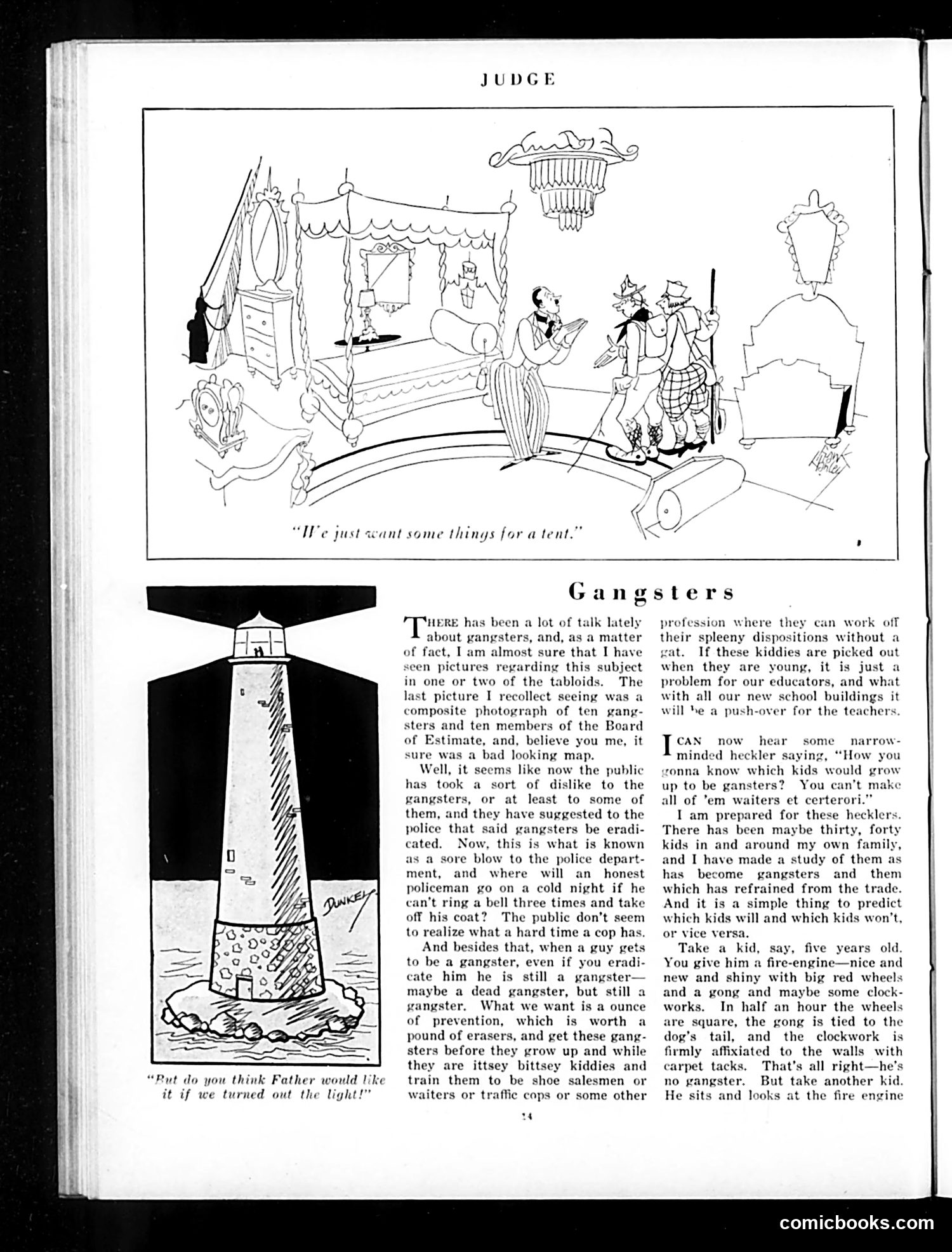
"Gangsters" - Judge Magazine Analysis This article satirizes public panic about gangsters while mocking police corruption and proposing absurd "prevention" solutions. The author notes that recent composite photos showed gangsters indistinguishable from the Board of Estimate (city officials), implying widespread corruption. The satire targets: 1. Police complicity: Police supposedly benefit from gangsters ("where will an honest policeman go...if he can't ring a bell three times"), suggesting cops shake down criminals for protection money. 2. Prevention over punishment: Rather than eliminate existing gangsters, the author mockingly suggests identifying and redirecting naturally destructive children toward legitimate professions like shoe salesman or traffic cop. 3. Class/behavioral determinism: The concluding example—a destructive child who destroys a fire engine versus one who preserves it—suggests gangsterism is an innate personality trait, not social circumstance. The top cartoon (separate from the article) depicts luxurious gangsters in an opulent bedroom, underscoring the appeal of criminal life. The overall message critiques both law enforcement corruption and naive reformist thinking about crime prevention.
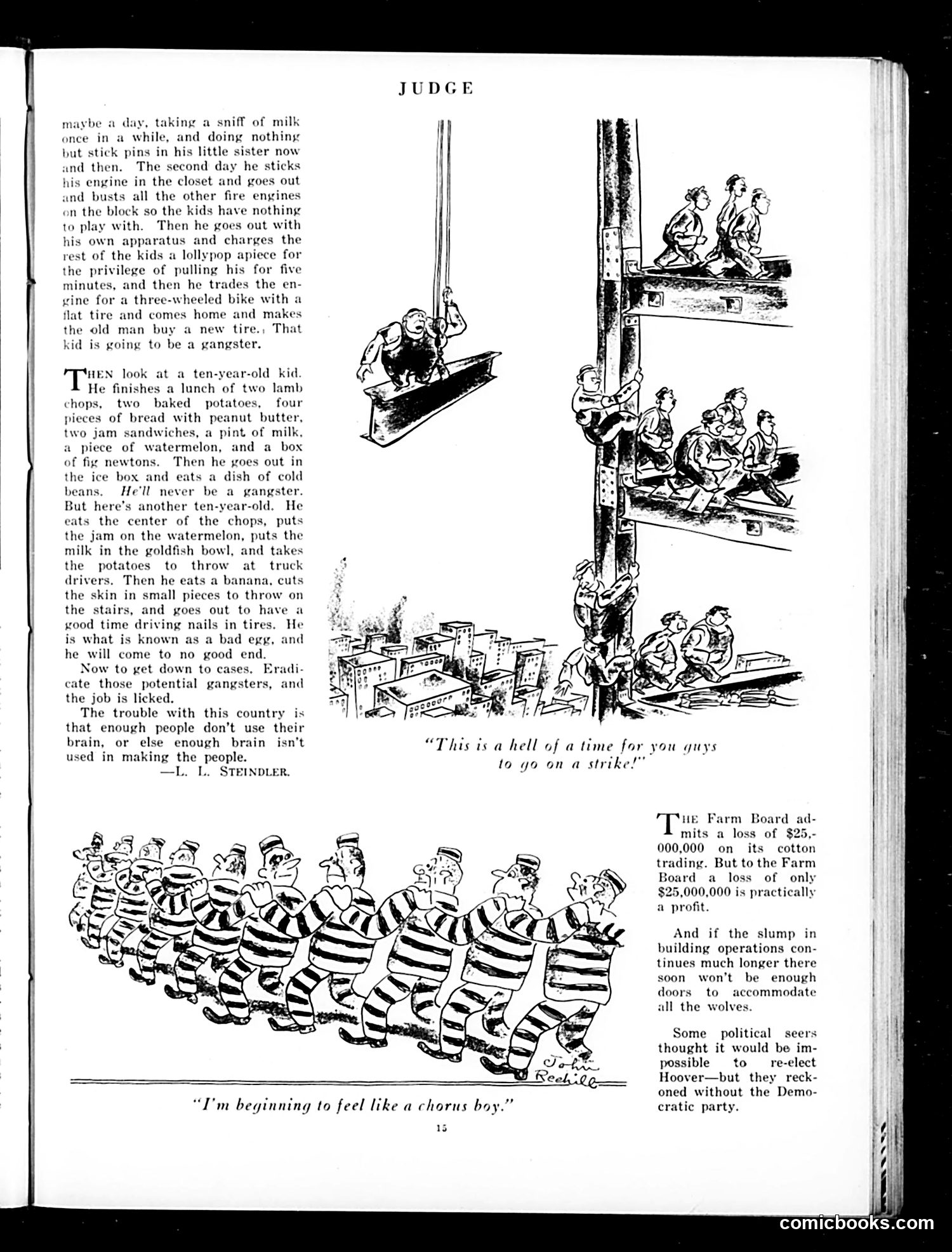
Analysis of Judge Magazine Page This page contains social satire about childhood behavior predicting adult outcomes. The main article by L.L. Steindler contrasts three ten-year-old boys: one destined to become a "gangster" (destructive, manipulative), one who will "never be a gangster" (obedient eater), and one who's a "bad egg" (wasteful troublemaker). The satire argues the country's problem is insufficient "brain" used in "making the people"—suggesting poor parenting or education creates criminals. The bottom cartoons mock economic and political failures: one depicts strikers demanding action during economic hardship; another shows men in prison stripes as "chorus boys," symbolizing widespread hardship. The text references the Farm Board's massive cotton-trading losses and a building slump so severe there won't be "doors to accommodate all the wolves"—wolves being a Depression-era metaphor for foreclosure and economic predators. The Hoover reference suggests this dates to the 1928-1932 period, criticizing the Republican administration's economic mismanagement and the Democratic Party's perceived inability to capitalize politically.
"The Theatre of George Jean Nathan" This is a theater review—not a political cartoon. Judge critic George Jean Nathan dismisses the film adaptation of *Grand Hotel* as inferior to the stage play, despite Hollywood's star-studded cast. Nathan mocks the major actors: John and Lionel Barrymore (playing dying industrialist Kringelein), Greta Garbo (a "drollest acting fraud"), Joan Crawford (who merely glances with one eye), and Wallace Beery (whose German accent rings false). He particularly ridicules Garbo's dancing and her reliance on "publicized sex appeal" rather than actual acting craft. The satire targets Hollywood's assumption that assembling famous names and massive budgets automatically creates art superior to theater. Nathan argues the opposite: the film is "dull" and filled with amateurish performances that wouldn't pass "a reputable high school dramatic club." His concluding jab—that Beery's accent lacks authenticity—epitomizes his broader criticism: star power cannot substitute for genuine theatrical skill.
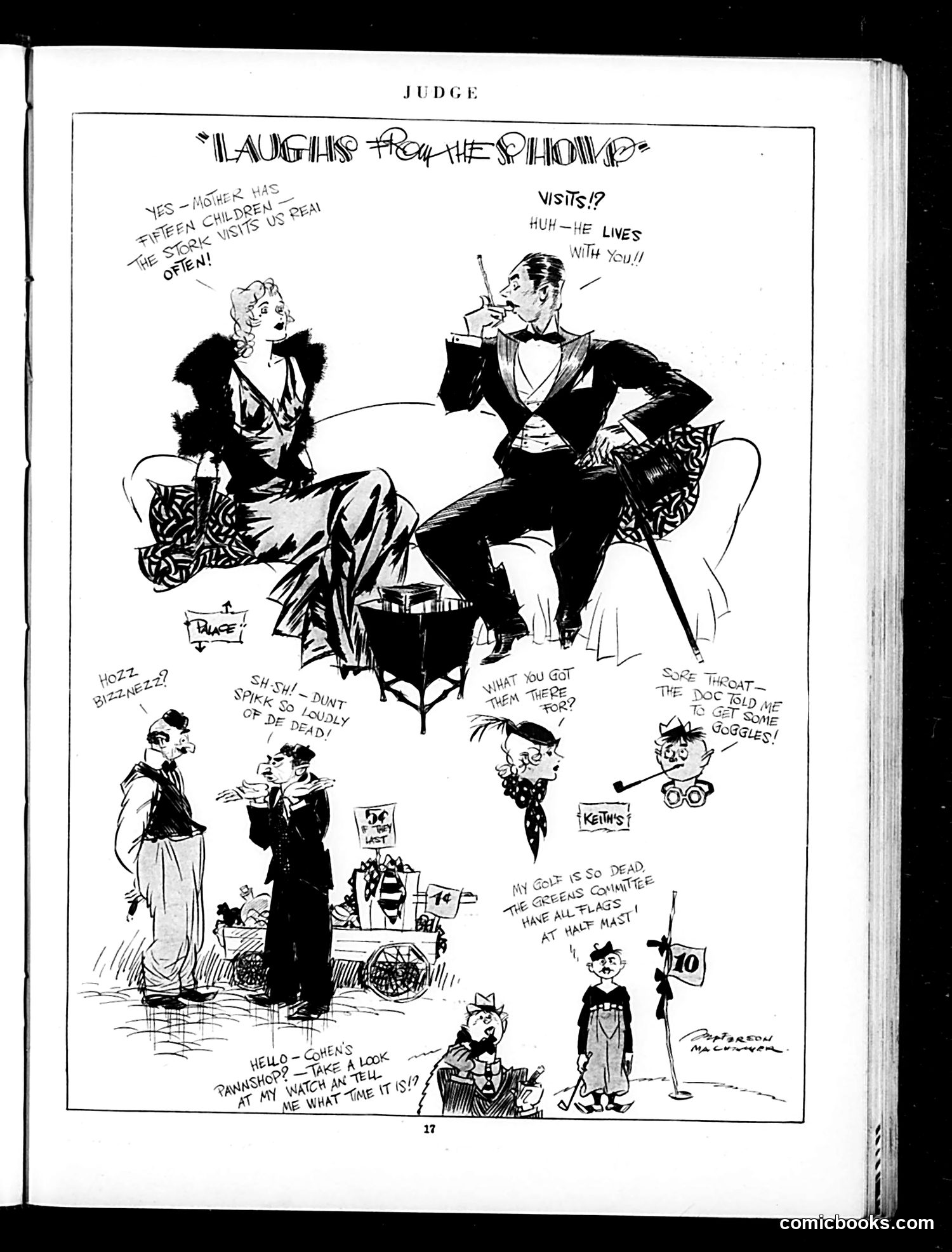
"Laughs from the Phone" This satirical cartoon mocks wealthy socialites and their pretentious telephone gossip. The central couple—dressed in formal evening wear—are shown on the phone, boasting about their social status and accomplishments. The surrounding vignettes feature various characters making absurd claims: a man bragging about his golf handicap being "so dead the greens have all flags at half mast," children exaggerating their parents' accomplishments, and others engaged in one-upmanship through telephone conversations. The satire targets the era's culture of status-conscious wealthy people using the newfangled telephone as a tool for social posturing and competitive bragging. The humor derives from the absurdity and pretentiousness of these conversations—the exaggeration of mundane accomplishments into matters of great importance. This reflects Jazz Age anxieties about conspicuous consumption and social climbing.
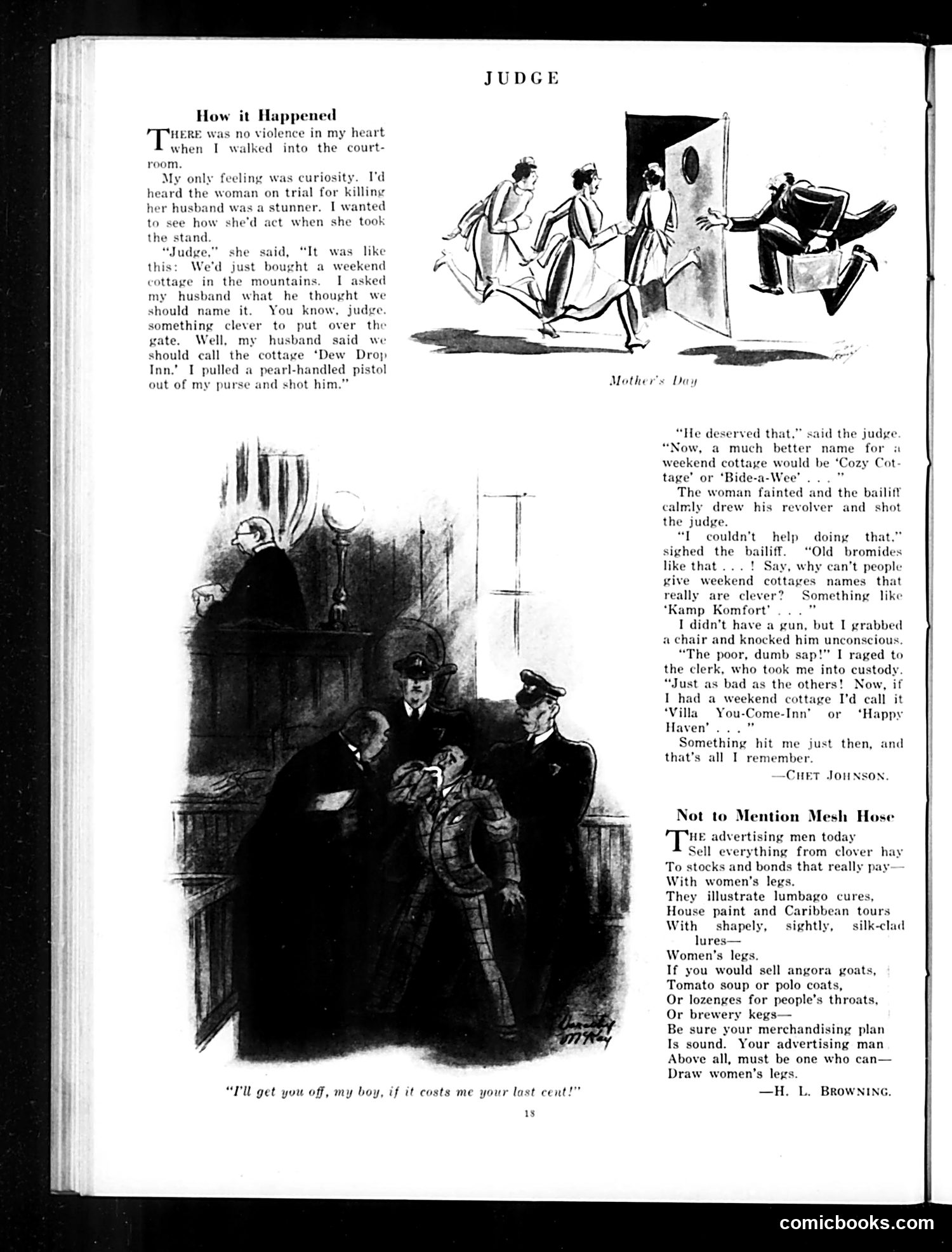
Judge Magazine Page Analysis This page contains two satirical pieces from Judge magazine: "How it Happened" is a absurdist humor story mocking both courtroom decorum and bad taste. A woman kills her husband over his suggestion to name their cottage "Dew Drop Inn" (a cornball name). The judge approves the murder, calling it justified—then gets shot by the bailiff, who also objects to clichéd cottage names. The clerk gets knocked unconscious by the narrator for the same offense. The joke builds through escalating violence over increasingly trivial aesthetic complaints, satirizing both excessive courtroom solemnity and rigid social conventions. "Not to Mention Mesh Hose" by H.L. Browning is social commentary on advertising. It criticizes how advertisers sell virtually any product—from paint to soup to medicine—by featuring women's legs, regardless of relevance. The poem mocks this as the sine qua non of modern advertising: an effective ad campaign requires someone who can "draw women's legs," implying advertisers rely on objectification rather than genuine product merit. This reflects 1920s-era concerns about commercialism's superficiality.
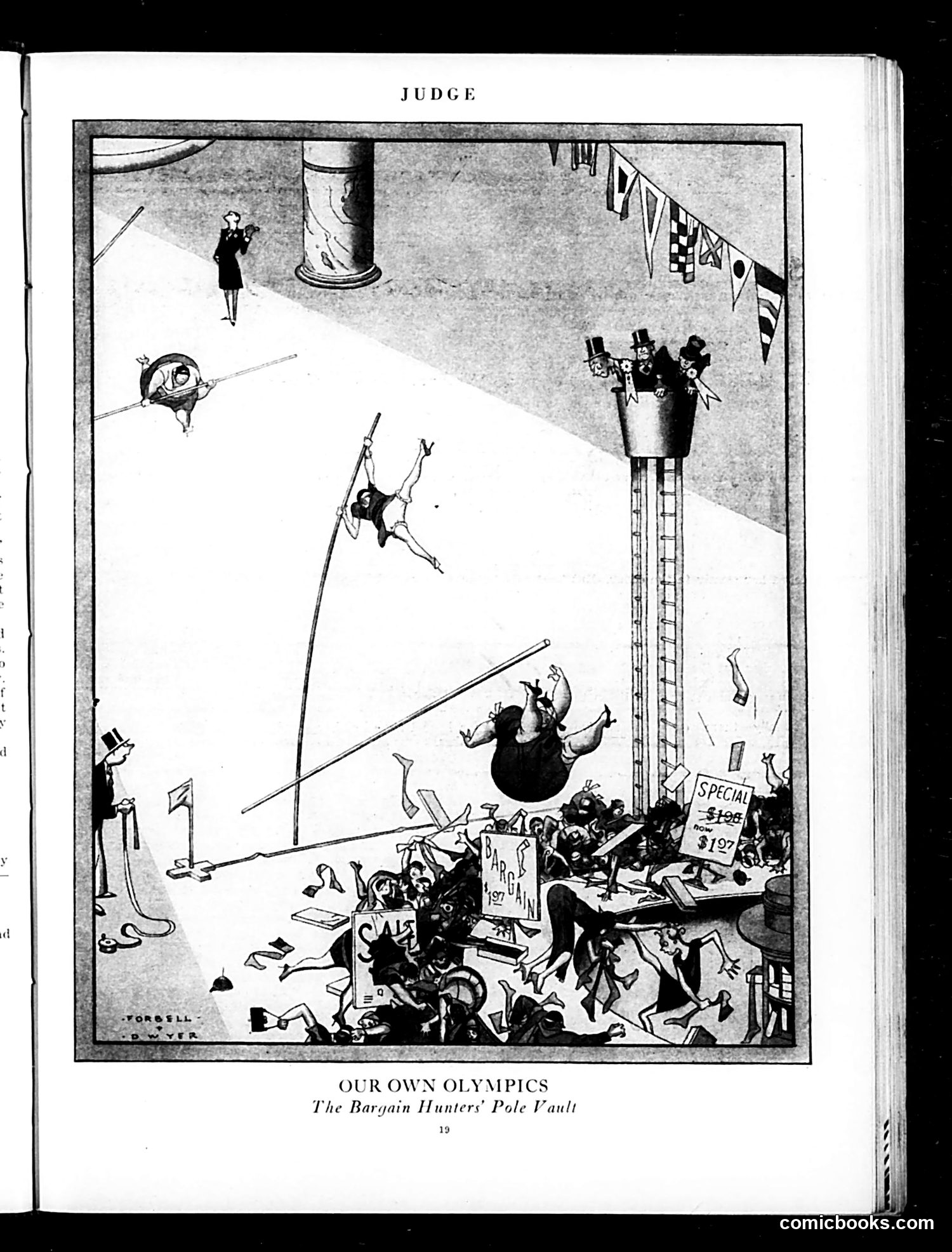
Explanation for Modern Readers This Judge magazine cartoon satirizes bargain-hunting consumers as Olympic athletes. The title "Our Own Olympics: The Bargain Hunters' Pole Vault" presents shopping for deals as a competitive sport. The scene depicts shoppers engaging in acrobatic feats—pole-vaulting over merchandise displays and crowds to reach sales items marked with prices like "$1.95" and "$1.97." The chaos of tangled bodies, scattered goods, and price signs emphasizes the frenzied, undignified scramble for discounted merchandise. The cartoon mocks both the intensity of bargain-hunting culture and, implicitly, consumerism's grip on American society. By elevating mundane shopping to "Olympic" status, it suggests that Americans treat discount-shopping with the same competitive fervor as actual athletic achievement—a critique of misplaced priorities and materialism that remains culturally relevant today.
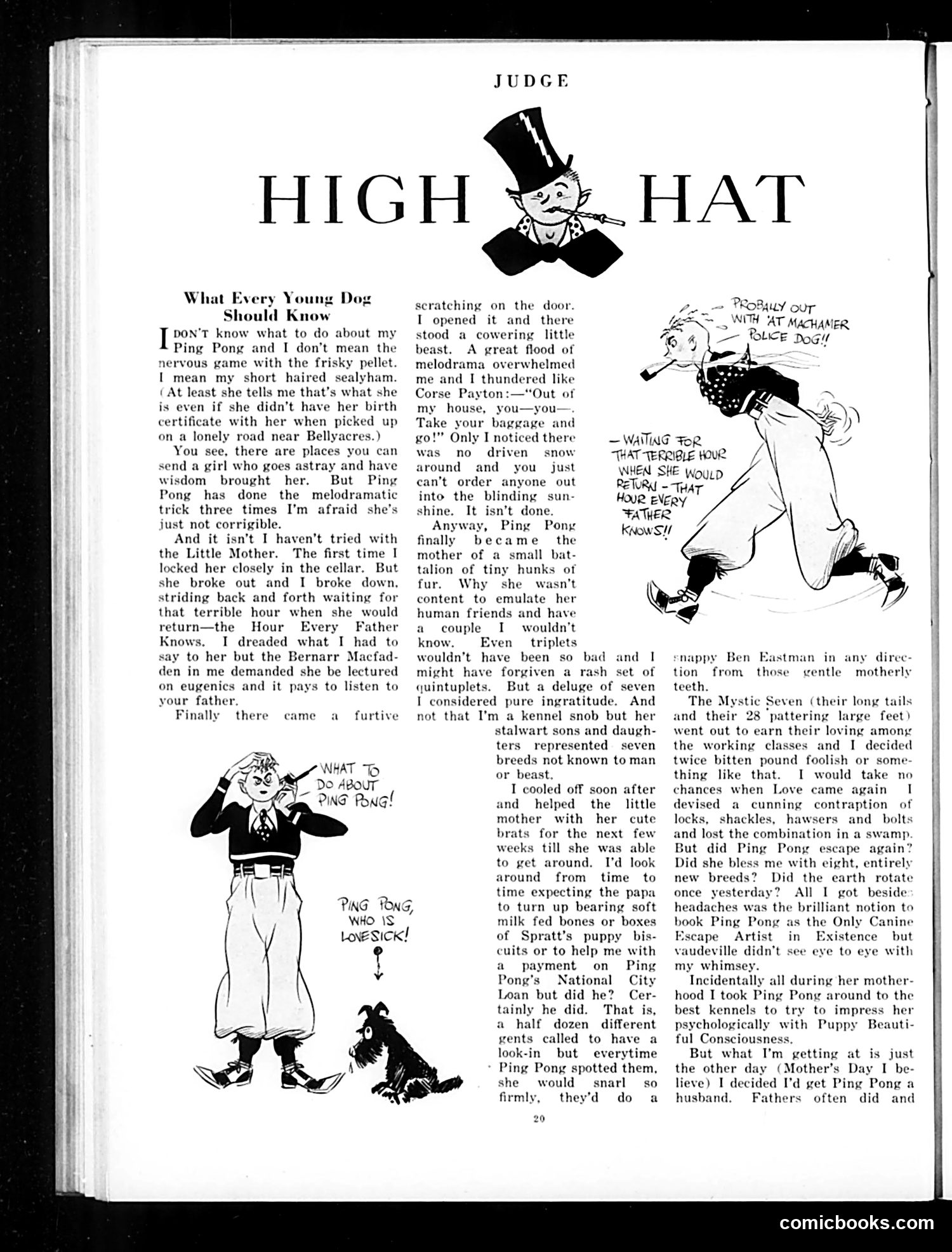
Judge Magazine: "High Hat" — "What Every Young Dog Should Know" This is a humorous advice column disguised as a dog story, satirizing parenting anxieties of the era. The narrator complains about his Sealyham terrier "Ping Pong," who repeatedly escapes and becomes pregnant with seven mixed-breed puppies—clearly a metaphor for an uncontrollable daughter. The satire targets early 20th-century middle-class parental concerns: the author references "Bernarr Macfadden" (a famous physical culture/eugenics promoter), invoking anxieties about heredity and "proper" breeding. The cartoon illustrations show exasperated parental figures scolding the misbehaving dog. The joke's punchline—that he'll solve the problem by getting "Ping Pong a husband"—mocks the era's solution to female independence: forced marriage. The column absurdly applies dog-breeding logic to human courtship, exposing the period's crude attitudes toward controlling women's sexuality and behavior through domesticity.
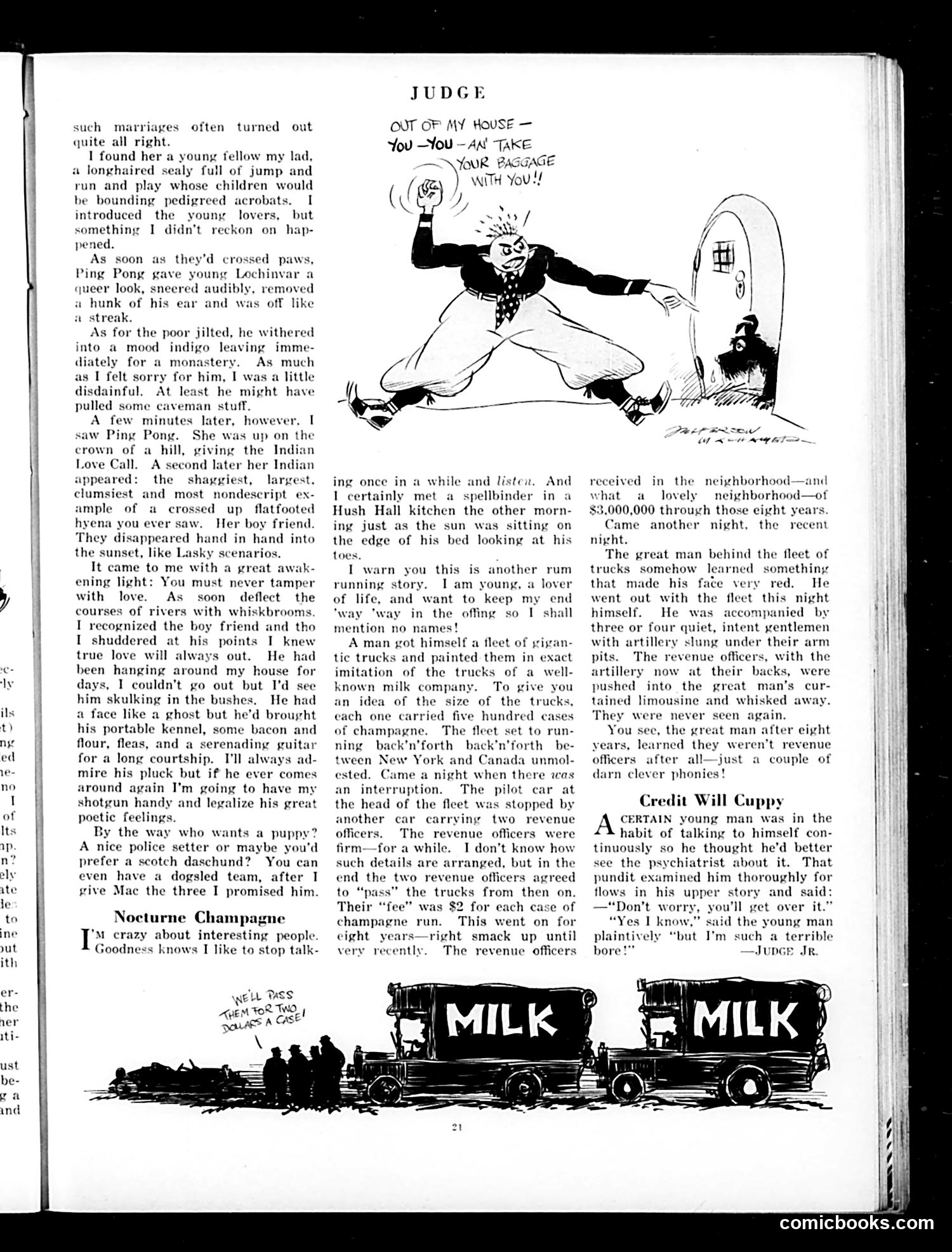
Analysis of Judge Magazine Page This page contains two satirical stories typical of Prohibition-era humor: "Nocturne Champagne" describes a rum-running operation where a bootlegger uses milk trucks to smuggle champagne between New York and Canada. Revenue officers are bribed $2 per case—netting them $3 million over eight years—until the bootlegger discovers their corruption and kidnaps them in retaliation. The satire mocks both Prohibition enforcement's corruption and the audacity of large-scale bootlegging operations. The dog cartoon above (apparently titled "Credit Will Cuppy") humorously depicts a failed arranged marriage between pedigreed dogs, where true love prevails when an unattractive but persistent suitor wins out. The joke satirizes romantic idealism over practical matching. Both pieces reflect 1920s concerns: Prohibition's failure, widespread government corruption, and romantic sentimentality. The magazine's irreverent tone toward federal law enforcement was characteristic of Judge's satirical stance during this period.
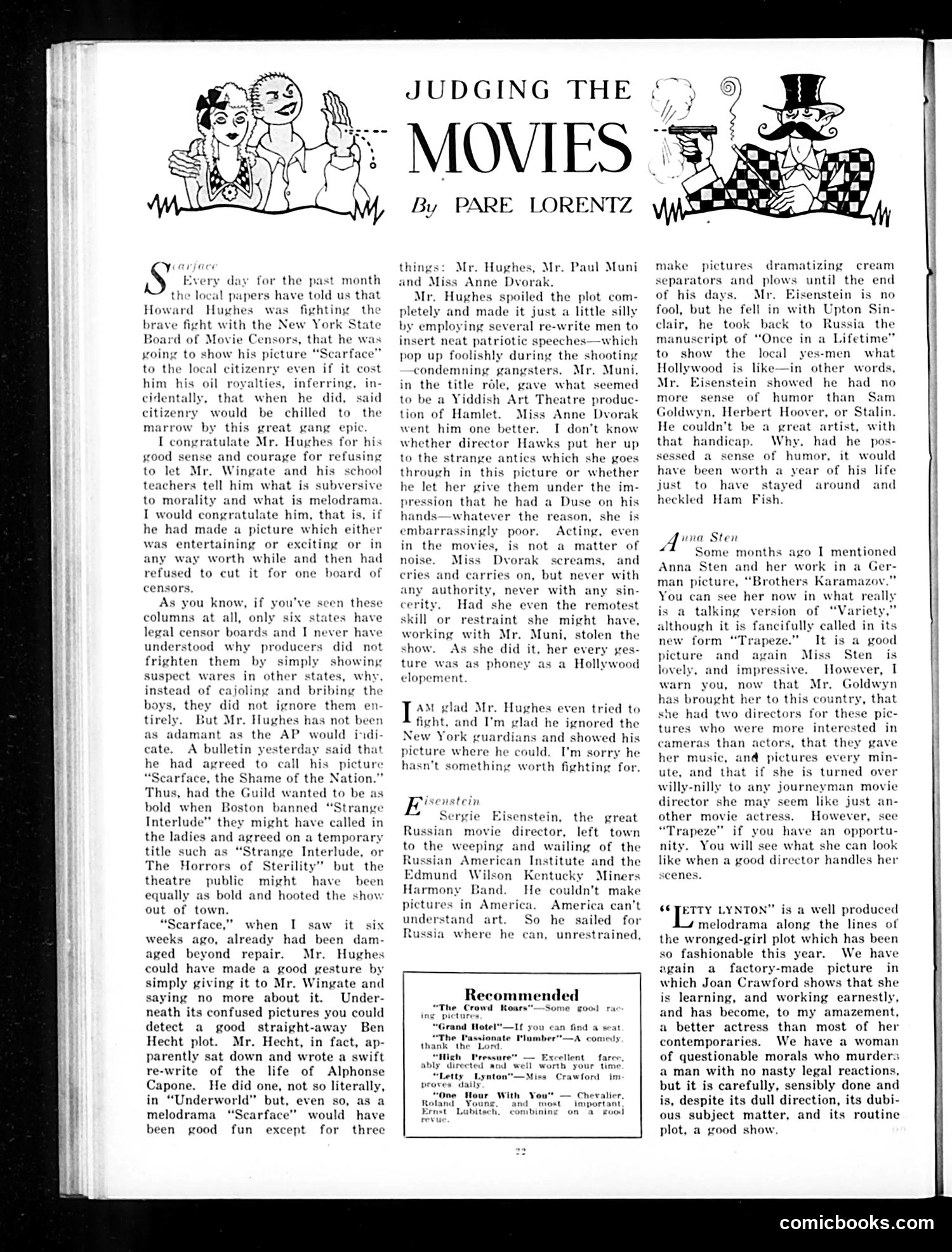
"Judging the Movies" by Pare Lorentz This page reviews recent films, with Lorentz's primary target being Howard Hughes's gangster film *Scarface*. The cartoon header depicts theatrical stereotypes (a woman with a baby, a woman in profile, a mustachioed man in a top hat), establishing the entertainment focus. Lorentz praises Hughes for *fighting* New York's movie censors over the film's content, calling it courageous. However, he demolishes the actual movie: Hughes inserted patriotic speeches into a Ben Hecht crime plot, actor Paul Muni gave overwrought performances, and Anne Dvorak was "embarrassingly poor"—screaming without skill or restraint. The page also notes Sergei Eisenstein's departure from America, lamenting that American audiences "can't understand art," forcing the Russian director back to Russia where he could work "unrestrained." The subtext: censorship is wrong, but Hughes squandered his brave stand on a mediocre film. Meanwhile, artistic genius flees America's philistinism.
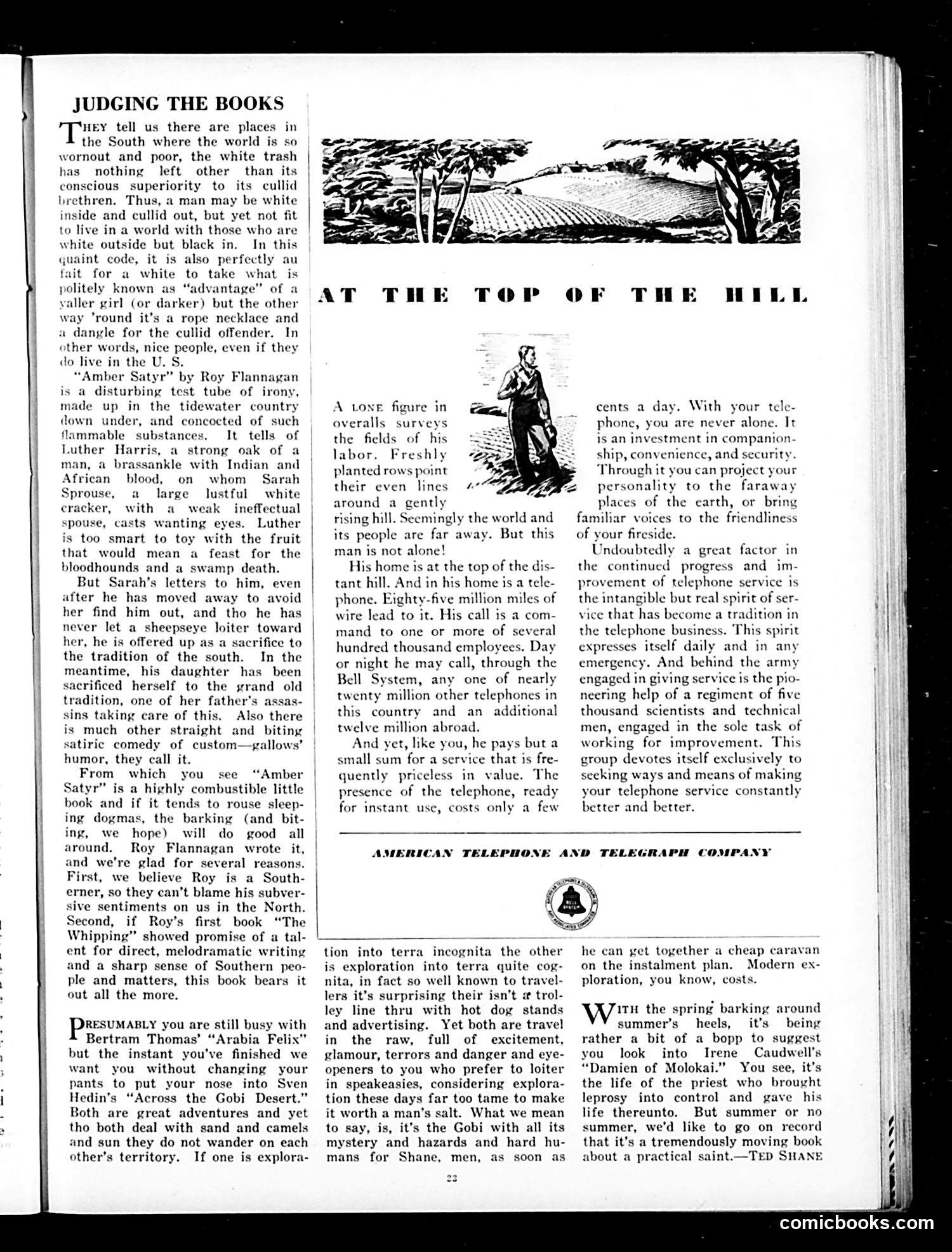
Explaining This Judge Magazine Page This page contains book reviews and advertising, not political cartoons. The main content critiques Roy Flannagan's novel *"Amber Satyr,"* set in the American South. The review discusses the book's satirical treatment of racial and sexual exploitation—specifically, the double standard where a white man can pursue a Black woman without consequence, but a Black man faces lynching for any transgression. The reviewer praises Flannagan (a Southerner) for his "subversive" social commentary mocking Southern racial customs and "gallows' humor." The page also reviews travel books and includes a full-page advertisement for American Telephone and Telegraph Company, featuring an illustration of a solitary farmer in overalls. The ad emphasizes how telephone service connects isolated rural workers to civilization at minimal cost—a pitch for telephone infrastructure's modernizing power. The racial language reflects the publication's era (early 20th century) but the book review's condemnation of lynching and sexual violence shows Judge using satire to critique Southern racial violence.
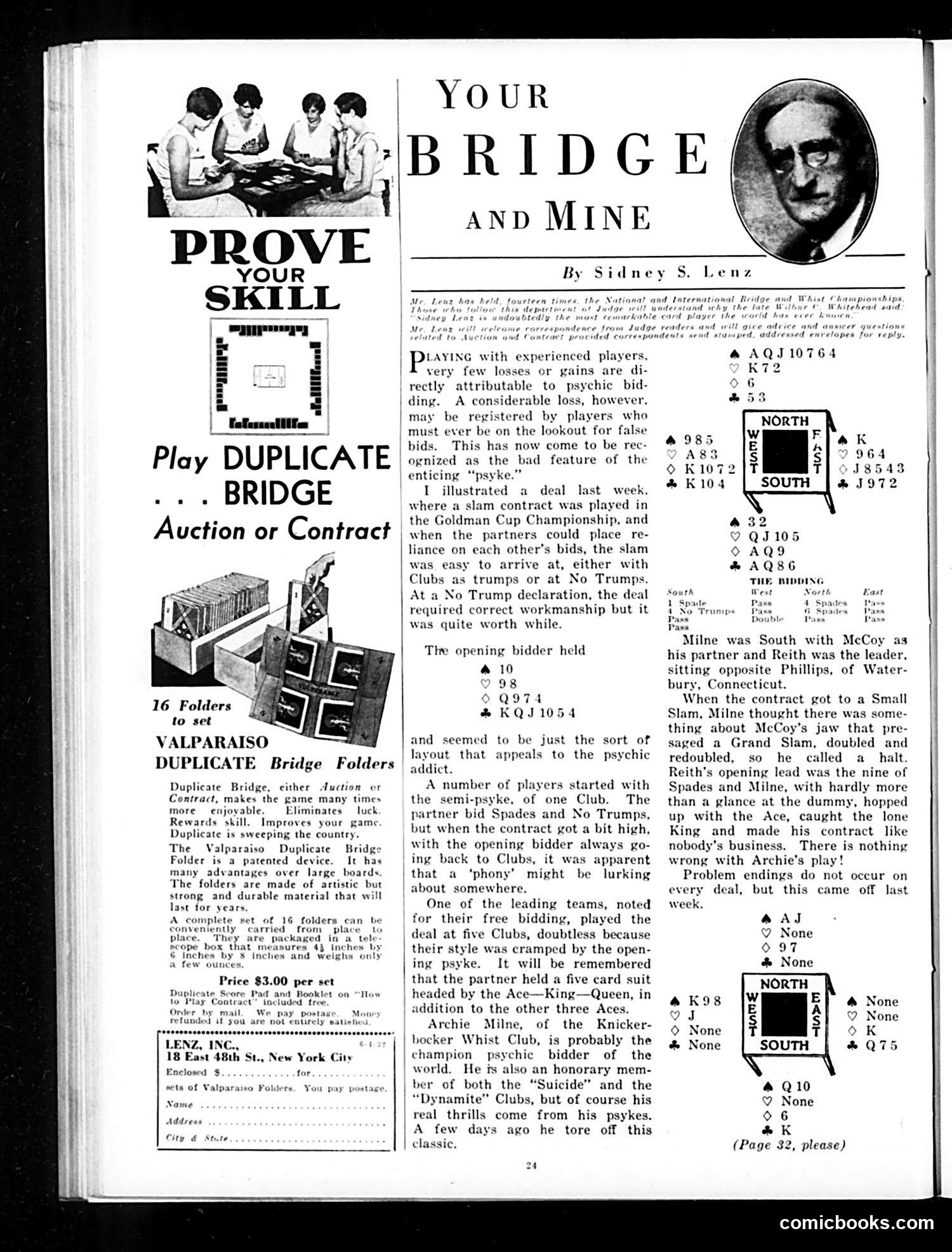
"Your Bridge and Mine" - A Bridge Strategy Article This page is primarily an instructional bridge column by Sidney S. Lenz, a renowned bridge champion, rather than political satire. The left side advertises duplicate bridge equipment and folders. The main content discusses "psychic bidding" in bridge—a controversial strategy where players make misleading bids to confuse opponents. Lenz illustrates a hand from the Goldman Cup Championship featuring Archie Milne of the Knickerbocker Whist Club, described as "probably the champion psychic bidder of the world." Milne allegedly makes an audacious call based on reading his partner McCoy's facial expression ("something about McCoy's jaw"), successfully executing a small slam. The article's tone is admiring toward Milne's aggressive, intuitive style, while warning that psychic bidding's "bad feature" is attracting players who use false bids recklessly. This reflects 1920s-30s bridge culture where such psychological gamesmanship was debated among enthusiasts.
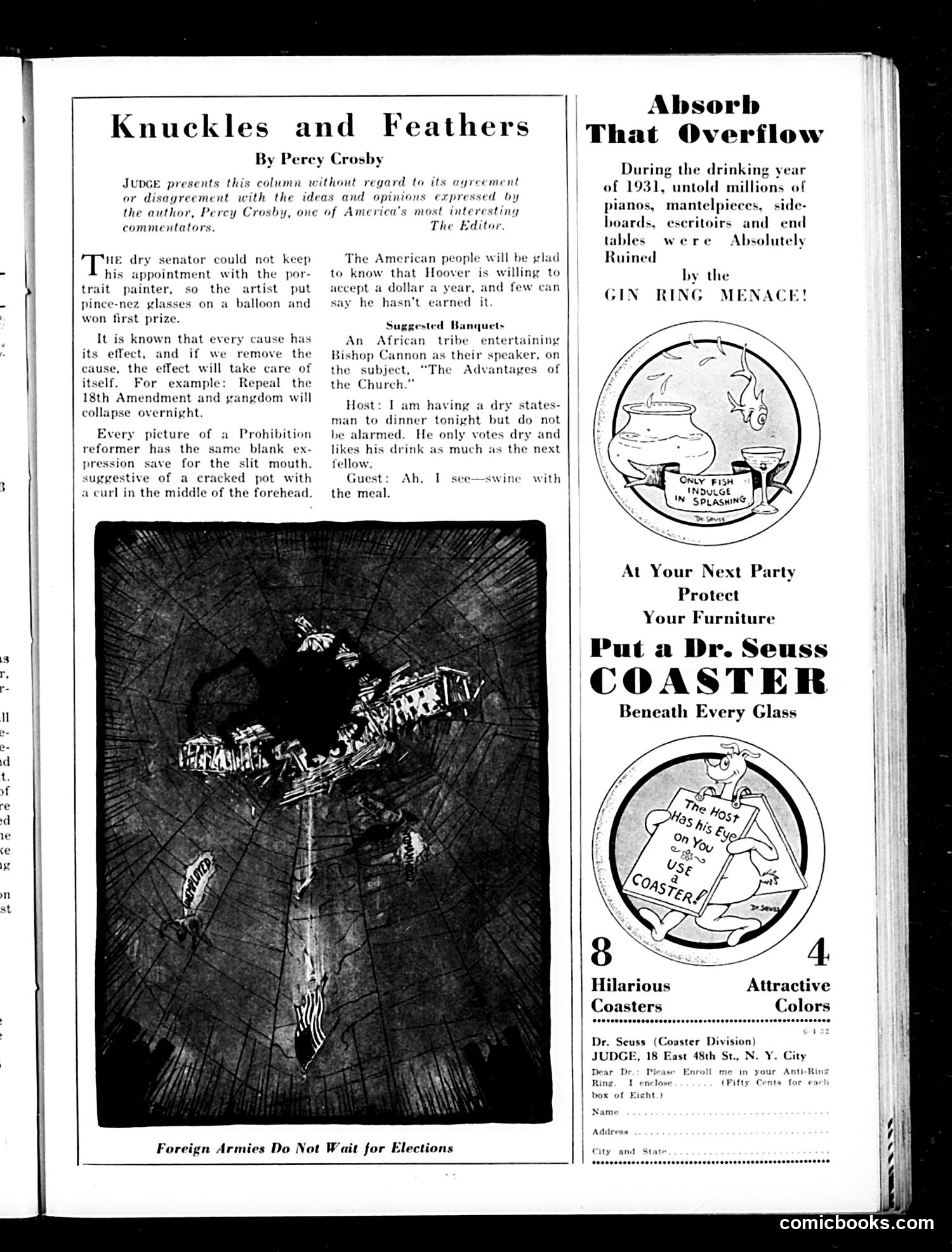
"Knuckles and Feathers" - Judge Magazine Page Analysis This page from Judge magazine (appears to be early 1930s based on "1931" reference) contains satirical commentary on Prohibition-era politics and culture. Main Cartoon ("Foreign Armies Do Not Wait for Elections"): The dark illustration depicts military forces, likely referencing anxieties about America's military preparedness amid international tensions. The caption suggests that enemies won't pause for democratic processes—a jab at political complacency during election cycles. Text Satire: Percy Crosby's column mocks Prohibition reformers and politicians. He ridicules the idea that repealing the 18th Amendment (Prohibition) would eliminate organized crime, and describes Prohibition advocates as blank-faced zealots. A suggested "banquet" joke targets Bishop Cannon (a prominent dry advocate) by noting that even "dry" politicians secretly drink. Advertisement: The Dr. Seuss coaster ad humorously addresses the "gin ring menace"—water rings left by drinking glasses during Prohibition's repeal (1933 was imminent). This playfully acknowledges widespread drinking despite official temperance laws. The page reflects cynicism about Prohibition's failure and hypocrisy among its supporters.
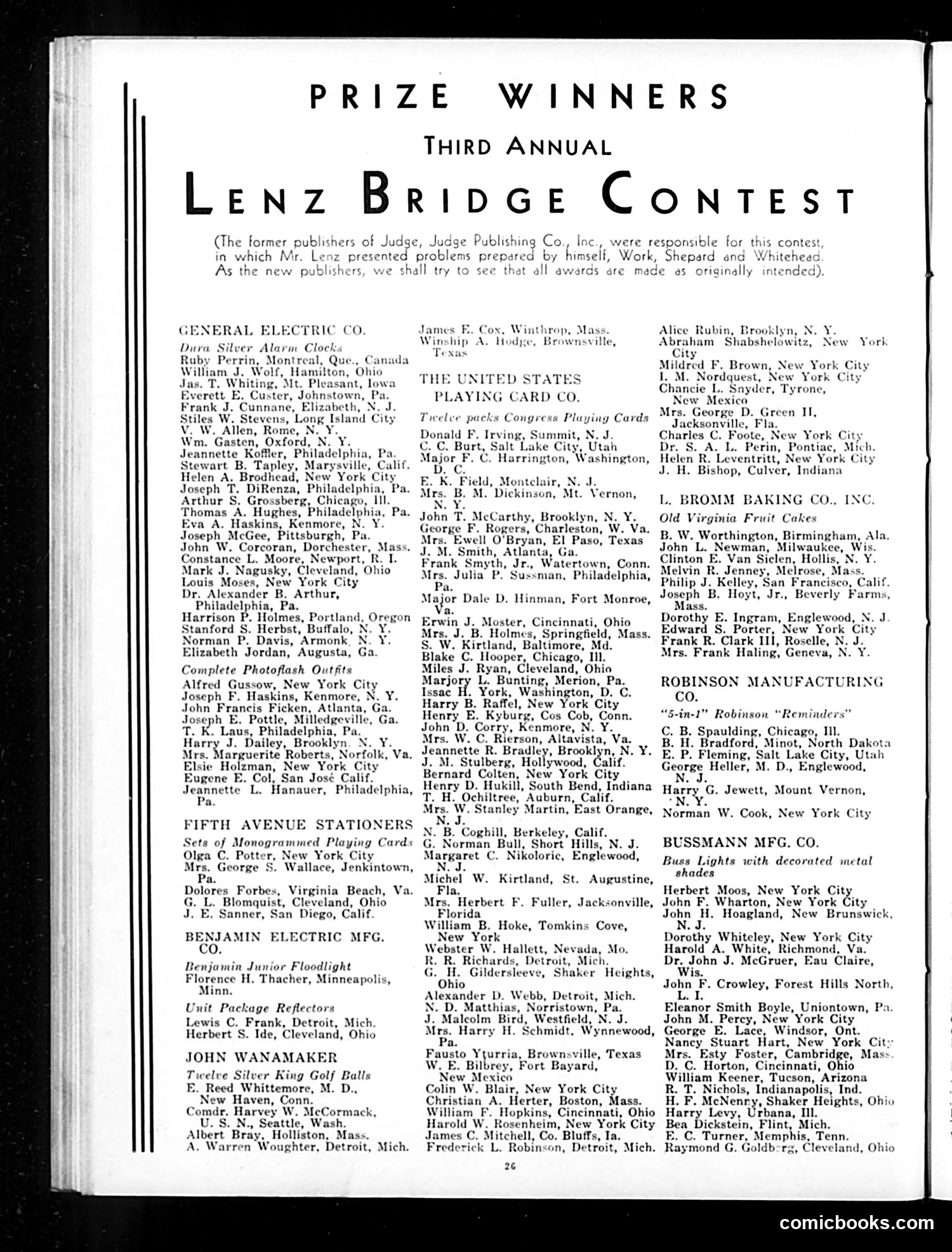
Prize Winners Page Analysis This is a title page listing winners of the Third Annual Lenz Bridge Contest—a bridge design or engineering competition. The page contains no cartoons or satirical content. The contest was originally run by Judge Publishing Co. under publisher Mr. Lenz, who "presented problems prepared by himself, Work, Shepard and Whitehead." New publishers took over and promised to award prizes "as originally intended." The bulk of the page lists hundreds of prize winners organized by sponsoring company—General Electric (alarm clocks), Fifth Avenue Stationers (monogrammed playing cards), Benjamin Electric Manufacturing (floodlights), John Wanamaker (golf balls), and The United States Playing Card Company (card decks). Winners are listed alphabetically by location across the United States, suggesting this was a nationwide competition. There is no satirical commentary or political reference visible—it is purely an administrative record of contest results.
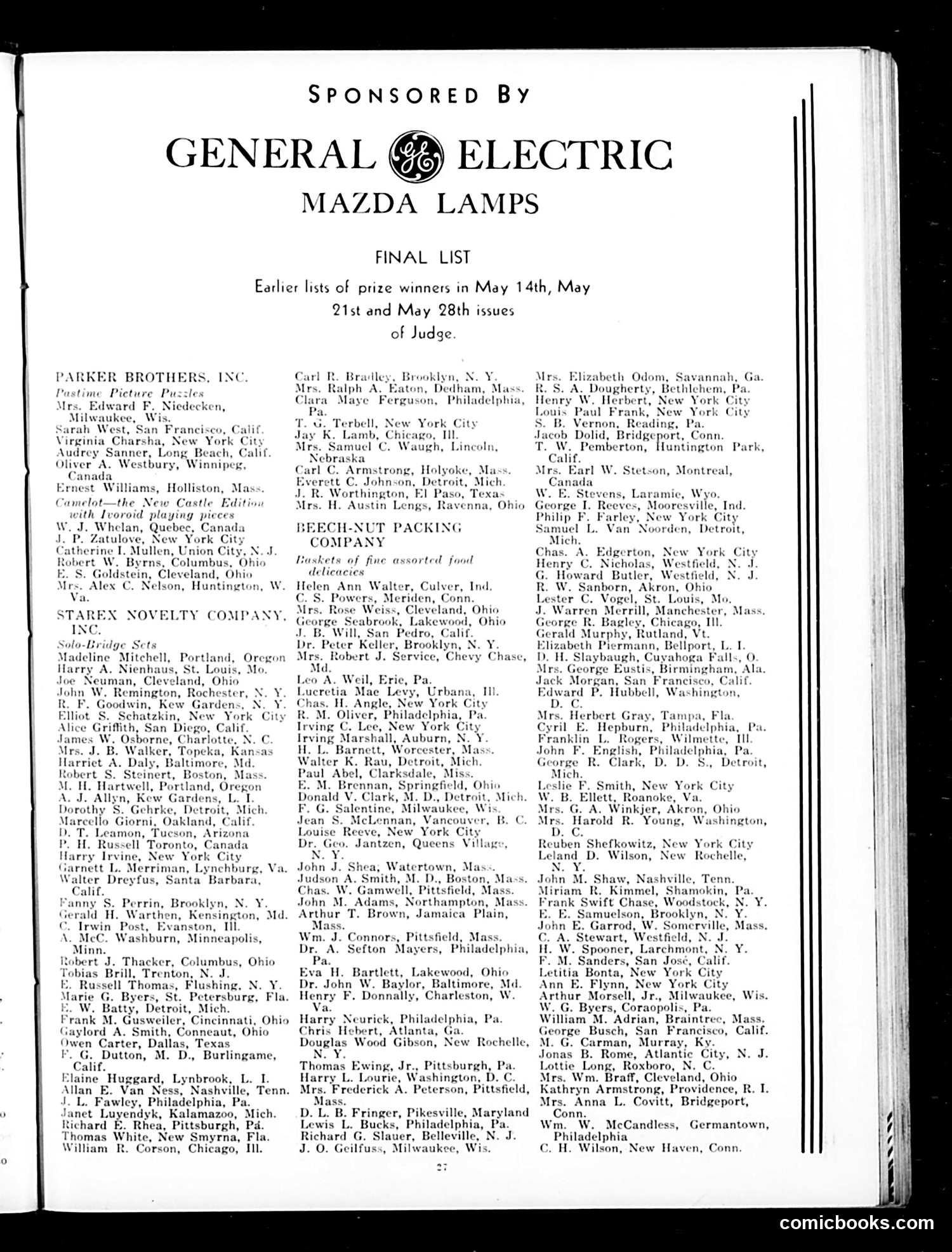
This Page is Administrative, Not Editorial Content This is a final prize winners list from *Judge* magazine, sponsored by General Electric (Mazda Lamps). It contains no cartoons or satirical content—it's purely a compilation of names and addresses of contest winners from earlier *Judge* issues (May 14th, 21st, and 28th). The prizes came from toy and game manufacturers like Parker Brothers and Starex Novelty Company, suggesting *Judge* ran a reader contest or sweepstakes. Names like "Pastime Picture Puzzles" and "Solo-Bridge Sets" indicate the prize categories. For modern readers: This reflects how major magazines used sponsored giveaways and contests to boost circulation and advertising revenue in the early 20th century. There is no political or social satire on this page—it's a business document listing ordinary Americans who won merchandise.
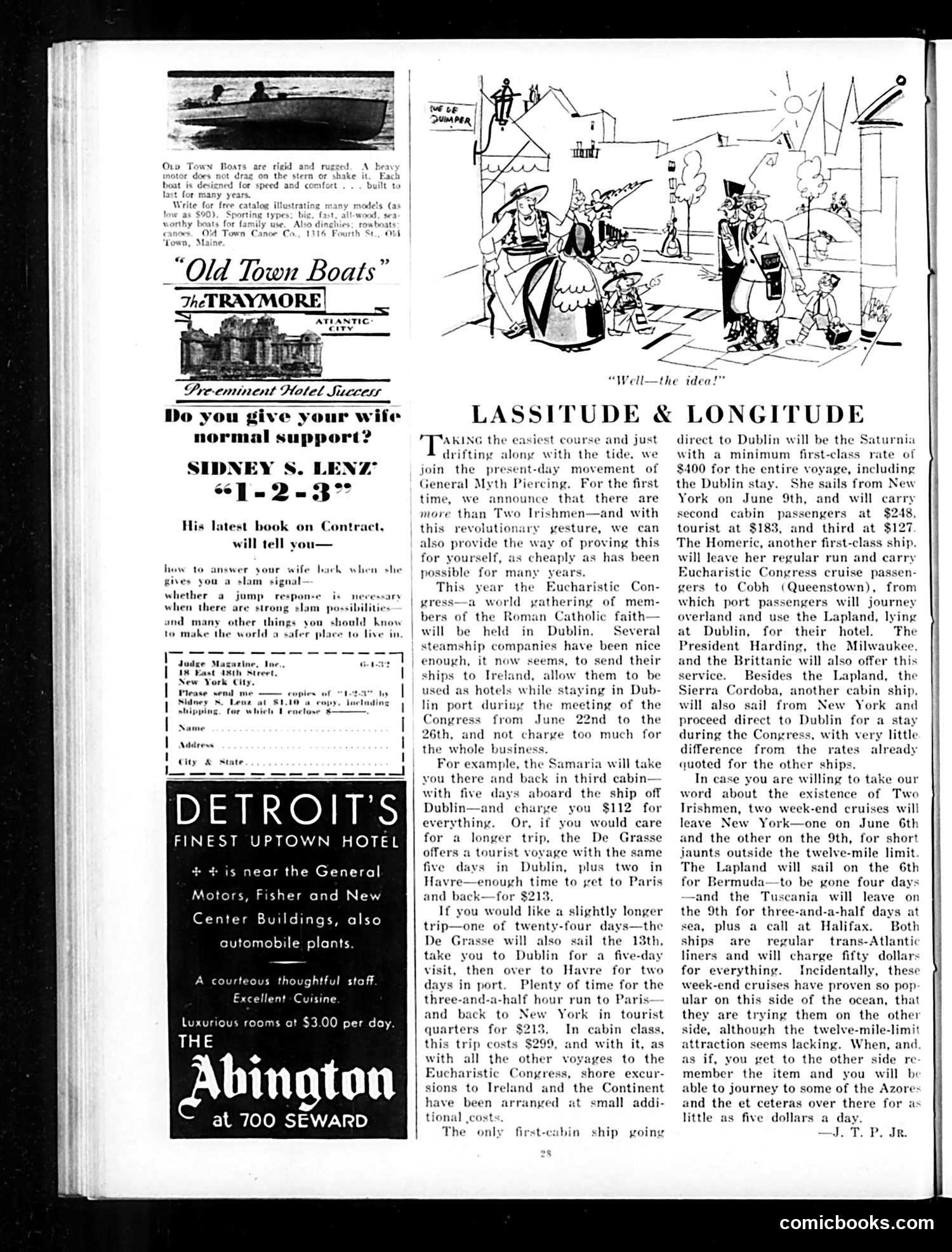
Analysis of Judge Magazine Page Content This page is primarily commercial advertising rather than satirical editorial content. The main featured article, "Lassitude & Longitude," discusses transatlantic cruise options to the 1932 Eucharistic Congress in Dublin—a major Catholic religious gathering. The article's subtle satire appears in its opening: it mocks the contemporary trend of "General Myth Piercing"—debunking folklore—by facetiously claiming to finally prove there are "more than Two Irishmen," a joke about Irish-American stereotypes and myths. The cartoonish illustration titled "Well—the idea!" depicts what appears to be seasickness or discomfort among passengers, likely commenting wryly on the cruise experience itself. The page is otherwise dominated by hotel and boat advertisements (Traymore Hotel, Detroit's Finest Uptown Hotel, Abington Hotel, Old Town Boats) typical of Judge's revenue model. The Sidney Lenz book advertisement promotes a contract guide for marital disputes—common period self-help content.
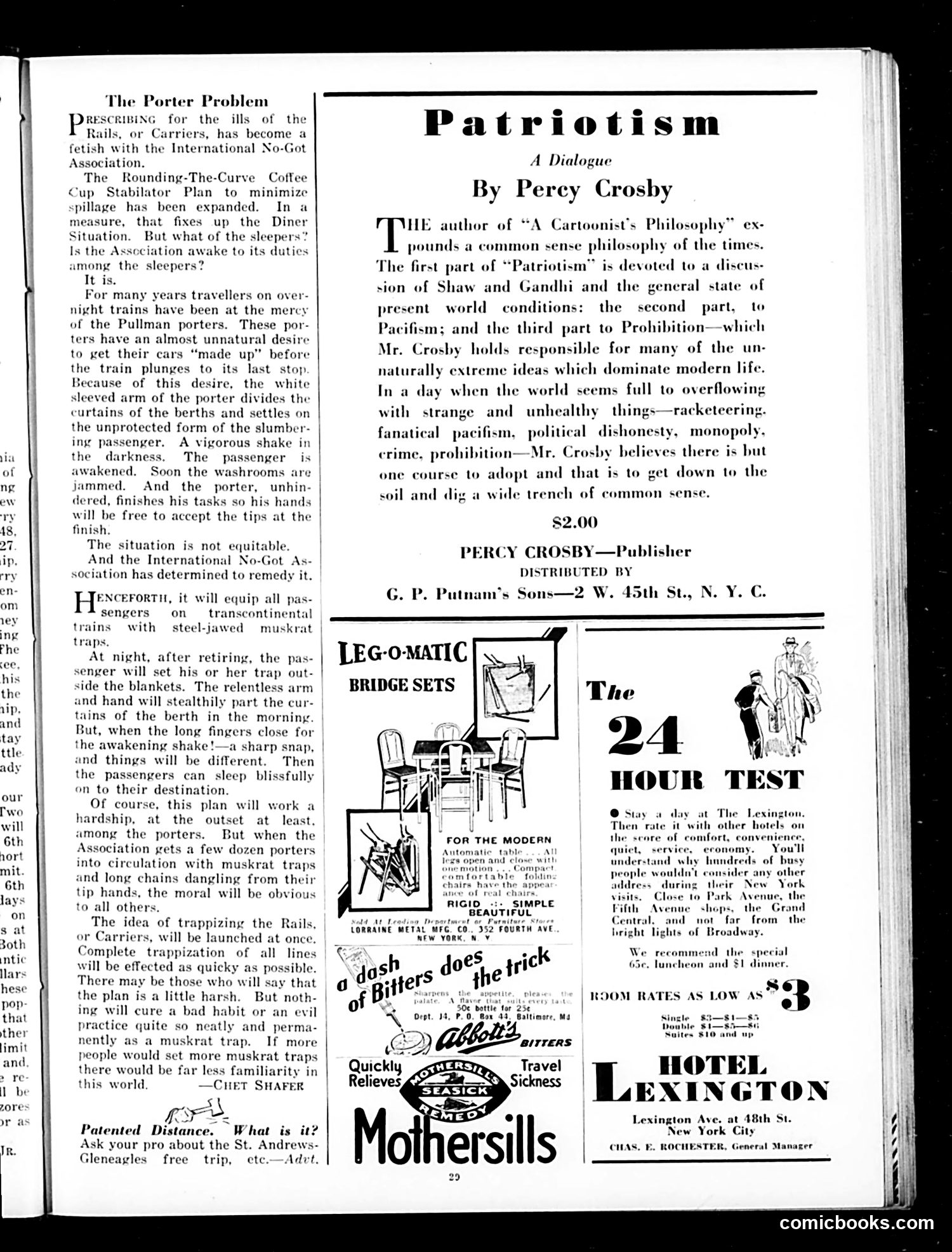
Analysis: "The Porter Problem" This page's main content is a satirical article titled "The Porter Problem," discussing grievances with Pullman porters on overnight trains. The satire proposes an absurd "solution": equipping passengers with steel-jawed muskrat traps to be set outside their berths at night. When porters inevitably reach in to wake passengers for morning preparations, they'll snap the trap. The joke mocks both the porters' aggressive wake-up practices (described as an "unnatural desire" to prepare cars before stops, roughly shaking sleeping passengers awake) and the over-the-top attitude of the "International No-Got Association" proposing this remedy. By attributing the solution to this fictional organization and describing it in serious, bureaucratic language, the author (credited as "Chet Shafer") ridicules excessive regulatory responses to minor labor disputes. The phrase "trappization of all lines" further emphasizes the satirical absurdity. The piece ultimately argues that familiarity issues stem from insufficient "muskrat traps" in society—a tongue-in-cheek critique of common-sense problem-solving.
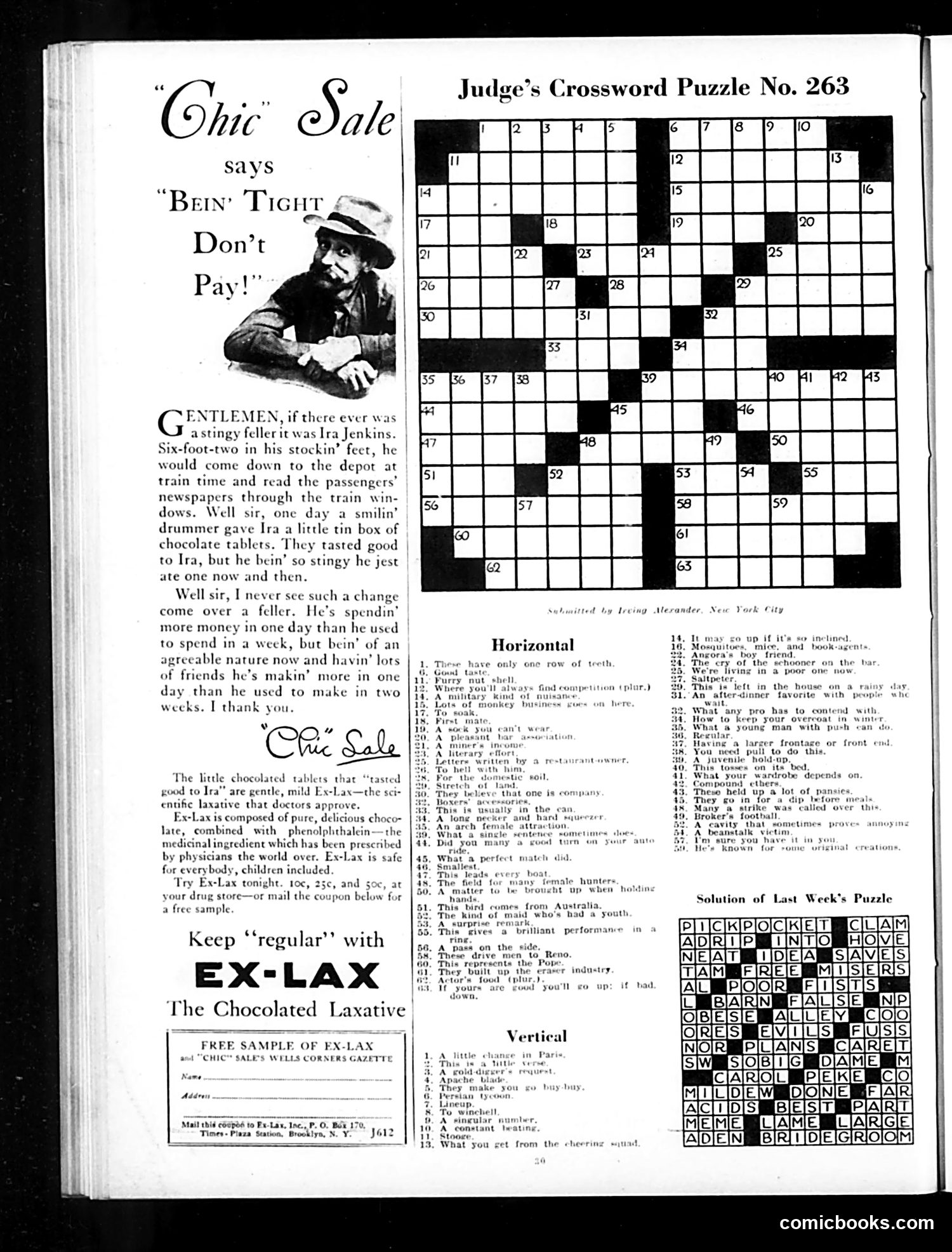
Political Cartoon Analysis: "Chic Sale's Ex-Lax Advertisement" This page is primarily a commercial advertisement disguised as editorial content, featuring "Chic" Sale (a popular humorist of the era) promoting Ex-Lax laxative. The narrative presents a folksy story: Ira Jenkins, a stingy man, receives chocolate tablets (laxative) from a traveling salesman. After consuming them, Jenkins becomes energetic, sociable, and financially successful—earning more money and making friends. The implicit message: regularized digestion transforms a miserly hermit into a productive, wealthy community member. This reflects early 20th-century marketing that conflated bowel regularity with moral and economic virtue. The humor relies on the period's comfort discussing bodily functions candidly in family publications, and on the testimonial format common to patent medicine advertising. The crossword puzzle and Ex-Lax ad occupy the same page, suggesting the magazine's blurred line between editorial and advertising content—standard practice for magazines dependent on pharmaceutical advertising revenue during this era.
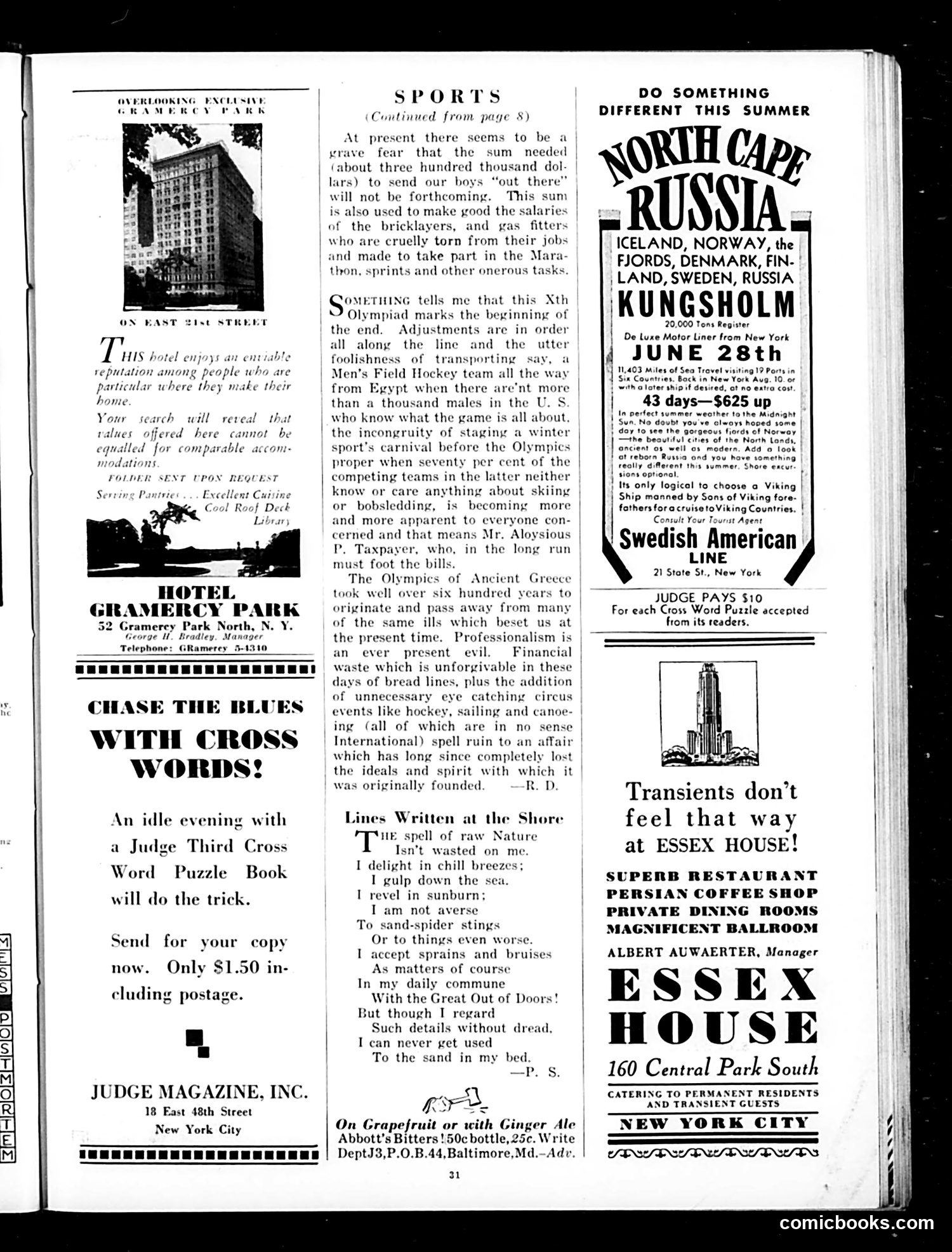
Political & Social Context of This Judge Magazine Page This appears to be a 1932 magazine page mixing sports commentary with travel and hotel advertising. The central sports article critiques the X Olympiad (likely the 1932 Los Angeles Olympics), arguing it represents the Olympic movement's decline into commercialism and irrelevance. The Satire: The unnamed author (R.D.) mocks how the Olympics have abandoned their ancient ideals. He points out the absurdity of staging winter sports events before the Olympics proper, noting that few Americans understand hockey, and that 70% of competing nations don't care about skiing or bobsledding. The real problem: wealthy organizers like "Mr. Aloysius P. Taxpayer" must foot expensive bills for spectacles most people neither understand nor value. Context: This reflects Depression-era skepticism about lavish sporting events when millions faced poverty. The critique targets Olympic commercialism and the government/wealthy funding sports infrastructure ordinary citizens couldn't afford to attend or enjoy. The page also includes poetry about beach discomfort and advertisements for luxury travel (Kungsholm cruise ship) and hotels—ironically juxtaposing critiques of wasteful spending with luxury marketing.
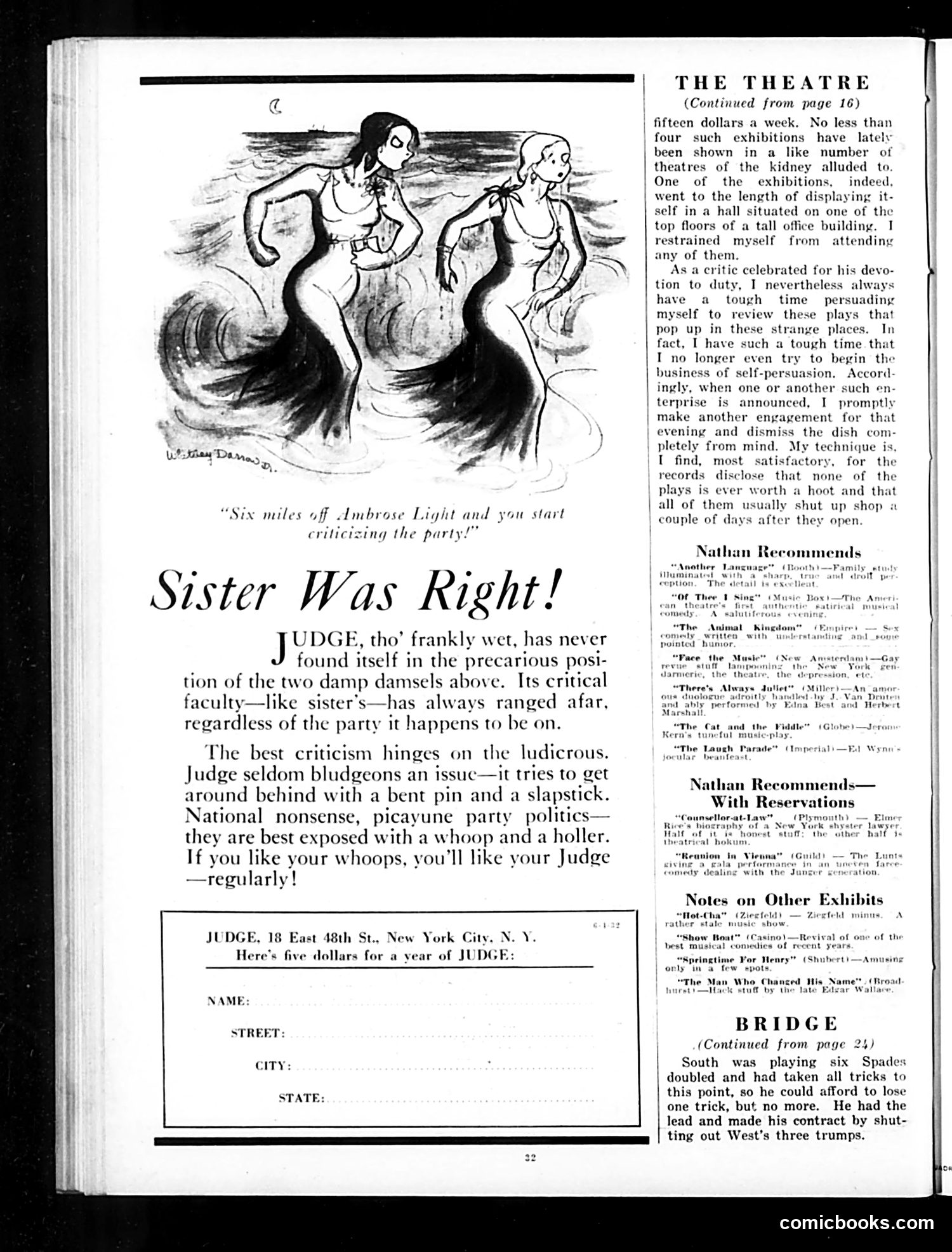
Judge Magazine Page Analysis This page contains a theater critic's column and a satirical advertisement for *Judge* magazine itself. Main Cartoon & Article ("Sister Was Right!"): The cartoon depicts two women in water, apparently six miles off Ambrose Light (a navigation marker), with one criticizing the other's party attendance. The accompanying article defends *Judge* magazine's critical approach: like the sister figure's detached judgment, *Judge* maintains independence "regardless of the party it happens to be on." The satire targets *Judge's* own editorial stance—claiming it exposes "national nonsense, picayune party politics" through humor ("whoop and a holler") rather than serious argument, using bent pins and slapsticks instead of direct confrontation. Advertisement Section: Below is a subscription solicitation ($5/year) and theater recommendations, plus a bridge column about card play strategy. The overall message positions *Judge* as the sophisticated critic who stands apart from partisan entanglement, using satire as its weapon.
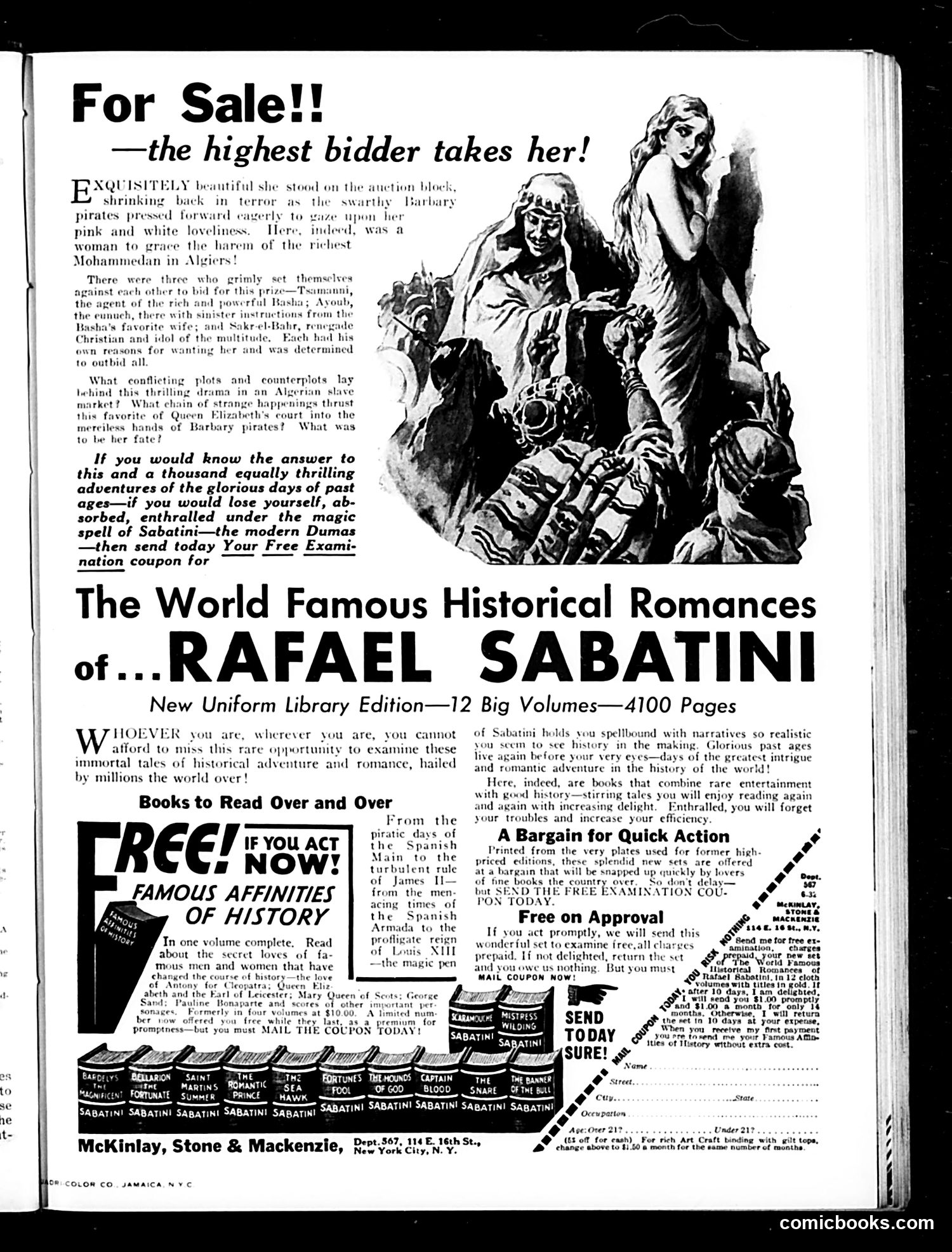
What This Page Means This is primarily an advertisement for Rafael Sabatini's historical romance novels, not a political cartoon. The page uses a dramatic fictional narrative to sell books. The illustration depicts a woman being auctioned on a slave block in Algiers to wealthy Barbary men—a scenario typical of Sabatini's adventure stories. The text promises readers will discover "what conflicting plots and counterplots lay behind this thrilling drama" and experience "glorious past ages" of "intrigue and romantic adventure." The ad exploits period stereotypes about exotic "Oriental" intrigue and harems to attract readers. The "Famous Affinities of History" sidebar offers a companion book about secret loves of historical figures. The marketing strategy is standard early-20th-century book club tactics: offering a free examination of a 12-volume set "on approval," with pressure to act quickly ("if you act promptly"). This was a common direct-mail sales technique of the era. The page reflects Judge magazine's mix of satire and commercial advertising, though this particular content is straightforward marketing rather than political commentary.
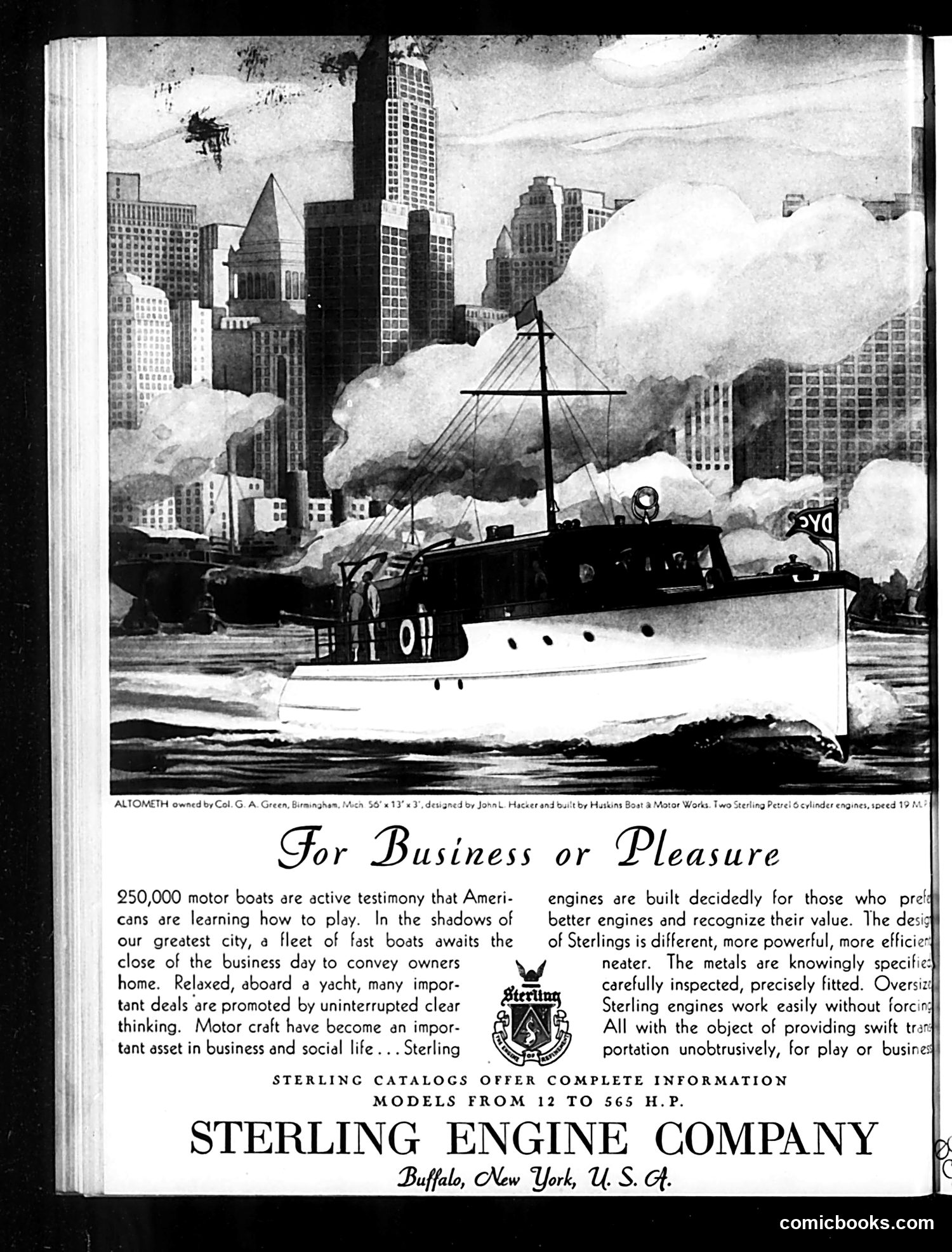
Analysis This page is primarily advertising, not satire. It promotes Sterling Engine Company's motors for motorboats, using an illustration of the yacht "Altometh" against a stylized Manhattan skyline. The text frames motorboating as both leisure and business—250,000 Americans now own motor boats, suggesting a growing recreational culture. The advertisement argues that owning a yacht is a practical asset: business deals are "promoted by uninterrupted clear thinking" aboard boats, while motors provide reliable power for "play or business." The imagery depicts an idealized leisure class lifestyle—relaxed yacht ownership near America's greatest city—appealing to affluent readers. Sterling's pitch emphasizes quality engineering: carefully inspected metals, powerful engines, and swift transportation "unobtrusively." This reflects 1920s optimism about American wealth, motorization, and the blending of business with pleasure among the wealthy.