judge
Judge — June 11, 1932
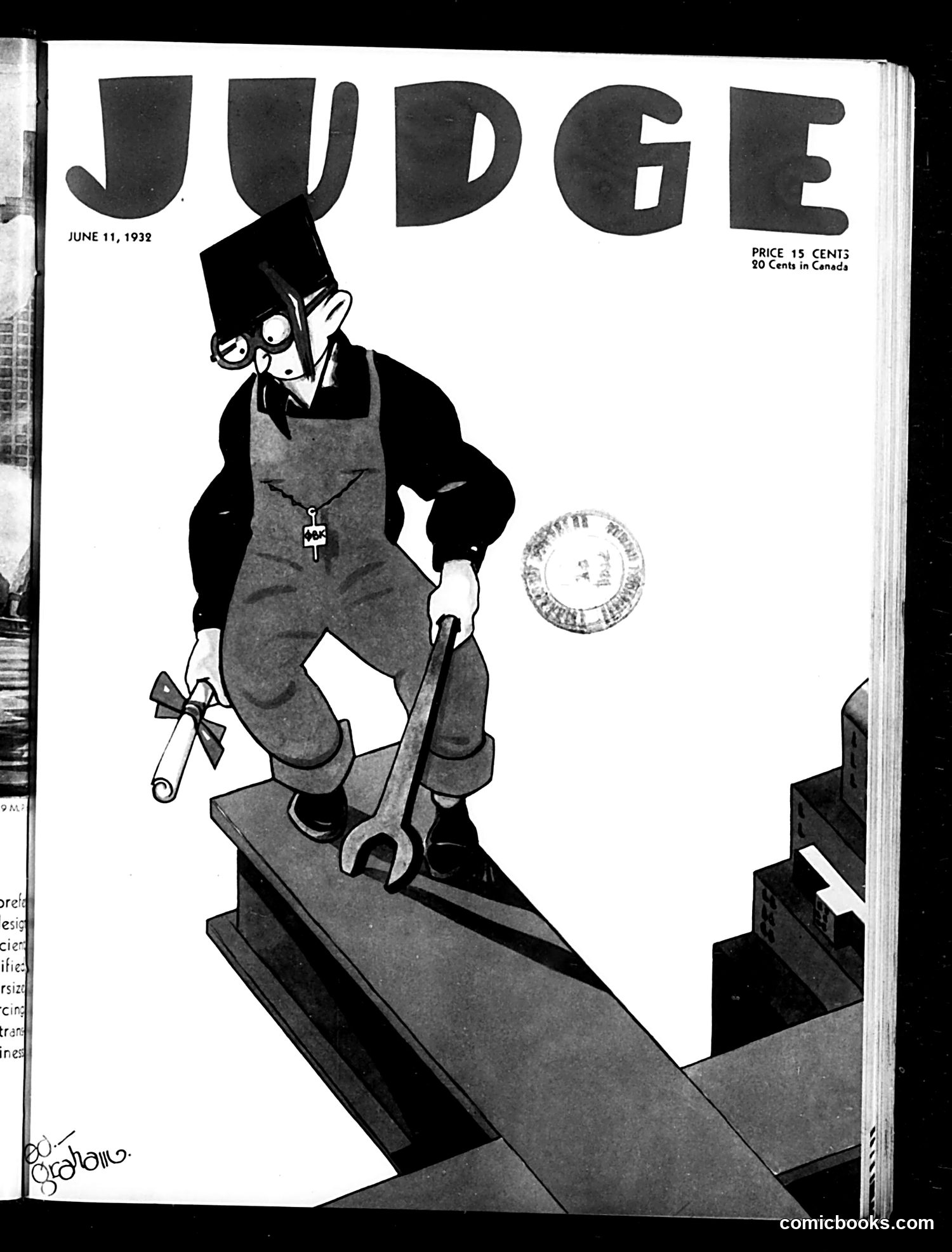
Judge Magazine Cover Analysis - June 11, 1932 This cover depicts a judge or authority figure in judicial robes wielding a large wrench as a weapon, standing over what appears to be broken machinery or infrastructure. He holds a document (likely a legal decree) in one hand. Published during the Great Depression, this likely satirizes judicial intervention in economic or labor disputes. The broken machinery suggests industrial collapse, while the judge's aggressive posture with the wrench implies that legal judgments are making economic problems worse rather than fixing them. The cartoon probably critiques how courts' rulings on labor disputes, antitrust cases, or bankruptcy proceedings were perceived as destructive to recovery efforts during this economic crisis. The absurdist image of a judge as saboteur underscores the cartoonist's view that judicial decisions were hindering rather than helping economic repair.
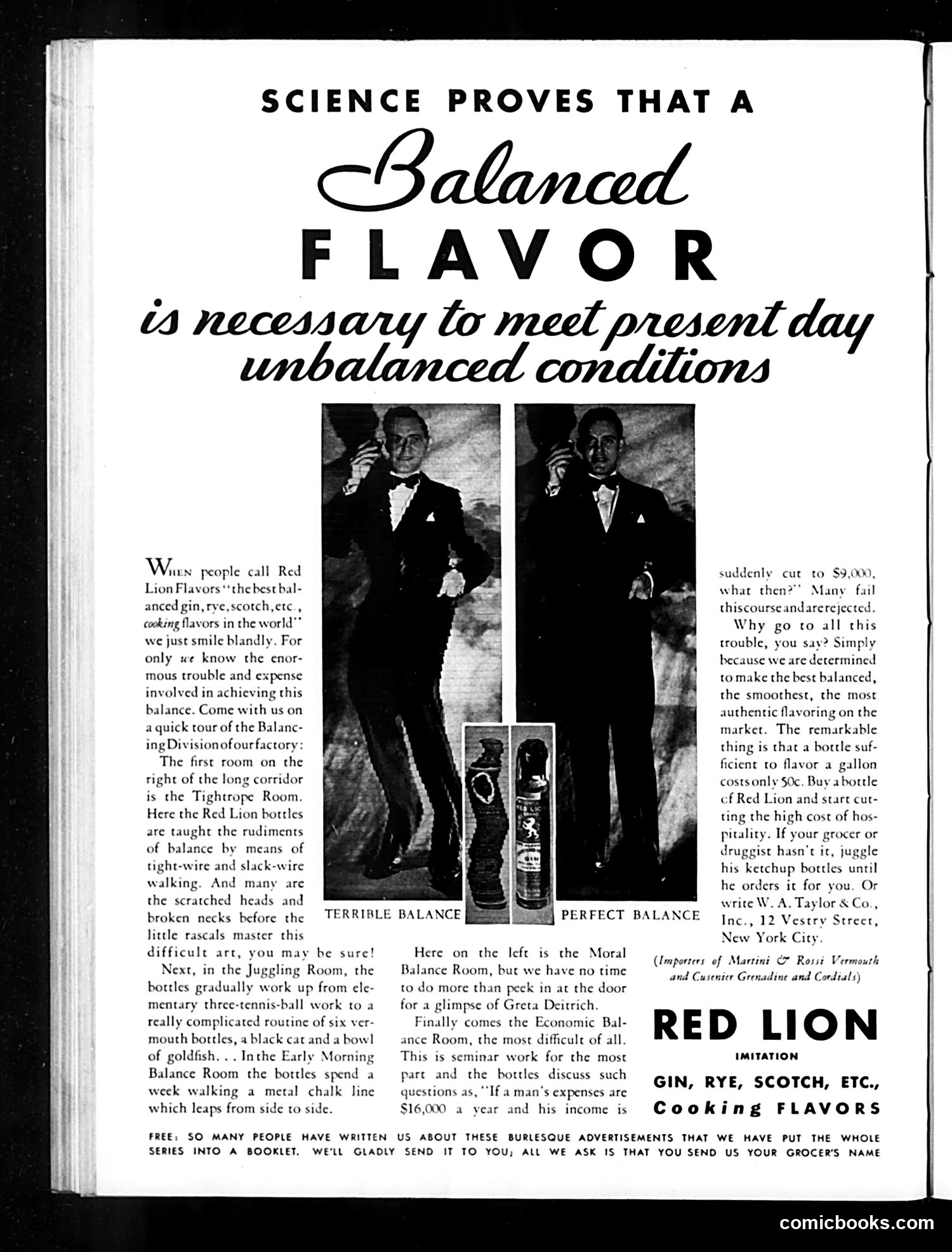
Red Lion Advertisement, Judge Magazine This page is primarily a liquor advertisement, not political satire. It promotes Red Lion brand spirits (gin, rye, scotch, cooking flavors) through humor rather than commentary. The "joke" involves balance—literally and economically. The ad shows a man in formal dress in two states: "Terrible Balance" (left, unsteady) versus "Perfect Balance" (right, composed). This visual pun illustrates the product's claim about "balanced flavor." The accompanying text makes an economic argument: quality balanced flavoring costs only 5¢ per bottle to produce, yet Red Lion can charge significantly more. The ad sardonically suggests customers could "juggle his ketchup bottles" to trick grocers into ordering it—a tongue-in-cheek acknowledgment of the product's markup. This reflects Prohibition-era marketing (note "imitation" and "cooking" flavors as legal cover), using absurdist humor to sell spirits.
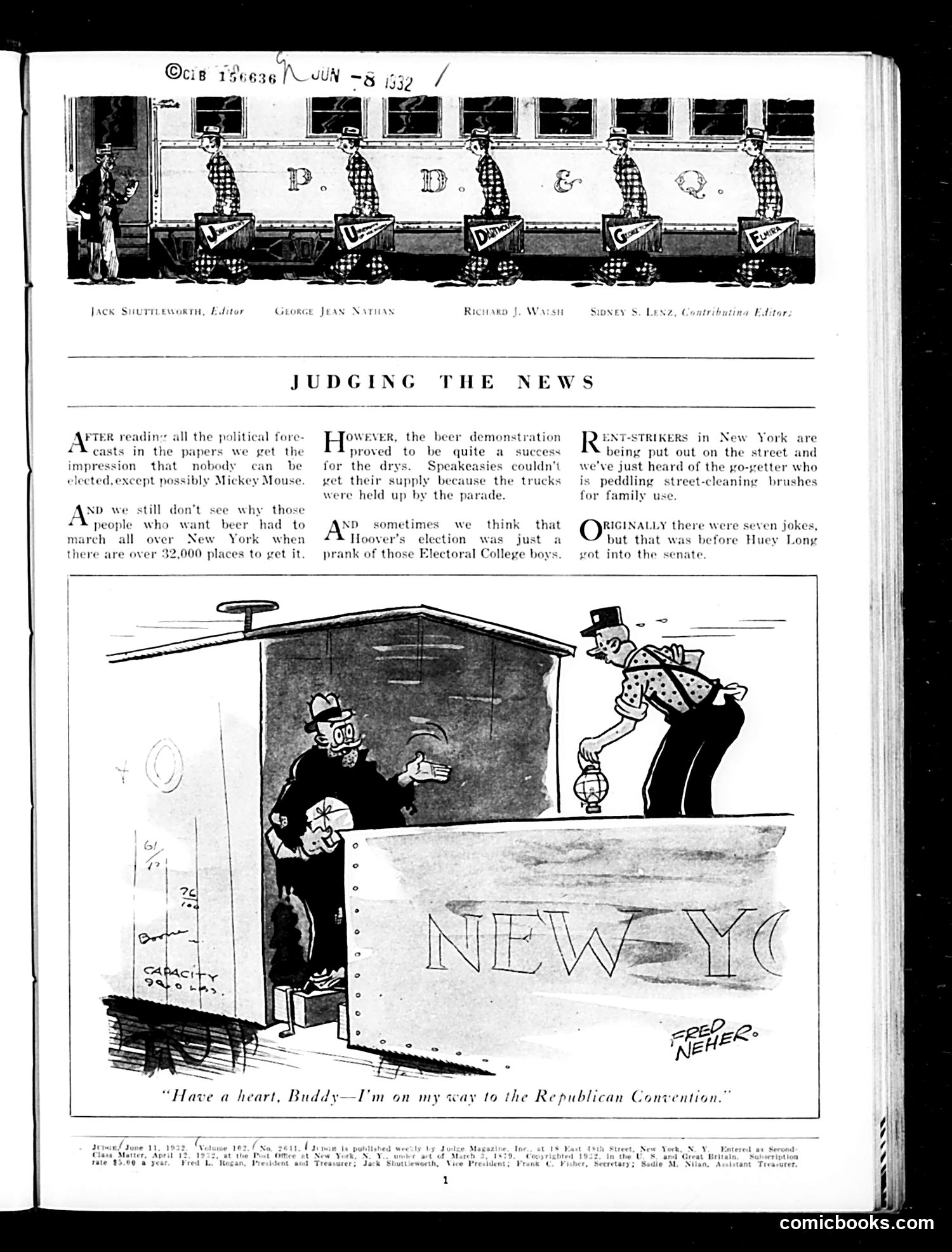
"Judging the News" - Political Satire from Judge Magazine This page satirizes 1932 American politics through commentary and a cartoon. The text discusses: - Political forecasts: The writers note that only Mickey Mouse seems electable after reading predictions - A beer demonstration: Successfully blockading trucks during Prohibition enforcement - Rent-strikers in New York: Protesting street-cleaning brush sales - Hoover's election: Sarcastically comparing it to an "Electoral College boys" prank - Senate jokes: A reference to Huey Long entering the Senate The main cartoon depicts a newsstand operator telling a man heading to the Republican Convention: "Have a heart, Buddy—I'm on my way to the Republican Convention." The satire suggests pessimism about the Convention's prospects, likely during the Depression era when Republicans faced voter dissatisfaction.
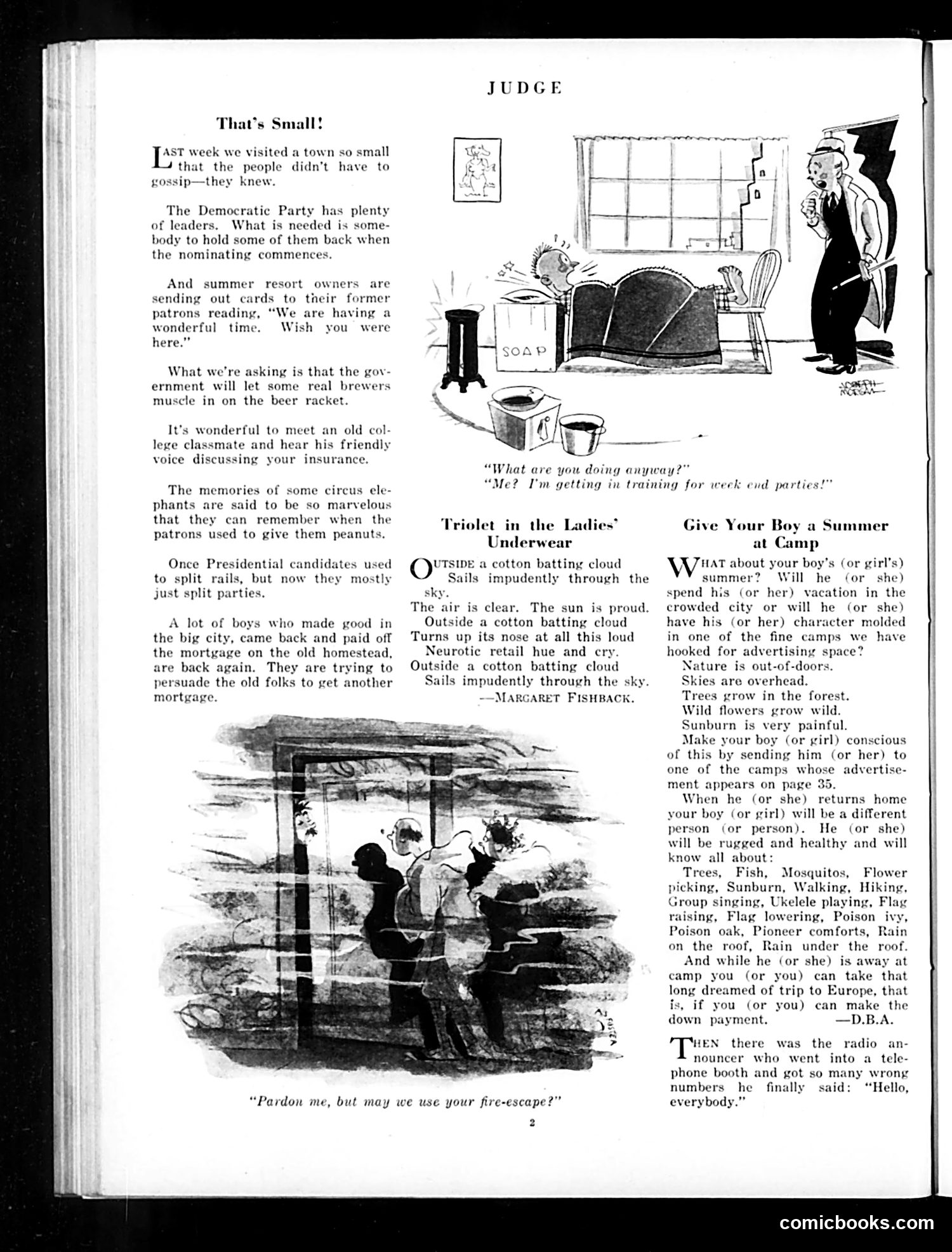
Analysis of Judge Magazine Page This page contains editorial commentary and light humor rather than political cartoons. The main article "That's Small!" critiques Democratic Party leadership, suggesting they need better organization for nominations. It includes satirical observations about small-town gossip, summer resorts, circus elephants, and presidential campaigning. The cartoon at bottom shows people asking to use a fire escape, likely satirizing urban crowding or safety concerns. The right column promotes summer camps for children, framing outdoor experiences as character-building, though the tone seems somewhat tongue-in-cheek about mosquitoes, poison oak, and rain. A poem "Triolet in the Ladies' Underwear" offers whimsical commentary on cotton clouds and sky imagery. The page reflects early-to-mid 20th century American leisure culture and political organization concerns.
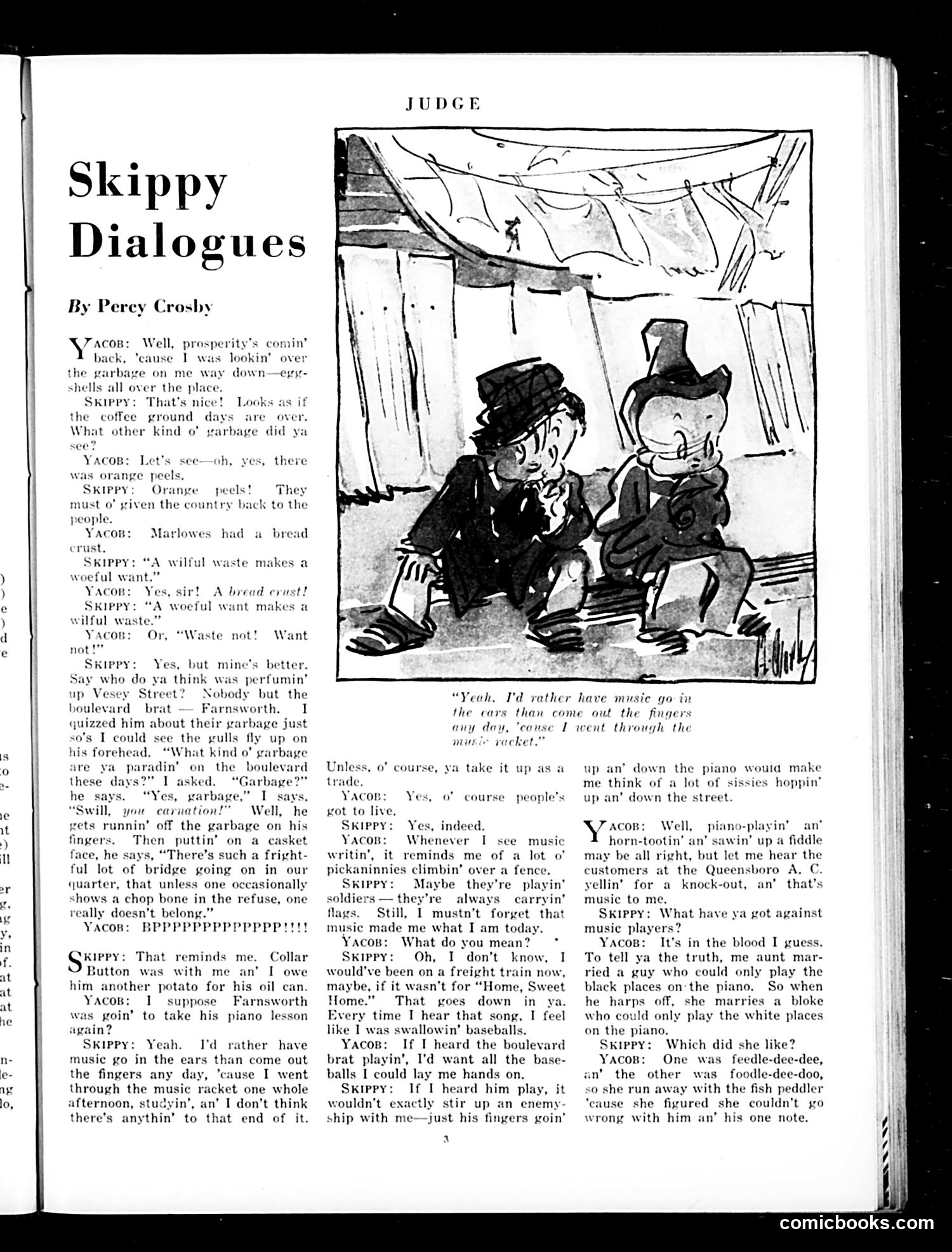
"Skippy Dialogues" by Percy Crosby This page features a comic dialogue between two characters named Yacob and Skippy, apparently street urchins or working-class boys. The humor derives from their malapropisms, dialectal speech, and innocent misunderstandings of adult concepts. The jokes reference early 20th-century urban life: garbage disposal, bread lines (suggesting poverty), piano lessons, and music performances. Skippy's rough grammar and Yacob's responses create comedy through their naive interpretations—for instance, confusing "waste" with "a woeful want," or Skippy's dismissive attitude toward formal music education. The illustration shows two impoverished-looking boys in worn clothes and hats. The satire gently mocks working-class children's speech patterns while depicting period urban poverty and social conditions.
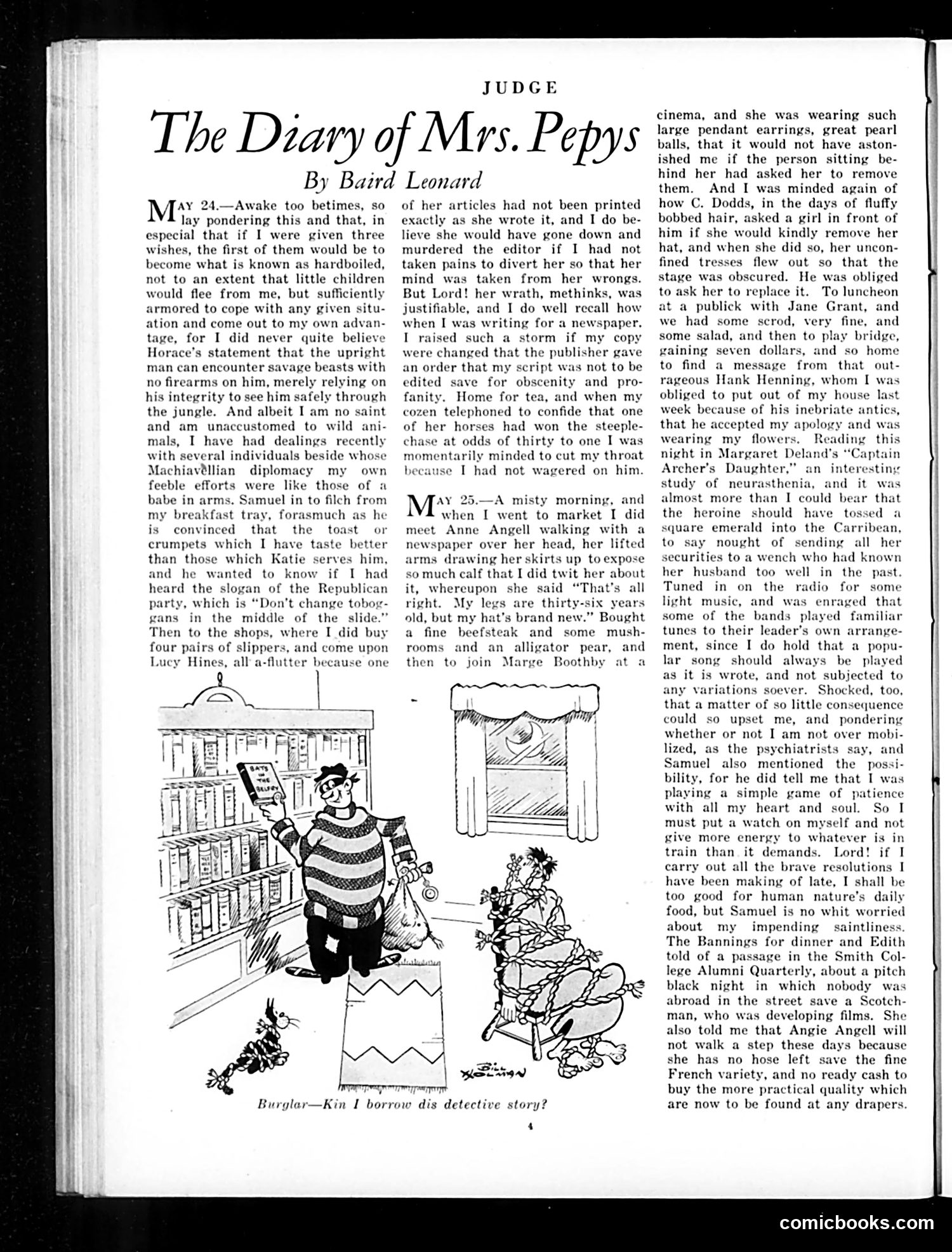
"The Diary of Mrs. Pepys" by Baird Leonard This page features a satirical diary entry, a common Judge magazine format. The illustration shows a rotund man in striped clothing at a bookshelf with the caption "Burglar—Kin I borrow dis detective story?" The cartoon jokes about a burglar politely requesting to borrow a detective story from a homeowner—absurd because burglars steal rather than borrow. It's a play on contradiction: a criminal asking permission contradicts his profession. The diary entries reference everyday 1920s social concerns: editors rejecting manuscripts, women's fashion (earrings, bobbed hair), radio entertainment, and romantic complications. The humor targets middle-class anxieties about modern life, changing social customs, and romance. Mrs. Pepys emerges as a witty, somewhat exasperated narrator of her social world.
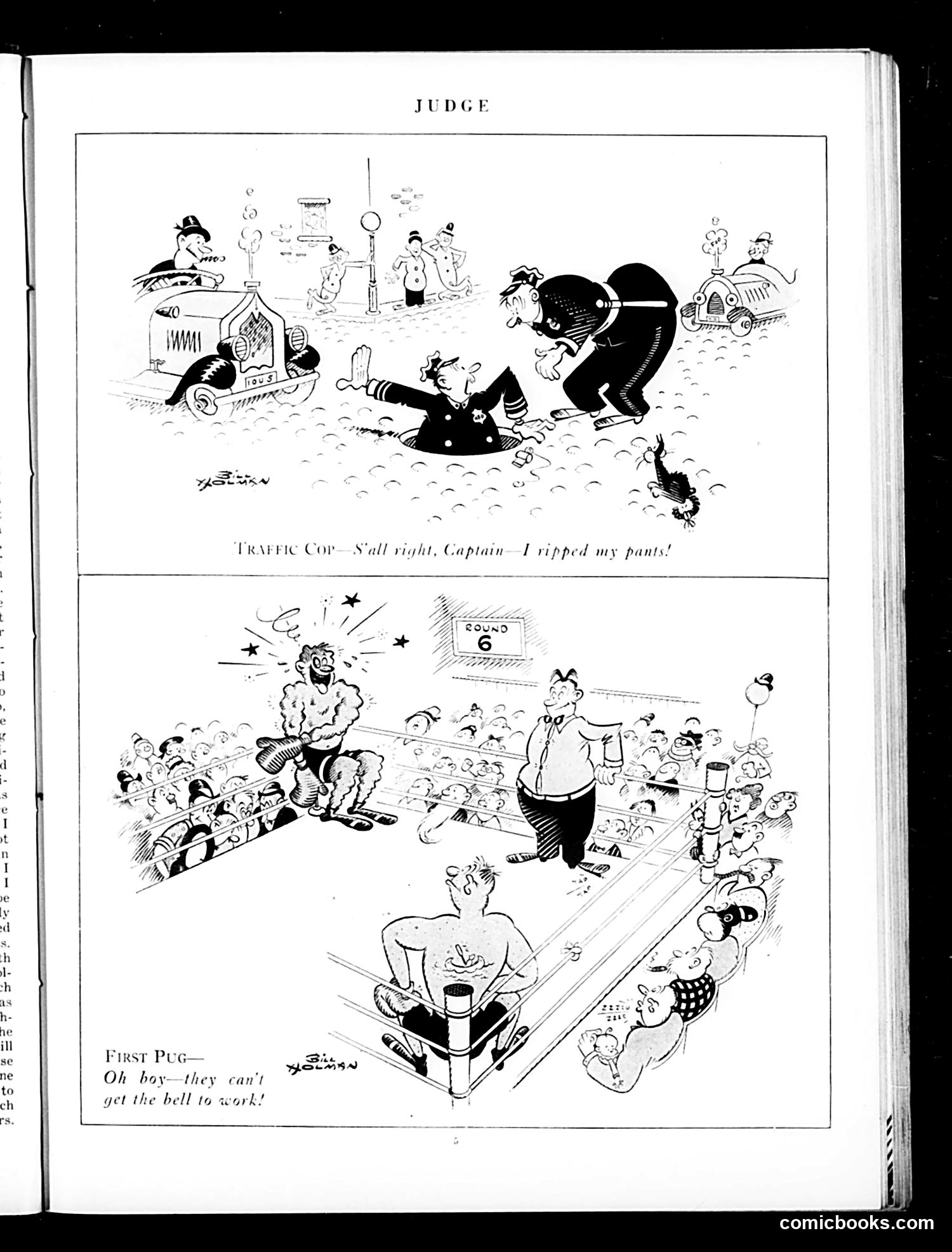
Analysis of Judge Magazine Page: "Judge" Top Cartoon - "Traffic Cop": A traffic cop has apparently fallen and torn his pants while trying to manage chaotic street traffic. The humor derives from the dignity of authority literally compromised—the officer's embarrassment contrasts with his authoritative role directing various vehicles and pedestrians. This satirizes the challenges traffic police faced as automobile usage increased in early 20th-century American cities. Bottom Cartoon - "First Pug": A boxing match scene where a boxer is being struck, with spectators reacting. The caption "Oh boy—they can't get the bell to work!" suggests the fight continues despite technical failure, creating chaos. The humor plays on confusion and the absurdity of an ongoing match without proper procedure. Both cartoons rely on slapstick and situational humor typical of Judge's satirical style.
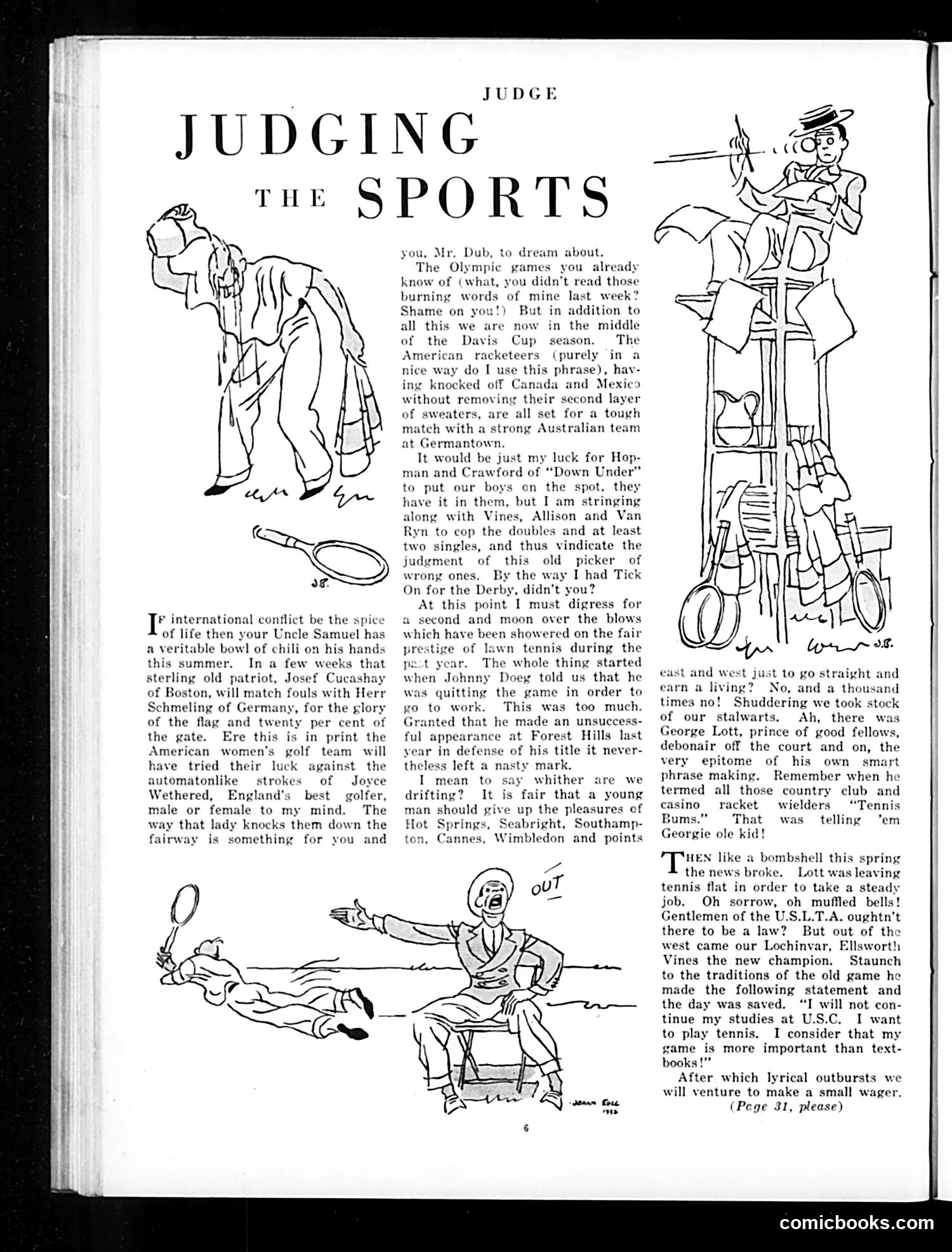
"Judging the Sports" - Judge Magazine Sports Column This is a humorous sports column with satirical illustrations about 1920s tennis and athletics. The author discusses international tennis competitions, specifically the Davis Cup season and lawn tennis controversies. Key references include: - Johnny Doeg: A tennis player criticized for abandoning the sport to pursue work instead of competing - George Lott: Praised as a capable replacement champion - U.S.L.T.A.: The governing body, seemingly criticized for rules or decisions - Forest Hills: An important tennis venue where poor sportsmanship allegedly occurred The cartoons humorously depict tennis players in exaggerated poses. The overall satire mocks American tennis players' priorities (work over sport), administrative decisions, and questioning whether young athletes should sacrifice education for athletics. The tone is gently mocking rather than harsh.
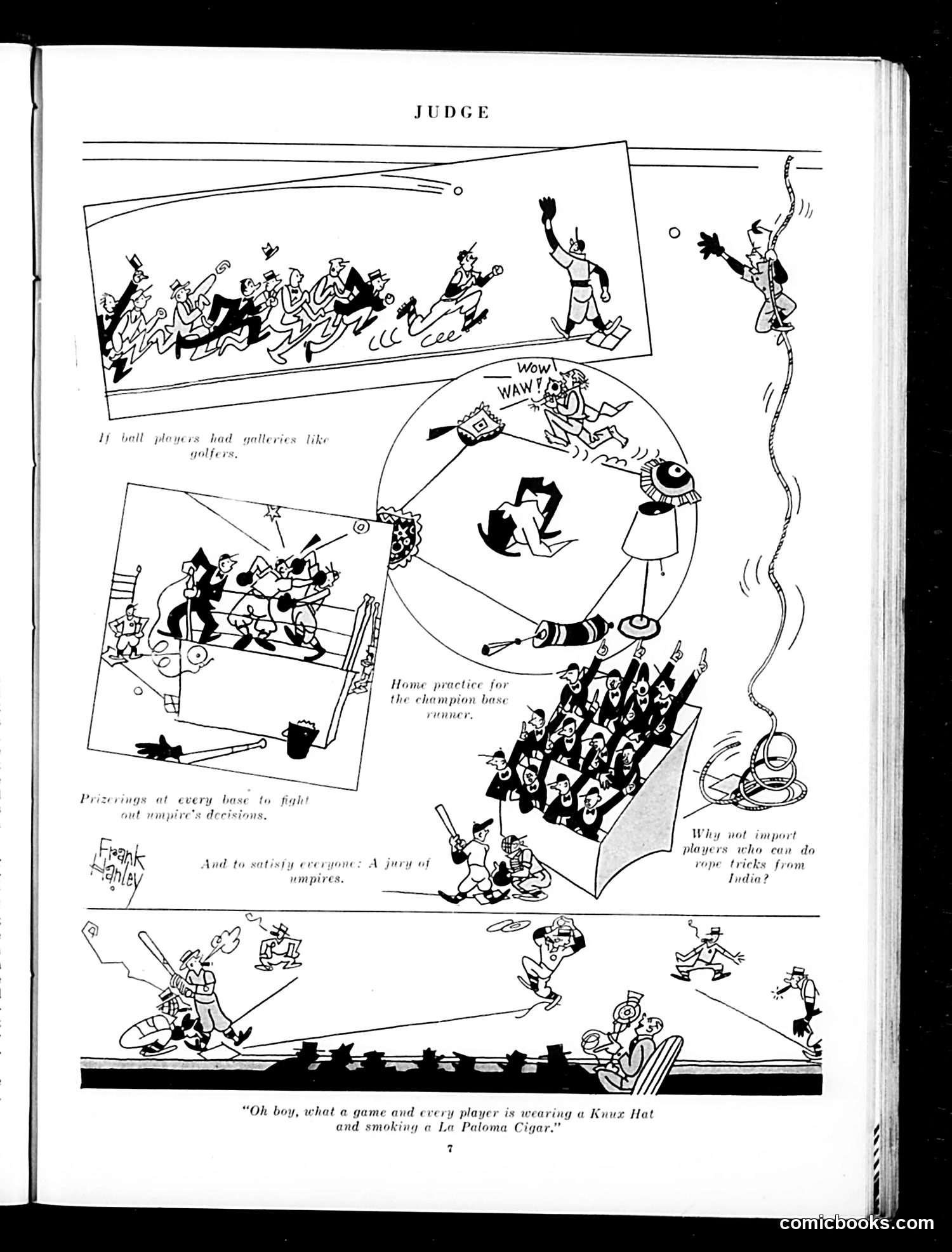
Judge Magazine Baseball Satire This page satirizes early 20th-century baseball through multiple cartoon panels. The central image depicts "home practice for the champion base runner," showing chaotic scenes of players at bat, running bases, and a crowd of umpires—likely mocking the proliferation of officials or disputed calls in games. The satirical captions include "ball players had galleries like golfers," "prizings at every base to fight out umpire's decisions," and "a jury of umpires"—all suggesting baseball games had become overly complicated with too many authority figures and excessive argument. The final caption reveals this is product placement satire: the entire joke culminates in promoting "Knux Hat" and "La Paloma Cigar" as accessories every player supposedly wears and smokes, turning the sport's chaos into an advertisement. This reflects Judge's common practice of embedding commercial sponsorships within satirical content.
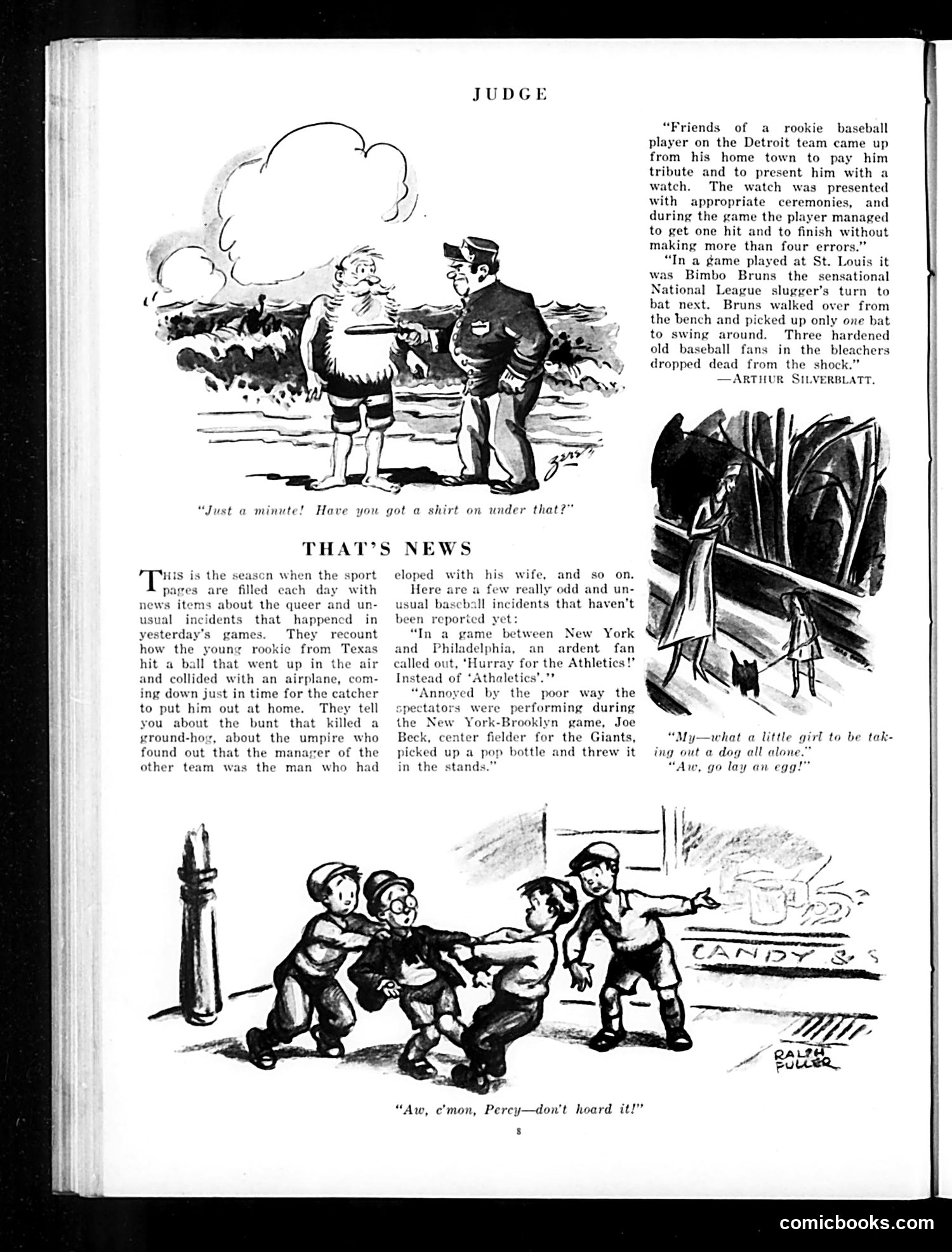
Explaining This Judge Magazine Page This is a baseball humor column from Judge's sports section, featuring amusing anecdotes about the sport. The top cartoon shows Santa Claus confronted by an umpire or official asking "Have you got a shirt on under that?"—a visual gag playing on baseball uniform requirements. The main text, "That's News," collects oddball baseball incidents, mostly absurd tall tales: a rookie hitting a ball that collides with an airplane, a bunt killing a groundhog, an umpire discovering his manager is an ex-lover. These exaggerations mock the tendency of sports journalists to sensationalize or invent dramatic stories. The lower cartoon by Ralph Fuller shows children arguing over something, with the caption "Aw, c'mon, Percy—don't hoard it!"—likely referencing candy or treats at a ballpark, with a girl's comment about a child being outside alone followed by a sassy reply ("go lay an egg"—period slang for "scram"). The humor relies on baseball culture absurdity and period sports journalism conventions that modern readers might find quaint.
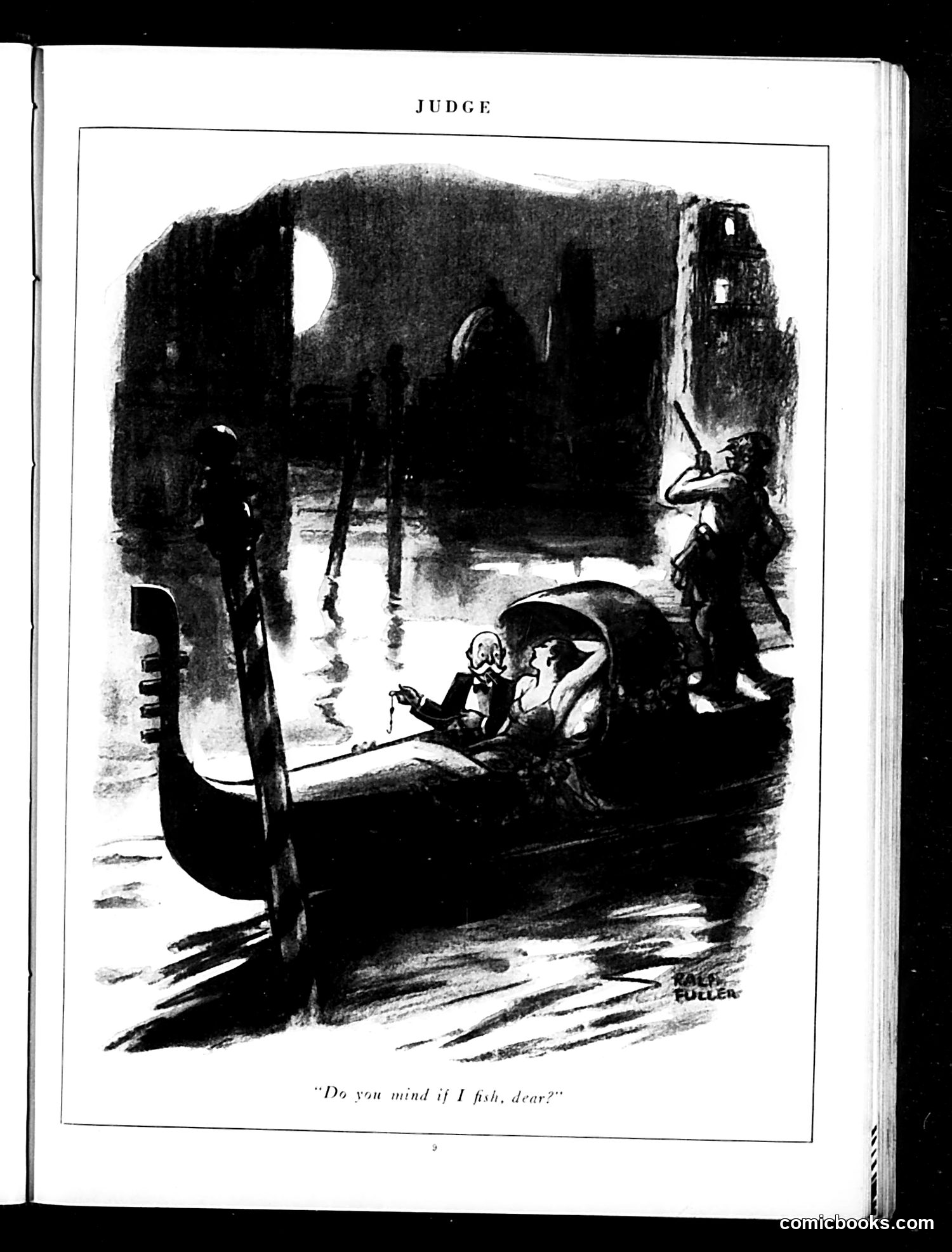
Explanation for Modern Readers This is a cartoon from *Judge* magazine titled "Do you mind if I fish, dear?" The image depicts two figures in a gondola on what appears to be a Venetian canal, with dark architectural elements in the background. The satire appears to concern a husband asking permission from his wife to fish during what should be a romantic outing—the gondola being associated with romance in Venice. The humor likely plays on domestic power dynamics: the husband seeking approval for a leisure activity that might be considered inconsiderate to his companion. Without additional context about the magazine's publication date or specific political allusions, the exact target of the satire remains unclear, though it appears to mock either marital relationships or social pretension associated with European travel.
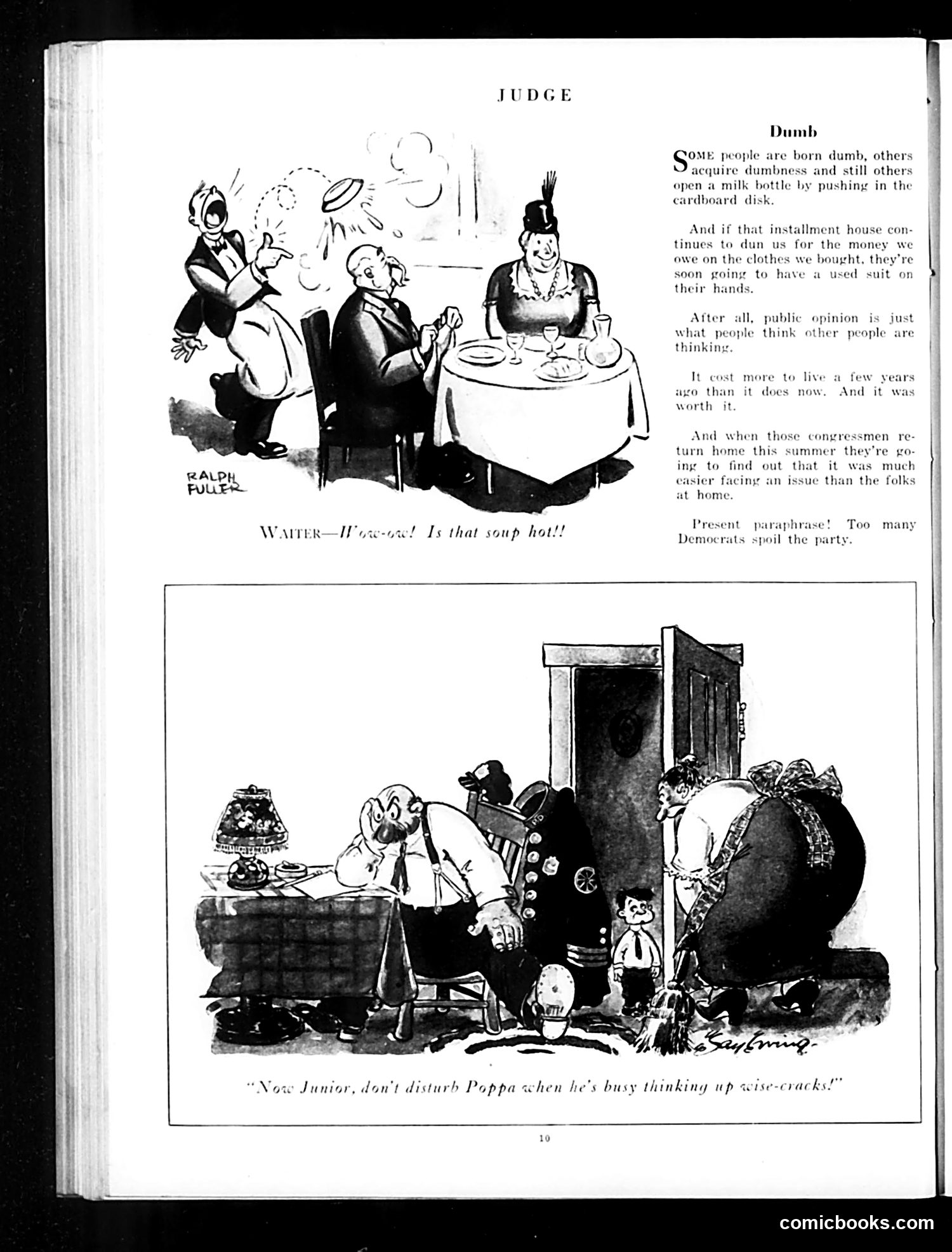
"Judge" Magazine Page Analysis This page from *Judge* magazine satirizes American social and political foolishness through humor. The top cartoon depicts a waiter serving soup to diners, with the caption "Waiter—Wow-ow! Is that soup hot!!" The accompanying text column titled "Dumb" mocks various forms of stupidity: people who don't understand simple mechanics (like milk bottles), those trapped in installment debt cycles, and the disconnect between public opinion and reality. A pointed jab targets congressmen who find legislative issues easier to face than constituent complaints back home—implying politicians avoid accountability. The final quip, "Too many Democrats spoil the party," suggests partisan gridlock weakens governance. The second cartoon (bottom) shows a man at a desk surrounded by children, captioned "Now Junior, don't disturb Poppa when he's busy thinking up wise-cracks!"—mocking men who prioritize wit and satire over family responsibilities. Overall, the page satirizes American incompetence, political evasion, and misplaced priorities.
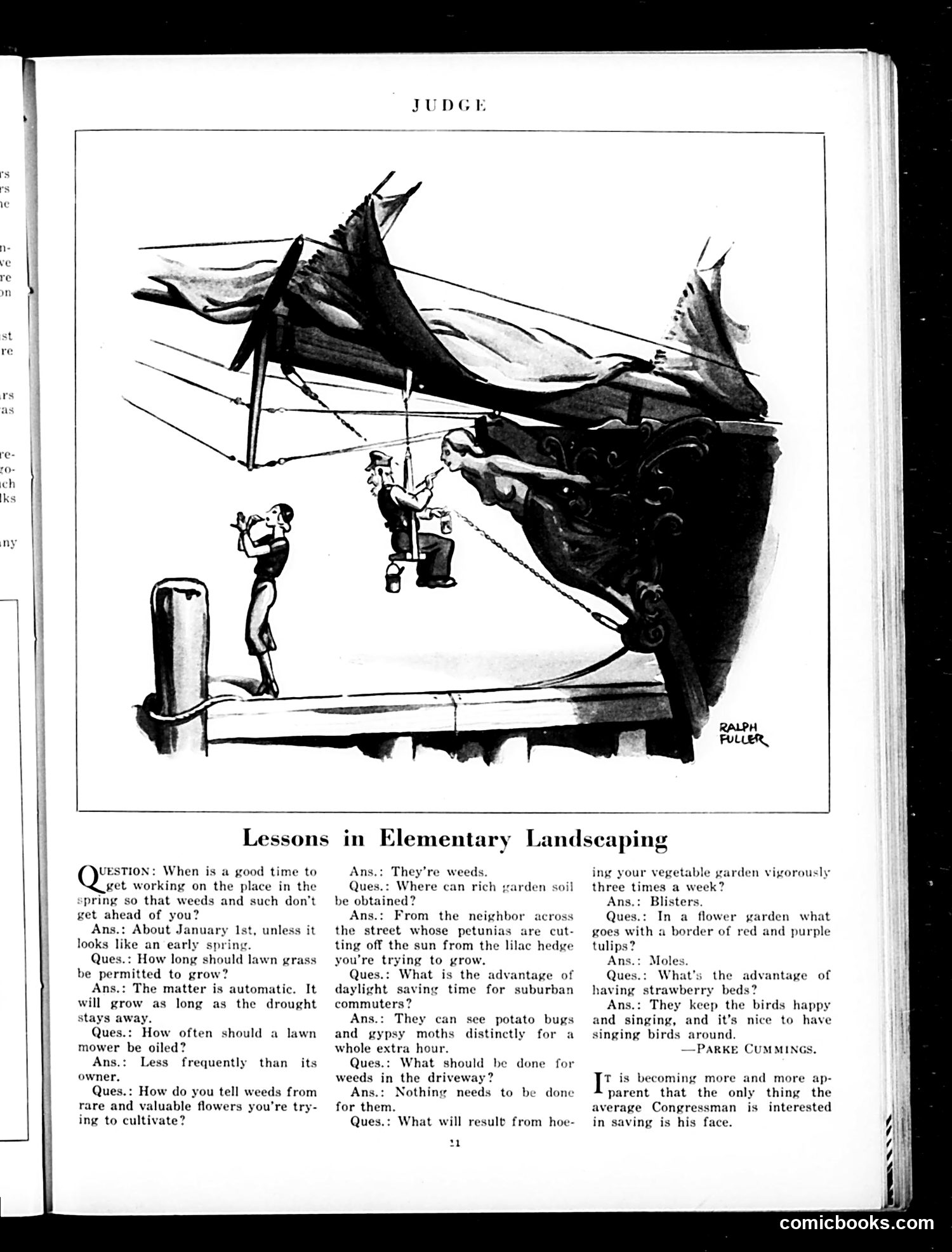
Explanation for Modern Readers This page contains two distinct pieces of satire: "Lessons in Elementary Landscaping" is a humorous Q&A column that mocks suburban homeowners' gardening pretensions through deadpan, cynical answers. The joke is that idealized gardening advice is replaced with brutal honesty: weeds are indistinguishable from flowers, rich soil comes from stealing from neighbors, and the only real results are blisters. It satirizes the gap between aspirational suburban life and messy reality. The Political Cartoon (top) shows large fish being manipulated by tiny figures—an allegory for politicians controlling massive forces or institutions. The caption below suggests corruption: congressmen care only about "saving face" (their reputation/appearance) rather than serving constituents or the public good. Both pieces target middle-class American pretensions and political hypocrisy typical of Judge's satirical approach.
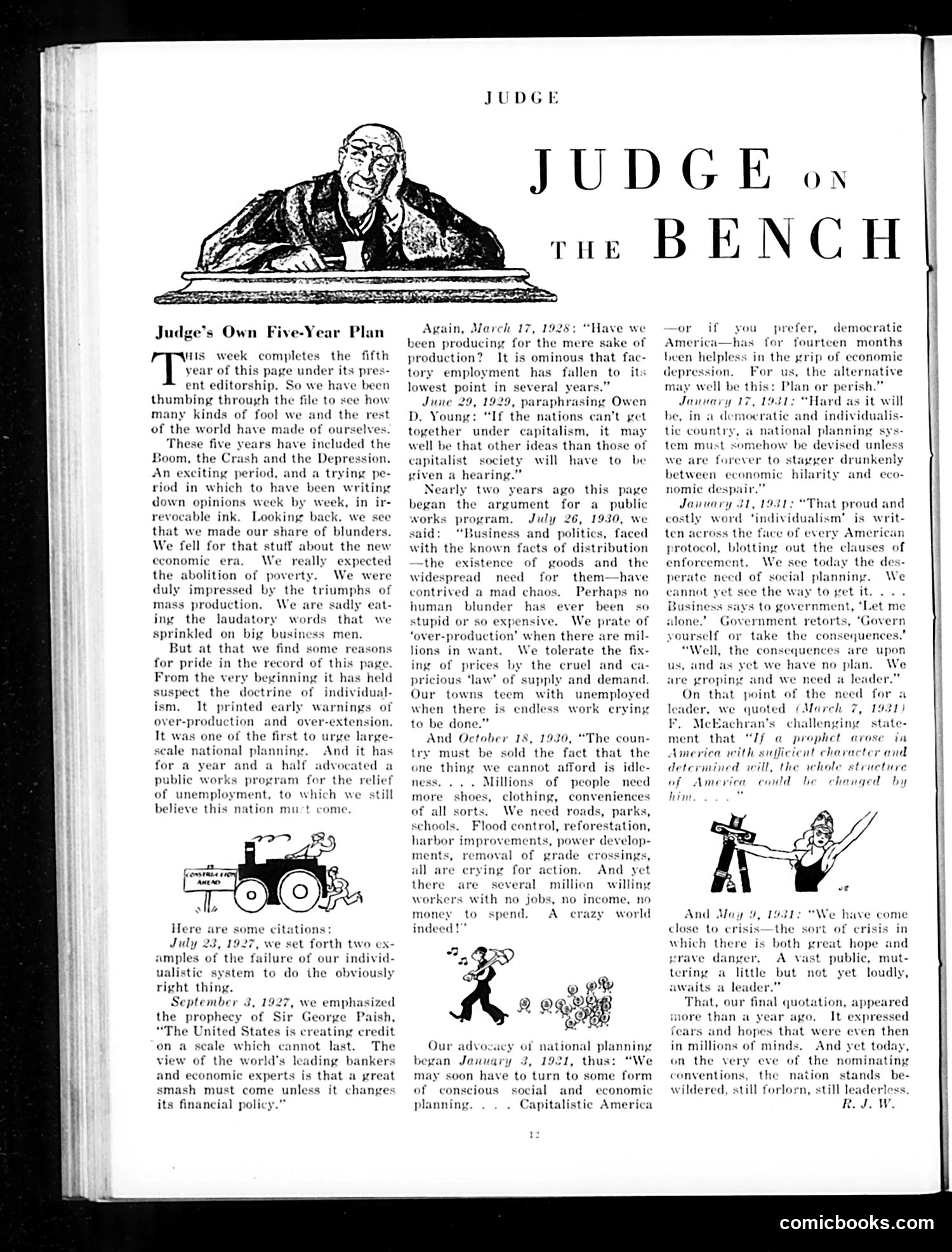
Judge Magazine's Editorial Reflection (circa 1931) This page commemorates Judge's fifth anniversary under current editorship, spanning the 1920s boom through the Great Depression. The opening illustration shows a judge contemplating past decisions—apt metaphor for editorial self-assessment. The text presents Judge's editorial track record, claiming prescient skepticism toward 1920s economic optimism. Key claims: the magazine warned early about overproduction (1927), advocated public works programs (1930), and questioned capitalism's ability to solve distribution problems while millions remained unemployed. The cartoons illustrate economic absurdities: farmers/workers struggling while resources sit idle. The editorial argues America faces a choice between "planning or perish"—suggesting government intervention became necessary when capitalism failed. This reflects 1930s progressivism: faith in national economic planning as solution to Depression-era unemployment and market dysfunction, presented as Judge's vindicated position against earlier economic complacency.
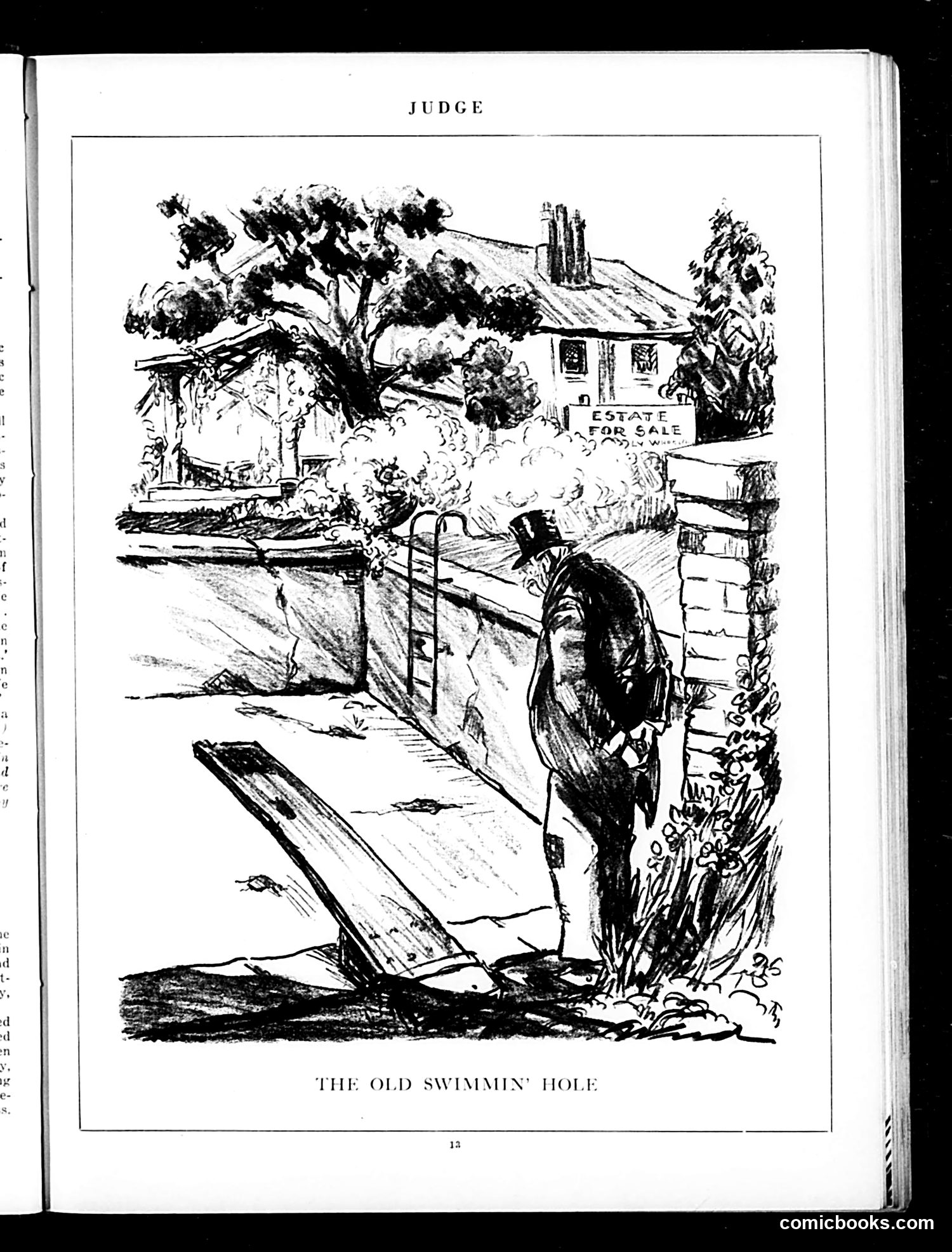
"The Old Swimmin' Hole" This illustration depicts a man in formal attire (top hat and coat) standing at a fence near "the old swimmin' hole"—a rural swimming spot. A "For Sale" sign is visible on a house in the background, suggesting rural property development or gentrification. The satire appears to contrast urban sophistication (the formally dressed figure) with rural simplicity (the country setting). The man's formal dress seems incongruous with the rustic landscape, likely mocking either: - City dwellers discovering or buying up rural property - Nostalgia for simpler times that industrialization/development is erasing - Class tensions between urban and rural America Without additional context about the specific historical moment, the exact satirical target remains unclear, though the composition suggests commentary on changing American landscapes and social values during Judge magazine's publication era.
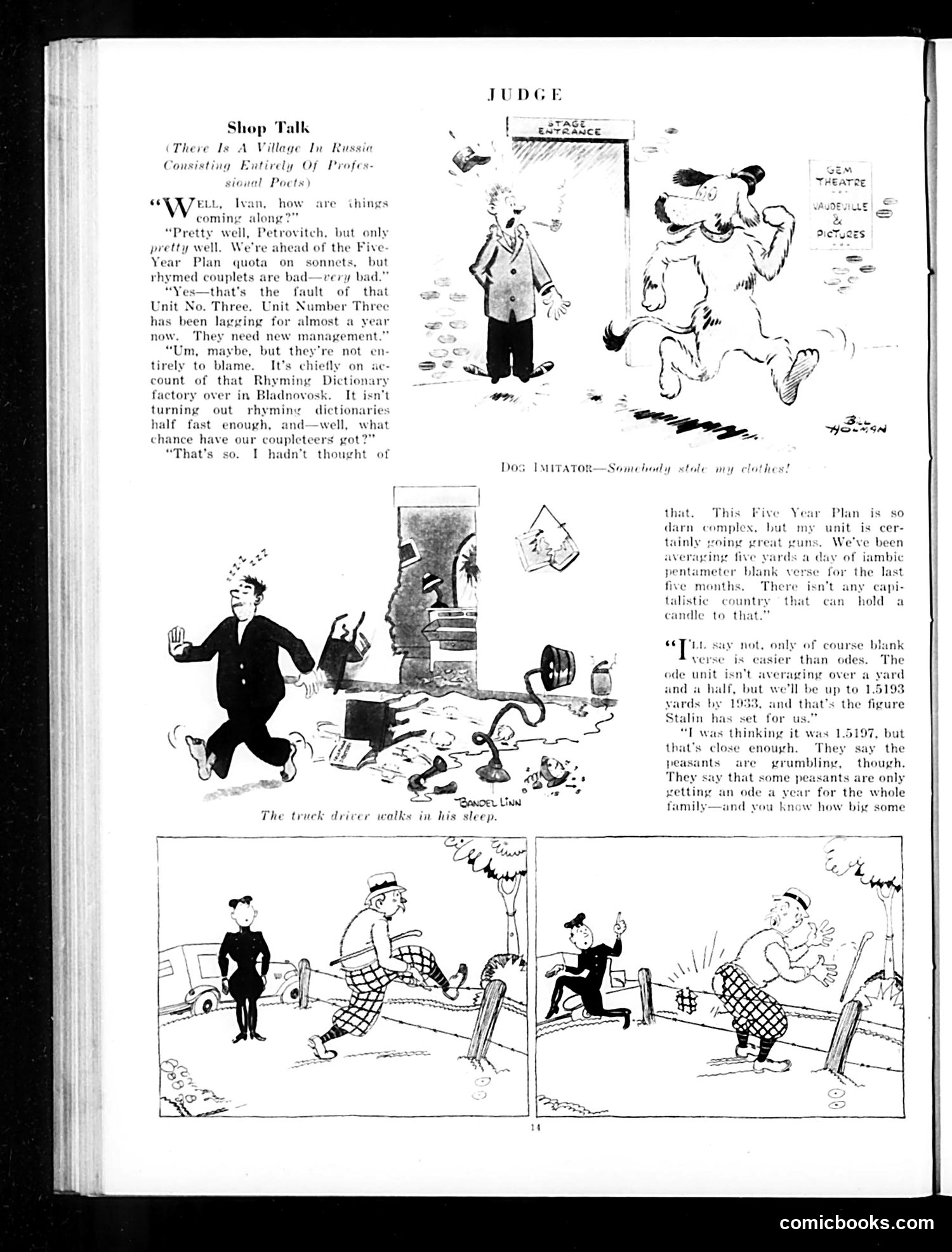
Political Satire on Soviet "Five-Year Plans" This page satirizes Stalin's Soviet Union, specifically the ambitious "Five-Year Plans" that set aggressive production quotas for industrial and agricultural output. The joke: a fictional Russian village of professional poets operates under the same rigid quota system, measuring success in sonnets, couplets, and iambic pentameter by the yard. The satire works by absurdist analogy—applying Soviet central planning's mechanical logic to creative work, which cannot be industrialized. Characters discuss production targets, underperforming "units," supply-chain failures (the rhyming dictionary factory), and management problems as if poetry were steel or grain. The humor targets both Soviet bureaucratic excess and Western observers' bewilderment at Soviet methods. The "Dog Imitator" cartoon (top right) appears to be separate comic relief. This reflects American anti-Soviet sentiment common in Judge during the Cold War era, mocking Soviet planning as absurdly rigid and dehumanizing.
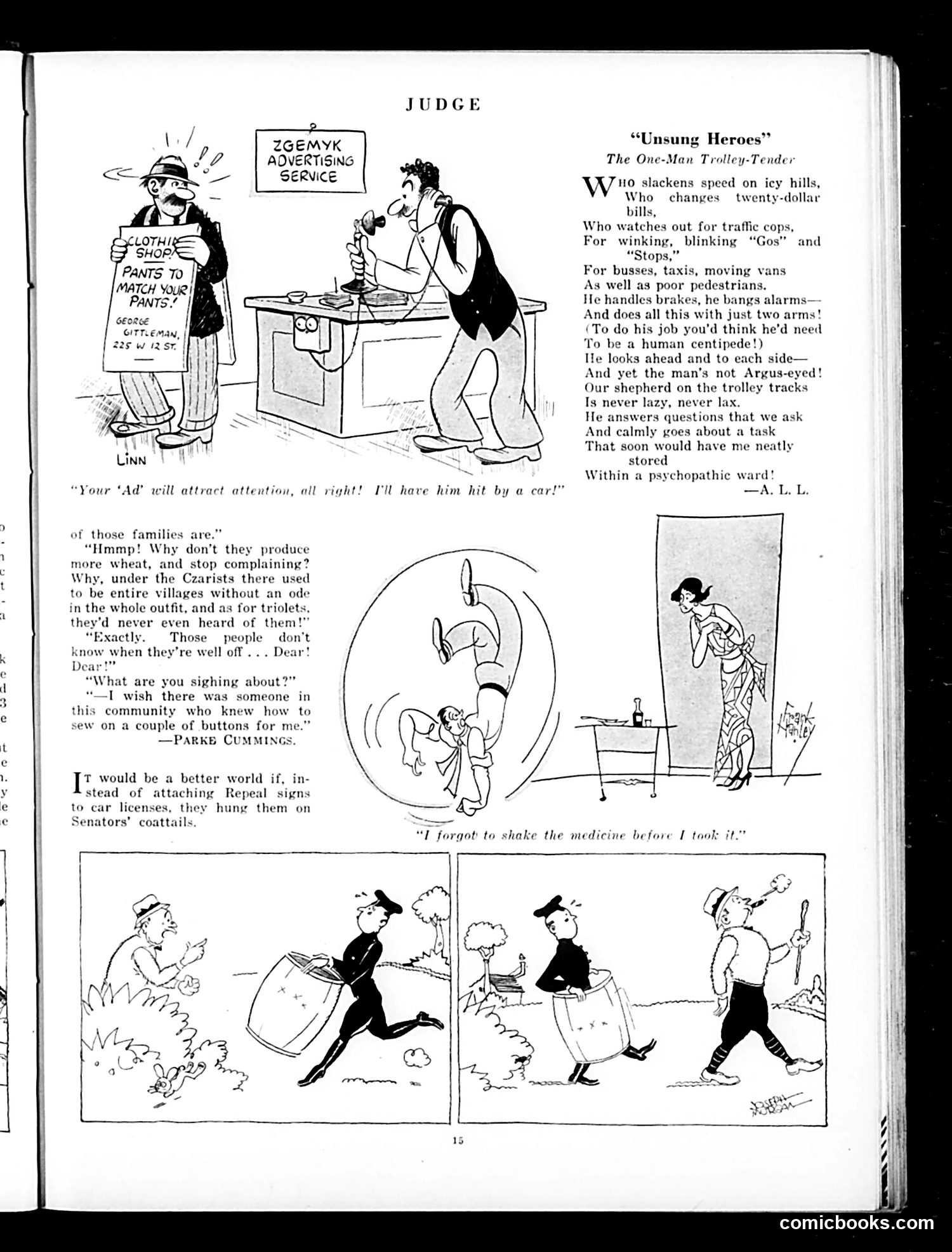
Explanation for Modern Readers This Judge magazine page contains several satirical pieces: Top cartoon: A man at an advertising service pitches an outrageous ad concept—hitting someone with a car—as attention-grabbing. The satire mocks both absurd advertising tactics and the naïve belief that any publicity helps. "Unsung Heroes" poem: Celebrates a trolley conductor as an underappreciated everyday hero, managing multiple simultaneous tasks (speed control, change-making, traffic monitoring, passenger safety) with only two arms. The satire playfully suggests such a job would drive most people insane ("psychopathic ward"), highlighting how society takes skilled workers for granted. Dialogue snippets: Mock wealthy people's obliviousness to hardship (comparing peasants unfavorably to Czarist times) and upper-class complaints about trivial problems (finding someone to sew buttons). Bottom panels: Appear to show slapstick comedy involving someone and a trash can. The overall theme: satirizing class attitudes, worker exploitation, and absurd advertising culture in early 20th-century America.
Judge Magazine: "The Theatre of George Jean Nathan" This is a theater criticism column, not a political cartoon. Judge's drama critic George Jean Nathan argues that old-fashioned musical comedy is obsolete. He cites the recent success of "Of Thee I Sing" (a 1931 satirical musical) as proof that modern audiences demand smart satire, not tired operetta tropes. Nathan dismisses a revival called "There You Are"—featuring stock characters like peasants, a gringo aviator, and comic Mexicans (Diablo, Estrelita, etc.)—as yesterday's formula. He claims audiences literally abandoned the theater mid-performance rather than endure it. However, he praises "Show Boat" (a Jerome Kern musical), suggesting some older works transcend the genre's decay because they possess genuine artistic merit. Nathan's point: audiences have evolved and won't tolerate predictable, mechanical musical comedy anymore, though quality productions remain viable.
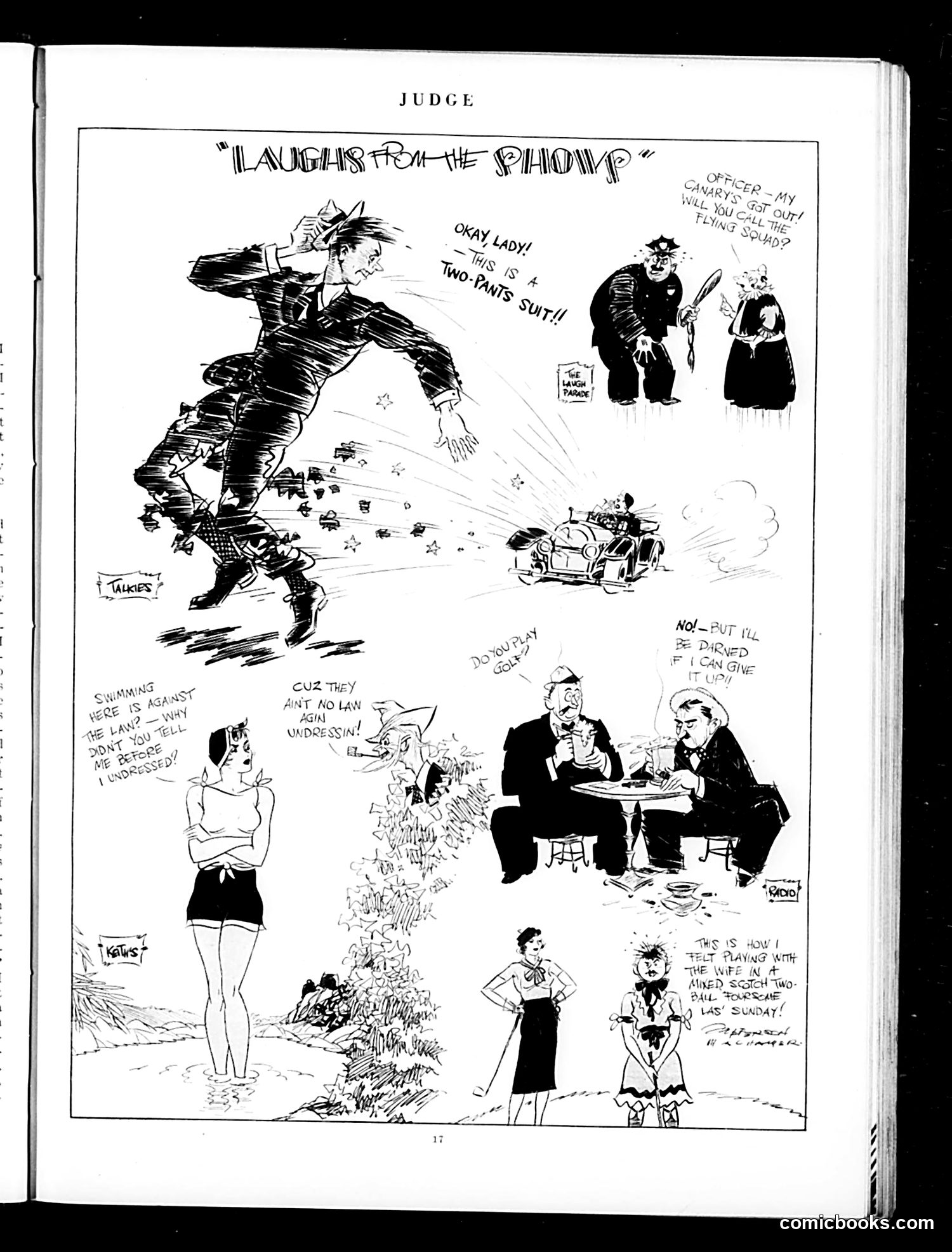
Analysis of "Laughs from the Phomp" This Judge magazine page appears to be a multi-panel comic strip satirizing social customs and legal matters. The central figure—a man in a suit performing exaggerated acrobatics—seems to be the main target of humor. Key scenes include: - A woman in swimming attire confronting legal/social impropriety ("swimming here is against the law") - References to a "two-pants suit" and undressing violations - Authority figures (judges, officers) in formal dress - A couple discussing marital activities ("playing with the wife in a rented scotch two-ball") The satire appears to target prohibition-era social restrictions, legal absurdities around public decorum, and the gap between formal law enforcement and actual behavior. The acrobatic protagonist may represent someone evading these arbitrary regulations through physicality or cleverness. Without clearer OCR or date information, the specific political context remains somewhat unclear, but the overall tone mocks overreaching social/legal controls of that era.
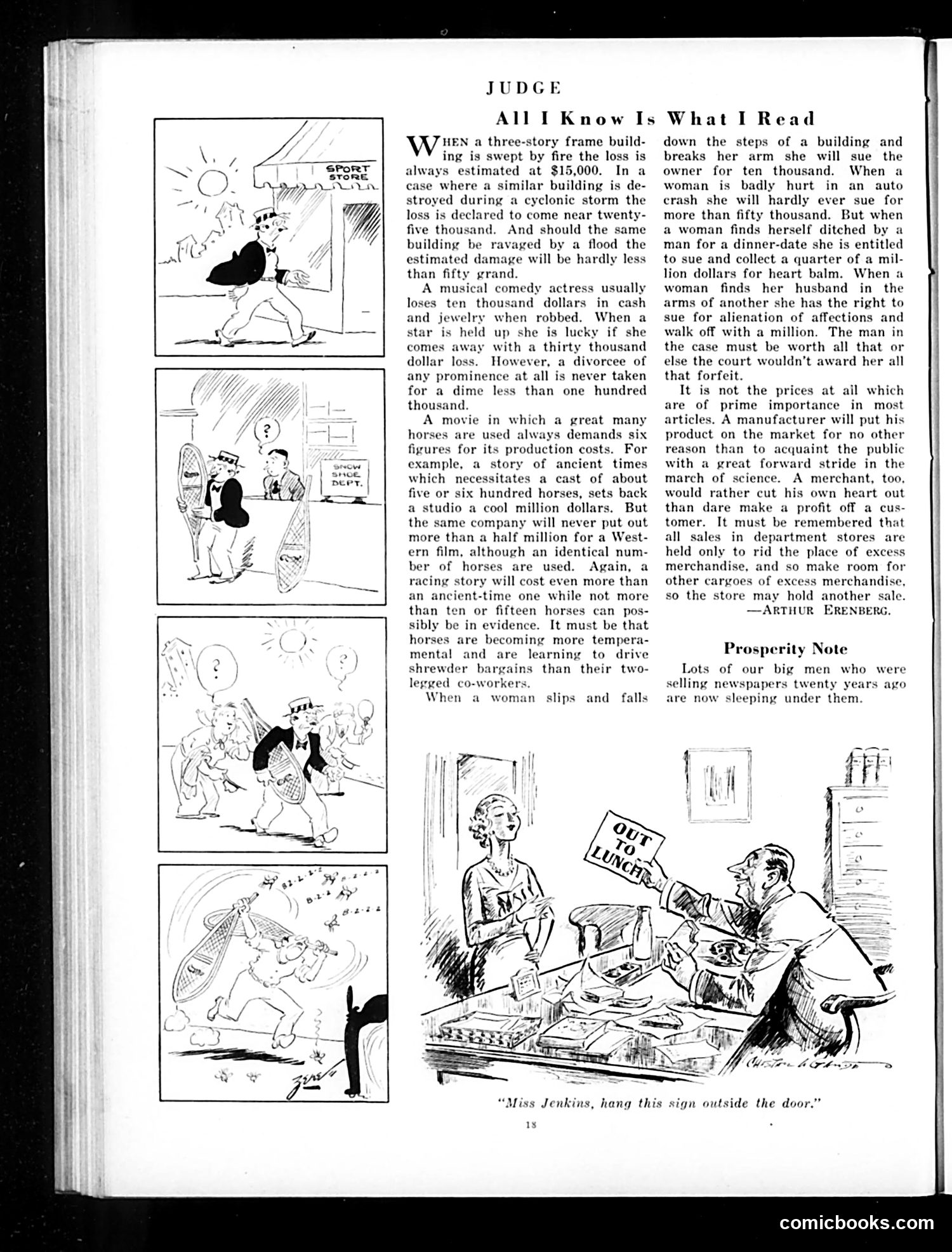
Judge Magazine Page Analysis This page contains two distinct pieces of satire: "All I Know Is What I Read" (left): A column by Arthur Erenberg mocking inflated damage claims and valuations in American society. He satirizes how losses are arbitrarily inflated depending on context—a fire-damaged building worth $15,000, but a flood-damaged one worth $50,000. He ridicules movie production budgets that cost millions for historical epics with horses but half that for Westerns, and especially attacks "heart balm" divorce settlements where women collect fortunes ($250,000-$1,000,000) for emotional distress. The satire criticizes both exaggerated insurance claims and the legal system's willingness to award enormous sums based on dubious valuations. "Prosperity Note" (right): A brief, dark joke: wealthy newspaper moguls from twenty years prior are now homeless, "sleeping under" the very newspapers they once sold. This reflects post-1920s economic decline, likely referencing the Great Depression's impact on once-successful businessmen. The cartoons on the left illustrate various domestic mishaps (fire, confusion, chaos, drowning) supporting the column's theme about arbitrary loss valuations.
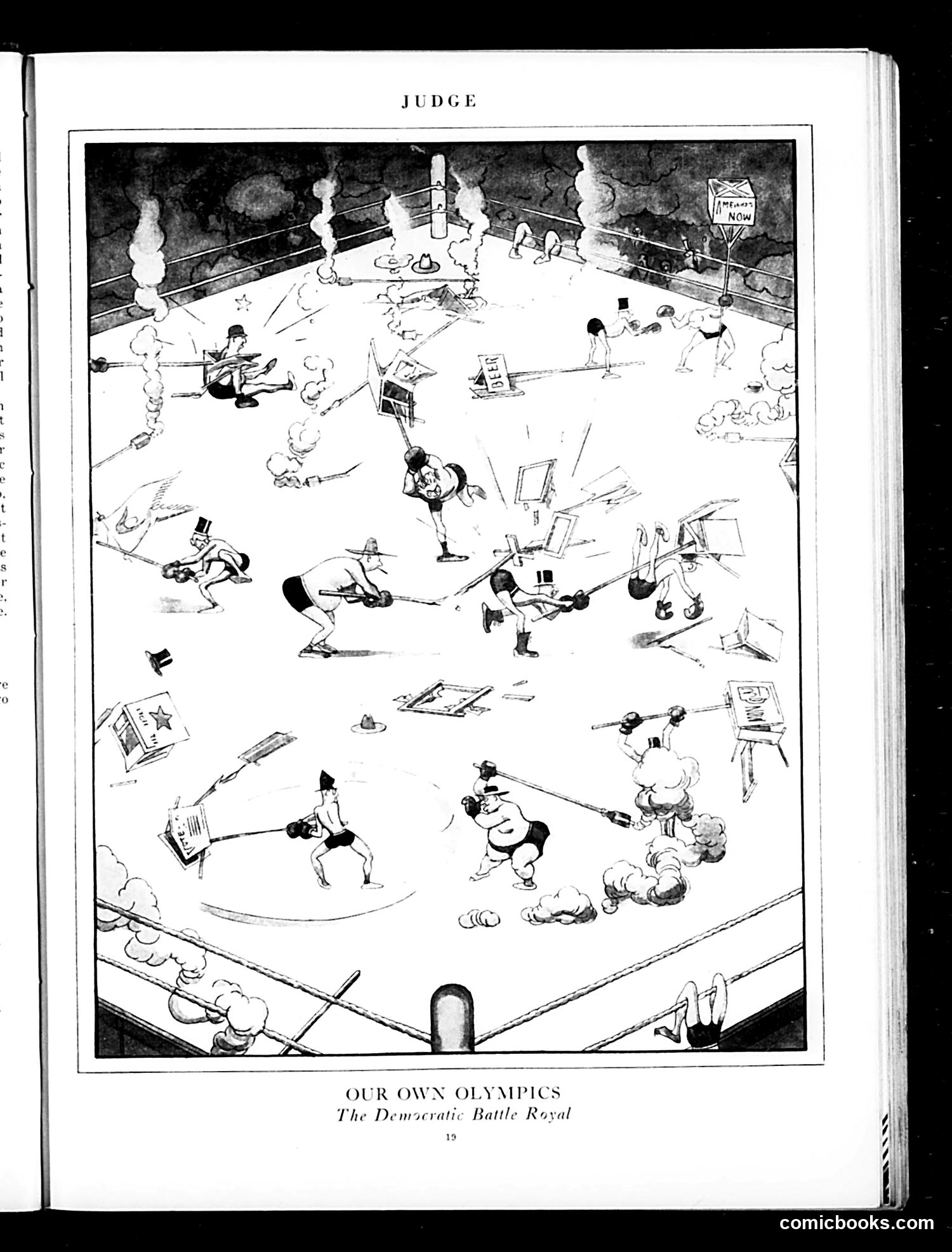
This satirical cartoon depicts a chaotic boxing ring labeled "Our Own Olympics: The Democratic Battle Royal." The image shows multiple Democratic politicians engaged in literal combat—punching, grappling, and fighting each other in the ring, while spectators watch from the stands. Scattered around the ring are papers and signs, suggesting political platforms or campaign materials being discarded amid the violence. The satire criticizes Democratic infighting and internal conflict, presenting party discord as a "battle royal"—a free-for-all wrestling match. Rather than unity, the cartoon suggests Democrats are more focused on attacking each other than presenting a coherent political front. The specific identities of individual combatants aren't clearly labeled, but the overall message criticizes Democratic disharmony during what appears to be a campaign period.
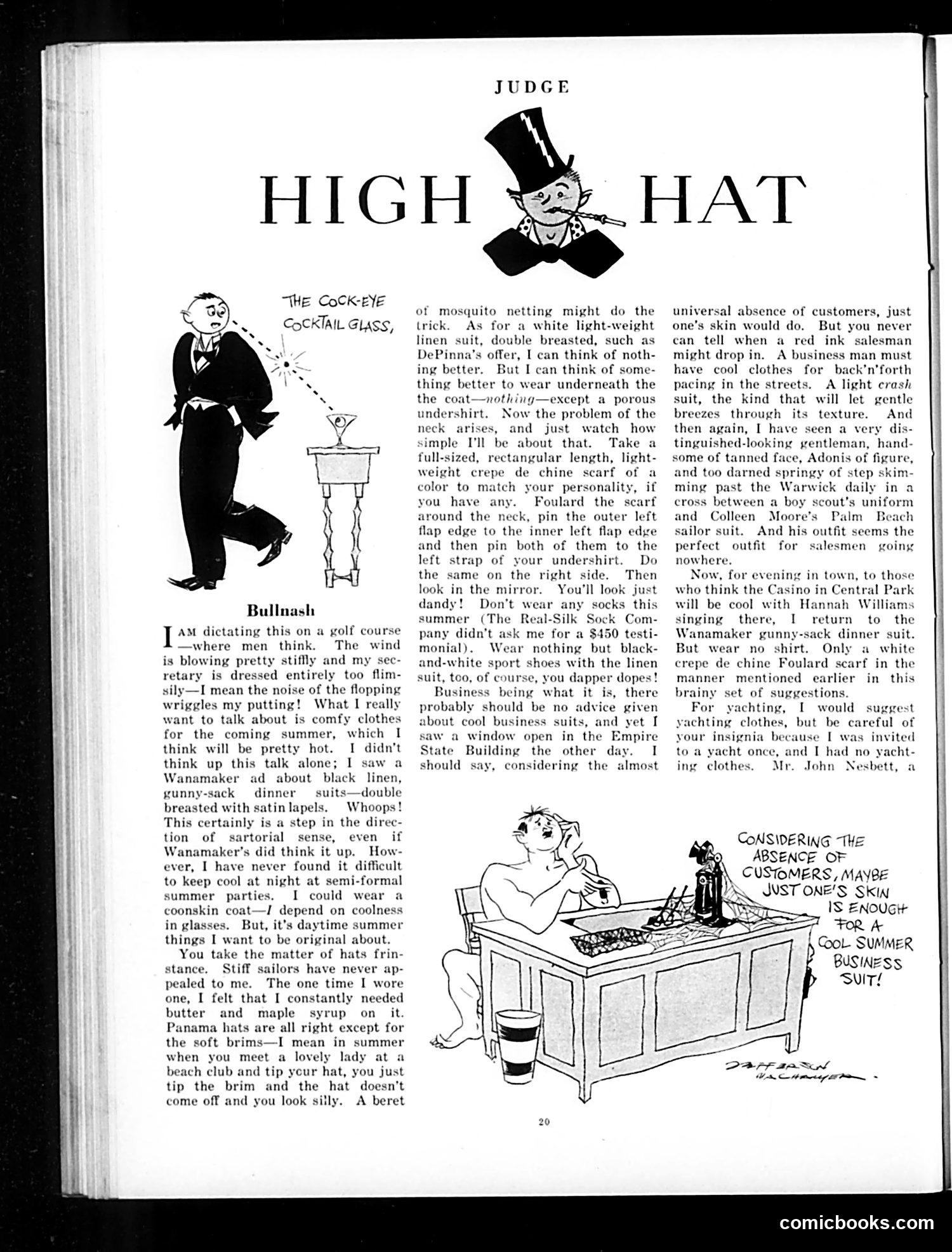
"Judge" Magazine Fashion Satire This page satirizes men's summer fashion advice through a fictional columnist called "Judge High Hat." The main article mocks pretentious fashion writing by offering absurdly detailed instructions for summer wear—including nonsensical advice like wearing no socks, pinning scarves in complicated ways, and going shirtless to yacht clubs. The humor targets the era's obsession with etiquette and appearance among wealthy men. A small cartoon at bottom adds social commentary: during the Great Depression (evident from "absence of customers"), a businessman suggests that for summer business suits, wearing nothing but skin might suffice—satirizing how businesses suffered while fashion magazines continued publishing expensive advice for the idle rich. The tone is mockingly elaborate—treating casual summer dressing like a complex gentleman's code, exaggerating the pretension of fashion advice columns that dominated the era's magazines.
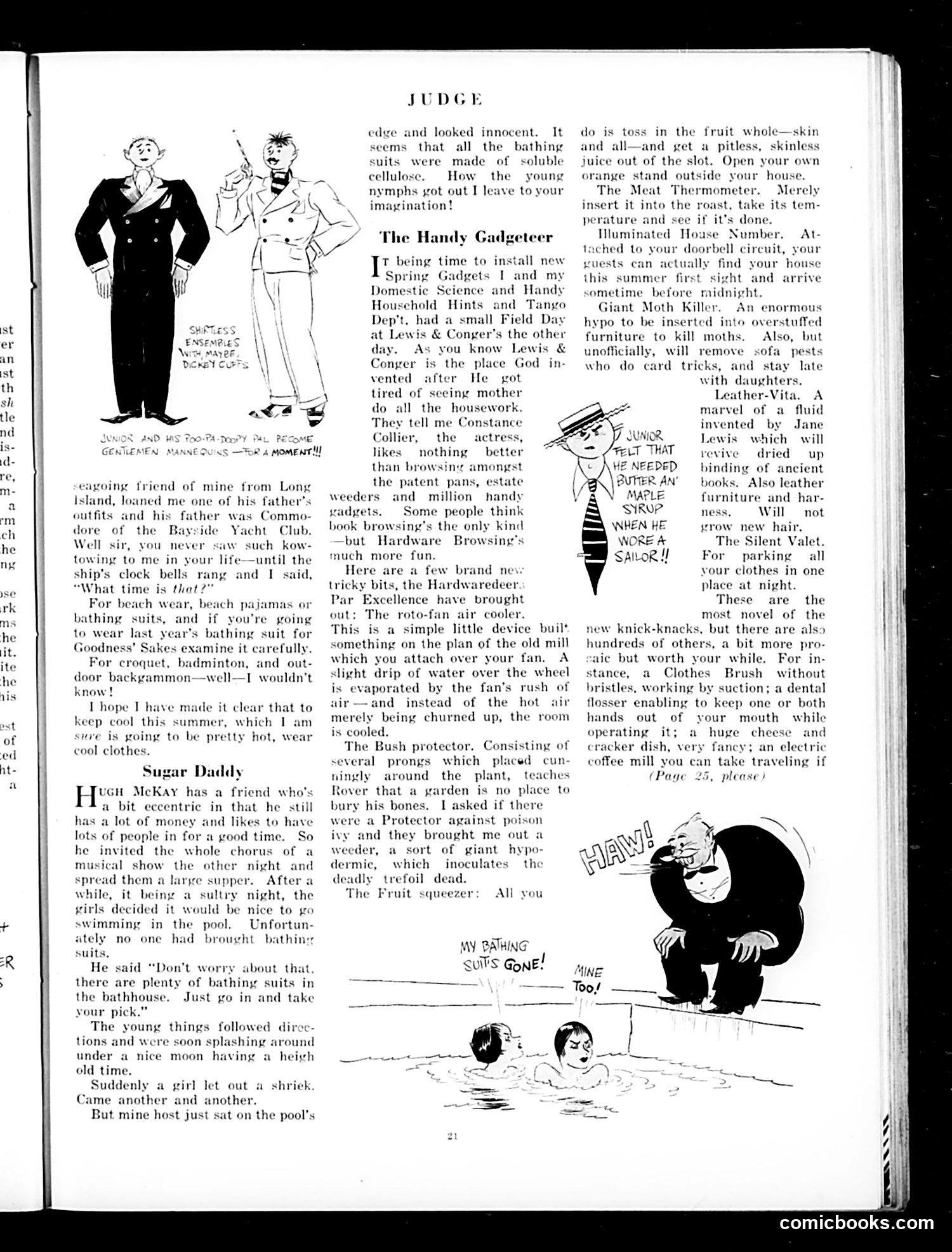
Content Analysis: "Judge" Magazine Page This page from *Judge* contains three humorous pieces about summer leisure and domestic gadgets, typical of the magazine's satirical approach to American upper-middle-class life. "Sugar Daddy" mocks wealthy hosts and naive young women. A rich man invites chorus girls to swim, claiming to provide bathing suits—but they're made of "soluble cellulose" that dissolves in water, leaving the women stranded. The joke relies on the host's malicious prank and implied impropriety. "The Handy Gadgeteer" satirizes Americans' obsession with labor-saving kitchen and household inventions. The author catalogs absurd devices (a "roto-fan air cooler," "fruit squeezer," "moth killer") with mock seriousness, poking fun at consumer culture and the proliferation of unnecessary gadgets marketed as solutions. "The Handy Gadgeteer" (continued) references "Lewis & Conger," an actual department store famous for housewares, and actress Constance Collier, positioning gadget-browsing as entertainment for the leisure class. The cartoons illustrate swimming mishaps, reinforcing the satirical tone throughout.
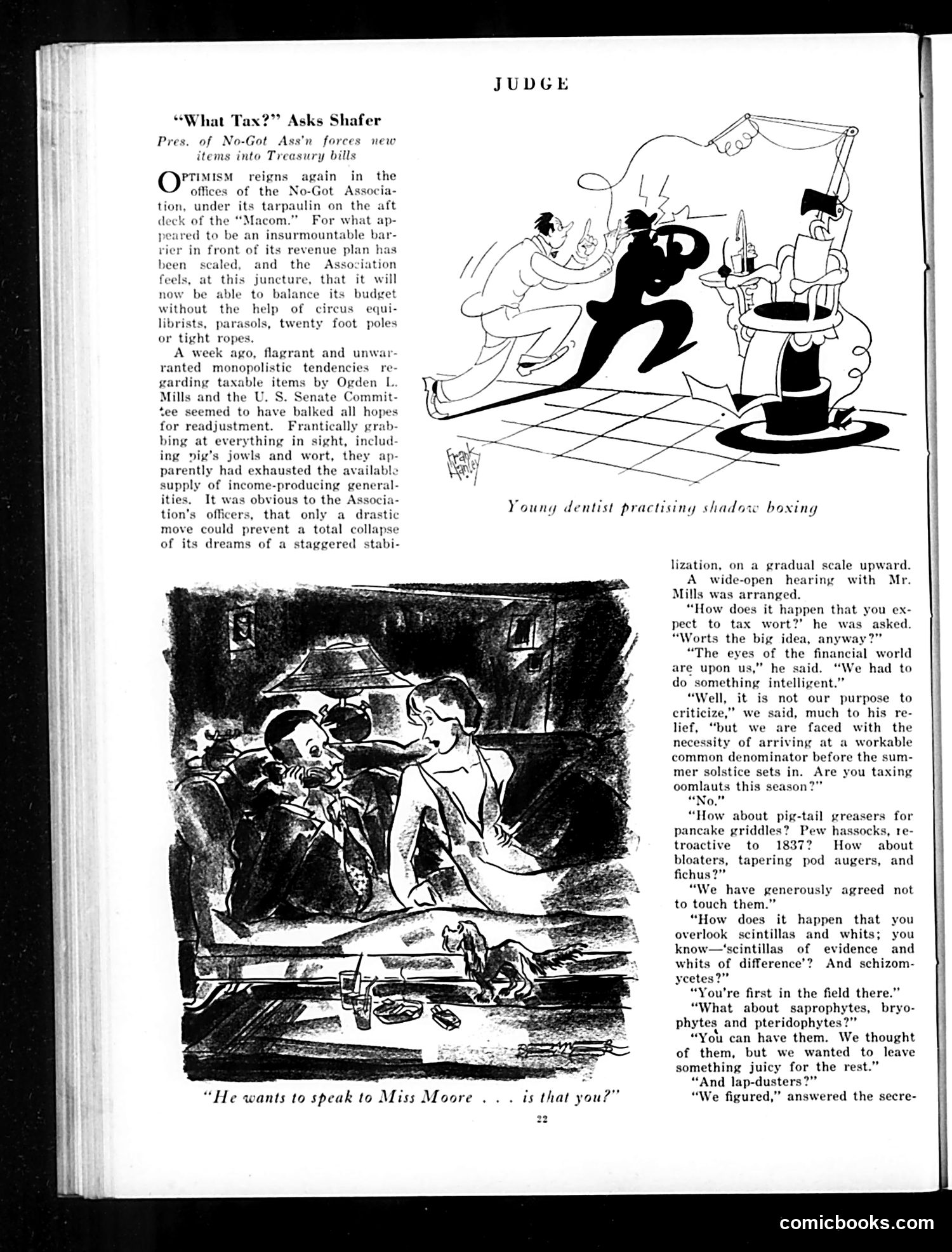
"What Tax?" Asks Shafer This Judge satire mocks the "No-Got Association"—a fictional organization whose president Shafer struggles to balance the budget by finding obscure, absurd items to tax. The target appears to be Ogden L. Mills (Secretary of the Treasury under Hoover) and Senate efforts to impose new taxes during the Depression era. The joke: faced with a revenue crisis, the Association's leadership desperately proposes increasingly ridiculous taxable items—pig-tail greasers, hassocks, botanical terms (saprophytes, bryophytes), even whimsical objects like "lap-dusters." Mills essentially grants most requests, having already exhausted realistic taxation options. The cartoon satirizes both government desperation to raise revenue and the absurdity of bureaucratic tax schemes. The accompanying illustration of a young dentist "shadow boxing" suggests pointless, fruitless effort—matching the futility of taxing nonexistent or meaningless items.
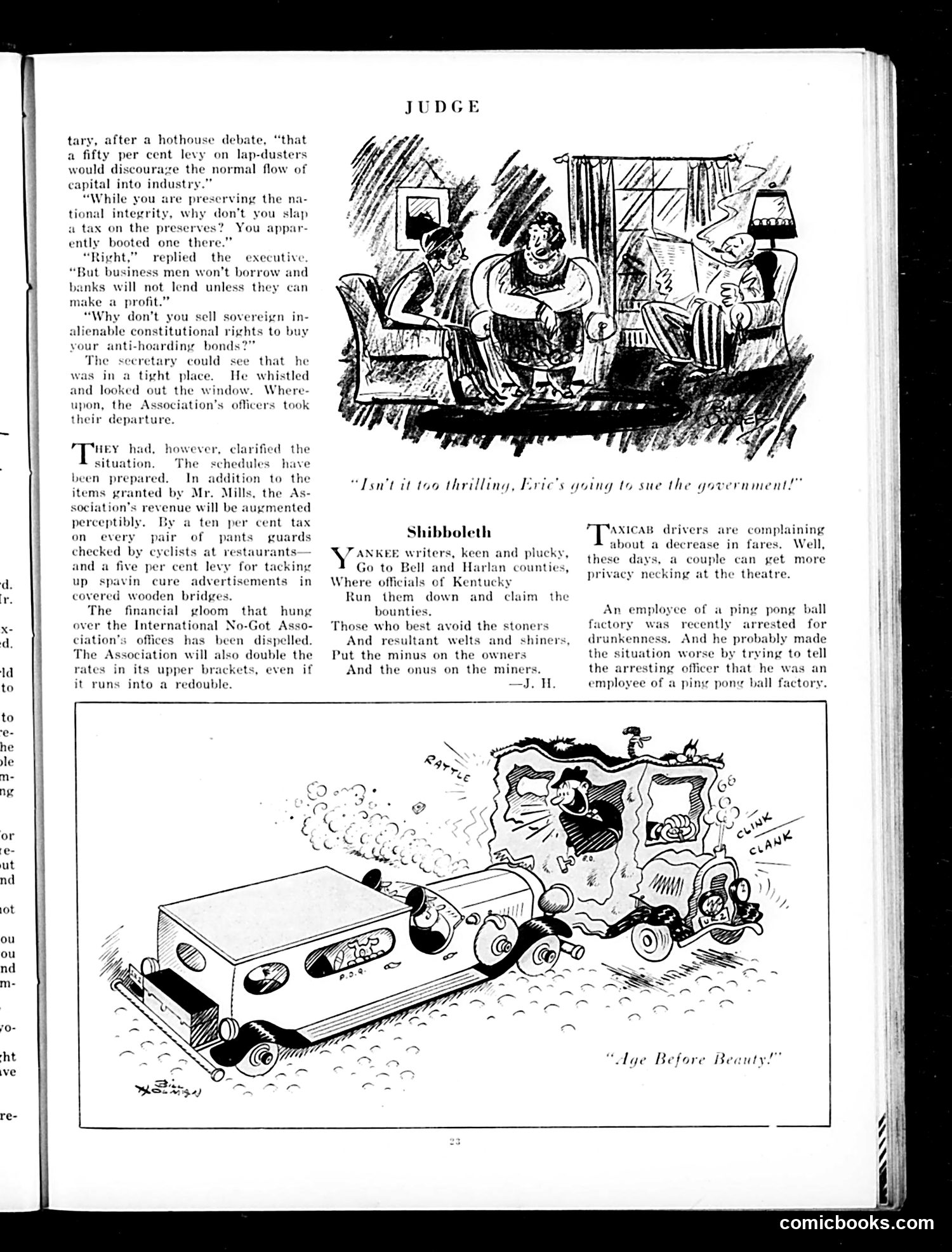
Analysis for Modern Readers This page contains two distinct satirical pieces from Judge magazine: Top cartoon: Depicts a businessman confronting what appears to be a government or industrial association representative about economic policy—likely related to post-WWI or Depression-era business regulation. The joke plays on bureaucratic absurdity: when pressed on contradictory policies, the official has no coherent answer and must escape awkwardly. "Shibboleth" poem: Satirizes Kentucky officials who apparently hunted writers (possibly journalists investigating corruption) for bounties. The satire suggests officials blamed miners rather than owners for labor disputes—shifting blame downward. Bottom cartoon titled "Age Before Beauty": Shows a decrepit old car colliding with or being hit by a modern vehicle, illustrating the joke about taxi drivers complaining of decreased fares—implying automobiles are now so common that couples prefer cheaper entertainment (theater necking) over taxi rides. The ping-pong factory anecdote is simple wordplay humor: an employee arrested for drunkenness compounds his problem by drunkenly mispronouncing his workplace.
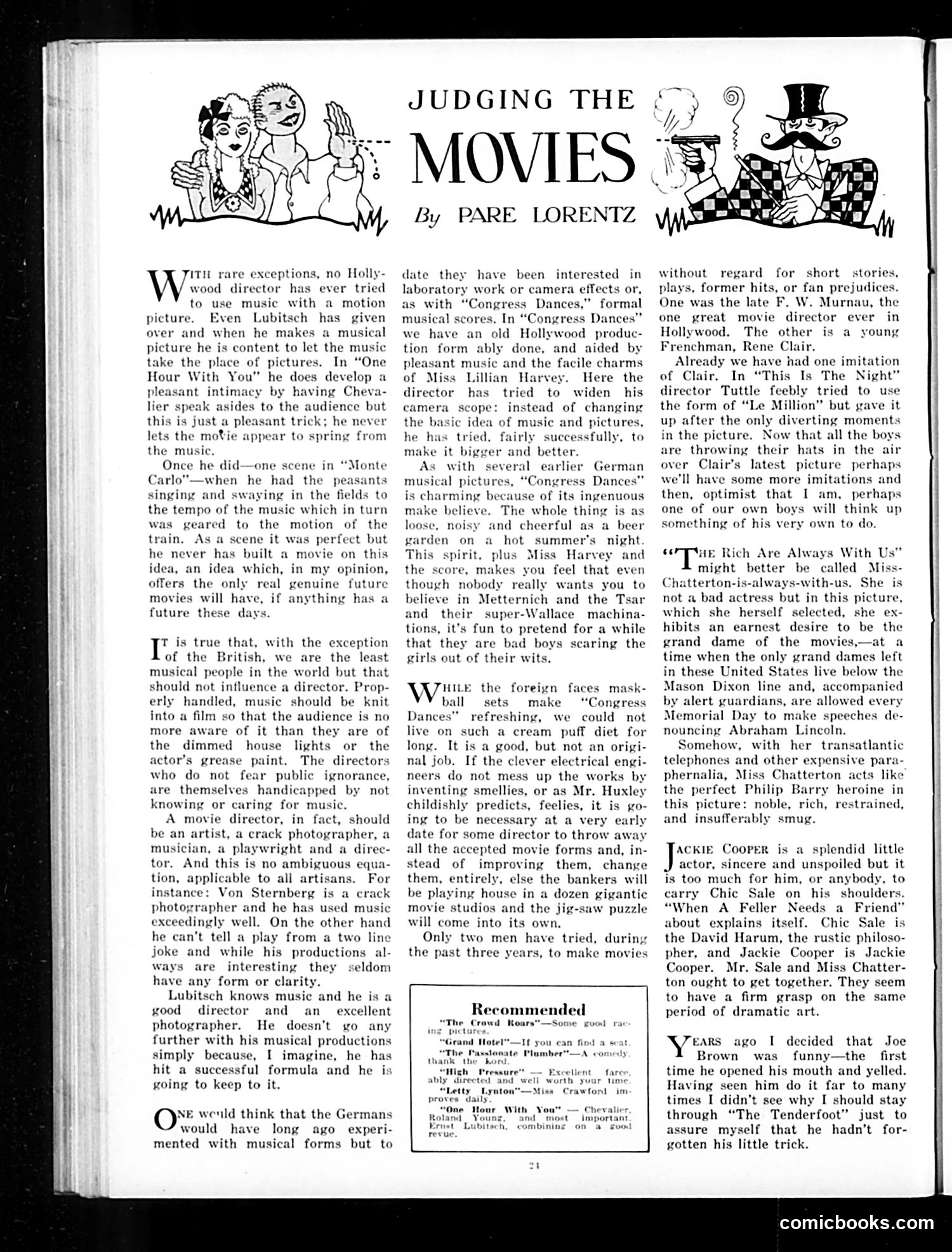
Analysis for Modern Readers This is a film criticism column by Pare Lorentz reviewing how directors use music in movies—a significant issue in early 1930s cinema during the transition to sound. The Main Argument: Lorentz argues that most Hollywood directors fail to integrate music meaningfully into films. He cites Ernst Lubitsch and Josef von Sternberg as examples of directors with particular strengths (Lubitsch understands music; Sternberg is a skilled photographer) but who don't fully synthesize all necessary skills—artistry, photography, music, and drama. Specific References: - "Congress Dances" is praised as enjoyable but derivative—a "cream puff," pleasant but not original - "One Hour With You" (Lubitsch) and "Monte Carlo" are discussed as attempts to coordinate music with narrative - The column criticizes how few directors have experimented with truly integrating musical form into cinematic structure The Satire: Lorentz satirizes Hollywood's timidity and formula-dependence, suggesting the industry won't innovate unless forced to by new technologies (smellies, "feelies"—scent and touch effects he predicts but dismisses as gimmicks). The piece advocates for directorial courage and artistic synthesis rather than safe repetition.
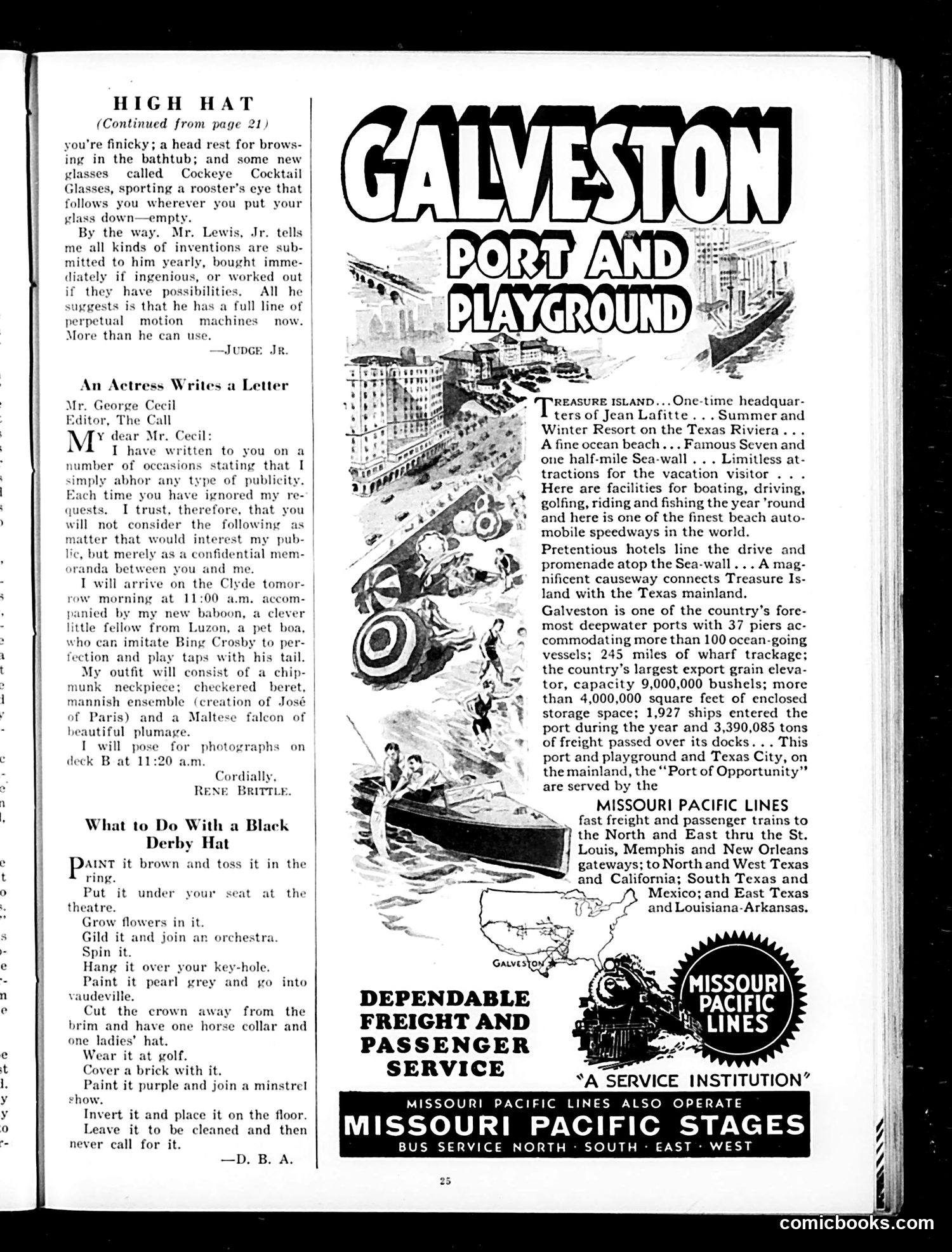
Page Content Analysis This page contains satirical humor pieces and advertising, not political cartoons. The left side features two humorous columns: "High Hat" (continued satire about absurd inventions) and "An Actress Writes a Letter"—a satirical piece where actress Rene Brittle humorously lists her exotic traveling companions (a baboon from Luzon, a boa constrictor mimicking Bing Crosby, a chipmunk neckpiece, a Maltese falcon) in exaggerated society-page style, mocking pretentious celebrity behavior and fashion affectations of the era. "What to Do With a Black Derby Hat" offers absurdist gag suggestions (grow flowers in it, paint it grey for vaudeville). The right side is primarily advertising—a substantial Missouri Pacific Lines travel promotion for Galveston, Texas as a vacation destination, featuring illustrations of leisure activities (boating, swimming, driving) and port facilities. The advertisement emphasizes transportation services and tourist attractions. No political figures or specific historical events are referenced. The satire targets general social pretension and consumer culture rather than current events.
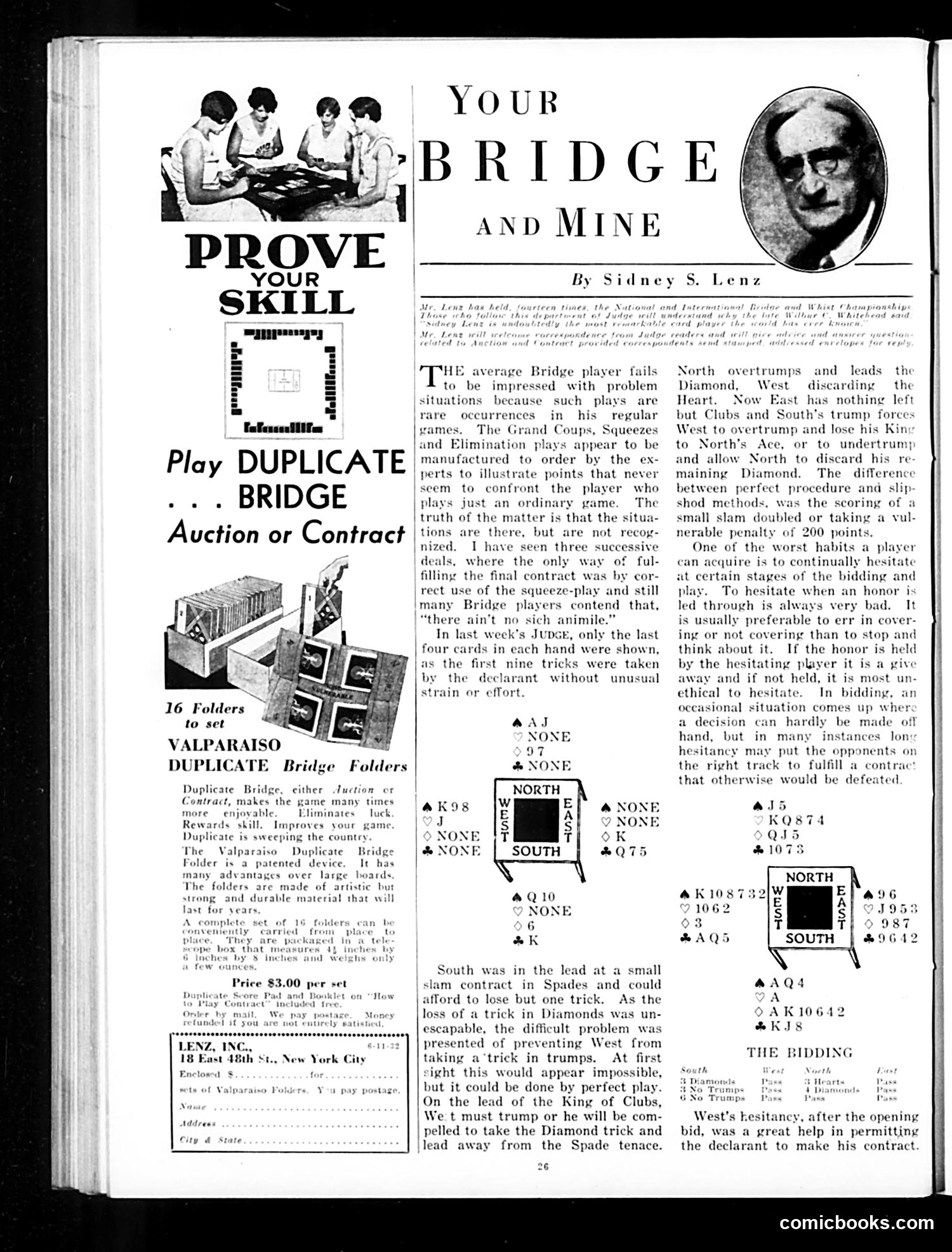
Content Analysis This page is primarily instructional content about Bridge card game, not satirical cartoon material. The page features: Left side: Advertisement for Valparaiso Duplicate Bridge Folders—a patented organizational device for the card game, priced at $3.00 per set. Right side: An instructional article titled "Your Bridge and Mine" by Sidney S. Lenz (a prominent bridge expert of the era). The article teaches advanced bridge strategy, using a specific hand example to illustrate how skilled players can execute difficult contract plays that average players miss. Lenz discusses the "squeeze play" technique—a sophisticated maneuver to prevent opponents from winning tricks they might otherwise take. The lesson: Even when situations seem impossible, perfect play combined with opponent psychology can achieve success. The article emphasizes recognizing these opportunities and avoiding hesitation during bidding. This is educational content, not satire. Judge magazine apparently published instructional articles alongside advertising and humor.
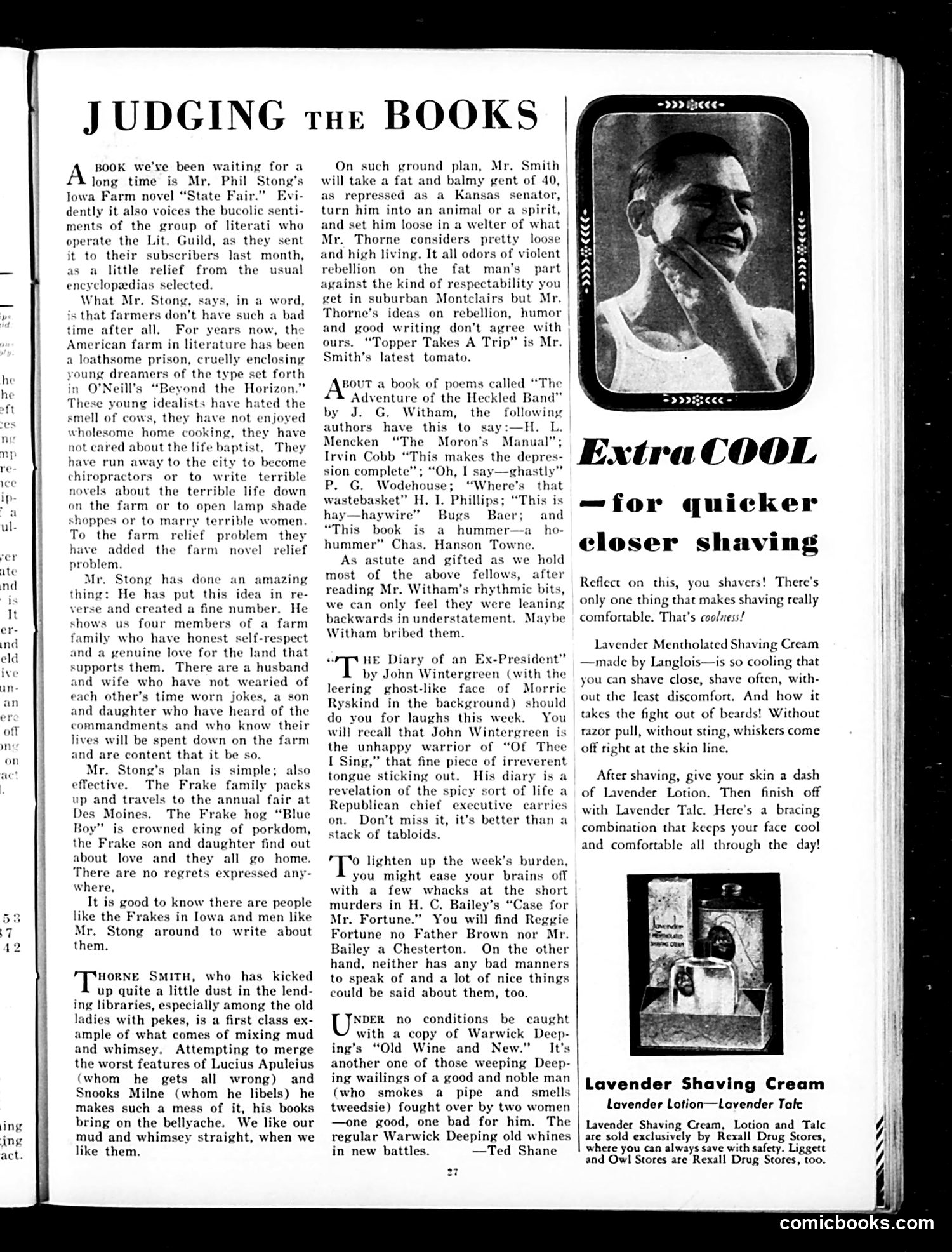
Content Analysis: "Judging the Books" Page from Judge Magazine This page is a book review section, not a political cartoon. The content discusses four literary works: 1. Phil Stong's "State Fair" — praised for depicting Iowa farm life positively, countering decades of literature portraying farming as a depressing prison for idealistic young people. 2. Thorne Smith's works — criticized for muddying satire and whimsey with poor execution; his latest "Topper Takes a Trip" receives harsh judgment. 3. "The Adventure of the Heckled Band" by J.G. Witham — a poetry collection endorsed by famous humorists (Mencken, Cobb, Wodehouse, etc.), though the reviewer suggests these endorsements were ironically understated. 4. John Wintergreen's "Diary of an Ex-President" — appears to reference the musical "Of Thee I Sing," a satirical work about American politics. The right side features a Lavender Shaving Cream advertisement, not editorial content. The reviews represent typical 1930s literary criticism with period-specific humor and references.
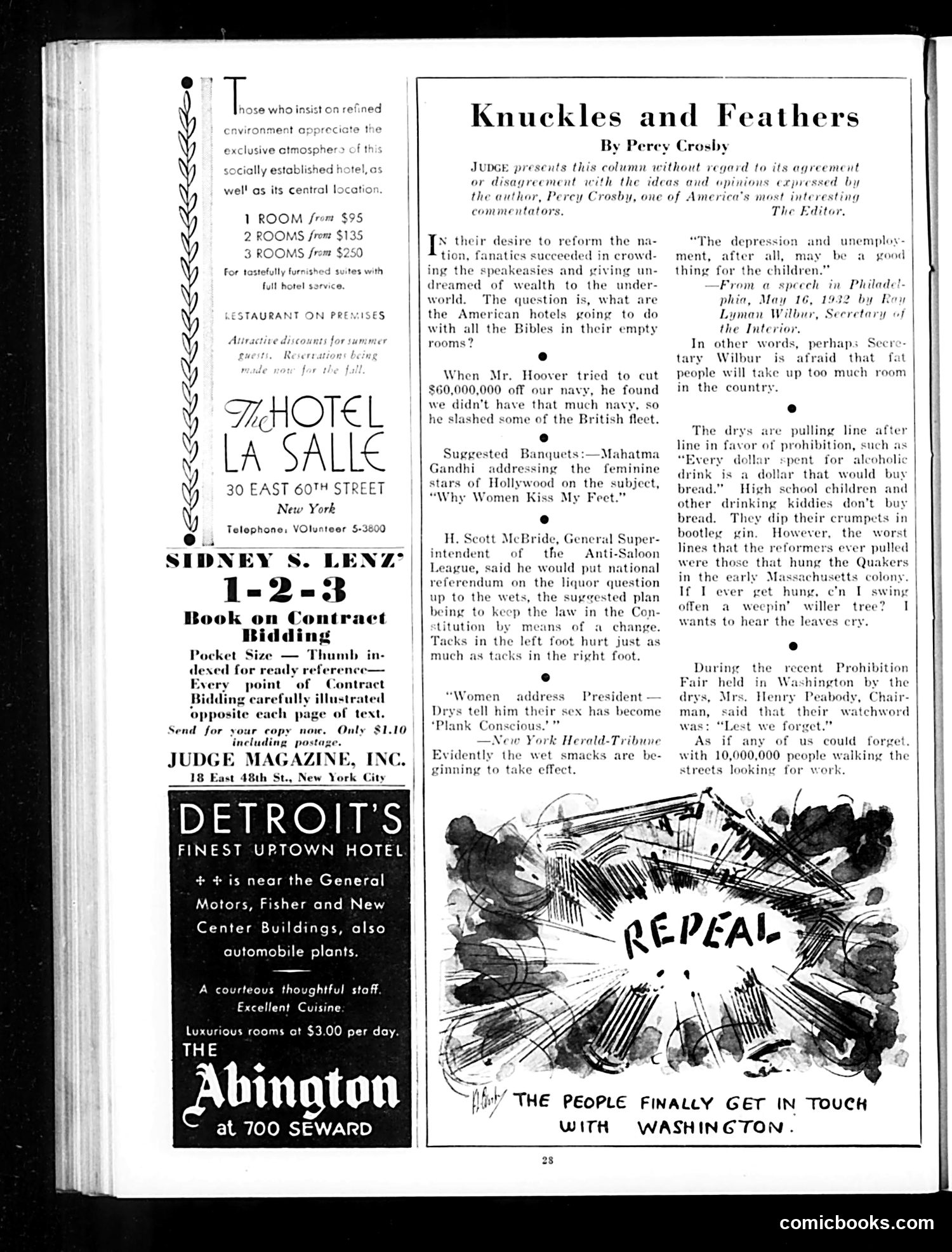
Analysis of Judge Magazine Page This page from Judge magazine contains Percy Crosby's satirical column "Knuckles and Feathers" commenting on 1930s American politics and social issues during the Great Depression. The main cartoon depicts Prohibition reformers finally "getting in touch with Washington"—showing their efforts literally exploding. The satire critiques dry advocates (prohibition supporters) who push their agenda while the nation faces economic crisis and mass unemployment (10 million people "walking the streets looking for work"). The column quotes Secretary Lyman Wilbur suggesting depression may benefit children, which Crosby mocks as tone-deaf. He ridicules prohibition advocates pulling "line after line" in favor of the law while ordinary people struggle, and sarcastically notes that poor children don't buy bread with money spent on alcohol—they simply don't have money. The overall point: while reformers obsess over moral crusades, ordinary Americans suffer from economic collapse, making their priorities seem absurdly misplaced.
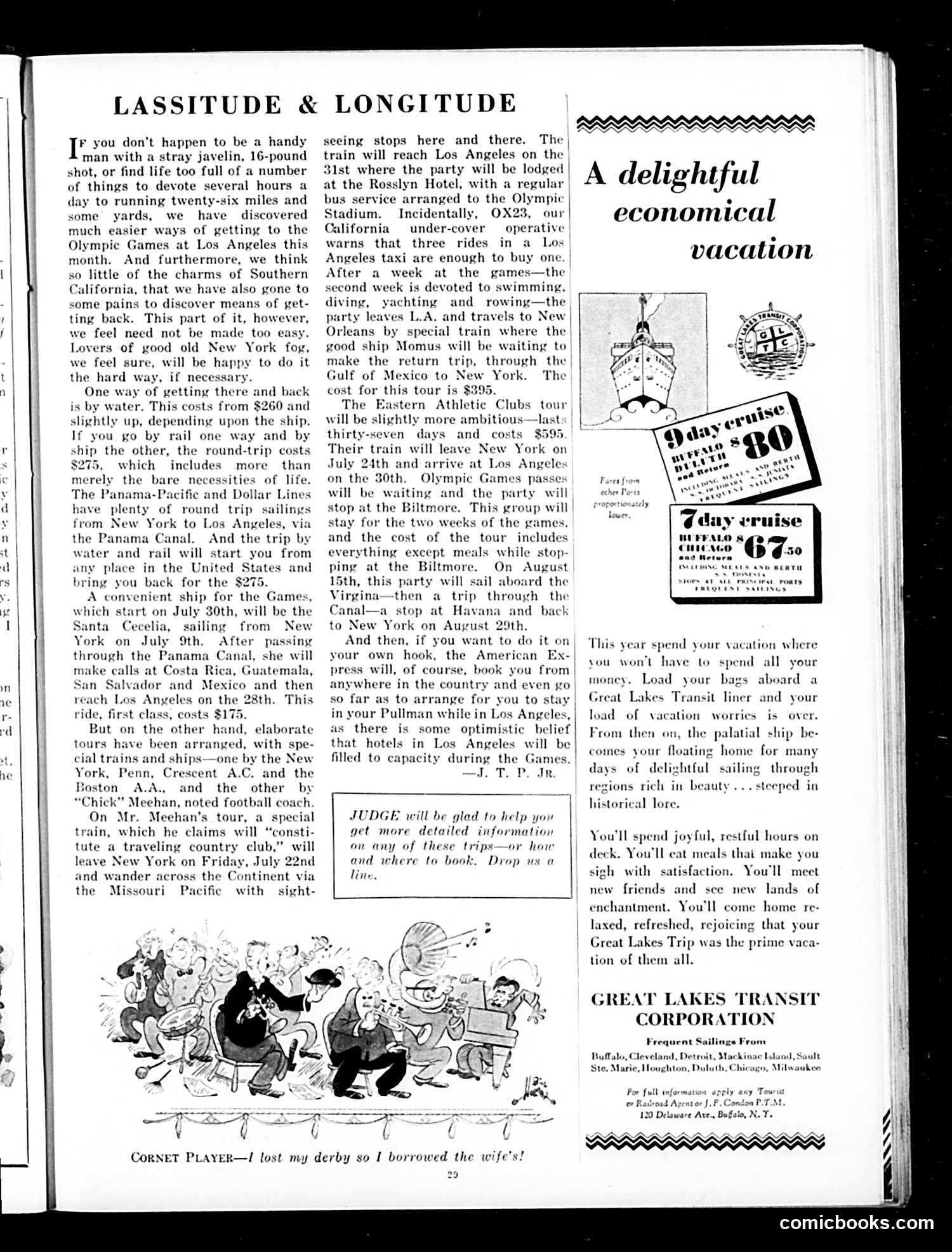
Analysis of Judge Magazine Page - 1932 Olympics Content This page primarily contains travel advertising and editorial content rather than political satire. It promotes economical vacation options to the 1932 Los Angeles Olympic Games. The main content explains transportation packages: ship travel via Panama Canal ($175-$395), rail tours organized by athletic clubs, and combinations thereof. A notable mention names "Chick" Meehan, a noted football coach, who is promoting a luxury train he humorously calls a "traveling country club." The cartoon at bottom shows people in revelry (likely celebrating the Olympics), with the caption "CORNET PLAYER—I lost my derby so I borrowed the wife's!"—a standard domestic humor joke about gender and fashion. The Great Lakes Transit Corporation advertisement on the right side promotes rival Great Lakes cruise vacations as an alternative. The satire is gentle: the page mocks Americans' willingness to travel great distances for entertainment, and Meehan's grandiose marketing. There's a jab at Los Angeles taxi costs. Overall, this is consumer-focused editorial, not political commentary.
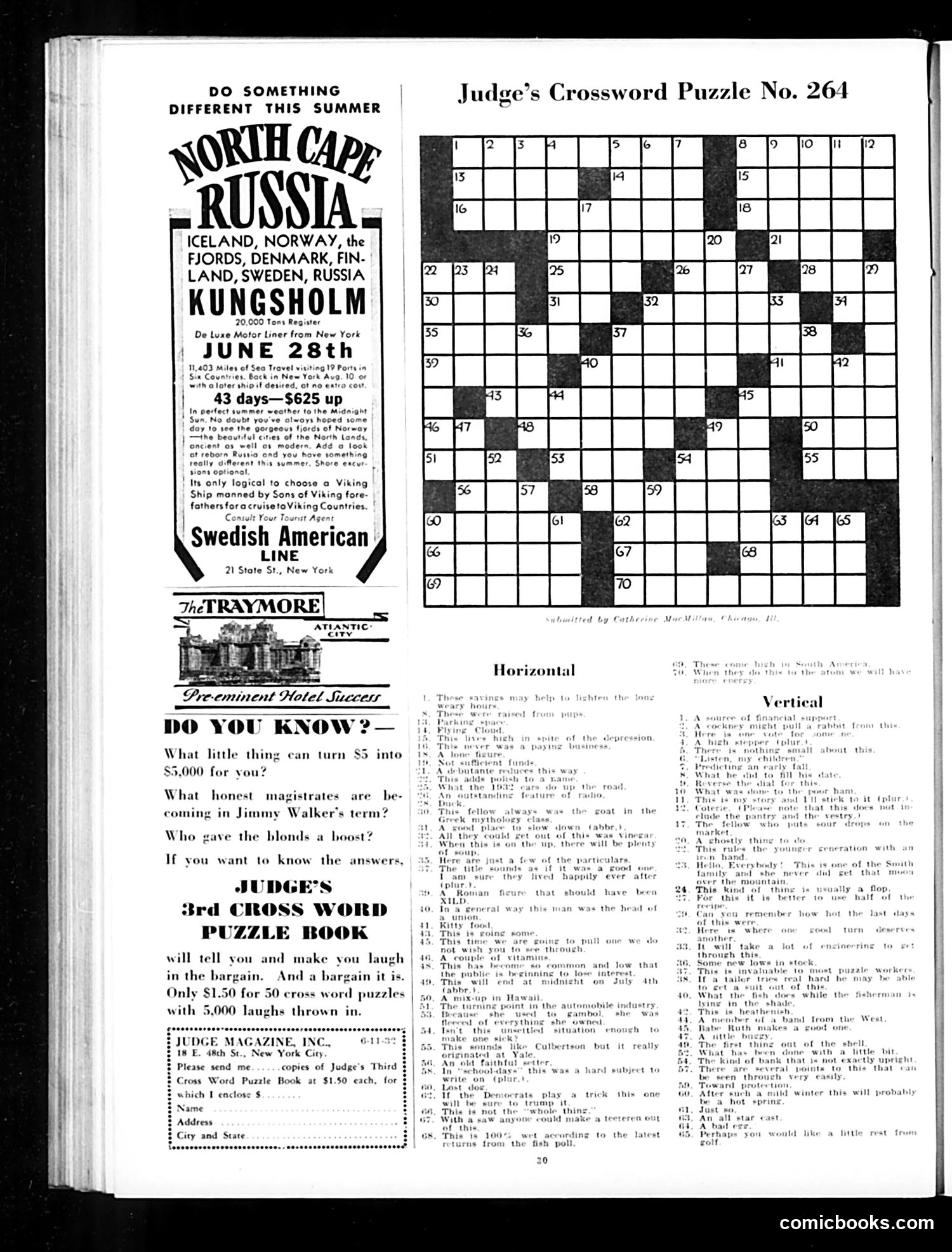
Judge Magazine Page Analysis This page is primarily advertising and puzzle content, not editorial cartoon. The dominant feature is a crossword puzzle (No. 264) with accompanying clues. The main advertisement promotes the SS Kungsholm cruise ship, operated by Swedish American Line, offering a 43-day Scandinavian voyage (Iceland, Norway, fjords, Denmark, Finland, Sweden, Russia) departing June 28th for $625 and up. The copy appeals to leisure travelers seeking "something different this summer," emphasizing the ship's Nordic heritage and exotic destinations—typical marketing for 1930s luxury travel. Below is a smaller ad for Judge's Third Cross Word Puzzle Book ($1.50), promising "5,000 laughs thrown in." The page also includes a "Do You Know?" teaser section posing riddles meant to entertain readers and drive sales of the puzzle book itself. This is not satirical content but rather a typical Judge magazine page mixing puzzles, advertisements, and reader engagement—the magazine's standard format beyond its famous political cartoons.
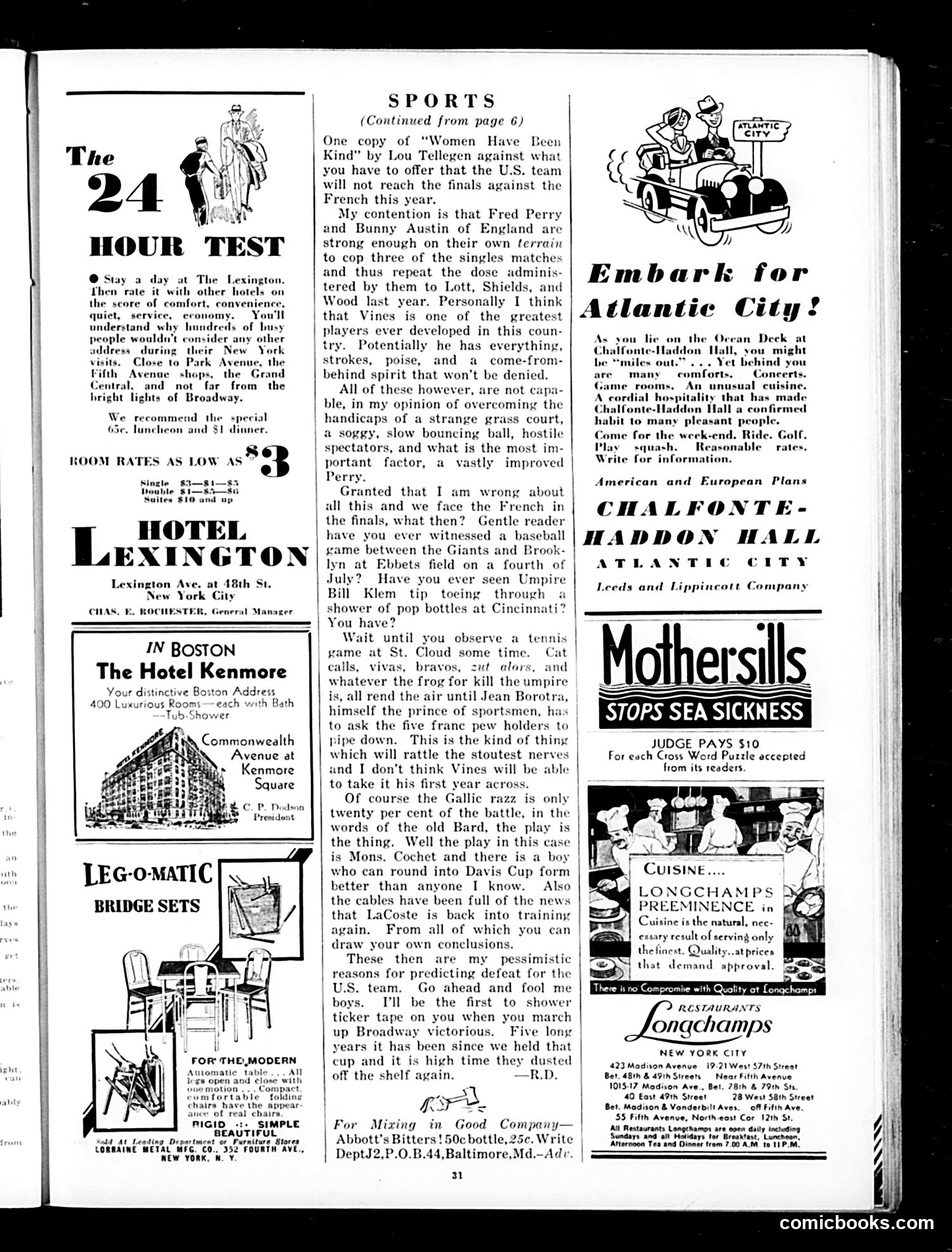
Analysis of Judge Magazine Page Content This page is primarily advertising with a sports column continuation. The main content is a tennis commentary by "R.D." discussing the upcoming Davis Cup competition between the U.S. and French teams. The Sports Commentary: R.D. argues the French will likely defeat the U.S., citing England's Fred Perry and Bunny Austin as formidable opponents on grass courts. He praises American player Ellsworth Vines's talent but doubts he can handle the psychological pressure of French crowds—describing hostile spectators, umpire harassment (referencing Bill Klem's notorious experience at Cincinnati), and the intimidating atmosphere of European tennis culture. R.D. highlights French player Cochet as a serious threat. The Satire: The piece gently mocks American sports confidence while affectionately describing the chaotic, passionate nature of European sports fandom as a genuine competitive disadvantage. Advertisements include hotels (Lexington, Kenmore in Boston), bridge furniture (Leg-o-matic), Mothersills seasickness remedy, Chalfonte-Haddon Hall in Atlantic City, and Longchamps restaurants—typical 1930s luxury consumer goods targeting affluent readers.
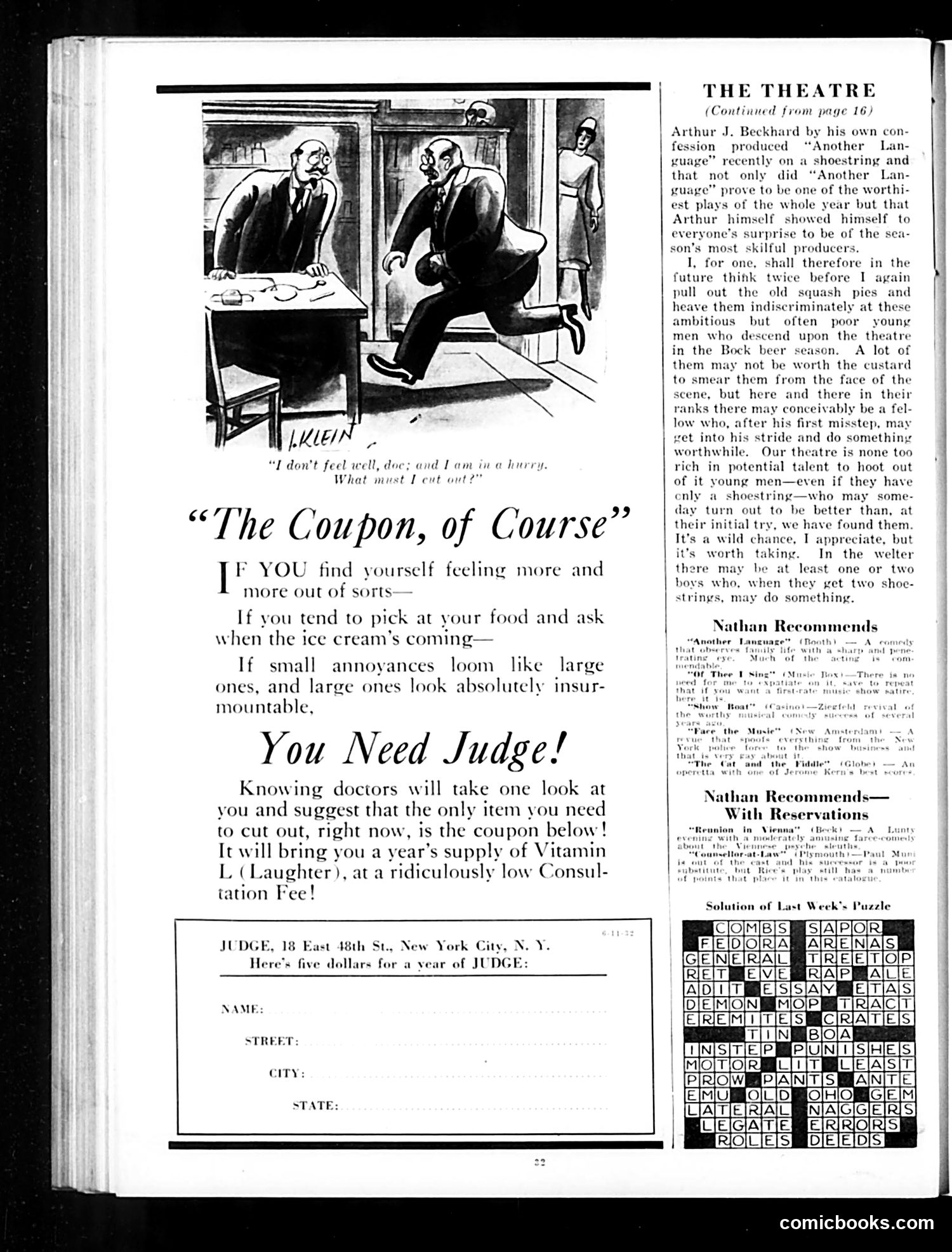
Explanation for Modern Readers This page features a self-promotional advertisement for Judge magazine disguised as humor. The cartoon shows a doctor telling a patient complaining of malaise that he should "cut out" the coupon below—meaning subscribe to Judge. The joke relies on a common early 20th-century trope: that laughter is medicinal ("Vitamin L"). By framing a magazine subscription as doctor-prescribed medicine, Judge satirizes both hypochondriac patients who obsess over minor ailments and the era's tendency to treat entertainment as therapeutic. The coupon offer ($5 for a year) was a standard magazine subscription method of the period. The accompanying text on "The Theatre" discusses drama and young producers, establishing Judge's cultural authority as an arbiter of taste and humor for educated readers. The satire's target is implicit: people feeling generally unwell or anxious should consume Judge's comedy rather than worry excessively about their health.
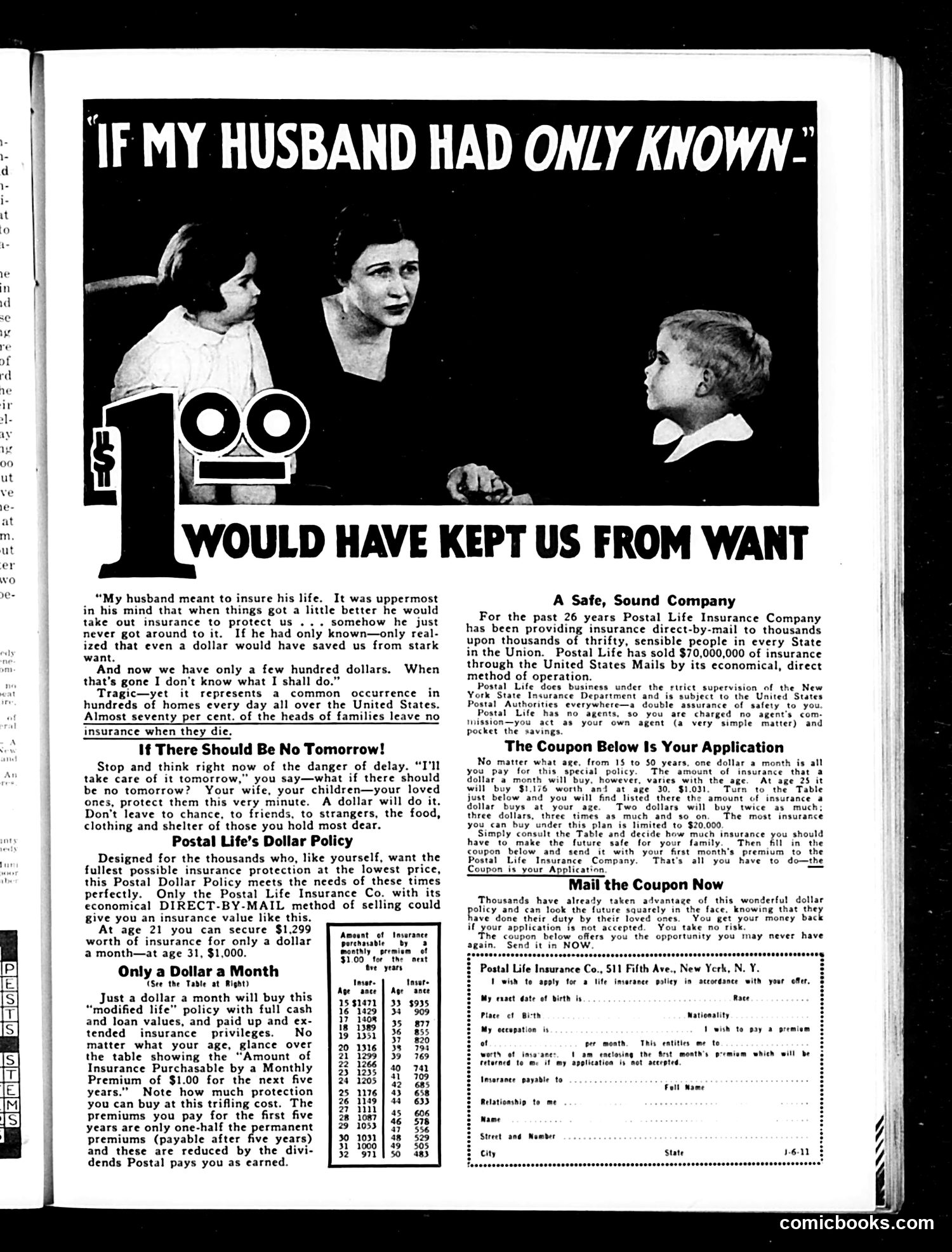
Analysis for Modern Readers This is primarily a life insurance advertisement, not satire. It uses an emotional appeal rather than political commentary. The image shows a woman with two children, illustrating the stated problem: families left destitute after a breadwinner dies without life insurance. The headline quotes the widow's regret that her husband delayed purchasing coverage. The advertisement for Postal Life Insurance Company's "Dollar Policy" presents this as a solution—affordable monthly premiums ($1/month) that working-class families could manage. The pitch emphasizes: - Direct-by-mail sales eliminated agent commissions, lowering costs - Government oversight (New York State Insurance Department and U.S. Postal Authority) provided legitimacy - Modest affordability made protection accessible to ordinary workers The social context: early 20th-century America lacked Social Security or employer benefits. Family financial security depended entirely on individual initiative. This ad targets the guilt and anxiety of male breadwinners who procrastinate about protecting their families—a common advertising theme of the era.
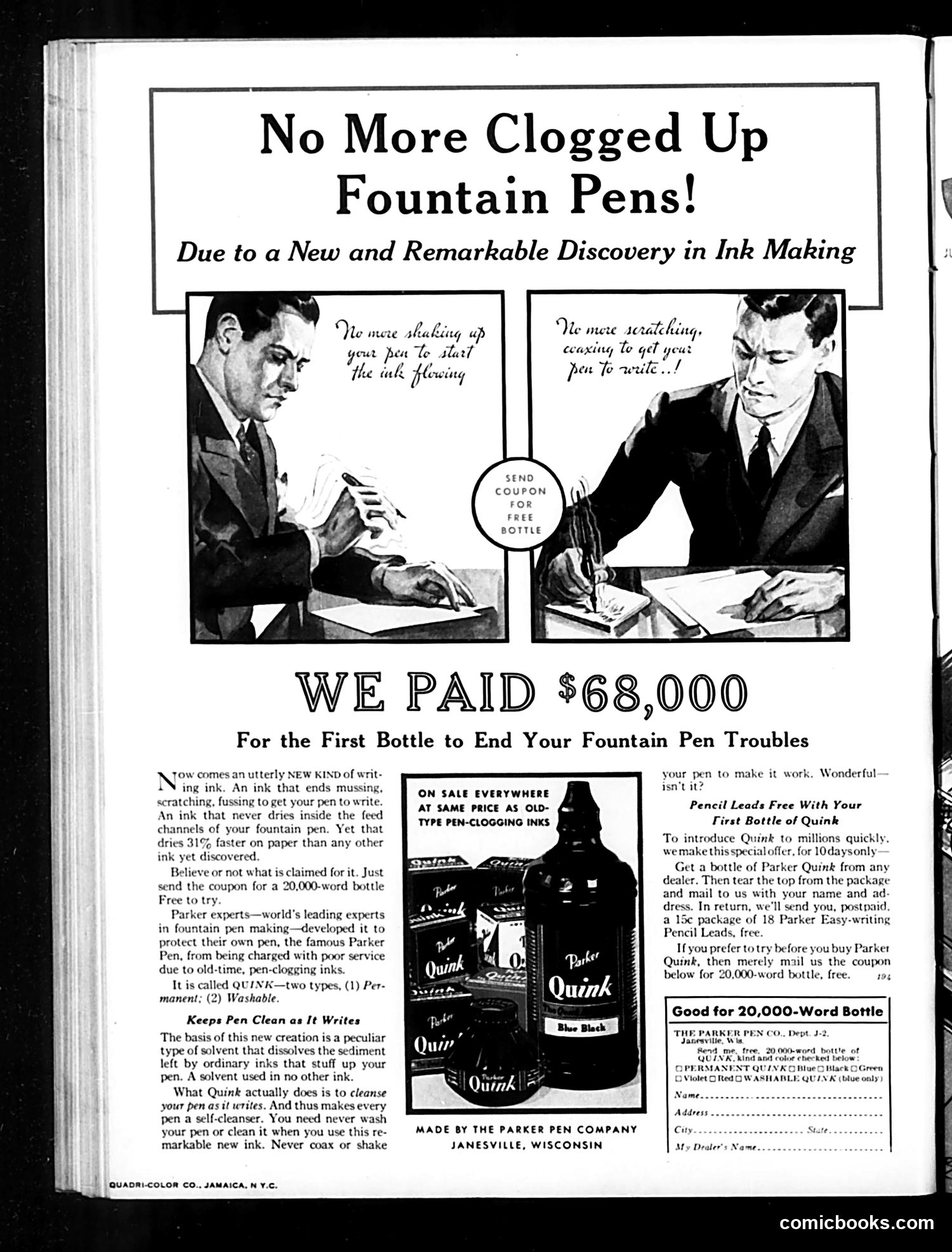
Analysis This is primarily a full-page advertisement, not a satirical cartoon, though it uses cartoon imagery to promote Parker Quink ink. The "Satire": The page's humor lies in the exaggerated claim that Parker paid $68,000 for the "discovery" of this ink formula—presented as if it were a major scientific breakthrough. Two men in business attire demonstrate the problem (shaking the pen to start ink flow, scratching paper) versus the solution (smooth writing). This dramatic framing mocks the typical over-the-top advertising language of the era. The Product Problem Being Addressed: Fountain pens of this era frequently clogged because ink would dry inside the feed channels or leave sediment, requiring constant maintenance—a genuine consumer frustration. The Solution: Quink's special solvent allegedly dissolves sediment, allowing the pen to "self-clean" while writing, eliminating shaking or scratching to start the flow. The Offer: Free trial samples and free pencil leads to incentivize purchase—standard early 20th-century direct marketing. This reflects an era when fountain pens dominated writing, before ballpoint pens became standard.