judge
Judge — June 18, 1932
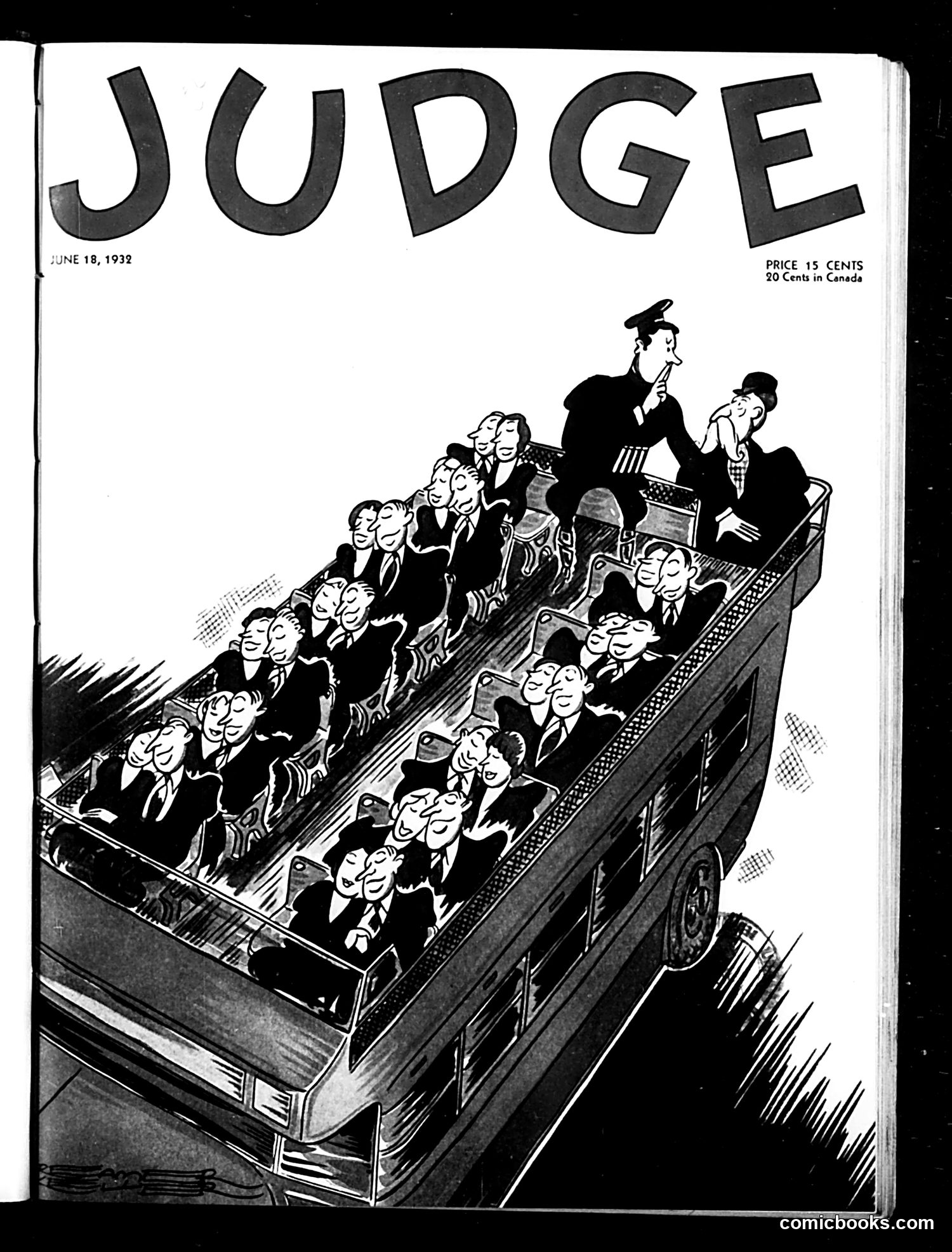
Judge Magazine Cover Analysis — June 18, 1932 This cover satirizes judicial proceedings during the Great Depression era. The cartoon depicts a crowded courtroom or legal proceeding crammed into what appears to be a roller coaster car, suggesting that the legal system is a chaotic, thrilling (and dangerous) ride rather than a dignified institution. The packed vehicle with multiple figures in formal attire—likely lawyers, judges, and defendants—all with exaggerated expressions conveys that the courts are overwhelmed with cases, possibly related to Depression-era bankruptcies, foreclosures, or criminal activity. The title "JUDGE" puns on the magazine's name and the legal profession itself. The satire critiques how rapidly and recklessly the judicial system processes cases during economic crisis.
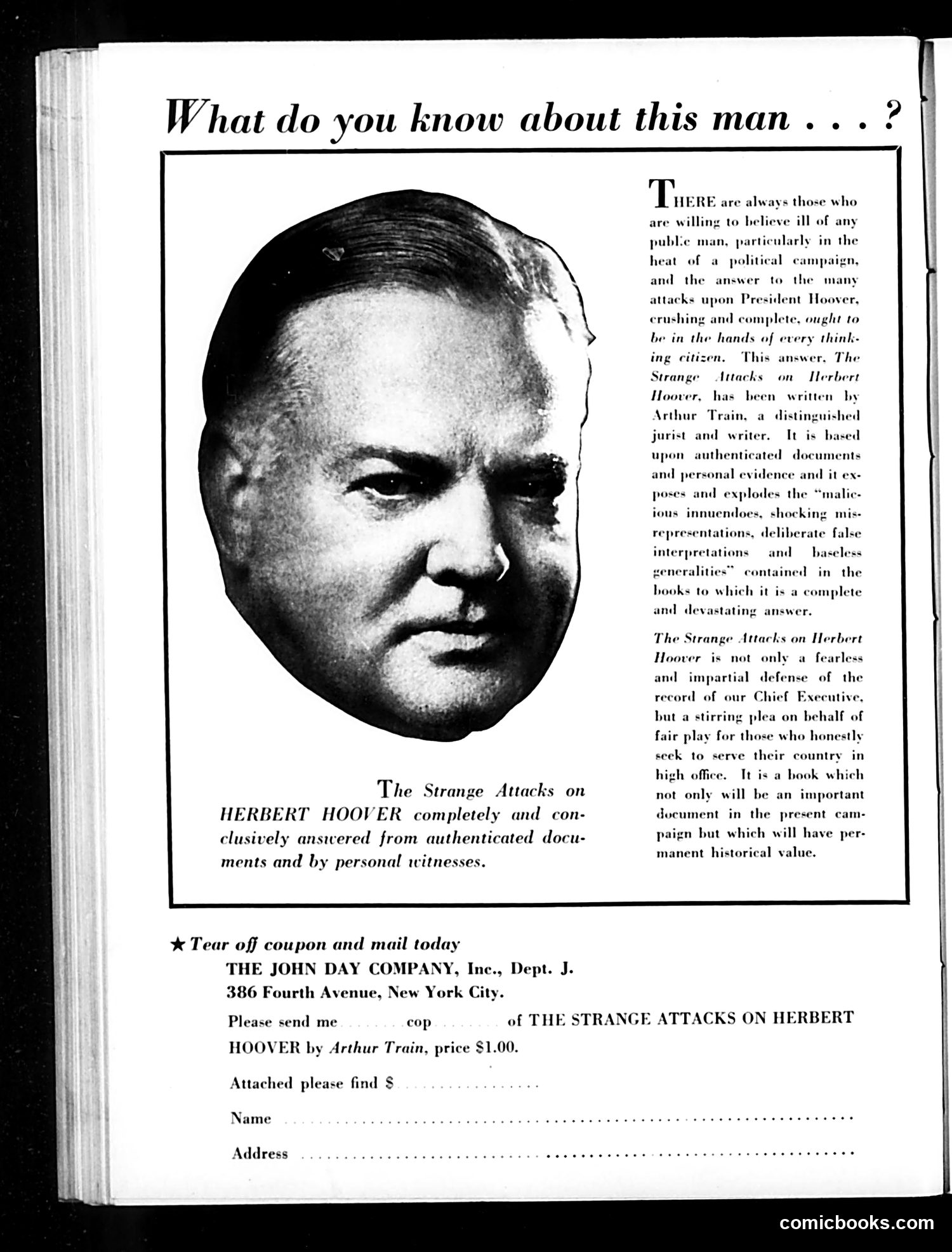
Analysis This page is primarily a political advertisement rather than satire. It promotes Arthur Train's book "The Strange Attacks on Herbert Hoover," published by The John Day Company for $1.00. The image shows a stern portrait of Herbert Hoover, who appears to be the subject of political criticism during his presidency. The text defends Hoover against attacks, claiming the book will expose "malicious innuendoes, shocking misrepresentations, deliberate false interpretations and baseless generalities" made against him using "authenticated documents and personal evidence." This appears designed to counter negative political attacks circulating during Hoover's administration, presenting the book as a factual defense of his record. The advertisement invites readers to order copies via coupon, functioning as both political advocacy and commercial promotion.
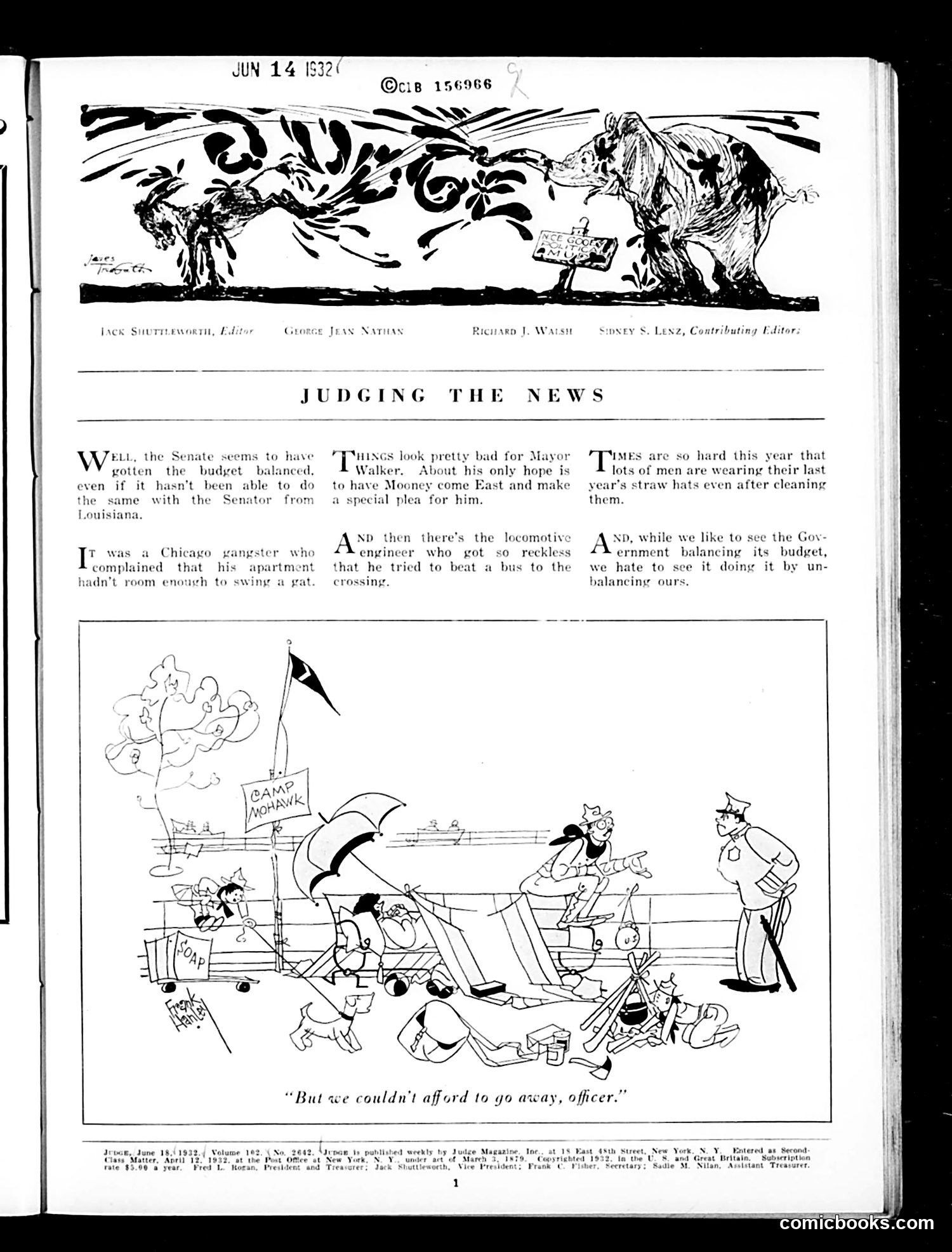
"Judging the News" - June 14, 1932 This page satirizes early 1930s Depression-era politics and urban life. The editorial snippets mock Senate budget debates and Mayor Walker's financial troubles (likely referring to New York's Jimmy Walker, who faced corruption charges in the early 1930s). The main cartoon depicts a chaotic "hobo camp" scene labeled "Camp Mohawk," showing homeless encampments that became common during the Great Depression. The officer's caption—"But we couldn't afford to go away, officer"—sarcastically comments on economic hardship forcing people into vagrancy. The illustration critiques both poverty conditions and law enforcement's role in managing homelessness, while the surrounding text ridicules government officials' failure to address these crises effectively. The cartoon reflects Depression-era anxieties about unemployment and urban disorder.
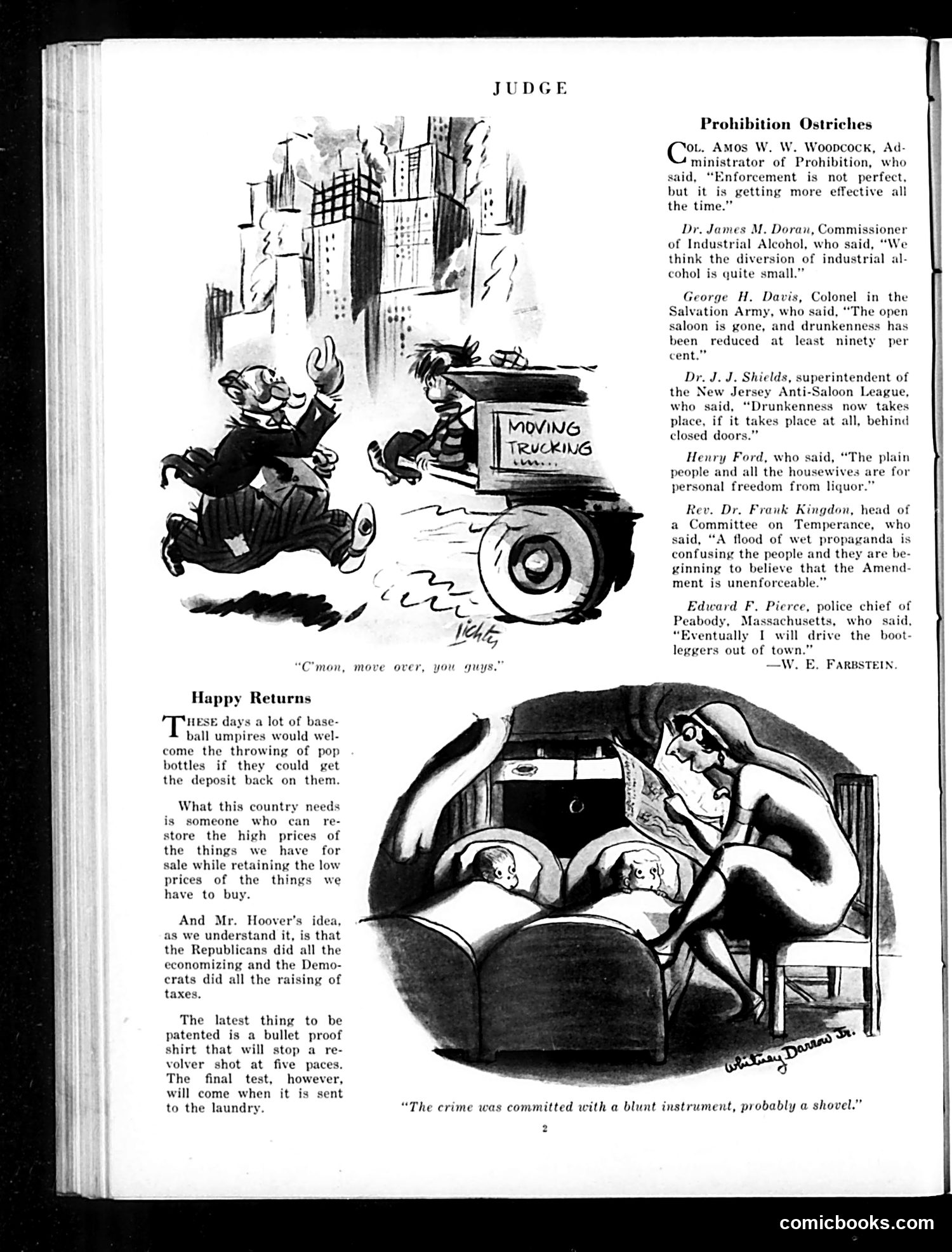
Analysis of Judge Magazine Page Top Cartoon ("C'mon, move over, you guys"): This depicts Prohibition enforcement, showing an ostrich-like figure hiding its head (symbolizing denial) while a "Moving Trucking" vehicle—likely representing illegal alcohol distribution—operates nearby. The satire mocks how Prohibition enforcement was ineffective; bootleggers continued operating despite the law. Testimonials Section ("Prohibition Ostriches"): Various officials and religious leaders claim Prohibition's success (reduced drunkenness, closed saloons). The "ostriches" metaphor suggests they're burying their heads in sand, refusing to acknowledge widespread violation and bootlegging. Bottom Cartoon ("The crime was committed with a blunt instrument"): A detective examines what appears to be a domestic crime scene involving infants, likely satirizing absurd detective work or sensationalist crime reporting. The page overall critiques Prohibition's failure and hypocrisy.
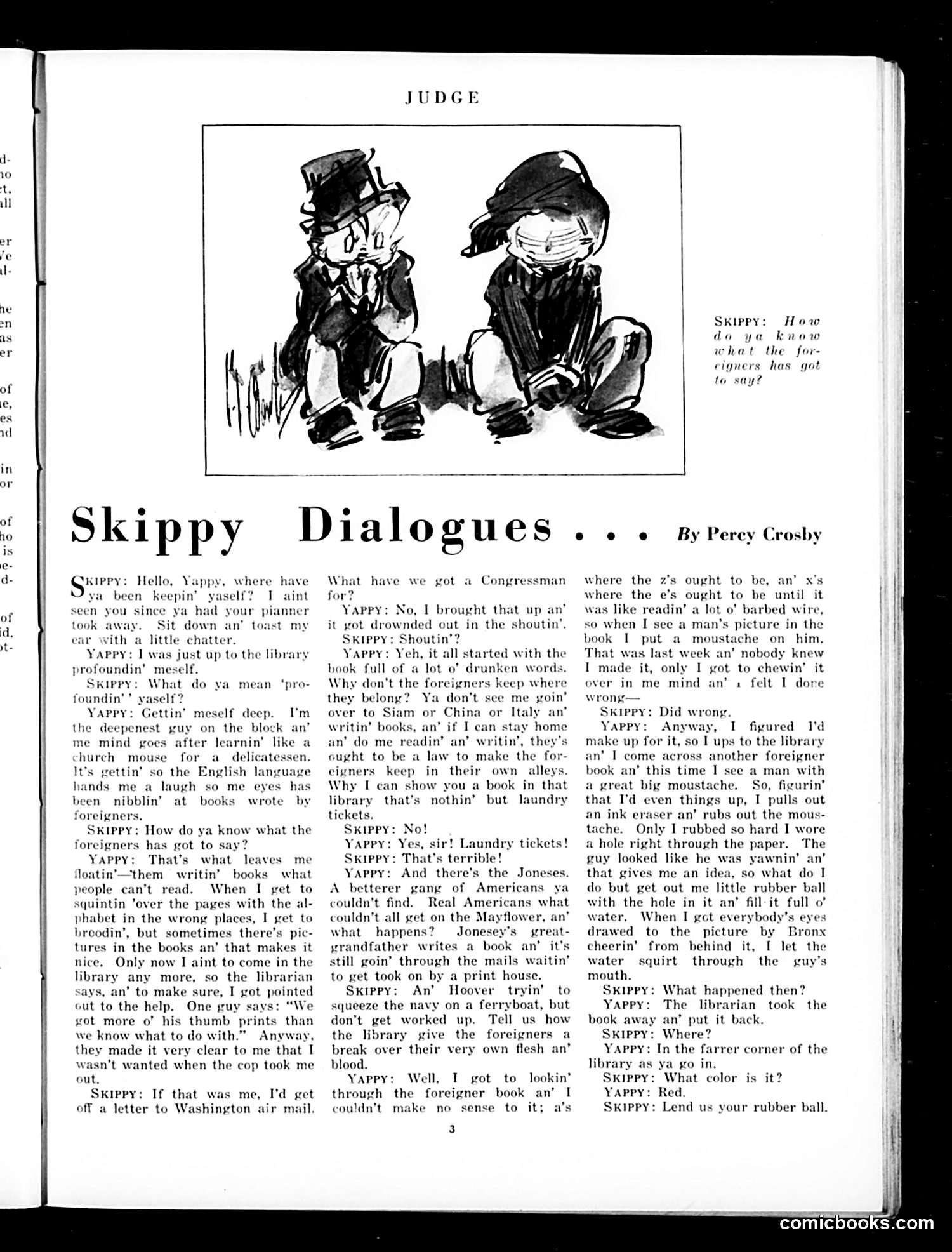
"Skippy Dialogues" by Percy Crosby This comic dialogue features two working-class characters discussing foreigners and American identity—likely reflecting 1920s-30s anxieties about immigration and assimilation. The humor centers on Skippy's malapropisms and misunderstandings about library books involving foreigners. He confuses concepts like "foreigners" and "laundry tickets," and makes absurd claims (a man with a mustache appearing in a library book; an ink eraser creating a hole in a page). The underlying satire appears to mock nativist prejudices against immigrants while simultaneously portraying the working-class characters as ignorant and suspicious of foreign literature. The dialogue suggests both anti-immigrant sentiment and ridicule of those holding such views—typical of Judge's satirical approach to social tensions of the era. The crude character design reinforces period stereotypes about working-class identity.
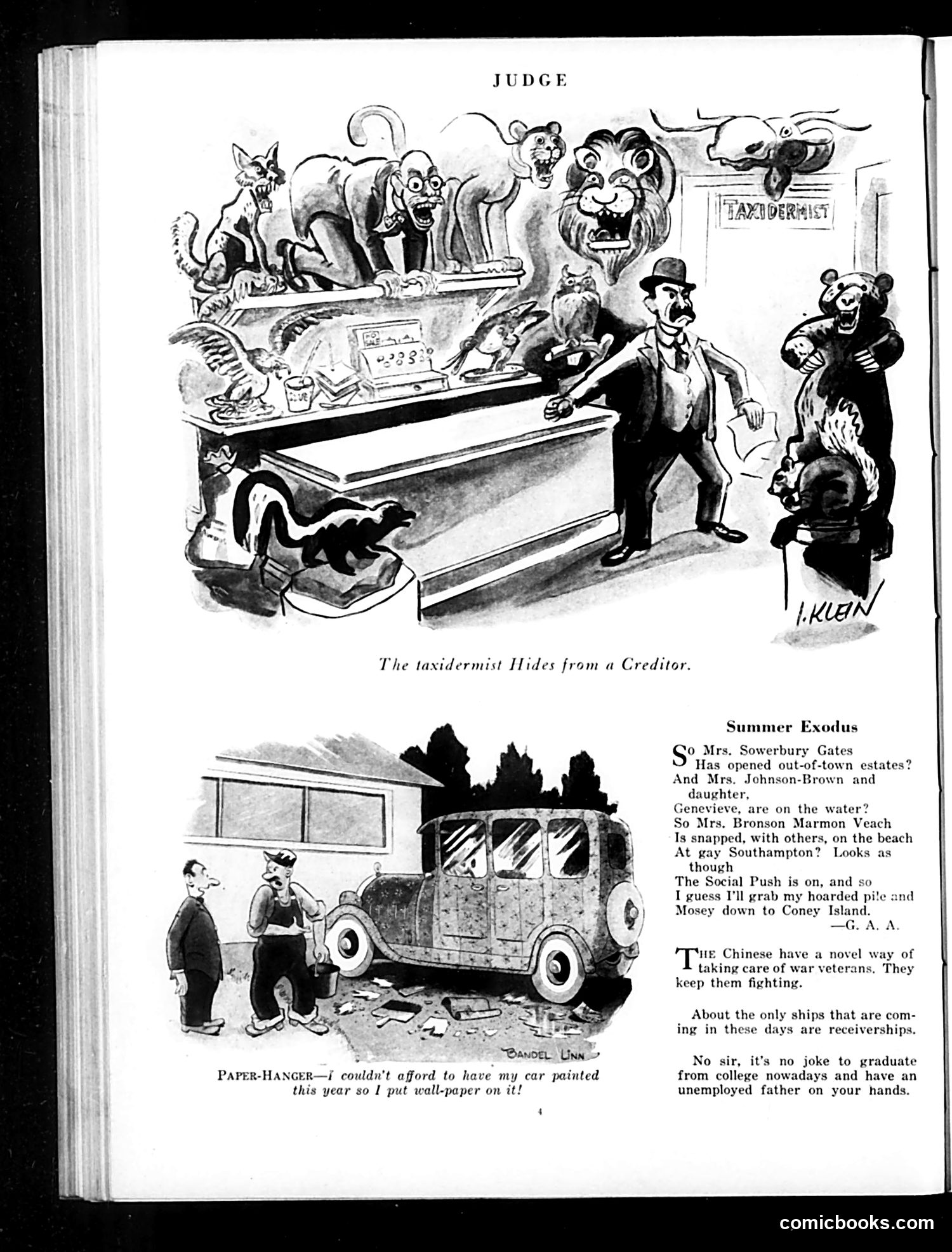
Explanation for Modern Readers Top Cartoon ("Judge"): A courtroom scene titled "The taxidermist Hides from a Creditor." A man hides behind a large book while various animal-headed figures (appearing to represent creditors or legal authorities) sit in judgment above. The joke uses the literal profession of taxidermy—stuffing and mounting dead animals—as metaphor: the taxidermist is "stuffed" or trapped by his debts, surrounded by bestial creditors. Bottom Cartoon ("Paper-Hanger"): Two men examine a car covered in wallpaper. The caption explains: unable to afford paint, the owner applied wallpaper instead. This satirizes Depression-era economic desperation and makeshift solutions to maintaining appearances during financial hardship. Both cartoons reflect 1930s economic anxiety—debt, creditors, and poverty forcing people into absurd, undignified compromises.
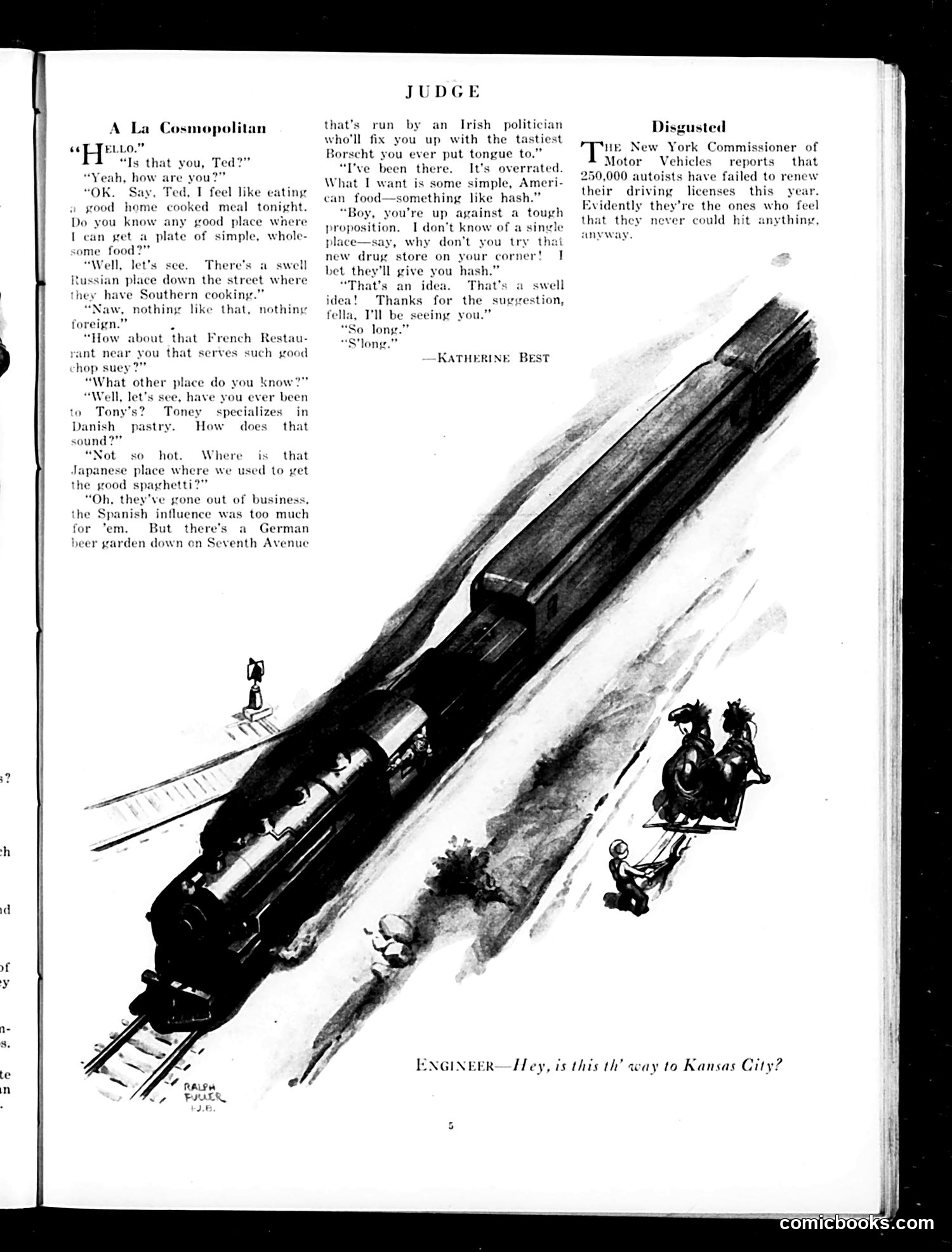
Analysis This page contains two sections: a comedic dialogue ("A La Cosmopolitan") and a cartoon. The Dialogue: Two men (Ted and another) discuss New York restaurants. Ted recommends a Russian place for "good home cooked meal," then suggests various ethnic establishments—French, Danish pastry, Japanese spaghetti, and a German beer garden. The joke appears to mock New York's diverse immigrant restaurant scene and perhaps satirizes Americans' casual consumption of foreign cuisines without deep cultural understanding. The Cartoon: An engineer asks lost travelers "Hey, is this th' way to Kansas City?" while a train passes nearby. The humor likely derives from the travelers' confusion or the absurdity of their predicament—they appear stranded or disoriented near railroad tracks. Both items appear to target urban American life and immigration-related social commentary typical of Judge magazine's satirical approach.
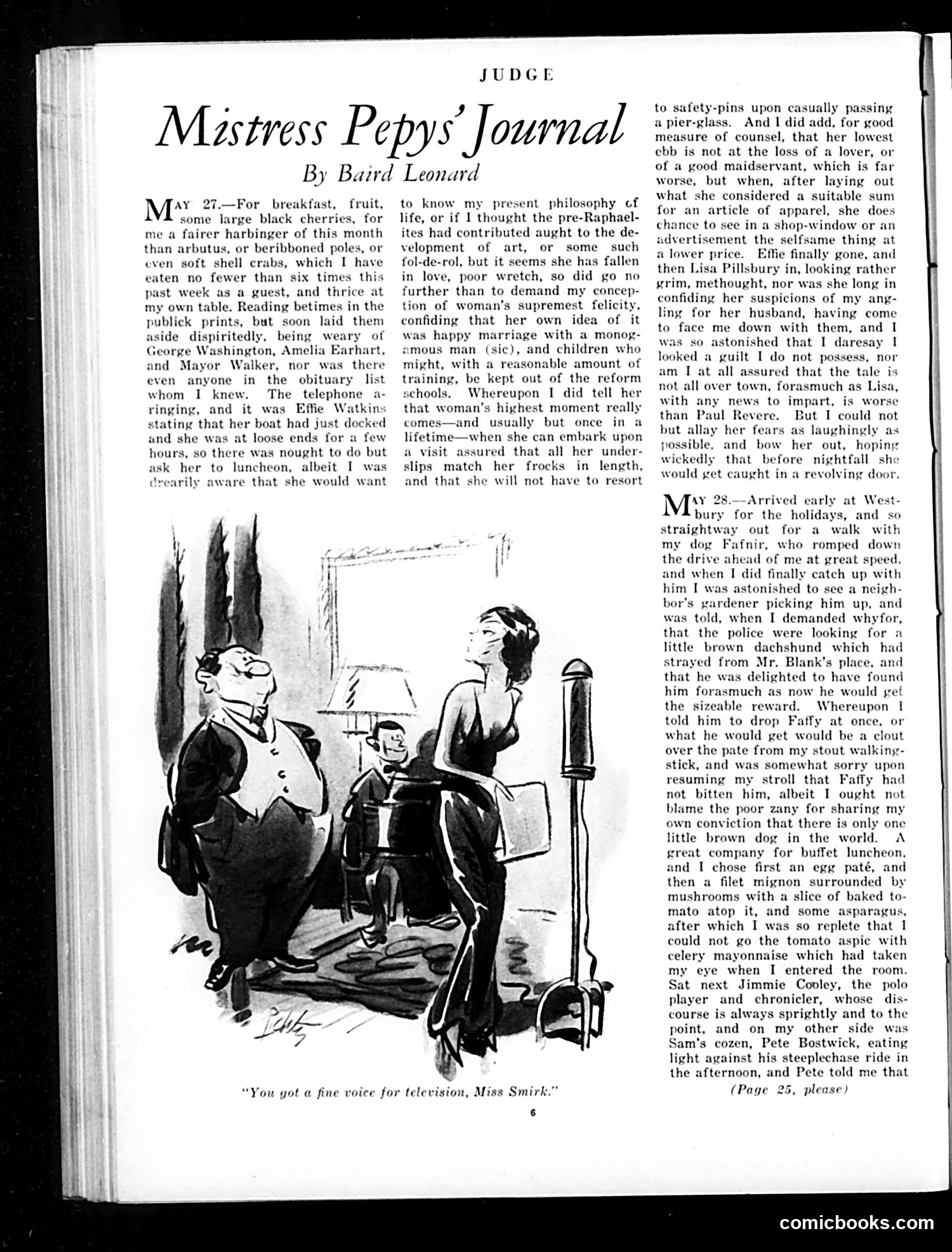
"Mistress Pepys' Journal" by Baird Leonard This satirical column mimics Samuel Pepys's famous 17th-century diary in a modern (early 20th-century) voice. The cartoon caption reads: "You got a fine voice for television, Miss Smirk." The joke references television as an emerging novelty—the technology barely existed when this was published, making the anachronistic compliment absurd. The cartoon shows a woman at a social gathering being flattered about a medium that doesn't yet exist, satirizing either: 1. People making foolish predictions about new technology, or 2. The pretentiousness of complimenting someone about capabilities no one can yet evaluate The broader column discusses mundane society gossip (dogs, lunches, neighbors), parodying Pepys's detailed documentation of trivial aristocratic life.
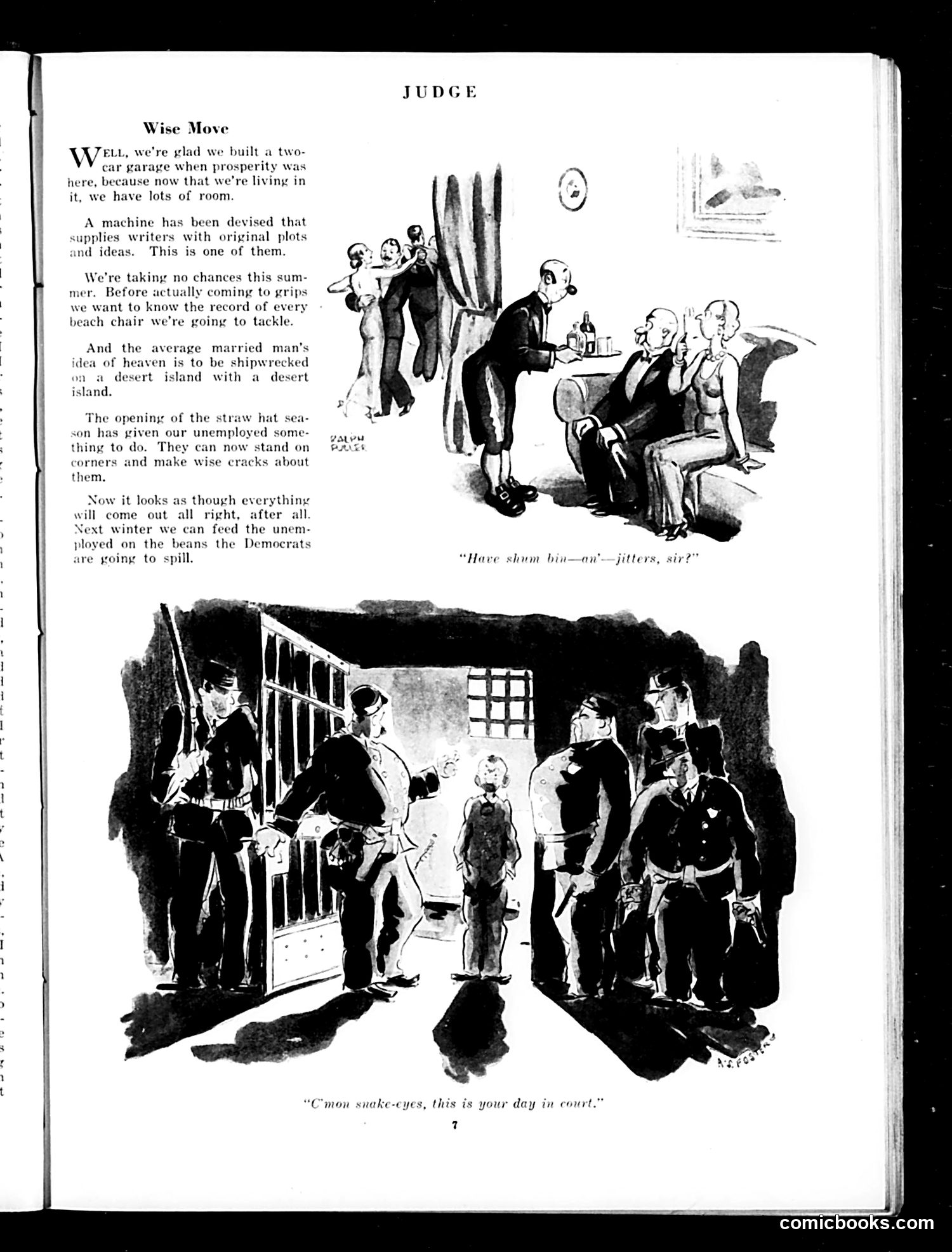
Analysis of Judge Magazine Page This page from the satirical magazine *Judge* contains two cartoon scenarios satirizing American social anxieties during what appears to be an economic downturn (likely 1930s Depression era). The upper cartoon depicts well-dressed men nervously watching a woman enter a room, with the caption "Have shum bin—an'—jitters, sir?" This appears to mock social anxiety and marital infidelity concerns among the wealthy. The lower cartoon shows a disheveled man being escorted into court by military guards, captioned "C'mon snake-eyes, this is your day in court." This likely satirizes unemployment and vagrancy arrests during economic hardship. The accompanying text uses dark humor about unemployment, straw hats, and Democrats "spilling beans" to comment on economic misery. The opening anecdote about building a two-car garage during prosperity mocks conspicuous consumption and false confidence before economic collapse. Overall, the page uses satire to critique both upper-class anxieties and the plight of the unemployed poor.
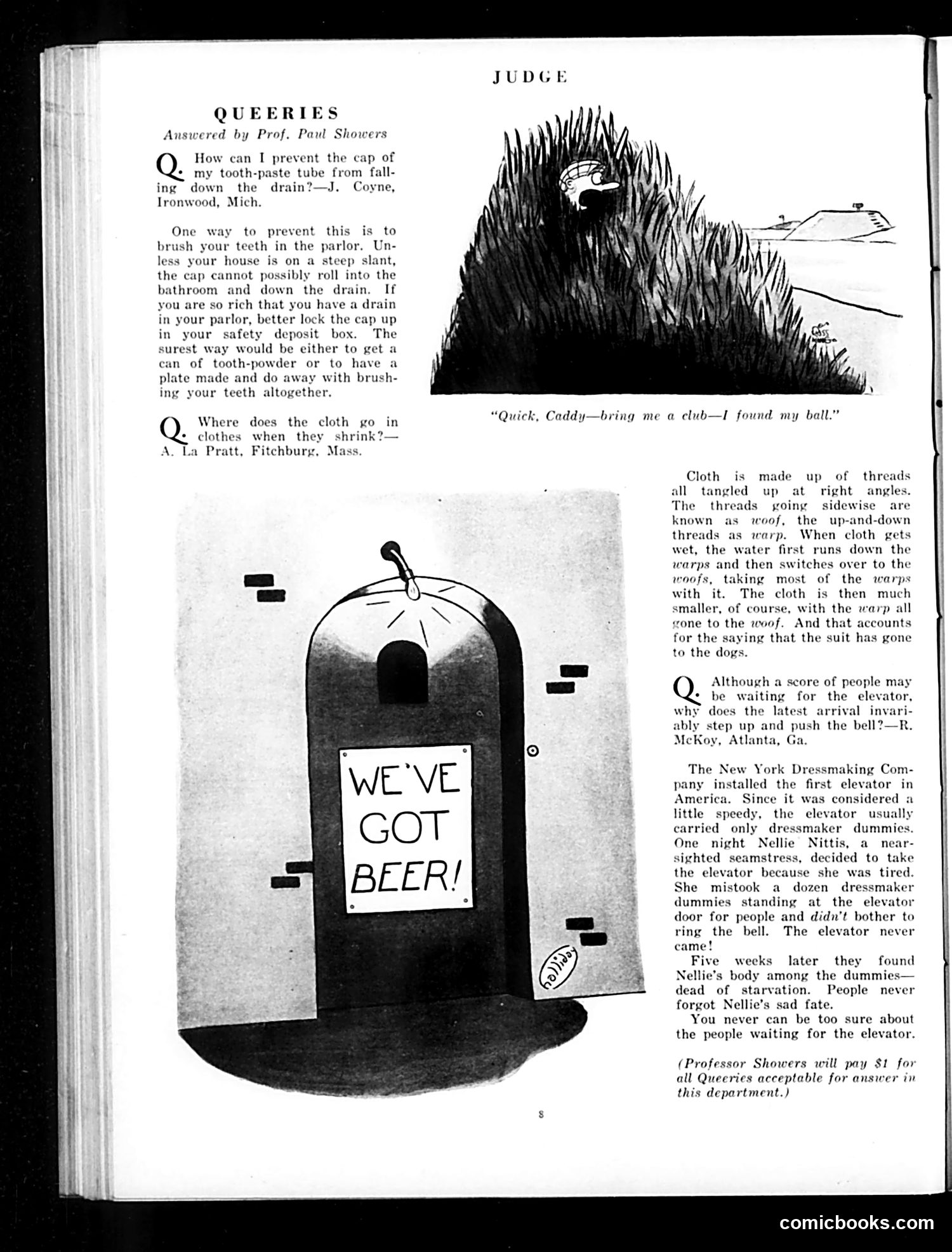
Judge Magazine Satire Analysis This page contains humorous "advice column" responses to reader questions, featuring two main cartoons: 1. The Golf Cartoon (top right): A golfer in rough grass calls for his caddy to bring a club, having found his ball. The joke plays on the double meaning—the golfer has literally located his golf ball in the weeds. 2. The Prohibition-Era Cartoon (center): A large beer keg displays a sign reading "WE'VE GOT BEER!" This appears to reference Prohibition (likely early 1920s based on Judge's era), satirizing speakeasy operations or illegal alcohol distribution during the alcohol ban. The "Queeries" answers use deadpan, absurdist humor—treating mundane problems with ridiculous solutions (keeping toothpaste caps in a safety deposit box; the elevator story about mistaking dummies for people resulting in starvation). The overall tone is typical of Judge magazine's satirical approach to everyday American life and contemporary issues like Prohibition.
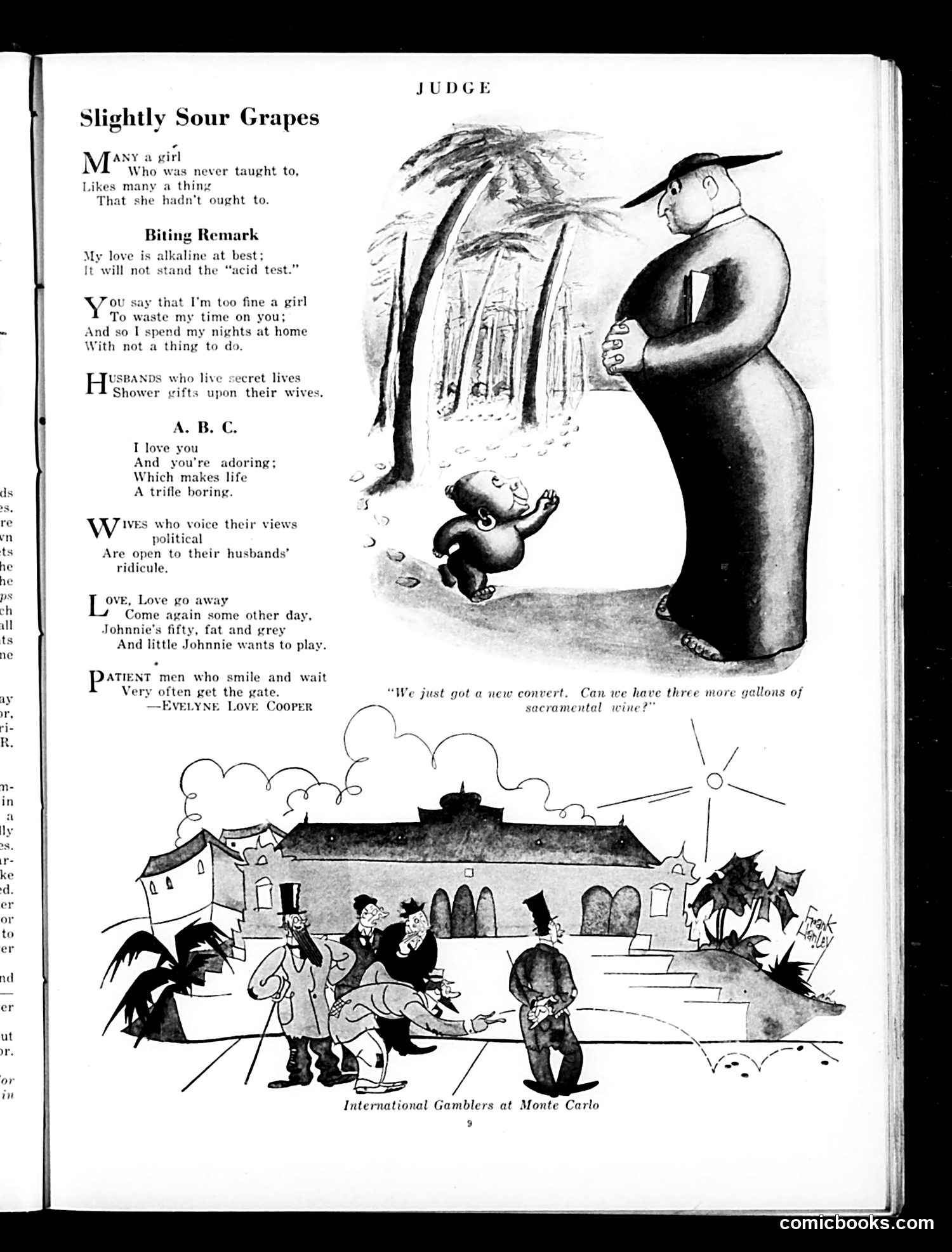
Judge Magazine Satirical Page Analysis This page contains two distinct pieces of social satire: Upper Section - "Slightly Sour Grapes": A collection of short, cynical poems about romantic relationships and gender dynamics. The verses mock women who pursue unsuitable interests, romantic disappointment ("acid test"), women complaining about boredom in relationships, wives who express political opinions facing ridicule, and aging husbands wanting to continue youthful behavior. The tone is misogynistic by modern standards, typical of early 20th-century American humor targeting women's education and independence. Lower Cartoon - "International Gamblers at Monte Carlo": Depicts well-dressed gamblers at the famous Monaco casino. The caption's joke references a "new convert" requesting sacramental wine—likely satirizing Prohibition era hypocrisy, where religious exemptions allowed wine consumption. The cartoon mocks wealthy international gamblers as morally dubious characters seeking loopholes. Both pieces reflect period attitudes: skepticism toward women's autonomy and critique of wealthy leisure-class behavior.
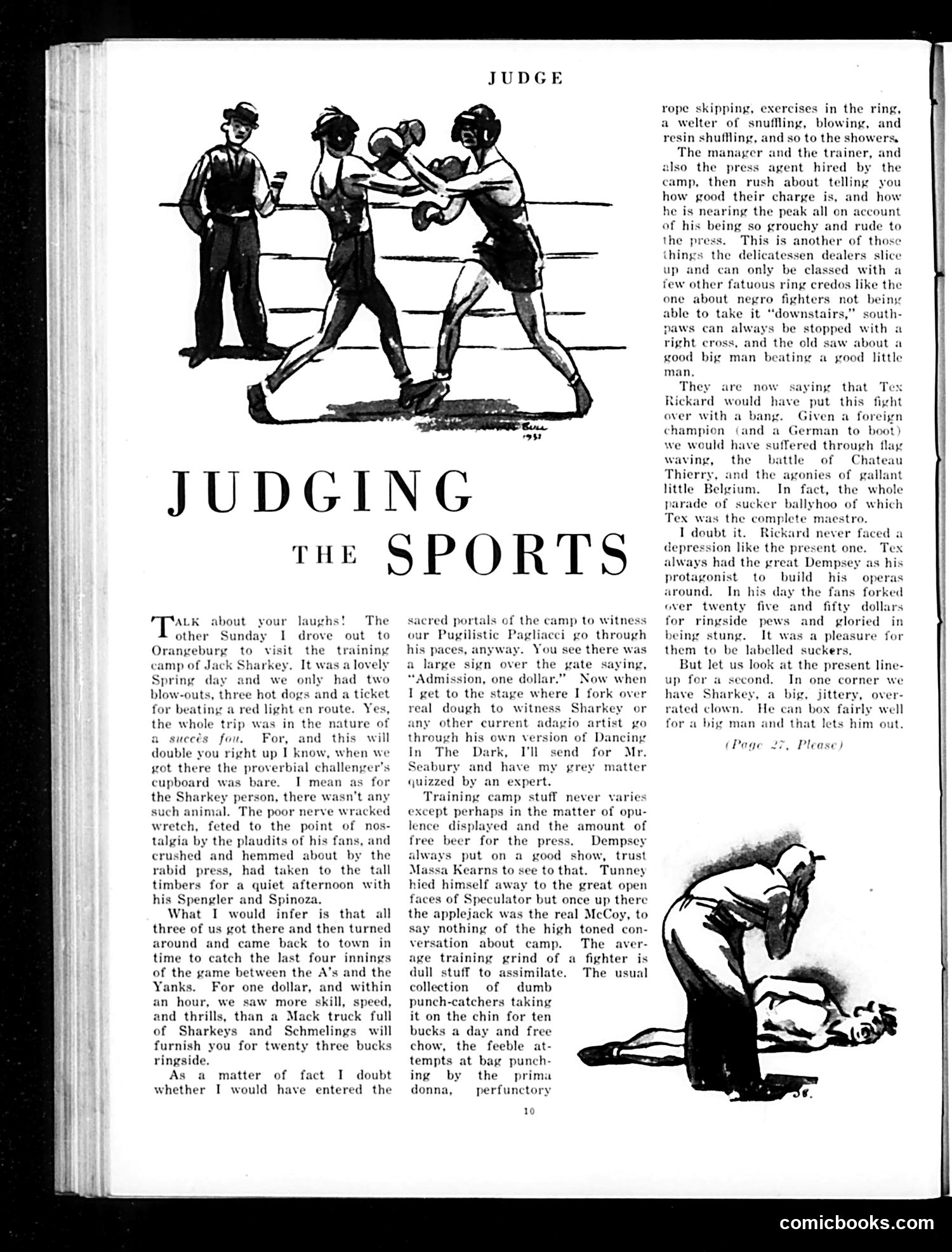
Analysis for Modern Readers This page from Judge magazine satirizes professional boxing and fight promotion in 1920s America. The author critiques boxer Jack Sharkey's training camp visit, contrasting boxing's theatrical hype with baseball's genuine entertainment value. The piece mocks boxing's manufactured drama: trainers and press agents fabricate stories about fighters' "peak" condition while they're actually rude to journalists. It references Tex Rickard, the famous boxing promoter known for spectacular but exploitative promotion, suggesting he used patriotic imagery (WWI references to Château Thierry, "little Belgium") to sell fights to gullible "sucker" fans willing to overpay for ringside seats. The author observes that modern fighters lack the charisma of champions like Jack Dempsey (depicted with manager Gould Kearns), who could draw crowds despite obvious training-camp boredom and mediocre sparring partners. Sharkey appears as a pretentious intellectual (reading Spengler and Spinoza) hiding from publicity—hardly the compelling champion figure needed for Rickard-style promotion. The illustrations show boxing scenes; the sketch emphasizes the sport's theatrical, often ridiculous nature.
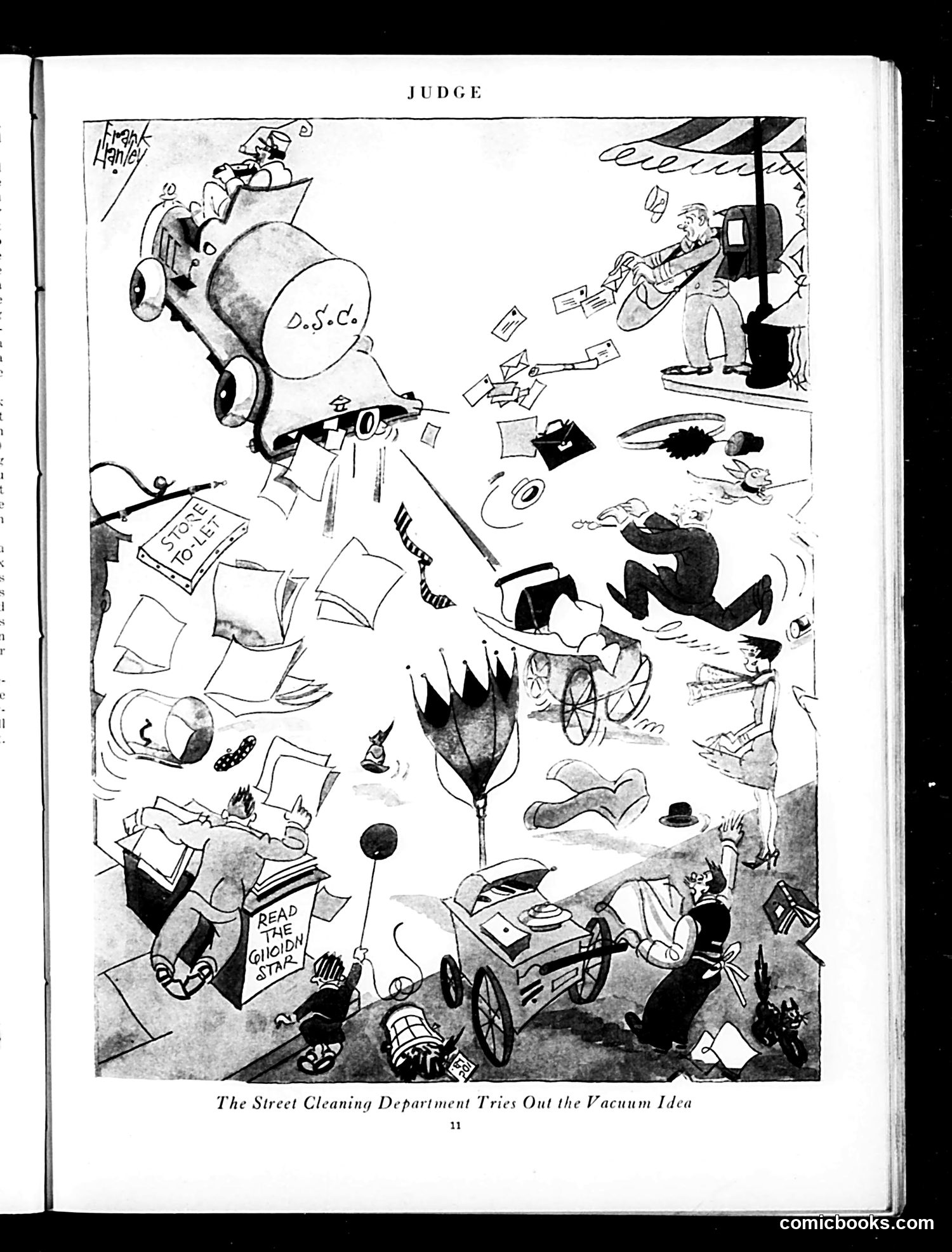
"The Street Cleaning Department Tries Out the Vacuum Idea" This satirical cartoon depicts a chaotic scene where a massive vacuum cleaner labeled "D.S.C." (District Street Cleaning, likely Washington D.C.'s department) has created mayhem on city streets. The vacuum suction is indiscriminately sweeping up debris, documents, papers, people, bicycles, and various street objects in wild disorder. The satire targets municipal government inefficiency and bureaucratic overreach. The "vacuum idea" appears to be mocking a proposed street-cleaning initiative as absurdly destructive rather than helpful—sucking up everything rather than solving problems. Papers labeled "READ THE GROOM STORY" suggest press coverage of the scandal. For modern readers: this criticizes government incompetence, where well-intentioned municipal reforms backfire spectacularly, creating more problems than they solve.
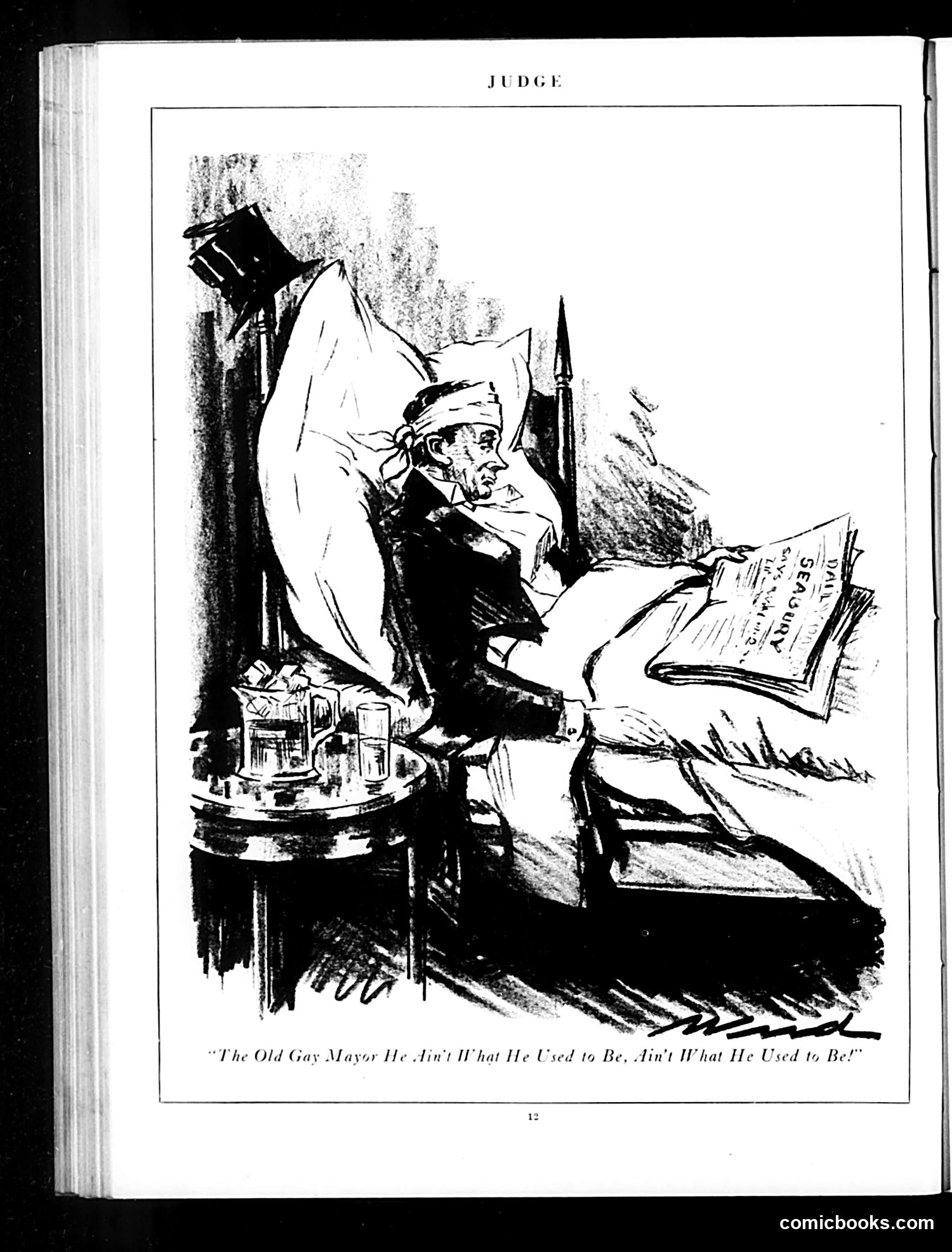
Political Cartoon Analysis This is a satirical cartoon from *Judge* magazine depicting an elderly mayor figure in a disheveled state. The character wears a nightcap and appears diminished or debilitated, sitting at a desk with legal documents and drinking glasses nearby. The caption uses colloquial language ("Ain't") to mock the subject's decline. The cartoon criticizes a specific mayor—likely of a major American city—suggesting he has lost competence, vitality, or moral standing compared to his earlier tenure. The nightcap and disarray imply age-related deterioration or corruption. The legal documents reference his judicial/administrative responsibilities, suggesting he's failing to perform them adequately. Without the publication date, I cannot identify the specific mayor targeted. The satire's core message: this once-capable leader is now ineffectual or unfit for office.
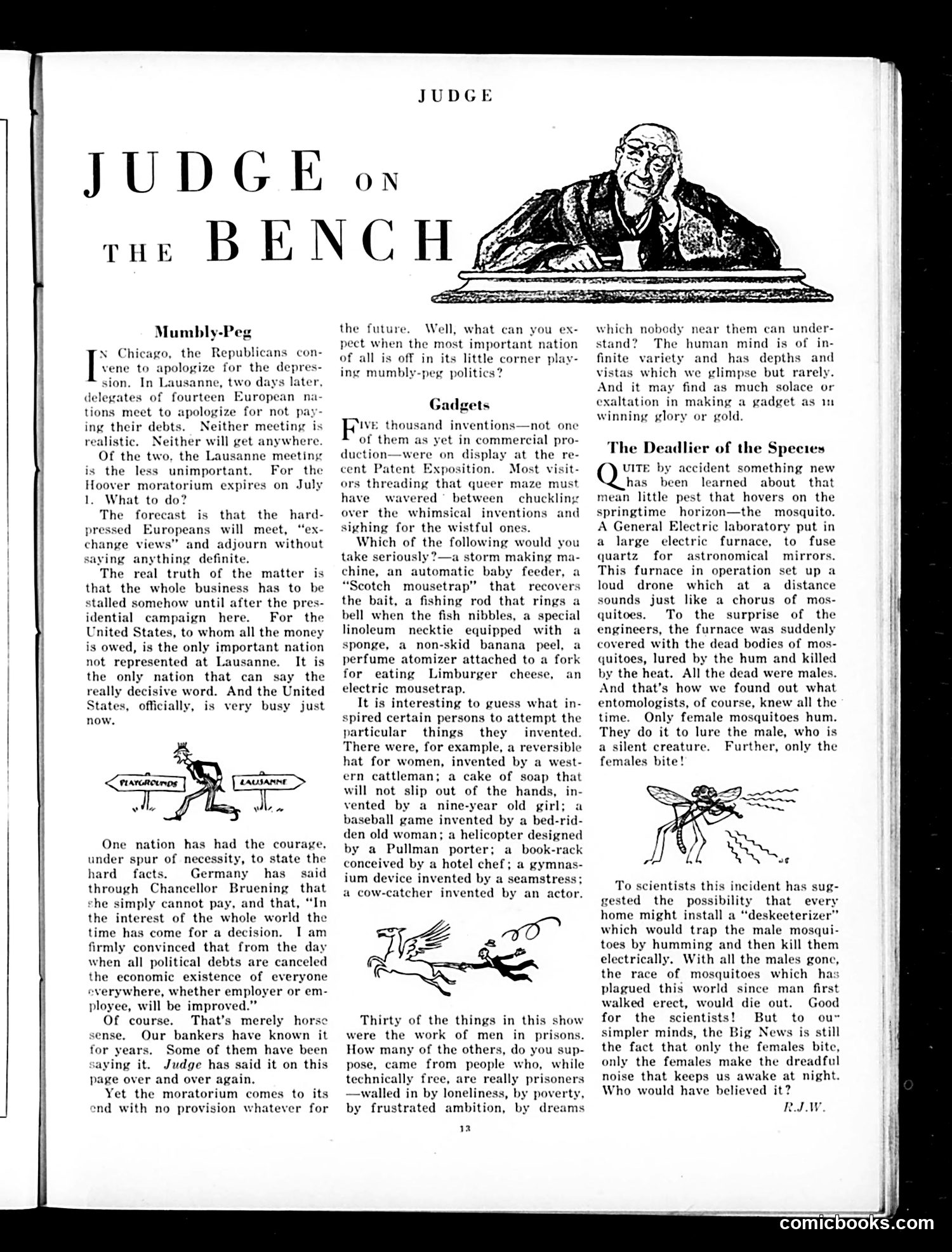
"Judge on the Bench" - Page Analysis This page contains three satirical pieces attacking political inaction during the Great Depression: "Mumbly-Peg" mocks Republican and European conferences called to address economic crisis. The title references a children's game, suggesting politicians are playing trivial games while serious problems persist. Judge criticizes the U.S. for refusing to attend the Lausanne debt conference, calling American political leadership distracted by election-year politics rather than addressing the economic emergency. "Gadgets" celebrates human ingenuity by showcasing absurd patent-office inventions, then pivots to a serious point: many inventors are trapped by poverty and loneliness, channeling creative energy into useless contraptions rather than meaningful work. "The Deadlier of the Species" is a brief scientific note about discovering that only female mosquitoes bite—positioned as humorous trivia but underscoring the theme that even nature's "weaker" sex proves more formidable. The overarching message: while politicians dither and inventors waste talent, real problems persist.
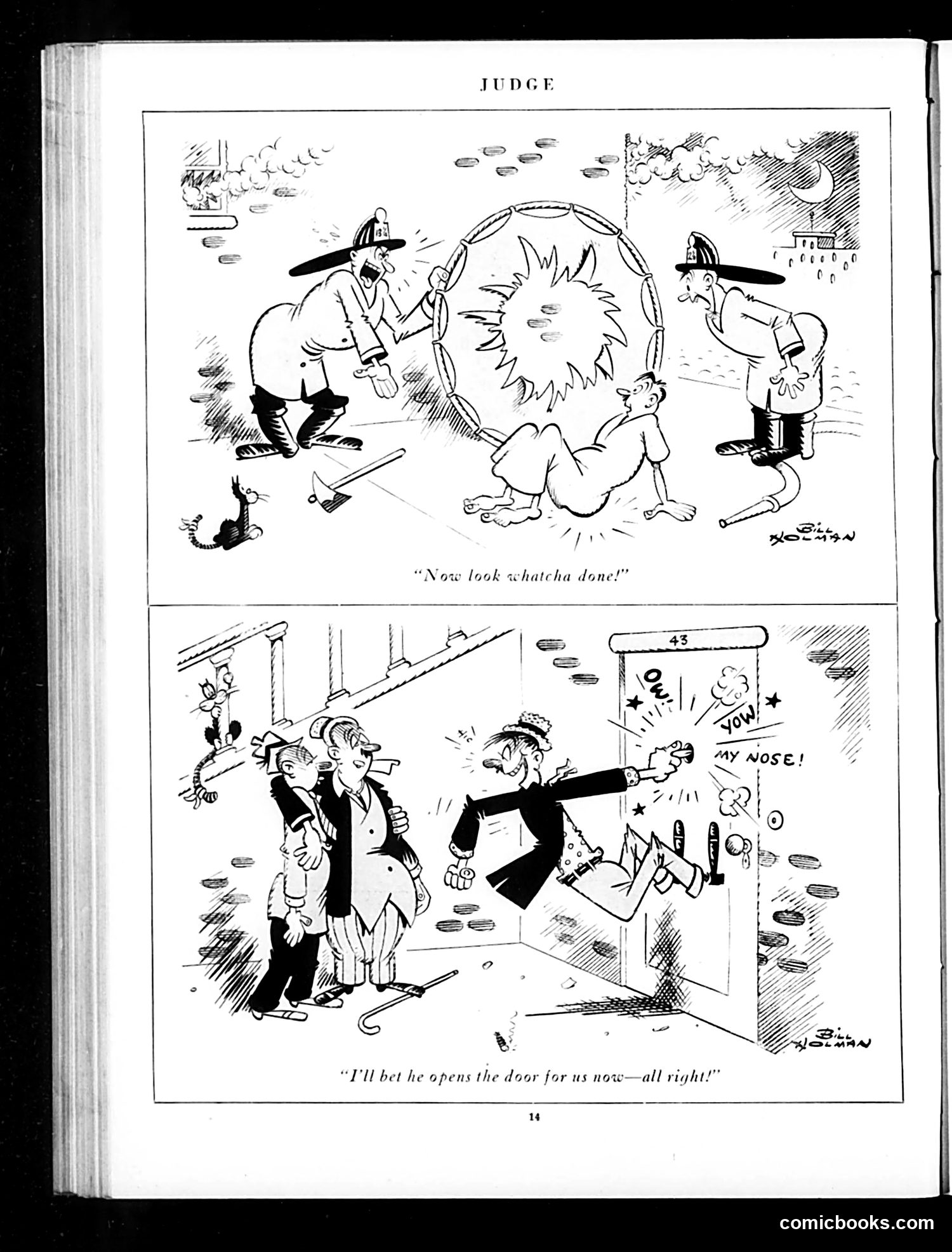
Analysis of This Judge Magazine Page This page contains two satirical cartoons about law enforcement and justice. The top cartoon shows two uniformed officers (likely police or judges based on their hats) observing someone taming or controlling a fierce, spiky creature—probably a metaphor for crime or lawlessness. The caption "Now look whatcha done!" suggests ironic commentary on law enforcement effectiveness. The bottom cartoon depicts officials at a door marked "43," with one man pointing and saying "Yow—say nose!" while another announces "I'll bet he opens the door for us now—all right!" This appears to satirize bureaucratic incompetence or bribery—the implication being that someone's prominent "nose" (possibly a caricatured feature suggesting ethnicity or a specific person) might grease the wheels of justice through corruption rather than merit.
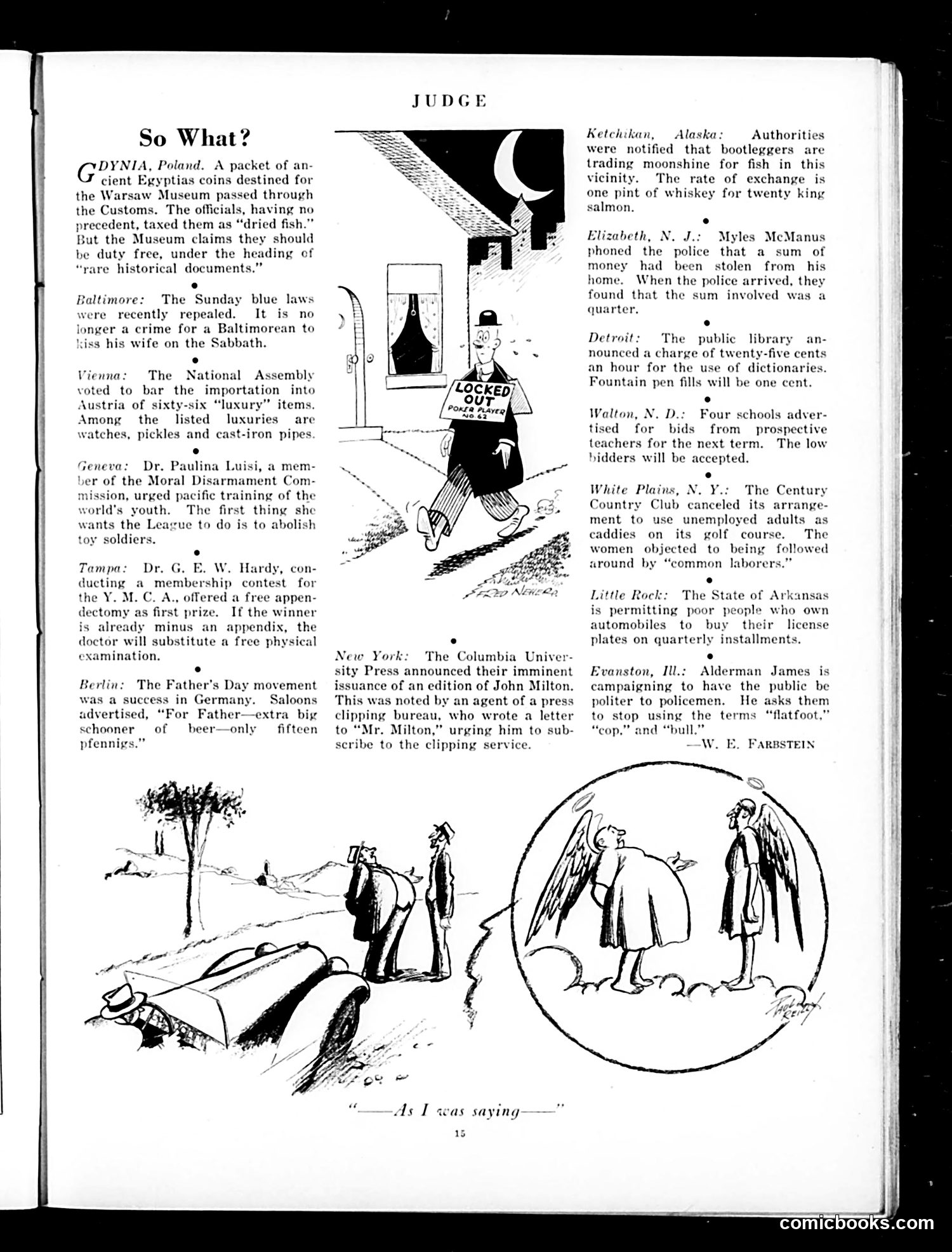
"So What?" - Judge Magazine Satirical News Column This is a humor column presenting brief mock-news items from various cities, each highlighting absurdities in contemporary American and European society, circa 1920s. The cartoons and items mock bureaucratic incompetence, legal absurdity, and class hypocrisy. Examples include: customs officials taxing ancient coins as "dried fish"; Polish courts criminalizing spousal affection; Vienna banning "luxury" cast-iron pipes; a press clipping bureau pursuing the dead poet John Milton as a subscription client. The Baltimore and Elizabeth, N.J. items joke about trivial legal matters and petty thefts. The White Plains country club canceling its unemployed-caddy program because "common laborers" would embarrass wealthy women satirizes class snobbery. The Alaska bootlegging note references Prohibition-era illegal whiskey trading. Overall, the column mocks bureaucratic red tape, prohibition, class pretension, and the period's social contradictions through deadpan reporting.
"The Theatre" Review by George Jean Nathan This page contains a theater review—not a political cartoon. Judge critic George Jean Nathan reviews a play (title unclear from visible text) starring actress Jane Cowl. Nathan savagely mocks the production as recycled hokum, criticizing its reliance on tired dramatic clichés: characters asking "What is the matter?" followed by "Everything—nothing," stock American businessman types, and wooden dialogue. He suggests the playwright couldn't decide whether to imitate one European play or another. His central complaint: a middle-aged actress performing opposite a young male lead, with the reviewer implying the actress derives gratuitous pleasure from the stage romance rather than serving the character. Nathan praises Cowl's voice and occasional good performances (notably her Juliet) but argues she ultimately undermines the play's effect through manufactured charm rather than genuine acting. The tone is scathing entertainment criticism aimed at Judge's sophisticated readership.
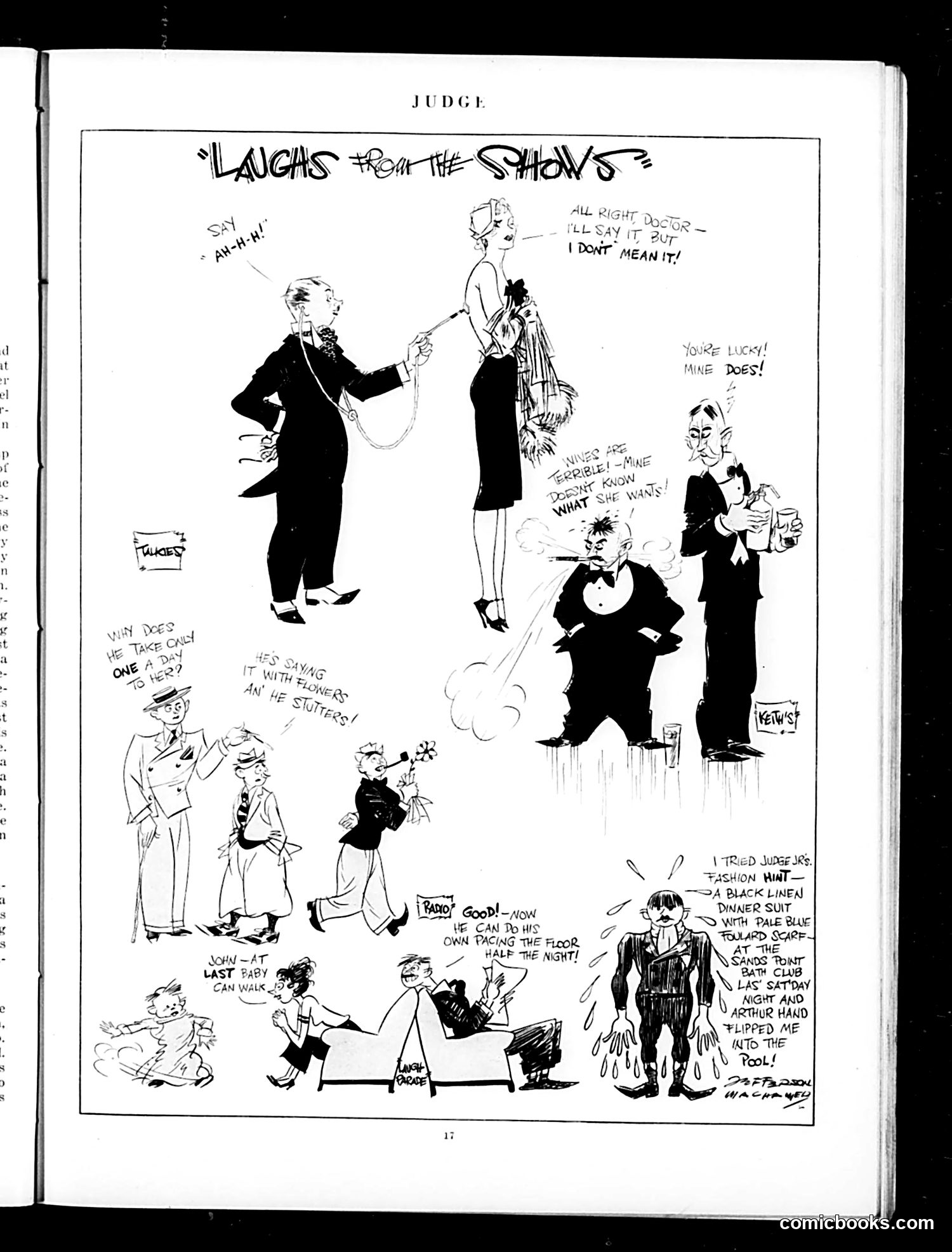
"Laughs from the Shows" - Judge Magazine Cartoon This is a satirical cartoon about theatrical life and social pretension. The central figure appears to be a woman at a formal event, surrounded by men in tuxedos engaged in various comedic interactions about fashion, dancing, and social mishaps. The humor targets: 1. Upper-class social anxiety - References to dinner suits, fashion standards, and formal etiquette 2. Male clumsiness/incompetence - Multiple scenes showing men stumbling, falling into pools, and behaving foolishly at social events 3. Theatrical pretension - The "shows" reference and exaggerated character types suggest mockery of theater society's affected behavior The recurring gags involve men failing at basic social functions (dancing, walking, maintaining composure), with one figure literally flipped into a pool. The satire suggests that despite their formal attire and pretensions to sophistication, this social set is fundamentally ridiculous and accident-prone. The unsigned cartoonist captures typical Judge-era humor: gentle mockery of wealthy socialites through physical comedy and social observation.
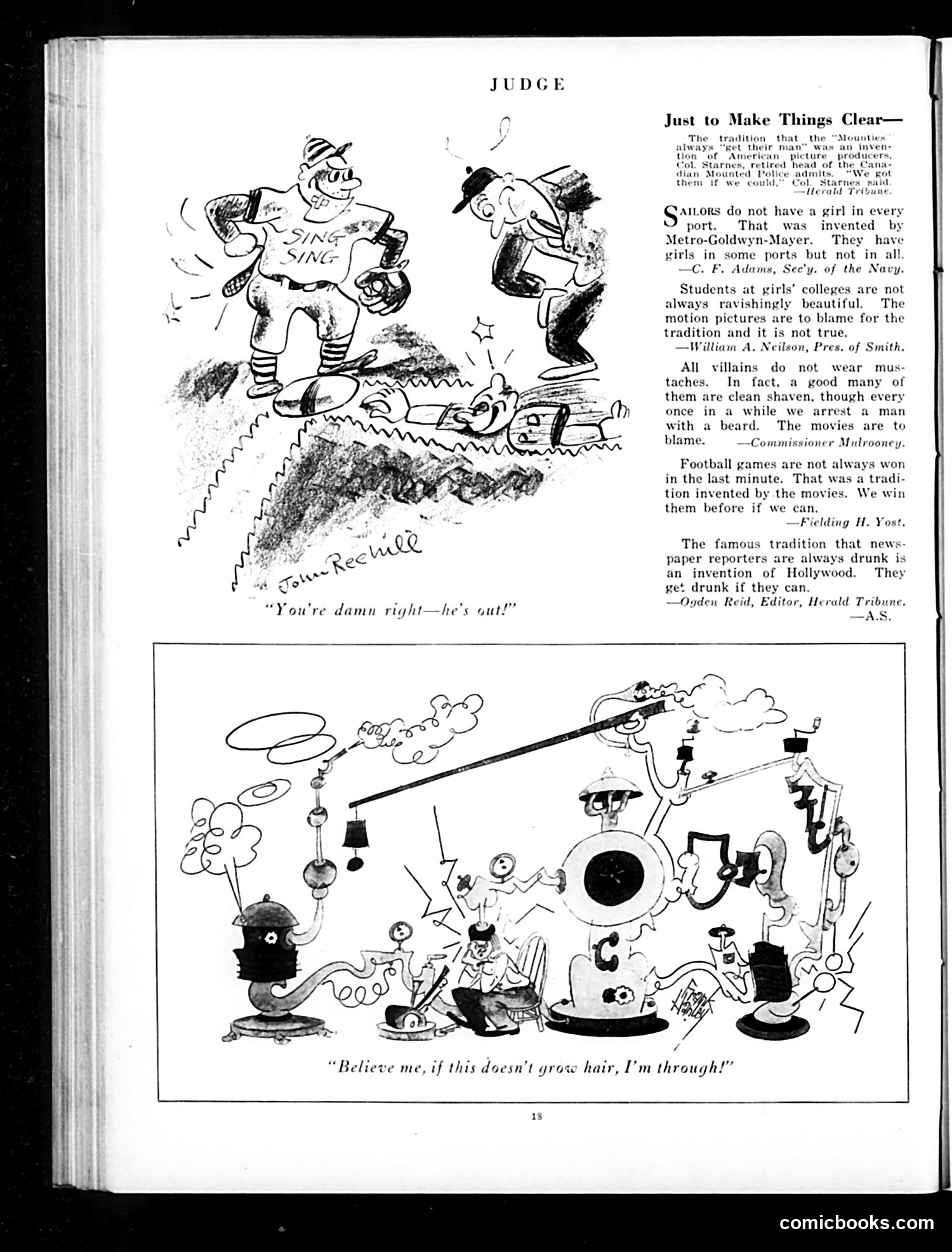
Page Analysis: "Just to Make Things Clear" This Judge page satirizes Hollywood's influence on American popular culture and misconceptions. The header features a cartoon of a baseball player ("Sing! Sing!") and a dancing figure, illustrating entertainment industry stereotypes. The main content consists of attributed quotes from real authorities—Navy Secretary C.F. Adams, Smith College President William Neilson, Police Commissioner Mulrooney, football coach Fielding Yost, and Herald Tribune editor Ogden Reid—each debunking a Hollywood-perpetuated myth: that sailors have girlfriends in every port, college girls are always beautiful, villains wear mustaches, football games are won in final moments, and reporters are perpetually drunk. The bottom cartoon shows a mad-scientist-type scenario with a hair-growth machine, captioning Hollywood's exaggerated promises ("if this doesn't grow hair, I'm through!"). The satire targets 1920s-30s cinema's distortion of reality and its cultural power in shaping public expectations about American life.
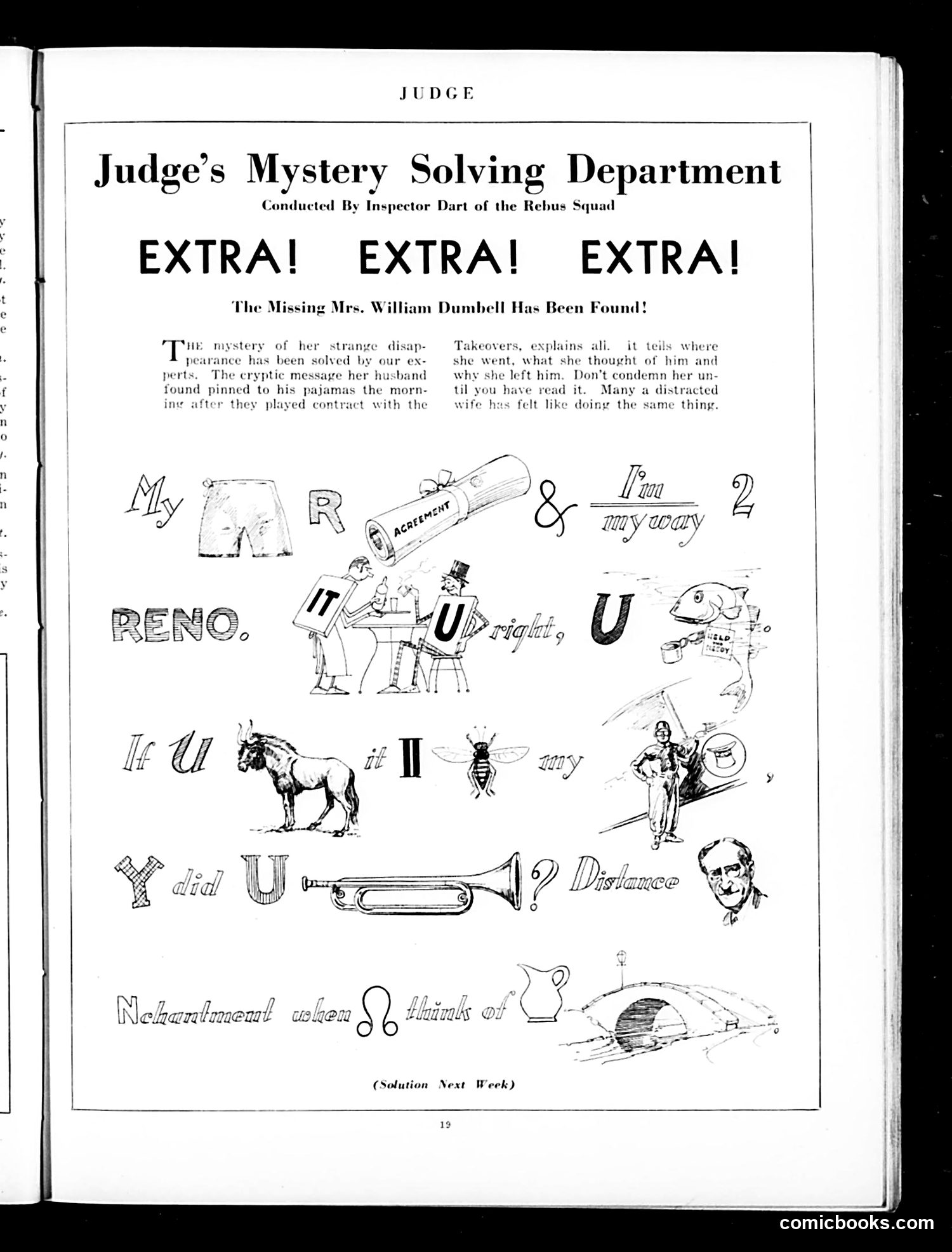
Judge's Mystery Solving Department This is a rebus puzzle — a visual word-game where images, letters, and symbols combine to spell out a hidden message. The setup is humorous: a wife has mysteriously disappeared, leaving only a cryptic rebus message pinned to her husband's pajamas after they played contract bridge together. Readers are meant to decode the visual puzzle to discover why "Mrs. William Dumbell" left. The joke satirizes marital discord, particularly the frustration wives felt toward husbands absorbed in leisure activities like contract bridge (a fashionable card game of the era). The text hints the message reveals her complaints about his behavior and explains her departure — a lighthearted poke at domestic tension and the "distracted wife" archetype. The solution was promised for the following week, making this an interactive entertainment feature typical of Judge magazine's humor offerings.
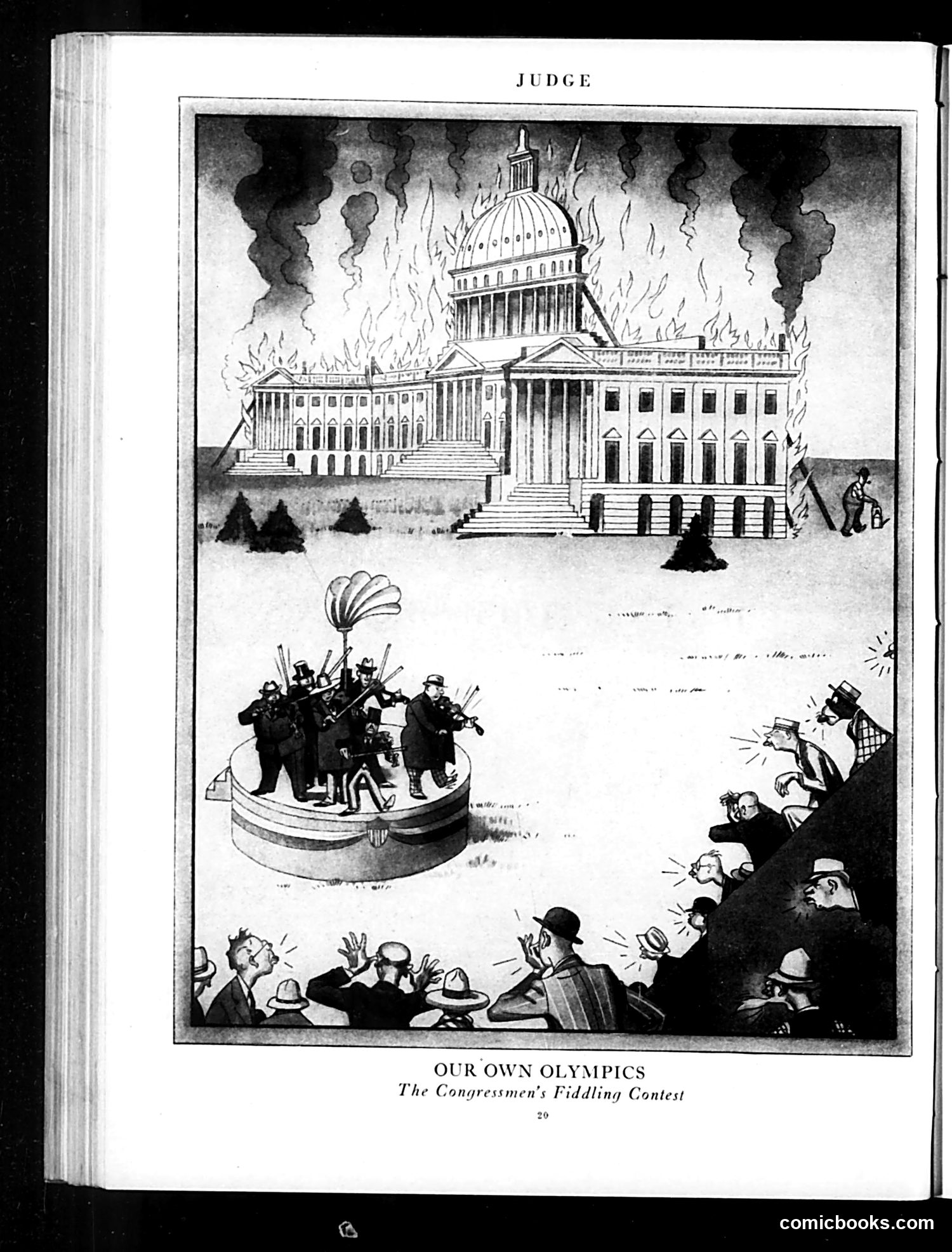
Political Cartoon Analysis This Judge magazine cartoon satirizes Congress through the metaphor of "Olympics." The Capitol Building burns in the background while congressmen compete in a boat labeled "The Congressmen's Fiddling Contest"—referencing the Nero legend of Rome burning while its leader fiddled. The burning Capitol symbolizes national crisis or governmental failure. The congressmen are portrayed as indifferent to disaster, literally fiddling (playing music) rather than addressing urgent problems. Crowds at the bottom appear distressed or reactive. The satire suggests Congress is negligent and self-absorbed during serious national troubles, prioritizing internal competitions or petty concerns over governing responsibly. This is a classic "Nero fiddling while Rome burns" critique of governmental incompetence during crisis. The specific historical context remains unclear without a date.
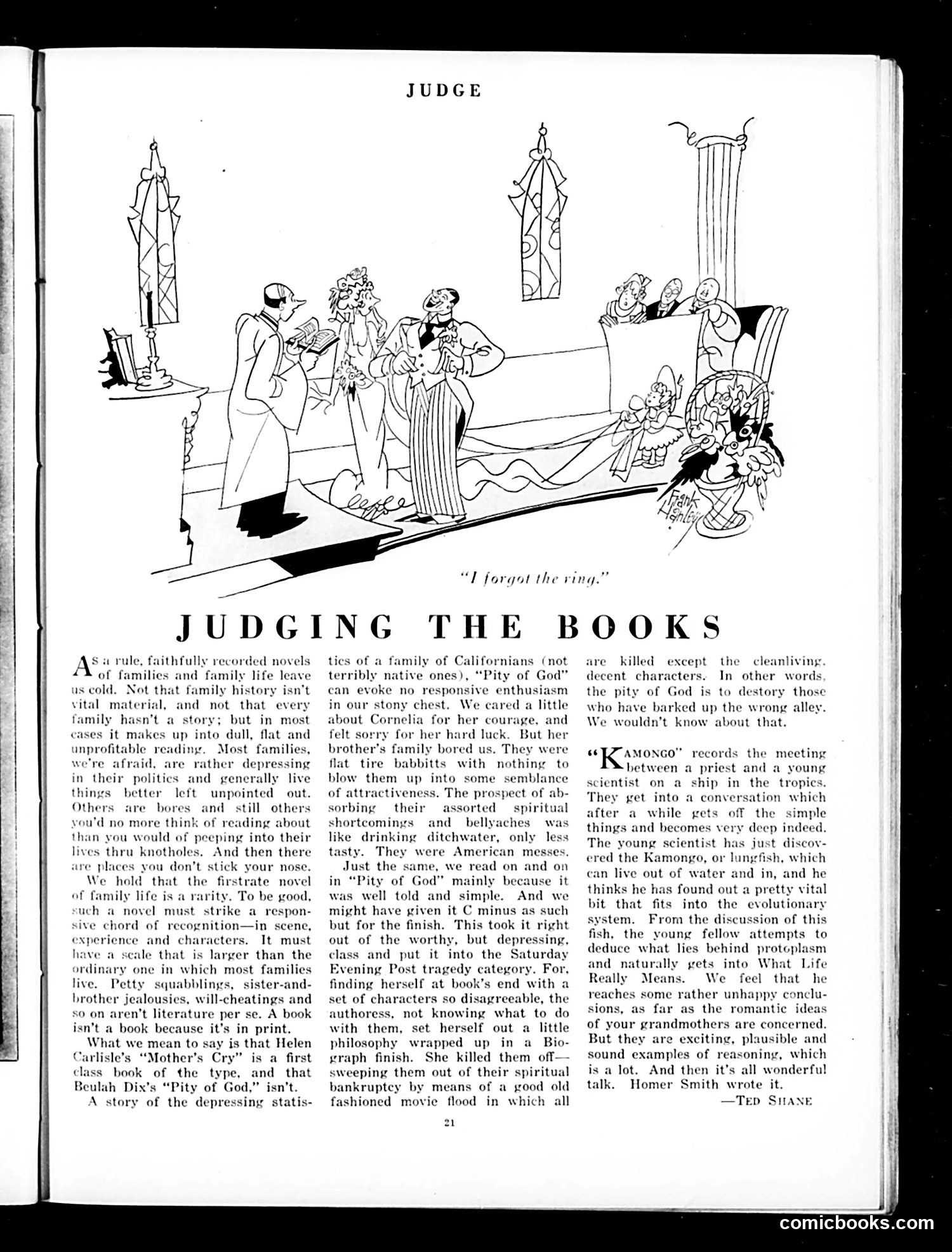
Judging the Books This page is a book review column, not a political cartoon. The small illustration at the top depicts a courtroom scene where a judge presides over the "trial" of books—a visual metaphor for the critical evaluation that follows. The reviewer (Ted Shane) discusses three novels: Helen Carlisle's *Mother's Cry* (praised as first-rate), Beulah Dix's *Pity of God* (criticized as depicting tedious "American messes" despite a well-told narrative), and *Kamongo* by Homer Smith (commended for its intellectual exploration of evolution and meaning through dialogue between a priest and scientist). The satire is literary rather than political—the author critiques sentimental family novels as generally dull unless they achieve genuine recognition of human character. The "Pity of God" earns particular scorn for solving its narrative problems with a convenient movie-style flood that kills off undesirable characters, representing lazy storytelling. This reflects 1920s-30s literary taste favoring psychological realism over melodrama.
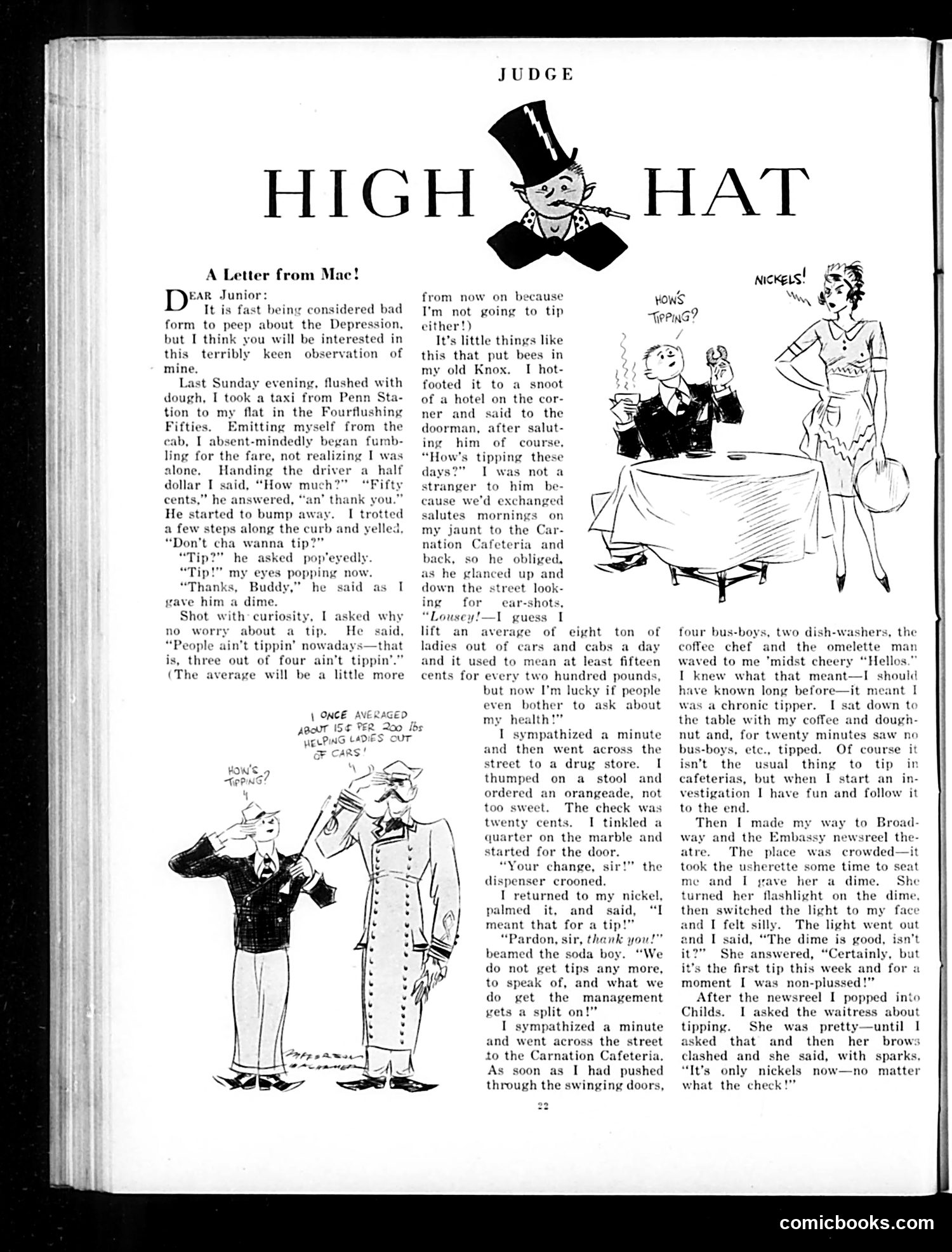
"High Hat" - A Depression-Era Commentary on Tipping Culture This is a humorous letter describing the author's (signed "Mac") observations about declining tipping practices during the Great Depression. The piece satirizes how economic hardship has changed service-industry expectations. The narrative follows Mac visiting various service workers—a taxi driver, hotel doorman, soda fountain attendant, cafeteria staff, movie usherette, and waitress—documenting how they've stopped expecting tips or receive only nickels instead of larger amounts. Each worker explains their reduced circumstances. The satire cuts both ways: it mocks both the working poor's disappointment and Mac's somewhat sanctimonious investigation into their financial struggles. The accompanying illustrations show stylized figures representing these service workers and Mac's interactions with them. The piece's dark humor lies in depicting how the Depression has systematized penny-pinching across service sectors, reducing formerly standard gratuities to bare minimums. It's social commentary wrapped in a casual, observational format typical of Judge magazine's satirical approach to contemporary economic conditions.
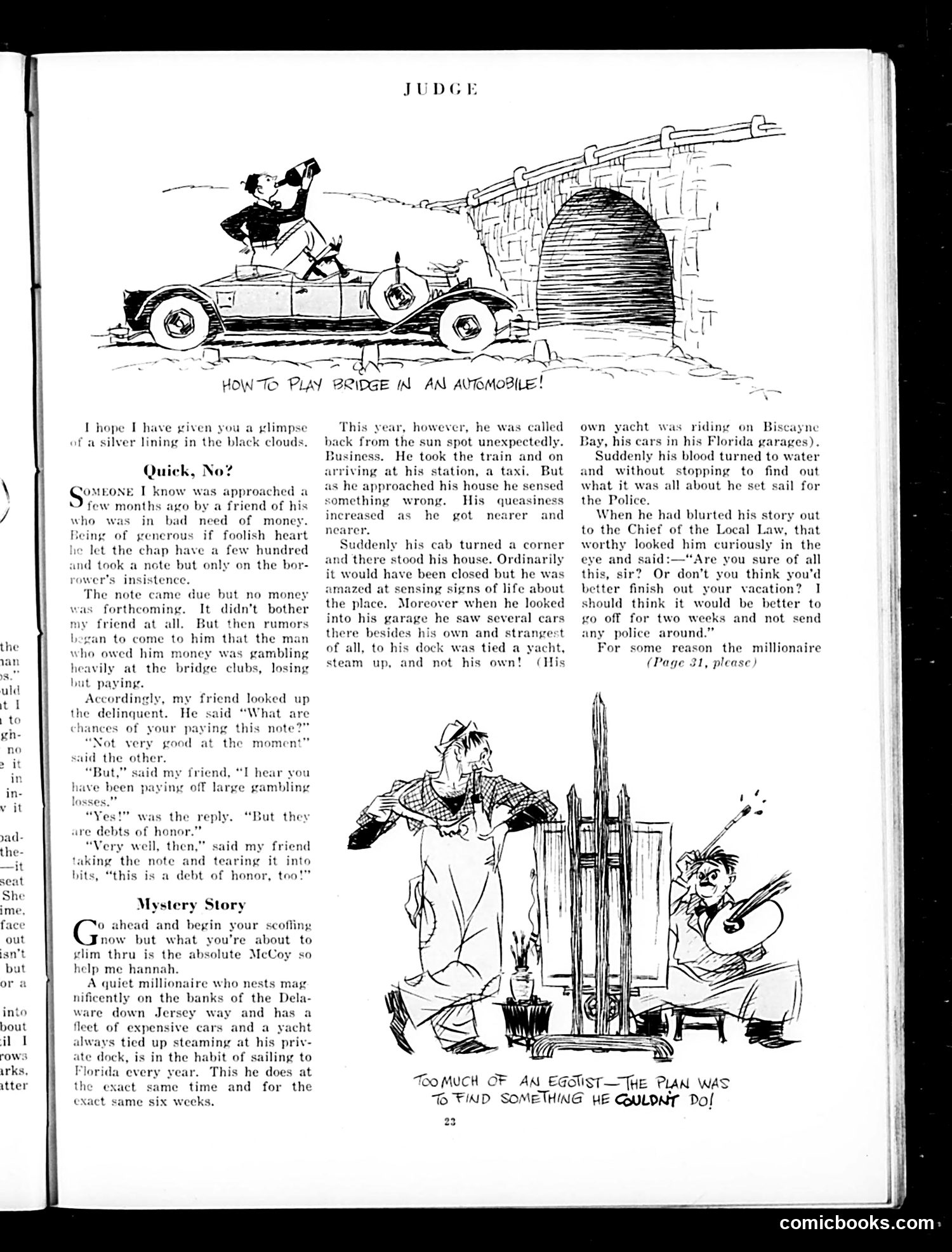
"Judge" Magazine Page Analysis This page contains two satirical pieces targeting wealthy Americans' social pretensions: "How to Play Bridge in an Automobile" (top): A cartoon mocking the nouveau riche obsession with bridge—the card game that dominated elite social clubs in the 1920s-30s. The joke: a man is so devoted to bridge that he plays it while driving, suggesting the game had become absurdly central to wealthy social life. "Quick, No?" (main text story): Satirizes the honor code among the wealthy. A millionaire lends money to a friend who then gambles heavily at bridge clubs. When pressed for repayment, the borrower claims gambling debts are "debts of honor"—implying they take priority over legitimate loans. The lender sarcastically tears up the note, declaring it too is "a debt of honor," exposing the hypocrisy of selective ethics among the rich. "Mystery Story" (bottom): A serialized mystery about a wealthy man whose house, cars, and yacht appear occupied during his Florida absence—suggesting burglary or intrusion into his private estate. The overall theme: satirizing the moral contradictions and frivolous preoccupations of American wealthy elites.
"Judging the Movies" by Pare Lorentz This is a film review column praising René Clair's French film "À Nous la Liberté." The critic argues it's the only worthwhile movie coming to American theaters that summer, commending Clair as France's best director. The review emphasizes Clair's technical sophistication—his deliberate use of camera, editing, and sound to serve the story, learned from Russian cinematography and American slapstick traditions. The critic admires the film's "French" quality: delicate, charming, and witty, though occasionally too gentle in its factory satire. The column also critiques American filmmakers who desperately search for material, repeatedly setting stories in only three American cities (Los Angeles, Chicago, New York) while importing British and émigré talent—suggesting Hollywood's creative exhaustion and disconnection from actual American life.
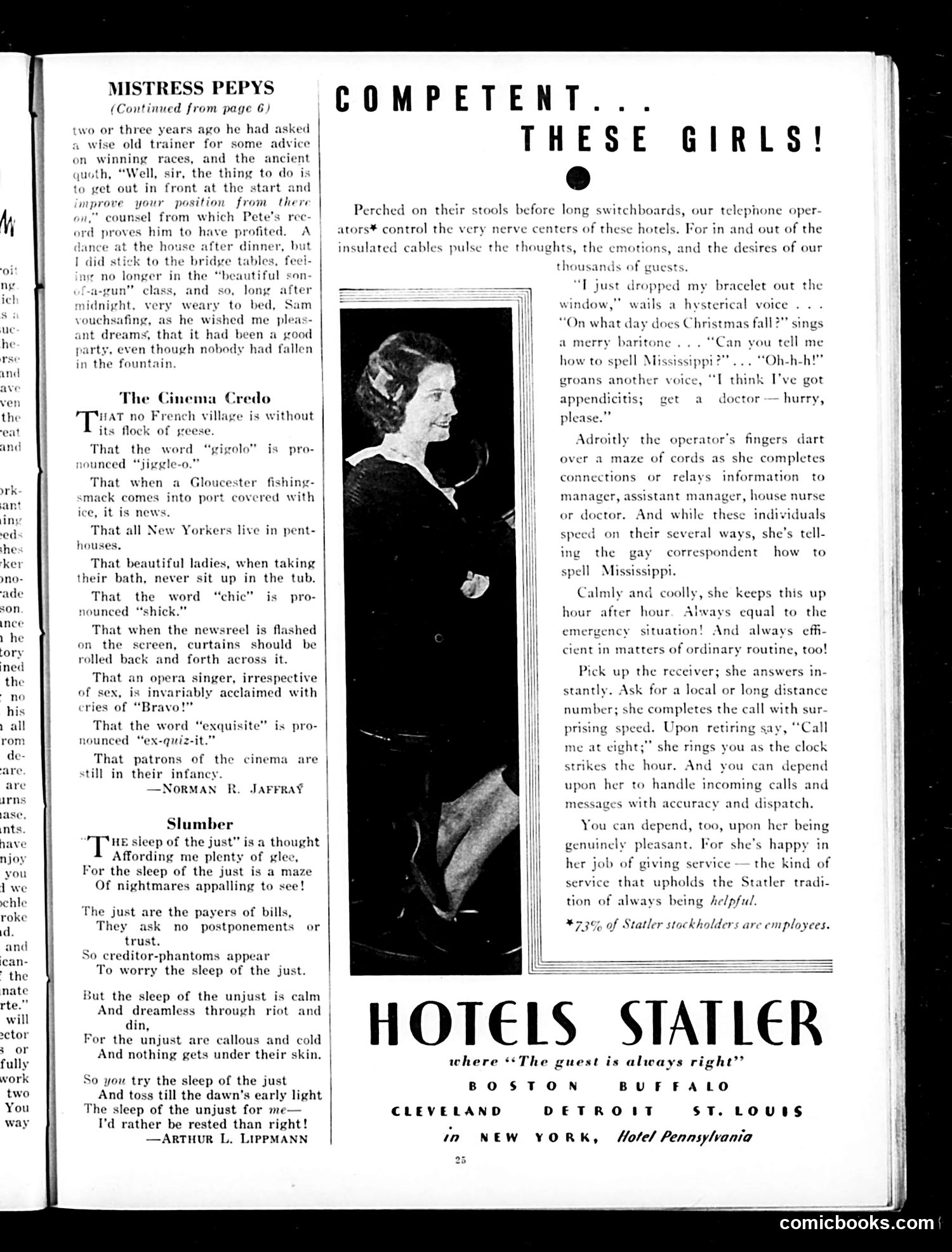
Page Analysis: Judge Magazine Advertisement This page contains a Statler Hotels advertisement disguised as editorial content, promoting the competence of hotel telephone operators. The accompanying photograph shows a female telephone operator at a switchboard. Key elements: - The ad emphasizes operators' professionalism, multitasking abilities, and pleasant demeanor while handling diverse guest requests (medical emergencies, spelling help, wake-up calls) - Social context for modern readers: This represents 1920s-30s labor marketing. The operators are presented as efficiently managing hotel "nerve centers," reflecting how technology (telephone switchboards) was transforming work while women dominated these operator positions - The satire/message: Rather than satirizing operators, the ad actually celebrates their competence—though readers would recognize the irony: operators fielded absurd, demanding requests with grace while corporate literature praised their emotional labor as "helpful" service - Notable detail: A footnote claims "73% of Statler stockholders are employees," suggesting profit-sharing, though no verification is provided The page contextualizes working women's roles during this era—skilled, essential labor presented as pleasantly service-oriented rather than demanding professional recognition.
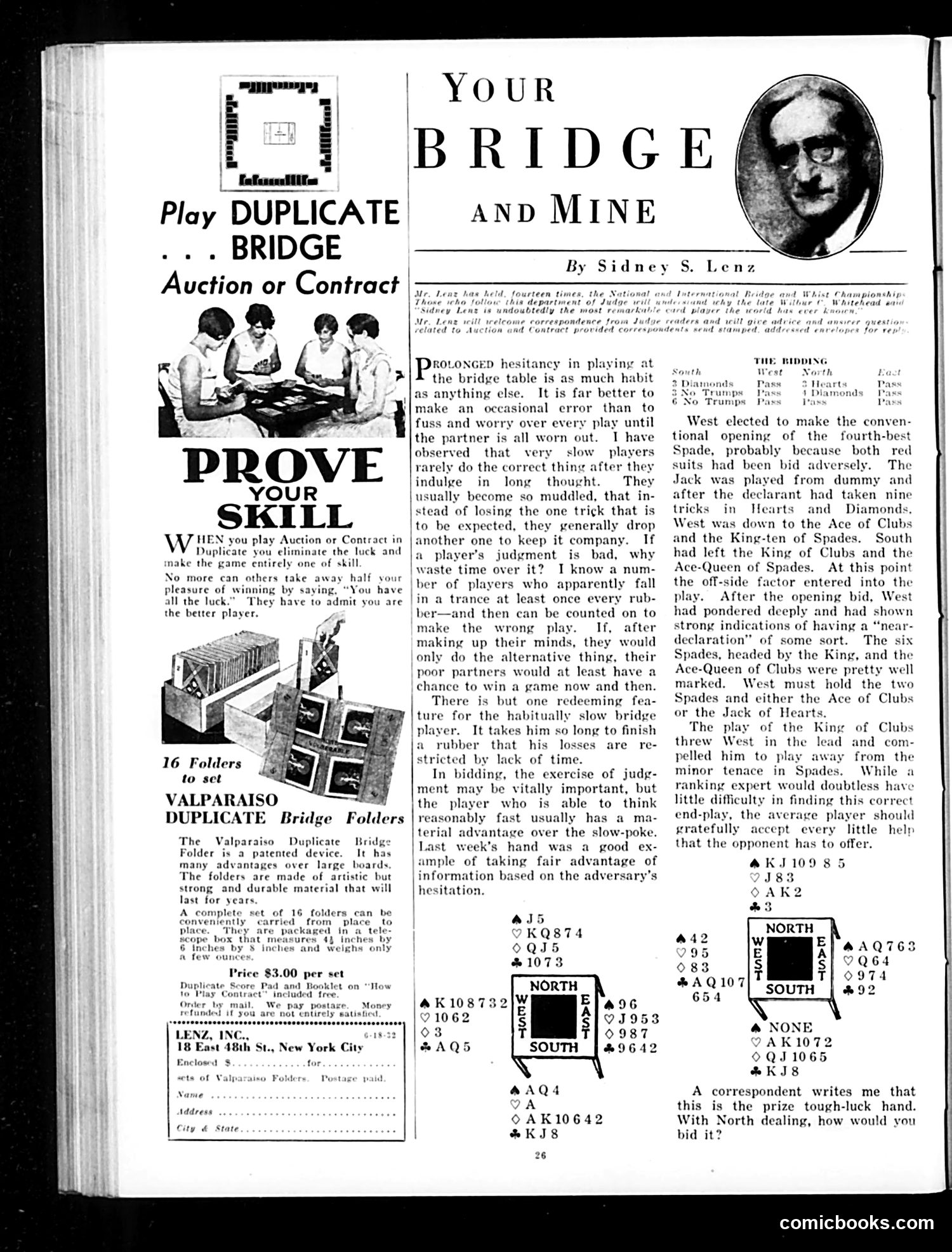
"Your Bridge and Mine" - Analysis This page is primarily instructional bridge content, not political satire. It's a column by Sidney S. Lenz (a renowned bridge expert) offering strategy advice to intermediate players. The main article criticizes "habitually slow bridge players" who overthink every decision, waste time, and paradoxically make poor plays despite their deliberation. Lenz argues that fast players with good judgment have an advantage. He illustrates this with a complex hand analysis showing how a perceptive West player can deduce the card distribution from North's hesitation and bidding patterns—an "off-side factor" that helps find the correct end-play. The surrounding advertisements (Valparaiso Duplicate Bridge Folders, Lenz Inc.) are product promotions aimed at serious bridge players. This is bridge instruction and marketing, not satire or political commentary.
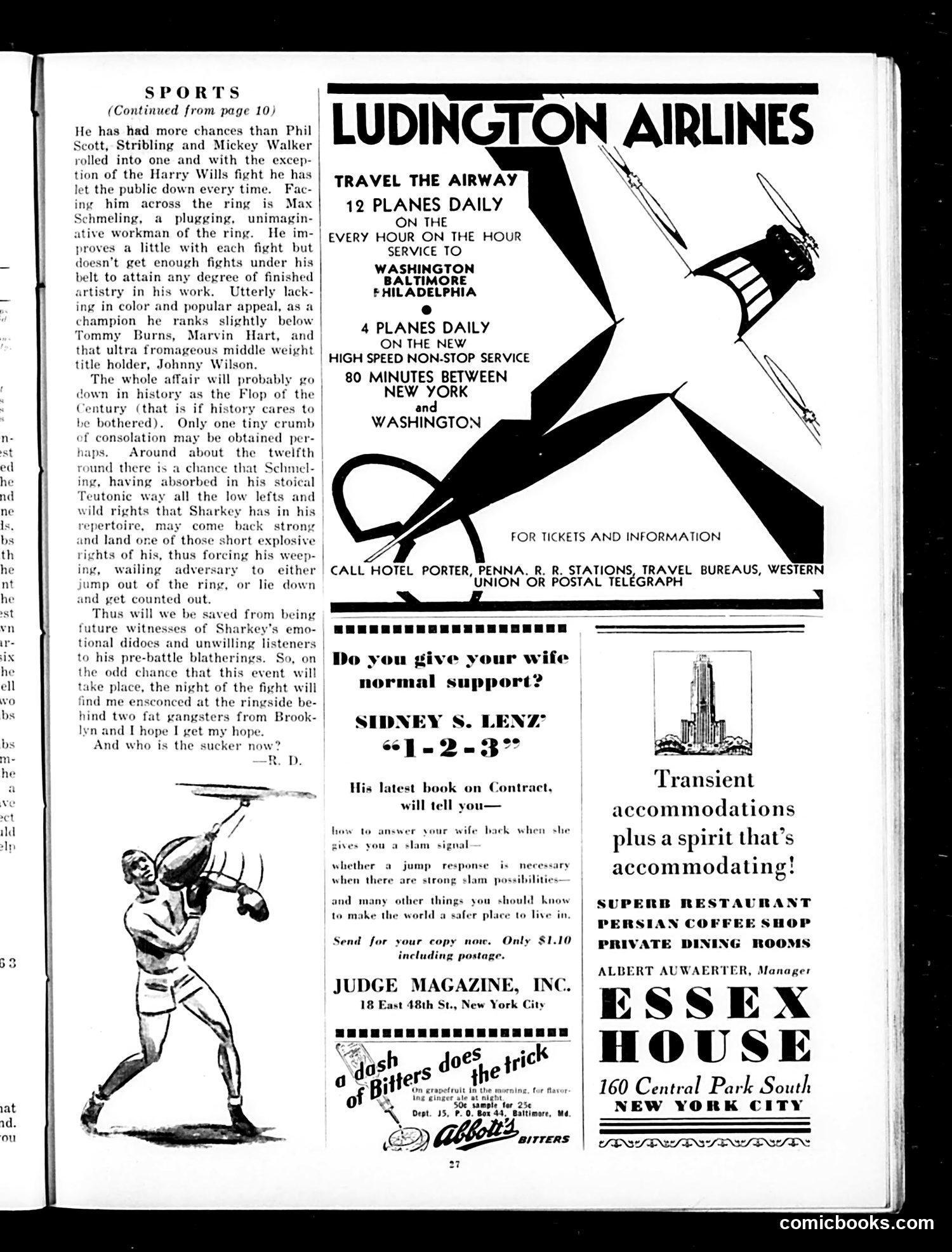
Judge Magazine Page Analysis This page is primarily advertising with a sports column at the top. The sports section discusses boxing matches, critiquing fighters Phil Scott and Max Schmeling, predicting the fight will be remembered as "the Flop of the Century." The advertisements include: - Ludington Airlines: promoting frequent daily service to Washington, Baltimore, and Philadelphia—reflecting 1920s-30s enthusiasm for commercial aviation as a modern travel innovation - Sidney S. Lenz's book "1-2-3": a humorous marital advice guide asking "Do you give your wife normal support?"—appearing to satirize contemporary debates about spousal financial responsibility and gender roles - Essex House (NYC hotel): touting "transient accommodations" and amenities like a Persian coffee shop - Judge Magazine advertisement and Allob's Bitters (a patent medicine) The page reflects Depression-era advertising targeting middle-class readers with transportation, hospitality, and domestic advice products. The tone is lighthearted and commercial rather than politically satirical.
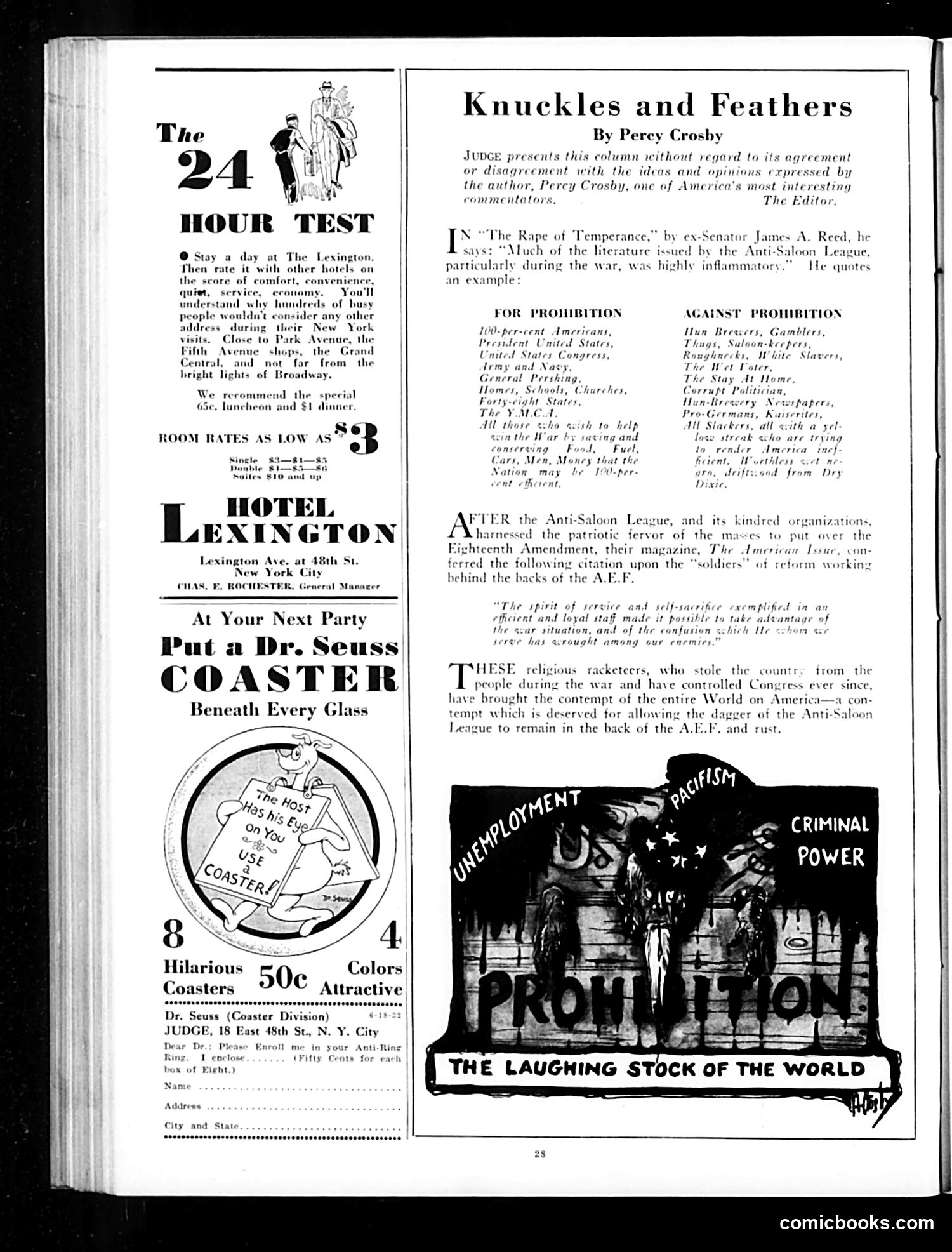
Political Context of This Judge Magazine Page This page from *Judge* magazine attacks Prohibition and the Anti-Saloon League during the post-WWI era. Percy Crosby's column presents two opposing lists of who supported and opposed Prohibition—one satirically portraying prohibitionists as hypocritical patriots (including the President, Congress, and Army), the other as actual opponents (brewers, saloon-keepers, and wet voters). The main cartoon depicts Prohibition as "the laughing stock of the world," personified by caricatured figures representing unemployment, pacifism, and "criminal power." The text accuses the Anti-Saloon League of exploiting wartime patriotism to pass the Eighteenth Amendment, then controlling Congress—characterizing them as "religious racketeers" who damaged America's international reputation. This reflects the fierce 1920s debate over Prohibition's implementation and its unintended social consequences, positioning *Judge* as anti-Prohibition and skeptical of the reform movement's methods and motives.
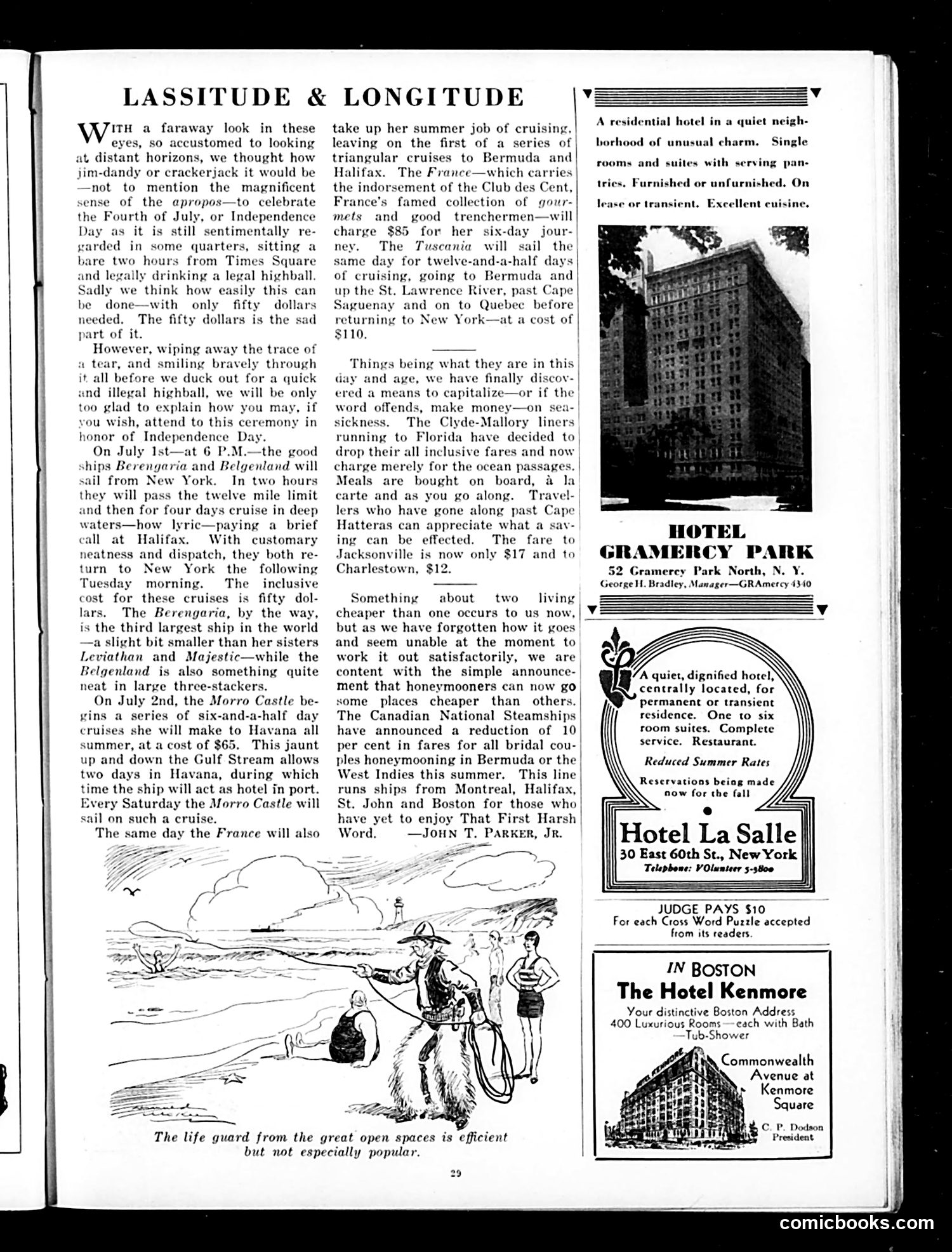
Content Analysis: "Lassitude & Longitude" This Judge magazine article is primarily travel advertising disguised as commentary, not political satire. The piece discusses budget cruise options for Fourth of July 1929, targeting readers with modest means ($50-$110). The single cartoon (bottom left) depicts beachgoers and a lifeguard, with the caption: "The life guard from the great open spaces is efficient but not especially popular." This appears to satirize lifeguards as overly strict or humorless enforcers of beach rules—a mild social joke rather than political commentary. The article's humor derives from economic anxiety: the author notes Americans can celebrate Independence Day with affordable cruises if they can spare just fifty dollars, then immediately laments "Sadly we think how easily this can be done—with only fifty dollars needed. The fifty dollars is the sad part of it." This reflects Depression-era economic strain, where even modest vacation costs seemed burdensome to middle-class readers. The remainder is hotel advertisements.
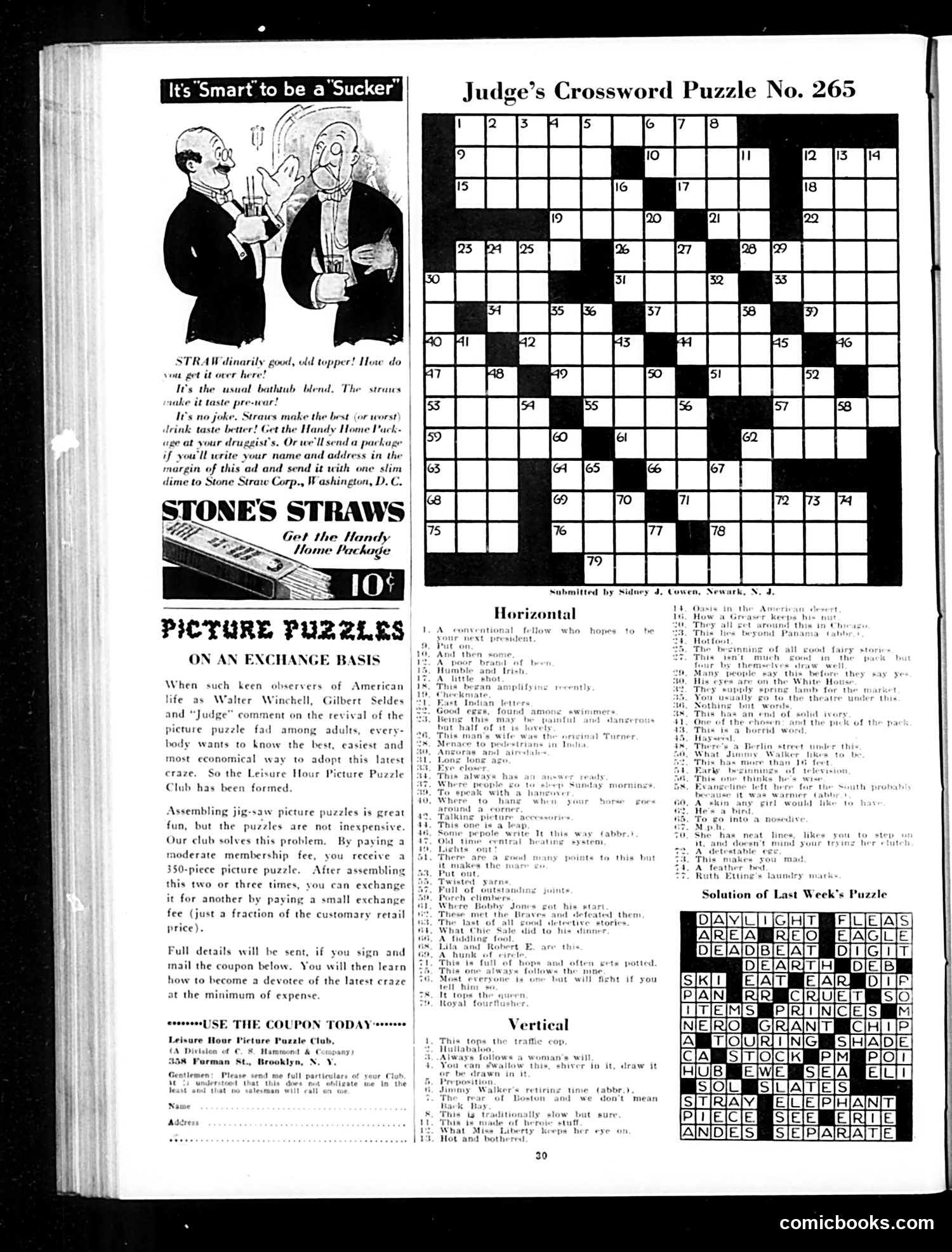
Judge Magazine Cartoon Analysis The page features a Stone Straws advertisement disguised as social commentary. Two well-dressed men in formal attire discuss drinking quality, with one praising the other's drink as "extraordinarily good, old topper!" The humor revolves around a Prohibition-era joke: the drink tastes pre-war (better) because straws mask the taste of homemade "bathtub gin"—the illegal alcohol Americans produced during Prohibition (1920-1933). The cartoon implies that despite legal restrictions on alcohol, wealthy men still drank illegally and valued products that improved the palatability of poor-quality bootleg liquor. The satire targets the hypocrisy of Prohibition enforcement among the upper classes. The remainder of the page advertises picture puzzles (jigsaw puzzles), a popular 1920s-30s craze mentioned by contemporary cultural commentators like Walter Winchell.
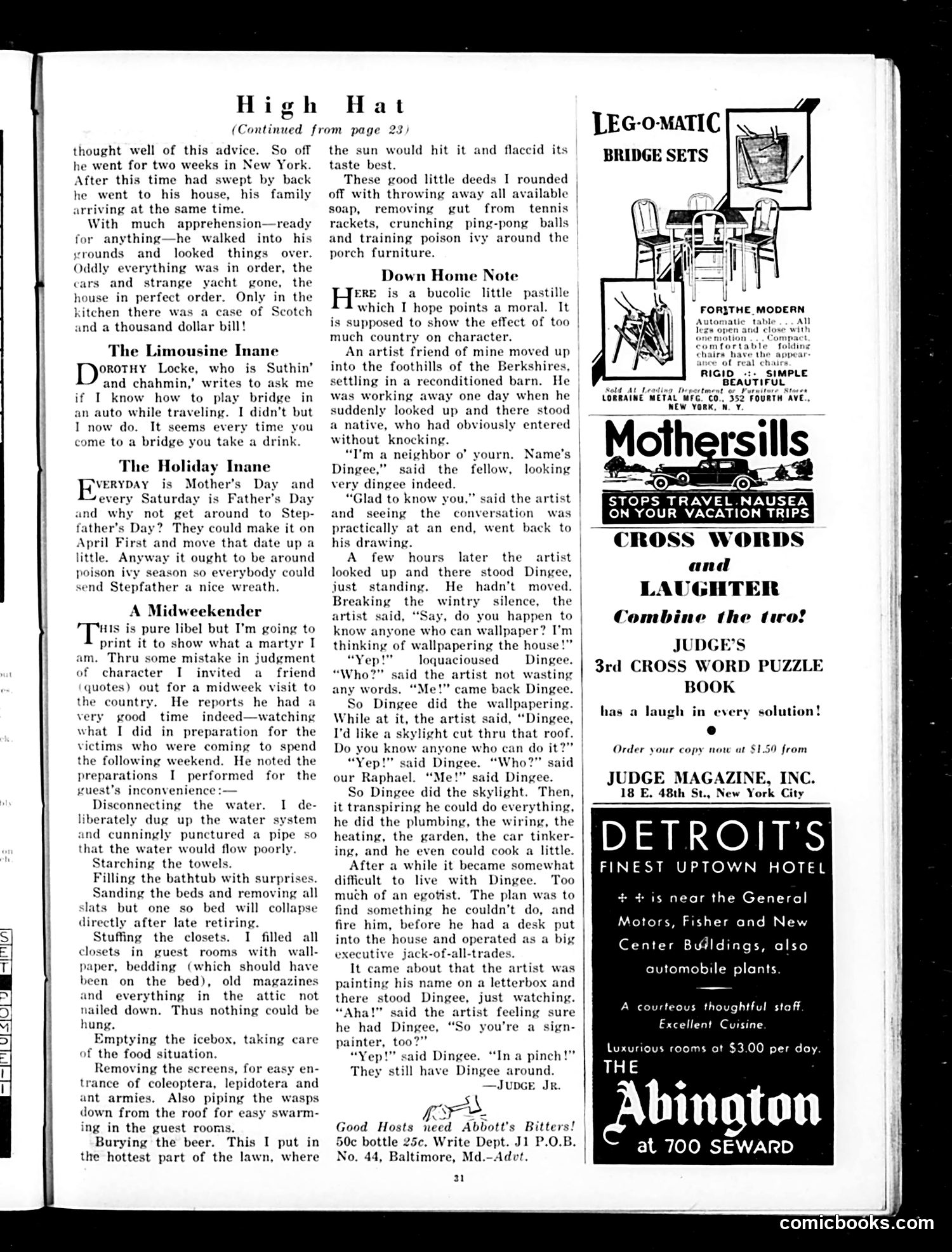
Judge Magazine Page Analysis This page contains primarily humorous fiction sketches rather than political cartoons. The content reflects 1920s-30s upper-middle-class social anxieties: "The Limousine Inane" jokes about bridge-playing while driving—a pun on "bridge" (the card game) and actual bridges requiring drinks. "The Holiday Inane" satirizes the commercialization of holidays by suggesting a "Stepfather's Day" on April Fools' Day, implying stepfathers are inherently unwelcome (poison ivy wreaths as gifts). "A Midweekender" describes sabotaging a guest's visit through petty hostility—unpaired beds, clogged plumbing, removed screens to allow insects—mocking the social obligation to host weekend visitors. "Down Home Note" presents a rural character named Dingee who, despite appearing idle and taciturn, proves capable of every conceivable task (wallpapering, carpentry, plumbing, wiring). The satire targets romantic notions of rural simplicity versus actual competence. The page emphasizes class-conscious domestic humor typical of Judge's satirical approach.
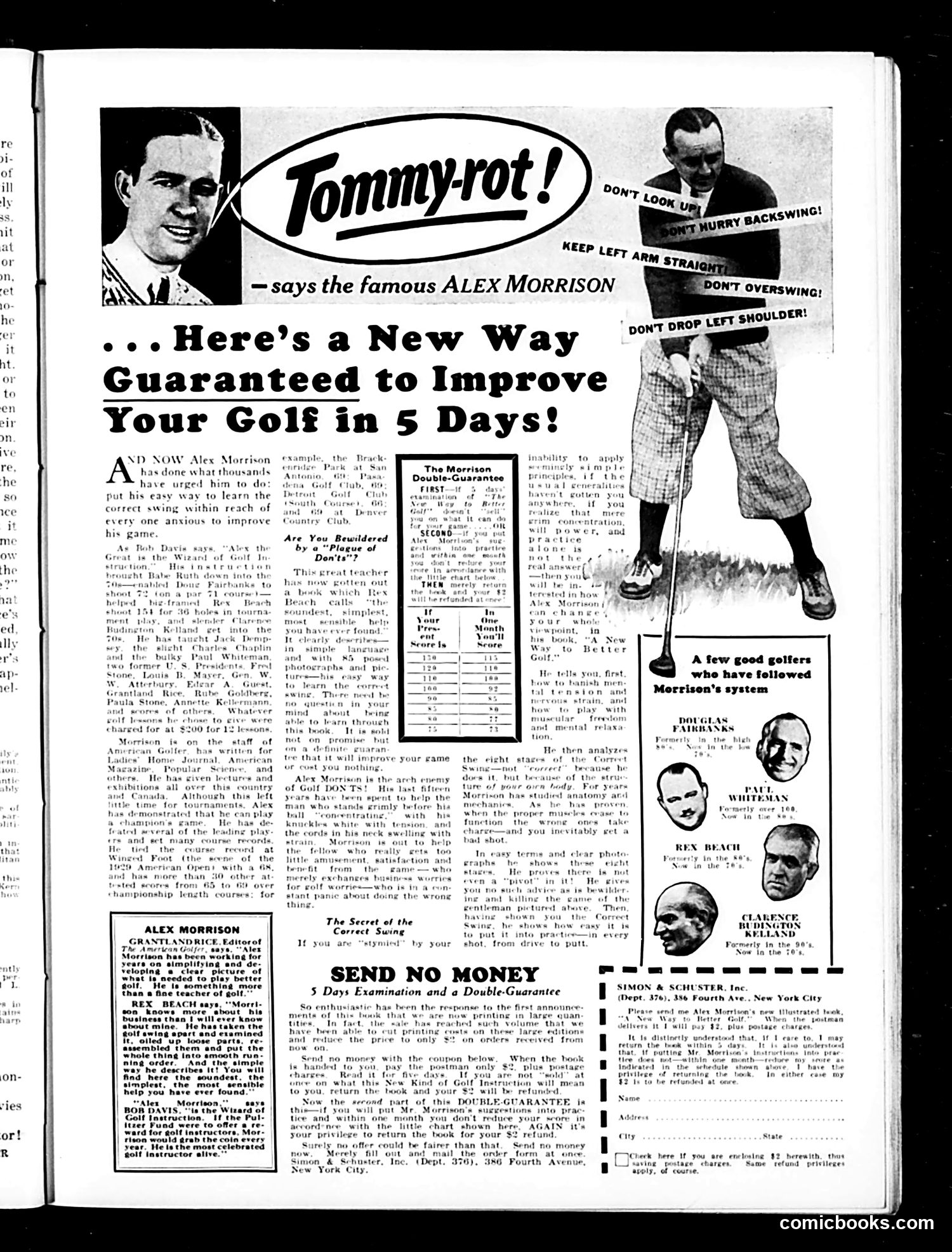
Understanding This Judge Magazine Advertisement This is primarily a mail-order advertisement for Alex Morrison's golf instruction book, not a satirical cartoon. The page promotes Morrison's "guaranteed" method to improve golf swing in five days. Key figures shown: - Alex Morrison (upper left), a golf instructor who taught celebrities and former U.S. Presidents - Douglas Fairbanks, Willy Collier, Rex Beach, and Clarence Budington Kelland are listed as golfers who followed the system The pitch's appeal: The ad exploits common frustrations—golfers confused by conflicting advice ("plague of don'ts"), unable to afford expensive lessons ($200 for 12), and wanting quick results. Morrison's method promises to simplify golf instruction using "easy" principles about body mechanics and the "correct swing." The "guarantee": A five-day examination period with money-back promise—standard mail-order sales tactics. This reflects 1920s-30s American consumer culture: the faith in expert systems, celebrity endorsements, and mail-order self-improvement products that could supposedly democratize knowledge previously available only to the wealthy.
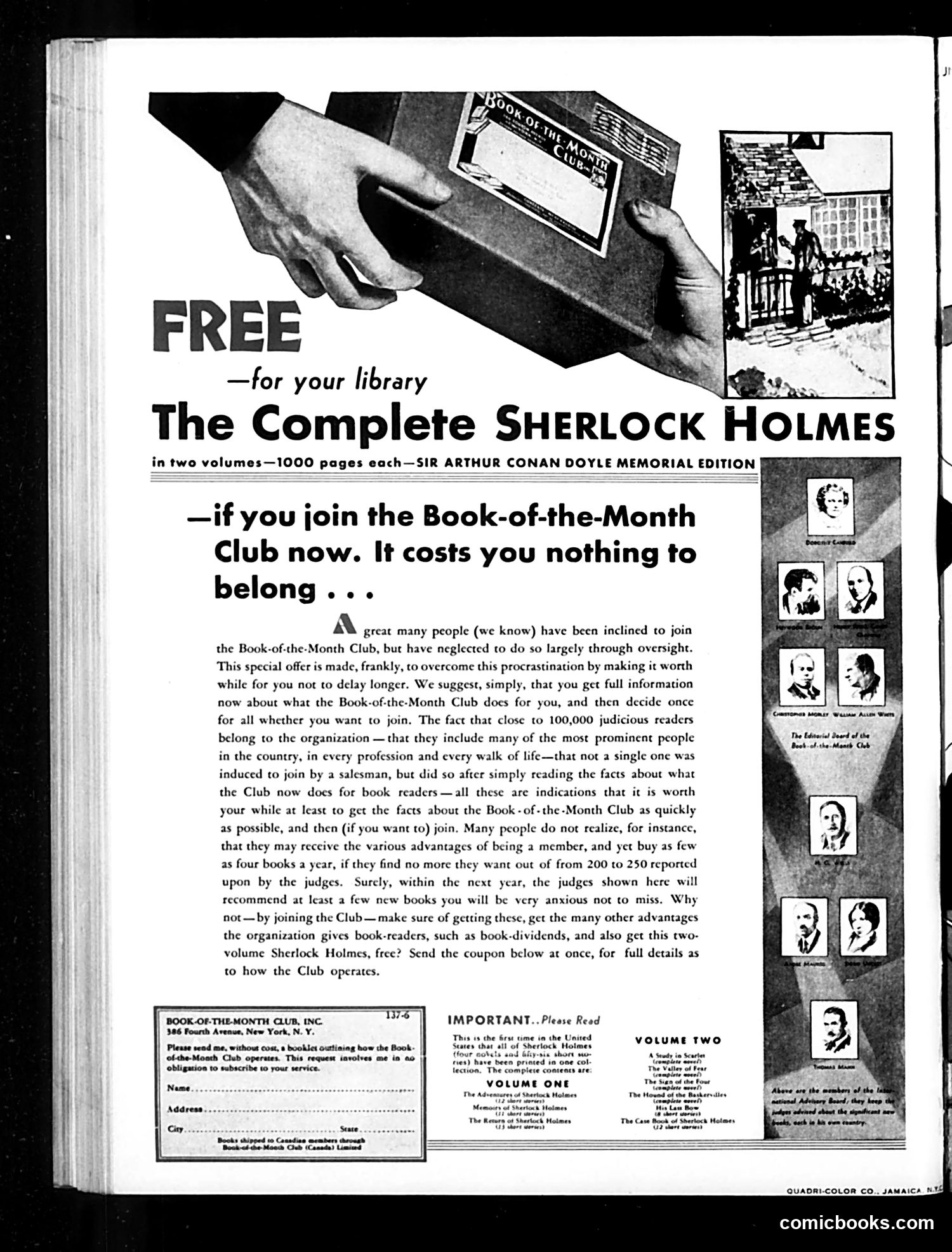
Analysis This is primarily advertising copy, not satire or political commentary. It's a promotional page for the Book-of-the-Month Club, offering a free two-volume Sherlock Holmes memorial edition (Sir Arthur Conan Doyle edition) as an incentive to join. The page features: - A prominent image of hands holding the boxed book set - Photographs of what appear to be the Club's editorial judges (portraits on the right side) - Persuasive copy addressing reader hesitation about joining, emphasizing that membership is free and non-obligatory - Details about book selection (200-250 titles judged annually; members can purchase as few as four books yearly) - A membership coupon The appeal targets educated readers valuing literature and prestigious endorsements. The "judges" photos serve to establish authority and prestige. This represents mid-20th century direct-mail marketing tactics—offering free premiums to overcome enrollment resistance. No political satire is evident; this is straightforward commercial promotion.