judge
Judge — June 25, 1932
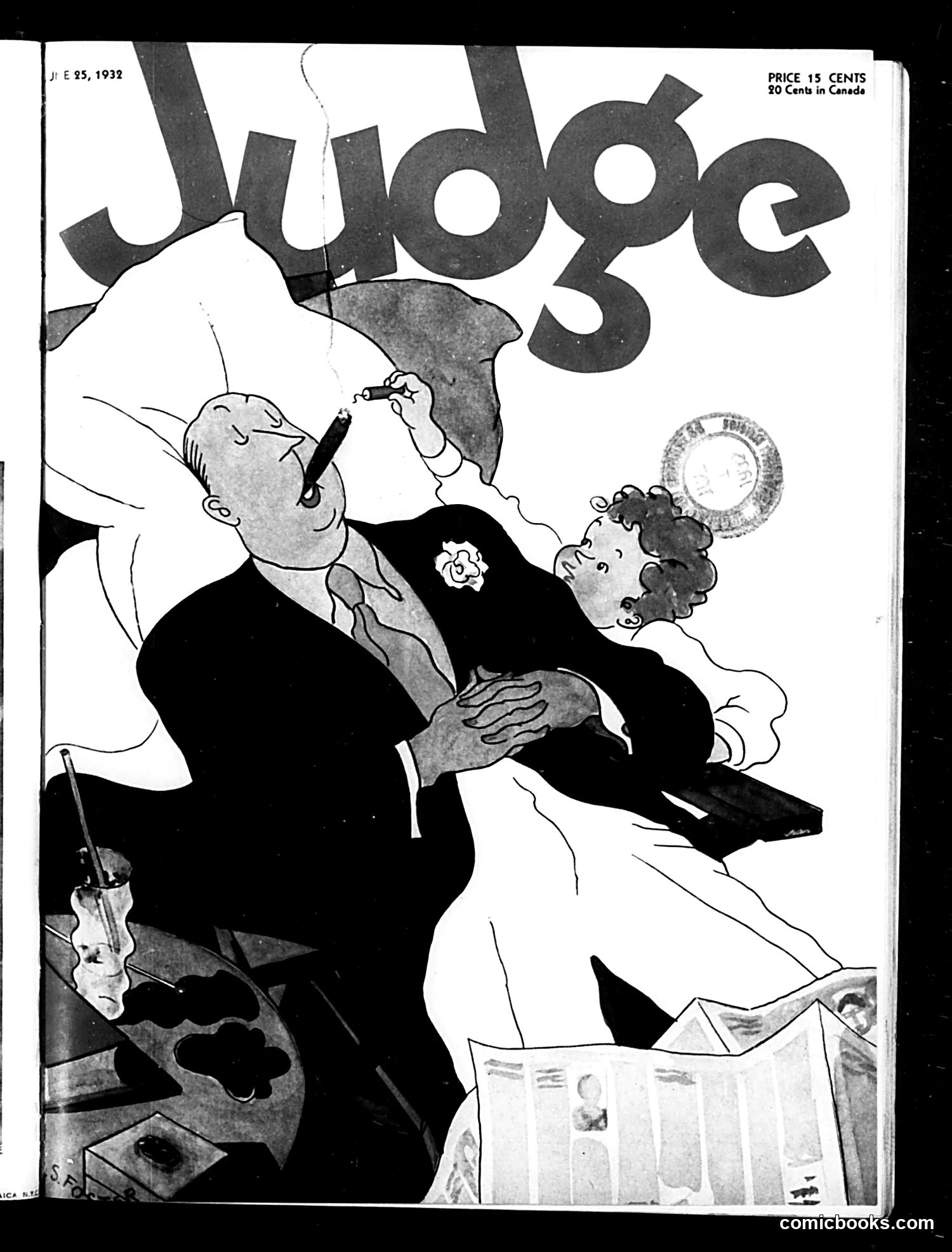
Judge Magazine, June 25, 1932 This cartoon satirizes the economic desperation of the Great Depression era. The central figure appears to be a wealthy or middle-class man in formal attire, depicted with exaggerated features typical of 1930s caricature. He's shown in a compromising or vulnerable position with a woman, suggesting infidelity or moral compromise—a common satirical trope for depicting hypocrisy among the privileged classes. The large "Judge" masthead dominates the composition. The presence of a newspaper and drink suggest idle leisure during a period of widespread unemployment and hardship. The satire likely critiques the moral bankruptcy and self-indulgence of affluent Americans while ordinary citizens suffered economically—a pointed commentary on class disparities during the Depression.
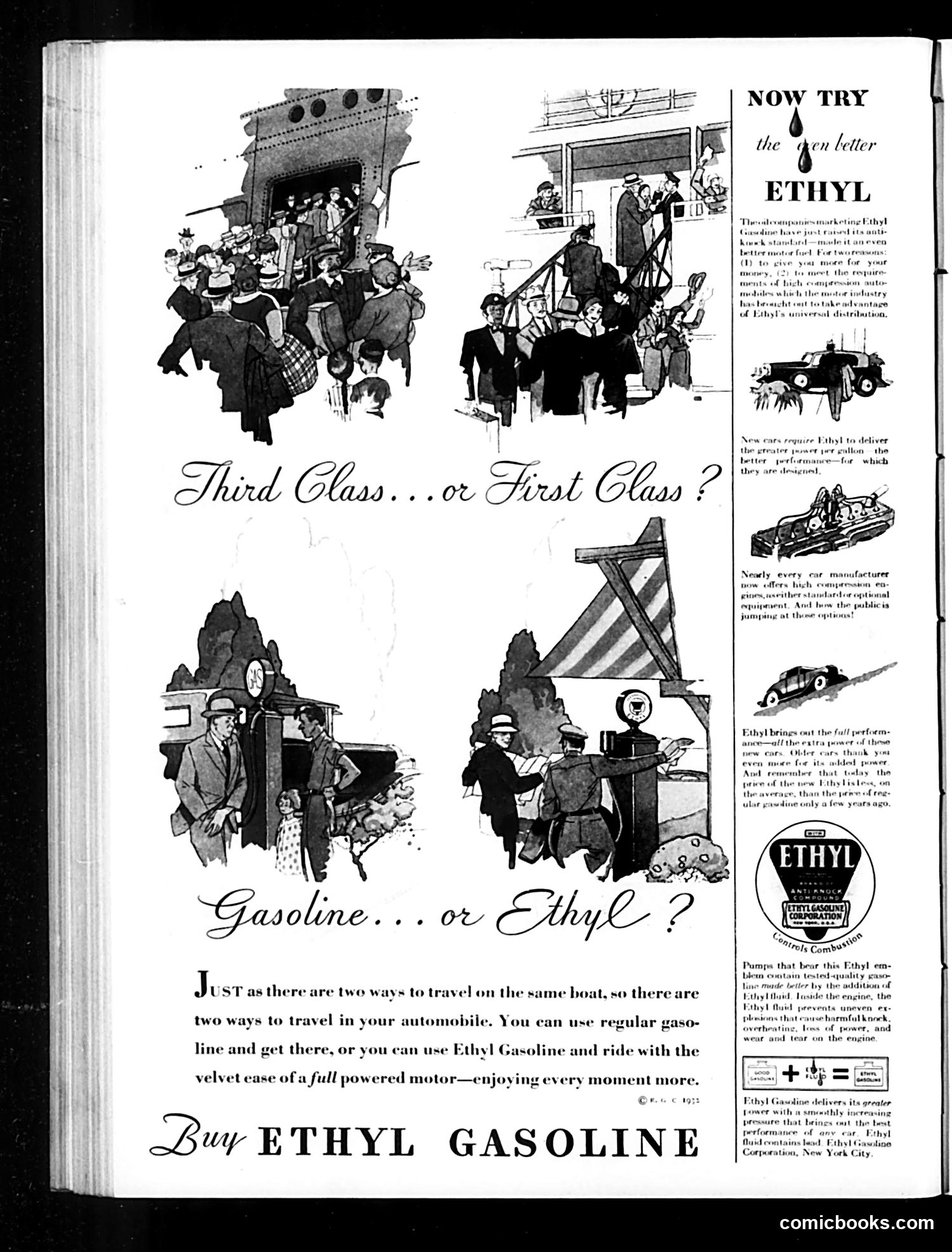
Ethyl Gasoline Advertisement (Judge Magazine) This is primarily a commercial advertisement rather than political satire, promoting Ethyl Gasoline as a premium fuel additive. The page uses a travel metaphor—comparing passenger classes on ships (top illustrations) to fuel choices for automobiles (bottom illustrations). The argument: just as travelers choose between third-class and first-class passage, drivers can choose between regular gasoline and Ethyl Gasoline for superior engine performance. The ad emphasizes Ethyl's benefits: smoother acceleration, greater power output, and reduced engine wear. The right sidebar features testimonials claiming Ethyl delivers better performance and reliability than standard gasoline. This appears to be from the 1920s, when tetraethyl lead additives were being marketed as modern automotive improvements—before their serious health hazards became widely known.
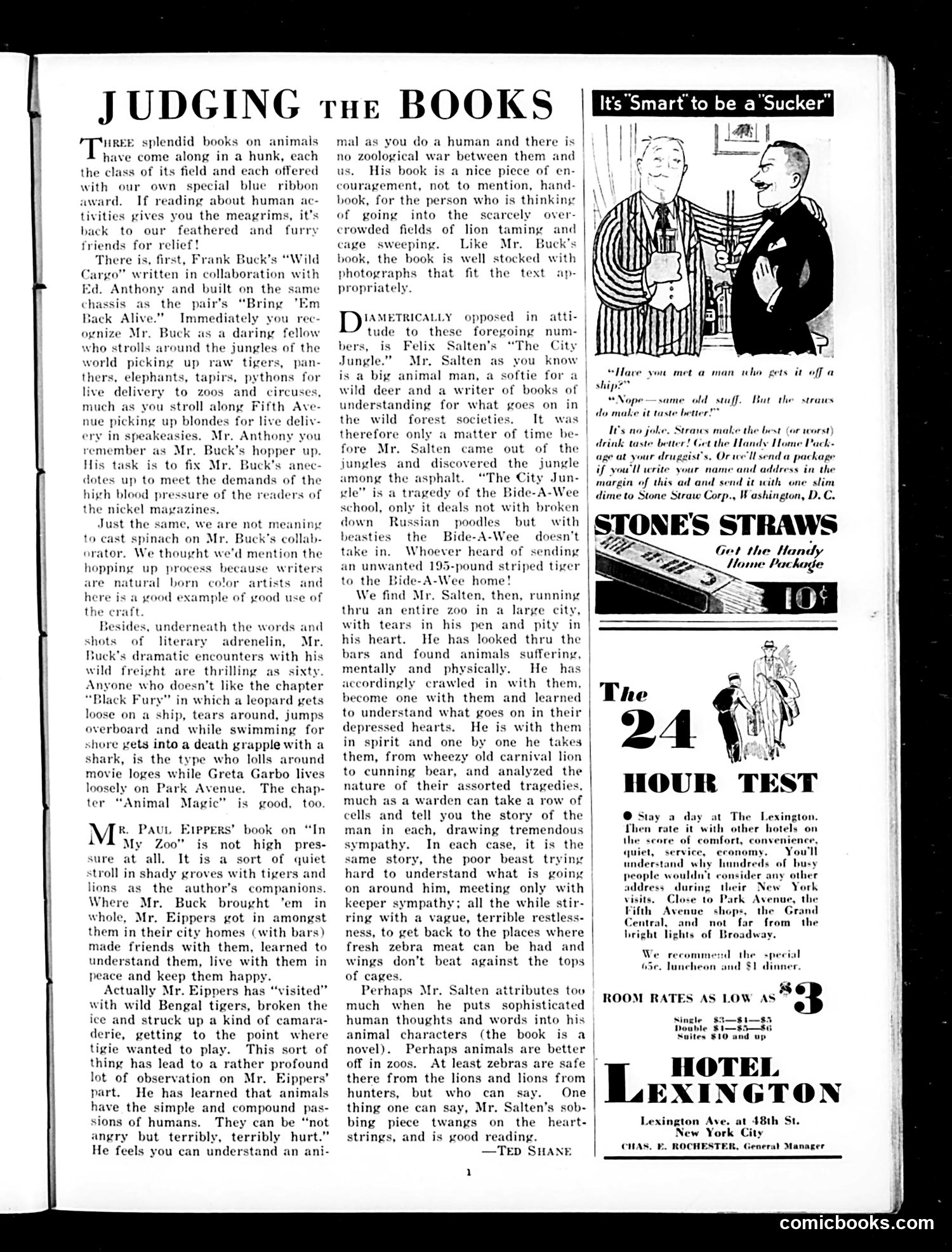
Analysis This page is primarily a book review column ("Judging the Books") with minimal satirical content. The main cartoon, titled "It's 'Smart' to be a 'Sucker,'" depicts two men discussing a book—one appears to be a salesman or promoter pitching to a skeptical customer. The caption jokes that "straws" make the best "or worst" drink accessory, suggesting the cartoon satirizes how marketing gimmicks ("straws") convince consumers to buy inferior products. The review itself discusses animal-themed books by Frank Buck, Felix Salten, and Paul Eippers. The cartoon's broader point appears to mock consumer gullibility—being a "sucker" for clever advertising rather than quality content. The page is otherwise dominated by advertisements for Stone's Straws, a 24-hour hotel test, and Hotel Lexington, indicating this is primarily a commercial publication page.
Analysis This page contains no cartoon or satirical artwork — it's an editorial announcement from Judge Magazine, Inc. explaining their summer publication schedule. The text explains that Judge is transitioning to a two-issue summer schedule (one in July, one in August) before resuming weekly publication in September. The editors justify this as a practical business decision: advertising revenue drops significantly in summer, so concentrating content into two substantial issues rather than weekly ones makes financial sense. They frame it as pragmatism over tradition, noting the "new publishers of Judge are not much on tradition." This is a straightforward management announcement, not satire. It reflects real Depression-era economic pressures on magazine publishing.
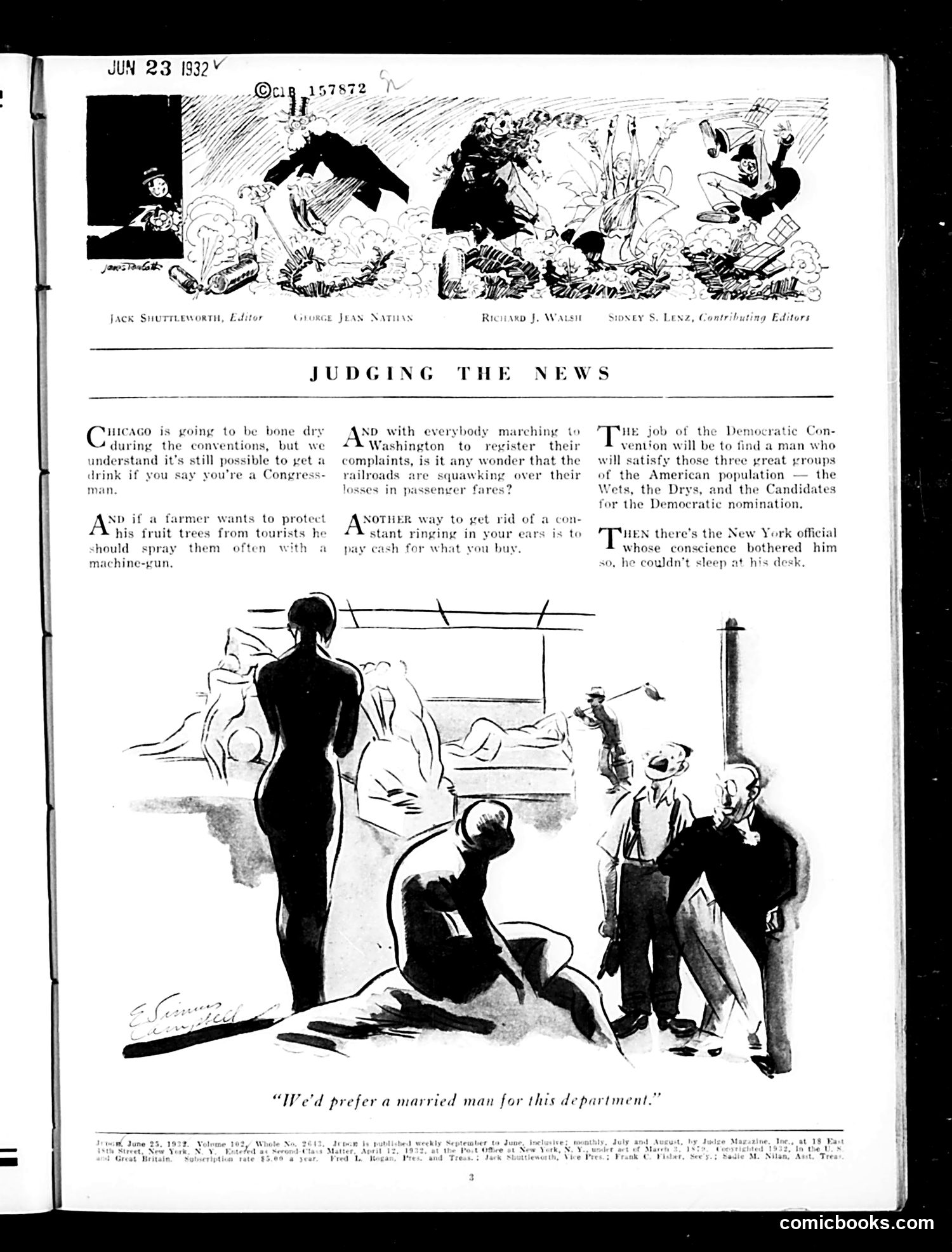
"Judging the News" — June 23, 1932 This satirical page from Judge magazine comments on 1932 political events. The main cartoon depicts a nude female figure (likely representing "Lady Justice" or the government itself) at what appears to be a casting call or audition, with men in suits beside her. The caption reads: "We'd prefer a married man for this department." The satire likely mocks political patronage and nepotism—the practice of hiring based on personal connections rather than merit. In Depression-era 1932, such cronyism was a recurring target of criticism. The brief text snippets above criticize the upcoming political conventions, railroad losses, and Democratic Party candidate selection—reflecting broader 1932 election-year skepticism about political competence and institutional corruption during the economic crisis.
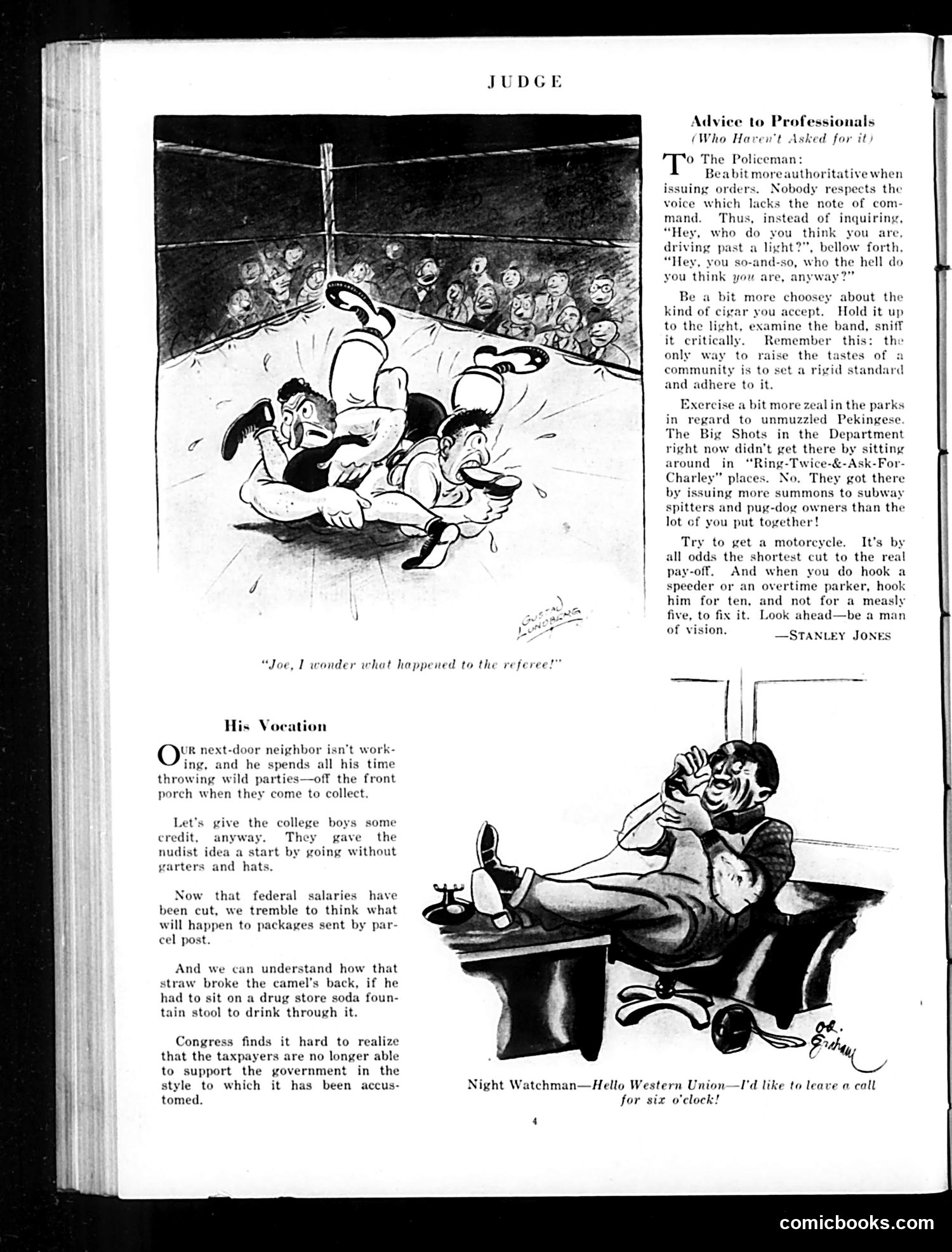
Page Analysis: Judge Magazine Satire This page contains two distinct satirical pieces: "Joe, I wonder what happened to the referee?" (top cartoon): Depicts a chaotic boxing match with multiple figures brawling. The joke appears to target either corrupt boxing officiating or general lawlessness in the sport—the referee has disappeared amid mayhem. "His Vocation" (bottom section): Mocks a neighbor who throws "wild parties" and avoids work. The text sarcastically credits "college boys" for starting nude trends. It satirizes federal salary cuts and congressional inability to understand taxpayer hardship—using absurd examples (packages via parcel post, drinking from drug store stools) to highlight government disconnection from ordinary people's struggles. "Night Watchman" (bottom cartoon): Shows a night watchman at Western Union wanting to leave at 6 o'clock, likely referencing wage/hour disputes during economic hardship.
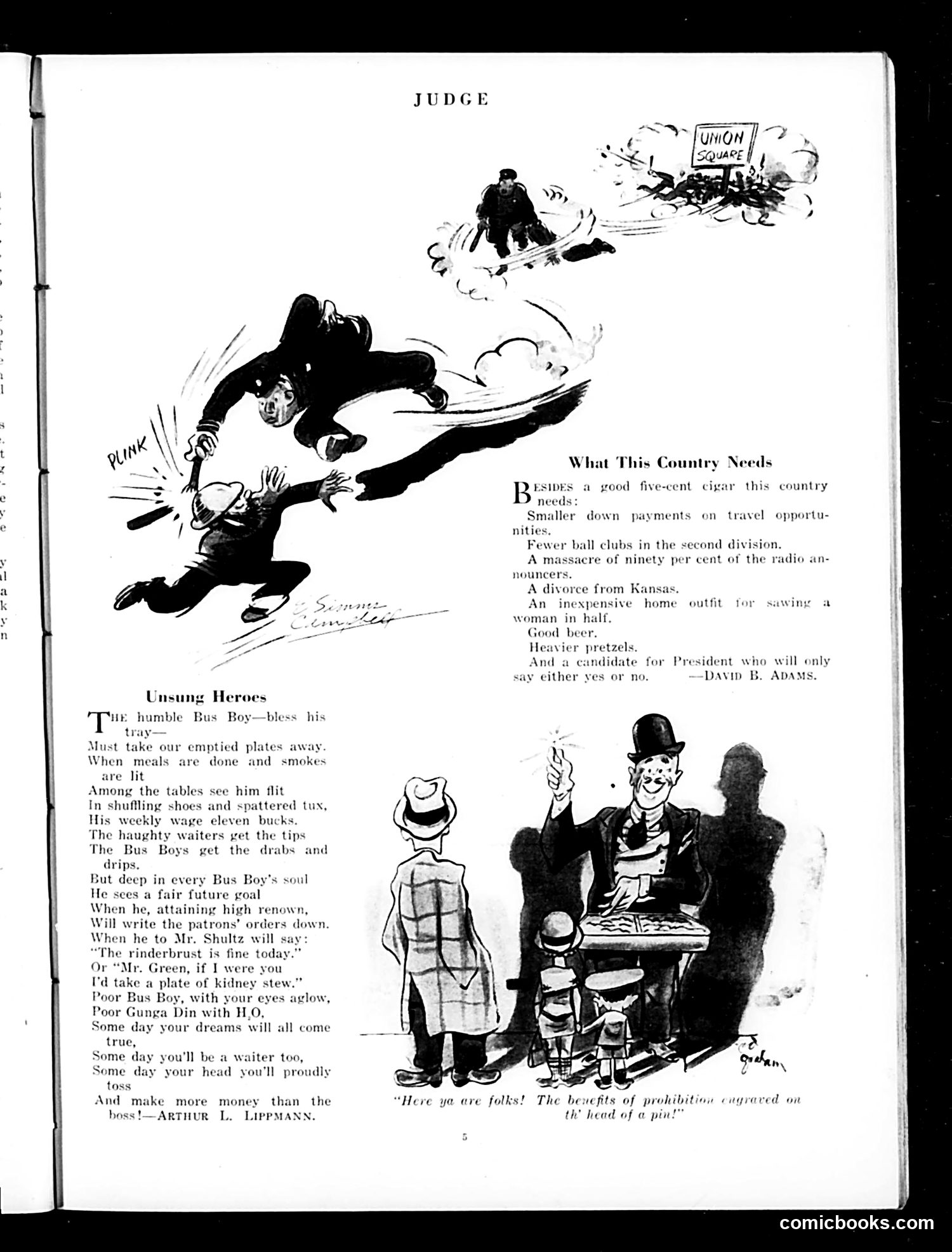
Judge Magazine Page Analysis This page contains two satirical pieces: Top cartoon: A judge figure navigates turbulent waters toward "Union Square" while chaos erupts below. This appears to reference judicial handling of labor unrest or socialist activity in Union Square (a known gathering place for radical movements in NYC). "Unsung Heroes" poem: Celebrates bus boys as humble workers deserving respect despite low wages (eleven dollars weekly). The poem is sentimental rather than satirical, praising their aspirations and dignity. "What This Country Needs": A humorous list by David B. Adams suggesting frivolous desires (cheaper cigars, fewer ball clubs, radio annoyances eliminated) alongside a serious request for a president who gives clear yes/no answers—likely commentary on political evasiveness of the era. The overall tone mixes social observation with gentle humor about American life and work.
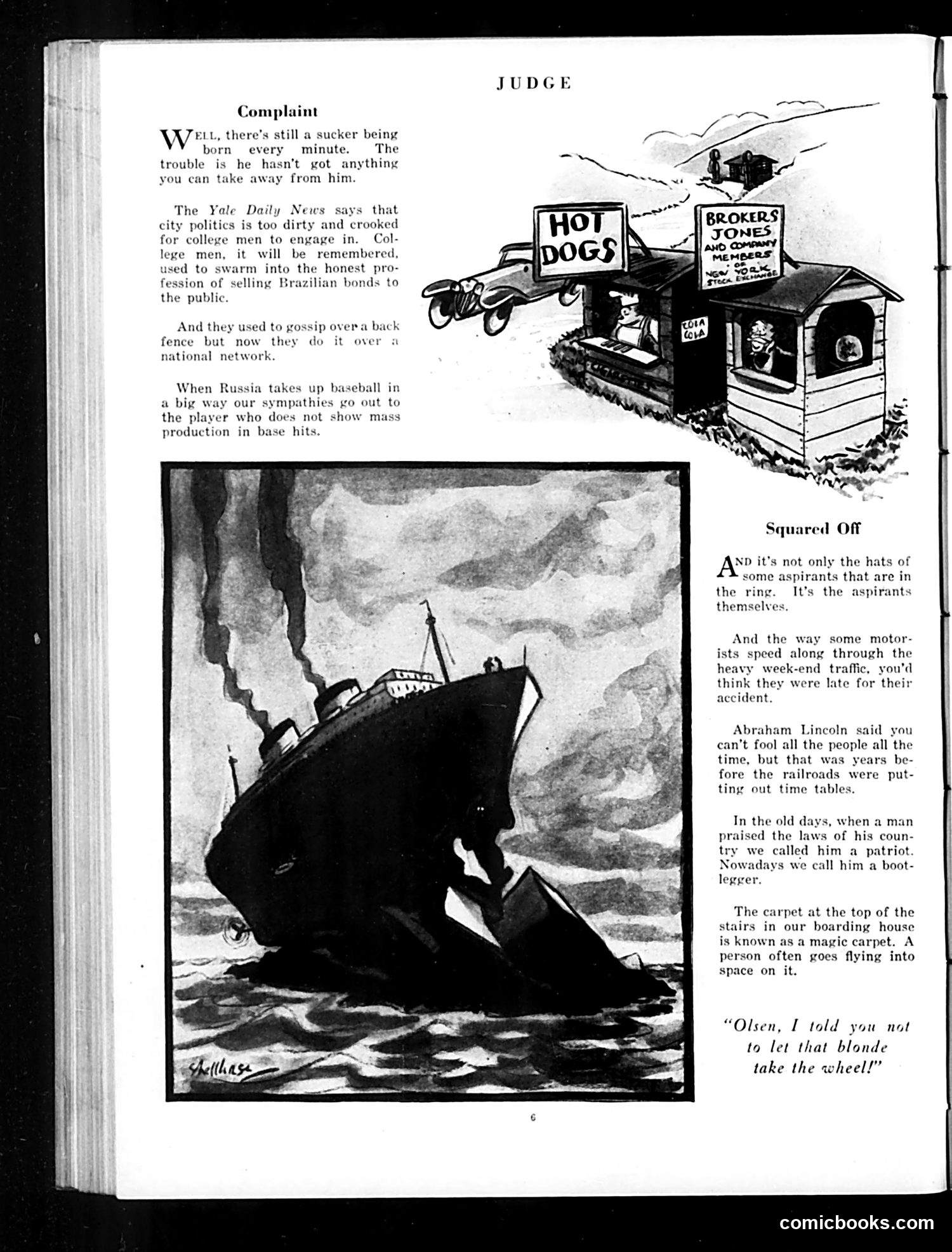
Analysis of Judge Magazine Page This page contains commentary and cartoons satirizing American society and politics. The "Complaint" section mocks widespread corruption, referencing the Yale Daily News's claim that city politics is too corrupt for college men to engage with honestly—comparing it to historical Brazilian bond schemes. The main cartoon depicts a sinking ship captioned "Olsen, I told you not to let that blonde take the wheel!"—a visual joke playing on the stereotype that women are poor drivers, a common satirical trope of the era. The "Squared Off" section offers social commentary on various behaviors: reckless motorists, politicians as "bootleggers" (likely referencing Prohibition-era corruption), and domestic observations about boarding houses. The illustration of a hot dog/brokers stand parodies commercialism and get-rich-quick schemes.
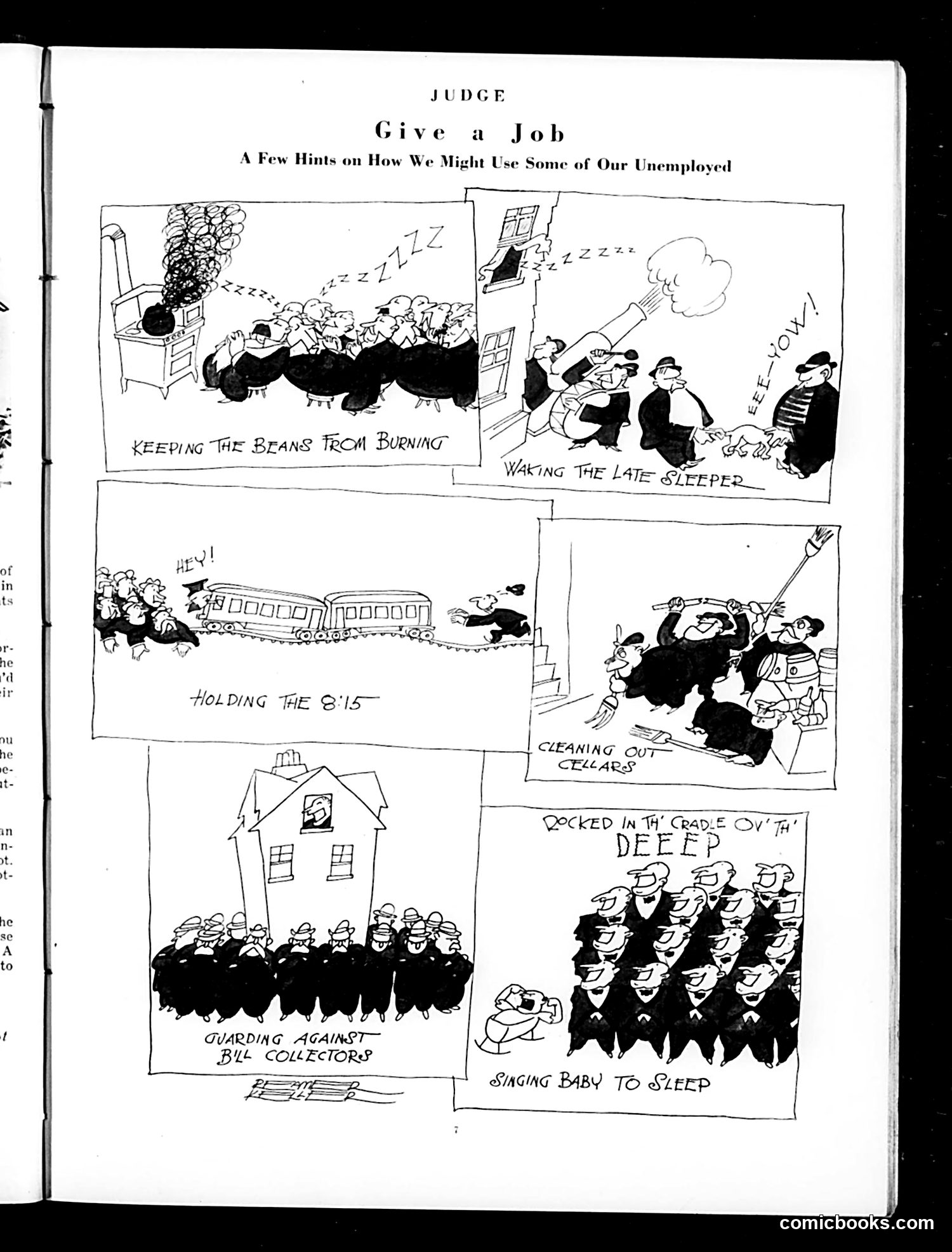
Judge Magazine: "Give a Job" This satirical cartoon proposes absurd employment solutions for the unemployed during an economic crisis (likely the Great Depression era). Each panel mocks both unemployment and potential "solutions": - "Keeping the Beans from Burning": Unemployed people work as stove monitors - "Waking the Late Sleeper": Men use cannons to rouse oversleepers - "Holding the 8:15": Workers literally hold a train in place - "Cleaning Out Cellars": Menial basement work - "Guarding Against Bill Collectors": Standing watch at homes - "Singing Baby to Sleep": Men hired as lullaby singers The satire critiques both the severity of joblessness and the government's apparent inability to create meaningful employment. The increasingly ridiculous "jobs" highlight how desperate the situation had become—any work, no matter how pointless, was being considered. The cartoon sarcastically suggests that even absurd make-work was preferable to no employment at all.
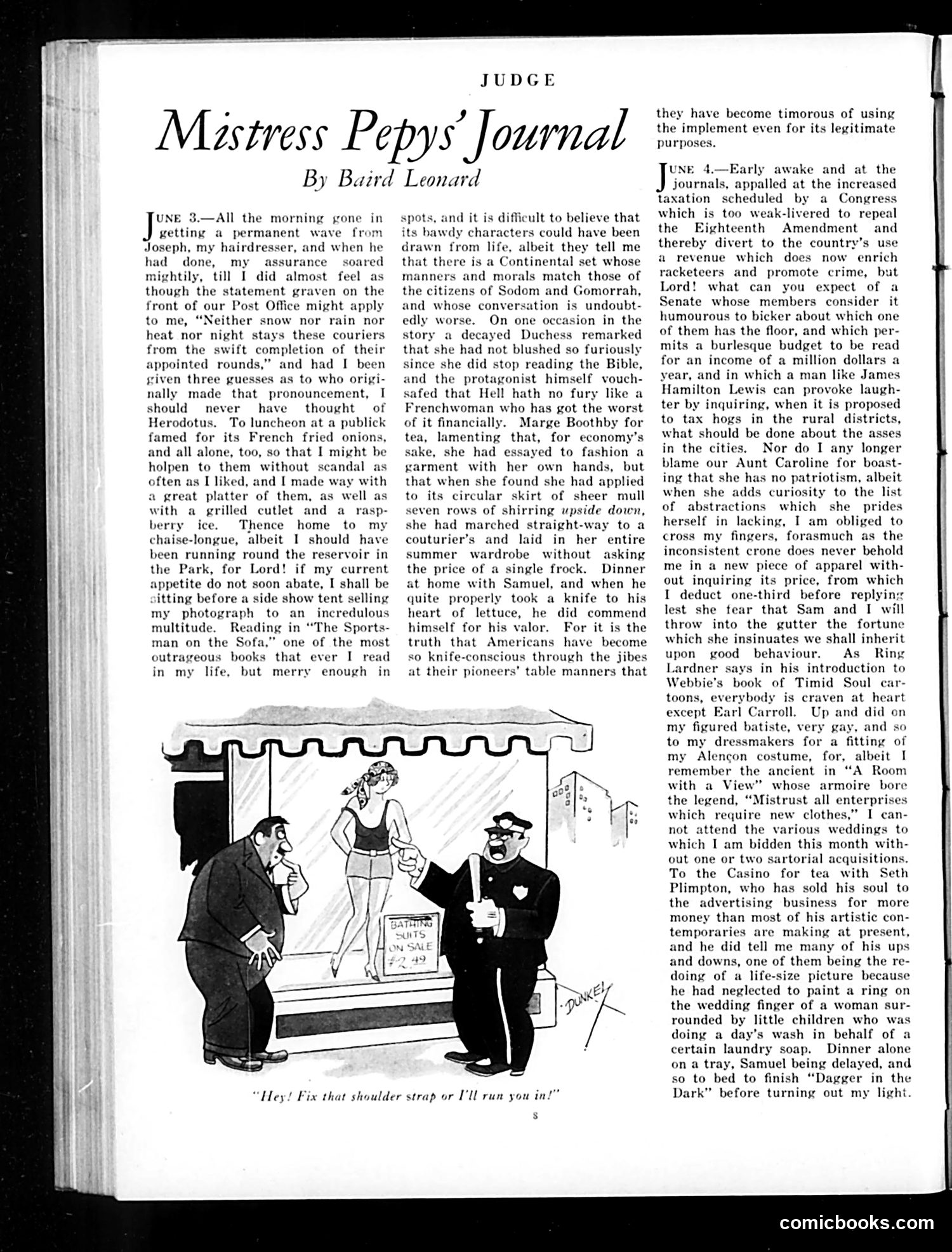
"Mistress Pepys' Journal" - Judge Magazine Satire This is a comedic column mimicking Samuel Pepys' famous 17th-century diary, updated to modern (1920s-30s) times. The narrator—a society woman—records trivial domestic observations in mock-grandiose language. The single cartoon depicts two men in formal attire confronting a woman in a shop window display, with one saying, "Hey! Fix that shoulder strap or I'll run you in!" This likely satirizes either: fashion policing/overzealousness about clothing regulations, or Prohibition-era vice enforcement absurdities (the "run you in" threat). The written diary mocks various contemporary targets: Congress's weakness on repealing Prohibition, Senate antics (referencing Senator James Hamilton Lewis's jokes about taxing rural hogs), Americans' self-consciousness about table manners, and women's vanity about clothing and appearance. The satire is gentle social commentary—poking fun at upper-class pretension, gender dynamics, and political incompetence rather than advocating serious reform.
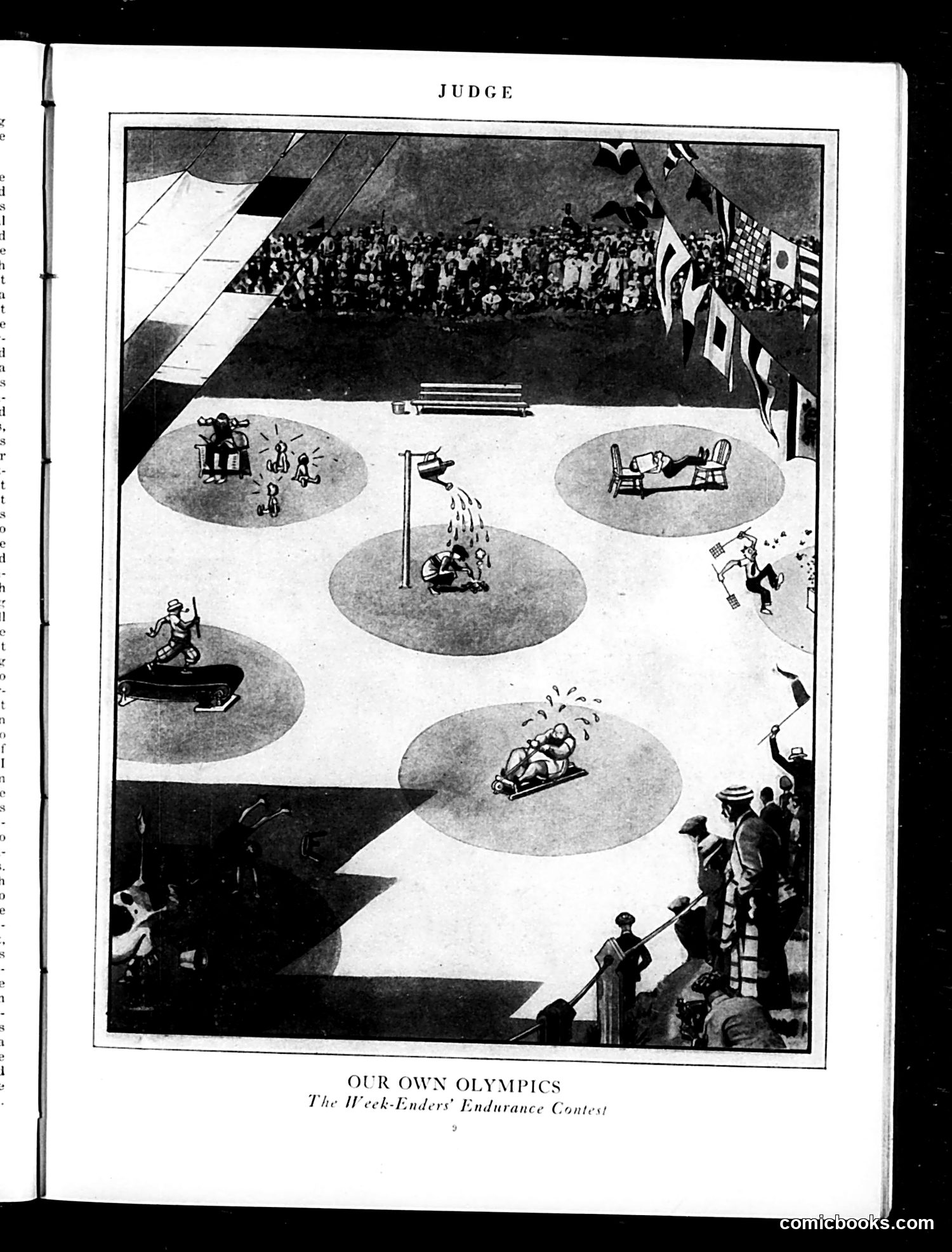
Analysis This satirical illustration depicts "Our Own Olympics: The Week-Enders' Endurance Contest," a parody of athletic competition featuring absurd, everyday activities rather than traditional sports. The scene shows various figures engaged in humorous stunts within circular spotlit areas—including someone on what appears to be a trampoline, people on chairs, and other comedic poses—all surrounded by spectators in a large venue. The satire targets "week-enders" (likely wealthy leisure-class individuals who engaged in recreational activities on weekends) by mocking their trivial pursuits as though they were serious Olympic competitions. Rather than genuine athletic achievement, these activities appear silly and undignified, suggesting Judge magazine's criticism of upper-class frivolity and the gap between genuine sport and idle entertainment. The cartoon satirizes both the Olympic spectacle itself and the vanity of those who treated casual amusements as worthy of public attention.
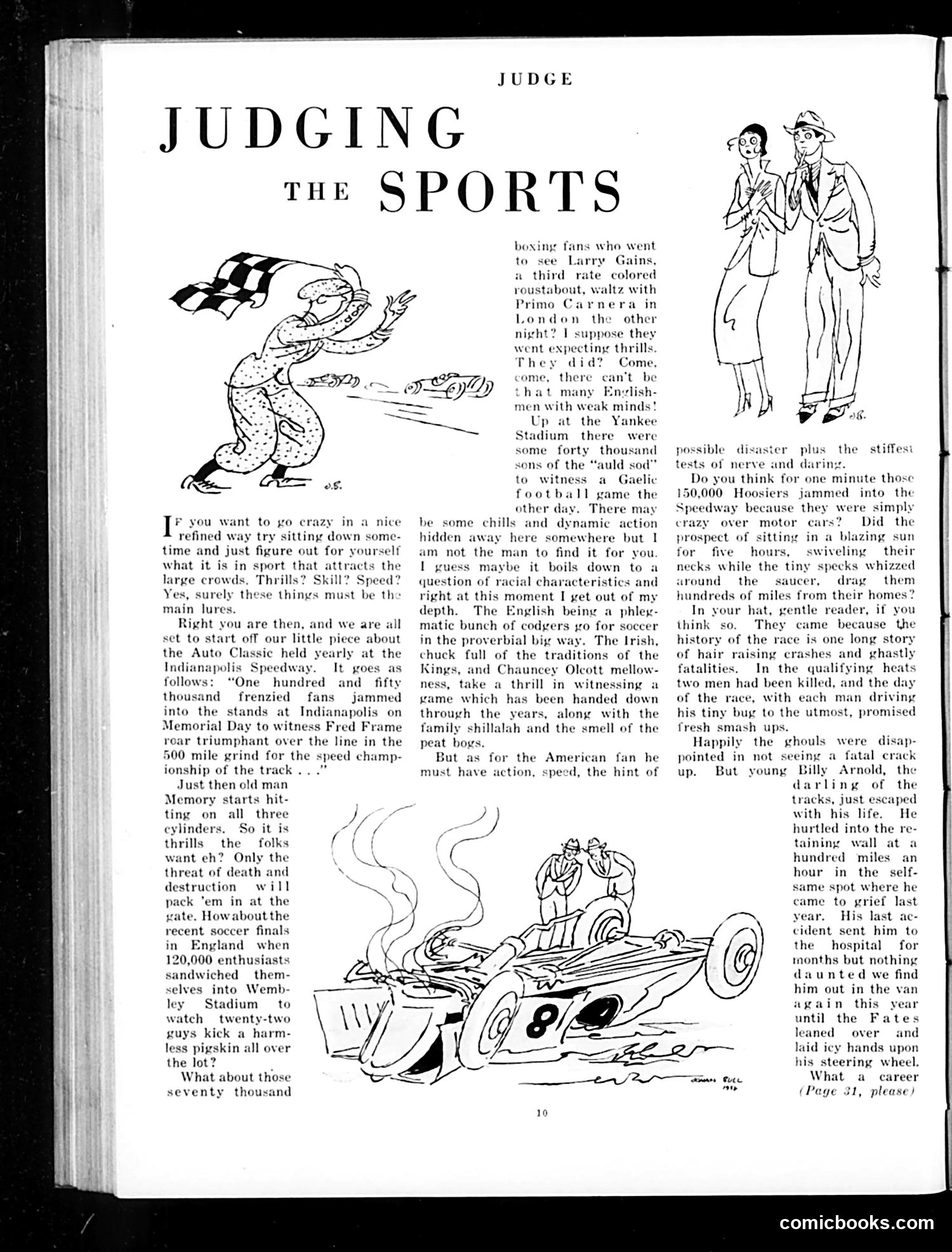
Judging the Sports This satirical piece critiques what draws crowds to sporting events, arguing that spectators are attracted to danger and potential disaster rather than athletic skill. The author contrasts different nationalities' sports interests: English soccer fans, Irish Gaelic football enthusiasts, and boxing crowds are dismissed as having different "racial characteristics." The main target is American spectators at the Indianapolis 500, whom the author suggests attend specifically for the thrill of potential crashes and fatalities. He cites actual deaths during qualifying heats and a near-fatal crash by driver Billy Arnold, implying American audiences are morbid "ghouls" seeking thrills from danger rather than appreciating athletic excellence. The cartoons—showing a racecar crash and spectators—visually reinforce this critique of American sports culture's fascination with speed, danger, and potential tragedy.
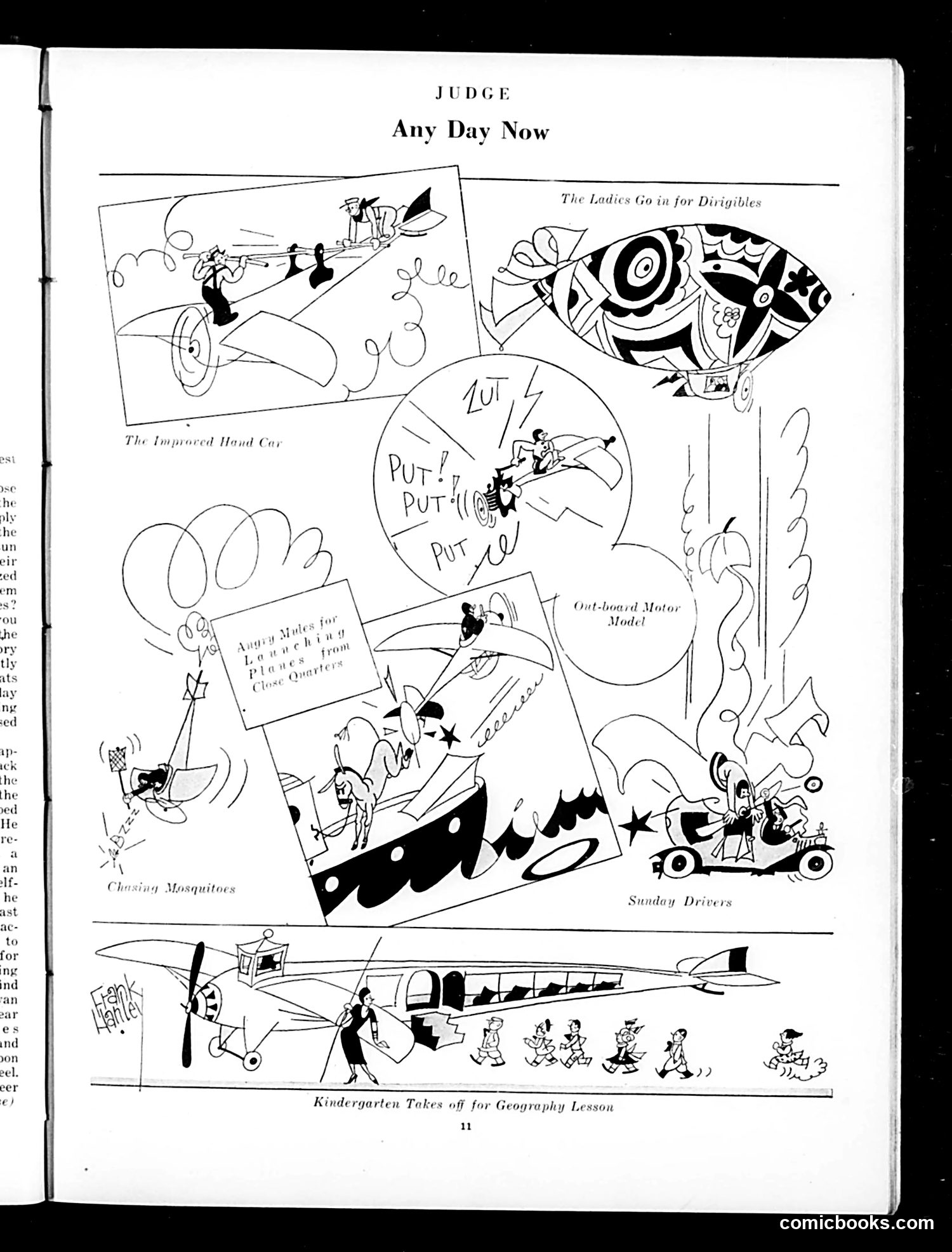
Analysis of Judge Page: "Any Day Now" This satirical page mocks emerging 1920s-30s technologies and fads through exaggerated scenarios. The cartoons ridicule: 1. "The Improved Hand Car" - absurdist auto design 2. "The Ladies Go in for Dirigibles" - women adopting aviation/airship travel 3. "Chasing Mosquitoes" - impractical flying contraptions 4. "Outboard Motor Mode" - motorized boats or vehicles 5. "Sunday Drivers" - dangerous amateur motorists 6. "Kindergarten Takes off for Geography Lesson" - children flying planes for school The page satirizes technological optimism by depicting ordinary people adopting advanced machines in ridiculous, dangerous ways. The title "Any Day Now" suggests these absurdities represent inevitable (if laughable) near-future scenarios. The humor relies on technological anxiety—fear that modern inventions will inevitably lead to chaos when accessible to untrained civilians.
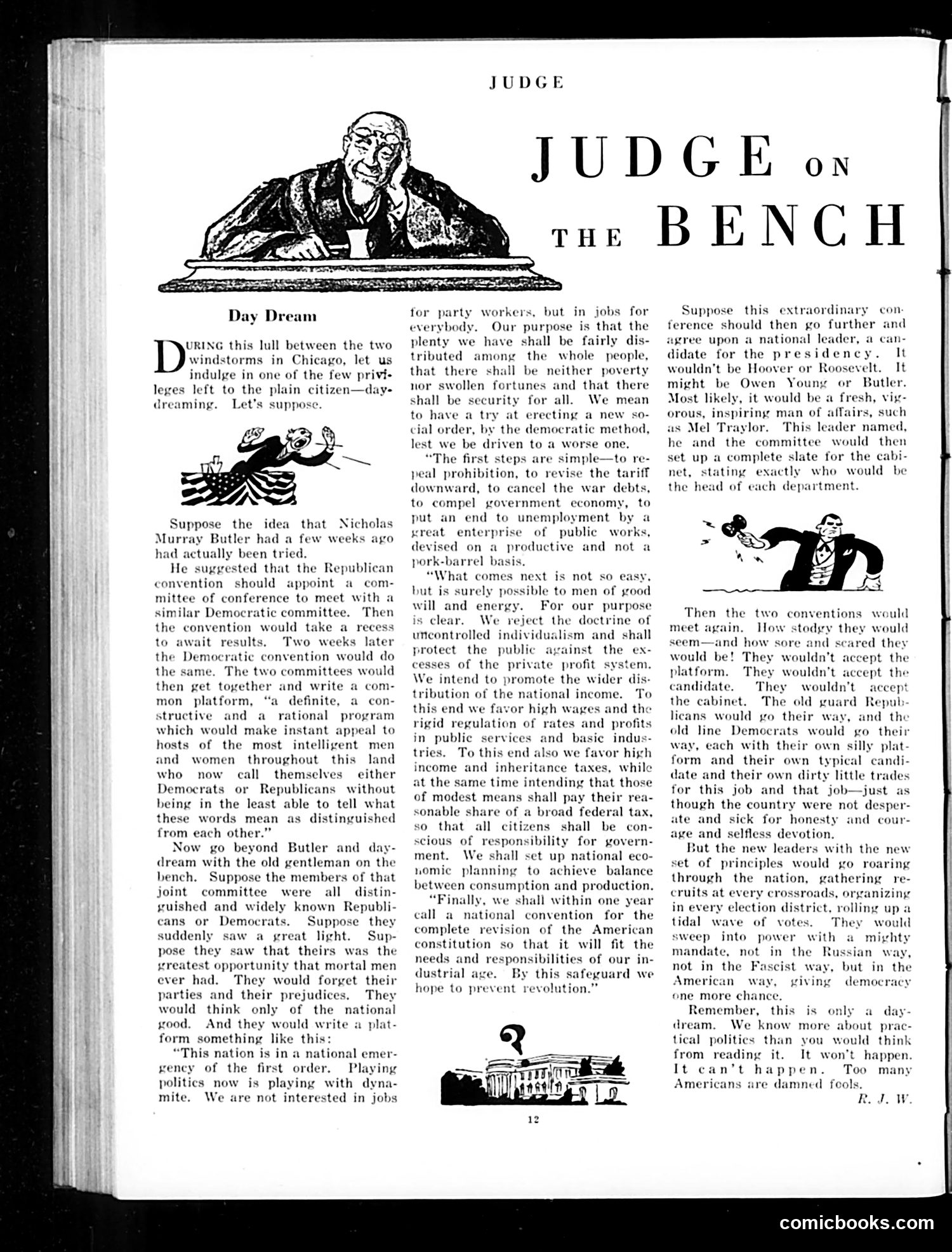
"Judge on the Bench" - Political Satire Explained This piece imagines a utopian "day dream" where Republican and Democratic party committees collaborate to create a unified national platform addressing the Depression-era crisis. The satirist presents an idealized program: repealing Prohibition, revising tariffs, canceling war debts, implementing public works, regulating private profit, establishing progressive taxation, and even revising the Constitution. The fantasy proposes figures like Owen Young, Butler, or banker Mel Traylor as a fresh presidential candidate—someone above partisan politics. The satire's pointed humor lies in its final line: "Remember, this is only a daydream...It can't happen. Too many Americans are damned fools." The cartoonist mocks American political dysfunction, suggesting that rational, unified governance addressing real problems remains impossible due to public partisanship and foolishness. The "old gentleman on the bench" represents an idealistic observer watching this impossible scenario unfold.
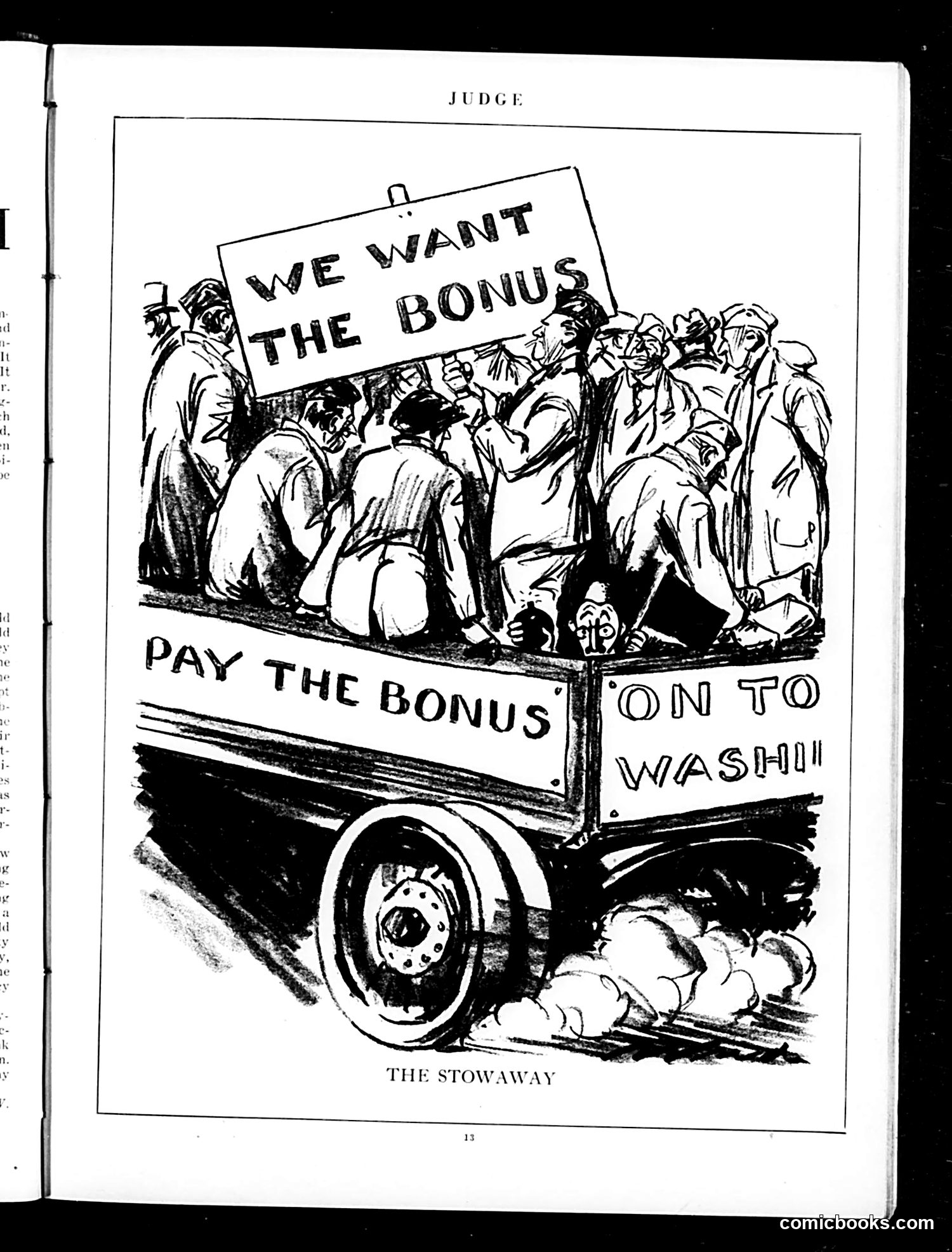
"The Stowaway" - Judge Magazine Cartoon This political cartoon satirizes the post-World War I "Bonus" debate. A truck labeled "ON TO WASHI[ngton]" carries veterans demanding "WE WANT THE BONUS" and "PAY THE BONUS." The crowd represents bonus marchers—veterans seeking promised compensation. The cartoon's title, "The Stowaway," suggests an unwanted, hidden problem. The broken-down truck wheel symbolizes the difficulties and obstacles impeding the veterans' journey to Washington to lobby Congress. The imagery implies the bonus issue was an embarrassing problem the government hoped would simply disappear rather than be addressed. This likely references the actual Bonus Army marches of the early 1930s, when unemployed World War I veterans demanded immediate payment of a promised bonus.
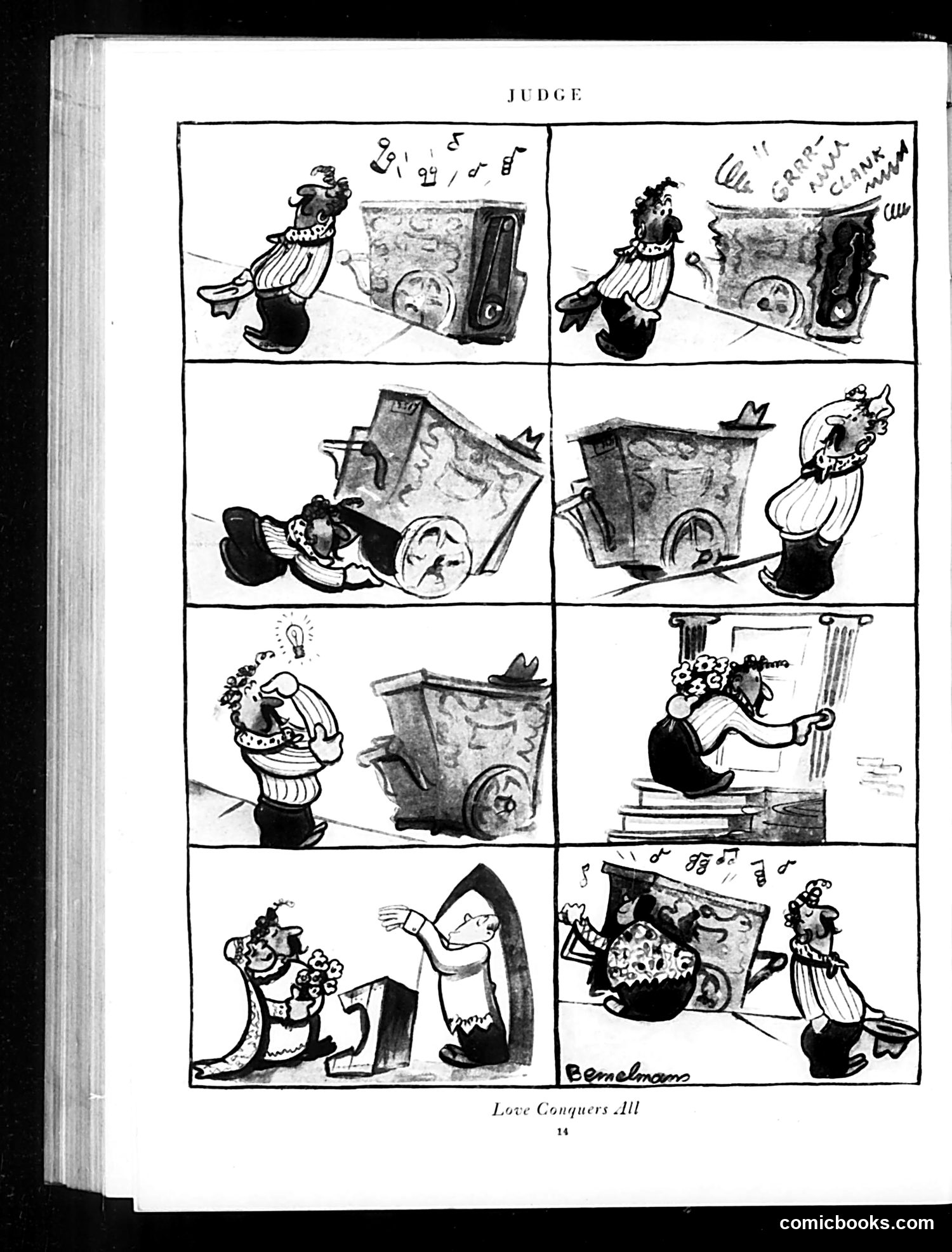
"Love Conquers All" - Judge Magazine Comic This eight-panel comic strip by Bemelemans depicts a romantic narrative involving two characters—a rotund man and a woman—and what appears to be a trash cart or wheeled container, likely representing poverty or low social status. The sequence shows the man pursuing or courting the woman despite their humble circumstances. The trash cart serves as visual commentary on their economic condition. The title "Love Conquers All" suggests the joke's premise: that romantic love transcends material hardship or social class. The repetitive appearance of the cart throughout emphasizes their poor station, while the man's persistent romantic gestures (flowers, music notes visible in later panels) illustrate the satirical point—that love persists regardless of one's financial circumstances, a common early 20th-century Judge magazine theme blending sentimentality with social observation.
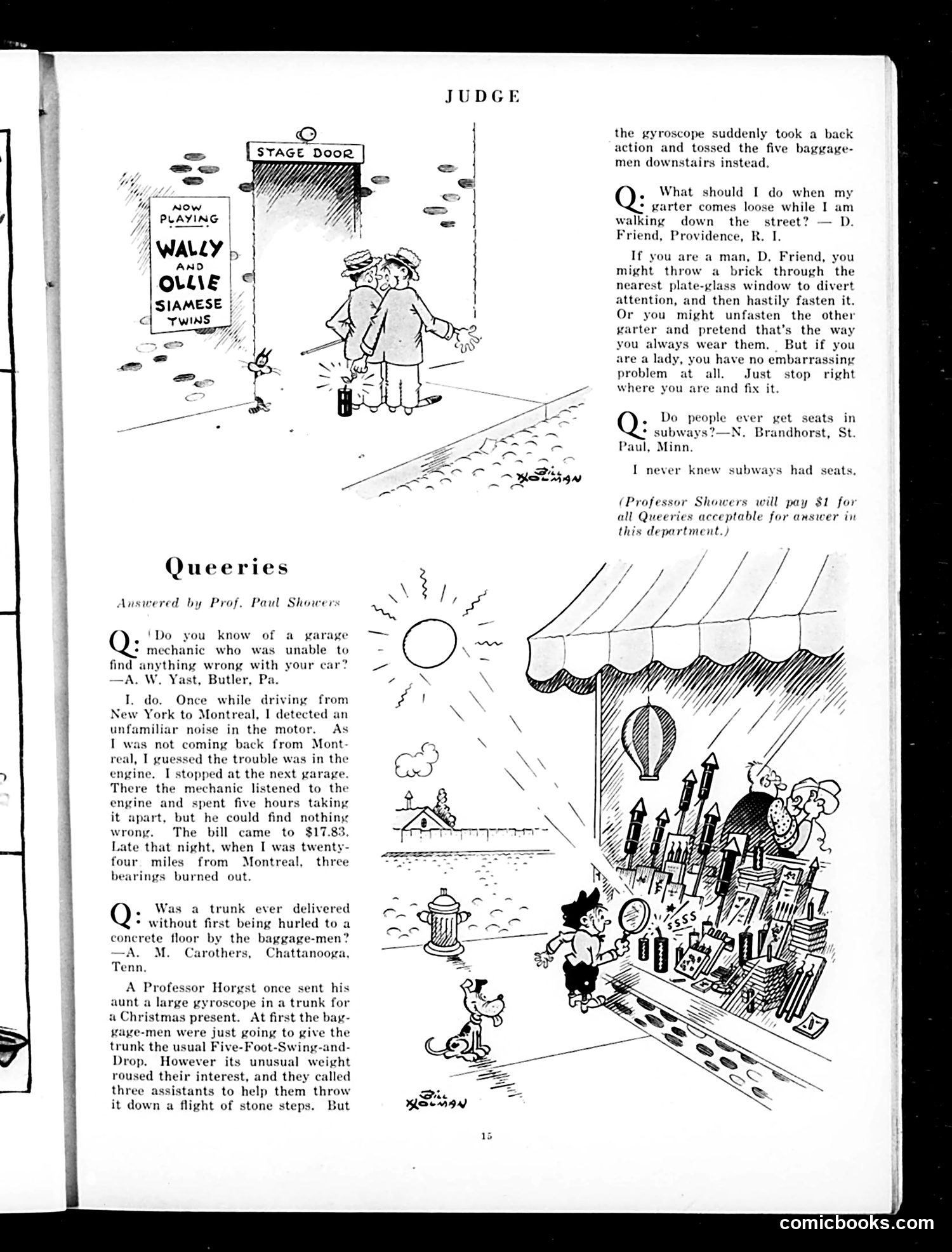
Judge Magazine Page Analysis This page contains a "Queeries" advice column answered by "Prof. Paul Showers," presenting humorous responses to reader questions. The satire mocks everyday frustrations of early-to-mid 20th century urban life. The jokes: 1. Loose garter: The advice facetiously suggests throwing a brick through a window as distraction, or pretending asymmetrical garters are intentional—poking fun at both gender conventions and street embarrassment. 2. Subway seats: The deadpan response "I never knew subways had seats" sarcastically suggests subway cars are chronically overcrowded—a common complaint about public transit. 3. Dishonest mechanics: A mechanic charges $17.83 to disassemble an engine, finds nothing wrong, yet the car fails miles later—mocking both automotive repair fraud and incompetence. 4. Brutal baggage handlers: The gyroscope anecdote humorously exaggerates how roughly baggage-men handle luggage, recruiting assistants specifically to throw a trunk down stone steps. The cartoon shows two children near a stage door, likely illustrating theatrical content. The overall tone is wry commentary on consumer annoyances and service industry incompetence.
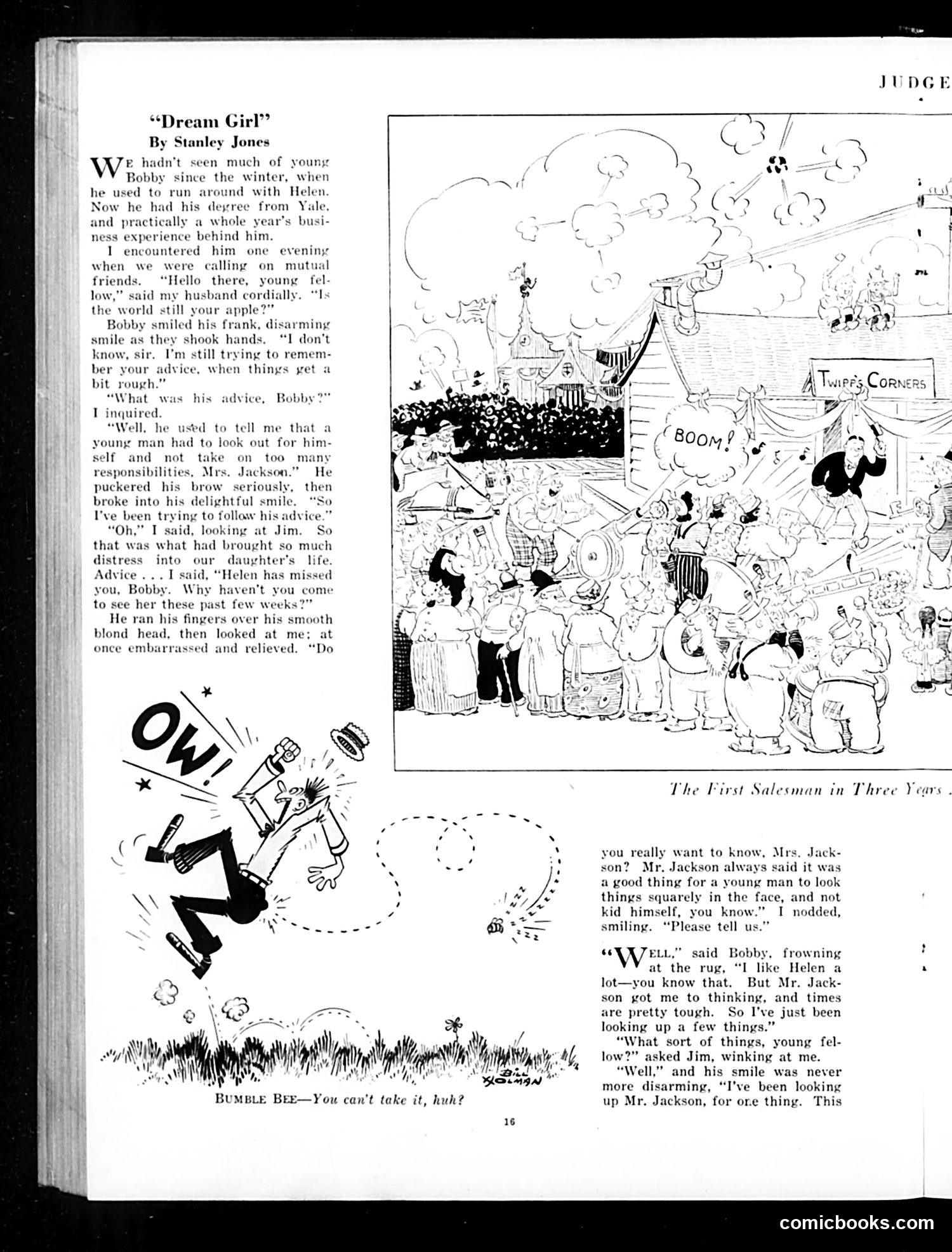
"Dream Girl" Analysis This story satirizes the tension between romantic idealism and practical self-interest among young men in the Jazz Age. Bobby, a Yale graduate, has abandoned his courtship of Helen after receiving advice from her father (Mr. Jackson) to "look out for himself" and not take on too many responsibilities. The humor centers on Bobby's transparent rationalization: he claims to be "looking up a few things"—implying self-improvement—when he's actually using Jackson's pragmatic advice as cover for cold calculation. He likes Helen but won't commit because "times are pretty tough," revealing how easily self-preservation justifies romantic abandonment. The accompanying "Bumble Bee" cartoon (lower left) satirizes commercial ruthlessness, suggesting a broader cultural anxiety about aggressive self-interest displacing traditional values. The satire critiques how modern business mentality corrupts courtship and family obligations.
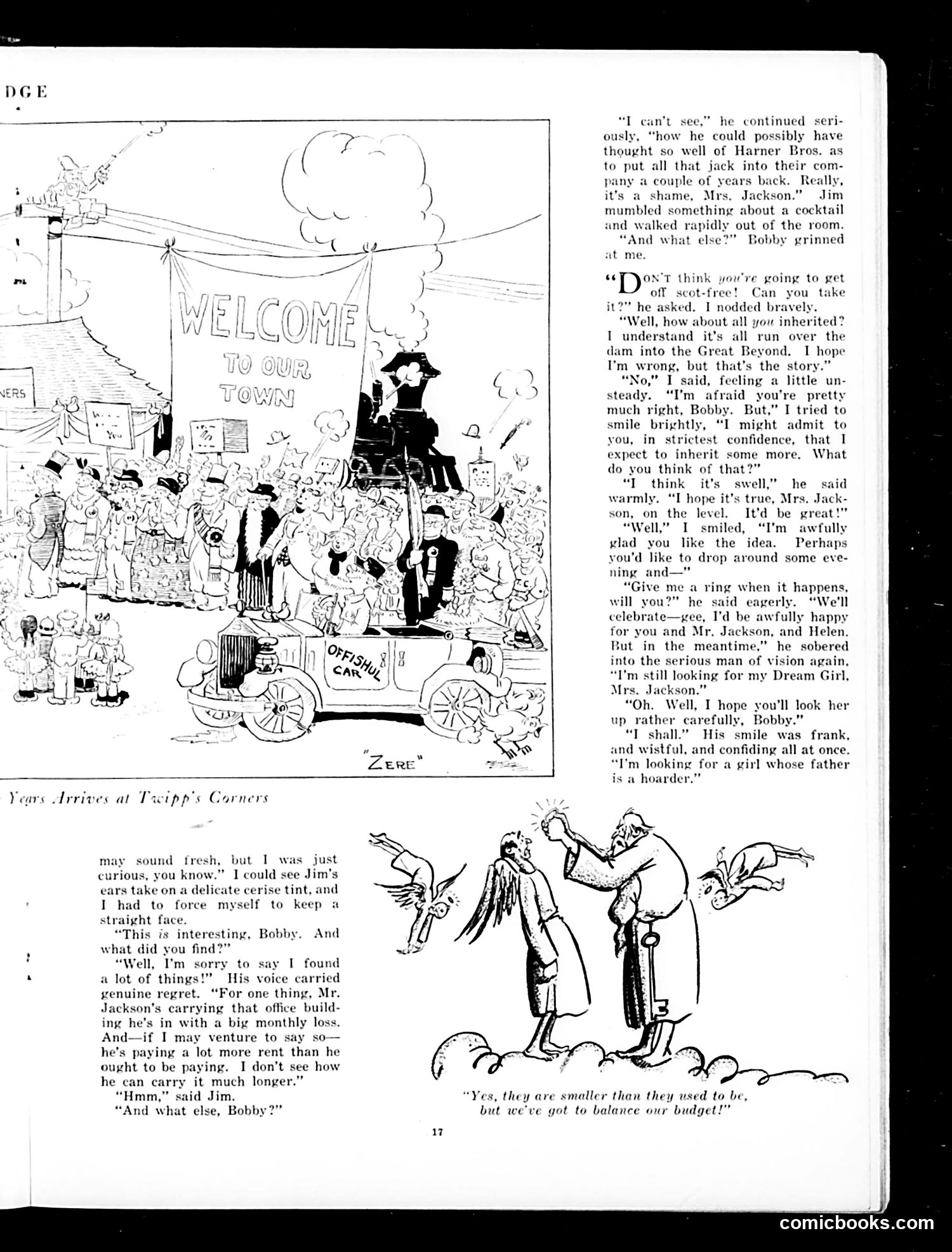
Analysis of This Judge Magazine Page This appears to be a narrative fiction piece rather than a political cartoon, drawn from a story titled "Years Arrives at Towipp's Corners." The main cartoon (top) depicts a "Welcome to Our Town" celebration with an "Offishul Car" — a visual pun showing civic boosterism and small-town pride, likely satirizing exaggerated hometown enthusiasm. The lower cartoon shows two figures discussing budget constraints, with the caption "Yes, they are smaller than they used to be, but we've got to balance our budget!" — apparently satirizing post-war or Depression-era economic hardship, where citizens must accept diminished circumstances while maintaining fiscal responsibility. The prose dialogue centers on characters discussing financial mismanagement (Harner Bros. company losses, Jackson family inheritance problems, excessive rental payments). The satire targets irresponsible wealthy individuals and financial pretense. Bobby's final line — seeking "a girl whose father is a hoarder" — darkly jokes about marrying into hoarded wealth. The overall tone satirizes American greed, financial instability, and the gap between appearance and reality among the propertied class.
Analysis of Judge Magazine Theater Critique This is a theater review by George Jean Nathan (a prominent early 20th-century drama critic) critiquing child actors and their roles in contemporary theater. The argument: Nathan argues that child actors aren't inherently bad performers—rather, old playwrights wrote terrible, saccharine dialogue for them ("Little Ralphie loves his papa and his mama"). He cites specific plays like "The Weavers" and references to tearful Christmas Eve scenes as examples of maudlin sentimentality that made even talented child actors appear painful to watch. The modern point: Nathan celebrates recent theatrical improvement—newer plays give children realistic roles rather than treacly sentiment. He praises specific productions at the Cort theater for creating genuinely human child characters (one who makes rude gestures rather than reciting clichés), suggesting modern playwrights are finally writing authentically for young performers rather than manipulating audiences' emotions. The satire's target: Old-fashioned melodrama and sentimental theater conventions, not the children themselves.
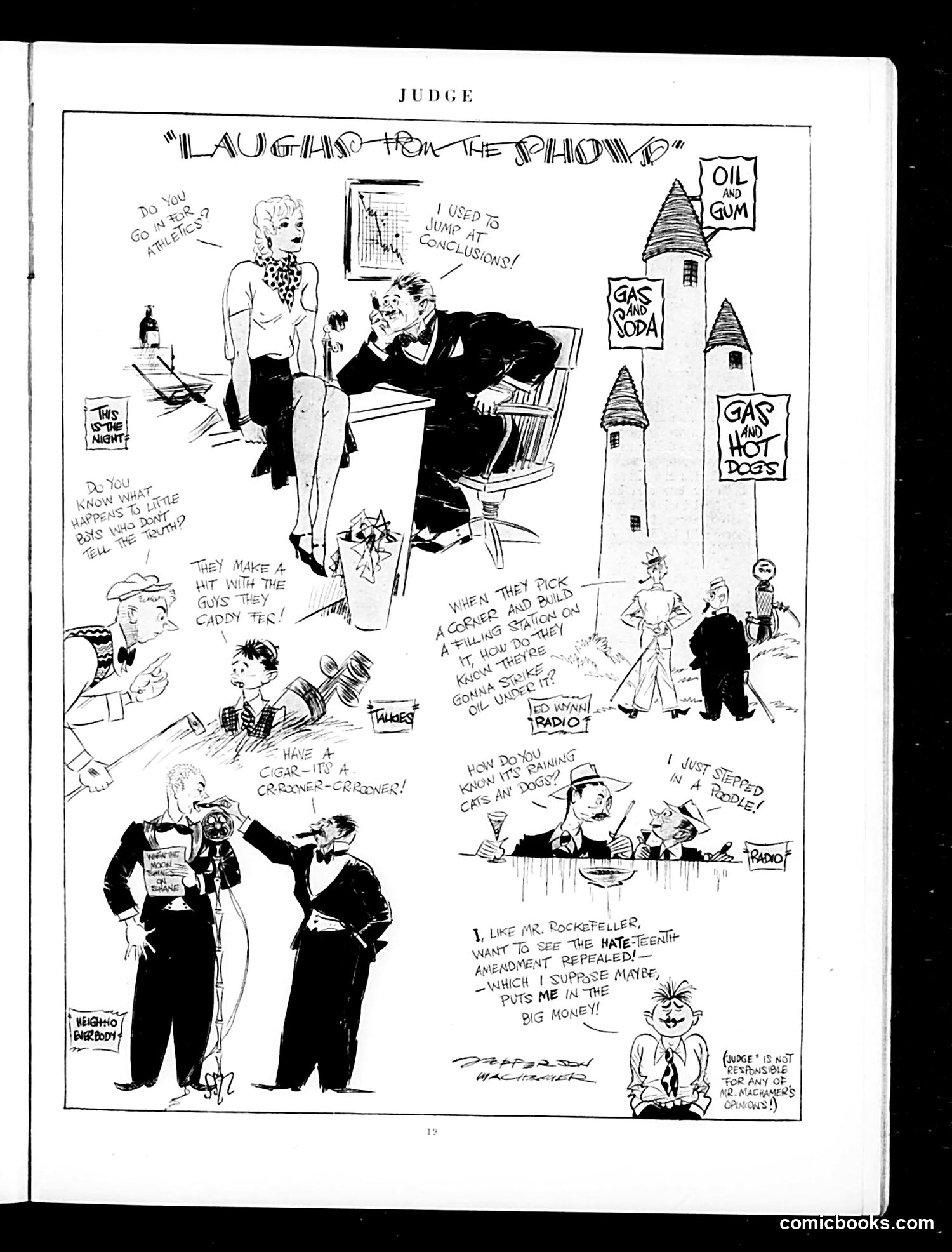
"Laughs for the Show" This satirical cartoon mocks contemporary commercial culture and radio advertising. The main scene depicts a businessman pitching ideas to a woman, surrounded by vignettes showing absurd advertising concepts: gas stations shaped like teepees, hot dog stands, and radio spots promoting everyday products. The jokes target how aggressively commercialized American culture had become—radio advertising, roadside attractions designed purely for marketing, and the collision between natural/historic imagery (Native American imagery repurposed as commercial branding) and consumerism. A bottom panel references Mr. Rockefeller and the "Eighteenth Amendment" (Prohibition), suggesting wealth and political influence determine which laws get enforced. The cartoon satirizes both corporate excess and the hypocrisy of selective law enforcement during the Prohibition era.
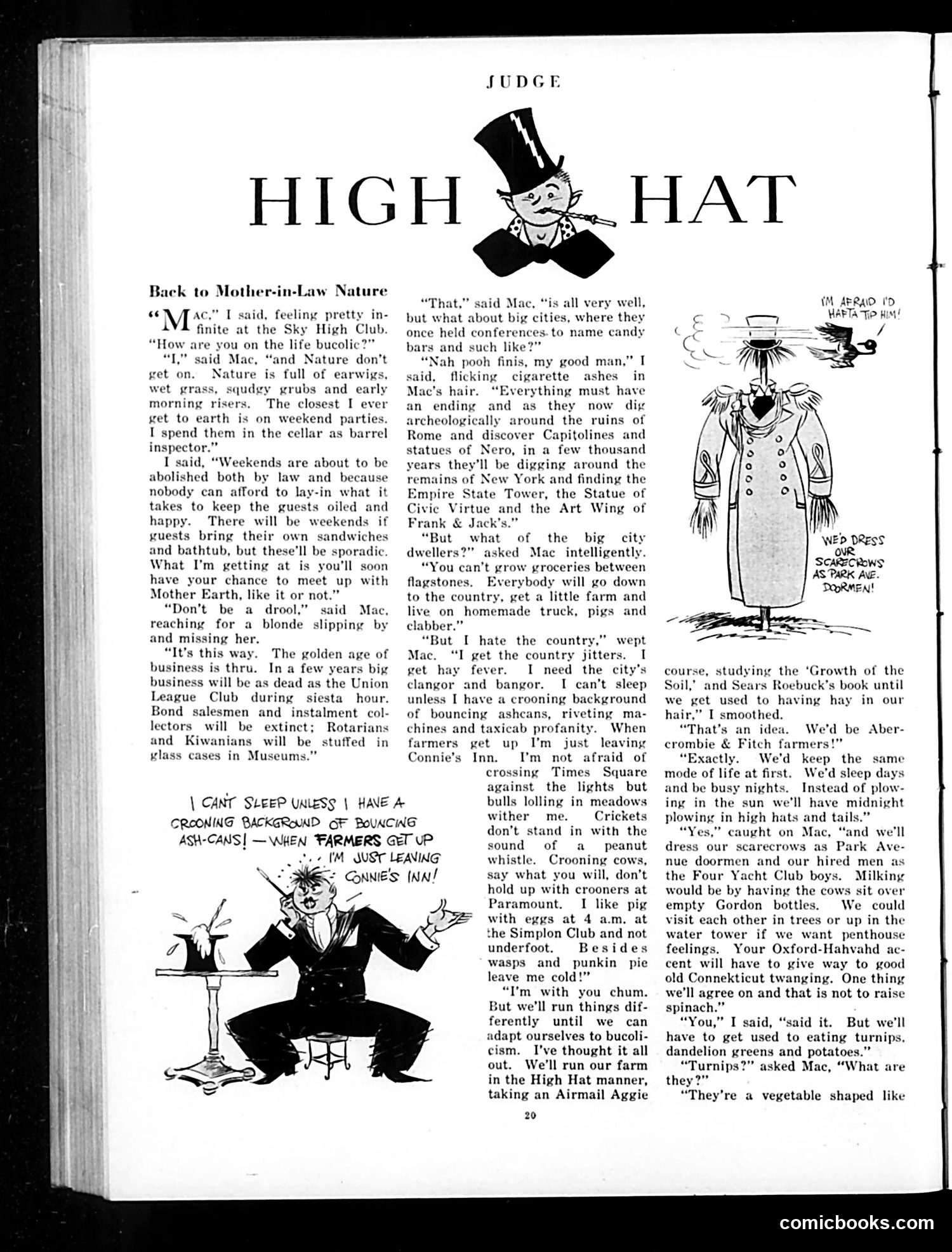
Judge Magazine Satire Analysis This is a humorous dialogue between two urban sophisticates mocking the notion of returning to rural life. The speaker criticizes his friend Mac's disconnection from nature, then proposes an absurd solution: running a farm "in the High Hat manner"—applying wealthy Manhattan lifestyle to agriculture. The satire targets 1920s-era nostalgia for pastoral simplicity. The characters envision dressing scarecrows as "Park Avenue doormen," milking cows sitting over empty liquor bottles, and conducting midnight plowing in formal attire. The cartoon (left) shows a man in a top hat cavalierly toasting while discussing farming, emphasizing the ridiculousness. The joke: urban elites romanticizing country life while remaining utterly incapable of or unwilling to abandon city luxuries (late-night dining, crooning jazz, Times Square). Their "solution" preserves Manhattan sophistication while superficially claiming rusticity—satirizing both urban snobbery and the era's fashionable "back-to-the-land" sentiment without genuine commitment to change.
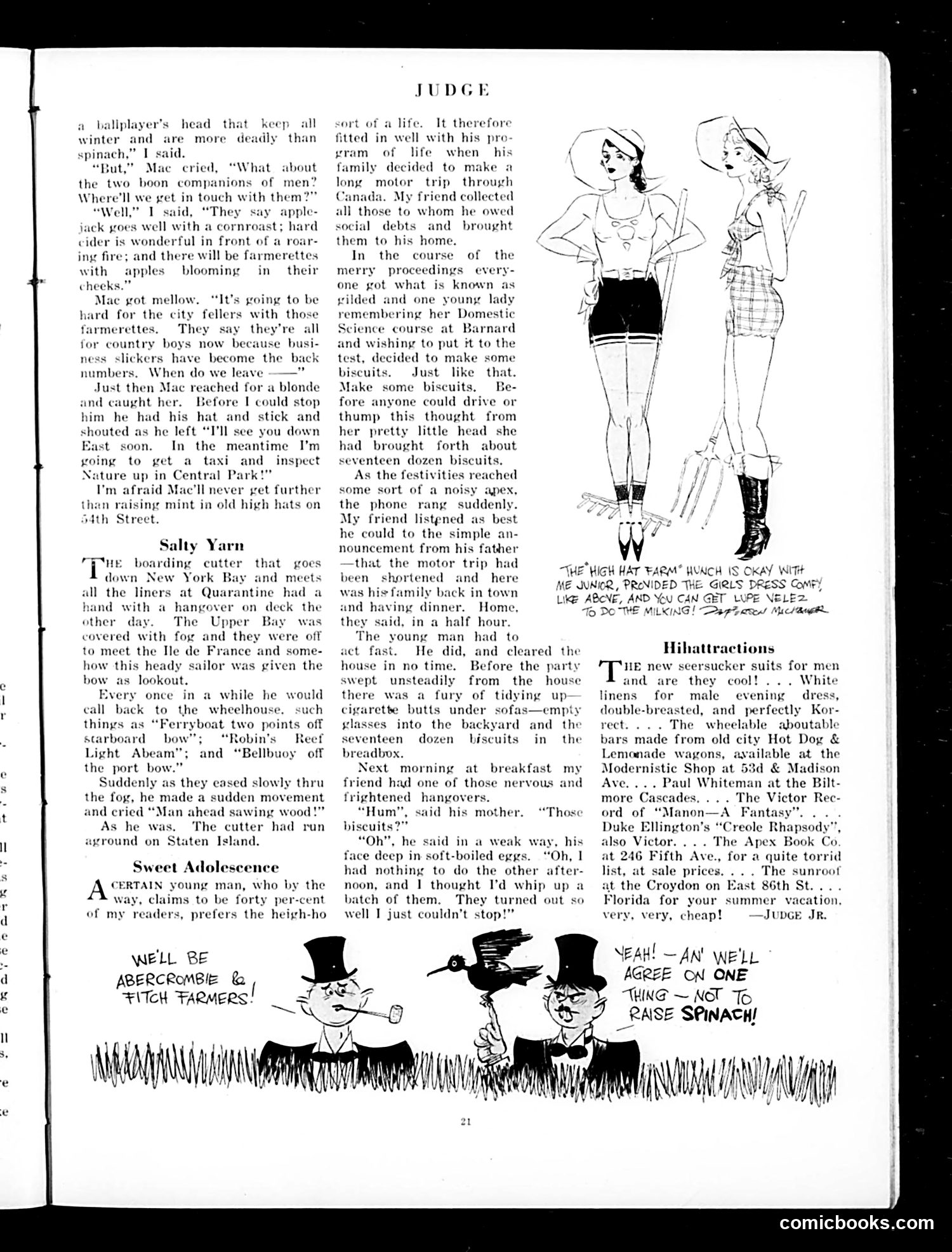
Judge Magazine Page Analysis This page from *Judge* contains several satirical pieces about 1920s American life: Main Stories: - "Salty Yarn" mocks a hungover sailor at New York Harbor who mishears fog signals and runs the cutter aground on Staten Island. - "Sweet Adolescence" satirizes a young man who impulsively bakes seventeen dozen biscuits at a party, then lies about it to his mother the next morning, claiming he "whipped them up" randomly and "couldn't stop." Bottom Cartoon: Two well-dressed men in top hats discuss farming, with one saying they'll agree "not to raise spinach"—likely mocking wealthy city dwellers' romantic notions about rural life and "farmerette" workers during the agricultural labor shortage of the 1920s. Advertisement Section: Promotes Abercrombie & Fitch, upscale clothing retailers, and mentions fashionable items like white linen suits and Paul Whiteman (a famous bandleader). The satire targets urban pretension, hangovers, and the gap between city sophistication and country reality.
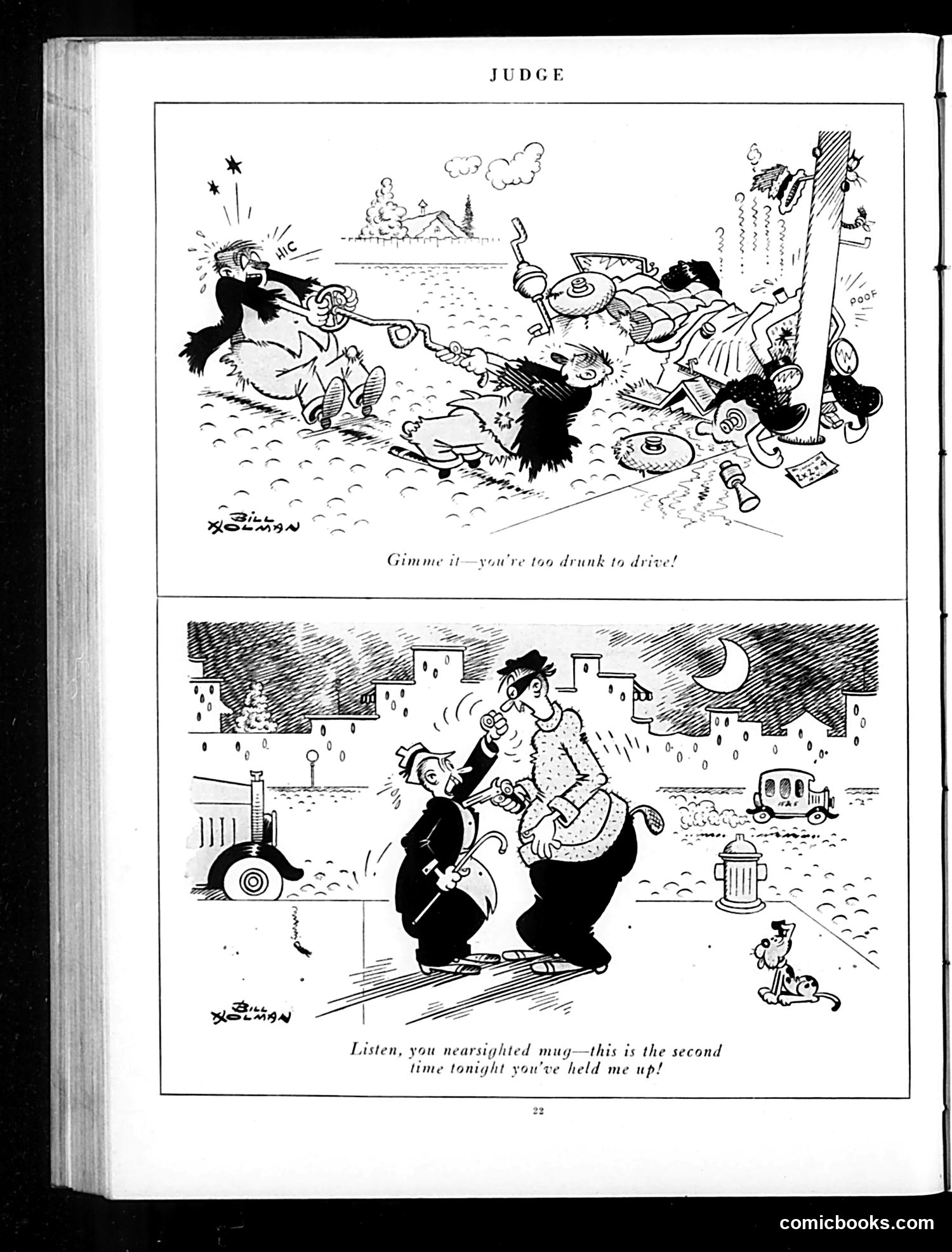
Analysis This page contains two cartoons satirizing drunk driving and highway robbery, likely from the early-to-mid 20th century. The top cartoon shows a chaotic beach scene where an intoxicated driver has crashed, destroying beach equipment and causing mayhem. The caption "Gimme it—you're too drunk to drive!" suggests someone trying to take the car keys. The bottom cartoon depicts a nighttime highway robbery scenario. A disheveled criminal stops a car, but the driver appears equally disreputable. The criminal complains this is the "second time tonight you've held me up"—a pun suggesting the driver, while drunk and reckless, was previously the one committing the robbery. Both cartoons use dark humor to satirize dangerous driving under the influence and the broader social problems of the era, treating drunk driving as both a public safety hazard and a comedic subject worthy of ridicule in Judge magazine's satirical tradition.
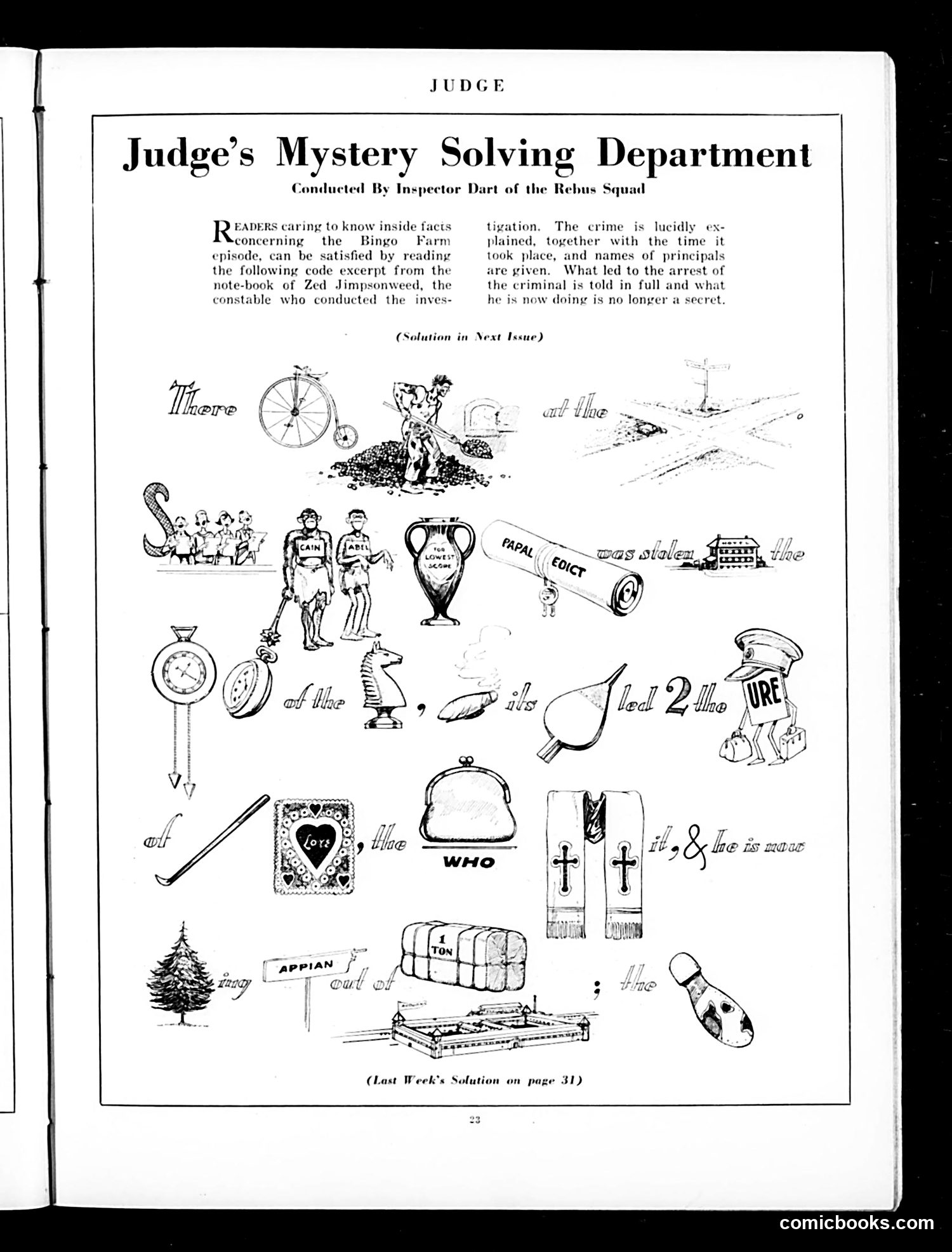
Judge's Mystery Solving Department This is a visual puzzle page from *Judge* magazine's recurring "Mystery Solving Department," conducted by a fictional character named Inspector Dart. The page presents a rebus puzzle—a visual code using drawings, objects, and text fragments that combine to tell a story or reveal information. Readers are told this puzzle relates to a "Bingo Farm episode" and that the solution will appear in the next issue. The jumble of illustrated objects (wheels, athletes, urns, scales, religious items, etc.) with handwritten text fragments scattered among them creates an encoded narrative. The solution to last week's puzzle appears on page 31. This was a popular interactive feature allowing readers to participate in solving mysteries themselves before seeing the explanation—essentially an early form of audience engagement common in early-20th-century magazines.
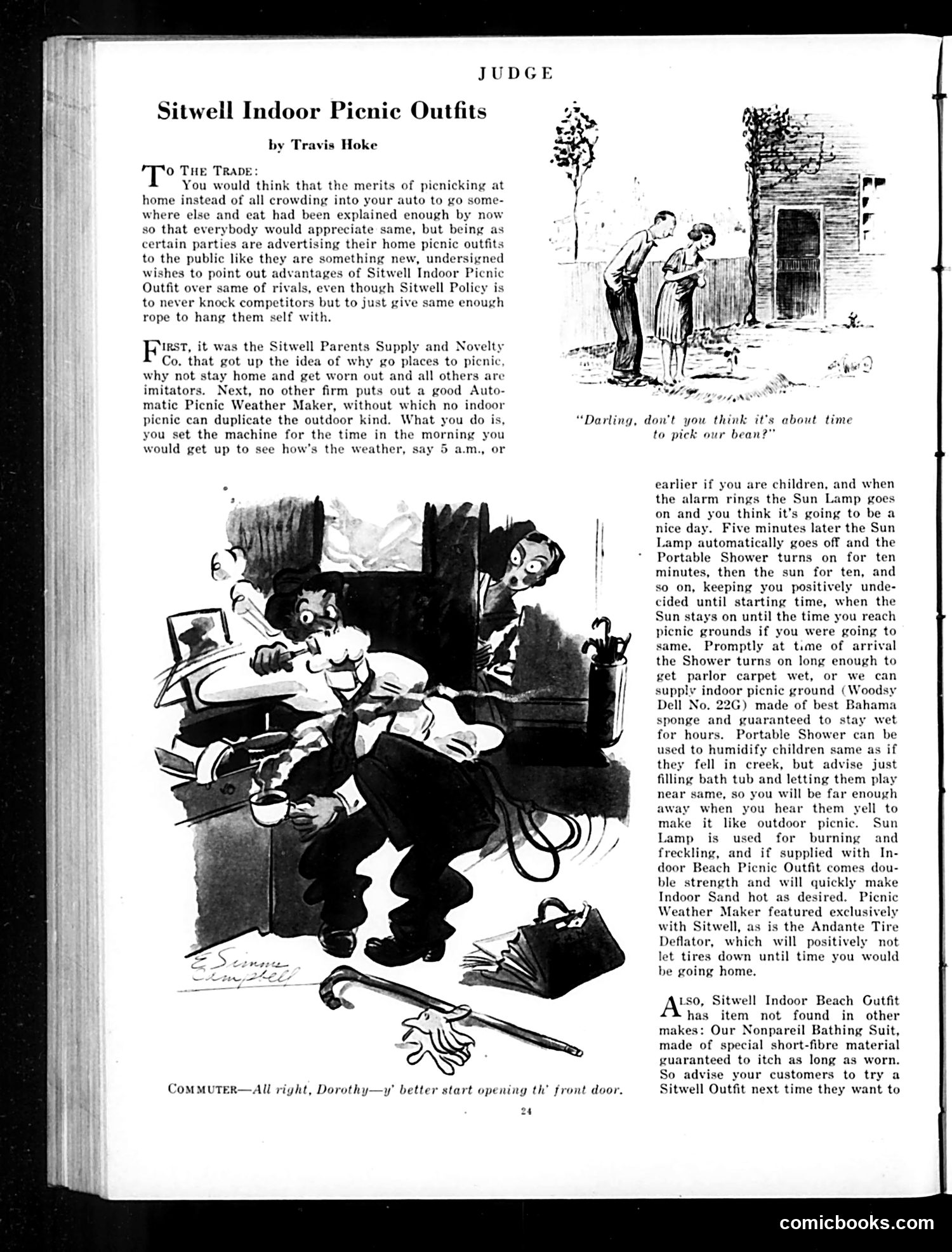
Sitwell Indoor Picnic Outfits: A Satirical Product Advertisement This is a humorous fake advertisement satirizing the growing trend of staying home during the Great Depression era rather than taking expensive outings. Travis Hoke ridicules companies marketing "indoor picnic" products as novel innovations. The satire targets the absurdity of these contraptions: a "Weather Maker" that mimics outdoor conditions indoors through timed sun lamps and showers that repeatedly drench the carpet; a "Tire Deflator" that prevents cars from leaving until departure time; and an intentionally itchy bathing suit. The cartoons show families comically unprepared for indoor entertaining, surrounded by malfunctioning equipment. The joke operates on two levels: mocking manufacturers who exploit Depression-era consumers by selling unnecessary gadgets, and poking fun at people who'd rather stay home with dubious contraptions than actually go outside. The heading "rope to hang them self with" suggests letting competitors fail through their own ridiculous marketing.
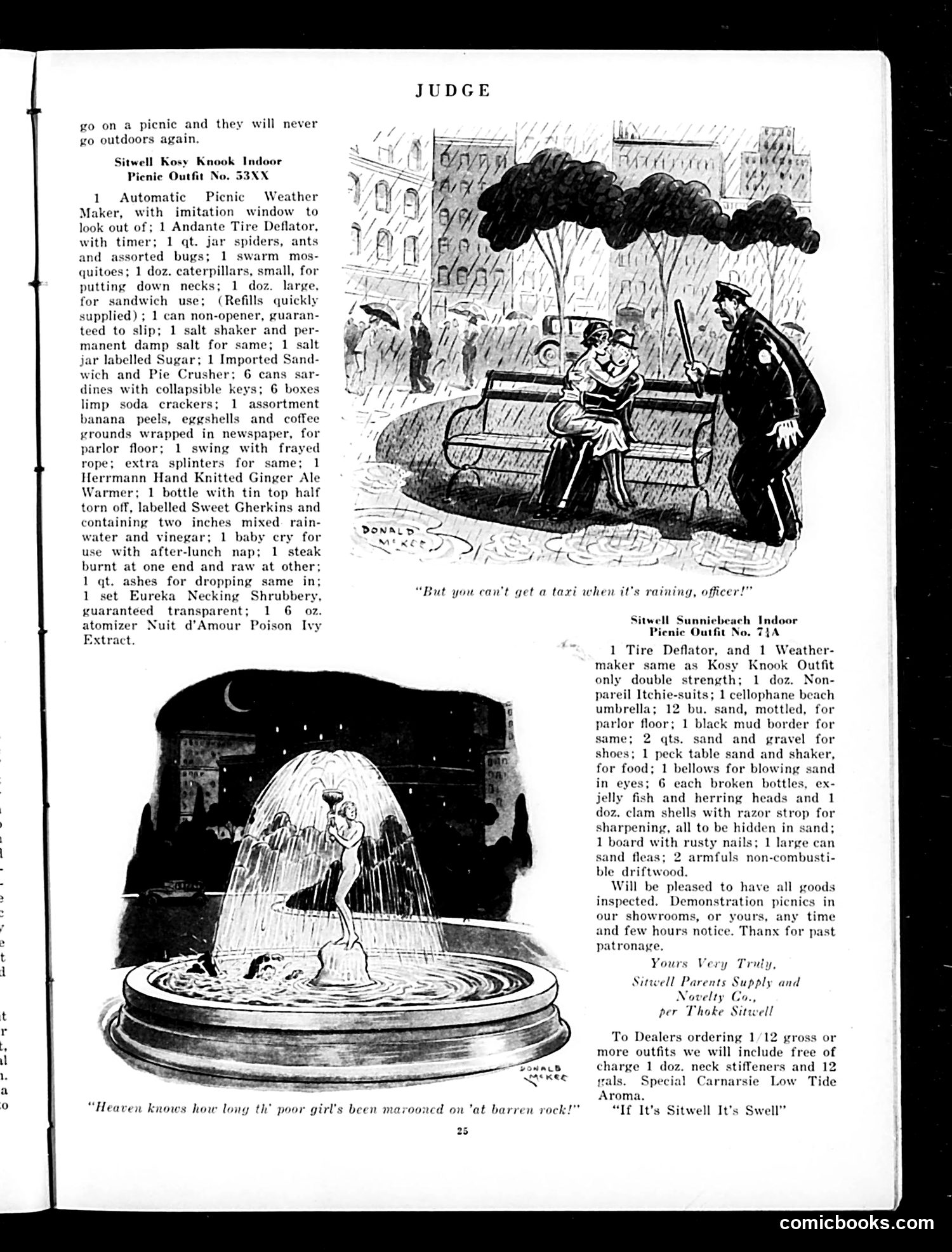
Judge Magazine Satire Analysis This page contains two related satirical advertisements for absurd "indoor picnic outfits" that mock the American outdoor recreation trend. The Sitwell company offers elaborate kits designed to replicate all the *worst* aspects of picnicking indoors—rain, bugs, spoiled food, broken items, and discomfort. The top cartoon illustrates the frustration: a couple sits in a taxi during heavy rain, unable to hail transportation, with the caption "But you can't get a taxi when it's raining, officer!" This sets up the joke: if outdoor picnics are ruined by weather anyway, why go outside? The bottom illustration shows a woman trapped under a dome in a rainstorm, representing the absurdity of this "solution." The satire targets both the commercialization of leisure activities and Americans' obsession with recreation gadgets and novelty products. By listing genuinely terrible items (poison ivy, broken bottles, damp salt), the ads mock consumers who buy elaborate, unnecessary products while portraying the picnic industry as cynically profiteering from discomfort.
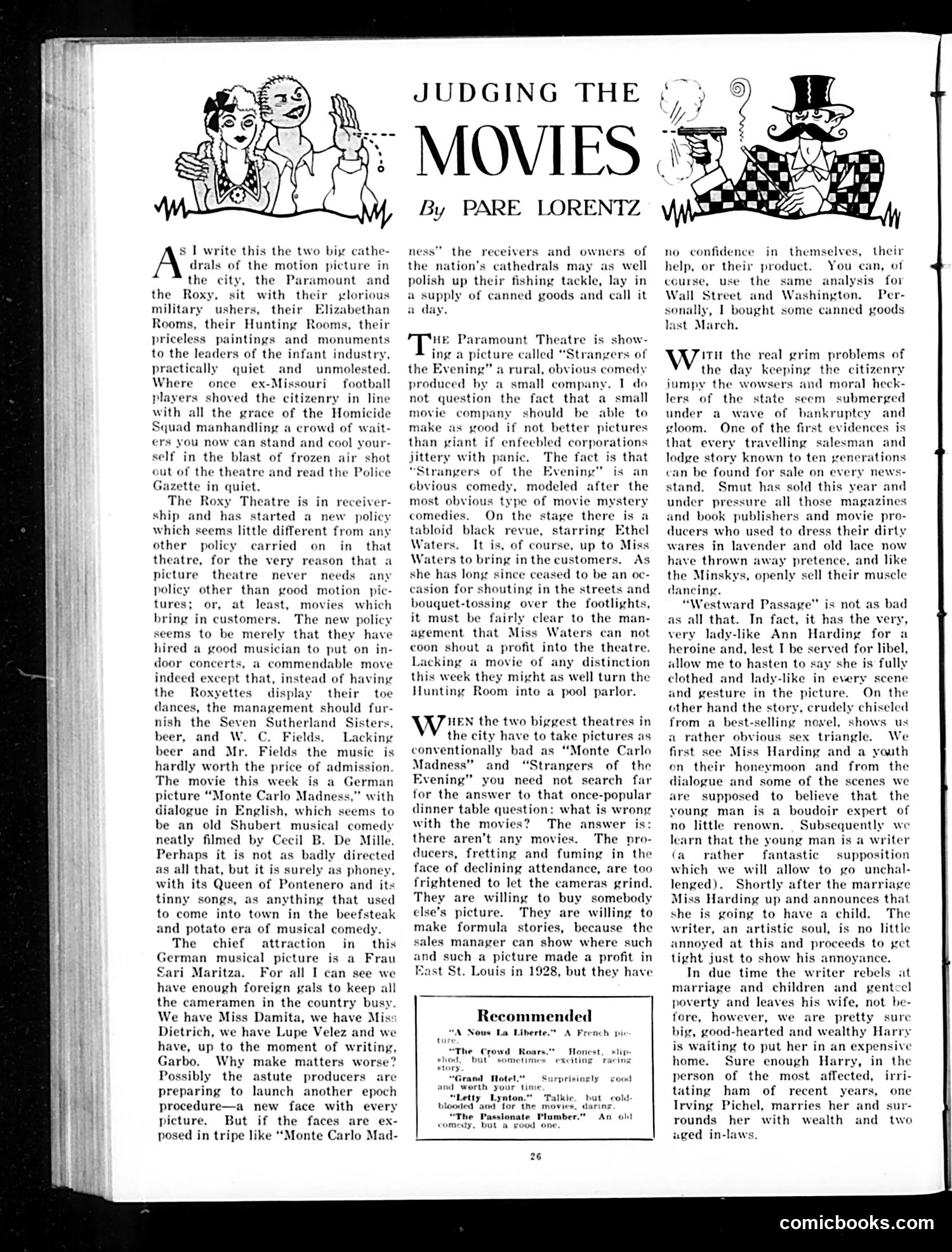
Judging the Movies: A 1920s Film Critic's Lament This is film criticism by Pare Lorentz published in *Judge* magazine. The article mocks the current state of cinema and the major theaters (Paramount and Roxy) now nearly empty due to poor quality films. Lorentz attacks specific pictures: the German musical "Monte Carlo Madness" (featuring actress Frau Maritza), criticized as hackneyed and phoney; and "Strangers of the Evening," a derivative mystery-comedy with Black entertainer Ethel Waters, whose presence cannot save mediocre material. His core complaint: major studios, terrified by declining attendance, have stopped taking creative risks. Instead, they churn out formulaic pictures with interchangeable foreign starlets (naming Damita, Dietrich, Velez, Garbo). The satire's point is that the "cathedrals" of cinema—grand movie palaces built to showcase great films—now sit empty because producers lack courage and imagination. Without quality pictures, even palatial theaters cannot survive.
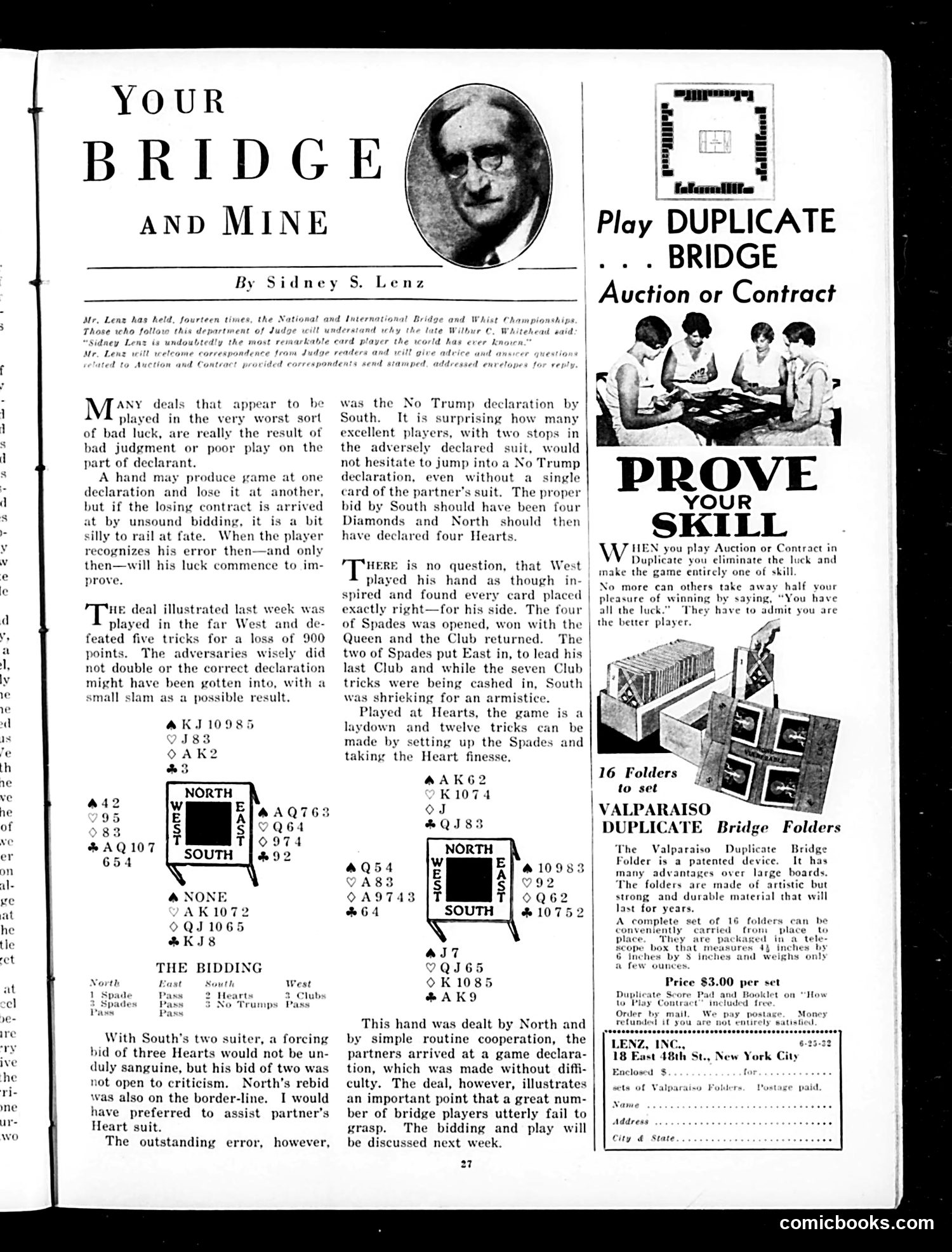
"Your Bridge and Mine" by Sidney S. Lenz This is not a political cartoon but rather a bridge strategy column with instructional content about the card game. Sidney S. Lenz, identified as a renowned bridge champion, analyzes a specific hand dealt in competitive bridge. The article critiques South's poor bidding decision—declaring No Trump instead of Hearts or Diamonds—which resulted in a failed contract. Lenz uses this example to teach that bridge losses stem from bad judgment rather than bad luck. The page includes bridge hand diagrams showing card distribution and bidding sequences, illustrating how proper "routine cooperation" between partners leads to successful game declarations. The right side advertises Valparaiso Duplicate Bridge Folders—a patented organizational device for managing bridge hands during play—and promotes duplicate bridge as a skill-based game eliminating luck. This represents mid-20th century American bridge instruction and equipment marketing.

This page is entirely a hotel advertisement, not satirical content. It promotes the Hotel Fort Shelby in Detroit's downtown, emphasizing its central location near Union Station, railroad terminals, and major business districts (financial, shopping, theatrical). The illustration shows a stylized map of downtown Detroit with a large heart at its center, labeled with nearby attractions: boat piers, railroad terminals, financial district, shopping, and theatrical venues. The hotel's tagline is "Aglow with Friendliness." The ad highlights amenities—900 rooms with private baths, reasonable rates ($3-$10), and motorist services. It's typical 1920s-30s hotel advertising, appealing to business travelers and tourists seeking convenient downtown accommodations. There is no satire or political commentary—this is straightforward commercial promotion appearing in *Judge* magazine.
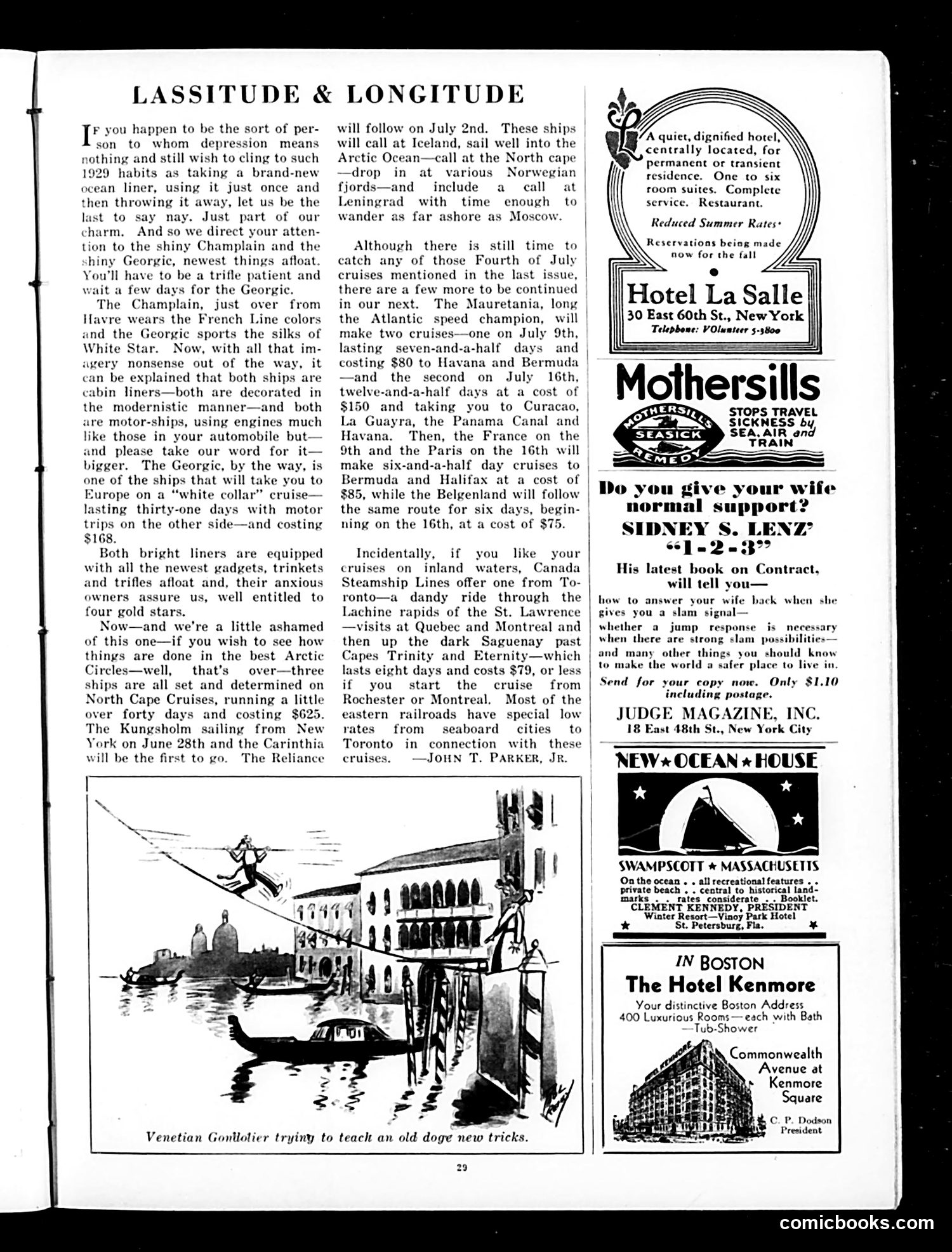
LASSITUDE & LONGITUDE - Judge Magazine, 1929 This page is primarily travel and cruise ship advertising with one satirical cartoon. The Cartoon The single illustration depicts a Venetian gondolier attempting to teach an old doge (Venetian chief magistrate) new tricks—a visual pun playing on the phrase "teaching an old dog new tricks." The joke is that even in Venice's historically dignified governing class, old habits die hard. It's gentle social satire about resistance to change. The Text The main article discusses luxury ocean liner cruises available in summer 1929, detailing routes, costs, and amenities. It mentions ships like the Georgic, Mauretania, France, and others offering "white collar cruises" to Europe and Canada. The tone is aspirational travel writing for affluent readers. Context for Modern Readers This reflects pre-Depression wealth and leisure culture (1929), when extended ocean voyages were status symbols for the upper class. The cruise prices ($50-$625) represent significant luxury spending.
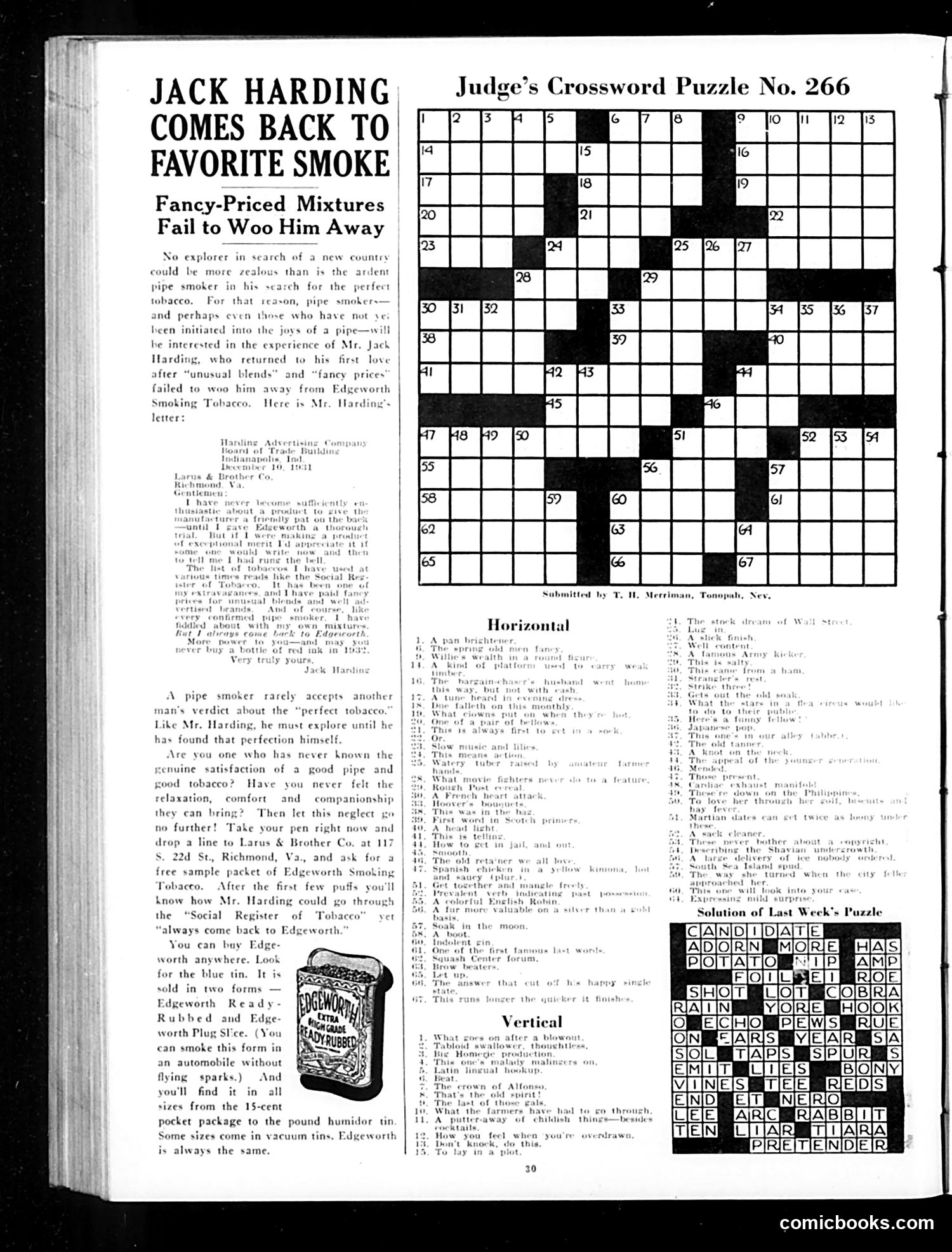
Analysis This page is primarily advertising disguised as editorial content. The dominant feature is a lengthy testimonial letter from "Jack Harding" praising Edgeworth Smoking Tobacco, framed as a news story about how he abandoned fancy blended tobaccos to return to his "favorite smoke." The "news hook" is thin: a pipe smoker's purported discovery that expensive specialty mixtures can't compete with a standard product. This is classic early 20th-century advertorial copy—presenting a product endorsement as human interest journalism. The accompanying crossword puzzle (the actual editorial content) appears unrelated to the advertisement. At bottom right is a solution grid and clue list typical of Judge's puzzle offerings. The satire, if any, is unclear from this layout. There's no obvious political content or caricature visible. This appears to be a commercial magazine page where advertising has colonized the editorial space—itself perhaps an inadvertent commentary on consumer culture, though likely unintentional on the editor's part.
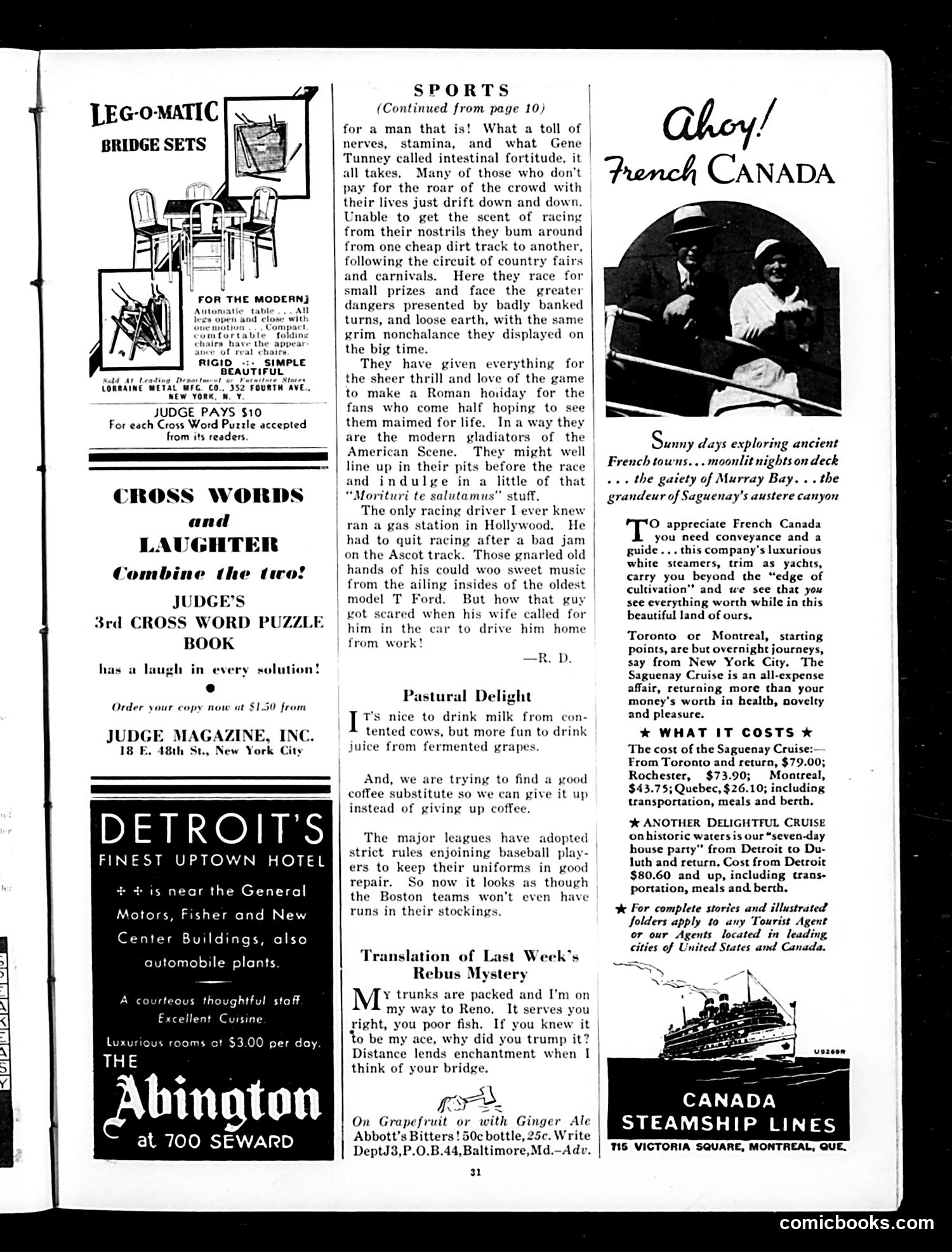
Page Analysis: Judge Magazine This page is primarily advertising and filler content, not political satire. The main elements include: Left side: Ads for Leg-O-Matic bridge sets, Judge's crossword puzzle book, and Detroit hotels (The Abington). Center: A sports column discussing the dangers faced by racing drivers—comparing them to "modern gladiators" performing for crowds. It references Gene Tunney and mentions drivers reduced to running gas stations after injuries. The tone is contemplative rather than satirical. Right side: A travel advertisement for French Canadian cruises via steamship lines, promoting scenic tours from Toronto and Montreal. Bottom humor: Brief jokes about drinking milk from cows versus fermented grapes, baseball uniform repairs, and a "rebus mystery" solution about a bridge game and divorce ("Reno"). The page reflects 1920s-era concerns (racing dangers, Prohibition-era drinking references) but contains no identifiable political cartoons or sustained satire—it's primarily commercial content typical of Judge's revenue model.
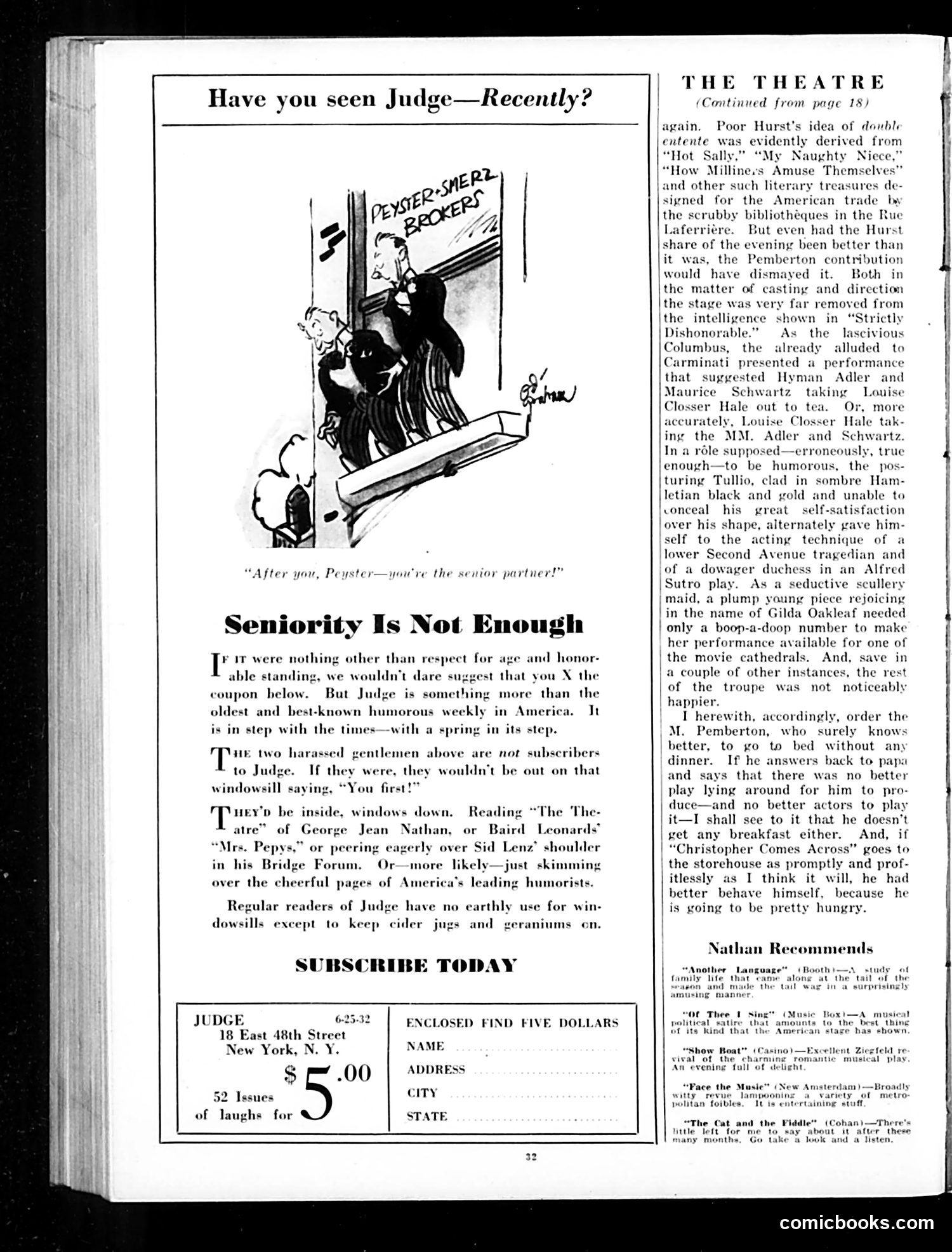
Explanation for Modern Readers This is primarily a subscription advertisement for *Judge* magazine, disguised as satirical content. The cartoon depicts two men on a building ledge, one deferentially offering the other to jump first with "You're the senior partner!" The joke: these men aren't *Judge* subscribers, so they're apparently desperate enough to consider suicide rather than endure boredom. The accompanying article "Seniority Is Not Enough" is a pitch arguing that *Judge* isn't merely old and respected—it's *modern* and entertaining. It promises readers will prefer indoor time with *Judge's* humor and theater criticism (by George Jean Nathan and others) to actually being outdoors. The satire is self-promotional: the magazine jokingly suggests non-subscribers are so miserable they'd rather die than miss out on *Judge's* content. It's a tongue-in-cheek sales tactic common in early 20th-century advertising. The right column contains theater reviews, unrelated to the advertisement's message.
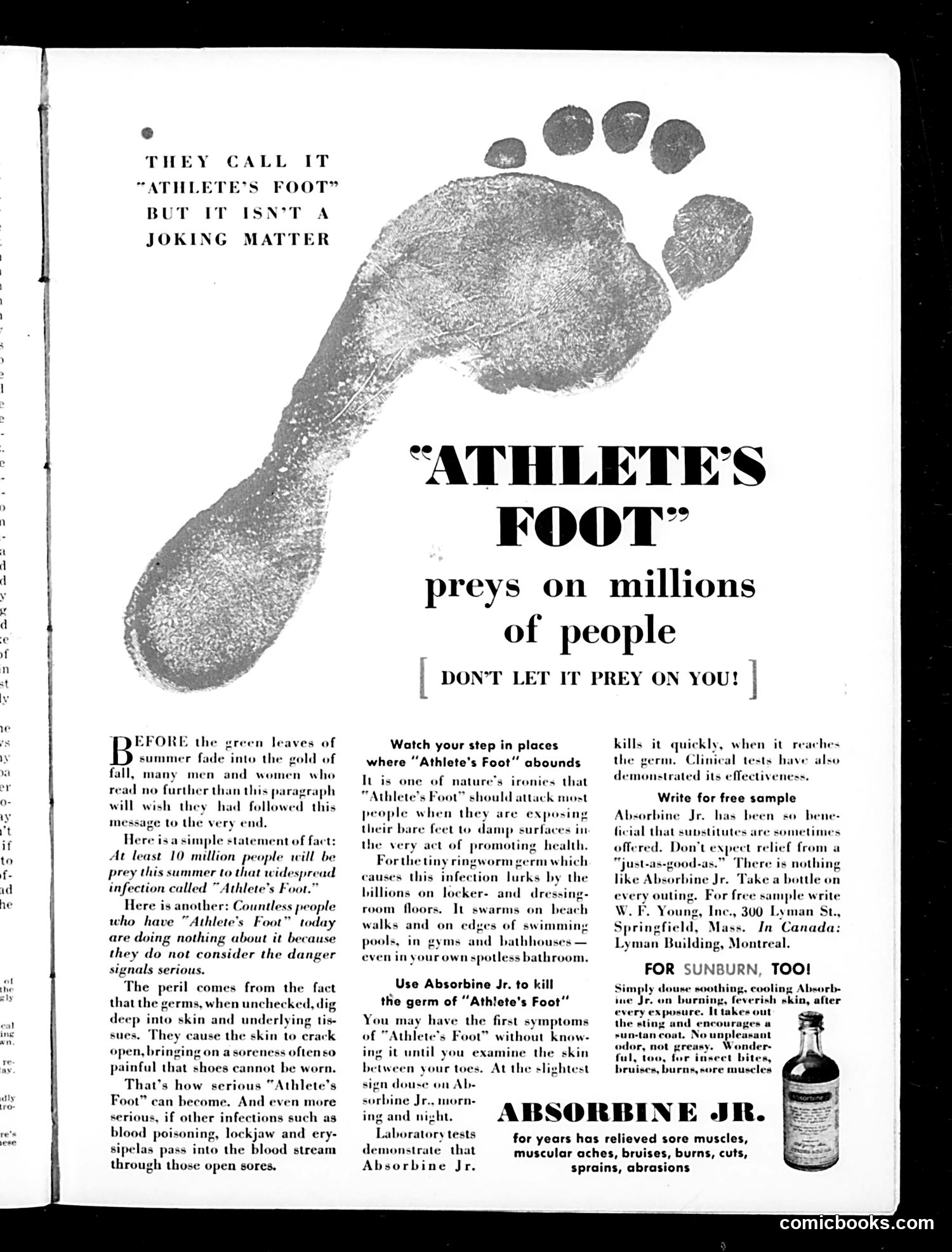
Analysis This is primarily a pharmaceutical advertisement for Absorbine Jr., not a political cartoon. The page uses fear-based marketing to sell a medicinal product. The "cartoon" element is the stylized footprint graphic at the top—a visual metaphor showing how athlete's foot spreads. The joke in the headline ("They call it 'Athlete's Foot' but it isn't a joking matter") uses wordplay: the term sounds minor, but the advertisement claims the condition is actually serious and dangerous. The persuasive strategy exploits mid-20th century anxieties about hygiene and infection. The text warns that athlete's foot germs lurk in communal spaces (locker rooms, beaches, bathhouses, even home bathrooms), preying on millions. It escalates the threat by mentioning potential complications like blood poisoning and lockjaw. The advertisement then positions Absorbine Jr. as the solution, claiming laboratory tests prove its effectiveness. This represents typical vintage pharmaceutical marketing: create alarm about a common condition, then offer relief. There is no political satire here—Judge is simply hosting a commercial advertisement using sensationalized health claims to drive product sales.
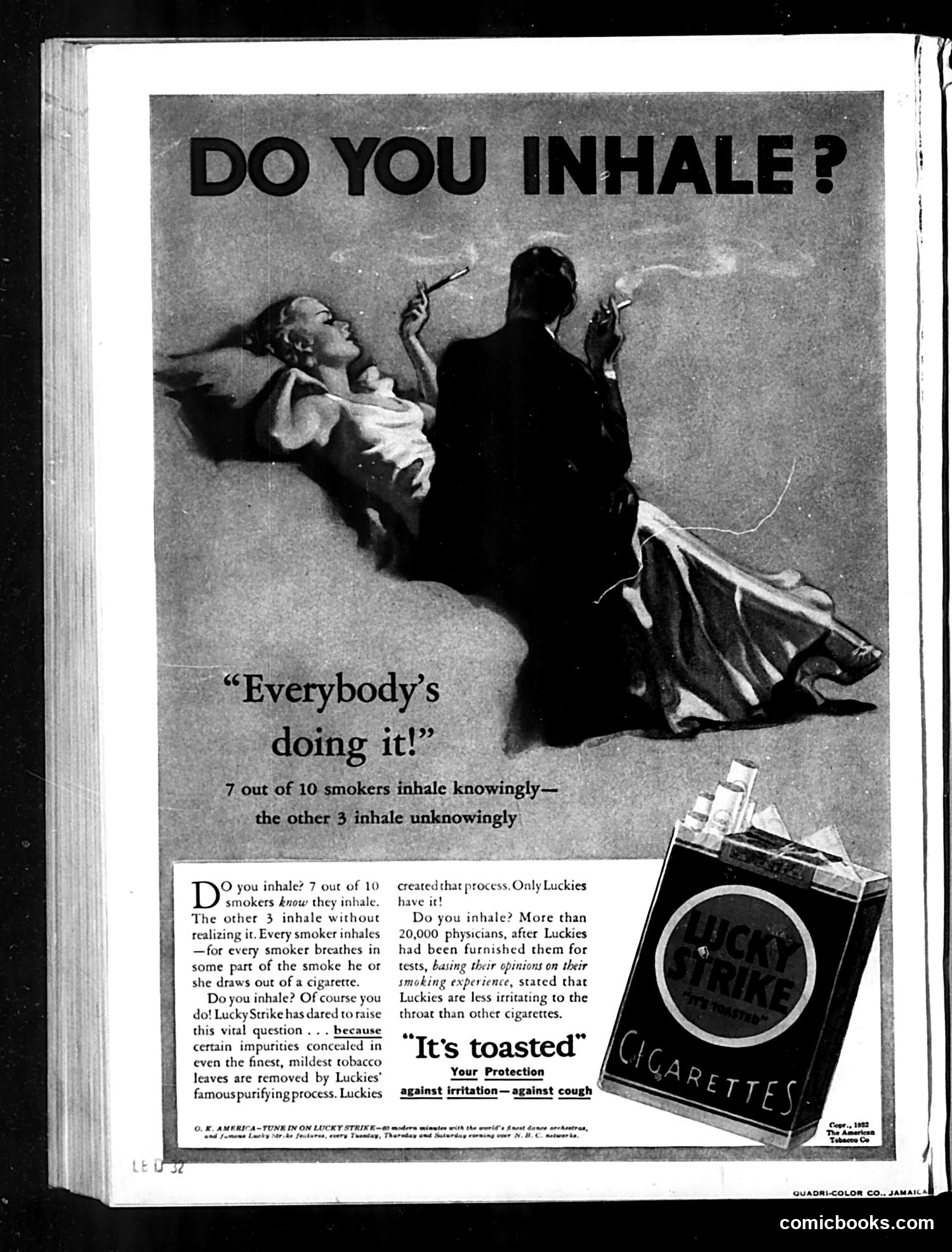
Lucky Strike Cigarette Advertisement Analysis This is a Lucky Strike cigarette advertisement, not satire or political commentary. The page uses a rhetorical question—"Do you inhale?"—as a marketing strategy to normalize smoking and establish it as universal behavior ("Everybody's doing it!"). The image depicts a fashionably dressed woman inhaling cigarette smoke, visually reinforcing the aspirational lifestyle associated with smoking in this era. The ad makes health claims typical of 1920s-30s tobacco marketing: that Lucky Strike's "toasting" process removes impurities, and that 20,000 physicians endorsed the cigarettes as "less irritating to the throat." These claims were unsubstantiated and would be illegal today. The overall message reassures consumers—especially women, a growing market—that inhalation is normal, safe, and socially desirable. This represents pre-regulatory cigarette advertising before health risks were widely acknowledged.

I'm unable to provide a meaningful analysis of this page because the image appears to be almost entirely blank or white, with only binding marks visible on the left side. While you've indicated this is from *Judge* magazine and mentioned OCR'd text should be present, I cannot discern any visible cartoon illustrations, text, or content that would allow me to identify figures, political references, or satirical points. To help you, I would need a clearer or higher-contrast image showing the actual page content. If this is a scanning issue, attempting to rescan the page might yield better results for analysis.