judge
Judge — July 1932
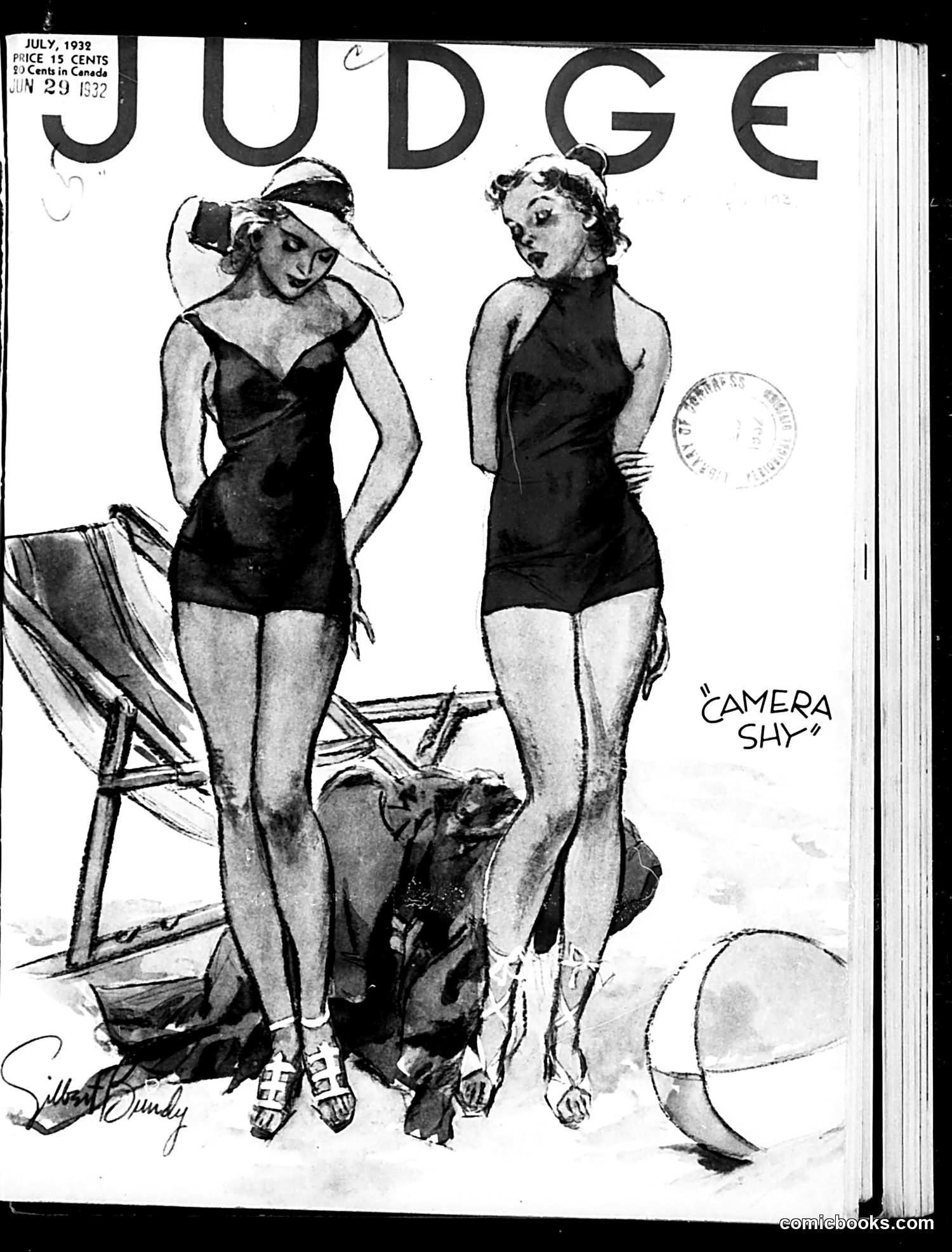
Judge Magazine Cover - July 1932 This cover illustration by "Camera Shy" depicts two women in bathing suits at a beach with a small dog, accompanied by beach equipment. The title "JUDGE" dominates the top in large letters. The satire likely references the beach culture and leisure activities of the early 1930s, during the Great Depression. The phrase "Camera Shy" (the artist's signature) suggests the cartoon's humor derives from the women's self-conscious posing despite claiming bashfulness—a commentary on vanity or the contradiction between modesty and desire for attention. The specific social commentary remains unclear without additional context, though beach fashion and women's public appearance were common Judge magazine topics of this era. The small dog may add humorous accompaniment to the scene.
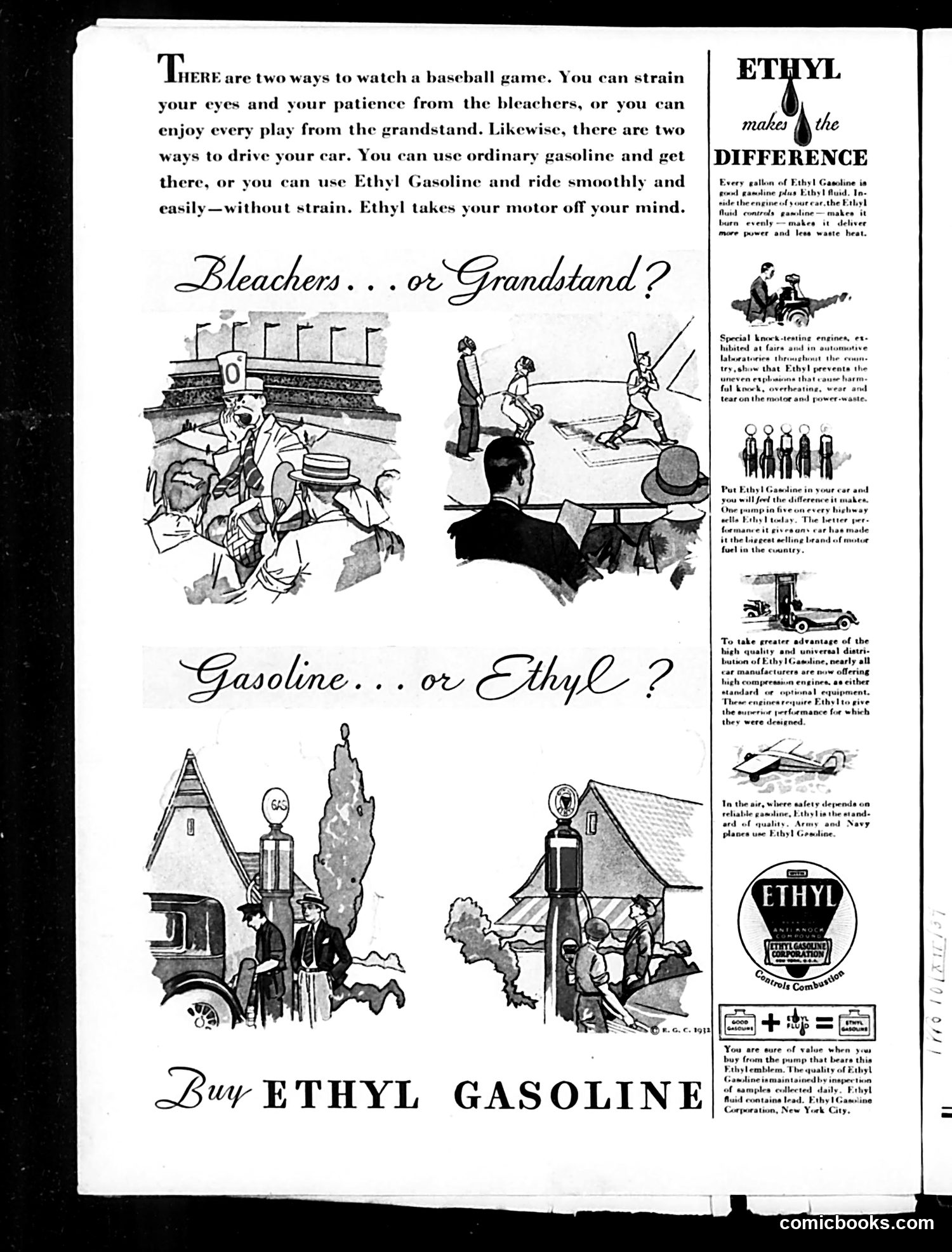
Analysis This is primarily advertising, not satire. The page promotes Ethyl Gasoline through commercial messaging rather than political commentary. The ad uses an analogy comparing two choices: watching a baseball game from bleachers versus the grandstand, and using regular gasoline versus Ethyl Gasoline. The images illustrate these contrasts—discomfort versus comfort, strain versus ease. The bottom section contrasts "Gasoline...or Ethyl?" with illustrations of a malfunctioning car with smoke and fire versus a properly functioning vehicle, suggesting Ethyl prevents engine problems. The right sidebar includes testimonials and technical claims about Ethyl's performance benefits. This is straightforward product marketing from the Ethyl Gasoline Corporation (New York City), not satirical commentary on contemporary politics or society.
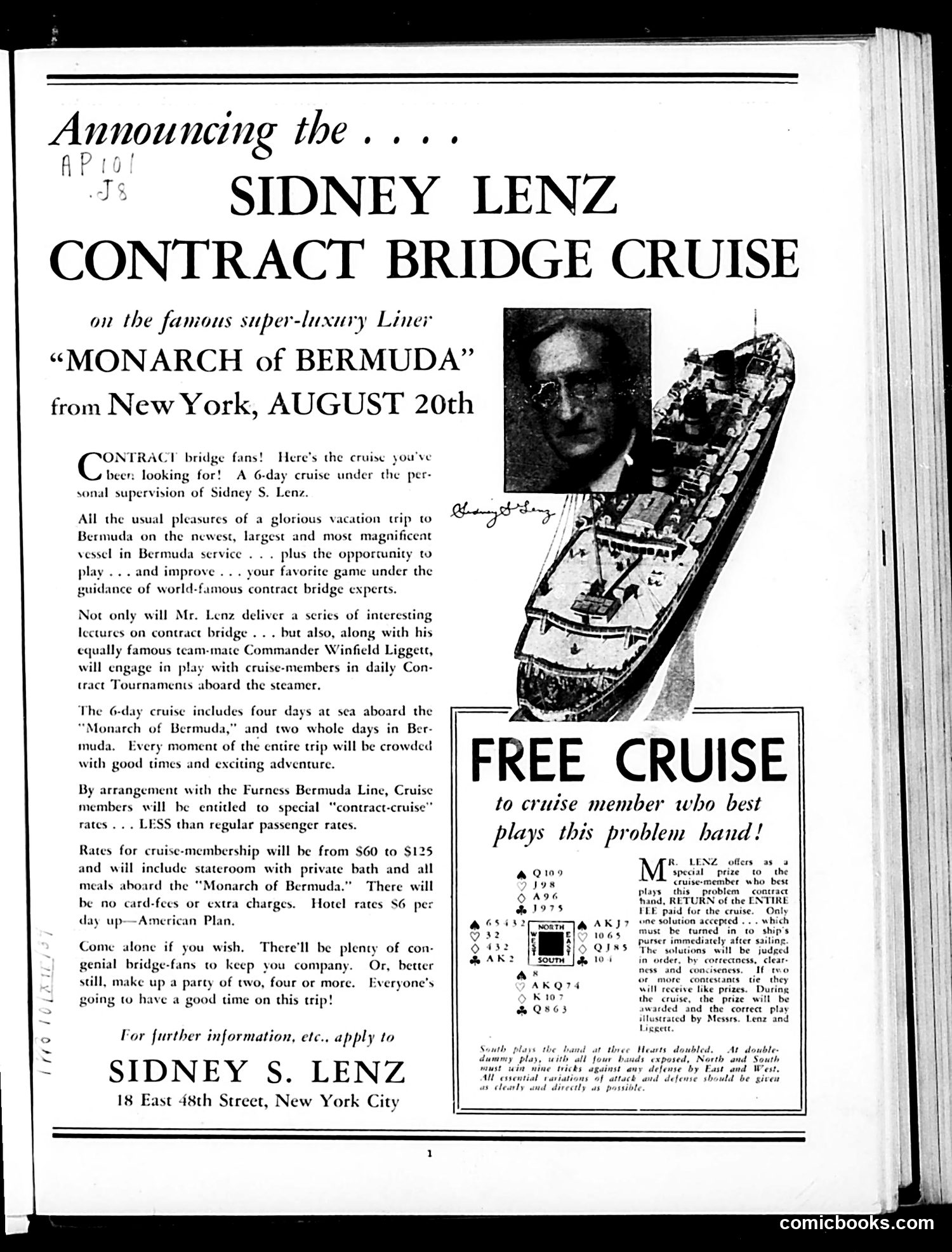
Sidney Lenz Contract Bridge Cruise Advertisement This page is primarily a cruise advertisement, not political satire. It announces a 6-day cruise departing New York August 20th aboard the "Monarch of Bermuda," organized by Sidney S. Lenz, a famous contract bridge expert. The advertisement emphasizes that cruise members will receive instruction from Lenz and Commander Winfield Liggett, another bridge authority, with daily tournaments aboard ship. The right side includes a bridge problem as a contest: players submitting the best solution to a complex card hand win a free cruise. This combines advertising with interactive engagement—a marketing technique targeting bridge enthusiasts during the 1930s-40s bridge craze. The page reflects bridge's status as a serious competitive game among affluent Americans of that era.
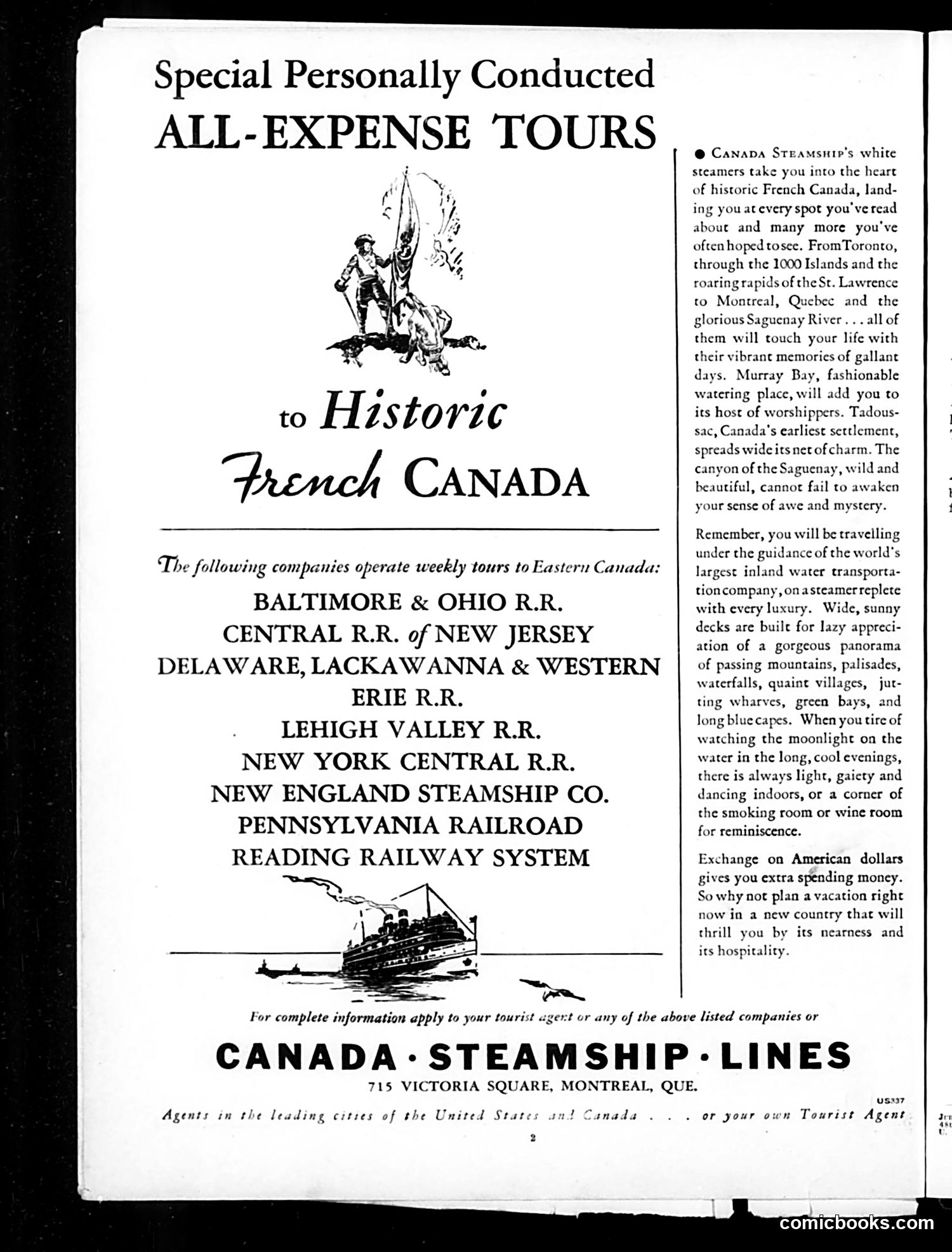
Analysis This page is primarily advertising, not satire or political commentary. It advertises all-expense tours to French Canada operated by various American railroad and steamship companies (Baltimore & Ohio, New York Central, Erie Railroad, etc.). The small illustration shows a coureur de bois (French-Canadian fur trader) with a canoe—a historical figure meant to evoke French Canada's colonial past and appeal to tourists seeking authentic, exotic experiences. The text emphasizes luxury travel amenities ("wide, sunny decks," evening entertainment) and the appeal of spending American dollars in Canada. The underlying message: Canadian tourism offers accessible adventure and charm to affluent American travelers. This reflects early 20th-century tourism marketing rather than political satire.
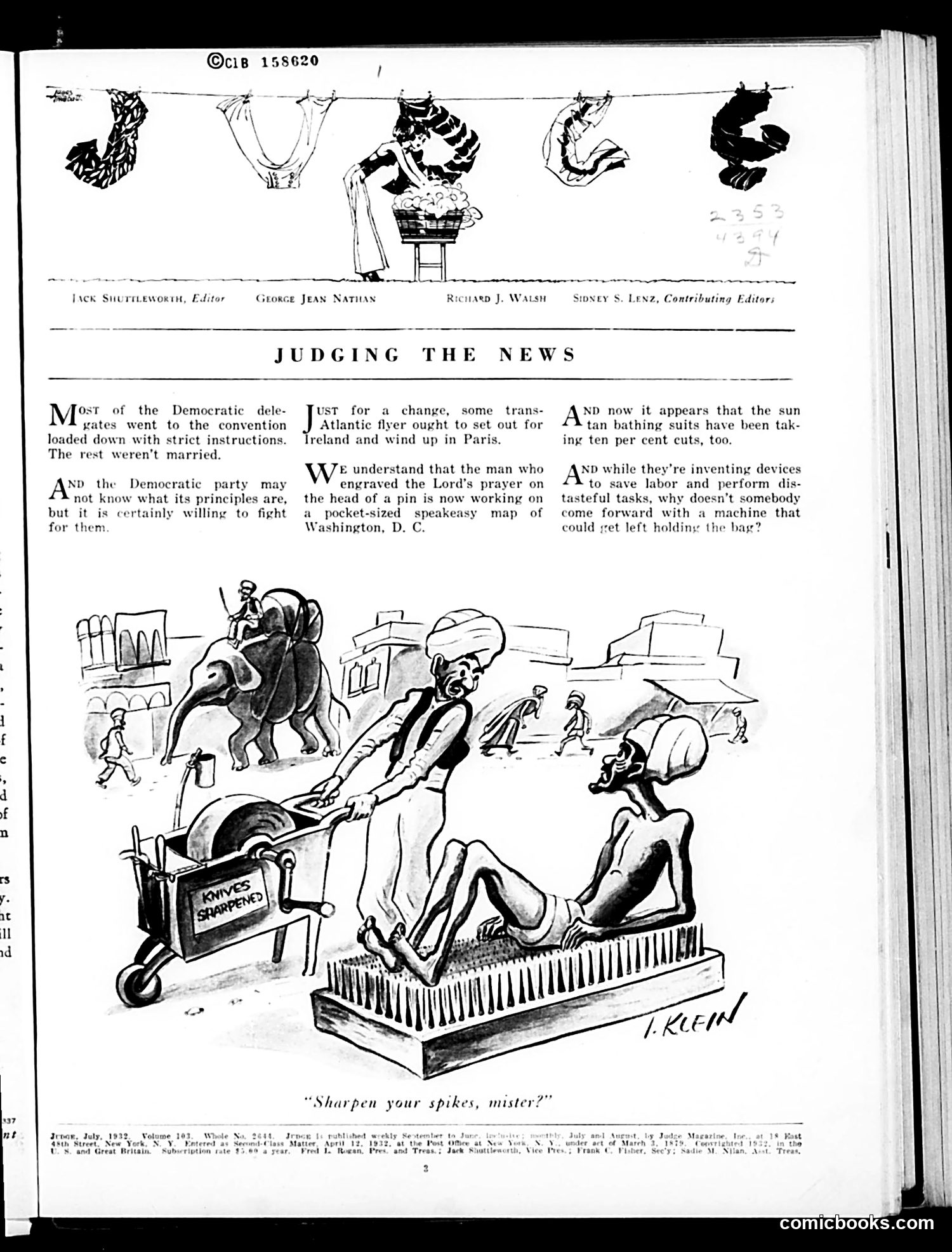
Analysis of "Judging the News" Page This page from *Judge* magazine contains brief satirical commentary on current events and one central cartoon. The Cartoon ("Sharpen your spikes, mister?"): depicts a woman operating a mechanical device labeled "WIVES' EFFICIENCY" that sharpens spikes. The satire targets the efficiency/labor-saving movement popular in the 1920s, mocking the idea that wives could be made more "efficient" through mechanical means. The setup suggests absurdist humor about applying industrial optimization to domestic life and women's roles. Text Items: Brief jokes about Democratic Party conventions, transatlantic travel plans, pin-head engravings, and bathing suit fashions. These appear typical of the magazine's quick-hit satirical commentary on contemporary news and trends rather than addressing specific political figures or events.
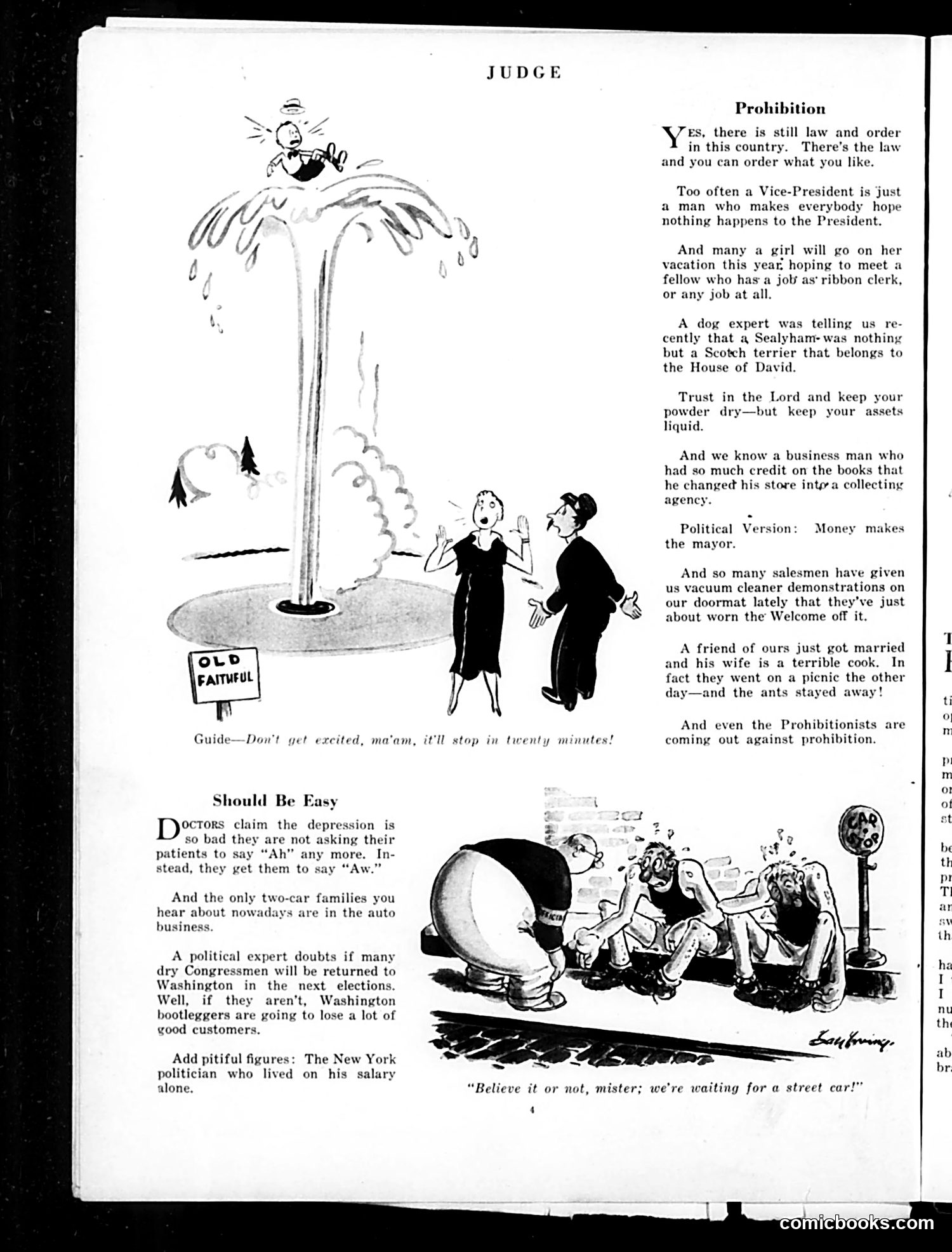
Judge Magazine Satire Analysis This page contains two separate cartoons satirizing American life during Prohibition era. The top cartoon depicts "Old Faithful" (the geyser) erupting with a figure riding on top, while two people below discuss it. The caption "Don't get excited, ma'am, it'll stop in twenty minutes" suggests Prohibition's temporary nature—implying it will inevitably fail, much like a natural phenomenon that cannot be permanently controlled. The bottom cartoon shows children playing with a large barrel, captioned "Believe it or not, mister; we're waiting for a street car!" This satirizes how Prohibition created absurd situations where barrels (likely alcohol-related) became common street fixtures, normalizing what should be illegal. Both cartoons mock Prohibition's ineffectiveness and the cultural absurdities it produced.
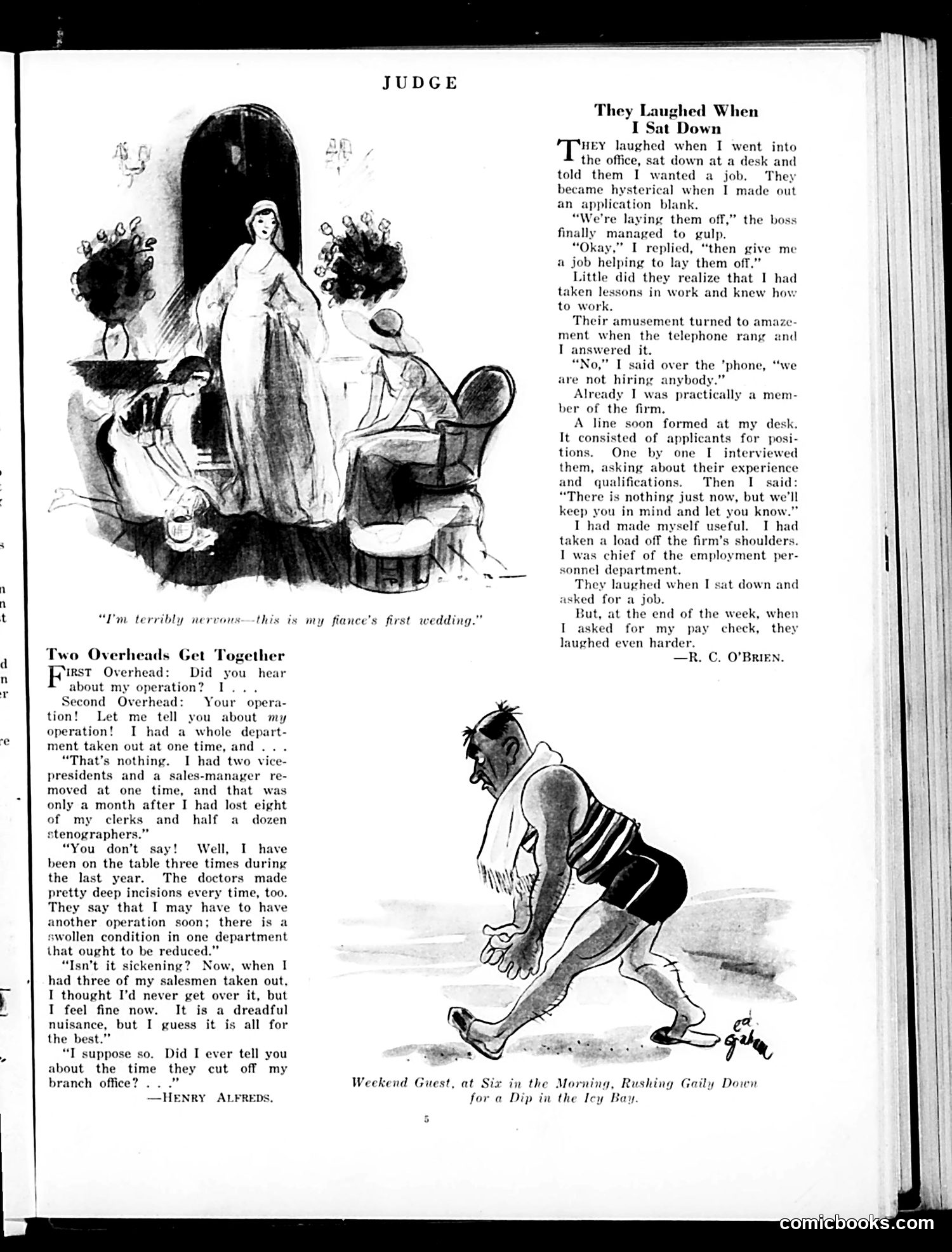
Analysis of Judge Magazine Page This page contains three separate pieces of workplace humor from early 20th-century America: "They Laughed When I Sat Down" (by R.C. O'Brien) mocks job applicants' surprise when a young woman becomes a manager. The narrator, now chief of employment, receives interview applicants and reveals she'd previously worked her way up—satirizing both sexism in hiring and the gap between candidates' expectations and reality. "Two Overheads Get Together" presents competing executives comparing their organizational difficulties (operations removed, staff cuts, health problems), with each claiming worse circumstances—a satire on corporate one-upmanship and workplace complaints. The bottom cartoon shows a portly gentleman rushing toward the ocean, captioned as a "weekend guest" hurrying for a morning swim—likely satirizing overeager visitors or the discomforts of seaside hospitality. The humor derives from his ungainly appearance and apparent desperation.
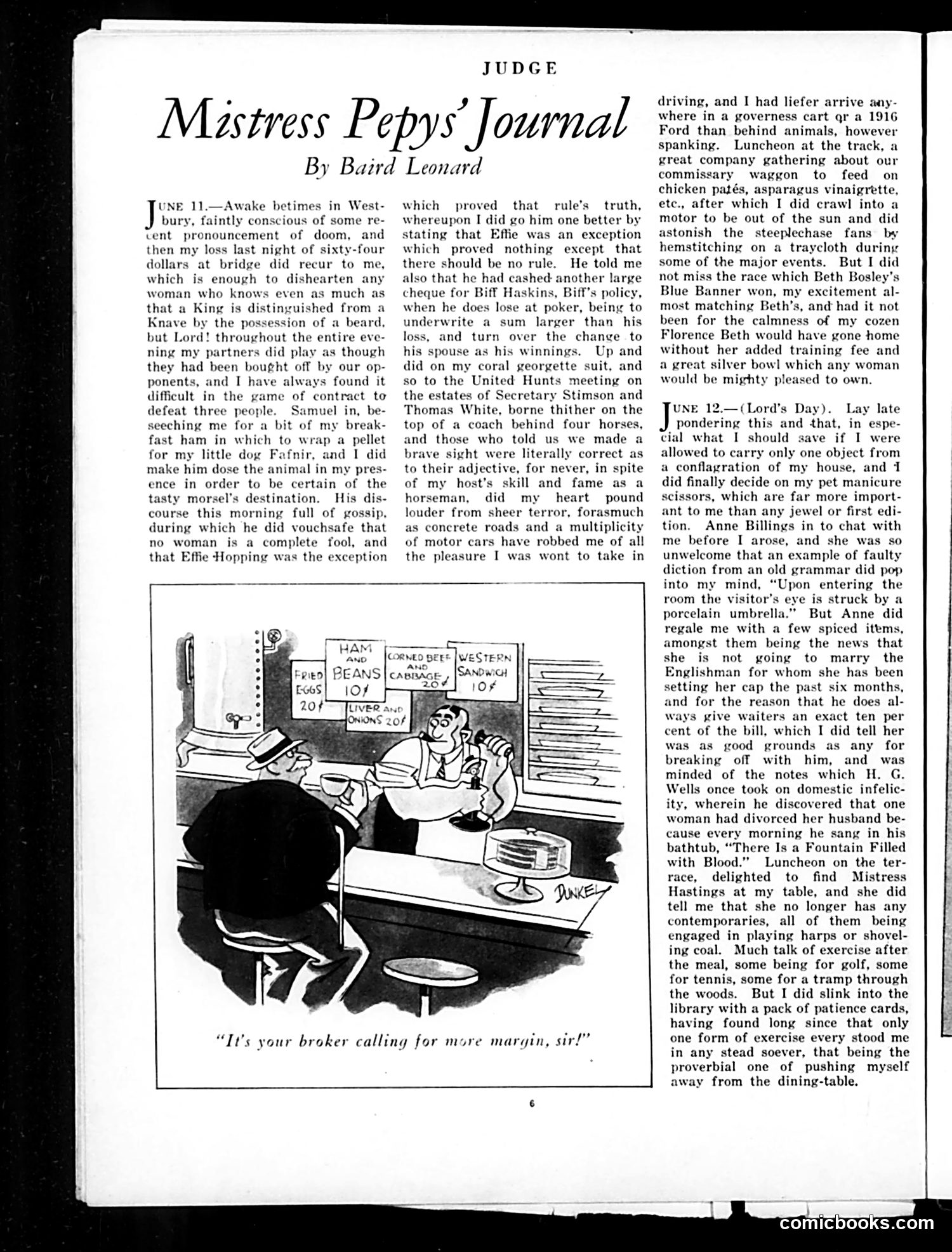
"Mistress Pepys' Journal" by Baird Leonard This is a humorous advice/gossip column styled as a modern woman's diary. The single cartoon shows a woman at a desk being told by someone off-screen: "It's your broker calling for more margin, sir!" The joke plays on 1920s stock market terminology. "Margin" refers to buying stocks on credit—a practice that fueled the pre-crash boom. The humor conflates two contemporary concerns: women's newly independent roles (she has her own broker) with the aggressive, risky financial practices of the era. The "sir" address adds absurdist comedy, treating the woman as if she were a serious Wall Street operator rather than a society lady. The accompanying diary entries discuss social events and gossip among wealthy circles, typical of Judge's satirical takes on upper-class life.
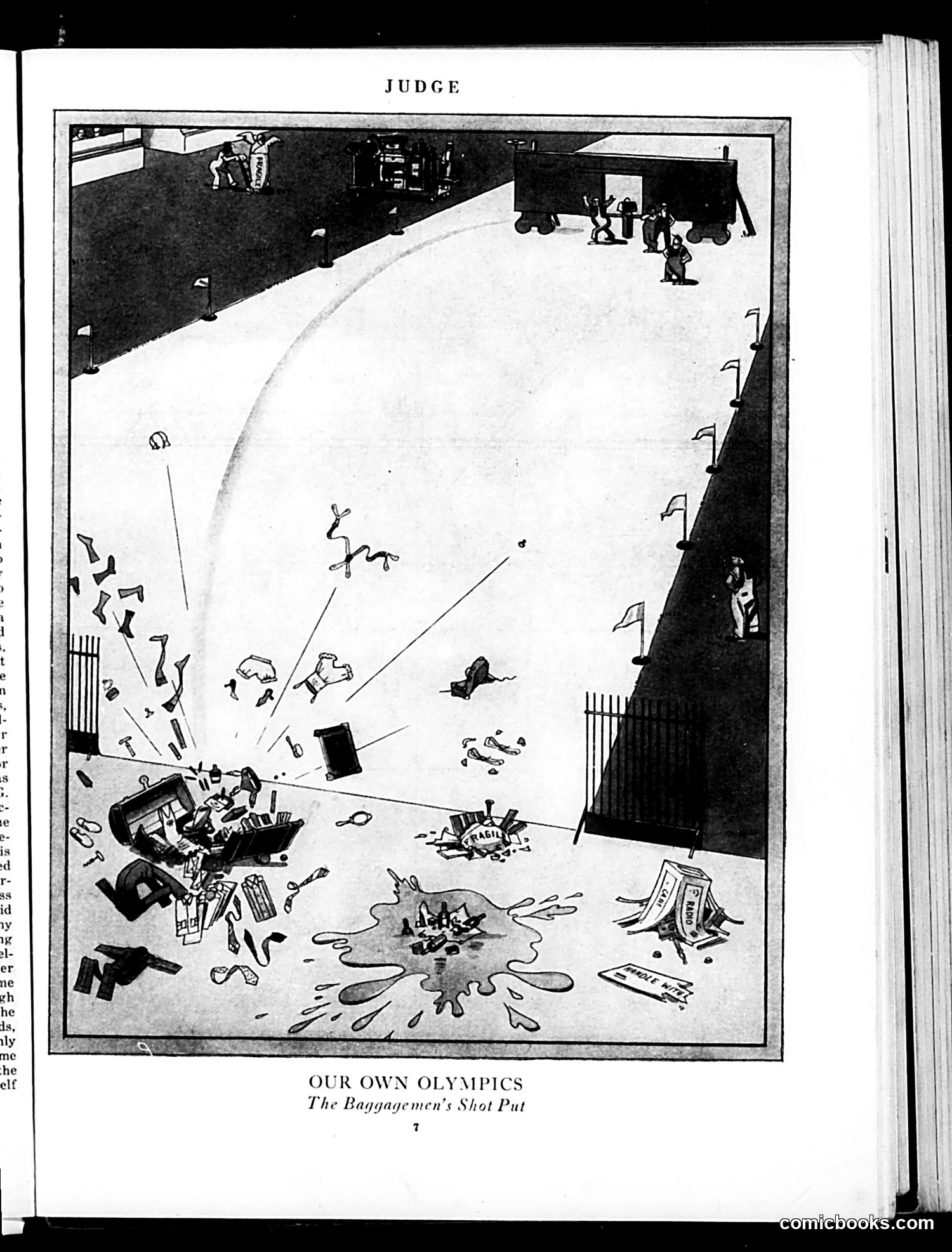
Explanation for Modern Readers This is a satirical cartoon titled "The Baggagemen's Shot Put," part of a series called "Our Own Olympics." It mocks railroad baggage handlers by depicting their work as an Olympic sport. The cartoon shows baggage and cargo being violently thrown across what appears to be a train platform or depot. Trunks, suitcases, and various luggage items are scattered in all directions, with lines indicating forceful trajectories. Spectators sit in bleachers watching this "competition." The satire criticizes the rough, destructive handling of passengers' baggage by railroad workers—a common complaint in the early-to-mid 20th century. By framing this careless treatment as an "Olympic event," Judge magazine humorously highlights how poorly baggage was actually being handled, turning a legitimate consumer grievance into comedic commentary on railroad service standards.
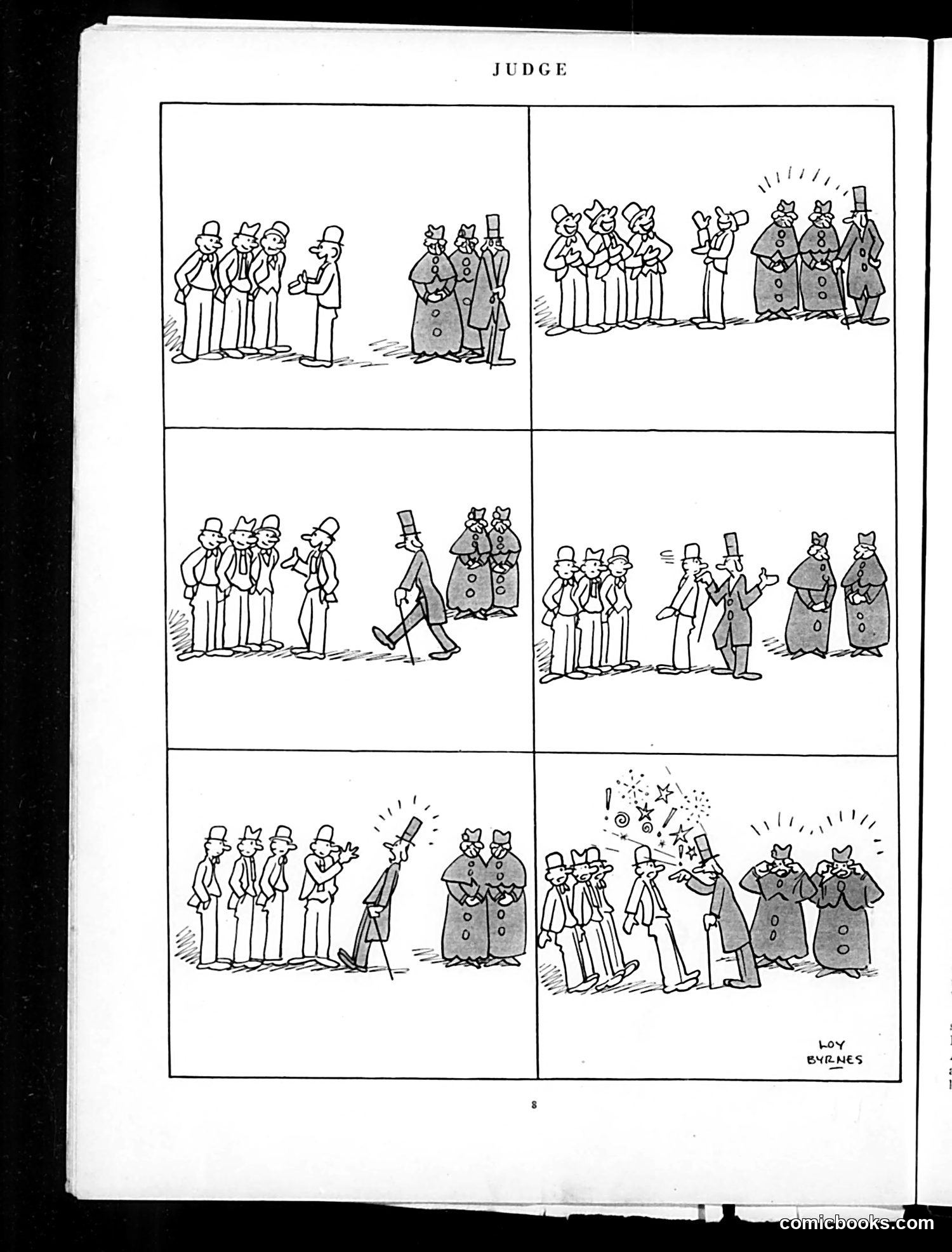
"Judge" Cartoon: "Judge" This six-panel satirical comic by Roy Byrnes depicts a judge's interaction with a group of men in top hats (appearing to be businessmen or politicians) and two women in long dresses (shaded, suggesting they represent justice or authority figures). The narrative appears to show the judge progressively losing control of the situation. The men initially present themselves respectfully, but progressively become more assertive or disruptive. By the final panels, there's chaos—with what appears to be celebrations or explosions—suggesting the judge's authority has been completely undermined or overwhelmed. The satire likely critiques judicial ineffectiveness against powerful interests or corruption, showing how figures of authority (the judge) are ultimately powerless against determined wrongdoers or special interests.
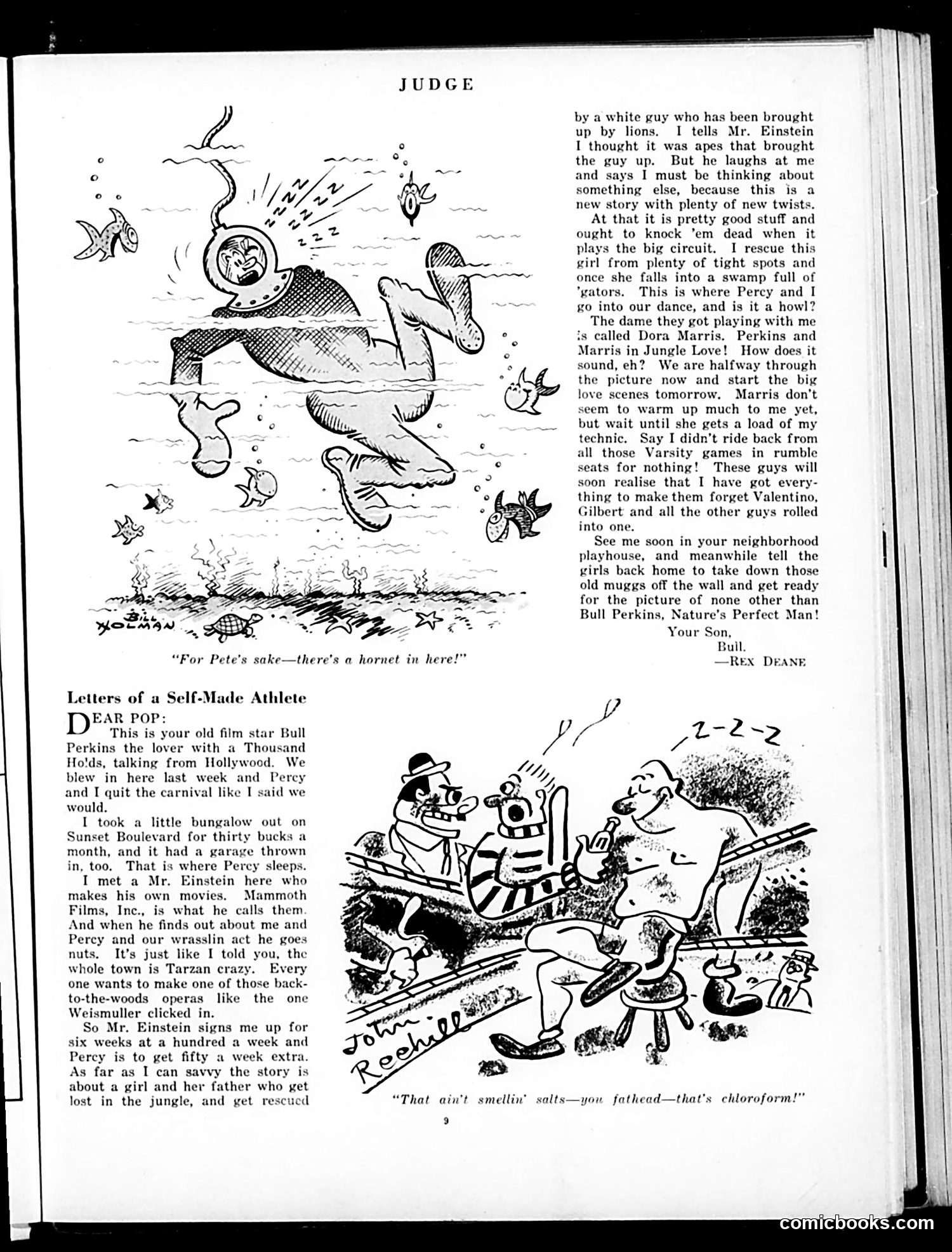
Explaining This Judge Page for Modern Readers This page satirizes Hollywood's jungle-adventure craze of the late 1920s-early 1930s. "Bull Perkins," a self-made athlete and carnival wrestler, writes to his father about landing a movie contract in Hollywood. The satire works on multiple levels: The Setup: Bull is a buffoonish ex-wrestler hired for a "Jungle Love" film, apparently because studios were copying the success of Johnny Weissmuller's *Tarzan* pictures (referenced explicitly). Bull is comically delusional about his talents and appeal to actresses. The Joke: The letter mocks both Bull's ignorance (confusing lions with apes in plot details, overestimating his charm) and the absurdity of low-quality jungle films being churned out to capitalize on *Tarzan's* popularity. The Cartoons: Illustrate the chaotic film production, with the bottom cartoon's caption—"That ain't smellin' salts—you fathead—that's chloroform!"—emphasizing the incompetence and danger of these rushed productions. The piece ridicules both wannabe actors and Hollywood's formulaic profit-seeking.
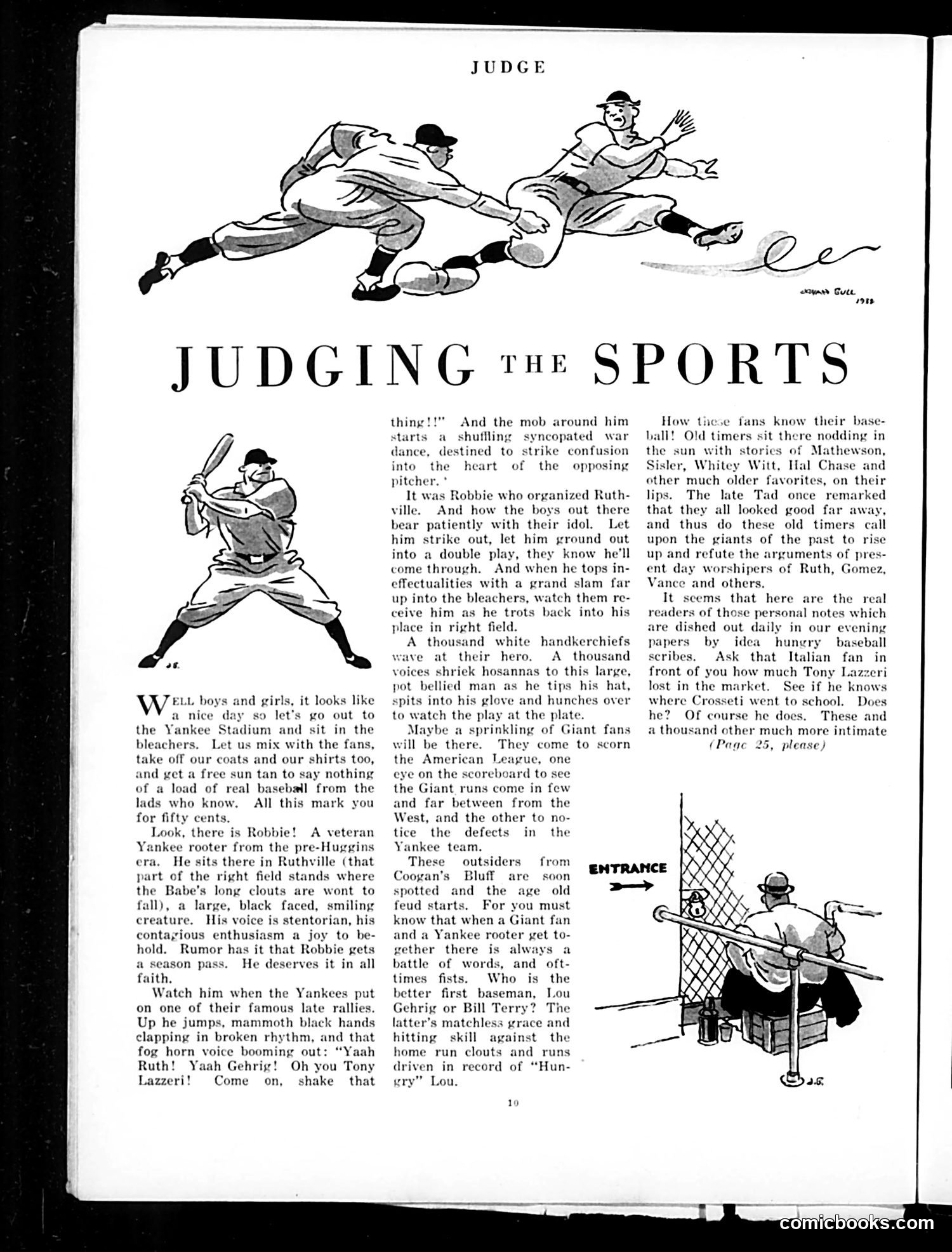
"Judging the Sports" — Judge Magazine This article celebrates baseball fandom at Yankee Stadium, specifically focusing on "Robbie," a stereotypical enthusiastic fan character. The piece describes the passionate fan culture surrounding the 1920s Yankees, naming real players: Babe Ruth, Lou Gehrig, Tony Lazzeri, Bill Terry, and others. The satire targets: 1. Fan devotion: Robbie organizes "Ruthville" (the right field bleachers where Ruth's home runs land), leading ritualistic cheers and handkerchief waves. 2. Ethnic stereotyping: The description of Robbie as "large, black faced, smiling creature" with "stentorian" voice conducting "syncopated war dance" reflects period racial caricature common to Judge's era. 3. Baseball tribalism: The feud between Giants fans (from Coogan's Bluff) and Yankees fans, debating which first baseman is superior. 4. Knowledge gaps: The piece ironically notes fans obsessively follow players' market losses and school histories while claiming deep baseball expertise. The humor assumes readers recognize these famous players and 1920s baseball culture.
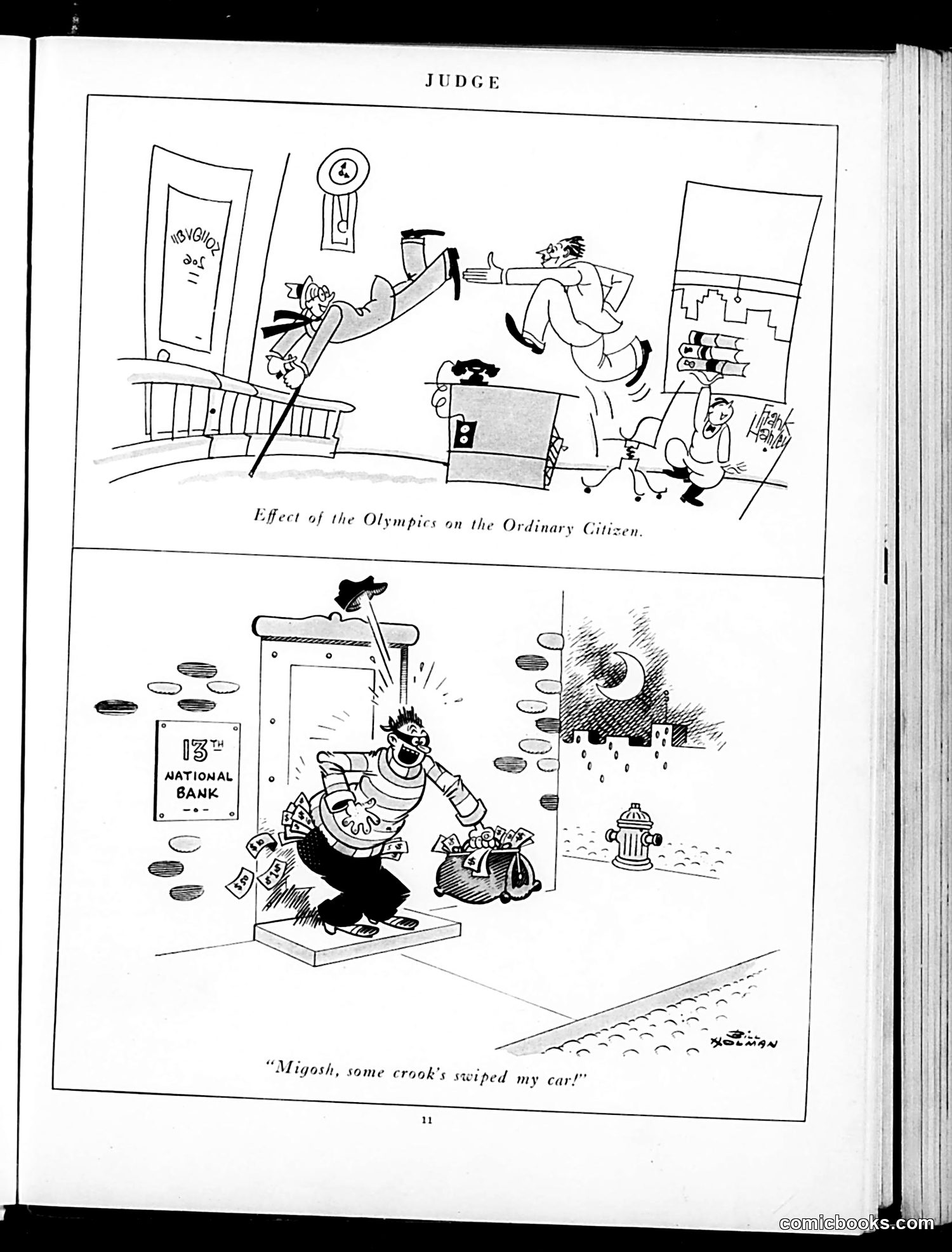
Analysis of Judge Page This page contains two satirical cartoons mocking the disruptive effects of Olympic Games on ordinary citizens. Top cartoon: Shows chaotic disruption in a judge's chambers—a man is being ejected through a window while others struggle with paperwork. The title "Effect of the Olympics on the Ordinary Citizen" suggests the Games caused such upheaval that normal civic functions (here, justice) became impossible. Bottom cartoon: Depicts a man at a National Bank discovering his car stolen, exclaiming "Migosh, some crook's swiped my car!" The scattered coins suggest financial chaos, implying Olympic-related disruption increased crime or disorder affecting everyday people. The satire targets how hosting the Olympics—despite their prestige—created genuine problems for regular citizens through congestion, crime, and disrupted services, rather than the celebration authorities promised.
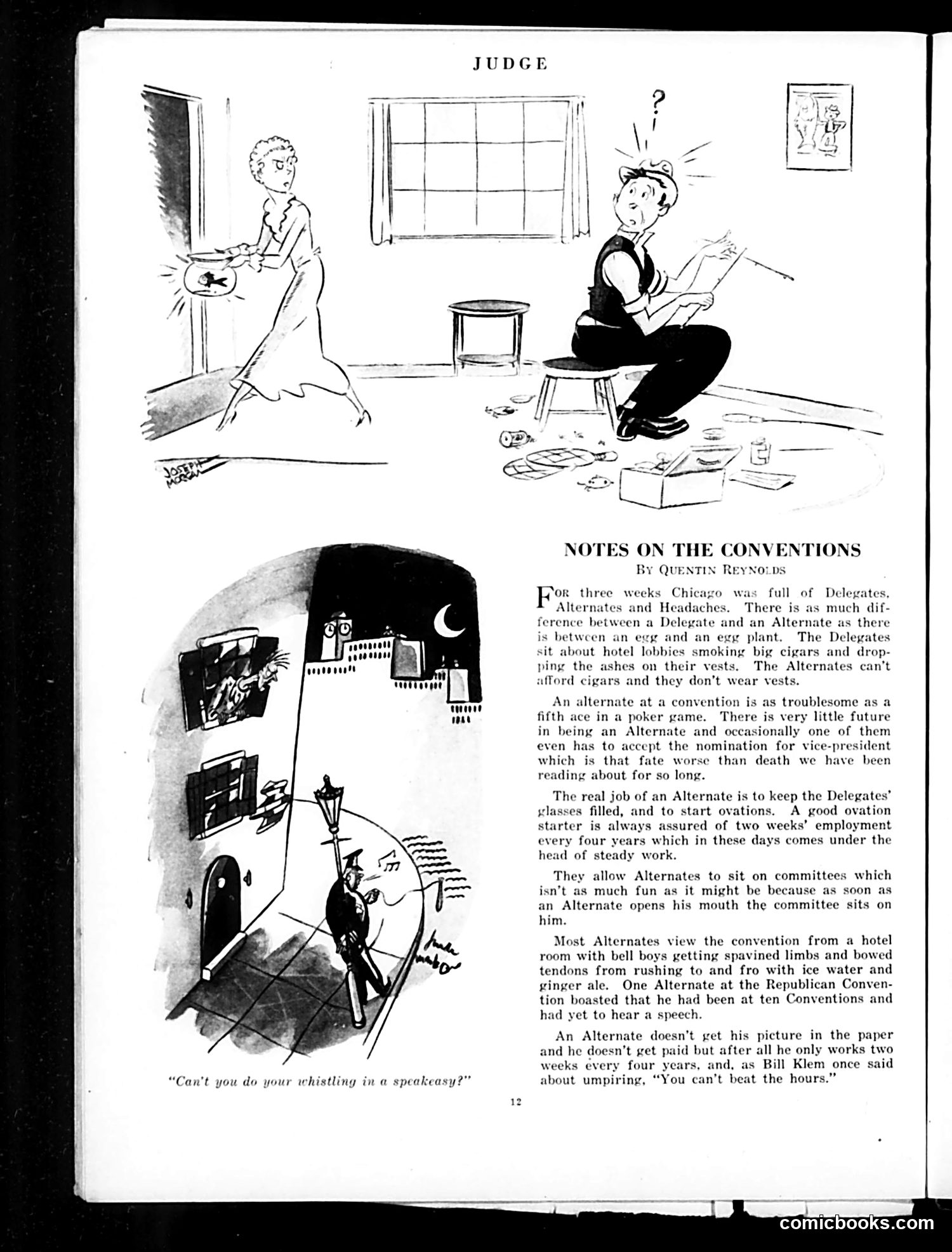
"Notes on the Conventions" by Quentin Reynolds This is satirical commentary on political party conventions, likely from the 1920s-30s. Reynolds humorously contrasts Delegates (full convention participants with status and cigars) versus Alternates (substitutes with minimal power or pay). The satire targets the lowly position of Alternates: they work unpaid except for two weeks every four years, serve as drink-fetchers and applause-starters, get ignored by committees, and rarely even witness actual speeches from their hotel rooms. The cartoon (top) shows a bemused figure amid scattered papers—depicting the chaos and tedium alternates endure. The speakeasy illustration references Prohibition-era convention culture. Reynolds' point: Alternates are exploited party workers with no real authority, compensation, or recognition—yet they tolerate it because even occasional employment was valuable during economically difficult times. The Bill Klem quote humorously equates the thankless work to umpiring: "you can't beat the hours."
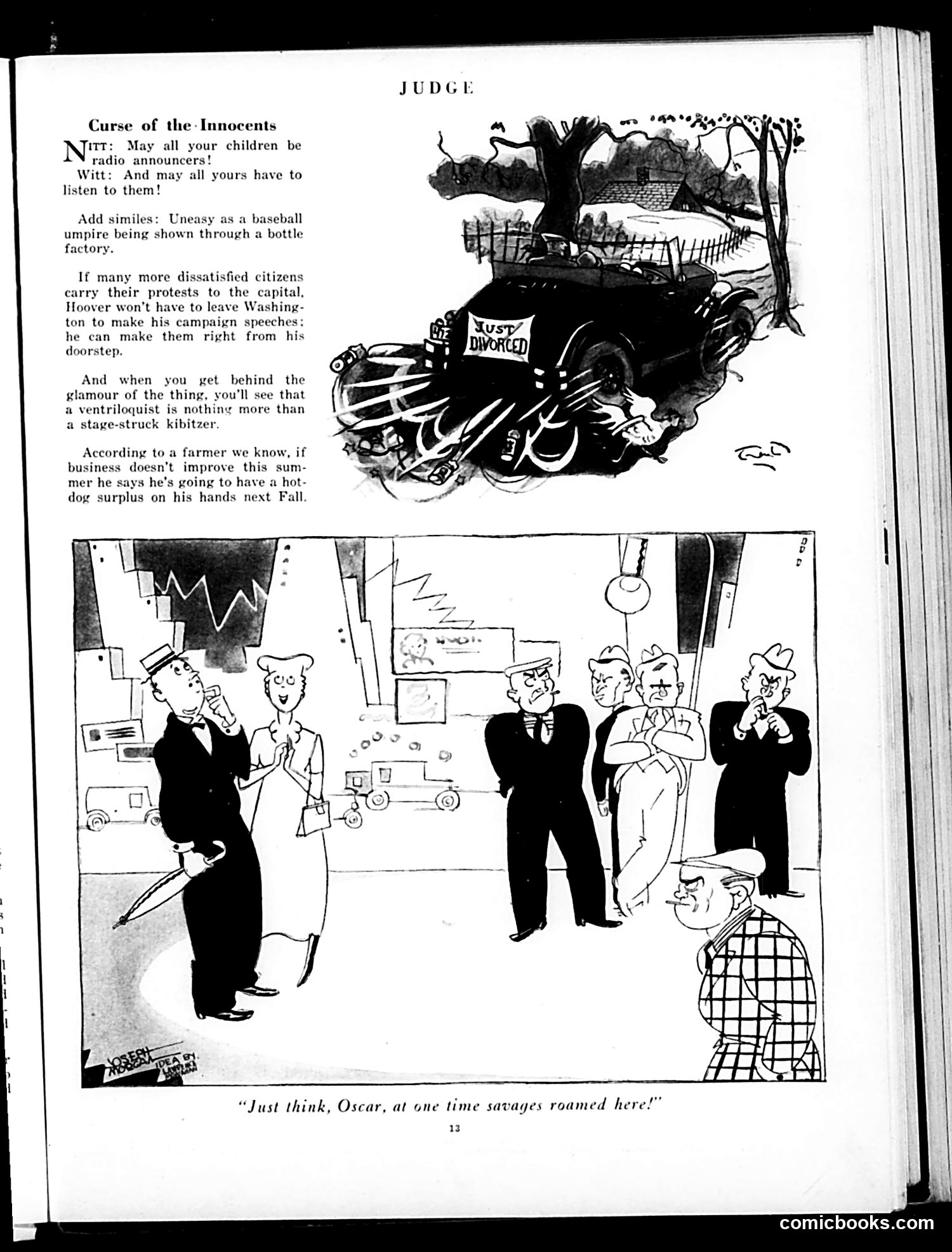
Analysis: "Curse of the Innocents" (Judge Magazine) This page contains political satire targeting President Herbert Hoover during the early Great Depression era (early 1930s, based on references to "business" not improving). Top cartoon: A car labeled "JUST DIVORCED" crashes chaotically, satirizing social upheaval. The dialogue exchanges mock complaints—radio announcers, protests, and political theater. Key satirical points: - Hoover is mocked for being ineffective; if dissatisfied citizens keep protesting in the capital, he won't need to campaign elsewhere - The ventriloquist reference suggests political leaders are mere puppets or frauds ("stage-struck kibitzer") - A farmer jokes about having a "hot-dog surplus," implying economic desperation Bottom cartoon: Office workers reminisce about "savages" roaming there, suggesting the financial district has become primitive or uncivilized—likely commentary on economic chaos or Wall Street's collapse. The overall tone is darkly humorous critique of Hoover's presidency and Depression-era social breakdown.
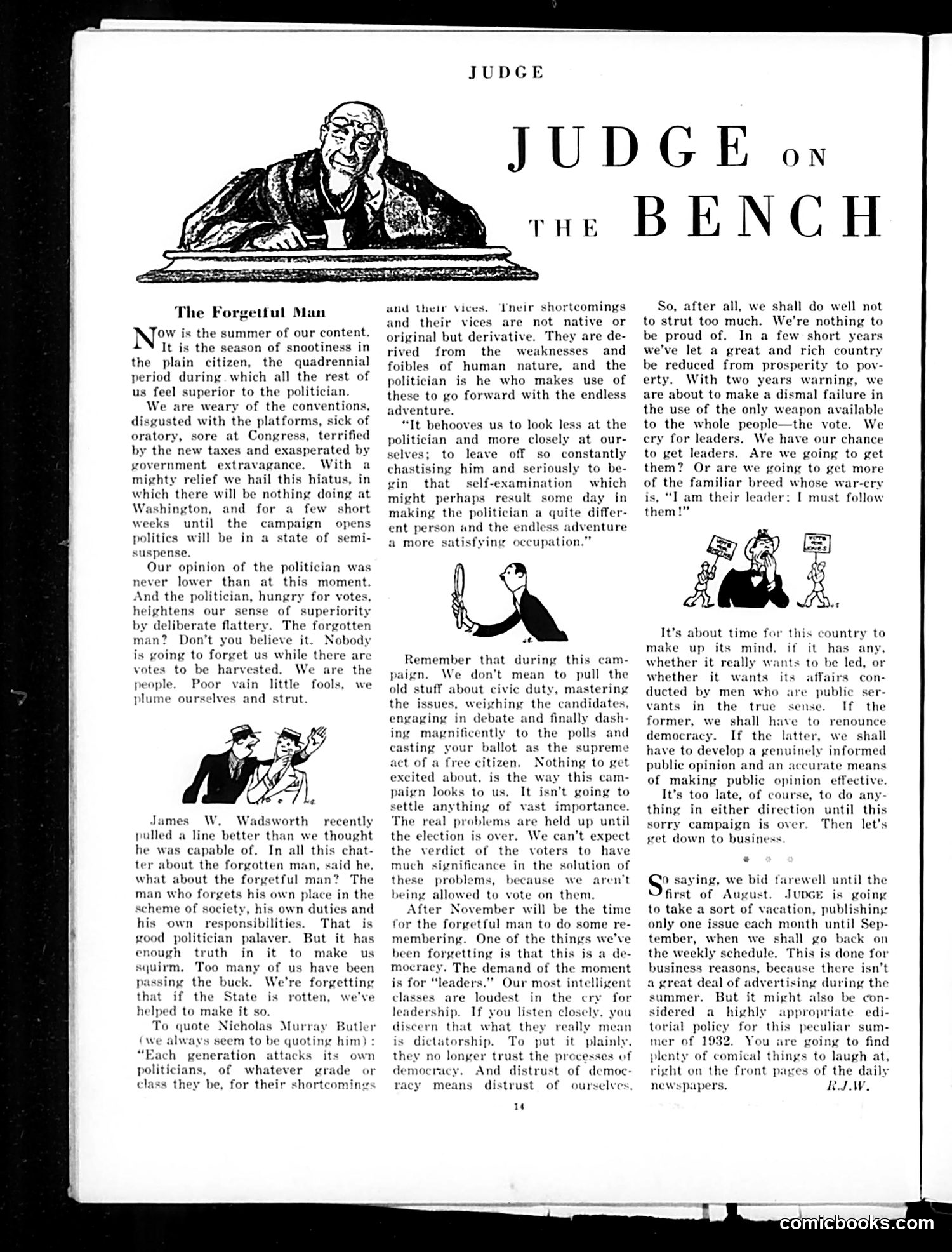
Judge Magazine: "Judge on the Bench" - Political Commentary This editorial criticizes American voters' hypocrisy during election season. The piece argues that citizens feel superior to politicians between elections, yet during campaigns, politicians manipulate voters through flattery while voters passively complain rather than engage responsibly. The core argument, attributed to James W. Wadsworth and Nicolas Murray Butler, shifts blame from politicians to citizens: voters are "forgetful men" who neglect their civic duties and responsibilities. The satire suggests Americans have reduced a prosperous nation to poverty through negligence, then demand "leaders" (implying dictators) rather than trusting democratic processes. The cartoons (showing politicians and voters) visually reinforce this critique of mutual manipulation. The piece warns that meaningful change won't occur until voters remember democracy requires their active participation and self-examination, not passive complaints or demands for saviors.
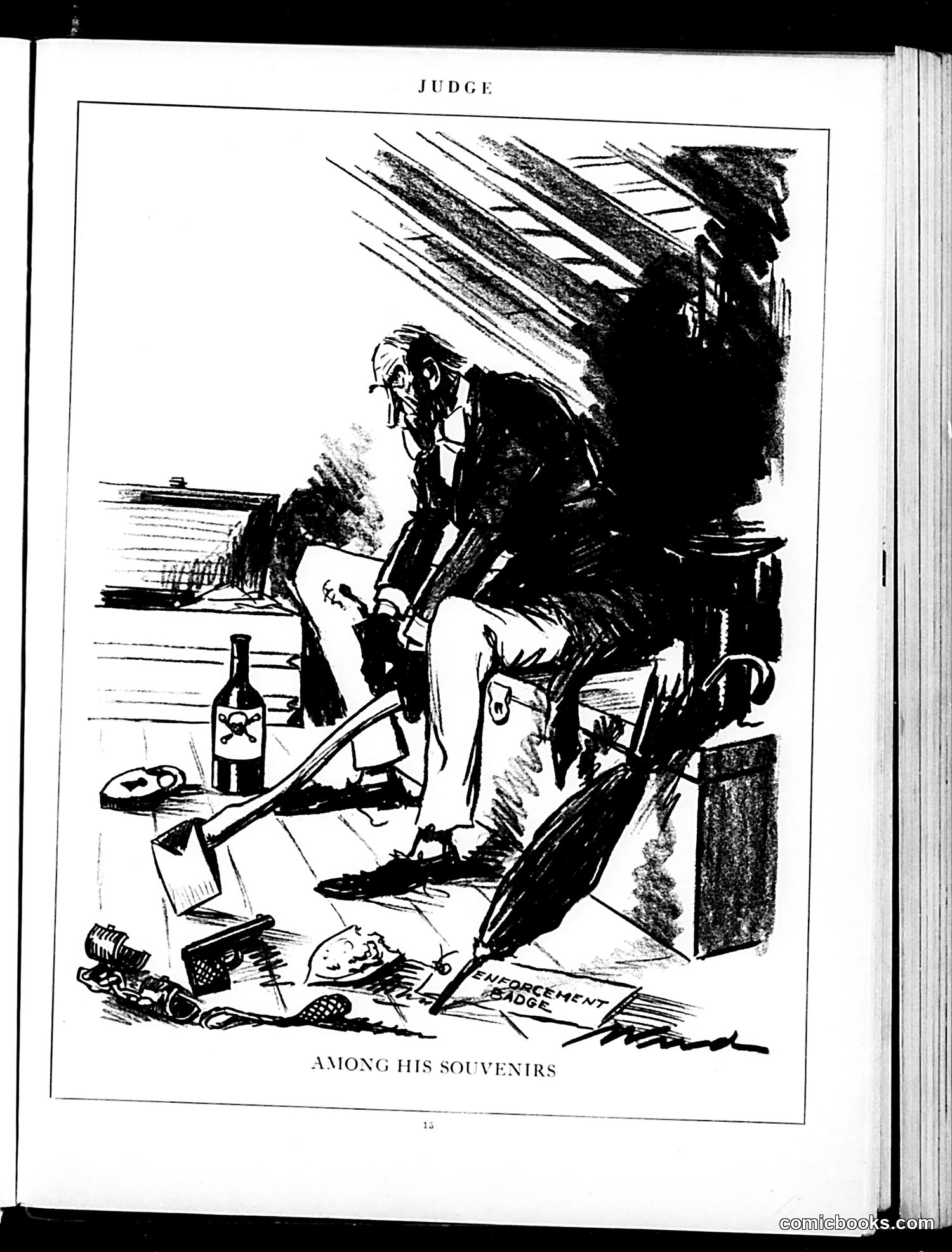
"Among His Souvenirs" This cartoon depicts a judge or judicial figure examining various objects scattered on a desk or table. The items appear to include a bottle (marked with a skull, suggesting poison), a weapon or club, and what looks like legal documents labeled "INDICTMENT" or similar. The satire appears to critique a judge who collects or keeps "souvenirs" from cases—evidence of crimes or judicial proceedings—suggesting either corruption, inappropriate conduct, or an unhealthy preoccupation with the darker aspects of justice. The skull-marked bottle particularly implies involvement with poisoning cases or criminal activity. The cartoon likely satirizes judicial misconduct or the blurred ethics of someone in a position of legal authority who treats serious criminal evidence as personal mementos.
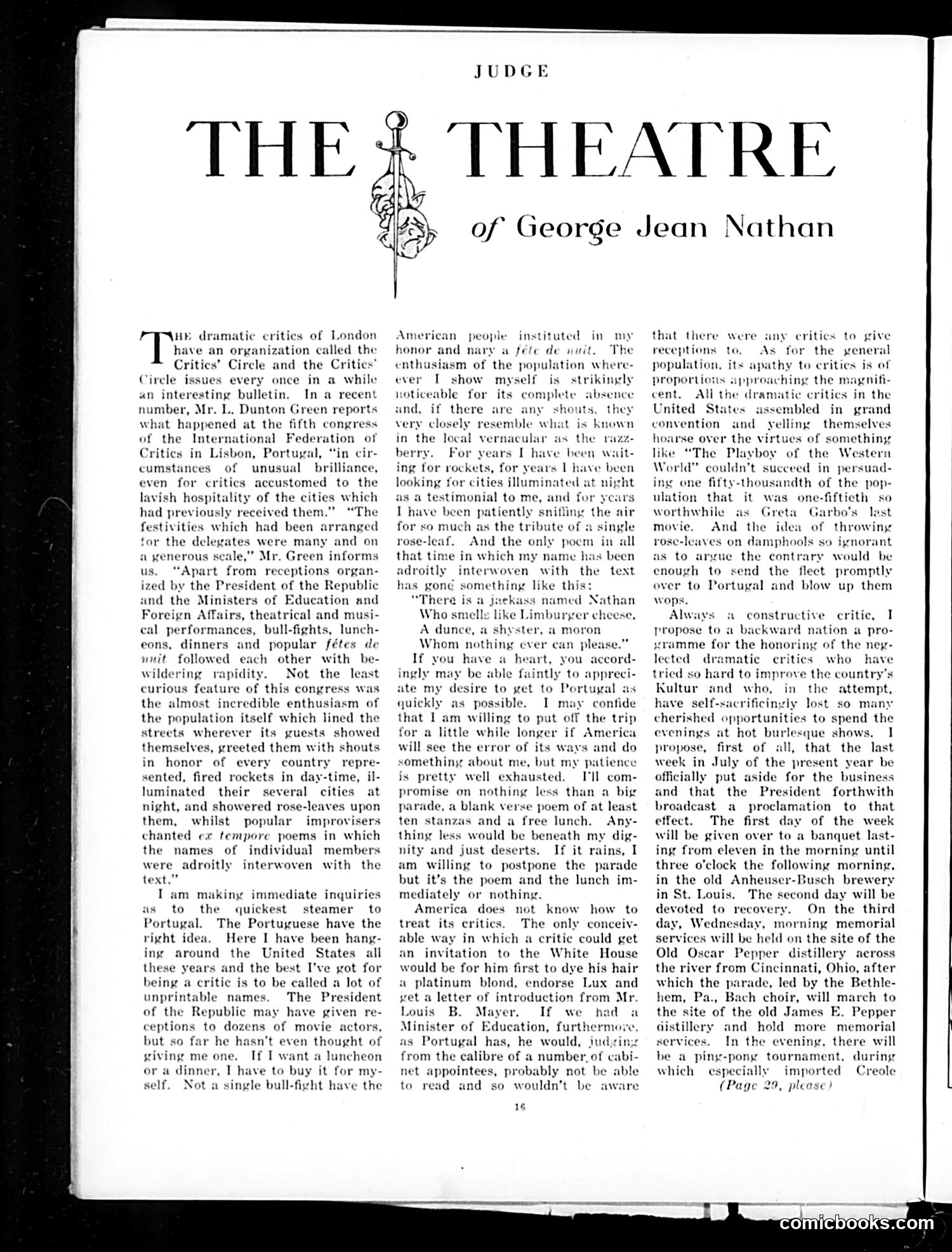
"The Theatre" by George Jean Nathan This is a humorous essay by drama critic George Jean Nathan, complaining about the treatment of American critics versus their Portuguese counterparts. Nathan describes how the International Federation of Critics was lavishly entertained in Lisbon with receptions, bull-fights, dinners, illuminated cities, and rose petals—while he receives only insults and "razz-berries" in America. The satire targets American indifference to cultural critics: the President hosts movie actors but ignores critics; the public offers no tributes or celebrations. Nathan ironically demands compensation—a "big blank verse poem of at least ten stanzas and a free lunch"—and sarcastically suggests the only way a critic could get White House attention would be to dye his hair platinum blonde and get a letter from Louis B. Mayer (a Hollywood studio executive), mocking both American priorities and celebrity culture's dominance over serious criticism.
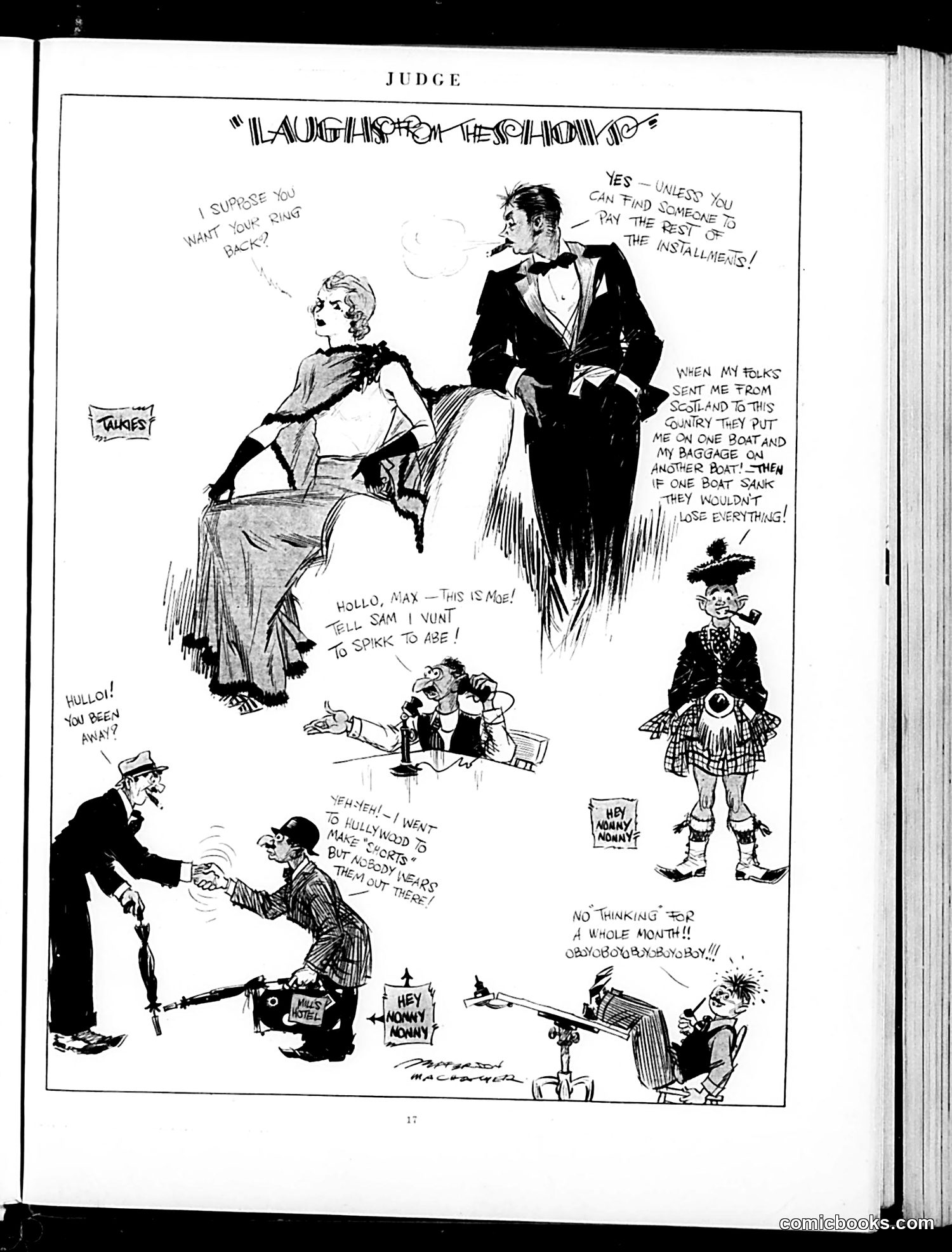
Judge Magazine Political Cartoon Analysis This appears to be an early 20th-century satirical cartoon about Irish immigration to America. The central figure is an Irish immigrant (identifiable by dialect and stereotype caricature) recounting his journey—his family separated him from his baggage across two boats, fearing total loss if one sank. The surrounding vignettes mock Irish immigrants' alleged traits: their tendency to engage in street brawls ("Ulloh, you been away?"), their carousing in saloons, their working-class jobs, and their supposed lack of education or forward-thinking ("no thinking for a whole month"). The humor relies on ethnic stereotyping common to the era—portraying Irish immigrants as foolish, violent, and dim-witted. The "Judge" magazine regularly published such xenophobic satire targeting immigrant communities, reflecting nativist anxieties about Irish assimilation into American society during a period of heavy Irish immigration.
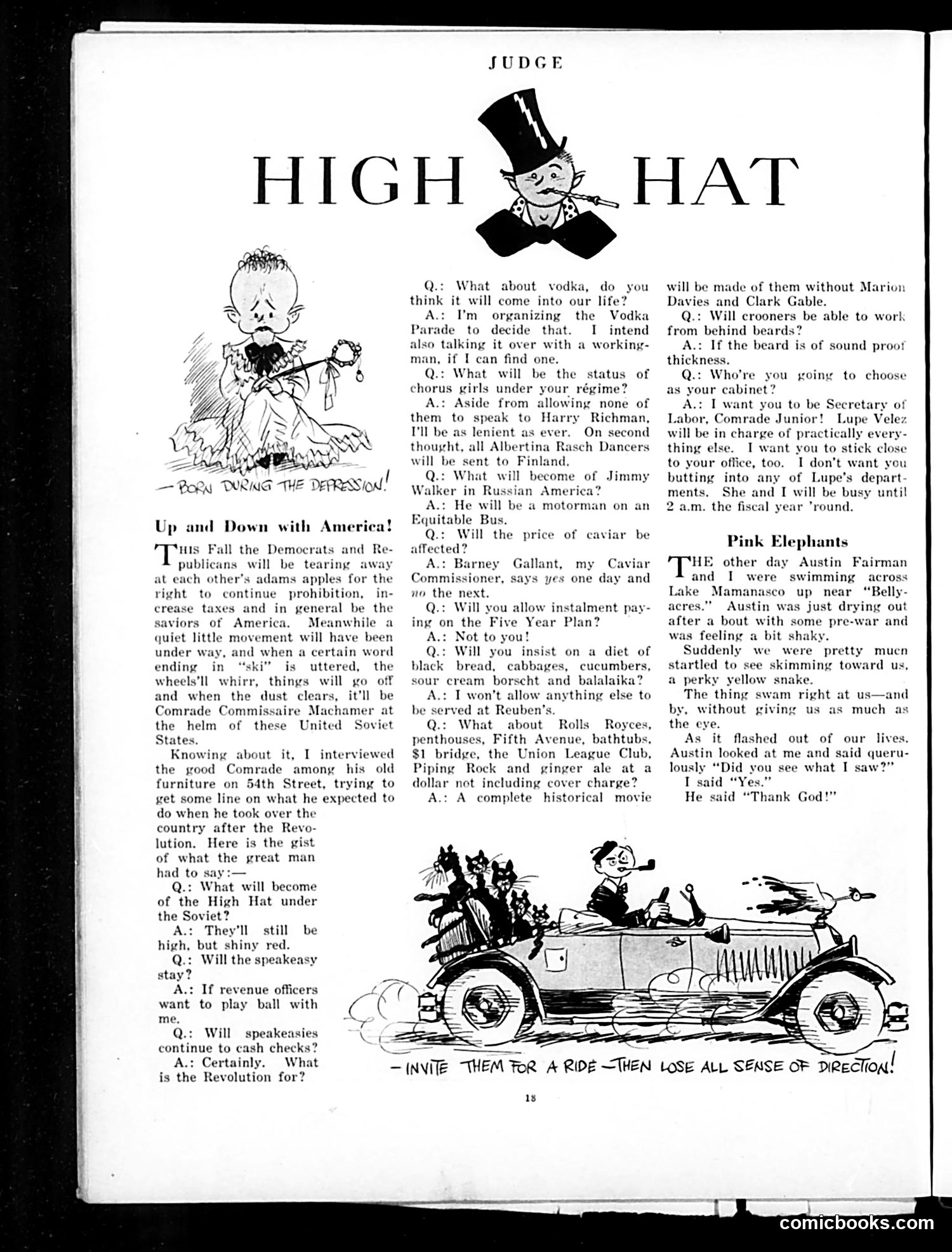
Judge Magazine Political Satire Analysis This page satirizes Soviet communist threats to American society during the Depression era. The main feature, "Judge High Hat," interviews "Comrade Commissaire Machamer," a fictional Soviet revolutionary who will supposedly take over America after a communist revolution. The satire mocks communist ideology through absurd answers: vodka parades, exiling chorus girls to Finland, converting luxury items (Rolls Royces, penthouses) into historical movies, and mandatory borscht at Reuben's deli. References to specific figures like Harry Richman (entertainer) and Albertina Rasch (dancer) ground the humor in contemporary entertainment culture. The cartoons depict anxieties about: - Prohibition debates between Democrats and Republicans - Communist revolution replacing American government - Loss of American luxury and freedom The "Pink Elephants" anecdote is an unrelated humorous short story. The overall message warns readers that while politicians squabble, communist revolution quietly threatens—a common fear-mongering tactic of the 1930s.
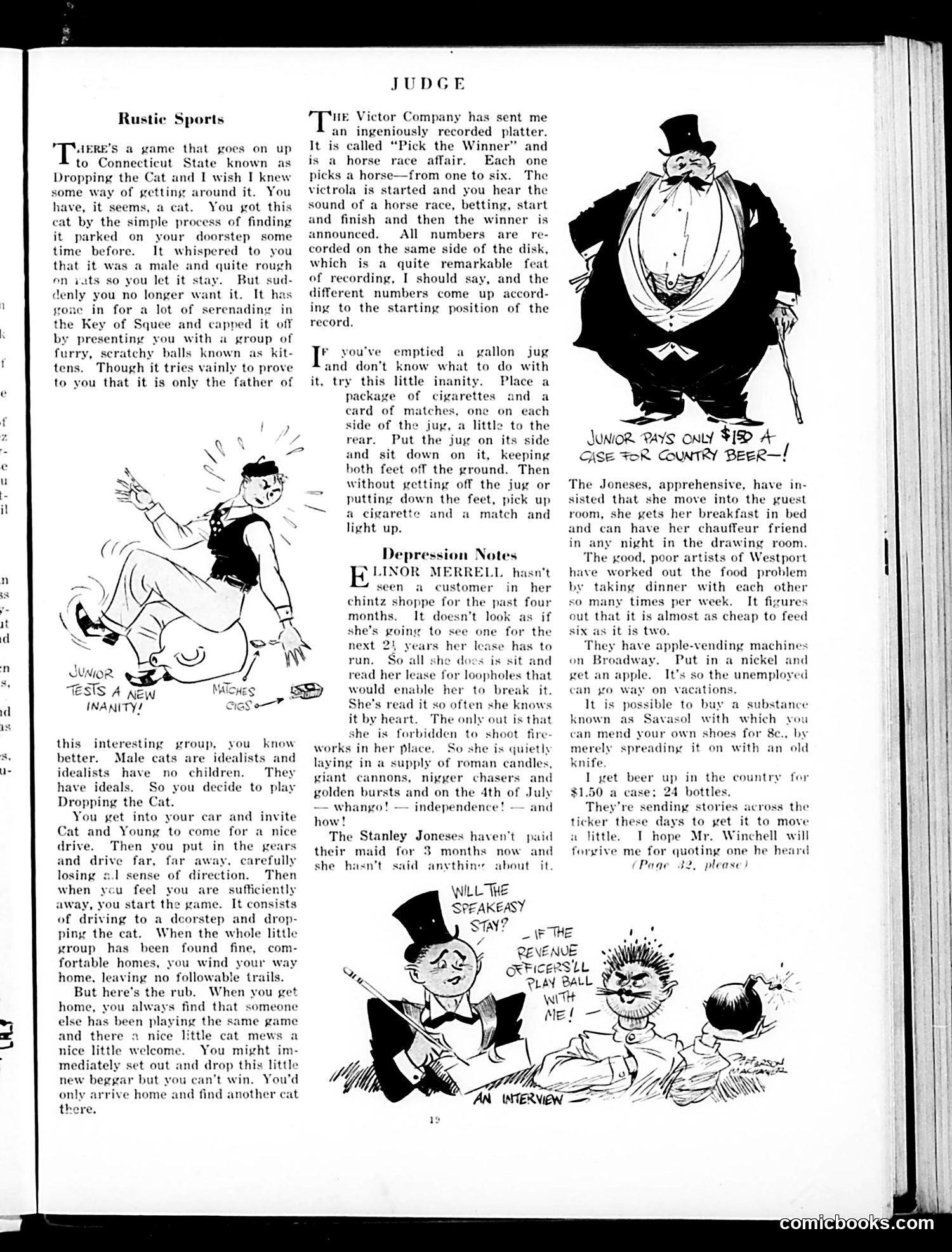
Explanation for Modern Readers This page from *Judge* magazine contains three satirical pieces from the Depression era: "Rustic Sports" mocks a Connecticut practice of abandoning unwanted cats at strangers' homes—a dark joke about Depression-era pet overpopulation. The humor relies on the irony that you always find *another* cat deposited at your own home. "Pick the Winner" advertises a novelty victrola record simulating horse racing, allowing listeners to "pick" winners—likely satirizing both gambling culture and parlor entertainment during economic hardship. "Depression Notes" presents vignettes of Depression struggles: a shopkeeper reading lease loopholes hoping to break her contract; the Joneses unpaid maid being "compensated" with room and board plus social access; Westport artists trading dinners to reduce food costs; and apple-vending machines for the unemployed. The accompanying cartoons use exaggerated caricature styles typical of the era. The overall tone is sardonic—treating economic desperation as material for sophisticated humor directed at *Judge's* upscale readership.
Analysis for Modern Readers This is a critical essay by Pare Lorentz on Hollywood's creative and financial crisis, illustrated with decorative header artwork featuring theatrical characters. The Context: Written during the Great Depression, Lorentz argues producers face unprecedented pressure—they can no longer rely on buying successful stage plays or employing writers to generate ideas. Financial desperation forces them to develop original material quickly and believe in it themselves. The Social/Political Point: Lorentz identifies an ironic silver lining: Depression-era hardship has weakened moralist censors' influence (the "Anti-Saloon League" reference evokes Prohibition-era moral crusaders). With unemployment and economic chaos dominating public concern, religious watchdogs lack funding and cultural power to police film content. The Satire: Lorentz suggests this forced creative independence and loosened moral oversight might paradoxically improve movies—making them "wilder" and more entertaining. However, he pessimistically concludes audiences won't care either way; they're simply tired of movies and want to go elsewhere. The essay mocks both Hollywood's manufactured creativity cycles and the public's apathy toward genuine artistic improvement.
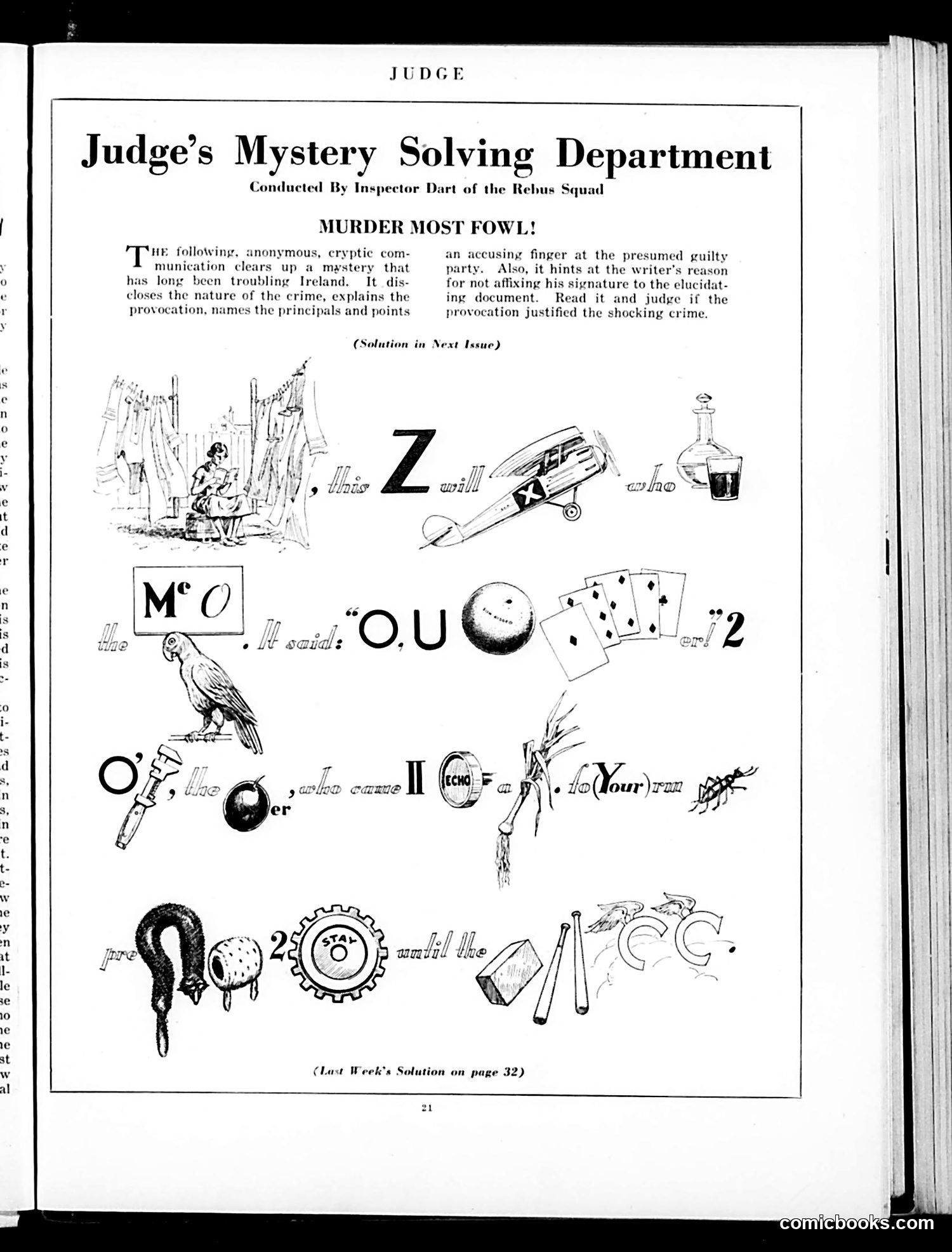
Judge's Mystery-Solving Rebus Puzzle This is a visual puzzle from *Judge* magazine's "Mystery Solving Department," hosted by fictional "Inspector Dart of the Rebus Squad." The page presents a cryptic rebus titled "Murder Most Fowl!"—a pun referencing both a crime and poultry. The puzzle consists of illustrated rebuses (visual wordplay combining images and text) that readers must decode to solve a mystery. Images include: an airplane, playing cards, a bird, a gear, tools, and other objects interspersed with letters and words. Readers are invited to solve this coded message that supposedly reveals details about a crime troubling Ireland—the "nature of the crime, explains the provocation, names the principals and points an accusing finger at the presumed guilty party." The solution would appear in the next issue. This represents vintage American puzzle entertainment from *Judge*, blending visual wordplay with satirical detective fiction framing for reader engagement.
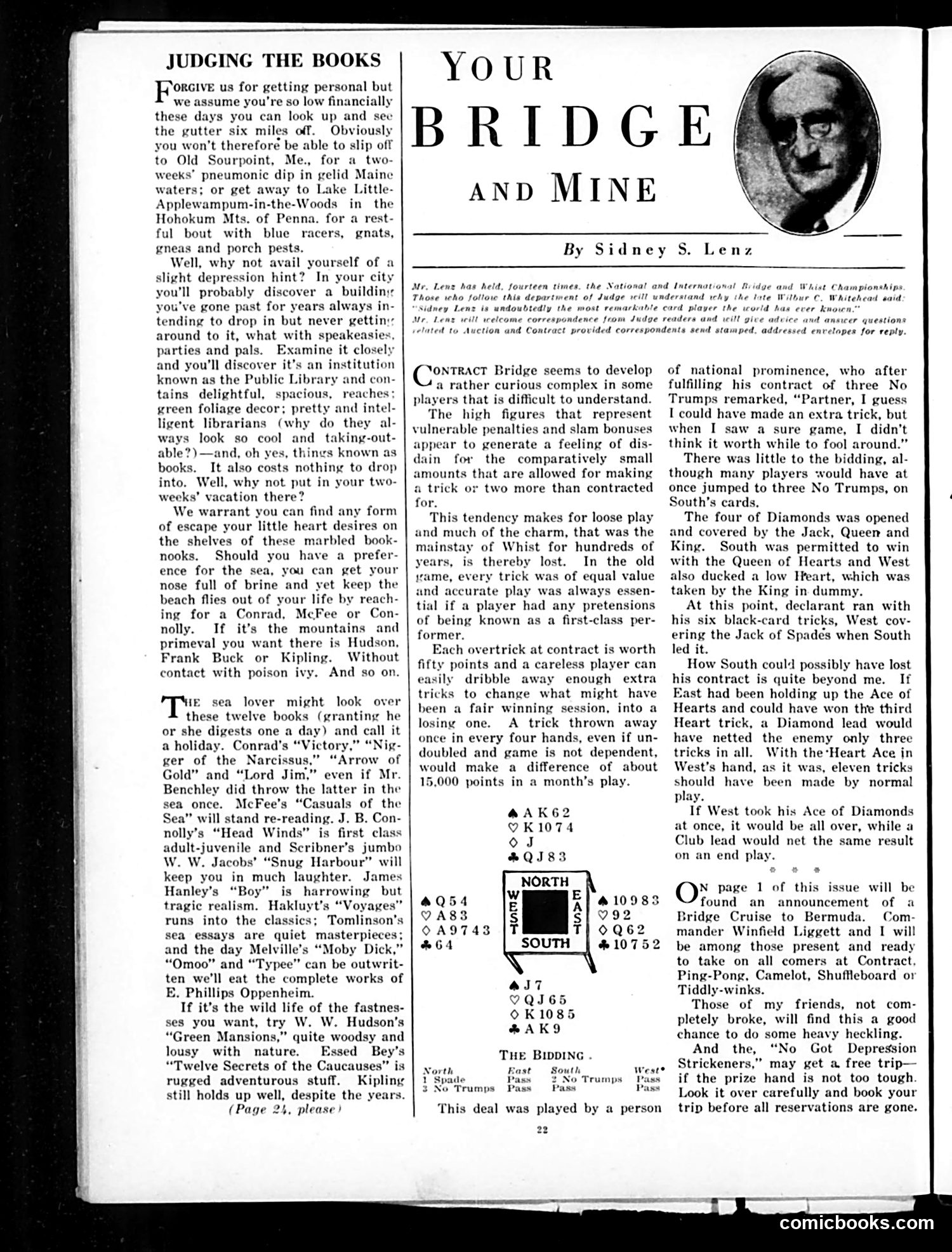
Judge Magazine: "Your Bridge and Mine" Bridge Column This page combines a book review section with a bridge card game column by Sidney S. Lenz, a prominent bridge champion. The content is not satirical but rather editorial and instructional. The "Judging the Books" section humorously encourages Depression-era readers (financially struggling) to visit public libraries instead of vacation destinations—a practical suggestion given economic hardship. It recommends adventure and sea novels by authors like Conrad, Kipling, and Melville as affordable entertainment. The "Your Bridge and Mine" column discusses Contract Bridge strategy, specifically criticizing players who become careless with small point values while obsessing over high-penalty vulnerability situations. Lenz argues this loose play contradicts the precision required in earlier Whist, where all tricks held equal importance. The bridge hand diagram presents a specific deal for readers to analyze and improve their game.
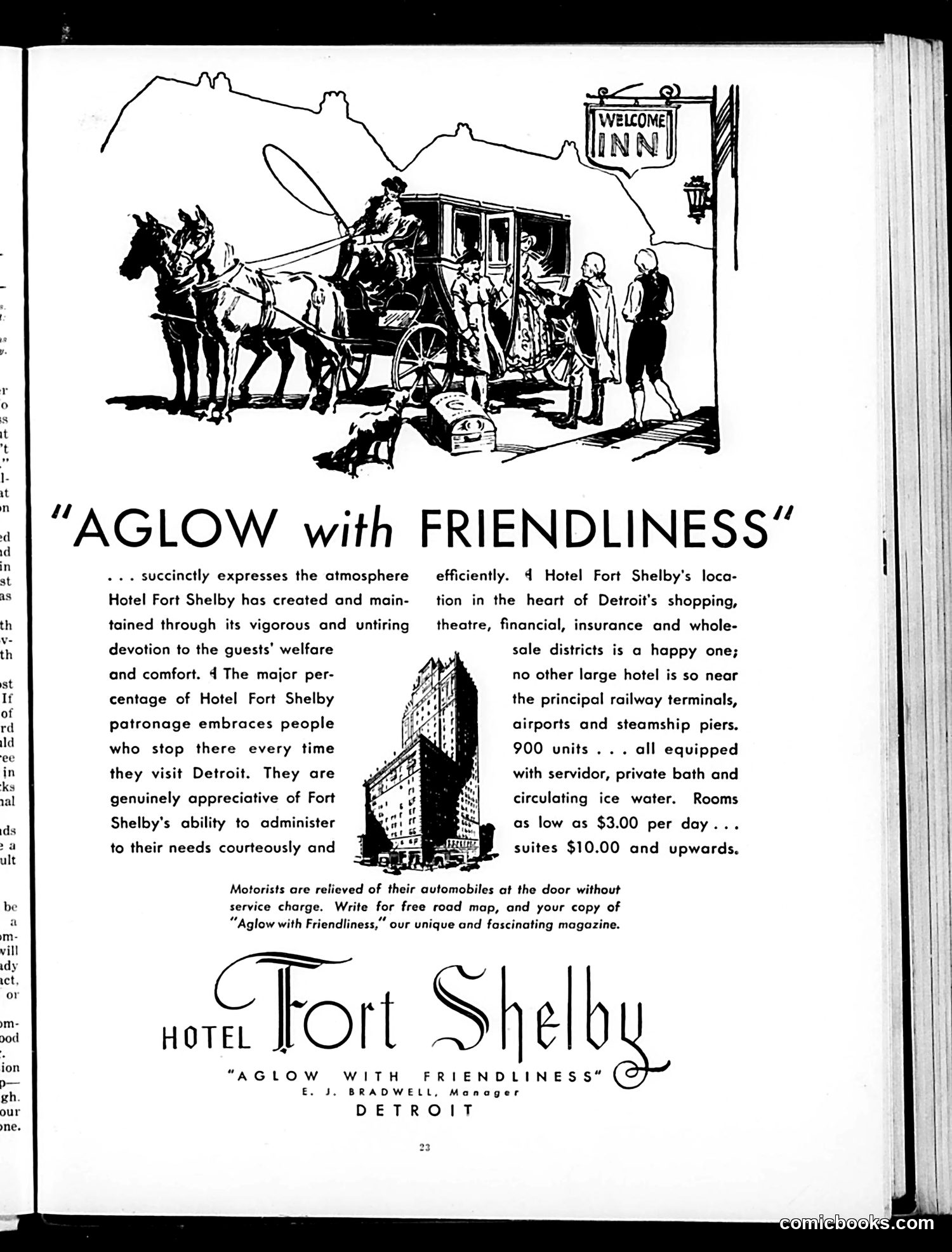
Hotel Fort Shelby Advertisement This is not a political cartoon or satire—it's a straightforward hotel advertisement from Judge magazine. The page promotes Hotel Fort Shelby in Detroit using the marketing slogan "A Glow with Friendliness." The illustration depicts a horse-drawn carriage arriving at the Welcome Inn, showing guests being assisted with their luggage—imagery meant to convey old-fashioned hospitality and attentive service. The ad emphasizes the hotel's central Detroit location near transportation hubs, affordable rates ($3.00-$10.00 per night), and amenities like private baths and valet service for automobiles. The phrase "Aglow with Friendliness" was apparently the hotel's actual branding campaign; they even published a magazine by that name. This is commercial advertising placed within Judge's editorial pages, typical of how early 20th-century magazines generated revenue.
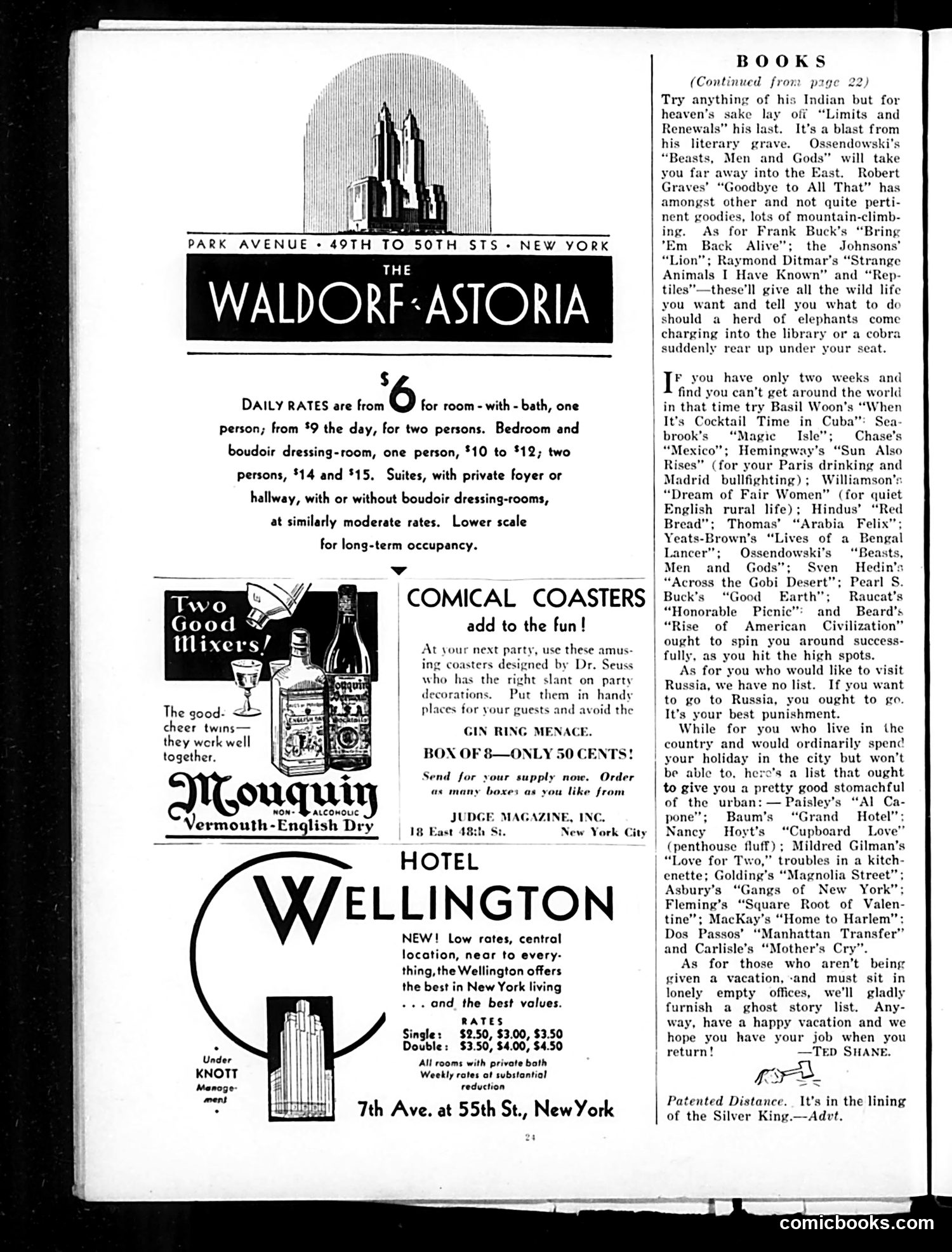
Judge Magazine Page Analysis This is primarily an advertising page from Judge magazine, not a satirical cartoon page. The dominant content consists of hotel and product advertisements for New York City establishments. The notable satirical element is a Dr. Seuss-designed coaster advertisement labeled "Comical Coasters," featuring whimsical illustrations of cocktail glasses. The joke targets the social problem of "gin ring menace"—the damage caused by wet cocktail glasses leaving rings on furniture, a concern during the Prohibition era's end when cocktail culture was resurging. The page's right column contains a book review column recommending vacation reading by Ted Shane. This offers social commentary through literary recommendations: adventure novels for travelers, urban crime stories (including Al Capone references) for city-bound workers, and "ghost stories" for those stuck in offices without vacations—reflecting Depression-era anxieties about employment and leisure. The advertisements themselves reflect 1920s-30s hospitality marketing to middle-class New Yorkers seeking affordable accommodation and entertainment.
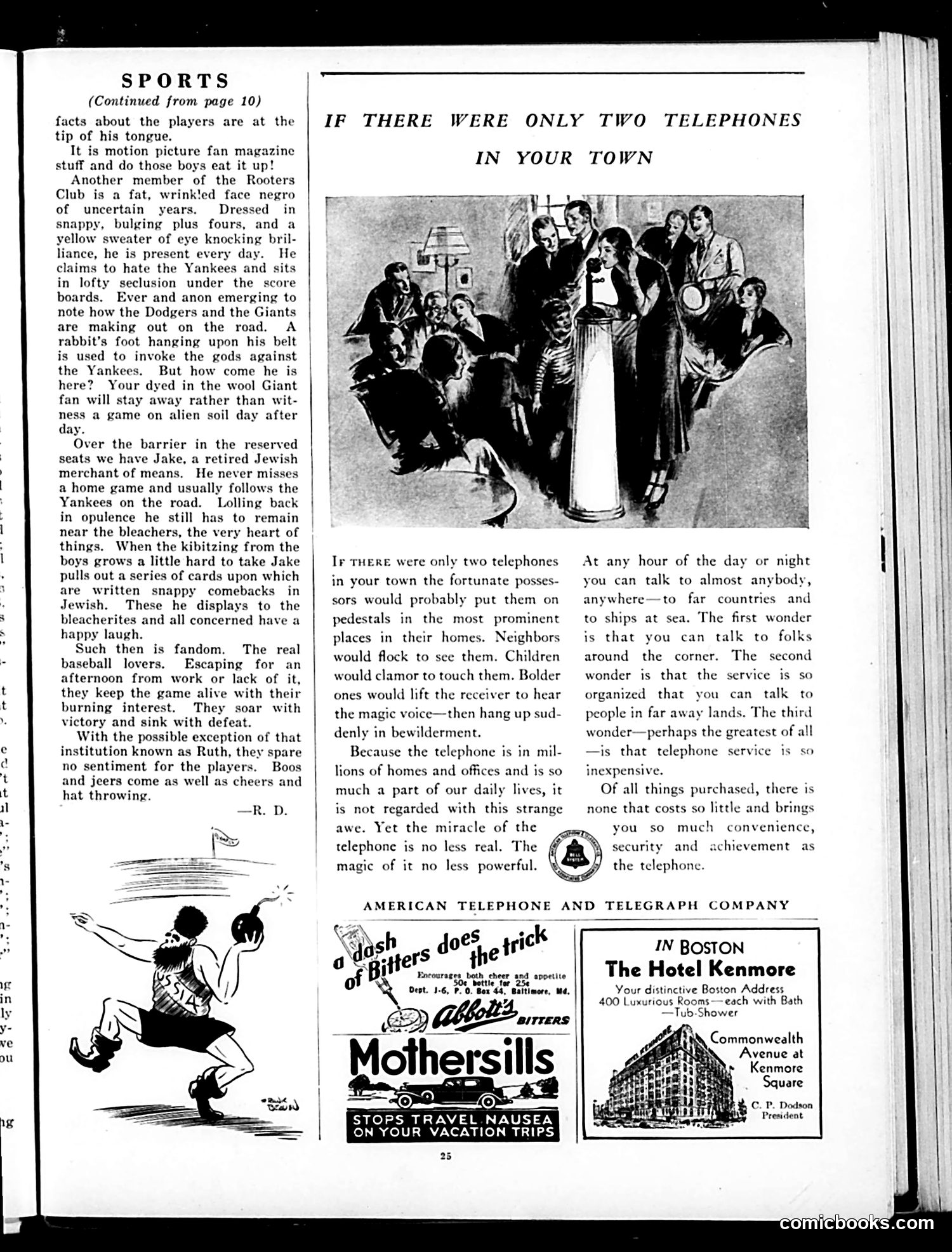
Analysis of Judge Magazine Page This page contains two distinct sections: Sports Column (left): A casual ethnographic sketch of baseball "fans" at a game, using period stereotypes. It describes various attendee types: a talkative fan, a Black man in flashy clothes carrying a rabbit's foot for luck, and a wealthy Jewish retiree named Jake who uses Yiddish comebacks. The piece treats these characters as curiosities rather than serious fans, reflecting 1920s-era casual racism and ethnic stereotyping common in sports writing. Right Section: A corporate advertisement for American Telephone & Telegraph Company, presented as an informational essay. It imagines how people would marvel at telephones if only two existed locally, then argues that modern telephone service—connecting distant places affordably—is equally miraculous but taken for granted. This is straightforward corporate messaging about the wonder of telecommunications infrastructure. The page is primarily advertising, using the "human interest" framing typical of early 20th-century magazine persuasion.
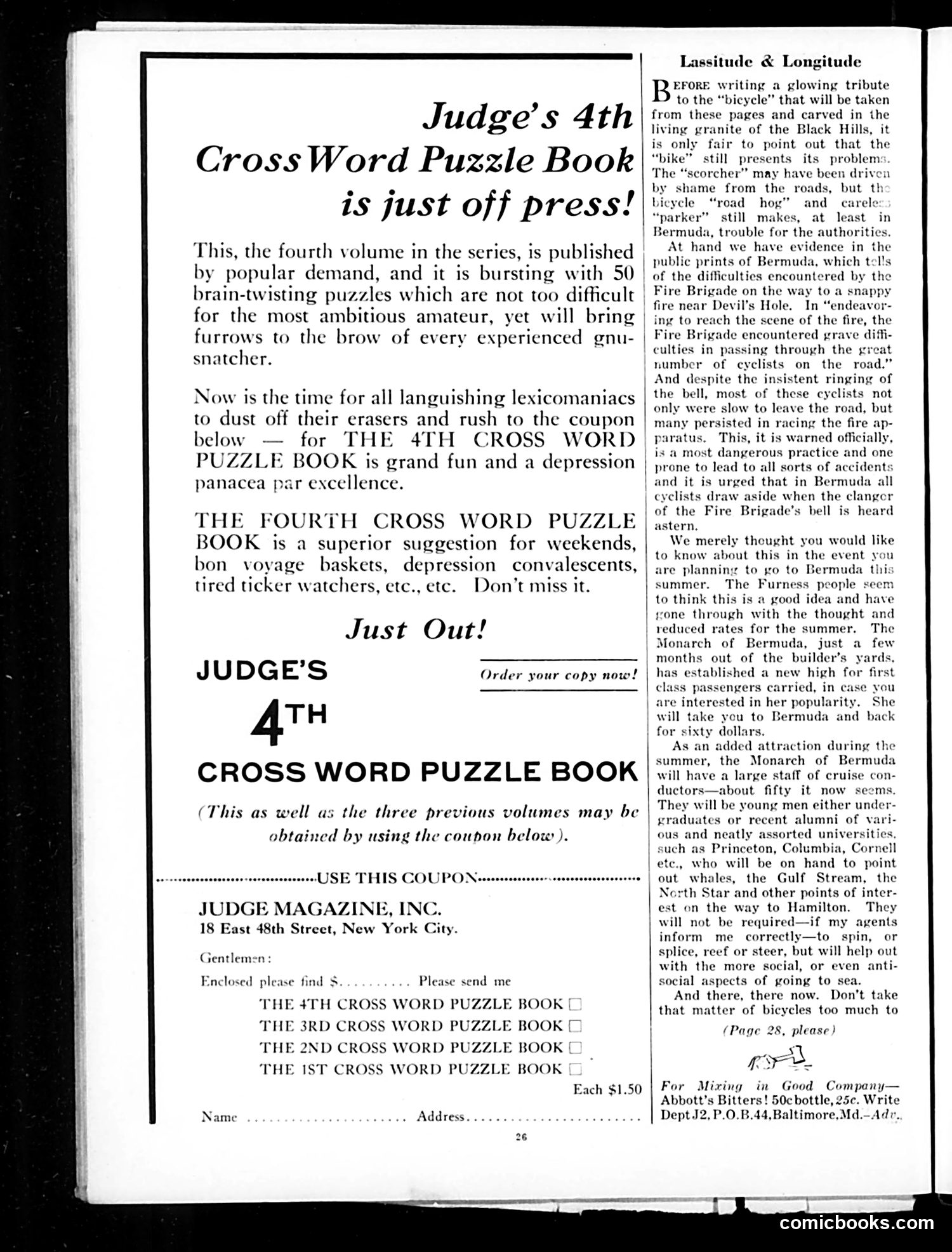
What This Page Means for Modern Readers This is primarily an advertisement and order form for Judge magazine's 4th Crossword Puzzle Book, marketed as Depression-era entertainment ("depression panacea par excellence"). The puzzle book costs $1.50 and targets leisure readers seeking intellectual distraction during economically difficult times. The right column contains a satirical article titled "Lassitude & Longitude" about bicycles causing problems in Bermuda. The piece humorously complains that cyclists obstruct a Fire Brigade responding to emergencies, refusing to yield despite the bell's ringing. The satirist then pivots to promoting Bermuda tourism via the cruise ship *Monarch of Bermuda*, which employs college graduates as decorative cruise conductors—young men hired for "social" appeal rather than actual seamanship skills. The satire targets both dangerous traffic behavior and the frivolous luxury tourism industry, while the crossword advertisement exploits Depression-era demand for cheap, absorbing home entertainment.
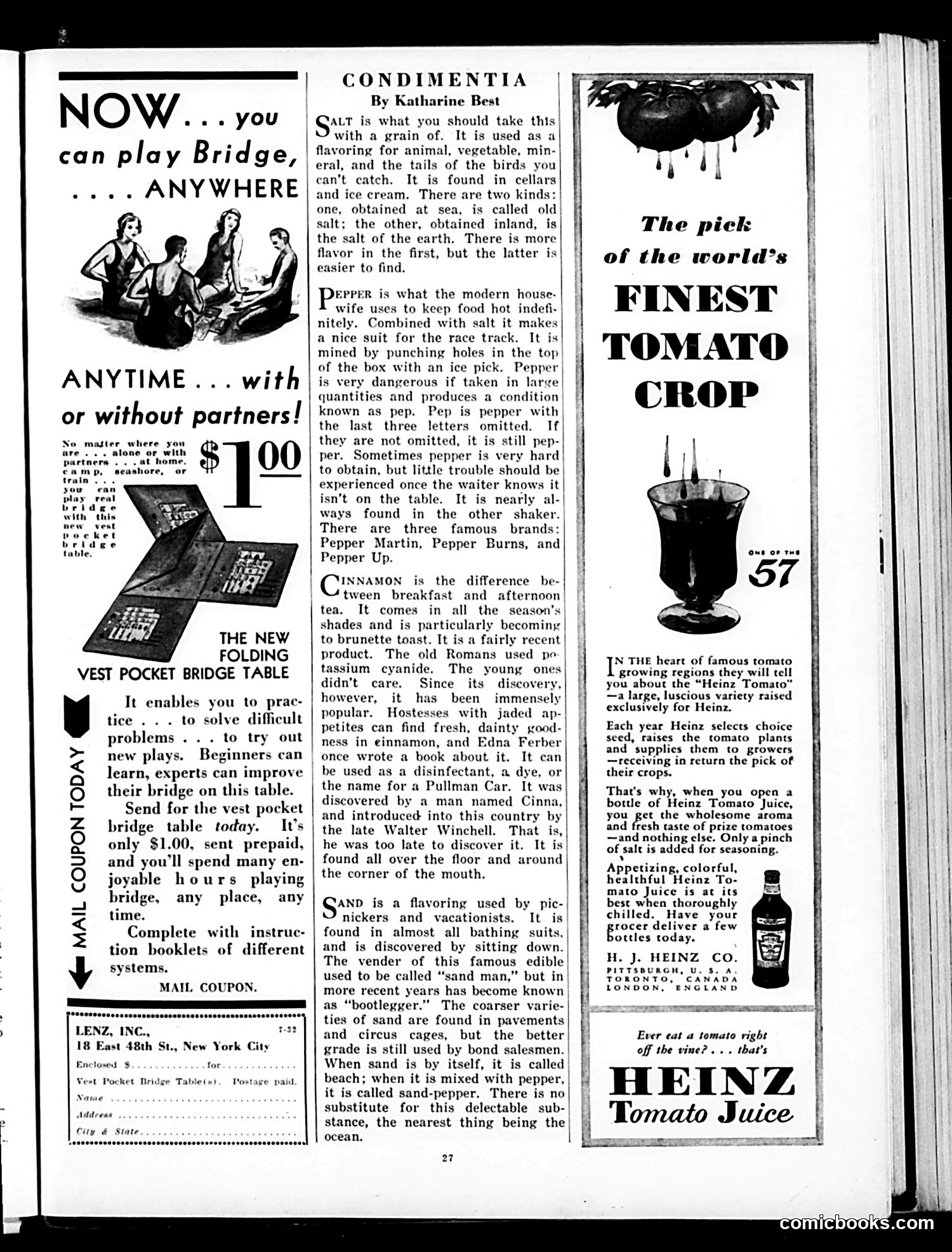
Analysis of Judge Magazine Page This page contains primarily advertisements rather than political satire. The left side advertises a folding bridge table for $1.00, appealing to the 1920s-30s popularity of bridge as a parlor game. The center features "Condimentia," a humorous essay by Katharine Best that's satirical food writing, not political commentary. It playfully defines cooking ingredients (salt, pepper, cinnamon, sand) with absurdist logic—salt is "the salt of the earth," pepper can be "mined by punching holes," and sand is discovered "by sitting down" at the beach. The humor relies on wordplay and mock-serious definitions rather than political targets. The right side advertises Heinz Tomato Juice and Tomato Crop products, emphasizing their quality sourcing from premium tomato growers. No political figures, caricatures, or satire targeting current events appear on this page. It's essentially a humor column paired with period advertisements.
Content Analysis This page is primarily advertising for College Humor magazine, not political satire. The left side promotes the magazine's price reduction from 35¢ to 25¢, using flowery descriptors ("Sparkling," "Witty," "Smooth, sophisticated") to market it as a stylish publication featuring fashion, illustrations, and humor with youthful appeal. The right column contains a travel article titled "Lassitude & Longitude" (continued from a previous page) discussing summer cruise options to Bermuda, the Arctic, Quebec, and Havana, with specific ship names and prices listed. It concludes with a note about Canadian travel via Montreal. There are no political cartoons or caricatures on this page. The "satire" is gentle advertising copy—the magazine is humorously self-promoting rather than critiquing external subjects. The page reflects 1920s-30s leisure culture and consumer magazine marketing.
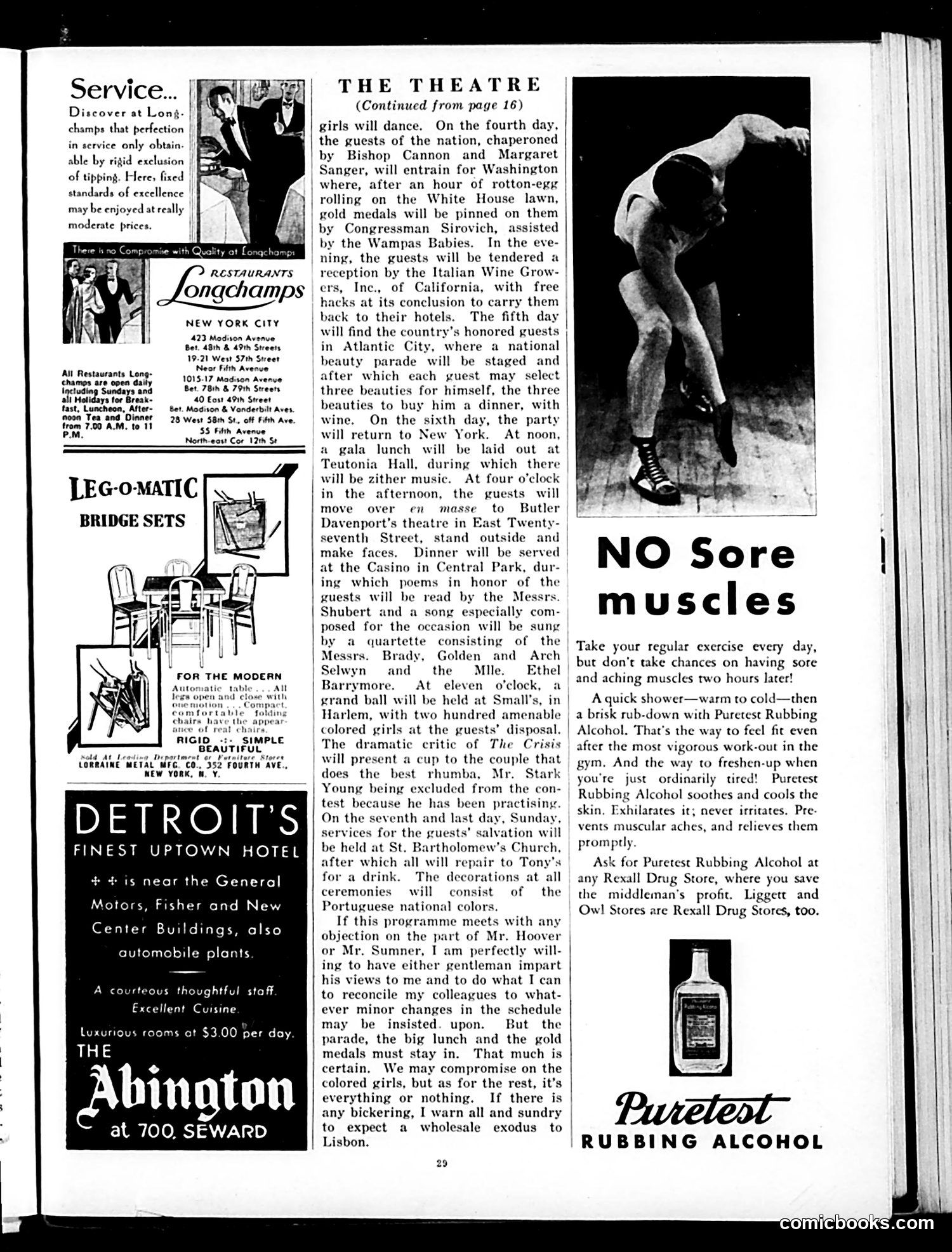
Judge Magazine Page Analysis This page is primarily advertisements with one substantial satirical theatre column continuation. The main satirical content is a theatre critic's mock proposal for an absurdly elaborate, multi-day national pageant featuring beauty contest winners. The satire targets 1920s high society pretension — the proposal ridiculously involves multiple cities, formal ceremonies, poems by the Shuberts, and culminates in a Harlem cabaret visit ("two hundred amenable colored girls"). The references to "Bishop Cannon" and "Margaret Sanger" suggest social controversy over morality/birth control. The final threat — "expect a wholesale exodus to Lisbon" if changes are demanded — mocks both the organizers' pomposity and hints at contemporary political tensions (possibly referencing prohibition-era emigration). The satire's edge: Judge is lampooning wealthy elites' self-importance and their patronizing, exotic fascination with Black entertainment venues while positioning themselves as arbiters of taste and morality. The page's advertisements (hotels, furniture, restaurants, rubbing alcohol) are typical period fare, unrelated to the satire.
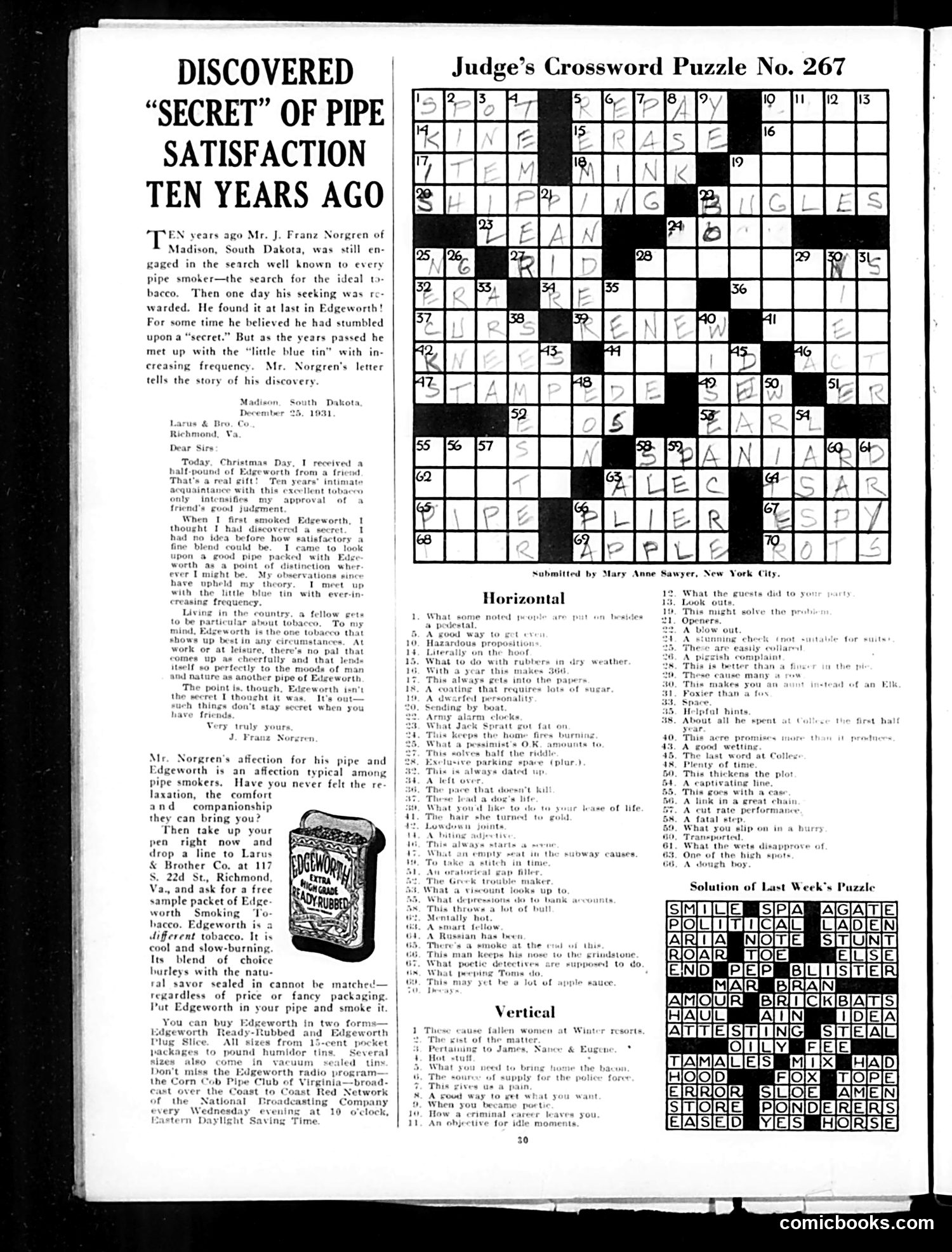
Analysis of Judge Magazine Page Content This page is primarily advertising content, not satire or political commentary. It features a testimonial advertisement for Edgeworth Smoking Tobacco, presented as a human-interest story. The "narrative" describes J. Franz Norgren of Madison, South Dakota, who spent years searching for his ideal pipe tobacco before discovering Edgeworth ten years prior. His letter expresses contentment with the product, noting he increasingly encounters other smokers using the same "little blue tin." The advertisement emphasizes Edgeworth's qualities—cool, slow-burning, made from choice burleys with "natural savor"—and encourages readers to request free samples from the manufacturer (Larus & Brother Co., Richmond, Virginia). The page includes a crossword puzzle (Judge's Puzzle No. 267), unrelated to the advertisement. This represents typical early-20th-century advertising strategy: using relatable customer testimonials to build product credibility and appeal to middle-class consumers' desire for quality and reliability.
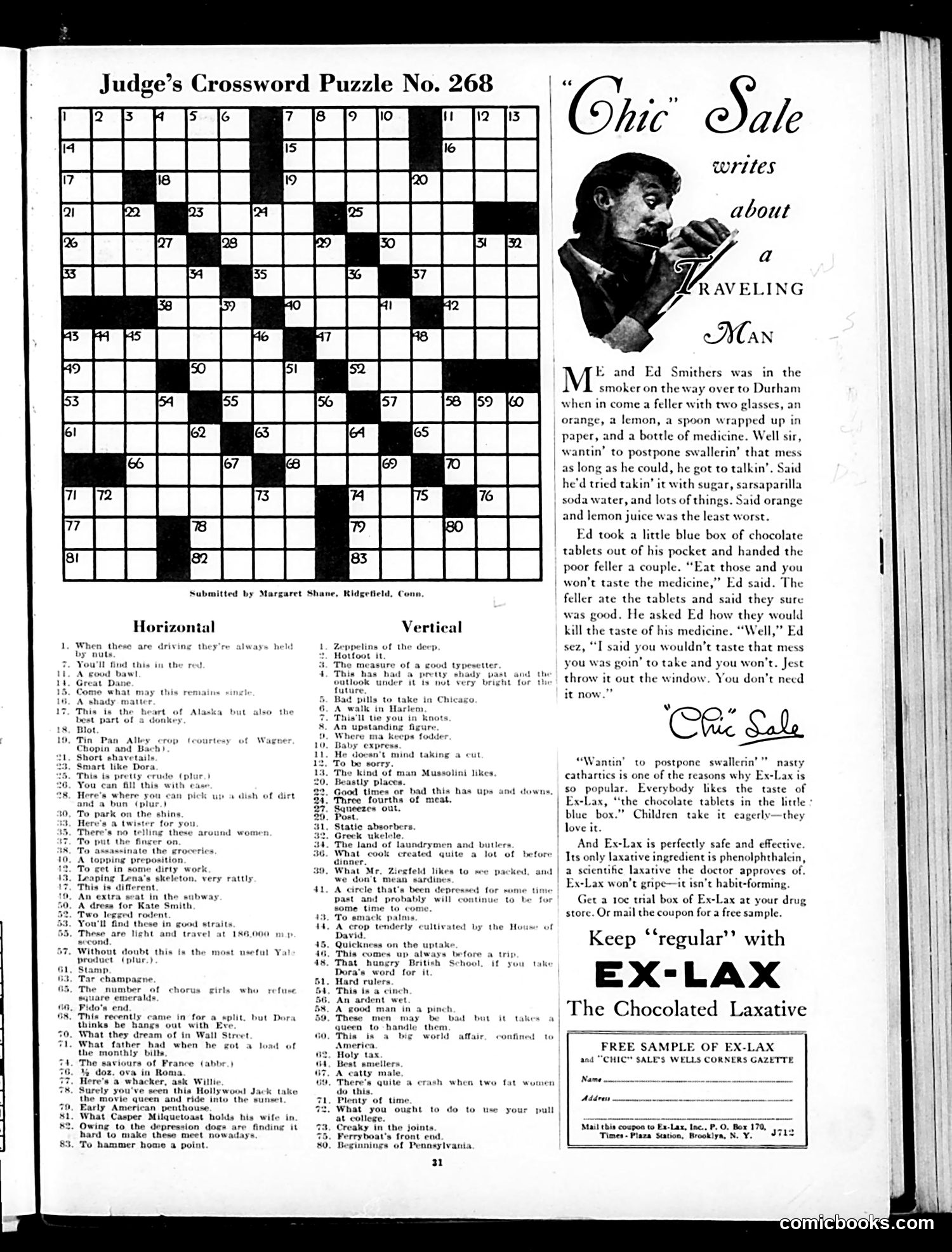
Judge Magazine Page Analysis This page contains Judge's Crossword Puzzle No. 268 (left side) and a humorous short story advertisement (right side) for Ex-Lax laxative. The Story's Satire The narrative, titled "A Traveling Man," mocks the common folk remedy culture of the early 20th century. Two traveling salesmen encounter a stranger attempting to stomach unpalatable medicine. The humor lies in the absurdity: he tries masking the taste with sugar, sarsaparilla, soda water, orange, and lemon juice—only to be offered Ex-Lax chocolate tablets instead. The Joke's Point The story satirizes both the desperation of patent medicine users and the marketing genius of Ex-Lax: rather than solving the "taste problem," Ed simply suggests throwing the original medicine out the window and taking the chocolate tablets instead—which taste good *and* work as a laxative. It's a tongue-in-cheek critique of how advertising exploits people's dissatisfaction with competing products by reframing the problem entirely. The crossword puzzle (standard editorial filler for the era) complements this consumer-focused content typical of Judge's advertising-heavy format.
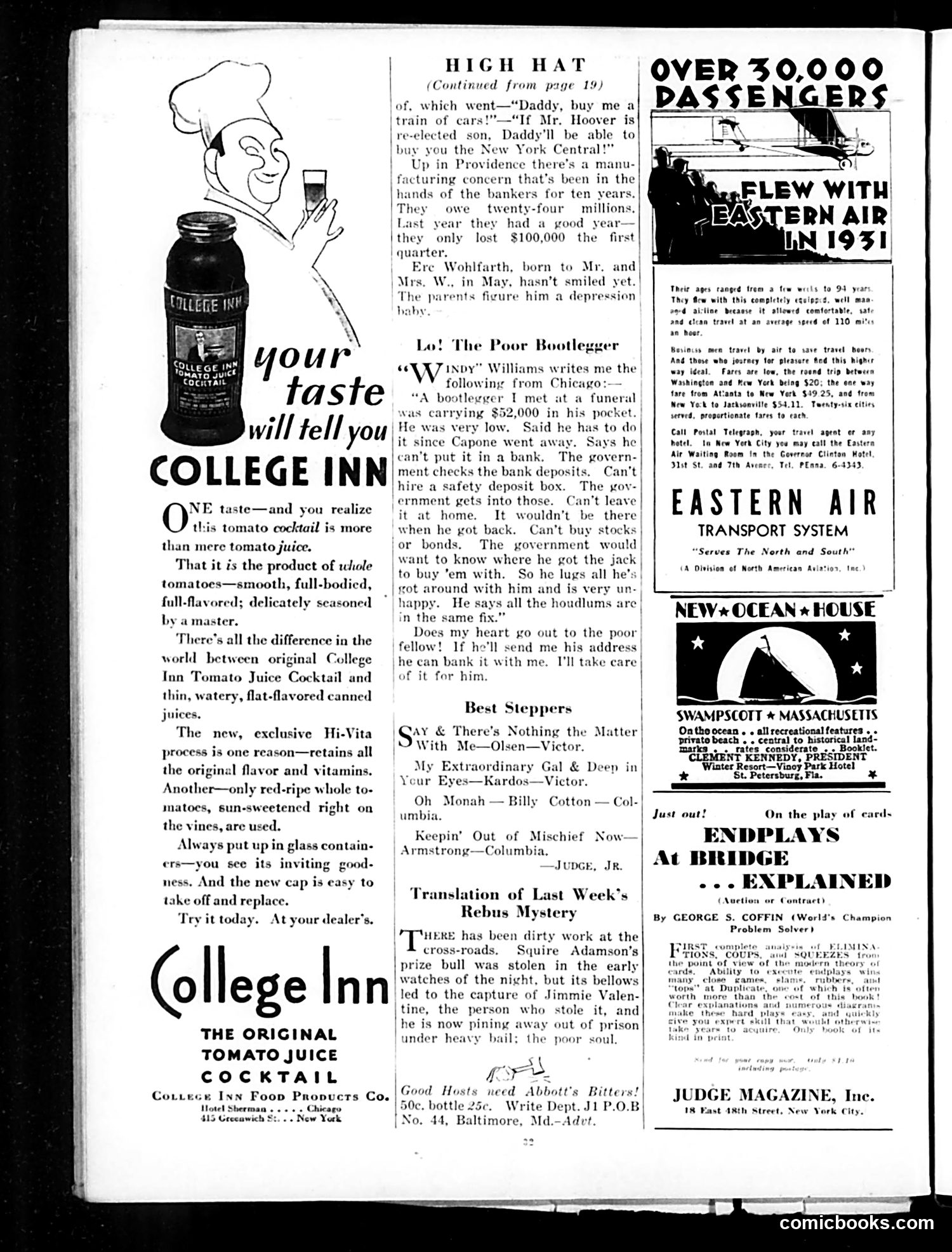
Analysis for Modern Readers This is primarily an advertising page from Judge magazine, not a political cartoon. The dominant feature is a College Inn Tomato Juice Cocktail advertisement with a chef illustration—typical 1930s product marketing emphasizing quality ingredients and modern convenience. The text includes several short humor columns: "High Hat" satirizes wealthy pretension during the Depression—a child asks his father to buy a train (New York Central railroad stock), assuming wealth means unlimited purchases. It also mocks bootleggers who, following Al Capone's imprisonment, cannot safely store their illegal cash in banks or safety deposit boxes, so they must carry $52,000 on their persons constantly. "Best Steppers" lists popular dance records—typical entertainment content. The remaining content includes travel advertisements (Eastern Air Transport, New Ocean House resort) and a bridge strategy article. The satire targets Depression-era economic anxieties: wealth illusion among the privileged and the criminal underworld's practical problems post-Prohibition enforcement.
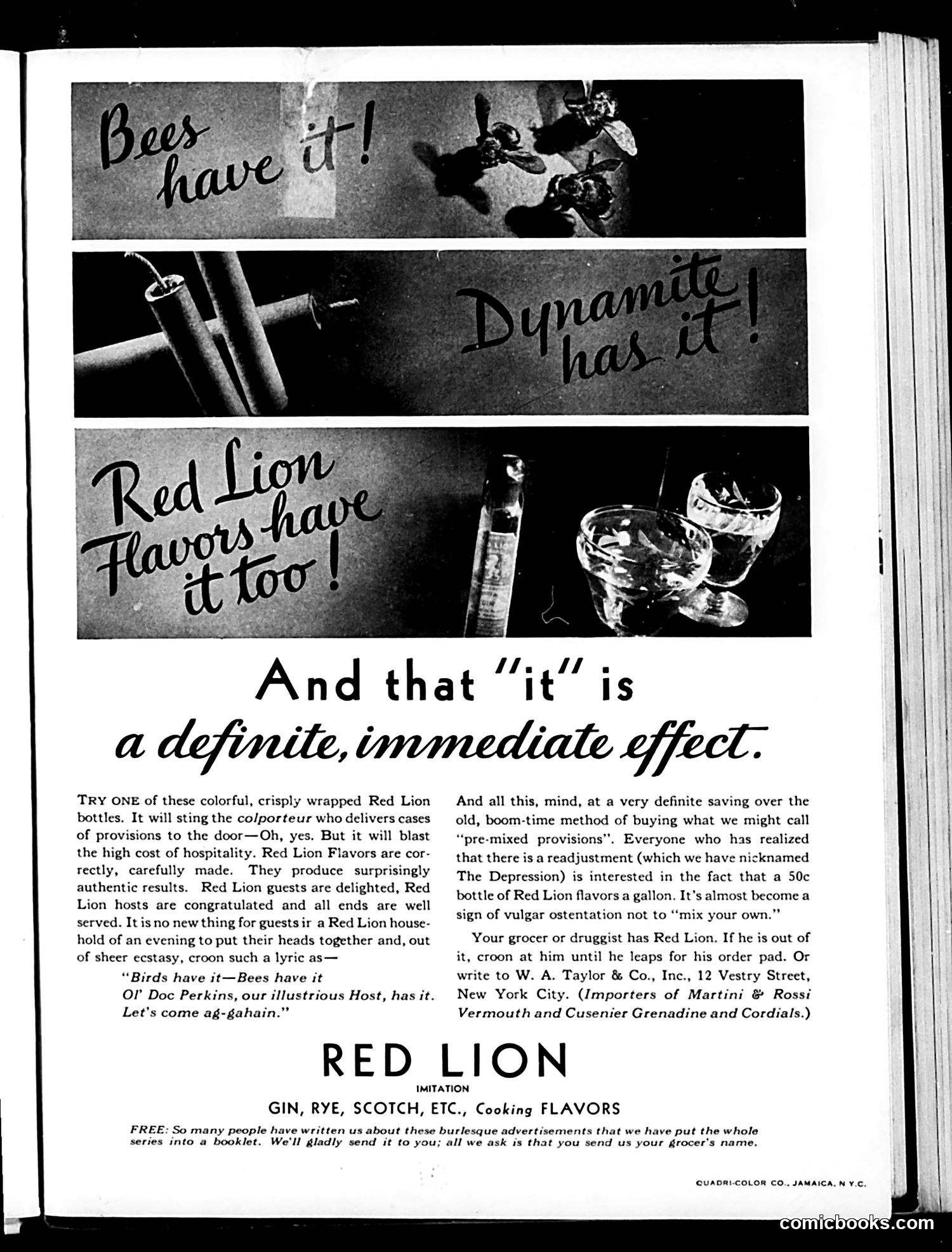
Red Lion Advertisement from Judge Magazine This is primarily a liquor advertisement, not a political cartoon. It promotes Red Lion brand imitation cooking flavors (gin, rye, scotch) during Prohibition or shortly after. The satire targets the Depression-era economy. The ad jokes that using cheap flavoring extracts to "stretch" alcohol is now fashionable—even virtuous—rather than cheap. It mocks the pretense that homemade mixed drinks are superior to commercial products, calling non-mixing "vulgar ostentation." The three horizontal panels at top show competitors ("Bees have it," "Dynamite has it," "Red Lion Flavors have it too") with no clear reference beyond product comparison. The lyrics quoted ("Birds have it...Ol Doc Perkins...has it") appear to riff on popular song structures of the era, making hosting with Red Lion seem trendy and social. The ad's self-aware tone—noting readers complained these are "burlesque advertisements"—suggests Judge was running this humorous series intentionally tongue-in-cheek.
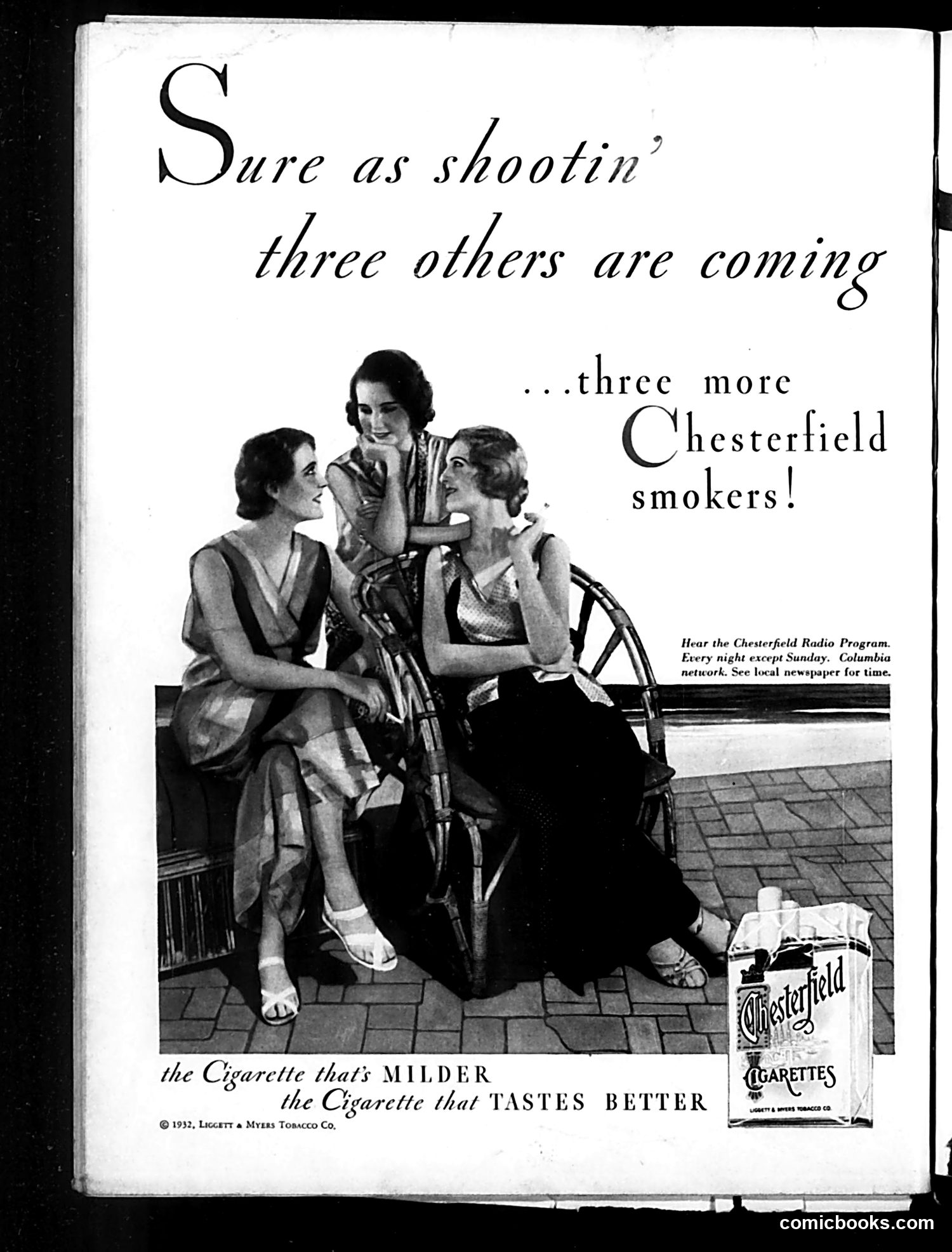
Analysis This is a cigarette advertisement, not political satire. The page promotes Chesterfield cigarettes (1932, per copyright notice). The image shows three women on what appears to be a boat or vehicle, with one saying she's "sure as shootin'" that three others are coming—"three more Chesterfield smokers!" The ad's messaging emphasizes social peer pressure and trend-following: smoking Chesterfield makes you part of a desirable group. The tagline "the Cigarette that's MILDER / the Cigarette that TASTES BETTER" was standard marketing language of the era. The ad also promotes the Chesterfield Radio Program on Columbia network. This reflects 1930s advertising practices that normalized cigarette use, particularly targeting women—a significant demographic shift at the time. The casualness and social appeal were key selling points before health warnings existed.